Categories
Hiking Mt. St. Helens Trip report Washington Washington Cascades

June Lake to Ape Canyon – 09/20/2025

After a few solo hikes we were able to hit the trail together to wrap up my final week of vacation for 2025. The hike I’d penciled in at the beginning of the year was out due to a road closure blocking access to the trailhead and my plan B was also out due to a closure for hazard tree removal. I turned to my list of “extra” hikes that were not currently on the schedule, which runs through 2029, and the one that jumped out was June Lake in the Mt. St. Helens National Volcanic Monument. I checked the weather/smoke forecast, and it was clear skies with a high in the low 60s. That was enough to convince us.

This would be our second visit to June Lake with the first having been in July of 2014 (post). The hike to June Lake is just 1.3-miles (2.6-miles round trip with 410′ of elevation gain) so during our 2015 visit we continued past the lake 0.3-miles to the Loowit Trail which circumnavigates Mt. St. Helens. We turned left (clockwise) on that trail for nearly 5-miles before turning around. Our plan for this outing was to go right (counterclockwise), possibly as far as Ape Canyon (post).

We parked at the June Lake Trailhead and set off just after 7am.
IMG_1224

The trail briefly follows June Creek with some views of the top of Mt. St. Helens before veering away to climb through the forest.
IMG_1228

IMG_1231

IMG_1234

IMG_1242

The trail nears the creek again to cross it on a footbridge then arrives in an open flat where June Lake lies hidden behind bushes on the right.
IMG_1247
June Creek

IMG_1249

IMG_1251

The first path we followed through the bushes led to a view of the lake but not the waterfall that flows into the lake.
IMG_1252

We ducked down a second path to get a view of the falls.
IMG_1253

IMG_1254

Aside from a few dragonflies and an American dipper we were alone at the lake and took a short break there to enjoy the scenery and sound of the waterfall.
IMG_1262

IMG_1267

From the lake we made the stiff climb up to the Loowit Trail and headed toward Ape Canyon.
IMG_1274
It’s hard to tell in the photo but this section was both steep and loose. We both used the trees/roots on the left as handholds going up and when we came back down.

IMG_1278
The trail leveled out some as it neared the junction.

IMG_1279
The trail sign at the Loowit Trail junction said the Ape Canyon Trail was 5-miles. From the Ape Canyon Trail the canyon itself is a little over an additional half mile.

The Loowit Trail crossed a lava flow then spent a little time in the forest and along the lava flow before climbing into the rocks.
IMG_1283
Various poles and posts mark the trails when they are passing over the lava flows.

IMG_1294

IMG_1297

IMG_1304

The trail made a pretty significant climb (approx. 200′) when it reentered the lava flow gaining a view of Mt. Adams to the east and Mt. Hood to the south.
IMG_1307

IMG_1309
Marble Mountain is the closest peak, and Mt. Hood is behind to the left through some smokey haze.

IMG_1313
A little better look at Mt. Hood.

IMG_1316
Pink mountain heather

IMG_1319
Heading up.

IMG_1322
The Loowit Trail to the left crossing over the large rock with Mt. Adams in the distance.

IMG_1324
Looking back down from near the top of the climb.

We were still about 3.2-miles from the Ape Canyon Trail at this point. From this crest the Loowit Trail would make a series of ups and downs as it crossed a half dozen gullies/canyons of various depths including several forks of the Muddy River. We momentarily lost the trail at one of the first gullies when we missed a hairpin turn around a post marking the route and instead headed straight following footprints along a rocky ridge.
IMG_1333
The trail passing between large rocks.

Mt. Adams was visible for much of this stretch and Mt. Rainier occasionally made an appearance to the north.
IMG_1334

IMG_1337
Mt. Rainier over the trees.

There were also plenty of great views of Mt. St. Helens.
IMG_1347

IMG_1351
Mt. Adams from one of the posts.

IMG_1352

IMG_1361

IMG_1362
This is where we missed the turn and were following footprints along this ridge.

When we finally spotted a post and the trail way down in the gully below we checked the GPS and confirmed we were off the actual trail. A little scrambling connected us back up to the correct path.
IMG_1364
Mt. Adams from the ridge. The post is barely visible between some trees ahead to the left, but we didn’t want to try to recross the top of the ridge as there were some large gaps that were almost too sketchy for us on the first pass.

IMG_1366
A little downclimbing to the actual trail below.

IMG_1370
Passing the post we had seen from above.

IMG_1385
Dropping into another gully. At this point Heather decided she was not going to try and push for Ape Canyon and sent me ahead while she would take her time and turn around when she felt like it.

The trail briefly left the rocky landscape to traverse up and along a hillside with a few trees and a lot of huckleberry bushes that were sporting their fall colors.
IMG_1386

IMG_1393

IMG_1395
Looking back at Mt. Hood and the direction we’d come.

IMG_1407
Mt. Adams and a lot of huckleberry bushes.

IMG_1408
Mt. Rainier in the distance.

IMG_1414
Mt. Rainier behind Pumice Butte.

IMG_1421

IMG_1424
Ripe serviceberries mixed in with the huckleberries.

IMG_1428

After traversing the huckleberry covered hillside it crossed another tributary of the Muddy River.
IMG_1439

IMG_1440
Closer look at Mt. St. Helens.

IMG_1445
Heading for the next post.

IMG_1449
Mt. Rainier became more visible as I continued north.

IMG_1452
One of the larger canyons of the Muddy River. The entire route was dry this late in the year.

IMG_1456
Dry waterfall above the trail.

IMG_1458
Looking down the canyon toward Mt. Adams.

IMG_1462
Mt. Hood and a layer of haze behind one of the posts.

IMG_1466
The trail turning uphill before the next canyon.

IMG_1468
The Loowit Trail climbing out of another canyon to a post with Mt. Rainier in the distance.

IMG_1479
Mt. Rainier and Little Tahoma

IMG_1483
Dwarf lupine

The next ravine was the main channel of the Muddy River and it proved to be the trickiest as the trail climbing out was not obvious.
IMG_1484
There was a post visible on the far side poking up from a patch of green but no visible path leading to it.

IMG_1486
It almost looked like there might be a path on the shelf above the dry riverbed, but I didn’t see a clear path to it, nor did it appear to lead anywhere near the post on the ridge above.

Once I was in the riverbed I spotted two small rock cairns, one with a pink ribbon so I headed for those.
IMG_1487

That brought me to the far side but there was still no clear tread that I could see.
IMG_1488
The post is uphill just to my left. There were some prints leading up from here so I angled uphill toward the trees above.

This route quickly turned into a class 3 scramble. I had to be very careful which rocks I used as hand and footholds due to how loose the hillside was. I momentarily considered turning around but I was closer to the top than the bottom and wasn’t sure I could safely downclimb, so I continued. I finally managed to climb out near the snags.
IMG_1489
The post is hiding back behind the snags here.

After gathering myself I continued on figuring that it should be easier to follow the correct path down starting from the post on the way back. The Loowit trail now began a nearly three-quarter mile long descent.
IMG_1491
Mt. Rainier to the left and the Loowit Trail ahead to the right.

IMG_1499
The Ape Canyon Trail was visible climbing along the ridge below.

The trail leveled out shortly before arriving at the junction with the Ape Cayon Trail at a post with a great view of Pumice Butte.
IMG_1502

I almost called it quits here. In addition to a great view of Mt. St. Helens I could see the Loowit Trail below in the distance as it bowed out and around toward Ape Canyon which was on the far side of Pumice Butte.
IMG_1505
The Loowit Trail is visible on the right-hand side about halfway up the photo.

IMG_1506
The trail then bent around to climb the ridge in the distance on the far side of the butte.

The deciding factor was that on our previous two visits Mt. Adams had not been visible from the viewpoint above Ape Canyon. Despite there being a little haze today I knew Mt. Adams would be visible, so I sallied forth.
IMG_1508

IMG_1510
Heading toward Pumice Butte now. If you look closely, on the left-hand side toward the top, there are several mountain goats. At this point I had dismissed them as fallen snags and hadn’t bothered looking closely.

IMG_1511
Passing through yet another gully.

IMG_1514
Paintbrush

IMG_1517

The trail passes the top of Ape Canyon and crosses what is sometimes a small spring fed stream.
IMG_1519

IMG_1520
No water, just a little bit of mud. Speaking to backpackers there were few sources of water available this late in the year.

IMG_1533
Success! Mt. Adams from Ape Canyon

Ape Canyon
This was the 2013 view.

Ape Canyon
And the 2015 view.

I took a break on a rock and had a snack and changed into dry socks before starting back.
IMG_1525
The rock I used as a bench.

It was while I was heading back that I realized it was mountain goats on Pumice Butte and not stumps/downed trees.
IMG_1537

IMG_1538
Looking north toward Windy Pass where the Loowit Trail passes between the mountain and the butte ahead.

IMG_1545
Mt. Adams, Pumice Butte, and mountain goats.

IMG_1540

I returned the way I’d come, except for the two places that I’d lost the trail on the way to Ape Canyon. As the sun moved overhead the view of Mt. Adams improved a bit and the view of Mt. Hood became hazier.
IMG_1559

IMG_1563
Mt. Hood was barely visible now.

When I reached the post above the Muddy River I followed the path as it began to descend the side that I’d scrambled up.
IMG_1578

IMG_1579
The section of trail that I had thought I’d seen from the other side was visible below but again there was no clear route to it. I believe it is a remanent of a previous route through the canyon that has since washed out.

The route down made a switchback and basically led me back to where I had begun my scramble up. There was a pretty good drop near the bottom though. It was significant enough that I sat down and slowly lowered myself by sliding down the loose pumice. Looking back, I am sure I considered that as a possible route up but the drop, or climb going up, seemed pretty daunting and since I wasn’t positive it was indeed the current trail I veered right instead. Once I was done with the butt slide, I found myself in the riverbed at the cairns I had followed earlier. It was a little perplexing at the time, but I was through the worst section now and could enjoy the rest of the hike back.
IMG_1588
Dust kicking up from a rockfall on the mountain.

IMG_1595

IMG_1598
Golden-mantled grounds squirrel. I heard a few pikas along the way but never saw any, just the golden-mantles and some chipmunks.

IMG_1602

IMG_1616
Coming up to the post on the ridge where we’d lost the trail earlier.

IMG_1621

IMG_1625
Mt. Adams near the end of the hike.

IMG_1628
The trail below in the rocks.

IMG_1633
Back on the June Lake Trail.

I caught up to Heather a little before reaching June Lake. She had gone through the huckleberries and stopped at the edge of one of the big canyons and taken a nice long break before taking her time on her way back. We stopped at June Lake again for a final look at the waterfall then returned to the car.
IMG_1636

IMG_1637
Ouzel with a snack.

IMG_1641

IMG_1648

The hike to Ape Canyon came in at 14.4-miles on my GPS. I am just guessing on elevation, but I’d say it was in the 2500′ range due to all the ups and downs.
Screenshot 2025-09-20 183410

Screenshot 2025-09-22 183938
This little orange section is my scramble out of the Muddy River Canyon.

Mt. St. Helens never disappoints. This might have been my favorite hike we’ve done at the mountain to date but it’s hard to say. Happy Trails!

Flickr: June Lake to Ape Canyon
Categories
Central Oregon Hiking John Day Oregon Trip report

Strawberry Mountain Wilderness Days 3 & 4 – Slide Lake to East Fork Canyon Creek TH
Hope springs eternal and it was with new hope that we got up on the third day of what had so far been the most grueling backpacking trip we’d undertaken. On paper it didn’t look much different than some of our other trips but the big difference maker had been the heat. It had been hot during the afternoon on some of our previous trips but this trip was different. Not only was it hot during the day but it wasn’t really cooling down at night which meant it was still warm in the morning. Day 3 was no different.

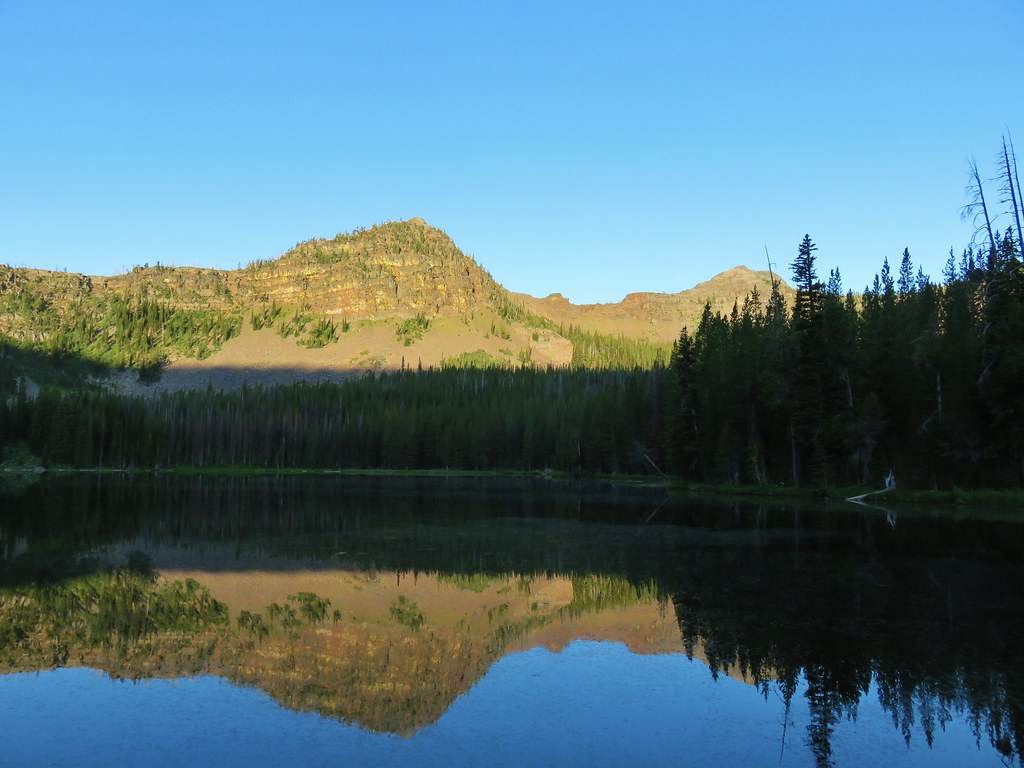
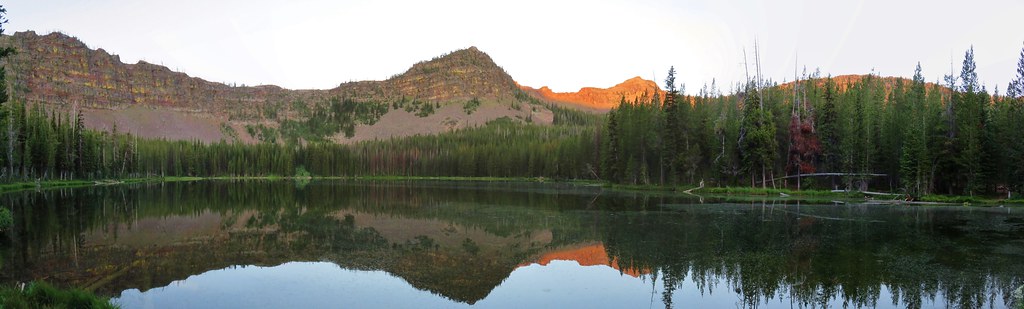
We had an early breakfast in front of a beautiful view of Slide Lake.
IMG_9360_stitch

As we were finishing up we were joined by a doe who was cautiously grazing nearby.
IMG_9365

IMG_9374

As we watched the sunlight overtake more of the cliffs above the lake we noticed our route for the day cutting across the rocks below the far cliffs.
IMG_9377

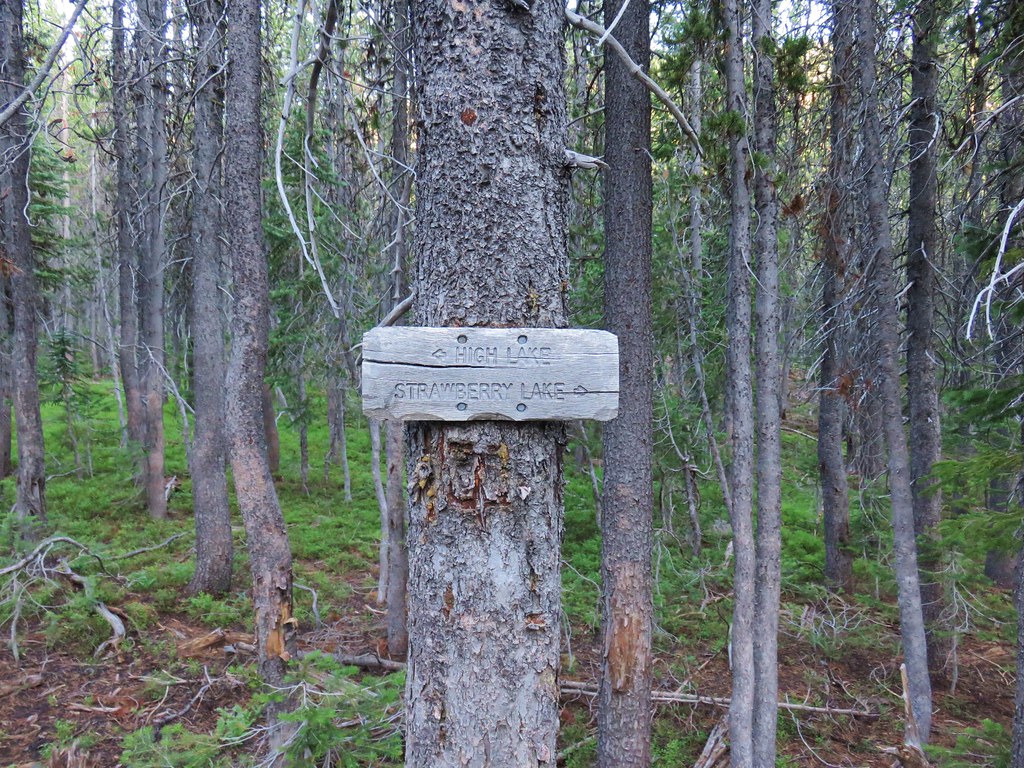
Seeing the trail produced two thoughts, first it reminded us that we were facing a nearly 1000′ climb out of the Slide Lake Basin, and secondly that the climb would be in full sunlight. We left Slide Lake shortly before 7am and hiked the quarter mile back to the junction with the Sky Line Trail where we turned left following a pointer for High Lake.
IMG_9380

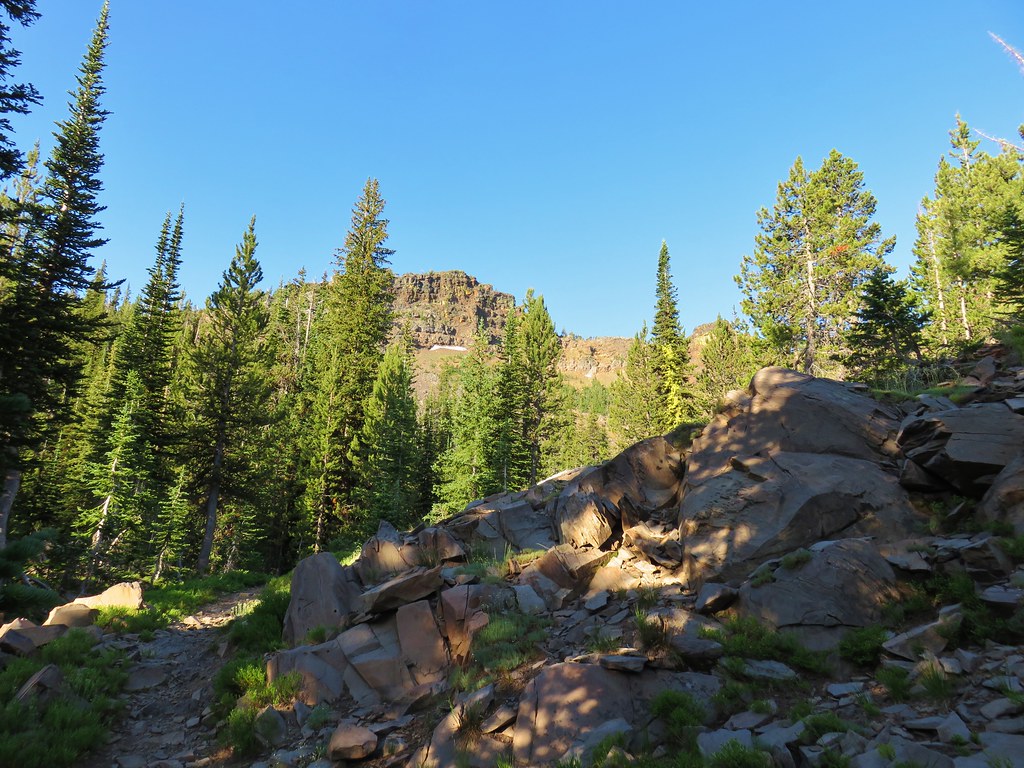
After an all to brief stint in the trees which provided some shade the trail entered rockier terrain where the Sun was already heating things up.
IMG_9381

IMG_9384

IMG_9385

Some years there is a snow patch that remains over the trail into August which requires a bypass nearly straight up the hillside but with this being a low snow year there was no need for us to climb any more steeply than necessary. By 7:30am Slide Lake already looked far away.
IMG_9388

It was also already officially hot. Luckily after a a quarter mile of switchbacks at the 1 mile mark the climb became much more gradual.
IMG_9393

It was still hot but at least we weren’t having to work as hard as we traversed below the cliffs.
IMG_9416

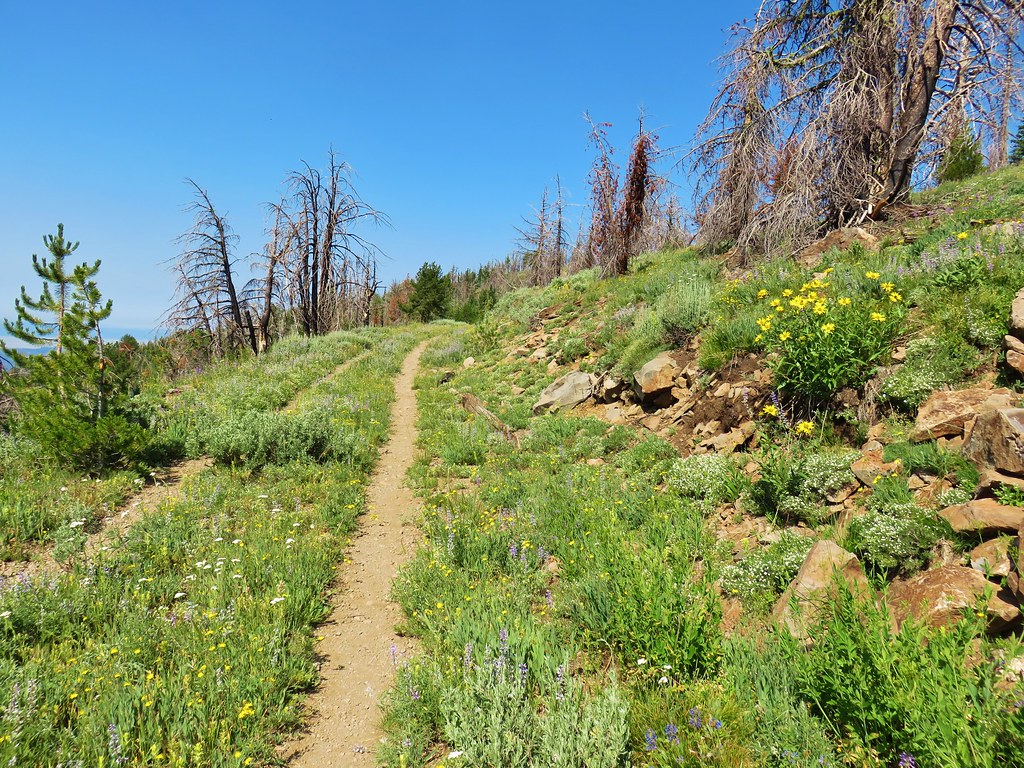
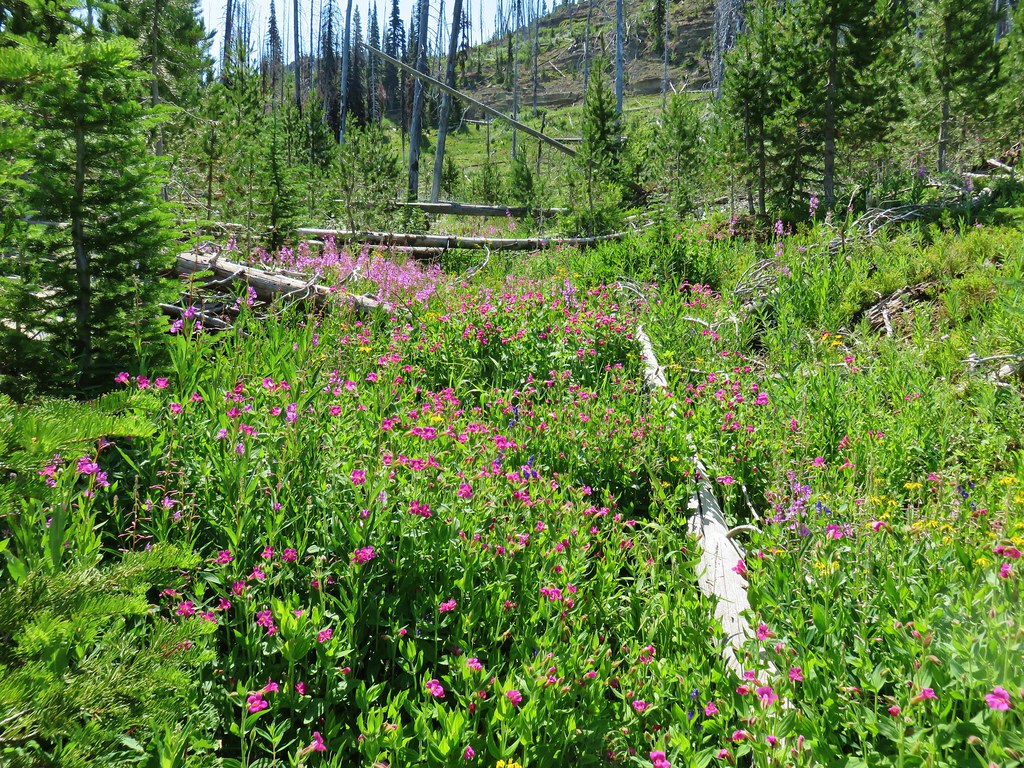
A nice variety of wildflowers splashed the hillside with color.
IMG_9397

IMG_9400

IMG_9406

IMG_9414

IMG_9413

After following the Skyline Trail a little over a quarter of a mile we arrived at junction with the Mud Lake Trail.
IMG_9420

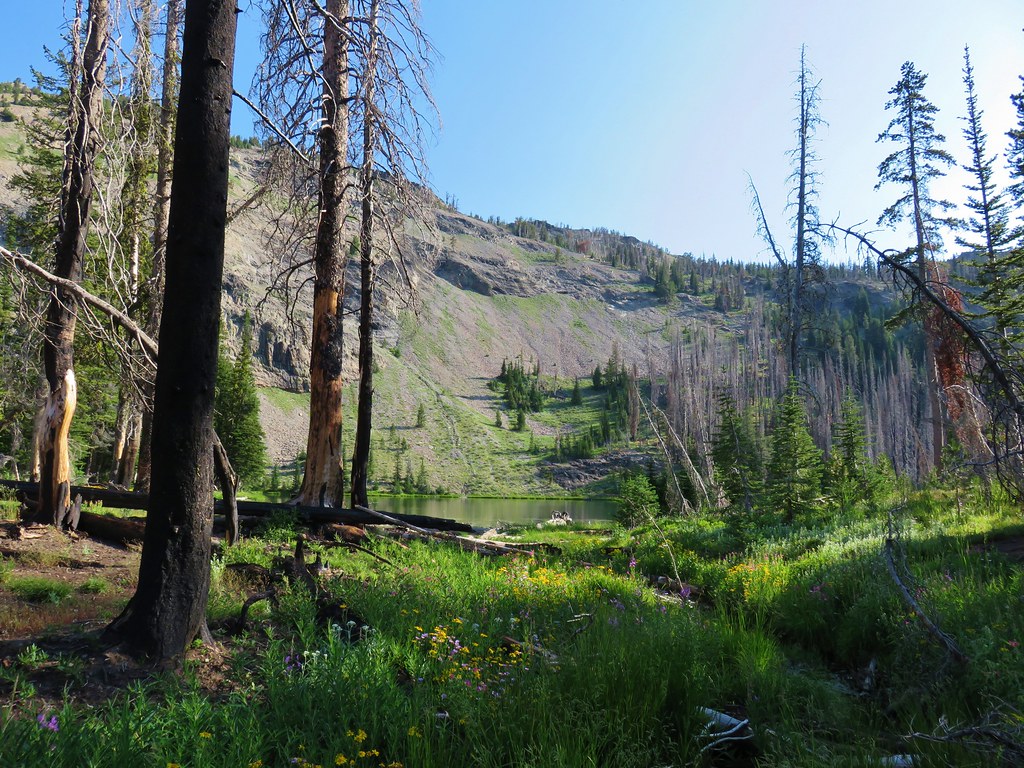
The Mud Lake Basin was heavily burned which revealed both Little Mud Lake which I thought looked like Pacman and the larger Mud Lake.
IMG_9427

IMG_9434

At the junction the Skyline Trail turned right and steepened as it climbed past wildflowers to a ridge end above High Lake.
IMG_9424

IMG_9425

IMG_9430

IMG_9436

The 1.6 mile descent from this ridge end down to High Lake was one of the more pleasant stretches of trail on the trip. It was downhill and the ridge blocked the sunlight leaving it a little cooler than it had been on the other side. There were also plenty of wildflowers and views across the basin to the back side of the Rabbit Ears.
IMG_9440

IMG_9444

IMG_9453

IMG_9449

IMG_9450

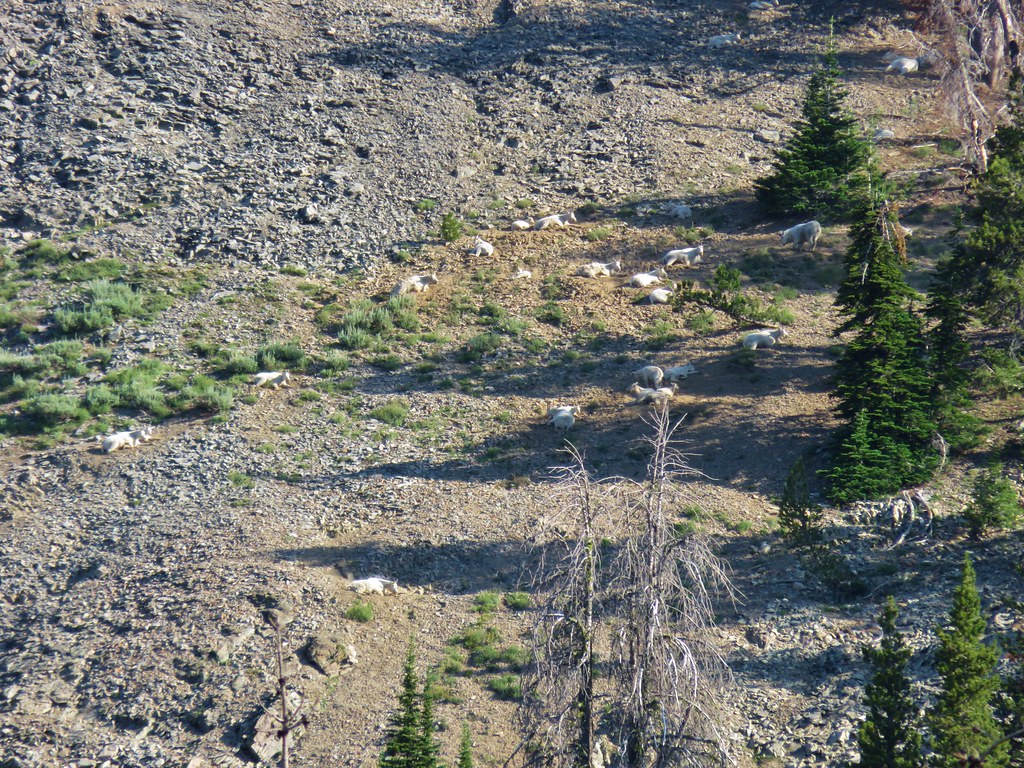
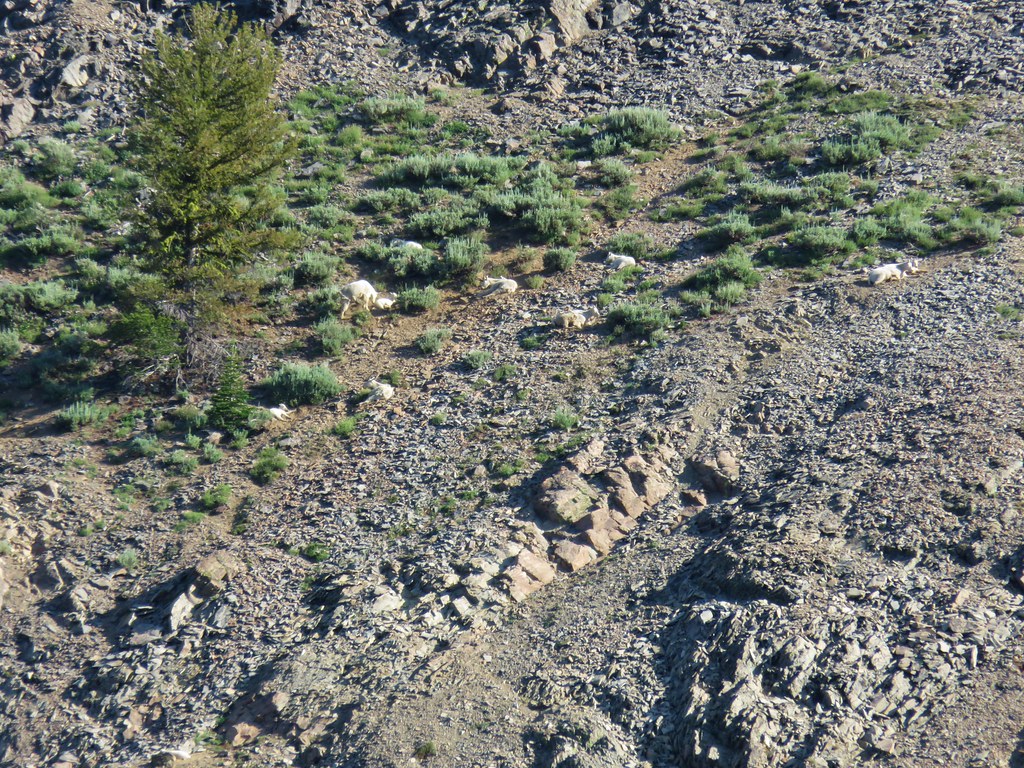
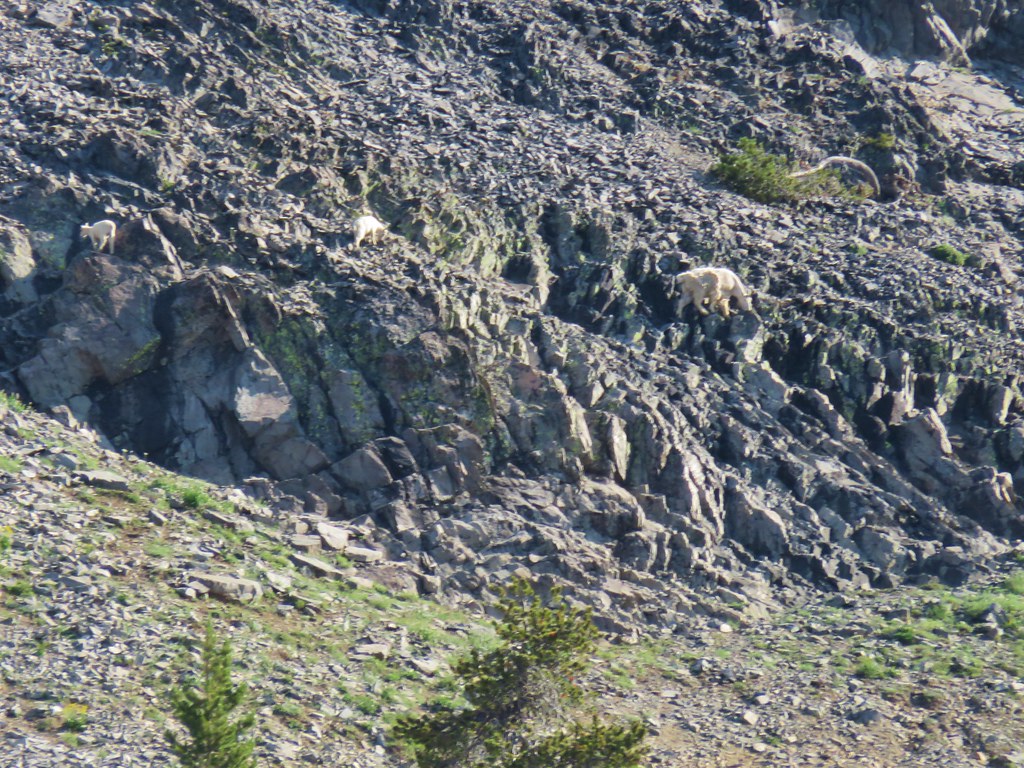
We had been scanning the cliffs for animals, in particular California big horn sheep, which the Forest Service Map mentioned as a possible sighting in the wilderness along with deer, elk, and pronghorn. One thing the map didn’t mention was mountain goats so we were a little surprised when we spotted what appeared to be mountain goat fur in a small pine tree.
IMG_9446

Fifteen minutes later we spotted them way up on the hillside ahead of us.
IMG_9459

IMG_9456

IMG_9467

IMG_9458

It is always amazing to watch these animals maneuver on the rocky hillsides.
IMG_9495

We watched them as we made our way to High Lake which we arrived at ten minutes later.
IMG_9474

IMG_9477

IMG_9481

IMG_9483

IMG_9486

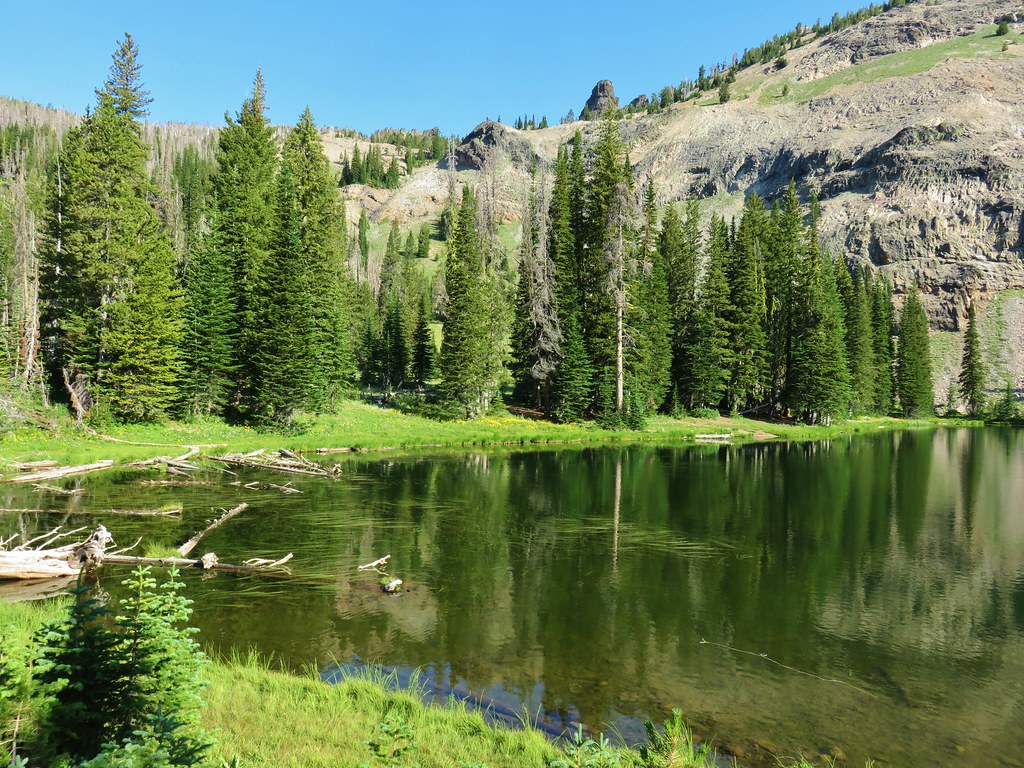
We took a nice break at the lake and replenished our water supply before continuing on. We crossed the outlet creek and soon began climbing out of the basin.
IMG_9487

IMG_9489

IMG_9491

IMG_9500

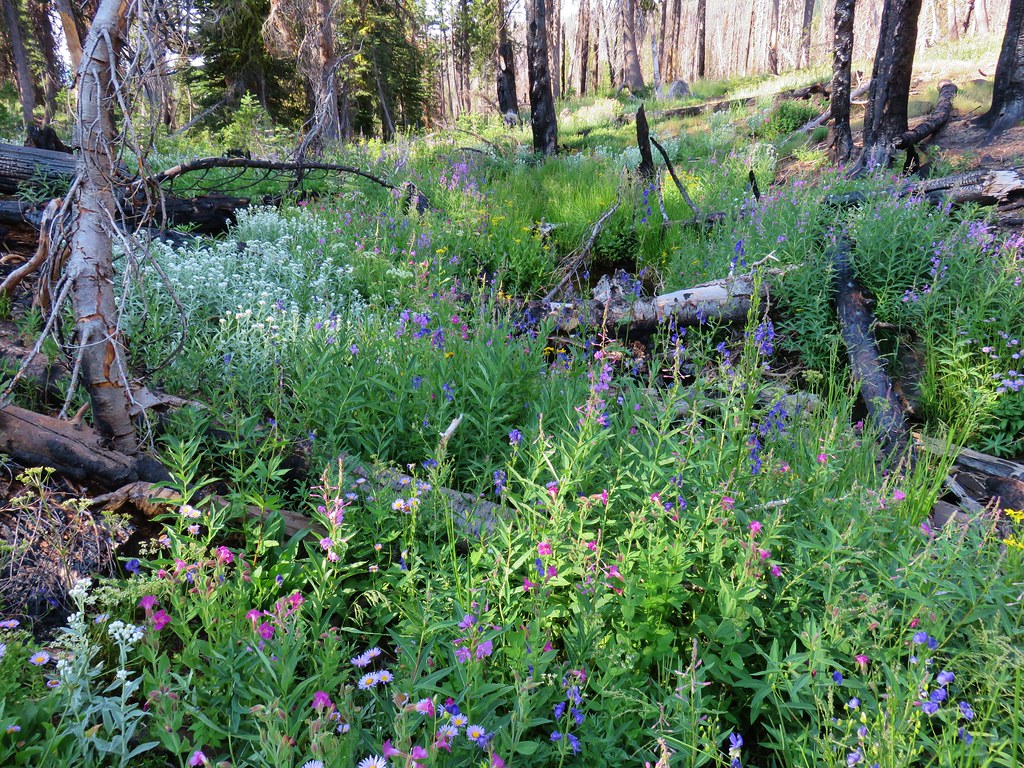
The 1.3 mile climb out of the basin gained approximately 550′ while it passed some of the best wildflower displays of our visit.
IMG_9502

IMG_9504

IMG_9509

IMG_9512

IMG_9514

IMG_9515

IMG_9518

After climbing out of the basin we arrived at the High Lake Rim Trailhead.
IMG_9530

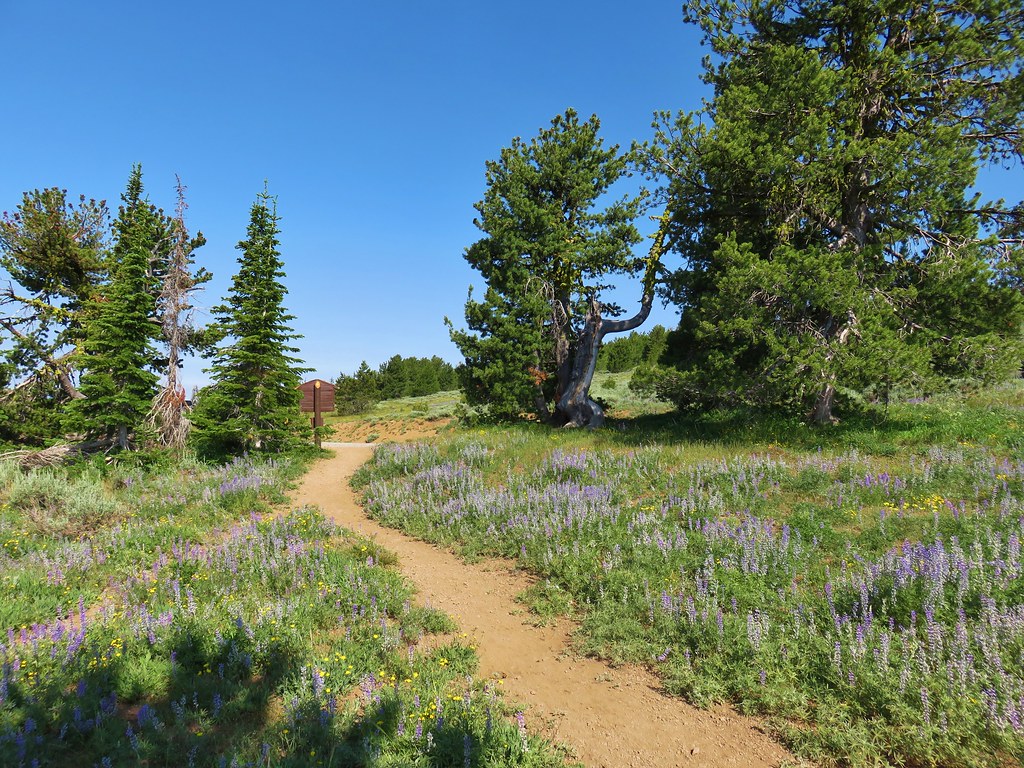
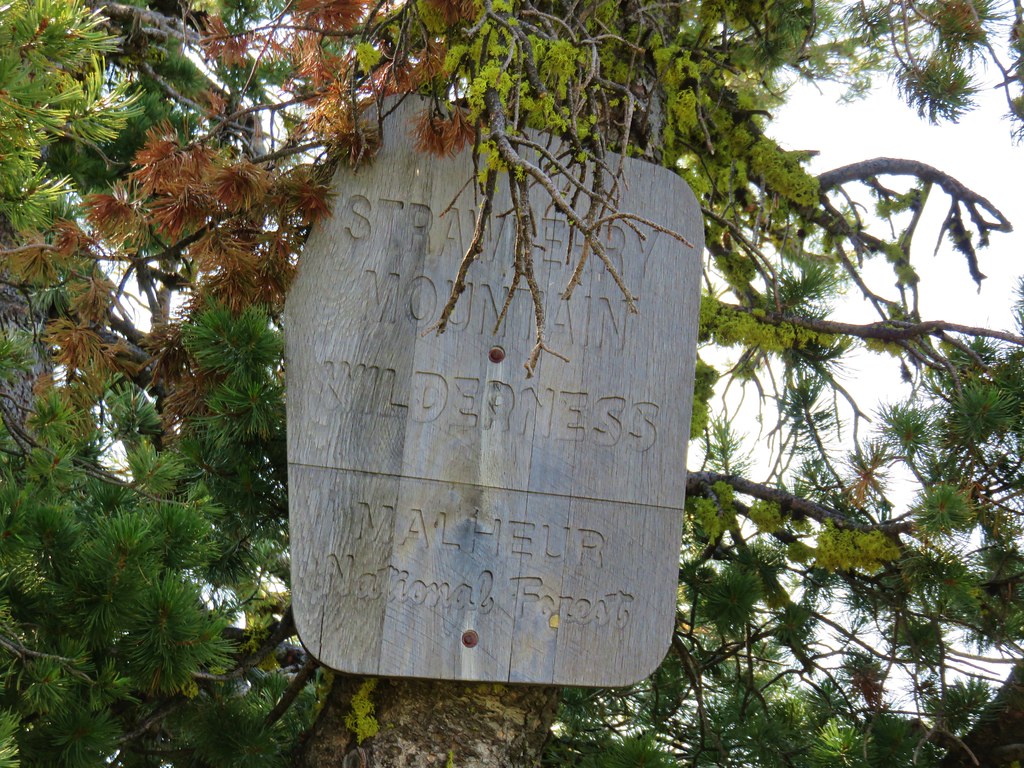
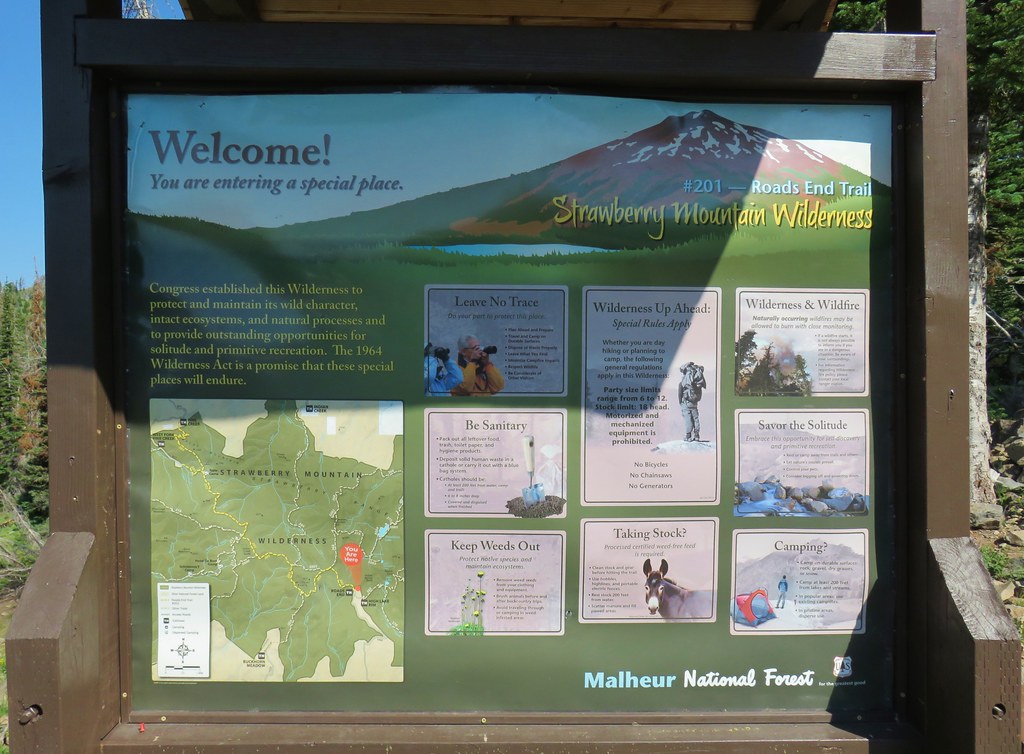
Here I was excited to see a wilderness sign.
IMG_9526

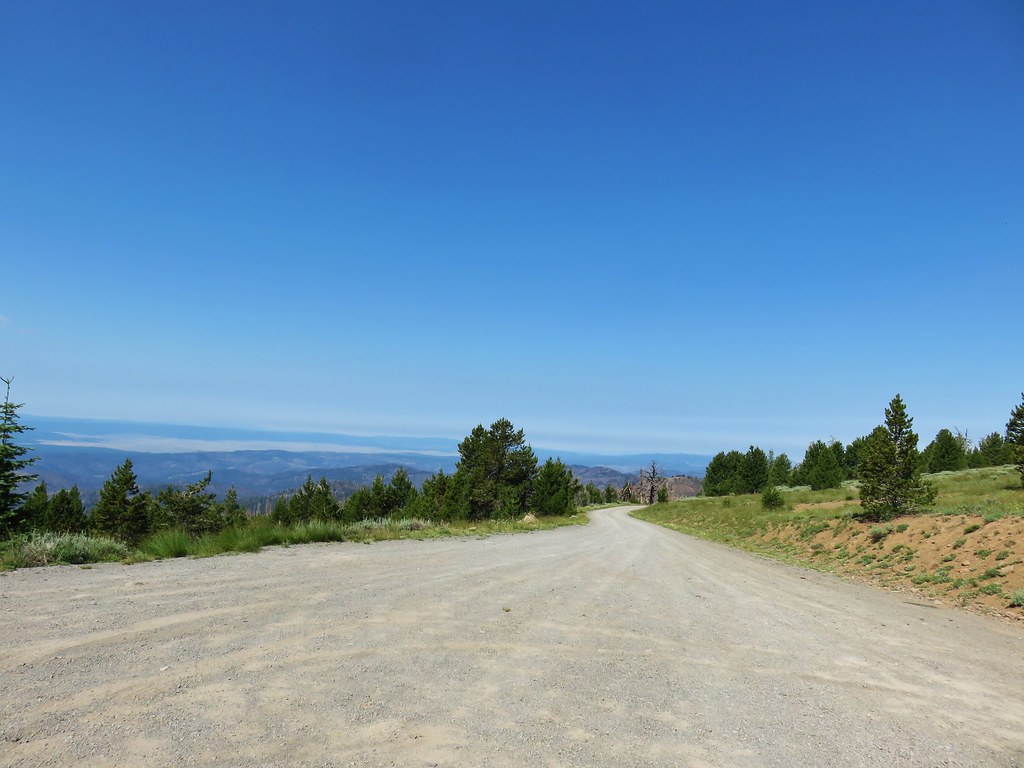
I have been trying to collect pictures of signs for each wilderness area we visit and there hadn’t been a sign along the East Fork Canyon Creek Trail. That sign most likely burned in the 2015 fire. From the trailhead we faced a .4 mile road walk to the Roads End Trailhead.
IMG_9533

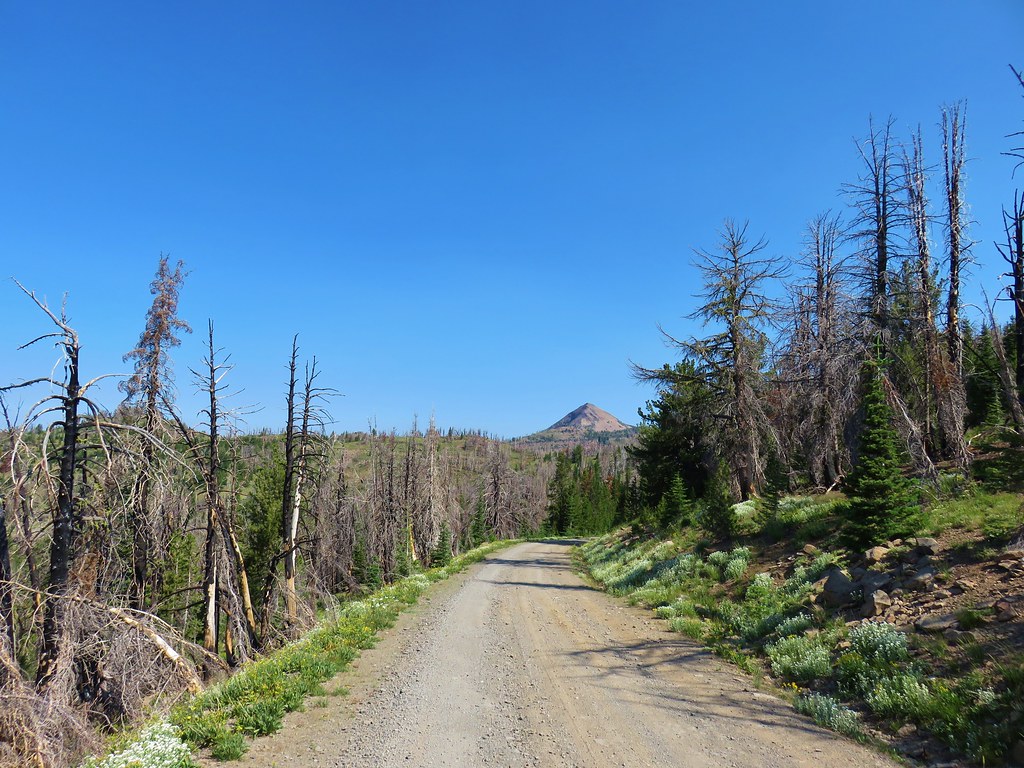
IMG_9539Strawberry Mountain from FR 1640.

IMG_9540

IMG_9541

The Roads End Trail follows a closed roadbed for 1.2 miles to the junction with the Onion Creek Trail which we had been at the day before. (post)
IMG_9546

As far as road walks go this one provided some nice scenery that we could have appreciated even more if had been a bit cooler out.
IMG_9548

IMG_9550

IMG_9555

IMG_9552

Near the end of the old roadbed the ground became muddy due to the presence of a series of seeps.
IMG_9556

At the unsigned junction a small cairn marked the familiar path downhill to a saddle.
IMG_9557

We turned left for .3 miles to a signed junction where we turned right onto the Indian Creek Trail.
IMG_9559

The day before we had come from the left having stayed the night in Wildcat Basin. By going right here would complete a loop back to the Pine Creek Trail. It was also 1.3 miles shorter than it would have been to retrace our steps through Wildcat Basin.

After a brief initial climb we gained a view of Indian Creek Butte.
IMG_9562

The trail then descended past some more volcanic ash formations similar to the ones we’d seen near Wildcat Basin.
IMG_9563

IMG_9564

IMG_9567

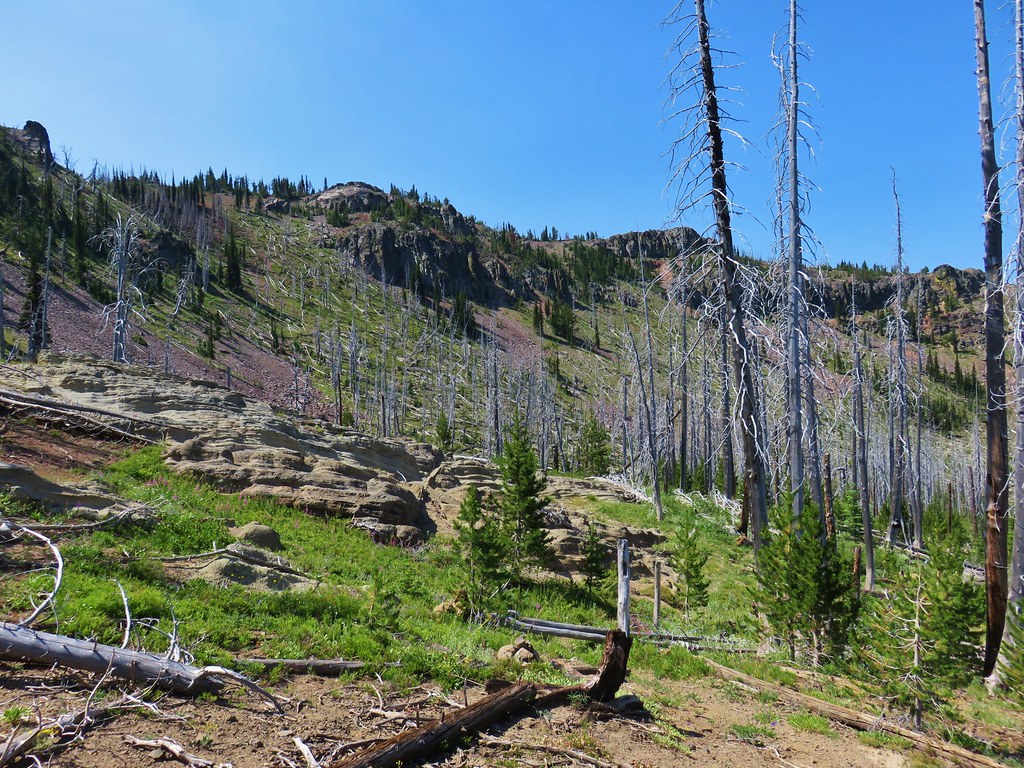
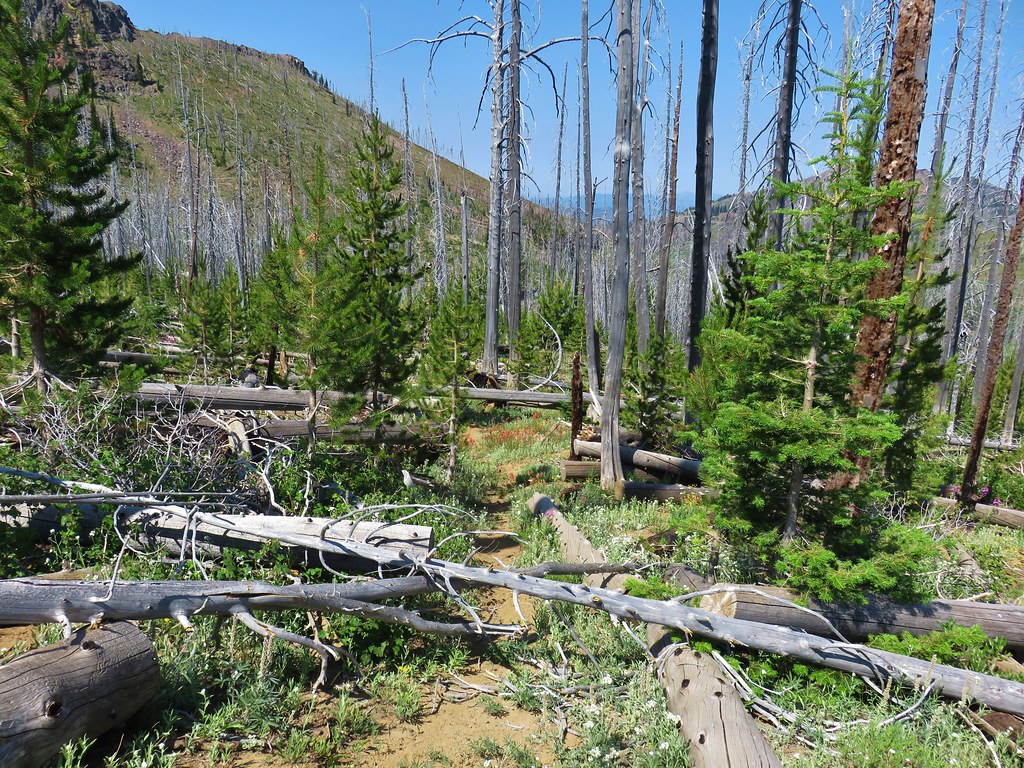
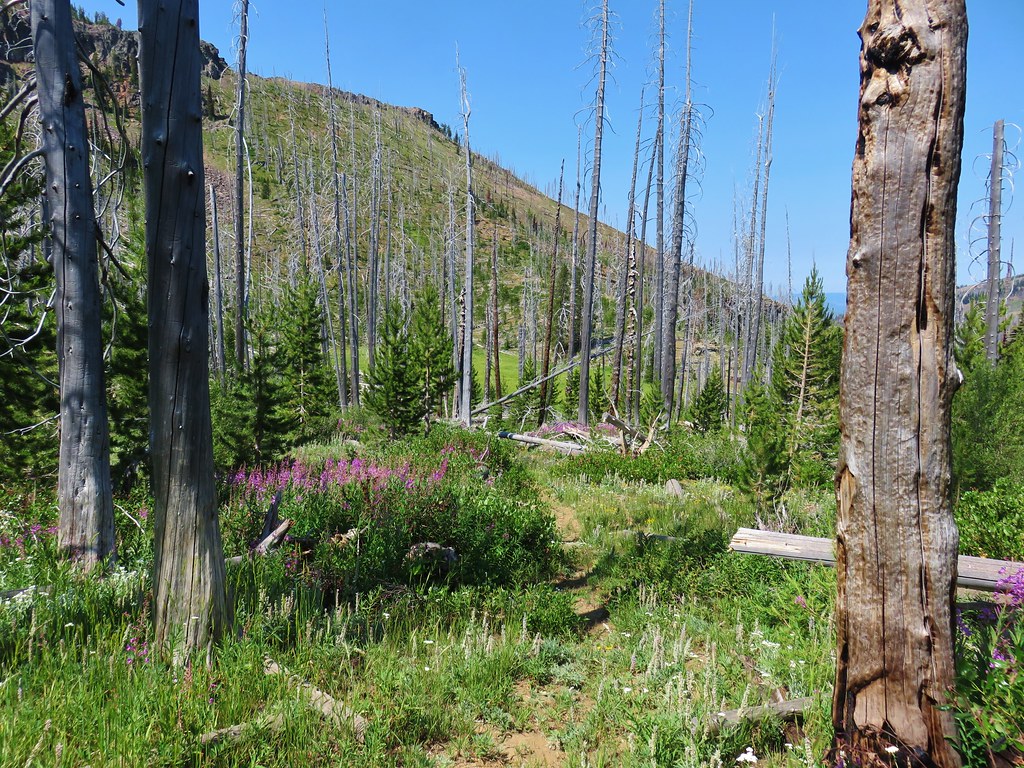
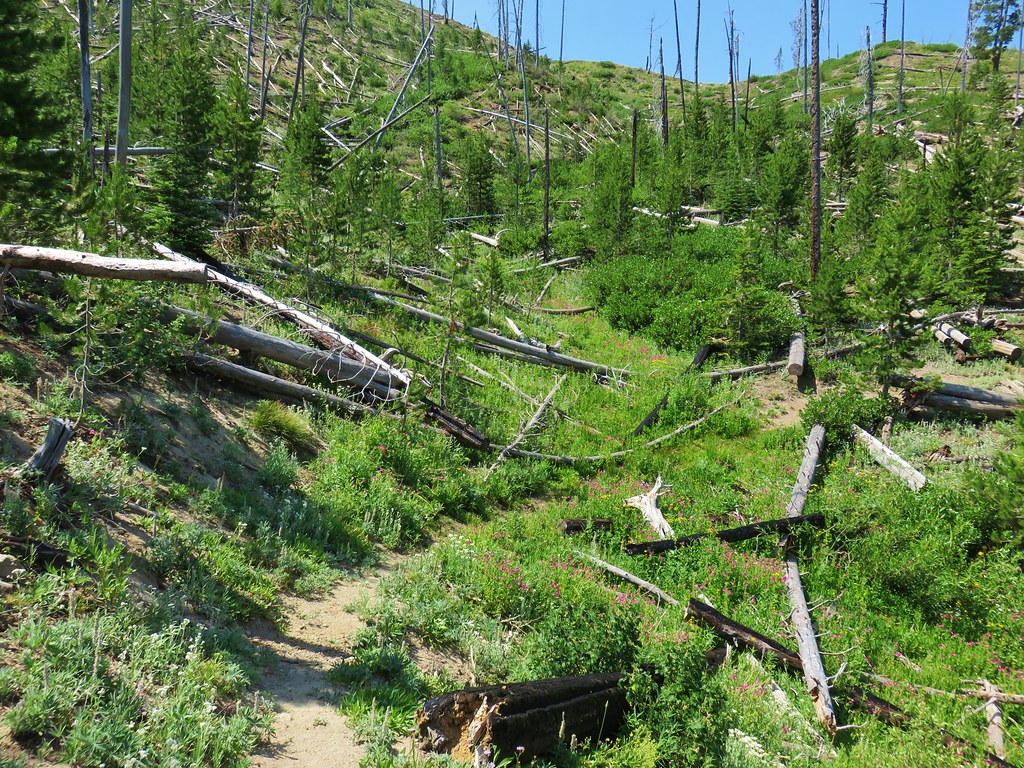
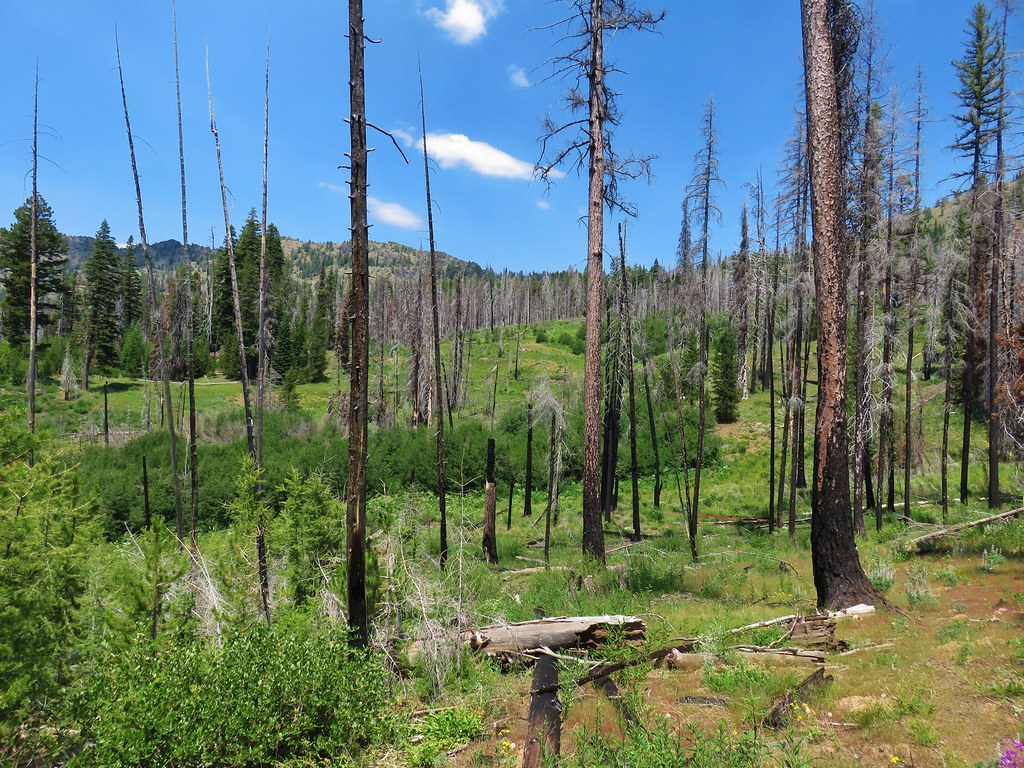
This was another area affected by fire and there were a number of trees down across the trail.
IMG_9568

IMG_9569

A little past the ash formations the trail approached a marsh filled with tall onions.
IMG_9570

IMG_9572

IMG_9574

A couple of small cairns helped guide us through the marsh but on the far side we missed a sharp right turn and continued straight. We soon realized we were no longer following a trail but that wasn’t anything new during this trip and we could see the saddle we were aiming for straight ahead so we kept going for a bit. Two tenths of a mile from where we should have taken the sharp right downhill we ran into a cliff where we were unable to continue forward. The GPS showed the actual trail as being a tenth of a mile away and 150′ below us. At that point we didn’t know about the sharp right and couldn’t figure out how we got so far off course but there we were. We found a game trail and followed steeply downhill in the general direction of the real trail.
IMG_9576

IMG_9578Our route down.

From above it didn’t look like it was going to be too difficult to go cross country but once we were down in the basin we realized it was going to be a lot harder than we’d thought.
IMG_9579

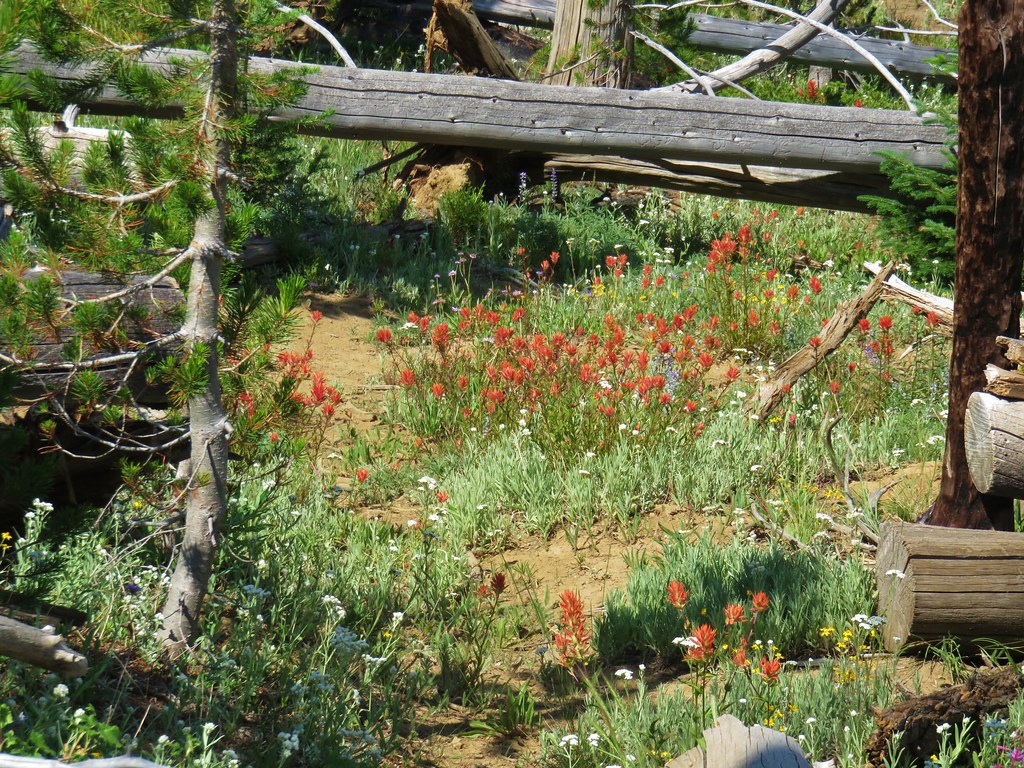
There were some surprising displays of flowers to be found in the gullies as we crashed through the brush and over numerous downed trees.
IMG_9580

IMG_9581

IMG_9582

After a lot of sweat, a little blood, and no tears (we didn’t have the moisture left to make any) we found the actual trail.
IMG_9585

A hundred foot climb brought us up to the saddle where we rejoined our path from the first day at a signed junction.
IMG_9586

We turned right and headed toward Indian Creek Butte on the faint Pine Creek Trail.
IMG_9587

It was less hazy than it had been the previous two days allowing for some clearer views from the trail.
IMG_9589_stitchIndian Creek Butte, the John Day Valley, and Strawberry Mountain

It was 1.4 miles to a junction on the east side of Indian Creek Butte where we had the choice of staying to the right on the Pine Creek Trail for .9 miles then turning left on the East Fork Canyon Creek Trail for another 1.3 miles to the spring where we had eaten our dinner on the first day. The other option was to go back the way we’d come up the first day around the south side of the butte. This second option was three quarters of a mile shorter and the condition of the trail, albeit is sad, was known to us. We’d had enough surprises for one trip so we deiced to go with the known option.
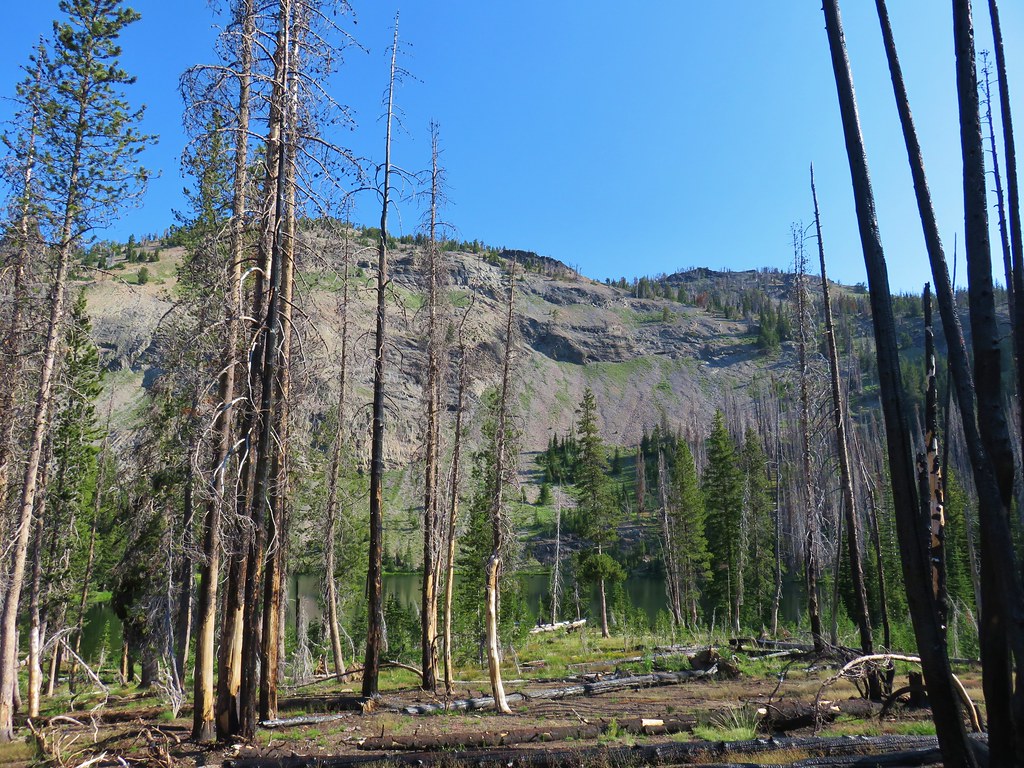
Even though we had seen this area before there were some new sights to be had.
IMG_9597

IMG_9602

When we reached the series of rock cairns in the green trees on the SW flank of the butte we attempted to use the GPS to follow the actual route of the trail this time.
IMG_9599

That proved to be mostly futile as the brush was just too dense and the tread too light to allow us to stay on course.
IMG_9606

Other than the rare sighting of a cut log we had no idea where the trail was actually supposed to be.
IMG_9608

In the end we wound up aiming for our previous track as shown on the GPS and eventually managed to pick up the actual trail at the same place we’d lost it on the first day. We made our way back to the spring and once again took a break near the lawn chairs.
IMG_9610

This time Heather discovered a mylar pumpkin balloon which we stuffed into our garbage and packed out. We took an extended break in some shade here before setting off on what we had planned on being our last mile for the day down to Hotel De Bum Camp. As we neared the meadow near the camp though we heard the neighing of horses. A good sized group of equestrians had ridden up to the camp and were spending the night there. There really wasn’t any room for us so we decided that we’d just keep going and stop at the next good camp site.
IMG_9614A horse in the meadow at Hotel De Bum Camp

I had thought there might be a couple of spots near Miners Creek when I had checked that area out on the first day but after descending 1.4 miles from Hotel De Bum Camp a closer inspection of the area resulted in us deciding against trying to force a site there. We decided to take another break, have dinner, get more water, and look at the map to see about other potential spots.

The next camp shown on the forest service map was Grindstone Y Camp which looked to be a half mile down the trail. When we arrived in the area we spotted what appeared to be a camp where there were all kinds of supplies stashed in the nearby trees. There really didn’t seem to be a viable tent site though and with all the items about it had an off-putting vibe so we pressed on.

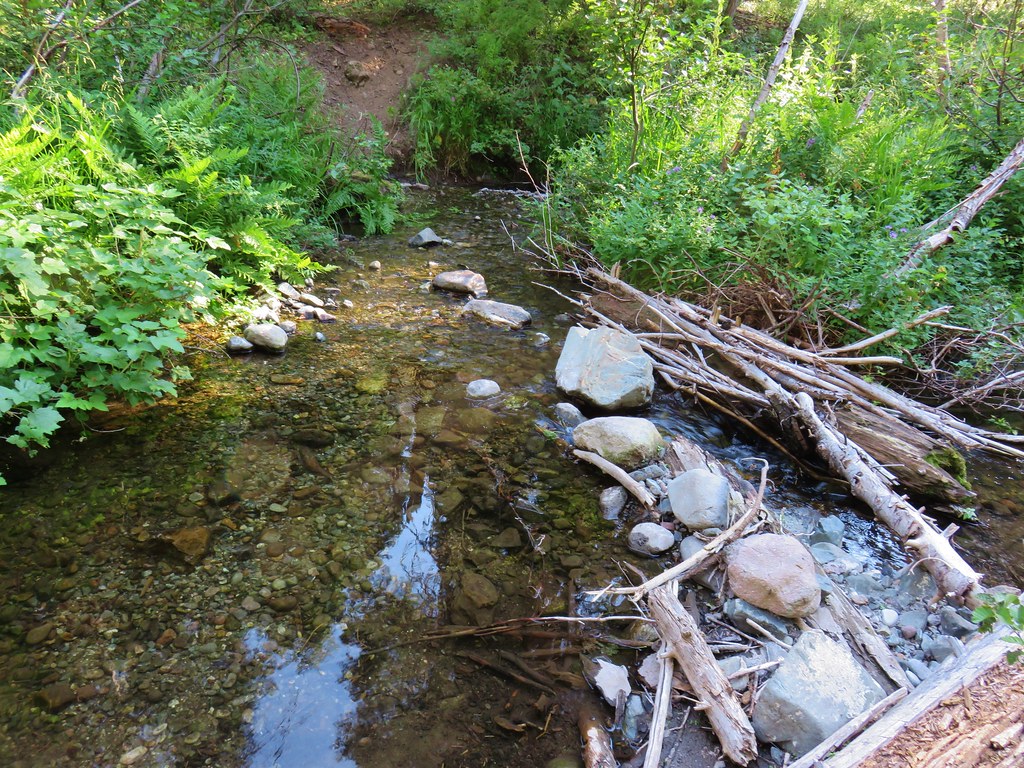
Nearly a half mile later we came to a fork in the trail. On the first day we had come up from the right hand side (north side of the creek) but the equestrians had clearly come up from the right hand fork. We determined that the right hand fork was the trail we should have been on to avoid the ugly bushwhack across East Brookling Creek. We took the right hand fork and promptly crossed East Fork Canyon Creek.
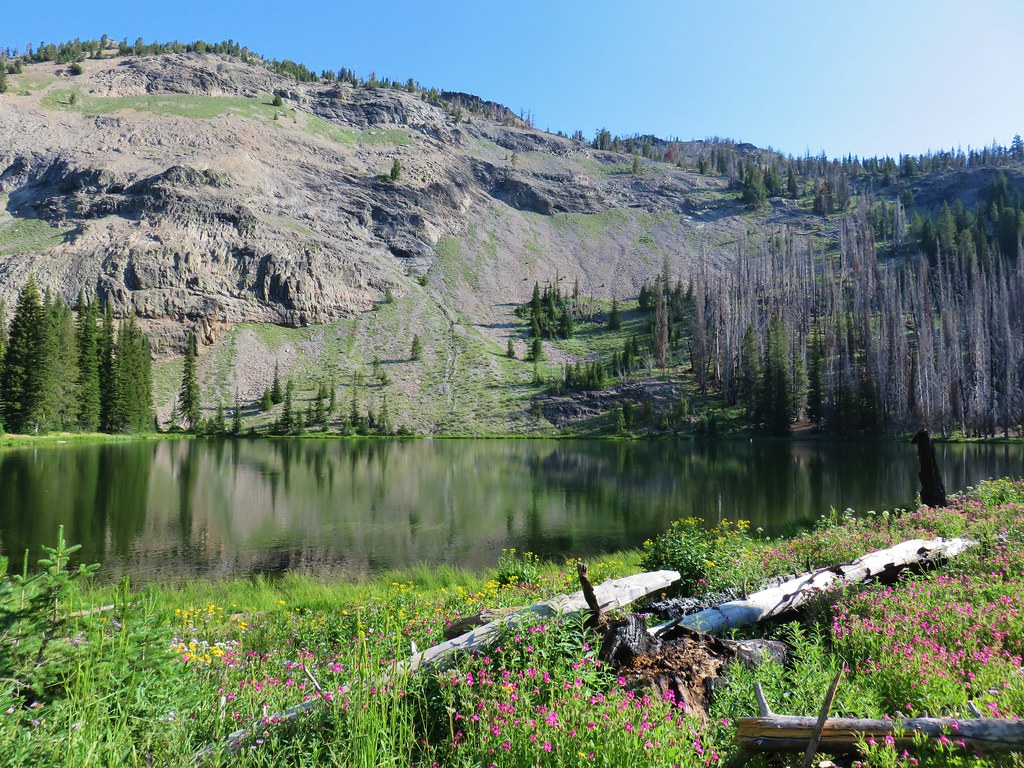
IMG_9616

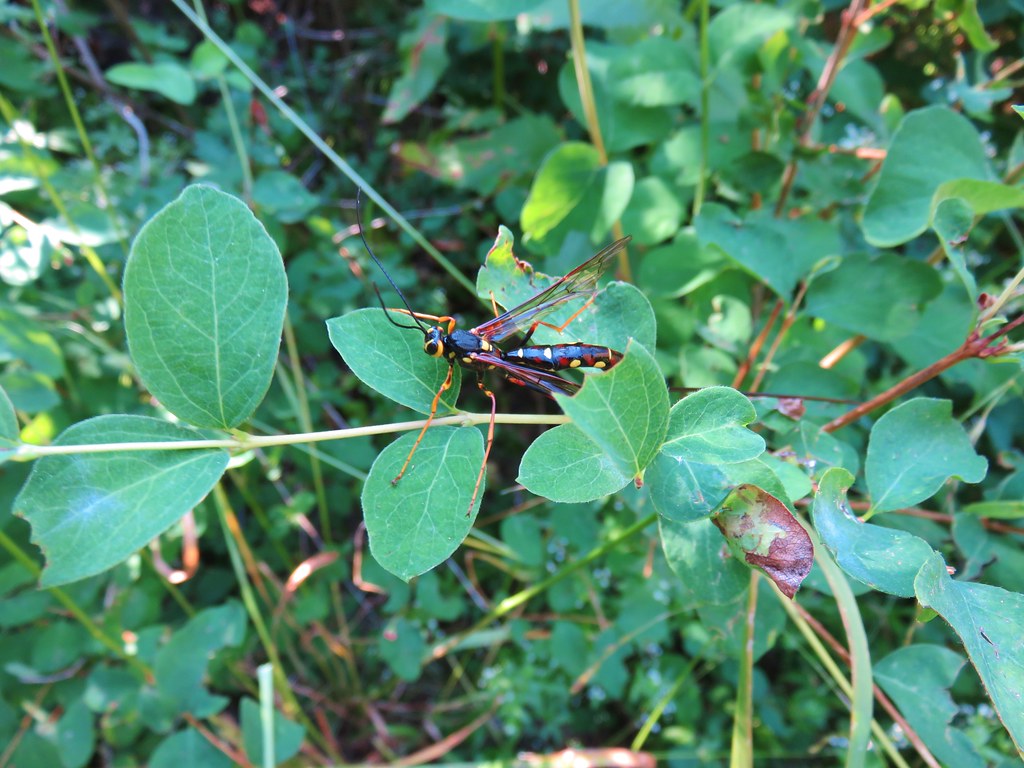
The trail remained on the south side of the creek for nearly a half mile before recrossing the creek. Near this crossing we spotted the biggest wasp either of us had ever seen.
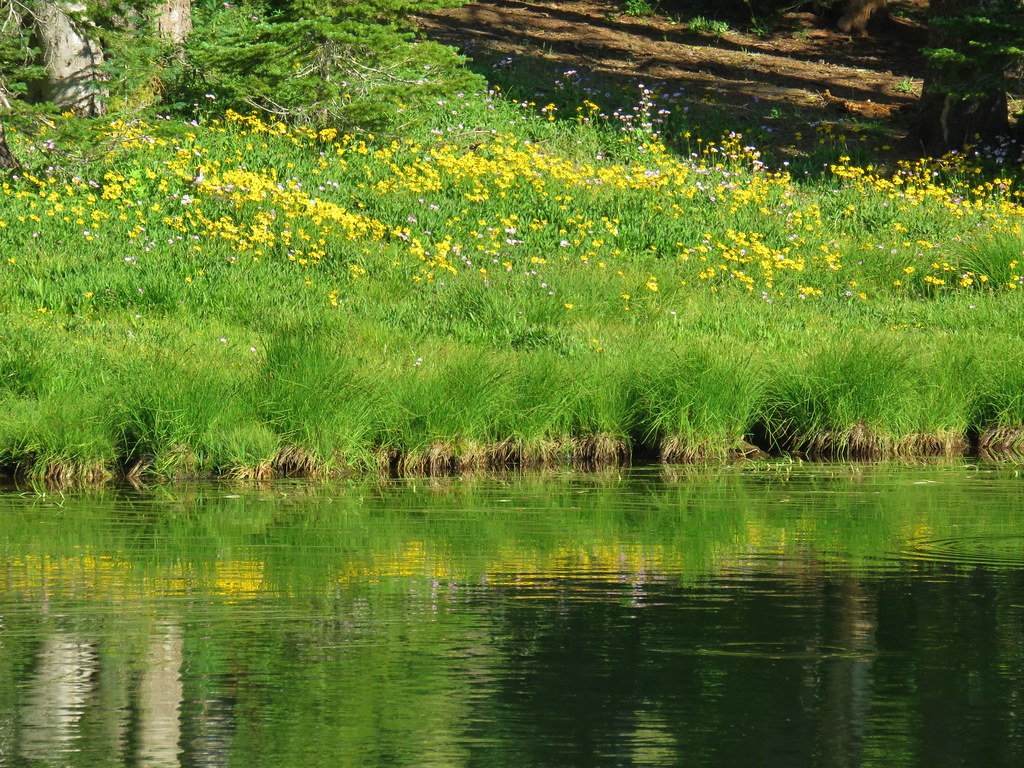
IMG_9620

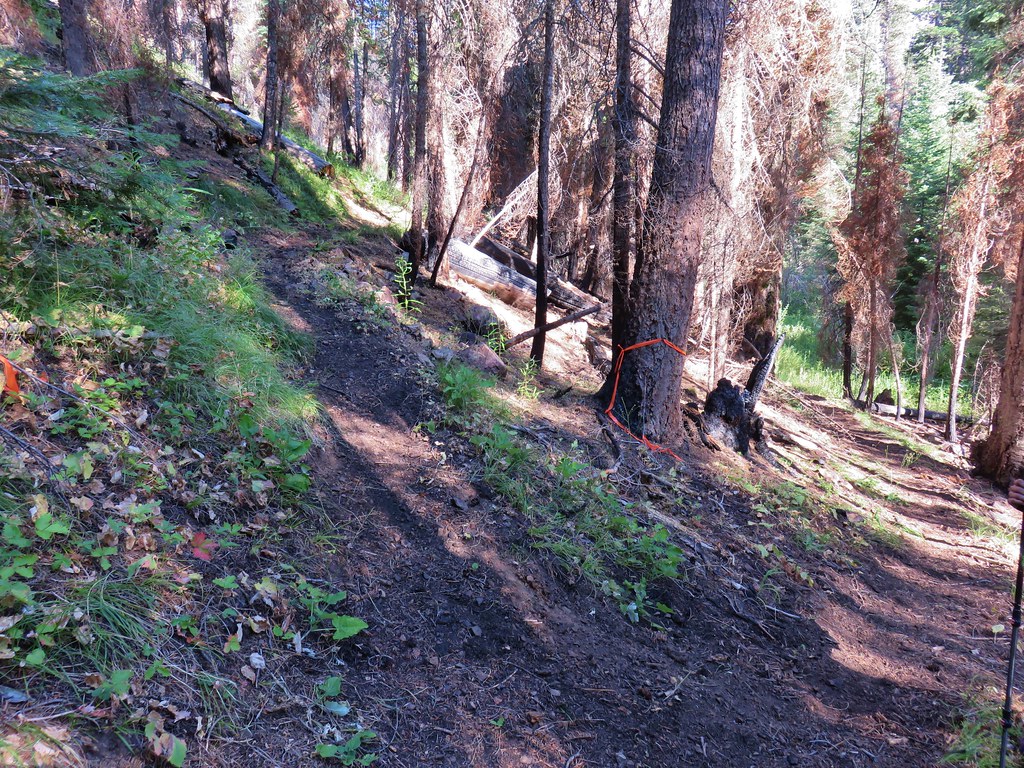
A short climb up from the creek brought us to the orange flagging where we had taken the uphill fork on the first day.
IMG_9622

That mystery was solved but the more pressing mystery was where were the decent camp sites. A half mile later (and over three and a half miles from Hotel De Bum Camp) we finally found enough clear level ground to pitch our tent.
IMG_9624

We were somewhere in the vicinity of Bingham Camp and only a tad over four miles from the trailhead. It had been a 15.2 mile day and once again we were beat. We sat in our chairs for a couple of hours while a woodpecker dropped debris on us.
IMG_9630

It was slightly cooler that night and the next morning but still not as cool as we’d have liked as we set off for the final 4.2 miles back to our car at 6:30am.
IMG_9635

The Sun chased us from behind as we followed the creek downstream through the forest.
IMG_9640

IMG_9653

We arrived back at the rental car around 8:15am thankful that we would soon feel the cool breeze of air conditioning.
IMG_9655

Our original plans had been to return to Bend, stay the night with Heather’s parents, and then head to the Mt. Thielsen Wilderness for a single night in hopes of visiting an off trail waterfall (Bruce knows the one), but after the brutal heat we’d hiked through for the previous four days neither of us had anything left. We scrapped those plans and decided to simply head home after the night in Bend.

This was by far the hardest backpacking trip we’ve done, so much so that we weren’t able to fully appreciate the beauty that we were seeing. We had timed the trip well for the flowers it was just unfortunate that it was during a heat wave. One thing is for sure we’ll never forget our first visit to the Strawberry Mountain Wilderness. Happy Trails!

Flickr: Strawberry Mountain Wilderness Days 3 & 4