Categories
Coastal Range Corvallis Hiking Oregon Trip report

Mary’s Peak – 06/21/2026

Following our hikes at Coffin & Bachelor Mountain we both wound up sick with a nasty head cold. Heather’s lasted almost two weeks and was almost feeling back to normal on the Sunday of Juneteenth weekend. I was fortunate to not get hit as severely and was starting to feel quite a bit better on Juneteenth. After resting for one more day I had planned to head to Mary’s Peak on Saturday the 20th however my left hip had other ideas. When I woke up it was hurting pretty bad so instead of hiking in the morning before heading to my cousin’s daughter’s graduation party, I spent the morning trying to loosen things up. By the time we left the party that afternoon it was back to feeling normal, so I decided to give it another try Sunday morning. Things were still okay in the morning, so the hike was on.

Heather decided that she wasn’t quite feeling well enough for a strenuous hike so headed out solo to the East Ridge Trail on Mary’s Peak starting from the Connor’s Camp Trailhead.
IMG_6932

I had left my route open not knowing how my hip, or any of the other back and lower body issues I’ve been in physical therapy for, would react to hiking. My plan was to take the East Ridge Trail up to the Summit Loop Trail to visit the summit of the highest peak in the Coast Range. My route back was open with a couple of possible loop combinations or simply heading straight back down the East Ridge Trail.
IMG_6934
Faded trail maps at the information board at Connor’s Camp.

I hadn’t started from this trailhead since 2014 (post) but the forest was as pretty as I had remembered.
IMG_6935

IMG_6939
Columbine and iris

Rattan's beardtongue (Penstemon rattanii)
Rattan’s beardtongue (Penstemon rattanii)

IMG_6949

IMG_6950
Pink pyrola

IMG_6955

IMG_6967
Little prince’s pine

Just over a mile from the trailhead, near a bench, the trail arrives at a junction with the Tie Trail.
IMG_6971

At the junction the East Ridge Trail made a switchback and began a fairly steep 1.2-mile climb to the Summit Loop Trail.
IMG_6972

The number of wildflowers that I was seeing in the forest increased as I climbed.
IMG_6973
Vanilla leaf

IMG_6977
Fringecup

IMG_6978
Anemones

IMG_6983
Small-flowered alumroot

IMG_6992
Lupine

IMG_6993
Chickweed

IMG_6995
Inside-out flower

IMG_6996

IMG_6997
Arrowleaf groundsel starting to bloom with thimbleberry and columbine blossoms lining the trail.

IMG_7002
Monkeyflower

IMG_7005

IMG_7009
A layer of clouds was covering the valley below.

IMG_7014
Trail sign at the junction with the Summit Loop Trail.

In another tenth of a mile I came to a new unsigned junction. A steep trail switchbacked up to the right that hadn’t been there on our previous visits. This is a 2025 reroute created by the Trailkeepers of Oregon (TKO) to move a portion of the trail out of sensitive habitat.
IMG_7166
This is a photo from later in the morning as I came down to the junction on the new section.

I opted to stay left on the more gradual portion of the loop and soon left the trees.
IMG_7016
Queen’s cup

IMG_7018
Chipmunk

IMG_7019

The trail climbed through the meadow to Mary’s Peak Road.
IMG_7024
Penstemon along the trail.

IMG_7027
The summit of Mary’s Peak ahead.

IMG_7029
Mary’s Peak Road

IMG_7030
Beargrass

I turned left onto the road and followed it up and around to the summit in 0.4-miles. While the flowers were past peak there were still a few left and for the first time, I could see the Cascade Mountains. On previous visits clouds had always been in the way.
IMG_7032

IMG_7034
Paintbrush

IMG_7037
One of two grouse that were on the road.

IMG_7039
Penstemon and chickweed

IMG_7044
Mt. Jefferson to the left of the dead tree and the Three Sisters to the right.

IMG_7045
The Three Sisters

IMG_7052
Towers on the summit.

IMG_7057
Oregon sunshine and bluehead gilia

IMG_7061
Paintbrush, Oregon sunshine and bluehead gilia

IMG_7064
Catchfly

IMG_7073
Cascade desert parsley

IMG_7074
Wallflower

IMG_7076
Blue head gilia

IMG_7079
Olympic onions

IMG_7080
The Mary’s Peak West Ridge

IMG_7083
The last of the larkspur.

IMG_7084
What was left of the phlox.

IMG_7088
At the summit.

I took a short break at the summit to take in the views and then took a clear trail downhill to the NE.
IMG_7092
Mt. Hood in the distance to the NE.

IMG_7096
Tiger lily

IMG_7098
Looking back up at the summit.

The trail veered to the NW toward the west ridge of Mary’s Peak before turning east and leaving the meadows.
IMG_7099

IMG_7104

IMG_7107

Shortly after entering the forest I forked left at junction on the Meadows Edge Trail (trail 1325). While on the summit I had decided to do this 1.6-mile loop before heading back.
IMG_7108
The Summit Loop Trail I’d come down to the left and the Meadows Edge Trail to the right.

Fifty yards later I stayed left again to hike the loop clockwise. The loop stays primarily in the forest with a couple of forays along the edge of meadows. The forest along this trail might be my favorite in the area.
IMG_7110
Map at the start of the loop.

IMG_7113
Queen’s cup

IMG_7114

IMG_7115
The summit towers from the loop.

IMG_7118

IMG_7120
Moth

IMG_7123
Bleeding heart

IMG_7124

IMG_7126
Footbridge over Parker Creek.

IMG_7129
Avens, foam flower, and youth-on-age.

IMG_7130
Columbine

IMG_7131
Junction with a spur to Mary’s Peak Campground.

IMG_7134
An almost ripe salmonberry.

IMG_7136

IMG_7139
False starry solomon’s seal and a violet.

IMG_7141

IMG_7143
Beargrass

IMG_7144
Nearing the end of the loop.

After completing the loop I turned left and headed back to the Summit Loop then completed that loop.
IMG_7145
Mary’s Peak Road on the other side of the trees.

I hiked a short distance down Mary’s Peak Road to check out the beargrass display then walked back and turned uphill (left) on a clear trail that headed NE.
IMG_7150

IMG_7151

IMG_7152

IMG_7153
Looking back down at Mary’s Peak Road.

This is the section of the Summit Loop that was realigned by TKO in 2025. The trail leads to some barriers at the top of the hill where the reroute begins.
IMG_7158

IMG_7157
Butterfly

IMG_7159
Mt. Hood in the distance above the clouds.

IMG_7156
The Three Sisters

IMG_7160
The old alignment went directly over the hill and down to the day use parking area.

IMG_7161
The new alignment.

The new section of trail entered the forest on the NE side of the hill and steeply descended via switchback to the junction at the start/end of the Summit Loop (pictured above).
IMG_7165
Looking down the switchbacks.

I turned left and hiked downhill to the next junction where I decided to take the longer route back to the trailhead by taking the North Ridge Trail to the Tie Trail and follow that back to the East Ridge Trail.
IMG_7167
I headed left here.

This trail led up to the day use area.
IMG_7168

IMG_7169

IMG_20260621_083506151_HDR
California figwort

IMG_7172
The day use area.

IMG_7178
White crowned sparrow

IMG_7180
Looking back toward the summit.

The North Ridge Trail began at the far end of the parking area.
IMG_7185

I followed this trail downhill for three quarters of a mile to the junction with the Tie Trail.
IMG_7187
Daisies along the trail near the day use area.

IMG_7193

IMG_7194
Star flowers

IMG_7199

IMG_7200
Bench at the junction.

I turned right onto the Tie Trail and followed it 1.2 fairly level miles to the East Ridge Trail.
IMG_7204

IMG_7203
Stripped coralroot

IMG_7209
Pacific coralroot

IMG_7207

IMG_7211
Monkeyflower

IMG_7214
Twinflower

IMG_7216
Honeysuckle

I was delayed while I battled my nemesis, the varied thrush, in an attempt to get a picture.
IMG_7226

The Tie Trail was in good shape, just a bit overgrown near the junction with the East Ridge Trail.
IMG_7230

After completing the Tie Trail I followed the East Ridge Trail back downhill to the trailhead.
IMG_7234

IMG_7233
Thimbleberry and vetch

IMG_7237
The trailhead through the trees.

Today’s route came in at 8.6-miles with approximately 1750′ of elevation gain.
Screenshot 2026-06-21 121110

This was the longest hike I’d done since my leg/back issues began in February, and it was the best I’d felt after a hike since then as well. I’m still having some issues, but this was encouraging. Happy Trails!

Flickr: Mary’s Peak

Categories
Hiking Middle Santiam Old Cascades Oregon Trip report

Coffin Mountain and Bugaboo Ridge Trail – 06/07/2026

The X-rays on my back came back clear and the new stretches/exercises that PT assigned almost immediately improved my range of motion. Enough so that I felt up to giving another outing a try. We were heading into several days of precipitation, but there was a dry window on June 7th which worked out well for us since we had plans to attend my cousin’s daughter’s senior recital on the 6th.

For the hike Heather had wanted to find some wildflowers, and I was still limited to 6-8 miles, so we decided to give Coffin Mountain and the Bugaboo Ridge Trail a go. We’d last visited this area in 2016 (post) on July 4th.

We started our morning from the Coffin Mountain Trailhead.
IMG_6344

We weren’t sure how many flowers would be blooming given we were visiting almost a full month earlier than on our previous visit, but the timing for the flowers is off this year due to the mild winter and dry spring. We were a little early, but there were still quite a few flowers blooming along the lower portion of the trail.
IMG_6347
Beargrass at the trailhead.

IMG_6351

IMG_6349
Sticky currant

IMG_6354
Yellowleaf iris

IMG_6356
Paintbrush

IMG_6360
A yellow paintbrush

IMG_6364
Starry false Solomon’s seal

IMG_6366
The morning clouds were giving way to some blue sky.

IMG_6370
Wildflowers along the ridge.

IMG_6367
Phlox

IMG_6373
Onion and larkspur

IMG_6378
Lupine and a little snow from the night before.

IMG_6382
Oregon sunshine, larkspur, and tiny white flowers might be slender phlox.

IMG_6386
Sub-alpine mariposa lily

IMG_6389
Arrowleaf buckwheat

IMG_6391
Bindweed

We knew that there had been a possibility of snow overnight, but we hadn’t expected any of it to stick but as we climbed, we began seeing more and more of the white stuff.
IMG_6390

IMG_6402

IMG_6409

IMG_6419

IMG_6420
Trillium fading out.

IMG_6424
Bluebells

IMG_6429

IMG_6435
False sunflowers

IMG_6443
Penstemon

The large meadow below the summit of Coffin Mountain was covered with a thin layer of fresh snow.
IMG_6447

IMG_6452

IMG_6459
Beargrass

IMG_6471

IMG_6476
Columbine

IMG_6479
Snow covered lupine

The trail traverses uphill through the meadow toward the Coffin Mountain Lookout.
IMG_6495
First view of the lookout.

IMG_6500
Bleeding heart

IMG_6502
The radio towers on the southern end of Coffin Mountain.

IMG_6504

IMG_6511
The lookout is staffed in the summer, but it was still empty today.

IMG_6518
The helipad on Coffin Mountain.

IMG_6519
The lookout tower and to the right the radio towers at the other end of the mountain.

Heather had detoured to the southern end, so when I arrived at the lookout she was arriving at the radio towers.
IMG_6520

I pulled my Z Seat out and sat down on the helipad and had a snack while I waited for her to make her way over.
IMG_6528

IMG_6521
The view north which includes Mt. Hood when the clouds aren’t in the way.

IMG_6532
Detroit Lake to the NW.

Heather joined me and we stayed a little longer enjoying the snowy summit before heading back down. It was just before 8:30am when we began our descent and much of the snow had already melted.
IMG_6537
Junco and bleeding heart

IMG_6540
The meadow was rapidly melting out.

IMG_6546
Bastard toadflax

IMG_6558
Paintbrush

IMG_6561
Violet

IMG_6568
Silverleaf phacelia

IMG_6569
Yarrow

IMG_6577
Cinquefoil, sandwort, and penstemon

IMG_6588
Ragwort

IMG_6619

IMG_6622
Oregon sunshine and paintbrush

IMG_6628
Larkspur

IMG_6632
Violet

IMG_6633
The trailhead signboard in view.

Roundtrip this hike comes in just under 3-miles, but with over 1000′ of elevation gain. The snow was a fun surprise and while we were a bit early to see the wildflowers at their peak, we were not disappointed. It did appear that this was not going be a huge beargrass year though. Every few years the big meadow is packed with beargrass, but conditions have to be just right.

On our two previous visits we had road walked from the Coffin Mountain Trailhead to the Bachelor Mountain Trailhead. That is a 1.2-mile walk one-way so to avoid adding unnecessary miles to my back we drove this time.
IMG_6634
Rabbit along the road.

IMG_6637
Bachelor Mountain Trailhead at the end of the road.

Instead of hiking to the summit of Bachelor Mountain our plan was to take the Bugaboo Ridge Trail out to a rocky viewpoint where we hoped to get a view of Mount Jefferson and see some wildflowers. We headed up the Bachelor Mountain Trail admiring the flowers and some more snow.
IMG_6642
Lupine and paintbrush

IMG_6646
A cloud had overtaken Coffin Mountain.

IMG_6648
Cardwell’s penstemon

IMG_6650
Valerian

IMG_6651

The trail climbs steeply via switchback through the forest before rounding a ridge to more open terrain.
IMG_6655
There were about a half dozen trees down along the trail, but none were too difficult to get over/around.

IMG_6660
Bleeding heart

IMG_6663
Vanilla leaf

IMG_6667
Baneberry and arnica starting to bloom.

IMG_6673
Rounding the ridge.

IMG_6679
Coffin Mountain

IMG_6678
Scarlet gilia

The trail continued to climb but less steeply as it traversed the hillside.
IMG_6681
Three Fingered Jack hidden by clouds.

IMG_6683
Three Fingered Jack.

IMG_6685
Paintbrush and wild rose

IMG_6688

IMG_6694
Paintbrush along the trail.

IMG_6695
Yellowleaf iris

IMG_6701
Scarlet gilia, Oregon sunshine, and paintbrush.

IMG_6705
A patch of false sunflowers that were just starting to bloom.

IMG_6714
False sunflowers

IMG_6716
This trail is a stark contrast to the Coffin Mountain Trail.

IMG_6717
Stonecrop

IMG_6721
Cinquefoil

IMG_6740
Penstemon

IMG_6741

IMG_6749
Buckwheat and a yarrow.

The trail arrives at a large flat area where we spotted a lone rhododendron that hadn’t quite started to bloom.
IMG_6750

IMG_6751

IMG_6755
These may be northern microseris (Microseris borealis).

IMG_6756
Cloud over the summit of Bachelor Mountain.

At the far end of the flat area we reached the junction with the Bugaboo Ridge Trail.
IMG_6759

IMG_6760
Trail sign at the junction. It is approximately 0.8-miles (and 550′) to the summit of Bachelor Mountain. The viewpoint along the Bugaboo Ridge Trail on the other hand was 0.7-miles away with minimal elevation change.

We headed out on the Bugaboo Ridge Trail which was a little rougher and more overgrown than the Bachelor Mountain Trail. It was however mostly free of blowdown to the view point.
IMG_6763

IMG_6765
Coralroot

IMG_6766
The extent of the blowdown.

IMG_6768
Anemones

IMG_6769
The trail actually passes through several openings along the hillside with views of the Cascade Range, but not of Mt. Jefferson.

IMG_6770
The really snowy patch of forest is below Three Fingered Jack. Mt. Jefferson is north (left) of this and hidden by the hillside until the viewpoint where we would be turning around.

IMG_6774
Mt. Jefferson is straight ahead hidden behind the hillside.

IMG_6776
Jessica’s stickseed

IMG_6780
Waterleaf

IMG_6783
False sunflower

IMG_6784
Jacob’s ladder

IMG_6786
Larkspur and a butterfly

IMG_6791
Columbine

IMG_6799
Serviceberry

IMG_6804
Three Fingered Jack still hiding in the clouds.

IMG_6806
Diamond Peak was visible in the distance to the south.

IMG_6812

IMG_6816
Penstemon and paintbrush

IMG_6825

IMG_6828
Larkspur and monkeyflower

We arrived at the viewpoint for Mt. Jefferson to find it partially hidden by clouds.
IMG_6835

We took a break here hoping for a break in the clouds and in the meantime studied the flowers in the area.
IMG_6839
Larkspur and Oregon sunshine

IMG_6841
Cliff beardtongue

IMG_6843
Arrowleaf and sulphur flower buckwheat with some Oregon sunshine and stonecrop.

IMG_6844
A sub-alpine mariposa lily hiding in arrowleaf buckwheat.

IMG_6846
Paintbrush, larkspur, and arrowleaf buckwheat

IMG_6847
Sticky cinquefoil

The clouds were being stubborn, but we did eventually get a little better view of Three Fingered Jack.
IMG_6857

Mt. Washington and the Three Sisters also made an appearance.
IMG_6858

IMG_6853
Snowy Diamond Peak in the distance to the left with peaks of the Old Cascades closer including the nearby Three Pyramids (post) and to their right Iron Mountain where I’d been the week before (post).

We started back but before we’d left the open area the clouds revealed the top of Mt. Jefferson.
IMG_6873

IMG_6876

After getting our view we headed back. We were treated to some better views of the other Cascades along the way.
IMG_6885

IMG_6888
Wallflower

IMG_6894
Mt. Washington and the Three Sisters.

IMG_6901
One of the few Jacob’s ladder blossoms that was open.

IMG_6907
Mt. Jefferson from the flat area.

IMG_6918
Coffin Mountain from the Bachelor Mountain Trail.

IMG_6921
Catchfly

IMG_6924
Three Fingered Jack

IMG_6928
Heading back into the forest for the descent to the trailhead.

IMG_6930
A couple cars had joined us at the trailhead.

To hike to the viewpoint and back came in at 3.8-miles with approximately 700′ of elevation gain giving us 6.7-miles and 1750′ of elevation gain on the day.
Screenshot 2026-06-10 040628

This was a great hike despite being a little early for the peak wildflower bloom. The overnight snow more than made up for that. By the end my hips were feeling the hike a little but overall I felt better than I have for the past few months. I still have a way to go but it was encouraging. Happy Trails!

Flickr: Coffin Mountain and the Bugaboo Ridge Trail

Categories
Hiking Middle Santiam Old Cascades Oregon Trip report

Cone Peak Meadows – 05/31/2026

I suffered a setback in my rehab coming out of Memorial Day Weekend. My back stiffened up going into the week and by late Thursday night I could barely turn my head to the left. Sleeping was also difficult and I was relegated to back only due to the amount of discomfort laying on my sides was causing. By Friday night I had pretty much given up on thoughts of hiking during the weekend and was instead looking forward to my next PT appointment Monday afternoon. Heather went on a solo hike Saturday to Ramona Falls while I stayed home and rotated between an ice pack and heating pad on my back. Since she isn’t writing up her solo outings here is a link to our 2013 visit to the falls (post). By Saturday night I was feeling quite a bit better, still stiff and limited to back sleeping, but improved enough to be considering an outing to see the wildflowers in Cone Peak Meadows the next day. I woke up the next morning, did my PT stretching and felt good enough to give it a go. I did a lot of praying on the drive to the trailhead that God would grant me the wisdom to know if this was a bad idea and not to overdo anything.

I had been wanting to get back to Cone Peak Meadows in late Spring to look for a particular wildflower, Longhorn steer’s-head (Dicentra uniflora). It is at the top of my most wanted list of wildflowers within day hiking range. I wasn’t sure about timing though given that blooms are early this year due to the lack of snow this past Winter. I had seen reports from other years of these flowers blooming during the first couple of weeks of June. Our two previous visits had been on July 25th & July 4th (post) which was much too late. I spent some time online familiarizing myself with the size and look of the flowers so that I would know what I was looking for. Spoiler alert I did not spot any. It may have been too late this year or I might have simply failed to notice any of the penny sized blooms. Regardless it was an excellent hike which I will finally get to.

I began at the Tombstone Pass Trailhead shortly after 5:30am and set off on the loop counterclockwise.
IMG_5932
The trailhead just off Highway 20 at Tombstone Pass.

IMG_5935
The start/end of the loop on the left and right of FR 60.

I turned left onto the loop and descended through the forest to Tombstone Prairie.
IMG_5938

IMG_5941
Valerian along the trail.

IMG_5944
Bunchberry and starry false solomon’s-seal

IMG_5948
Salmonberry

The Tombstone Prairie Nature Trail is an optional short loop that can be done around the prairie. I opted to skip the loop this time.
IMG_5956

IMG_5959
Tombstone Prairie

IMG_5966
The other end of the Tombstone Nature Trail.

I forked left at this junction, crossed a branch of Hackleman Creek then climbed to Highway 20.
IMG_5967

IMG_5969

The Cone Peak Trail picks up across the highway to the west near some road signs.
IMG_5971

IMG_5973

The Cone Peak Trail climbs gradually through the forest before coming to increasingly large openings.
IMG_5976
Trillium, fairy bells, Solomon’s seal, and starry false Solomon’s seal.

IMG_5979
There were a few trees that needed to be stepped over.

IMG_5984
Valerian starting to bloom in a meadow.

IMG_5991

IMG_5995
Vanilla leaf

IMG_5998
This was the only beargrass bloom I spotted on the hike.

IMG_5999
Northwestern twayblade

IMG_6001

IMG_6005
Larkspur was the most prevalent of the flowers that were currently blooming.

IMG_6014
Sub-alpine mariposa lily

IMG_6015
Larkspur and maiden blue-eyed Mary

IMG_6021
Larkspur and paintbrush

IMG_6030

IMG_6040
Solomon’s seal

IMG_6041
Another patch of larkspur.

IMG_6046
Larkspur and monkey flower

IMG_6054
Strawberry patch

IMG_6057
Ball-head waterleaf

IMG_6058

IMG_6060
Baneberry

IMG_6069

IMG_6072
Phlox and maiden blue-eyed Mary

IMG_6074
Biscuitroot and phlox

IMG_6076

IMG_6079
Olympic onion

IMG_6083
Sandwort

IMG_6087
Cone Peak as the trail enters Cone Peak Meadows.

IMG_6089
Buckwheat

IMG_6092
Death camas

IMG_6095

IMG_6103
Littleflower penstemon

IMG_6110
Paintbrush, larkspur and sandwort?

IMG_6111
Iron Mountain

IMG_6113

IMG_6115
Oregon sunshine

IMG_6119

IMG_6123
Smallflower woodland star

IMG_6127
The lupine was just getting started.

IMG_6130
Heading toward Iron Mountain.

IMG_6131
Another buckwheat

IMG_6133

The trail left Cone Peak Meadows and descended slightly as it passed through the forest on the way to Iron Mountain.
IMG_6143

IMG_6147
Columbine

IMG_6148

IMG_6151
Jessica’s stickseed

IMG_6153
Bleeding heart

IMG_6154
Bluebells

IMG_6156
Arrowleaf groundsel

IMG_6157
Scarlet gilia

IMG_6159
Sticky cinquefoil and bastard toadflax?

IMG_6161
Not sure what this tiny flower is.

IMG_6162
Wormleaf stonecrop

IMG_6164
Silverleaf phacelia

IMG_6169
Wallflower

IMG_6171
Another one that I’m not sure of.

The trail eventually began climbing to a saddle between Cone Peak and Iron Mountain.
IMG_6180

IMG_6191
Violets

IMG_6195
Vetch

IMG_6202
The Three Pyramids (post) to the right and the flat top of Coffin Mountain (post) straight ahead.

IMG_6205
Mt. Hood behind Coffin Mountain.

After the saddle viewpoint the trail begins to traverse along the flank of Iron Mountain where it comes to a junction with the Iron Mountain Tail.
IMG_6209

IMG_6211
Arnica

IMG_6216
This was the worst of the blowdown.

IMG_6217
Fairy bells and trillium

IMG_6219
Flax

IMG_6223

IMG_6225
Yarrow and larkspur

IMG_6230
The Iron Mountain Trail forking off to the left.

I hadn’t originally planned on taking the side trip up Iron Mountain as it adds a little over a mile and a half, and 600′ of elevation gain to the hike. From the junction I only had another 1.5-miles to get back to the Tombstone Pass Trailhead, and I was feeling really good. I been continuing to pray that I would know my limitations and was at peace with the decision to try the climb. I turned up the trail behind a couple of other hikers and climbed through the frosty meadows to the former lookout site atop the mountain.
IMG_6231

IMG_6232

IMG_6236
Frosty paintbrush

IMG_6240

IMG_6245
Larkspur

IMG_6246
The Three Sisters from the Iron Mountain Trail.

IMG_6248
The Three Sisters

IMG_6249
Diamond Peak (post)

IMG_6251
Lupine

IMG_6254
Chickweed

IMG_6255
Saxifrage

IMG_6262
The final climb to the top.

IMG_6263
Viewing platform

IMG_6269
Mountain locator

IMG_6268
The view to the north includes Mt. Hood and Mt. Jefferson.

IMG_6270
Mt. Hood behind Coffin Mountain.

IMG_6271
Mt. Jefferson

IMG_6260
Mt. Washington

IMG_6266
The Three Sisters and Diamond Peak to the SE.

I’d passed the three hikers ahead of me and had the platform to myself long enough to send a video to family and take a snack break on the platforms bench. Shortly after the next hiker arrived I headed down to give her a few moments alone at the summit.

While climbing up always feels like it requires effort it is descending that is harder on the body. I was reminded of this on my way down the trail when my right Gluteus Medius announced its presence. It wasn’t much more than a slight burn letting me know it was having to do some extra work on the way down. I kept a slower pace and took several breaks one the way back to the junction where I then continued my loop.
IMG_6289

IMG_6294
Rock wren

IMG_6297
Cliff beardtongue. One of the brightest wildflowers we see.

IMG_6301
The view on the way down.

IMG_6304
The trail junction ahead.

The final 1.5-miles back to the Tombstone Pass Trailhead was mostly a gradual descent.
IMG_6305
I stayed left at this junction with the connector trail to the Iron Mountain Civil Road Trailhead.

IMG_6308

IMG_6309
Alpine knotweed

IMG_6315

IMG_6319
The trail recrossing Highway 20.

IMG_6322

IMG_6323
Spotted coralroot

At a junction, I turned left on the Santiam Wagon Road Trail.
IMG_6329

IMG_6330

IMG_6333
Wild ginger

IMG_6335

IMG_6341
The Tombstone Pass Trailhead below.

IMG_6343
Back on FR 60.

Today’s hike tallied 7.2-miles with 1740′ of elevation gain.
Screenshot 2026-06-02 155727

This is a great hike for both flowers and views. We’ll be heading back, possibly next year, to try once again to spot a Longhorn steer’s-head (Dicentra uniflora).

From a purely hiking standpoint I felt better during this hike than I had on a hike since February. My middle back however was still tight and giving me problems at night. Since then, I’ve had another PT visit, a doctor’s appointment, and x-rays (no results yet). Hopefully it is just tight muscles but if not, we’re working on getting to the bottom of it. Happy Trails!

Flickr: Cone Peak Meadows

Categories
Hiking Oregon Salem/Albany Trip report Willamette Valley

Ankeny National Wildlife Refuge – 05/07/2026

I missed my planned wildlife week when I canceled a planned week of vacation in April due to my left leg/lower back issues. One of the hikes scheduled for that week was a visit to Ankeny National Wildlife Refuge. Heather had not been to the Ankeny Hill Nature Center yet, so we decided to make the 30-minute drive to the refuge and do two short loops on this vacation.

We started our morning at the Pintail Marsh Trailhead.
Pintail Marsh Trailhead

Pintail Marsh
Pintail Marsh

There wasn’t much action happening at this marsh or anywhere along the loop we wound up doing. It was by far the least number of birds I’d encountered in this part of the refuge over the years.
Gadwall
Gadwall

Mallard
Mallard

Cinnamon teals
Cinnamon teals

We headed counterclockwise from the trailhead along the mowed grassy track and took the first left to hike between Frog and Pintail Marshes.(There no views of either to speak of from the path.)
Trail around Pintail Marsh
Leaving the trailhead.

Trail around Pintail Marsh
Pintail Marsh on the left and Frog Marsh on the right.

We took a left again at the next junction at the north end of Frog Marsh. Here there was a view of Pintail Marsh where we spotted a northern shoveler and a black phoebe.
Trail around Pintail Marsh
The junction at the north end of Frog Marsh.

Ankeny National Wildlife Refuge
Pintail Marsh

Northern shoveler
Northern shoveler

Black phoebe
Black phoebe

At the next junction we stayed right.
Ankeny National Wildlife Refuge
The left track angles between Pintail and Egret Marshes while the right just passes Egret Marsh.
Ankeny National Wildlife Refuge
The one view of Egret Marsh. We spotted a single pair of mallards here.

Ankeny National Wildlife Refuge

Camas
Camas

The grassy track ends at a service road near Mallard Marsh.
Ankeny National Wildlife Refuge

We turned left onto the service road and found that Mallard Marsh was seriously lacking water this year.
Ankeny National Wildlife Refuge

Cinnamon teals and a gadwall
Cinnamon teals and a gadwall in what water remained in Mallard Marsh.

Ankeny National Wildlife Refuge
Egret Marsh on the opposite side of the service road did have water, but not much in the way of birds.

Marsh wren
Marsh wren

At a 4-way junction we turned right onto a dike between Mallard Marsh and Mohoff Pond. In previous years this has been a very good stretch for seeing birds, but that was not the case this year. Mohoff Pond still had some water, but not nearly as much as in years past and the number of birds was way down.
Mohoff Pond
Mohoff Pond

American coots
American coots

Red-winged blackbird

Ankeny National Wildlife Refuge
Mohoff Pond on the left and Mallard Marsh on the right.

We looped around the end of Mohoff Pond and headed back.
Mohoff Pond
Heading back long Mohoff Pond.

Buffleheads
A couple of buffleheads out in the middle of the water.

Snake
The snakes (harmless) were starting to come out so we needed to watch where we stepped.

At the end of Mohoff Pond we forked right and completed our loop around Pintail Marsh.
Ankeny National Wildlife Refuge

Geese
Geese in Pintail Marsh.

Mallards
Mallards in Pintail Marsh.

Butterfly near Pintail Marsh
Butterfly

Pintail Marsh
Pintail Marsh

Given the limited number of birds this was a bit of a disappointing hike compared to what we’ve come to expect from Ankney. On a positive note, we did see a decent variety of species on this 3-mile loop.

From Pintail Marsh we drove to the lower parking lot along Buena Vista Road S. The gate to the lot was closed when we drove by a little before 6:30am but it was open after 8am. This lot wasn’t open when I first visited in 2022 (post).
Lower trailhead at Ankney Hill

We set off on the gravel Connector Trail.
Ankeny Hill Nature Central Trail

The Connector Trail links up with the Big Loop Trail in less than a tenth of a mile. The trails pass through a restored upland prairie which was full of blooming native wildflowers.
Wildflowers below the Nature Center

Biscuitroot
Biscuitroot

Cinquefoil
A cinquefoil

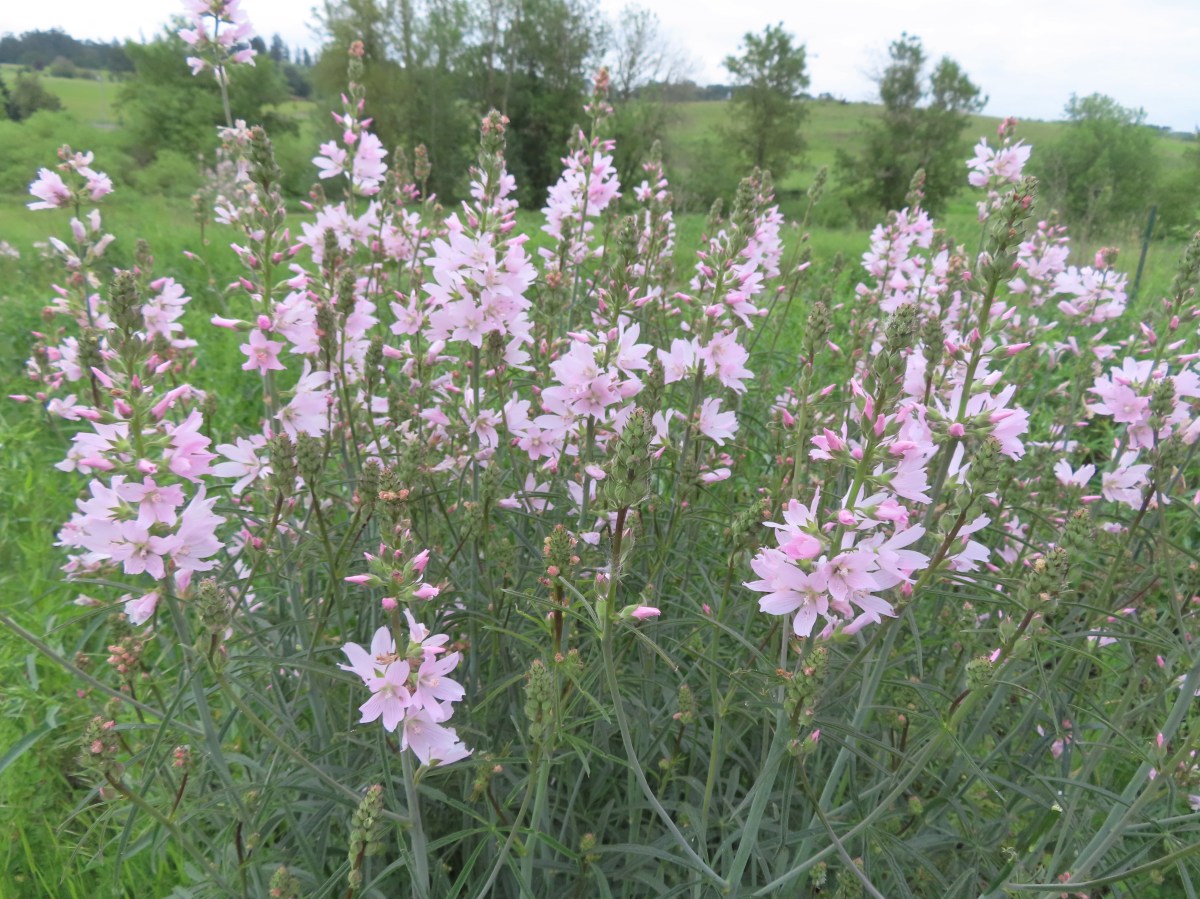
Meadow checkermallow

Rose checkermallow
Rose checkermallow

Columbine and lupine

Mules ear
Mule’s ear

David B. Marshall Outdoor Classroom

Cinquefoil
Another cinquefoil

Goose
Goose

Lupine
Lupine

Swallows
Tree swallows

Iris
Iris

Coastal manroot
Coastal manroot (wild cucumber)

Cow parsnip
Cow parsnip

Camas
Camas

Common madia
Common madia

Trail at the Ankeny Hill Nature Center
Decomposition educational node

Yarrow
Yarrow

Ankeny Hill Nature Center
Oak Overlook near the Nature Center

Fiddleneck
Fiddleneck

Wildflowers at the Ankeny Hill Nature Center

Ankeny Hill Nature Center

We explored the Little Loop at the Nature Center before continuing one the Big Loop.
Pollinator patch at the Ankeny Hill Nature CenterPollinator Patch at the Nature Center

Ankeny Hill Nature Center
Bridge in the center of the Little Loop.

Spotted towhee
Spotted towhee

Ankeny Hill Nature Center Trail
Continuing on the Big Loop from the Nature Center.

Ladybug on vetch
Ladybug on vetch.

Miniature lupine
Miniature lupine

Egret
Egret at Peregrine Marsh from the outdoor classroom.

The hike, and wandering around the Nature Center, came in just over 1-mile giving us a 4.1-mile total for the morning with minimal elevation gain.
Screenshot 2026-05-08 062508

This was the longest hike since starting PT and it went about as well as the others. The leg felt fine, but the lower back/hips remained tight and somewhat uncomfortable through most of the outing. That evening a new issue popped up in my left hip area which made it difficult to find a comfortable sleep position. Oddly I woke up with my lower back feeling really good, but the left hip was still a little uncomfortable. It will be interesting to discuss all this with the physical therapist next week. Until then – Happy Trails!

Flickr: Ankeny National Wildlife Refuge

Categories
Eugene Hiking Oregon Trip report Willamette Valley

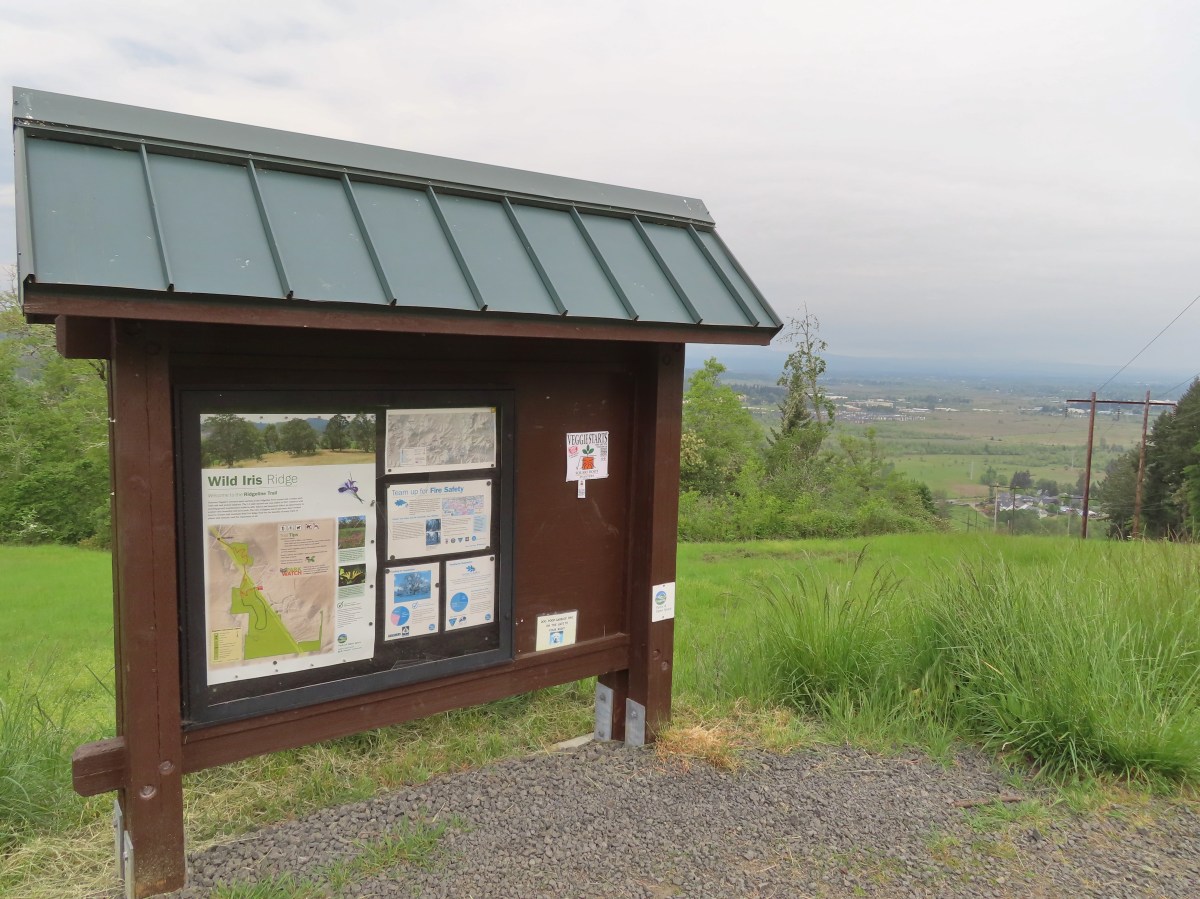
Wild Iris Ridge – 05/02/2026

With me recently starting physical therapy for my leg/hip/lower back issues we decided to cancel a planned road trip around Northern California and instead focus on shorter recovery hikes closer to home. The bright side of missing out on the road trip was we’d be saving a lot of money on gas.

To kick off our staycation we headed south to Eugene for the 3.5-mile Wild Iris Ridge loop before picking up our son who would be spending part of the week with us. Wild Iris Park opened in 2017 offering a 3.5-mile lollipop loop through an oak savannah with Spring wildflowers. We parked at the small trailhead along Bailey Hill Road.
IMG_4971

IMG_4974

A one-mile segment of trail climbs a little over 300′ from the trailhead to the start of the loop on Wild Iris Ridge. Initially the trail passes under a set of powerlines before entering the woods. Wildflowers were blooming in the grass.
IMG_4976

IMG_4978
Camas

IMG_4979
Buttercups

IMG_4983
Rose checkermallow

IMG_4984

We found more wildflowers in the woods.
IMG_4986
Cow parsnip

IMG_4995
The wild roses were just beginning to bloom.

IMG_4997
Hawthorne

IMG_4999
Tough-leaved iris

IMG_5003
Rosy plectritis

IMG_5004
Dogwood

IMG_5011
Chickadee

IMG_5017

IMG_5018
Passing back under the powerlines.

IMG_5027
Vetch

IMG_5028
Houndstongue

IMG_5031

IMG_5035
Fringecup

IMG_5038
Bench near the start of the loop.

IMG_5039
Serviceberry

We opted to hike the loop clockwise and followed the pointer for Bailey Hill Drive.
IMG_5040

It was a 0.3-mile climb to the Bailey Hill Drive Trailhead. This section continued through the woods before reaching a meadow below the trailhead.
IMG_5042
Lupine

IMG_5049
Columbine

IMG_5051

IMG_5053
Smallflower woodland star

IMG_5056
Baby blue eyes

IMG_5062
Miniature lupine

IMG_5064
Rosy plectritis

IMG_5065
The trailhead at Bailey Hill Drive.

IMG_5069
Barestem biscuitroot

IMG_5070
View from the trailhead area. There was a forecasted 20% chance of showers, but those never materialized. We were however surprised when we started hearing occasional rumbling thunder in the distance.

From Bailey Hill Dirve the loop follows old roadbeds for 1.2-miles to complete the loop.
IMG_5073

IMG_5074
There were a lot of irises in bloom along the road.

IMG_5075

IMG_5079
Grass pea

IMG_5081
The blurry brown spot to the right of the bend in the road is the second of two deer that crossed in front of us.

IMG_5082
Bench in a meadow along the loop. With the cloudy conditions there wasn’t much of a view today.

IMG_5083

IMG_5085
Olive-sided flycatcher

IMG_5094

IMG_5097
Tolmie’s mariposa lily

The final tenth of the mile of the loop narrows and climbs up to the junction.
IMG_5098

After finishing the loop, we hiked back down the 1-mile stretch to the trailhead. We spotted a few flowers that we’d missed on our fist pass.
IMG_5103
Yarrow

IMG_5105
Avens

IMG_5114
Finch

IMG_5118
Purple oyster salsify

IMG_5116
Nearing the trailhead.

The 3.5-mile hike gained a little over 700′ of elevation but was never steep. We saw a decent number of other trail users, but it never felt crowded.
Screenshot 2026-05-02 110912

My leg/hips responded well to the hike which was a little longer and had more elevation gain than my previous hike at Fort Hoskins (post) which was encouraging. We (or at least I) will continue with shorter hikes while I work through the physical therapy. Luckily there are plenty of nearby options that fit the bill. Happy Trails!

Flickr: Wild Iris Ridge

Categories
Hiking Mt. Rainier Trip report Washington Cascades

Naches Peak Loop (Mt. Rainier) – 08/08/2025

For our final hike of our Mount Rainier vacation we landed on the Naches Peak Loop. This was originally not going to be our final hike but after several changes to our plans throughout the week it wound up here and we couldn’t be happier that it did. This was a spectacular hike with tons of wildflowers, great views, and a nice variety of wildlife.

Less than 40 minutes from Packwood we arrived at the trailhead a little before 5:45am.
IMG_8748

IMG_8749
Double Peak

The Naches Peak Loop Trail is 3.5-miles with 500′ of elevation gain. A portion of the loop follows the Pacific Crest Trail which provided an opportunity for a side trip down to Dewey Lakes in the William O. Douglas Wilderness.
IMG_8750

It is recommended to hike the loop clockwise to maximize the views of Mount Rainier so that was our plan as we set off. The wildflower display was immediately profuse.
IMG_8755

IMG_8754

IMG_8757
Heading down to the start of the loop near Tipsoo Lake.

IMG_8758
Tipsoo Lake

IMG_8760
Spirea, lupine, western pasque flower, and bistort.

IMG_8761

We turned left at the start of the loop and climbed for a third of a mile to the Pacific Crest Trail at Chinook Pass.
IMG_8766

IMG_8767
Western pasque flower seedheads and aster.

IMG_8768

IMG_8774
Valerian and bistort

DSCN7389
Larkspur

IMG_8785

IMG_8786
Arnica, fleabane, lupine, bistort, and valerian.

IMG_8791
Partridgefoot

IMG_8792
Highway 410 at Chinook Pass.

IMG_8796
Trail sign for the PCT.

We turned right on the PCT and crossed the highway on an overpass.
IMG_8795

The PCT was more level as it traversed the hillside below Naches Peak.
IMG_8800
Looking back at Yakima Peak.

IMG_8803
We were leaving the National Park and entering the Okanogan-Wenatchee National Forest.

IMG_8811
The top of Mount Rainier to the left of Yakima Peak.

IMG_8813
Saxifrage

IMG_8819
Bird’s beak lousewort

IMG_8820

IMG_8824
At one point we looked back toward Yakima Peak and spotted some deer dashing across the hillside.

DSCN7390
Doe and two fawns.

DSCN7392

IMG_8826

IMG_8828
White mountain heather

IMG_8830
Wilderness information for the William O. Dougals Wilderness.

IMG_8832

IMG_8837
Paintbrush

IMG_8842

IMG_8844
Grass-of-parnassus and an arnica.

IMG_8845
Allumroot

IMG_8848
Columbine with several other types of flowers.

IMG_8860
Cusick’s speedwell

IMG_8866

IMG_8868
Pink monkeyflower

IMG_8869

IMG_8872
Wilderness sign

IMG_8885

DSCN7405
Bird with a snack.

IMG_8895

IMG_8896

IMG_8902

IMG_8909

IMG_8910

IMG_8917
Naches Peak

Just under a mile from Chinook Pass the PCT passes a small tarn below Naches Peak. We detoured around the tarn on a use trail.
IMG_8924

IMG_8929

IMG_8930
Sickle-top lousewort

IMG_8932

IMG_8933

IMG_8936

IMG_8944

IMG_8952

DSCN7416
Penstemon

DSCN7418
Aster

IMG_8960
Pink monkeyflower and arnica

IMG_8964

IMG_8970

IMG_8978

IMG_8981

IMG_8990

IMG_9009
Pussytoes

IMG_9014
Dewey Peak

IMG_9017
The top of Mt. Adams between Dewey and Seymour Peaks.

DSCN7426
Mt. Adams

DSCN7427
Golden-mantled ground squirrel enjoying the view.

IMG_9020
Dewey Lake below Dewey Peak.

We came to a junction 1.7-miles from Chinook Pass where the PCT forked left to head downhill to Dewey Lake.
IMG_9026

Heather decided not to make the side trip down to Dewey Lake as it added over 600′ of elevation gain, and over 3 miles to the hike. I headed down the PCT which made one big switchback then headed more directly toward the lakes.
IMG_9027

IMG_9032
Double Peak with the snowy Tatoosh Range behind.

DSCN7431
Stevens, Boundary, and Unicorn Peaks

IMG_9036
Yarrow

IMG_9039
Rainiera

IMG_9042

IMG_9047
No fires reminder.

IMG_9048
Dewey Lake

There are several smaller ponds/lakes along the PCT in addition to Dewey Lake.
IMG_9058

IMG_9057

IMG_9060
The largest of the smaller bodies of water.

DSCN7436
Reflections in a pond.

IMG_9076
PCT along Dewey Lake.

I turned around at the southern end of the lake and headed back to the Naches Peak Loop.
IMG_9088
Elephants head at Dewey Lake.

DSCN7442
Sandpiper

DSCN7445
Junco

IMG_9097

DSCN7454
Great blue heron

IMG_9099
Lousewort

DSCN7456
Mushrooms

DSCN7461
Grouse

IMG_9110
The signs at the Naches Peak Loop junction ahead.

I continued counterclockwise on the Naches Peak Loop. The wildflowers were not as thick on this side of Naches Peak, but the views of Mount Rainier were excellent.
IMG_9112
The Tatoosh Range.

IMG_9117
Mt. Rainier and Naches Peak

IMG_9123
Unnamed lake along the Naches Peak Loop.

IMG_9133
There were some good flowers near the unnamed lake.

IMG_9136

DSCN7474
Robin

IMG_9150

IMG_9151

DSCN7482
A nice buck crossed the trail just ahead of me then disappeared into the forest.

IMG_9166

IMG_9170
Harebells

DSCN7486
Cedar waxwings

IMG_9183
Mt. Adams

DSCN7502
Hawkeye Point and Johnson Peak in the Goat Rocks Wilderness in front of Mt. Adams.

IMG_9188

DSCN7505
Sourdough Ridge

IMG_9199
Yakima Peak and Highway 410.

IMG_9200
Tipsoo Lake from the southern trailhead.

IMG_9209
Yakima Peak from Tipsoo Lake.

IMG_9212

IMG_9213

IMG_9220
Mt. Rainier from Tipsoo Lake.

IMG_9222
Butterfly

IMG_9231

IMG_9234

DSCN7511
Pine siskin

IMG_9235

IMG_9238
The trailhead where we had parked on the far side of a small pond.

With the detour to Dewey Lakes my hike wound up being 7.2-miles with roughly 1200′ of elevation gain.
Screenshot 2025-08-09 100359

This wound up being the perfect hike to end our trip with providing big views and extensive wildflower meadows along with a surprising variety of wildlife sightings. It was also short enough that we on our way back to Salem a little before 10am allowing us to be home mid-afternoon (no thanks to Portland traffic). It had been a great trip, even with the flat tire the first day. The temperatures had been especially welcome as it never got above 60 degrees Fahrenheit. It seems like it had been many years since our last summer vacation that didn’t include 90-to-100-degree temperatures at some point. We were also pleasantly surprised with how often we didn’t notice the crowds. While the park was busy there were times every day where we were able to enjoy a feeling of solitude, even in the Paradise Area. We weren’t in the park on a weekend so things might have felt differently on a Saturday, but our experience was very positive. I don’t know when we’ll be back, but there are still plenty of trails left for us to explore at Mount Rainier. Happy Trails!

Flickr: Naches Peak Loop

Categories
Hiking Mt. Rainier Trip report Washington Washington Cascades

Paradise Area (Mt. Rainier) – 08/04/2025

We had planned five days of hiking in Mount Rainier National Park starting with a visit to the Sunrise Area. Those plans fell through when we experienced a flat tire on Sunday’s drive to Walupt Falls (post). In 2024 the park instituted a timed entry reservation system to help alleviate congestion in parts of the park. In 2025 the Sunrise Area was the only one subject to timed entry. Timed entry reservations are required from 7am to 5pm. Reservations are not required outside of that window however and given our penchant for early starts our plan was to arrive well before 7am.

Instead of heading to the park first thing Monday morning we were waiting for 7am when Rod’s Tire Source in Randle, WA opened. Thankfully not only did they have tires in stock that would fit our Subaru they could get us in just after 8am. That meant we should have plenty of time to still get one of our other planned hikes in. We made the 14-mile drive to Randle and the folks at Rod’s were all ready for us at 8am. They had us on our way shortly after 8:30am, and after stopping by our room to grab our packs we headed for the Paradise Area of Mt. Rainier.

The Paradise Area is possibly the most popular area at Mt. Rainier and had been subject to the timed entry reservations in 2024. Due to road and pavement projects in 2025 timed entry wasn’t applied to Paradise in 2025. By the time we reached the trailhead parking area at 9:45am it was full. Luckily there was space along a pullout between this lot and the picnic area (the picnic area acts as overflow parking).
IMG_7324
Sign for the picnic area from the pullout.

We headed toward the picnic area the crossed the road to a set of stairs that led to the lower parking area.
IMG_7326

The forecast had been for partly sunny skies, but the parking area was socked in with fog. We hoped that it might burn off at some point, but regardless we were excited to be getting a hike in at all given the tire issue. We stopped at a signboard and confirmed out planned route which was to hike the Skyline Trail counterclockwise.
IMG_7332
Because we started from the lower lot we needed to take the Alta Vista Trail to the Skyline Trail.

IMG_7335

IMG_7339

The wildflowers were amazing from the start, and we couldn’t imagine what it would have looked like if the fog wasn’t limiting our sight distance.
IMG_7340

IMG_7341

IMG_7343

When we arrived at the junction with the Avalanche Lily Trail a family mentioned that there was a doe bedded down a couple hundred feet to the left, so we detoured that way.
IMG_7353

IMG_7344
The doe bedded down in the wildflowers.

We kept the proper distance from the doe and used the zoom on the camera to get some photos.

IMG_7345

After a few pics we headed back to the junction and took the Avalanche Lily Trail toward the Jackson Visitors Center where we picked up the Skyline Trail.
IMG_7358
Jackson Visitors Center

IMG_7360
We headed toward Myrtle Falls to do the loop counterclockwise.

IMG_7361
Paradise Inn

IMG_7363
A big patch of partridgefoot amid other wildflowers.

IMG_7364

IMG_7369
Arnica and multiple other flowers.

IMG_7372
Shooting star

IMG_7374
Mostly bistort

IMG_7375
We detoured down the short path to the Myrtle Falls Viewpoint before continuing on the loop.

IMG_7379
Myrtle Falls

Edith Creek
Edith Creek above Myrtle Falls.

IMG_7384
Pink monkeyflower and a speedwell.

IMG_7385
A white field of valerian (and some bistort).

IMG_7388
There are a number of trails crisscrossing the Paradise Area allowing for shorter loops and a lot of exploration.

IMG_7391
Spirea

IMG_7395
Yellow penstemon

IMG_7398
Coiled lousewort

IMG_7400
Arrowleaf groundsel

IMG_7406
Bird’s beak lousewort

IMG_7411
It wasn’t all wildflowers, but it mostly was.

IMG_7412
Sickle-top lousewort

We ran into a small crowd gathered below a talus slope. Most of them were watching a hoary marmot but there was also a pika for those who spotted the small animal.
IMG_7416

DSCN6971
Pika

DSCN6975
Marmot

DSCN6981
The marmot was busy looking for brunch.

IMG_7421
Tall mountain bluebells

After watching the critters for a few minutes we continued on past the parade of flowers.
IMG_7429
Fireweed

DSCN6988
Thistle

IMG_7431
There were so many flowers it was impossible to catch everything but on this hillside we spotted some yellow paintbrush.

DSCN6989

IMG_7450

IMG_7456
Paradise River

IMG_7468
Paintbrush in front of western pasque flowers.

IMG_7472
Columbine and yellow willow-herb

IMG_7478

IMG_7482
Pink mountain heather and lupine

IMG_7489

DSCN7016
Sparrow with a snack.

IMG_7492
Bracted lousewort

IMG_7503
Cusick’s speedwell

IMG_7509

IMG_7512

DSCN7019
Golden-mantled ground squirrel.

Despite the many reminders not to feed the wildlife we witnessed several people unable to follow this simple rule (at least one of which got bit).

IMG_7516
Phlox

IMG_7524

IMG_7529

IMG_7532
Beargrass

IMG_7540

IMG_7546
Elephant’s head

IMG_7551
Monkeyflower

IMG_7555

DSCN7029
Bird and some sort of willowherb (tiny pink flowers on the right).

IMG_7558

IMG_7565
Bird’s beak lousewort and white mountain heather.

IMG_7568
First patch of snow along the trails.

DSCN7033
Pussytoes

IMG_7577
Cinquefoil

IMG_7582
Western pasque flower in bloom.

IMG_7586
Saxifrage

IMG_7597
Marsh marigold

IMG_7599
Catchfly

IMG_7601

IMG_7611
Orange agoseris

IMG_7616
Pink monkeyflower

DSCN7046
Littleflower penstemon

As we neared the highpoint of the loop the fog began to give way.
IMG_7628

IMG_7636
Golden fleabane

When the trail gained a ridge there was a slightly obscured view of Mt. Raininer.
IMG_7642

I took a seat on a rock and watched the changing views while I waited for Heather to catch up.
DSCN7048

DSCN7050
The Goat Rocks on the left with Mt. Adams on the right.

IMG_7648
I was not alone at the viewpiont.

When Heather got to my rock I left my pack with her and continued up the ridge to McClure Rock.
IMG_7663
McClure Rock straight ahead.

IMG_7665
Penstemon

IMG_7668
There was a little more elevation involved than I had anticipated.

IMG_7669
Aster and partridgefoot

IMG_7675
Giant cairn on McClure Rock.

IMG_7678

IMG_7679
Climber’s trail heading toward the mountain.

DSCN7064
A look at people on the snowfield above.

IMG_7681
Goat Rocks and Mt. Adams from McClure Rock.

IMG_7683
Bismark Peak to the right with Mount Aix behind Nelson Ridge.

IMG_7694

IMG_7697
Pussypaws

IMG_7699
Dwarf lupine

I returned to Heather and we continued on the loop which quickly reentered the fog.
IMG_7705

IMG_7707

DSCN7073
Raven

DSCN7077
Goldenrod

IMG_7717
Penstemon

IMG_7722
The Panaroma Point Overlook was crowded despite being in the fog.

IMG_7726
Back into the flowers.

IMG_7733

IMG_7736
Arnica, mountain heather, and lupine.

IMG_7740
Bog laurel

DSCN7079
Gentians

IMG_7751

DSCN7082
Saxifrage

IMG_7756
The only snow remaining over the trail.

IMG_7772
Lots of marmots along the route.

IMG_7776
Fleabane and mountain heather

IMG_7777
Fleabane and paintbrush

We decided to leave the Skyline Trail when we came to a junction with the Dead Horse Creek Trail
IMG_7779
The stroller was empty, not sure what the story with that was.

The Dead Horse Creek Trail was much less used which provided a little more solitude as we headed downhill. There was not a noticeable drop off in flowers though.
IMG_7781

IMG_7796
Not sure what this chipmunk was eating but it wasn’t from us or any other person we saw.

IMG_7800

IMG_7804

We paused to watch four marmots on a rock, two of which were wrestling.
IMG_7807

DSCN7093

IMG_7833

IMG_7837
We stayed right here on the Dead Horse Creek Trail.

IMG_7843
Flowers along Dead Horse Creek.

IMG_7848

DSCN7102
Nuthatch

As we neared the end of trail we spotted another deer bedded down amid the flowers.
IMG_7853

DSCN7108
Buck in the wildflowers

IMG_7860
The lupine was profuse near the bottom of the Dead Horse Creek Trail.

IMG_7864
Stairs leading to the lower parking lot.

My hike here wound up being 7.7-miles with a little over 2000′ of cumulative elevation gain.
Screenshot 2025-08-09 095428

Before we headed back to Packwood we drove up to the upper parking lot and found a spot near the visitor’s center and went inside to grab a little food and check out the exhibits.
IMG_7866

When we finally got back to our room we were greeted with a few elk grazing in the grass out back. (This was a regular occurrence.)
DSCN7117

It turned out to be a great day considering we started off needing to replace our tires. Our plan was to visit the Sunrise Area on Tuesday where the forecast was for mostly sunny skies. Happy Trails!

Flickr: Paradise Area

Categories
High Cascades Hiking Mt. Jefferson Area Oregon Trip report

Craig Lake – 07/17/2025

Disclaimer – This hike requires map and navigational skills due to portions of the route using abandoned trails and some off-trail travel.

For the final outing of my solo vacation I decided to attempt a visit to Craig Lake in the Mt. Jefferson Wilderness. This is one of Hike Oregon’s “Members Only” hikes. I decided to combine that described hike with a visit to the Berley Lakes, which Heather and I had visited in 2021 (post).

At one time there had been official trails to all these lakes but at some point, possibly after the 2003 B&B Fire, the trails were abandoned by the Forest Service. The old trails aren’t shown on my GPS map, but I found them on CalTopo and made sure I had a copy of them with me. The hike starts at the Santiam Pass Pacific Crest Trailhead which requires a NW Forest Pass to park, but not a Central Cascades Wilderness Permit for day hikes (you do need a permit for overnight stays).
IMG_6444

IMG_6446

A short connector trail leads from the trailhead to the PCT where I turned left.
IMG_6449
Water left for thru hikers.

The PCT climbs gradually through the 2003 fire scar with increasingly good views to the south of Mt. Washington, the Three Sisters and Broken Top.
IMG_6452

IMG_6455
After 0.2-miles on the PCT the Old Summit Trail heads off to the right (post).

IMG_6459
Broken Top, North Sister, Middle Sister, and Mt. Washington (L to R).

IMG_6470
It was a good beargrass year, but the bloom had happened a few weeks before my visit.

IMG_6471
The lupine however was near peak bloom.

IMG_6475
Tent caterpillars

IMG_6483

IMG_6484

IMG_6485
Scarlet gilia and lupine.

IMG_6488
Three Fingered Jack

IMG_6492
Penstemon

At the 1.3-mile mark I arrived a junction with the Santiam Lake Trail which I turned left onto.
IMG_6496

The Santiam Lake Trail descends gradually providing some decent views of Three Fingered Jack.
IMG_6502

IMG_6501
Thistle

IMG_6505
The trail passes this unnamed lake shortly after splitting from the PCT.

IMG_6510
Scarlet gilia

IMG_6519
Buckwheat

IMG_6524
Sub-alpine mariposa lily

IMG_6527
Lupine along the trail.

IMG_6533

IMG_6539
Scarlet gilia and lupine

IMG_6541
Broken Top, North Sister, Middle Sister, Mt. Washington, Hayrick Butte, and Hoodoo Butte.

IMG_6548
Penstemon lining the trail.

I followed the Santiam Lake Trail for a mile and a half before I spotted the former Berley Lakes Trail splitting off to the left.
IMG_6551
Even with the wood over it the tread was obvious at the junction.

The Berley Lakes Trail sees just enough use for the tread to be reasonably visible, but the lack of maintenance requires some effort to stick to the path.
IMG_6552

IMG_6556

IMG_6558
Beargrass at the dry bed of Lost Creek Lake.

IMG_6560
Plume moth on arnica

IMG_6561
Columbine

IMG_6567

According to the CalTopo map it was 0.4-miles between junction with the Santiam Lake Trail and the old Craig Lake Trail. It also showed it was just on the other side of another seasonal branch of Lost Creek. Unlike the Berley Lake Trail juction with the Santiam Lake Trail the Craig Lake Trail wasn’t obvious. Without the trails being on the GPS map as well I was forced to try and compare the CalTopo map to the GPS. I could tell by comparing the maps that I had gone too far so I decided to simply turn off the Berley Lakes Trail and head in the general direction of the missing trail in hopes of picking up the tread along the way. I discovered later that I missed the Craig Lake Trail by less than 100 yards, but I didn’t manage to find the tread on the way up to Craig Lake.
IMG_6570
I needed to get up this butte to find the lake which was some 250′ above the Berley Lakes Trail.

I angled through the forest, but I didn’t angle far enough SW to find the Craig Lake Trail. This was partly due to needing to find a passable route up and partly due to not matching my route closely enough to the alignment shown on the CalTopo map.
IMG_6572

IMG_6573
Forest at the base of the butte.

IMG_6575
Starting up the butte.

IMG_6577
Hummingbird

IMG_6578
Three Fingered Jack

IMG_6579
I was hoping this was going to be the trail when I spotted it from a distance, but it was nothing more than a steep game trail.

I eventually gave up on trying to find the trail and instead focused on getting up to some flat terrain. I knew that if I could reach the lake then I would more than likely find the trail there and be able to follow it down.
IMG_6580
I headed more or less straight up here.

IMG_6583
Finally some level terrain.

My adventure wasn’t over just because I’d reached the plateau where the lake was. I had come up north of the lake and still needed to make my way there. In a classic lost person move my initial attempt resulted in a 0.2-mile loop as I over corrected while picking my way through the trees. I paid closer attention to the GPS on my next attempt to reach Craig Lake and was successful however this time I hadn’t drifted far enough east to reach the trail and instead found myself on a rock peninsula.
IMG_6584

IMG_6586
North Sister and Mt. Washington from the peninsula.

IMG_6585
Craig Lake

IMG_6588
Penstemon

After regathering myself I headed back off the peninsula and worked my way east to find the Craig Lake Trail which I was able to do.
IMG_6589

IMG_6590
The peninsula from the Craig Lake Trail.

IMG_6591
At times the Craig Lake Trail was fairly obvious.

My next mistake came after following the Craig Lake Trail for a tenth of a mile. I lost the tread in some blowdown and vegetation. The trail had turned right to climb up some rocks, but I stayed straight and wound up on some cliffs with a view to the south.
IMG_6592

From the viewpoint I scrambled up the rocks and wound up picking up the trail again near a campsite.
IMG_6593
Where I went up the rocks.

IMG_6594
Woodland beardtongue

IMG_6595
One of the campsites on the east end of Craig Lake.

IMG_6597
Three Fingered Jack from Craig Lake

IMG_6603
Craig Lake

I took a break at one of the campsites and had some food while enjoying the view.
IMG_6608
My break spot.

IMG_6607
Aster

IMG_6609
The view from the campsite. The mosquitos were an issue at the lake shore but they weren’t too bad up here.

When it was time to continue on I followed the Craig Lake Trail around the lake to where I would have come up had I been able to find the trail earlier.
IMG_6613
Bunchberry

IMG_6615
View across Craig Lake.

IMG_6619
The Craig Trail heading down from the plateau.

The upper portion of the trail was obvious but after 0.2-miles of descending I lost the tread in a meadow.
IMG_6620

IMG_6621

IMG_6624
The meadow where I lost the trail.

IMG_6625
View of the Craig Lake Trail entering the meadow.

Here again I used the GPS to head for the Berley Lakes Trail which I arrived at in another tenth of a mile, just a few yards from where CalTopo Map showed the junction.
IMG_6631
The old trail veered further right (south) in the meadow than I did.

IMG_6628
Orange agoseris

IMG_6630
Phacelia

IMG_6636
Butterfly

IMG_6638
The Berley Lakes Trail.

I turned left on the Berley Lakes Trail planning on visiting Lower Berley then Upper Berley Lakes. In hindsight I should have saved our 2021 track to the GPS because after just a third of a mile I made yet another mistake. I came to a fork and incorrectly chose to stay left on what was an obvious path but not the old alignment of the Berley Lakes Trail. I figured out my mistake pretty quickly and the tread petered out leaving me to follow game trails and any other route I could find while I used my GPS to get me to Upper Berley Lake. (I’d passed Lower Berley and didn’t want to back track to the trail, so I just skipped visiting that lake today.)
IMG_6641
Checkerspot on an alpine false dandelion.

IMG_6642
Stellar’s jay

IMG_6643
Still on the trail.

IMG_6644
The trail passed through a number of flowering meadows.

IMG_6646
At this point I was off trail just trying to get over a rise to be able to drop down to Upper Berley Lake.

I wound up following a draw that was lined with lingering snow patches and full of mosquitos.
IMG_6650

IMG_6651
Witch’s butter

IMG_6654
Looking back up the draw.

IMG_6655
Pussypaws

I finally located the Berley Lakes Trail between the two lakes and turned left to reach Upper Berley Lake.
IMG_6657

IMG_6658

IMG_6660

IMG_6661
Shooting stars

IMG_6663
Mountain heather

IMG_6665
Three Fingered Jack from Upper Berley Lake.

I followed the old trail to the east side of the lake to its historic end. From there it was a 0.6-mile cross country hike through meadows to reach the Santiam Lake Trail.
IMG_6668

IMG_6670
Paintbrush

IMG_6673

IMG_6675

IMG_6676
Sub-alpine mariposa lilies and pentstmon

IMG_6681

IMG_6685
From here I could see the Santiam Lake Trail.

IMG_6687
The Santiam Lake Trail, a welcome sight.

I turned right onto the trail and followed it 2.7-miles back to the Pacific Crest Trail.
IMG_6692

IMG_6693
Dwarf lupine

IMG_6694

IMG_6695
Alpine wild buckwheat

IMG_6699
Lost Creek

IMG_6701

IMG_6704
There were a lot of nice wildflower meadows, but this was the best one of the day.

IMG_6709
Buckwheat, lupine and scarlet gilia.

IMG_6712

IMG_6715
Pond along the trail.

IMG_6717
Fritillary on an orange agoseris.

IMG_6722

IMG_6725
Clodius parnassian on penstemon.

IMG_6737
Looking back at Three Fingered Jack.

IMG_6738
Maxwell Butte (post)

IMG_6743
The Pacific Crest Trail junction.

From the junction it was mostly downhill for the 1.3-miles back to my car.
IMG_6759

IMG_6762
Woodpecker

IMG_6764
Leaving the wilderness.

I wound up hiking 10.8-miles and climbed a cumulative 1500′. The hike was challenging due to the abandoned trails compounded by my mistakes leading me cross country a couple of times.
Screenshot 2025-07-17 130957
The orange portion marks the Craig Trail alignment.

Screenshot 2025-07-17 132051
The blue is my track overlaid on the CalTopo map showing the historical trail alignments for Berley and Craig Lakes.

It was a fun, and at times, frustrating morning but I was glad to have been able to visit another of the lakes in the Cascades. Happy Trails!

Flickr: Craig Lake

Categories
High Cascades Hiking Oregon Three Sisters Area Trip report

Obsidian Loop – 07/15/2025

Following a great visit to Jefferson Park on Monday (post) I continued my solo vacation by revisiting a hike that we refer to as “The hike that shall not be named.” On October 14th, 2012, we (including our Son) had set off from the Obsidian Trail for what I thought was going to be 15-mile loop with epic views. A combination of me misunderstanding the route described in the guidebook and cloudy conditions it wound up being a largely viewless 18.6-mile trudge (post). Heather and I revisited a portion of that hike by visiting Four-in-One Cone in 2019 (post), but we had not been back to the Obsidian Trail.

I had my Central Cascades Wilderness Permit for the Obsidian Trailhead and set off ridiculously early (3am) to make the 2:30 hour drive.
IMG_5935
The trailhead at 5:30am.

IMG_5936
In addition to the Central Cascades Wilderness Permit a NW Forest Pass is required to park at the trailhead.

I set off on the trail which began in the trees before briefly passing through the 2017 Separation Fire scar.
IMG_5938
A connector trail joins from the left shortly after leaving the hiker trailhead. This trail connects to the equestrian trailhead, and it theoretically connects to the Scott Trail. We had used this connecter for the hike that shall not be named, and I was planning on using it again today but more on that later.

IMG_5946
Most of the beargrass was past but there were a few still in bloom.

IMG_5954
Entering the Three Sisters Wilderness.

IMG_5961
The initial section of the trail climbs gradually.

IMG_5965
Entering the fire scar.

IMG_5968
Sims Butte

IMG_5971
The Middle Sister on the left and South Sister (post) to the right.

IMG_5972
There had been some recent trail work done on the Obsidian Trail.

IMG_5978

Just under 3.5-miles from the trailhead I arrived at a lava flow which the Obsidian Trail climbs over providing the loop’s first set of great views.
IMG_5980

IMG_5984
Partridgefoot

IMG_5987
North and Middle Sister

IMG_5986
Scott Mountain (post) on the left.

IMG_5988
Belknap Crater (post), Mt. Washington, and Mt. Jefferson

IMG_5989
Belknap Crater, Mt. Washington, Mt. Jefferson, and Little Belknap Crater

IMG_6001
Buckwheat

IMG_6003
North and Middle Sister as the trail began to descend to the White Branch.

IMG_6006
White Branch crossing. I was able to rock hop and keep my feet dry.

On the far side of the White Branch is a junction with the Glacier Way Trail.
IMG_6008
Lupine and a patch of snow on the far side of the White Branch.

IMG_6013

Both of the trails lead to the Pacific Crest Trail 1.4-miles apart The Glacier Way meets the PCT near Sunshine, a large meadow, in 0.7-miles and the Obsidian Trail meets the PCT near Obsidian Falls in 1.7-miles. This allows for a nearly 12-mile lollipop loop. It is also where the hike that shall not be named went awry. Sullivan described a 15-mile loop using the PCT and Scott Trails, but I failed to pick up on needing to use the Glacier Way Trail in order to keep the milage to fifteen. Just as we’d done in 2012, I stuck to the Obsidian Trail only this time I knew what I was signing up for. The only thing I wasn’t sure of was how much snow might still be lingering in the area. I was carrying micro spikes and prepared to either turn back or bail on the Glacier Way Trail if need be.

Beyond the junction the Obsidian Trail climbed more steeply before reaching a series of meadows along the South Fork White Branch.
IMG_6014
There was a lot of lupine in bloom along the trail.

IMG_6016
There were quite a few patches of snow starting at 5800′ but most were easy to cross without needing the spikes.

IMG_6017
More trail work.

IMG_6020
I did put the spikes on to cross this patch since it was on a fairly steep hillside.

IMG_6022

IMG_6028
When the trail leveled out near the meadows start looking for obsidian in and along the trail.

IMG_6030
Middle Sister from one of the meadows.

Obsidian Trail
The same meadow in 2012.

IMG_6035

IMG_6041

IMG_6042
Alpine false dandelion

IMG_6044
Sub-alpine mariposa lily

IMG_6045
Alpine wild buckwheat

IMG_6053
Cobwebby paintbrush

IMG_6055
South Fork White Branch

IMG_6062
More patchy snow.

IMG_6071
Second crossing of the South Fork White Branch in the meadows.

IMG_6073
Western pasque flowers going to seed.

IMG_6074
Western pasque flower still in bloom.

IMG_6075
Heading back to the trees near Obsidian Creek.

The trail descended to a crossing of Obsidian Creek below Obsidian Falls then climbed to a junction with the Pacific Crest Trail.
IMG_6081

IMG_6083
Obsidian Creek

IMG_6084
The top of The Husband sticking up above the trees.

IMG_6088
Jacob’s ladder

IMG_6090
Junction with the PCT.

I turned left onto the PCT which switchbacked up above Obsidian Falls. I made the short detour down to the viewpoint below the waterfall.
IMG_6092

IMG_6094
Spur to the base of the falls on the left.

IMG_6096
Obsidian Falls

IMG_6105
Obsidian Falls from the PCT.

Above the waterfall the PCT levels out on a wide plateau with a view of the Middle Sister.
IMG_6111

IMG_6113
Looking back down Obsidian Creek.

IMG_6116
The headwaters of Obsidian Creek.

IMG_6119
Spring feeding the creek.

There were two large snowfields still covering the PCT along this section but given the terrain was flat and there were well established footprints they were fairly easy to cross.
IMG_6121
The first snowfield passed one of several ponds on the plateau, this one being frozen.

IMG_6124
Frozen Pond.

One of the Arrowhead Lakes
The same pond in October 2012.

IMG_6130
The second snowfield crossing.

Pacific Crest Trail
Roughly the same spot in 2012, note the small pond ahead.

IMG_6135
The small pond today.

IMG_6134
Obsidian

IMG_6138
Little Brother ahead.

IMG_6141
North Sister

At the northern end of the plateau the trail begins a descent into Sunshine, a large meadow along Glacier Creek.
IMG_6147
User trail leading down to Glacier Creek. I did see one person down at the creek gathering water.

IMG_6148
View from the junction with the user trail. If you look closely, you can see the person who was getting water near the trail crossing of the creek below.

There were more patches of snow to navigate as I made my way down to Sunshine on the PCT but nothing had been too bad, so I decided not to bail when I passed the Glacier Way Trail junction and continued down to Glacier Creek.
IMG_6152

IMG_6153
Belknap Crater and Mt. Washington were once again visible.

IMG_6163
I ended up going around this one.

IMG_6164
Sign at the junction.

IMG_6168
A closed user trail that has been replaced by the one up above.

IMG_6169
The PCT crossing Glacier Creek.

IMG_6171
Paintbrush

Beyond Glacier Creek the Pacific Crest Trail did some ups and downs before arriving at Sawyer Bar, a crossing of the White Branch at a lava flow.
IMG_6178

IMG_6179
Leaving the Obsidian area.

IMG_6181
I’d also left the maintained trail area. This was probably the worst obstacle of the day but there were a number of downed trees along this section of the PCT and later on the Scott Trail.

IMG_6184
Lots of lupine again.

IMG_6187
The PCT made a hard right turn to the east at the lava flow.

IMG_6195

IMG_6201
Belknap Crater, Mt. Washington, Three Fingered Jack and Mt. Jefferson

It had been a little hazy to the north all morning, and I had started getting a faint whiff of smoke every once in a while, after crossing Glacier Creek. Looking at the sky as I neared Sawyer Bar it was obvious that smoke from the Cram Fire over 60 miles away just NE of Madras was being blown into the area by the NE winds.
IMG_6202
North Sister and Little Brother

IMG_6206
Dropping down to Sawyer Bar. There was still a snowfield over the White Branch.

My arrival at Sawyer Bar was loudly announced by a resident yellow-bellied marmot.
IMG_6215

After a brief stint in some sparse trees the trail entered the lava flow and headed for a narrow chute where it switched back relentlessly in the loose volcanic rock.
IMG_6218

IMG_6223

IMG_6227
Collier Cone poking up ahead.

IMG_6231
Paintbrush

IMG_6235
Heading into the chute with the Sun above.

IMG_6237
Penstemon

IMG_6238
Sorrel

IMG_6241
Looking back down from near the top.

IMG_6245
Goldenrod

I wasn’t sure if I was going to be able to climb up onto the rim of Collier Cone as we had in 2012 due to the presence of snow, but after reaching the top of the chute and seeing the use trail into the cone I could tell that it would be possible.
IMG_6246
The high point of Collier Cone from the PCT.

IMG_6247
Catchfly

IMG_6250
North and Middle Sister from inside the cone. I was following use trails toward the low point along the rim to save myself some effort.

IMG_6259
Looking back at the smoke from the Cram Fire flowing through Santiam Pass.

IMG_6260
The opposite side of the cone.

IMG_6261
North and Middle Sister from the rim. The glacial lake at the bottom is from melting snow and the shrinking Collier Glacier.

IMG_6270
Middle Sister and Little Brother

Collier Glacier in the clouds
The view was a little different in 2012.

The wind was whipping pretty strongly but I took advantage of a couple of large cinder rocks to take a seat, have some food, and change my socks before continuing.
IMG_6276

Silvery raillardella

IMG_6281
Dwarf alpinegold

IMG_6282
Heading down to the PCT.

IMG_6284
On last look back from the PCT.

I continued north on the PCT rounding Collier Cone’s ridge and then descending for almost a mile and a half to Scott Meadow.
IMG_6290

IMG_6293
I passed a hiker and her dog just before rounding the ridge here, the first I’d seen other than the person getting water from Glacier Creek.

After rounding the ridge I spotted the sketchiest snowfield of the entire hike, but having just seen the hiker and dog coming from that direction helped boost my confidence.
IMG_6294

I put my micro spikes on for the second time today and carefully made my way across the soft melting snowfield. That was the last time the spikes felt necessary, but not the end of the snow patches.
IMG_6297
Collier Cone, North Sister and Little Brother from the far side of another snow patch.

IMG_6299
There was evidence of some glissading down this patch to the PCT below. I was able to avoid most of the snow by looping around it.

IMG_6300
I just had to cross this short section in order to loop around the rest.

IMG_6304
The creek along the trail here is not named on maps and is shown as seasonal.

IMG_6311
The final snow patch along the PCT before Scott Meadow.

IMG_6319
Almost to the meadow.

This would mark my fourth visit to this meadow. The first was of course in October 2012 and the third was in August 2019 on our Four-in-One Cone hike. In between those two hikes was a July 29th visit during our Matthieu Lakes hike (post). The 2013 hike had been the only one where there were any flowers to speak of blooming in the meadow. At that time it was primarily lupine with some scattered paintbrush, and a host of mosquitos. I had been expecting mosquitos all day, but whether it was timing, the breeze, or the DEET I had applied before setting off there had been almost no sign of them all morning and it was the same at the meadow.
IMG_6320

I’m not sure my timing could have been much better for the flowers this year. It took me a bit to cover the 0.2-miles between the start of the meadow and the Scott Trail junction.
IMG_6322

IMG_6326
Paintbrush and cinquefoil

IMG_6330
Western pasque flowers

IMG_6332
Alpine speedwell

IMG_6335
Lupine

IMG_6336

IMG_6338
Alpine false dandelions, speedwell, cinquefoil and possibly some pussytoes.

IMG_6345
California tortoiseshell

IMG_6353
Bog laurel

The meadow through the years.
Collier Cone
October 14,2012

Pacific Crest Trail in Scott Meadow
July 29, 2013

The Pacific Crest Trail heading toward North Sister, Middle Sister, and Collier Cone from Scott Meadow
August 14, 2019

IMG_6351
Today

IMG_6355
The junction with the Scott Trail.

I turned left onto the Scott Trail and followed it up an open hillside.
IMG_6357

IMG_6359
Yapoah Crater to the left.

After making the climb the trail gradually descended to a cinder field near Four-in-One Cone.
IMG_6363

IMG_6365
Pussy paws

IMG_6368
Four-in-One Cone

A user trail leads up the cone and despite the lack of views we had made the 0.4-mile detour along the top. That detour had been the last straw for our son who didn’t realize that it wasn’t part of the loop needed to get back to the car. When he got to the top and found out it was just an out-and-back side trail he was not at all happy with me. I didn’t make the side trip this time given the increasing smoke on the horizon and the fact that Heather and I had gotten to enjoy the view in 2019.
IMG_6374
Looking back at the side trail after passing it.

IMG_6376
The view from the trail below Four-in-One Cone isn’t too bad.

Beyond Four-in-One Cone the Scott Trail briefly continues through the cinder field before skirting the tree line next to a lava flow.
IMG_6382

IMG_6387

IMG_6388
North Sister and an increasingly hazy sky.

The Scott Trail eventually crosses over the lava flow then enters the forest as it descends toward the McKenzie Highway.
IMG_6391

IMG_6393

IMG_6394
Sign reminding visitors there are no campfires allowed above 5700′.

IMG_6398
There were more snow patches in the forest but nothing much on the trail itself. A bigger issue was the amount of blowdown along the trail; however, I did pass a trail crew working their way up the trail.

IMG_6406
Fritillary on valerian

IMG_6409
Queen’s cup

IMG_6413
Lousewort

IMG_6420
Rosy spirea

IMG_6422
Fading Washington lilies.

IMG_6423
Strawberry blossoms

IMG_6428
Larkspur

I had been watching for the connector trail and keeping my eye on the GPS, but somehow I completely missed it. I did pass a decommissioned trail with a closed for rehabilitation sign. In 2012 there had been a sign at the junction but by 2019 the sign was missing but the trail was obvious.
Scott Trail on the left with the connector to the Obsidian Trail to the right.
The connector trail on the right coming from the opposite direction that I was headed.

The Forest Service page for the Obsidian Trailhead still lists the Obsidian Tie Trail and as providing access to the Scott Trail which leads me to believe I just didn’t notice it, but it’s also possible that it has been decommissioned and the trail that I had passed after just setting off is now just a connector to the Obsidian Equestrian Trailhead.

Missing the connector wasn’t the end of the world as the Scott Trail crosses the McKenzie Highway a little over a quarter mile from the tie trail (or former tie trail).
IMG_6430
It was when I reached this meadow that I knew I’d missed the turn.

IMG_6431
Looking across the meadow.

IMG_6432
Shooting stars

IMG_6435
The highway from the wilderness sign.

I popped out onto the highway and turned left for a 0.6-mile road walk to the Obsidian Trailhead.
IMG_6437

IMG_6438
Historical marker for the 1862 Scott Road.

IMG_6442
It was another third of a mile to my car along the gravel road to the trailhead.

I saved myself a little over a mile by not retracing our side trip across Four-in-One Cone, but missing the connector trail added almost a third of a mile so instead of an 18.6-mile loop like 2012 my GPS came in at 17.8-miles. Skipping Four-in-One-Cone also shaved off a little over 100′ of elevation gain leaving today just under 3400′ of cumulative gain.
Screenshot 2025-07-15 164929
Not sure why the Garmin map shows the PCT going along the rim of Collier Cone. It looks as though there is a use trail around the rim, but it certainly is not the PCT.

This was an excellent hike with spectacular views and some nice wildflowers. I was pushing the timing as far as snow goes, but this year has been warm and dry enough that it was passable (with micro spikes) this early. The lack of mosquitos was a huge blessing.

The only bummer was the arrival of the smoke from what has become a very serious fire. As of my writing this on July 16, 2025, the fire is over 64,000 acres with zero containment. Many people have had to evacuate, and many others are on standby to do so. Our prayers go out to them and to the responders doing everything they can to get the blaze under control.

Flickr: Obsidian Loop

Categories
High Cascades Hiking Mt. Jefferson Area Oregon Trip report

Whitewater Trail to Jefferson Park – 07/14/2025

I had another solo week of vacation while Heather had to work (boo), and I kicked it off with a visit to the recently reopened Whitewater Trailhead. The trailhead had been closed after the Labor Day fires in 2020 and remained so until late Autumn 2024. The Whitewater Trail was the trail we used the time we visited Jefferson Park in 2011 as well as 2014 and 2015.

In all this would be my 9th visit to Jefferson Park which is the arguably my favorite spot in the Oregon Cascades outside of Crater Lake. Our most recent visit was last September via the Woodpecker Ridge Trail (post). The earliest date of any of the previous visits had been the 2015 visit on August 8th. That was a dry year leaving the flowers and other vegetation looking more like September than early August. We had always avoided July to avoid the mosquitos that follow the snow melt. They tend to be very attracted to Heather and will harass her unforgivingly. With her having to sit this one out I thought it would be a good time to finally try a July visit. I secured my Central Cascades Wilderness Permit and got an extra early start to avoid the heat of the day.

There were about a half dozen cars parked at the trailhead when I arrived at 5:30am.
IMG_5336

The trail is in good shape and did not need to be rerouted due to the fire. Regardless it was a different experience due to the lack of trees along the route which created new views nearly the entire 4.2-miles to its end at the Pacific Crest Trail.
IMG_5335

Northwestern rabbit-tobacco

IMG_5350
Entering the Mt. Jefferson Wilderness

IMG_5352
Pearly everlasting

IMG_5353
Mt. Jefferson

IMG_5359
White-veined and one-sided wintergreen

IMG_5371
The Three Pyramids (post) on the left and Bachelor & Coffin Mountain (post) on the right.

IMG_5377
Penstemon along the trail with Mt. Jefferson in the distance.

IMG_5391
Lousewort

IMG_5394
Fading Washington lily.

IMG_5395
Thimbleberry

IMG_5413
Mt. Jefferson, the Three Sisters, and Three Fingered Jack

IMG_5414
The Three Sisters and Three Fingered Jack

IMG_5416
Boca Cave (post) below Triangulation Peak.

IMG_5417
Boca Cave

IMG_5425
Pika! It was great to see several of these “rock rabbits” scurrying about the rock fields along the trails today.

IMG_5437
Lewis’ monkeyflower

IMG_5453
Woodpecker

IMG_5459
Aster

IMG_5460

IMG_5465
Yarrow and penstemon

IMG_5468
Whitewater Falls

IMG_5471
Scarlet gilia

IMG_5479
Stonecrop

IMG_5481

IMG_5483
Scouler’s bluebells

IMG_5485
Oregon sunshine

IMG_5498
Bleeding heart

IMG_5499

IMG_5500
Phacelia and rosy spirea

IMG_5503
Aster?

IMG_5509
Looking for pikas….

IMG_5507
Found one!

IMG_5510
Valerian, ragwort and bleeding heart

IMG_5518
Whitewater Creek crossing.

IMG_5521
Yellow monkeyflower

IMG_5523
Marsh marigolds

IMG_5530
Junction with the Pacific Crest Trail.

The mosquito activity had picked up near the Whitewater Creek crossing and they remained a bit of a nuisance throughout Jefferson Park, but they weren’t too bad unless I stopped for an extended period of time.
IMG_5537
Arnica

IMG_5538
Lupine with Mt. Jeferson in the background.

IMG_5539
Junco

IMG_5542
Sign announcing Jefferson Park.

IMG_5543
Wildflowers at the entrance to Jefferson Park.

IMG_5547
More wildflowers near the entrance.

IMG_5553
Lupine along Whitewater Creek

IMG_5562
We almost always see a pika in the rocks along this stretch.

IMG_5566

IMG_5570
Cinquefoil

IMG_5587

IMG_5589
Park Butte

I stuck to the PCT through Jefferson Park with the plan being to start visiting the lakes from the northern end with Russell Lake. There were many pauses to look back over my shoulder at Mt. Jefferson.
IMG_5594
Snowmelt pond along the PCT.

IMG_5599
Shooting stars and pink mountain heather.

IMG_5604
Field of paintbrush and mountain heather on the far side of Jefferson Park.

IMG_5605

IMG_5617
Paintbrush lining the PCT heading toward Park Butte.

IMG_5627
The only patch of snow still covering the PCT along this section was on a north facing hill prior to descending to the South Breitenbush River.

IMG_5631
South Breitenbush River

IMG_5652
Mt. Jefferson from Russell Lake.

IMG_5651
Marsh marigolds

IMG_5656
Park Butte from Russell Lake.

IMG_5661
Bog laurel

I took a short break at Russell Lake before being prompted to continue by the host of mosquitos that were beginning to congregate around me.
I followed one of the trails around the lake through an unoccupied campsite and back to the PCT above the snow covered portion.
IMG_5666

IMG_5667
Campsite with a “No Fires” reminder post.

IMG_5663
Moth

IMG_5671
Heading south on the PCT near its junction with the South Breitenbush Trail.

I turned right on the South Breitenbush Trail which would lead me down to a junction with a side trail to Park Lake.
IMG_5672

IMG_5679
South Breitenbush Trail

IMG_5686
Another snowmelt pond.

IMG_5687
There was a little more snow remaining along this stretch of trail.

IMG_5696
Heading down toward the junction.

IMG_5697
Lewis’ monkeyflower

IMG_5698
South Breitenbush River from the trail.

I turned uphill on the obvious trail and climb over a hill then dropped down to Park Lake.
IMG_5702
Going up!

IMG_5713
Park Lake

IMG_5715
Sandwort

After tagging Park Lake I headed toward Rock Lake with a quick detour to Scout Lake first.
IMG_5716

IMG_5718
Alpine false dandelion

IMG_5721
Looking back at Park Lake and Park Butte.

IMG_5725

IMG_5726
Either an aster or fleabane.

IMG_5727

IMG_5729
Mt. Jefferson from Scout Lake. One of the advantages of visiting earlier in the year was the location of the Sun overhead. Later in the Summer it has moved far enough south to make getting a good photo from this angle hard. The disadvantage of course was not being able to sit longer and enjoy the view sans mosquitos.

After getting a couple of shots of Scout Lake I made my way over to Rock Lake.
IMG_5738

I wanted to get a view of Mt. Jefferson from this lake as well so I made my way around the lake counterclockwise.
IMG_5748

At the SE side of the lake I followed a trail up a small hill and made my way to Bays Lake.
IMG_5750
Rock Lake and Park Butte from the hill.

IMG_5754
Bays Lake

I again headed counterclockwise around this lake on what began as a good trail.
IMG_5756

IMG_5759
Clodius parnassian

IMG_5762
Mt. Jefferson from the outlet of Bays Lake.

IMG_5764
Frog hanging out at the outlet.

IMG_5768
Park Butte from Bays Lake.

The trail I was following led to an occupied camp site (the only one that I encountered this day) so I followed a fainter path to swing around them. I rejoined the original path I’d been following but I wound up losing it along the rocky shore of Bays Lake. Looking at my 2015 track the “good” trail was above the rocks, but I didn’t have that track handy, so I picked my way along the rocks until things got really rough and I bailed straight uphill.
IMG_5771
Small pond above Bays Lake.

IMG_5774
Climbing above the rocks.

IMG_5780
Park Butte and Bays Lake

IMG_5783
Pond above Bays Lake.

I found clear trails above the rocks and followed them for 0.2-miles. At that point I was back on my 2015 route, but I knew that trail curved back ENE to pass near Scout Lake before intersecting the PCT. The PCT wasn’t too far below where I was and when I saw a fairly clear path heading in that direction I decided to follow it. Long story short this path got very faint as it passed through an area that had been impacted by one of the fires. I was debating whether to turn back or try and continue downhill when I spotted a couple of hikers heading into the park. The PCT was close enough that I decided to pick my way down to the trail. I wouldn’t recommend this route, but it worked out.
IMG_5786
Looking up at where I came down.

Back on the PCT I headed for the Whitewater Trail and my car.
IMG_5792
No pika sightings on the way back but I did hear a few “meeps”.

IMG_5794
Beetles on beargrass

IMG_5804
The meadow at the entrance of Jefferson Park was now in full sunlight.

IMG_5807
Lupine

IMG_5809
I believe this is an arnica.

IMG_5812

It was heating up fast on the exposed Whitewater Trail. The lack of tree cover does allow for some epic views, but it also means there is no escaping the sun.
IMG_5831

IMG_5839
Penstemon

IMG_5856
Bee visiting stonecrop.

IMG_5858

IMG_5869
I don’t recall this rock formation from our previous hikes, another thing revealed by the fires.

IMG_5870
There were at least five checkerspot butterflies on this clump of aster.

IMG_5886
Nowhere to hide from the heat.

IMG_5891
Mt. Jefferson, the Three Sisters and Three Fingered Jack

IMG_5894
Fireweed

IMG_5896
Black-backed woodpecker

IMG_5904
There were copious amounts of trailing blackberries along the lower portion of the Whitewater Trail, some of which were ripe (and eaten).

IMG_5910
This patch of spreading dogbane was being visited by over a half dozen butterflies of different varieties as well as some other pollinators.

IMG_5934
Arriving back at the trailhead.

Today’s route around Jefferson Park came in at 13.3 miles with just under 2350′ of elevation gain.
Screenshot 2025-07-14 141321

It was bittersweet to revisit the Whitewater Trail. It was tough to see how intensely the fires had burned the area, but the trail was in good shape and the hike was very enjoyable. I had passed a number of people heading up on my way out including a Forest Service Ranger. We talked for a bit, and he asked if I’d seen any fire rings or trash, which I hadn’t. He eventually got around to asking to see my Cascade Wilderness Permit which I had ready on my phone (and a paper copy in my pack). It was actually exciting to be asked to show the permit since we always make sure we have the required permits whether it be California Campfire, National Park Entry, Central Cascades, or a county park, but we almost never are asked for proof that we have them. I know that there are some out there that remain vehemently opposed to the permit system, but there are no easy answers to overcrowding and overuse. It’s the system in place and we’ll continue to respect that. Happy Trails!

Flickr: Jefferson Park 2025