Categories
Coastal Range Hiking Oregon Trip report

Wilson River Wagon Road Trail – 04/12/2025

Do you enjoy the sound of gunfire in the morning? If so, we have the trail for you! As I continue to look for hiking trails that we have yet to visit the Wilson River Wagon Road Trail located in the Tillamook State Forest caught my eye. An entry in the OregonHikers.org Field Guide described a hike starting at the Deyoe Creek Trailhead that would visit two waterfalls and the Stagecoach Horse Camp. One of the waterfalls, University Falls, we’d visited in February 2015 (post), but other than 0.1-mile spur trail to that waterfall the rest of this hike would be new to us.

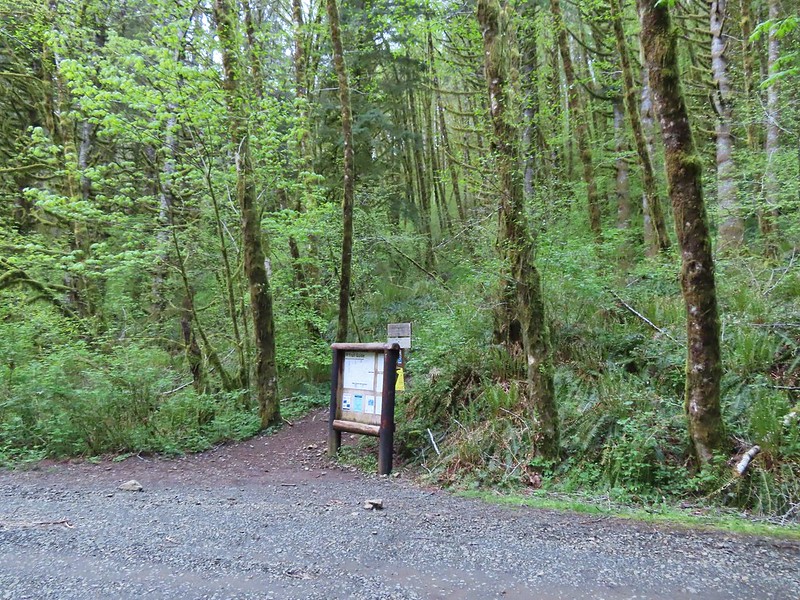
We parked on east side of the Devil’s Lake Fork of the Wilson River at a pair of signboards at the Deyoe Creek Trailhead.
IMG_8492\

Note that there is a pullout on the west side of the river here as well and each pullout has a signed trail leading off from it. There used to a footbridge across the river upstream from the trailheads, but that bridge is gone so unless your plan is to do a loop (description here) you want to take the trail on the eastern side signed “Nels Rogers Trail.
IMG_8495

The trail took us along the river passing an unnamed waterfall on a side creek after a third of a mile.
IMG_8501

IMG_8502

IMG_8505

After passing the waterfall the Nels Rogers Trail climbed a ridge above the river eventually leaving it and arriving at Beaver Dam Road across from the start of the Wilson River Wagon Road Trail.
IMG_8507

IMG_8509Moss carpet

IMG_8510

IMG_8515The first of several road and/or OHV trail crossings.

The forest was lovely, and the trail was in great shape, but from early on the sound of gunfire was a constant. It was a little surprising given we’d started hiking just after 6:30am but these target shooters were obviously early risers. We crossed the road and started on a three mile stretch of the Wilson River Wagon Road Trail that would end at the University Falls Trailhead. The Wilson River Wagon Road opened in 1893 for stagecoach and ox cart travel. At the time the toll road was the only route between Tillamook on the Oregon Coast and Forest Grove in the Willamette Valley. The trail was easy to follow and marked well at all road and OHV trail crossings. Yellow violets and white trillium were blooming, and we occasionally were able to hear the birds signing when the target shooters were reloading.
IMG_8517

IMG_8525Skunk cabbage

IMG_8527Coming to an OHV trail crossing.

IMG_8530Violet

IMG_8533Another OHV crossing.

IMG_8539Trillium

IMG_8547Mushrooms

IMG_8556Approximately 1.4-miles along the Wilson River Wagon Road the trail followed Saddle Mountain Road for 150 yards before resuming on the far side.

IMG_8558The trail resuming on the left off Saddle Mountain Road.

IMG_8564

IMG_8569Deyoe Creek

IMG_8570

IMG_8572

IMG_8583

IMG_8591The Wilson River Wagon Road Trail arriving at University Falls Road across from the University Falls Trailhead.

IMG_8618University Falls Trailhead.

We detoured here and descended 0.3-miles on the University Falls Trail to visit the waterfall.
IMG_8595

IMG_8596

IMG_8598There was a clearcut on the right-hand side of the trail.

IMG_8602The Gravelle Brothers Trail joined from the right after 0.2-miles. This is the trail we’d used to reach the falls in 2015.

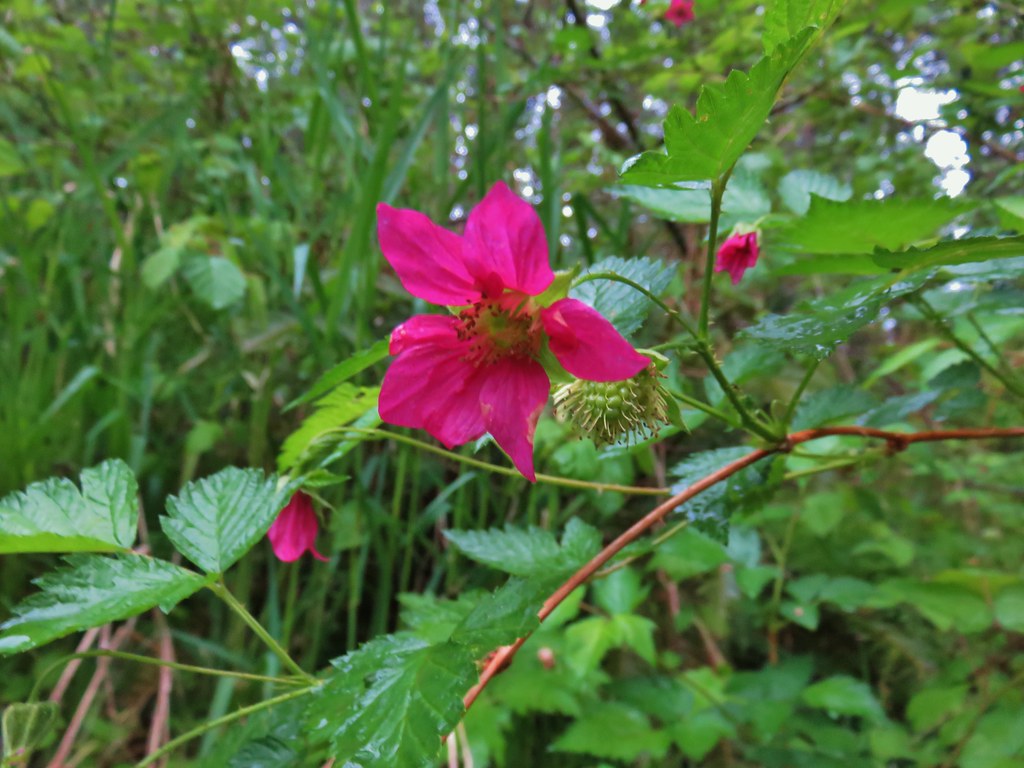
IMG_8614Salmonberry blossoms

IMG_8605

IMG_8607

IMG_8612Trillium near the falls.

After a brief break at the falls we climbed back up to the trailhead and turned right down University Falls Road for almost two tenths of a mile to the resumption of the trail.
IMG_8620Heading down the road from the trailhead.

IMG_8624Coltsfoot

IMG_8625

After a tenth of a mile back on the trail we came to a “Y” junction with the Side Step Trail where we veered right to stay on the Wagon Road Trail.
IMG_8627

IMG_8629

This section of trail used to recross University Falls Road three times, but a clearcut on the north side of the road has apparently rerouted the trail because we didn’t cross the road again. The first two crossings are now gone with the trail sticking to the south side of the road, and the third crossing was closed by yellow caution tape.
IMG_8630

IMG_8635Wood sorrel

IMG_8640University Falls Road below to the right.

IMG_8641This appeared to be a new section of trail replacing the old alignment on the north side of the road.

IMG_8642The closed section of the trail that remains on the north side of the road.

We turned left on University Falls Road and followed it two tenths of a mile to a road junction. Here the Side Step Trail joined from the left.
IMG_8644

I decided to head down the road to the right to see if the section of the Wilson Wagon Road Trail from that road to the Stagecoach Horse Camp was open.
IMG_8645The closed section of trail coming up on the right with the continuation of the trail ahead on the left.

IMG_8646The other end of the closed section.

IMG_8647This section was open so I waved Heather on and we headed down through the clearcut to the horse camp.

It was a third of a mile down to the horse camp were we took a break from the light rain that had begun falling off and on under the cover of the community shelter.
IMG_8648A lot more hikes may look like this if the current administration gets its way.

IMG_8651The horse camp in the trees.

IMG_8653

IMG_8654

After another brief rest we headed back uphill to the Side Step Trail and followed it through the forest back to the Wagon Road Trail and University Falls Trailhead.
IMG_8659

IMG_8667

IMG_8672

IMG_8682

In hindsight we probably should have done the side trip to the horse camp before visiting University Falls and then we could have continued on a loop from University Falls that may have been a bit shorter with close to the same amount of elevation gain as the hike we wound up doing. We were focused on following the field guide entry though, so we retraced our steps on the Wilson River Wagon Road and Nels Rogers Trails.
IMG_8688

IMG_8691

IMG_8695

IMG_8697Footbridge over Deyoe Creek.

IMG_8702Rough skinned newt.

IMG_8705In true Oregon fashion the weather was a mix of sprinkles and blue skies.

IMG_8709Violet enjoying some sunlight.

IMG_8712This stump looked suspiciously like Davey Jones from the Pirates of the Carribean movies to us.

IMG_8720

IMG_8722Huckleberries

IMG_8724Devil’s Fork

Our hike came in just under 12.5-miles with approximately 1800′ of elevation gain.
Screenshot 2025-04-12 152225

The trails were great, and I’d love to give the hike 4 stars but the nearly constant gunfire, which was joined by OHV noise by late morning just won’t allow it. That being said if you’re okay with a noisy hike it is worth a visit. As mentioned earlier we would recommend doing a loop using the Gravelle Brothers Trail from University Falls to connect up to the Nels Rogers Trail rather than hiking back on the Wagon Road Trail and of course you could start from any of the trailheads located along the loop. Happy Trails!

Flickr: Wilson River Wagon Road Trail

Categories
Coastal Range Hiking Oregon Trip report

Kilchis Falls, South Triangulation Point, and Cedar Butte – 06/08/2024

We’re continually looking for hikes that are new to us which led us to a pair of such hikes in the Tillamook State Forest. William L. Sullivan includes the 1.6-mile round trip to a former lookout site in Cedar Butte as an additional, non-featured hike in his “100 Hikes Oregon Coast” guidebook. A hike that short didn’t warrant the 2hr drive from Salem, so I took a look at the Oregonhikers.org field guide for other nearby hikes. That research revealed the Triangulation Point Loop. The field guide entry mentioned that the loop could be started from a saddle on the north side of Cedar Butte which was just over a mile from the Cedar Butte Trailhead.

We decided to start with the long loop first. We drove up the steep, narrow Cedar Butte Road past the Cedar Butte Trailhead and parked at the saddle overlooking a clearcut.
IMG_6097From the saddle South Triangulation Point, the highpoint of the loop, is to the right.

We would be doing the loop clockwise to avoid ending the loop with a climb back up to up to the saddle. We headed down Kilchis Forest Road which wound down through the clearcut before entering the forest.
IMG_6098

The roadside was lined with wildflowers which we focused on over the missing trees.
IMG_6100Bleeding heart

IMG_6101Fairy lanterns

IMG_6102Solomonseal

IMG_6103Inside-out flower

IMG_6104Paintbrush

IMG_6108Lupine

IMG_6110Starflower

IMG_6118Salmonberry

IMG_6121Cardwell’s penstemon

IMG_6124Beargrass

IMG_6131Wallflower

Little-leaf montiaLittle-leaf montia

IMG_6140Fringecup

IMG_6142Salal

IMG_6143Rosy bird’s-foot trefoil

IMG_6147Band-tailed pigeons

IMG_6150Looking back at the saddle before heading into the trees.

IMG_6151Vetch

IMG_6153Leaving the clearcut.

The road leveled out in the forest making for a pleasant walk. Two miles from the saddle we arrived at 100′ Kilchis Falls.
IMG_6154

IMG_6160Rock cliffs marking the location of Kilchis Falls.

IMG_6163Located on a tributary of the North Fork Kilchis River the falls reportedly seldom have much flow, but there was enough water today to make for a pretty sight.

IMG_6170The small pool below the falls.

IMG_6175Avens

20240608_075447Spider hiding on a columbine.

20240608_075509Scouler’s corydalis

20240608_075536Youth-on-age

20240608_075723Valerian

After a relaxing break at the falls, we continued along Kilchis Forest Road which approached the North Fork Kichis River and then followed it NW.
IMG_6186

IMG_6193

IMG_6192Hedgenettle

IMG_6196Waterfall on an unnamed creek. It was quite a way back in thick vegetation.

IMG_6195The above waterfall sans zoom.

20240608_082736Buttercup

Fick CreekFick Creek joining the river.

IMG_6205

IMG_6206Potholes on the North Fork Kilchis River.

IMG_6208Triangulation Creek flowing into the river.

Approximately two miles from Kilchis Falls we crossed the river on a bridge.
IMG_6214

IMG_6215

We continued to follow the river for another 0.6-miles where Middle Road joined steeply from the right.
IMG_6220

IMG_6223Snail shadow on a iris.

IMG_6227

IMG_6228Middle Road coming downhill on the right. This is the Middle Road Trailhead mentioned in the Oregonhikers.org field guide.

We made a sharp right turn here and began the difficult climb to South Triangulation Point.
IMG_6231

Middle Road isn’t really a road anymore and is only suitable for high clearance 4wd vehicles or OHVs. We huffed and puffed up this track passing a road on the left after 1.3 miles and arriving at a saddle in another 0.3 miles.
IMG_6232

IMG_6235A very blurry picture of a doe that was way down the hillside in the forest.

IMG_6238Large rock and log in the middle of Middle Road.

IMG_6241Monkeyflower surrounded by candyflower

IMG_6249

IMG_6251Paintbrush on some cliffs above Middle Road.

IMG_6259

20240608_095320Thistle

IMG_6268The road at the 1.3-mile mark along Middle Road.

IMG_6276The saddle at the 1.6-mile mark.

IMG_6277Memorial at the saddle.

We took a break at the saddle before continuing the climb. We passed another road on the left approximately half a mile from the saddle then came to 4-way junction 0.6 miles later.
IMG_6279Middle Road continuing on from the saddle.

IMG_6281Beargrass

IMG_6283The road on the left at the 2.1-mile mark.

IMG_6285Iris

IMG_6295Stream flowing down the road.

IMG_6296Coming up to the 4-way junction.

From the junction we took the righthand fork signed “FB3”.
IMG_6297Middle Road from the 4-way junction.

IMG_6298The two lefthand forks at the 4-way junction.

IMG_6299FB3

IMG_6300

The elevation at the 4-way junction is about 2600′ and the Middle Road Trailhead is just over 800′ so we’d gained over 1800′ on Middle Road. South Triangulation Point tops out at 3255′ meaning we were still over 650′ below its summit so neither of us were pleased when FB3 proceeded to lose approximately 100′ of elevation in the first 0.6 miles.
IMG_6307

IMG_6314

IMG_6315Monkeyflower

IMG_6318Beargrass, paintbrush and penstemon

IMG_6322More flowers on a rocky outcrop along FB3.

IMG_6326A bunch of monkeyflowers.

When the road finally started climbing again it was more gradual than Middle Road had been. In 3/4 of a mile, we gained 350′ before coming to a fork.
IMG_6329Springs along the road.

IMG_6330Snake cooling off in the mud.

IMG_6334The snake didn’t budge as we passed around it.

IMG_6339

IMG_6345This fork is approximately 4.2 miles from the Middle Road Trailhead.

At the fork we veered uphill to the left. This road gained nearly another 300′ in half a mile where it arrived at a saddle between Triangulation Point and South Triangulation Point.
IMG_6350Snake number two on the day.

IMG_6353This one didn’t budge either.

IMG_6358Switchback below the saddle.

IMG_6362Approaching the saddle.

IMG_6366Gated road up Triangulation Point.

IMG_6384South Triangulation Point

The wildflower display at the saddle was impressive and we spent some time admiring the blooms.
IMG_6364Serviceberry, paintbrush, yarrow, and iris.

IMG_6365Paintbrush and Cardwell’s penstemon

IMG_6368Iris

IMG_6370Broadleaf arnica, paintbrush and penstemon

IMG_6373

IMG_6375Columbine among others.

Broadleaf arnicaBroadleaf arnica

Aside from a vehicle that was just leaving the saddle below Cedar Butte when we’d arrived that morning we hadn’t seen anyone all day. That changed at South Triangulation Point as a group of dirt bikes had arrived while we were taking a break at the switchback below the saddle. We took a left fork in the road and made our way to the summit where we briefly spoke with them.
IMG_6390Final pitch to the summit.

IMG_6391We could see our car parked at the saddle below Cedar Butte from South Triangulation Point.

IMG_6392Motorcycle track heading down from the summit with Triangulation Point on the other side of the saddle.

IMG_6393Looking to the NW you can see out to the Pacific Ocean. The line of peaks furtherst back staring from left to right consists of Neahkahnie Mountain (post), Angora Peak (post), West Onion & Onion Peaks, Sugarloaf Mountain, and Kidders Butte.

IMG_6394Closer look at Surgarloaf Mountain and Kidder Butte.

IMG_6396Wildflowers on South Triangulation Point.

After a break we headed down the road to the fork where we turned left and quickly began a steep half mile descent to a 5-way junction.
IMG_6402

IMG_6405

IMG_6411Another nice clump of wild iris.

IMG_6413Lupine

IMG_6416Flowers lining the road.

IMG_6419More motorcycles at the 5-way junction.

We stayed straight at this junction and continued downhill sticking to the main road at all junctions.
IMG_6420

IMG_6423

IMG_6436Variable-leaf collomia

IMG_6438The road briefly followed a narrow ridge.

IMG_6442Anemones

IMG_6446Moth

IMG_6450

20240608_135701Heather spotted this little one. Not sure if it’s a vole, pocket gopher, or something else.

A little over a mile from our car we passed a series of wet cliffs that were putting on a spectacular flower display.
IMG_6455

IMG_6457Silverleaf phacelia and chickweed

IMG_6462A lomatium

IMG_6464

IMG_6466

IMG_6467Larkspur and monkeyflower

IMG_6468This pink larkspur really stood out on the cliffs.

IMG_6474Littleleaf miner’s-lettuce

IMG_6475Several types of yellow wildflowers.

The cliffs helped explain why the road had dipped so far below Kilchis Saddle where our car was. Shortly after passing them the road began a final climb to the saddle gaining close to 200′ in the final three quarters of a mile.
IMG_6478Still dropping a little after the cliffs.

IMG_6479Bleeding heart and candyflower

IMG_6485Climbing the road at the edge of the clearcut.

IMG_6486The saddle where our car was parked across the clearcut.

IMG_6492South Triangulation Point from Cedar Butte Road.

IMG_6493South Triangulation Point

IMG_6496Looking down the North Fork Kilchis River valley from the saddle.

For us this loop came in at 12.7 miles a little over 2700′ of elevation gain. Despite being on roads some of the elevation change was quite steep adding to the difficulty. That being said this was a good hike with a nice waterfall and lots of wildflowers. We encountered about a dozen motorbikes, all between South Triangulation Point and end of the hike and we didn’t hear them all that often either.

It had been a long hard loop, so Heather chose not to add another 780′ climb when we arrived at the Cedar Butte Trailhead.
IMG_6497

I on the other hand am a glutton for punishment so I threw my pack back on and walked 250′ up a gravel road to a signboard marking the start of the Cedar Butte Trail.
IMG_6500The trail information lists the hike as “difficult” due to the amount of elevation gained over just three quarters of a mile to the summit.

IMG_6501The start of the Cedar Butte Trail.

The trail began fairly level passing through some heavy brush before breaking into a second growth forest.
IMG_6503

IMG_6505Star-flowered false solomonseal

IMG_6510Black-headed grosbeak

IMG_6515False lily of the valley

IMG_6518

The trail didn’t really begin to climb until the 0.3-mile mark where it made a series of short switchbacks then alternated between steep straightaways and more switchbacks.
IMG_6523The trail was in good shape with just one small tree down over it.

IMG_6529Blue-eyed Mary

IMG_6531Small saddle below the summit.

IMG_6533Beargrass

IMG_6535Phlox

IMG_6539Final pitch to the summit.

IMG_6543Wild onion

IMG_6544Benches at the former lookout site.

IMG_6547View from the summit.

IMG_6551Wildflowers at the summit.

On the way back down I took a short, steep spur trail to a viewpoint where I could see Kings Mountain (post) to the NE.
IMG_6555Kings Mountain is the high point to the right along the ridge.

After checking out the viewpoint I continued my descent and rejoined Heather at the trailhead.
IMG_6557

IMG_6558Fairy bells and vanilla leaf

IMG_6565Almost back

This hike had been 1.6 miles and one heck of a climb. My legs were feeling all 3500′ on the day. Late Spring seems like a good time to visit this area as the wildflowers were the highlight. Kilchis Falls was nice but at different times of the year the flow would likely diminish the appeal quite a bit. Happy Trails!

Screenshot 2024-06-09 114436

Flickr: Kilchis Falls, South Triangulation Point, and Cedar Butte

Categories
Coastal Range Hiking Oregon Trip report

Killin Wetlands & Elk & Kings Mountain Loop

The weather finally cooperated enough for us to get back to our originally planned 2022 hikes. For this outing we were heading back to one of our earliest hikes, Elk & Kings Mountains (post) to see how much we remembered from that first visit. When we made the conscious choice to take up hiking in 2010 the loop over Elk and Kings Mountains was our eighth hike. One of only a handful of hikes rated “Very Difficult” in all five of Sullivan’s “100 Hikes” guidebooks, and the only one in the Oregon Coast book, this had been quite the challenge for us. We were curious how nearly 12 years of additional hikes, and age, might change our experience this time around. We were also hiking the trail at a better time of the year having tackled it in the heat of mid-August the first time around. Our hope was that the earlier visit would provide a different experience with wildflowers and with the streams and creeks along the route.

Before we started the difficult loop though we stopped at Killin Wetlands Nature Park just outside of Banks, OR for a short warmup hike on the 0.7 mile loop. An unintended result of having altered the plan for our two previous outings was that this stop would mark our third straight outing visiting an Oregon Metro managed park. (Orenco Woods)(Chehalem Ridge)
IMG_9952

IMG_9955

We set off on a clockwise loop on the Peat Swamp Trail then stayed left at its junction with the Waterfowl Way Trail.
IMG_9958

IMG_9959Peat Swamp Trail.

IMG_9962

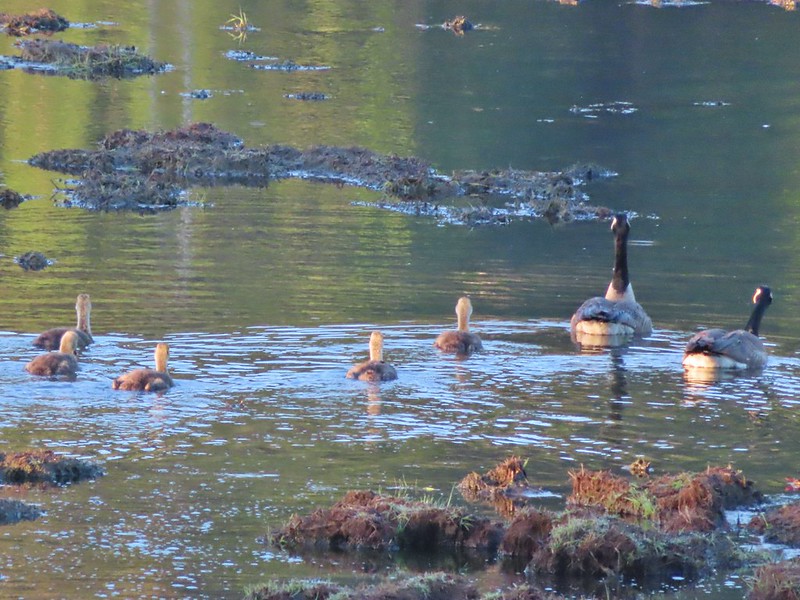
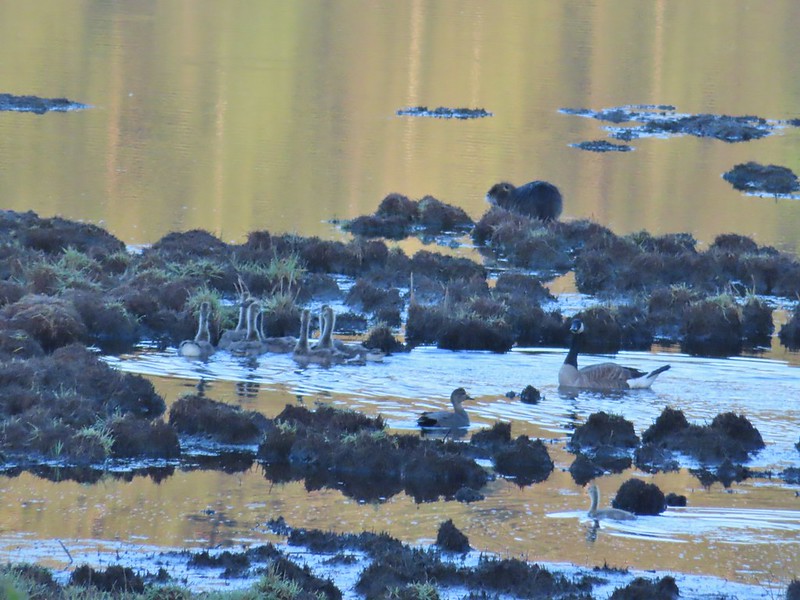
Our 6am start time paid off as we were not only the only ones at the park but we spotted a deer (too quick for a photo), two otters, several families of Canada geese, and a gadwall and a mallard.
IMG_9971

IMG_9963One of the two otters that were swimming in the wetlands.

IMG_9974Mallard

IMG_9980

IMG_9972The gadwall amid a family of Canada geese. When we got home and looked closer at the picture we realized that one of the round shapes we took for a clump of mud was actually an animal. We can’t make out the tail to know for sure whether it was a beaver or a nutria but we’d like to think it was another beaver.
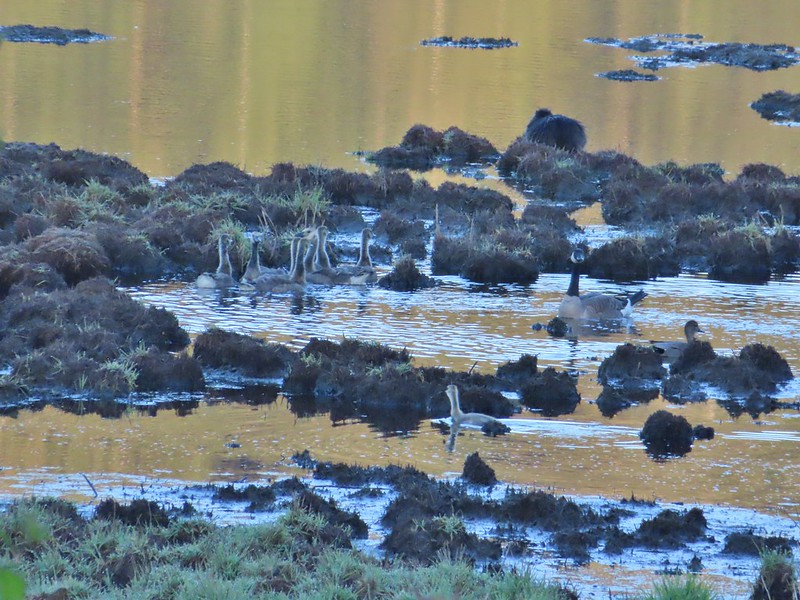
IMG_9973The beaver? turned a bit in this photo but we still couldn’t make out the tail. It does appear relatively large when compared to the adult goose though.
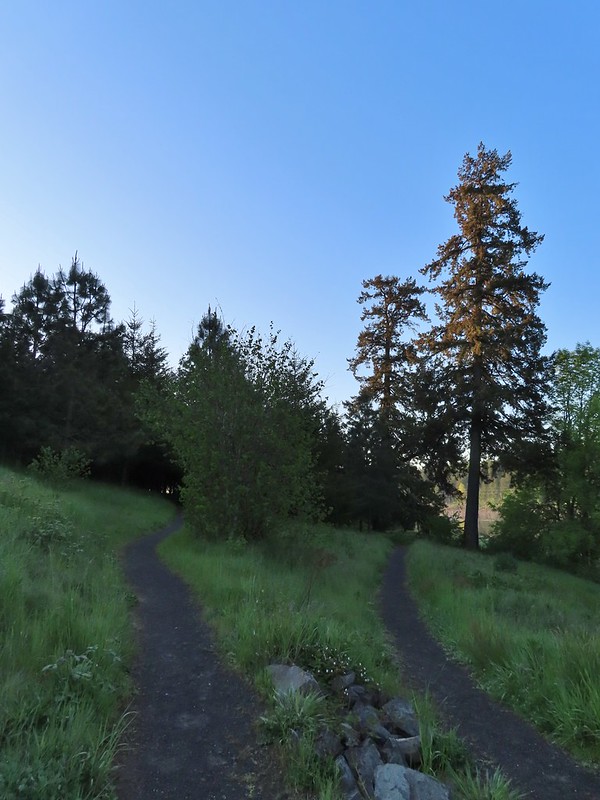
Waterfowl Way made a 180 turn and headed uphill through some small trees to return to the Peat Swamp Trail.
IMG_9982

We stayed left again and completed the short but eventful loop.
IMG_9986

From Killin Wetlands we headed west on Highway 6 to Elk Creek Campground and the Elk Mountain Trailhead.
IMG_9987

We set off on the Wilson River Trail which began a 0.2 mile climb to a junction with the Elk Mountain Trail.
IMG_9988

IMG_9998Fairy bells and bleeding heart.

IMG_0003Elk Creek below the trail.

IMG_0005Junction with the Elk Mountain Trail

While it had been sunny at the wetlands we had dropped under some clouds as we descended to the Wilson River Valley and found ourselves hiking steeply up into fog.
IMG_0006

IMG_0008

IMG_0012

IMG_0014Paintbrush

IMG_0015Parsley

IMG_0016Blue-eyed Mary

IMG_0022Viewpoint along the Elk Mountain Trail.

IMG_0029The blue sky is up there.

IMG_0033Snow queen

IMG_0035The trail was as steep and rough as we’d remembered.

We did climb out of the cloud to find that blue sky again.
IMG_0039

IMG_0042

IMG_0043White service berry blossoms and a huckleberry plant.

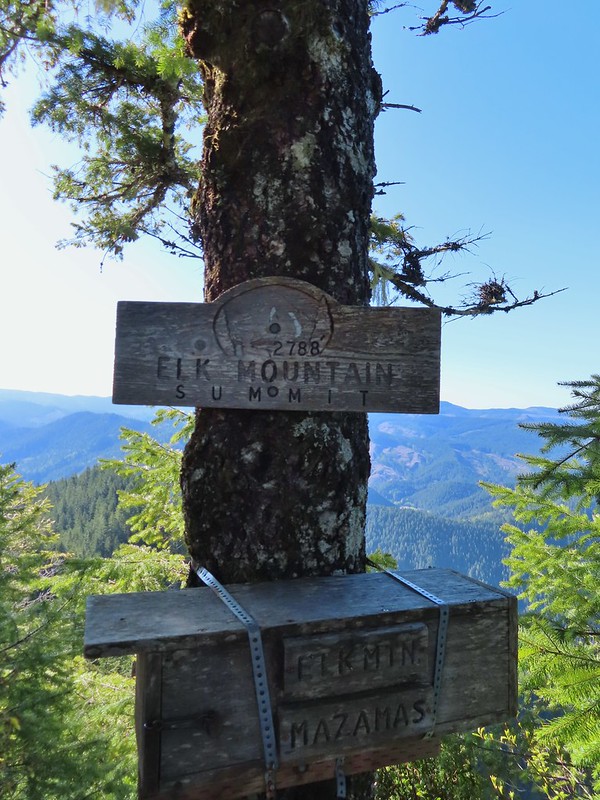
The trail made a series of ups and downs along a ridge crossing four saddles before climbing to the 2788′ summit of Elk Mountain.
IMG_0057

IMG_0062Violet

IMG_0064

IMG_0076Red-flowering currant

IMG_0083Trillium

IMG_0087Anemone

IMG_0092Monkeyflower

IMG_0100One of the saddles.

20220521_084754Chocolate lily

IMG_0116Elk Mountain summit.

IMG_0117

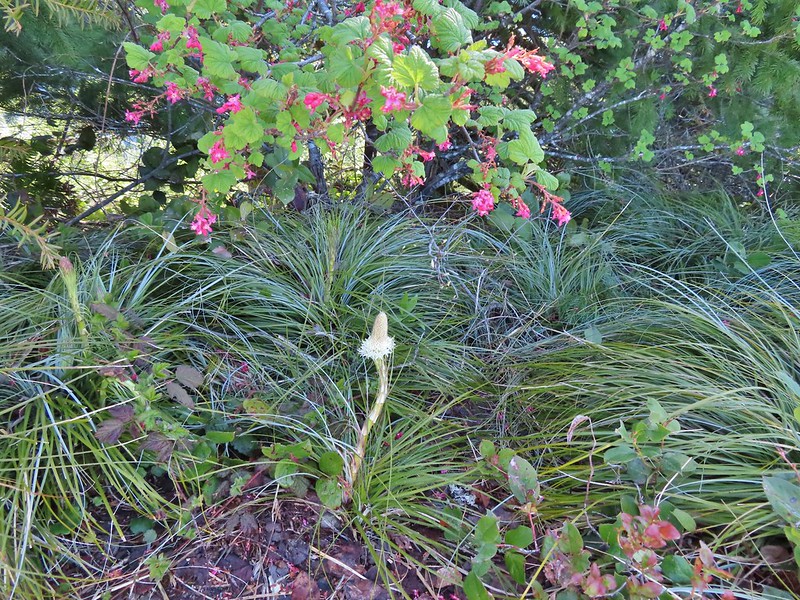
We spent a little time resting at the summit where we found a lone blooming beargrass with more to come.
IMG_0134Kings Mountain from Elk Mountain.

IMG_0123Wilson River

IMG_0124Pacific Ocean

IMG_0129The blooming beargrass below some red-flowering currant.

IMG_0131Beargrass

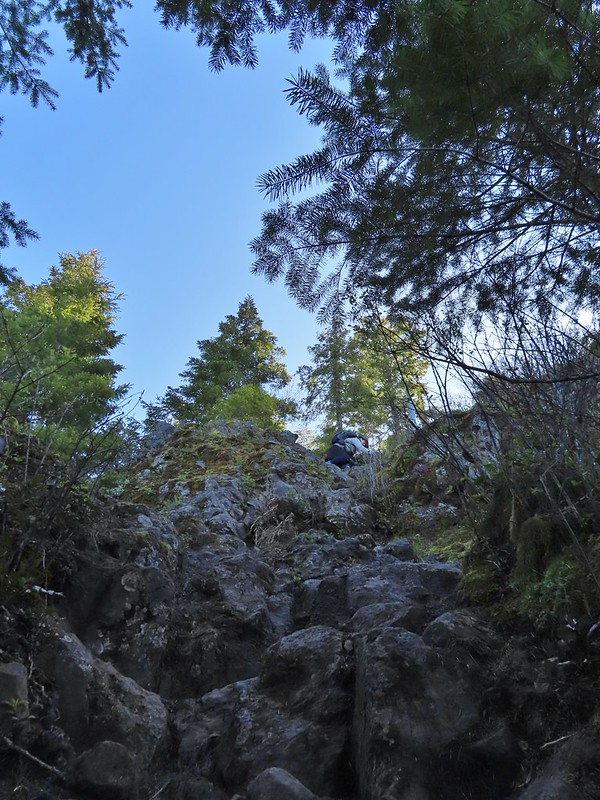
While the 1.5 mile climb to this summit had been hard the next mile of trail beyond the summit took it up a notch. The trail dropped nearly straight down the rocky west face of Elk Mountain requiring us to use our hands as we climbed down the damp rocks.
IMG_0136Looking down the trail.

IMG_0137Heather on her way down.

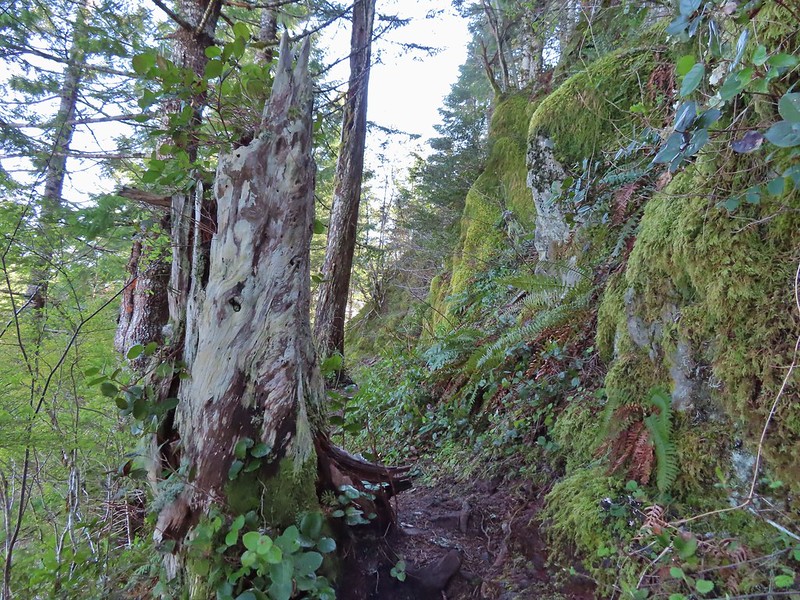
After navigating the rocky descent the trail passed along some cliffs then climbed atop a narrow rocky ridge which it followed to an old roadbed where the hiking became temporarily much easier.
IMG_0141

IMG_0153On the ridge.

IMG_0156Dropping down to a saddle along the ridge.

Near the start of the road bed we spotted a hermit warbler eating something off of some huckleberry bushes.
IMG_0160

This was the first time we’d seen one of these pretty little birds, at least that we are aware of. Who knows how many we’ve seen fly by and not been able to identify them.

IMG_0163Mercifully on the old roadbed.

We followed the old roadbed for about a mile as it climbed to a junction at a saddle.
IMG_0169

IMG_0170A clump of trillium.

IMG_0171Little moth.

IMG_0180Getting closer to Kings Mountain.

IMG_0185

IMG_0187Paintbrush

IMG_0189Coming up to the junction.

We turned left onto the Kings Mountain Trail which according to the pointer was 1.3 miles away.
IMG_0191

The trail continued to follow an old road bed for a little over half a mile before dropping steeply to a ridge and switchbacking around an outcrop and finally crossing over a saddle.
IMG_0192

IMG_0198Phlox, paintbrush, and chickweed.

IMG_0203Still on the old road.

IMG_0206At the ridge end above the saddle, the trail dropped down to the left then through the saddle.

IMG_0208Below the outcrop headed to the saddle.
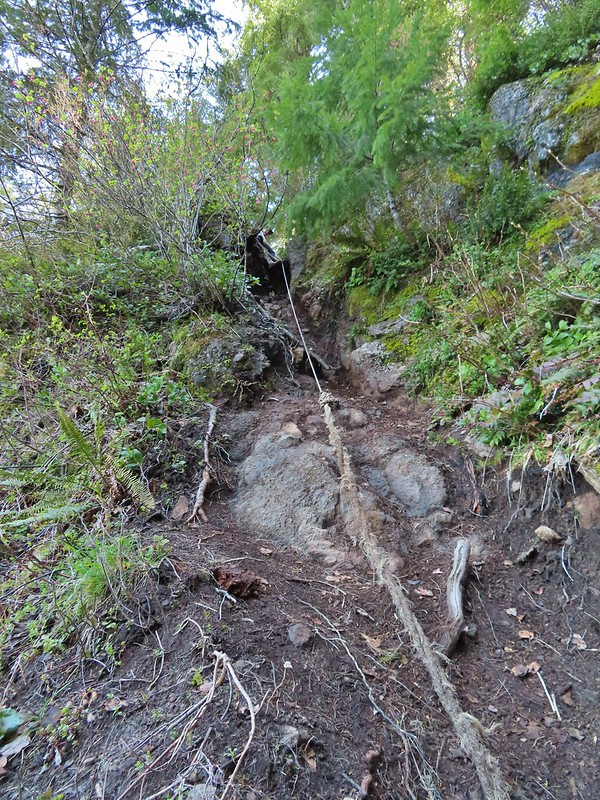
Probably the most memorable part of our first hike here was needing to use a rope that had been affixed to a stump to descend a steep chute. While we both remembered that we had forgotten at what point we’d encountered the rope and after the steep drop off of Elk Mountain we convinced ourselves that the rope had been there. As we passed over the saddle we realized our mistake as the stump and rope were here and the 12 years had not been kind to the trail here.
IMG_0209

IMG_0210Heather getting ready to start down.

Kings Mountain TrailThe chute in 2010.

The rope was quite a bit longer this time, out of necessity, but we made it down and continued on. From here the trail passed below some sheer cliffs which had been a very nerve wracking experience in 2010. Apparently somewhere during the 549 outings that we’d done between visits I’d gotten much more comfortable with narrow trails with steep drop offs because this time there were no nerves but there were a couple of spots that required the use of hands to get up.
IMG_0211

IMG_0216The trail is down there somewhere.

20220521_110629Trillium

20220521_110646Bleeding heart

IMG_0225Fringed kitten-tails

20220521_114513Glacier lily

The trail then climbed to a high point along the ridge which Heather initially mistook for the summit of Kings Mountain. She was less than thrilled when I pointed out the actual summit a short distance, and one saddle, away.
IMG_0229Coming up to the high point.

IMG_0230Kings Mountain

IMG_0231View SE from the high point.

We dropped down to the saddle then made the final climb to Kings Mountain. We had seen a small number of other hikers up to this point but found several others here having come up from the Kings Mountain Trailhead.
IMG_0237Dropping to the last saddle.

IMG_0238Summit register at Kings Mountain.

IMG_0239Pacific Ocean in the distance.

IMG_0241View north.

IMG_0245Other hikers at the summit.

IMG_0244Valerian

IMG_0248Saxifrage, possibly Saddle Mountain saxifrage.

IMG_0250Phlox, paintbrush, parsley, blue-eyed Mary, and chickweed.
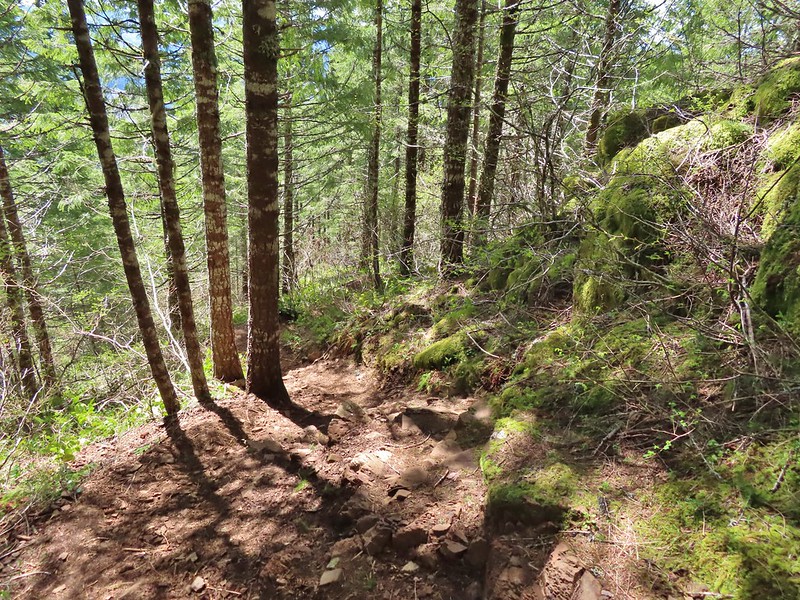
From Kings Mountain the Kings Mountain Trail dropped steeply downhill for 2.5 miles to a 4-way junction with the Wilson River Trail. While the trail is steep and rough in a couple of spots it’s nowhere near as gnarly as the Elk Mountain Trail. We had remembered the descent as having given us trouble but in those days we hadn’t used hiking poles. Armed with proper poles this time the descent went much smoother.
IMG_0253

IMG_0255One of the rougher sections.

IMG_0263

IMG_0270

IMG_0272Wood sorrel

IMG_0279Woodland buttercup and candy flower.

IMG_0281The 4-way junction.

We turned left on the Wilson River Trail to make the 3.5 mile hike back to the Elk Mountain Trailhead. While the hike had been challenging we’d been doing pretty well but we’d forgotten to bring any electrolytes with us and while we had plenty of water we both started feeling a bit off. We paused at Dog Creek which is right near the junction for a bit of a break before continuing on the final stretch.
IMG_0283

IMG_0285Dog Creek

The Wilson River Trail passed a wetland fed by several small streams before making a long gradual climb up to the junction with the Elk Mountain Trail.
IMG_0287

IMG_0288

IMG_0292

The wetlands

IMG_0295One of the smaller streams.

IMG_0302Monkey flower

IMG_0305Lily that will bloom in a few weeks.

IMG_0307

IMG_0309Fringecup

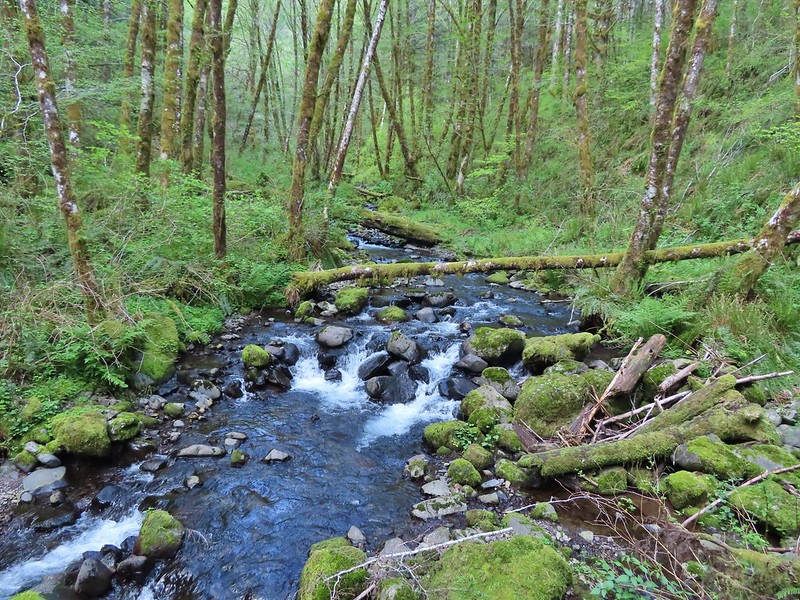
IMG_0314Coming up on a footbridge across Big Creek.
IMG_0316

IMG_0319Big Creek

IMG_0322Pacific waterleaf

IMG_0325Steadily climbing.

IMG_0327A pea or vetch.

IMG_0329Unnamed stream crossing.

IMG_0332Miterwort

IMG_0338Rosy Birdsfoot Trefoil

IMG_0344The third type of monkey flower we saw on the day.
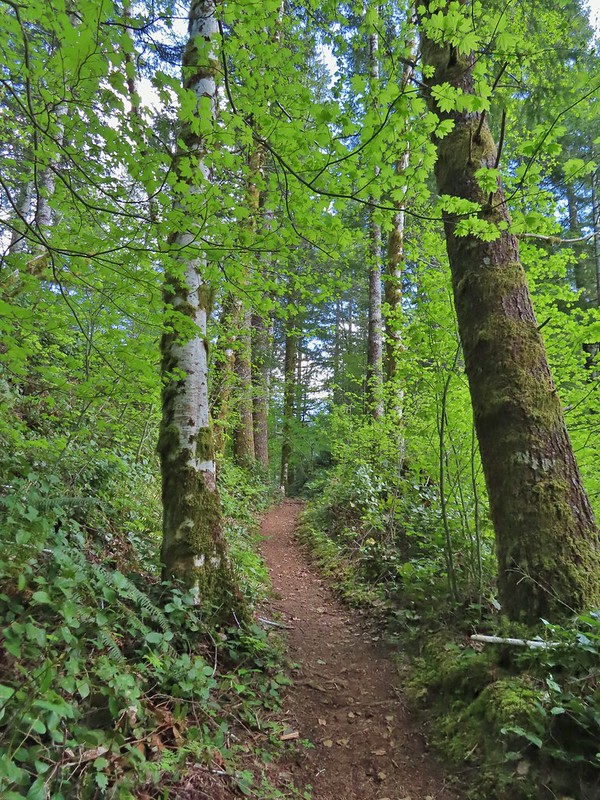
IMG_0349The junction is on the saddle ahead.

From the junction we dropped down to the trailhead where we thankfully had some meat sticks waiting that provided some much need salt and protein.
IMG_0352Cars to the left through the trees, we made it.
So what did we learn revisiting this challenging hike after 12 years? One is that we are more comfortable with sketchy trails and exposure after having experienced both many times since then. Secondly our bodies are 12 years older and they reminded us of that toward the end of the hike. Finally we were reminded that as much as we have learned about hiking such as the advantage that trekking poles can provide we are still prone to making mistakes and underestimating what we might need such as the electrolytes. It will likely be quite a while before you find us on a hike without some handy.

Aside from both stops being loops our two hikes for the day couldn’t have been much different from one another. The 0.7 mile loop at Killin Wetlands was short with a well graded trail that gained a total of 60′ of elevation while the Elk and Kings Mountain Loop and been over 11 miles (It’s just under 11 if you don’t wander around with over 4000′ of elevation gain. The gains were often steep, as were the losses, requiring the use of hands at times and included steep exposed drop offs. It was obvious from the number of other trail users that we encountered that most people stick to the out and back up to Kings Mountain but if you’re an experience hiker looking for a challenge or an early season training hike this is a great option. Happy Trails!

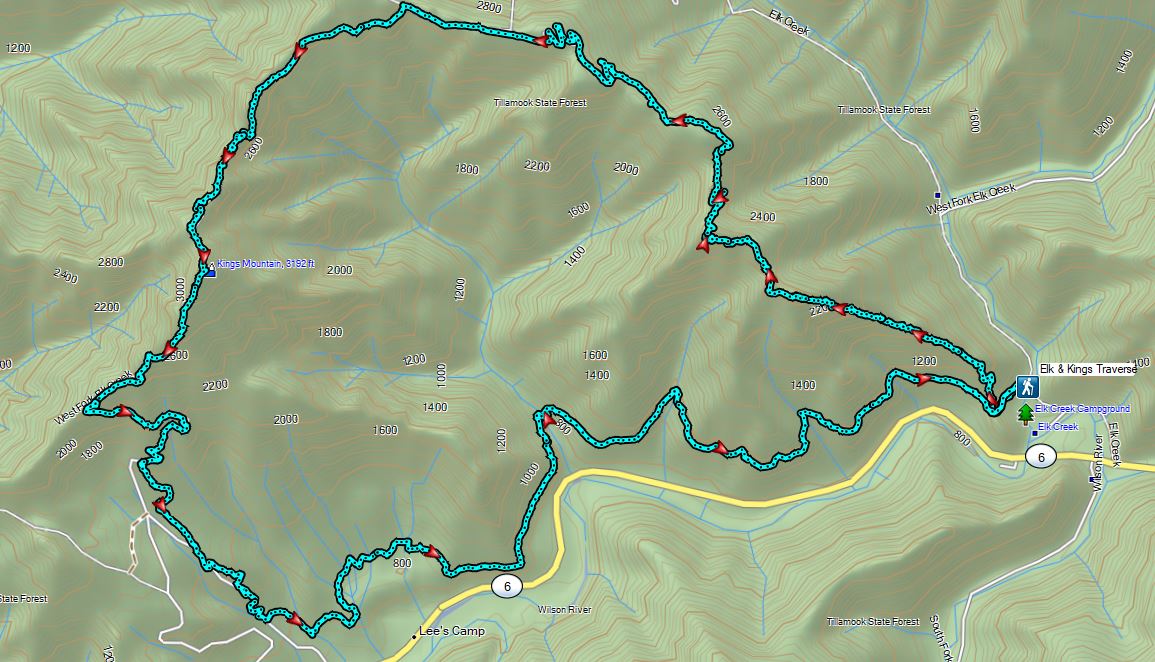
Our track for the Elk & Kings Mountain Loop

Flickr: Killin Wetlands and Elk & Kings Mountain

Categories
Coastal Range Hiking Oregon

Crown Zellerbach (CZ) Trail – East Fork Nehalem River Section 03/05/2022

So far in 2022 the first Saturday of every month has come with a dry and at least partially sunny forecast which meant for the third month in a row we took our hike on the first weekend. We tend to take for granted the opportunities we have to get out and enjoy nature but this outing was different. For more than a week we’ve watched as the Ukrainian people have been forced to fight for their freedom and country. We continue to pray for their safety and an end to Russian aggression.

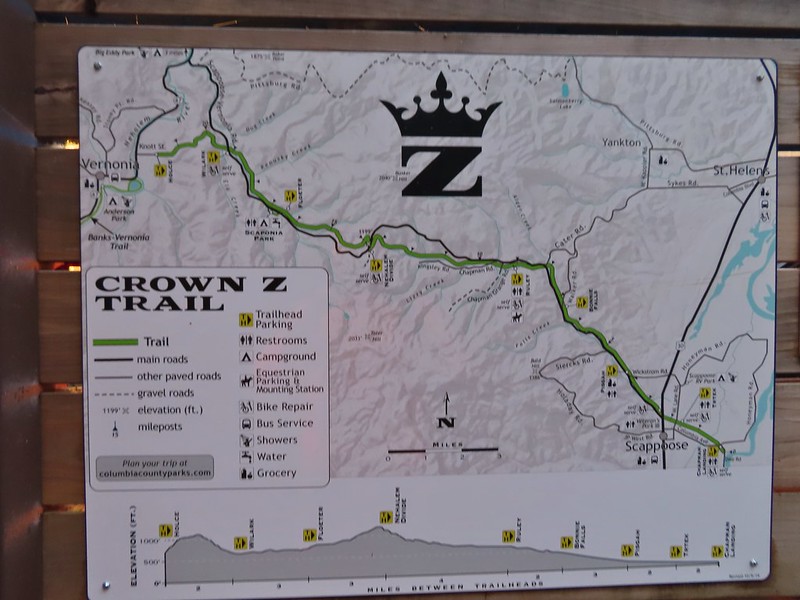
For our March hike we decided to check out the Crown Z Linear Trail, also known as the CZ Trail or Crown Zellerbach Trail. The 24.8 mile long CZ Trail runs between the cities of Vernonia and Scappoose following former (and sometimes active) logging roads open to hikers, bicycles and horses. Multiple trailheads make it possible to hike shorter segments as either out-and-backs or between trailheads using a second car. For our first visit we used the Oregon Hikers field guide which breaks the trail up into five sections. We picked section four, the East Fork Nehalem River Section, which runs between the Nehalem Divide and Wilark Trailheads.

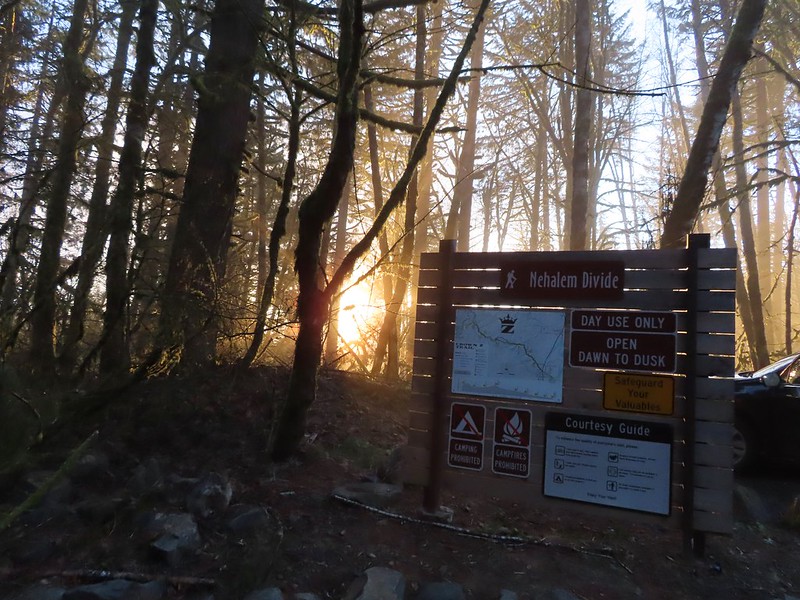
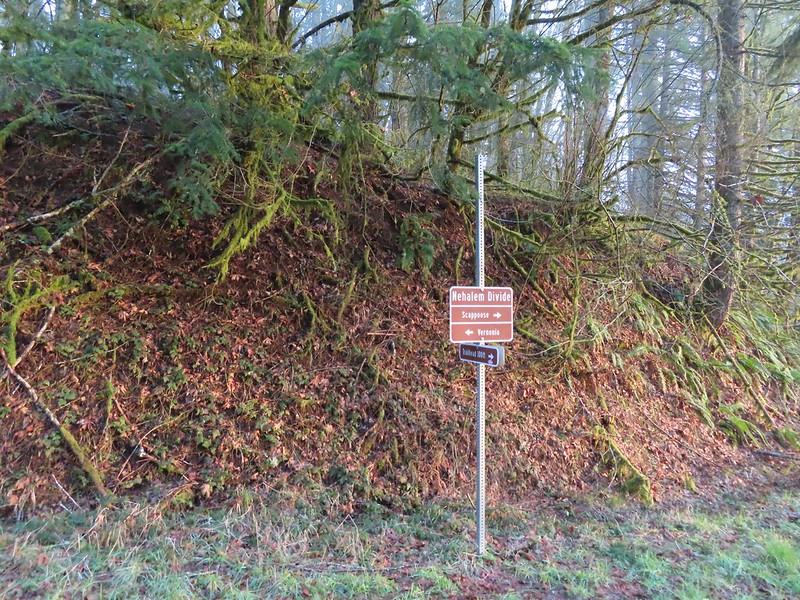
We began at the Nehalem Divide Trailhead which provided the shorter drive of the two and also allowed us to begin the day with a downhill.
IMG_8225

IMG_8226

A 100′ path leads downhill from the trailhead to the CZ Trail which passes under the Scapoose-Vernonia Highway (if you’re heading toward Vernonia).
IMG_8227Heading down the connector trail.

IMG_8228Trial sign at the jct with the CZ Trail.

IMG_8230CZ Trail passing under the highway.

We followed the road downhill for approximately 3/4 of a mile to an interpretive wildlife sign where a path behind led downhill to the East Fork Nehalem River. The river isn’t much as it isn’t far from the headwaters, but a short distance up river is a pair of small waterfalls with the western end of the Nehalem Divide Railroad Tunnel.
IMG_8234

IMG_8240

IMG_8242

IMG_8249

IMG_8244Light from the eastern portal is visible at the other end but the tunnel is not safe to enter without at least a hard hat.

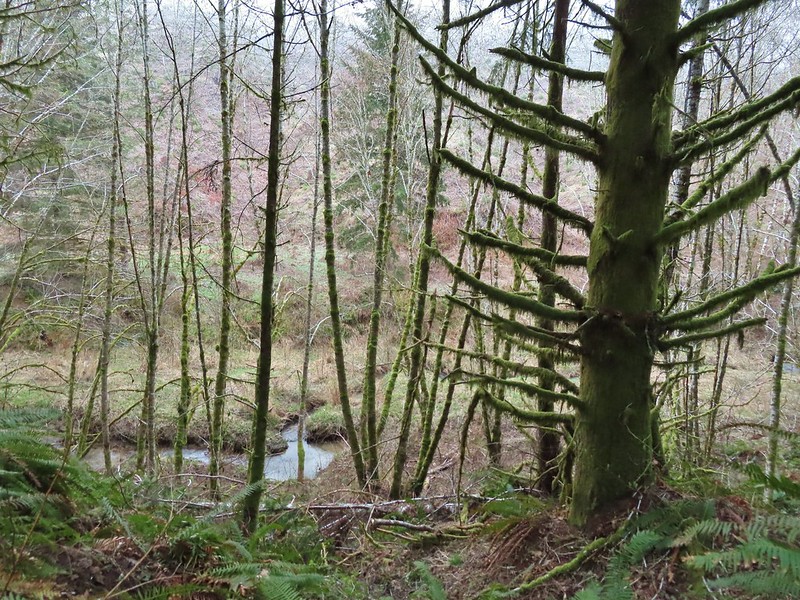
IMG_8250

After checking out the old tunnel we returned to the CZ Trail and resumed our hike toward the Wilark Trailhead.
CZ Trail

East Fork Nehalem RiverThe East Fork Nehalem River next to the trail.
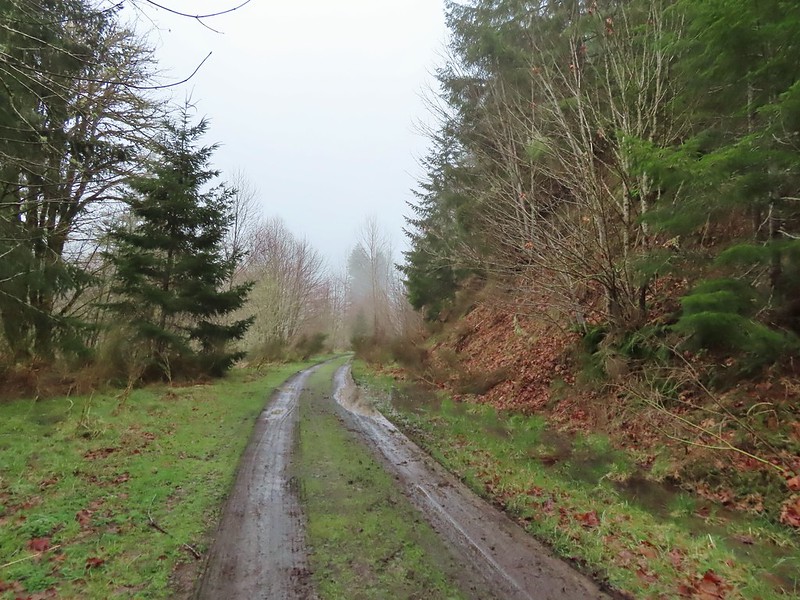
We detoured again briefly to check out a small seasonal fall just off the trail.
Season fall along the CZ Trail

CZ TrailIt was a little muddy in places.

Interpretive sign along the CZ TrailAnother of several interpretive signs along the trail.

Indian plumNot much in the way of flowers yet but there were a few indian plum starting to blossom.

A little under four miles from the Nehalem Divide Trailhead we arrived at the Floeter Trailhead.
CZ Trail arriving at the Floeter Trailhead

Interpretive sign along the CZ Trail

Beyond this trailhead the CZ Trail immediately crossed an unnamed creek on a bridge.
Footbridge near the Floeter Trailhead

Unnamed creek

After crossing the bridge we detoured here yet again passing over the highway to a small trail sign for Scaponia Park.
Scaponia Park across the Vernonia-Scappoose Highway

Trail to Scaponia Park

This short path dropped us into the 7 acre park which has 12 campsites and a short network of trails. We turned right on the park entrance road then crossed the East Fork Nehalem River on a footbridge to do a short 0.4 mile loop utilizing a second footbridge to return to the road near the campground.
Scaponia Park

East Fork Nehalem River in Scaponia Park

One of two footbridges in Scaponia Park

Trail in Scaponia Park

Second footbridge in Scaponia Park

East Fork Nehalem RiverEast Fork Nehalem River

After our little loop we returned to the CZ Trail and continued west.
Sign for the CZ Trail in Scaponia ParkPointer for the CZ Trail in Scaponia Park

CZ Trail

For the next three quarters of a mile the trail parralled the highway.
Log home across the highway

American kestralAmerican kestral

The trail veered away from the highway again after the highway crossed the river putting it between the road and the trail.
East Fork Nehalem River

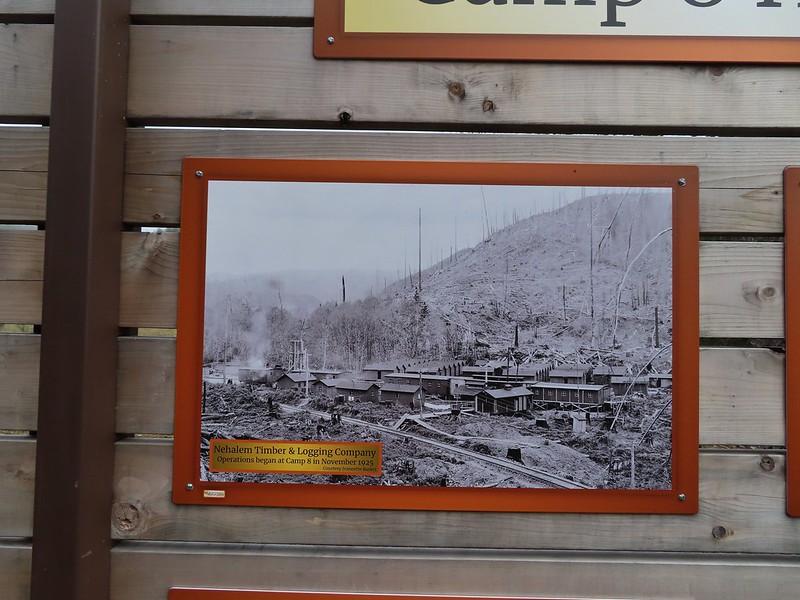
Just over two miles from the Floeter Trailhead we arrived at the former site of Camp 8, a logging camp established in the 1920’s.
CZ Trail nearing Camp 8

Interpretive sign along the CZ Trail

Interpretive sign along the CZ Trail

Robin at Camp 8Robin in the meadow that once was Camp 8.

Beyond the Camp 8 site the trail crossed the East Fork Nehalem River then climbed to the highway passing mile marker 19 along the way.
CZ Trail crossing the East Fork Nehalem River

East Fork Nehalem River

CZ Trail mile 19The orange mile marker 19 ahead.

This short section was full of birds.
JuncosJuncos

Varied thrushAnother not great picture of a varied thrush.
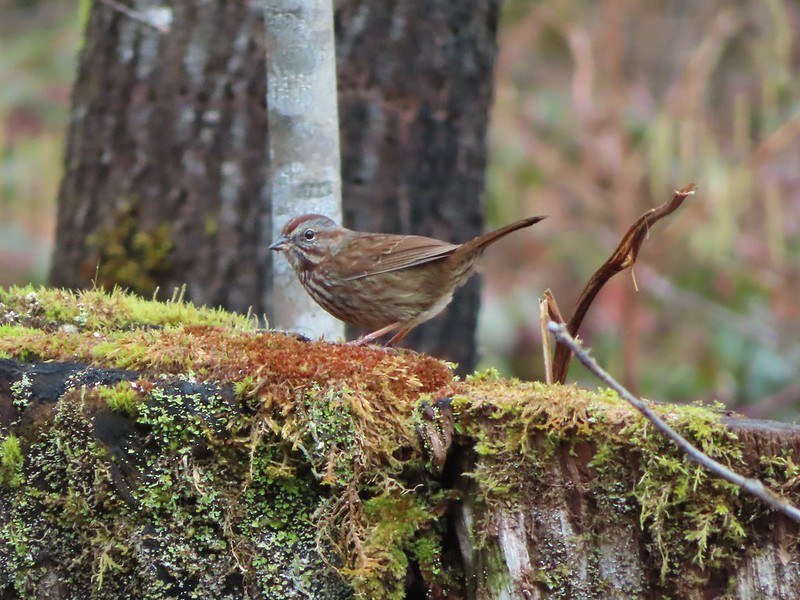
SparrowSparrow

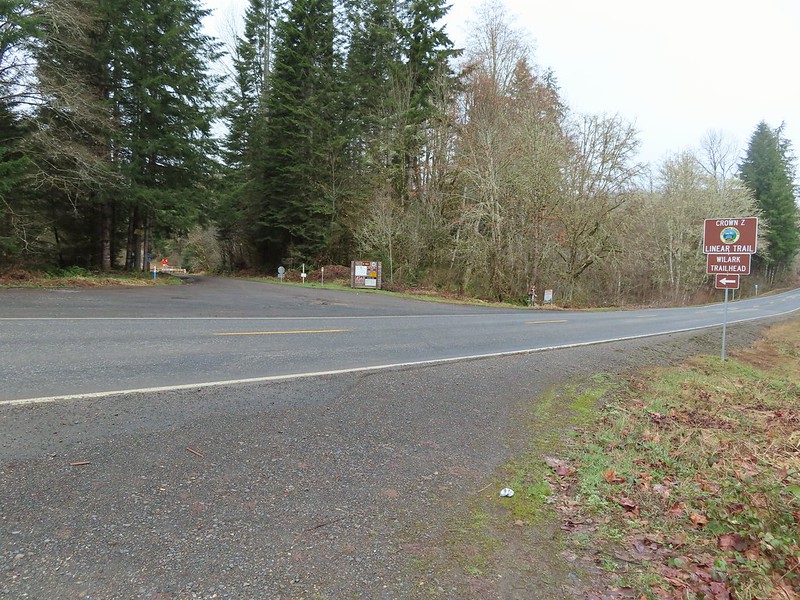
Vernonia-Scappoose Highway at the Wilark Trailhead

We turned around at the highway and headed back.
CZ Trail at the Wilark Trailhead

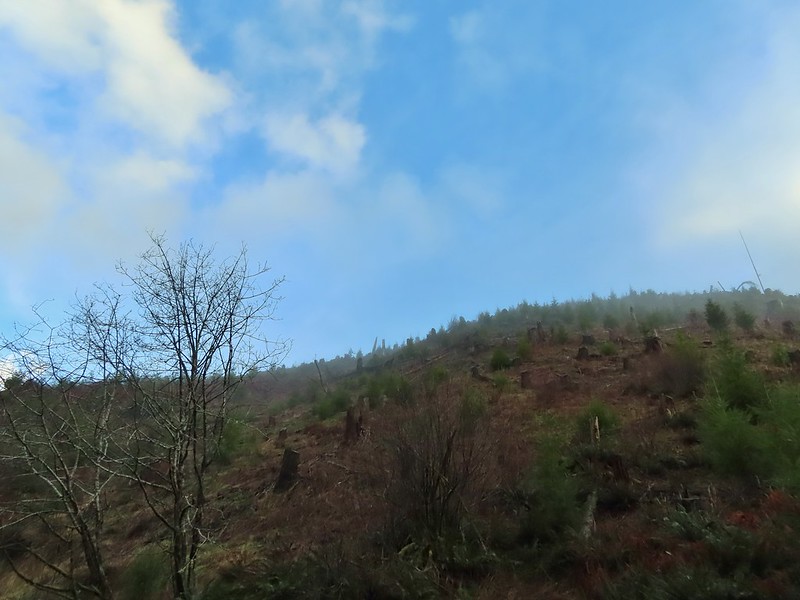
The clouds finally began to break up after we passed Camp 8 and soon we found ourselves under a bright blue sky.
Blue sky begining to emerge

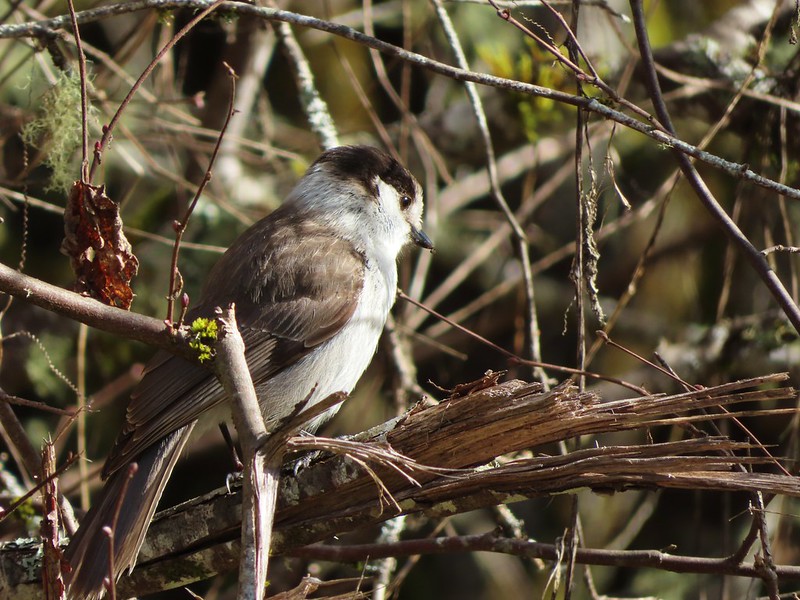
Grey jayA grey jay enjoying the emerging sunlight.
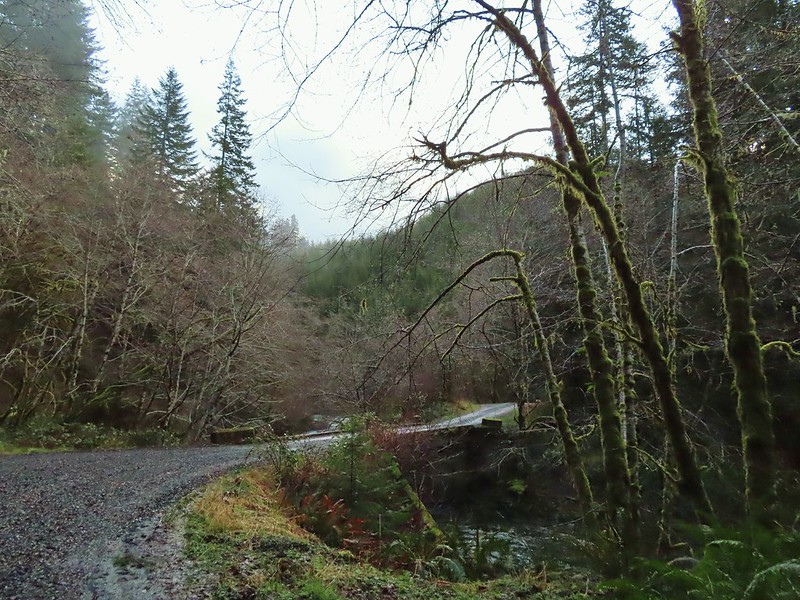
CZ Trail

CZ TrailBlue sky near the Floeter Trailhead.

Surprisingly until the final tenth of a mile we hadn’t seen a single other trail user when a lone mountain biker zoomed past us heading downhill. Including our three detours our hike came in at 12.7 miles with a little over 650′ of elevation gain. A good early season workout with some nice scenery and interesting history.

At some point down the road we will return to do another section of the trail but for now this was a fun introduction to CZ Trail. Happy Trails and Slava Ukraini.

Flickr: CZ Trail – East Fork Nehalem River Section

Categories
Coastal Range Hiking Oregon Trip report

North Fork Nehalem River – 02/20/2021

Like much of the U.S. we’ve had some ugly weather so far in February so when we saw the potential for a “not too wet” window of time we decided to head out for this month’s hike. On our schedule for February was the North Fork Nehalem River in the Coastal Range. This hike came from the Oregon Hikers Field Guide, my favorite online source for ideas. This particular hike utilizes roads instead of trails which was actually a good thing after an unusually destructive ice and snow storm had come through just a week before our hike. We hopped that the combination of the roads and some clearcuts along those roads would mean we wouldn’t have to deal with much if any debris from the storm. As we drove west on Highway 26 from Portland we were amazed at how much damage there was to trees in the Coastal Range. Between the damage we saw and a couple of heavy rain showers we were wondering what we might be getting ourselves into as we turned south onto Highway 53. The rain let up as we wound our way down past more damaged trees to the Nehalem Fish Hatchery. We had planned to stop at the hatchery first for a quick stop to see Umbrella Falls but signs at the hatchery indicated it was closed to visitors due to COVID-19 (the ODFW website for the hatchery didn’t mention the closure). With access to the 1/8 mile path to the falls blocked we had to skip Umbrella Falls for now and we drove the short distance north on Highway 53 to Cole Mountain Road (just north of the bridge over the North Fork Nehalem River) where we turned west (right) and kept right at a fork to reach the North Fork Nehalem Trailhead.
Trailhead on North Fork Road

We parked at a pullout before a gate marking the start of private land owned by McCracken Woodlands LLC and set off on foot.
Informational sign from McMracken Woodlands LLC

After crossing over a small stream we started getting views of the North Fork Nehalem River on our right.
Stream along North Fork Road

North Fork Nehalem River

North Fork Nehalem River

We were soon passing one of several clearcuts.
Clearcut above North Fork Road

While we are always on the lookout for wildlife we rarely spot anything when we’re specifically looking for something. Today was no exception and after scanning the hillside and coming up empty we started walking again. I turned around to see what the view was like behind us and caught movement 2/3rds of the way up the hill. It was a pair of deer that were well aware of us and making their way in the other direction.
Deer in the clearcut

Deer moving away from us through the clearcut

A mile into the hike we crossed the river on a bridge.
North Fork Road crossing the North Fork Nehalem River

North Fork Nehalem River

North Fork Nehalem River

Just under a half a mile from the bridge we came to North Fork Falls where some steps led down to a fish ladder.
North Fork Falls

North Fork Falls

Fish ladder at North Fork Falls

North Fork Nehalem River

After checking out the falls and fish ladder we continued on North Fork Road passing twin seasonal waterfalls, a quarry, and a pond before crossing over Gods Valley Creek near the two and three quarter mile mark of the hike.
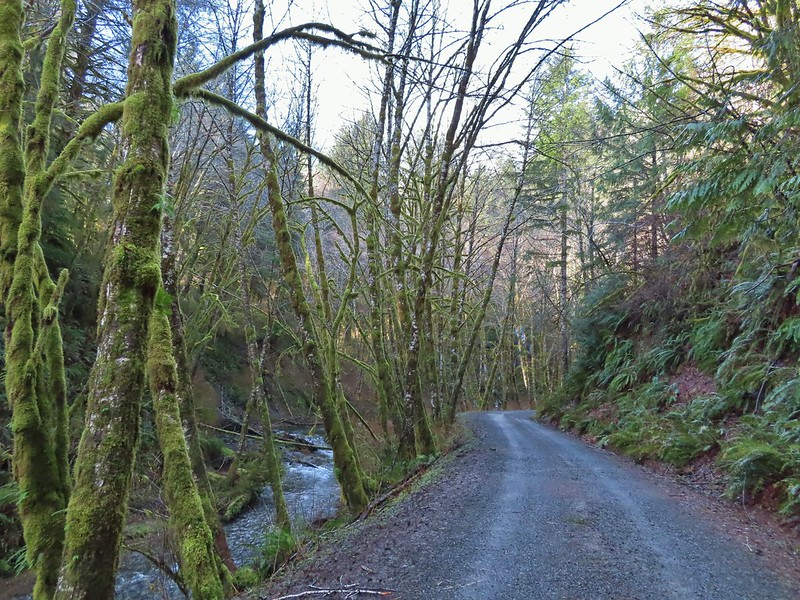
North Fork Road

Twin seasonal waterfalls along North Fork Road

Pond along North Fork Road

Gods Valley CreekGods Valley Creek

Just beyond Gods Valley Creek we spotted some old moss covered picnic tables. We’d be interested in the history here as there was also at least one former campsite with an old fire ring in the area as well. Our guess is that before the logging this was some sort of recreation area but we haven’t been able to find any information online about it.
Old picnic tables

FrogFrog near the old picnic tables.

After crossing the creek the road left the North Fork Nehalem as the river bent northward sticking to a straight line to another crossing of the River just before the 3.5 mile mark.
North Fork Road

North Fork Road crossing the North Fork Nehalem River

North Fork Nehalem River

A gate at the far end of this bridge marked the boundary of the private land and the start of the Clatsop State Forest. We followed North Fork Road through the forest another two miles to Fall Creek (just on the far side of another large quarry).
Skunk cabbageNot much in the way of flowers yet but there was a bit of skunk cabbage in bloom.
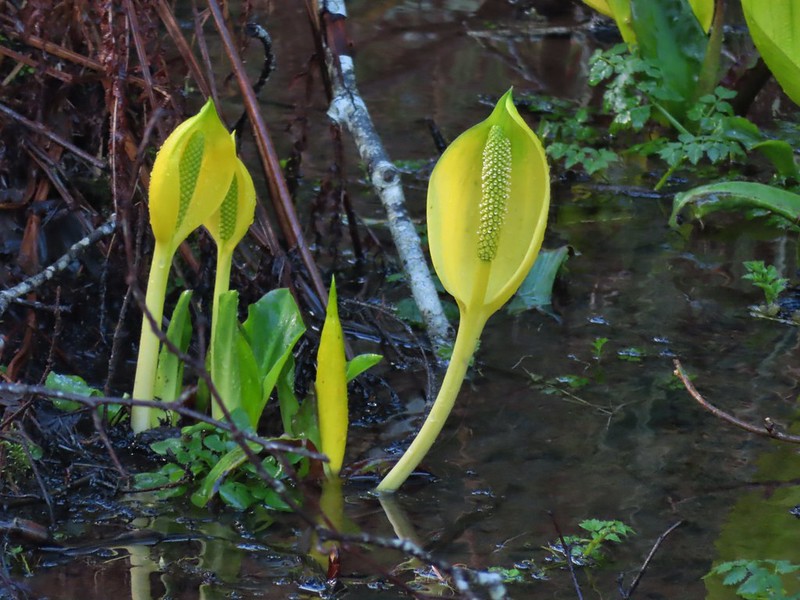
Skunk cabbage

North Fork RoadSome low hanging trees, presumably from the storm. The roads had been cleared but occasional damage along the side of the road was evident.
North Fork Nehalem River

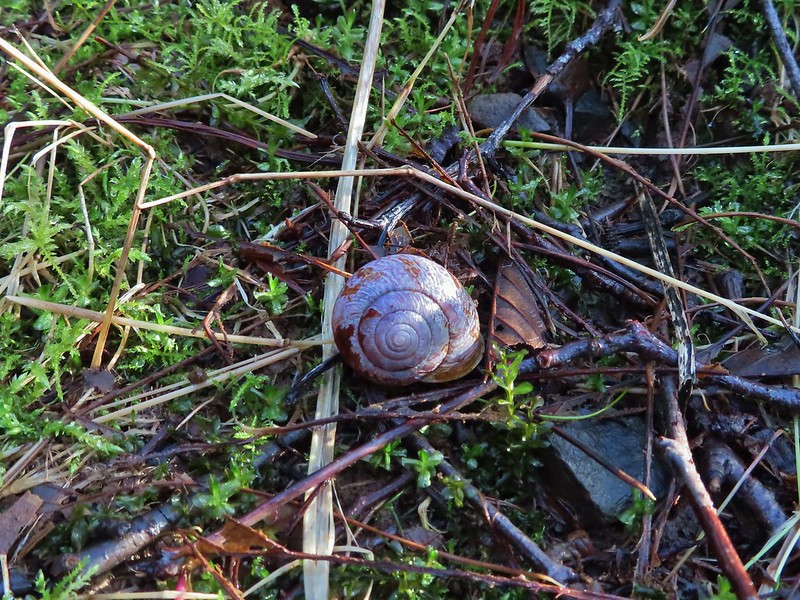
Snail shell

Old stump amid younger treesThere were no recent clearcuts in the Clatsop State Forest section but there was evidence of past logging.

Fall CreekFall Creek

After crossing Fall Creek the road (which is shown on maps as Hill Road here) turned away from the river and followed Fall Creek. We took a short detour to the right toward the river where a gated suspension bridge led to another fish ladder.
North Fork Nehalem River

Path to a closed suspension bridge over the North Fork Nehalem RiverNot sure why I neglected to get a picture of the bridge from the locked gate but this is the only one I took of the bridge.

Upper North Fork FallsThe hike description in the Oregon Hikers Field Guide mentions walking along the bank to get a view of Upper North Fork Falls from the rocks below but that wasn’t going to be an option with the river level today.
After checking out the bridge we returned to the the road and continued uphill along Fall Creek to visit three more waterfalls.
Hill Road along Fall Creek

We came to the first fall after .3 miles, a side stream flowing into Fall Creek. The lack of leaves made it a little easier to see the falls than it would be later in the year.
Waterfall spilling into Fall Creek

I was able to make my way down to Fall Creek below the falls for a closer look. (I did however get slapped in the face a couple of times by the vegetation.)
Waterfall spilling into Fall Creek

Another quarter mile brought us to the final two falls. A stepped fall on Fall Creek and another side stream flowing into Fall Creek.
Falls on Fall Creek

Waterfalls on Fall Creek

Waterfall spilling into Fall Creek

Waterfall spilling into Fall Creek

We were pleasantly surprised at how nice these last three waterfalls were, especially the two on the side streams. We were also thankful that we hadn’t had any real precipitation to deal with. We headed back the way we’d come looking for anything we’d missed on our fist pass.
Thick moss on a treeWe both thought that this thick moss looked like some sort of hairstyle.
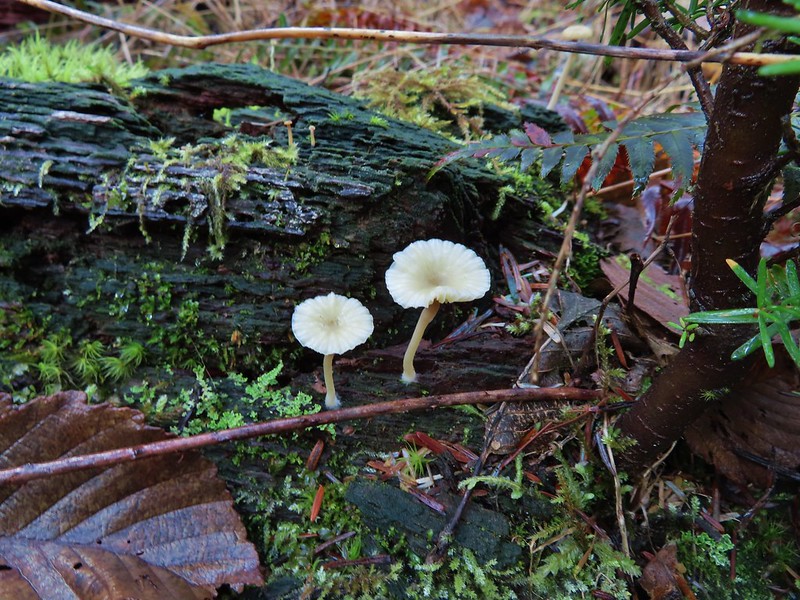
Mushrooms

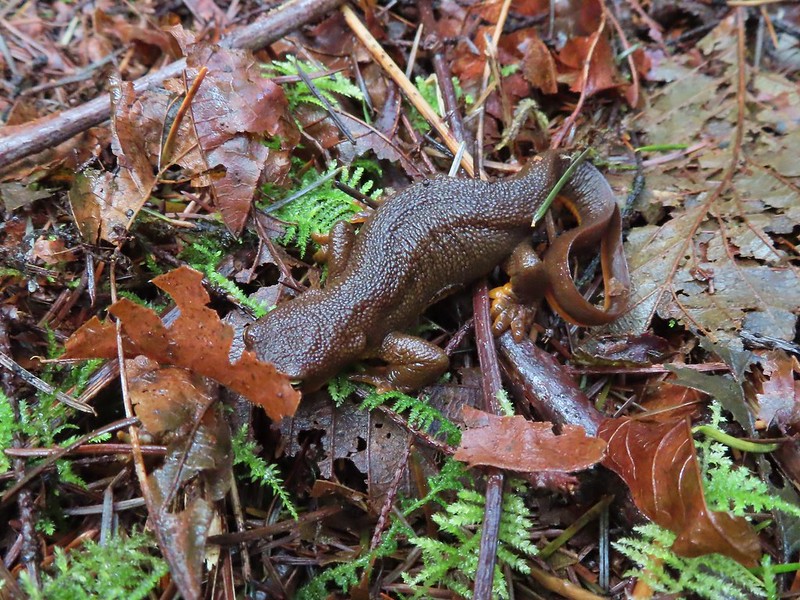
Rough skinned newtRough-skinned newt

A brief mist passed over but that was it and we enjoyed some bright blue sky as we finished up our outing.
North Fork Road

The hike came in at a little under twelve and a half miles with just over 500′ of elevation gain. We passed three anglers on the road on the way back and saw two more (their fishing line anyway) down on river. This was a great winter hike and a thoroughly enjoyable outing despite being entirely on roads. It just goes to show that it’s the not the surface but the surroundings that make a good hike. Happy Trails!

Flickr: North Fork Nehalem River

Categories
Coastal Range Hiking Oregon Trip report

Lost, Spruce Run, and Bloom Lakes – 09/26/2020

The tragic wildfires that claimed lives and wreaked havoc on several towns and communities had kept us home since Labor Day. Several forests and parks still remain closed but things have been slowly reopening and some much needed rain arrived to help slow the fires and clear the air. One of the forests that had reopened was the Clatsop State Forest between Portland and Seaside. Hike #12 in William L. Sullivan’s 4th edition “100 Hikes/Travel Guide Oregon Coast & Coast Range” consists of three short hikes to lakes in that forest. We had visited Soapstone Lake on a previous outing (post) With many forests and parks still closed due to the tragic wildfires that claimed lives and wreaked havoc on several towns it seemed like a perfect time to check out the other two lakes, Lost and Spruce Run. We also added nearby Bloom Lake whose trailhead along Highway 26 we’d driven by a number of times.

We began our morning at the Spruce Run Creek Trailhead at Henry Rierson Campground.
IMG_6161

The winds that had caused the fires to explode throughout Labor Day night had also toppled thousands of trees across the forests of Oregon so we we weren’t sure what conditions we might encounter. Nearly immediately after setting off on the trail we were met with a jumble of recently downed limbs.
IMG_6325

They were passable with care due to the slick condition of the wood which was damp from passing showers. Encountering this so early in the hike made us even more concerned about the conditions further on but as it turned out this would be the biggest obstacle of the day. There were a couple of downed trees which we simply stepped over and the rest was just smaller debris.

The Spruce Run Creek Trail began with a series of ups and downs, sometimes surprisingly steep, as it followed along Spruce Run Creek.
IMG_6166

It was a fairly dark morning as passing showers kept the Sun behind clouds but none of the showers lasted long nor were very heavy and the clouds breaking up made for some nice views.
IMG_6178

IMG_6183

IMG_6185

A little over a mile along the trail we were surprised to enter a recently logged area.
IMG_6190

The trail was in relatively good shape and easy to follow through this area.
IMG_6196

IMG_6201

Another small surprise came near the 2 mile mark where we expected to find a short spur trail on the left leading to Lost Lake Road. Instead we arrived at a newer logging road.
IMG_6209

IMG_6212

We momentarily wondered if we had somehow taken the spur trail without realizing it but after consulting the map it was clear that this was a new road and we were still on the Spruce Run Creek Trail. We turned right onto the road and spotted the continuation of the trail at a 3-way junction after 100 yards or so.
IMG_6213

We had actually planned on taking the spur trail to Lost Lake Road and hiking up that road 1.1 miles to Lost Lake instead of driving to the Lost Lake Trailhead after finishing our hike to Spruce Run Lake so at the 3-way junction we turned left. We followed this road downhill approximately .2 miles past a gate to Lost Lake Road where we turned right.
IMG_6215The open gate and Lost Lake Road from a logging road.
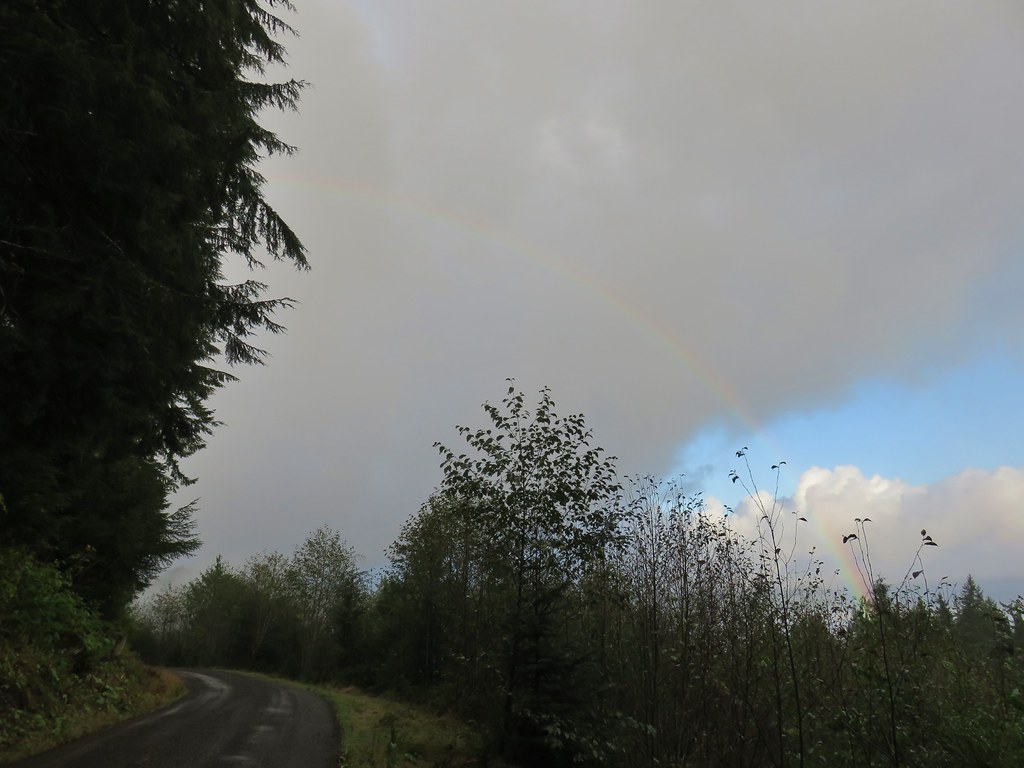
As we climbed up the road the alternating showers and blue sky created a nice rainbow behind us.
IMG_6218

IMG_6220

From the parking lot of Lost Lake we headed clockwise around the lake on a nice trail.
IMG_6228

There were several opportunities for views of the little lake along the 1 mile loop.
IMG_6232

IMG_6238

IMG_6240

IMG_6248

IMG_6249

IMG_6252

IMG_6253Hardhack

After completing the loop we returned on the roads to the continuation of the Spruce Run Creek Trail.
IMG_6255Spruce Run Creek Trail on the left.

The trail descended through logged forest for the next half mile before passing the timber sale boundary.
IMG_6261

IMG_6262

IMG_6264Leaving the logged area.

In another quarter mile we arrived at a pair of benches near the end of Spruce Run Lake.
IMG_6275

20200926_094603Rough skinned newt near Spruce Run Lake.
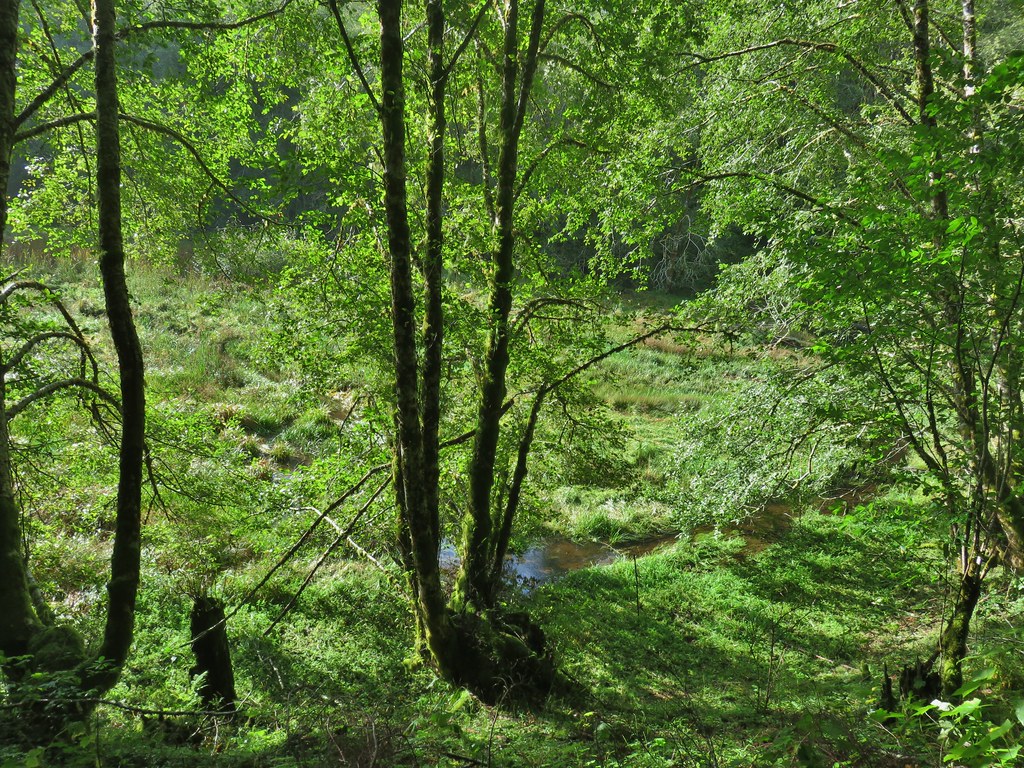
The lake was created by a landslide that backed up Spruce Run Creek. The water level fluctuates with the season and was little more than a pond at this point of the year.
IMG_6276

The rest of the lake bed was a marshy green meadow with Spruce Run Creek flowing through.
IMG_6277

IMG_6280One of many damp spider webs in the meadow.
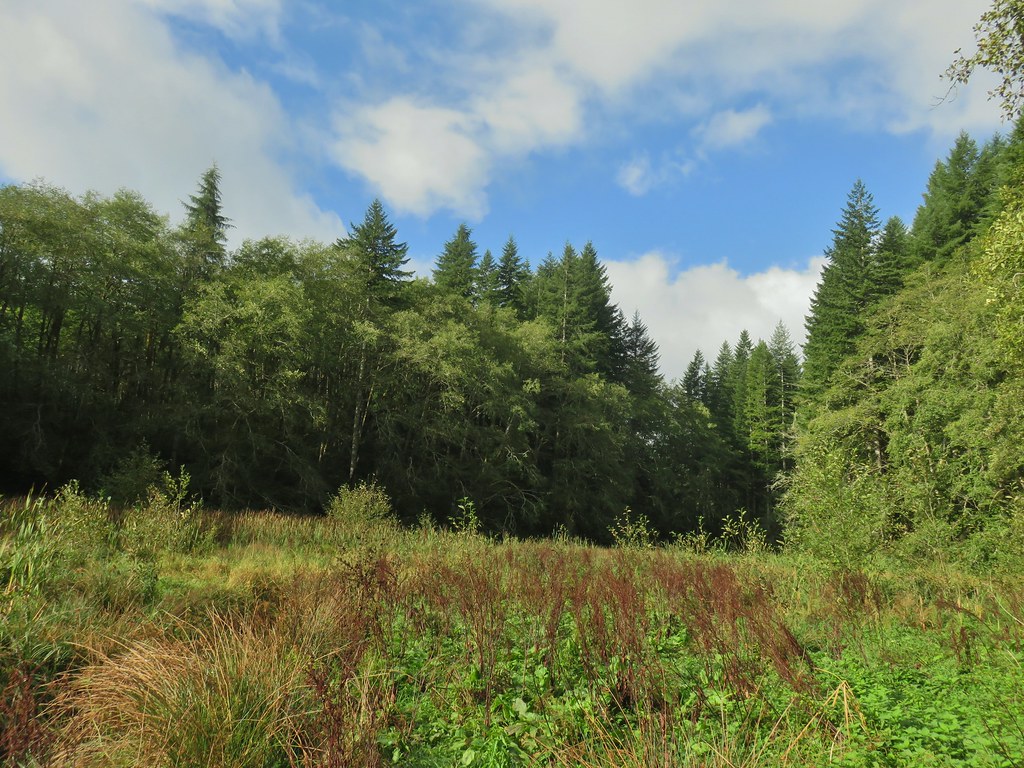
IMG_6283The meadow from the bank of Spruce Run Creek
After exploring the meadow for a bit we headed back to our car under increasingly blue skies.
IMG_6295

IMG_6296Bleeding heart

IMG_6299Scouler’s bluebell

IMG_6307A little butterfly

When we had passed through the logged area we got a better look at the forest along the first part of the trail now that it was lighter. It looked and felt like Autumn.
IMG_6309

IMG_6312

IMG_6316

20200926_111919

Combining these two hikes was a little over 9 miles with 1600′ of elevation gain. We drove back to Highway 26 and headed toward Portland stopping at the Bloom Lake Trailhead just west of the Quartz Creek Bridge for a final quick hike.
IMG_6330

The blue skies that we had enjoyed on the earlier hike were nowhere to be found at this trailhead even though it was only 3 miles from Spruce Run Lake as the crow flies. The heaviest shower of the day passed overhead as we crossed South Fork Quartz Creek on a footbridge.
IMG_6333

IMG_6334

Fortunately this shower was like all the rest had been, brief. The Bloom Lake Trail climbed along an old road cut for a mile to the start of a loop around little Bloom Lake. We stayed left at the fork and in another .3 miles crossed an inlet creek on a slick looking piece of wood.
IMG_6337

IMG_6340Fall means mushrooms start replacing wildflowers.
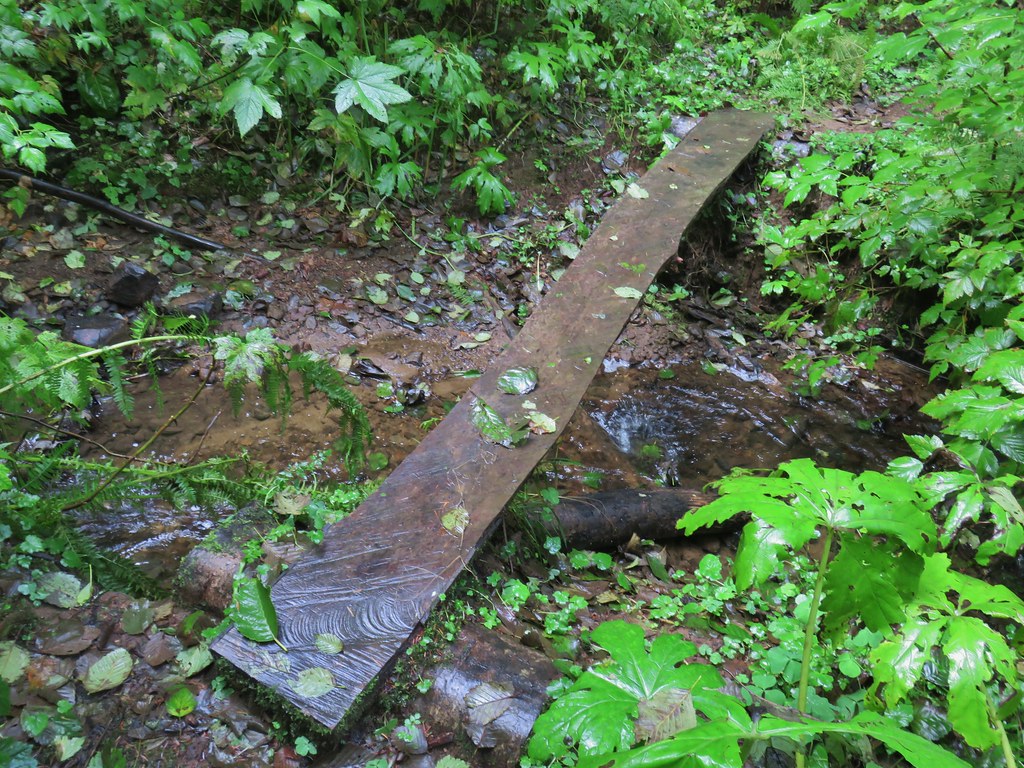
IMG_6345

Beyond the creek crossing we turned right another another old road bed then right again on August Fire Road (on which one can drive to Bloom Lake).
IMG_6346August Fire Road

We turned right off of this road at another old road bed that was blocked by cut tree trunks.
IMG_6348

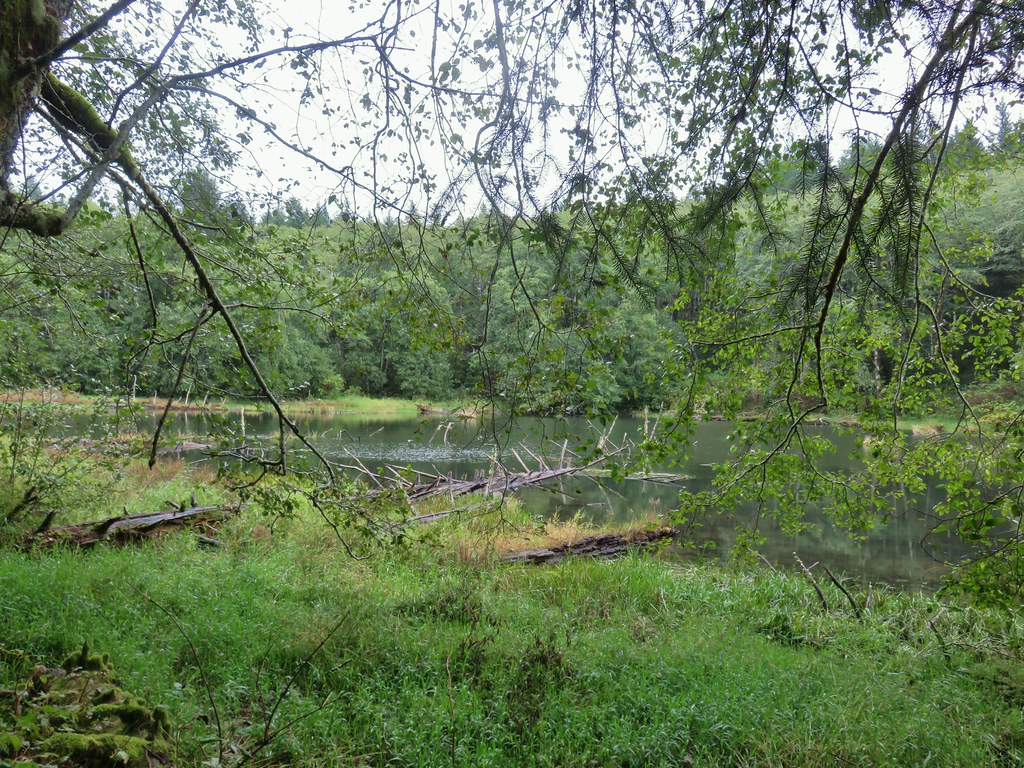
This led us down to Bloom Lake.
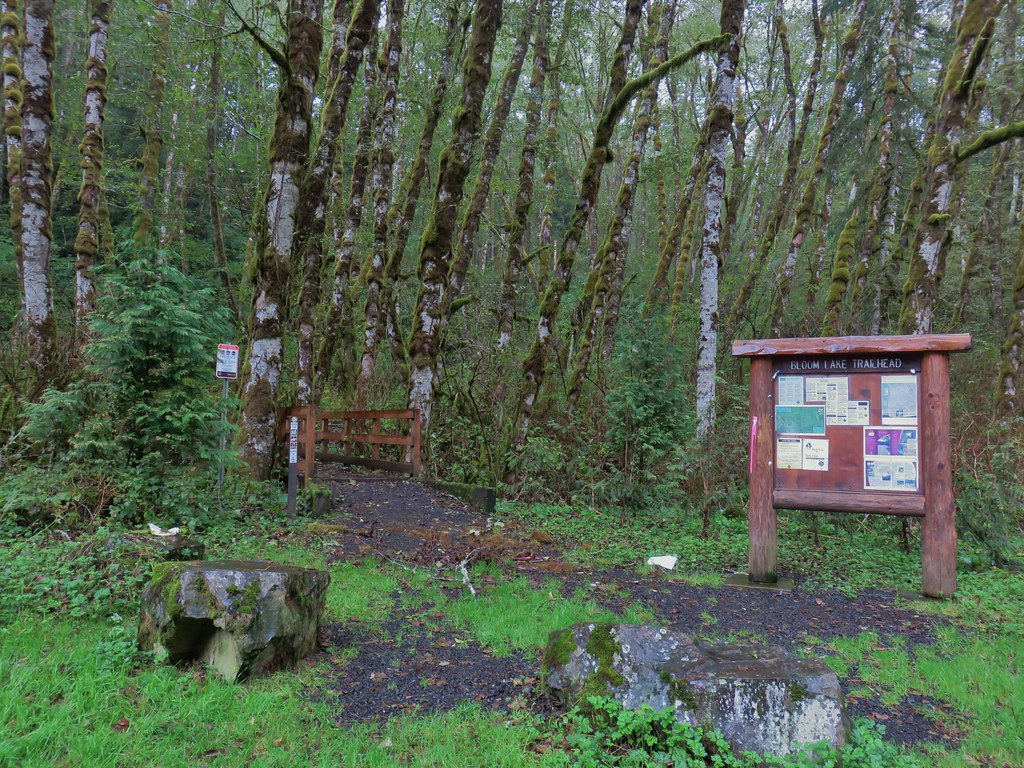
IMG_6349

IMG_6351

IMG_6356Snail near Bloom Lake.

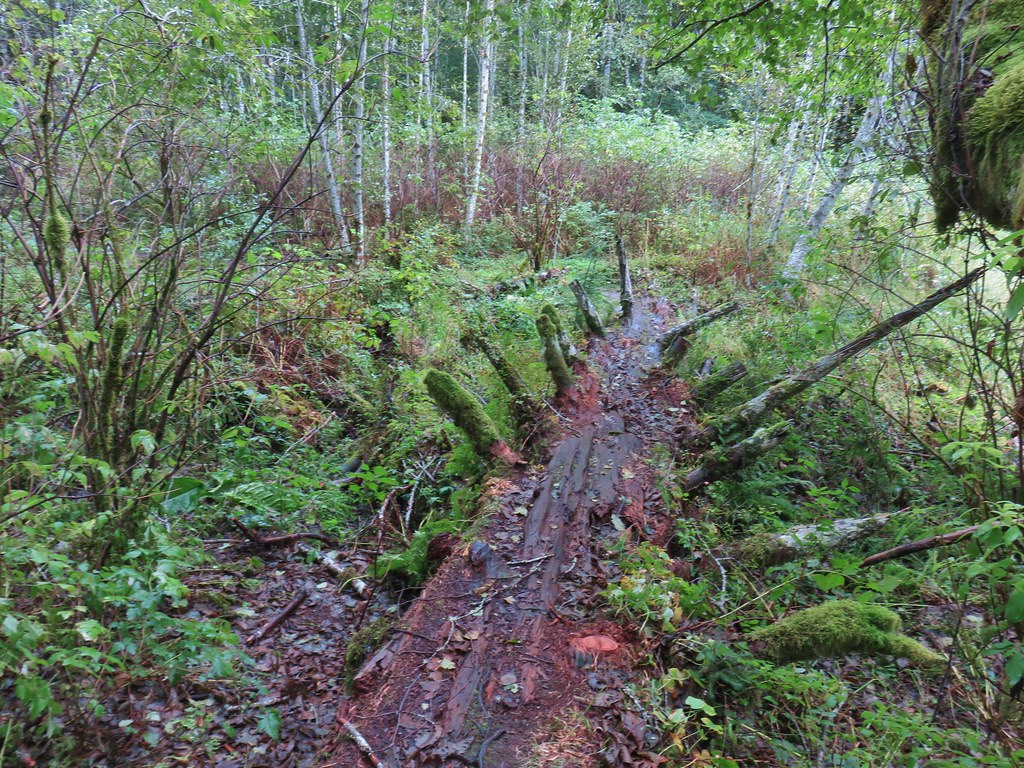
We continued around the lake on a trail which crossed the outlet creek on an old log.
IMG_6358

We completed the loop around the lake then headed back downhill to our car.
IMG_6366Mushrooms

IMG_6360More mushrooms

This hike was 3.2 miles with 675′ of elevation gain making our days tally 12.4 miles and 2275′. It was nice to get back out and this had turned out to be a good choice. Happy Trails!

Flickr: Lost, Spruce Run, and Bloom Lakes

Categories
Coastal Range Hiking Oregon Trip report

Little Luckiamute River and Valley of the Giants – 05/16/2020

***Please note that the access road was washed out in December 2023, and as of May 2024 there is no ETA to restoring access.***

As we continue to navigate this COVID-19 reality we decided to finally make an attempt at visiting the Valley of the Giants, a stand of old growth forest in the Coastal Range. Even though the Valley of the Giants is a featured hike in Williams L. Sullivan’s “100 Hikes/Travel Guide Oregon Coast & Coast Range” and we would need to complete this hike someday if we were ever going to complete our goal of hiking all 500 of the featured hikes (post) we had thus far avoided this hike for a two reasons. The first reason was that at only 1.5 miles long this hike violated our made up rule of not spending more time driving than hiking on a day trip. Despite only being 31 miles, as the crow flies, from our house  the drive to the trailhead would be around an hour and forty-five minutes.

The second reason was that we’d heard it was sometimes difficult to reach the trailhead if you could even find it at all. The area (and much of the Coast Range) is a checkerboard of public and private land with most of the private land being owned by timber companies and heavily logged. From time to time the timber companies close the roads used to reach the trailhead due to logging activity. The logging activity also means that there are often new roads or changes to existing roads that are not on maps making them unreliable.

With social distancing in mind we thought now was as good as a time as ever to finally give this hike a go. First we needed to make sure that the hike was indeed open so during the week I contacted the Northwest Oregon District Office of the BLM via email to confirm. They responded that same day saying that it was open and also attached two pdfs. One was a brochure for the trail as well as detailed driving directions and the second contained phone numbers for the timber companies to check on any potential closures they might have in place. We didn’t wind up calling the timber companies opting to just take the chance that the roads would be open.

With the hike being only 1.5 miles we also looked for some other options along the way and in the back of Sullivan’s book was an additional hike just outside of Falls City, which we would be driving through, along the Little Luckiamute River. He described the hike as an “easy mile and an additional 1.5 faint miles to a brushy clearcut”. The guidebook had us park at a locked gate at a bridge over the Little Luckiamute River along Blackrock Road.
Blackrock Road

IMG_3715Little Luckiamute River from the bridge.

The book then mentions crossing the bridge on foot and continuing up the road 200 yards to the trail on the left and shows the BLM as the land manager. When we walked up to the gate though we were met with posted signs from Weyerhaeuser stating that permits were required for all recreation beyond that point. We did walk up the road a bit to see if we could find the start of the trail to see if maybe the it was in fact on BLM land and it was only the road and possibly the land on the right hand side that was Weyehaeuser owned. Our Garmin appeared to show the location of the trail but we walked a little past where it was showing and never saw any signs of one so we quickly returned to our car. Heather had noticed another gated road just before the spot where we parked heading in the same direction that the trail on the opposite side of the river would have taken us so we walked over to it to check it out. There were signs here too but it wasn’t Weyerhaeuser land it was owned by Hancock Forest Management and they didn’t require permits for recreational use.
Informational signs at a gated logging road

We decided to hike up this road instead. We wanted to kill some time before heading to the Valley of the Giants because the Oregon Hikers Field Guide entry for the hike mentioned visiting between 8am and 5pm to avoid gates that might be opened and closed daily. It was a little before 6am when we’d discovered that our plan A was a no go so to kill enough time we set a 45 minute goal for hiking out along this road before turning around.
Logging road along the Little Luckiamute River

A quarter mile up the road we followed a well developed use trail down to the river.
Trail down to the Little Luckiamute River

Little Luckiamute River

Little Luckiamute River

SalmonberrySalmonberry blossoms along the river.

After checking out the river we continued up the road until we arrived at a 1.5 mile marker spray painted in orange on a stump. We were at almost 43 minutes and in the middle of an uphill climb so we decided that the marker was a good definitive turnaround spot.
Mile marker along the logging roadOur turnaround spot.

We returned the way we’d come arriving back at the car close to 7:20. Even though it wasn’t the trail that we’d planned on hiking this was a pleasant little hike and probably very similar to what we would have seen on the trail itself. There were a number of different flowers, slugs, a snail, a millipede, and a rough skinned newt along the way not to mention the sounds of the river and lots of signing birds.
Logging road along the Little Luckiamute River

Cinquefoil and youth-on-ageCinquefoil and youth-on-age

Snail

Small creekOne of several little creeks along the road.
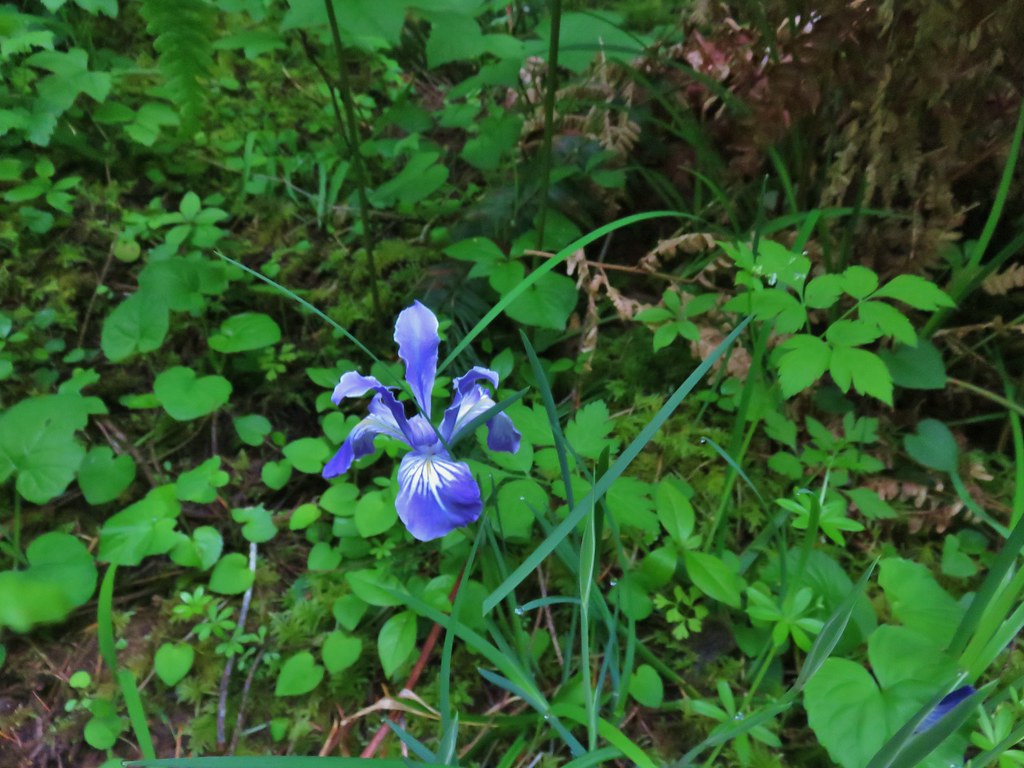
IrisIris

FairybellsFairybells

Forest along the Little Luckiamute RiverForest along the road.

Bleeding heartBleeding heart

Rough skinned newtRough skinned newt escaping into the grass.

LupineLupine

ColumbineColumbine

We drove back into Falls City and stopped at a viewpoint along Parry St. to check out the Falls City Falls.
Falls City Falls viewpoint

Unfortunately you can’t get a good look at the waterfall from this side of the river and it wasn’t any apparent access on the opposite side where a clearer view could have been had.
Little Luckiamute RiverLittle Luckiamute above the falls.

Falls City FallsFalls City Falls

Falls City FallsLower end of Falls City Falls.

That quick stop killed a little more time before we began our quest for the Valley of the Giants. The entry in the Oregon Hikers Field Guide for the trailhed begins with “Here follows one of the most convoluted approaches to a trailhead you will ever endure:”. We were primarily using the BLM directions with Sullivan’s being secondary. (All three provided similar directions although they were worded differently.) The trailhead was 31.5 miles from the Falls City Post Office with all but the first .6 on gravel roads. As crazy as the directions appeared the drive turned out to be fairly straight forward. The directions were spot on and we found that at many of the intersections the BLM had pointers for VOG.
BLM pointer for the Valley of the Giants

We weren’t expecting to see these pointers and aren’t sure how new they might be (or how long they will last given some peoples penchant for causing mischief) but they proved to be very helpful.

The roads had a few potholes but were in relatively good shape and passable for lower clearance vehicles. The scenery alternated between the bleak landscapes of clearcuts and beautifully green forests surrounding the South and later North Forks of the Siletz River.
South Fork Siletz RiverSouth Fork Siletz River along Valsetz Road.
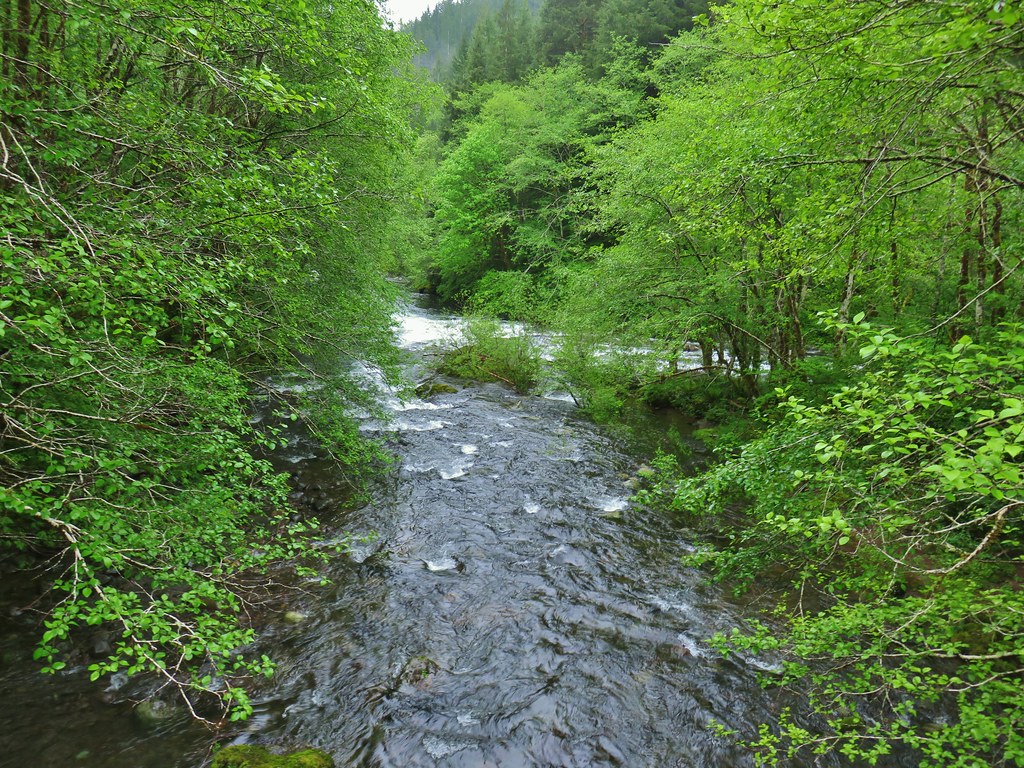
Confluence of the North and South Fork Siletz RiversConfluence of the North and South Forks of the Siletz River.

North Fork Siletz RiverNorth Fork Siletz River.

The route also took us past the historical site of Valsetz, an unincorporated community and timber company town. In 1983 the timber company announced the halting of operations there and in 1984 all structures were removed leaving just some foundations. We drove by the foundations but didn’t stop due to some sort of gathering occurring (which we were pretty sure wasn’t within the current COVID-19 guidelines).

An hour and fifteen minutes after passing the Post Office in Falls City we arrived at the Valley of the Giants Trailhead.
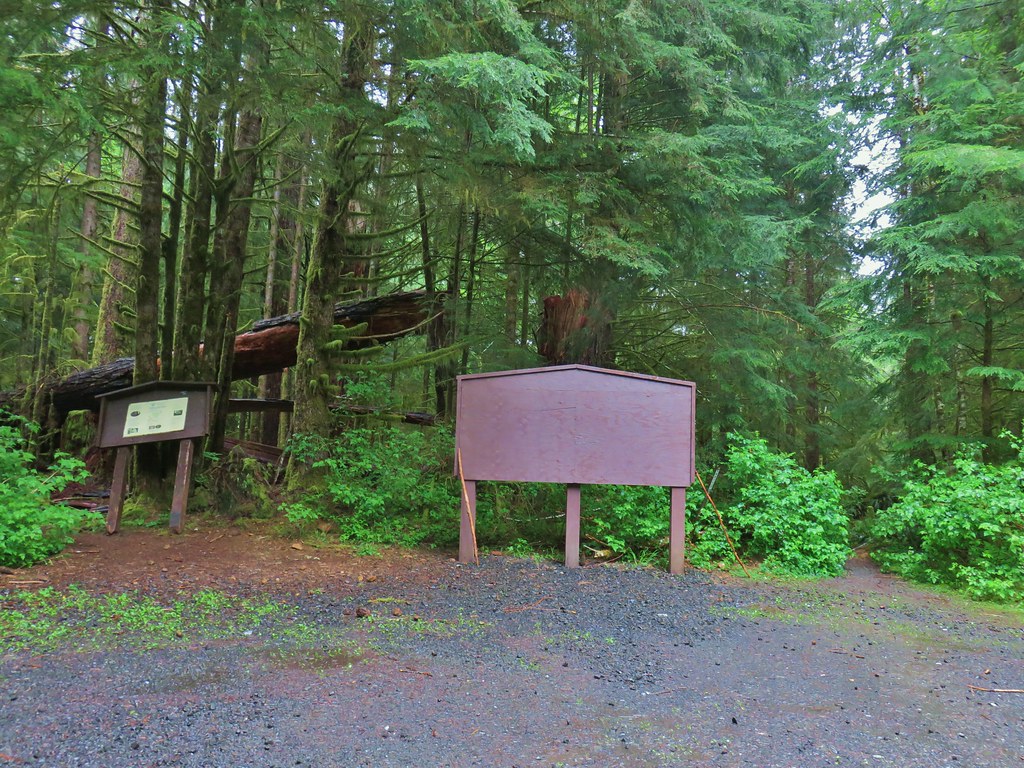
Valley of the Giants Trailhead

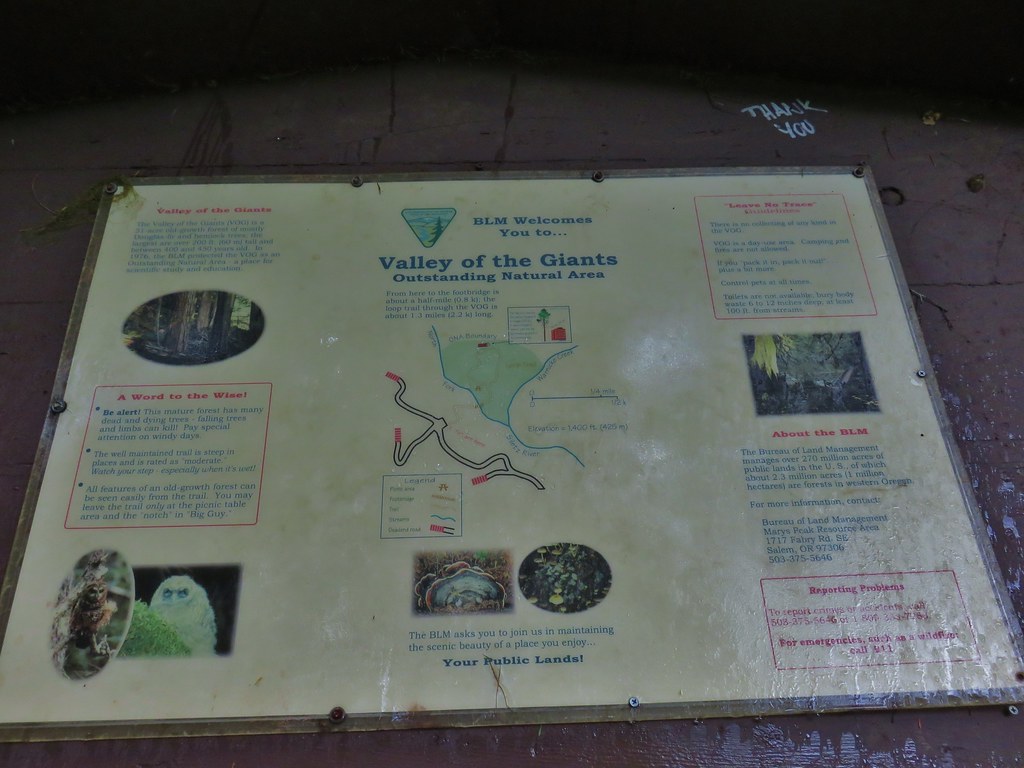
A signboard at the trailhead provided a brief history and a map of the 51 acre area.
Interpretive sign at Valley of the Giants

We followed the trail downhill to a footbridge over the North Fork Siletz River.
Trail at Valley of the Giants

Bleeding heartBleeding heart

FairybellsFairybells

Star-flowered slomonseal and false lily of the valley getting ready to blossomStar flowered solomonseal and false lily of the valley getting ready to bloom.
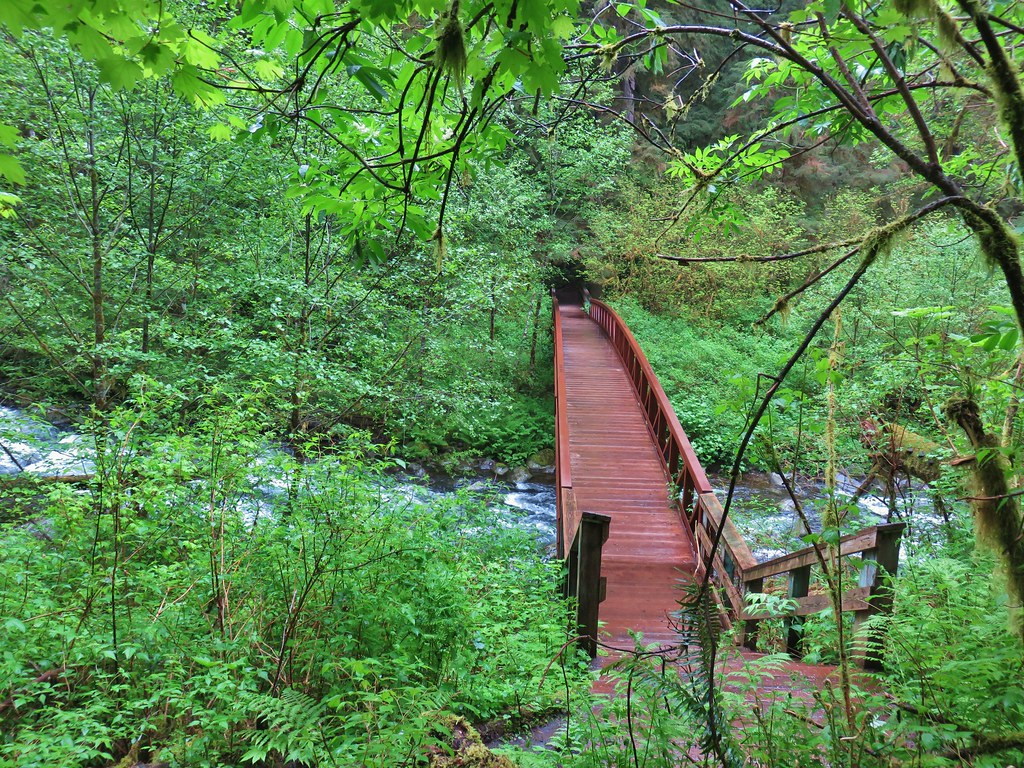
Footbridge over the North Fork Siletz River

North Fork Siletz River

North Fork Siletz River

At the far end of the footbridge was a lone picnic table.
Picnic table at the Valley of the Giants

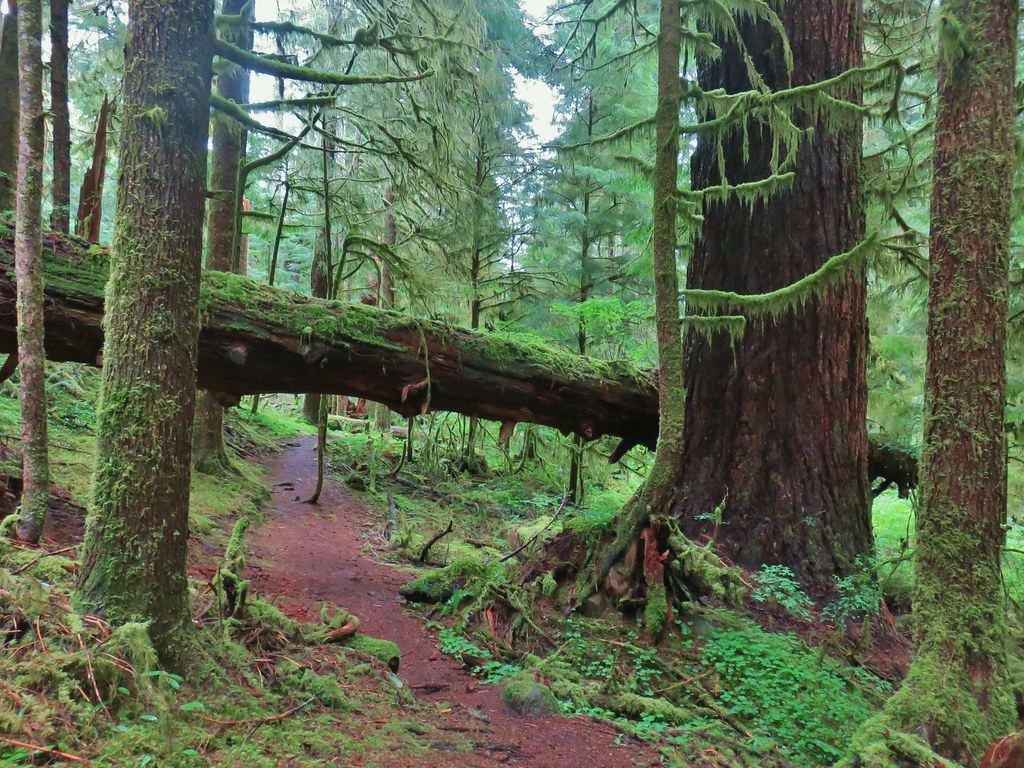
The trail climbed a bit to the start of a .7 mile loop which itself climbed approximately 160′ to the “Big Guy”, a huge Douglas Fir that fell in a 1981 storm. At that time the tree is believed to have been 230′ tall and approximatley 600 years old.
Trail at Valley of the Giants

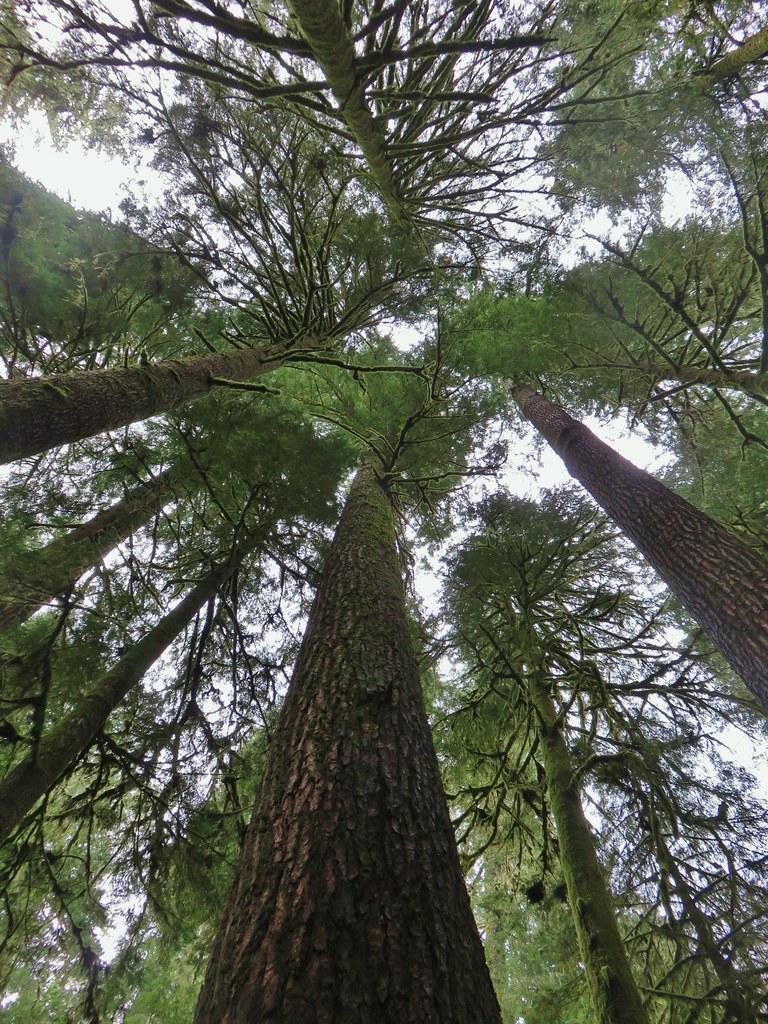
Valley of the GiantsOld growth giants.

Valley of the GiantsAnother huge Douglas fir.

Valley of the GiantsStanding among the giants.

FernsUnfurling ferns.

“Big Guy”

Standing in between a cut in “Big Guy”. For reference I am a little under 5’9″.

Bench at “Big Guy”

Beyond “Big Guy” the trail descended back down to the start of the loop.
Trail at Valley of the Giants

Oregon grapeOregon grape

Old growth at Valley of the Giants

TrilliumThe only trillium we saw all day that still had any petals.
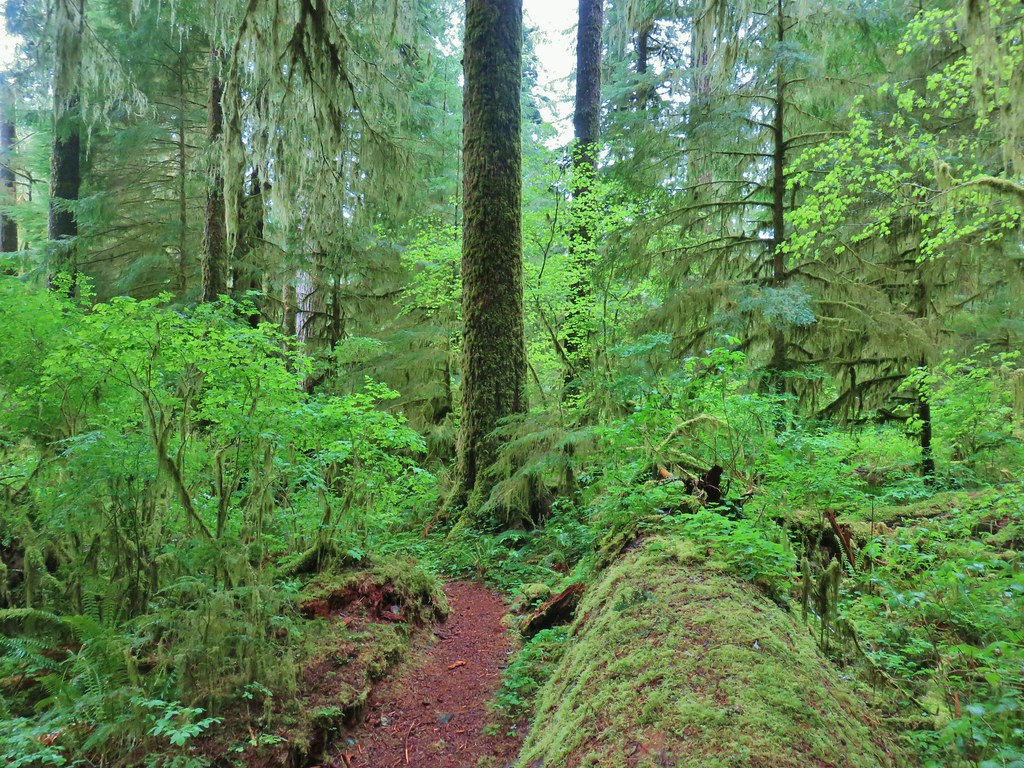
Old growth at Valley of the Giants

Valley of the Giants

We returned to the trailhead to find a second car there now and the only other hikers we’d seen that day. We chatted with them for a bit (from over 6 feet away). His grandfather had been working at Valsetz when it was shut down so he had spent time there as a child and all around the area.

Driving back past the clear-cuts after having just visited the pocket of old growth just reinforced how important it is to us to protect any wild areas lucky enough to have yet been spared from development or resource extraction. There are not that many of them left and those that aren’t yet protected deserve to be. Happy Trails!

Flickr: Little Luckiamute River and Valley of the Giants