We hadn’t managed to get out on an overnight backpacking trip in 2024 due to a combination of weather, fires, and being focused on finishing our goal of hiking at least part of 500 of William L. Sullivan’s featured hikes in his “100 Hikes” guidebook series (post). We’re now down to having just one featured hike left which we are planning to do as an overnight trip. We have that planned for September so we thought it would be a good idea to break out our backpacking gear for a test run first.
We chose the Puck Lakes in the Sky Lake Wilderness as our destination. These lakes are actually part of one of Sullivan’s featured hikes, but we had missed them due to having started at the Cold Springs Trailhead when we completed part of that hike (post). On that trip we’d combined his featured hike from that trailhead with a loop around Luther Mountain which Sullivan listed as an option for the featured hike from the Nannie Creek Trailhead. Starting at the Nannie Creek Trailhead would allow us visit the Puck Lakes and complete the remainder of Sullivan’s “Sky Lakes via Nannie Creek” hike. With the Puck Lakes being under 2.5-miles from the trailhead they provided a relatively short hike in with our full backpacks, then we could continue on to the Snow Lakes Trail and Margurette Lake which had been part of our loop during our earlier trip.
It was a 4-hour drive to the trailhead from Salem, so we got a later start than we normally would. It was a little before 9am when we set off and already warming up quickly. The forecast was for temperatures at the Puck Lakes to push 80 degrees Fahrenheit.

The Nannie Creek Trail gradually climbs for the first 1.6-miles making good use of switchbacks to keep the trail from ever feeling steep.

 There were hundreds of dragonflies along the trails which were much more welcome than the mosquitos that are a problem here in July and early August.
 The trail entering the wilderness.

After gaining approximately 500′ of elevation the trail leveled out for a bit before descending 100′ to the Puck Lakes.
 To the left through the trees is Mt. McLoughlin (post).

 The currently dry outlet creek of South Puck Lake.
 South Puck Lake from the Nannie Creek Trail.
Just under 2.5-miles from the trailhead we turned right toward South Puck Lake at an unsigned junction with the former Puck Lakes Trail.
 Someone had taken it upon themselves to craft their own sort of sign for the Puck Lakes Trail.
The Puck Lakes Trail has long since been abandoned but at one time it had covered around 6.5-miles connecting the Nannie Creek Trail and Sevenmile Trail (post). We followed this trail a little over 200′ to South Puck Lake then continued around the western side of the lake looking for a suitable campsite.


 The southern end of the lake was closed to camping for site restoration.
 South Puck Lake
 Use trail around the lake. The alignment of the former Puck Lakes Trail is further back from the lake.
 Two of three common mergansers that seemed to be calling the lake home for now.
 Our campsite for the night.
We appeared to be the only ones currently at the lake. We’d passed a couple hiking out shortly after starting our hike who mentioned that there had only been one other person at the lake the night before, and then a little later that gentleman passed us. With it being Labor Day Weekend we suspected that the privacy wouldn’t last, but it was an encouraging sign that maybe it wouldn’t be too busy. After getting camp squared away, and starting a list for Hidden Lake of things that we had forgotten, we returned to the Nannie Creek Trail and continued toward the Snow Lakes Trail.
The Nannie Creek Trail made a small climb over the first 0.9-miles from the lake then began a mile long, 400′ descent to the Snow Lakes Trail.

 Just after the trail began its descent it crossed a talus field.
 Mt. McLoughlin behind Luther Mountain.
 Shale Butte and Lucifer Peak (double hump is Lucifer).
 Pelican Butte straight ahead with peaks in the Mountain Lakes Wilderness (post) behind to the right.
 A faint Mt. Shasta through the haze.
 Agency Lake
The trail made a couple of switchbacks through the shale before reentering the forest where we began to encounter a fair amount of blowdown.


 A good representation of the trail conditions between the talus slope and the Snow Lakes Trail. Nothing was overly problematic, but it did mean more effort on our part which in turn made it feel even warmer.
 Rock cairn marking the junction with the Snow Lake Trail.
 Looking back at the hillside we’d descended.
We turned left onto the Snow Lakes Trail and followed it a little under 2-miles to a trail junction between Margurette and Trapper Lake. We were familiar with this trail having hiked the first 1.4-miles as part of our loop around Luther Mountain.

 One of several grouse that crossed the trail in front of us.
 Entering the fire scar from the 2014 “790 Fire”.
 Northwestern Rabbit-tobacco
 Martin Lake
 Pair of Lewis’s woodpeckers.
 One of the Snow Lakes below Luther Mountain.
 One of the Snow Lakes.

 After 1.4-miles we came to a junction with the Donna Lake Trail on the left. (Deep Lake is the lake visible below through the trees.) We’d turned down that trail on our previous visit, so we stayed right this time.
 One of several small, unnamed, bodies of water between the Donna Lake Trail junction and Margurette Lake.
 Blue beetle

 Hardhack
 Margurette Lake
Unsurprisingly there were several people at Margurette Lake so instead of taking our break there we turned left at the junction with the Sky Lakes Trail and continued on.
 Margurette Lake
 Coming up on the junction.
 The Sky Lakes Trail.
This trail descended for 0.2-miles past the end of Trapper Lake to a junction with the Donna Lake Trail.

 Trapper Lake
 The Donna Lake Trail to the right.
We turned up the Donna Lake trail and climbed gradually for a quarter mile to Donna Lake.

 Donna Lake
We didn’t see a shaded spot at Donna Lake where we could take a comfortable break, so we continued another tenth of a mile to Deep Lake.


 Luther Mountain from Deep Lake.
There were several unoccupied campsites at Deep Lake, and we picked one with some shade to set up our chairs and finally take a break.
 Tiny western toad
It was a lot warmer than we’d have liked so we spent over ninety minutes resting and refilling our water supply. We had considered cooking our dinner there as well, but another pair of backpackers came along, and we didn’t want to be prepping food anywhere near where others might be camping. We left deep lake a little after 3:30 and continued on the Donna Lake Trail to the Snow Lakes Trail.
 Signs of Fall.
 Lousewort
There was a slight chance of showers/thunderstorms between 5PM and 11PM and it had begun to cloud up while we were at Deep Lake. The clouds continued to build as we made our way back along the Snow Lakes Trail.

 Young grouse


 Martin Lake
 Back at the Nannie Creek Trail junction.
We had been looking for an open flat area where we could stop to cook dinner but didn’t have any luck until we’d traveled 0.4-miles back along the Nannie Creek Trail. After eating our Mountain House yellow curry we began the climb back up through the talus slope.

The cloud cover had increased even more which helped keep the heat from feeling too oppressive.
 It was increasingly looking like a shower or two might happen.
 A deep zoom in at Mt. Shasta.

We returned to the trail to the Puck Lakes and after a brief stop at camp we continued on to visit North Puck Lake. We were surprised to find that we were still the only people at the lakes.

 Pine white

 Spotted sandpiper

 The three resident mergansers.
 The abandoned Puck Lakes Trail.
 A dark cloud passing over the Puck Lakes (no rain).
 North Puck Lake
 North Puck Lake
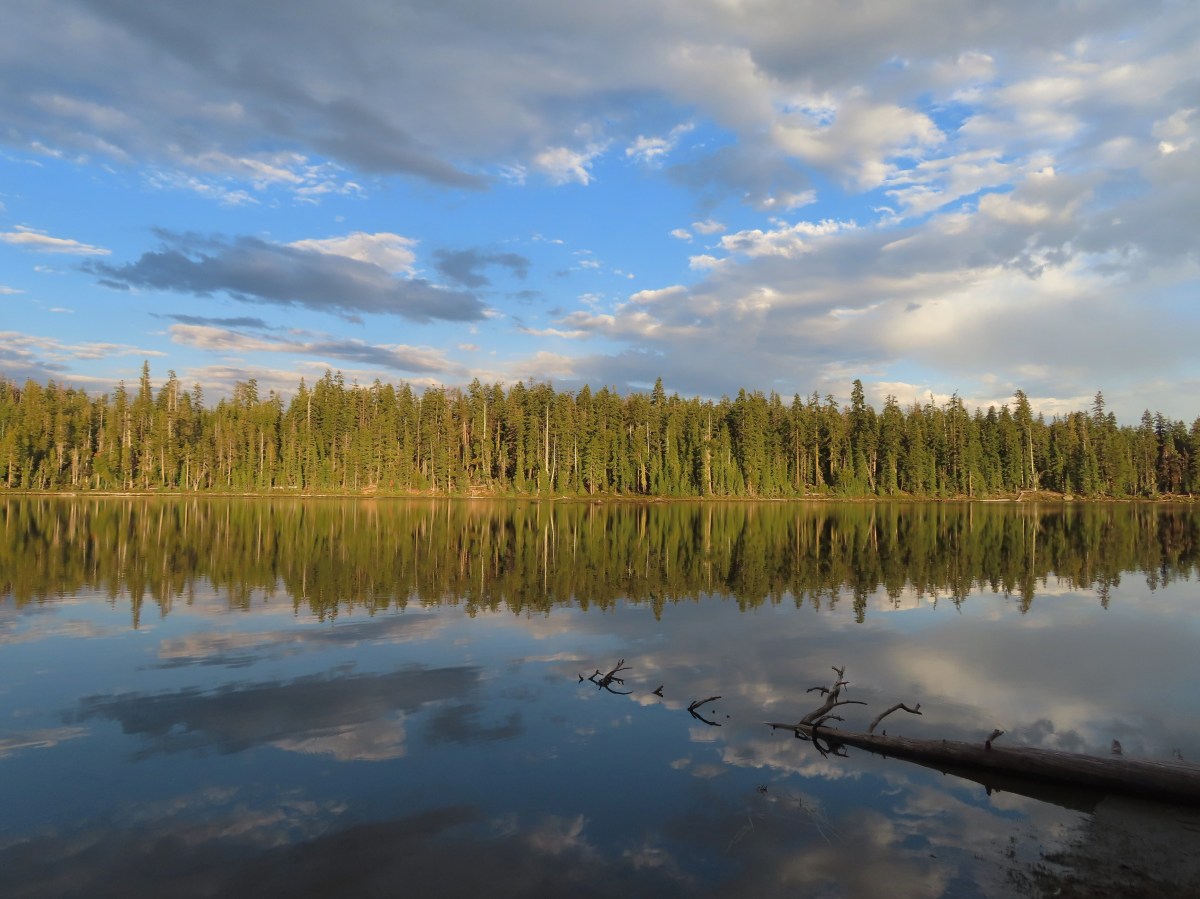
After visiting North Puck Lake we headed back to camp and enjoyed the views that the still water and passing clouds created.


We turned in hoping to get a good night’s sleep, but neither of us had much luck for the first few hours. It was still a little too warm to be comfortable, but we eventually dozed off. It didn’t rain and we never heard any thunder which we were thankful for.
I woke up a little after 4am (that counts as sleeping in for me) and started prepping for our hike out. Heather got up about 5am and did the same.
 Heather in the tent packing up.
 A sliver of the Moon reflecting in the lake at 5:48am.
 6:06am
 North Puck Lake at 6:22am as we set off.

 Luther Mountain from the Nannie Creek Trail in the morning.
We arrived back at the trailhead at 7:45am.

Day one of our trip came in just under twelve miles with a little over 1500′ of elevation gain. Day two was just 2.7-miles with less than 150′ of elevation gain.
 Dark blue = day one, magenta = day two, light blue = previous visit.
This was a good test run for our first backpack this year. The heat made it much more challenging than it should have been and provided a good reminder that we’ll need to carefully consider that before heading to Hidden Lake later this month (hopefully). We were also able to make a list of things that we forgot to bring with us so we won’t forget them for that trip. Finally, it gave us a chance to try out our new water filtration system, the Sawyer Squeeze, which has replaced the pump filter that we previously used. Happy Trails!
Flickr: Puck Lakes Backpack


 Map at the trailhead signboard and wilderness permit station.
 Trail sign at the split of the East and West Fork trails.

 Trail sign for the East Fork Wallowa Trail at a junction with a gravel road.
 Ghost pipe
 Entering into the Wallowa-Whitman National Forest.

 Chief Joseph Mountain and Wallowa Lake
 I never saw any but I heard a number of pikas in the rock fields.
 Switchback
 Rock clematis seed heads.
 Bridge at the upper end of the access road that I had passed earlier.
 The lower section of the waterfall from the bridge.

 The access road bridge from the switchback.
 East Fork Wallowa River Forebay
 Interpretive sign at the forebay.
 Aster
Aster The trail entering the

 Elderberry and baneberry
 Zoomed in photo.
 Small meadow along the trail.
 Aneroid Mountain in the distance.
 Mountain larkspur
 Pika underneath some raspberries.
 Pika
Pika A few lupine were still blooming along the trail.
 Doe in a small meadow along the trail.
 Tall mountain bluebells
 The damaged footbridge.


 East Fork Wallowa River
 The inbound and outbound forks rejoining.
 East Fork Wallowa River flowing through a meadow along the trail.
 Goldenrod
 Unnamed creek crossing.
 American sawort
 Another doe in a meadow.
 A hazy view of Aneroid Mountain.
 Pearly everlasting along the trail.
 East Peak (
 A closer look at East Peak.


 The benches.
 Groundsel along the trail.
 A boat docked on the lakeshore in the distance.
 An inlet creek to the lake near the boat dock.
 East Peak from Aneroid Lake.


 Signs for Camp Halton at the actual junction with the East Fork Wallowa Trail.


 Hammond’s flycatcher
 East Peak
 Lewis monkeyflower
 Aneroid Mountain
 Pollinator on a flower.
 The split trail.
 The outbound trail dropped quite steeply before meeting back up with the inbound trail.
 The damaged bridge from the other side.
 Fritillary butterfly
 A comma butterfly
 Golden-mantled ground squirrel
 Mount Howard
 Coneflower
 Wallowa Lake
 Quaking aspen
 Arriving back at the trailhead.


 The trail passes through the Shady Campground.
 Lostine River
 Unnamed creek crossing.

 Thimbleberry
 One of the switchbacks.
 Climbing into the sunlight.
 Possibly a Cassin’s vireo.
 Another switchback.
 Fireweed
 Monkshood
 Twisted stalk
 Eagle Cap (
 Looking down from the trail.
 Paintbrush
 Chipmunk
 The trail turning uphill ahead to start the steep climb.
 Meadow along a brief section of reasonably graded trail.
 Nuttal’s linanthus


 The pass in view.
 Twin Peaks to the left over the shoulder of the ridge.
 The trail down to Maxwell Lake.
 Ground squirrel on alert.
 Maxwell Lake

 Aster along the outlet creek.
 Gentians
 Island in Maxwell Lake.
 The view from the granite outcrop.
 Looking back at the pass from the outcrop.
 Last of the snow at Maxwell Lake.
 Trail along Maxwell Lake.
 Trail to Jackson Lake.
 Jackson Lake
 False hellebore
 Pika raising a warning call. Interestingly the pikas in the Wallowas make a sound that we don’t recall hearing from pikas in other areas. It was almost as if they had their own regional dialect.
 Passing back over the granite outcrop.
 Maxwell Lake’s outlet creek.
 Trout in the outlet stream.
 One last look at Maxwell Lake.
 The view from the pass on the way back.
 Heading down the steep section.
 The afternoon lighting on the ridge across the Lostine River really brought out the colors.
 Eagle Cap way up the valley.
 Heather counted at least seven significant drops on a creek cascading down the far hillside.
 Fritillary
 Canada jay
 Police car moth
 Back at the bridge over the Lostine River.
 Lostine River
 The Maxwell Lake Trailhead in the afternoon.


 The trail entered the

 Lewis monkeyflower
 Eagle Cap (
 Chipmunk
 One of the switchbacks.
 Western tanager
 Pearly everlasting
 Paintbrush
 Baneberry
 Pika
Pika
 Bowman Creek
 Grass of parnassus
 The trail crossing Bowman Creek.
 Arnica
 Monkeyflower
 Bees on American sawort.


 Golden-mantled ground squirrel
 Another pika.
 Elderberry
 The lefthand fork led to a campsite and meadows in the basin.
 Gentians
 Meadow in Brownie Basin.
 The junction with the Chimney-Wood Trail.

 One of several pine siskins that were in these plants.
 Aster
Aster
 Fritillary
 Lupine and aster
 Butterfly on pearly everlasting

 Another western tanager.
 Gentians and St. Johnswort
 Lower Laverty Lake
 A patch of fireweed above the lake.
 Hooded ladies’-tresses
 American kestral
 Lower Laverty Lake
 Twin Peaks across the Lostine River valley.
 Eagle Cap at the far end of the valley.
 Heading for Chimney Lake.
 Chimney Lake
 Gentians along the lakeshore.
 The rocks ahead where we took our break.
 Islands in Chimney Lake.
 No matter how cute they are, please don’t feed the wildlife (
 Sulphur butterfly
 We heard more pikas than we saw. Here is the one, blurry, photo I managed to get.
 Milbert’s tortoiseshell
 Golden-mantle managing to feed itself.
 Twin Peaks
 Aster
Aster
 California tortoiseshell
 Grouse
 A comma, possible green comma.
 Back at the bridge over the Lostine River.
 Lostine River in the afternoon.


 This pointer refers to trail 1880 as “Pine Creek” but other signs and the Forest Service website refer to it as “Pine Lakes”.
 This one says Pine Lakes.
 Sign for the Packstation.
 Squirrel with breakfast at the packstation.
 Old footbridge over a dry creek bed. It didn’t look particularly safe so I stuck to the road.
 The dry creek bed crossing.
 Black cows on the trail ahead.
 Coneflower
 Snowberry
 West Fork Pine Creek
 Formation on the hillside.
 Western clematis
 Paintbrush
 Fireweed
 The bridge felt stable despite being slanted at a 45-degree angle.
 View from the trail.

 The second bridge.
 West Fork Pine Creek
 Heather caught this cool cloud from her currently cow free hike. (She would run into them later where they’d ducked off the trail in front of me.)
 Looking back down at the campsite.
 The use trail straight ahead at the switchback.

 The base of Chute Falls.


 Looking back down the valley.
 View up the valley.
 Wilderness sign on the tree marking the boundary.
 The Pine Lakes are back up there somewhere.
 Somewhere on the other side of the peaks on the left is the Schneider Cabin where we’d hiked the day before.
 Cliffs above the trail.
 I spy mountain goats!
 A zoomed in photo of the mountain goats.


 I believe that is Cornucopia Peak on the left.
 Going up.
 Fireweed above the trail.
 Paintbrush along the trail.
 The forest on the other side of the pass.
 West Fork Pine Creek
 There was a large waterfall flowing down from the outlet of the Pine Lakes. (Not West Fork Pine Creek whose headwaters were beyond the meadowed basin.
 West Fork Pine Creek begins somewhere above the basin at the far end.
 Rock formations along the cliffs.
 Arnica and pearly everlasting
 I tried to get a clearer look at the large waterfall but couldn’t find a clear line of sight.

 Gentians along the trail.
 Evidence of an avalanche at the far end of this meadow. It took a lot of trail maintenance to clear the snapped trees from the trail.
 Wildflowers lining the trail.
 A doe that turned out to be on the trail above me. There was a switchback just ahead of where I was.


 The forest in the basin.
 The Pine Lakes are in the basin ahead.
 Arnica and aster?
 Monkshood
 Seep along the trail.
 Grass of parnassus
 American sawort
 Something had been bedded down in this little bowl below the trail.
 Goldenrod
 The valley I’d come up to the right.
 Nearly 5-miles from Chute Falls I arrived at the dam at the outlet of Lower Pine Lake. A number of lakes in the Wallows were dammed to control water flow to the surrounding communities.
 Lower Pine Lake

 Lower Pine Lake
 Lower Pine Lake from between the two lakes.
 Upper Pine Lake from the same spot.
 Upper Pine Lake.


 The view from my break spot.
 Shrubby cinquefoil
 White mariposa lily, the only one I spotted, and I’d missed it on the way up.
 Yellow columbine, I also missed this on the first pass.
 Dusky flycacther
 A meadow and the forest in the lower basin.
 Fritillary on pearly everlasting
 Trail maintenance in the avalanche section.
 Loved the rock colors in the area.
 I’m guessing some sort of wren.
 Caterpillers
 Herding the cattle back past the damaged bridge.
 West Fork Pine Creek.
 The footbridge across the East Fork Pine Creek ahead. We’d left the cows behind here and made our way back to the trailhead.


 Smoke rising from the Town Gulch fire to the south.
 Scarlet gilia
 Paintbrush
 Town Gulch Fire
 Penstemon
 Pearly everlasting and aster
 Big Lookout Mountain
 Summit Point Lookout from below.
 At the 0.7-mile mark the Cliff Creek Trail split off to the left while FR 7715 continued right.
 Cornucopia Peak
 The Summit Point Lookout with the Town Gulch Fire behind the forest below.


 The Elkhorn Range (
 The Elkhorns
 Finch
Finch The trail crossed a fence at the southern end of Little Eagle Meadows.
 Little Eagle Meadows and Cornucopia Peak.
 The wilderness sign in the distance.
 Birds on a wire.
 The views along the trail were amazing. In later July there is also a plethora of wildflowers along the route.
 Trail marker
 Ground squirrels
 We veered right here but had to be careful not to follow one of the many cow trails leading off into the meadows. Our GPS maps were helpful.
 Looking back up the hillside.
 Dry pond along the trail.
  Savage Peak is the round peak at the center.
 Heading toward Cornucopia Peak.
 The cabin was visible in the distance at times from the trail.
 Yarrow along the trail.
 Green around a small stream.
 The Schneider Cabin
 Cow at the cabin.


 View from the loft.

 Summit Point from the cabin.
 Summit Point Lookout
 Torn up trail tread.
 Cricket
 Tree full of mountain bluebirds.
 Arriving back at the fence.
 Hawk
Hawk Northern flicker
 Butterflies on Greene’s goldenweed.
 Fritillary butterfly
 Becker’s white
 Smoke from the Town Gulch fire.
 Insect on chicory.
 Arriving back at the trailhead.


 Memorial to pioneers dedicated by President Harding in 1923.


 The Cabin Loop sign pointed up this hill.
 Thistle
 Foam flower
 Coneflower
 There were virtually no signs to indicate what any of the trails were or where they led.
 We had to duck under this tree.
 Mountain lady slippers that had bloomed many weeks ago.
 Pearly everlasting
 Paintbrush
 Thimbleberries
 Aster
Aster It was hot (pushing 90 Fahrenheit) which made the climbing less enjoyable.
 This was most likely the Nature Trail rejoining from the left.
 Not sure if this is native or invasive.
 Wedding set up behind the Community Building.
 Bee on fireweed.
 Horse Camp


 Gooch Falls
 The road widened briefly near the pullout that acts as the trailhead.
 Delicious red huckleberries provided morning snacks along much of the road and trail.

 We forked right when the ancient roadbed headed uphill.


 Not Downing Creek Falls, just one of many streams along the mossy hillside flowing into the creek.
 Downing Creek Falls


 The flat top of Coffin Mountain to the left of the tall trees at center and Bachelor Mountain to the right.
 Coffin Mountain
 It took us a bit to realize that this was indeed a really old roadbed.

 There was sporadic flagging along the creek.
 Another flag ahead.
 The faint trail running along Downing Creek.
 When I lost the path a couple times I just looked for signs like this old log cut for where the tread might be.
 I wasn’t expecting to see caution tape. Maybe that’s all the person had because I couldn’t identify any hazard here.
 A forested island in Downing Creek.
 It was a short climb back up to the road.
 Llao Rock and Wizard Island
 The docks on Wizard Island.
 The views were so good even the golden-mantled ground squirrels were taking them in.
 Mt. McLoughlin (
 Cassin’s finches
 Mount Scott (
 Wizard Island’s Fumarole Bay
 The Watchman (
 Mt. Bailey on the left and Mt. Thielsen (
 Smoke from the Middle Fork Fire burning inside the park boundary.
 At this pull out we got out and hiked a little of the Rim Trail. I decided to just continue on to
  Western pasqueflower seed heads.
 Silvery raillardella
 Hillman Peak (
 The Watchman and Hillman Peak
 Dwarf lupine

 From left to right: Dutton Cliff, Applegate Peak, and Garfield Peak (
 Our shuttle arriving at the docks below.


 The boat traveled at about 35mph so I didn’t have too many chances to take photos. The exception was when we had to briefly circle back to retrieve someone’s hat that had flown off into the lake.
 Nearing the island.
 The trails shared tread for the first tenth of a mile. (Toilets were to the right.)


 The Watchman and Hillman Peak from the trail.
 These two were setting a crisp pace and the only reason I was able to keep up was because they would occasionally stop for pictures and to admire the views.
 The trail was well graded keeping the 750′ climb from ever feeling too steep.
 Buckwheat
 Paintbrush
 The summit crater also known as the Witches Cauldron.
 Mt. Scott from the loop.
 Llao Rock
 Dutton Cliff, Applegate Peak, and Garfield Peak
 Crater Lake lodge on the rim to the right of Garfield Peak.
 Crater Lake lodge.
 Hikers across the crater starting the loop.
 Looking down toward the dock area.
 The Watchman and Hillman Peak.
 Looking toward Cleetwood Cove.
 Pool in the lava flow.
 Dwarf alpinegold
 Another boat tour heading around the island.


 Heading toward Fumarole Bay.


 Fumarole Bay. Note the person fishing on the rocks to the right.
 Fumarole Bay
 Stream flowing into Crater Lake.
 Hillman Peak

 Bleeding heart


 Here comes our ride.
 Arriving back at the cove.


 Track including the boat rides.
 My Wizard Island track.


 wanderingyuncks