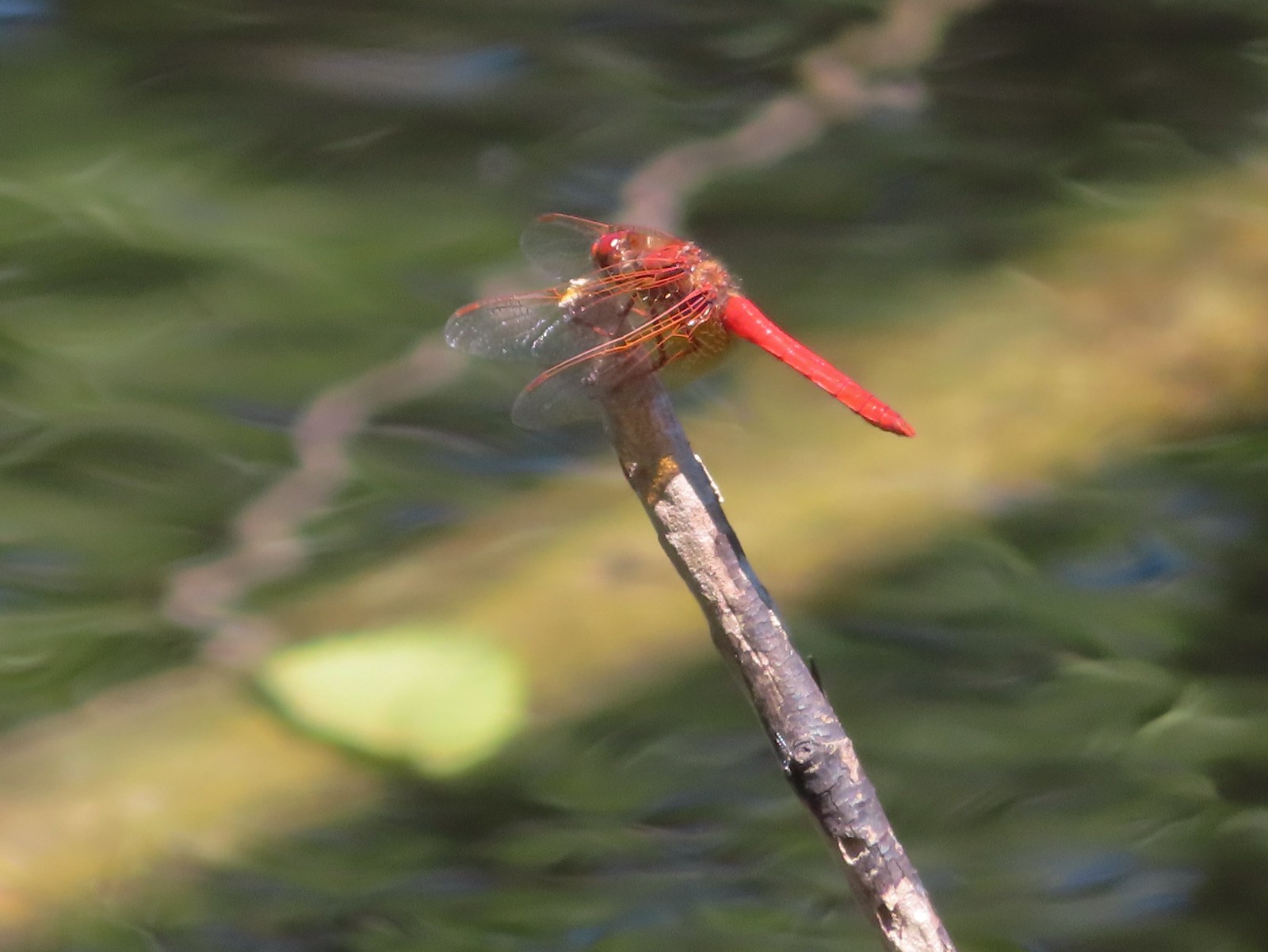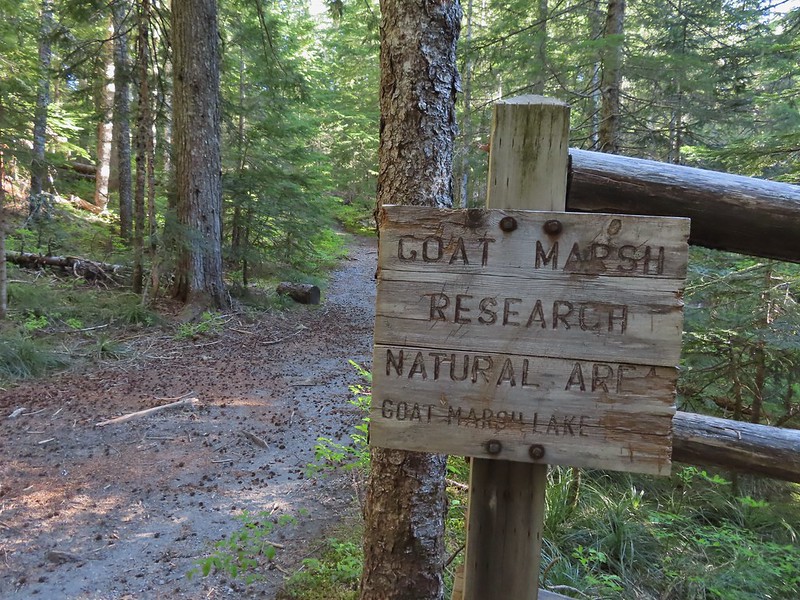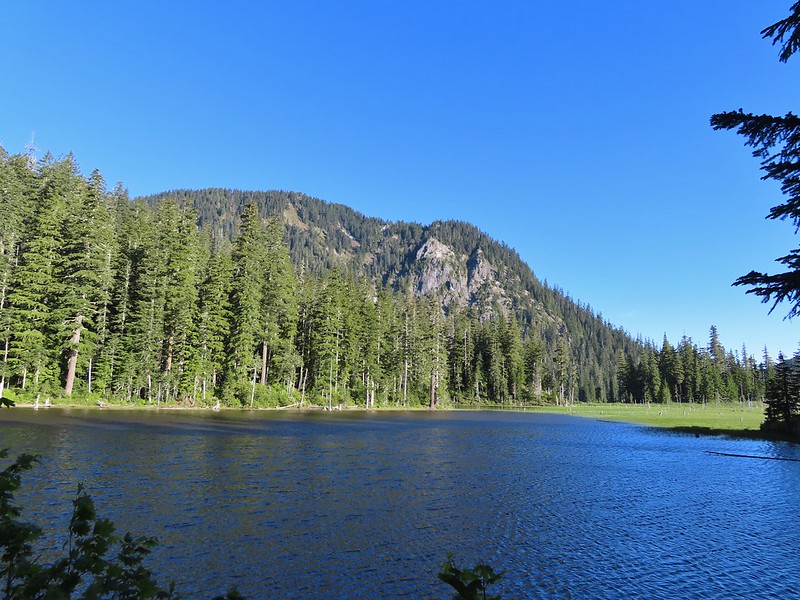
Categories
Hiking Mt. St. Helens Trip report Washington Washington Cascades

June Lake to Ape Canyon – 09/20/2025

After a few solo hikes we were able to hit the trail together to wrap up my final week of vacation for 2025. The hike I’d penciled in at the beginning of the year was out due to a road closure blocking access to the trailhead and my plan B was also out due to a closure for hazard tree removal. I turned to my list of “extra” hikes that were not currently on the schedule, which runs through 2029, and the one that jumped out was June Lake in the Mt. St. Helens National Volcanic Monument. I checked the weather/smoke forecast, and it was clear skies with a high in the low 60s. That was enough to convince us.

This would be our second visit to June Lake with the first having been in July of 2014 (post). The hike to June Lake is just 1.3-miles (2.6-miles round trip with 410′ of elevation gain) so during our 2015 visit we continued past the lake 0.3-miles to the Loowit Trail which circumnavigates Mt. St. Helens. We turned left (clockwise) on that trail for nearly 5-miles before turning around. Our plan for this outing was to go right (counterclockwise), possibly as far as Ape Canyon (post).

We parked at the June Lake Trailhead and set off just after 7am.
IMG_1224

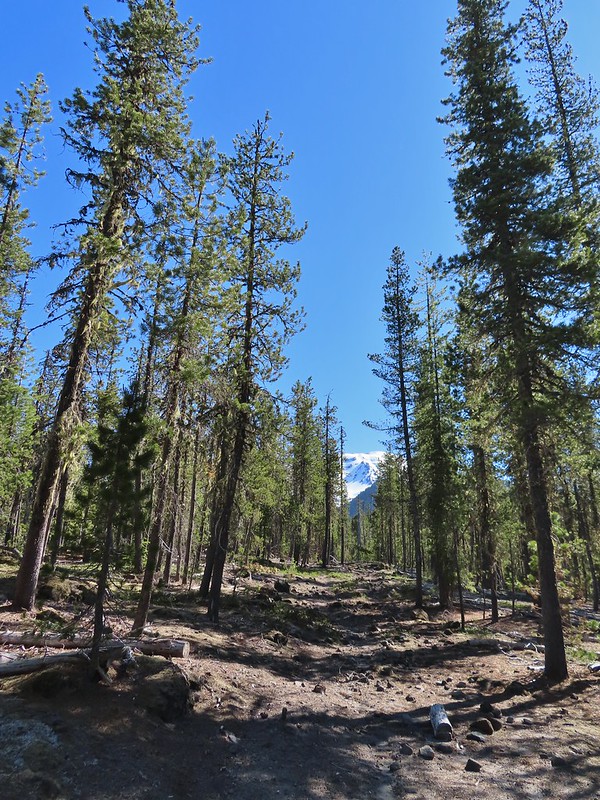
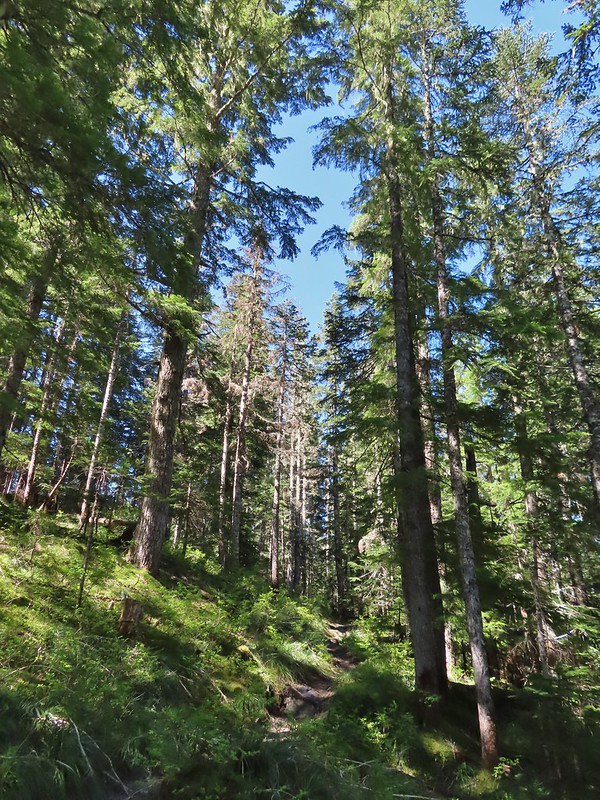
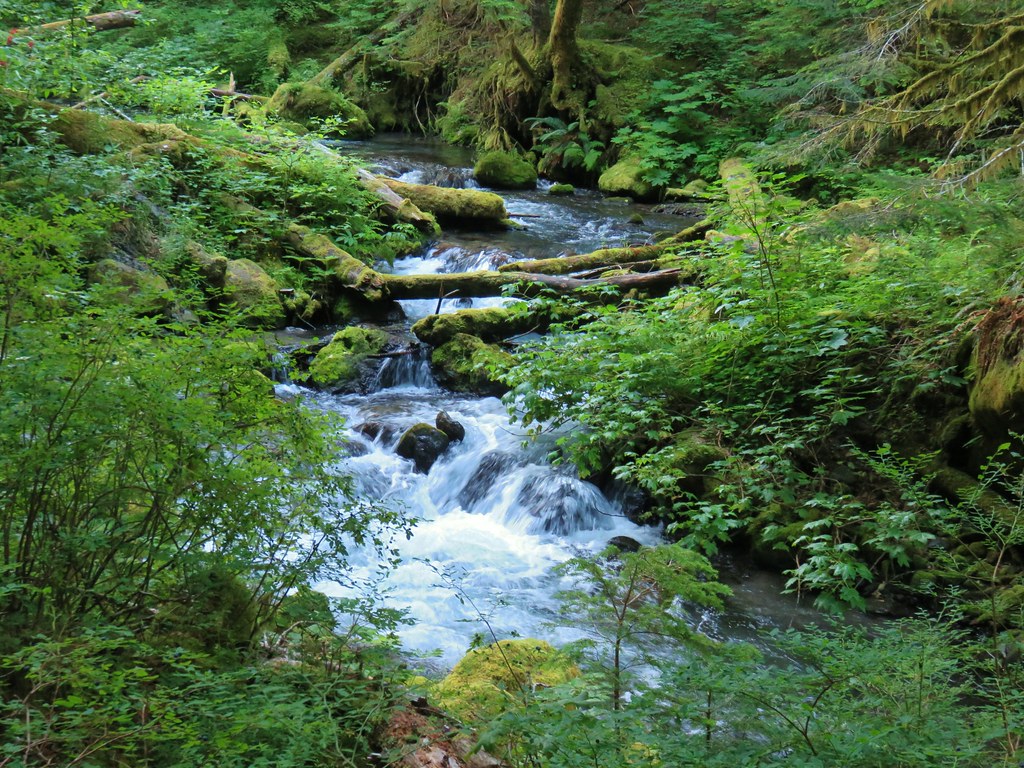
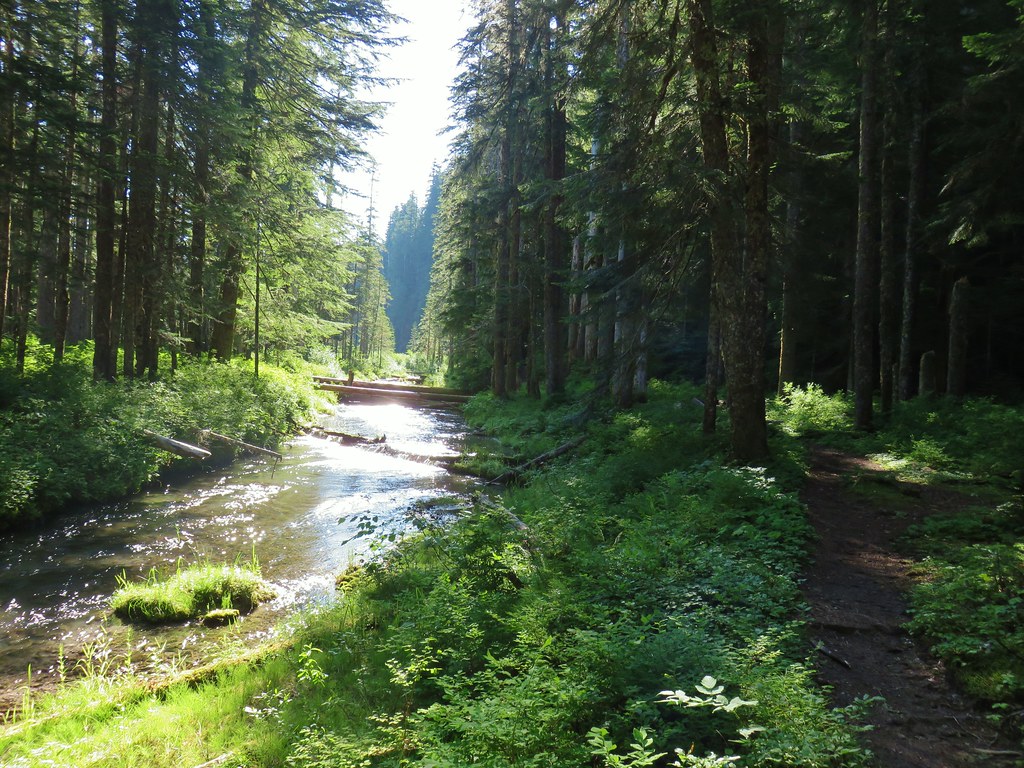
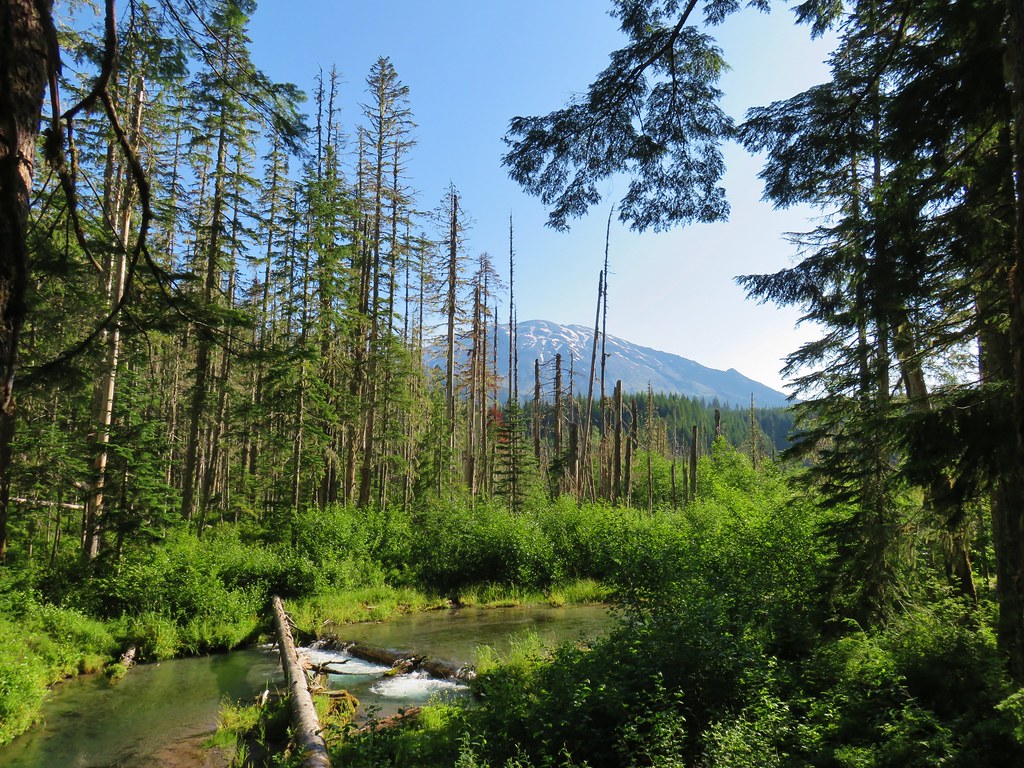
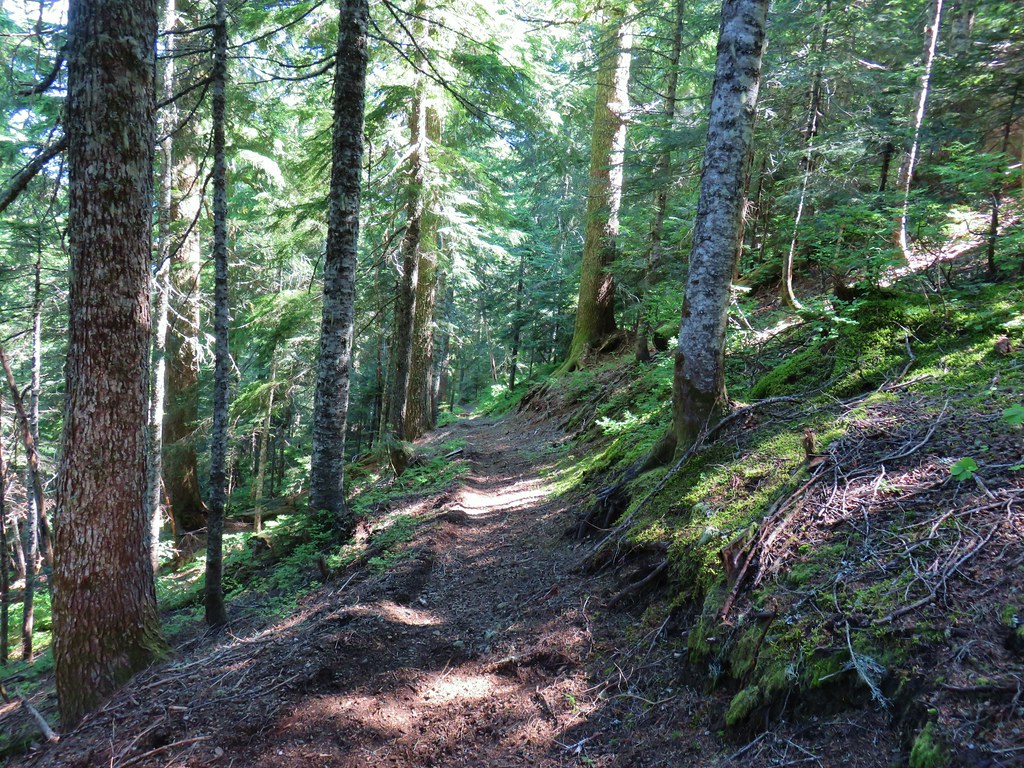
The trail briefly follows June Creek with some views of the top of Mt. St. Helens before veering away to climb through the forest.
IMG_1228

IMG_1231

IMG_1234

IMG_1242

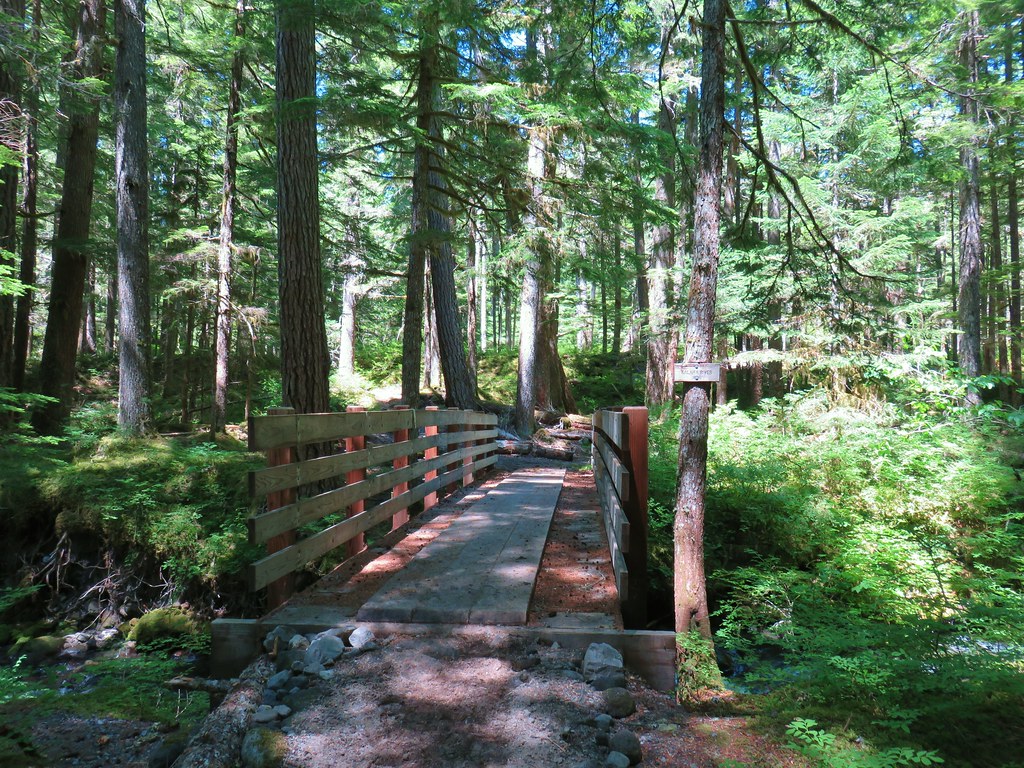
The trail nears the creek again to cross it on a footbridge then arrives in an open flat where June Lake lies hidden behind bushes on the right.
IMG_1247
June Creek

IMG_1249

IMG_1251

The first path we followed through the bushes led to a view of the lake but not the waterfall that flows into the lake.
IMG_1252

We ducked down a second path to get a view of the falls.
IMG_1253

IMG_1254

Aside from a few dragonflies and an American dipper we were alone at the lake and took a short break there to enjoy the scenery and sound of the waterfall.
IMG_1262

IMG_1267

From the lake we made the stiff climb up to the Loowit Trail and headed toward Ape Canyon.
IMG_1274
It’s hard to tell in the photo but this section was both steep and loose. We both used the trees/roots on the left as handholds going up and when we came back down.

IMG_1278
The trail leveled out some as it neared the junction.

IMG_1279
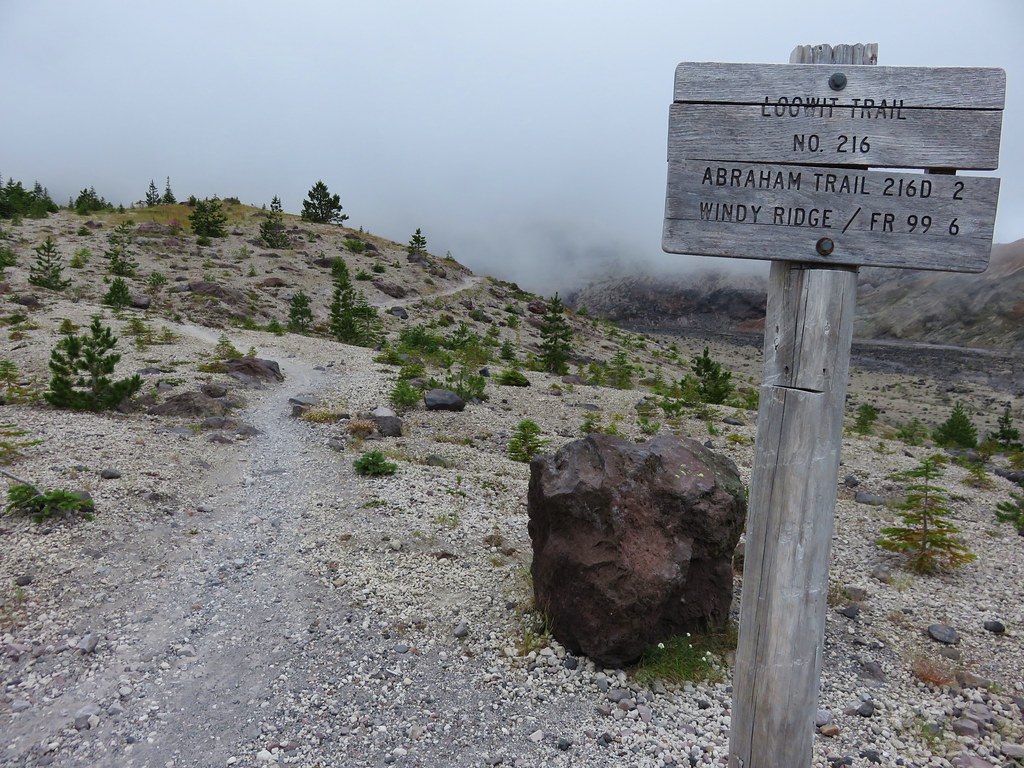
The trail sign at the Loowit Trail junction said the Ape Canyon Trail was 5-miles. From the Ape Canyon Trail the canyon itself is a little over an additional half mile.

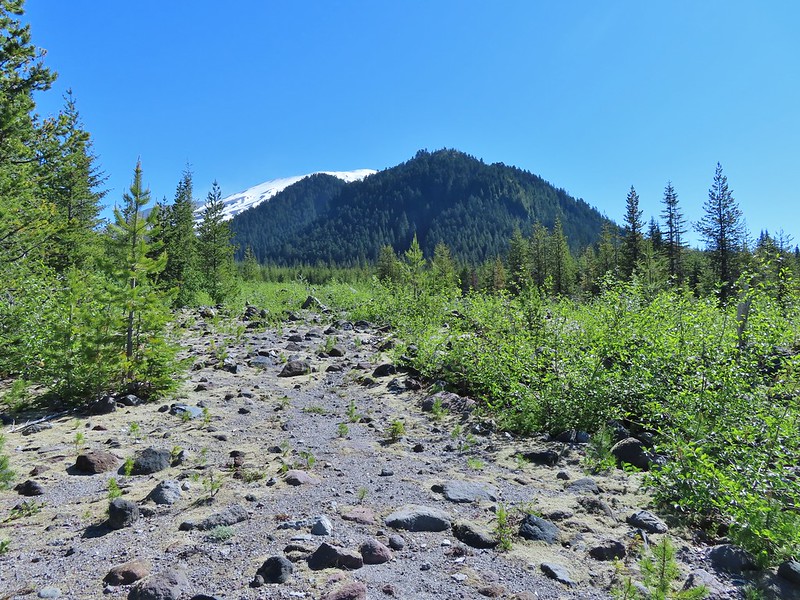
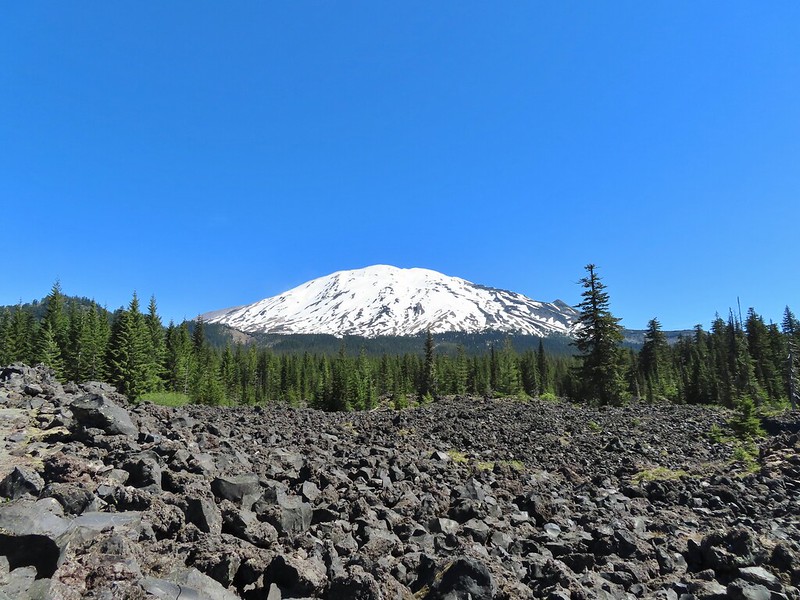
The Loowit Trail crossed a lava flow then spent a little time in the forest and along the lava flow before climbing into the rocks.
IMG_1283
Various poles and posts mark the trails when they are passing over the lava flows.

IMG_1294

IMG_1297

IMG_1304

The trail made a pretty significant climb (approx. 200′) when it reentered the lava flow gaining a view of Mt. Adams to the east and Mt. Hood to the south.
IMG_1307

IMG_1309
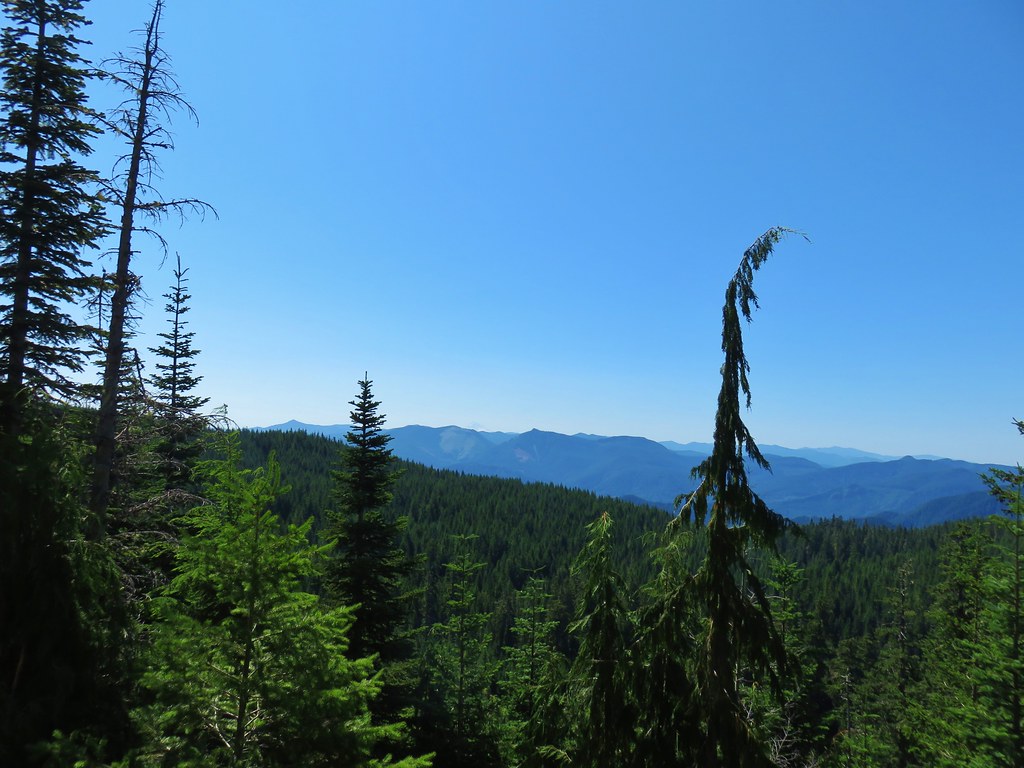
Marble Mountain is the closest peak, and Mt. Hood is behind to the left through some smokey haze.

IMG_1313
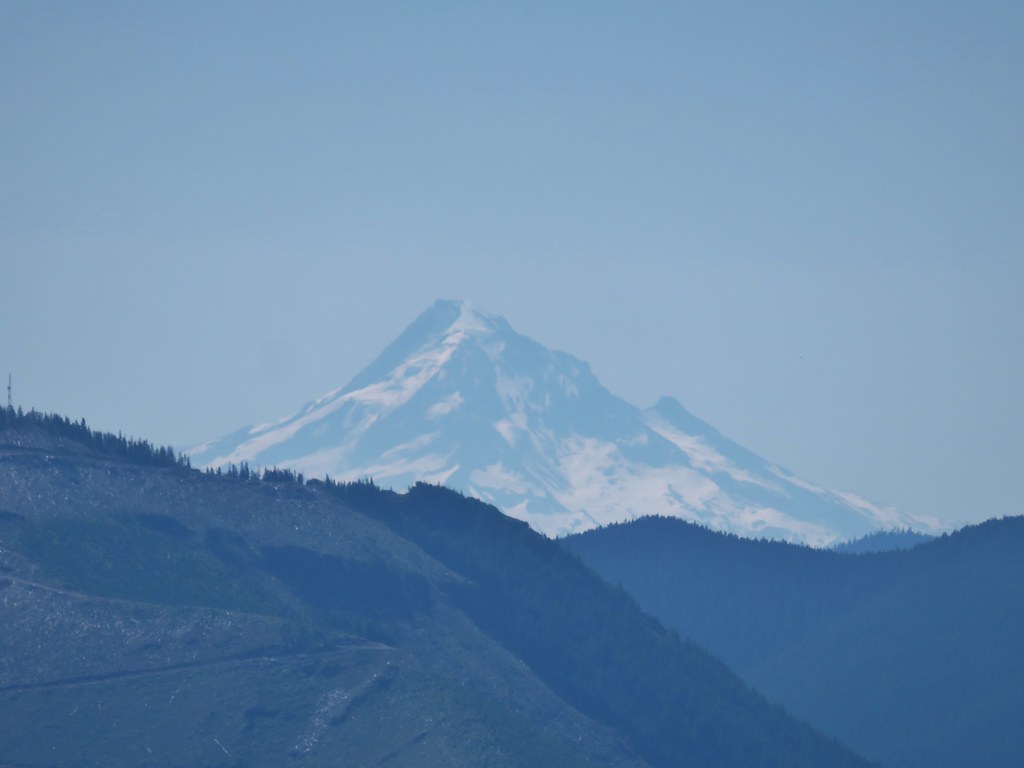
A little better look at Mt. Hood.

IMG_1316
Pink mountain heather

IMG_1319
Heading up.

IMG_1322
The Loowit Trail to the left crossing over the large rock with Mt. Adams in the distance.

IMG_1324
Looking back down from near the top of the climb.

We were still about 3.2-miles from the Ape Canyon Trail at this point. From this crest the Loowit Trail would make a series of ups and downs as it crossed a half dozen gullies/canyons of various depths including several forks of the Muddy River. We momentarily lost the trail at one of the first gullies when we missed a hairpin turn around a post marking the route and instead headed straight following footprints along a rocky ridge.
IMG_1333
The trail passing between large rocks.

Mt. Adams was visible for much of this stretch and Mt. Rainier occasionally made an appearance to the north.
IMG_1334

IMG_1337
Mt. Rainier over the trees.

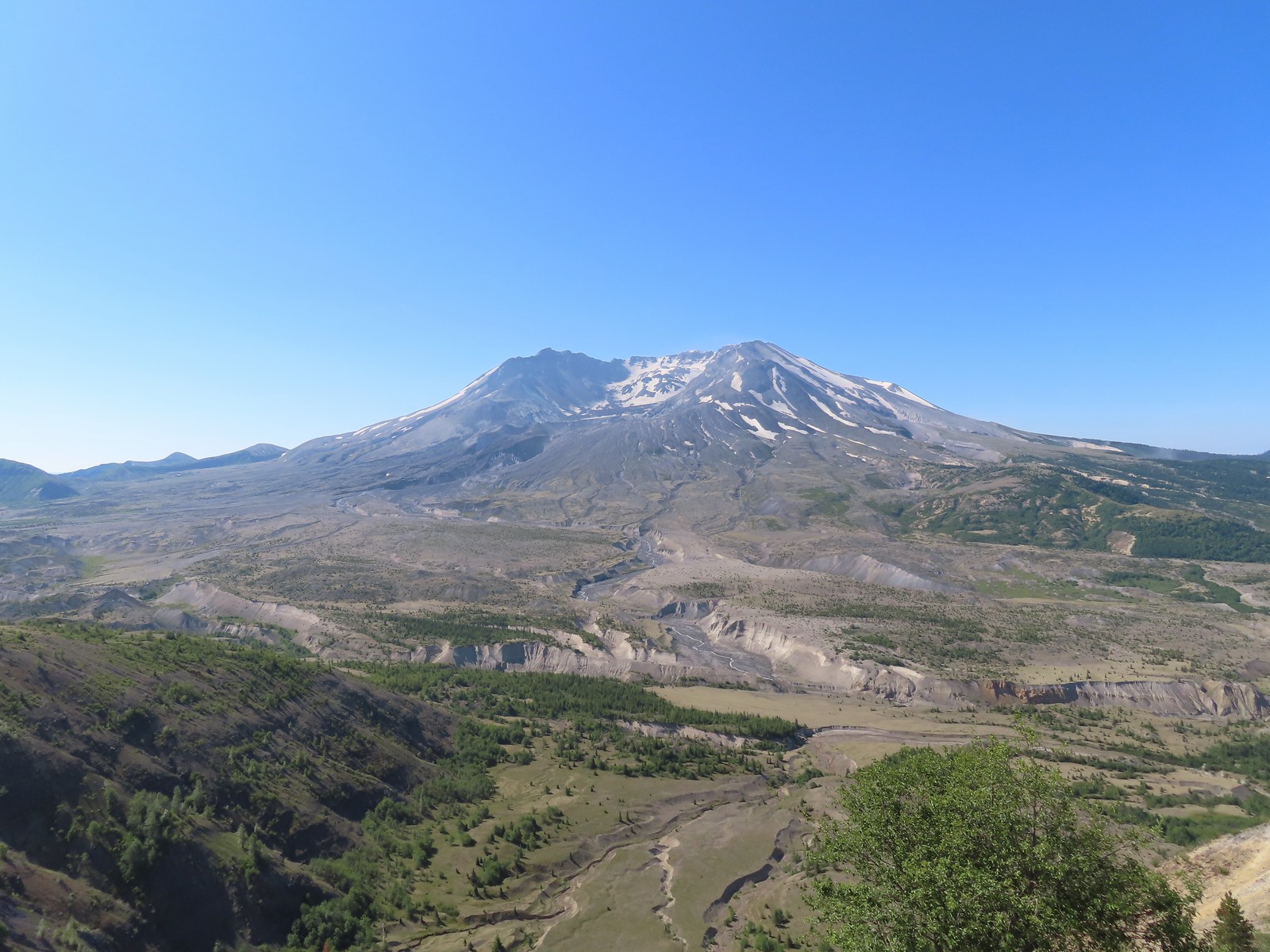
There were also plenty of great views of Mt. St. Helens.
IMG_1347

IMG_1351
Mt. Adams from one of the posts.

IMG_1352

IMG_1361

IMG_1362
This is where we missed the turn and were following footprints along this ridge.

When we finally spotted a post and the trail way down in the gully below we checked the GPS and confirmed we were off the actual trail. A little scrambling connected us back up to the correct path.
IMG_1364
Mt. Adams from the ridge. The post is barely visible between some trees ahead to the left, but we didn’t want to try to recross the top of the ridge as there were some large gaps that were almost too sketchy for us on the first pass.

IMG_1366
A little downclimbing to the actual trail below.

IMG_1370
Passing the post we had seen from above.

IMG_1385
Dropping into another gully. At this point Heather decided she was not going to try and push for Ape Canyon and sent me ahead while she would take her time and turn around when she felt like it.

The trail briefly left the rocky landscape to traverse up and along a hillside with a few trees and a lot of huckleberry bushes that were sporting their fall colors.
IMG_1386

IMG_1393

IMG_1395
Looking back at Mt. Hood and the direction we’d come.

IMG_1407
Mt. Adams and a lot of huckleberry bushes.

IMG_1408
Mt. Rainier in the distance.

IMG_1414
Mt. Rainier behind Pumice Butte.

IMG_1421

IMG_1424
Ripe serviceberries mixed in with the huckleberries.

IMG_1428

After traversing the huckleberry covered hillside it crossed another tributary of the Muddy River.
IMG_1439

IMG_1440
Closer look at Mt. St. Helens.

IMG_1445
Heading for the next post.

IMG_1449
Mt. Rainier became more visible as I continued north.

IMG_1452
One of the larger canyons of the Muddy River. The entire route was dry this late in the year.

IMG_1456
Dry waterfall above the trail.

IMG_1458
Looking down the canyon toward Mt. Adams.

IMG_1462
Mt. Hood and a layer of haze behind one of the posts.

IMG_1466
The trail turning uphill before the next canyon.

IMG_1468
The Loowit Trail climbing out of another canyon to a post with Mt. Rainier in the distance.

IMG_1479
Mt. Rainier and Little Tahoma

IMG_1483
Dwarf lupine

The next ravine was the main channel of the Muddy River and it proved to be the trickiest as the trail climbing out was not obvious.
IMG_1484
There was a post visible on the far side poking up from a patch of green but no visible path leading to it.

IMG_1486
It almost looked like there might be a path on the shelf above the dry riverbed, but I didn’t see a clear path to it, nor did it appear to lead anywhere near the post on the ridge above.

Once I was in the riverbed I spotted two small rock cairns, one with a pink ribbon so I headed for those.
IMG_1487

That brought me to the far side but there was still no clear tread that I could see.
IMG_1488
The post is uphill just to my left. There were some prints leading up from here so I angled uphill toward the trees above.

This route quickly turned into a class 3 scramble. I had to be very careful which rocks I used as hand and footholds due to how loose the hillside was. I momentarily considered turning around but I was closer to the top than the bottom and wasn’t sure I could safely downclimb, so I continued. I finally managed to climb out near the snags.
IMG_1489
The post is hiding back behind the snags here.

After gathering myself I continued on figuring that it should be easier to follow the correct path down starting from the post on the way back. The Loowit trail now began a nearly three-quarter mile long descent.
IMG_1491
Mt. Rainier to the left and the Loowit Trail ahead to the right.

IMG_1499
The Ape Canyon Trail was visible climbing along the ridge below.

The trail leveled out shortly before arriving at the junction with the Ape Cayon Trail at a post with a great view of Pumice Butte.
IMG_1502

I almost called it quits here. In addition to a great view of Mt. St. Helens I could see the Loowit Trail below in the distance as it bowed out and around toward Ape Canyon which was on the far side of Pumice Butte.
IMG_1505
The Loowit Trail is visible on the right-hand side about halfway up the photo.

IMG_1506
The trail then bent around to climb the ridge in the distance on the far side of the butte.

The deciding factor was that on our previous two visits Mt. Adams had not been visible from the viewpoint above Ape Canyon. Despite there being a little haze today I knew Mt. Adams would be visible, so I sallied forth.
IMG_1508

IMG_1510
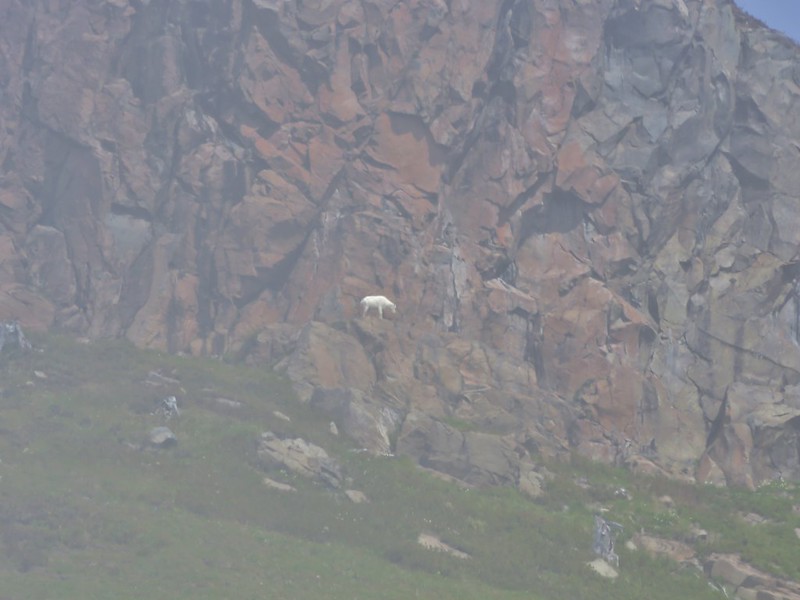
Heading toward Pumice Butte now. If you look closely, on the left-hand side toward the top, there are several mountain goats. At this point I had dismissed them as fallen snags and hadn’t bothered looking closely.

IMG_1511
Passing through yet another gully.

IMG_1514
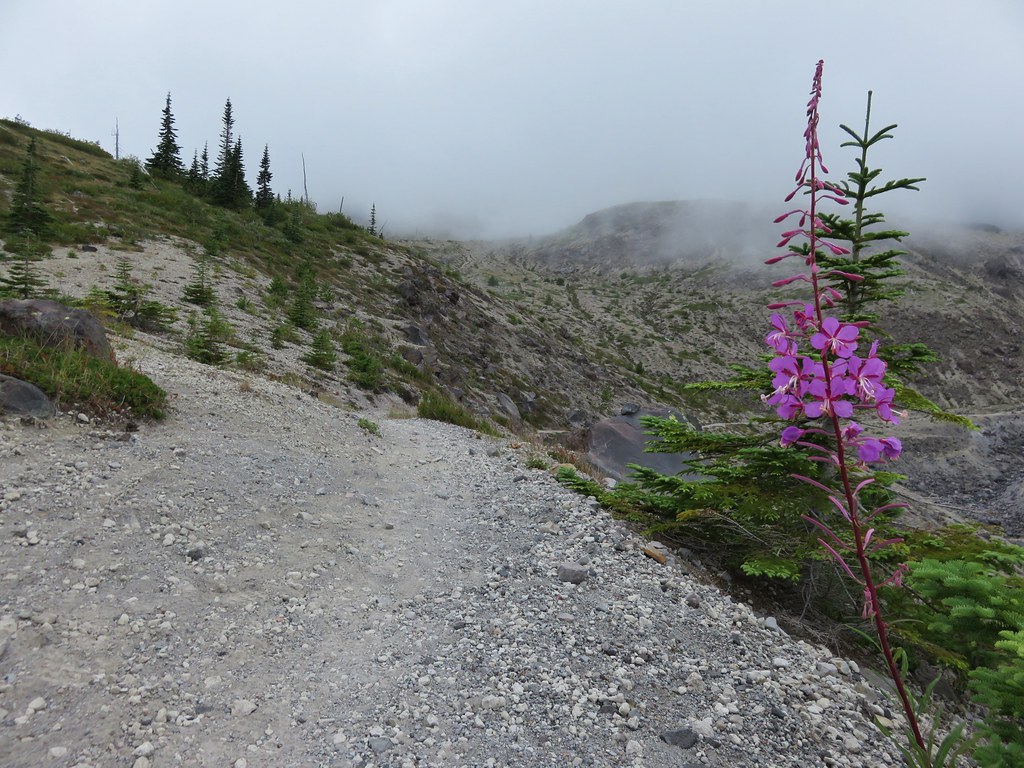
Paintbrush

IMG_1517

The trail passes the top of Ape Canyon and crosses what is sometimes a small spring fed stream.
IMG_1519

IMG_1520
No water, just a little bit of mud. Speaking to backpackers there were few sources of water available this late in the year.

IMG_1533
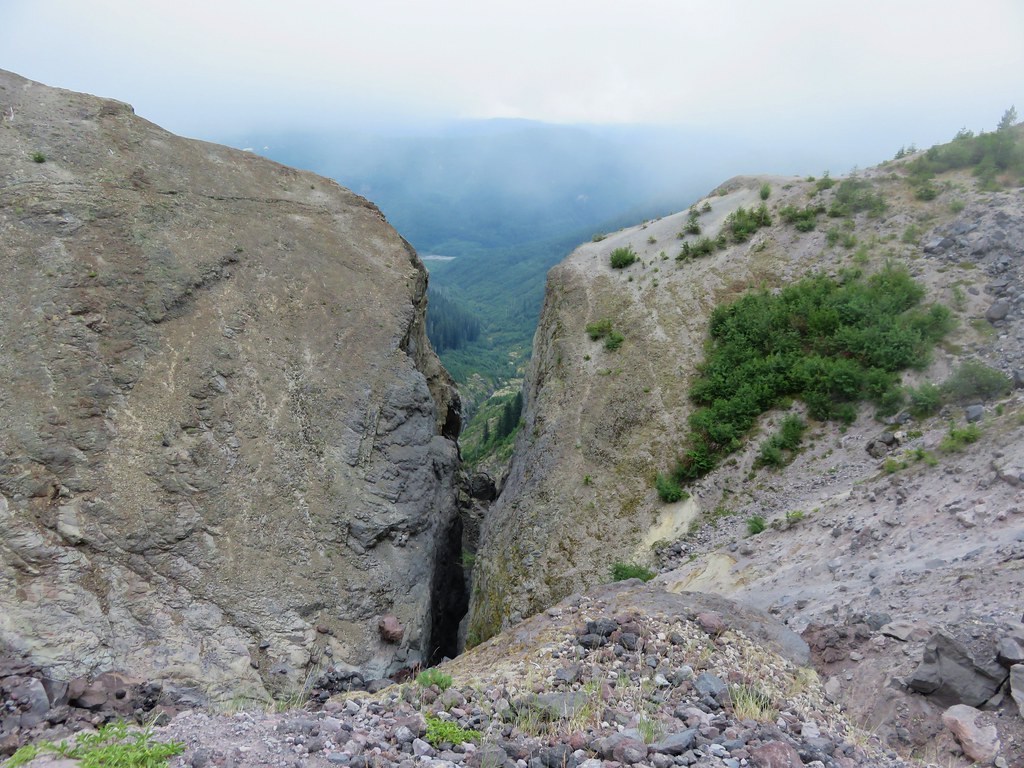
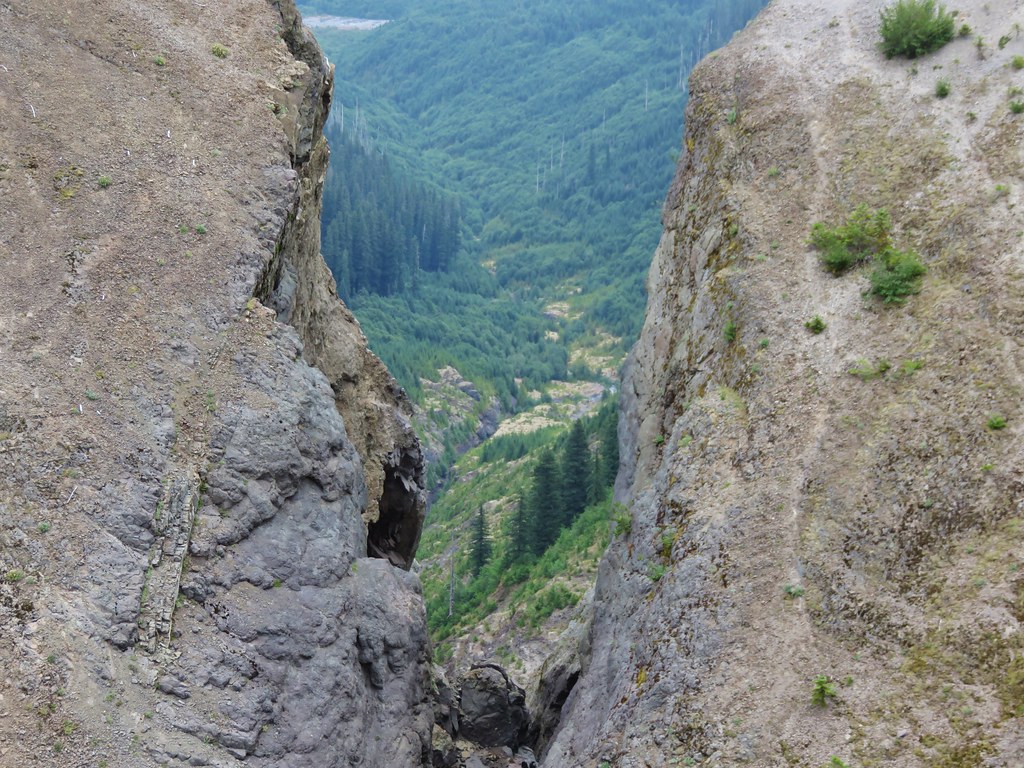
Success! Mt. Adams from Ape Canyon

Ape Canyon
This was the 2013 view.

Ape Canyon
And the 2015 view.

I took a break on a rock and had a snack and changed into dry socks before starting back.
IMG_1525
The rock I used as a bench.

It was while I was heading back that I realized it was mountain goats on Pumice Butte and not stumps/downed trees.
IMG_1537

IMG_1538
Looking north toward Windy Pass where the Loowit Trail passes between the mountain and the butte ahead.

IMG_1545
Mt. Adams, Pumice Butte, and mountain goats.

IMG_1540

I returned the way I’d come, except for the two places that I’d lost the trail on the way to Ape Canyon. As the sun moved overhead the view of Mt. Adams improved a bit and the view of Mt. Hood became hazier.
IMG_1559

IMG_1563
Mt. Hood was barely visible now.

When I reached the post above the Muddy River I followed the path as it began to descend the side that I’d scrambled up.
IMG_1578

IMG_1579
The section of trail that I had thought I’d seen from the other side was visible below but again there was no clear route to it. I believe it is a remanent of a previous route through the canyon that has since washed out.

The route down made a switchback and basically led me back to where I had begun my scramble up. There was a pretty good drop near the bottom though. It was significant enough that I sat down and slowly lowered myself by sliding down the loose pumice. Looking back, I am sure I considered that as a possible route up but the drop, or climb going up, seemed pretty daunting and since I wasn’t positive it was indeed the current trail I veered right instead. Once I was done with the butt slide, I found myself in the riverbed at the cairns I had followed earlier. It was a little perplexing at the time, but I was through the worst section now and could enjoy the rest of the hike back.
IMG_1588
Dust kicking up from a rockfall on the mountain.

IMG_1595

IMG_1598
Golden-mantled grounds squirrel. I heard a few pikas along the way but never saw any, just the golden-mantles and some chipmunks.

IMG_1602

IMG_1616
Coming up to the post on the ridge where we’d lost the trail earlier.

IMG_1621

IMG_1625
Mt. Adams near the end of the hike.

IMG_1628
The trail below in the rocks.

IMG_1633
Back on the June Lake Trail.

I caught up to Heather a little before reaching June Lake. She had gone through the huckleberries and stopped at the edge of one of the big canyons and taken a nice long break before taking her time on her way back. We stopped at June Lake again for a final look at the waterfall then returned to the car.
IMG_1636

IMG_1637
Ouzel with a snack.

IMG_1641

IMG_1648

The hike to Ape Canyon came in at 14.4-miles on my GPS. I am just guessing on elevation, but I’d say it was in the 2500′ range due to all the ups and downs.
Screenshot 2025-09-20 183410

Screenshot 2025-09-22 183938
This little orange section is my scramble out of the Muddy River Canyon.

Mt. St. Helens never disappoints. This might have been my favorite hike we’ve done at the mountain to date but it’s hard to say. Happy Trails!

Flickr: June Lake to Ape Canyon

Categories
Hiking Mt. St. Helens Trip report Washington Washington Cascades

Lava Canyon – 08/30/2025

The morning after our last hike, at Silver Falls State Park (post), I woke with a bad case of vertigo and wound up in urgent care thinking I might have an ear infection. That wasn’t the case, but it took the better part of a week for things to settle down putting our hiking plans on pause. By Labor Day Weekend the vertigo had passed, and I was just dealing with a little excess pressure in my left ear. That was good enough for us to head back out for the trails.

For our first hike of the holiday weekend we picked Lava Canyon in the Mount St. Helens National Volcanic Monument. This hike had been on our list of trails to revisit for a while now and given the forecast for smokey conditions in the Oregon Cascades it looked like a good time to do it.

Our first visit to Lava Canyon was in September 2012 (post) before we’d decided to try and hike all of William L. Sullivan’s featured hikes. During that visit we did Sullivan’s shorter option, a 1.3-mile lollipop loop following a much longer hike at Ape Canyon. For this visit we wanted to do his longer option and add on a little bit of time on Smith Creek Trail. Doing some pre-hike research led me to the Oregon Hikers Field Guide which described a loop utilizing The Old 83 Trail to return to the Lava Canyon Trailhead.

Our typical early start meant we were the first ones on the trail Saturday morning.
IMG_9418

IMG_9419

IMG_9420

We headed down the paved path past a viewpoint and then a warning sign.
IMG_9423

IMG_9427
Muddy River

IMG_9429

At the 0.4-mile mark we came to a junction with the short loop we’d done on our first visit.
IMG_9432
On our previous visit we returned using the bridge shown above. That loop currently isn’t an option due to damage to the suspension bridge a quarter mile further along the trail.

IMG_9433
Viewpoint above Upper Lava Canyon Falls.

IMG_9435
The view of the falls leaves a little to be desired but there is a better view a little further down the trail.

IMG_9437

IMG_9440
Upper Lava Canyon Falls

IMG_9442
Beyond the viewpoint the trail becomes rougher.

IMG_9446
The closed suspension bridge.

IMG_9448
The Lava Canyon Trail continuing past the suspension bridge.

IMG_9450
Warning regarding the conditions along the Lower Lava Canyon Trail.

We continued down the increasingly rough trail and came to a view of Lava Canyon Falls.
IMG_9451

IMG_9453

IMG_9455

IMG_9457
The top of Lava Canyon Falls.

IMG_9459
Lava Canyon Falls

IMG_9462
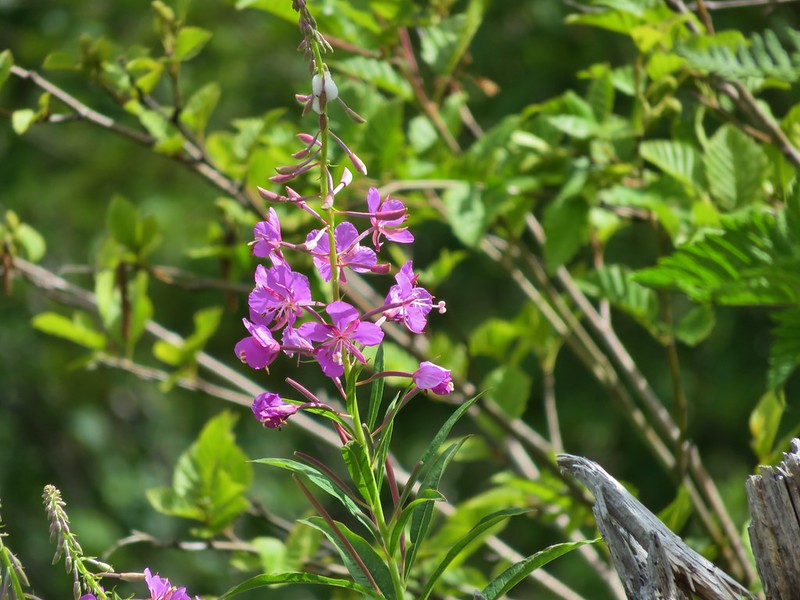
Fireweed

IMG_9464
The trail was very narrow in places and high, not a good one for people who have issues with heights, children or pets.

IMG_9469
This missing section of tread was the sketchiest part of the trail. There was a significant drop which would have been fatal.

IMG_9474

The next waterfall we passed was Middle Lava Canyon Falls.
IMG_9479

IMG_9483
Unnamed stream crossing.

A short distance beyond Middle Lava Canyon Falls we came to the 30′ to 40′ ladder.
IMG_9485

IMG_9486

After securing our hiking poles we climbed down the ladder and continued along the trail.
IMG_9489

IMG_9495

IMG_9496
Basalt above the trail.

At an unmarked junction we made a hard right turn to take a 0.2-mile spur trail to the top of The Ship where there was a view of Lower and Lava Canyon Falls.
IMG_9501
This is the view of the spur trail (on the left) looking back after having passed the junction and turning around.

IMG_9502
There was a shorter ladder on The Ship.

IMG_9503

IMG_9505
Chicken tails

IMG_9509
Huckleberry leaves turning colors at the end of summer.

IMG_9513

IMG_9518

IMG_9520
Lower Lava Canyon Falls

After a short break to enjoy the view we carefully headed back down to the Lava Canyon Trail.
IMG_9523
The spur trail above the ladder.

We continued another third of a mile to another unsigned junction where we turned right.
IMG_9525

IMG_9529

IMG_9533

We took the spur to avoid the challenging conditions that the sign near the suspension bridge had mentioned. The spur trail crossed the Muddy River on a good footbridge then followed the river 1.1-miles to the Lower Smith Creek Trailhead.
IMG_9534

IMG_9535

IMG_9537
This trail was also a little rough but there were no major challenges.

IMG_9540

IMG_9544

IMG_9554

IMG_9555
Mt. Margaret (post) and Mt. Teragram (rocky knoll).

IMG_9562
Mt. St. Helens

IMG_9563
Mt. St. Helens

IMG_9564

About 100 yards before reaching the trailhead we passed a yellow rope hanging down the steep embankment. None of the maps or hike descriptions we’d looked at said anything about using a rope to get down to the river, so we ignored it and continued on.

IMG_9586
Zoomed in look at the rope from the Muddy River.

IMG_9584
The rope is located at the center of this photo.

As it turned out we should have used the rope to get down because the maps and descriptions indicated that from the trailhead you would walk north along the former Forest Road 8322, but that old roadbed ended at a vertical drop where the was no way to safely scramble down to the river.
IMG_9567
Vehicle parked near the trailhead sign in the distance.

IMG_9568
FR 8322 roadbed heading toward the former bridge site.

Unable to descend from the end of FR 8322 we decided to continue down that road past the trailhead looking for an alternate route instead of returning to the rope. About a quarter mile from the trailhead we came to some campsites where we found a rough scramble trail that we used to get down to the riverbank.
IMG_9569

We made a u turn along the river and headed back toward the old bridge site where we would ford the Muddy River.
IMG_9574

While the trail had been a little sketchy at times the scariest part of the hike came as we were heading back up to the ford of the Muddy River. There was a family camped near the trailhead, and they decided it would be a good idea to let the kids shoot their 22’s across the river valley. It wasn’t surprising that they would be that careless given they had a big campfire going despite a full ban on campfires in the forest. (Forest Order 06-03-00-25-01) I tried yelling and waiving my arms and I don’t know if that got their attention or if one of the adults spotted us, but they did stop shooting and we made it past.
IMG_9578

IMG_9581
We changed into our water shoes and forded just below the log here. The water was knee deep and cold.

IMG_9582
View back to where FR 8322 used to be. There was no way we were getting down that.

We picked up the obvious trail which climbed easily up the far embankment.
IMG_9588

The trail headed back along the river before veering away and arriving at a junction with the Lava Canyon Trail.
IMG_9589

IMG_9590

IMG_9591
The Smith Creek Trail ends at Forest Road 99 just north of the Smith Creek Viewpoint (post)

We stuck to the Smith Creek Trail which followed the old roadbed. After a third of a mile we came to a junction with lots of flagging and some cairns.
IMG_9592

IMG_9593
Smith Creek from the trail.

IMG_9598
Another view of Smith Creek.

IMG_9600
Lupine

IMG_9601
The unsigned but well-marked junction with The Old 83 Trail. The Old 83 Trail would loop us back to the Lava Canyon Trailhead, but first I wanted to explore a little more of the Smith Creek Trail. Heather opted to skip this detour, so we split up here.

The Smith Creek Trail was relatively level and, for the most part, continued to follow the old roadbed. There was a mix of forest and occasional views of Smith Creek.
IMG_9603

IMG_9606
Aster

IMG_9608

IMG_9609
Unnamed creek.

IMG_9611

IMG_9614

IMG_9616

I had planned on hiking for half an hour then turning around, but as the 30-minute mark approached the GPS showed I was close to a junction, so I made that my turn around.
IMG_9620
View up Smith Creek toward Windy Ridge near the junction.

IMG_9622
The junction wound up being where FR 94 used to split off to cross Smith Creek.

After the hike I realized I had turned around less than half a mile from Ape Canyon (post) which would have been a logical spot to turn around, but I was already 5 minutes over my allotted time. I made my way back to The Old 83 Trail and turned up it following Heather.
IMG_9623

The Old 83 Trail followed the former route of FR 83 3.3-miles uphill to FR 83 near the trailhead. The wide road was easy to follow with no major blowdown present. It was a quite walk back for me and despite being sure I would see some wildlife I never spotted anything other than an occasional small bird. Heather however saw at least one and possibly up to three owls.
20250830_110048
Barred owl

IMG_9624

IMG_9626
Crane Lake is back in the trees to the left. There was no view from the roadbed and neither of us found the use trail that supposedly led to it.

IMG_9631

IMG_9635

IMG_9637
Mushroom and foam flower

IMG_9641
Groundsel

IMG_9649
Trail sign for The Old 83 Trail.

IMG_9651
The Lava Canyon Trailhead from FR 83.

My hike was 11.4-miles with roughly 1500′ of elevation gain.
Screenshot 2025-08-30 155839

The trailhead was very busy by the afternoon but on the trail I only saw two backpackers. The Old 83 Trail and the Smith Creek Trail were both in good shape, but the Lava Canyon Trail had some rough spots making it quite an adventure. Happy Trails!

Flickr: Lava Canyon

Categories
Hiking Mt. St. Helens Trip report Washington Washington Cascades

The Hummocks to Johnston Ridge – 07/01/2023

On May 14, 2023 a washout along Washington’s SR504 below the Johnston Ridge Observatory closed vehicle access for the foreseeable future. We’d visited the observatory in August 2013 (post) and had planned on revisiting this July. While the washout made driving to the observatory impossible the trails in the area were not impacted. The shortest route was to start at the Hummocks Trailhead and take the Boundary Trail from its intersection with the Hummocks Trail to the observatory. We actually had this hike on our 2024 schedule for July so we swapped those (hoping that the road is repaired before then).

This would also be our second visit to The Hummocks having hiked the 2.5-mile loop in May of 2014 (post) before hiking a longer loop around Coldwater Lake. From the trailhead we set off on the left most trail (next to the large signboards).
IMG_2570

IMG_2572While the loop did come in at 2.5-miles it was a little over 3/4 of a mile to the Boundary Trail.

There were a lot more flowers (and green vegetation) along the trail than there had been during our May hike.
IMG_2585Lupine

IMG_2588

IMG_2589One of several ponds along the trail.

Interpretive signs, trail guide markers, and “Student Stops” are located throughout the loop.
IMG_2599A “Student Stop” marker surrounded by dwarf lupine. We aren’t sure what the these meant or what program they are related to.

IMG_2601An interpretive sign along the trail facing some of the hummocks.

IMG_2606Penstemon

IMG_2608Mt. St. Helens as we neared the Boundary Trail junction.

IMG_2612Trail guide marker #3 and an interpretive sign at the junction.

We turned left onto the Boundary Trail which began as a level path passing by more hummocks.
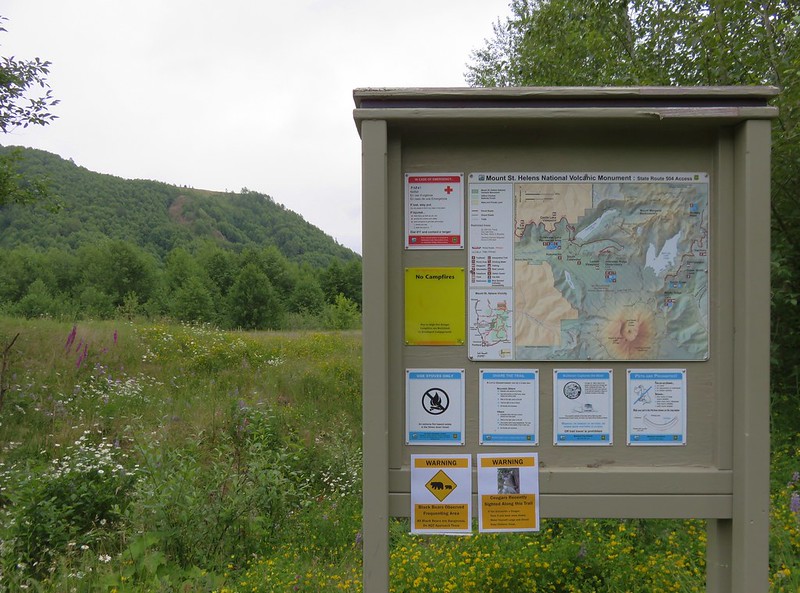
IMG_2616The lower left map shows the current closure area and open trails. In a nutshell, all the trails are open but everything off-trail to the side facing SR504 is currently closed.

IMG_2623The views of Mt. St. Helens were great.

IMG_2625The trail began to climb as it squeezed between a gap in the hillsides ahead.

IMG_2629View back to the hummocks from the gap.

IMG_2632Trees in the gap.

IMG_2634After exiting the gap we got another good view of the mountain before the trail veered left turning away from the mountain.

After another short level stretch the trail began to climb in earnest. While the climb never felt very steep the trail netted 1400′ of elevation gain over the next 3 miles to reach the parking lot at Johnston Ridge.
IMG_2643Heading away from Mt. St. Helens to start the climb.

IMG_2649Dwarf lupine was profuse below the ridge.

IMG_2653Scouler’s bluebell

IMG_2657

IMG_2658Thimbleberry blossoms

IMG_2662Castle Peak above Castle Lake with Spud Mountain to the right and the North Fork Toutle River below.

IMG_2676Horned lark

IMG_2682Tiger lily

IMG_2686Savannah sparrow

IMG_2690Heading back toward Mt. St. Helens.

IMG_2692The North Fork Toutle River flowing between Spud Mountain (left) and Elk Rock (right).

IMG_2695Castle Peak and Castle Lake

IMG_2704Elk Rock on the left and Coldwater Lake on the right.

IMG_2705Coldwater Lake

IMG_2712Mountain bluebird.

IMG_2718

IMG_2723At one point quite a bit of dust? kicked up from the South Fork Toutle River canyon.

The trail contoured along the hillside, occasionally entering a stand of trees or losing sight of the mountain behind a ridge.
IMG_2733

IMG_2738Cardwell’s penstemon

IMG_2740

IMG_2746

A little over 2 3/4-miles from the Hummocks-Boundary Trail junction we came to a viewpoint at a ridge end where we could see Coldwater Peak and the top of Mt. Adams.
IMG_2751Coldwater Peak with Mt. Adams to the far right of the photo. The hiker ahead to the left of Coldwater Peak was from Belgium. He was here on work but using the weekends to explore the area. We would see him two more times, once from the observatory as he continued on the Boundary Trail and then as we were exiting the trailhead. He had done a loop using the Coldwater Trail (post) which by our calculations would have been at least 16-miles and that is assuming he didn’t detour to Coldwater Peak.

IMG_2976Mt. Adams from the viewpoint on our way back. The angle of the Sun earlier caused the mountain to look pretty washed out.

IMG_2755Mt. St. Helens from the viewpoint.

IMG_2764Variable-leaf collomia

IMG_2766The Loowit Viewpoint on the ridge ahead.

IMG_2773Paintbrush covered hillside.

The Loowit Viewpoint is located along SR504. The Boundary Trail passes by the viewpoint 3/4 of a mile from the Johnston Ridge Observatory.
IMG_2781Mt. St. Helens from the Loowit Viewpoint.

IMG_2785Mt. St. Helens crater.

As we continued on from the viewpoint we were under the watchful eye of some nosey locals.
IMG_2792

IMG_2794Golden mantled-ground squirrel. These brazen con-artists often convince visitors they would starve without humans help. While this is definitely not the case and wildlife really shouldn’t be fed it happens all too frequently. (They are awfully cute though.)

The closer we came to the observatory the more paintbrush we began seeing.
IMG_2796A single plant.

IMG_2799A lot of paintbrush.

IMG_2803

IMG_2809

IMG_2817Daisies and paintbrush

IMG_2819Penstemon, yarrow, and Scouler’s woolyweed along with the paintbrush.

IMG_2823Paintbrush and penstemon along the trail.

The Boundary Trail turns to a paved path across from the parking lot for the observatory following the parking entrance road for approximately 450′.
IMG_2828

IMG_2829

IMG_2832Passing by the Johnston Ridge Observatory.

IMG_2834

IMG_2836Before and after photos of the 1980 eruption.

IMG_2838

We followed the Eruption Trail uphill to a mountain identifier then down the other side to rejoin the Boundary Trail.
IMG_2842

IMG_2846Mt. Adams peaking over the ridges with Spirit Lake also visible (center).

IMG_2847Spirit Lake

IMG_2849The mountain identifier ahead on the left.

IMG_2853

IMG_2857We could see where the repair work was happening on SR504 from this trail.

IMG_2864The rounded peak to the right is Goat Mountain (post).

IMG_2862Goat Mountain with a few patches of snow still showing up.

IMG_2866Rock Arch near Coldwater Peak.

IMG_2875Memorial for the lives lost in the 1980 eruption.

IMG_2878Junction with the Boundary Trail.

The views and flowers were so nice that we decided to continue on the Boundary Trail for a bit. The trail had been slowly losing elevation and after a little over a half mile neared a saddle where more elevation would have been lost. We decided to turn around there since shortly after climbing up from the saddle on the far side the trail would lose sight of Mt. St. Helens as it passed behind the ridge for a bit.
IMG_2879

IMG_2881Pussypaws

IMG_2886

IMG_2891

IMG_2894

IMG_2896

IMG_2904Another view of the washout.

IMG_2919

IMG_2920

IMG_2926Our turn around spot. You can see the trail on far side of the saddle veering left behind the ridge.

IMG_2927Coldwater Peak from our turnaround spot.

We headed back to the Hummocks Trail, sticking to the Boundary Trail the entire way.
IMG_2934The Johnston Ridge Observatory from the trail. We hadn’t realized how much elevation we’d lost until we turned around.

IMG_2936Castle Peak and Spud Mountain on the left and the observatory above some colorful cliffs.

IMG_2937

IMG_2940Penstemon

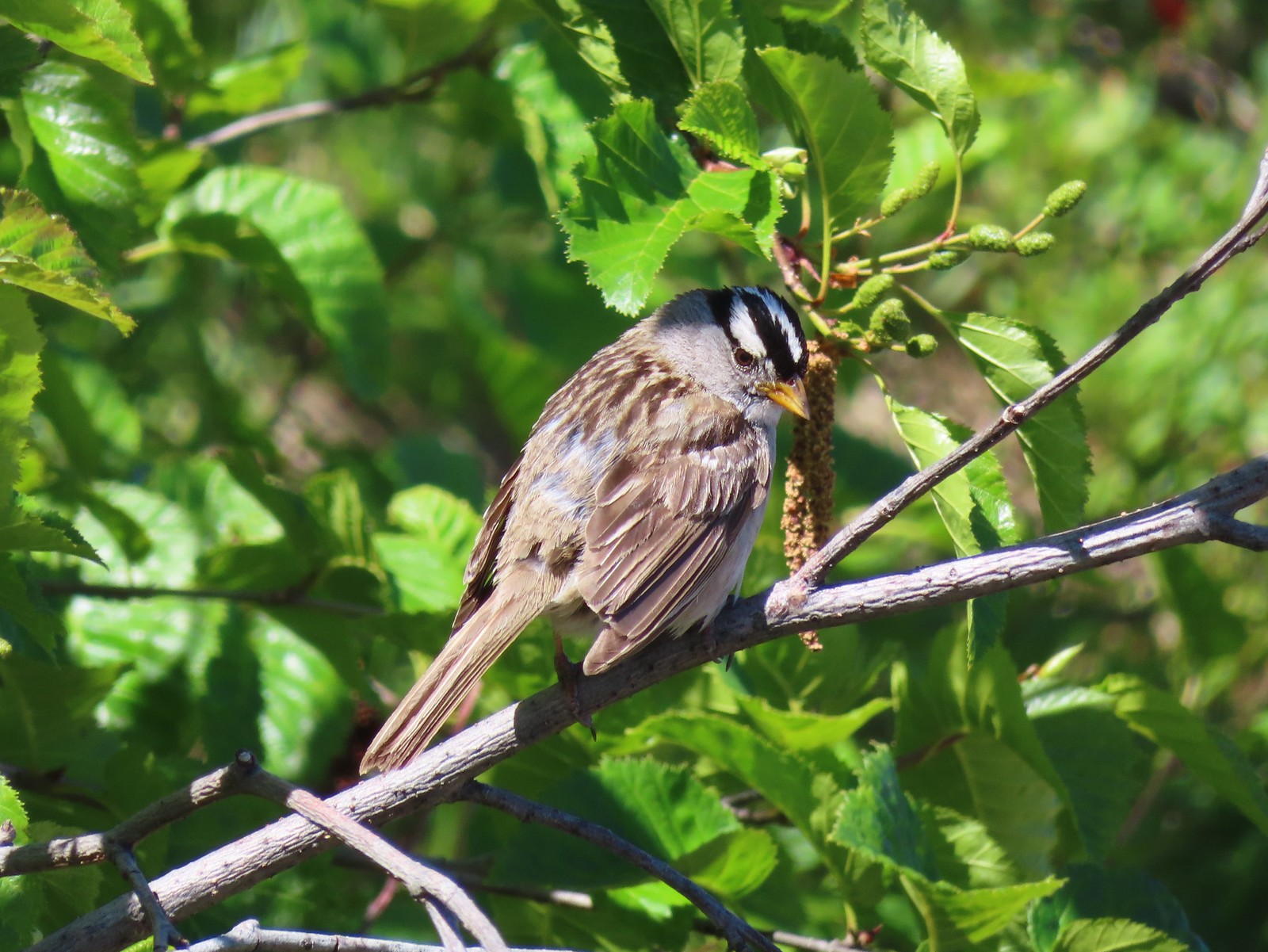
IMG_2944White crowned sparrow

IMG_2964Boundary Trail leaving the Loowit Viewpoint.

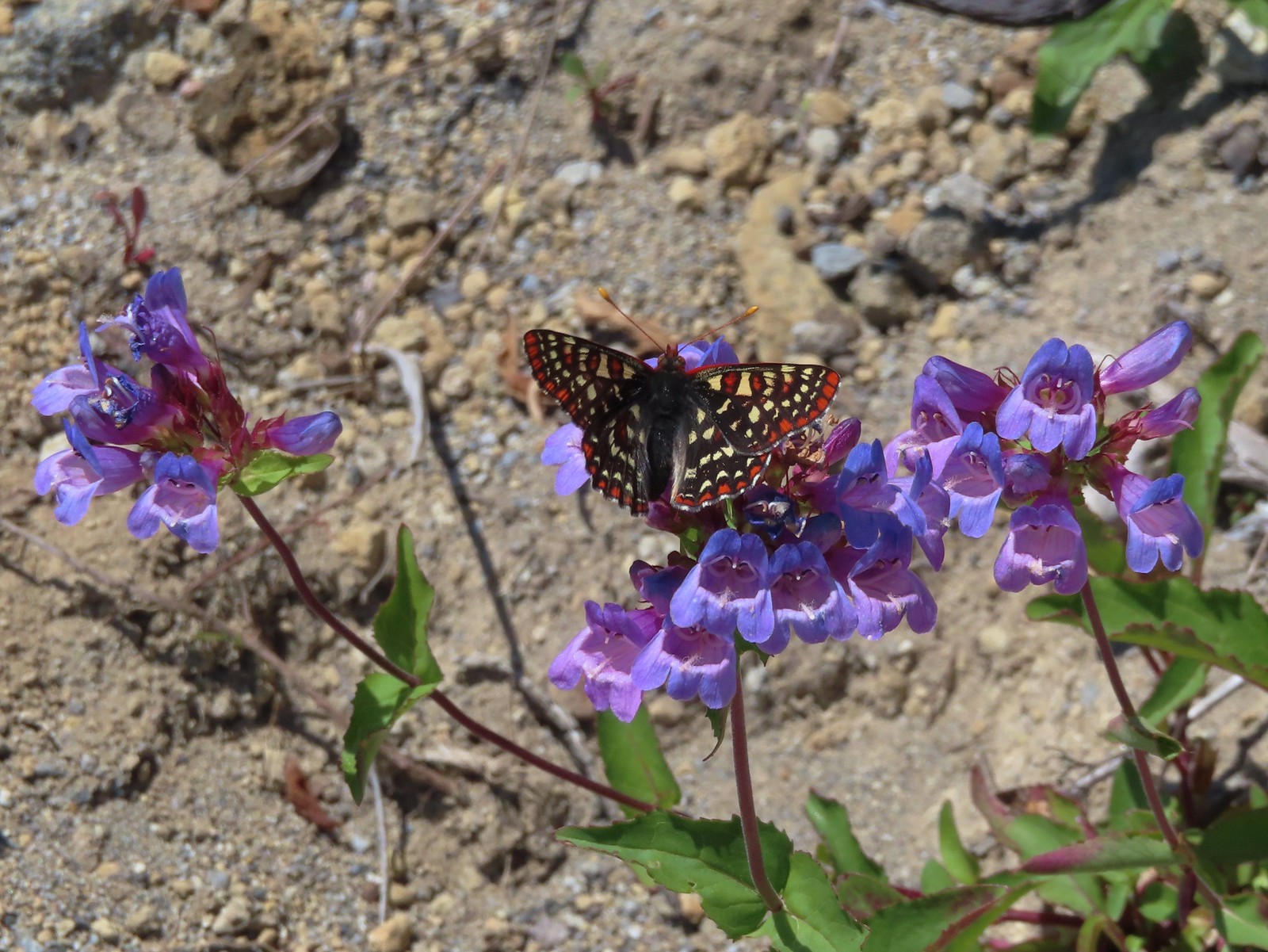
IMG_2972Snowberry checkerspot on penstemon.

IMG_3012

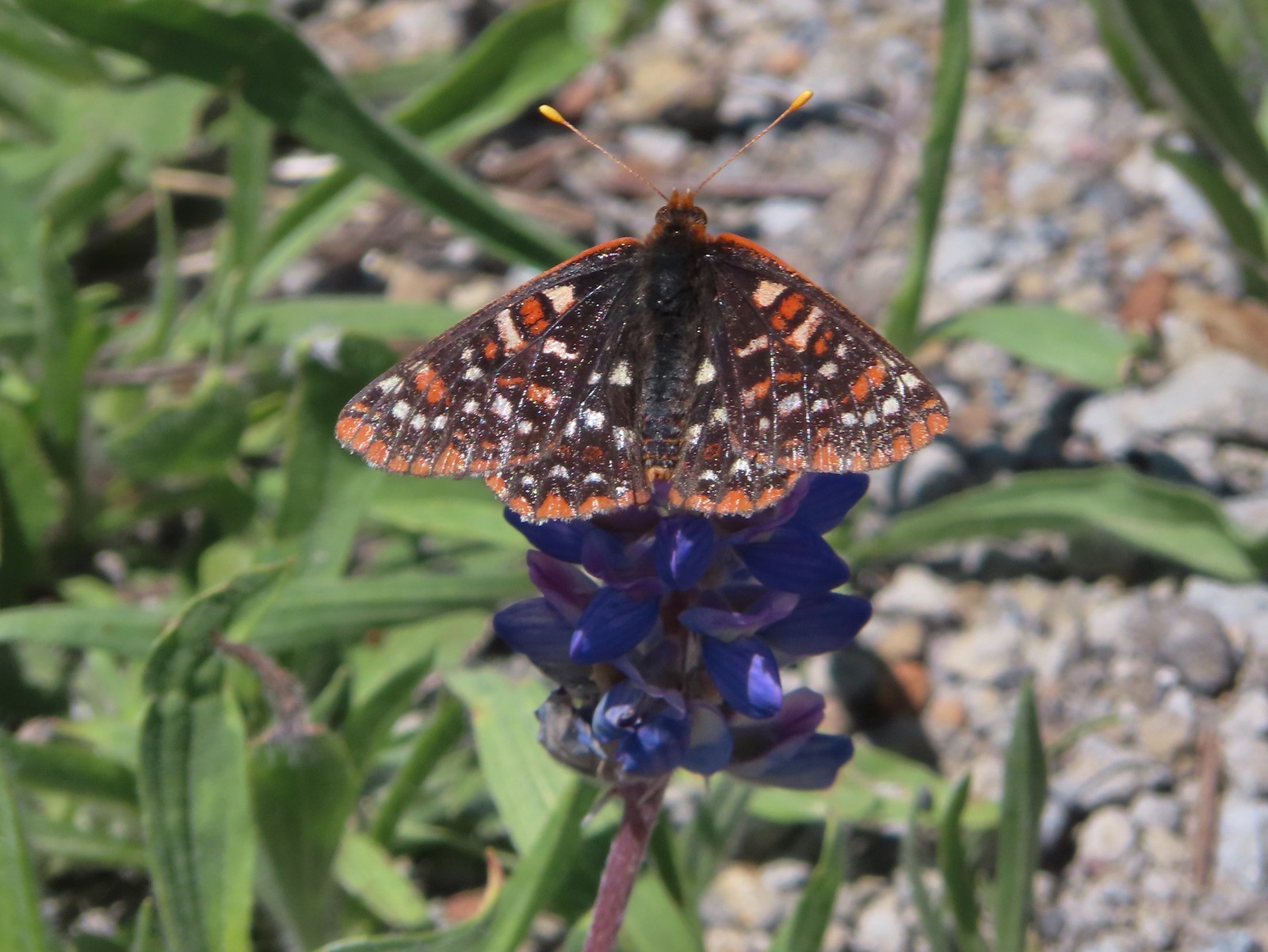
IMG_3017Another checkerspot, this time on lupine.

IMG_3023

IMG_3030Cedar waxwings

When we arrived back at the Hummocks Trail we turned left to finish that loop.
IMG_3041

IMG_3050

IMG_3058

IMG_3062Mt. St. Helens and the North Fork Toutle River.

Between it having been 9 years since we’d hiked this trail and the difference in the time of year the scenery was very different.
IMG_3064

North Fork Toutle RiverThe same view in May 2014.

IMG_3077

Hummocks TrailSame spot, different angle 2014.

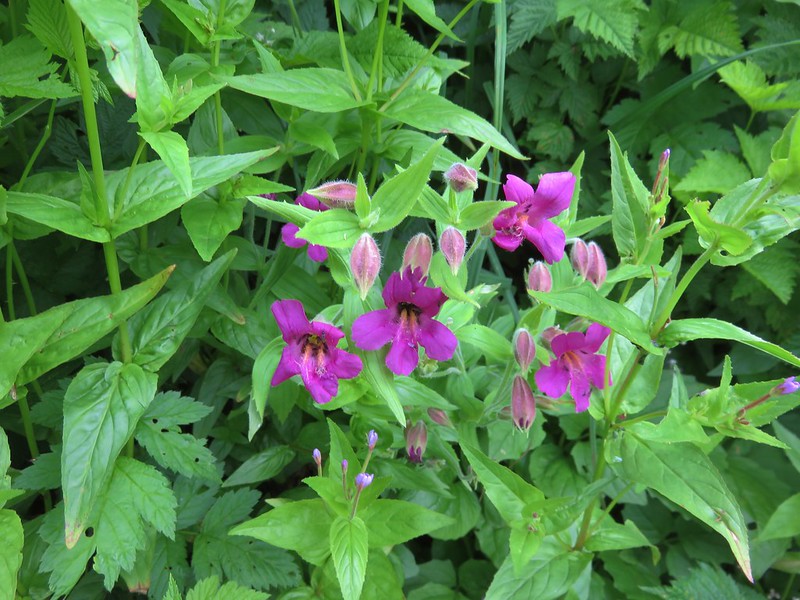
IMG_3078Monkeyflower

IMG_3081Maybe a yellow-rumped warbler.

IMG_3085Caterpillar

IMG_3086
IMG_3089Dragonfly

IMG_3096Pearly everlasting

IMG_3097Arriving back at the Hummocks Trailhead.

The hike came in at 12.5 miles with just under 2000′ of cumulative elevation gain.

This turned out to be the perfect day for this hike. The weather was pleasant, the views and flowers great, and the road closure provided solitude at the observatory. In addition to the Belgian hiker we passed a couple near the small viewpoint on the way to the observatory. We passed a few more people on the way back but nearly half of those were volunteers with the Mt. St. Helens Institute. The only thing that the hike lacked was any larger wildlife. It was one of the only hikes we could recall at the mountain where we didn’t see at least one deer, elk or mountain goat. Maybe next time. Until then Happy Trails!

Flickr: Boundary Trail – Hummocks TH to Johnston Ridge

Categories
Hiking Mt. St. Helens Trip report Washington Washington Cascades

Goat Marsh Lake and Kalama Ski Trail – 06/25/2022

After a wet and mild Spring, Summer announced its arrival with our fist 90-degree temperatures just in time for the weekend. When it gets that warm we typically turn to the mountains for relief but that’s a little trickier this year due to there being quite a bit of snow still up in the Cascades. Even some of the lower elevation mountains are still in the process of melting out. For instance our original plan for this hike had been to visit Silver Star Mountain (post) via the Starway Trail, an approach that we haven’t done yet. While this mountain is accessible recent reports showed several remaining snowdrifts but more importantly the wildflower show is running late. To decide where to go I turned to my spreadsheet looking for hikes that I had scheduled in coming years around the end of June. Goat Marsh Lake was on the schedule for next year and while the Goat Marsh Research Natural Area is located with the Mt. St. Helens National Volcanic Monument. It sits at a low enough elevation that there was a chance that snow wouldn’t be an issue. Using NOAA’s NOHRSC snow depth layer on the PCTA’s interactive map confirmed that snow shouldn’t be an issue at the lake or along the loop we were planning after visiting the lake using the Kalama Ski and Toutle Trails. With a forecast high of 78 degrees it would be warm but not unbearable so with that as our plan we got an early start and headed north to the Goat Marsh Lake Trailhead.

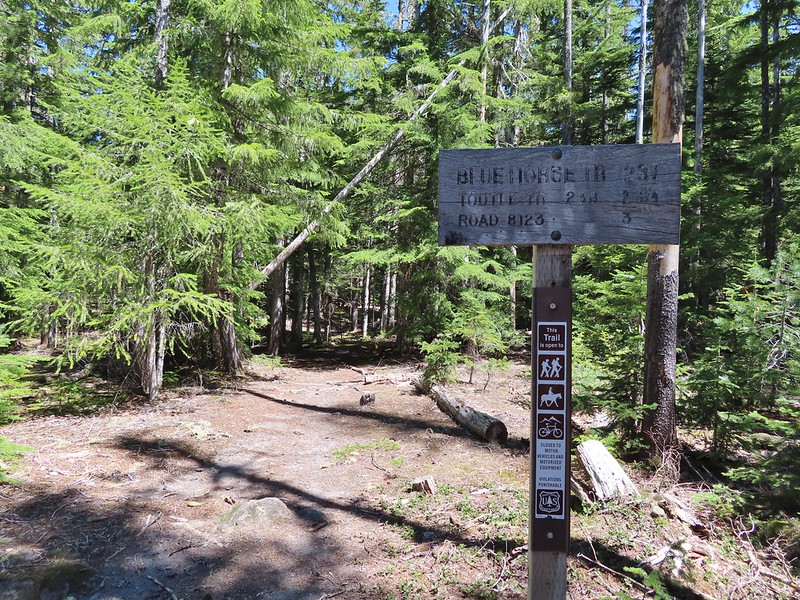
We parked a little up FR 8123 from the trailhead and walked back down to the start of the trail.
IMG_4715FR 8123

IMG_4716

This was the Kalama Ski Trail (Trail 231) and part of the loop we were planning as well as the way to reach the Goat Marsh Trail in a quarter mile.
IMG_4717

We followed this path to the junction where we turned right to visit the lake.
IMG_4722It appeared the trail had been rerouted at least a couple of times to cross this dry creek bed.

IMG_4725

IMG_4726

This trail led slightly uphill for 0.5 mile to our first view of the lake. Along the way we’d spotted a cow elk in the trees but she disappeared before we could take a picture.
IMG_4729

IMG_4730Fence at the boundary for the Research Area.

IMG_4733

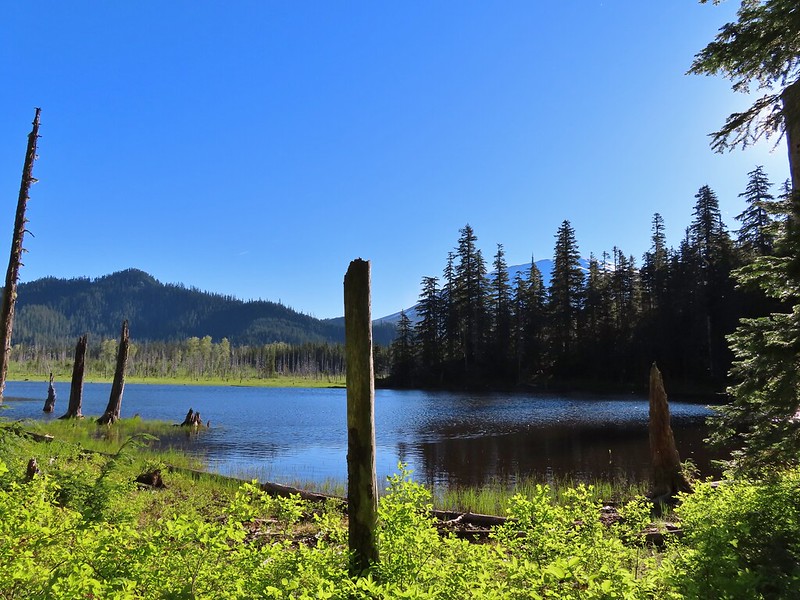
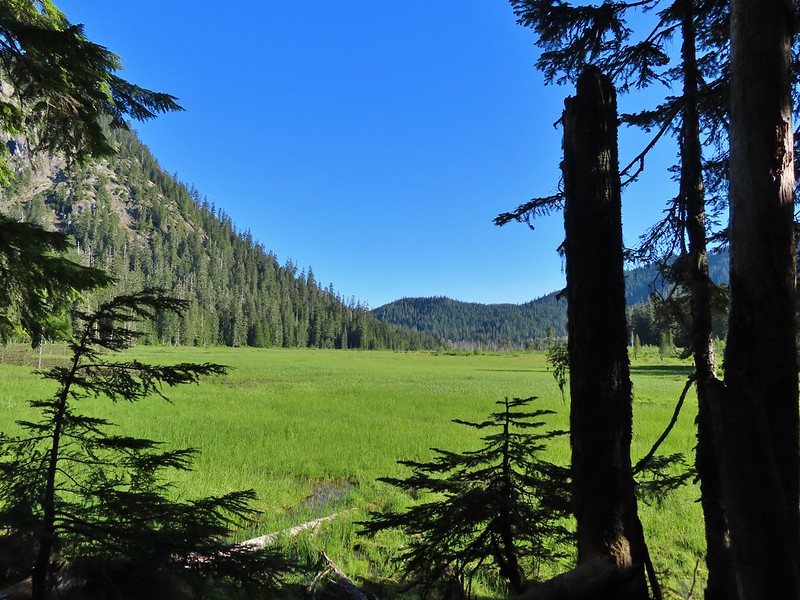
IMG_4738Goat Mountain and Goat Marsh Lake.

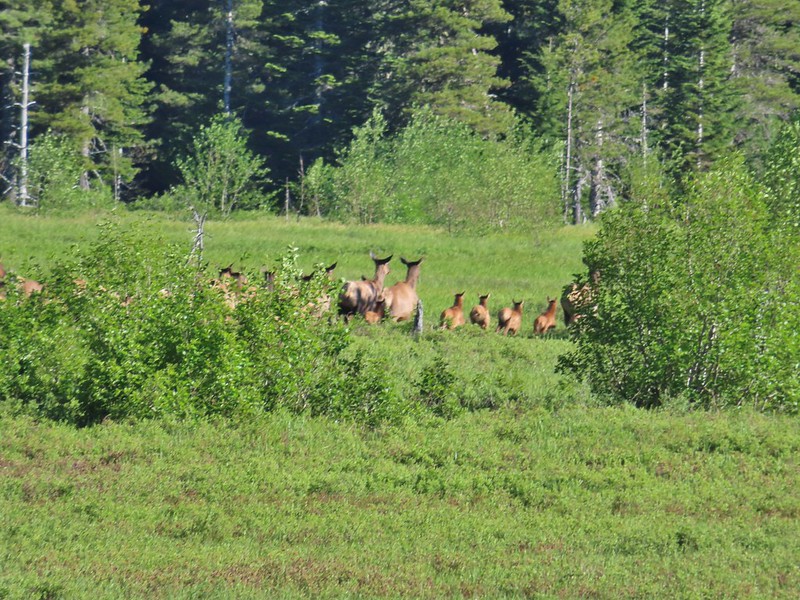
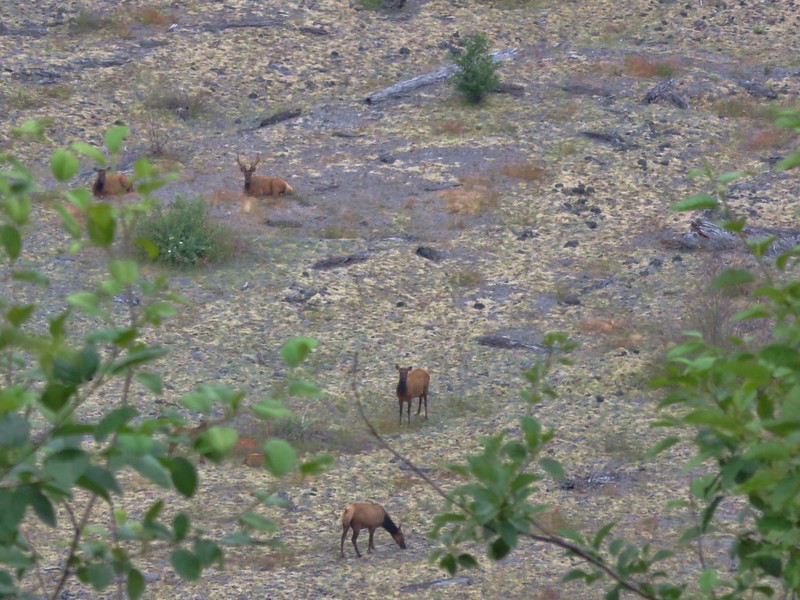
The trail continued around the lake for a little over three quarters of a mile. We spotted two more cow elk and moments later noticed a whole heard, including several calves, further to the north.
IMG_4740

IMG_4746Mt. St. Helens

IMG_4749Trillium

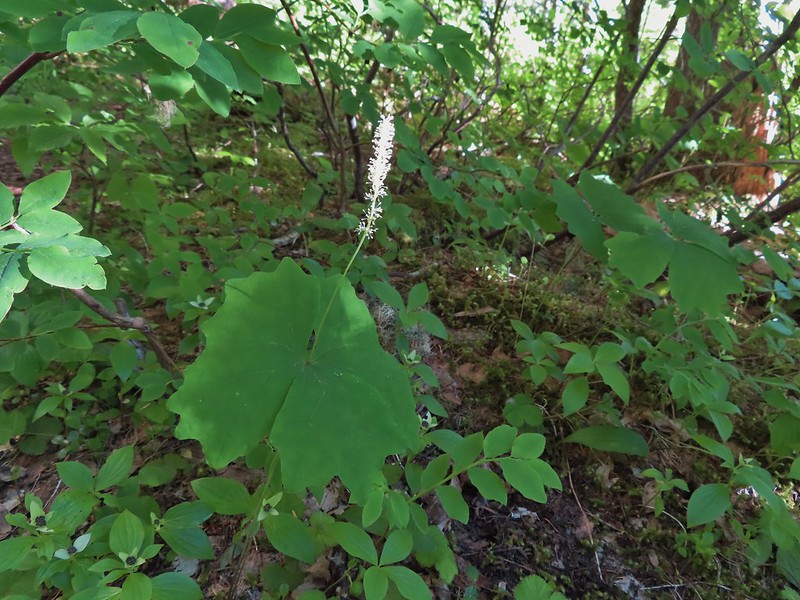
IMG_4750Vanilla leaf

IMG_4751

IMG_4754

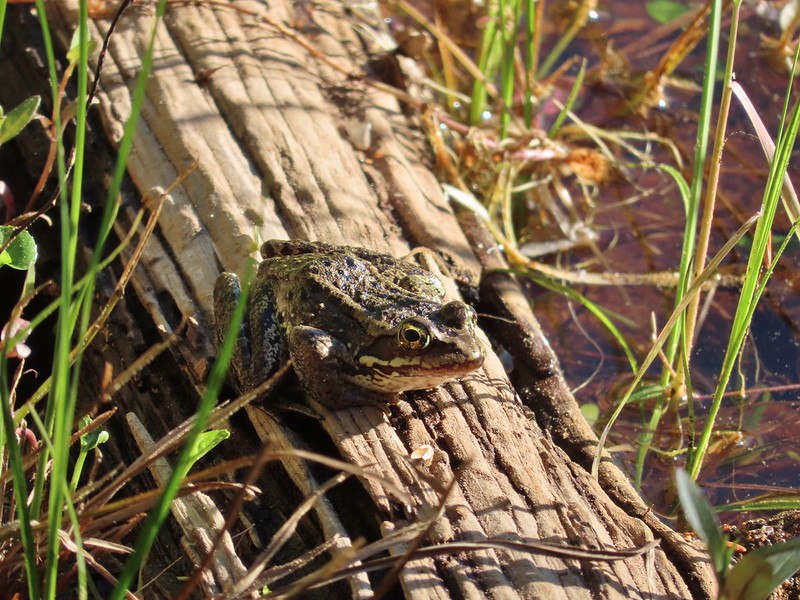
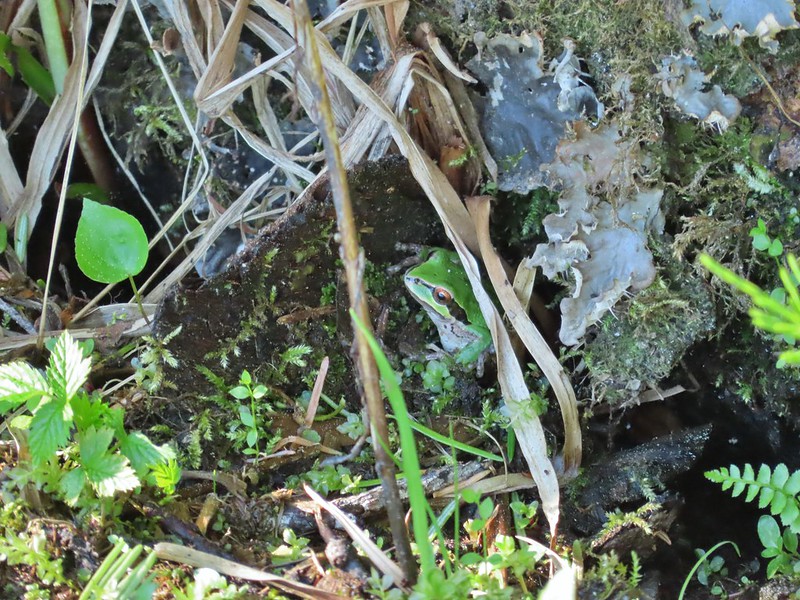
IMG_4761Frog on a log.

IMG_4764

IMG_4769The two cow elk in the middle of the grassy area.

IMG_4767

IMG_4774

IMG_4777Calves lined up, this one is a bit blurry due to them moving and the amount of zoom used.

IMG_4786The elk herd not zoomed in.

IMG_4787Zoomed

After watching the elk for a while we continued on.
IMG_4794Coralroot

IMG_4795Goat Mountain

IMG_4799Avalanche lilies

IMG_4804Mt. St. Helens

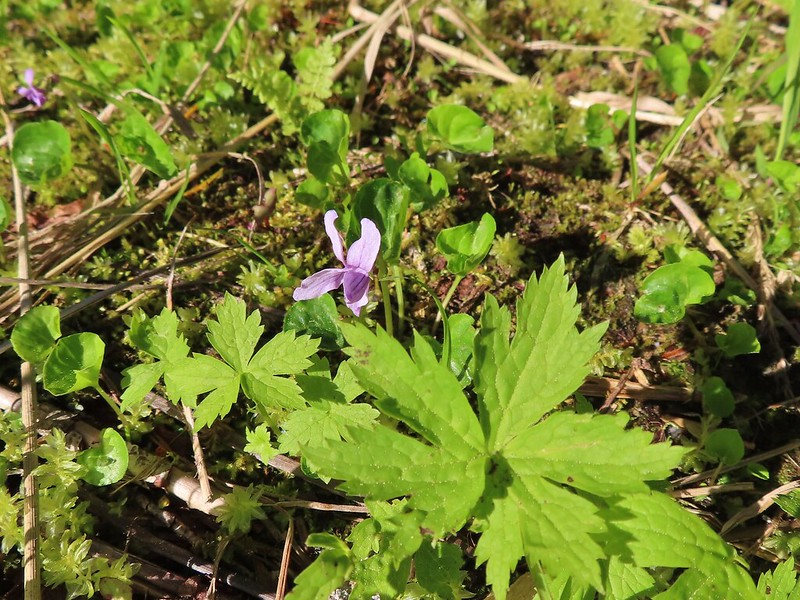
IMG_4806Marsh violet

IMG_4811Frog under a log.

IMG_4814Salmonberry

IMG_4816Sign near the end of the trail.

IMG_4818At the end of the trail.

IMG_4820

IMG_4821Beaver lodge

IMG_4826Duck and ducklings

IMG_4836Geese out in the grass.

We returned to the trailhead and crossed FR 8123 to stay on the Kamala Ski Trail.
IMG_4839

IMG_4843

IMG_4844The road crossing.

We had a little trouble picking up the trail beyond the sign because there was also a campsite here with several use trails radiating from it. We used our GPS while we looked for the blue diamonds that would identify a ski trail. Heather was the first to spot one and we were soon on the ski trail heading toward Mt. St. Helens.
IMG_4848In the campsite trying to decide which way to go.

IMG_4846

IMG_4851Once we found it the trail was pretty obvious, at least for a while.

IMG_4854

Approximately three quarters of a mile from the road we came to a junction with the Blue Lake Horse Trail. The horse trail can be used to reach Blue Lake (post) to the north via the Toutle Trail or the same Toutle Trail to the south near the Kalama River (post) which we could have done here to shorten our loop. Instead we stayed straight on the ski trail.
IMG_4859

IMG_4860

We had remarked several times during our Ashland vacation about the lack of mosquitos, and really insects overall, but that was not the case here. While they weren’t a big issue it was noticeably buggier here than it had been in Southern Oregon. The local birds were busy doing their part to reduce the number of bugs.
IMG_4862Gray jay with a snack.

IMG_4865Western tanager. Right after this photo he flew straight at us snatching an insect out of mid-air.

Four tenths a mile from the horse trail the ski trail made a turn away from the mountain and headed SE.
IMG_4876

The trail became a little more overgrown then came to a series of dry creek beds where we again had to hunt for signs of the trail.
IMG_4879

IMG_4881Butte Camp Dome in front of Mt. St. Helens.

IMG_4887

IMG_4891Crossing another dry bed.

IMG_4892Where is the trail?

IMG_4893In one of the creek beds. We were using the GPS along with looking for cairns and/or flagging.

IMG_4894Goat Mountain

IMG_4896You can’t really make them out in the photo but there is a pink flag and a blue diamond (on a downed tree) near the edge of the green trees.

We were now entering the section of trail that the NOHRSC indicated there could be some lingering snow patches.
IMG_4899There was another short brushy section before the forest opened up.

IMG_4900One of the strangest snow sightings we’ve come across.

IMG_4902My theory was bigfoot hung this.

IMG_4906

IMG_4915

IMG_4916The NOHRSC estimated 2″-3.9″ of snow and that seemed to be about right.

IMG_4917

Unlike in the Siskiyous this melting snow had produced a fair number of mosquitos so we hustled through this section even though it was scenic.
IMG_4918

We encountered the first other hikers we’d seen when we arrived at the junction with the Toutle Trail (Approx 3 miles from the Goat Marsh Lake Trailhead). The junction was unsigned and they were considering which way to go to find the Loowit Trail. We pointed them north (left from the direction we were coming, straight for them) on the Toutle Trail and then turned south (right) ourselves onto the Toutle.
IMG_4921Looking back at the junction from the Toutle Trail. The post with no sign is the continuation of the Toutle while the trail on the left is the ski trail.

We followed this trail south for half a mile passing through a beargrass meadow that appears to have bloomed heavily last year and a lava flow with excellent views of Mt. St. Helens before dropping to FR 81 at the Red Rock Pass Trailhead.
IMG_4923

IMG_4926

IMG_4932Last years beargrass.

IMG_4934

IMG_4937Strawberry

IMG_4938Phlox

IMG_4948

IMG_4952FR 81 below the trail.

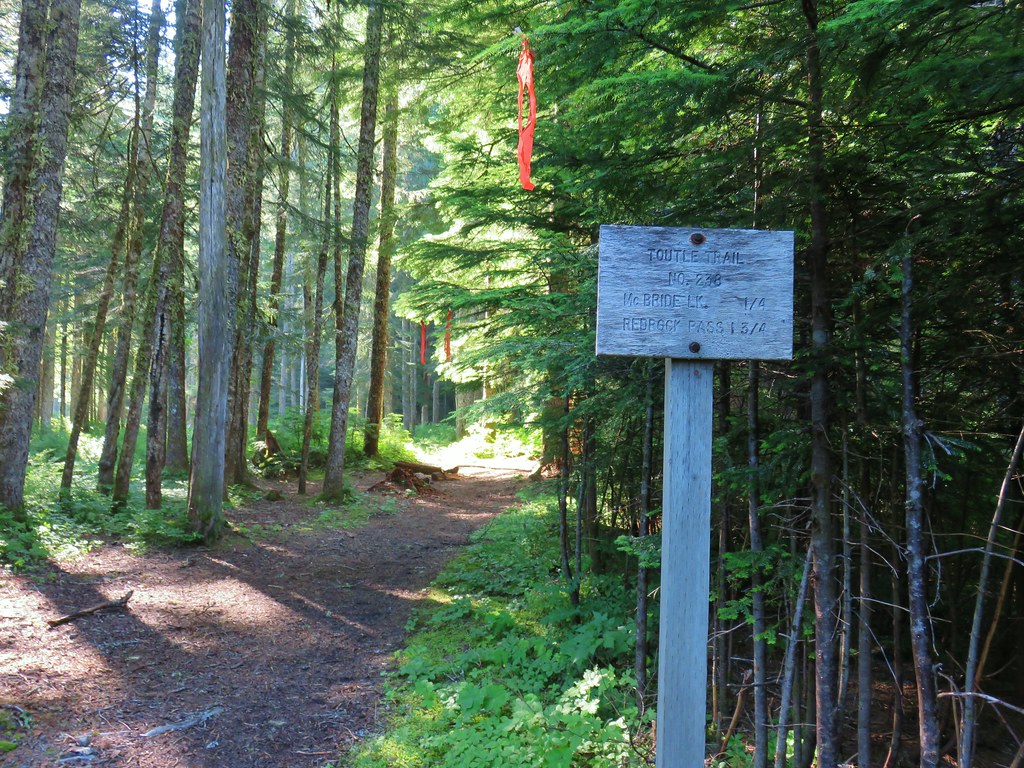
IMG_4953Trail sign at the trailhead.

We crossed FR 81 and continued on the Toutle Trail.
IMG_4956

After 100 yards we came to a familiar fork where we had turned uphill in 2019 on our Cinnamon Ridge Hike linked above.
IMG_4961Raven flyover

IMG_4963The fork.

We were going in the opposite direction of what we’d done in 2019. Bugs were a bit more of a nuisance here so we kept a steady pace as we made a little climb then descended to McBride Lake and the Kalama River.
IMG_4967

IMG_4971One of several side creeks we crossed.

20220625_112201Trillium

20220625_112218Avalanche lily

IMG_4976Violet

IMG_4984

IMG_4993Goat Mountain beyond McBride Lake.

IMG_4994Sourgrass

IMG_5004Valerian

IMG_5006

IMG_5012Solomonseal

20220625_115233Saxifrage

IMG_5022

IMG_5028

A little west of McBride Lake the Toutle Trail crosses the Kalama River on a closed road bed.
IMG_5030

IMG_5031Kalama River from the road bed.

Our original plan was blown up here. We had intended to follow the Toutle Trail to the start of the Kalama Ski Trail and then take that trail back uphill to the Goat Marsh Lake Trailhead. The problem was I had already forgotten about the Blue Lake Horse Trail and when I had glanced at the GPS and saw a trail extending north from the end of the road bed I mistook it for the ski trail so we followed the road bed a quarter mile to FR 81. (We had a paper map with us but didn’t pull it out to confirm.)
IMG_5034

IMG_5035The Blue Lake Horse Trail on the far side of FR 81.

When we crossed FR 81, two things that should have tipped us off to our mistake. First the sign clearly said “Blue Horse Trail” and second instead of blue diamonds there were orange diamonds with arrows marking this trail.
IMG_5036The sign did show FR 8123 which was the road the trailhead was on so that fed into us not realizing our mistake at first.

We followed this trail for a third of a mile before we realized what we’d done. We stopped and considered our options. We could back track three quarters of a mile to the Toutle Trail or a third of a mile to FR 81 and follow one of them west to the ski trail. Another option was to continue uphill on this trail to the junction we’d passed earlier and retrace our steps on the ski trail from there back to the trailhead. All of those options meant adding distance and retracing steps. Heather suggested another option, simply heading cross-country for FR 8123 and the trailhead.
IMG_5037An orange diamond on a tree ahead.

The forest was definitely conducive to cross-country travel so we struck off in a WNW direction. The cross-country hike was about as easy as we could have hoped for and after 0.7 miles we arrived a FR 8123 just 0.2 miles from our car.
IMG_5038Where we left the horse trail.

IMG_5039Typical terrain for the cross-country walk.

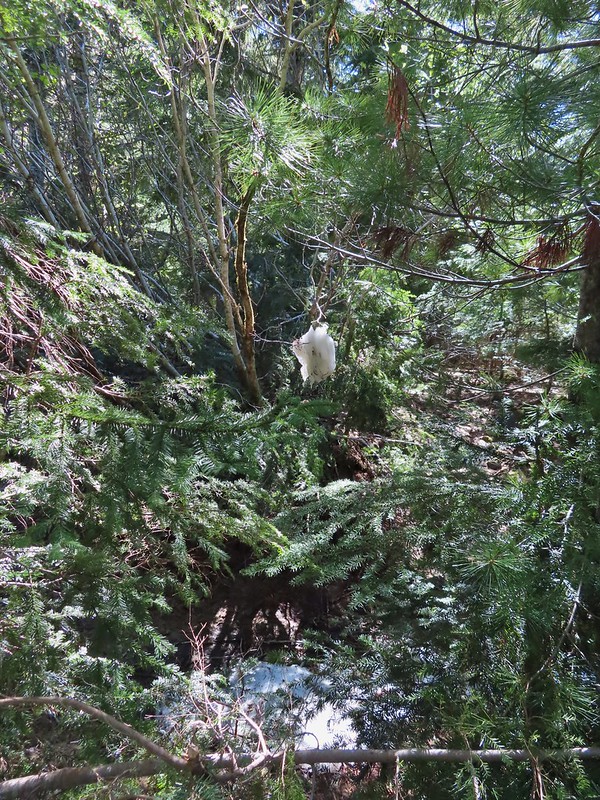
IMG_5040It seems like every time we go off-trail we come across a mylar balloon. We’ve really come to despise those things. We packed it and the ribbon out.

IMG_5041The trickiest part was crossing this dry stream bed but we fortunately came to it at a spot that was perfect for crossing.

IMG_5042

IMG_5043FR 8123

IMG_5045Coming up to the Goat Marsh Lake Trailhead (and our car) on FR 8123.

I had estimated a 10-12 mile hike with only about 800′ of total elevation gain and we came in at 10.8 miles.

Our track with the cross-country portion in orange.

While it had been a warm day, the combination of shade provided by the forest and a fairly steady breeze, it hadn’t been too hot. The hike had provided a lot of diverse scenery and great views of Mt. St. Helens. The wildlife was a big bonus along the Goat Marsh Trail too. It seems like we can always count on hikes in Mt. St. Helens area to be great ones. Happy Trails!

Flickr: Goat Marsh Lake

Categories
Hiking Mt. St. Helens Trip report Washington Washington Cascades

Cinnamon Ridge – 7/20/2019

**Note a small portion of this hike burned in the 2022 Kalama Fire.**

It had been a couple of years since our hikes had taken us to the Mt. St. Helens area. We didn’t want to go a third year without making a visit so we picked the 14.1 mile Cinnamon Ridge Loop Hike described here in the Oregon Hikers field guide. A shorter loop was also described in Matt Reeder’s “Off the Beaten Trail” guidebook.

We started at the Kalama Horse Camp Trailhead and consulted the signboard map to confirm our route. (We had a paper map, a downloaded pdf track, and our GPS with us, but you can never consult too many maps.)
IMG_3607

IMG_3608

We set off on the Toutle Trail just to the right of the signboard.
IMG_3609

After a short descent the trail crossed an unnamed creek. Ripe berries were everywhere.
IMG_3610

IMG_3611

IMG_3613

IMG_3612

Two tenths of a mile from the trailhead we came to a junction with the Cinnamon Ridge Trail, our return route. We stayed left on the Toutle Trail.
IMG_3615

IMG_3619Toutle Trail

IMG_3618Candy sticks

A short distance later we stayed right at a junction with the Kalama Ski Trail.
IMG_3620

Beyond this junction the trail approached the Kalama River as it passed through the forest.
IMG_3626

IMG_3627

IMG_3630

IMG_3636

IMG_3639

Yet another junction followed about three quarters of a mile later just after climbing away from the river via a switchback. Again we stuck to the Toutle Trail.
IMG_3642

The trail was now a good distance above the river avoiding a series of slides.
IMG_3644

IMG_3646

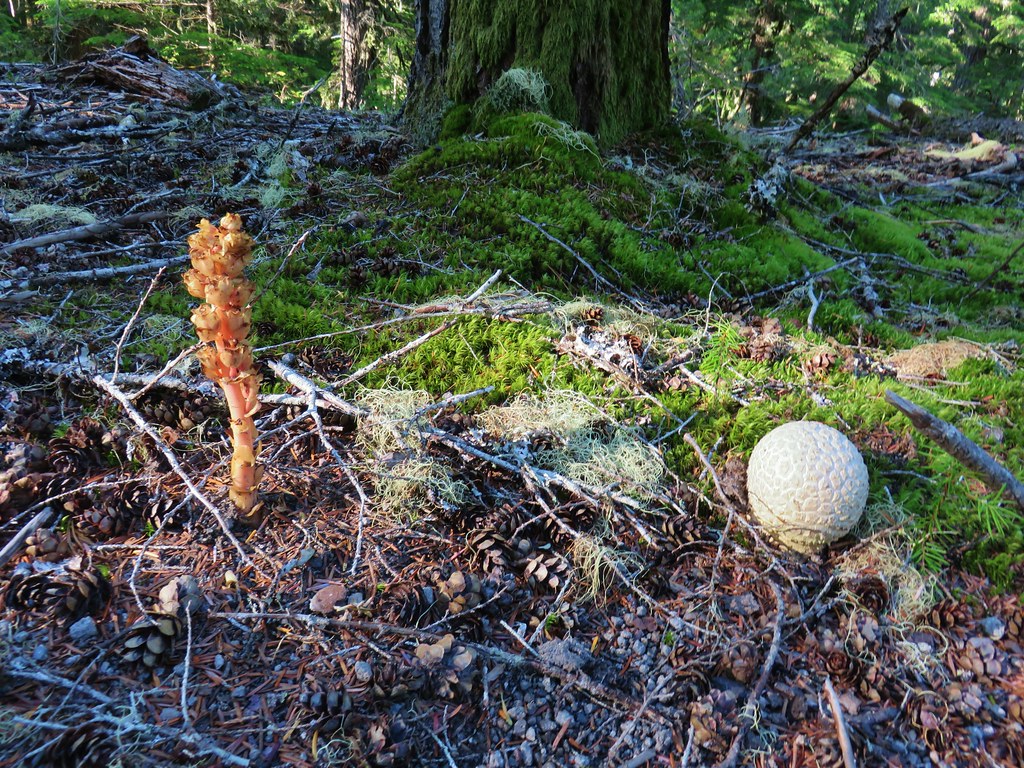
IMG_3648Pinesap

IMG_3651Pinesap and a puffball

Just over 2 miles from the trailhead we arrived at the third and final junction signed for the Kalama Ski Trail where we also stuck to the Toutle Trail.
IMG_3653

There had been plenty of ripe huckleberries and lots of pinesap but not too many flowers. There were a few lousewort and twin flowers though along this section of trail.
IMG_3655Lousewort

IMG_3660Twin Flower

At the 2.5 mile mark we came to a Forest Service Road.
IMG_3661

Reeder’s shorter/easier loop utilizes this road which he lists as FR 8122 (our maps showed it as 8022). He also has you hike in the opposite direction so we would have been coming down the road to this junction then returning to the horse camp the way we’d come on this hike. Since we were doing the longer loop we crossed over the road and continued on the Toutle Trail which was once again closer to the Kalama River.
IMG_3665

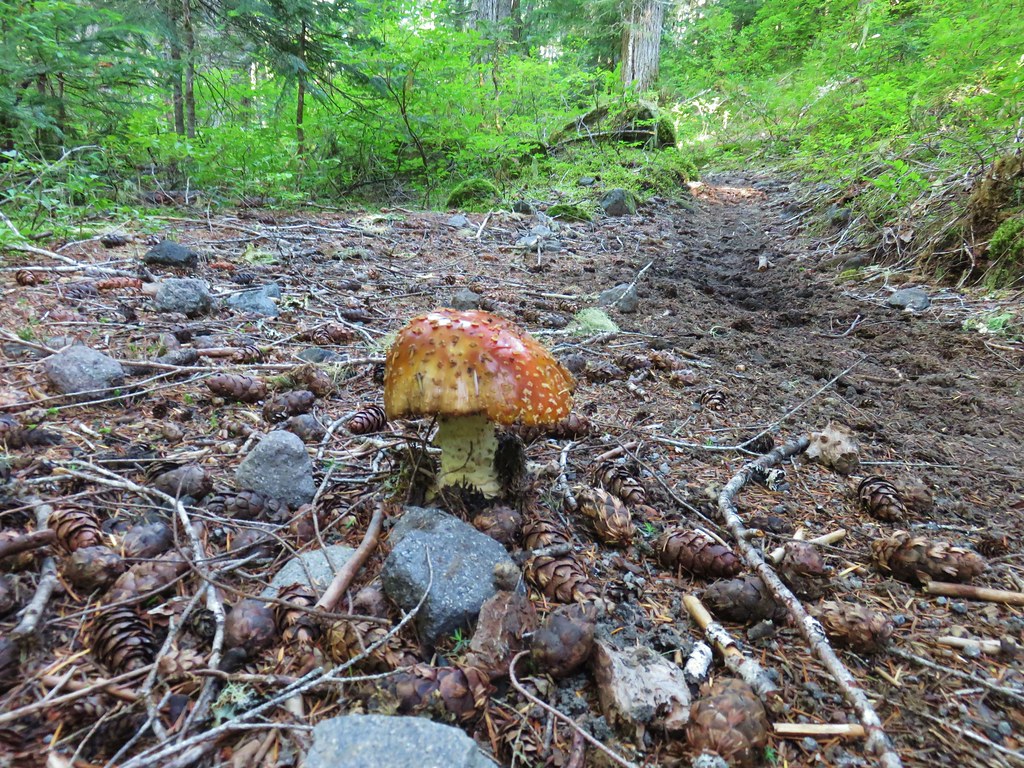
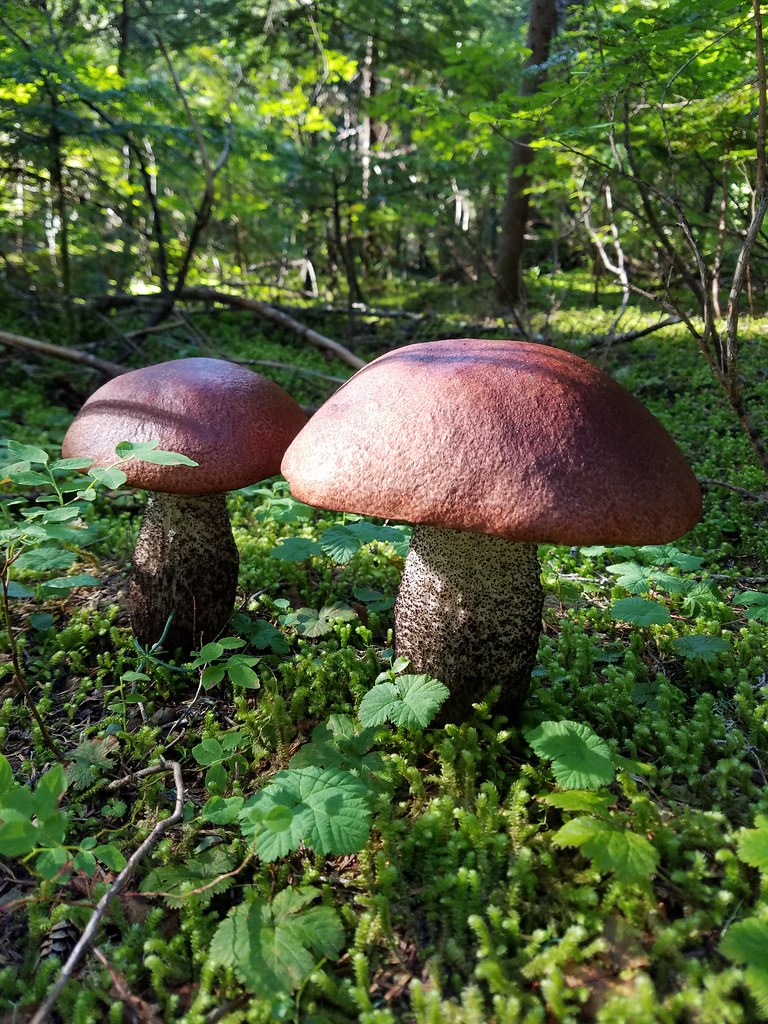
Along this stretch we noticed a few really large mushrooms.
IMG_3666

IMG_3674

20190720_083611

Approximately 1.2 mile from the road crossing we crossed a second road bed where the trail hopped to the opposite side of the river.
IMG_3680

IMG_3687

A good sized frog jumped off the trail in front of us here.
IMG_3686

As we neared McBride Lake (now more of a wetland) we obtained our first glimpses of Mt. St. Helens.
IMG_3690

IMG_3691

IMG_3695

IMG_3706Mt. St. Helens beyond the remnants of McBride Lake.

We averted disaster when a rough skinned newt charged Heather but it was only a bluff.
IMG_3713

The trail climbed through a nice forest as it passed McBride Lake on its way to Red Rock Pass.
IMG_3717

IMG_3722Cars parked at Red Rock Pass

We didn’t go all the way down to Red Rock Pass as the Cinnamon Trail headed uphill at an unsigned junction about 100 yards above the trailhead.
IMG_3723Cinnamon Trail on the left and Toutle Trail on the right from the unsigned junction.

While the Toutle Trail had gained almost 1200′ in the 5.7 miles from the trailhead to the Cinnamon Trail junction the Cinnamon Trail gained nearly 700′ in less than a mile. Although the climb was never particularly steep it provided a good workout. It also provided some nice views of Mt. St. Helens and our first (and best) look at Mt. Adams.
IMG_3724

IMG_3730

IMG_3735_stitch

IMG_3733

Things leveled out a bit after gaining the ridge where the trail passed through a variety of scenery.
IMG_3739

IMG_3741

IMG_3743

IMG_3744

IMG_3748

IMG_3749Fungus on a stump.

After a little of two and a half miles on the Cinnamon Trail we came to a small meadow with a view south to Mt. Hood.
IMG_3755

IMG_3757

IMG_3766

IMG_3765

Just beyond the meadow the trail reached a saddle with a view NW to Goat Mountain.
IMG_3767

The trail continued to follow the ridge west and then south as it passed around a butte.
IMG_3770The butte ahead (we didn’t want to have to climb that.)

IMG_3774Trail wrapping around the south side of the butte.

On the far side of the butte we arrived at another saddle.
20190720_113203Toad near the saddle.

IMG_3780Mt. St. Helens from the saddle.

The trail stuck to the north side of the ridge for a bit allowing for some good views of Mt. St. Helens and another Mt. Adams sighting.
IMG_3781Goat Mountain

IMG_3783Mt. St. Helens and Mt. Adams

IMG_3796Another frog.

At the 4.5 mile mark of the Cinnamon Trail we arrived at the first of three successive road crossings (all of the same road).
IMG_3799Crossing #1

IMG_3800Crossing #2

IMG_3801Crossing #3

Approximately a quarter mile from the third road crossing the trail began to descend through a small meadow with a few cat’s ear lilies.
IMG_3804

IMG_3802

Soon we were dropping down along a narrow ridge where we were able to see the top of Mt. Rainier beyond Coldwater Peak.
IMG_3823

IMG_3809

The sun was glinting off of the equipment on top of Coldwater Peak (post).
IMG_3820

The trail continued to descend crossing over another old roadbed before reaching FR 8022 (or FR 8122 per Reeder) 6.2 miles from Red Rock Pass.
IMG_3824

IMG_3825old road crossing.

IMG_3829

IMG_3830Dropping to FR 8022(8122).

We crossed this road onto an old roadbed which we followed for four tenths of a mile.
IMG_3831Goat Mountain from the roadbed.

IMG_3835Goat Mountain and Mt. St. Helens

IMG_3838Ripening berries

IMG_3842Rock slide along the roadbed.

Shortly after passing through the rock slide the roadbed ended and we were back on a trail.
IMG_3845

IMG_3847Pinedrop

The trail descended for another mile and a half eventually coming back within earshot of the Kalama River but not close enough to provide many views until we arrived at a footbridge across it.
IMG_3849

IMG_3851

IMG_3853

IMG_3857

From the bridge it was just 100 yards to the end of our loop and .2 miles from the trailhead. The 14.1 miles combined with nearly 3000′ of elevation gain make this a challenging hike. Despite the difficulty and lack of any real big WOW moments it was a really enjoyable hike. There were plenty of positives; the ripe berries, the river, mountain views, a little wildlife (including some grouse which as always gave us a start when they flew off.), a few wildflowers, and some nice forests to keep us entertained the entire way. Happy Trails!

Flickr: Cinnamon Ridge

Categories
Hiking Mt. St. Helens Trip report Washington Washington Cascades

Mount Margaret Backcountry – South Coldwater Trailhead to Obscurity Lake

The only backpacking trip that we had planned for this year which required a permit was an overnight stay in the Mount Margaret Backcountry near Mt. St. Helens. The area is part of the Mount St. Helens National Volcanic Monument, displaying the effects of the 1980 eruption. The lateral blast from the eruption shattered trees toppling thousands of acres of forest.

Camping is limited to designated sites at eight backcountry camps where the maximum group size for camping is four. Pets and pack stock are prohibited in the Mount Margaret Backcountry and fires are not allowed. We made our reservation for Obscurity Camp on March 19th, the day the permits became available.

One drawback of a permit system is not having any idea what the weather is going to be like on the days you reserve. We were looking at the chance of showers and maybe even a thunderstorm as we were hiking out, but we liked our odds and we had spent a whole $6.00 on the permit so we decided to give it a go. It was a wet drive to the South Coldwater Trailhead which is located along the Spirit Lake Highway (SR 504).
IMG_1506

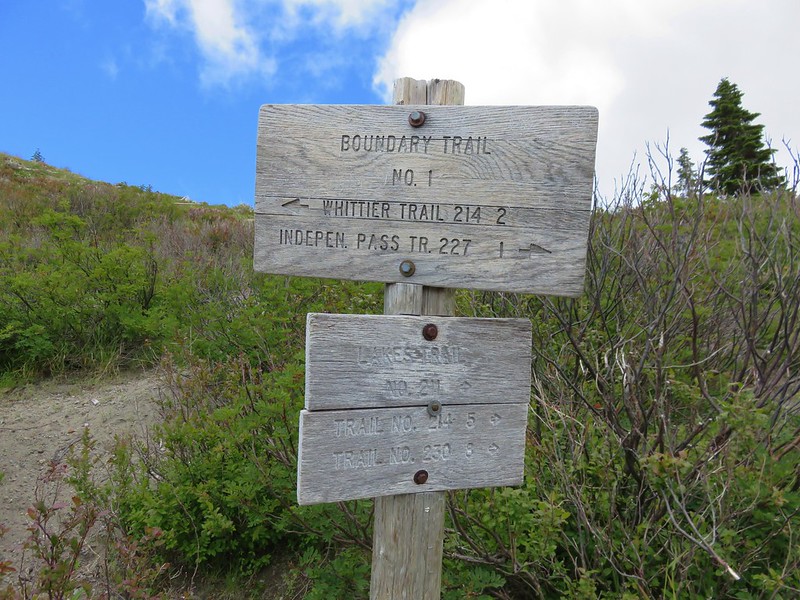
Starting at Norway Pass would have made it a shorter hike but where is the fun in that? It also would have been a longer drive. Our plan was a lollipop route using the South Coldwater Trail 230A, Coldwater Trail 230, Boundary Trail 1, and Lakes Trail 211. We had been on some of the trails in 2013 during a May hike around Coldwater Lake, but that hike had been early enough in the season that there had been very little vegetation and almost no flowers. It was evident from the flowers at the trailhead that we’d be seeing different sights this time around.
IMG_1507

We were under the clouds as we set off on the trail which passed through a short section of woods before emerging into wildflower filled meadows.
IMG_1530

IMG_1531

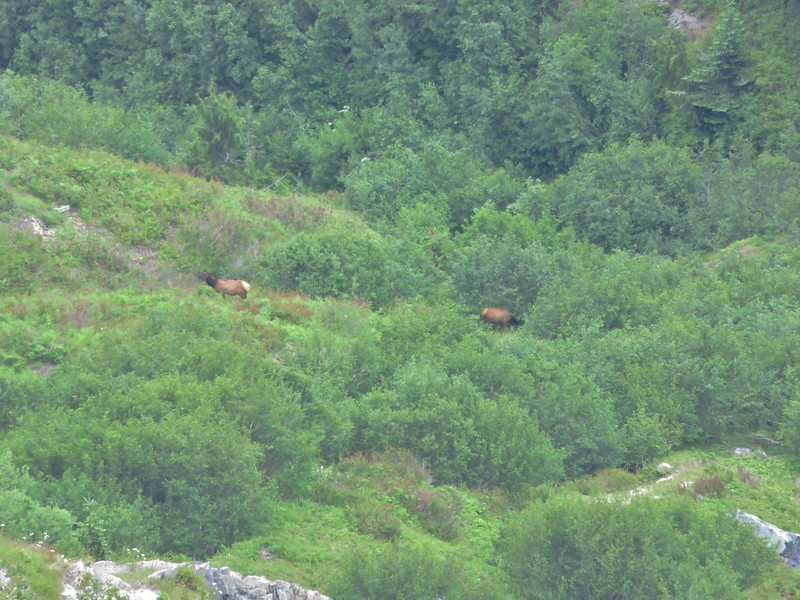
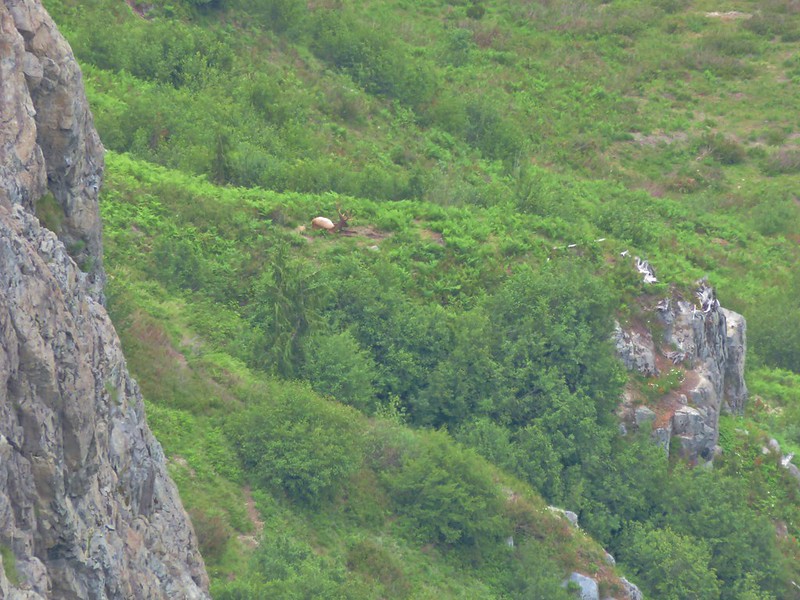
Although the clouds limited the view we were able to see back down to the South Coldwater Creek Valley where we spotted several elk.
IMG_1539

IMG_1541

The trail then crossed over the ridge we were climbing providing views of Coldwater Lake.
IMG_1545

IMG_1548

The wildflowers were thick along the trail, but we were starting to enter the cloud bank and quickly losing our visibility.
IMG_1546

IMG_1549

IMG_1555

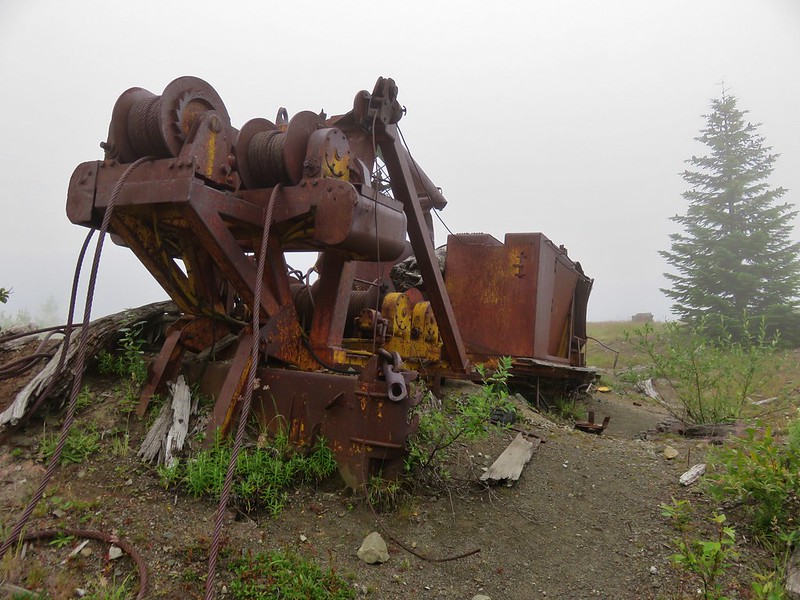
The trail continued to climb along the ridge passing a couple of pieces of old machinery that is left over from the 1980 eruption of Mt. St. Helens.
IMG_1559

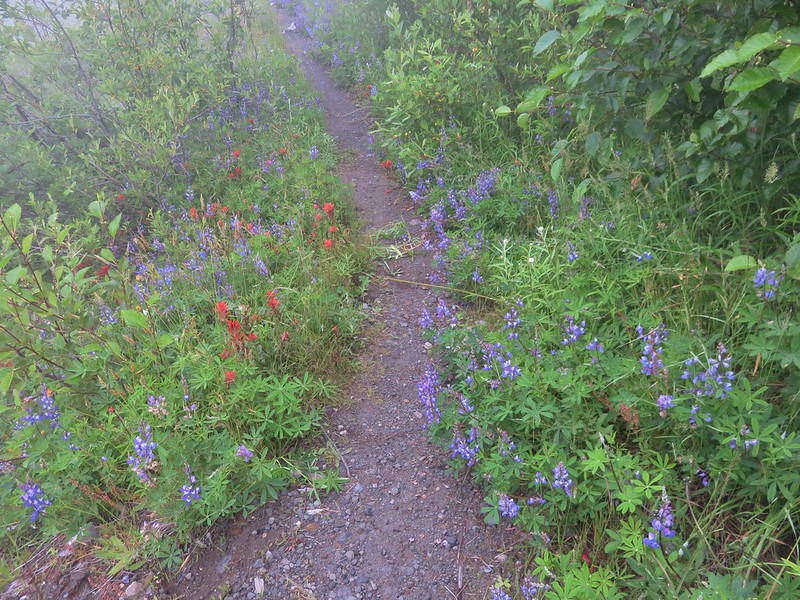
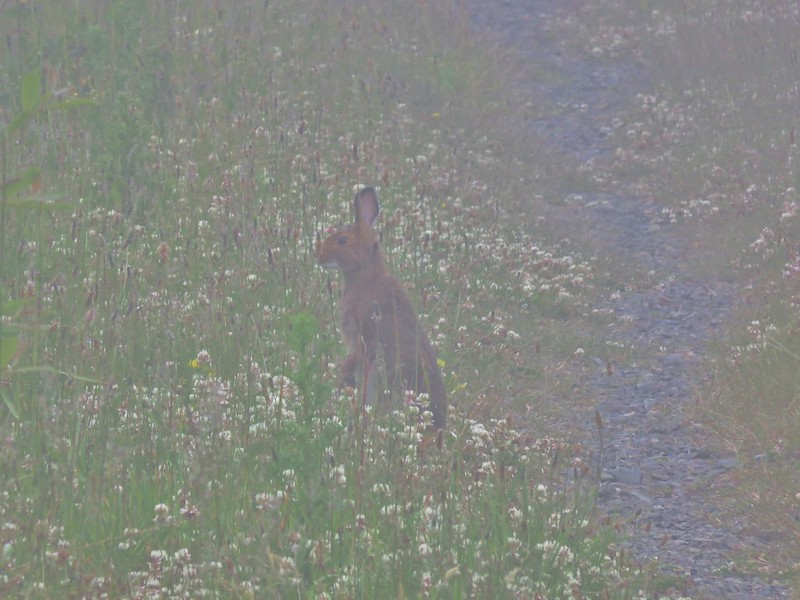
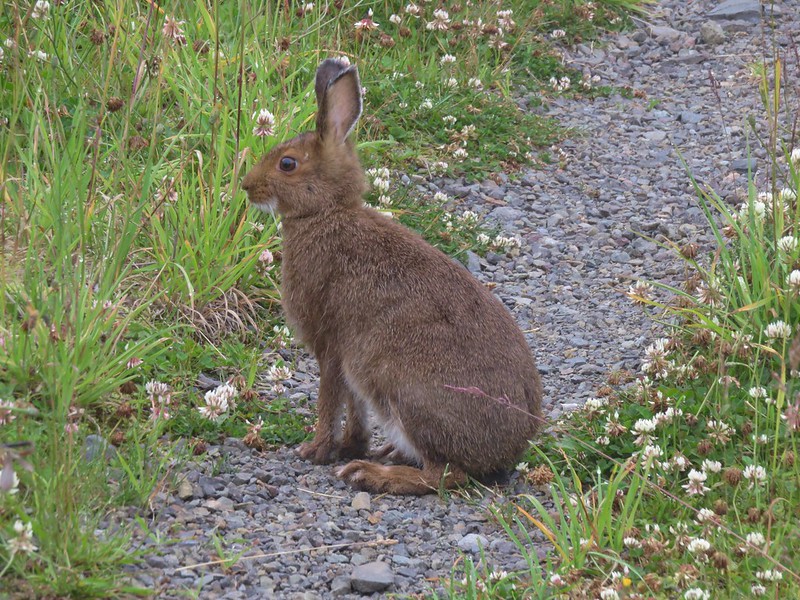
We were now in the midst (or mist) of the clouds. At least it wasn’t raining and despite the low visibility there were still plenty of flowers along the trail to see and there were a couple of snowshoe hares out having breakfast.
IMG_1586

IMG_1590

IMG_1571

IMG_1577

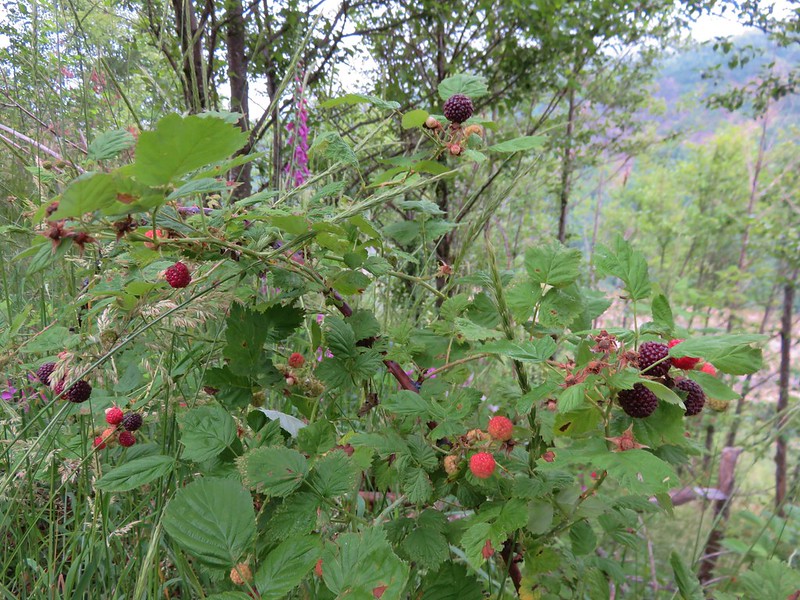
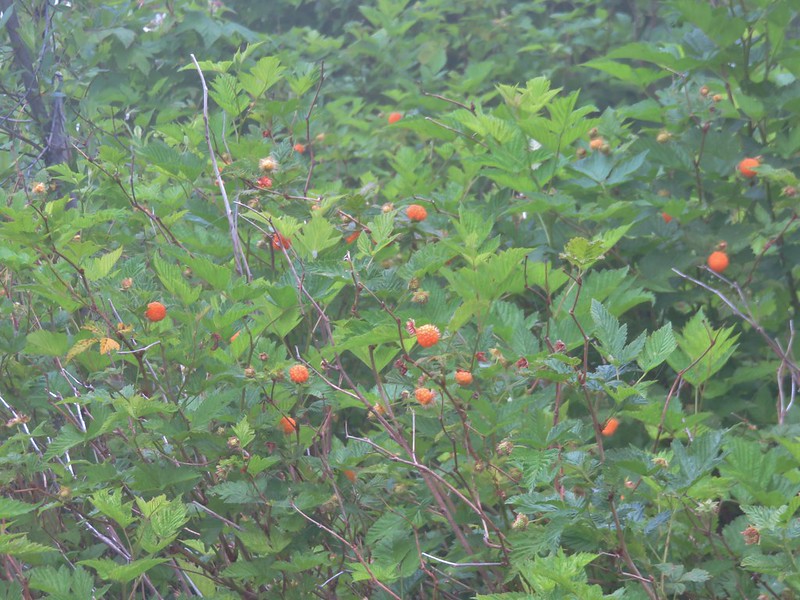
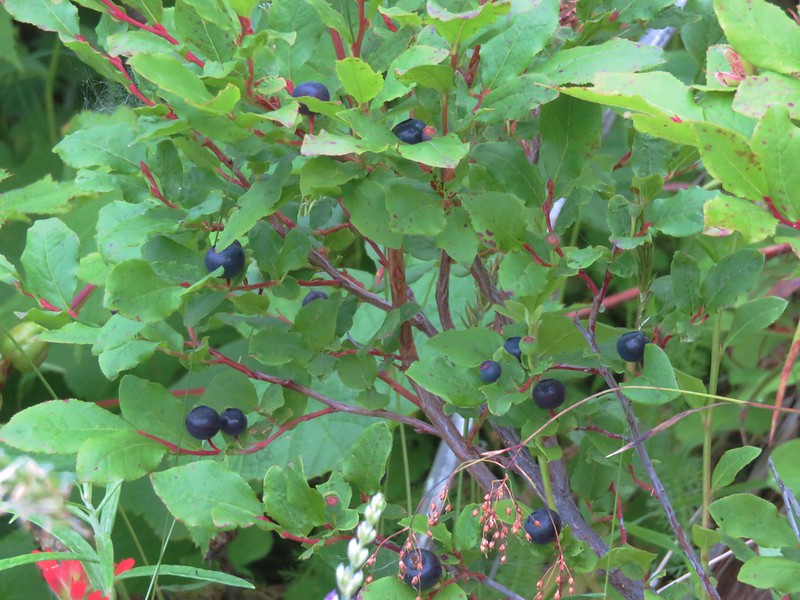
The hares weren’t the only ones enjoying some snacks. A variety of ripe berries offered us a nice selection of treats.
IMG_1543

IMG_1596

IMG_1598

After 3.2 miles we arrived at Tractor Junction. Named for another piece of nearby equipment, this junction marks the end of the South Coldwater Trail at it’s intersection with the Coldwater Trail.
IMG_1604

IMG_1610

We turned right at the junction and headed toward the Boundary Trail which was just over 2 miles away. After .2 miles we passed Ridge Camp, one of the designated camps in the area.
IMG_1626

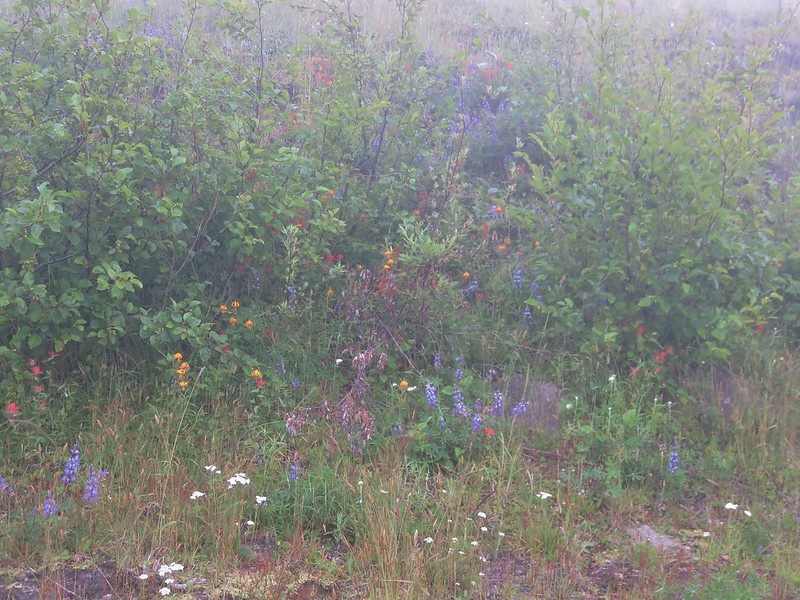
The wildflowers were once again impressive along this trail, but the visibility was even worse. We focused on finding as many different flowers as we could.
Tiger lilies
IMG_1614

Lupine, paintbrush and yellow wildflowers
IMG_1616

Large patch of paintbrush
IMG_1642

Arnica
IMG_1649

Bugbane
IMG_1651

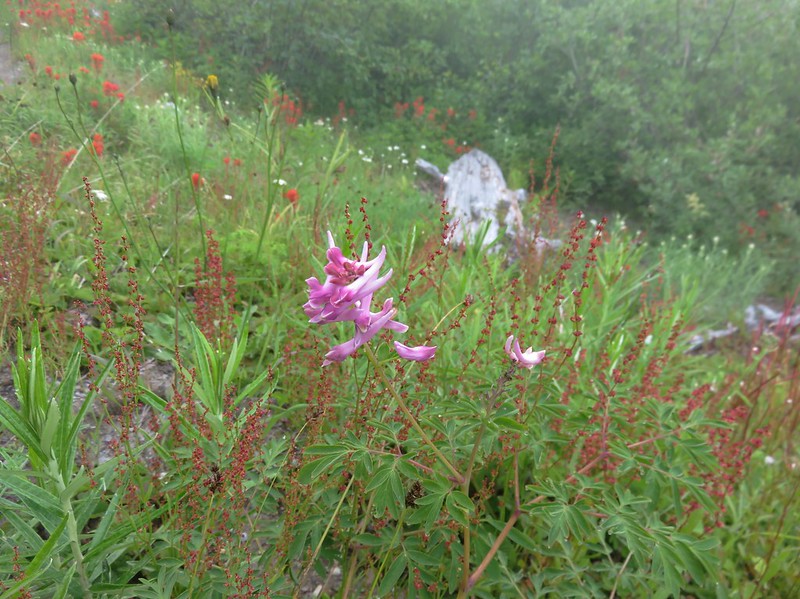
Corydalis
IMG_1657

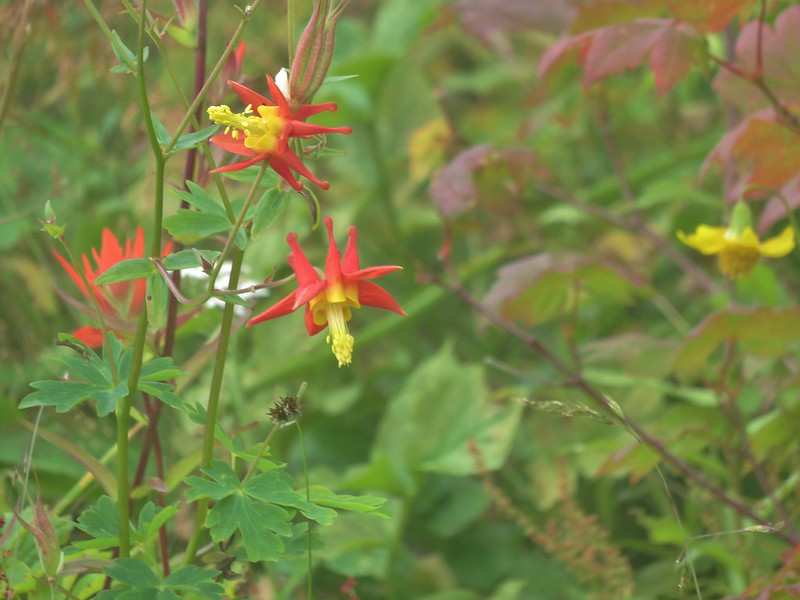
Columbine
IMG_1670

Scouler’s bluebell
IMG_1673

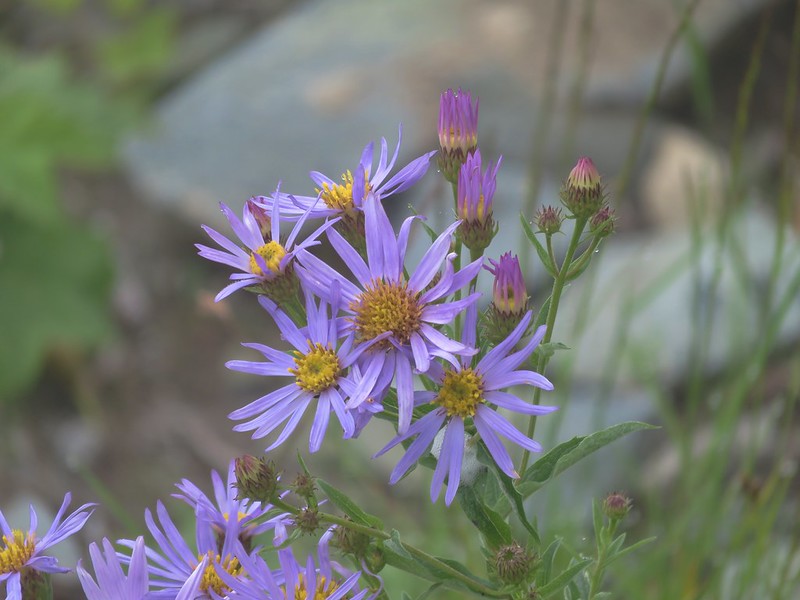
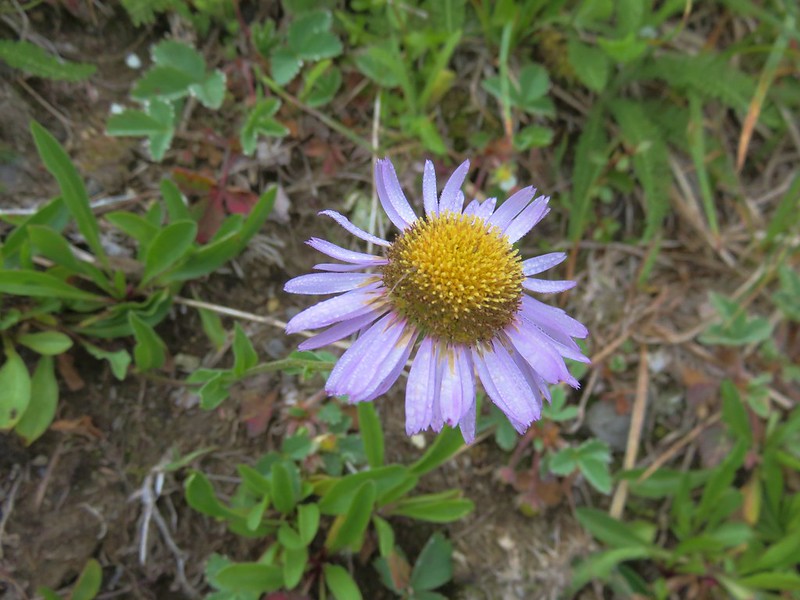
An aster or fleabane
IMG_1676

Pussypaws
IMG_1679

Mock orange
IMG_1688

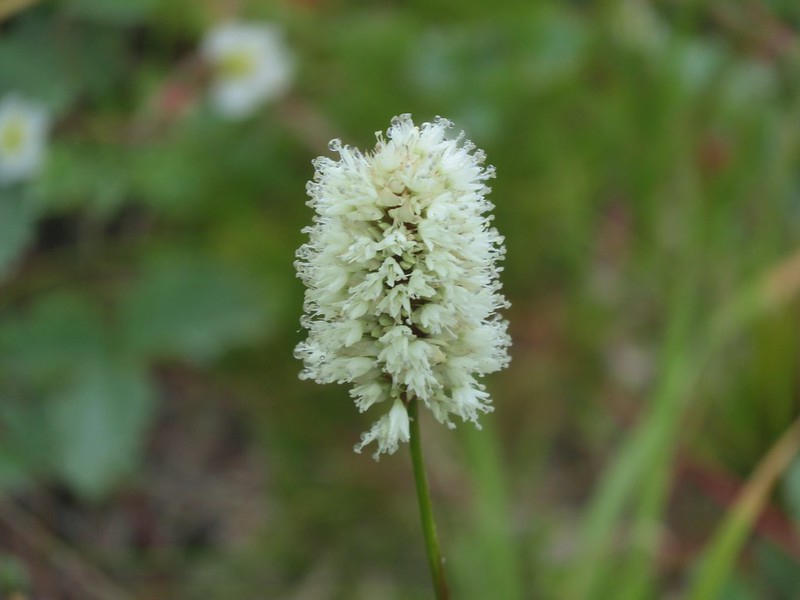
Bistort
IMG_1692

Another type of aster or fleabane
IMG_1695

Violets
IMG_1697

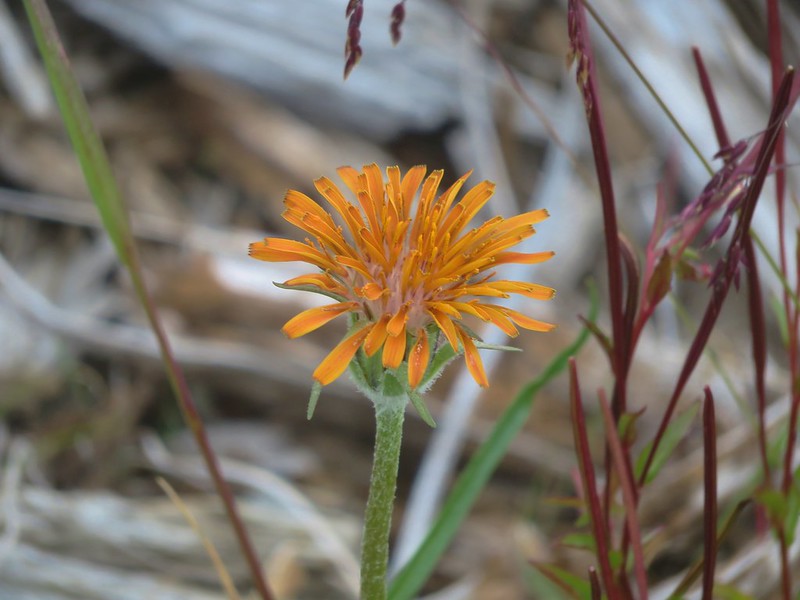
Orange agoseris
IMG_1701

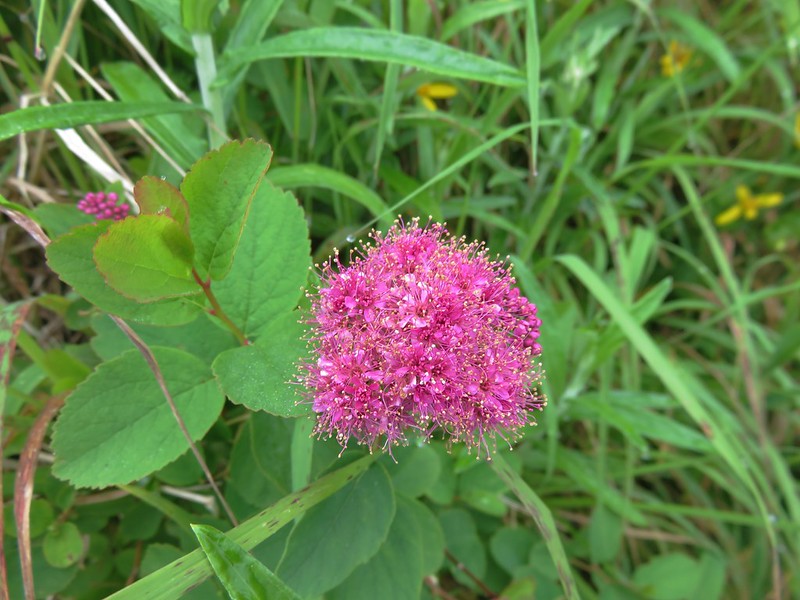
Spirea
IMG_1666

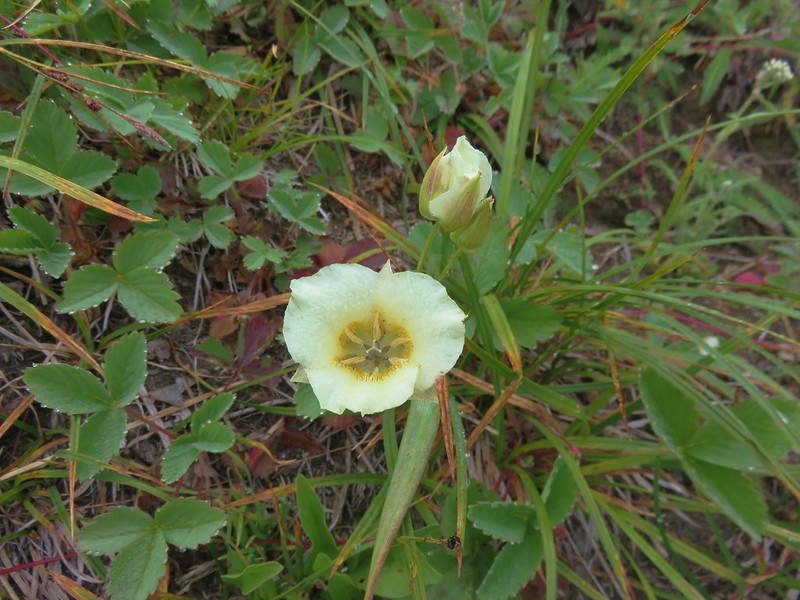
Cat’s ear lily
IMG_1693

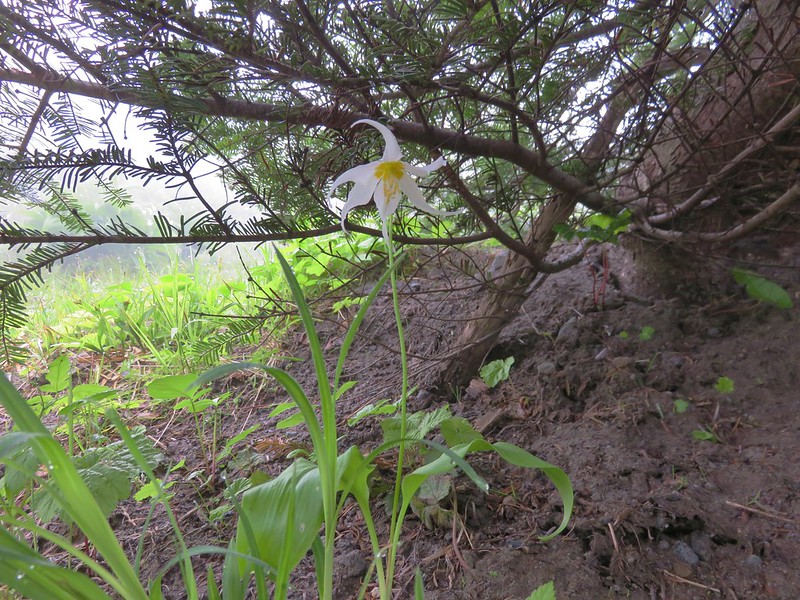
Avalanche lily
IMG_1699

We were pleasantly surprised when we arrived at the junction with the Boundary Trail overlooking St. Helens Lake. We had suddenly found a little blue sky and some better visibility.
IMG_1719

IMG_1711

IMG_1710

Coldwater Peak was to our left and seemed to be acting as a cloud break.
IMG_1714

While we were watching the clouds swirl around the back side of Coldwater Peak we noticed a mountain goat on the cliffs below the summit.
IMG_1716

We took a nice long break at the junction watching the mountain goat and the ever changing clouds. When we finally set off again we passed by Coldwater Peak in sunlight.
IMG_1724

We had some great views of St. Helens Lake below us as we passed the spur trail to Coldwater Peak after .4 miles.
IMG_1748

IMG_1751

The trail the continued around the lake with views opening up to Spirit Lake below St. Helens Lake.
IMG_1766

For the next 3 plus miles the clouds came and went as the drifted over the ridge down toward Spirit Lake.
IMG_1786

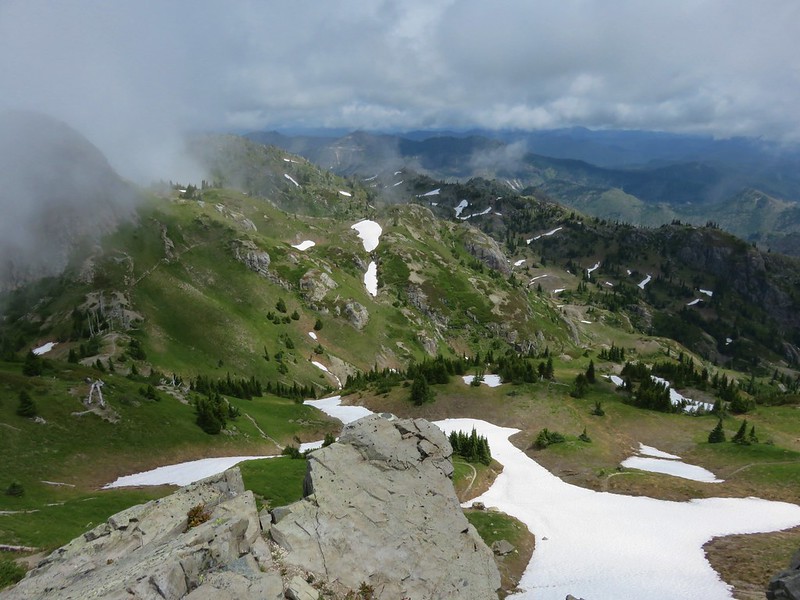
There was more snow along this section of trail and we started seeing more flowers that bloom soon after snow melt.
IMG_1780

Cinquefoil
IMG_1811

IMG_1815

Cusick’s speedwell
IMG_1805

White heather
IMG_1827

Avalanche lilies
IMG_1830

Cat’s ear lily
IMG_1836

We crossed our first snowfield near The Dome, which was mostly hidden by the clouds.
IMG_1844

IMG_1846

It was a bit of a shame that we couldn’t see more of the surrounding area because the peaks and cliffs we could see where really neat.
IMG_1850

IMG_1859

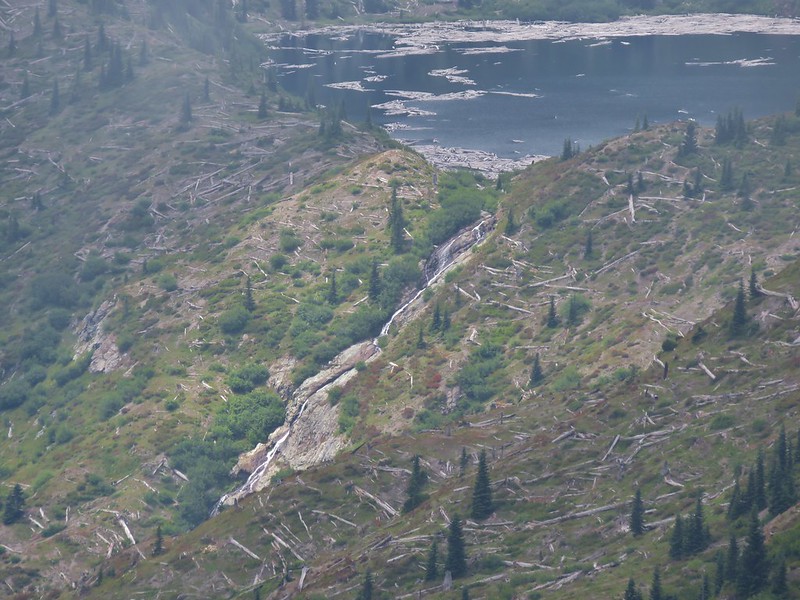
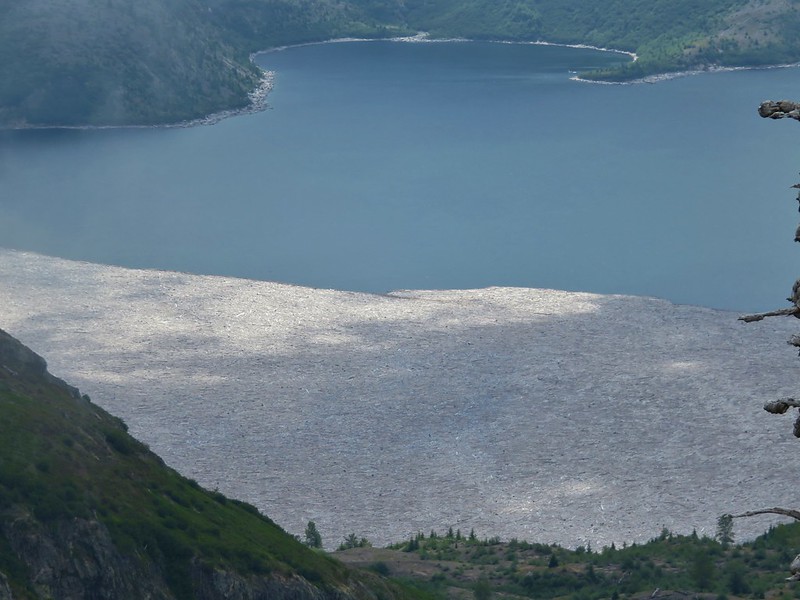
The view downhill was a little better and we got a decent look at the outlet of St. Helens Lake, a log jam on Spirit Lake, and some elk in the valley.
IMG_1866

IMG_1875

IMG_1880

IMG_1877

We had skipped the .6 mile trail up to the summit of Coldwater Peak not wanting to make that climb with our full packs on a day when the visibility wasn’t great, but when we reached the shorter spur trail to the summit of Mt. Margaret we decided to head up. Unlike Coldwater Peak we had not been up this trail before so even if we didn’t have a view we couldn’t pass it up. The view from Mt. Margaret turned out to not be too bad. We could see Spirit Lake fairly well and the Boundary Trail below the peak. Other nearby peaks occasionally emerged from the clouds.
IMG_1896

IMG_1911

IMG_1900

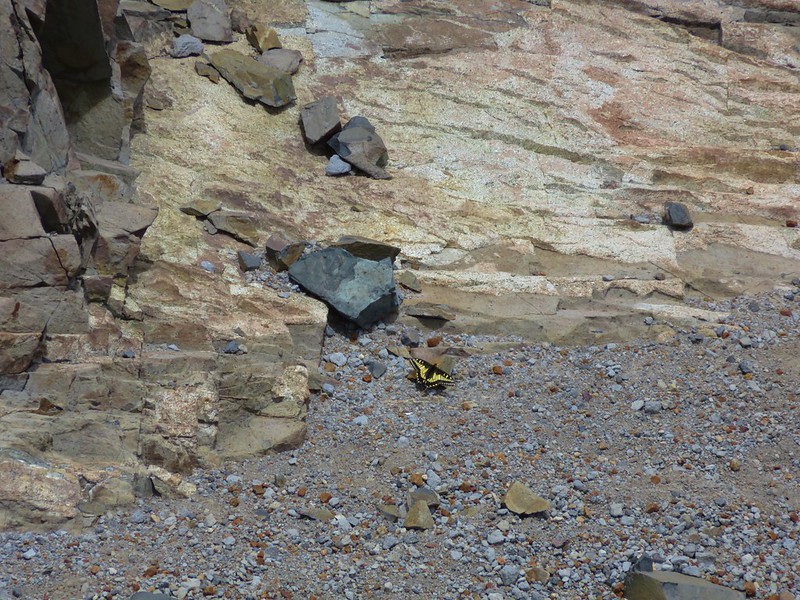
We could see some spots where mountain goats had been on a nearby ledge but no goats, just a swallowtail butterfly.
IMG_1902

IMG_1907

IMG_1908

We took a nice long break and had some lunch on Mt. Margaret. As we were preparing to start hiking again we could hear people coming up the Boundary Trail, lots of people. Heather counted nearly 30 folks emerging from the trees below. We made it back to the junction with the Boundary Trail just as the first of these other hikers were arriving. The majority of them turned out to be members of the Mazamas, a nonprofit Mountaineering Education Organization based in Portland, Oregon.

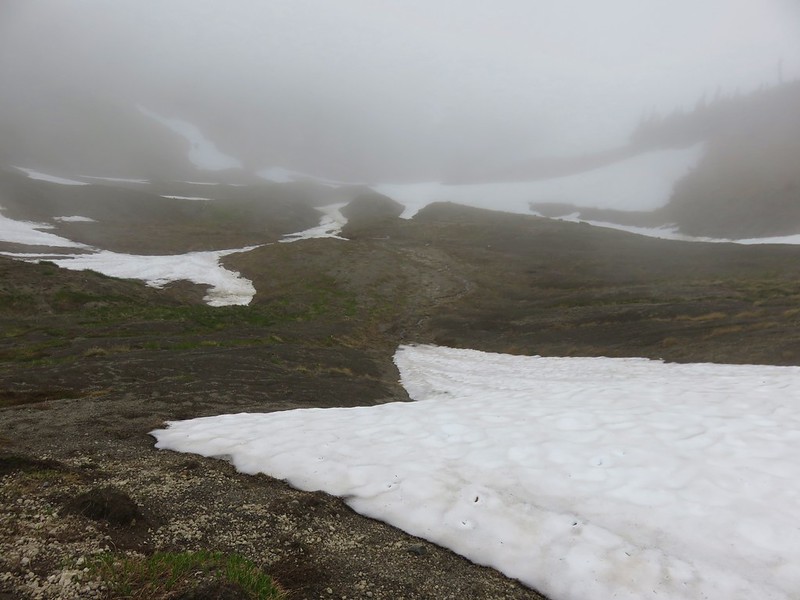
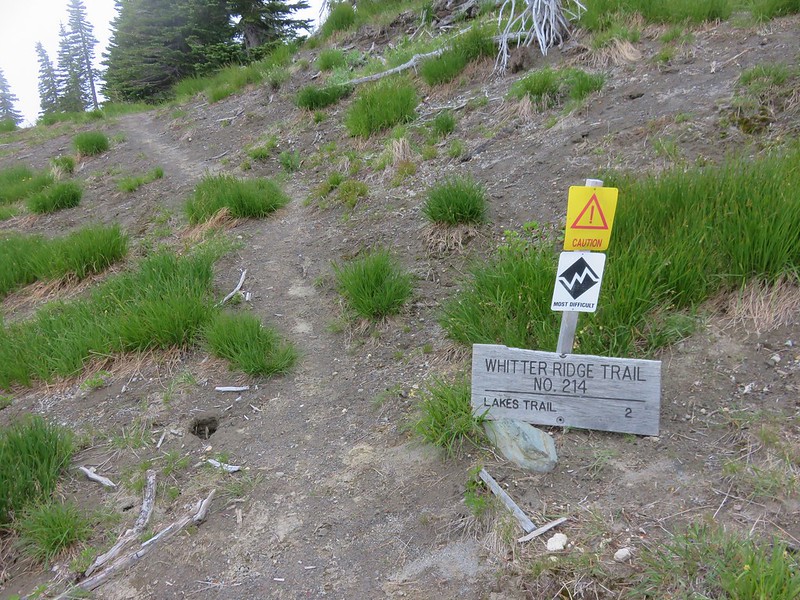
After passing through the Mazamas we crossed another nice snowfield and reached a junction with the Whittier Ridge Trail.
IMG_1927

IMG_1929

IMG_1930

The Whittier Ridge Trail was not on our to-do list on this hike. The trail is narrow and in places along exposed cliffs where the rocks had to be blasted to create a trail at all. Recent reports from members of the Oregon Hikers forum reported some snow still along the trail as well and with little visibility it wasn’t even tempting. We continued on the Boundary Trail getting our first view of some the lakes in the Mt. Margaret Backcountry.
Boot and Obscurity Lakes
IMG_1938

We had been gradually descending since Mt. Margaret and the visibility was getting better the lower we got.
IMG_1944

IMG_1948

IMG_1955

Along the way we spotted another mountain goat not far above the trail.
IMG_1970

IMG_1972

As we got closer it crossed the trail and disappeared over the hillside leaving us with just it’s smell. (And boy did it smell)

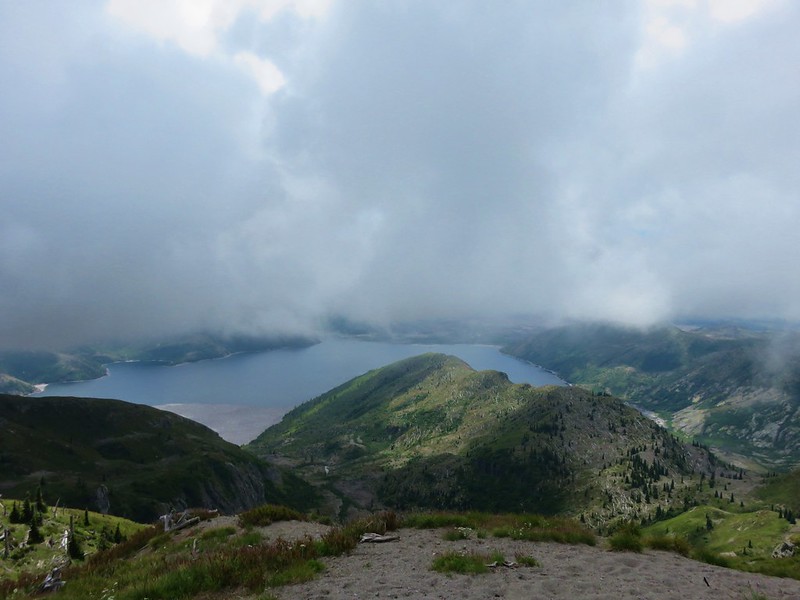
We had been working our way around Spirit Lake and were now just to the NE of it. Mt. St. Helens lay directly behind the lake but only the lowest portions were visible. What we could see was Windy Ridge on the Mountain’s flank.
IMG_1984

IMG_1987

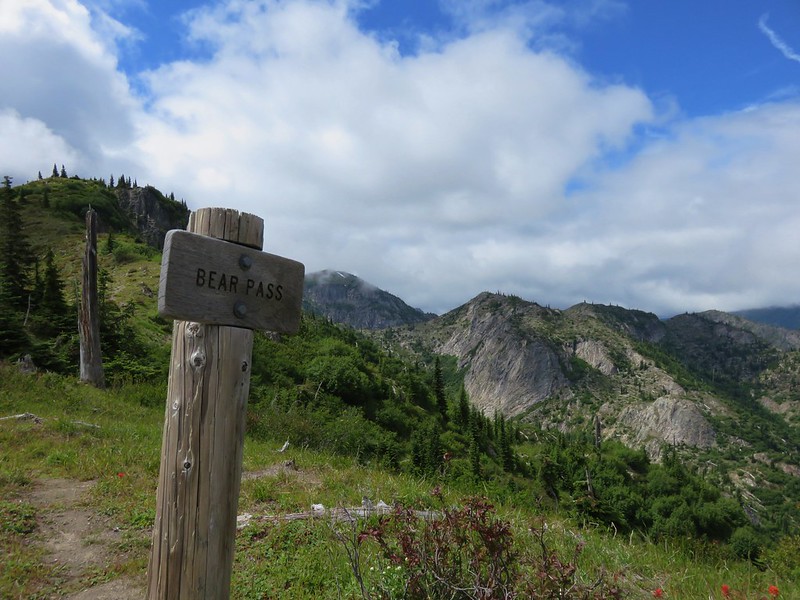
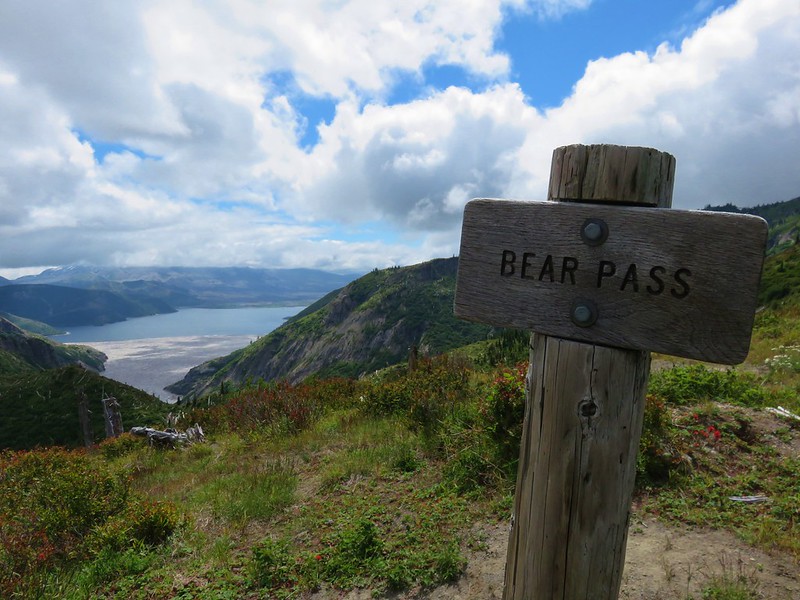
Two miles from the Whittier Ridge Trail we arrived at the junction with the Lakes Trail at Bear Pass.
IMG_1990

IMG_1991

IMG_1992

The Lakes Trail descended from Bear Pass toward Grizzly Lake.
IMG_2001

A trail crew from the Washington Trails Association was busy brushing out the trail and restoring the tread along this section. They were doing some impressive work and we thanked them as we passed by.

Between Grizzly Lake and our final destination at Obscurity Lake were more wildflowers including a few we hadn’t seen yet that day.
Partridge foot and paintbrush
IMG_2008

Penstemon and candyflower
IMG_2016

Pink monkeyflower
IMG_2019

IMG_2039

Blue-bells of Scotland
IMG_2043

Fireweed
IMG_2044

Bleeding heart
IMG_2050

As we approached Obscurity Lake a waterfall was visible along the outlet creek of the lake.
IMG_2057

IMG_2060

We finally arrived at Obscurity Lake after almost 16 miles of hiking.
IMG_2063

IMG_2066

IMG_2069

IMG_2070

IMG_2079

We thought the hard part was over but then we went in search of the designated camp site. We found one tent pad already occupied and began looking for a second one. When I had made the reservation on the Recreation.gov website there had been 2 available permits for up to 4 people. There were several areas where tents had obviously been placed in the past but we couldn’t find any other tent pad or post marking another designated site. The hikers from the other tent said they had not been able to find a second one either so we picked what seemed like the most likely spot where there was no vegetation to trample and set up the tent.
IMG_2073

We hoped that we had picked the right spot and figured if we hadn’t and a ranger came along we’d just ask them where the other designated site was and move there if we had chosen poorly. Oddly enough a third tent had appeared when we awoke the next morning. I don’t know if they were possibly with the Forest Service, but if they weren’t someone was not where they should have been.

Regardless of the confusion over the camp sites the day had been pretty spectacular. The showers had never materialized and between the wildflowers, wildlife, and scattered views we did get we’d been totally entertained. The clouds just made us more eager to come back again someday in the future so we could see what we missed this time around. Happy Trails!

Flickr: https://www.flickr.com/photos/9319235@N02/albums/72157668318616563

Categories
Hiking Mt. St. Helens Trip report Washington Washington Cascades

Ape Cave and Ape Canyon

We are in the midst of revisiting several trails that we first hiked in 2012. Next up after our return trip to the Table Rock Wilderness we headed to the Mt. St. Helens National Volcanic Monument for a second hike on the Ape Canyon Trail. In 2012 we had done a second short hike along Lava Canyon after finishing the Ape Canyon Trail and this time we decided to add a visit to Ape Cave to the agenda.

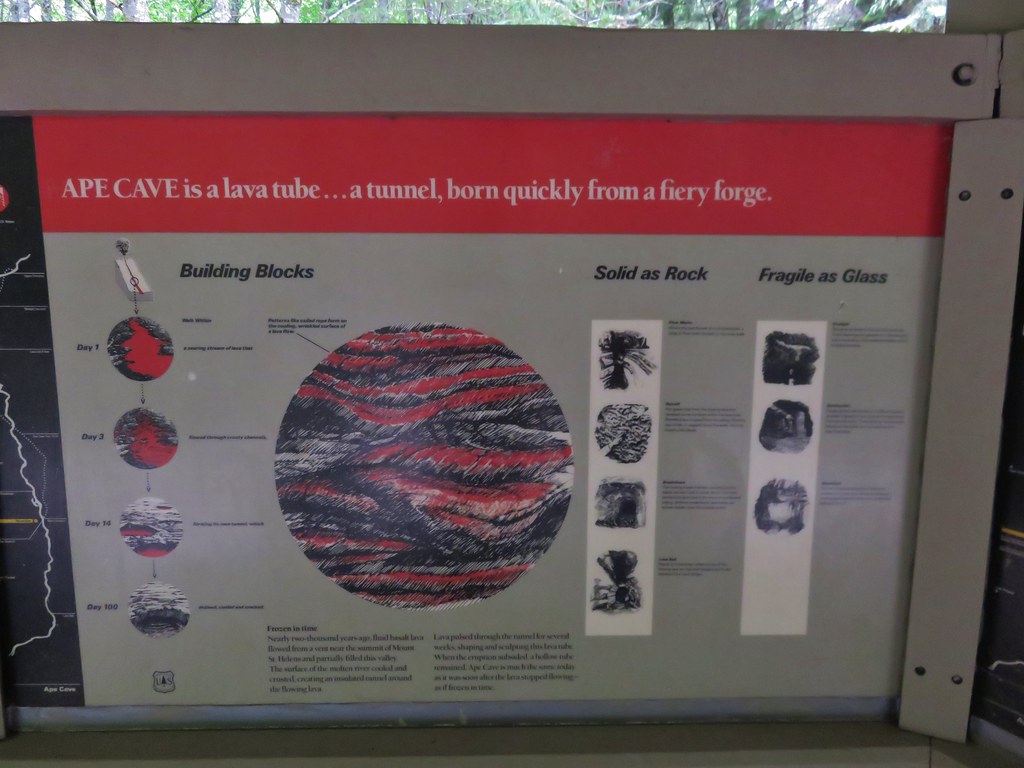
At 12,810 feet long Ape Cave is the longest known Lava Tube in North America. It is also one of the more popular places to visit in the monument so we decided to tackle this trail first in an attempt to beat the crowds. A staffed information booth awaits at the trailhead, but we had arrived before it opened for the day.
IMG_5518

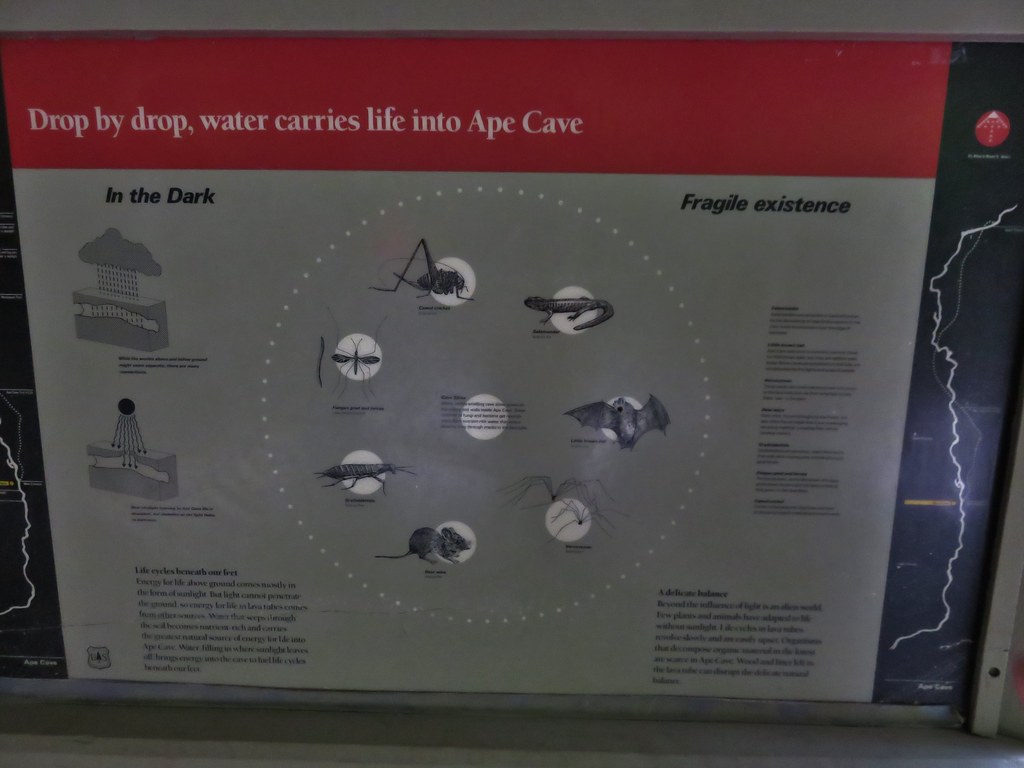
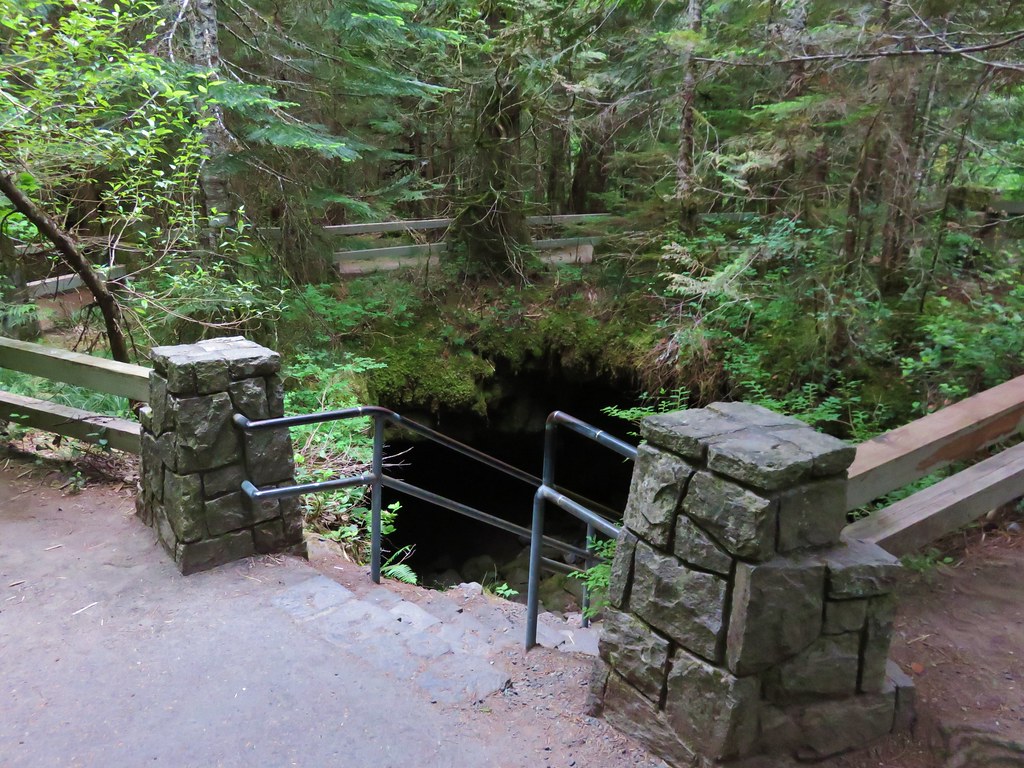
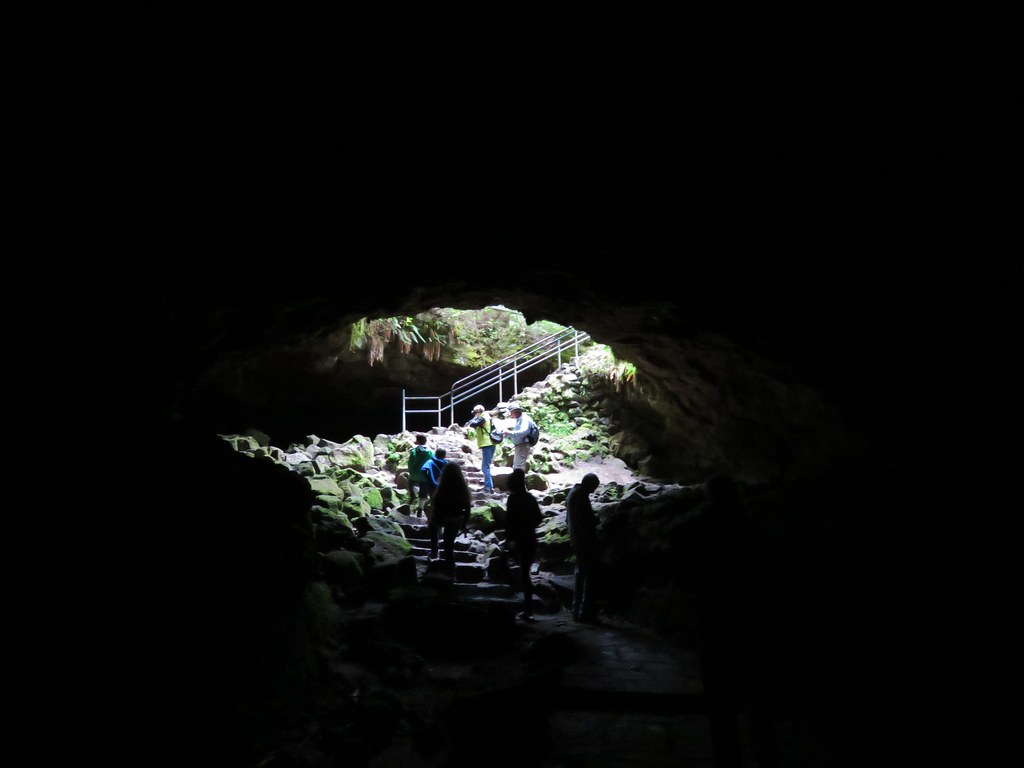
A short paved trail leads to an kiosk with signboards and the lower cave entrance.
IMG_5521

IMG_5593

IMG_5594

IMG_5595

IMG_5523

An above ground trail leads past the lower entrance to an upper entrance (or exit).
IMG_5525

We decided to hike up to the upper entrance and then descend down the lava tube to it’s end 3/4miles past the lower cave entrance. The trail to the upper entrance passed through the forest before skirting a lava flow and passing some smaller lava tubes that were not part of the cave.
IMG_5526

IMG_5527

IMG_5528

IMG_5529

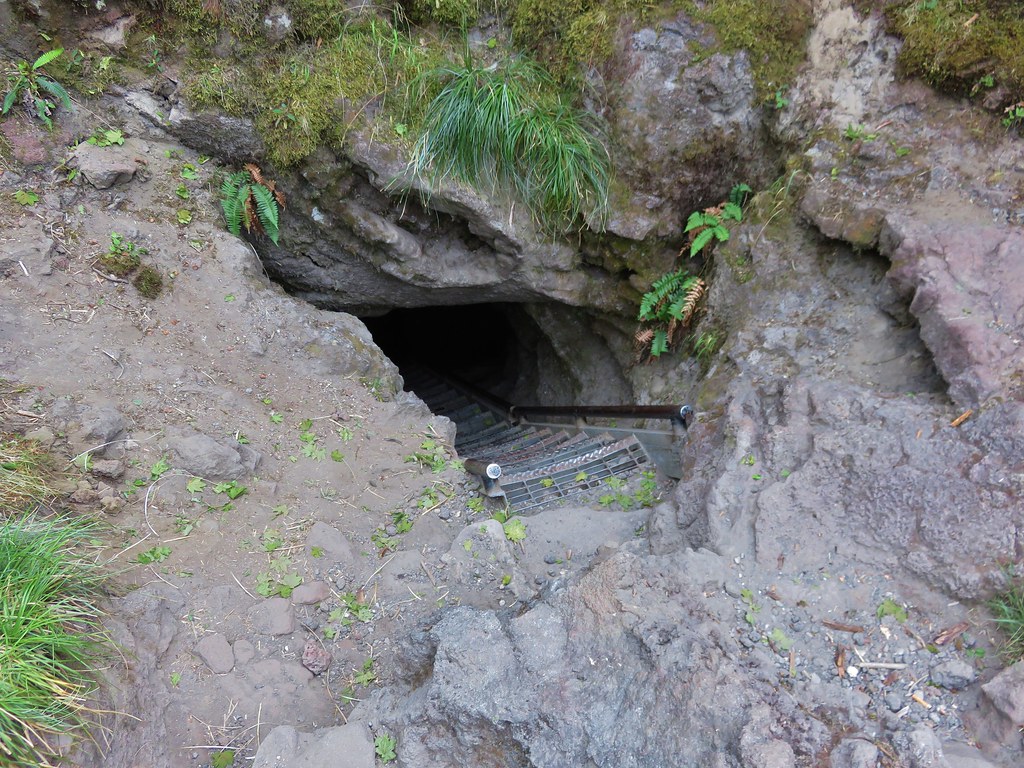
The trail actually did pass over the cave three times before arriving at the site of the upper entrance. We walked passed the entrance initially following a well used path about 50 yards too far before realizing our mistake. There was no sign marking the upper entrance and the hole was much smaller than the lower entrance. It took a moment for us to spot the metal ladder barely sticking up from out of the dark hole.
IMG_5531

IMG_5533

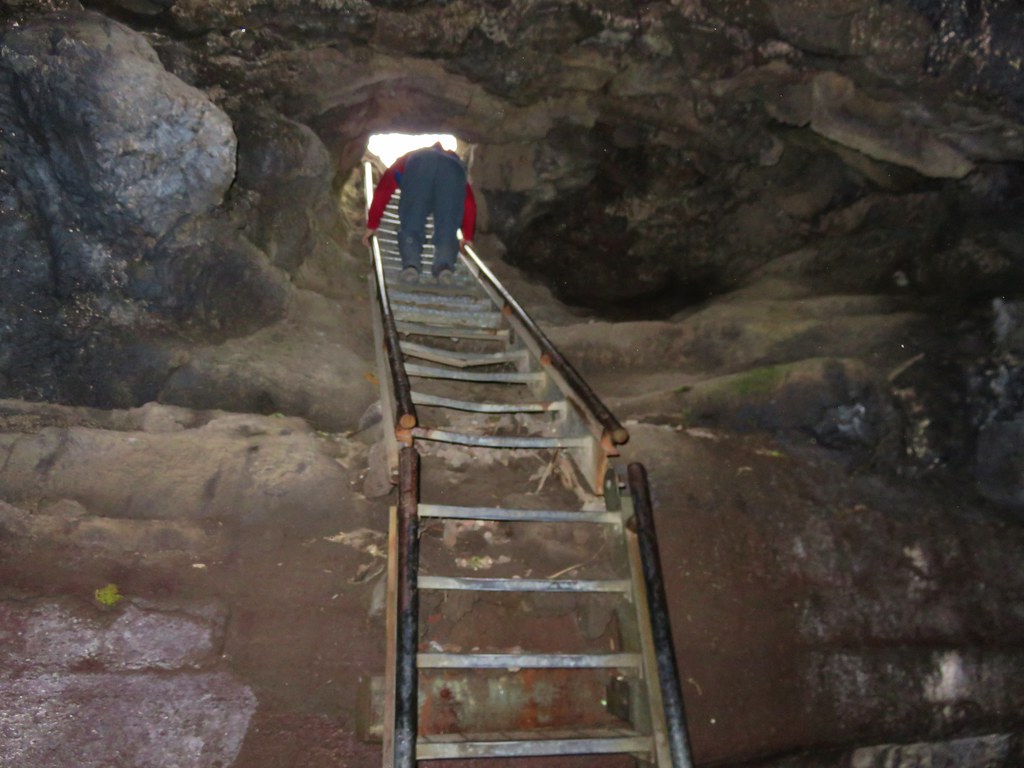
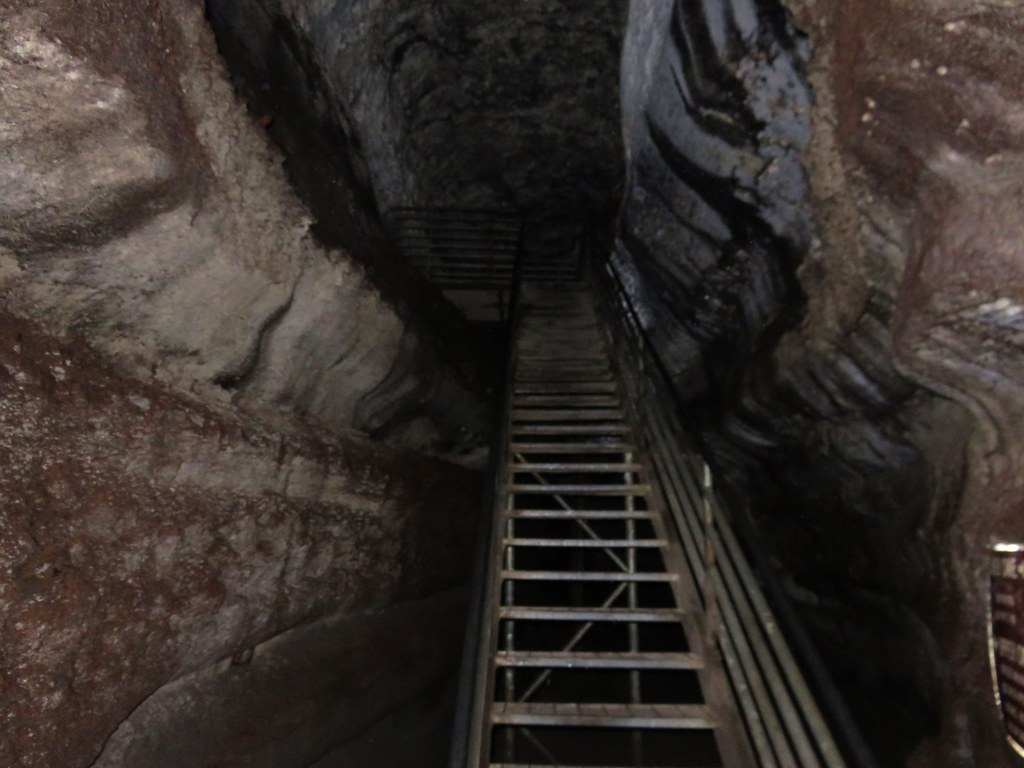
Climbing down the ladder was interesting as the first 17 steps angled downward before the ladder suddenly dropped straight down for the final 10 or 12 rungs.
IMG_5536

The cave extends another .1 miles or so beyond the upper entrance so we turned north and walked to the end before turning around and heading for the lower entrance.
IMG_5537

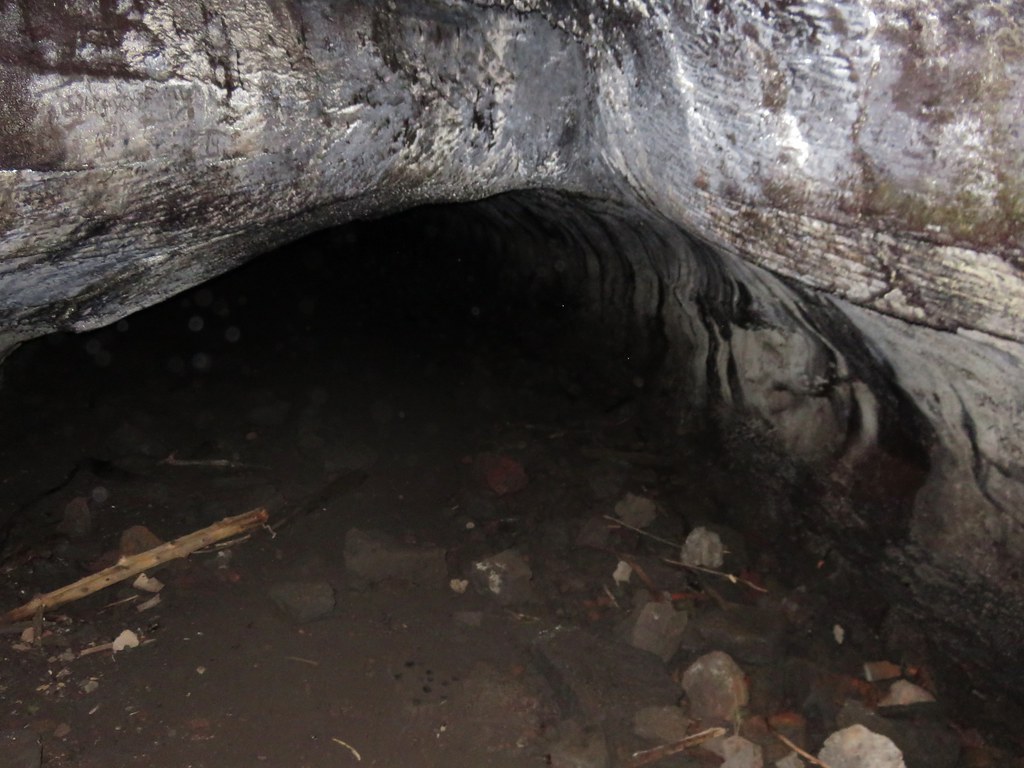
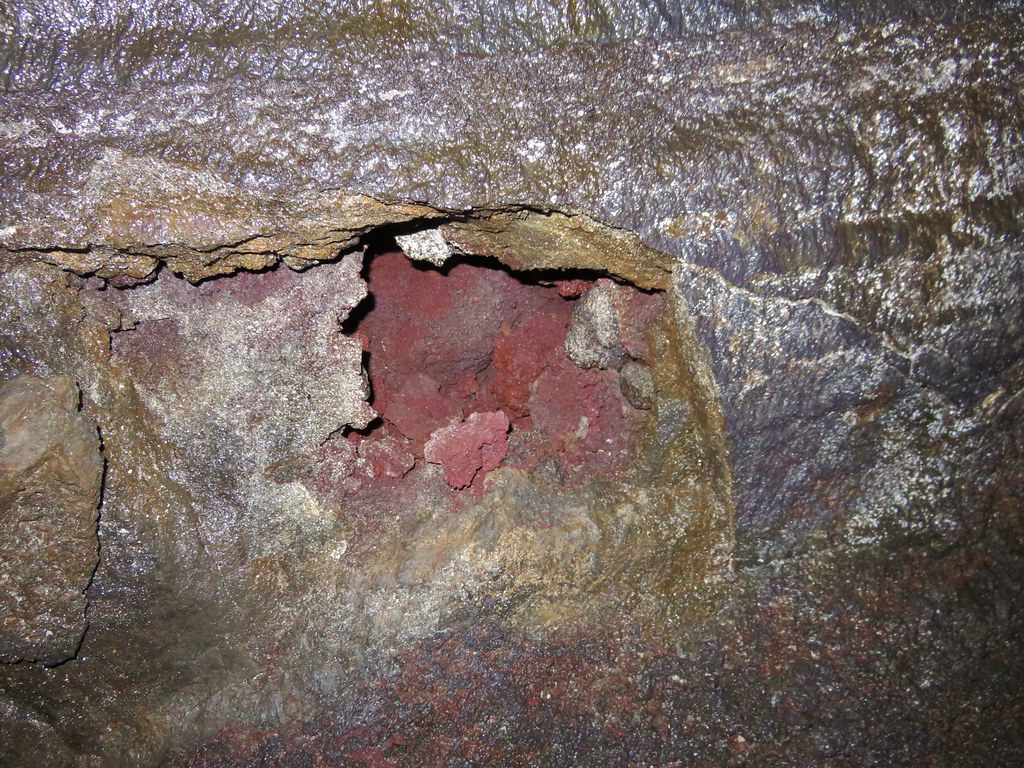
The cave was really neat. The rock surrounding the tube was full of colors and different textures. White portions of rock reflected our headlamps imitating rays of sunlight along the walls and ceiling.
IMG_5541

IMG_5544

IMG_5547

A third of a mile from the upper entrance the trail past under a skylight where green ferns and mosses grew on the rocks.
IMG_5553

The lower entrance was another 1.1 miles beyond the skylight. This section of the lava tube was a workout. Ten different rock falls required scrambling over and around piles of lava rock and a pair of lava falls, drops of around 8 feet, proved a challenge to descend. The second lava fall was particularly difficult requiring us to slowly lower ourselves down using small nubs on the cave floor as handholds. The scenery of the cave was worth the effort and we wondered if climbing up would have been easier than coming down as we had.
IMG_5557

IMG_5563

IMG_5565

IMG_5577

It was fairly slow going but we eventually made it to the base of the staircase leading down from the lower entrance.
IMG_5582

IMG_5579

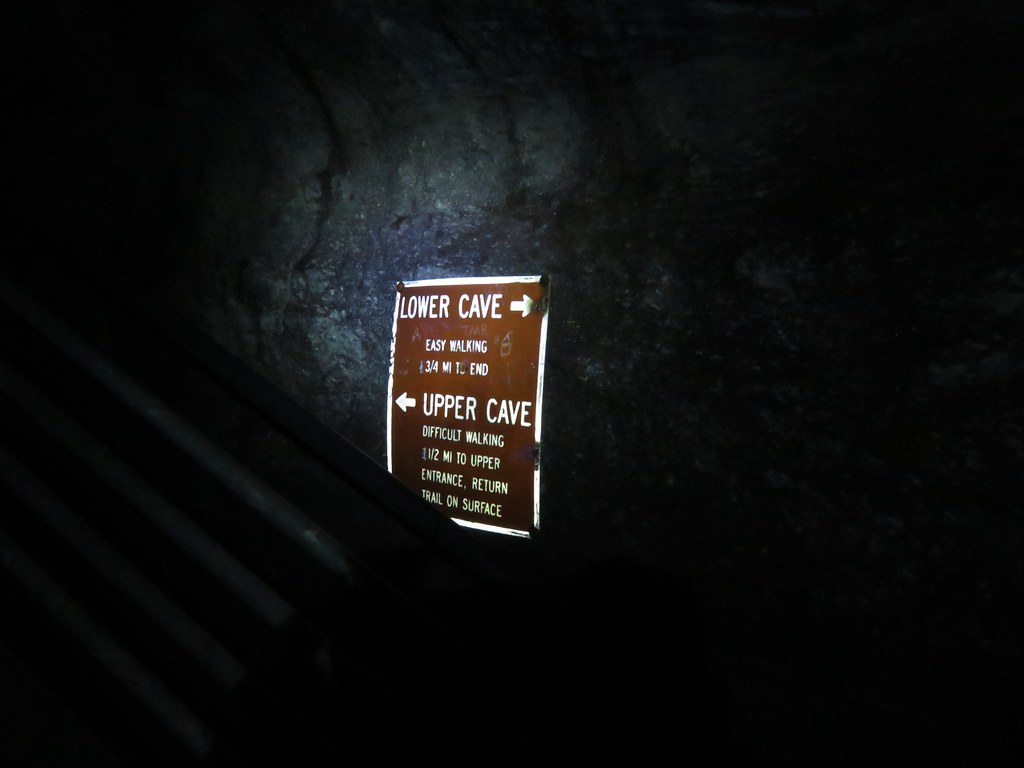
We headed down the lower end of the cave which was, as the sign said, a relatively easy walk. We turned around when the cave had become small enough that we would have had to crawl to continue any further.
IMG_5584

IMG_5586

IMG_5588

We had started to run into a few more people near the end of the lower cave and on the way back to the lower entrance the number of people increased dramatically. We exited up through the lower entrance and headed for the car.
IMG_5590

In hindsight we should have descended through the lower entrance as it seemed like it would have been easier to ascend up through the cave and it would likely have avoided the crowds that had formed later in the morning in the lower cave.

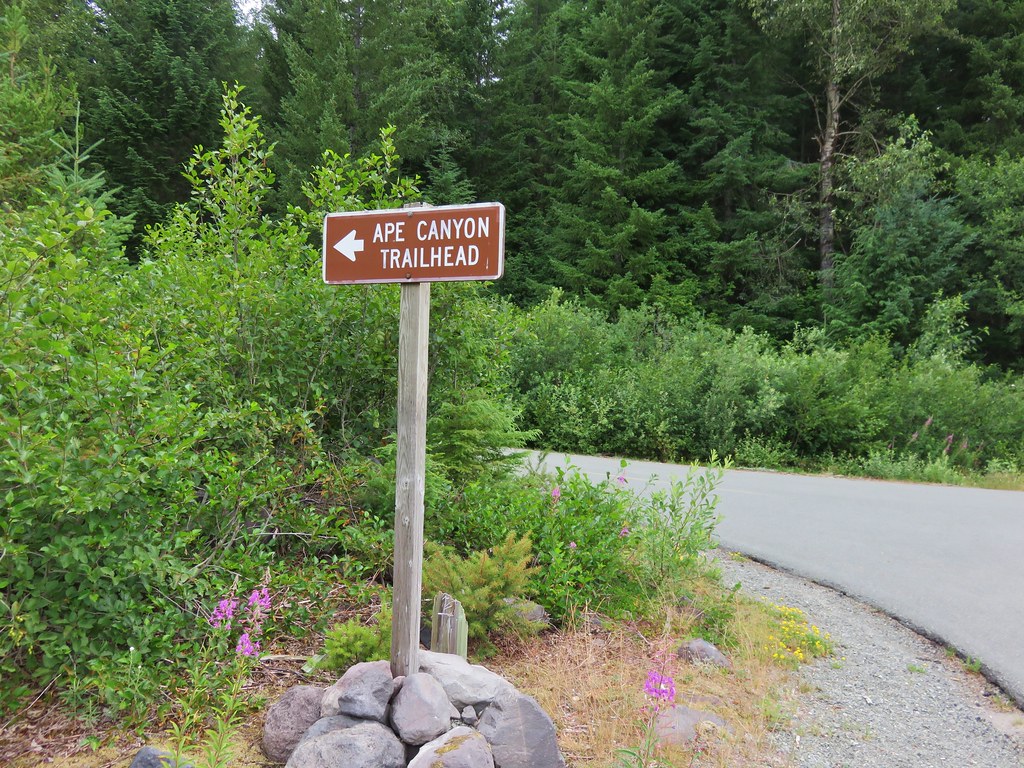
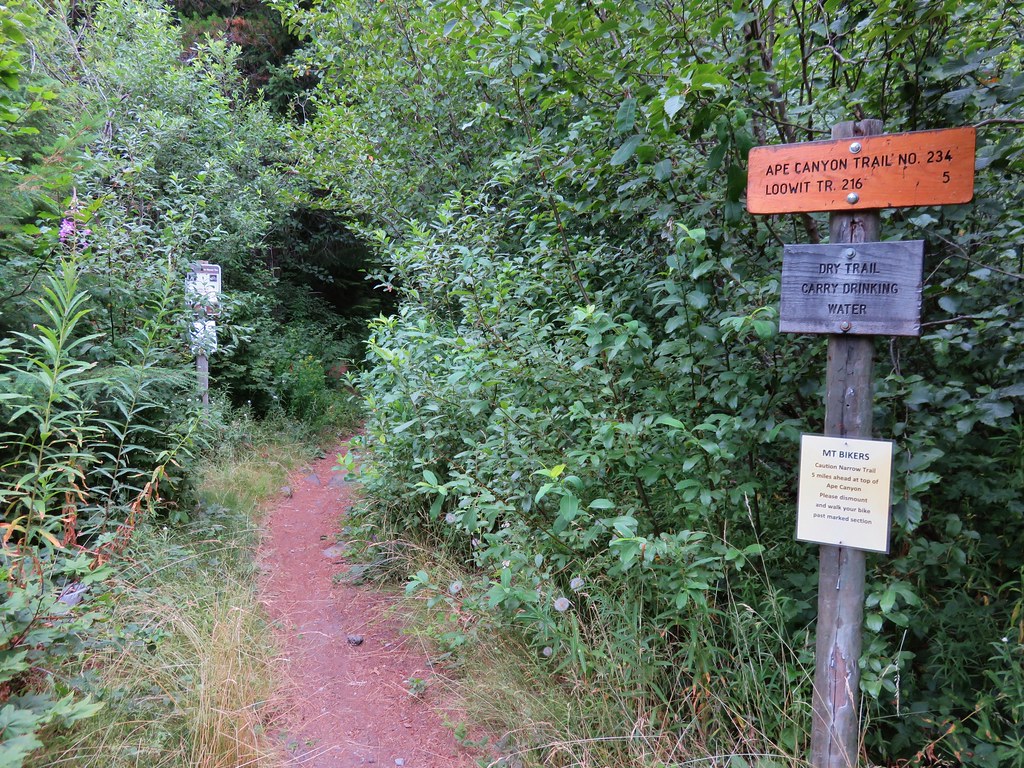
We drove from the Ape Cave parking area to the Ape Canyon Trailhead for our second hike of the day. On our previous visit we had taken the Ape Canyon Trail to the Loowit Trail and then followed that trail to a junction with the Abraham Trail which covered a total of 12.7 miles. Our second hike that day at Lava Canyon was only 1.3 miles for a 14 mile total. This time around we had already done nearly 5 miles at Ape Cave so the plan was to stop at a spring along the Loowit Trail in the Plains of Abraham. The small parking lot at the Ape Canyon Trailhead was full so we parked along road 83 and walked to the start of the trail.
IMG_5596

IMG_5598

We were on high alert as we started the trail due to warnings about local wildlife.
IMG_5601

The Ape Canyon Trail starts in the forest next to a lahar created by the Muddy River when the mountains 1980 eruption sent a large portion of the Shoestring Glacier down the valley. Our previous visit had been on a clear day in Mid-September where the views across the lahar to Mt. St. Helens were spectacular.
021

We were not to be so lucky on this day with our Mt. St. Helens views but the temperature was pleasant and we hoped to see more flowers this time than we had previously.
IMG_5602

IMG_5606

We did see more flowers along the lower section but we were a little late due to the weather we’d been having this year.
IMG_5614

IMG_5619

IMG_5620

IMG_5635

The trail passes through an old growth forest starting at the 1.4 mile mark then climbs a series of switchbacks as it heads up a ridge toward the Loowit Trail. We passed a few viewpoints that had provided impressive views on our first visit but today we had to rely on those memories to picture the mountain.
157

IMG_5633

After 4 miles the trail enters the blast zone from the 1980 eruption. The trail spends winds a half mile through the blast zone above forested Ape Canyon.
IMG_5712

A narrow slot at the top of the Canyon frames the creek below and apparently Mt. Adams in the distance. I say apparently because we have not been able to confirm this on either of our visits. In 2012 the Cascade Creek Fire was burning on the slopes of Mt. Adams filling the sky with smoke and clouds were now playing the same role on this day.
087

IMG_5645

IMG_5647

The trail ends after 4.5 miles at the Loowit Trail which circles the entire mountain.
IMG_5650

IMG_5651

We turned right here heading for the Spring .8 miles away. This section of the Loowit Trail passes through the Plains of Abraham, a pumice plain with a barren looking landscape which is really fascinating. Heading NE Mt. St. Helens looms on the left across the broad plain while hills on the right reveal the force of mountains eruption. Trees lay blown down on the hillsides facing the mountain while other sides are striped away exposing various layers of rock. Other areas green with trees and other vegetation.
IMG_5657

Flowers are sparse but some still manage to bloom in what looks like the most improbably conditions.
IMG_5653

IMG_5654

IMG_5656

IMG_5659

IMG_5679

One thing that didn’t change from our previous visit was being greeted by a marmot as we crossed this section. We couldn’t help but wonder if it was the same furry little guy.
IMG_5661

IMG_5664

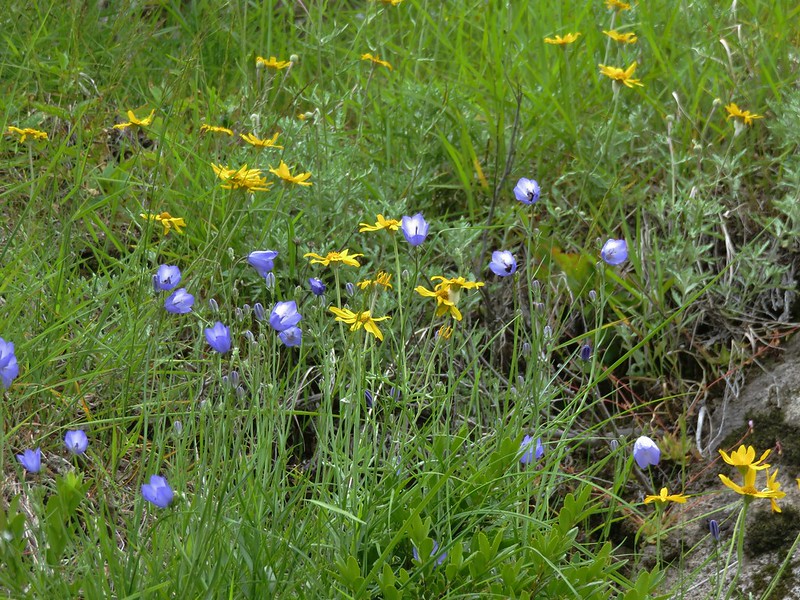
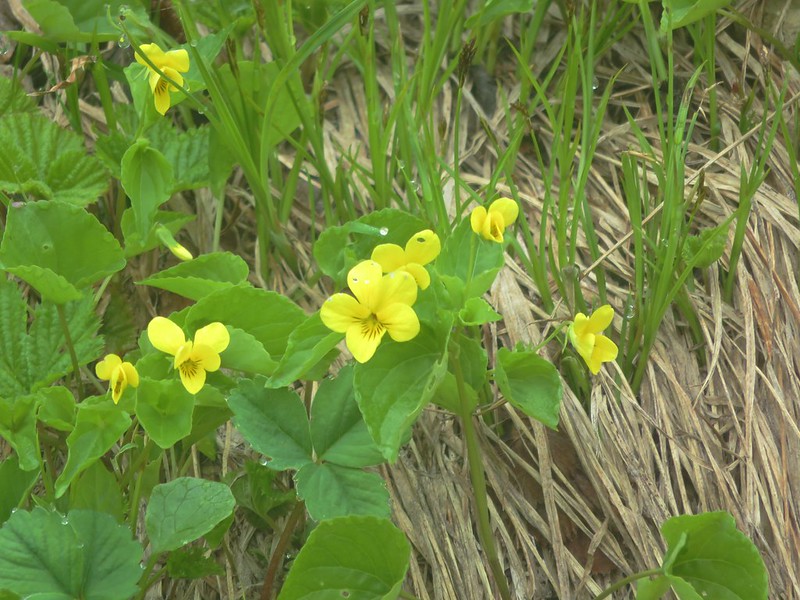
When I had added this hike to the schedule I had hoped to find flowers near the spring where we would turn around, but with the timing being so far off this year due to the weather I wasn’t sure what we’d find. It wound up working out even though things were beginning to dry out. We spoted several different types of flowers including a nice clump of bluebell-of-Scotland.
IMG_5694

IMG_5690

IMG_5706

IMG_5693

IMG_5700

IMG_5688

IMG_5685

It was no apline wildflower meadow but considering the area it was an impressive display. What surprised us was the lack of water from the spring. Despite it being September on our previous visit a small steady stream of water was flowing down the rocks and into Ape Canyon, but this time the only water was a small pool left filling a depression in the rock.

2012
Spring fed stream

119

2015
IMG_5705

After resting a bit, and starting to get chilly due to a nice breeze and cooling our sweat, we headed back down. The clouds had only lifted a little as we passed the lower viewpoints and small pockets of blue sky teased us from above the mountain.
IMG_5730

It had been a long but interesting day of hiking. It was also our first visit of the year to one of the major Cascade mountains and it had been a good reminder of just how much we enjoyed our hikes on them. Happy Trails!

Flickr: https://www.flickr.com/photos/9319235@N02/sets/72157655789278375