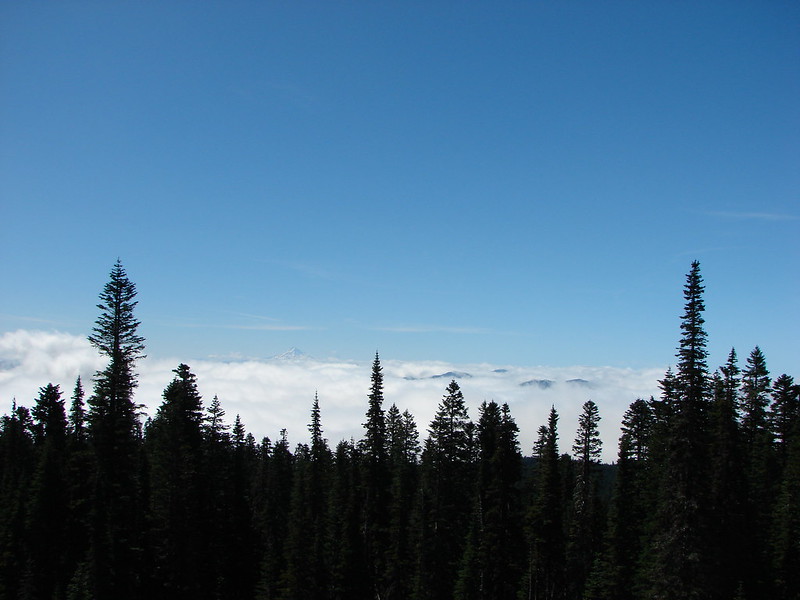
Categories
Goat Rocks Hiking Trip report Washington Washington Cascades

Goat Rocks Wilderness

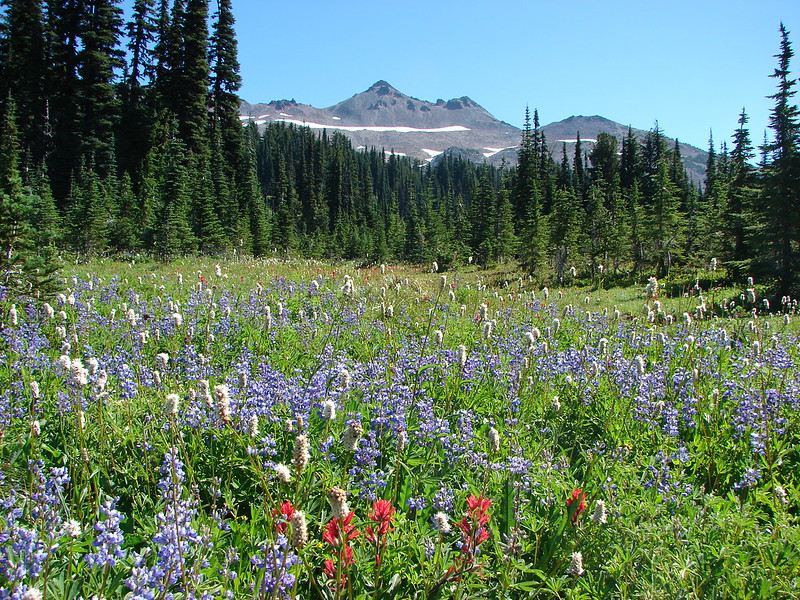
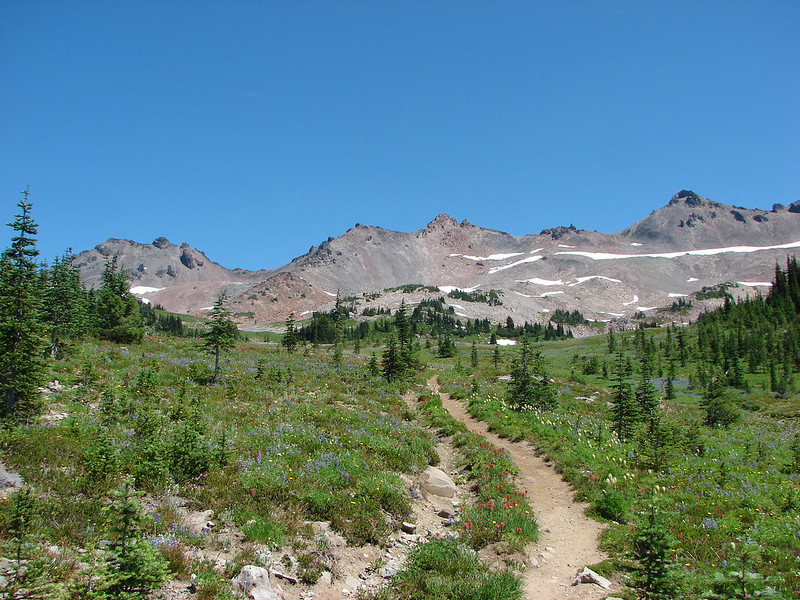
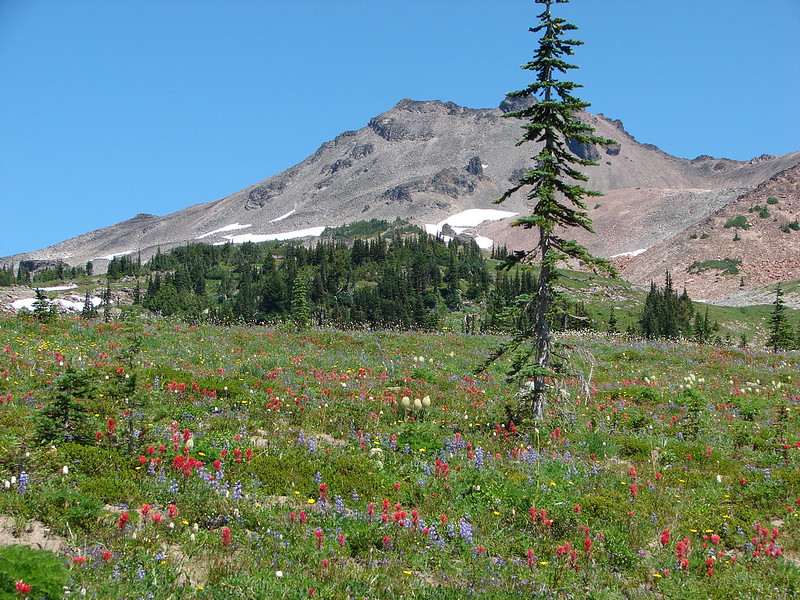
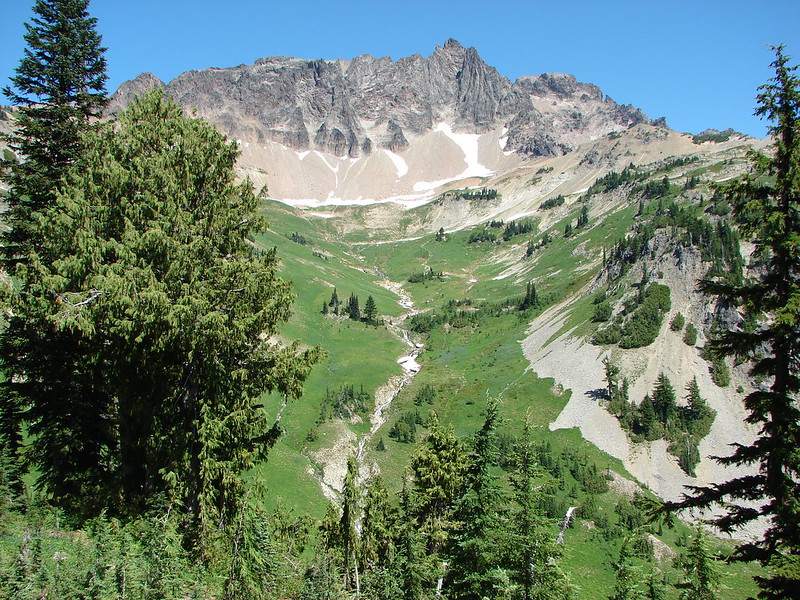
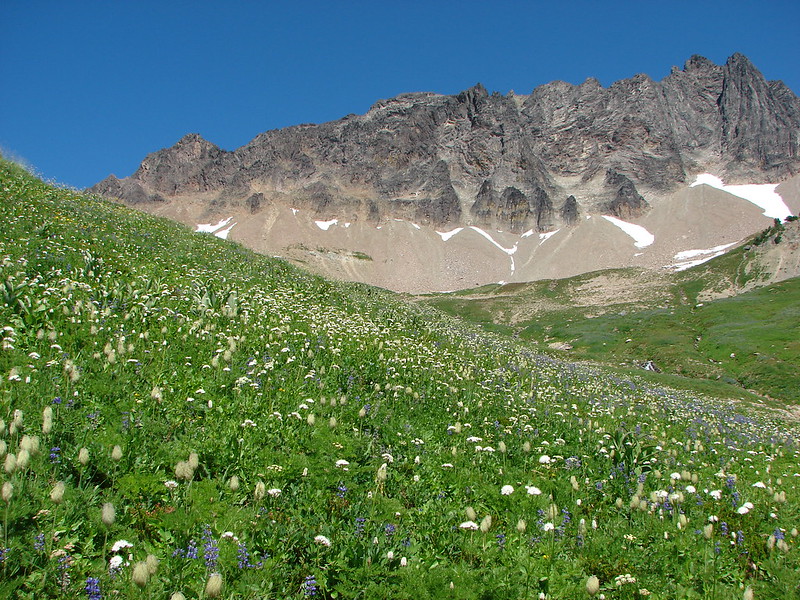
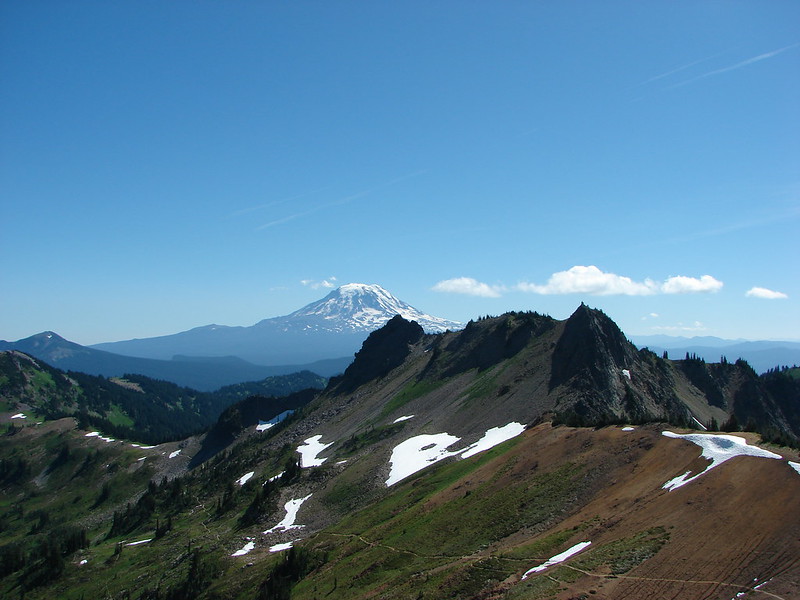
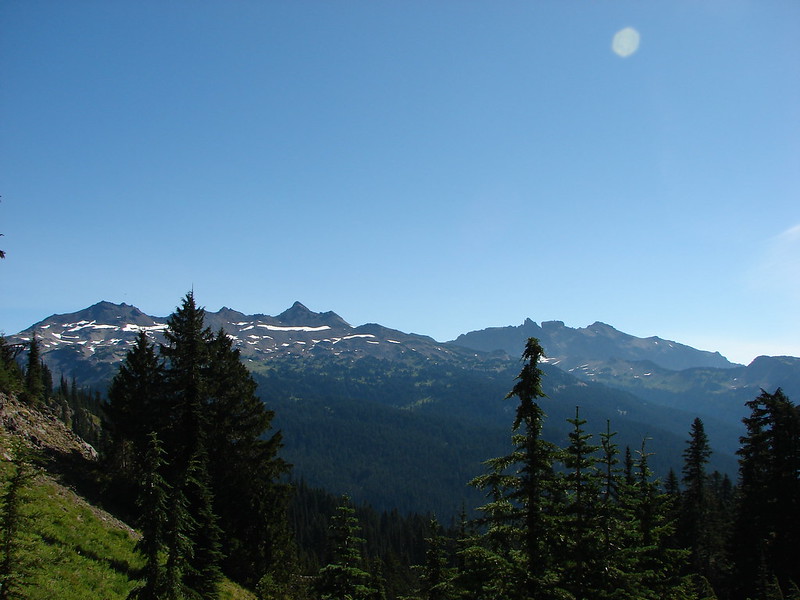
We just returned from our longest backpacking trip to date, a three night, four day stay in the Goat Rocks Wilderness in Washington. What an amazing place. Located between Mt. Adams and Mt. Rainier the Goat Rocks Wilderness sports spectacular views, vast meadows of wildflowers, and plenty of wildlife. A number of trails including the Pacific Crest Trail provide 120 miles of hiking opportunities to explore this special place. Our plan was to establish a base camp at Alpine and then explore in all directions from there.

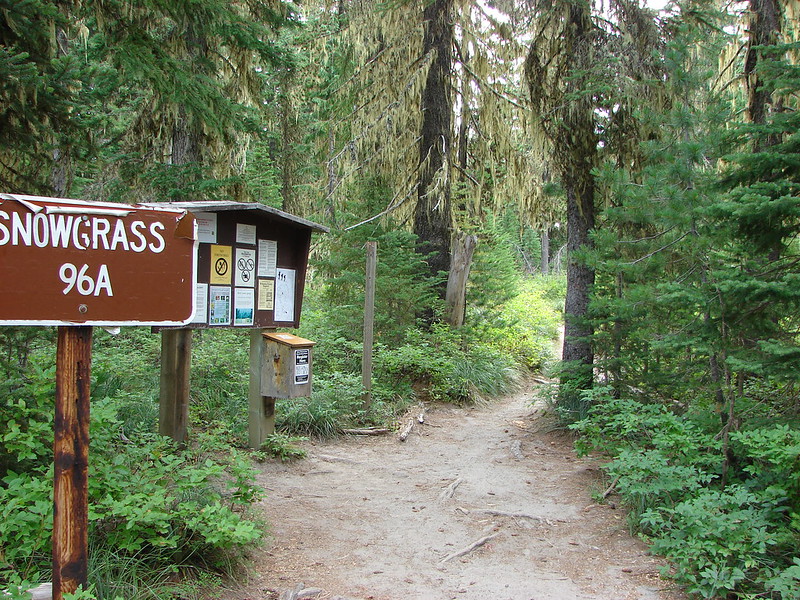
We started our trip at the popular Snowgrass Trailhead and quickly entered the wilderness.
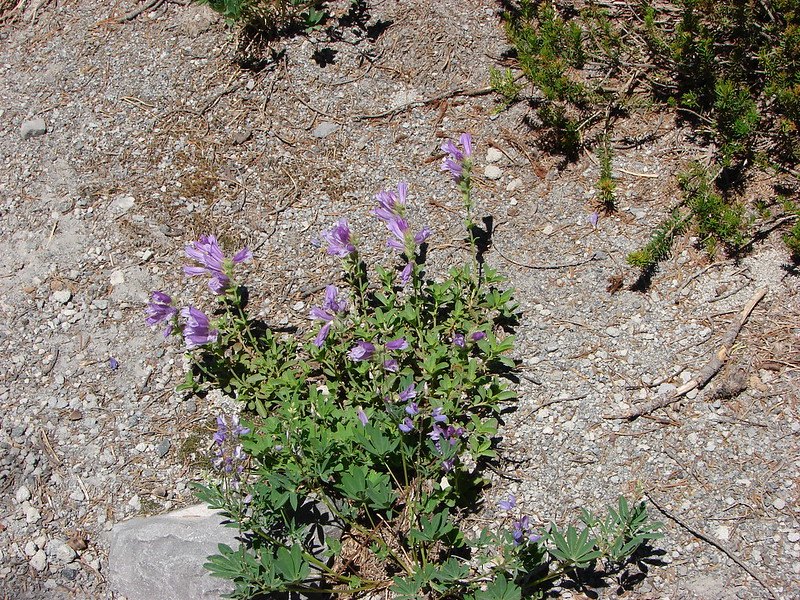
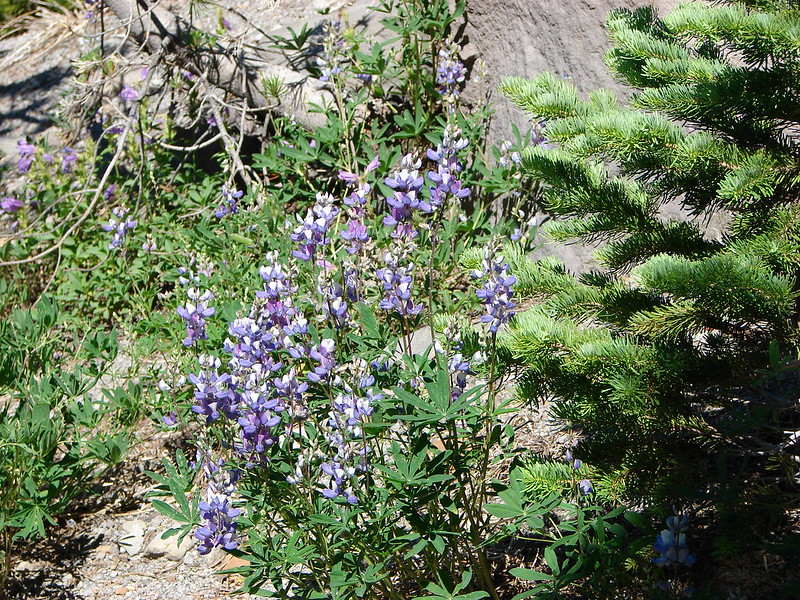
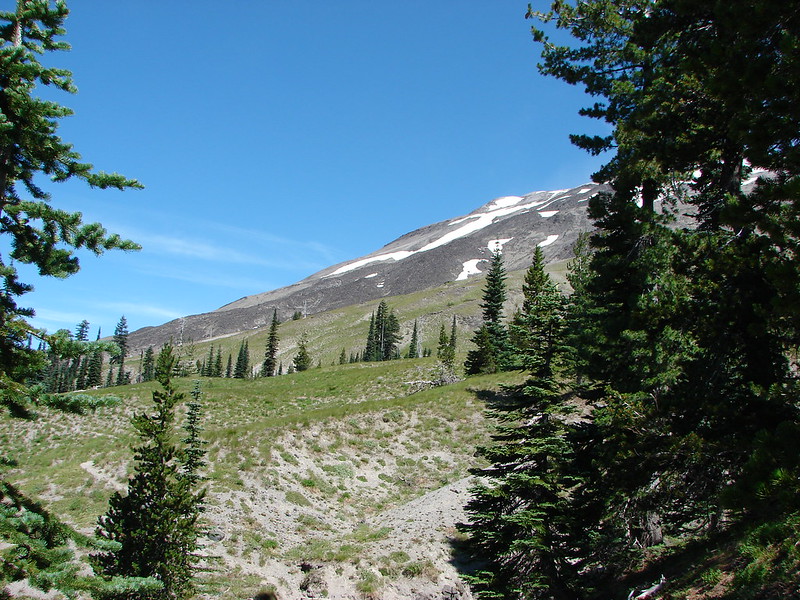
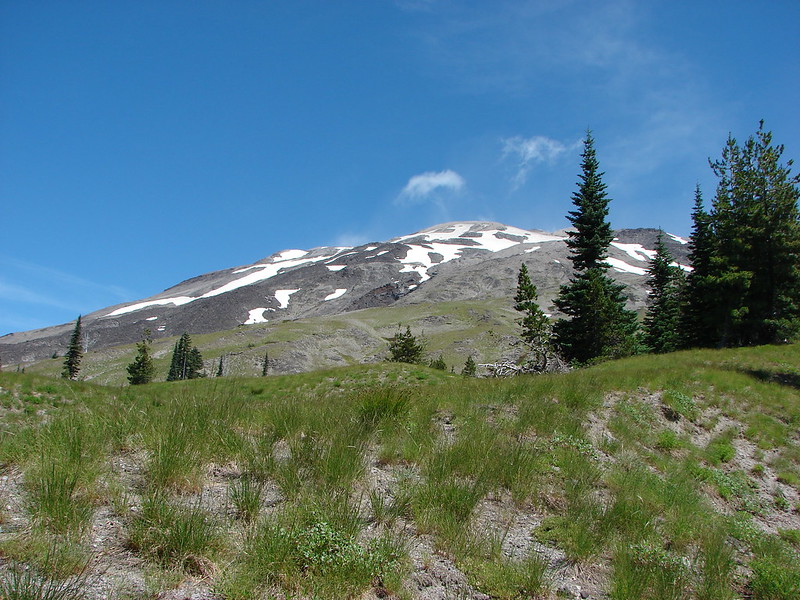
DSC02449

DSC02450

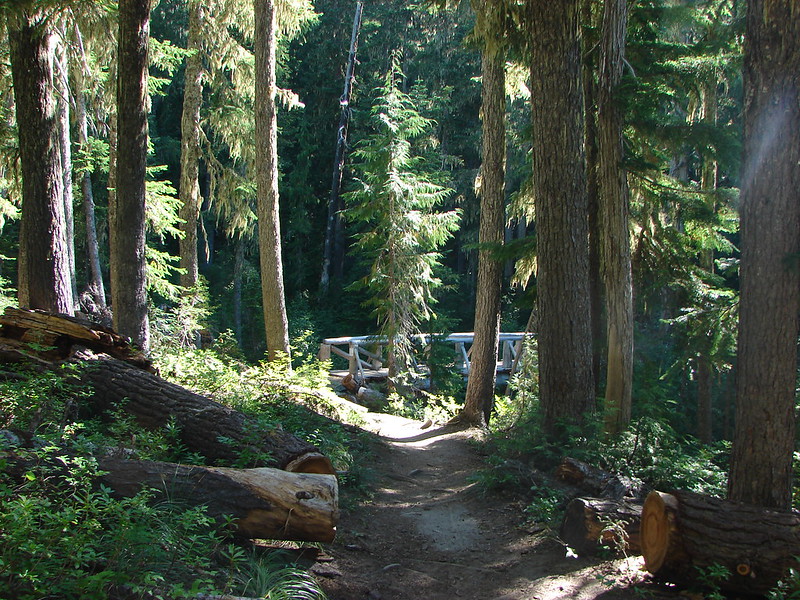
A little over 1.5 miles we crossed Goat Creek on a footbridge.
DSC02466

DSC02469

In another 2 miles we came to a trail junction where Bypass Trail 97 split off on its way up to the Pacific Crest Trail. Staying left on the Snowgrass Trail we climbed .7 miles to a trail junction.
DSC02534

DSC02535

DSC02550

DSC02557

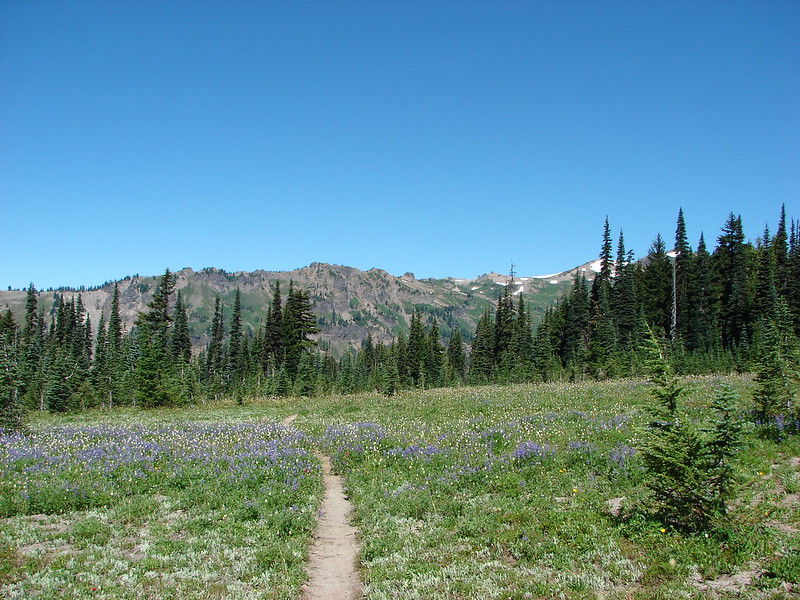
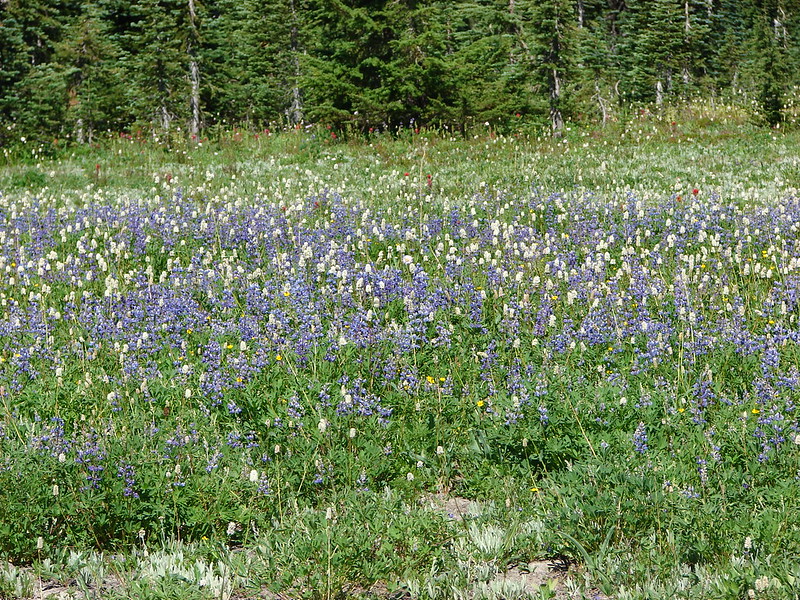
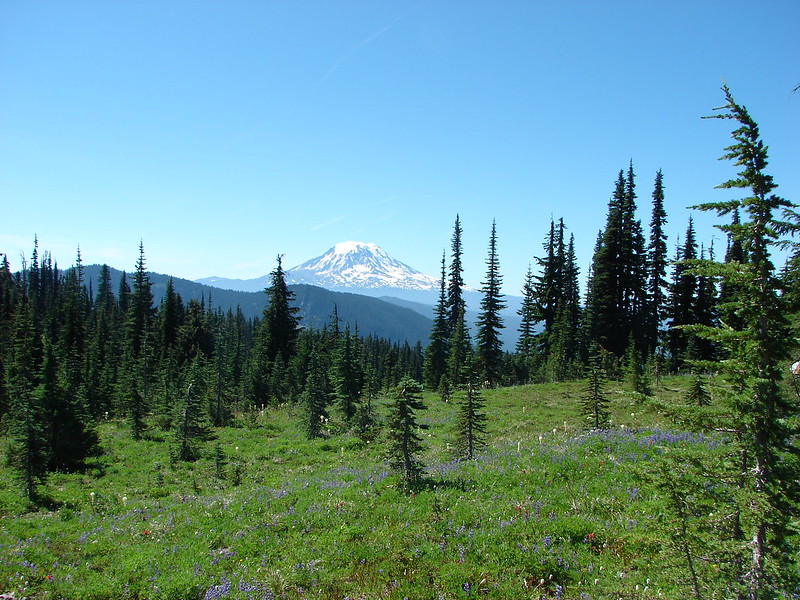
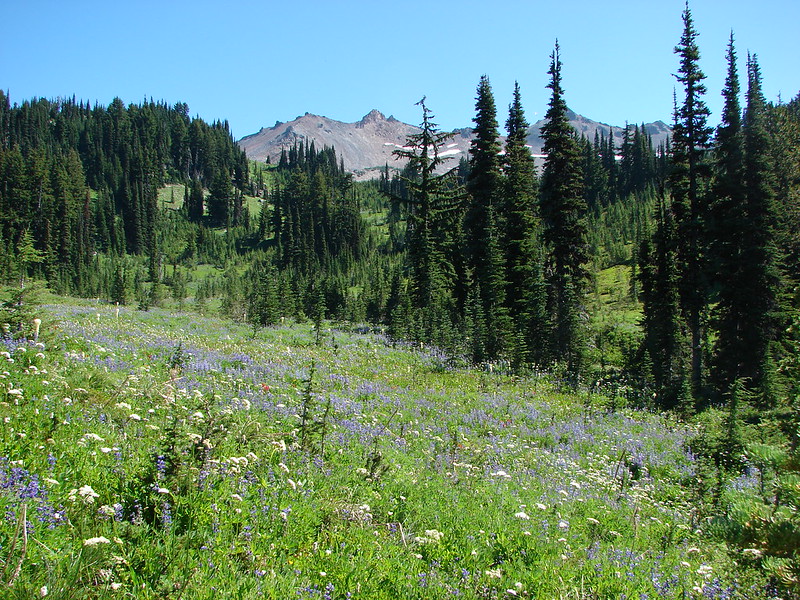
The Lily Basin Trail meets the Snowgrass Trail at this junction amid a wildflower meadow. Just a short distance away was Alpine where we began searching for a tent site. The views and wildflowers at Alpine were simply amazing. We ended up deciding on a small site with a view of Old Snowy Mountain.
DSC02582

DSC02575

DSC02578

DSC02928

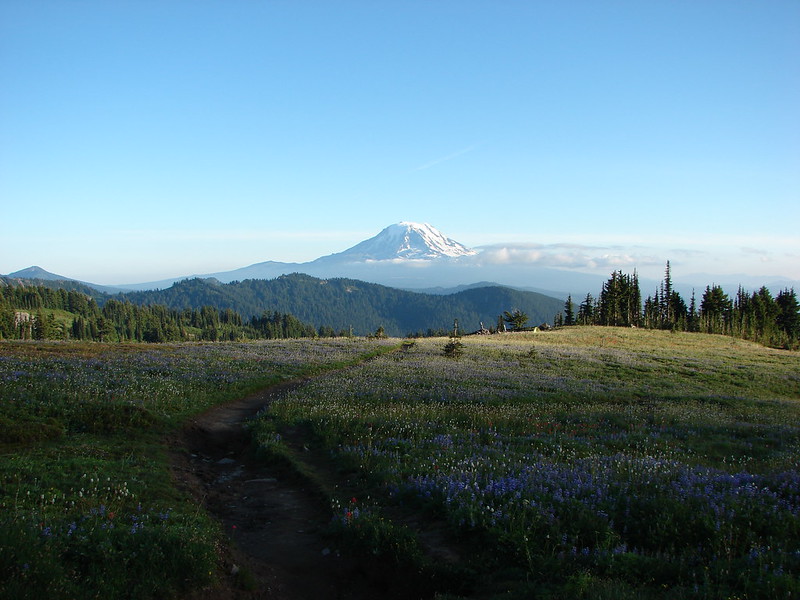
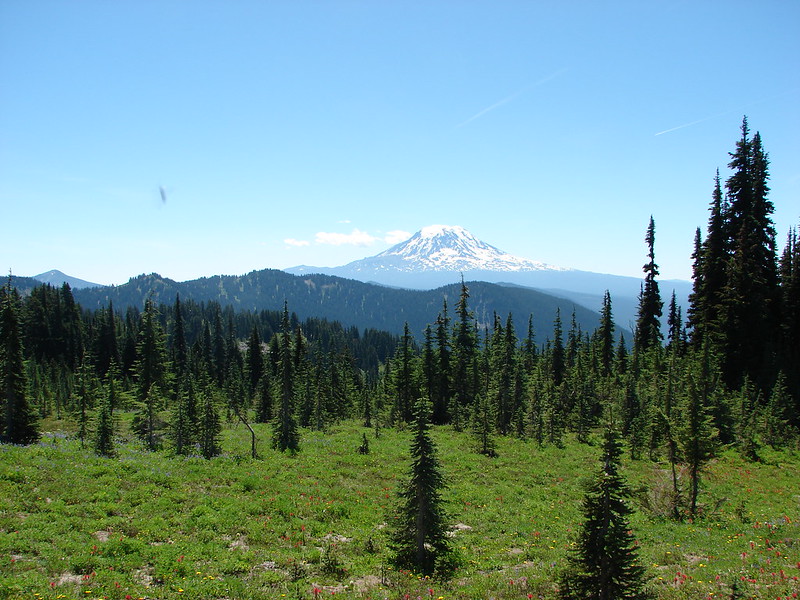
After setting up camp we loaded up our daypacks and headed back to the Snowgrass Trail and climbed to the Pacific Crest Trail. The scenery just kept getting better as we approached the PCT. Mt. Adams was standing tall to the SE, Mt. St. Helens sat in the distance to the SW and Old Snowy Mountain & Ives Peak lay dead ahead.
DSC02641

DSC02664

DSC02642

DSC02647

DSC02668

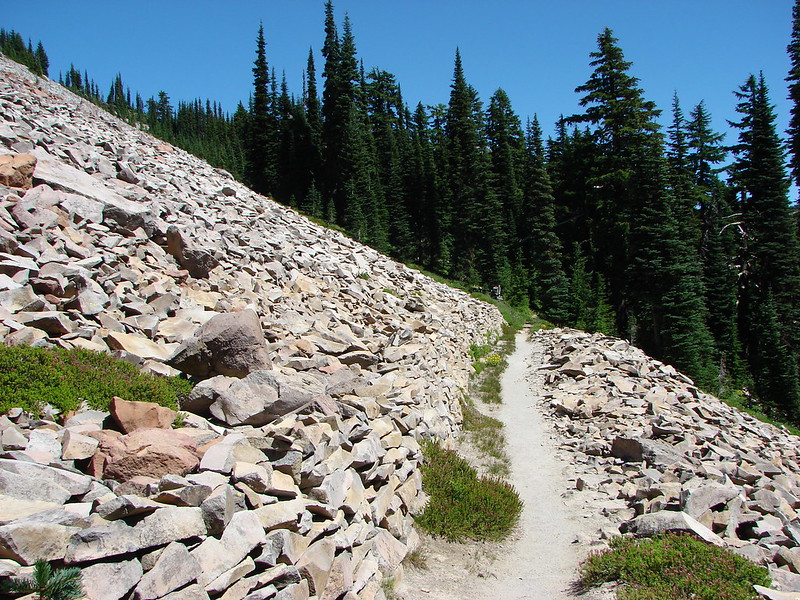
We turned right (south) on the PCT and headed toward the Cispus Basin planning to go as far as Cispus Pass before turning around. After a mile the Bypass Trail 97 joined the PCT which we would take on the way back. After crossing a large rock slide we got our first view across the Cispus Basin to Mt. Adams peaking over the far ridge.
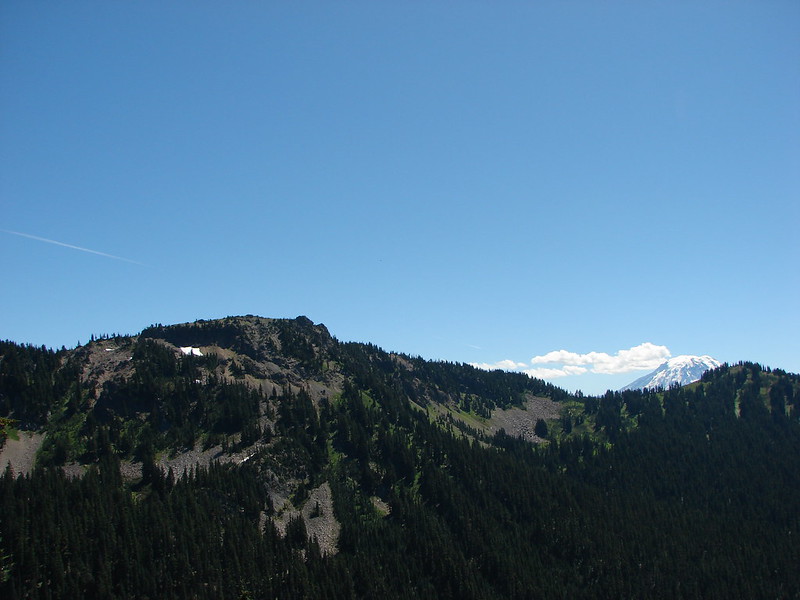
DSC02722

DSC02729

The Cispus River begins at the top of the basin underneath more jagged peaks of the Goat Rocks.
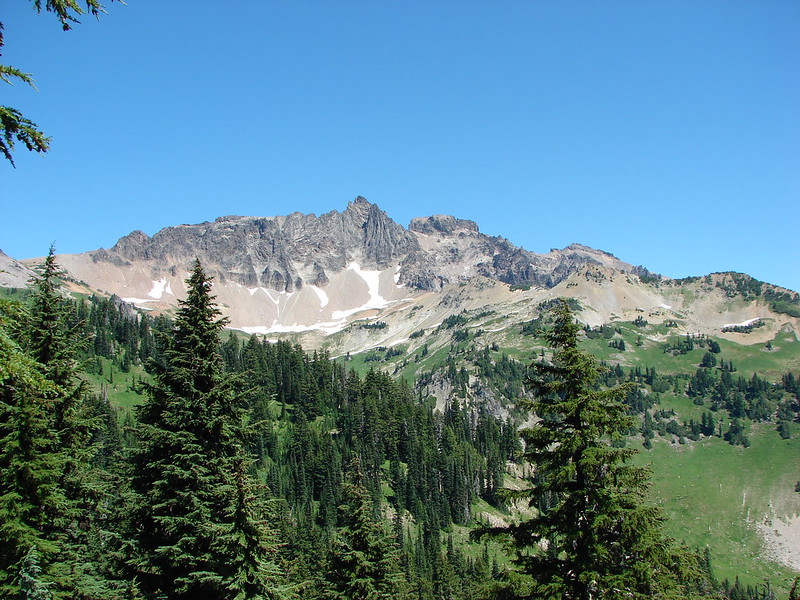
DSC02728

DSC02750

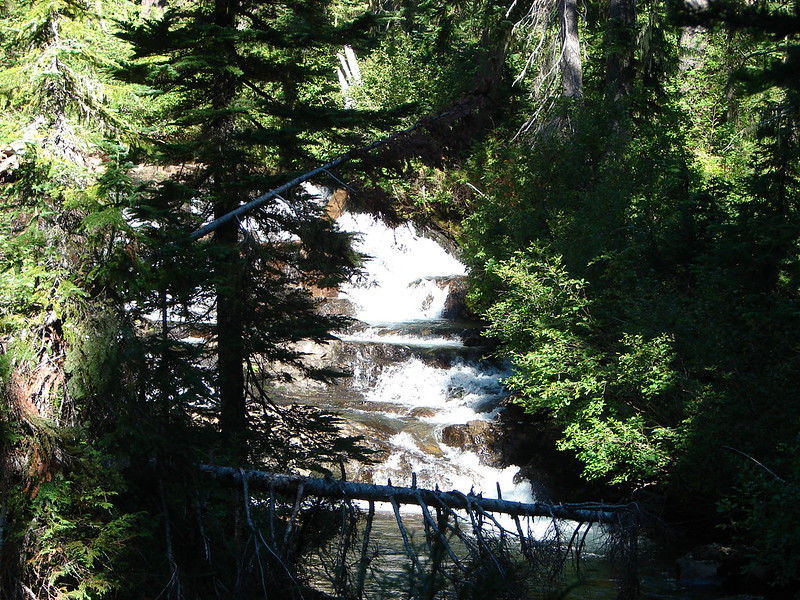
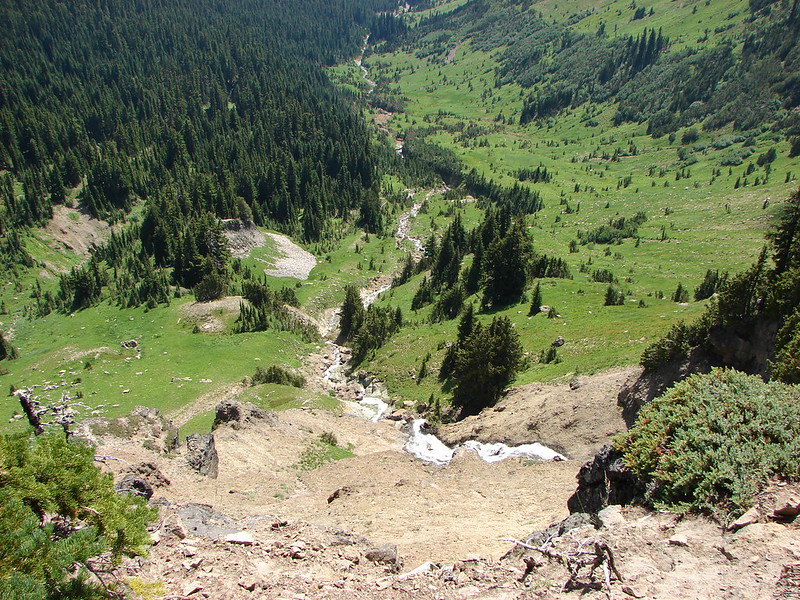
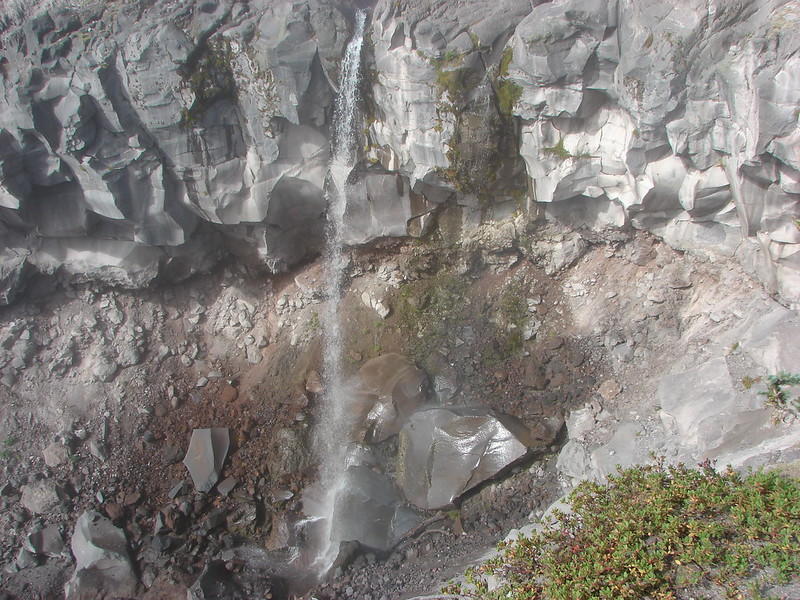
There had been wildflowers all along the trail but as we entered the basin they increased. Adding to the scenery was a waterfall that the PCT passed below.
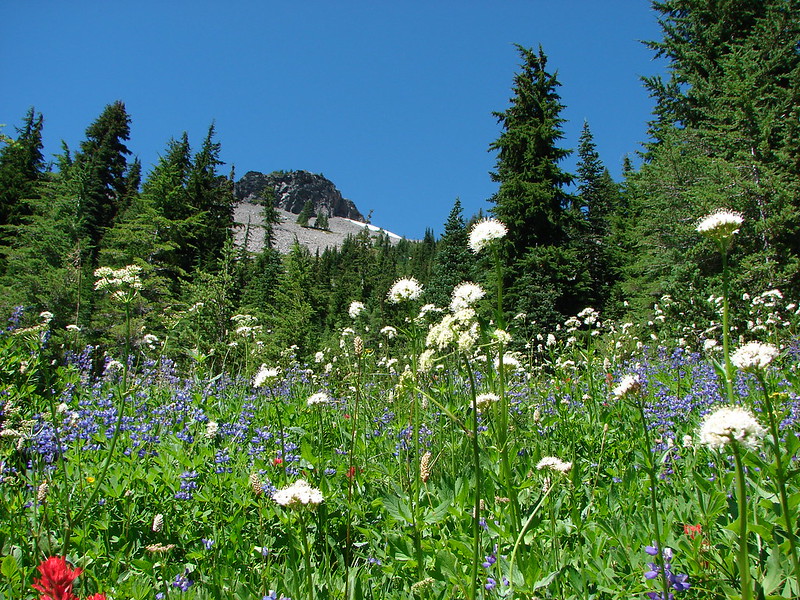
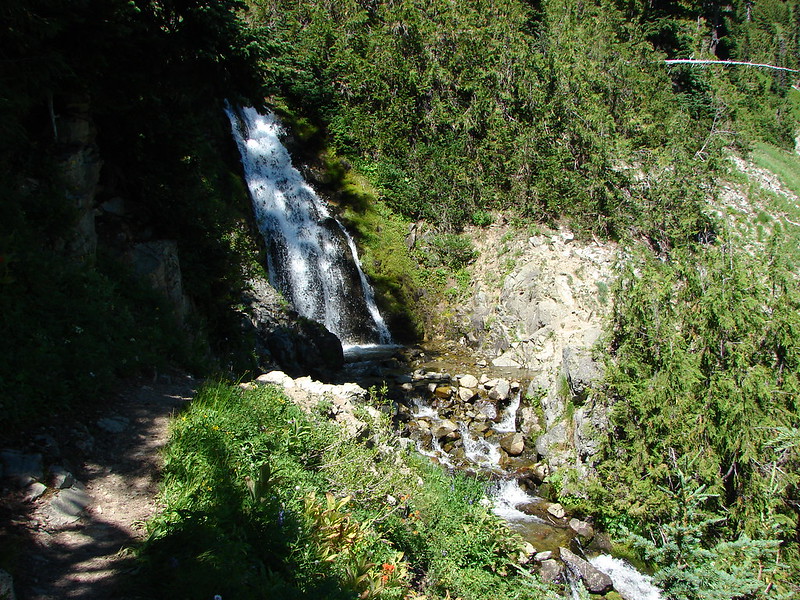
DSC02740

DSC02757

DSC02786

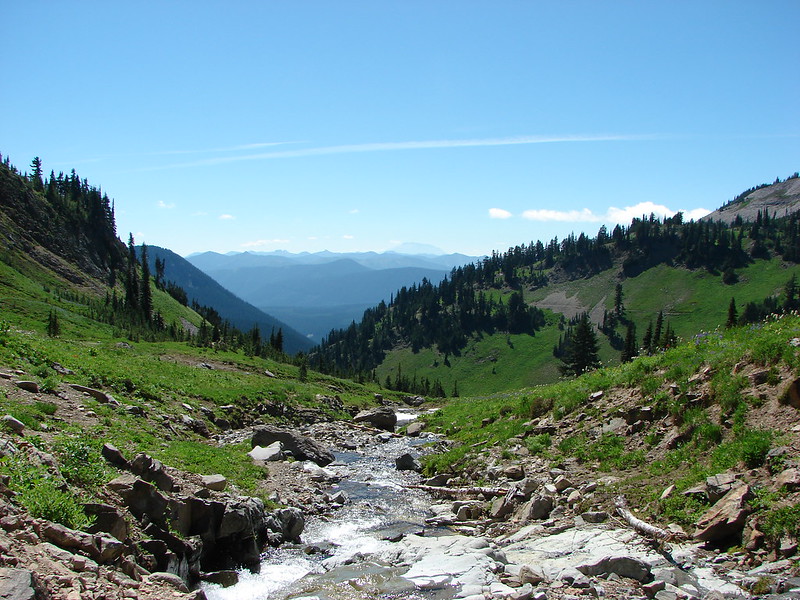
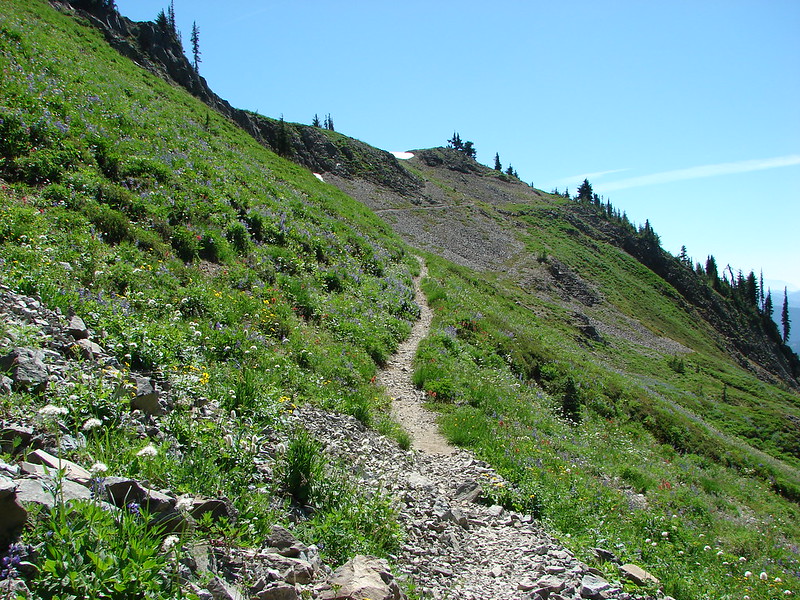
The trail continued around the basin crossing the Cispus River and then heading up the eastern side of the basin.
DSC02789

DSC02804

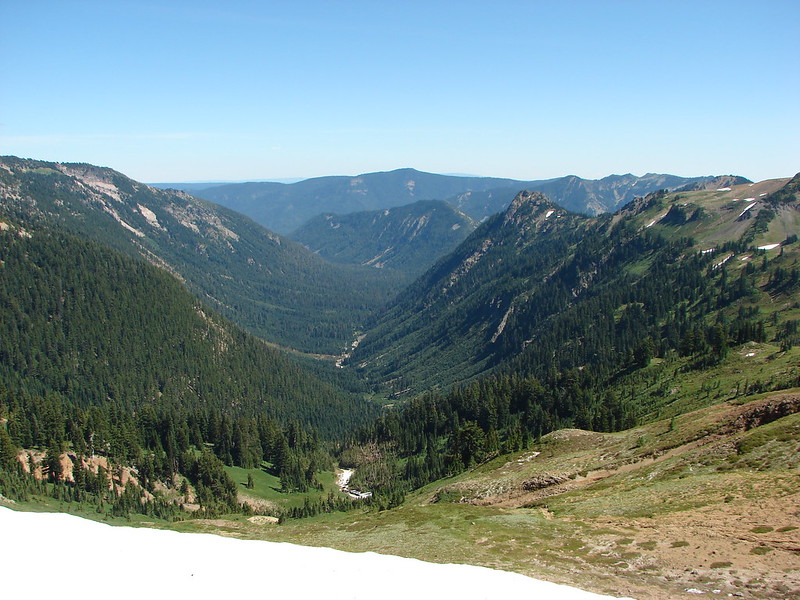
At the top of the ridge was Cispus Pass and the border of the Yakima Indian Reservation. The Klickitat River flowed below and Mt. Adams was again visible to the SE.

DSC02825

DSC02828

DSC02835

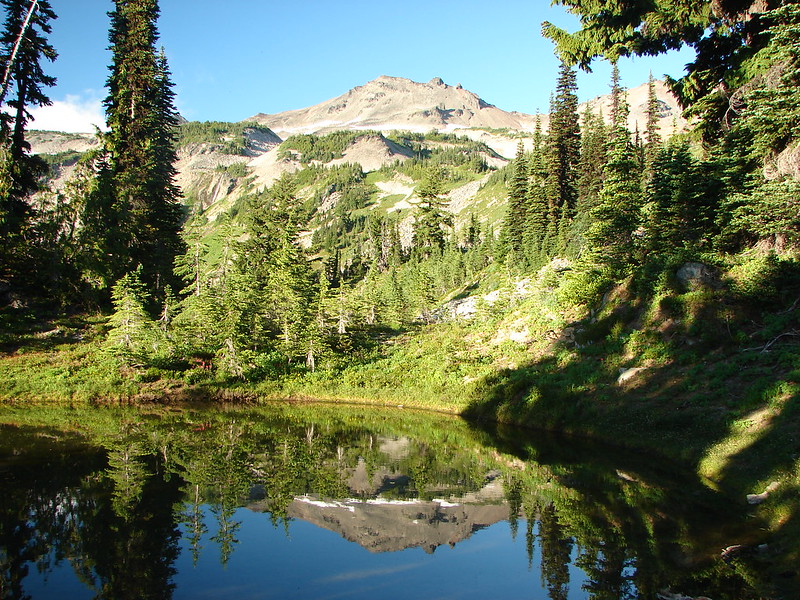
We returned to Alpine via the Bypass Trail 97 and took a short rest before heading back out to catch the sunset. We decided to try heading further out on the Lily Basin Trail since the Sun would be setting over the ridges in that direction. We passed a small pond with a big reflection before finding an unoccupied camp site where we settled in.
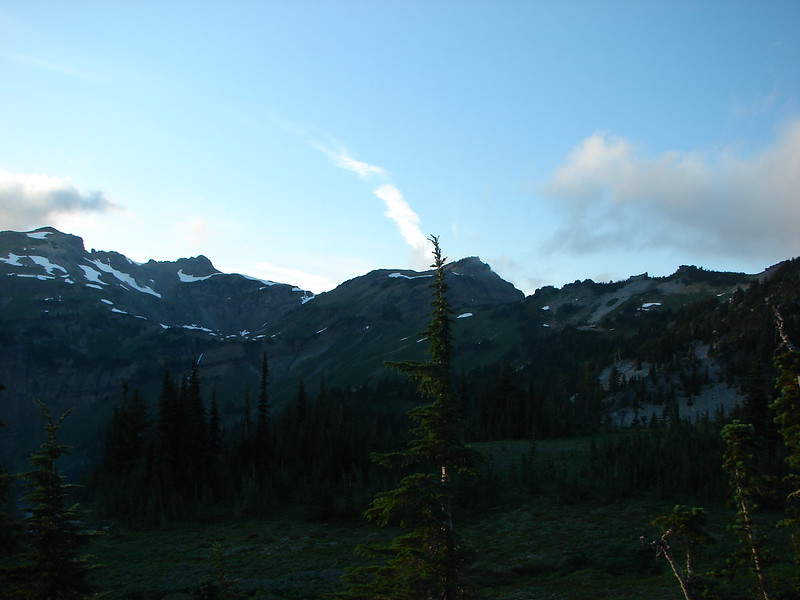
DSC02935

DSC02968

DSC02964

Clouds started to move in and cover some of the higher points though so we headed back toward Alpine to check on Mt. Adams. The Moon had risen over the ridges to the North of Mt. Adams making for a perfect ending to our first day.
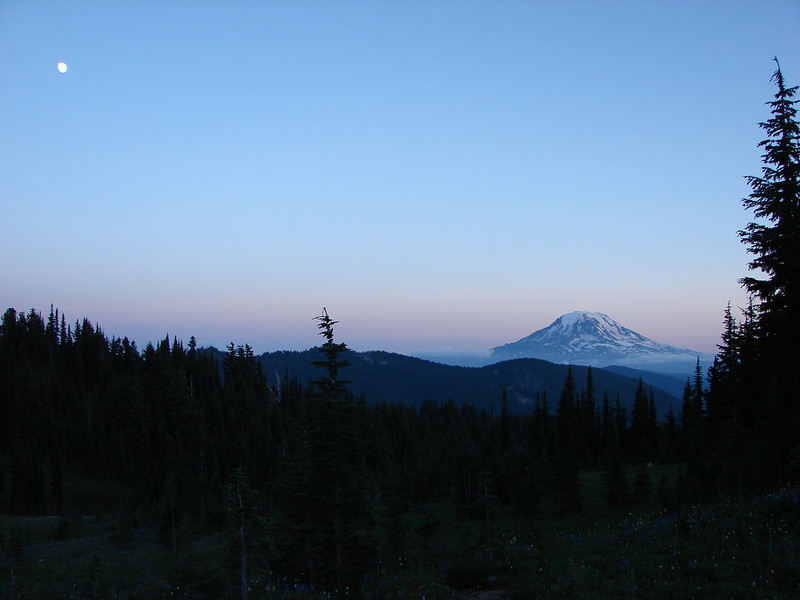
DSC03004

I was up early on day 2 and was able to catch the sunrise which lit up the clouds over Ives Peak and Mt. Adams.
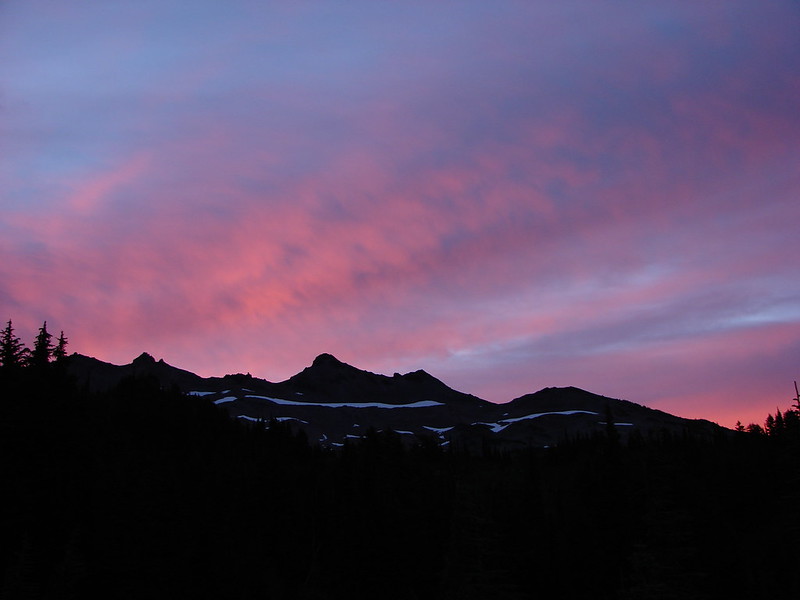
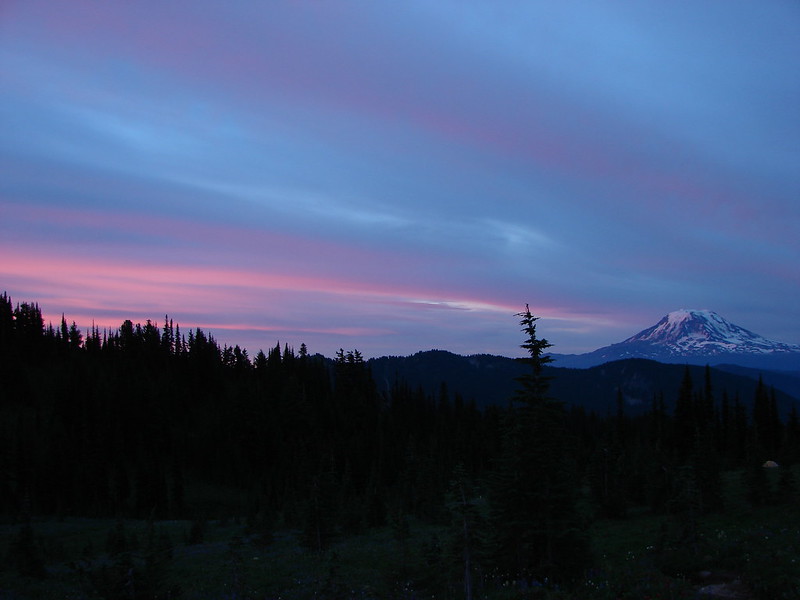
DSC03037

DSC03029

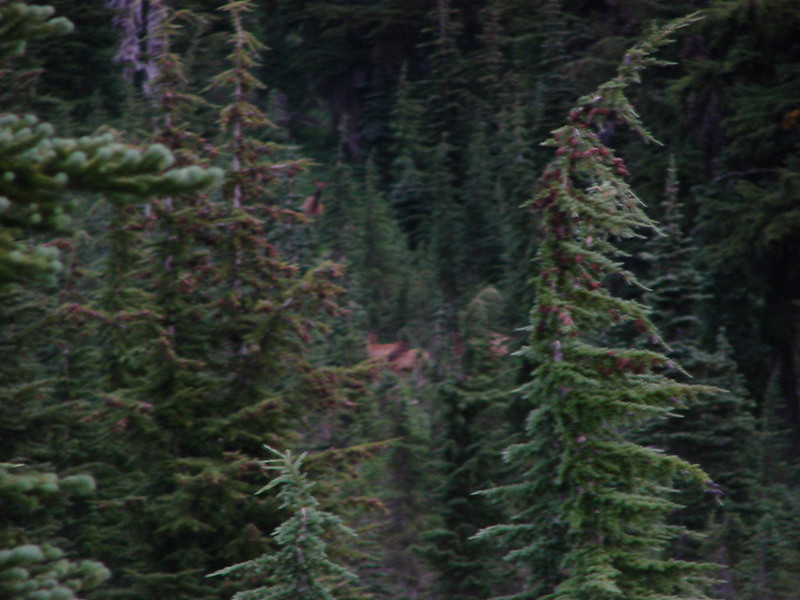
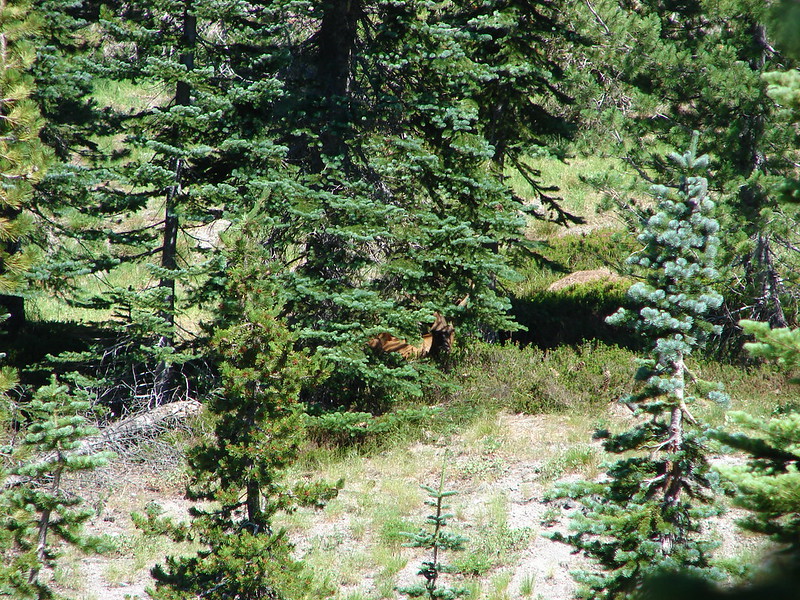
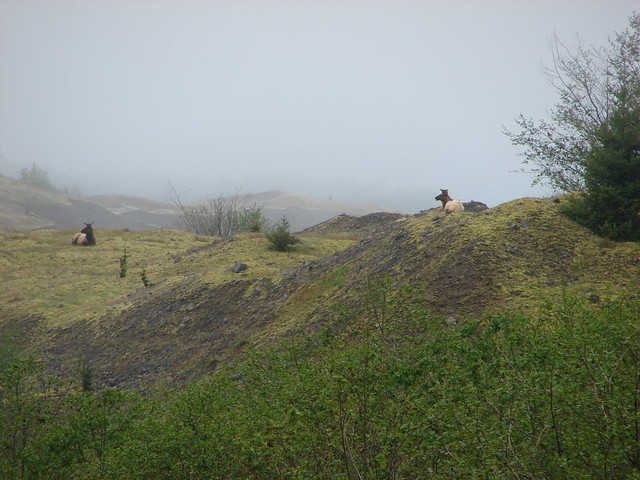
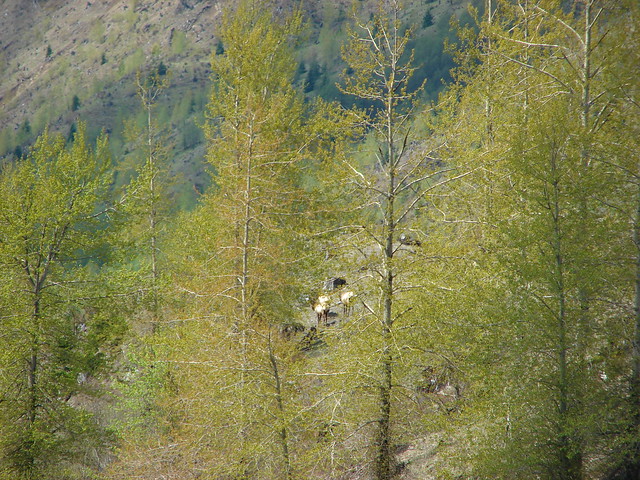
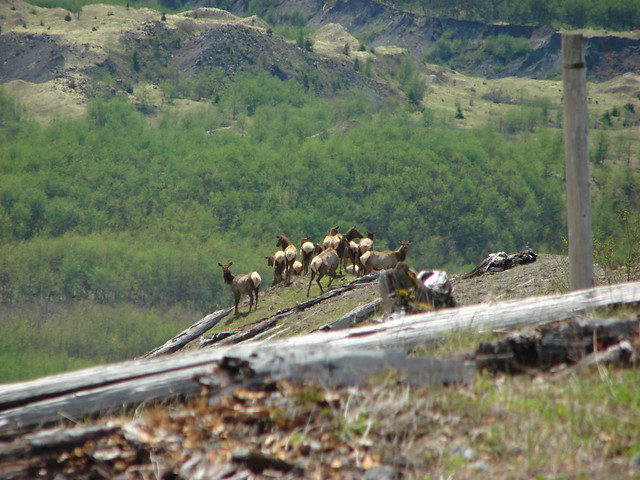
Several elk were passing through the trees on the far side of Alpine but the low amount of light left me with a single picture worthy of a bigfoot sighting. ๐Ÿ™‚

DSC03068

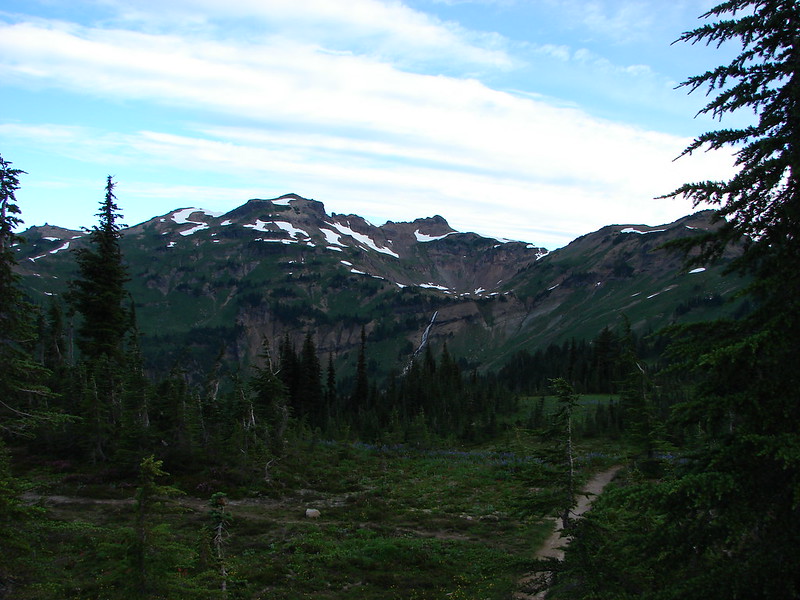
We set off early on the Lily Basin Trail planning on passing Goat Lake then continuing on the trail to Heart Lake with a possible side trip up Hawkeye Point. As we headed in that direction the view of Hawkeye Point and Goat Creek falling from the rocky ledge below Goat Lake was another stunner.
DSC03075

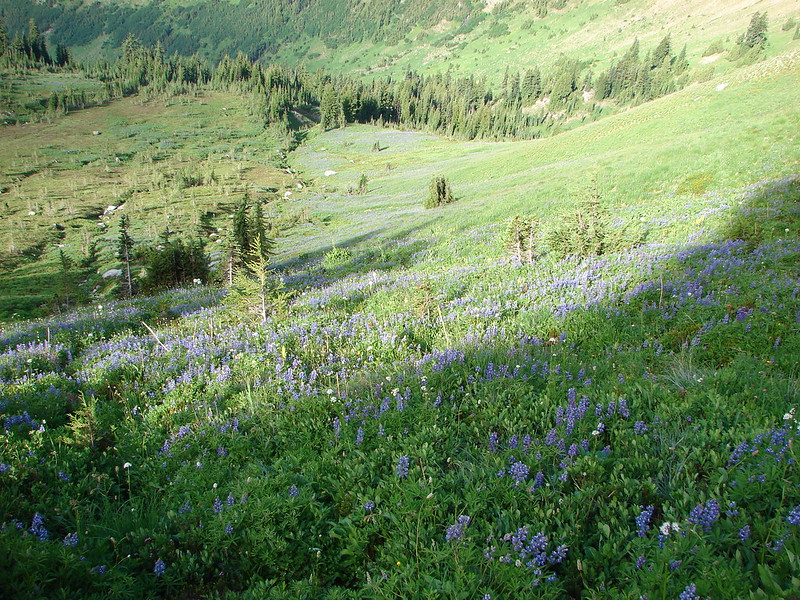
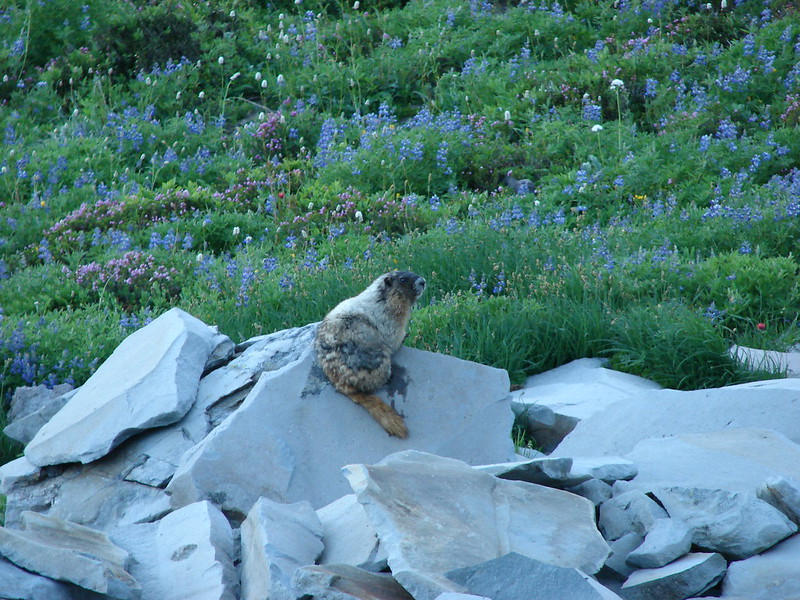
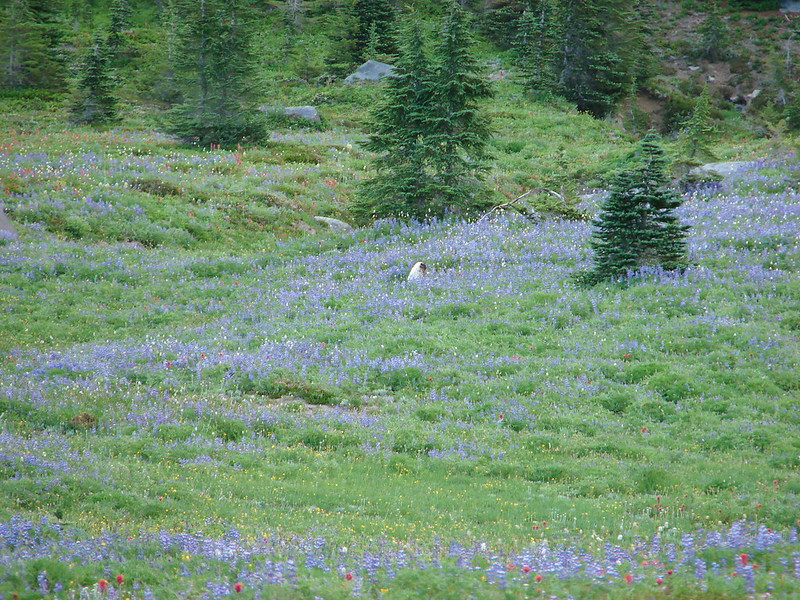
The trail passed through some large wildflower meadows where marmots could be seen scurrying about in the lupine.

DSC03080

DSC03085

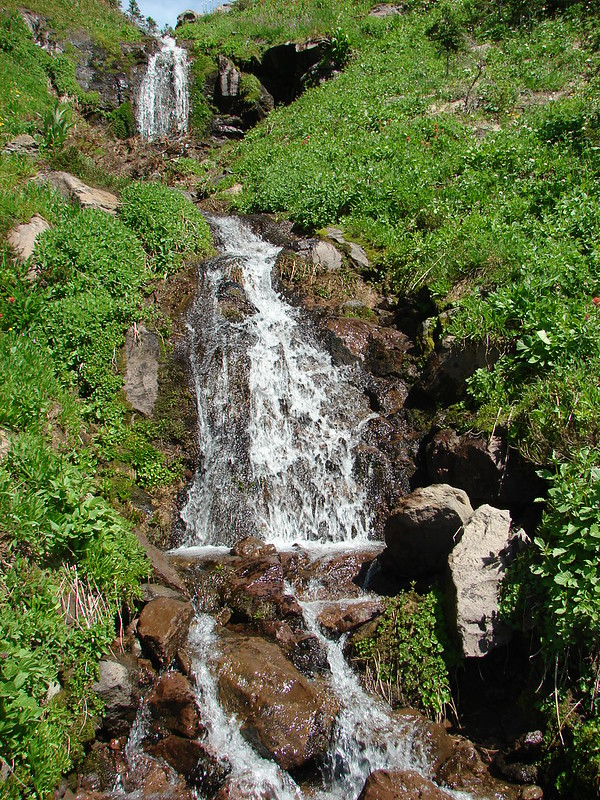
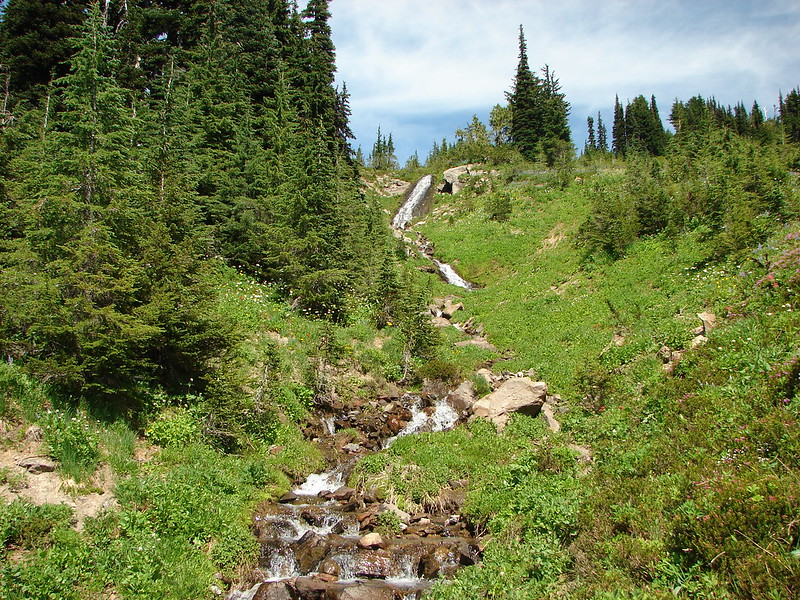
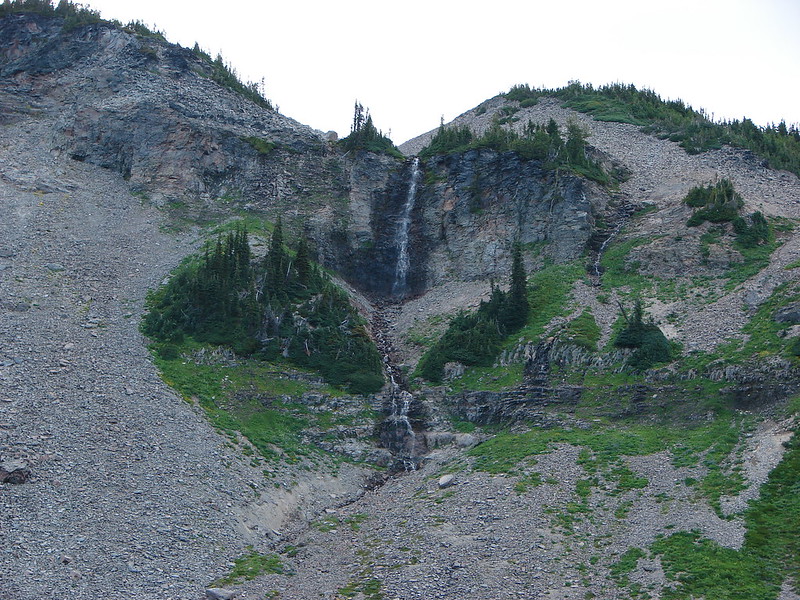
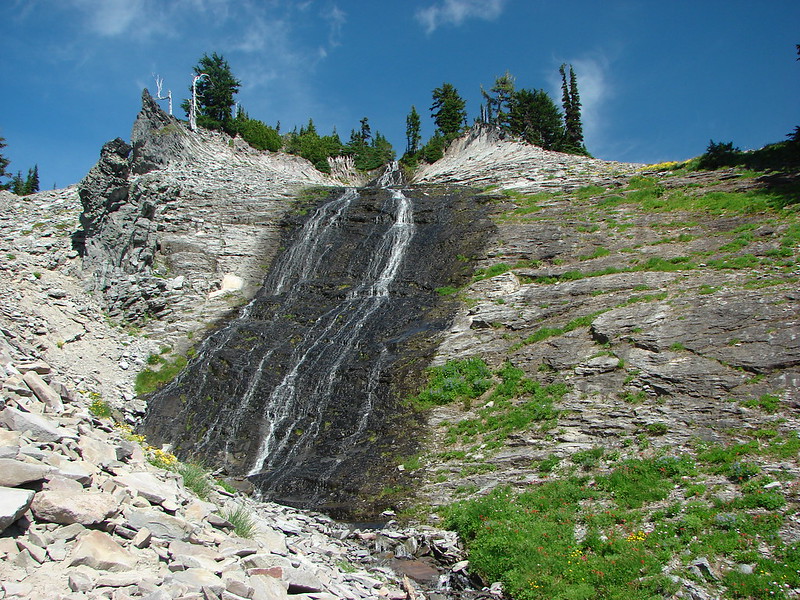
We also passed several waterfalls. The first just disappeared into a rock slide while the second slid down the rocks.
DSC03090

DSC03514

DSC03490

DSC03493

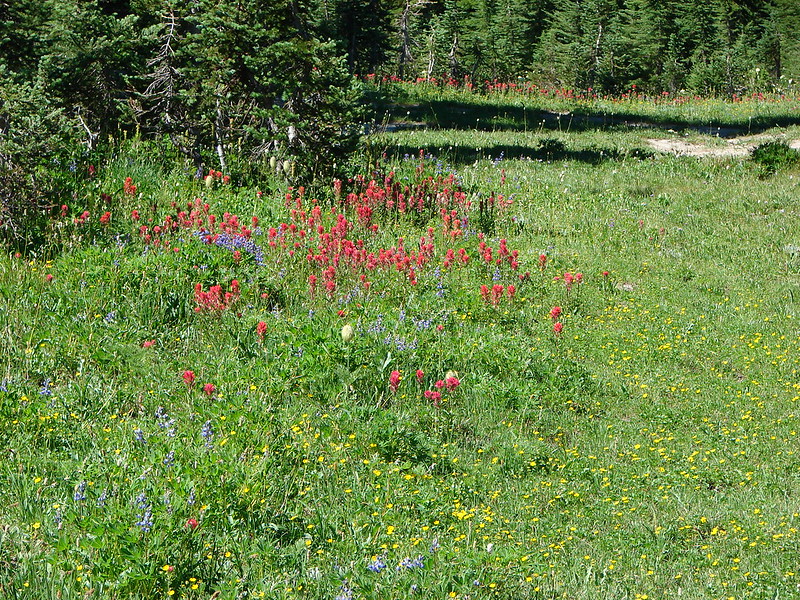
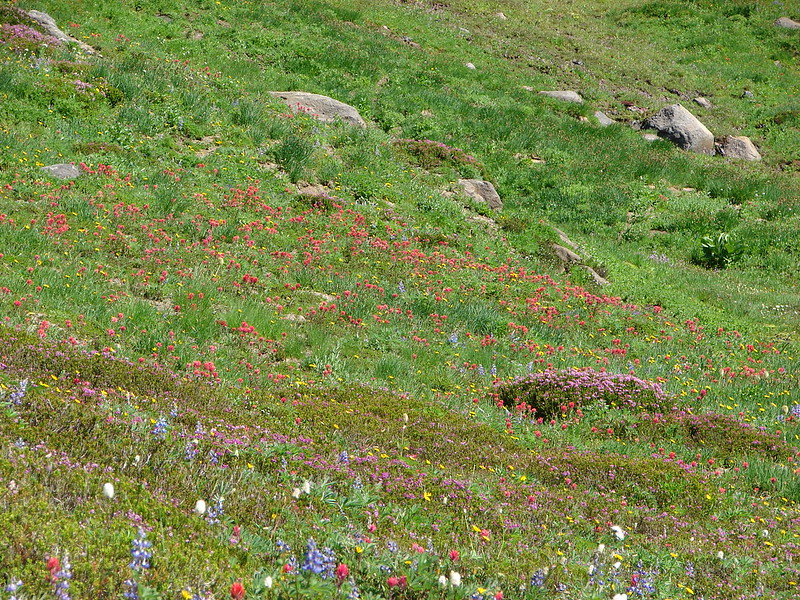
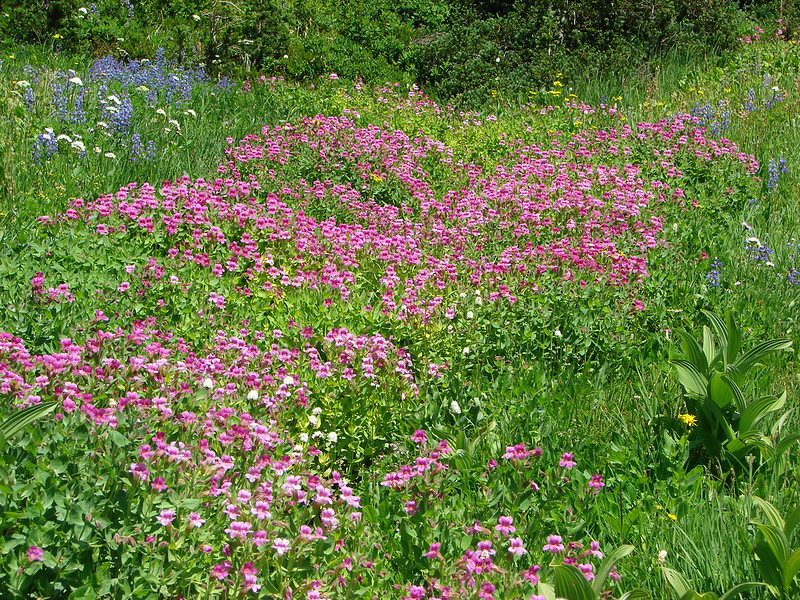
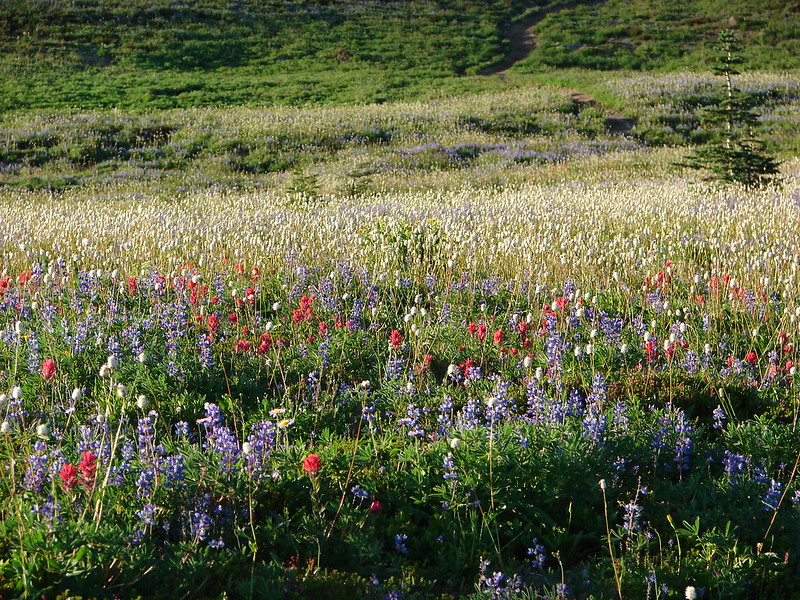
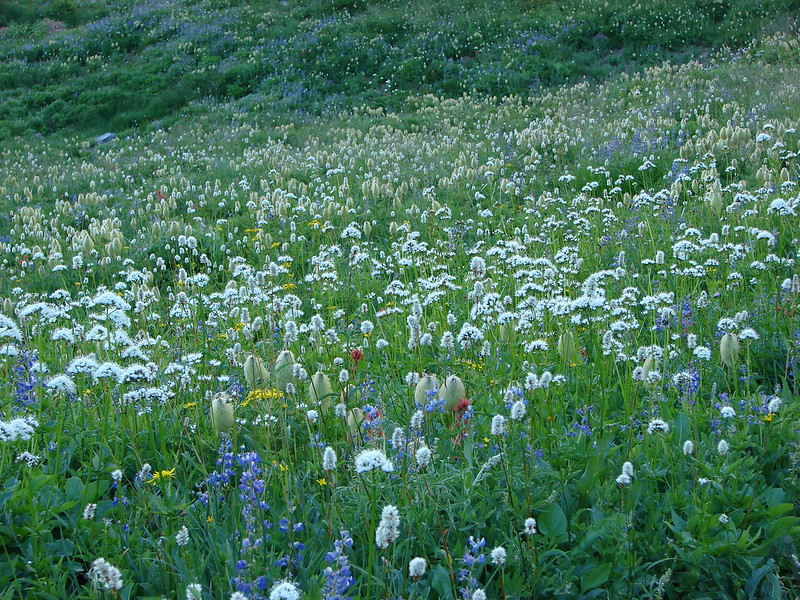
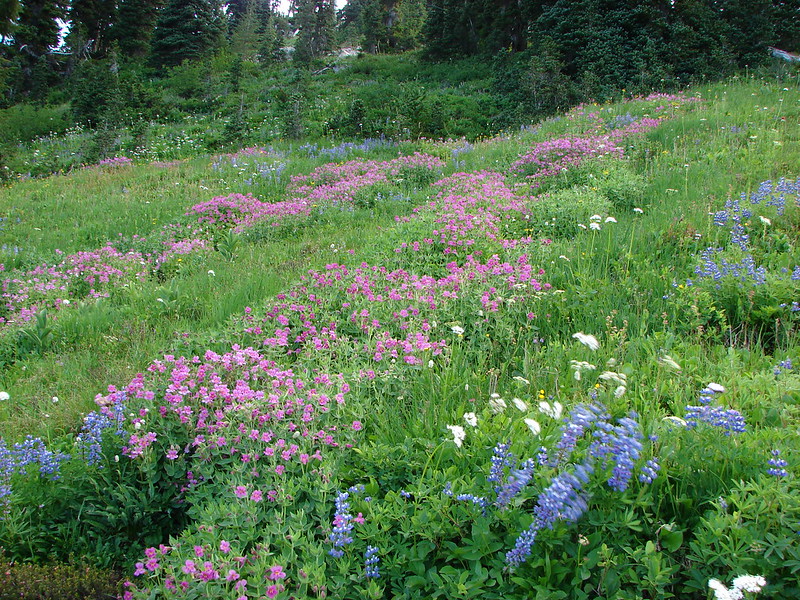
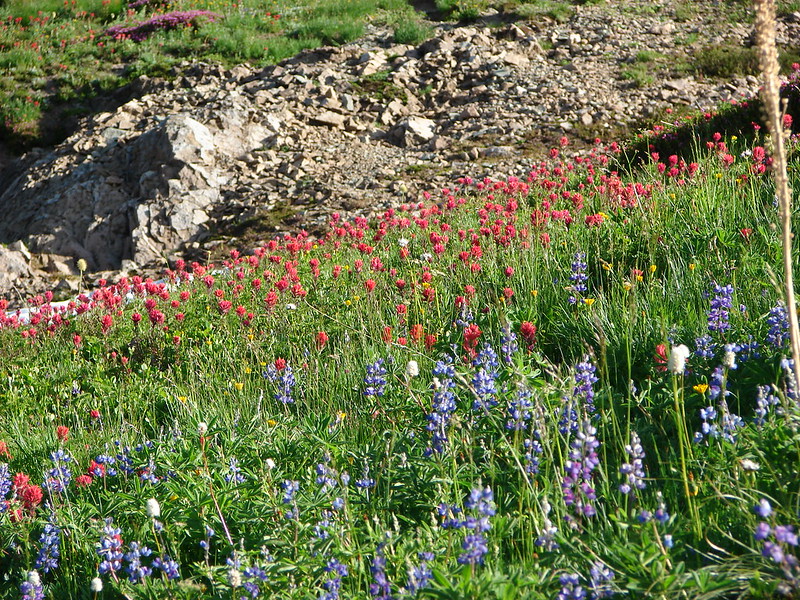
Everything was so impressive but most of all were the wildflowers. The variety and amounts of them were unbelievable. Entire hillsides were covered in colors.
DSC03124

DSC03152

DSC03144

And to top it off Mt. Adams loomed behind us.

DSC03130

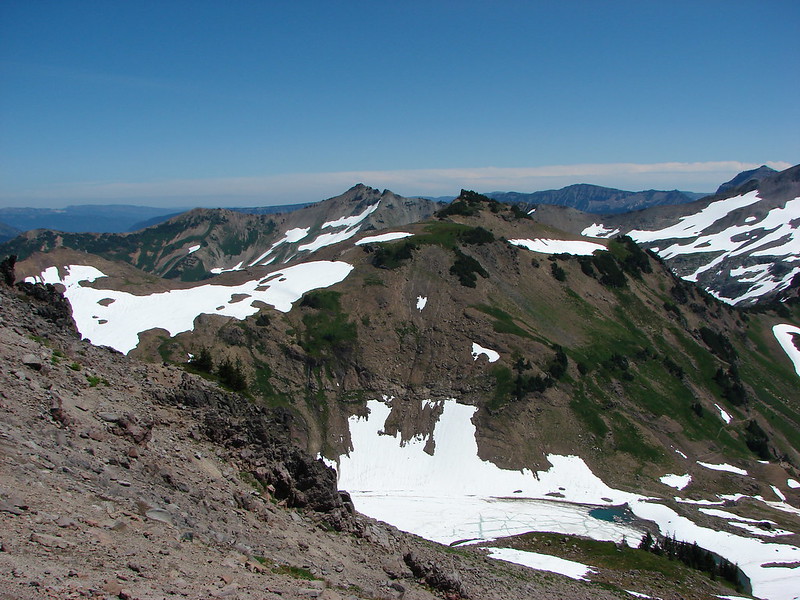
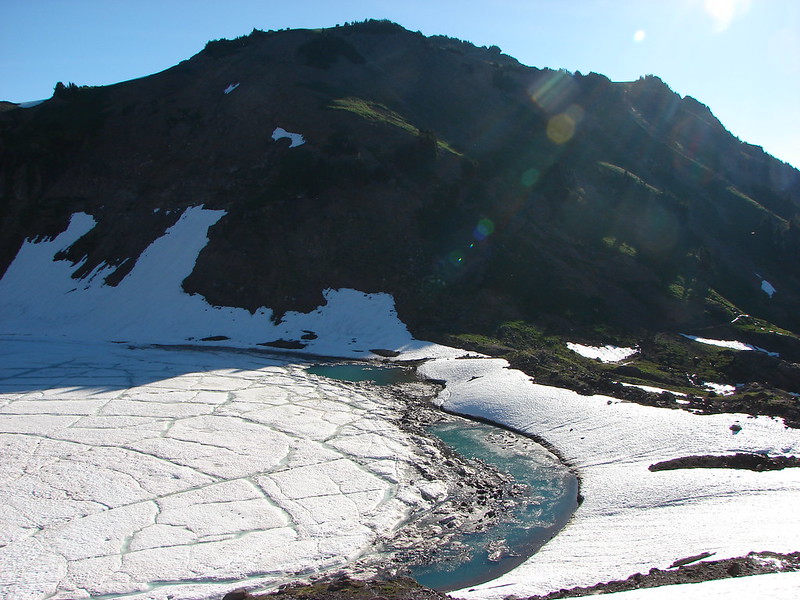
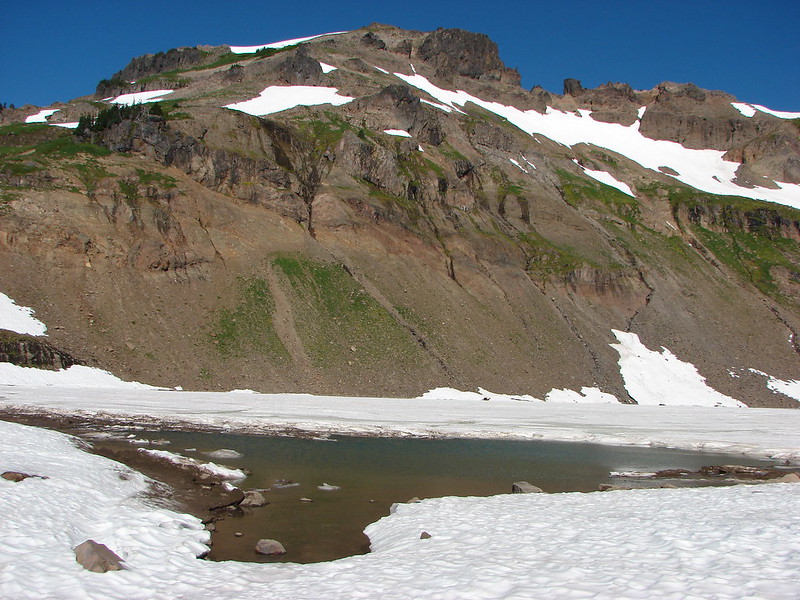
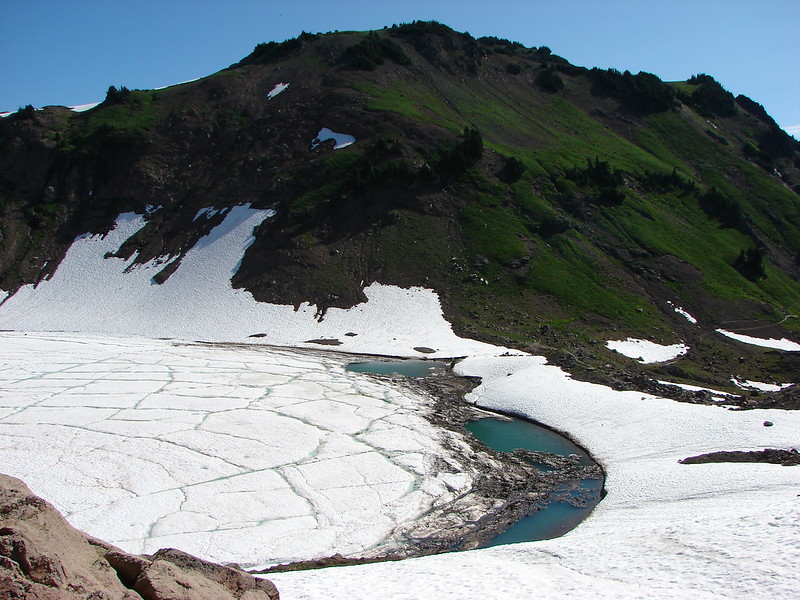
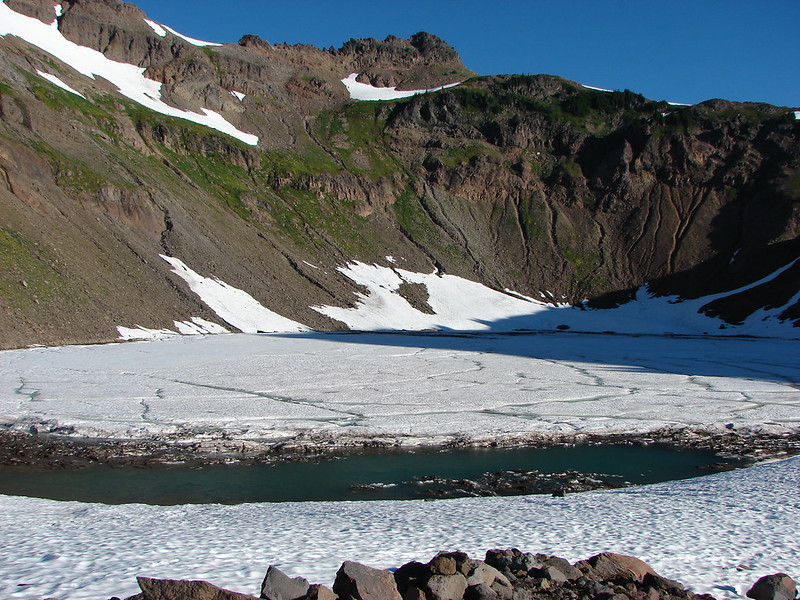
When we arrived at Goat Lake it was mostly frozen as we had expected. The lake rarely ever thaws out completely sitting in a bowl beneath Hawkeyepoint.
DSC03168

DSC03191

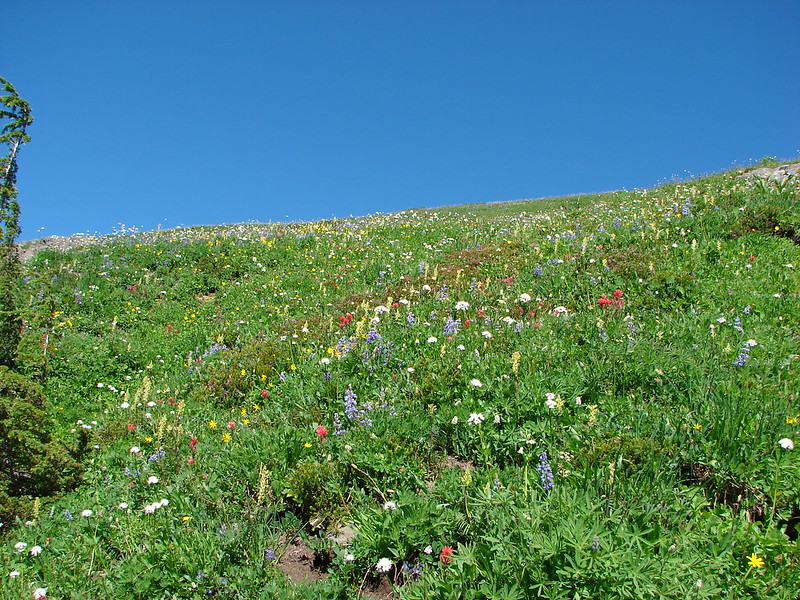
From the lake the trail climbed to a ridge crest junction with the Goat Ridge Trail. Again the wildflowers were profuse.

DSC03232

DSC03227

DSC03230

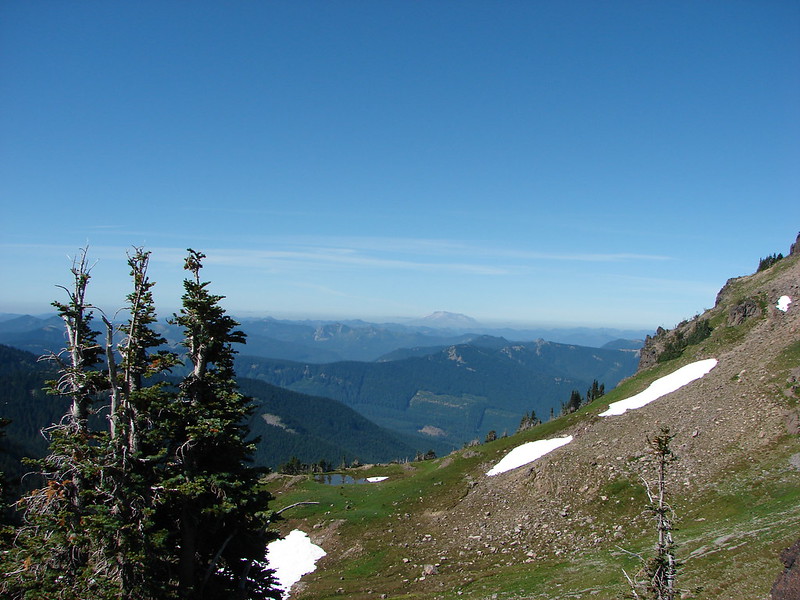
When we reached the junction Mt. St. Helens came into view beyond the Jordan Basin.
DSC03244

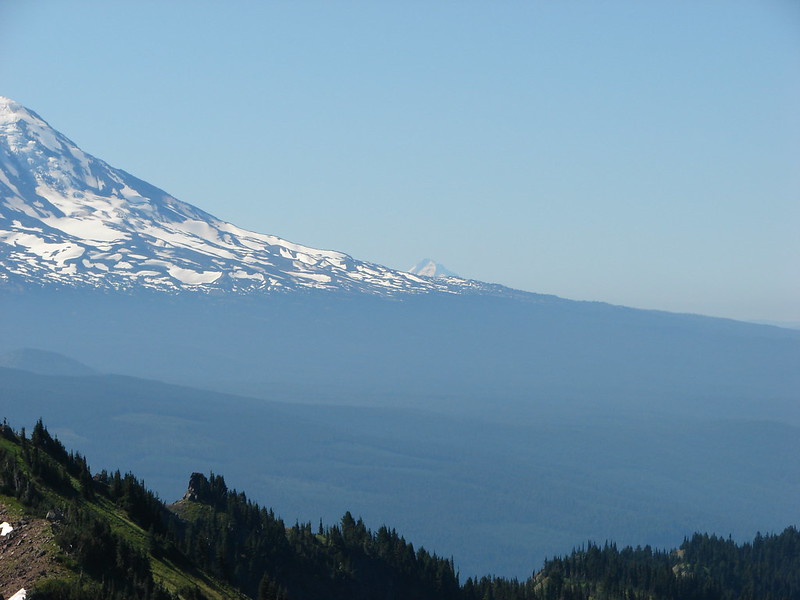
We left the Lily Basin Trail to attempt to climb Hawkeye Point. As we climbed the tip of Mt. Hood could be seen over the shoulder of Mt. Adams.
DSC03266

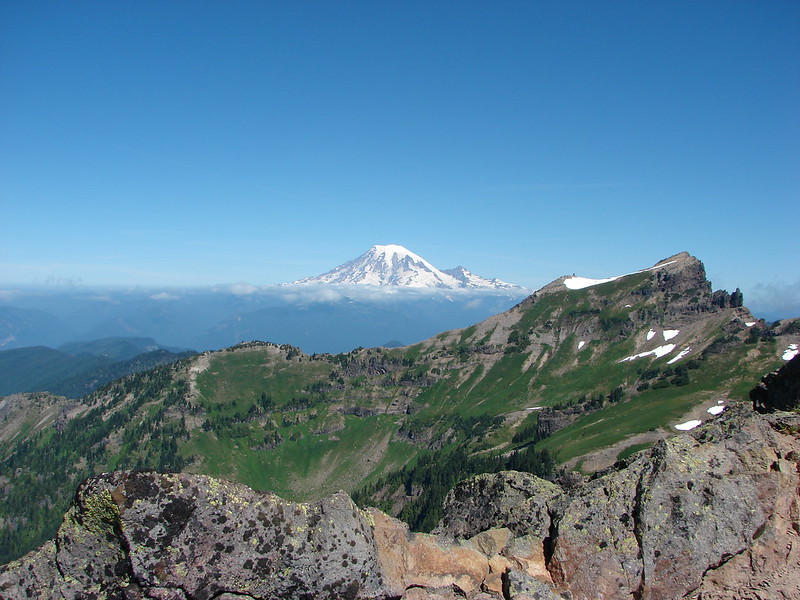
Then came Mt. Rainier beyond Johnson Peak.
DSC03268

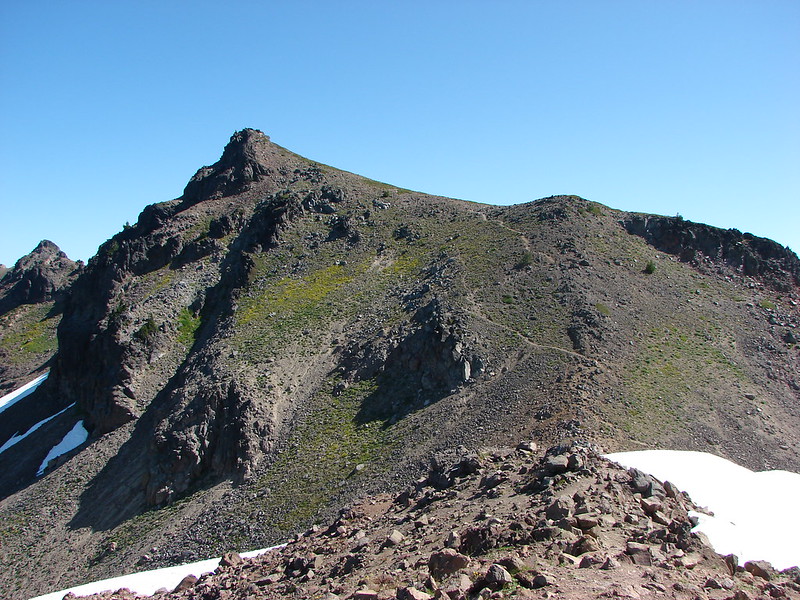
We followed a clear path to a rocky knob where we discovered a large snowfield lying between us and the visible trail up to the summit of Hawkeye Point.
DSC03282

There was a steep drop part way out on the snowfield and no visible tracks so we decided to declare victory where we were and see if there was a different route to the trail we could see on the far side so we climbed back down to the Lily Basin Trail and started to head toward Heart Lake. We didn’t get far though before we were stymied by another snowfield.

DSC03301

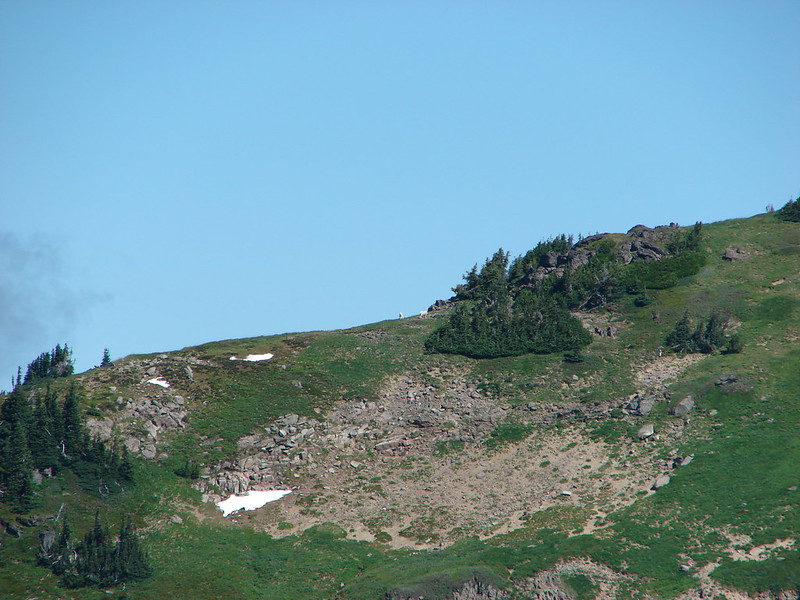
We decided to take a short break before heading back to search for a different route to Hawkeye Point. While we were resting Heather spotted the one thing I was really hoping to see on the trip – Mountain Goats! There was a pair of them near the top of the ridge across the basin.
DSC03318

Mountain Goats were on top of my list of animals we hadn’t seen yet while hiking so even though they were a long way away it was exciting.

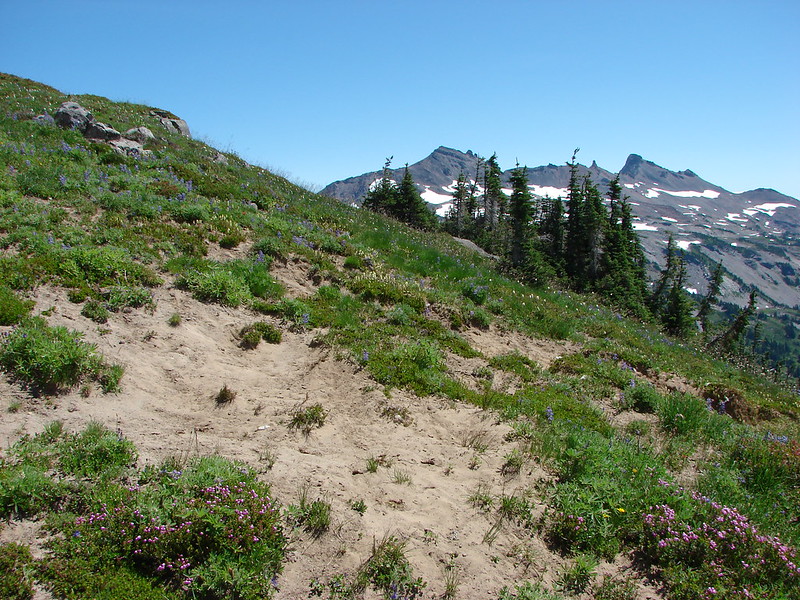
After they disappeared over the ridge we started our search for a path around the snowfield to Hawkeye Point. We managed to find what turned out to be a goat path that got us around the snowfield, but we were too far down a steep hill with no visible route up to reach the continuation of the real trail. Instead we followed the goat trail passing some beds complete with goat fur to a view of Goat Lake below.
DSC03335

DSC03336

DSC03342

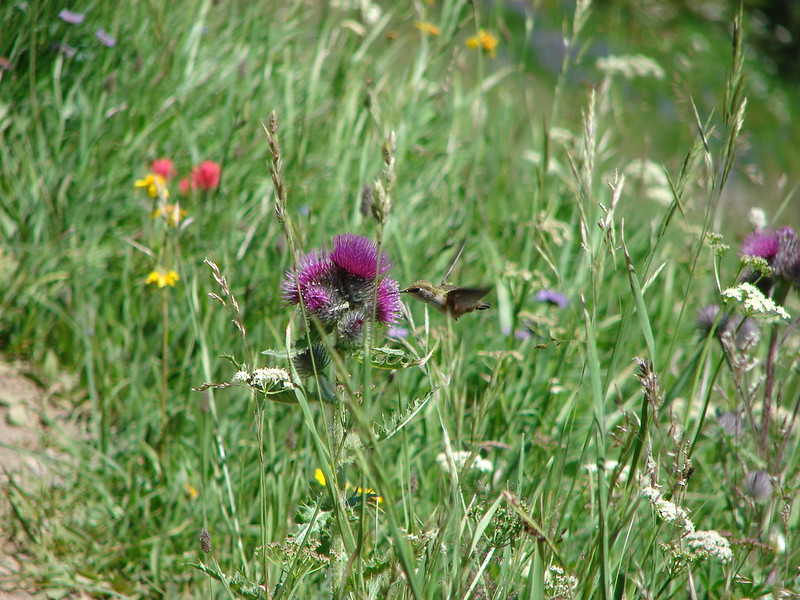
Satisfied with the view we began our return trip to camp. It was such a pretty trail that was just as spectacular the second time through.
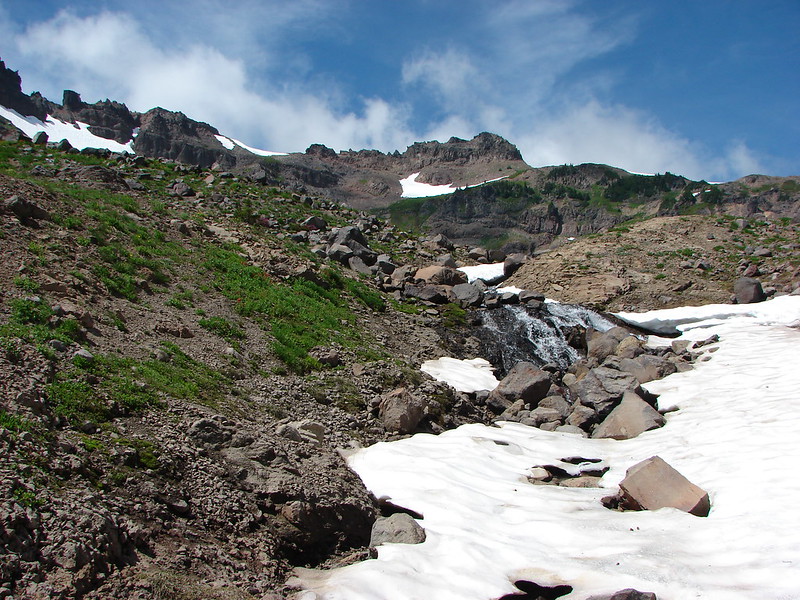
DSC03383

DSC03407

DSC03411

DSC03488

When we got back to camp we noticed that the family who had been camped further back in the same area as us had left. We took the opportunity to switch sites and moved to a spot with a view of Mt. Adams.
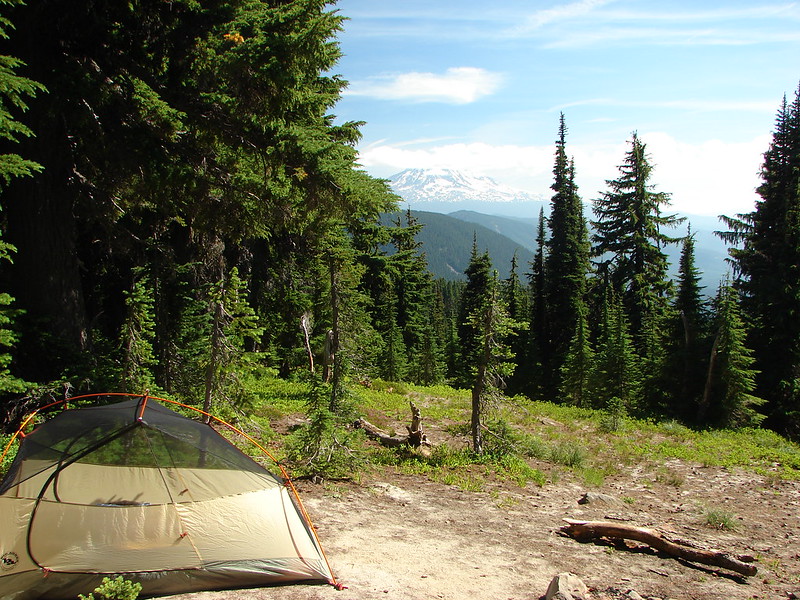
DSC03525

After getting our new site set up we decided to go up to the PCT junction to catch the sunset. When we reached the junction with the Snowgrass Trail in Snowgrass Flat Heather noticed a large animal emerging from the trees on our right. We could see dark brown and my first thought was Elk but then it stepped out into the sunlight on the trial.
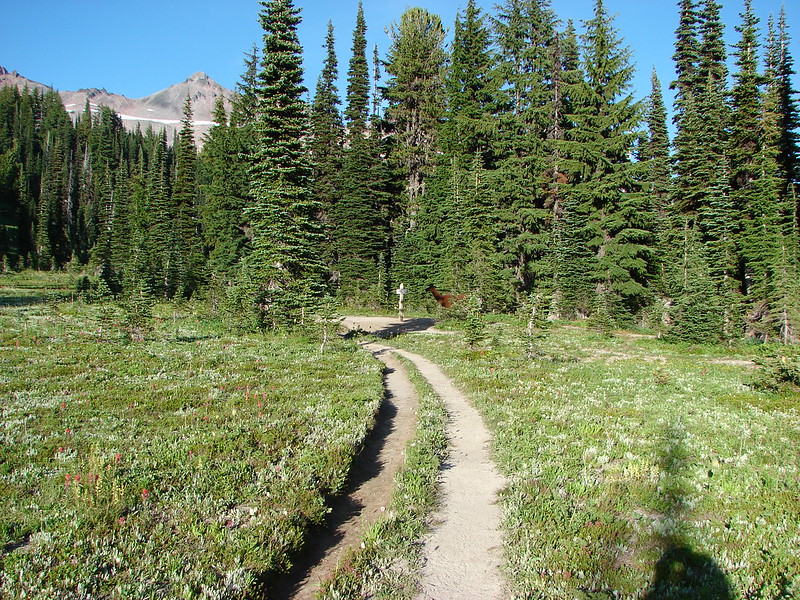
DSC03539

It was a llama and it looked mighty proud of itself.
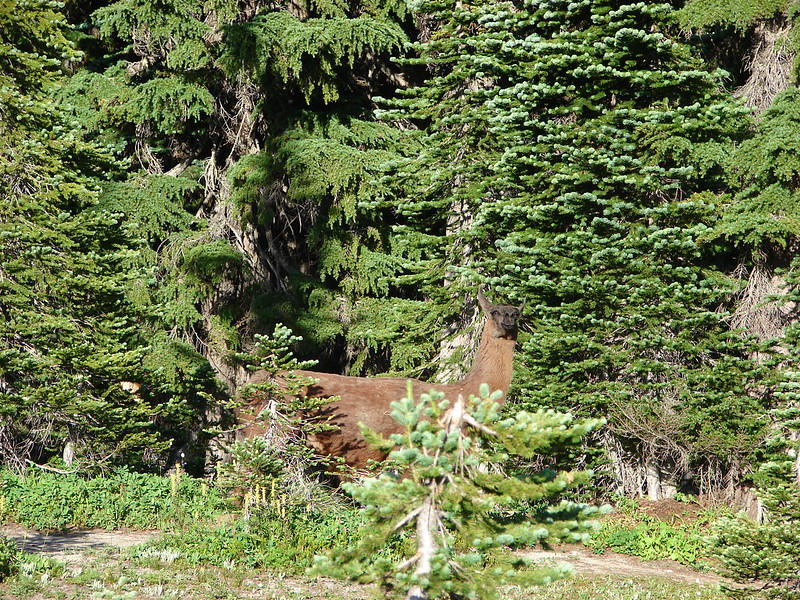
DSC03545

We didn’t see anyone around but someone must have been using it as a pack animal. It rolled in the dirt for a moment then got up and then disappeared into another camp site. It was so unexpected all we could do was laugh all the way up to the PCT.

Meanwhile the setting Sun was bringing out the best in the wildflowers on the PCT.

DSC03556

DSC03555

DSC03553

We found an open site and watched the Sun disappear behind a bank of clouds that was hanging over Goat Ridge before returning to our tent and putting day 2 to bed.

DSC03568

DSC03579

Goat Rocks - Mt. Adams sunset

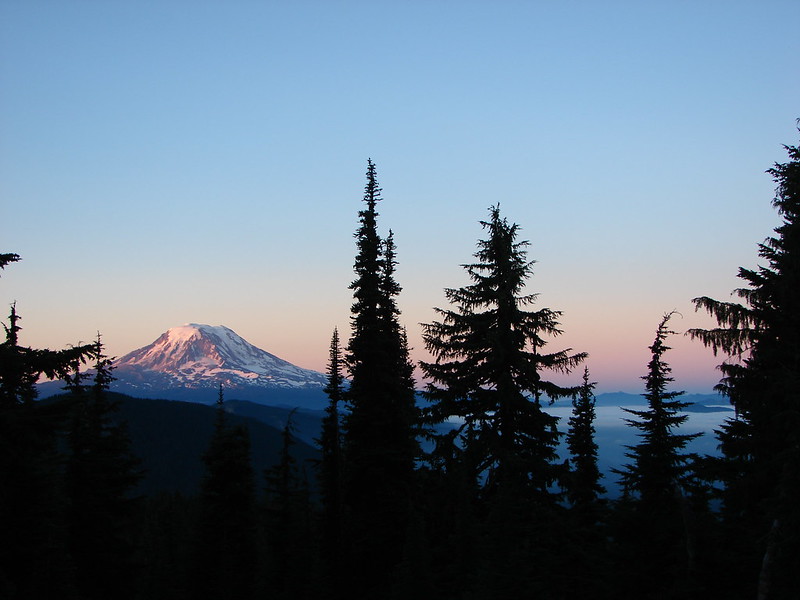
The third day started much like the previous day with a pretty Mt. Adams sunrise.
DSC03593

The animals were up early too.

DSC03595

DSC03601

DSC03606

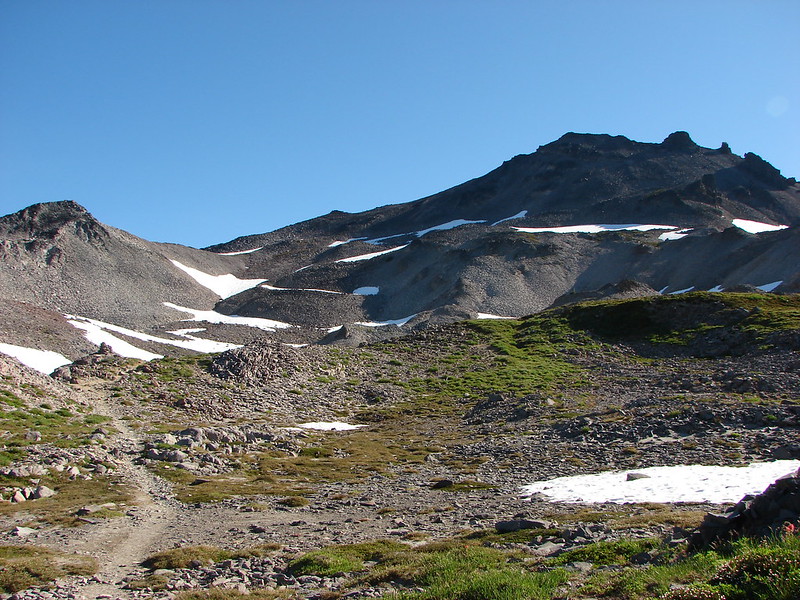
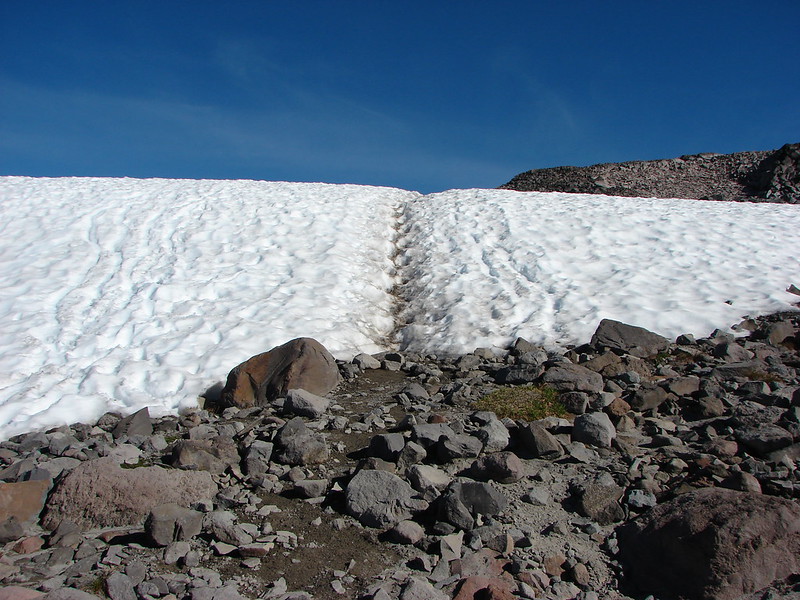
After a yummy breakfast of Mountain House Biscuits and Gravy we headed up to the PCT once again but this time headed left (North) toward Old Snowy Mountain. As we approached the mountain we left the meadows behind for more rocky terrain dotted with lingering snowfields. The flowers were not completely left behind though.
DSC03632

DSC03636

DSC03637

We spotted a ground squirrel that appeared to be sitting on a ledge enjoying the view along with its breakfast. The ledge it was on looked out over Goat Lake to Hawkeye Point with Mt. Rainier towering behind.

DSC03639

DSC03642

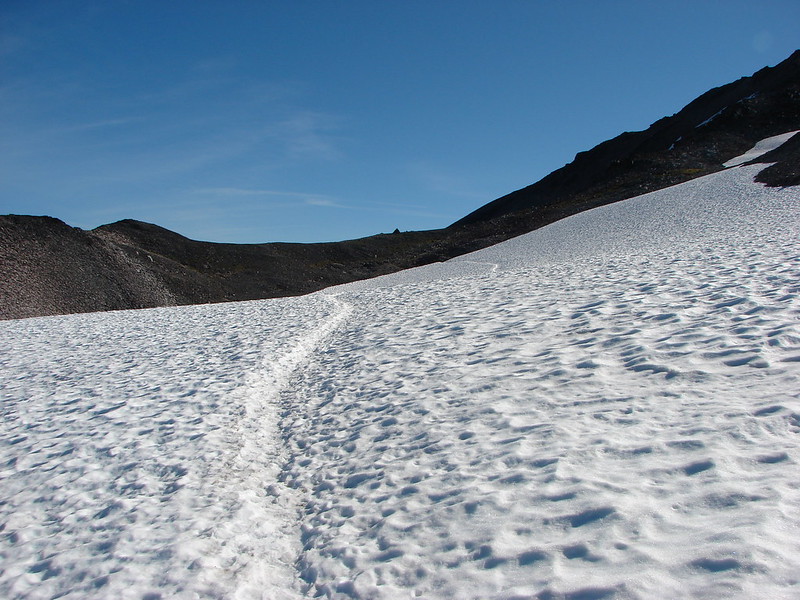
The trail crossed several snowfields but unlike those we encountered the day before the trail was easy to follow and none were too steep.
DSC03655

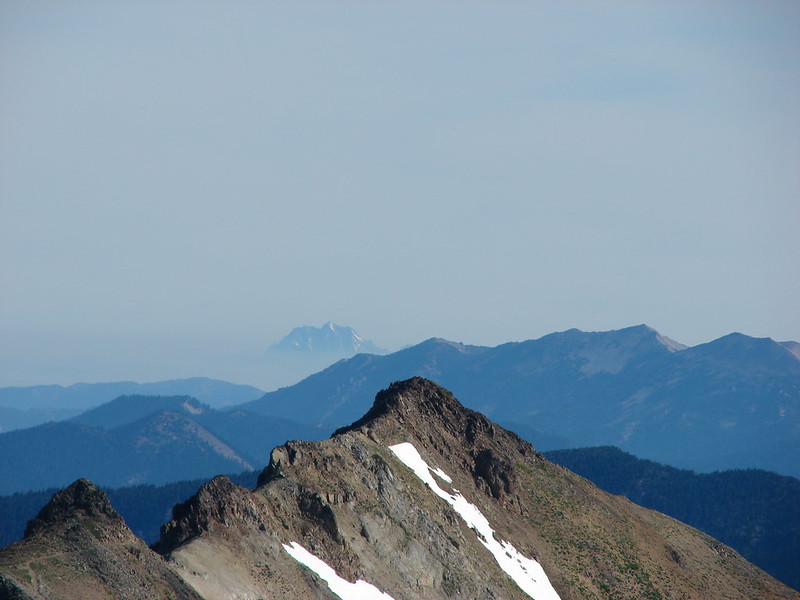
The views were great in every direction and we were able to spot a new mountain to the North – Mt. Stuart.

DSC03659

DSC03669

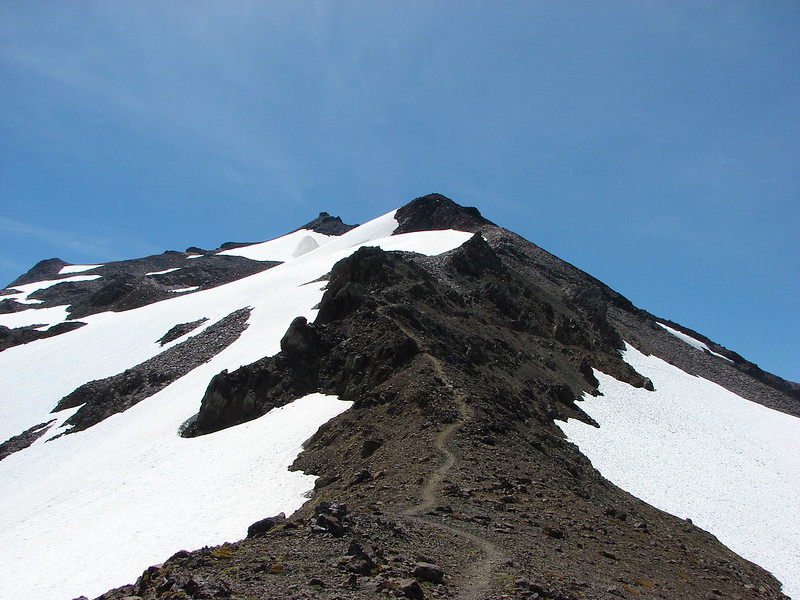
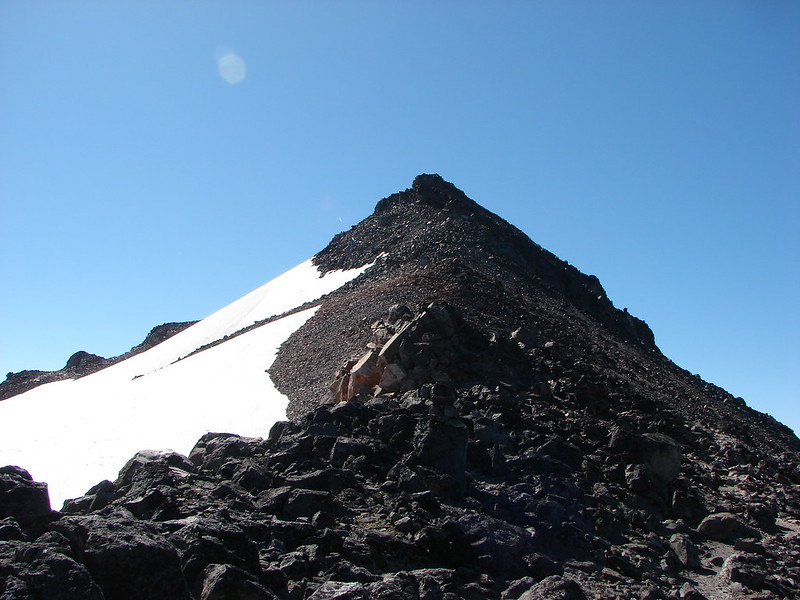
The PCT eventually splits with a hiker bypass climbing up higher on the side of Old Snowy to avoid lingering snowfields on a steep, exposed hillside. We took the bypass having seen the snow fields from our exploration of Hawkeye Point the day before, plus we had considered climbing Old Snowy Mountain and the bypass would lead past that trail. When we reached the junction for the summit of Old Snowy we could only make out the lower portion of trail. After the previous days exploits we decided against trying to climb it then and figured we could always try it on the way back past.
DSC03683

We found out later that the crest of the bypass trail is the highest point of the Pacific Crest Trail in the state of Washington at 7230′.

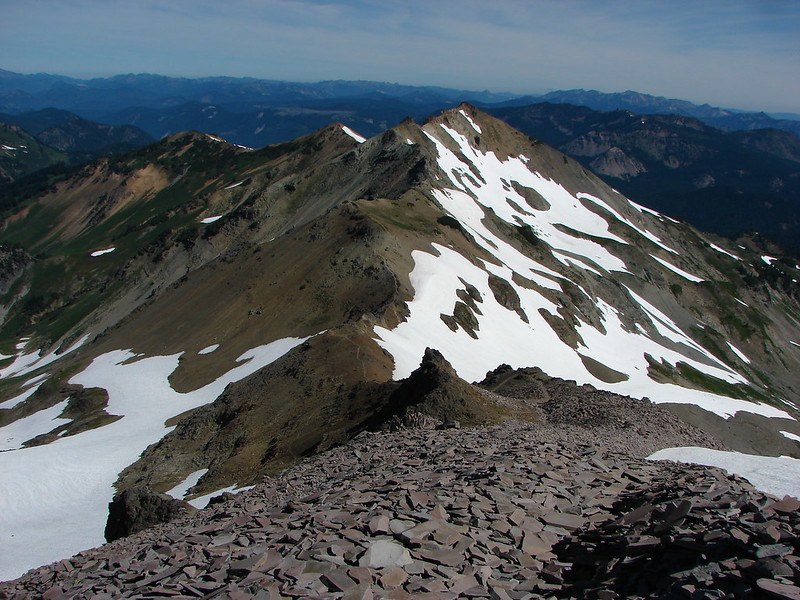
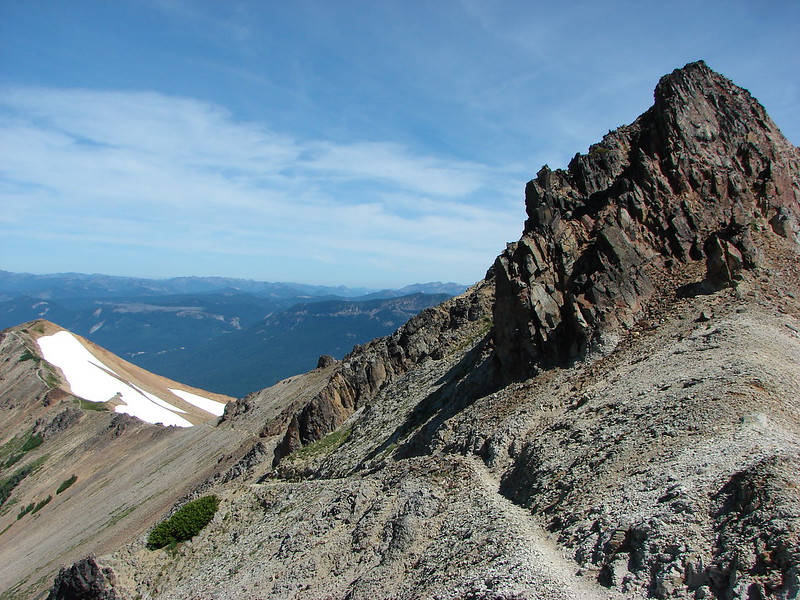
From the crest the PCT descends to “The Knife” before reaching Elk Pass where we had planned to turn around. As we began to descend though we got a good look at the trail ahead.
DSC03691

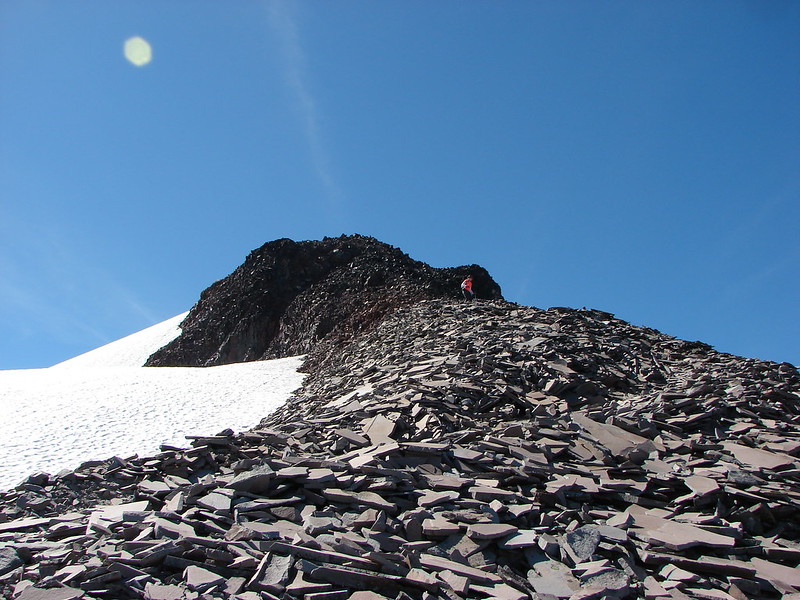
It was the freakiest looking trail we had encountered and for the first time I wasn’t sure I could do it, but after having a couple of thru-hikers pass by and survive we decided to go for it.
DSC03692

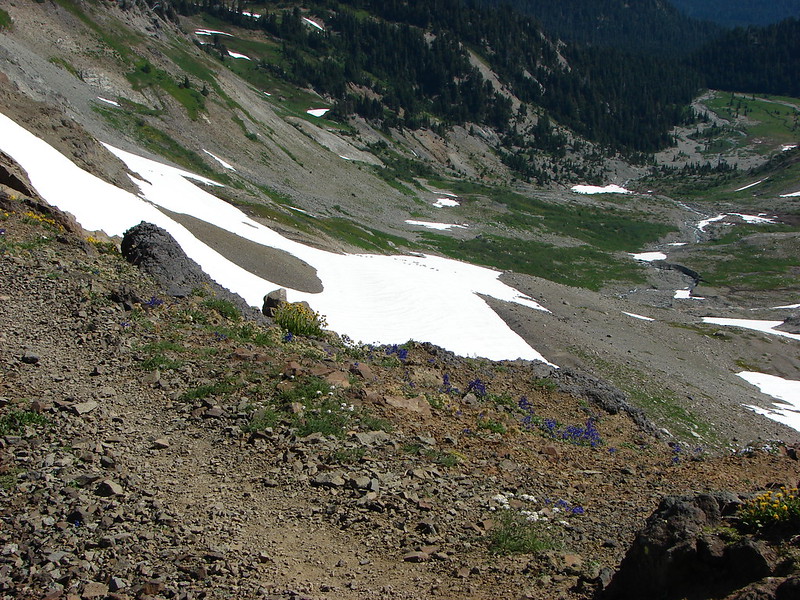
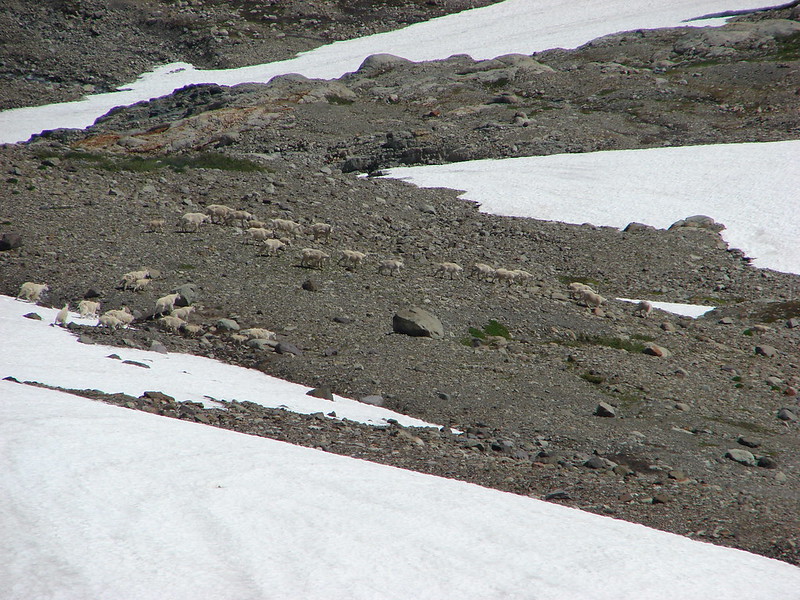
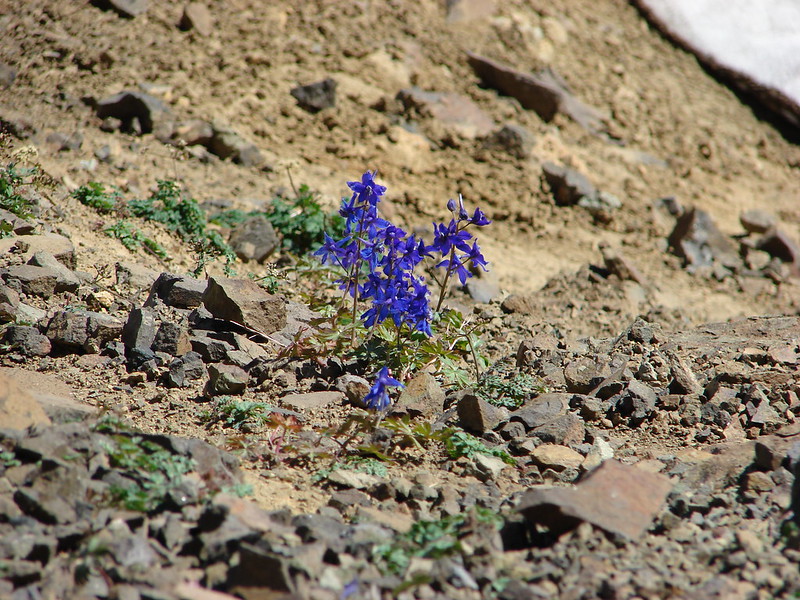
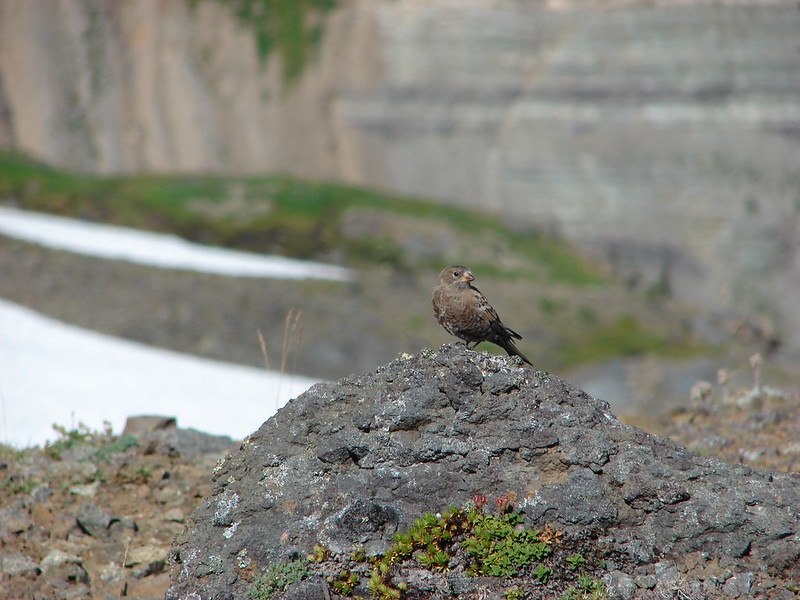
It was nerve racking at first but the trail was good and the views better. We spotted flowers and wildlife all around including a large group of mountain goats in the valley to our right.
DSC03698

DSC03705

DSC03725

DSC03709

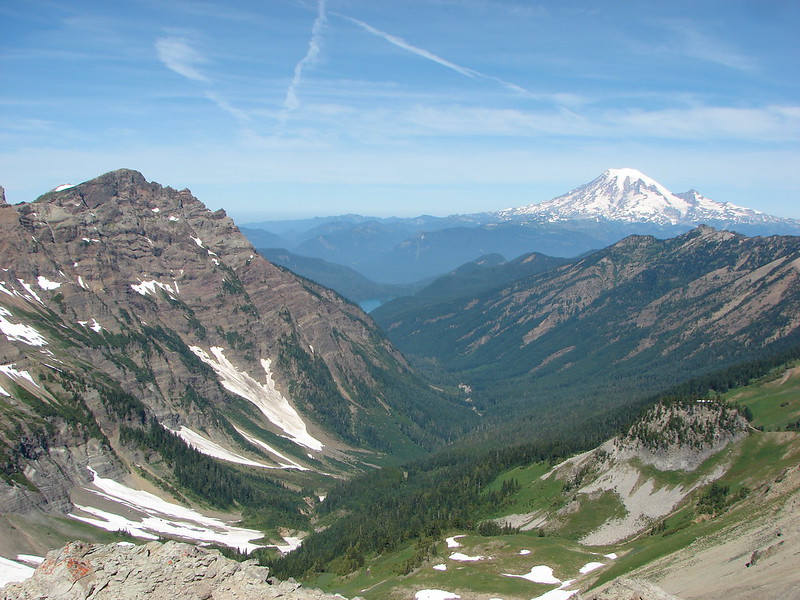
Soon we could see Packwood Lake in the valley to our left.
DSC03758

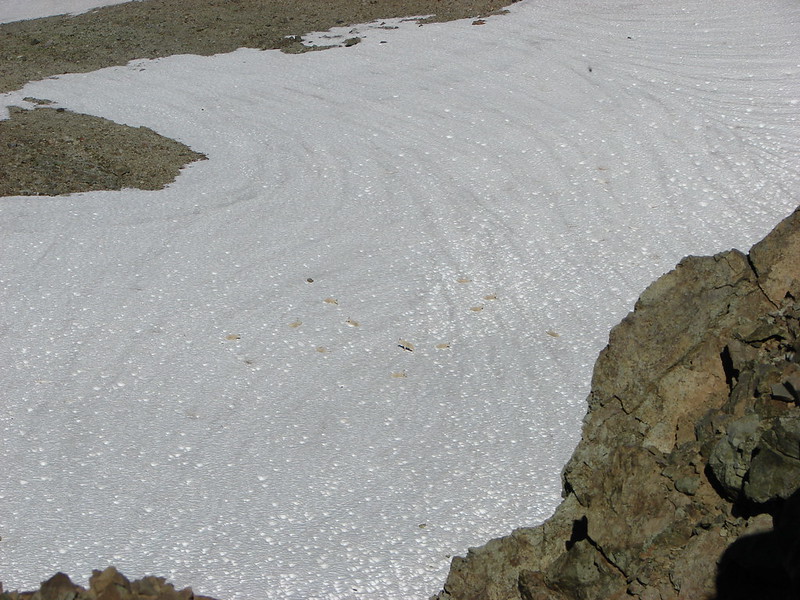
Also in that valley was another herd of goats.
DSC03769

DSC03772

We decided to turn around prior to reaching Elk Pass when we reached a crest and realized that we’d have to climb back up several hundred feet if we continued on and we already had a good climb ahead of us to get back up to the PCT high point.

PCT down to Elk Pass
DSC03830

PCT up to the crest

DSC03906

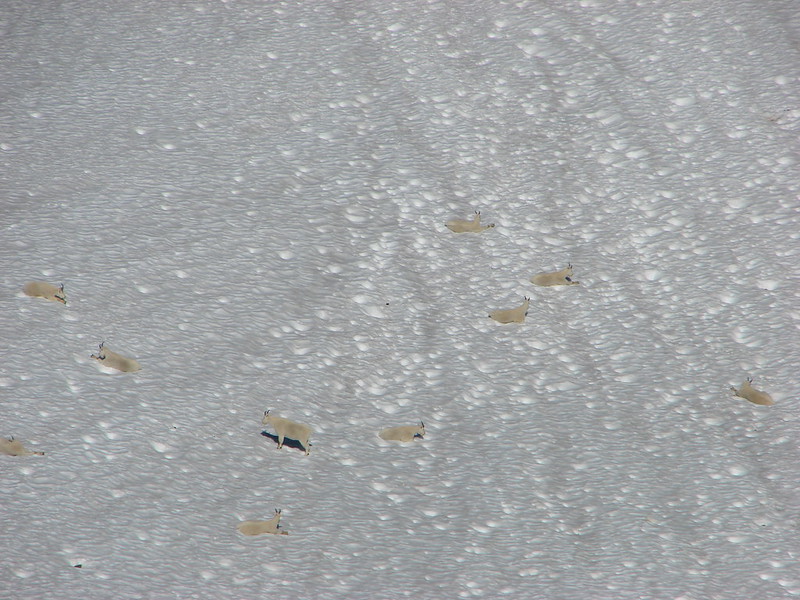
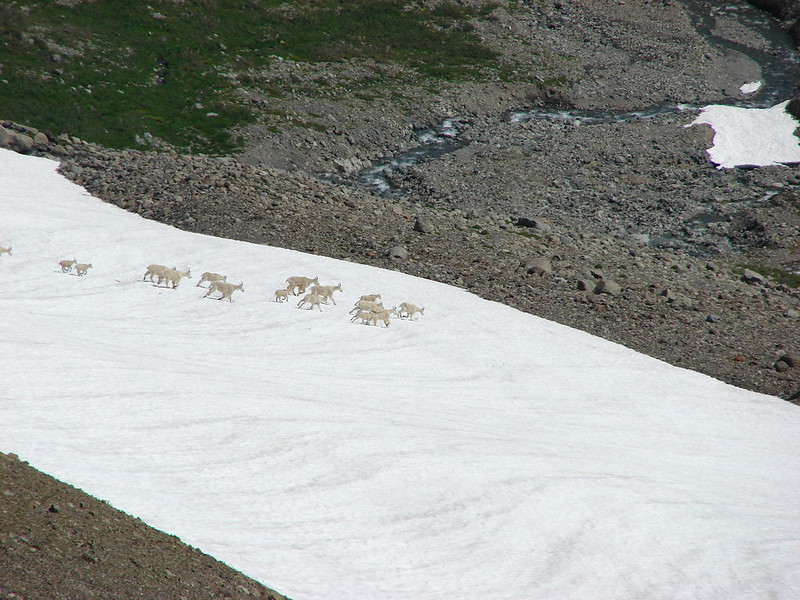
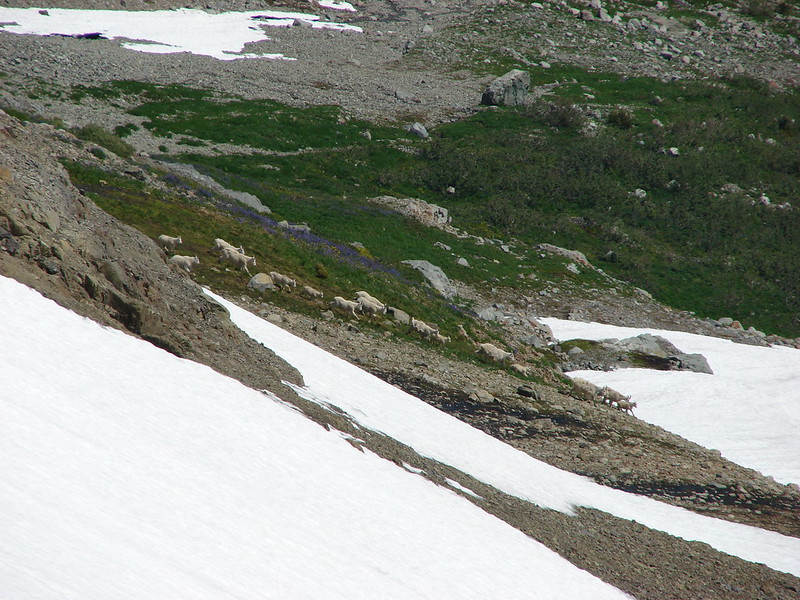
As we were returning the first group of goats we had seen suddenly started to dash across the snow. A second group came racing down from a higher meadow joining the first group.
DSC03887

DSC03895

DSC03900

We don’t know what spooked them but it was fun to watch them run.

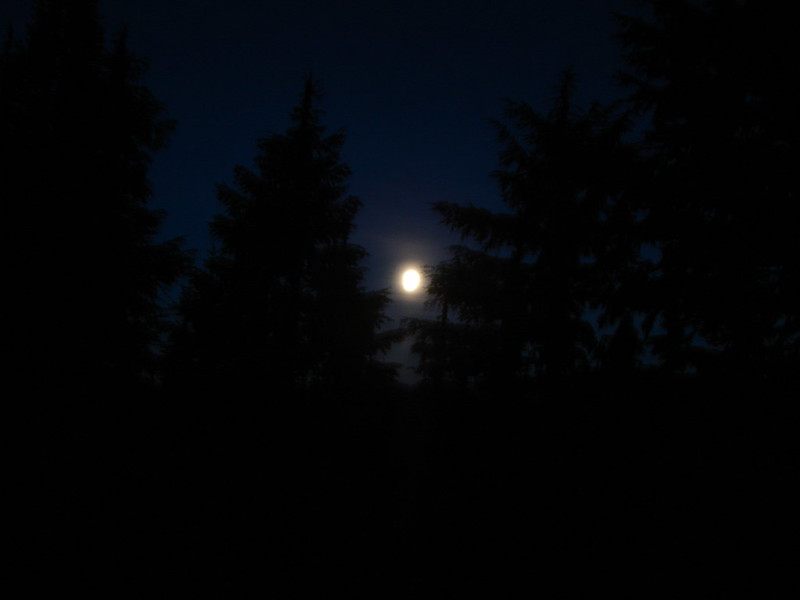
When we finally got back up to the crest the trail up Old Snowy was easy to see. There was a line of people hiking up and down. Between the crowds and our tired legs we decided we’d done enough climbing for the day and headed back to Alpine. Things had gotten crowded in the wilderness as it was the weekend and a lot of people had shown up. Most of the camp sites were now taken so we stuck close to ours until we turned in for the night after the Moon had risen.
DSC04013

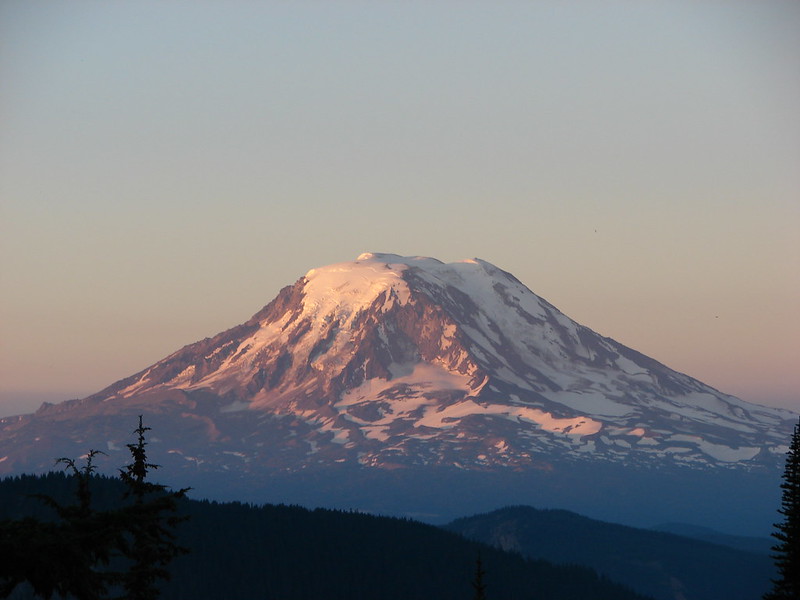
We set our phones to wake us at 5am on our last day so we could get a nice early start. Another amazing sunrise greeted us as we packed up our gear.
DSC04018

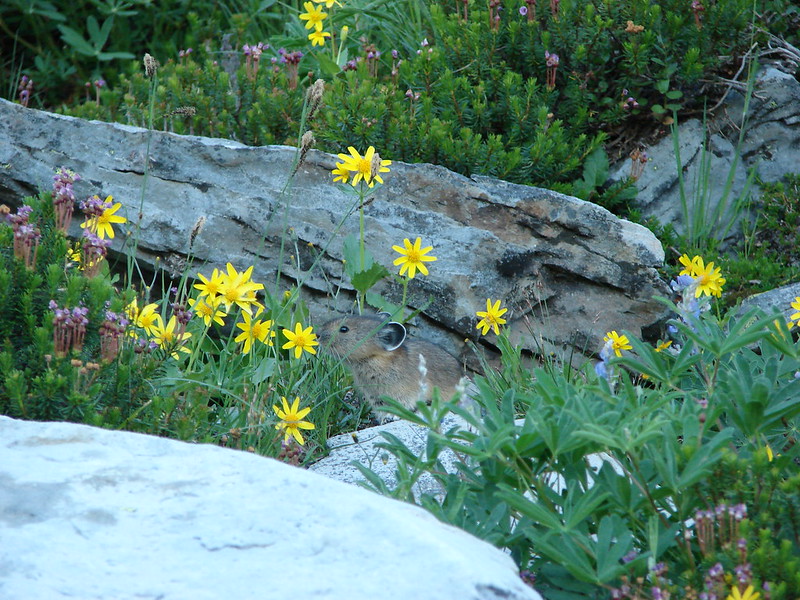
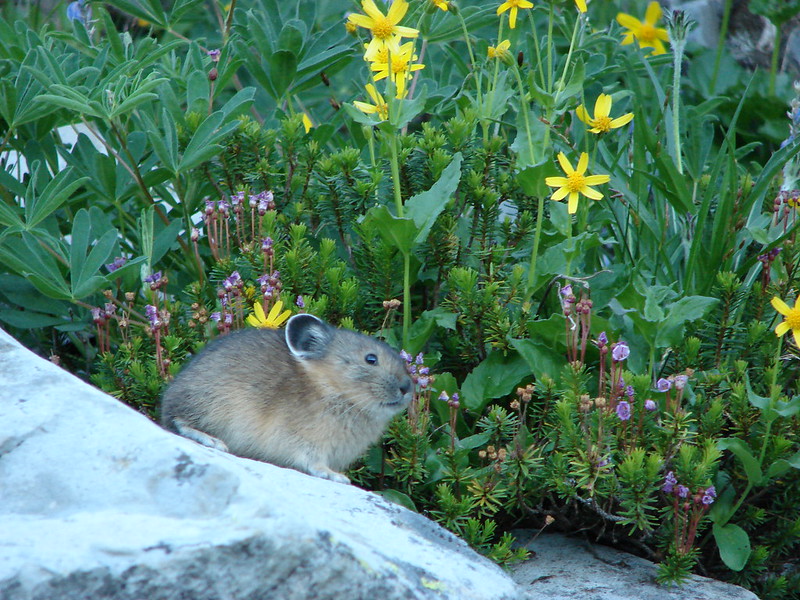
We took the Lily Basin Trail toward Goat Lake and were greeted by a friendly little Pika near Slide Falls.
DSC04026

DSC04030

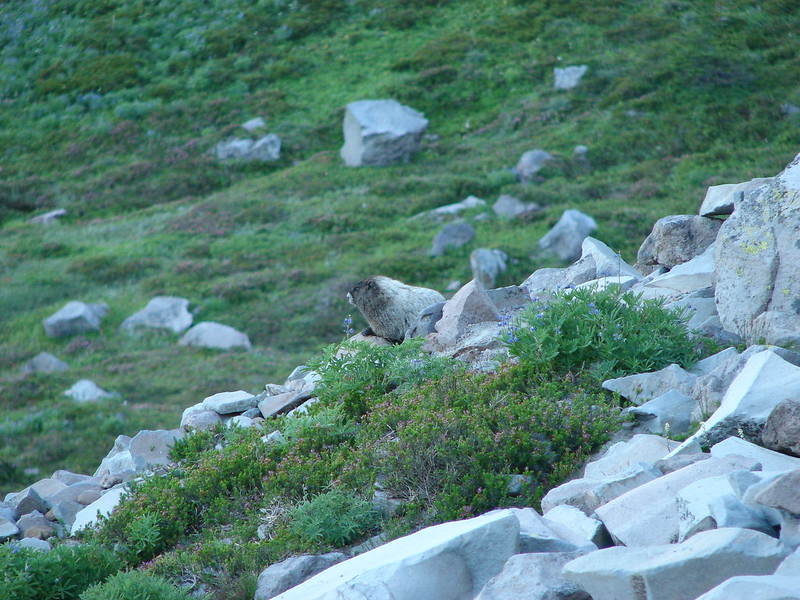
The marmots were also out to send us off.
DSC04036

DSC04037

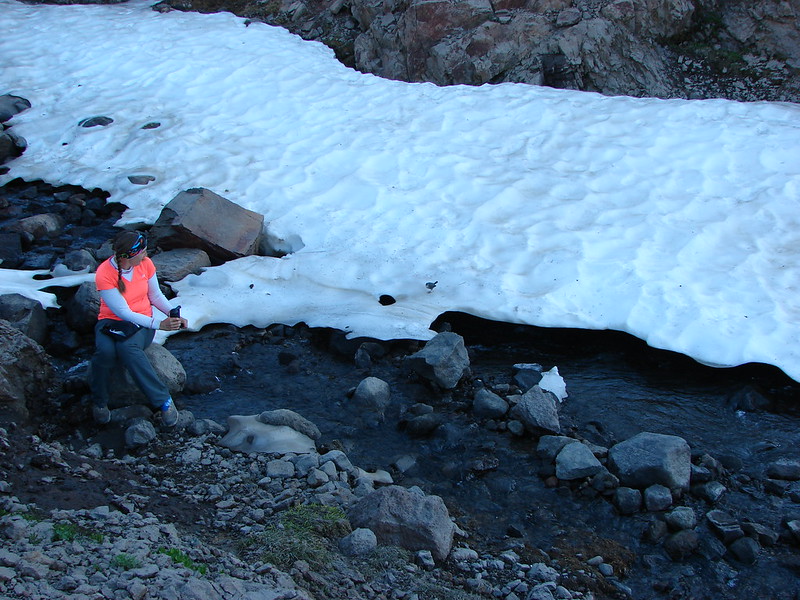
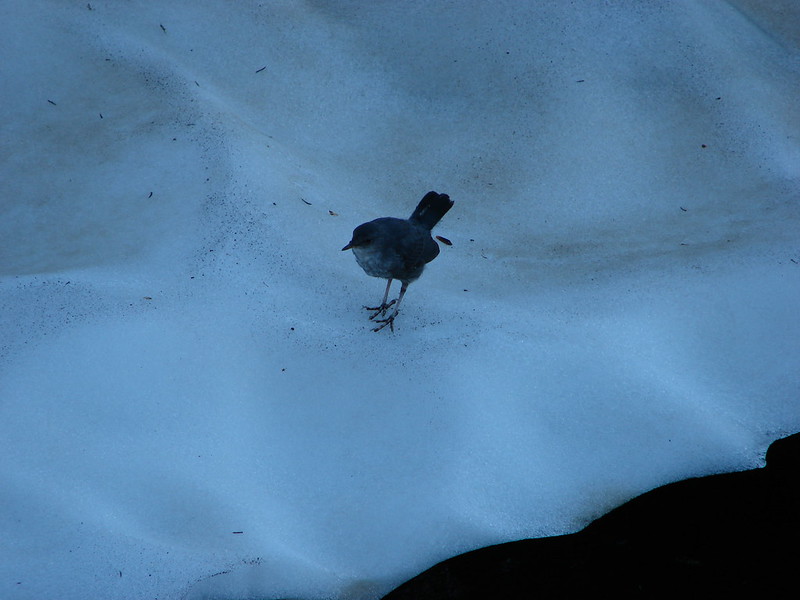
We stopped at the lake to get some water out of Goat Creek and were paid a visit by a pair of Ouzels.
DSC04057

DSC04053

Goat Lake had refrozen a little overnight.
DSC04058

DSC04059

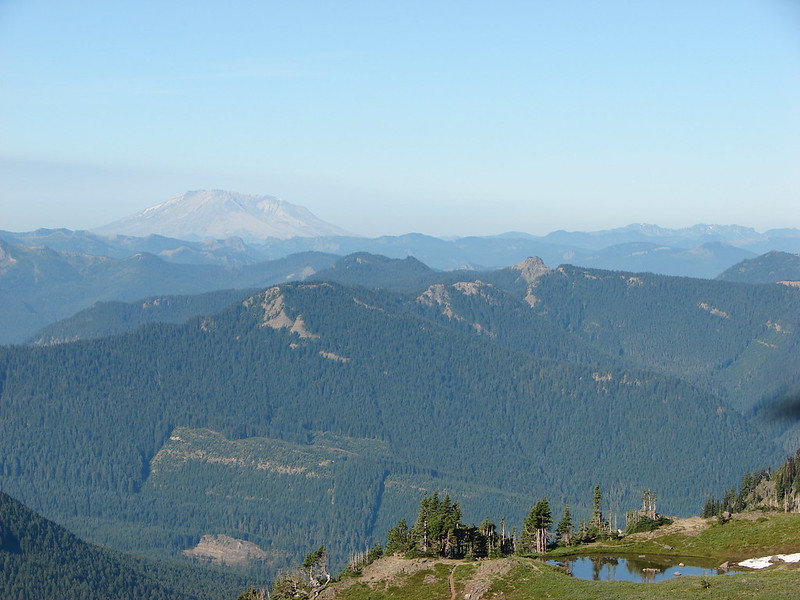
At the junction with the Goat Ridge Trail we took it and dropped down into the Jordan Basin. The best views we’d had of Mt. St. Helens were had as we descended into the basin.
DSC04075

Of course there were wildflowers.

DSC04081

And a lot of crickets or grasshoppers.
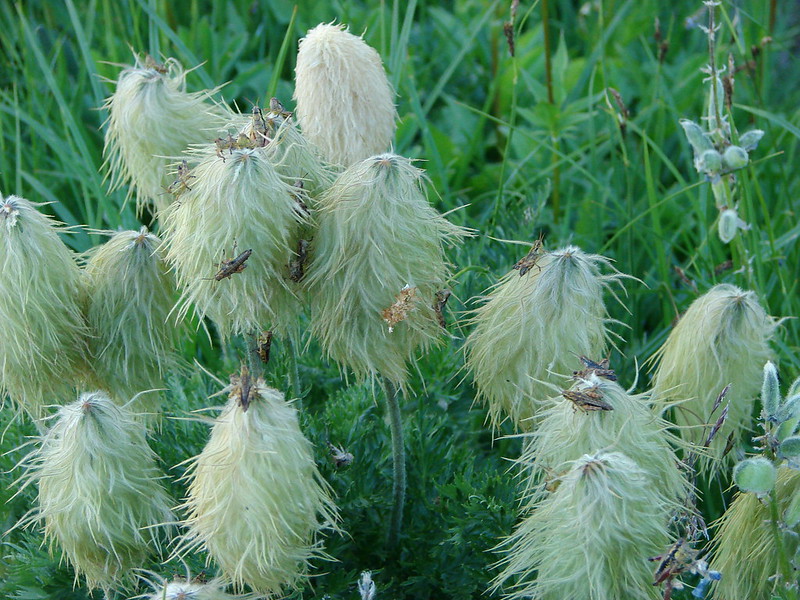
DSC04082

There were flowers in this basin that we hadn’t seen at all in the other parts of Goat Rocks.
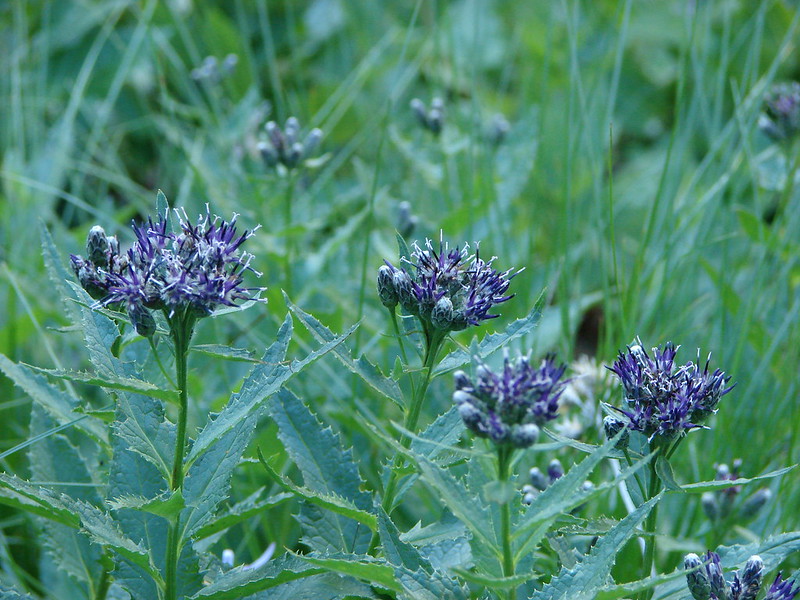
DSC04105

Soon we were far enough down to no longer be able to see the mountains. It was a bittersweet hike as we hated to leave this beautiful place but after four days a shower was sounding real nice. We got one last glimpse of Mt. Rainier, Mt. Adams, and Goat Rocks before entering the trees for good.

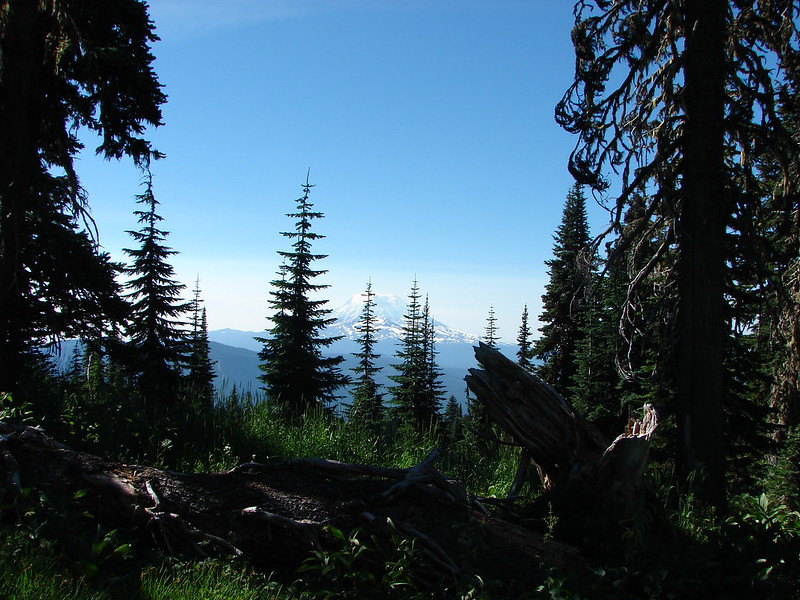
DSC04158

DSC04172

DSC04170

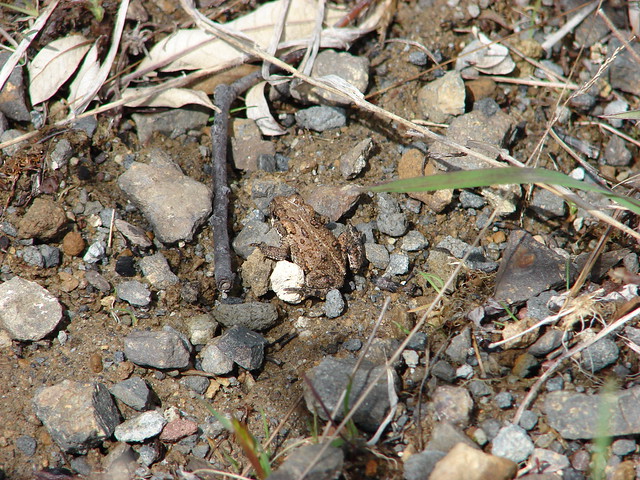
The Goat Ridge Trail would take us to the Berrypatch Trailhead and from there a .6 mile connector trail would bring us back to the Snowgrass Trail just .1 miles from our car. We were moving quickly along the connector trail when the wilderness gave us one last surprise. A small tree frog sitting on a huckleberry bush next to the trail.
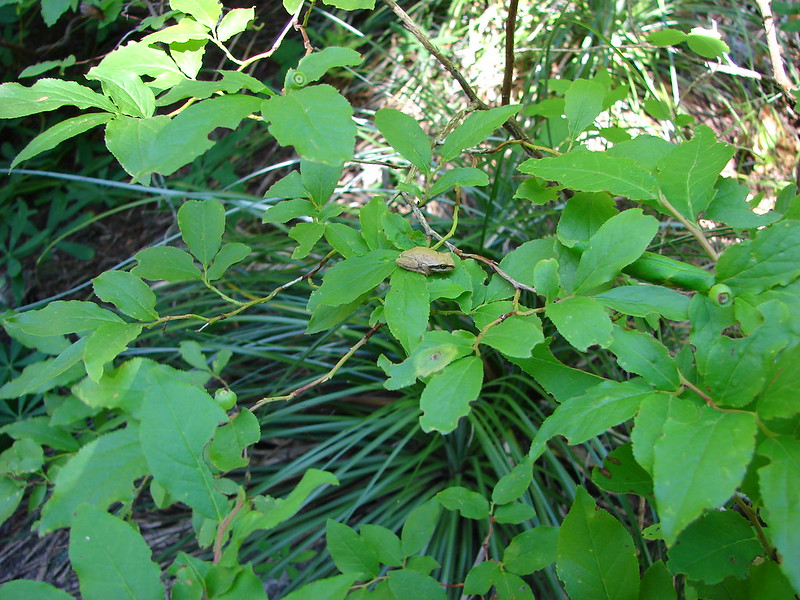
DSC04199

Our time was up but we were already thinking of our next visit. We can’t wait to go back and explore more of the wilderness. The only negative to the entire trip was witnessing the disregard for the area that some of the people showed. There were people traipsing through the meadows and setting up tents on the vegetation. Such a beautiful place to visit will only stay that way if people take care of it so please go and visit but stay on the trails and camp on the brown ground not the green. Happy Trails.

UPDATE on the llama.ย  The llama had indeed either been left or escaped and was seen multiple times throughout the summer.ย  She was finally rescued this fall and is safe and doing well according to this report: http://www.rattlesnakeridgeranch.com/documents/Rescue_in_the_Goat_Rocks_Wilderness.pdf

ย 

Flickr albums: Day 1-https://www.flickr.com/photos/9319235@N02/sets/72157646295294436/

Day 2-https://www.flickr.com/photos/9319235@N02/sets/72157646295758026/

Day 3-https://www.flickr.com/photos/9319235@N02/sets/72157645936565989/

Day 4-https://www.flickr.com/photos/9319235@N02/sets/72157645937647578/
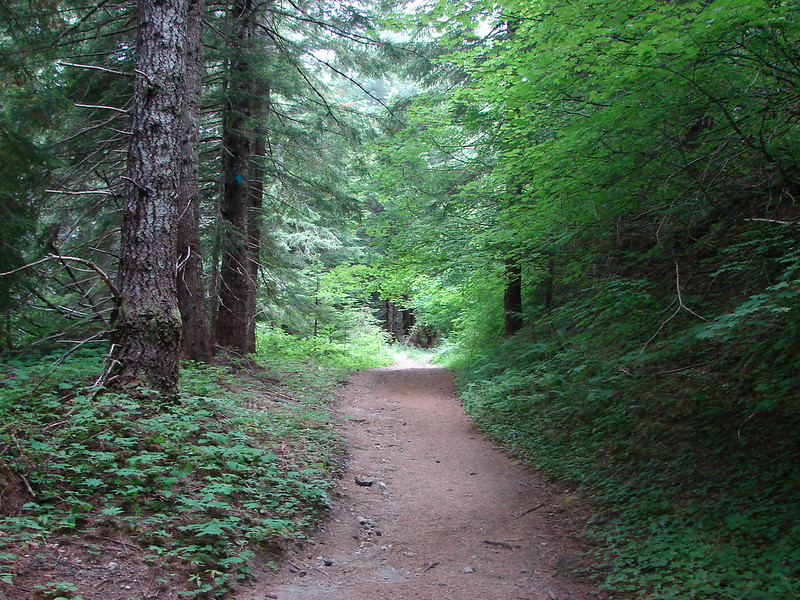
Categories
Hiking Mt. St. Helens Trip report Washington Washington Cascades

June Lake

One of the things that makes for a good hike is variety. We have often commented on how much variety can be packed into just several miles of hiking. The terrain, vegetation, wildlife and views can vary drastically in a relatively short distance. That was the case on our most recent hike in the Mt. St. Helens National Volcanic Monument.

We had toyed with the idea of making this an overnight trip but the uncertainty of suitable water sources gave us pause so we amended our plans to make a day hike out of it. We stuck with our original plan to start at the June Lake trail head and headed up to the Loowit Trail from there. Originally we planed on turning right on the Loowit and heading over to the Plains of Abraham to find a camp spot and then explore further on down to Loowit Falls, but that would be too far for a day hike so instead we decided to go left and check out Dryer Creek Meadows.

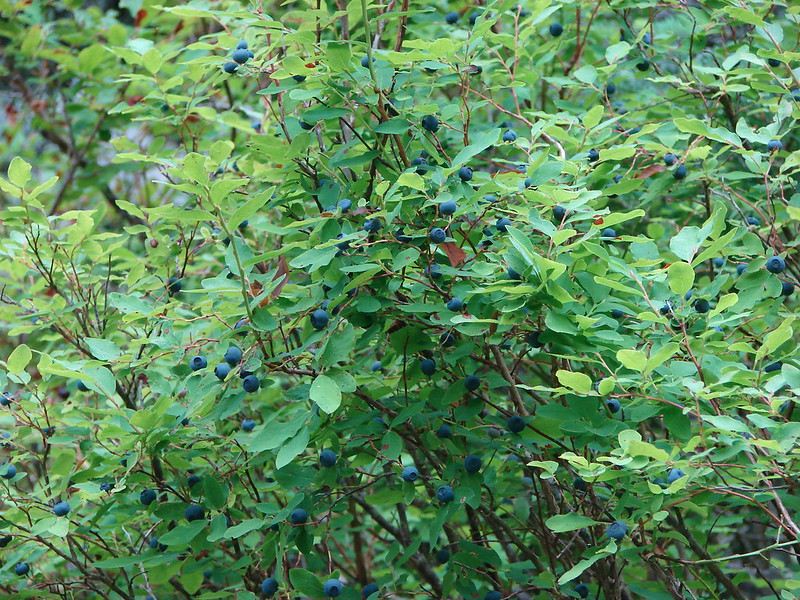
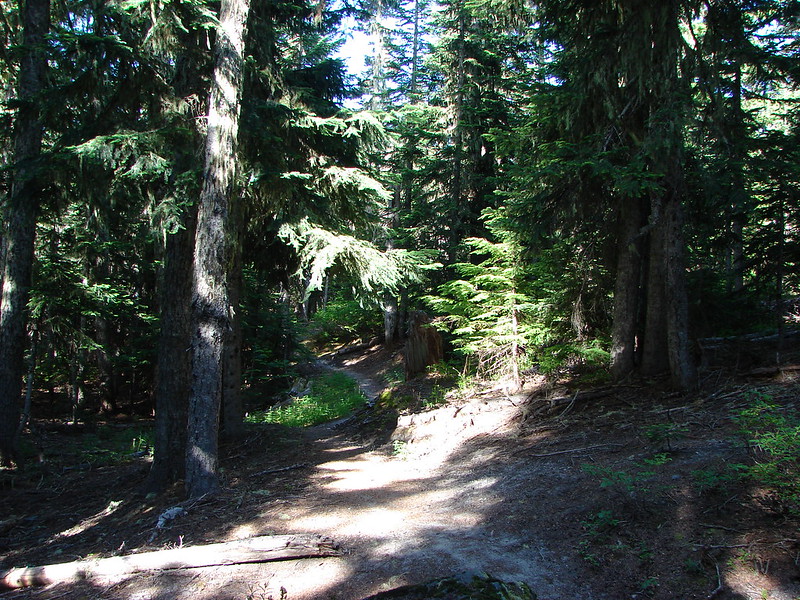
It was a cloudy morning as we set off on the June Lake Trail. From the trail head it was a mere 1.3 miles to June Lake on a nice wide trail that gently climbed through a forest with plenty of ripe berries to snack on.
DSC01371
DSC01354

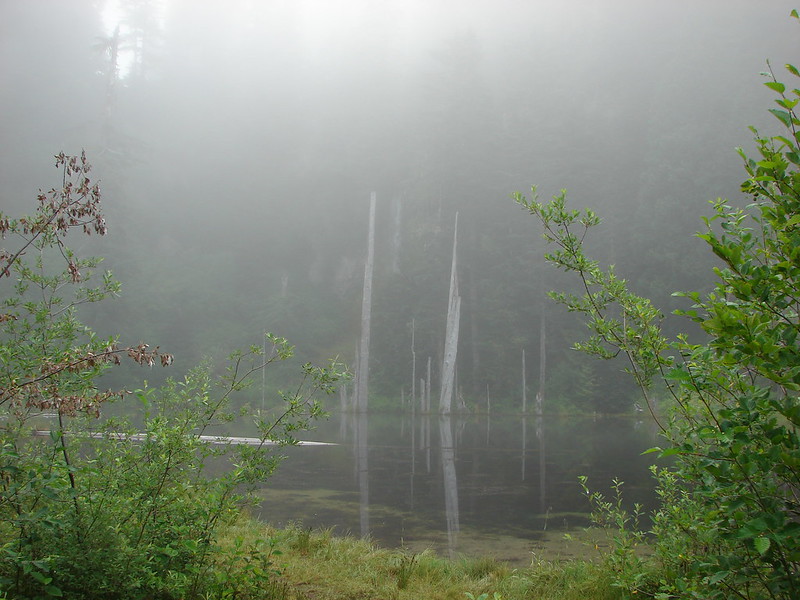
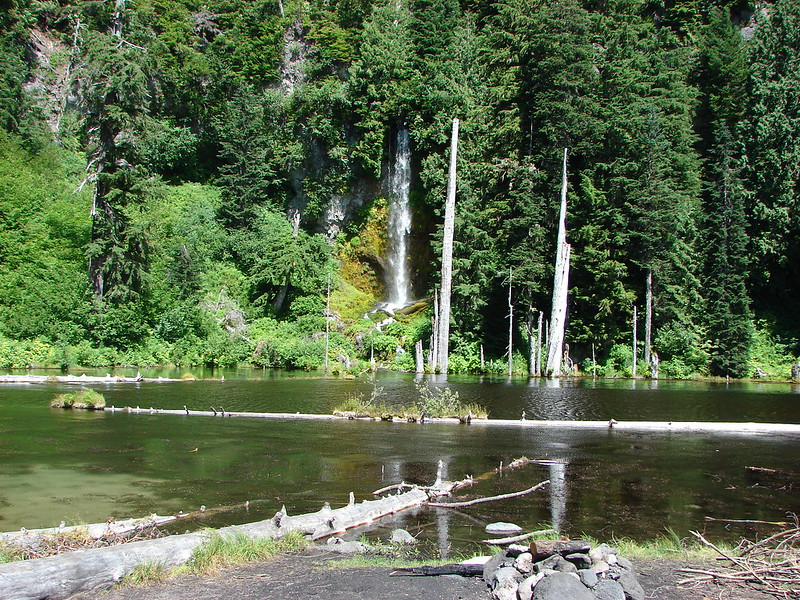
We were surrounded by fog when we arrived at June Lake which made it difficult to get a good view of the 40′ waterfall that falls on the far shore of the lake.
DSC01385

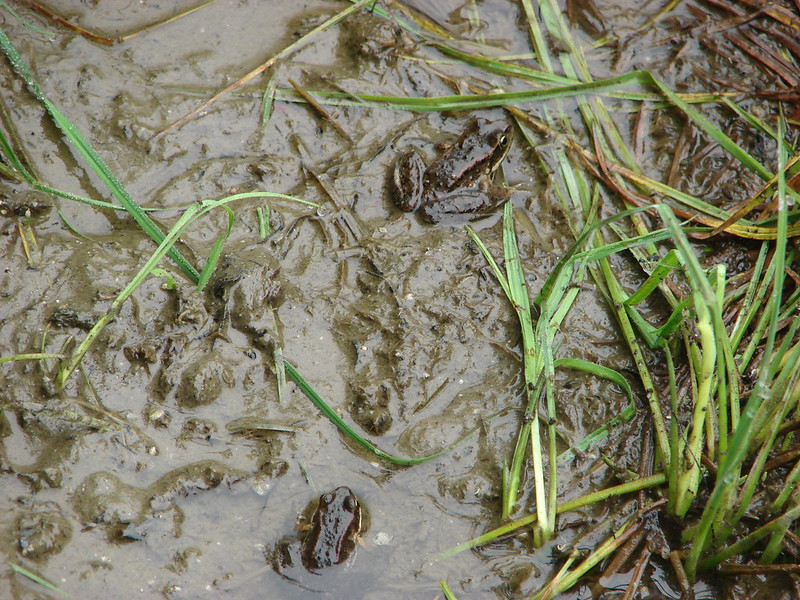
While exploring the small lakes shore we spotted a couple of frogs in the muddy water.
Frogs at June Lake

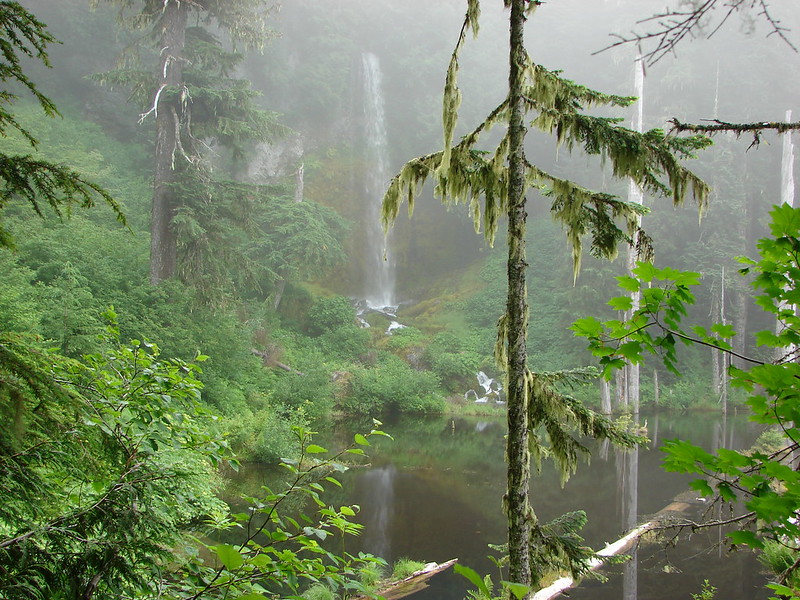
The best view of the falls came from a side trail at the north end of the lake shortly after a switchback. The reflection of the falls created the illusion of water both falling and rising to the surface of the lake.
DSC01396

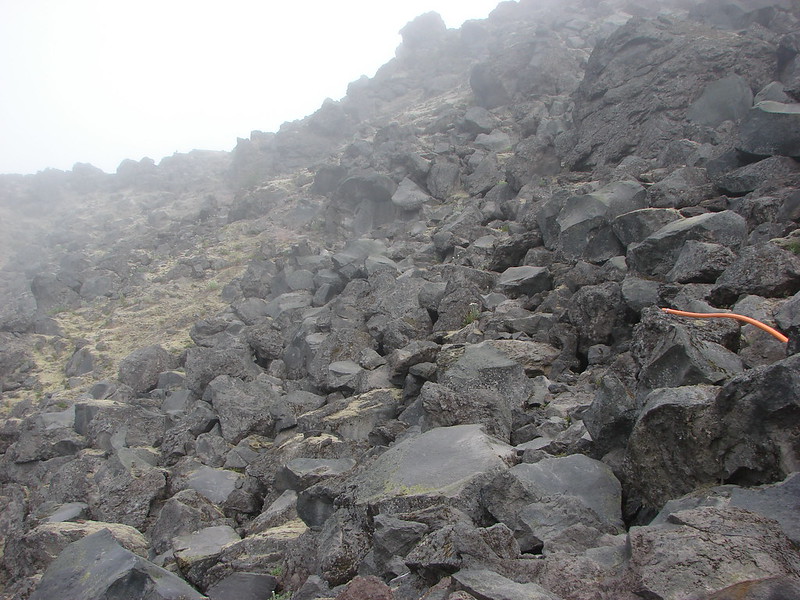
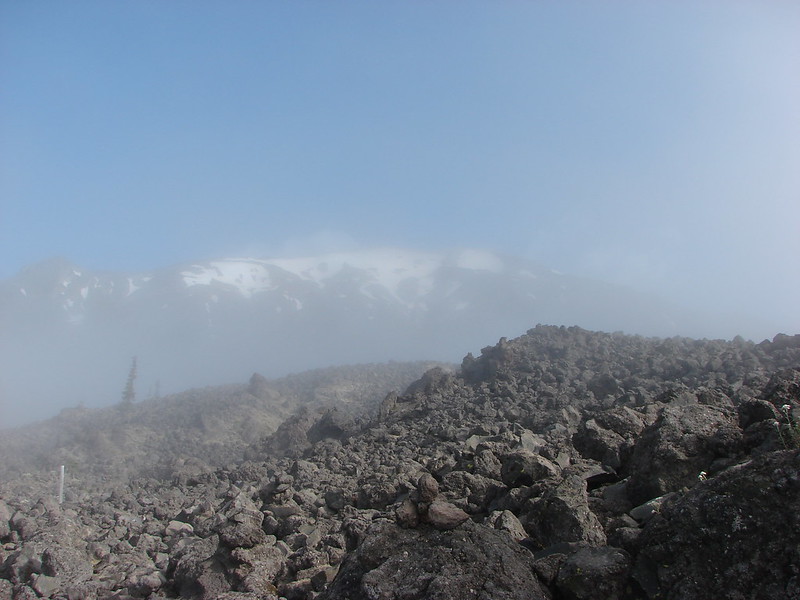
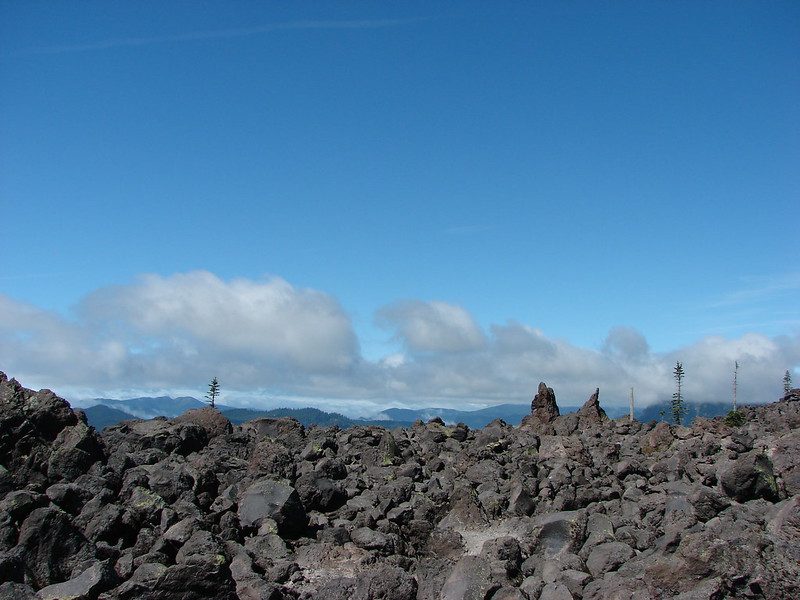
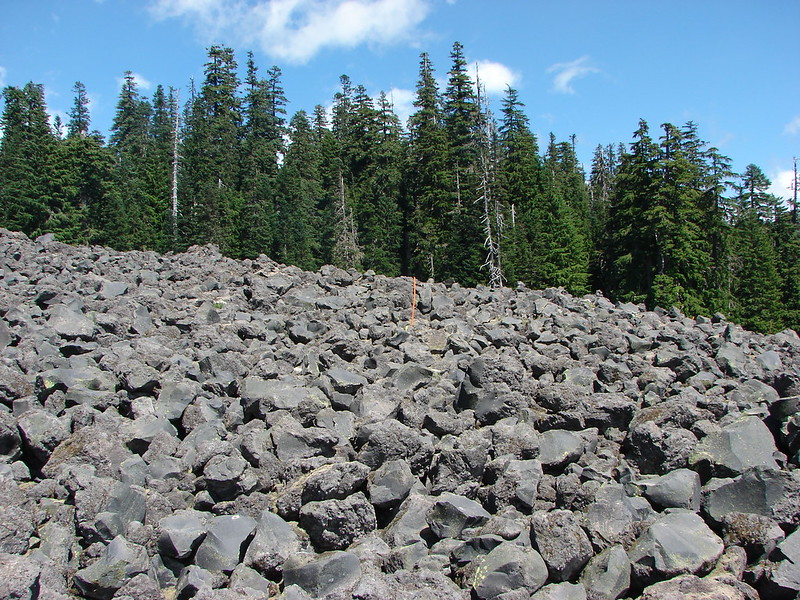
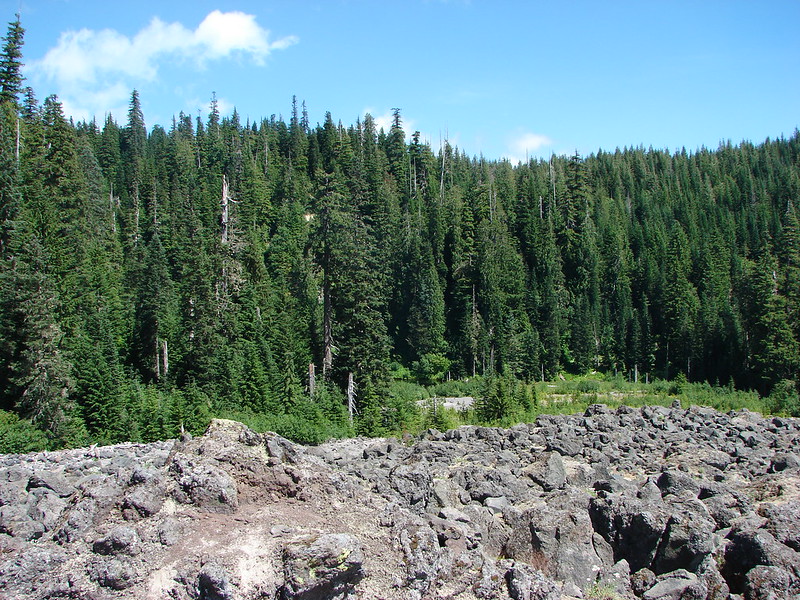
About a quarter mile from the side trail we arrived at the junction with the Loowit Trail which circles the entire mountain on a 29.5 mile loop. We turned right and quickly emerged from the forest and began crossing the first of three lava flows that make up the “Worm Flows”. Unlike some of the other lava fields we have hiked over there was no visible trail in many places, just a series of posts and rock cairns to aim for.
DSC01408

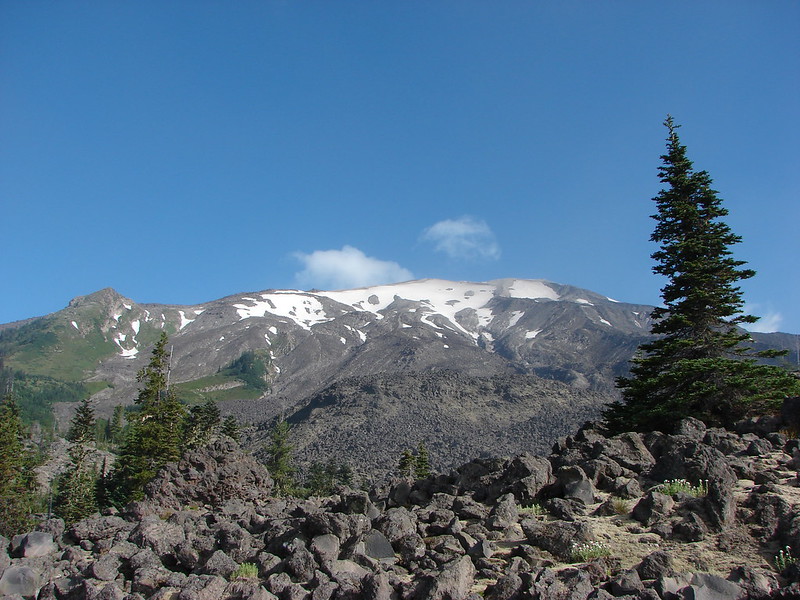
It meant a lot of rock hopping and scouting for the best looking route to the next marker. While we were working on making our way over the lava the clouds began to give way and we were treated to a clear view of Mt. St. Helens.
DSC01432
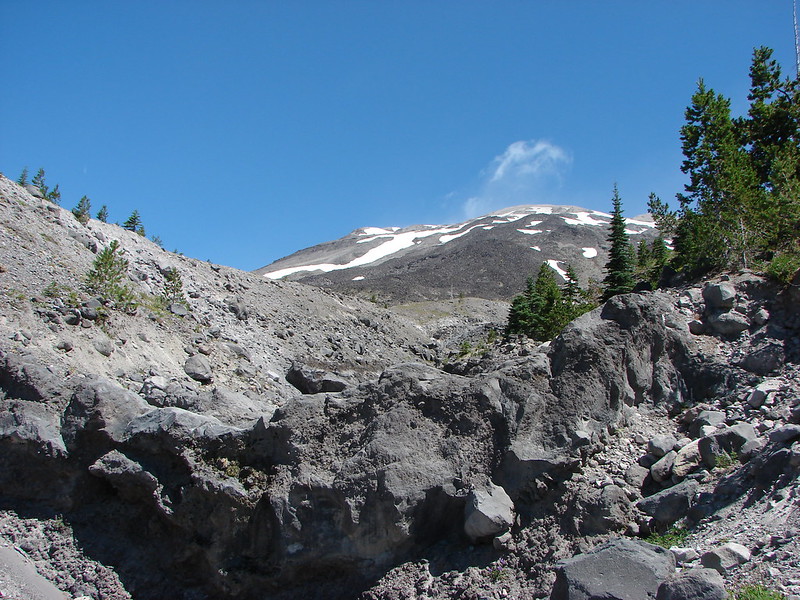
Mt. St. Helens

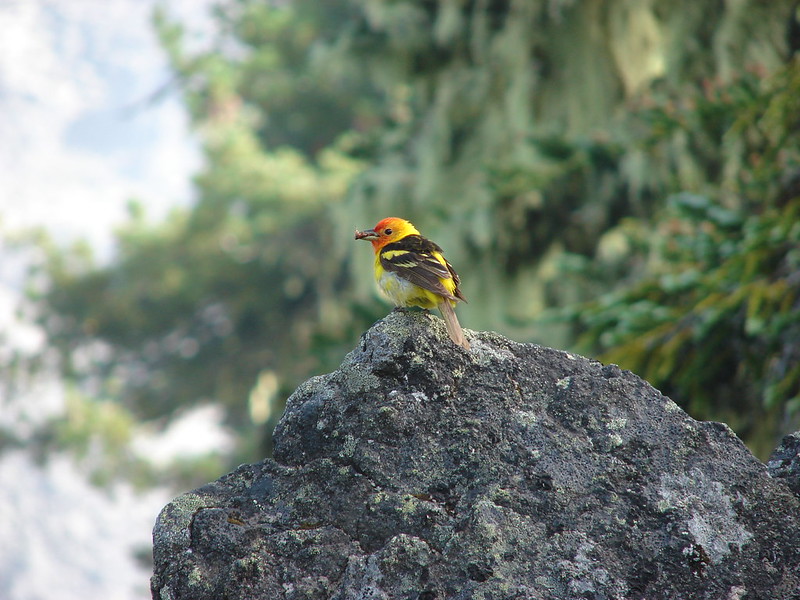
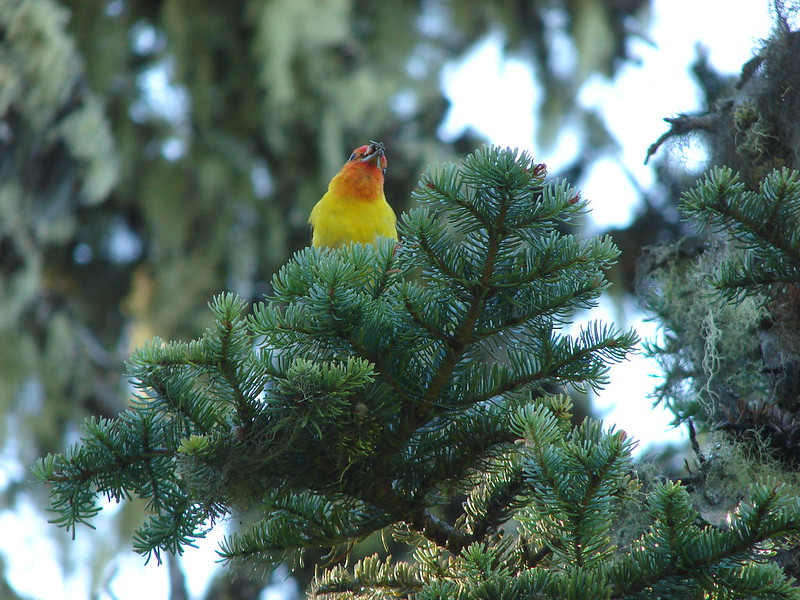
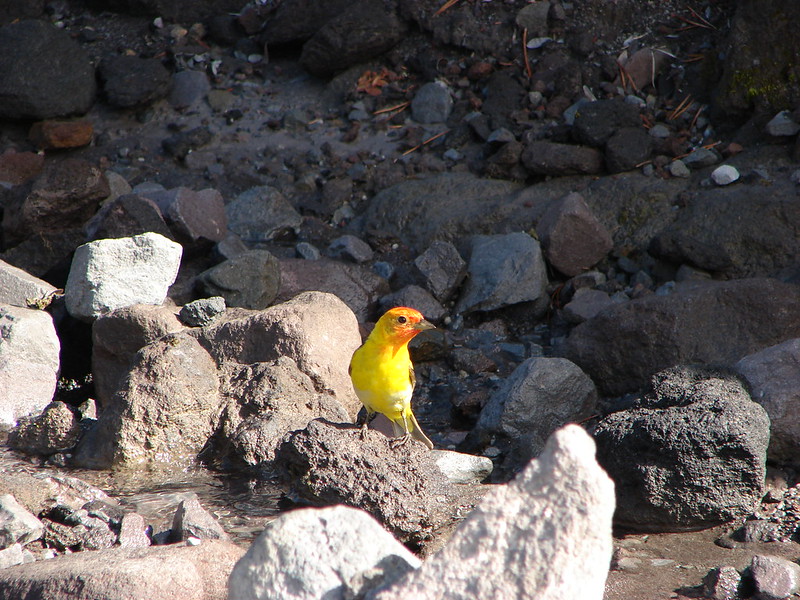
After crossing the Worm Flows the trail began descending into Swift Creeks canyon where we would find Chocolate Falls. On our way down a colorful western tanager posed for some pictures.
Western Tanager
DSC01474

Before reaching swift creek we passed through a small pocket of vegetation.
DSC01479
DSC01478

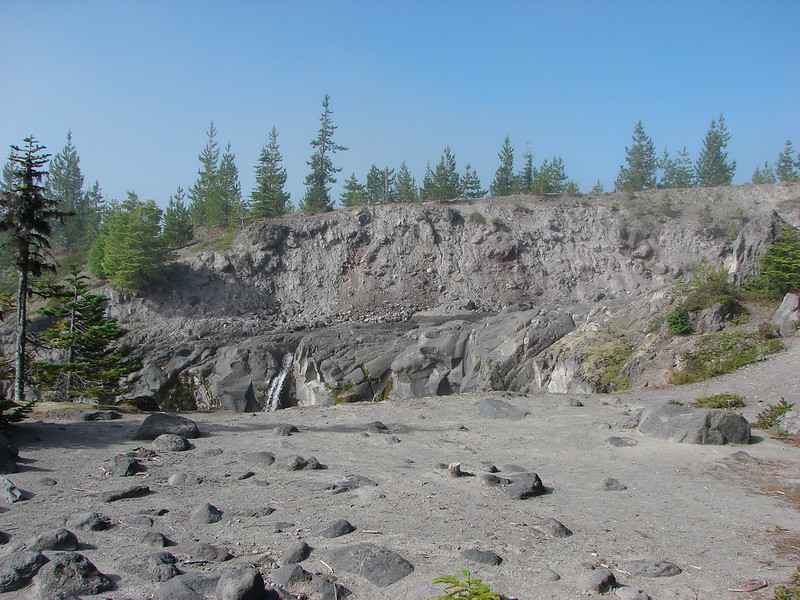
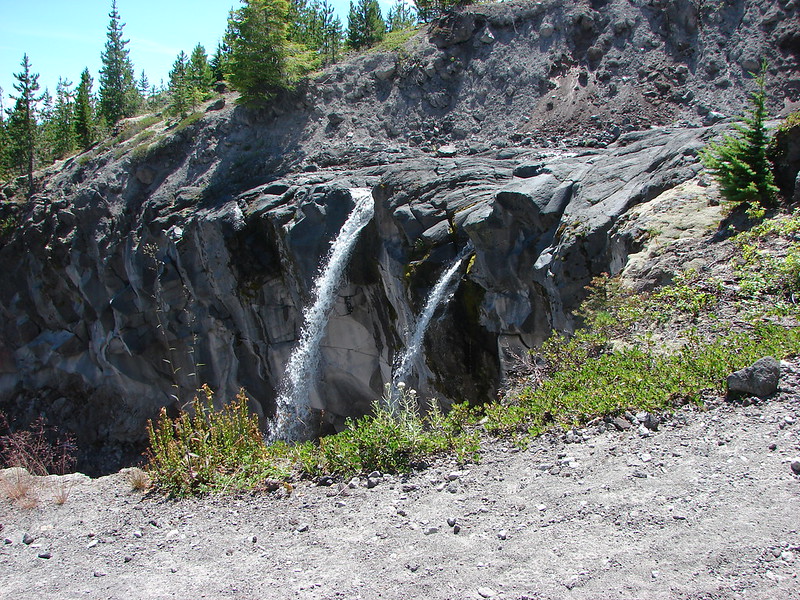
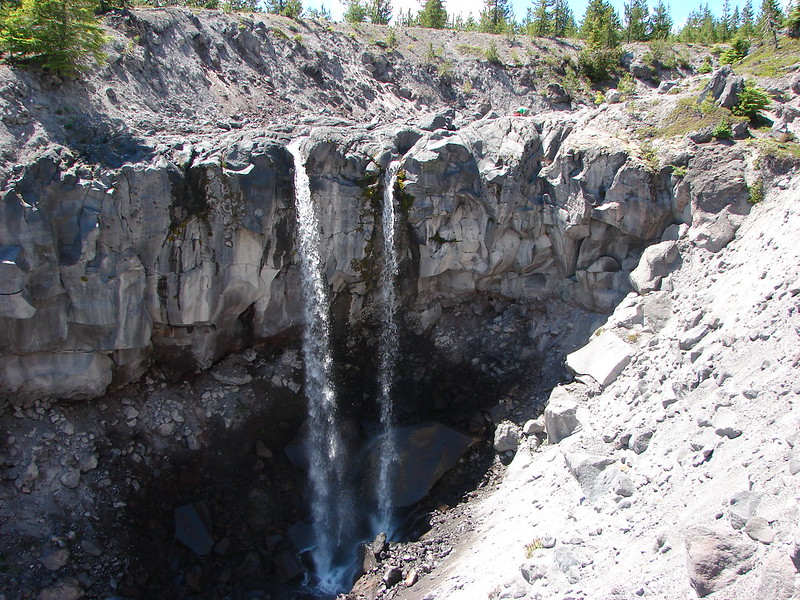
We were happy to find water flowing over Chocolate Falls as Swift Creek often dries up overnight and doesn’t begin flowing again until after 11AM on some days.
DSC01481
DSC01482

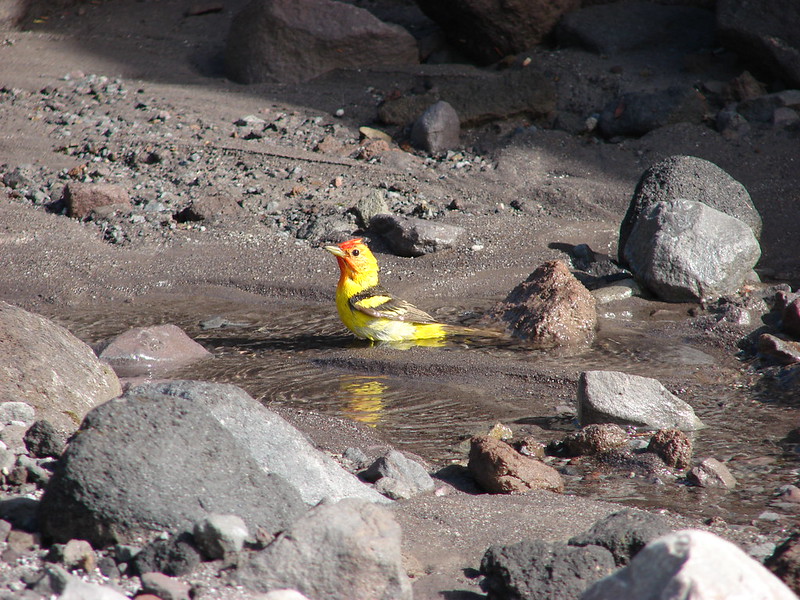
We took a snack break at the falls and while we were relaxing we were joined by what I think was the same western tanager who decided it was time for a bath.
Western Tanager
Western Tanager

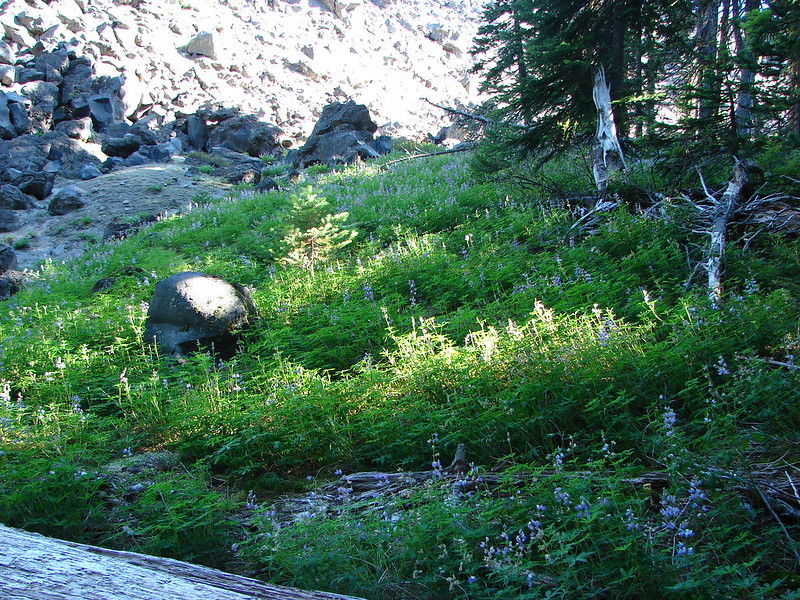
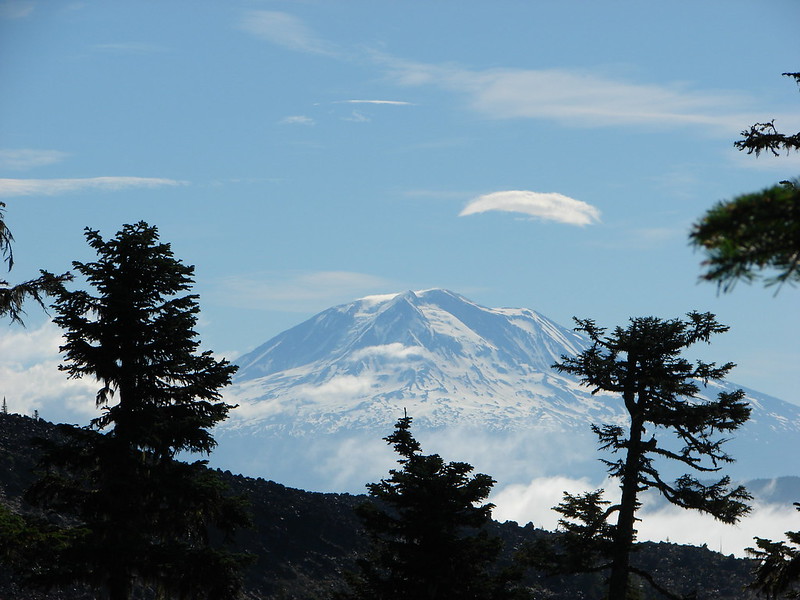
We continued on the Loowit Trail from Swift Creek and began a steep climb that passed through forest and meadows. We also were treated to a great view of Mt. Adams and a descent view of Mt. Hood looming above the clouds.
Mt. Adams
Mt. Adams
Mt. Hood
DSC01550
Meadow filled with nuttall’s linanthus
DSC01585
Mt. Adams from one of the meadows
DSC01611
Passing through a meadow
DSC01612
Mt. Hood from the meadow
DSC01613
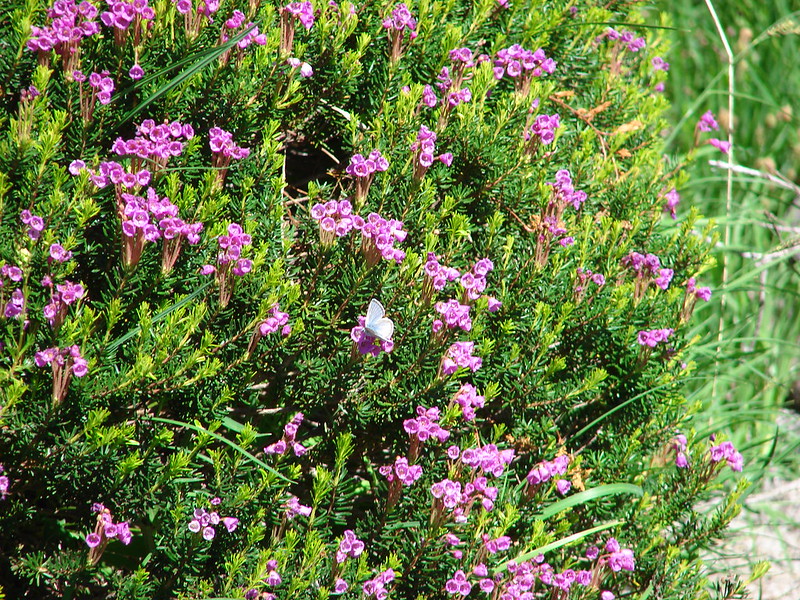
Mountain heather and a blue copper butterfly
DSC01608

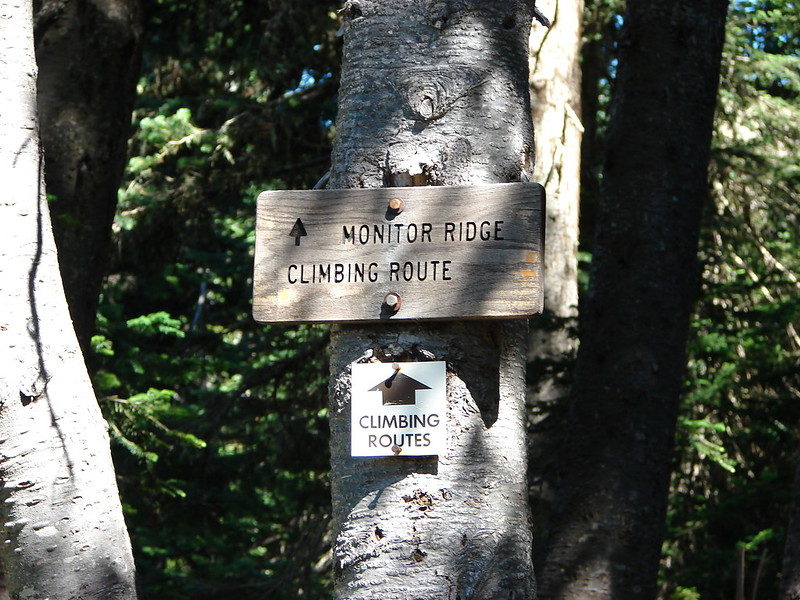
Two miles from Chocolate Falls we crossed the Ptarmigan Trail which climbs up Monitor Ridge to the Rim of Mt. St. Helens.
DSC01620
We have a date with that trail later this year.

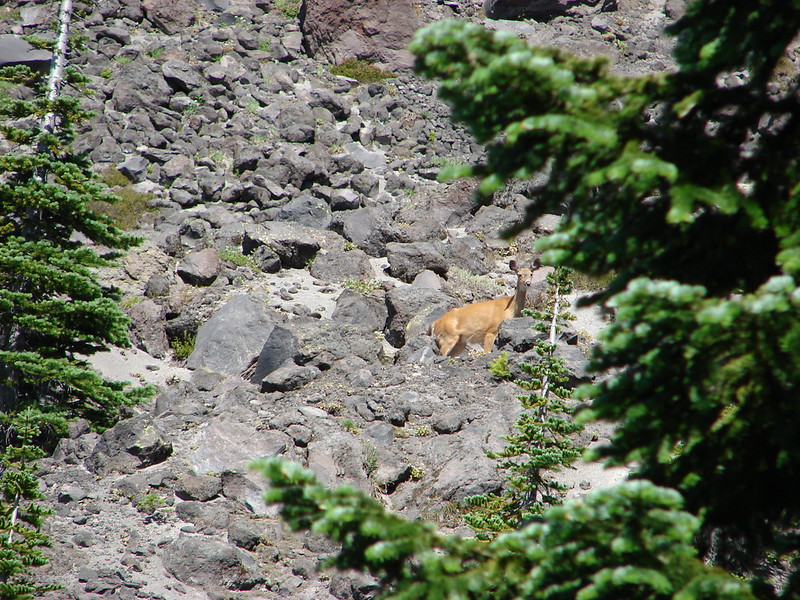
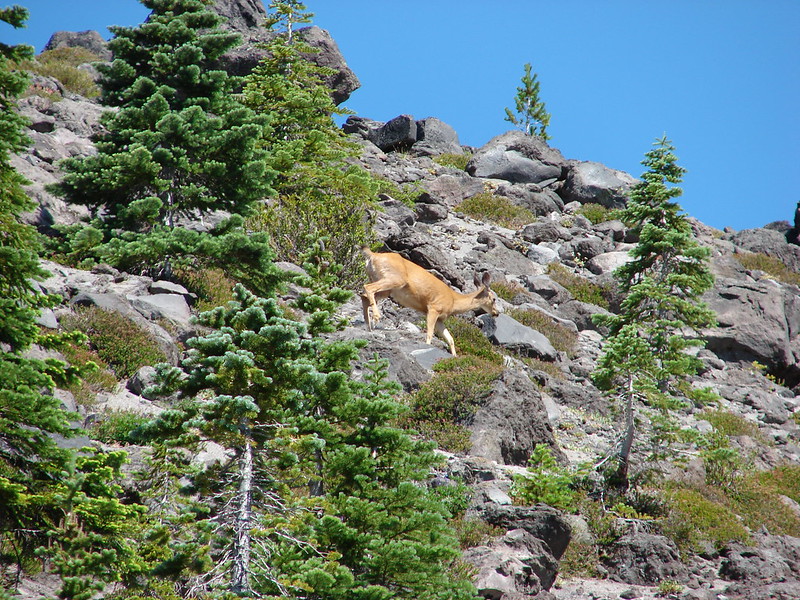
We crossed the trail and shortly came to the edge of another lava flow. A doe was making her way up toward Monitor Ridge showing off her superior rock hopping skills.
Doe
DSC01635

This crossing was .9 miles of post to post travel.
DSC01646
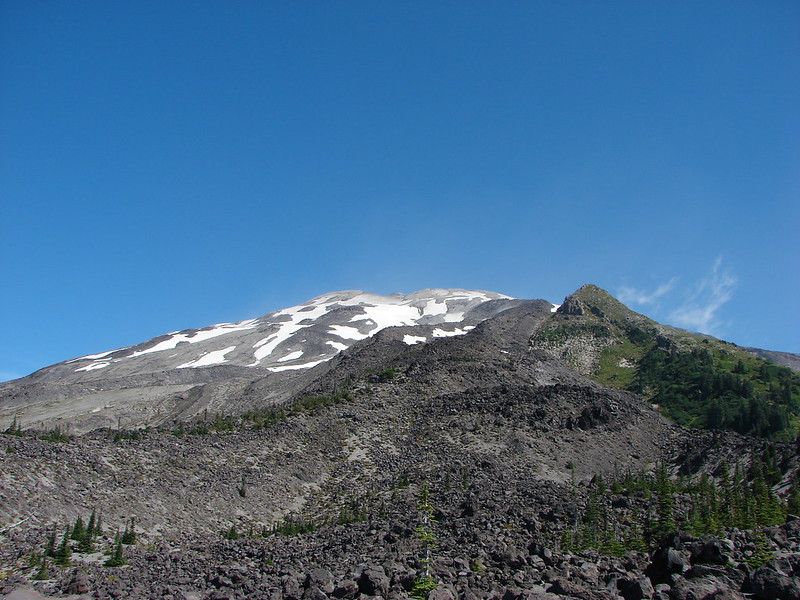
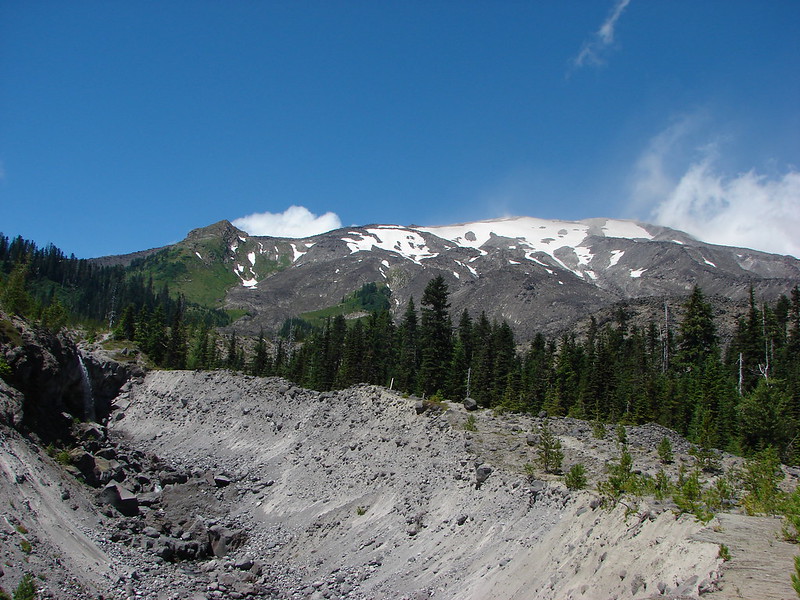
From this section we had a great view of Mt. St. Helens, Monitor Ridge, and the Green Knob.
DSC01648

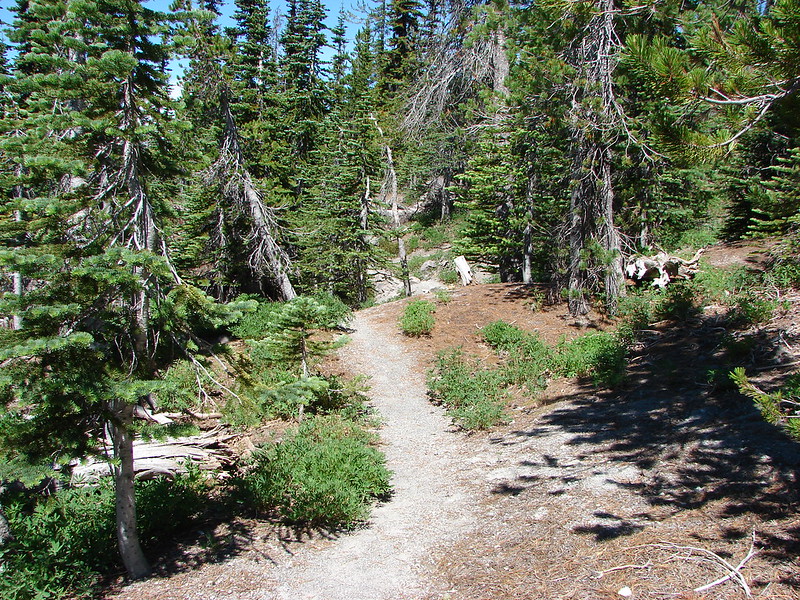
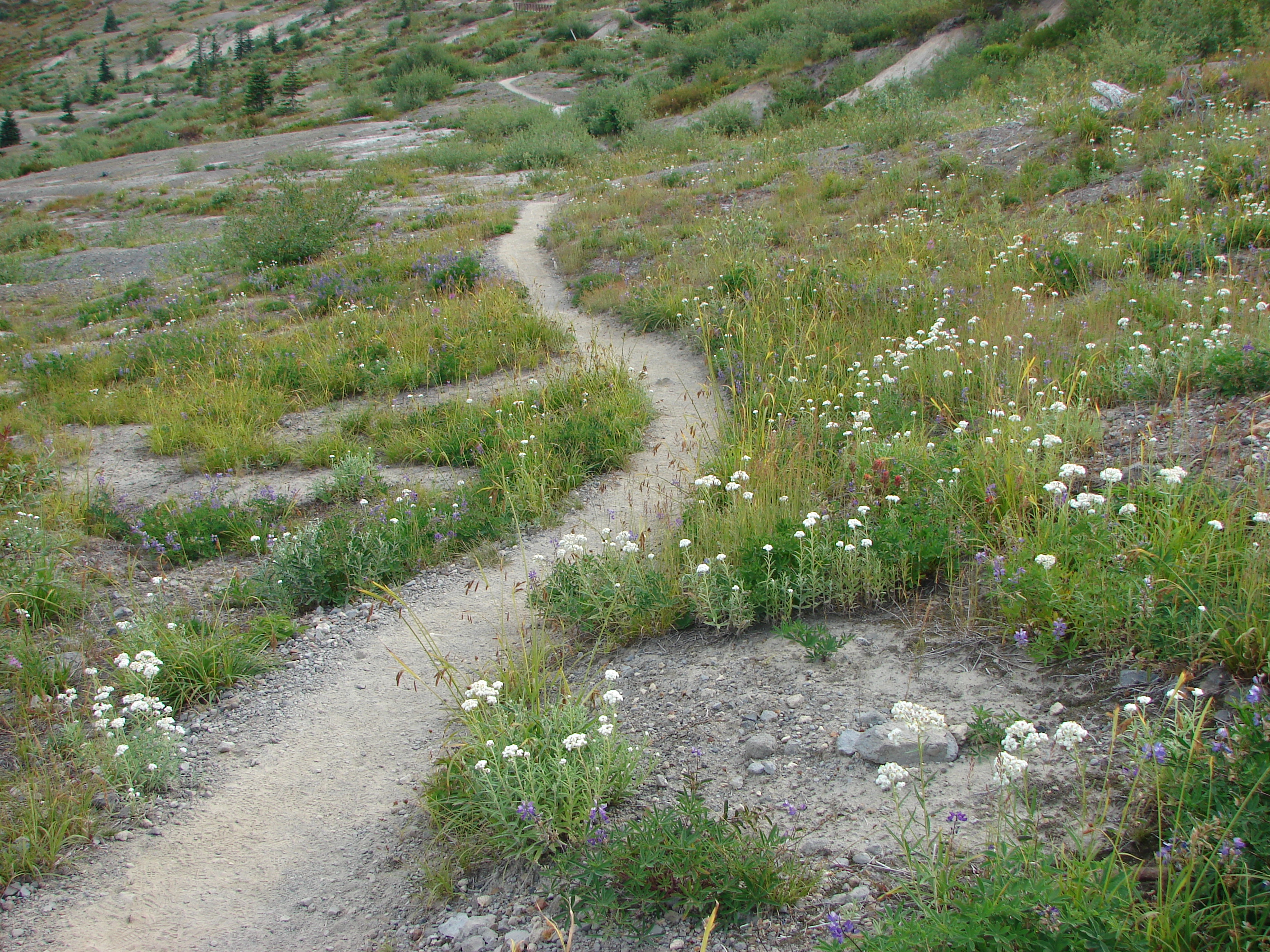
After navigating the lava flow we were once again in a forest. This one was drier and the trees more sparse than the previous sections we’d passed through. Cicadas chirped loudly from the pine trees and scattered flowers dotted the sandy landscape.
DSC01664
DSC01665
DSC01666

The trail then began alternating between trees and meadows.
DSC01673
DSC01674

As we came around a corner I noticed something peering out of a tree further up along the trail.
DSC01680
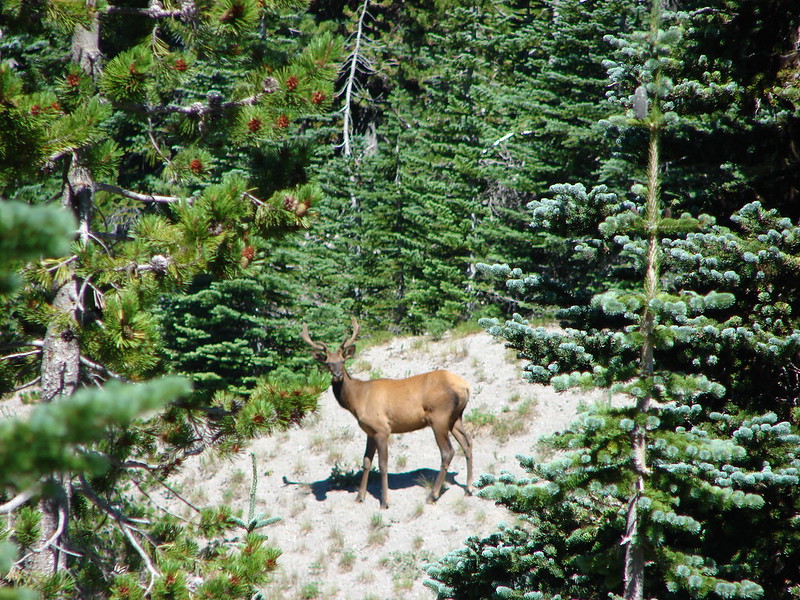
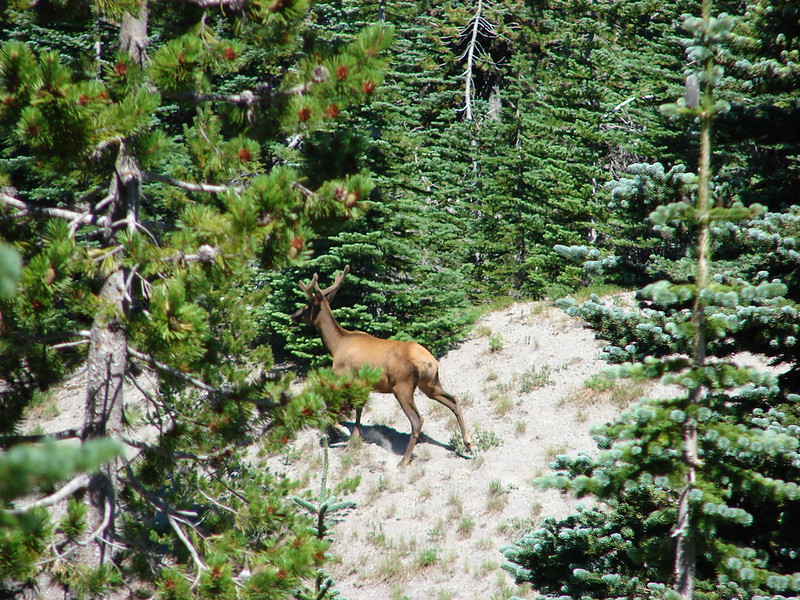
A bull elk emerged and gave us a quick look before heading downhill deeper into the trees.
DSC01683
Elk

We turned around at the dry Dryers Creek and retraced our steps back toward Chocolate Falls.
Mt. St. Helens from the dry bed of Dryers Creek
DSC01692

Mt. Adams had been hidden by clouds while Mt. Hood had nearly fully emerged from them.
DSC01715
DSC01716

There was evidence of the increased afternoon snow melt when we arrived back at Chocolate Falls.
DSC01740
Chocolate Falls
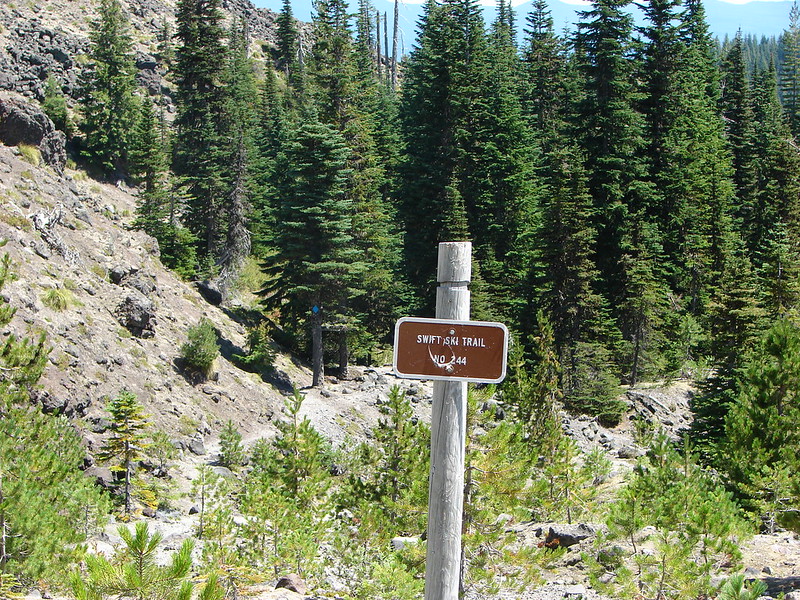
We took our shoes and socks off and soaked our feet for a bit in the creek before setting off from the falls. When we did get going we left the Loowit Trail and turned right along Swift Creek on the Swift Ski Trail.
DSC01754
Chocolate Falls and Mt. St. Helens

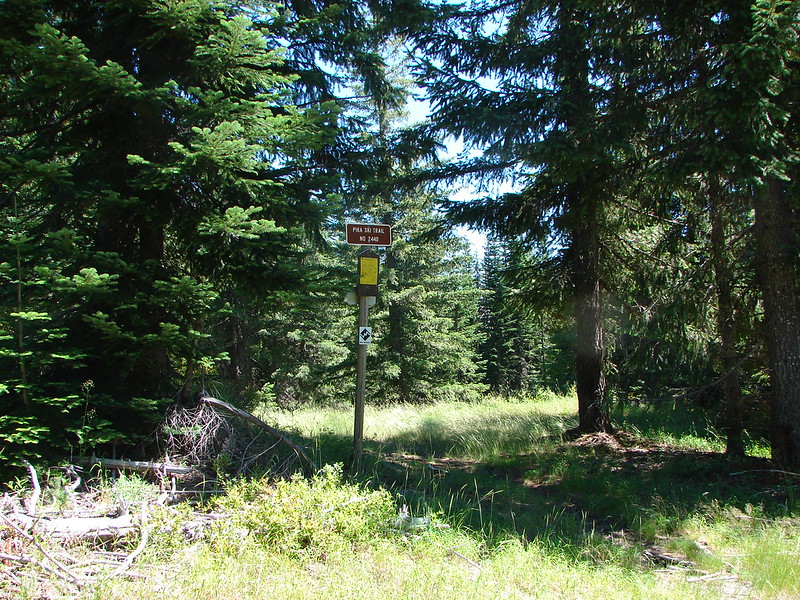
It was an easy trail to follow and we quickly descended .5 miles to the Pika Ski Trail which we took and headed back toward June Lake.
DSC01764

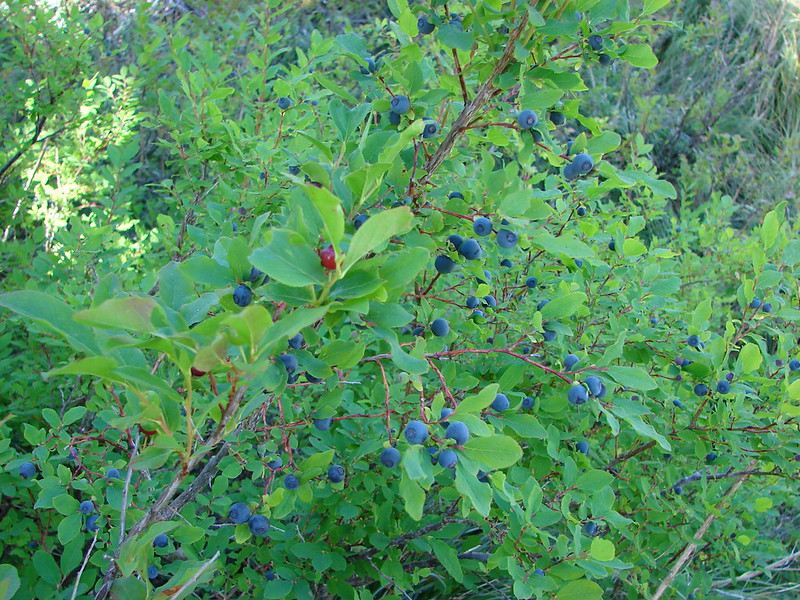
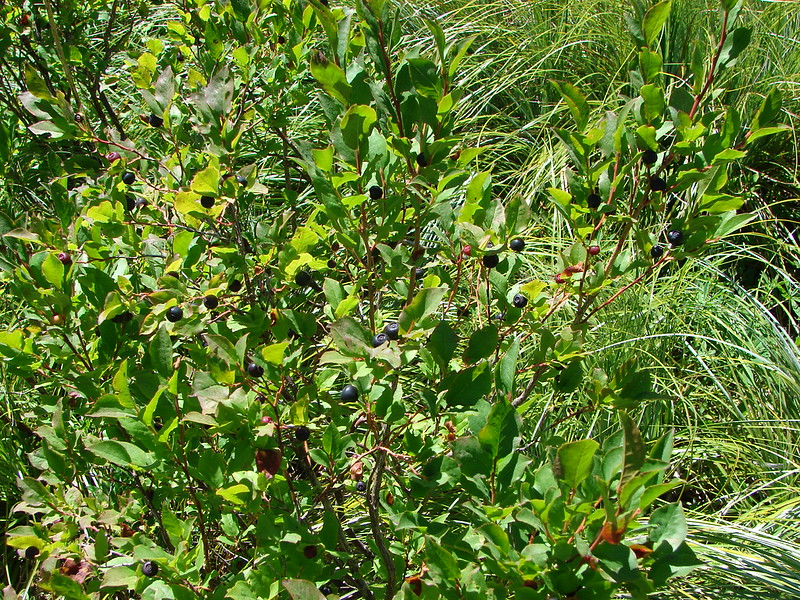
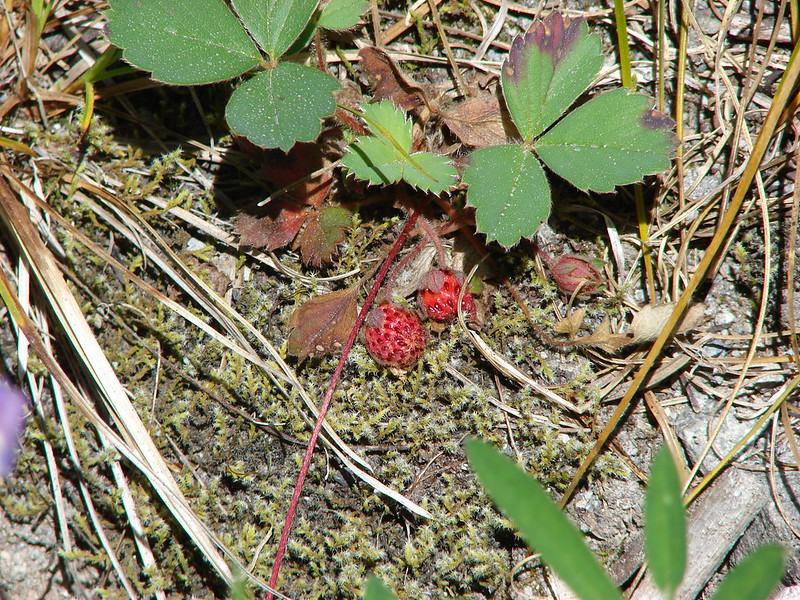
The Pika Trail was easy to follow for the first few tenths of a mile plus it was lined with ripe blueberries, huckleberries, and a few strawberries.
DSC01770
DSC01772
DSC01761

The easy trail didn’t last long though as we still had to cross part of the Worm Flows to return to June Lake. The crossing here was the most difficult of the day as there was no sign of any trail at all and the few orange poles ended halfway across the lava flow.
DSC01774

Luckily from the final pole June Lake was visible on the other side of the flow.
DSC01776

We headed for the lake and eventually made it down to the sandy bed of a dry creek which we climbed out of and returned to the June Lake Trail. The lake was clear now so we stopped to get some unobstructed photos of the waterfall and lake before beginning the final leg of our hike.
June Lake

We took our time on the final 1.3 miles partly due to being tired from all the rock hopping and partly because we were picking berries as we went. The hike had totaled 13.4 miles and in that distance we’d passed two waterfalls, a lake, several creeks (dry and flowing), through several sections of forest, multiple meadows, and over four different lava flows. We’d seen an elk, a deer, chipmunks, golden-mantled squirrels, frogs, and various birds. We sampled at least 6 different kinds of berries, saw a variety of wildflowers, and had views of three cascade volcanoes. It had been worth the effort. Happy Trails!

flickr: https://www.flickr.com/photos/9319235@N02/sets/72157645372723387/
Facebook: https://www.facebook.com/media/set/?set=a.10204499327590388.1073741894.1448521051&type=1

Categories
Hiking Mt. St. Helens Trip report Washington Washington Cascades

Coldwater Lake & The Hummocks

We ended our “Creek Week” vacation by changing things up a bit and heading to the Mt. St. Helens National Volcanic Monument hoping to see some snowy mountains. Our creek theme wasn’t totally abandoned though. Our destination was Coldwater Lake which was formed during the 1980 Mt. St. Helens eruption when Coldwater Creek was blocked by debris from the mountain. The creek still flows into and out of the lake on it’s way to the North Fork Toutle River.

The slide that created Coldwater Lake also created the Hummocks which are piles of rock, ash, and other debris that was washed down and deposited along the Toutle River. A 2.5 mile trail loops through these mounds and that was where we decided to start our hike. Our plan was to hit that popular trail first before it got crowded then walk back along the shoulder of Highway 504 for a quarter mile to the entrance to Coldwater Lake and once there either do an 8.8mi out and back to a footbridge over Coldwater Creek or continue over the bridge on a longer loop up and around the lake. We decided to wait until we got closer to the bridge before choosing which option we would take.

It was quite foggy when we arrived at the trailhead for the Hummocks loop making it pretty clear that we wouldn’t be seeing Mt. St. Helens for awhile at least.
The Hummocks trailhead

The scenery along the trail deserved our attention anyway with many ponds and streams nestled between the various mounds.
Ducklings on one of the ponds
DSC04973

As we were making our way through the strange landscape we spotted some elk on one of the Hummocks a short distance away.
DSC04984
DSC04989
They didn’t seem to be the least bit concerned with us. There were also numerous ducks, geese, and other birds enjoying the ponds and marshes along the trail.
DSC05009
DSC05040
DSC05057
DSC05059
DSC05069

The trail also passes a nice viewpoint above the North Fork Toutle River where Mt. St. Helens would be visible on a clear day. We settled for the river and another group of elk grazing on the far bank.
DSC05032
DSC05026
Shortly after leaving the viewpoint we were passing through a wooded area when I noticed an elk around 30′ away standing in the trees. Before I could get the camera up it disappeared but that had been the closest we’d come to an elk yet.

The clouds were beginning to clear up when we made it back to the parking lot and set off along the highway toward the Coldwater Lake entrance. We passed over Coldwater Creek on it’s way from the lake down into the Toutle Valley and then crossed the road and headed down to the lake.
Coldwater Creek

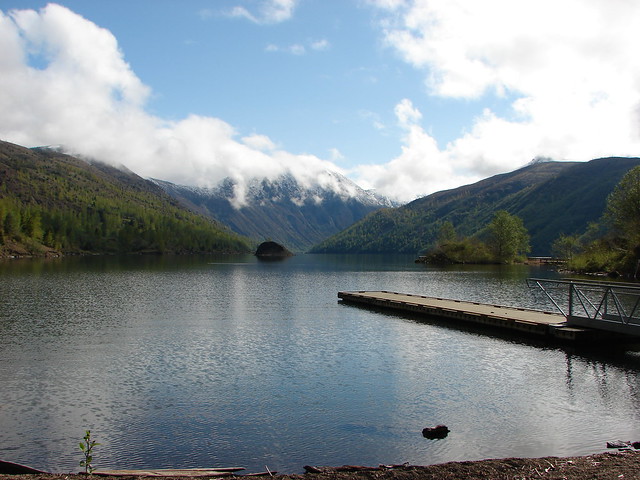
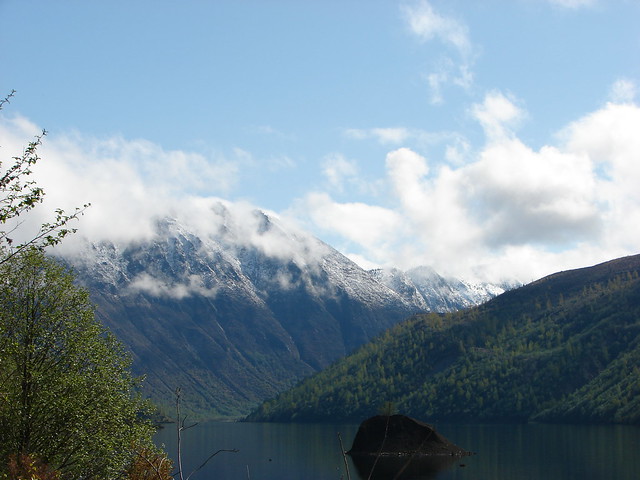
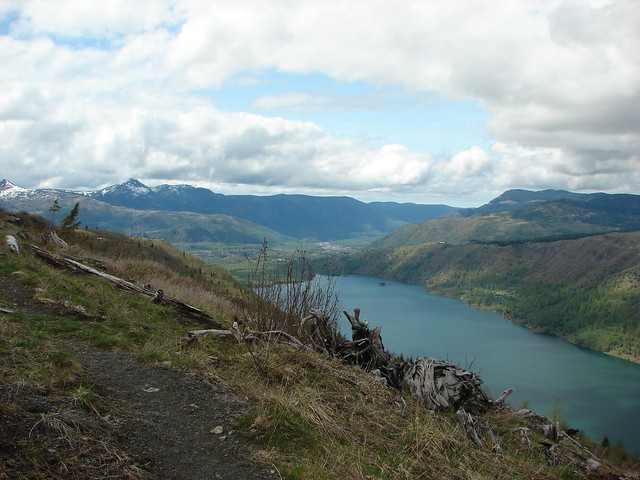
The view across the lake was spectacular from the trailhead. Minnie Peak lay ahead with a dusting of snow and a misty covering of clouds.
Coldwater Lake
DSC05091

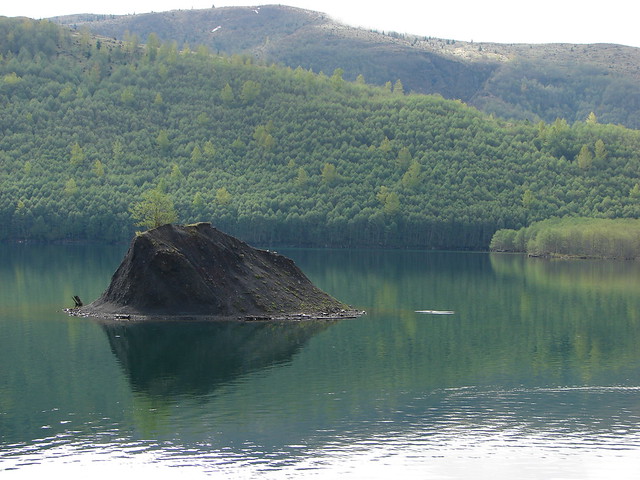
A little island was a popular spot for geese and ducks. I am sure they were there for the views.
DSC05102

As we traveled along the north shore of the lake the views both ahead and behind kept getting better. The clouds were lifting revealing more and more snow covered peaks.
Coldwater Lake
DSC05110

A few flowers were ahead of schedule giving us a taste of what will be coming in the next few weeks.
DSC05115
DSC05106
DSC05117
Scouler's Cordaylis

I had my eyes on Minnie Peak waiting for the last cloud to finally let go. It was a stubborn one though and just wouldn’t quite disappear.

DSC05149

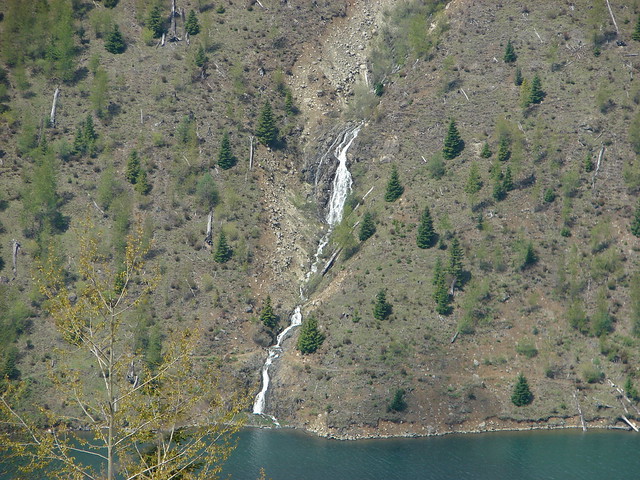
The trail crosses several small streams before reaching what was a very nice waterfall on this day. Rock Gully Falls, as it’s called in Sullivan’s book, was swollen with melt water making it a damp crossing since there is no bridge.
Rock Gully Falls
The crossing
DSC05166

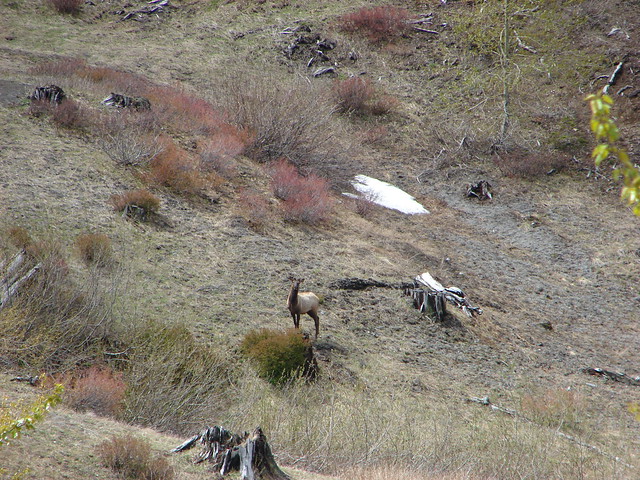
We spotted several more elk above us on the hillside as we rounded a small peninsula shortly after passing the falls. It was amazing watching them quickly traverse the steep hillside.
DSC05188
Can you spot them here?
DSC05192

The next marker along the trail was a fan of rocks that had been part of a slide into the lake.
DSC05222
DSC05227

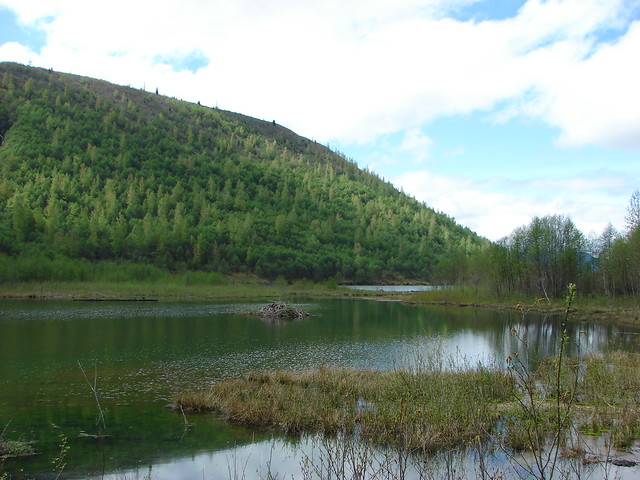
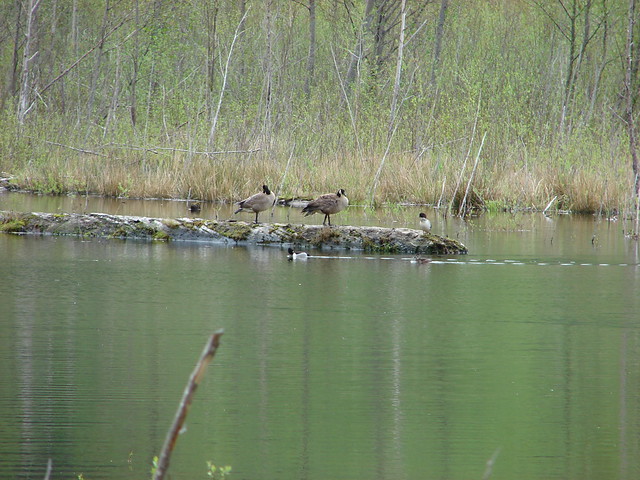
Near the end of Coldwater Lake we came to a shallow pool of water that was, at least at one time, home to a beaver. We didn’t see one but we did see plenty of ducks and geese here.
DSC05276
DSC05269
Evidence of Beaver work
DSC05272

The cloud had finally left Minnie Peak revealing the craggy mountain top by the time we reached the trail junction just above the bridge over Coldwater Creek.
DSC05284
DSC05306
Coldwater Creek came raging down the valley putting on an impressive show.
DSC05297

We had decided to do the full loop as it appeared that snow would not be an issue and loops are generally more fun than retracing your steps so we crossed the bridge and began to climb the ridge on the south side of Coldwater Lake. The views behind us as we climbed just kept getting better.
DSC05315
DSC05318
DSC05332
The rock fan
DSC05362

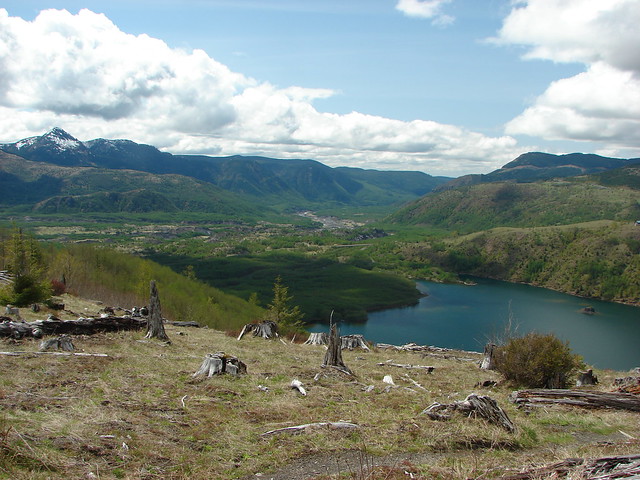
It was a stiff climb but the views eased the pain some. As the trail began to become more gradual, we could see the Coldwater Visitor Center far off in the distance on the opposite hillside.
DSC05369
Down in the little valley Heather spotted more elk moving in the trees.
DSC05377

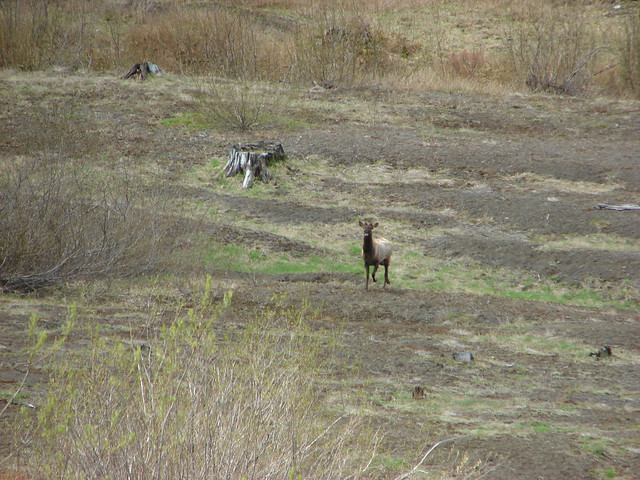
Just a short while later she spotted another elk heading our way. It stopped in a little bowl below us to check us out.
DSC05396
Nique correctly identified it as a young bull as it began to come toward us again.
DSC05400
He then veered slightly away from us and crossed the trail a ways ahead and disappeared behind a small rise. I kept looking up the hillside to see if I could see where he was heading.
DSC05404
Just moments after taking the above picture he popped his head up over the rise and looked right down at us. As I fumbled with the camera he jumped down onto the trail no more than 10 yards in front of us and sped off back the way he had come originally. By the time I got a picture he was quite a ways down the into the bowl.
DSC05407

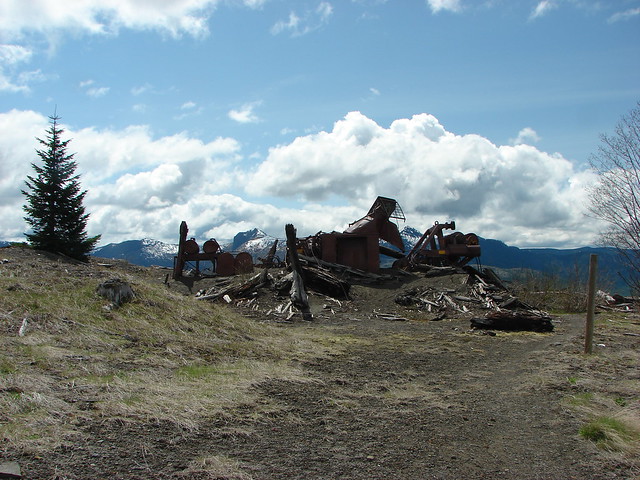
That had gotten my heart racing as I wasn’t sure if he had decided to turn aggressive. I had been expecting him to run away from us not at us. After the excitement we continued on to tractor junction where a trail leads up to Coldwater Peak. The junction is named for the piece of logging equipment that was laid to rest there by the eruption.
DSC05415

We had finally found a little snow in this area but not much was left.
DSC05418
After curving around the trail came to a great open viewpoint.
DSC05432
DSC05446
DSC05455

We could see Rock Gully Falls and the North Coldwater Lake trail really well.
Rock Gully Falls

We had heard a lot of croaking on the Hummocks trail but hadn’t seen any frogs or toads there or along the lake, but now at almost 3500′ Nique spotted one.
DSC05490

Coldwater Peak became visible as we made our way back toward the west end of the lake. It was interesting to see this side of it after having hiked up it last year.
DSC05500
DSC05508

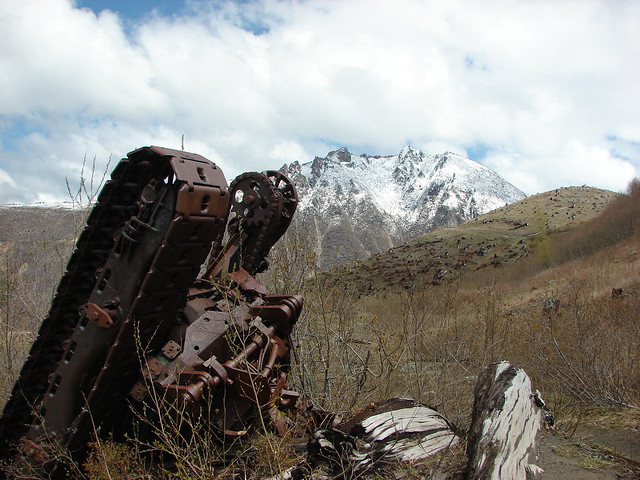
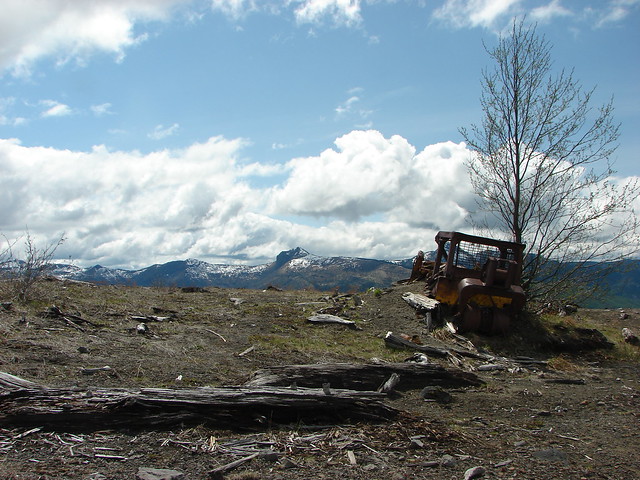
Just as the trail began to descend we came to more logging equipment that didn’t survive the eruption.
DSC05533
DSC05550
DSC05555
DSC05558

From here we could also see the Hummocks parking lot and our car.
DSC05563
DSC05564
We still had a ways to go.

Our last elk sighting was a big one. As we were coming down, the largest herd we’d seen was scrambling to stay ahead of us and dropping down over the hillside.
DSC05571
DSC05578
What a sight ๐Ÿ™‚
DSC05584

We made it down to the South Trailhead and began our road walk back to our car. Mt. St. Helens finally decided to make an appearance at this point.
DSC05600
When we got back to the car I dropped off my pack and jogged down the Hummocks Trail to the first good viewpoint to get my volcano pictures.
DSC05607
DSC05614
Now that’s the way to end a hike – Happy Trails indeed! ๐Ÿ™‚

flickr: https://www.flickr.com/photos/9319235@N02/sets/72157644218596998/
facebook: https://www.facebook.com/deryl.yunck/media_set?set=a.10203973677849473.1073741876.1448521051&type=1

Categories
Hiking Mt. St. Helens Trip report Washington Washington Cascades

Johnston Ridge Observatory & Coldwater Peak

We took advantage of a day off recently and headed up to the Johnston Ridge Observatory at Mt. St. Helens. This was the farthest north we have traveled for a hike and would be the first time we would be able to see the collapsed side of the volcano. We were a bit disappointed when we arrived and realized that the winds had shifted and were blowing from the south east causing a hazy sky due to smoke from a wildfire near The Dalles Oregon. We parked in the observatory parking lot and surveyed our hike’s destination, Coldwater Peak.

Coldwater Peak from the parking lot.

The observatory was not open yet (It opens at 10:00am) but we walked around the paved loop trail there before setting off on the boundary trail. Good views of Mt. St. Helens were plentiful despite the blue haze from the smoke.
004
I had us all on the lookout for elk down in the valley below and it wasn’t long before we spotted a small group.
030
It appeared to be a small heard of about 15 elk but as we worked our way along the trail and got a better view of the valley below we saw the rest of the heard.
041

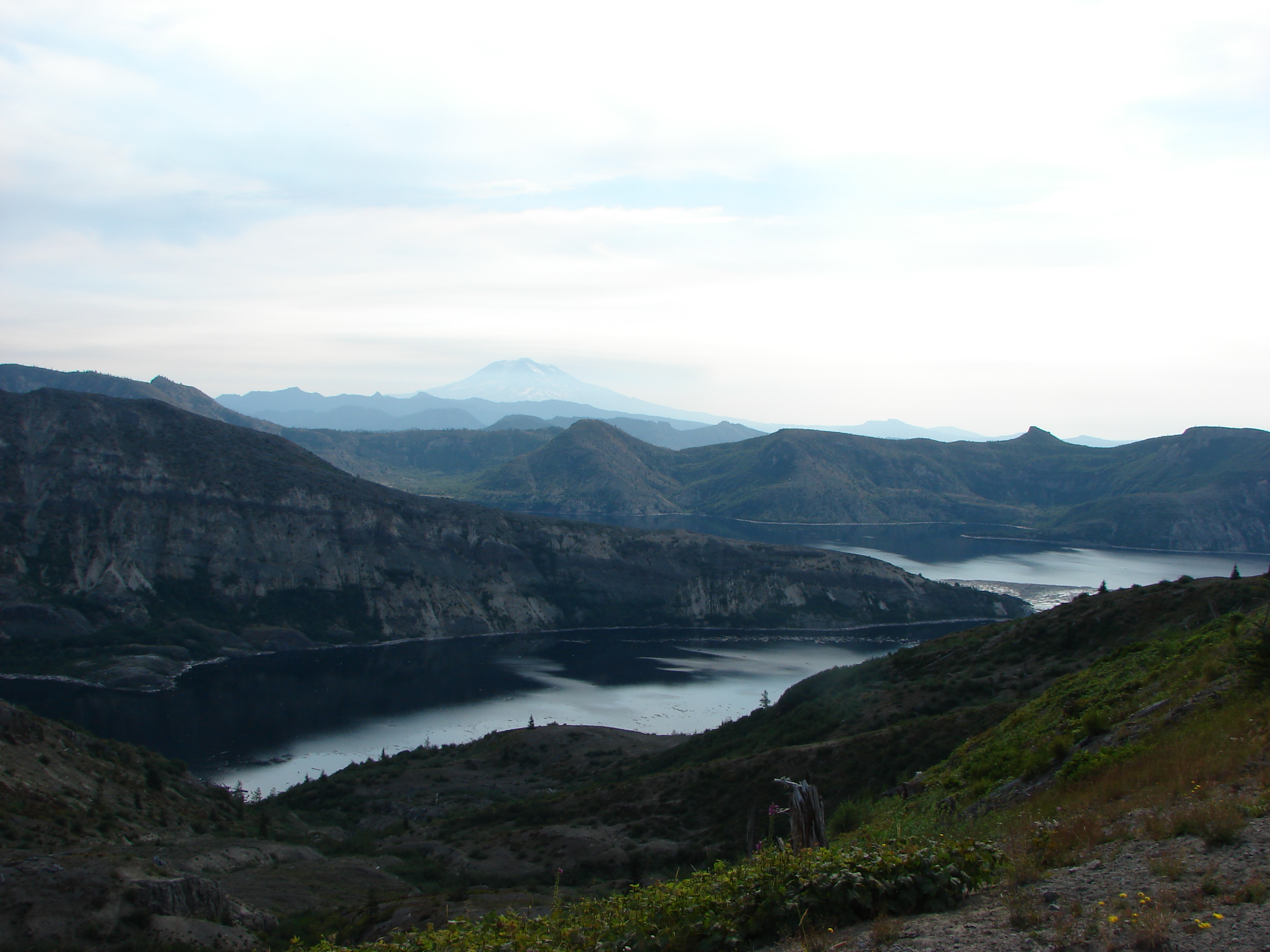
As we rounded a ridge end we got our first view of Spirit Lake and it’s floating trees. Mt. Adams was visible through the haze further to the east.
082
The trail then dipped slightly to a jct with the Truman Trail and continued on behind Harry’s Ridge. Here there was a decent variety of flowers that were growing in the mud and ash that had spilled over the ridge here during the 1980 eruption.
106
We also began to find berries :). Here were mostly thimble and huckleberries but we even found a few ripe salmon berries.

Thimble & huckleberries

Later we would add strawberries to the menu.

Just after we had reached the Harry’s Ridge trail we spotted another half dozen elk running up a game trail below us. The trail was now gaining elevation providing better views of Spirit Lake and distant Mt. Adams.
133
When the trail crested we had a nice view of St. Helens Lake below. The trail then drops down in order to pass through a rock arch before continuing above the west side of the lake.

The rock arch that the trail passes through and St. Helens Lake

Near the north end of St. Helens Lake was the sign for the Coldwater Peak Trail which we turned up to begin our climb. We were so busy looking for berries (which we had all been snacking on as we hiked) that we somehow walked right off the trail at a switchback. It took a moment but I finally spotted it across the hillside going up so we headed cross country until we intersected it. Back on the trail we continued our climb up amid an increasing number of flowers (and plenty of berries).
266

The views from the summit were good despite the persistent haze which had now completely hidden Mt. Adams.

Mt. St. Helens from Coldwater Peak

ย 

Johnston Ridge Observatory from Coldwater Peak

ย 

Mt. Rainier from Coldwater Peak

We couldn’t get to the highest point on the rocks of Coldwater Peak though. We found that we were greatly outnumbered on the summit by flying ants!

Flying ants filling the sky and covering the rocks on Coldwater Peak

They were sticking to the west side of the peak and as long as we remained a few feet from that edge they left us alone so we were able to eat in peace.

We headed back down the trail and tried to figure out where we had lost it on the way up but we never did figure that mystery out. The smoke had gotten worse and it could now be faintly smelled in the air. We ate more berries on the way back and stopped to watch the elk heard again before dropping our packs off at the car and heading to the now open observatory to pay for the passes that we were supposed to have in order to hike in the area. Since we were there we took a tour around the small but interesting observatory before getting in the car and daring Portland’s rush hour traffic. Happy Trails

Facebook photos: https://www.facebook.com/media/set/?set=a.10201951052645107.1073741851.1448521051&type=1
Flickr: http://www.flickr.com/photos/9319235@N02/sets/72157635195793722/
Categories
Hiking Mt. St. Helens Trip report Washington Washington Cascades

Sheep Canyon

So after a couple of months of taking pictures of the major Cascade peaks it was finally time to visit one. Our most recent hike brought us to the volcanic landscape of Mt. St. Helens. Our plan was to hike a loop on the SW side of the mountain starting at the Blue Lake trail head.

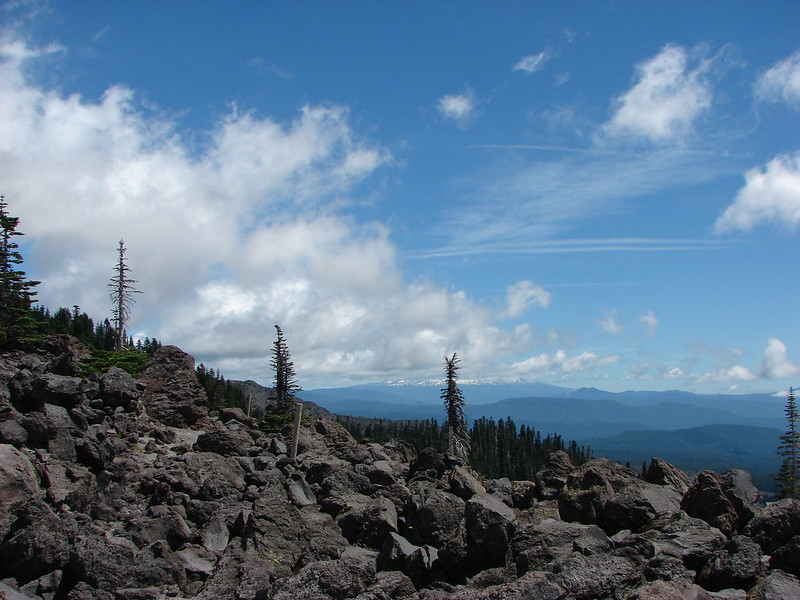
For the second week in a row we spotted elk from the car on the way to the trail, but were skunked while actually hiking. We arrived at the current Blue Lake trail head (washouts occasionally relocate it) and headed across a rocky washout to the Toutle Trail. The washout provided a view ahead to the mountain while forest lined each side. At the Toutle Trail we turned left and headed toward Blue Lake. Coldspring Creek flowed along the edge of the washout creating a dividing line between the grey rocks and old growth forest on the other side. Shortly after crossing the creek and entering the forest we came within sight of Blue Lake. The forest here survived the 1980 eruption leaving old growth trees, but a mudflow dammed the creek creating the lake. The forest was peaceful and carpets of white flowers covered much of the ground.

After 2.5 miles in the forest we began to descend into Sheep Canyon. Here the Toutle Trail intersects the Sheep Canyon trail which climbs the mountain on the south side of Sheep Canyon up to the Loowit Trail which circles the entire mountain. We continued on the Toutle and crossed Sheep Canyon on a scenic footbridge and continued on toward the South Fork Toutle River.
056

This section of trail was not very well maintained so we had to do a lot of stepping over and under along the way. After 1.5 miles we made it to the Toutle Trail’s own jct with the Loowit Trail at the edge of the S. Fork Toutle River’s canyon. This wide canyon was affected by the eruption when snow from Mt. St. Helens’ glaciers rapidly melted sending a huge mudslide down the valley. The river now is a small ribbon of water in the wide canyon. Here we turned right on the Loowit and started to climb the side of the mountain.
096

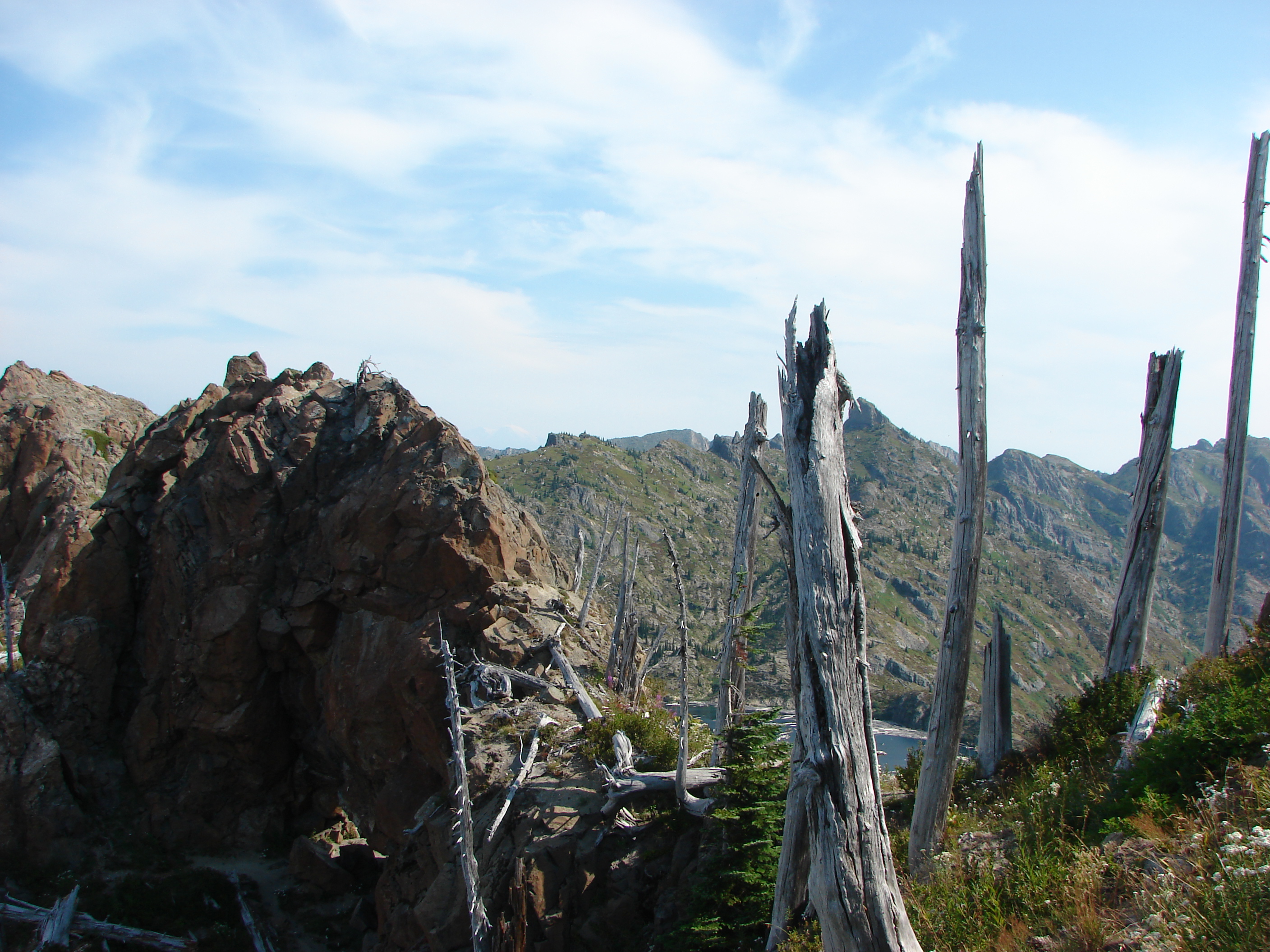
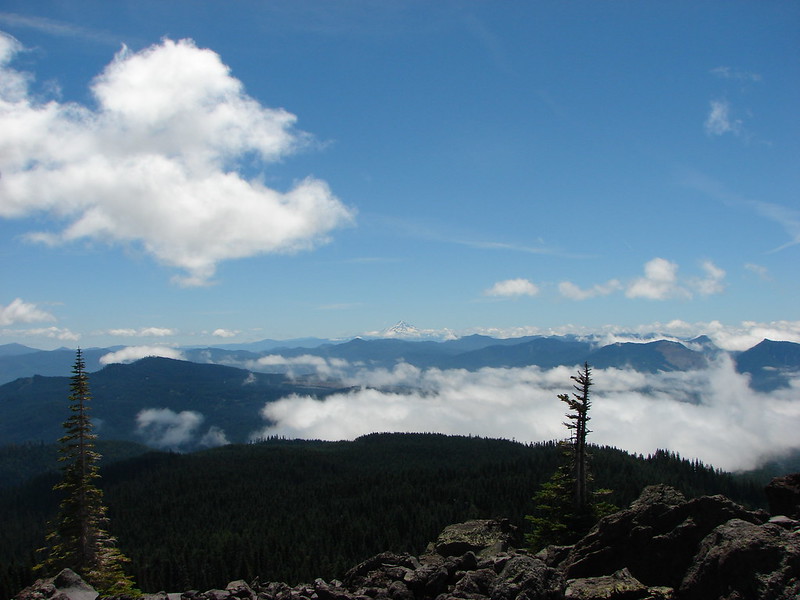
As we climbed we left the forest and entered the blast zone where the trees did not survive the eruption. Here increasingly better views opened up of the mountains rim and to the north the top of Mt. Rainier. Wildflowers surrounded the trail taking advantage of the clearings created by the blast. We passed through some excellent bear grass stands and large numbers of orange tiger lilies, purple penstemon, red columbine & paintbrush, and various colors of phlox. Some small patches of snow lingered in gullies along the way.
170

The trail eventually leveled out and began traversing along the mountains flank to the south. We dipped in and out of the tree line passing a number of different landscapes. We passed the Sheep Canyon Trail choosing instead to continue to the Butte Camp Trail. As we traveled on we crossed several rocky outwash gullies and eventually worked our way far enough around to the south to see Mt. Hood and Mt. Jefferson in the distance. Pink mountain-heather and dwarf lupine bloomed along this portion of the trail.
277

When we reached the Butte Camp Trail we turned right and started our descent back to the Toutle Trail. This trail passed through a dry lodgepole pine forest before reaching the meadow at Butte Camp. Recent snow melt had left the meadow flooded. The trail got us down fairly quickly without being steep and soon we were back on the Toutle Trail ready for the last leg of our hike.

The Toutle Trail was mostly level as it passed through the forest which was nice because we were all starting to feel tired. We pressed on and eventually reached the washout and the junction with the Blue Lake Trail and hustled the final 3/4 miles back to the car. I had chalked our fatigue up to the 10k we had all run the day before, as we seemed to have been much slower than normal. I got a possible answer to why when we got home and I checked the GPS which had us going a total of 16.1 miles :). I’m still not quite sure where the extra 2.6 miles came in but the track from the gps looks right so all I know to say is “Happy Trails”.

Photos -Facebook: https://www.facebook.com/media/set/?set=a.10201590209464253.1073741842.1448521051&type=1
Flickr: http://www.flickr.com/photos/9319235@N02/sets/72157634653720111/
Categories
Hiking Trapper Creek Trip report Washington Washington Cascades

Observation Peak

**Note the 2020 Big Hollow Fire burned a portion of this hike.**

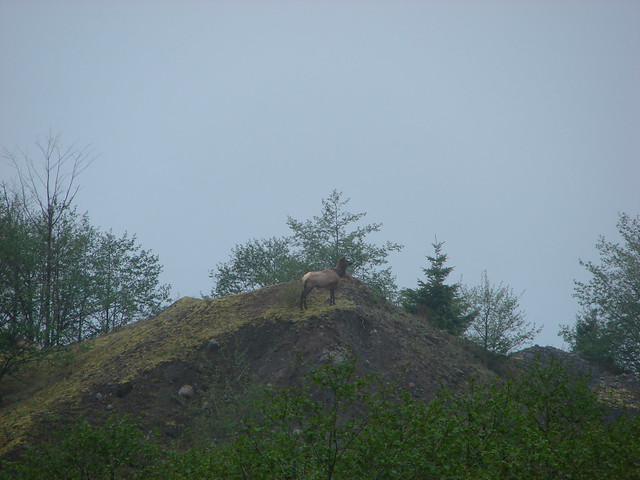
Unexpected is as fitting a description as I can think of for our visit to the Trapper Creek Wilderness in Washington. The first unexpected event happened before we even arrived at the trail head. I have mentioned before that we seem to see more large wildlife from our car than we do on the trail. As we were turning off the highway I noticed a large brown animal just a bit further up along the shoulder. I quickly turned around and got out the camera. It was an Elk just grazing on the side of the road. This was the closest we’ve been to seeing an elk on one of our hikes.
278

We created the next unexpected event when we parked near Bubbling Mike Spring at an empty sign board. This turned out to be the wrong parking area, but the road ahead was gated closed and we failed to notice the small sign around the corner to our left that pointed toward the campground. We set off on a clear trail toward Trapper Creek which we knew we needed to cross at some point. That path quickly ended at the creek with no dry way to cross so we backtracked and headed up the gated road. We spotted one footbridge that had a do not use, danger sign posted on it as we passed several cabins that sat along the creek. The road veered away from the creek and just after crossing a small stream we decided to head back and work our way up the creek bank to see if we could find a crossing that way. No sooner had I recrossed the stream when I heard quite a commotion behind me. I expected to see Dominique on the ground since he is the most prone to losing his balance but instead it was Heather sitting in the middle of the stream. She banged her hand up pretty good but was fortunate not to have hit her head or hurt her legs. Her pinky though was already swelling and slightly discolored. We hadn’t even found the official trail yet and we had a “man down”. She decided she wanted to try and continue the hike so back we went to searching for a dry way across.

After wandering up and down we settled on trying a downed tree that appeared to be flattened on top for crossing. It led to the back of a couple of cabins on the far side of the creek so we quickly ducked past them onto the access road that led to them. Our map showed that this road would lead to the trail we had been seeking so we headed left and soon had found it.

We entered the Trapper Creek Wilderness and paralleled Trapper Creek through a dense forest. If you love old forests and the sound of flowing water this would be a great hike for you. If you are after views and wildflower meadows skip this trail and take the Observation Peak Trail from road 5800 as described in Sullivan’s 100 Hikes book. The trail went up and down occasionally offering glimpses of the creek below. After 2.5 miles the path crossed Hidden Creek and shortly after a pair of signs pointed to Hidden Falls. We decided we needed to check this out so we struck off on the faint trail up a ridge to a nice camping spot. Hidden Falls was below down a steep hillside which Heather and I picked our way down. We were able to make our way to the base of the secluded falls and then had to climb back out of the canyon.
343

From Hidden Falls the Trapper Creek trail began to climb a long series of fairly steep switchbacks. We crossed the creek again after the first set of switchbacks and then launched upward again. A nice viewpoint along the way overlooked Trapper Creek Falls across the valley backed by Observation Peak. The trail eventually leveled out, recrossed Trapper Creek, and then came to a junction with a trail labeled “Shortcut Tr. 129B”. Dominique was all for taking any trail that had the word shortcut in it’s name so we turned up it. I don’t know how much of a shortcut it was, but we were soon at another junction, this time with the Observation Peak Trail.

We headed up toward the summit through a forest with large bear grass plumes and many other smaller white flowers. After about a half mile of climbing we reached the lower viewpoint. This first viewpoint was on a rocky outcropping dotted with white cats ear blossoms. It had been a nice day, with blue sunny skies and a occassional breeze that kept it from being too warm but we found that clouds were hanging around the Washington peaks covering each of them to some degree. Never the less the view was impressive and the view from the actual summit promised to be even better. We returned to the trail and continued up another .2 miles to the summit passing bear grass blooms and other various wild flowers. As we approached the summit, Mt. Hood appeared over the right shoulder of Observation Peak with a faint Mt. Jefferson nearly hidden by haze further to the south.

Mt. Adams and the Trapper Creek Wilderness from Observation Peak

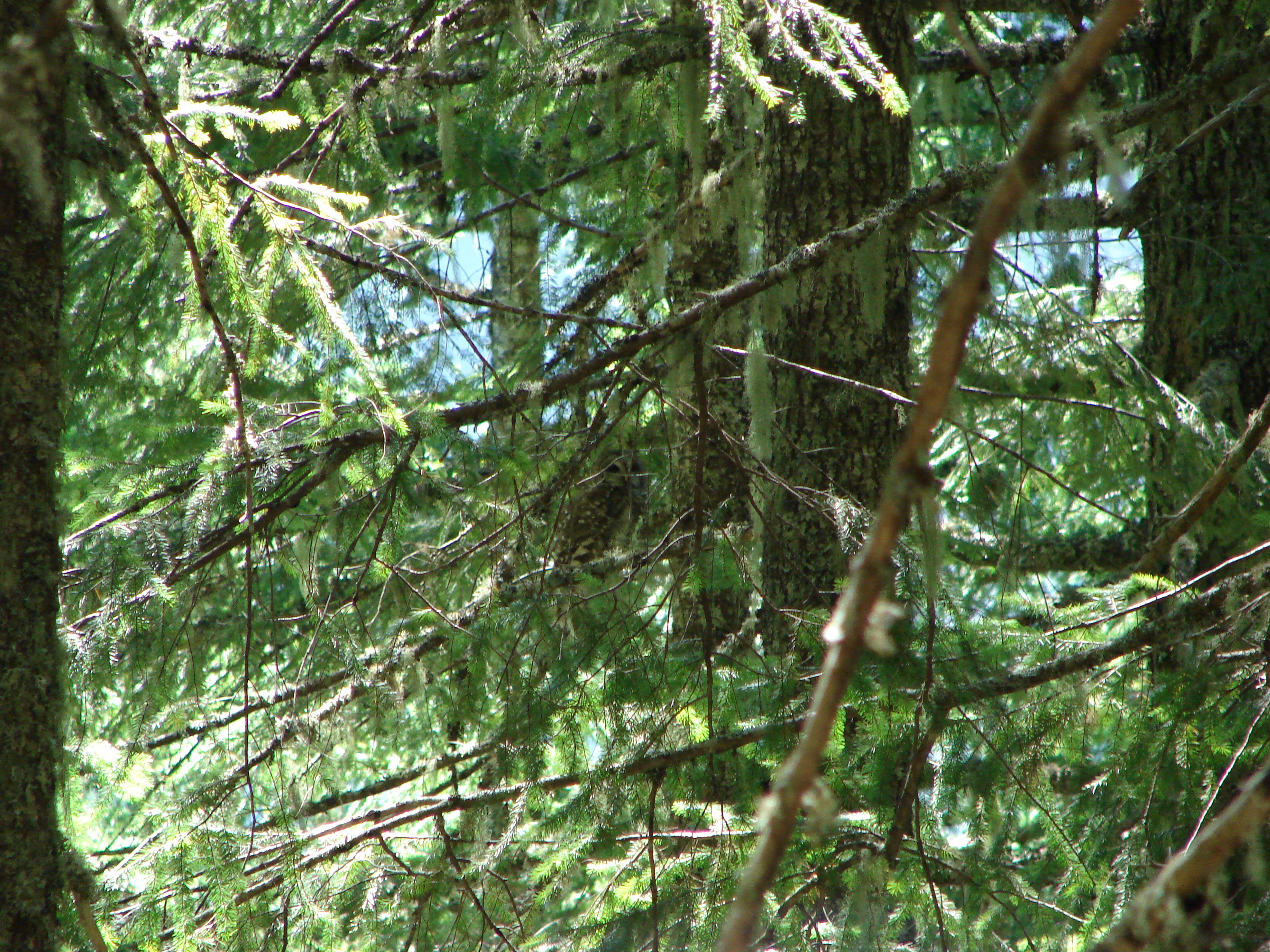
After a short rest we headed back down from the summit and turned right at the trail junction to begin our descent down Howe Ridge. We had a little over 5 miles down this pleasant trailย to get back to the car. It gradually descended through the forest crossing numerous small streams and we were able to make good time. We spotted a small snake and later I came around a corner to find myself staring straight at an owl about 10 yards away. When I reached for my camera it flew to a nearby tree but I was able to get
a couple of decent pictures.
474

Our feet were sore and legs tired when we finally reached Trapper Creek and we didn’t care about finding a dry crossing. Our car was almost directly across from us so we just walked into the water and crossed. What was supposed to have been a 13.3 mile hike turned into a 15.8 adventure. Despite a few mosquitoes (much less than our last hike) and Heather’s bruised hand it had been a pretty good day. There was only one way to end a day like this – with pizza ๐Ÿ™‚ Happy Trails.

Photos – Facebook https://www.facebook.com/media/set/?set=a.10201538005439185.1073741841.1448521051&type=3
Flickr http://www.flickr.com/photos/9319235@N02/sets/72157634535134225/