While we are focused on our quest to complete Sullivan’s featured hikes (post) we are also plugging away at several other guidebooks including Matt Reeder’s 2016 “101 Hikes in the Majestic Mount Jefferson Region”. It’s been a bit of a challenge to make much progress in this book since 2020 when wildfires burned much of the area it covers. In some cases the trails were burned and in others the access roads to the trailheads were closed for hazardous tree removal. The two stops we had planned for this outing were two such hikes.
Our first stop was to visit the viewpoint and lookout tower on Sisi Butte. The fires didn’t burn the butte, but until Forest Road 46 was reopened between Detroit and Estacada this past June it wasn’t accessible for us to reach the trailhead.
Our adventure actually began before reaching the trailhead. Over the final two miles of our drive we passed at least two dozen cars heading toward Olallie Lake (post). We guessed that there must be some sort of race happening which turned out to be correct, the 100-mile Mountain Lakes 100 to be exact. Luckily the racecourse wasn’t along either of the hikes we’d planned for the day, we’ve made that mistake before and it doesn’t make for the most enjoyable hike. (Someday I’ll learn to check for races/events at the same time I’m checking the managing agencies information on the trail conditions.) We eventually made it to the gated road and parked along the side of FR 4220 (Old Skyline Road).
This was about as straightforward as a hike can get. We followed the closed road up Sisi Butte for just under three miles to the lookout tower. There was a lock on the door to the observation deck, but we were able to climb up to that point to get views of Mt. Hood, Mt. Jefferson, and Three Fingered Jack. Dust from ultra runner’s cars hanging over the closed roadbed.
Mt. Jefferson in the monring.
The Summer haze we’ve grown to expect was back after having improved following a brief period of rain.
The smoke does make for some colorful sunrises though.
Scouler’s bluebells
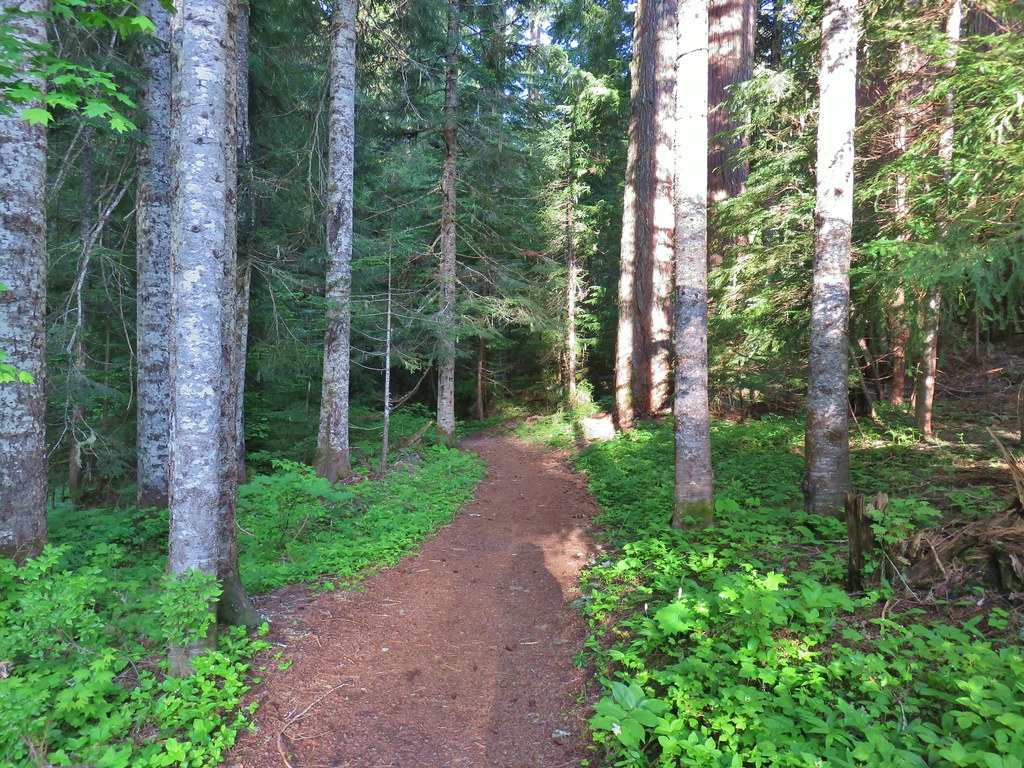
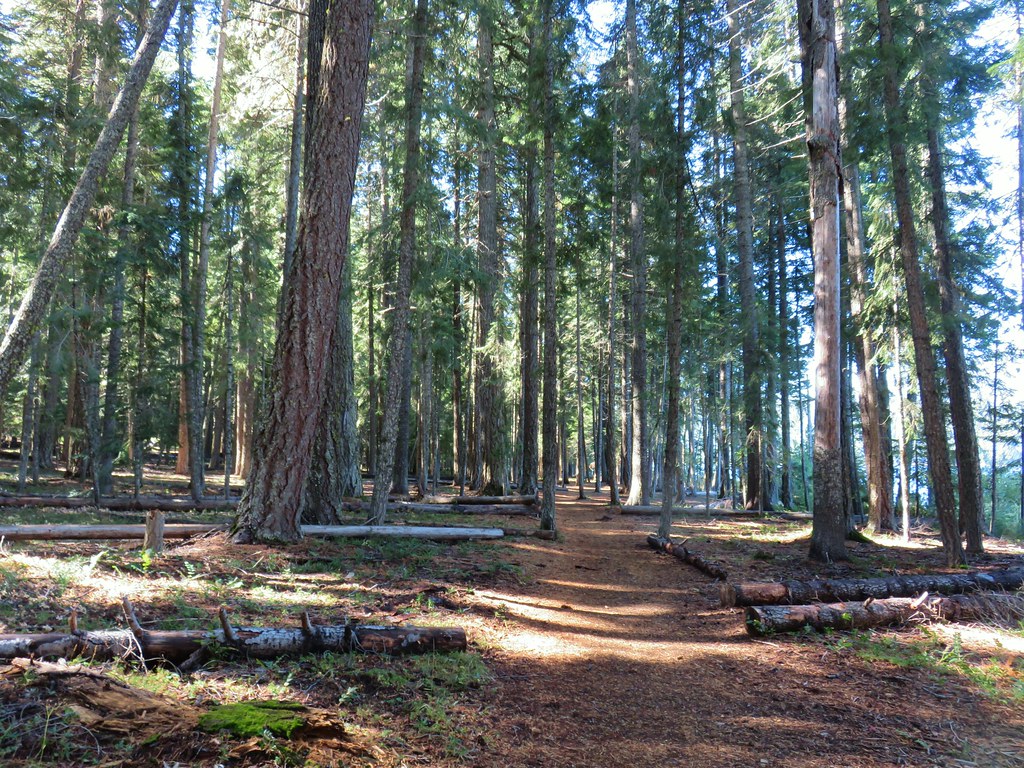
There was a nice forest along the road. Much of the butte is within one of the five tracts making up the Clackamas Wilderness but being a man-made improvement the road itself is not part of the Sisi Butte tract.
Mt. Hood to the North.
Mt. Hood
Despite the surrounding haze the sky above the road was bright blue.
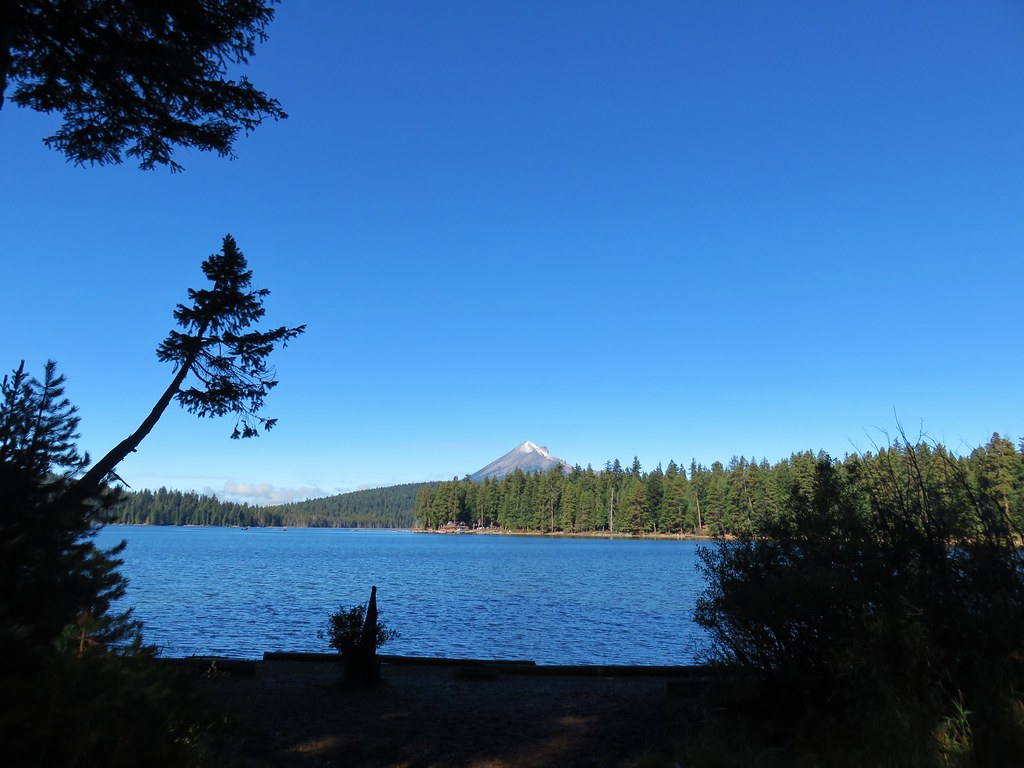
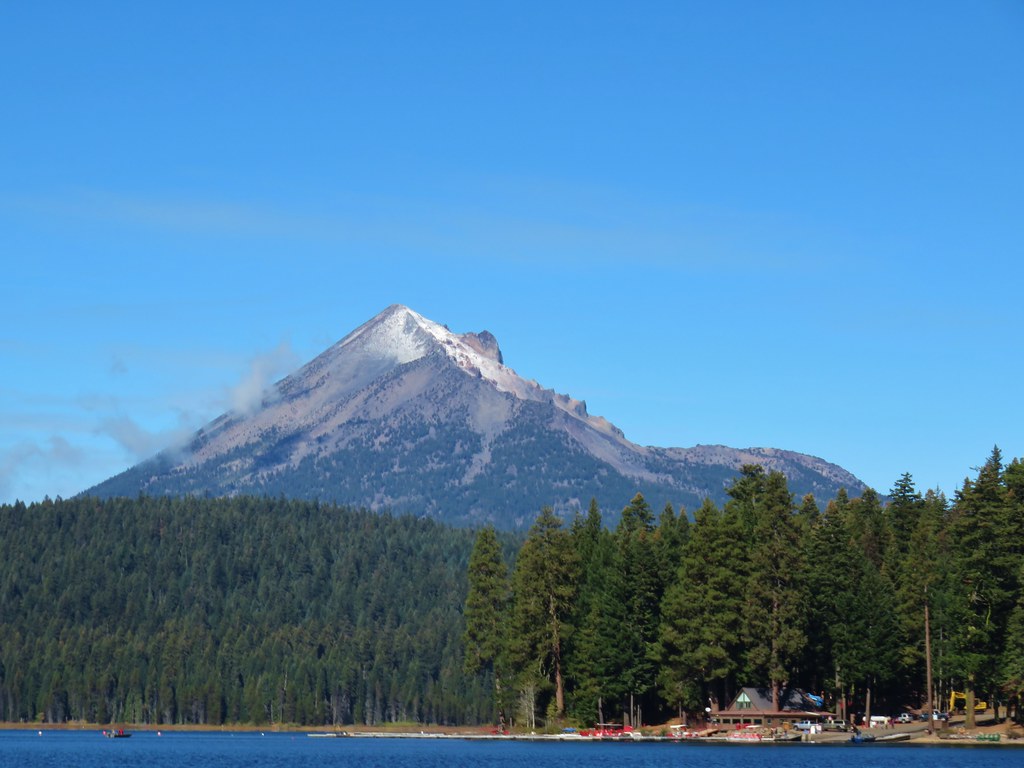
There were numerous good views of Mt. Jefferson from the road.
About 0.4 miles from the lookout an abandoned spur road splits off to the right toward the eastern summit which is just a couple of feet higher than the western.
The tower is still staffed at times, but it was empty today.
Penstemon
Olallie Butte, Mt. Jefferson and Three Fingered Jack from the lookout.
Mt. Jefferson and Three Fingered Jack
Mt. Hood, West Pinhead Butte, and the eastern summit.
A hazy Mt. Hood.
Flat topped Battle Ax Mountain (post), Silver King Mountain (post), Pansy Mountain, Bull-of-the Woods (post), Big Slide Mountain (post), and Schreiner Peak in the Bull-of-the Wilderness.
Bachelor and Coffin Mountains (post) in the Old Cascades.
After taking in the views we headed back down. We’d passed a pair of hunters on the way up and a pair of hikers on the way back down along with a few grouse. Grouse along the road.
Despite high temperatures around 80 the leaves reminded us that Fall would be arriving soon.
Canada jay checking us out.
The out-and-back was just shy of 6-miles with approximately 1400′ of elevation gain.
From the gated road we turned around and headed South on FR 4220 for a total of 6.5-miles to the Lower Lake Campground entrance.
While Sisi Butte had escaped the 2020 wildfires the Lionshead Fire had severely damaged the campground and the trail to Fish Lake. Lower Lake Campground, a work in progress.
While the campground was closed, the trail was open despite the fire damage.
The Fish Lake Trail at Lower Lake Campground.
While the sign at the trailhead said it was a half mile to Lower Lake we actually arrived at the eastern end of the lake after a third of a mile. Ferns creating a green hillside in the burn scar.
Lower Lake
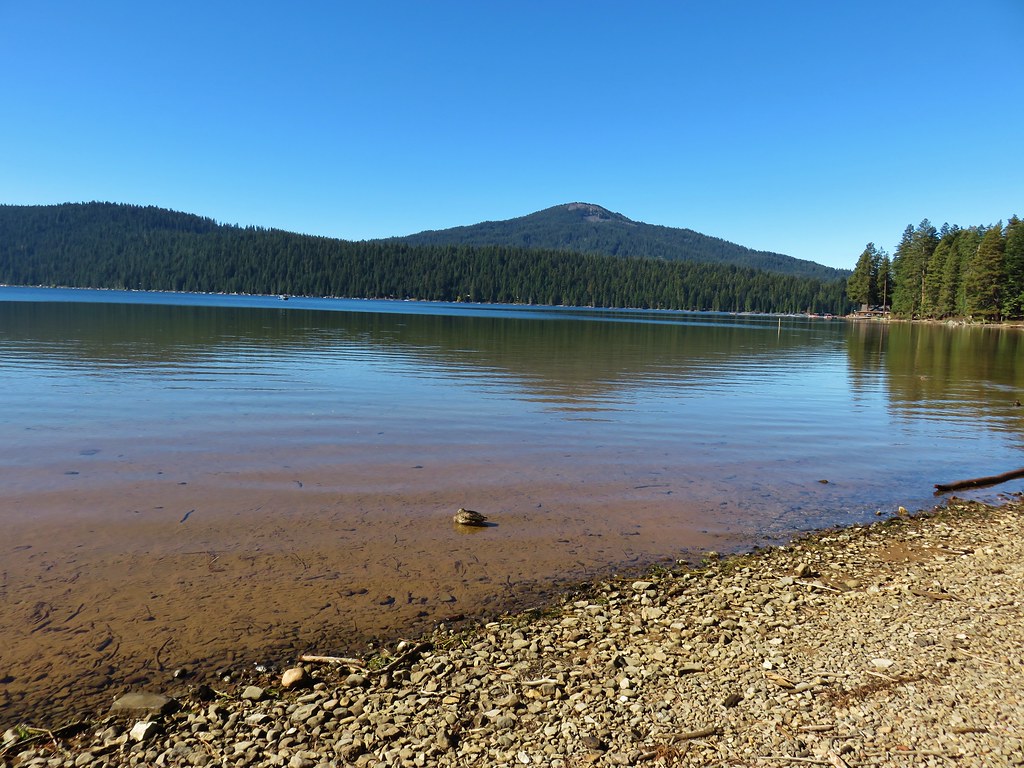
The trail passed along the northern shore of Lower Lake without too much trouble. There was on small detour necessary to avoid some blowdown, but it was easily navigated. The water in Lower Lake was quite colorful.
We had detoured to Lower Lake prior to the fire during our Lodgepole Loop hike in 2019 (post).
Just a short distance from the western end of the lake we crossed the Lodgepole Trail.
For the next quarter of a mile the trail was fairly level. Sisi Butte off to the right.
Fireweed going to seed.
Buckwheat
The burn was intense along the trail, but it was in pretty good shape all things considered.
After a quarter mile the trail arrived at a cliff above Fish Lake and then began a steep descent dropping 400′ over the next half mile to the lake. Sisi Butte and Fish Lake from the cliff.
Mt. Hood peeking out from behind West Pinhead Butte.
Mt. Hood
The Fish Lake Trail switchbacked a few times before giving up on that and dropping steeply for the final 0.2 miles.
A beat up Lorquin’s admiral.
There were signs of somewhat recent trail maintenance, but given the severity of the burn and the steepness of the hillside the trail is going to need a lot of ongoing attention to keep it passable.
The trail disappeared a couple of times in brush and blowdown near the lake, but it was never hard to pick back up.
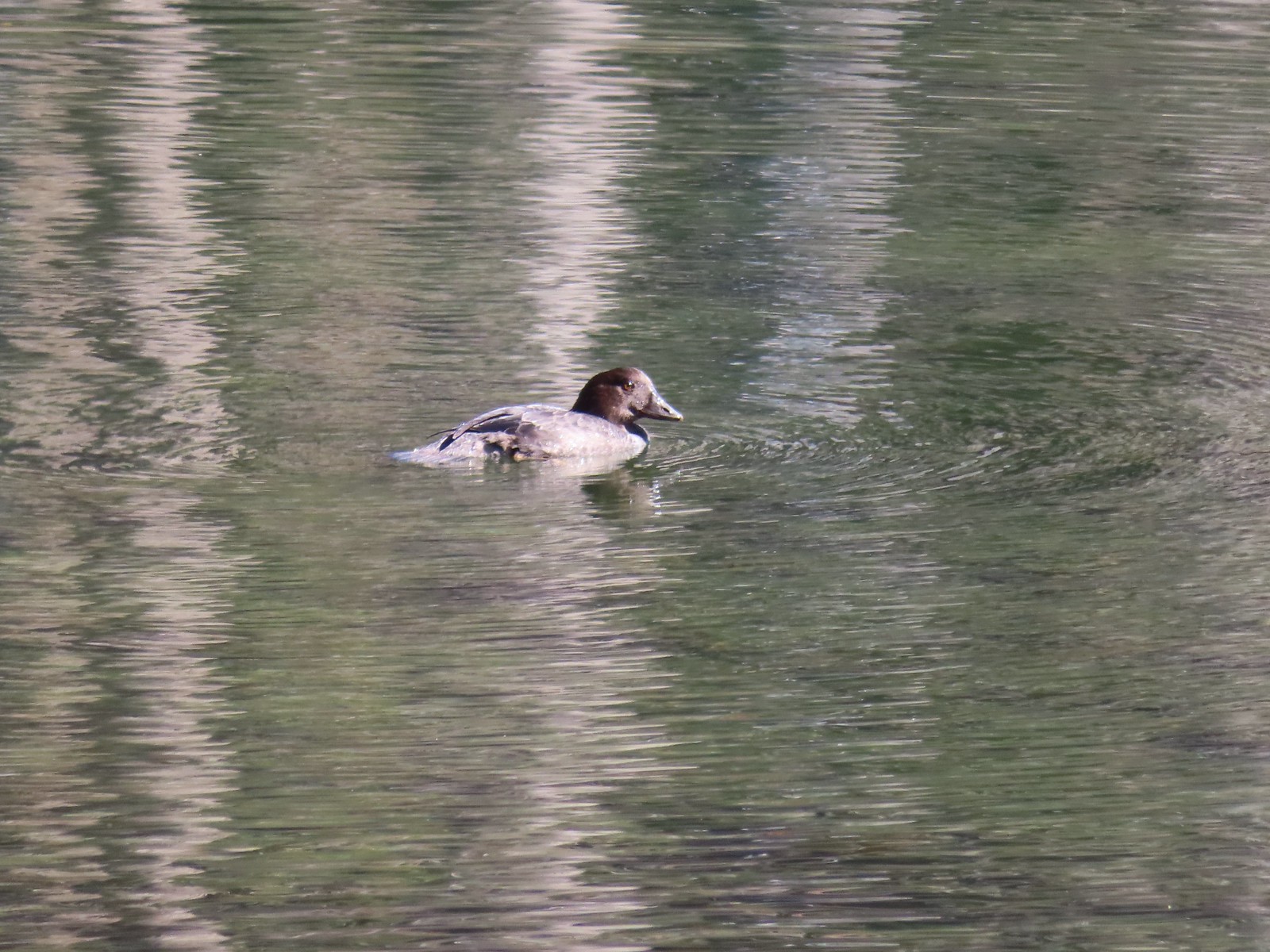
There were no people at the lake, just a pair of ducks enjoying the warm day.
Nap time.
Olallie Butte from Fish Lake.
After passing around the southern side of the lake we arrived at a nice campsite under some unburned trees.
Beyond Fish Lake the forest along the trail was mostly out of the fire scar. The trail followed along Squirrel Creek (currently dry) for 0.4-miles.
Just under a quarter of a mile from Fish Lake the trail crossing a road and under some power lines.
Four tenths of a mile from Fish Lake we came to a trail sign with a pointer to Surprise Lake. We passed a few of these “Spot Fire” flags, presumably left over from 2020.
The signed junction.
We detoured to check out the brushy lake and found it to be as Reeder reported, brushy had difficult to explore.
I had to walk out on a log and fight through some thick brush to reach a decent view of the water.
Surprise Lake
We returned to the Fish Lake Trail and continued another half mile to Si Lake. The trail between the junction and Si Lake got a little brushy.
Huckleberry leaves in their Fall colors.
Si Lake from the trail.
Si Lake.
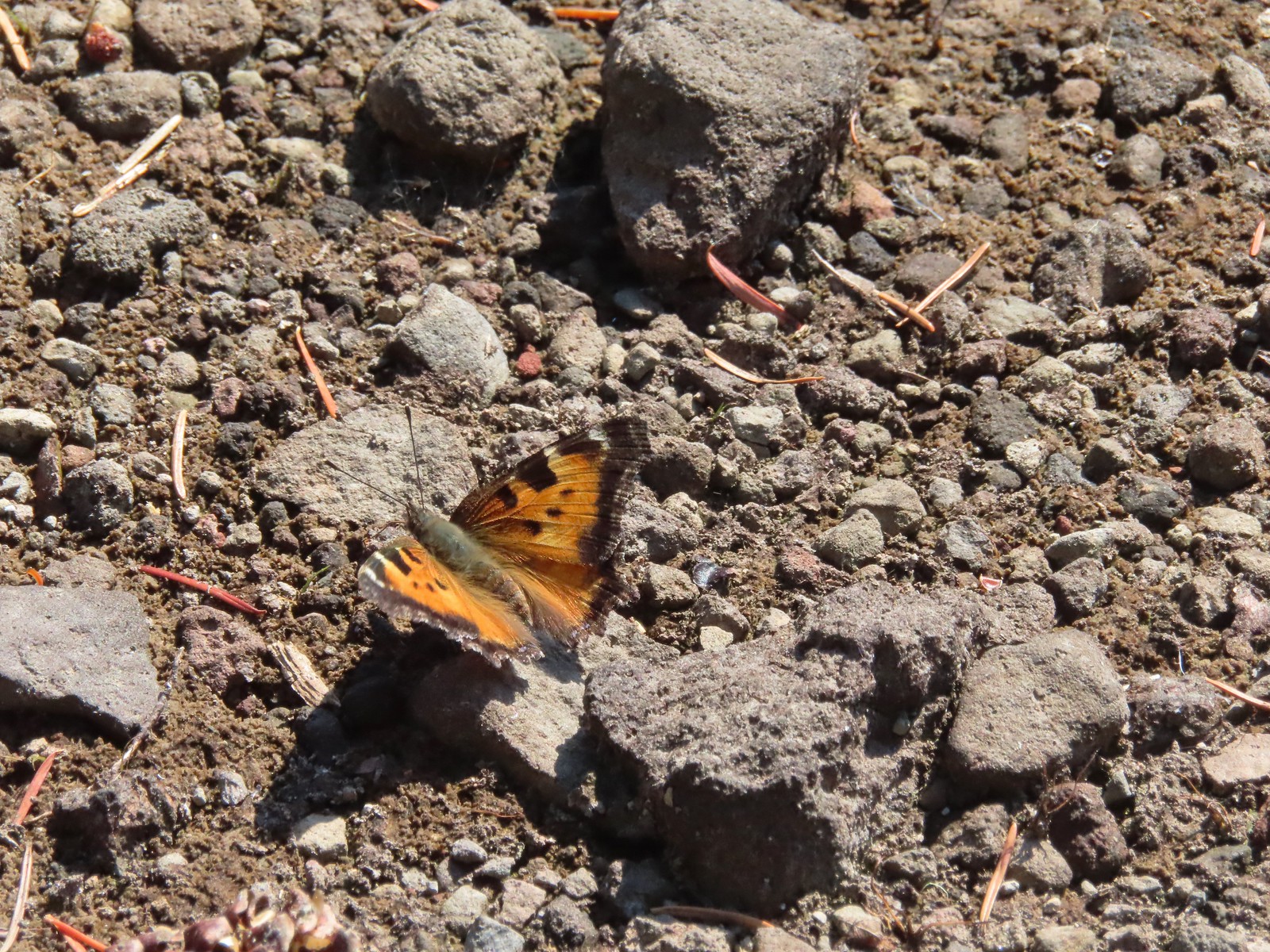
Tortoiseshell butterfly
Si Lake was the smallest of the three lakes along the Fish Lake Trail (not counting Surprise Lake) and lacked a view of any of the surrounding peaks. The day was heating up quickly and we had a nearly 900′ climb over the three miles back to the car, so we took a short break and headed back.
A few clouds formed overhead and a slight breeze kicked up during our return which fortunately kept if from feeling too hot. Olallie Butte from Fish Lake.
Black bear print along the shore of Fish Lake.
White breasted nuthatch
Lower Lake from the Fish Lake Trail.
Olallie Butte from Lower Lake.
While parts of Lower Lake are shallow it actually reaches a depth of 73′ which is the reason it is so colorful.
Arriving back at Lower Lake Campground.
This hike came in just over 6-miles and 900′ of elevation gain making this a 12-mile, 2300′ elevation gain day.
The hikes were enjoyable and offered a lot of solitude, we only saw three people (all at Lower Lake) along the Fish Lake Trail in addition to the four at Sisi Butte. Cooler temperatures and less smoke would have been preferred but it was a great outing none the less. Happy Trails!
For Labor Day Weekend we continued our focus on featured hikes from the Southern Oregon area and headed for the Rogue-Umpqua Divide Wilderness to visit several lakes. Our goal was to finish hikes #6 & 7, Fish Lake and Buckeye & Cliff Lakes respectively. To do this we planned hiking into Fish Lake from the Beaver Swamp Trailhead, setting up camp there, and then taking the Lakes Trail from there to the Buckeye and Cliff Lakes for a loop described by Sullivan visiting Grasshopper Mountain. We planned on hiking out the next day one of two ways, either by Rocky Ridge which Sullivan described as a rough route requiring route finding skills or back the way we’d come via the Beaver Swamp Trail.
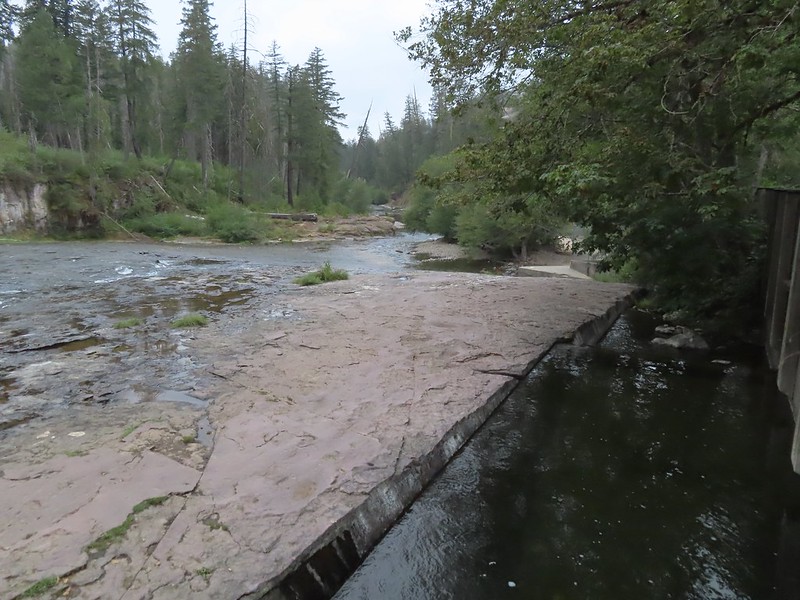
We made an unscheduled stop on the drive to the trailhead at South Umpqua Falls (We used our NW Forest Pass to cover the $5 day use fee). My Mom had mentioned a water fall along the South Umpqua River that they had not made it to during their explorations and when I saw the sign for the South Umpqua Falls picnic area I thought this might be the falls she was talking about so we pulled in for a quick peek.
We had the popular swimming area that often draws large crowds all to ourselves. We began by visiting the base of the falls then hiked up above the falls.
Ouzel
In all our wanderings here came to 0.4 miles, a good leg stretcher after having driven for a little over 3 hours. We then continued on our drive to the Beaver Swamp Trailhead which we arrived at shortly after 9am.
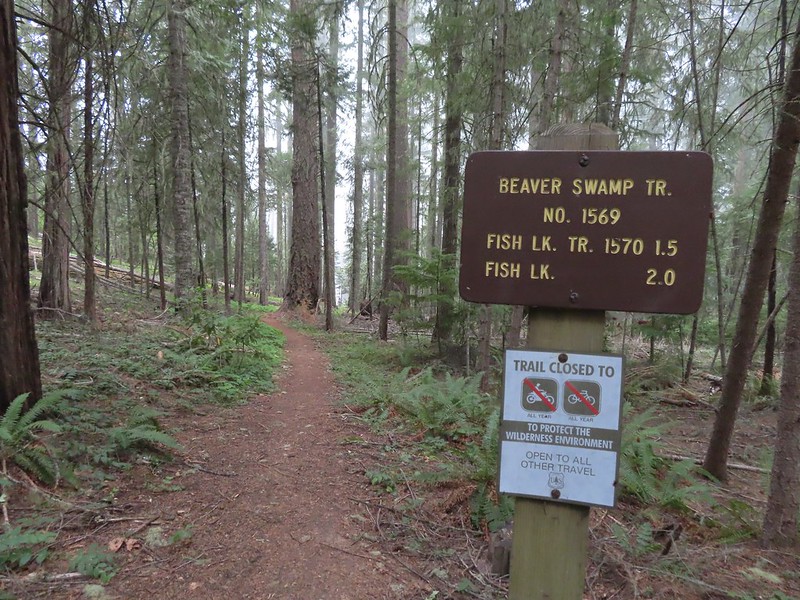
We set off downhill on the Beaver Swamp Trail which promptly entered the Rogue-Umpqua Divide Wilderness.
It was surprisingly overcast and a light drizzle was falling as we hiked through a mixed forest with madrone trees and sporadic poison oak. When I’d checked the forecast the night before it simply called for “widespread haze” with Sunday showing as sunny.
After 1.4 miles on the Beaver Swamp Trail we arrived at the Fish Lake Trail where we turned left.
This trail followed Fish Lake Creek for 0.3 miles to Fish Lake.
Small cascade on Fish Lake Creek.
Logs at the outlet of Fish Lake. The Indian Trail can be seen on the far side. This junction was unmarked and you would have to cross the logs to reach it. In theory one could take this trail to the Lakes Trail near Buckeye Lake, but as we understand it the trail does not receive regular maintenance so we did not include it in our plans.
Arriving at Fish Lake
We continued around the northern shore of the lake for three quarters of a mile passing the one other family camped at the lake along the way (more on them later). Before reaching Highrock Creek we followed a use trail uphill to locate a suitable campsite. When we passed by the campers we caught the distinct smell of campfire smoke which, as of 7/22/2022 had been prohibited in Wilderness areas within the Umpqua National Forest. (Not a good start with this group.)
The clouds began burning off before we’d found our campsite.
We set up camp on a little knoll near an old stone foundation. We’re interested to know what used to be there but so far haven’t found any information on it.
After setting up camp we returned to the Fish Lake Trail which appears to have been rerouted through a large and elaborate campsite. A little too developed for Wilderness standards.
From the large campsite the trail followed Highrock Creek for 0.6 miles to a fork. The Fish Lake Trail actually veered uphill to the left and the Lakes Trail picked up to the right. A dry channel along Highrock Creek.
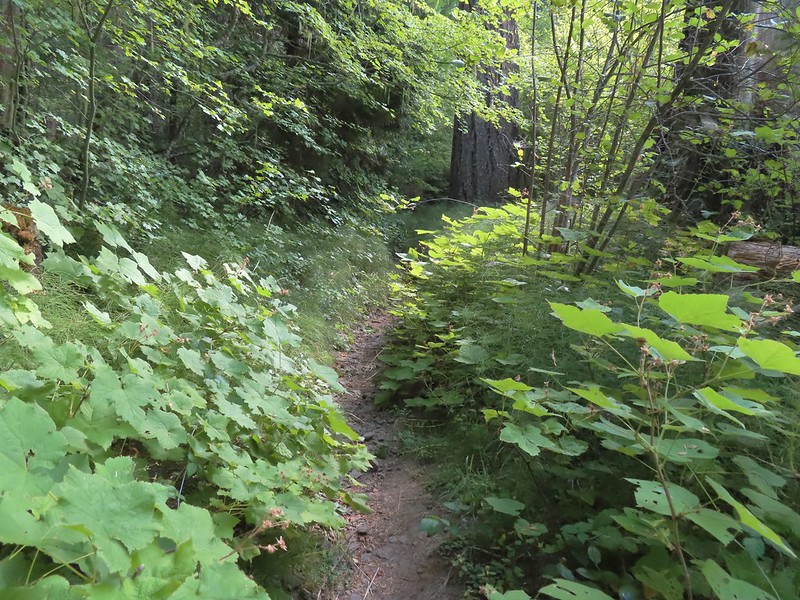
Crossing an unnamed creek.
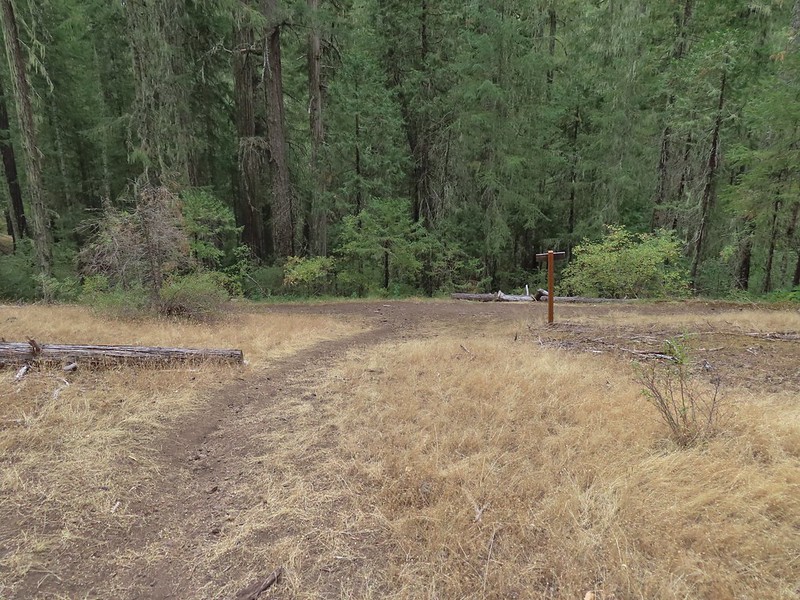
The trail junction.
Just beyond the junction the Lakes Trail crossed Highrock Creek and began a steady climb along a hillside above Fish Lake. Highrock Creek. There were several nice pools here which we utilized to replenish our water on our way back to camp.
Foam flower and a few ripe thimbleberries, Heather’s favorite.
This trail was well maintained and after approximately 2 miles we arrived at a junction with the Grasshopper Trail. A couple of things to note about this segment of the Lakes Trail. Sullivan showed it as 1.7 miles so this was a little longer than we’d expected, but more importantly the trail alignment shown our GPS unit’s topographic map had the trail quite a bit higher on the hillside. (CalTopo agrees with our actual track so it appears to be accurate.) The junction with the Grasshopper Trail
We decided to make the climb to Grasshopper Mountain before visiting the two lakes so we turned right onto the Grasshopper Trail and trudged uphill gaining 860′ in the next 1.25 miles before arriving at a junction near Grasshopper Spring.
Pine white
Sign for the Gasshopper Mountain Trail.
Grasshopper Spring is out there somewhere.
We turned right onto the Grasshopper Mountain trail. This three quarters of a mile trail climbed another 350′ to the site of a former lookout. The climb was surprisingly gradual and passed through a variety of scenery along the way. We had to go around this big tree.
A few aster
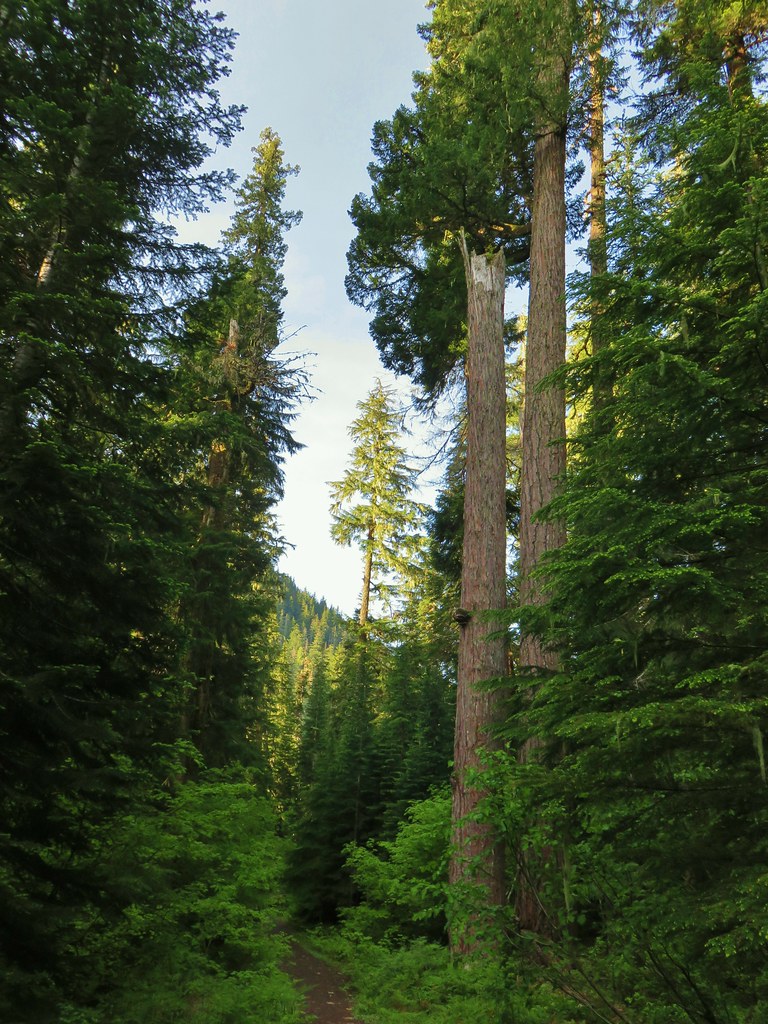
There were some good sized cedars up here.
A fritillary
Another big cedar.
Fritillary on pearly everlasting.
The final stretch to the summit passed through a fire scar.
Highrock Mountain to the left, Hershberger Mountain in the middle, and the Rabbit Ears to the right (post).
Rabbit Ears closeup.
Fish Mountain (back left), Weaver Mountain, Highrock Mountain, and Hershberger Mountain with Grasshopper Meadow below.
Highrock Mountain
Owl’s clover.
Arriving at the old lookout site.
We spent some time enjoying the view but a lack of shade (and places to comfortably sit) kept us from taking a longer break at the summit.
Buckeye (left) and Cliff Lakes below Grasshopper Mountain. The broad hump beyond to the left is Twin Lakes Mountain. We had visited a viewpoint on the north side of that mountain back in June of this year (post).
Buckeye and Cliff Lakes
Smoke on the horizon to the NW. The Cedar Creek fire to the NE, Rum Creek Fire to the SW or several fires in Northern California could be the culprit(s). The peak with the white spot to the center right is Quartz Mountain which we recognized from our Hemlock Lake hike in August (post).
To the NE we got a glimpse of Rattlesnake Mountain (far left) which we’d climbed during Labor Day weekend in 2020 (post).
Rattlesnake Mountain behind Standoff Point.
We headed back down toward the Grasshopper Trail but instead of simply retracing our steps we veered right after 0.6 miles on a spur of the Grasshopper Mountain Trail that brought us to the Grasshopper Trail on the opposite side of a saddle from where we’d left it.
A skipper
We veered right here which kept us from dropping below the saddle that we otherwise would have had to climb over on the Grasshopper Trail.
Descending to the Grasshopper Trail.
Trail sign at the other junction.
We turned right again and continued on our loop following the Grasshopper Trail downhill to Grasshopper Meadow. Grasshopper Meadow through the trees.
Sign for a (faint) spur trail to a spring above the meadow.
The Grasshopper Trail skirted the meadow and a half mile from the saddle arrived at a signed junction with the Acker Divide Trail. Highrock Mountain from Grasshopper Meadow.
A few flowers hanging on to the last days of Summer.
Common wood nymph
The trail got pretty faint just before the junction but we could see the trail sign so we just headed for it.
Fleabane? and paintbrush.
Acker Divide Trail pointer.
Pointer for Cripple Camp (we visited the shelter there on our Hershberger Mountain hike) and the Rogue-Umpqua Divide Trail.
We turned right onto the Acker Divide Trail following this trail for a total of 3.2 miles (per our GPS, Sullivan had it as 3) passing a spur to the Acker Divide Trailhead at the 1 mile mark, Mosquito Camp at the 1.4 mark, and a pond labeled Little Fish Lake in the guidebook after 2.8 miles. This appeared to be the least utilized trail that we’d been on. It was fairly well maintained but there was a lot of debris on it and vegetation crowding the trail. It also left and reentered the wilderness area a couple of times.
This fuzzy caterpillar was in a hurry.
The trail along an old log.
Passing through a small meadow near the spur to the Acker Divide Trailhead.
Yarrow and goldenrod
The area was really well signed.
Sign for Mosquito Camp on the tree to the right. There was zero sign of any established campsites here.
Meadow at Mosquito Camp, it came complete with mosquitos (not too many though).
First of two times reentering the Rogue-Umpqua Divide Wilderness.
Scat on the trail, at least we knew something used it.
One of several very small bodies of water along Skimmerhorn Creek which may or may not be Little Fish Lake.
Overgrown trail near Skimmerhorn Creek.
Looking down at the pond? lake?
As we neared the Lakes Trail we began seeing more signs of what appeared to be an ancient lava flow.
Last of the lupine blooms.
Lots of these insect tents on the madrones in the area.
Arriving at the Lakes Trail.
At the Lakes Trail we again turned right following it briefly through a fire scar before reentering unburnt forest and arriving at Buckeye Lake after 0.4 miles.
First glimpse of Buckeye Lake
At this fork we detoured right to visit the lake shore.
A good reminder that far too many people tend to forget.
Grasshopper Mountain from Buckeye Lake.
We were surprised to find that there was no one at the lake given that it’s just a mile from the Skimmerhorn Trailhead. While there were no people to be seen we were not alone. Lizard
We had to really watch our step because these little guys were everywhere.
There is an smaller, unnamed lake just West of Buckeye Lake that we did not take the time to check out closer.
From the far end of Buckeye Lake we followed the Lakes Trail 0.2 mile through the old lava flow to a spur trail on the right that led to a large campsite along Cliff Lake. Someone had left (placed) a small BBQ and tarp here but we never saw anyone.
The spur trail to the campsite.
Attempted panorama.
The campsite provided a nice shaded place for a break free of mosquitos. After a nice long break we returned to the Lakes Trail and continued another 0.3 miles to the junction where we had earlier turned onto the Grasshopper Trail. We turned left at the junction and headed back toward Fish Lake. Footbridge over the outlet creek which flows into another small unnamed lake that we did not attempt to find.
Unfortunately the lighting made this tree very hard to photograph but it was the coolest tree/rock combination that we’ve encountered.
Fritillary on thistle.
Short climb back up to the junction.
We had considered having our dinner at Cliff Lake since it was close to 5pm but we had decided against it due to being low on water and preferring to refill from one of the creeks over the lakes. We followed the Lakes Trail back to Highrock Creek where I worked on dinner while Heather refilled our water. After enjoying some Mountain House creamy macaroni and cheese we hiked the final 0.6 miles back to our campsite. This slug was heading our way while we finished dinner.
The Sun was getting pretty low as we ended our hike.
A big nest atop a tree and the Moon above Fish Lake.
Zoomed in on the nest and Moon.
Fish Lake just before 7:30pm.
We were again surprised by the lack of people, it appeared that it was still just us and the campfire family. We turned in a little after 8pm to the welcome sound of crickets. Just before 9pm someone with the campfire family decided it was the perfect time to repeatedly fire a small caliber gun. It was both jarringly startling and disconcerting. We were not sure which direction they were firing in and we had no idea if the even knew we were camped there. As the shooting continued we began to consider our options. We couldn’t hike out because we’d need to pass them and that didn’t seem safe in the dark plus we guessed that whoever it was had been drinking. (Based on the four Coors cans we passed the next morning cooling in a stream we think that was probably the case.) The other option was to move camp further back, there was a site near Highrock Creek that was closer to the water than we would normally choose but given the choice of being struck by a stray bullet of camping closer than 200′ to water we were going to pick the water. During a break in the gunfire I quickly retrieved our bear bag and moved it downhill where we could easily access it if we needed move to the creek. We settled on moving camp if the shooting started again but fortunately it did not and we were able spend the rest of the night in relative peace.
The next morning we discussed our plan for the day. Neither of us were too keen on passing by what we were now referring to as the “mouth breathers” but we also both had the sneaking suspicion that the previous days hike was longer than the 13 miles we had come up with adding the distances in Sullivan’s book together. In the end though we both felt like we’d regret not trying the longer (and more elevation gain) return via Rocky Ridge. We decided that we would go ahead and give it a try knowing that we always had the option of turning around and hiking out the way we’d come in on the Beaver Swamp Trail given it was less than 2.5 miles to the trailhead from our campsite that way. We packed up camp and headed for Highrock Creek to top off our water. Campsite after packing up in the morning.
Passing our planned route for the day on the left. Highrock Creek was just a 20 yard detour to the right.
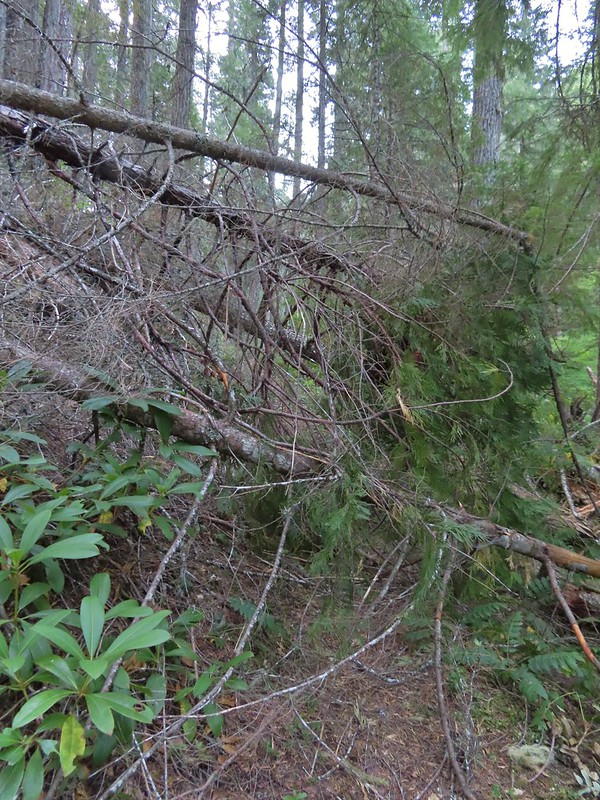
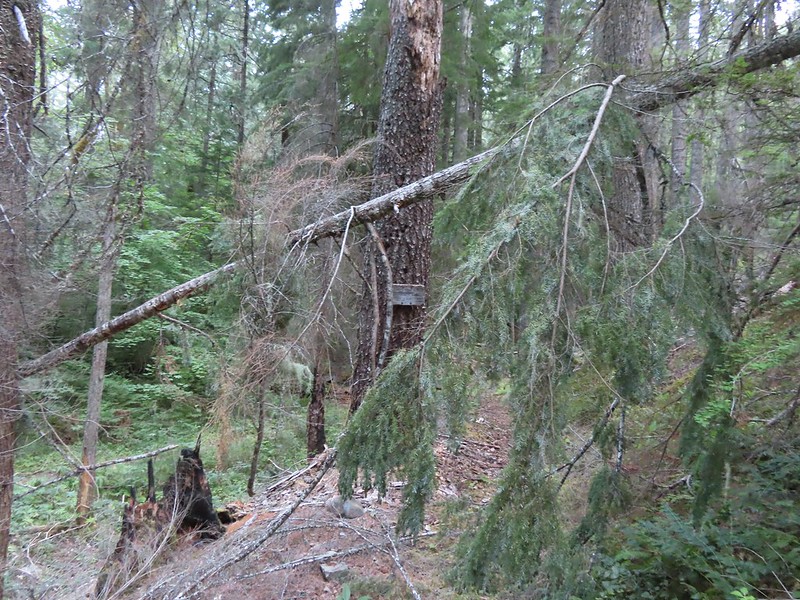
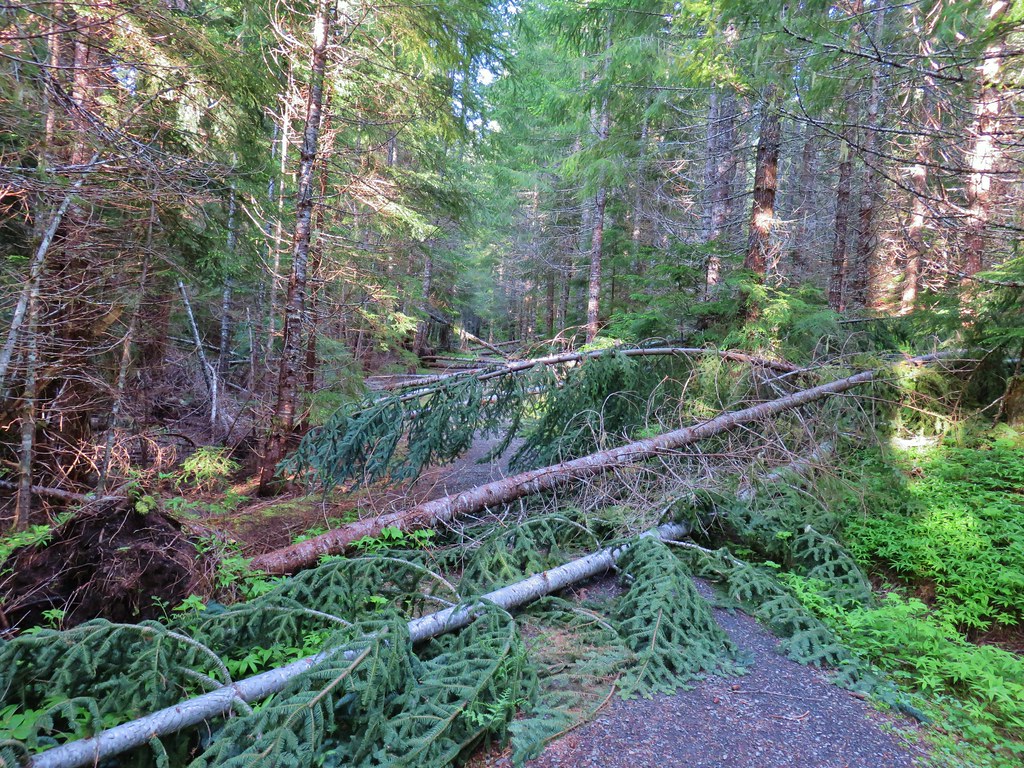
After replenishing our water supply we started up the Fish Lake Trail which climbed nearly 2200′ in three miles to its end at the Rogue-Umpqua Divide Trail near Highrock Meadows. This section of the trail had many signs of the 2017 Pup Fire scar which is the main reason we were uncertain whether or not we would be able to make it back to the trailhead this way. There were some signs of post fire trail maintenance, but we weren’t able to even make it a half mile before encountering a very large downed snag blocking the trail. It was too tall and at too steep of an angle to safely climb over and there wasn’t enough clearance to go under (we’d already done both options on other downed trees). The steep hillside was covered in downed trees and the fire had left the ground unstable making scrambling around too risky for our taste so we called it there and made our retreat. I think this was the third obstacle, one of several that was easy enough to get over.
Prior maintenance, the second log may have been cut post fire?
End of the line for us. Even if we somehow got around this one there was still 9.5 miles of burned trail from the trailhead and who knew how many obstacles like this one we might encounter or how long it would take us if we somehow were successful.
We had the privilege of navigating this one twice. Heather is on the other side coming through.
Back at the junction.
From the junction it was just under three miles back to the car. We hustled past the mouth breathers who seemed to still be asleep and said goodbye to Fish Lake. No clouds this morning.
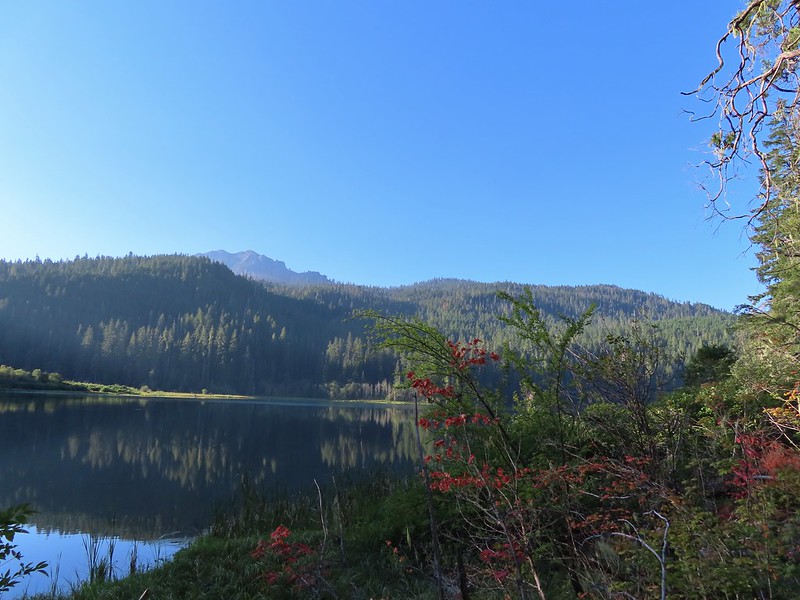
Highrock Mountain behind Fish Lake. Seeing the vine maples turning colors reminded us that despite the heat Autumn was just around the corner.
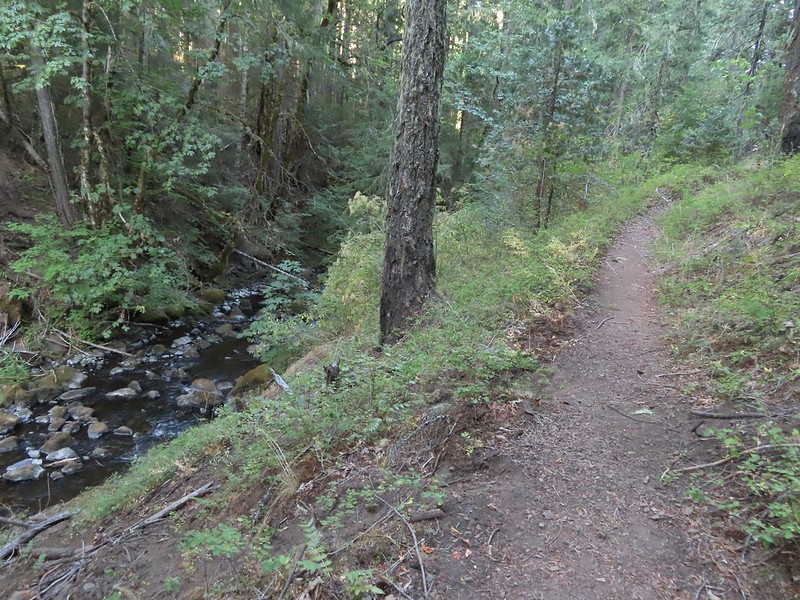
Hiking along Fish Lake Creek.
Highrock Mountain from the Beaver Swamp Trail.
Leaving the Rogue-Umpqua Wilderness for the last time this trip.
Our suspicions about the length of our hike on Saturday were confirmed by our GPS showing a distance of 16.4 miles with approximately 3200′ of cumulative elevation gain.
Our tracks for the weekend. The solid light blue line was our attempt to reach Rocky Ridge
Given the previous days hike and how warm it was by 9am it was probably for the best that we were turned back from the longer return as quickly as we had been. It had been a bit of a mixed bag with some good weather, nice scenery mixed in with the gunfire and not being able to hike out via Rocky Ridge but overall it had been enjoyable. (Click here for a look at the Rocky Ridge route pre-fire courtesy of Boots-on-the-Trail.)
At the trailhead we encountered a Forest Service employee who had just arrived for a two night stay at the trailhead. They were there to perform a survey of recreation users so we spent about 10 minutes answering the questions before heading home.
Unfortunately for us our adventure wasn’t over. If you’ve been following our blog this year you’ll know that we’ve had the low tire pressure light come on three different times, each one a long way from home (Siskiyou Gap, Black Butte Trail, and Russian Lake) due to a nail, a screw, and a rock. The latter leaving us with a flat tire near Callahan, CA and requiring a purchase of four new tires. This time just outside of Roseburg instead of the low tire pressure light half our dashboard lit up. All at once the check engine light came on, the X-mode indicator began blinking, and the Eye Sight unavailable lights all came on. After further review it appears that when the check engine light comes on those other systems are disabled prompting those indicators to come on. Regardless it was a Sunday and we were over a hundred miles from home. We kept a close eye on all the gauges for the rest of the drive and will have to wait until the Tuesday after Labor Day to make an appointment to have the car checked out. What I wouldn’t give for a Star Trek transporter. Happy Trails!
On Tuesday a change in the weather had pushed much of the smoke away from Steens Mountain which is what we had hopped would happen in anticipation for our drive up the Steens Mountain Loop Road on Wednesday. The shift in weather also brought cooler temperatures which had made the previous days hike at Big Indian Gorge one of the more comfortable (temperature wise) of the year thus far. We once again got an early start hoping to reach the first of four planned stops around 6am and immediately realized that it was a lot cooler than it had been Monday or Tuesday. In fact the car was showing 39 degrees when we set off. Since the Steens Mountain Resort where we were staying was located along the Steens Mountain Loop Road we simply left the resort and turned right driving past the entrance to the Page Springs Campground and gradually climbing up the fault block Steens Mountain. By the time we arrived at the left turn for our first stop the Kiger Gorge Viewpoint 19.1 miles beyond the Page Springs Campground the temperature was down to 30 degrees. Luckily we try and come prepared so we had jackets, Buffs, and gloves although in hindsight we could have been a little more prepared. There was a decent breeze which made it feel a lot colder than 30 degrees.
The Kiger Gorge is one of 5 glacier carved valleys on Steens Mountain and is the largest and most scenic. We were fortunate to arrive just before some clouds moved in.
Still some smoke to the east as shown by the red Sun.
Here come the clouds.
With the clouds moving in we hustled back to the car and continued on the loop road another 2.7 miles to a four-way junction where we turned left at a pointer for the East Rim Viewpoint where the clouds had not yet reached.
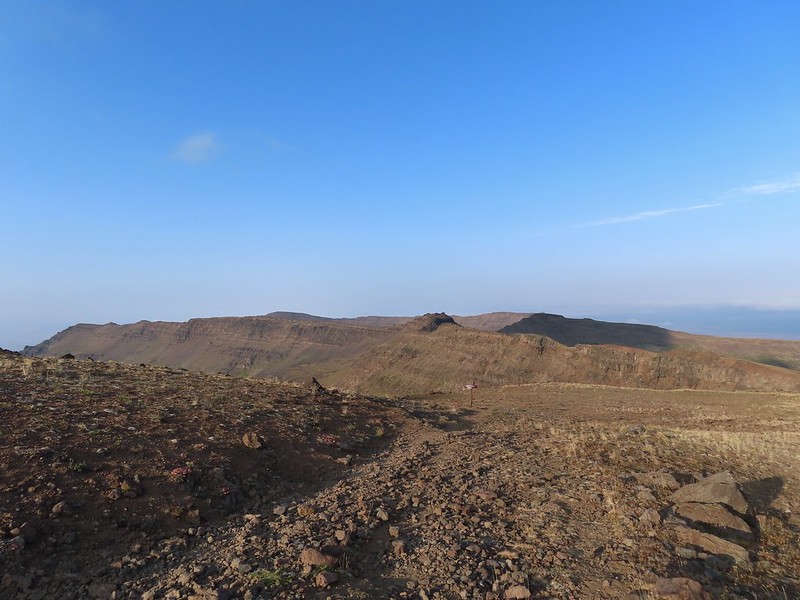
Between the Sun and haze it was hard to see much of the ragged eastern side of Steens Mountain or the Alvord Desert (post) below.
Frozen thistle
The Alvord Desert through the haze.
A look back at the parking area.
After checking out this view we returned to the 4-way junction and turned left at a pointer for Wildhorse Lake following this road for almost two miles to a parking area below the 9741′ summit of Steens Mountain. A gated road led uphill the final half mile to some towers on the summit.
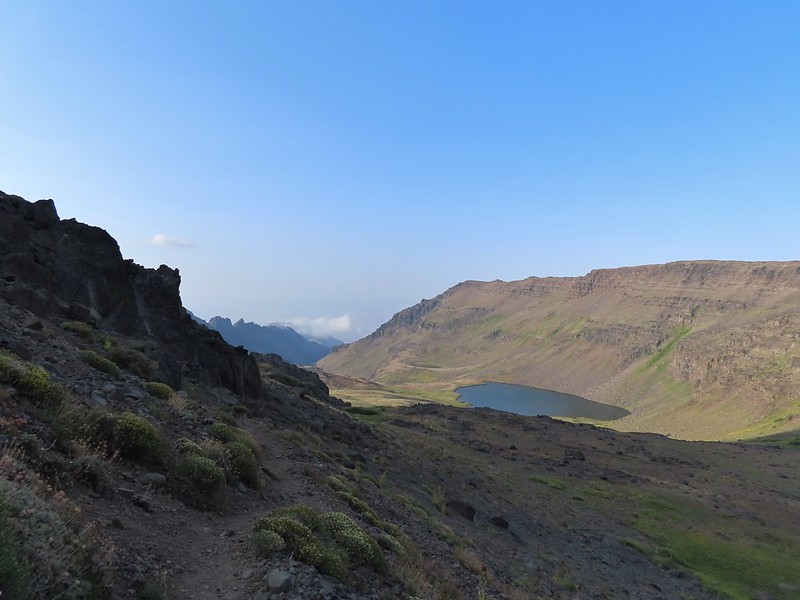
Wildhorse Lake below the summit.
The rocks here provided a little protection from the freezing wind.
After checking out the summit we walked back down past the gate and turned left at a post on a trail heading downhill to a registration box.
The trail split here with the left hand fork heading downhill for a mile to Wildhorse Lake. The tread was a little dicey near the top but soon became better as it switchbacked down to a small bench before steepening quite a bit along a small stream. Typical tread near the top.
Buckwheat
The bench.
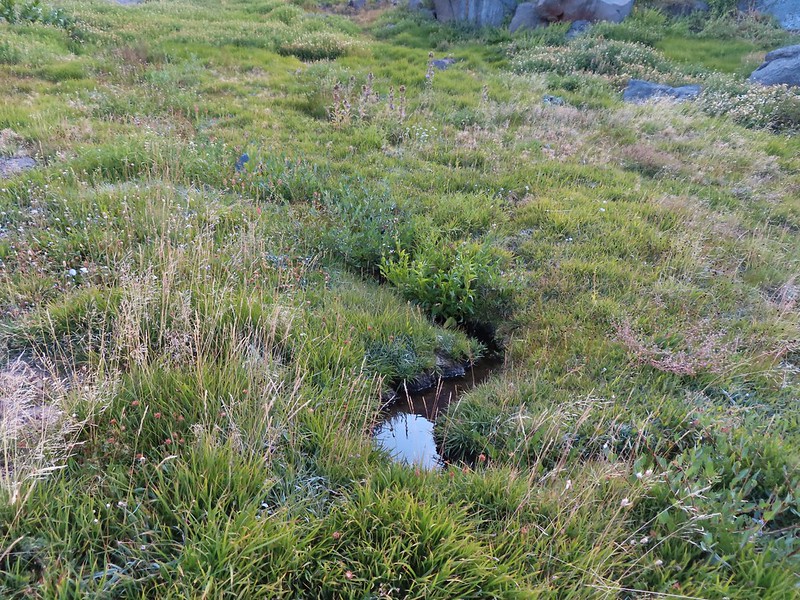
The small stream.
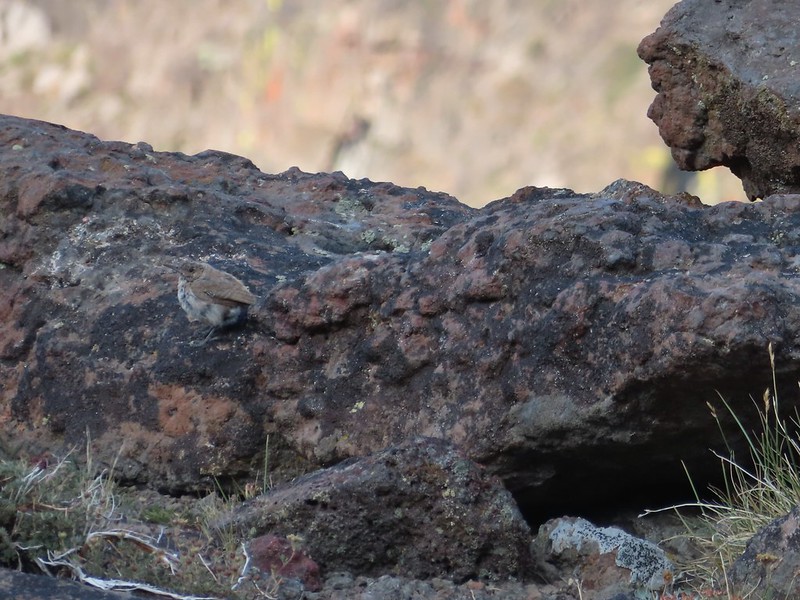
A wren.
Wildhorse Lake from near the end of the bench.
We were a little disappointed to see just how late we were for most all of the wildflowers. I don’t know how much the drought this year affected the timing or if it blooms that much earlier in SE Oregon but the remains of what looked to have been an excellent display were all we were left with.
A few stone steps began the steep descent along the stream.
A few of these little yellow flowers were still in bloom.
This was a mass of pink monkeyflower a few weeks ago.
A look up at the summit.
The trail descending less steeply to the lake.
A lone lupine blooming near the lake.
A pair of paintbrush and the remainder of some aster or fleabane.
A ground squirrel near the lake.
We rested for a bit by the lake where there was thankfully not much of a breeze and then explored along the shore.
The only pink monkeyflower blossom we spotted.
Ranger buttons
Mountain coyote mint
Cascade grass-of-parnassus
Gentians
Wildhorse Creek
Looking down along Wildhorse Creek.
Wildhorse Lake and Steens Summit.
After checking out the lake we started back up the trail as a few more clouds began to move in.
Rockfringe willowherb
Raptors soaring above Steens Mountain.
When we had both reached the registration box we took the other trail fork downhill. Sullivan shows this unofficial trail leading to a pass above Little Wildhorse Lake after in a mile but mentions having to use your hands in an update on his website Oregonhiking.com but that “adventurous hikers should have no trouble”.
Big Indian Gorge
The summit from the unofficial trail.
The trail on the ridge.
Looking ahead at the ridge the rocky outcrop looked a bit intimidating.
The view out over Big Indian Gorge.
Wildhorse Lake
After a small saddle the trail came to the final rock fin along the ridge and I followed some clear tread along the left side of the outcrop.
In hindsight the correct route was probably up onto the top of the ridge and the right hand side was a very steep loose rocky slope because the path I was following just ended at a small slide.
I turned back here, I’m not that adventurous.
I retraced my steps and met Heather at the small saddle. She was not liking this little trail and at that point neither was I. Between the cold, incoming clouds, and steady breeze we decided we’d seen enough and retreated back to the trailhead. Darker clouds over the summit from the trailhead.
Our hike here came to a little over 6 miles with approximately 1400′ of elevation gain.
Track for Steens Summit
We drove back the way we’d come instead of completing the loop. Two reasons, the final downhill stretch to South Steens Campground was reportedly rough and recommended for 4×4 high clearance vehicles (In fact the folks at the resort recommended going counter-clockwise and driving up from that side if we were going to drive the loop) and we had a low tire pressure light on. It had come on when we’d driven over a cattle guard that morning which we were hoping was simply due to the cold temperatures but we didn’t want to try driving a rougher road in case. Going back the way we’d come would also gave us an opportunity to stop at the viewpoints again if the conditions looked better. The East Rim Viewpoint was in the middle of the clouds though so we drove on by but did detour to the Kiger Gorge Viewpoint again. We did stop along the way to take a couple of photos.
Our planned hike for the next day was up this gorge.
The view was a little better and a little warmer at Kiger Gorge.
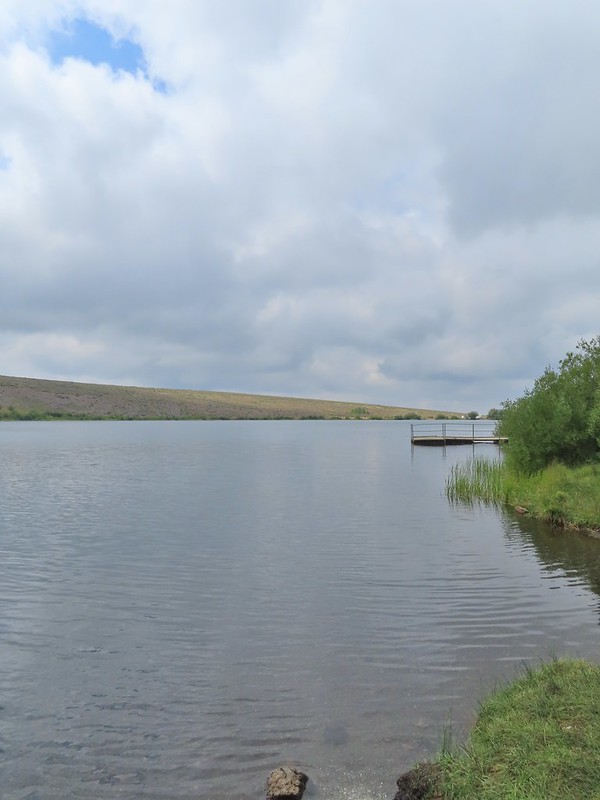
We made one final stop on the way back to the resort by pulling into Fish Lake (5.7 miles from the turn for the Kiger Gorge Viewpoint). There is no hike here but we wanted to see the lake.
The tire pressure light was still on when we got back to the resort so after showering we made the hour plus drive north into Burns to visit Les Schwab. Ironically we had had to stop in this same Les Schwab the last time we were in the Steens area due to a low tire pressure light in our Rav 4. That turned out to be a nail stuck in the tire but this time it was simply a low reading in the right rear tire. They made sure there was nothing stuck in it and that it wasn’t leaking and they had us back on our way in no time. We really appreciate the service we get from every Les Schwab we visit. It was a nice evening at the resort and the clouds made for a dramatic setting Sun.
This was our final night here and we’d be leaving early the next morning to hike along the Little Blitzen River before driving on to Fields (and getting milkshakes). Happy Trail!
Our vacation week had a theme going, multiple stop days, and we continued that on Friday with a three stop day to check off another of Sullivan’s featured hikes – Echo Basin. Actually the hike was no longer one of Sullivan’s 100 featured hikes in the most recent edition of his Central Oregon Cascades guidebook, but it was a featured hike in the 4th edition which is the one that we are using in our attempt to hike all of his featured hikes (post).
We began our day by stopping at the Hackleman Old Growth Grove Trail for a short 1 mile loop. The convenient trailhead is right off of Highway 20 near milepost 67. There is also a loop option that is marked as wheelchair friendly although on our visit there were a number of downed trees that said otherwise.
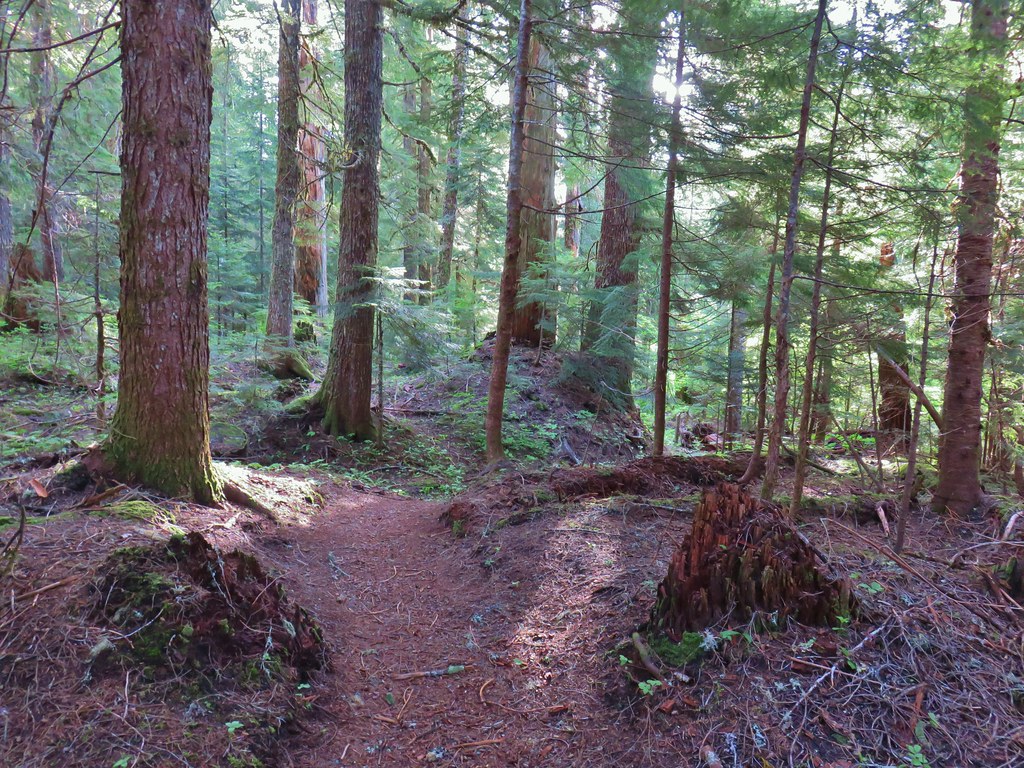
The wide trail led into the forest and quickly split.
We stayed right here and soon encountered our first downed trees.
The trail descended a bit toward Hackleman Creek to a junction where two trails joined from the left. The first was the wheelchair accessible continuation and the second was not.
The wheelchair friendly path.
The hiker path.
It was at this point that we realized that we probably shouldn’t have stayed right at the first junction. As we turned onto the hiker path we began seeing numbered posts for an interpretive trail. (There were no brochures or anything to tell us what the numbers represented.) The hiker trail.
A short side path took us to the bank of Hackleman Creek.
Western meadowrue
Mushrooms on a log.
We met back up with the middle trail at another signpost and could see more numbered posts down that trail which reinforced the idea that we should have taken the middle trail and returned on the hiker trail (based on the numbers of the posts we passed).
In any event it was a nice little hike and a good leg stretcher/warm up for our next stop at Echo Basin.
The Echo Basin Trailhead was 2 miles up Forest Road 055 which was just .3 miles east of the Hackleman Grove Trailhead. There was a fairly deep channel in the road a tenth of a mile or so from the actual trailhead that could prove difficult for lower clearance vehicles (we saw one car parked at a pullout just before it on our drive out). Echo Basin Trail at FR 055.
This hike is a lollipop climbing an old logging road for a half mile then starting the loop at the .7 mile mark at a foot bridge over Echo Creek. Rocky start to the trail.
Trillium
Just before the start of the loop we arrived at a green meadow that wasn’t very far along with most of the plants still early in their growth cycle.
We worried that we had come too early for the wildflowers higher in the basin. More trillium along the meadow.
Swallowtail on salmonberry blossoms.
Start of the loop.
We crossed the creek and spotted a rabbit hiding in the brush.
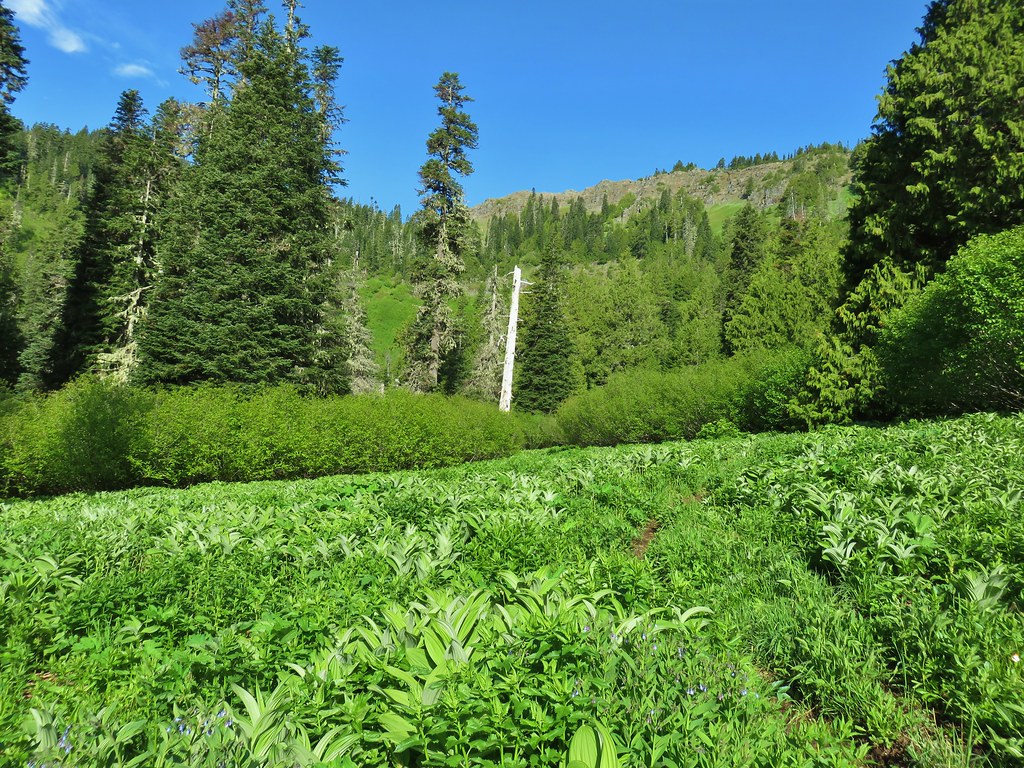
The trail climbed and entered the start of the meadow that fills Echo Basin.
Orange tip butterfly
We were starting to see a few more flowers as we began to get into the meadow. Bleeding heart
Violets
Fairybells
Royal Jacob’s ladder
Western meadowrue
The further into the meadow that we got the wetter the ground became. Near the first of a series of short boardwalks there was a great display of shooting stars and buttercups.
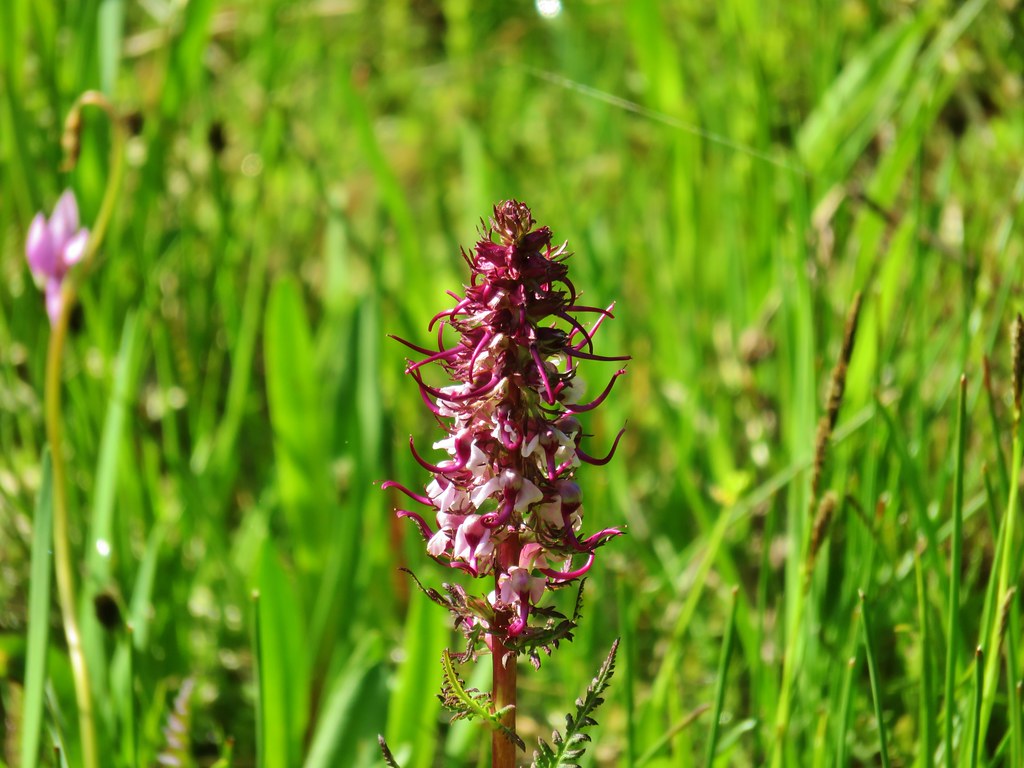
There were also a number of elephants head beginning to bloom.
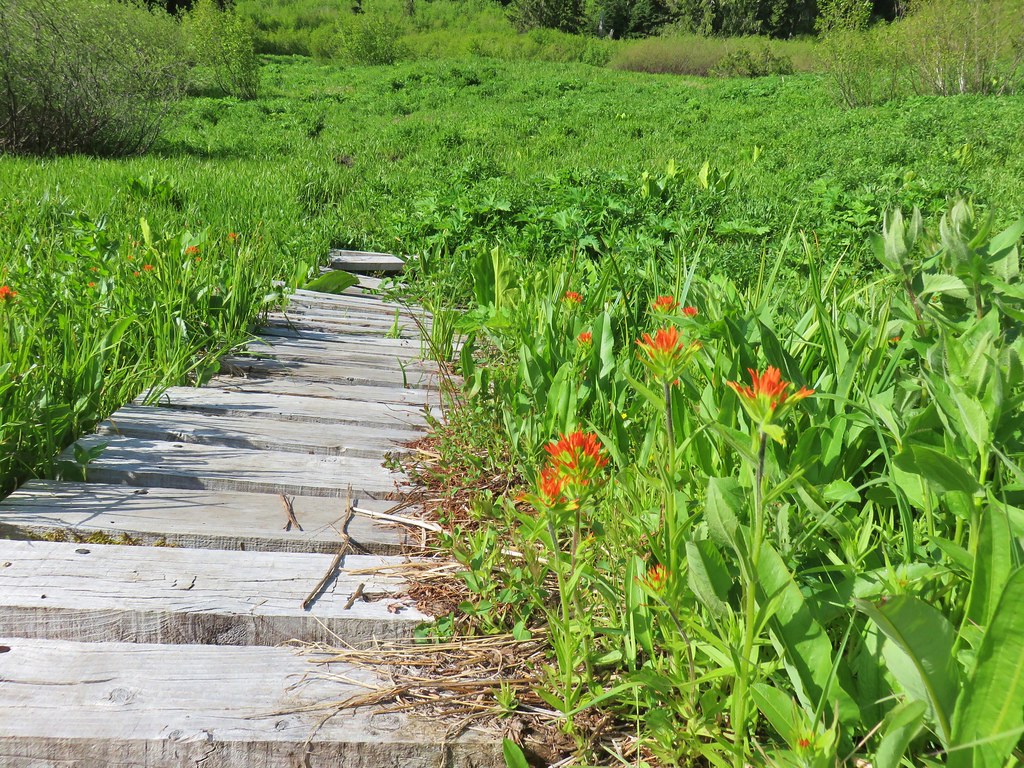
The boardwalks helped a bit but in between the gaps the ground was muddy and wet. A perfect mixture for frogs.
Paintbrush
Frog
Looking back at the route through the meadow.
We left the meadow and dropped down to the footbridge to complete the loop then returned to the car. We passed a few hikers on their way up to the basin and these would be the only people we would encounter all day.
From the Echo Basin Trailhead we returned to Highway 20 and continued east 2.2 miles to Hackleman Creek Road (FR 2672) on the right for our third stop of the day along the Old Santiam Wagon Road. The wagon road crosses FR 2672 about a hundred feet from the highway and there is an unmarked trailhead down a short dirt road on the left. The trailhead off of FR 2672.
There was an amazing patch of coral root at the trailhead.
We walked past a green gate and found a post indicating that this was the Old Santiam Wagon Road.
This was a deviation for Sullivan’s hike description as he would have you start at the Fish Lake Day Use Area but the entrance to the day use area remains gated due to COVID-19. From this trailhead we could follow the wagon road 2.2 miles to the Pioneer Grave and Fish Lake. There wasn’t a lot to see along the way, a few scattered flowers was about it. The road was in fairly good shape with a few downed trees near the beginning but as we got closer to Fish Lake it was obvious that there had been some clearing done. Iris
Beargrass
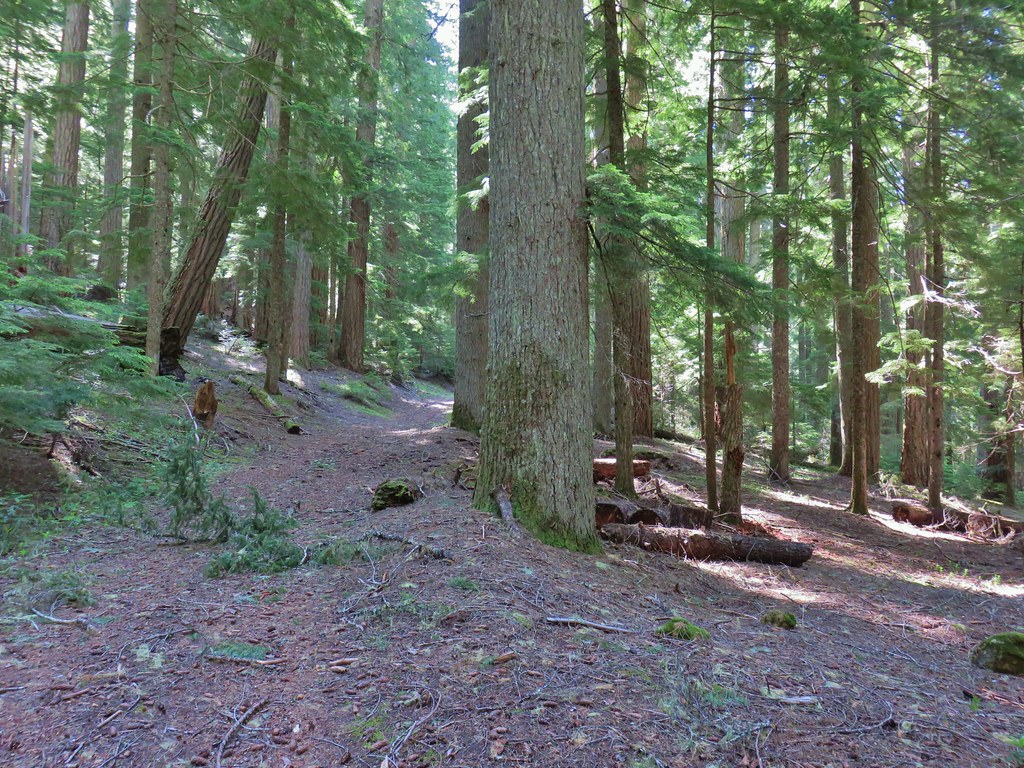
Santiam Wagon Road
Bunchberry
Musk monkeyflower
We stopped at the grave site where there is a semi-obstructed view of the Three Sisters.
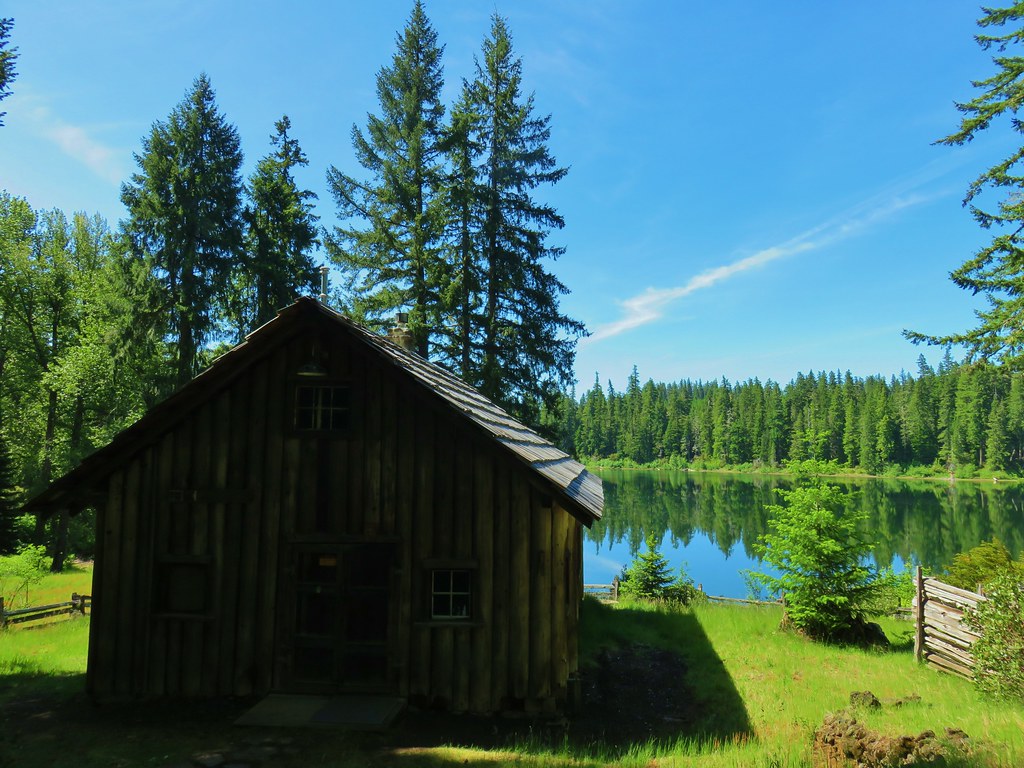
Just beyond the grave site is the Fish Lake Remount Station which served as the headquarters of the Santiam National Forest in the 1910’s. Two cabins are available for reservations in Winter. We were not entirely sure of the status of the area as I mentioned before the Forest Service website mentioned that the Day Use are gate was still closed, but the Day Use Area was .4 miles from the grave site and there were no signs indicating that the remount station was off-limits. We followed the wagon road through the station but avoided using or touching any facilities. Hall House
Commissary Cabin
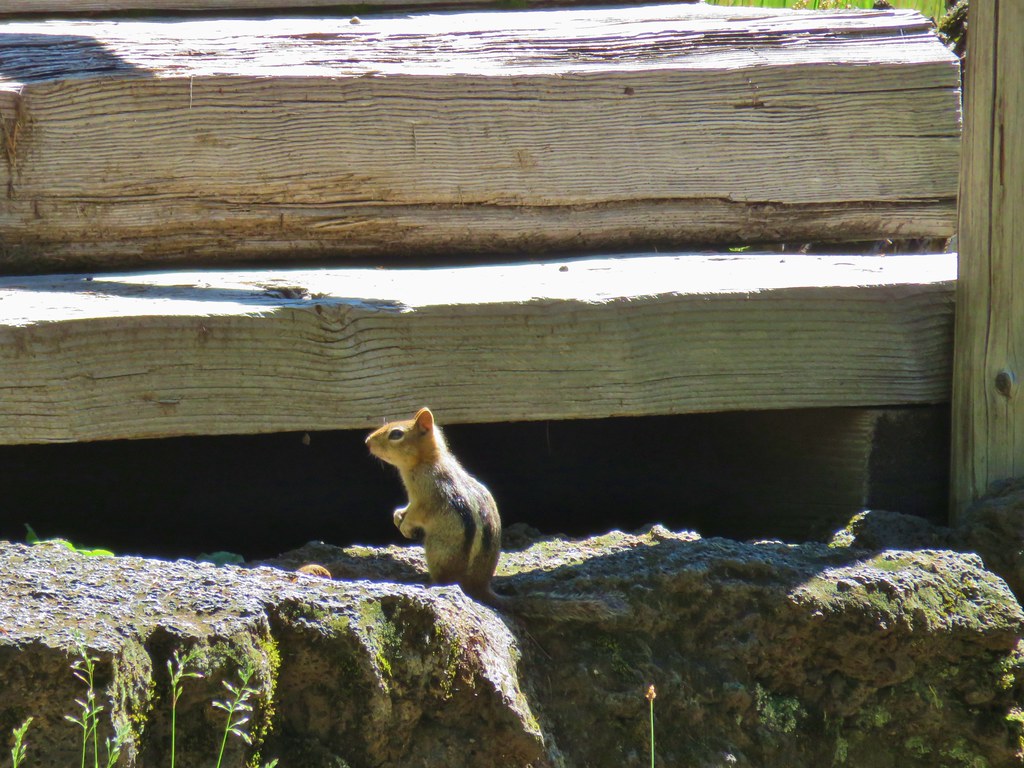
Commissary Cabin innkeeper?
More from the remount station
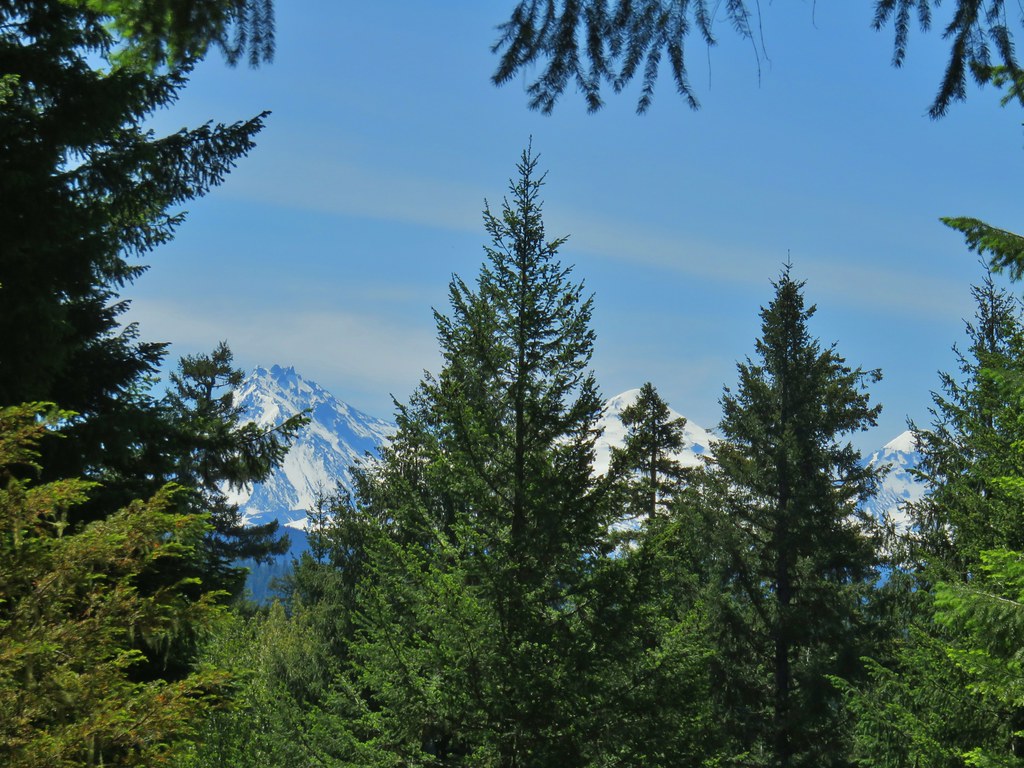
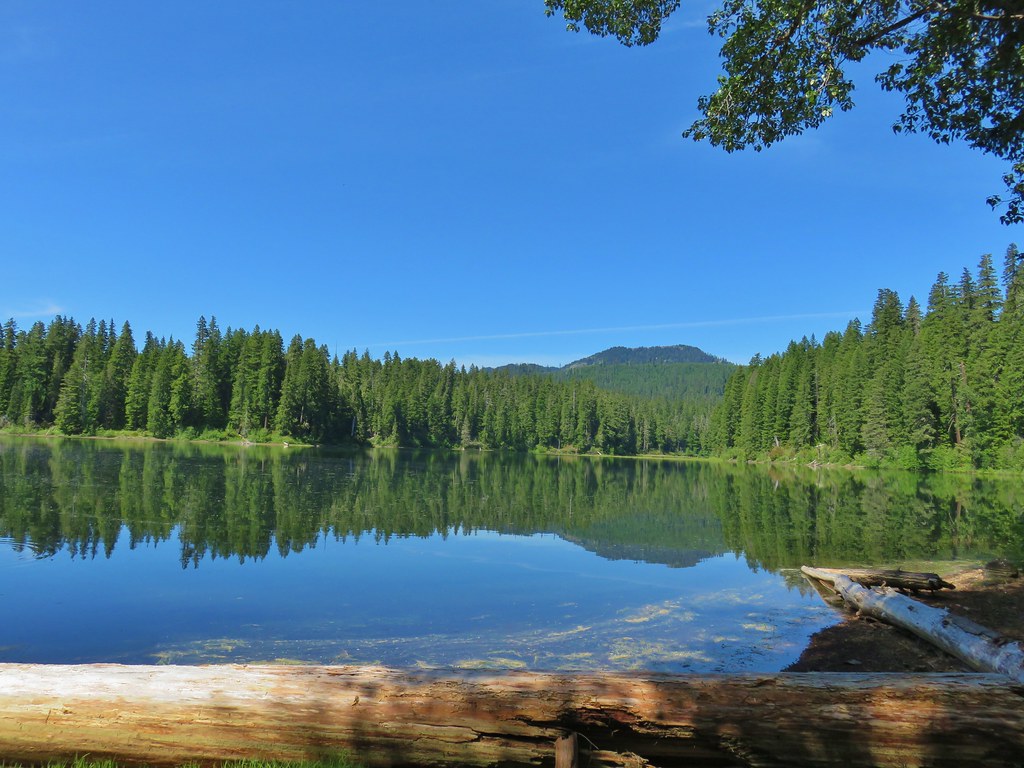
Fish Lake dries up annually leaving a meadow but there was a good amount of water present and we spotted a couple of kayaks or paddle boards across the water. Browder Ridge (post) looming above Fish Lake.
Interpretive signs for the remount station.
An old lava field sits between the station and the day use area which we walked through until we could see the day use area (where there was at least one car and no gate, curious.
We returned the way we’d come for a 5.2 mile out-and-back giving us a grand total of 8.6 miles for the day (1.1 at Hackleman Grove and 2.1 at Echo Basin). Despite the hikes being very close to one another they each had a different feel making for a fun and interesting day. Happy Trails!
Sunday of Columbus Day Weekend was the only day of the four where the forecast in the Cascade Mountains looked promising so on that morning we headed west from Klamath Falls on Highway 140 to visit a pair of lakes near Mt. McLoughlin.
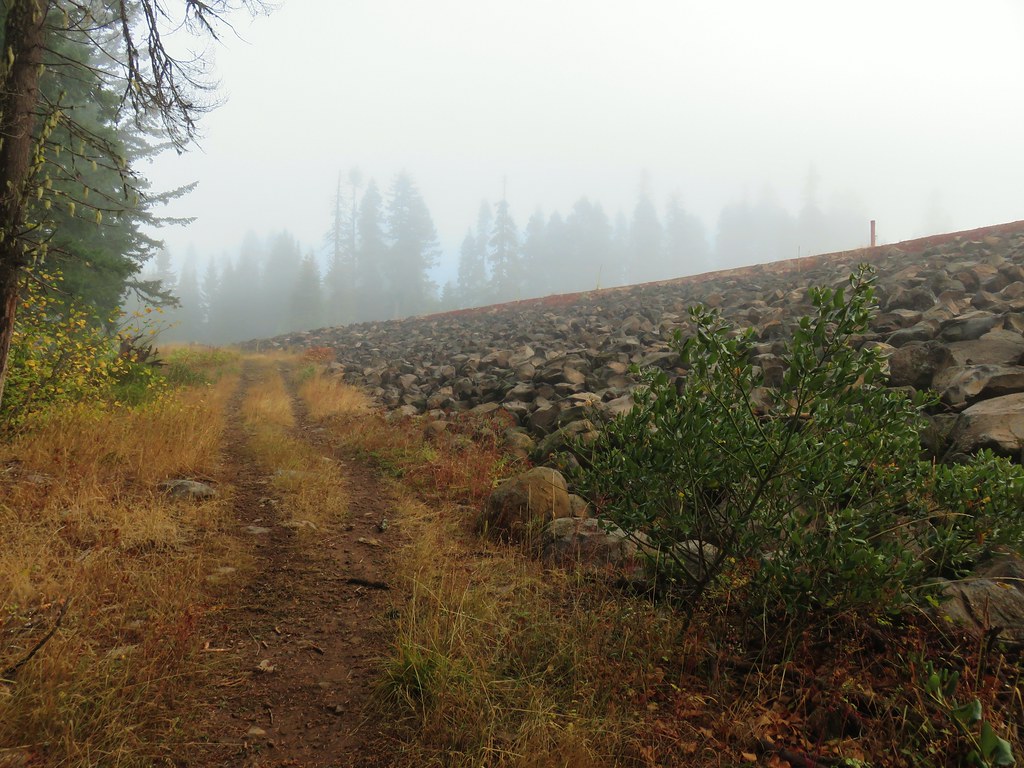
The skies over Klamtah were pretty much clear as was the case for most of the drive, but as we crossed over the Cascade Crest we found ourselves in a fog bank. We turned off the highway at sign for the North Fork Campground between mileposts 28 and 29. We parked at a small trailhead parking area a half mile down this road on the left.
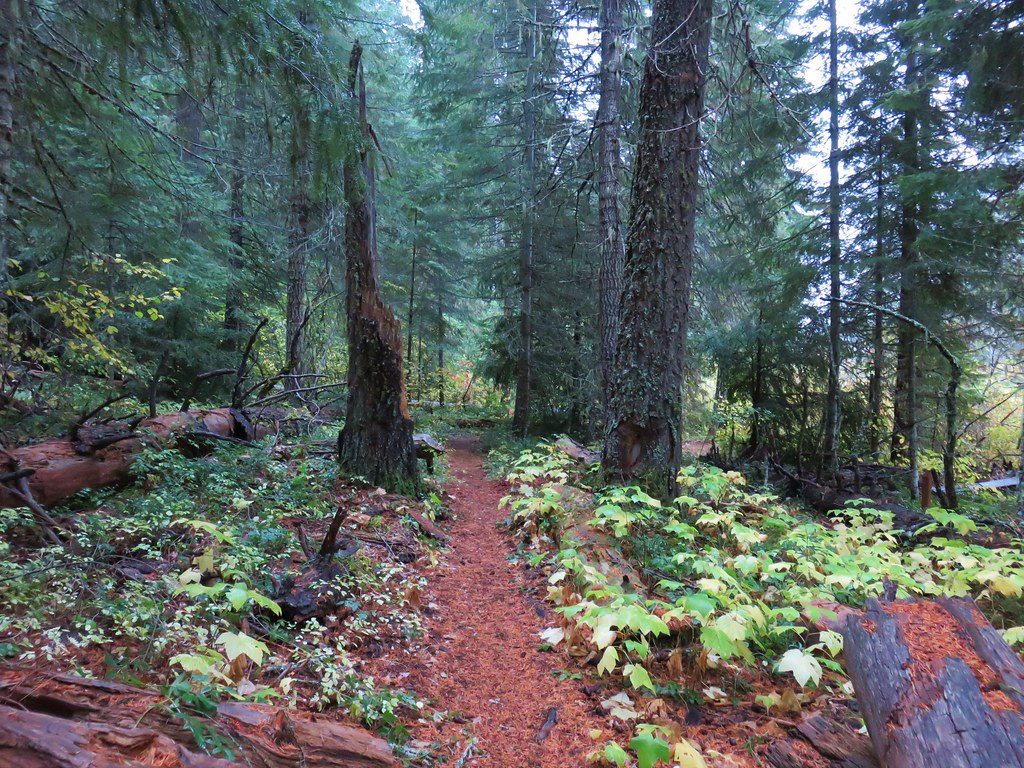
It was a chilly morning in the fog as we set off on the Fish Lake Trail, but it wasn’t raining.
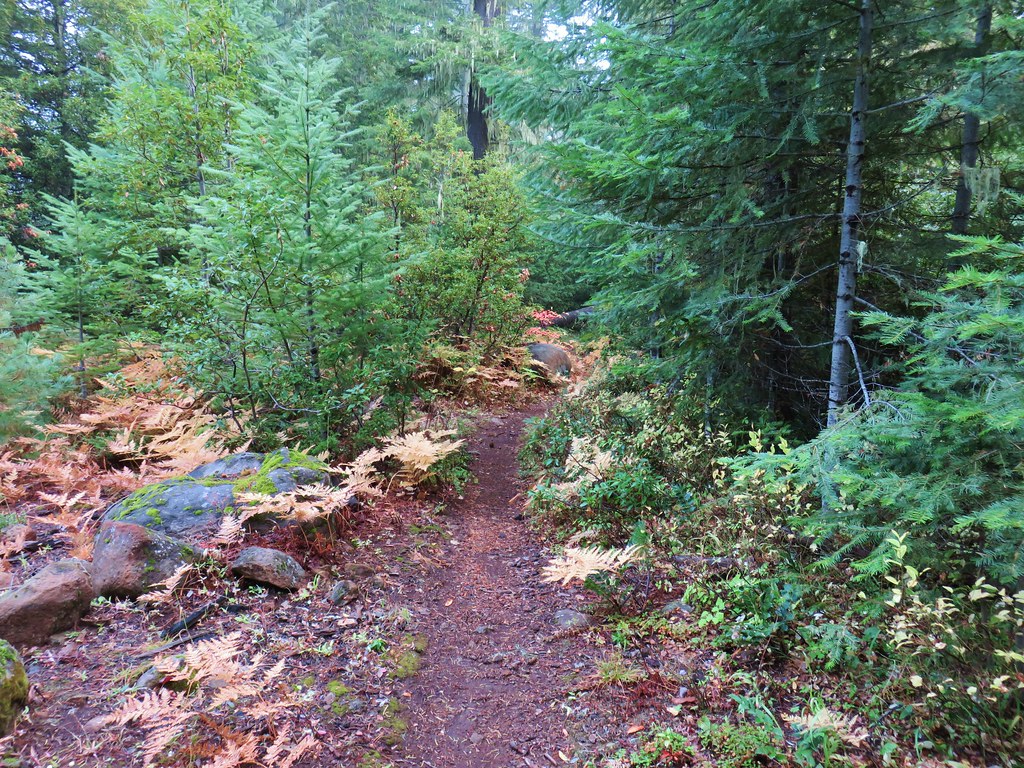
The trail began by passing through a nice fir forest with occasional views of North Fork Little Butte Creek.
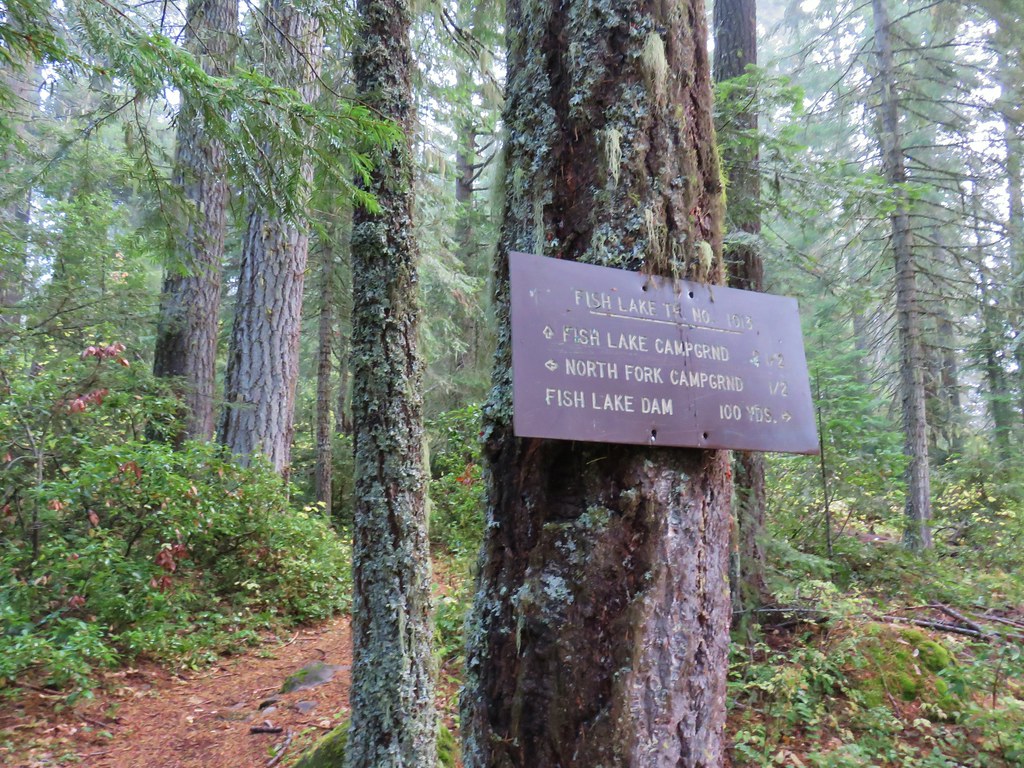
After .6 miles we came to a signed spur trail which we followed 100 yards to the Fish Lake Dam.
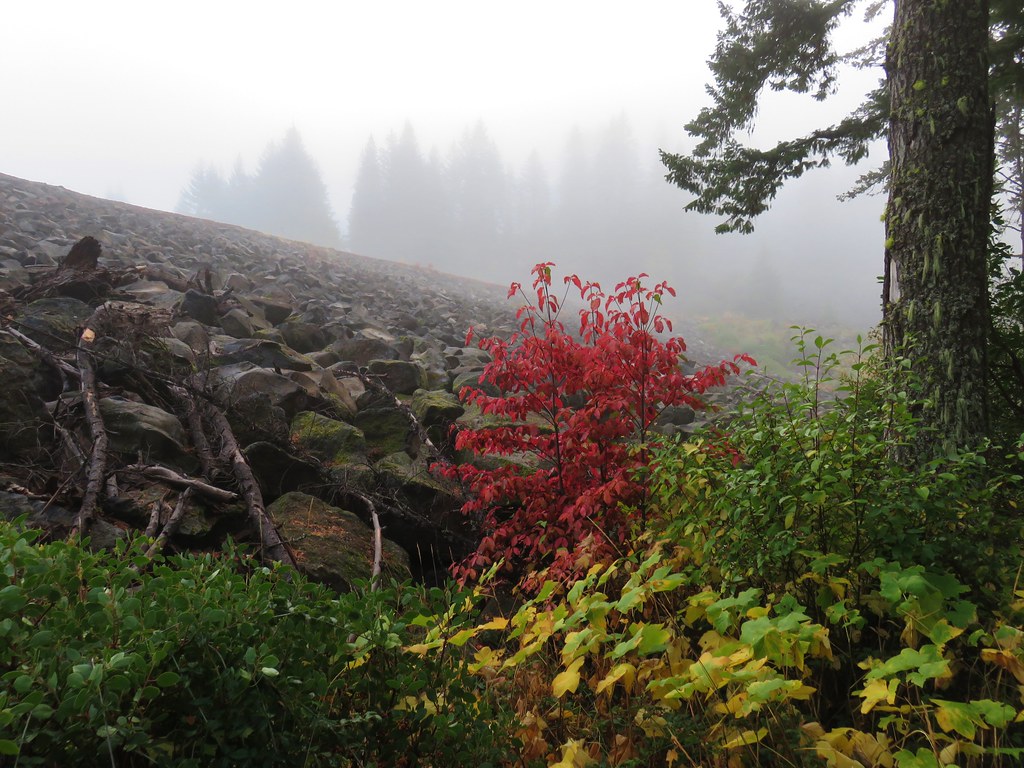
For the better part of the next mile the Fish Lake Trail veered away from the water as it curved around some private summer homes.
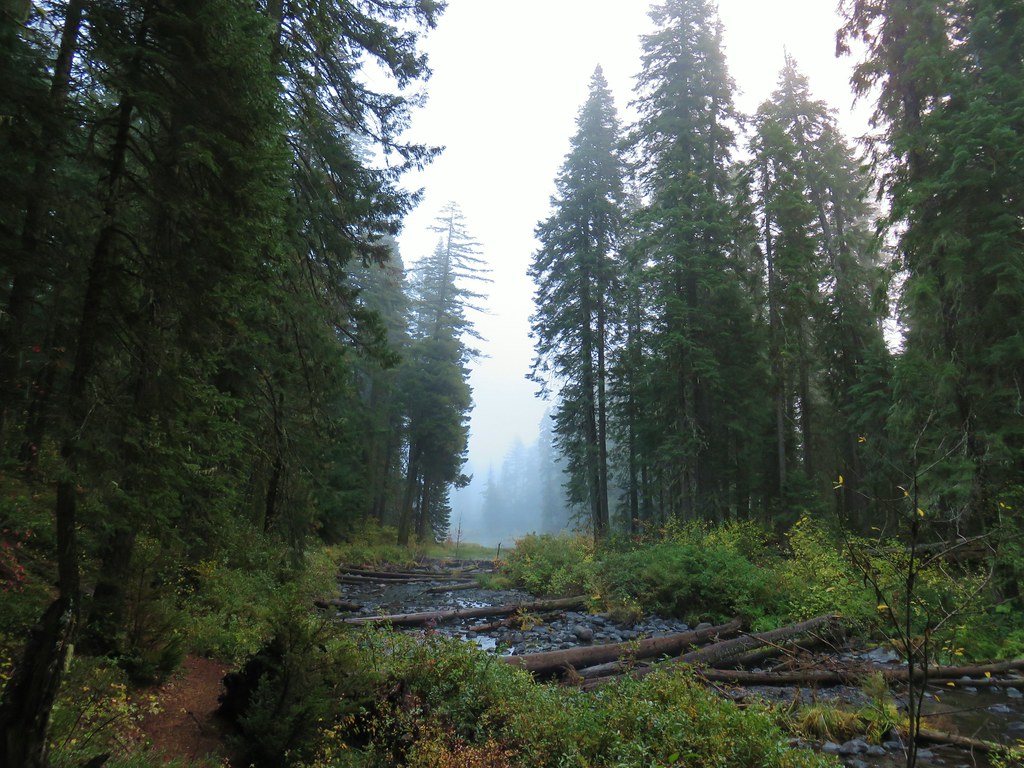
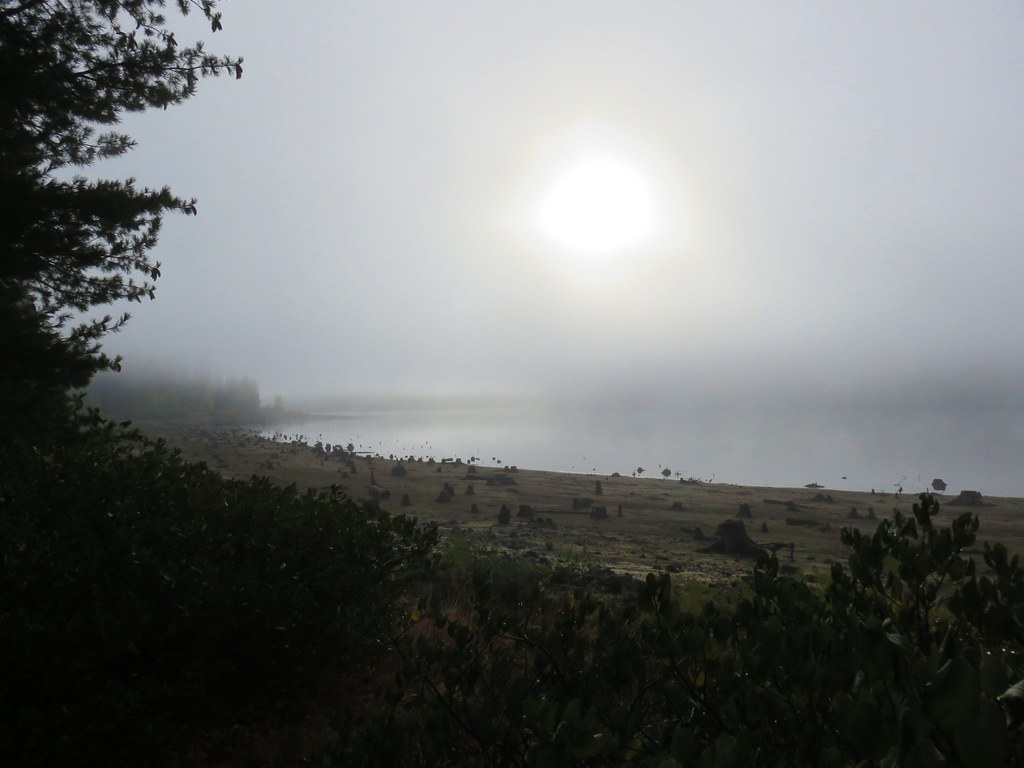
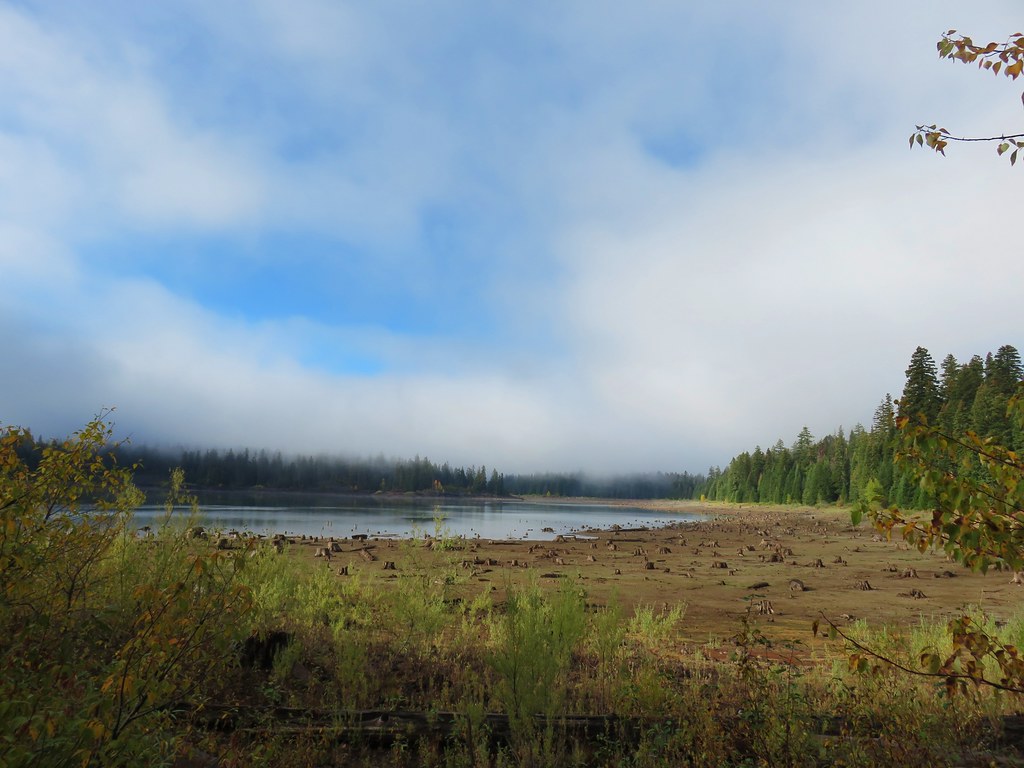
When the trail did make it to the lake there wasn’t much to see due to the fog.
The trail stuck closer to the lake shore for the next .8 miles before arriving at Doe Point and the Doe Point Campground. As we made our way around Doe Point the fog began to lift revealing some of the blue sky we had seen on our morning drive.
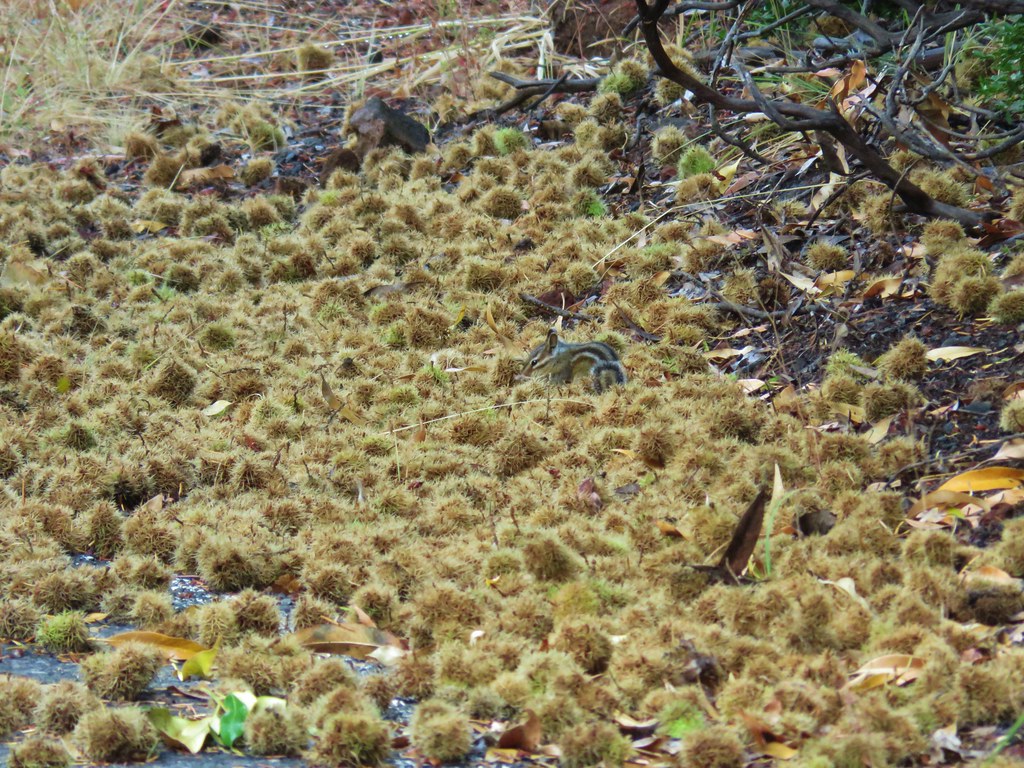
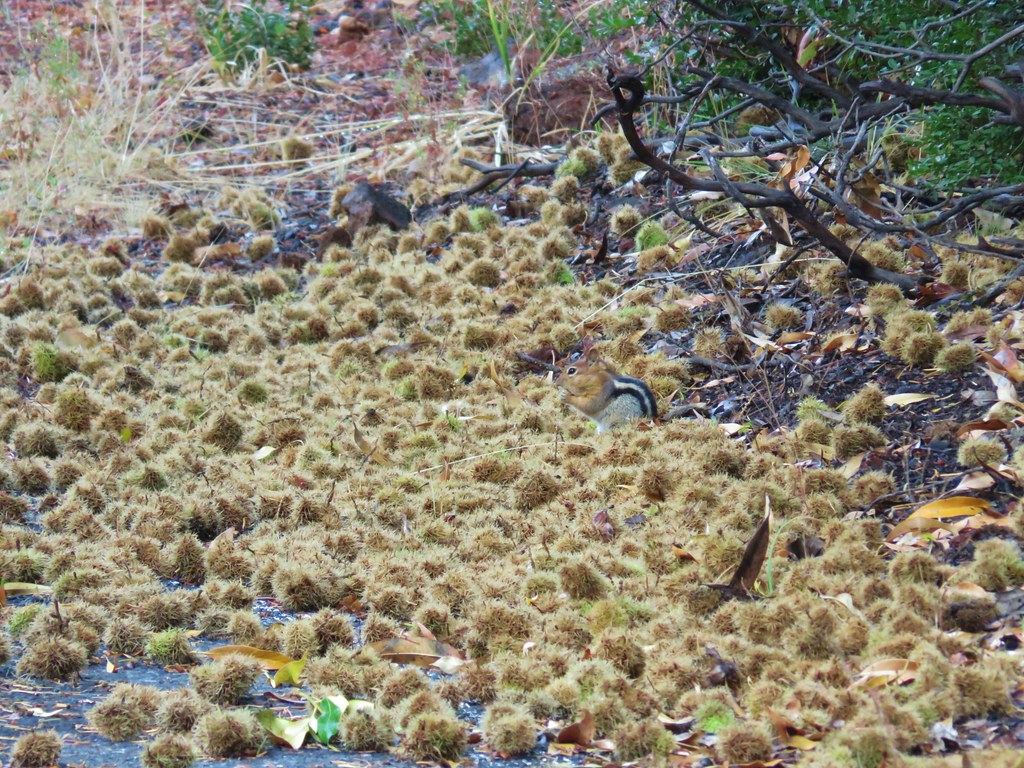
A quarter mile after rounding Doe Point we arrived at the Fish Lake Campground and boat ramp where a variety of woodland animals were busy harvesting chinkapin. Stellar’s jay
Chipmunk
Golden-mantled ground squirrel
Our guidebook suggested turning around at the Fish Lake Resort, but we wound up losing the trail near the picnic shelter and decided not to try and walk through the campground to find the continuation of the trail and turned around.
It was a different hike on the way back as the fog had entirely lifted from the lake and was breaking up overhead.
By the time we were hiking back along the creek the sky was a beautiful blue.
Typically having a hike only clear up near the end is a bit of a bummer, but we had another hike to go and with the clear skies we knew we should have a good view of Mt. McLoughlin from Lake of the Woods.
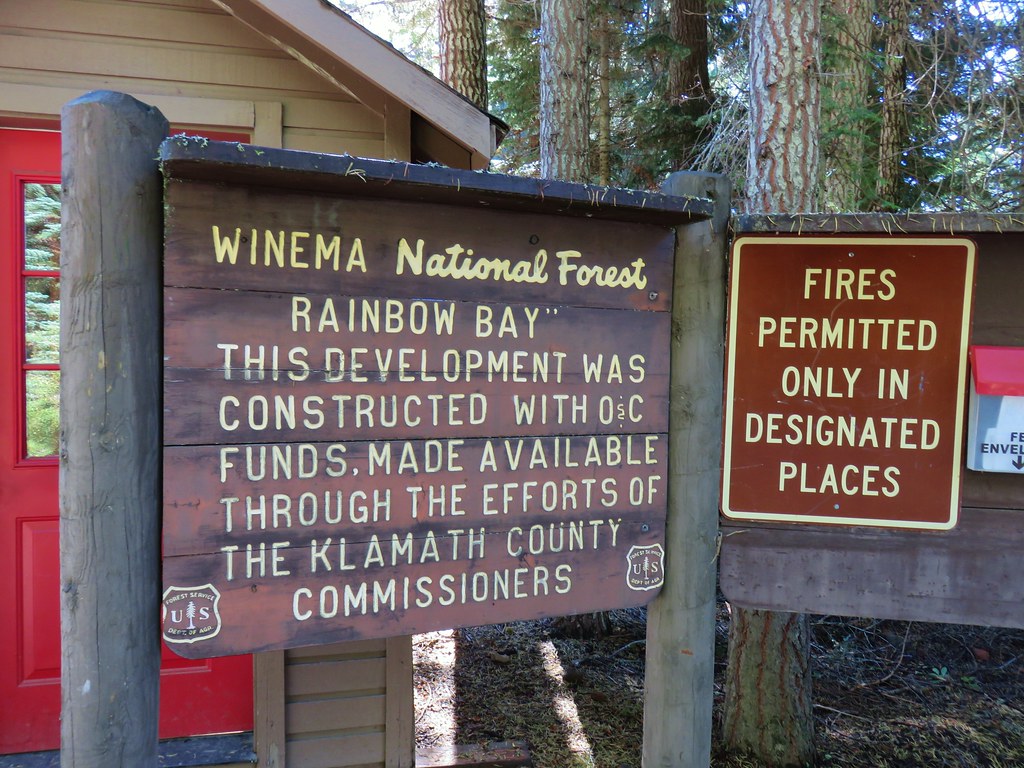
From the Fish Lake Trailhead we drove back east on Highway 140 to a sign for Fish Lake. We turned right at the sign and followed this road for a mile and a half to the Dead Indian Memorial Highway where we turned right again. The suggested starting point for this hike in our guidebook was at the Sunset Campground which was a mile down this highway. When we arrived at the entrance road we found it was gated so we turned around and wound up parking at the Rainbow Bay Picnic Area near the Lake of the Woods Resort after obtaining a $6 parking pass.
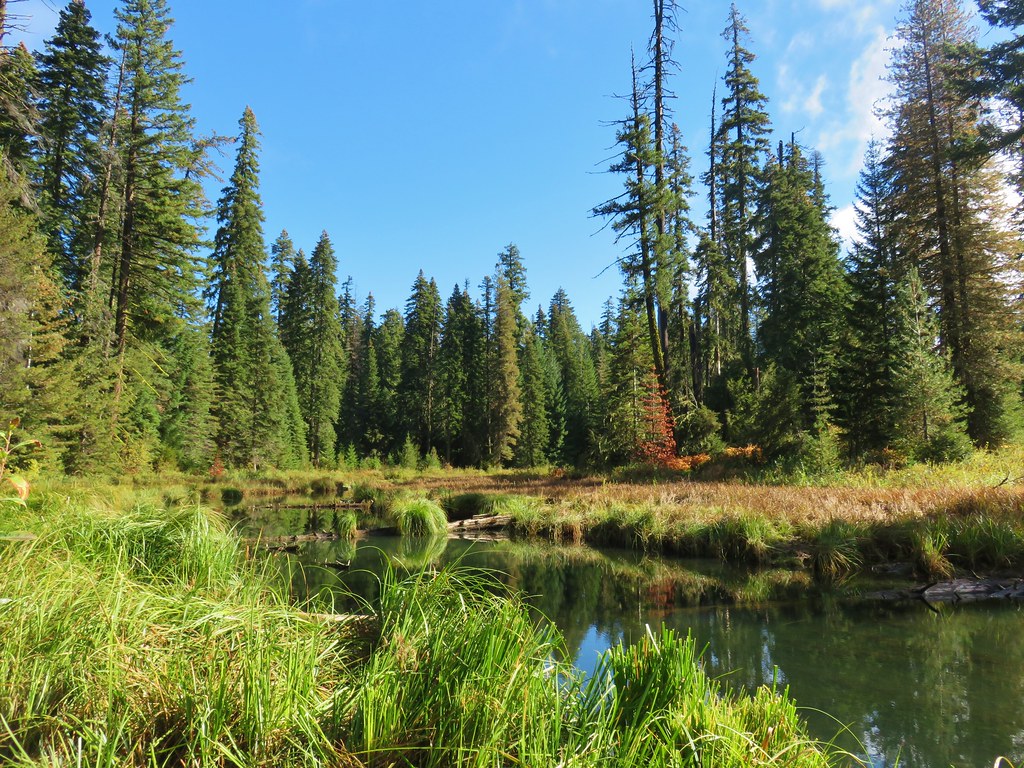
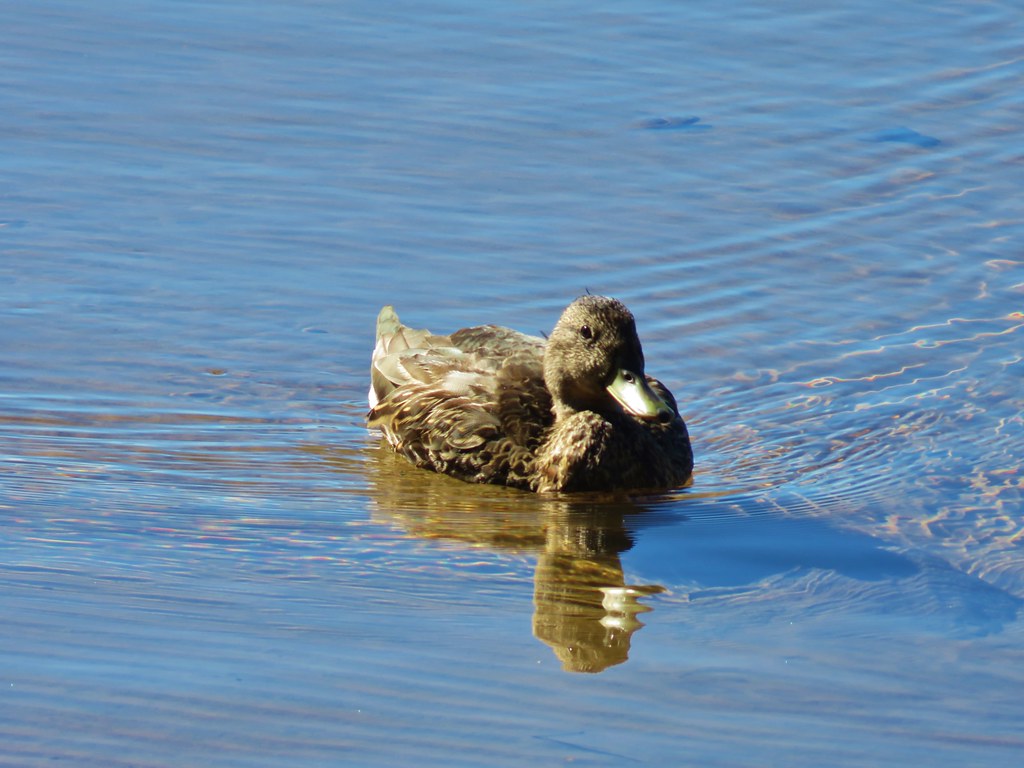
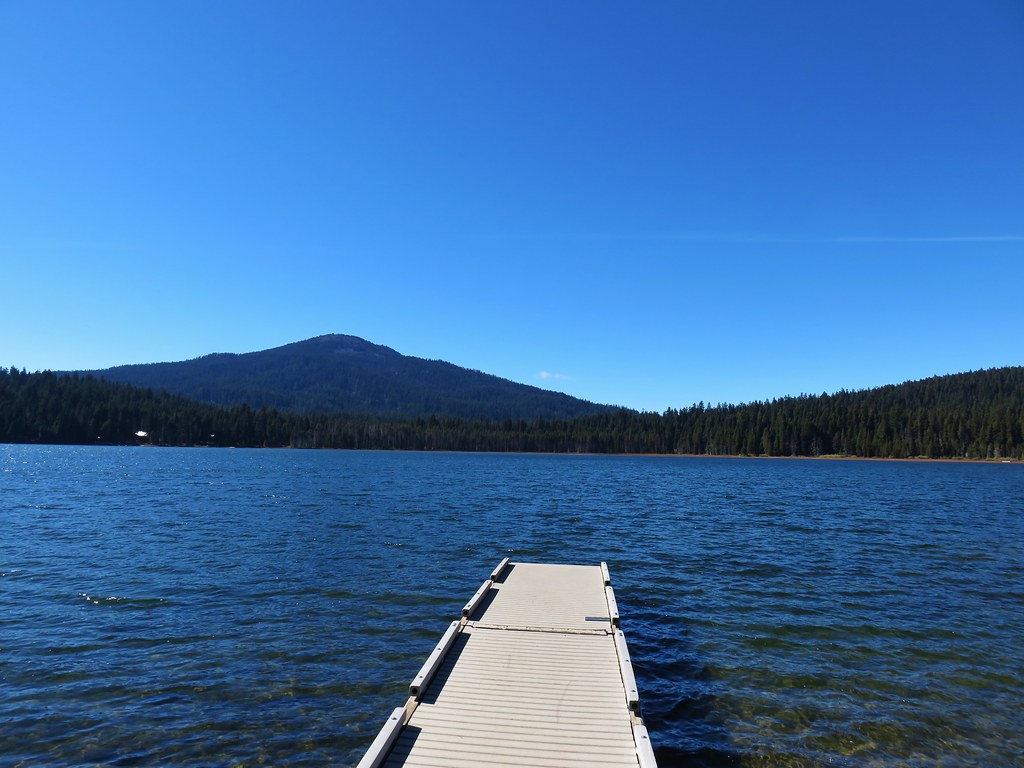
From the parking lot we headed SE along the lake shore around Rainbow Bay where some ducks were enjoying the wonderful weather.
The first mountain to come into view was Brown Mountain across the lake.
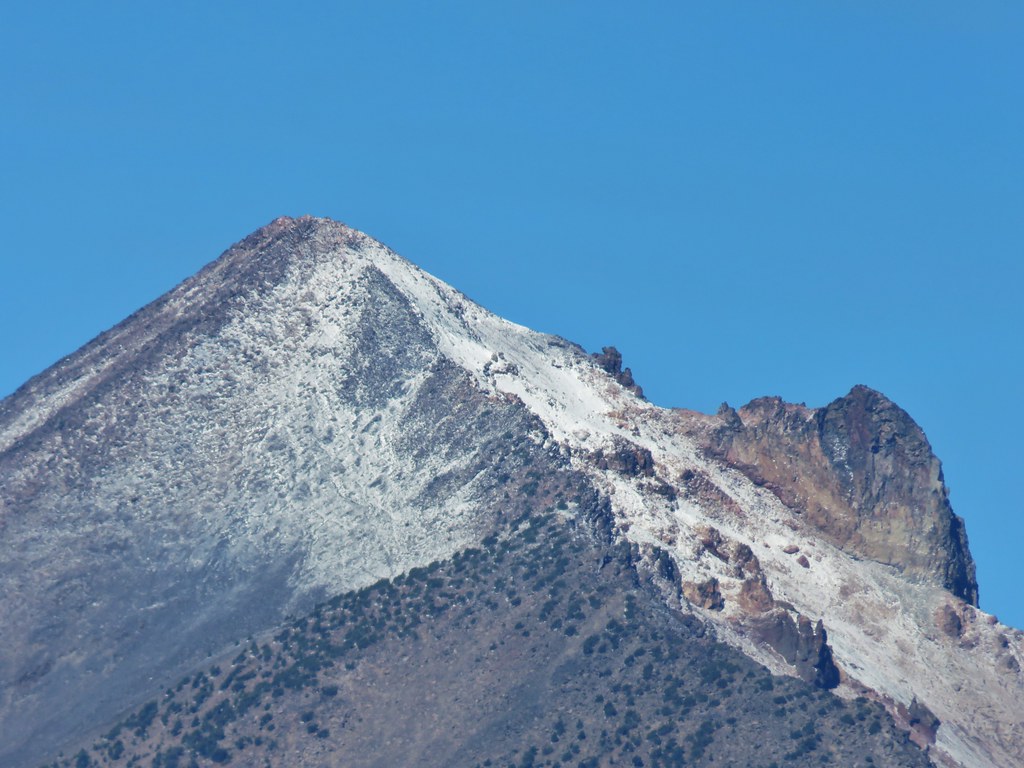
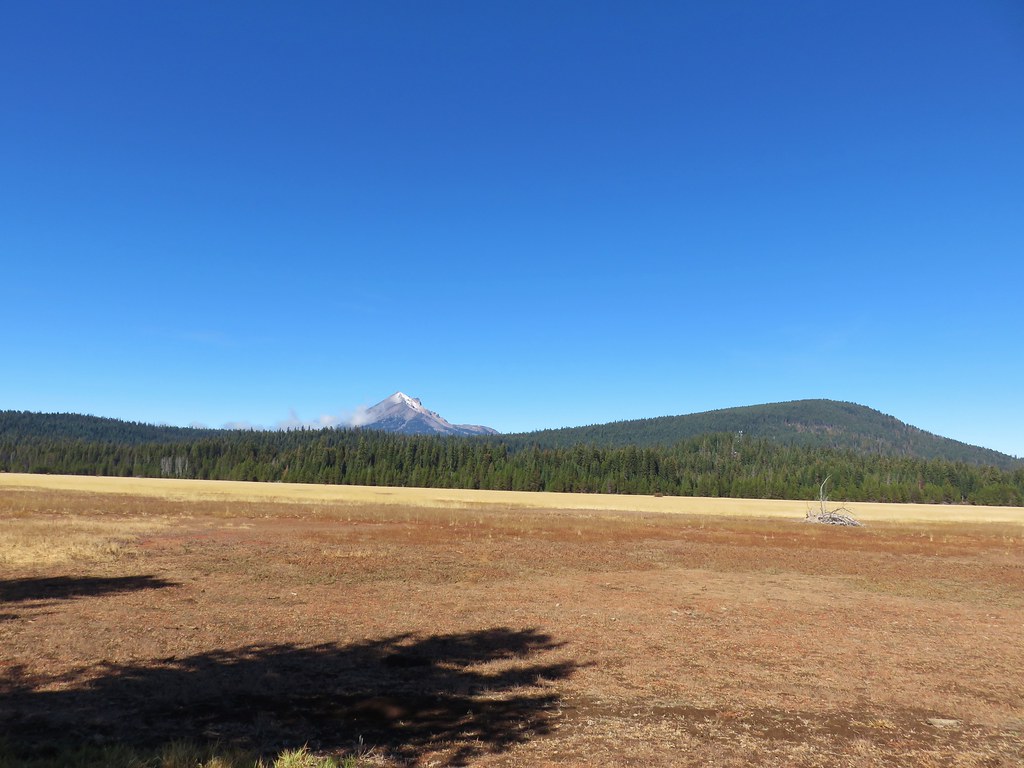
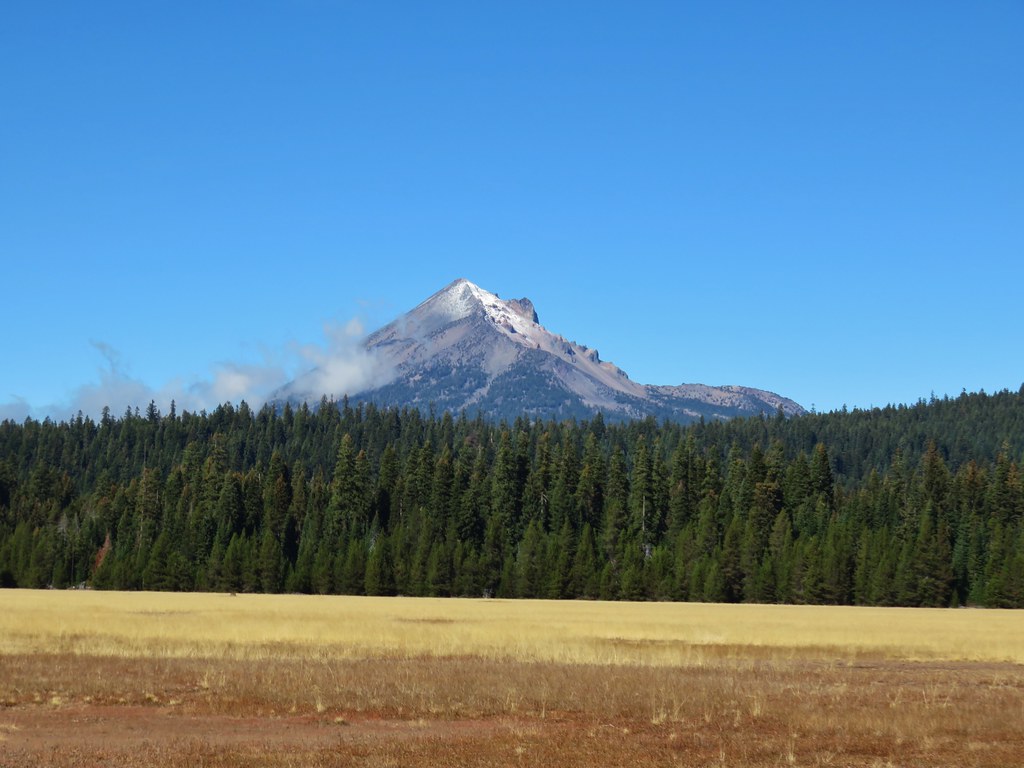
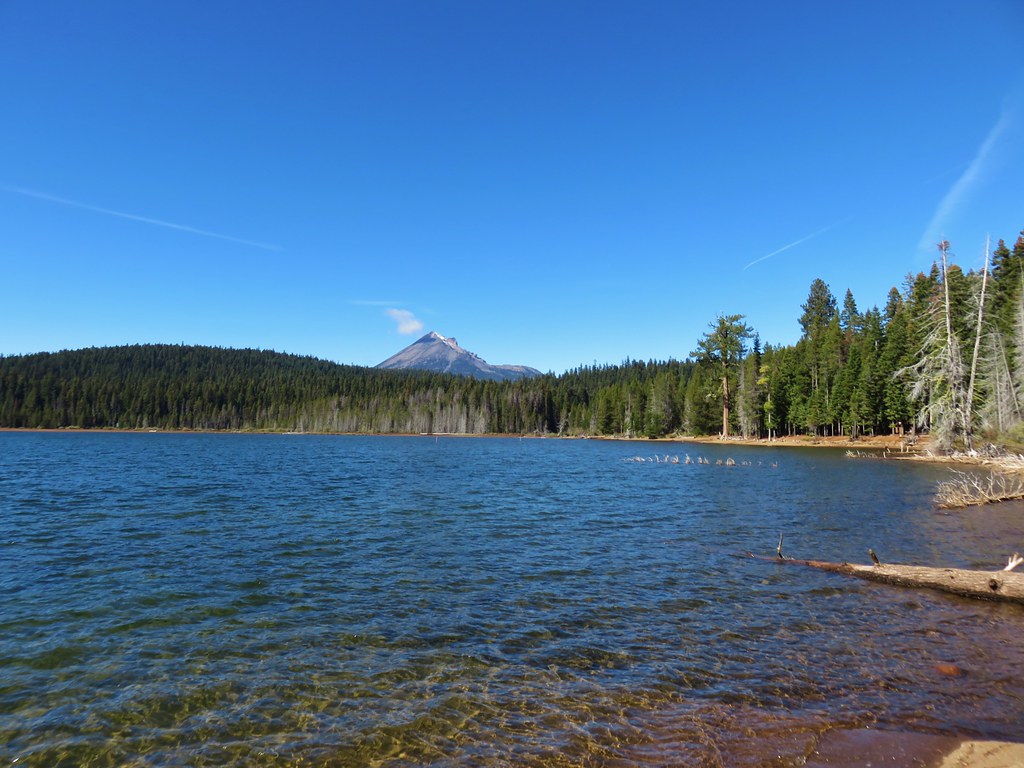
Shortly after rounding the bay we arrived at the Sunset Campground where we did indeed have a nice view of Mt. McLoughlin. The mountain was sporting a dusting of new snow at its summit.
We could picture the route up to the summit that we’d taken a couple of years before (post).
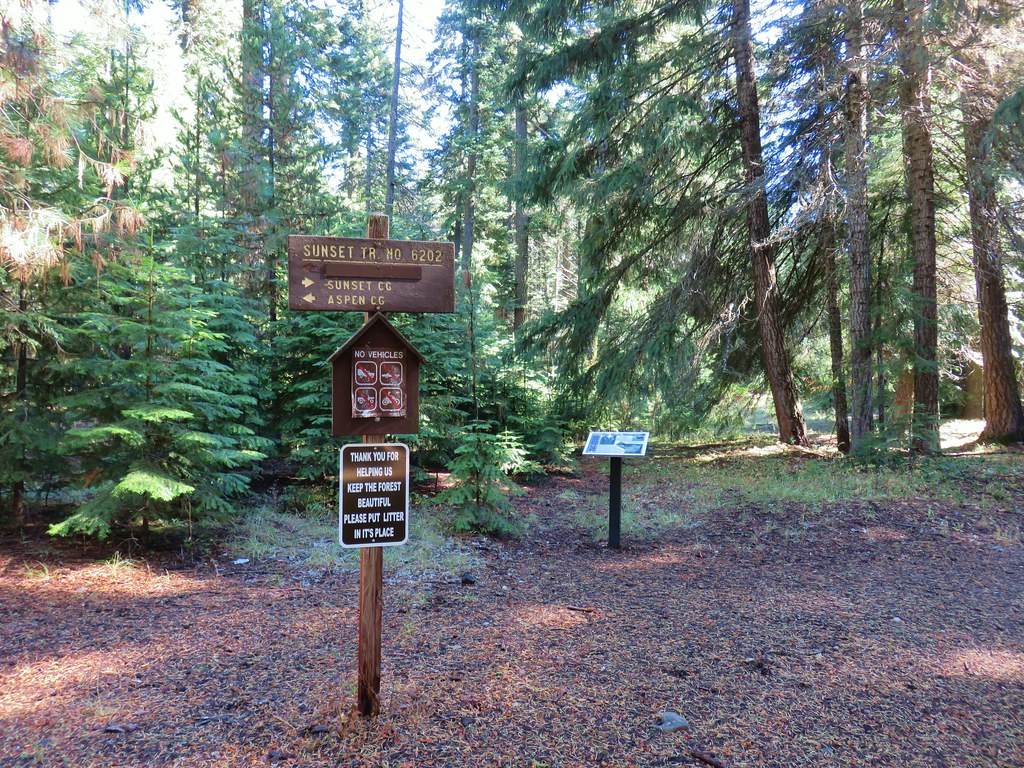
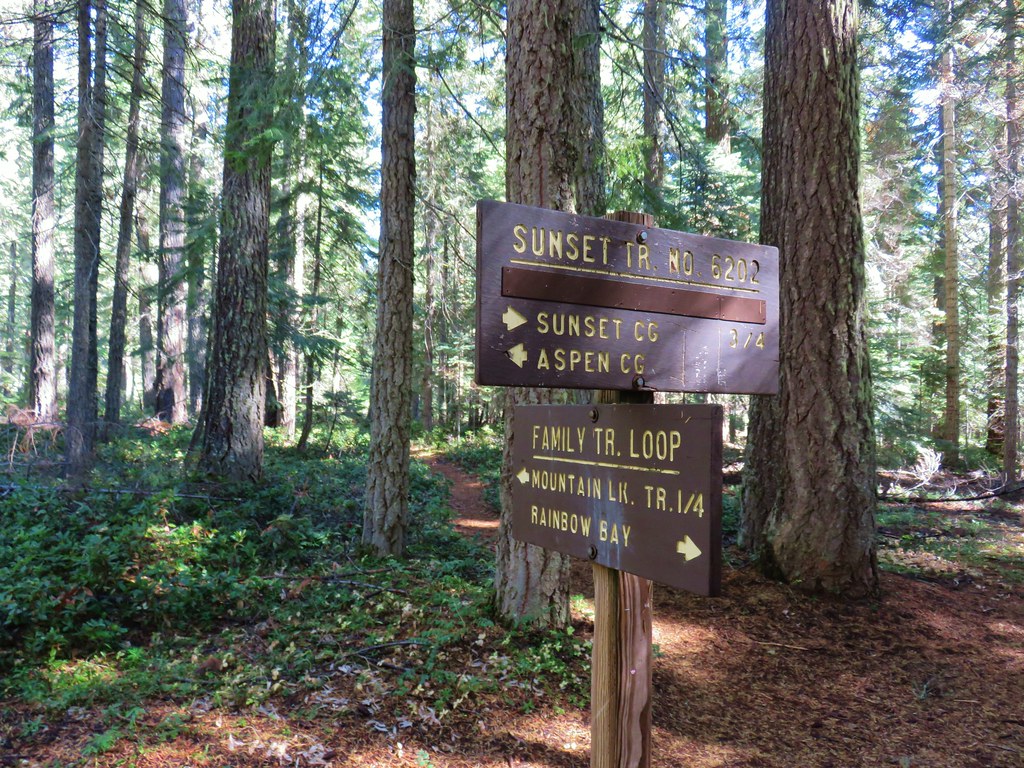
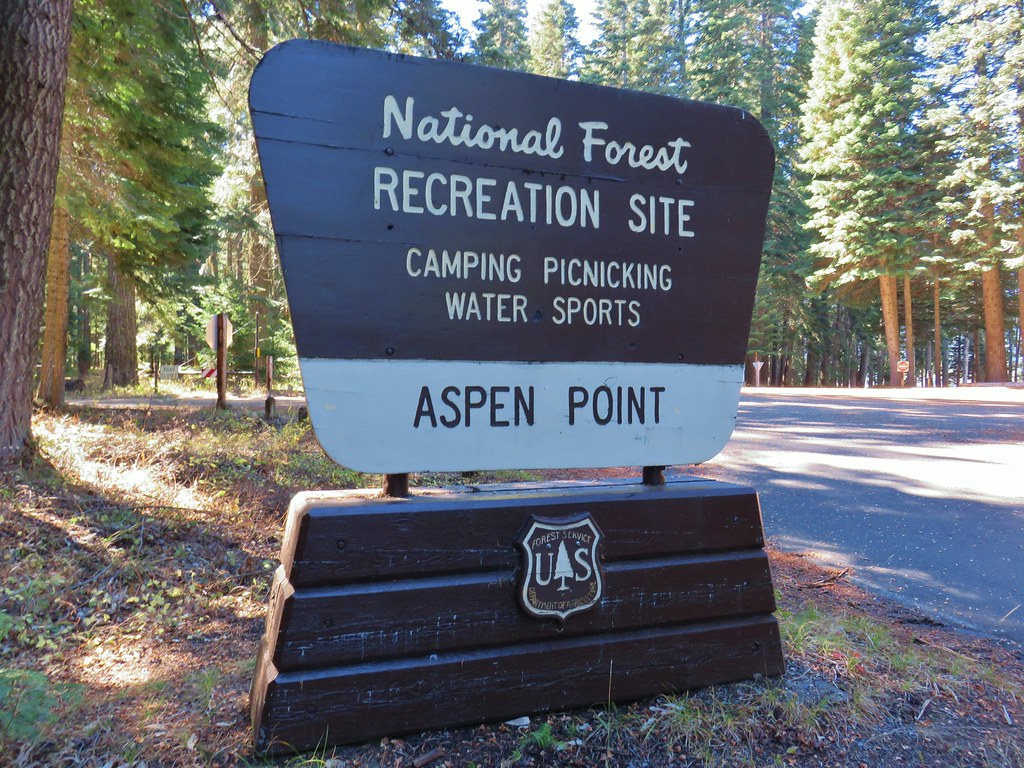
Satisfied with our view we turned around and headed back toward the Rainbow Bay parking area. We weren’t done hiking though and we veered behind the parking lot on the Sunset Trail toward the Aspen Point Campground.
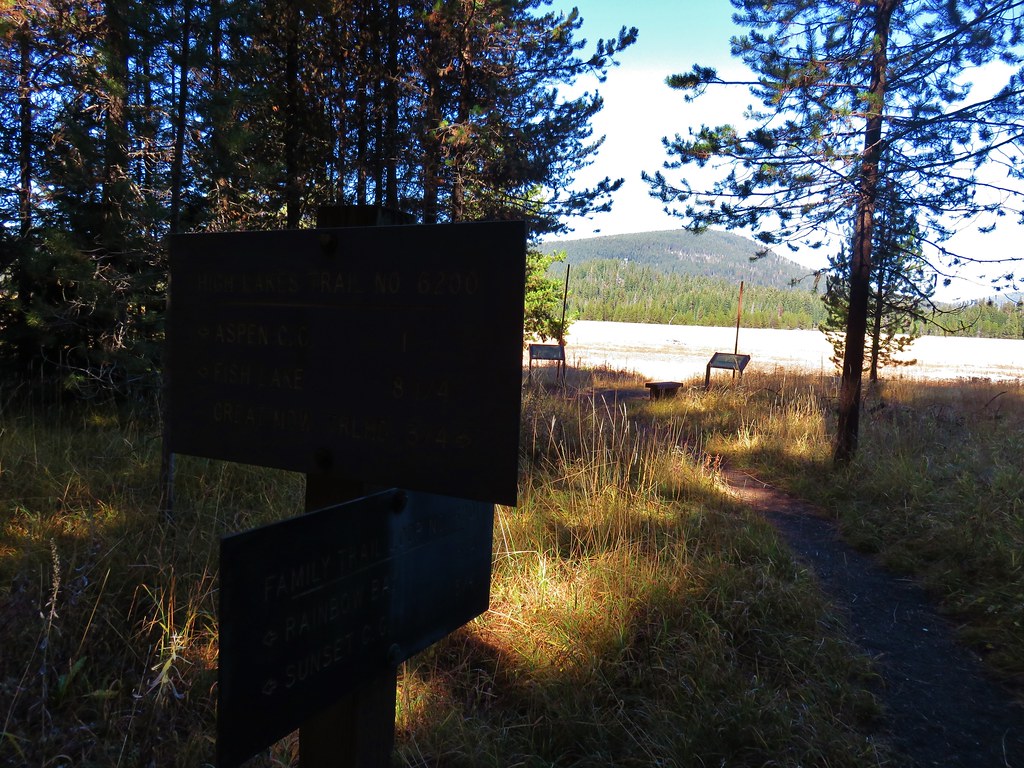
At a three way junction we turned right onto the Family Trail Loop.
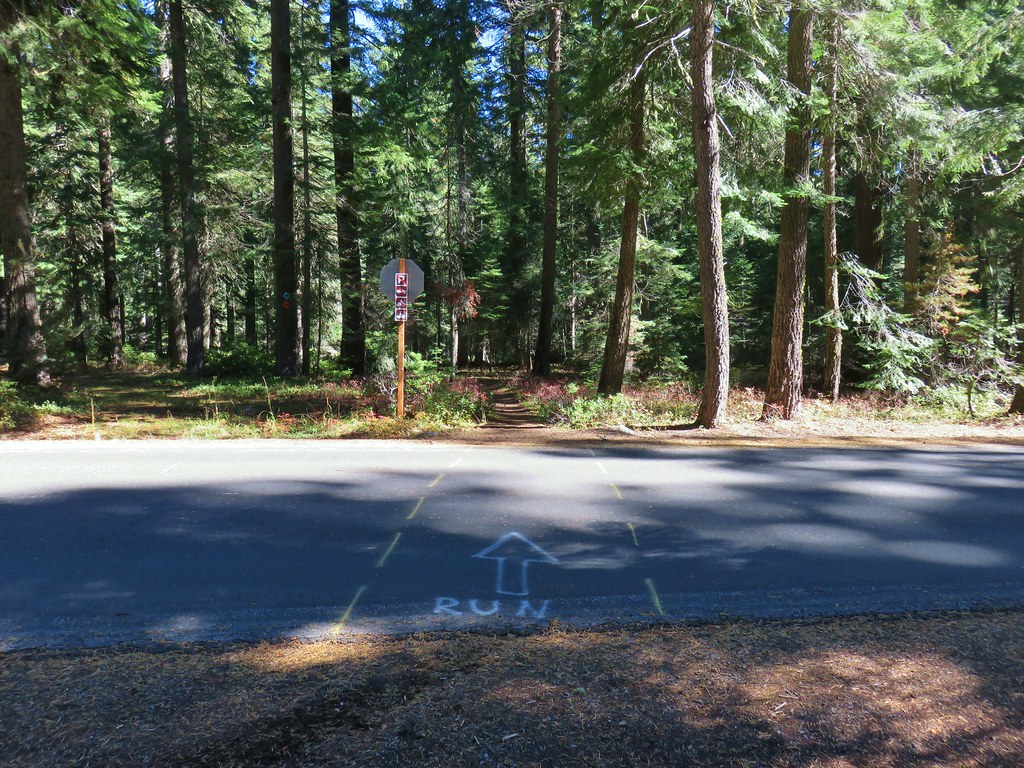
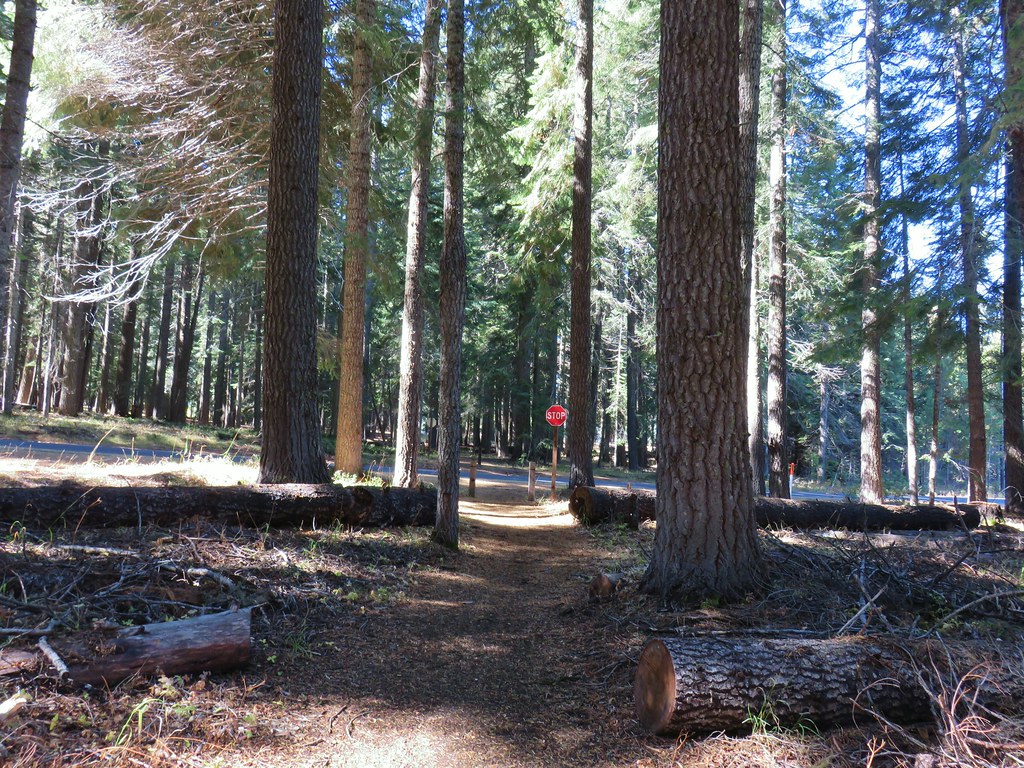
The Family Trail Loop crossed the paved road we’d been on earlier after a tenth of a mile.
Just after crossing the road the Mountain Lakes Trail split off to the right while we stayed left.
Several interpretive signs were set up along this trail.
<
We stayed left ignoring a tie trail that would have looped us back to the Mountian Lakes Trail junction and arrived at the Great Meadow .6 miles from the road crossing.
At a junction with the High Lakes Trail at the Great Meadow we turned left skirting the meadow in the forest for .7 miles to another road crossing across from the Aspen Point Campground.
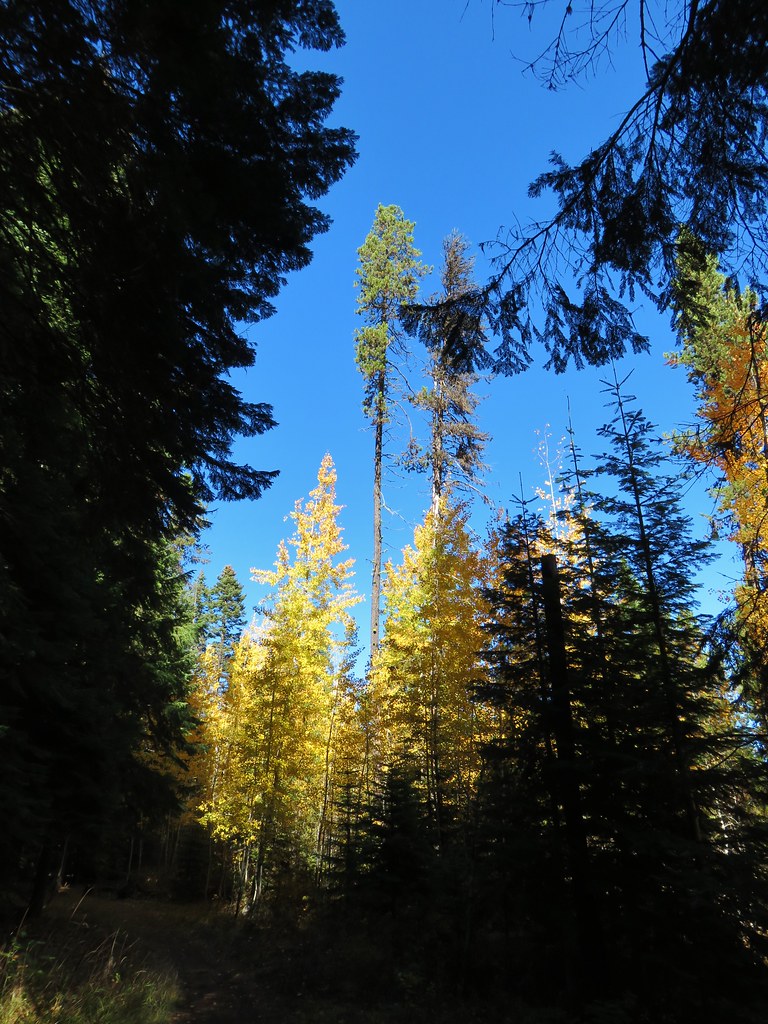
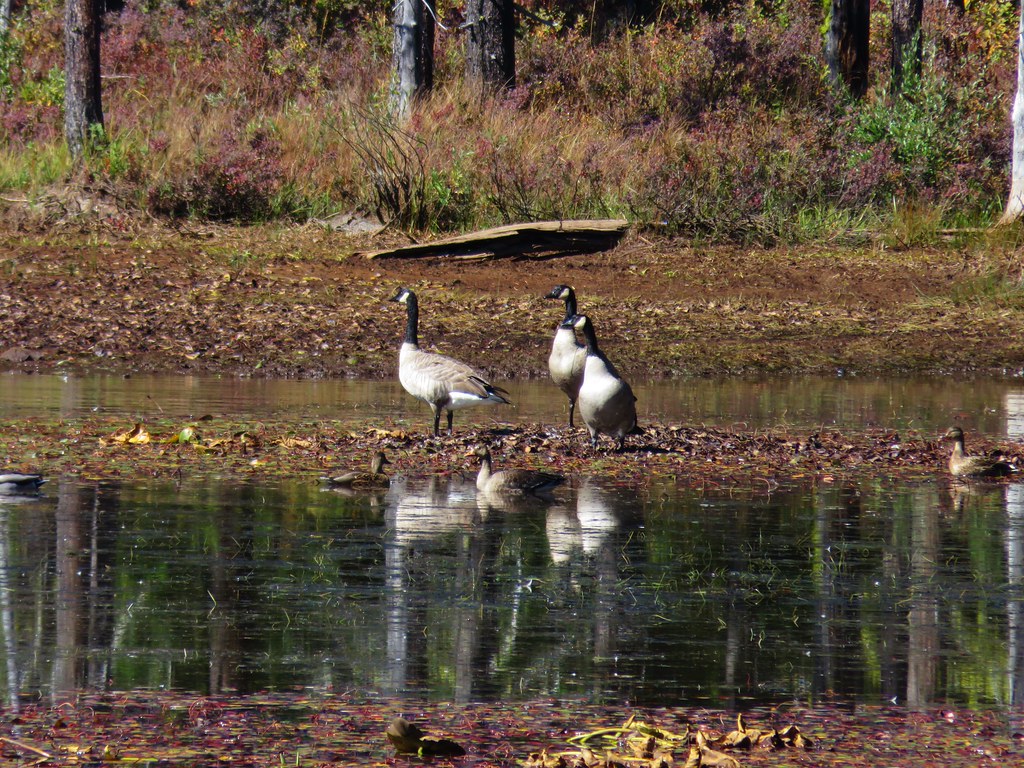
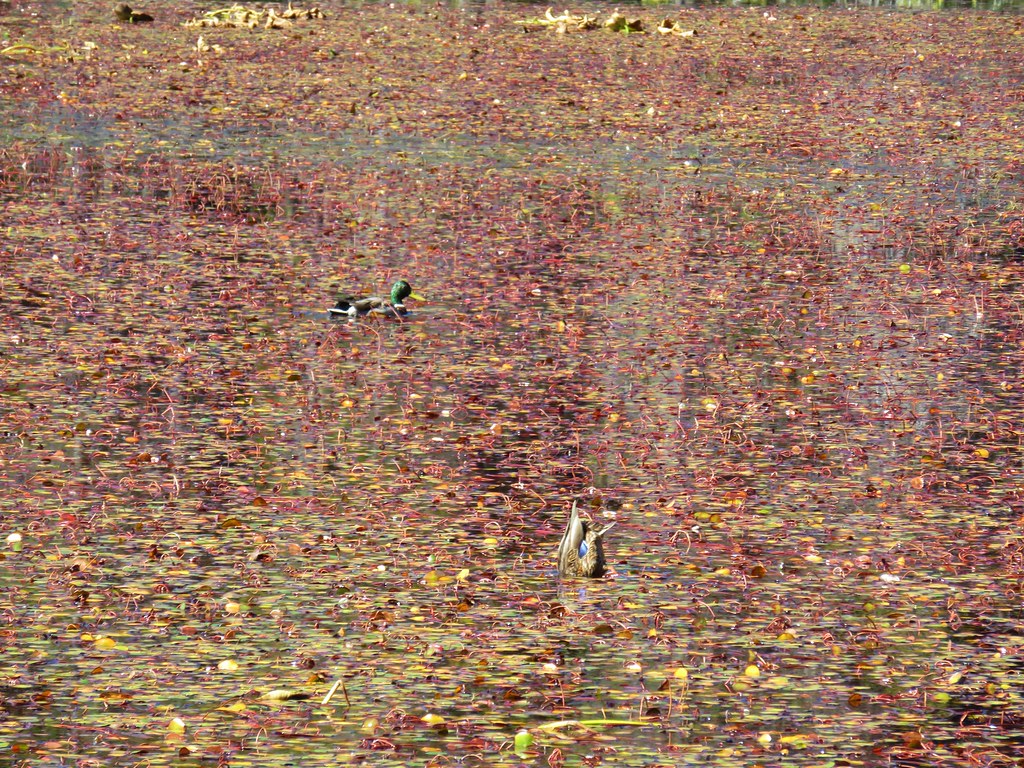
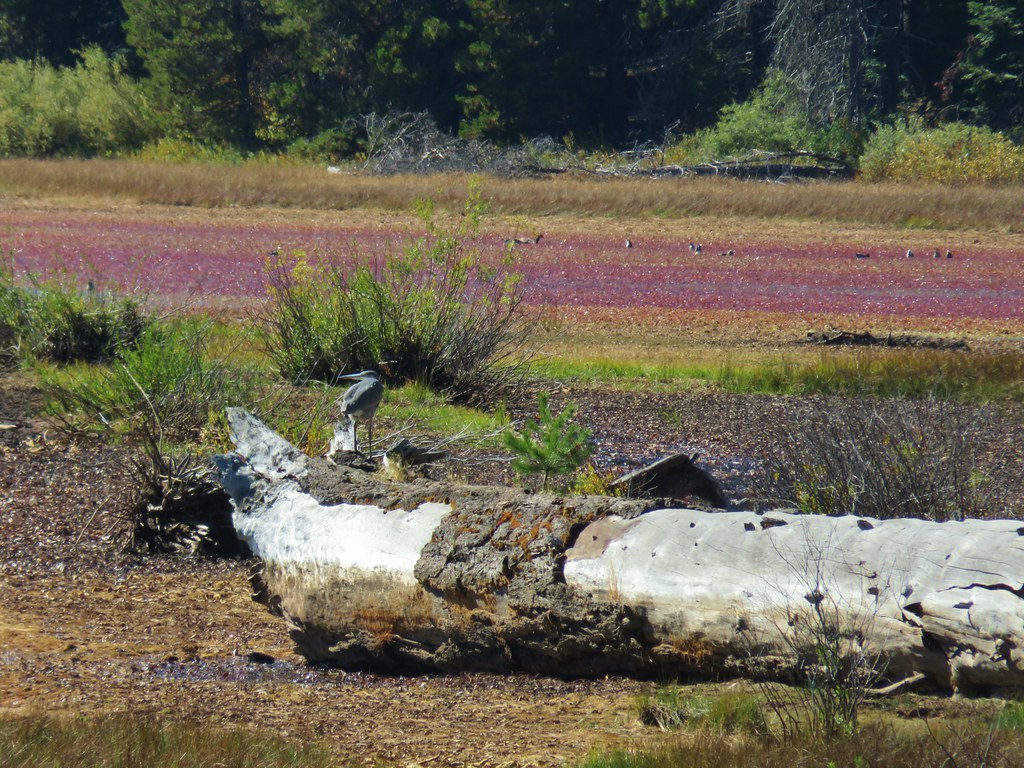
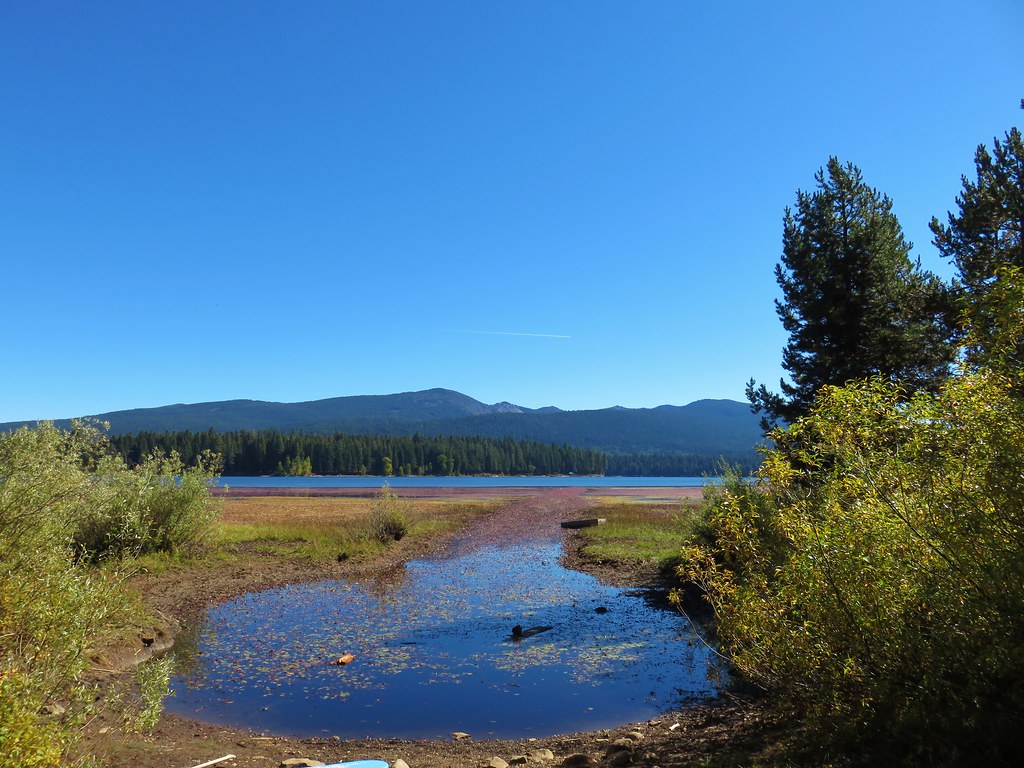
At a junction on the other side of the road we went right keeping on the High Lakes Trail which led around Lake of the Woods to the NW. This section of trail passed some golden aspen trees and a leaf covered slough where ducks, geese, and a heron were spending their Sunday.
We followed this trail past an old Forest Service complex and planned on turning around at the guidebooks suggested location, a small canoe launch.
The canoe launch wasn’t much, but there was a nice view of some of the peaks in the Mountain Lakes Wilderness (post) across the water.
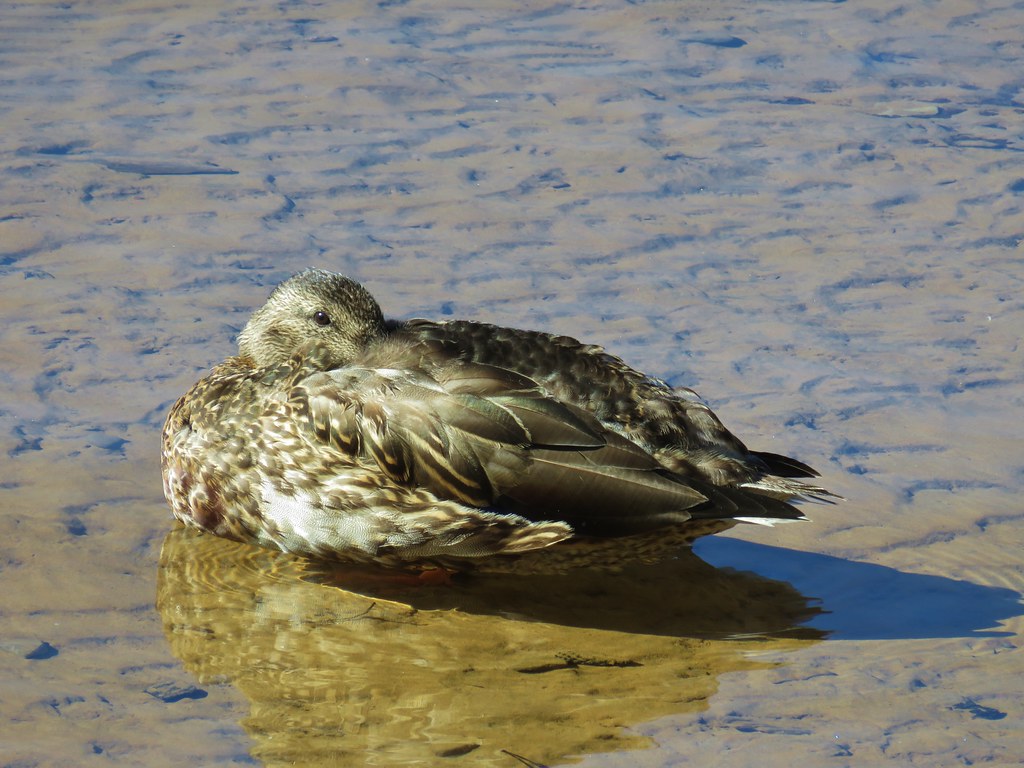
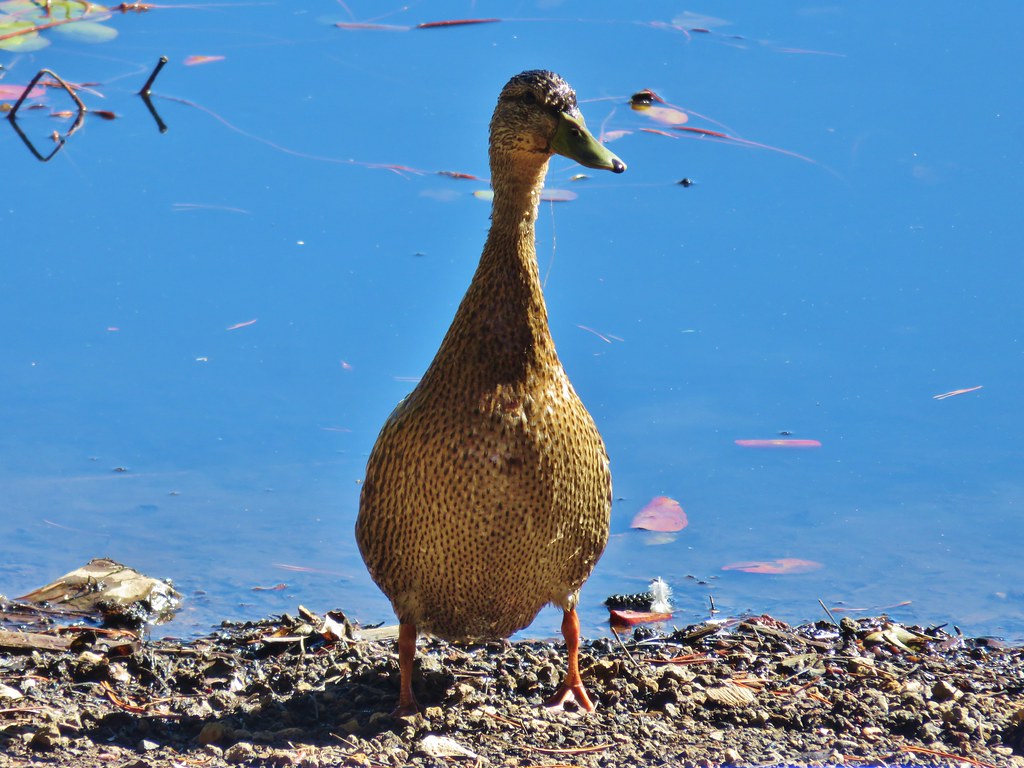
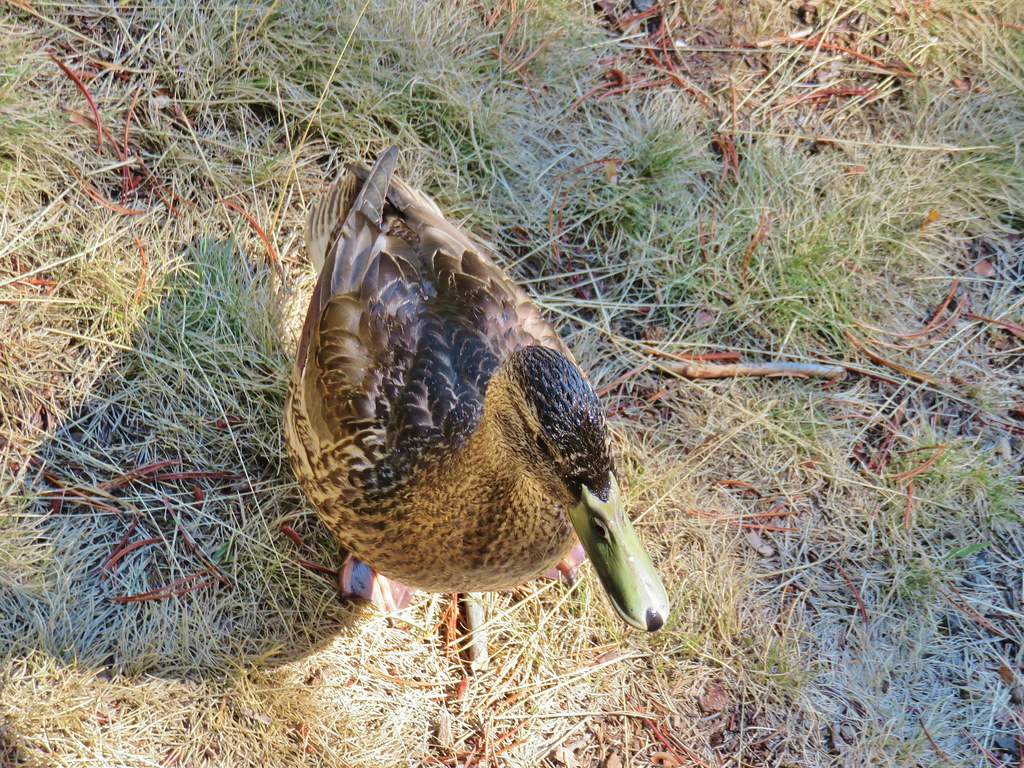
A solitary duck was swimming around in the launch and it apparently expected us to have some food because she came right up to us.
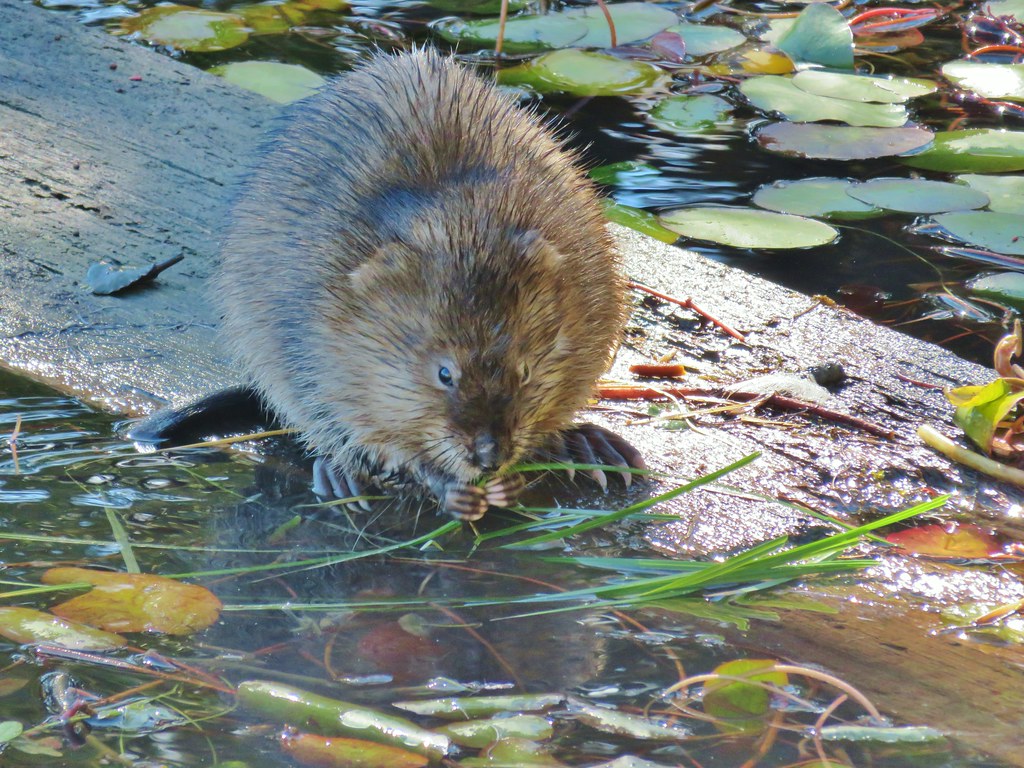
We did our best to explain that we don’t feed the wild animals and she waddled back to the water. At that point Heather asked about something on a plank in the water that I had originally thought was another duck but then decided it was just a rock set on the wood. She had taken it for something inanimate as well but then thought she saw it move. Upon closer inspection we discovered that it was a muskrat (initially we thought nutria but it was cuter than that invasive species).
It wasn’t particularly concerned by us but eventually it disappeared into the water. Then a dragon fly showed up and hovered over the water just below me.
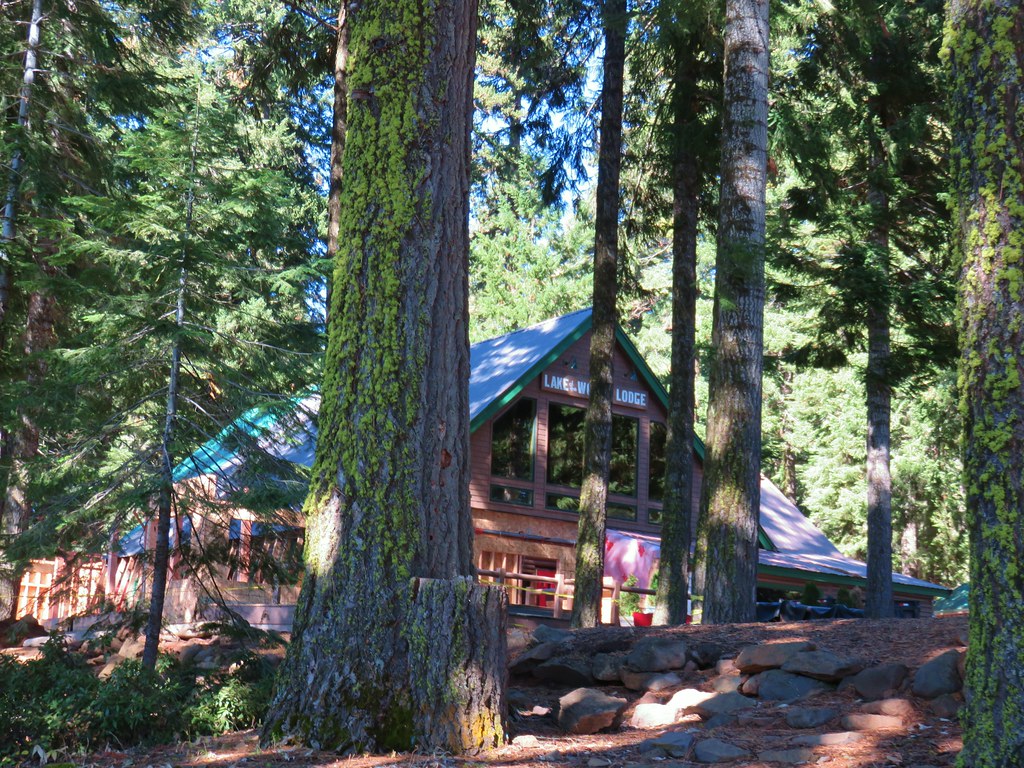
After our unique little interaction with nature it was time to start back. We returned to the Aspen Point Campground and followed paths near the lake shore back to the Lake of The Woods Resort.
Our hike here was 6.3 miles long while the hike at Fish Lake had been 7 miles giving us a nice 13.3 mile day. After the cold, foggy start the day had turned out beautiful. We would be heading home the next morning (with a stop along the way of course) and this was a perfect way to end our time in the Klamath Falls area. Happy Trails!


 Dust from ultra runner’s cars hanging over the closed roadbed.
 Mt. Jefferson in the monring.
 The Summer haze we’ve grown to expect was back after having improved following a brief period of rain.
 The smoke does make for some colorful sunrises though.
 Scouler’s bluebells
 There was a nice forest along the road. Much of the butte is within one of the five tracts making up the Clackamas Wilderness but being a man-made improvement the road itself is not part of the Sisi Butte tract.
 Mt. Hood to the North.
 Mt. Hood
 Despite the surrounding haze the sky above the road was bright blue.
 There were numerous good views of Mt. Jefferson from the road.
 Olallie Butte (post) and Mt. Jefferson.
 About 0.4 miles from the lookout an abandoned spur road splits off to the right toward the eastern summit which is just a couple of feet higher than the western.
 The tower is still staffed at times, but it was empty today.
 Penstemon
 Olallie Butte, Mt. Jefferson and Three Fingered Jack from the lookout.
 Mt. Jefferson and Three Fingered Jack
 Mt. Hood, West Pinhead Butte, and the eastern summit.
 A hazy Mt. Hood.
 Flat topped Battle Ax Mountain (post), Silver King Mountain (post), Pansy Mountain, Bull-of-the Woods (post), Big Slide Mountain (post), and Schreiner Peak in the Bull-of-the Wilderness.
 Bachelor and Coffin Mountains (post) in the Old Cascades.
 Grouse along the road.
 Despite high temperatures around 80 the leaves reminded us that Fall would be arriving soon.
 Canada jay checking us out.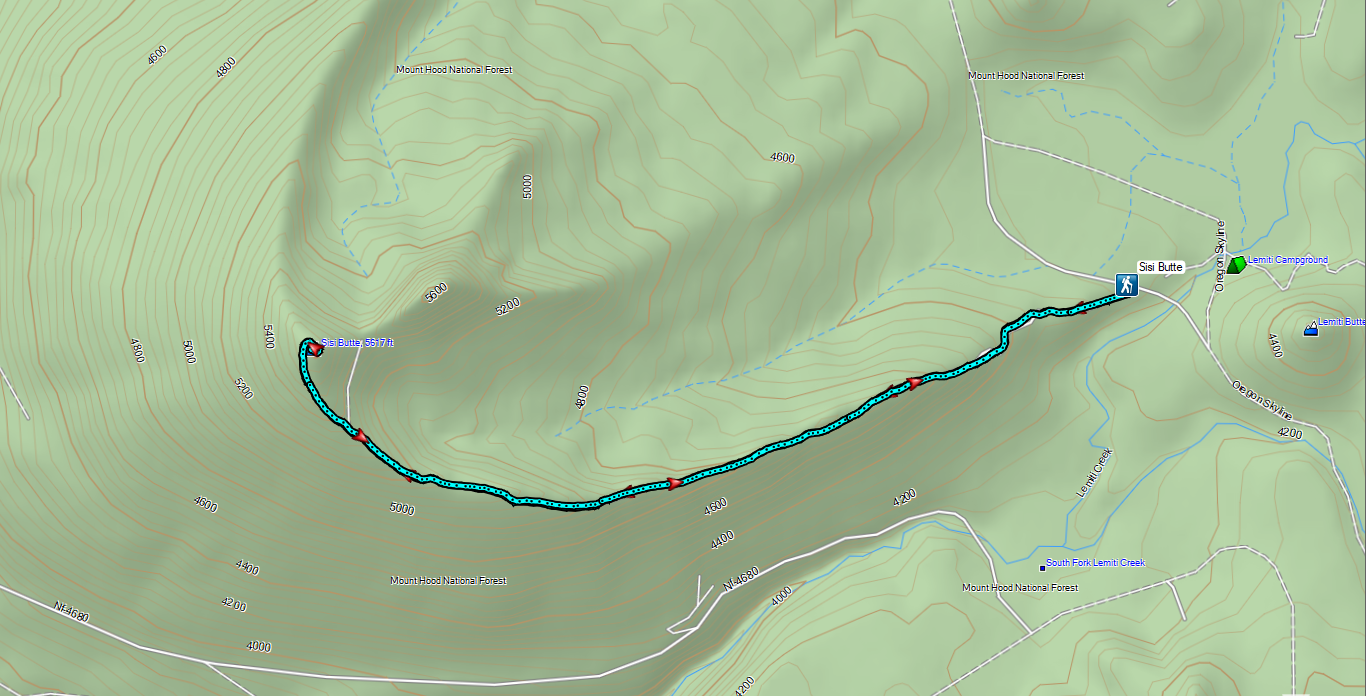

 Lower Lake Campground, a work in progress.
 While the campground was closed, the trail was open despite the fire damage.
 The Fish Lake Trail at Lower Lake Campground.
 Ferns creating a green hillside in the burn scar.
 Lower Lake
 The water in Lower Lake was quite colorful.
 Duck
Duck
 Most of the lakes in the Olallie Lake Scenic Area have signs naming them.
 Potato Butte (post) from Lower Lake.
 Olallie Butte
 Sisi Butte off to the right.
 Fireweed going to seed.
 Buckwheat
 The burn was intense along the trail, but it was in pretty good shape all things considered.
 Sisi Butte and Fish Lake from the cliff.
 Mt. Hood peeking out from behind West Pinhead Butte.
 Mt. Hood
 The Fish Lake Trail switchbacked a few times before giving up on that and dropping steeply for the final 0.2 miles.
 A beat up Lorquin’s admiral.
 There were signs of somewhat recent trail maintenance, but given the severity of the burn and the steepness of the hillside the trail is going to need a lot of ongoing attention to keep it passable.
 The trail disappeared a couple of times in brush and blowdown near the lake, but it was never hard to pick back up.


 Nap time.
 Olallie Butte from Fish Lake.
 The trail followed along Squirrel Creek (currently dry) for 0.4-miles.

 We passed a few of these “Spot Fire” flags, presumably left over from 2020.
 The signed junction.

 I had to walk out on a log and fight through some thick brush to reach a decent view of the water.
 Surprise Lake
 The trail between the junction and Si Lake got a little brushy.
 Huckleberry leaves in their Fall colors.
 Si Lake from the trail.
 Si Lake.
 Tortoiseshell butterfly
 Olallie Butte from Fish Lake.
 Black bear print along the shore of Fish Lake.
 White breasted nuthatch
 Lower Lake from the Fish Lake Trail.
 Olallie Butte from Lower Lake.
 While parts of Lower Lake are shallow it actually reaches a depth of 73′ which is the reason it is so colorful.
 Arriving back at Lower Lake Campground.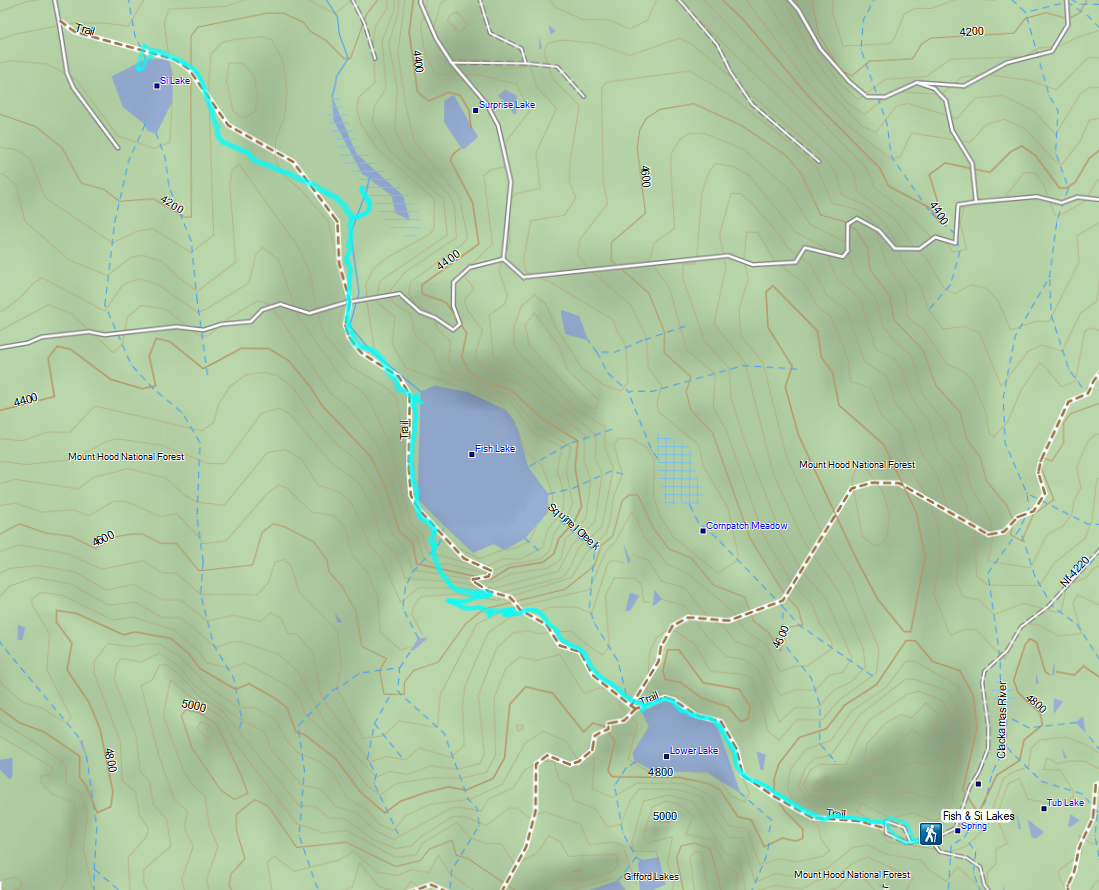


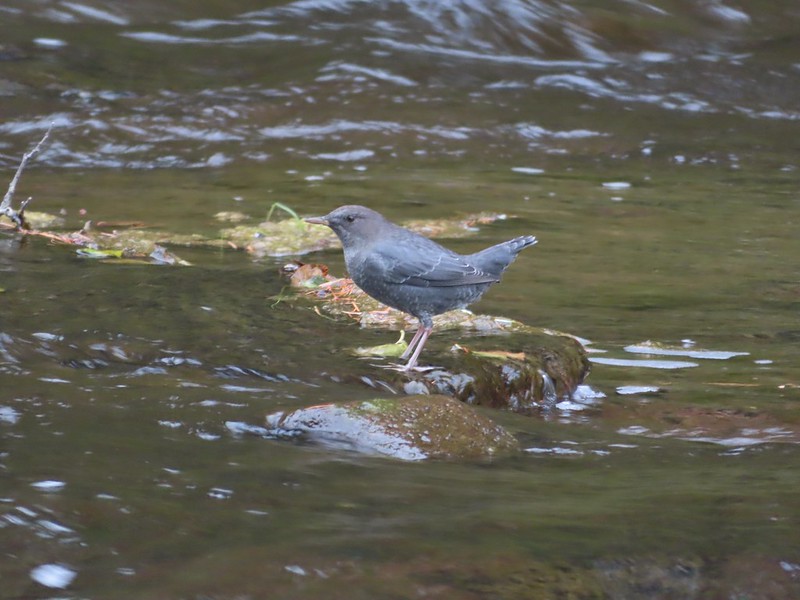 Ouzel
Ouzel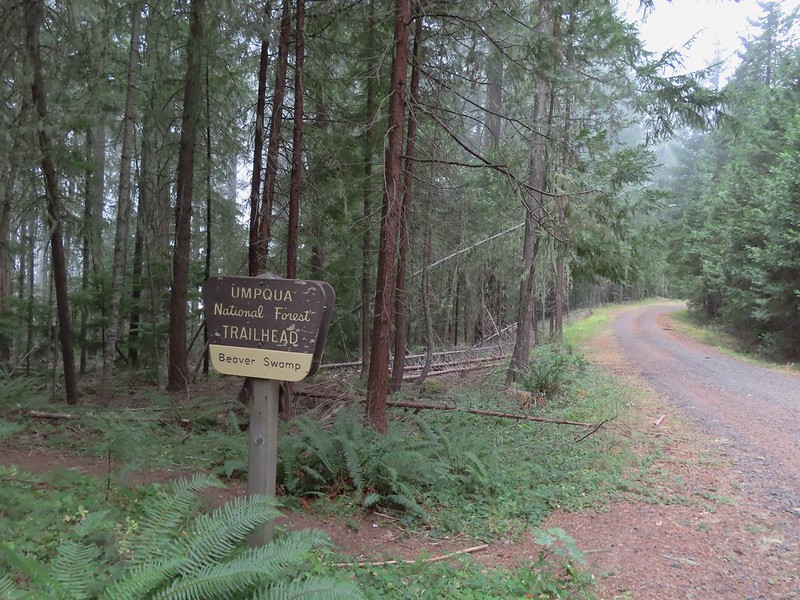



 Small cascade on Fish Lake Creek.
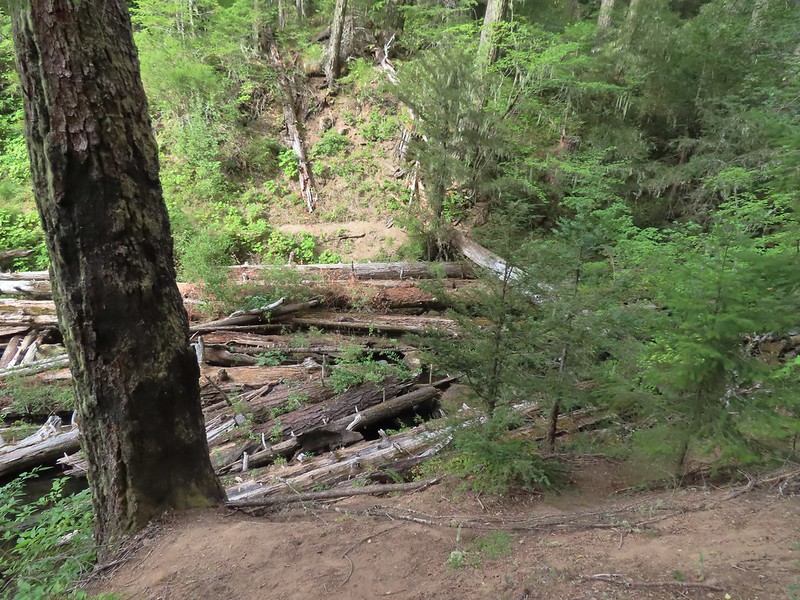 Logs at the outlet of Fish Lake. The Indian Trail can be seen on the far side. This junction was unmarked and you would have to cross the logs to reach it. In theory one could take this trail to the Lakes Trail near Buckeye Lake, but as we understand it the trail does not receive regular maintenance so we did not include it in our plans.
 Arriving at Fish Lake

 The clouds began burning off before we’d found our campsite.
 We set up camp on a little knoll near an old stone foundation. We’re interested to know what used to be there but so far haven’t found any information on it.
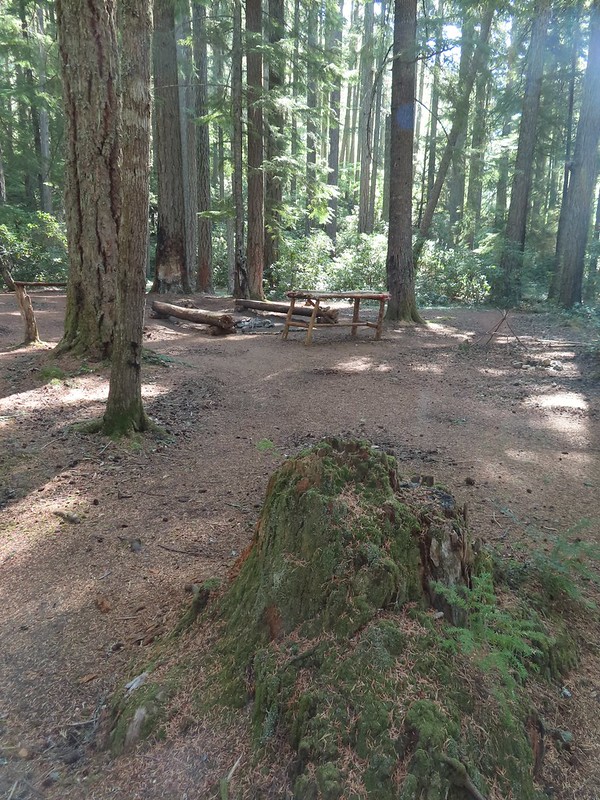 A little too developed for Wilderness standards.
 A dry channel along Highrock Creek.
 Crossing an unnamed creek.
 The trail junction.
 Highrock Creek. There were several nice pools here which we utilized to replenish our water on our way back to camp.
 Foam flower and a few ripe thimbleberries, Heather’s favorite.
 The junction with the Grasshopper Trail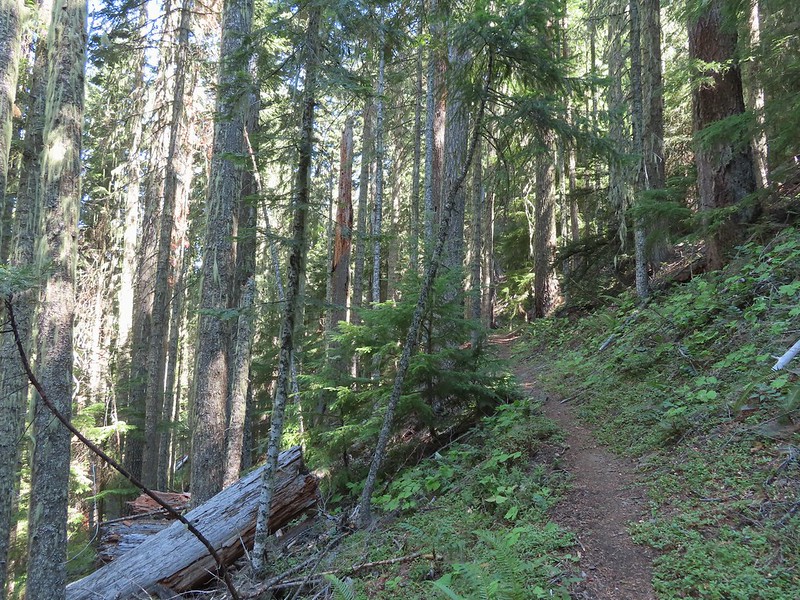
 Pine white
 Sign for the Gasshopper Mountain Trail.
 Grasshopper Spring is out there somewhere.
 We had to go around this big tree.
 A few aster
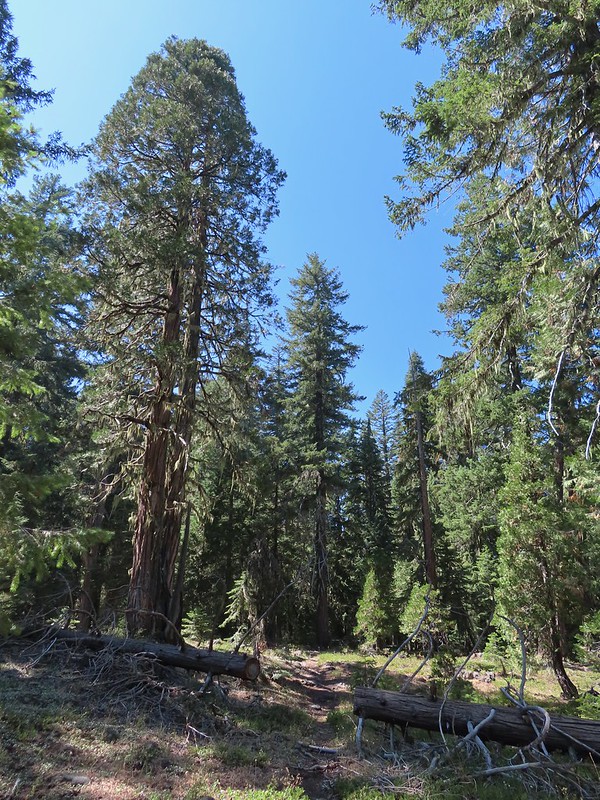 There were some good sized cedars up here.
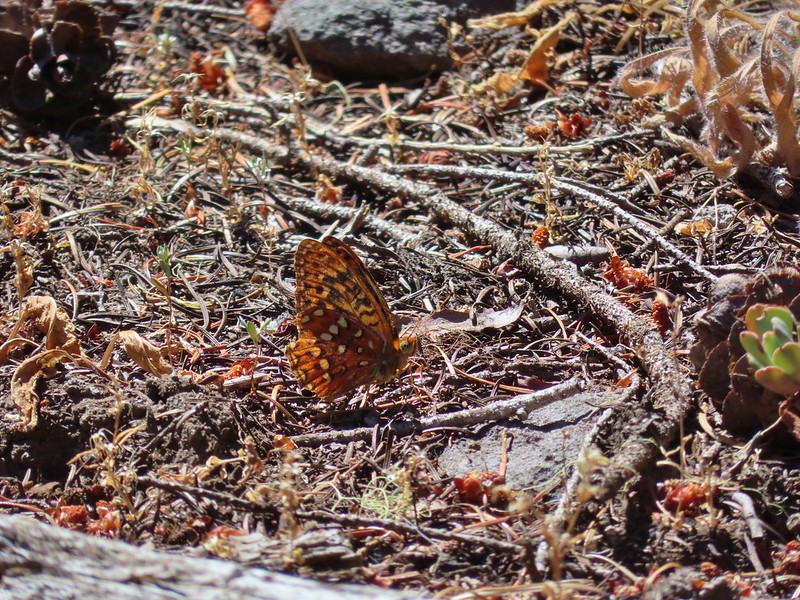 A fritillary
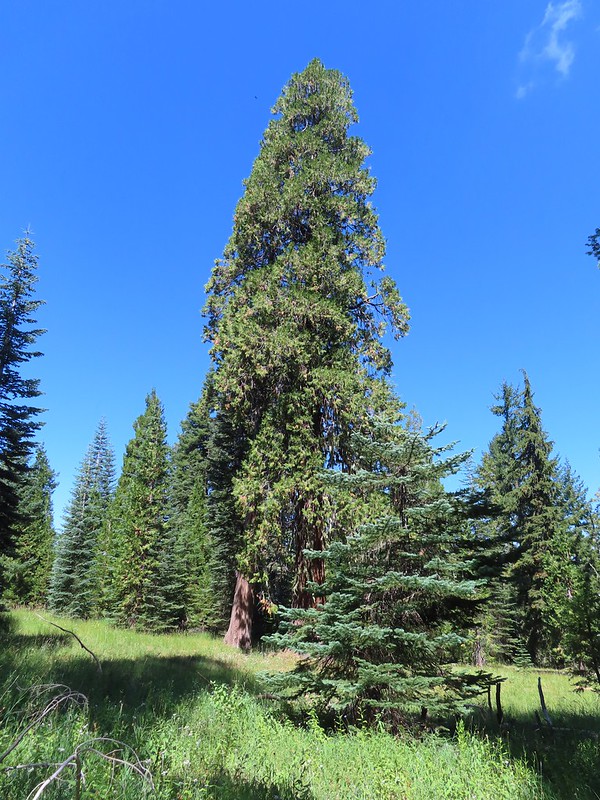 Another big cedar.
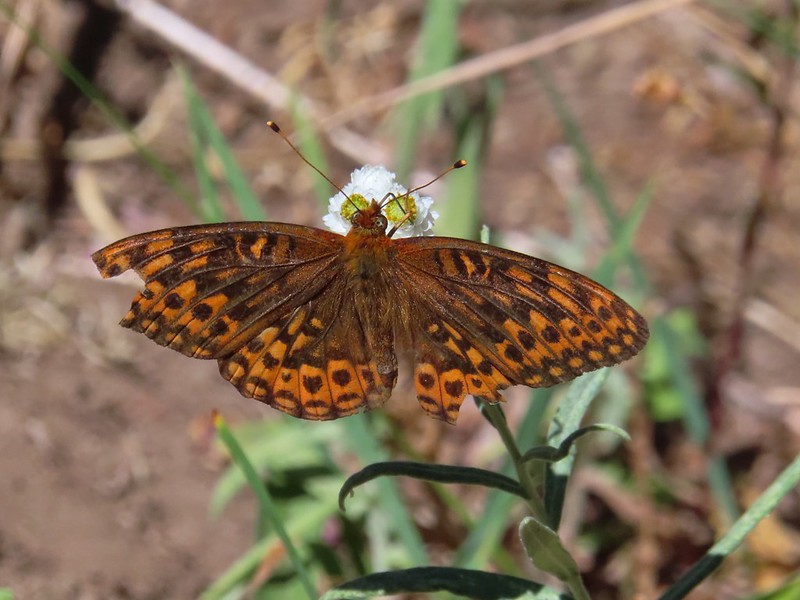 Fritillary on pearly everlasting.
 The final stretch to the summit passed through a fire scar.
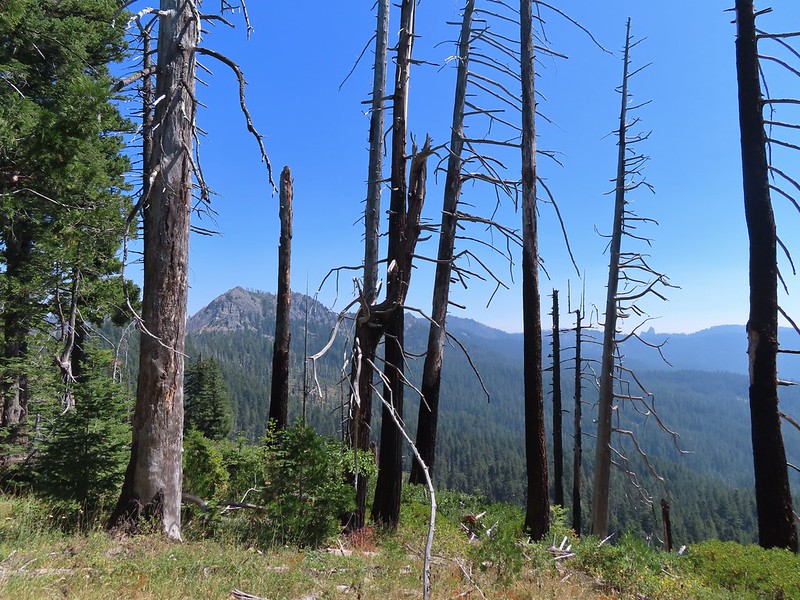 Highrock Mountain to the left, Hershberger Mountain in the middle, and the Rabbit Ears to the right (
 Rabbit Ears closeup.
 Fish Mountain (back left), Weaver Mountain, Highrock Mountain, and Hershberger Mountain with Grasshopper Meadow below.
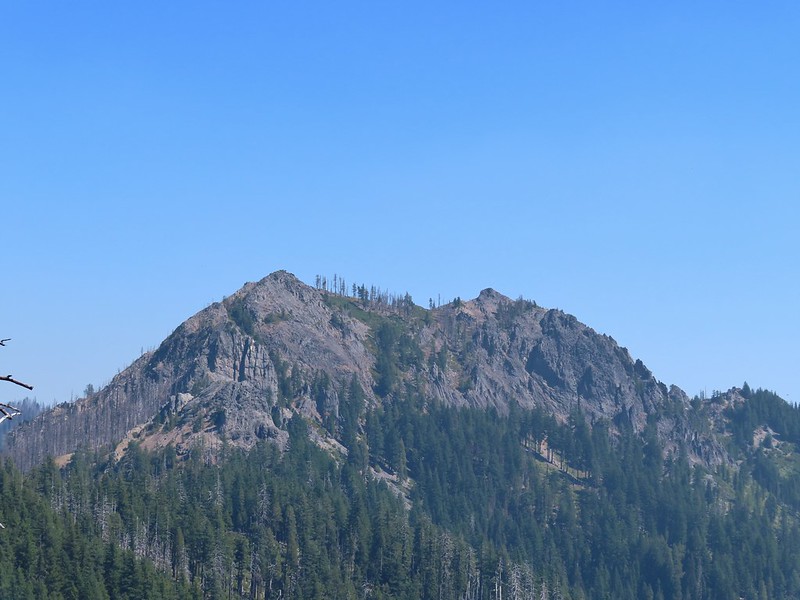 Highrock Mountain
 Owl’s clover.
 Arriving at the old lookout site.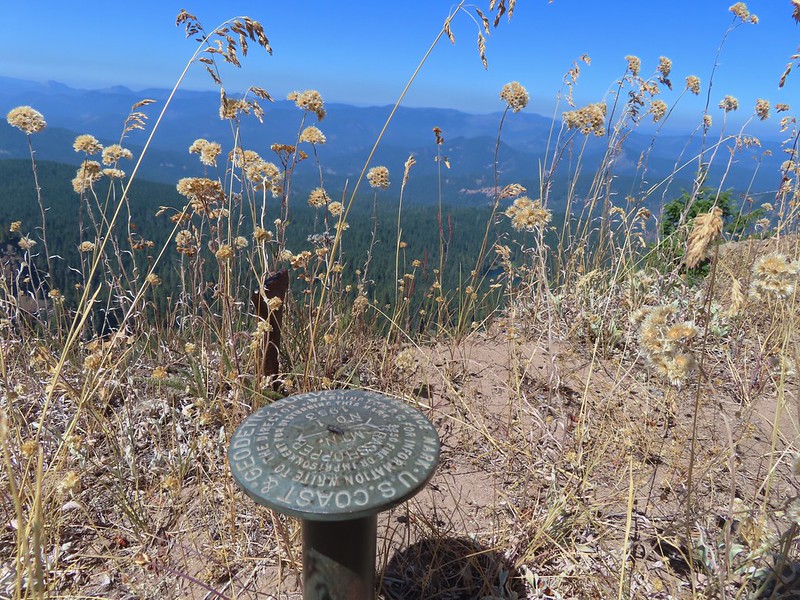
 Buckeye (left) and Cliff Lakes below Grasshopper Mountain. The broad hump beyond to the left is Twin Lakes Mountain. We had visited a viewpoint on the north side of that mountain back in June of this year (
 Buckeye and Cliff Lakes
 Smoke on the horizon to the NW. The Cedar Creek fire to the NE, Rum Creek Fire to the SW or several fires in Northern California could be the culprit(s). The peak with the white spot to the center right is Quartz Mountain which we recognized from our Hemlock Lake hike in August (
 To the NE we got a glimpse of Rattlesnake Mountain (far left) which we’d climbed during Labor Day weekend in 2020 (
 Rattlesnake Mountain behind Standoff Point.
 A skipper
 We veered right here which kept us from dropping below the saddle that we otherwise would have had to climb over on the Grasshopper Trail.
 Descending to the Grasshopper Trail.
 Trail sign at the other junction.
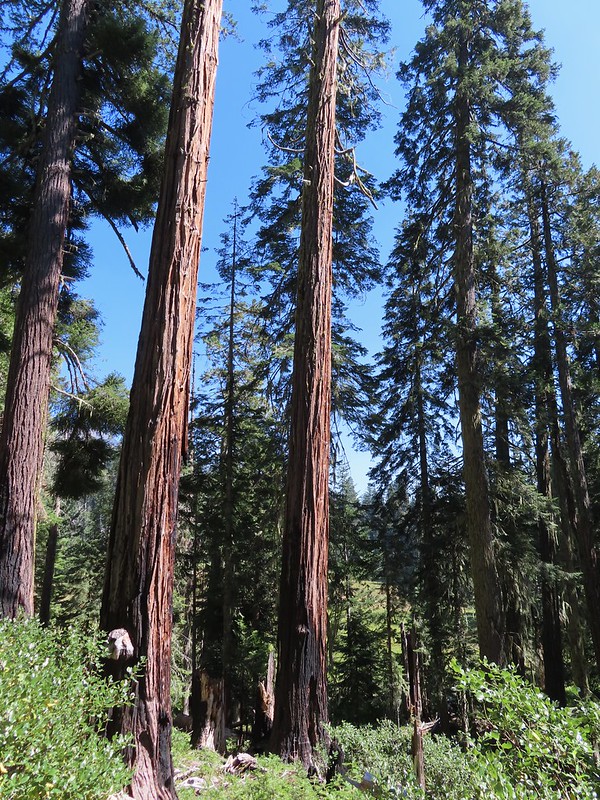 Grasshopper Meadow through the trees.
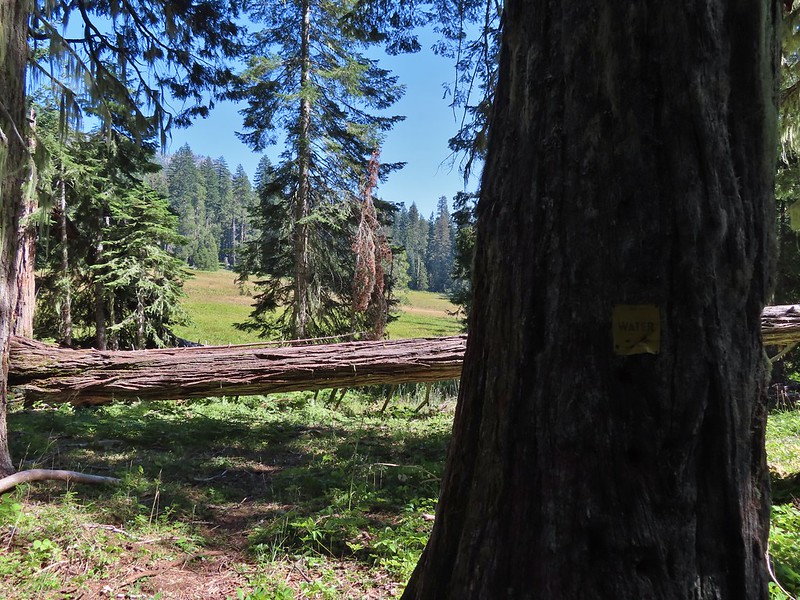 Sign for a (faint) spur trail to a spring above the meadow.
 Highrock Mountain from Grasshopper Meadow.
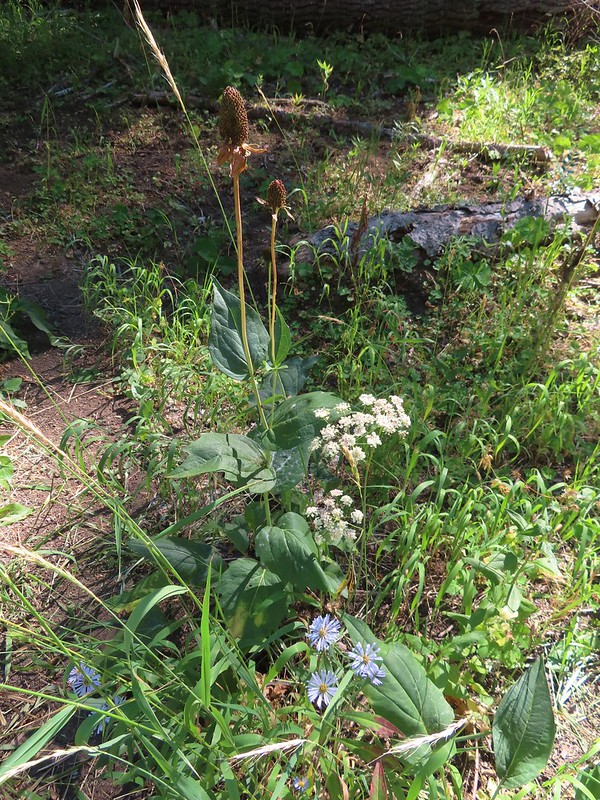 A few flowers hanging on to the last days of Summer.
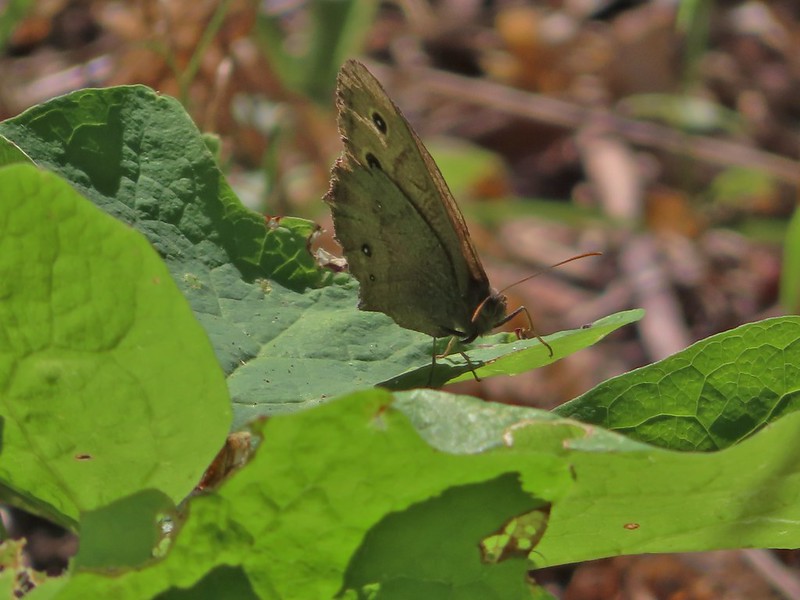 Common wood nymph
 The trail got pretty faint just before the junction but we could see the trail sign so we just headed for it.
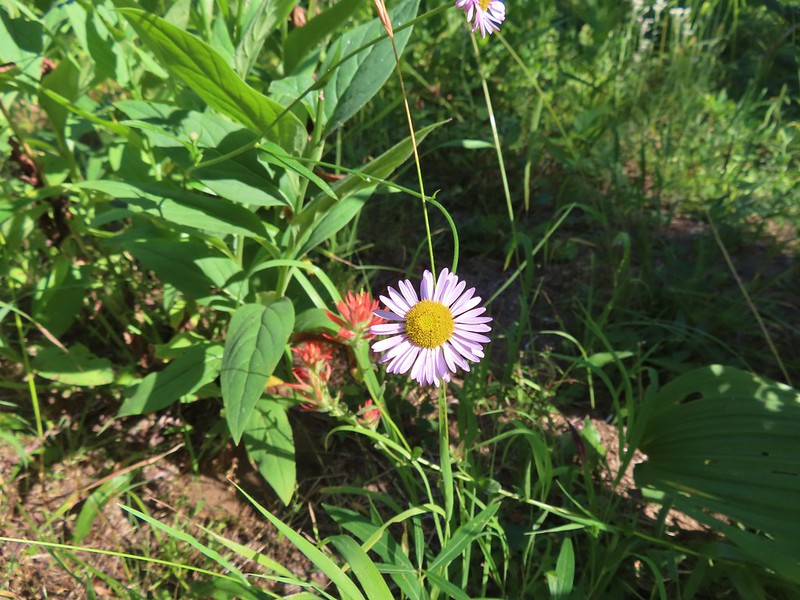 Fleabane? and paintbrush.
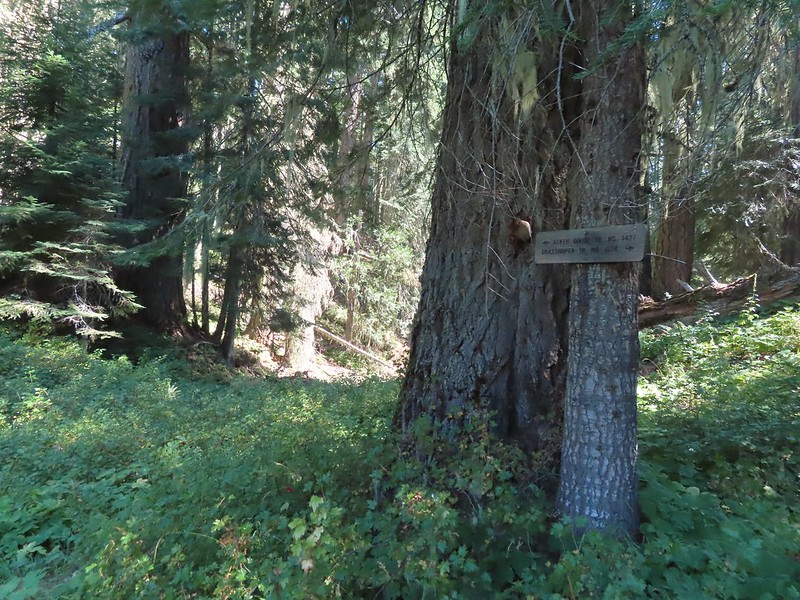 Acker Divide Trail pointer.
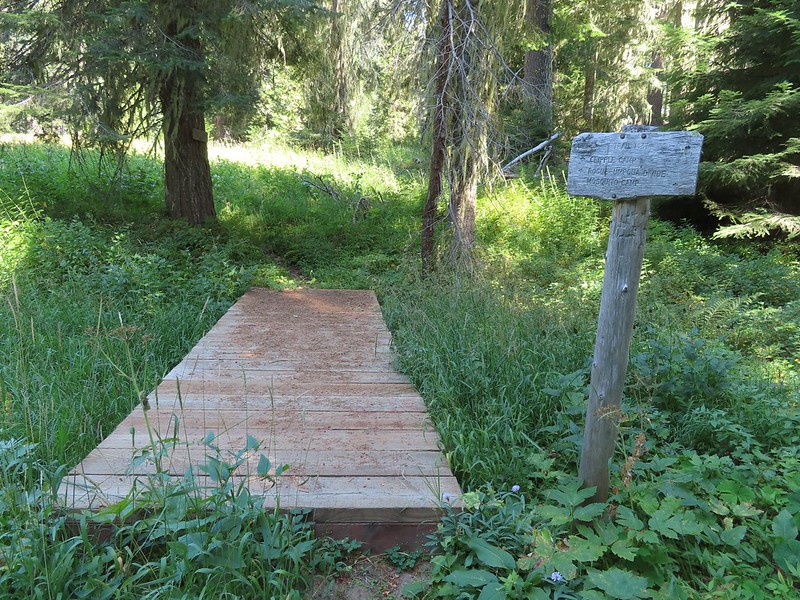 Pointer for Cripple Camp (we visited the shelter there on our Hershberger Mountain hike) and the Rogue-Umpqua Divide Trail.
 This fuzzy caterpillar was in a hurry.
 The trail along an old log.
 Passing through a small meadow near the spur to the Acker Divide Trailhead.
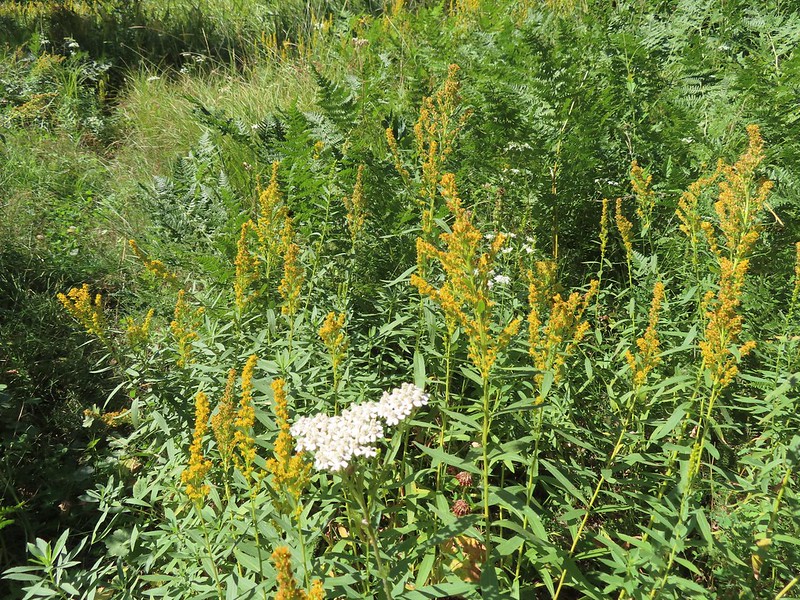 Yarrow and goldenrod
 The area was really well signed.
 Sign for Mosquito Camp on the tree to the right. There was zero sign of any established campsites here.
 Meadow at Mosquito Camp, it came complete with mosquitos (not too many though).
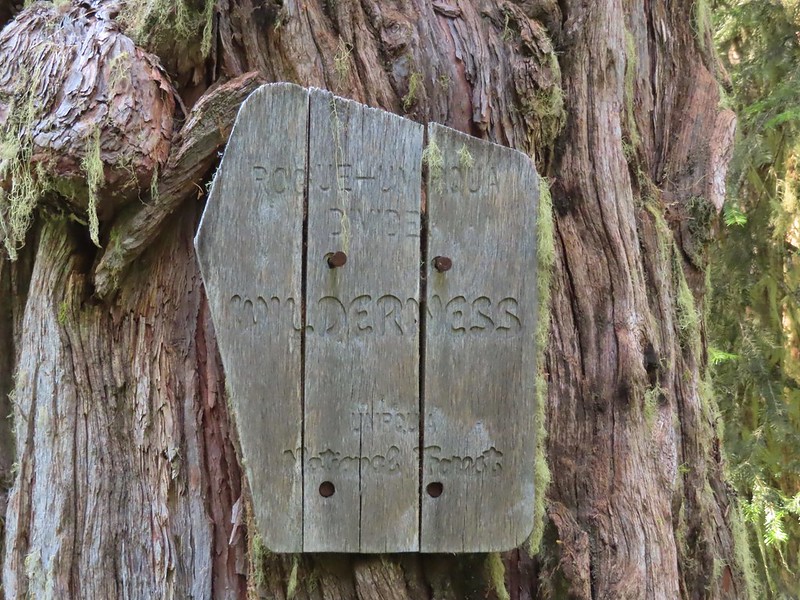 First of two times reentering the Rogue-Umpqua Divide Wilderness.
 Scat on the trail, at least we knew something used it.
 One of several very small bodies of water along Skimmerhorn Creek which may or may not be Little Fish Lake.
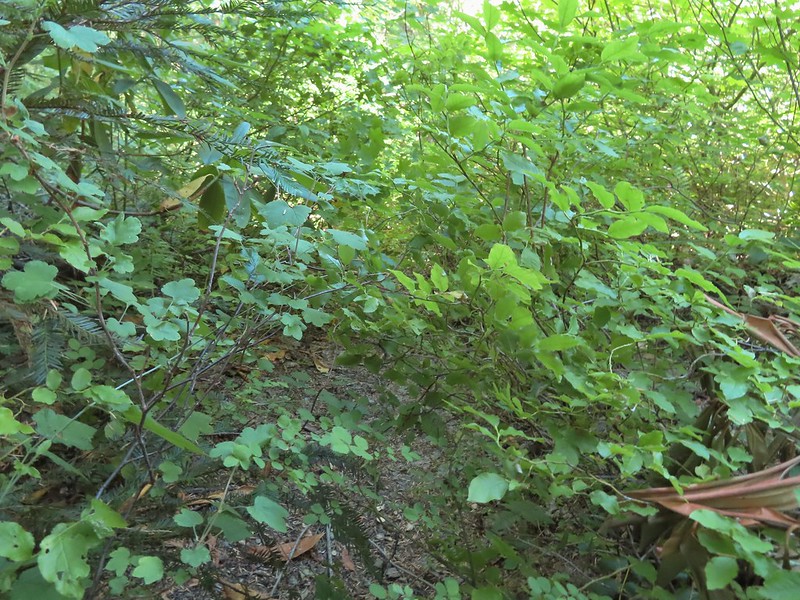 Overgrown trail near Skimmerhorn Creek.
 Looking down at the pond? lake?
 As we neared the Lakes Trail we began seeing more signs of what appeared to be an ancient lava flow.
 Last of the lupine blooms.
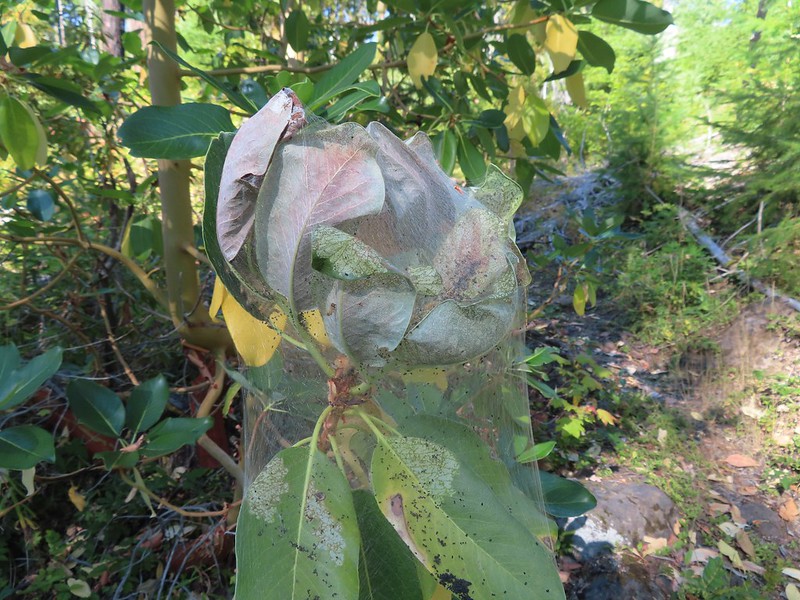 Lots of these insect tents on the madrones in the area.
 Arriving at the Lakes Trail.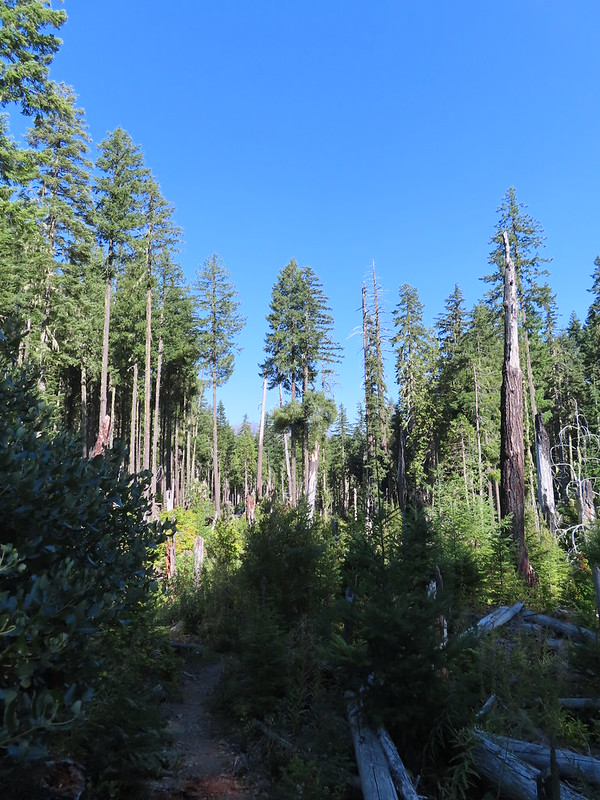

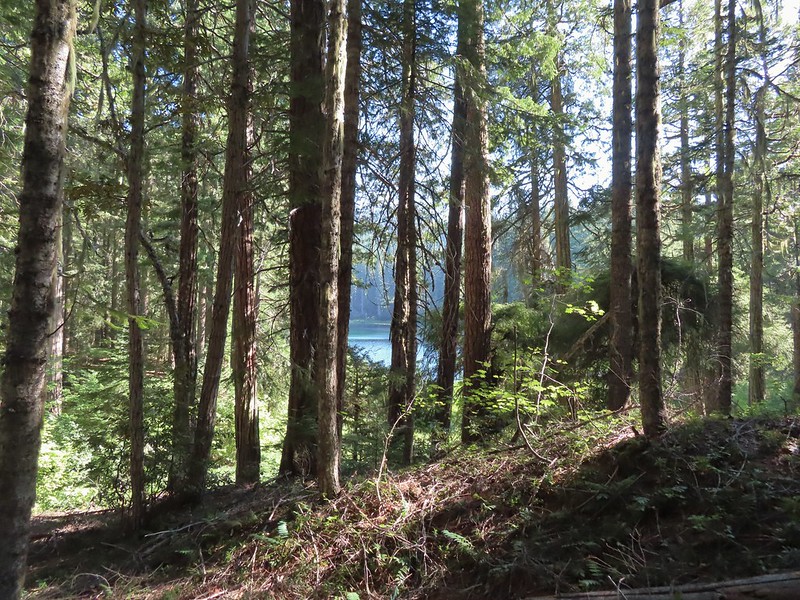 First glimpse of Buckeye Lake
 At this fork we detoured right to visit the lake shore.
 A good reminder that far too many people tend to forget.
 Grasshopper Mountain from Buckeye Lake.
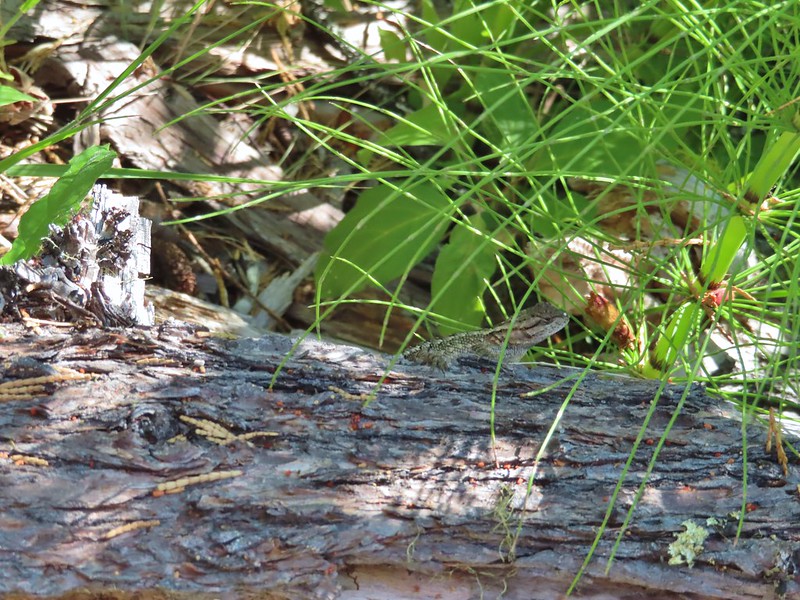 Lizard
 We had to really watch our step because these little guys were everywhere.
 There is an smaller, unnamed lake just West of Buckeye Lake that we did not take the time to check out closer.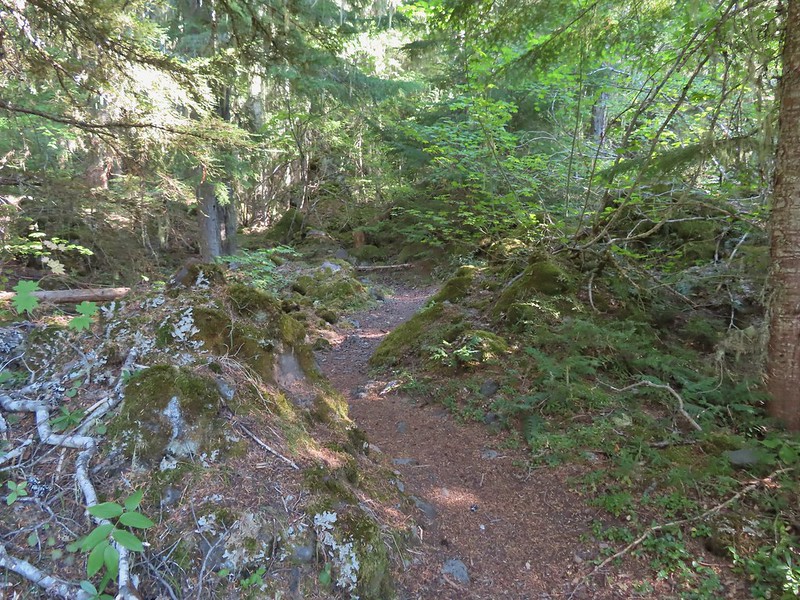
 The spur trail to the campsite.
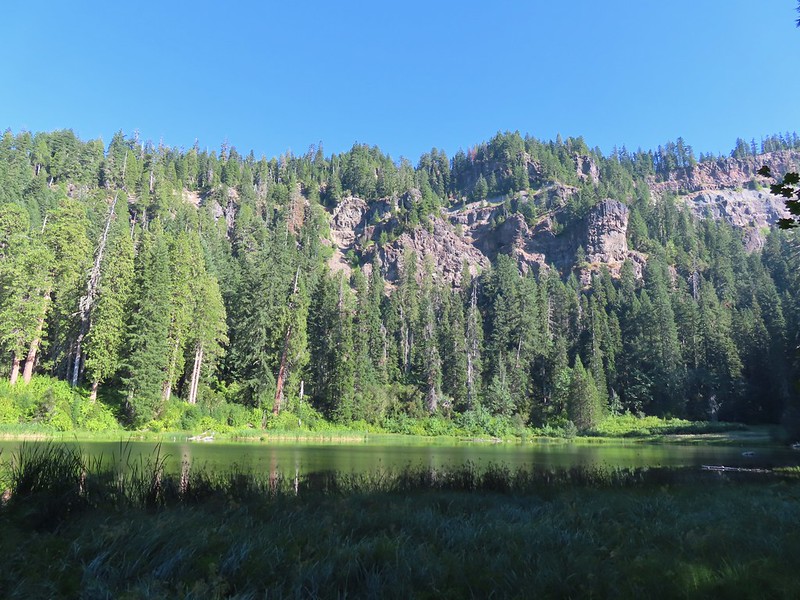
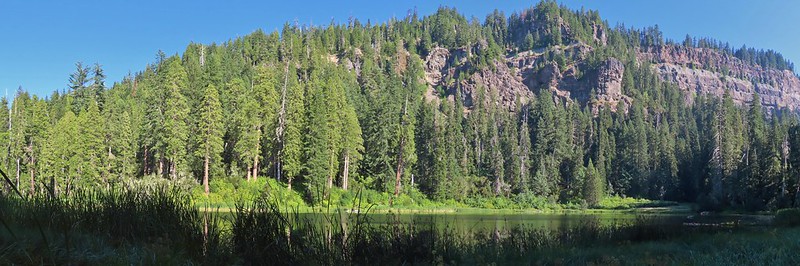 Attempted panorama.
 Footbridge over the outlet creek which flows into another small unnamed lake that we did not attempt to find.
 Unfortunately the lighting made this tree very hard to photograph but it was the coolest tree/rock combination that we’ve encountered.
 Fritillary on thistle.
 Short climb back up to the junction.
 This slug was heading our way while we finished dinner.
 The Sun was getting pretty low as we ended our hike.
 A big nest atop a tree and the Moon above Fish Lake.
 Zoomed in on the nest and Moon.
 Fish Lake just before 7:30pm.
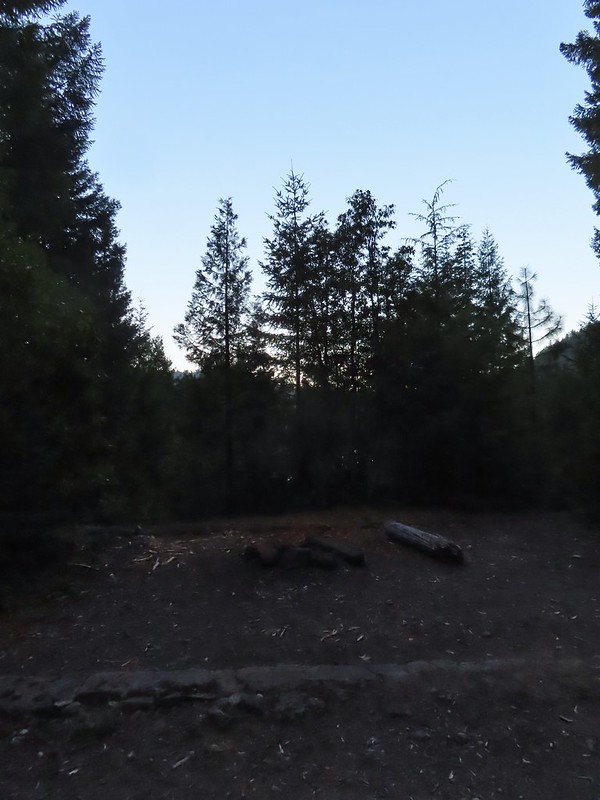 Campsite after packing up in the morning.
 Passing our planned route for the day on the left. Highrock Creek was just a 20 yard detour to the right.
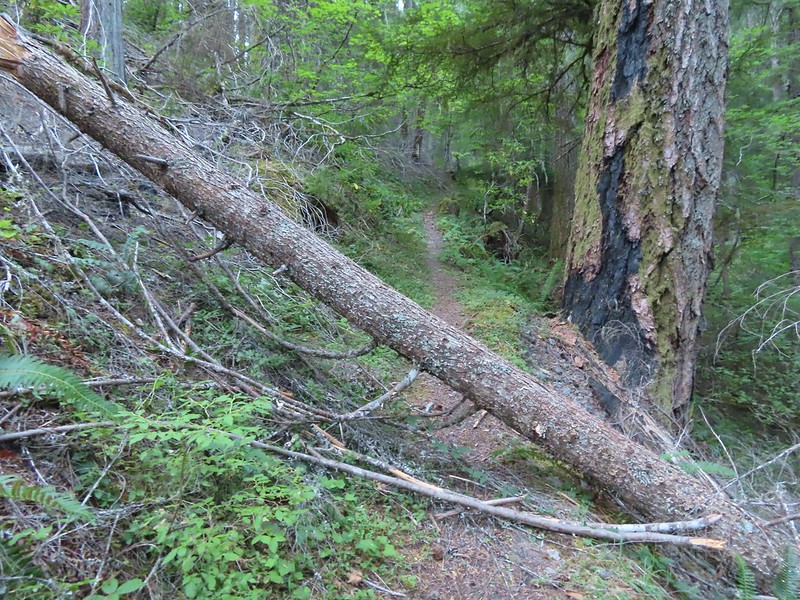 I think this was the third obstacle, one of several that was easy enough to get over.
 Prior maintenance, the second log may have been cut post fire?
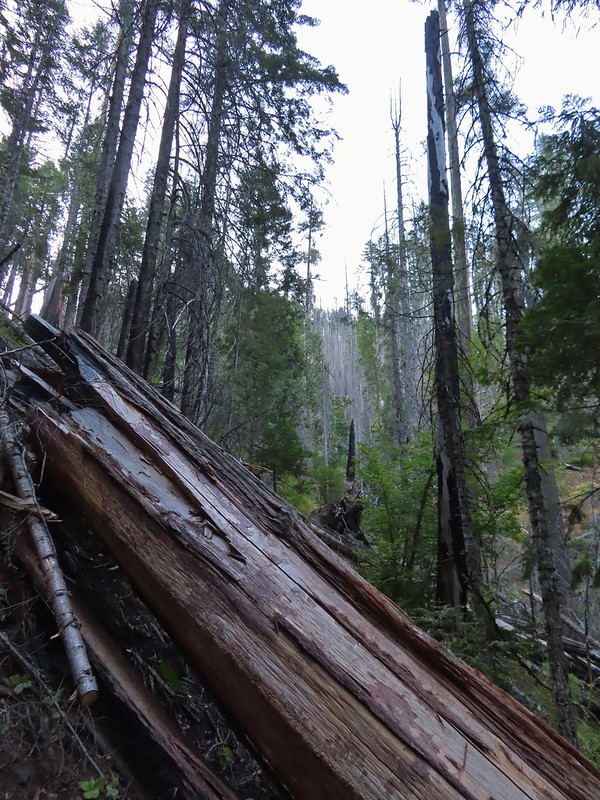 End of the line for us. Even if we somehow got around this one there was still 9.5 miles of burned trail from the trailhead and who knew how many obstacles like this one we might encounter or how long it would take us if we somehow were successful.
 We had the privilege of navigating this one twice. Heather is on the other side coming through.
 Back at the junction.
 No clouds this morning.
 Highrock Mountain behind Fish Lake. Seeing the vine maples turning colors reminded us that despite the heat Autumn was just around the corner.
 Hiking along Fish Lake Creek.
 Highrock Mountain from the Beaver Swamp Trail.
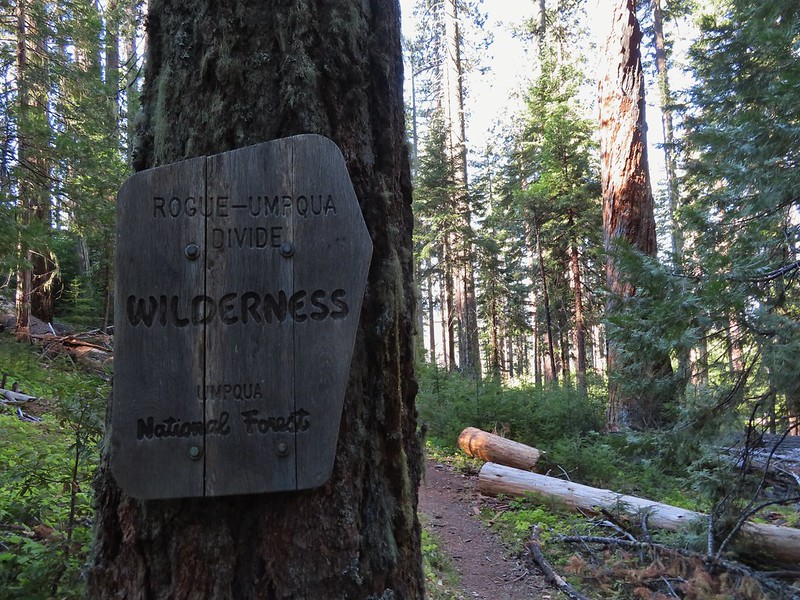 Leaving the Rogue-Umpqua Wilderness for the last time this trip.


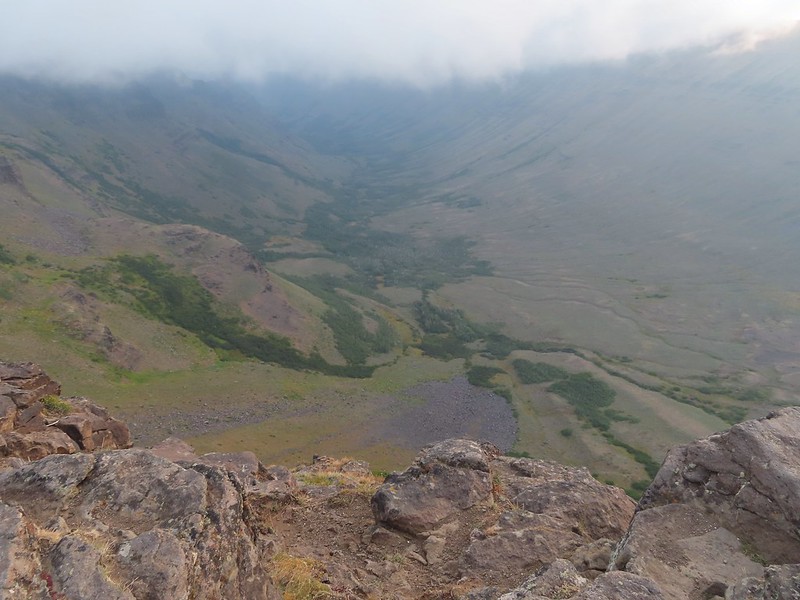
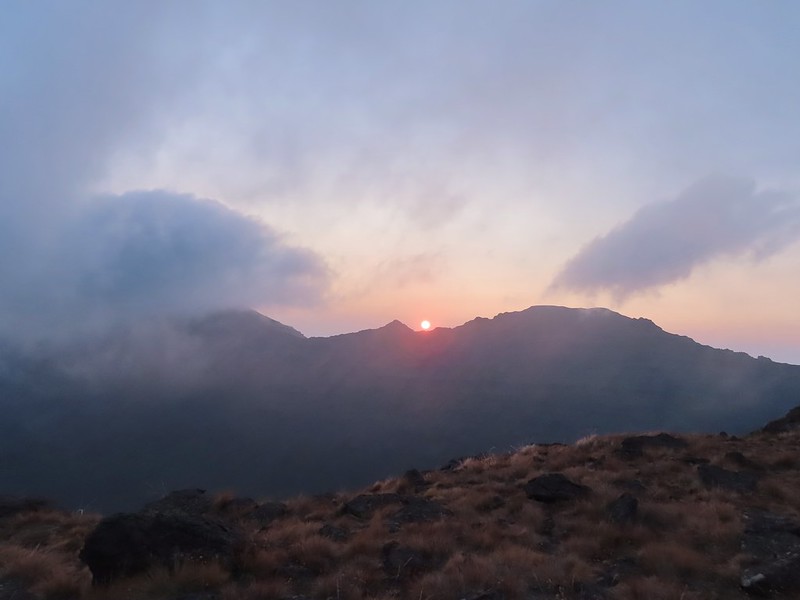 Still some smoke to the east as shown by the red Sun.
 Here come the clouds.

 Between the Sun and haze it was hard to see much of the ragged eastern side of Steens Mountain or the Alvord Desert (
 Frozen thistle
 The Alvord Desert through the haze.
 A look back at the parking area.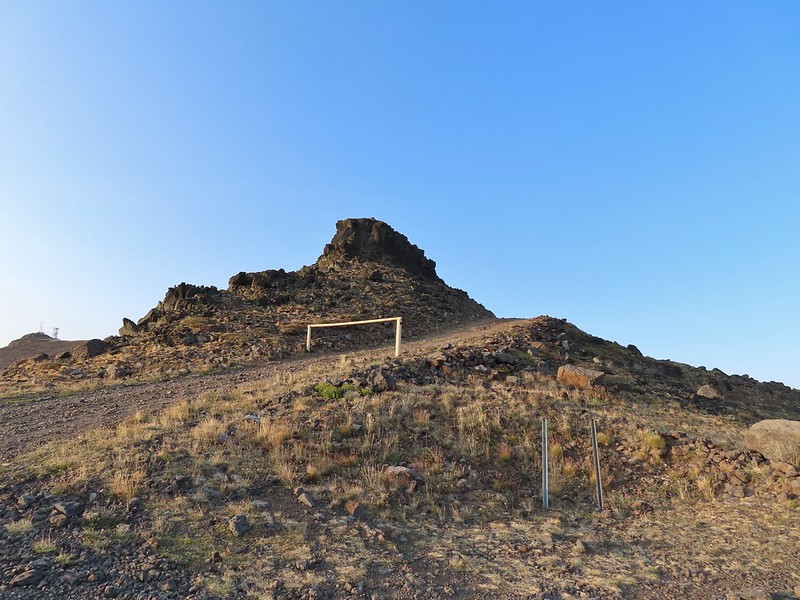
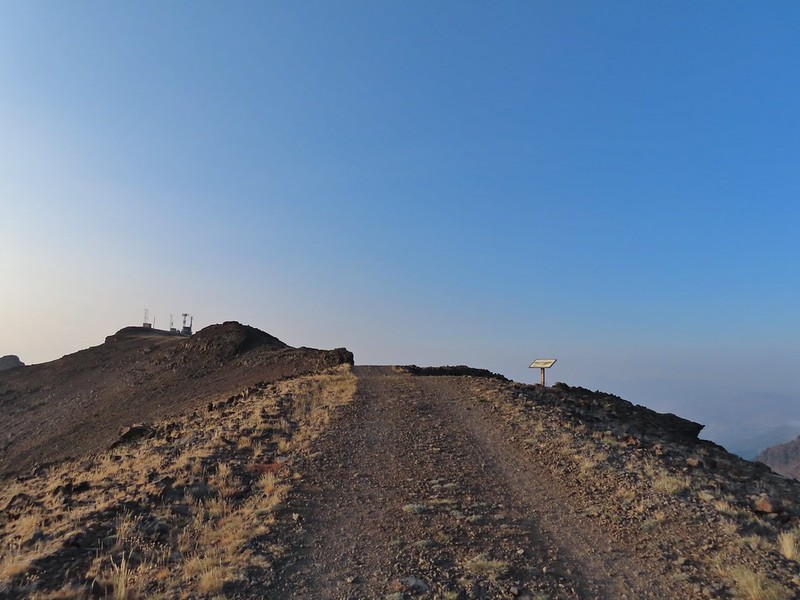
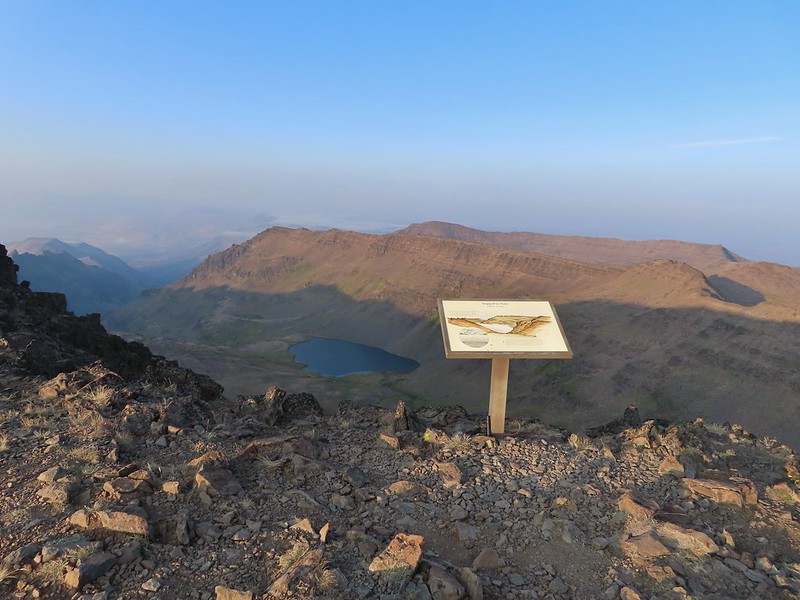 Wildhorse Lake below the summit.
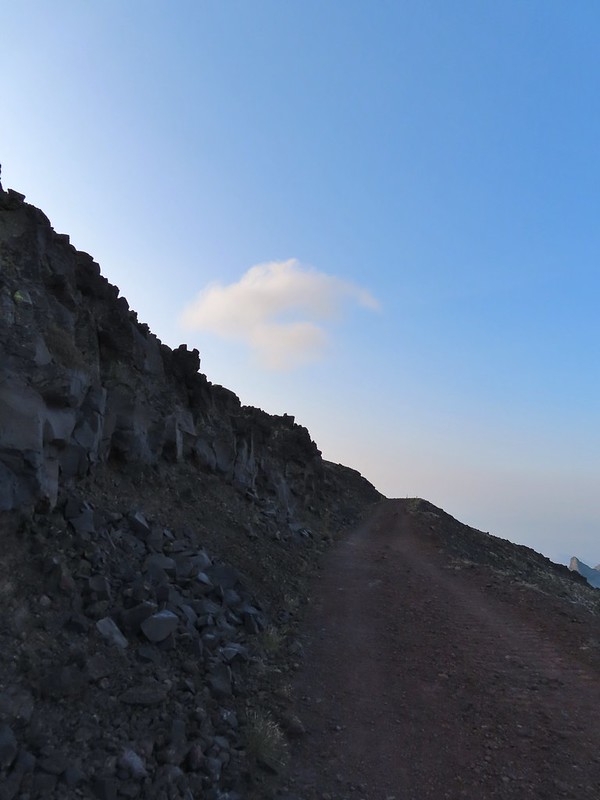 The rocks here provided a little protection from the freezing wind.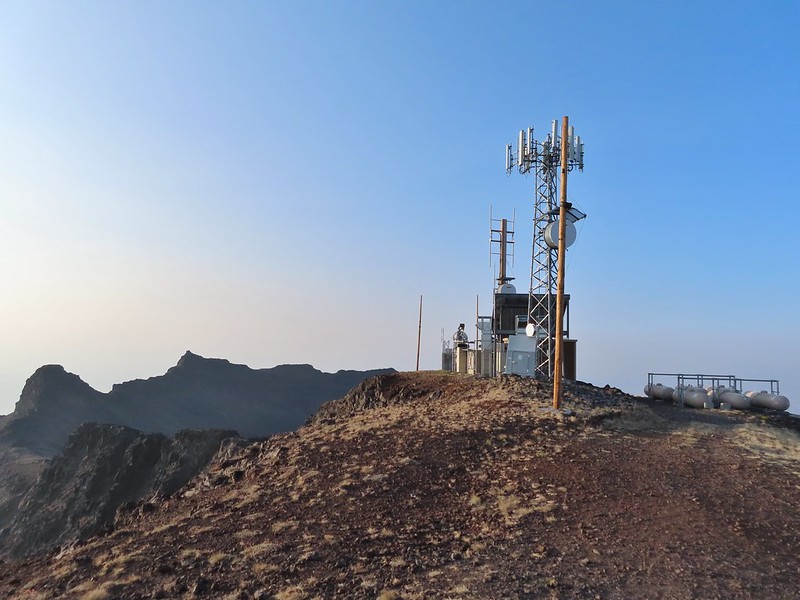
 Big Indian Gorge (
 Heather getting a closer look at Wildhorse Lake.
 Not much snow left up here.

 Typical tread near the top.
 Buckwheat
 The bench.
 The small stream.
 A wren.
 Wildhorse Lake from near the end of the bench.
 We were a little disappointed to see just how late we were for most all of the wildflowers. I don’t know how much the drought this year affected the timing or if it blooms that much earlier in SE Oregon but the remains of what looked to have been an excellent display were all we were left with.
 A few stone steps began the steep descent along the stream.
 A few of these little yellow flowers were still in bloom.
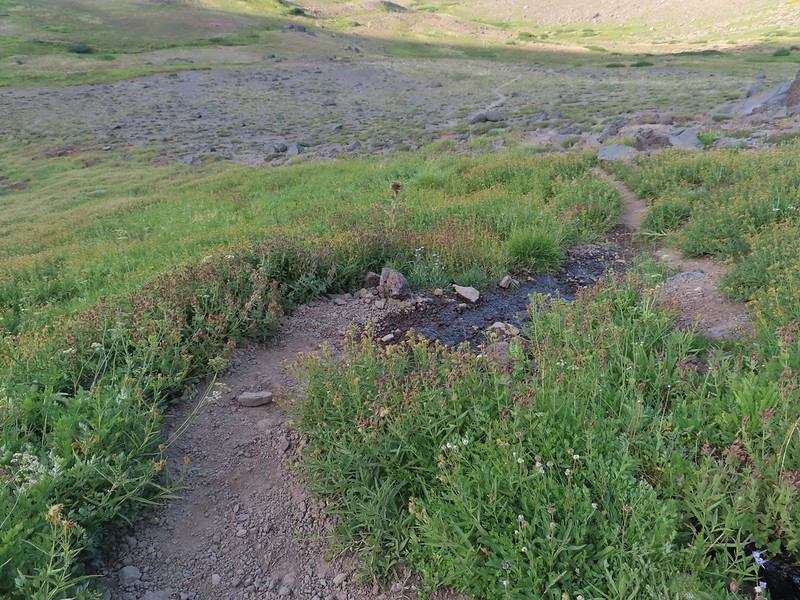 This was a mass of pink monkeyflower a few weeks ago.
 A look up at the summit.
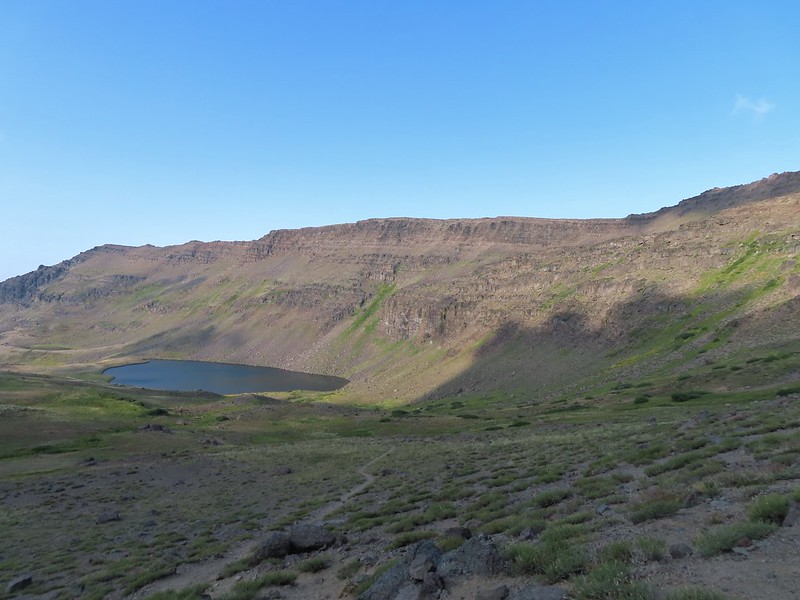 The trail descending less steeply to the lake.
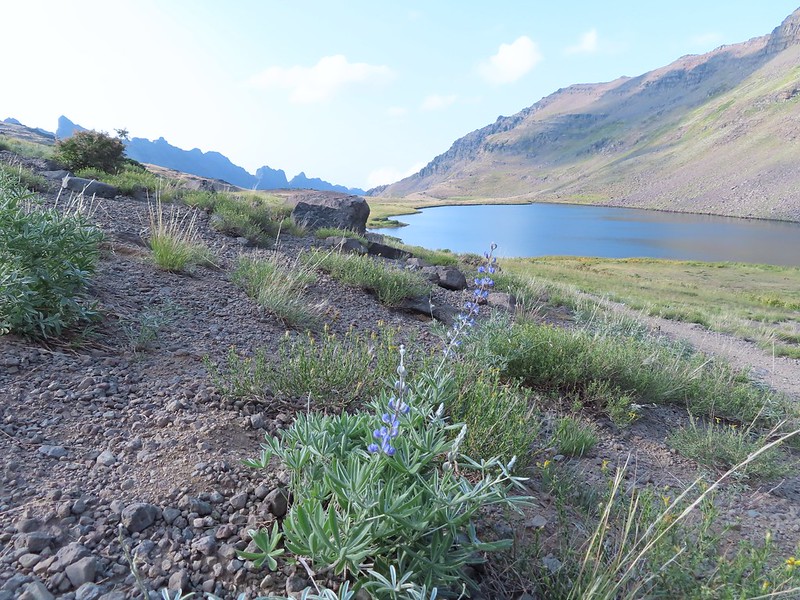 A lone lupine blooming near the lake.
 A pair of paintbrush and the remainder of some aster or fleabane.
 A ground squirrel near the lake.

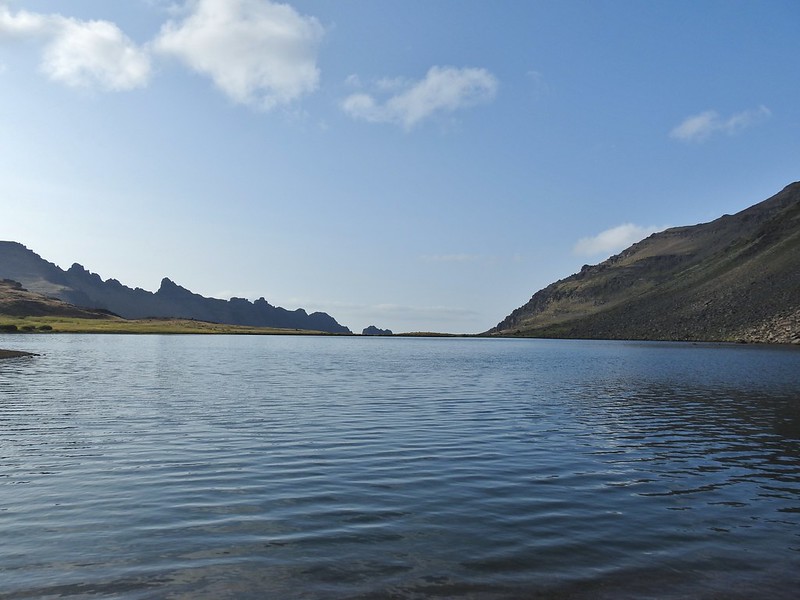
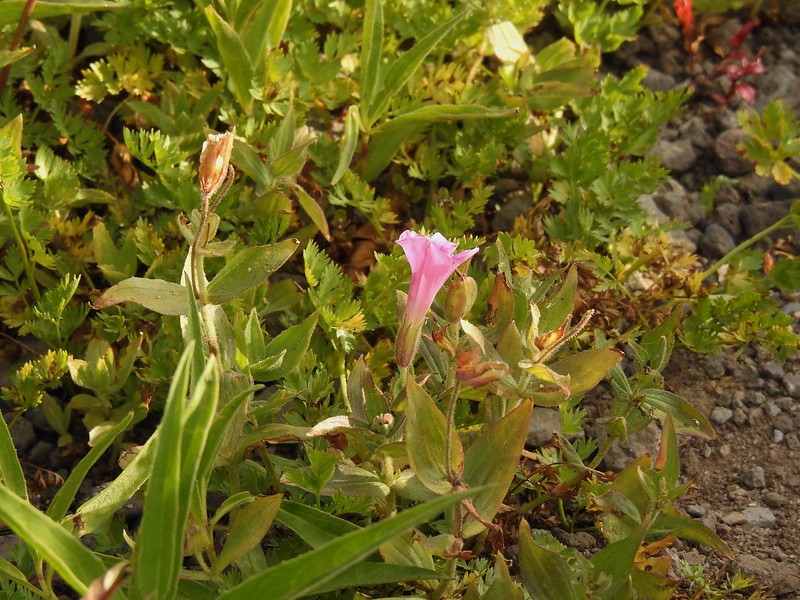 The only pink monkeyflower blossom we spotted.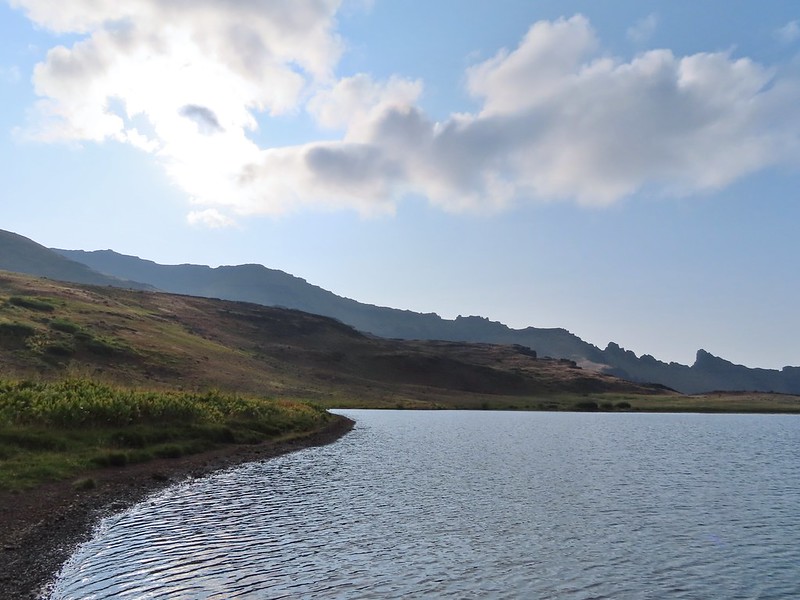
 Ranger buttons
 Mountain coyote mint
 Cascade grass-of-parnassus
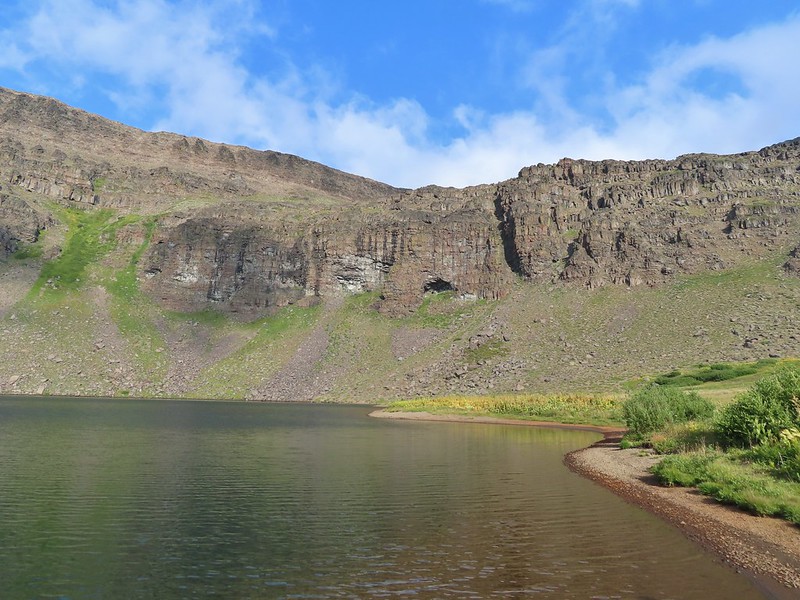

 Gentians
 Wildhorse Creek
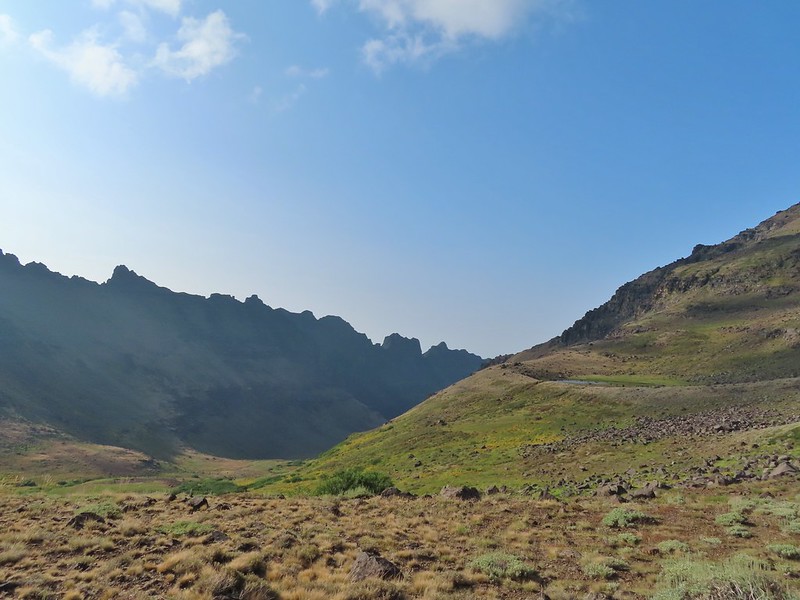 Looking down along Wildhorse Creek.
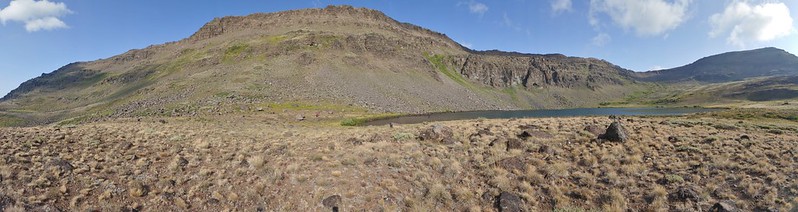 Wildhorse Lake and Steens Summit.


 Rockfringe willowherb
 Raptors soaring above Steens Mountain.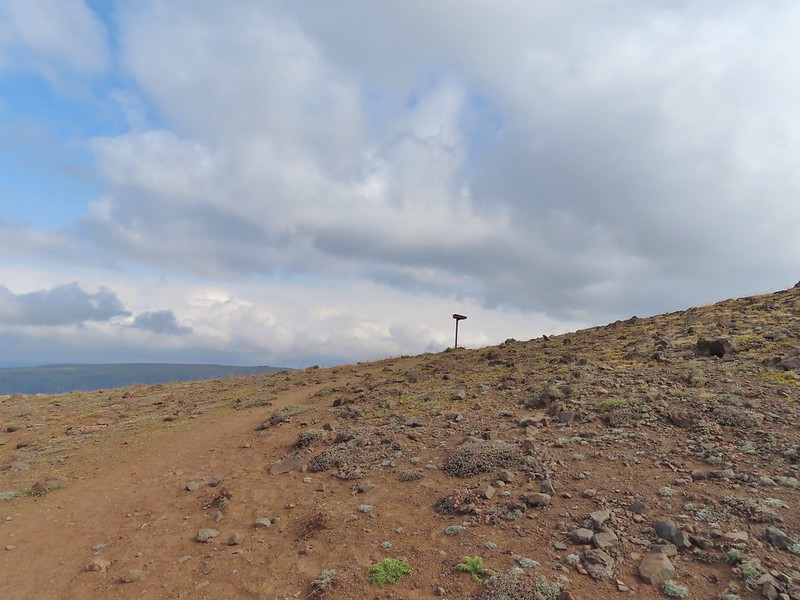

 Big Indian Gorge
 The summit from the unofficial trail.
 The trail on the ridge.
 Looking ahead at the ridge the rocky outcrop looked a bit intimidating.
 The view out over Big Indian Gorge.
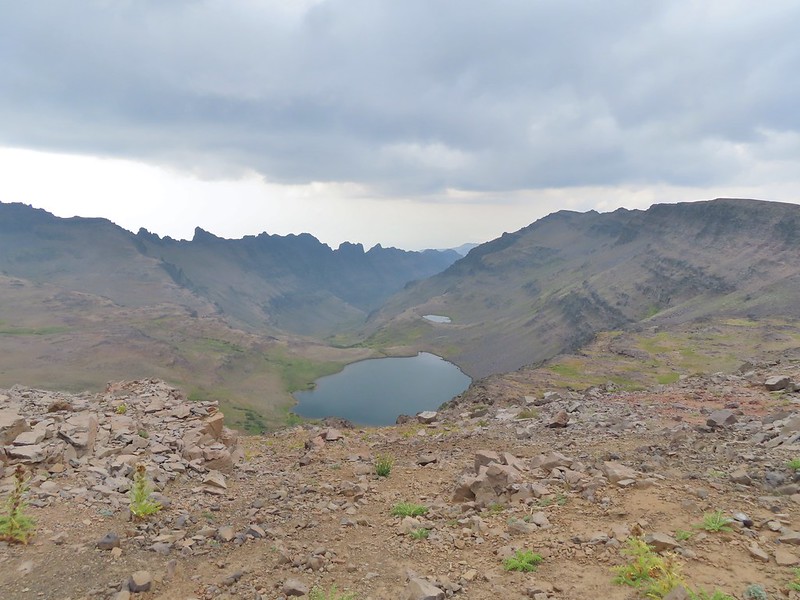 Wildhorse Lake
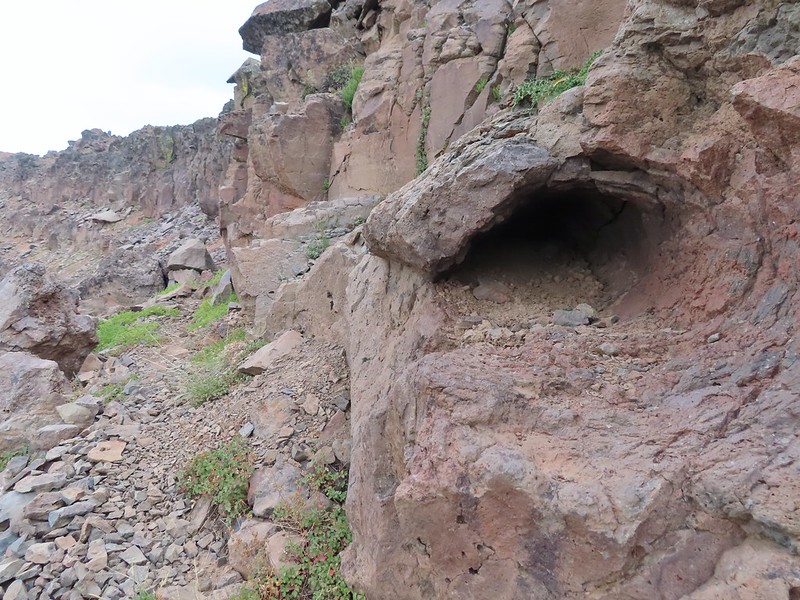
 I turned back here, I’m not that adventurous.
 Darker clouds over the summit from the trailhead.
 A little better view of the Alvord Desert.
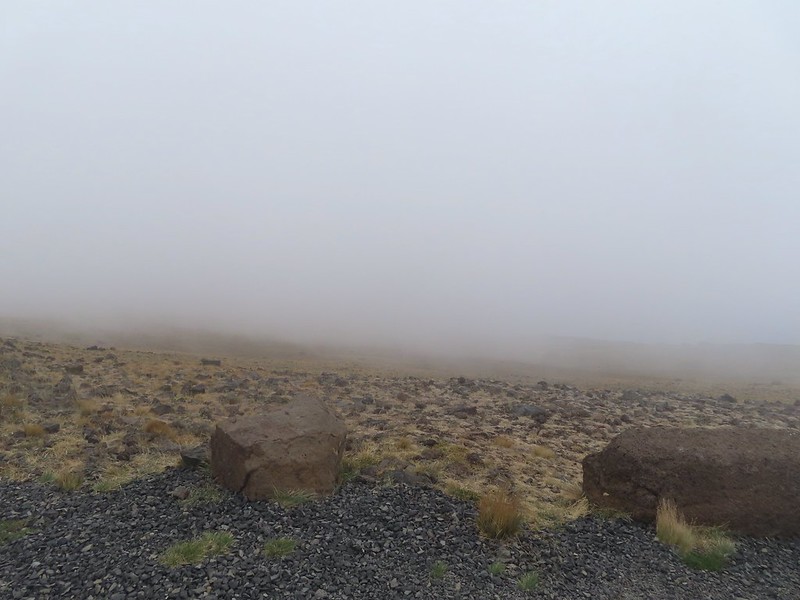 The view as we prepared to drive off.
 We did stop along the way to take a couple of photos.
 Our planned hike for the next day was up this gorge.
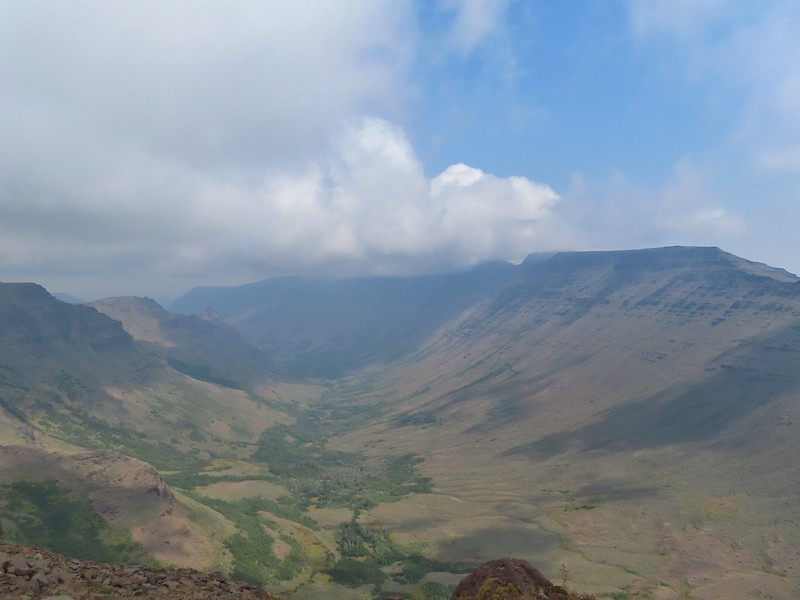

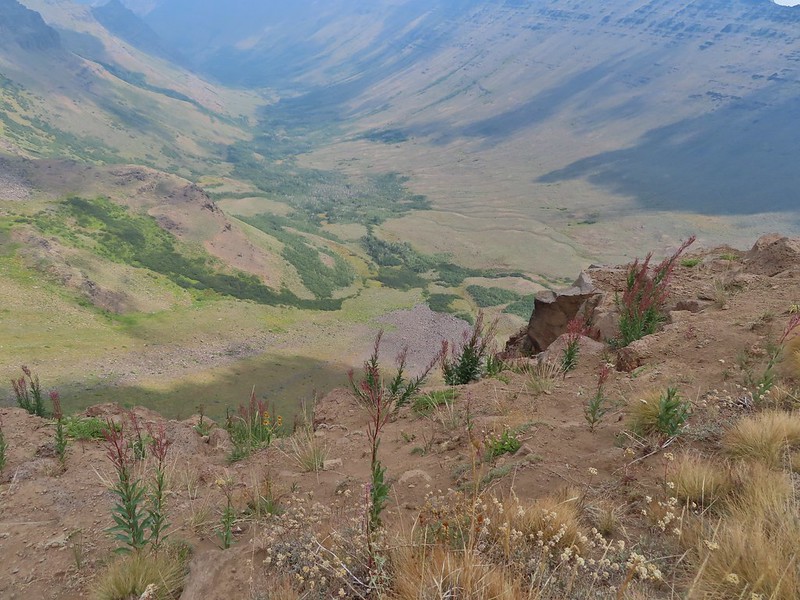

 The historic



 The wheelchair friendly path.
 The hiker path.
 The hiker trail.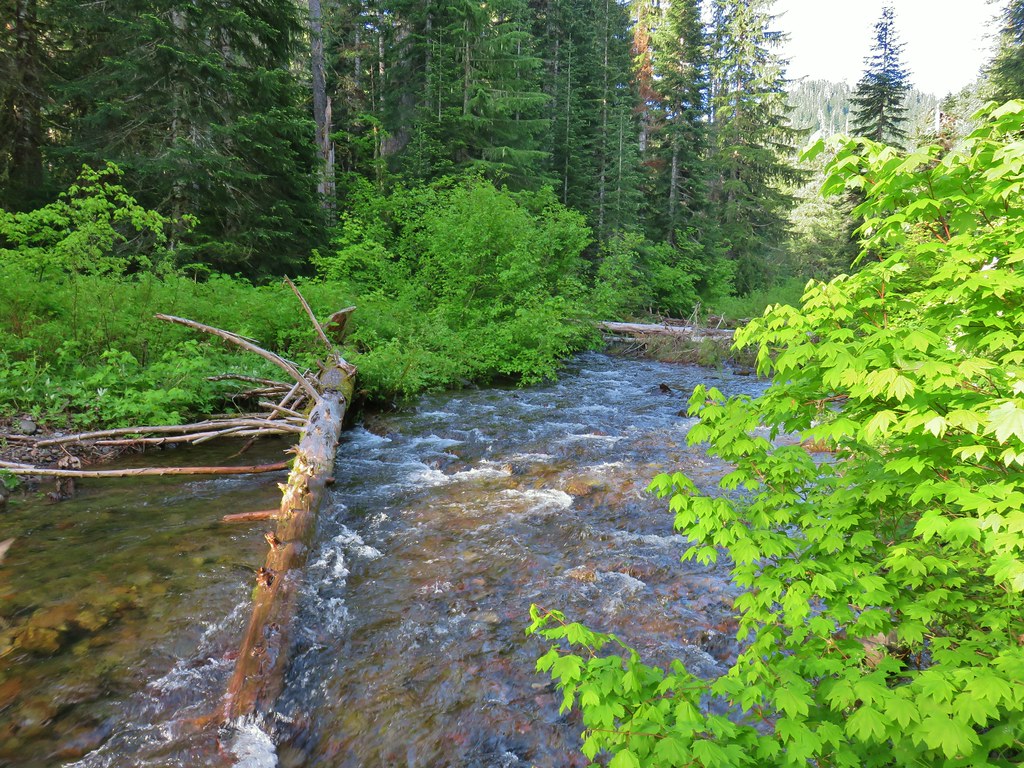
 Western meadowrue
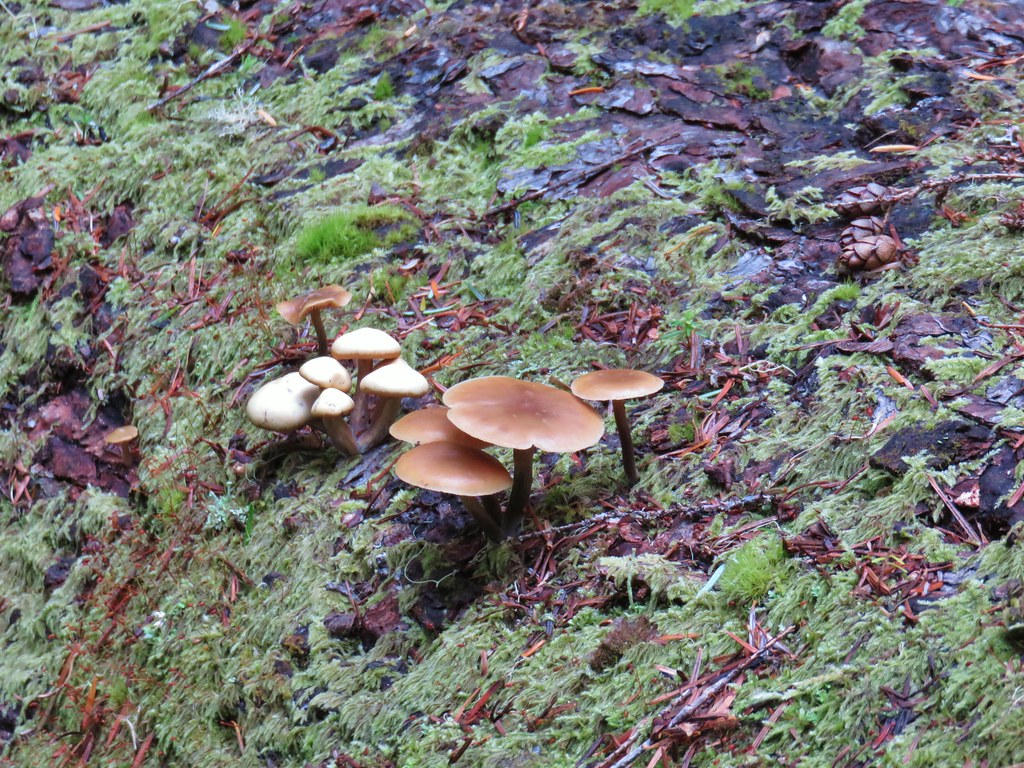 Mushrooms on a log.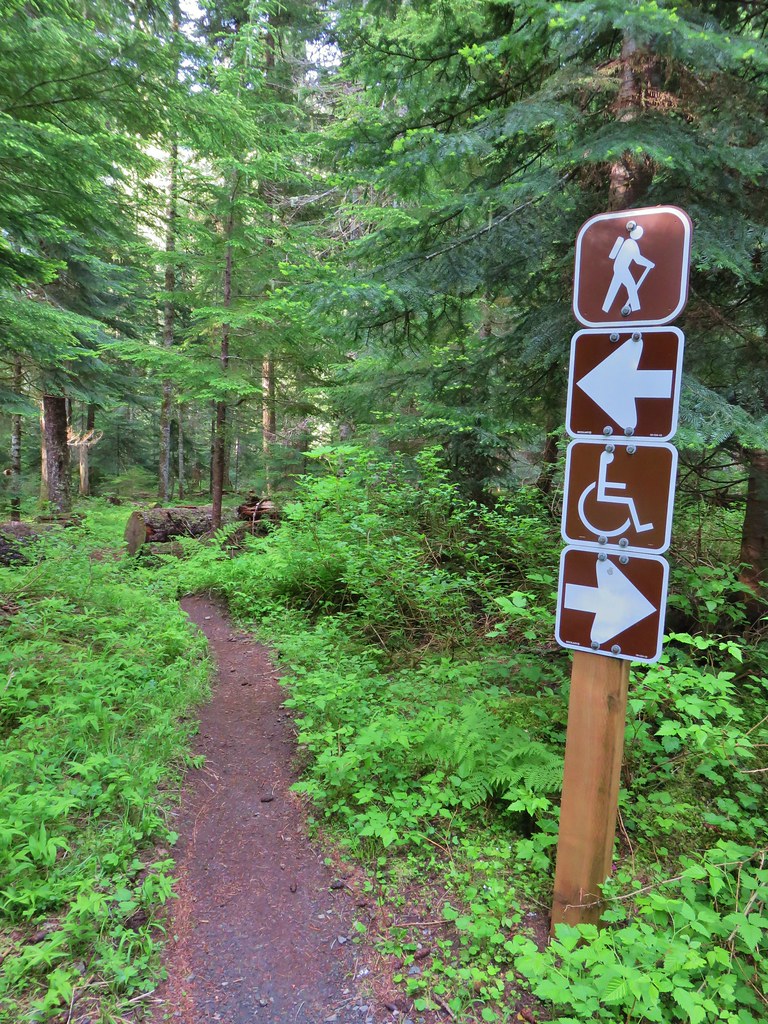
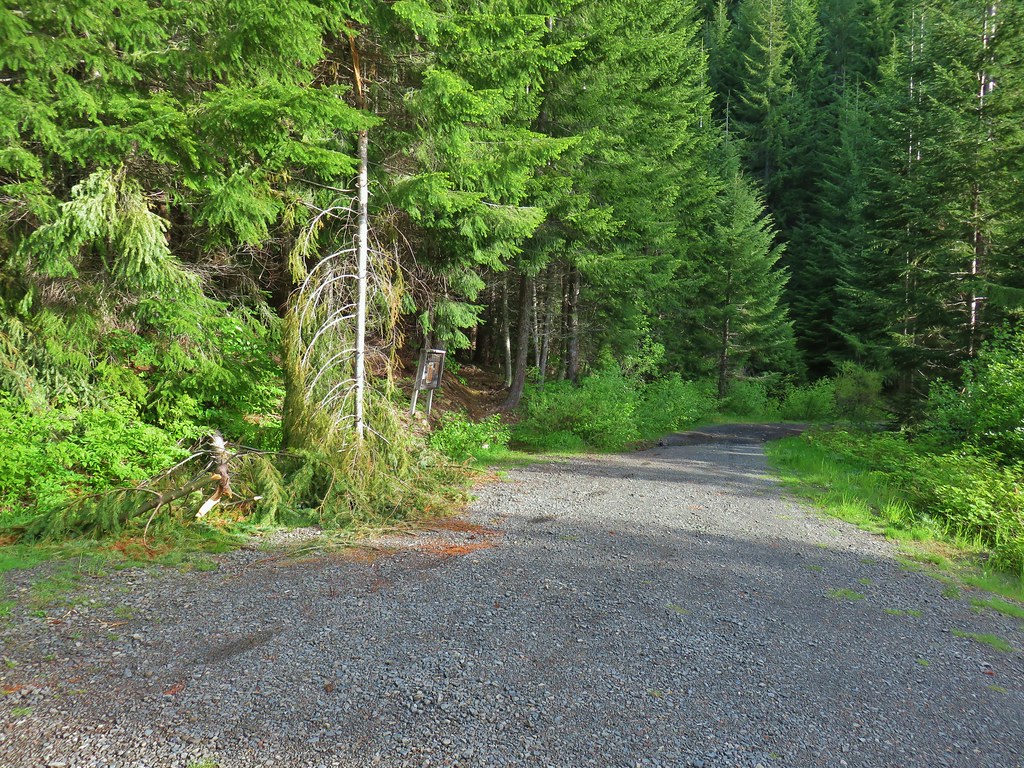 Echo Basin Trail at FR 055.
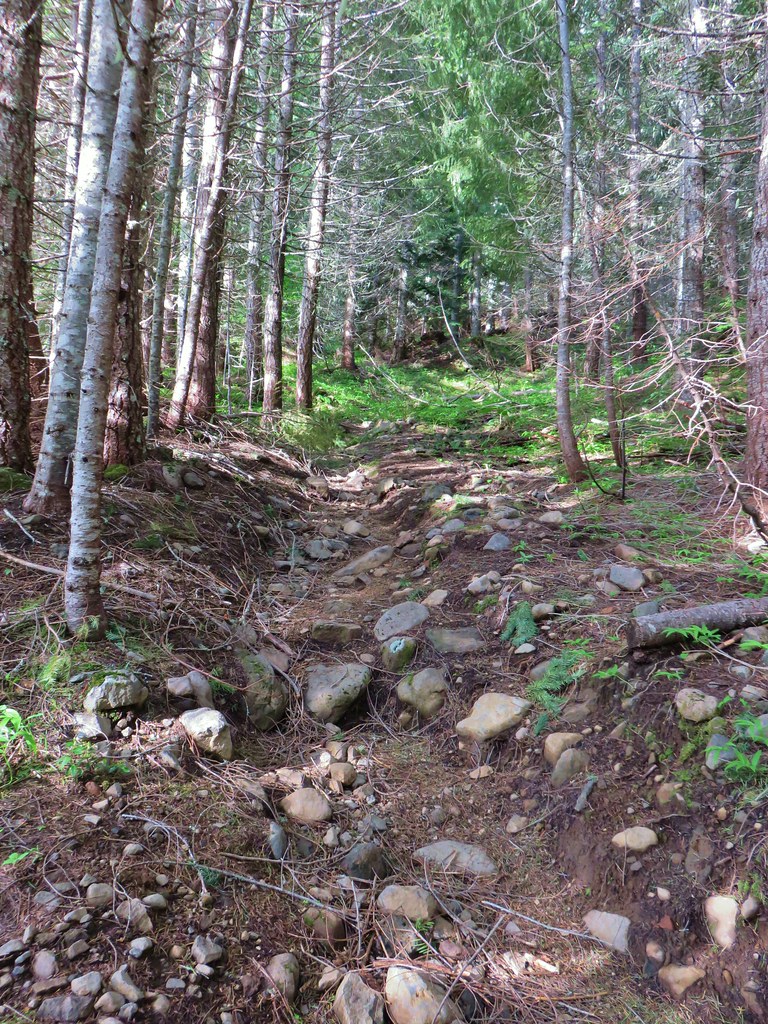 Rocky start to the trail.
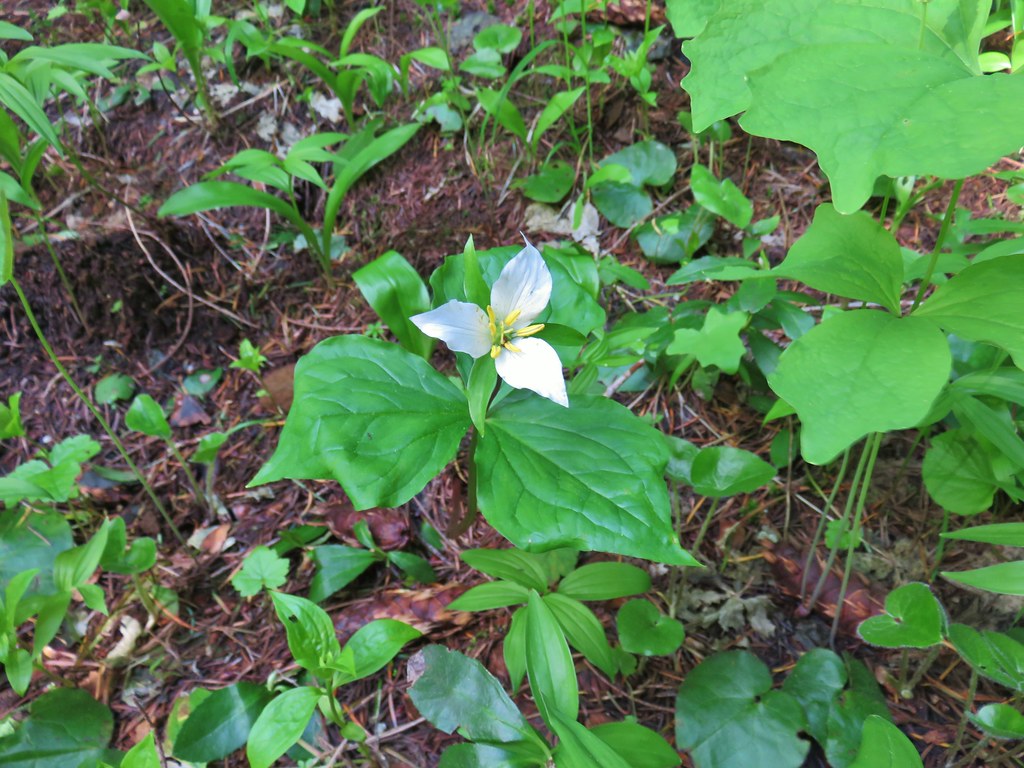 Trillium
 More trillium along the meadow.
 Swallowtail on salmonberry blossoms.
 Start of the loop.
 Orange tip butterfly
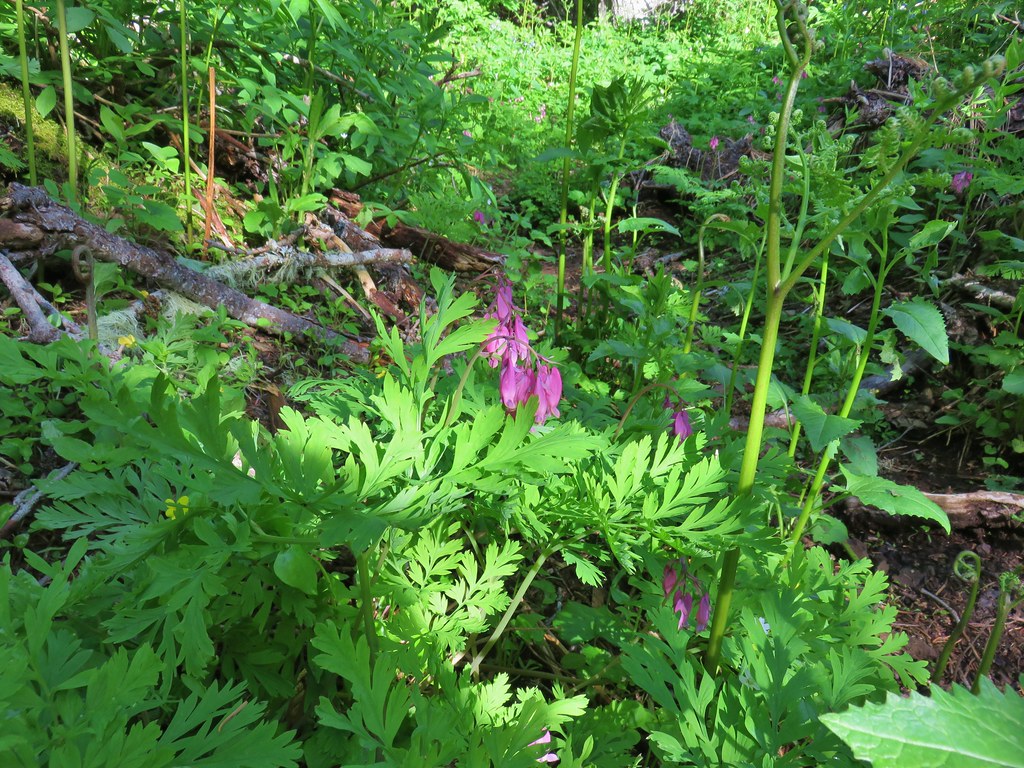 Bleeding heart
 Violets
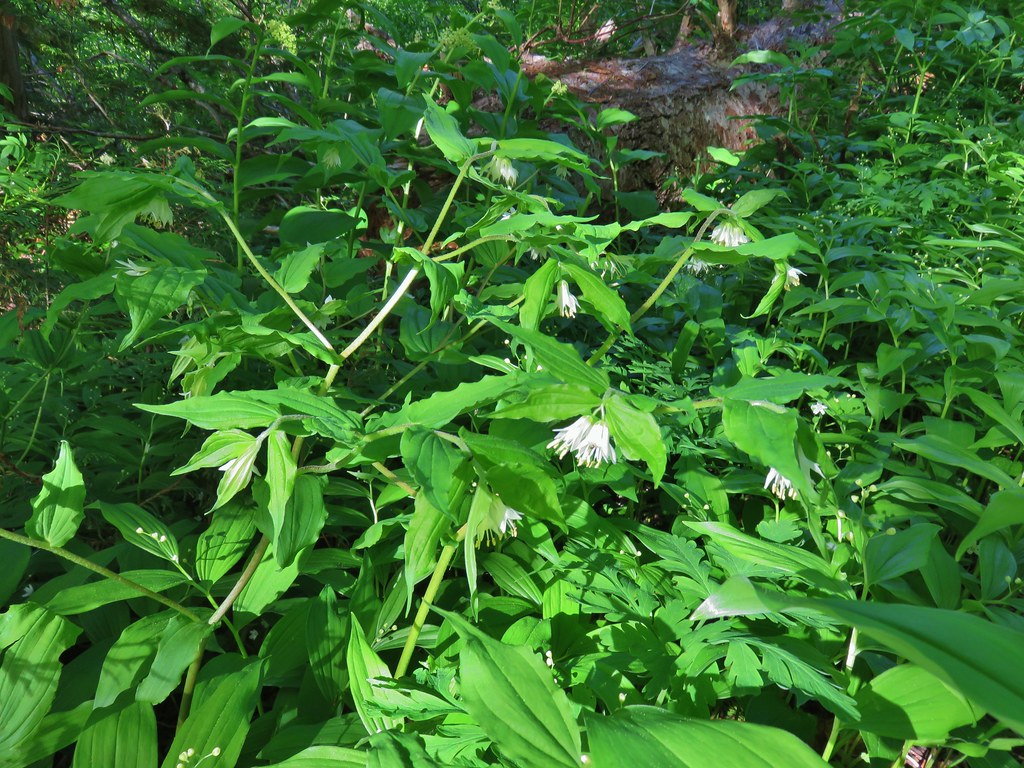 Fairybells
 Royal Jacob’s ladder
 Western meadowrue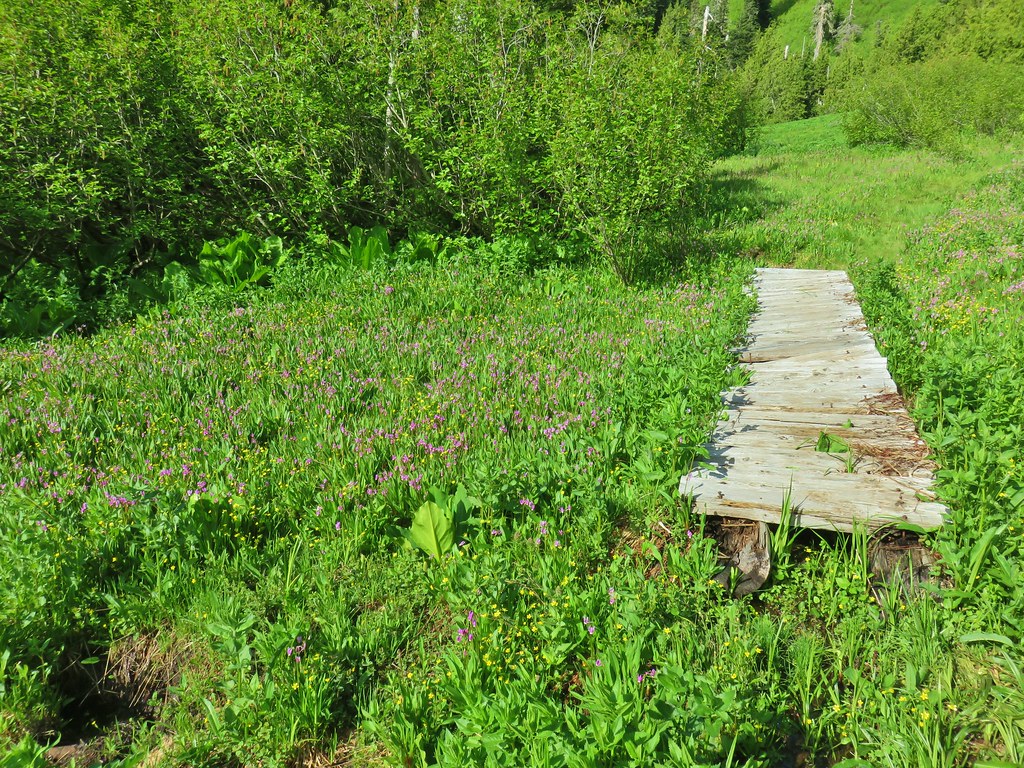
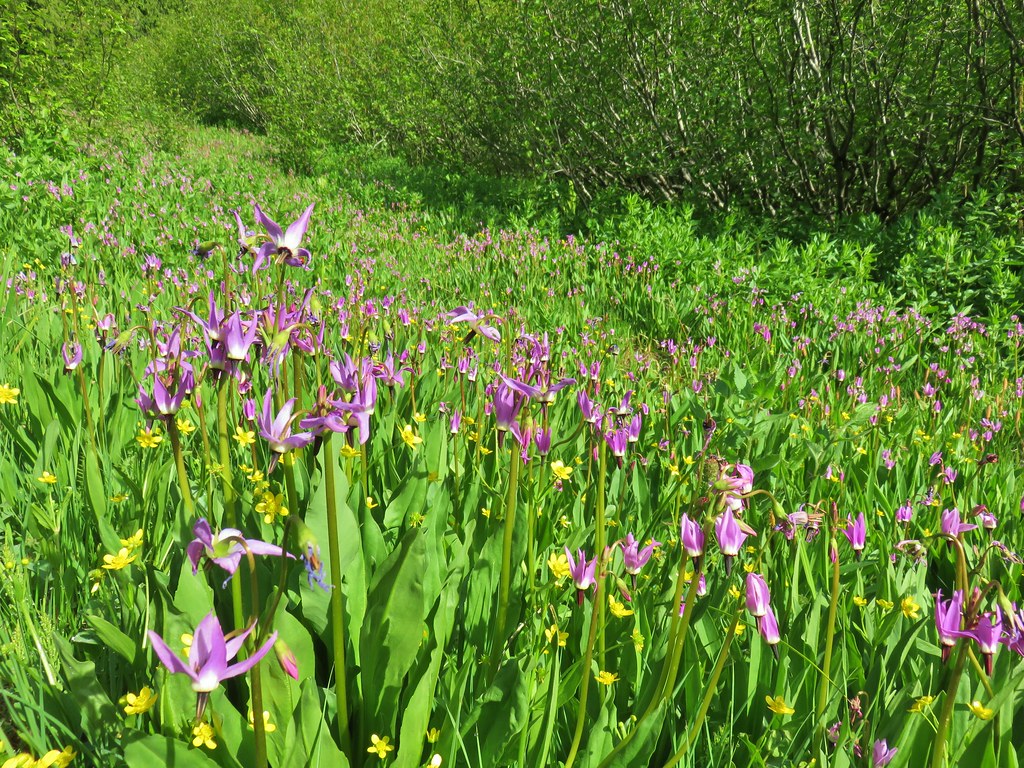



 Paintbrush
 Frog
Frog Looking back at the route through the meadow.
 The trailhead off of FR 2672.

 Iris
Iris Beargrass
 Santiam Wagon Road
 Bunchberry
 Musk monkeyflower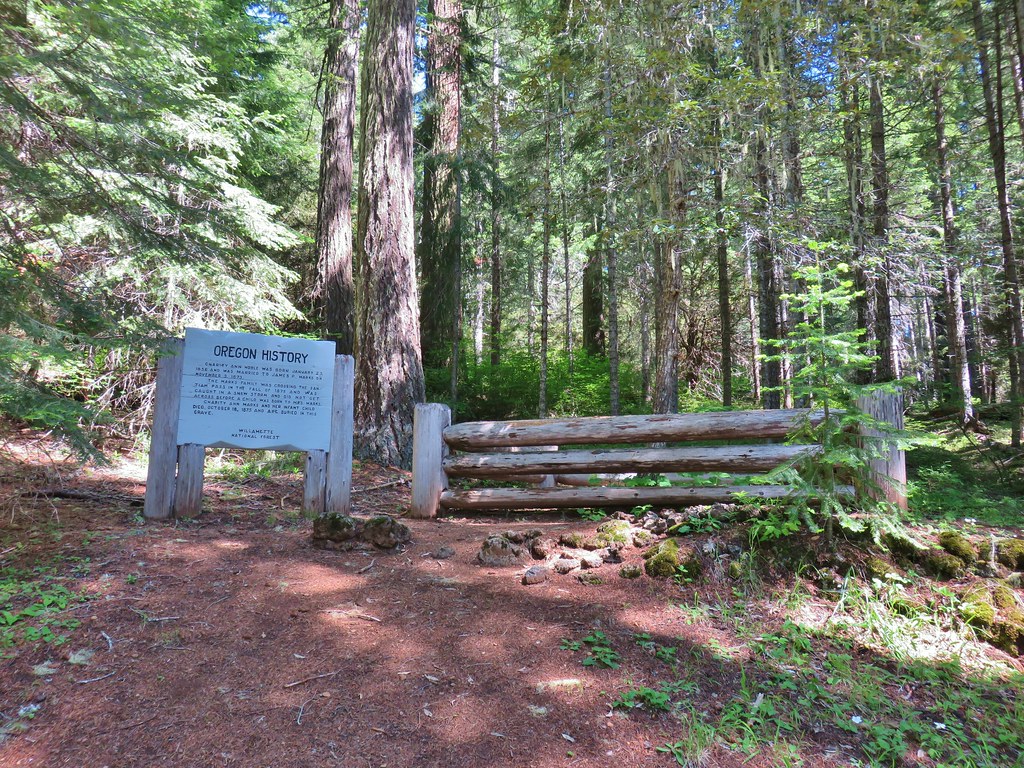

 Hall House
 Commissary Cabin
 Commissary Cabin innkeeper?
 More from the remount station
 Browder Ridge (
 Interpretive signs for the remount station.






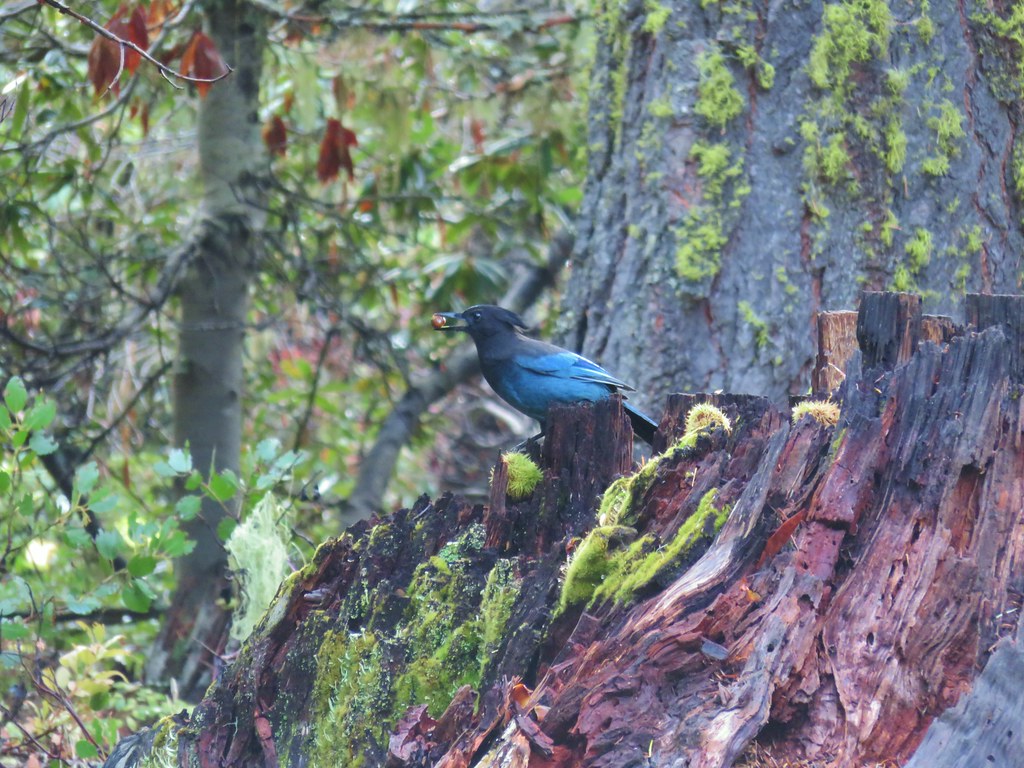 Stellar’s jay
 Chipmunk
 Golden-mantled ground squirrel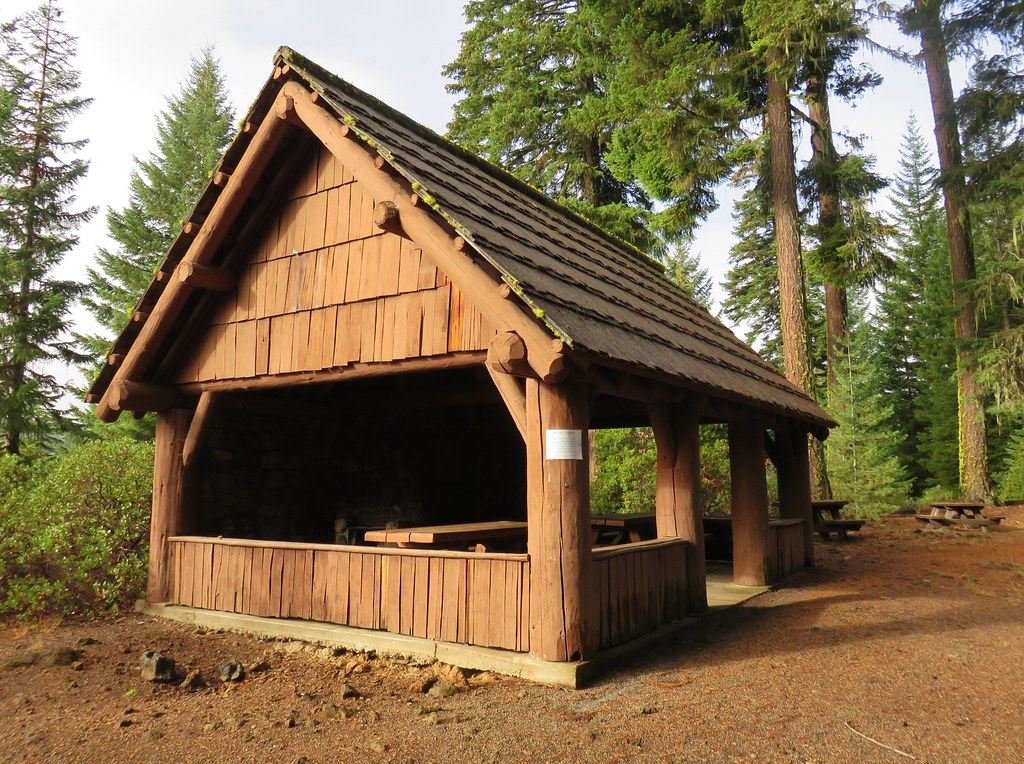


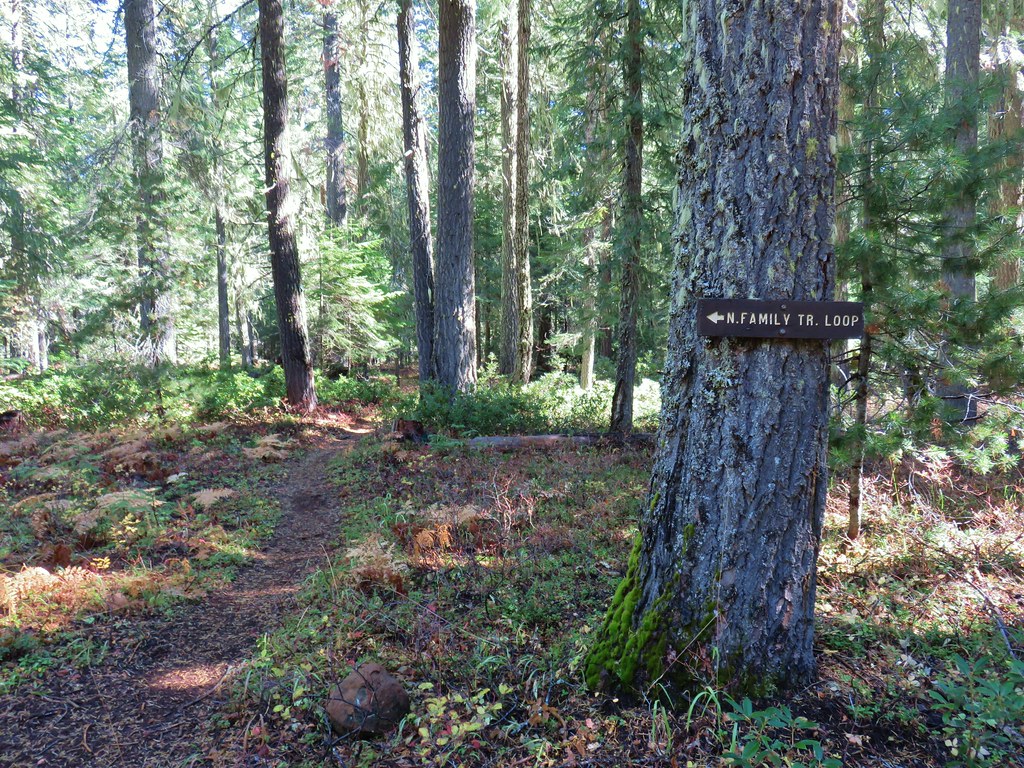
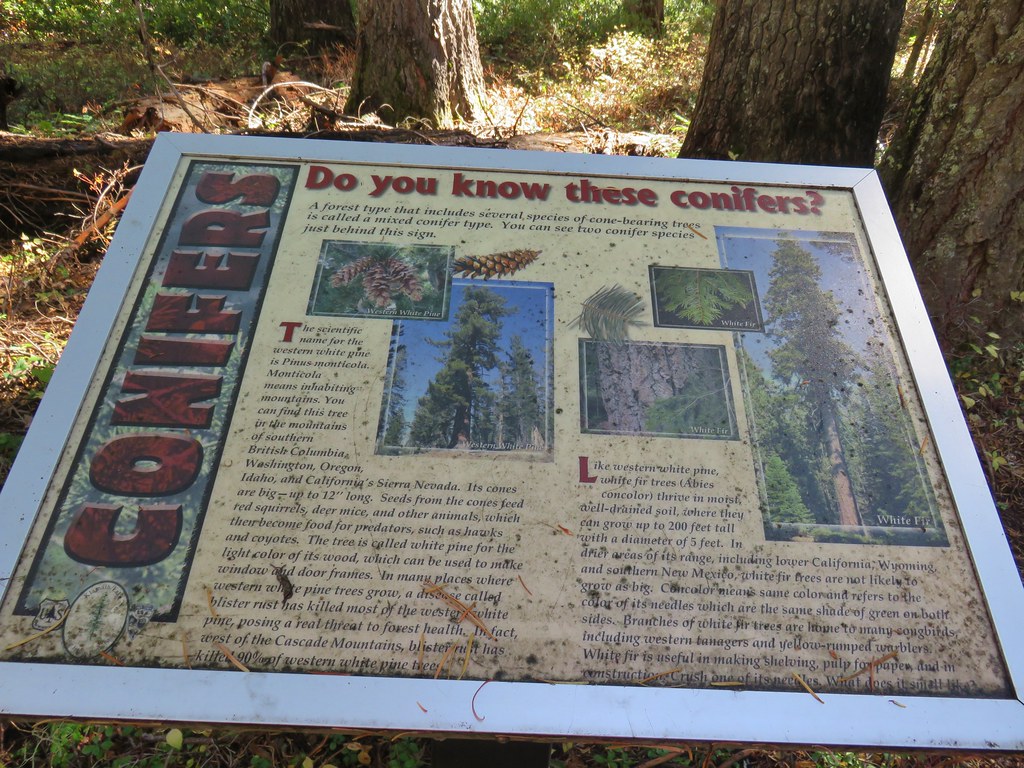
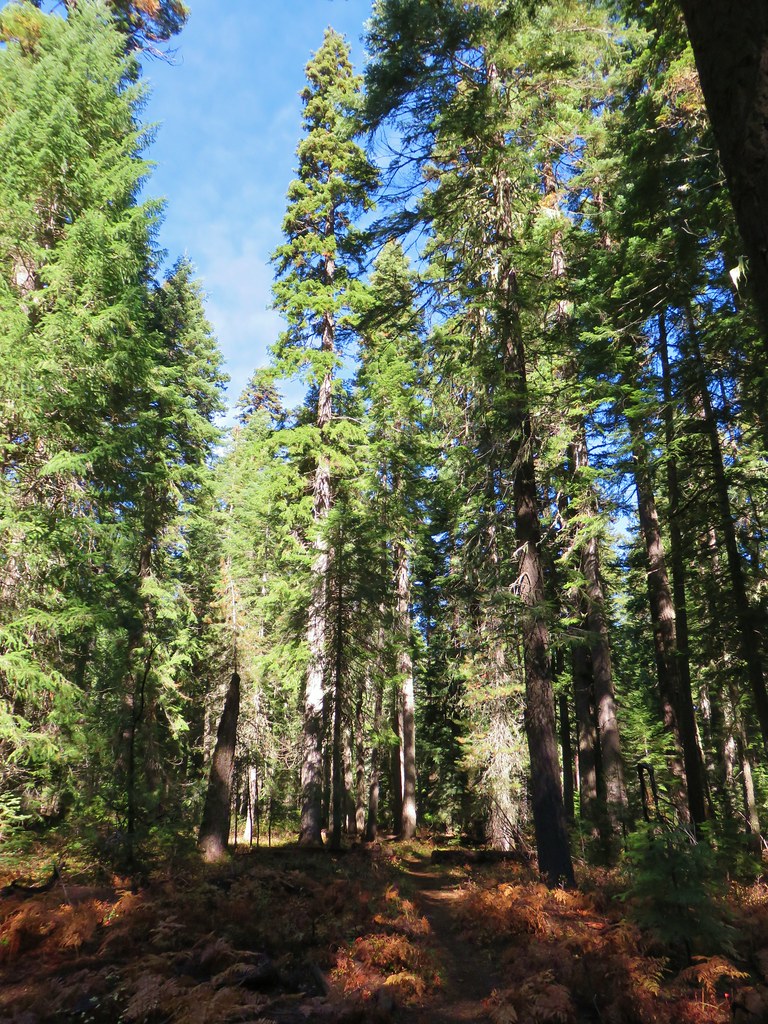
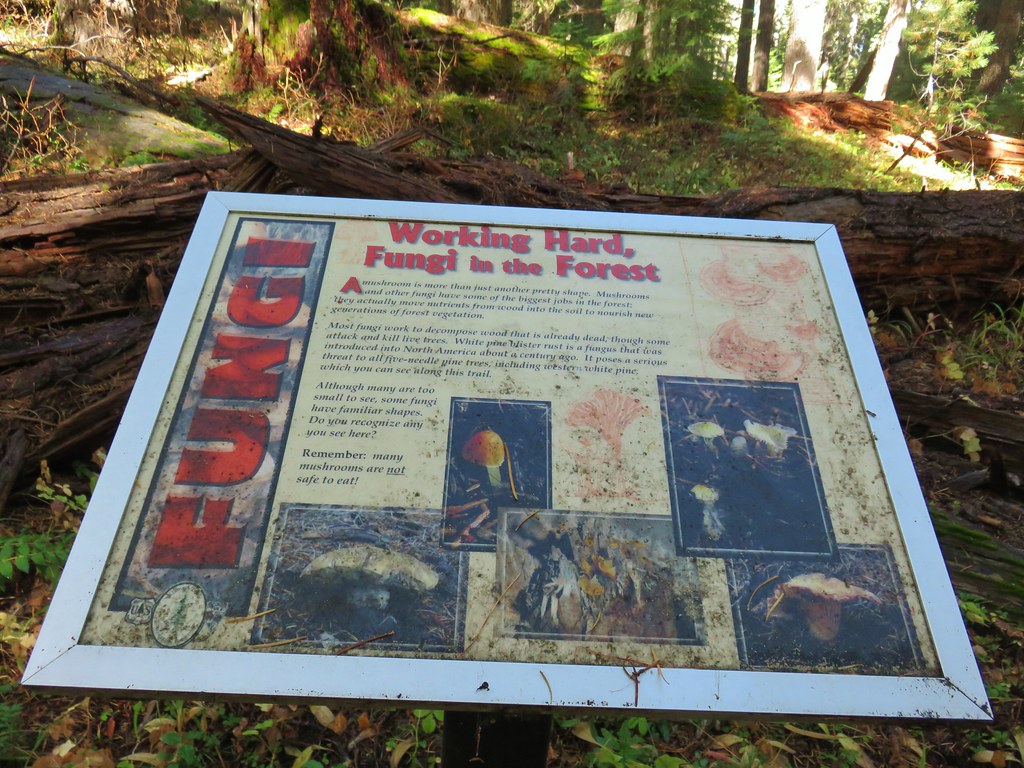





 wanderingyuncks
