Categories
Badger Creek Area Hiking Oregon Trip report

School Canyon-Little Badger Loop – 05/24/2025

We spent Memorial Day weekend in The Dalles in order to cross a few “to-dos” off our hiking list. Our first stop was a two-for-one hike in the Badger Creek Wilderness. The plan was to make a loop out of the School Canyon and Little Badger Trails which would allow us to cross those trails off the list of hikes we still hadn’t done featured in our Matt Reeder guidebooks (Off the Beaten Trail). The School Canyon Trail is featured in his “PDX Hiking 365” (1st edition) and The Little Badger Trail is covered in “Off the Beaten Trail” (2nd edition).

The two trailheads are 3.5 road miles apart but only about a half mile separates them in a direct line. Both Reeder and the entry in the Oregon Hikers Field Guide mention avoiding the longer road walk by cutting cross country suggesting slightly different routes and having differing opinions on difficulty. Based on the two hike descriptions and a recent discussion in the Oregon Hikers Forum it appeared to me that the “best” solution was to bushwack downhill from Forest Road 27 to the Little Badger Trailhead roughly a half mile from the School Canyon Trailhead. I arrived at this conclusion based on our belief that going down is easier than climbing up and by comparing Google Earth imagery with a topographic map. I was looking for the least steep looking open hillside which would limit the number of downed trees we might encounter. Prior to leaving I added waypoints to our GPS units to mark where I thought we should leave the road and one at the Little Badger Trailhead so we could easily see what we were aiming for.

We left Salem extra early and arrived at the School Canyon Trailhead about a quarter after seven.
IMG_1499

From the trailhead we headed left (SE) on FR 27 until we reached the waypoint I had created then looked for an open spot to start the cross-country portion of the hike.
IMG_1501

IMG_1503We headed off through the trees here.

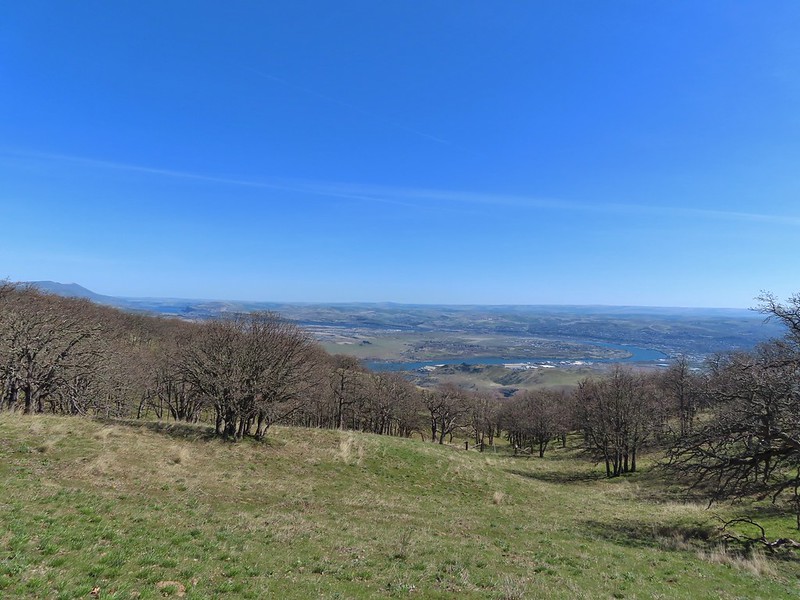
After passing through a small stand of trees the views opened up to the SW where Mt. Jefferson and Olallie Butte stood out on the horizon.
IMG_1505

IMG_1509Mt. Jefferson and Olallie Butte (post).

IMG_1511Gordon Butte in the foreground.

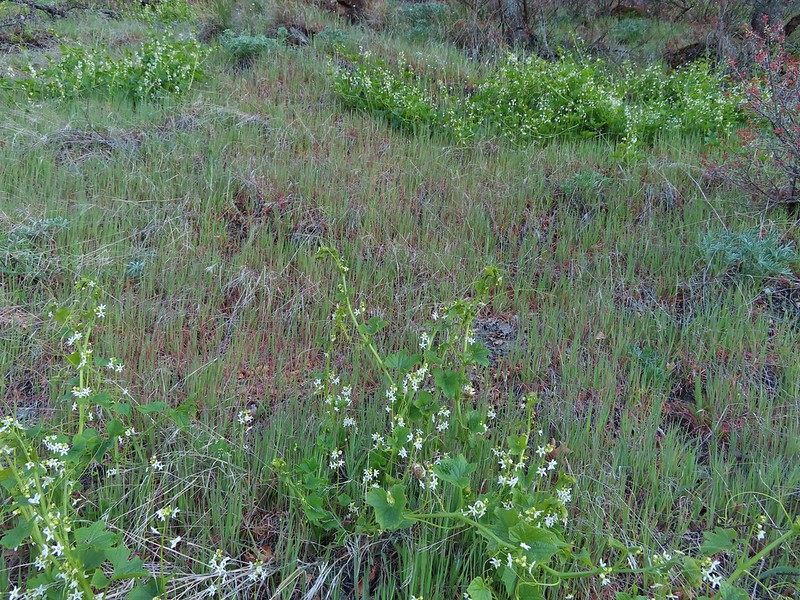
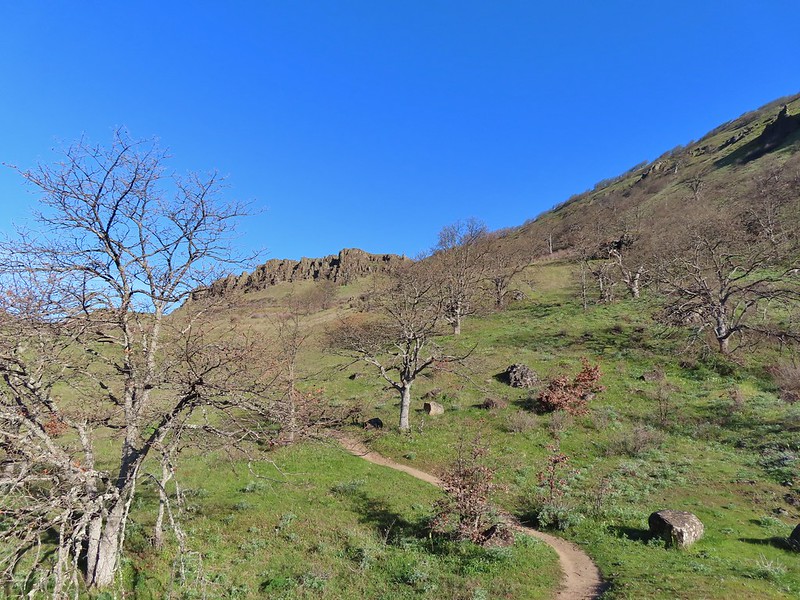
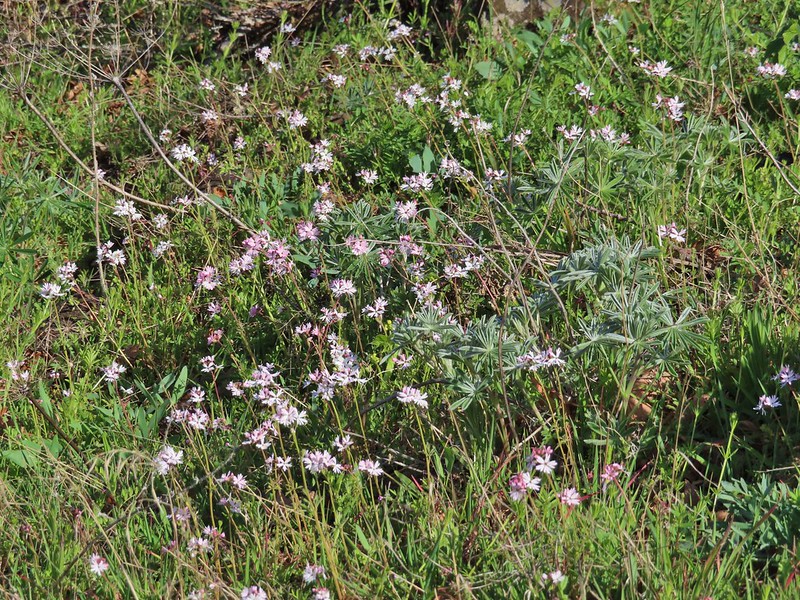
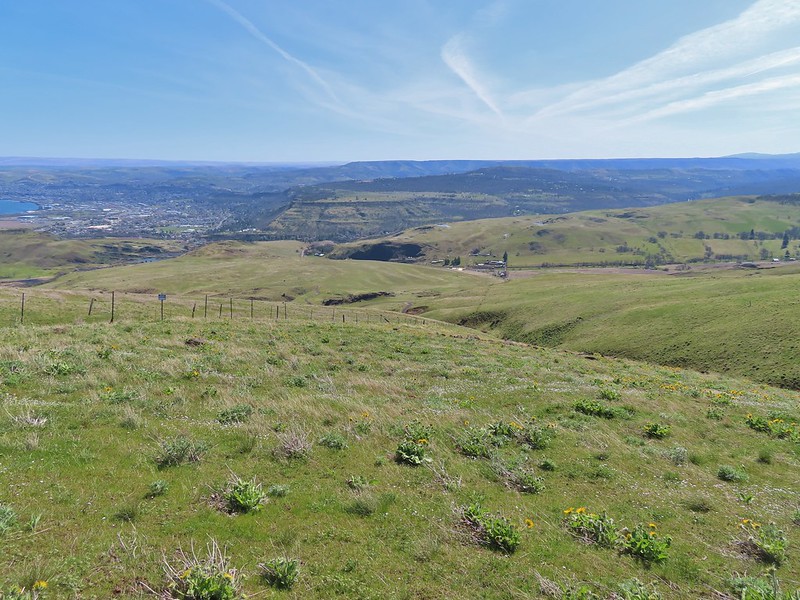
Our route steepened as we headed downhill among a number of different wildflowers.
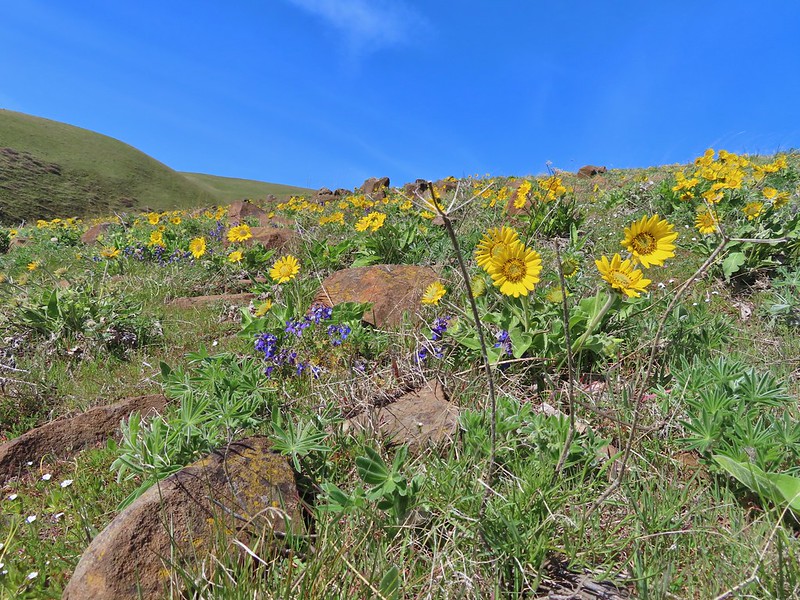
IMG_1525Balsamroot and oak trees.

IMG_1512Buckwheat and balsamroot

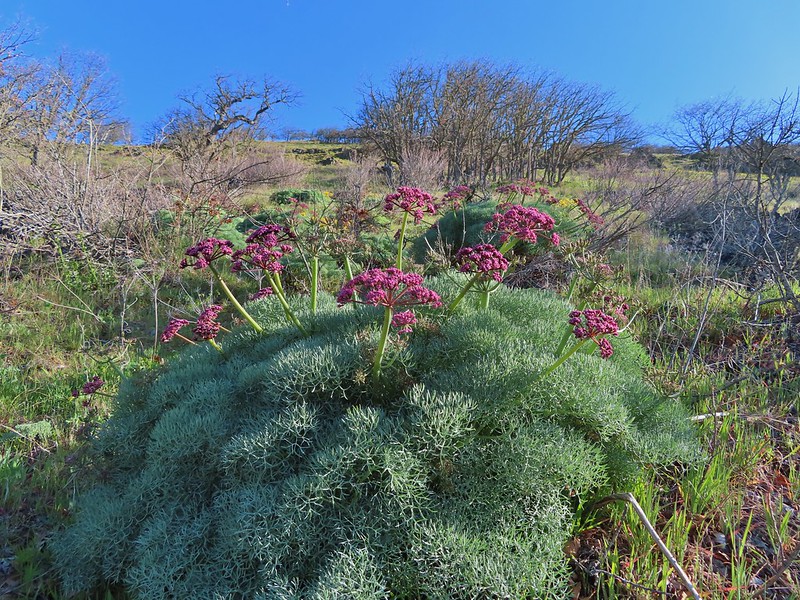
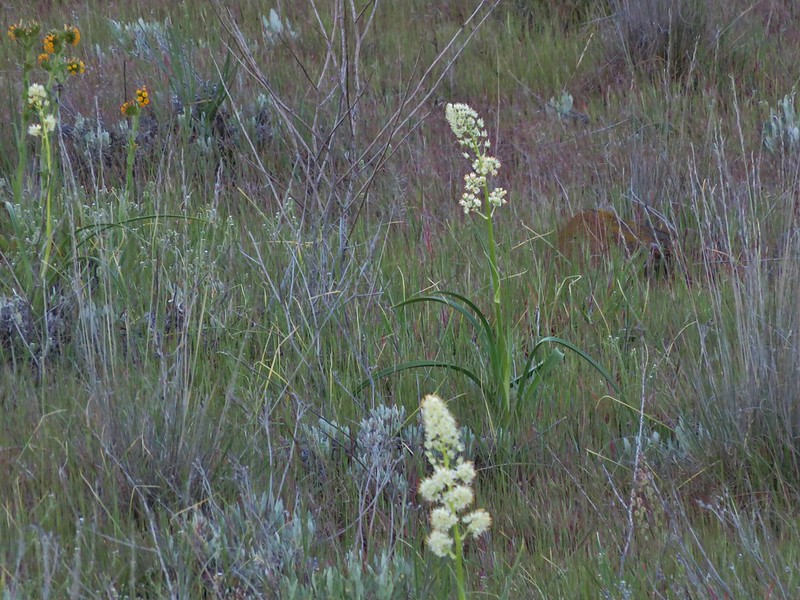
IMG_1514Whitestem frasera with Mt. Jefferson in the background.

IMG_1522Rough eyelashweed

IMG_1527Paintbrush

IMG_1529We picked up a faint path, not sure if it was a game or use trail.

As we neared the Little Badger Trailhead we entered another stand of trees.
IMG_1531

IMG_1535Lupine and ponderosa pines.

We popped out of the trees on FR 2710 less than 20 yards from the Little Badger Trail.
IMG_1537

IMG_1538The trailhead is on the opposite side of FR 2710 from the trail.

IMG_1539Sign at the start of the Little Badger Trail.

After the half mile road walk and 0.6-miles cross country we were now on official trail and quickly entered the Badger Creek Wilderness.
IMG_1543Badger Creek Wilderness sign next to Little Badger Creek.

For the first two miles the trail stuck closely to the creek.
IMG_1547

IMG_1549Groundsel

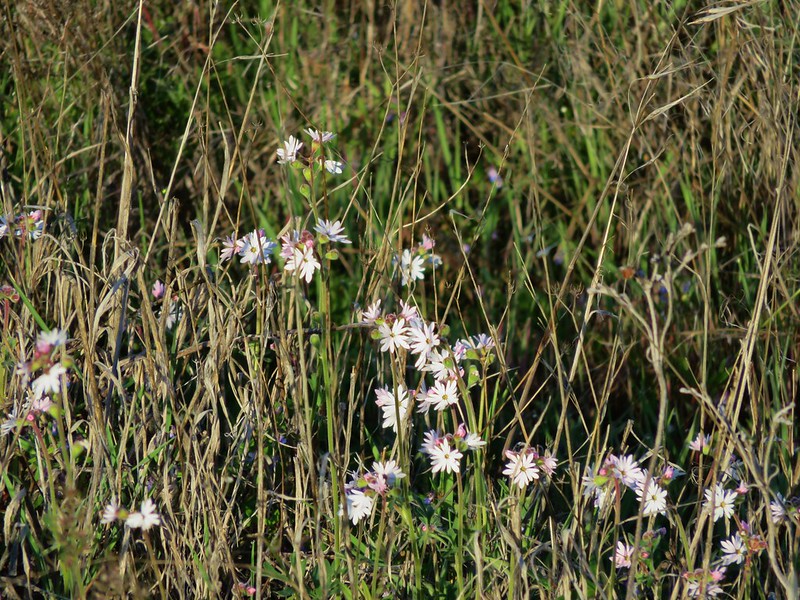
IMG_1560Woodland stars

IMG_1564Little Badger Creek

IMG_1570Fairy slipper

The trail then climbed a little higher on the hillside as it continued further into the wilderness.
IMG_1572

IMG_1577American vetch

IMG_1584

IMG_1585Bastard toadflax

IMG_1590Duskywing on sagebrush false dandelion.

IMG_1593

IMG_1597Balsamroot

IMG_1600Bee coming in for a landing on phacelia.

IMG_1601Sticky cinquefoil

Western wood-peweeWestern wood-pewee

IMG_1606Madia

Brown elfinBrown elfin (and another pollinator) on Oregon sunshine.

IMG_1619Starflower

IMG_1622Mahala mat along the trail.

IMG_1632Duskywing on blue-eyed Mary

IMG_1634Largeleaf sandwort along the trail.

IMG_1637Skunk cabbage

IMG_1639Red-flowering currant

IMG_1643Duskywing on arnica

IMG_1644

IMG_1645Silvercrown

IMG_1647Oregon grape

IMG_1648Last of the trillium.

IMG_1654Plumed solomonseal

The trail had begun a descent back to the creek at the 3-mile mark and just under 4-miles from the trailhead we arrived at the site of the former Kinzel Mine Cabin.
IMG_1656

IMG_1658What’s left of the cabin.

IMG_1659Little Badger Creek at the cabin site.

We took a brief break at the cabin to prepare for the nearly 900′ climb to reach the School Canyon Trail. After the break we walked past the cabin remains and forked left to visit the old Kinzel Mine.
IMG_1666Anemone

IMG_1670There was a short climb before reaching the spur trail.

IMG_1671Spur trail to the mine.

IMG_1672The old mine. We did not go in as wildlife do sometimes use it for shelter.

IMG_1673Ballhead waterleaf near the mine.

After visiting the mine we returned to the main trail and began the steep 0.7-mile climb to the School Canyon Trail. This was a challengingly steep ascent, but there were plenty of wildflowers, wildlife, and views to distract us.
IMG_1675

IMG_1680Western tanager

IMG_1683A stand of oaks ahead.

IMG_1686Balsamroot along the trail.

IMG_1696Paintbrush

IMG_1700Buckwheat

IMG_1702Juniper trees

IMG_1704Threadleaf phacelia

IMG_1706

IMG_1712

IMG_1713

IMG_1715Signpost ahead for the trail junction.

We took a much-needed break at the junction before detouring left (west) on the School Canyon Trail for a tenth of a mile to a spur trail on the left that led to a Helispot Viewpoint where there were several rock pinnacles.
IMG_1716

IMG_1721Wildflowers along the trail.

IMG_1722The spur trail on the left to the Helispot.

IMG_1725

IMG_1729Penstemon

IMG_1731

IMG_1733

IMG_1737Pine Hollow Reservoir in Central Oregon.

We returned to the junction after visiting the helispot and followed the School Canyon Trail as it gradually descended to a ridge below Ball Point.
IMG_1740

IMG_1746

IMG_1749Woodland star

IMG_1753This was the most significant obstacle we had to navigate on the entire loop.

IMG_1761Yarrow

IMG_1768A dogwood on top of the rocks and penstemon below.

IMG_1770First view of Ball Point.

IMG_1772Penstemon

IMG_1776From the ridge we could faintly make out Broken Top and the Three Sisters.

IMG_1777The Three Sisters on the right and Broken Top with Tam McArthur Rim (post) to the left.

IMG_1780Pen Point across the Tygh Creek Valley.

The trail left the ridge and traversed the hillside around Ball Point.
IMG_1790Passing through the 2009 Ball Point Fire scar.

IMG_1795

IMG_1802Pen Point toward the center and the taller Hootnanny Point to the right.

IMG_1809Death camas

IMG_1816View east as we came around Ball Point.

IMG_1820Desert yellow fleabane.

IMG_1825Prairie smoke aka Old Man’s Whiskers

On the far side of Ball Point the trail descended fairly steeply along a ridge covered in wildflowers and a view of Mt. Jefferson.
IMG_1831

IMG_1830

IMG_1833

IMG_1837

IMG_1842Heather coming down the ridge.

IMG_1845I think this is a western racer.

The trail dropped off the ridge and descended just over a mile to the trailhead. The wildflowers and views were nice along this entire stretch.
IMG_1858Looking up at the ridge.

IMG_1863A clarkia

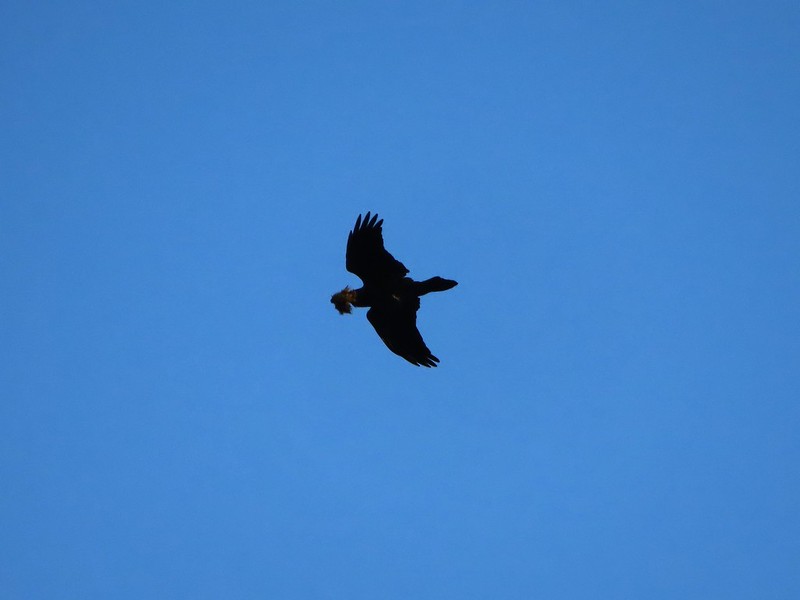
IMG_1865Lewis’ woodpecker

IMG_1868Lizard

IMG_1873

IMG_1874

IMG_1878

IMG_1880

IMG_1882On last view of Mt. Jefferson

IMG_1884Ball Point

IMG_1887Butterfly on whitestem frasera

IMG_1890Signs at the trailhead.

The loop ended up being 9.9-miles with 2150′ of elevation gain.
Screenshot 2025-05-26 183303Orange is the road + cross country portion.

We really enjoyed the variety this hike provided, and we only saw two other hikers all day. The climb from the cabin site to the School Canyon trail was tough but we were glad to have tackled it. We checked in to our room in The Dalles and after having dinner and picking up some snacks for the room we turned in so we could get another early start the following day. Happy Trails!

Flickr: School Canyon-Little Badger Loop
Categories
Columbia Gorge North Columbia River Gorge South Hiking Trip report

Mitchell Point, Lyle Cherry Orchard & Sevenmile Hill – 3/27/21

**Note – In 2025 the Rowena Fire burned over Sevenmile Hill.**

We normally only do one hike a month from November through April but a forecast of sunny skies and highs in the low to mid 60’s combined with a chance to see some early wildflowers was enough to break that rule and head to the eastern end of the Columbia River Gorge. The first wildflowers (usually grass widows and/or parsleys) can show up as early as January in areas such as Catherine Creek (post) with things really picking up by late March and running through early June in the upper meadow of Dog Mountain (post). We had previously been to Catherine Creek (along with Coyote Wall), the Tom McCall Preserve (post), Columbia Hills State Park (post), Memaloose Hills (post) and Swale Canyon (post) so for this outing we decided to check out the Lyle Cherry Orchard and Sevenmile Hill.

Before we got to those wildflower hikes we planned a quick stop at the Mitchell Point Trailhead to make the 1.1 mile climb up to the top of the point. We had actually stopped here in 2018 (after our Memaloose Hills hike) to take the Wygant Trail up to a viewpoint. Originally my plan had been to do these three hikes in a different order starting at the Lyle Cherry Orchard and ending with Mitchell Point but after looking at the plan a little more I realized that it had two flaws. First the exit to the Mitchell Point Trail is only accessible from the eastbound lanes of I-84 and there is no westbound access to I-84 from the trailhead either. (I had made this mistake with the outing in 2018 leading to some extra driving.) The second issue had to do with crowds and our never ending attempt to avoid them. Leaving Mitchell Point as the last hike might have meant dealing with some crowds whereas we didn’t expect Sevenmile Hill to be busy. Our plan seemed to be working pretty well as we were the first car at the Mitchell Point Trailhead.
IMG_0881

We headed to the left of the signboard to the Mitchell Point Trail which began climbing almost immediately.
IMG_0998

IMG_0887

The trail switchbacked up a forested hillside with a few blooming toothworts.
IMG_0890Bench at a switchback.

20210327_080649

We then crossed a talus slope beneath Mitchell Point where lots of tiny blue-eyed Mary grew amid the rocks.
IMG_0907

IMG_0914Reroute below Mitchell Point

IMG_0916

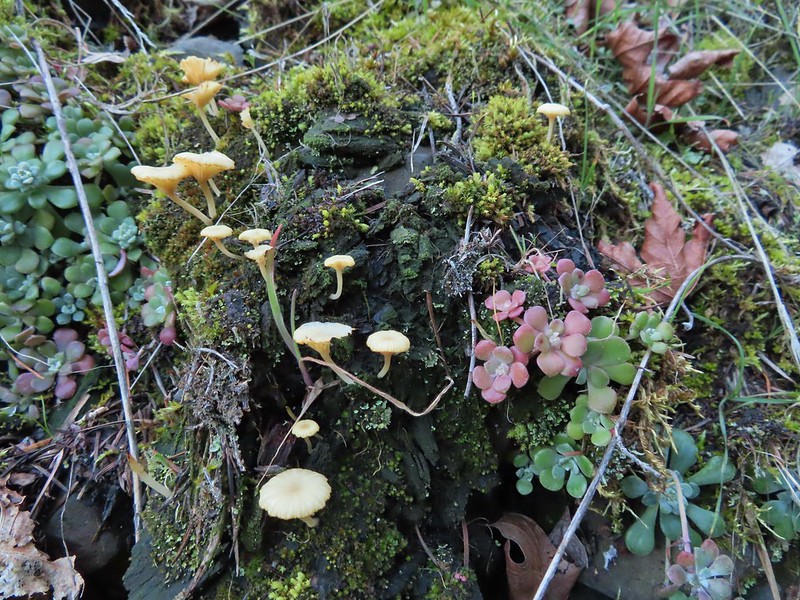
IMG_0919Mushrooms’ and some sedums.

Views to the west along the Columbia River opened up as we climbed.
IMG_0915

The trail briefly reentered the forest and climbed to a set of power lines and an accompanying road.
IMG_0921

The trail never quite reached the road instead turning east then north as it headed out toward Mitchell Point.
IMG_0923

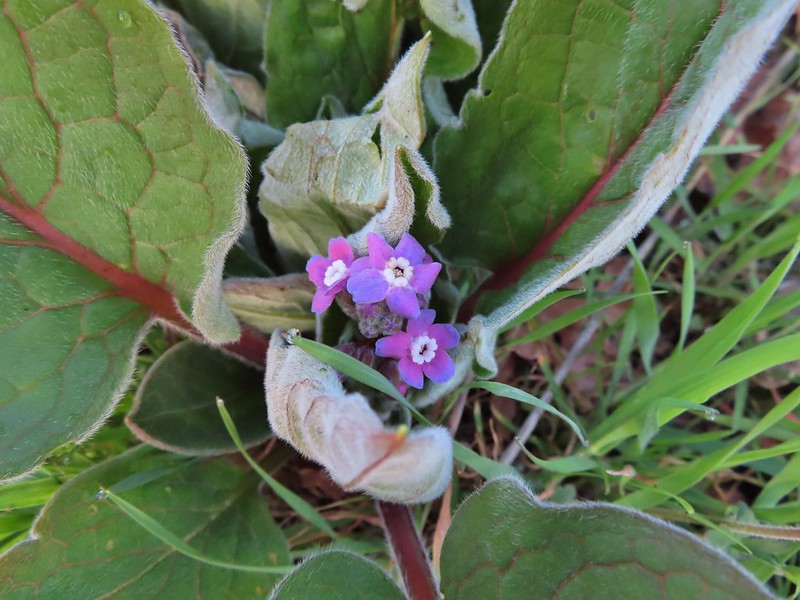
IMG_0927Houndstongue

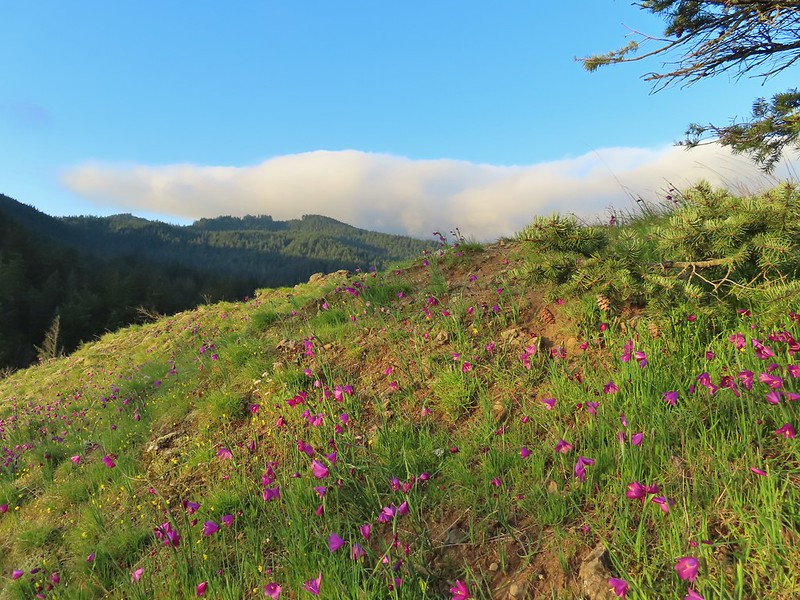
We followed the trail out onto Mitchell Points Ridge which was dotted with wildflowers including a lot of bright grass widows.
IMG_0939

IMG_0934Grass Widows

IMG_0961Woodland stars

IMG_0955

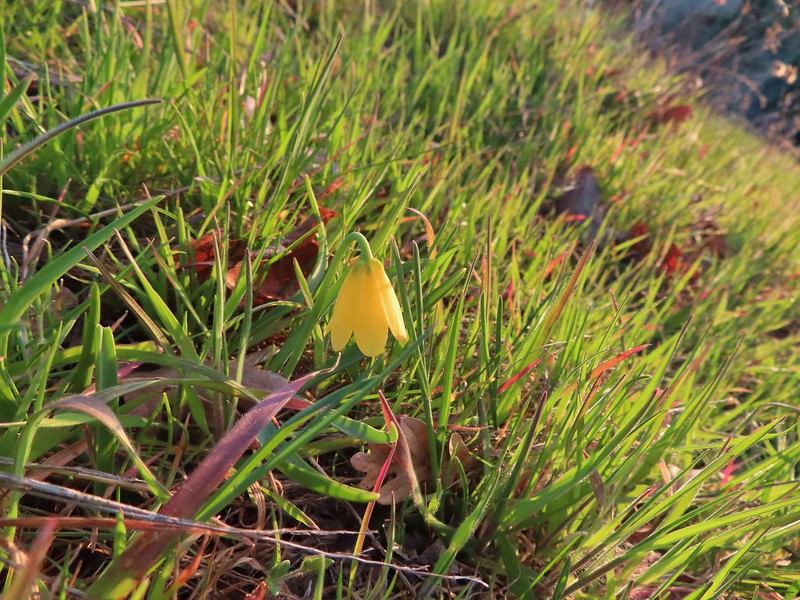
IMG_0931Yellow bell lily

IMG_0938Desert parsley and woodland stars

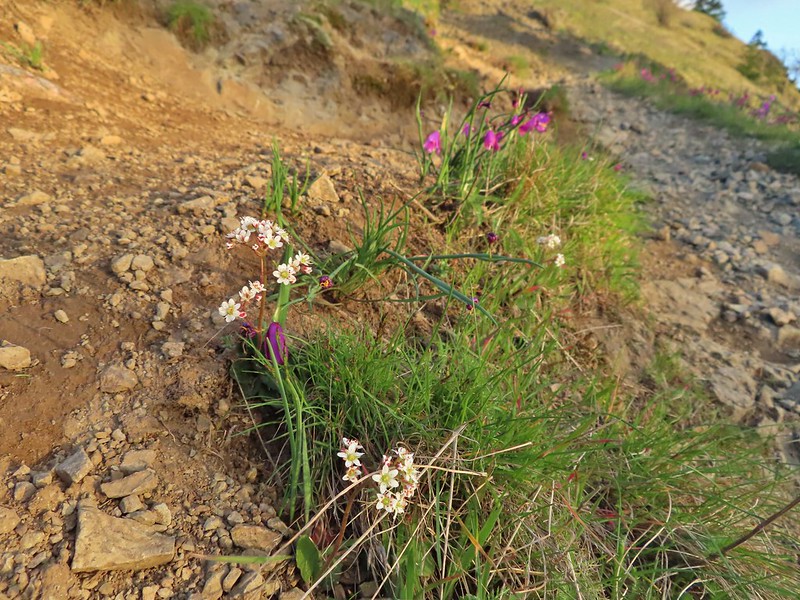
IMG_0954A saxifrage

IMG_0965Gold stars and woodland stars

IMG_0977

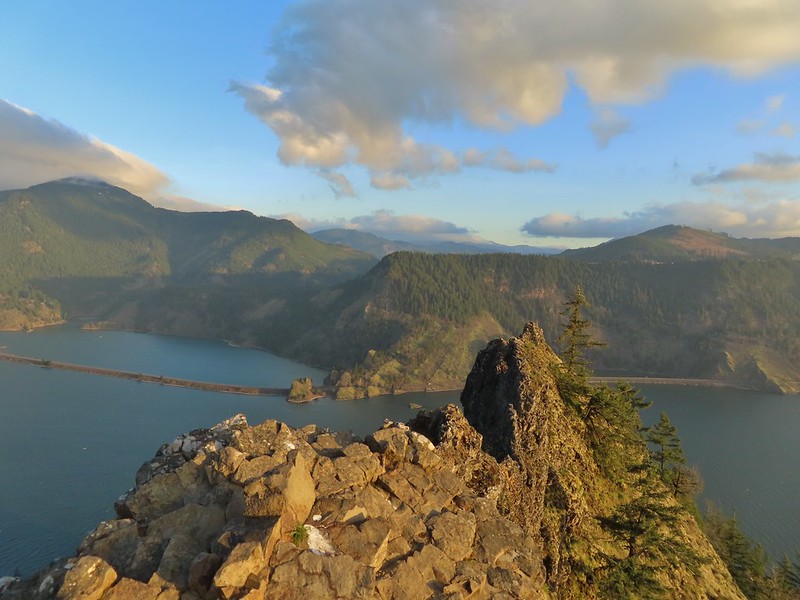
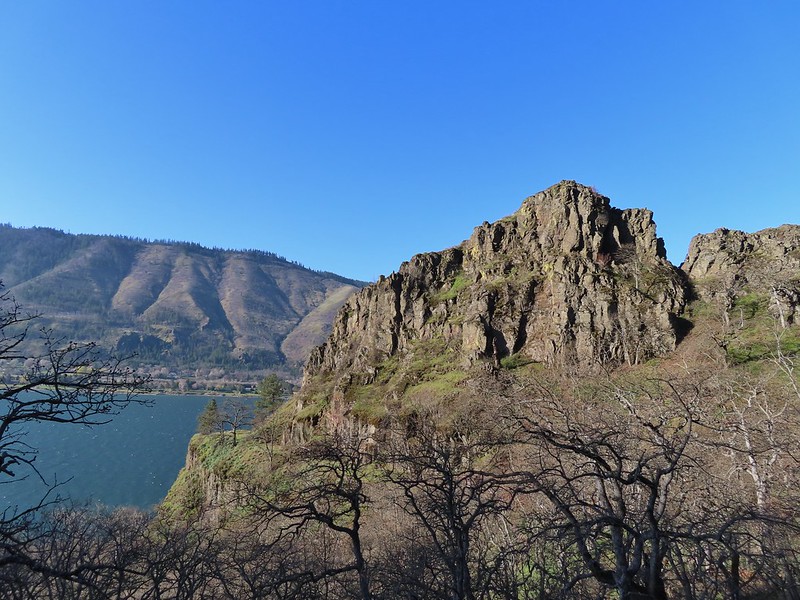
In addition to the wildflowers the view from Mitchell Point was impressive.
IMG_0962Looking west

IMG_0966North across the Columbia River into Washington
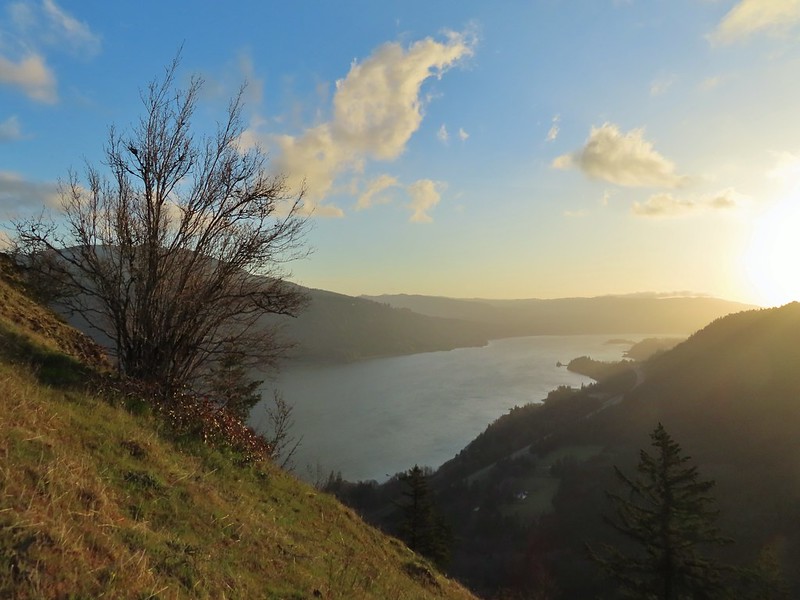
IMG_0964East

In typical Gorge fashion it was a bit windy (a theme that would continue throughout the day) which didn’t seem to bother the birds.
IMG_0985Looks like moss for a nest maybe?

We returned the way we’d come arriving back at the trailhead to find we were still the only people there, but we weren’t alone.
IMG_0995

IMG_1001Turkeys on the Wygant Trail

At just over 2 miles round trip the hike to Mitchell Point made for a nice short hike but it comes at a price gaining over a thousand feet on the way up. From this trailhead we continued east to Hood River where we paid the $2 toll to cross the bridge into Washington. We continued east on SR 14 through the town of Lyle then parked at a gravel pullout on the left hand side of the road just beyond a tunnel. This was the unsigned trailhead for the Lyle Cherry Orchard Hike. There were maybe a half dozen or so cars here already which we were pleased with given the large number of cars we already passed by at the Coyote Wall and Catherine Creek Trailheads (and it wasn’t even 8:45 yet). The unsigned trail starts near the eastern end of the parking area and passing along a rock wall through oak trees with lots of poison oak.
IMG_1003

IMG_1008

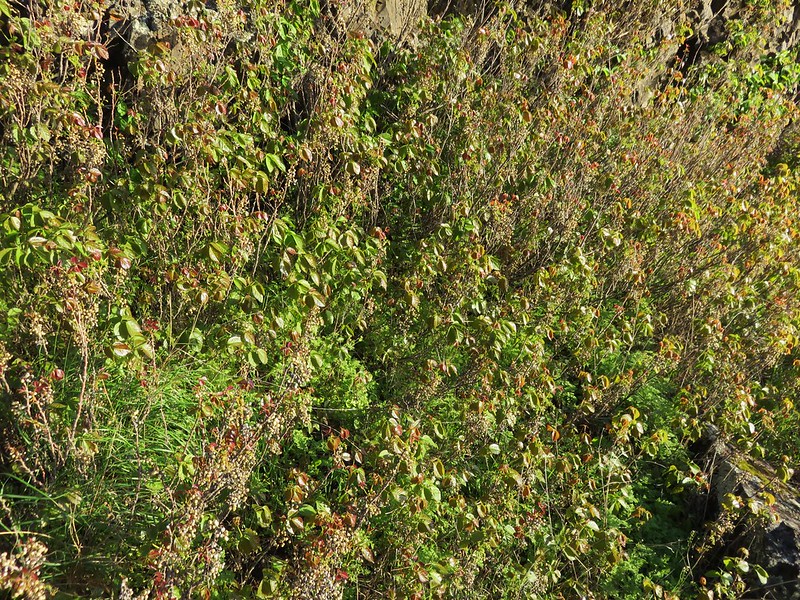
IMG_1015Red leaves of poison oak behind a death camas
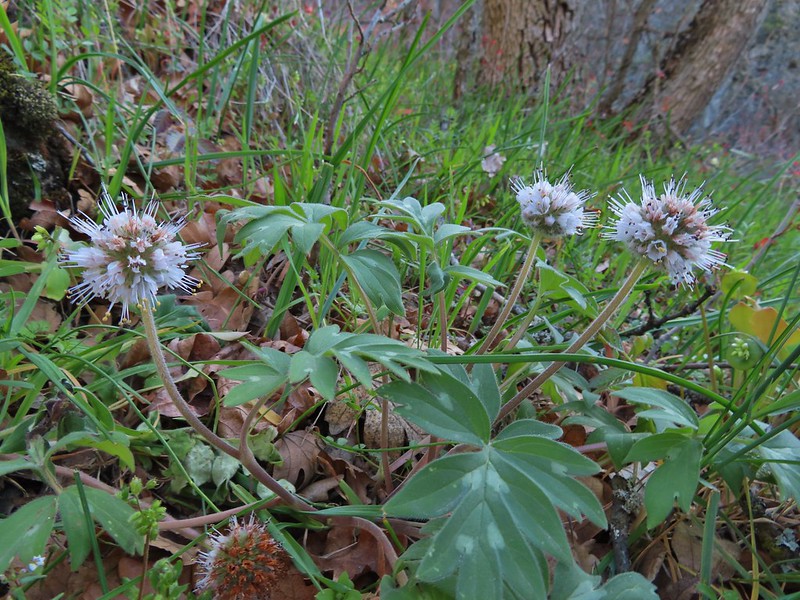
IMG_1017More poison oak behind a waterleaf

IMG_1012Poison oak around some balsamroot

A short distance up the trail there is a nice  map and trails signboard announcing the start of land owned by the Friends of the Columbia Gorge.

IMG_1027

IMG_1028

From the signboard the trail continues to climb through the rock and oaks to a plateau where the poison oak is briefly left behind.
IMG_1032

IMG_1033

IMG_1037Fiddleneck

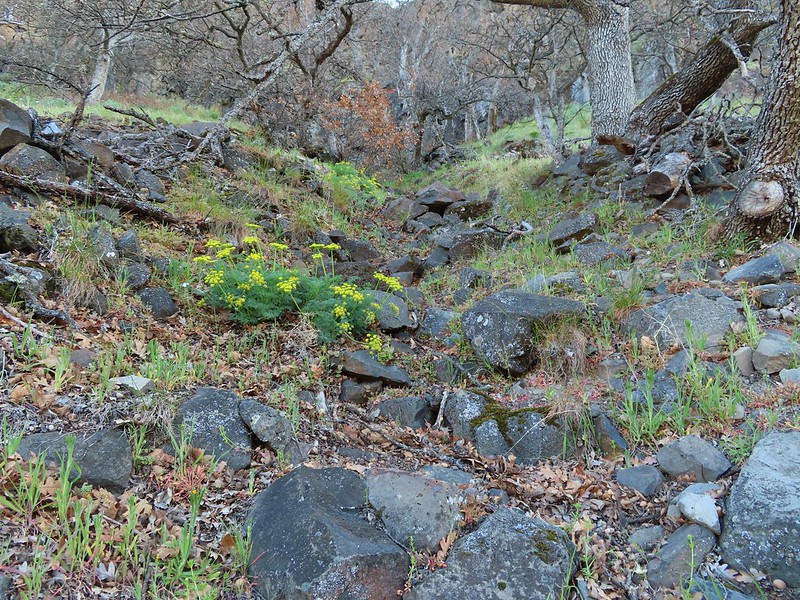
IMG_1040Desert parsley

IMG_1045Manroot

IMG_1056

IMG_1057Lots of death camas blooming on the plateau.

We followed the trail as it headed gradually uphill toward a second plateau.
IMG_1062

IMG_1064Looking up at the cliffs above.

IMG_1068Balsamroot blooming below the rim.

At a fork in the trail we detoured left for a view of the Columbia River.
IMG_1076

20210327_091929

We returned to the main trail which began to climb the hillside below the rim. While it was still a couple of weeks from prime wildflower season here there was a good balsamroot display along with a few other flowers in bloom.
IMG_1081Balsamroot

IMG_1085Woodland stars with some lupine leaves

IMG_1090Columbia desert parsley

IMG_1096A biscuitroot

IMG_1104Balsamroot

20210327_092349Balsamroot

The trail leveled out again after reaching the rim of the upper plateau where it also reentered an oak woodland.
IMG_1114View west (With a snow capped Mt. Defiance (post) in the distance.)

IMG_1130

Amid the oaks were some additional types of flowers.
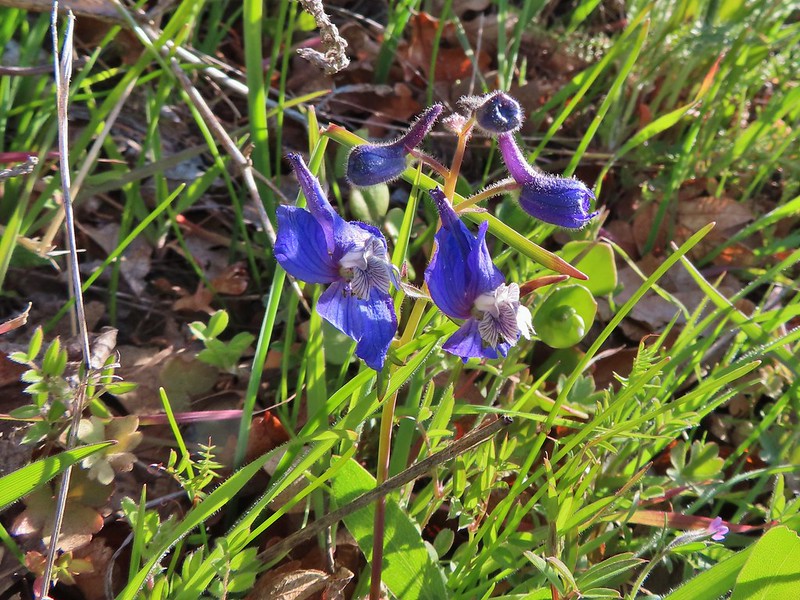
IMG_1125Larkspur

IMG_1131Buttercups

IMG_1138Glacier lilies

IMG_1158Yellow bell lily, woodland stars, grass widows and shooting stars.

20210327_104840Yellow bell lilies

20210327_104217

IMG_1162Toothwort

IMG_1163Sagebrush false dandelions

IMG_1164

IMG_1167Tortoiseshell butterfly

Just under 2.5 miles from the trailhead we came to a junction which is the start of a short loop. We stayed left arriving at an old road bed a short distance later where we turned right and soon entered the site of the old orchard. Nearly all the cherry trees are gone and the few that remain only have a few branches that continue to bloom and we were too early for those.
IMG_1171

The trail looped through the now open meadow with views east of the Columbia River.
IMG_1174

IMG_1176

A short spur trail on the SW part of the loop led to a viewpoint to the west.
IMG_1180

IMG_1183Tom McCall Point and the Rowena Plateau with Mt. Defiance in the distance.

After checking out the view we completed the loop and headed back the way we’d come. We had only encountered a couple of other hikers up to this point (we’d seen more from afar) but the return trip was a different story. There was a lot of mask donning and stepping aside on the way back to the trailhead.
IMG_1205Hikers on the trailhead and below.

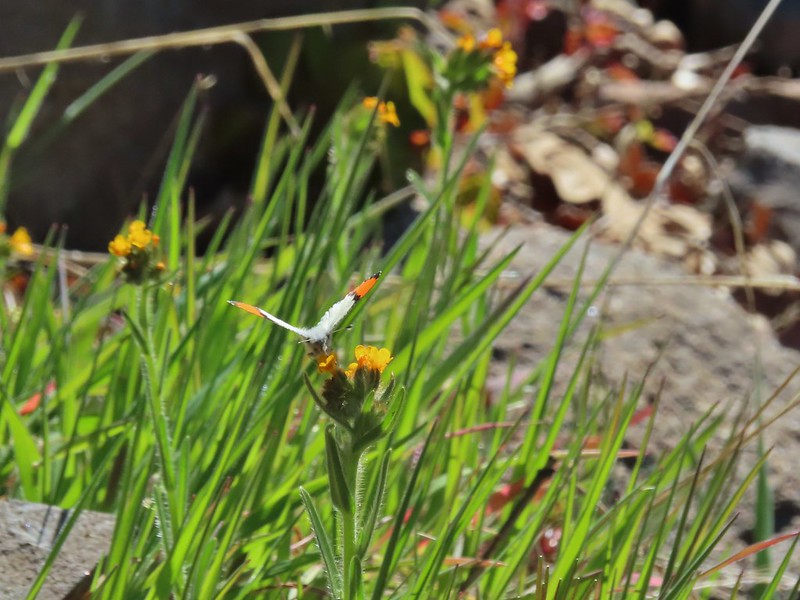
One bit of excitement on the return trip was spotting a couple of orange-tip butterflies. We rarely see these pretty butterflies and it’s even rarer that I manage to get any kind of picture.
IMG_1217Just my third photo of an orange-tip.

The hike here for us came to 5.5 miles with another 1200′ of elevation gain giving us over 2200′ for the day so far. The parking area was now a full two rows of cars with more arriving (it was between 11:30 & 12:00). We quickly packed up and opened a spot for someone else and once again headed east on SR 14. We re-crossed the Columbia River on Highway 197 into The Dalles and took I-84 west for 5 miles following the Oregon Hikers directions to the Sevenmile Hill Trailhead

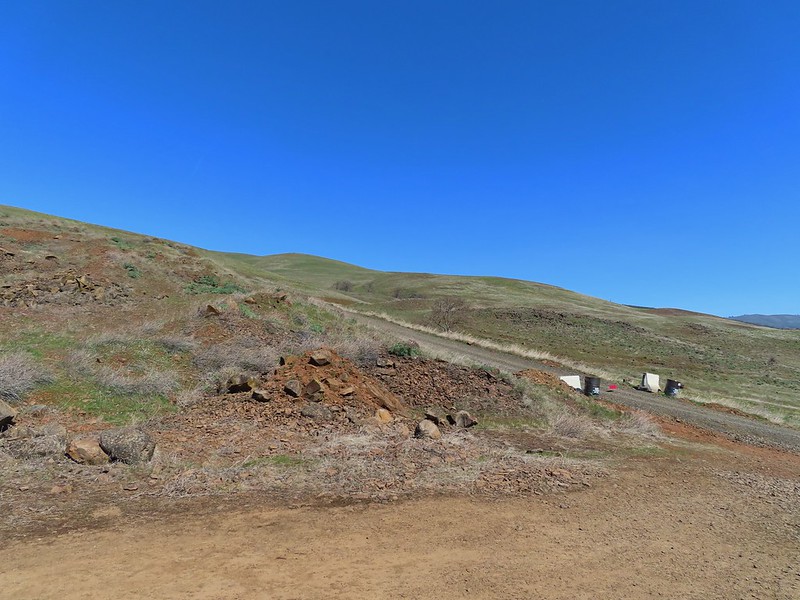
We weren’t sure how popular this hike is given that there are no official trails. That question, at least for this time of the year, was answered when we pulled into the empty gravel pullout.
IMG_1222

Our plan was to follow the entry in the Oregon Hikers Field Guide (description). The area consists of Forest Service land surrounded by private holdings (note the no trespassing sign across the road in the photo above).
We headed uphill and left, away from the blocked road passing a gravel pit on our left.
IMG_1224

We were supposed to reach a knoll with a small windbreak made out of erratics (rocks from the Rocky Mountains deposited by the Missoula Floods). The first knoll we climbed had some erratics but no windbreak.
IMG_1231Mt. Hood and Columbia desert parsley from the first knoll we tried.

IMG_1234Top of knoll #1.

IMG_1232A lone balsamroot blossom.

We weren’t sure if this was the right knoll or not but we did know from the map in the field guide that we should continue uphill and to the left. We kept climbing up the grassy hillside and reached the top of another knoll where we did indeed find a small windbreak.
IMG_1240

IMG_1241

From the knoll we followed a faint grassy track past a spring to a stand of oak trees.
IMG_1243The path leading past the spring to the oaks.

IMG_1246The spring

There was a fence on the hillside at the oak trees. We got a bit confused here reading the hike description. It reads “Head up gradually to your left, reaching a draw. Walk across the broken fence line here and cross a small bench. Continue hiking up to your left. At some point, you should see the southwest boundary corner of the property and a fence line ahead.” We had not noticed another fence line and this fence was broken here with no signs so we continued on the faint path. That was a mistake and the fence we passed through was the boundary. When we reached a small crest where we could see everything ahead of us there was no other fence in sight.
IMG_1252

We quickly turned and began heading uphill to the NE to relocate the fence line and get ourselves on the correct side (Our apologies to whomever that land belongs too).
IMG_1262Back on the right side

Now we were back on course and followed the fence line uphill. While the wildflowers here would have been better from mid to late April there were a few splashes of color here and there.
IMG_1263

IMG_1249Balsamroot surrounded by some little white flowers.

IMG_1251Lupine thinking about blooming.

IMG_1254Larkspur

IMG_1259Yellow bell lilies

We deviated from the description as we neared the top of the hill electing not to follow the fence through a stand of oak trees, where the guide indicates there is a profusion of poison oak, opting instead to pass through the oaks lower on the hillside.
IMG_1268

IMG_1269We didn’t notice any poison oak here.

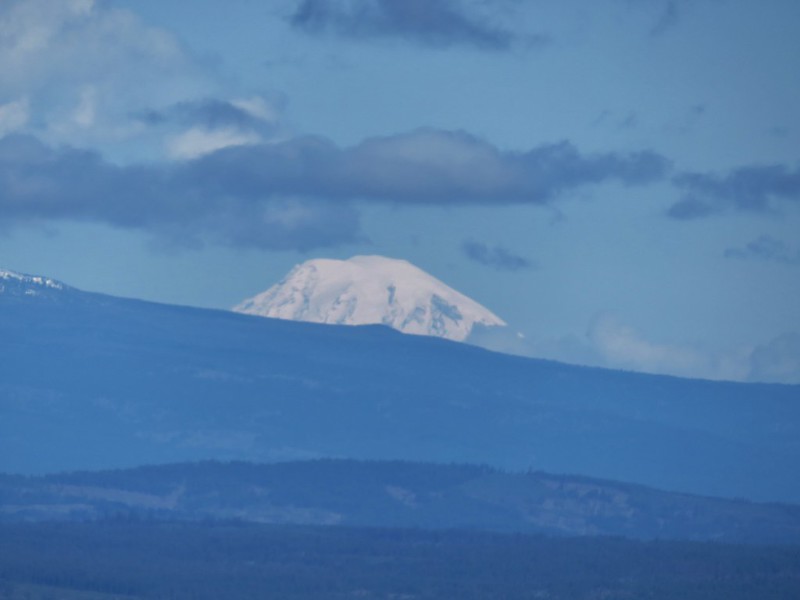
On the far side of the oaks we turned almost directly uphill reaching a viewpoint where Mt. Adams rose to the north beyond the Columbia River.
IMG_1270

IMG_1277A grass widow at the viewpoint.

IMG_1286Mt. Adams

IMG_1288Mt. Hood over the oak stand.

IMG_1290

We turned right along the rim following deer and elk trails through the oaks and past more viewpoints.
IMG_1291

IMG_1292

From a grassy rise along the ridge we could see a faint path leading into another stand of trees where we could also make out the fence line marking the eastern boundary of the Forest Service Land.
IMG_1302

We headed downhill and followed the path to the fence line and then followed it down.
IMG_1310The Dalles beyond the fence line.

IMG_1318Heading down the fence line.

As we lost elevation we began to see quite a few more flowers. It seemed that the flowers at this eastern end were ahead of those to the west.
20210327_143435Large head clover

IMG_1319

IMG_1323

IMG_1325A lupine with blossoms.

IMG_1329Hillside covered in Columbia desert parsley

IMG_1333Our car had been joined by one other. (middle left of photo)

IMG_1341Gooseberry Creek
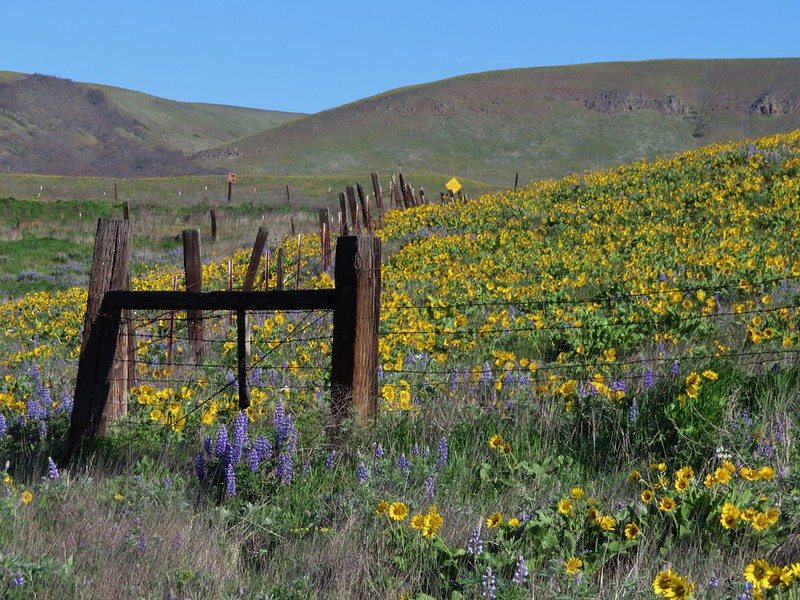
We turned away from the fence on an old farm road following it back to the road near the trailhead by the “No Trespassing” signs.

This loop came in at 4.3 miles according to my GPS and was at least 1250′ of elevation gain which was made more difficult by the cross country terrain. There was little to no level footing for the vast majority of this hike and coming after we had already hiked 7.6 miles and gained 2200′ it really tired us out. That being said it was a great day to be out. One thing to note is that all three hikes are in located in tick country (we were lucky enough not to pick up any) and both Sevenmile Hill and Lyle Cherry Orchard are in rattlesnake country (again didn’t see any). Happy Trails and stay safe out there!

Flickr: Mitchell Point, Lyle Cherry Orchard & Sevenmile Hill

Categories
Columbia Gorge North Hiking Trip report Washington

Columbia Hills State Park

Spring came early to the Pacific Northwest and many of the flowers are running a week or two ahead of schedule so I’d been keeping my eye on the wildflower situation in the Columbia Gorge. Recent trip reports from the east end of the gorge showing the flowers out in force, a promising forecast, and a free day at Washington State Parks made for a combination that I just couldn’t pass up. Due to Heather training for the upcoming Corvallis half-marathon she was unable to accompany me this time, but my parents were able to join me for three short hikes in Columbia Hills State Park.

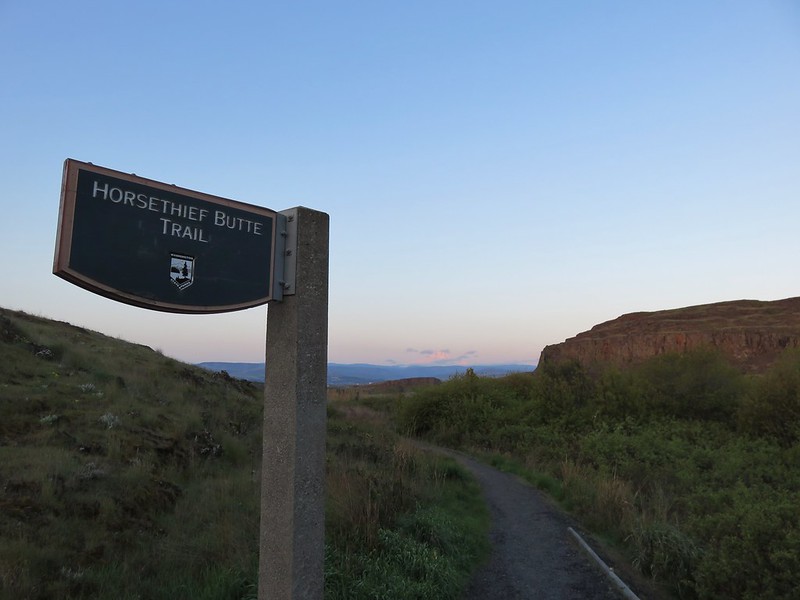
The park is located in Washington just across the Columbia River from The Dalles, OR and encompasses 3,338 acres offering rock climbing, fishing, sailboarding, and many other activities in addition to the hiking trails. We started our day off at Horsethief Butte, a rocky outcrop left over from an ancient basalt flow popular with rock climbers.

Basalt cliffs on the opposite side of Highway 14 from the trailhead.
IMG_0561_stitch

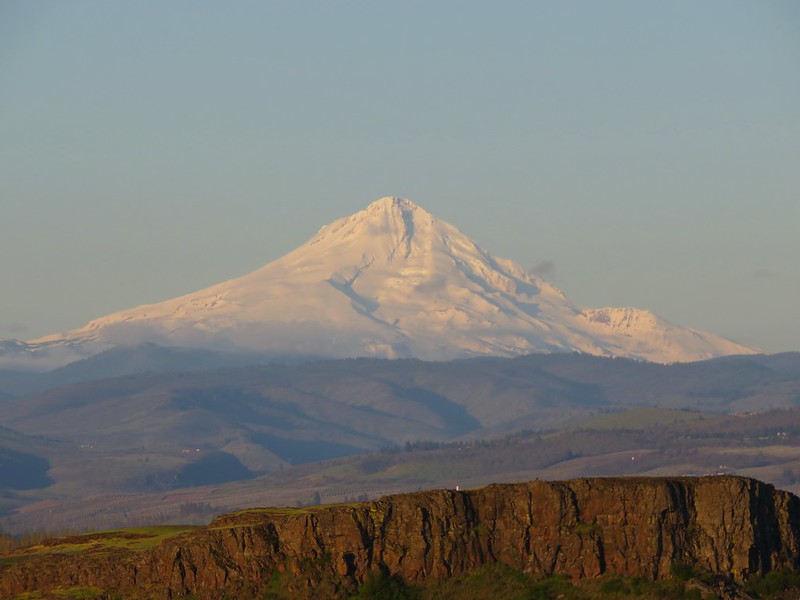
The trail starts off with a nice view of Mt. Hood over The Dalles.
IMG_0554

IMG_0580

The trail crosses a short section of flat grassland before splitting with the left fork heading up into a canyon of Horsethief Butte and the right fork leading around the mesa to rejoin the left fork on the far end of the canyon. There were a variety of flowers to be seen along this portion of the trail.

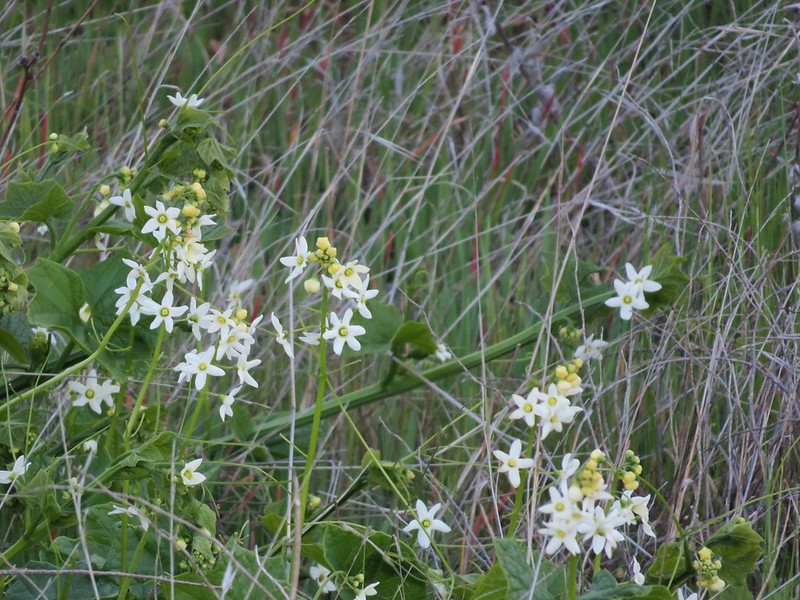
Manroot
IMG_0616

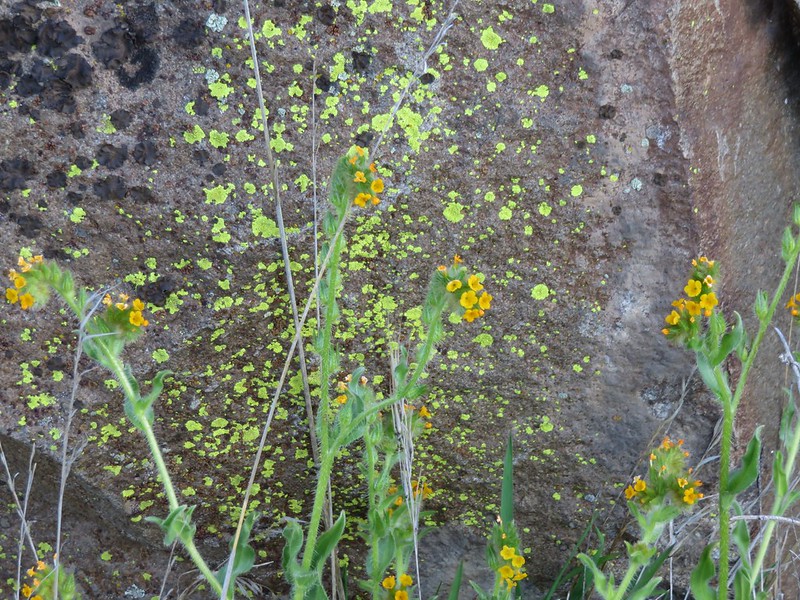
Bugloss fiddleneck
IMG_0617

Death camas
IMG_0623

Prarie star
IMG_0631

Large-flower triteleia
IMG_0578

Western stoneseed
IMG_0581

Larkspur
IMG_0584

Desert parsley
IMG_0619

When the trail split we took the left hand fork and headed for the canyon. At Horsethief Butte the dirt trail gave way to a short rock scramble up to the canyon entrance. At the top of the scramble the canyon opened up to reveal a good sized slot dotted with yellow balsamroot flowers.
IMG_0586

IMG_0589

Members of the Mazamas, an outdoor group based out of Portland, were busy setting up and climbing among the rocks.
IMG_0597

At the far end of the canyon the view opened to the Columbia River and Mt. Hood.
IMG_0596

IMG_0598

Here the trail dropped out of the canyon (without a rock scramble) to rejoin the right-hand fork. Before heading back we turned left and continued another quarter mile behind the butte to a viewpoint where poison oak patches were growing.

Poison Oak
IMG_0615

We headed back and completed the loop with Mt. Hood looming to our left.
IMG_0626

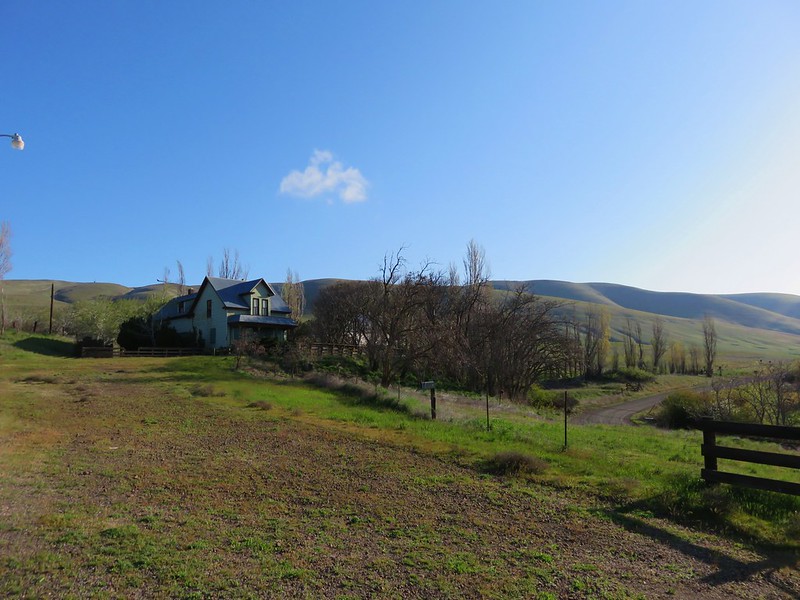
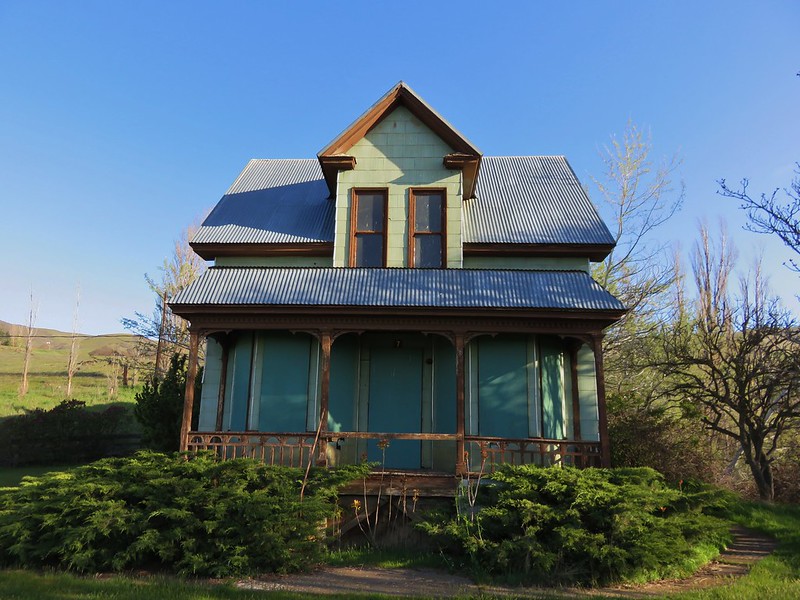
Next we headed to the Dalles Mountain Ranch, a short 4.5 mile drive away. To get there we drove 1.8 miles west on Hwy 14 and turned right on Dalles Mountain Road for another 2.5 miles to a fork. The trailhead for the ranch was to the right about .2 miles. Here an abandoned farmhouse and other buildings sat amid fields of balsamroot and lupine.
IMG_0634

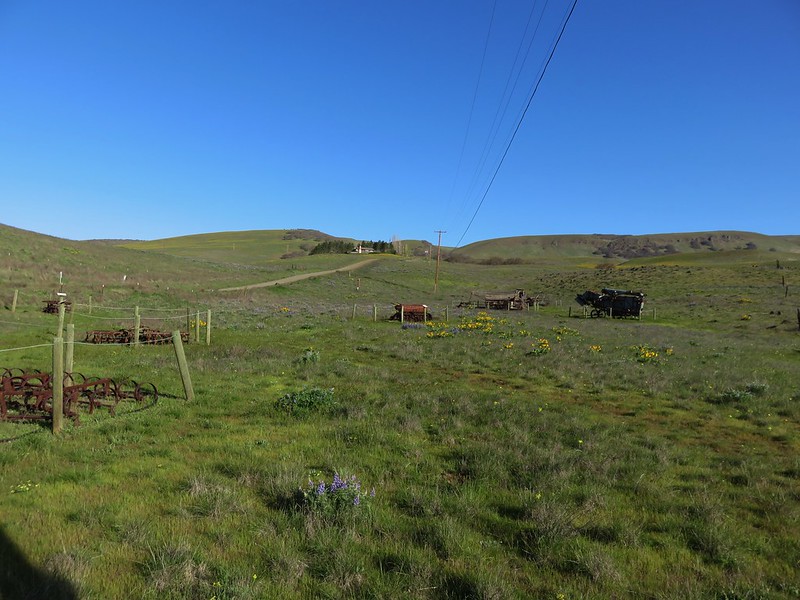
We explored the area around the farmhouse first where several pieces of old equipment were on display along with the flowers and views of Mt. Hood and distant Mt. Jefferson.
IMG_0635

IMG_0653

IMG_0665

IMG_0666

There were also a couple of trail options. I wandered down to Eight Mile Creek through a spectacular field of balsamroot and lupine.
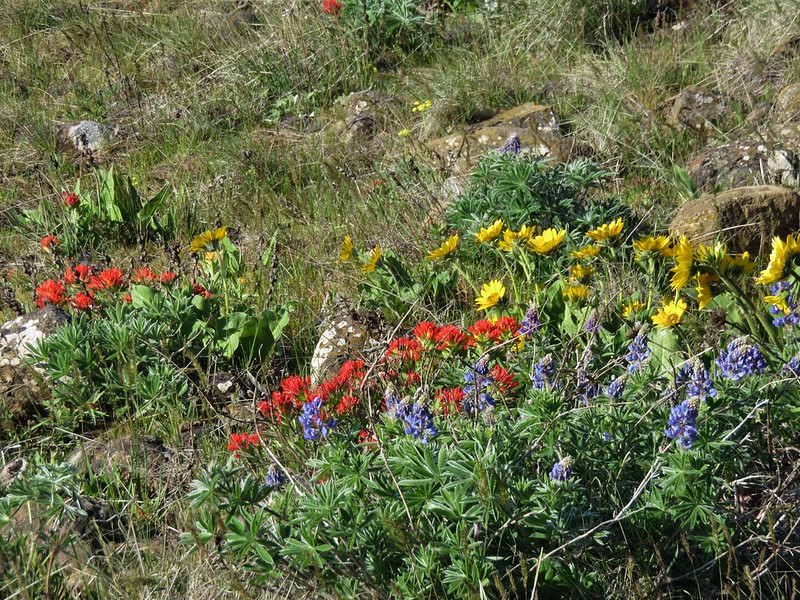
IMG_0668

IMG_0684

IMG_0681

IMG_0688

Our final stop was another short 1.4 mile drive up Dalles Mountain Road where a gate marked the end of the drive and the start of the Columbia Natural Area Preserve.
IMG_0693

We set off on the 2.5 mile hike up the closed road that would led us to the summit of Stacker Butte. Entire hillsides were covered in yellow from the balsamroot with a smattering of other flowers thrown in.
IMG_0713

IMG_0704

IMG_0716

IMG_0718

The total climb was a little over 1100′ but it was never too steep and the sweeping views drew attention away from the climb.
IMG_0720

IMG_0719

It was interesting to note the change in the mix of flowers as we climbed. Along the lower portion balsamroot and lupine dominated with a few prairie stars mixed in. A little higher up we ran into paintbrush and phlox.
IMG_0751

IMG_0767

IMG_0776

Next came larkspur and big-head clover.
IMG_0778

IMG_0797

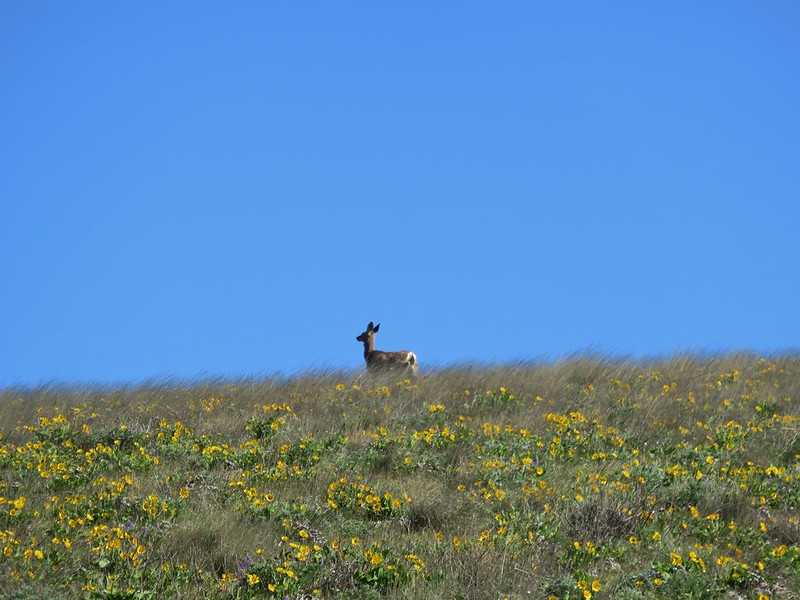
Flowers weren’t the only things we spotted. There were numerous birds and a few deer in the area.
IMG_0783

IMG_0855

IMG_0844

We had lost our views of Mt. Jefferson and Mt. Hood to the clouds, but when we reached the summit of Stacker Butte new views opened up. To the NW Mt. Adams was mostly obscured by a line of clouds, but Mt. Rainier and Goat Rocks were virtually cloud free.
IMG_0879

IMG_0885

IMG_0865

Almost directly below us lay Stacker Canyon where the Klickitat Rail Trail follows Swale Creek toward the Klickitat River, a hike we had done last April. https://wanderingyuncks.wordpress.com/2014/04/27/klickitat-rail-trail-swale-canyon-from-harms-rd/
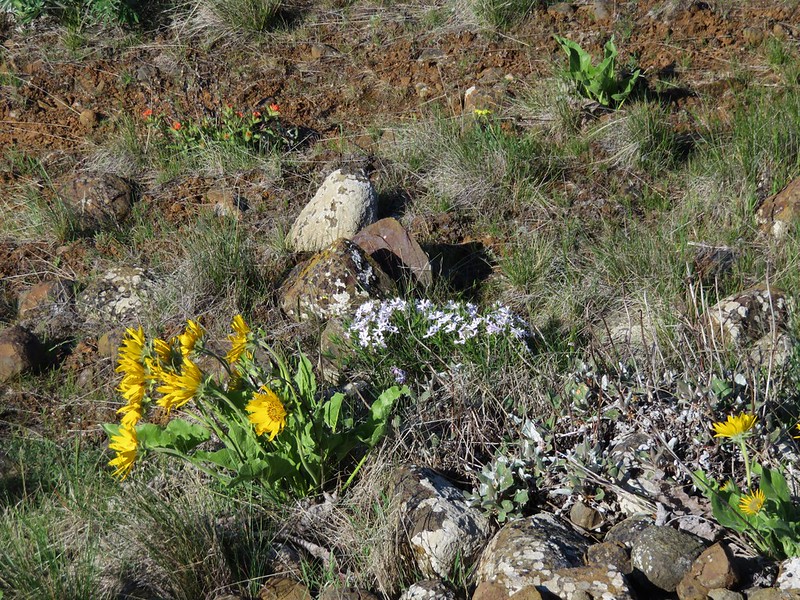
IMG_0875

IMG_0876

It was a little too windy (and chilly) to spend much time at the summit so after a quick snack break near an air control wigwam we headed back down the road.
IMG_0860

On our way down I got my first butterfly pictures of the year.

Sheridan’s Hairstreak
IMG_0899

Blue Copper
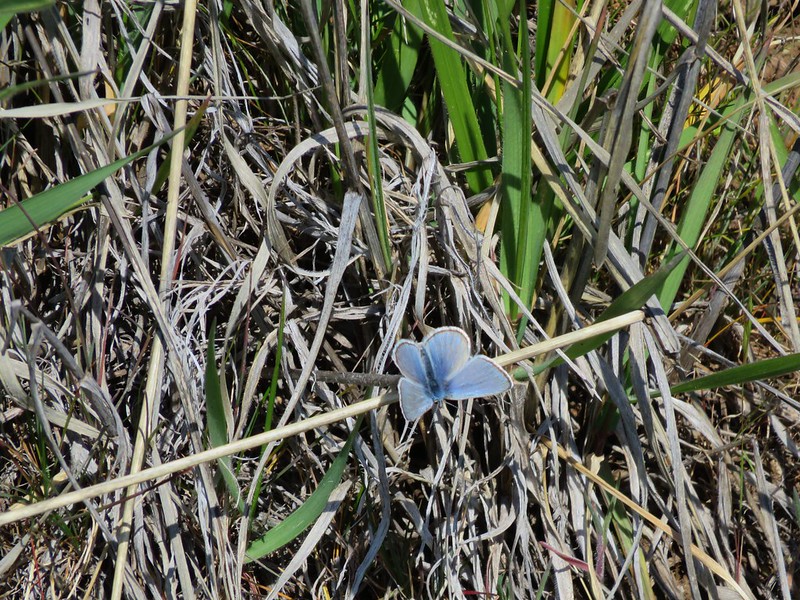
IMG_0936

With all of the options Columbia Hills State Park has to offer it makes a great place to spend a day outdoors, especially during the spring flower bloom. There are ticks and rattlesnakes in the area in addition to the poison oak so you’ll want to pay attention if you visit, but don’t let that stop you from checking this park out. Happy Trails!

flickr: https://www.flickr.com/photos/9319235@N02/sets/72157649434751593/