Categories
Central Coast Hiking Oregon Oregon Coast Trip report

Cape Kiwanda to Sand Lake – 07/22/2026

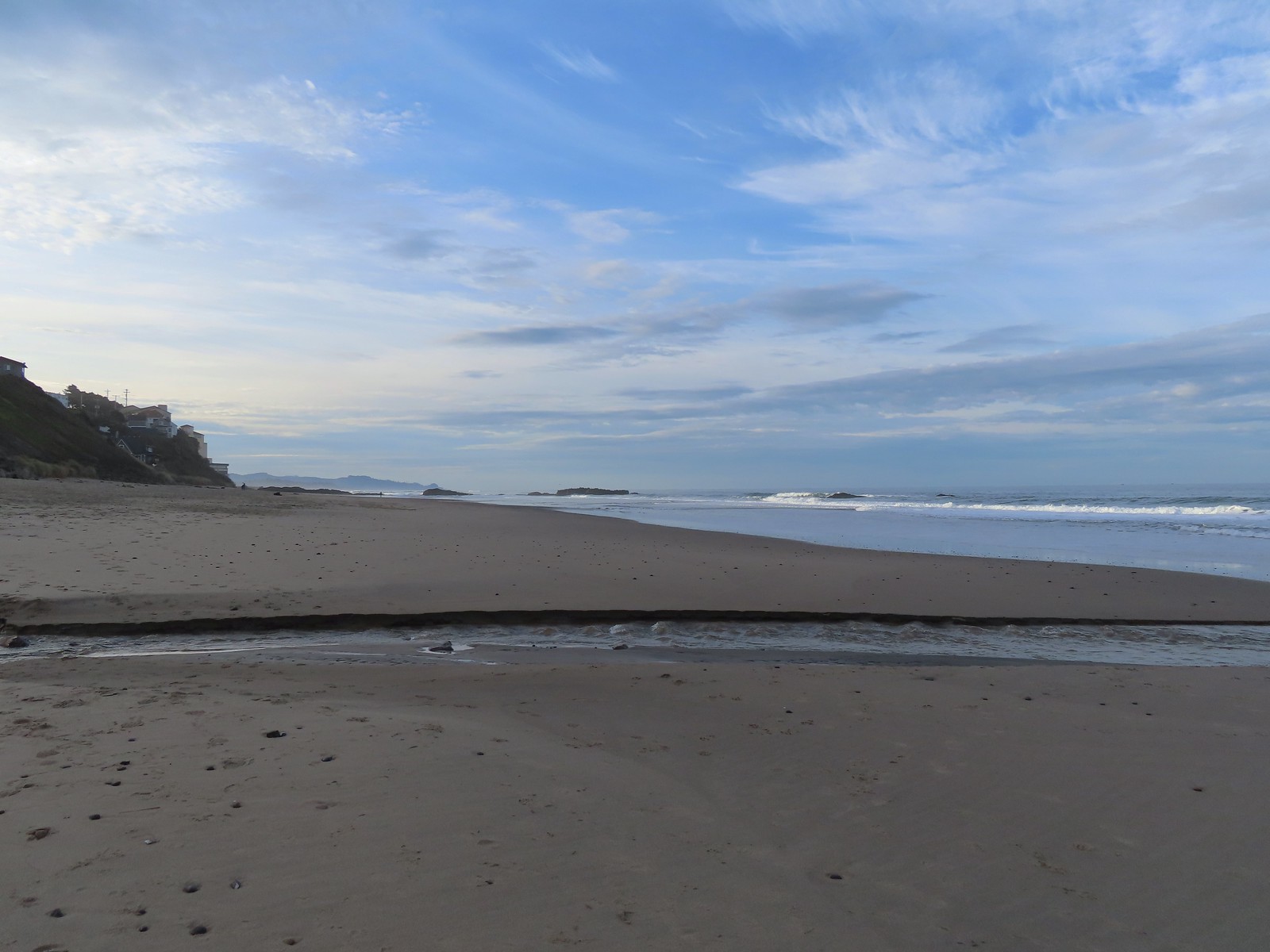
As I suspected weather and wildfire smoke steered me back to the Oregon Coast for Wednesday’s hike. I turned to the Oregon Hikers Field Guide and decided to try their Sand Lake – Cape Kiwanda hike. I started from the Tierra Del Mar Trailhead as described but instead of going north to Sand Lake first I decided to start by heading south to Cape Kiwanda. The reason for my choice is that the beach between Tierra Del Mar and Cape Kiwanda is open to vehicles while the northern stretch is closed to vehicles. I figured I was more likely to run into vehicles the later it got.
IMG_9019

IMG_9020

IMG_9036
It was a typically foggy summer morning along the coast which kept Cape Kiwanda hidden until I had covered most of the 1.7-miles to the Cape.

IMG_9032
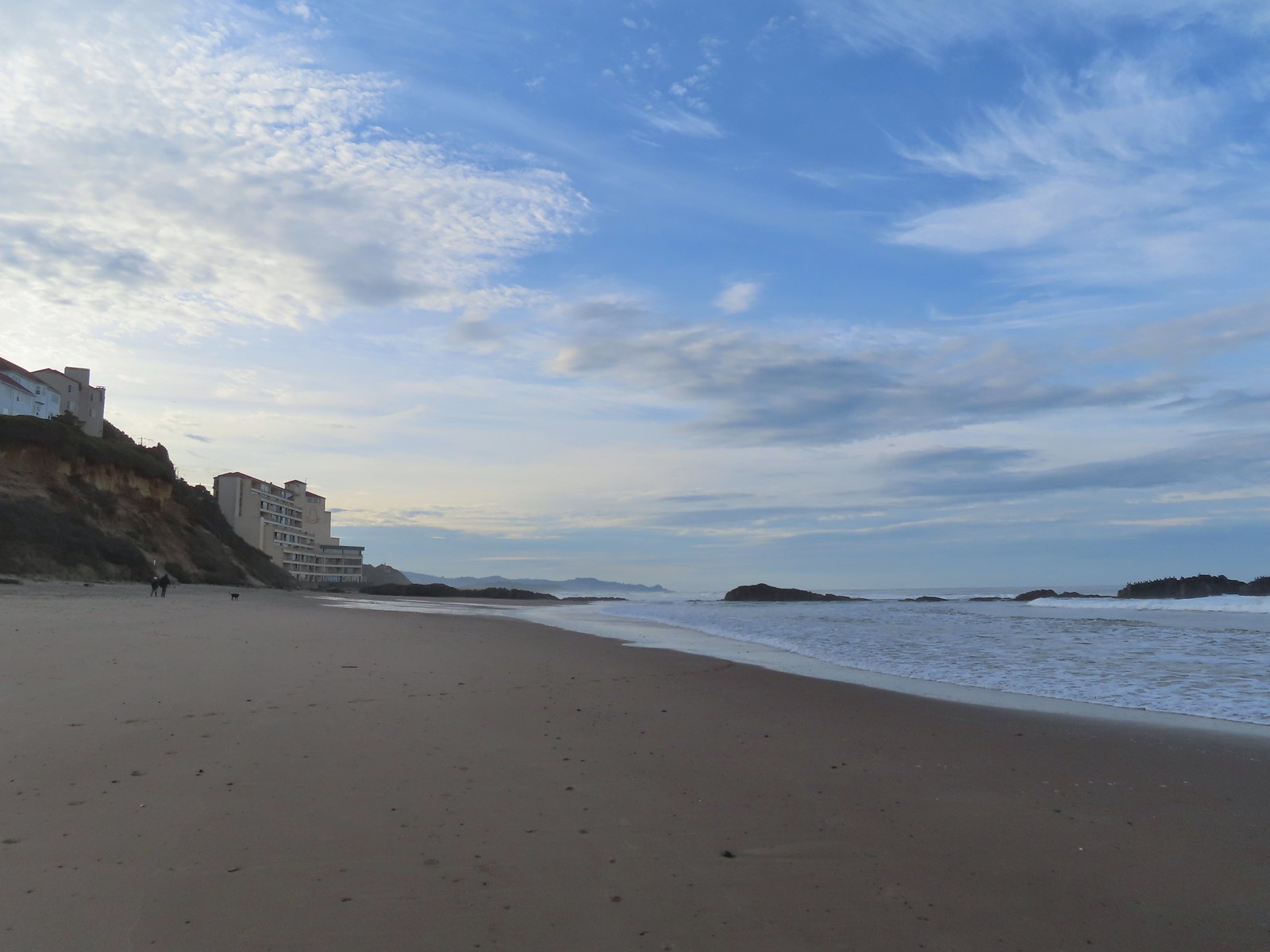
Early morning beach walkers.

IMG_9039
Miles Creek Point. At higher tides it may not be possible to walk around the rocks here.

IMG_9041
Miles Creek

IMG_9056
Cape Kiwanda

IMG_9063

IMG_9066
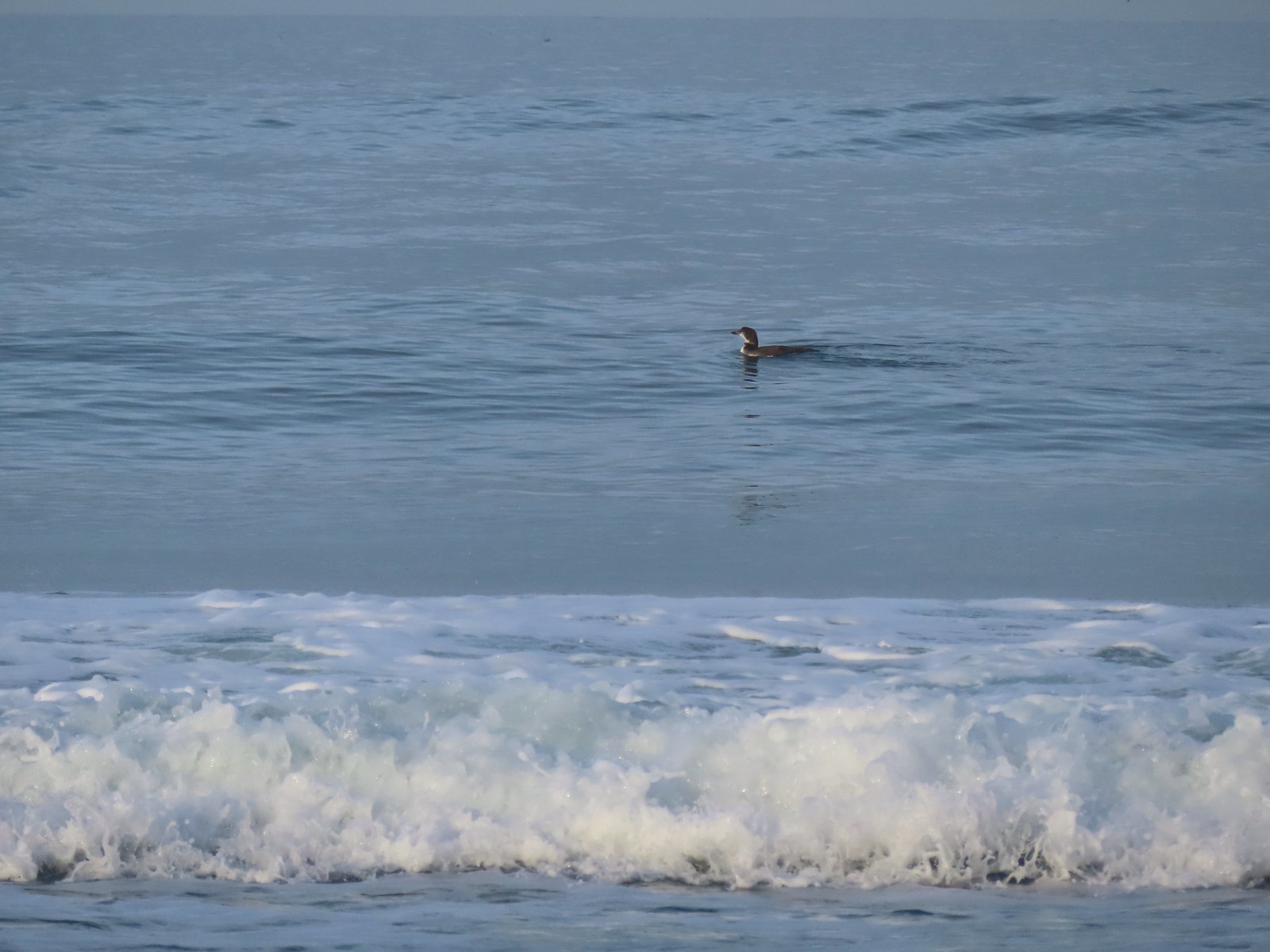
Pigeon guillemots (I think)

To reach to top of Cape Kiwanda I needed to climb the large dune behind it.
IMG_9067

IMG_9069

It’s a nearly 240′ slog up the sand dune.
IMG_9075

IMG_9084

I did a little exploring at the top of Cape Kiwanda and found a few ripe huckleberries which were a consolation prize given the lack of a view.
IMG_9087

IMG_9089
Pearly everlasting

IMG_9090

IMG_9092
Rose

IMG_9095
Huckleberries

IMG_9096

After the exploration I took a break on some sandstone and had a snack. The Sun was working on burning off the morning fog.
IMG_9098

IMG_9100
Pacific City (post) to the south of Cape Kiwanda.

After the break I headed back down the dune and began the 3.8-mile hike north to Sand Lake.
IMG_9114
Yarrow

IMG_9118
Finch

IMG_9125
The bottom of the dune.

As I headed north a little blue sky started breaking through.
IMG_9143

IMG_9154
Miles Creek Point.

IMG_9153
If the tide is too high to get around the point you’d need to climb over this mudstone slope.

IMG_9155
The fog and Sun locked in battle.

IMG_9165
Cape Lookout (post) in the distance.

IMG_9178
Tierra Del Mar

IMG_9179

IMG_9185

IMG_9187

IMG_9189
A few people were fishing near Tierra Del Mar.

IMG_9198
Sand dollar

I had intended to turn inland into Sitka Sedge State Natural Area (post) which the ORH Field Guide said could be done at emergency locator 34B. I completely missed 34B but saw 34A at the southern end of the snowy plover seasonal closure area. During the seasonal closure you have to stay on the “wet” sand which is what I did as I continued on to Sand Lake.
IMG_9244
The 34A locator and signs announcing the seasonal closure.

IMG_9201

IMG_9202
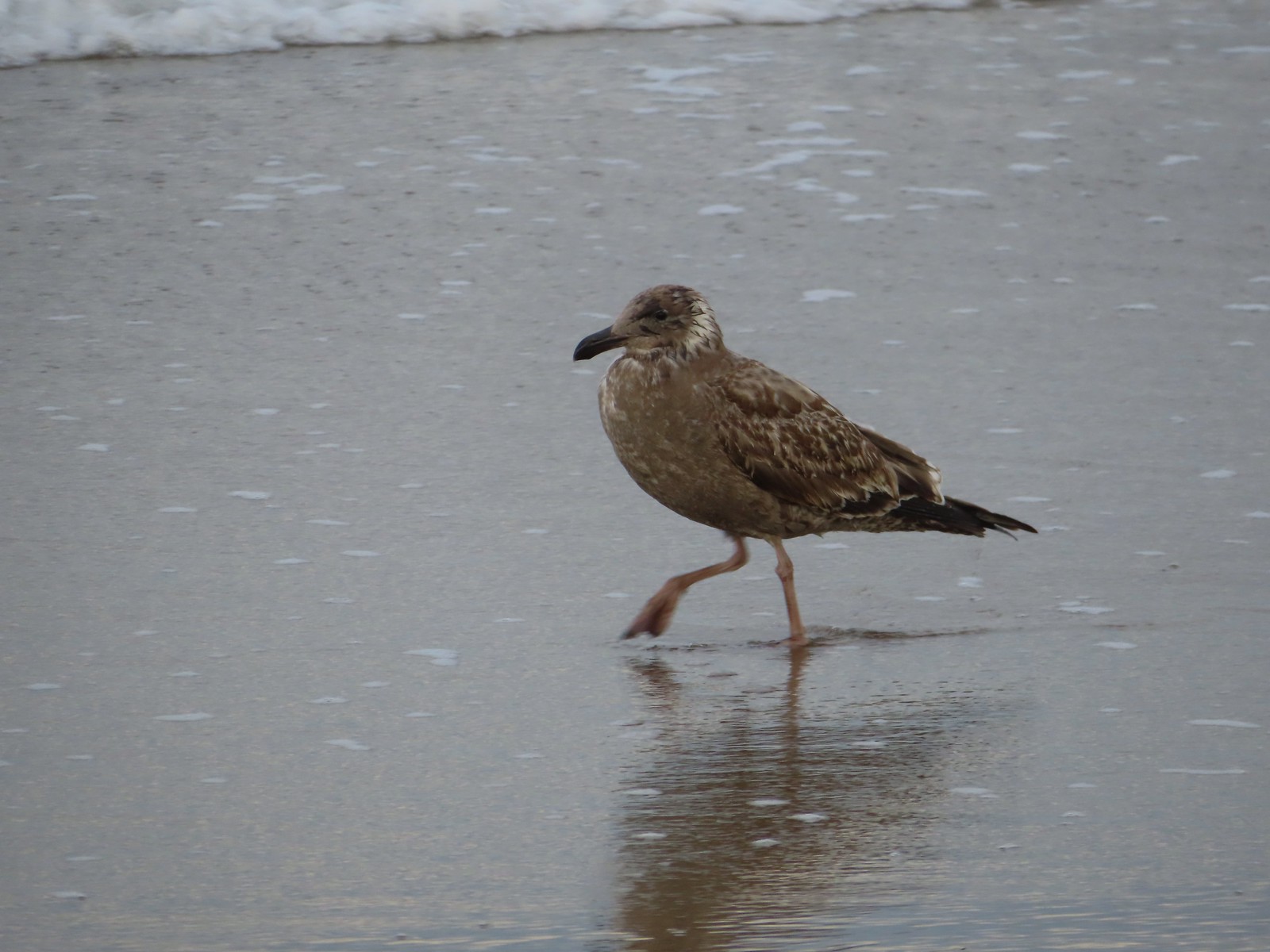
Seagull

IMG_9216
Sanderling

Spotted sandpiper
Spotted sandpiper

Black-bellied plover

IMG_9233

IMG_9236
Sand Lake

IMG_9239
Cape Lookout from Sand Lake Point.

Since I’d missed the inland trail and the seasonal closure blocks access to Sitka Sedge from Sand Lake Point, I turned around at Sand Lake and walked back to emergency locator 34A and turned inland at the edge of the closure area. A trail here led into the Sitka Sedge Natural Area.
IMG_9247

IMG_9248

I stayed straight at junctions thinking I would visit the day-use area however upon looking at the map at the second junction with the Estuary View Loop I decided I didn’t want to add that much distance to my hike.
IMG_9254

IMG_9255

IMG_9259

Instead, I backtracked to the Kinnikinnick Woods Loop and turned left onto that trail. I followed this trail for 0.3-miles then detoured left on the short Elk Knoll Trail and took a break on the bench atop Elk Knoll.
IMG_9266

IMG_9267

IMG_9268

IMG_9269

IMG_9270
Sand Lake from Elk Knoll.

After my break I returned to the Kinnikinnick Woods Loop and followed it another 0.2-miles to a junction with a beach access trail.
IMG_9273

IMG_9275
Pink pyrola

IMG_9279

The beach access trail traveled 0.2-miles through the woods and over the foredune emerging on the beach at emergency locator 34B.
IMG_9281

IMG_9284

I turned south (left) at the beach and hiked back to the Tierra Del Mar Trailhead which was just under a mile away.
IMG_9285
Haystack Rock (Not the Cannon Beach one, the Pacific City one.) making an appearance.

IMG_9289
Haystack Rock

IMG_9297
Beach access at Tierra Del Mar.

The GPS showed 9.7-miles for the hike with 250′ of elevation gain.
Screenshot 2026-07-22 113018

It was too bad it was so foggy on Cape Kiwanda, but the hike was still rather enjoyable. Happy Trails!

Flickr: Cape Kiwanda to Sand Lake

Categories
Central Coast Hiking Oregon Oregon Coast Trip report

Cook’s Ridge/Cummins Creek Loop – 07/20/2026

Having canceled plans for trip to the North Cascades National Park due to my ongoing back/hip/leg issues Heather decided not to use up a week of vacation. That left me on my own as I continue to try and work back to a place where a week of fairly intense hiking is possible. My plan for the week off was to get out 5 times over the 10 days. Hike one was to Canyon Creek Meadows on Saturday when Heather was able to join (post).

Hike two was going to be Black Crater in the Three Sisters Wilderness which we had visited in 2016 on a cloudy day and gotten no view from the summit (post). Unfortunately, when I got up a 3:15am and double checked the forecast it had gone from sunny to areas of smoke due to wildfires. The forecast was similar to the north in the Mt. Hood area and to the south, around Diamond Peak, there was a chance of rain showers. I then checked the Oregon Coast which was free of precipitation and smoke. I decided to head to the Cape Perpetua Scenic Area and hike some of the trails in that area.

We’d visited the Cape Perpetua Scenic Area in 2010, 2013 and 2018. For this visit my plan was to hike a loop incorporating some of the trails that we hadn’t been on during any of the previous visits.

I began at the Cape Perpetua Visitor Center at 6am.
IMG_8725
Not surprisingly I was the first car in the lot.

I made my way to the RV Parking area where the Cook’s Ridge Trail begins next to a signboard with a map.
IMG_8730

IMG_8729
My plan was to take the Cook’s Ridge Trail up to the Cummins Creek Trail and then follow that trail down to the Oregon Coast Trail and follow that trail back to the Visitor Center. I was also hoping to detour down into the Cummins Creek Wilderness to see Cummins Creek near the Cummins Creek Trailhead.

The Cook’s Ridge/Discovery Loop Trail climbed steadily up an old logging track for 0.4-miles to the start the 0.6-mile loop.
IMG_8731

IMG_8734

IMG_8739

IMG_8742

IMG_8753

IMG_8762

I stayed left at the junction and after another 0.3-mile climb passed the upper loop junction.
IMG_8767

IMG_8769
Ghost pipe (Monotropa uniflora L.) There was a lot of this plant along the trails during this hike.

IMG_8774
View from the Discovery Loop.

IMG_8780
Ghost pipe on both sides of the trail.

IMG_8781
There was something fairly large rustling around in the brush, but I never saw anything.

IMG_8787
Signs at the upper junction. I stayed left on the Cook’s Ridge Trail heading for the Cummins Creek Trail. It was 2.8 miles to that trail which consisted primarily of gradual climbing although there were a couple of downhills to drop into saddles.
IMG_8791

IMG_8796

IMG_8800

IMG_8804
None of the coastal huckleberries were ripe yet.

IMG_8807
Starflower

IMG_8813
Douglas squirrel

IMG_8818
More ghost pipe.

IMG_8822
Little prince’s pine

At the 2.4-mile mark I passed the junction with the Gwynn Creek Trail.
IMG_8828

Up until now the hike had been entirely new to me. In February 2013 we had descended to this junction from the Cook’s Ridge/Cummins Creek Trail junction and taken the Gwynn Creek Trail back down to return to the Cummins Creek Trailhead. Incidentally that was the first hike we covered in this blog. I continued uphill another 1.1-miles to the Cummins Creek Trail junction.
IMG_8829

IMG_8834
Red elderberry

IMG_8836
Fringecup

IMG_8842
An aven and self-heal

IMG_8846

Coastal brookfoam
Coastal brookfoam

IMG_8848
Bleeding heart

IMG_8854
Coming up on the Cummins Creek Trail junction.

I made a sharp right onto the Cummins Creek Trail and continued to climb briefly before the trail began a long gradual descent.
IMG_8857

IMG_8860

IMG_8864

IMG_8865
Yarrow

IMG_8866
Elegant brodeia

IMG_8870
Ocean spray

IMG_8871

IMG_8873
Snail

After a half mile on the Cummins Creek Trail I passed a 0.1-mile spur trail to a viewpoint.
IMG_8876

We visited the viewpoint in 2013 and given how cloudy it was I decided to save those 0.2-miles for my detour to Cummins Creek. A tenth of a mile beyond the viewpoint spur I came to another junction.
IMG_8879

To the left was the old Cummins Creek Trail and to the right the newer Cummins Creek Loop Trail (as shown on the trailhead map). In 2013 we’d come up the newer trail so today I turned left and headed down the older trail.
IMG_8881

IMG_8883
Thimbleberries, I did manage to find one ripe one and a few ripe red huckleberries.

IMG_8888
The upper portion of the trail was a little overgrown, but it was clear of obstacles.

IMG_8889
View out to the Pacific Ocean.

IMG_8896
White triteleia

IMG_8900

IMG_8902
Crab spider on a daisy.

IMG_8904

IMG_8906
Tiger lily

After a steep half mile descent I arrived at an old roadbed with a trail sign.
IMG_8911

I turned right and followed the old roadbed 1.4-miles to a junction with the Cummins Creek Loop Trail.
IMG_8917

IMG_8919

IMG_8921
Creeping buttercup

IMG_8925
Coastal manroot

The road sits on the edge of the Cummins Creek Wilderness.
IMG_8927

IMG_8934
Moth

IMG_8936
The Cummins Creek Loop Trail joining from the ridge on the right.

Given how steep the descent was to the roadbed I was glad that we had not tried to take this trail up in 2013. From the junction I continued to follow the old roadbed for 1.2-miles where I turned left onto a clear but unsigned trail leading downhill into the Cummins Creek Wilderness.
IMG_8940

IMG_8943
This rabbit hopped out onto the trail and posed for a moment.

IMG_8947
I was surprised to find some blooming fairy lanterns.

IMG_8949

I turned down the trail which had decent tread to begin with.
IMG_8950

After climbing over and through a couple of downed trees I arrived at a flat basin.
IMG_8953

The trail got overgrown fairly quickly and I lost it in a swale of skunk cabbage, ferns and grass.
IMG_8954

There were some faint, possibly game, trails heading toward the creek so I picked one and made my way toward the sound of water. I popped out of the brush next to a bunch of logs and a couple of small rock islands.
IMG_8955
Mushrooms

IMG_8963
Where I popped out of the brush.

IMG_8957
I climbed over these logs to reach the rocks.

IMG_8956
Cummins Creek

IMG_8959
California figwort along Cummins Creek.

After a short break I recrossed the logs and found a little clearer game trail back to the main trail and returned up to the Cummins Creek Trail. I followed the Cummins Creek Trail 0.2 more miles to the Cummins Creek Trailhead then walked the road an additional 0.2-miles to a small pullout with a signboard marking the Oregon Coast Trail.
IMG_8964

IMG_8966

IMG_8968

IMG_8972

IMG_8973

It was 1.3-miles back to the Visitor Center. This section provided several views of the Pacific.
IMG_8974

IMG_8977

IMG_8978
I had one of these ripe salal berries and it was the best salal I think I’ve ever had. If you’re familiar with the berry you know that the skin can be a little thick and hairy, but they have a sweet flavor.

IMG_8984

IMG_8985
Gwynn Creek

IMG_8986
I passed the junction with the Gwynn Creek Trail 0.3-miles from the road. Since we had come down the Gwynn Creek Trail in 2013 I was once again on a section of trail I hadn’t hiked before.

IMG_8990

IMG_8996

IMG_8998

IMG_8999
Cape Perpetua from the trail. You can barely make out the stone shelter atop the cape if you zoom in.

IMG_9002

IMG_9009
Highway 101

IMG_9012

IMG_9015

IMG_9017

My loop came to 9.6-miles with approximately 1600′ of elevation gain.
Screenshot 2026-07-20 130040

Over half the loop was new-to-me trail. I passed a total of five people, three were between the Cummins Creek Loop/Cummins Creek Trail junction and where I detoured down to Cummins Creek, and the other two were on the paved trail up to the Visitor Center. While we don’t often hike on the coast in July since that is prime time for higher elevation hikes this proved to be a great alternative. Based on the forecast for the rest of the week I may be looking for another coastal hike or two. Happy Trails!

Flickr: Cook’s Ridge/Cummins Creek Loop

Categories
Central Coast Oregon Oregon Coast

Oregon Coast Aquarium – 05/05/2026

With us taking a staycation due to my current physical limitations, instead of house sitting for us, our son Dominique stayed with us for the first half of the week. He’d joined us on a Star Wars Day hike at Fernhill Wetlands (post) and in lieu of a hike the following day we headed to Newport and the Oregon Coast Aquarium. While we aren’t counting this as a hike, we did spend the better part of four hours on our feet wandering around the aquarium and watching the animals. This was another good test for how my PT was progressing, and while my lower back was protesting mightily by the end of our visit, I woke up today feeling better than I have in months.

It had been many years since we’d visited the aquarium, and I was very excited to see the puffins. In the wild tufted puffins visit Haystack Rock (post) off the Oregon Coast from about mid-April through July, but we haven’t visited during their nesting season. Occasional sightings have occurred at Coquille Point and Face Rock in Bandon (post), Netarts Bay (post), Cape Perpetua (post), and Yaquina Head (post). Even when the puffins are present spotting them can be difficult and is at a distance requiring binoculars or a strong zoom lens. The aquarium however has a number of tufted puffins as well as a few horned puffins in its aviary where the birds can be viewed up close.

We were at the aquarium when it opened at 10am and left a little after 2pm. During our visit we got to see feedings of the California sea lions, sea otters, and the birds in the aviary. The feedings are accompanied by an informative talk about the animals and some pretty impressive demonstrations by the sea lions and otters. We also listened to a pelican talk while a brown pelican did a little performing of her own. There is also an interactive tidepool where guests can touch all of the sea creatures. Following are a few of the photos from our visit.
DSCN8353

DSCN8495
Aquarium map

DSCN8354
Moon jellyfish in the main building.

DSCN8364
Yaquina Bay from a viewing platform.

DSCN8361
Mallard in Yaquina Bay.

DSCN8367
Open Sea exhibit where you can walk through glass tubes surrounded by sharks and various species of fish.

DSCN8400

DSCN8376

DSCN8397

DSCN8399

DSCN8409

DSCN8405

DSCN8410
Fringecup flowering along the path to the aviary.

DSCN8415
The six types of birds in the aviary.

One of the volunteers mentioned that we had missed the pair of rhinoceros auklets by about half an hour. He said that these birds were very shy so when he sees someone with a “real camera” he tries to point them out if they make an appearance. While they didn’t come out during our first stop in the aviary one did briefly show itself during the afternoon feeding. The other five bird species were easily spotted though.
DSCN8434
Black oyster catcher

DSCN8416
Common murre

DSCN8459
Pigeon guillemots

DSCN8435
Horned puffin

DSCN8456
Tufted puffin

After spending some time in the aviary, we made our way over to the seal and sea lion exhibit for the sea lion feeding.
DSCN8460
The glass made getting pictures tricky.

DSCN8464
One of the California sea lions.

We followed that up with a visit to the sea otters and brief stop to admire the turkey vulture before heading to the pelican talk at 11:30am.
DSCN8475
Two of three resident sea otters.

DSCN8471

DSCN8478
Turkey vulture

DSCN8484

It turned out to be a good time of the year to visit because the birds were in their breeding plumage and the brown pelican really showed it.
DSCN8485

DSCN8492

After a quick bite to eat we spent some time in the indoor exhibits, including the tidepool. We interrupted this to return to the sea otters for their feeding then finished up the indoor exhibits before the bird feeding in the aviary. Inside there are a number of different enclosures hosting a large number of species.
DSCN8510

DSCN8511

DSCN8526

DSCN8535
This large snail could really move.

DSCN8543

DSCN8546

DSCN8551

DSCN8553

DSCN8558

DSCN8566

DSCN8560
Interactive tidepool

DSCN8568
Interactive tidepool

DSCN8571
Interactive tidepool

DSCN8574
Red abalone in the interactive tidepool.

DSCN8582

DSCN8596

DSCN8621

DSCN8626

DSCN8628

The birds were much more active in the aviary, we assumed in anticipation of the feeding.
DSCN8633
Horned and tufted puffins

DSCN8642
Common murres

DSCN8643
Tufted puffins in the water. We got splashed a couple of times by incoming birds landing in the water just in front of us.

DSCN8658
Pigeon guillemots having a lively discussion.

DSCN8666
Juvenile puffin

DSCN8674
A posing pigeon guillemot

DSCN8676
The rhinoceros auklet during its brief appearance.

After the feeding and a visit to the souvenir shop we said our goodbyes. On the way to the car we spotted a whimbrel in Yaquina Bay which was the end of our wildlife encounters for the day.
DSCN8683

The aquarium is enjoyable for any age and while its size would allow someone to see everything in about an hour, to really appreciate it and take things in you’d want to spend few hours at least. There are also several hikes nearby that could easily be done on the same day including the Yaquina Head or Yaquina Bay Lighthouses (post), Forest Park Trail (post), the Estuary Trail, Mike Miller Park, South Beach (post for the three previous hikes), or for a longer hike the Yakona Nature Preserv (post).
Screenshot 2026-05-06 075401

Happy Trails!

Flickr: Oregon Coast Aquarium

Categories
Central Coast Coastal Range Hiking Oregon Coast Trip report

Nehalem River Corridor – 03/28/2026

A left leg issue caused me to put hiking on hold for about a month. I was experiencing shifting discomfort and tightness from the piriformis down to the calf. It seemed to be a different location every day and after a couple of weeks the area around my knee was consistently feeling tight. X-rays and an exam showed the knee itself was in good shape structurally, so I’ve been referred to physical therapy. My first PT appointment isn’t until mid-April, but in the meantime the leg has been gradually improving and the orthopedist said I had no restrictions other than to not overdo it.

With that in mind we decided to see how my leg responded to hiking with a multi-stop outing of up to four short hikes in and around the Nehalem River Corridor. The short hikes would allow me to test my leg while allowing us to easily cut the day short if necessary.

We started our morning with the shortest of the planned hikes, a visit to Umbrella Falls at the Nehalem Fish Hatchery. We had attempted to visit the waterfall in February of 2021 prior to our North Fork Nehalem River hike (post). The hatchery was closed to the public due to COVID restrictions and although walking through to the river would probably have been allowed, we opted to save it for another time. That time was now and we opted to park at the North Fork Nehalem County Park adjacent to the gate at the hatchery entrance which acts as parking for non-disabled anglers.
IMG_4752

IMG_4753

We walked down the entrance road stopping at the rearing ponds to look at some of the fish then continued to the western end of the hatchery to a sign for the Umbrella Falls Trail.
IMG_4754

IMG_4756

IMG_4757

We followed the trail 250 yards to Umbrella Falls across the North Fork Nehalem River.
IMG_4758

IMG_4762
Violets

DSCN8133
Umbrella Falls

DSCN8134

After visiting the falls, we continued on the short loop back to the hatchery and returned to the car.
IMG_4774

IMG_4775
Trillium

IMG_4777
Coltsfoot

DSCN8140
Bald eagle above the hatchery.

This stop was just over three-quarters of a mile. Umbrella Falls is a nice waterfall, and the fish hatchery added quite a bit to see.
Screenshot 2026-03-29 043909

My leg felt great during the first stop, so we drove to our next stop at the Nehalem River Dike. There is limited parking along the shoulder of Tideland Road. There is room for a couple of cars at the location linked above. We wound up parking approximately 100 yards to the south along the shoulder to the road.
IMG_4783

IMG_4786
The gate at the trailhead in the Oregon Hikers Field Guide.

There is a three-quarter mile section of a grassy dike open to hiking. The dike travels between the Nehalem River and the Nehalem Bay wastewater ponds. The draw of the hike is wildlife viewing and we were not disappointed.
IMG_4788

DSCN8152
Swallows

DSCN8154
One of a several great blue herons.

DSCN8160
Red-winged blackbird

IMG_4792
The city of Nehalem across the river.

DSCN8167
Mallards

DSCN8174
Scaup

IMG_4793
One of the wastewater ponds.

DSCN8178
Seal

DSCN8190
Common mergansers

DSCN8193
Northern shovelers

DSCN8204
Great blue heron

IMG_4796
End of the dike trail.

IMG_4799
Heading back.

DSCN8208
Sparrow

DSCN8209
Bufflehead

DSCN8210
Caterpillar

DSCN8216
Bald eagle

DSCN8221
Northern flicker

DSCN8224
Cormorant

This hike was just over 1.75-miles with nice views and a lot of wildlife which made for an enjoyable hike.
Screenshot 2026-03-29 043939

I was still feeling good so when we got back to the car we headed for our third planned stop at the Nehalem Falls Campground. With the campground still closed for the season we parked near the gate at the entrance road.
IMG_4800

We walked down the entrance road a tenth of a mile to a sign for the “Hiking Trail”.
IMG_4803
Skunk cabbage

IMG_4806
Day use parking area

IMG_4807

We headed down the trail which quickly drops near the river at Nehalem Falls. These falls are more of a rapid with the tallest drop being just 8′. Depending on the water volume the drop isn’t visible.
IMG_4810
Violets

IMG_4814

IMG_4822
The fish ladder is visible to the far right. At times this too is underwater and not visible.

IMG_4821
Pink fawn lilies

After visiting the falls, we continued on the hiking trail which loops around the campground in just under a mile.
IMG_4828

IMG_4843
Bleeding heart

IMG_4847

IMG_4848
Blackberry blossoms

IMG_4859

IMG_4860

IMG_4874
Trillium

IMG_4877
One of several benches along the loop.

IMG_4887
Fall Creek

IMG_4890
Chestnut-backed chickadee

IMG_4894
Toothwort

IMG_4895

IMG_4906
There were a lot of trilliums along the trail.

IMG_4907
The trail dropped us into the campground.

A short walk along the campground road led us back to the day use parking area to complete the loop then we walked back up to our car.
IMG_4909

The final hike we had planned was located less than a mile from the Nehalem Falls Campground at Cougar Valley. In 2007 an Oregon Department of Parks and Recreation proposal included development of a 315-acre parcel of land located in Cougar Valley that had been purchased by the State in 2005. Local pushback on the proposal suspended that development and today the tract of land is open for day use only. The abandoned Lost Creek Road serves as what All Trails refers to as the Lost Creek Trail. This “trail” is not officially maintained, at least not frequently.

We parked at the gated roadbed and set off on a grassy track through blackberry bushes.
IMG_4914

IMG_4916

IMG_4921
There were dozens of snails along the roadbed.

IMG_4926
Maple meadow. The land had previously been the homestead of Cougar Bill and Cougar Marie, mountain line bounty hunters.

DSCN8228

IMG_4927

IMG_4930
Lost Creek below Lost Creek Road.

IMG_4932
Lost Creek

IMG_4935
Salmonberry

IMG_4937
One of two washed out areas along side creeks, possibly from flooding in February 2026.

DSCN8232
Pacific wren

IMG_4940

IMG_4948
Mushroom

IMG_4949

IMG_4950
Rusted dozer blade

We made it almost a mile and a half before we began to encounter overgown conditions.
IMG_4952

After picking our way through the first section we came to an even thicker mass of vegetation and decided to turn around. The old logging road had originally continued a couple more miles, and the roadbed had been accessible to at least the 1.75-mile mark where it crosses Lost Creek. Time has allowed nature to slowly reclaim the roadbed though.
Our turnaround point along Lost Creek Road
Our turnaround point.

We headed back toward the car but took a short detour 0.4-miles before the trailhead down an old spur road that led to an old bridge over Lost Creek.
IMG_4929
The old bridge from Lost Creek Road.

IMG_4963
The spur road is on the right heading out Lost Creek Road. Since we were on the way back it was a left for us.

IMG_4964
A very rough trail was cut through the blackberry bushes. We came away with quite a few scratches.

IMG_4965
I didn’t trust the bridge enough to try stepping on it.

IMG_4967
Lost Creek from the edge of the bridge.

After checking out the bridge we fought our way back up through the blackberries and returned to our car.
IMG_4969

Our hike in Cougar Valley came in just under three miles and Nehalem Falls had been 1.1-miles.
Screenshot 2026-03-29 043706

One note is that we both did wind up with a tick on our long sleeves post hike. With the unusually warm, dry winter all reports indicate they are bad all over the State this year and this was the first time we’d picked any up in the Coast Range. It was a good reminder to always perform a tick check at the end of your hikes.

In all the four stops wound up being 6.6-miles with just 175′ of elevation gain. Here is a look at the relative location of our four stops.
Screenshot 2026-03-29 043532

My leg held up surprising well and as I am writing up this trip report the next day it’s still feeling good which is encouraging. Our plan is to take things easy and hopefully the physical therapist will be able to identify whatever the issue is and we’ll go from there. In the meantime, Happy Trails!

Categories
Central Coast Hiking Oregon Oregon Coast Trip report

Cape Lookout State Park – 01/24/2026

While a winter storm was impacting much of the country the Oregon Coast was experiencing clear skies and high in the low 50’s, which was too good to pass up so I headed out for another solo hike. I decided to head out to Cape Lookout State Park to check out the recently reopened North Trail along with the Cape and South Trails. Heather and I had visited the park way back in November 2011 but had not hiked the North Trail that day (post).

A section of the North Trail was closed in December 2024 after a tree fell and damaged the suspension bridge over Cape Creek and as of this post both the Oregon Hikers Field Guide and AllTrails still show the trail as closed, but when I checked the park’s website there was no longer a closure notice for the trail. (There is a notice that the park will be closed starting April 1st for improvements which will likely last into the Summer.) With no closure notice listed on the website I was pretty confident that the trail had been reopened. Worst case scenario would be that there would be notices posted at the trailhead in which case I would still be able to hike the Cape and South Trails allowing me to still get plenty of hiking in.

I made the hour and a half drive from Salem to the Cape Lookout Trailhead which is open from either 7am to 9pm or Dawn to Dusk depending on who you ask. Regardless with first light not being until 7:12am and sunrise at 7:44am I had timed my departure to arrive in between and was ready to set off just before 7:30am.IMG_4079

The trailhead signboard says Dawn to Dusk.

Unsurprisingly I was the first car in the lot and after double checking for any closure notices for the North Trail I started off on the Cape Trail.IMG_4081

My plan was to hike the Cape Trail out to the end of Cape Lookout first to avoid the crowds that would surely be arriving later. After hiking the Cape Trail I would take the North Trail to the Cape Lookout Day Use Area where Heather and I had parked for our Netarts Spit hike in 2020 (post). Assuming I had anything left in the tank after returning from the North Trail I planned on hiking the South Trail down to the beach for the up-close view of the basalt cliffs of Cape Lookout’s southern side. It’s 2.4 up and down miles to the end of Cape Lookout with occasional views to both the north and south.IMG_4085

In between views the trail passes through a coastal forest.

IMG_4089

Looking SE toward Sand Lake.

IMG_4093

IMG_4094

Looking south to Haystack Rock and Cape Kiwanda (post) with Cascade Head further south (post).

IMG_4099

Haystack Rock with the tip of Cape Kiwanda to its left. Cascade Head is next and the headland furthest south is Cape Foulweather.

A little over a mile and half in the trail passes a memorial plaque for an Army Air Force plane that crashed nearby claiming the lives of nine members of the ten man crew.IMG_4100

The trail is almost always muddy in spots and downed trees sometimes require less than ideal reroutes of the trail.IMG_4103

IMG_4108

Coming up to the first view to the north.

IMG_4109

View north along the coast.

IMG_4110

Three Arch Rock across from Oceanside (post) followed by Cape Meares (post), and then Cape Falcon (post). The inland peaks starting with the rounded one of the left are Neahkahnie Mountain (post), Angora Peak, Rock Mountain, West Onion Peak and Onion Peak.

IMG_4116

Wells Cove

IMG_4119

It was close to freezing so the trails weren’t as muddy as they can be on warmer days. The good news was there was no ice to deal with.

IMG_4129

Here comes the sun.

IMG_4130

IMG_4134

Along this section I heard a blowing sound in the ocean below.

At 400′ above the water I could see something swimming around but couldn’t make out what it was. I had the larger camera that I like to use at the wildlife refuges in my pack, so I pulled it out and started taking pictures. The way it was coming up out of the water and making a blowing sound I mistook it for a small whale, but it turned out to be a sea lion.DSCN7787

The sea lion was attracting seagulls which began arriving en masse.DSCN7799

The sea lion eventually moved on and so did I.IMG_4139

DSCN7801

Seagulls and cormorants.

IMG_4140

Barrier at the end of Cape Lookout.

There is a small bench and viewpoint at the end of the trail where I paused briefly to appreciate the views.IMG_4141

View south.

IMG_4142

View north.

I headed back toward the trailhead stopping to get a few pictures with the bigger camera now that it was unpacked.DSCN7809

American kestral

DSCN7812

I’m fairly certain this is a ruby crowned kinglet in the salal.

DSCN7820

Hermit thrush

DSCN7824

Three Arch Rocks

DSCN7831

Varied thrush

Back at the trailhead I turned left and headed down the North Trail.IMG_4152

It was clear from the trail tread that this trail hadn’t been used much recently however there were signs of recent trail maintenance. Aside from a few trees that I needed to watch my head going under the trail was clear as it dropped down to the suspension bridge over Cape Creek.IMG_4154

IMG_4156

IMG_4162

There was a lot of blowdown, mostly older, along this section.

IMG_4163

Reenforced trail along this switchback.

IMG_4166

It was 0.8-miles to the bridge with an elevation loss of 550′, but the bridge is worth seeing and would be a worthy turnaround point for a shorter hike.

IMG_4167

IMG_4168

Camp Creek

The trail made a quarter mile climb on the north side of Camp Creek to a signed junction at an old roadbed.IMG_4170

IMG_4172

Sea stack out on the ocean.

IMG_4173

IMG_4174

This junction is where the trail had been closed coming from the day use area.

IMG_4175

I double checked to make sure it wasn’t still signed closed at this end.

Most of the next 1.2-miles to the day use area followed the old roadbed as it descended to the beach. This section was in good shape except for a short section along a slide approximately a half mile from the day use area.IMG_4176

IMG_4179

Netarts Spit and Bay.

IMG_4181

A rerouted section of trail near the slide area.

IMG_4183

This small stream appears to be the reason for the slide which is now being funneled over the hillside. On the far side the trail drops steeply down wet rocks next to wire covered rocks.

IMG_4184

Looking down at the continuation of the trail on the far side of the stream.

IMG_4186

Looking back up from the bottom. Coming down this was a lot harder than going back up due to how slick the damp rocks were.

After getting past the slide it was an easy half mile down to the day use area.IMG_4188

IMG_4190

The sign of a good coastal trail is it going through a tree.

IMG_4191

IMG_4197

IMG_4198

Bridge over Jackson Creek.

IMG_4199

Jackson Creek

IMG_4202

The parking lot at the day use area.

I took some time to read some of the interpretive signs/plaques and take a short break at one of the picnic tables before starting back.IMG_4201

Cape Lookout from the day use area.

IMG_4203

IMG_4206

IMG_4207

I made the 2.2-mile, 800′ plus elevation gain return trip to the Cape Lookout Trailhead and decided that I would go ahead and hike down the South Trail as well. That trail started a little under 100 yards from trailhead where it split off from the Cape Trail.IMG_4215

IMG_4216

Turning onto the South Trail.

Like the North Trail the South Trail loses over 800′ to reach the ocean which it does in 1.8-miles.IMG_4217

DSCN7835

Spotted towhee

IMG_4218

Good use of switchbacks keeps the trail from ever being too steep.

Halfway down the trail passes a bench with a nice view of Cape Lookout through the trees.IMG_4220

IMG_4221

IMG_4223

Camp Clark (Scouting America) below the trail to the south.

IMG_4225


Getting closer to the beach.

IMG_4227

Self-heal

IMG_4232

DSCN7843

Columnar basalt on Cape Lookout.

IMG_4234

The view south towards the sun.

When Heather and I visited in 2011 we continued a little to the south so this time I headed north toward Cape Lookout and then found a nice rock to take a seat on.IMG_4236

My view.

DSCN7838

One of three bald eagles that flew over.

After resting and psyching myself up for the climb I headed back.IMG_4242

The trail is marked by a colorful buoys and ropes.

IMG_4243

Today’s hike came in at 13.2-miles with approximately 2000′ of cumulative elevation gain.Screenshot 2026-01-24 152148

Of course, there are plenty of shorter options available, but you could also go further by heading north along Netarts Spit or south along the beach to Sand Lake. If you do visit be prepared for muddy conditions and crowds on the Cape Trail. Having been the first car at the trailhead I didn’t see anyone until I was headed back from the end of the cape. I passed just eight people on the way back, but it wasn’t yet 9:30am when I turned onto the North Trail. I only saw three people on the that trail and then another eight on the South Trail, plus a few more on the beach itself. By the time I was ready to leave at 1:15pm the trailhead was overflowing and cars were parked along the shoulder out to Cape Lookout Road. Score another one for early starts. Happy Trails!

Flickr: Cape Lookout State Park

Categories
Central Coast Hiking Oregon Oregon Coast Trip report

Twin Rocks & Hoquarton Slough – 09/06/2025

The arrival of a weather system bringing showers along with the chance of thunderstorms in many areas led us to choose a beach hike for our second outing of September. We headed to the city of Rockaway Beach and parked at the Rockaway Beach Trailhead.
IMG_0023

This was our second visit to the city of Rockaway Beach but the first to the actual beach having visited the Old Growth Cedar Preserve on the previous visit (post). It was overcast but no showers and more importantly no lightening. (Which we’d seen on our drive through the coast range.) We headed down to the beach and faced a choice, we could head north to the Nehalem River or south to Tillamook Bay where the Tillamook River empties into the Pacific Ocean. The distance to the two rivers is roughly the same from the trailhead so we made our choice based on the presence of Twin Rocks along the way to Tillamook Bay.
IMG_0030

IMG_0031
Twin Rocks in the distance.

We followed the beach south just over three miles to the north jetty of the bay. The tide was just starting to come back in, so we were able to head out a bit on the beach.
IMG_0034

IMG_0035

There were two small creeks to cross on the way past Twin Rocks. The first was Saltair Creek which was easily crossed dry footed.
IMG_0039

IMG_0037
Semipalmated plover

Heitmiller Creek was a bit wider but not particularly deep. Even my trail runners were able to keep the water from seeping in the mesh of the toe boxes.
IMG_0042

IMG_0048

Lion's Mane Jellyfish
Lions mane jellyfish

IMG_0066

IMG_0068
Brown pelicans

IMG_0075
Just a bit of blue sky.

IMG_0079
Looking back toward Twin Rocks.

IMG_0084
Whimbrel

IMG_0085
Coast Guard tower on the north jetty.

IMG_0087
North Jetty

IMG_0088
Bayocean Spit (post) across the Tillamook River.

The Barview Jetty Trailhead is located next to the Coast Guard tower and we stopped there to use the facilities. It’s possible to hike inland between the jetty and some wetlands to the Barview County Park Trailhead. We opted not to hike the half mile to that trailhead (parking is $10 at both of these trailheads) and instead turned around and headed back to the Rockaway Beach Trailhead.
IMG_0089
Sentry making sure people stay out of the wetlands near the Barview Jetty Trailhead.

IMG_0092
Oregon Coast Trail pointer near the Barview Jetty Trailhead.

IMG_0093
Yarrow

IMG_0099
Dry stream bed.

IMG_0104

IMG_0111
This raven was staring intently at our car.

Our hike ended up being 6.4-miles with minimal elevation gain. This is a popular beach on sunny weekends so this was a perfect day for a less crowded visit.
Screenshot 2025-09-06 133634

It was a fairly quick hike for us given the level walking was primarily on compact sand, and because of that we were in danger of violating our self-imposed rule of not spending more time driving than hiking. Since it was still before 9:30am we decided to add a second stop for the day at the Hoquarton Slough Trail. It was about a 20-minute drive to Hoquarton Park in Tillamook.
IMG_0112

Here the Hoquaton Interpretive Trail starts at some signboards and passes several observation decks of Hoquaton Slough.
IMG_0113

IMG_0114

IMG_0116

IMG_0118

IMG_0119
Rose

IMG_0121
Bindweed

IMG_0122

IMG_0123

After 0.2-miles this path reaches the end of the park and curves up to meet a former railroad that is now a paved path.
IMG_0125

After approximately a third of a mile the old railroad grade trail passes the Misty Meadow Dairy on a gravel road. There were a lot of cute barn cats in this area, but there was also the distinctive smell of a working dairy. I grew up around dairies in Central Oregon and although I wouldn’t call it pleasant there is something nostalgic about the smell. Heather on the other hand was not a fan.
IMG_0130

IMG_0132

IMG_0133
We were being watched.

The paved path resumed on the far side of the dairy entrance.
IMG_0134

A tenth of a mile beyond the dairy the trail crosses over Highway 6 and then turns right into Goodspeed Park.
IMG_0137

IMG_0138

IMG_0140
Goodspeed/Tillamook Skate Park

IMG_0141
Redwood in Goodspeed Park.

We turned around at Goodspeed Park and made our way back to our car.
IMG_0143

IMG_0144

IMG_0145
Great blue heron in Hoquarton Slough.

IMG_0152
Back at Hoquarton Park.

This was an odd little trail coming in at 1.3-miles roundtrip.
Screenshot 2025-09-06 133707

We saw one other walker and what we’re pretty sure was a drug deal. As with pretty much every other trail in a town these days there were some homeless camps back in the vegetation near Hoquarton Park as well. It probably isn’t one we’d revisit but it was an interesting experience. We will be heading back to Rockaway Beach at some point to make the hike north to the Nehalem River though. Happy Trails!

Flickr: Twin Rocks and Hoquarton Slough

Categories
Central Coast Hiking Oregon Oregon Coast Trip report

Yachats and Waldport Area Trails

We kicked off our 2025 hikes with a multi stop day on the Oregon Coast. During our offseason, Nov-Apr, I spend a fair amount of time looking for hikes to add to our list of to-do hikes. The Oregon Hikers Field Guide provided me with three short hikes in and around Waldport Oregon that we had yet to check out.

We started our morning in Yachats at the Smelt Sands State Recreation Site.
IMG_6732

We’d used this trailhead in 2020 for a hike on the 804 Trail. We set off on the 804 Trail again this time but after two tenths of a mile we turned right off the 804 Trail.
IMG_6739We started with this hike in part due to it being the first day of the final king tides, abnormally high tides, for the season. High tide for Smelt Sands was going to be 9:45am so we were hoping to see some of the wave action.

IMG_6746It was just before 8am as we hiked the 804 Trail.

IMG_6749We made a mistake and turned right on the paved path here, but we should have continued beyond the large signboard to a second path marked by a wooden post. You can see the small white and black to the left of the green signboard. We may have been distracted by “Free Coffee” being printed on the bottom of the green sign.

We wound up walking through the Fireside Motel’s parking lot and out to Highway 101 via its driveway instead of the Overleaf Lodge & Spa. Either way we faced a choice at the highway. We could go directly across to Diversity Drive and walk up it 125 yards to the start of the Ya’Xaik Trail. (There are a small number of parking spots available at the end of Diversity Drive but be careful not to take any of the spots reserved for the townhomes here.) Our other option was to turn north (left) along the highway for a tenth of a mile and then cross (at the Earthworks Art Gallery) where we could pick up the public footpath at the Gerdemann Botanic Preserve. Please note that dogs are not allowed on the paths at the Gerdemann Botanic Preserve. Dog owners who would like to do a loop can find a dog friendly trail to the north of the fire station between the art gallery and Diversity Drive.

We chose to walk the highway shoulder to try and minimize the amount of traffic that would be passing by.
IMG_6750

IMG_6751This post is similar to the one along the 804 Trail where we should have turned right.

IMG_6754

Information about the preserve.

IMG_6755

The public entrance.

The path through the preserve is only about a quarter mile. The trail climbs gradually along Mitchell Creek with numerous interpretive signs. It also passes “Grandmother Spruce” a 300+ year old Sitka spruce that spans the small creek.
IMG_6757

One of the interpretive signs on the left.

IMG_6760Boardwalk over Mitchell Creek.

IMG_6765

The plaque at the base of Grandmother Spruce.

IMG_6766Grandmother Spruce

IMG_6775The upper end of the preserve trail.

IMG_6776

Pointer for the Ya’Xiak Trail on the far side of the upper gate.

Going right on the Ya’Xiak Trail would complete the loop to Diversity Drive, but before we did that we turned left on the unmarked Starr Creek Trail. This well maintained trail led a third of a mile to Starr Creek and Starr Creek Road. (Note there is no parking available at Starr Creek Road.)
IMG_6781

The Starr Creek Trail.

IMG_6784Mushrooms

IMG_6785Approaching Starr Creek.

IMG_6787Starr Creek

IMG_6790

Starr Creek Road

After tagging the road we headed back to the Ya’Xaik Trail junction and followed it south for a third of a mile before it turned west and headed downhill to Diversity Drive.
IMG_6796The upper gate at the junction.

IMG_6797Ya’Xaik Trail

IMG_6798The right hand fork here is the trail leading down to the fire station that dog owners can use to make a loop. A local had warned us that this trail can be pretty slick. We went left to remain on the Ya’Xaik Trail.

IMG_6807There was a little climbing involved before the trail headed down to Diversity Drive.

IMG_6812

IMG_6817

IMG_6818

IMG_6819The Ya’Xaik Trail at Diversity Drive.

IMG_6820

We walked down Diversity Drive, recrossed Highway 101, and returned to the 804 Trail which we followed back to our car. It was a little after 9am so it was still about 45 minutes from high tide, but there were already a lot of people watching the waves come crashing in.
IMG_6828

IMG_6839

IMG_6842

Our hike here clocked in just under two and a quarter mile with a little over 225′ of elevation gain.
Screenshot 2025-01-11 154732

We could have extended this hike up to 14 miles by continuing north on the 804 Trail and then walking the beach to the Alsea River as we’d done in 2020, but since we’d already hiked that section of the Oregon Coast, we opted not to extend this hike but instead check out a different section of beach later in morning. From Smelt Sands we drove north on Highway 101 to Waldport and the John Maré Woodland Trailhead.
IMG_6843

Simply put the three-quarter mile Woodland Trail runs between this lower trailhead and the Red River Disc Golf Course at Woodland Park off South Crestline Drive. The hike however is not simple, even with the fairly detailed descriptions in the OregonHikers Field Guide and a input from a local who provided some useful information. Abandoned roadbeds, trails connecting to neighborhoods, and paths used by the disc golf course create a web of interconnected trails/paths with the only signage being for the disc golf holes. With many pauses to check our map and the descriptions I believe we only took one wrong turn which resulted in us doing a figure eight near Woodland Park instead of a loop as we’d intended.

The trail set off from the interpretive signs at the trailhead and quickly crossed the Red River (actually just a creek).
IMG_6846

IMG_6847

IMG_6852The Woodland Trail continues to the left while the right connects up to a road.

IMG_6853

IMG_6856

At the quarter-mile mark the trail crosses an abandoned roadbed.

IMG_6857
It was at the end of this stretch where we ran into a local who gave us some tips on our route.

The trail climbed fairly steeply via switchbacks to another roadbed and after passing a cement barricade we veered left onto an unmarked path.
IMG_6862

Just up this path we encountered the first signs of the disc golf course.
IMG_6863

IMG_6864

IMG_6865

IMG_6869

IMG_6872A footbridge over the Red River below with a disc golf hole on the opposite ridge. We were able to use the OregonHikers Field Guide map to identify this connector trail as one we did not want to take. That map had many of the connector trails identified in red which helped keep our position located as well as keep us on the correct route.

We managed to arrive at the skate park having stayed on course.
IMG_6874

The Woodland Trail between the skate park and playground.
IMG_6875

Our (my) mistake came at a junction near the playground. I misinterpreted the map and had us turn right on a wide path at a junction then take a quick left when we should have stayed more of less straight.
IMG_6876

I had taken one of the red trails then regained the OregonHikers route when we turned left only we were now hiking in the opposite direction of their route.
IMG_6878

Heather was able to get me to understand my error and we simply looped back around to the playground then once again took the connector trail to where we’d turned left and this time turned right.
IMG_6880

The right hand fork led us to a large opening which the local we’d spoken with earlier aptly described as a landing strip.
IMG_6884

IMG_6885

At the northern end of the opening the trail reentered the forest.
IMG_6886

We continued to refer to the OregonHikers track to stay on the correct path which followed a ridge to its end above the Red River.
IMG_6887

IMG_6888

We dropped down to the footbridge over the creek and then continued straight on an abandoned roadbed.
IMG_6889

IMG_6891

The gentleman we’d spoken to earlier had mentioned these three sets of stairs.

IMG_6893

We followed this roadbed back to the switchbacks where we’d encountered the local and at the bottom of the switchbacks turned right on another roadbed that led us back to the trailhead.
IMG_6896

IMG_6900The old roadbed at the bottom of the switchbacks.

IMG_6904

Rainbow over the baseball fields at the trailhead.

This hike was just 1.6-miles with approximately 175′ of elevation gain.
Screenshot 2025-01-11 154652Woodland Trail on the left and our next stop, the Lint Slough Trail, on the right.

Our next trailhead was just under a mile drive away (0.4 as the crow flies) at the Lint Slough Trail.
IMG_6908

This short out-and-back begins on a wide grassy track along the Lint Slough before becoming single track. There are several benches along the trail which according to the city is approximately 0.8-miles long, but we only managed to get half a mile out before we lost the tread in the vegetation.

IMG_6912

IMG_6920

IMG_6918Memorial plaque

IMG_6921There was a bypass uphill for this short flooded section.

IMG_6928There were a number of bufflehead ducks, a pair of geese, and one noisy great blue heron at the slough. All of the wildlife seemed to be positioned as far away from the trail as possible.

IMG_6927The great blue heron in a tree across the slough.

IMG_6935

IMG_6939This little group of buffleheads was the exception.

IMG_6942

IMG_6947I turned around at this bench due to not seeing an obvious continuation of the trail here. I had also lost Heather who had stayed up to avoid the flooded section and instead of returning to the trail I was on, on the other side of the flooded bench, stayed up on the higher path. That path began leading up uphill away from the actual trail without another way to get back to the correct path. She wound up backtracking and we met shortly after I had started back.

IMG_6948The slough from my turn around point.

IMG_6952

A little blue sky reflecting in the water on our hike back.

IMG_6954Yarrow

IMG_6955Bull thistle (non-native)

IMG_6958Rose (probably non-native)

From Lint Slough we drove back to Highway 101 and headed north toward Newport and stopped at the Driftwood Beach State Recreation Site.
IMG_6959

IMG_6960

The king tide was now heading out which provided us with the ability to walk the beach and enjoy the breaks in the clouds giving us some much-needed glimpses of blue sky.
IMG_6961

IMG_6964Looking north along the beach.

IMG_6965The view south.

We headed north first in the direction of Seal Rock (post). We turned back after 0.4-miles at a creek on Holly Beach.
IMG_6967The wet sand and debris from the high tide was up to the vegetation along much of the beach.

IMG_6981

IMG_6970We decided to turn back at the creek partly to avoid crossing it, but also because we had been walking into the wind. It wasn’t a particularly cold day, but the wind chill was almost making it uncomfortable.

IMG_6979Seagull with a crab.

We decided to continue south past the recreation site though to add a little time and distance to our day. (Our rule of spending as much time hiking as driving was in jeopardy of being broken.) We hiked 0.6-miles to the south turning around once we were confident our self-imposed rule wouldn’t be broken.
IMG_6983Cape Perpetua (post) to the south.

IMG_6986

IMG_6987Buckley Creek

IMG_6990We had to ford Buckley Creek which was only a couple of inches deep at most.

IMG_6991

Semipalmated ploversSemipalmated plovers

Western gullWestern gull

IMG_6998Heading back north.

IMG_6999The path back up to the parking area at Driftwood Beach.

This was a quiet 2.1-mile walk on the beach. We only saw a couple other people and at Noon the parking lot was nearly empty.
IMG_7001

Screenshot 2025-01-11 154826

The weather held up great for us. I think we drove through at least one rain shower every time we were in the car except between the Woodland and Lint trails, but we never got rained on. The four hikes came to just 6.9-miles with 425′ of cumulative elevation gain making it a good early season outing. With the exception of the 804 and Ya’Xaik trails these probably aren’t destination hikes, but they were enjoyable hikes and would be worth a visit if you were staying nearby or in the area and looking for a quick outing. Happy Trails!

Flickr: Waldport Area Trails
Categories
Central Coast Hiking Oregon Oregon Coast Trip report

D River, Nesika Park, and Cutler City Wetlands – 11/18/2023

Back on January 1st we kicked off our 2023 hiking year by visiting several trails in Lincoln City, OR (post). During that outing we kept seeing signs referring to the Lincoln City Trail Challenge. A little post hike research revealed that the challenge involved trails in eight of the city’s open spaces, the five we’d visited that day plus The Knoll which we’d visited in 2021 (post) and two hadn’t visited, Nesika Park and Cutler City Wetlands. The actual challenge is to find the trail challenge signs at each open space and snap a selfie, but we rarely ever take a selfie, and we didn’t have a picture of the sign from The Knoll. That didn’t stop us from wanting to at least visit the final two challenge locations, so when a brief window of dry weather presented itself on one of our days off we headed to Lincoln City to do just that.

Given that the two remaining locations provide less than a mile and a half of hiking we consulted the Oregon Hikers Field Guide for additional ideas and landed on their Nelscott Beach Hike. This approximately eight-mile hike would visit a lake, the D River (Once recognized by the Guiness Book of World Records as the worlds shortest river.), and Siletz Bay.

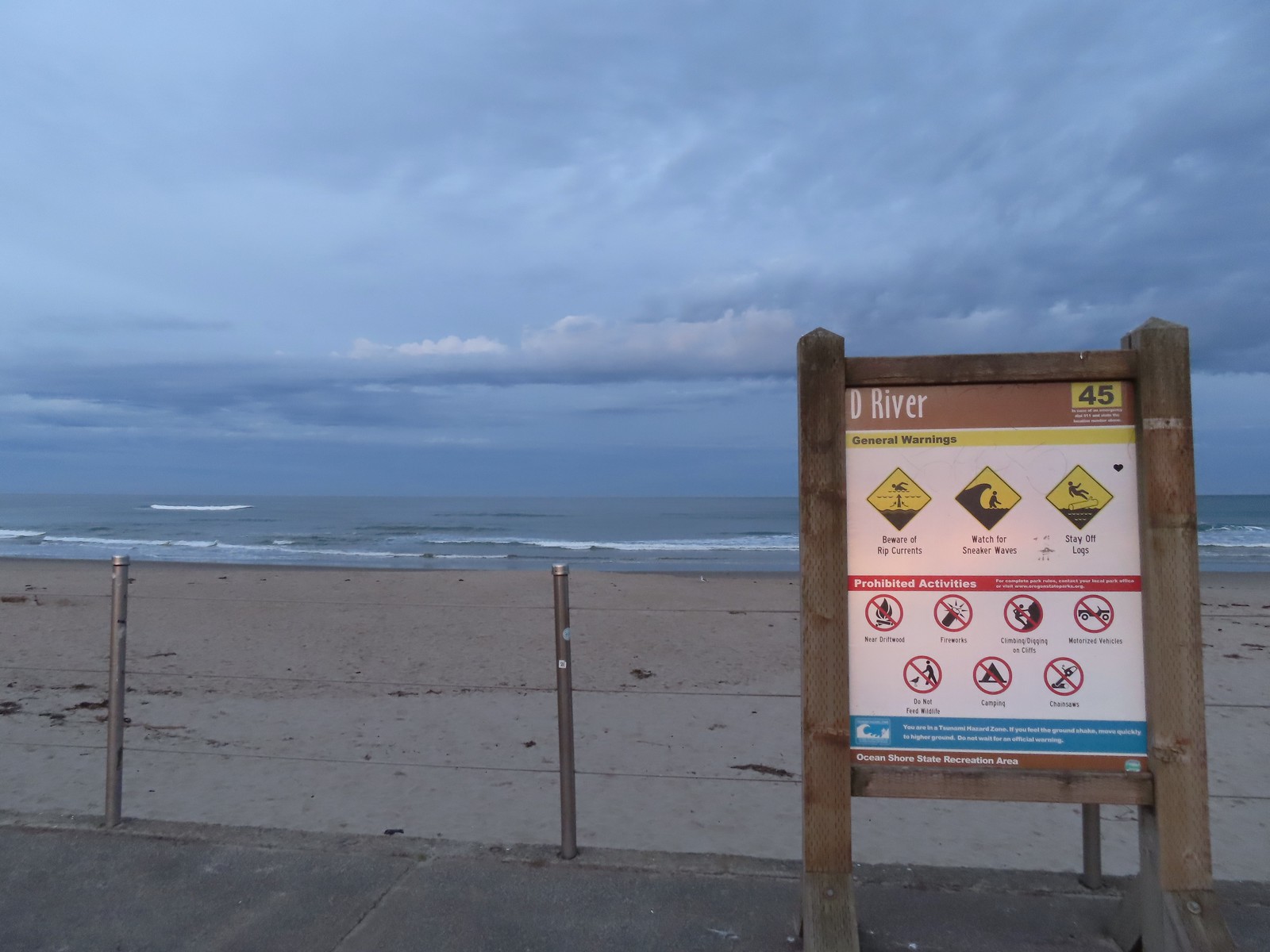
We began the hike at the D River State Recreation Site.
IMG_1754

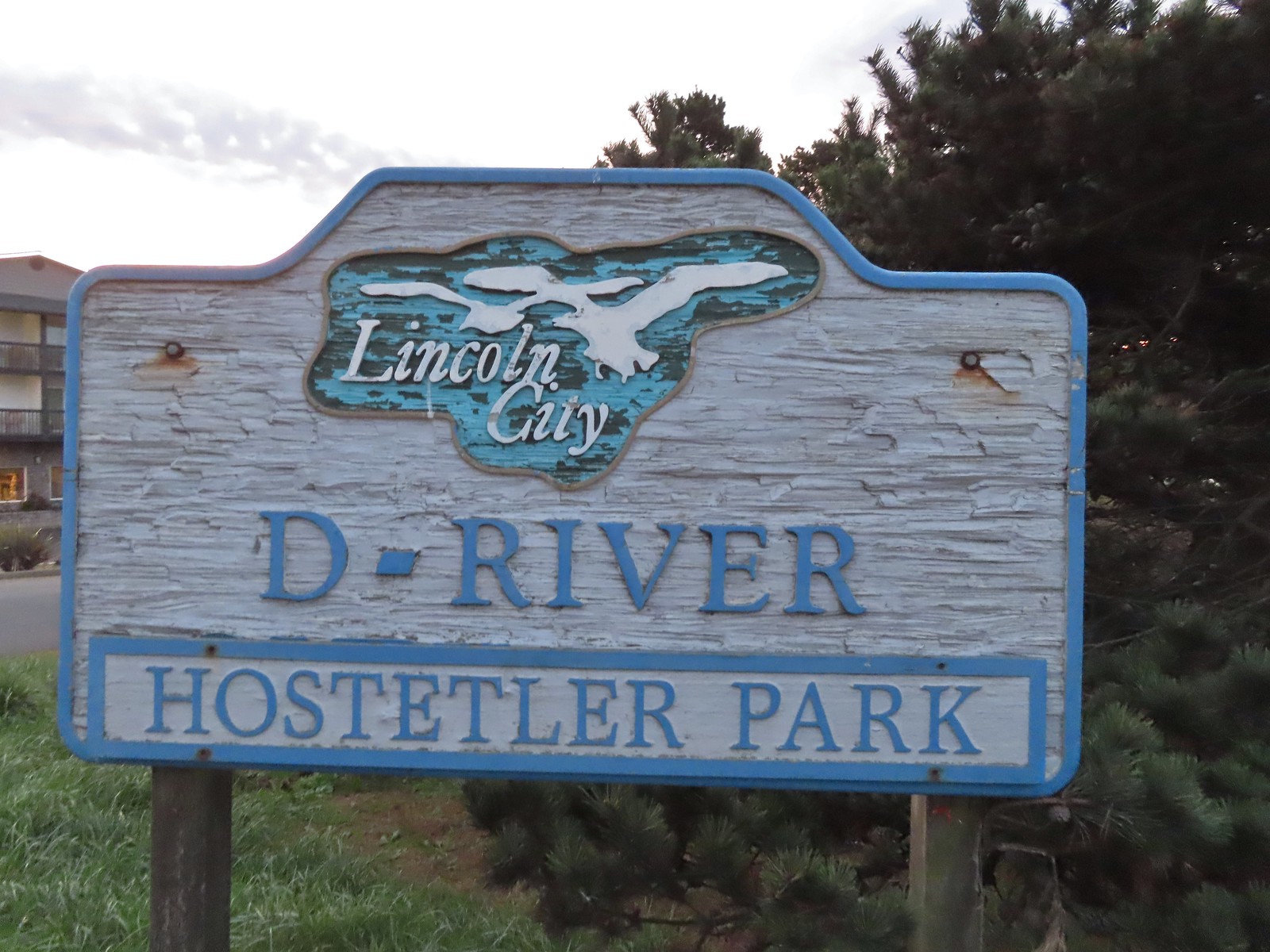
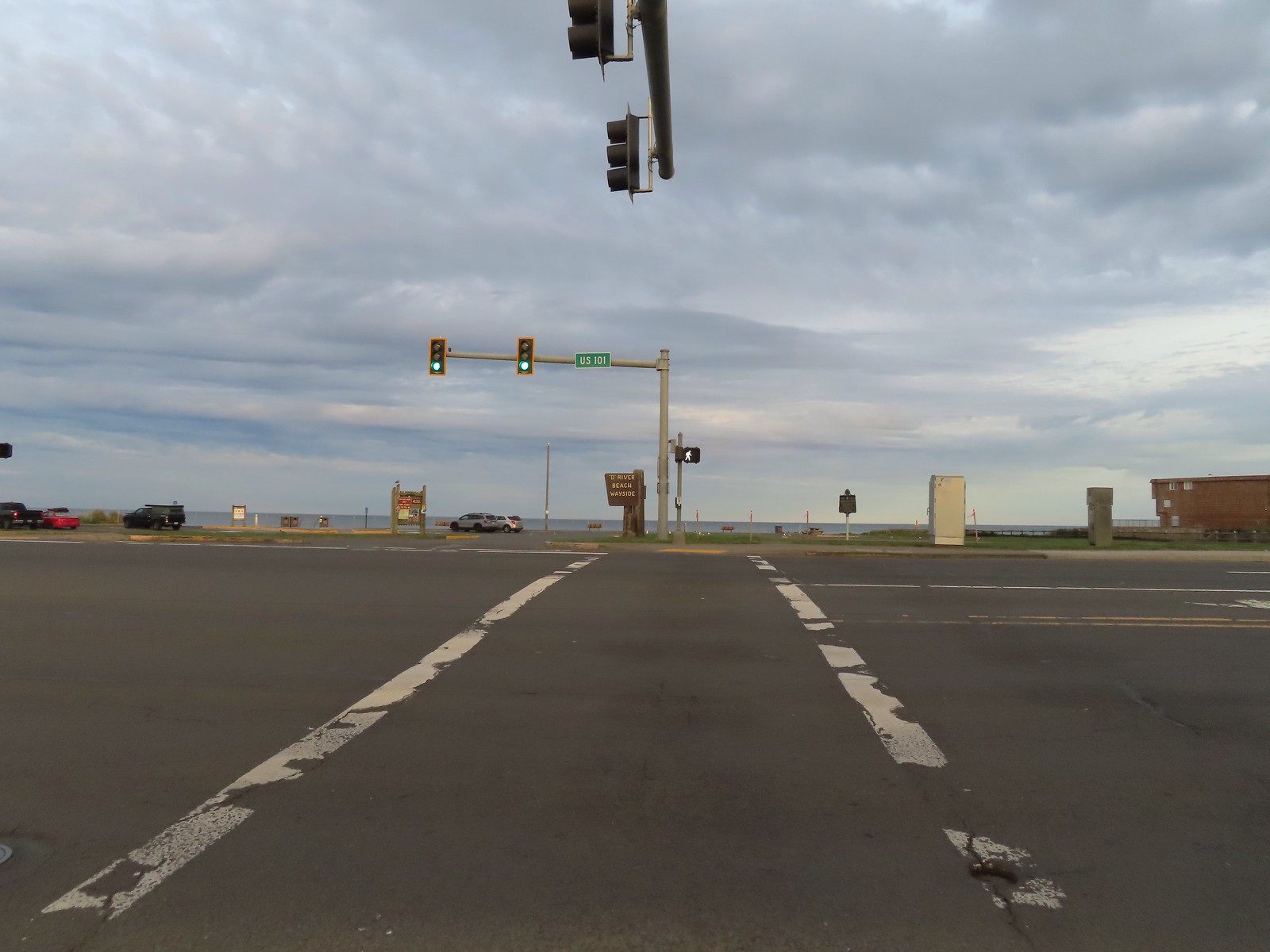
Before heading onto the beach we walked inland, crossing Highway 101 at a stop light, then passed over the D River and turned right into Hostetler Park.
IMG_1755The highway from the parking lot.

IMG_1759The D River from the highway bridge. The river flows between Devil’s Lake and the Pacific Ocean and at high tide has a length of approximately 40 yards.

IMG_1760

IMG_1762Hostetler Park.

At the far end of the small park was a sign for the D River Open Space and a short trail leading to a long boardwalk.
IMG_1765

IMG_1766

IMG_1768

We followed the boardwalk to a campground at Devil’s Lake State Recreation Area.
IMG_1770Several interpretive signs were located along the boardwalk.

IMG_1772One of the interpretive signs.

IMG_1778Nearing the campground.

We turned right at the campground entrance and followed the campground road to a paved (and flooded) path to a moorage.
IMG_1779

IMG_1781Orange cones, and a cat, at the far end of the path.

We were able to follow the path far enough to see the moorage and a small portion of the lake.
IMG_1782

We returned to the campground road and looped back around to the entrance booth and the boardwalk then hiked back to the parking lot and headed down to the beach.
IMG_1786Program area in the campground.

IMG_1789

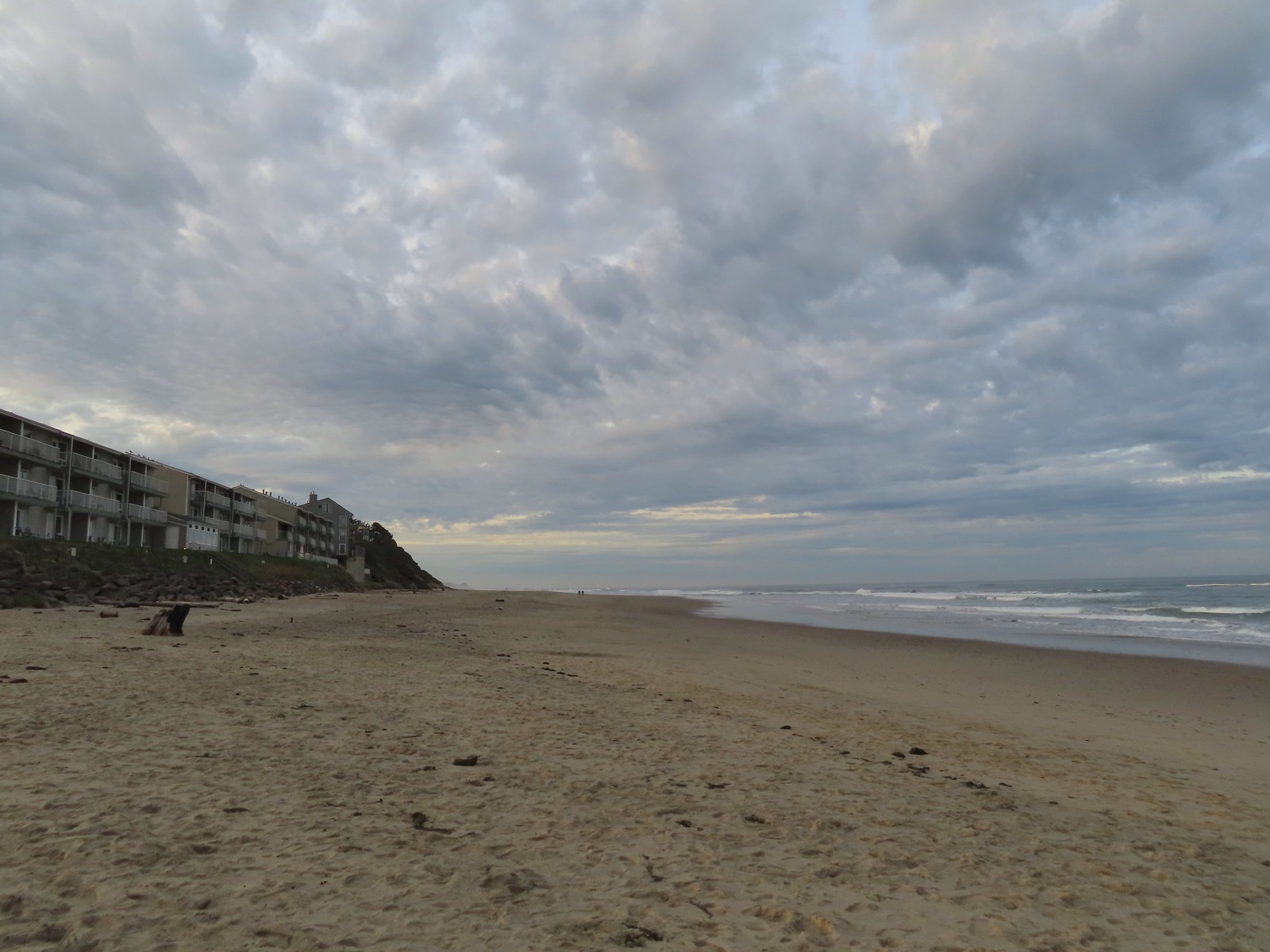
IMG_1791View North from the beach.

IMG_1793Cascade Head (post) in the sunlight behind God’s Thumb.

IMG_1795Seagulls at the mouth of the D River.

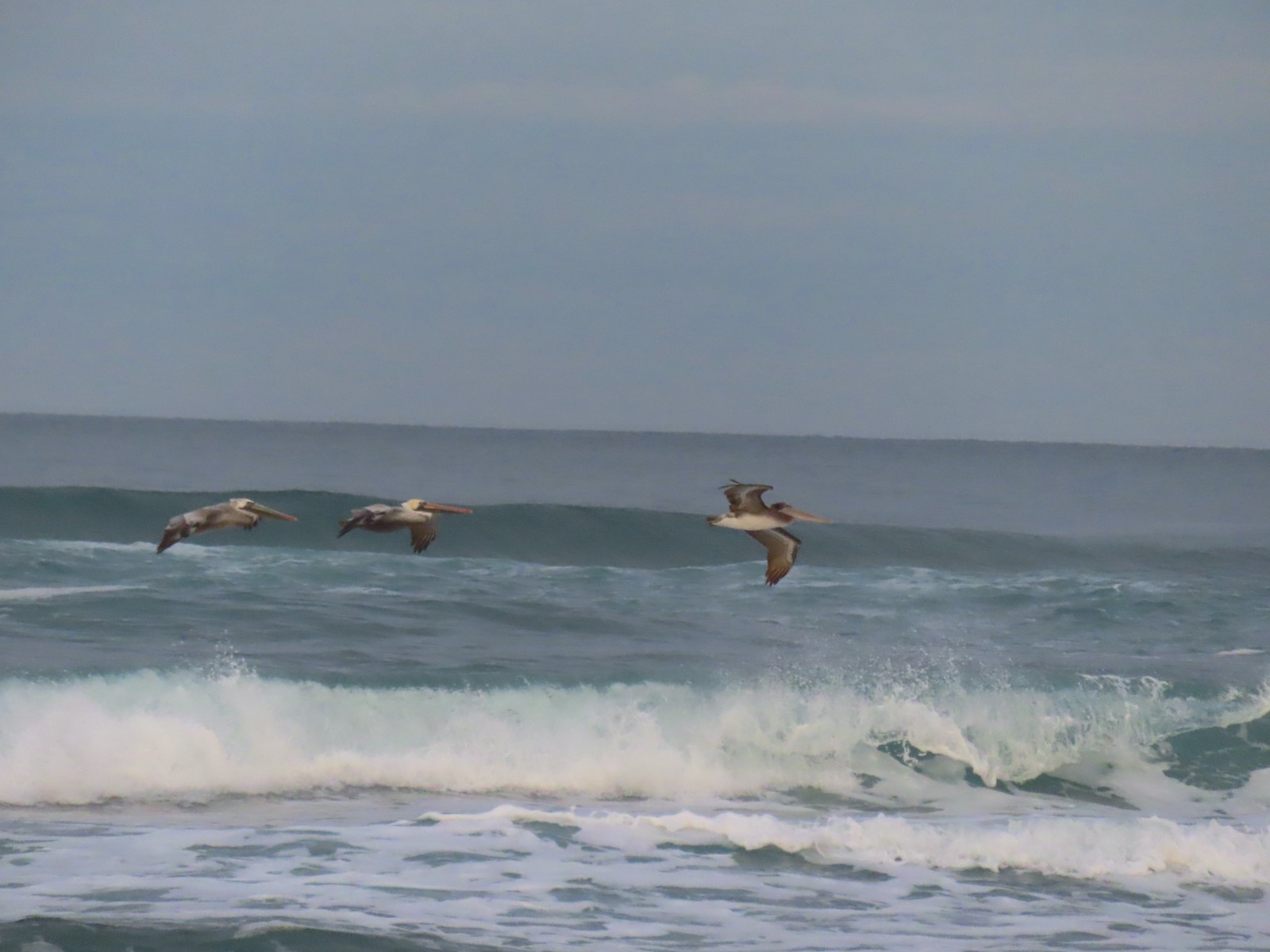
We headed South along the beach for nearly three miles to Siletz Bay where we turned inland across from Salishan Spit (post). It was a beautiful morning. The temperature was perfect and there was little to no breeze. We spent the majority of time watching pelicans glide just above the ocean while the occasional seal would pop it’s head up in the surf. There were also a number of ocean birds floating offshore, mostly surf scooters but there were some others mixed in.
IMG_1797

IMG_1798

IMG_1809

IMG_1805

IMG_1824

IMG_1826There were of course plenty of seagulls present.

IMG_1834There weren’t very many ocean rocks along this stretch of beach.

IMG_1835

IMG_1836

IMG_1846Surf scooters

IMG_1856

IMG_1859Loon, probably a common loon.

IMG_1860Baldy Creek

The largest group of offshore rocks were near the Inn at the Spanish Head.
IMG_1864The inn on the left with the rocks extending into the Pacific.

IMG_1870

IMG_1865Cormorants and seagulls

IMG_1874This was a big tree that we were able to walk under.

A short distance beyond the Inn at the Spanish Head are some stairs leading down from 44th St. Here the beach widens as it nears the bay. We turned inland toward the stairs and followed paths through the brush and driftwood.
IMG_1875

IMG_1877Salishan Spit across the Siletz.

IMG_1878Asters on the beach.

IMG_1879Pelicans on the left and seals on the right at the end of Salishan Spit.

IMG_1884Pelicans and seagull

IMG_1882Seals and a seagull

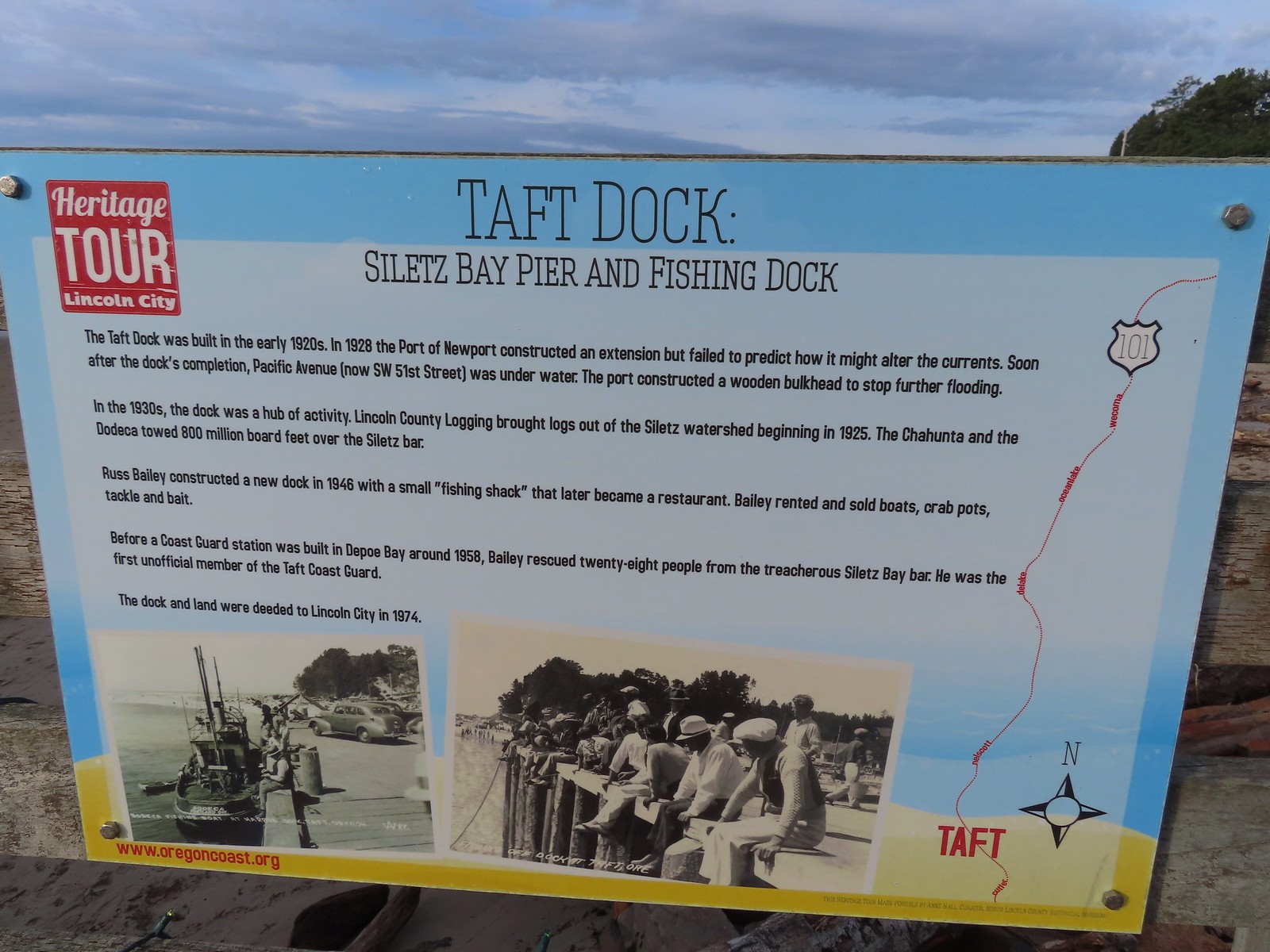
We walked along the bay to the Taft Dock for a short break before heading back.
IMG_1891

IMG_1892

IMG_1893

We stopped briefly on our way back to watch the wildlife on the spit.
IMG_1909

IMG_1908

IMG_1912Drying off

IMG_1915

On our way back we noticed that some pelicans had joined the cormorants and gulls on the rocks near the Inn at Spanish Head.
IMG_1923

IMG_1930Pelican mouths are a sight to behold (righthand side).

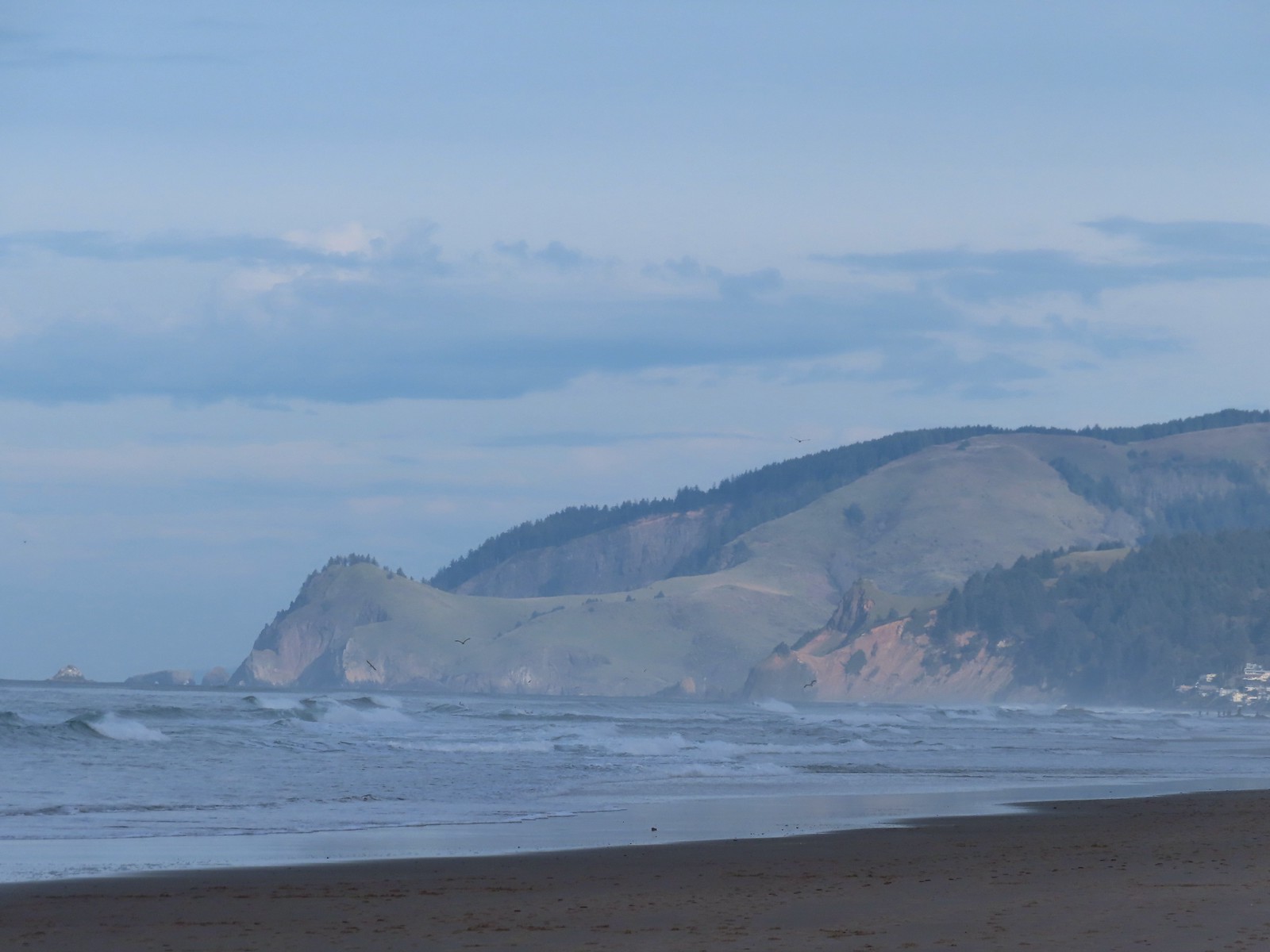
IMG_1949Cascade Head and God’s Thumb both in the sunlight now.

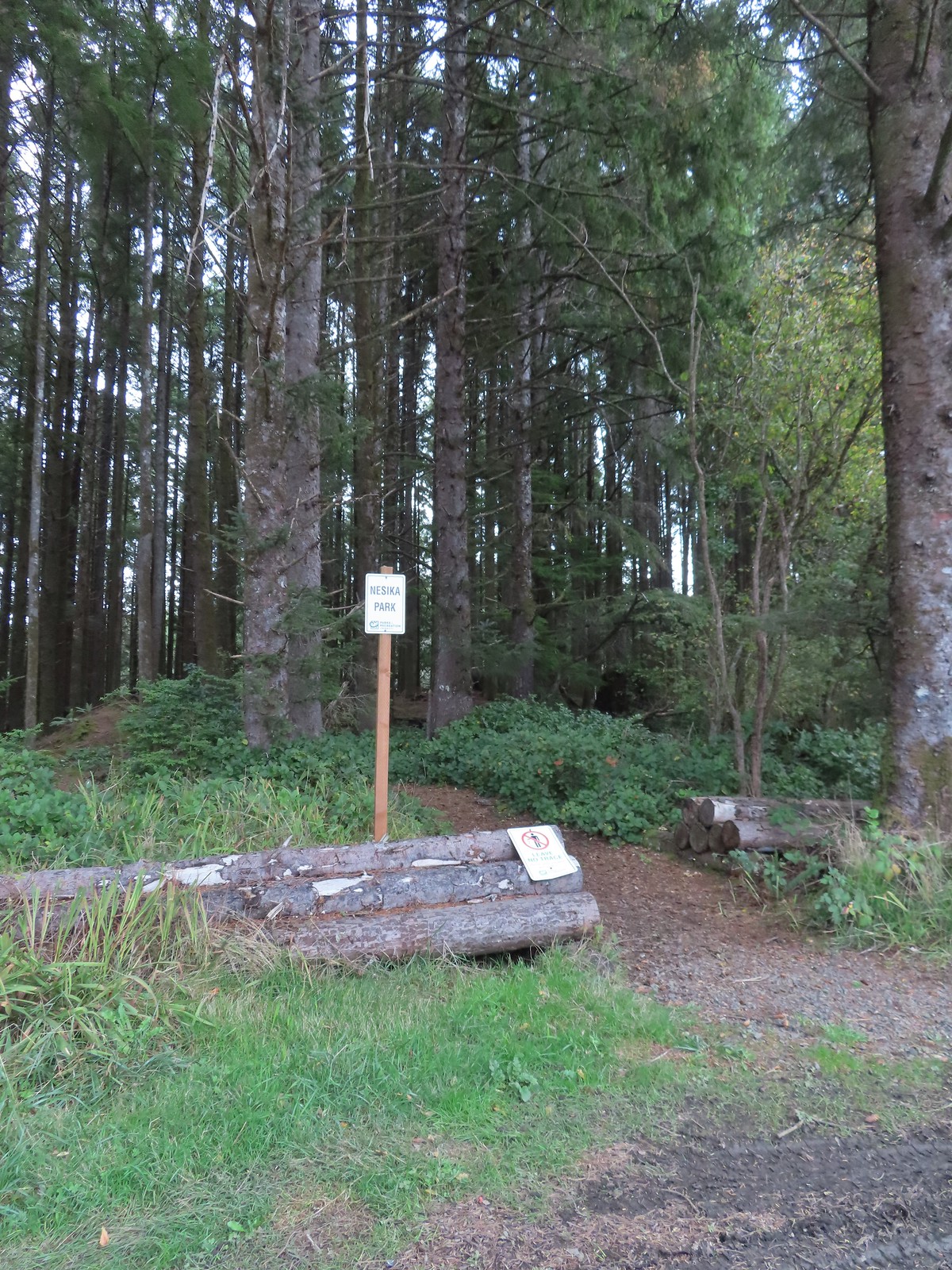
After reaching our car we made the 0.8-mile drive to Nesika Park. The park is part of the trail challenge and home to sign #8. There is only room for a couple of cars at the end of the gravel road which was fine given we were the only car there at 11am.
IMG_1955

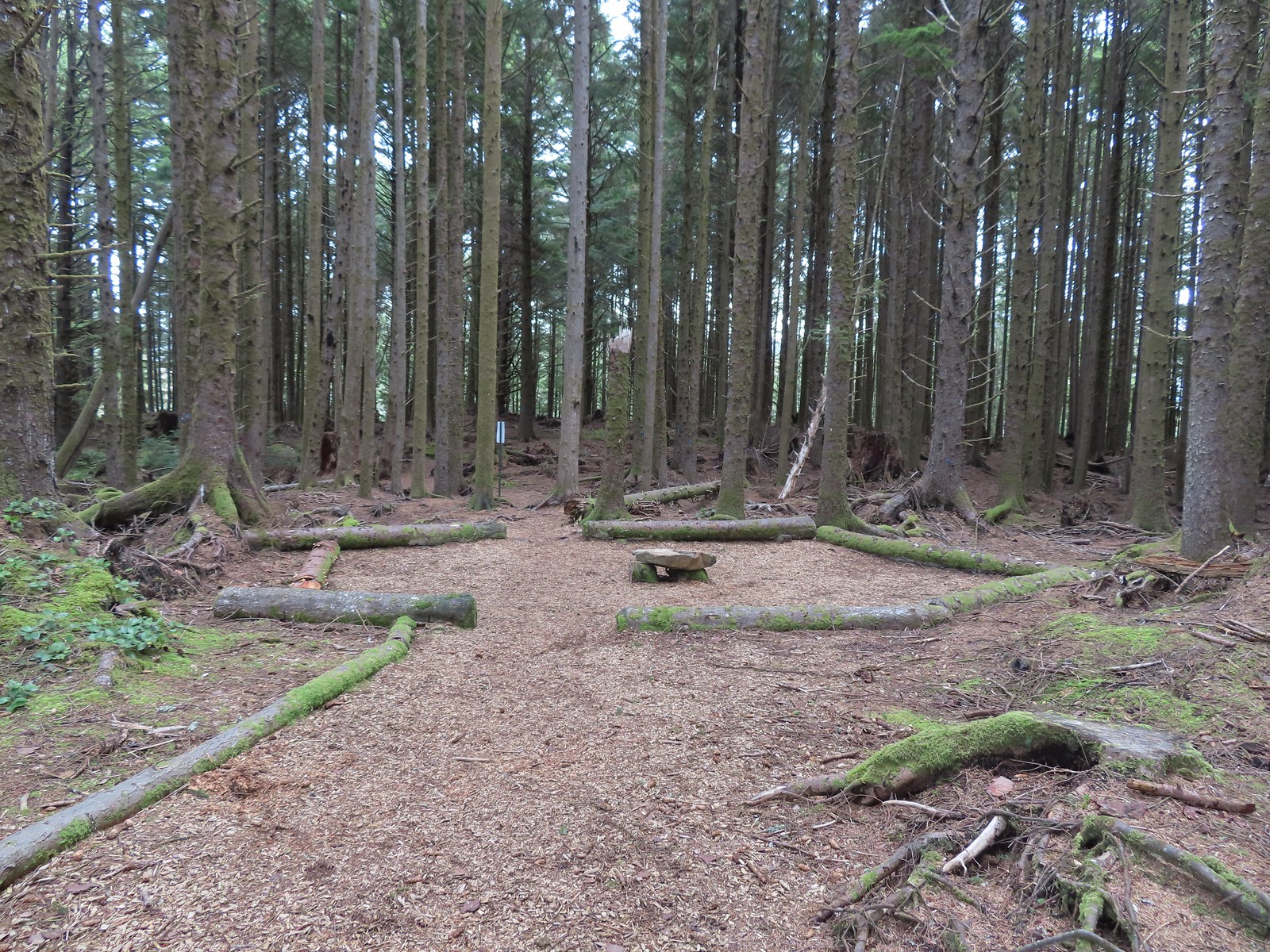
While there is a trail through a small, forested area, the entire outing was just 0.3 miles out-and-back. We did however get a photo of the Trail Challenge sign near the Nesika Park Story Circle.
IMG_1957

IMG_1959The Story Circle

IMG_1964Trail Challenge sign #8.

IMG_1967The trail ends at SE 3rd St (no parking available).

After accomplishing our goal here we hopped back into the car and continued South on Hwy 101 to find the Cutler City Wetlands Trailhead.
IMG_1972

Here there were three other cars and a few more trail options.
IMG_1974

IMG_1975

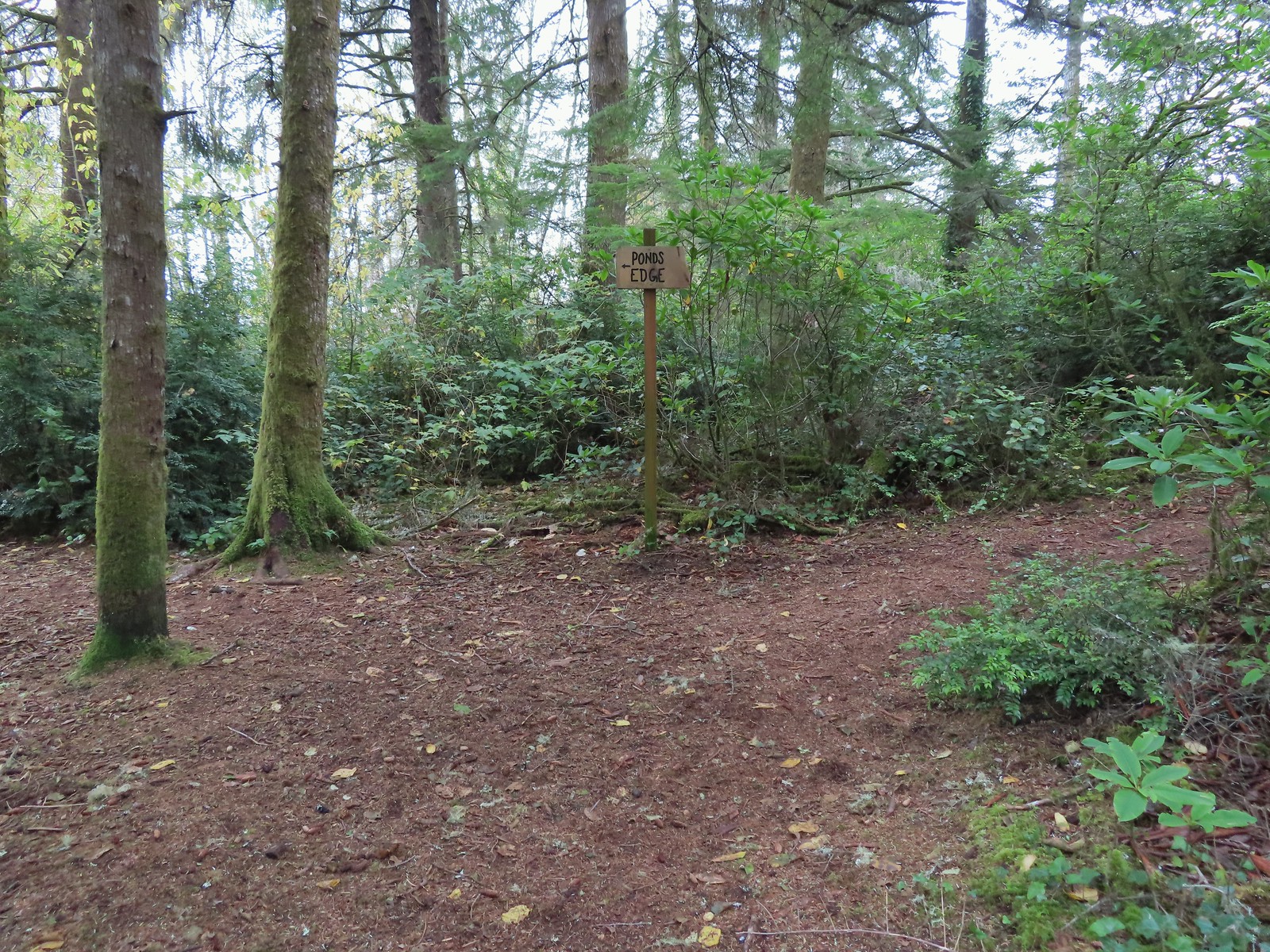
IMG_1977While there are more trails to choose from here the total milage is just about 1.25 miles. We opted to loop around the outside with detours to the Salt Marsh Overlook and Pond’s Edge.

IMG_1978To the left is the very short spur to the Salt Marsh Overlook which was too overgrown to really see anything.

IMG_1979Interpretive sign at the overlook.

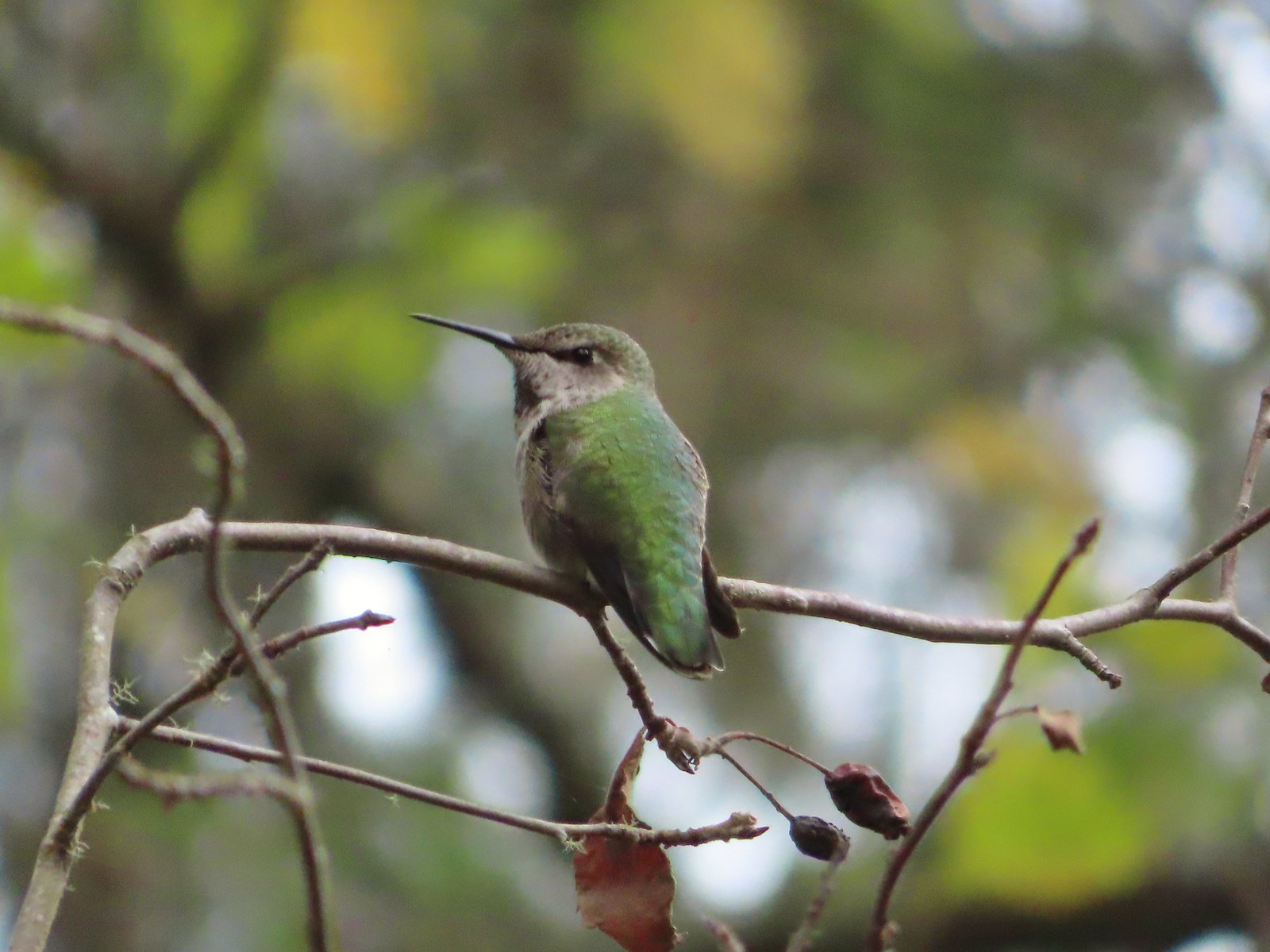
IMG_1984A noisy little hummer near the overlook.

IMG_1986There was pretty good signage at the main trail junctions.

IMG_1987

IMG_1988

IMG_1994Boardwalks helped cross the wet areas.

IMG_1998Pond’s Edge spur trail.

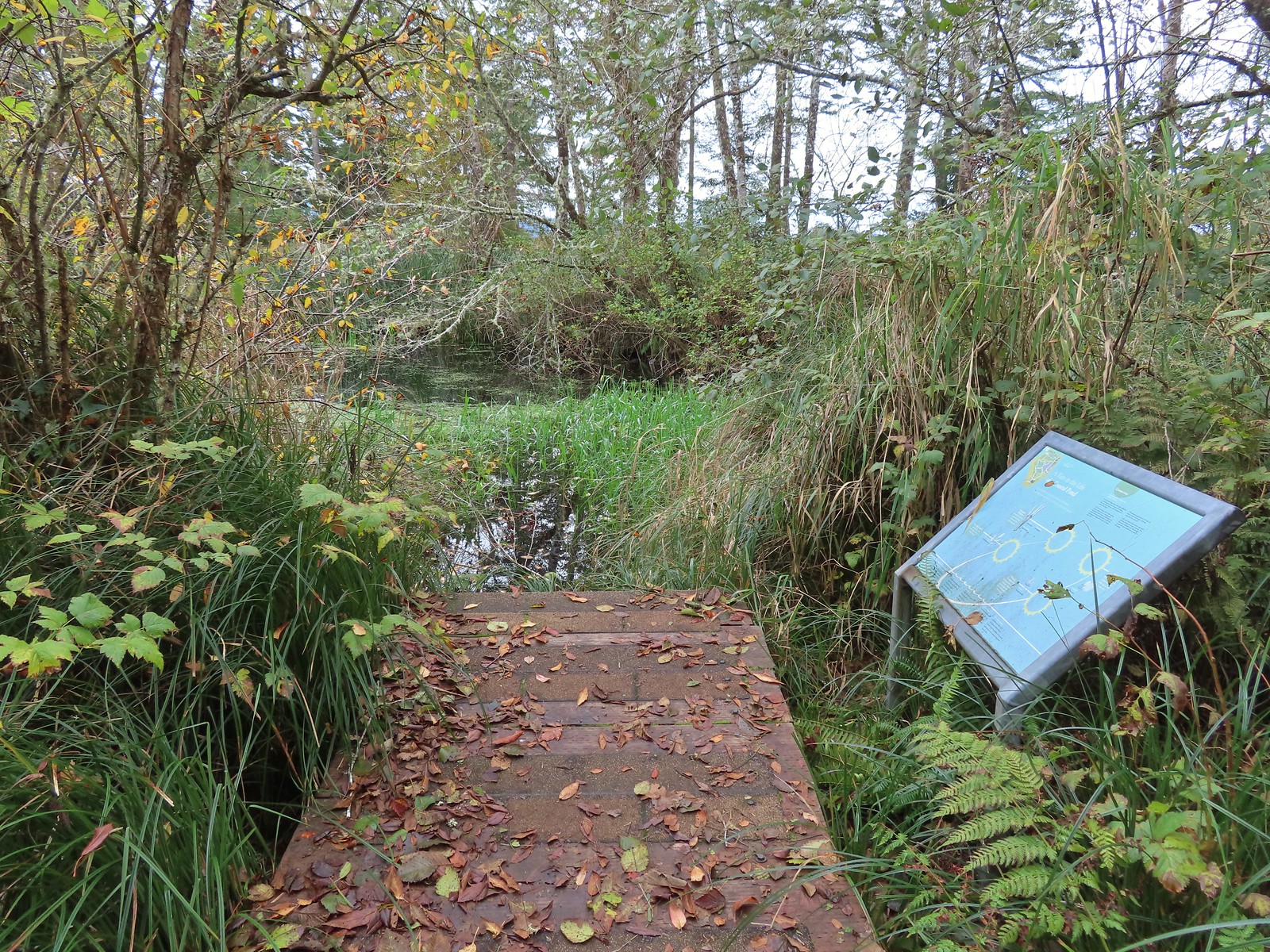
IMG_1999At the edge of the pond.

IMG_2001

IMG_2006We hadn’t expected to see any blooming rhododendrons.

IMG_2007

IMG_2017

IMG_2020Arriving at the signboards at the start of the loop.

This was a nice area and a pleasant hike, but by sticking to the outside trails we missed seeing the Trail Challenge sign. I briefly thought about wandering through the center searching for it, but since we didn’t get a picture of the sign at The Knoll even if I found it, we wouldn’t have a full set. Maybe someday we’ll get actual pictures of those last two but for now we’re satisfied with having visited all these unique little parks/open spaces.

In all the days mileage came in at 9.3 with no more than 50′ of total elevation gain.

Today’s hikes are highlighted. The others are from our January outing.

Late Fall and Winter are great times to visit the Oregon Coast and today was no exception. Happy Trails!

Flickr: D River, Nesika Park, and Cutler City Wetlands

Categories
Central Coast Hiking Oregon Oregon Coast Trip report

Oceanside, Short Beach, Tillamook Wetlands, and Anderson Hill – 10/28/23

A cold snap arrived in conjunction with the final hike of our official 2023 season leaving us with a decision to make about where to go. One of the great things about living in Western Oregon are the hiking options. We were debating between heading to Government Camp near Mt. Hood to see some of the new snow that the system had brought with it, or to the beach where things would be a little bit warmer. In the end we decided that we weren’t quite ready for a Winter wonderland yet, and highs in the low to mid 50s sounded a little more appealing than highs in the low to mid 30s. The beach it was where we had some unfinished business at Oceanside.

We had attempted to hike the beach at Oceanside earlier in the year on a different multi-stop day (post), but had saved it for the final stop only to find the area so crowded that there was no place to park. We wouldn’t be making that mistake again so this time it was stop number one on the itinerary. We had no issue finding a parking spot this time arriving just as the Moon was disappearing behind Three Arch Rocks.
IMG_1433From left to right: Storm, Finely, and Shag Rocks.

Three Arch Rocks is one of two designated wilderness areas along the Oregon Coast Managed by the Department of Fish and Wildlife as a wildlife refuge the 15-acre wilderness area was the first designated refuge West of the Mississippi and is one of only a few wilderness areas entirely closed to entry by the general public.

From the parking lot we took the stairs down to the beach and headed north toward the Tunnel which leads through Maxwell Point to Tunnel Beach.
IMG_1438Cape Lookout (post) to the south.

IMG_1440Maxwell Point

IMG_1443View from beside Maxwell Point.

IMG_1444The Tunnel was built in 1926.

IMG_1447

IMG_1448

IMG_1454The Tunnel from Tunnel Beach.

IMG_1450Three Arch Rocks from Tunnel Beach.

We hiked North along the beach passing a rocky point to Agate Beach before turning around where that beach ended at a cliff a little more than a third of a mile from the Tunnel.
IMG_1465The end of Tunnel Beach. At higher tide it’s not possible to get around the point here.

IMG_1469Getting closer to the end of Tunnel Beach. This set of ocean rocks are part of the Oregon Islands Wilderness, A string of of over 5,600 rocks, reefs, islets, and islands lying within three miles offshore mirroring almost the entire length of the Oregon coast from Tillamook Head to the California border. Like Three Arch Rocks this wilderness is also closed to the public.

IMG_1484Bald eagle on top of one of the rocks.

IMG_1476Seal

IMG_1477Agate Beach

IMG_1482

IMG_1490Cape Lookout from Agate Beach.

After reaching the cliff we headed back to the Tunnel and then continued South along the beach 2.3-miles to Hodgdon Creek across from Netarts Spit (post).

IMG_1492An assortment of sea birds.

IMG_1497

IMG_1504Maxwell Point and Cape Lookout

IMG_1506

IMG_1508Sun starting to hit the Three Arch Rocks.

IMG_1512

IMG_1519Sand dollar

IMG_1526

IMG_1531Cormorants. There was a steady stream of flocks of birds heading south along the coastline.

IMG_1543Footbridge over Fall Creek.

IMG_1544Fall Creek

IMG_1570Frosty leaves near Fall Creek.

IMG_1548Great blue heron in a tree above Fall Creek.

IMG_1551Happy Camp

IMG_1557Hodgdon Creek

IMG_1555Seagulls and common mergansers near Hodgdon Creek.

IMG_1558Buffleheads

IMG_1562Netarts Spit

IMG_1565Happy Camp from our turn around point.

We returned the way we’d come and then drove North on Cape Meares Loop Road just under a mile and a half to a pullout across from a sign for Short Beach.
IMG_1575Three Arch Rocks and Maxwell Point now in full Sun.

IMG_1579

A local built the staircase leading down to Short Beach and it is about as “Oregon Coast” as a staircase could be.
IMG_1581

IMG_1584

IMG_1590The beach only extends a short distance to the South.

IMG_1588The sea stack and Short Creek Spillway to the North.

We headed North along the cobblestone beach which isn’t the easiest surface to hike on, especially when they are wet and slightly frosty. On the positive side the cobblestones added some great sounds to the ocean as the waves tossed them about then rolled them over one another as the waves receded.
IMG_1606

IMG_1618Starfish

IMG_1619The sea stack

IMG_1621Cape Meares (post)

IMG_1609I didn’t notice the little waterfall along the cliffs below Cape Mears until I looked at the pictures.

IMG_1625Red-throated loon

A third of a mile from the stairs we reached Larsen Creek Falls.
IMG_1627

IMG_1632

Apparently at low tide it’s possible to reach the cliffs below Cape Meares, but the tide was coming in and it also appeared that some sliding had occurred at some point, so we turned around a tenth of a mile beyond Larsen Creek Falls.
IMG_1641The area ahead in the shade is where things started looking a little sketchy.

IMG_1643

IMG_1659

IMG_1674

These two beach hikes came to a total of 6.6-miles, 5.5 at Oceanside and 1.1 at Short Beach. From Short Beach we drove to Tillamook to try the Tillamook Bay Wetlands hike which I’d found as I was looking through the Oregon Hikers Field Guide. We parked at the Goodspeed Road Trailhead. The field guide entry showed this as a 3.6-mile loop following dikes through wetlands between the Wilson, Trask, and Tillamook Rivers. We were immediately confused due to the field guide mentioning a map and metal gate at the Goodspeed Trailhead but there was neither at the signed parking area.
IMG_1676Apparently there used to be a metal gate here instead of a the rope/chain.

We were pretty sure we’d followed the driving directions though so we stepped over the chain onto the grassy dike and began following it through the wetlands.
IMG_1678

IMG_1682

IMG_1685Bald eagles in the tree tops.

IMG_1683Bald eagles

The map in the field guide showed an elongated loop following what Google Maps and the GPS showed as the continuation of Goodspeed Road to the Wilson River then along that river to the Tillamook River where the route looped back along it then the Trask to Sissek Road. The dike we were on though reached a slough where it turned sharply South.
IMG_1686This is where the dike/path turned South. Our best guess is that there has been additional wetland restoration since the entry in the field guide and some of the dikes that the guide route followed have been removed.

We didn’t come up with our theory about what was going on until after we got home. While we were hiking we kept checking the GPS map/track and comparing it to the map in the field guide. We still weren’t sure if we really had started in the right spot given the lack of a metal gate and map at the trailhead or if we’d missed a turn somewhere. We continued to follow the dike system which looped around and after just over a half mile the GPS showed that we were on Sissek Road (now a grassy dike).
IMG_1689We weren’t getting across that.

IMG_1694Somewhere out that way, beyond the slough, was the Wilson River.

IMG_1699Now heading East toward Sissek Road.

IMG_1704At this point we had left Sissek Road which used to extend straight from Goodspeed Road where the signs and rope/chain is in this photo (ahead to the right at the 90-degree turn).

The dike system brought us to another signed parking area we’d pass on the way to the Goodspeed Road Trailhead. This one is just past a one-lane bridge over Hall Slough.
IMG_1705

At this point we were sure we’d started at the correct trailhead and were now convinced we’d missed a turn somewhere near the start of the hike. First we tried walking a grassy track South from this parking area which brought us to another muddy slough, but not before spotting an egret and a great blue heron.
IMG_1706

IMG_1710

IMG_1713

We backtracked to the parking area and then hiked Goodspeed Road back to the trailhead where I began searching for a different route.
IMG_1714Hawk above Goodspeed Road.

IMG_1677One path led down to Hall Slough ending in mud at it’s bank.

IMG_1716A second path led north on what the GPS showed as a former road but it was too overgrown and flooded to make it far.

We wound up doing just 1.9-miles here including the out-and-back explorations.

It was a fine little hike and we saw a nice little variety of birds, but it was a little disappointing not to be able to see any of the rivers. We had one last stop planned, another short hike I found in the Oregon Hikers Field Guide, the Anderson Hill Loop . The trail begins at Anderson Hill County Park to the right of a metal picnic table.
IMG_1719

IMG_1722

The 1.2-mile reverse lollipop loop gains just 130′ as it climbs to a power line corridor on Anderson Hill. The view from the power lines is of course limited due to the power lines, but the trail was in good shape and the forest was nice making for a decent little outing.
IMG_1727

IMG_1730Junction with the spur trail to the power line corridor.

IMG_1733

IMG_1735

IMG_1736

IMG_1739

IMG_1742

IMG_1745

IMG_1749

IMG_1751Footbridge and stairs leading back up to the picnic table.

The four hikes came to just 9.7-miles and 270′ of cumulative elevation gain and included ocean views, waterfalls, forests, wetlands, and ample wildlife.

It was a beautiful day weather wise and great way to end our season. We’ll scale back our hiking for the next 5-6 months, but we plan on getting out at least once a month until our 2024 season kicks off. Happy Trails!

Flickr: Tillamook Area Hikes

Categories
Central Coast Coastal Range Hiking Oregon Oregon Coast Trip report

Big Creek -Forest Park and Strom Boulder Ridge – 09/30/2023

Our hike this week took second fiddle to our son’s birthday which we planned to celebrate by taking him out to lunch/dinner in Eugene. We still wanted to get a hike in that morning, so we looked for something in the general direction of Eugene. Our original plan had been to visit Vivian Lake near Diamond Peak, but a forecast of rain, followed by snow, then more rain had us look elsewhere. Looking at my list of future hikes a couple of hikes between Corvallis and Newport caught my eye. They were more or less on the way to Eugene and the weather forecast looked good. The two hikes had been Strom Boulder Ridge and Olalla Reservoir. Double checking the status of the hikes revealed that Georgia Pacific, who manages Olalla Reservoir, had closed access due to low water at the beginning of September so that hike was out. I then turned to the Oregon Hikers Field Guide to look for another short hike in the area and found the Big Creek-Forest Park Hike in Newport.

We began with the Big Creek hike parking at the Agate Beach State Recreation Site.
IMG_0064

A trail begins near the restrooms at a footbridge over Big Creek.
IMG_0069

IMG_0070Big Creek in the morning.

The trail follows Big Creek toward Highway 101 then recrosses it leading to a tunnel under the highway.
IMG_0072A short section of the trail was paved.

IMG_0074At the eastern end of the parking area we came to this new kiosk that is being installed marking the start of the Agate Beach TRACK Trail. There was also a path directly to the parking lot from the kiosk which we used upon our return.

IMG_0075

IMG_0078The tunnel under Highway 101. The stairs at the far end lead up to a city street while the trail makes a hard right to briefly follow the highway back across Big Creek.

IMG_0080

IMG_0084A series of boardwalks crosses the marshy bottomlands of Big Creek.

IMG_0085While the kiosk was a new work in process there were a number of older looking interpretive signposts. This was one of only a handful that still contained an interpretive sign.

IMG_0087The bottomlands.

IMG_0088

IMG_0091

IMG_0098There were no signs at junctions but for the TRACK Trail stick to the level fork and ignore anything going uphill.

IMG_0108Further along the trail Big Creek could actually be seen flowing.

IMG_0109A non-boardwalk section along Big Creek.

IMG_0114

IMG_0116Approximately three quarters of a mile from the kiosk the trail arrived at Big Creek Road at another new signboard.

IMG_0117The signboard at Big Creek Road didn’t have any information on it yet.

We turned right on Big Creek Road passing a large overflow parking lot for Big Creek Park and Reservoir, crossed Big Creek, and then turned left into Big Creek Park.
IMG_0120

IMG_0122Stellar’s Jay

IMG_0123Northern flickers on the picnic shelter.

A signboard near the picnic shelter marked the start of the Forest Park Trail.
IMG_0125Map on the signboard.

Don’t be fooled by the footbridge over Anderson Creek to the right of the signboard, the Forest Park Trail follows an old gravel roadbed steeply uphill to the left of the sign.
IMG_0127Anderson Creek, the footbridge, and signboard from the roadbed.

IMG_0129The Forest Park Trail

While the Track Trail had gained almost no elevation the Forest Park Trail climbed over 200′ in its first half mile to a pair of water towers.
IMG_0131A nice sitka spruce forest lined the old roadbed.

IMG_0130Mushrooms

IMG_0139Sunlight hitting the trees.

IMG_0176The Pacific Ocean through the trees near the water towers.

IMG_0146Passing the water towers.

Beyond the towers the trail dropped 160′ to wetlands along Jeffries Creek then climbed nearly another 90′ to a gate at the Fogarty Street Trailhead.
IMG_0149

IMG_0152The drop to Jeffries Creek.

IMG_0155Jeffries Creek

IMG_0163Wood ducks in the wetlands.

IMG_0168The gate near Fogarty Street.

IMG_0170The Forest Park Trail from the other side of the gate.

We returned to the kiosk at the start of the TRACK Trail the way we’d come then cut to parking lot and returned to our car. The hike came to 4.0 miles with just over 550′ of elevation gain, nearly all of which was on the Forest Park Trail. The TRACK Trail seems like a good option for kids with the Forest Park Trail adding some short, steep climbs for those looking for more of a workout. The ability to visit Agate Beach from the parking lot is a huge bonus. We didn’t have time today to visit the beach but had in 2018 during our Yaquina Bay hike (post).

For our next stop at Strom Boulder Ridge we drove East on Highway 20 from Newport to Burnt Woods and turned right onto Harlan-Burnt Woods Road. We followed this road for 2 miles then turned right onto the unsigned gravel Burnt Woods Forest Road. I found this hike on Alltrails which I have somewhat reluctantly been looking at more frequently, mostly to check for recent trip reports but there are also some obscure “hikes” that don’t appear in any of our guidebooks or in the Oregon Hikers Field Guide. Strom Boulder Ridge is one such “hike” which is really just a 7.5-mile loop on drivable gravel logging roads on Oregon Department of Forestry managed lands. As such there is no official trailhead (although Google Maps seems think there is). The loop begins 0.7-miles up the forest road but we decided to park at a pullout next to a gravel pile halfway to the start of the loop.
IMG_0197

IMG_0195Morning fog was still burning off at 9:30am.

One thing to note is that there isn’t any signage and because the area is actively logged roads may be added or closed depending on operations. I had downloaded the Alltrails track and we had our GPS units with us. Almost immediately we passed a logging road coming downhill on the left that was not shown on either the Alltrails or Garmin maps.
IMG_0198A car by the gravel pile to the left with the road coming down the hillside to the right. Interestingly Google Maps labels this as “Burnt Woods Ridge Road” which both Alltrails & Garmin showed as the left-hand fork where our loop would begin. (Google doesn’t show a road there at all but you can see the road in the trees by looking at the aerial view.) Numerous times throughout the hike we relied on comparing the Alltrails Track to the GPS map and our track to that point to determine where we were and which road(s) to take.

The trip reports on Alltrails had all mentioned how quite this hike was and it was (we saw no other hikers and only passed one pickup truck on the loop) other than the gunfire that we heard almost immediately and then off and on throughout the majority of the hike. We followed the road uphill to a saddle then dropped slightly to a fork marking the start of the loop.
IMG_0205

IMG_0206There was some room to park here at the start of the loop (this is not where Google marks the TH) as well as many pullouts along the loop where one could choose to start.

We forked right following the suggested direction shown on the Alltrails track sticking to the Burnt Woods Forest Road. Over the next three and a half miles the road swung out and around several ridges in a series of ups and downs resulting losing a cumulative 580′ but regaining over 400′ along the way. As we descended we found ourselves back in the fog for a while before it finally burned off.
IMG_0208

IMG_0210

IMG_0213Heading down into the fog.

IMG_0215One positive to the fog is that it can create some dramatic Sun rays.

IMG_0220Vine maple

IMG_0221Blue sky in the upper left hand corner.

IMG_0224

IMG_0225The road to the right is an example of a road that wasn’t labeled on any map we had.

IMG_0232Emerging from the fog.

IMG_0235Looking back through the fog to blue sky and the Sun.

IMG_0236The only other “hiker” we saw on the loop.

IMG_0243We couldn’t see it but just over three miles from the start of the loop the road crossed Cline Creek which was the first time we heard what sounded like a decent amount of flowing water.

IMG_0246A little over a tenth of a mile beyond Cline Creek we left Burnt Woods Forest Road and forked uphill to the left onto Cline Creek Road.

Cline Creek Road climbed gradually for approximately a half mile at which point it steepened and climbed for another mile to a junction with Burnt Ridge Road.
IMG_0247Arriving at a clearcut. Much of Cline Creek Road was along different clearcuts.

IMG_0250

IMG_0252Mylitta crescent

IMG_0254Red-tailed hawk soaring over the clearcut.

IMG_0255Trying to get the red-tailed hawk in flight.

IMG_0256Lots of Fall colors starting to pop.

IMG_0267The first signs we’d seen (noticed anyway) were at the Cline Creek/Burnt Woods Ridge Road junction.

IMG_0268

We turned onto Burnt Ridge Road and climbed some more gaining just over 150′ in the next 0.3-miles to the loop’s highpoint along the ridge (1558′). From there the road followed the ridge in a series of ups and downs for another mile and a half before making a sharp left and beginning a steeper descent back to the Burnt Woods Forest Road.
IMG_0271

IMG_0273Arriving at the high point which was actually the first good viewpoint being above one of the clearcuts.

IMG_0275Looking North at more of the Coast Range.

IMG_0276Theoretically we should have been able to see both Mt. Hood and Mt. Jefferson from here but between haze from the fog and clouds we couldn’t make either out.

IMG_0279Mt. Jefferson is out there somewhere. The fact that the Cascades have some snow again doesn’t help them stand out in the haze and clouds.

IMG_0282Yet another unsigned road junction. Sticking to the ridge is the key.

IMG_0286After crossing a saddle we gained views SE to Mary’s Peak (post)

IMG_0287The tower and summit meadow of Mary’s Peak.

IMG_0294The hard left prior to the steep descent. The road on the far hillside in the clearcut is part of the road Google Maps has labeled as Burnt Ridge Road but doesn’t show on Alltrails or the Garmin maps.

We followed the ridge downhill for a little over a mile to complete the loop then followed the Burnt Woods Forest Road back to our car.
IMG_0300

IMG_0302The end of the loop at the bottom of the hill.

Due to where we parked our hike came in at 8.5-miles with a little over 1200′ of cumulative elevation gain.

While it wasn’t the most exciting hike there was enough variety for it to be pleasant and aside from the gunfire it was quiet. It’s a decent option for a moderate workout, especially after rains when the road walk would be less wet/muddy than many trails. I would probably avoid weekdays if there is active logging occurring though. One other thing of note – Alltrails entry for the hike mentions the Siuslaw National Forest requiring a recreation pass but this is not National Forest land (and there is no developed trailhead) so no passes are currently needed.

After the hike we drove to Eugene and met Dominique at Ubon Thai for a late lunch/early dinner for his birthday. Good food and as someone who enjoys spicy foods, they didn’t disappoint with their heat scale. We followed the meal up with a slice of cake we’d brought down from Gerry Frank’s Konditorei. A great way to end a nice day. Happy Trails!

Flickr: Big Creek-Forest Park and Strom Boulder Ridge