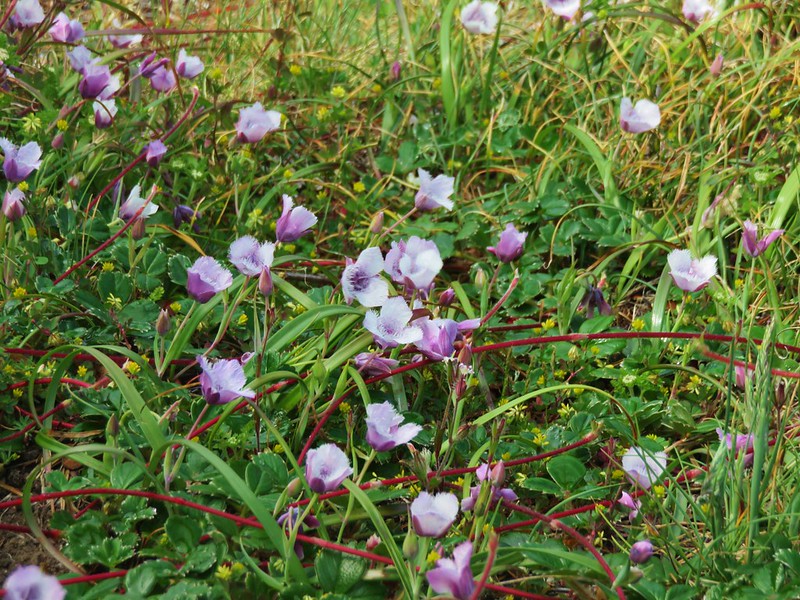
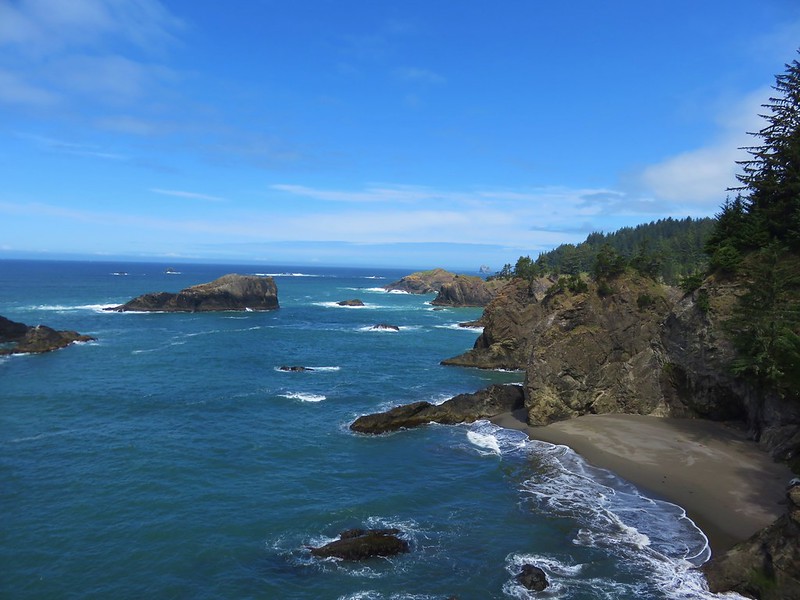
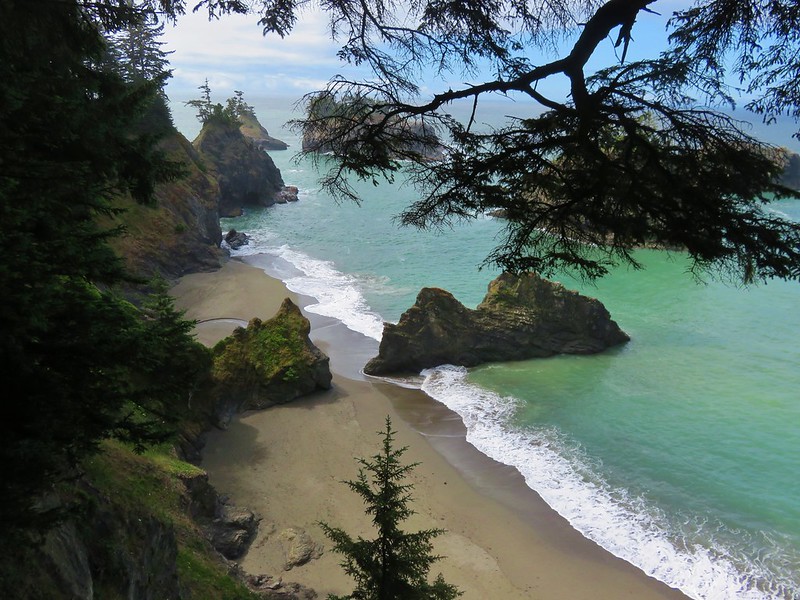
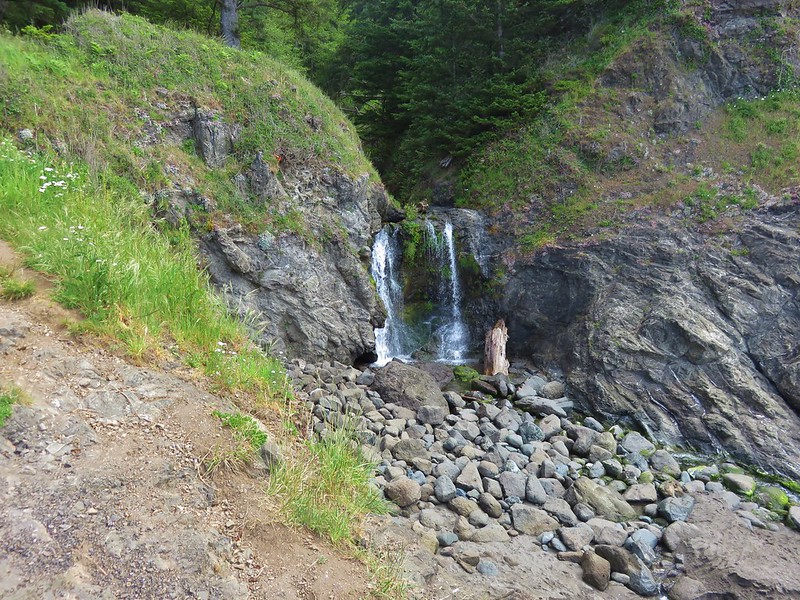
Categories
High Cascades Hiking Mt. Hood Area Oregon Trip report

Horseshoe Ridge and Cast Creek Trail Loop

On Father’s Day we headed toward Mt. Hood for a loop hike on some lesser used trails. We planned on using the Horseshoe Ridge and Cast Creek Trails as well as a portion of the Zigzag Mountain Trail for a loop in the Mt. Hood Wilderness. Along the way we’d also visit Cast Lake and depending on visibility detour to the summit of East Zigzag Mountain.

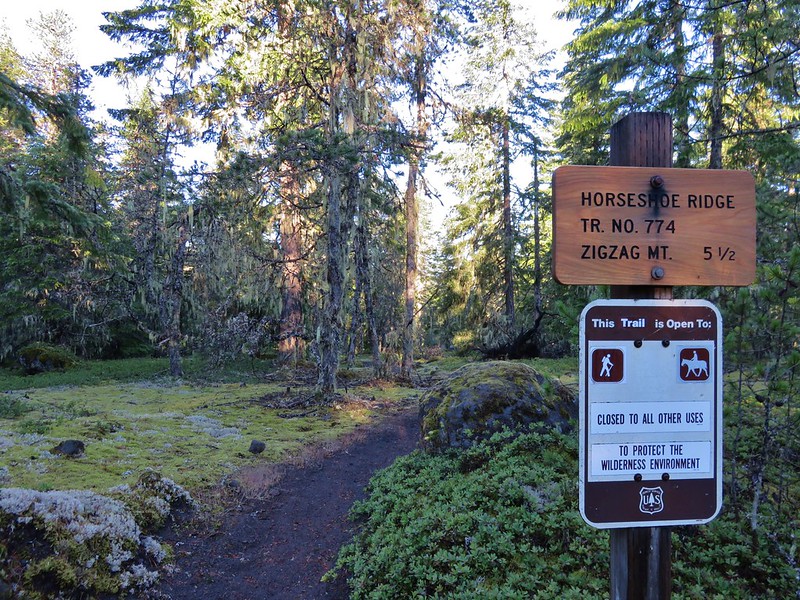
We began our hike by parking along Forest Road 1825-380 at the bridge over Lost Creek near the Riley Horse Camp. The Horseshoe Ridge Trail began on the SW side of the road.
IMG_8679

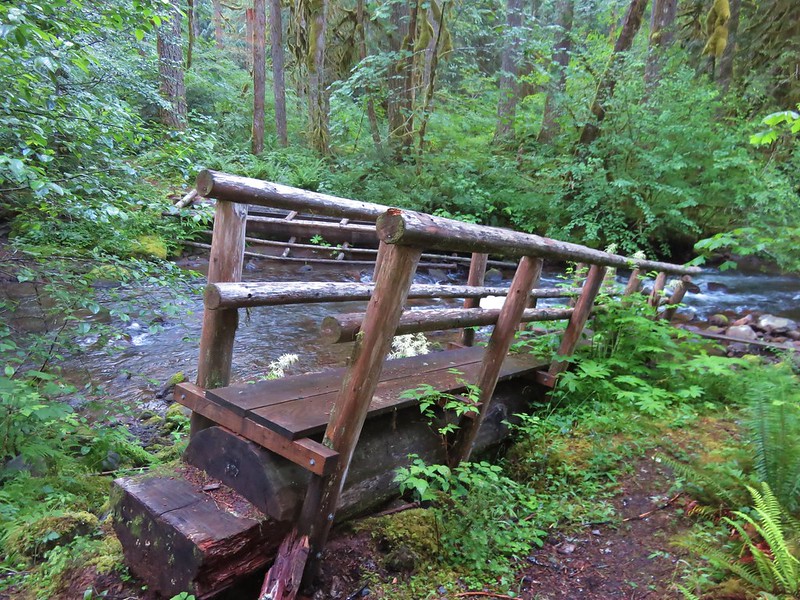
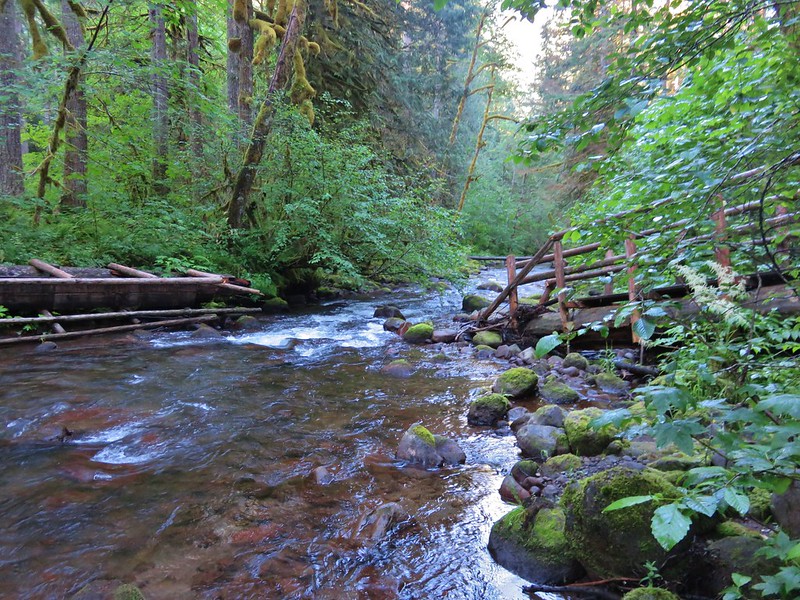
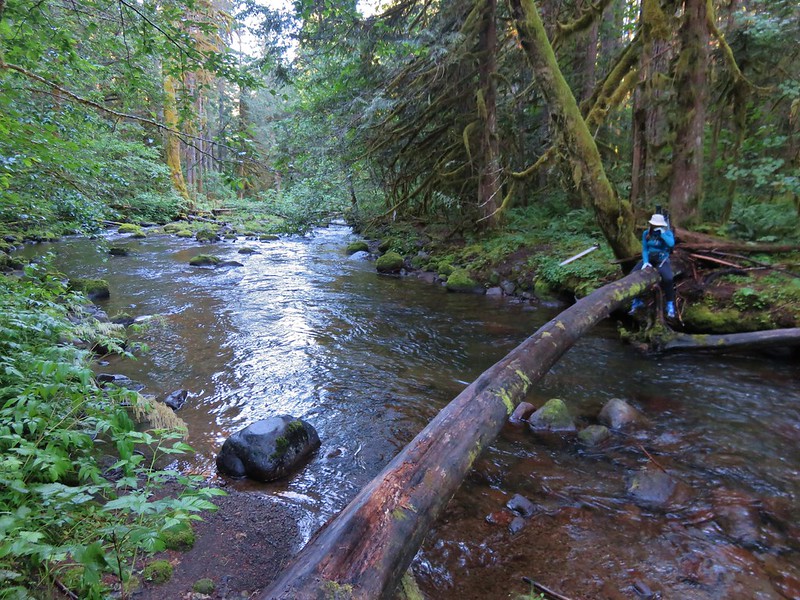
The trail paralleled Lost Creek for the first 3/4 mile but didn’t get very close to the water until the trail crossed the creek. I had checked the Mt. Hood Forest Service for trail conditions before we left so we knew the bridge was “unusable”.
IMG_8682

IMG_8685

We looked around a bit and noticed a downed tree a little downstream that we could use to cross but it was wet and slick and not wide enough to comfortably walk across in those conditions. We faced the choice of scooting across or fording the creek. Considering the temperature was only in the upper 30’s we decided we’d rather scoot than get soaked.
IMG_8686

Halfway across we discovered that we weren’t the only ones using the log and had to creatively maneuver past a snail and small slug.

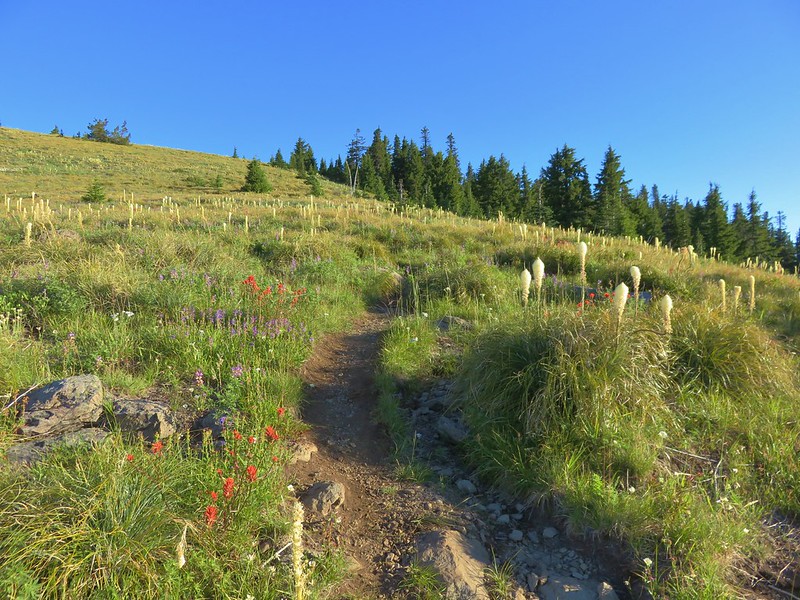
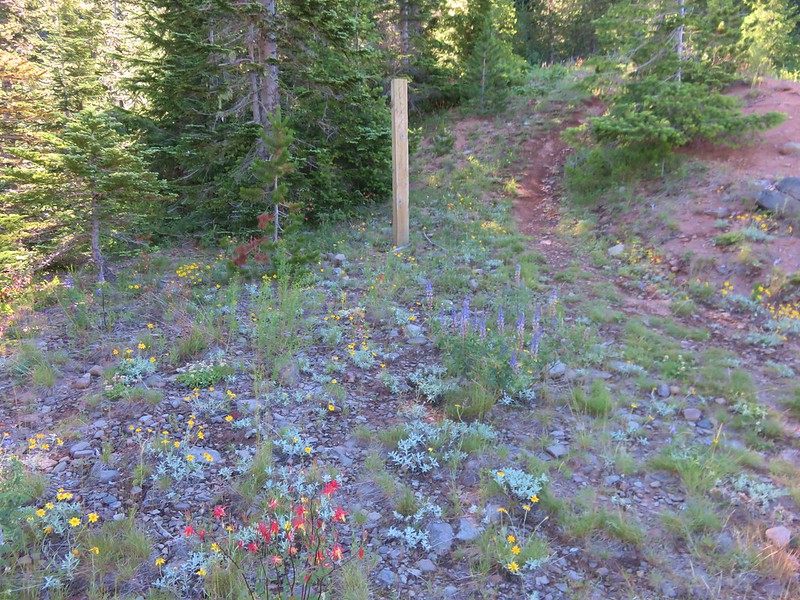
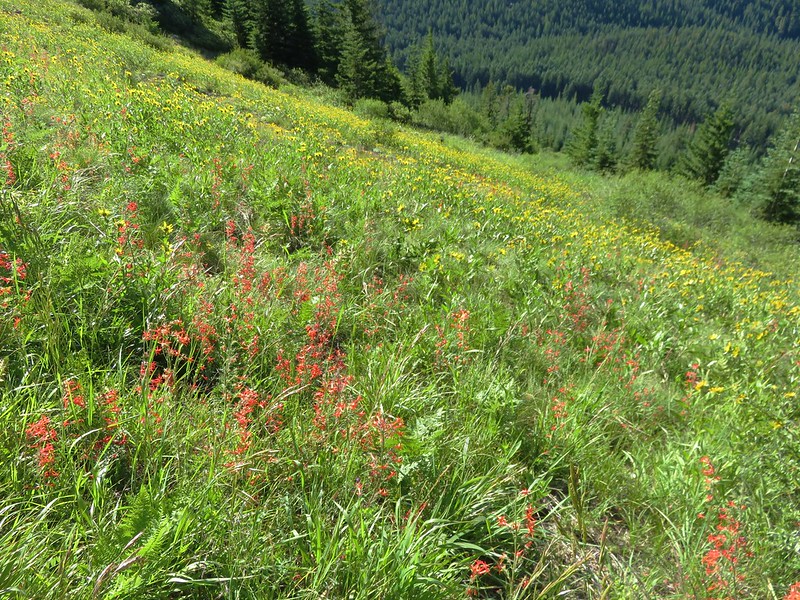
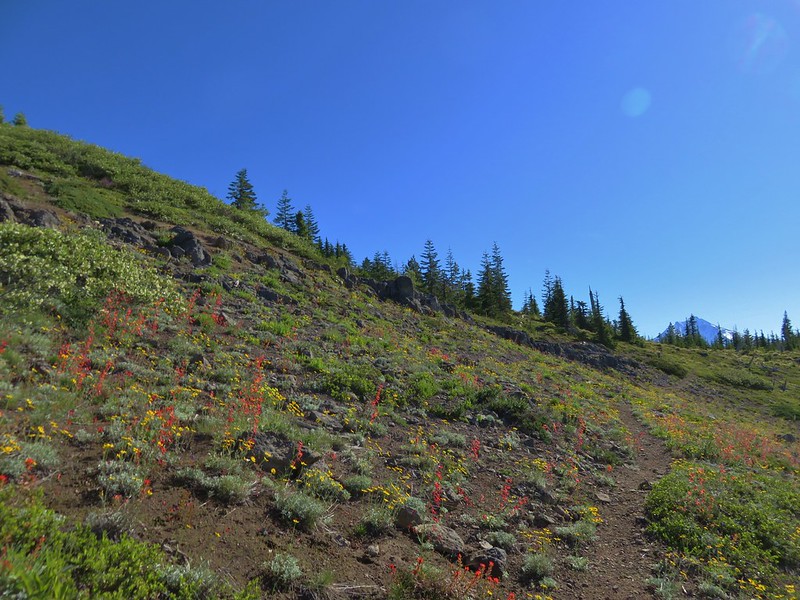
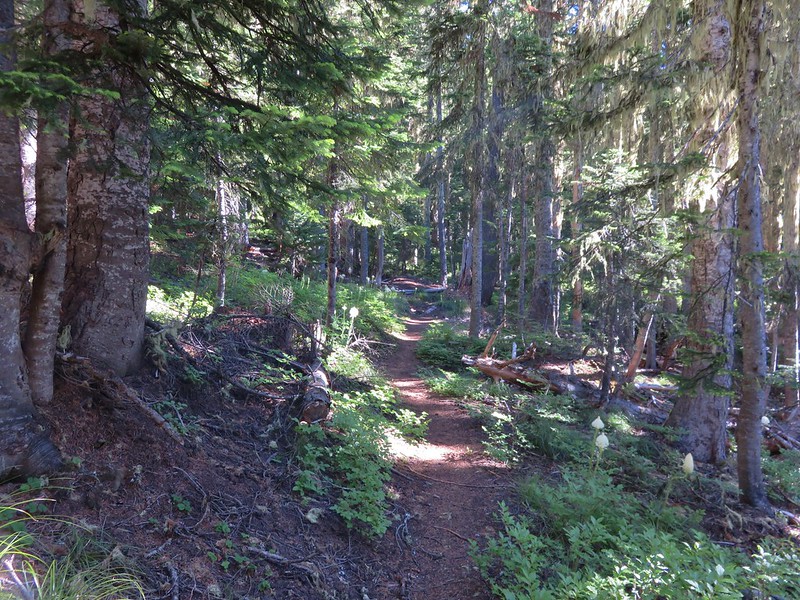
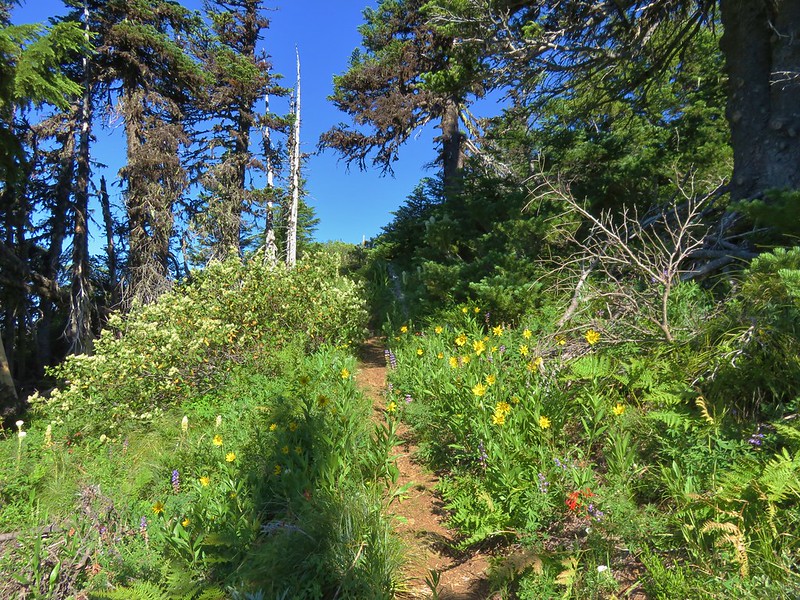
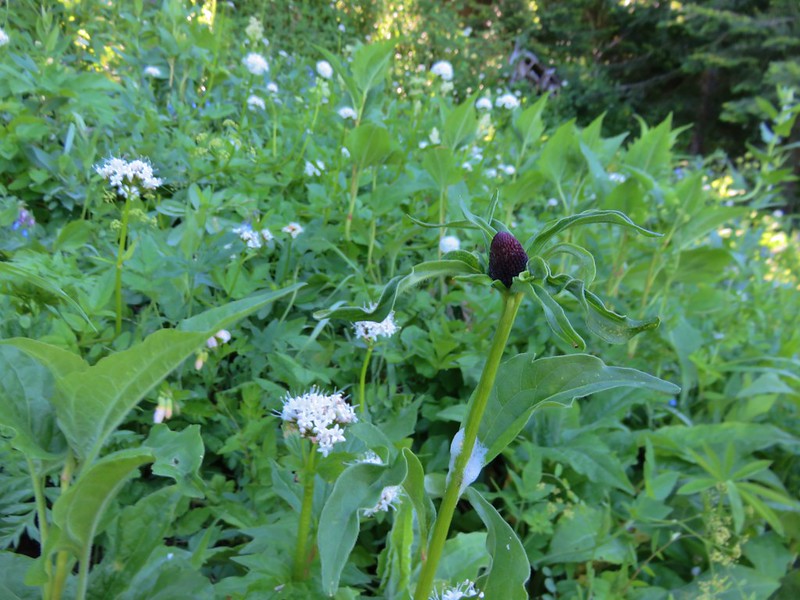
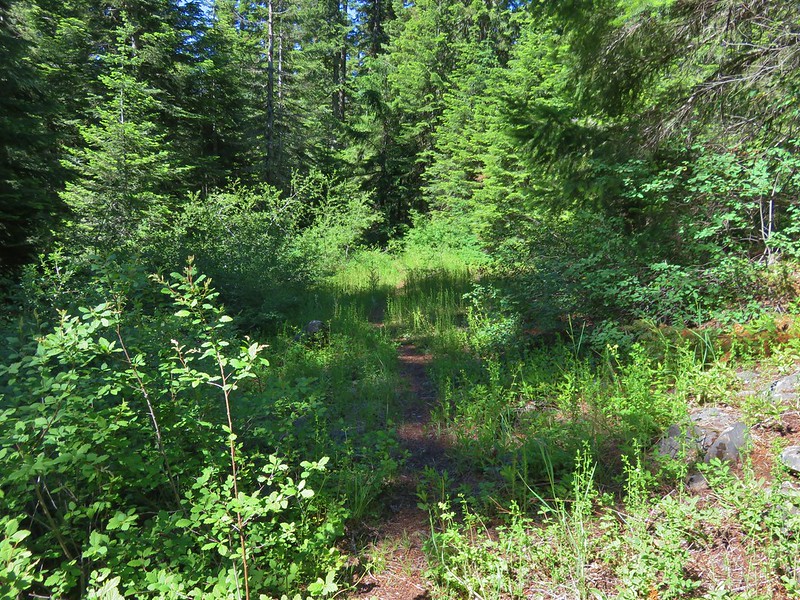
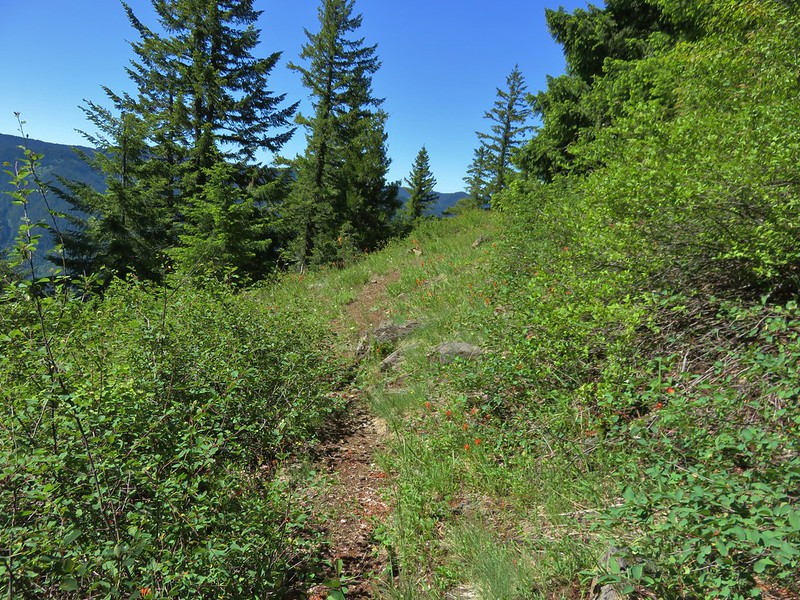
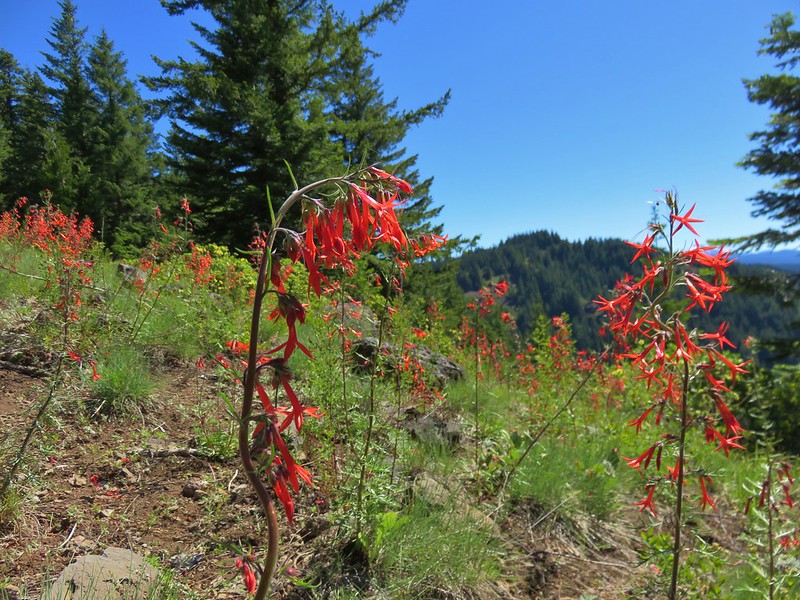
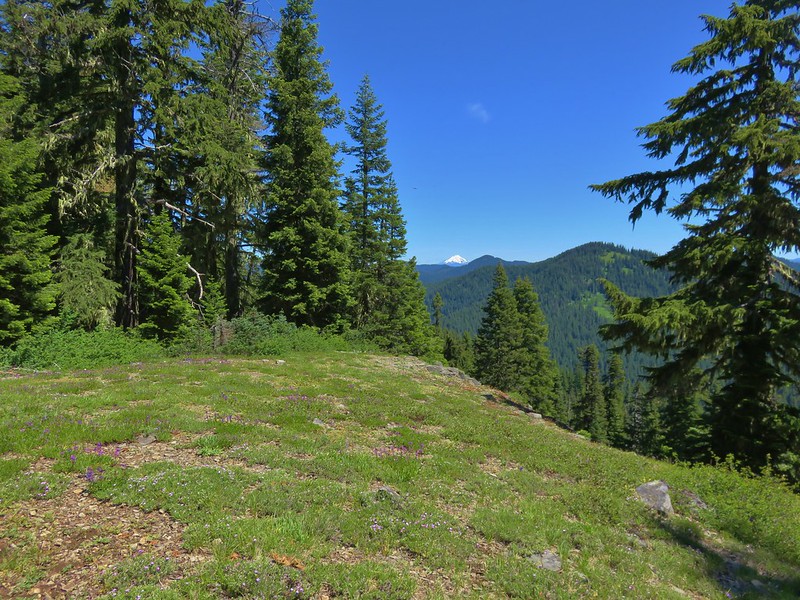
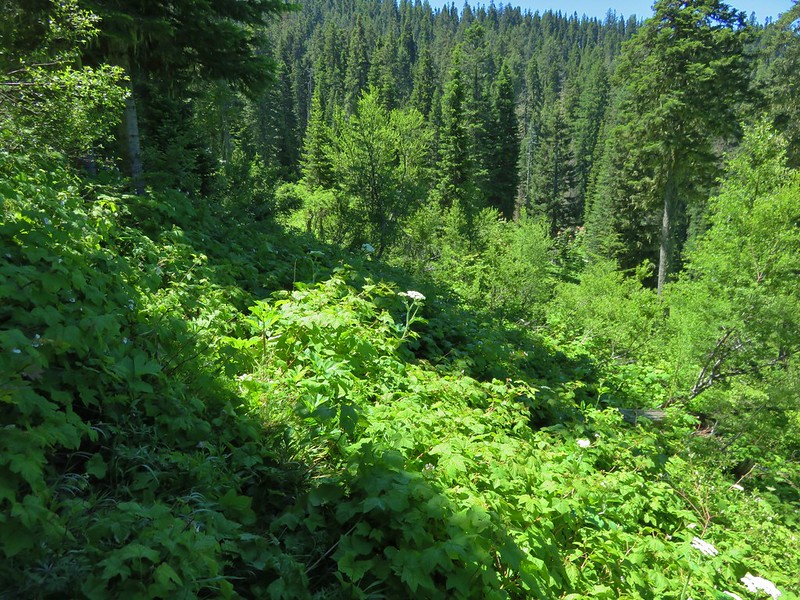
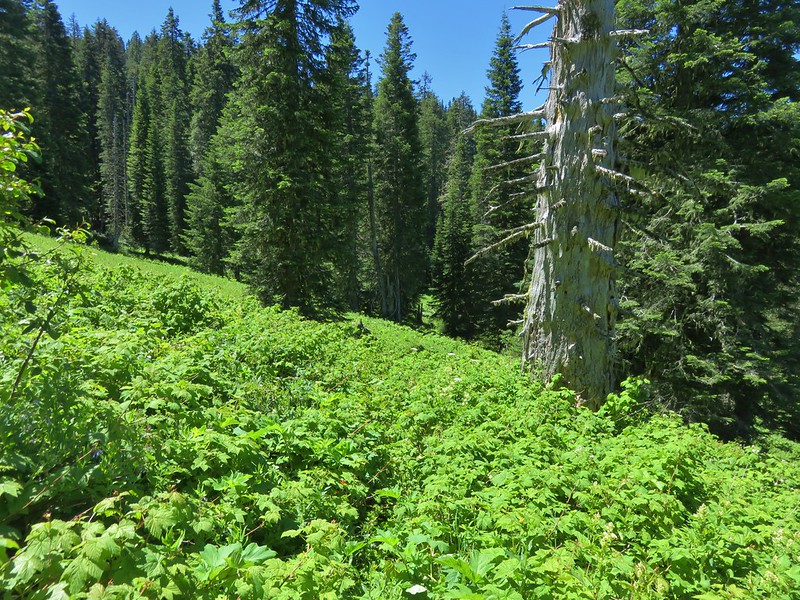
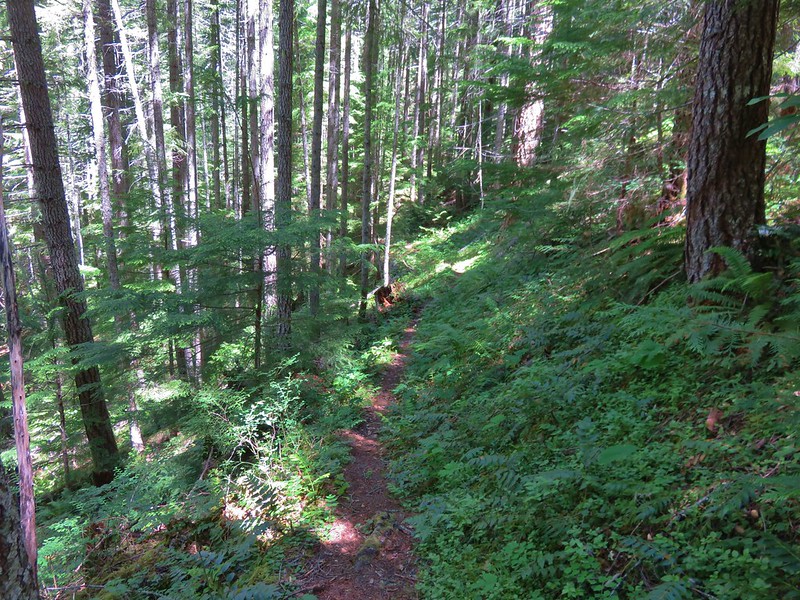
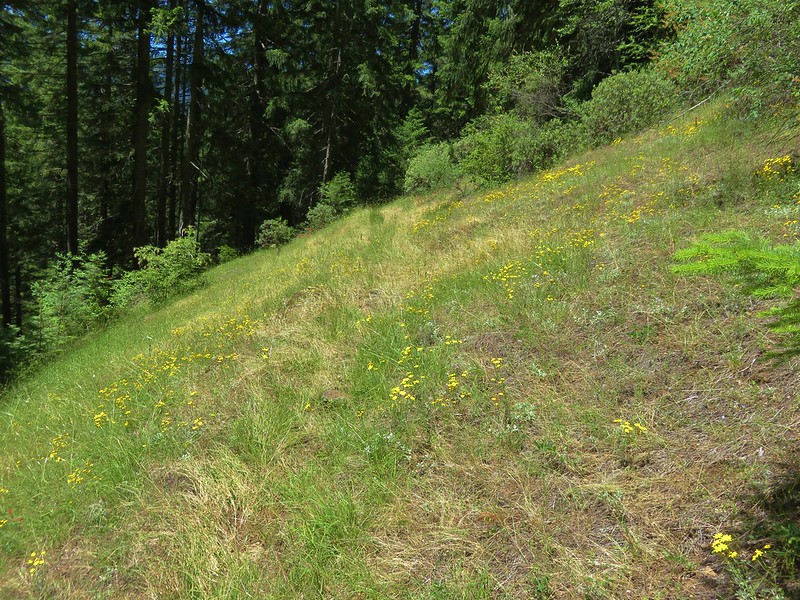
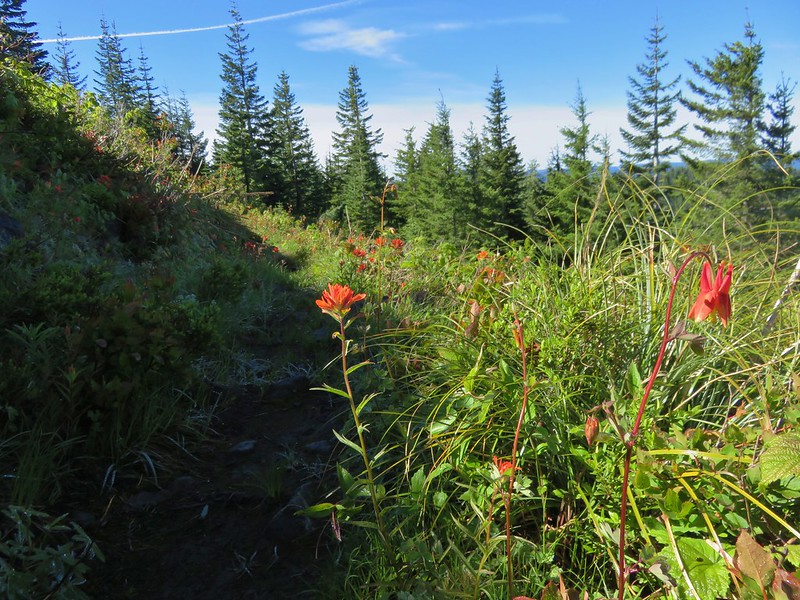
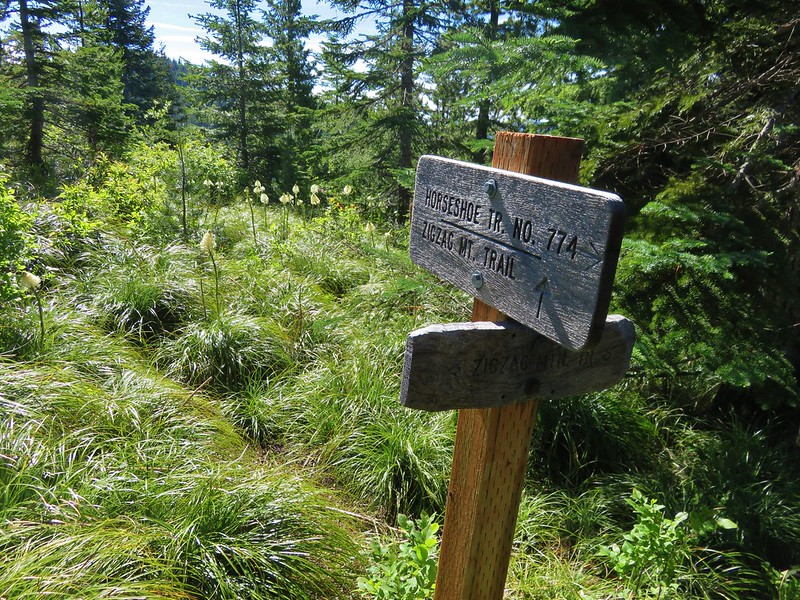
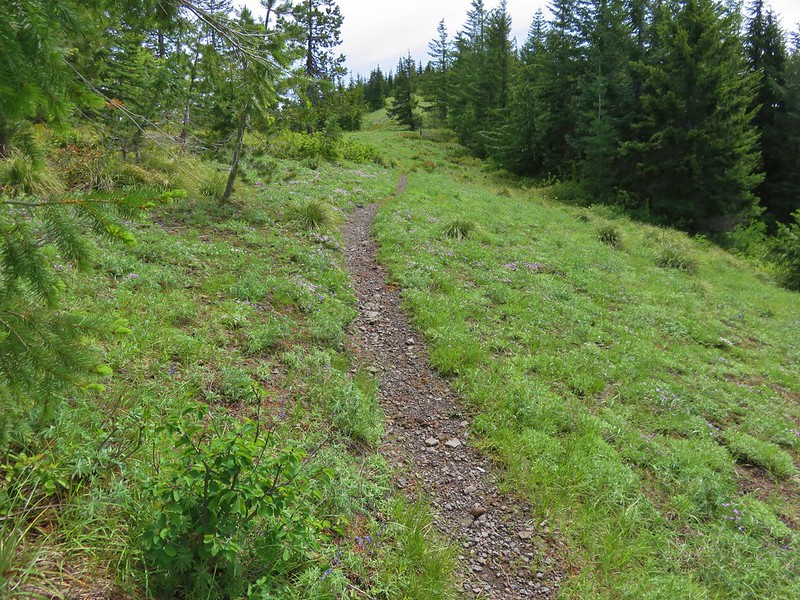
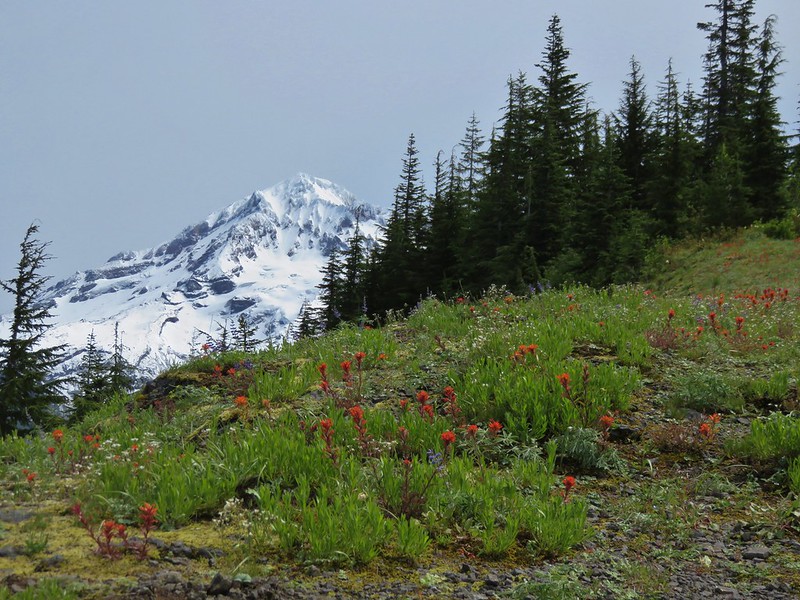
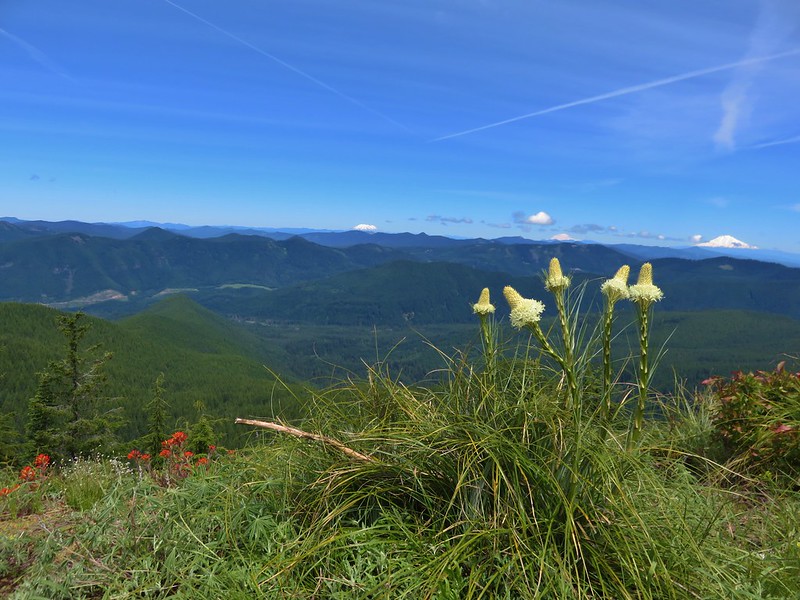
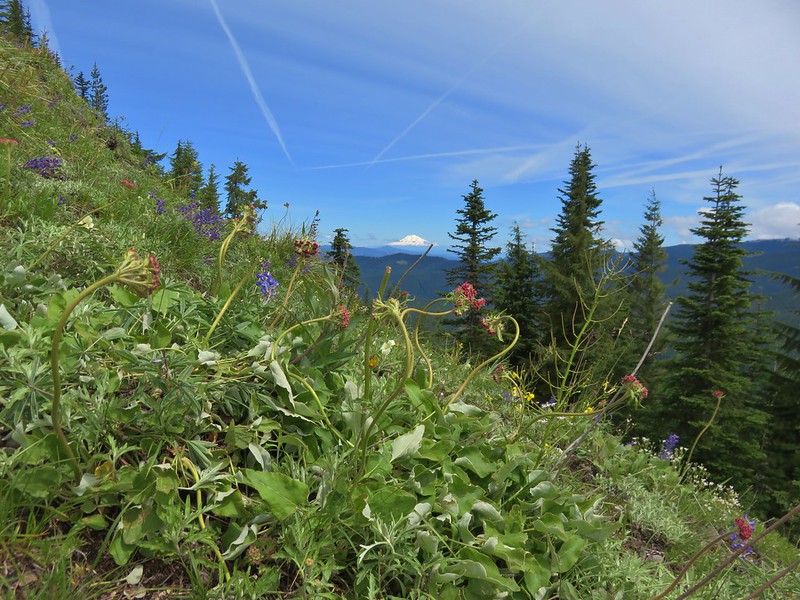
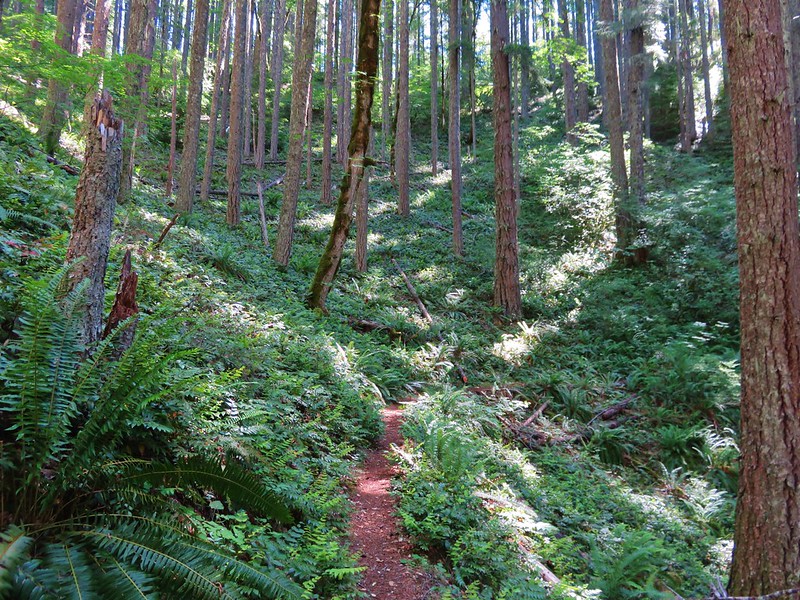
Beyond Lost Creek the trail climbed through the forest for nearly 4 miles to the Zigzag Mountain Trail. The climb was never too steep and near the end the trail entered a meadow with wildflowers and views of Mt. St. Helens.
IMG_8698

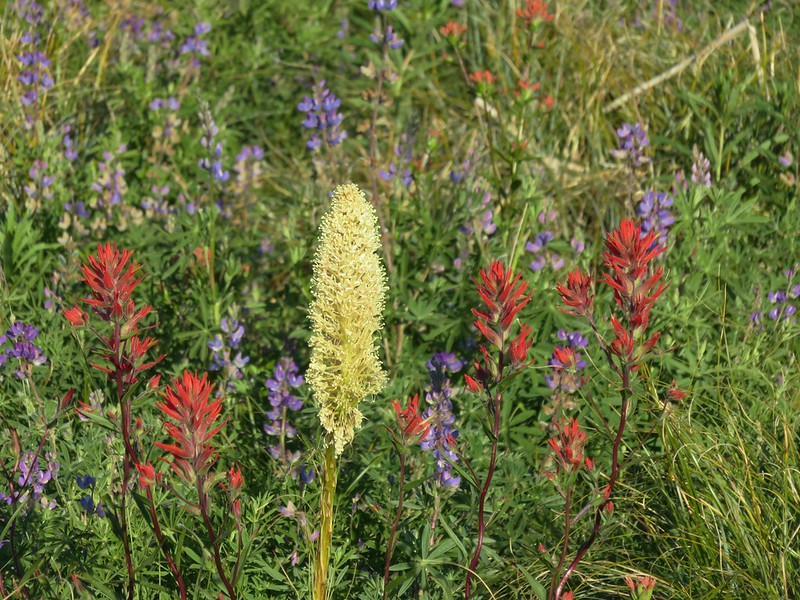
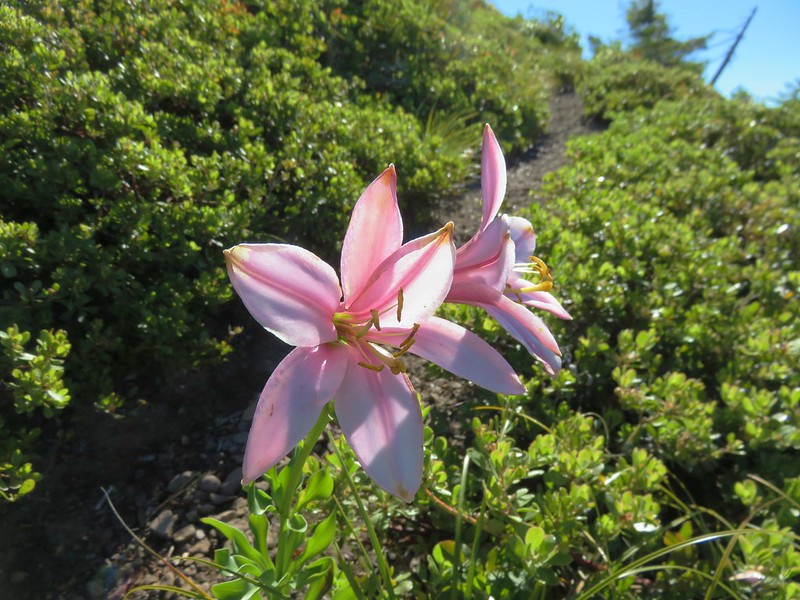
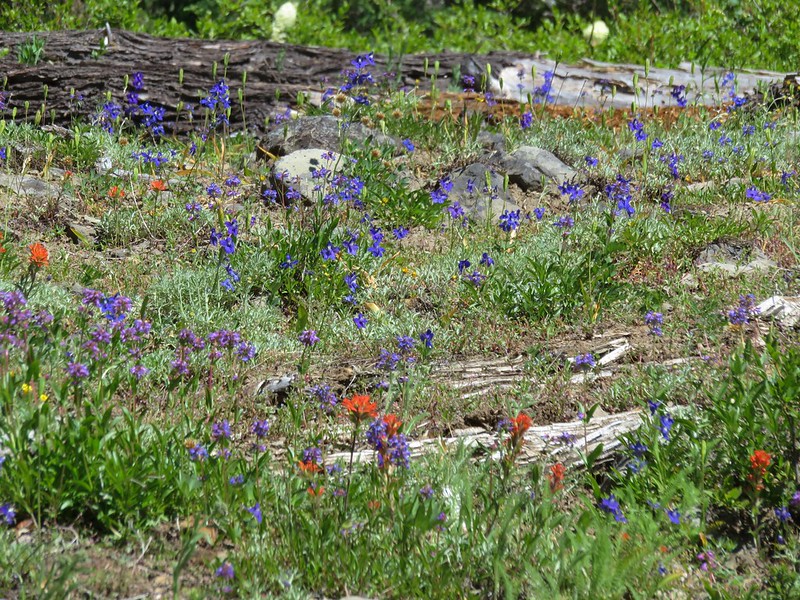
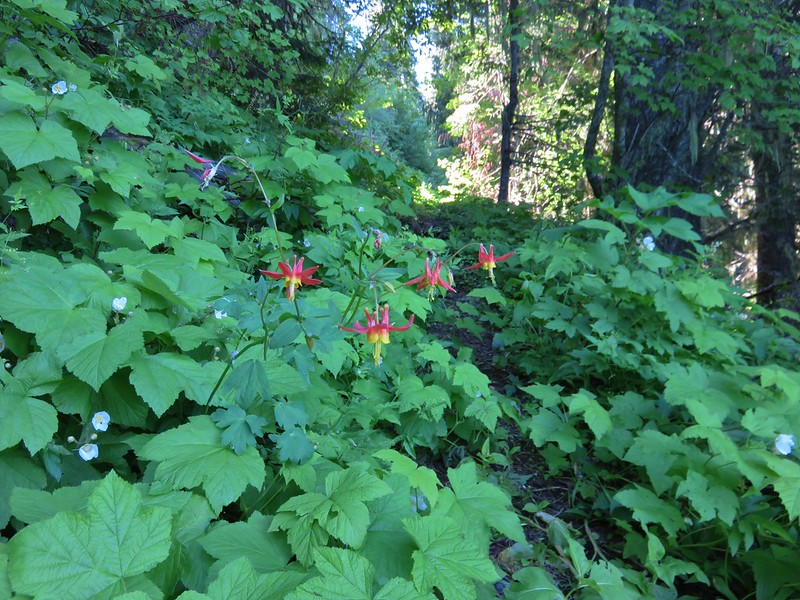
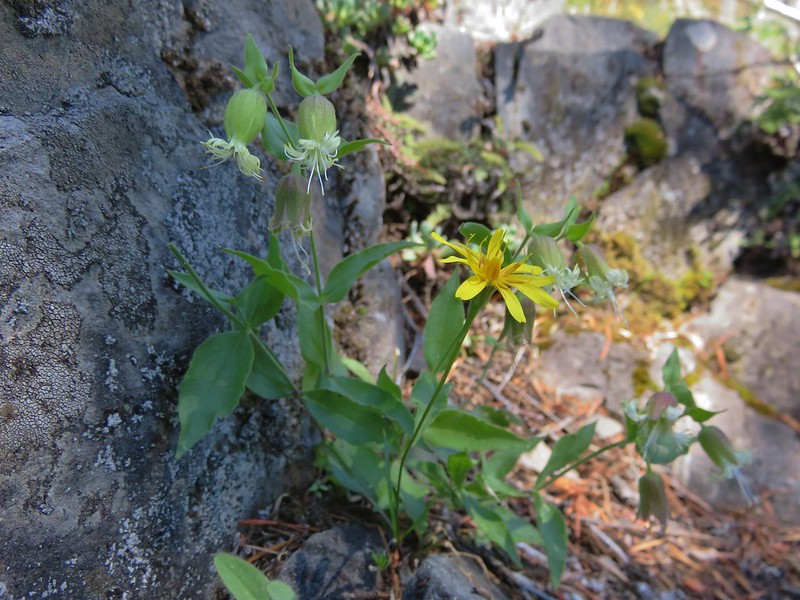
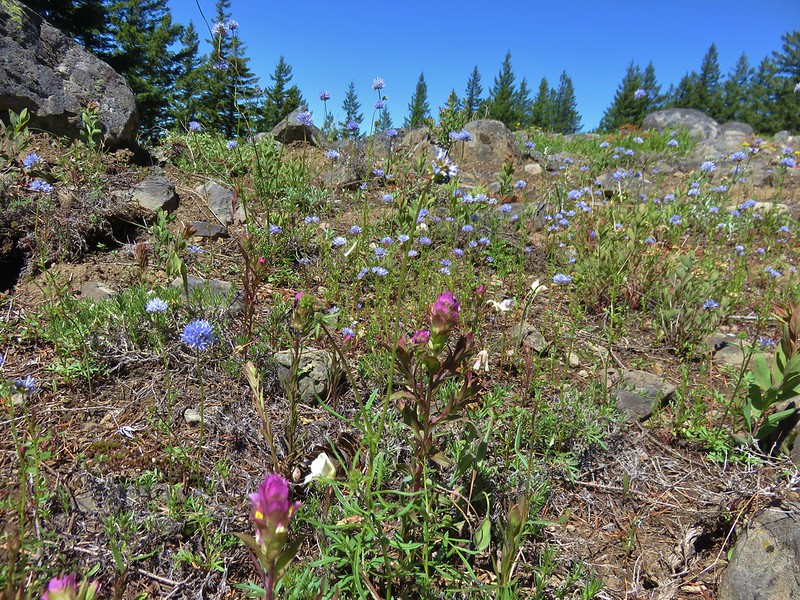
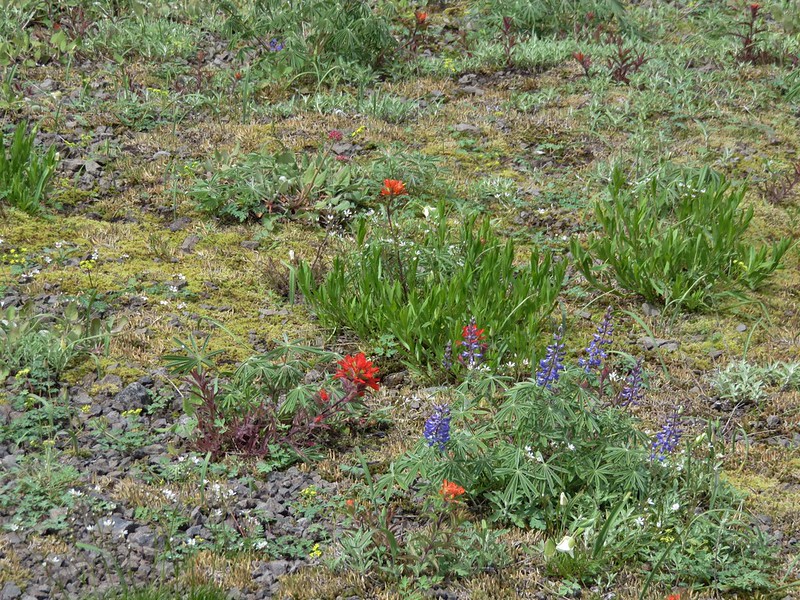
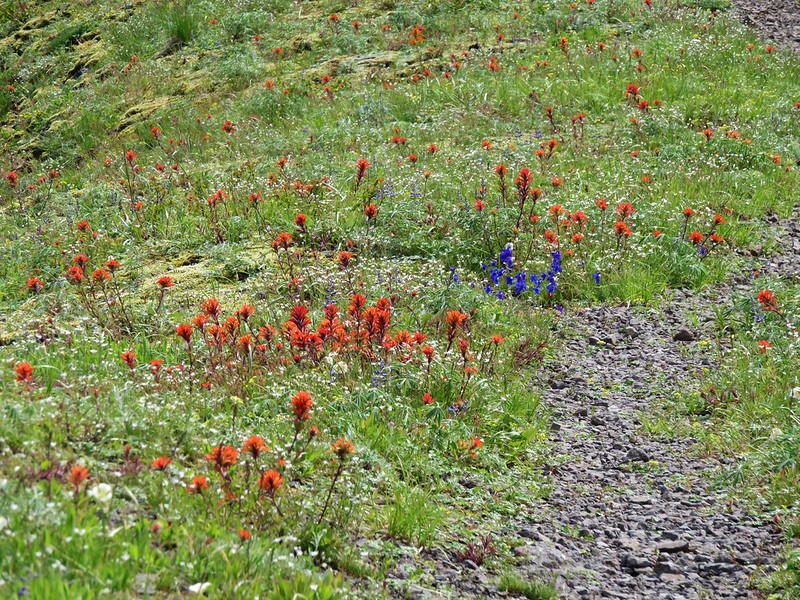
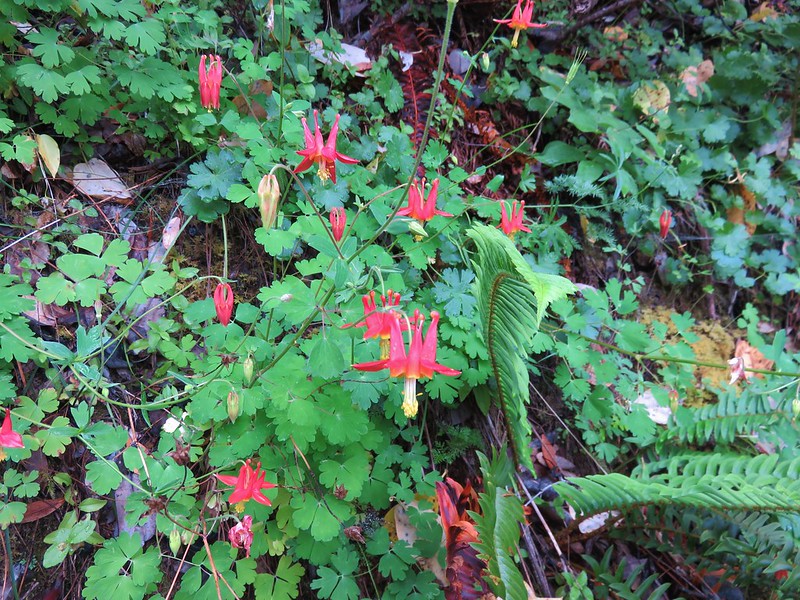
Columbine and paintbrush
IMG_8733

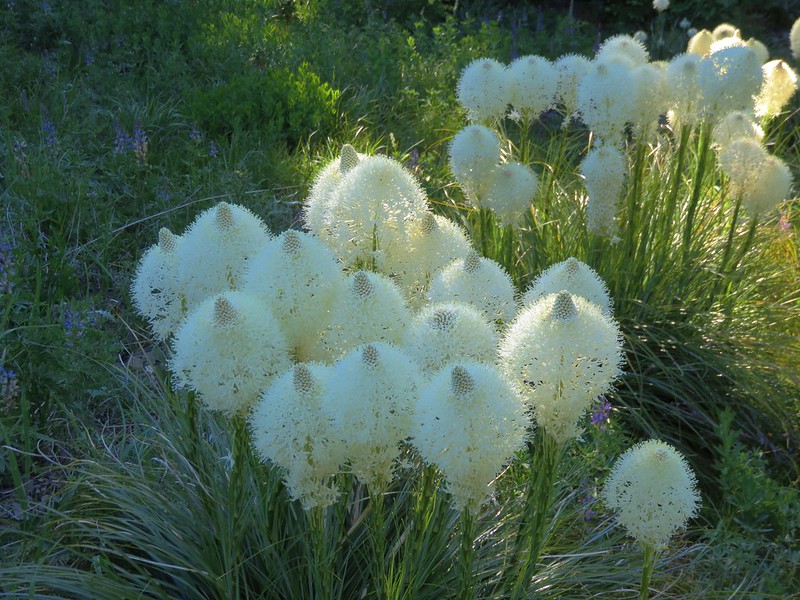
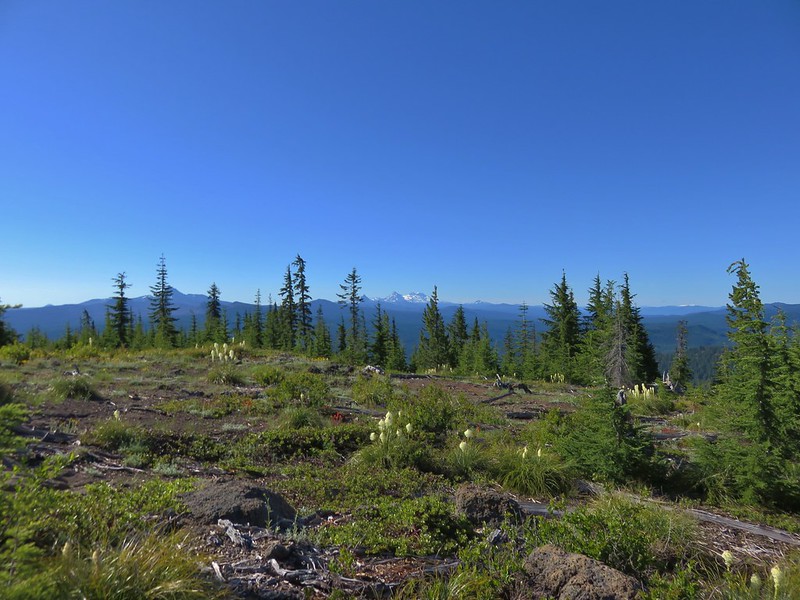
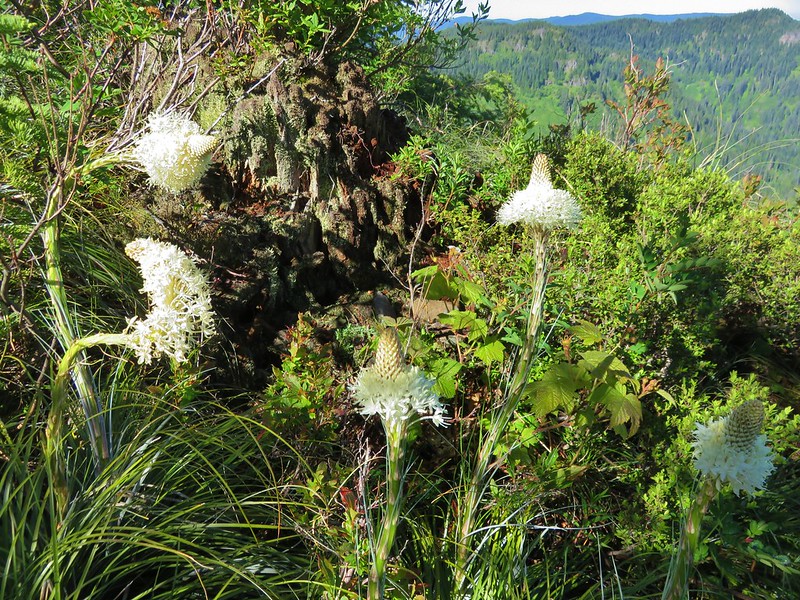
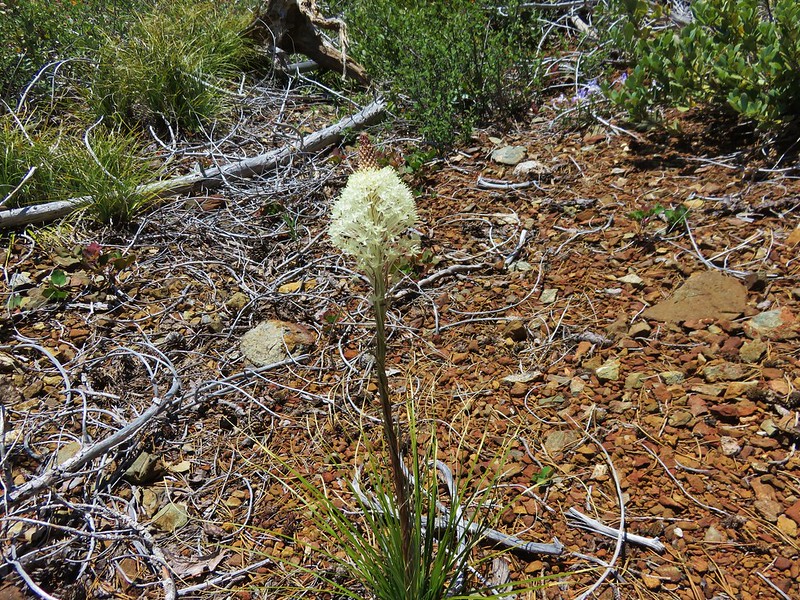
Beargrass
IMG_8720

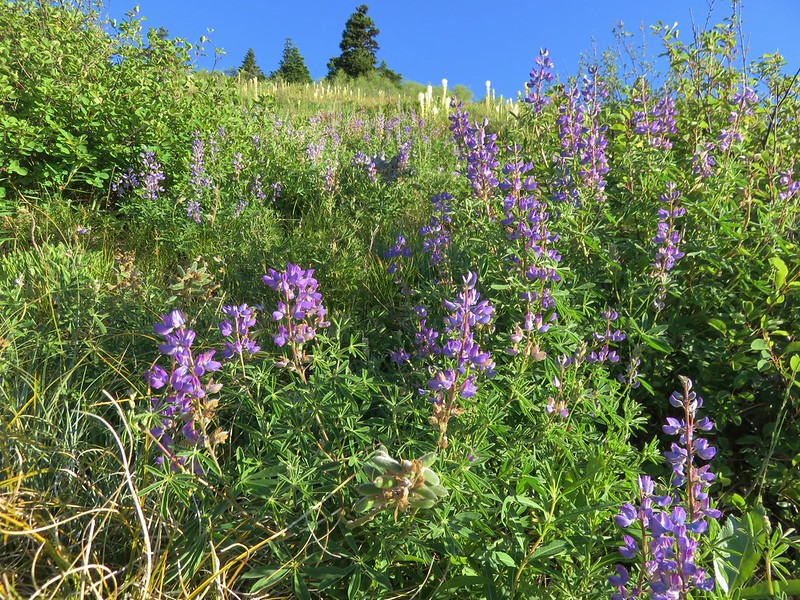
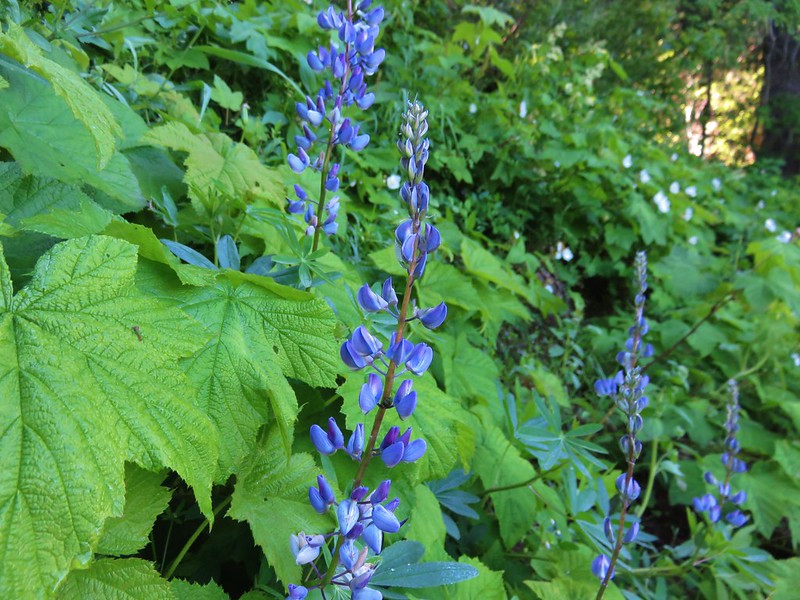
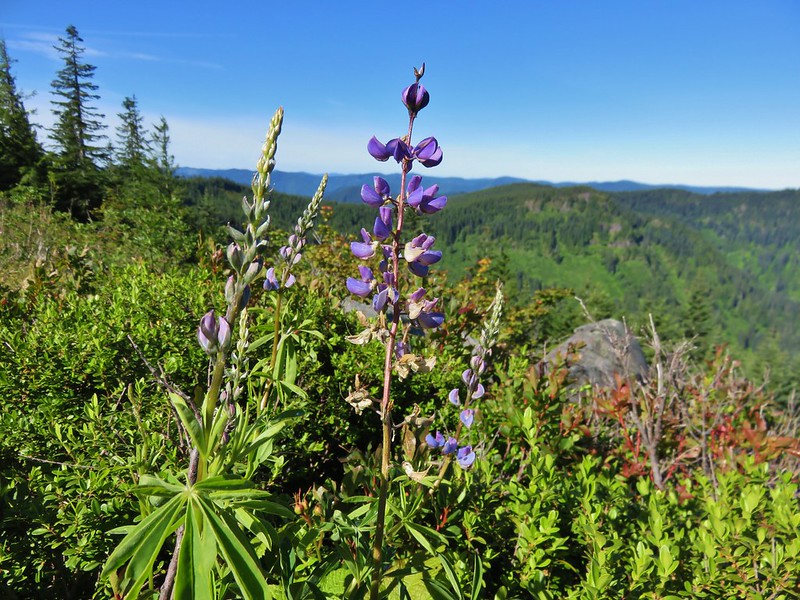
Lupine
IMG_8723

Paintbrush
IMG_8719

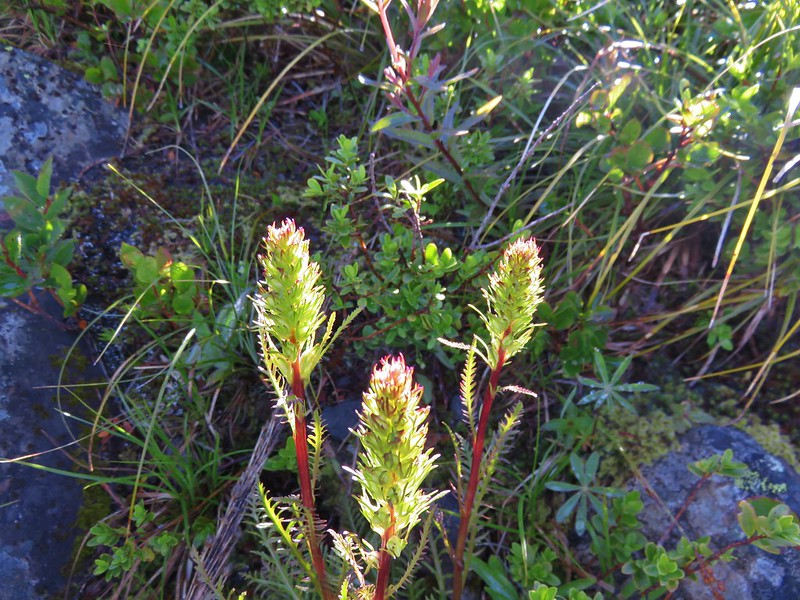
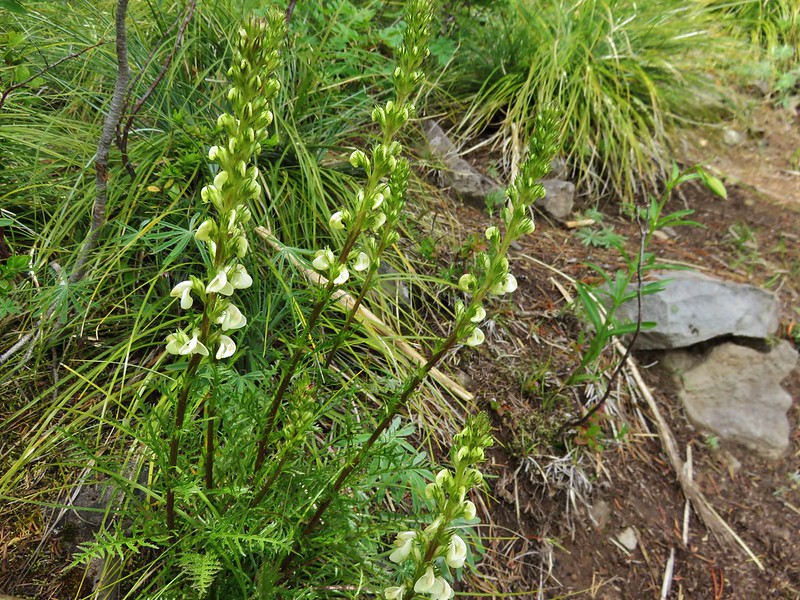
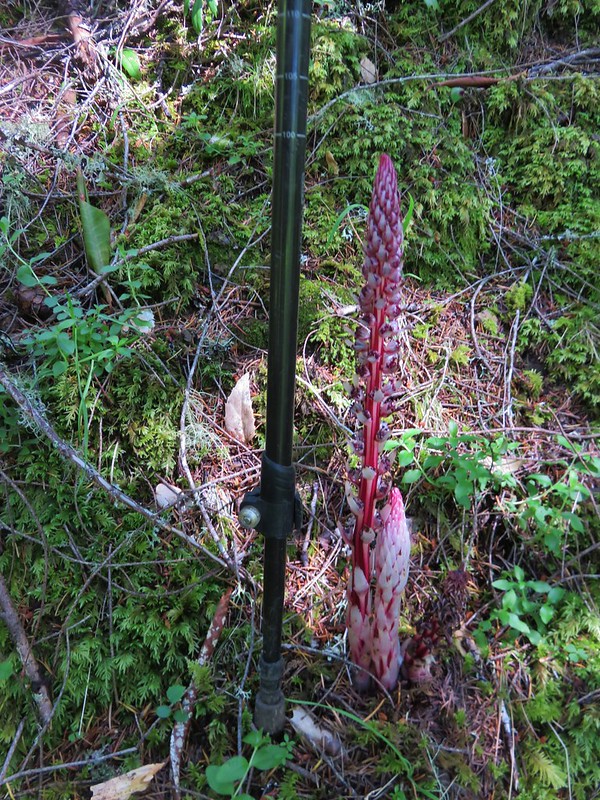
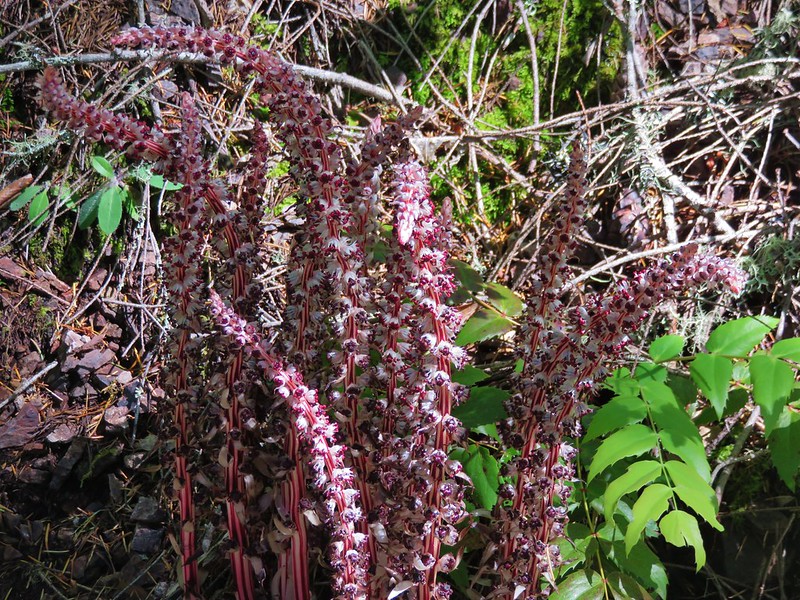
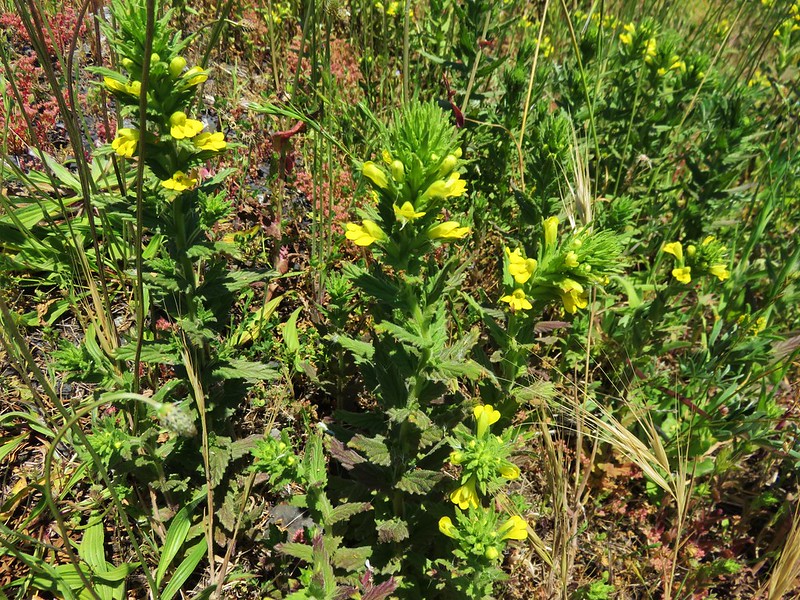
Lousewort before blooming
IMG_8726

IMG_8728

IMG_8730

IMG_8735

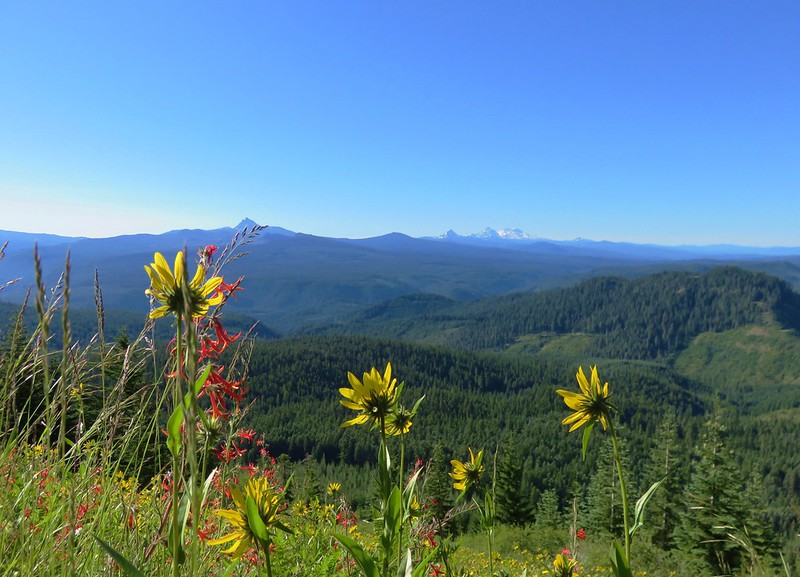
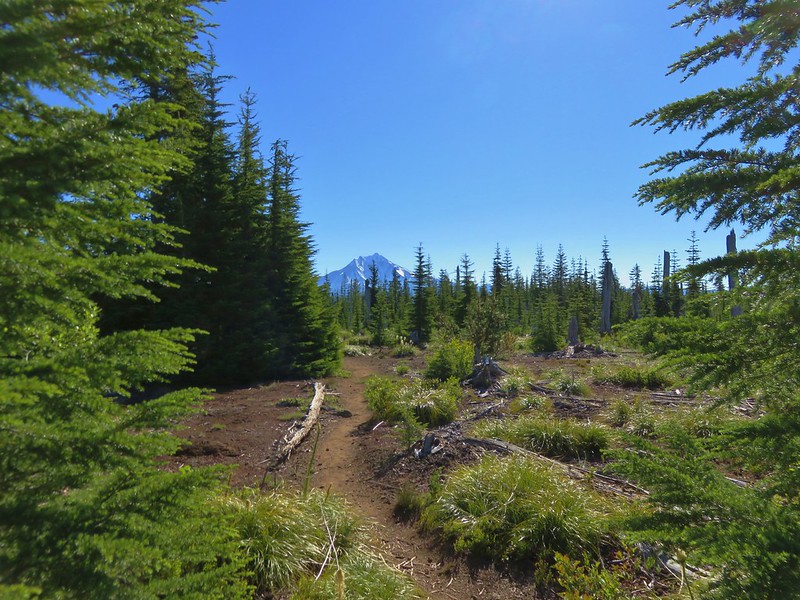
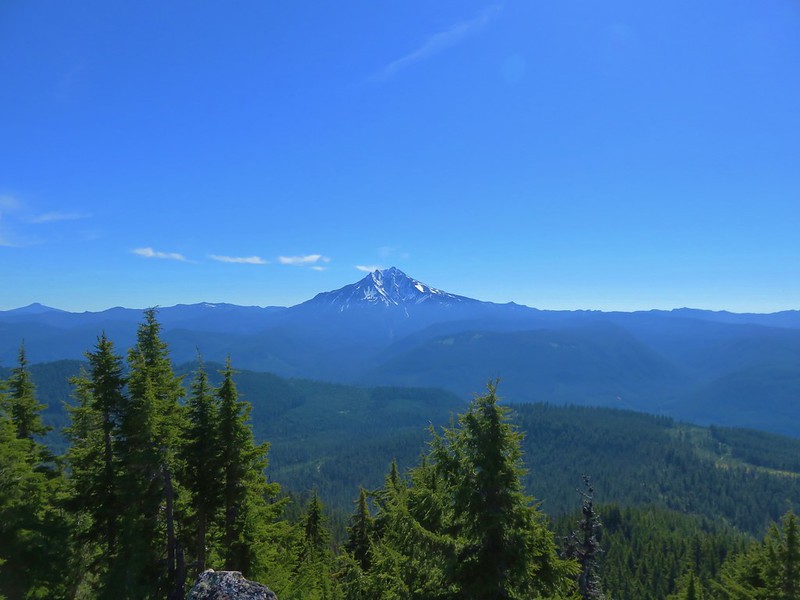
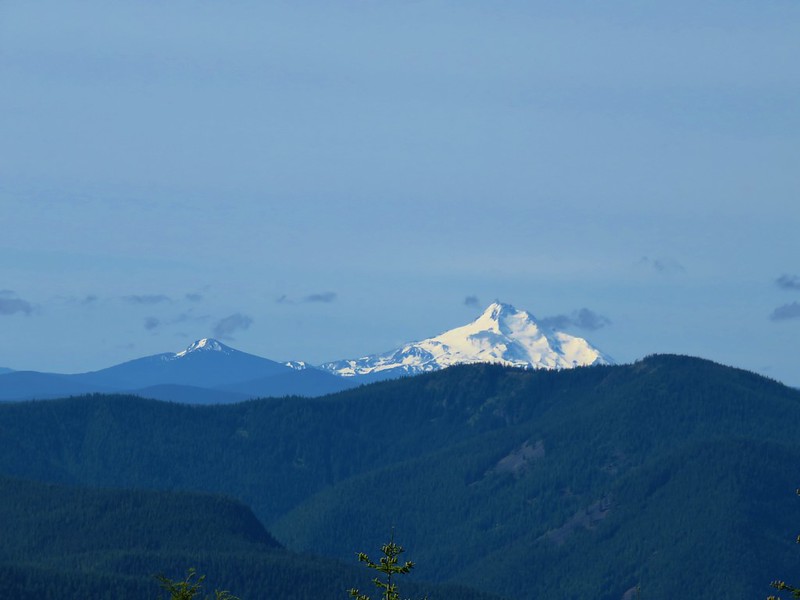
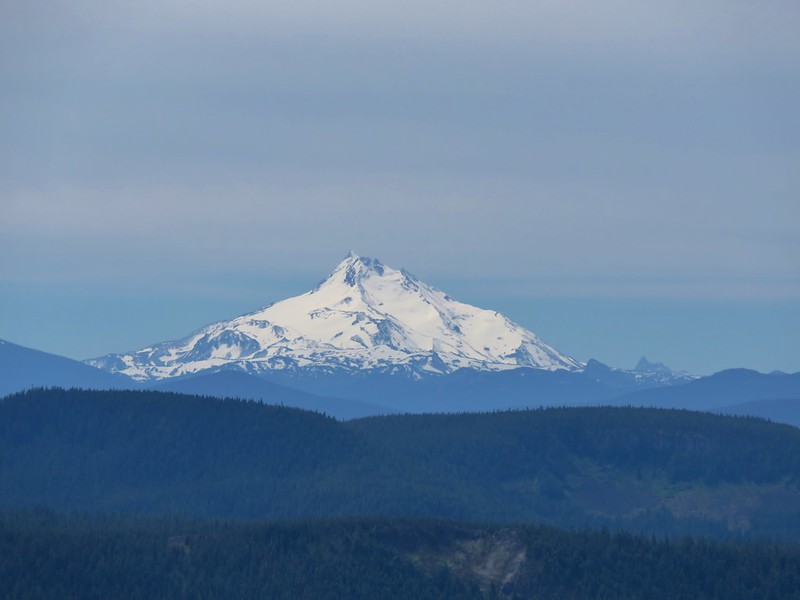
We turned left on the Zigzag Mountain Trail passing through more beargrass meadows and gaining views of Mt. Hood and Mt. Jefferson.
IMG_8736

IMG_8737

IMG_8739

IMG_8744

IMG_8746

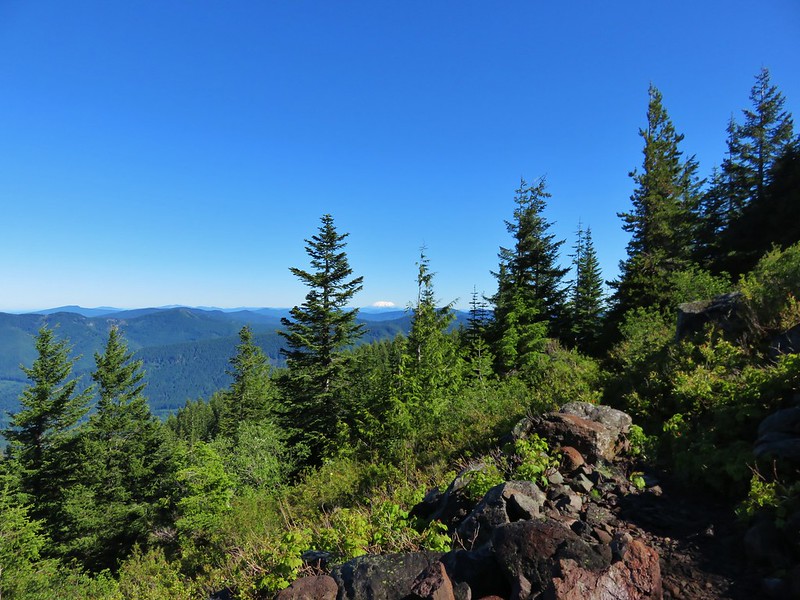
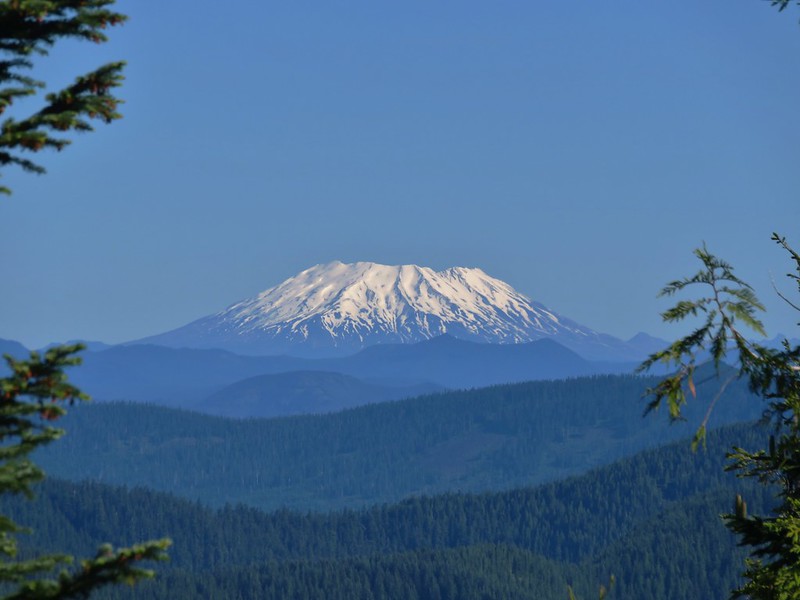
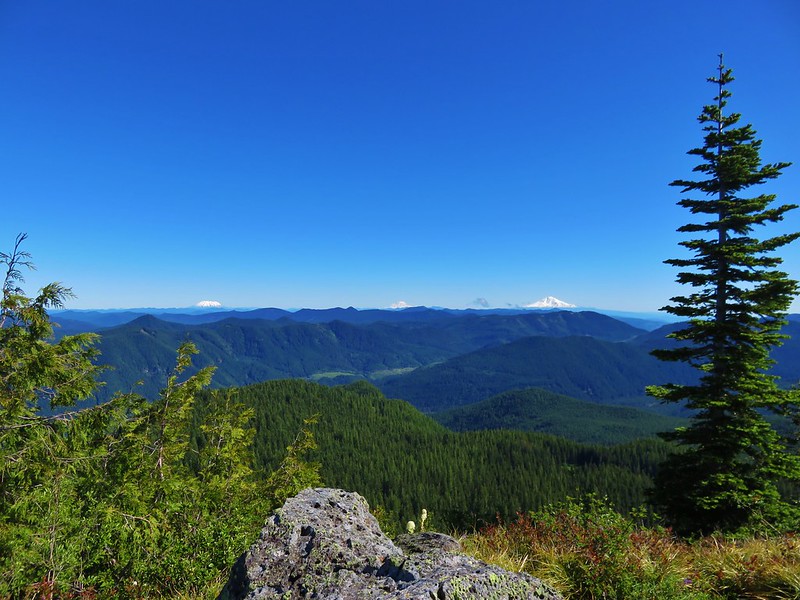
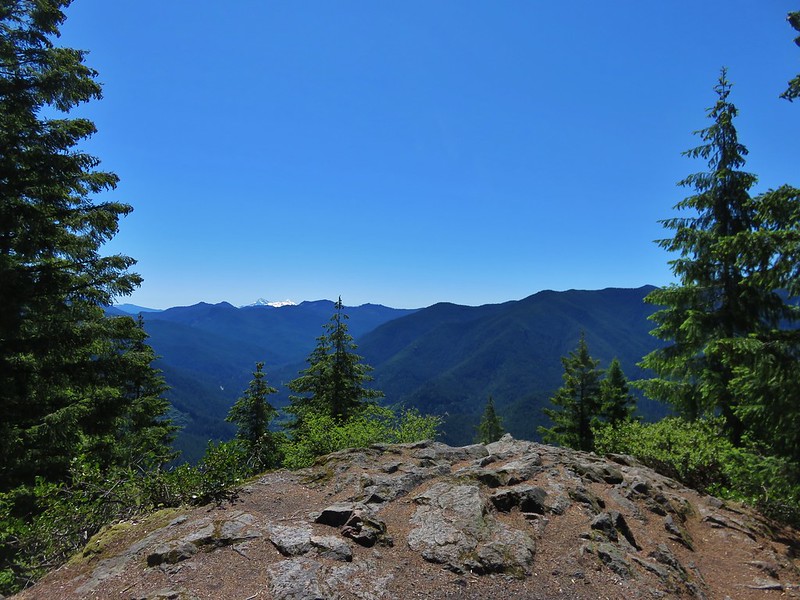
We followed the trail up to a ridge top where a rocky viewpoint added three Washington volcanoes to the view.
IMG_8752

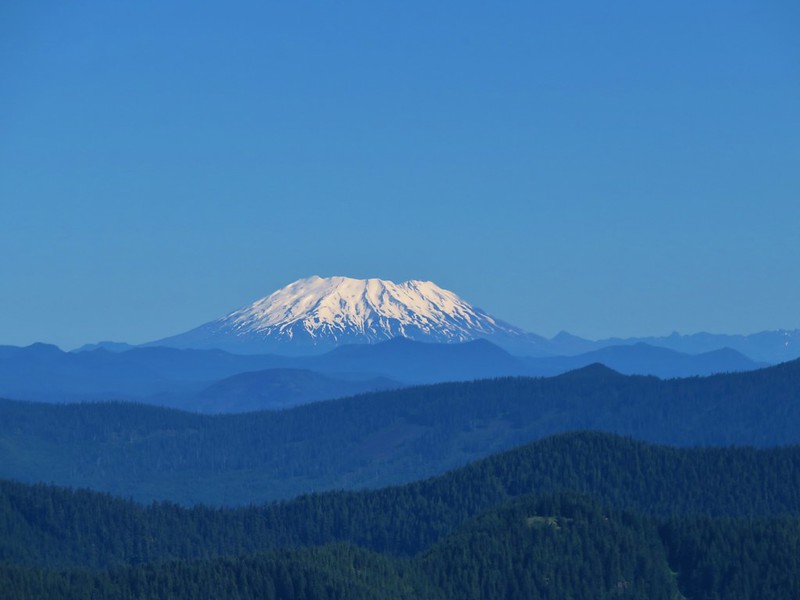
Mt. St. Helens
IMG_8756

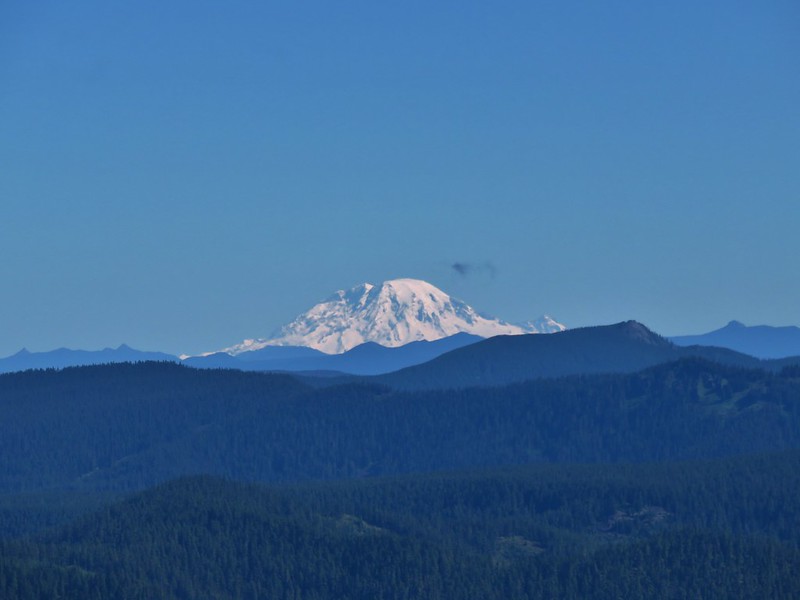
Mt. Rainier
IMG_8755

Mt. Adams
IMG_8754

The trail then crossed over the ridge and began descending along the north side of Zigzag Mountain. We had been on this section of trail in 2012 during a July 9th loop starting from the Burnt Lake South Trailhead. During that hike this portion of trail was still partly covered in snow. This time around there were only a couple of small patches remaining in the brush along the trail.
IMG_8778

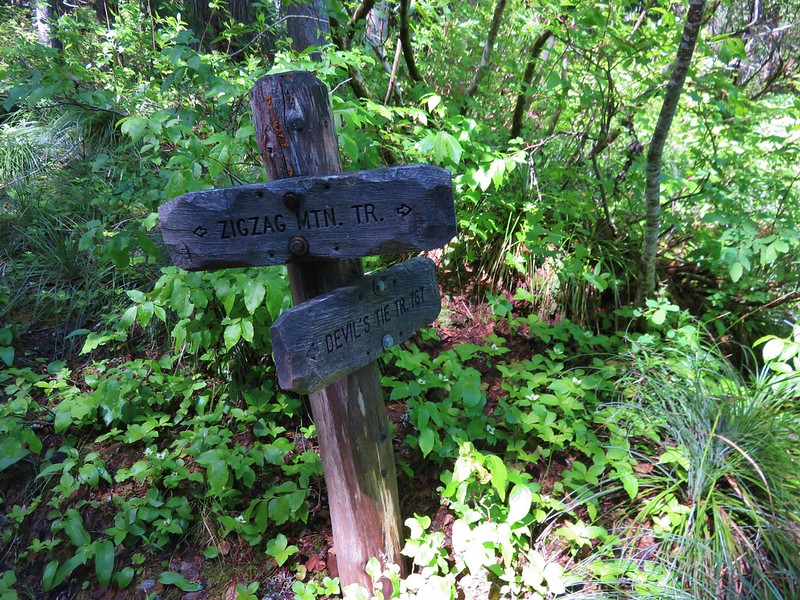
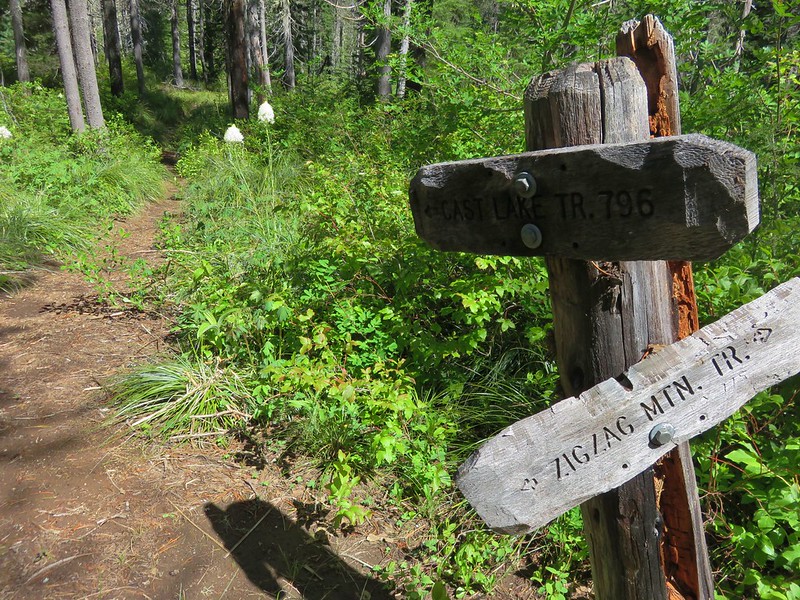
We passed above Cast Lake passing a junction with the Devil’s Tie Trail to the Cast Lake Trail.
IMG_8781

IMG_8784

IMG_8790

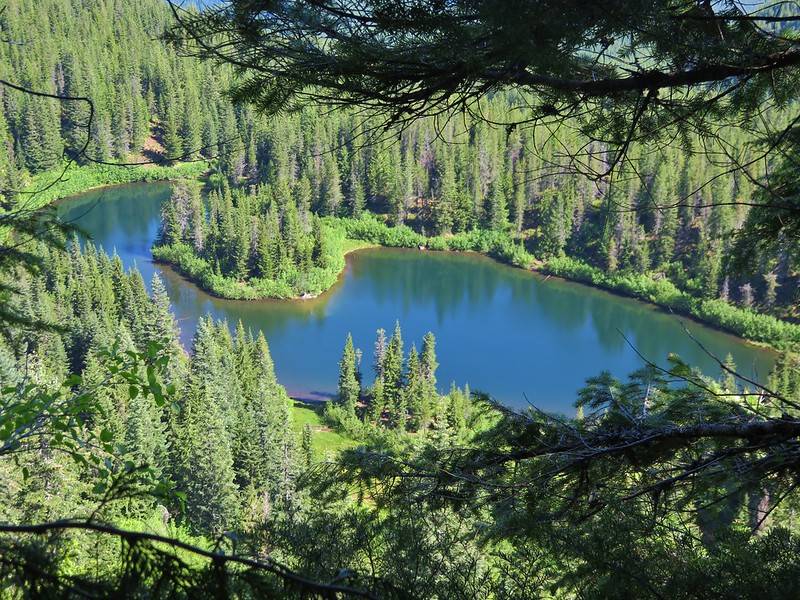
A half mile hike along this trail brought us to Cast Lake.
IMG_8794

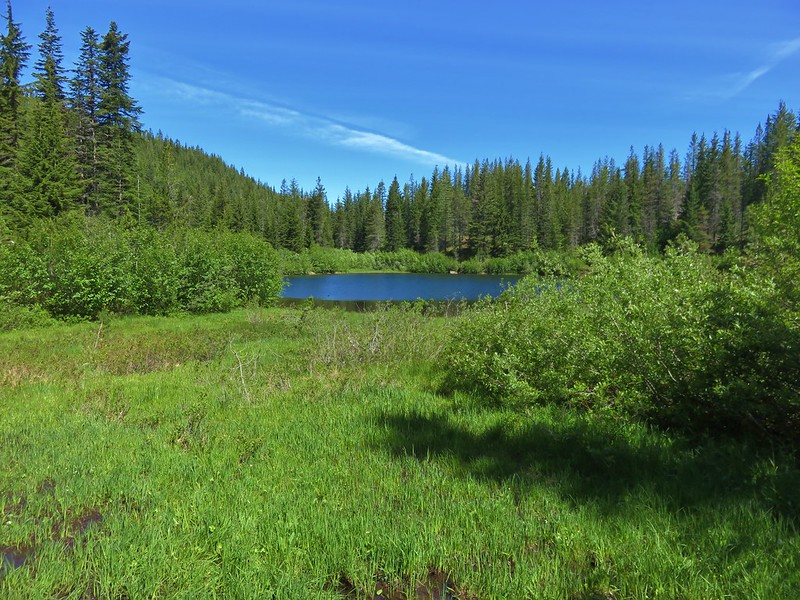
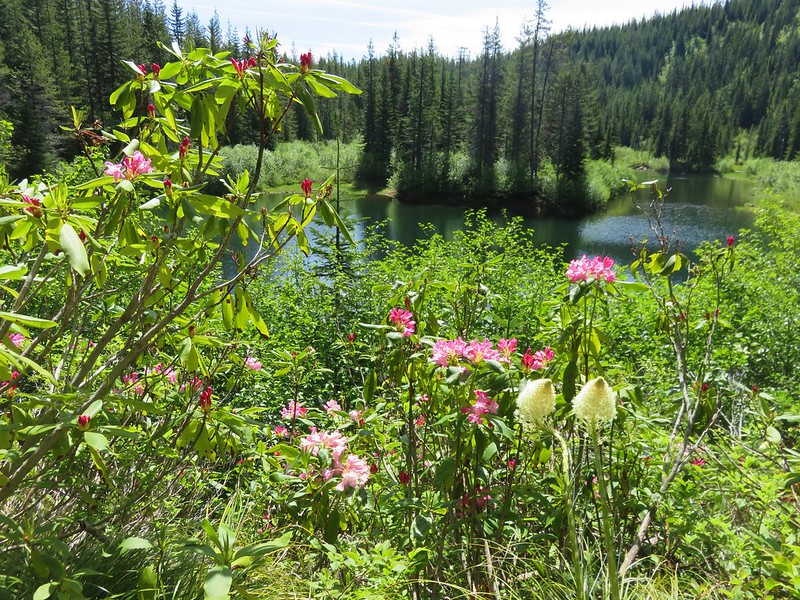
Snow melt and recent precipitation had left standing water on some of the trail and mud along portions of the shore on the SW side of the lake. We followed a path around the north side of the lake past several nice campsites. We turned around shortly after crossing Cast Creek flowing out of the lake. The one thing that the lake lacks is a good view of Mt. Hood, but rhododendron and beargrass were blooming along the shore making for a pretty scene.
IMG_8803

We left Cast Lake and continued our loop on the Zigzag Mountain Trail and quickly arrived at the Cast Creek Trail junction.
IMG_8806

We faced a choice here. We could turn left on the Cast Creek Trail and complete the loop or take another side trip by continuing on the Zigzag Mountain Trail to East Zigzag Mountain. With the weather being as nice as it was and knowing that there would be some flowers in the meadow below the summit we decided on one more side trip. After a short but decent climb we emerged from the trees in the meadow.
IMG_8809

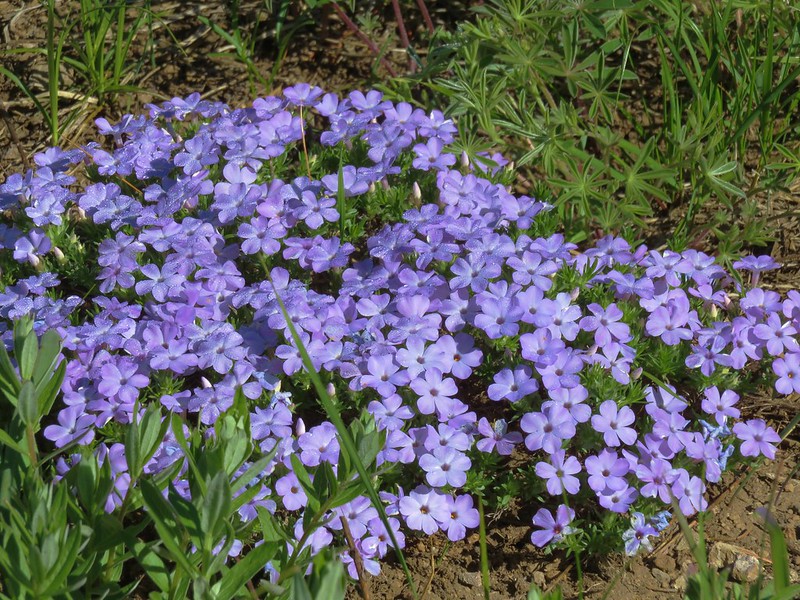
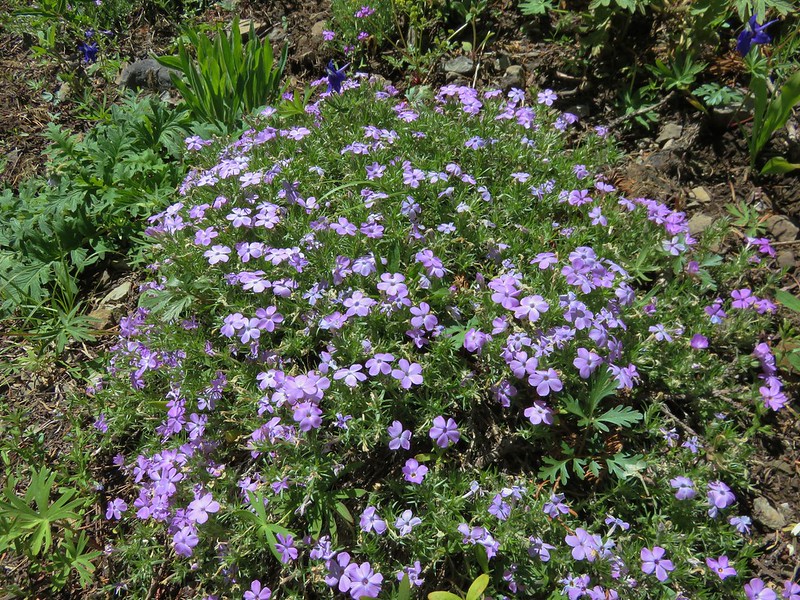
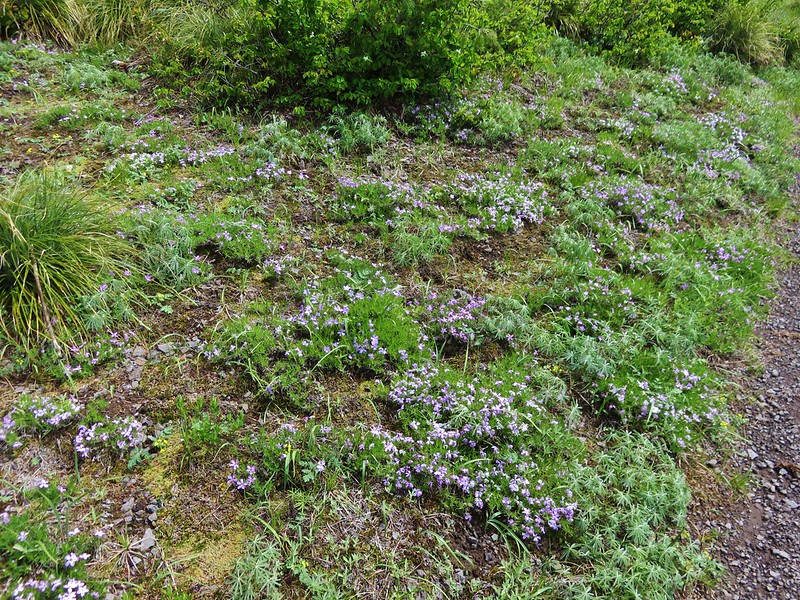
The lower portion of the meadow was full of Phlox and yet to bloom lupine.
IMG_8815

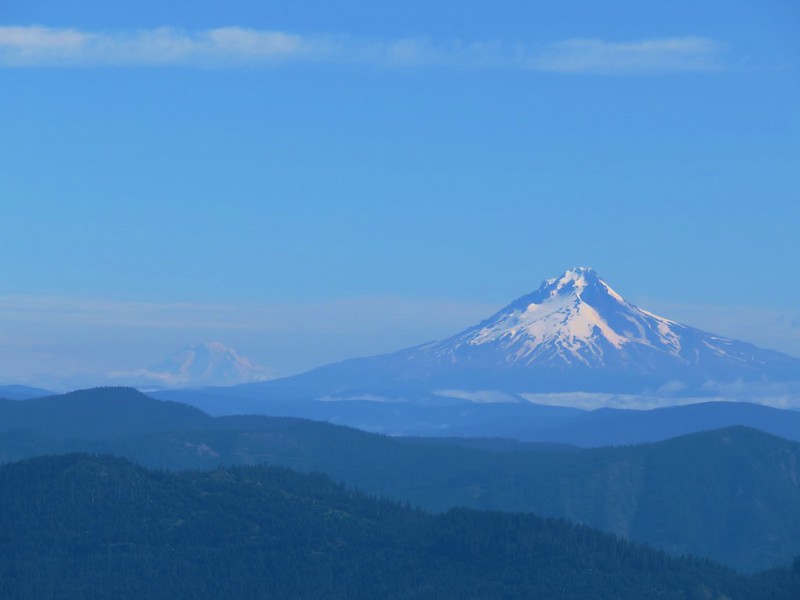
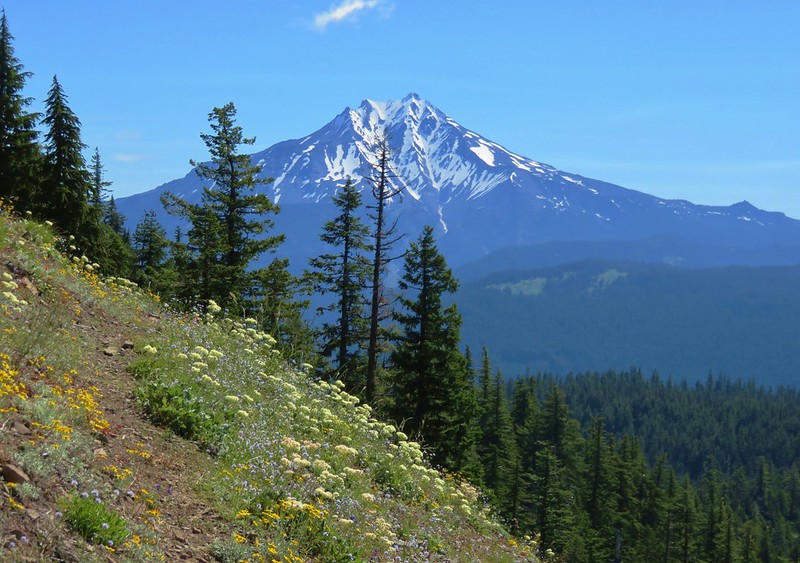
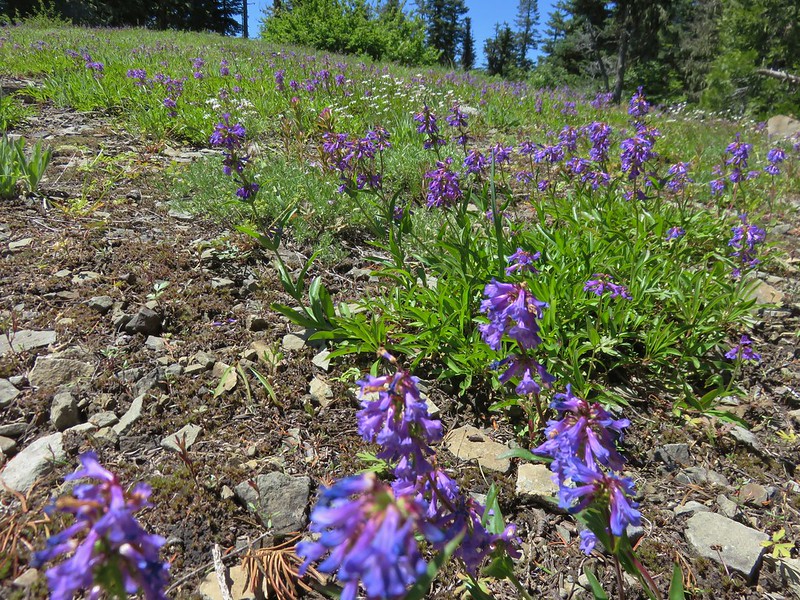
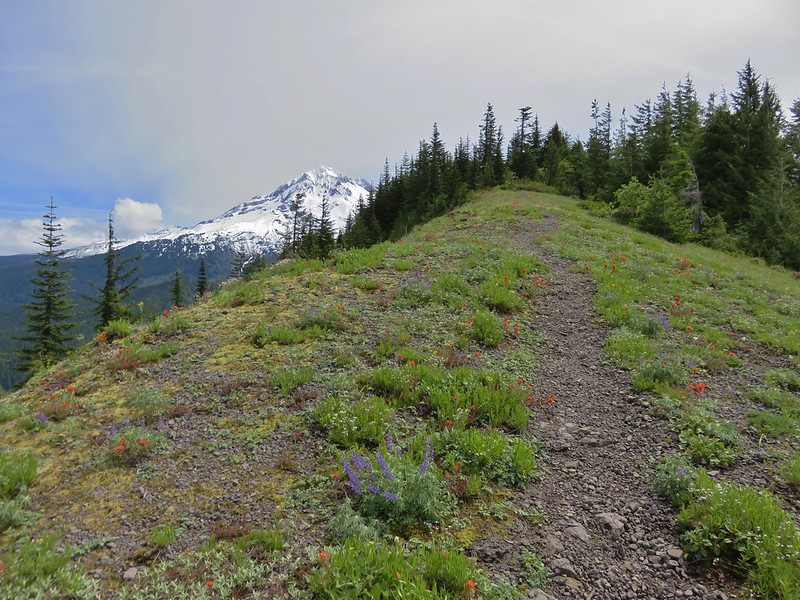
As we climbed higher Mt. Hood came into view and the variety of flowers increased.
IMG_8821

IMG_8827

IMG_8830

IMG_8833

IMG_8840

IMG_8836

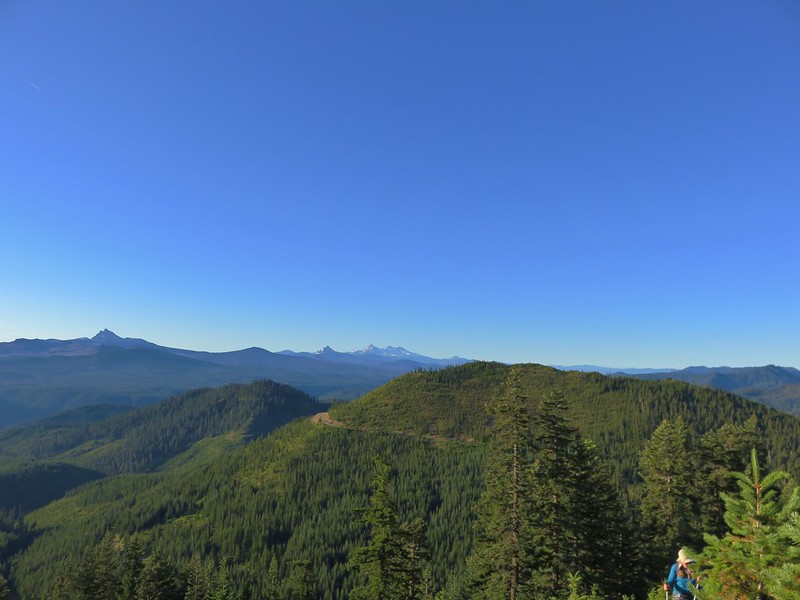
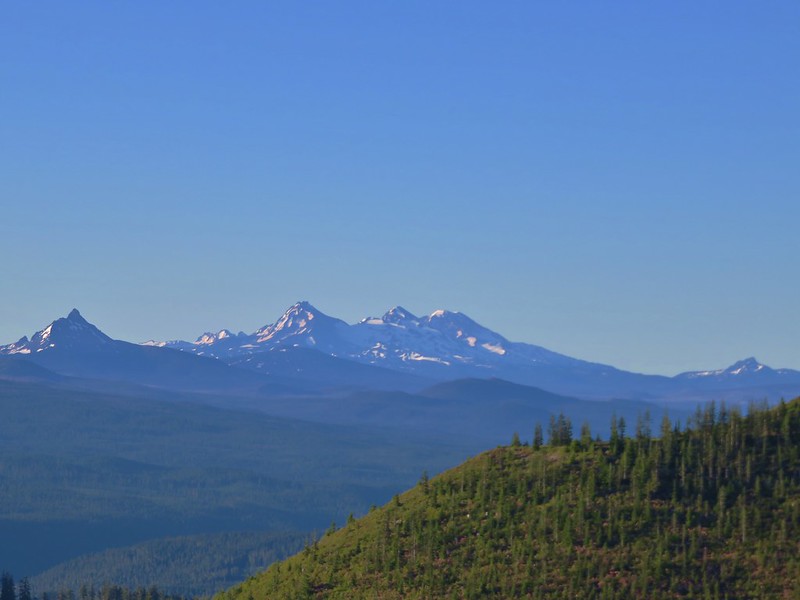
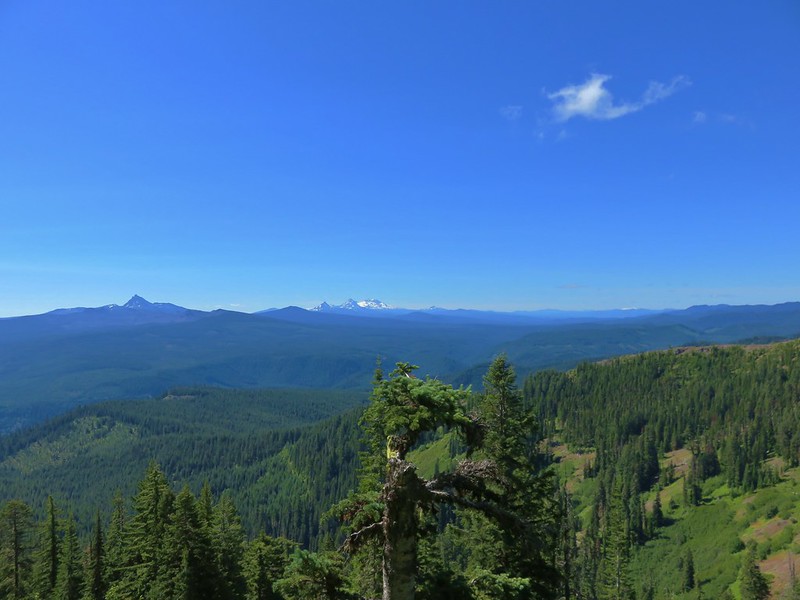
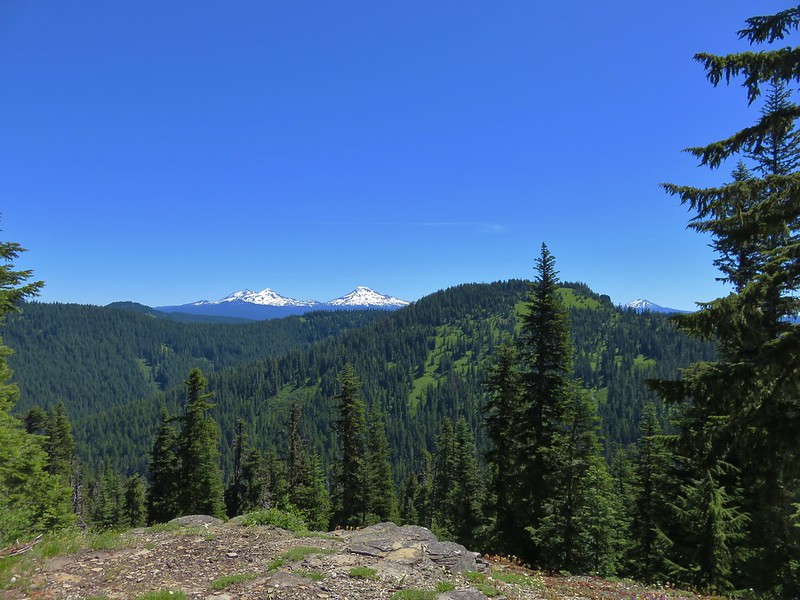
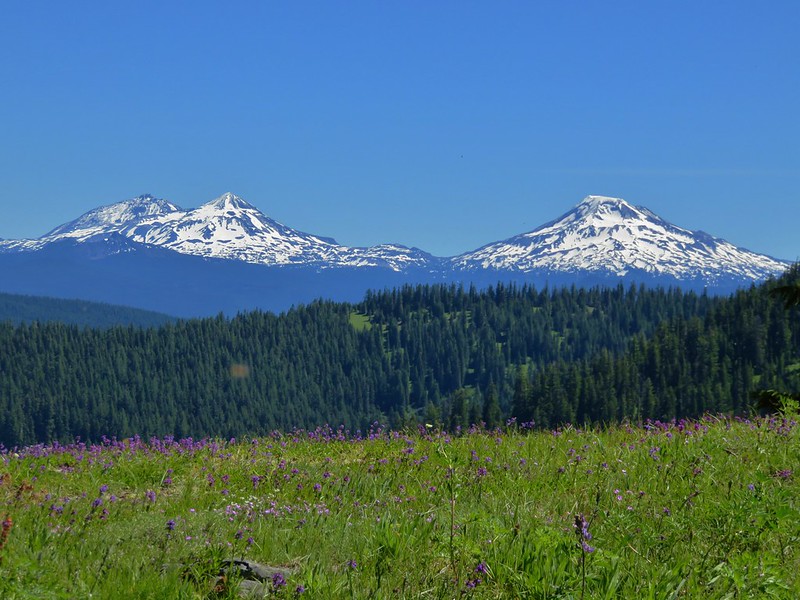
Several other Cascade peaks were visible from the ridge.
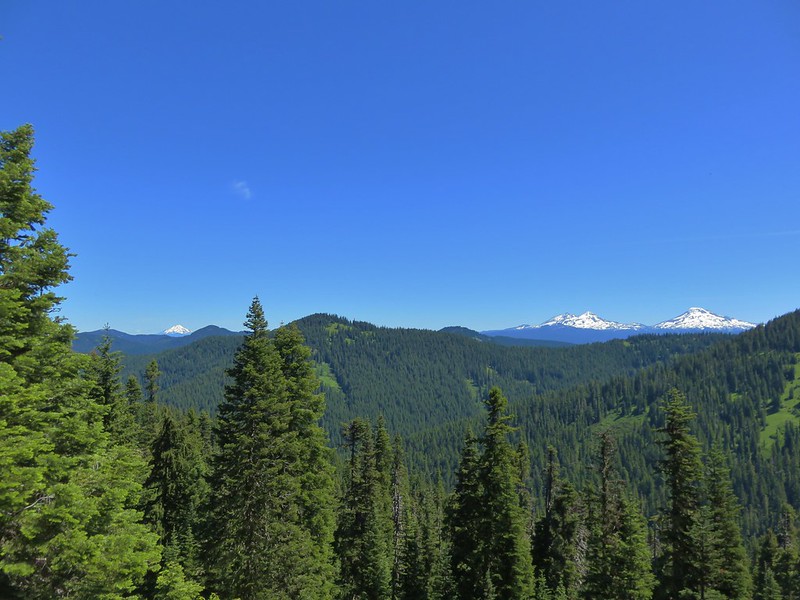
Mt. St. Helens, Mt. Rainier, and Mt. Adams to the north.
IMG_8854

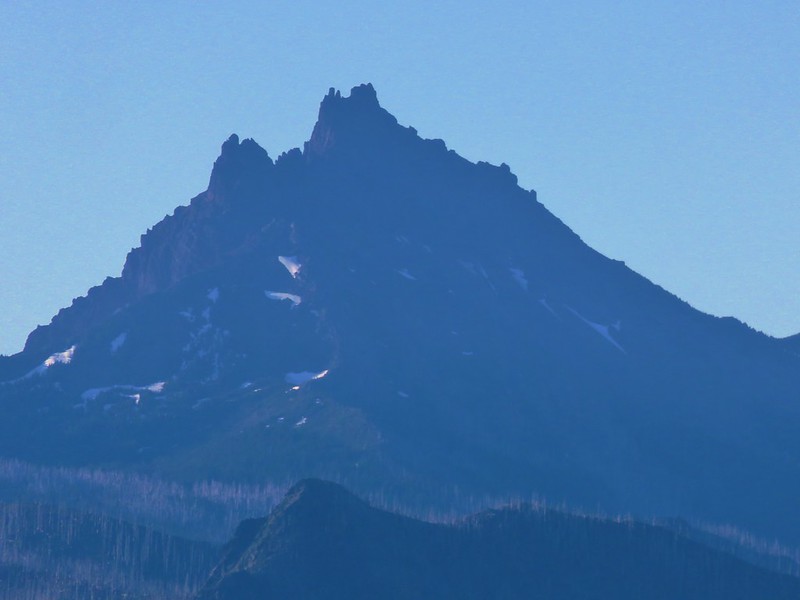
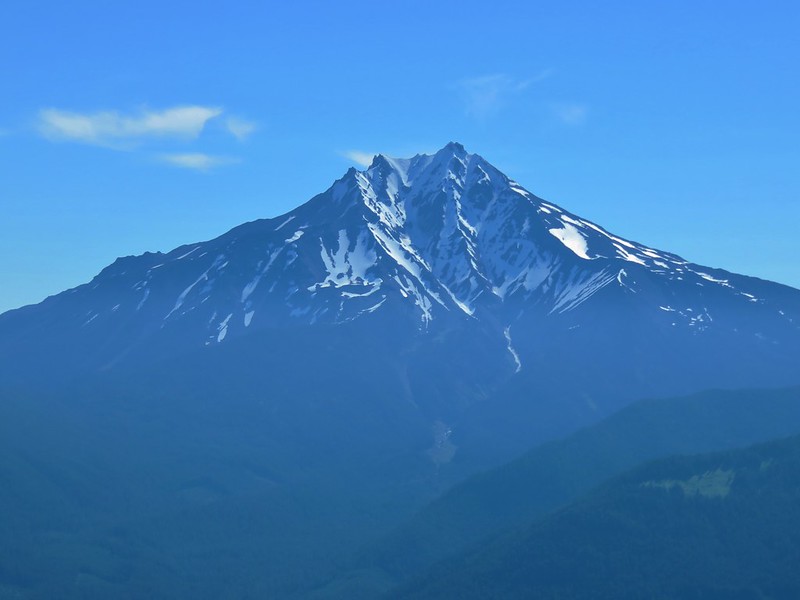
Mt. Jefferson and Three Fingered Jack to the south.
IMG_8857

I left Heather at the summit and headed down into the meadow on the opposite side of the summit. The flowers seemed to be a little behind so I turned around after getting a few pictures including the obligatory Burnt Lake shot.
IMG_8866

IMG_8868

Burnt Lake below Mt. Hood
IMG_8861

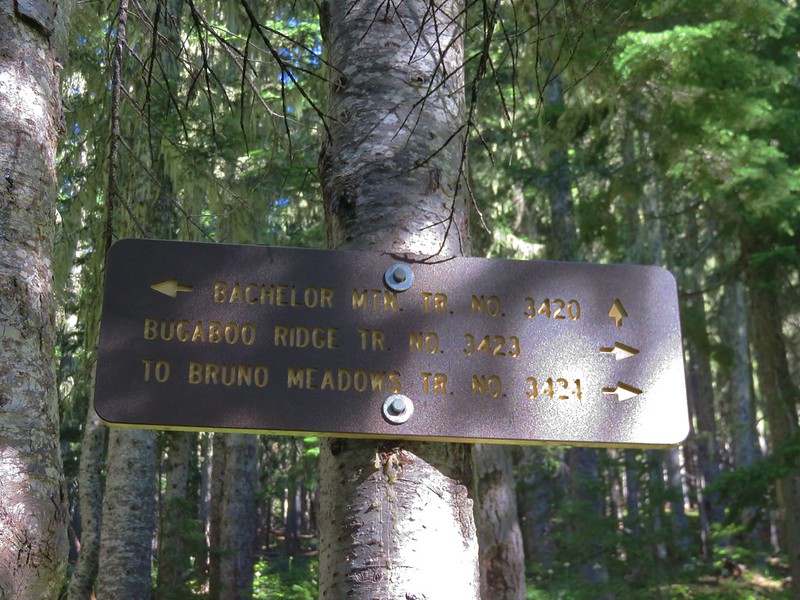
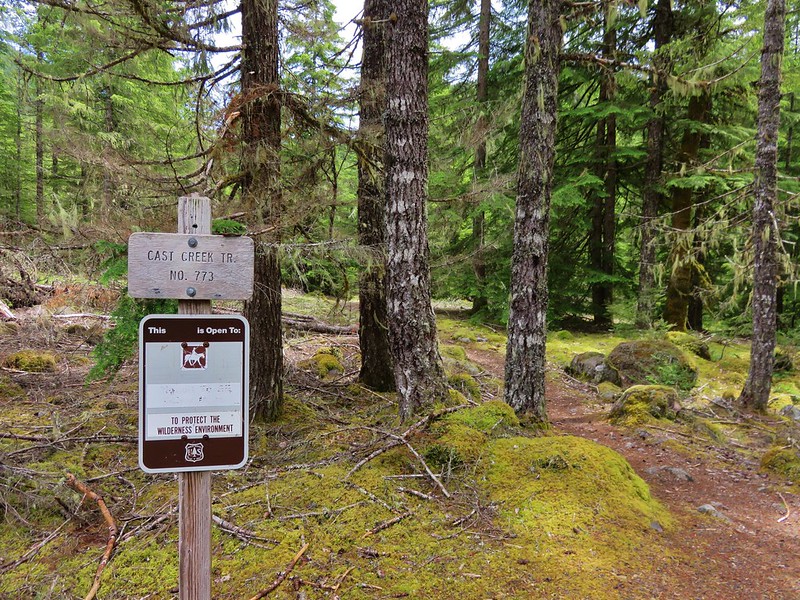
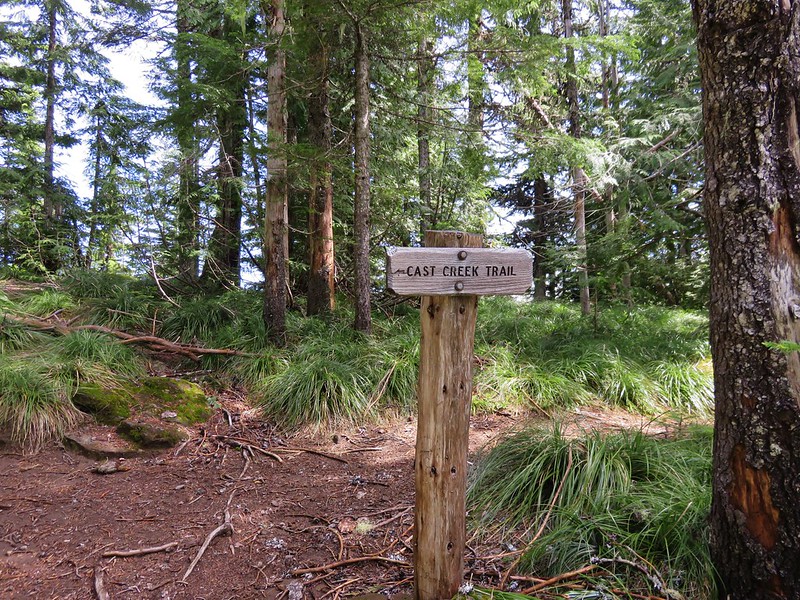
I returned to the summit and we headed back to the Cast Creek Trail. We had accidentally taken this trail in 2012 mistaking it for the Cast Lake Trail (we obviously didn’t read the sign well). The Cast Creek Trail begins with a little climb past some decent viewpoints before beginning its decent into the forest.
IMG_8879

Mt. Hood

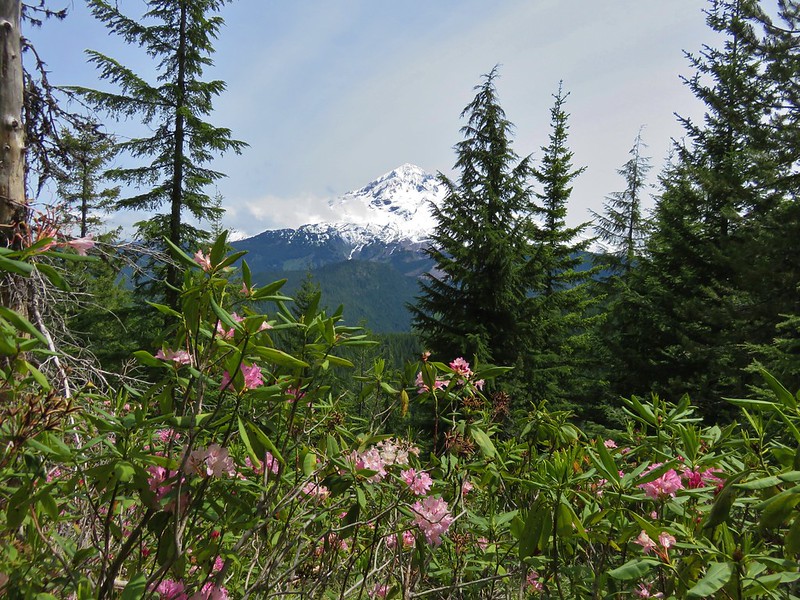
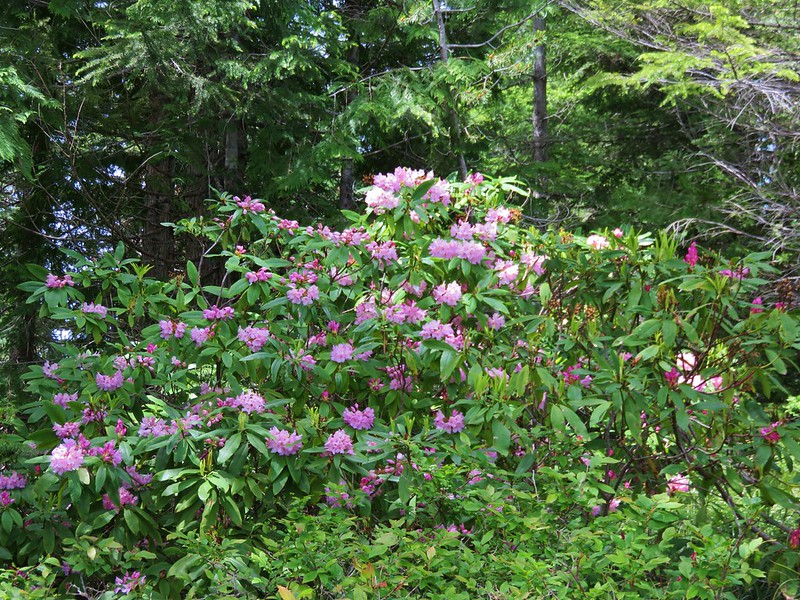
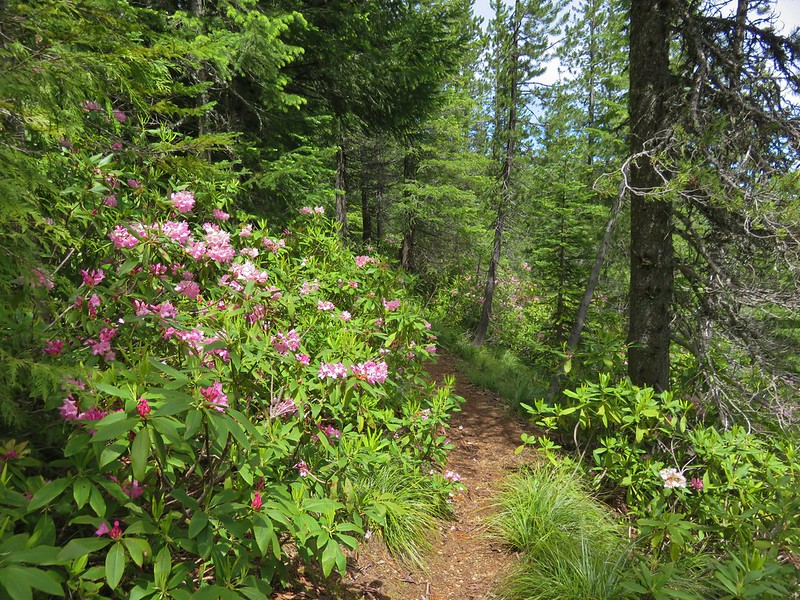
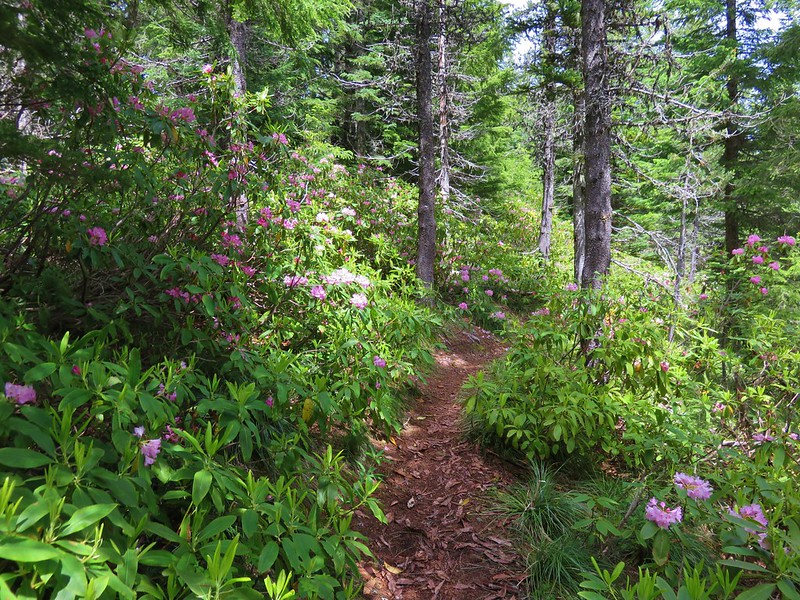
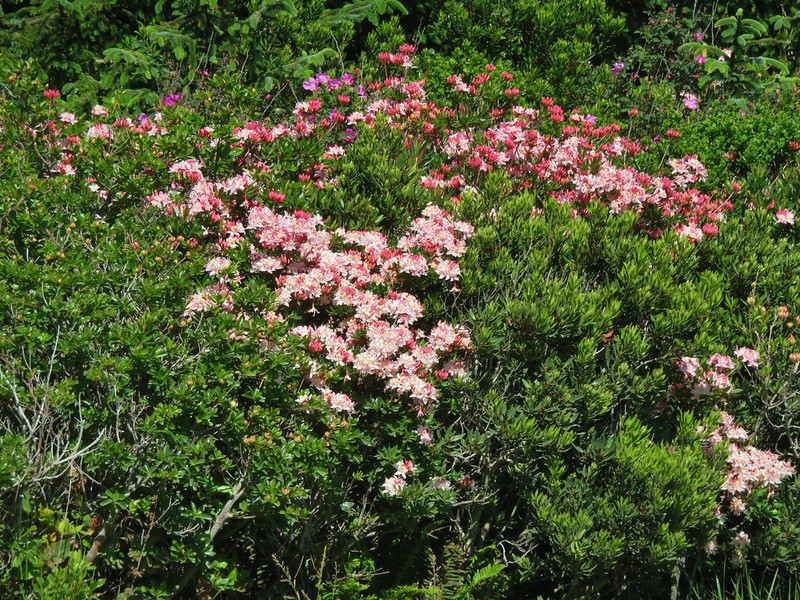
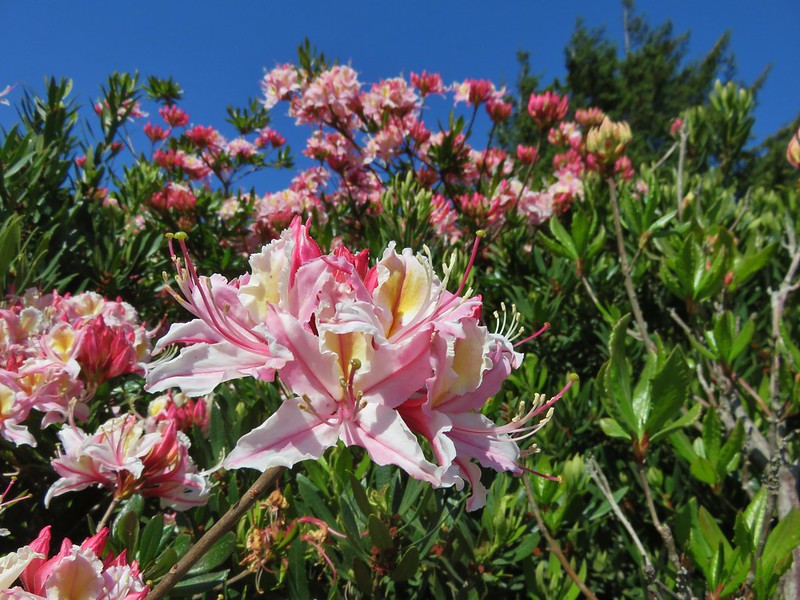
The rhododendron bloom along the upper portion of the trail was one of the best we’ve witnessed.
IMG_8876

IMG_8882

IMG_8886

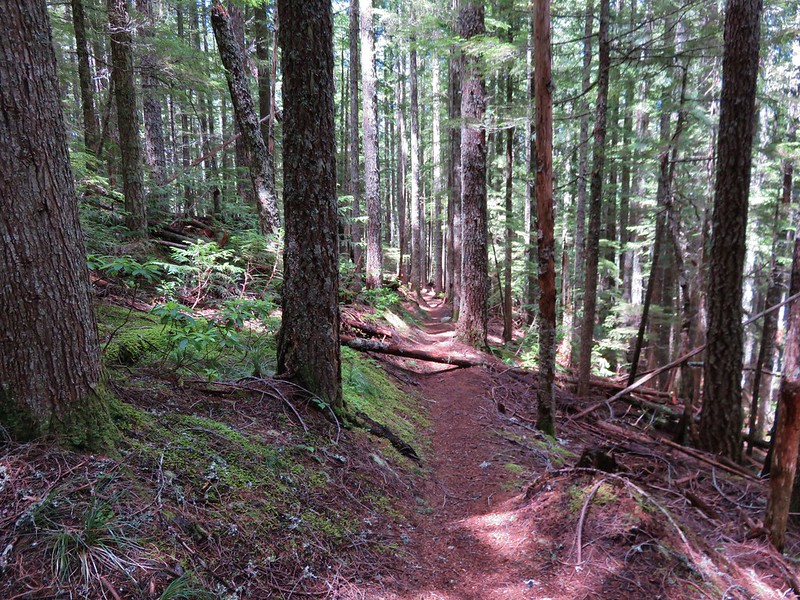
The forest along the Cast Creek Trail was quite different from what we had encountered coming up on the Horseshoe Ridge Trail. There was much less underbrush leaving the forest with a more open feeling.
IMG_8890

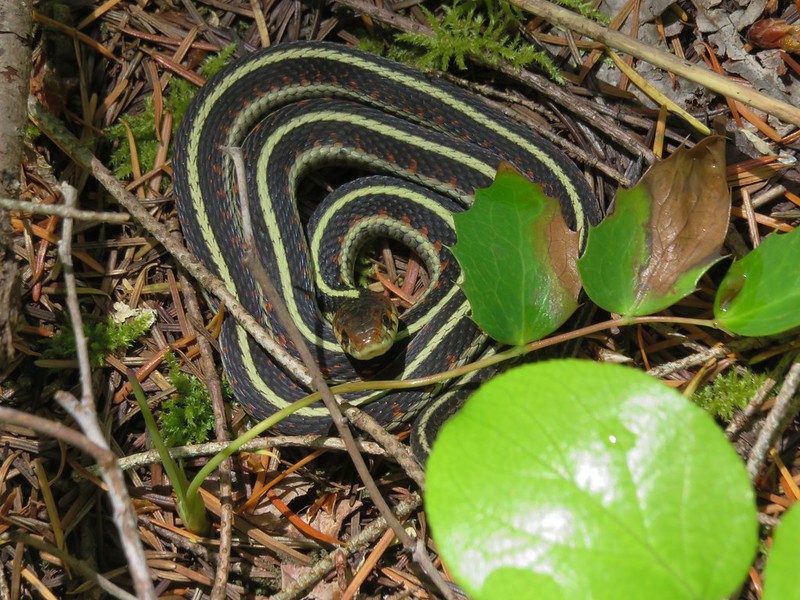
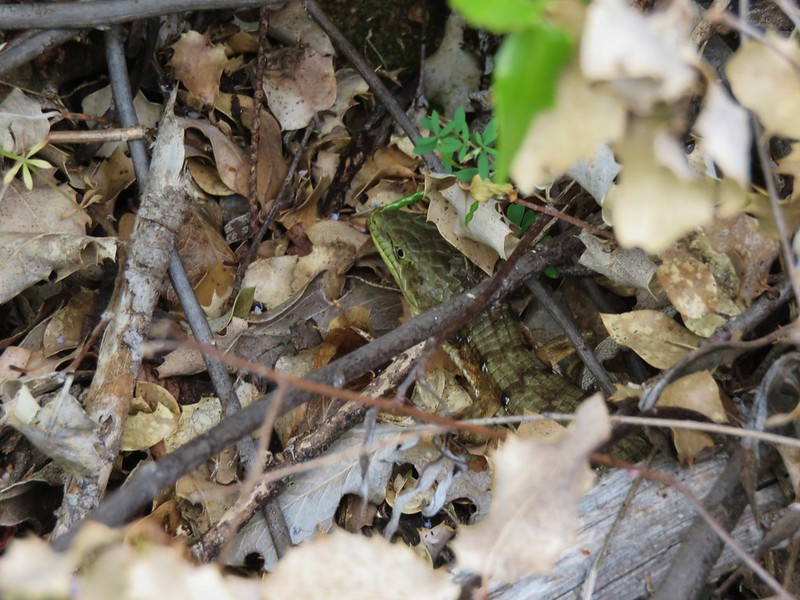
We kept expecting to see a deer or other larger animal below us through the trees but we never did. What we did see was a garter snake enjoying a patch of sunshine along the trail.
IMG_8894

IMG_8892

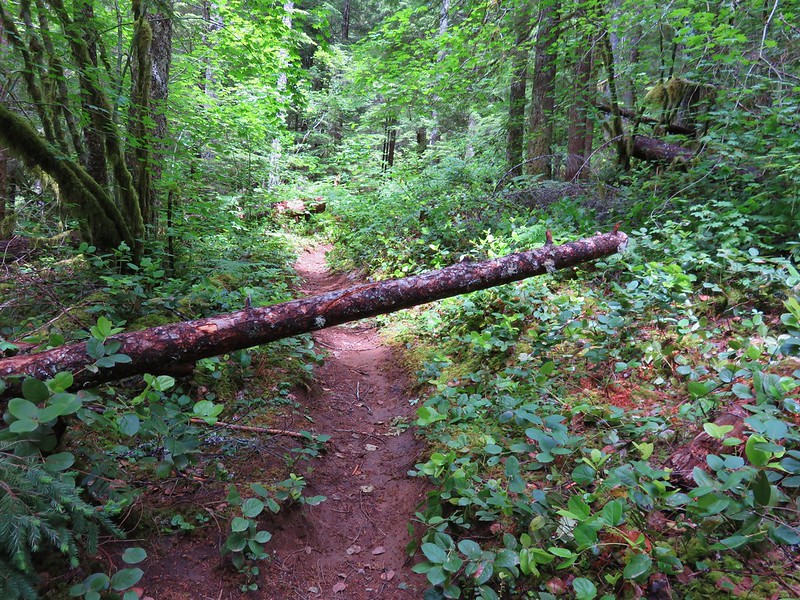
According the the Forest Service website neither the Cast Creek nor the Horseshoe Ridge Trail had been maintained since 2014 but they were both in pretty good shape. There were a few downed trees but nothing difficult to maneuver around. We did see one sign of more recent maintenance on the lower portion of the Cast Creek Trail which left us scratching our heads. A small tree had come down across the trail. The top end of the tree had been sawed off, but not the portion that was across the trail. There was a saw mark along the trunk where someone had started a second cut to remove the portion of tree hanging over the trail, but they hadn’t finished it for some reason.
IMG_8917

The Cast Creek Trail ended at a day use area at the far end of Riley Horse Camp.
IMG_8920

We had intended to park here, but failed to find it due to a lack of signage and having turned out of the horse camp before going all the way to the end.
We walked through the horse camp to the road then continued a tenth of a mile back to our car. Both of our GPS devices had the hike at a little over 16 miles which made it pretty long for a day hike, but spending the night at Cast Lake would make it a nice overnight trip. Happy Trails!

Flickr: https://www.flickr.com/photos/9319235@N02/albums/72157669434295252

Categories
Hiking Middle Santiam Old Cascades Oregon Trip report

Cascadia State Park and Rooster Rock

Once again we found ourselves rearranging our scheduled hikes after we had to cancel a planned visit to Central Oregon. We needed to stay home and finish giving our cat Buddy medication after he had a tooth extraction. We settled on a pair of hikes along Highway 20 east of Sweet Home, OR beginning at Cascadia State Park.

Cascadia State Park is less than 15 miles from Sweet Home and offers one year round picnic area and a camground, group tent site, and a second picnic area open from May 1st – September 30th. It also offers some short hiking trails which is what prompted our visit. After turning into the park and crossing the South Santiam River we parked at the west picnic area. The first trail we set our sights on was the Soda Creek Falls Trail. This trail began from the road to the group camps and day use area just before it crossed Soda Creek.
Soda Creek Falls Trailhead

The trail was a bit muddy in spots as it followed the creek up to the falls. The falls were set in a scenic canyon tumbling over and down basalt.
Soda Creek Falls

An easy path went down to the base of the falls and the low volume of water made it possible to walk right up to them.
Soda Creek Falls

Soda Creek Falls

We returned to where we had parked and walked across the entrance road to a sign for the Soda Springs Trail.
Soda Springs Trail - Cascadia State Park

This trail led down to a footbridge over Soda Creek and then on to Soda Springs.
Trail down to Soda Springs

Soda Springs

We followed the trail up from the spring site and then took a right hand path down some stairs to the South Santiam River.
Stairs in Cascadia State Park down to the South Santiam River

South Santiam River

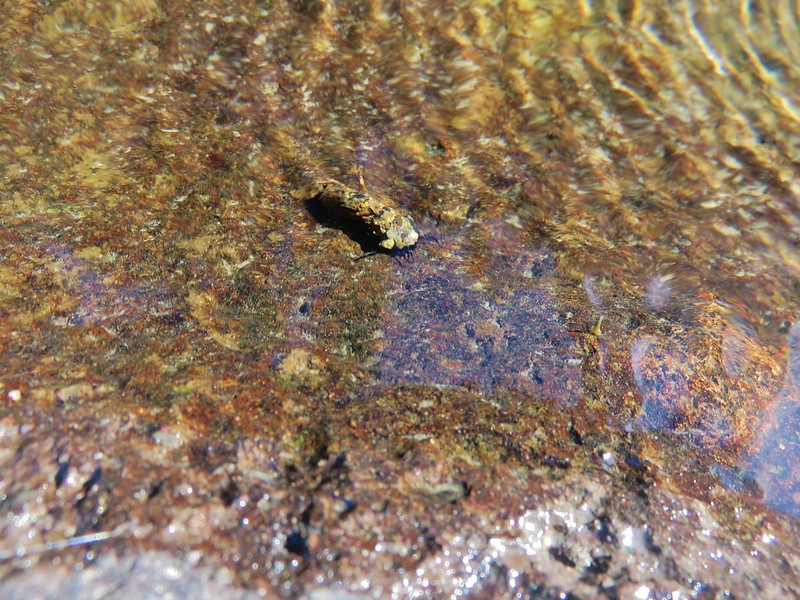
We spent some time exploring on the exposed river rock where we spotted some aquatic bugs and small minnows.
South Santiam River

Bug in the South Santiam River

Minnows in the South Santiam River

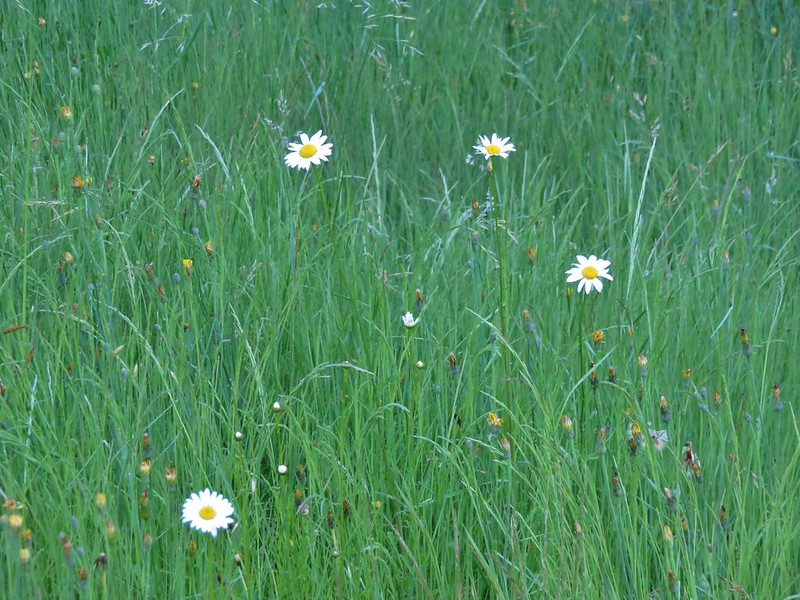
After climbing back up from the river we continued through the east picnic area and walked along a service road which passed through a large meadow with a few flowers.
Daisies in Cascadia State Park

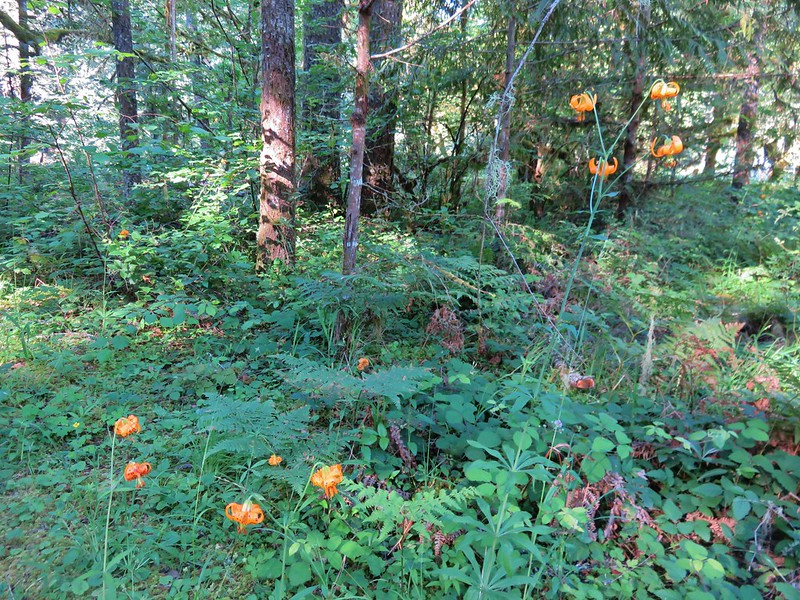
At the far end of the meadow we left the service road and passed through an off-leash area for pets where we found lots of tiger lilies.
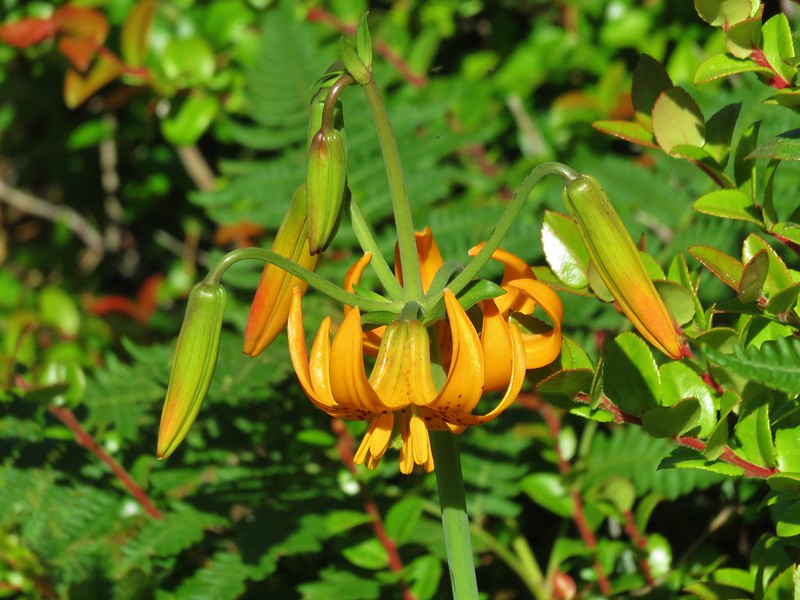
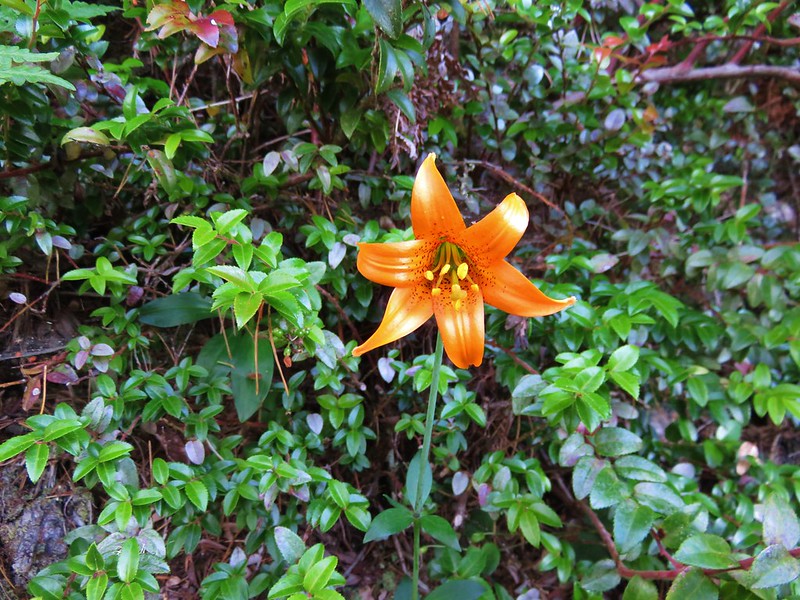
Tiger lilies

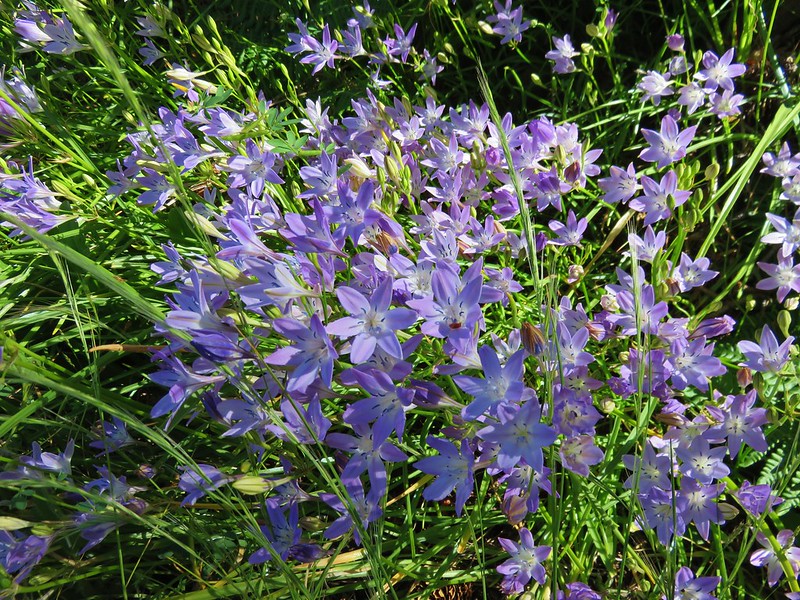
From the off-leash area we picked up the River Trail which began at the group camp parking lot and led east along the South Santiam River. We took a couple of side trails, one to a meadow of plectritis and a second down to the river.
Plectritis along the South Santiam River

South Santiam River

Although there were no signs posted the trail eventually left the State Park and passed onto private land at the start of a series of bends in the path. We turned around here and headed back to the west picnic area and our car.

From Cascadia State Park we drove another 7 miles east to a pullout across from Trout Creek Campground. A pair of trails began here, the short Walton Ranch Interpretive Trail and the more strenuous Trout Creek Trail.
Walton Ranch Interpretive Trail Trailhead

Trout Creek Trail Trailhead

We began with the Walton Ranch Trail which crossed Trout Creek and climbed a little over a quarter mile to a viewing platform. From Winter to early Spring an elk herd winters in the meadow across Highway 20 from the platform but being June the only things we spotted were flowers.
Trout Creek

Interpretive sign along the Walton Ranch Interpretive Trail

Walton Ranch meadow

It was now time for the most difficult hike of our day. The Trout Creek Trail gains approximately 2400′ in 3.4 miles to the site of two former cabins near Rooster Rock in the Menagerie Wilderness. The wilderness contains several large rock pinnacles/formations which are volcanic in origin and popular with rock climbers.

To be honest this was a hike that had not been high on our list to do. Although it was included in all our guidebooks for the area none of them seemed to be all that enamored with this hike. It was described as being “short on highlights”, “a good conditioning hike”, and “the least interesting hike in the Old Cascades”. Having low expectations may have been a good thing in the end because we wound up enjoying the hike even though it did suffer from a lack of highlights, and it was quite a workout.

The trail climbed steadily the entire time. It was never overly steep but it was relentless and it never left the forest so there were no good views along the way. There were also no creeks or streams to cross along the route.
Trout Creek Trail

Trout Creek Trail - Menagerie Wilderness

Best view of Rooster Rock from the Trout Creek Trail
Rooster Rock from the Trout Creek Trail

There were a few flowers including lots of candy sticks along the way and some ripe red huckleberries too.
Madia
Madia

Rhododendron and huckleberries
Rhododendron and red huckleberries

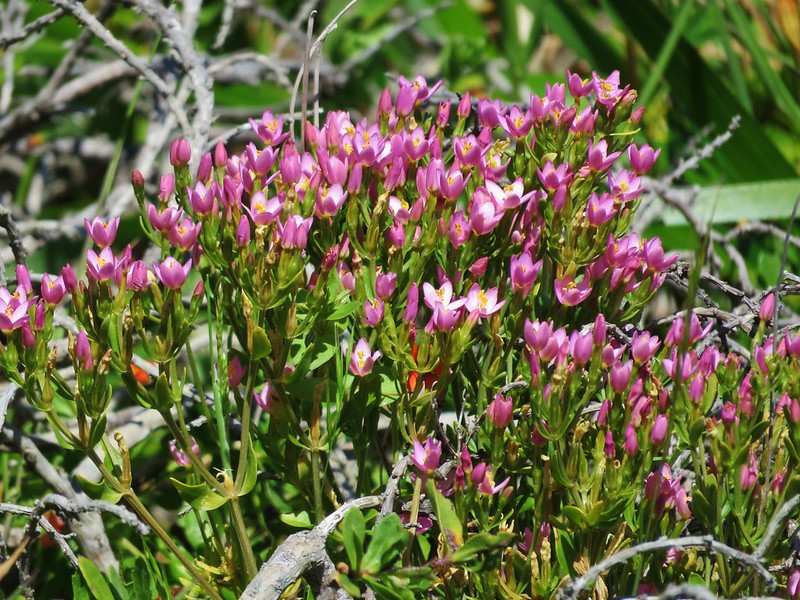
Candy sticks
Candy sticks

Candy sticks

Candy sticks

There was effectively no view of Rooster Rock at Rooster Rock. A large boulder sat at its base and trees hid the rock.
Boulder near Rooster Rock

Rooster Rock from below

Rooster Rock behind a tree

We continued uphill from Rooster Rock forking right to the site of the former cabins that were used by the lookouts who staffed a lookout that had sat atop Rooster Rock once upon a time. The view from the former cabin site was better than we had expected. Rooster Rock was still out of view, but the view east extended up the South Santiam River canyon to the snowy peaks of North and Middle Sister.
North and Middle Sister from the former lookout site near Rooster Rock

North and Middle Sister from the former lookout site near Rooster Rock

Other familiar peaks included Cone Peak and Iron Mountain.
Cone Peak and Iron Mountain from the former lookout site near Rooster Rock

The rocks around the viewpoint were dotted with purple penstemon and yellow stonecrop.
Penstemon

Penstemon

From the cabin site a climbers trail continued deeper into the Menagerie Wilderness. The climbers trail would have eventually taken us to a forest service road on the north side of the wilderness and made it possible to visit Panorama Point, a viewpoint atop a large rock cliff. To get there the trail passes through a section of the wilderness that is closed annually from 1/15 – 7/31 to protect endangered species so we only went a little ways further into the wilderness in an attempt to find a better view of some of the other rock features. We turned around at some pink flagging that was in the area of the closure never having found a decent view. Panorama Point was visible for a moment through some trees as was another odd shaped pinnacle.
Panorama Point

Panorama Point

Rock pinnacle in the Menagerie Wilderness

Rock pinnacle in the Menagerie Wilderness

Heather did manage to find a spur trail that led to a view of Rooster Rock and to the west toward the Willamette Valley.
Rooster Rock from a viewpoint in the Menagerie Wilderness

Rooster Rock from a viewpoint in the Menagerie Wilderness

Looking west from a viewpoint in the Menagerie Wilderness

She also spotted the summit of South Sister barely rising above one of the foothills.
The snowy summit of the South Sister

On our way back to the car we were on the lookout for a wilderness sign. As we visit the various wildernesses I try and get a picture of a wilderness sign for each one and I needed one for the Menagerie Wilderness. We had started looking on the way up but not until we were well into the wilderness so as we neared the edge of the area we began looking back at the trees as we passed. We never did see an official sign so I took a picture of the wilderness regulation sheet on the information board at the trailhead instead.
Menagerie Wilderness sign

Someday we may have to try the Rooster Rock Trail (a shorter,steeper approach to Rooster Rock) in hopes that there is a fancier sign along that trail but until then we can at least mark off one more wilderness area we’ve visited. Happy Trails!

Flickr: https://www.flickr.com/photos/9319235@N02/albums/72157669592127776

Categories
Hiking Oregon Oregon Coast Southern Coast Trip report

Samuel H. Boardman State Scenic Corridor North

Saturday we were heading home, but before we headed north we had one more hike to do. We had hiked much of the southern portion of the Samuel H. Boardman State Scenic Corridor on Thursday and now we were going to spend some time in the northern portion.

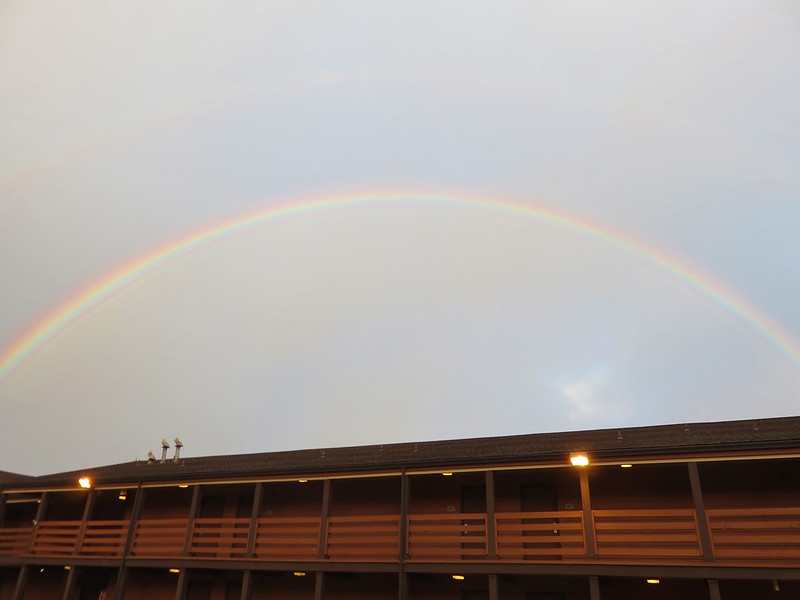
There had been chances of rain for the previous couple of days and this morning we were greeted by a rainbow as we left the hotel.
IMG_7551

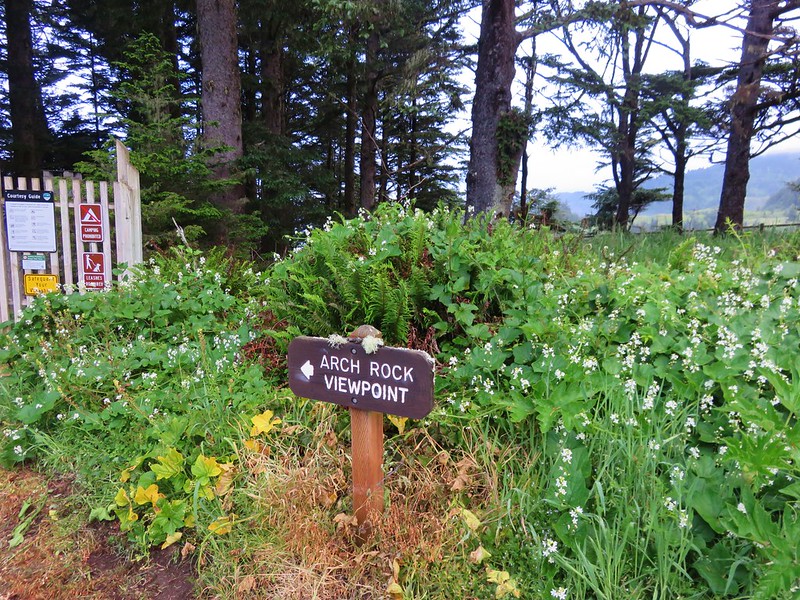
We hadn’t been rained on yet but driving down to the trailhead we were getting rained on pretty good so when we arrived at the Arch Rock Picnic Area we donned our rain gear.
IMG_7554

The rain pants helped keep the moisture that was on the plants at bay, but the jacket wound up being overkill since it never actually rained on us while we were hiking.

A short loop trail from the parking area led past picnic tables to a viewpoint of Arch Rock.
IMG_7555

IMG_7556

IMG_7562

IMG_7566

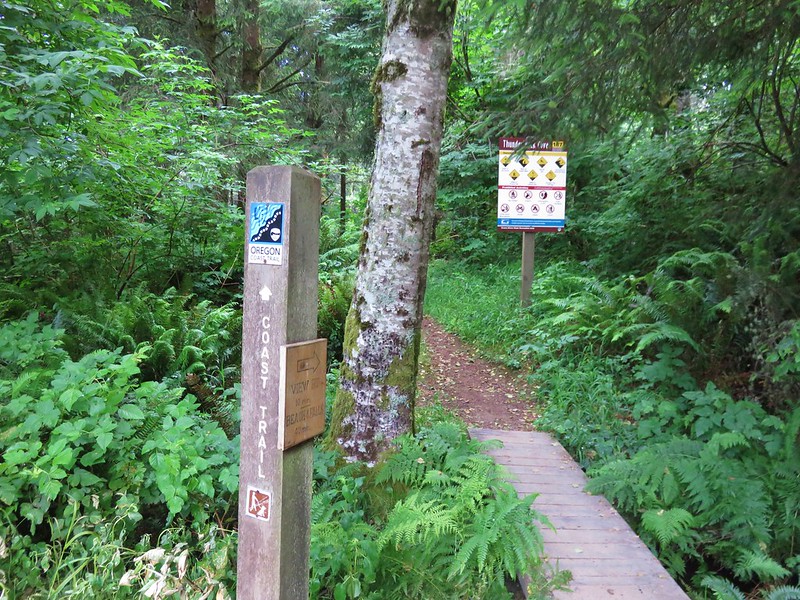
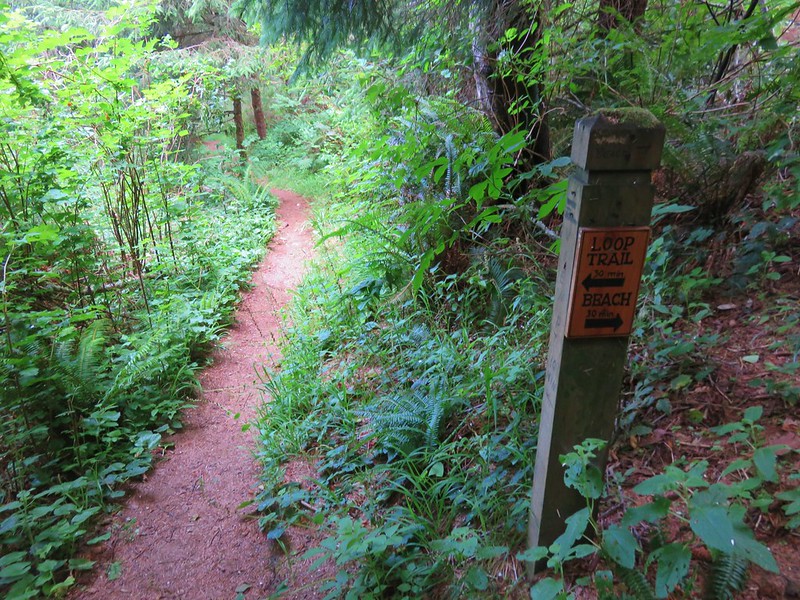
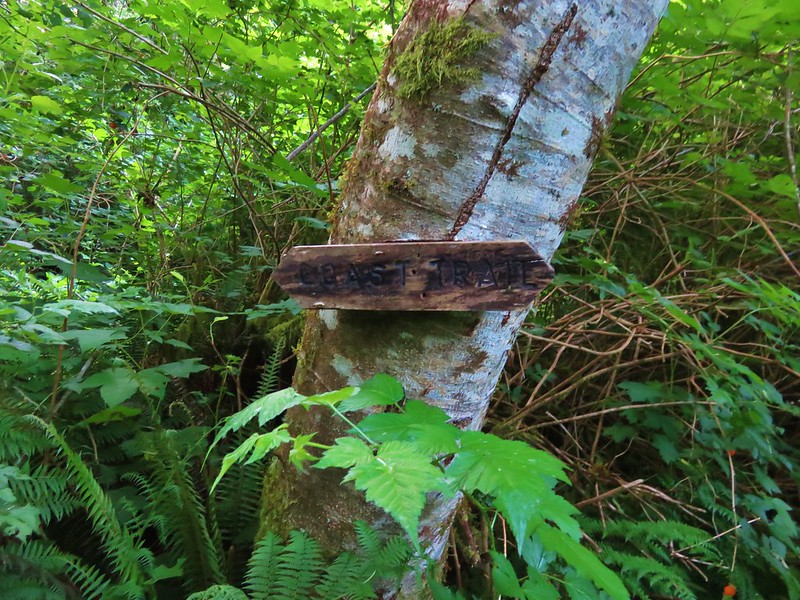
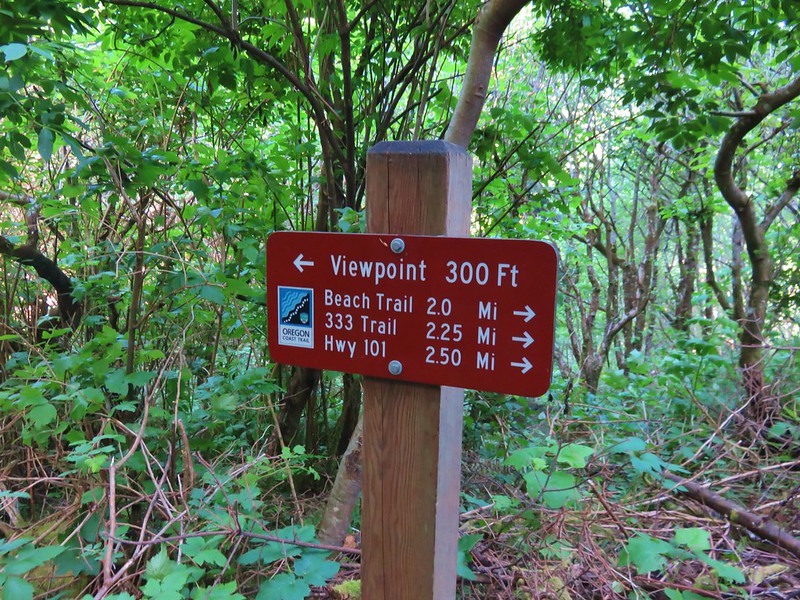
After completing the loop we headed south on the Oregon Coast Trail.
IMG_7567

A short distance from the Arch Rock Picnic Area we came to the Spruce Island Viewpoint parking area.
IMG_7571

IMG_7575

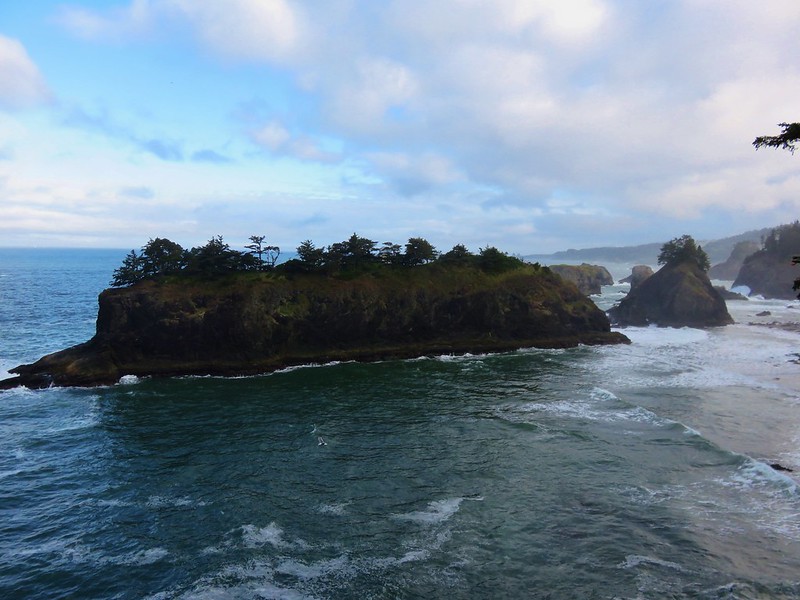
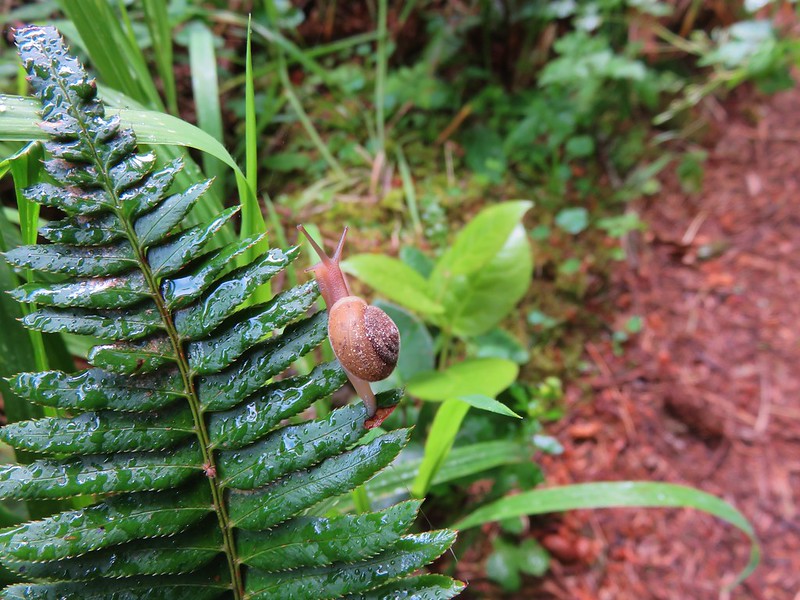
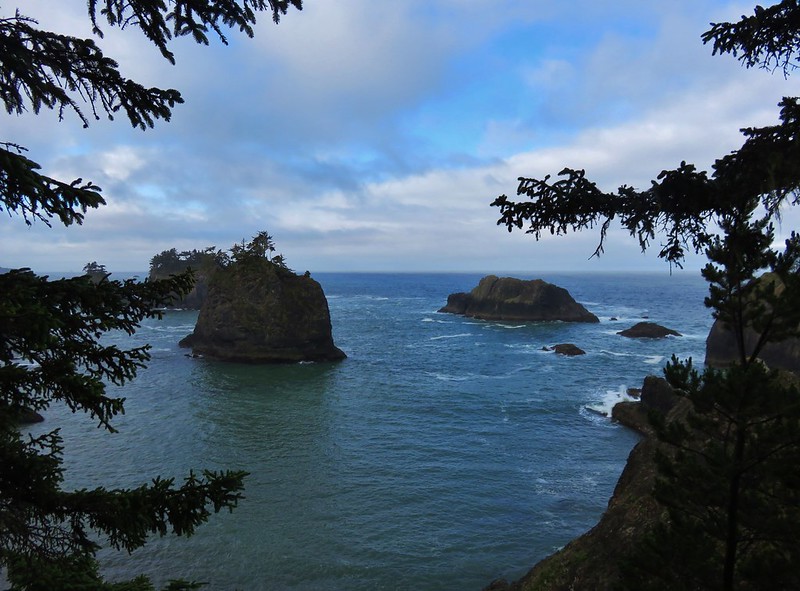
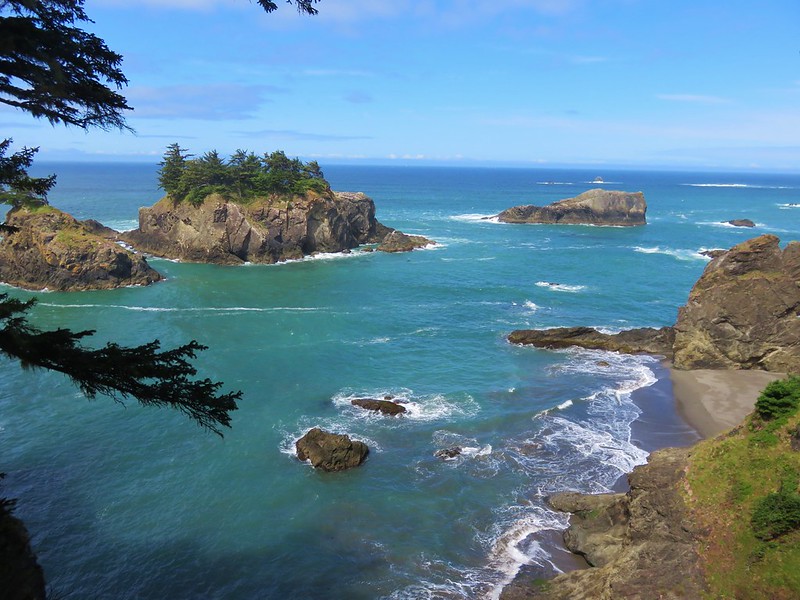
The next marker was supposed to be a pair of viewpoints before reaching Thunder Rock Cove. We arrived at a first viewpoint along with a small snail.
IMG_7589

IMG_7591

IMG_7594

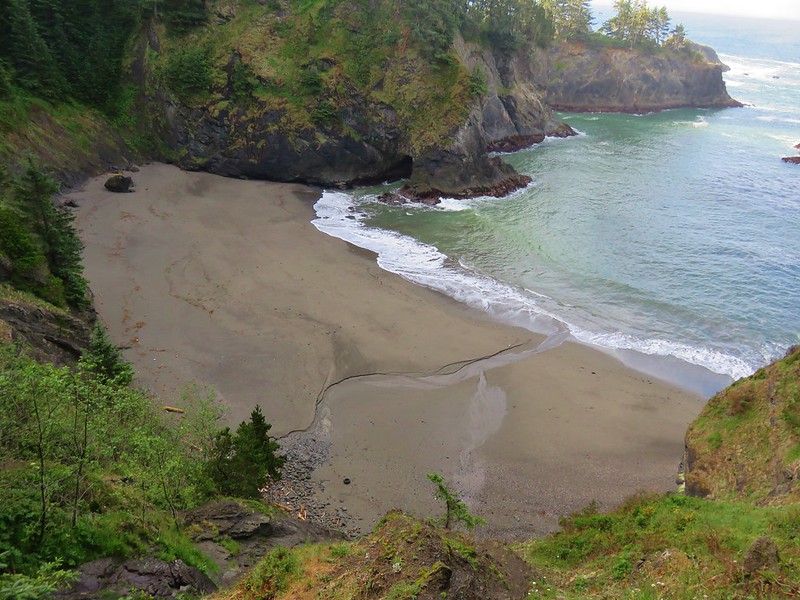
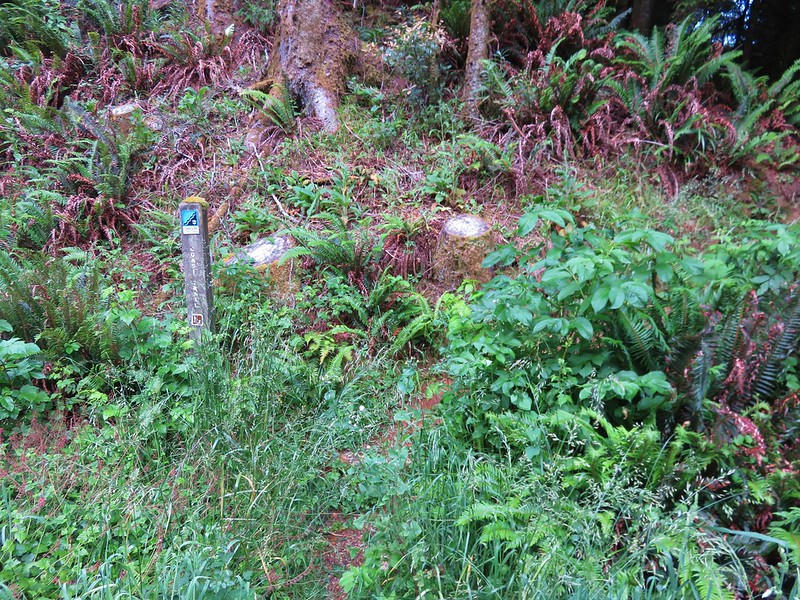
We got ourselves confused here when we came to a junction with a wide path coming downhill from our left. A gentleman was doing trail maintenance on that section. We had spoken to him on Thursday during our other visit to the park and just assumed that he was working on the trail we wanted to take. We ignored the trail that appeared to be leading down to the little beach we had seen from the viewpoint thinking it was just a way down to the ocean. We followed the wide path up to an unsigned parking area.

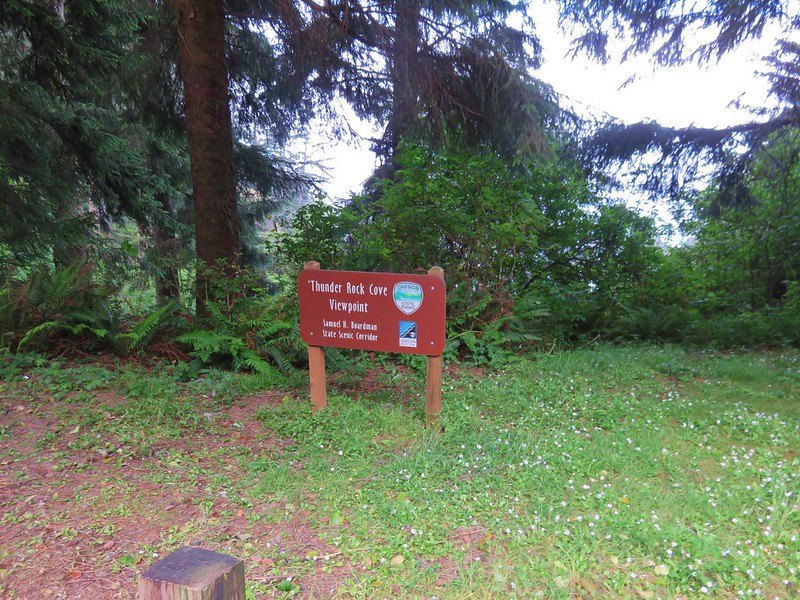
The problem was no visible trail continued south from there. We thought that the trail might follow the road for a bit as it would do a little further along so we began walking along Highway 101 looking for some sign of the Oregon Coast Trail. It wasn’t until we reached the Thunder Rock Cove Viewpoint Parking area that we picked up the trail again.
IMG_7599

IMG_7600

We should have gone right down to the beach instead of uphill at the previous junction but we were back on the trail now and after a short climb around a hill we arrived at another parking area. This one was for the Natural Bridges Viewpoint.
IMG_7606

IMG_7610

The next 1.1 mile section of trail alternated between grassy meadows along the highway and forest with an occasional viewpoint.
IMG_7613

IMG_7618

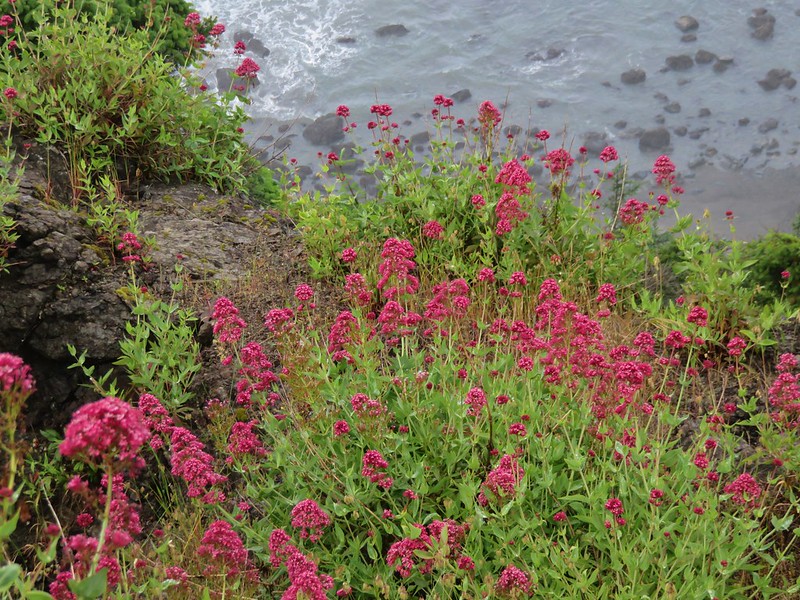
Red valerian
IMG_7623

IMG_7624

IMG_7625

After a short walk along the Highway the trail reappeared heading downhill toward China Beach.
IMG_7627

IMG_7628

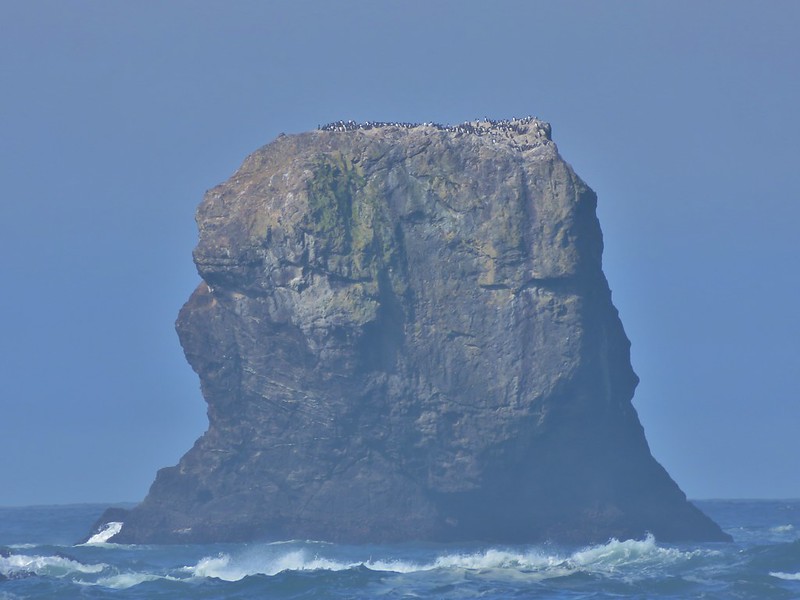
We spent a little time down on this beach. There were plenty of rocks in the water including one tall pillar covered in birds. It was just far enough out that we couldn’t tell what kind of birds they were, just that there was a lot of them.
IMG_7638

IMG_7643

IMG_7649

To continue on the trail we would have needed to follow the beach south around a small headland that was already pressed by the ocean. We didn’t want to get stuck on the far side where we would be forced to walk along the highway to get back, so we stopped here and got ready to head back. On our way back we stopped at a couple of viewpoints we had passed by initially.
IMG_7665

IMG_7670

IMG_7671

IMG_7676

We also managed to stick to the section of Oregon Coast Trail we’d missed when we took the wrong turn earlier near Thunder Rock Cove.
IMG_7683

Along this section we discovered an option for a loop trail to the beach and waterfall.
IMG_7685

The loop trail passed more nice viewpoints before dropping down to a view of the waterfall.
IMG_7695

IMG_7708

IMG_7711

IMG_7714

IMG_7729

IMG_7736

IMG_7739

The trail then climbed up past another stunning viewpoint before returning to the Oregon Coast Trail.
IMG_7741

IMG_7749

We followed the trail back to the Arch Rock Picnic Area ending our vacation hikes. This hike ended up being 9.2 miles according to the GPS bringing our total for the 7 days to 95.2 miles. It had been a great vacation despite being our “Plan B” option. The weather wound up great and the views and wildflowers were spectacular. It was another good reminder of just how much our State has to offer in the way of great hiking. Happy Trails!

Flickr: https://www.flickr.com/photos/9319235@N02/albums/72157668656866396

Categories
Hiking Klamath/Siskiyou Mountains Oregon Oregon Coast Southern Coast Trip report

Illinois River Trail and Indian Sands

Our wildest hike came Friday. We had planned on a 17.2 mile hike along the Illinois River Trail going 8.6 miles to Silver Creek and back. The description in our guidebook said to look out for poison oak and to check for ticks at the end so we were prepared for a bit of an adventure. Our hike began at a trailhead near the end of Oak Flat Road. To get there we took Jerrys Flat Road from Gold Beach 27 miles then turned right on Oak Flat Road road for another 3.1 miles.
IMG_7225

The trail set off through an open forest with lots of yellow and purple wildflowers and some poison oak.
IMG_7242

IMG_7234

IMG_7240

IMG_7241

As we neared our first marker, Nancy Creek, we spotted a pair of deer that had already seen us and were heading back into the forest. Just beyond Nancy Creek we came upon a nice patch of columbine flowers. The only ones we would see during our vacation.
IMG_7247

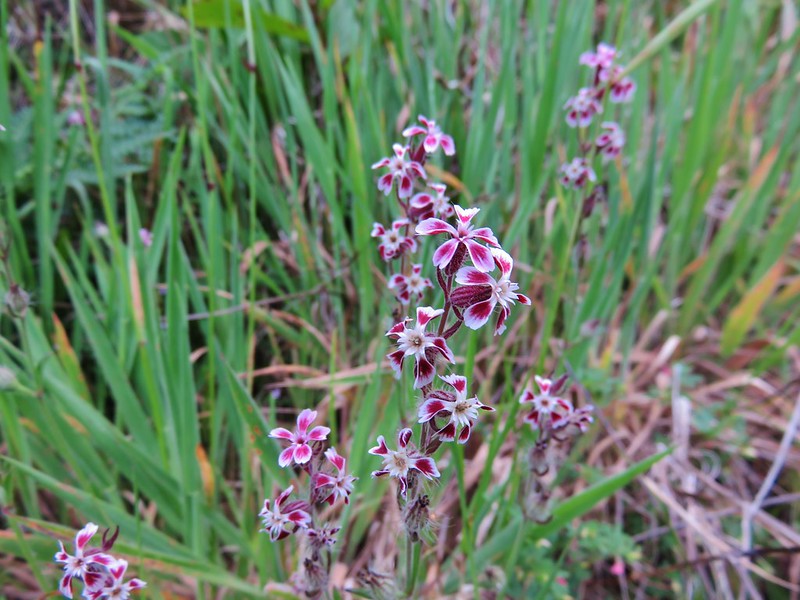
Other flowers here included catchfly and henderson’s stars.
IMG_7251

IMG_7264

The next creek up was Rattlesnake Creek. A short distance before reaching this small stream we spotted a black bear in the woods below the trail. It saw us at about the same time and promptly turned around. For some reason I failed to even reach for the camera as we watched it go back downhill through the trees.

Beyond Rattlesnake Creek the trail entered an area where the trees had been lost to the 2002 Biscuit Fire.
IMG_7279

There continued to be a lot of flowers as well as the occasional patch of poison oak.
Pink honeysuckle
IMG_7284

chaparral false bindweed

Bridges’ brodiaea
Bridges' brodiaea

With the trees mostly burned this section of trail was crowded by brush.
IMG_7286

The amount of poison oak increased in the area of Ethels Creek and we started picking up ticks. Heather was the first to notice. She made an alarmed sound behind me and I turned around to see several ticks climbing up her legs. Looking down at my own I immediately spotted three. We brushed them all off and started to hike again. We had not gone far at all before Heather exclaimed again. We both had multiple ticks on our legs again. This had gone on for about a mile when we reached the Buzzards Roost, a rocky outcrop, at the 2.5 mile mark of our hike.
IMG_7311

A short scramble path went out onto the Buzzards Roost but we could see poison oak along that path and were too preoccupied with looking for and knocking off any additional ticks. We were discussing what to do as the number of ticks that we’d already brushed off was more than we could have imagined and it was giving us the willies. Things didn’t get any better when one of my trekking poles slid off the log I had propped it on. I had made the mistake of leaning it on the log without checking the area around the log. We watched it fall and bounce on some little poison oak plants. We used some wipes to pick it up (along with yet another tick) and then wiped it down as best as we could. I had also left my gloves in the car which would have come in handy since it was the grip that had made contact with the poison oak.

After a thorough cleaning we decided to at least try and go another 2 miles to Indian Flat and Indigo Creek and see if the tick and poison oak situation got any better.

It did improve some beyond the Buzzards Roost where the trail had rounded the hillside and was now on the southern facing slope which was drier with less brush crowding the trail. The flower display along this section was impressive.
Henderson’s Stars
IMG_7314

IMG_7318

Silver puff
IMG_7320

Paintbrush
IMG_7325

Blue gilia in the foreground
IMG_7329

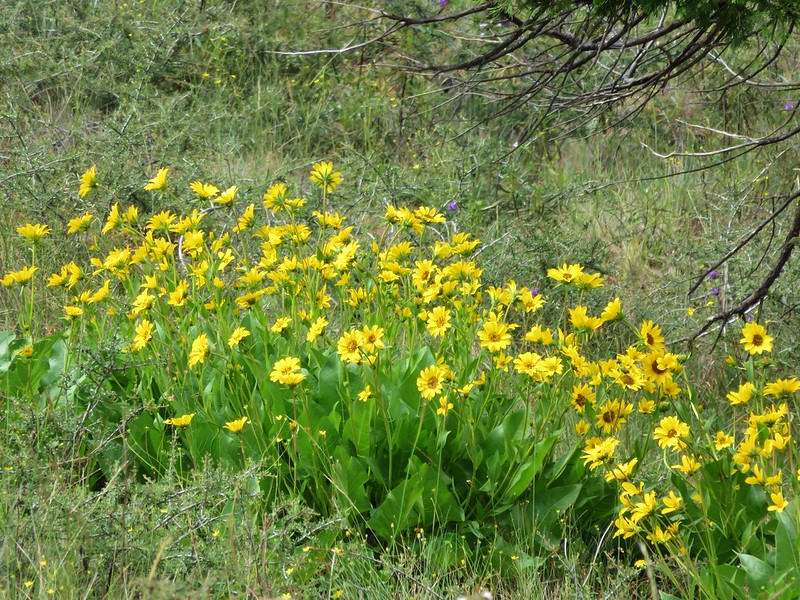
Balsamroot
IMG_7332

Mariposa lily
IMG_7333

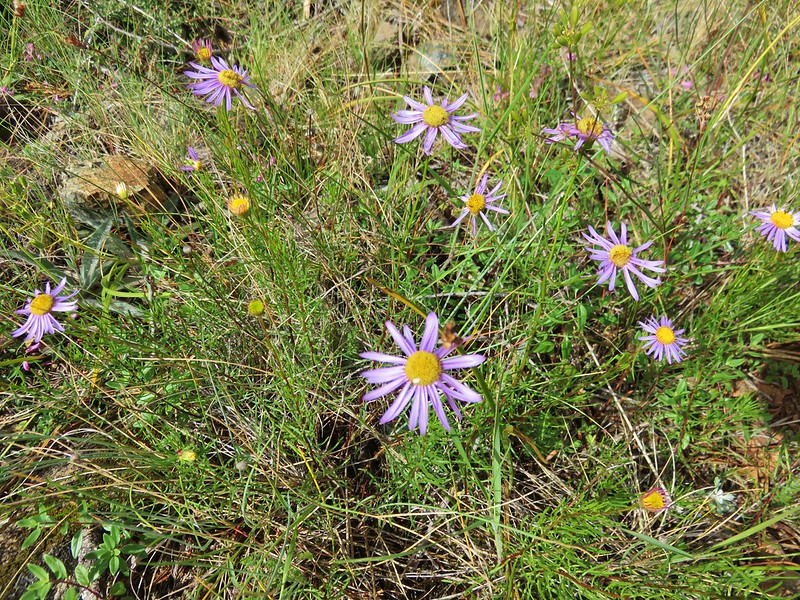
Fleabane
IMG_7344

Madia
IMG_7357

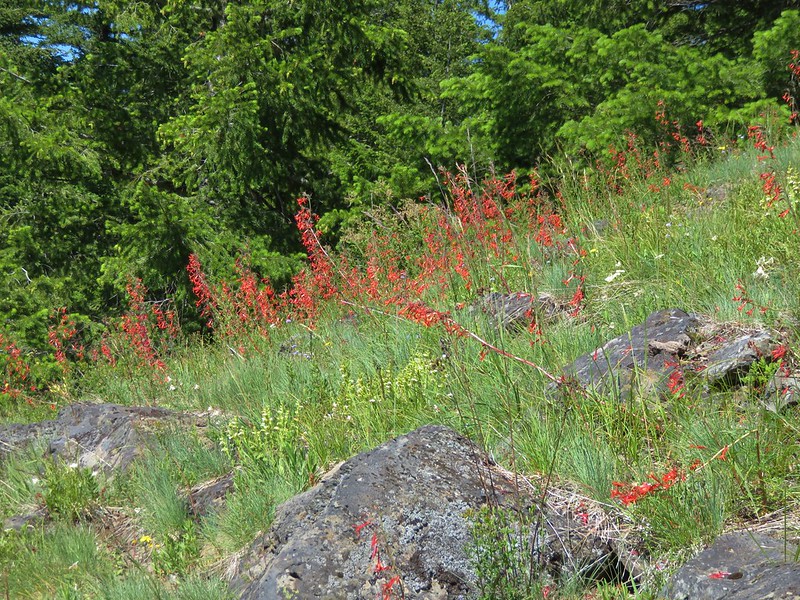
Penstemon
IMG_7428

Narrowleaf blue eyed mary
IMG_7429

California lady-slippers
IMG_7373

Western wallflower
IMG_7377

Ookow
IMG_7437

About 1.7 miles from the Buzzards Roost an old roadbed split off to the left. This led .2 miles to the meadow at Indian Flat.
IMG_7380

IMG_7389

IMG_7388

IMG_7391

IMG_7392

We continued on the Illinois River Trail and descended to the bridge across the lovely Indigo Creek.
IMG_7399

IMG_7405

IMG_7408

IMG_7411

On the far side of the creek we stopped to do a more intensive tick check. There were just a couple of stragglers to knock off and we decided to try and continue at least another .7 miles to Fantz Ranch. The trail began to climb uphill to reach a saddle above the ranch. As we climbed the switchbacks the amount of poison oak began to increase again. When it appeared that there was going to be no way past one patch without going through it we finally gave in and decided to call it. We’d made it a little over 5 miles and had seen a lot of neat stuff despite everything.

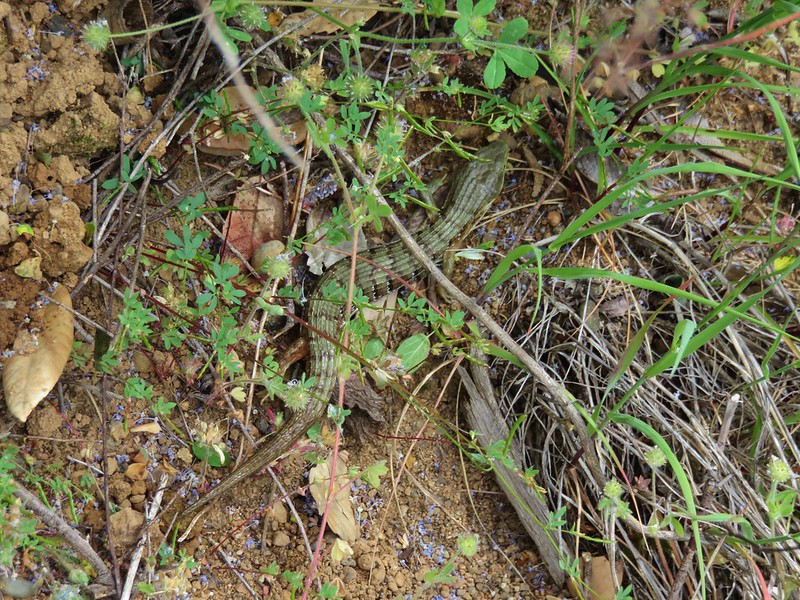
As we made our way back we stopped regularly to brush off the inevitable ticks. There were other more enjoyable critters out along the trail as well including a large number of alligator lizards. We hoped that they were filling up on the little blood suckers. 🙂
IMG_7435

IMG_7448

IMG_7451

IMG_7458

IMG_7397

IMG_7474

Back at the trailhead we wiped everything down in an attempt to remove an urushiol we might have picked up from contact with poison oak and did a final tick check before heading back to Gold Beach. We stopped by our room to shower and soak in the hot tub to try and relax.

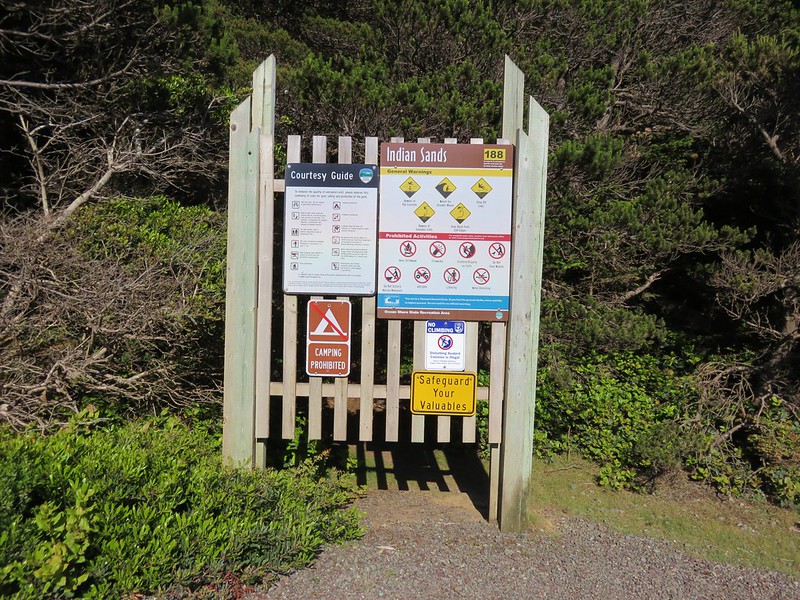
We decided that since we had cut our hike short we should go back out in the evening to check out Indian Sands in the Samuel H. Boardman State Scenic Corridor. We had not gone that far on Thursday when we were hiking in the southern portion of the park so we drove back down and parked at the Indian Sands pullout.
IMG_7478

We set off on the wide Oregon Coast Trail.
IMG_7479

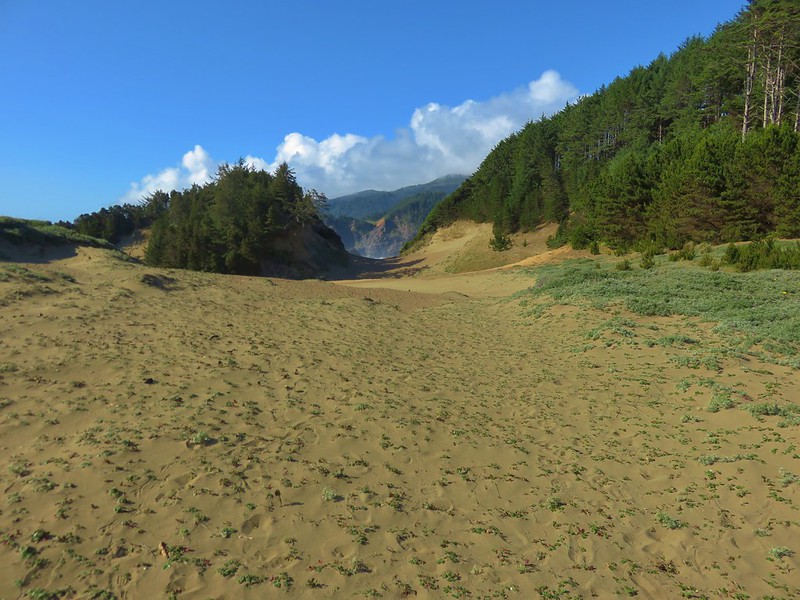
A confusion of paths led off toward the ocean and the dunes of Indian Sands from the trail. We weren’t sure which was the “correct” one but we just kept heading toward the Pacific until we could see sand and then headed for that.
IMG_7482

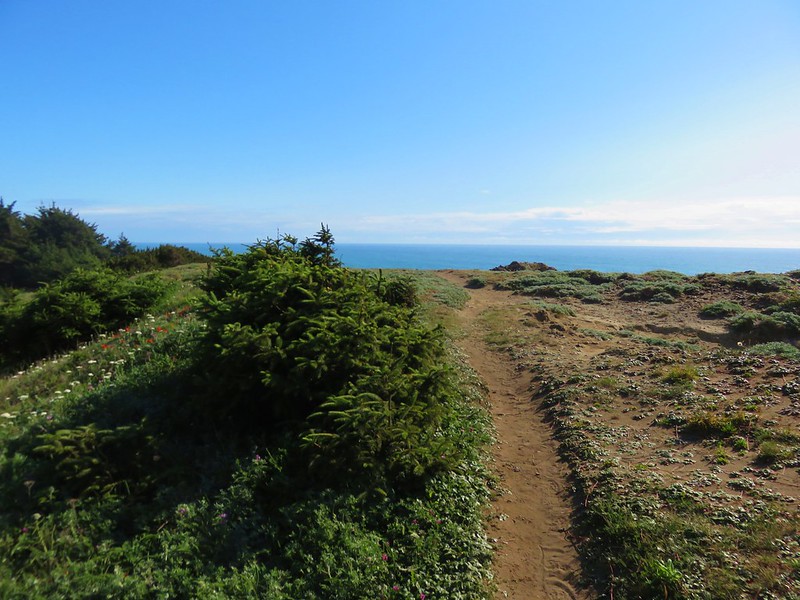
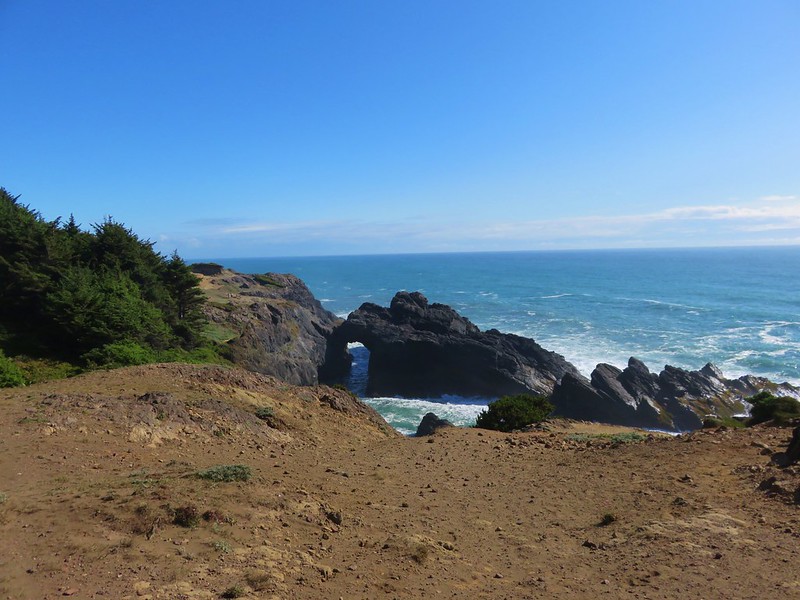
We followed a path out to a wildflower covered viewpoint of a rock arch.
IMG_7492

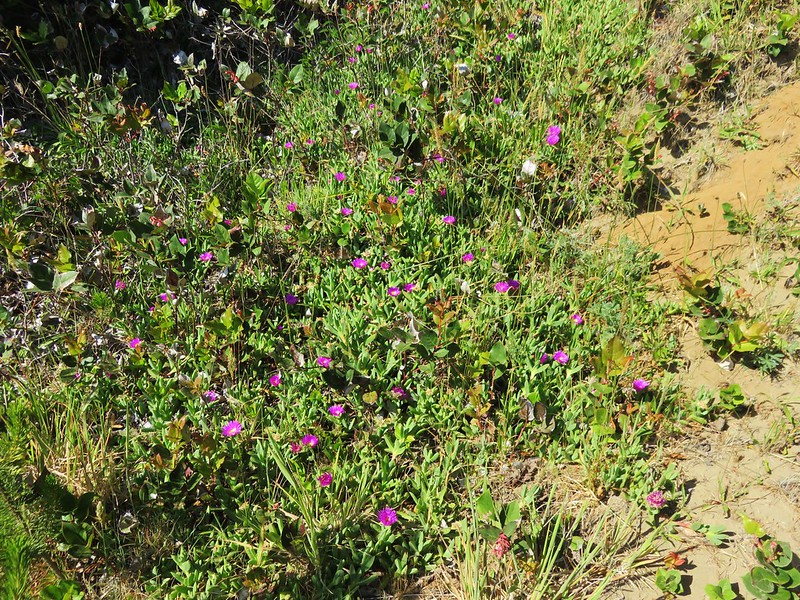
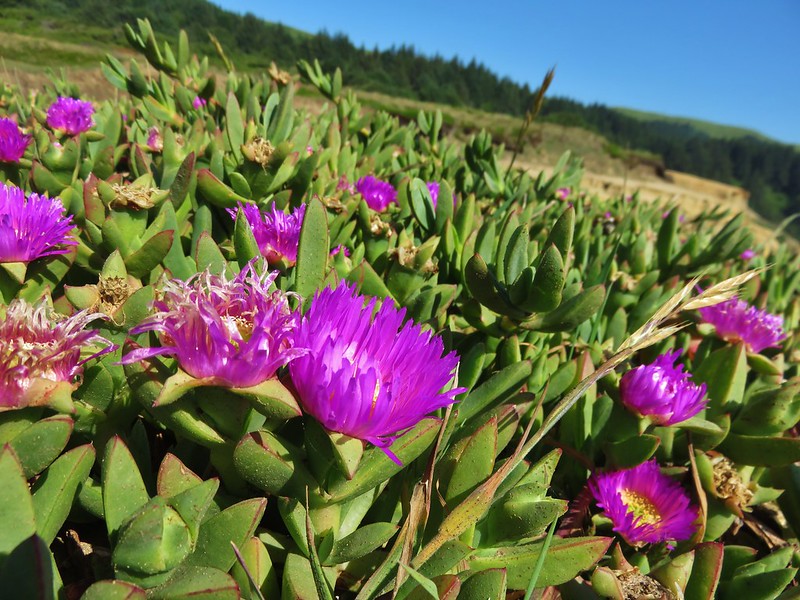
Sea figs
IMG_7484

IMG_7485

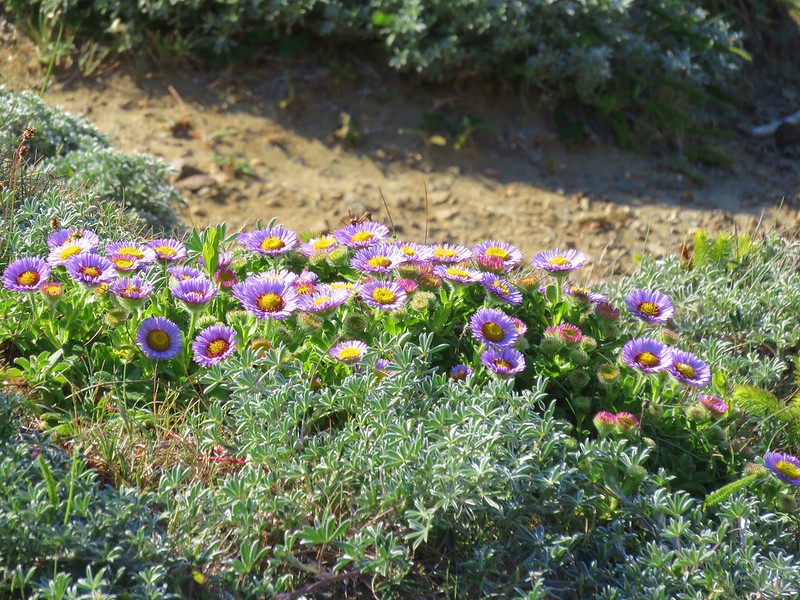
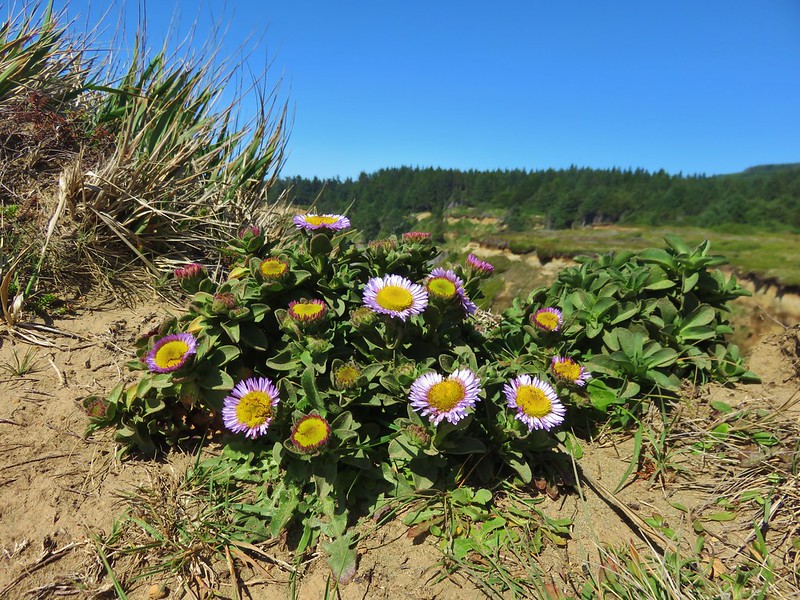
Seaside daisy
IMG_7495

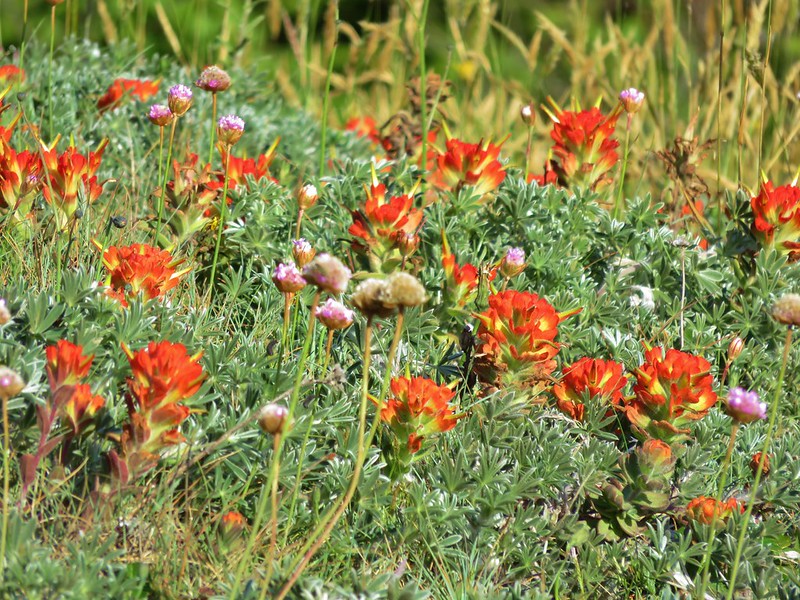
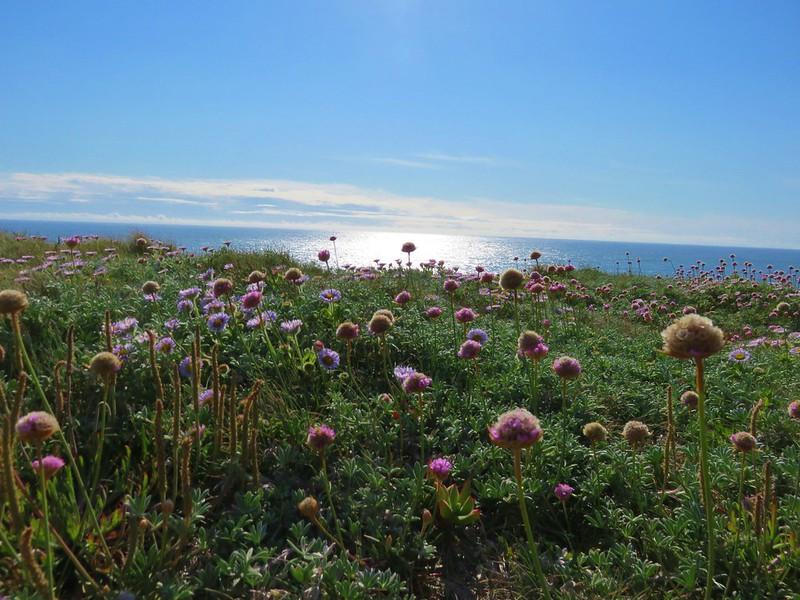
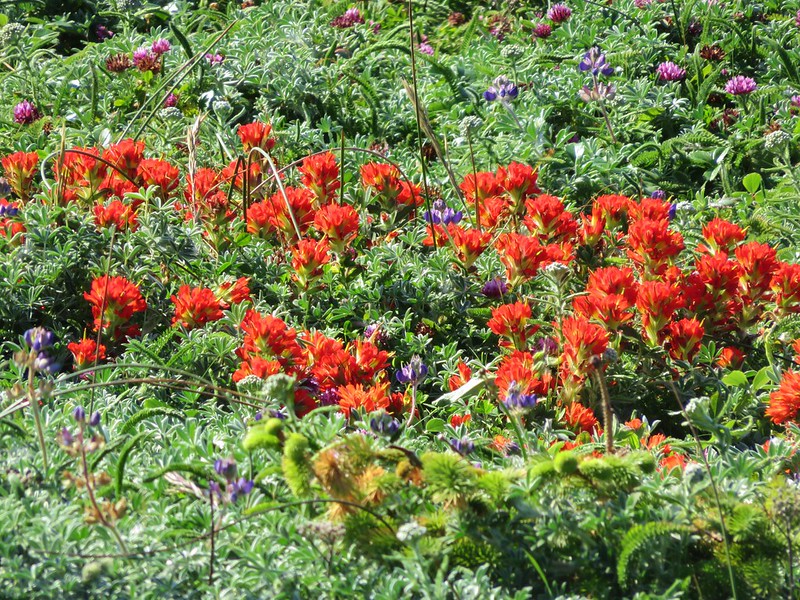
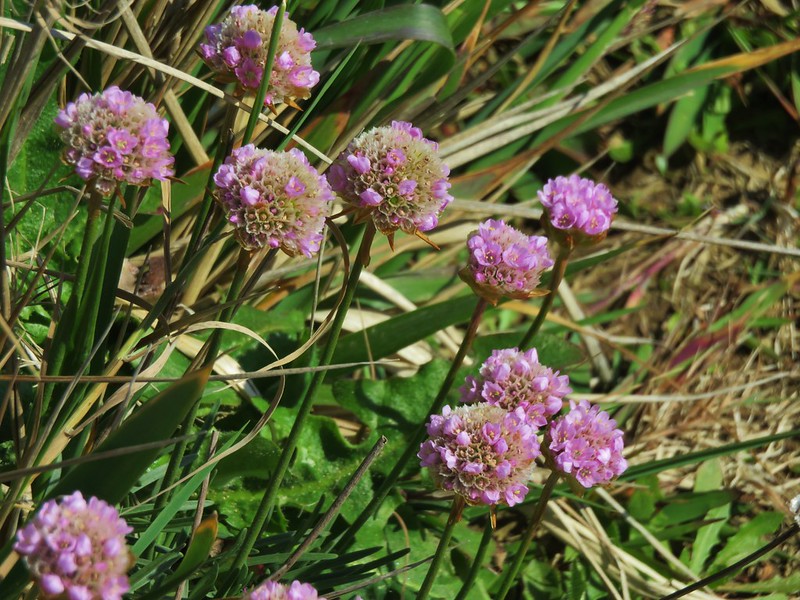
Sea thrift and paintbrush
IMG_7497

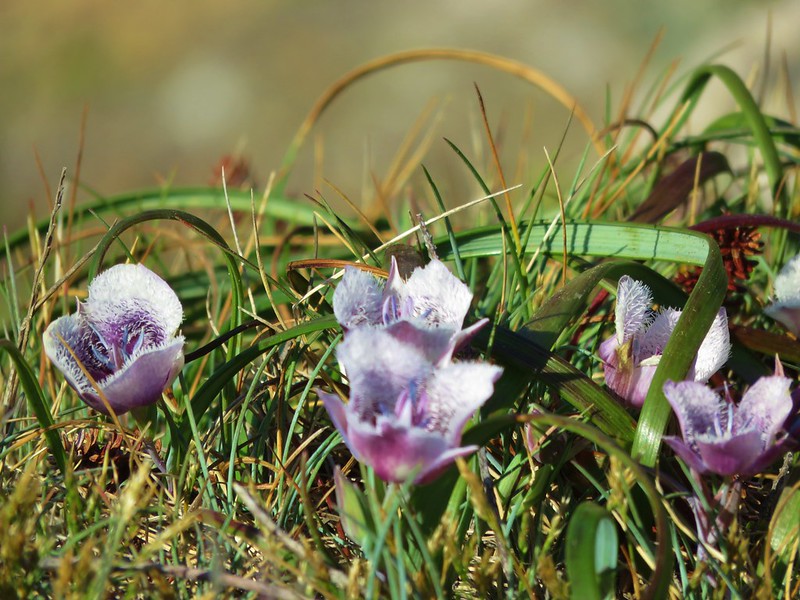
Mariposa lilies
IMG_7500

IMG_7498

IMG_7506

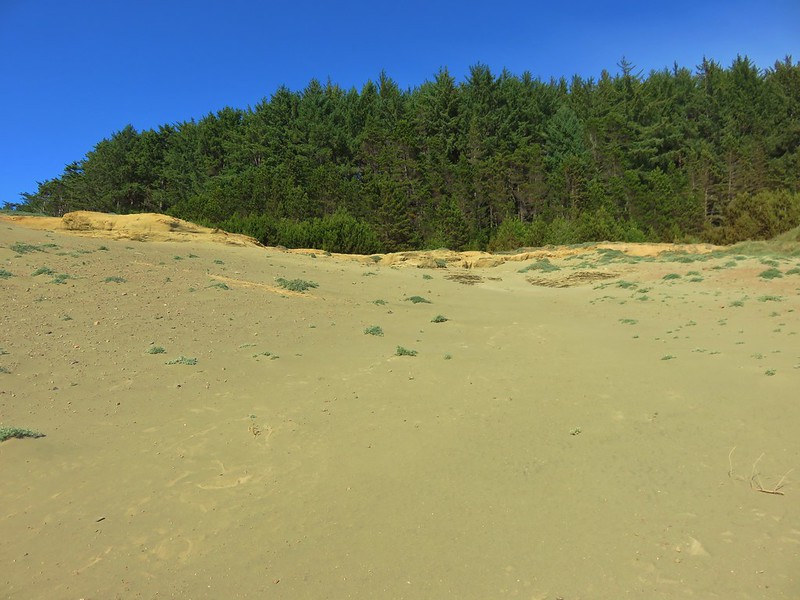
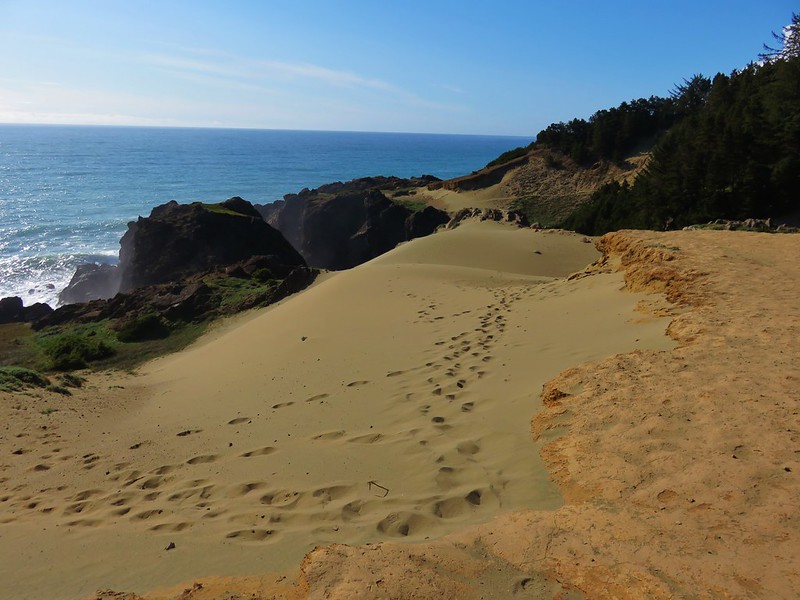
The sandstone cliffs here create the dunes making it an interesting area unlike anything else we’d seen in the park.
IMG_7513

IMG_7514

We made our way north following footprints in the sand.
IMG_7516

IMG_7521

IMG_7519

IMG_7527

IMG_7528

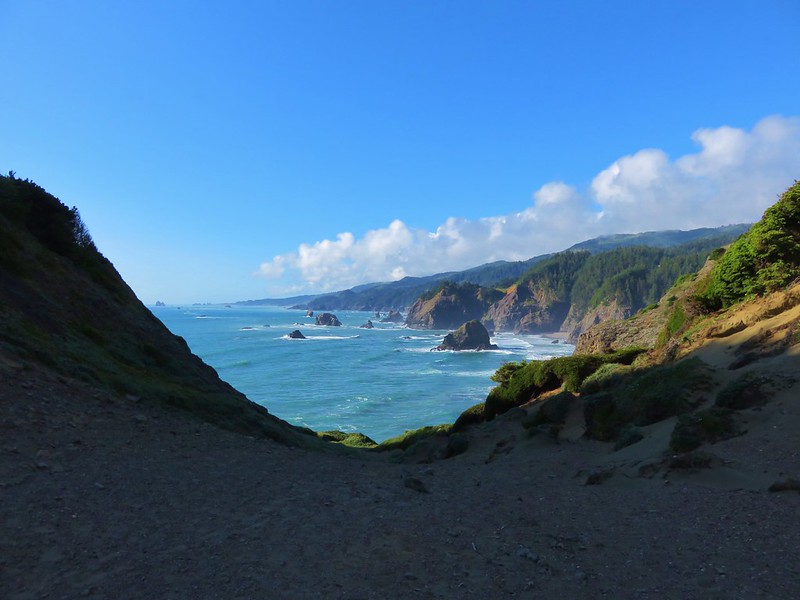
We came to a saddle with a great view where a trail to the right led up through a brush covered slope back into the forest and onto the Oregon Coast Trail.
IMG_7532

IMG_7536

IMG_7541

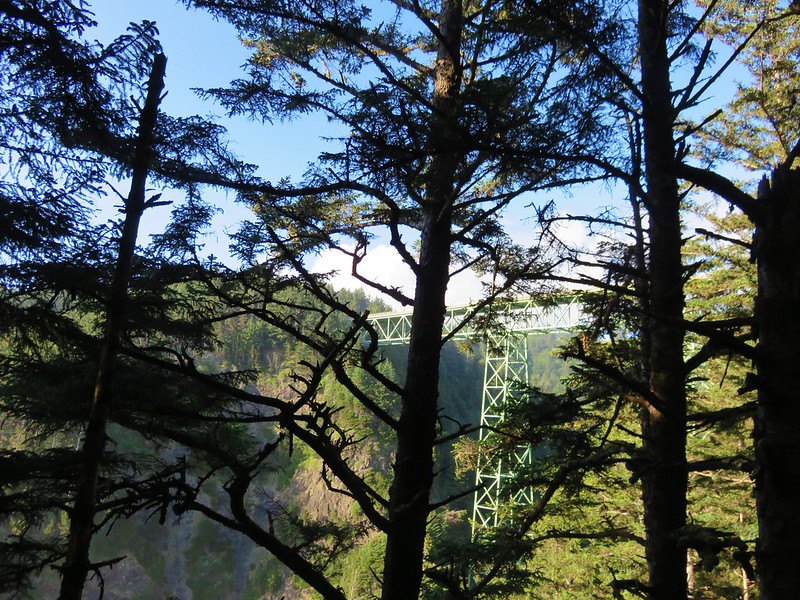
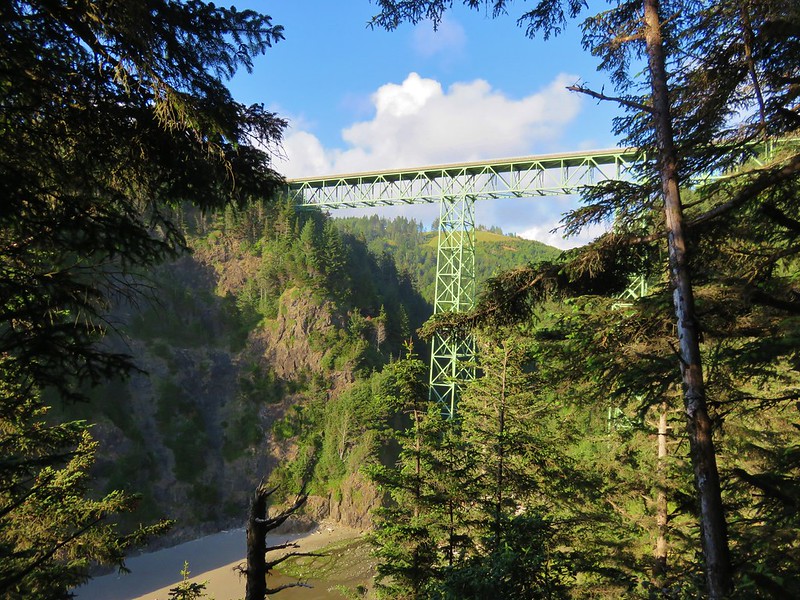
Turning right on the Oregon Coast Trail would have taken us back to the car but we decided to turn left and check out the Thomas Bridge Viewpoint. We’d driven over the bridge multiple times already and read that it was the highest bridge in Oregon at 345′. We left the Oregon Coast Trail at a split in the trail where it headed uphill toward the parking area for the viewpoint. We headed downhill to the left to find the viewpoint. The first viewpoint we came to was partly blocked by trees.
IMG_7543

The trail continued out along a ridge so we followed it looking for a better view. We noticed another trail along the right that hopped over the ridge and headed steeply down into the trees. We ignored that and continued heading for the ocean. No view of the bridge had appeared as we rounded the end of the ridge but the trail kept going now heading downhill back inland. It did wind up leading to a better, but not great, viewpoint.
IMG_7547

From this viewpoint we followed a path uphill that wound up being the same trail we had seen going over the ridge and down into the trees. When we crested the ridge we met another couple looking for the viewpoint. We pointed them in the right direction before heading back to Indian Sands.

In the end it worked out really well to have turned back on the Illinois River Trail in time for us to get the hike in at Indian Sands. It was definitely worth the visit. We appear to have escaped the poison oak without any ill effects (at least not yet) and haven’t had to brush off any ticks since leaving the Illinois River Trail. Happy Trails!

Flickr: https://www.flickr.com/photos/9319235@N02/sets/72157666245754163

Categories
Hiking Oregon Oregon Coast Southern Coast Trip report

Samuel H. Boardman State Scenic Corridor South and Wheeler Ridge Bomb Site

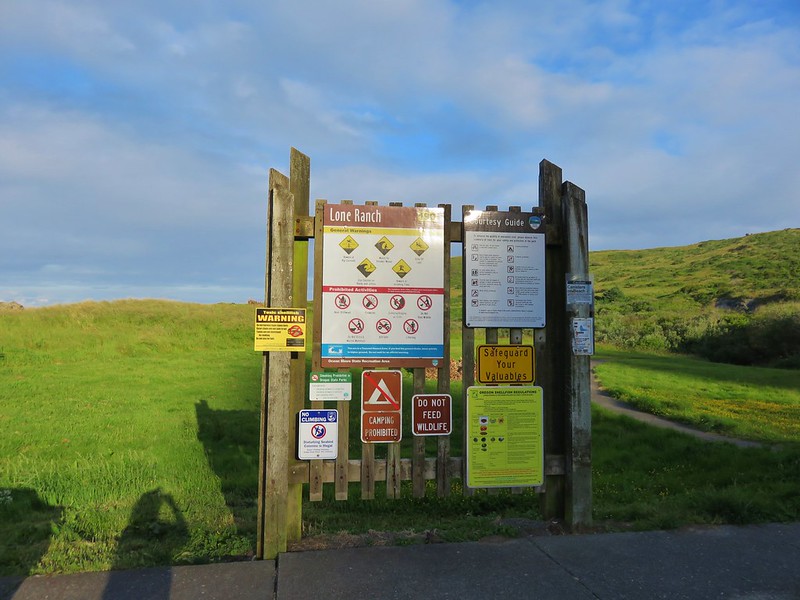
On Thursday we headed for another State Park south of Gold Beach. The Samuel H. Boardman State Scenic Corridor covers a 12 mile long stretch along the Pacific Ocean. Numerous day use areas and trails including the Oregon Coast Trail make the area very easy to explore. We planned on spending two days hiking in the park starting near the southern end at the Lone Ranch Picnic Area.
IMG_6901

IMG_6902

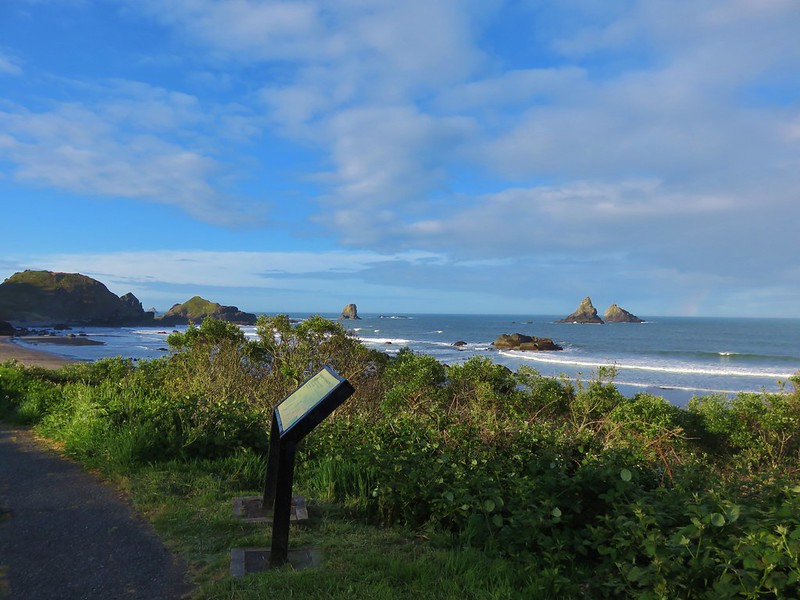
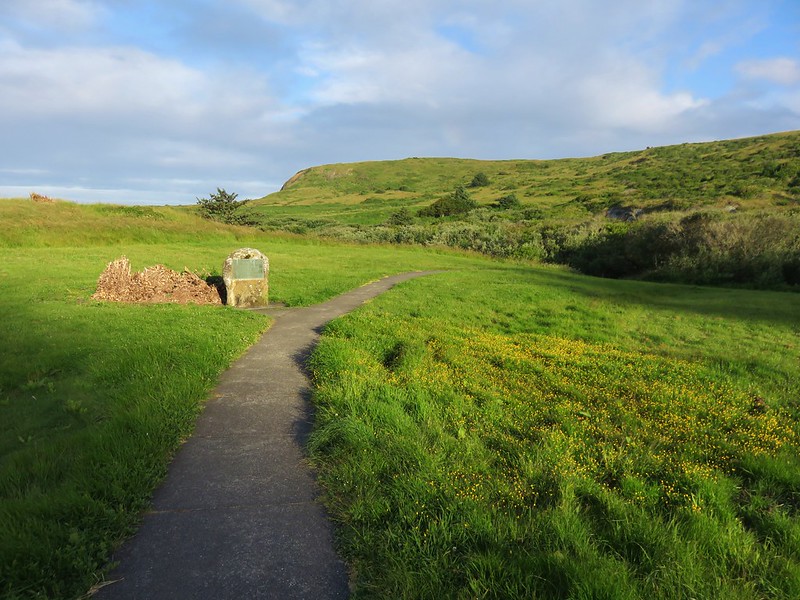
From the parking area we headed north on a paved path toward Cape Ferelo.
IMG_6904

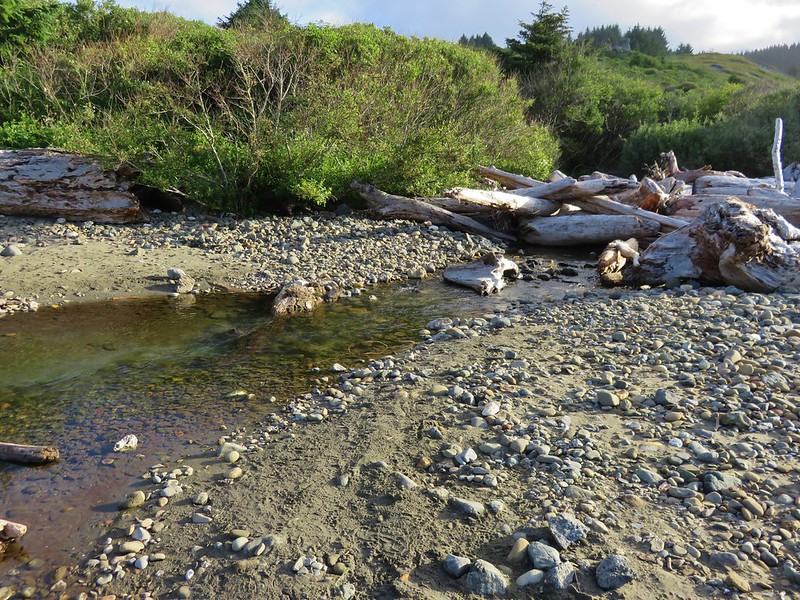
The Oregon Coast Trail crossed Lone Ranch Creek and headed up through the meadows of Cape Ferello before reaching the beach. We opted to visit the beach and take a different path up to Cape Ferrelo. We walked along the creek crossing on some drift wood nearer to the ocean.
IMG_6911

IMG_6910

IMG_6912

We found the path leading up and followed it along the cape’s edge.
IMG_6920

The open meadow allowed for great views to both the north and south and wildflowers dotted the grassy hillsides.
IMG_6935

IMG_6929

Lupine
IMG_6918

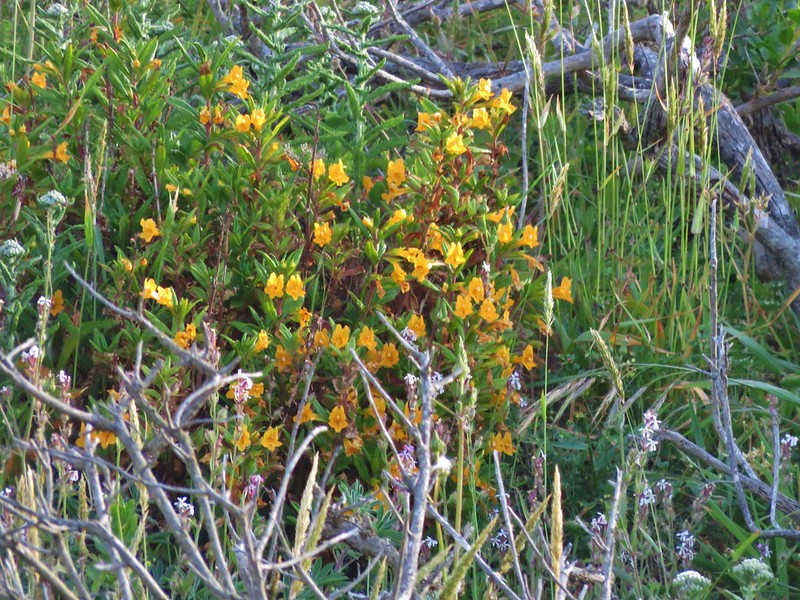
sticky monkey-flower
IMG_6924

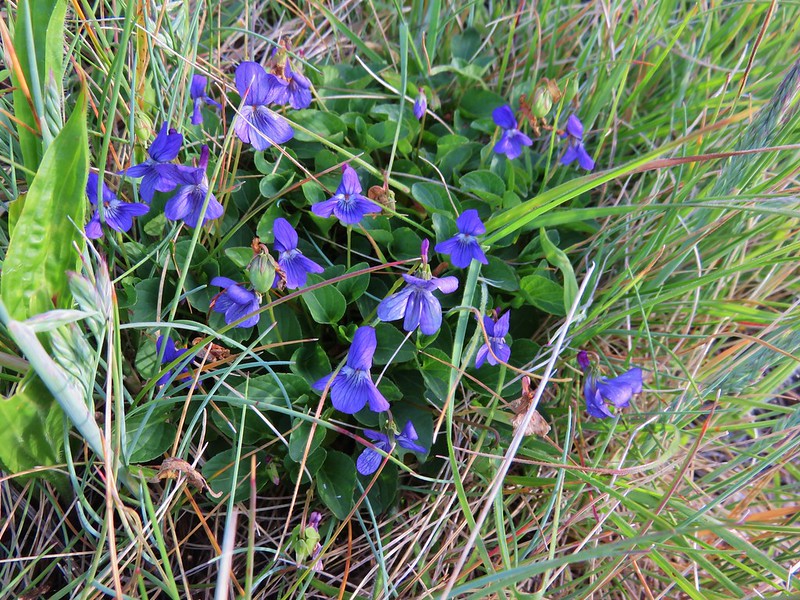
Violets
IMG_6927

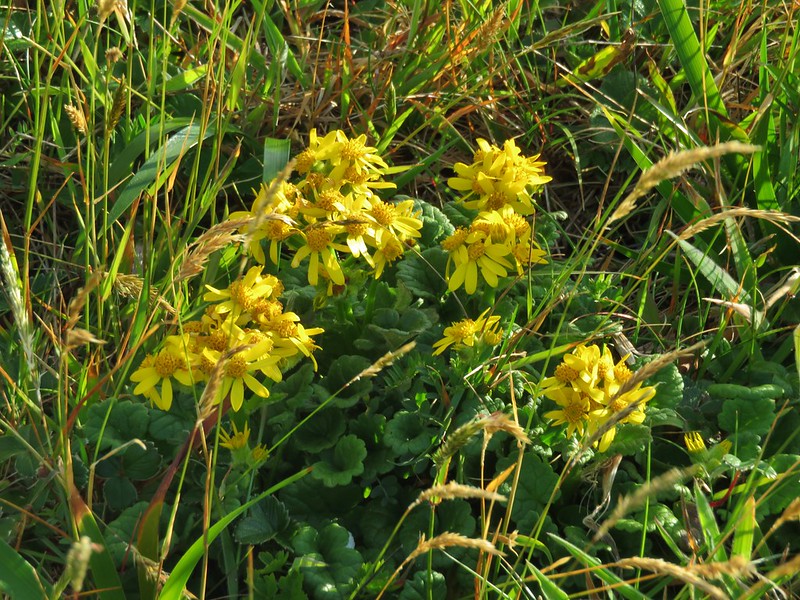
Possibly a ragwort
IMG_6931

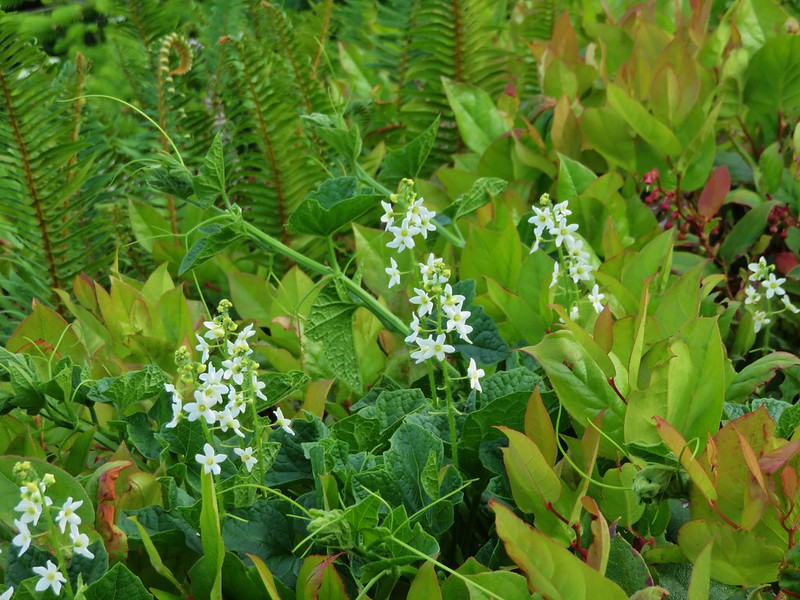
Coastal manroot
IMG_6938

Clover
IMG_6940

Catchfly
IMG_6952

The path we were following rejoined the Oregon Coast Trail on Cape Ferrelo which then brought us to the Cape Ferrelo Viewpoint.
IMG_6962

From that parking area, the Oregon Coast Trail passed through a more forested section of the park.
IMG_6969

IMG_6973

The views opened up again as we approached the House Rock Viewpoint (We never were sure which was House Rock).
IMG_6982

IMG_6985

IMG_6984

Continuing from the House Rock Viewpoint the next .9 miles of the Oregon Coast Trail passed through a surprising variety of forest scenery.
IMG_6987

IMG_6989

IMG_6990

IMG_6991

The trail then split with a sign pointing us to the right.
IMG_6993

We suspected that the left fork led down to the beach which we planned on walking along on our return trip so we made a mental note to see if this was indeed the spot where we would rejoin the Oregon Coast Trail later. A little further along was a sign for a “Waterfall Loop”.
IMG_6997

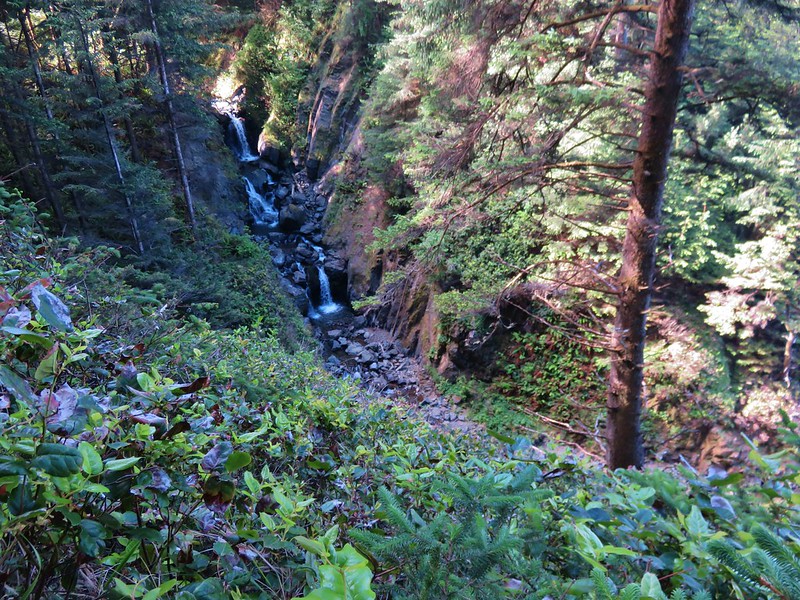
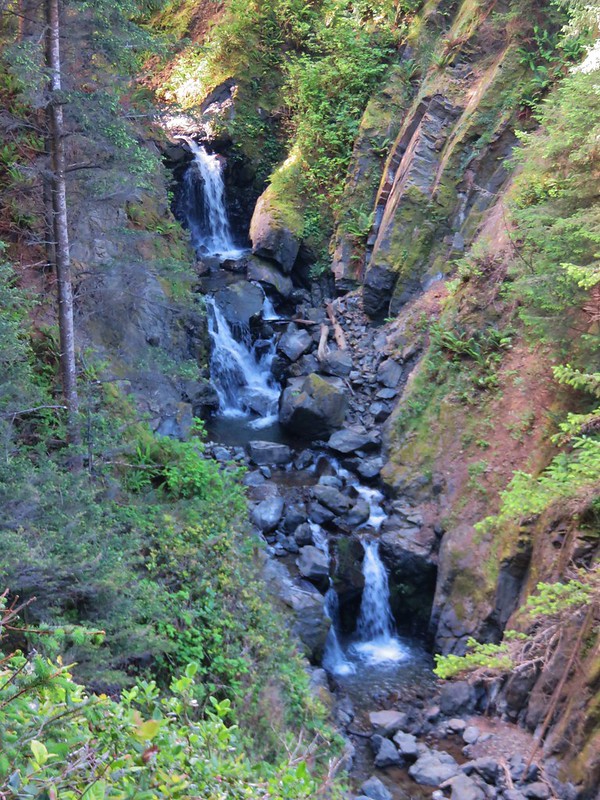
We like waterfalls so we turned onto the loop trail. The first fall we passed was a bit hard to see from the trail but we wondered if we would have a better view when we were down on the beach.
IMG_6998

The next waterfall was actually a series of three small cascades. These were more visible from a short side trail.
IMG_7004

IMG_7007

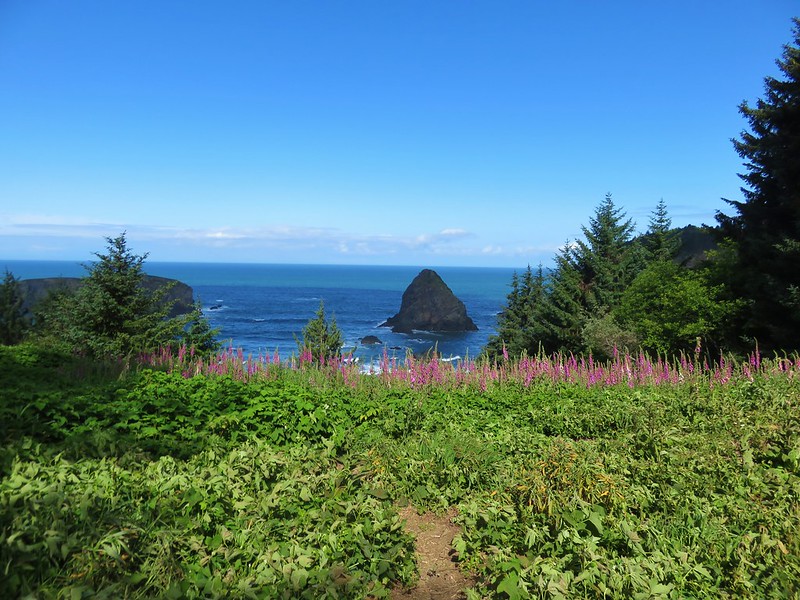
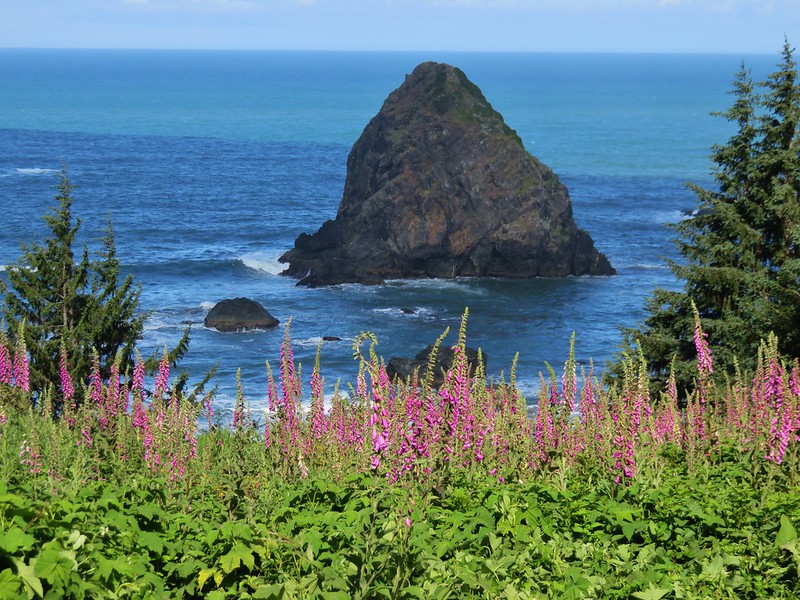
Next up was Whaleshead Viewpoint where an amazing field of foxglove was blooming.
IMG_7013

IMG_7015

IMG_7018

From this viewpoint the trail dropped steeply down .2 miles to Whaleshead Beach.
IMG_7019

IMG_7025

We kept heading north passing through the Whaleshead Beach Picnic Area in .3 miles, crossing the entrance road to the picnic area in another .2 miles, and finally stopping at a viewpoint overlooking Whaleshead Island.
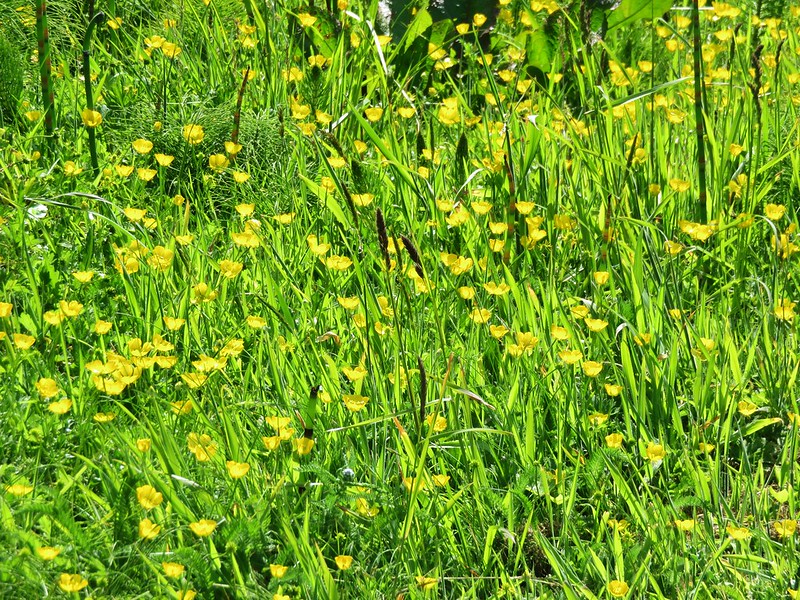
Buttercups in the picnic area.
IMG_7028

Approaching the entrance road crossing.
IMG_7031

The viewpoint.
IMG_7035

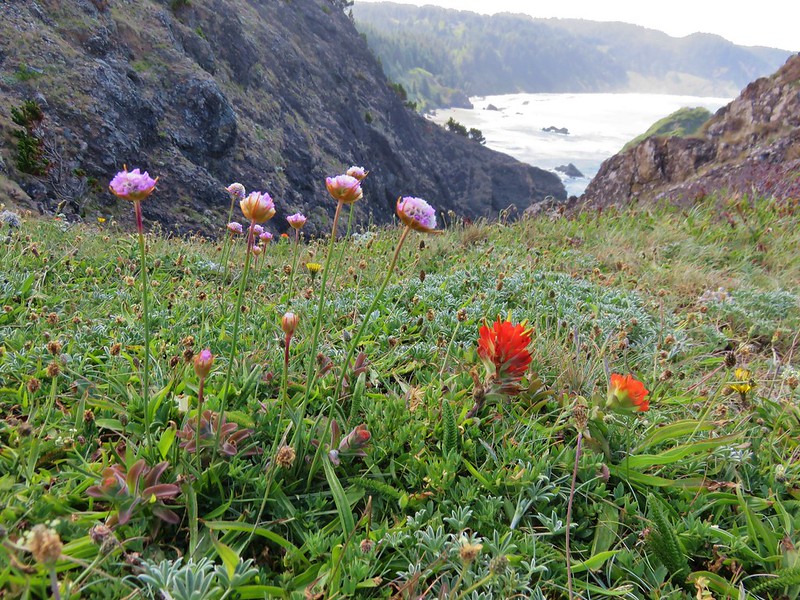
Sea thrift and paintbrush
IMG_7038

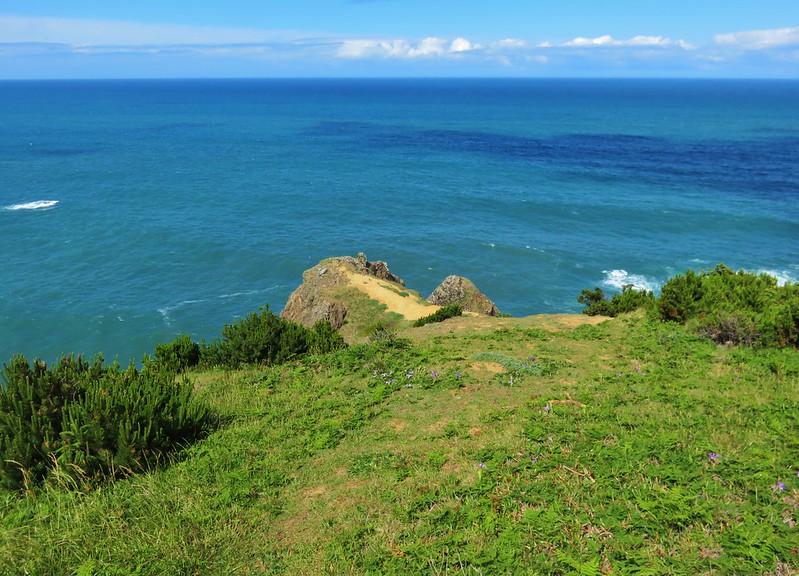
Looking north from the viewpoint.
IMG_7042

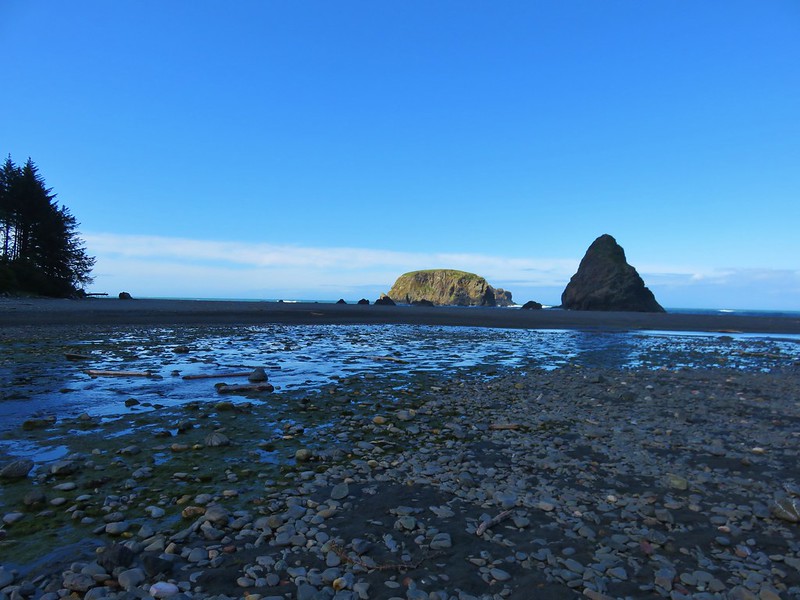
Whaleshead island and sea figs
IMG_7043

We headed back to Whaleshead Beach and headed south through the sand.
IMG_7072

There were several highlights on the beach walk starting with a small opening passing through some rocks.
IMG_7079

IMG_7080

IMG_7081

Then we followed Bowman Creek along the beach.
IMG_7084

The first fork of the creek coming out of the forest was where the smaller cascades were located. We couldn’t see them from the beach but it looked like a more determined person could have hiked up the creek to a view.
IMG_7088

At the second fork the larger waterfall that we hadn’t had a good view of was clearly visible.
IMG_7094

IMG_7093

The beach ended shortly after the third creek coming down to the ocean.
IMG_7097

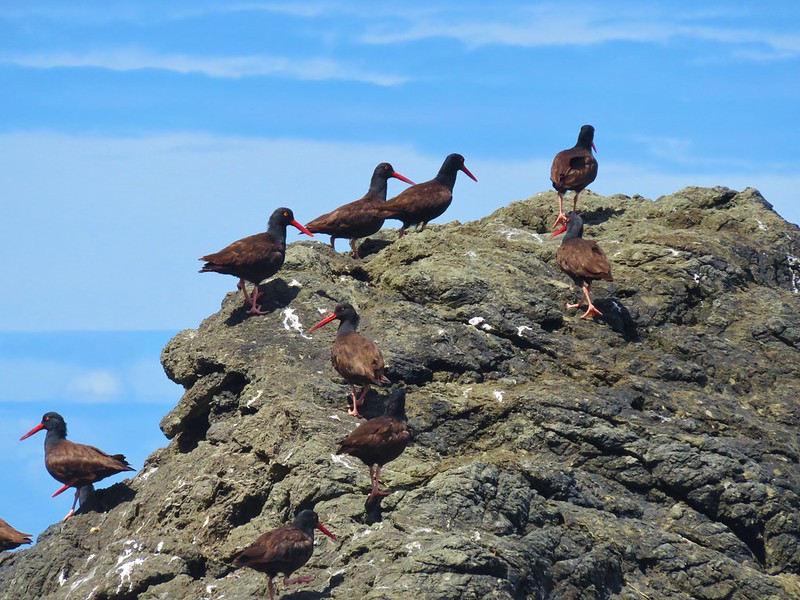
There were a bunch of oyster catchers on a rock here.
IMG_7099

A post on the hillside on the far side of this creek marked the trail that would take us back up to the Oregon Coast Trail.
IMG_7099

We hiked up the creek a bit to pick up the faint overgrown trail.
IMG_7105

IMG_7110

We just kept aiming for the posts as we passed some pretty wildflower displays.
IMG_7111

IMG_7117

IMG_7123

IMG_7129

IMG_7139

IMG_7141

We did wind up back on the Oregon Coast Trail at the junction we had suspected earlier and headed back toward Cape Ferrelo. This time we followed the Oregon Coast Trail over the cape. This led us to another viewpoint with a bench and some flowers we hadn’t seen along the other portion of trail.
IMG_7147

Bachelor button
IMG_7150

brodiaea
IMG_7172

IMG_7177

We had a little trouble finding the correct route through the vegetation near Lone Ranch Creek and wound up popping out in between the Oregon Coast Trail and the route we had taken that morning.
IMG_7179

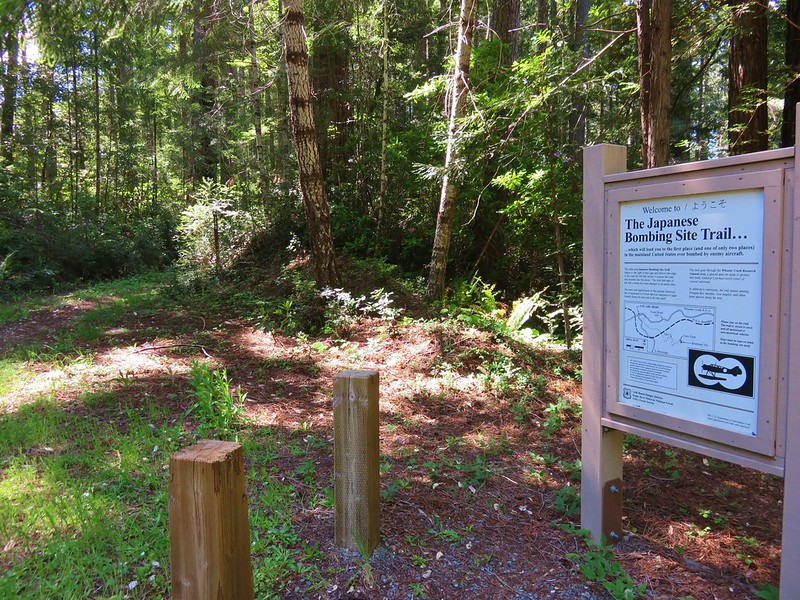
After returning to the car we drove into Brookings and headed for our second hike of the day at the site of a WWII bomb dropped by a Japanese pilot on Wheeler Ridge. To reach the trailhead we took South Bank Road for 5.2 miles and turned right following a pointer on Mt. Emily Road (road 1205) for 3.7 miles forking left at that point to stay on road 1205 until we reached the signed trailhead.
IMG_7193

The trail is only a mile long but the interesting history behind the site makes the trip well worth it. The pilot, Nobou Fujita, took off from a Japanese submarine on September 9th, 1942 and flew inland to drop two bombs in hopes of starting a forest fire. One of the bombs did start a small fire that was spotted by the lookout,Howard Gardner, stationed on nearby Mt. Emily. He and a couple of other forest service staff located the fire and extinguished it finding the bomb crater and remnants of the ordinance.

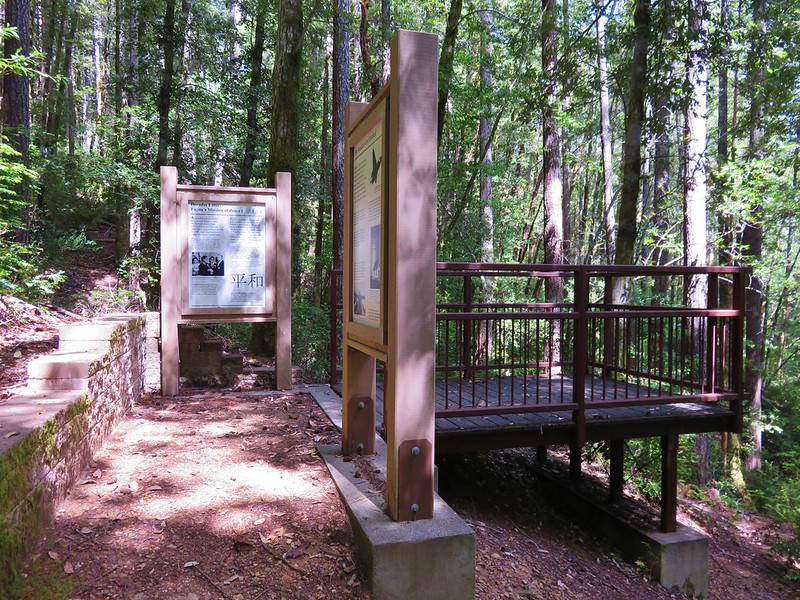
Nobou Fujita traveled to Brookings in 1962 for the town’s Azalea Festival and presented his family’s samurai sword to the citizens as a token of peace. In 1992 he returned to plant a redwood seedling which unfortunately did not survive due to trampling by visitors. After his death a group of Japanese naval veterans planted a second tree at the site which still survives today.
IMG_7212

IMG_7216

IMG_7217

The highlight of the trail was the bomb site and interpretive signs but there were also some big redwoods and a nice set of candysticks along the trail.
IMG_7201

IMG_7208

IMG_7220

When we got back to Brookings we stopped for dinner at Kuhn Thai. We really enjoyed the food here once we finally settled on some choices. Another tasty end to a day. Happy Trails!

Flickr: https://www.flickr.com/photos/9319235@N02/albums/72157666232501494

Categories
Hiking Oregon Oregon Coast Southern Coast Trip report

Cape Sebastian

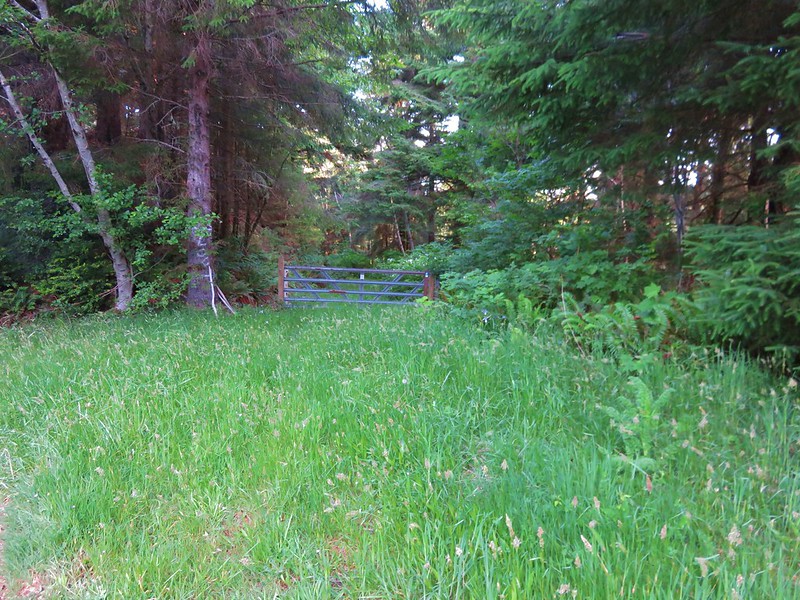
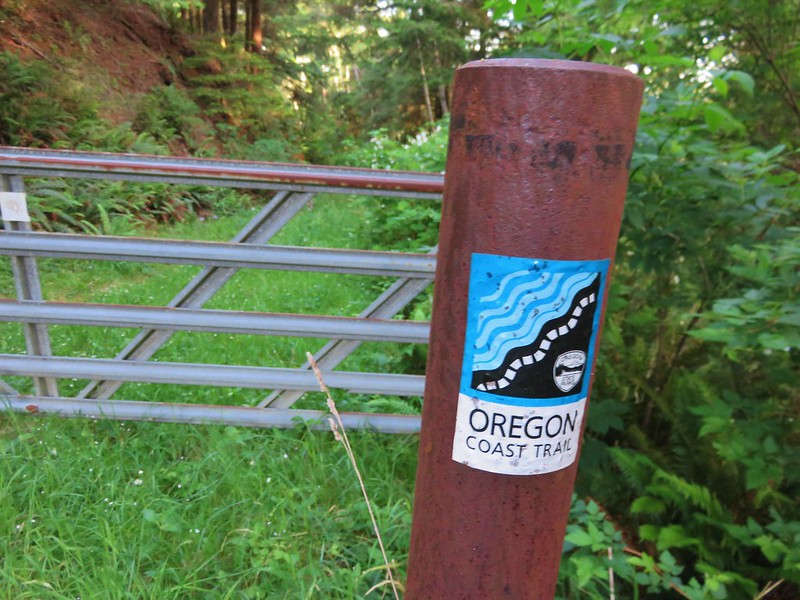
After our slow, bumpy drive to the Kalmiopsis Wilderness on Tuesday, Wednesdays hike was only about five minutes from our hotel in Gold Beach. We would be following a section of the Oregon Coast Trail through Cape Sebastian State Park. We began our hike at a gravel parking lot just off Highway 101 along Bellview Lane. A gate and sign for the Oregon Coast Trail were located just across Bellview Lane from the parking area.
IMG_6688

IMG_6690

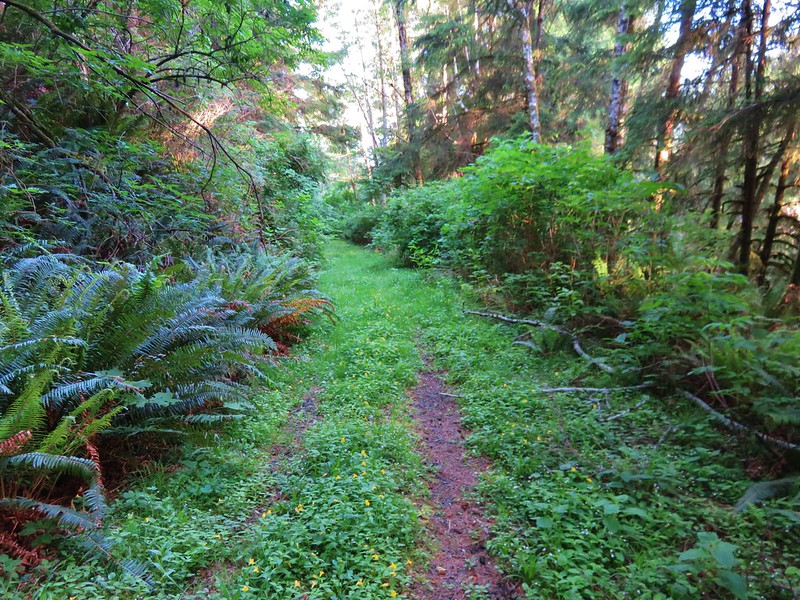
The trail was a grass and flower covered roadbed with some of the best salmonberries ever along the sides.
IMG_6698

IMG_6697

IMG_6699

This section of the Oregon Coast Trail was well signed (we would discover later in the week this wasn’t the case for other sections).
IMG_6702

This side path led 1.1 miles to a beach that we would visit on our way back.
IMG_6703

IMG_6704

At the 2.3 mile mark a sign directed us to our first viewpoint.
IMG_6716

IMG_6718

IMG_6724

IMG_6726

Beyond the viewpoint the Oregon Coast Trail climbed for .8 miles through the trees to a parking lot in Cape Sebastian State Park.
IMG_6740

IMG_6741

IMG_6751

A 0.4 mile trail connected this parking lot with an upper parking lot with a better view, although we arrived just as a cloud was passing over. There was a small patch of poison oak marked with a stake along this stretch.
IMG_6869

IMG_6760

IMG_6761

From this second viewpoint the trail passed through a windswept meadow then into a forest following an interesting ridge that ran parallel to the Pacific Ocean.
IMG_6756

IMG_6763

There was a viewpoint along they way with lichen covered rocks.
IMG_6774

After .6 miles the trail began to descend through more open woods where a good number of flowers were blooming. Along with the flowers came a fair amount of poison oak.
Wild iris
IMG_6777

Bridges’ brodiaea and poison oak
IMG_6785

Paintbrush
IMG_6787

Blueblossom
IMG_6791

Columbian lily
IMG_6793

Another lily
IMG_6794

More Bridges’ brodiaea
IMG_6808

There were also some nice views along this 1.3 mile section of the trail.
IMG_6825

IMG_6815

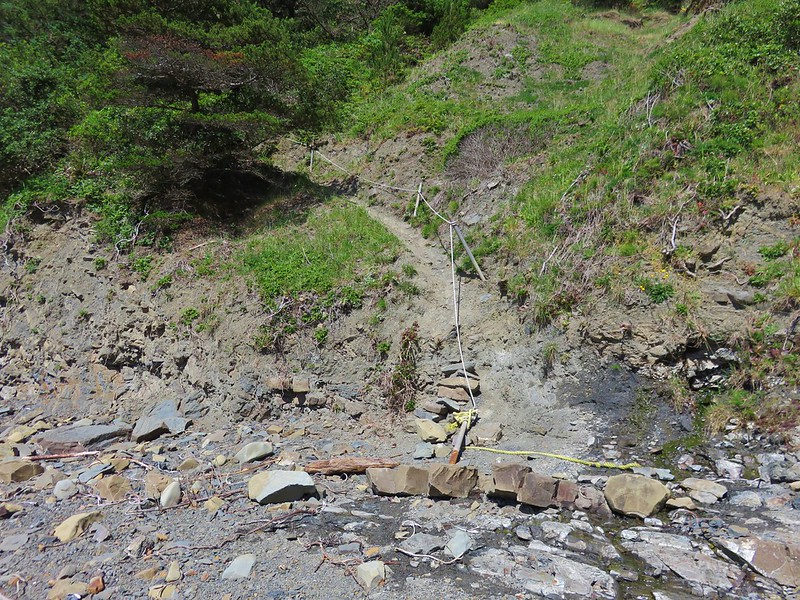
The trail eventually arrived at Hunters Beach but the final drop down to the actual beach was down a steep slope. Much of it had been worn away by the elements and a rope had been set up for assistance. To complicate the descent there was poison oak on both sides of the trail.
IMG_6834

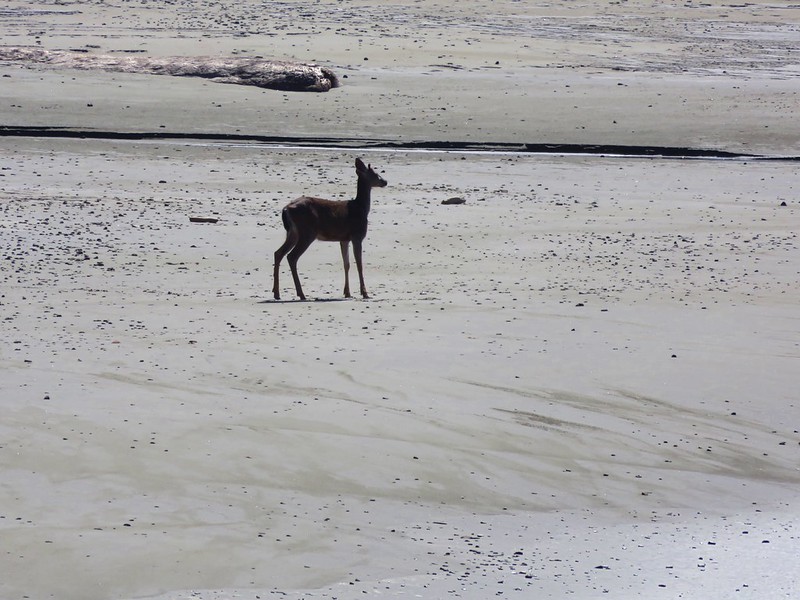
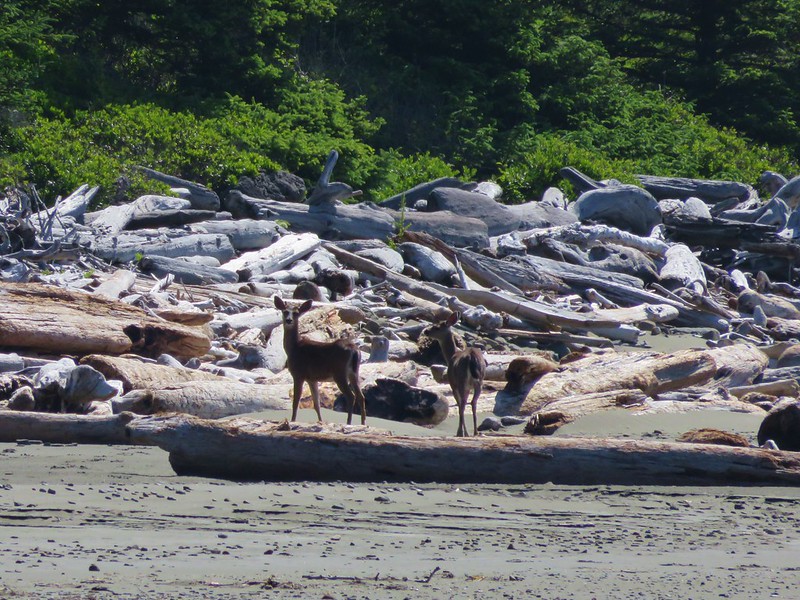
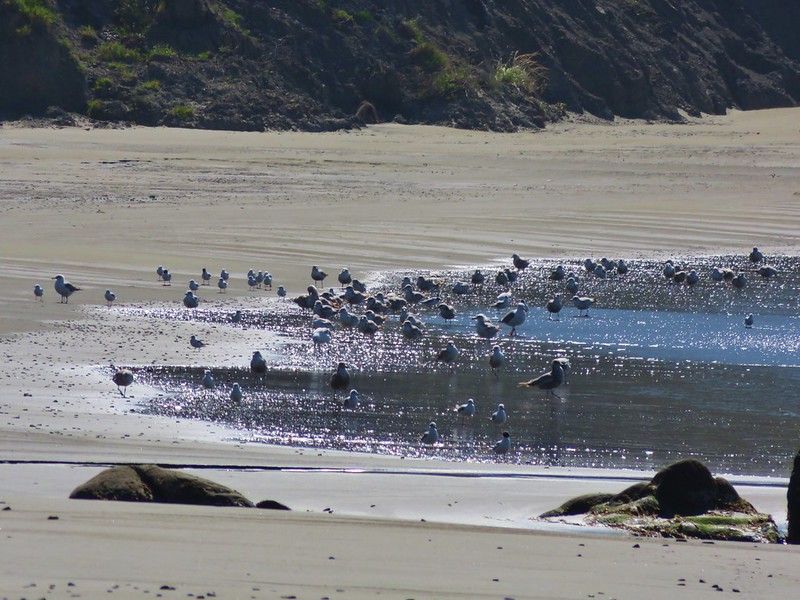
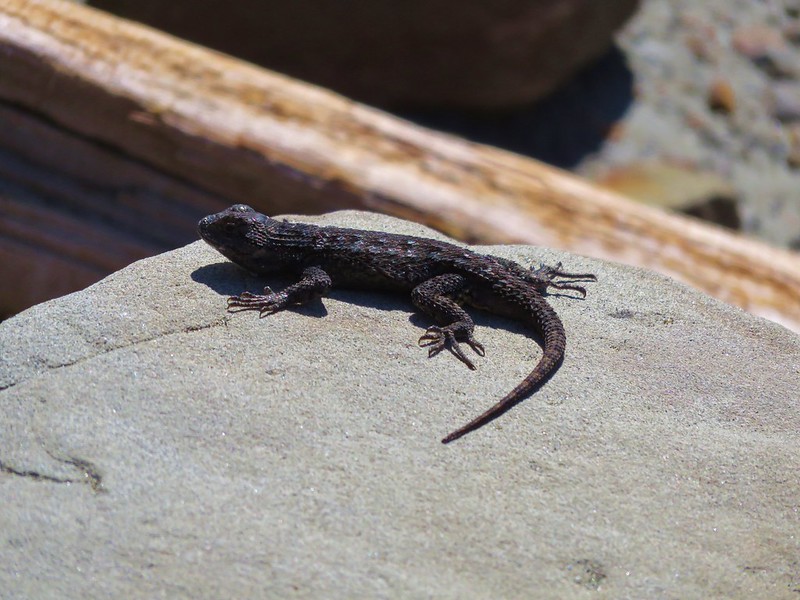
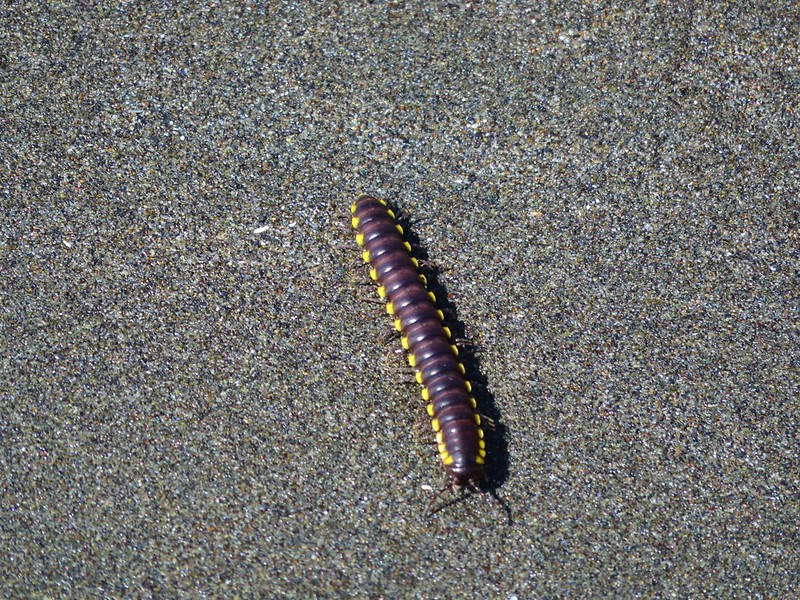
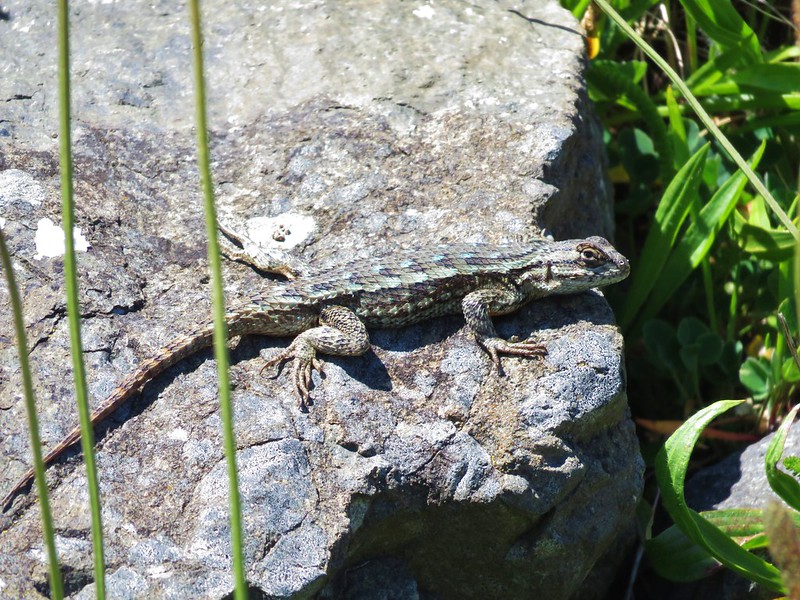
We made it down to the sandy beach where we joined a pair of deer, some birds, lizards, and a millipede.
IMG_6830

IMG_6836

IMG_6845

IMG_6859

IMG_6850

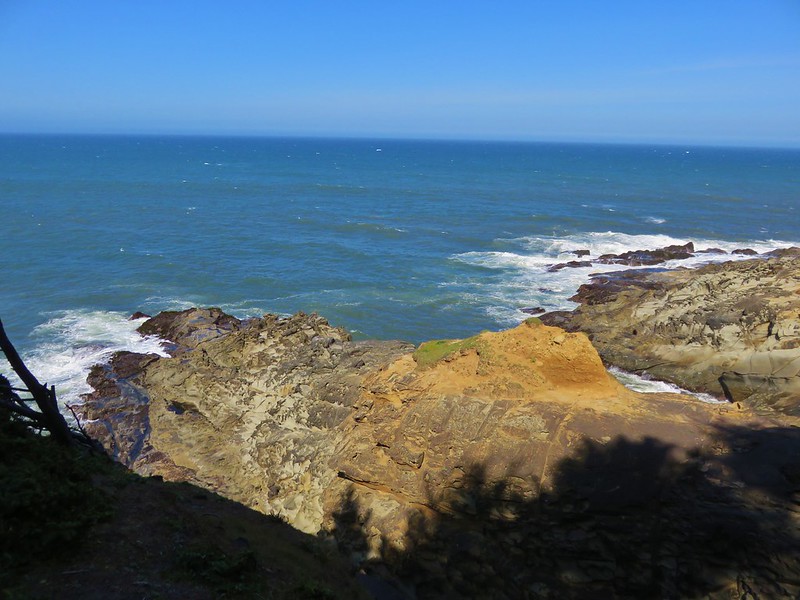
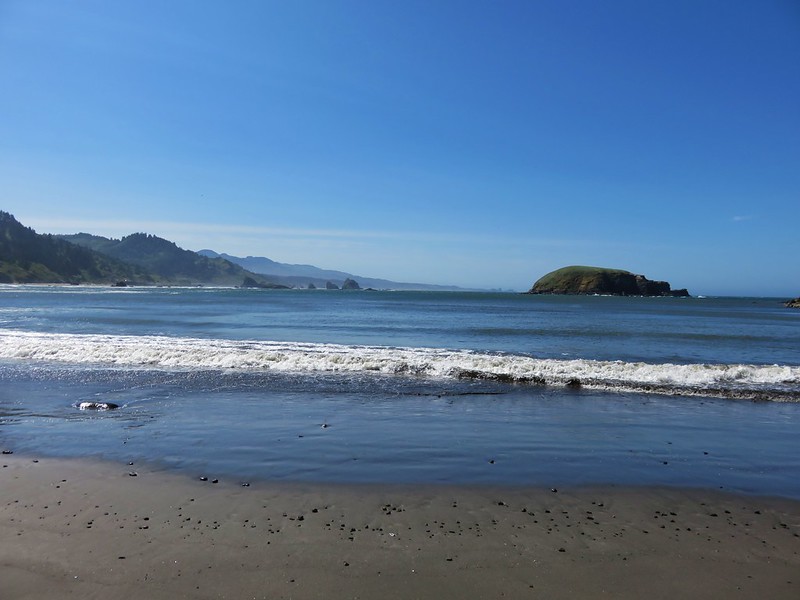
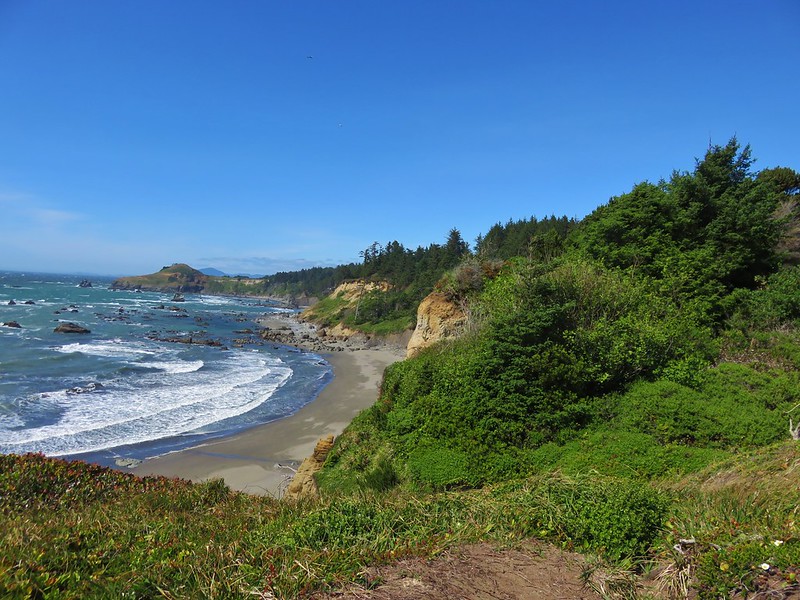
Hunters Island dominated the view from the beach.
IMG_6842

IMG_6847

IMG_6839

We returned the way we’d come being careful to avoid the poison oak retracting our steps all the way to the 1.1 mile side trail to a beach just a half mile from Bellview Lane. This path was along another old road that led down to an overgrown meadow.
IMG_6899

IMG_6876

A faint path led through the vegetation to a post on the beach.
IMG_6878

IMG_6880

On this beach we found several new types of flowers.
yellow sand-verbena
IMG_6883

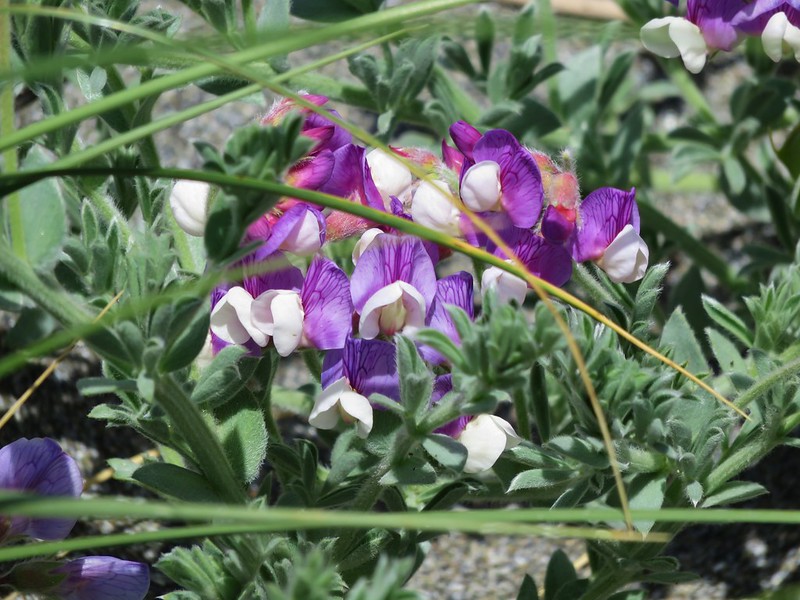
silky beach pea
silky beach pea

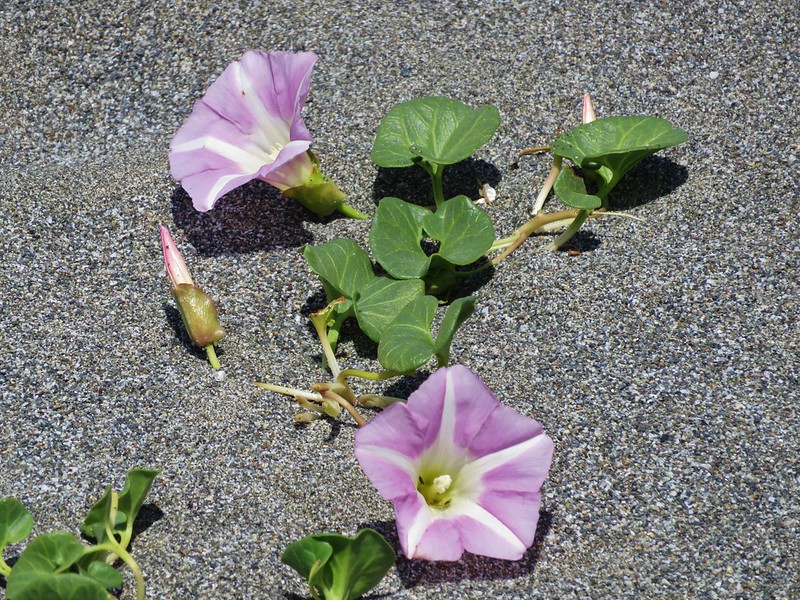
beach morning-glory
IMG_6891

It was pretty windy and there wasn’t much cover to be found so after a brief stay we headed back up to Bellview Lane and our car. We picked this as our evening to find a local restaurant to try and picked the Barnacle Bistro in Gold Beach. The food was great and we each enjoyed a beer from Arch Rock Brewing Company.  I had the Pistol River Pale while Heather tried the State of Jefferson Porter. It was a great cap to the day. Happy Trails!

Flickr: https://www.flickr.com/photos/9319235@N02/sets/72157666235841743

Categories
Hiking Klamath/Siskiyou Mountains Oregon Trip report

Kalmiopsis Wilderness and Redwoods Nature Trail

Tuesday of our vacation week brought us our longest drive from Gold Beach to the Kalmiopsis Wilderness. We had a pair of hikes planned there followed by a quick stop on the way back at Alfred Loeb State Park to see some redwoods.

Our first stop was the Vulcan Peak Trailhead. To reach this trailhead we drove to Brookings and took North Bank Road along the Chetco River for 16 miles to a T shaped junction with gravel Forest Service Road 1909. We turned right following signs for the wilderness and began a tedious 13.3 mile drive. This wasn’t the worst road we’ve been on but it was arguably the longest stretch of bad road we’ve encountered. It took over 45 minutes to reach the trailhead on a short spur road with an outhouse.

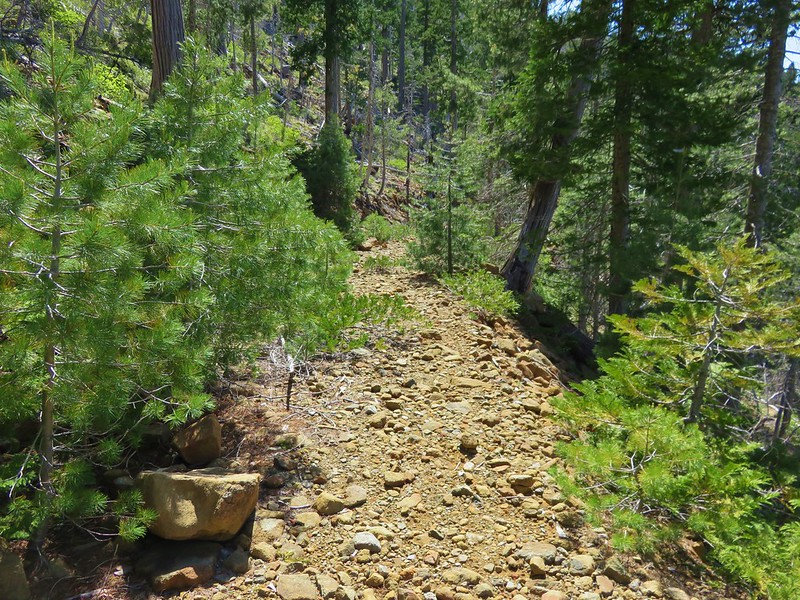
For the first mile we were actually on the Chetco Divide Trail as it followed an old roadbed along a ridge surrounded by forest burnt in the massive 2002 Biscuit Fire.
IMG_6214

IMG_6217

IMG_6222

IMG_6225

At the 1 mile mark the Vulcan Peak Trail split off heading uphill while the Chetco Divide Trail veered to the right.
IMG_6226

Shortly after leaving the Chetco Divide Trail we entered the Kalmiopsis Wilderness.
IMG_6238

It was pretty windy along the exposed ridge but it was shaping up to be a beautiful day.
IMG_6254

The area reminded us of our trip to the Red Buttes Wilderness last October only here it was Spring and there were plenty of wildflowers.
Death Camas
IMG_6242

Tolmie’s mariposa lily
IMG_6244

Wild iris
IMG_6250

A paintbrush
IMG_6258

Wallflower
IMG_6265

Sand Dune Phacelia
IMG_6267

Arnica
IMG_6278

Wedgeleaf violet
IMG_6288

Dwarf ceanothus
IMG_6295

The trail wound its way up the hillsides before reaching a saddle with a nice view south to Preston Peak and the Siskiyou Mountains.
IMG_6281

IMG_6285

The trail then headed north to the summit of Vulcan Peak.
IMG_6298

IMG_6299

We followed the summit ridge north to a view of Little Vulcan Lake (one of our destinations on our next hike).
IMG_6306

IMG_6310

We declared victory there although the ridge continued on and would have eventually provided a view down to Vulcan Lake as well.

Our next trailhead was another 1.7 miles along road 1909. The final mile of this section made the first 13.3 seem like a nice country road. The trail began at a signboard where the road was blocked by some dirt mounds.
IMG_6329

A short distance from the signboard the trail split. We took the right-hand fork uphill toward Vulcan Lake.
IMG_6331

The lakes were on the other side of a ridge so we followed the trail up to a saddle with a view of both lakes and Vulcan Peak.
IMG_6343

Vulcan Lake
IMG_6345

Between the rocky terrain and the 2002 fire the trail grew fainter as we neared the lakes. Rock cairns helped mark the way though.
IMG_6369

IMG_6371

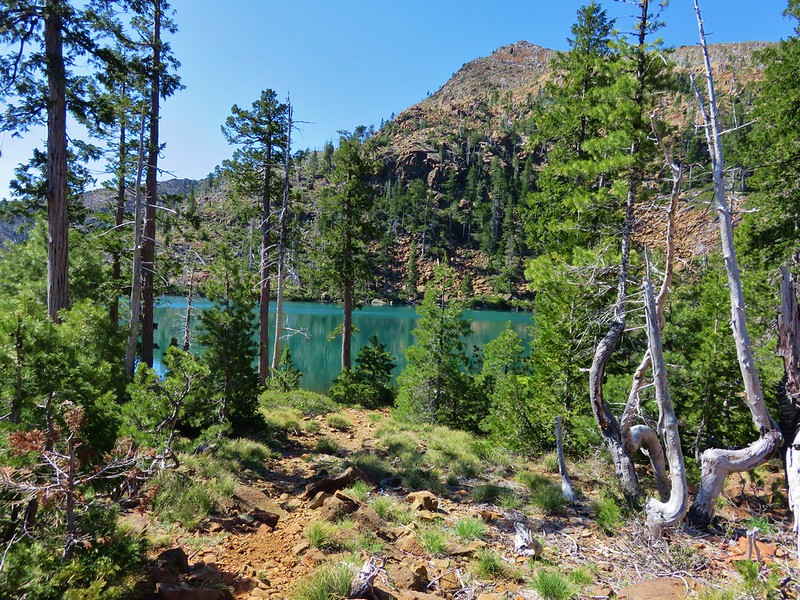
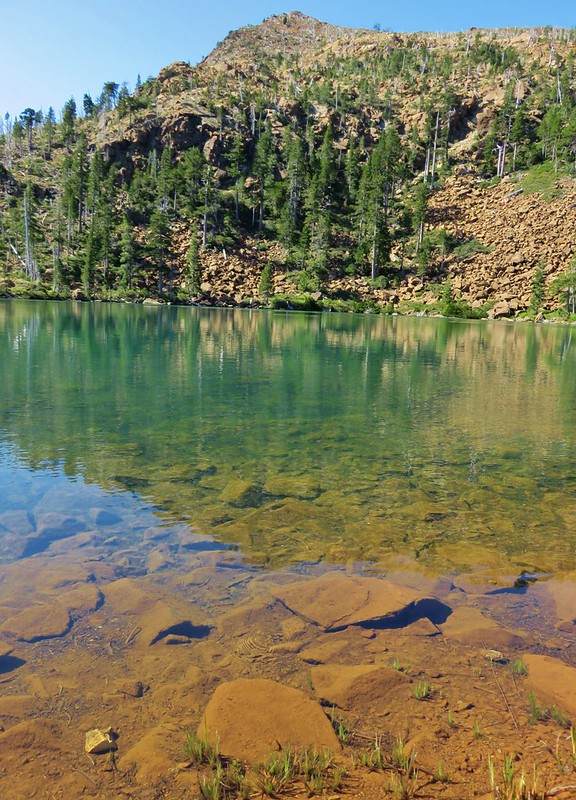
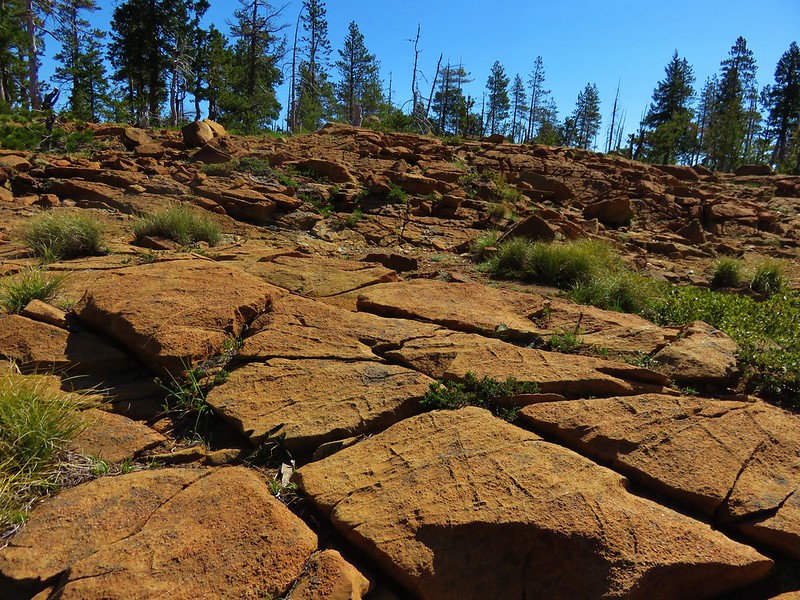
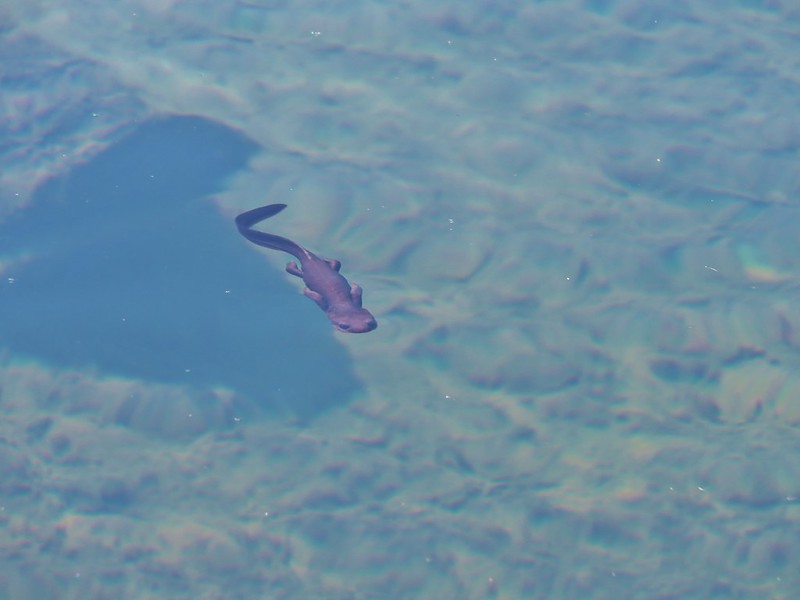
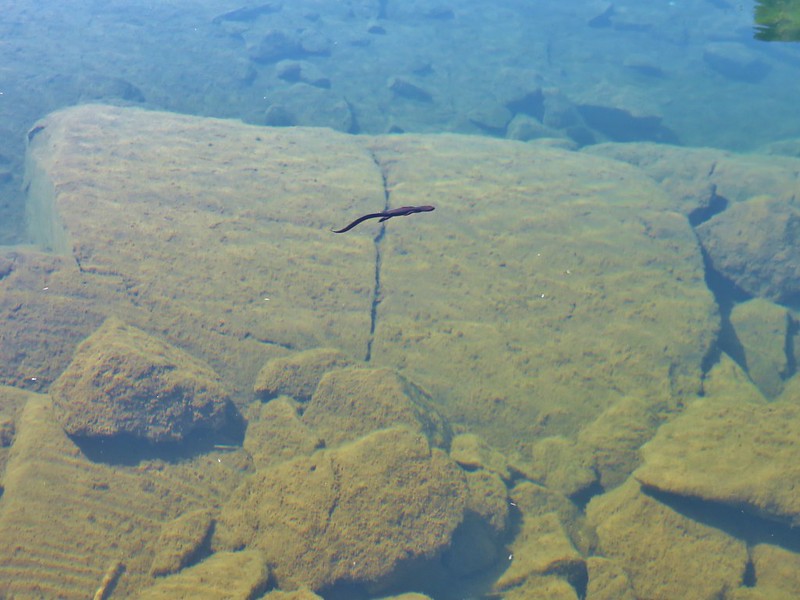
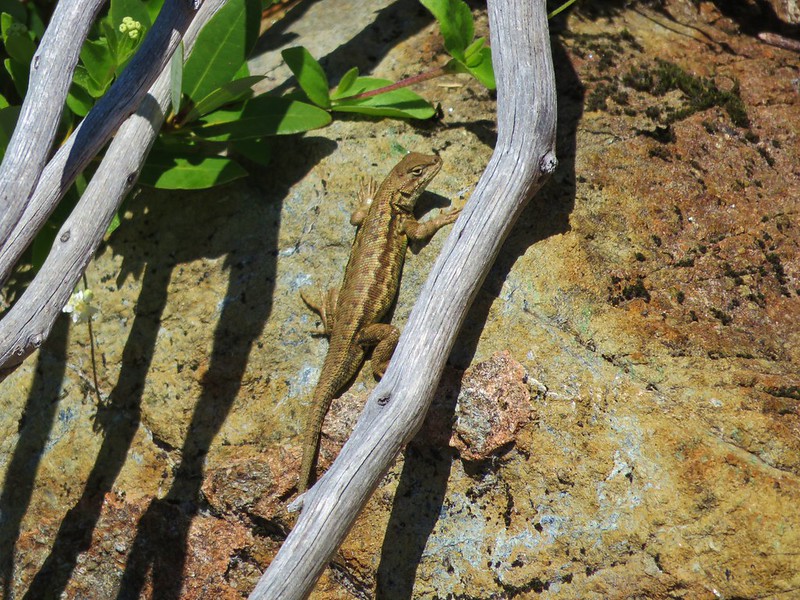
Vulcan Lake quickly ranked as one of our favorites. The colors of the water and surrounding rocks were amazing and lizards scurried along the shore while newts swam by in lake.
IMG_6375

IMG_6379

IMG_6393

IMG_6396

IMG_6367

The water was cool but not cold and we sat on the rocky bank soaking in the scenery. We could have easily spent hours or even days there but we had other places to visit so we eventually pulled ourselves away and continued to Little Vulcan Lake.

To reach Little Vulcan Lake we located a trail sign for the Gardner Mine Loop near where we had left the main trail to go down to Vulcan Lake.
IMG_6406

IMG_6407

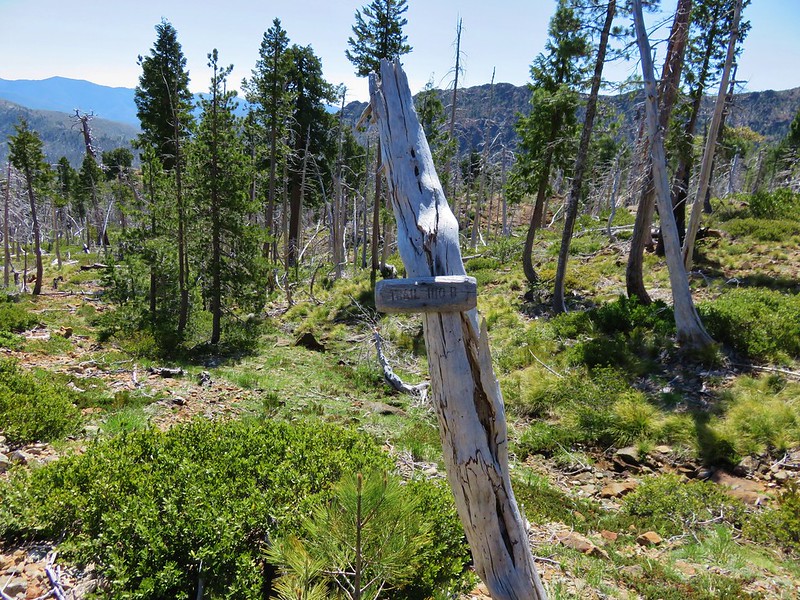
From there we could see another trail sign for the Trail 1110B.
IMG_6408

IMG_6409

Two tenths of a mile following more cairns and faint tread brought us to Little Vulcan Lake. As close as these two lakes were to one another they couldn’t have been much different.
IMG_6411

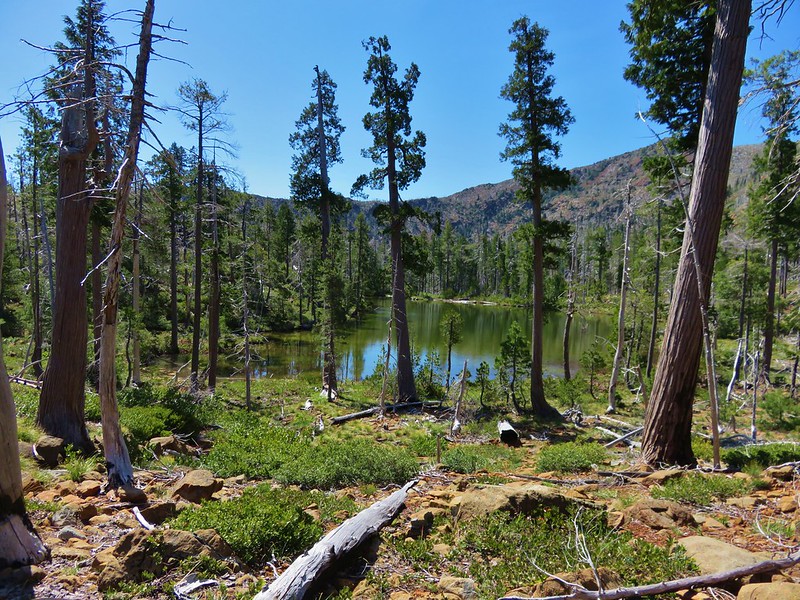
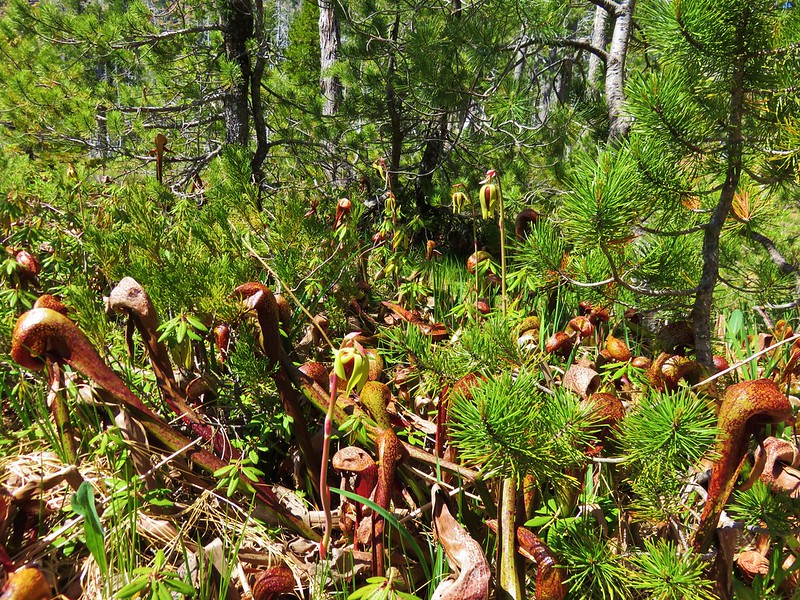
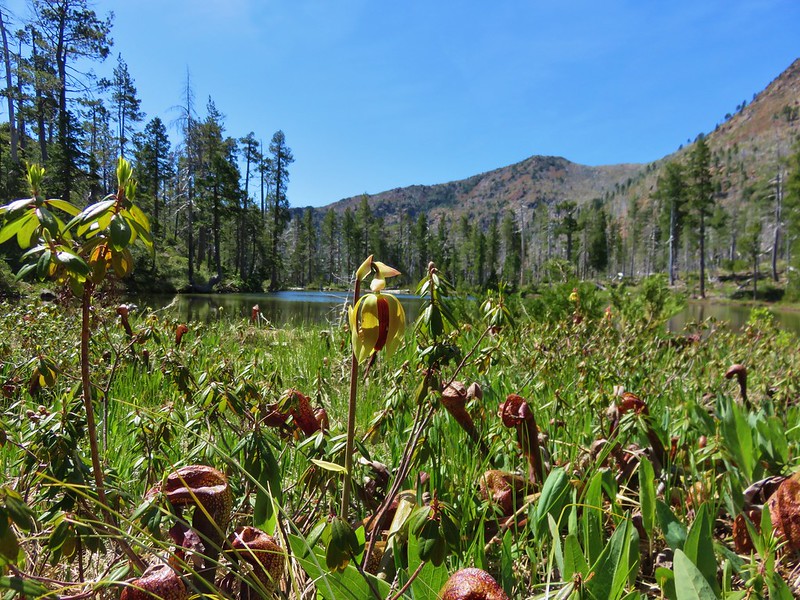
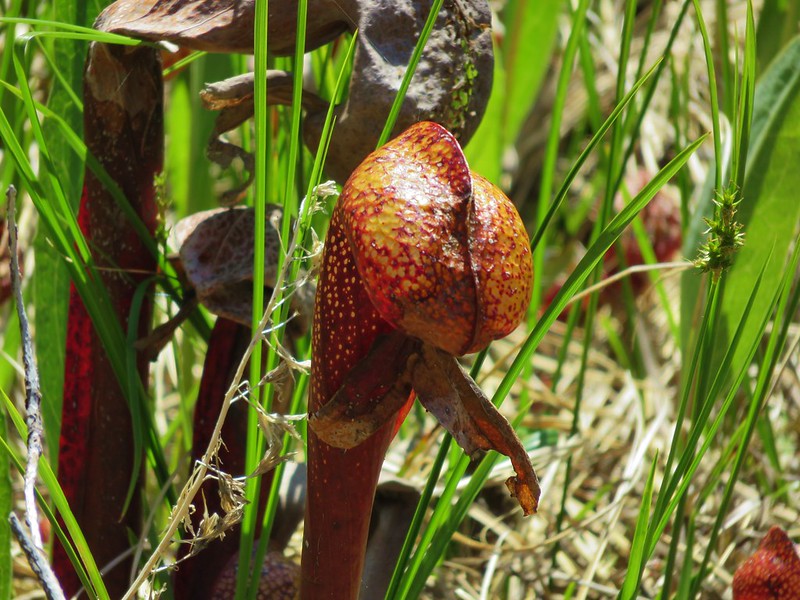
Instead of red rock surrounding the water here we found Darlingtonia californica. Insect eating pitcher plants.
IMG_6412

IMG_6415

IMG_6416

IMG_6418

This was our first time seeing the pitcher plants and we found them to be really interesting. In addition to the pitcher plants there were a number of newts in the lake.

Six newts in Little Vulcan Lake.
IMG_6421

From Little Vulcan Lake we returned to the Gardner Mine Loop trail and followed it as well as we could. Between cairns and our GPS we managed to stay mostly on course despite almost no sign of the actual trail tread.
IMG_6431

We followed the cairns for .6 miles being eyed by lizards the whole time.
IMG_6429

IMG_6438

After the .6 miles of cairns we arrived at Sorvaag Bog.
IMG_6440

IMG_6443

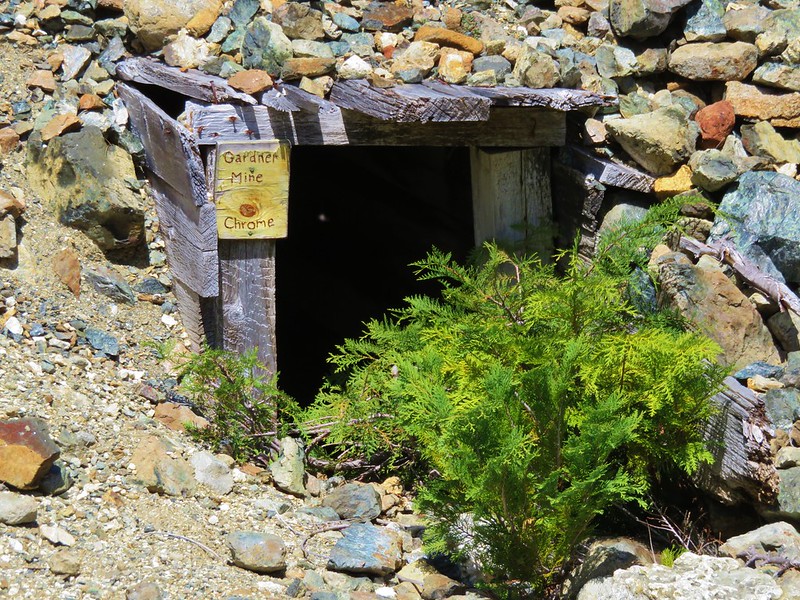
From the bog the trail followed an old roadbed making it easier to follow. We passed the entrance to the Gardner Mine before reaching a junction in a saddle with the Johnson Butte Trail.
IMG_6449

IMG_6451

IMG_6460

This junction was just .8 miles from where the trail had split and we’d taken the right-hand fork to Vulcan Lake. Before heading back though we had one final lake to visit and some rare flowers to look for so we turned right and headed deeper into the wilderness.

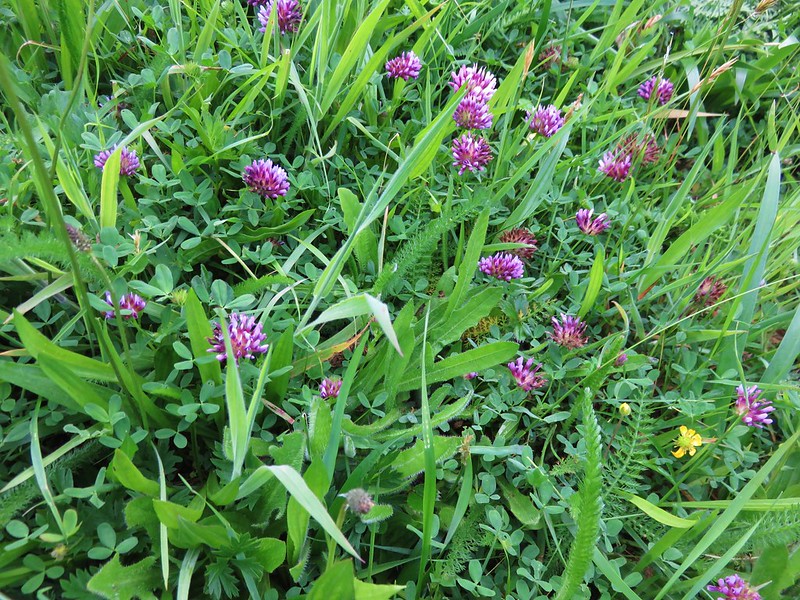
We were hoping to see some kalmiopsis leachiana in bloom. This rare flowering plant is found only in a few areas in the Kalmiopsis Wilderness. We knew that there were some along the Johnson Butte Trail so we were keeping an eye out only we weren’t entirely certain what they looked like. For some reason we hadn’t looked at any pictures online beforehand so the only information we had was the general areas we might spot them in and a belief that they were pink.

The Johnson Butte Trail followed another old road for 2.6 miles then turned to a simple trail. The whole time the trail alternated between ridges and hillsides often switching between the east and west facing sides at saddles.
IMG_6493

IMG_6516

IMG_6534

There were plenty of flowers along the way including a surprise appearance of a single beargrass blooming.
IMG_6467

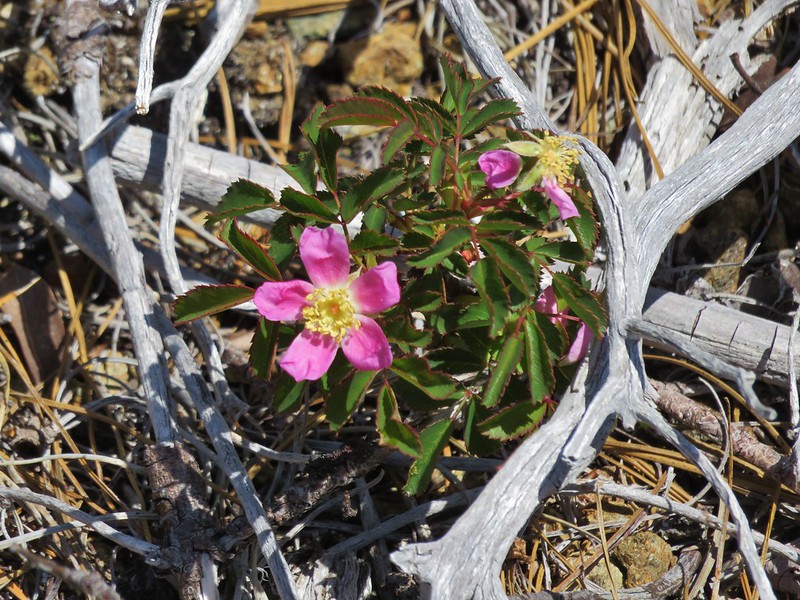
Wild Rose
IMG_6519

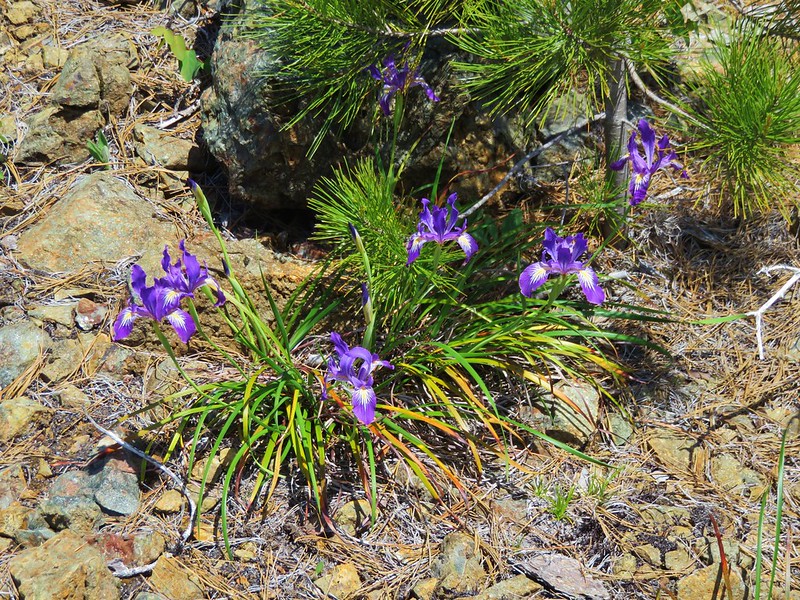
Wild iris
IMG_6518//embedr.flickr.com/assets/client-code.js

Narrowleaf blue eyed mary
IMG_6497

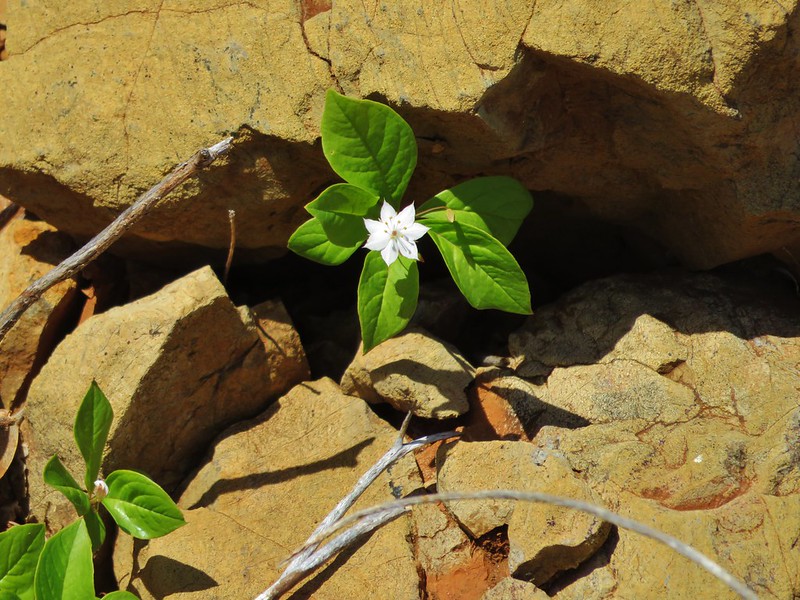
Starflower
IMG_6481

Rhododendron
IMG_6464

Tolmie’s mariposa lily
IMG_6483

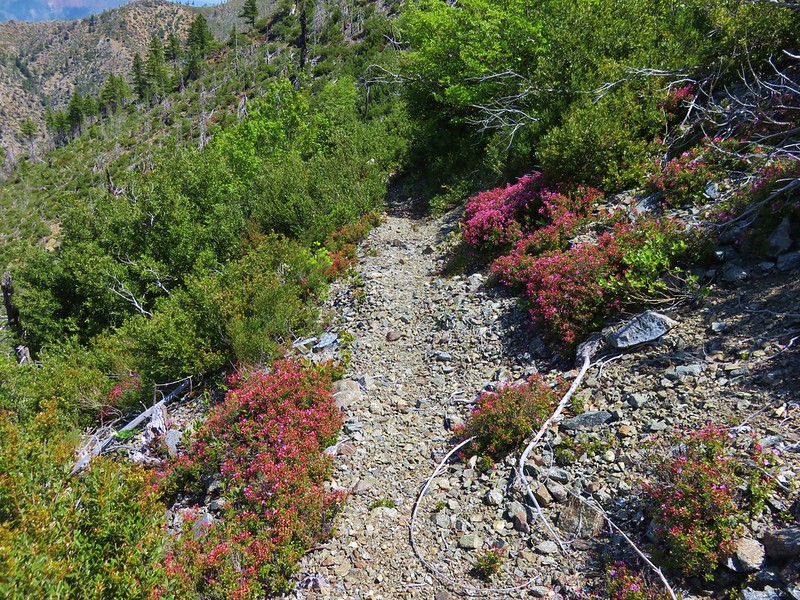
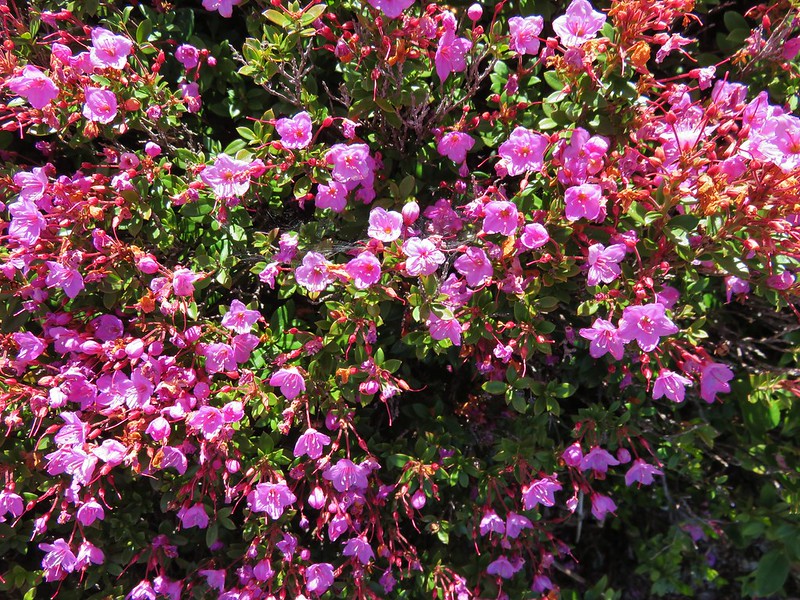
We began seeing some pink flowers that we at first mistook for mountain heather, but after looking at them closer we realized they were something different. We eventually convinced ourselves that these must be the kalmiopsis leachiana which was confirmed later when we double checked online.
IMG_6535

The best patches were found after the trail made a sharp right turn at a ridge end below Dry Butte.
IMG_6571

IMG_6572

A few other flowers we had not been seeing were found below Dry Butte.
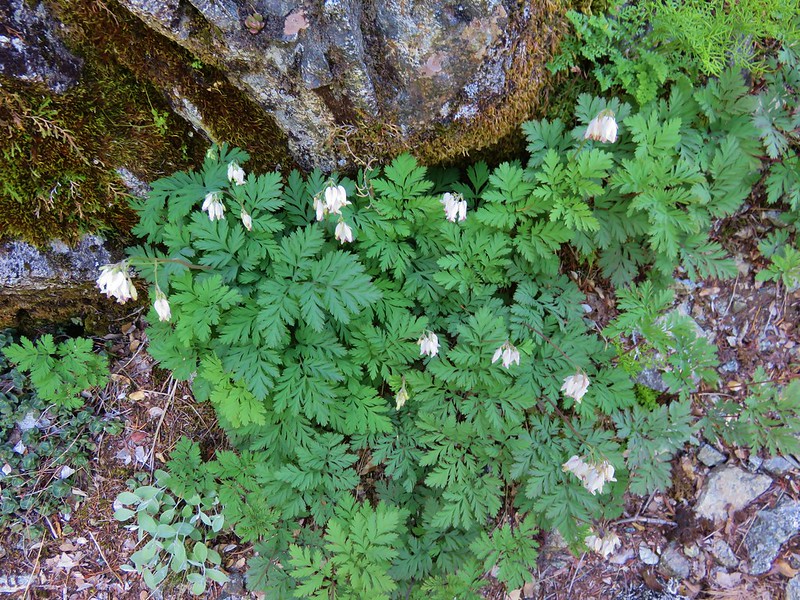
Bleeding heart
IMG_6582

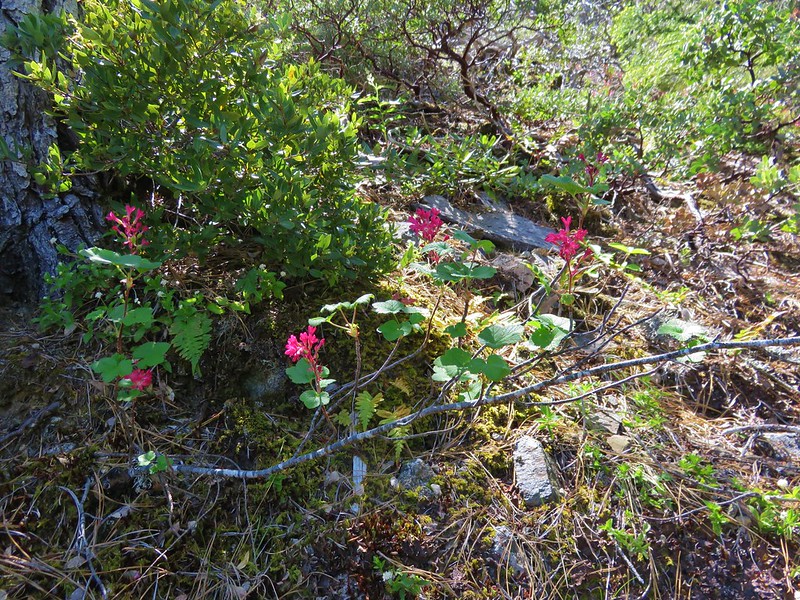
Red flowering currant
IMG_6585

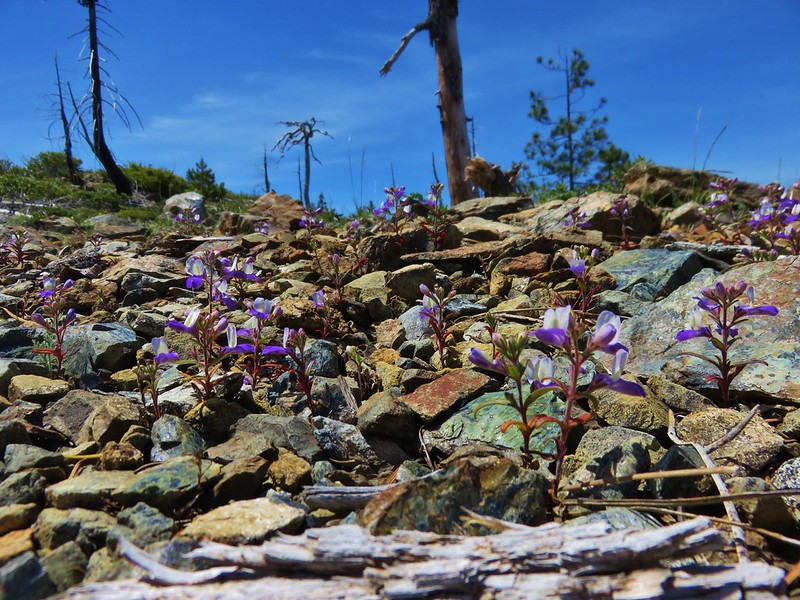
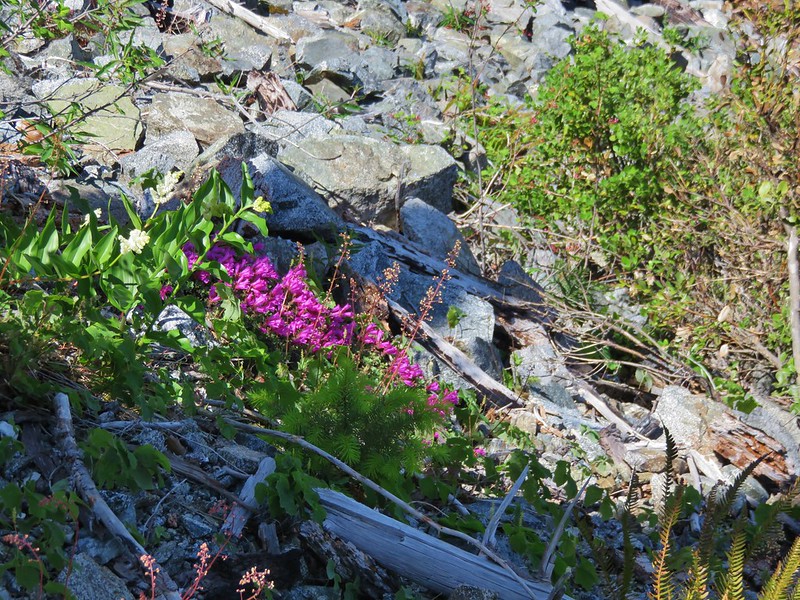
Penstemon and solomonseal
IMG_6591

A little over three miles from the saddle where we had set off on the Johnson Butte Trail we found a sign for the Salamander Lake Trail.
IMG_6594

There was a campsite just below the ridge but the lake was further downhill hidden by brush and trees. The trail disappeared in the same brush and trees at the campsite and we momentarily considered not picking our way down to the lake, but that had been our planned turnaround point so down we went. We fought our way steeply down through the brush and blowdown to find the little lily pad filled Salamander Lake.
IMG_6597

IMG_6600

After the Vulcan Lakes this one was a bit of a letdown but we found some shade along the bank and took a short break that was interrupted by a few mosquitoes. We climbed back up to the Johnson Butte Trail and returned the way we’d come. At the saddle junction we kept straight following the trail along the old roadbed the .8 miles back to where we’d split off earlier and then completed the short walk to the trailhead.
IMG_6625

It had been a very warm sunny day and we were pretty worn out when we started the drive back out along road 1909. It was nice to rest in the car for a bit as we slowly made our way back to North Bank Road. Once we were back on North Bank Road we drove 8.5 miles towards Brookings where we turned into Alfred Loeb State Park for our final hike of the day. The temperature gauge in the car read 87 as we pulled in.

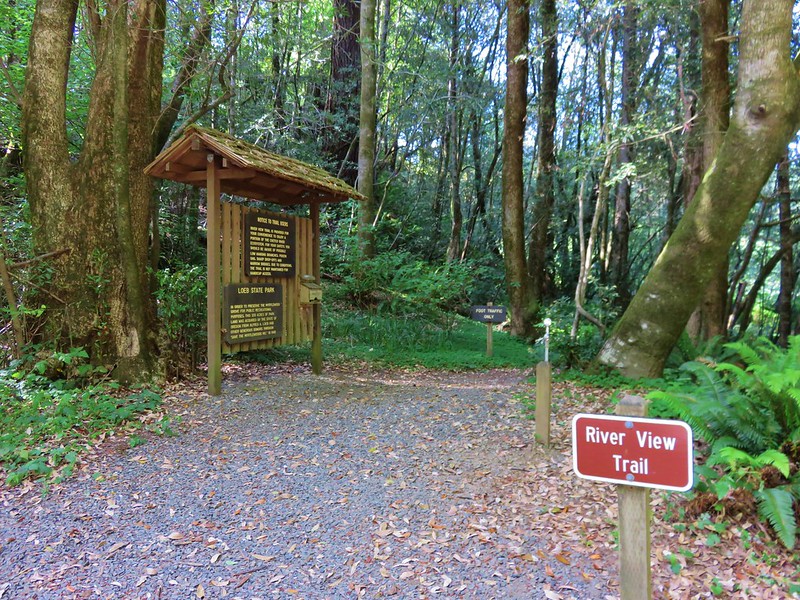
We parked at a signed trailhead and took the .7 mile River View Trail.
IMG_6629

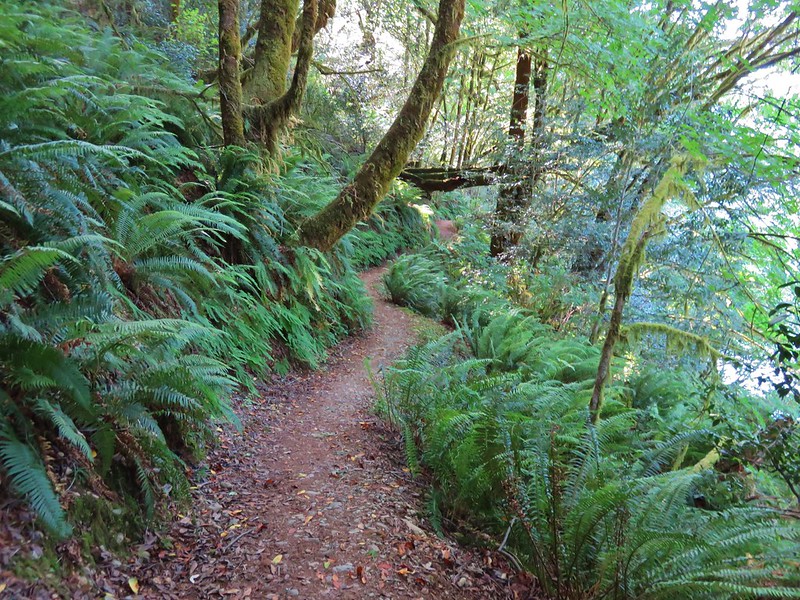
This trail passed through a forest following the Chetco River. Lettered signposts corresponded to entries in a brochure that could be picked up at the trailhead.
IMG_6639

IMG_6647

The Riverview Trail led to a crossing of North Bank Road where the Redwood Nature Trail began on the far side.
IMG_6652

This 1.2 mile loop trail passed through a mixed forest with some nice redwoods along the way.
IMG_6658

IMG_6665

IMG_6668

IMG_6672

We did the loop in a counter-clockwise direction which seemed to leave the steeper sections as downhill. After finishing the loop and returning to the car we walked down to the Chetco River because there really hadn’t been a great view of it along the River View Trail.
IMG_6686

When it was all said and done our GPS showed a total of 16.6 miles for the three hikes. Three miles for Vulcan Peak, 10.7 for Vulcan and Salamander Lakes, and 2.9 for this final hike. It had been a long hot day and we decided that ice cream sounded good for dinner so we stopped at the DQ in Brookings splitting a chicken strip basket and each having a Blizzard. Such are the joys of being on vacation. Happy Trails!

Flickr: https://www.flickr.com/photos/9319235@N02/albums/72157668642744636

Categories
Hiking Oregon Oregon Coast Southern Coast Trip report

Humbug Mountain, Sisters Rock, and Otter Point

With our vacation plans changed due to the potential for rain in SE Oregon we had returned home after hiking in the Oregon Badlands Wilderness to regroup. We swapped guide books and some or our supplies and headed for Gold Beach on the southern Oregon coast on Monday morning. We took our first set of hikes on the way down Highway 101 starting with a climb up Humbug Mountain.

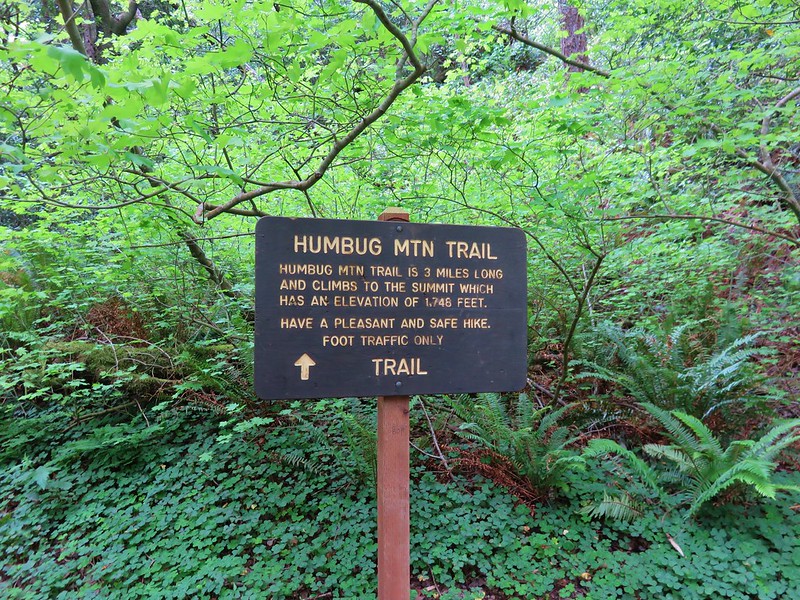
The Humbug Mountain Trail begins at the signed Humbug Mountain Trailhead across from the state park campground.
IMG_5870

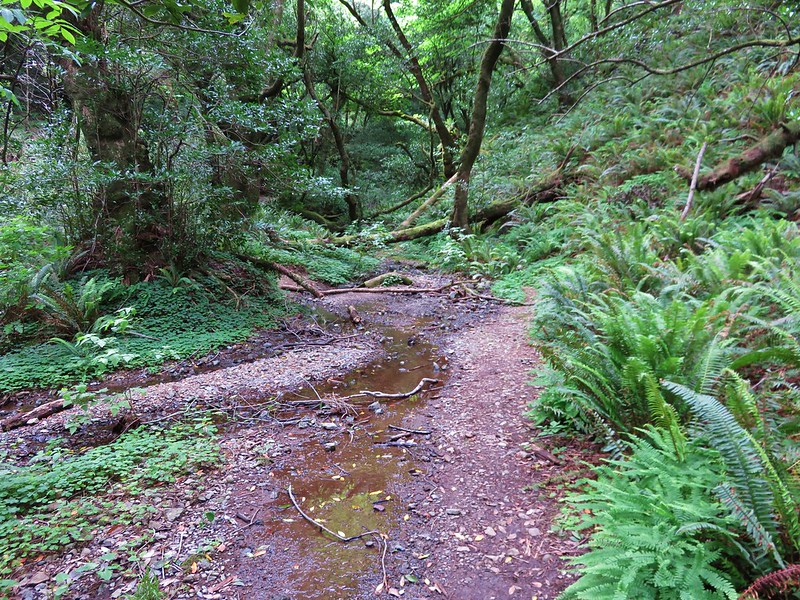
The trail promptly crosses a creek then climbs through the forest for a mile to a split in the trail.
IMG_5871

IMG_5896

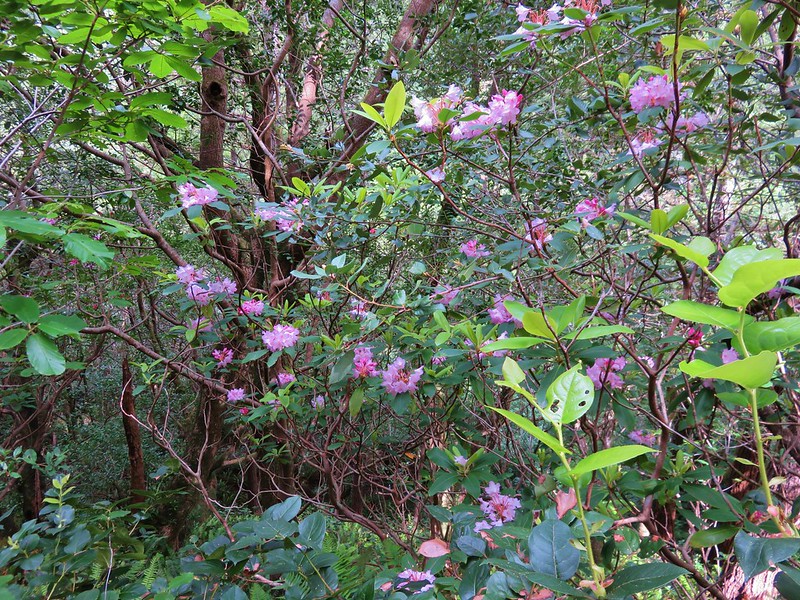
Rhododendron
IMG_5891

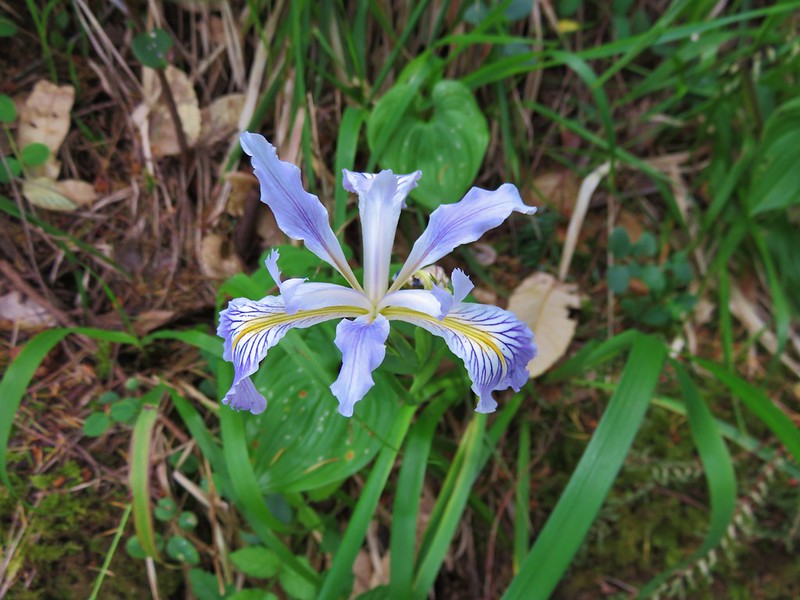
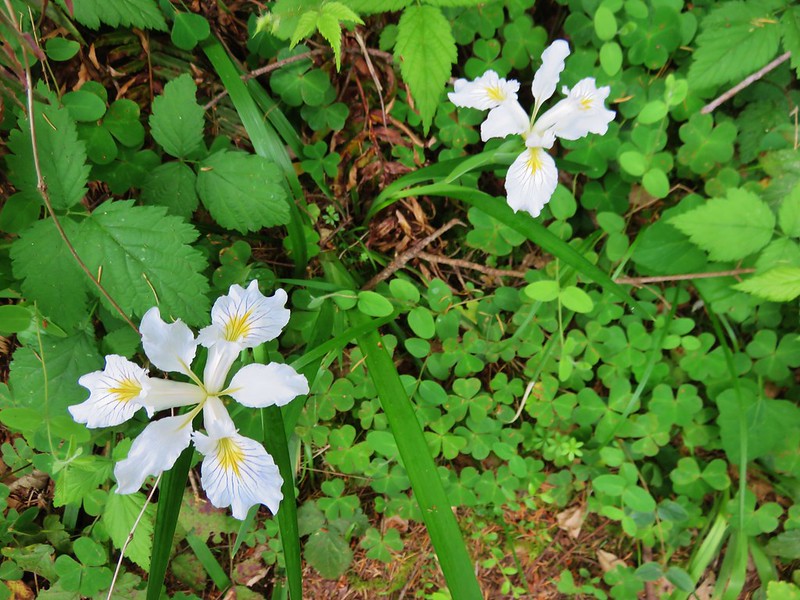
Wild iris
IMG_5903

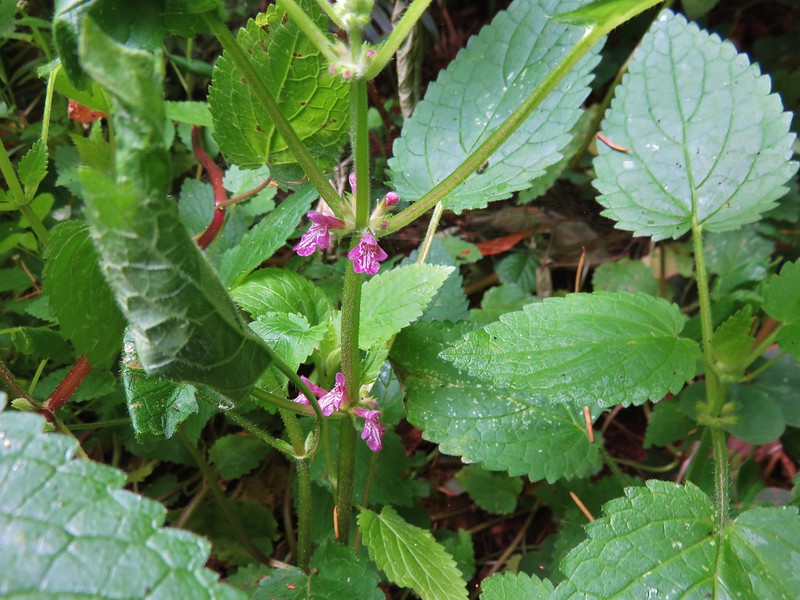
Hedge nettle
IMG_5907

Wild iris
IMG_5908

IMG_5918

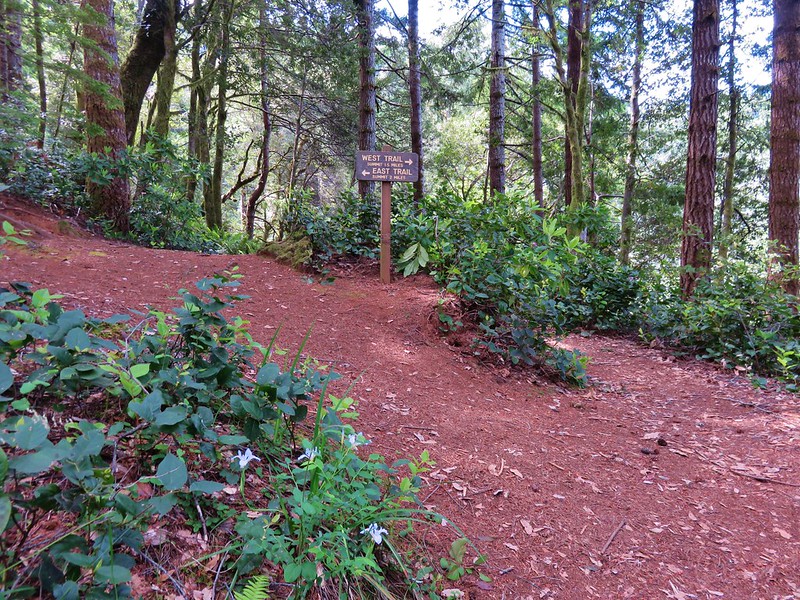
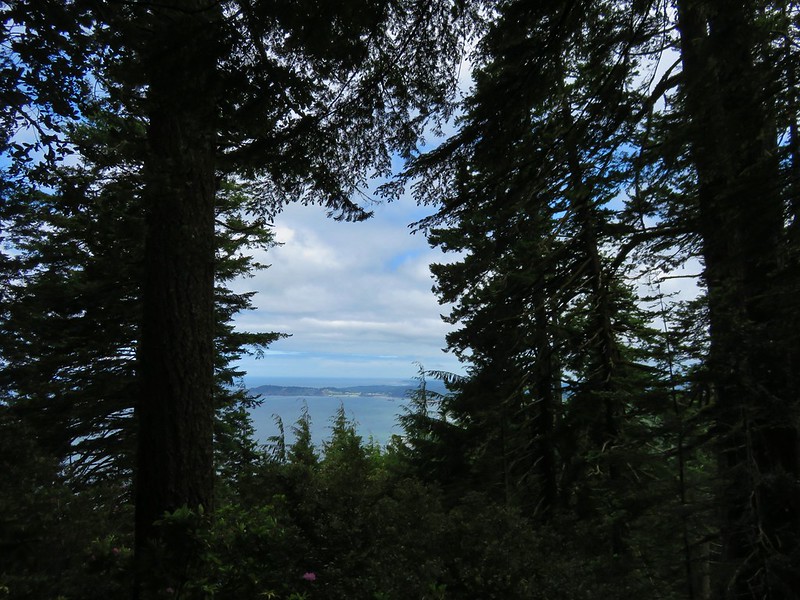
Two routes led to the summit, the 1.4 mile West Trail and the 1.9 mile East Trail, allowing for a loop. We took the shorter West Trail to the right which offered limited ocean views.
IMG_5935

IMG_5933

When the trails rejoined we took the short .1 mile trail to the right up to the small meadow at the summit of Humbug Mountain.
IMG_5960

IMG_5963

A few flowers dotted the meadow which was mostly filled with bracken ferns and trees obscured much of the view.
IMG_5977

Common catchfly
IMG_5974

IMG_5989

Elegant brodiaea
IMG_5979

IMG_5975

We took the East Trail down completing the loop and returning to the trailhead. The 5.5 mile hike was nice enough and a good climb, but the lack of views was a little disappointing albeit fitting for a mountain named Humbug.

From Humbug Mountain we continued driving south on HWY 101 to our next stop, Sisters Rock State Park. If not for our guide book describing the pullout between milepost 314 & 315 we would likely have driven right by. There was no sign for the park prior to the little pullout along the highway and the sign at the park was set back off the road making it difficult to spot while driving.
IMG_6011

The wind was really strong whenever we were exposed to the north but the half-mile path down to the Sisters Rocks was full of views and flowers. Humbug Mountain was visible to the north and to the south was scenic Franklin Beach.
IMG_6009

IMG_6020

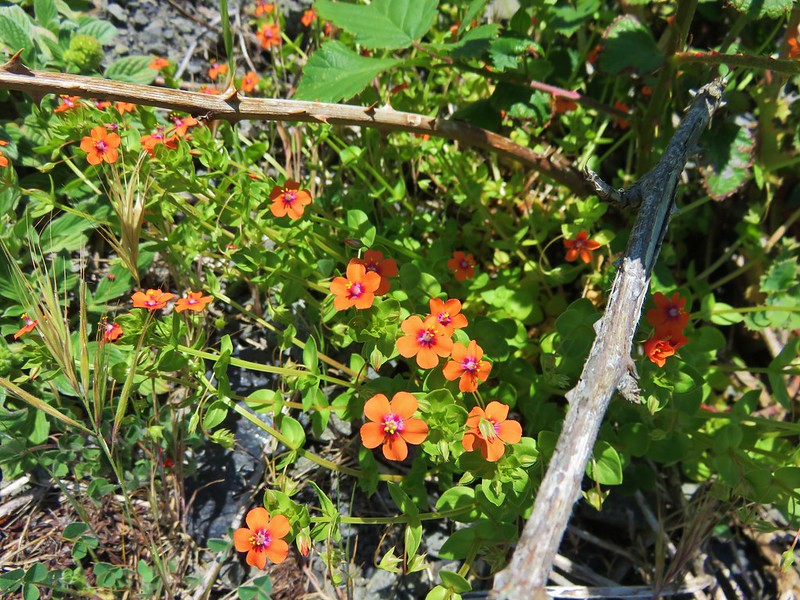
Scarlet pimpernel
IMG_6025

IMG_6027

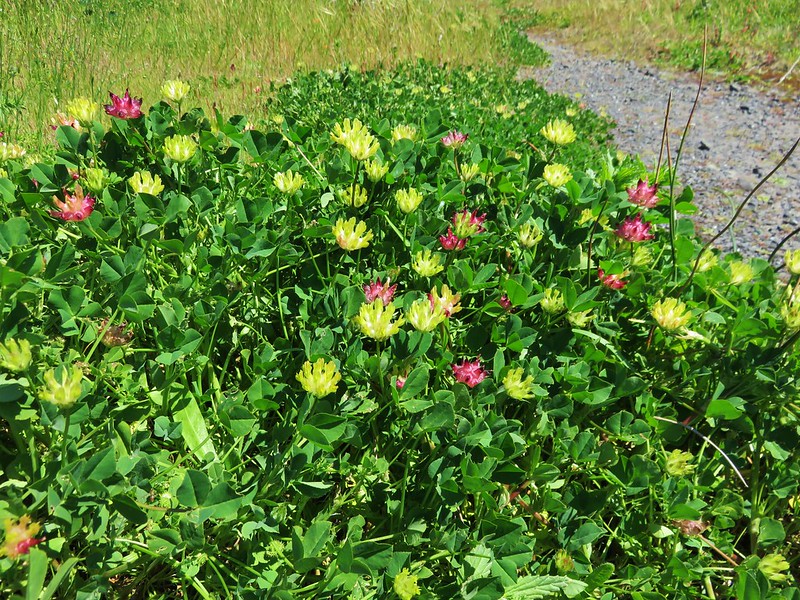
Cows clover
IMG_6028

IMG_6073

Lupine
IMG_6095

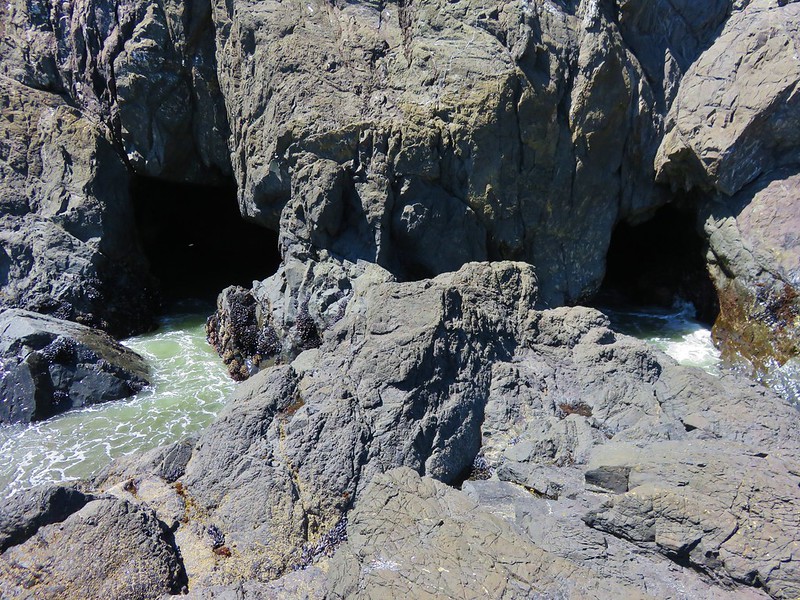
We headed for the largest of the rocks where a trail brought us to the mouth of a sea cave.
IMG_6017

IMG_6031

IMG_6046

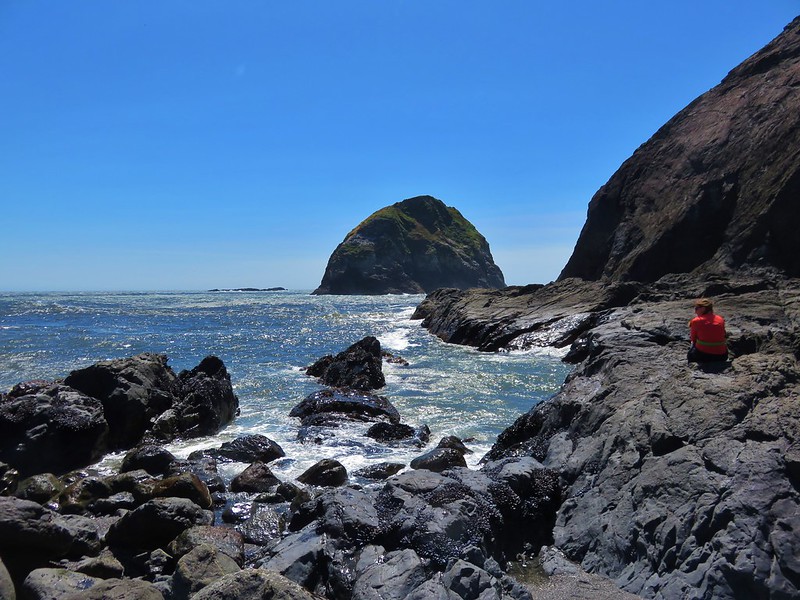
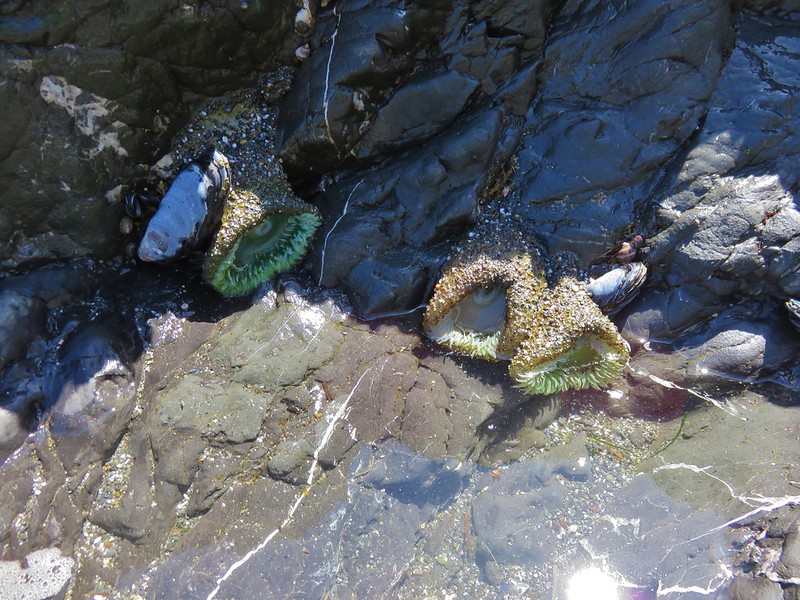
We found a spot on the rocks between the largest Sisters Rocks where we were protected from the wind. Here there were more caves and some small tide pools.
IMG_6032

IMG_6058

IMG_6067

IMG_6054

IMG_6060

IMG_6063

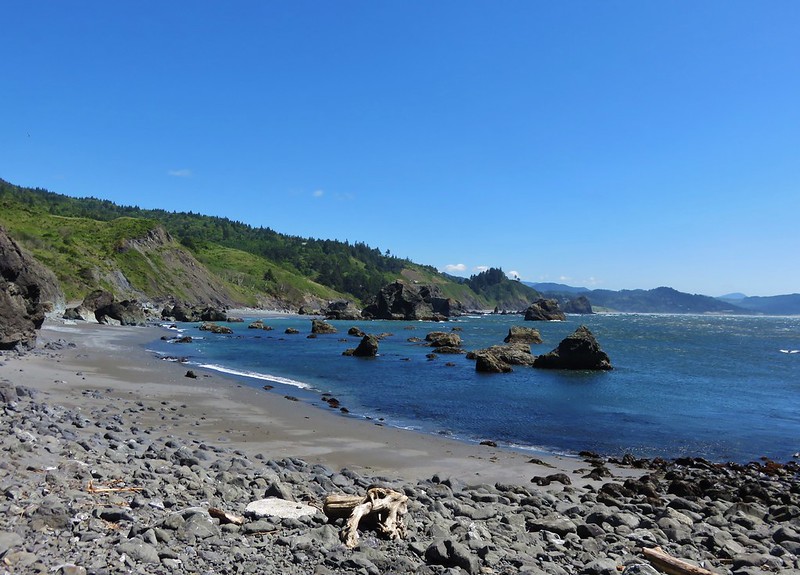
We then made our way to Franklin Beach which we shared with a lizard.
IMG_6077

IMG_6094

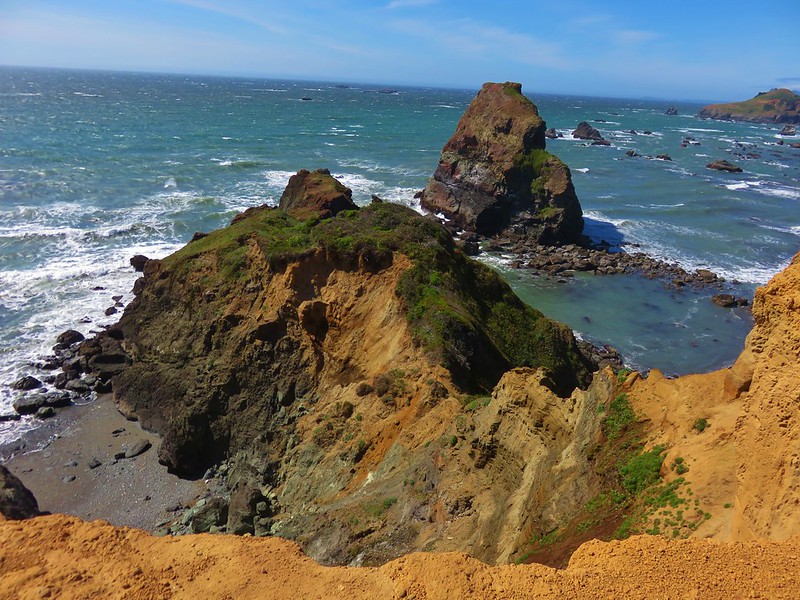
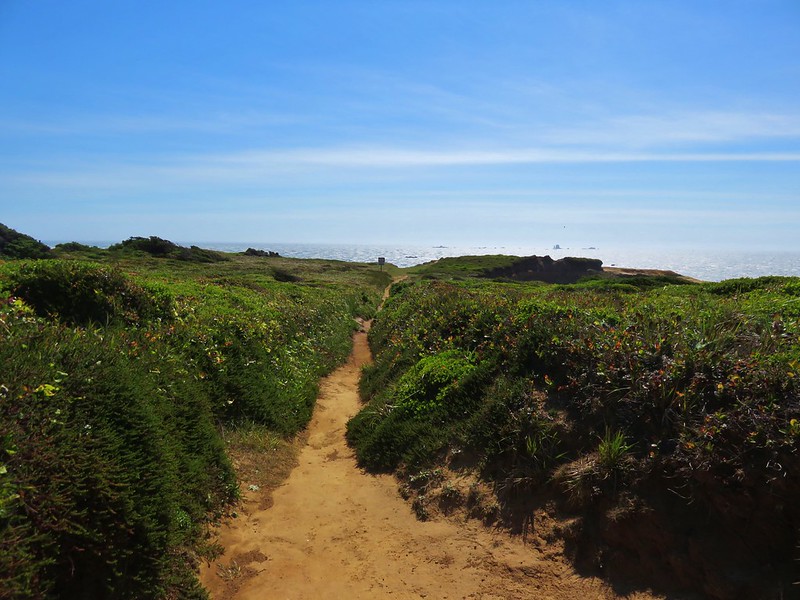
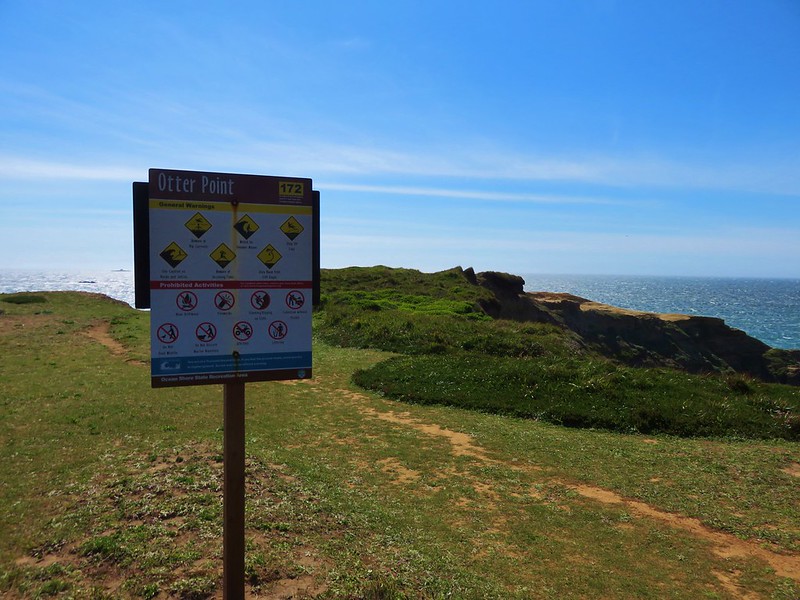
Our final stop for the day was at Otter Point State Park. This was another somewhat hidden park located along Old Coast Road 3 miles north of Gold Beach. Again signage was lacking for the park until we were at the entrance which took us some time to locate. It was worth the effort to find this little gem though. The parking area was lined with azaleas and wild roses and the trail to Otter Point had big views.
IMG_6206

IMG_6210

IMG_6131

IMG_6133

IMG_6150

IMG_6156

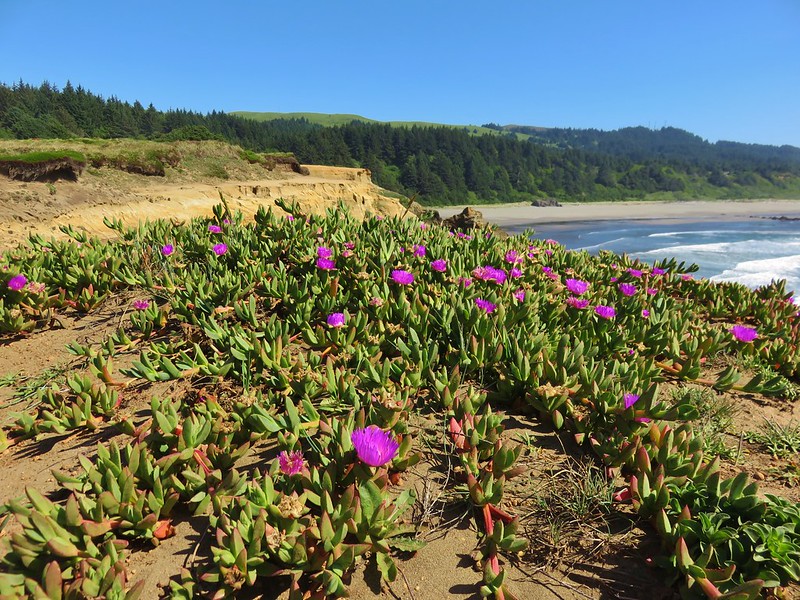
In addition to the views several types of flowers were present.
Sea Figs
IMG_6158

IMG_6161

Seaside daisy
IMG_6189

Wild iris
IMG_6196

Sea thrift
IMG_6198

We were pleasantly surprised by both Sisters Rock and Otter Point and were glad we took the time to stop and check them out. These were short hikes (1.4 & 0.7 miles receptively)that really paid off. It was a nice start to the vacation and they set the bar for the rest of the weeks hikes. Happy Trails!

Flickr: https://www.flickr.com/photos/9319235@N02/albums

Categories
Bend/Redmond Central Oregon Hiking Oregon Trip report

Oregon Badlands Wilderness

You know what they say about the best laid plans of mice and men…..they often go awry. After putting together a multi-year hiking schedule, much of it will need to be rearranged after our first vacation. We had planned on spending the week in SE Oregon hiking some of the most remote trails in the State, but the weather had other thoughts. Many of the trailheads in that area become inaccessible if it rains which is what the forecast was threatening heading into our vacation week.

Our original plan was to visit family in Bend on Saturday then hike in the Oregon Badlands Wilderness on the way to Jordan Valley on Sunday. We were hopeful that the forecast would clear up and headed to Bend for the visit but by Saturday night the chance of precipitation had increased so we decided not to risk traveling all that way and not being able reach the trails. We instead turned to Plan B which was to spend the week on the Southern Oregon Coast in Gold Beach. Since we were already in Bend though we stuck with our planned hike in the Oregon Badlands Wilderness before heading home to repack for a trip to the coast.

It was a drizzly morning when we arrived at the Flatiron Rock Trailhead fifteen miles east of Bend along Highway 20.
IMG_5613

IMG_5619

Our planned 13.5 mile hike was to start on the 1.9 mile Ancient Juniper Trail then take the Flatiron Rock Trail to Flatiron Rock. We’d then make a loop by taking the Castle Trail to Badlands Rock and the Badlands Rock Trail which we could follow to a junction with the Dry River and Homestead Trails. After taking a side trip on the Dry River Trail to visit the Dry River Channel we would use the Homestead Trail to get back to the Flatiron Rock Trail and return to the trailhead. Of course the best laid plans of mice and men……

There were a fair amount of wildflowers along the Ancient Juniper Trail as well as plenty of juniper trees. We’ve always enjoyed the uniqueness of junipers and that uniqueness was on display here.
IMG_5620

IMG_5638

IMG_5632

IMG_5642

IMG_5649

IMG_5684

IMG_5690

IMG_5696

IMG_5660

IMG_5670

IMG_5678

We also spotted a couple of rabbits and bluebirds along the way.
IMG_5668

IMG_5674

IMG_5705

The signage was good at the first junction pointing us in the direction of Flatiron Rock.
IMG_5707

After 1.5 miles on the Flatiron Rock Trail we came to the junction with the Castle Trail.
IMG_5736

Flatiron Rock was also at this junction. One of the highlights of the Oregon Badlands Wilderness are the explore-able volcanic rock formations that dot the landscape. We followed a path between the pressure ridges and explored.
IMG_5737

IMG_5742

IMG_5747

IMG_5754

IMG_5755

IMG_5758

IMG_5773

IMG_5774

After wandering around Flatiron Rock we took the Castle Trail, which passed another explore-able rock formation, before arriving at Badlands Rock which towered above the surrounding area.
IMG_5779

IMG_5780

We attempted to pass through Badlands Rock from the east side but a pile of large boulders made it impossible to get through without some extra effort.
IMG_5781

We went back around to the west end and after a fairly easy scramble managed to get inside the walls of Badlands Rock.
IMG_5783

At this point our plans began to go awry. Looking at the map we were using we were expecting a trail to bend slightly to the right after passing Badlands Rock but we didn’t see a trail sign and the openness of the area and profusion of old dirt roads and game trails have left paths all over. We had briefly taken a right hand turn at the rock formation along the Castle Trail and were now thinking that maybe that had been the correct path after all. We decided to head back to that spot and inspect it more thoroughly.

This time we explored the rock formation. It had some interesting features and a nice view of Badlands Rock.
IMG_5789

IMG_5790

IMG_5798

It also, apparently, had a Turkey Vulture living in it. As we were passing by, we heard a ruckus coming from the rocks and saw something moving in a crevice. A vulture popped out and stood on the rocks a short distance from us.
IMG_5797

We excused ourselves and headed back down to what we believed was the correct trail while the vulture circled overhead to make sure we left. Upon further review of the map and our GPS we decided that the trail we wanted was not here and was in fact back at Badlands Rock. We turned around and returned to Badlands Rock going a little further around it this time where we finally spotted a lone trail sign.
IMG_5804

We made our next mistake here following the pointer even though it didn’t seem to agree with what our map indicated. Instead of bending right it went left/straight but the only thing to the right appeared to be an old dirt track that made a sharp turn. We thought that the trail we decided on probably bent back around to the right just a bit further on, which it did convincing us that we were on the right track. We thought we were on a 2.7 mile stretch of the Badlands Rock Trail that led to the junction with the Dry River and Homestead Trails so we settled in and enjoyed the scenery.
IMG_5805

IMG_5807

After awhile we started to feel like we should have reached that junction already. We were once again questioning our route when we did spot a sign post at a trail junction.
IMG_5810

The problem was we had no idea what the Tumulus Trail was. Our map did not show it (it didn’t extend out as far as we’d gone). We hummed and hawed for awhile looking at the map and GPS before finally deciding we had gone the wrong way at Badlands Rock. We didn’t know where the Tumulus Trail went and we weren’t sure about trying to navigate cross country, so we headed back the way we’d come, which turned out to be 3.3 miles in the wrong direction.

We picked up the correct path at Badlands Rock and headed south passing through a more open landscape to the correct trail junction. This area was full of birds.
IMG_5817

IMG_5821

IMG_5814

IMG_5827

IMG_5835

We turned up the Dry River Trail for .8 miles turning off at three boulders to find the Dry River Canyon.
IMG_5844

Once upon a time the canyon was home to a tributary of the Deschutes River. The rocks provided proof of the vanished river.
IMG_5848

IMG_5851

IMG_5852

We passed through the canyon for a ways then climbed out and cut cross country back to the Dry River Trail and returned to the junction with the Homestead Trail. It was another 2.2 miles on the Homestead Trail back to the Flatiron Rock Trail then an additional 1.2 miles to the car. When it was all said and done the GPS showed a total of 22.6 miles and it had taken us a little of 9 hours. We were leaving the trailhead about the time we had planned on being back home to repack for our trip to Gold Beach. Our plans had truly gone awry.

We ate dinner at Pilot Butte Drive In before leaving Bend then drove back to Salem to get ready for our next adventure in the morning. Happy Trails!

Flickr: https://www.flickr.com/photos/9319235@N02/albums/72157667960760550

Categories
Bend/Redmond Central Oregon Hiking Oregon Trip report

Steelhead Falls and Scout Camp Trail

**In 2025 the Alder Springs Fired burned over the Scout Camp Trail near the confluence of the Deschutes River and Whychus Creek.**

We had stayed in Central Oregon after visiting the Painted Hills and Sutton Mountain on Saturday. Before heading home we took the opportunity to do a pair of short hikes in the Steelhead Falls Wilderness Study Area near Crooked River Ranch. The first of the hikes started at the Steelhead Falls Trailhead.
IMG_4756

The falls are only a half mile from the trailhead and can get very busy, but we were there early and had the trail to ourselves. We followed the path down into the Deschutes River Canyon.
IMG_4767

Flowers included sand lilies, balsamroot, and thread-leaf phacelia.
IMG_4761

IMG_4771
IMG_4779

Colorful rocks formations lined the canyon walls.
IMG_4772

IMG_4776

IMG_4788

IMG_4790

Steelhead Falls is only about 20′ tall but the width and setting of the falls makes it an impressive sight.
IMG_4795

IMG_4798

Beyond the falls the Deschutes calmed and various ducks and geese were enjoying the morning.
IMG_4804

IMG_4807

IMG_4816

We continued past the falls for .6 miles planning on visiting the Gray Tower, a 70′ rock formation. Our guidebook instructed us to turn right at a dry wash and then “stay right at junctions” up to the tower. We turned at the wash with the Gray Tower visible up the hillside.
IMG_4840

We apparently did too good a job at staying right and wound up following a path up a ridge with the wash on our left. We began to suspect that we were too far right when were getting further away from the Gray Tower and there was no sign of the ridge we were on bending back towards it. We spotted a trail on the opposite side of the wash and realized that it was the trail we should be on and headed back down. The detour had not been without its charms though, as it provided a nice view across the wash to the Gray Tower and to Mt. Jefferson (covered in clouds this morning).
IMG_4846

IMG_4853

We’d also seen some nice wildflowers.
Paintbrush
IMG_4841
Rough eyelashweed
IMG_4848

Desert yellow fleabane
desert yellow fleabane

White-daisy tidytips
IMG_4858

Once we had returned to the dry wash we headed up the left-hand side on a horse path keeping the wash on our right while we stayed right at the junctions. This trail did indeed lead us to the tower.
IMG_4866

We followed the horse path past the tower veering right heading for the start a .9 mile loop described in our guide book. At some point we lost the trail as it turned uphill and we were once again forced to backtrack. We decided to head cross country to try and pick up the trail, which we managed to do. When we reached a split to the trail on top of the rim we went right to start the loop. There was a small rocky knoll a short distance to the left with some small junipers on it at this junction.
IMG_4887

Several deer were watching us as we began the loop.
IMG_4886

IMG_4892

IMG_4897

We passed around a small hill through juniper and sagebrush keeping left at junctions marked by rock cairns.
IMG_4902

It was a beautiful sunny day which would have normally meant some nice mountain views but all the Cascade peaks were draped in clouds making for an interesting sight.
IMG_4900

IMG_4914

IMG_4919

Heather spotted a coyote that ran off too quickly for a photo, but several birds stayed put long enough for pictures.
IMG_4904

IMG_4908

IMG_4911
We completed the loop and managed to follow the horse path all the way back down to the river without losing it this time. The sun was now on the river and ducks paddled about as red-winged blackbirds filled the canyon with their songs.
IMG_4834

IMG_4938

IMG_4930

IMG_4936

IMG_4940

After returning to the trailhead we drove further into Crooked River Ranch to the Scout Camp Trailhead.
IMG_4951

This trail descends over 600′ to the Deschutes River and its confluence with Wychus Creek. The path starts out level passing through juniper and sage before dropping down into the canyon.
IMG_4953

IMG_4968

IMG_4975

Turkey vultures soared overhead and occasionally landed on the cliffs.
IMG_4970

IMG_4974

At the .4 mile mark the trail splits marking the start of a 2 mile loop. We went left following a trail pointer and headed downhill through fields of balsamroot and other wildflowers.
IMG_4989

IMG_4976

IMG_4984

IMG_4978

IMG_4988

IMG_4994

The further into the canyon we got the thicker the balsamroot became.
IMG_5011

IMG_5014

IMG_5026

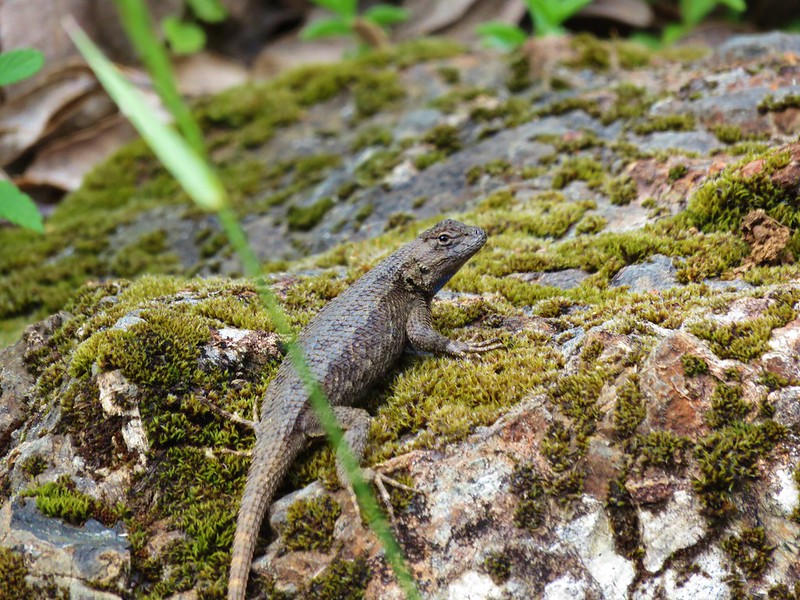
A couple of different types of lizards were sunning themselves.
Side bloctched lizards
IMG_5000

IMG_5004

Western fence lizard
IMG_5025

After a fairly steep .7 mile descent the trail leveled off passing along a cliff face with the river on the left.
IMG_5041

A family of canada geese paddled about on the water.
IMG_5037

The cliff face gave way to a hillside of flowers.
IMG_5050

IMG_5051

IMG_5055

we then passed through a grassy area before the trail appeared to end at a rock wall below a rock fin where a fish monitoring station was set up.
IMG_5062

IMG_5075

IMG_5078

We climbed up and over the rocks which brought us to the continuation of the loop. From here we could see the spot on the opposite side of the river where we had eaten lunch during a 2012 hike on the Alder Springs Trail.
IMG_5080

The trail then climbed up the canyon switching back once to a view above the rock fin.
IMG_5087

IMG_5090

IMG_5093

IMG_5101

IMG_5102

We continued to climb passing another set of cliffs with small caves and rocks that appeared ready to come crashing down at any moment.
IMG_5103

IMG_5116

IMG_5118

Some of the brightest paintbrush we’d seen was along the hillside below these cliffs as well as some tiny but spectacular Cusick’s monkey flowers.
IMG_5112

IMG_5114

IMG_5124

We finished the loop and climbed back out of the canyon. As the views opened up we could see that the mountains had finally managed to shed most of their cloud cover.
IMG_5128

IMG_5130

IMG_5134

We were pleasantly surprised by the amount of flowers along the Scout Camp Trail and fortunate to have had the Steelhead Falls trail all to ourselves. It was a great end to a weekend of wonderful hikes in Central Oregon. Happy Trails!

Flickr: https://www.flickr.com/photos/9319235@N02/albums/72157667267583520