Categories
Hiking Oregon Portland Trip report Willamette Valley

Mt. Tabor, Mt. Talbert, Scouters Mtn., & Hidden Falls Parks – 12/16/2023

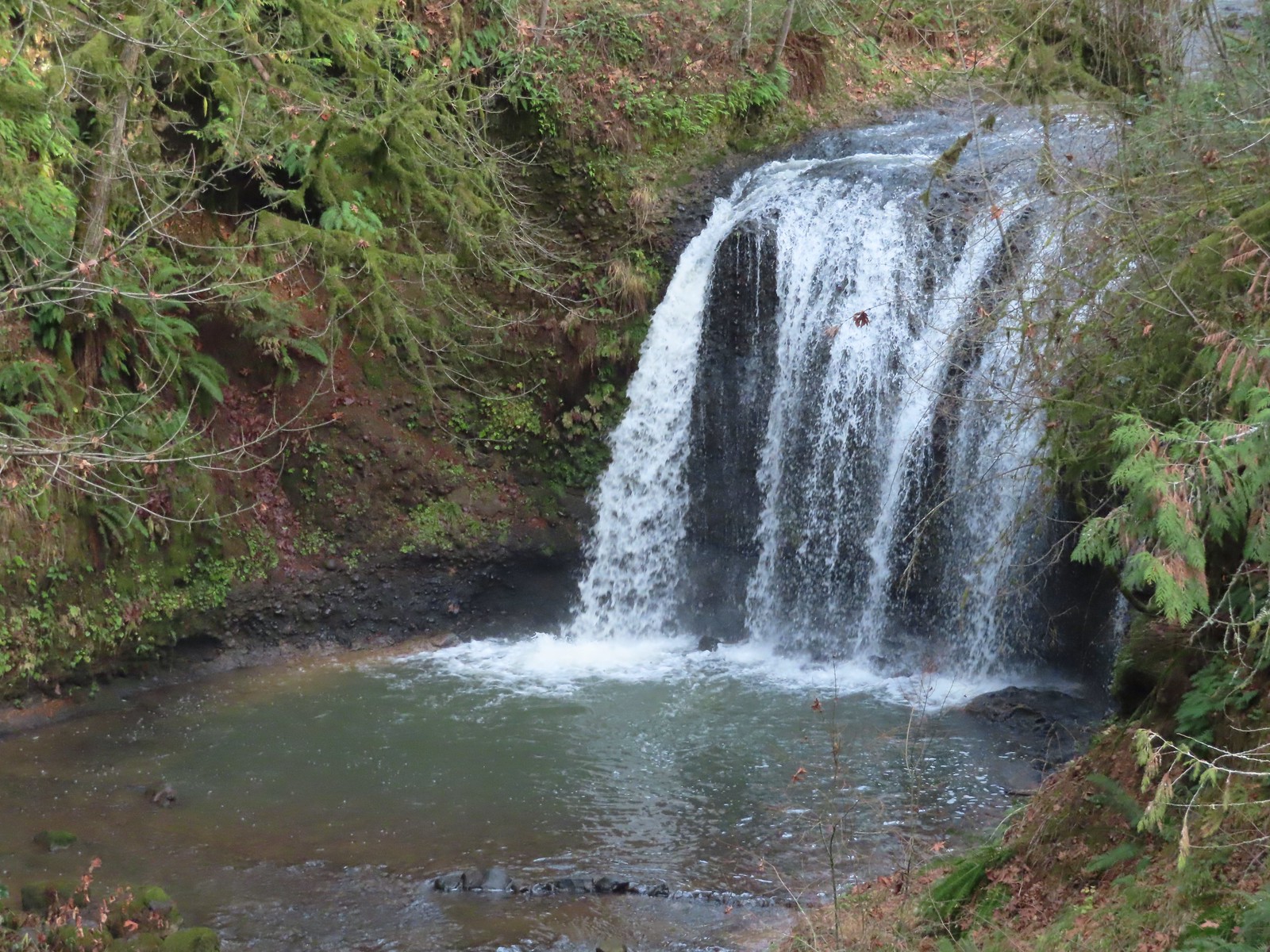
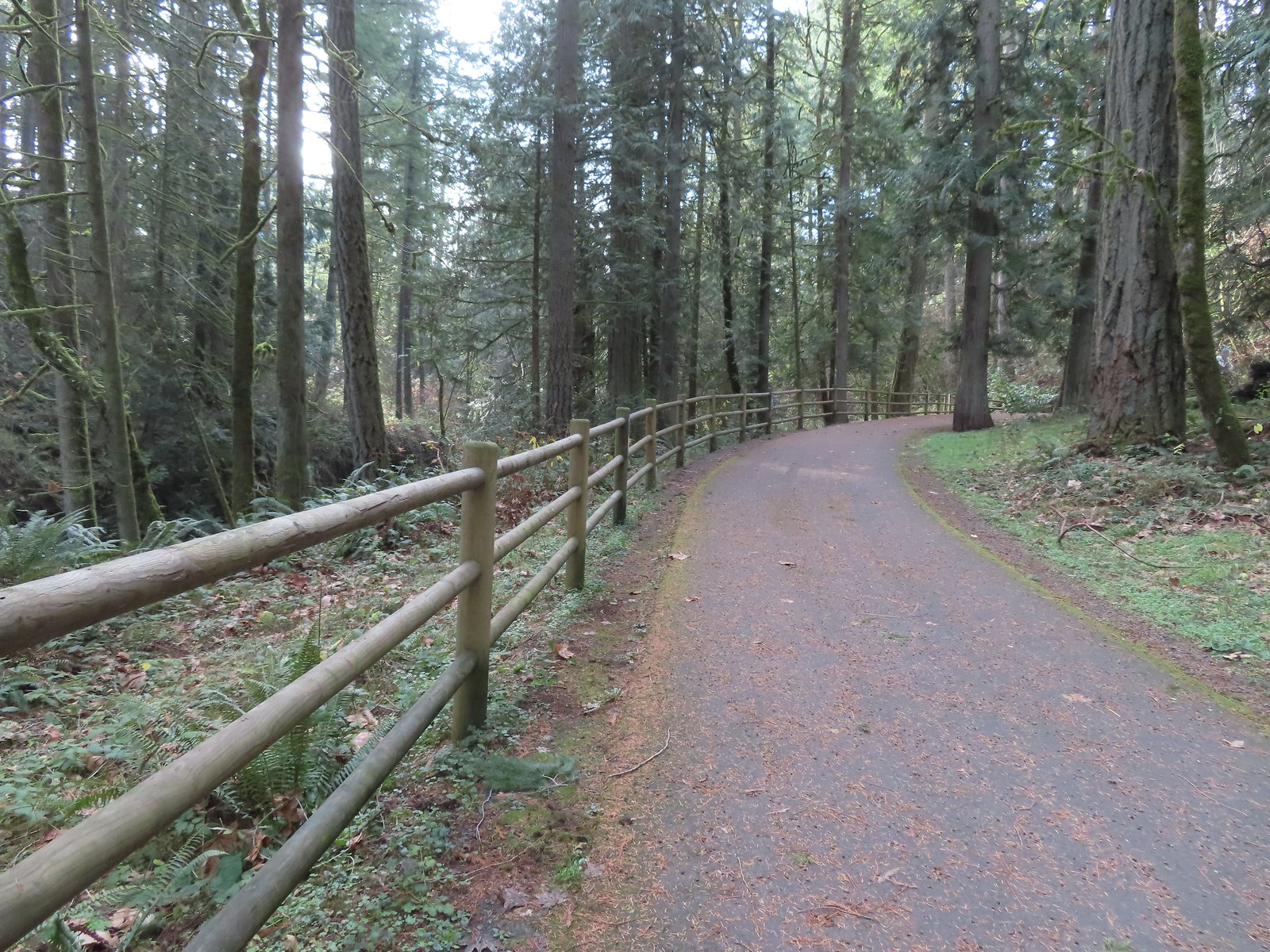
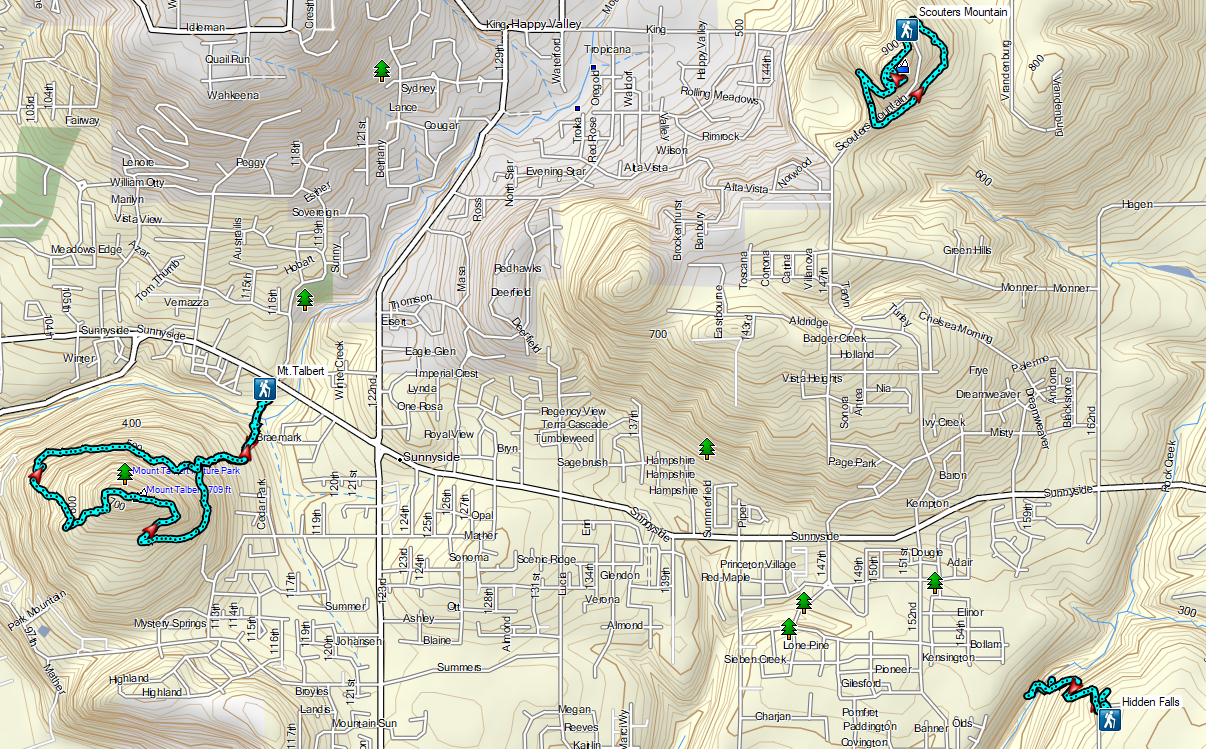
For our final outing of 2023 we headed to Portland to visit some Boring volcanoes. Not to be confused with boring, the Boring Volcanic Field which consists of more than 80 small volcanic vents and associated lava flows dispersed throughout the greater Portland-Vancouver metropolitan area. Several of the resulting cinder cones are home to parks providing hiking opportunities and we planned on visiting three of these along with a city park with a 15′ waterfall.

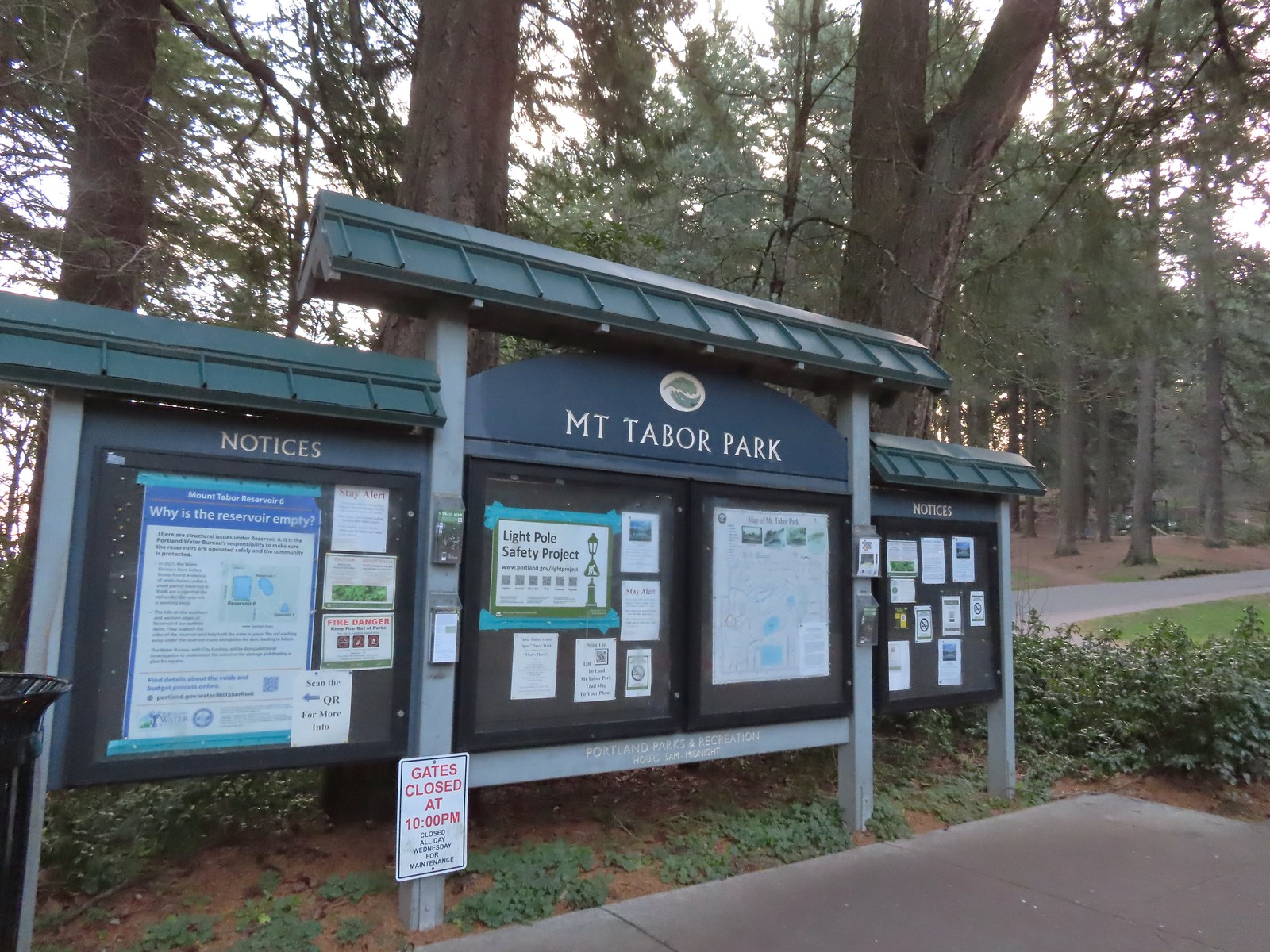
We began our morning at Portland’s Mt. Tabor Park. We parked in in the lot next to the Mount Tabor Visitors Center and set off toward the playground.
IMG_2023The playground behind and to the right of the signboard at the Visitors Center.

We were attempting to follow, as closely as possible, the route described by Matt Reeder in “PDX Hiking 365”. (His hike has a different starting point but loops through the parking area where we were starting.) After a little confusion near the playground we located the red trail and followed it to the Mount Tabor Stairs where we turned right.
IMG_2027The red trail continuing on the far end of the playground.
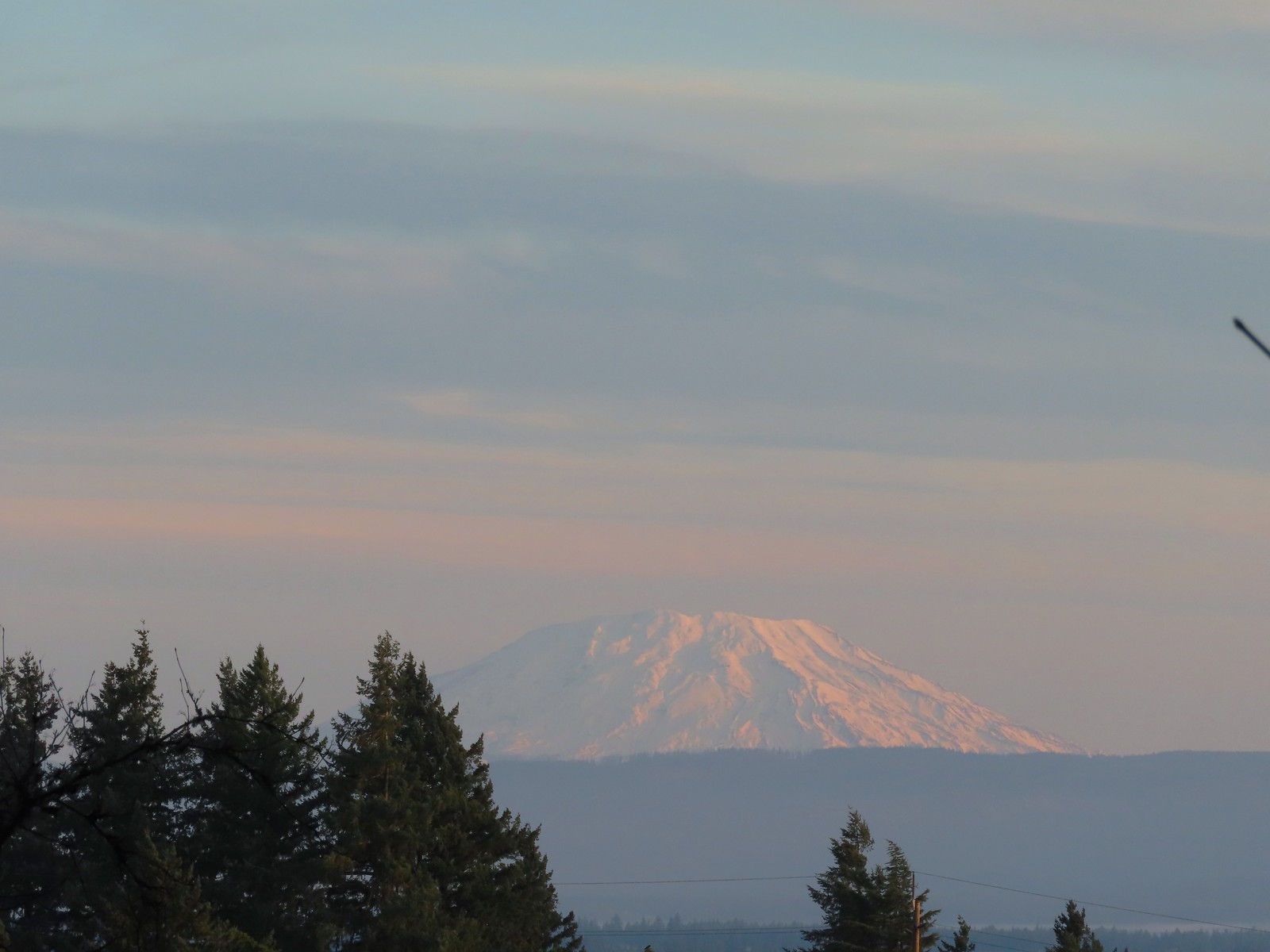
IMG_2028Mt. St. Helens from the playground.

IMG_2031On the red trail.

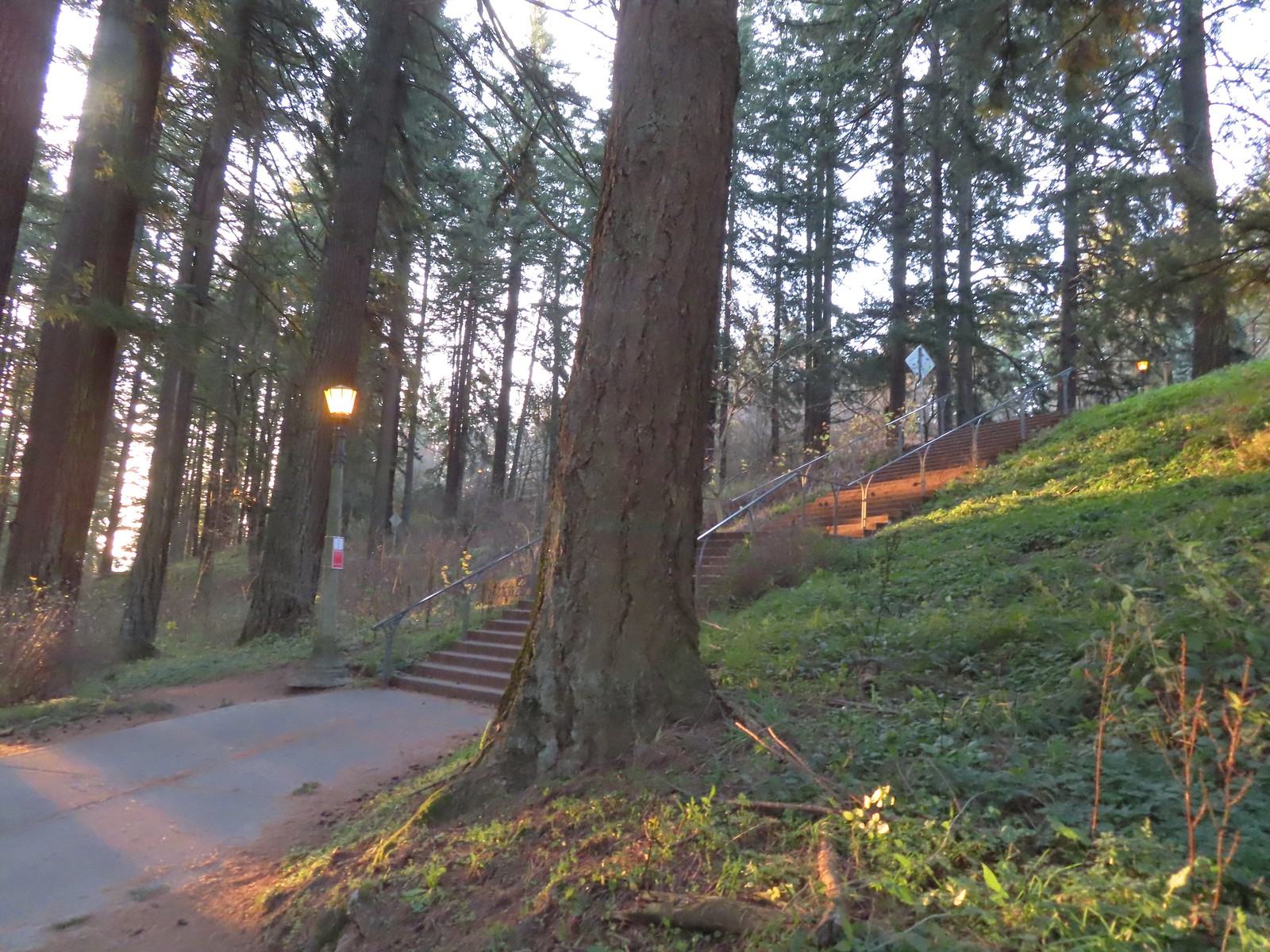
IMG_2032The Mount Tabor stairs extend from the park border up to the summit.

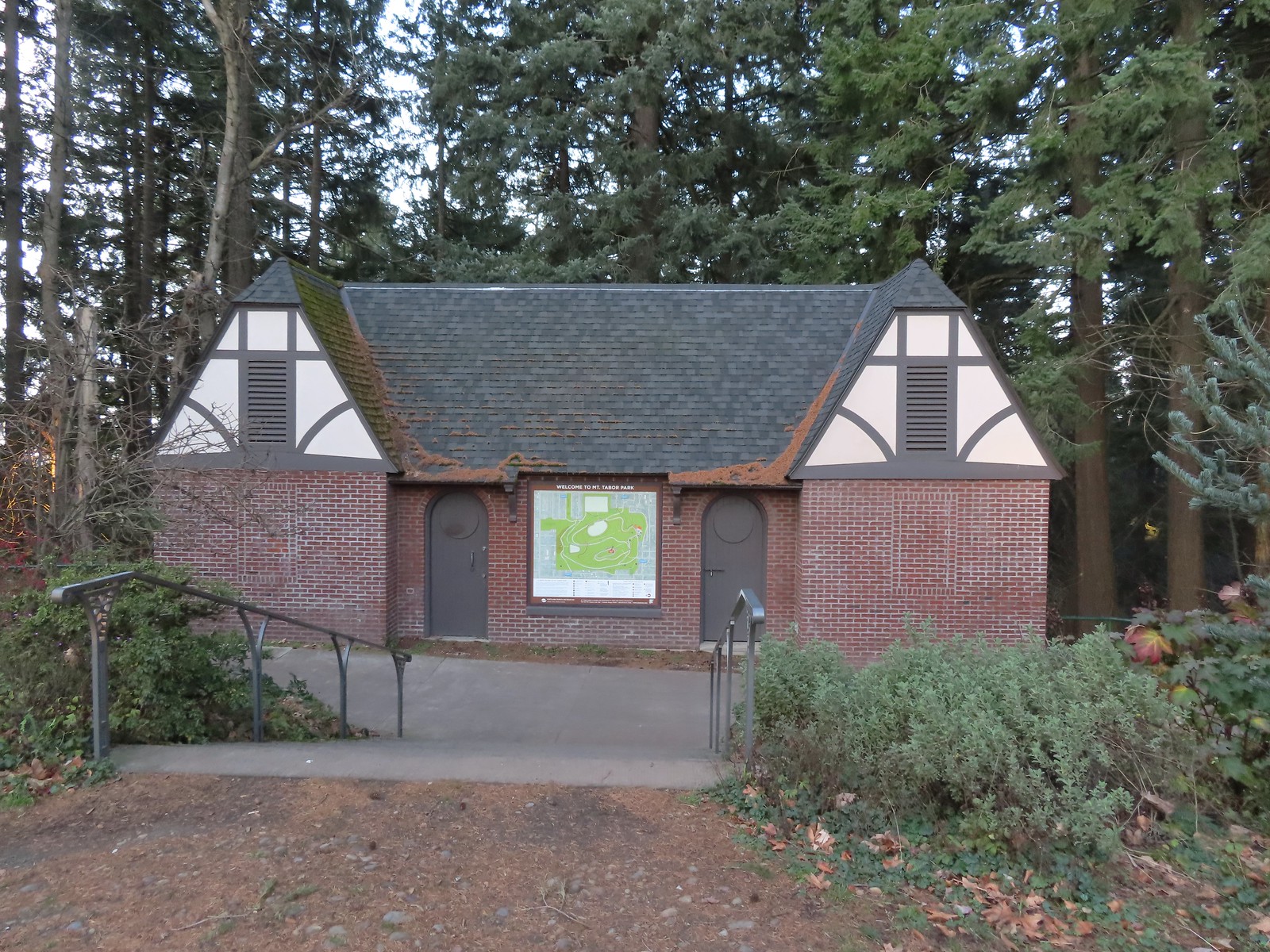
IMG_2034Summit restrooms

IMG_2036The restrooms were reopened in 2017 after being renovated.
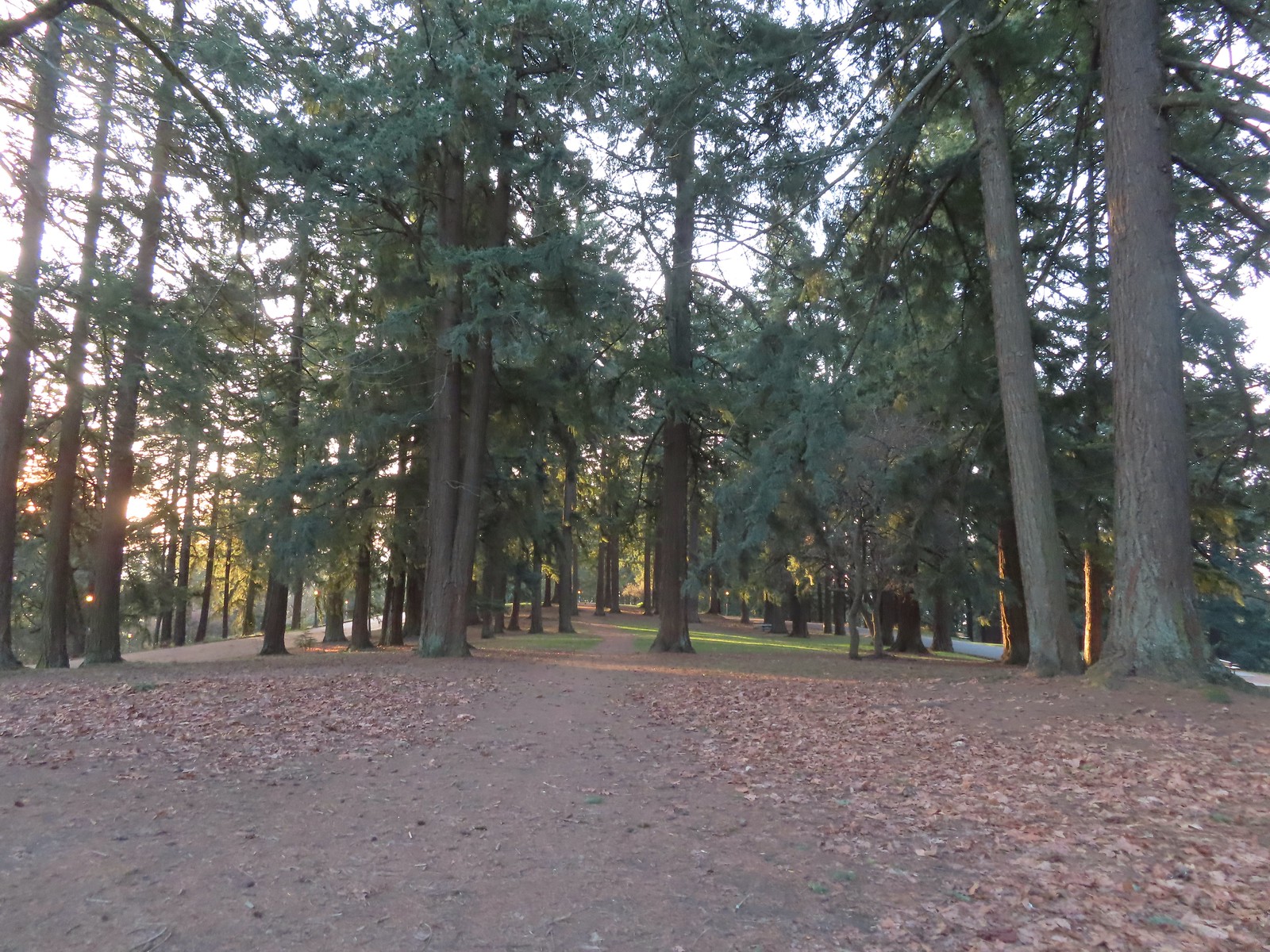
IMG_2041Mount Tabor summit

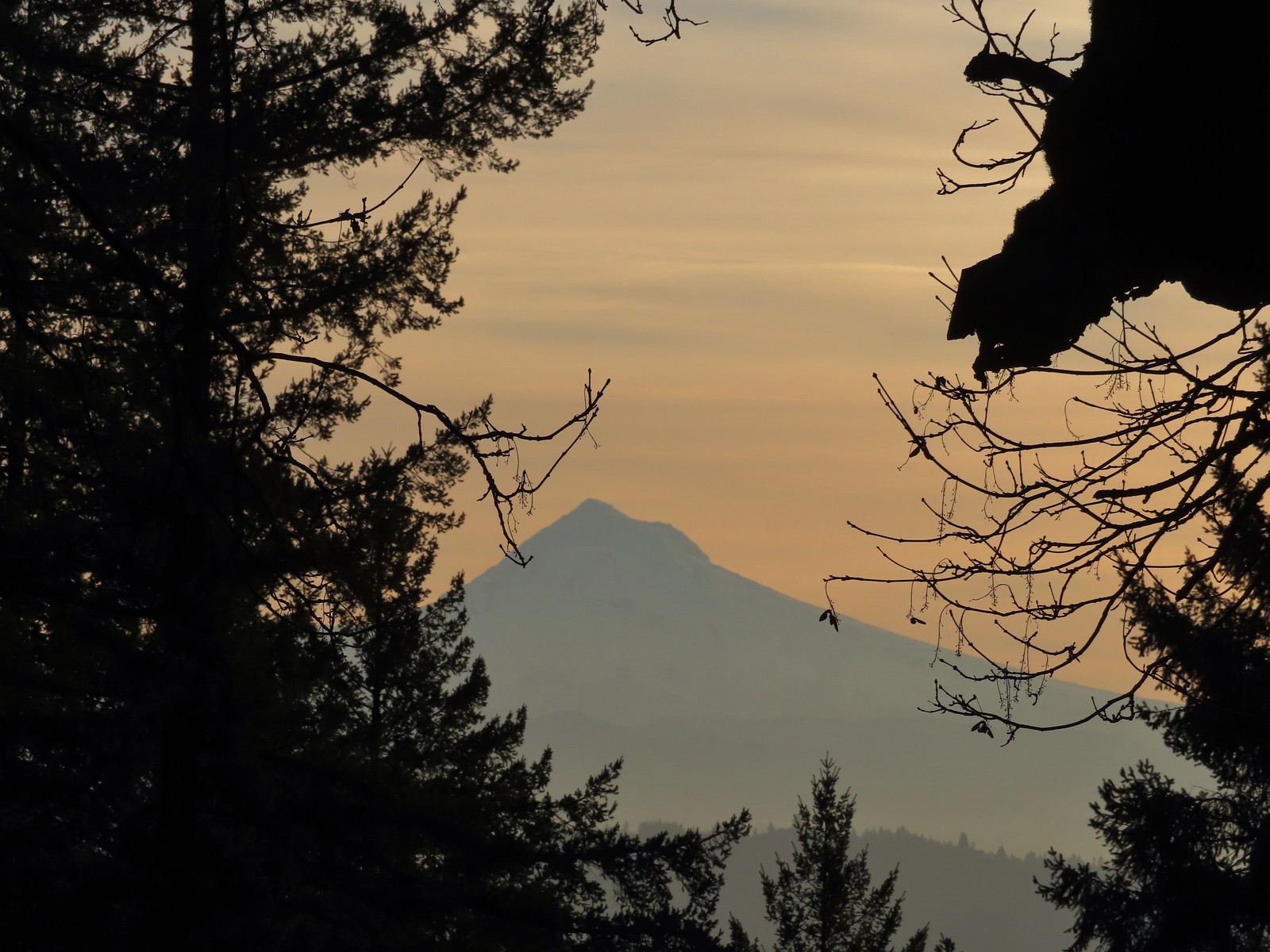
IMG_2040Mt. Hood from the summit.

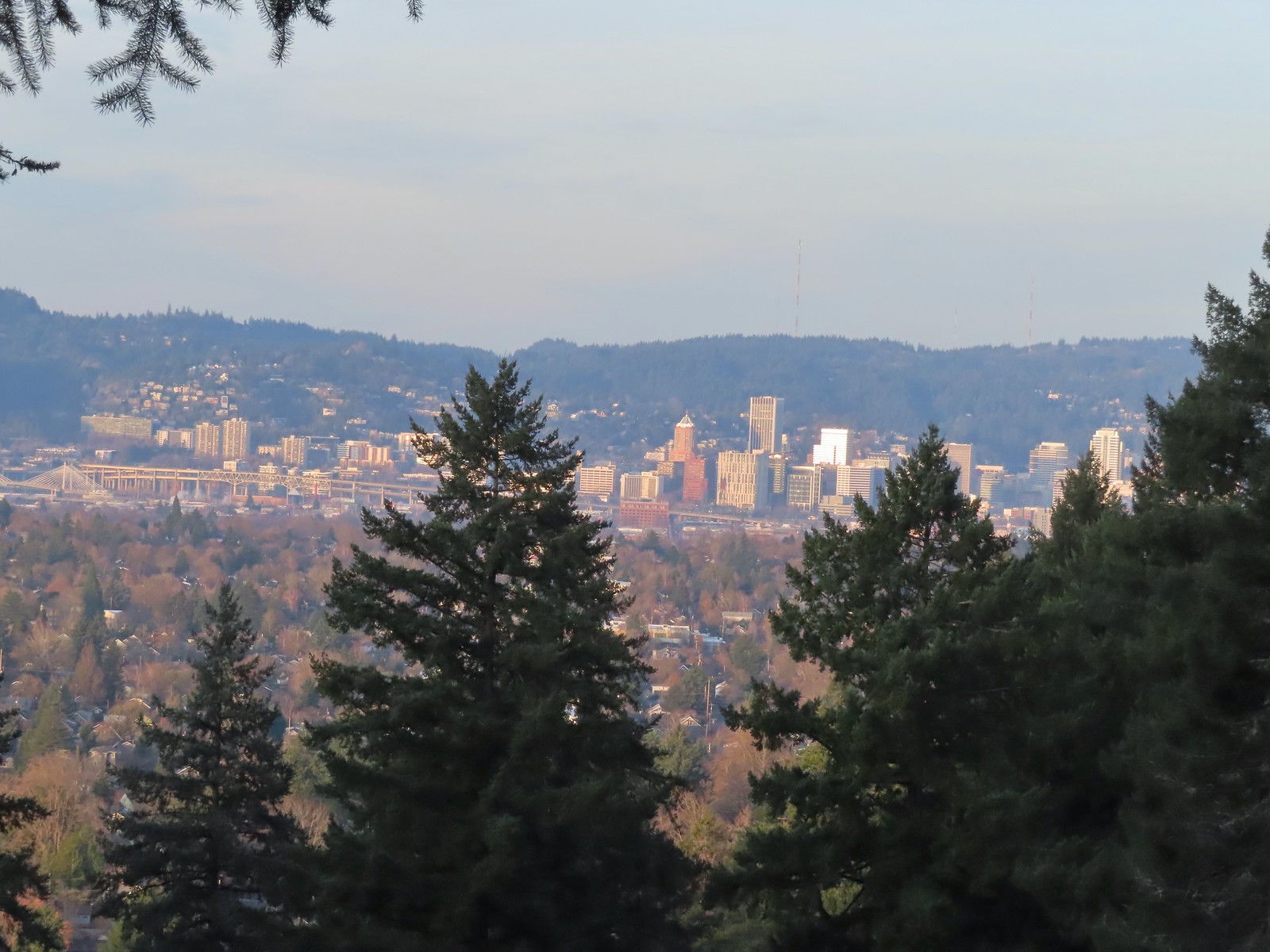
IMG_2044Downtown Portland

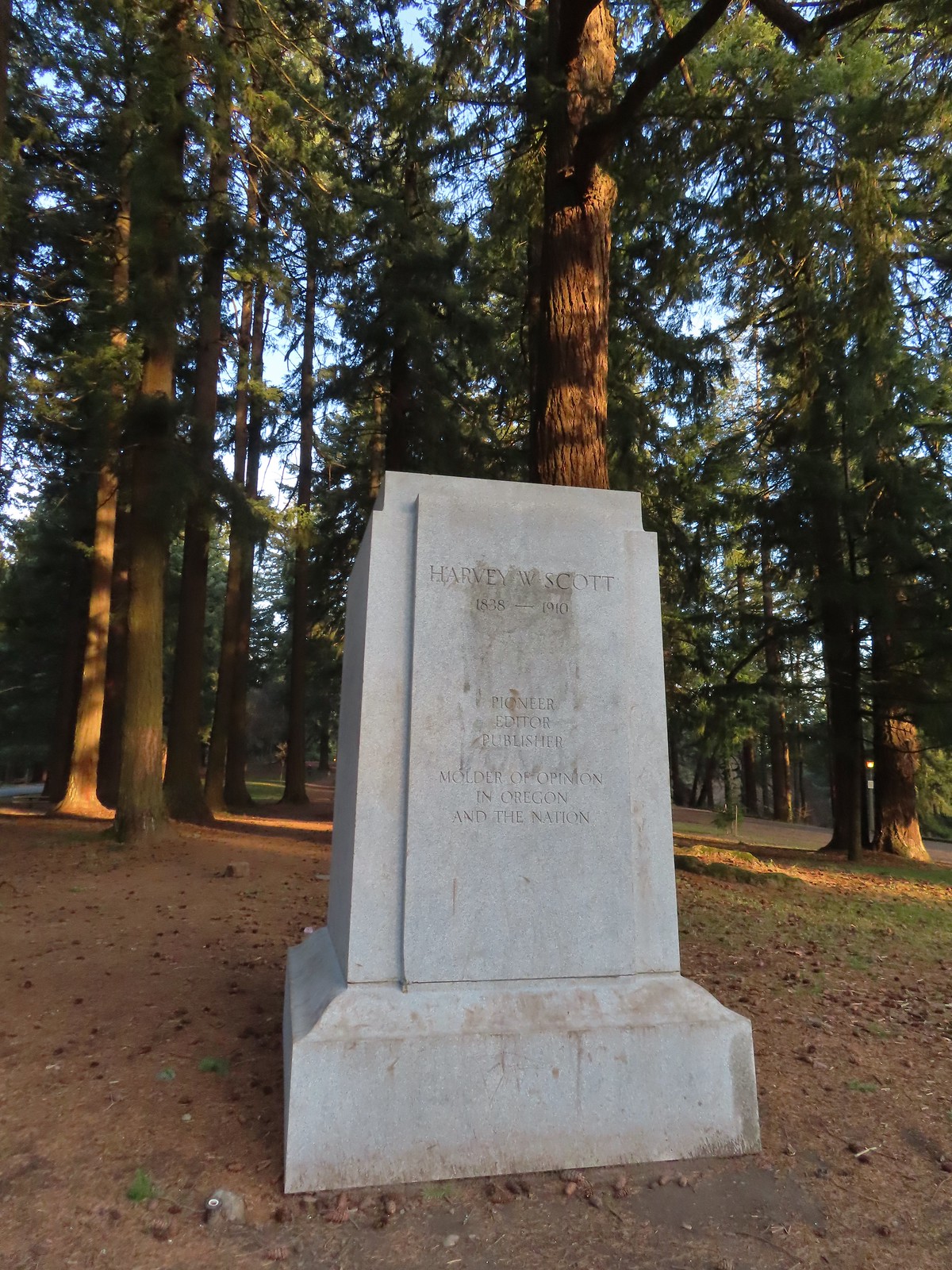
At the southern end of the summit, near the former site of a statue of Harvey W. Scott (and later a bust of York), we headed downhill on a steeper trail.
IMG_2046

IMG_2048

At a wide junction we turned right onto the Red Trail and passed above Reservoir No. 1.
IMG_2049

IMG_2050

At Reservoir Loop Road we veered left staying on the Red Trail climbing up and over Poison Oak Hill. The trail then dropped back down to the loop road near Reservoir No. 5.
IMG_2058

IMG_2059

IMG_2060

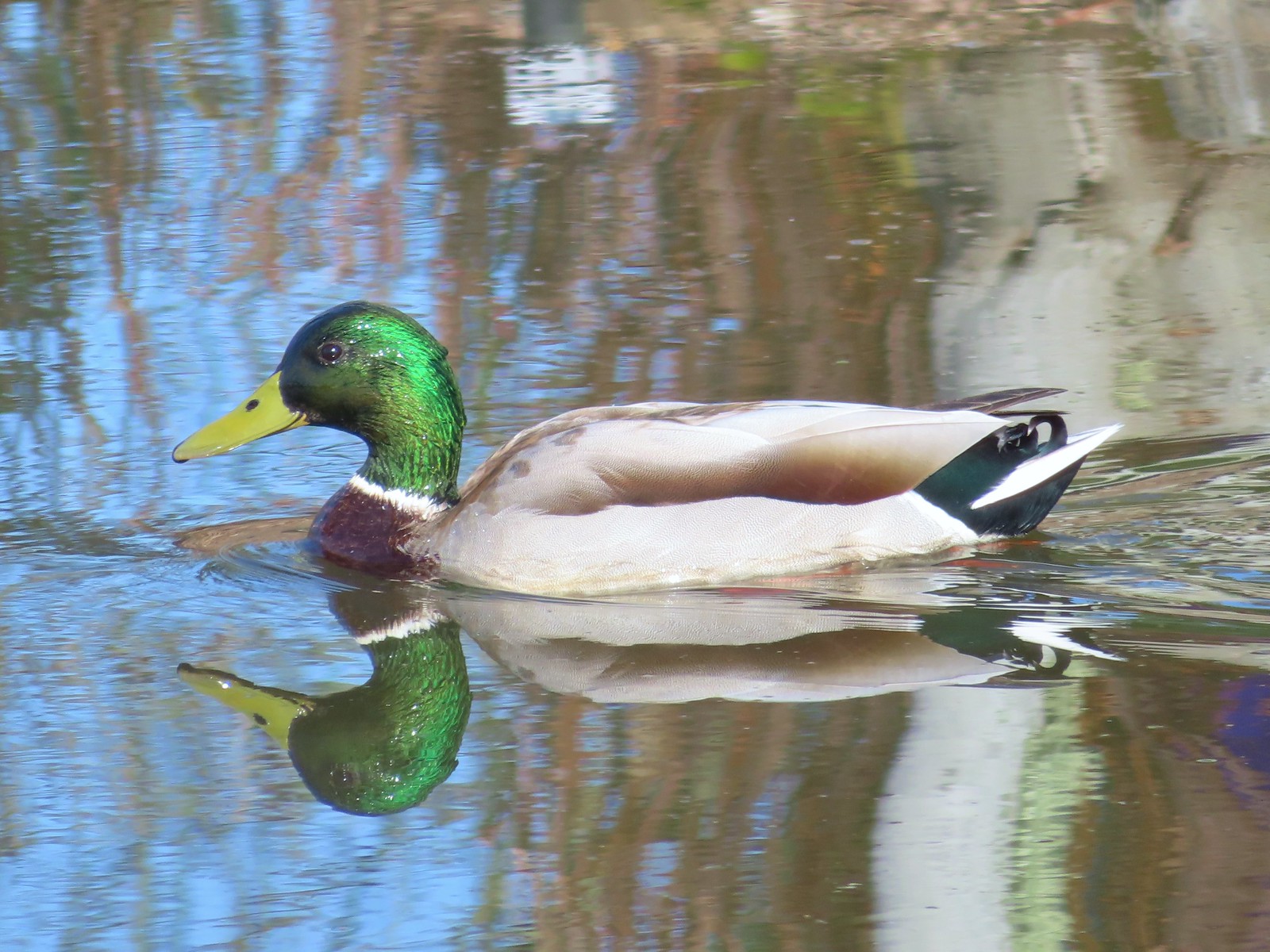
IMG_2061Mallards

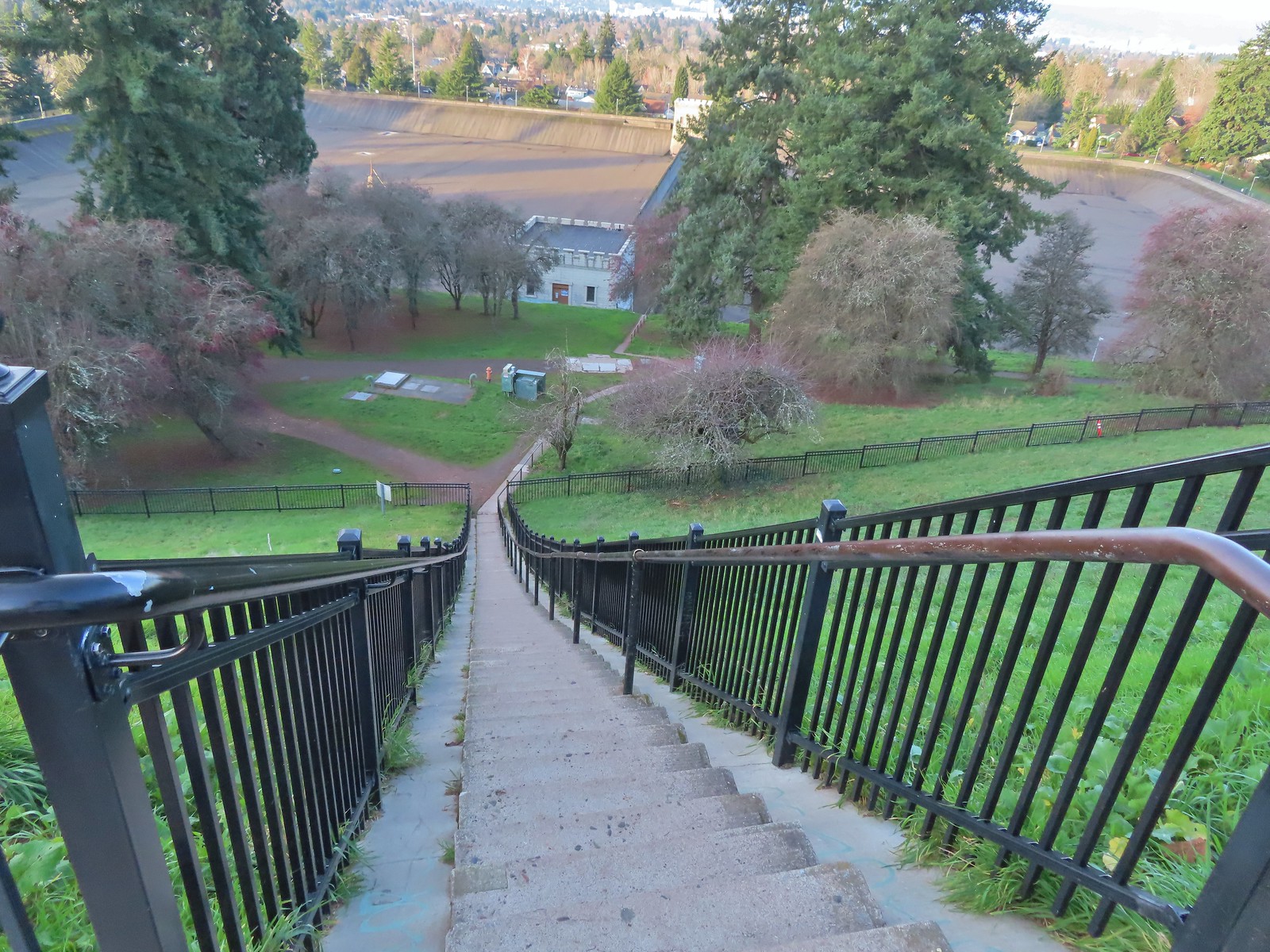
We walked along reservoir road to a small building then crossed the road and headed down a long flight of stairs.
IMG_2065

IMG_2064

IMG_2066

IMG_2067

At the bottom of the stairs we turned right on the Green Trail and followed it past some tennis courts before turning uphill. We stuck to the Green Trail as it neared the parking area and followed it back behind The Crater before arriving back at the Visitors Center.
IMG_2070

IMG_2073We forked right at this junction sticking to the green pointers.

IMG_2076Arriving at The Crater.

IMG_2077Coming around The Crater near the Visitors Center.
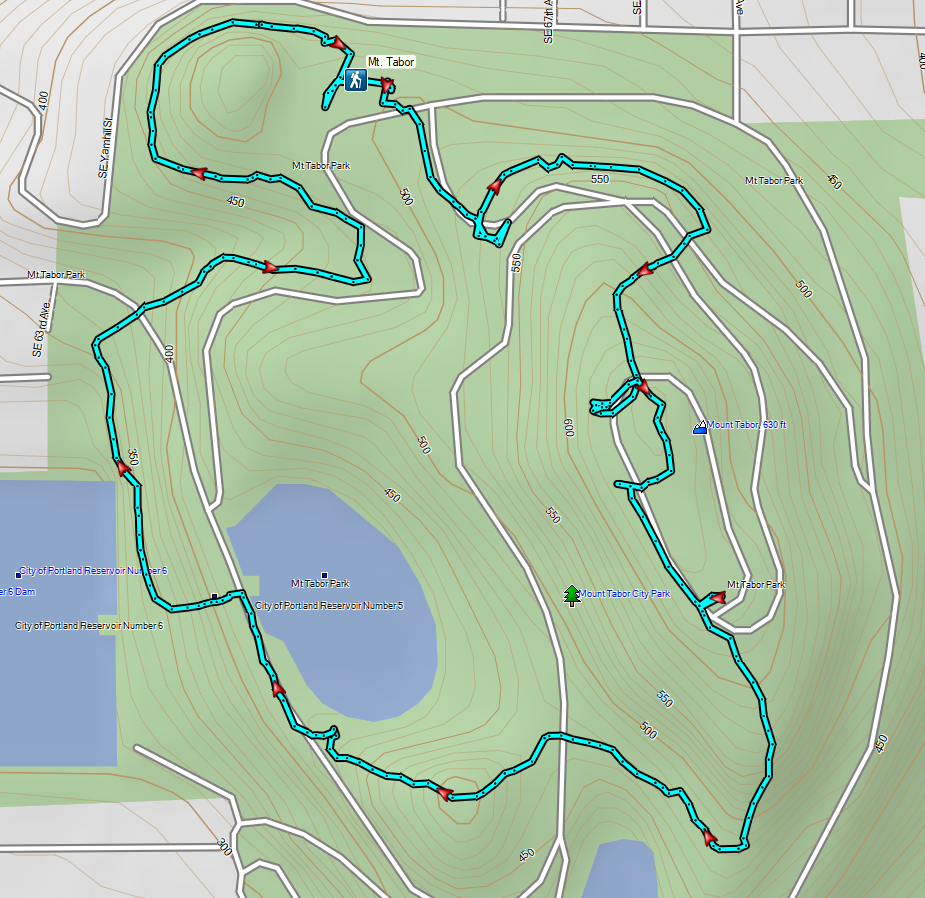
This was just over a two-mile loop with approximately 350′ of elevation gain.

From Mount Tabor we made the nine-mile drive to the Sunnyside Road Trailhead for the Mount Talbert Nature Park.
IMG_2078

We set off on a gravel path that descended to a metal bridge over Mount Scott Creek.
IMG_2079Mount Talbert from the path.

IMG_2081

IMG_2082Mount Scott Creek

Beyond the creek the forested trail began to climb Mount Talbert. We passed a junction with the Cedar Park Trail joining from the left and after 0.4-miles arrived at a T-junction with the Park Loop Trail.
IMG_2083

IMG_2086

IMG_2088The Park Loop Trail junction just uphill.
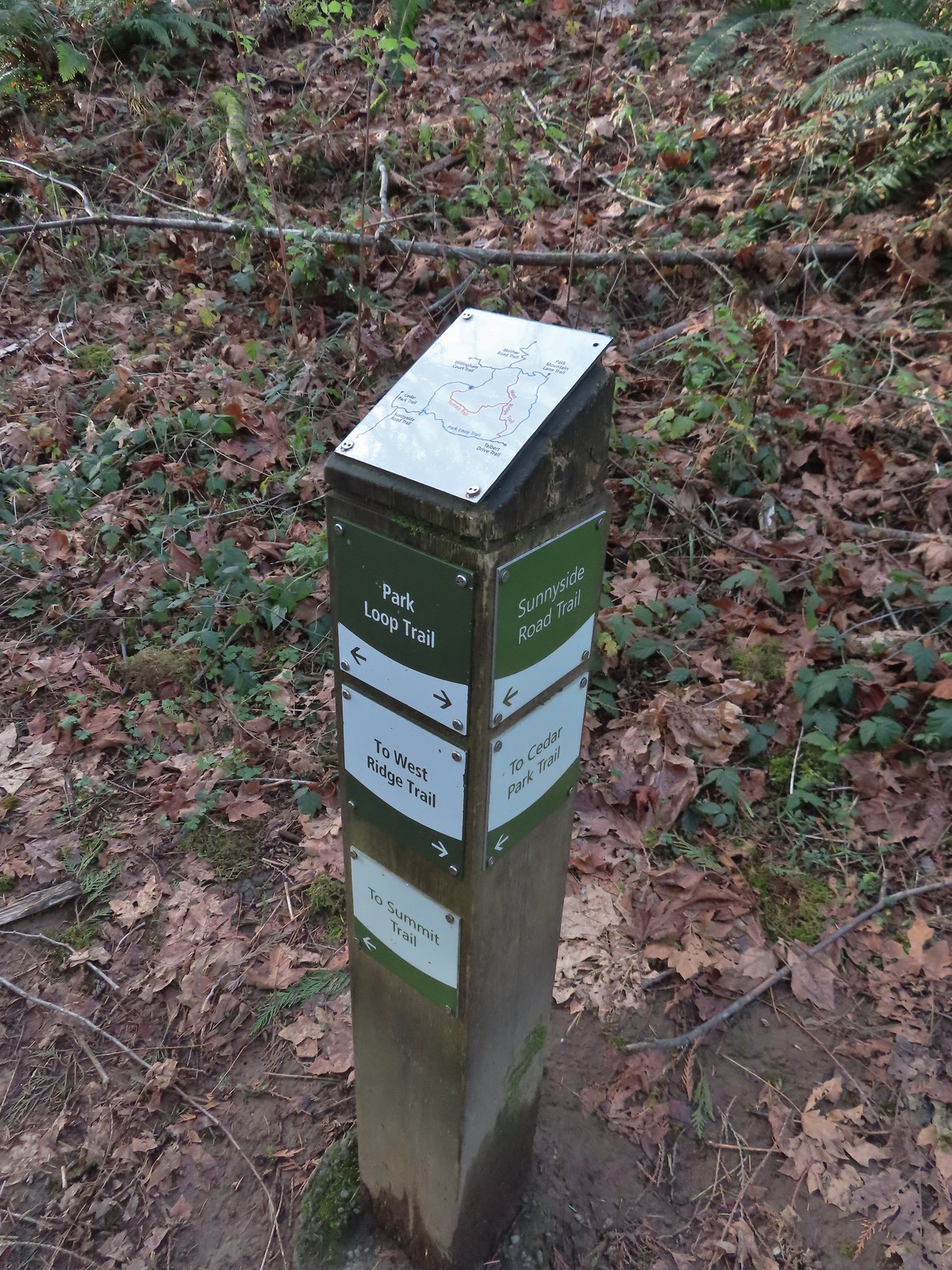
Mount Talbert is an Oregon Metro park which meant well marked junctions complete with small maps.
IMG_2089Note that the map at the Park Loop/Sunnyside Road Trail junction mis-identifies the location with the “You Are Here” star located at the Park Loop/Summit Ridge junction.
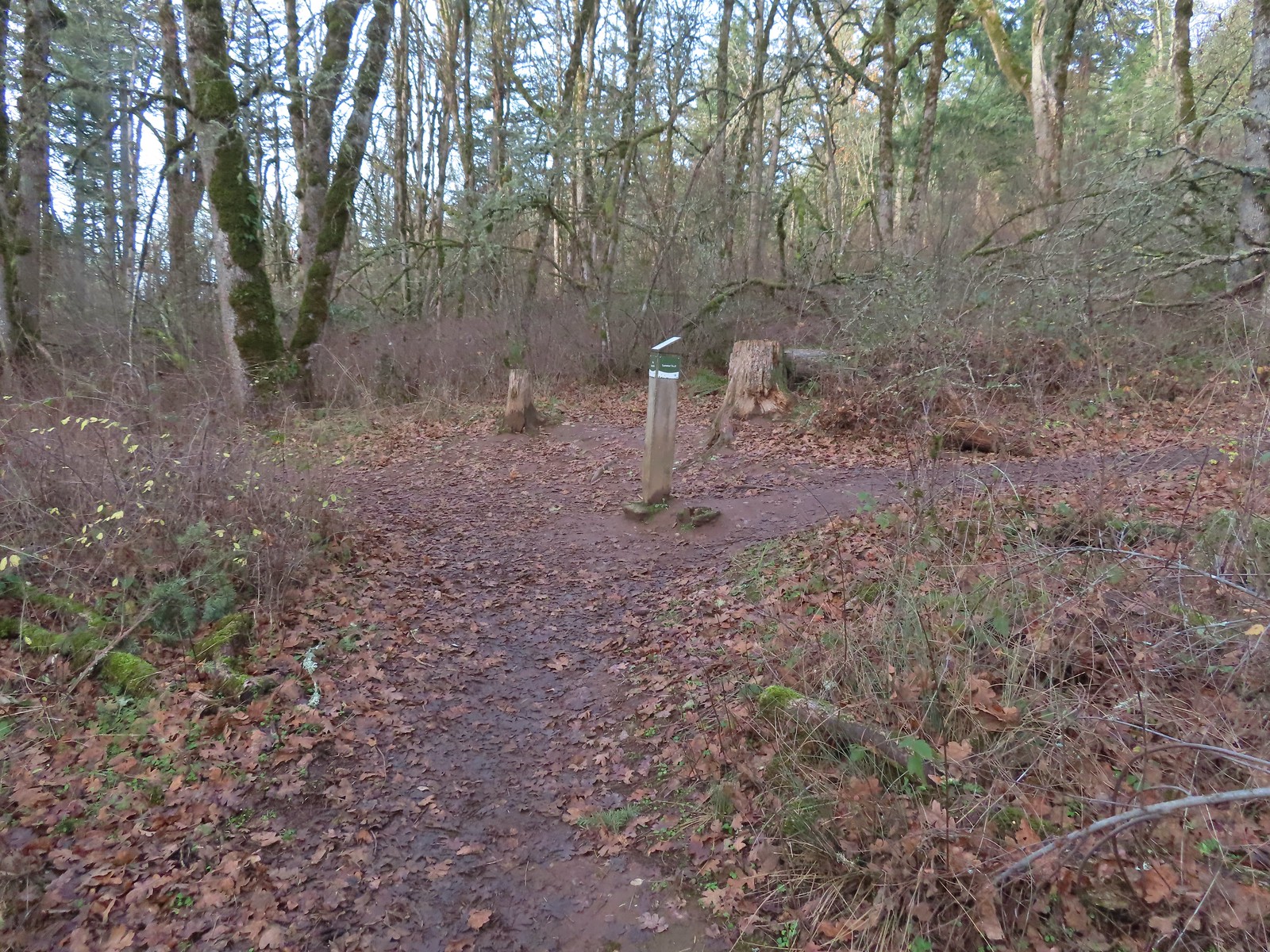
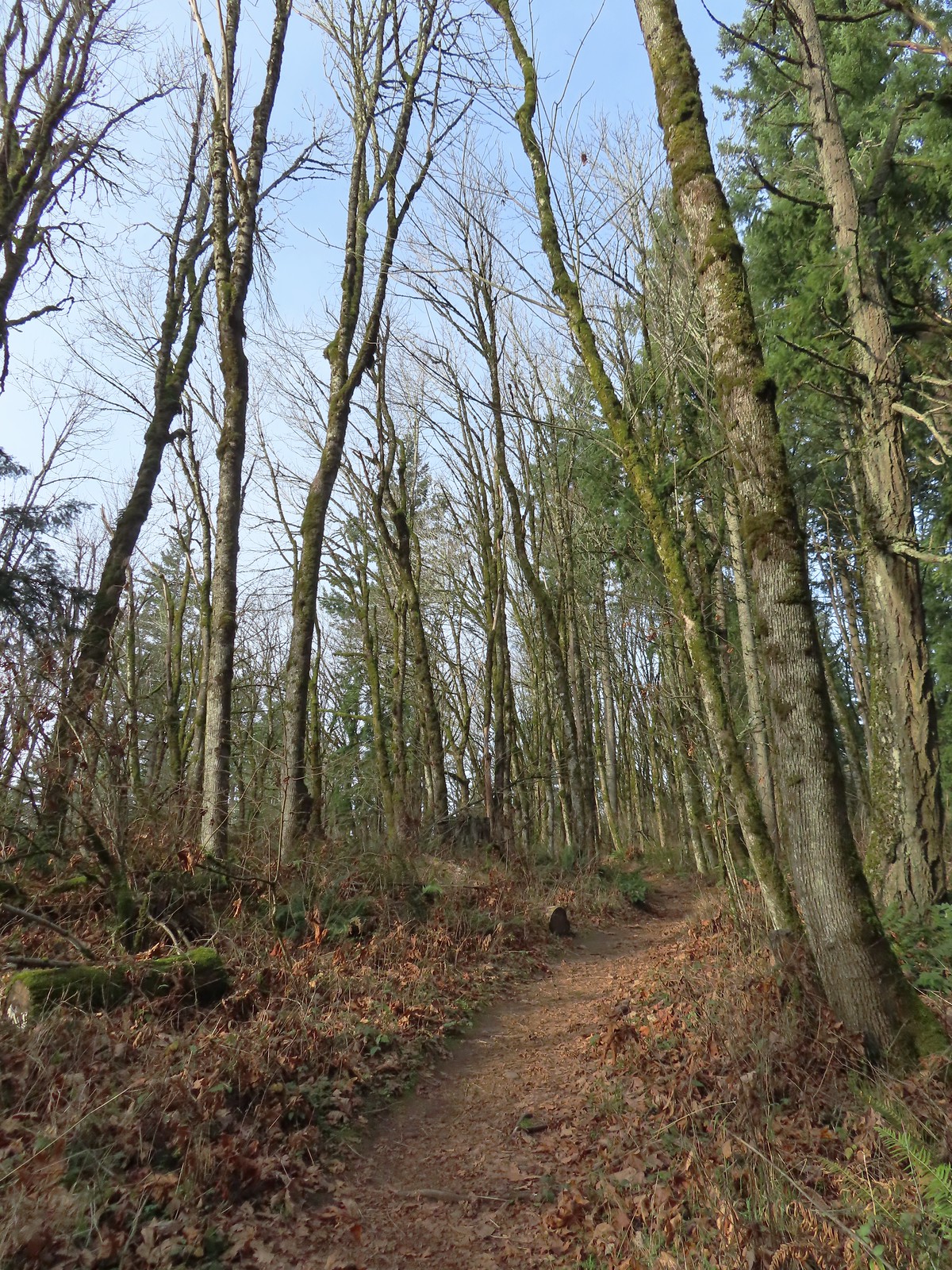
We turned left onto the Park Loop Trail and followed it further uphill to the actual Summit Ridge Trail junction.
IMG_2091

IMG_2093

We turned right onto the Summit Ridge Trail and followed it up and over the wooded summit to the West Ridge Trail.
IMG_2096

IMG_2098

IMG_2099Arriving at the West Ridge Trail junction.
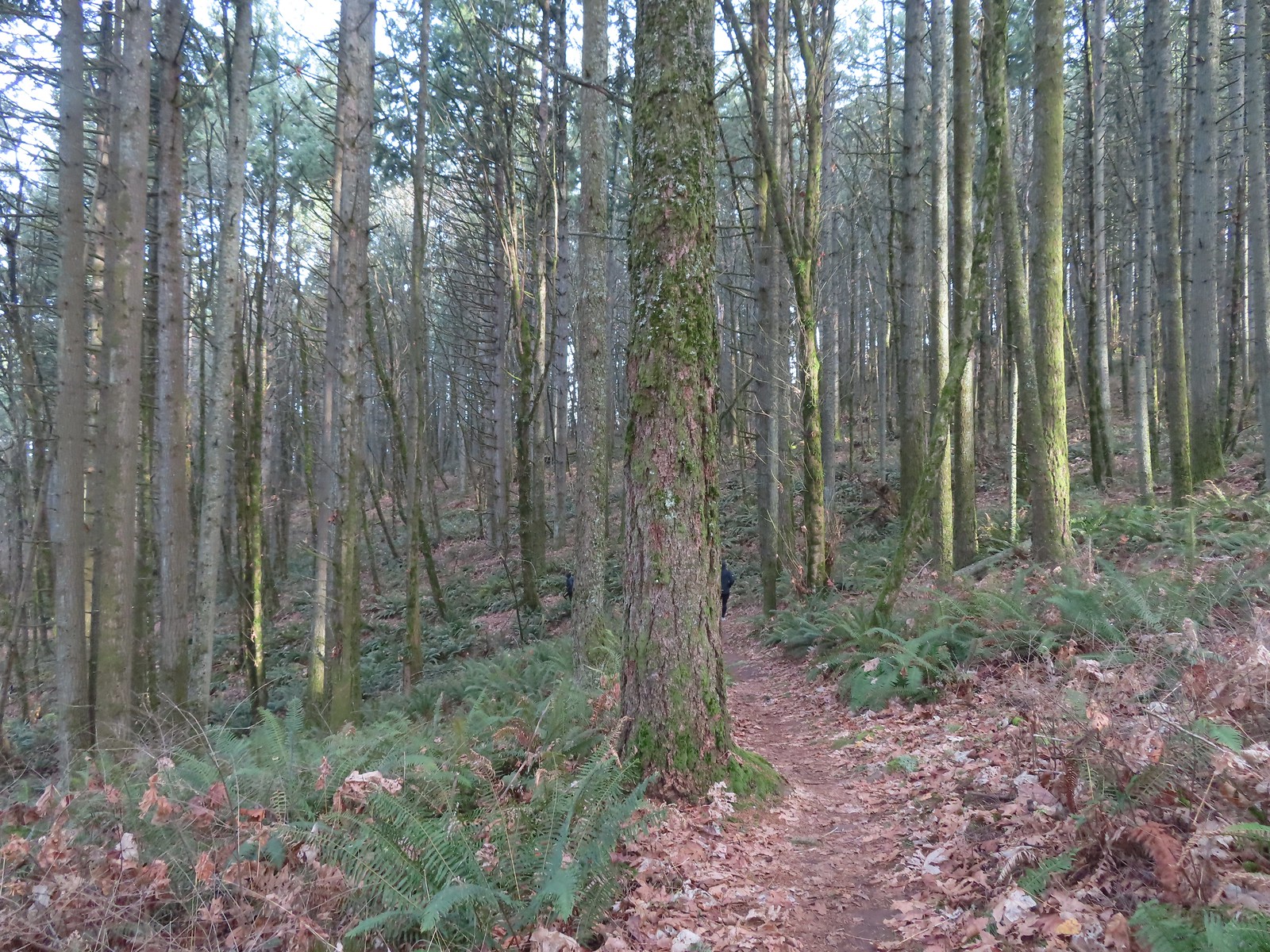
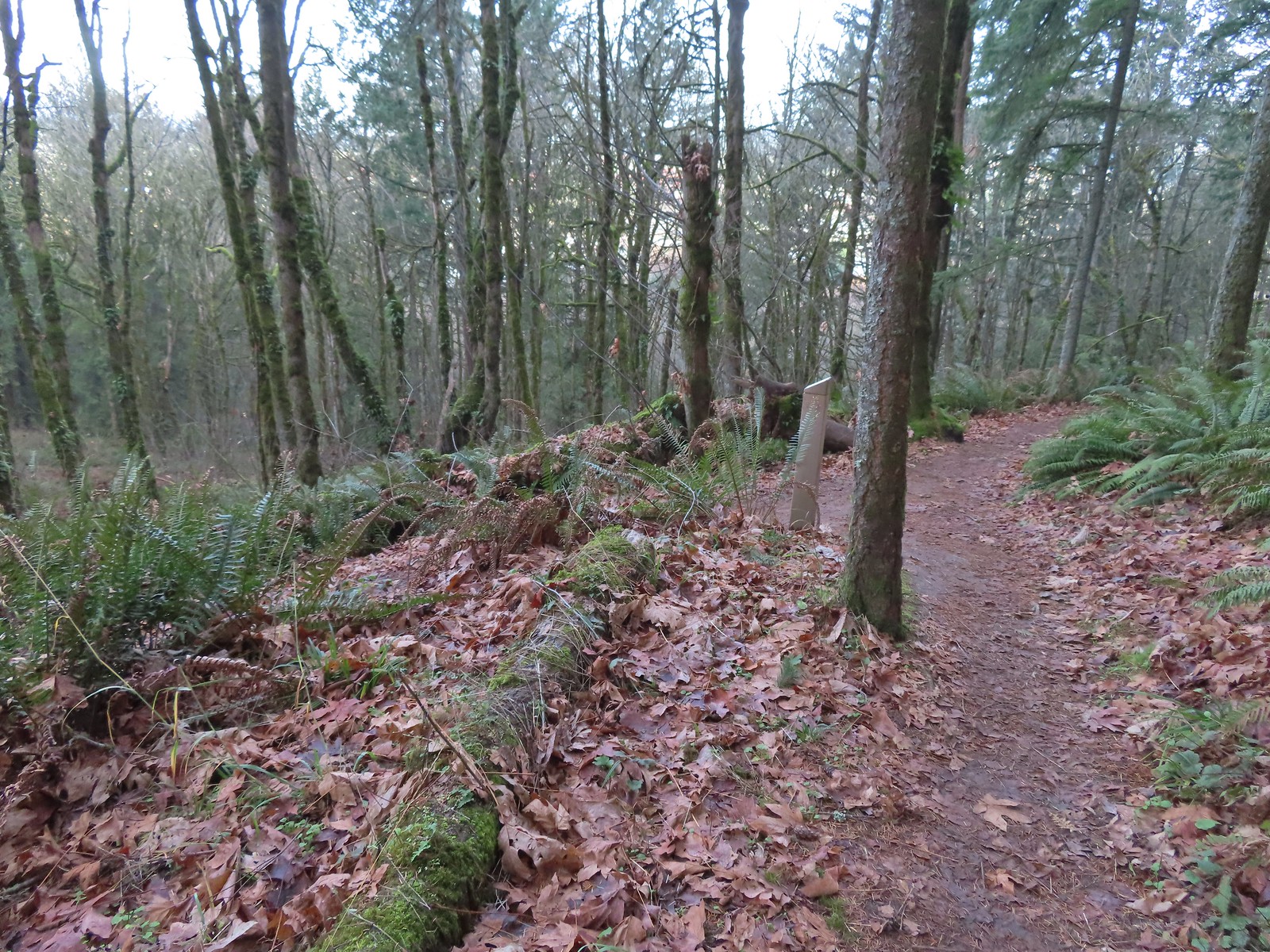
We turned right again and followed the West Ridge Trail as it traversed the hillside brining us back to the Park Loop Trail.
IMG_2101

IMG_2103Rejoining the Park Loop Trail.

We completed the loop and turned down the Sunnyside Road Trail to return to our car to complete this 2.5-mile (and 700′ gain) hike.
IMG_2108Mt. Adams was visible through the web of small branches.
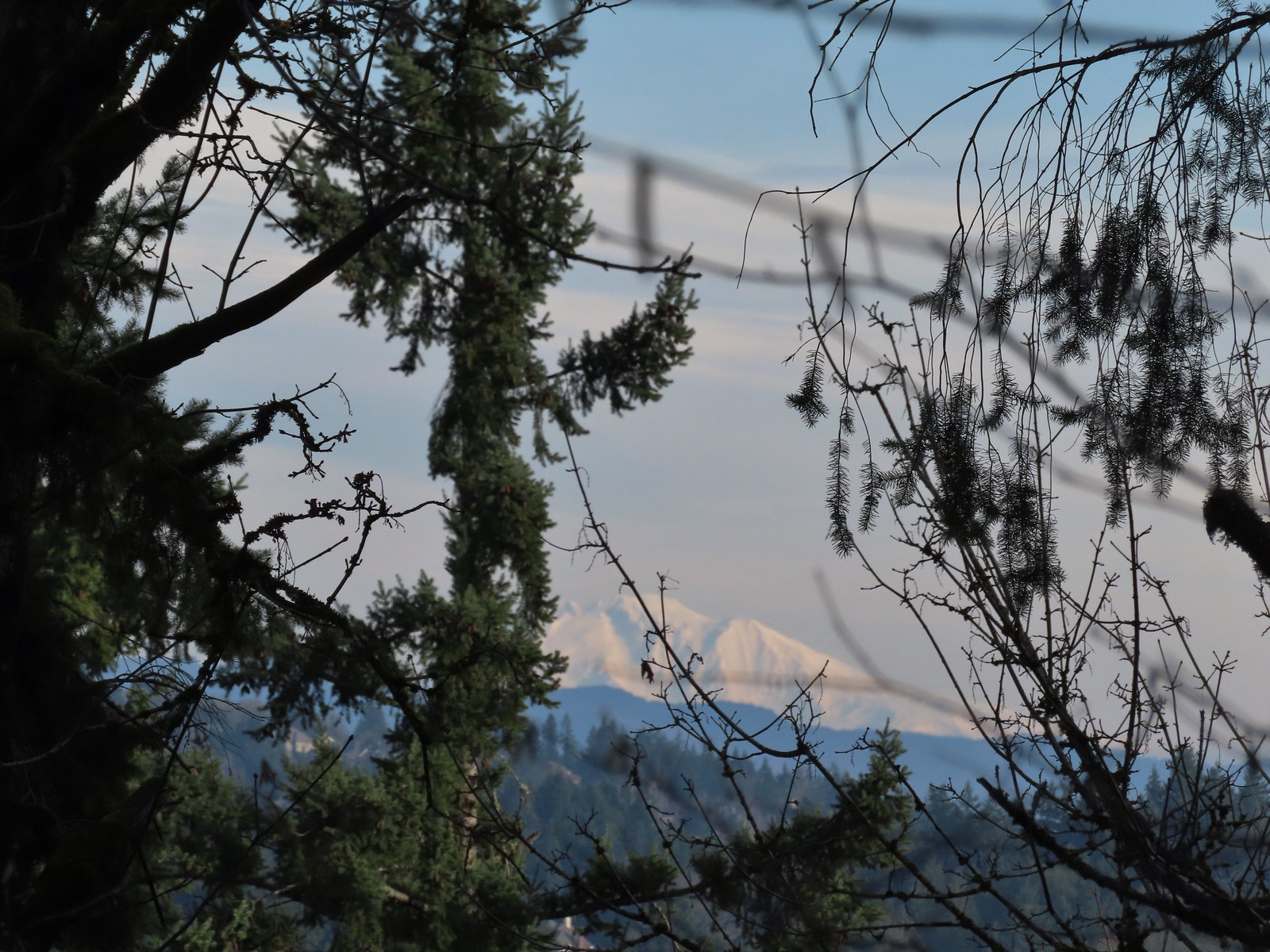
IMG_2110A snowy Mt. Adams.

IMG_2113Back at the Sunnyside Road Trail.

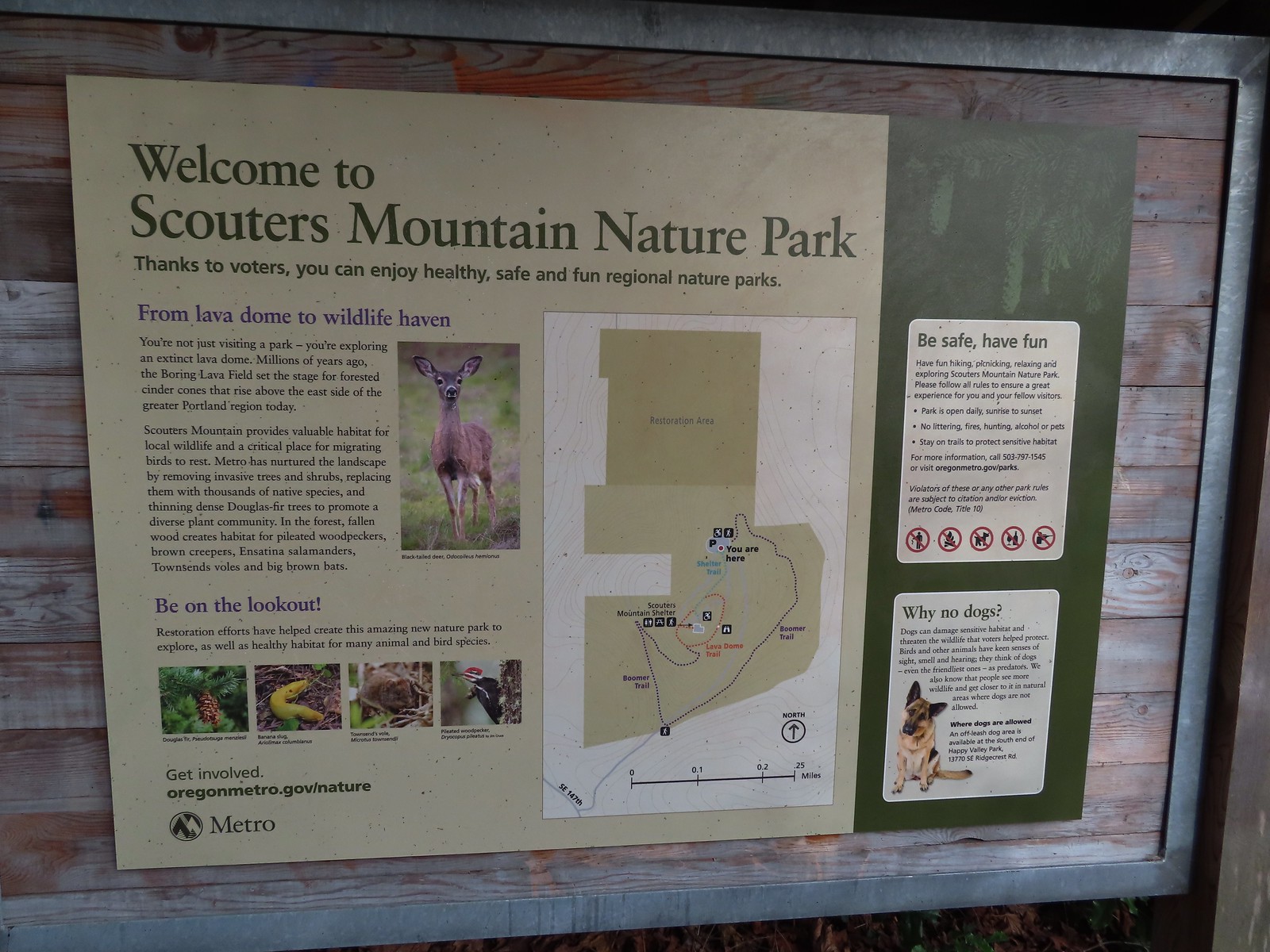
From the Sunnyside Road Trailhead it was just a 3.5-mile drive to the parking area at Scouters Mountain Nature Park.
IMG_2115

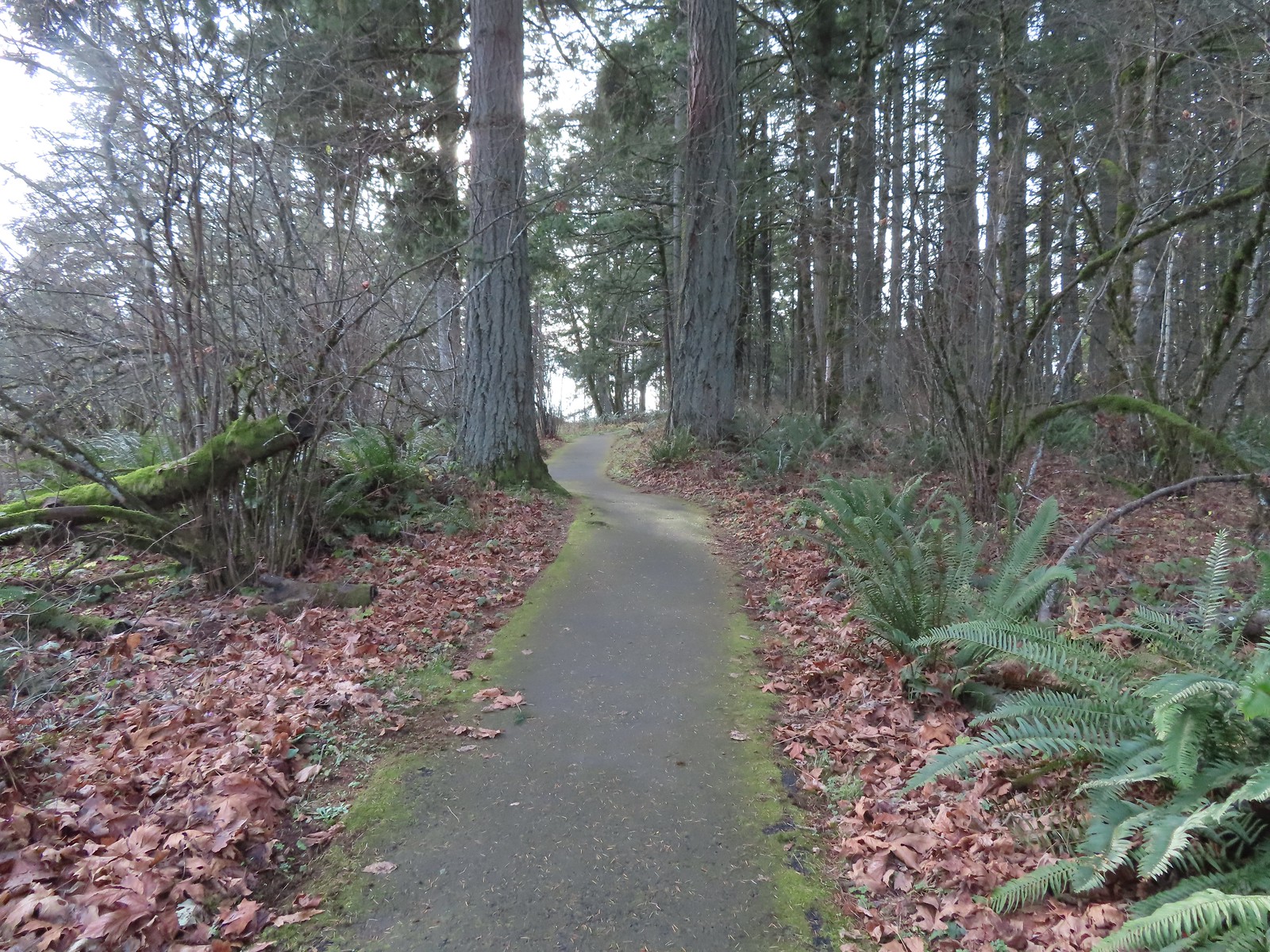
From the parking area we set off on the paved Shelter Trail toward the summit.
IMG_2114

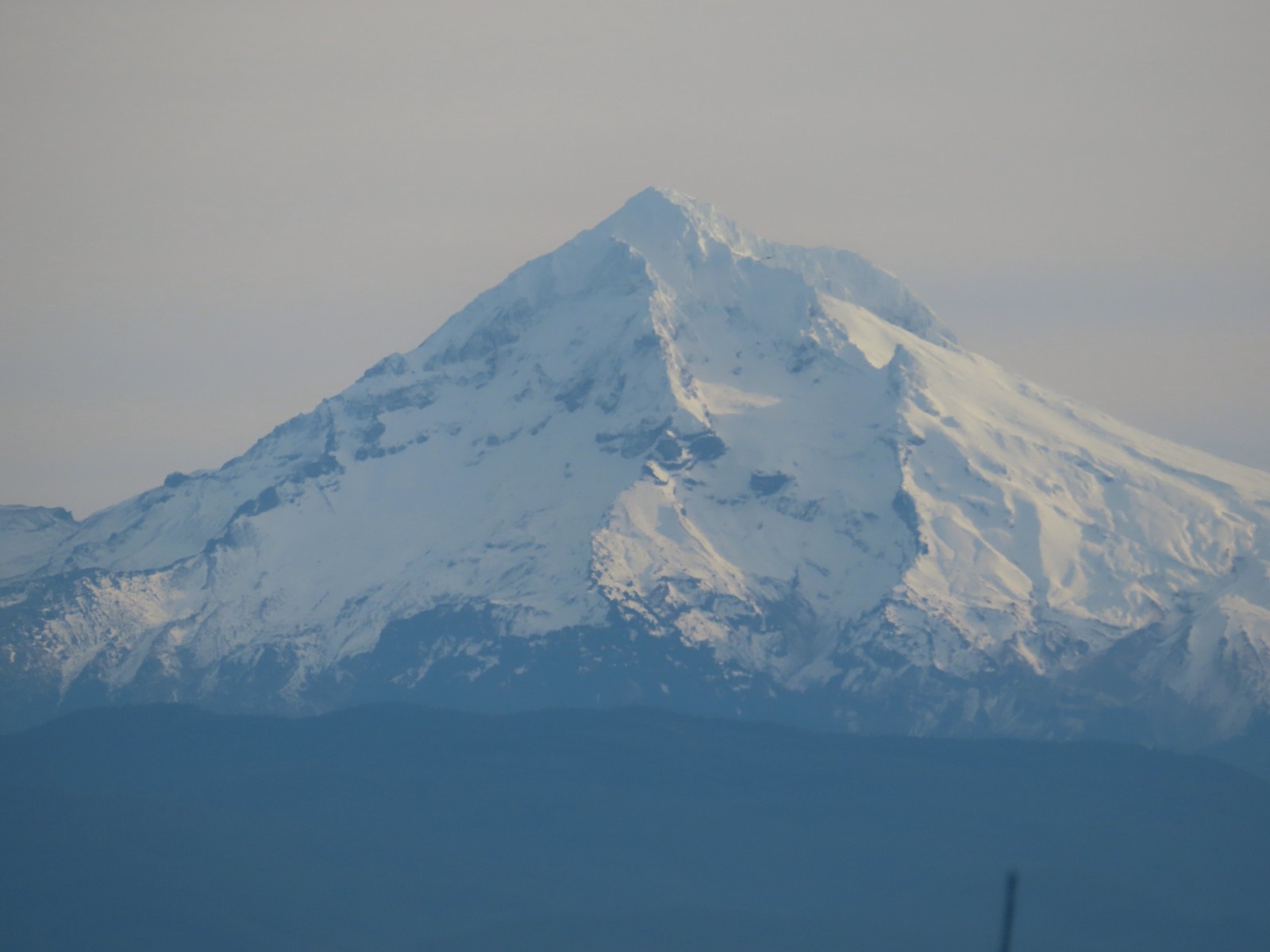
After just 0.2-miles we arrived at the shelter and a great view of Mt. Hood.
IMG_2119

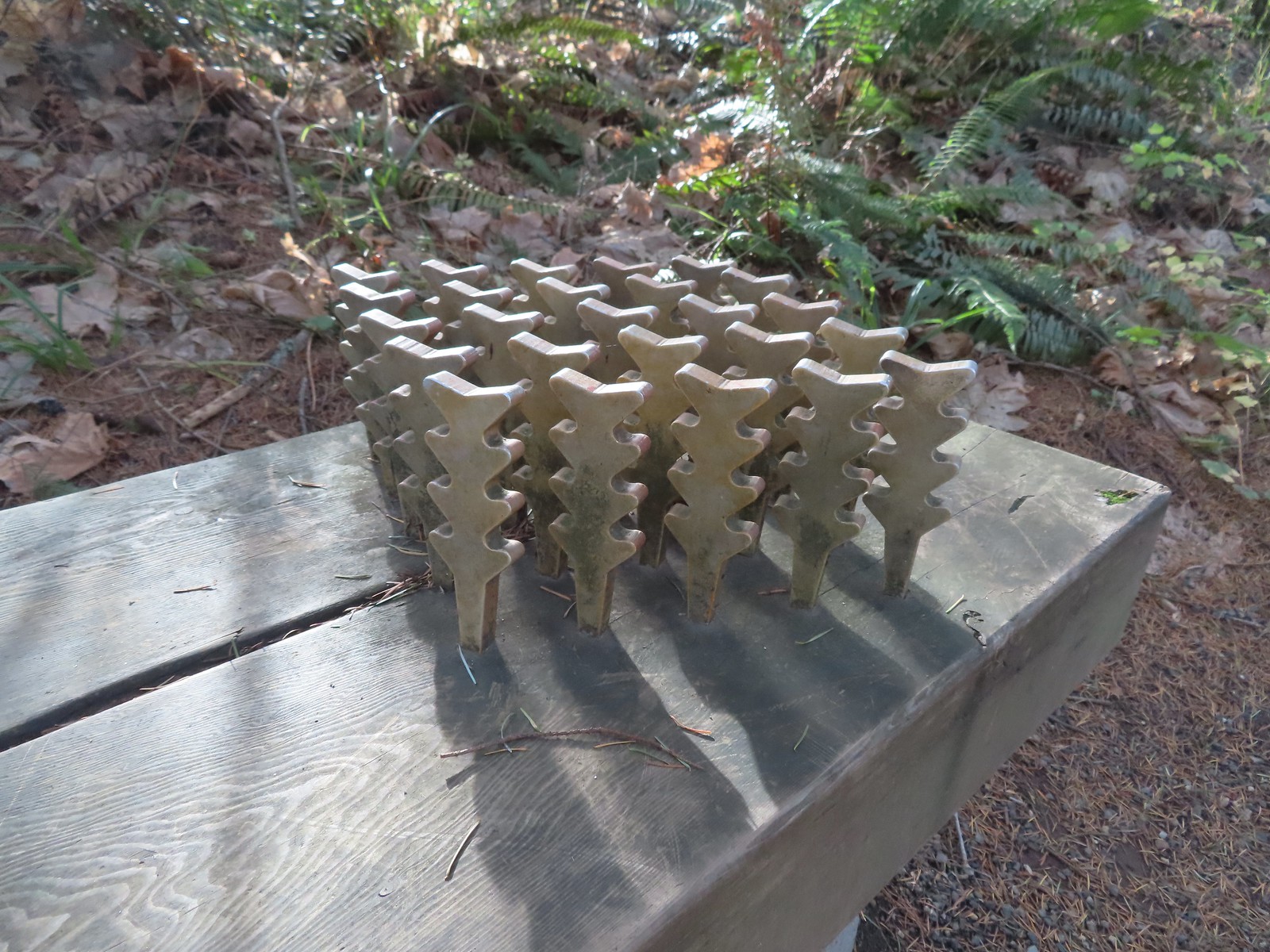
IMG_2122The benches throughout the park contained various nature sculptures, this one is “Moss Group”.
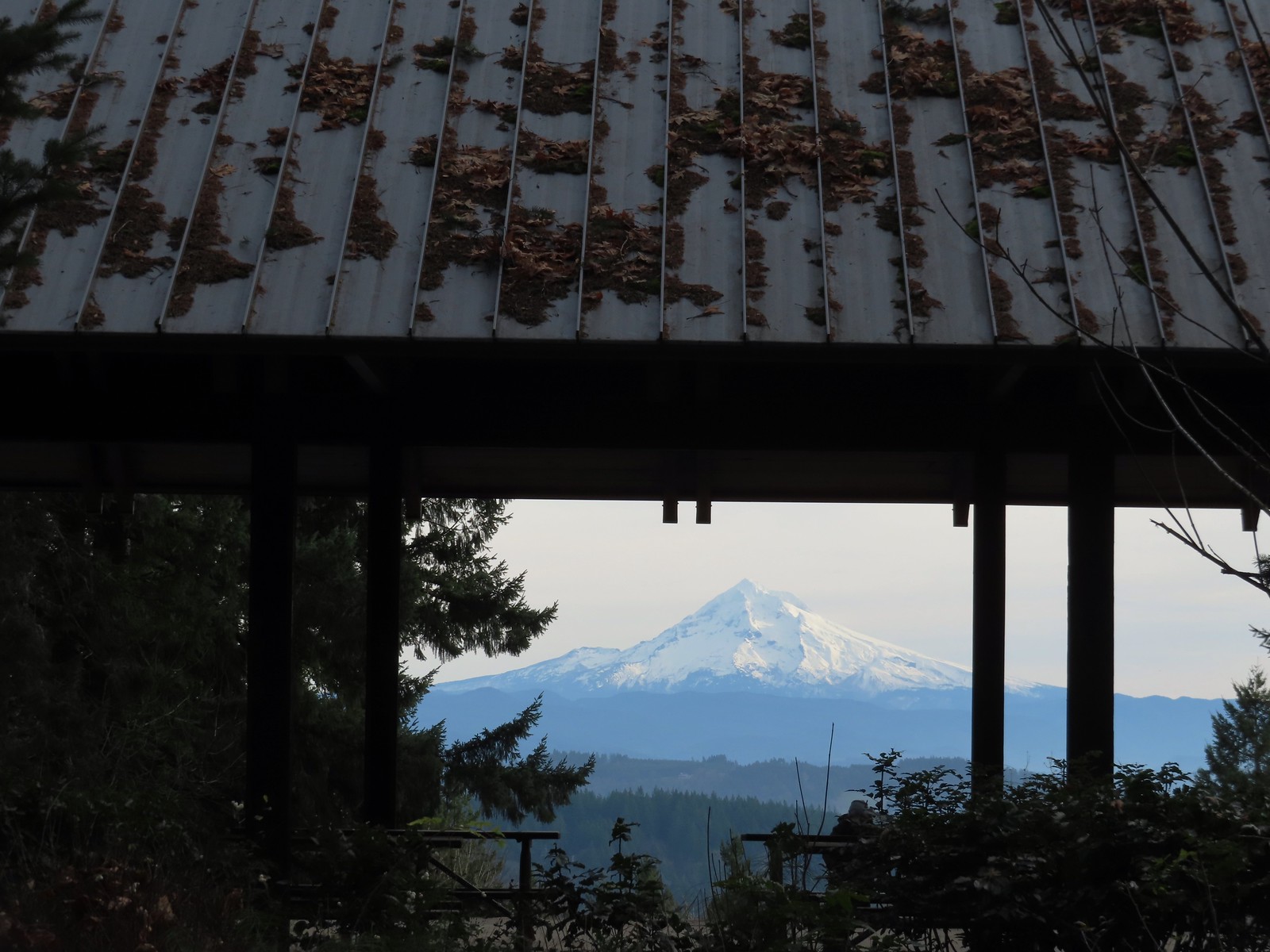
IMG_2126

IMG_2128

IMG_2127

After admiring the mountain we made a small loop on the summit then continued on our larger loop by taking the Boomer Trail at the southern end of the summit downhill and looping around the East side of the mountain to return to the parking area.
IMG_2148On the Boomer Trail.

IMG_2150The Boomer Trail turned left at the bottom of these stone steps.
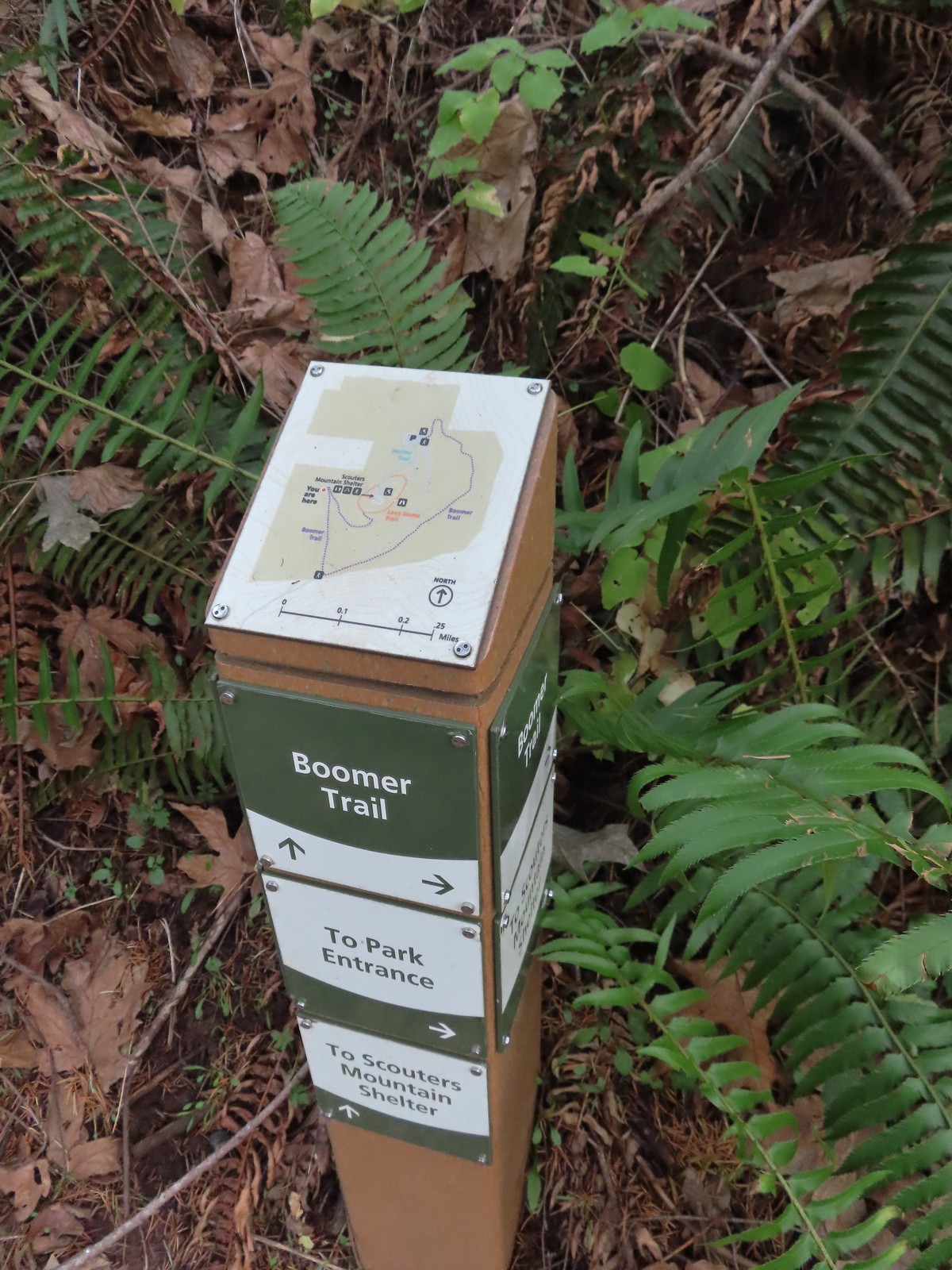
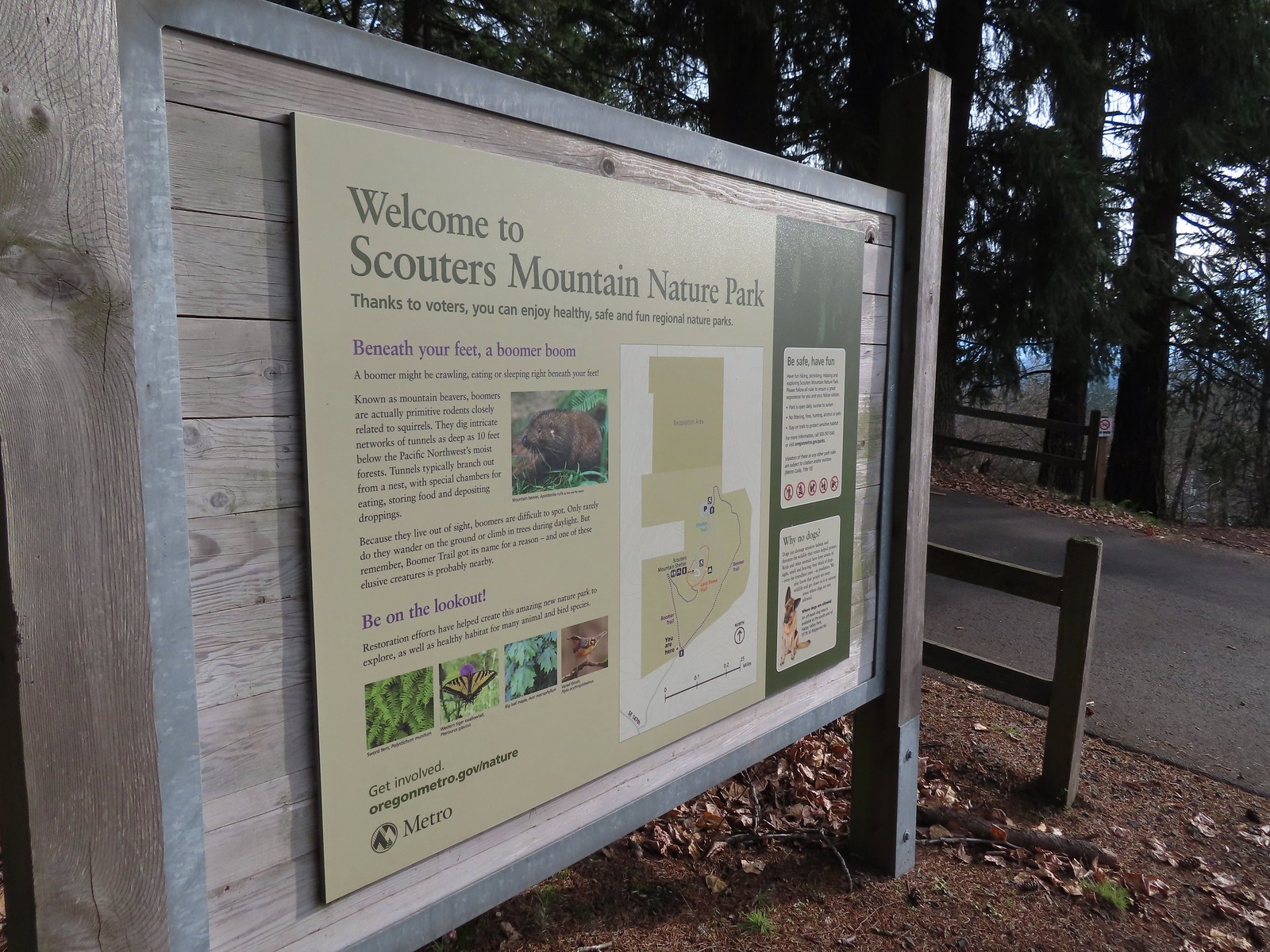
IMG_2151Another Metro trail map and pointers.

IMG_2152The Boomer Trail, named for Mountain Beavers which are sometimes called boomers, crossed the entrance road before climbing back up to the parking area.

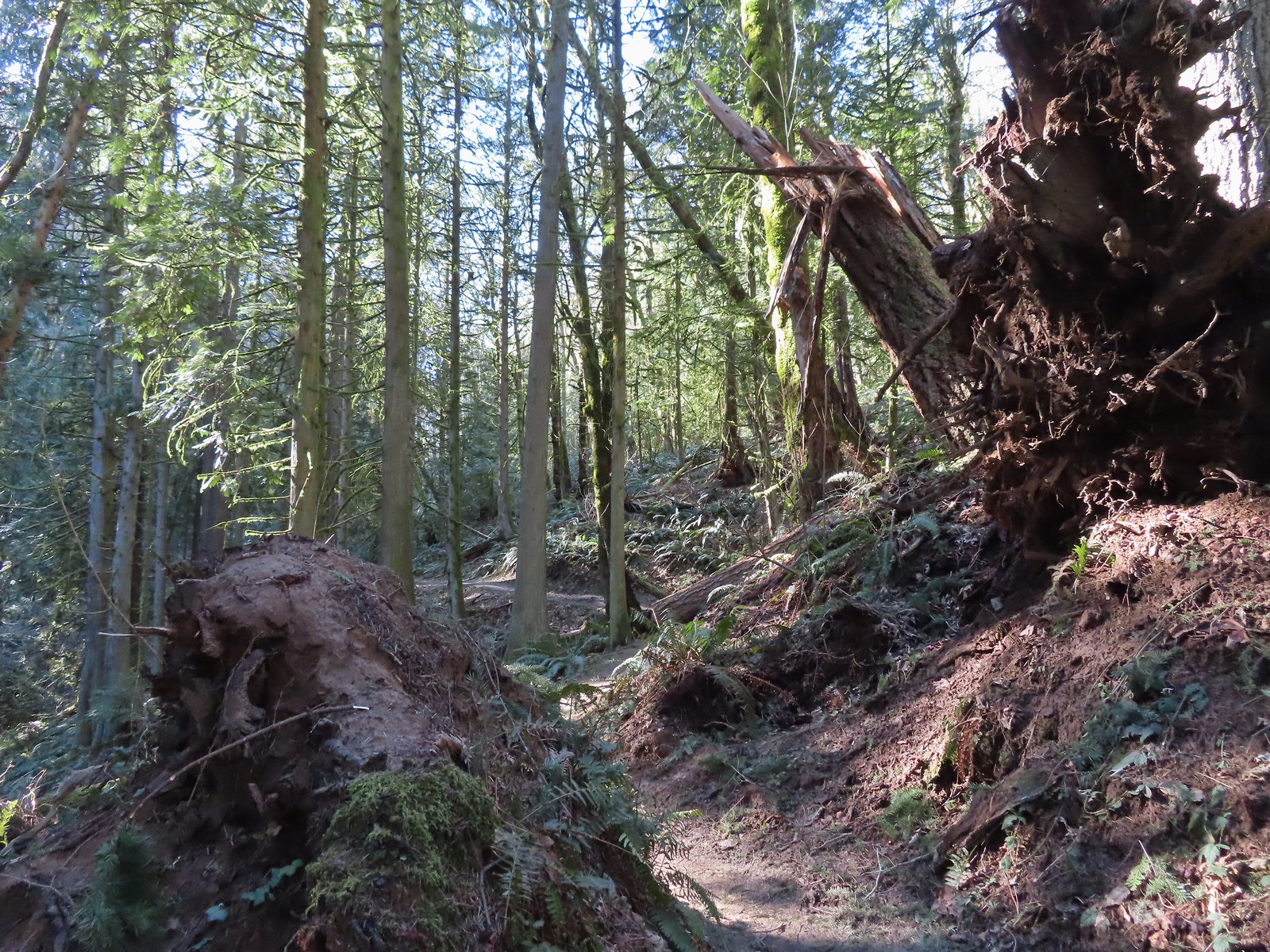
IMG_2156This was an impressive root system.

IMG_2160A less obstructed view of Mt. Adams. (Mt. St. Helens was also briefly visible from this section of trail.)

IMG_2161Slightly clearer shot of Mt. Adams.

IMG_2162Back at the trailhead.

This was just a 1.3-mile loop with 200′ of elevation gain, and it was still early enough that we could easily fit one more stop in. From Scouters Mountain we drove another 4.5-miles to Hood View Park

At the far end of the parking area we followed a service road down to SE 162nd Ave and followed it right to its end at a sign for the Hidden Falls Nature Park.
IMG_2163

IMG_2164Mt. St. Helens from the service road. Mt. Hood was also visible to the right through some fences around the ball fields.

IMG_2166

IMG_2167

A wide path led somewhat steeply downhill a third of a mile to an impressive bridge over Rock Creek and a view of Hidden Falls.
IMG_2168

IMG_2170The large area to the right didn’t offer much of a view of the falls, but the view from the bridge was great.
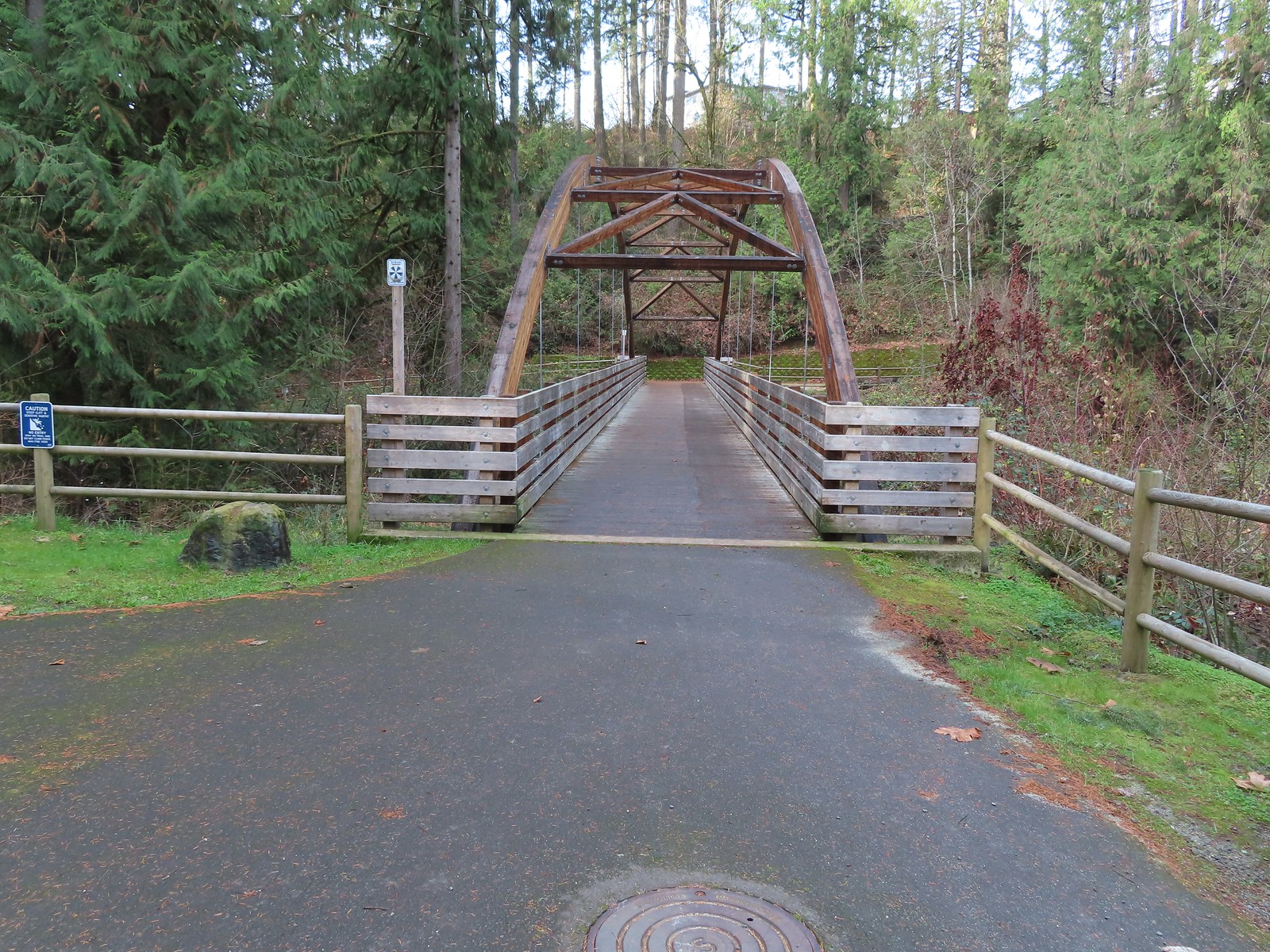
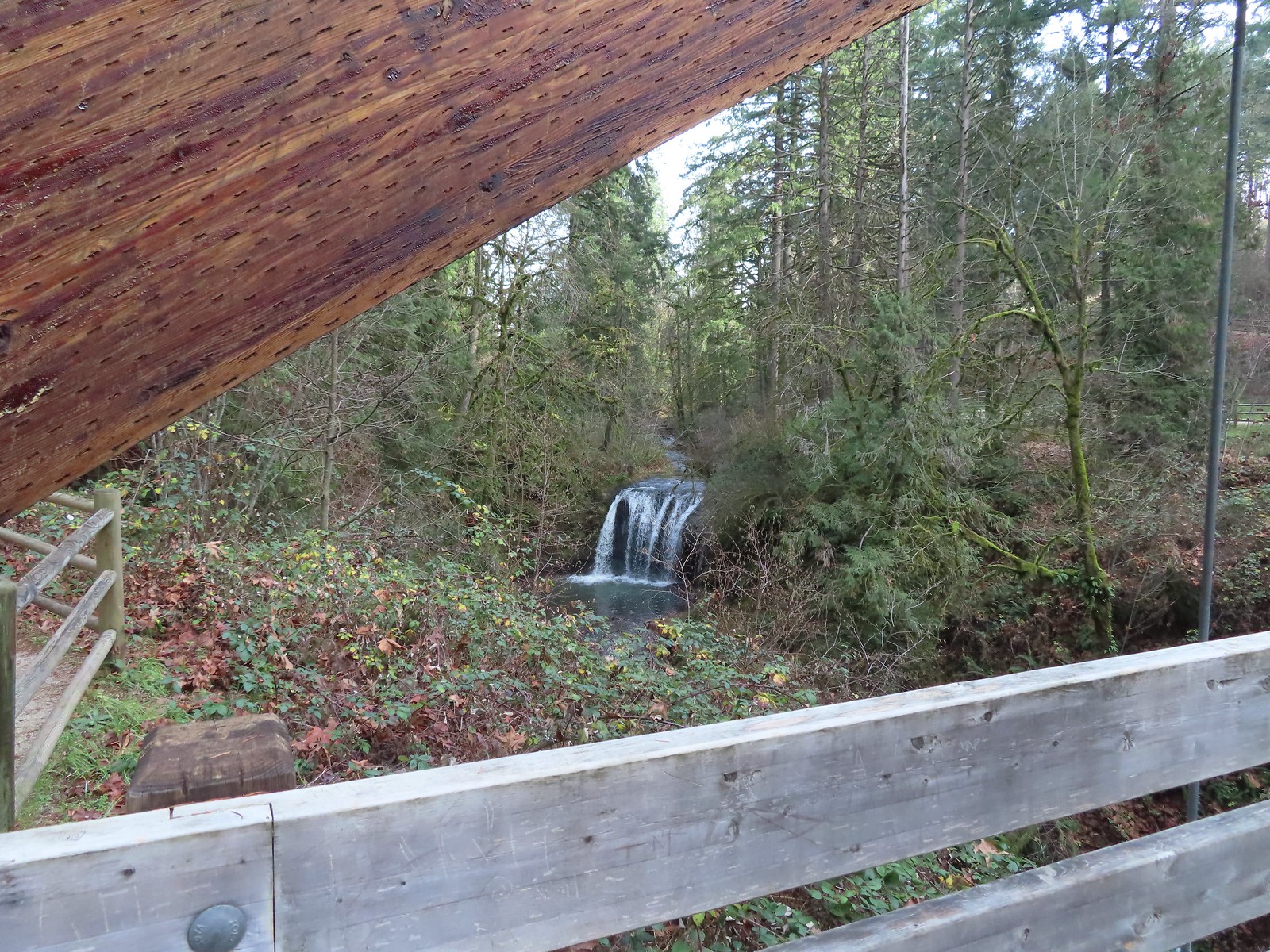
IMG_2172

IMG_2176

IMG_2183

IMG_2179

We continued past the bridge a short distance along Rock Creek before turning around when the path veered away to climb up into another neighborhood.
IMG_2186

IMG_2187

The Oregon Hikers Field Guide describes a 4.1-mile loop that visits some other parks while also passing through several neighborhoods. We were content with seeing the falls and headed back making this just a 1.2-mile out-and-back with a couple hundred feet of elevation gain. For the day we logged 7.2-miles and 1475′ of cumulative elevation gain. It was a nice relaxing way to end our 2023 hiking season. Happy Trails and Merry Christmas!

Our final three hikes.
Categories
Hiking Oregon Portland Trip report Willamette Valley

Tualatin River Wildlife Refuge, Cooper Mountain, and Graham Oaks – 05/13/2023

While Spring has largely been a no-show so far this year, Summer decided to make an early appearance with a weekend forecast for temperatures topping 90 degrees. We’ve been lucky to hit 60 so we’ve had no time to adjust to that kind of heat. In the past when temperatures have soared, we’ve opted to adjust our planned hike to minimize the impact. That wasn’t necessary this time though as our planned outing was to take three short hikes, each less than an hour North of Salem.

We started our morning by re-visiting the Tualatin River National Wildlife Refuge. We’d stopped here in March of 2019 (post) but could only hike the River Trail at that time of the year. The longer Wetland Trail loop is closed from October 1st through April 30th so we’d scheduled this May visit to check out the loop. We started from the Roy Rogers Trailhead where we found a nice patch of wildflowers to greet us.
IMG_7765The refuge is open from dawn to dusk. We arrived at a quarter to six to get an early start and avoid being out during the hottest parts of the day.
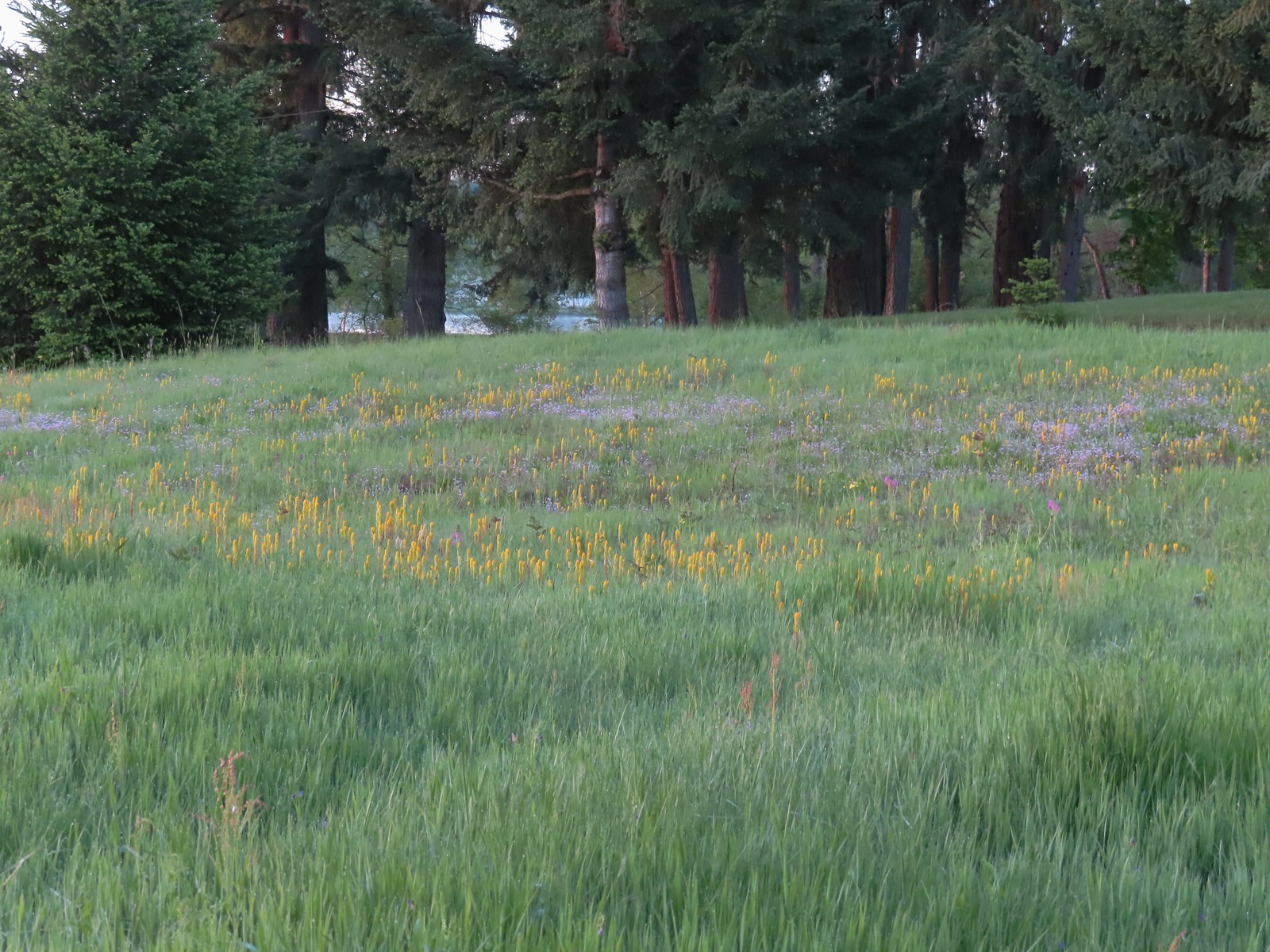
IMG_7768

IMG_7771The patch of wildflowers.

IMG_7773A checker-mallow surrounded by golden paintbrush.

DSCN3325Plectritis amid the golden paintbrush.

We decided to go counterclockwise and forked right across Chicken Creek on a bridge.
IMG_7776We had a pretty good view of Mt. Hood.
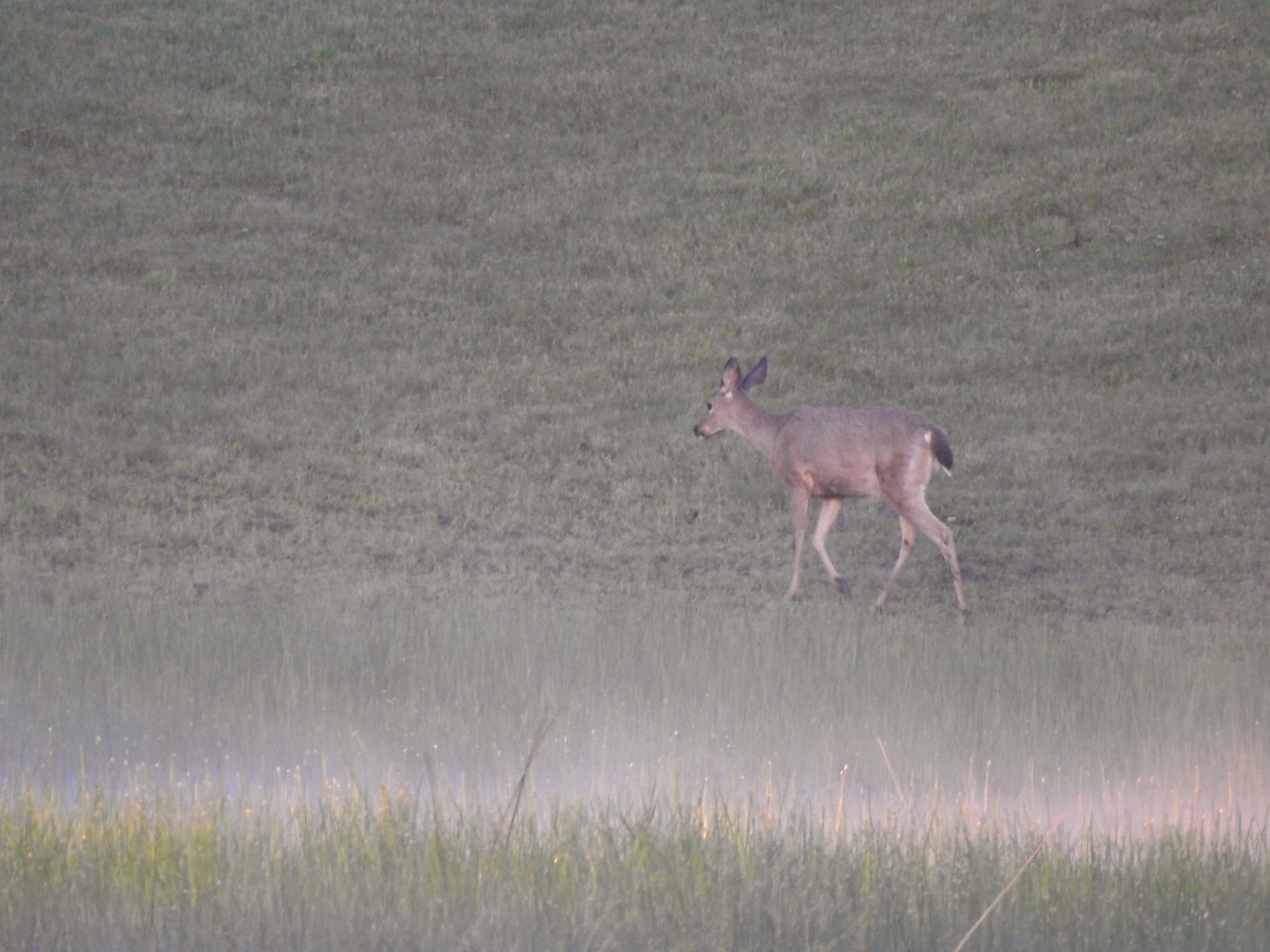
The Wetland Trail follows a service road around the refuge. We began seeing wildlife almost immediately with a family of geese and a pair of deer hanging out on some private property adjacent to the refuge.
DSCN3329

DSCN3343

DSCN3341

It was approximately 1.5-miles from the Roy Rogers Trailhead to the Refuge Headquarters and Wildlife Center. It was slow going as we kept stopping to watch the wildlife.
IMG_7784

DSCN3353Mallards

DSCN3369Greater yellowlegs

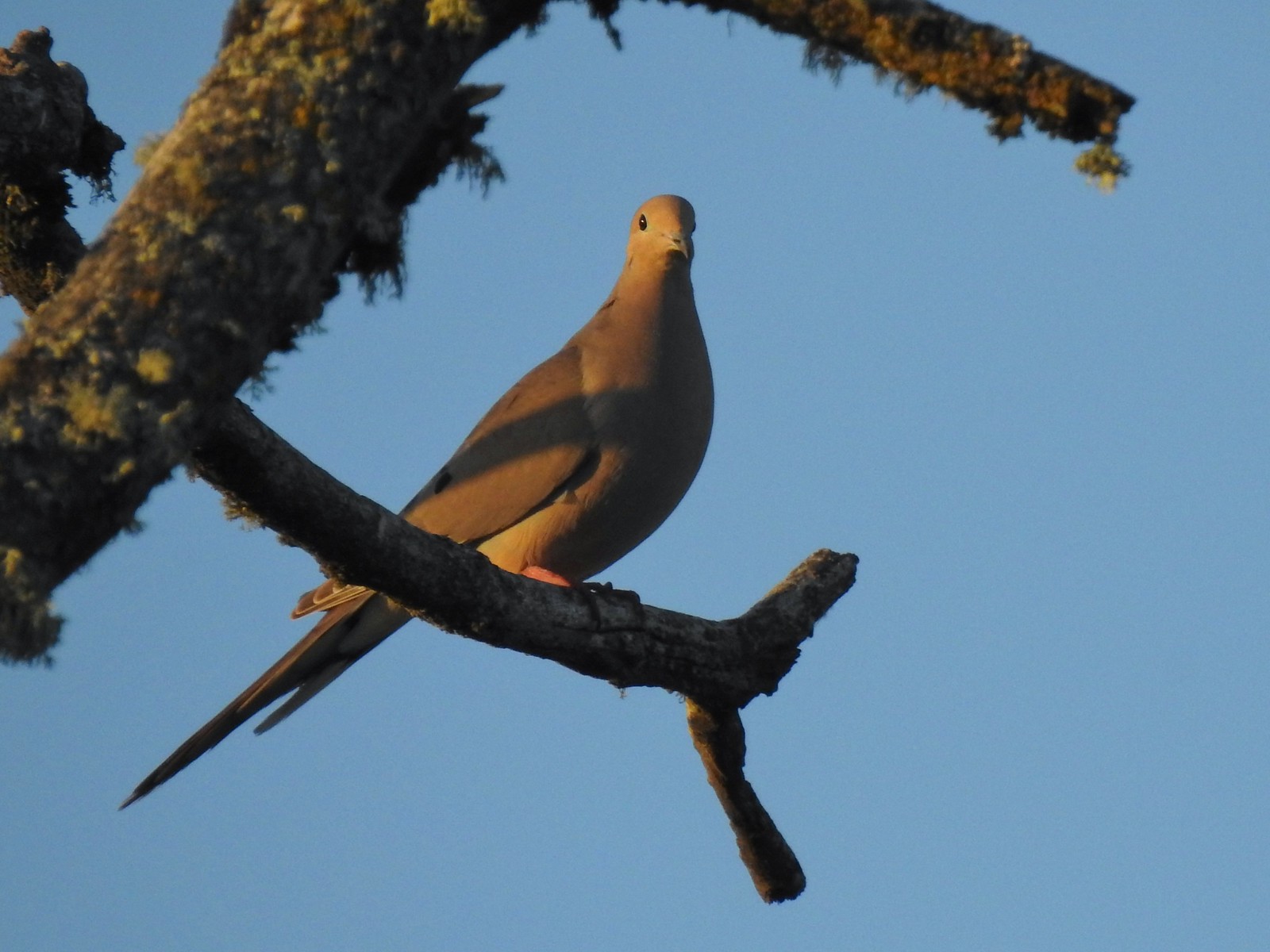
DSCN3372Mourning dove

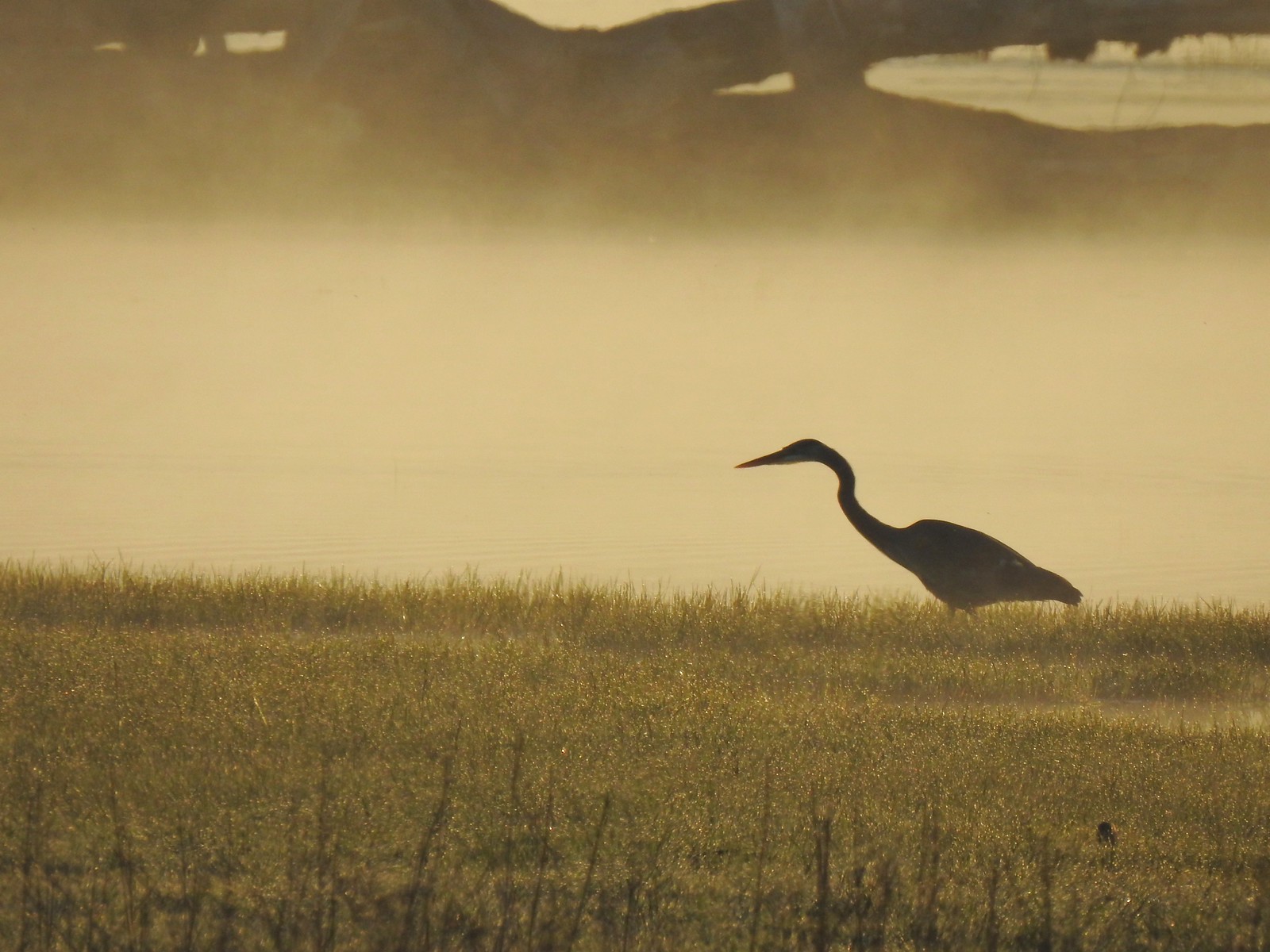
DSCN3375Great blue heron

DSCN3380An egret and some ducks

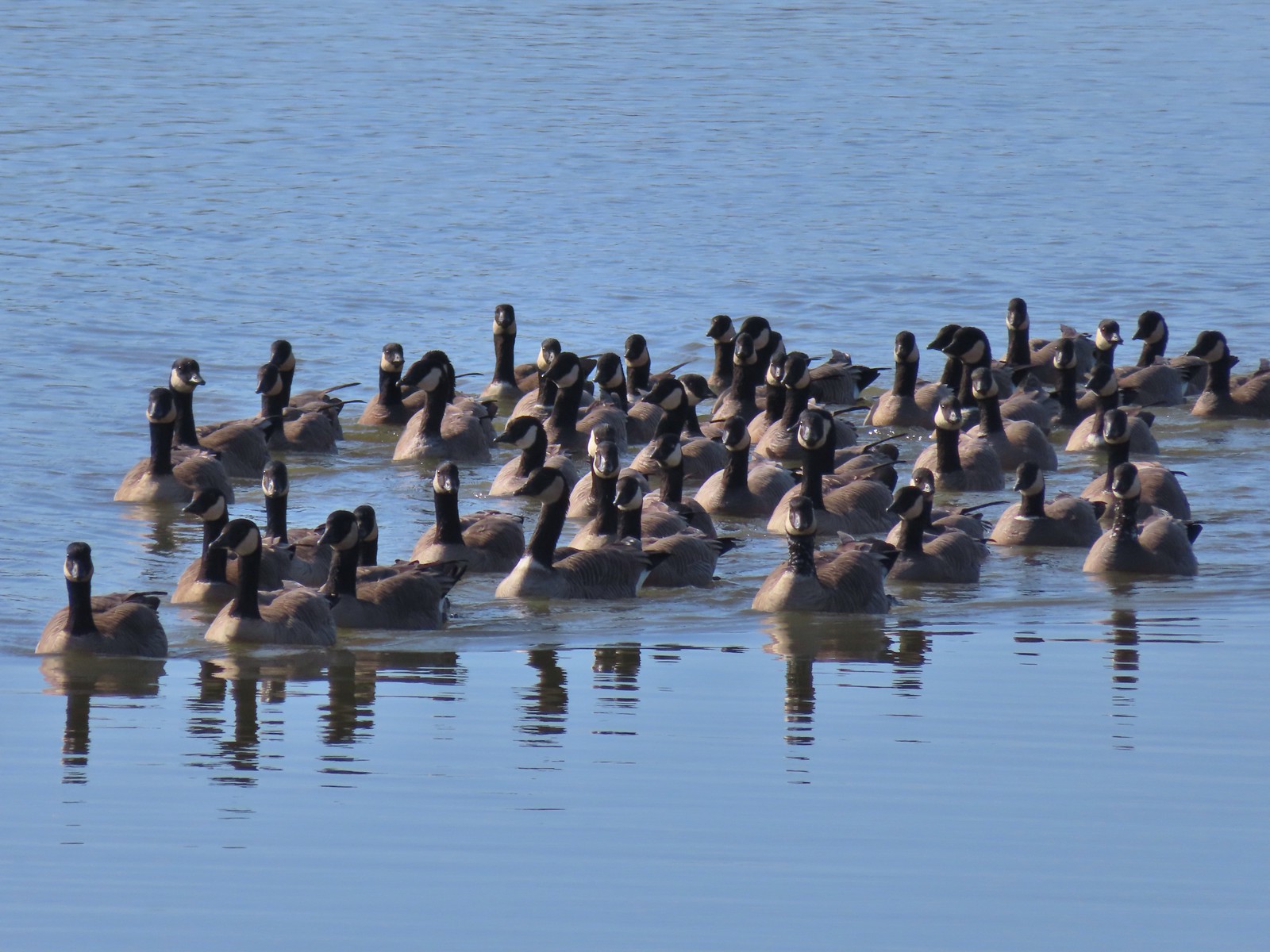
DSCN3394More families of geese

IMG_7789Swallows flying above the Wetland Trail.
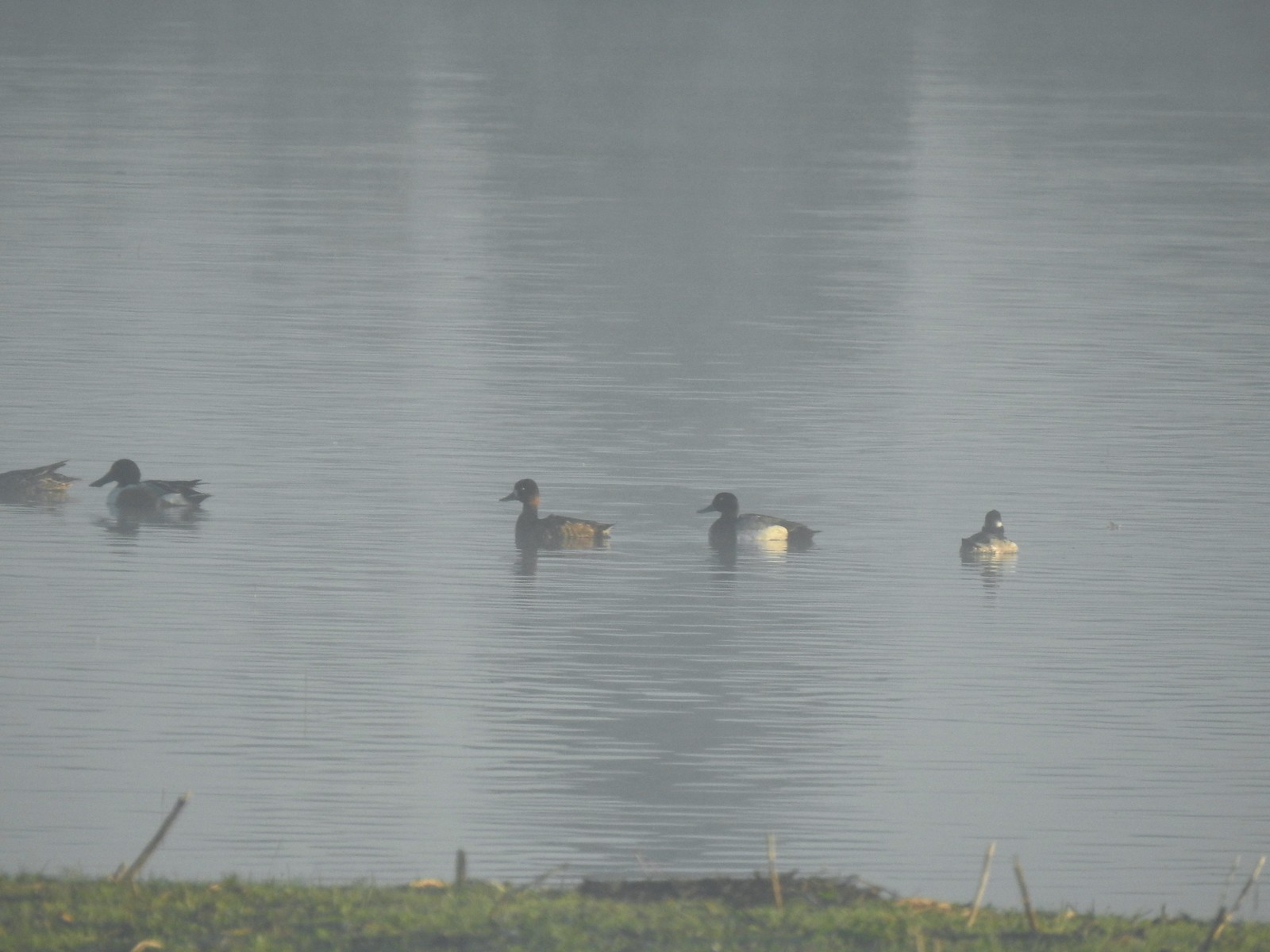
Northern shoveler, Scaups, and a buffleheadNorthern shoveler, scaups (leaning toward greater), and a bufflehead.

DSCN3401Mallards

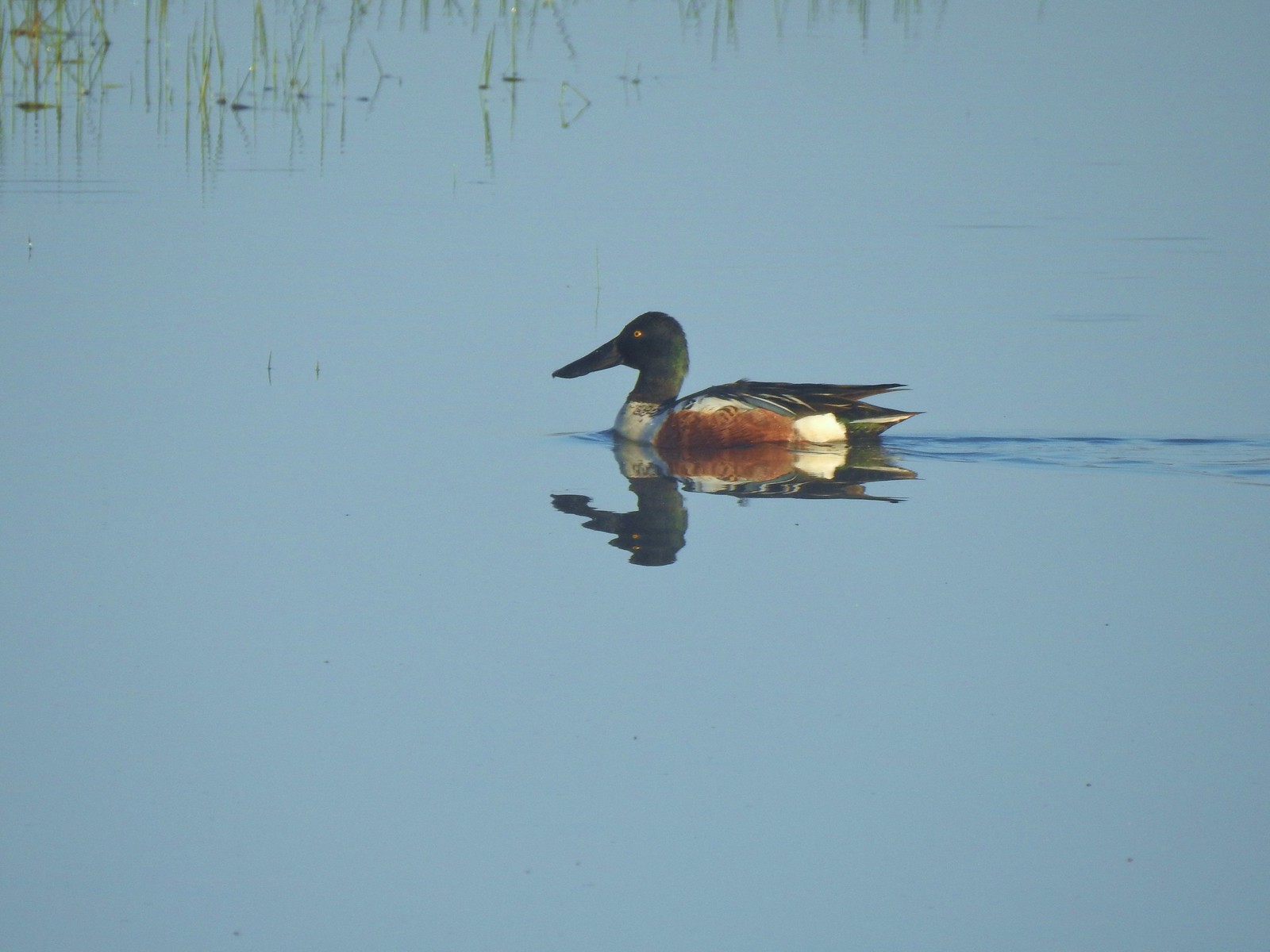
DSCN3424Northern shoveler

Ruddy duckRuddy duck

DSCN3435Gadwalls

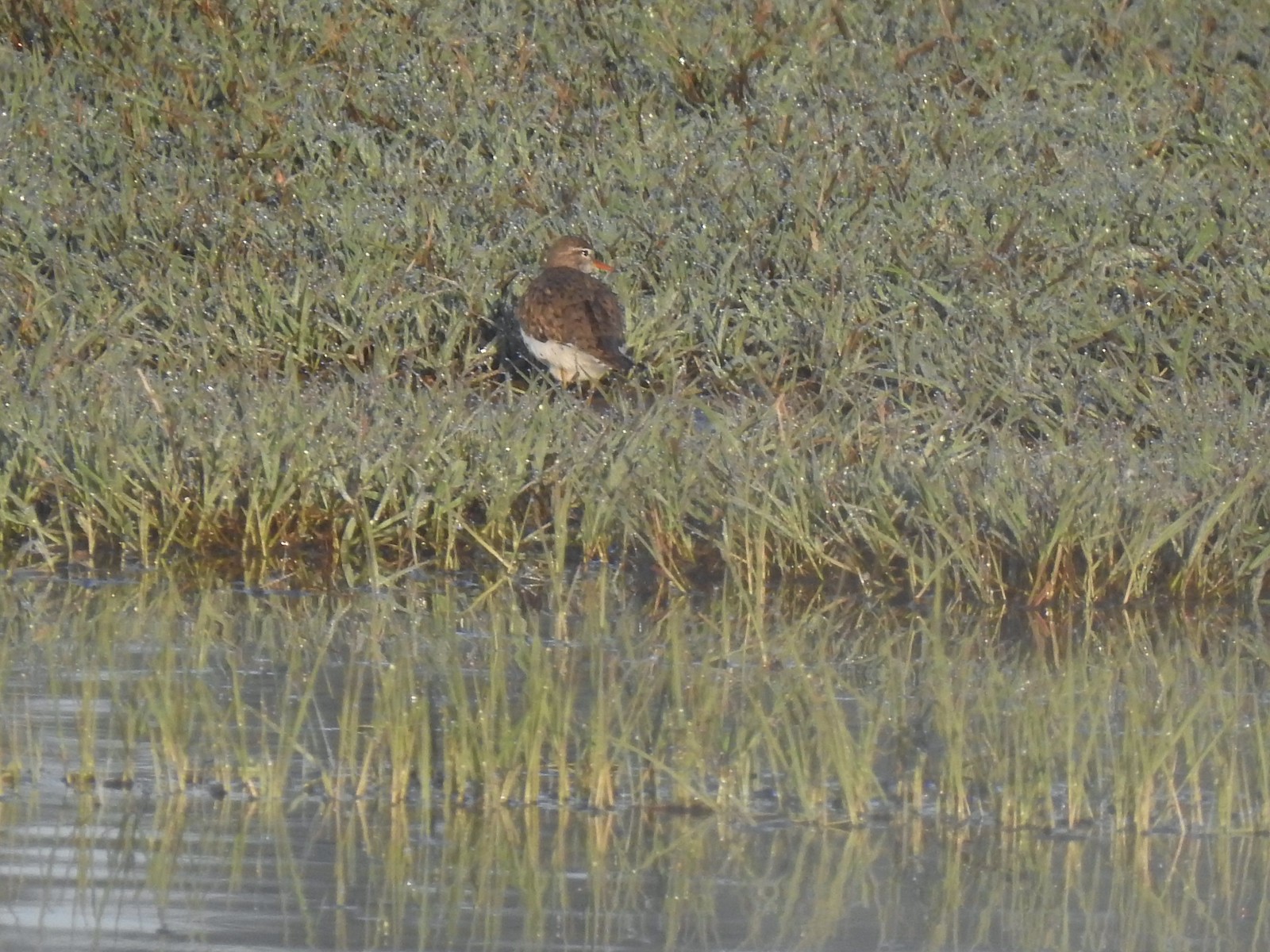
DSCN3434Spotted sandpiper

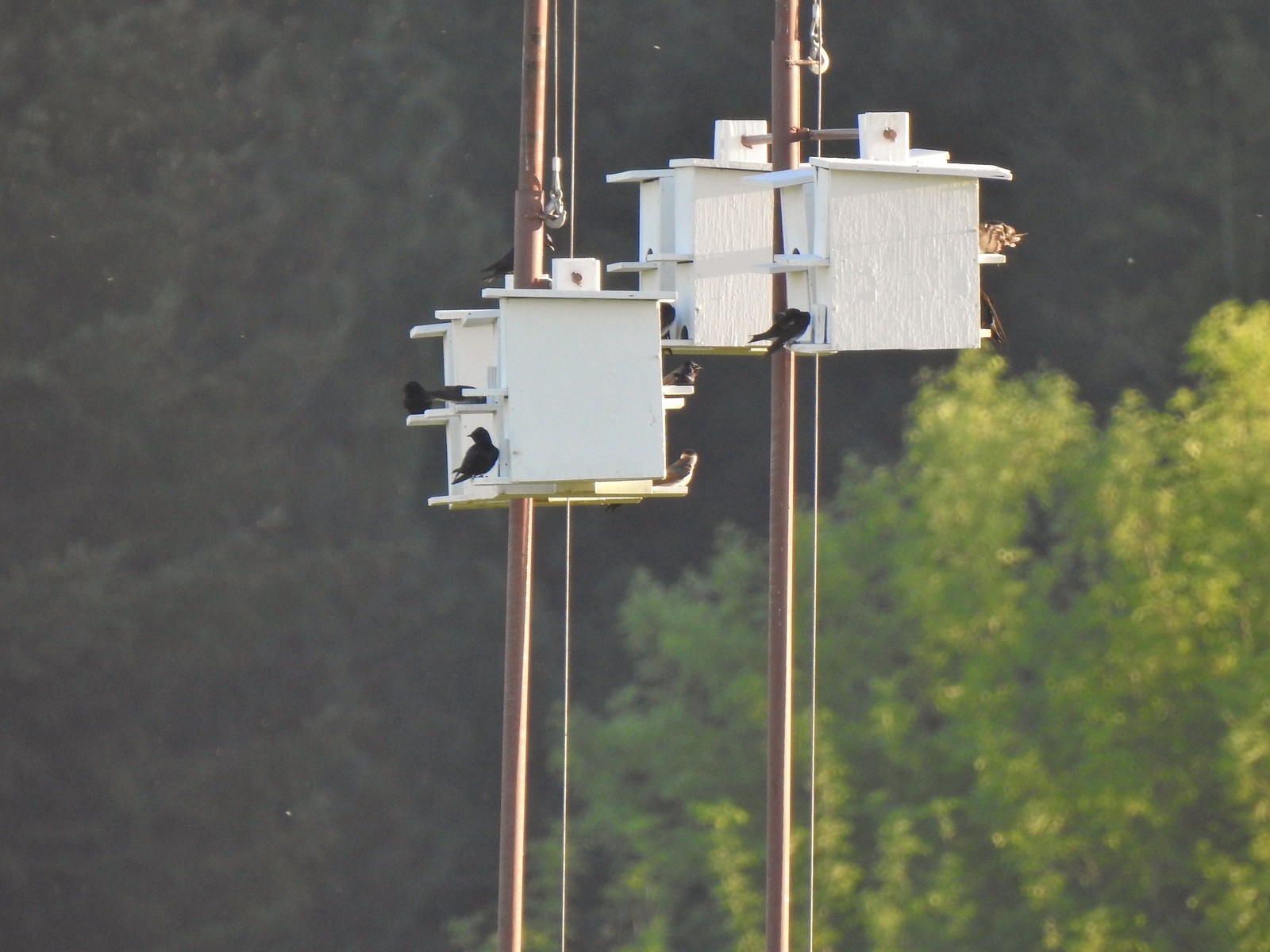
DSCN3439Purple martins

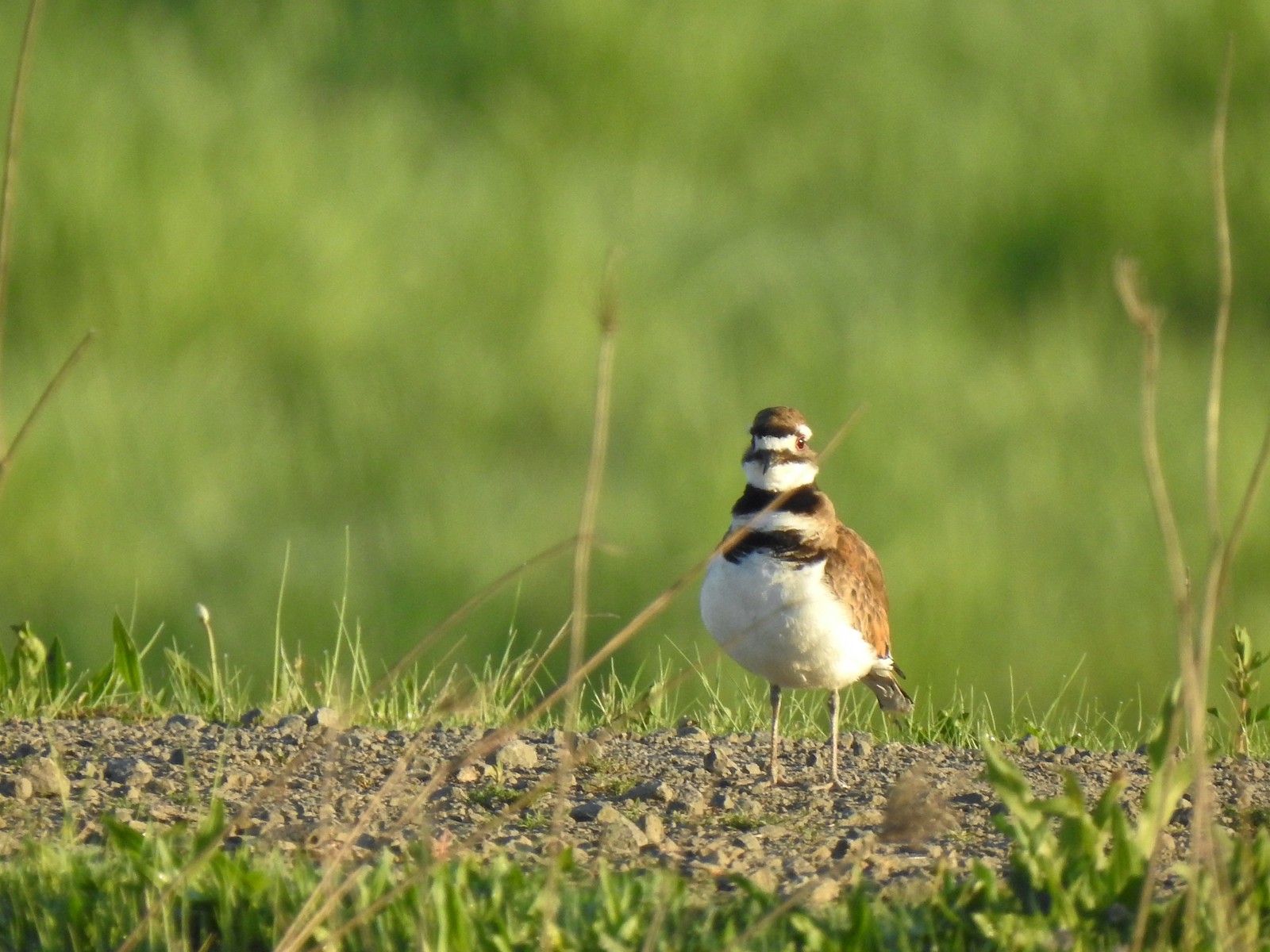
DSCN3441Killerdeer

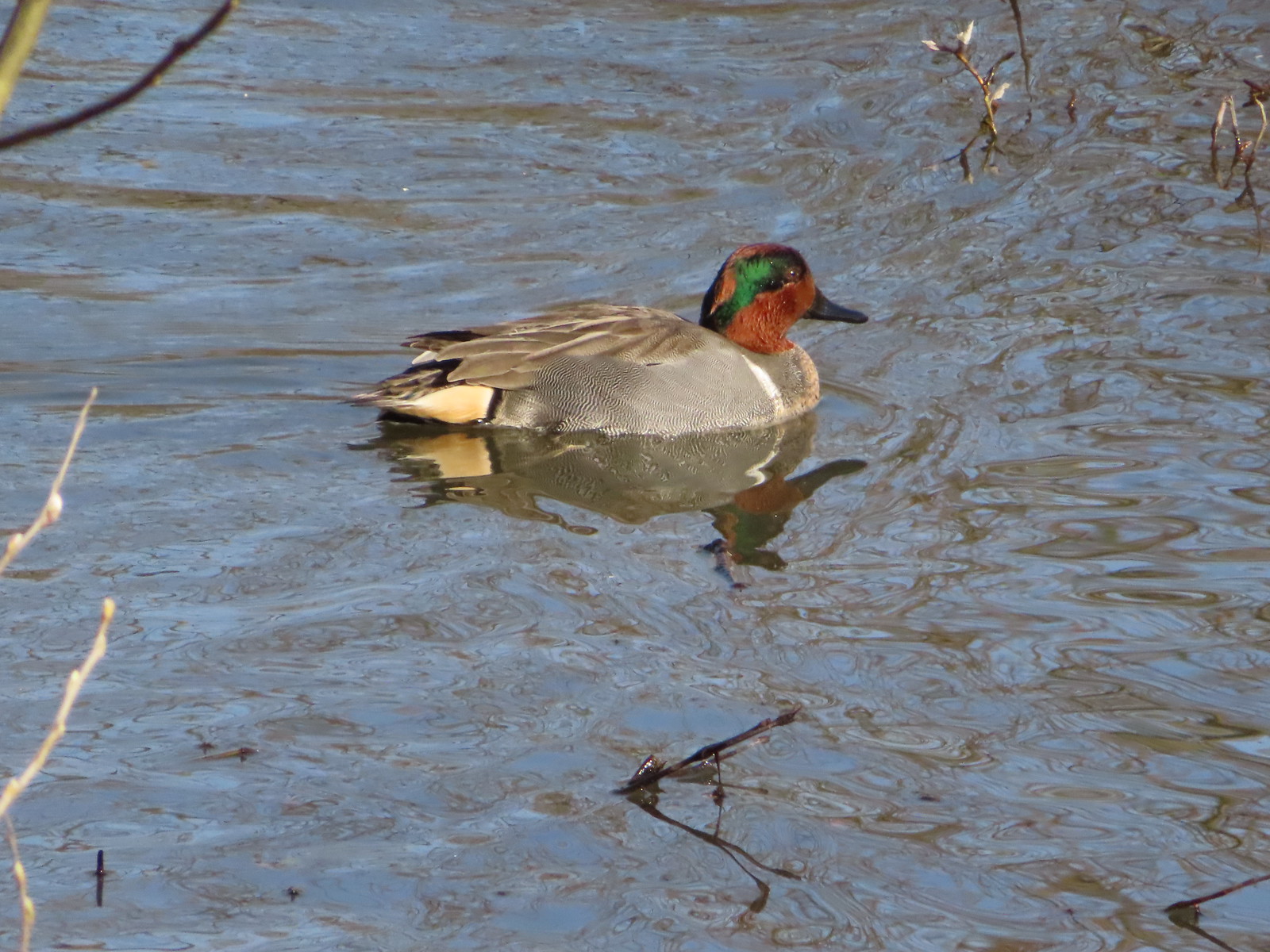
DSCN3456Cinnamon teals

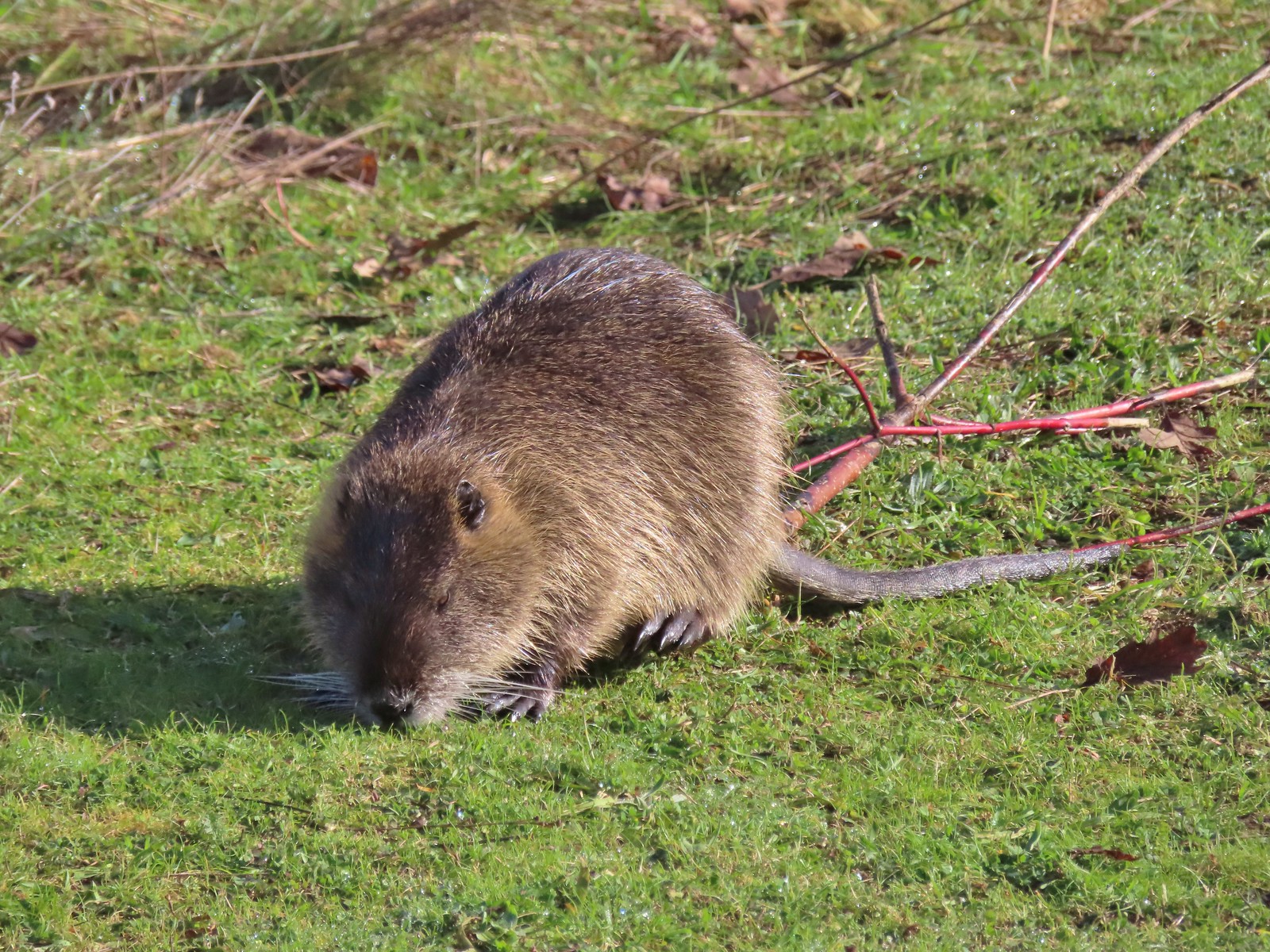
DSCN3446Nutria, one of several of these non-native rodents that we saw.

DSCN3415Nap time (or just a late sleeper).

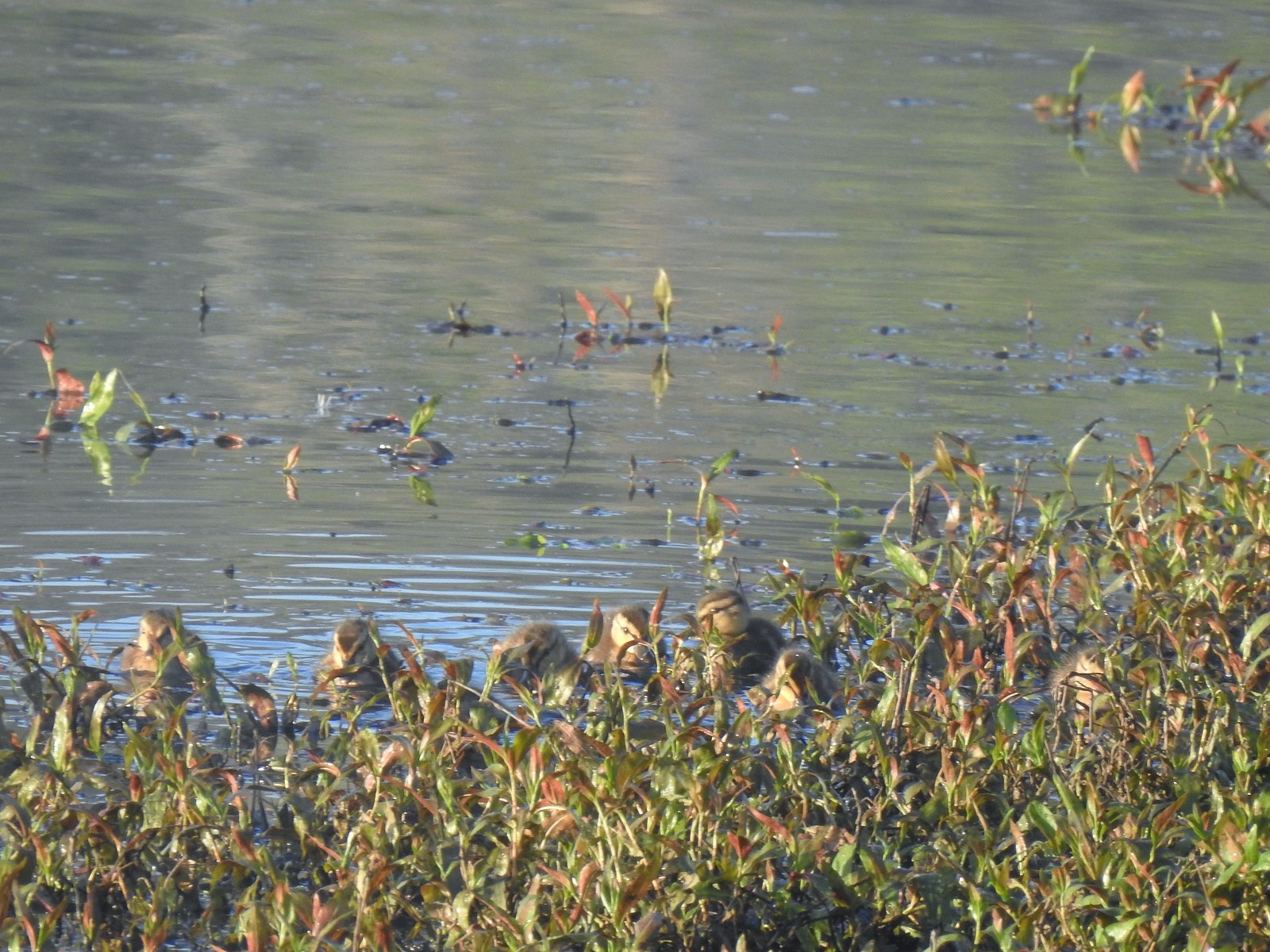
DSCN3450Ducklings

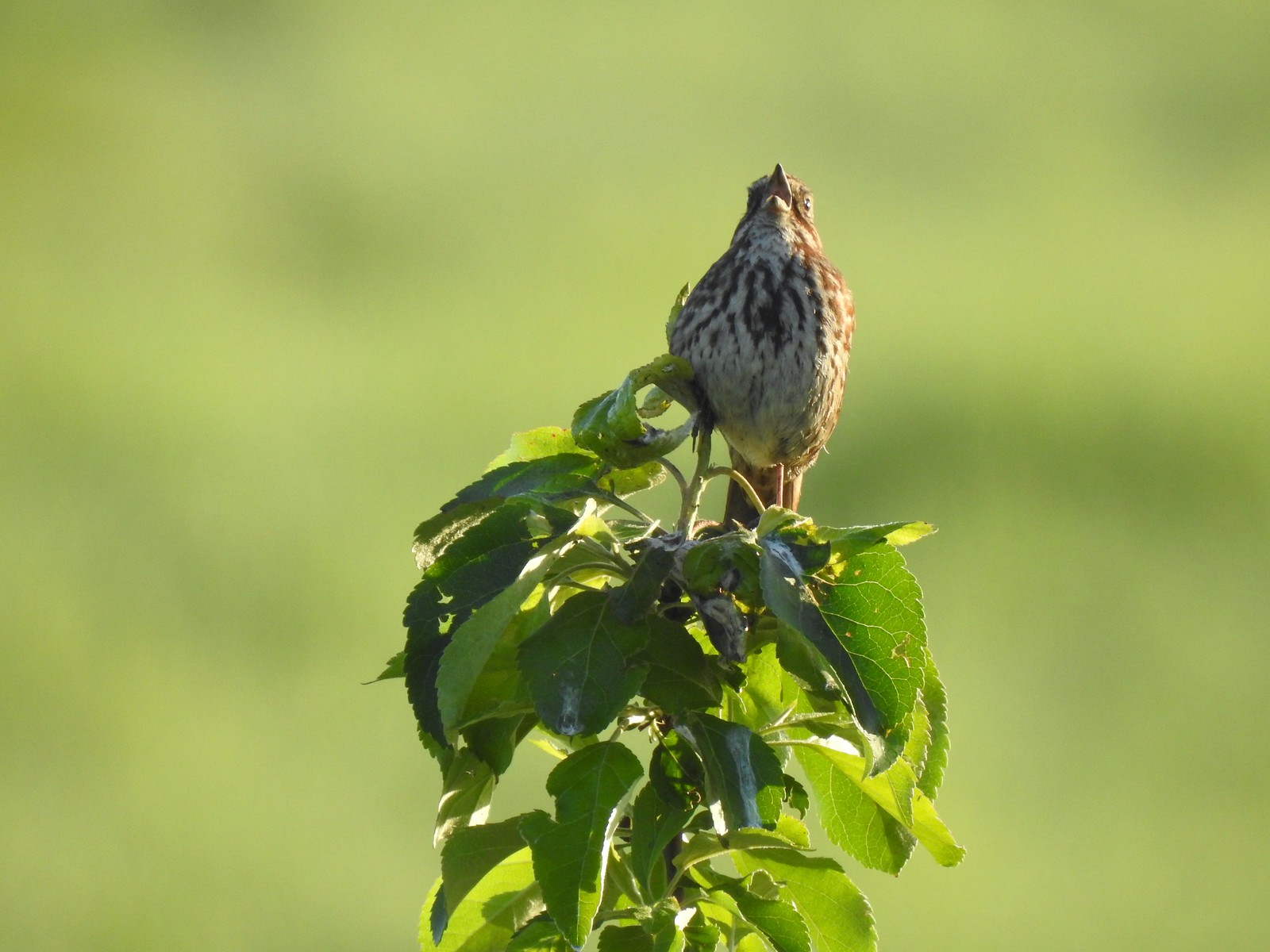
DSCN3458Song sparrow

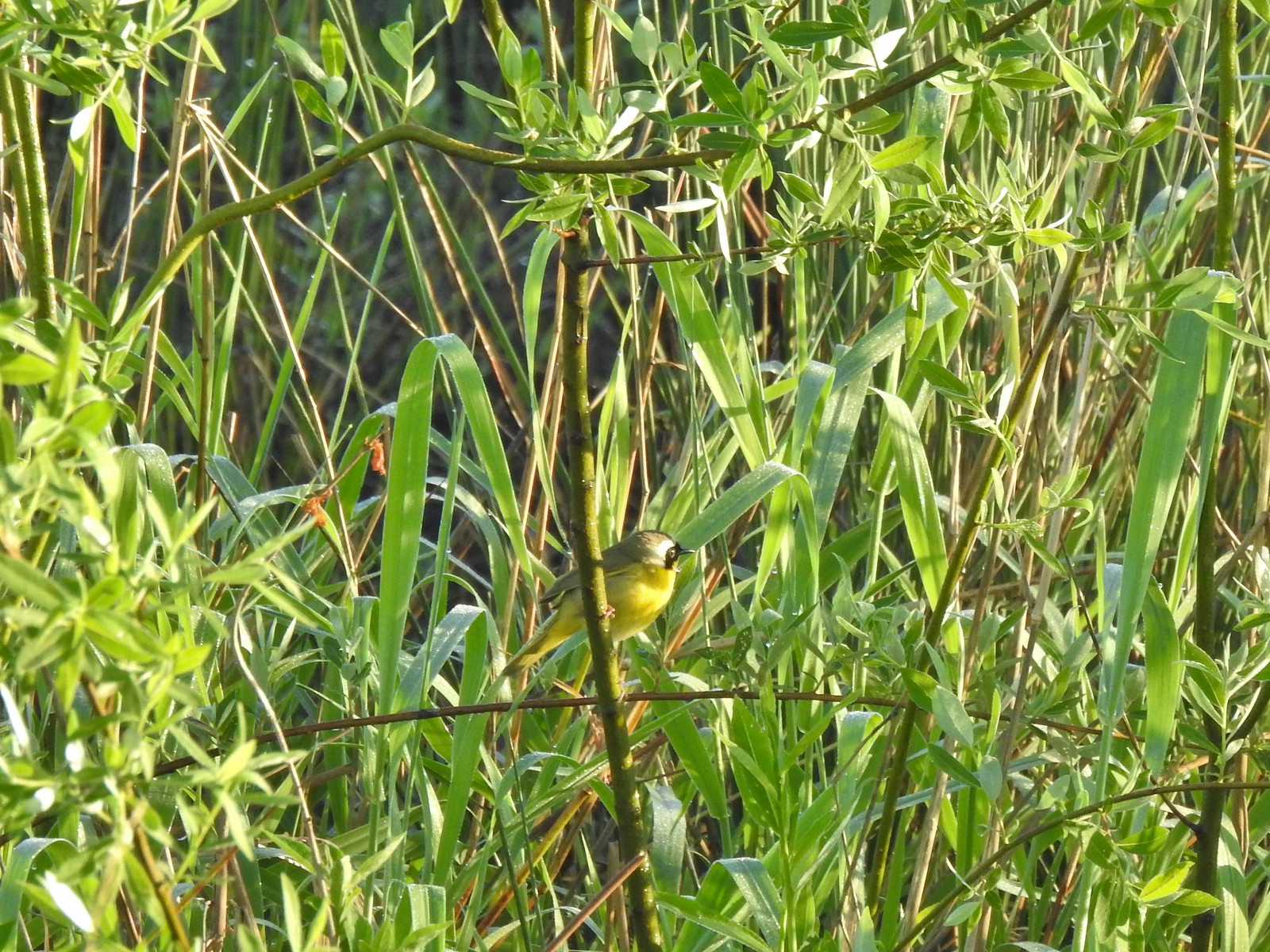
DSCN3468Common yellowthroat

IMG_7798Wildlife Center

We took in the view from the overlook next to the Wildlife Center before continuing on with the loop.
IMG_7803

DSCN3476Great blue heron watching from a little island.

IMG_7806

We followed the Wetland Trail until we came to the River Overlook where we cut over to the River Trail (the trails are less than a yard apart in this area) to check in on the Tualatin River.
IMG_7807

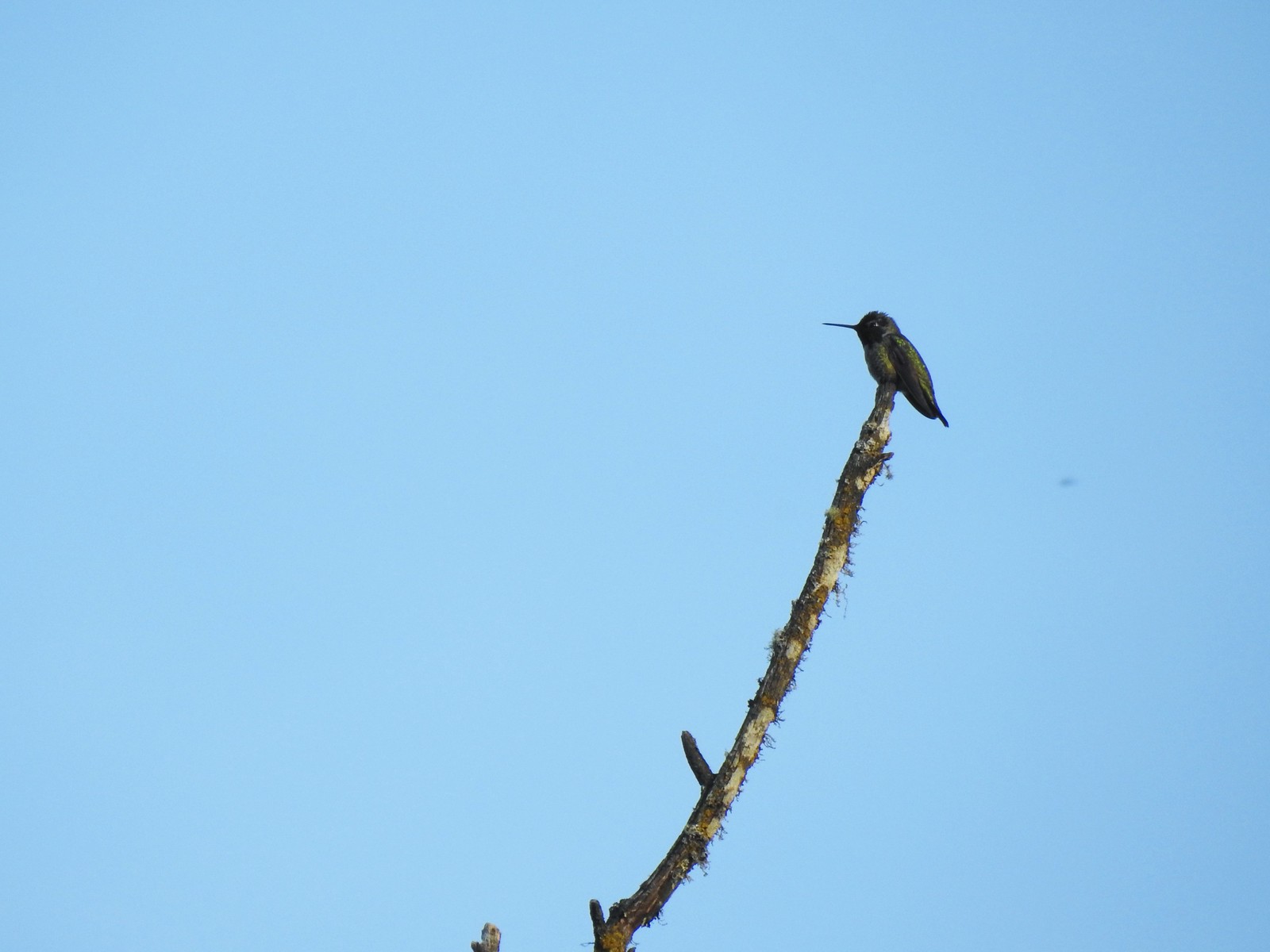
DSCN3483Anna’s hummingbird

DSCN3484The same Anna’s hummingbird. When catching light their head/throat is bright pink but appear black when not.
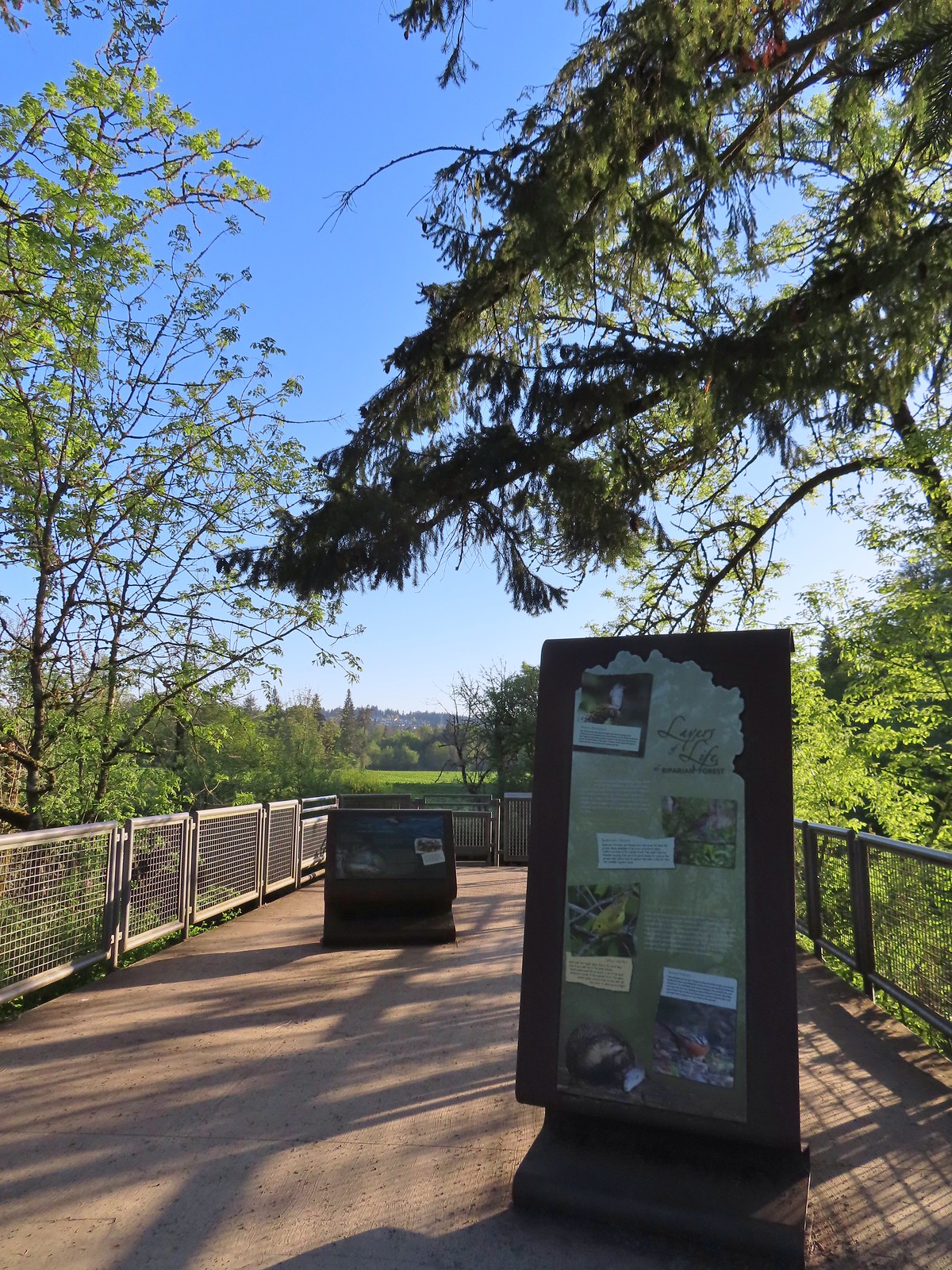
IMG_7810River Overlook

IMG_7812Tualatin River

DSCN3487Robin

From the overlook we stuck to the River Trail following it through a short section of forest before rejoining the Wetland Trail.
IMG_7813The Wetland and River Trails running parallel.

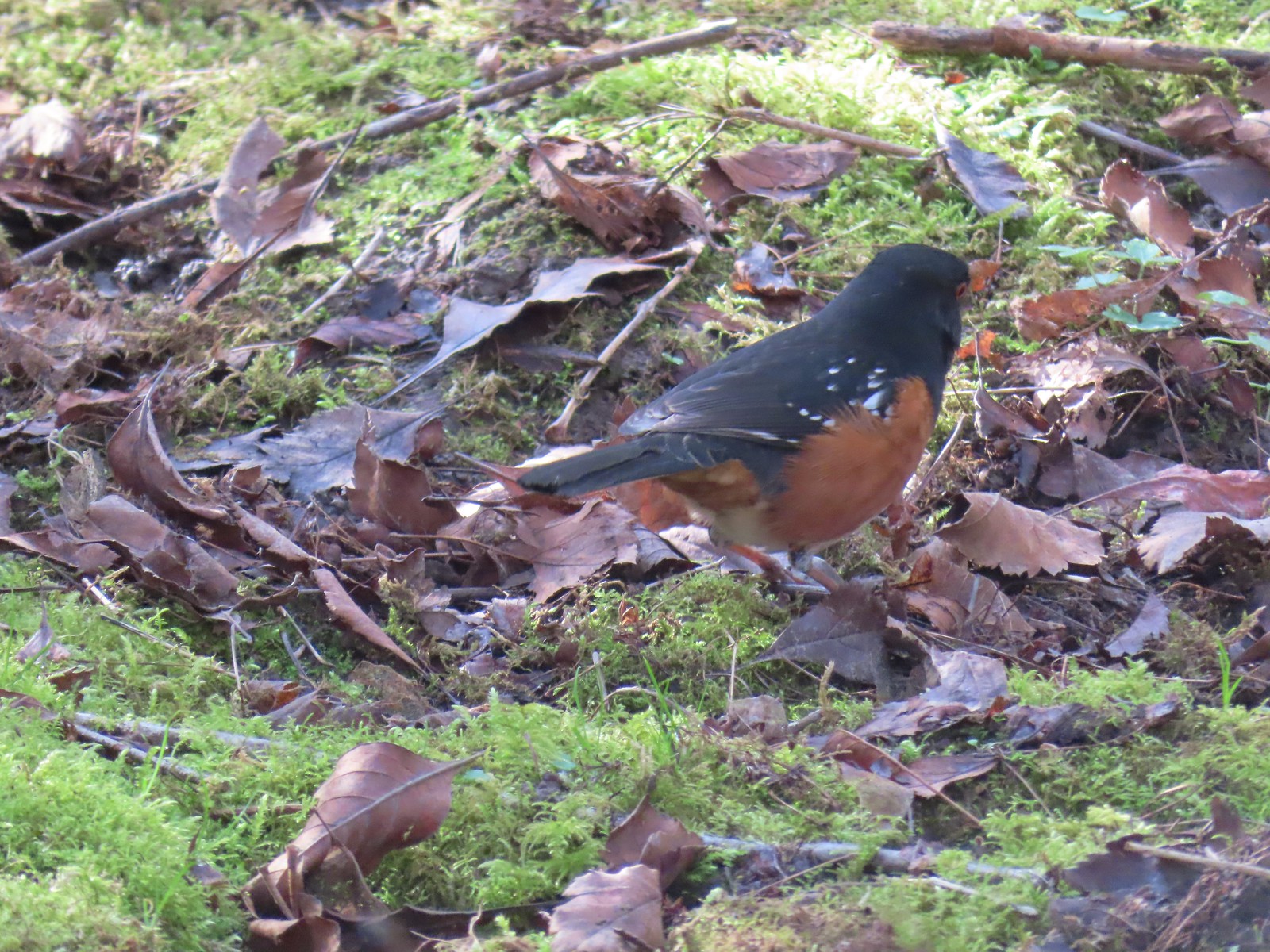
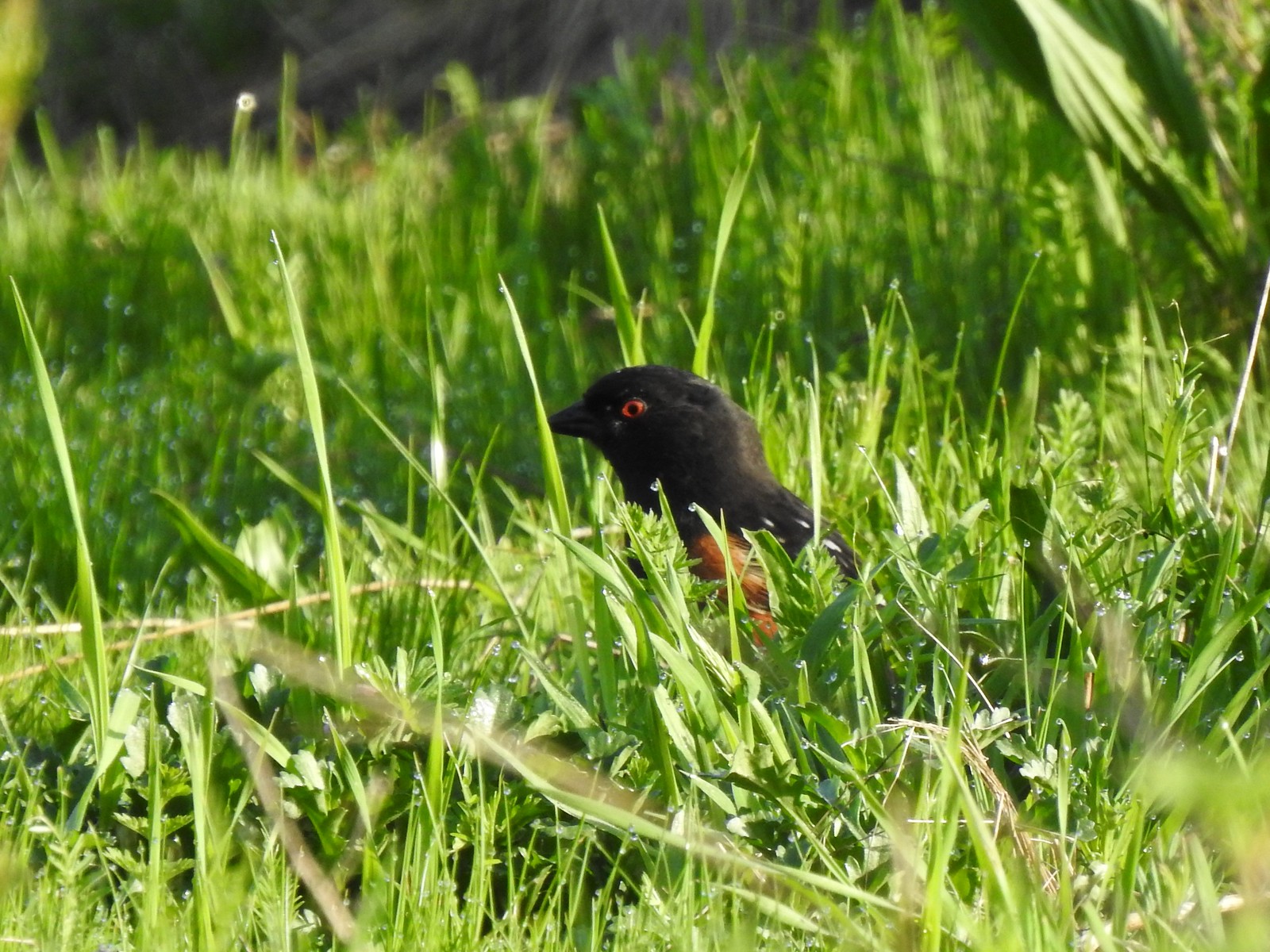
DSCN3489Spotted towhee

DSCN3496Rabbit

IMG_7817

IMG_7819Pacific waterleaf

IMG_7821Violets and fringecup along the River Trail.

IMG_7823Bleeding heart

IMG_7820We skipped the spur trail to the Ridgetop Overlook since we’d done that on our previous visit.
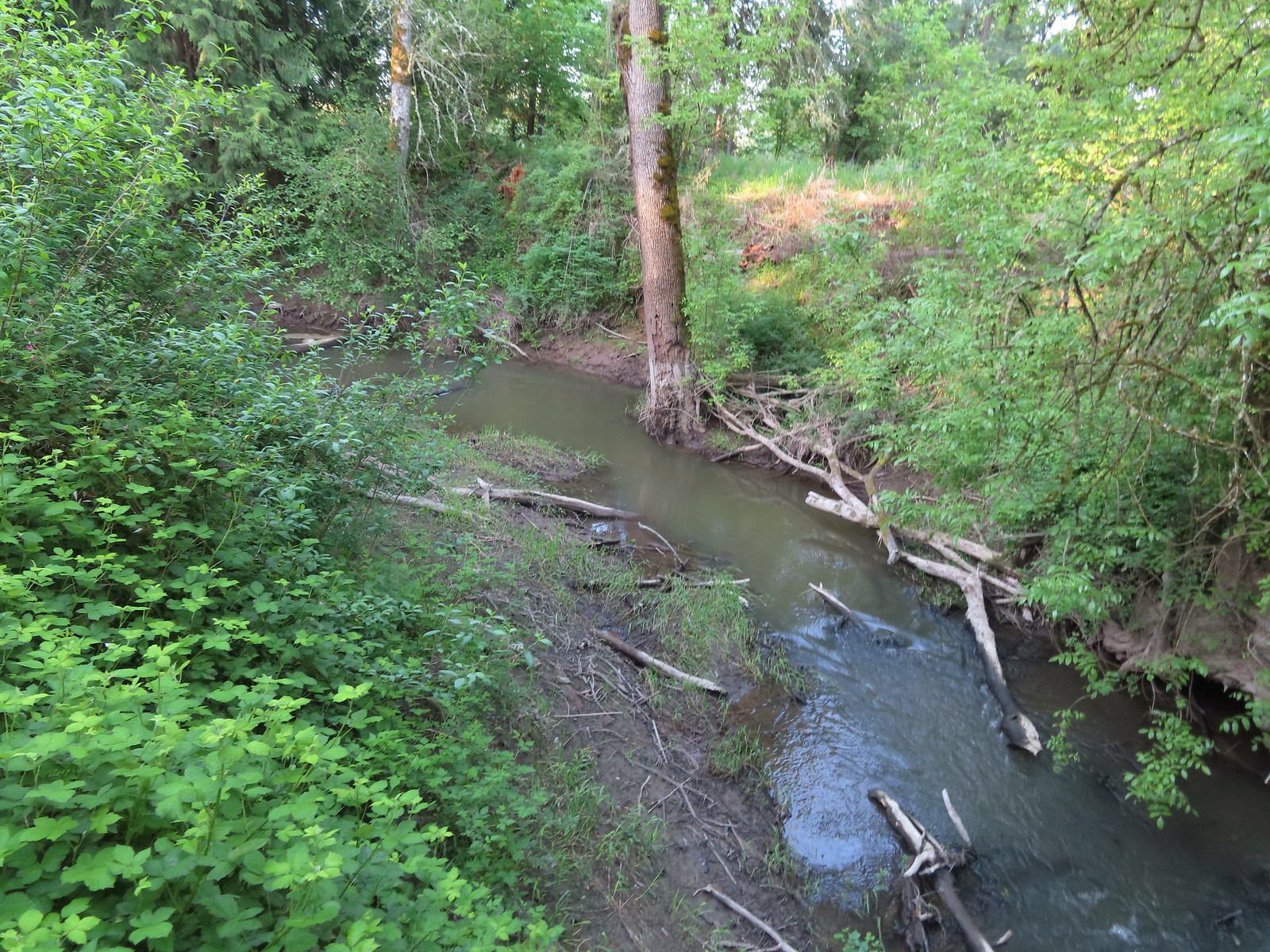
IMG_7828Chicken Creek

IMG_7829The River Trail meets the Wetland Trail across from the Weland Observation Platform.

We didn’t observe much from the platform on this visit. We continued on with our loop back on the Wetland Trail.
IMG_7834

DSCN3506Great white egrets

IMG_7838There were some impressively tall trees along this portion of the loop.
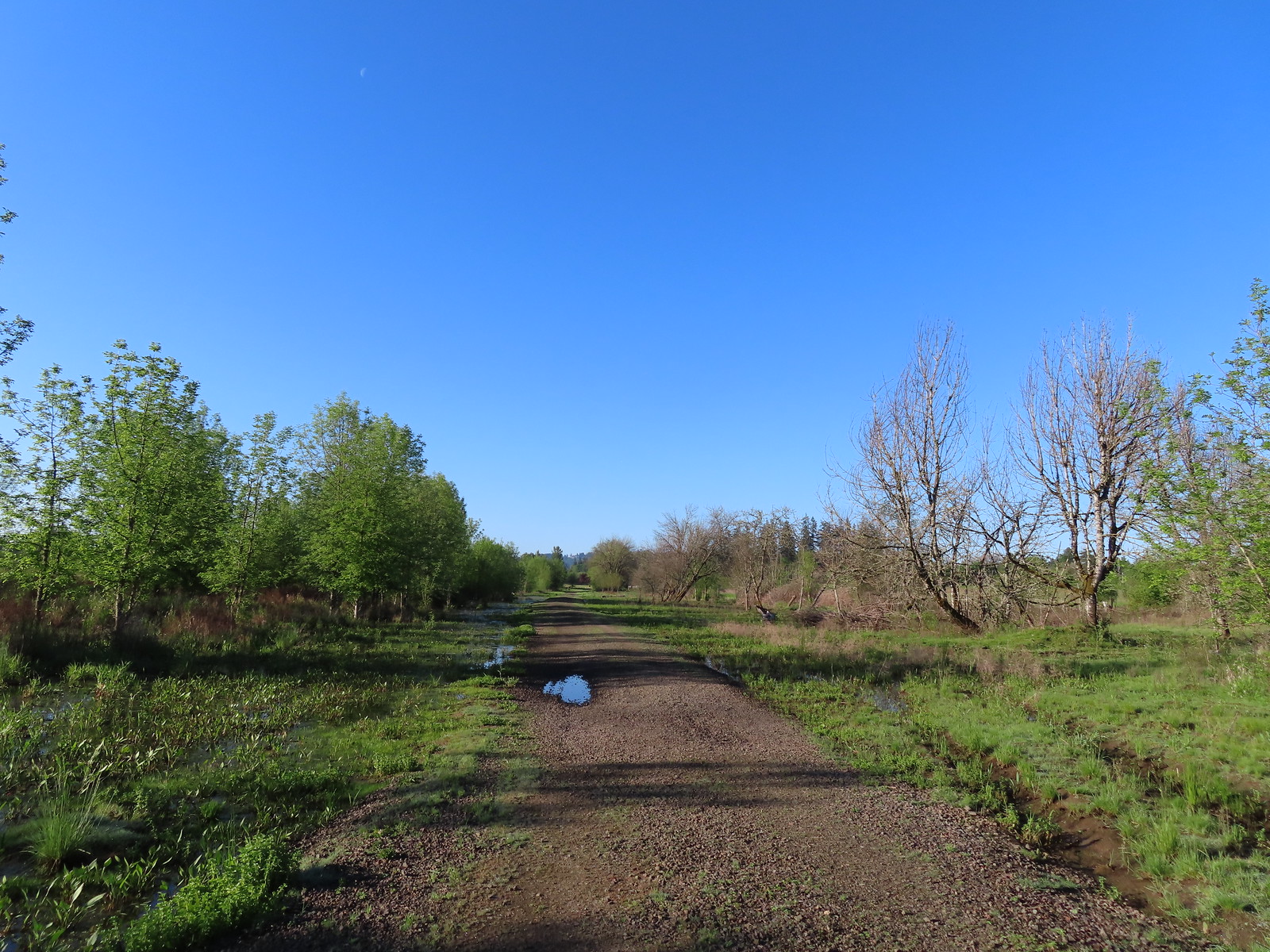
The trail made a 90-degree turn just before another branch of Chicken Creek and headed in a near straight line back toward the Roy Rogers Trailhead.
IMG_7841

DSCN3518Another egret

IMG_7842More egrets across Chicken Creek.

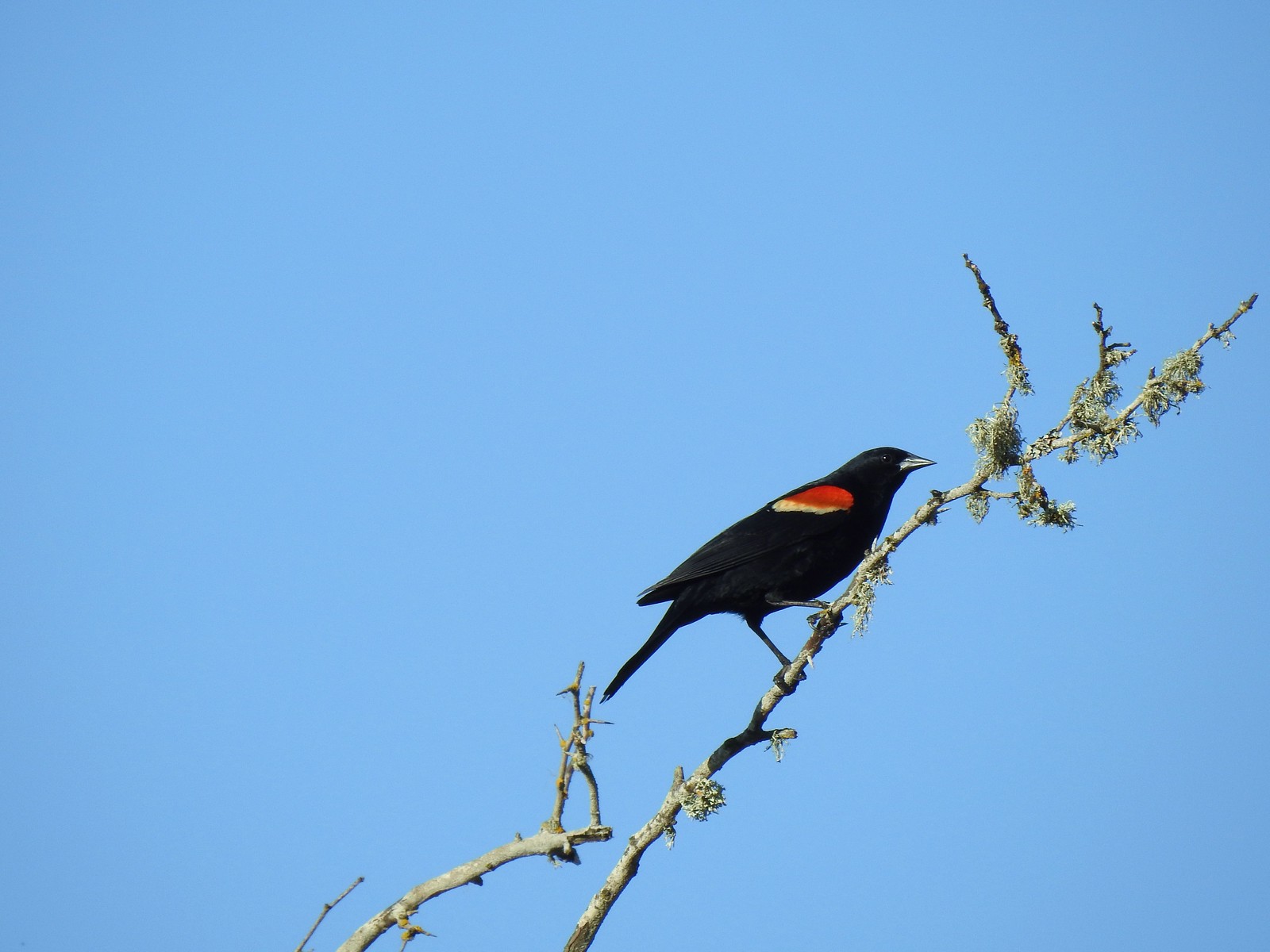
DSCN3527Red-winged blackbird

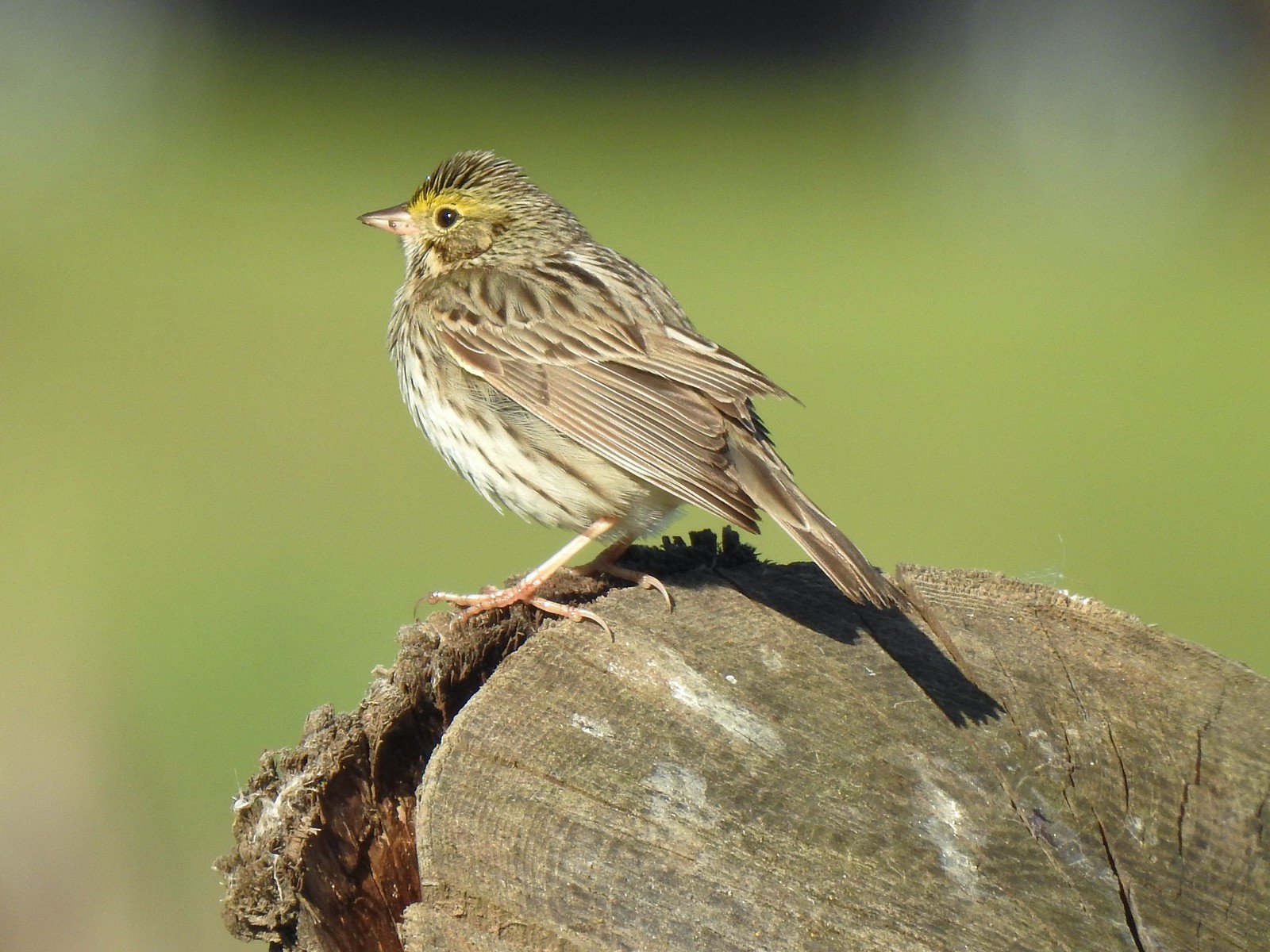
DSCN3530Savannah sparrow

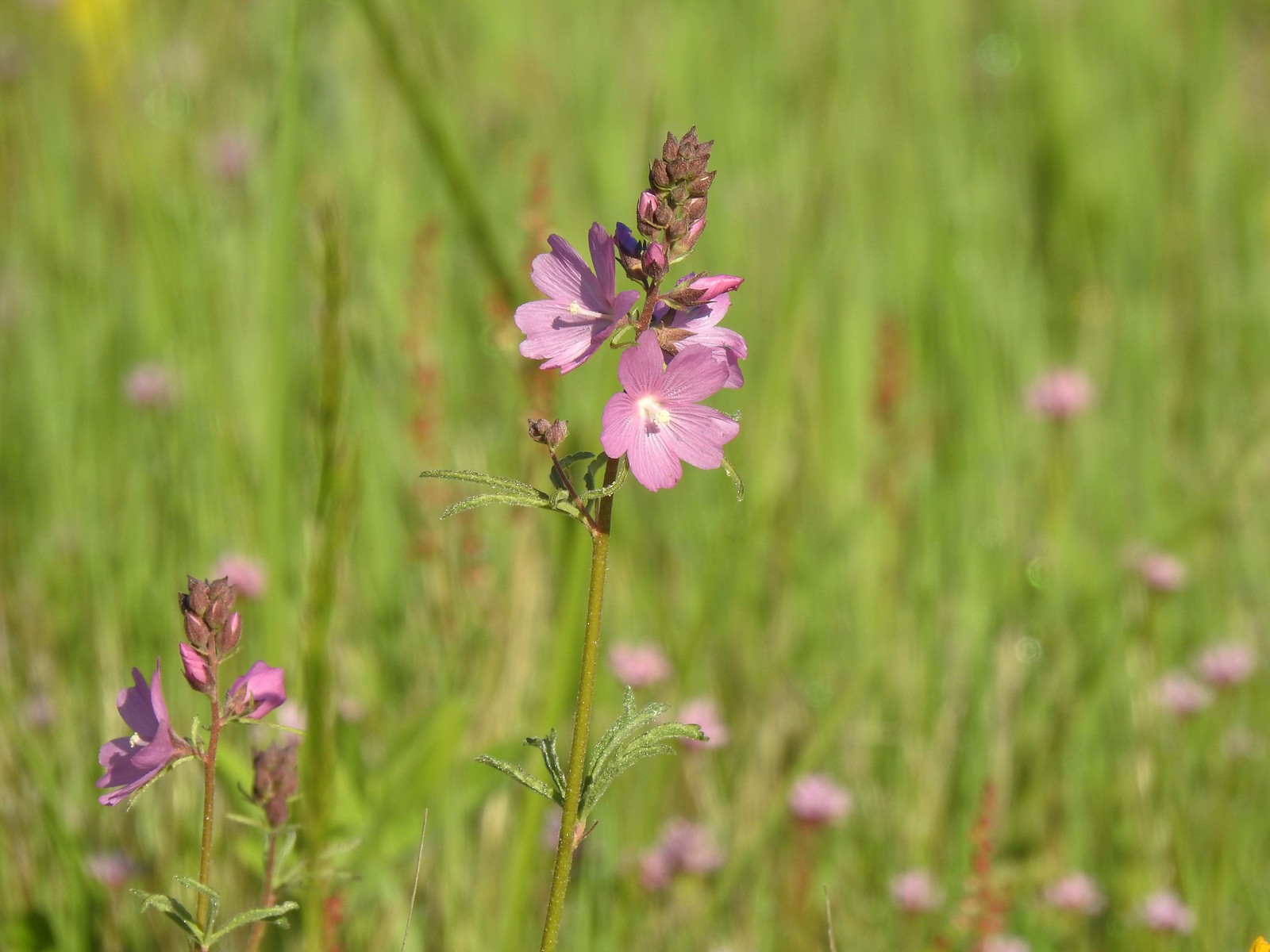
DSCN3535Checker-mallow

DSCN3537A parsley

While our loop was only 3.6-miles it was packed full of sights, a great start to our morning. From the refuge we made the roughly 10-minute drive to our next stop at the Cooper Mountain Nature Park, yet another park managed by Oregon Metro. The park hosts a little over three miles of trails which start at a nice little playground.
IMG_7850

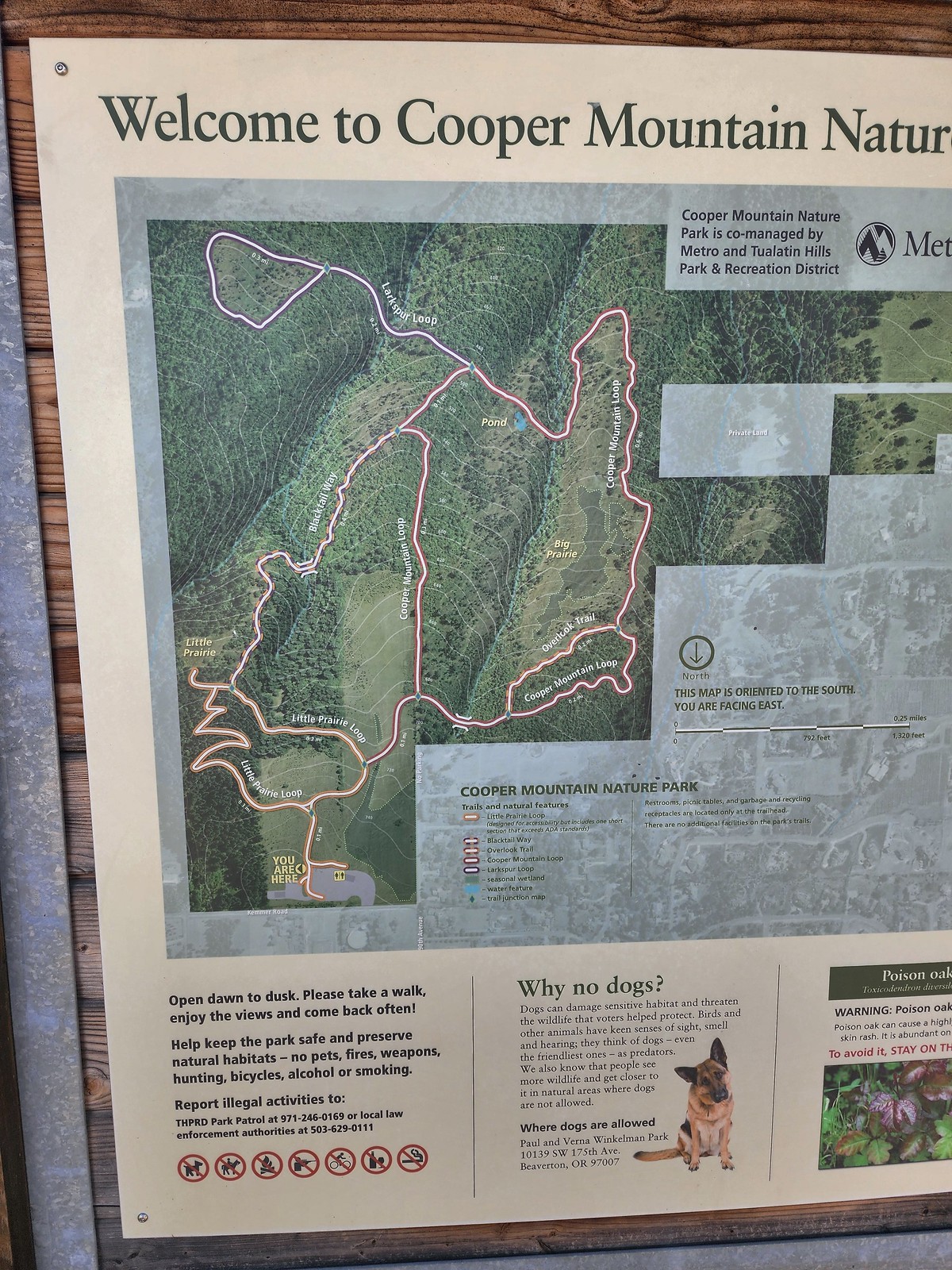
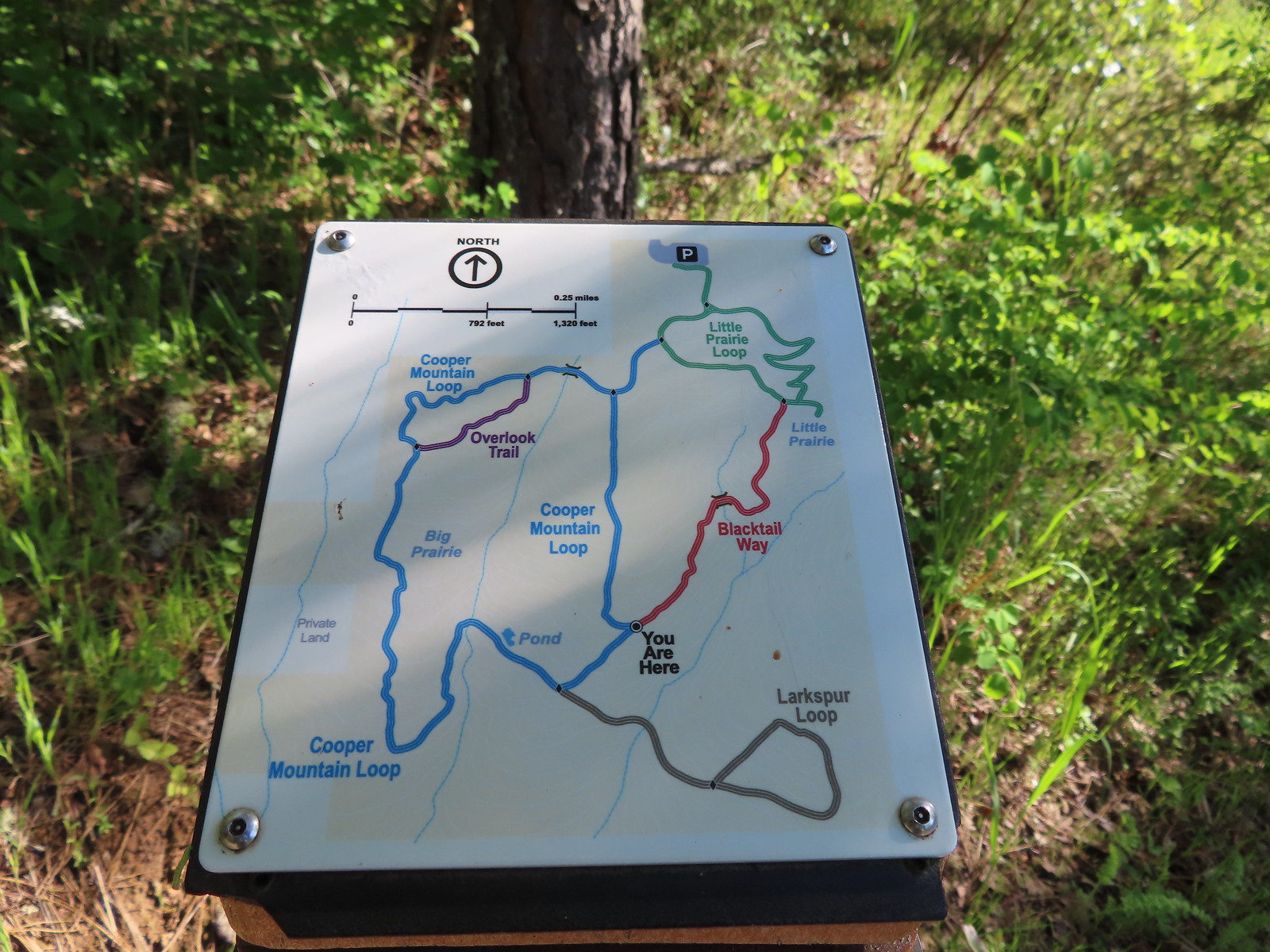
20230513_081204Our planned route was to go right on the Little Prairie Loop to the Cooper Mountain Loop and then stay right on that loop (with a detour to hike the Larkspur Loop) to Blacktail Way. We’d then take Blacktail Way back to the Little Prairie Loop and turn right again to finish that loop and return to the trailhead.

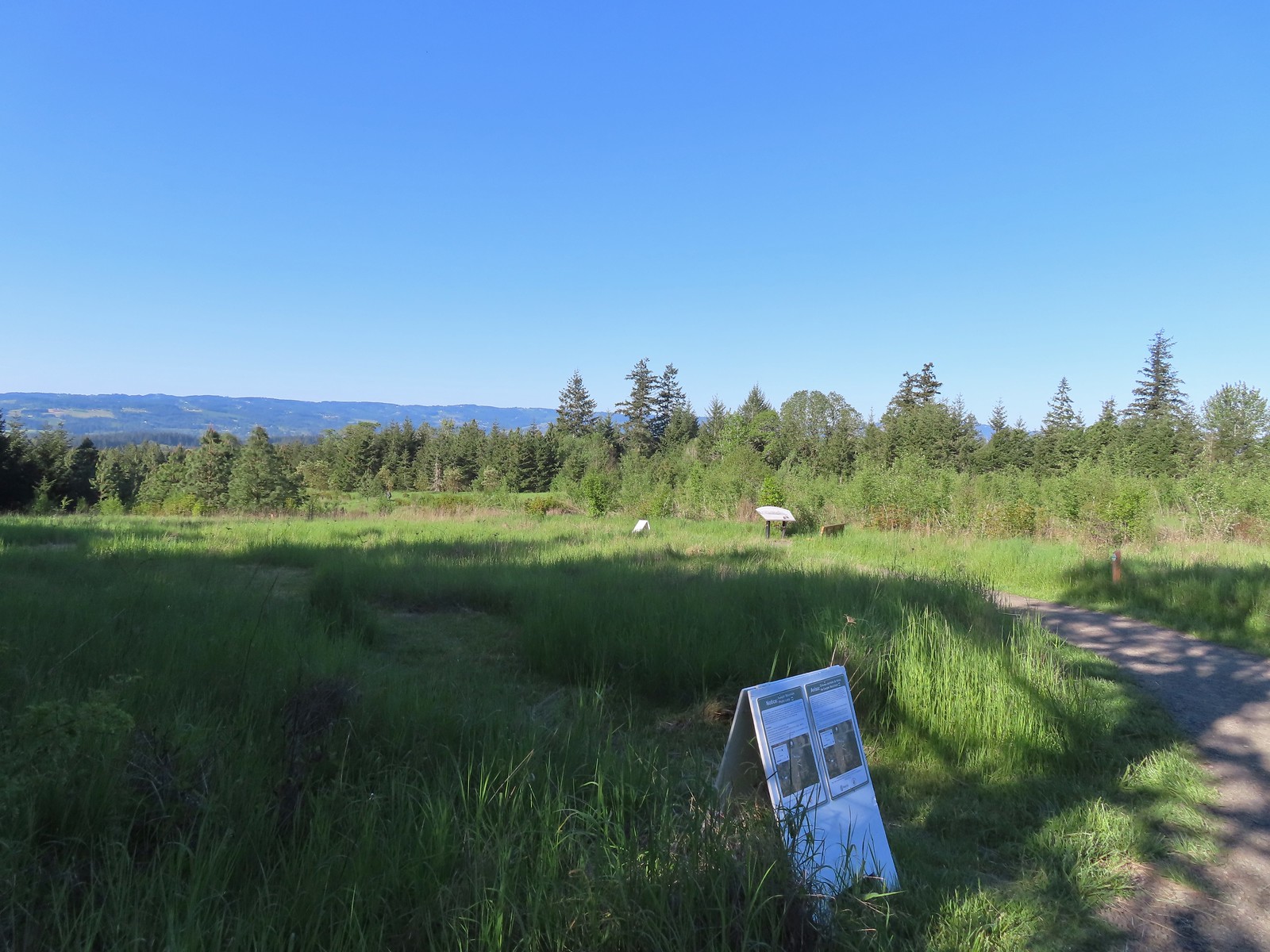
IMG_7856The view from Cooper Mountain Nature Park.

The trail system heads downhill from the trailhead so keep in mind that all hikes here end with on an uphill.
IMG_7860

IMG_7849Metro is currently running an odd little trial with very short “photo loops”. Mowed paths just off the main trails for photography. We took the first loop just to check it out and they were not kidding when they said the surface may be uneven.

IMG_7861One of two trial photo loops.

The idea is to limit the negative effects of off trail hiking. It’s an interesting idea but it would be easier if people could follow simple rules. We quickly found ourselves back on the Little Prairie Loop and forking right.
IMG_7862

IMG_7864The second trial loop. You can see how short this one is by the signboard just downhill marking its other end.

IMG_7865There were several interpretive signs and benches along the trails.

DSCN3543White-crowned sparrow

DSCN3544Anna’s hummingbird

IMG_7874Star flower

IMG_7878As usual Metro had the trail junctions well marked with little maps on top of the posts. This is the Cooper Mountain Loop junction with the lower end of the Outback Trail.

IMG_7876Camas

IMG_7881

20230513_083618Tough-leaved iris

IMG_7892Serviceberry

IMG_7894Honeysuckle

IMG_7896Looking back uphill to some wildflowers.

DSCN3554Monkeyflower

DSCN3555Tomcat clover

DSCN3559Spotted towhee

IMG_7904Bench along a pond filling an old quarry.
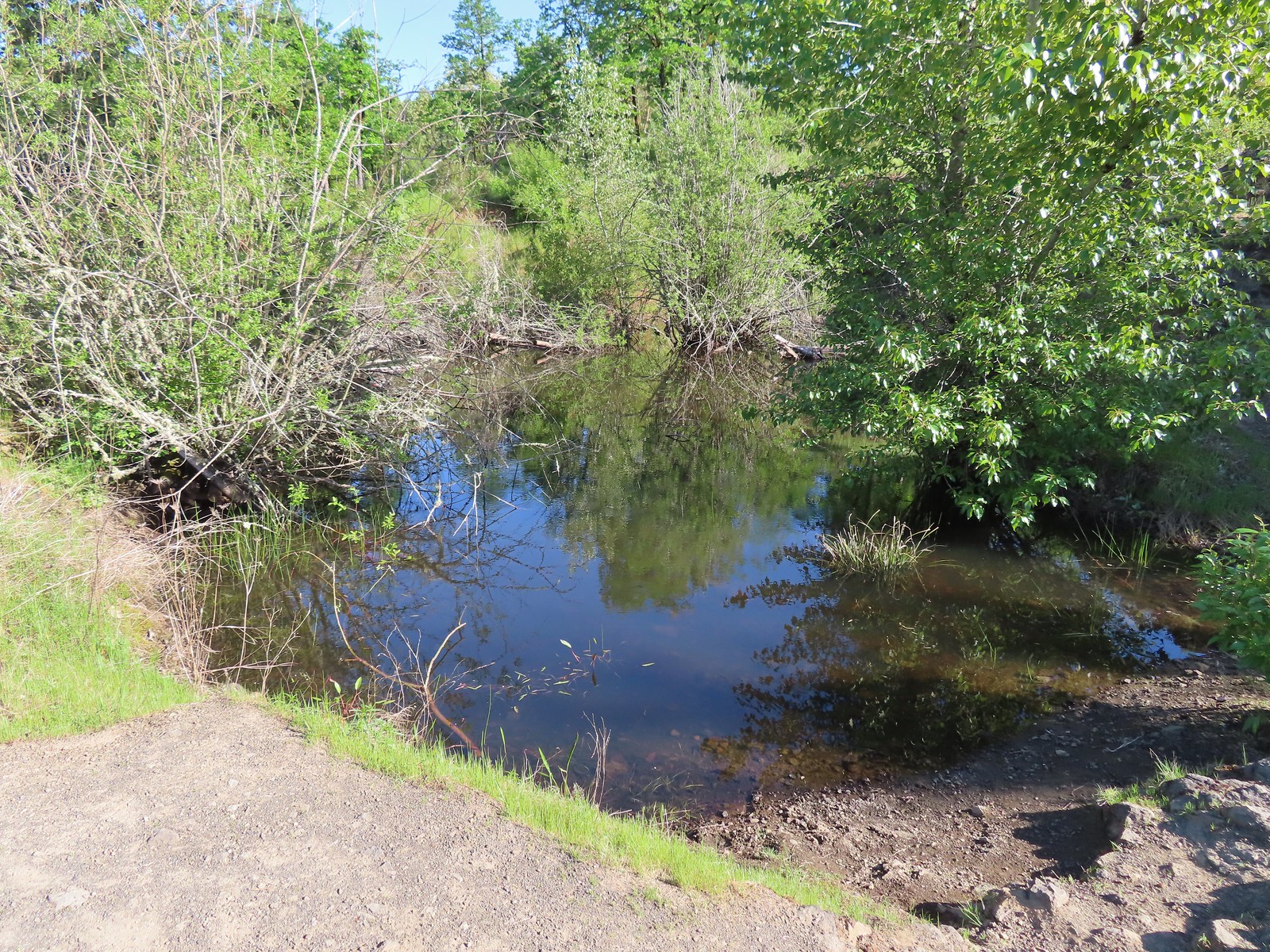
IMG_7905The pond. Red-legged frogs apparently breed here. We didn’t see any frogs but there was a mallard hanging out in the brush.
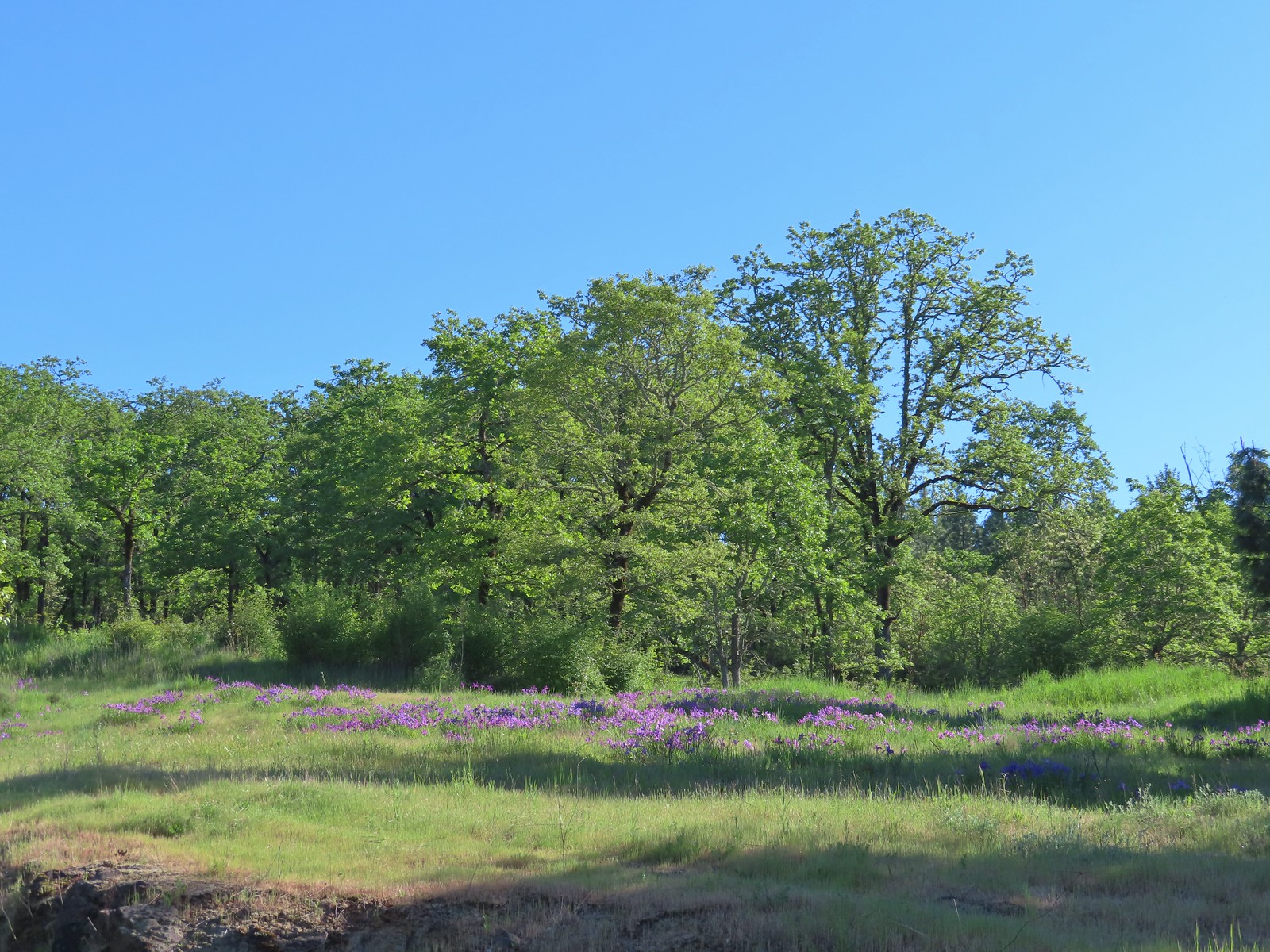
IMG_7907Iris on the hillside above the quarry.

IMG_7911The Larkspur Loop continuing straight from the Cooper Mountain Loop which turns uphill at the junction.
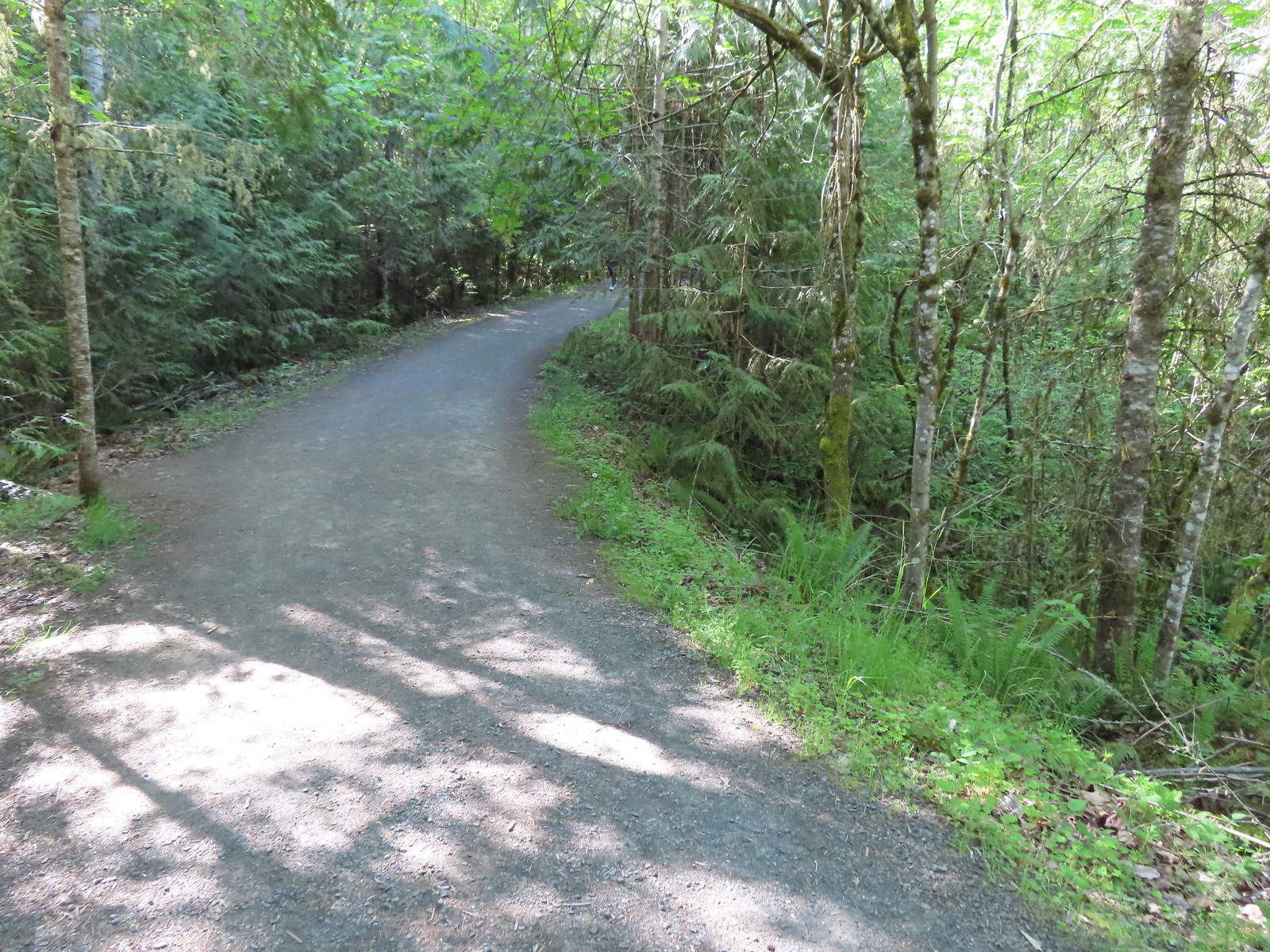
An endangered species of larkspur, pale larkspur (Delphinium leucophaeum), typically blooms in the park in late Spring into June. With everything running late this year we didn’t spot any yet this year as we completed the 0.7-mile lollipop loop.
IMG_7914Prior to the loop the Larkspur Loop dips to cross a creek in the trees.
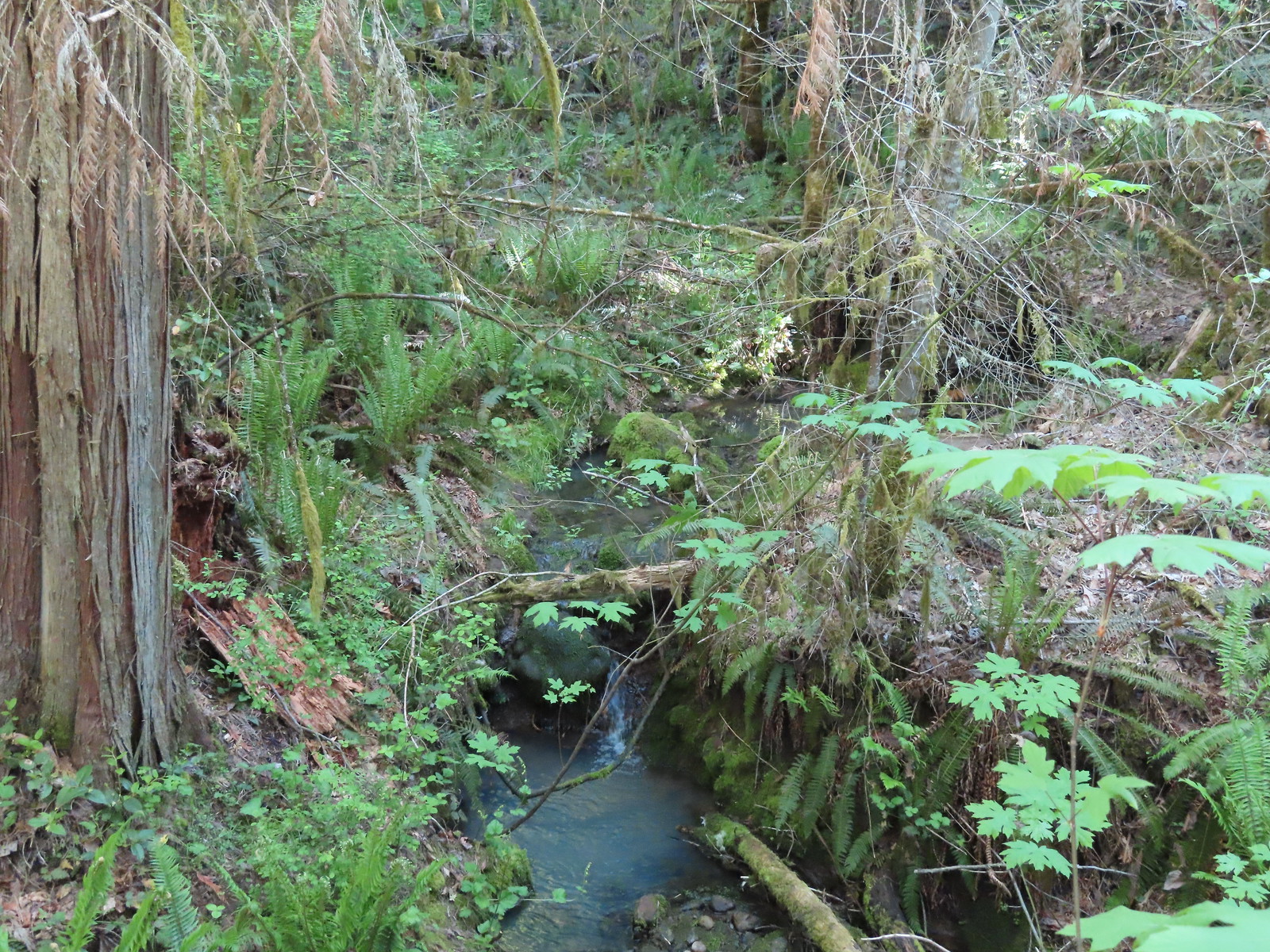
IMG_7915The little creek.

IMG_7918View from the Larkspur Loop.

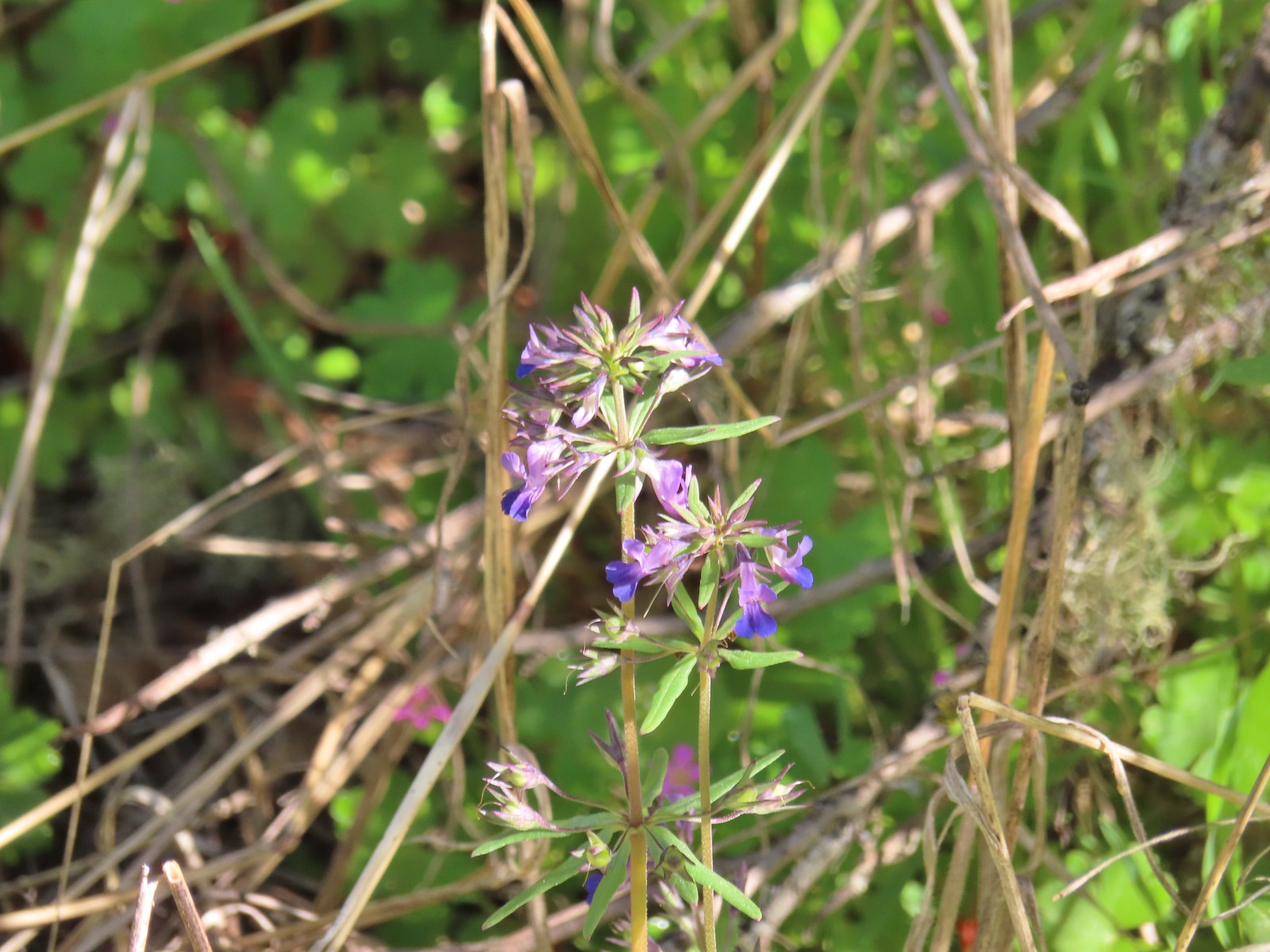
IMG_7919While watching for the larkspur I noticed these giant blue-eyed Mary.
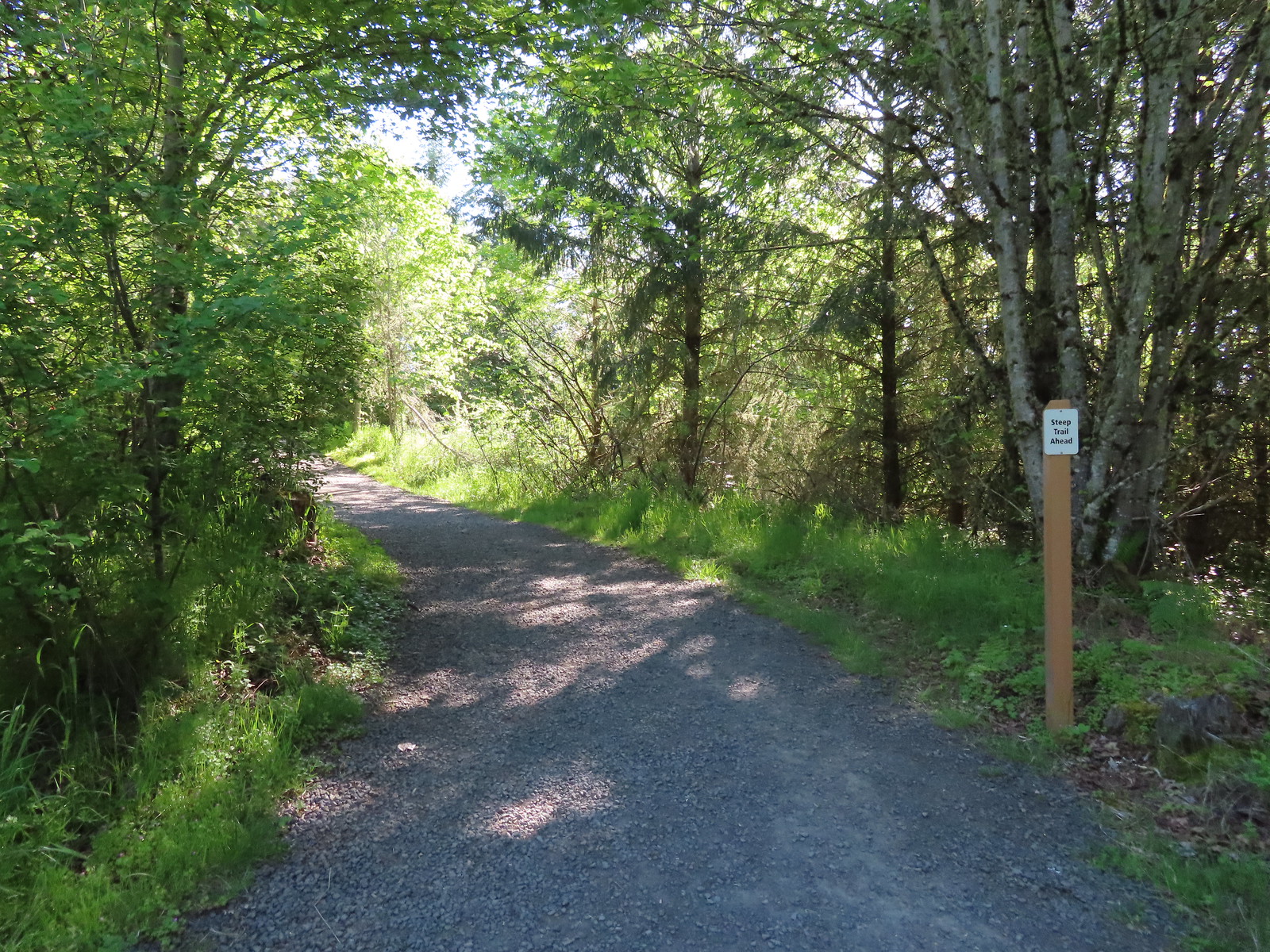
We returned to the Cooper Mountain Loop which made a steep climb to its junction with Blacktail Way.
IMG_7920

IMG_7921Blacktail Way to the right.

IMG_7922Map at the junction.

Blacktail Way climbed more gradually on its way to the Little Prairie Loop.
IMG_7926The “earphone” next to the bench here was neat. There was also one at the trailhead and they really allowed you to isolate the sounds of the woods.

IMG_7927The Little Prairie Loop.

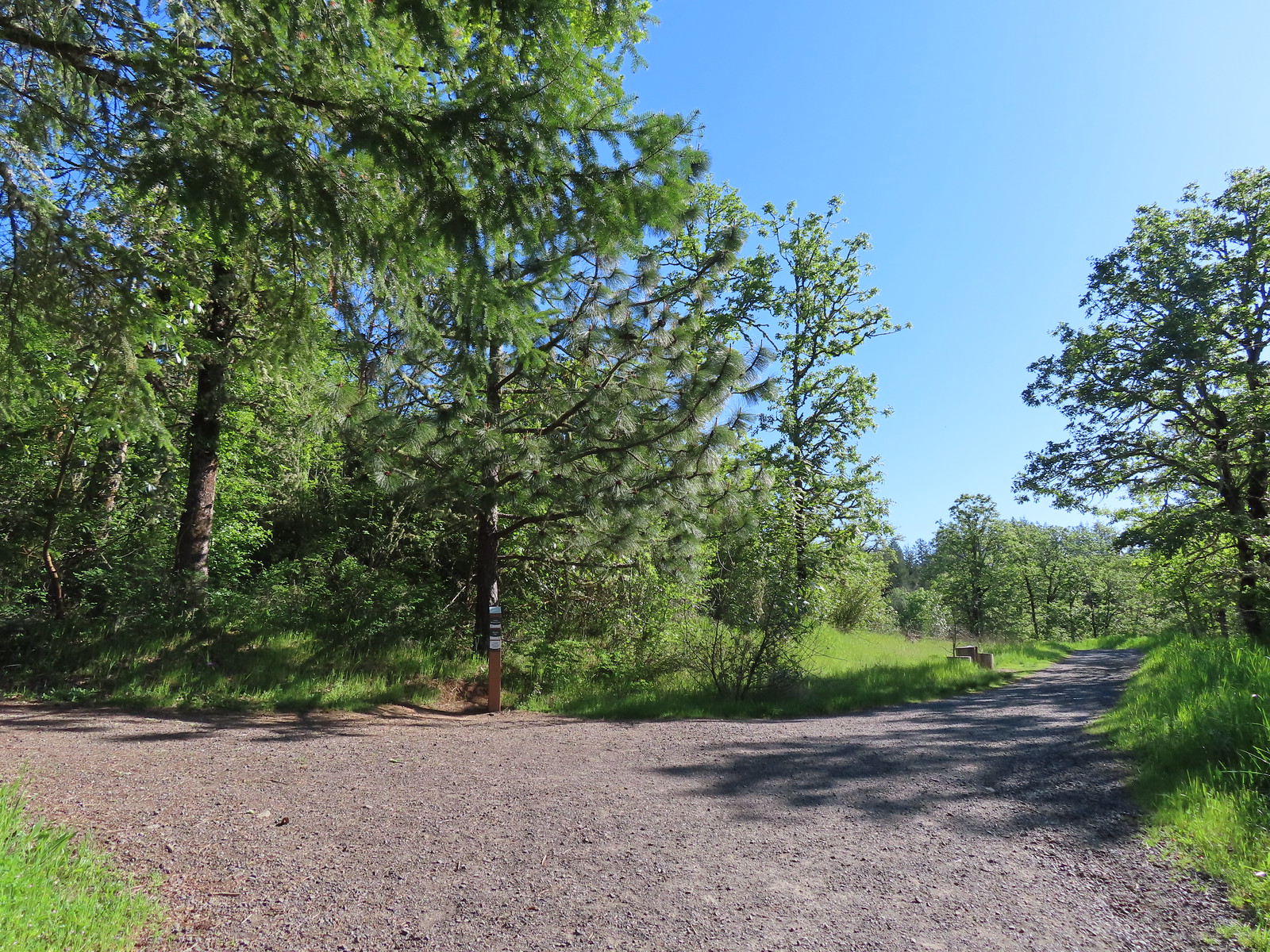
We turned right onto the loop and then quickly detoured to the Little Prairie Overlook.
IMG_7928

IMG_7931The pale larkspur also grows in this area but again we were too early.
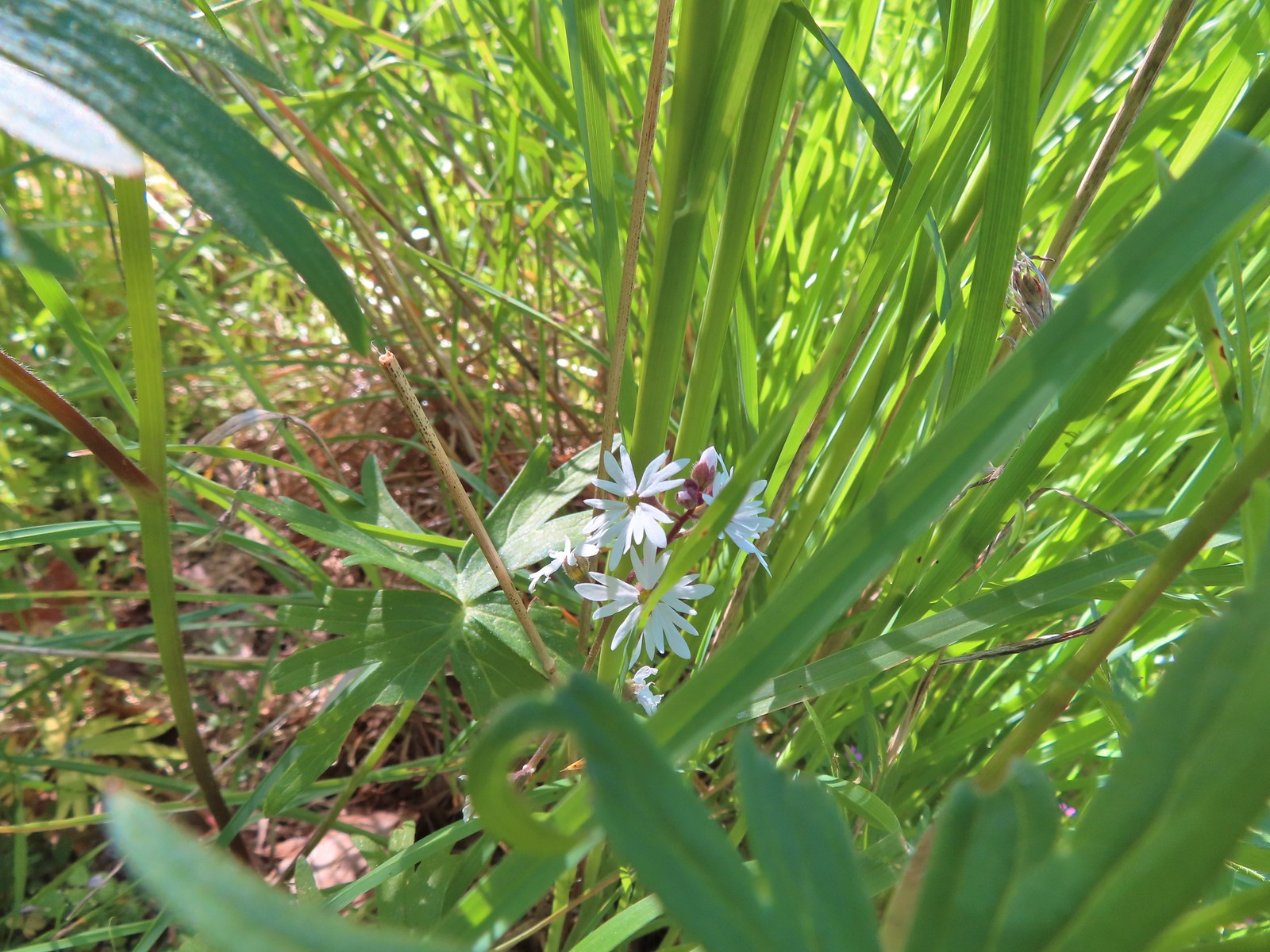
IMG_7933These were the only woodland-stars we spotted.

After checking out Little Prairie we finished the loop and returned to our car. This stop came to 3.1 miles with 300′ of elevation gain.

From Cooper Mountain we drove 18 miles south to our final stop of the day at Graham Oaks Nature Park. Another one of Metro’s parks Graham Oaks also hosts approximately three miles of trails. Unlike many of the other Metro parks we’ve visited recently this one allows bikes and dogs (on leash) albeit limited to the Tonquin Trail.
DSCN3562

IMG_7945

Our planned route here was another counterclockwise loop starting on the Tonquin Trail. We would follow that trail to the hiker only Oak Woodland Walk and then turn onto Coyote Way then take the Legacy Creek Trail returning to Coyote Way just before its end at the Tonquin Trail. Then we would simply follow the Tonquin Trail back to the trailhead.

Despite this being our third stop, the early start had gotten us here shortly after 10am, it was already over 70 degrees when we set off on the Tonquin Trail. Luckily for us there was an occasional breeze that helped cool things off a bit.
IMG_7941Heading toward Acron Plaza on the Tonquin Trail.

IMG_7944Interpretive sign at Acorn Plaza.

There were large amounts of large camas blooming along the trail along with yellow buttercups and some patches of lupine.
IMG_7948Lupine and buttercups

DSCN3565Lupine

IMG_7953Meadow checker-mallow

We detoured to Elder Plaza at a trail marker.
IMG_7955

IMG_7956The “elder” oak is between 150-200 years old.

IMG_7958

IMG_7957

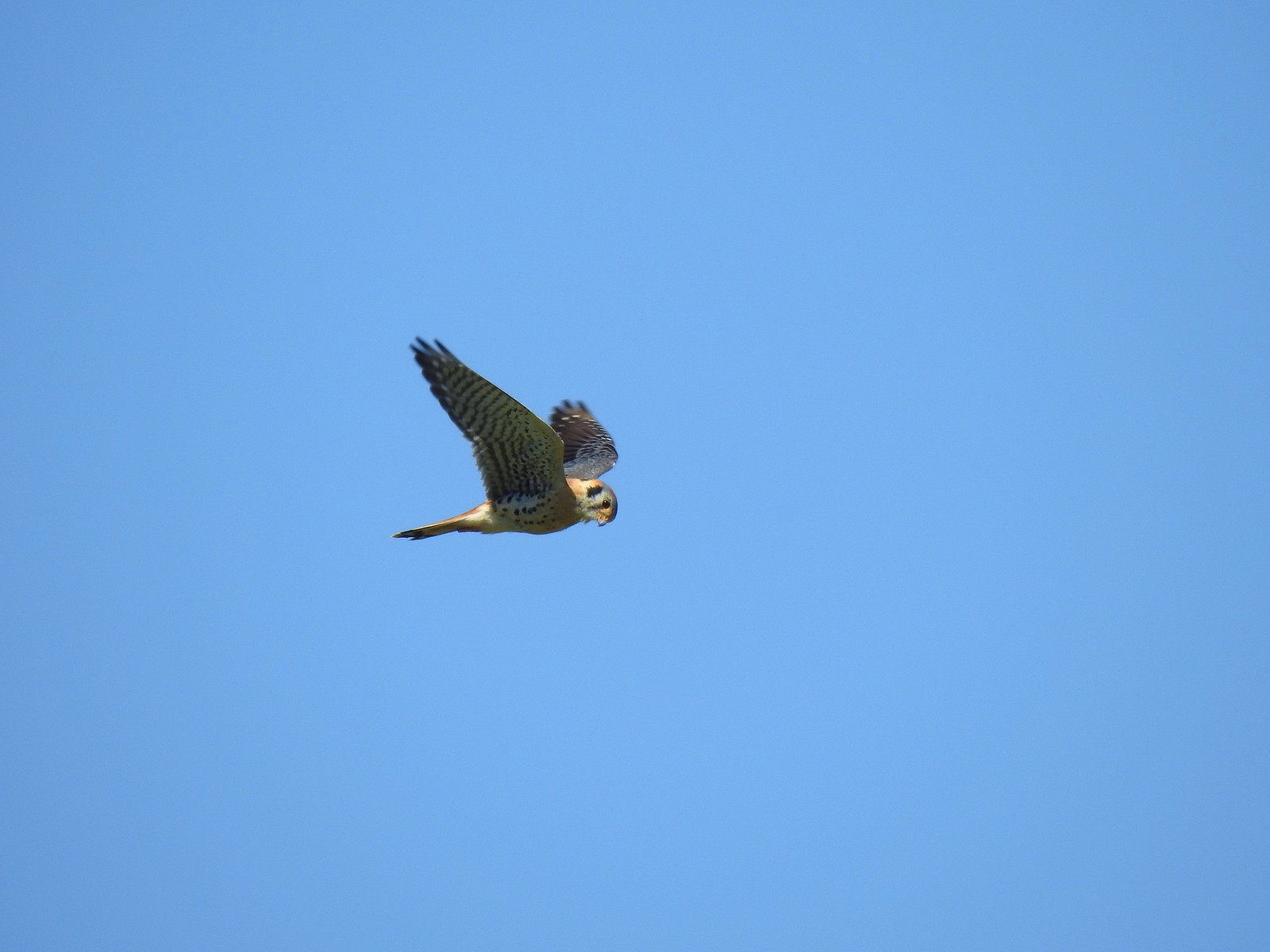
DSCN3570We watched this American Kestral hover on a near vertical line for what felt like quite a while. It eventually dove and attempted to catch something in the grass. We couldn’t tell if it had been successful.
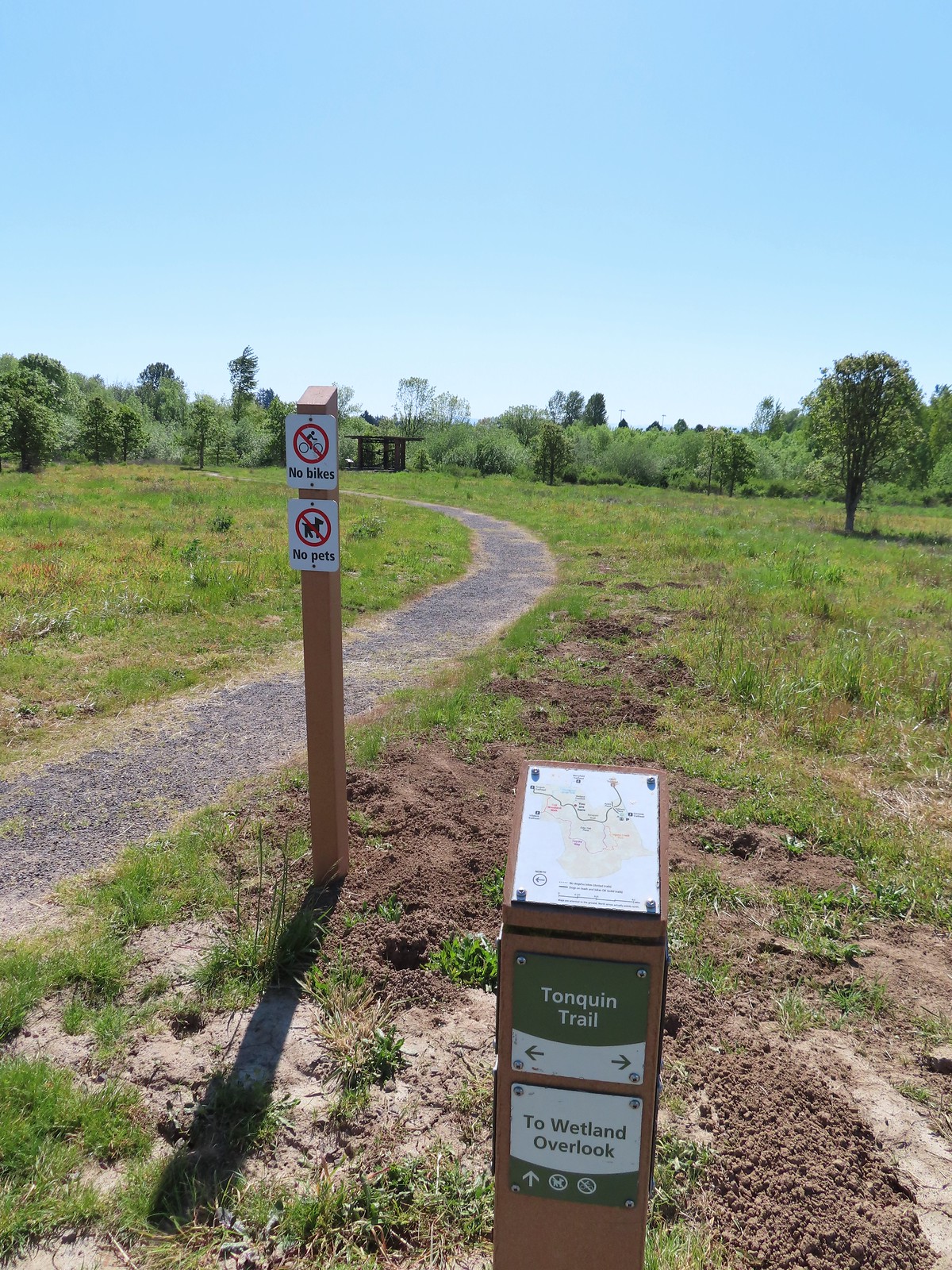
We continued down the Tonquin Trail and made a second detour to visit the Wetland Overlook.
IMG_7961

IMG_7962

IMG_7964

IMG_7969Mylitta crescent

We made a third detour when we reached a 4-way junction with the Oak Woodland Walk and Arrowhead Creek Trails. We turned right onto the Arrowhead Creek Trail to see what the creek might look like since we could see a little footbridge from the junction.
IMG_7971

IMG_7972Footbridge over Arrowhead Creek.

There wasn’t really any water flowing in the creek bed and we turned around after crossing and returned to the 4-way junction where we crossed the Tonquin Trail onto the Oak Woodland Walk.
IMG_7974

IMG_7978

IMG_7977The Lycaenidae family of butterflies remains a mystery to me. This appears to be an Eastern Tailed Blue based on the ventral spots.

IMG_7981Snow in the Cascade foothills. If you look really closely behind the bigger snow patch to the far-right, you can just barely make out Mt. Jefferson.
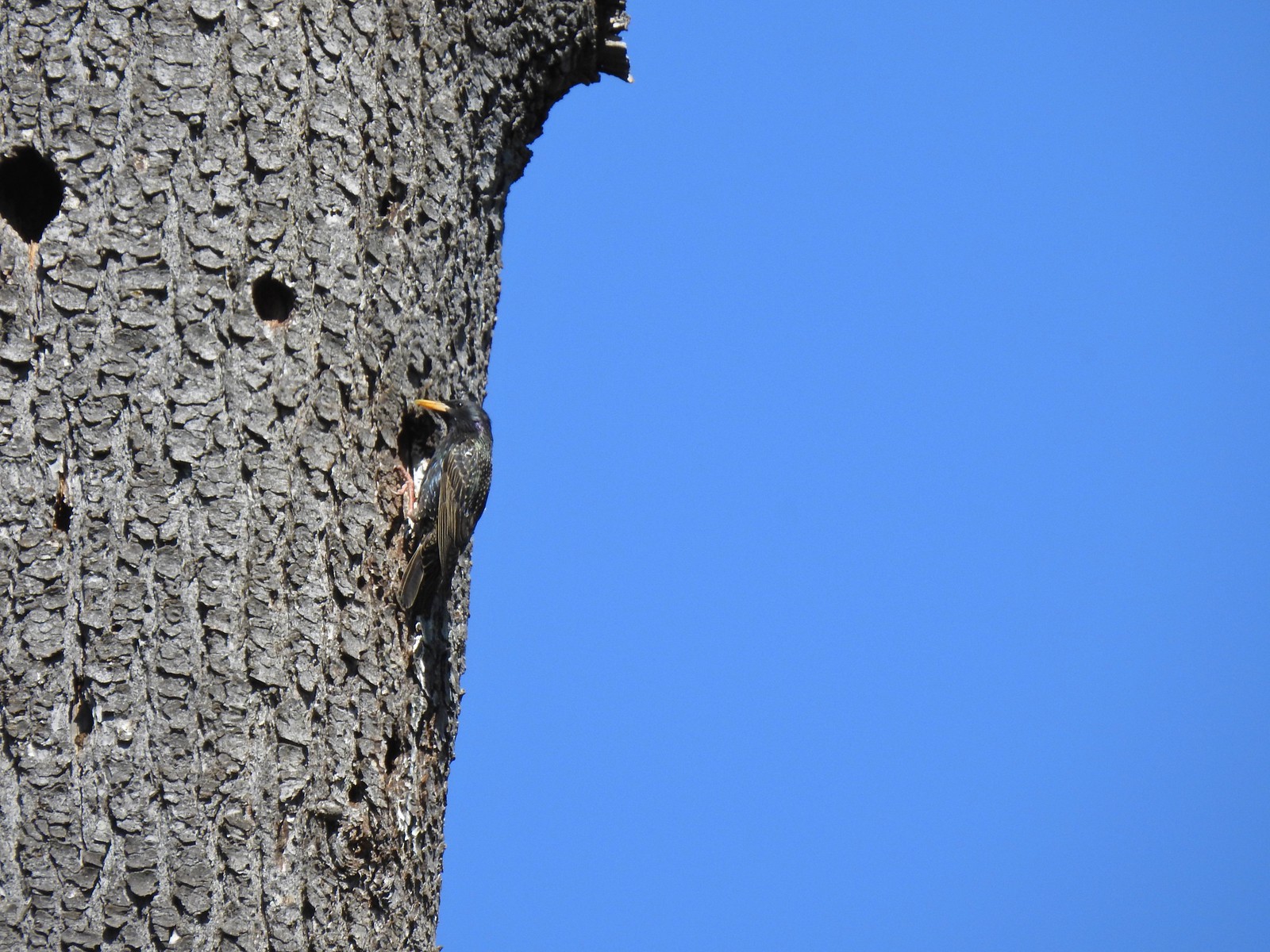
We turned onto Coyote Way and quickly spotted several species of birds.
DSCN3574Starling

DSCN3572Northern flicker

DSCN3580This scrub jay would not come out from behind the oak leaves.

Coyote Way eventually entered some trees and crossed a boardwalk.
IMG_7985

IMG_7986There was a lot of candy flower beneath the trees.

IMG_7987

We turned onto the Legacy Creek Trail and found ourselves under a much denser canopy of trees. This extra shade made this feel like the coolest section of trail we’d been on all day which was welcome because it was now over 80 degrees in the Sun.
IMG_7988

IMG_7989

IMG_7990Mushrooms along the Legacy Creek Trail.

IMG_7992Violets, candy flower and the invasive herb robert (pink).
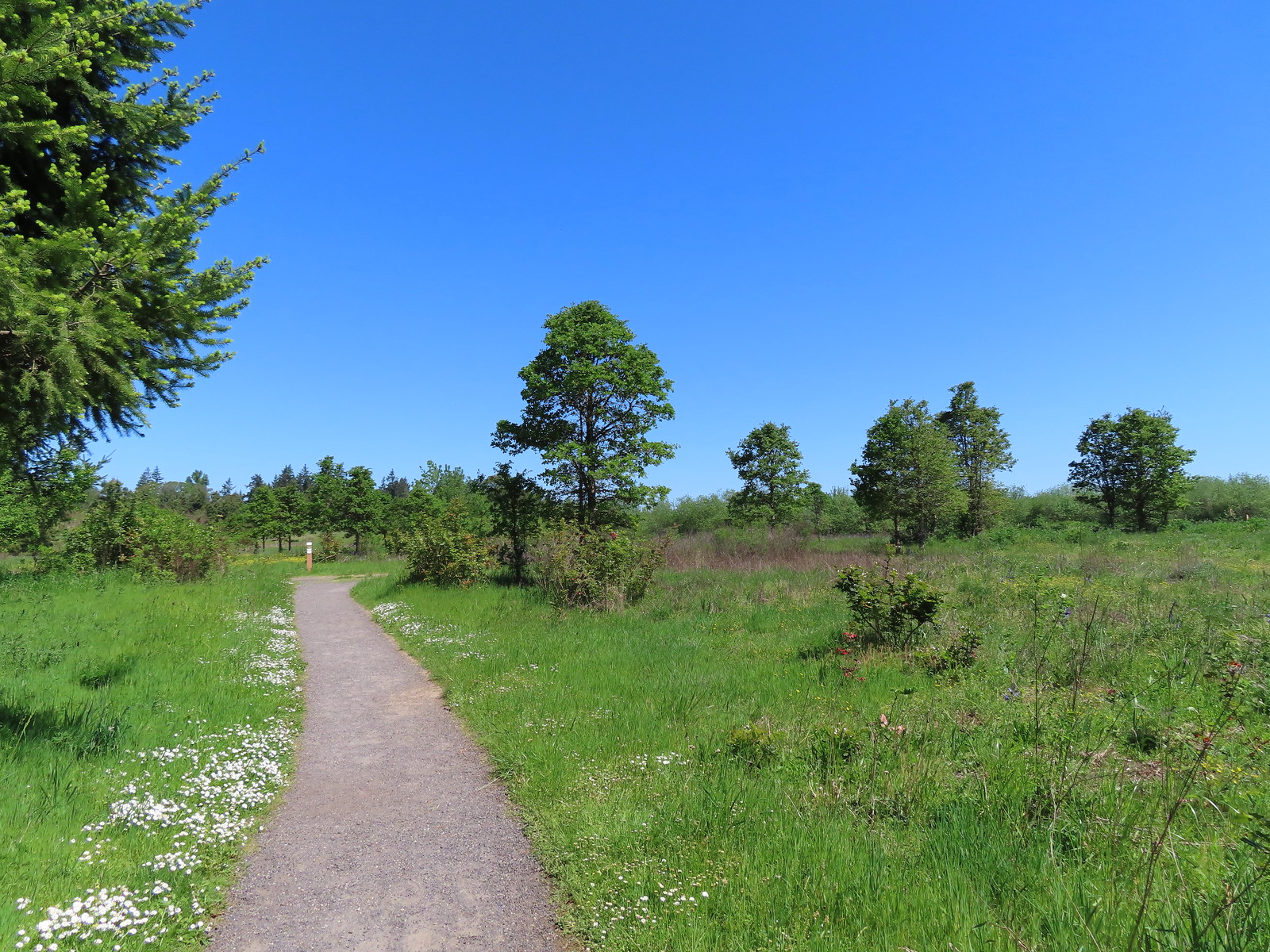
We left the trees and quickly arrived back at Coyote Way where we took a right followed by another right on the Tonquin Trail after 200′.
IMG_7996Coming up to Coyote Way.

IMG_7999Back on the Tonquin Trail and heading for the trailhead.

This was our shortest stop of the day coming in at just 2.7 miles. For the day we logged 9.4 miles with approximately 400′ of cumulative elevation gain, primarily from our stop at Cooper Mountain. These were all enjoyable stops and each provided a different experience. Happy Trails!

Tualatin River Refuge
Cooper Mountain
Graham Oaks
Categories
Hiking Oregon Portland Willamette Valley

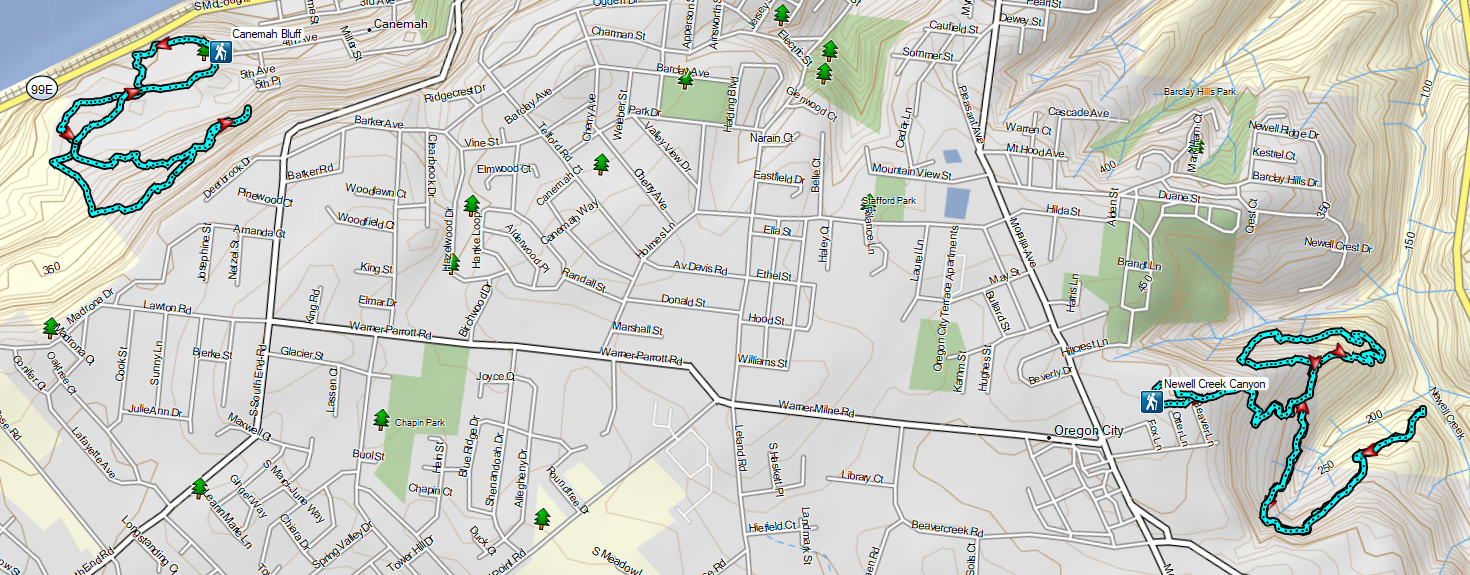
Canemah Bluff and Newell Creek Canyon – 04/29/2023

A brief streak of 80+ degree temperatures arrived for the final weekend of April, and we celebrated with a pair of short hikes in Oregon City. We had our sights on two small parks managed by Metro, a regional council covering Clackamas, Multnomah, and Washington counties which includes two dozen cities. The largest of which is Portland.

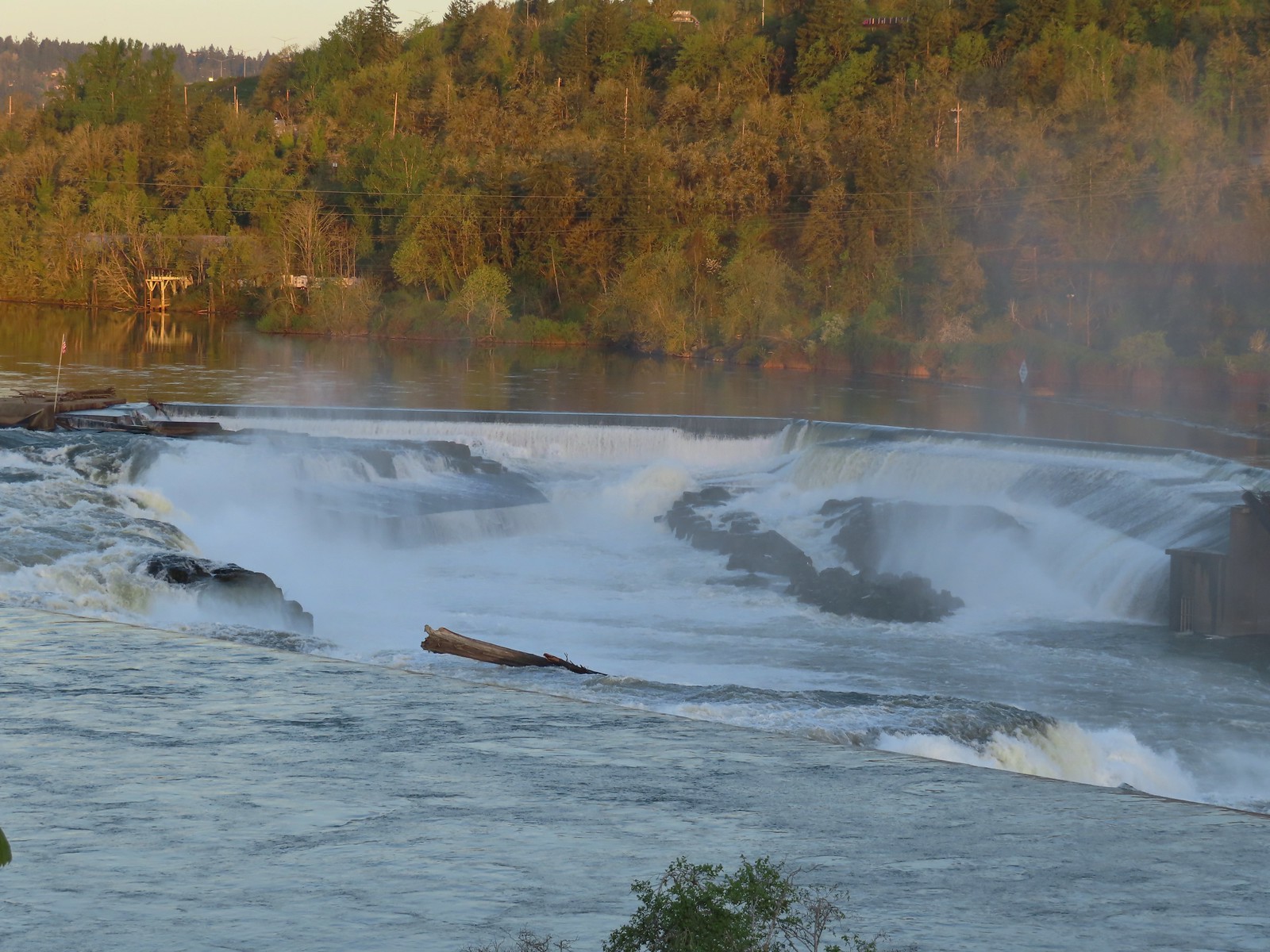
Our first stop of the day wasn’t at either of the parks though, it was at the Willamette Falls Scenic Viewpoint along McLoughlin Boulevard. The viewpoint was on our way to Canemah Bluff and neither of us had ever actually seen this waterfall in person.
IMG_6197

IMG_6201

IMG_6200

IMG_6202

After reading up on some Oregon history we drove on to Canemah Children’s Park which doubles as the trailhead.
IMG_6207

IMG_6208

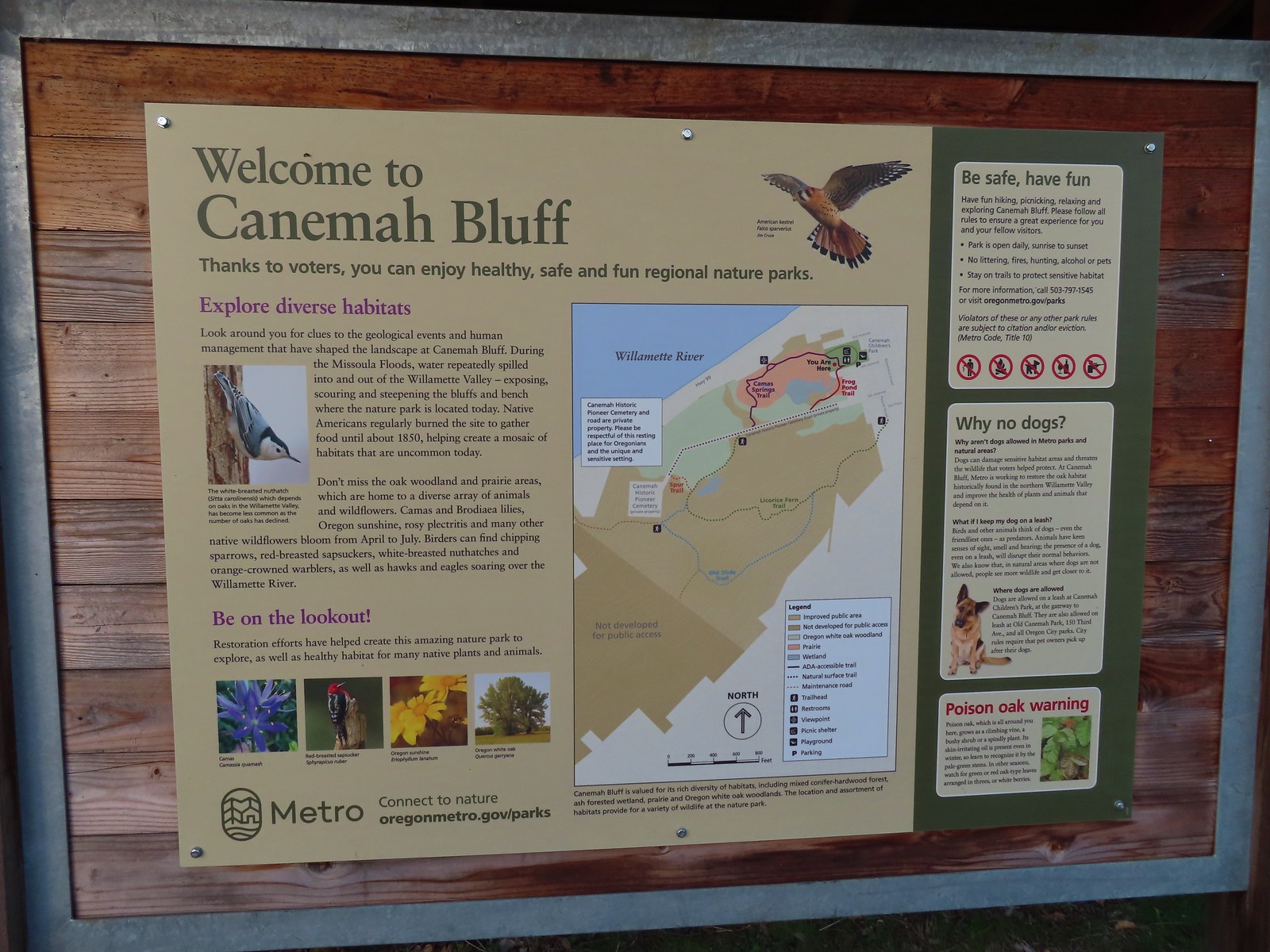
We reviewed the map and decided on the following route: From the children’s park we would take the Camas Springs Trail to Cemetery Road and turn right to the Spur Trail. We’d then take the Spur Trail to the Licorice Fern Trail and then turn right on the Old Slide Trail. The Old Slide Trail would bring us back to the Licorice Fern Trail which we would follow to the park boundary before turning around and hiking back to Cemetery Road via the Licorice Fern Trail. Then turning right on the road, we would follow it to the Frog Pond trail where a left would bring us back to the Childrens Park. This whole route was just barely over 2 miles with a little under 190′ of elevation gain.

The delayed Spring was showing here as the wildflower show was just getting underway.
IMG_6211Most of the camas was still working on blooming but a few were open.

IMG_6216

IMG_6217Buttercups

DSCN3180Dark eyed junco

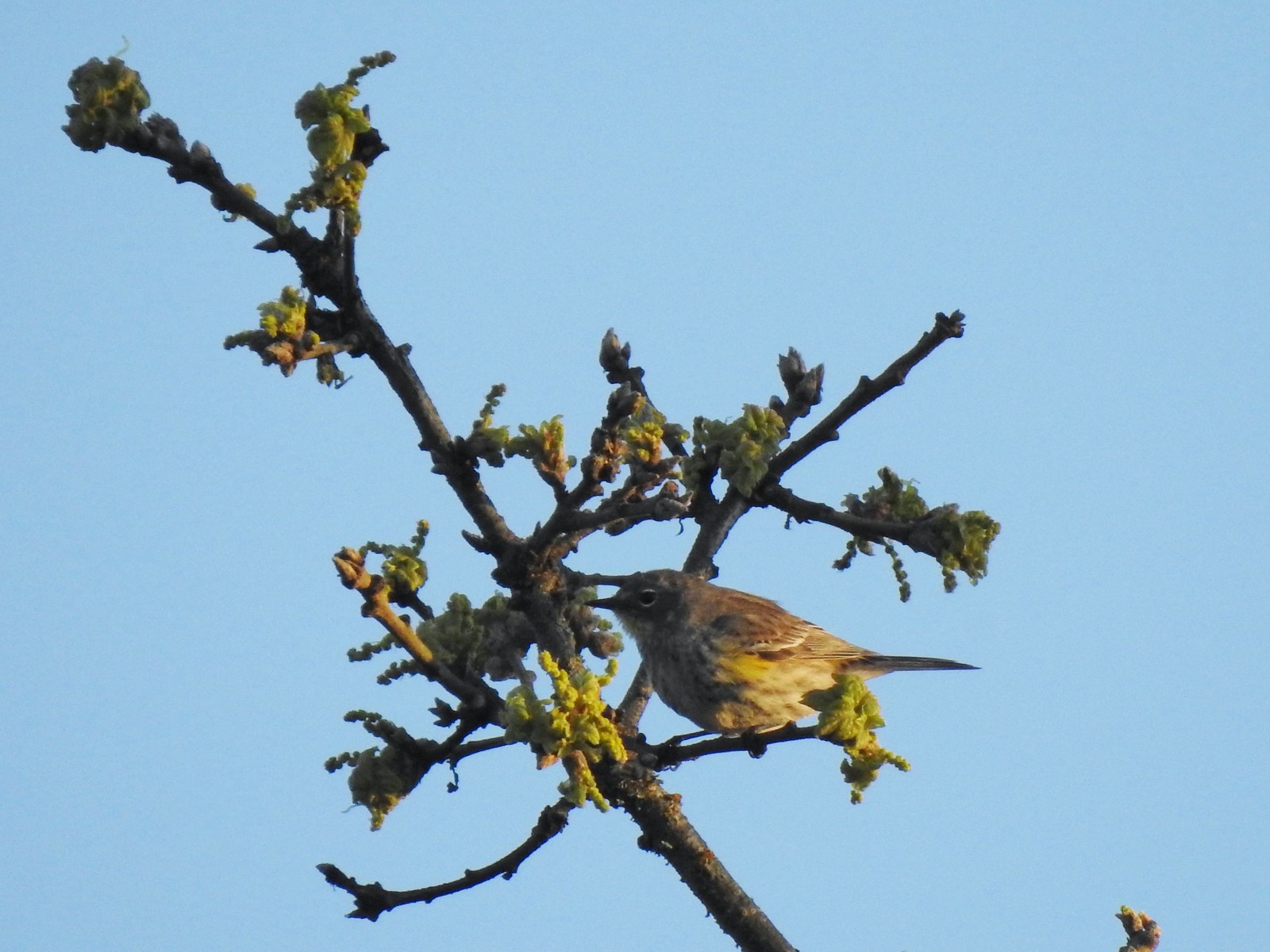
DSCN3182Possibly a female yellow-rumped warbler.

IMG_6223

DSCN3189Plectritis

IMG_6225Willamette River

DSCN3193Robin

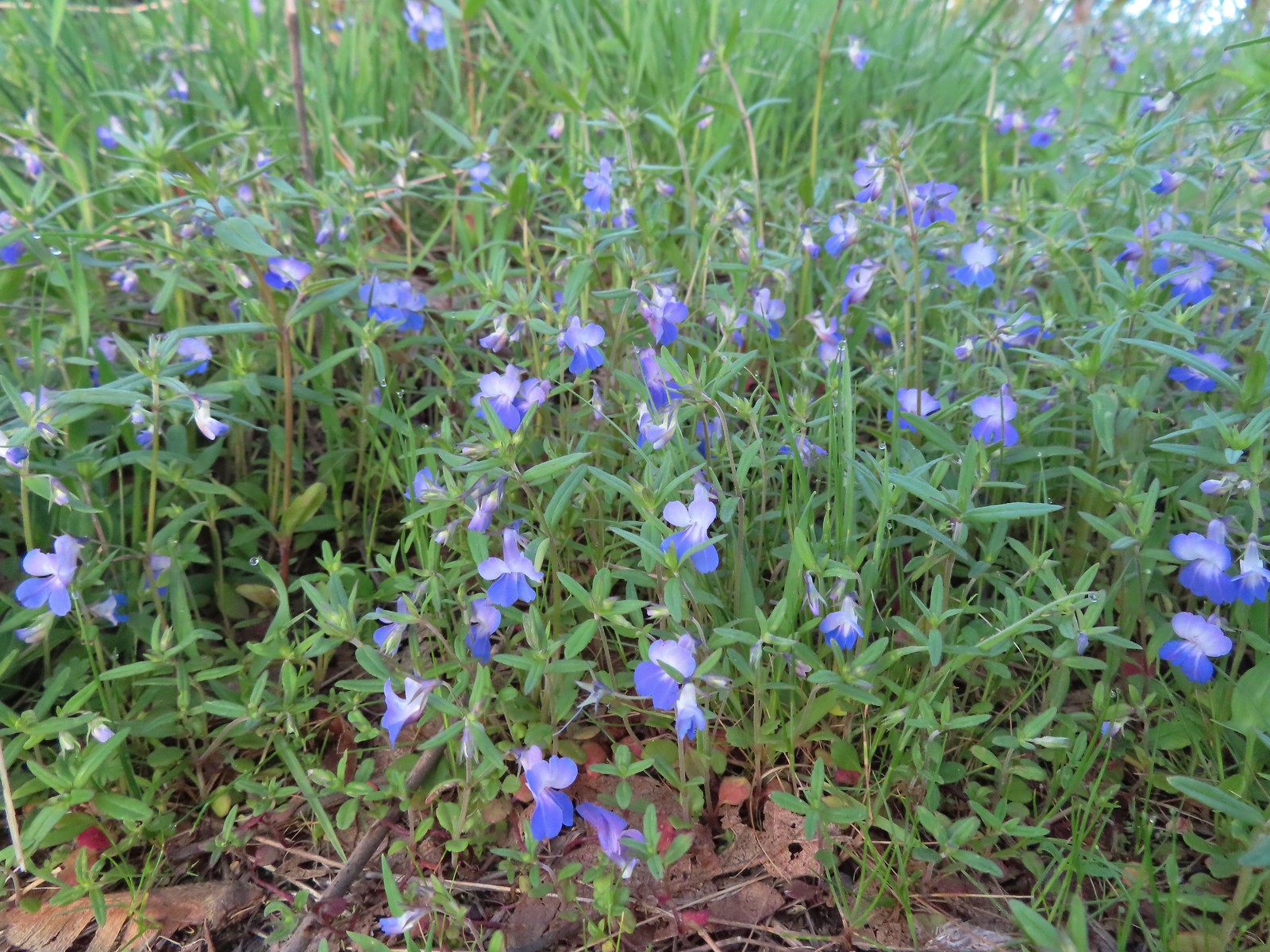
IMG_6231Giant blue-eyed Mary

IMG_6236Camas catching a little sunlight.

IMG_6239

This first part of the hike reminded us very much of another nearby hike we’d taken at Camassia Natural Area (post) which is located on the opposite side of the Willamette from Canemah Bluff.

The Camas Springs Trail eventually entered the trees before arriving at the Cemetery Road.
IMG_6240

IMG_6241Red flowering currant

IMG_6242

IMG_6245Metro’s signage has been top notch in the parks we’ve visited so far.

We followed the Cemetery Road to its end at the privately owned Canemah Pioneer Cemetery where we turned onto the Spur Trail.
IMG_6247Hooker’s fairy bells

DSCN3200Hummingbird

IMG_6257

IMG_6261Fawn lilies

IMG_6265The cemetery behind the fence.

IMG_6266The Spur Trail.

It was a trillium show along the Spur Trail.

IMG_6268

IMG_6271

DSCN3206

At the junction with the Licorice Fern Trail we spotted a couple of largeleaf sandworts in bloom.
IMG_6277

After just 100′ on the Licorice Fern Trail we turned onto the Old Slide Trail which climbed 150′ along a hillside before descending to rejoin the Licorice Fern Trail which we followed to the park boundary near a neighborhod.
IMG_6282

IMG_6289

IMG_6292

IMG_6295

IMG_6296The boundary marker. The trail continues a short distance to 5th Place.

We dropped a bit and now had to regain that elevation as we headed back along the Licorice Fern Trail.
IMG_6298

IMG_6297

We spotted a few more flowers at varying stages of blooming as we made our way back to Cemetery Road.
IMG_6300Youth-on-age

IMG_6304Salmonberry

IMG_6312Violets

IMG_6322Back on the road.

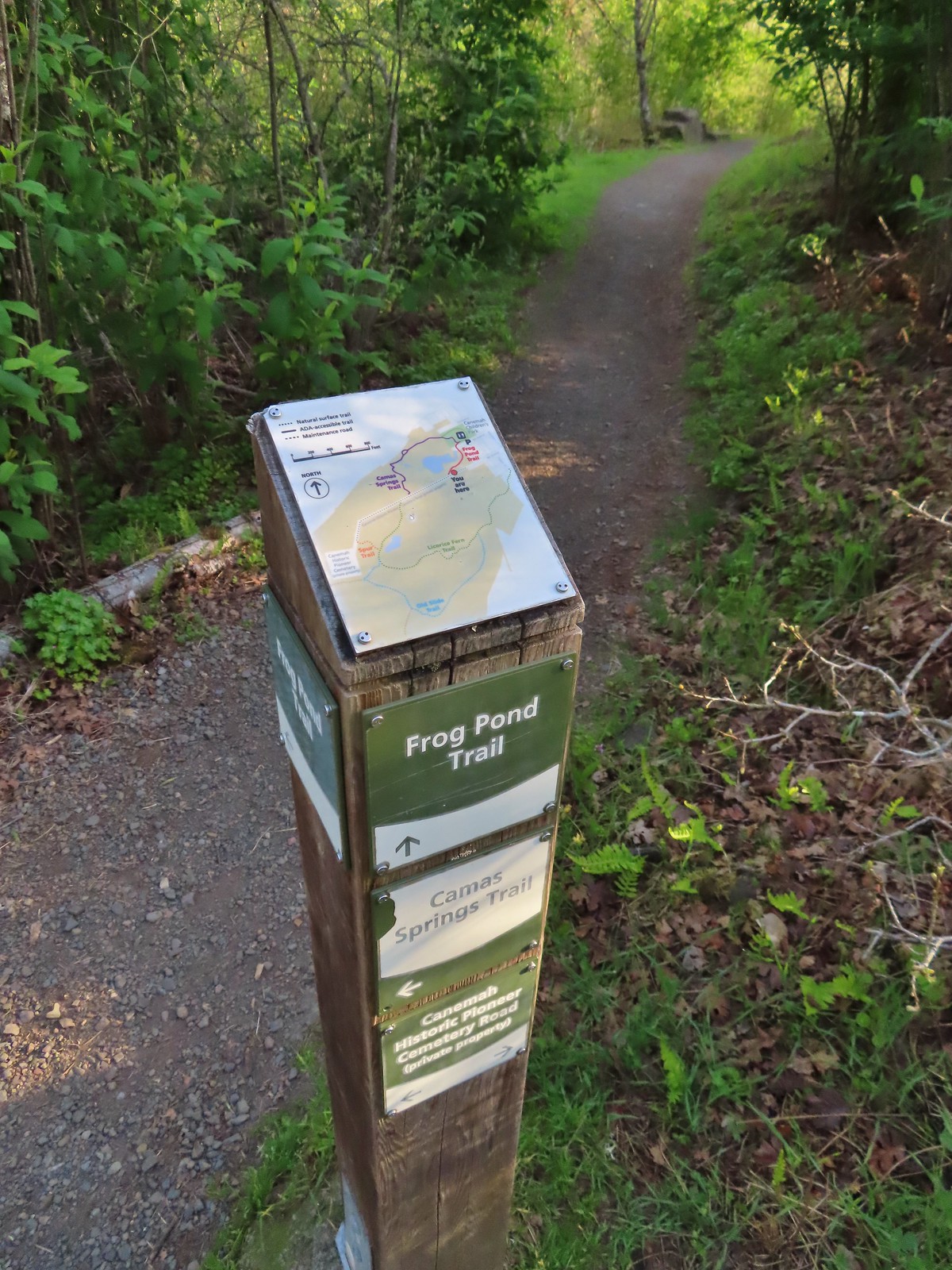
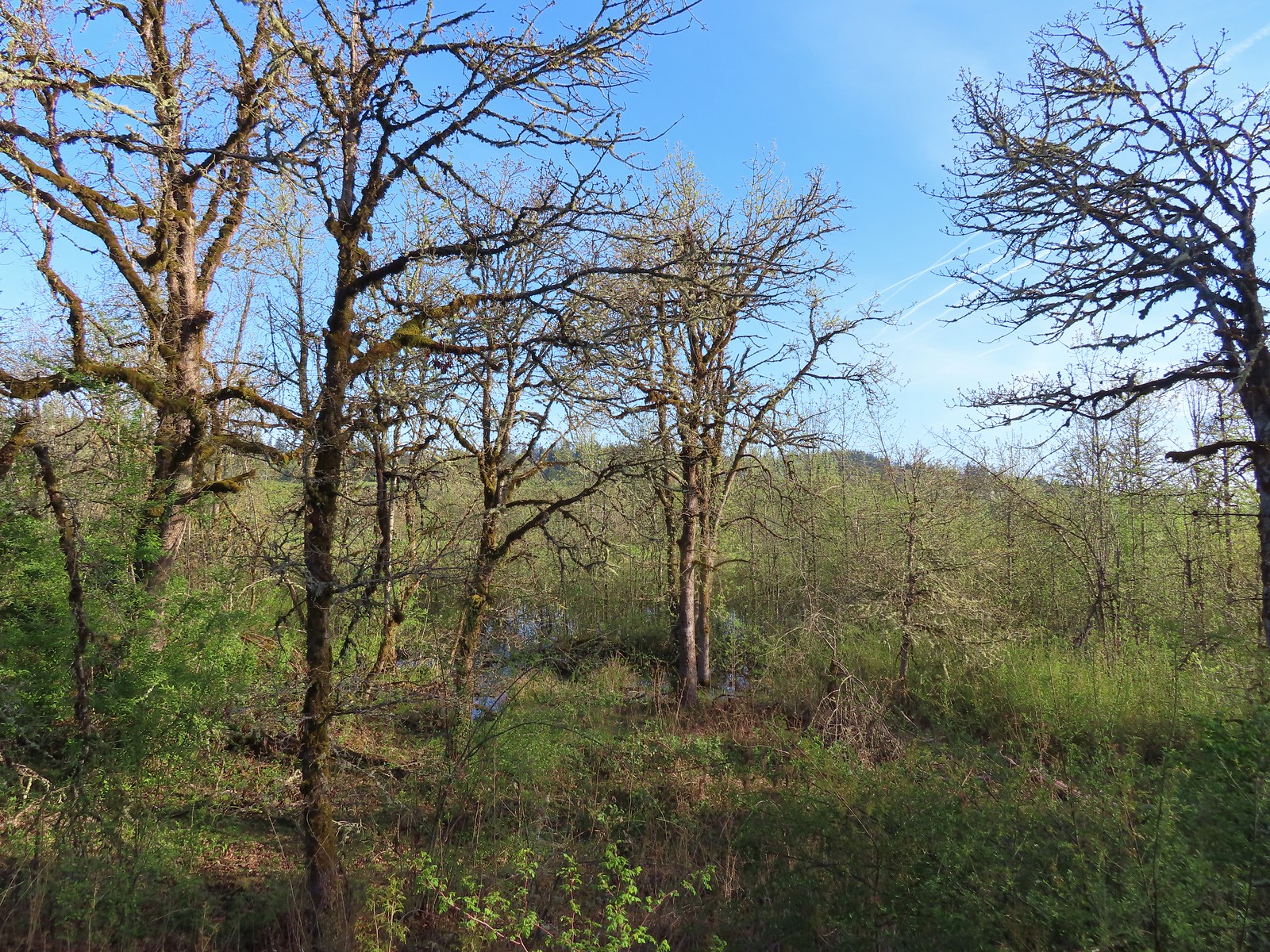
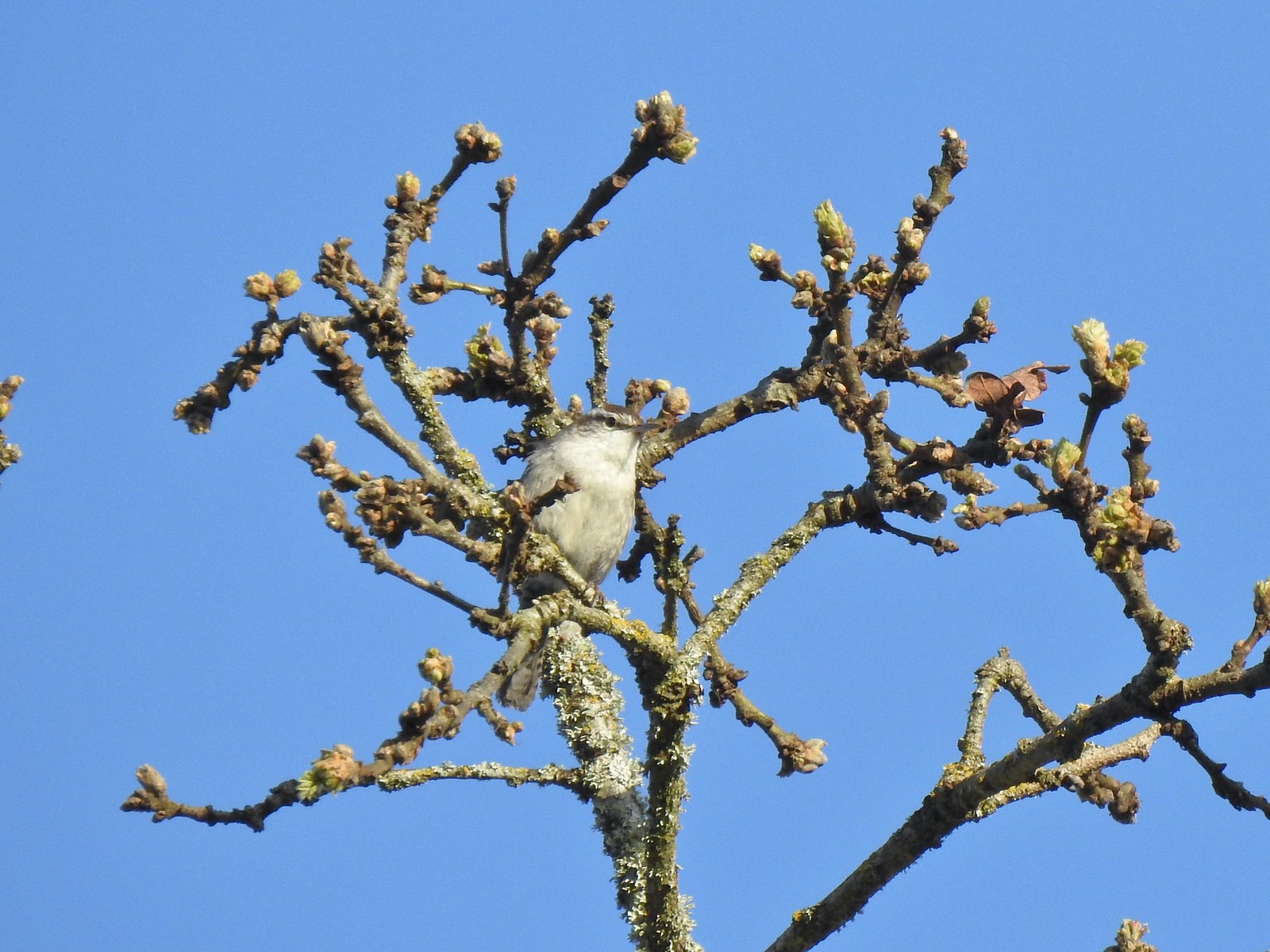
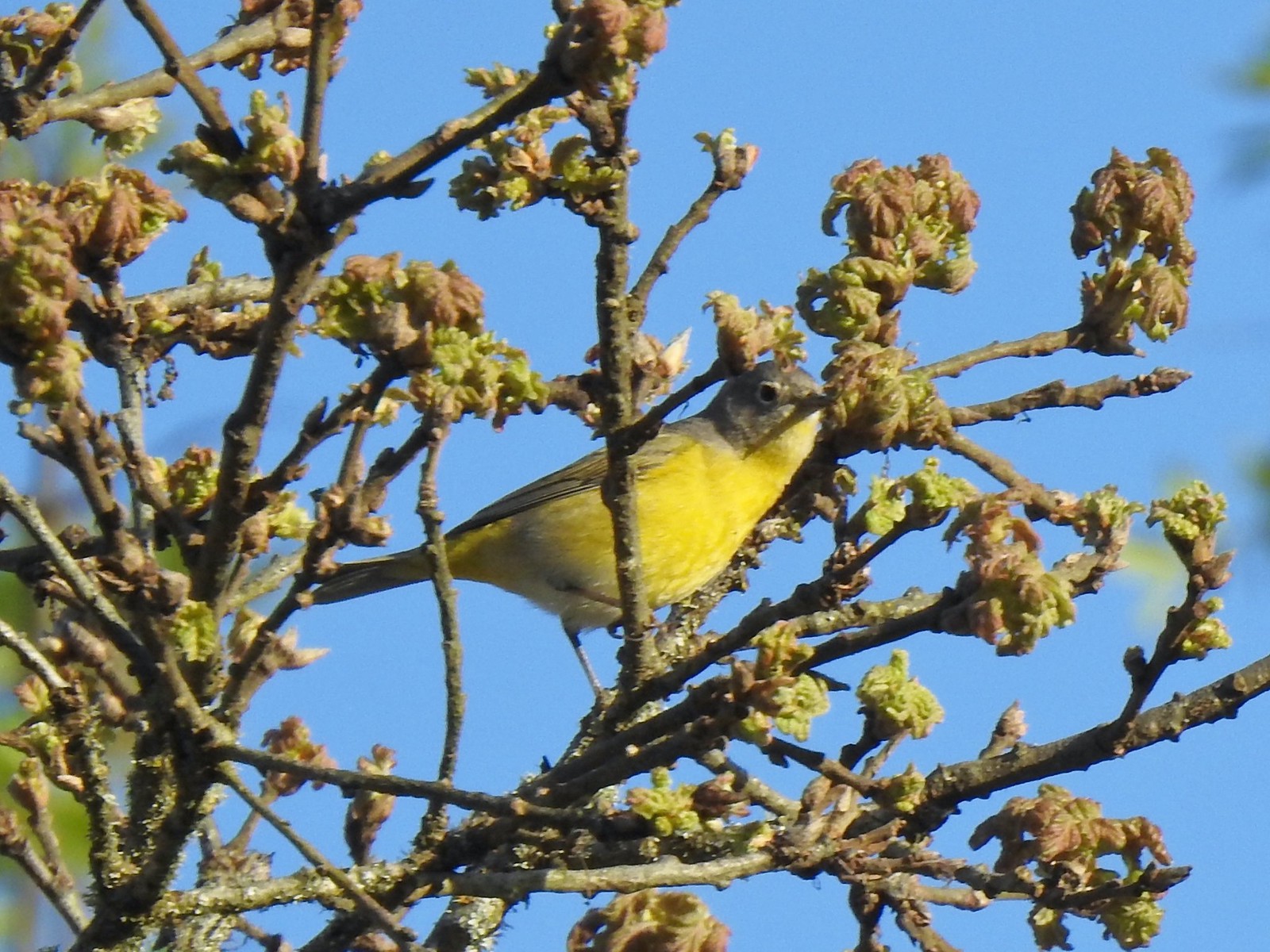
We turned onto the Frog Pond Trail which was only about 100 yards long. The trees around the pond were full of little birds that we watched flit about for quite a while before continuing to our car.
IMG_6325

IMG_6328The frog pond.

Bewick's wrenBewick’s wren

Nashville warblerNashville warbler?

DSCN3225House finches

DSCN3230Spotted towhee

DSCN3224Bleeding heart near the pond.

IMG_6333Arriving back at the trailhead.

From Canemah Bluff it was only a 2.6-mile drive to Newell Creek Canyon Nature Park. The park opened in December 2021, so it is a relatively new addition to the parks Metro manages. There were just a couple of other cars in the good-sized parking area when we arrived just after 8am.
IMG_6337View from the trailhead.

IMG_6334Trailhead signboard.

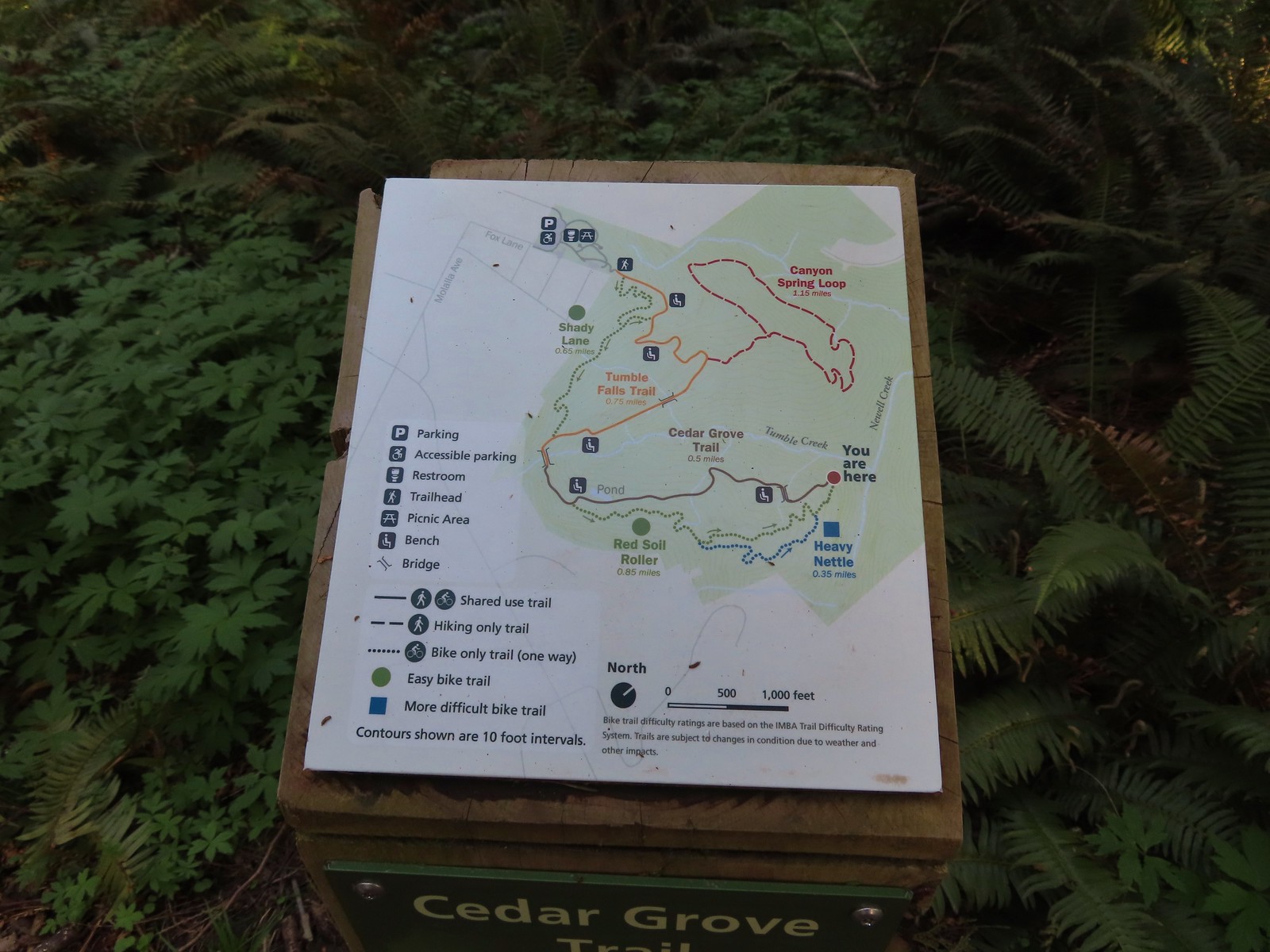
There are three types of trails at Newell Creek Canyon: Shared use (bicycle & hiker), hiker only, and bicycle only. Our plan here was to start with the shared use trails and finish with the hiker only Canyon Spring Loop. This way we would finish the shared use trails nice and early in hopes of avoid too much traffic. We made our way around the outside of the grassy picnic area to the start of the trails at a gate.
IMG_6339Please note that pets are not allowed at most Metro parks.
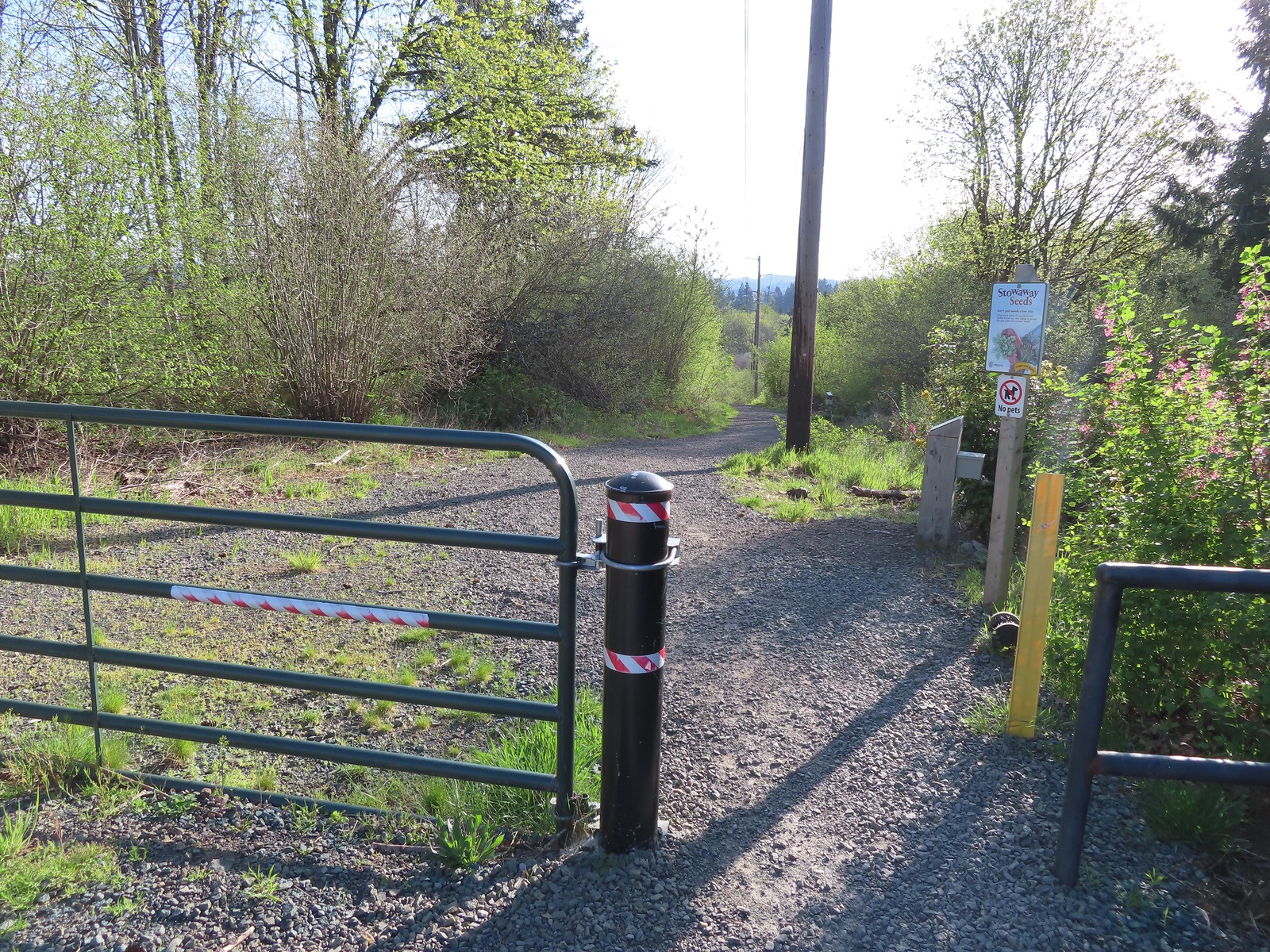
IMG_6341Don’t forget to brush off your shoes when brushes are available.

With the word canyon in the name, it’s not surprising that the Tumble Falls Trail begins by descending into Newell Creek Canyon.

We passed the biker only Shady Lane Trail on our right and further along a second biker only connector to the Shady Lane Trail.
IMG_6342The Shady Lane Trail.

IMG_6346Oregon grape, red flowering currant and Indian plum
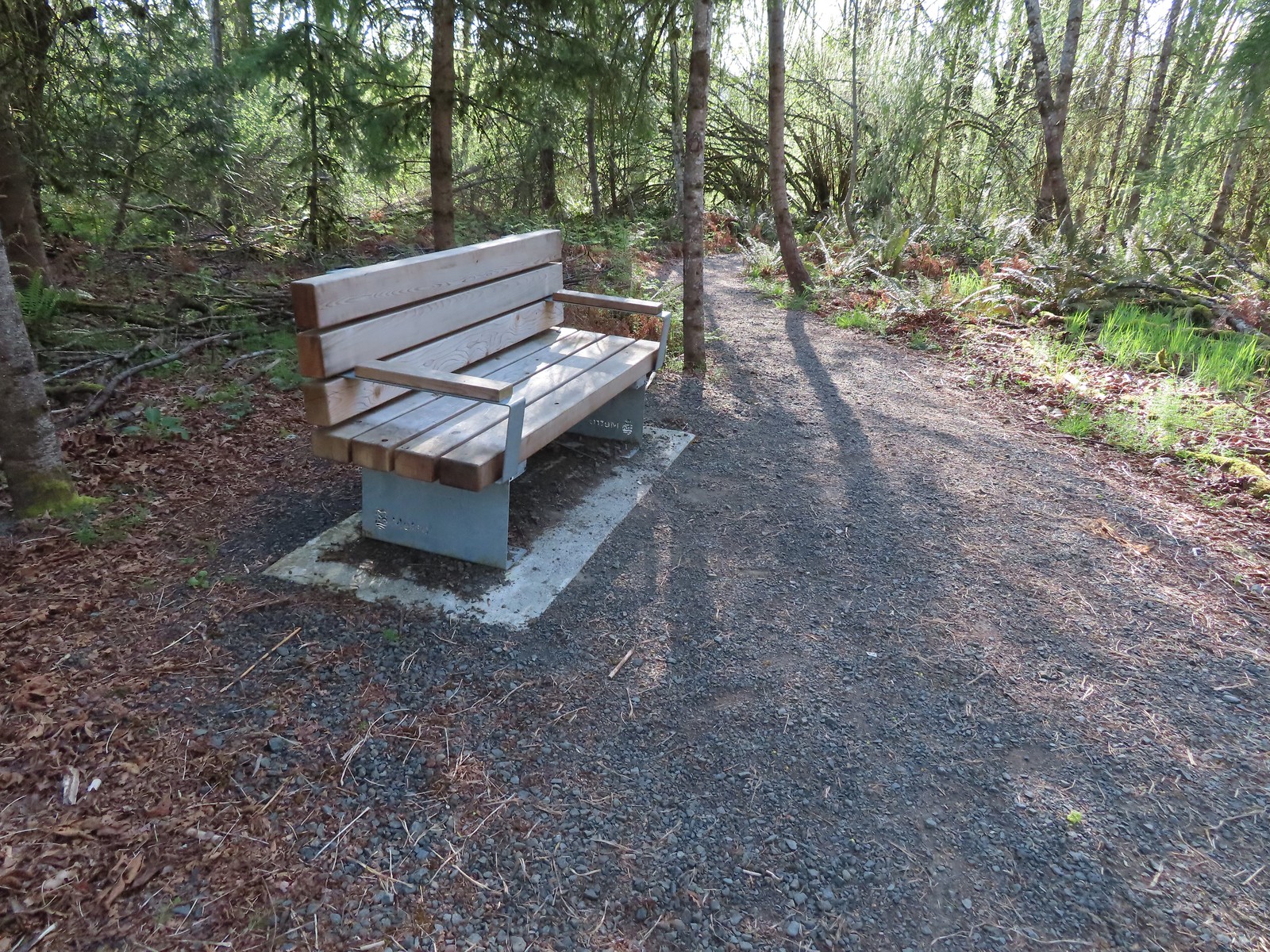
IMG_6347One of several benches located throughout the park.

IMG_6349The connector trail.

IMG_6351Candy flower

IMG_6353Trillium with a tiny insect.

IMG_6355Carpet of green.

IMG_6356A rare bluebird day for us this year.

Near the 0.4-mile mark we passed the Canyon Springs Loop which forked off to the left.
IMG_6357

We continued on the Tumble Falls Trail which was now somewhat level.
IMG_6359

IMG_6362Salmonberry blossoms

IMG_6365Fringecup and pacific waterleaf that had yet to start blooming.

The Shady Lane Trail joined from the right just before reaching the Tumble Falls Bridge.
IMG_6368

IMG_6369The Tumble Falls Bridge.

IMG_6371Tumble Falls

On the far side of the bridge the trail became the shared use Cedar Grove Trail from which the biker only Red Soil Roller Trail quickly split off.
IMG_6373

IMG_6374The Red Soil Roller Trail to the right.

We followed the aptly named Cedar Grove Trail downhill to its end at a bench overlooking Newell Creek Canyon. While we couldn’t see the creek itself the sound of flowing water let us know that it was down there.
IMG_6376A small pond along the trail.

Song sparrowSong sparrow

IMG_6379Western red cedars

IMG_6381Nearing the end of the trail.

IMG_6383Map at the end of the Cedar Grove Trail.
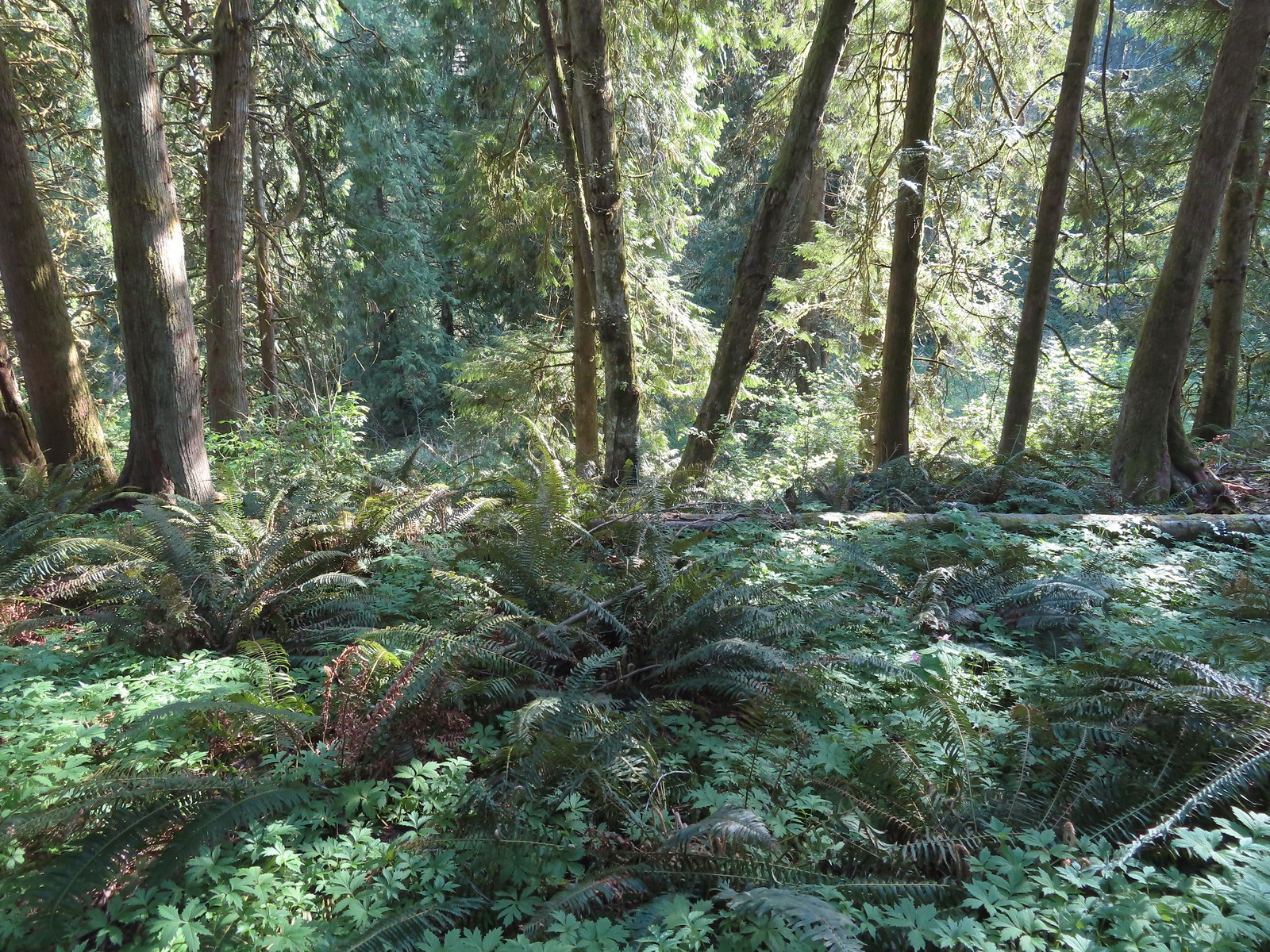
IMG_6384Newell Creek is down there somewhere.

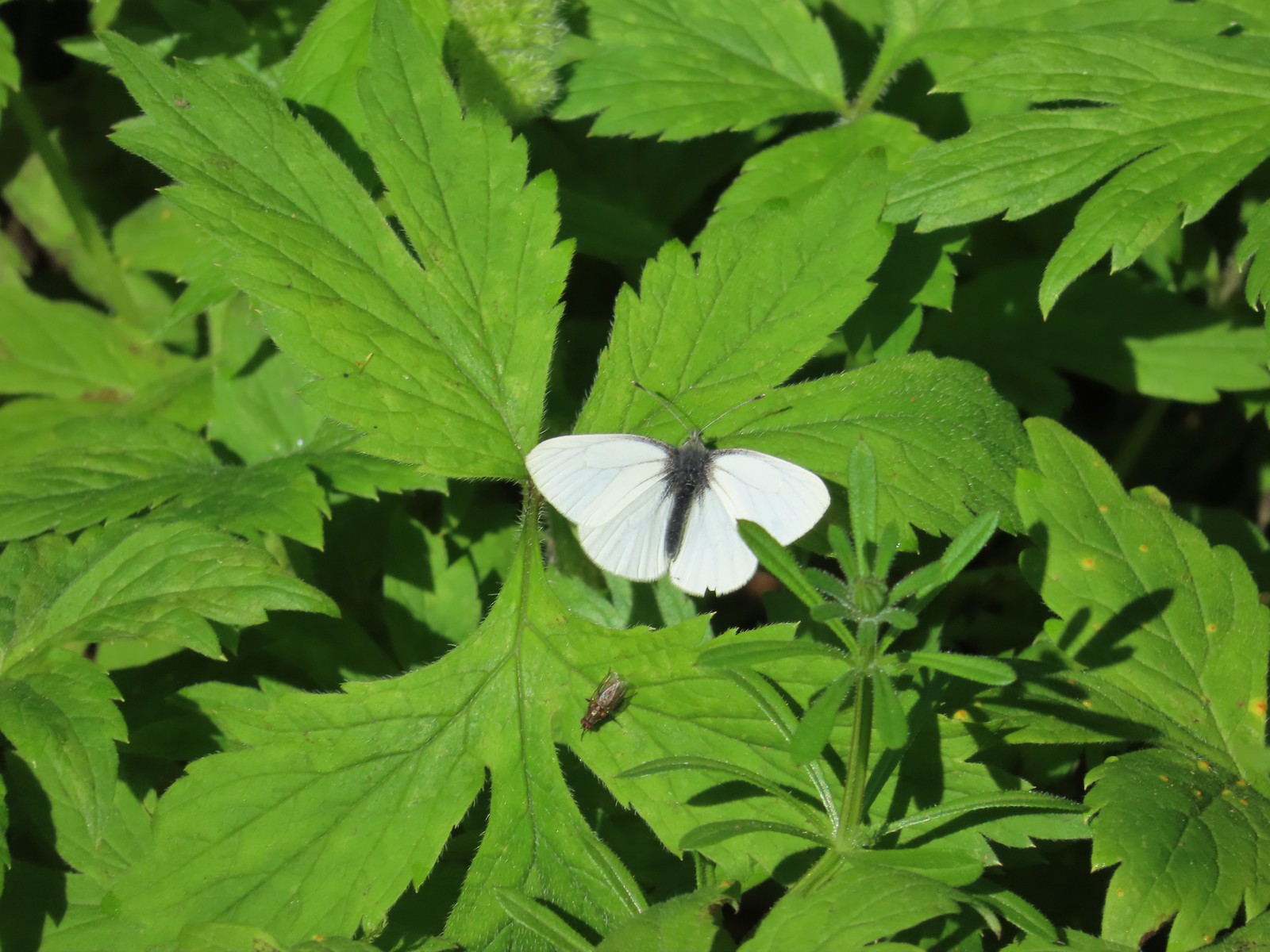
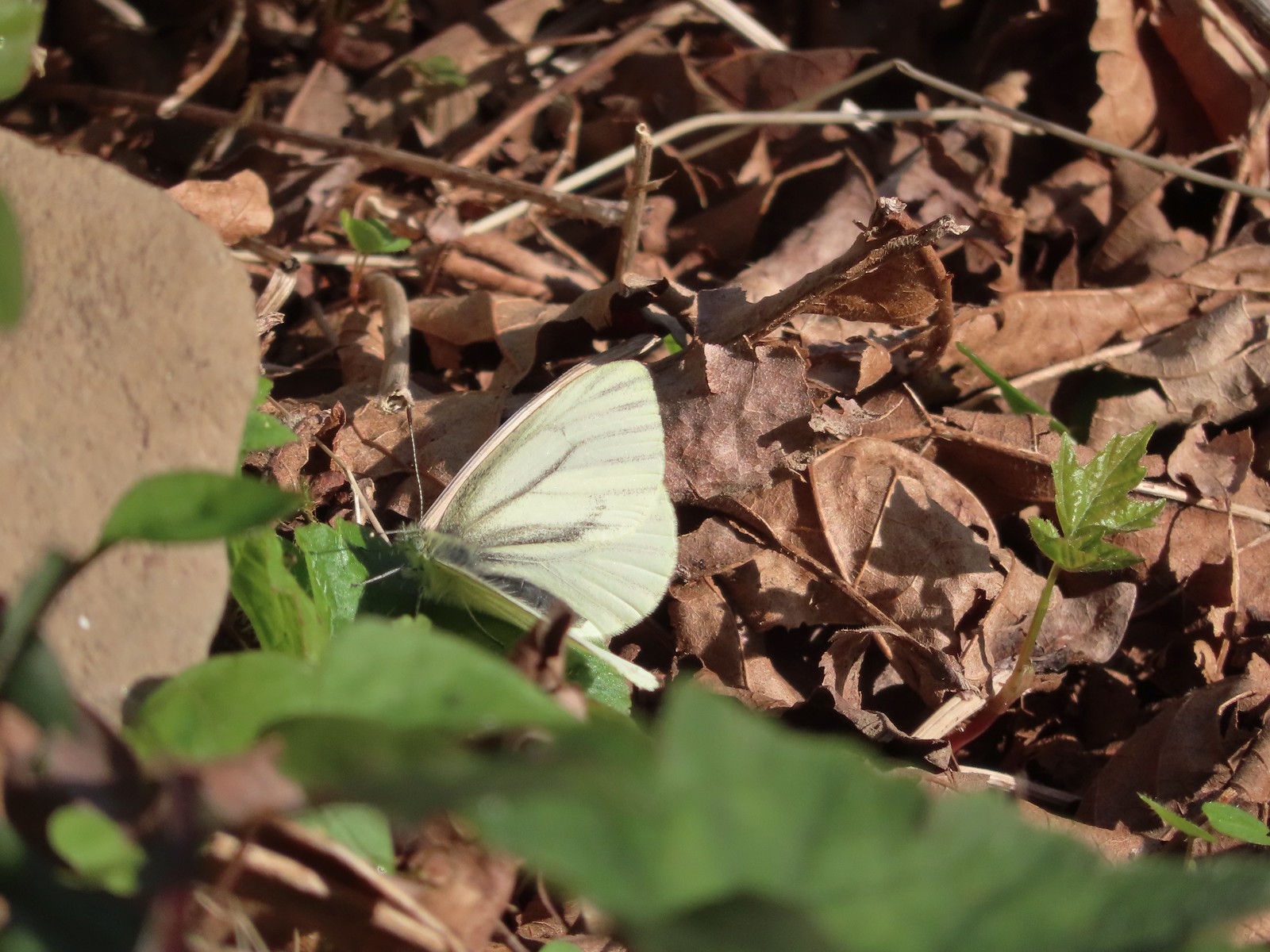
We headed back the way we’d come. It was warming up nicely and we spotted our first butterflies of the year as we climbed back toward Tumble Falls.
IMG_6385

IMG_6387Male margined white?

IMG_6390Female margined white?

When we reached the Canyon Spring Loop we turned onto it and followed it for 500′ to a junction on the ridge where the actual loop began. We chose to go right and followed the ridge east.
IMG_6401Slender toothwort

IMG_6402The Canyon Spring Trail below in the trees.
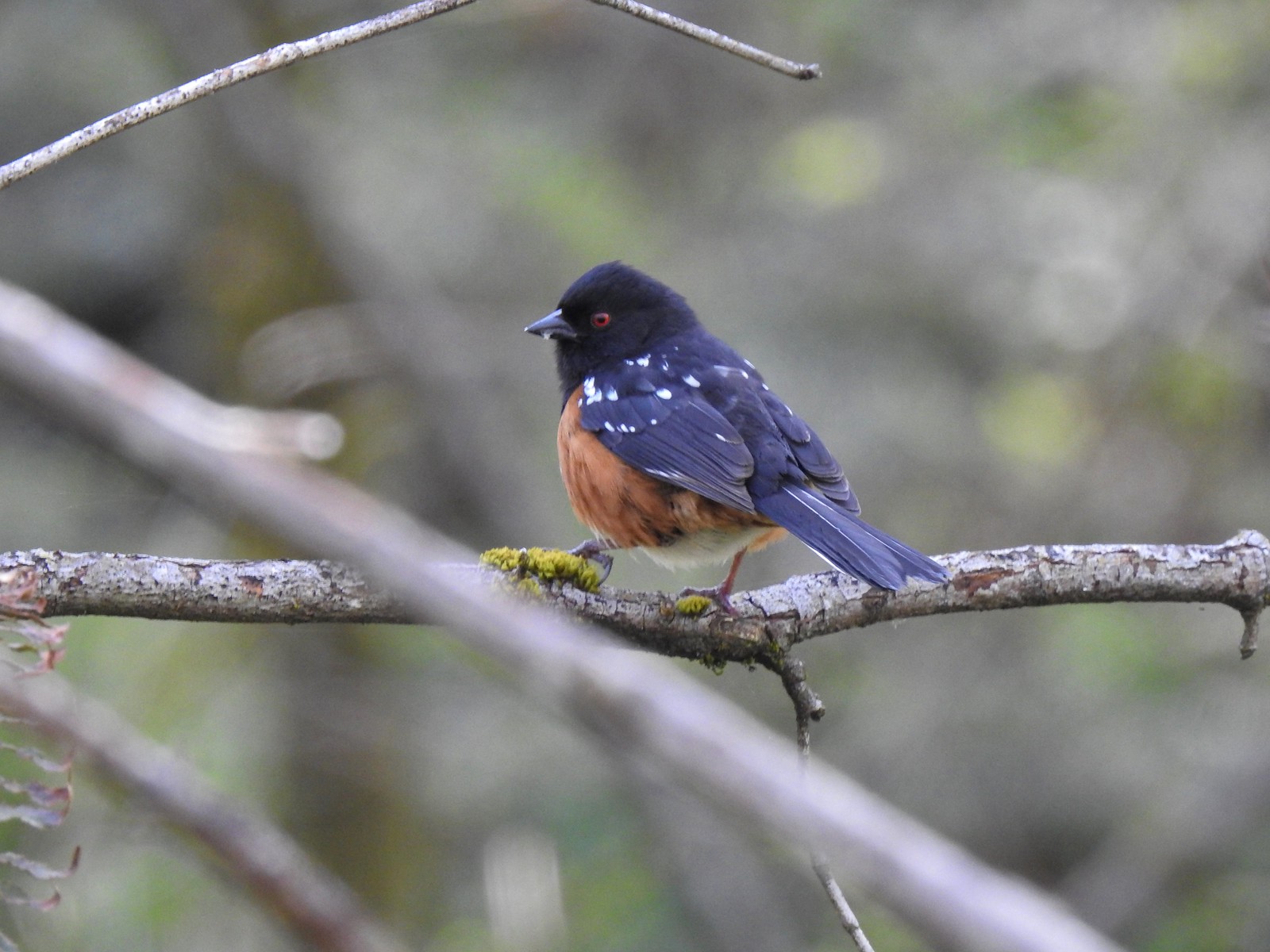
The trail lost approximately 100′ before completing a 180 degree turn and leveling out as we headed back West.
DSCN3243Spotted towhee

DSCN3248Chipmunk

IMG_6407Heading back beneath the ridge.

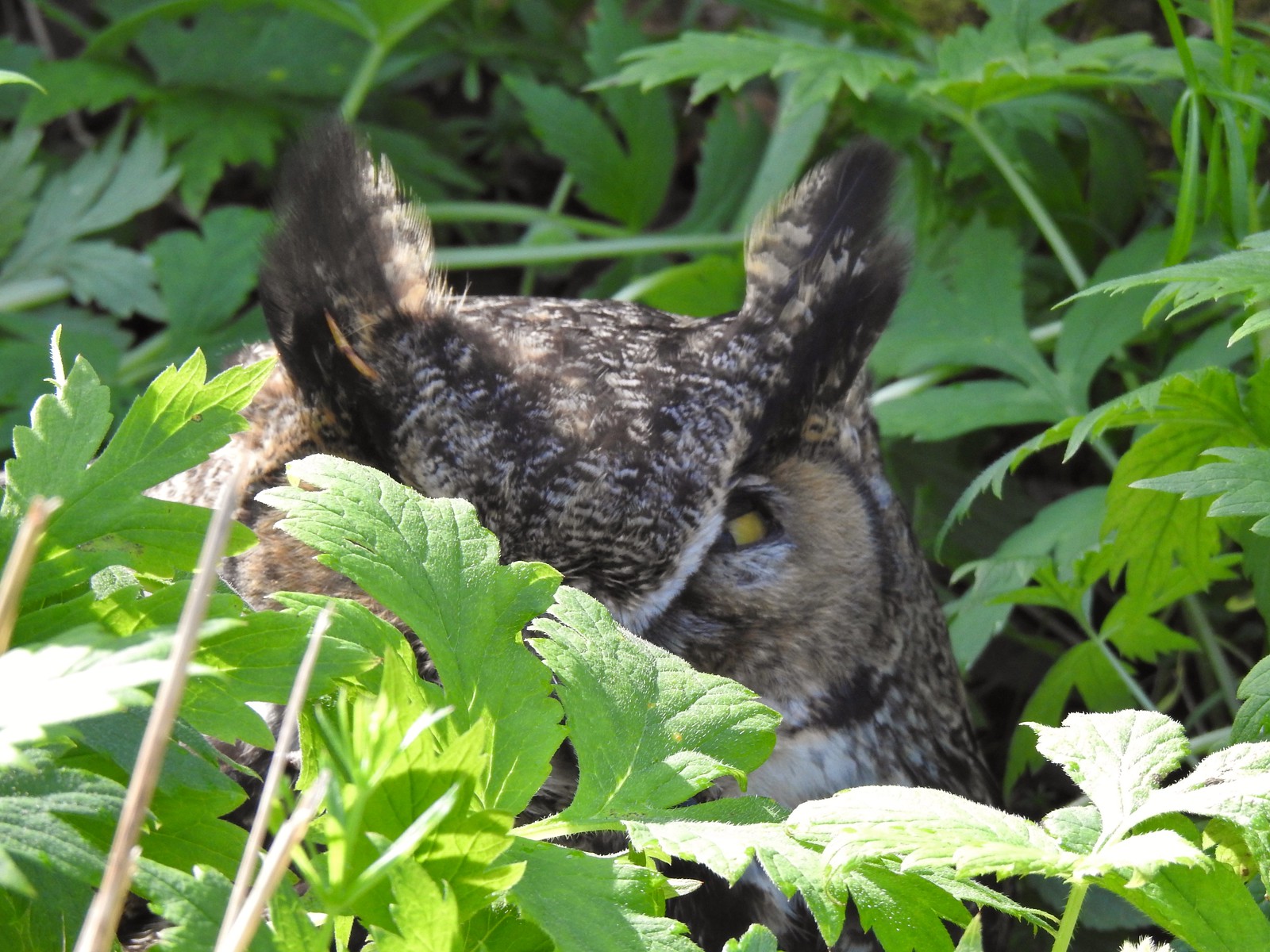
Shortly after starting back beneath the ridge, and not long after the subject of owls had come up, we spotted a great horned owl sitting in the undergrowth just off the trail near a tree.
IMG_6408

DSCN3254

We stopped a ways back to see if it would fly off but aside from some slight head movement and slight eye opening it didn’t move. We made note of where it was and slowly passed giving it as much space as possible. Our plan was to report it when we got back to the car in case it was injured or sick. We finished up the loop and had started up the Tumble Falls Trail when we passed two Metro parks staff. We let them know about the owl, showed them a photo, and pointed out on the map where we’d seen it and they were going to check on it and report it to the appropriate entity if necessary. We hope the owl turned out to be okay. As much fun as it is to see the wild animals it is sad when we come across an injured one.
IMG_6413

DSCN3256Trillium and mushrooms

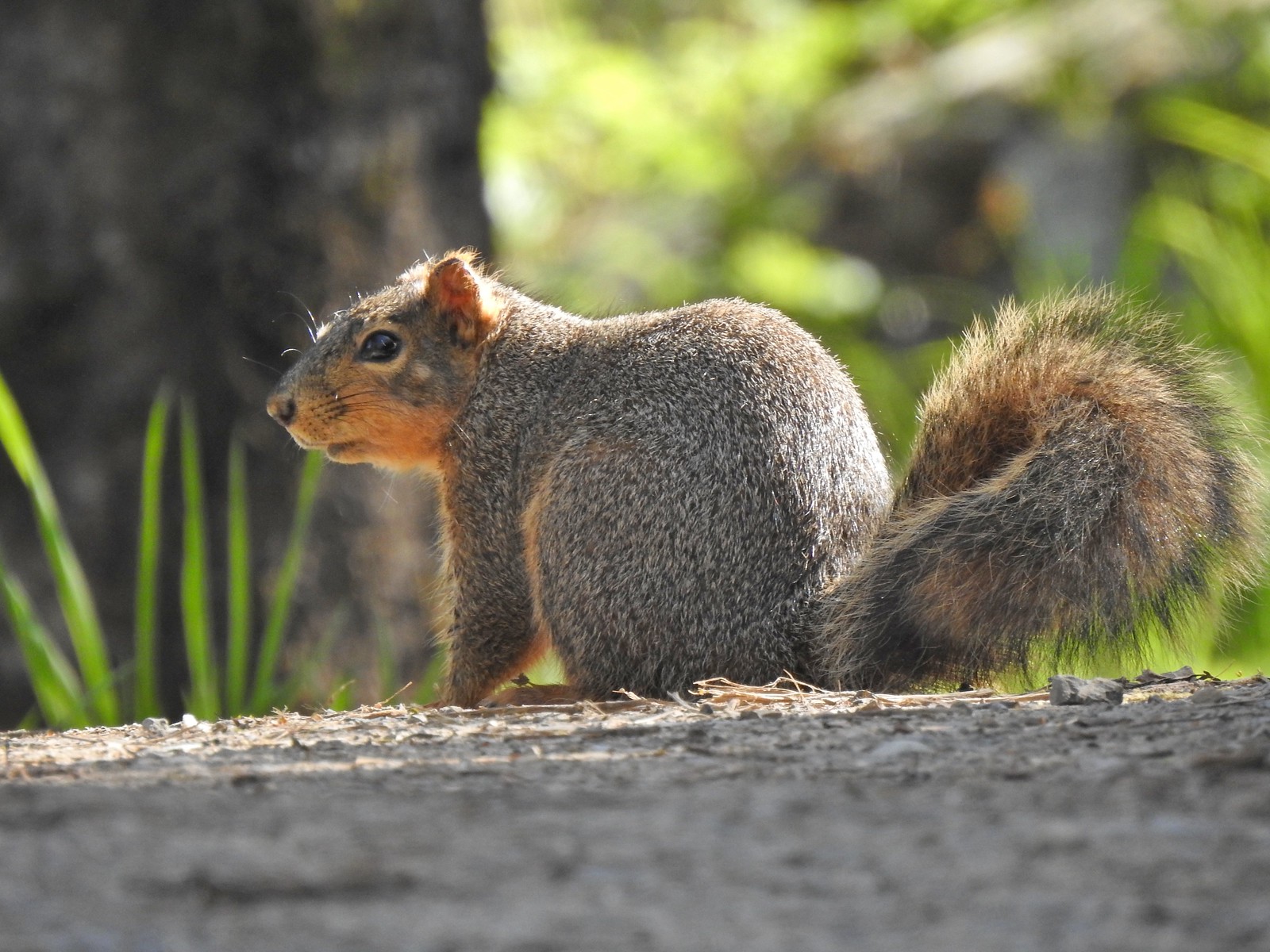
DSCN3260Squirrel

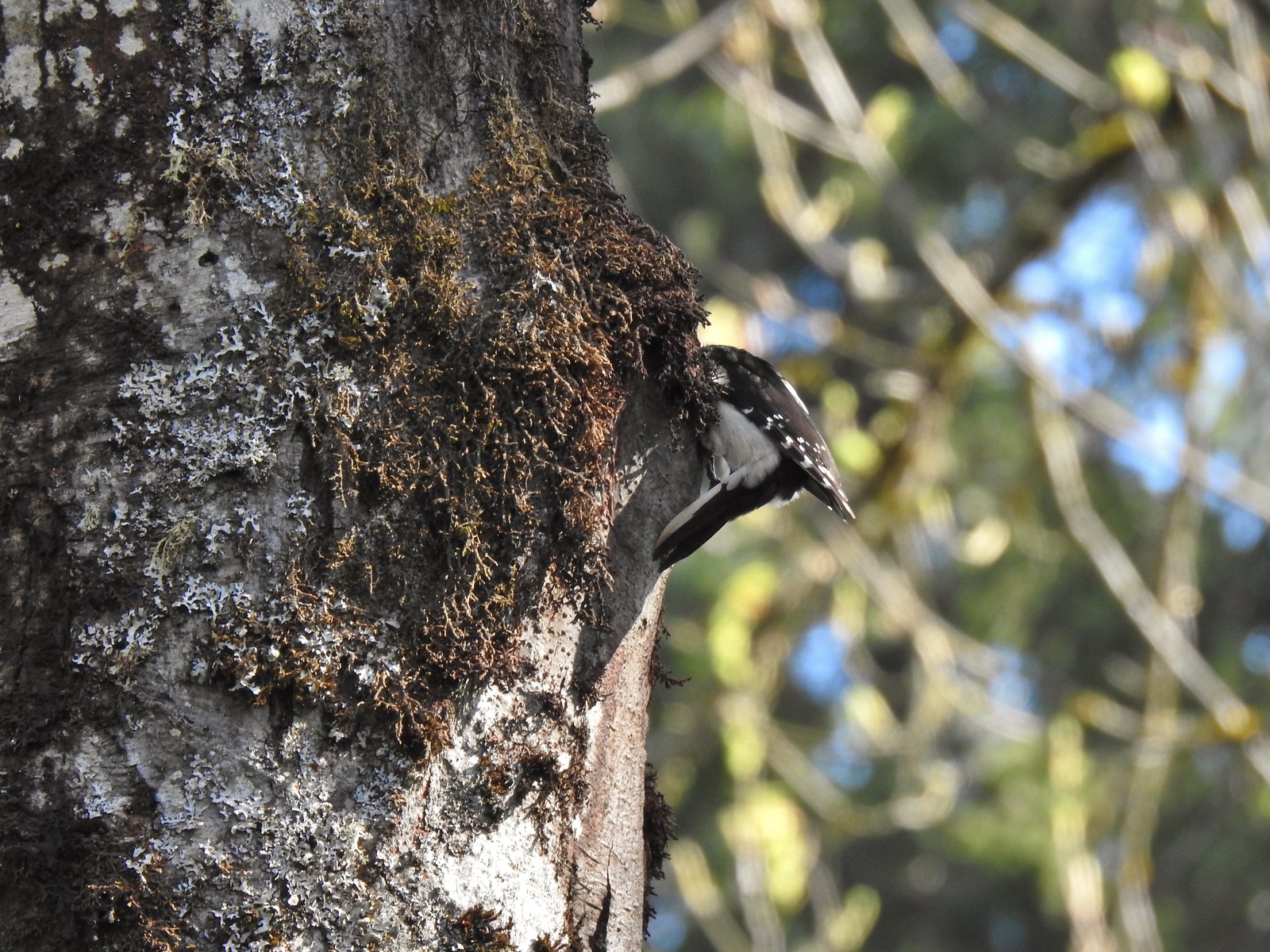
DSCN3263Woodpecker

DSCN3267Stellar’s jay

IMG_6416Back at the Tumble Falls Trail.

We felt better knowing that we’d let someone know about the owl and made our way back to the picnic area which we passed through to return to the car.
IMG_6418

Our hike here came in at just under 3.5 miles with 570′ of elevation gain giving us approximately 5.5 miles and 760′ of elevation gain on the day. Both parks were nice and really well maintained, kudos again to Metro for the job they do with the public spaces. One thing that became clear as the morning heated up was that we are not at all prepared for warm weather hiking. It’s been so cool (cold) and overcast for so long our bodies aren’t ready for temps in the 70 or 80s. Hopefully there is still time for a reasonable transition to the heat of Summer but that window grows shorter every day and more cool, wet weather appears to be on the way for the coming week. Happy Trails!

Flickr: Canemah Bluff and Newell Creek Canyon

Categories
Hiking Oregon Portland Trip report Willamette Valley

Marquam Park – 02/11/2023

A favorable forecast prompted us to head out for our February hike on Super Bowl weekend. We chose Marquam Nature Park in Portland as our destination due to it being less than an hour from Salem and allowing for a reasonable distance with some good elevation gain for an off-season hike on trails that we had not explored yet.

While there are several trailheads located around the park most have a 2-hour parking limit so we opted to begin our hike at Council Crest Park. (Note that the gate opens daily at 8:00am.) We were hoping that the forecasted “mostly sunny skies” would translate into mountain views from Council Crest after having been greeted by fog in 2018, but despite some blue sky on our drive north we were again greeted by clouds.
IMG_5226

We held out hope that skies might clear up by the time we returned and set off on the Marquam Trail on the eastern side of the park following a pointer for the Marquam Shelter
IMG_5228

The trail led downhill for just over a mile to a junction with the Sunnyside Trail. There were several road crossings along this stretch.
IMG_5230

IMG_5233Coming up to the SW Greenway Ave crossing at the 0.3-mile mark.

IMG_5237Mossy bench

IMG_5238Small trailhead at SW Fairmount Blvd at the 0.5 mile mark.
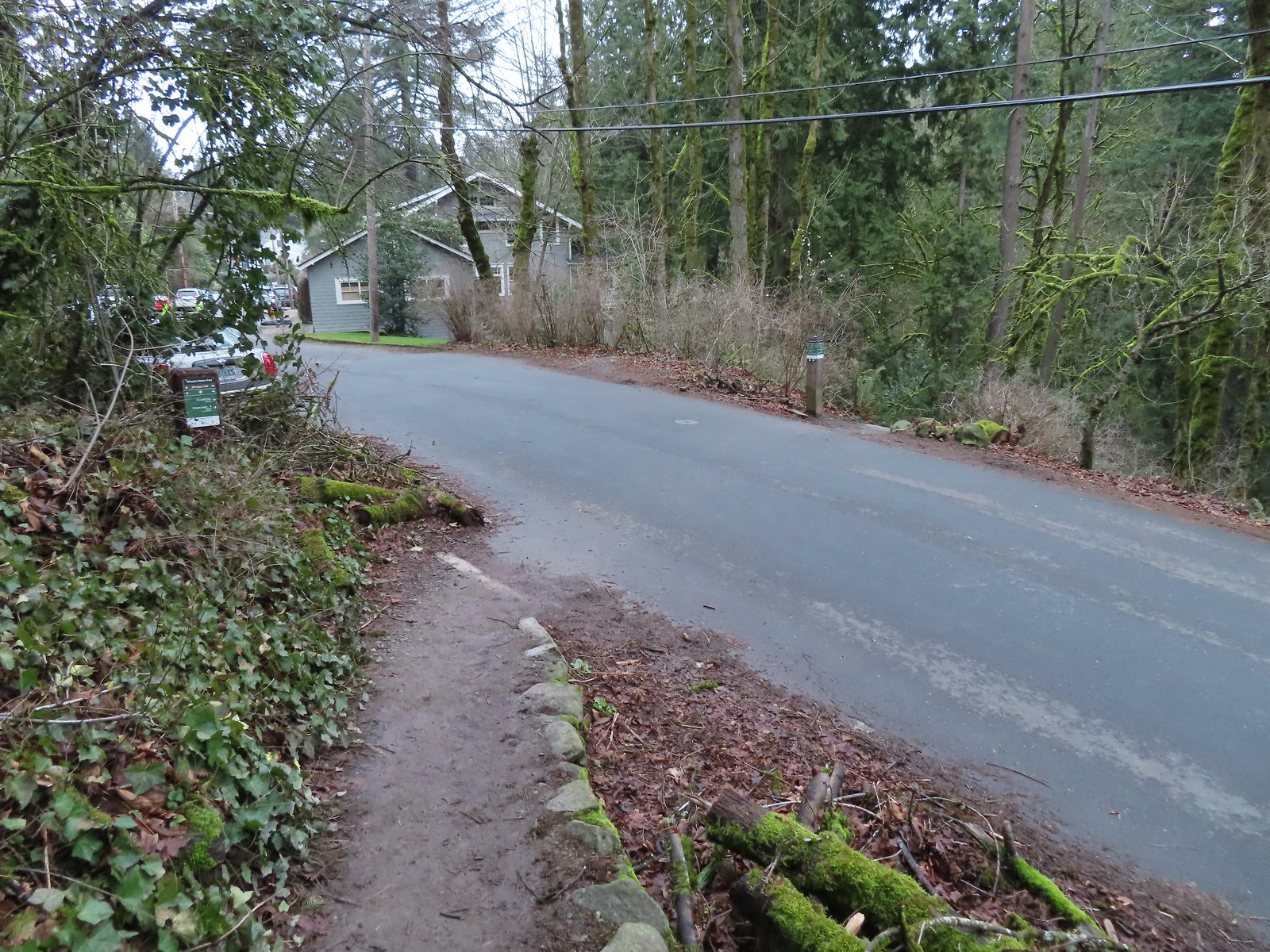
IMG_5246At the 1-mile mark the trail crosses NW Sherwood Dr.

IMG_5247Maybe the steepest section of the hike was the tenth of a mile between NW Sherwood and the Sunnyside Trail.

IMG_5250The Sunnyside Trail junction.

At the junction we forked left onto the Sunnyside Trail and followed it another 0.7-miles downhill to the Marquam Shelter.
IMG_5251

IMG_5255

IMG_5256Every (official) trail junction was well marked by pointers which helped us stay on course.

IMG_5257The Shadyside Trail on the far hillside.
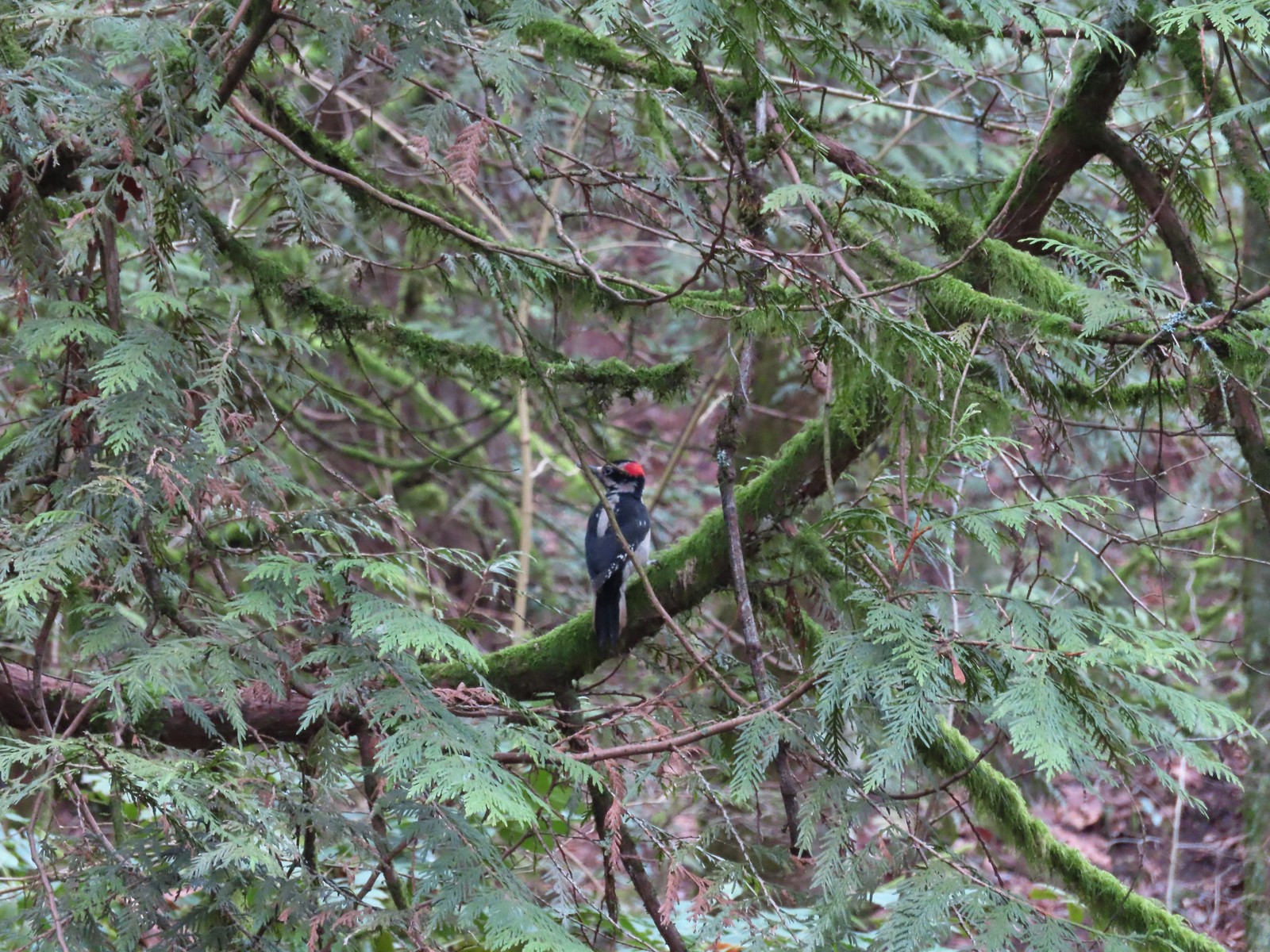
Hairy woodpeckerOne of two hairy woodpeckers that were busy foraging for breakfast.

IMG_5268Coming up on the Marquam Shelter.

IMG_5270We saw little fungi, but these turkey tails added some color to the forest.

IMG_5273The Marquam Shelter.

The Marquam Shelter is one of two separate destinations that Sullivan gives options for in his “Aerial Tram & Council Crest” featured hike entry in “100 Hikers/Travel Guide Northwest Oregon & Southwest Washington”. We used our visit to Council Crest in 2018 to check this featured hike off our list but now we could officially cross off the other. We didn’t detour into the shelter to check out the historical photos due to a homeless person who seemed to be just waking up. That being said the park and trails were all well maintained and we saw almost no garbage. There did seem to be a lot of clothing items (glove, hats, and even a night splint) placed on or near a number of the trail markers.

We ignored the Shadyside Trail which headed uphill away from the shelter and continued another 20′ and turned uphill onto the Basalt Trail which was an old roadbed.
IMG_5274

IMG_5276A tenth of a mile from the shelter we passed the Connor Trail on the left. This trail would have taken us to OHSU and the Portland Areal Tram. Sullivan’s described routes have you taking the Tram both ways for the Marquam Shelter option or downhill for the Washington Park to Council Crest option. (The latter route also includes a Portland Streetcar and Max Light Rail rides.) We were committed to hiking only though, so we continued up the Basalt Trail another 0.2 miles to the Marquam Trail.

IMG_5278

IMG_5280

We forked left onto the Marquam Trail (right would have allowed for a much shorter loop) and climbed a series of switchbacks 0.3-miles to SW Gibbs Street.
IMG_5282The Marquam Trail to the left and right with the Basalt Trail in the center from the first switchback.

IMG_5285Trail marker near SW Gibbs.

The trail briefly followed the road past a large water tower then crossed over and dropped 0.2-miles to a junction with the Flicker Trail.
IMG_5287

IMG_5288

IMG_5292The Flicker Trail from the Marquam Trail.
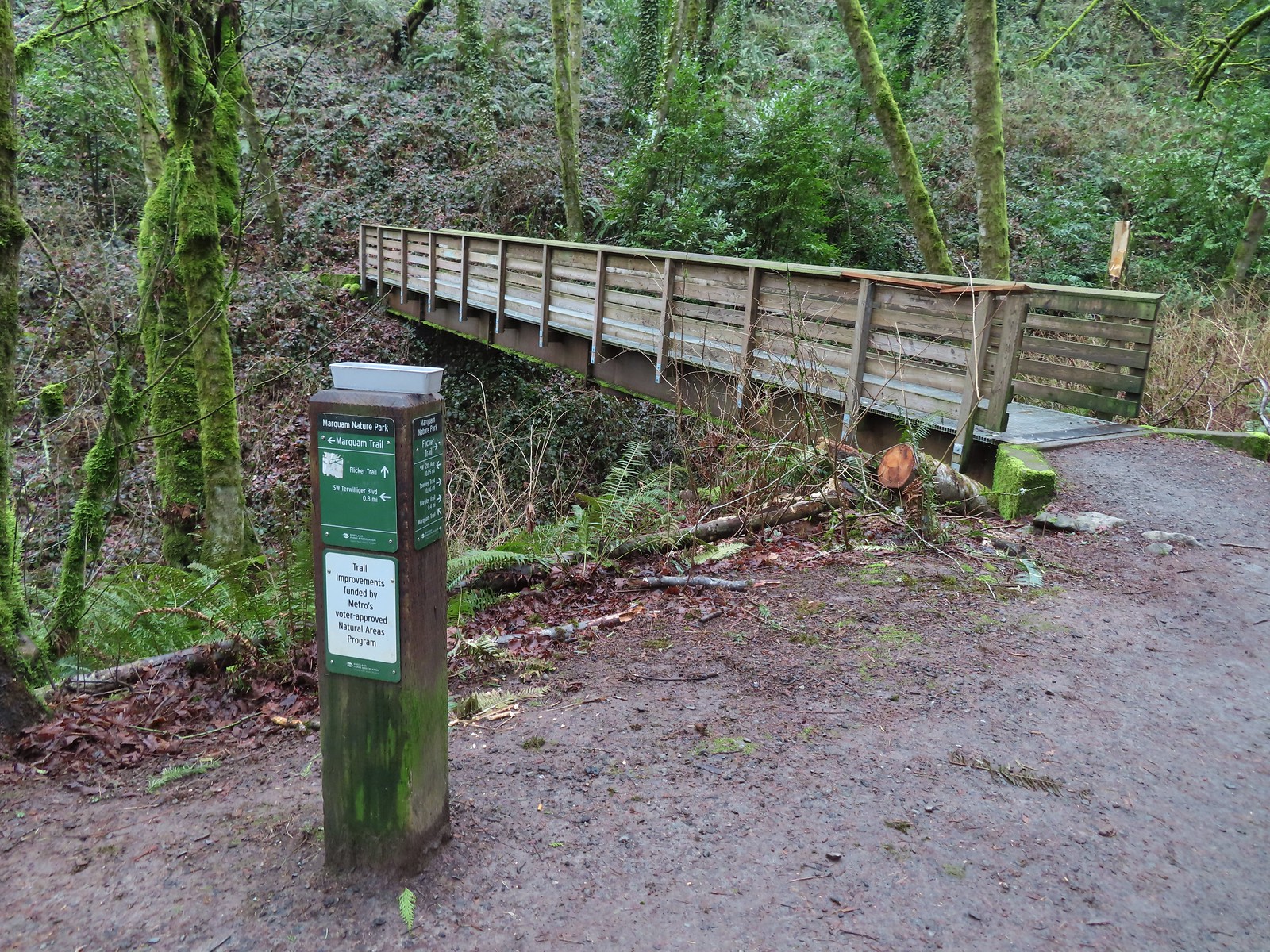
We stayed on the Marquam Trail at the junction for another 0.7-miles where we met the other end of the Flicker Trail.
IMG_5293

IMG_5295

IMG_5296

IMG_5298

IMG_5303

This time we turned onto the Flicker Trail following it uphill for 0.3-miles to the Warbler Trail.
IMG_5304

IMG_5307Note it is still not “mostly sunny” even though it was now almost 10am.
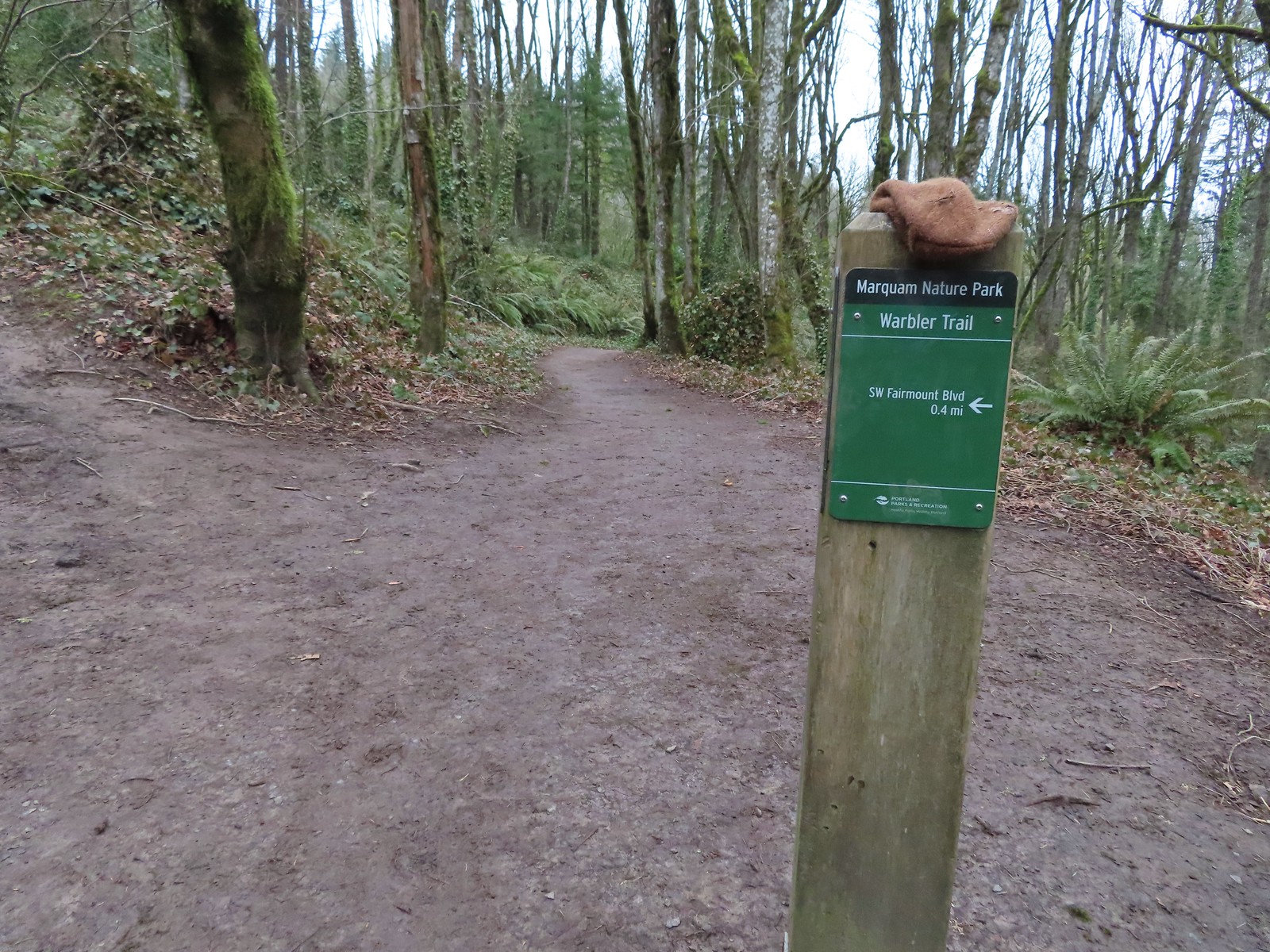
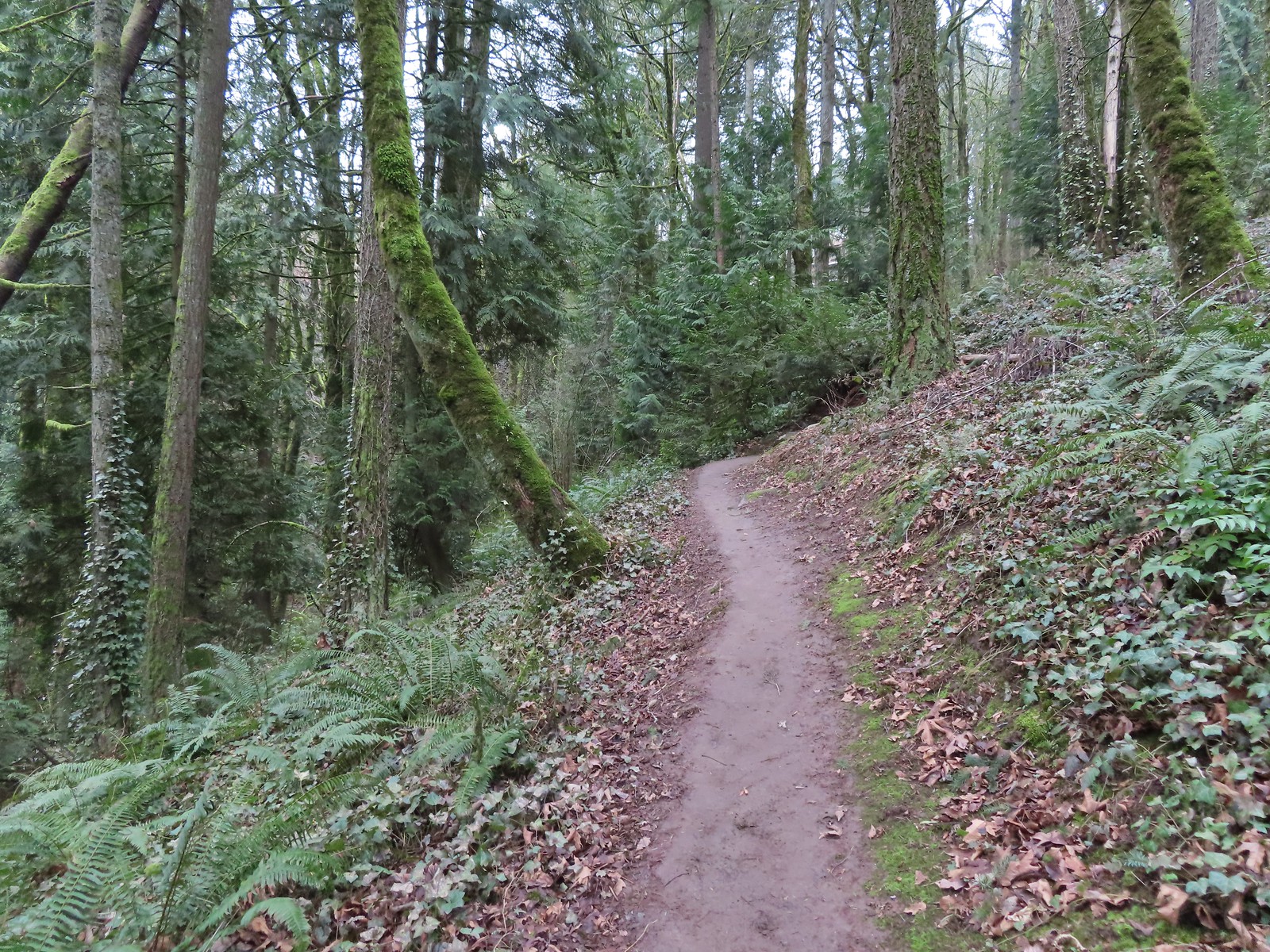
IMG_5310

We decided to detour up the Warbler Trail which climbed 0.4-miles to another small pullout along SW Fairmount Blvd.
IMG_5316

Spotted towheeWhile not a warbler this spotted towhee graced us with a song.

Spotted towheeChecking out a budding leaf.

IMG_5317The end of the Warbler Trail.

We dropped back down to the Flicker Trail and turned left continuing North 0.3-miles to the Towhee Trail (where we did not see any towhees).
IMG_5321

IMG_5322

IMG_5325

We turned left on the Towhee Trail which climbed a half mile to yet another small trailhead, this time on SW Marquam Hill Road.
IMG_5327

IMG_5330

We crossed the road and continued on the Towhee Trail another 0.6-miles to its end at the Marquam Trail.
IMG_5331Pointer for the Marquam Shelter at the trailhead.
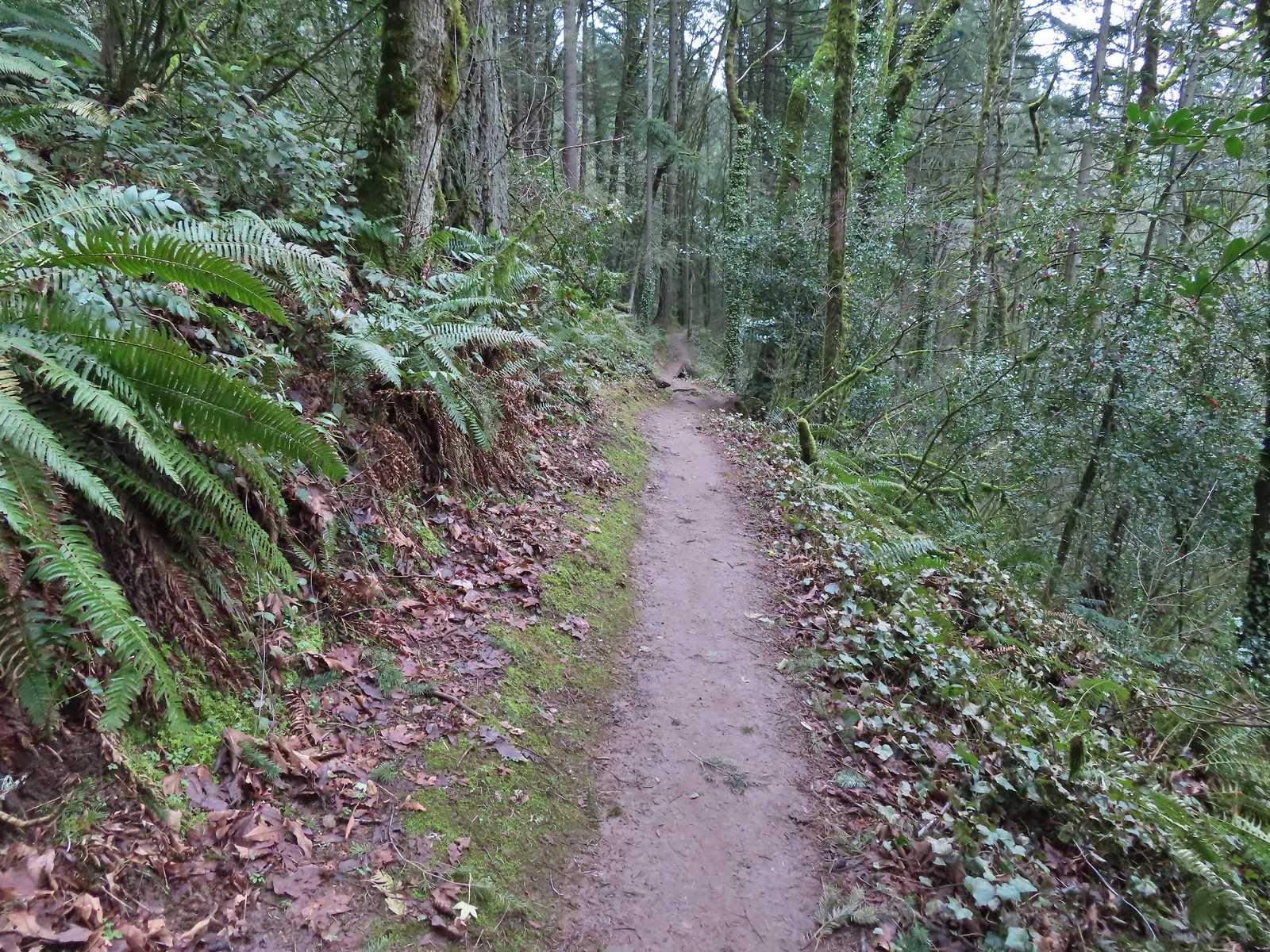
IMG_5335

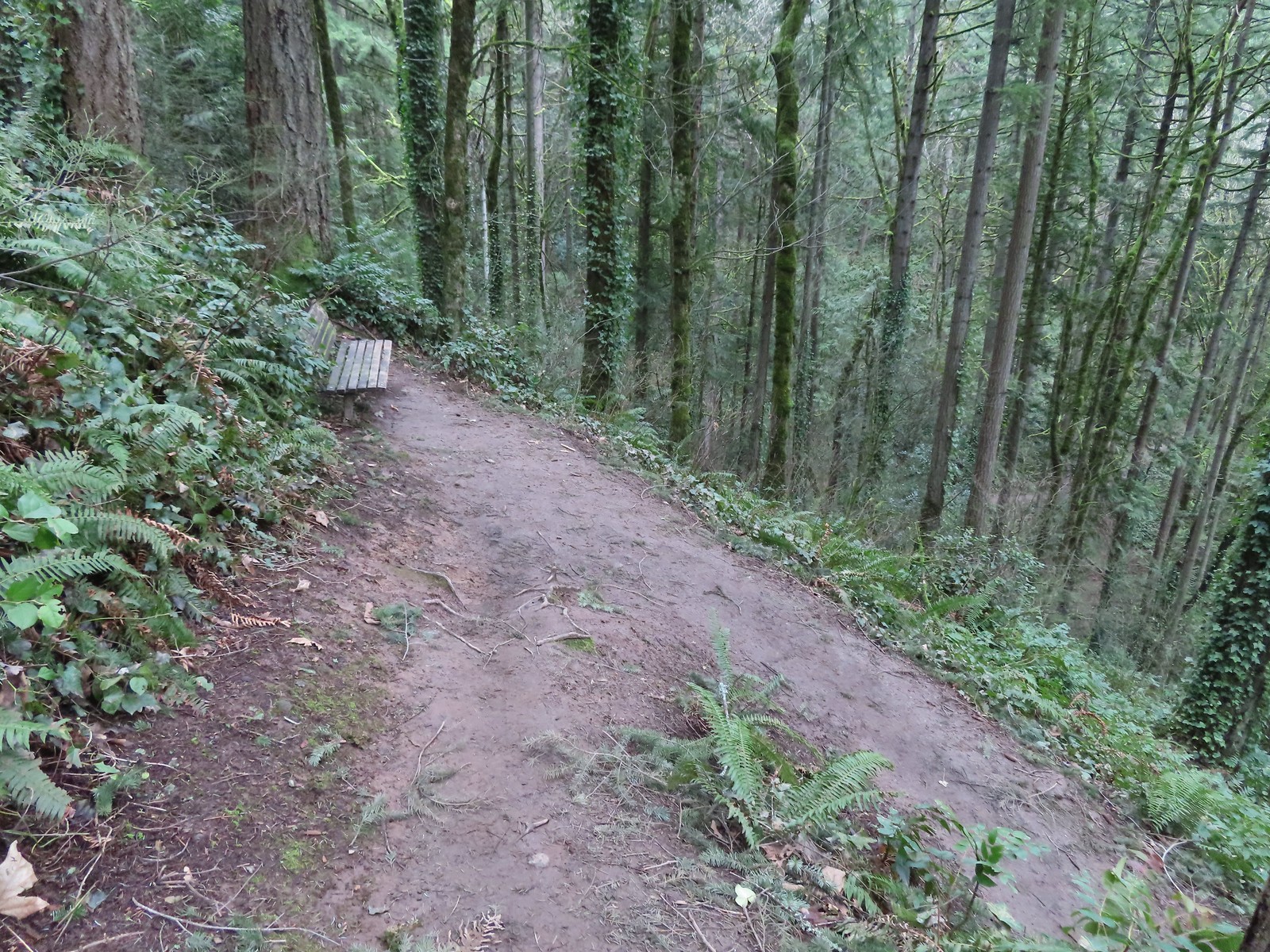
IMG_5336Bench along the switchbacks down to the Marquam Trail.

IMG_5338The Towhee Trail junction with Marquam Trail was nearly all the way back down to the Basalt Trail (the lower trail in the photo).
We turned left onto the Marquam Trail and followed it another 0.6-miles to the junction with the Sunnyside Trail.
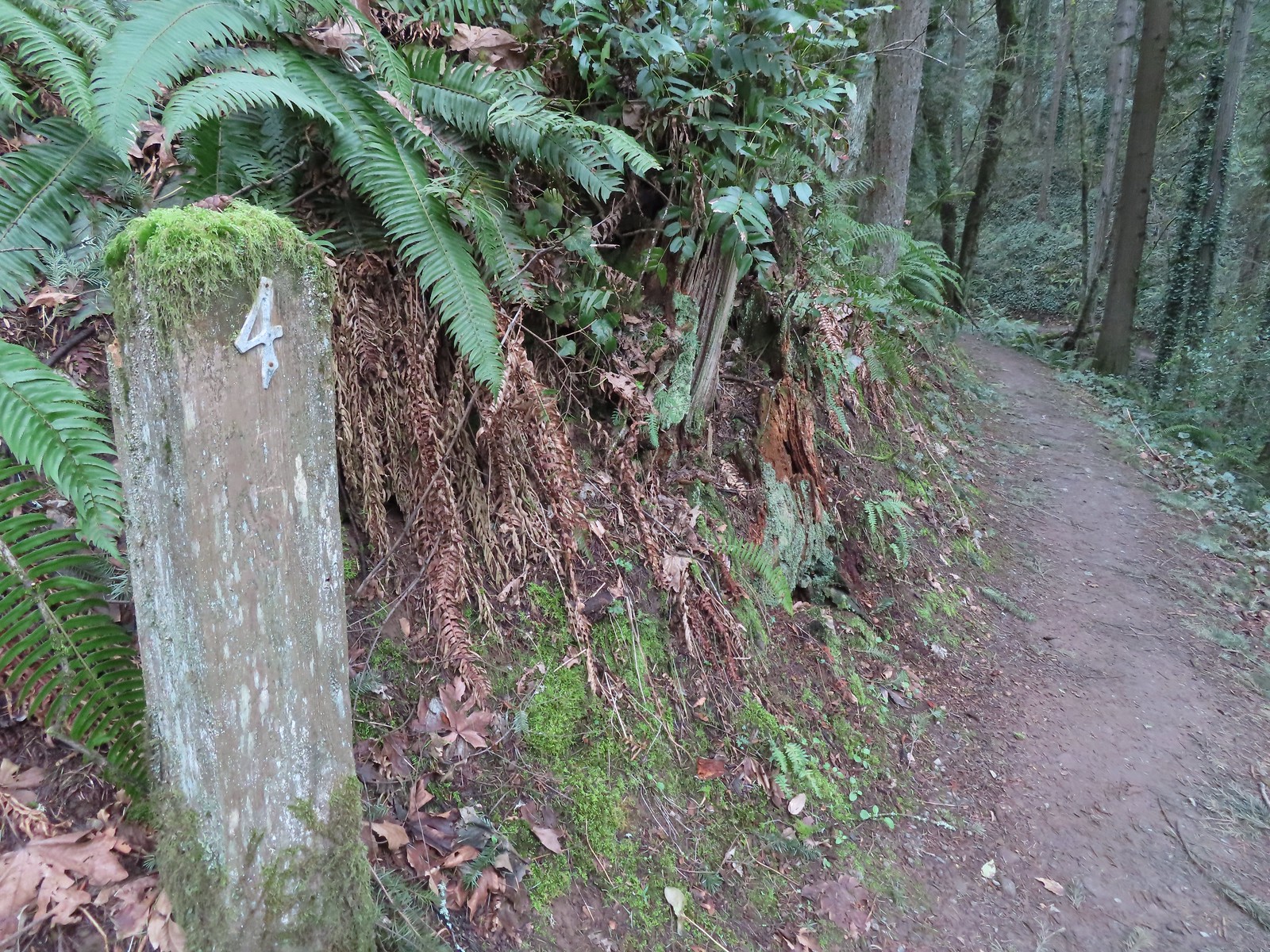
IMG_5340Not sure what the story is behind this post but it was the only one we spotted with this type of number.
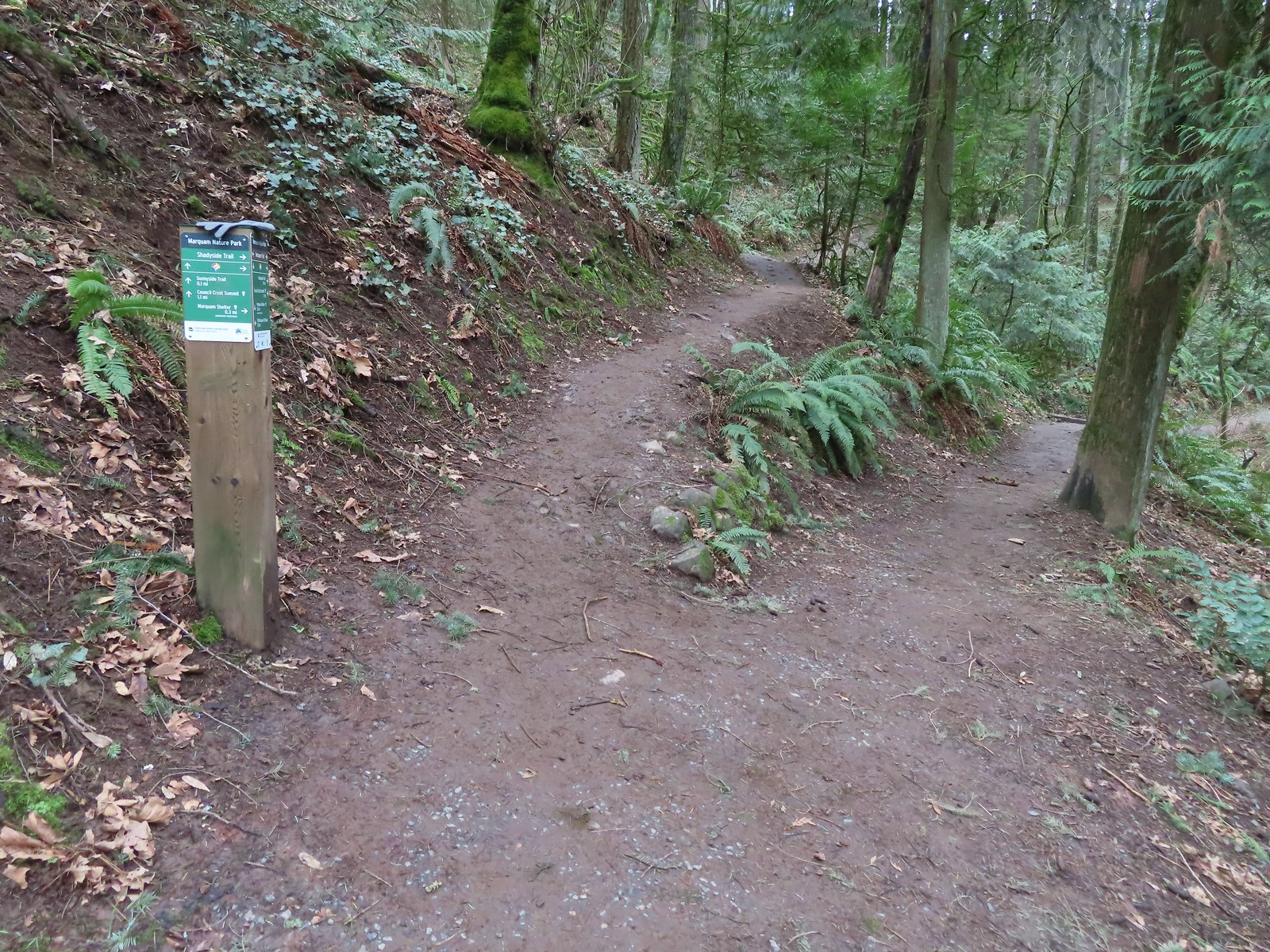
IMG_5343We passed the Shdayside Trail after half a mile.

IMG_5344

IMG_5345There was a short section with some railing before dropping down to the Sunnyside Trail.

After completing our loop we turned left had hiked the 1.1-miles back uphill to Council Crest where the clouds were finally starting to break up.
IMG_5353

IMG_5354

Unfortunately it wasn’t enough to provide a view of any Cascade volcanoes but it was at something at least.
IMG_5357Mt. St. Helens, Mt. Rainier, and Mt. Adams are out there beyond the clouds.

IMG_5358Freemont Bridge spanning the Willamette River with the Columbia River in the distance.
IMG_5364Hummingbird

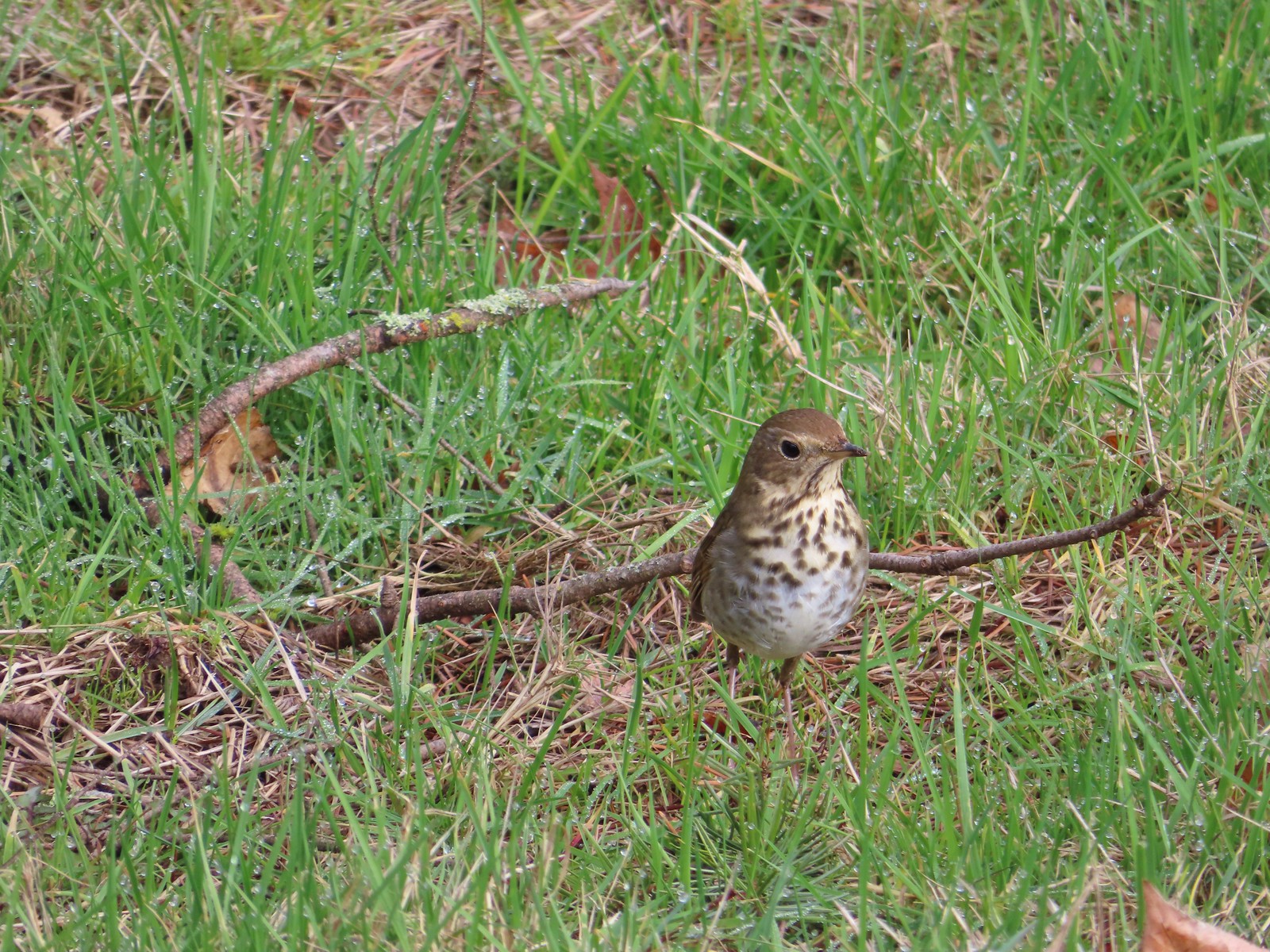
Hermit thrushHermit thrush looking for snacks at Council Crest Park.
Our hike came to 7.8-miles with at least 1700′ of elevation gain.

This was a nice hike and a good one for this time of year since it doesn’t really have any big sights along the way. A mountain view would have been great and of course by the time we on the freeway driving home Hood, St. Helens, and Adams were all clearly visible. Oh well, there will be plenty more opportunities over the next months.

After our hike we were able to meet up with some of Heather’s family for a great lunch at Salvador Molly’s. It was a great way to cap of the day. Happy Trails!

Flickr: Marquam Park

Categories
Hiking Oregon Portland Trip report Willamette Valley

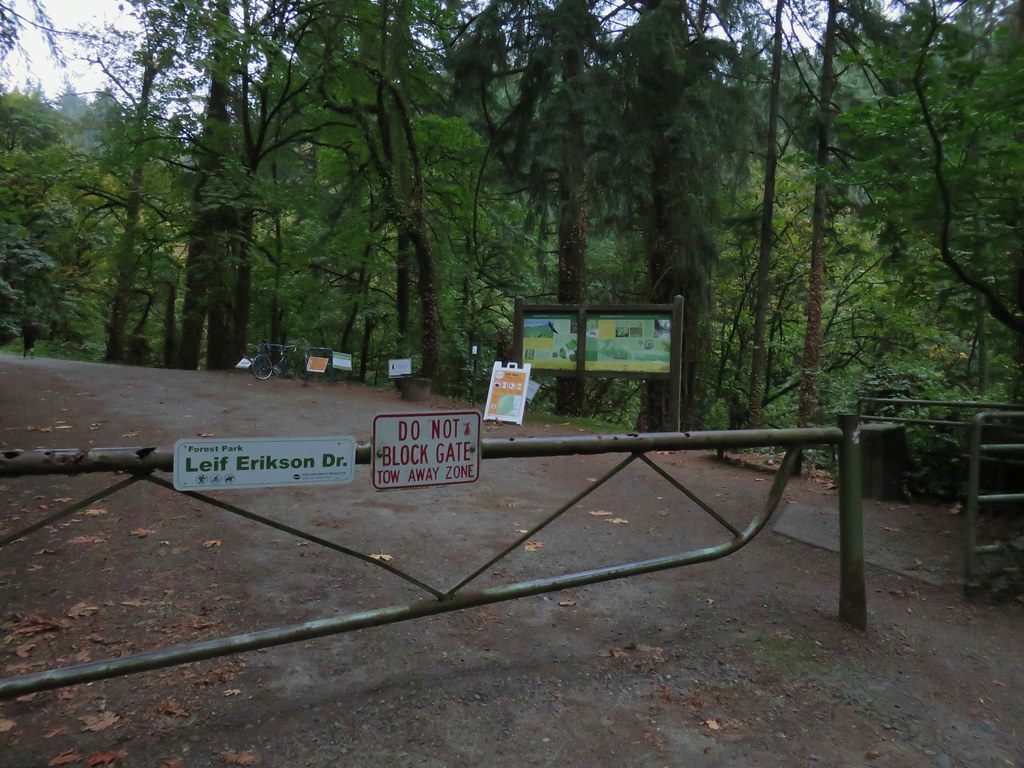
Forest Park Loop (Leif Erikson, Wild Cherry, Wildwood and Nature Trails) – 10/24/2020

With Heather’s foot still a little sore from her fall at Abbott Butte we wanted to find a hike that wasn’t too strenuous for her to test it out on. An 8.8 mile loop in Portland’s Forest Park fit the bill, especially since there would be several shorter loop options available in case her foot didn’t respond well. The loop we had chosen is the longer of two options given by Sullivan for the Balch Creek hike in his “100 Hikes/Travel Guide Northwest Oregon & Southwest Washington” guidebook (hike #4 in the 4th & 5th editions). The shorter loop option involves Balch Creek itself while the longer 8.8 mile loop never comes near the creek. For this hike we parked at the end of NW Thurman St. at the gated Leif Erikson Drive.
IMG_7967

In August 2020 Portland Parks and Recreation began a pilot program of one-way loops in an attempt to reduced visitor interaction and possibly help reduce the spread of COVID-19. Parts of our loop were included in one of the one-way pilots.
IMG_7971.

We followed the paved Leif Erikson Drive for .3 miles to the Wild Cherry Trail (near a set of outhouses).
IMG_7973

IMG_7977

We turned up the dirt Wild Cherry Trail (following the one-way signs) and quickly encountered people coming down the wrong way (so much for the signs). The Wild Cherry Trail gained about 400′ as it climbed to a junction with the Wildwood Trail in .6 miles.
IMG_7983

IMG_7986Switchback along the Wild Cherry Trail.

We turned right onto the Wildwood Trail at the junction and remained on it when the Wild Cherry Trail continued uphill to the left a few yards later.
IMG_7989

IMG_7992

This was our fourth hike involving the 30.2 mile Wildwood Trail having hiked portions of it on our Washington Park (post), Maple Trail (post), and Northern Forest Park (post) outings.
IMG_7993

After .6 miles on the Wildwood Trail we arrived at a 4-way junction with the Dogwood Trail, part of the 2.75 mile one-way loop.
IMG_8001

Heather’s foot was doing well so we continued on the Wildwood Trail. In another .6 miles we arrived at parking area along NW 53rd.
IMG_8004

IMG_8006

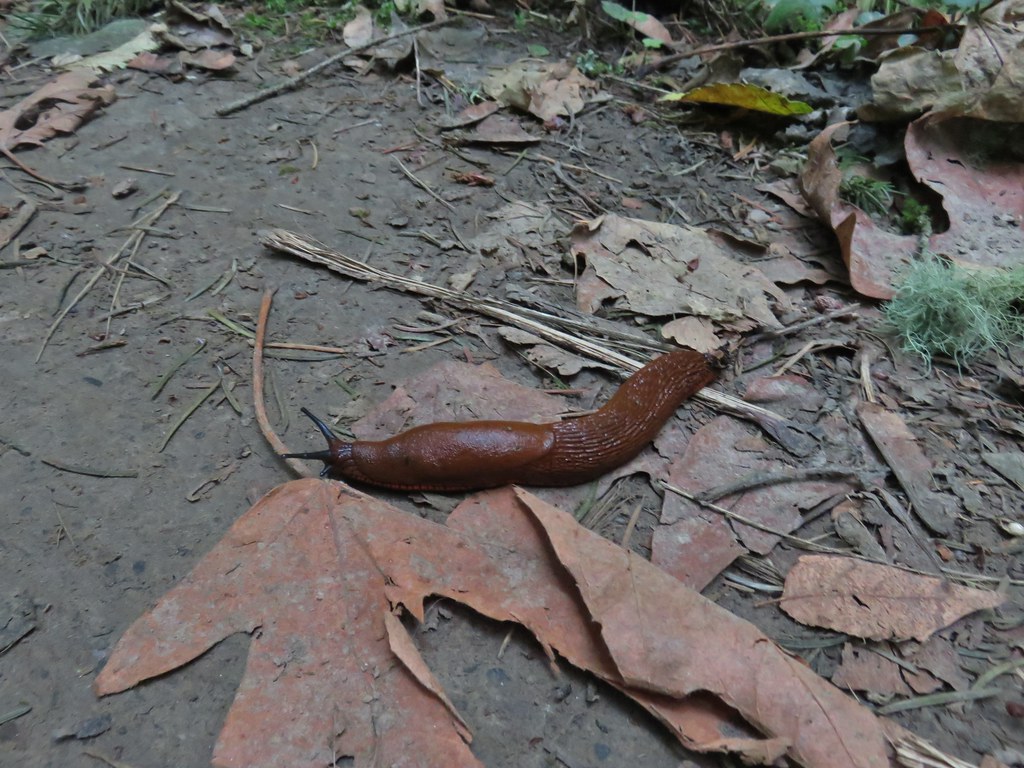
IMG_8011This was the first slug we recall seeing of this color.
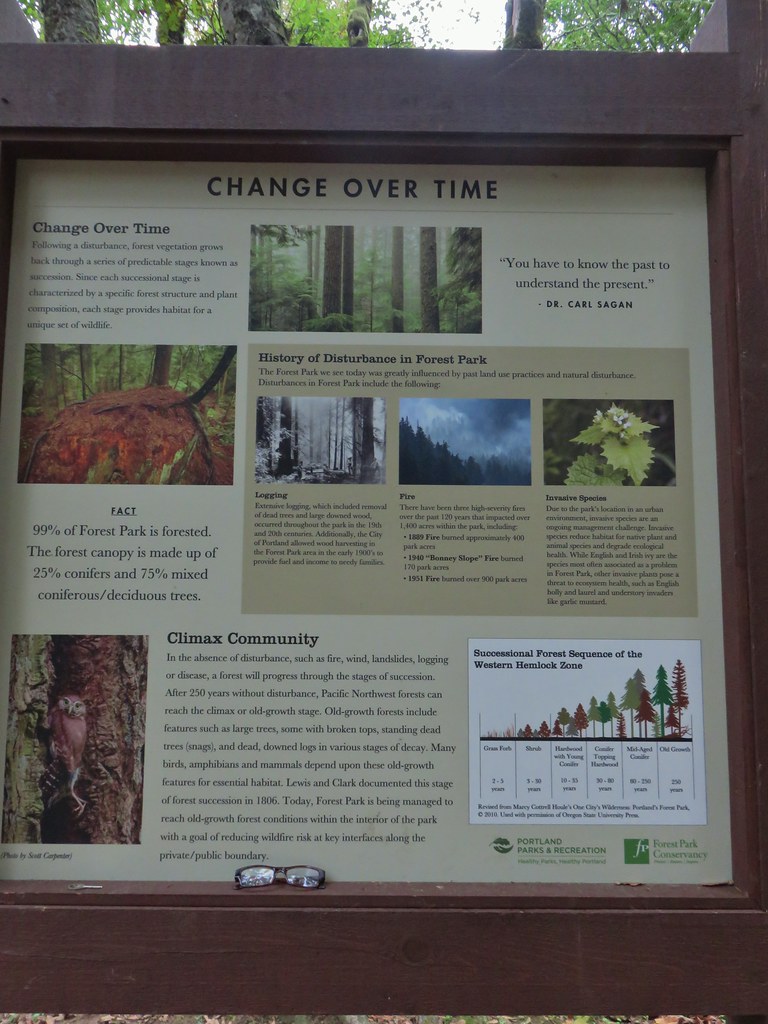
IMG_8014Interpretive sign at the NW 53rd parking area.
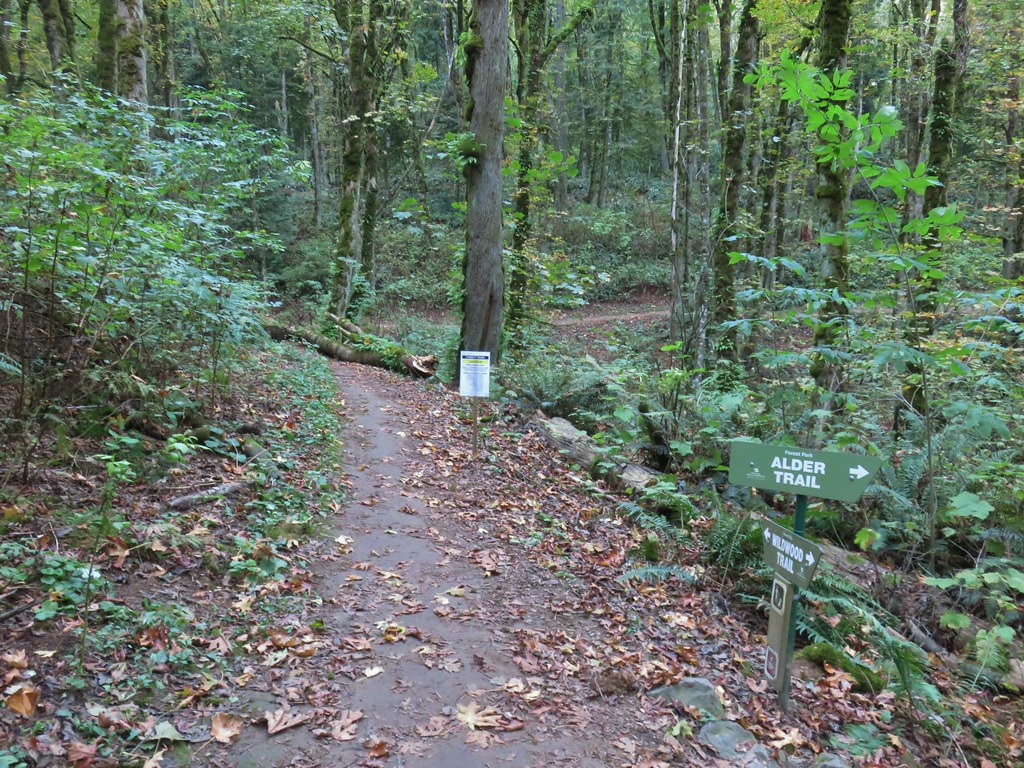
In another .3 miles we ignored the Alder Trail on the right (another option to shorten the loop) continuing on the Wildwood Trail.
IMG_8020

IMG_8018

IMG_8016

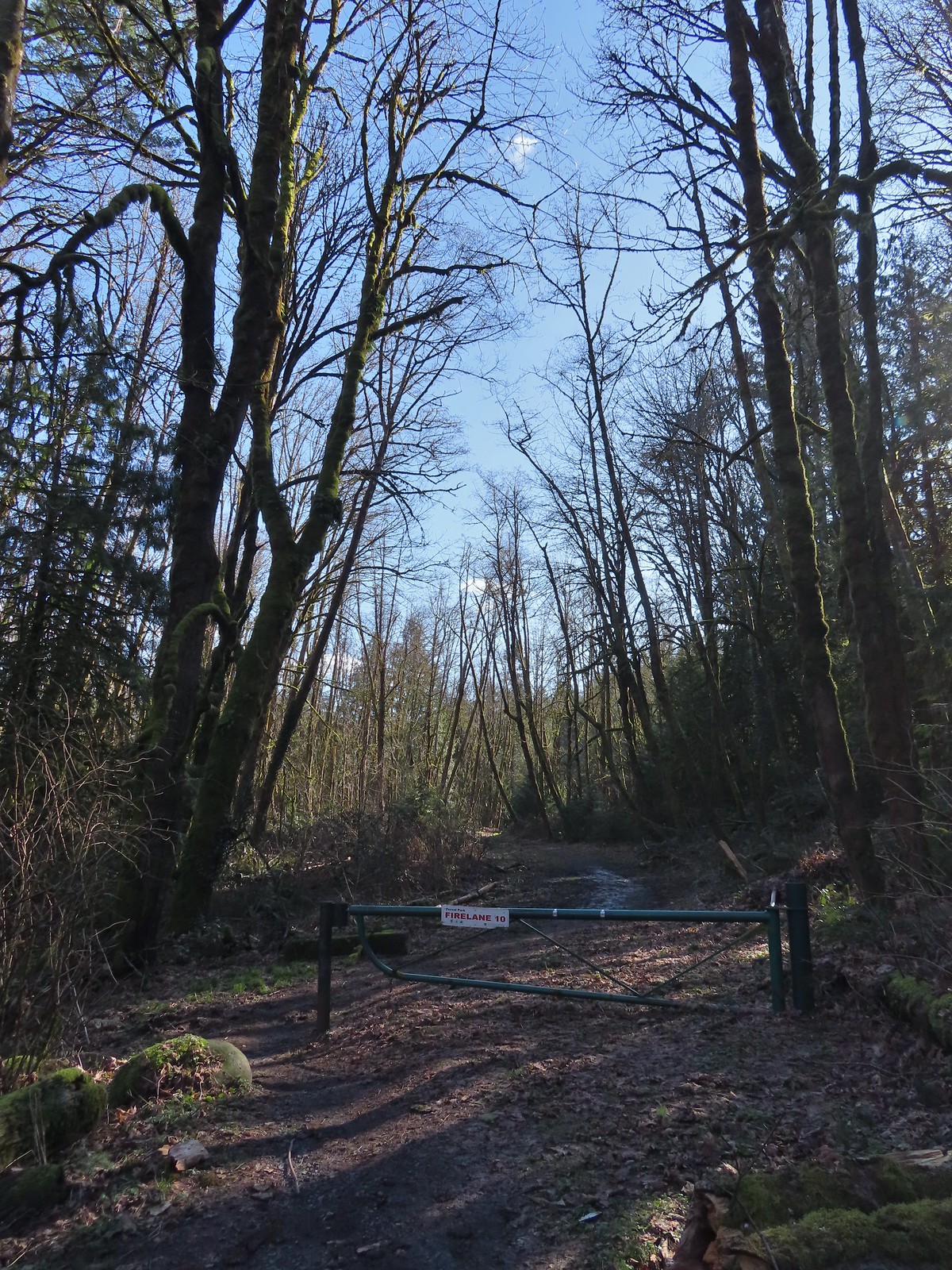
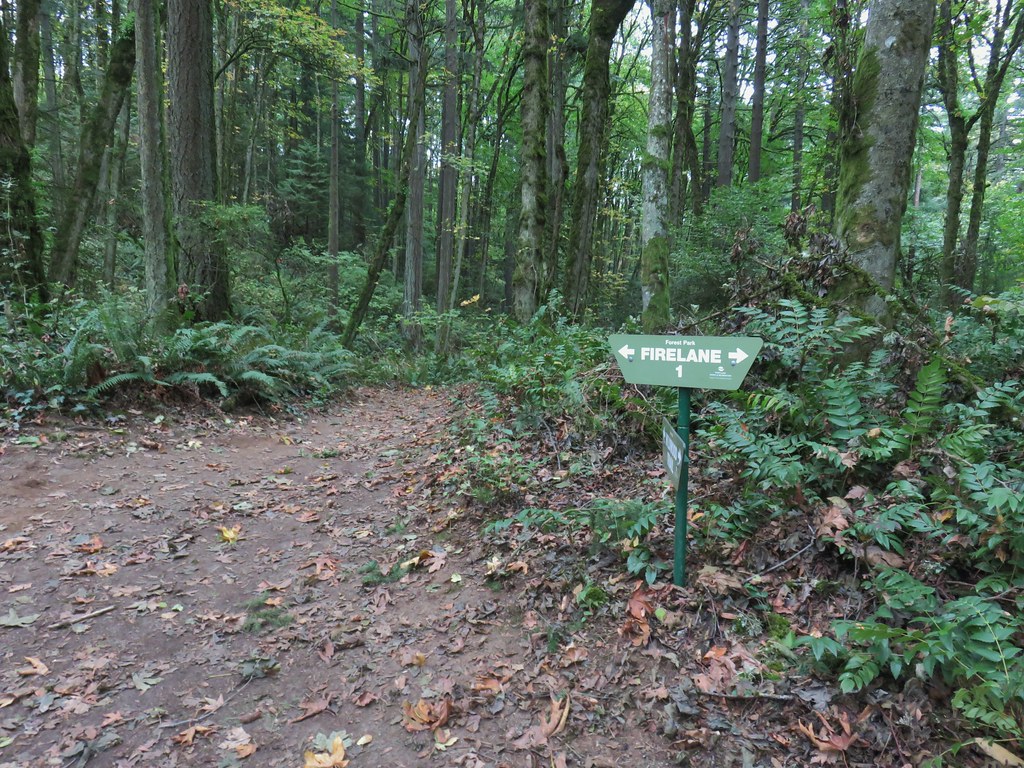
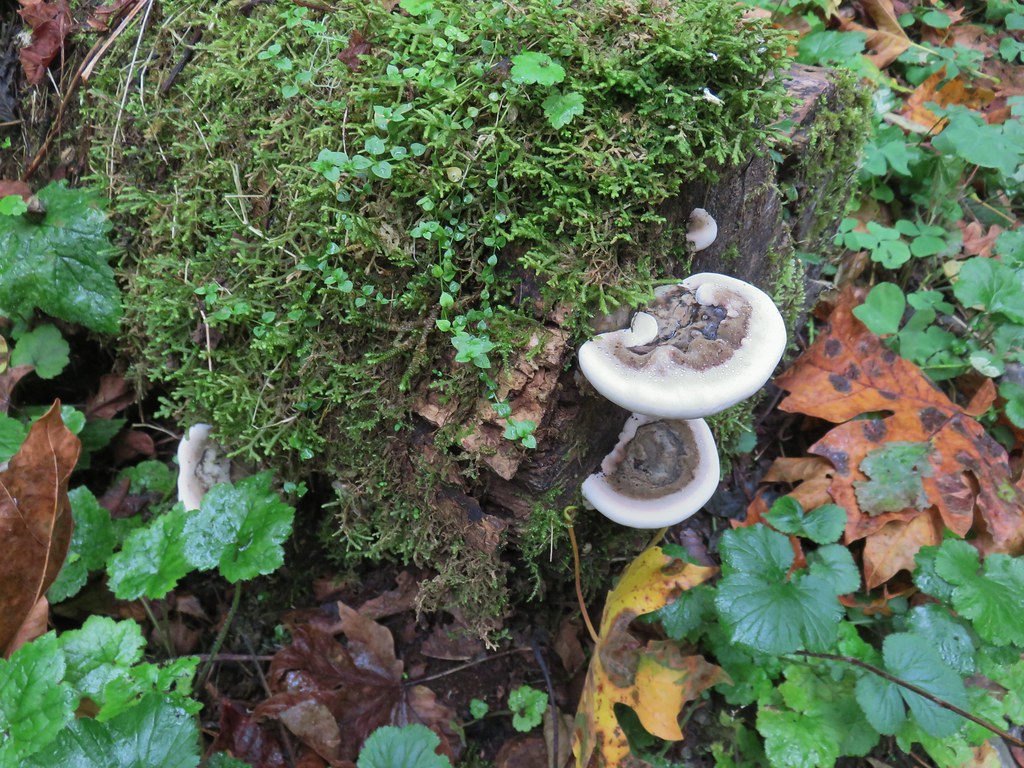
The next loop option came almost 2 miles from the Alder Trail when the Wildwood Trail crossed Firelane 1. There were some nice clumps of mushrooms along this stretch. There was also a damaged bridge near the middle of this section which there were several warnings posted for.
IMG_8024

IMG_8030

IMG_8032

IMG_8035

IMG_8037The bridge damage was not an issue.

IMG_8038Another bunch of musrhooms.

IMG_8046

Approximately a half mile before reaching Firelane 1 we passed the Morak Trail on the left (a 100 yard connector to Firelane 1 that is not shown on all maps).
IMG_8047

IMG_8050Firelane 1 junction.

With Heather still going strong we stuck to the Wildwood Trail arriving at the Nature Trail in another half mile.
IMG_8054

IMG_8055

We turned right and when the trail split a tenth of a mile later we stayed left (the right hand fork would have taken us to Firelane 1).
IMG_8056The fork, left was downhill right up.

The Nature Trail followed Rockingchair Creek downhill to Leif Erikson Drive in just over a quarter mile where we turned right back toward our car.
IMG_8056

IMG_8067

IMG_8064

IMG_8068

IMG_8073

IMG_8075

It had been busy when we had started our hike with the parking already nearly full but things had picked up even more since then. Even with it being busy there were moments where no one else was present along the 3.5 miles back to NW Thurman Street.
IMG_8076

IMG_8078Firelane 1

IMG_8081Somewhere along Leif Erikson there was supposed to be a view of Mt. St. Helens, Mt. Adams and Mt. Hood along the way but the clouds never burned off like the forecast had called for.

IMG_8083

IMG_8091The Alder Trail at Leif Erikson Dr.

IMG_8093An orange one-way marker along Leif Erikson Drive between the Dogwood and Wild Cherry Trail junctions.
For the most part people appeared to be doing a pretty good job of covering their faces and maintaining social distancing (at least better than following the one-way trail designations). It was another enjoyable hike in Forest Park and an encouraging outing for Heather’s foot. At some point we plan on returning to see Balch Creek and explore more of the park. Happy Trails!

Flickr: Forest Park 10/24/2020

Categories
Hiking Oregon Portland Willamette Valley

Maple Trail (Forest Park) and Tilikum Crossing – 12/14/2019

For our final outing of 2019 we combined a little hiking with a bit of Christmas Shopping by heading up to Portland for the day. Our plan was to do a pair of Sullivan’s featured hikes before visiting the Portland Saturday Market.

We started our morning at the 5,200 acre Forest Park for a 7.5 mile lollipop hike using the Maple and Wildwood Trails. Our hike started at the Lower Saltzman Road Trailhead

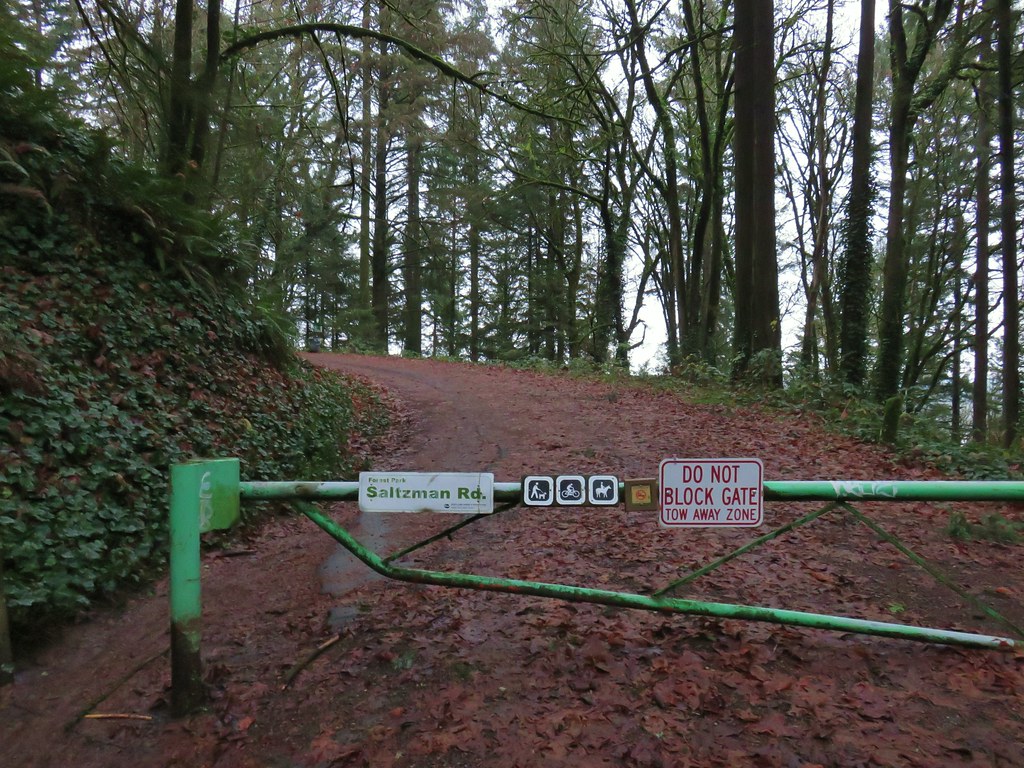
We were the second car at the small parking area where we set off past the green gate blocking further access to Saltzman Road.
IMG_1958

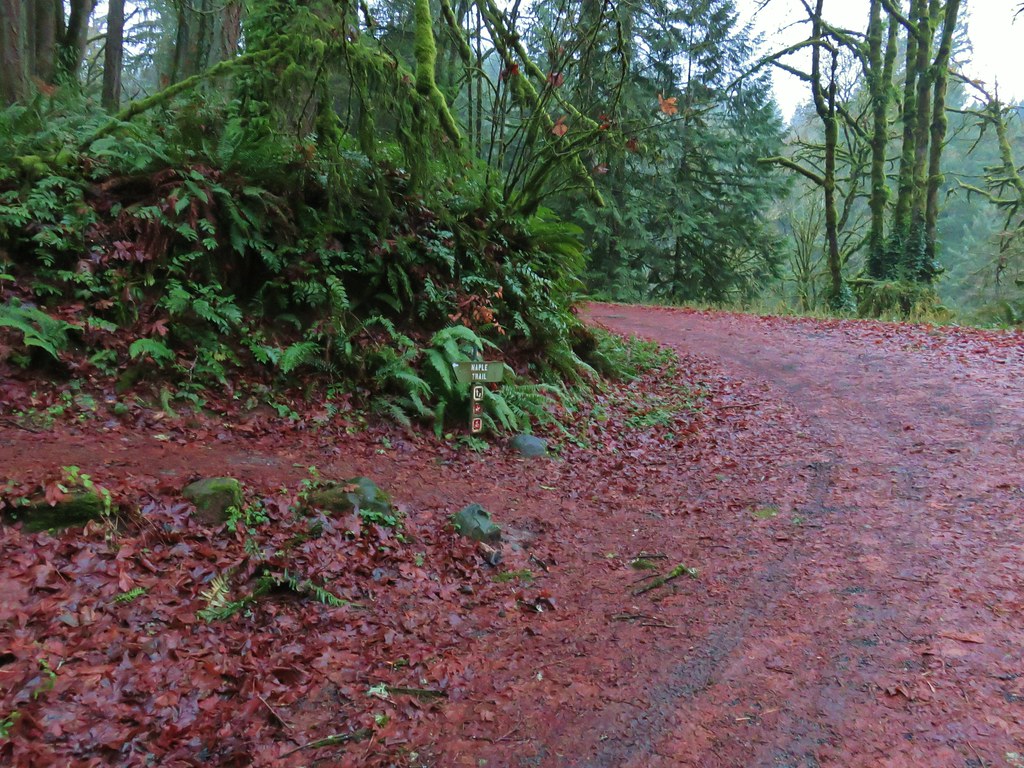
We followed the closed road for .4 miles to a junction where the Maple Trail crossed the road. Here we turned left onto that trail.
IMG_1961

IMG_1962

IMG_1965

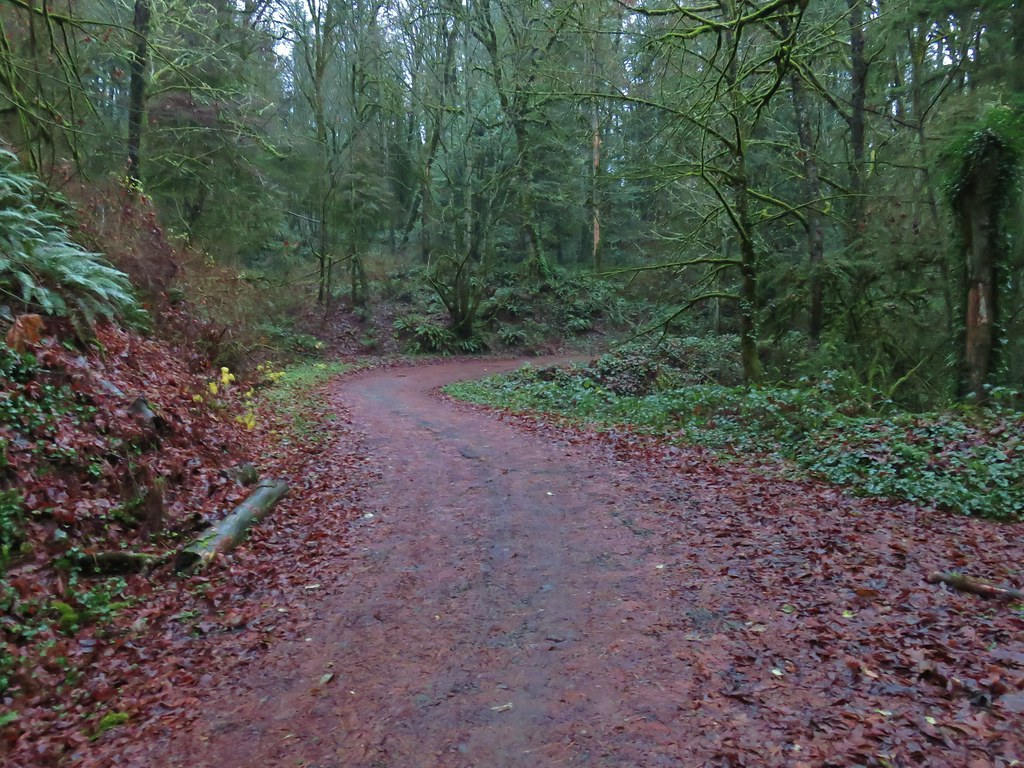
We followed this trail for a mile and a half, ignoring side trails, as we climbed gradually to Leif Erikson Drive. It was a cloudy morning and the forest was damp but it wasn’t raining which made for a pleasant walk amid the trees.
IMG_1968

IMG_1974

IMG_1975Bridge over a small stream.

IMG_1977Heading into a little bit of fog.

IMG_1981Too cloudy for any real views.

IMG_1983Leif Erikson Road.

We crossed the closed road and continued on the Maple Trail for another .4 miles to a fork where we veered right at a pointer for the Wildwood Trail.
IMG_1984

IMG_1989

A short climb brought us to the Wildwood Trail where we turned right and headed up some wooden steps.
IMG_1990

This was our third time on the 30 mile long Wildwood Trail (11/18, 5/18) and we followed it for 3.2 miles through a variety of scenery.
IMG_1992

IMG_1996

IMG_2006

IMG_2017

Along the way we crossed Saltzman Road.
IMG_2018Saltzman Road at the 2.5 mile mark of the 3.2 mile stretch.
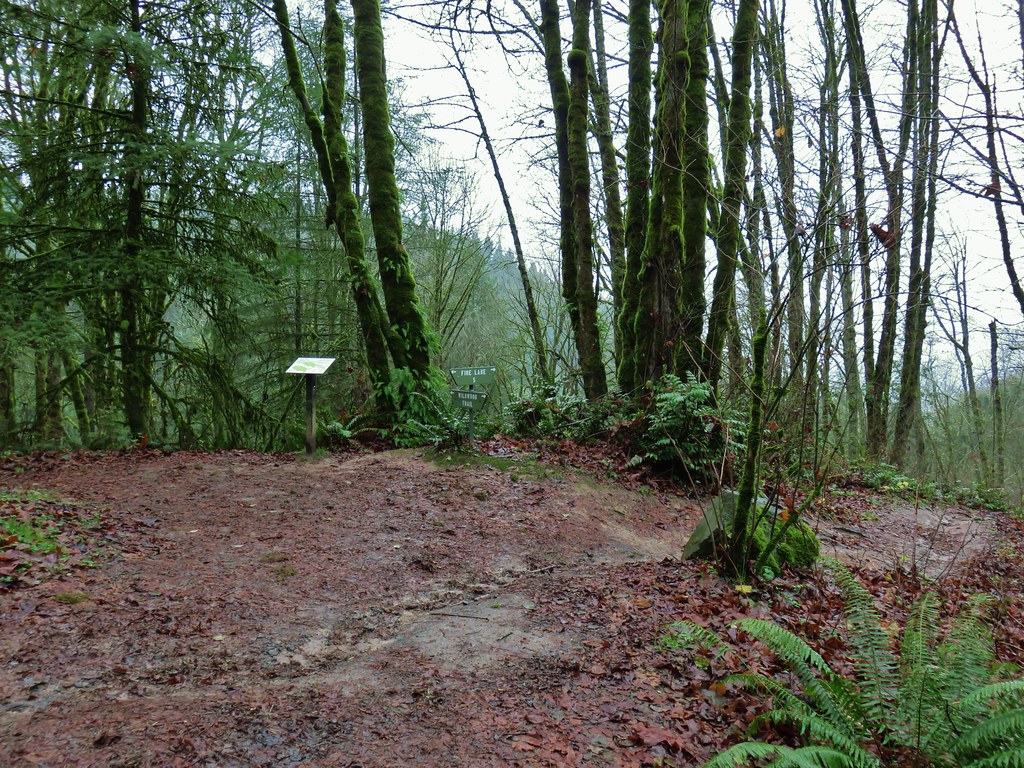
Approximately .7 miles after crossing Saltzman Road we turned right onto signed Firelane 5.
IMG_2022

This windy track was rutted by bike tires as it made its way downhill to Leif Erikson Drive after about half a mile.
IMG_2023

IMG_2025Aproaching Leif Erikson Drive.

We turned right onto Leif Erikson for .2 miles to a curve with a grassy flat on the left with a sign for the Maple Trail.
IMG_2027

IMG_2028

We followed the Maple Trail for 1.2 miles back to Saltzman Road where we turned left and hiked the .4 miles back to the trailhead. The forest along this section of the Maple Trail was nice and on a clearer day there may have been a few views but we settled for the trees and some passing geese.
IMG_2030

IMG_2032

IMG_2034

IMG_2035

IMG_2041

The trailhead was full when we got back so we quickly changed our shoes and opened up a spot for another trail user. We headed for downtown Portland for our next stop at Tom McCall Waterfront Park. We actually parked at a lot on the corner of 4th and Harvey Milk St. and walked 3+ blocks to the park.
IMG_2044

IMG_2050

The Saturday Market was just a bit to the left but we went right heading for the Morrison Bridge and planning on hitting the market at the end of our loop.
IMG_2045

There were almost as many geese as people in this section of the park.
IMG_2052

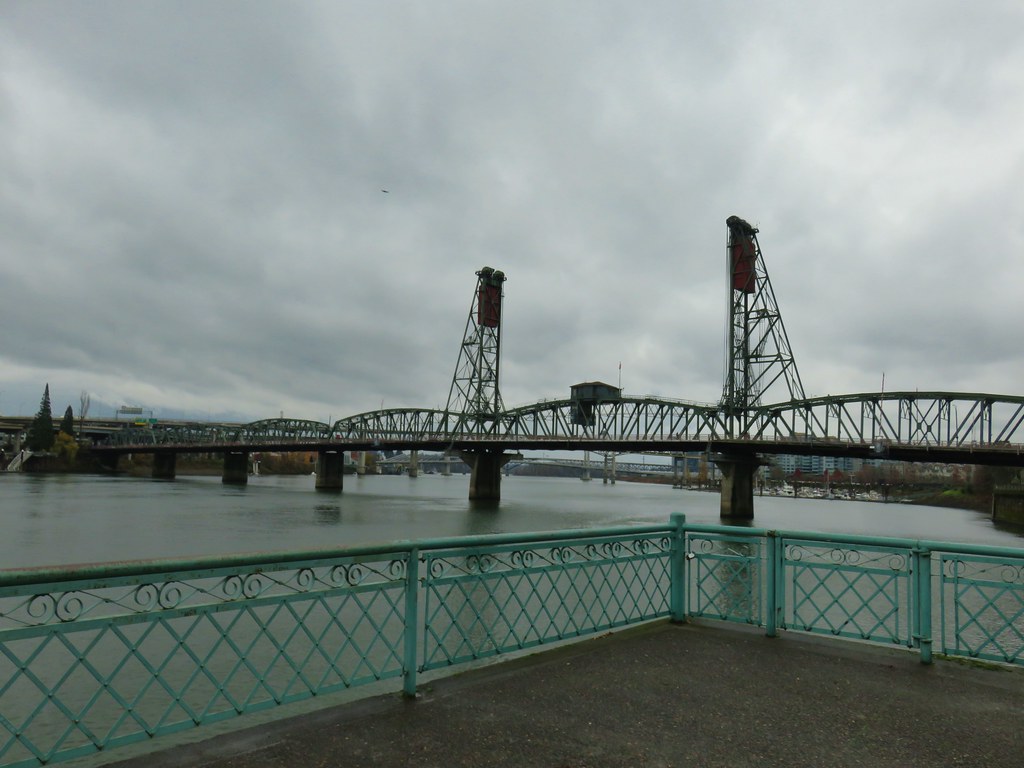
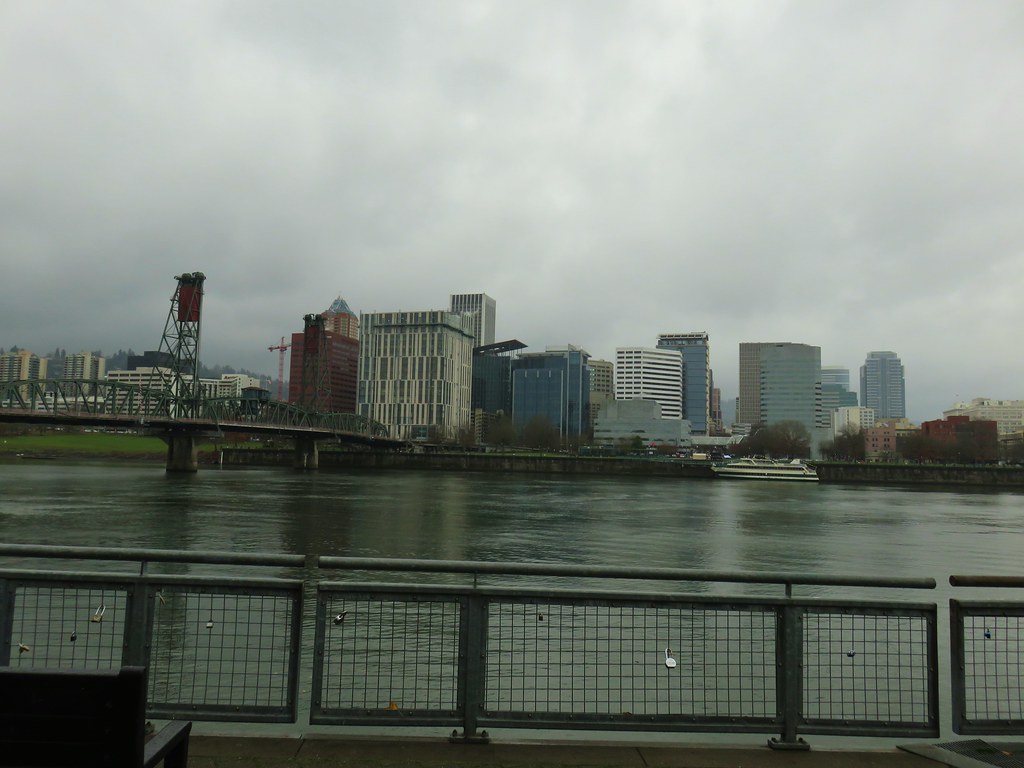
We followed the Waterfront Park Trail along the Willamette River under the Morrison Bridge and toward the Hawthorne Bridge.
IMG_2053

IMG_2056Hawthorn Bridge

IMG_2060

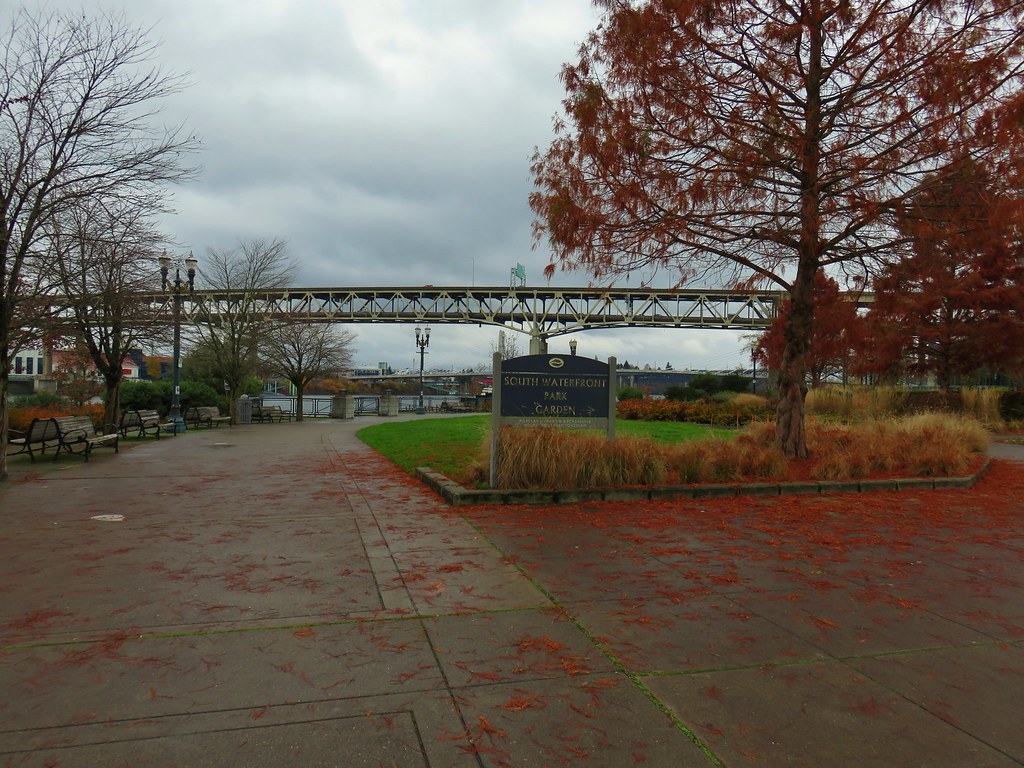
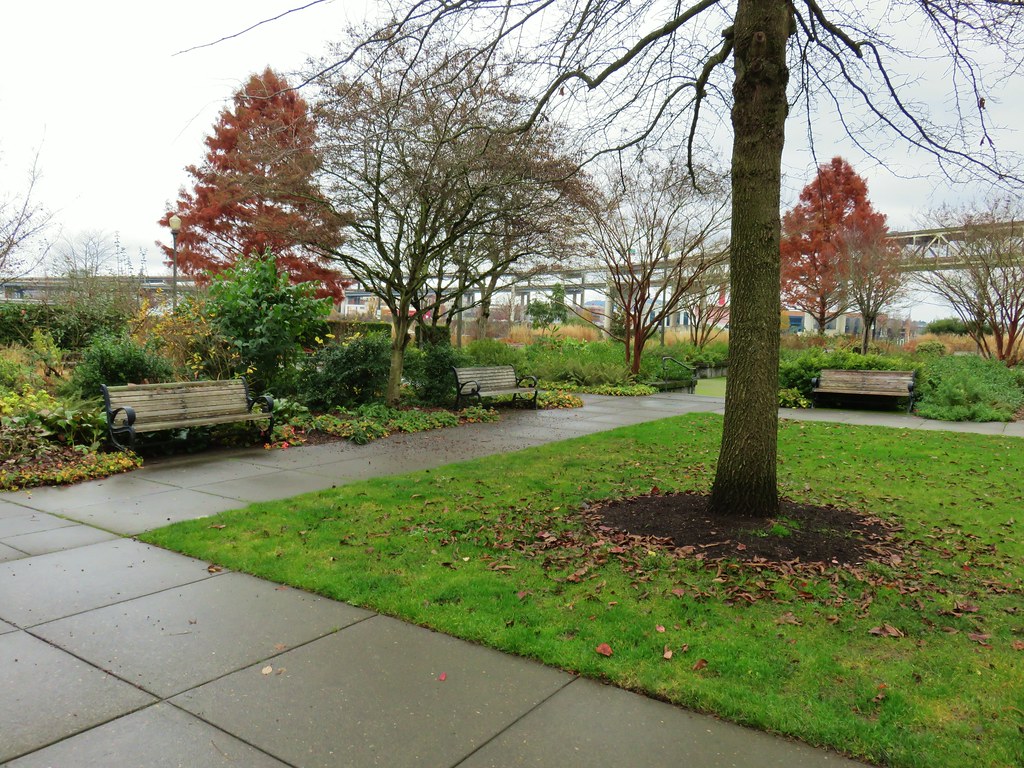
After about three quarters of a mile we passed through the South Waterfront Park Garden.
IMG_2062

IMG_2063

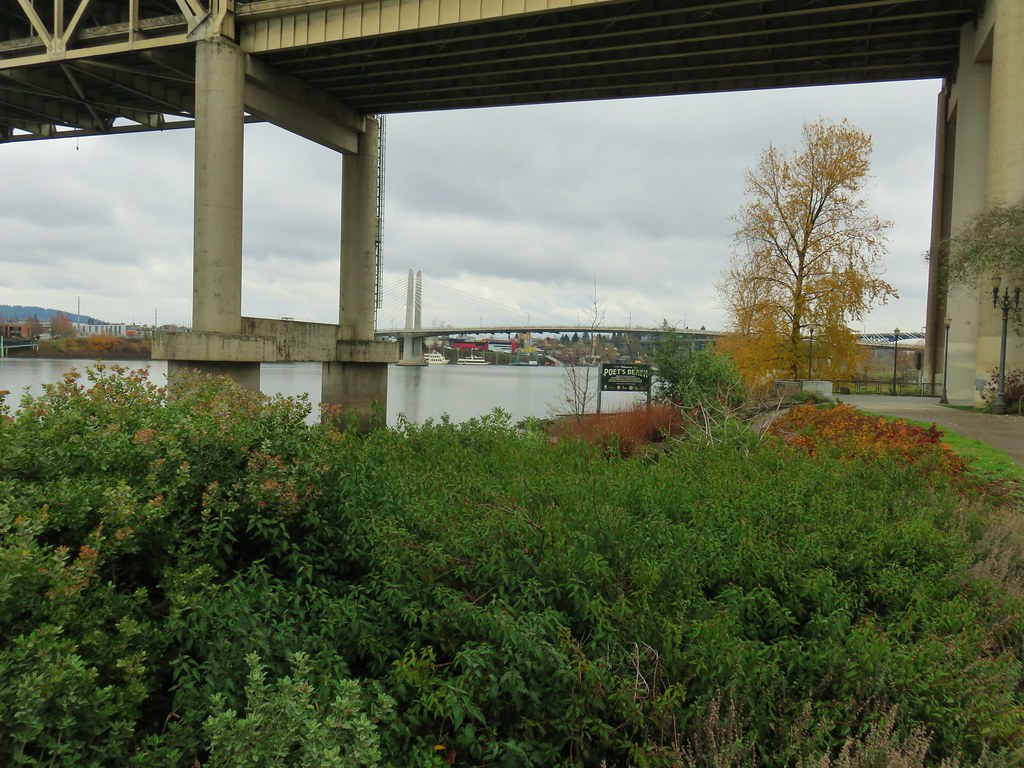
This was quickly followed by Poet’s Beach under the Marquam Bridge.
IMG_2068

IMG_2069

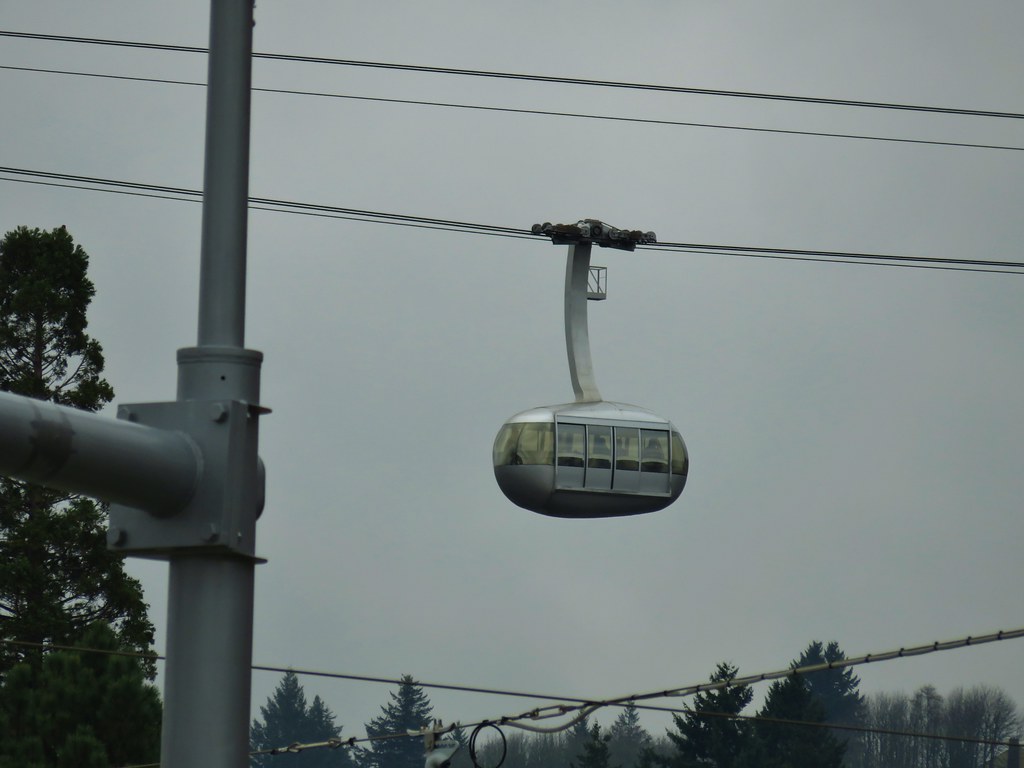
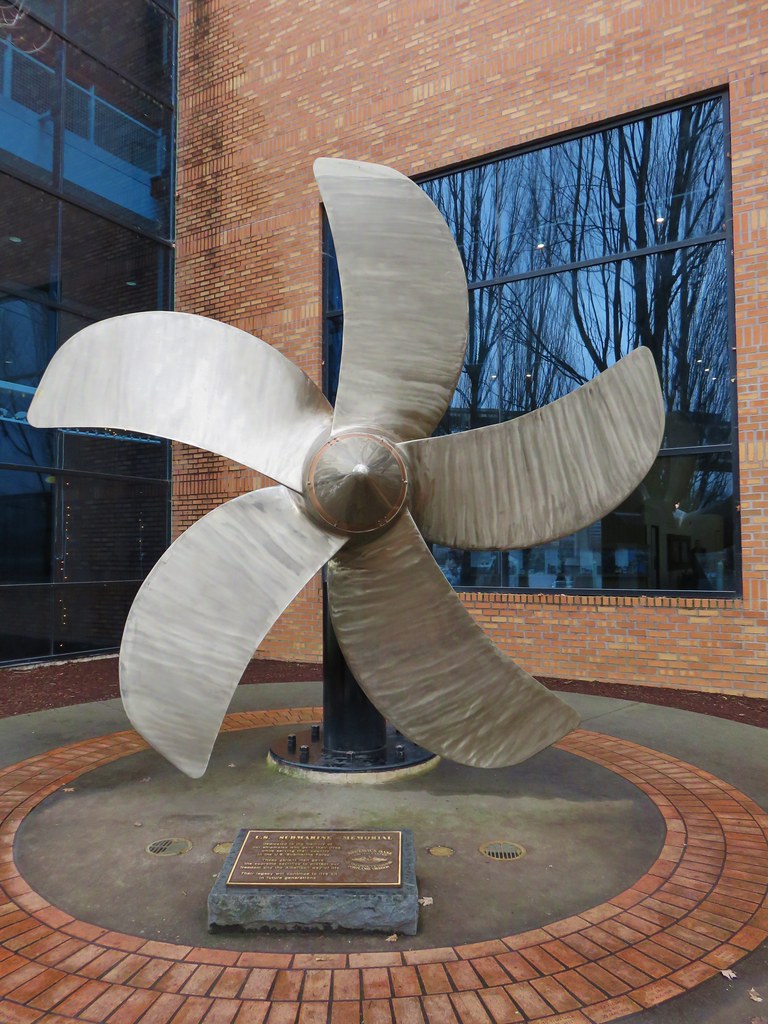
After passing under the Marquam Bridge we had a good look at OMSI and the USS Blueback Submarine on the far side of the Willamette and the OHSU Aerial Tram on our side of the river on Marquam Hill.
IMG_2073

IMG_2072

IMG_2071

IMG_2078

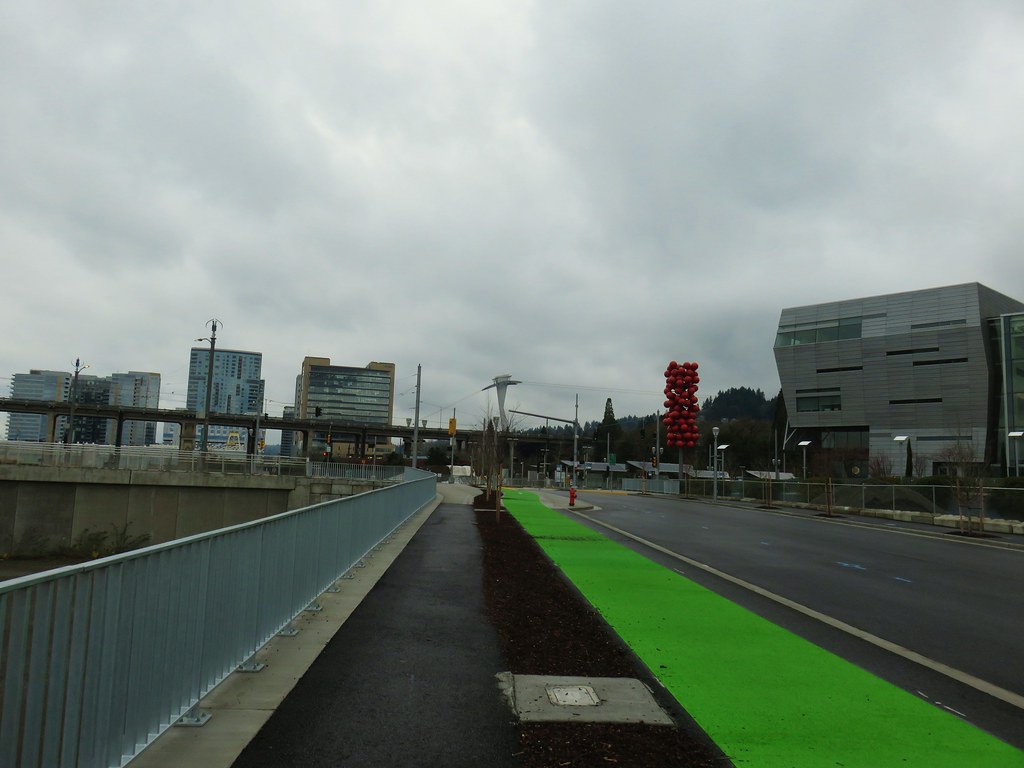
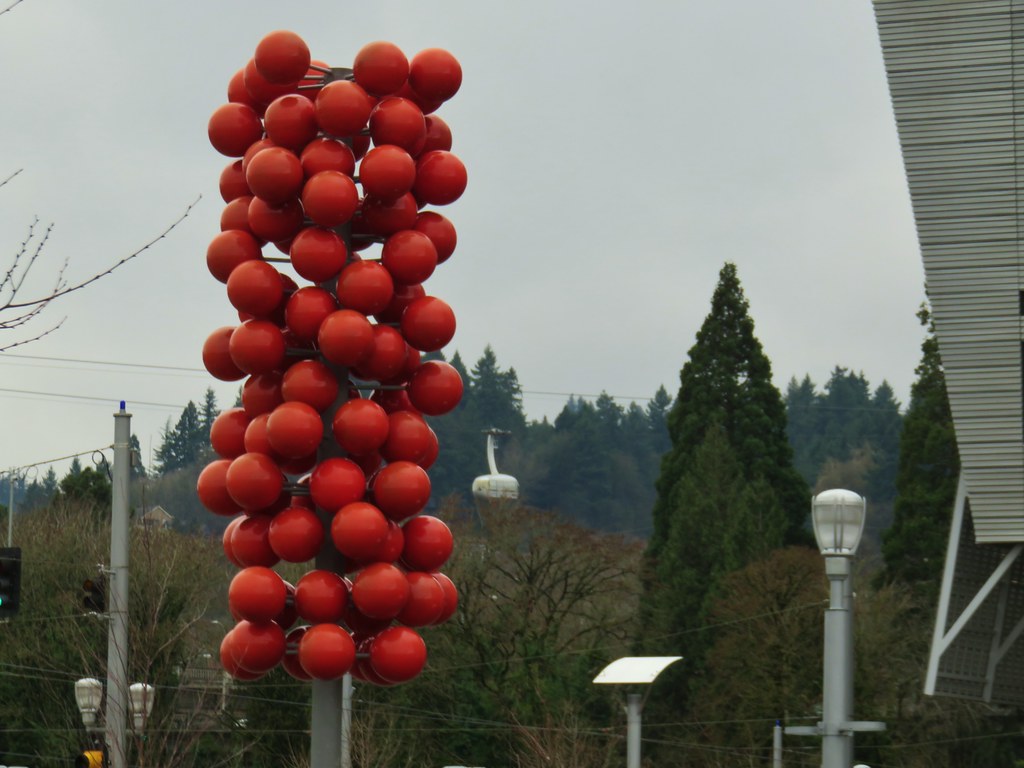
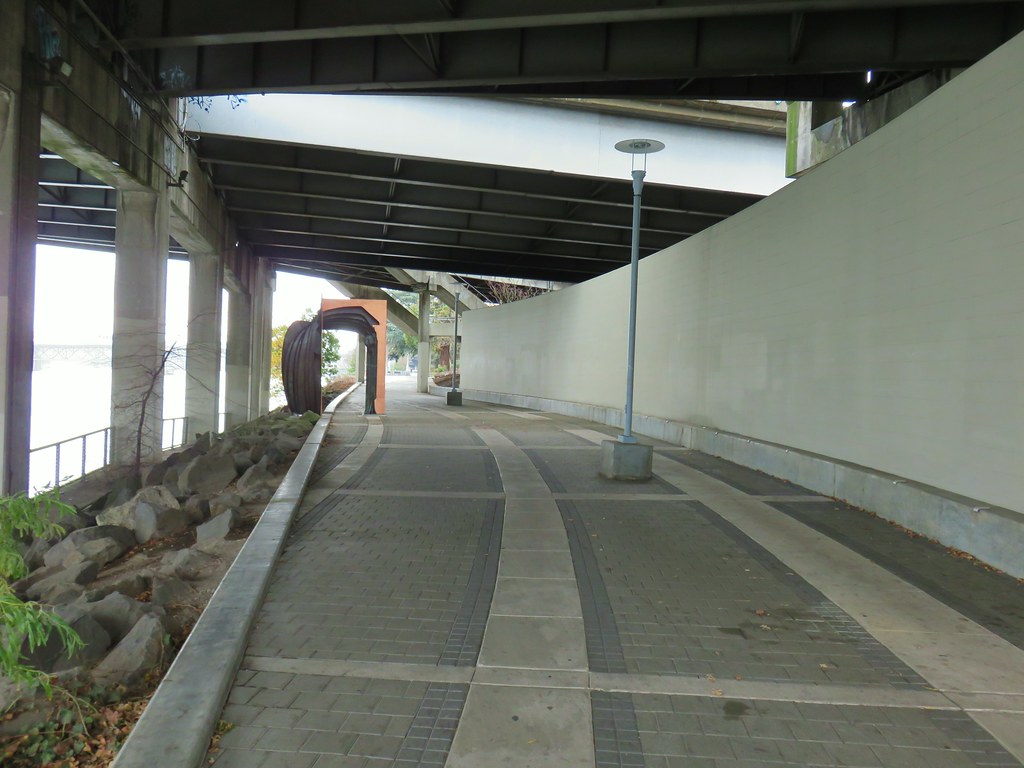
There was also an interesting piece of art near the Tilikum Crossing Bridge where we would be heading across the river.
IMG_2074

IMG_2076

The bridge was opened in September 2015 and is restricted to transit, pedestrian, and cyclist use only.
IMG_2080

IMG_2081

IMG_2083Marquam Bridge from Tilikum Crossing.

After crossing the river we turned left towards OMSI on the Eastbank Esplanade.
IMG_2085Tilikum Crossing from the esplanade.

We followed the Eastbank Esplanade for a total of 1.75 miles to the Steele Bridge. The scenery along this stretch was a bit more industrial with sections not too far from the Interstate, but there were still some interesting and pretty sights along the way.
IMG_2086Behind OMSI

IMG_2090More geese.

IMG_2091

IMG_2093

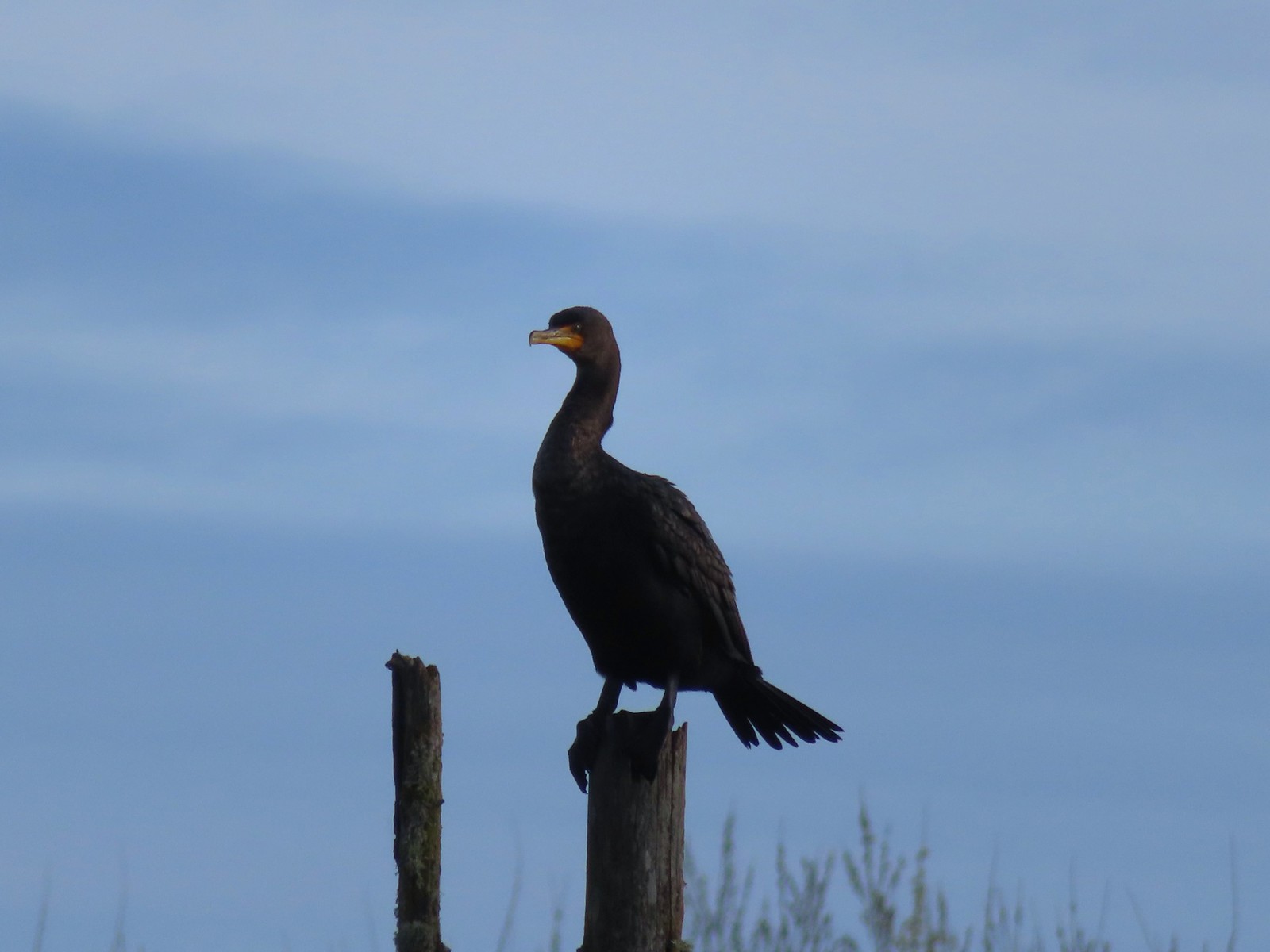
IMG_2094Cormorants

IMG_2097

IMG_2098

IMG_2103

IMG_2099

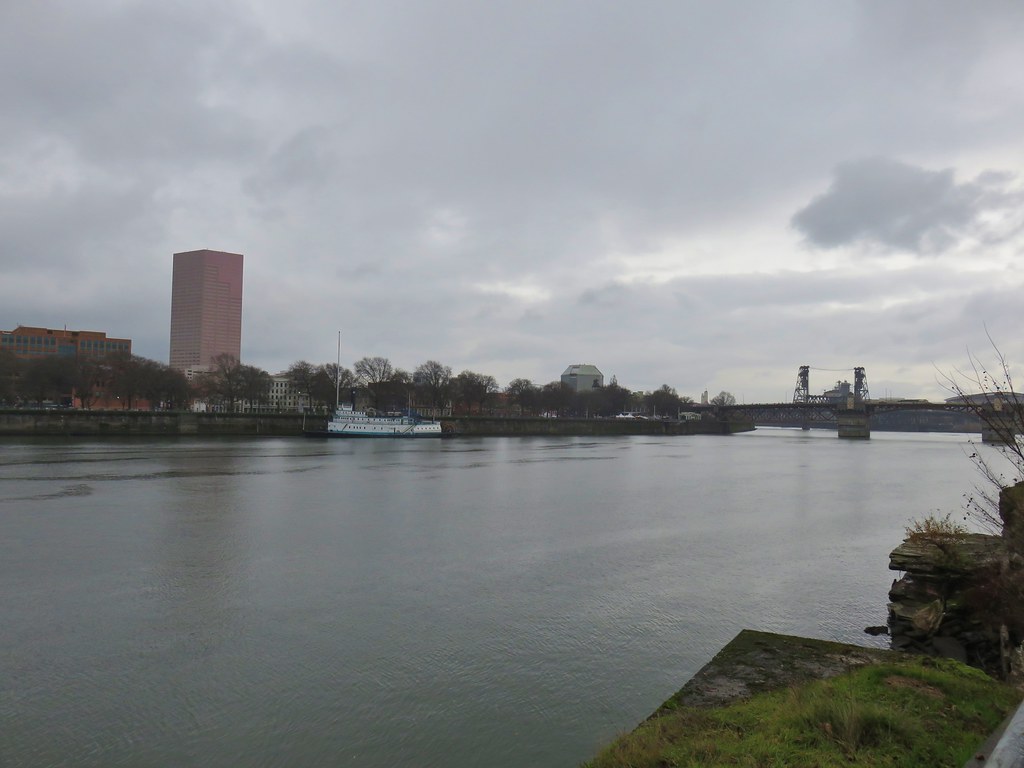
We recrossed the Willamette on the Steele Bridge arriving back at Waterfront Park near the Japanese American Historical Plaza and the Portland Saturday Market.
IMG_2106

IMG_2110

IMG_2112

IMG_2113

We wound our way through the market visiting all the booths before returning to our car and heading home. We did manage to find a couple of Christmas gifts so it had not only been a fun day hiking but it had been productive as well. We walked about 5 miles between the loop around the Willamette and the market which was just about as much as our feet could handle for the day.

That’s it for us as far as hikes go for 2019, we hope everyone has a Merry Christmas and Happy New Year! (and Happy Trails too!)

Flickr: Maple Trail and Tilikum Crossing

Categories
Hiking Oregon Portland Trip report Willamette Valley

Three Hikes on Sauvie Island

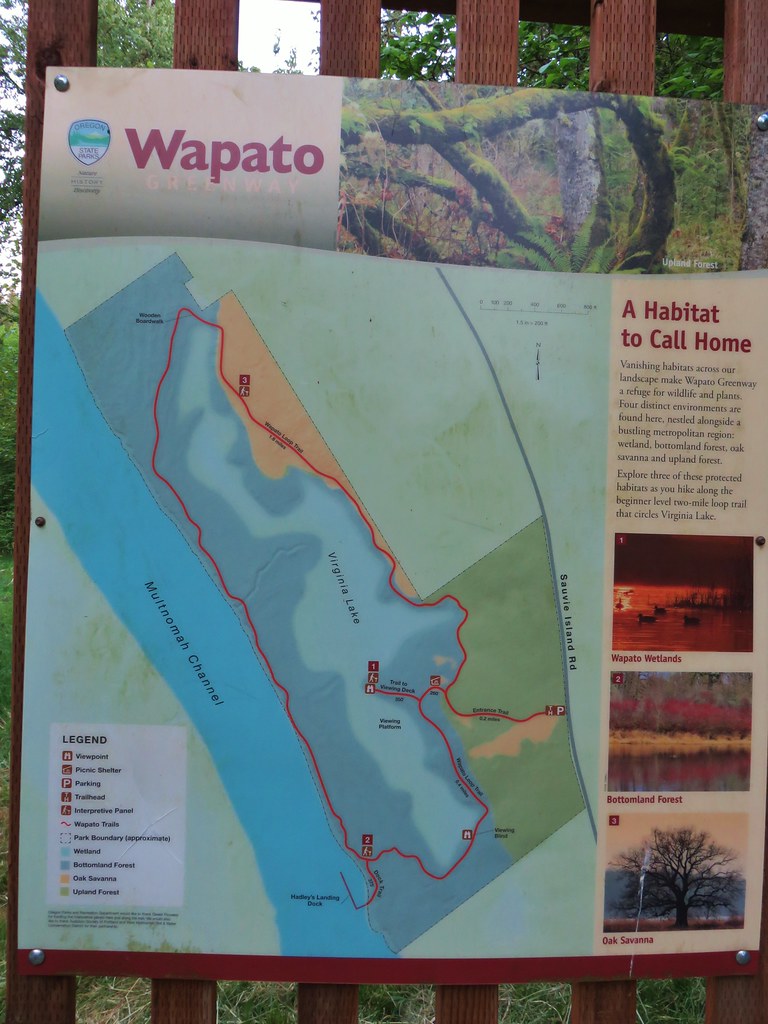
Our latest outing was a three stop trip to Sauvie Island in the Columbia River. After purchasing our $10/day parking permit online from the Oregon Department of Fish and Wildlife we headed for our fist stop at the Wapato State Greenway.
IMG_6537

Here a short loop trail passes around Virginia Lake and along the Multnomah Channel.
IMG_6539

We set off on the entrance trail which quickly split (not shown on the map). We veered left on a mowed path through some grass.
IMG_6542

Our plan had been to visit the viewing platform first thing but this left fork was not the true entrance trail and we wound up joining the loop trail a tenth of a mile south of the side trail to the platform.
IMG_6543

We turned left onto the loop trail deciding to visit the platform near the end of our hike instead.
IMG_6544

We passed a view of Virginia Lake and arrived at a viewing blind after a tenth of a mile.
IMG_6546

IMG_6547

Other than the occasional red-winged blackbird sighting we didn’t see anything from the blind on this morning. We continued on the loop ignoring a spur trail to Hadley’s Landing Dock just before arriving at the Multnomah Channel.
Multnomah Channel

The trail passed through woods with occasional openings to grassy meadows. There were a few woodland flowers here and there but the most interesting thing was the wildlife. We saw a lot of birds and couple of shy rabbits. Most of the birds were busy foraging in the bushes or flitting from tree to tree so we didn’t have a lot of luck with pictures. We did appreciate the many songs they were singing as they made their morning rounds.
IMG_6553

IMG_6557

IMG_6562

IMG_6571

IMG_6573

IMG_6574

IMG_6569Black-headed grosbeak

We also spotted what we at first identified as a pair of deer under a large oak.
IMG_6575

IMG_6577

As we watched them disappear into the brush we kept noticing more deer and ended up counting five of them.

After passing the picnic shelter we turned right down the side trial to the viewing platfrom.
IMG_6586

IMG_6587

IMG_6588

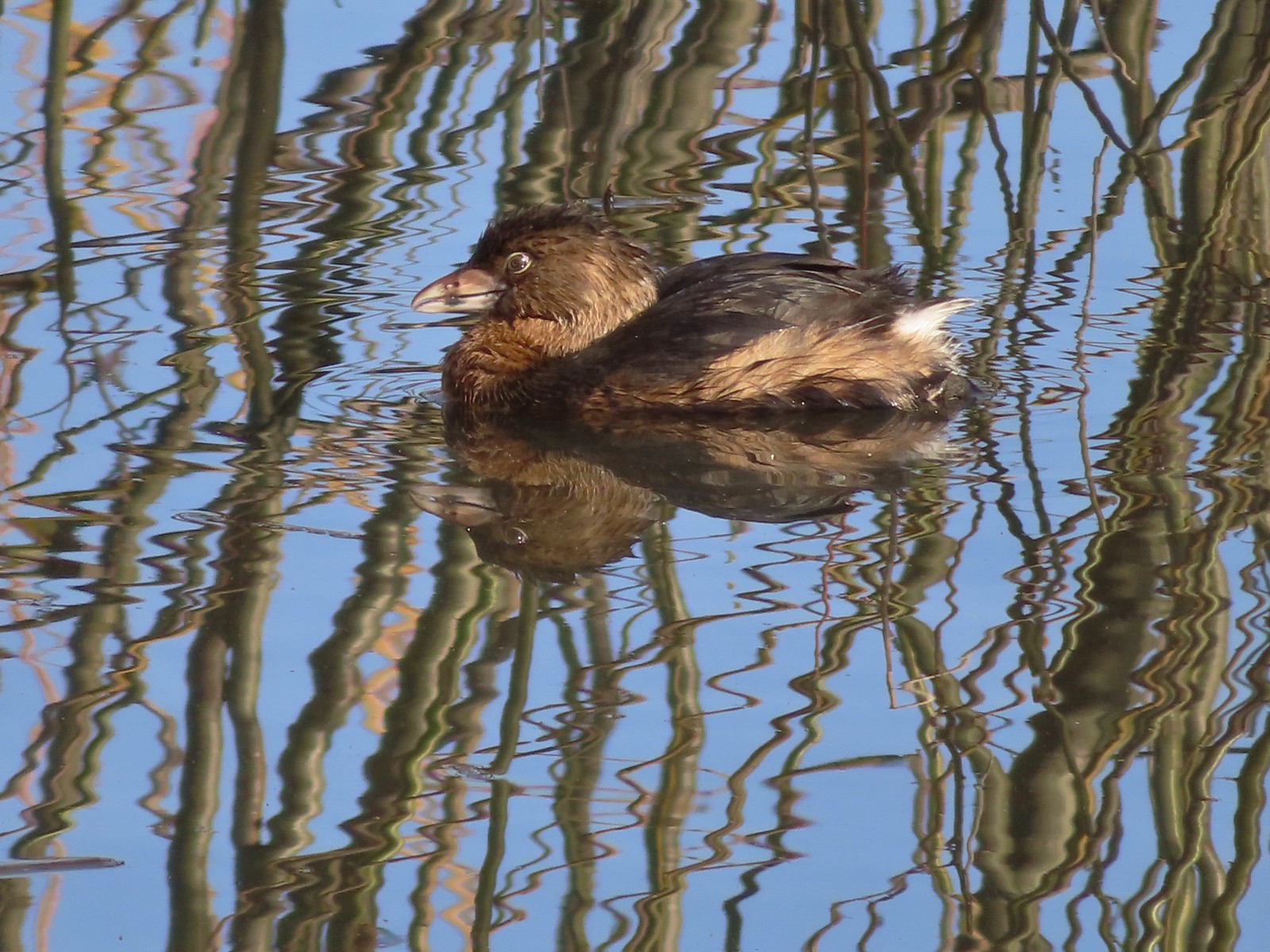
We had more luck with the wildlife from this viewpoint spotting a couple of different types of ducks, a great blue heron, and a pied-billed grebes.

IMG_6593

IMG_6595Mallards with a great blue heron in the distance.
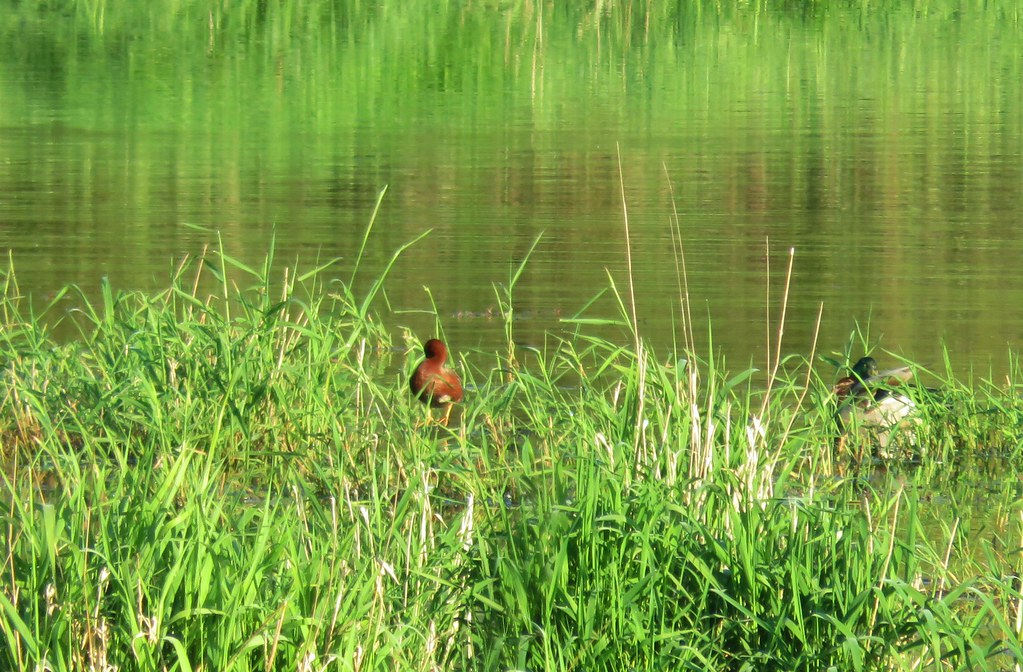
IMG_6608Cinnamon teal and a mallard

IMG_6604Pied-billed grebe

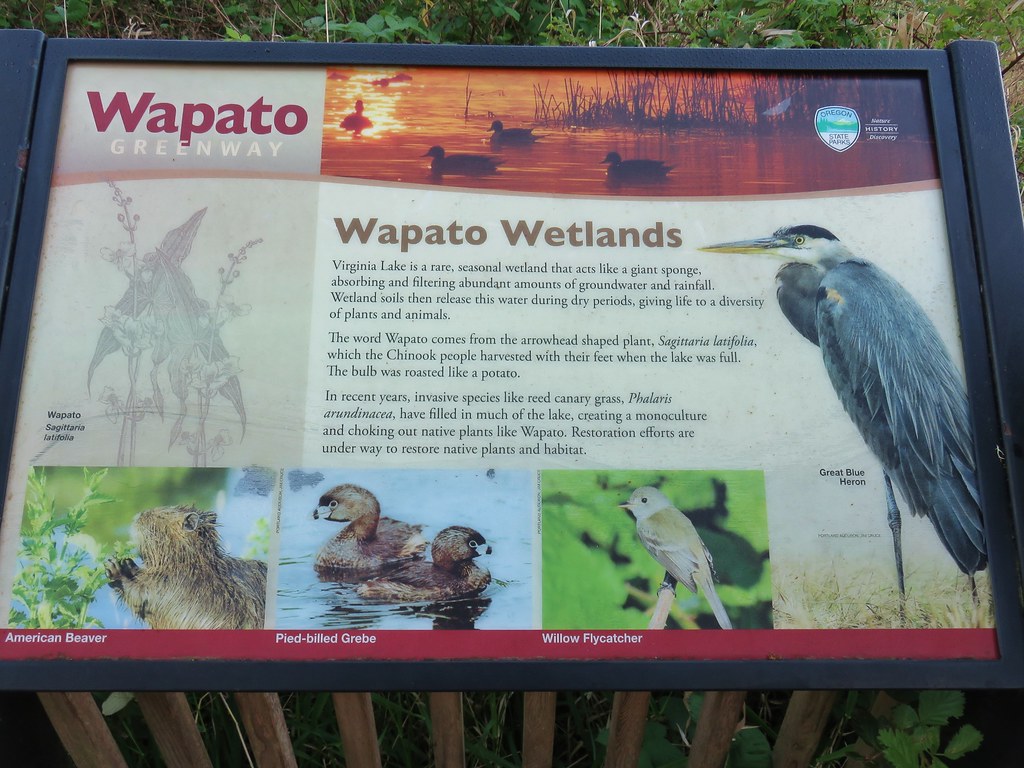
We had never heard of a pied-billed grebe and were wondering what it was. Then we took the time to read the interpretive sign at the platform.
IMG_6611

After leaving the platform we headed back to the car. Along the way we spotted another new bird to us. A Black-throated Gray Warbler. She was hopping around on the trail gathering something for a nest it appeared so the photos are a bit blurry.
IMG_6619

IMG_6626

Our second stop was at Oak Island,technically a peninsula. It is part of the Sauvie Island Wildlife Area and only open to hikers from April 16 through the end of September.
From the parking area a mowed path leads past a large signboard for .3 miles to the start of a loop.
IMG_6627

IMG_6629

The rabbits were a little less shy here.
IMG_6634

We had a few cattle cross our path prior to reaching the start of the loop as well.
IMG_6638

We actually missed the start of the loop which was marked by a post with a hiker symbol on it.
IMG_6639

We stayed straight on the obvious track past this sign as the path leading right was so faint we hadn’t noticed it. Continuing in this clockwise direction the trail leads through open grass with Steelman Lake to the west.
IMG_6640

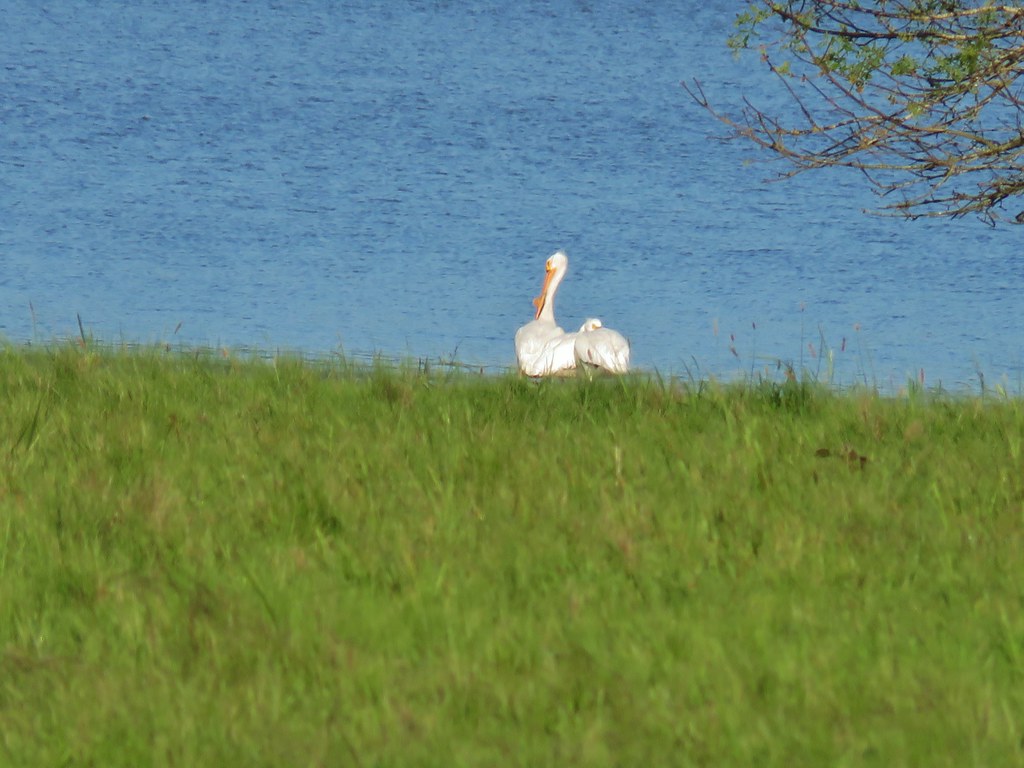
A number of great blue herons could be seen flying over the water and along the lakes shore we spotted a pair of white pelicans and a family of Canada geese.
IMG_6643

IMG_6645

The distinctive call of red-winged blackbirds was prevalent.
IMG_6647

After passing through a gate the grass grew taller and the trail began to turn away from Steelman Lake. Here there were many butterflies and a few blooming camas.
Nature Trial at Oak IslandLooking back at the gate.

IMG_6658

IMG_6653

IMG_6655

Just before turning south near Sturgeon Lake a .1 mile spur path to the left led to the narrows, a narrow channel connecting Steelman and Sturgeon Lakes.
IMG_6661Looking toward Steelman Lake from the Narrows.

IMG_6662The Narrows. Another lake, Mud Lake, is on the other side of the trees.
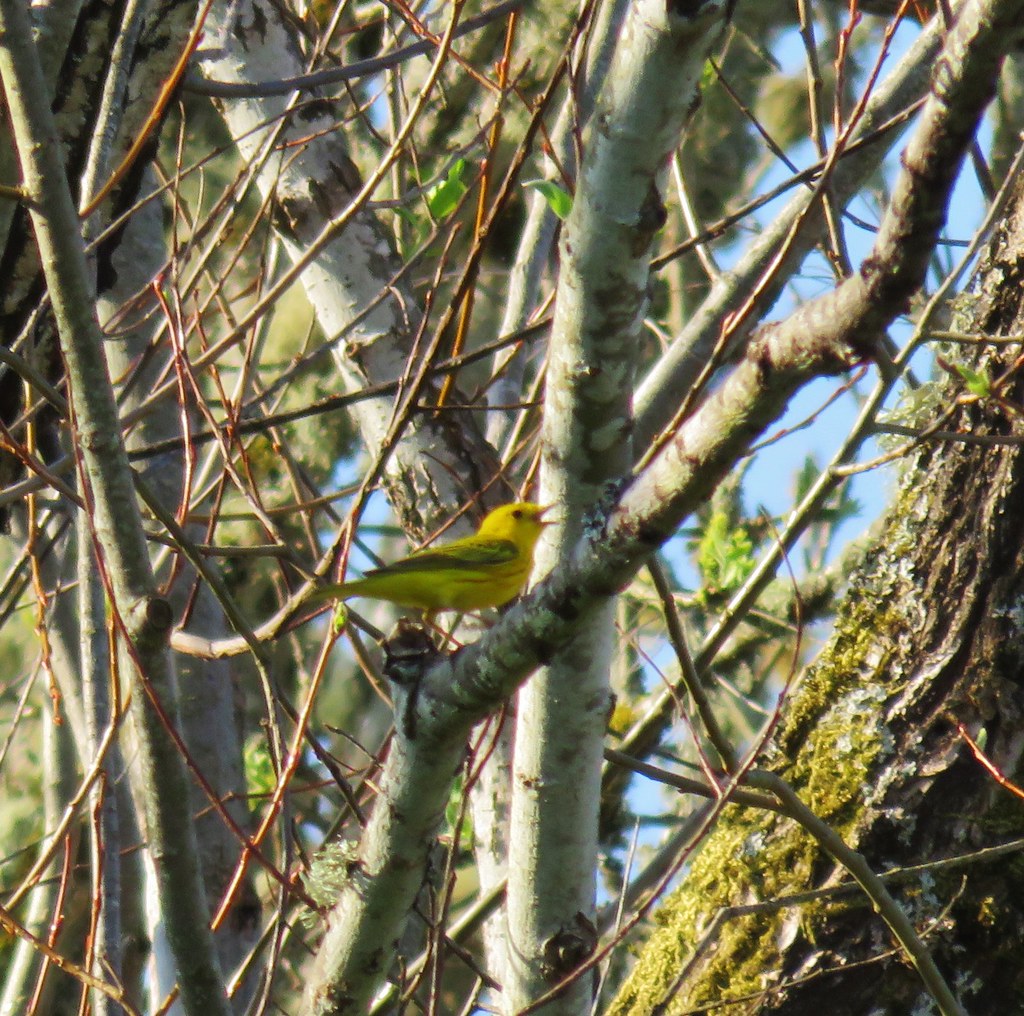
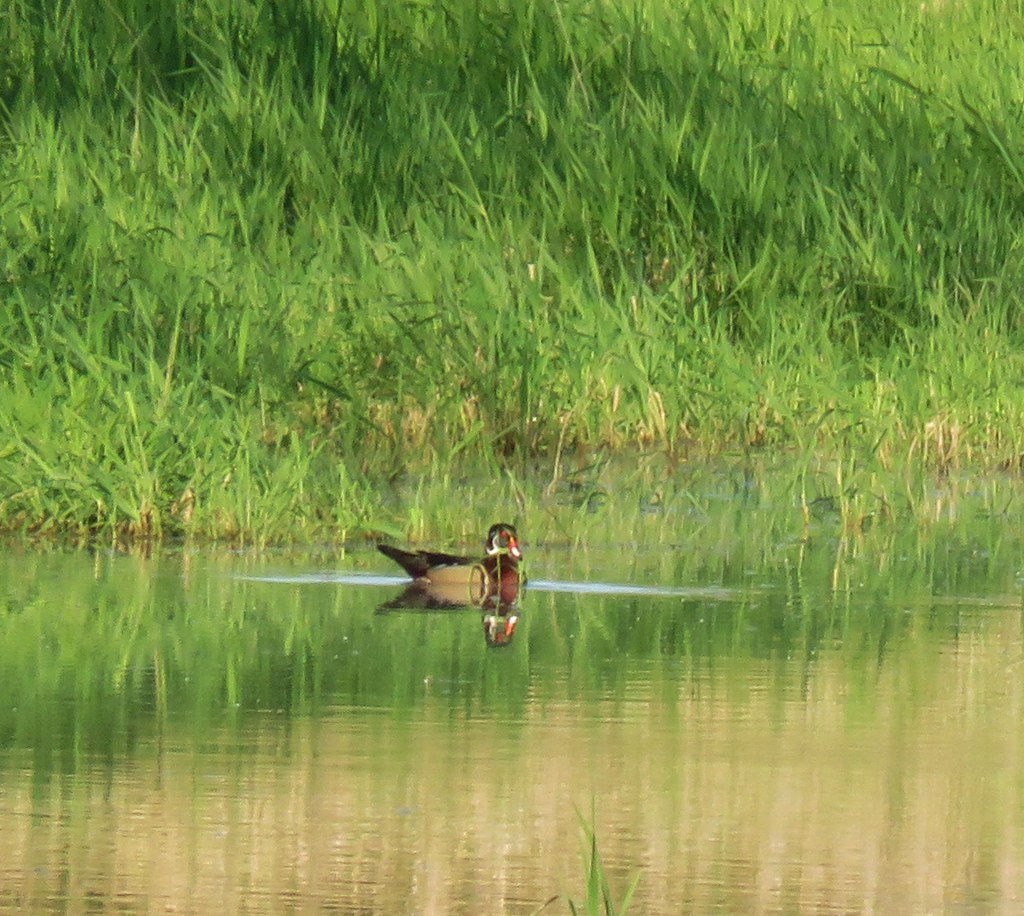
As we were returning to the loop we spotted a pretty yellow warbler and a wood duck.
IMG_6667

IMG_6669

Shortly after rejoining the loop Heather spotted a path down to a small beach along Sturgeon Lake where both Mt. St. Helens and Mt. Adams were visible but due to the lighting very hard to make out.
IMG_6671Mt. Adams (it is really there)

IMG_6676Mt. St. Helens

We had been similarly unsuccessful at getting a picture of Mt. Hood earlier from the Narrows. We finished up the loop and returned to our car ready to head to our final stop at the Warrior Point Trailhead. A coyote raced across the road near the parking are for the clothing optional Collin’s Beach. We’re not sure what it had been up to but it looked like it thought it was being chased. We had some fun imagining it had tried to run off with someones clothes.

After that excitement we parked at the trailhead and before setting off walked down the the sandy beach along the Columbia River.
IMG_6690

IMG_6692

As we began hiking a bald eagle flew overhead.
IMG_6694

The trail had occasional views of the River as well as Mt. St. Helens which was now a little easier to make out.
IMG_6703

IMG_6699Mt. St. Helens and an Osprey nest.

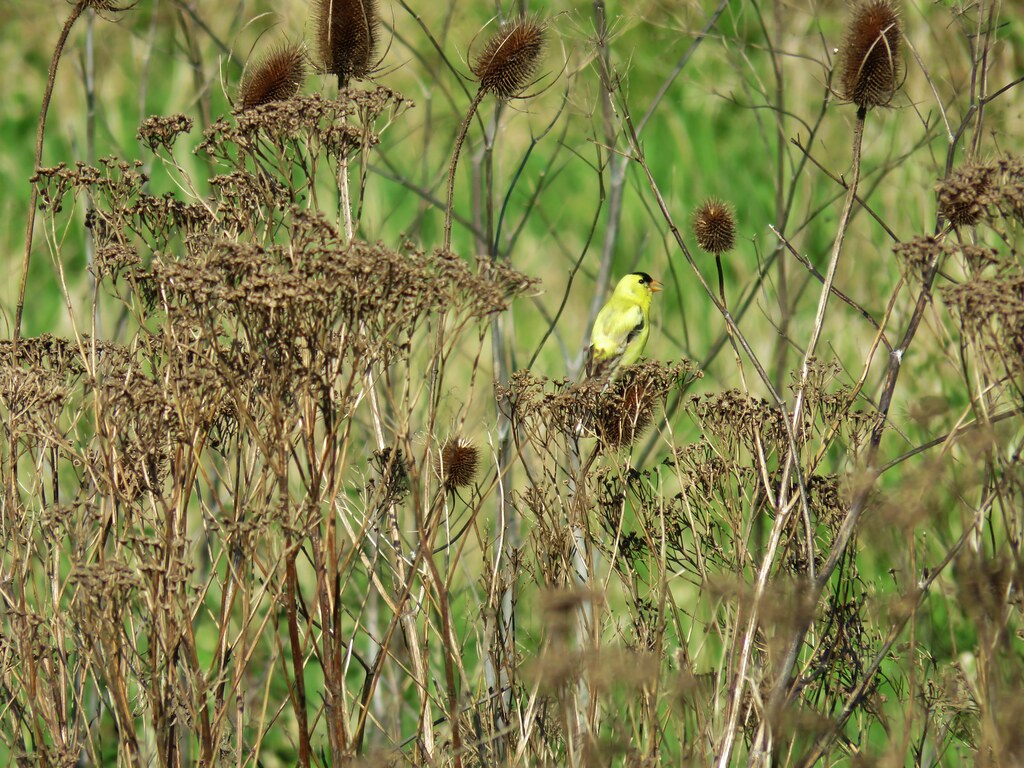
Our visit to the Island had already been on of the most diverse for birds and the Warrior Rock Lighthouse Trail just added to this. After the bald eagle and osprey we spotted a pair of American goldfinches.
IMG_6705Female

IMG_6712Male

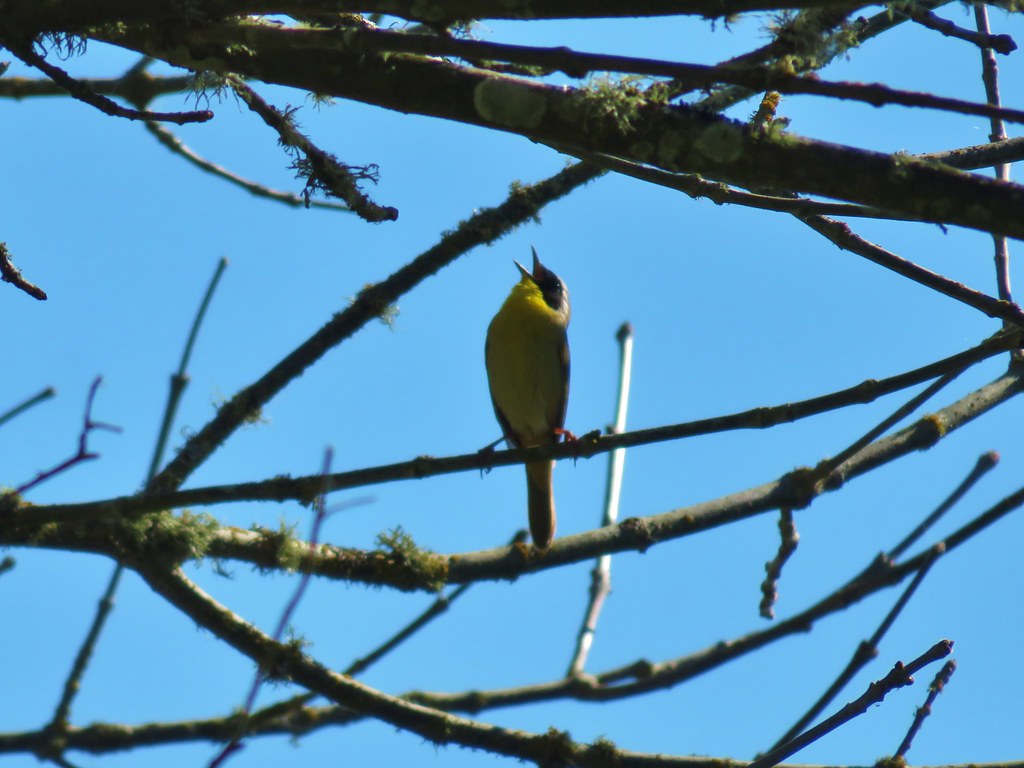
These were followed by a Bullock’s Oriole and a yellow throated warbler.
IMG_6734

IMG_6742

The trail itself varied as it spent some time in the woods, some along the river, and other passing through tall grass.
IMG_6727

IMG_6729

IMG_6747

Considering the combination of grass, nearby water, and warm sunshine it seemed like the perfect conditions for snakes but we only spotted one.
IMG_6748

IMG_6752

After three miles we arrived at a sandy beach near the Warrior Rock Lighthouse

IMG_6753Mt. St. Helens again.

IMG_6754

IMG_6755

After a short rest on the beach we continued north on the sand to an old concrete gun mount.
IMG_6756

IMG_6759

This is where things got a little interesting. Our guidebook said to turn inland here on a small access road to a T-shaped junction. The map accompanying the description on Oregonhikers.org appeared to show the track continuing north from this point along the river. We couldn’t see any sign of the small access road so we continued north along the beach until it was no longer possible. We faced the choice of backtracking or following a faint path inland to try and connect to an old road bed that would take us to Warrior Point. We headed inland.
IMG_6763

There was a faint path, we’re guessing it was more of a game trail than anything but it wouldn’t have been too hard to follow except for all the blackberry bushes. We managed to push through what turned out to only be a tenth of a mile to arrive at the grassy road bed.
IMG_6768

A brief detour right led us to a viewpoint at Warrior Point of the town of St. Helens.
IMG_6765

IMG_67671905 Columbia County Courthouse

We followed the old road bed back from Warrior Point for a half mile where it met the Warrior Point Trail near the beach at the lighthouse.
IMG_6769

We had only seen a handful of other hikers all day but on the way back to the car (it was only now a little after 11am) we passed a number of people heading toward the lighthouse. We were once again thankful to have gotten an early start.

Our distances for the day were 2.6 miles at Wapato Greenway, 3.3 miles at Oak Island, and 7.3 miles at Warrior Point for a total of 13.2. It had been a great day for wildlife and another enjoyable set of hikes in the Portland area. Happy Trails!

Flickr: Sauvie Island Hikes

Categories
Hiking Oregon Portland Trip report Willamette Valley

Camassia Natural Area, Mary S. Young Park, and Tryon Creek State Natural Area

We continue to be impressed by the number and variety of urban hikes in the Portland-metro area. On our most recent outing we visited three more areas near West Linn and Lake Oswego.

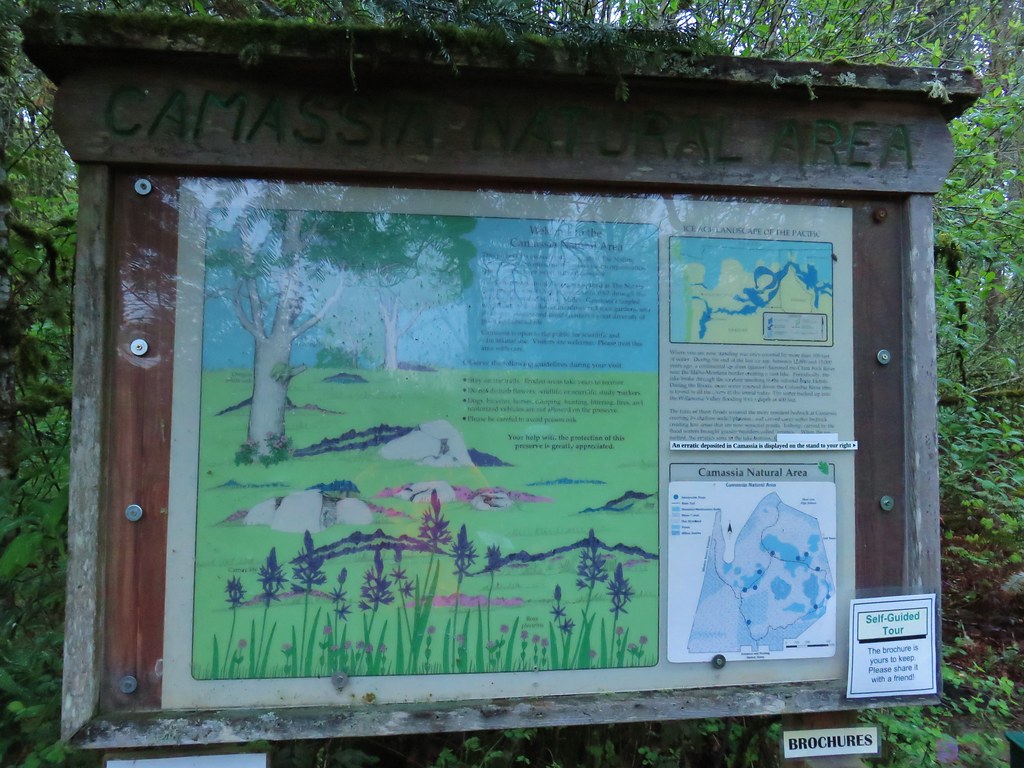
We started our day in West Linn at the Camassia Natural Area just before 7am. Our hike started from the trailhead at the end of Walnut Street.

Camassia Natural Area

A few feet from the trailhead is a signboard and the start of a loop.

Camassia Natural Area Trailhead

Camassia Natural Area Map

We picked up a guide brochure and started the loop by heading left (clockwise).

Camassia Natural Area

The woodlands here were full of white flowers including trillium, giant fawn lilies, and giant white wakerobin.

Trilium

Giant fawn lilies

Giant white wakerobin

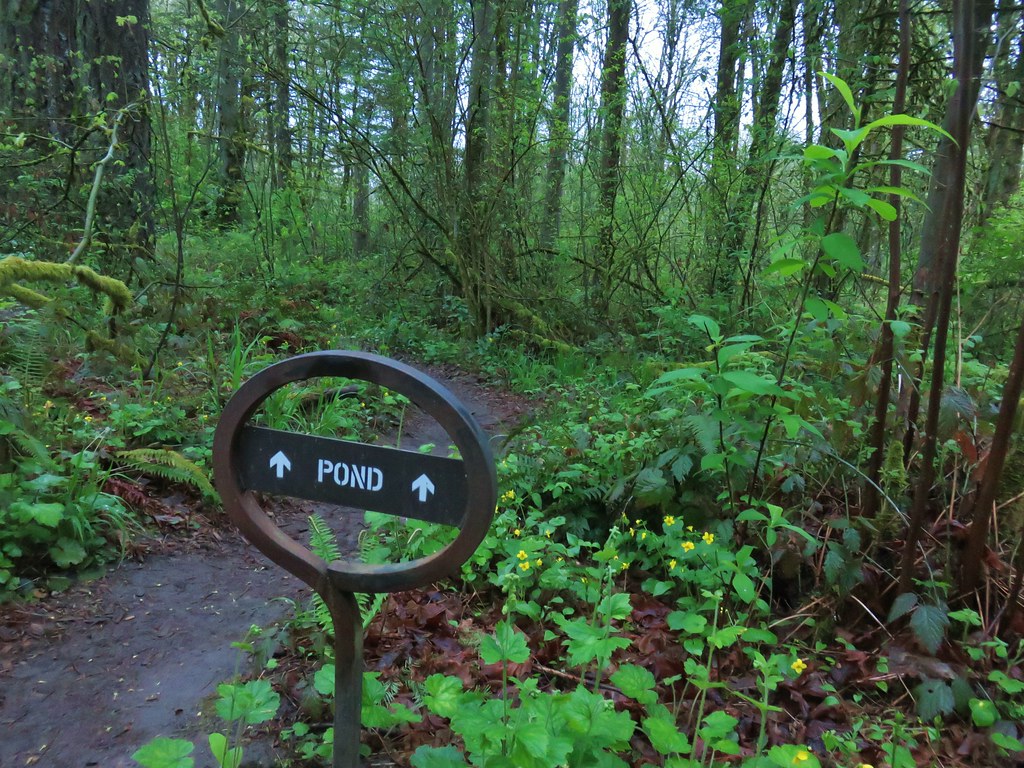
We detoured to the right briefly at a “Pond” sign which led down to a very muddy wet area.

Camassia Natural Area

Pond at Camassia Natural Area

Continuing on the loop the next brief detour was to the left at a pointer for Wilderness Park.

Camassia Natural Area

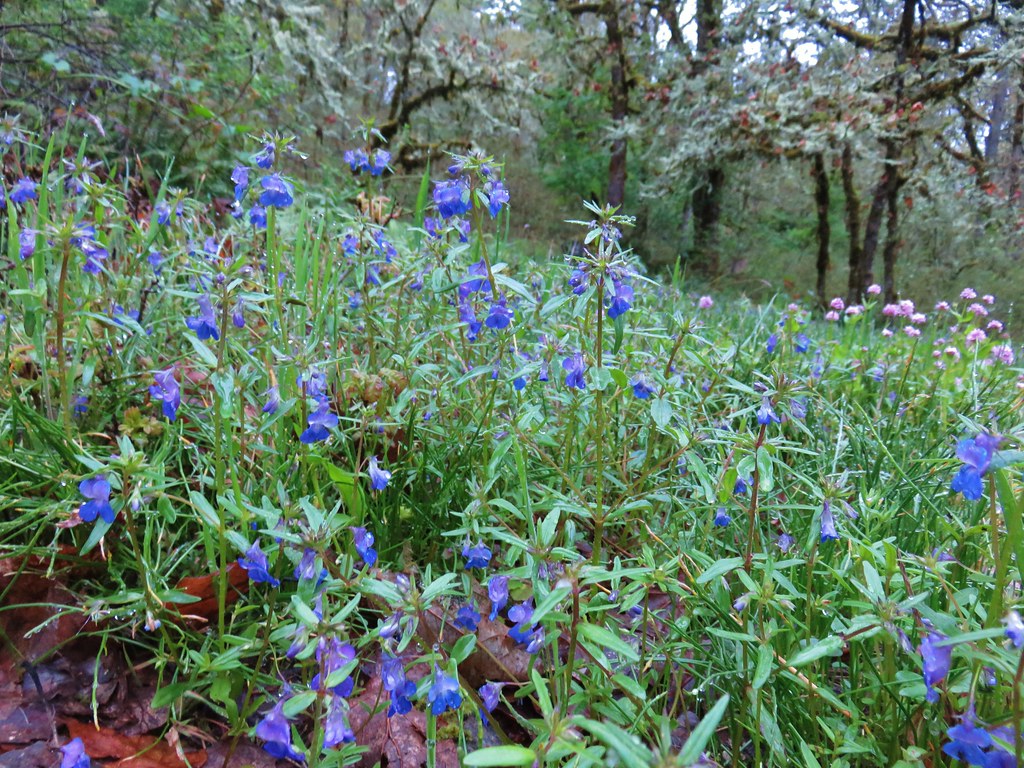
We followed this path a short distance to a small wildflower meadow full of giant blue-eyed mary and rosy plectritis.

Giant blue-eyed mary

Plectritis

As we were returning to the loop trail Heather spotted an animal moving in a meadow below. As we headed toward the meadow on the trail we were excited to find out what was roaming the meadow. As it turned out our first wildlife encounter of the day was a domestic cat.

Camassia Natural Area

Cat at Camassia Natural Area

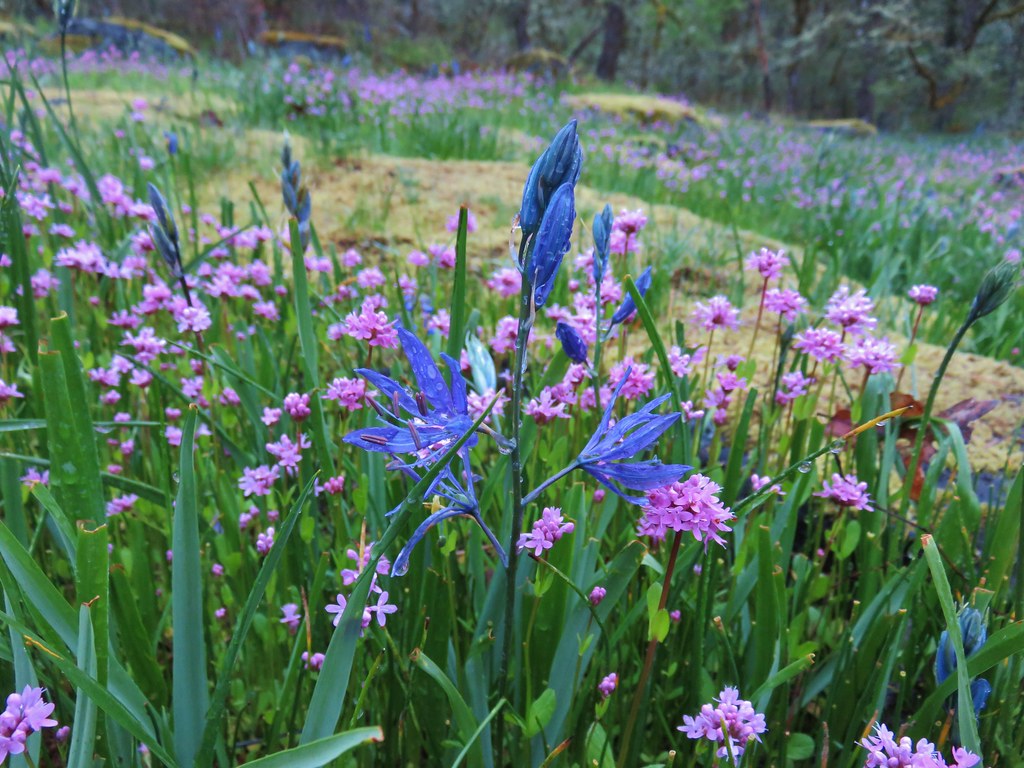
We were still a week or two early for the bulk of the flowers, especially the camas, but again this meadow had a nice showing of the plectritis and blue-eyed mary.

Camassia Natural Area

Camas and plectritis

One of the few open camas blossoms.

Plectritis

The trail passed through the meadow and into an open oak woodland where we detoured to the right to an overlook of a large pond.

Camassia Natural Area

Pond in Camassia Natural Area

At a “High School” pointer in another meadow we left the loop trail again.

Camassia Natural Area

This path led past some nice flower displays to a marshy wetland.

Wildflowers in Camassia Natural Area

Plectritis and giant blue-eyed mary

Bog in Camassia Natural Area

The Oregonhiker field guide mentions that this wetland is “one the best areas in the northwest to see Great Camas“. We were too early to see much in the way of camas but we did spot a lone stalk blooming near the far end of the wetland.

Giant camas

On our way back to the loop trail we spotted a hairy woodpecker working on finding its breakfast.

Hairy woodpecker

The loop trail descended a set up steps and soon entered a rockier meadow with more flowers including some Oregon saxifrage which was still unfolding.

Camassia Natural Area

Camassia Natural Area

Wildflowers in Camassia Natural Area

The trail then led to a viewpoint atop a cliff next to some madrones.

Madrones in Camassia Natural Area

Camassia Natural Area

More wildflowers followed before the trail reentered the woods.

Giant blue-eyed mary

Plectritis meadow

Camassia Natural Area

We passed a point for the Bridge Trail which headed downhill toward the high school parking lot and came to a viewpoint of Mt. Hood. Well what would have been a view of Mt. Hood on a clearer day anyway.

Camassia Natural Area

Looking toward Mt. Hood on a cloudy morning

One final patch of camas awaited before we completed our mile loop here.

Camas

For our next stop we headed north on Highway 43 (Willamete Dr.) to Mary S. Young Park. A joint effort between the city of West Linn and Oregon Parks and Recreation Department the park sits on the bank of the Willamette River and offers many activities. We began our hike from the trailhead at the parking lot at the end of the park entrance road.

Mary S. Young Park Trailhead

There were no brochures available with maps so we took a photo of a map off a signboard near the parking lot which turned out to be extremely helpful due to a serious lack of signage along the trails. We set off on the paved Riverside Loop Trail near the northern end of the parking lot. After a few feet we veered left on a wide unpaved path between picnic tables.
Mary S. Young Park

The woods here were filled with large trillium flowers of varying color.

Trillium

Trillium

Trillium

After crossing over the Trillium Trail we turned right at a T-shaped junction on the Turkey Creek Trail. This trail led downhill to Turkey Creek.

Turkey Creek Trail

Turkey Creek Trail

Turkey Creek Trail

After about a quarter mile the Turkey Creek Trail ended at the paved Riverside Loop Trail where we turned left. We stayed right at a fork and headed downhill to the Cedar Island Trail.

Mary S. Young Park

We veered left onto the muddy Cedar Island Trail even though we knew that the recent heavy rains had swollen the Willamette enough that access to Cedar Island itself would be cut off.

Willamette River

Riverside Loop Trail

Rabbit hopping into the brush on the left side of the Cedar Island Trail

Looking at Cedar Island

Cedar Island

After taking a look at Cedar Island we turned around staying right at junctions to pass around a sewer pump station on the Beaver Trail. At the far end of the station we turned left through a fence and dropped back down to the Riverside Loop Trail.
Fringecup and a couple of bleeding heart were blooming in this area.

Fringecup

Bleeding heart

We headed uphill on the Riverside Loop Trail retracing earlier steps to the junction with the Turkey Creek Trail. We passed that trail and continued uphill on the paved path for approximately 500′ where we veered left to a viewpoint bench overlooking the Willamette.

Mary S. Young Park

Willamette River

This 0.1mi path looped back to the Riverside Loop Trail which we followed uphill past a picnic shelter.

Mary S. Young Park

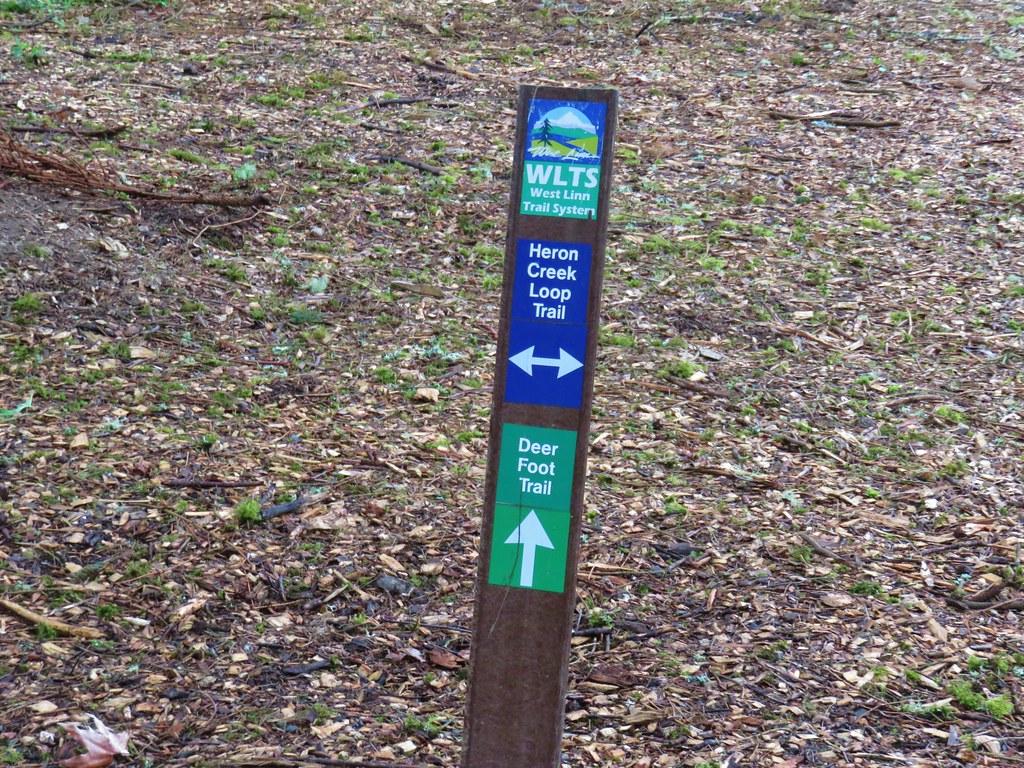
The path continued to the southern end of the parking lot where we had started. Here we veered left onto the unpaved Heron Creek Loop Trail.

Heron Creek Loop Trail

We followed this trail as it passed the parks ball fields and some busy squirrels.

Mary S. Young Park

Squirrel

At the far end of the fields we spotted only the second pointer we had seen along the trails where we stayed on the Heron Creek Loop Trail as it headed back into the woods.

Heron Creek Loop Trail

Heron Creek Loop Trail

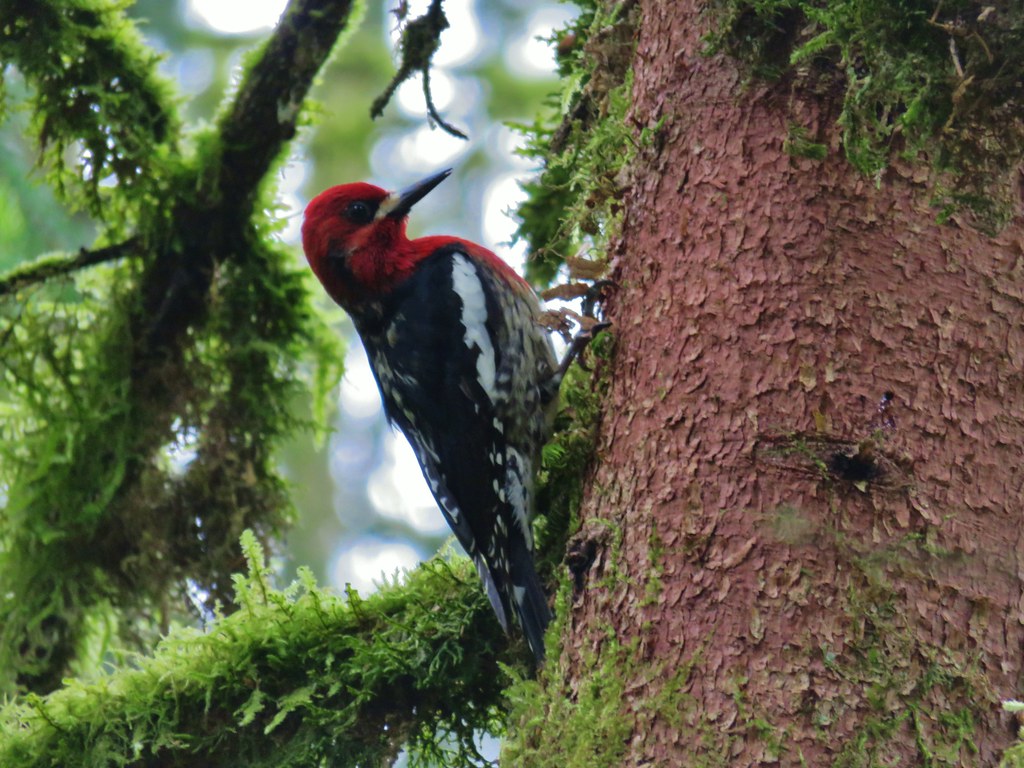
Back in the woods we spotted a pair of woodpeckers in the same area. One appeared to be a hairy woodpecker while the other was a red-breasted sapsucker.

Hairy Woodpecker

Red-breasted sapsucker

Using the picture of the map on Heather’s phone we stuck to the Heron Creek Loop by staying left at junctions and crossing over both the Trillium Trail and the park entrance road. We stayed right at the next junction opting not to take the short Eagle Scout Loop Trail then stayed straight at a junction with the the Railroad Trail. Beyond that junction the Heron Creek Loop Trail soon began a descent to Heron Creek.

Heron Creek Loop Trail

Heron Creek Loop Trail

Heron Creek

After a second descent and climb past a tributary of the creek the trail leveled out again before arriving at the Turkey Creek Trail where we turned left, crossed Turkey Creek and arrived back at the junction where we had turned onto the Turkey Creek Trial earlier in the morning. We then retraced our earlier steps back to the parking area ending a 3 mile hike through the park.

We then headed for our final stop of the day in Lake Oswego at the Tryon Creek State Natural Area. There are several possible trailheads for the park we chose to start at the large parking area near the Nature Center. (Note the Nature Center and Jackson Shelter are currently closed due to construction but the restrooms are open. No reopening date has been set as of the day of this post.)

Tryon Creek State Natural Area

We stopped by the closed Nature Center to pick up a paper map and also consulted the map on a signboard to plot out our hike. The number of trails and multiple junctions allowed for numerous possibilities. We settled on a loop utilizing the North Horse Loop, Lewis & Clark, Middle Creek, Cedar, Red Fox, and Old Main Trails.

Map for Tryon Creek State Natural Area

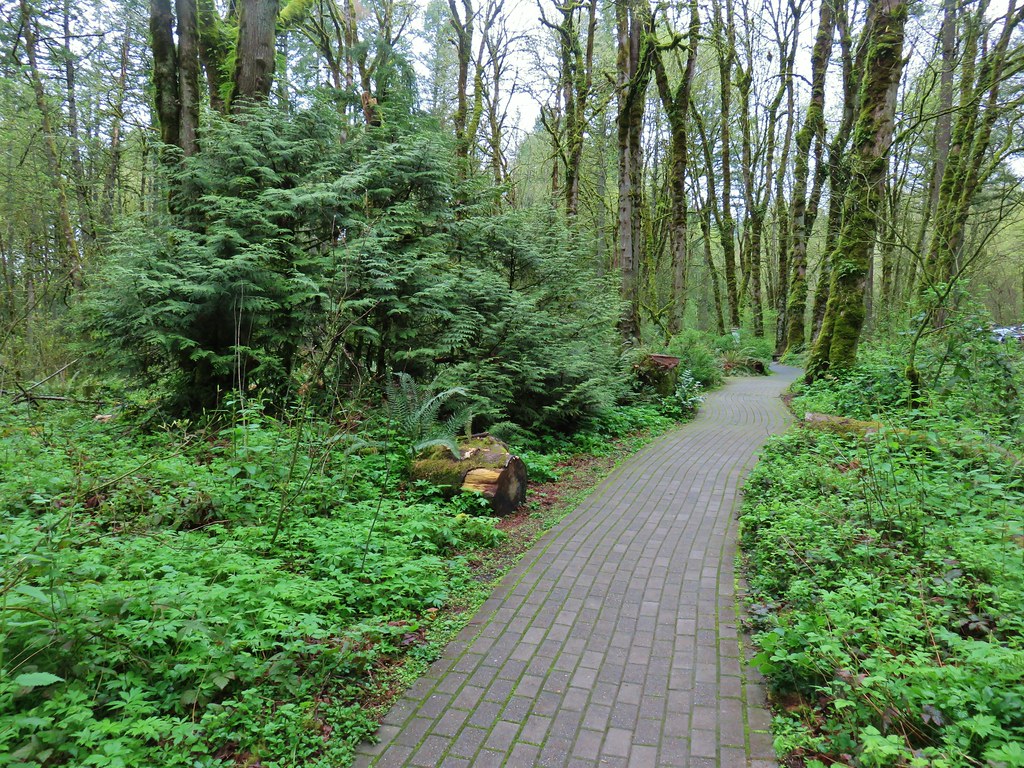
From the Nature Center we followed a brick path right (north) to another map.

Tryon Creek State Natural Area

We stayed straight for a tenth of a mile passing the Maple Ridge Trail on the left just before a junction with the North Horse Loop.

Tryon Creek State Natural Area

This wide path led through a green forest with violets and trillium.

Tryon Creek State Natural Area

Violets and trillium

After .2 miles we stayed left ignoring the right hand route leading to a bicycle path and then quickly veered right when the North Horse Loop split creating two loop options.

North Horse Loop

This right hand path swung north another .4 miles to a junction with the Lewis and Clark Trail.

North Horse Loop

Lews and Clark Trail

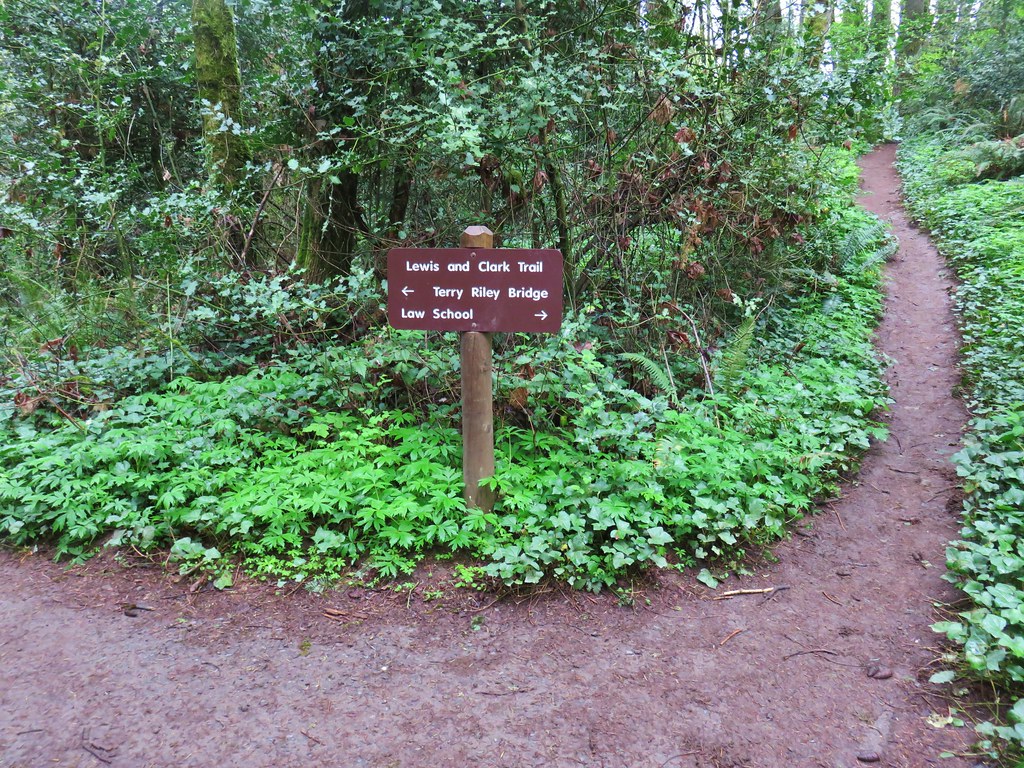
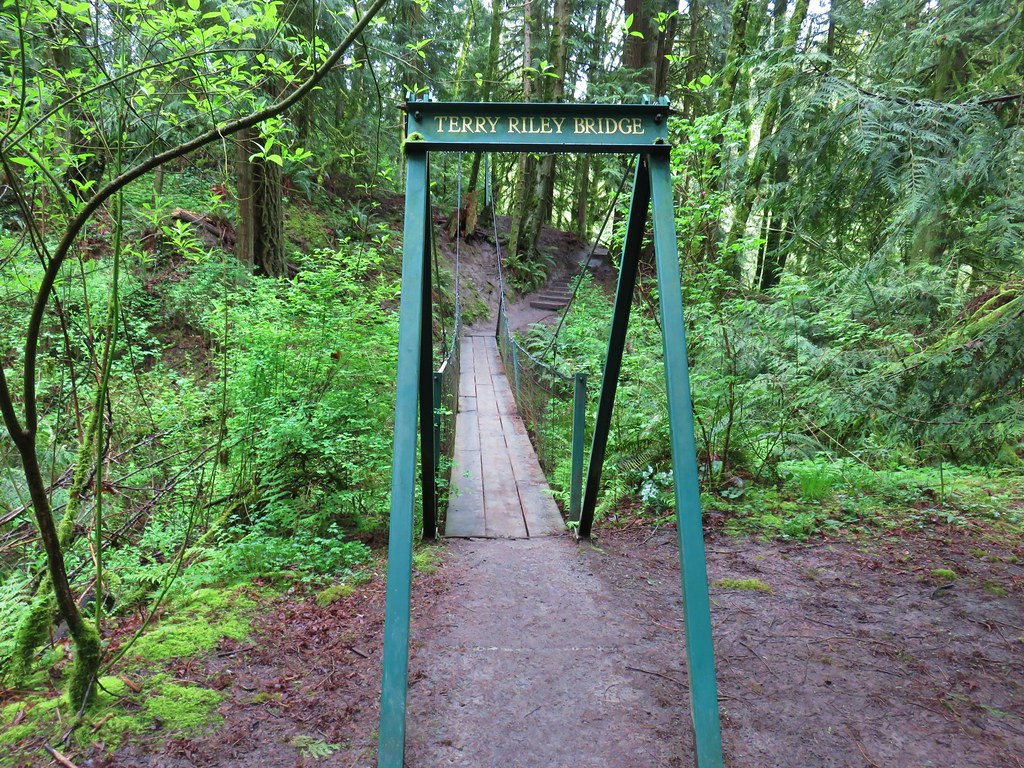
We followed pointers for the Lewis and Clark Trail and Terry Riley Bridge. The trail descended along a hillside above East Fork Tryon Creek to the small suspension bridge which passed over a side stream.

Lewis and Clark Trail

Lewis and Clark Trail

Terry Riley Bridge

Terry Riley Bridge

On our way down we passed a stump hosting a pair of snails. We actually spotted quite a few in the park.

Snails on a stump

Snail

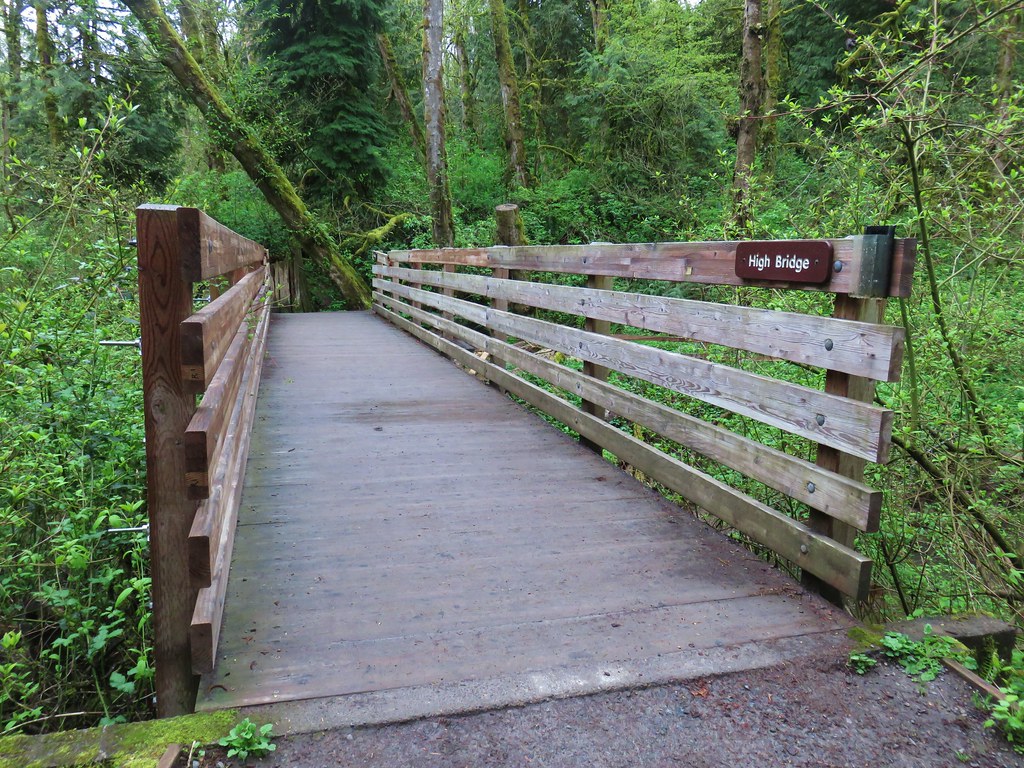
Beyond the suspension bridge .2 miles we rejoined the equestrian trail and crossed over Tryon Creek on High Bridge.

High Bridge

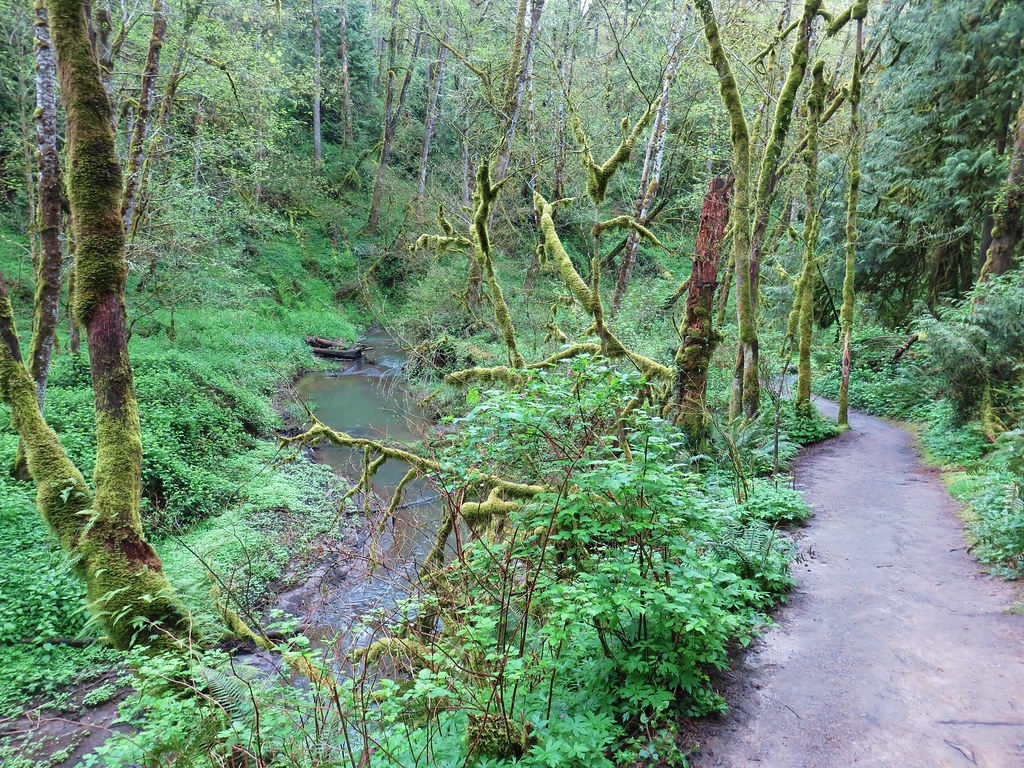
Tryon Creek

The trail split on the far side of High Bridge where we opted to go left on the hiker only Middle Creek Trail.

Tryon Creek State Natural Area

We followed this path for .2 miles across a boardwalk and along Tryon Creek to another trail junction.

Middle Creek Trail

Middle Creek Trail

At this junction we left the Middle Creek Trail crossing over the West Horse Loop and headed up the Cedar Trail.

Cedar Trail

We followed the Cedar Trail through the woods, crossing the West Horse Loop again at the .2 mile mark, then crossing Park Creek on Bunk Bridge, passing a small pond and finally crossing Paget Creek on another bridge before arriving at the Red Fox Trail a mile from the start of the Cedar Trail.

Cedar Trail

Park Creek from Bunk Bridge

Bunk Bridge

looking back at Bunk Bridge

Pond in Tryon Creek State Natural Area

Cedar Trail

Bridge over Paget Creek

Tryon Creek State Natural Area

Red Fox Trail junction.

We turned left onto the Red Fox Trail and in just over a tenth of a mile crossed Tryon Creek on Red Fox Bridge.

Red Fox Bridge

Red Fox Brdige

Tryon Creek

The trail made a brief but steep climb up to a three way junction with the Big Fir and Old Main Trail. We opted for the slightly shorter (but less crowded) Old Main Trail and turned right for .3 miles back to the Nature Center. Our route came in at 3.5 miles.

Although there were a lot of people in the park it never really felt all that crowded which was nice. There are still some trails left too so a return trip may be in order sometime in the future when the Nature Center is back open.

In all we covered 7.5 miles between the three stops and saw quite a few different flowers and a decent amount of wildlife. It had been another nice set of urban hikes. As much as we are looking forward to getting back up into the mountains once the snow melts we’re finding that these types of hikes have a lot to offer. Happy Trails!

Flickr: Camassia Natural Area, Mary S. Young Park, and Tryon Creek

Categories
Hiking Oregon Portland Salem/Albany Trip report Willamette Valley

Tualatin HIlls Nature Park, Tualatin River NWR, and Willamette Mission State Park

For our March outing we decided to stick relatively close to home and visit three nearby hikeable areas. Our first stop, and furthest from Salem at just under an hour away, was at the Tualatin Hills Nature Park in Beaverton.

We started from the large parking lot at the Tualatin Hills Nature Center on SW Millikan Way.
Tualatin Hills Nature Center

The Nature Center is currently open from 8:30am-5pm M-F and 9am-5pm Sat. & Sun. while the park itself is open everyday from dawn to dusk. We arrived at dawn and set off on the paved Vine Maple Trail between the Nature Center and restrooms.
Vine Maple Trail

We quickly turned right onto the signed Oak Trail which was also paved.
Oak Trail

In a third of a mile we detoured briefly at a sign for the Tadpole Ponds.
Tadpole Pond

Although we didn’t see any tadpoles, or other wildlife here, the sounds of birds had not stopped all morning so we knew there were plenty of animals around. We returned to the Oak Trail which passed by Cattail Marsh on the second of three boardwalks.
Oak Trail

Cattail Marsh

Beyond the marsh we soon came to the third boardwalk which crossed over Cedar Mill Creek.
Boardwalk and viewing platforms along the Oak Trail

Cedar Mill Creek

One of the many birds that we’d been listening to was kind enough to pose for a moment as we stood on the boardwalk.
Sparrow

On the far side of the boardwalk was a trail junction where the Oak Trail veered right to the Merlo Rd/158th Ave Max light rail station. To the left was the Old Wagon Trail, a dirt path closed to bikes.
Old Wagon Trail

We followed this trail through a forest that was starting to show signs of Spring for a third of a mile to a junction with the Mink Path.
Old Wagon Trail

Blossoms along the Old Wagon Trail

Old Wagon Trail

Old Wagon Trail junction with the Mink PathTrail pointer at the Mink Path junction. We appreciated the fact that all of the junctions were signed and those signs were easy to read but placed in such a way that they were unobtrusive.

The Mink Path is a .1 mile connector between the Old Wagon Trail and Vine Maple Trail allowing for a shorter loop back to the Nature Center. We opted to stay on the Old Wagon Trail though and continued to the start of another boardwalk where we stopped so I could try and take a photo of a robin that was hopping around on the trail. As I was working on getting a picture Heather spotted a deer just a bit off the trail.
Deer along the Old Wagon Trail (there really is one out ther)Can you see the deer?

I thought she was seeing things but then I noticed it move.
Doe along the Old Wagon Trail (again it is there)How about now?

She turned and watched us as I attempted to get the camera to focus on her and not the branches in the foreground.
Doe in the Tualatin Hills Nature Park

Not far from the deer we spotted a squirrel trying to become one with a limb.
Squirrel

At a “Y” in the boardwalk we veered left keeping on the Old Wagon Trail until we reached a junction with the Vine Maple Trail a total of .4 miles beyond the Mink Path junction. We turned left onto the Vine Maple Trail and then took a right at a pointer for the Lily Pond.

A short path led down to the pond but before we had reached it a pair of wood ducks took flight and landed in a nearby tree.
Wood Ducks

As we were admiring the wood ducks a pileated woodpecker was busy with its breakfast.
Pileated woodpecker

We eventually made it down to the pond where a few ducks remained in the water including what appeared to be a pair of gadwalls.
Interpretive sign at the Lily Pond

Lily Pond

Gadwalls

There were also signs of beaver activity but we’ve yet to actually see one in the wild.
Beaver work

After visiting the pond we returned to the Vine Maple Trail which was now paved and followed it past its junction with the Mink Path and across Cedar Mill Creek.
Vine Maple Trail

Vine Maple Trail crossing Cedar Mill Creek

Shortly after crossing the creek we faced another choice. The Nature Center lay a third of a mile away via the Vine Maple Trail but more loop options were available by taking the Elliot Path.
Trail sign in the Tualatin Hills Nature Park

We took the .1 mile Elliot Path to a “T” shaped junction with the Big Fir Trail. Here again was a choice. Left headed back toward the Nature Center while right would take us to the Chickadee and Ash Loops and a short spur to Big Pond. We headed right and then turned left onto the spur to Big Pond.
Big Pond

Big Pond

There were plenty of ducks here as well. It appeared that most were mallards and green-winged teals.
Mallard and Green-winged teals

We returned to the Big Fir Trail and continued on crossing Beaverton Creek before arriving at a four way junction.
Beaverton CreekBeaverton Creek

More choices! The Big Fir Trail kept straight while the Chickadee Loop was to the right and the Ash Loop to the left. We began by heading right on the quarter mile Chickadee Loop which had a nice long section of boardwalk.
Chickadee Loop

After the quarter mile we were back at the Big Fir Trail where we turned right briefly before making a left onto the Ash Loop. The Ash Loop passed some wetlands where a pair of Canada Geese were enjoying the morning.
Wetlands along the Ash Loop

Canada geese

After .3 miles on the Ash Loop we found ourselves back at the four way junction where we turned right and recrossed Beaverton Creek and returned to the junction with the Elliot Path. Staying straight on the Big Fir Trail for just .05 miles we then turned right onto the .2 mile Trillium Loop. Oddly we didn’t see many of signs of trilliums along this short loop but we had seen several beginning to bloom along other trails. After completing the Trillium Loop we turned right again onto the Big Fir Trail for another .1 miles to the start of the half mile Ponderosa Loop.

We took the Ponderosa Loop where we spotted more trillium and our first wood violets of the year.
Trillium

Wood violet

At the end of the Ponderosa Loop we were once again turning right onto the Big Fir Trail. This time it was for less than a tenth of mile and then we were back at the Vine Maple Trail. Several spotted towhees and a couple of chickadees were foraging near this junction. The chickadees wouldn’t sit still but the towhees were a little more cooperative.
Spotted towhee

Spotted towhee

A right turn onto the Vine Maple Trail followed by another .2 miles of hiking brought us back to the parking lot at the Nature Center. The total distance for our hike with all the extra loops was still just 4.2 miles. When we had arrived we were only the second car but the lot was now full as it was just a bit after 9am. We had passed the first volunteer led tour as we were finishing up the along the Ponderosa Trail and another group was preparing to set off shortly.

One of the reasons we had chosen to start our day with this hike was that we knew the park would get busy as the morning progressed which isn’t a bad thing but we always prefer to avoid the crowds when possible. It really was a first rate park though so the popularity is warranted.

We left the nature park and headed for our next stop, the Tualatin River National Wildlife Refuge. I’d found this hike in the Oregon Hikers Field Guide and decided to give it a try.

We parked at the Visitor Center along Highway 99W. The majority of hikeable paths in the refuge are closed from October 1st trough April 30th but the one mile River Trail and the very short Ridge Trail are open year round so we made those the target of this visit.
Tualatin River National Wildlife Refuge Trailhead

We set off on the River Trail and immediately spotted a hummingbird perched atop a tree.
River Trail

Hummingbird

The trail led downhill between a pair of small ponds.
Tualatin River Natioal Wildlife Refuge

The trail passes through a restored oak savannah before arriving at an observation deck above the Tualatin River a half mile from the parking lot.
River Trail

Viewing Deck along the River Trail

Tualatin River

Beyond the deck the trail continues briefly though the restored savannah before entering a forest.
River Trail

The trail splits in the trees with the Ridge Trail leading left to a viewpoint and the River Trail continuing right to the Wetlands Observation Deck.
River Trail junction with the Ridgetop Trail

We stayed right visiting the observation deck first.
Wetlands observation deck

View from the Wetlands Observation Deck

There were a few geese and ducks visible in the distance and a few robins closer by.
Canada geese in the wetlands

Robin

We returned to the junction with the Ridge Trail and turned right onto it to climb to the viewpoint. The Visitor Center was visible across the refuge and a number of ducks and other birds could be seen in the water below. At least some of the ducks looked to be northern shovelers.
RIdgetop Trail

View from the Ridgetop Overlook

Northern Shovelers

We returned to the parking lot after an easy 2.1 mile hike. We plan on returning in the future when the other trails are open to explore more of the refuge and check out the Visitor Center.

We left the refuge and headed south toward our last stop of the day at Willamette Mission State Park.

The site of the former Willamette Mission the 1600 acre park offers a number of activities besides hiking. The mission was established in 1834 by Rev. Jason Lee and marked the first organized religious enterprise in Oregon.

We had originally intended on a 2.7 mile hike here as described by William L. Sullivan in his “100 Hikes in Northwest Oregon & Southwest Washington” 3rd edition guidebook. Heather had put the book in her pack for the Tualatin Hills Nature Park hike as it was also featured in the guidebook. We hadn’t taken it back out of her pack so we weren’t exactly sure where we were supposed to park for the described hike so after paying the $5 day use fee at the entrance booth we immediately turned right into a parking area with a hiker symbol.

The lot serves as a trailhead for the Willamette Vision Education Trail, which was not where our book called for us to start but we were already parked so we decided to improvise.
Willamette Mission State Park Trailhead

We followed a bark path .1 miles to the start of a loop where we turned right.
Willamette Vision Educational Trail

Interpretive sign along the Willamette Vision Educational Trail

The trail followed a road bed for half a mile around a field before arriving at Mission Lake. Along the way we spotted a coyote that quickly disappeared back into the vegetation.
Mission Lake

A little over a mile from the trailhead we arrived at the nations largest black cottonwood.
Willamette Mission Cottonwood

Interpretive sign for the Willamette Mission Cottonwood

While we were admiring the tree an osprey landed in it and while we were watching the osprey we noticed a squirrel in the upper branches as well.
Osprey in the Willamette Mission Cottonwood

Squirrel in the Willamette Mission Cottonwood

Osprey and a squirrel sharing the Willamette Mission CottonwoodThe osprey and the squirrel (upper right hand corner).

A short distance from the cottonwood the loop crossed the park entrance road. In order to do the hike that we had originally intended to do we turned right and walked along the shoulder of the road for a quarter of a mile to a boat launch and pet exercise area where we picked up the Mission Trail.
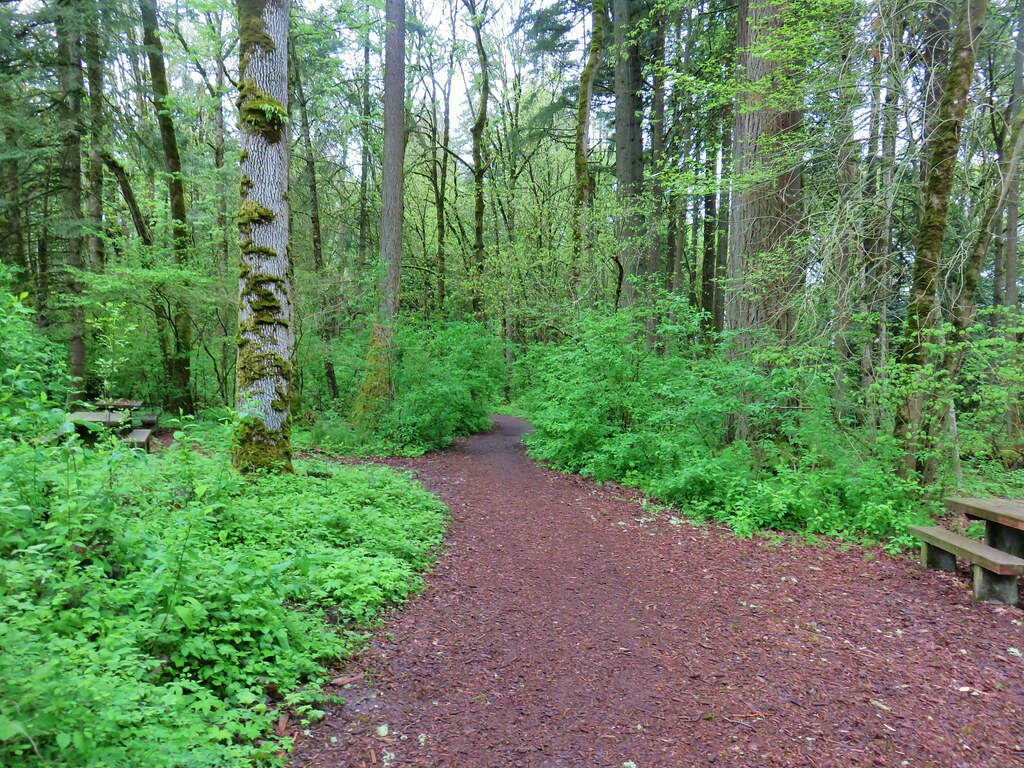
Mission Trail

The Mission Trail followed the bank of Mission Lake for .6 miles to the Mission View Site, an observation deck looking across the lake to the site of the former mission.
Mission Trail

Mission Site viewing platform

Marker for the Willamette Mission

The former Mission Site across Mission Lake

We continued on past the Mission Site for another quarter mile before arriving at a the end of the Mission Trail at a paved bike path. We turned right detouring a quarter mile off the loop to visit the Wheatland Ferry crossing on the Willamette River.
Wheatland Ferry

After watching the ferry cross once we headed back along the bike path and followed it along the Willamette River for almost a mile and a half before veering right onto an equestrian trail. Although the bike path paralleled the river there were no real views to speak of due to a strip of trees and vegetation between the path and the water.
Bike path in Willamette Mission State Park

Bike path in Willamette Mission State Park

We opted to follow the multi-use dirt path instead of the paved bike path since pavement seems to be a lot harder on the feet. Despite being a bit muddy in spots the equestrian trail did finally provide a nice view up and down the Willamette.
Equestrian trail in Willamette Mission State Park

Willamette River

Willamette River

Just prior to reaching the high water channel the equestrian trail came near to the bike path. Staying on the equestrian trail would have taken us to the start of a three mile loop with no opportunity to get back to our car so we hopped back onto the bike path here.
Equestrian trail and the bike path in Willamette Mission State Park

We then followed the bike path back to the park entrance road.
Willamette Mission State Park

On our way back to the car we did complete the Willamette Vision Education Trail loop but that final 1.4 mile segment was fairly uneventful. The trail loops around a field with views back toward the center of the park. By that time we were passing the 13 mile mark for the day (we had planned on doing 9.2) and I was more focused on my feet than taking pictures. Not only had we started at the wrong spot but the guidebook would have had us cut out some of the bike path and all of the equestrian trail. Instead of 2.7 miles for this stop we had flipped the numbers and done 7.2.

We enjoyed all three stops but the Tualatin Hills Nature Park was definitely our favorite. With that being said they all would be suitable for hikers of all ages and abilities and each offers something unique. We’re lucky to have so many options within an hour of Salem and there are many more that we have yet to visit. Happy Trails!

Flickr: Tualatin Hills NP, Tualatin River NWR, Willamette Mission SP

Categories
Hiking Oregon Portland Trip report Willamette Valley

Forest Park – Wildwood Trail & Leif Erikson Drive Loop

Heather and I recently celebrated our 23rd anniversary with a morning hike in Portland’s Forest Park followed by dinner at Sisters Irish Bistro in Salem.

We started our hike at the Germantown Road Trailhead where the Wildwood Trail crosses the road.
Wildwood Trail at Germantown Road Trailhead

We chose this loop due to the presence of some low clouds. This section of trail didn’t offer the mountain views that some others do so we thought it was a good day for it. From the parking area we headed south on the Wildwood Trail which briefly climbed before leveling out on a hillside.
Wildwood Trail

Wildwood Trail

We followed the Wildwood Trail for a little over four and a quarter miles through the foggy forest. Junctions were well marked along the way with maps located at several of them.
Forest Park from the Wildwood Trail

Wildwood Trail junction with the Waterline TrailWaterline Trail junction

Wildwood Trail

Wildwood TrailMap at the Springville Road junction.

Wildwood Trail

Wildwood Trail

Wildwood Trail junction with the Ridge TrailRidge Trail junction

Wildwood Trail

We turned off of the Wildwood Trail at Fire Lane 7A which we followed downhill less than a quarter mile to a pointer for Leif Erikson Drive.
Wildwood Trail junction with Fire Lane 7A

Fire Lane 7A

Tie trail to Leif Erikson Dr.

A short path led fairly steeply down to the closed road where we turned left.
Leif Erikson Drive

Leif Erikson Drive

After one and a quarter mile on the road we came to the remains of an old building on the left.
Remains of an old building along Leif Erikson Drive

Remains of an old building along Leif Erikson Drive

A little over three miles after turning onto Leif Erikson Drive we arrived at another small parking lot along Germantown Road.
Leif Erikson Drive Trailhead along Germantown Road

Signboard for Leif Erikson Drive at Germantown Road

From this trailhead we followed the Cannon Trail uphill for a third of a mile back to the Germantown Road Trailhead and the Wildwood Trail.
Cannon Trail

Cannon Trail

Our loop was approximately 8.4 miles long with about 500′ of total elevation gain. It had been a good day for this particular hike and although we saw quite a few other people it never felt overly crowded. Shorter (or longer) loops could be done using the numerous other trails in the area.

Dinner at Sisters Irish Bistro was a perfect way to end our anniversary celebration, the food was excellent and so was the relaxing atmosphere. Happy Trails!

Flickr: Forest Park