Categories
Hiking Mt. Adams Trip report Washington Washington Cascades

Labor Day Weekend – Mt. Adams Wilderness Day 1

We are in the midst of a horrible wildfire season which only seems to be getting worse. Our original Labor Day plans literately went up in smoke due to the Separation and Nash Fires burning in the Three Sisters Wilderness among others. Our next plan was to spend the weekend in the Olallie Lake Scenic Area but the air quality in that area due to the aforementioned fires as well as the Whitewater, Scorpion, and Devil’s Fires (and so many more) made attempting to camp in that area unappealing so we kept looking.

After consulting several fire maps we determined that either the Indian Heaven Wilderness or the Mt. Adams Wilderness were our best chances for relatively smoke free hiking. The closest fires to those areas were the Indian Creek Fire burning along Eagle Creek in the Mark O. Hatfield Wilderness to the south and the Norse Peak Fire in the Norse Peak Wilderness to the north.

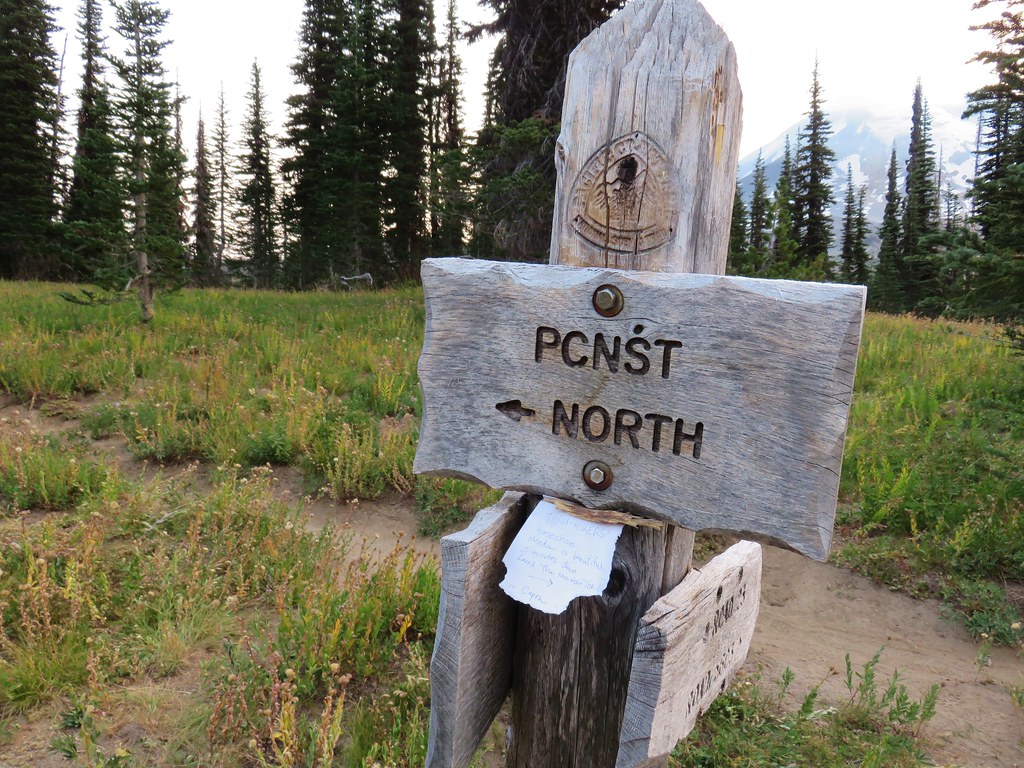
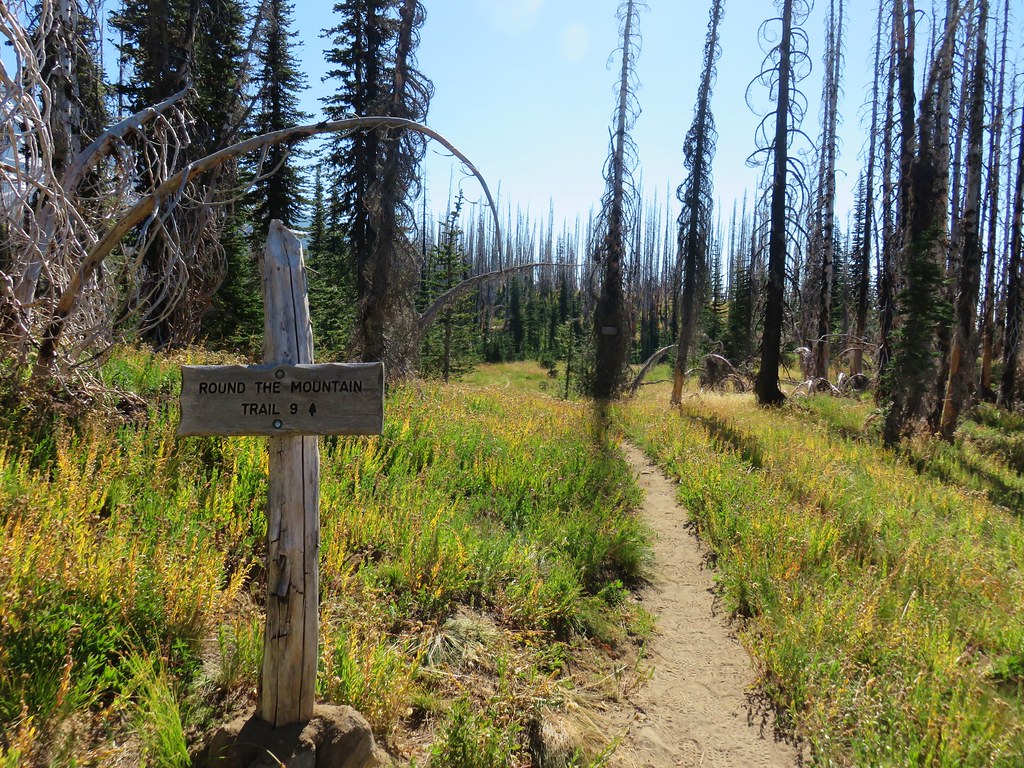
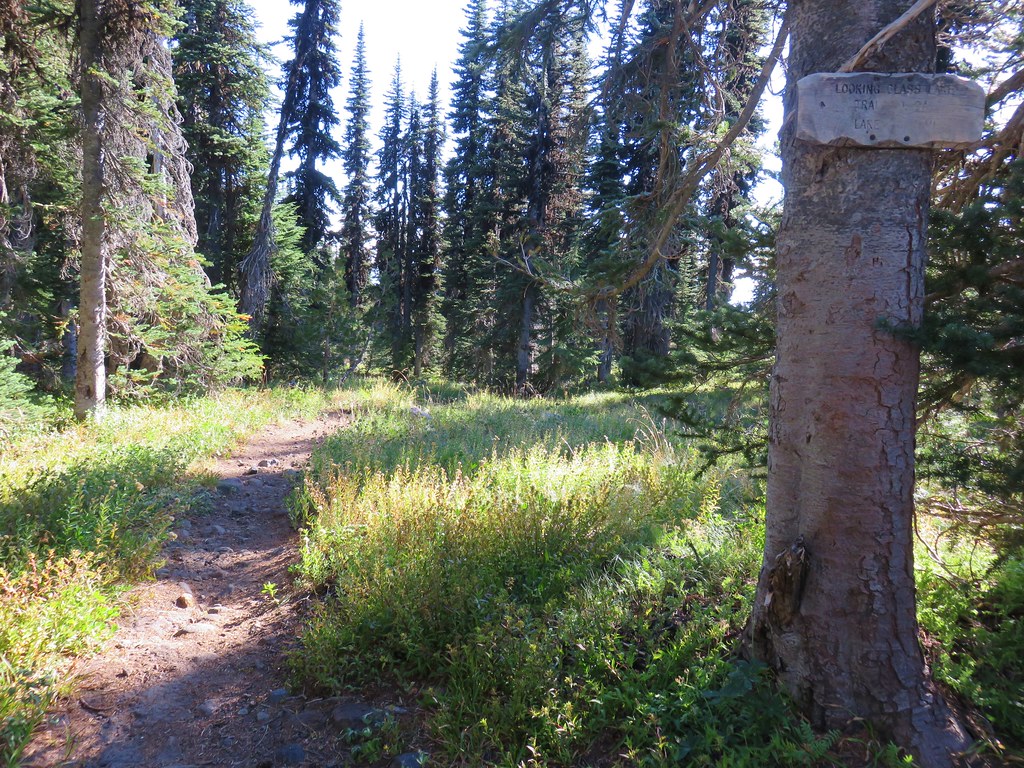
We settled on the Mt. Adams Wilderness. Our plan was to hike north on the Pacific Crest Trail from the Williams Mine Trailhead to Horseshoe Meadow where we hoped to set up camp. From there we would take the Round-the-Mountain Trail SE to the South Climb Trail and also visit Lookingglass Lake at some point along the way.

We set off on the PCT a little before 8 o’clock on Saturday morning.

IMG_7458

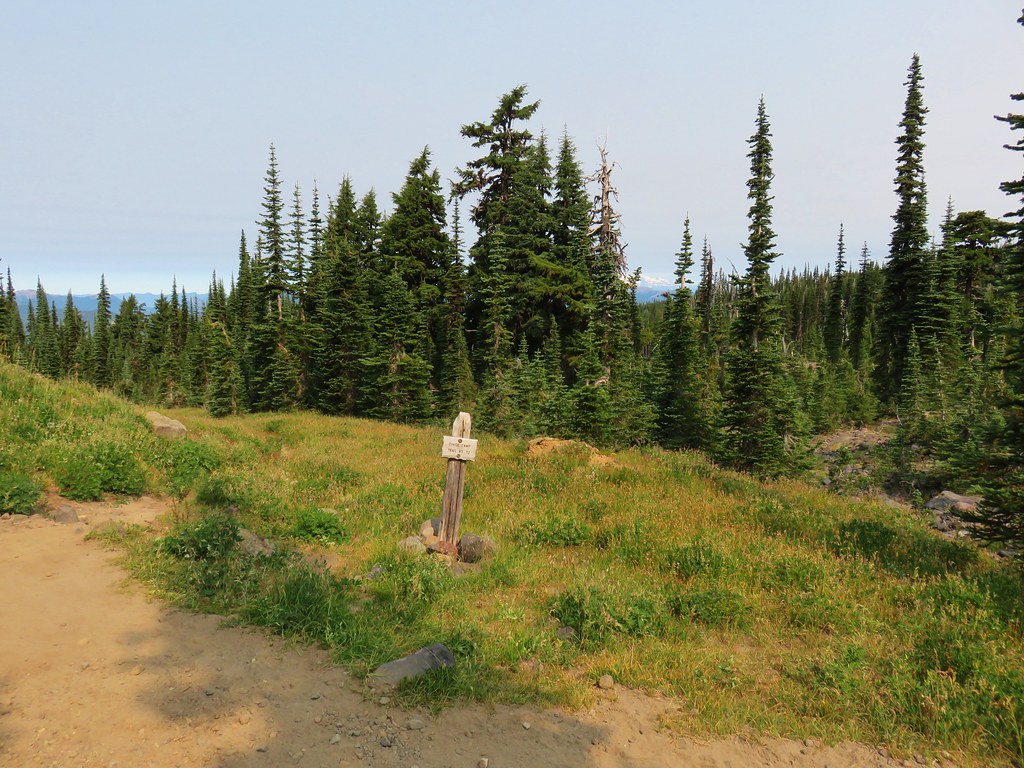
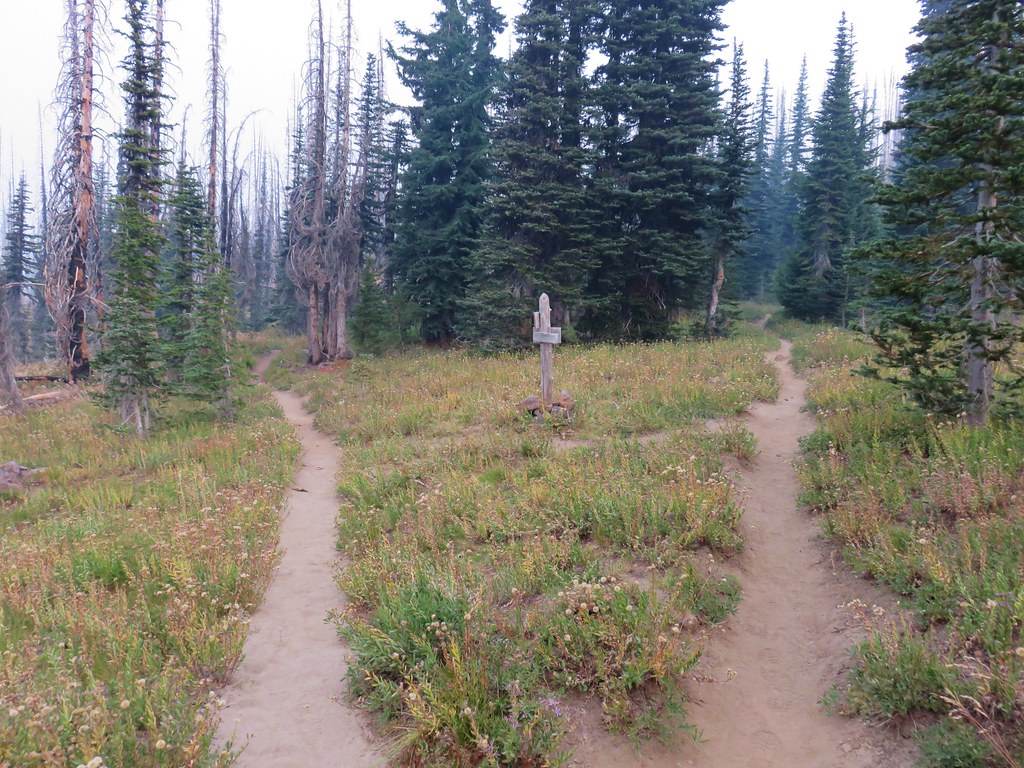
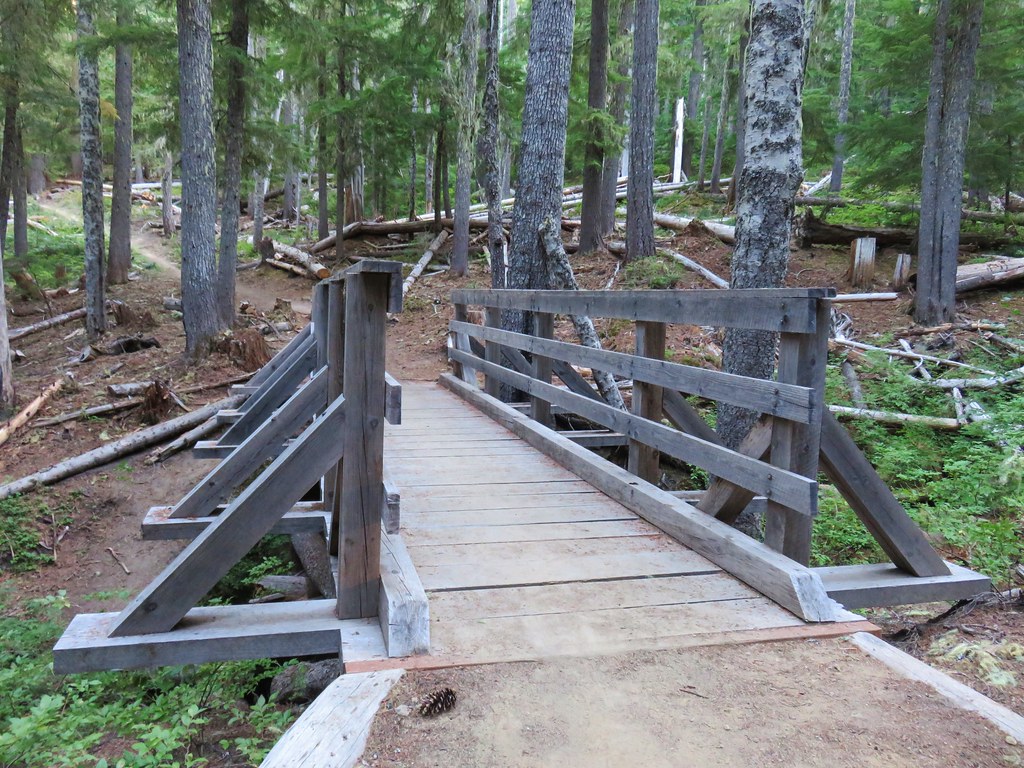
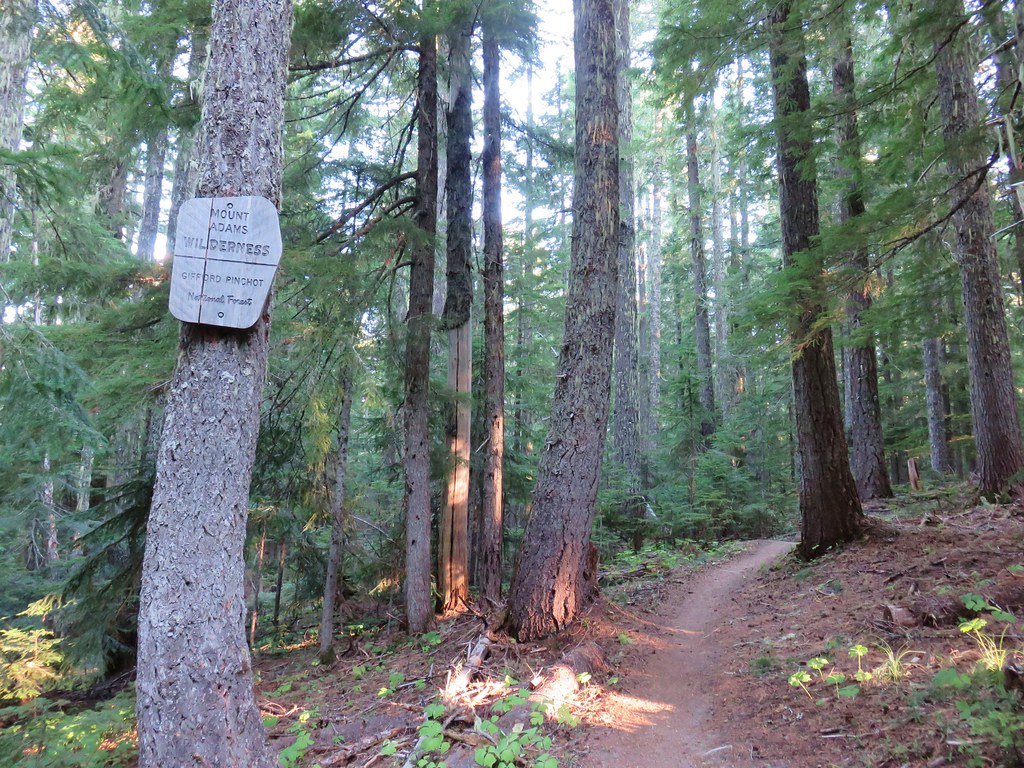
After crossing Swampy Creek on a footbridge the PCT entered the Mt. Adams Wilderness.

IMG_7459

IMG_7461

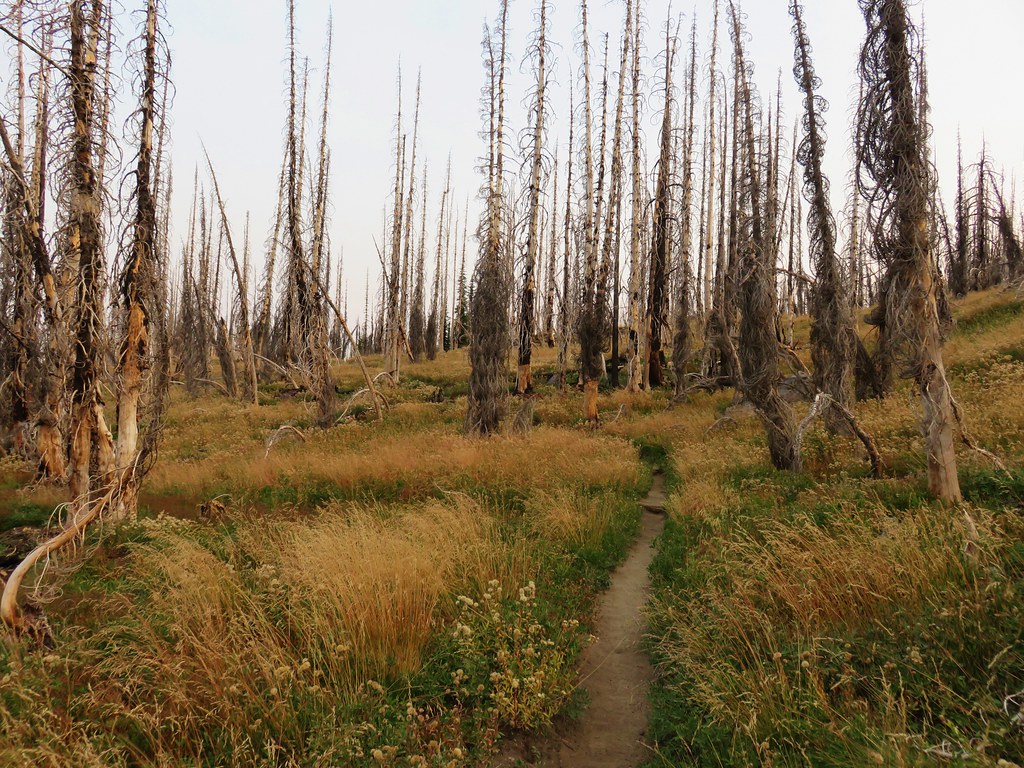
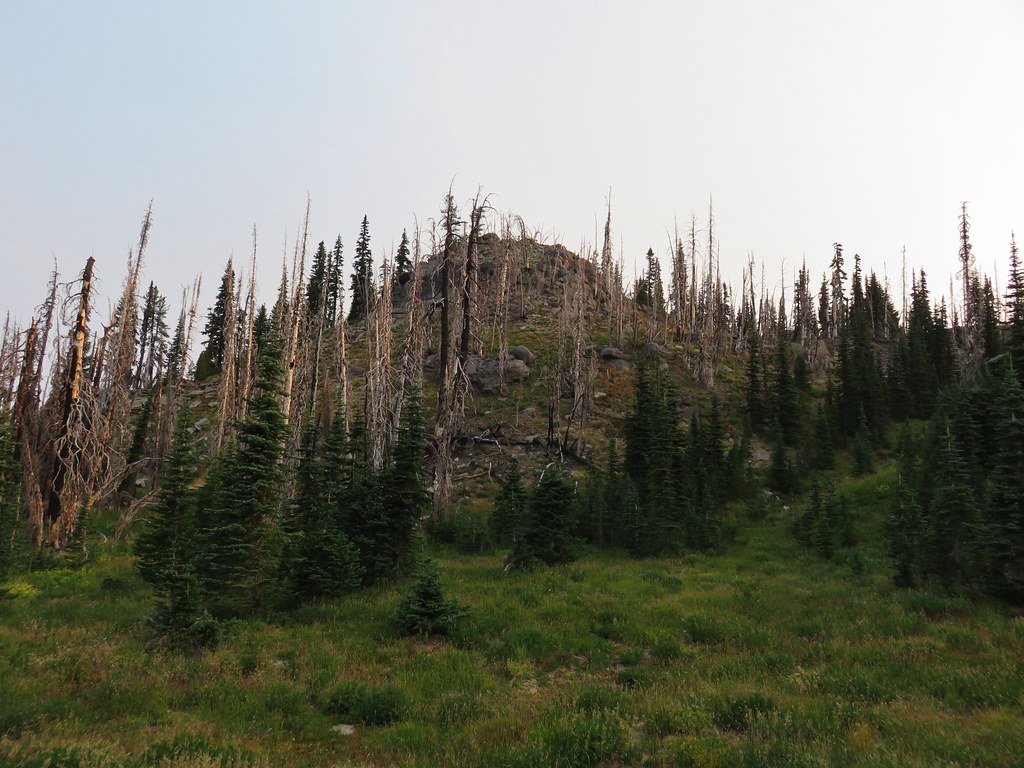
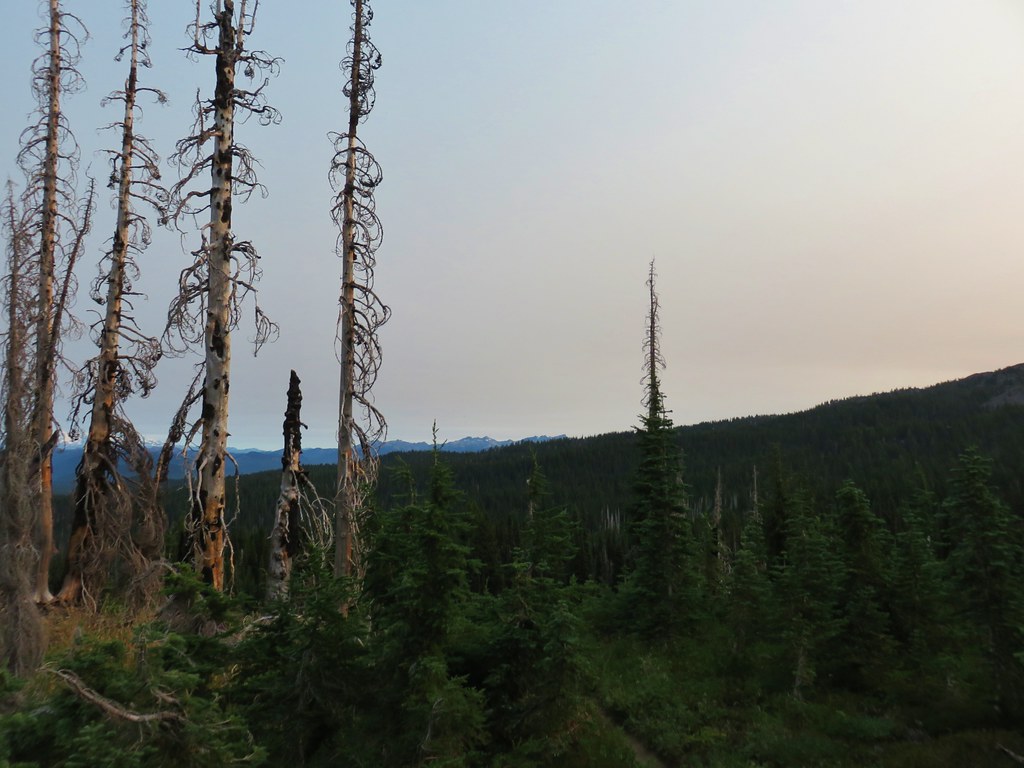
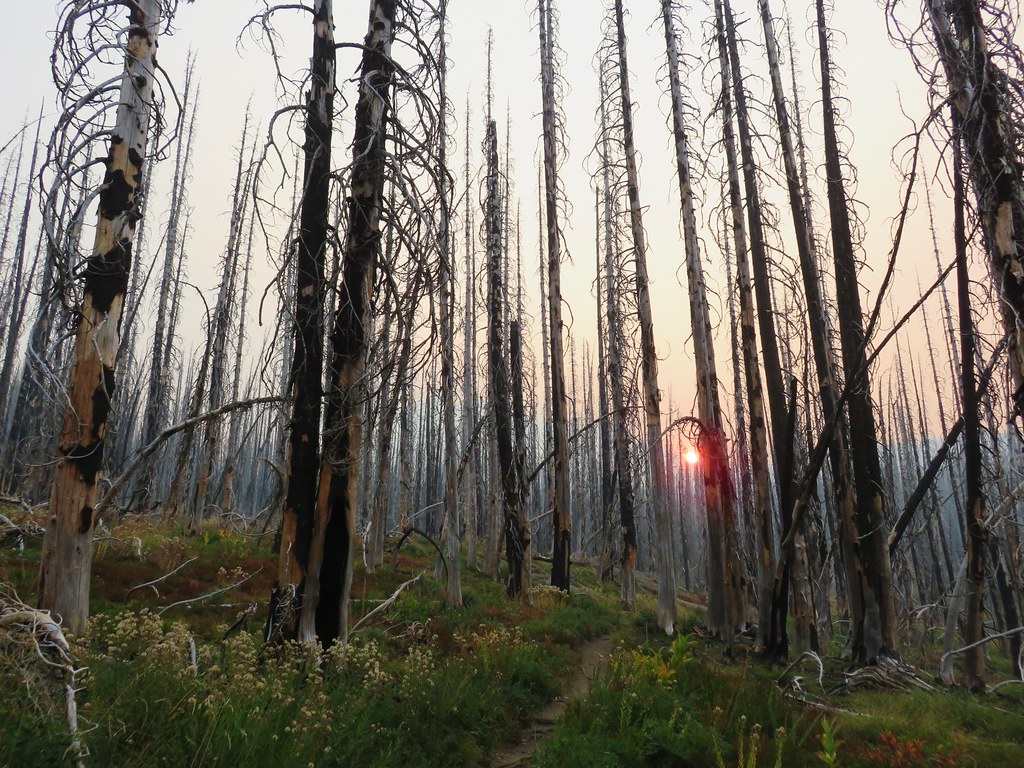
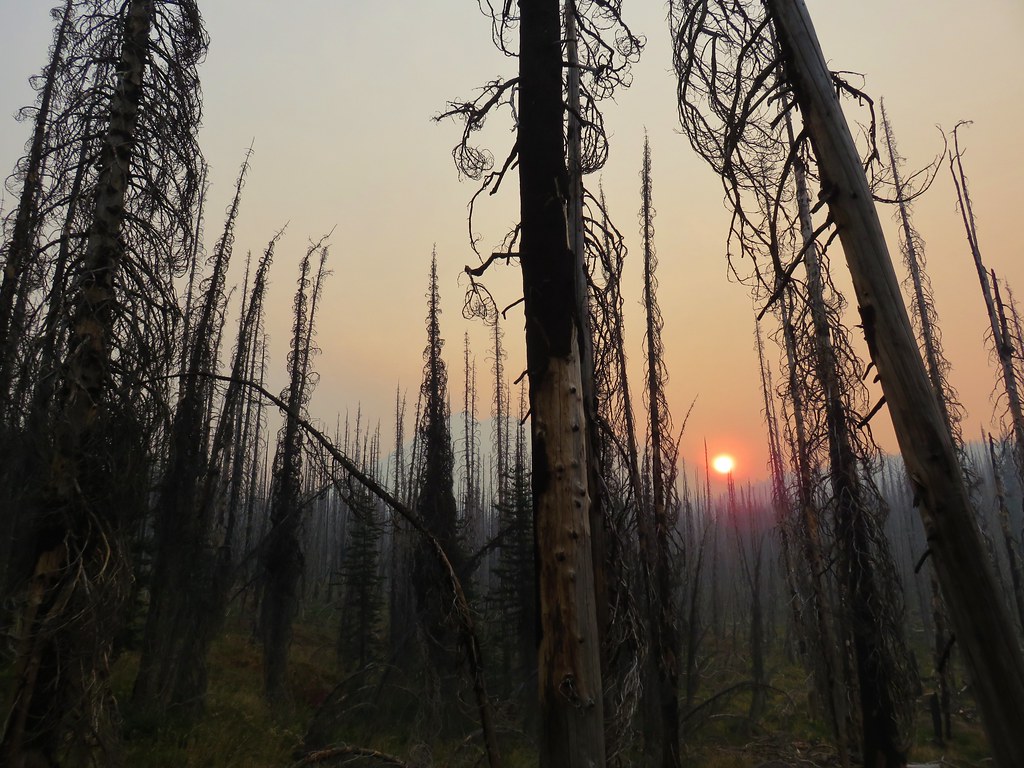
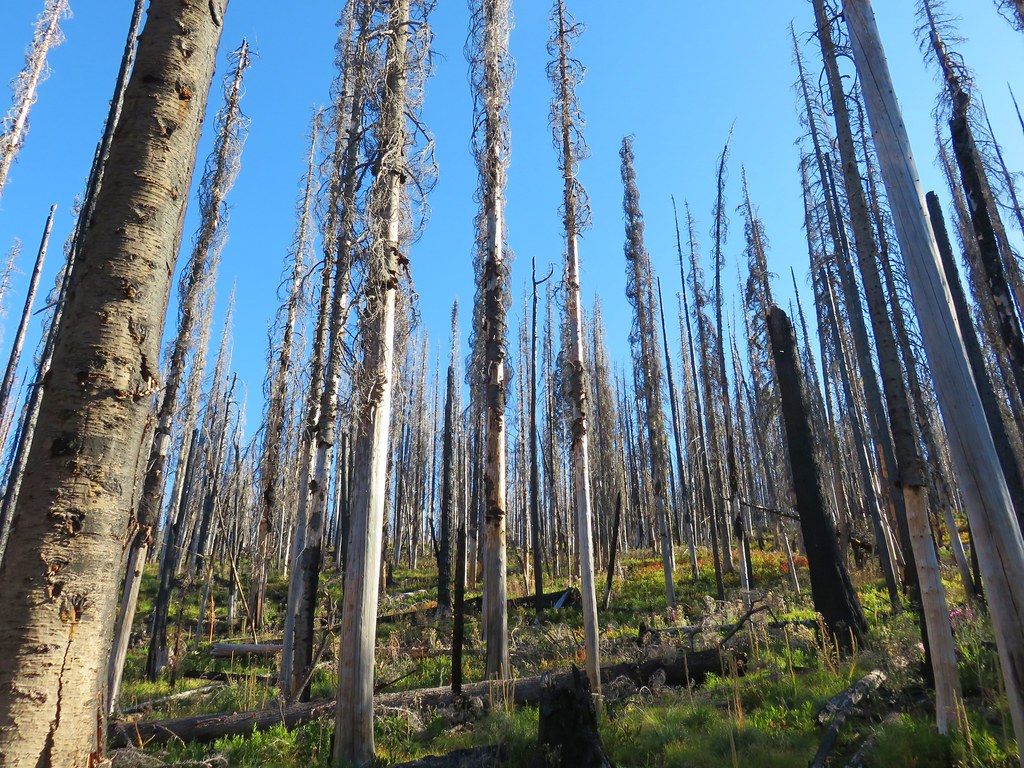
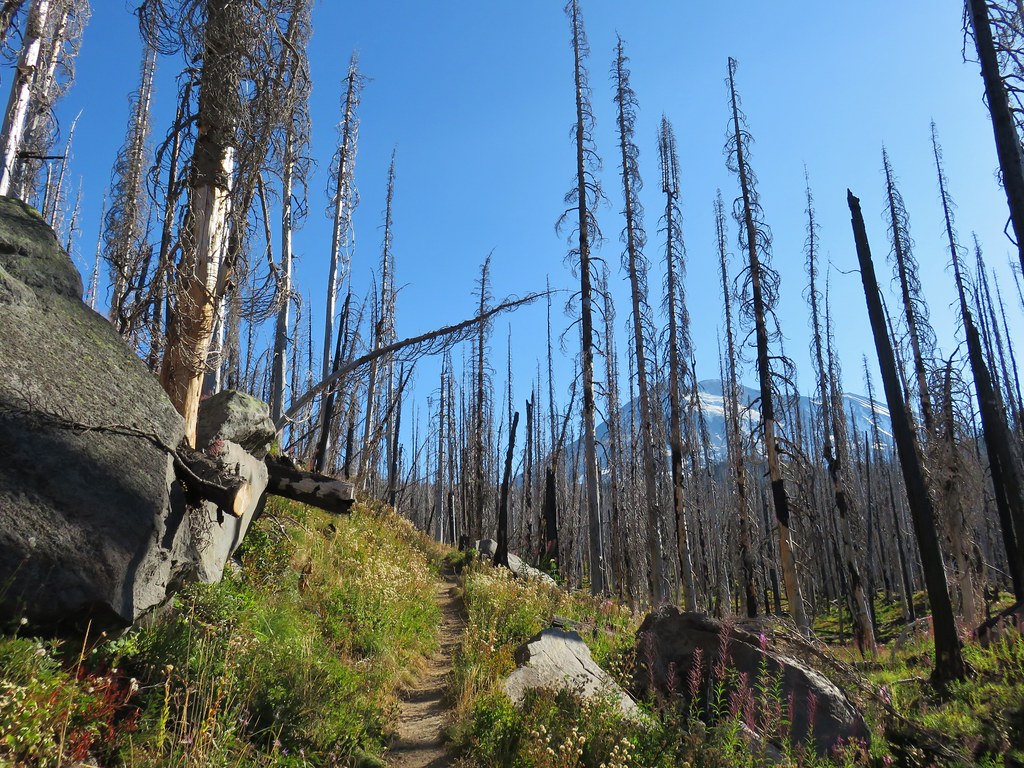
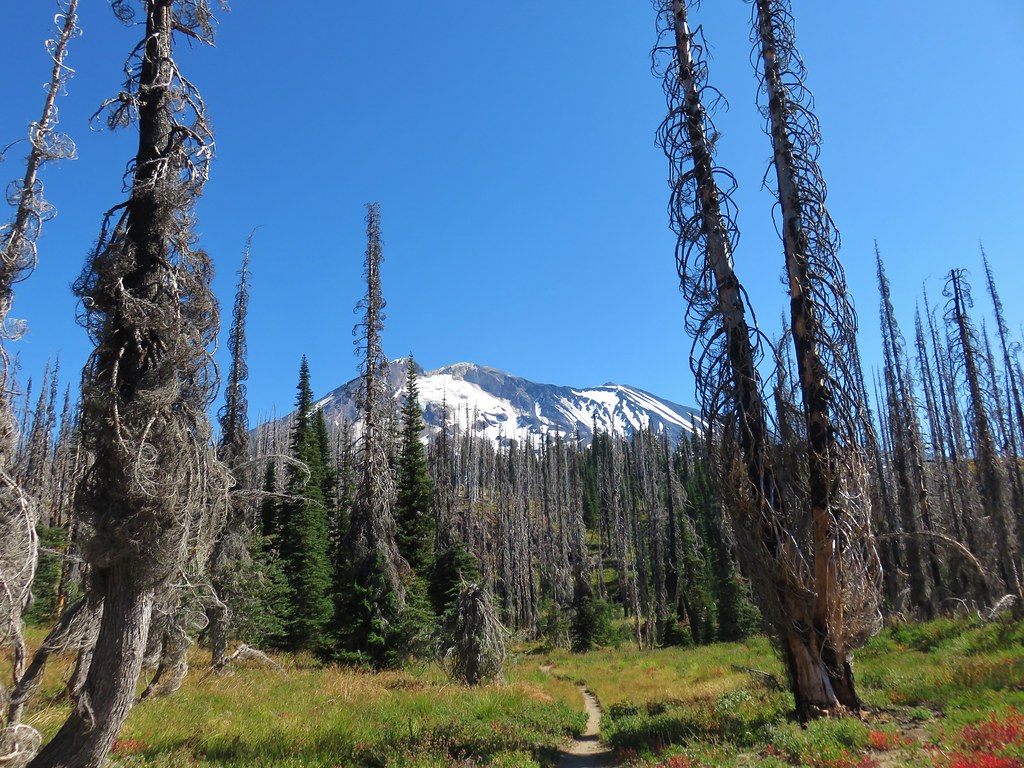
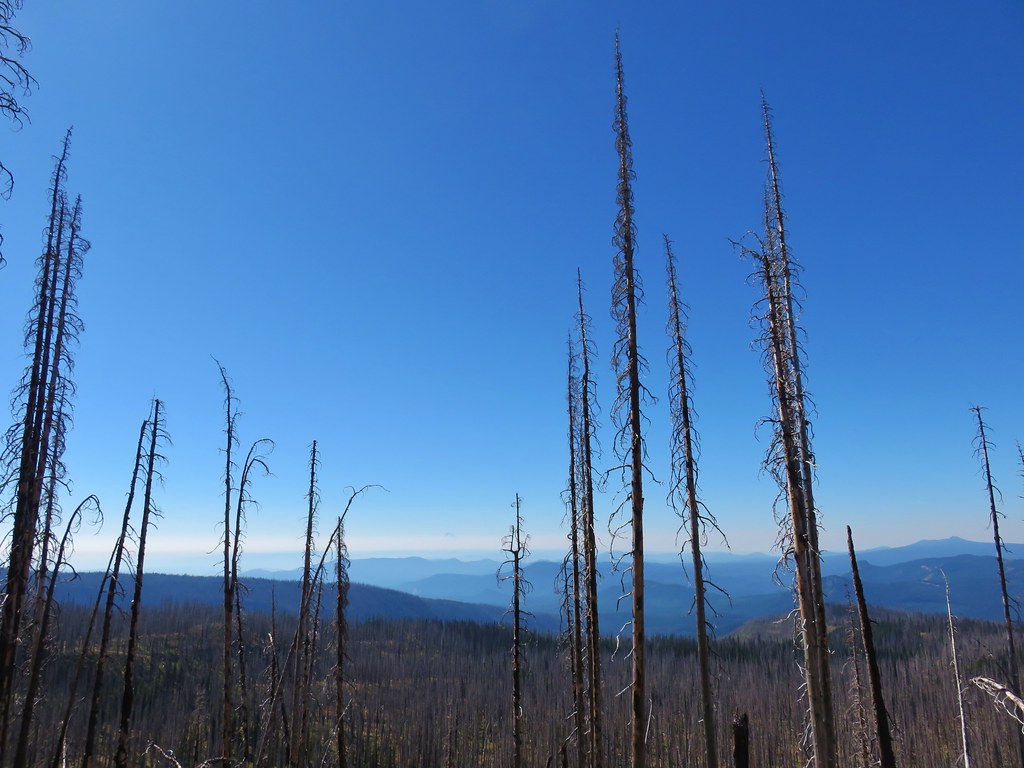
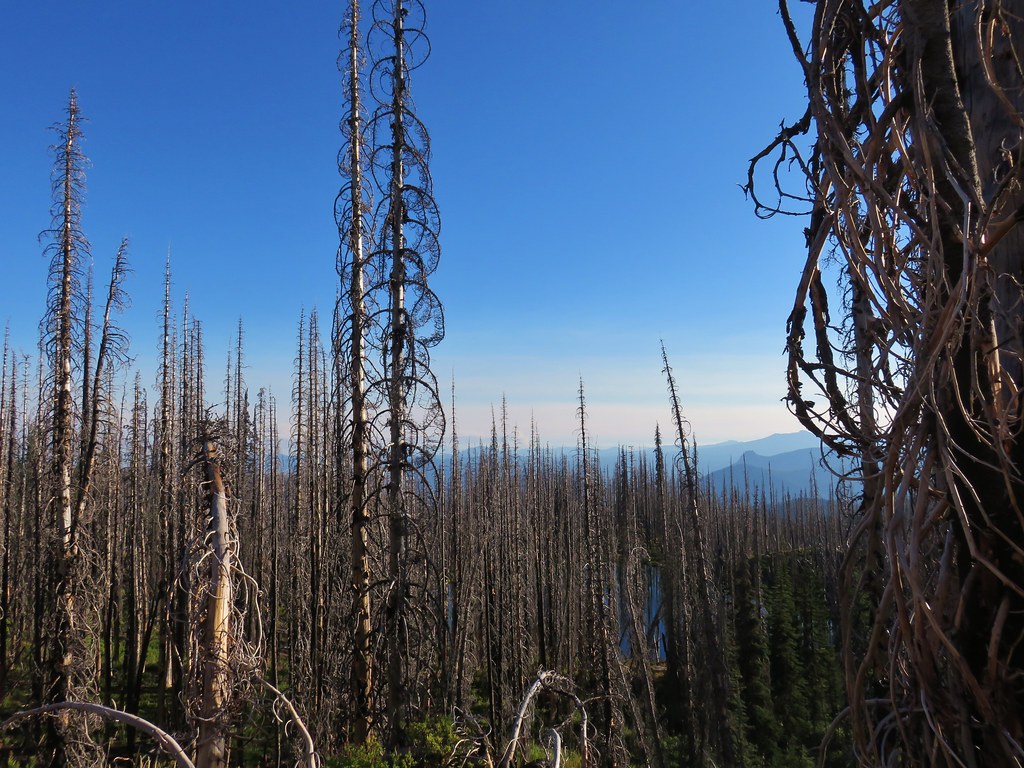
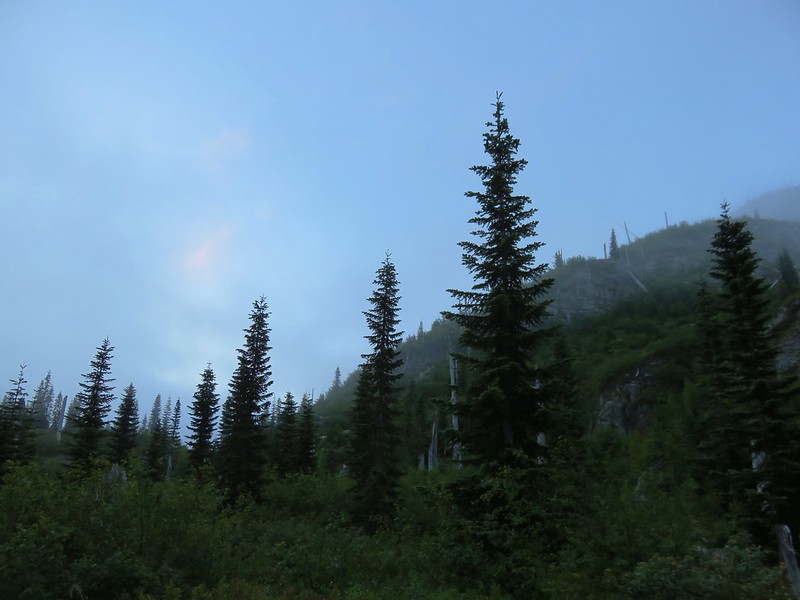
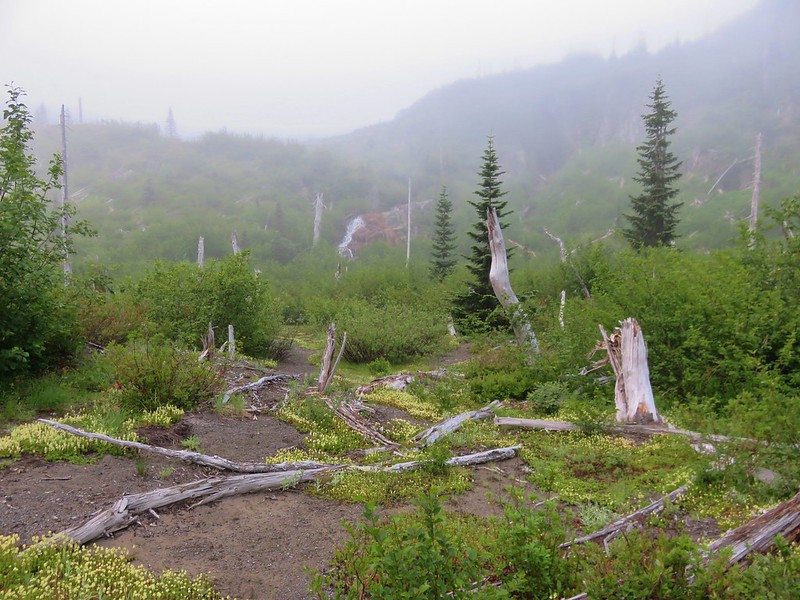
It was a warm morning but more importantly it was smoke free. We were greeted by blue sky as the trail entered the fire scar from the 2012 Cascade Creek Fire.

IMG_7473

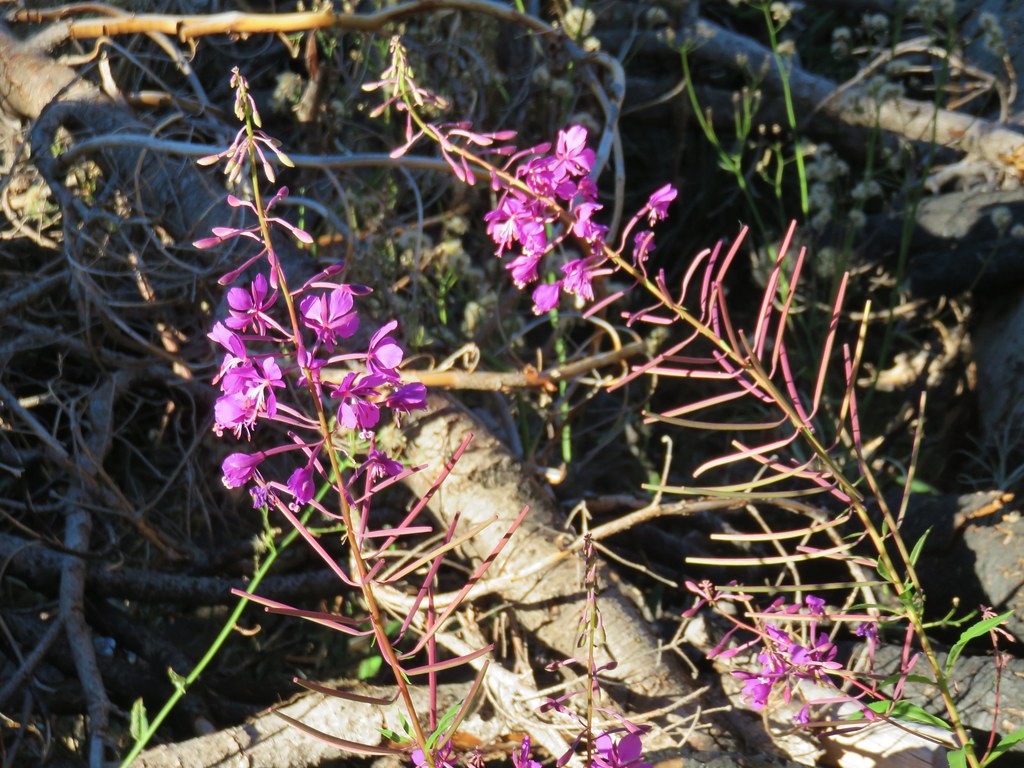
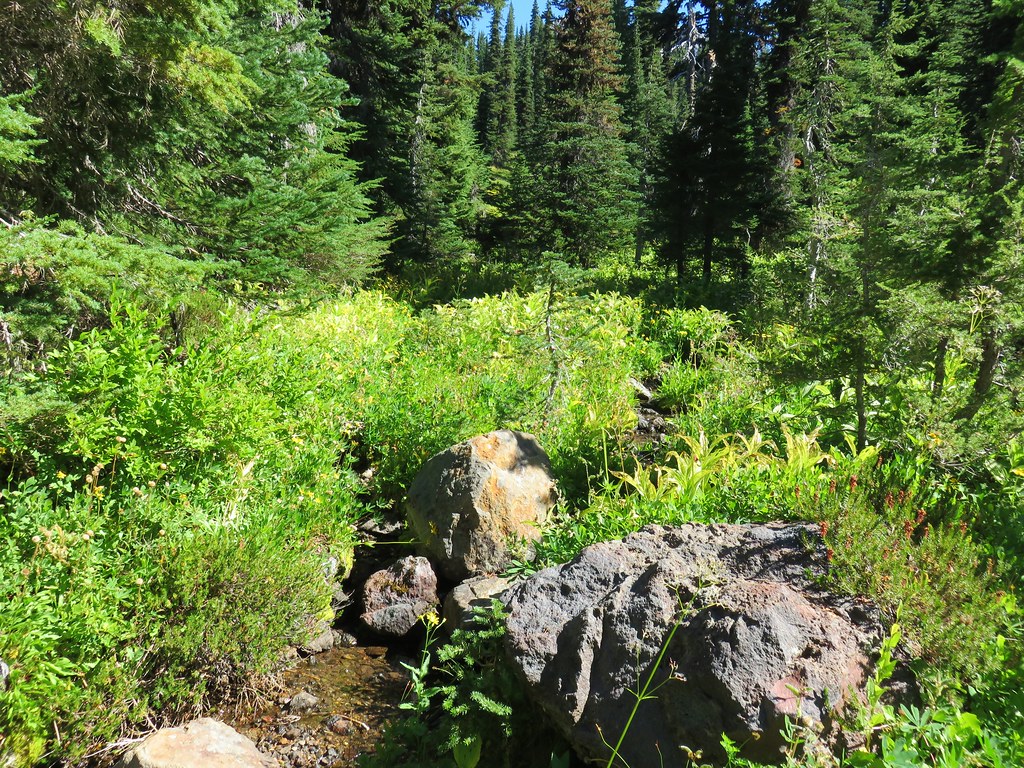
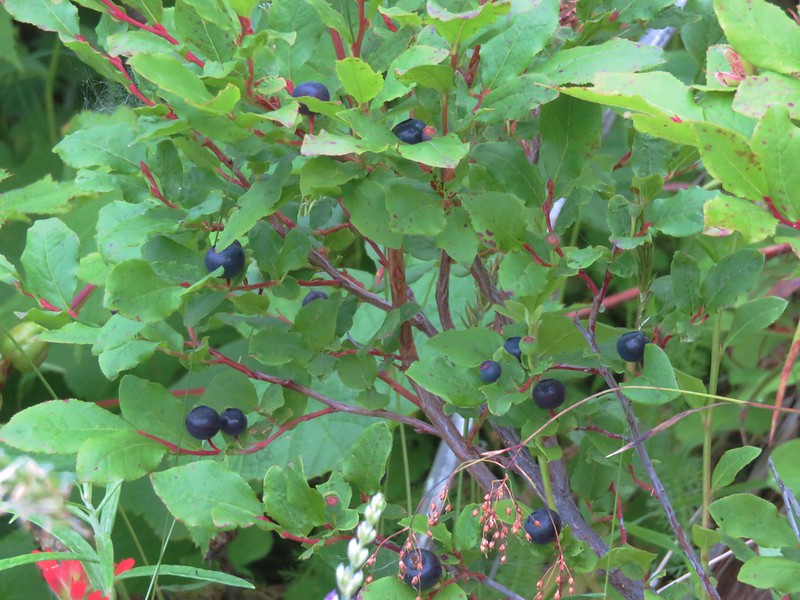
A few wildflowers remained and lots of ripe huckleberries were available for picking as we went.

IMG_7472

IMG_7479

IMG_7481

IMG_7483

IMG_7488

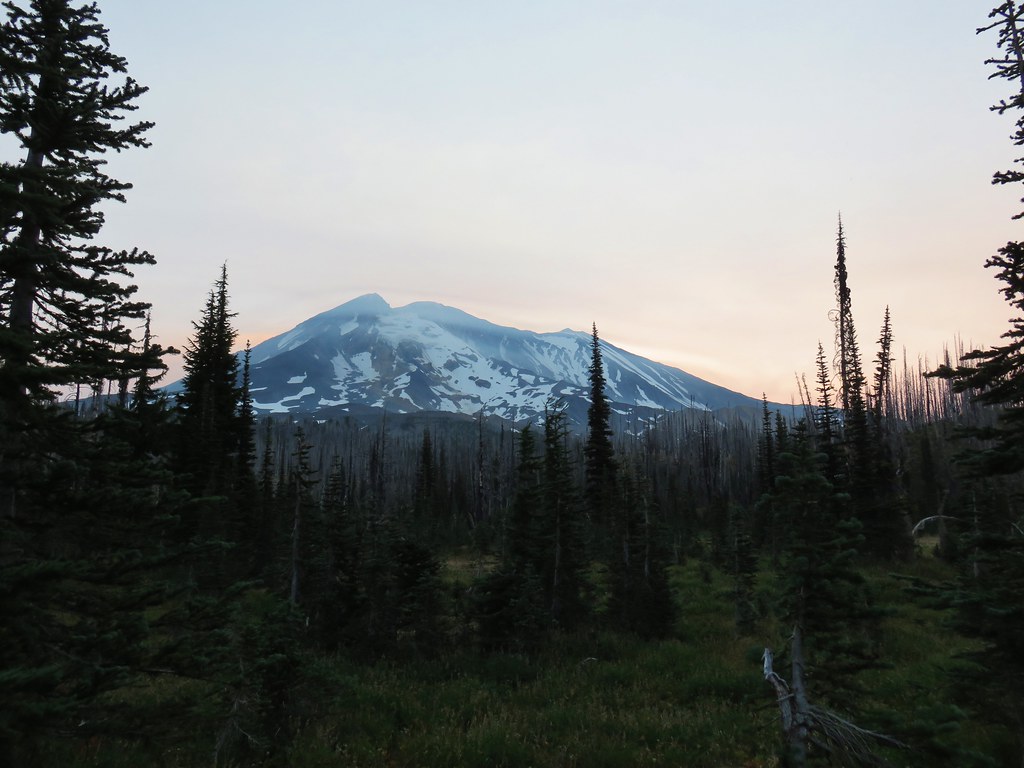
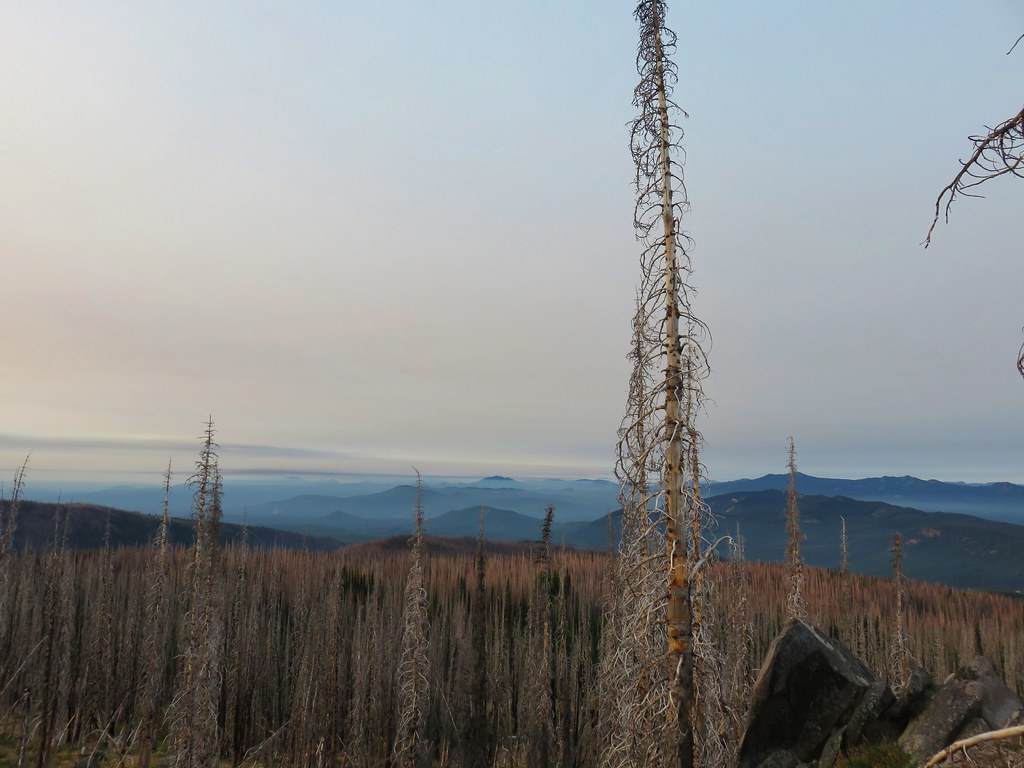
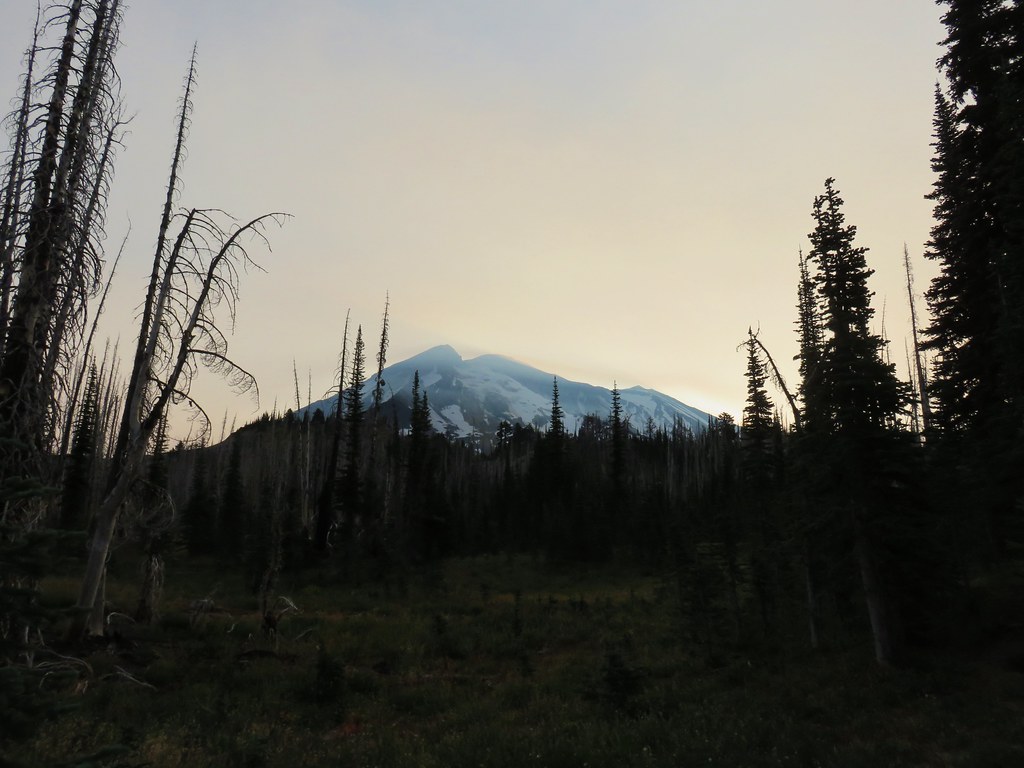
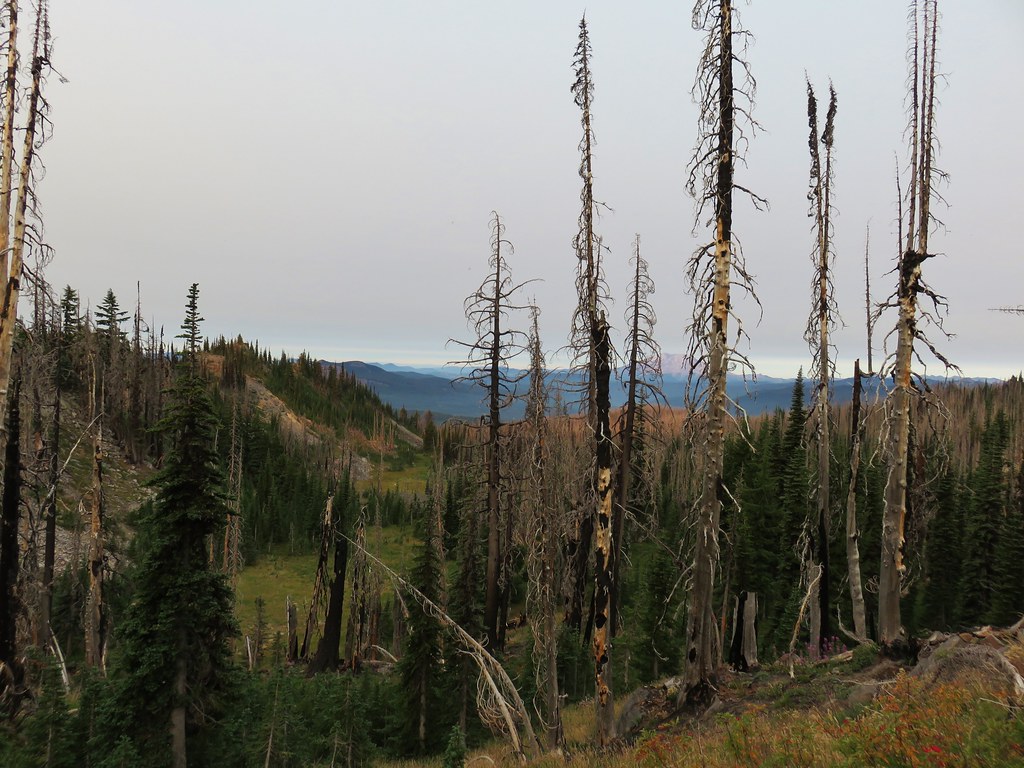
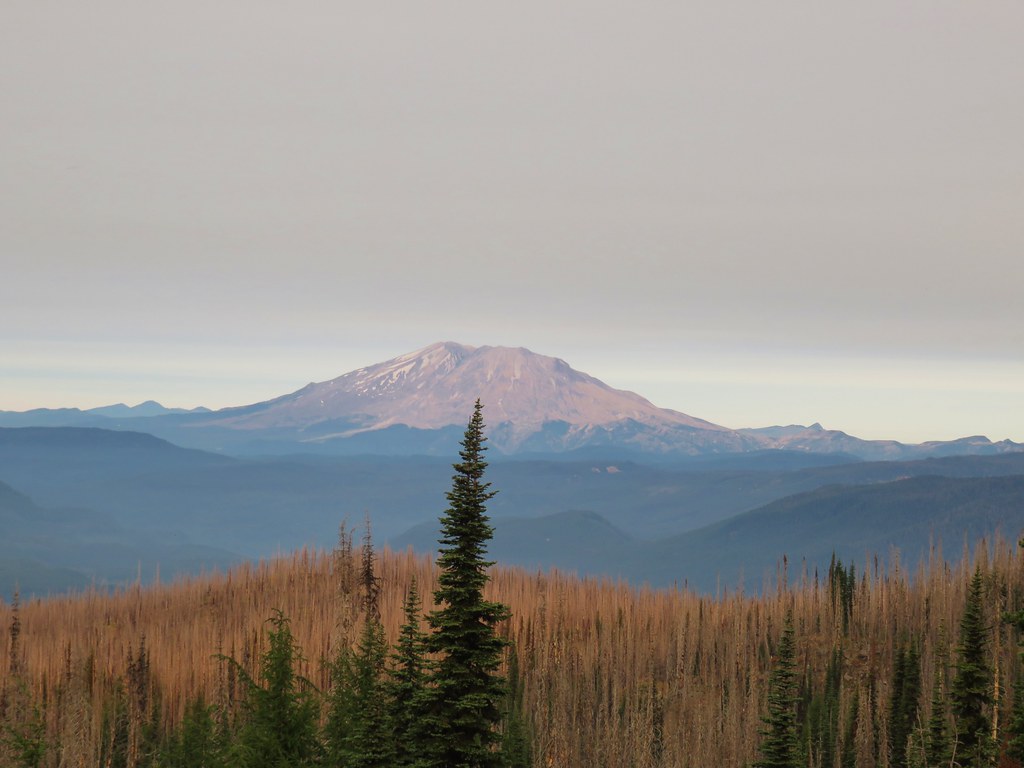
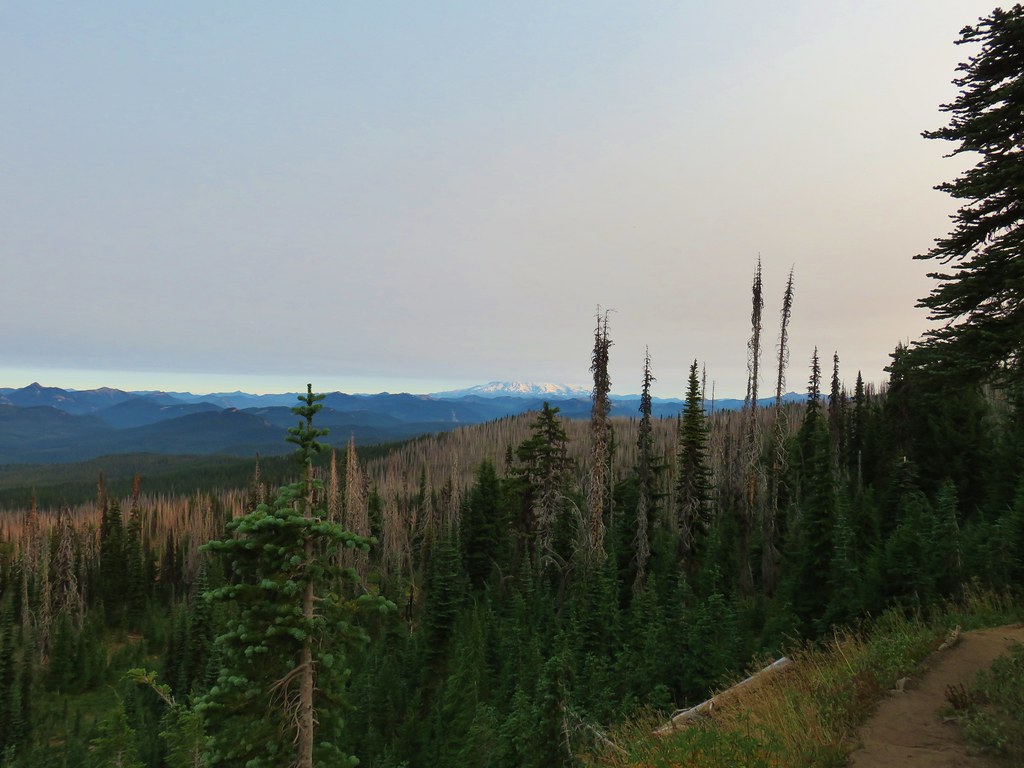
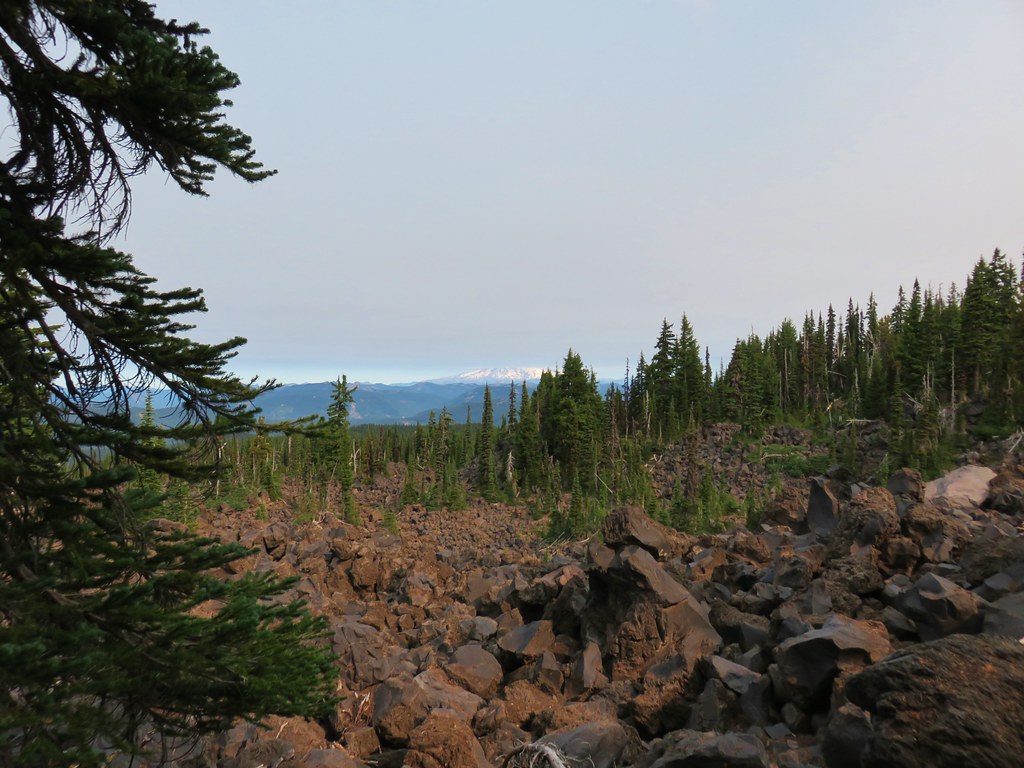
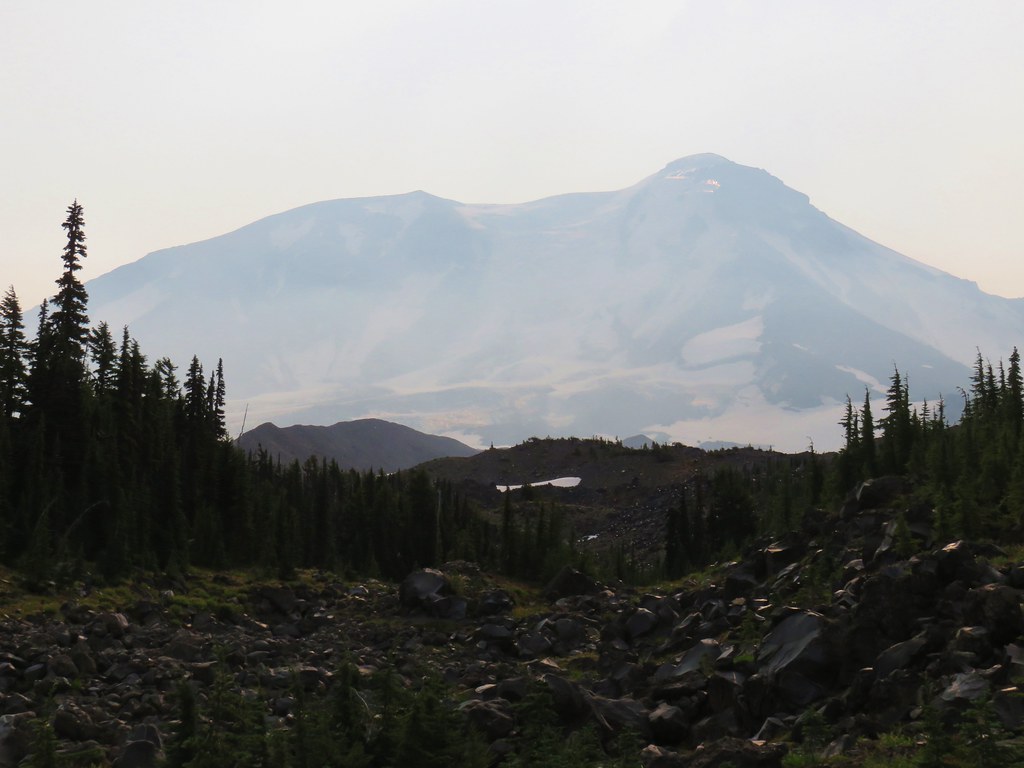
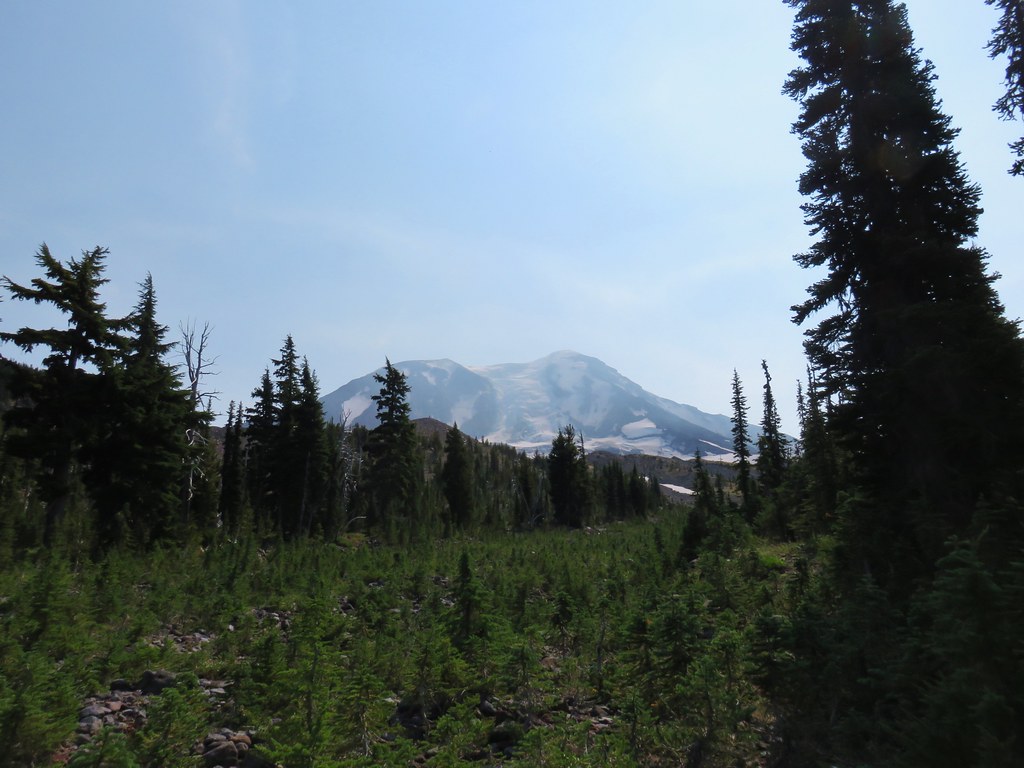
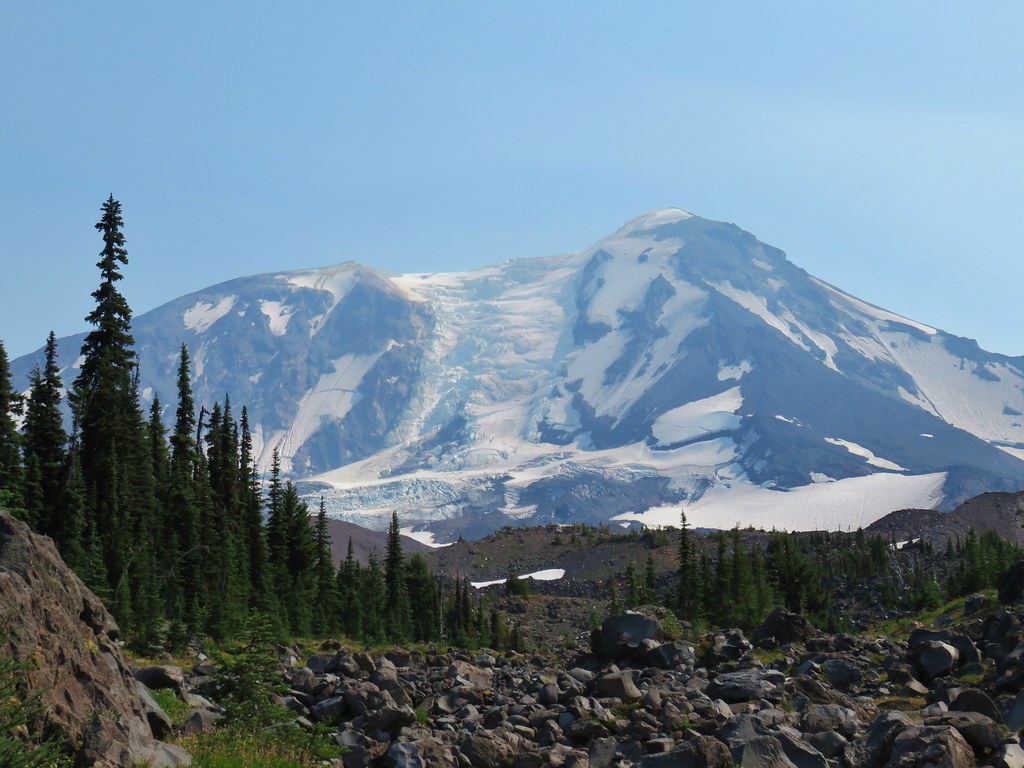
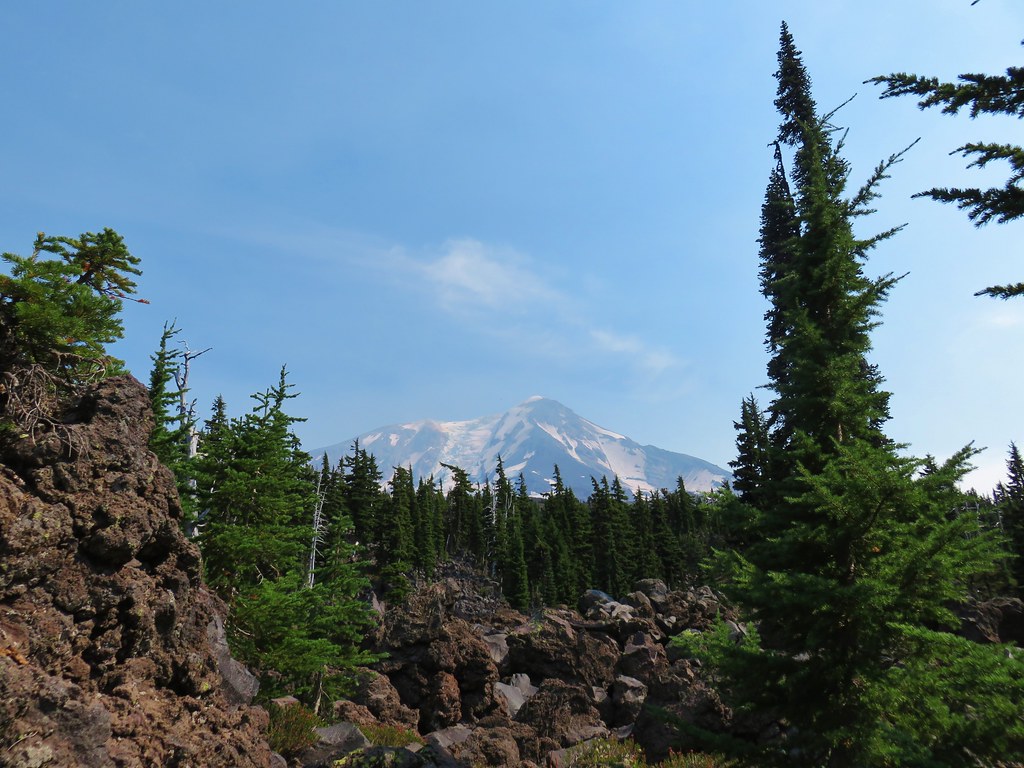
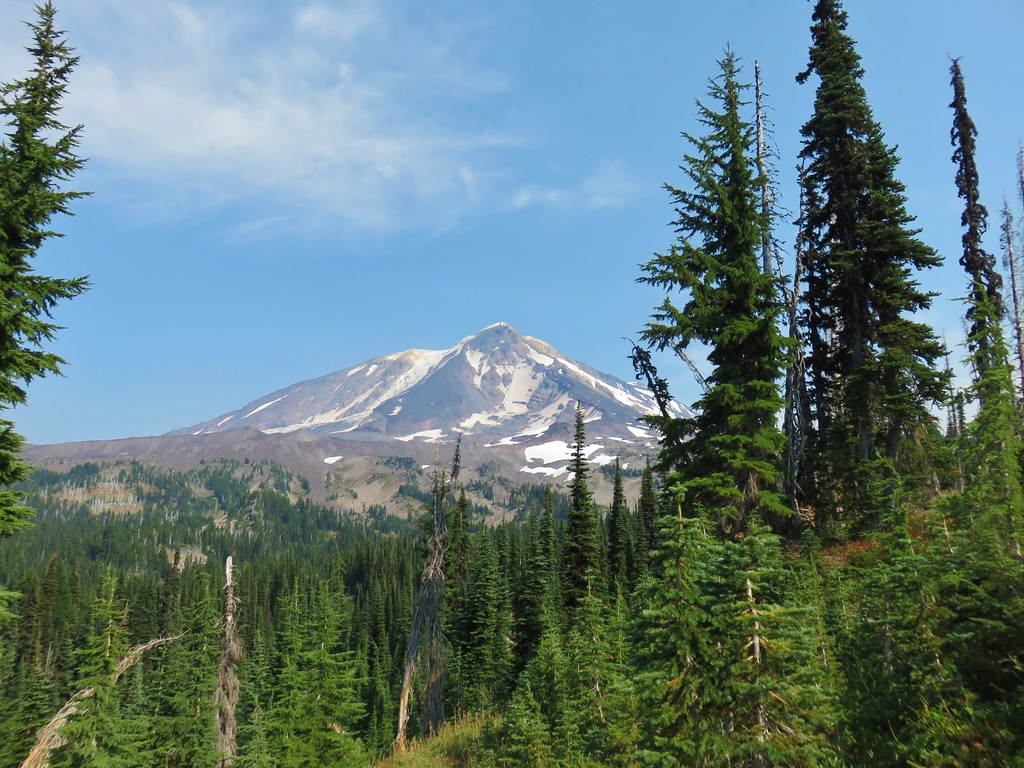
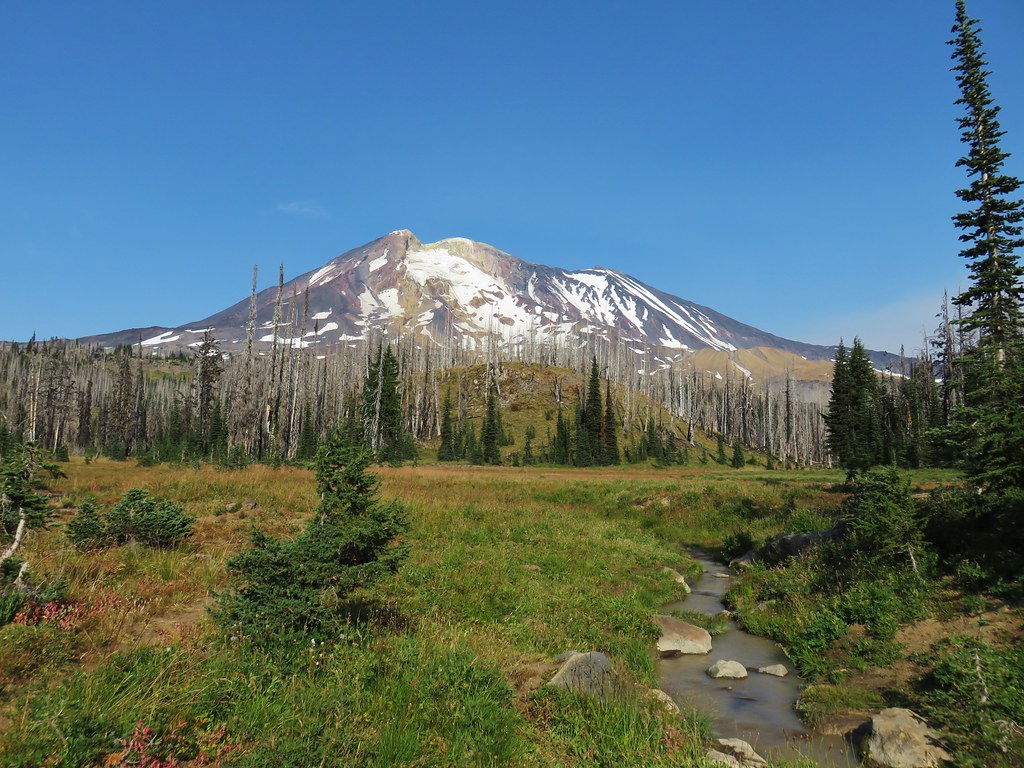
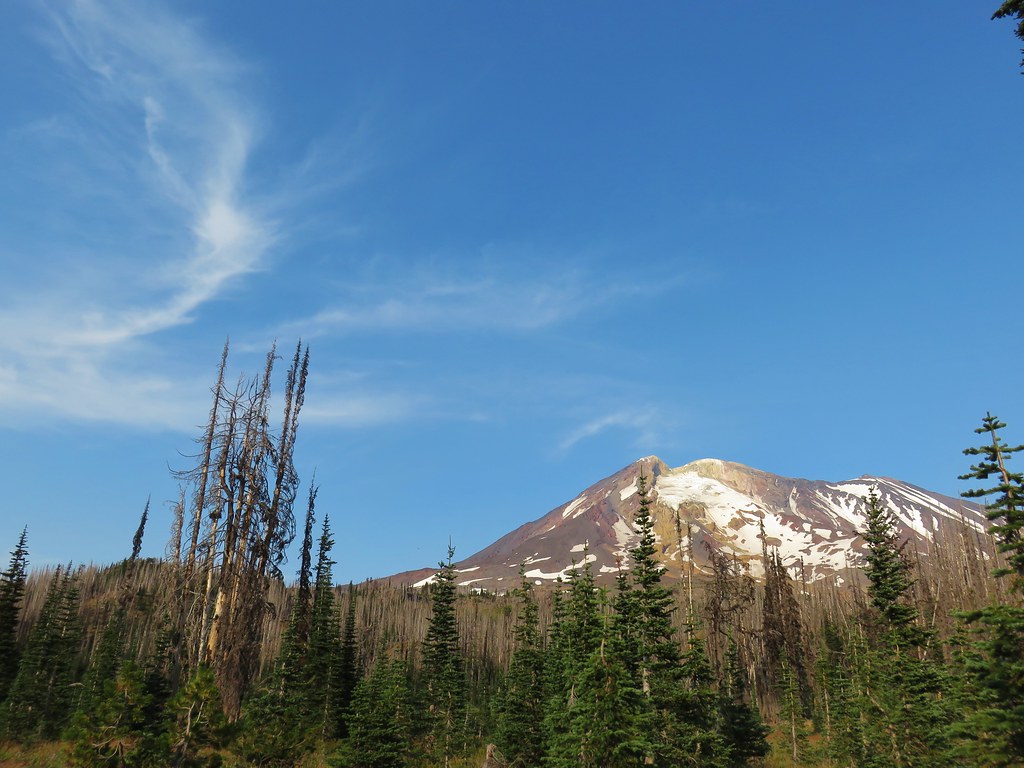
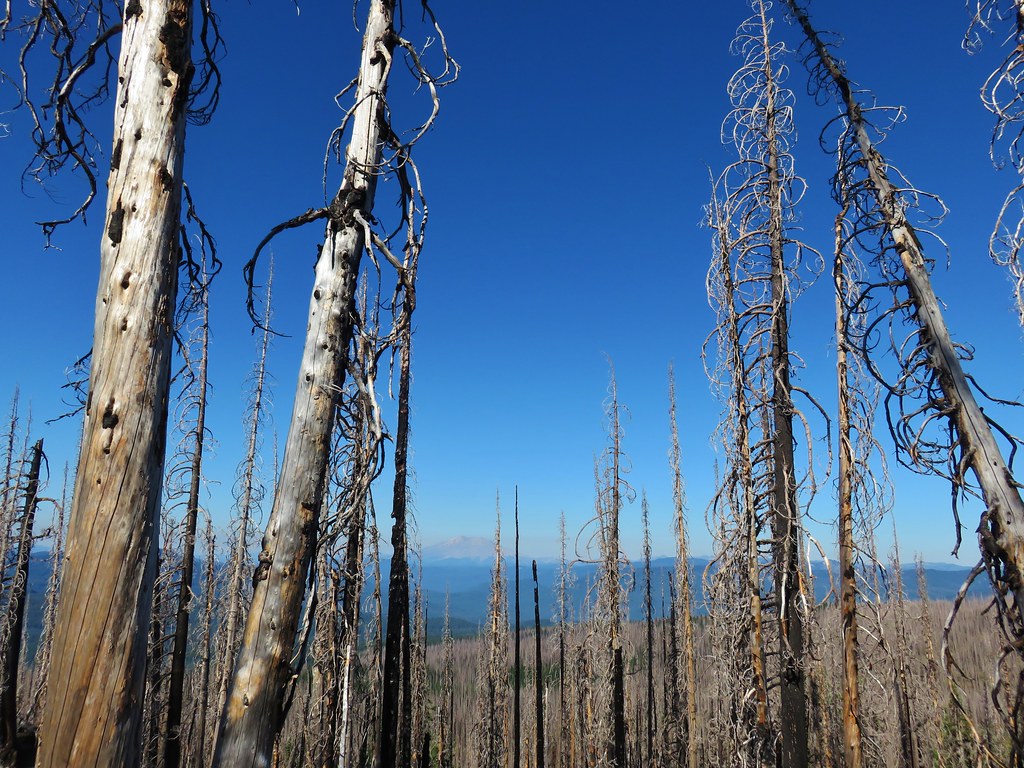
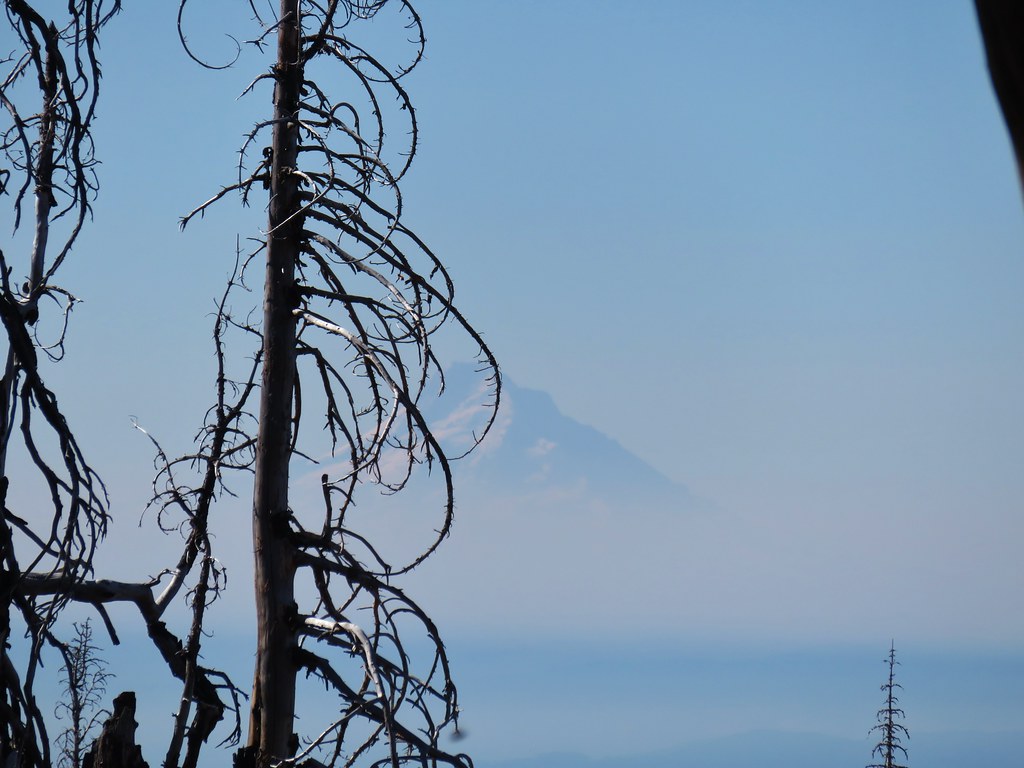
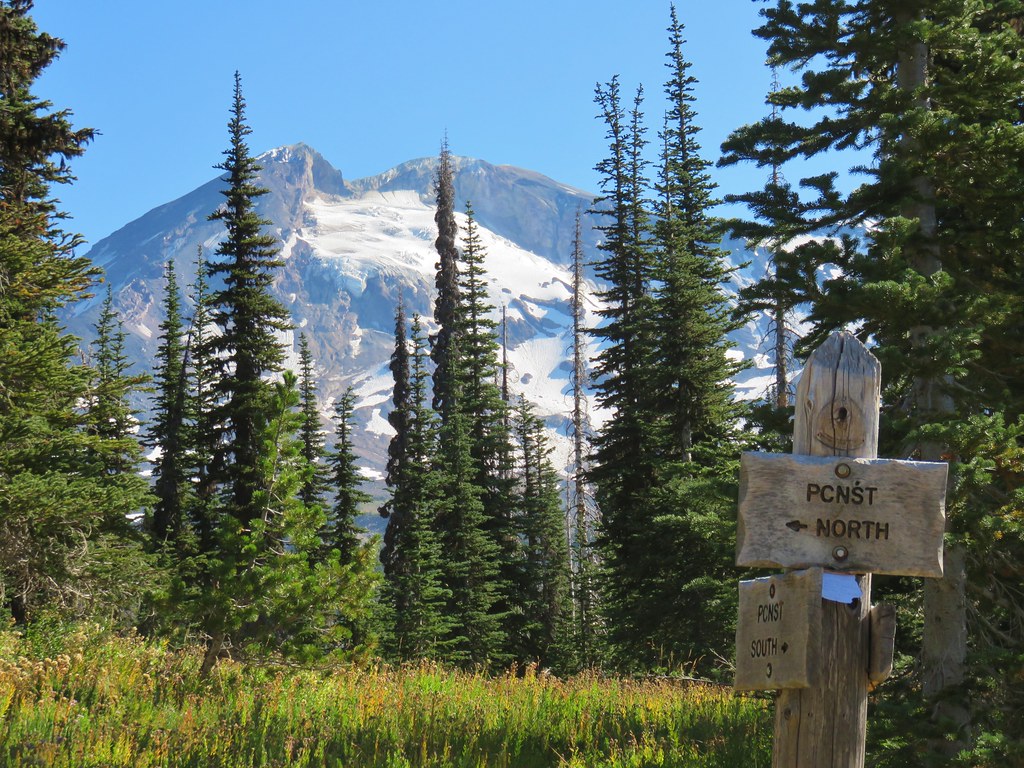
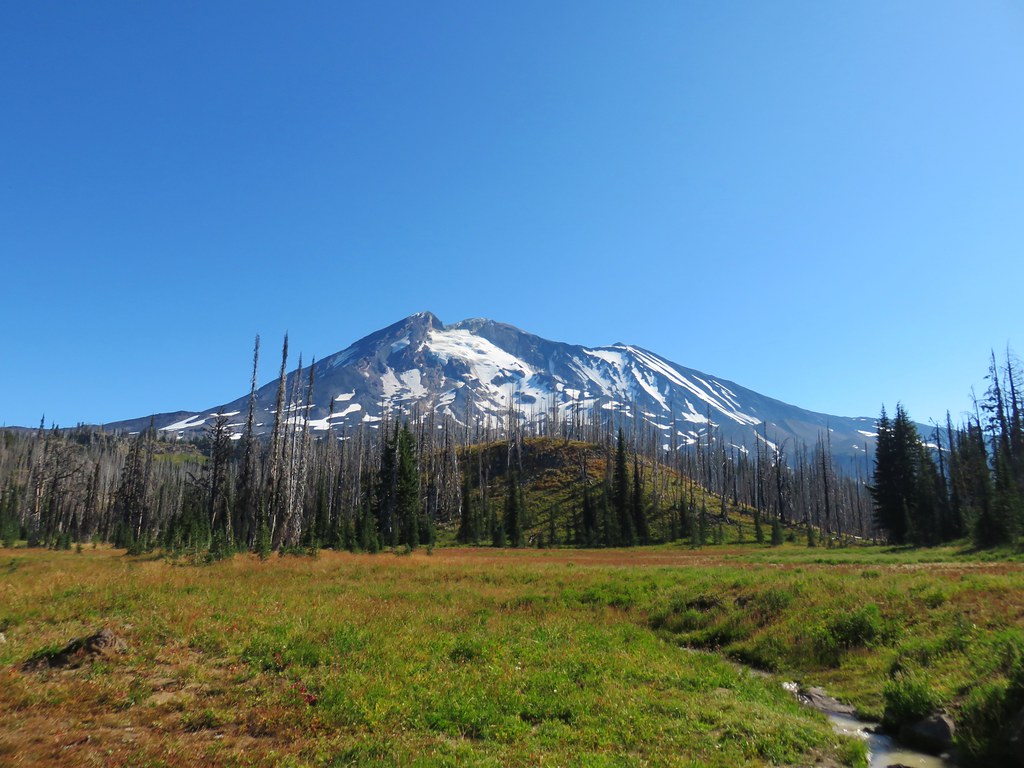
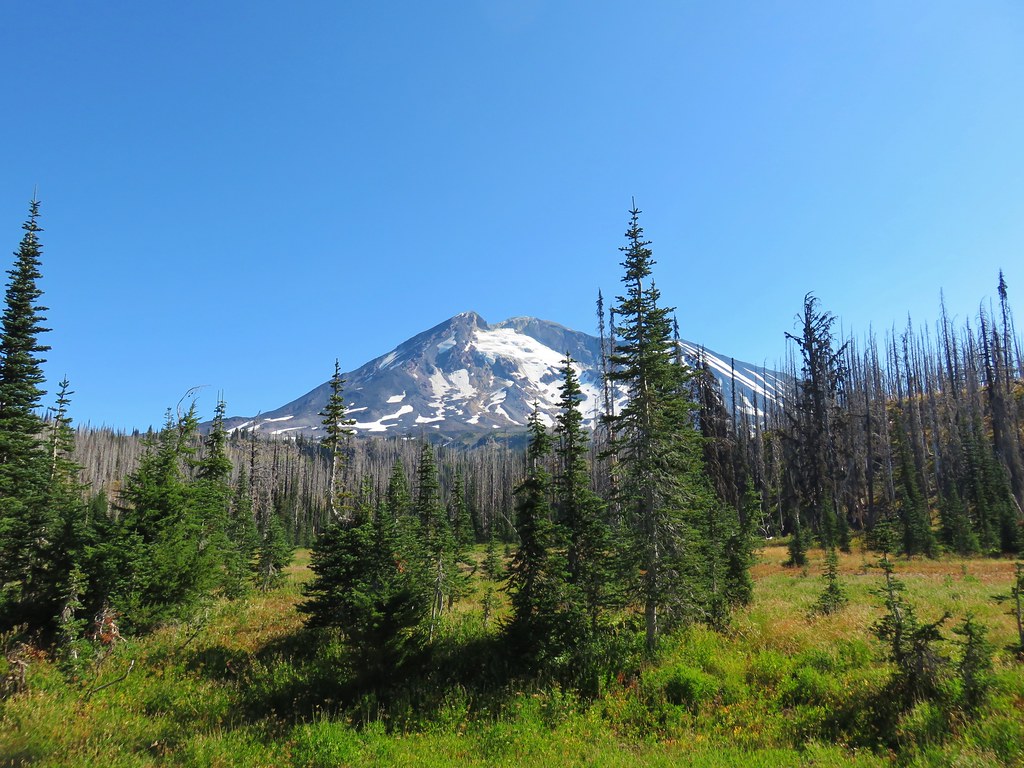
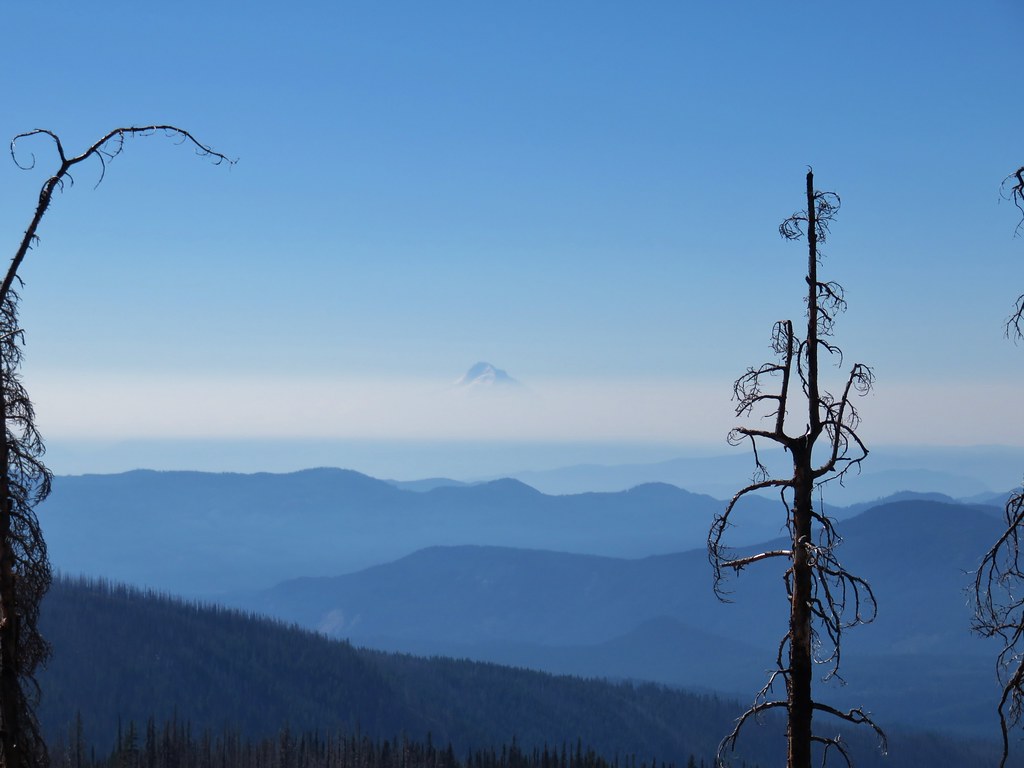
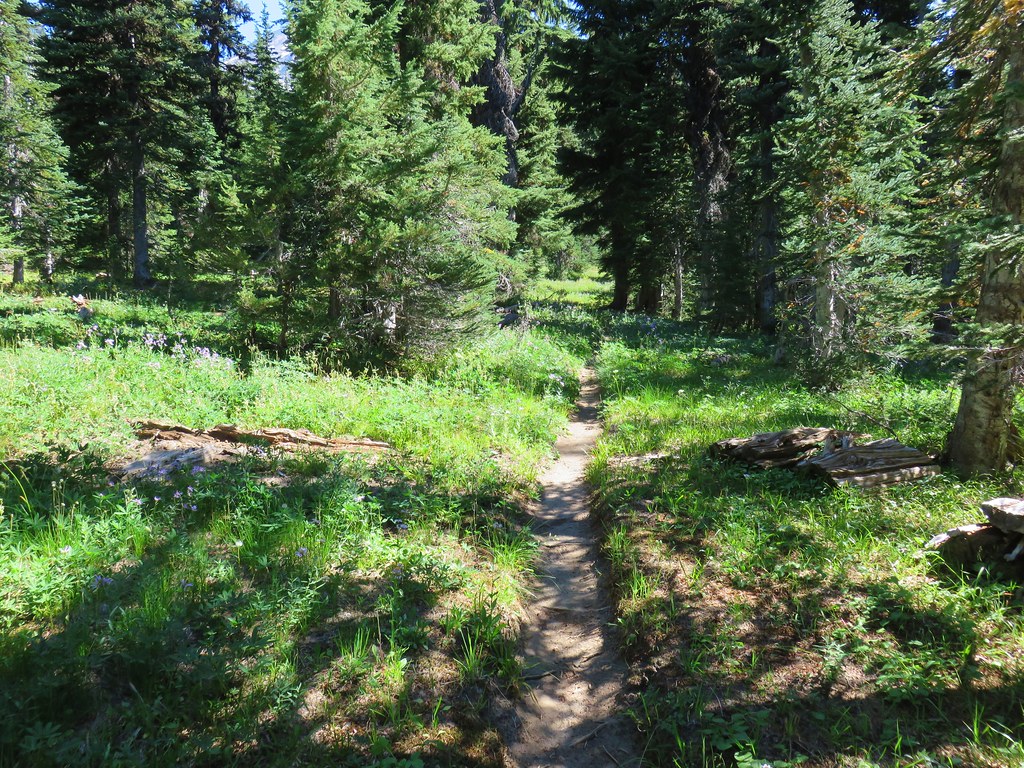
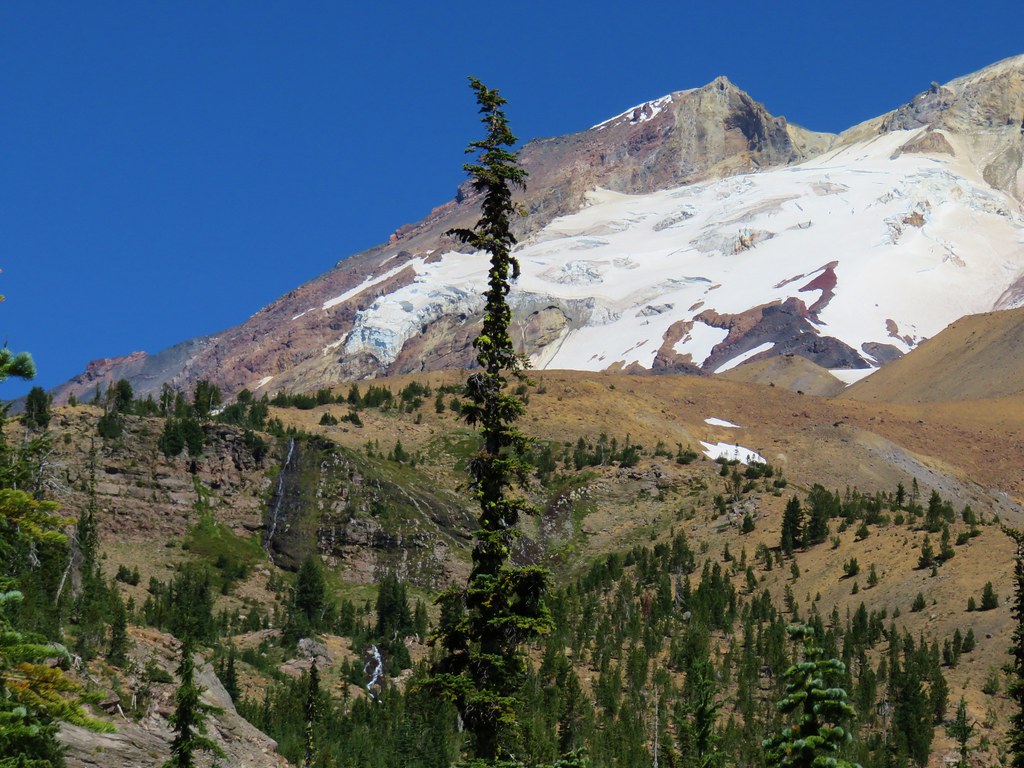
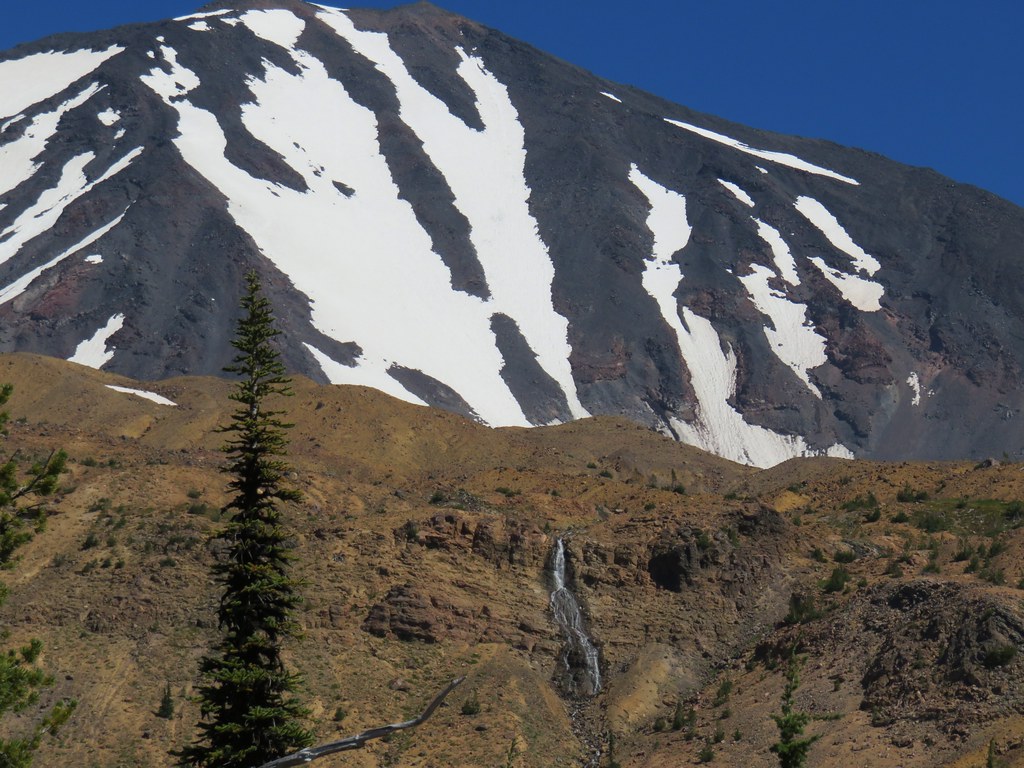
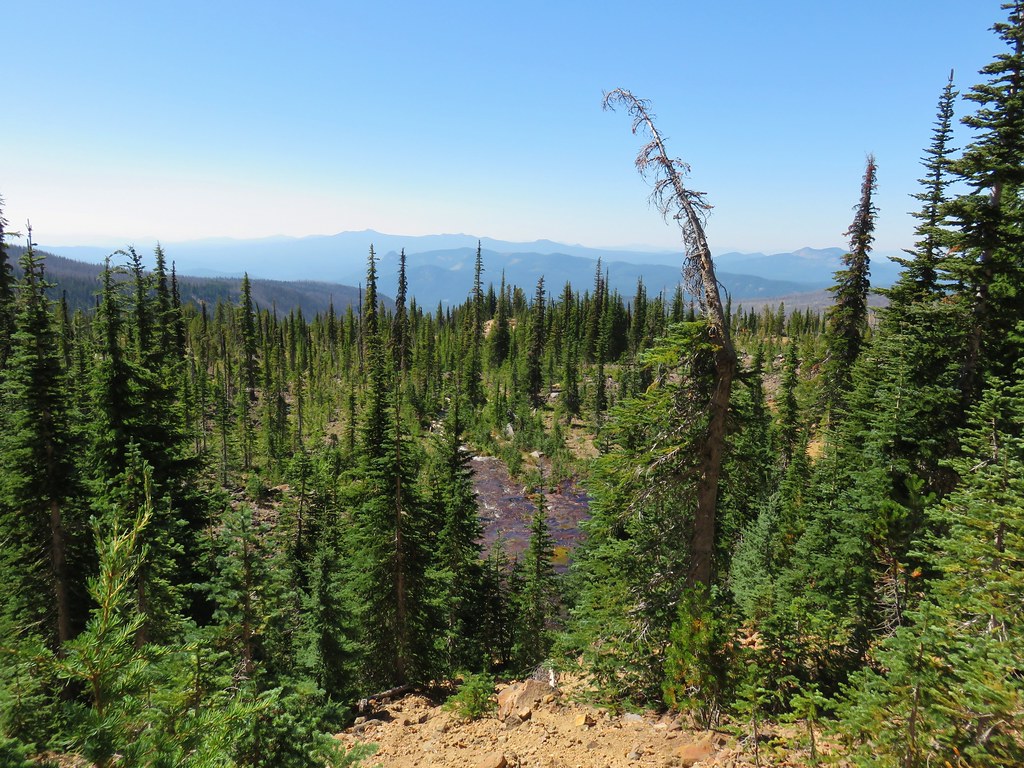
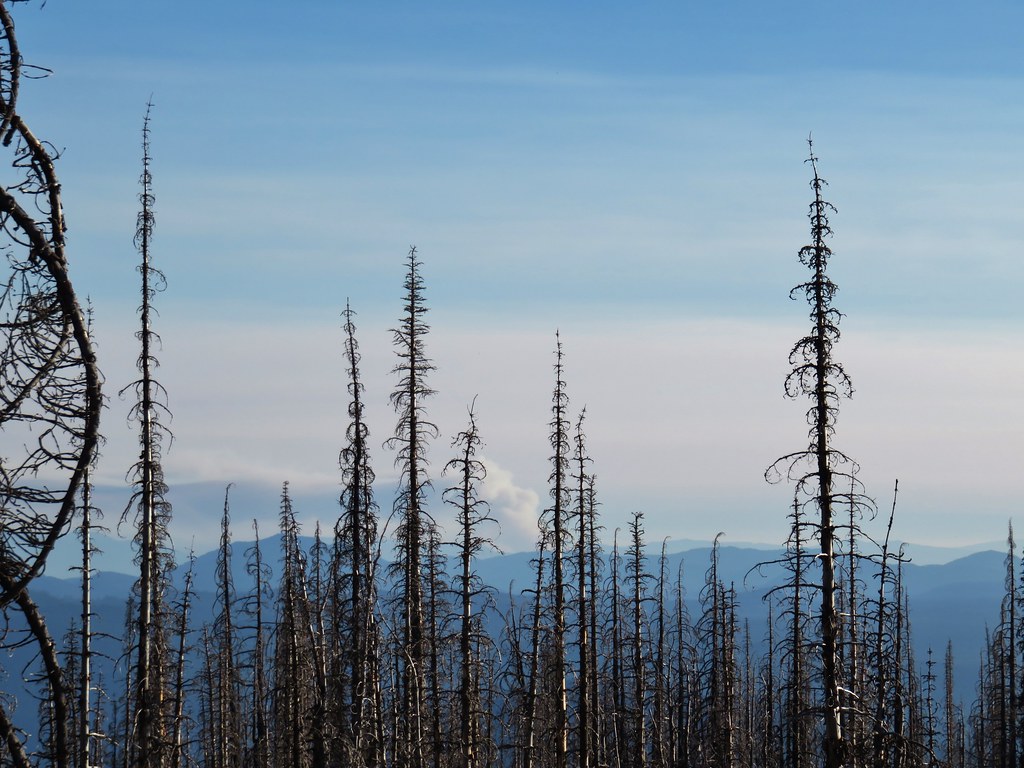
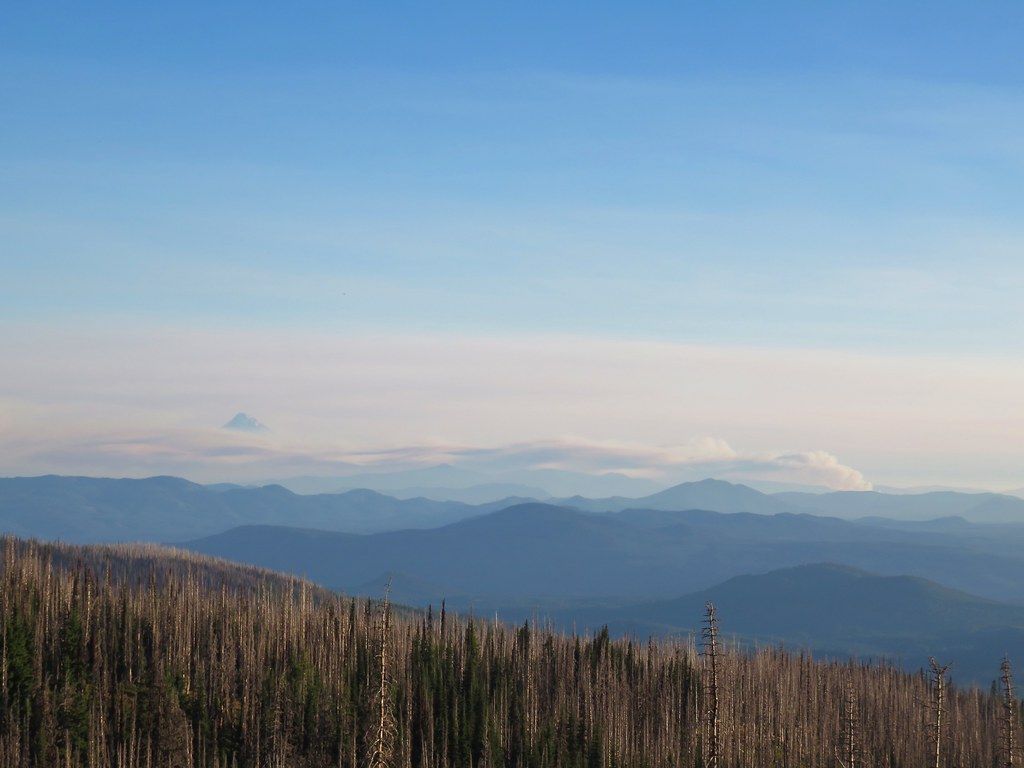
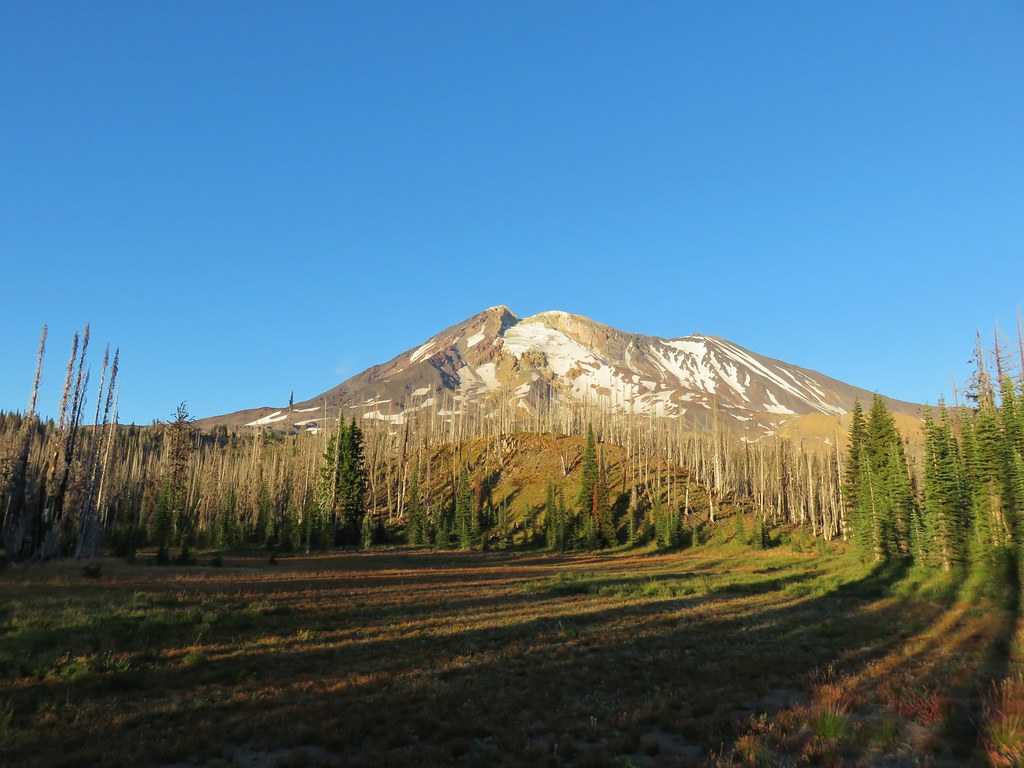
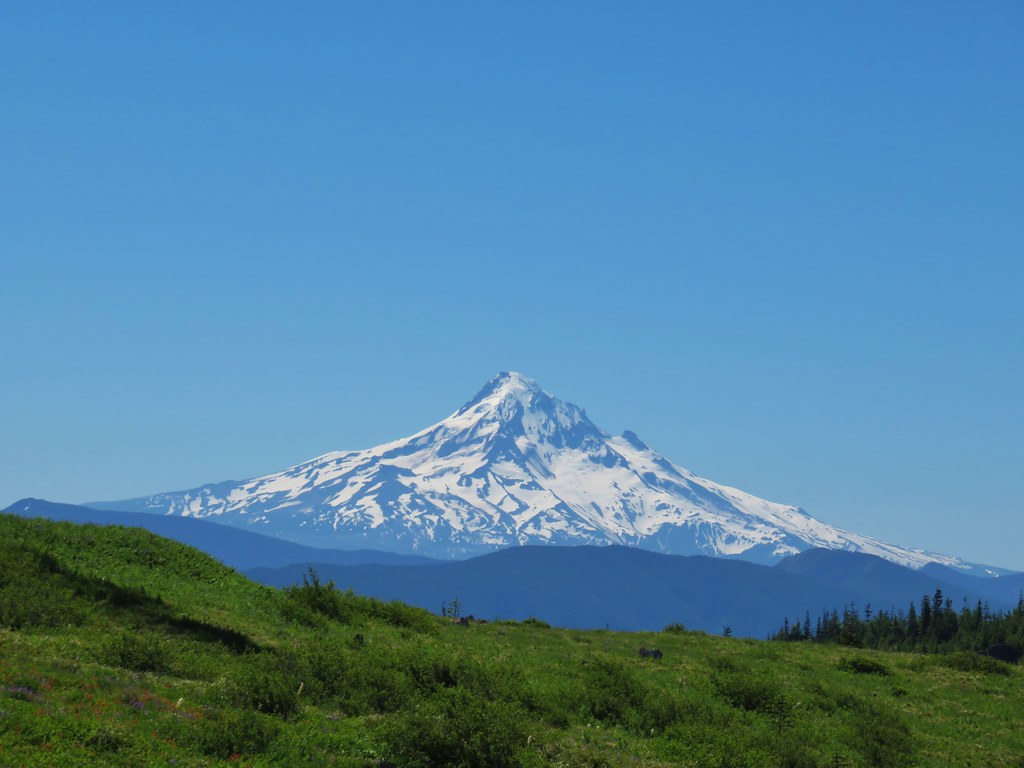
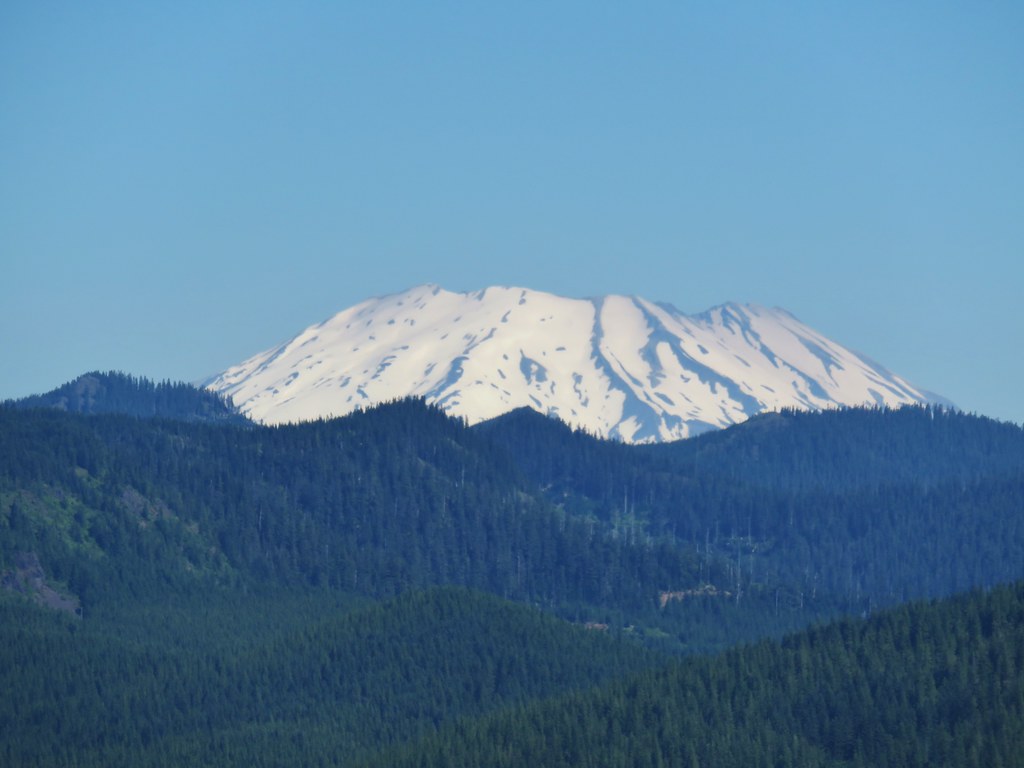
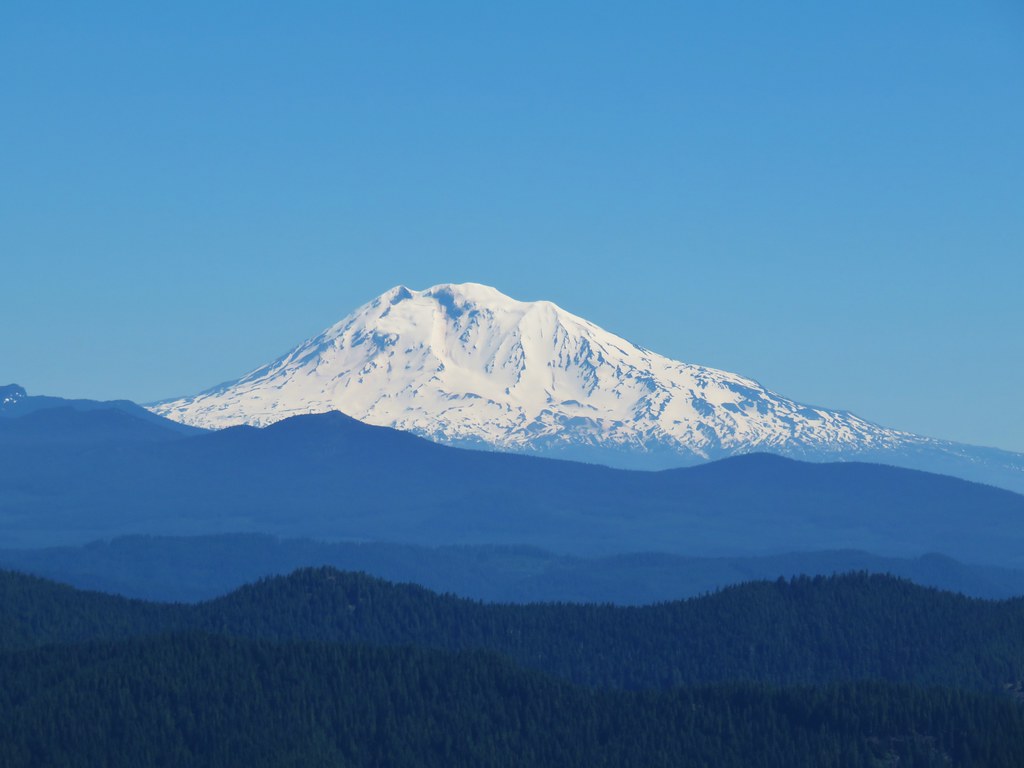
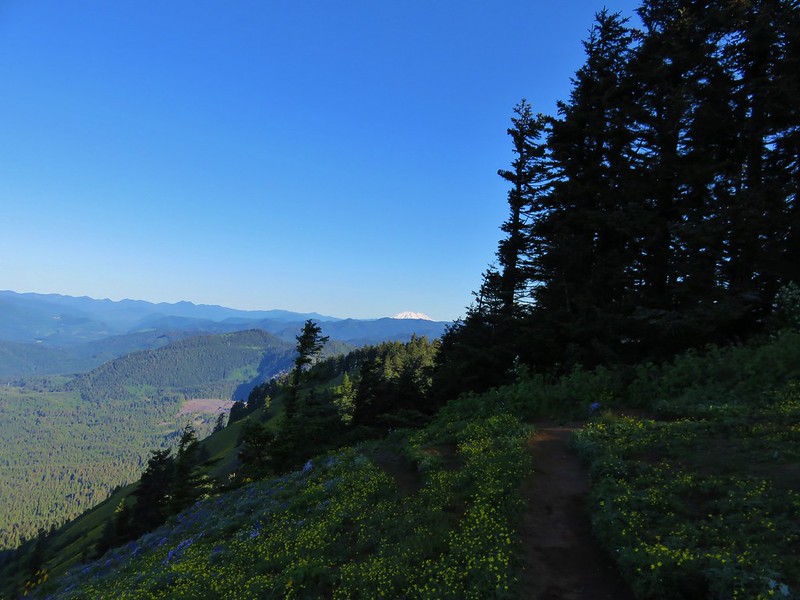
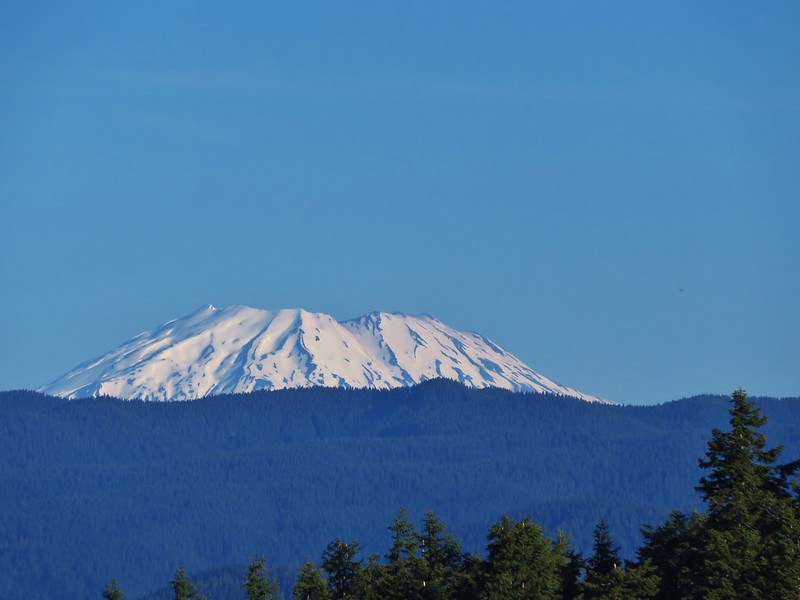
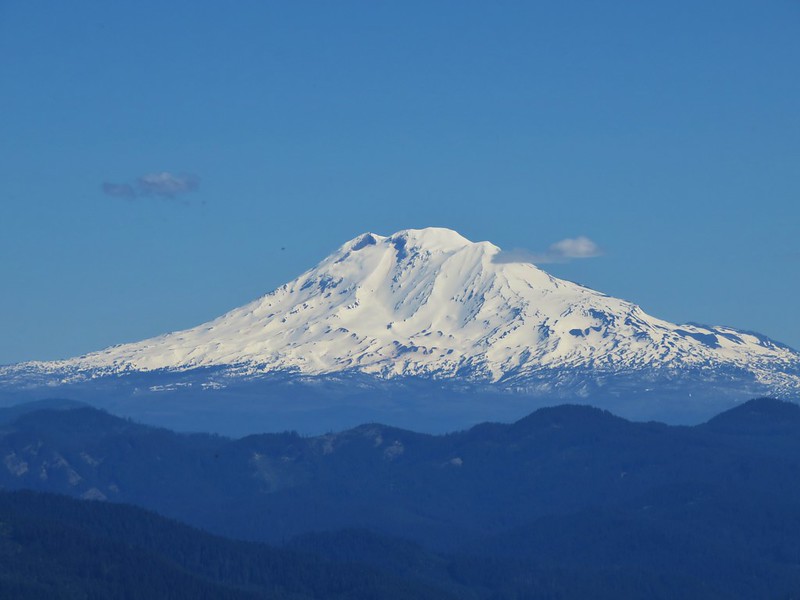
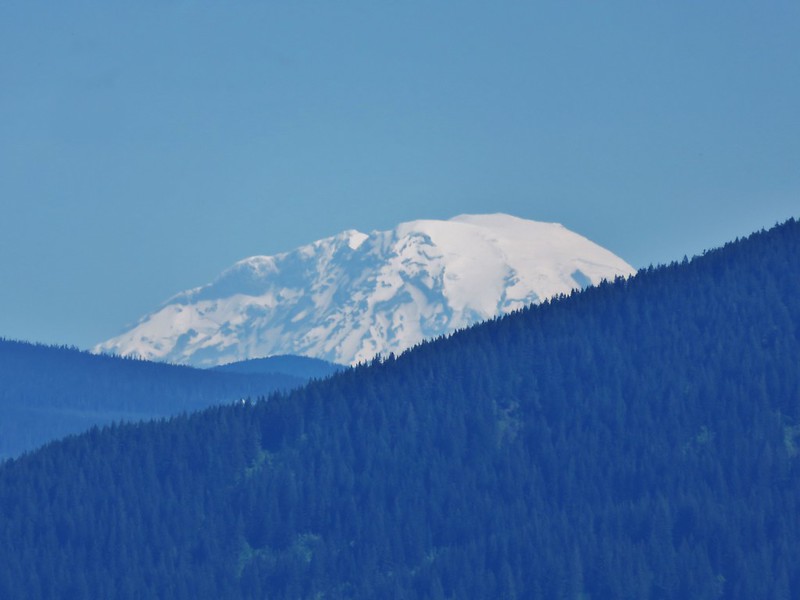
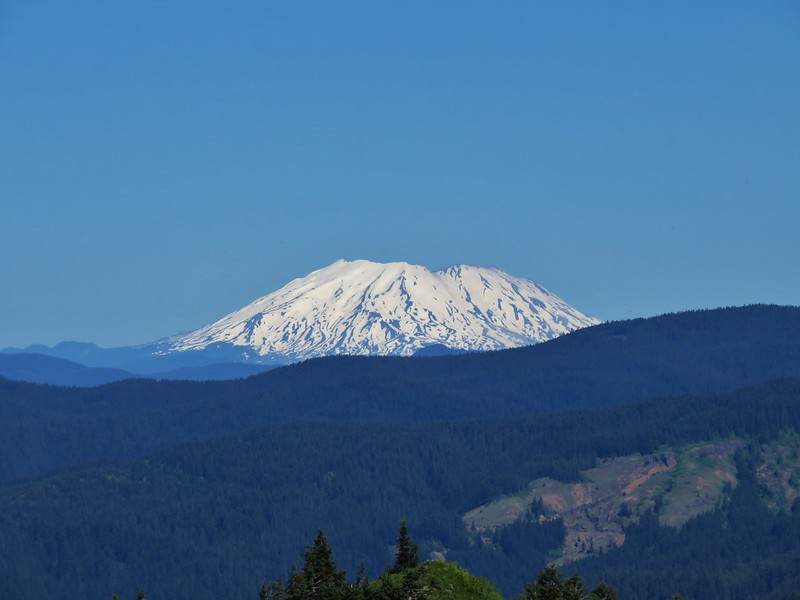
It was just about six miles from the trailhead to Horseshoe Meadow most of which was in the burnt area. Along the way we passed a some nice meadows, a few green trees and had views of Mt. Adams, Mt. St. Helens, and a smokey Mt. Hood.

IMG_7494

IMG_7487

IMG_7495

IMG_7506

At the junction with the Round-the-Mountain Trail we turned and promptly arrived at Horseshoe Meadow.

IMG_7511

IMG_7512

IMG_7516

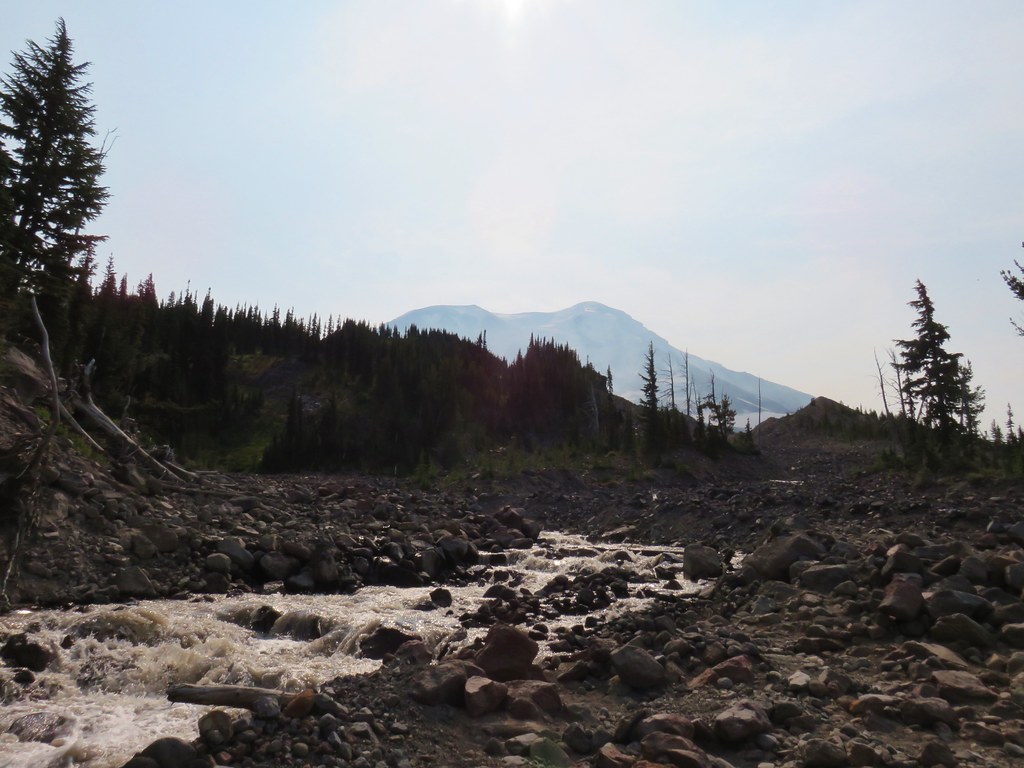
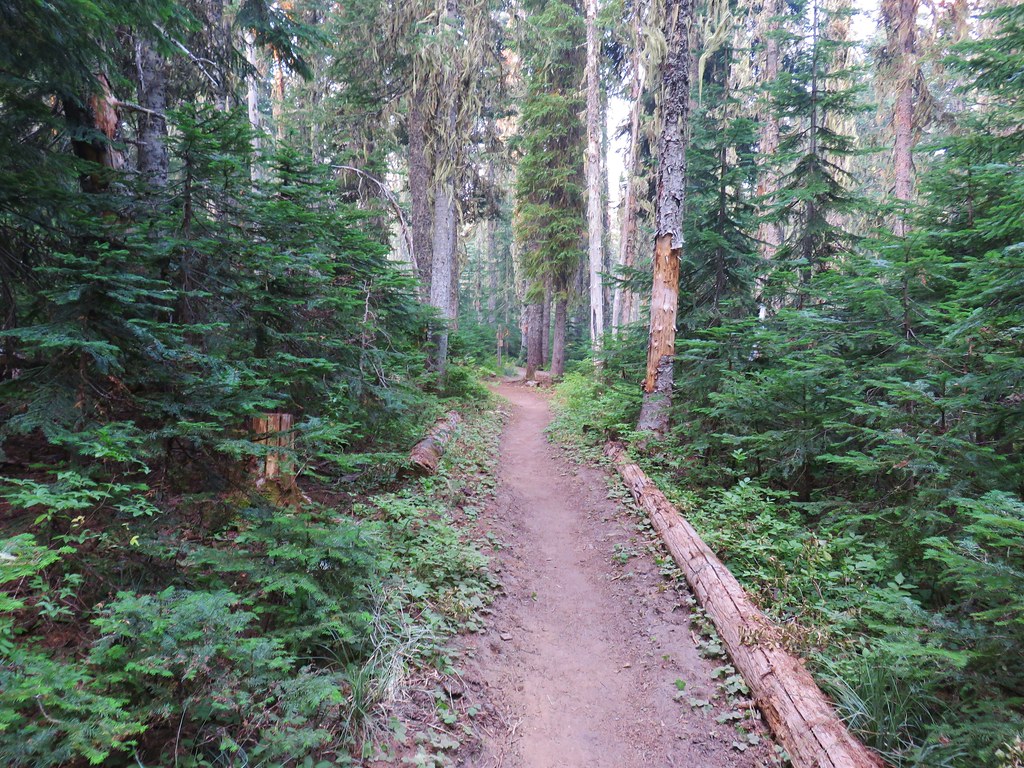
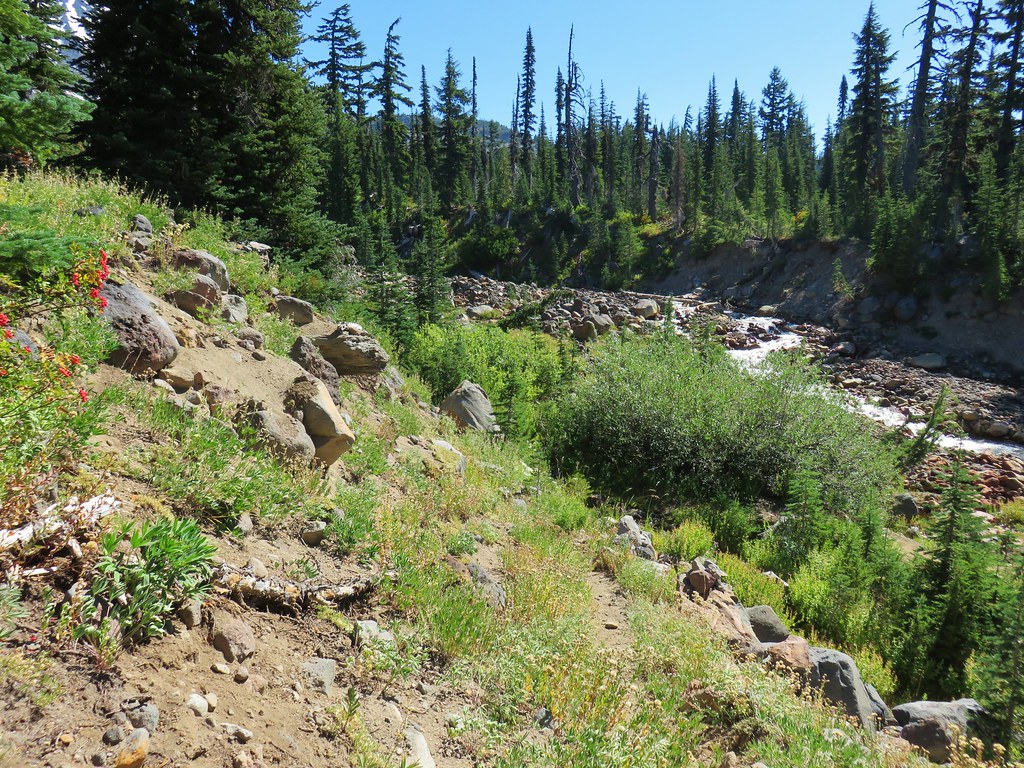
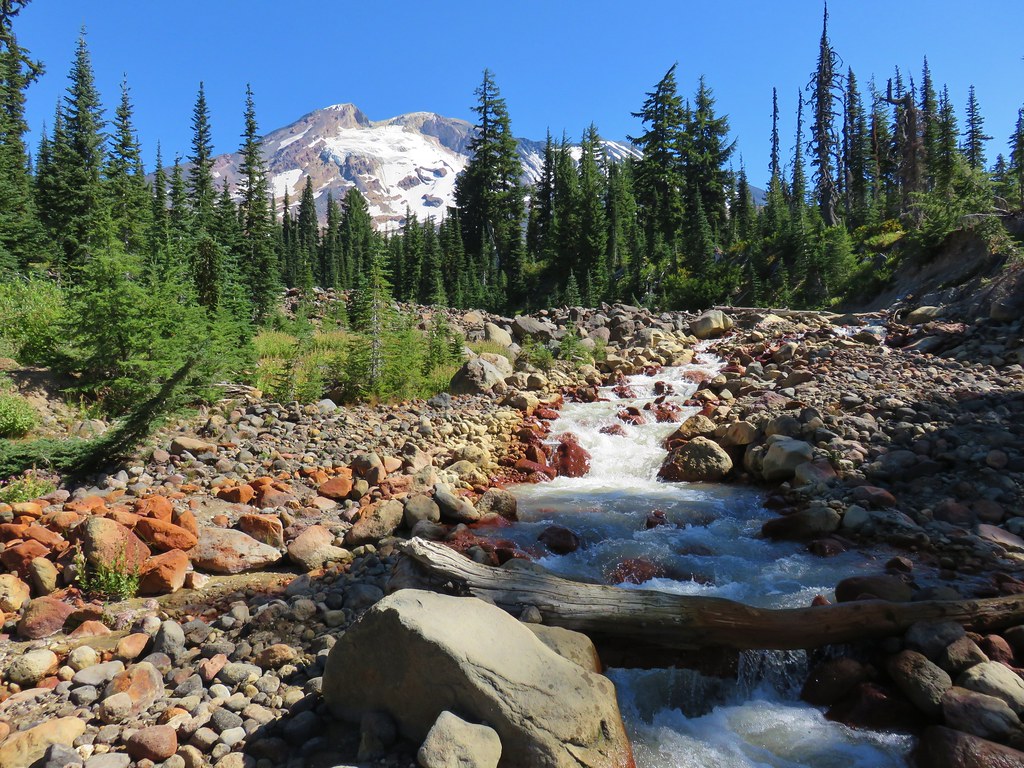
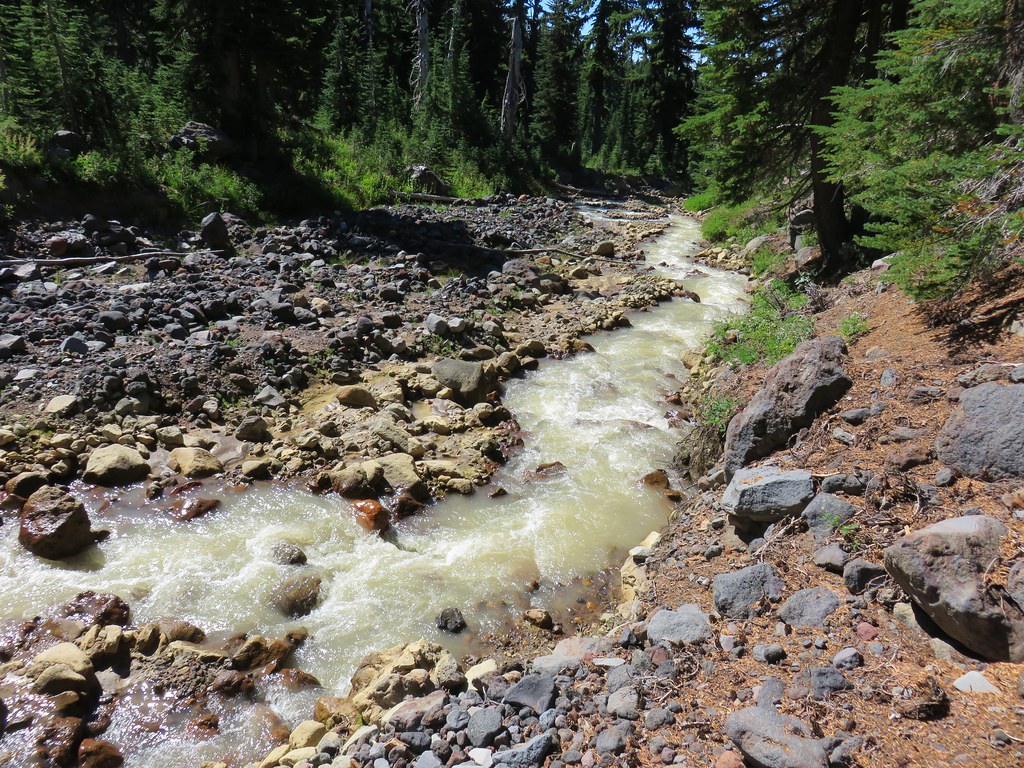
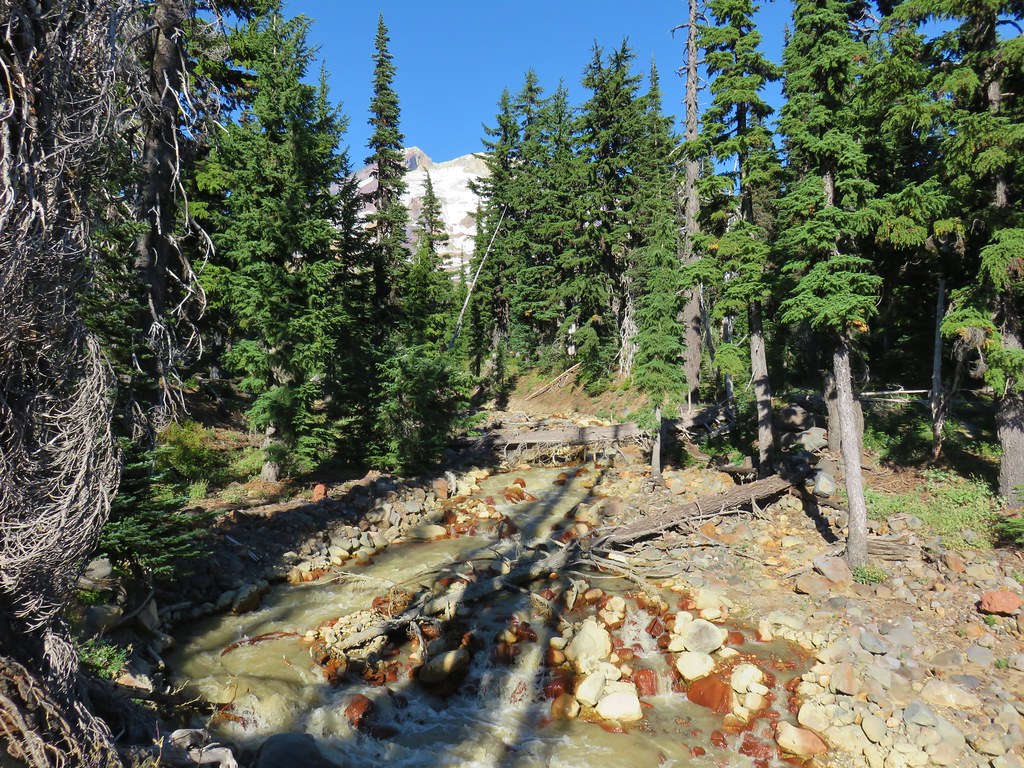
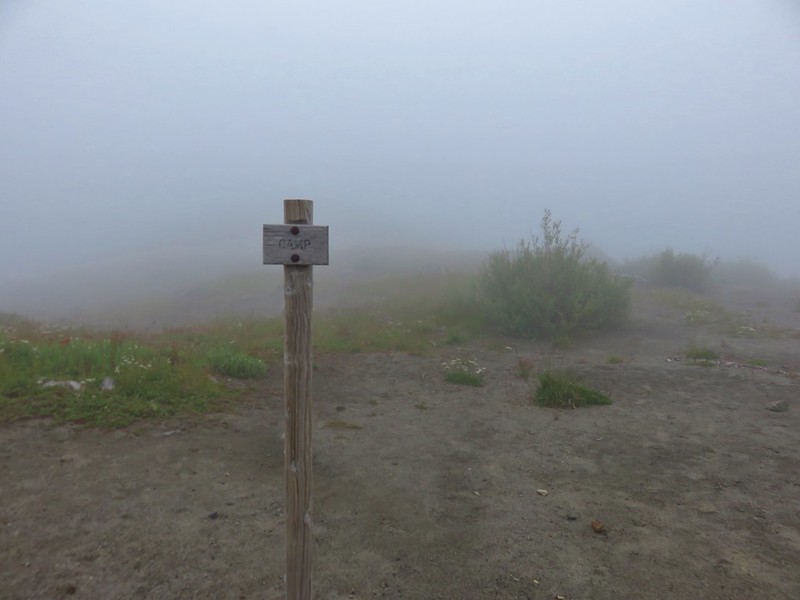
Cascade Creek flows through the meadow but was a little too silty filter so we debated on weather to set up camp there or continue on, possibly as far as Lookingglass Lake. After a little more consideration though we decided the location and view from Horseshoe Meadow was too good to pass up so we selected a tent site in some trees.

IMG_7518

IMG_7527

We had each started the day with 3 liters of water in our Osprey reservoirs and had brought full 18oz. Hydro Flasks. We also had an extra 96oz. Naglene Canteen and another small collapsible container that we decided to take with us on our afternoon excursion and fill them up on the way back to camp.

After getting camp situated we headed toward the South Climb Trail on the Round-the-Mountain Trail.

IMG_7530

We’d made the South Climb Trail our turnaround point because our first and only other visit to the Mt. Adams Wilderness was a 2014 hike to Iceberg Lake via the South Climb and Round-the-Mountain Trails.

The trail continued through the Cascade Creek burn with views south to Mt. Hood which remained mostly hidden by smoke.

IMG_7532

IMG_7535

Before long we began to find some forest that had been spared from the fire.

IMG_7537

About a mile from Horseshoe Meadow we came to a small stream with some little pools just big enough to filter water from.

IMG_7540

Just beyond the stream we passed the Lookingglass Lake Trail.

IMG_7543
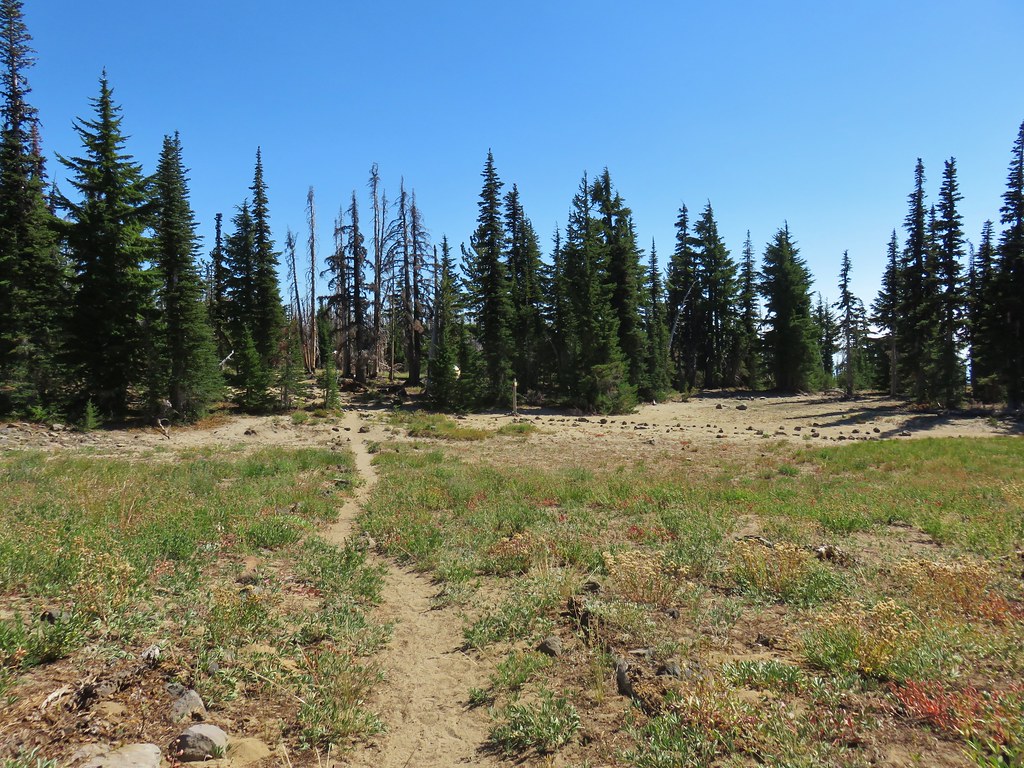
We decided to make that side trip on the way back and then we could fill our extra canteens on the way back to camp from the little stream.

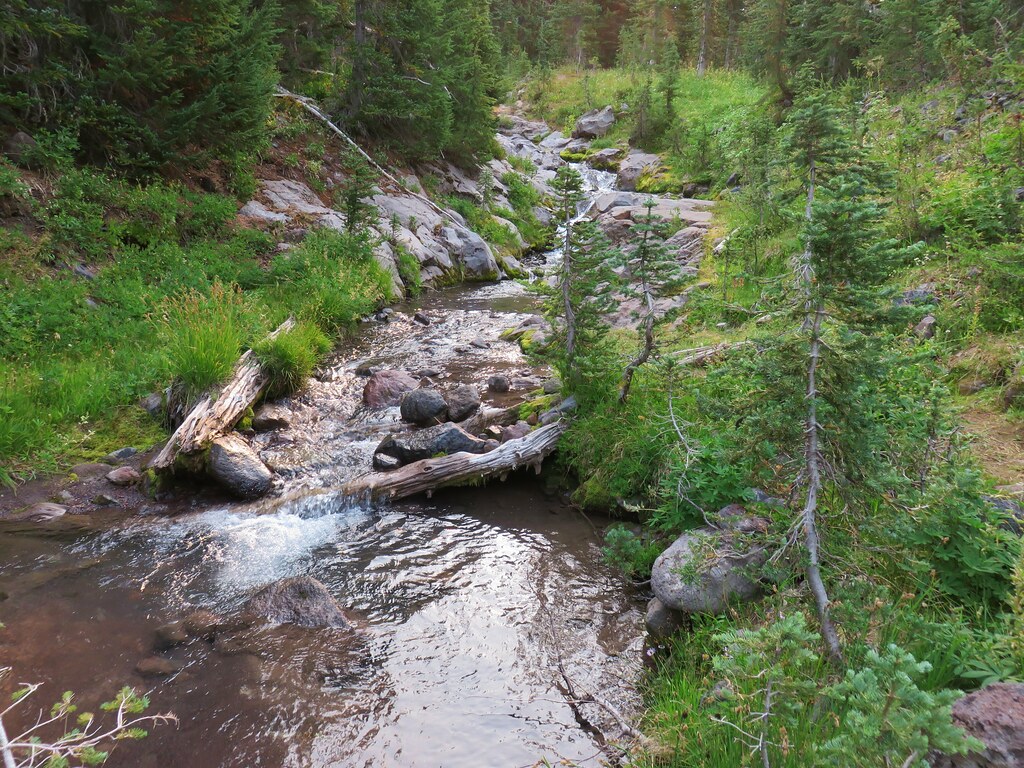
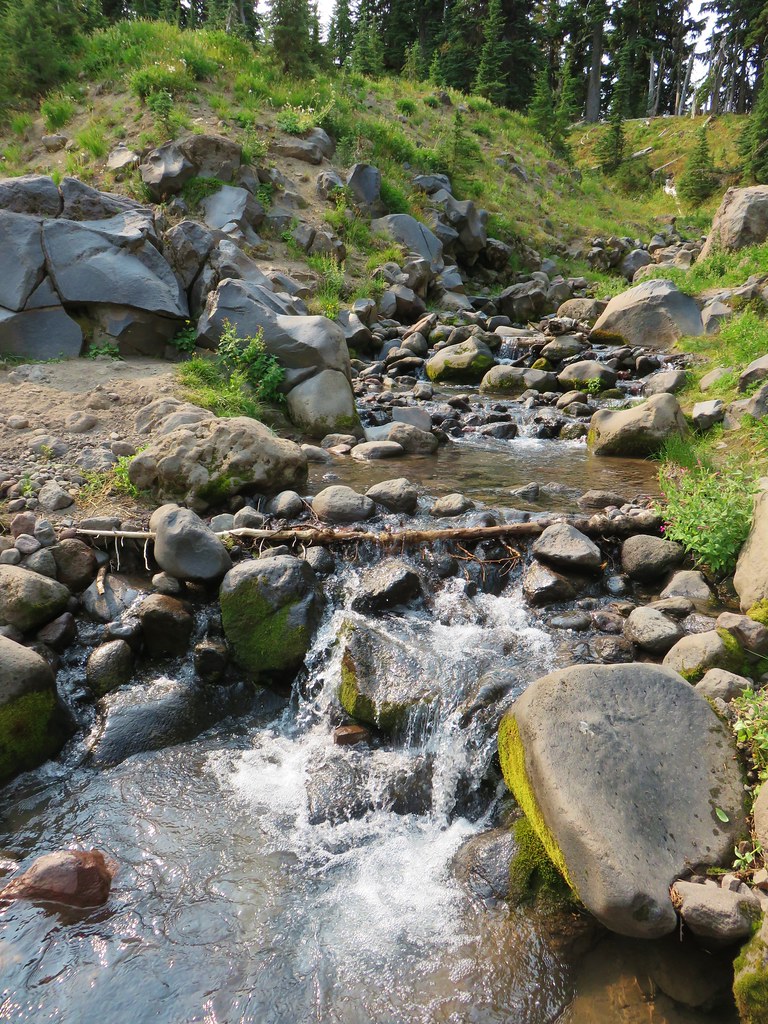
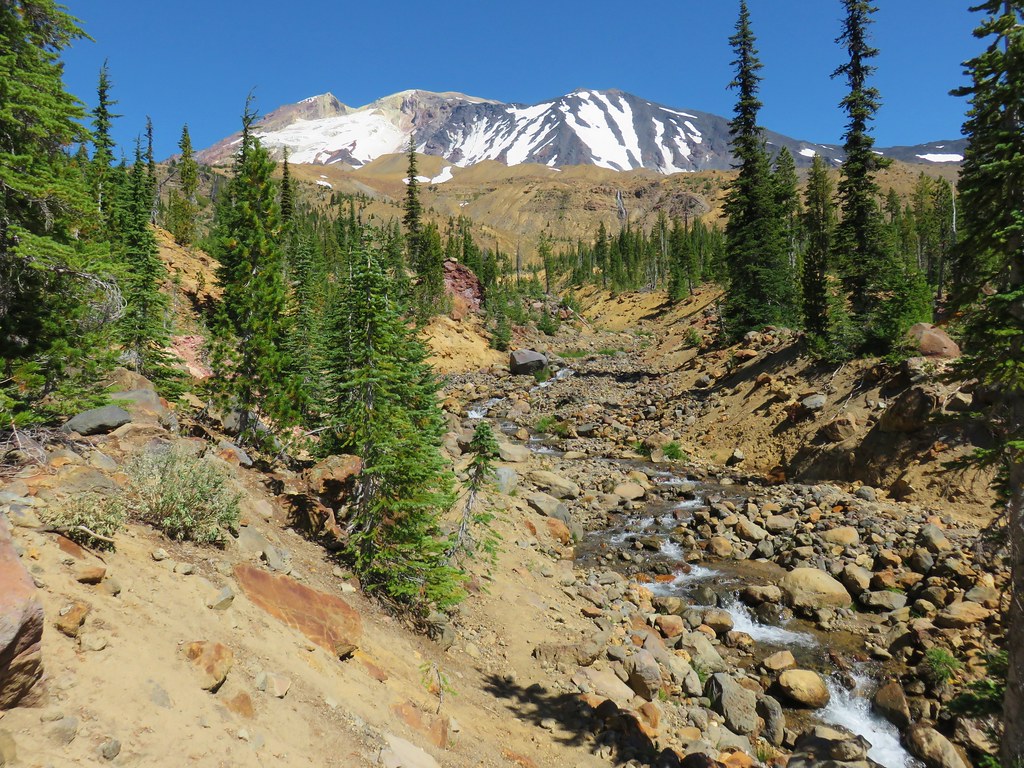
There were a number of creeks and streams with flowing water beyond the Lookingglass Lake Trail junction. The first set all eventually flowed into Cascade Creek further down the mountain.

IMG_7544

IMG_7550

IMG_7570

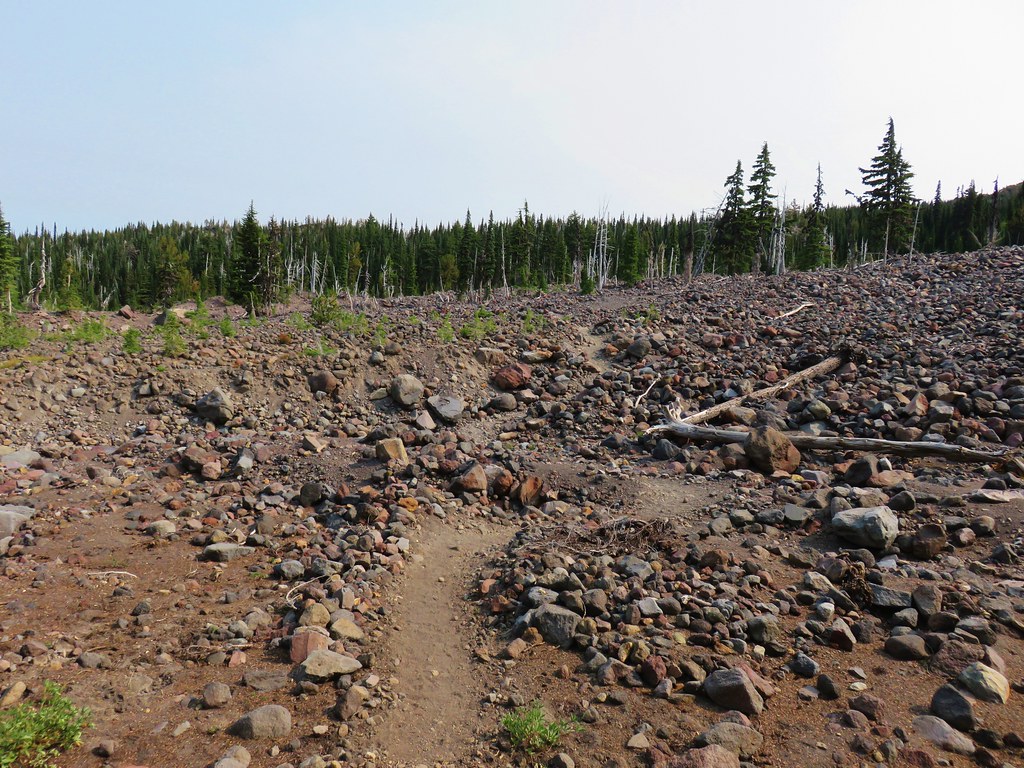
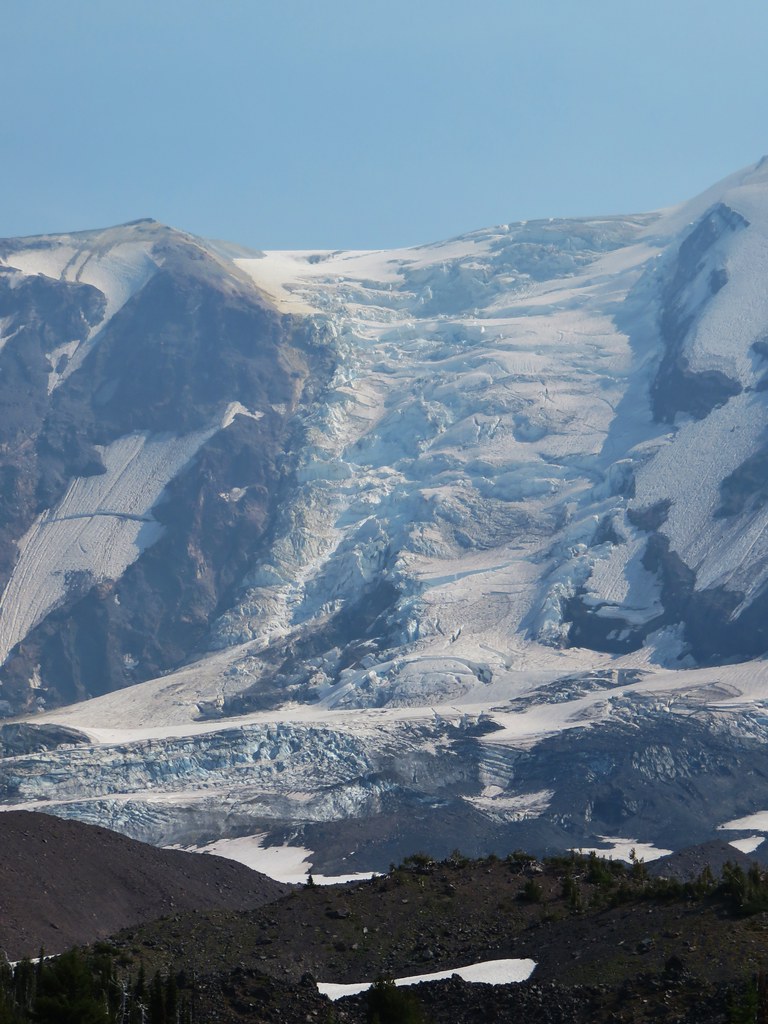
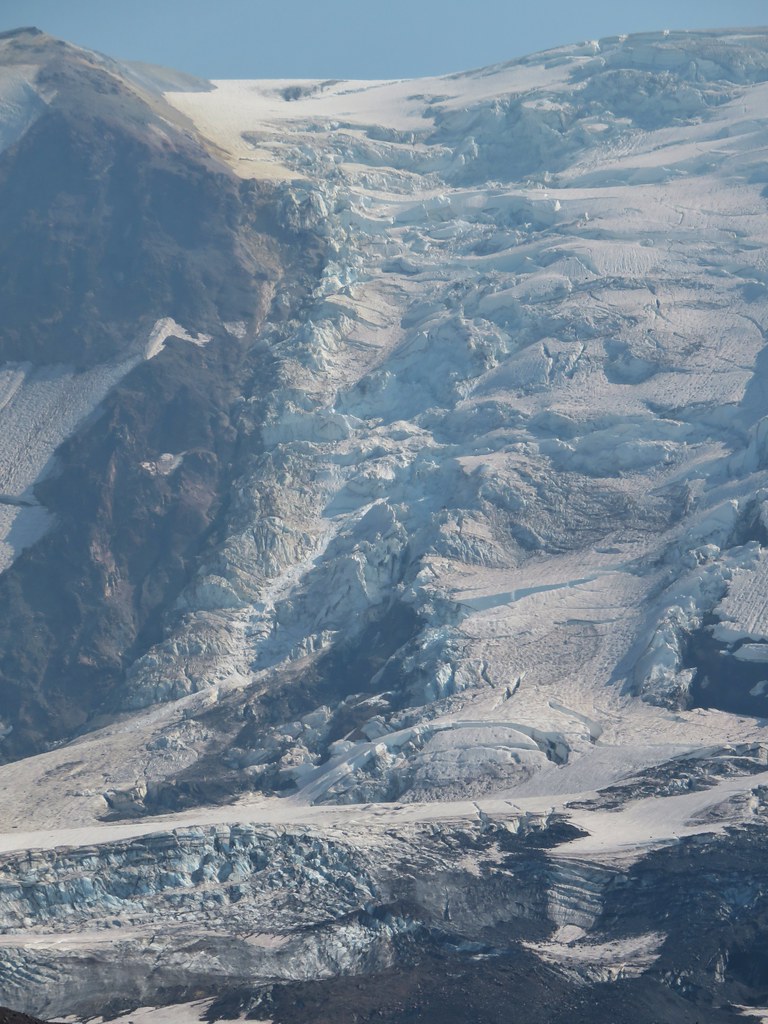
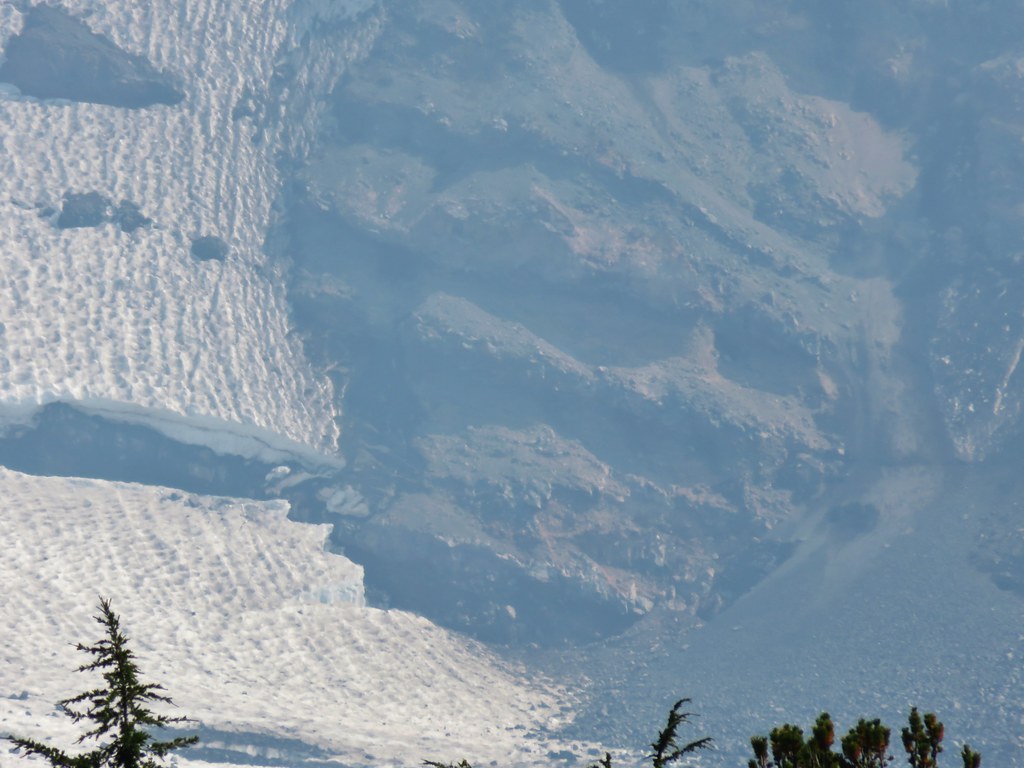
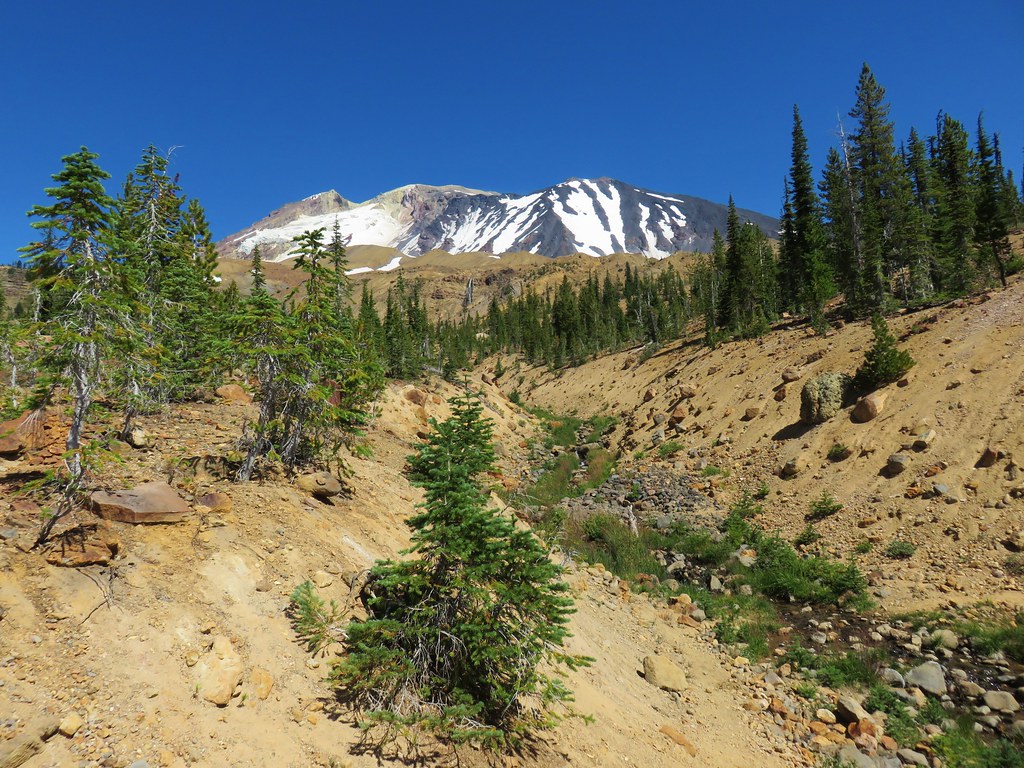
Much of the area we were now passing through contained debris flows from massive avalanches from the Avalanche Glacier. In fact there had been a warning at the trailhead that a crack in the glacier could trigger an avalanche at any time. The Round-the-Mountain Trail was shown as just outside the danger area but it was obvious from our surroundings that the location of the trail had been in the danger zone in the past.

IMG_7582

The next set of creeks were all tributaries of Salt Creek, most of which flowed from large glacial moraines.

IMG_7583

IMG_7587

IMG_7592

IMG_7595

Others came from springs, one of them just below the trail.

IMG_7600

IMG_7602

IMG_7609

Two and a half miles from the Lookingglass Trail we came to a junction with the Shorthorn Trail.

IMG_7618

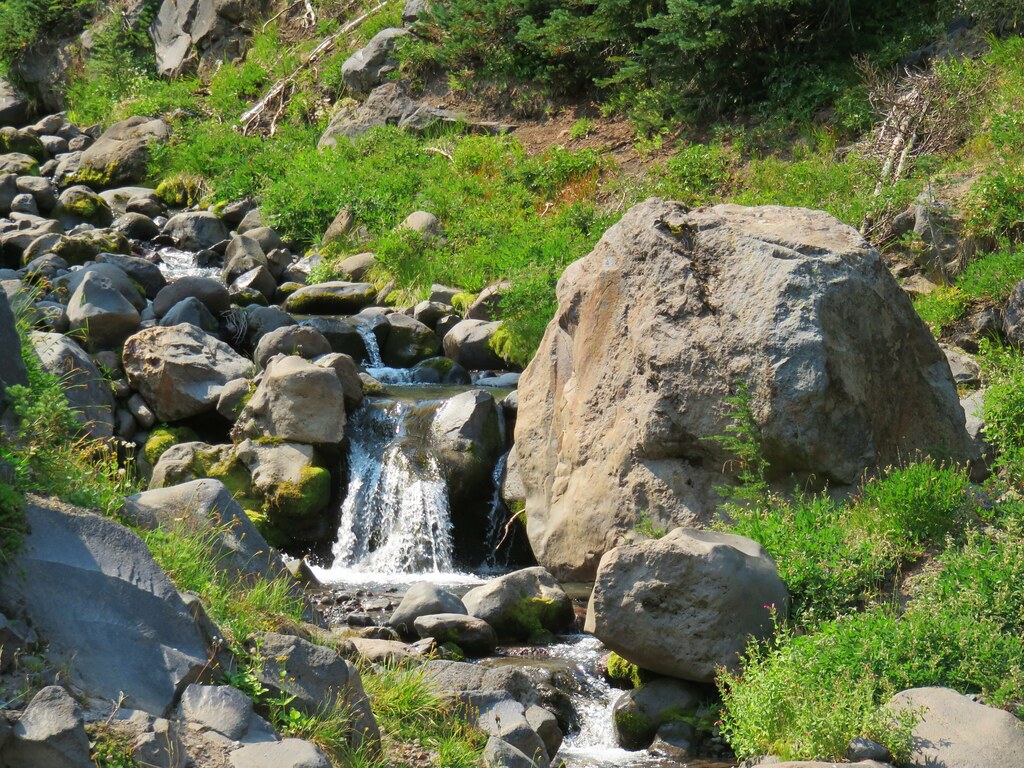
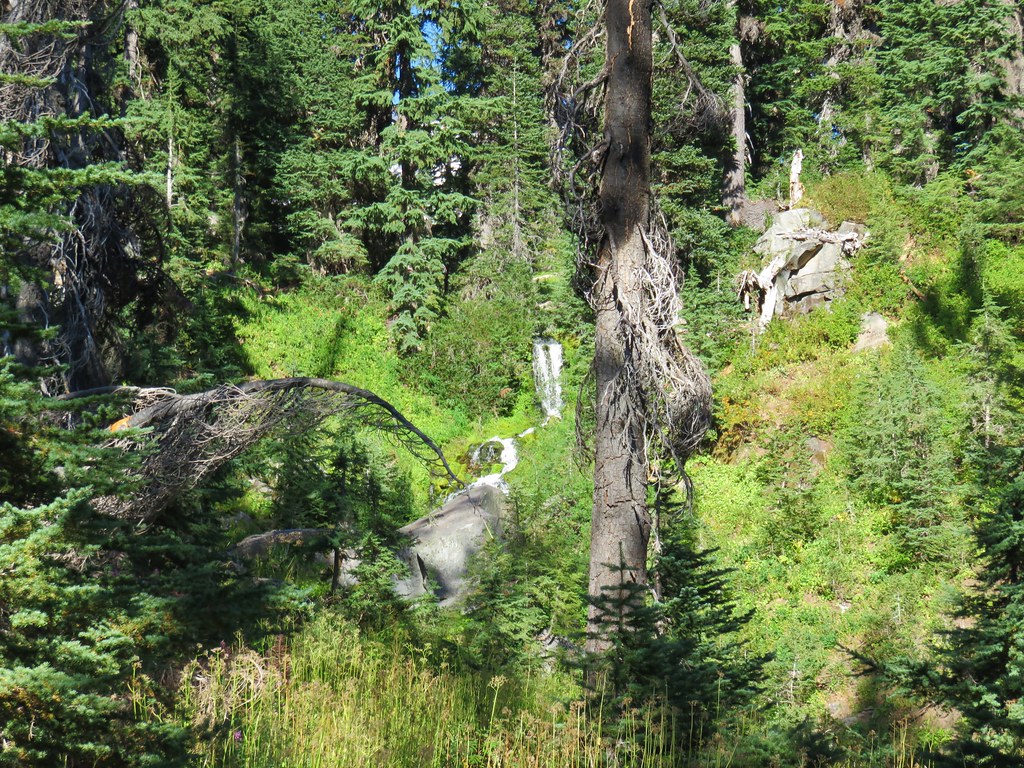
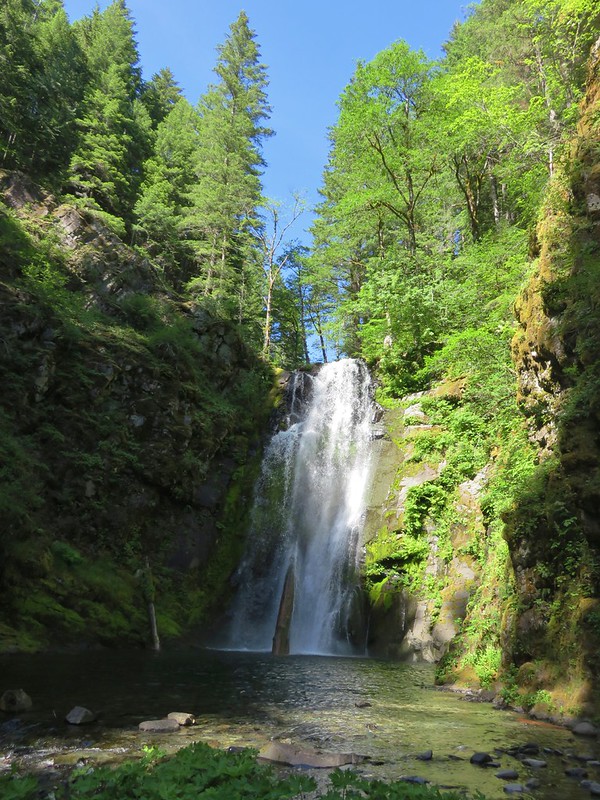
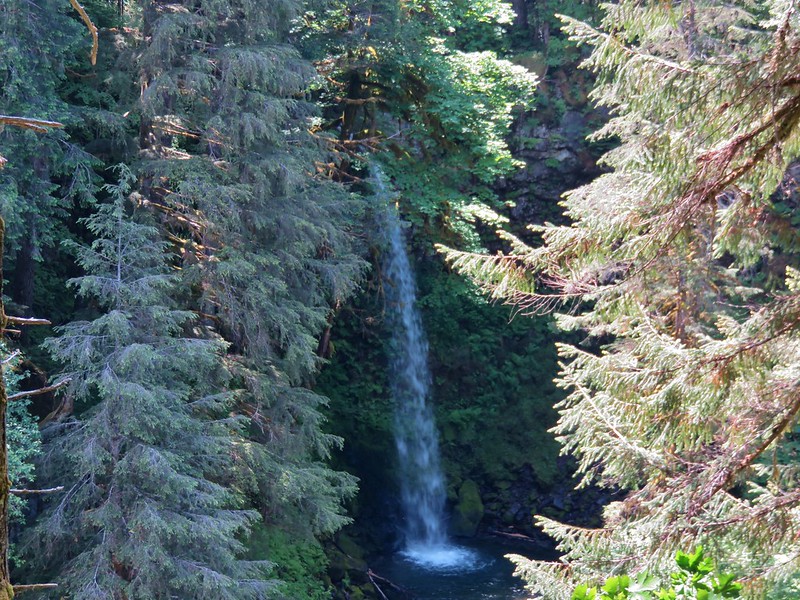
We passed more creeks including one with a nice little waterfall surrounded by lush green vegetation.

IMG_7626

IMG_7637

It was just over another 2.5 miles to the South Climb Trail from the Shorthorn Trail which made it about 6 miles from Horseshoe Meadow, a little longer than my initial calculation had been.

IMG_7647

IMG_7648

After a break at the junction we headed back and turned down the Lookingglass Lake Trail.

IMG_7668

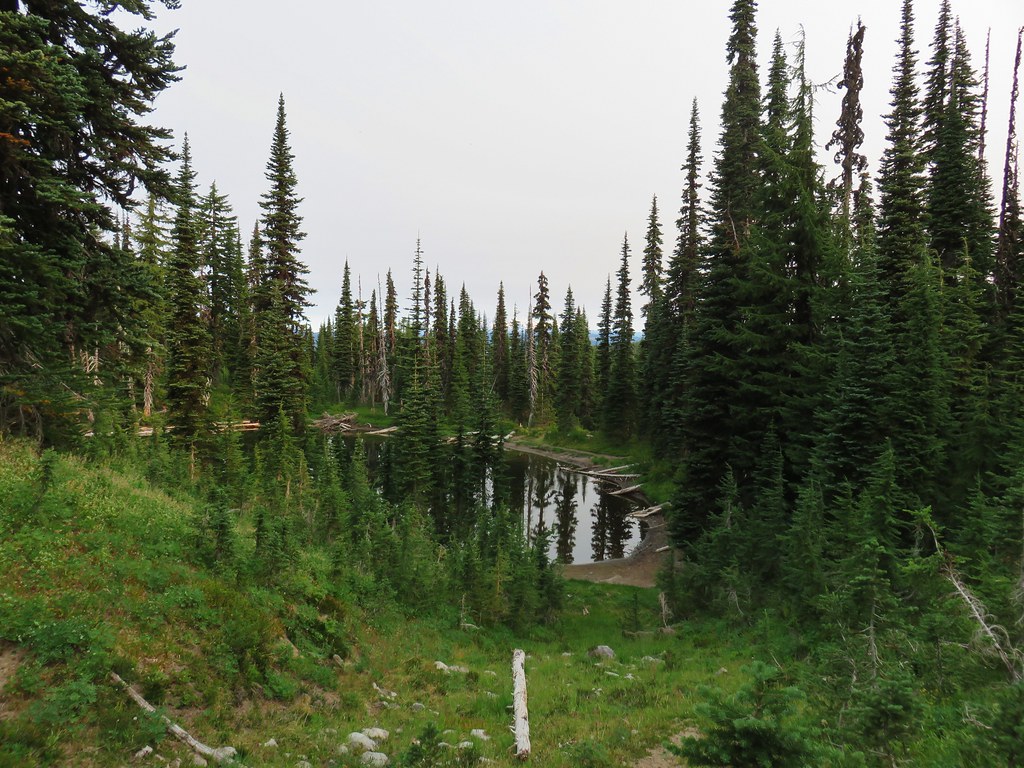
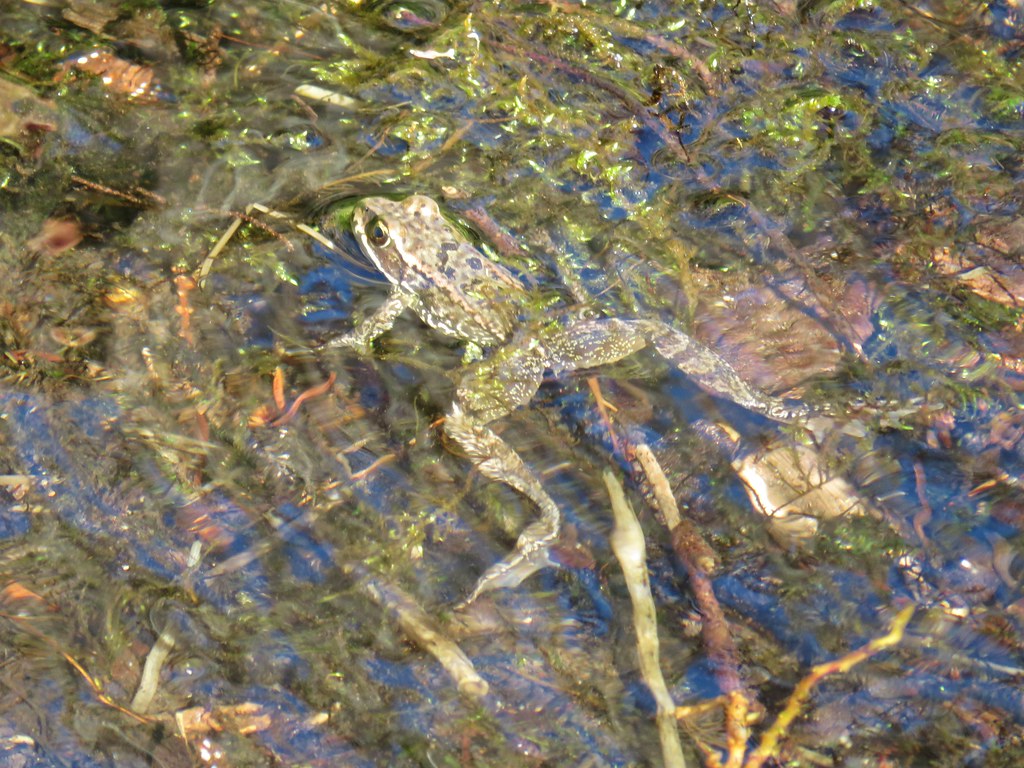
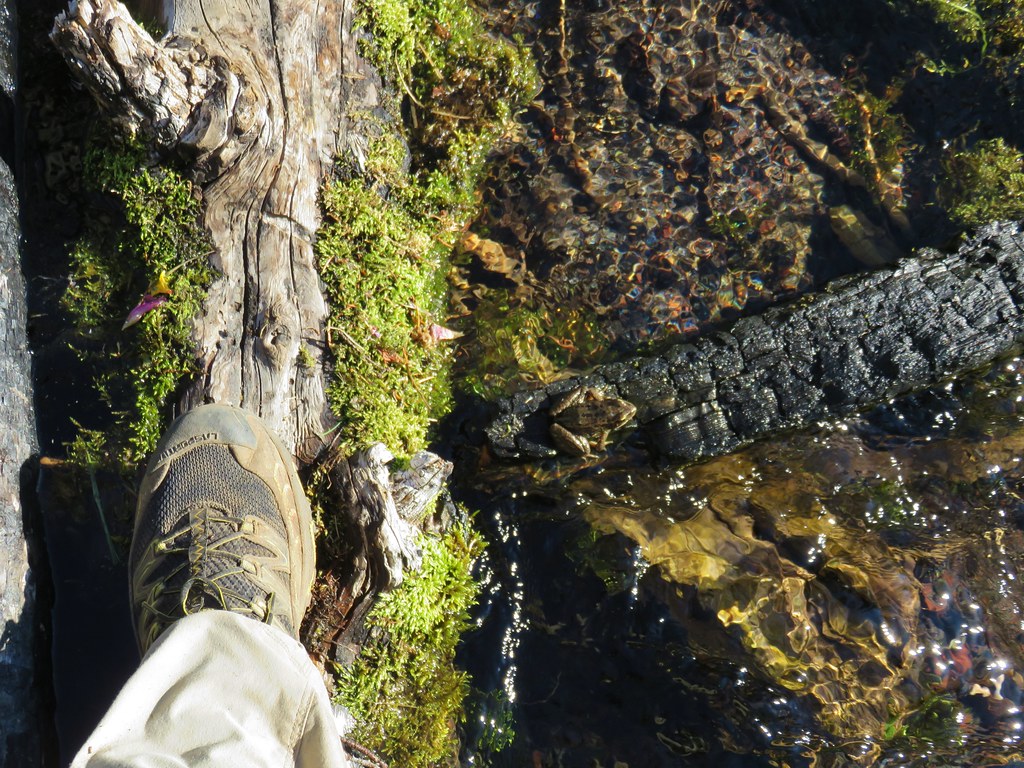
It was about a mile downhill to the lake. The trail passed through more forest affected by fire and crossed several creeks including one with a number of frogs.

IMG_7669

IMG_7673

IMG_7677

IMG_7681

IMG_7687

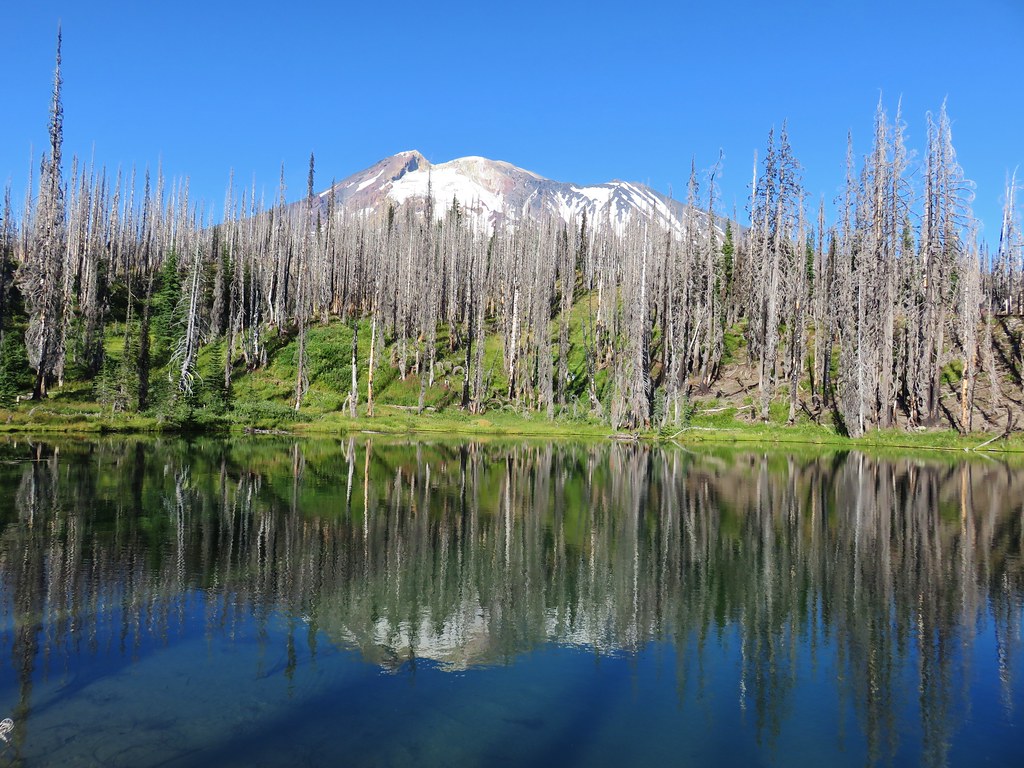
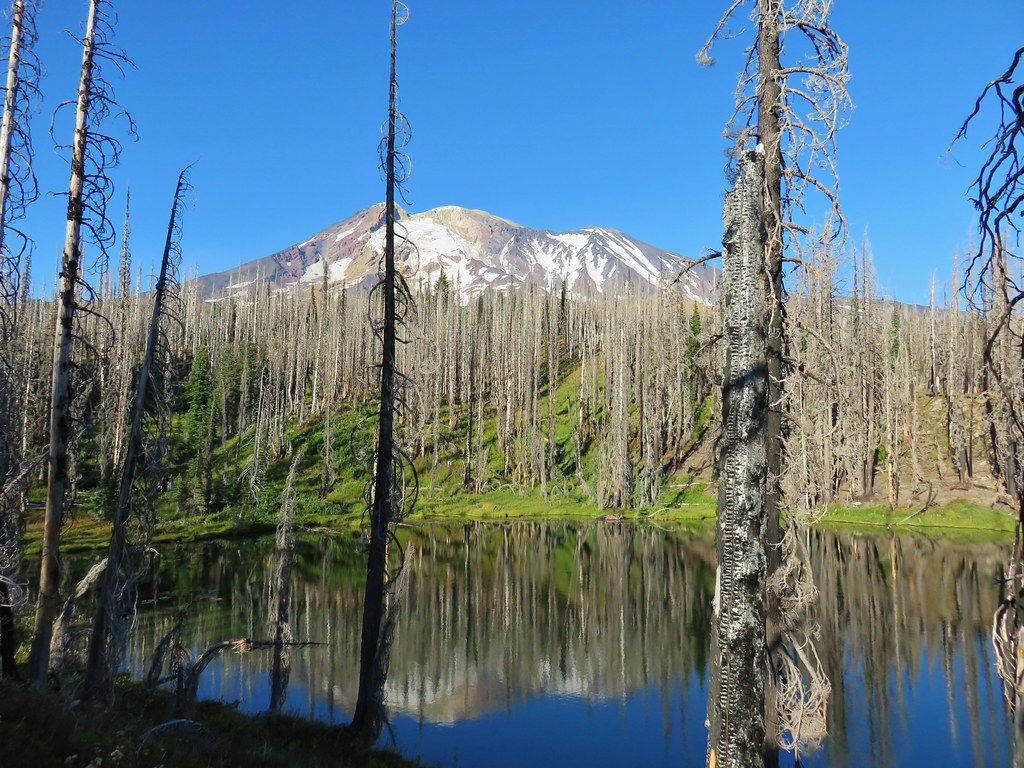
We made our way around the lake and sat on a little hill facing Mt. Adams where we ate dinner.

IMG_7691

IMG_7693

IMG_7695

IMG_7697

It was a little after 6pm when we finally left the lake and headed back up to the Round-the-Mountain Trail. As we climbed we were looking back at the lake when we noticed a smoke plume that we had not seen on the way down to the lake.

IMG_7699

IMG_7700

Based on its location in relation to Mt. Hood we wondered if the Indian Creek Fire had exploded or if this was some new fire in the Columbia River Gorge.

IMG_7706

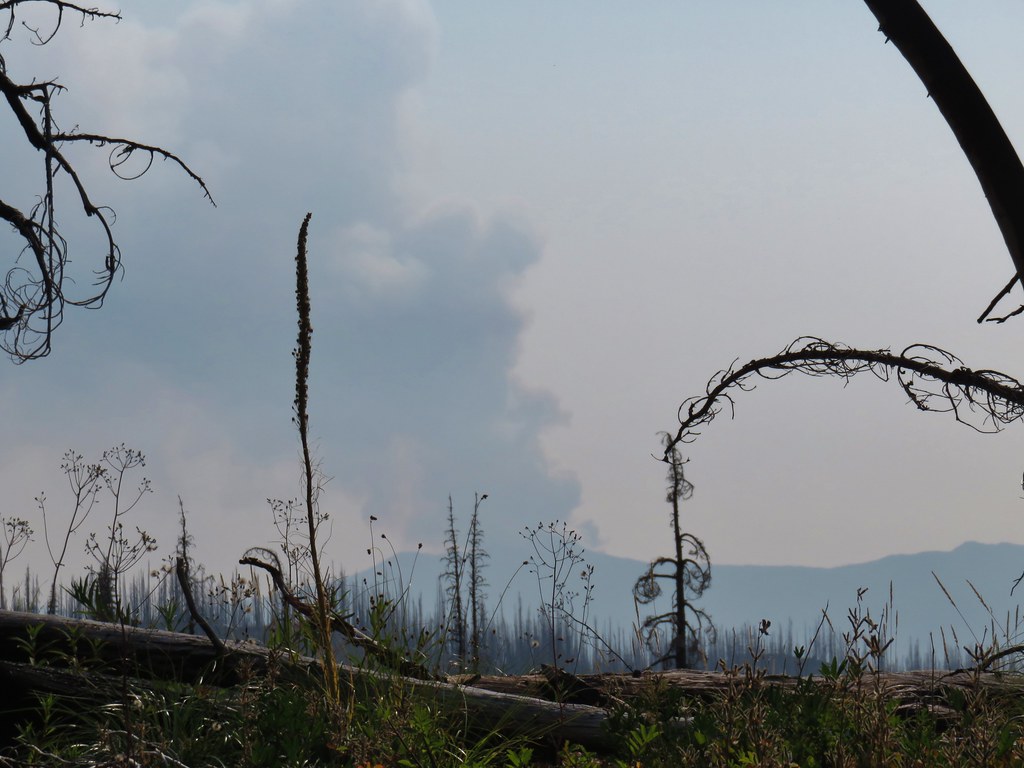
On Monday we learned from a northbound PCT hiker who had been evacuated from Cascade Locks that what we had seen was the new Eagle Creek Fire apparently started by teenager playing with illegal fireworks. What an idiot. As I write this trip report much of the gorge west of the Ruckle Creek Trail including Multnomah Falls has been affected.

We were still planning on getting water on the way back to Horseshoe Meadow at the little stream but we had forgotten how close it was to the Lookingglass Lake Trail and walked right past it. We didn’t realize our mistake until we’d reached the edge of Horseshoe Meadow. We decided that we would make due for the night with what we had left over in our packs (which wasn’t much) and our Hydro Flasks which we’d left at camp. In the morning we’d get water at either Sheep Lake or Riley Creek if no other sources could be found before then along the PCT.

The shadows were growing long back at Horseshoe Meadow.

IMG_7712

We were pretty tired and ready to crash but then we spotted a waterfall across the meadow and just had to check it out. We also thought there might be another water source that wasn’t so silty around. There wasn’t. The waterfall was nice though but it was the color of chocolate milk.

IMG_7726

IMG_7719

IMG_7714

We wound up moving our camp further from the trail due to a large group that had arrived and were a little louder than we preferred. After reestablishing camp we watched the last light hit Mt. Adams and turned in for the night.

IMG_7737

IMG_7742

Happy Trails!

Flickr: Mt. Adams Day 1

Categories
Columbia Gorge North Hiking Trip report Washington

Three Corner Rock to Table Mountain

What do we do when the temperatures are going to be nearing triple digits in the Willamette Valley? Take a 23.9 mile hike of course! Okay so that wasn’t our original plan, but due to some navigational errors that’s exactly what happened.

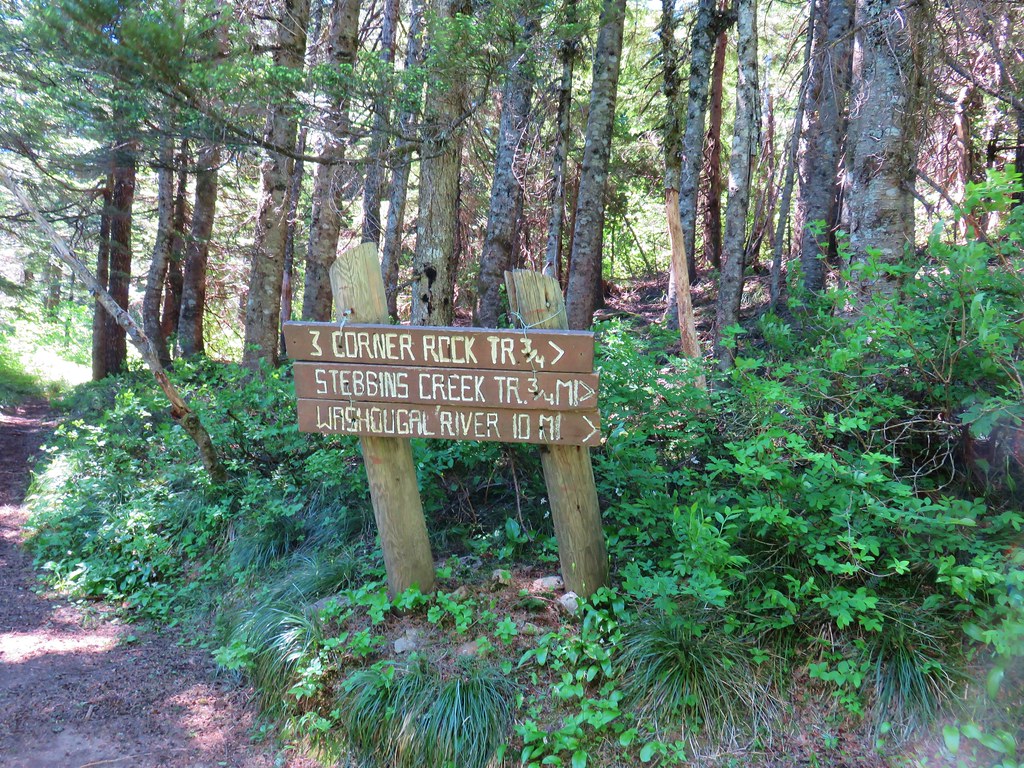
We were headed to Three Corner Rock and then hopefully onto Table Mountain via the Pacific Crest Trail. We’d visited Table Mountain in 2013 starting from the currently closed trailhead near the privately owned Bonneville Hot Springs. Our plan for this hike was to start at the Rock Creek Pass Trailhead where the PCT crosses CG-2090.

After purchasing a Washington Department of Natural Resources Discover Pass online we headed to the Columbia Gorge and crossed into Washington on the Bridge of the Gods in Cascade Locks, OR. From there we followed the directions from the Oregonhikers.org field guide to the trailhead.

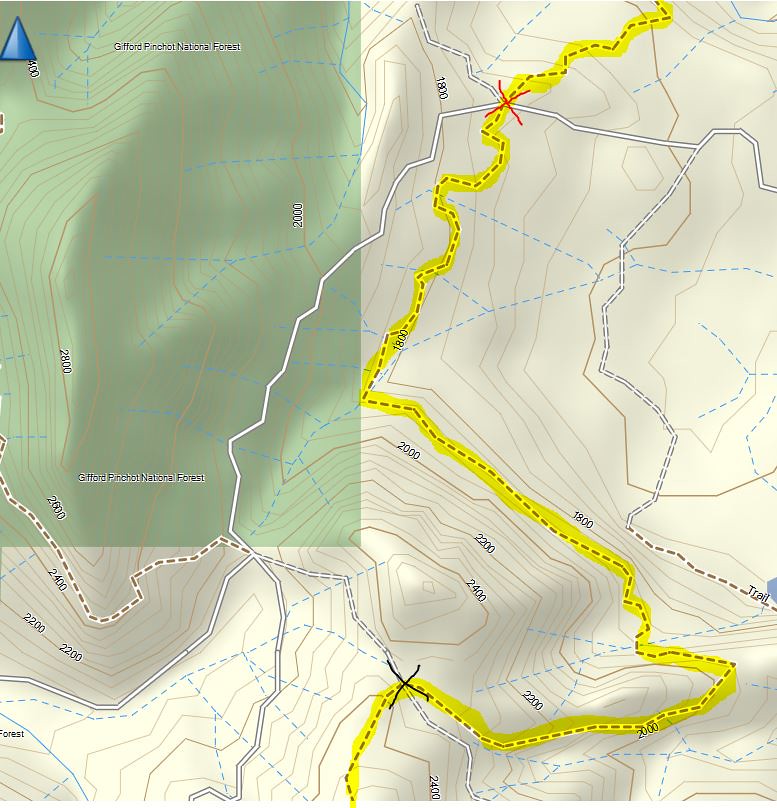
Our first (and biggest) error of the day happened as we set off on the PCT. Not only does the trail cross CG-2090 but it also crosses CG-2000, which we took to reach the trailhead, further to the north. On the map below the black “x” is the Rock Creek Pass TH and the red “x” marks the PCT crossing of CG-2000.

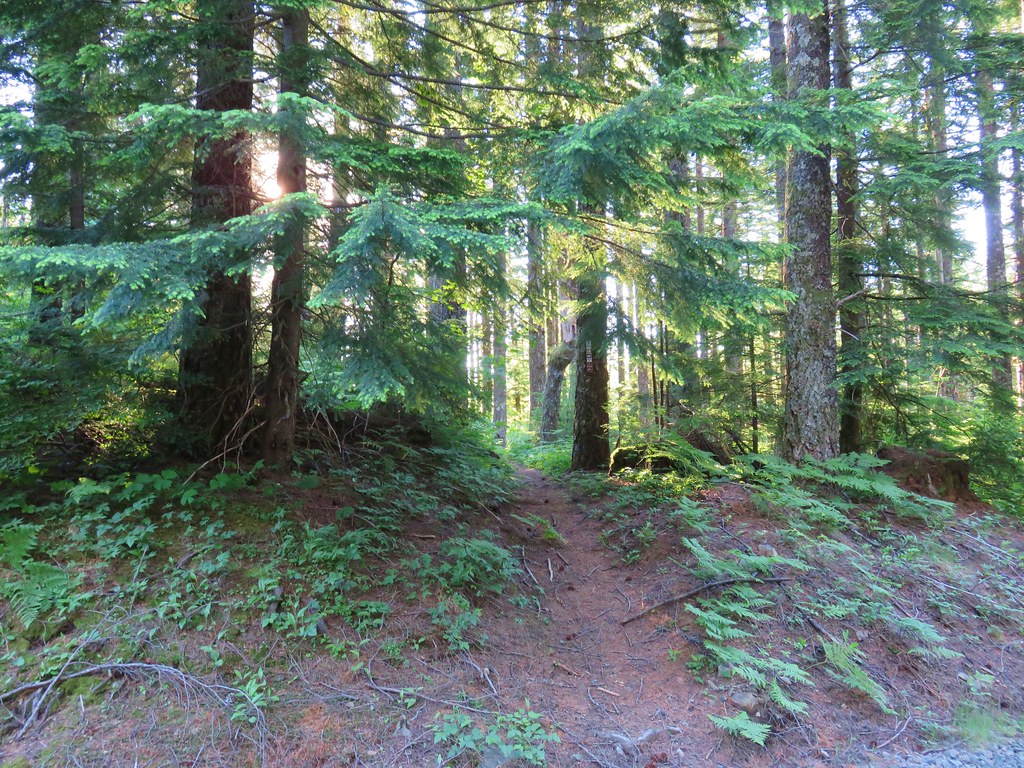
Rock Creek Pass TH

We hadn’t noticed the PCT crossing of CG-2000 on the drive to the TH and for some reason I had it stuck in my head that our starting point was the red “x”. So based on the direction we had driven to the spot from, we needed to take the PCT to the left to be heading south toward Three Corner Rock. Had we stopped to question why the Sun was nearly straight ahead as we started on the PCT we may have realized our mistake.

IMG_3299

We also hadn’t paid enough attention to the guidebook stating to go right on the PCT from the trailhead so off we went blissfully going the wrong way. From the Rock Creek Pass Trailhead it should have been 1.5 miles to the junction with the Three Corner Rock Trail which meant we had expected to reach it between 45 minutes to an hour into the hike. Instead about an hour into the hike we crossed CG-2000. That didn’t tip us off because based on where we thought we had started and the direction we thought we were heading our route would have included a crossing of CG-2090 which we mistook this crossing for.

Heather had been questioning things for a while but it would have been impossible to be going north by following the PCT in the direction we had from where we thought we started, and we figured if we somehow failed to spot the Three Corner Rock Trail we’d just do it on the way back from Table Mountain instead. The forest along the trail was nice and we eventually came to a footbridge across what we soon realized was Rock Creek.

IMG_3331

IMG_3338

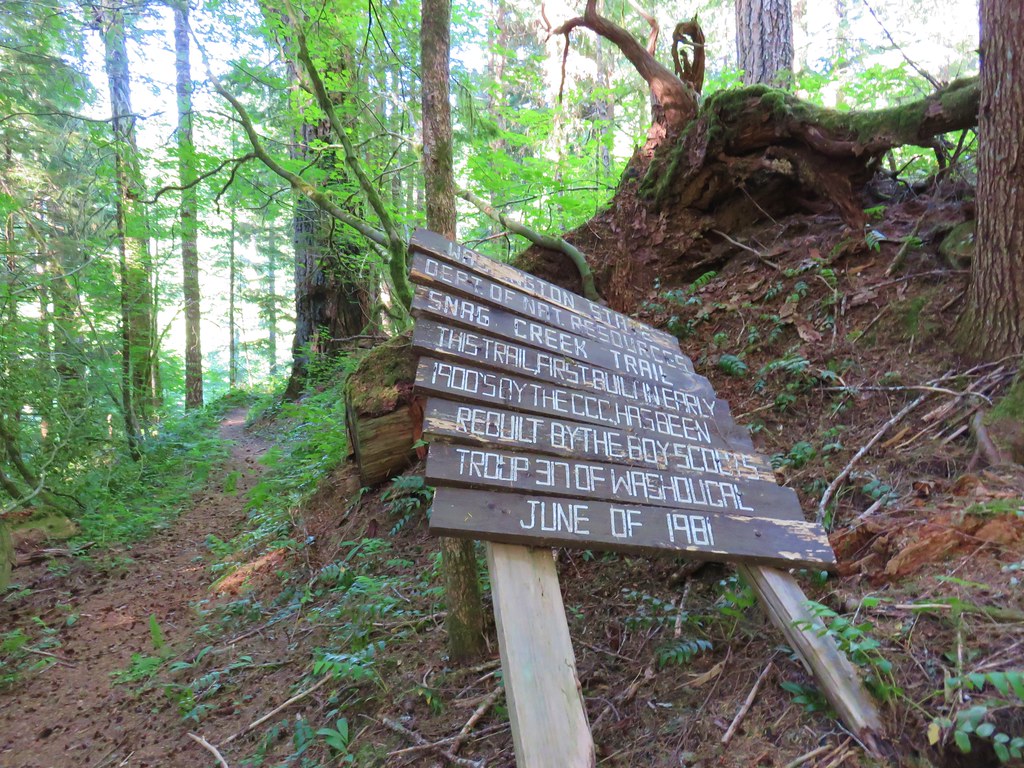
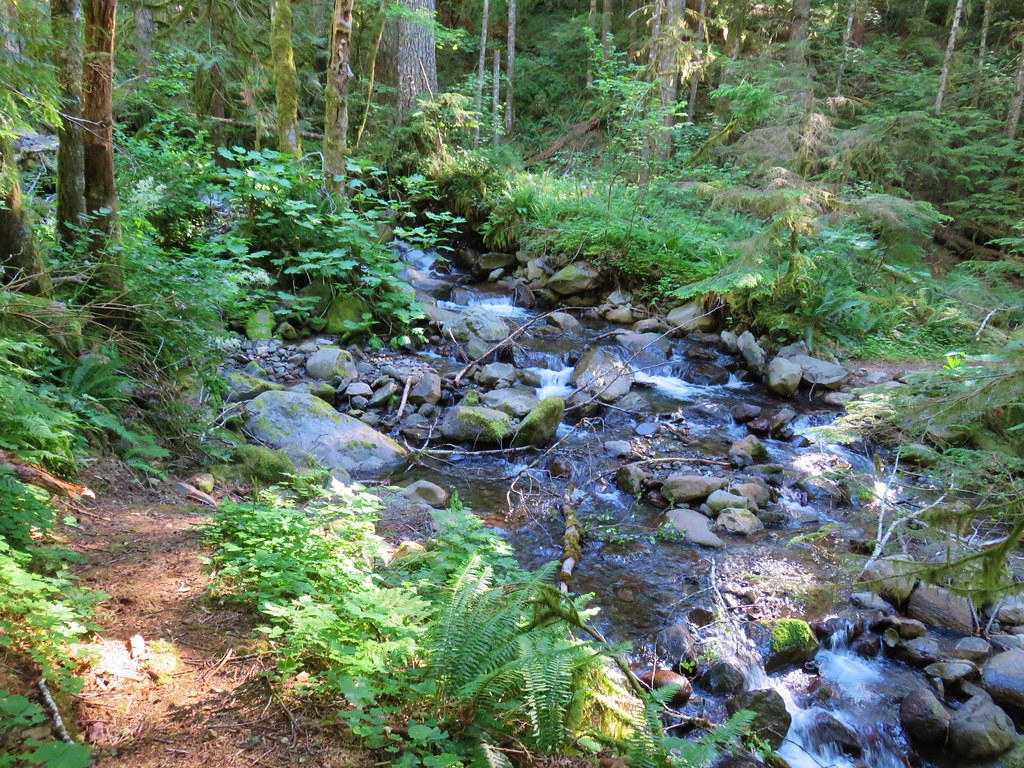
Soon after crossing Rock Creek we came to a junction with the Snag Creek Trail quickly followed by Snag Creek itself.

IMG_3341

IMG_3342

Neither of us remembered anything about having to ford a creek on our planned route but across we went. We were just over an hour and a half into the hike and now we were both having serious doubts about our direction. We pulled the map out again and this time I also zoomed out on the GPS far enough to see the Columbia River on the display which we had clearly been moving away from. It still took me a few minutes to realize what we’d done. I just kept thinking it was impossible to have gone left at the trailhead and be heading north until it finally sunk in that the trailhead wasn’t where I thought it was. Back we went having to retrace three plus miles and regain nearly 1000′ of elevation.

It was 10am when we made it back to the trailhead, nearly 3 hours after we’d set off in the wrong direction. This time we headed south.

IMG_3348

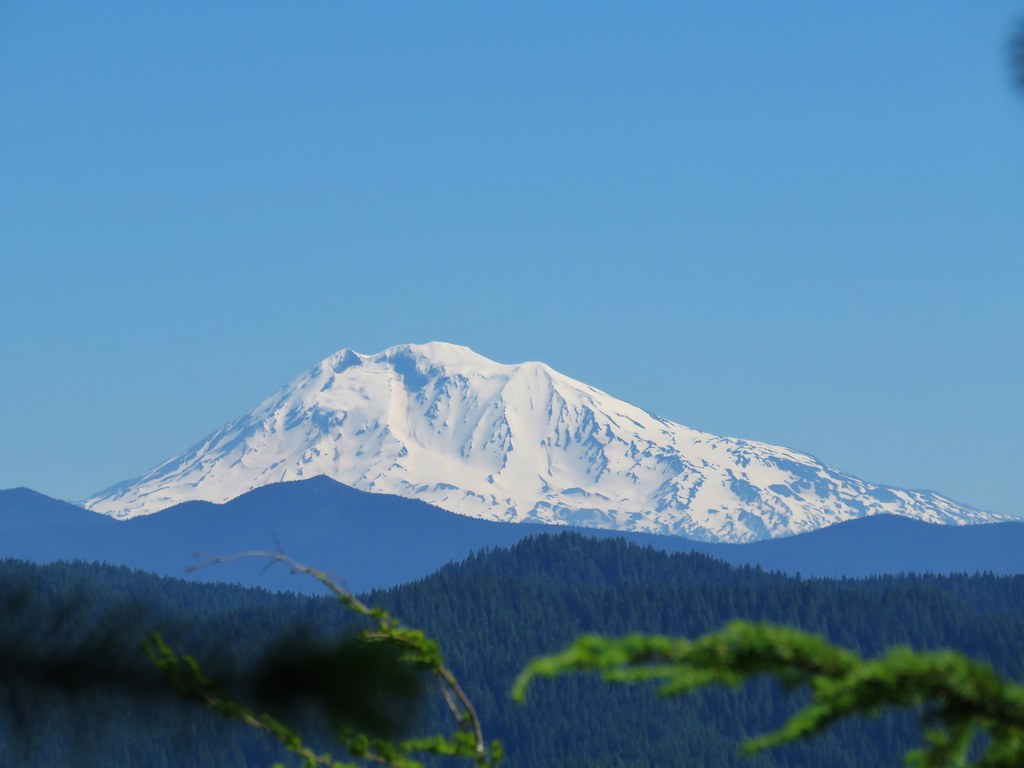
The funny thing was even though by that point I knew we’d gone the wrong way for at least the next hour I couldn’t shake the feeling that we were headed north. The PCT climbed away from Rock Creek Pass gaining views of Mt. Adams through the trees.

IMG_3354

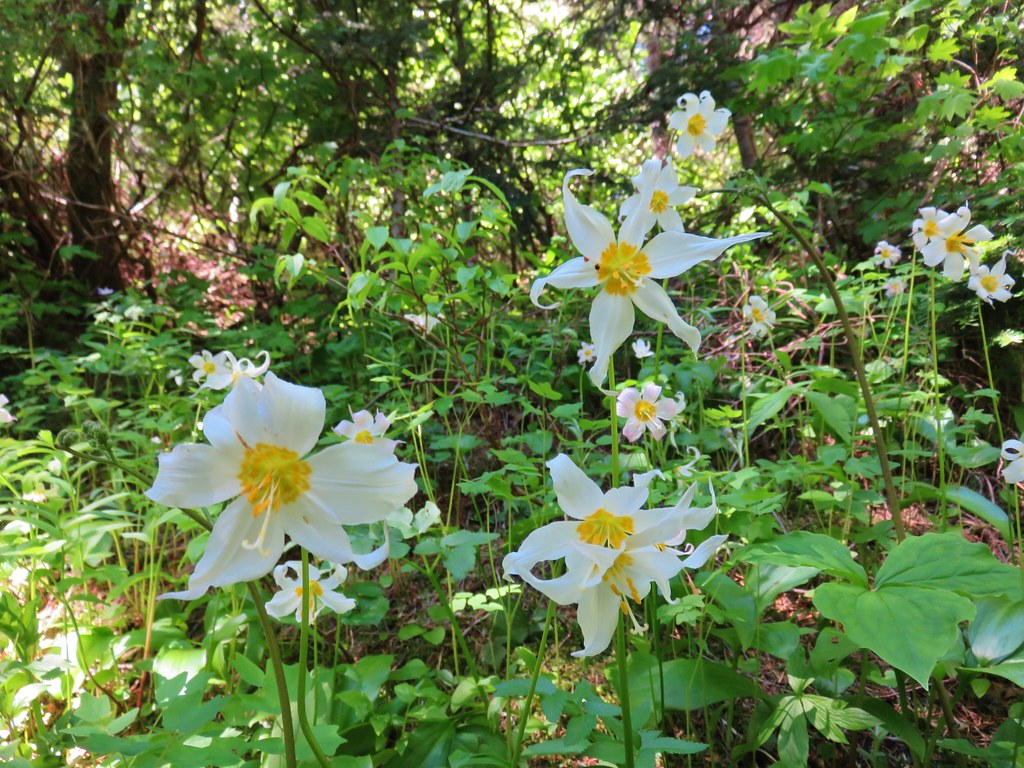
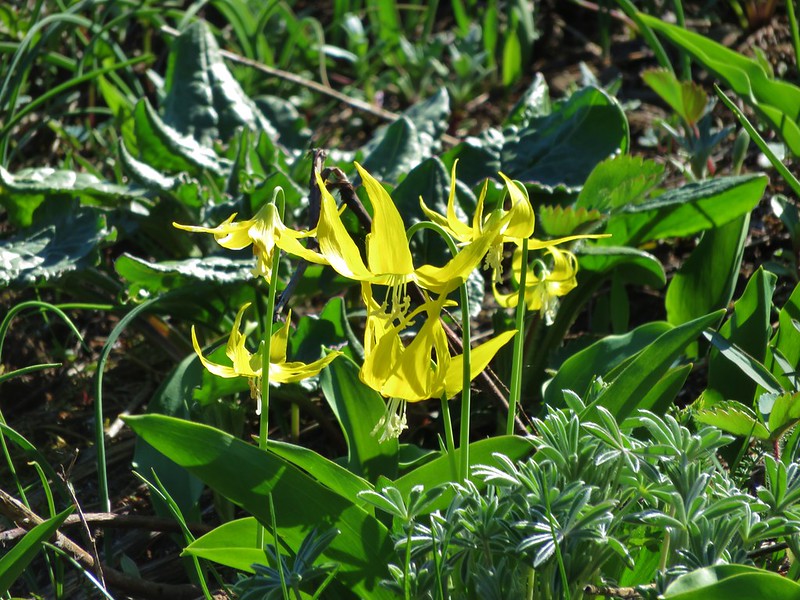
Near the junction with the Three Corner Rock Trail many avalanche lilies were still in bloom.

IMG_3364

IMG_3370

We turned right onto the Three Corner Rock Trail which popped out onto an old road bed after approximately .4 miles.

IMG_3374

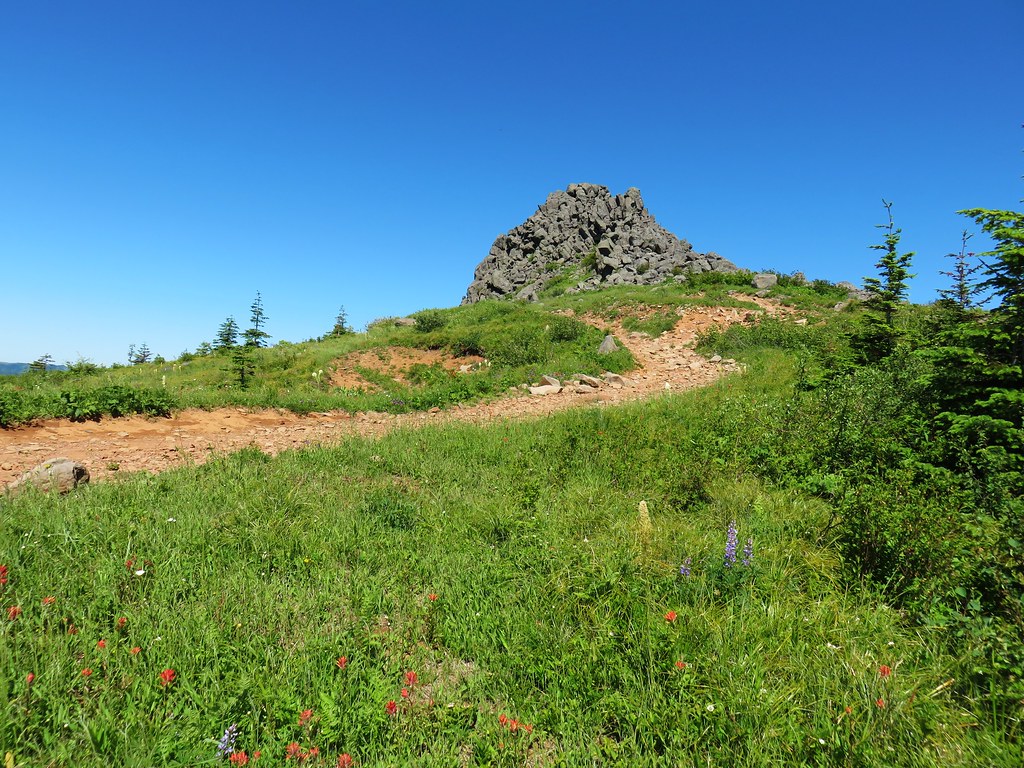
We followed the road uphill just under a quarter mile to Three Corner Rock.

IMG_3380

IMG_3414

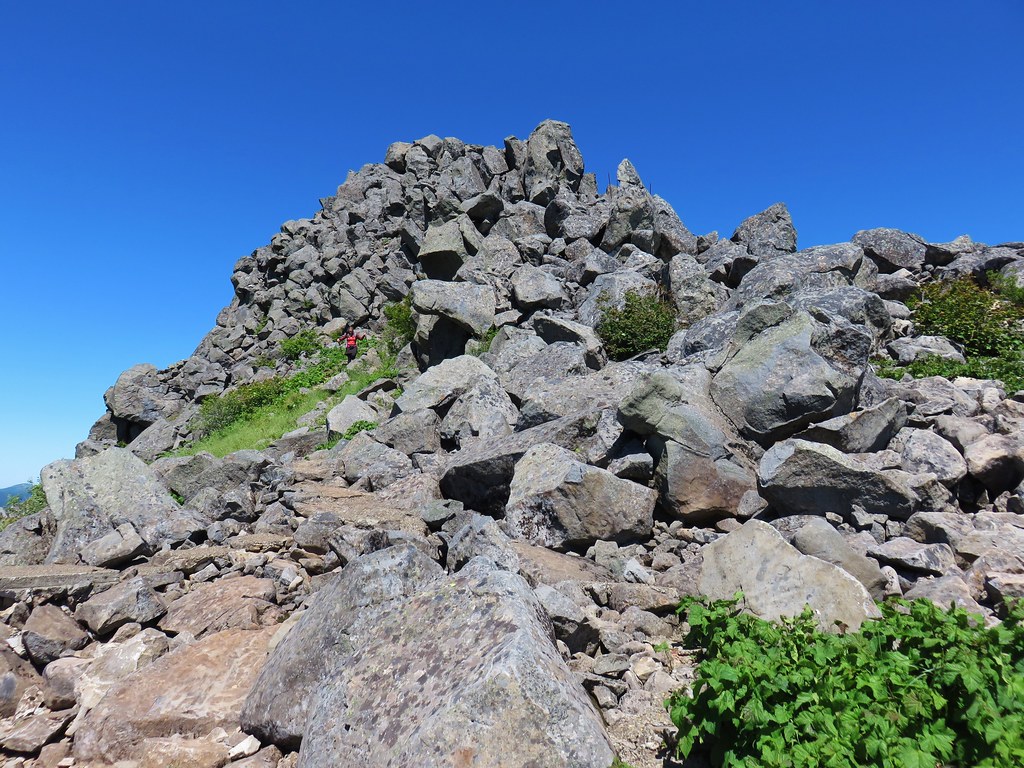
It was really windy on the open ridge and on Three Corner Rock which was once home to a lookout tower.

IMG_3406

It was a five volcano day with a bonus view of Goat Rocks thrown in.

IMG_3386Mt. Hood

IMG_3390Mt. Jefferson

IMG_3394Mt. St. Helens

IMG_3395Mt. Rainier

IMG_3399Mt. Adams

IMG_3398Goat Rocks

To the SE a small section of the Columbia River was visible between Wind and Dog Mountain in Washington and Mt. Defiance in Oregon.

IMG_3411

Despite the wind the views were great, but it did make it difficult to take pictures of the wildflowers in the area.

IMG_3381

IMG_3418

After a short break we headed back to the PCT where we decided to continue south toward Table Mountain. We told ourselves we’d play it by ear and could turn around at any time but we’re both stubborn and it was pretty much a foregone conclusion that we’d wind up making it all the way there.

From the Three Corner Rock Trail junction the PCT gradually descended for 1.25 miles to a road crossing at a saddle with a spectacular display of paintbrush and penstemon. Along the way the trail crossed a rough 4wd track and passed along a ridge still showing evidence of the 1902 Yacolt Burn.

IMG_3424

IMG_3429

IMG_3432

IMG_3434

2017-06-24 11.57.12

From the road the PCT traversed along the east side of a ridge through the forest for a mile before arriving at a large clear cut.

IMG_3438

Three Corner Rock was visible behind us.

IMG_3439

The trail climbed through the clear cut for about a half mile before reentering the trees.

IMG_3440

For the next 1.25 miles the PCT passed through a series of wildflower meadows, first on the west side of a ridge with views to the south of Table Mountain and Mt. Hood, then onto the east side of the ridge with a view of Mt. Adams and the Columbia River.

IMG_3453

IMG_3517

IMG_3536

The views were nice but we spent most of our time focused on the many wildflowers along the trail.

IMG_3451

IMG_3457

IMG_3473

2017-06-24 12.44.26

IMG_3466

2017-06-24 12.47.35

IMG_3475

2017-06-24 12.51.18

2017-06-24 12.48.27

IMG_3490

IMG_3501

IMG_3504

IMG_3512

IMG_3527

IMG_3528

2017-06-24 13.42.25

2017-06-24 13.42.59

IMG_3550

The variety of colors of penstemon was particularly impressive.

IMG_3514

2017-06-24 12.42.58

2017-06-24 12.43.06

IMG_3455

We had hoped to hop off of the PCT at a sharp right turn just uphill from some power lines and hook up to a dirt road just on the other side of the lines at a saddle. As we came around the ridge end though we couldn’t see any obvious signs of a connector trail so we stuck to the PCT as it began to quickly lose elevation. After looking at the map and realizing that following the PCT all the way to the road would add almost two miles and another 500′ of elevation gain we went back to look again for a connection. After a brief off-trail excursion on a steep slope with thick brush, we bit the bullet and took the PCT down to the road.

IMG_3554

We had to walk back uphill on the road and it was warm. We had benefited from a nice breeze most of the day which helped keep the temperature bearable but there was none along the road. When we arrived at the saddle we spotted a sign near an overgrown roadbed pointing 1.4 miles to Table Mountain.

IMG_3556

We followed the old roadbed for about half a mile to its end where a faint, and at times very brushy, trail continued along the north ridge of Table Mountain.

IMG_3563

When the trail wasn’t overgrown it too was lined with wildflowers.

IMG_3560

IMG_3561

IMG_3569

IMG_3571

IMG_3570

Not only was the route a bit of a challenge to follow due to the brush but it was steep at times, especially on two rocky climbs, the last of which brought us to the plateau of Table Mountain.

IMG_3573

IMG_3580

Three Corner Rock was visible to the left of the ridges we’d followed to reach the plateau as were the power lines running over the saddle a mile away.

IMG_3618

We picked up the Table Mountain Trail on the plateau and followed it south to the viewpoint above the cliffs overlooking the Columbia River.

IMG_3588

IMG_3595

IMG_3600

IMG_3614

IMG_3612

IMG_3608

We sat in some shade near the cliffs and took off our shoes and socks to give our feet a bit of a break while we ate a snack. We had no idea how far we’d gone (it was almost 16 miles already) but we knew our feet were sore and we were both developing blisters. We were also getting low on water but thankfully Heather had brought our water filter and we’d passed what I thought would be a sufficient water source in the meadows between the saddle and the clear cut.

We started back at 3:15pm hurrying as quickly as our protesting feet would allow. We both ran out of water shortly before arriving at the seep where the water was just deep enough to use our filter to get some much needed wonderfully cold water. We arrived back at our car at 6:48, almost 11 hours and 45 minutes since we’d set off that morning.

It certainly hadn’t gone as planned but we’d at least come prepared with enough food and water to make it through the day. In addition to some great mountain views and wildflowers meadows we’d learned a valuable lesson about how important it is to make sure you know where your starting point is and to consider everything when determining where you’re at. Had we taken the position of the sun and the description of the hike as beginning uphill to the right of the TH we might have realized much more quickly that we’d misidentified the location of the trailhead on the map. Happy Trails!

Flickr: Three Corner Rock to Table Mountain

Categories
Hiking Silver Star Mountain SW Washington Trip report Washington

Lucia & Moulton Falls Parks

It’s been a wet and dreary winter in the Pacific Northwest so when a halfway decent forecast came along we jumped on it and headed out for our March hike. Our destination was a pair of Clark County, WA parks along NE Lucia Falls Road and the North Fork Lewis River.

We began our day with 1 mile warm-up hike at Lucia Falls Regional Park. A loop passes through the park and along the river past viewpoints of the modest Lucia Falls.

Lucia Falls Park

Lucia Falls Park

North Fork Lewis River in Lucia Falls Park

Lucia Falls

North Fork Lewis River

After our warm-up we hopped back into the car and continued east on Lucia Falls Rd for .3 miles where we veered right onto Hantwick Rd. We followed this road for half a mile to the Hantwick Road Trailhead.

Hantwick Rd. Trailhead

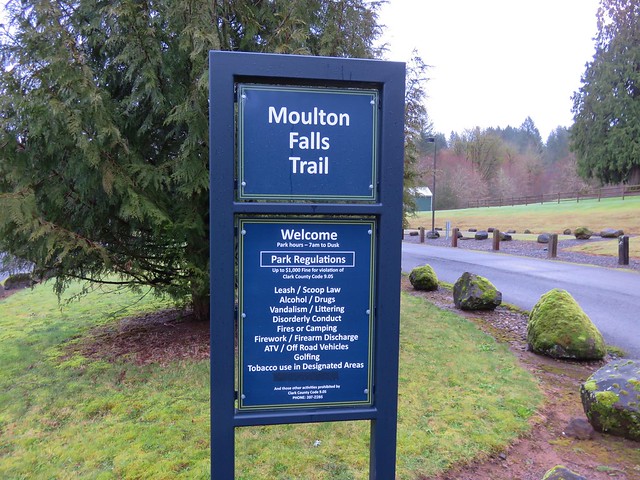
From the trailhead the Moulton Falls Trail follows an old railroad grade 2.6 miles to Moulton Falls Park.

Moulton Falls Trail

The trail crossed several streams which were flowing nicely and also passed a long pond.

Pond along the Moulton Falls Trail

Small fall along the Moulton Falls Trail

Stream along the Moulton Falls Trail

Beyond the pond the trail neared the East Fork Lewis River.

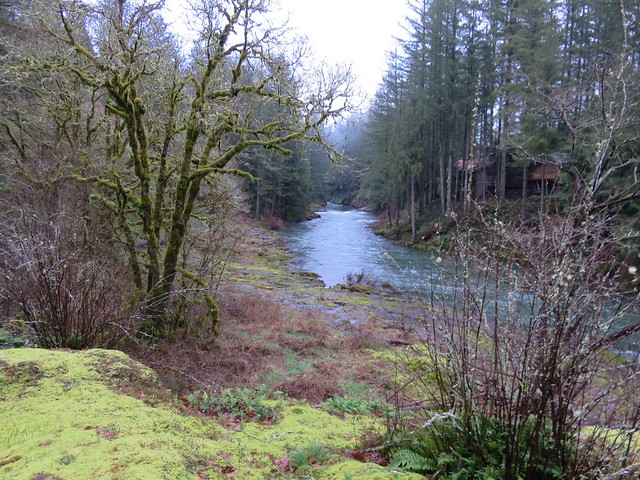
East Fork Lewis River

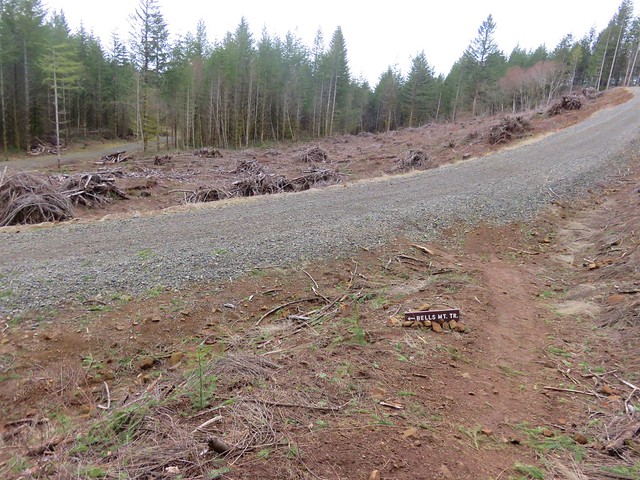
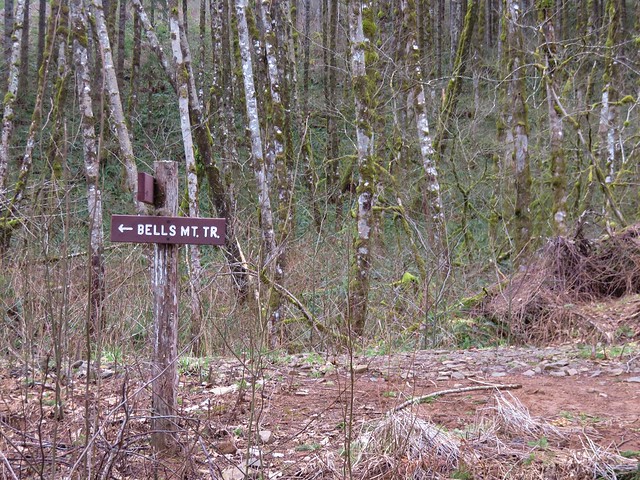
Just beyond the 2 mile mark we came to the Bells Mountain Trail junction. We planned on heading up the trail a ways after visiting Moulton Falls Park so for now we took a photo of the sign and continued on.

Bells Mountain Trailhead along the Moulton Falls Trail

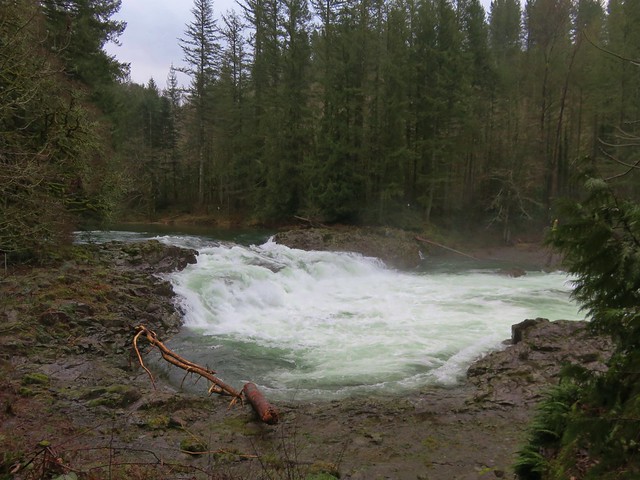
A little further along the trail we spotted cars on the far side of the river in the park’s parking lot. Moulton Falls was visible below, a small 10′ cascade.

Moulton Falls

We crossed the river on a scenic footbridge.

East Fork Lewis River

Footbridge over the East Fork Lewis River

The trail split on the far side of the bridge and we forked right heading uphill toward Yacolt Creek Falls. The trail climbed to an upper parking lot which appeared to still be closed for the winter before dropping back down to a crossing of Lucia Falls Rd. On the far side of the road were a couple of picnic tables and a small pullout above Yacolt Creek Falls. The trail continued down some stairs to a seasonal footbridge.
Yacolt Creek Falls

The footbridge pivots and was still in its winter position making it impossible to complete the loop shown on the park map.

Yacolt Creek Falls

We were a little confused by this as well as by the placement of the falls on the map. The star marking the location appeared to be further up the creek along a spur trail that extended north off the loop on the other side of Big Tree Creek. The fact that the falls at the footbridge were on Big Tree Creek and not Yacolt Creek also made us question whether or not this was actually Yacolt Creek Falls. We decided to walk down Lucia Falls Road and pick up the other side of the loop where it crossed the road. We turned back uphill on the loop trail on the east side of Big Tree Creek and quickly arrived at a viewpoint of the falls and bridge.

Yacolt Creek Falls

Yacolt Creek Falls

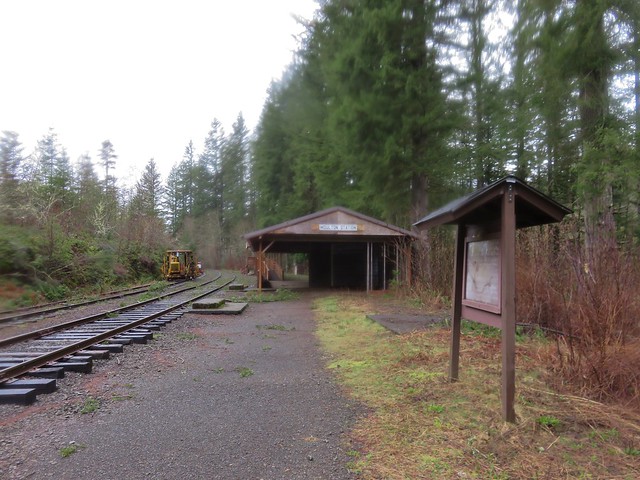
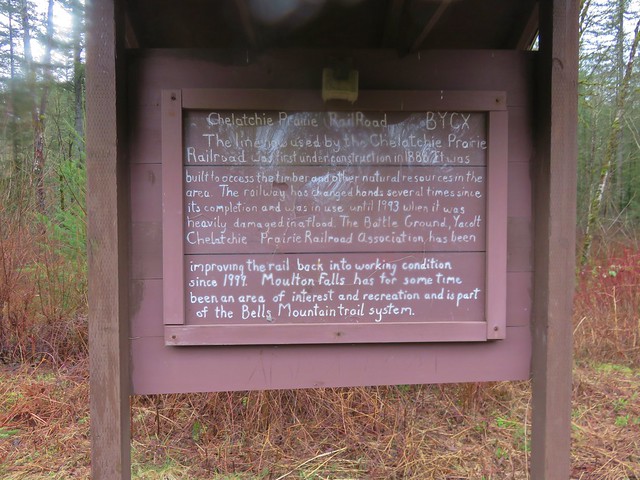
We found the spur trail shown on the map leading up and away from the viewpoint. We followed this path less than 100 yards past a sign for Yacolt Creek Falls to the Chelatchie Prairie Railroad and Moulton Station.

Moulton Station

Sign for the Chelatchie Prairie Railroad

Despite the fact that the Yacolt Creek Falls sign seemed to support the falls we’d just come from as being the correct ones we were still unsure based on how we were reading the park map.

Yacolt Creek Falls sign

Sign for Yacolt Creek Falls

We passed through Moulton Station and continued along the tracks for a bit before deciding that we were on a wild goose chase. We had failed to take into account the scale of the map and just how short the distances reflected on the map were. It was a good early season reminder to pay attention to the map scale. We turned around and headed back past Yacolt Creek Falls and descended to Lucia Falls Road which we crossed.

To the right was the parking lot at Moulton Falls which was filling up pretty quickly and to the left was the continuation of the loop. If we’d have gone right a short distance we would have come to a viewpoint with a close up of Moulton Falls, but we’d seen them from the other side of the river already so we turned left. The trail crossed Big Tree Creek on a footbridge then led to a nice viewpoint of the bridge over the East Fork Lewis River.

East Fork Lewis River

Footbridge over the East Fork Lewis River

Beyond the viewpoint the trail climbed up away from the river completing the loop. We recrossed the footbridge and headed back toward the Bells Mountain Trail. This trail provides access to  Silver Star Mountain.  We weren’t going to be going anywhere near that far on this day though, instead we decided to pick a turn around time based on when we started on the trail.

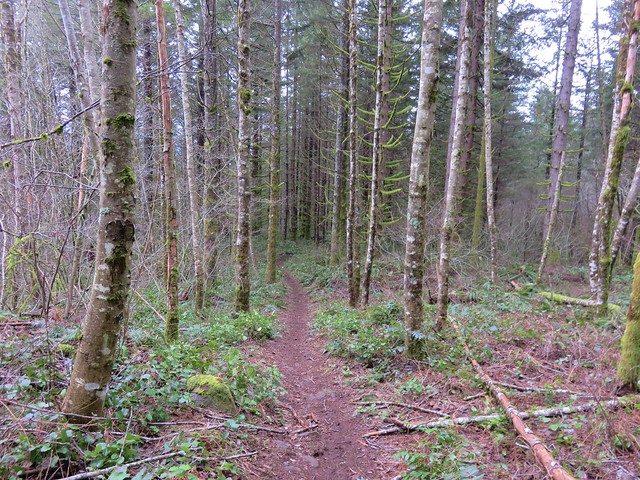
It was 10:25am when we started up the Bells Mountain Trail so we gave ourselves until 12:30pm and then we’d turn around hoping that would get us home around 5pm. The trail climbed fairly steeply at first but soon leveled off in a young forest.

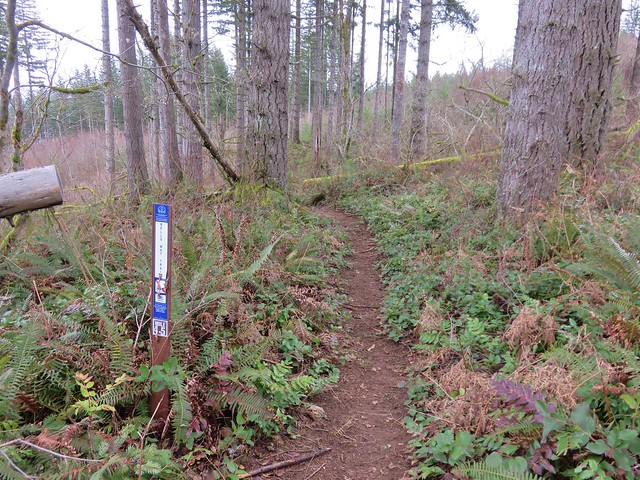
Bells Mountain Trail

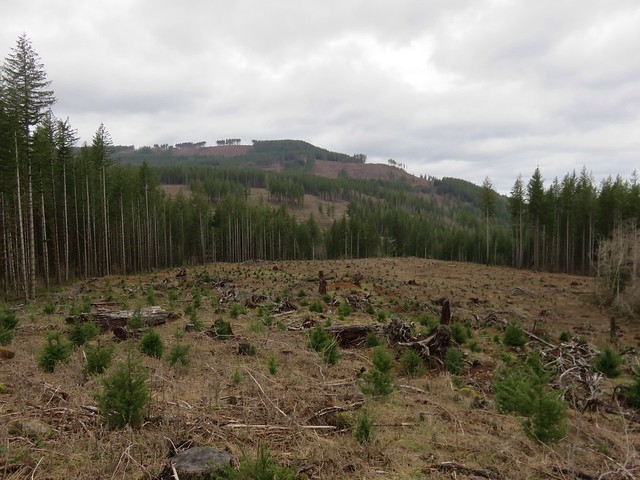
After the initial climb the trail did a series of ups and downs crossing several streams and logging roads as it passed through alternating sections of clear cuts and trees.

Bells Mountain Trail

Bells Mountain Trail

Bells Mountain Trail

Bells Mountain Trail

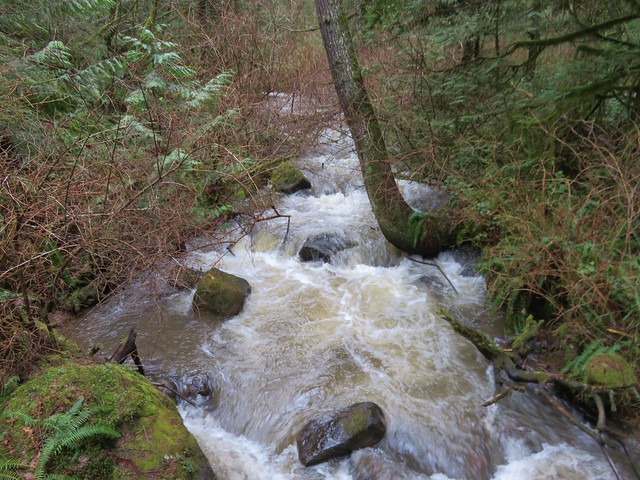
Creek along the Bells Mountain Trail

Clear cuts along the Bells Mountain Trail

Due to the amount of logging activity in the area the trail is subject to periodic closures so make sure to check ahead if you’re planning on visiting.

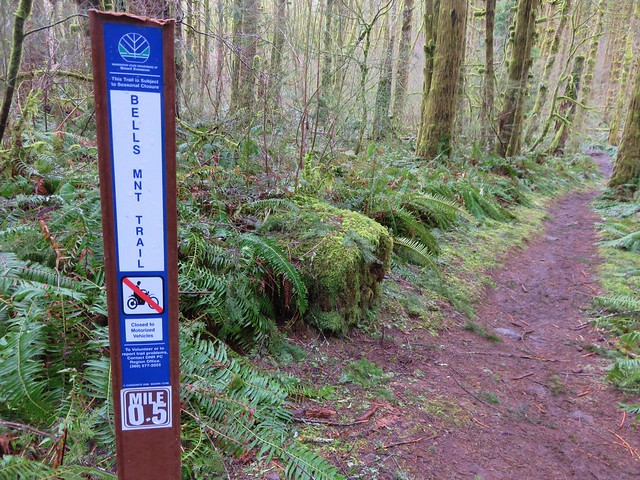
The trail was in really good shape and there was good signage at the road crossings as well as mile markers every half mile.

Bells Mountain Trail

Bells Mountain Trail

The mile posts actually played into our turnaround point as we arrived at the 4.5 mile marker at 12:25 which was exactly 2 hours after having set off on the Bells Mountain Trail.

Bells Mountain Trail

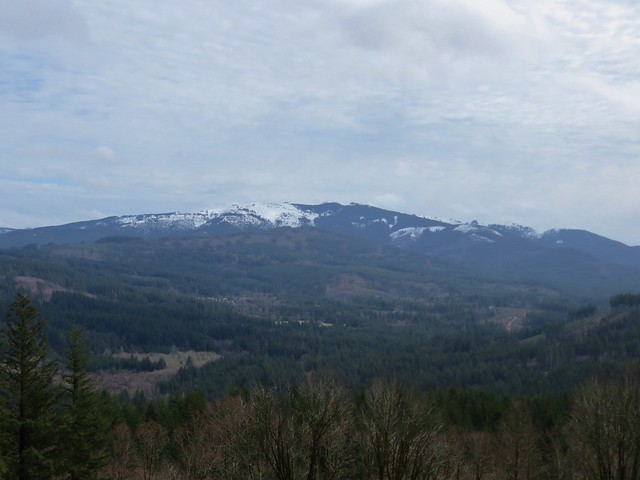
Despite setting 12:30 as our turn around time being at the mile marker exactly 2 hours after having started out seemed to demand our calling it so we tapped the post and headed back. On the way back the clouds lifted enough to reveal Silver Star Mountain.

Silver Star Mountain from the Bells Mountain Trail

Silver Star Mountain

Silver Star Mountain and Sturgeon Rock

We were really feeling the effects of not hiking regularly on the way back. We hadn’t really been paying that much attention to how far we’d gone but our feet knew it was a lot further than the 10 miles I’d originally planned on for the day. By the time we’d made it back to the Hantwick Road Trailhead we’d gone 17.8 miles, but we’d finished a little before three so we were on track to be home by five. Happy Trails!

Flickr: Lucia & Moulton Falls

Categories
Hiking Mt. St. Helens Trip report Washington Washington Cascades

Mount Margaret Backcountry – Obscurity Lake to South Coldwater Trailhead

Waking up to a third tent at Obscurity Camp wasn’t our only surprise in the morning. I awoke at 4:30am to find nearly clear skies above the lake save for one small finger of cloud creeping over the ridge behind Obscurity Lake. We were getting an extra early start due to the forecast of possible  Thunderstorms after 11am.  The clear sky was encouraging, but it wasn’t long before clouds began creeping into the basin from all sides.
IMG_2083

By the time we were on our way we were hiking through fog.
IMG_2088

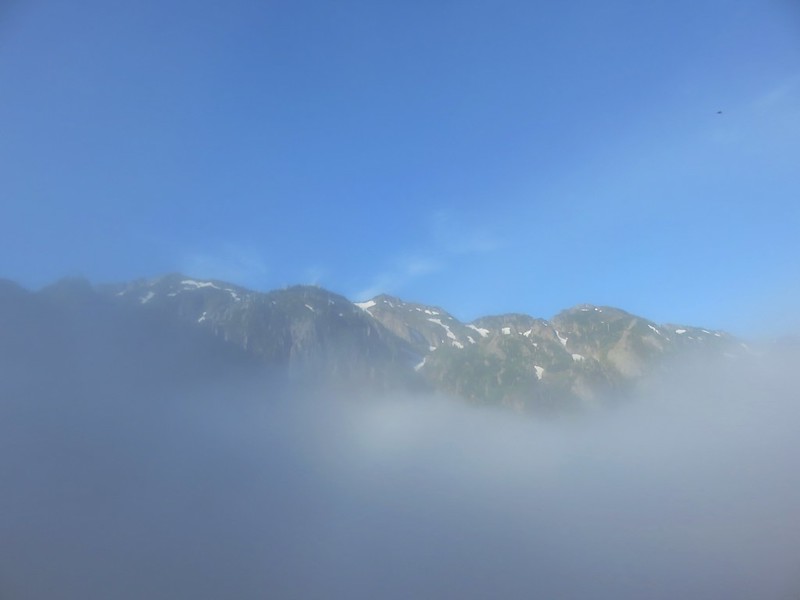
It was a fairly steep climb out of the Obscurity Lake Basin but as we neared the saddle between Obscurity and Panhandle Lakes beautiful blue skies appeared through the fog giving us some hope for views.
IMG_2094

IMG_2096

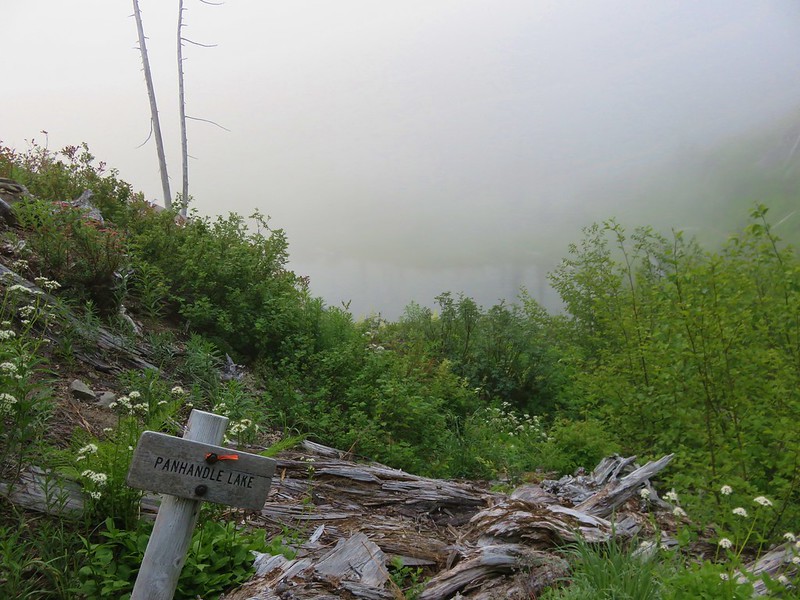
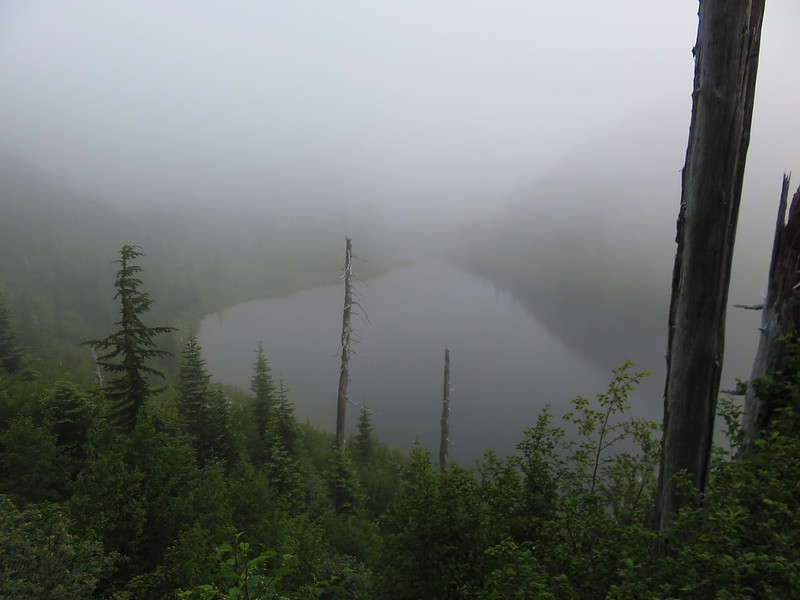
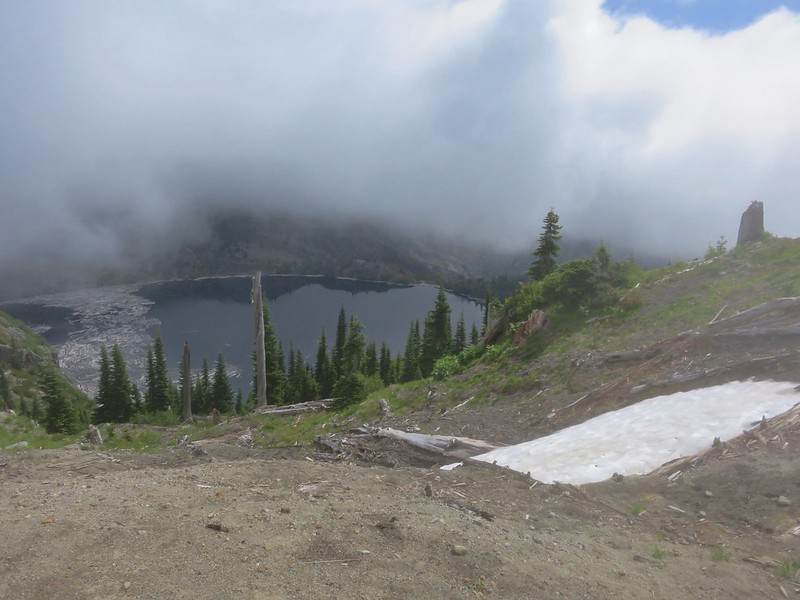
There were some views if we looked up but when we crested the saddle it was evident that the view of Panhandle Lake would not be clear.
IMG_2097

IMG_2101

Down we went back into even thicker fog. The trail crossed a couple of nice streams with marsh marigolds as it wound around the lake.
IMG_2109

IMG_2110

IMG_2112

IMG_2118

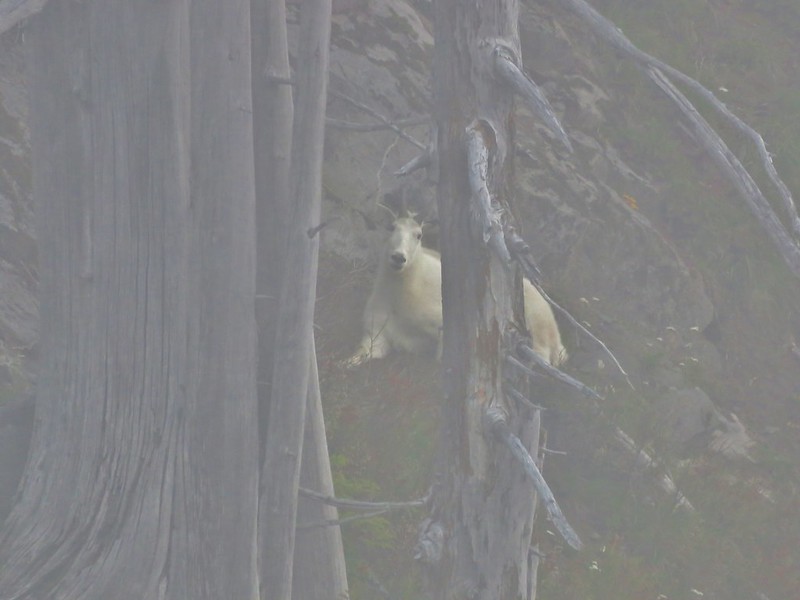
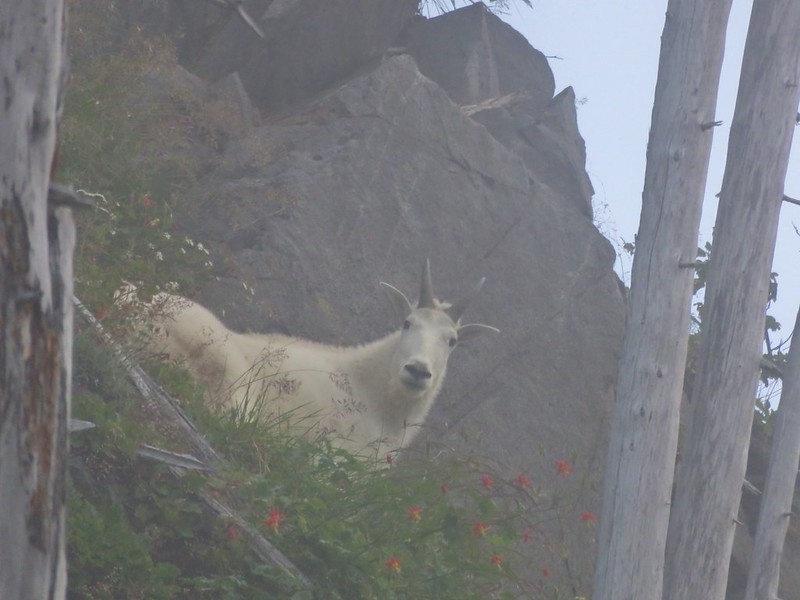
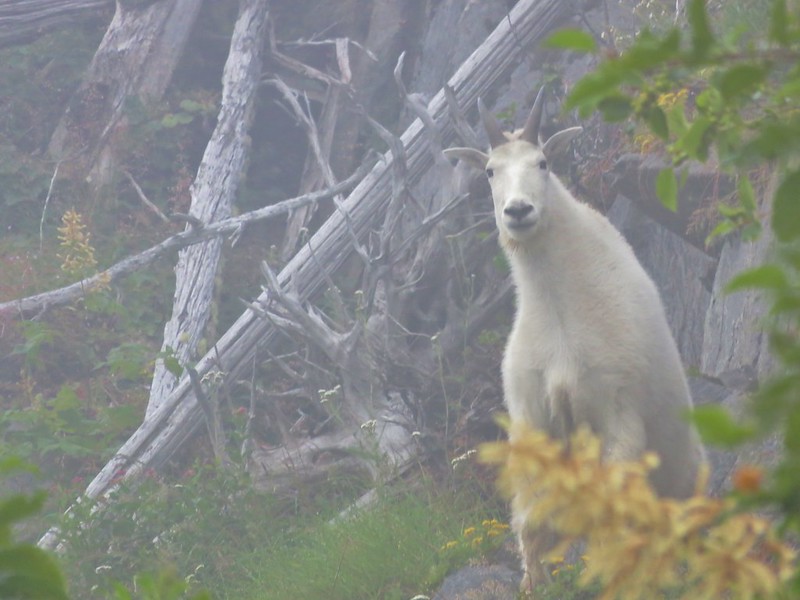
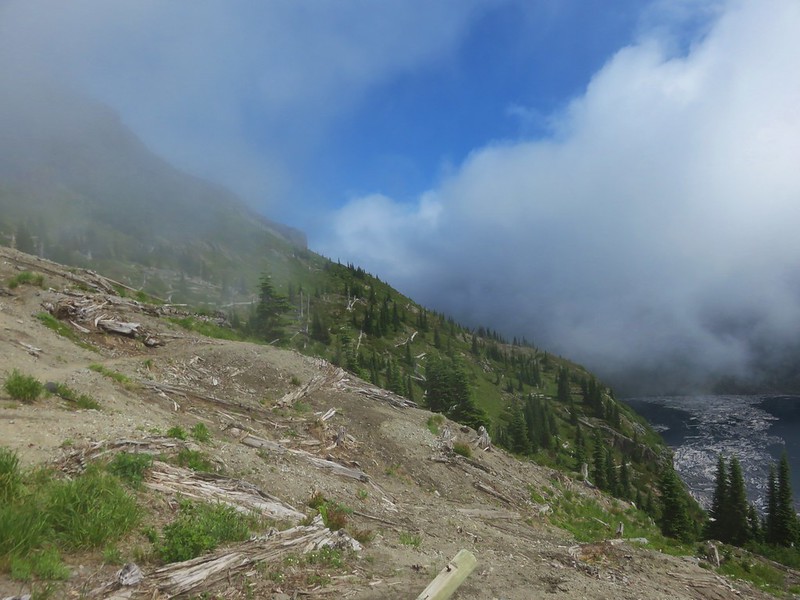
As we neared the lake we spotted a mountain goat lounging just above the trail.
IMG_2123

It sized us up and kept a close eye on us as we passed by.
IMG_2128

IMG_2137

We decided not to go down to the lake figuring the view couldn’t be much better than what we had along the trail.
IMG_2135

IMG_2140

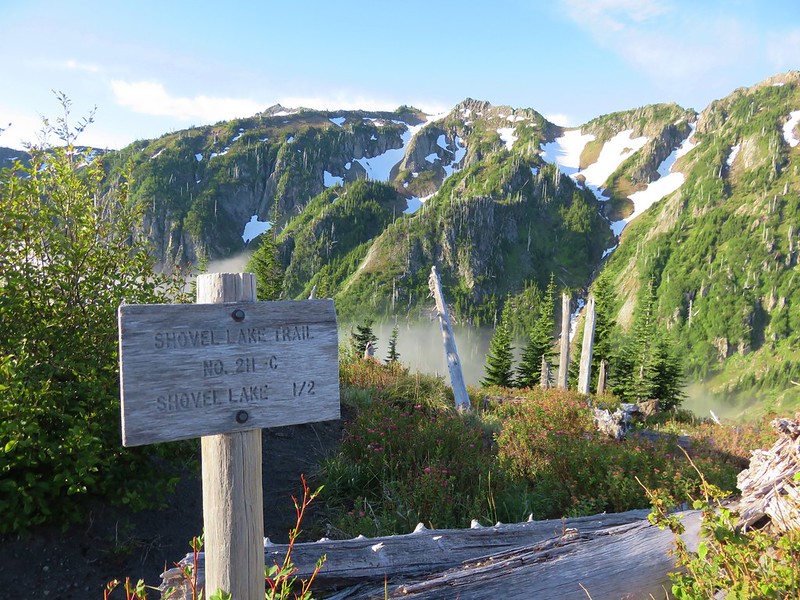
We continued on toward Shovel Lake. Once again the trail climbed out of a basin but instead of dropping back down toward Shovel Lake the trail passed above it along a ridge. On the far side of the lake was Mt. Whittier making this one of the most dramatic lakes in the backcountry but we never saw it.
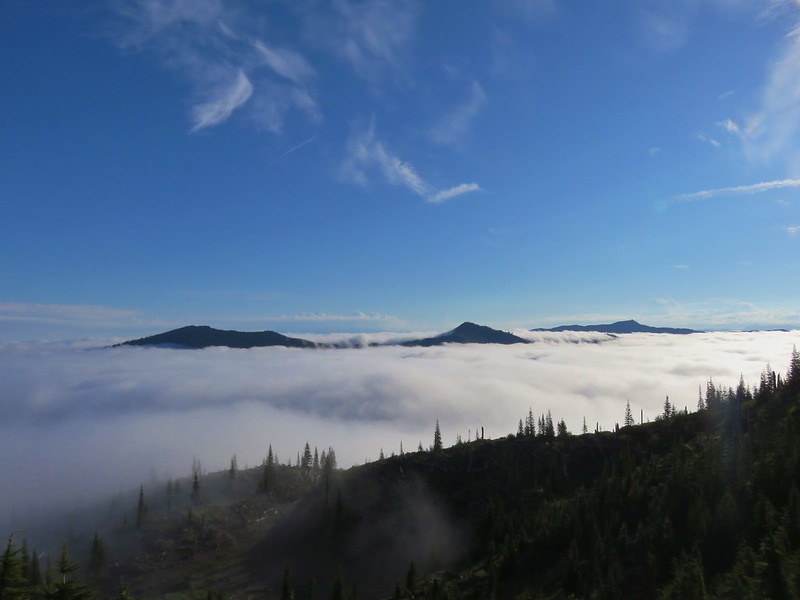
The thickest layer of clouds lay right over Shovel Lake, but as we climbed the ridge we eventually rose above the clouds.
IMG_2155

IMG_2163

IMG_2167

IMG_2183

We were pretty excited when we realized we could see the top of Mt. Rainier in the distance.
IMG_2178

The trail to Shovel Lake was near the top of the ridge which meant we would have had to descend a half mile back into the clouds to visit this lake. Once again we passed figuring it left us one more thing to come back for.
IMG_2185

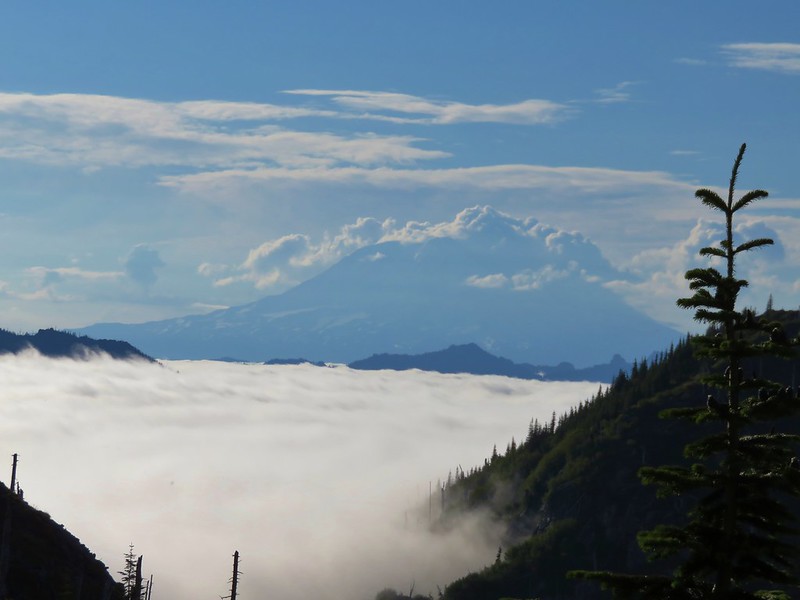
From the Shovel Lake Trail junction though we had a great view of Mt. Adams, which appeared to be wrestling with the clouds.
IMG_2189

IMG_2191

The trail continued up the ridge to a saddle where it was joined by the Whittier Ridge Trail.
IMG_2199

IMG_2200

From this saddle we then began our descent toward Coldwater Lake. First up was Snow Lake.
IMG_2204

We had finally found a lake without clouds and as an added bonus we had a great view beyond to Coldwater Peak.
IMG_2214

The trail swung out around the lake and as it did so we gained a little glimpse of Mt. St. Helens as well.
IMG_2224

IMG_2223

This time the trail went right by Snow Lake giving us an up close look.
IMG_2242

The other nice thing about Snow Lake was the climb out of the basin was short and not steep. We quickly crested the saddle above the lake and began to drop into another mass of clouds.
IMG_2243

From Snow Lake it was 3.4 miles to the Coldwater Trail and a footbridge over Coldwater Creek. We were passing through the cloud layer for the first part of this section so we couldn’t see much. The trail itself was brushy with thimbleberry bushes and vine maples.
IMG_2251

IMG_2252

IMG_2256

IMG_2262

The tread was also narrow and washed out in spots but passable.
IMG_2257

We eventually got under the clouds and could see Coldwater Creek below us.
IMG_2264

IMG_2275

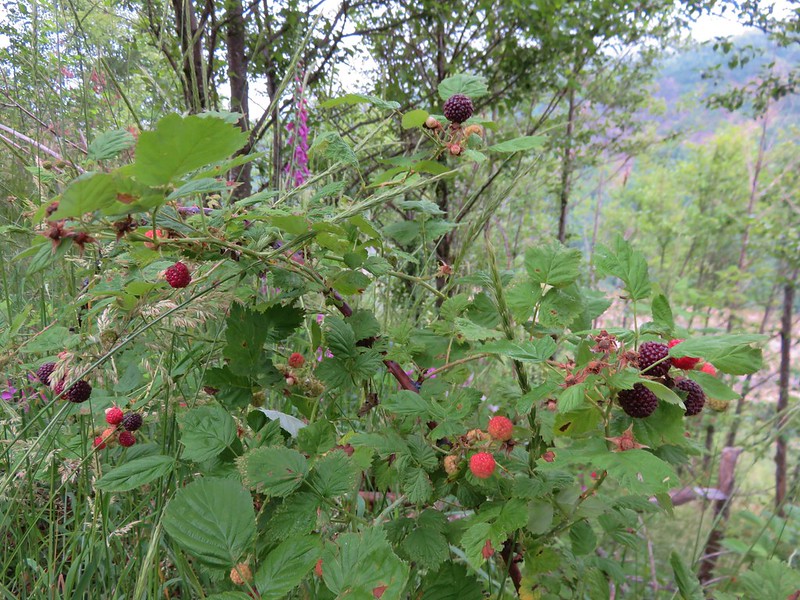
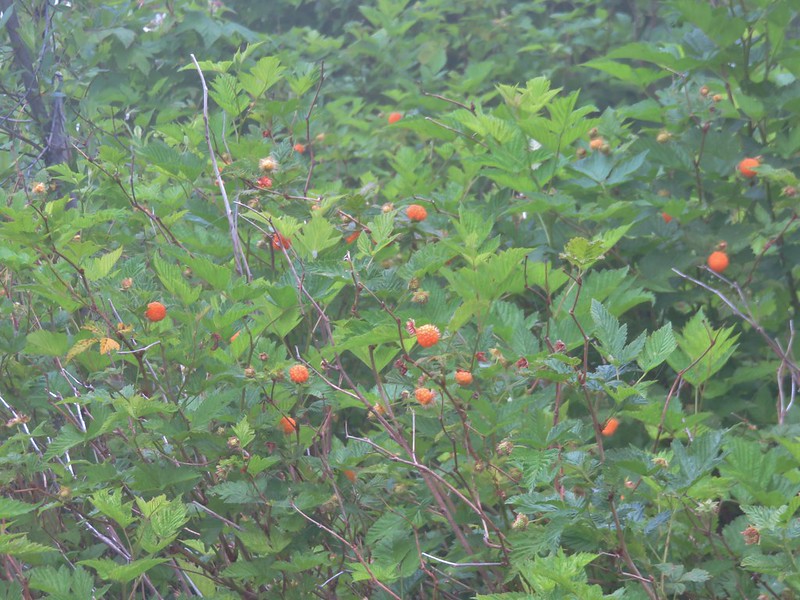
We were also seeing more wildflowers again and finding ripe berries, including our first thimbleberries of the year.
IMG_2269

IMG_2273

Trailing blackberry
IMG_2279

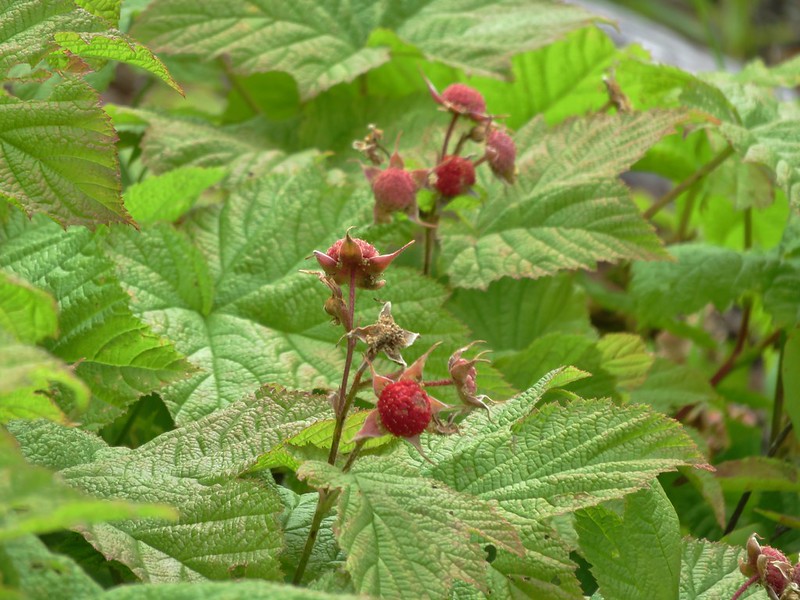
Thimbleberry
IMG_2284

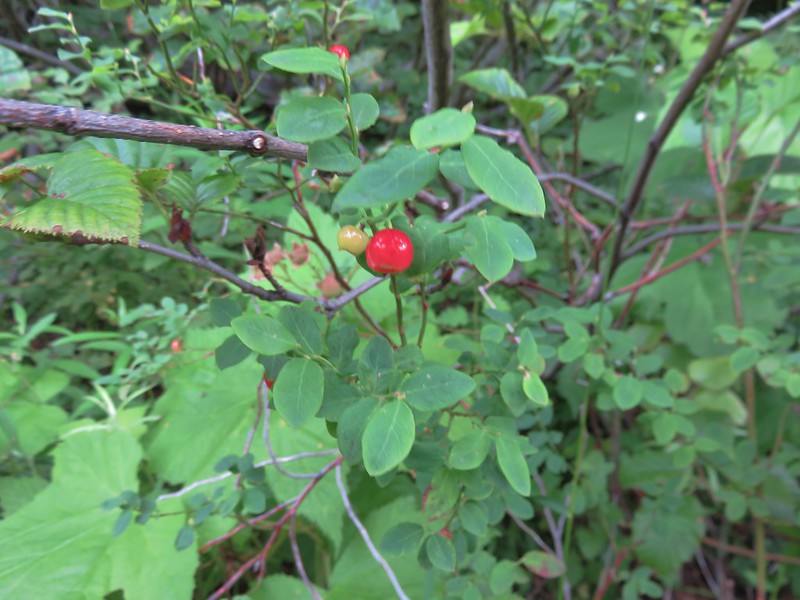
Red huckleberry
IMG_2288

We passed a couple of small waterfalls along side streams, one on either side of the valley.
IMG_2286

IMG_2292

The trail then passed above what appeared to be a nice fall along Coldwater Creek but didn’t provide much of a view.
IMG_2299

IMG_2297

IMG_2302

Just after passing the waterfall the trail entered a forested area.
IMG_2300

Hedgenettle
IMG_2307

From there to the Coldwater Trail junction the trial alternated between small meadows and woods with occasional views back to Coldwater Creek.
IMG_2311

IMG_2312

IMG_2316

Another trail crew from the Washington Trails Association was working on the Coldwater Trail on the far side of the footbridge when we arrived there. We stopped on some rocks above the bridge for a snack break and watched them as they worked.
IMG_2318

We were now on familiar trail, at least in theory. When we had hiked the loop around Coldwater Lake in May 2014 much of the vegetation was only beginning to produce leaves.
Coldwater Trail

This time the trail was crowded with plants.
IMG_2333

The wildflowers were out in force as we drew nearer to Tractor Junction.
IMG_2350

IMG_2374

IMG_2375

A male grouse flew out of one of the meadows and landed in a nearby tree. It was the first one we’d seen in full display and was quite colorful.
IMG_2365

IMG_2360 (2)

The views were much better than they had been the day before at Tractor Junction and along the 3.2 miles from there back to the trailhead. Coldwater Lake was clearly visible and Mt. St. Helens even made an appearance.
IMG_2393

IMG_2395

IMG_2404

IMG_2443

IMG_2446

For the second day in a row we’d escaped without dealing with any rain showers and the thunderstorms had not materialized before we’d made it back to the car. Despite the sometimes cloudy conditions it had turned out to be a really nice trip. The views we did miss out on can now be our excuse for return trip sometime in the future. Happy Trails!

Flickr: https://www.flickr.com/photos/9319235@N02/albums/72157670492933452

Categories
Hiking Mt. St. Helens Trip report Washington Washington Cascades

Mount Margaret Backcountry – South Coldwater Trailhead to Obscurity Lake

The only backpacking trip that we had planned for this year which required a permit was an overnight stay in the Mount Margaret Backcountry near Mt. St. Helens. The area is part of the Mount St. Helens National Volcanic Monument, displaying the effects of the 1980 eruption. The lateral blast from the eruption shattered trees toppling thousands of acres of forest.

Camping is limited to designated sites at eight backcountry camps where the maximum group size for camping is four. Pets and pack stock are prohibited in the Mount Margaret Backcountry and fires are not allowed. We made our reservation for Obscurity Camp on March 19th, the day the permits became available.

One drawback of a permit system is not having any idea what the weather is going to be like on the days you reserve. We were looking at the chance of showers and maybe even a thunderstorm as we were hiking out, but we liked our odds and we had spent a whole $6.00 on the permit so we decided to give it a go. It was a wet drive to the South Coldwater Trailhead which is located along the Spirit Lake Highway (SR 504).
IMG_1506

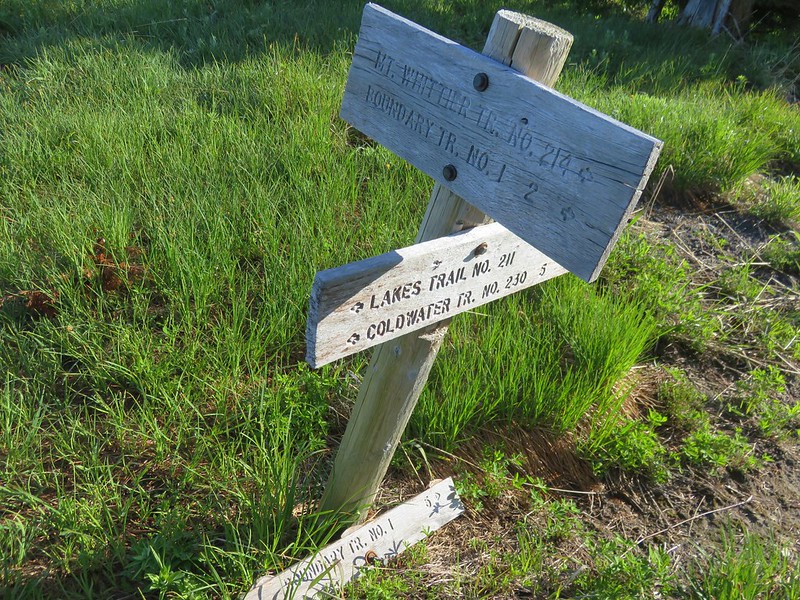
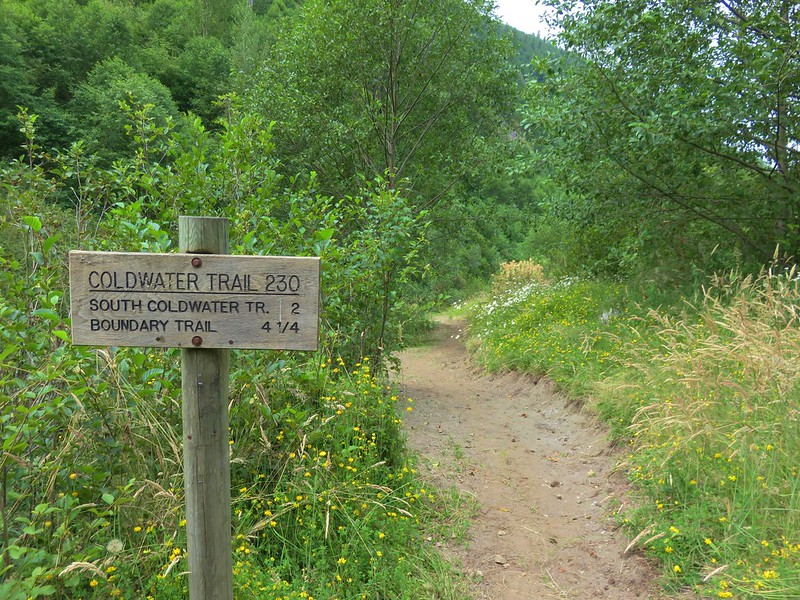
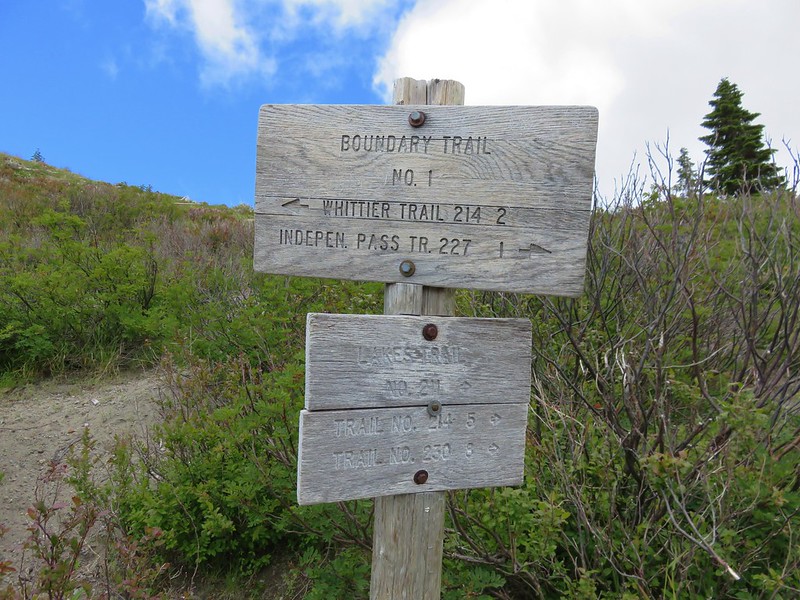
Starting at Norway Pass would have made it a shorter hike but where is the fun in that? It also would have been a longer drive. Our plan was a lollipop route using the South Coldwater Trail 230A, Coldwater Trail 230, Boundary Trail 1, and Lakes Trail 211. We had been on some of the trails in 2013 during a May hike around Coldwater Lake, but that hike had been early enough in the season that there had been very little vegetation and almost no flowers. It was evident from the flowers at the trailhead that we’d be seeing different sights this time around.
IMG_1507

We were under the clouds as we set off on the trail which passed through a short section of woods before emerging into wildflower filled meadows.
IMG_1530

IMG_1531

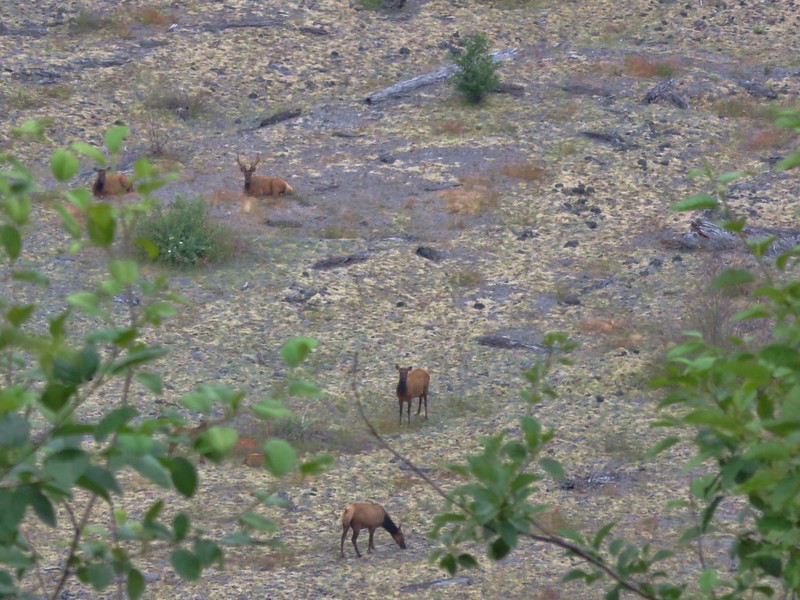
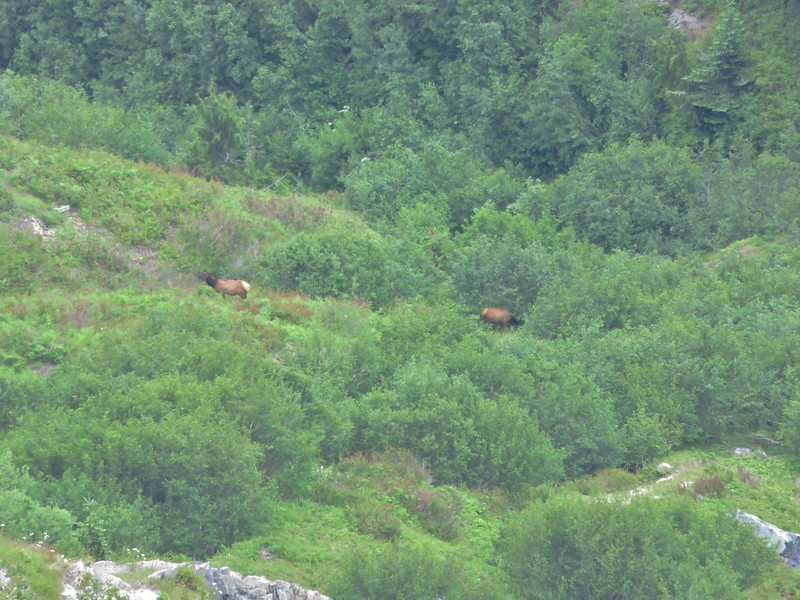
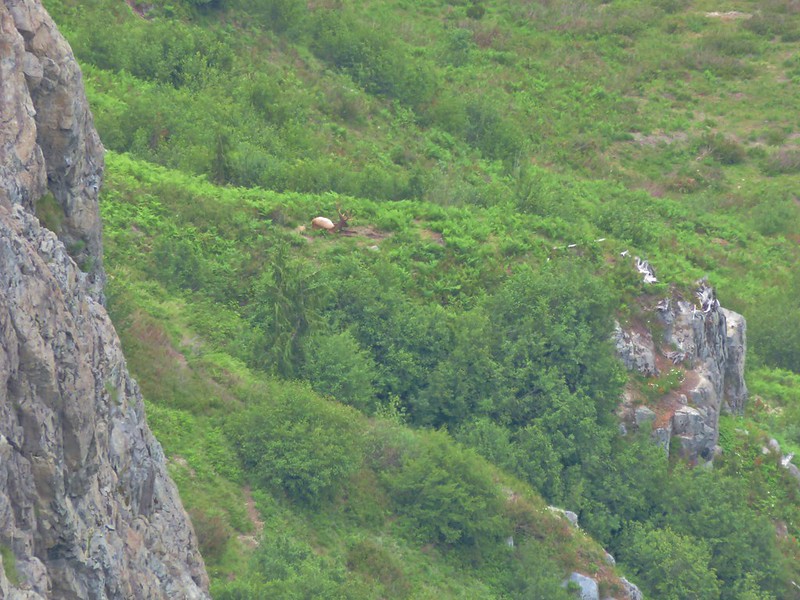
Although the clouds limited the view we were able to see back down to the South Coldwater Creek Valley where we spotted several elk.
IMG_1539

IMG_1541

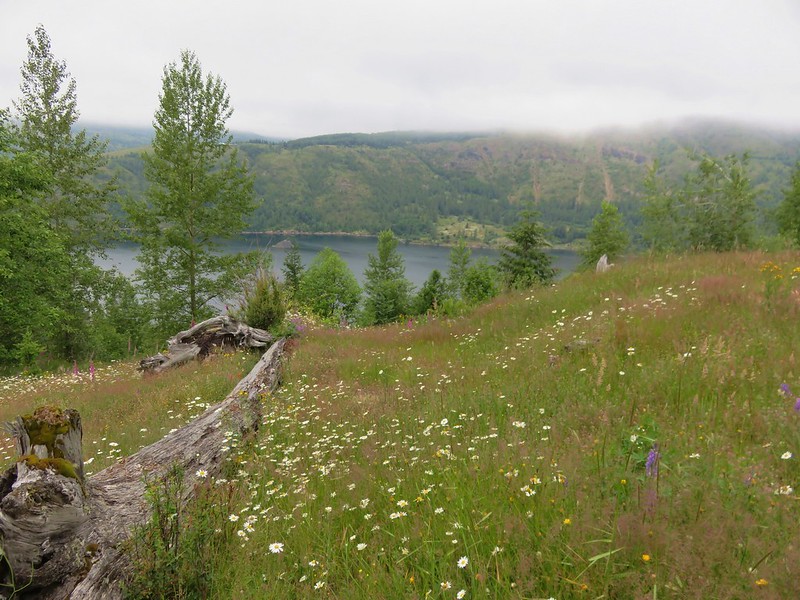
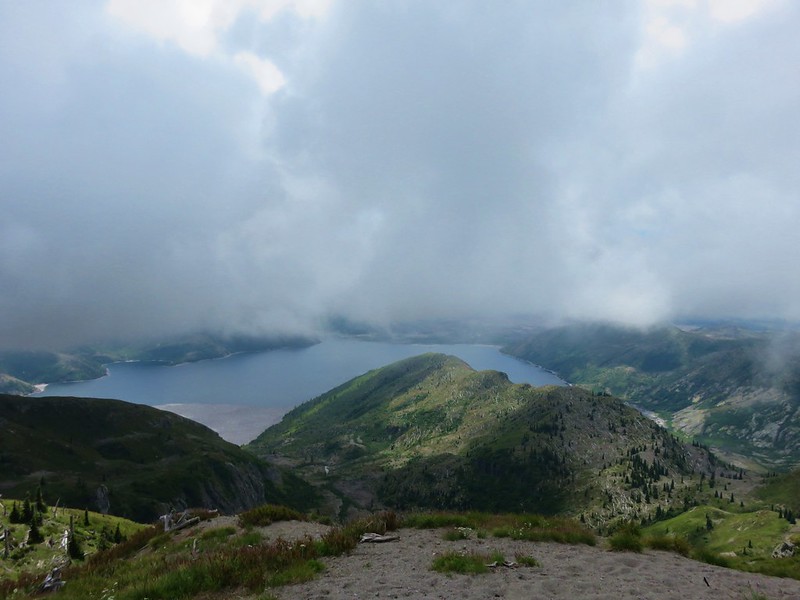
The trail then crossed over the ridge we were climbing providing views of Coldwater Lake.
IMG_1545

IMG_1548

The wildflowers were thick along the trail, but we were starting to enter the cloud bank and quickly losing our visibility.
IMG_1546

IMG_1549

IMG_1555

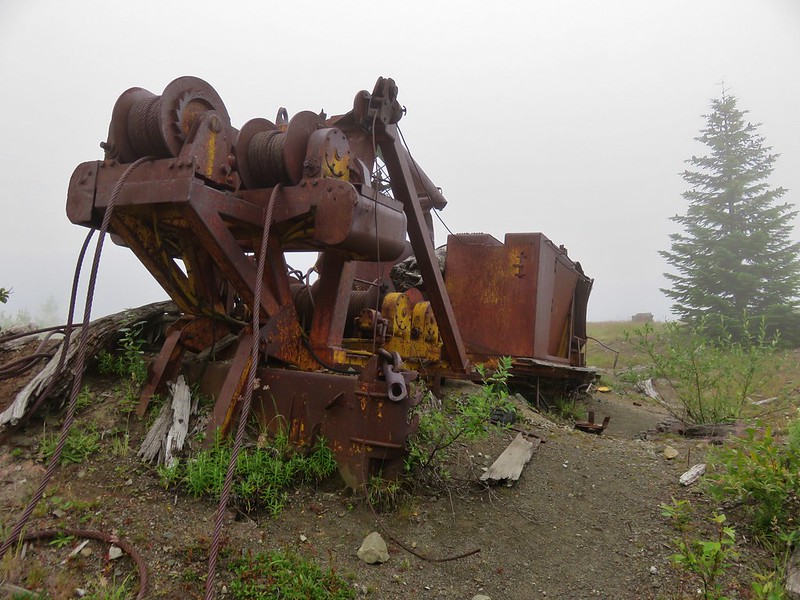
The trail continued to climb along the ridge passing a couple of pieces of old machinery that is left over from the 1980 eruption of Mt. St. Helens.
IMG_1559

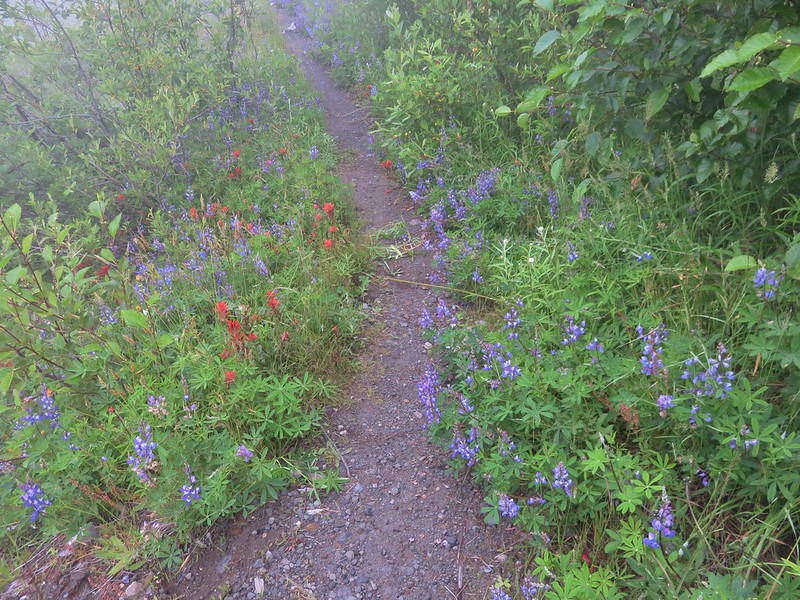
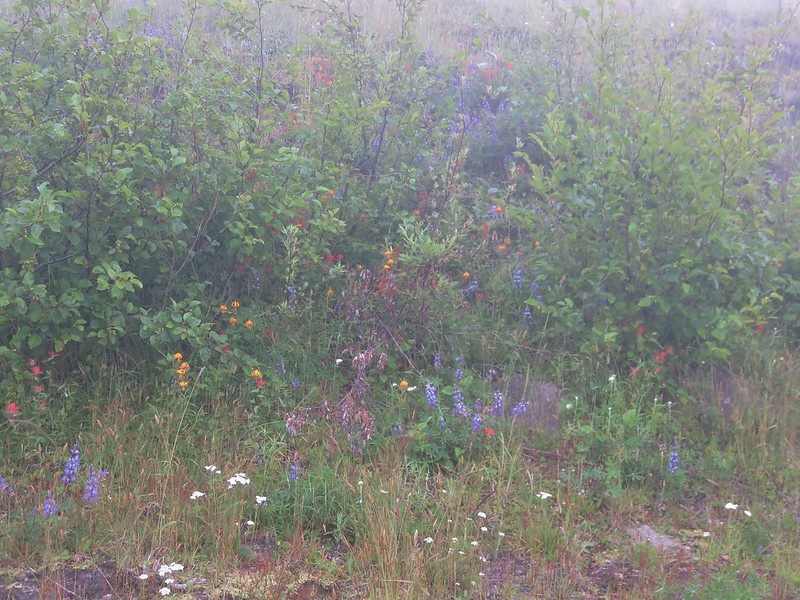
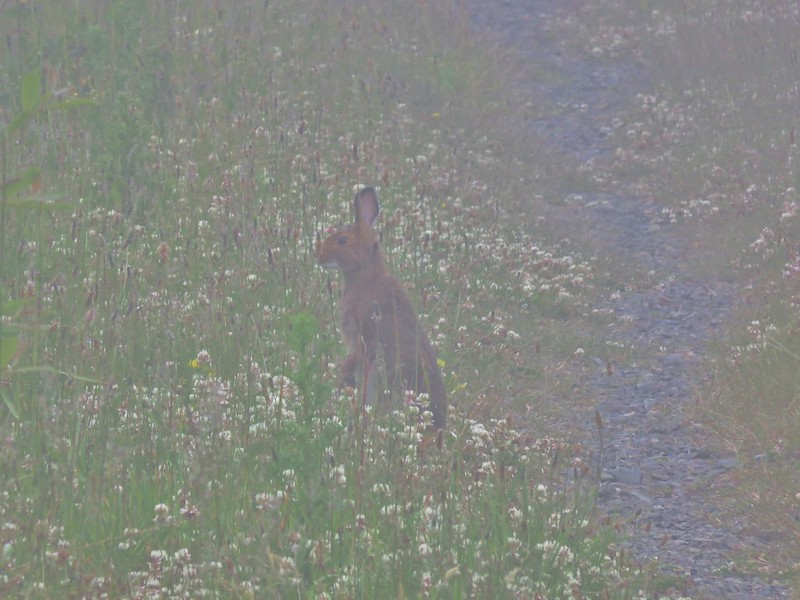
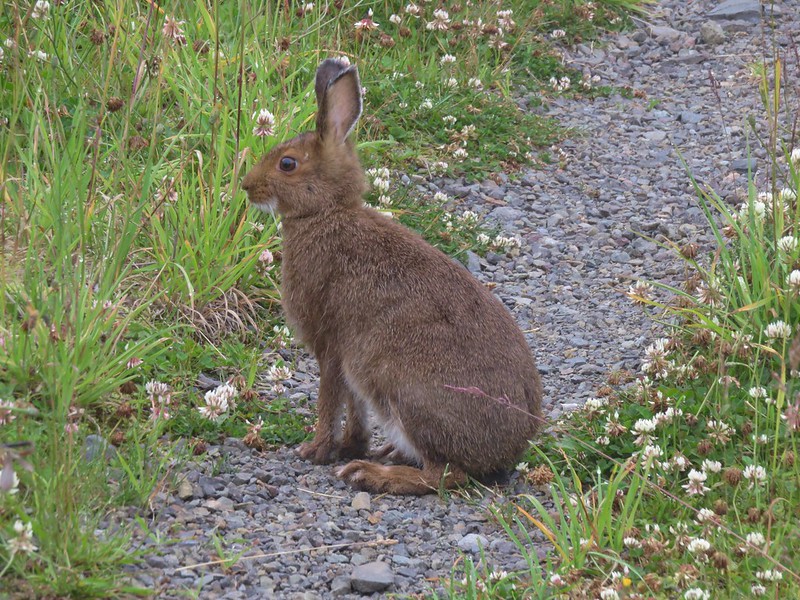
We were now in the midst (or mist) of the clouds. At least it wasn’t raining and despite the low visibility there were still plenty of flowers along the trail to see and there were a couple of snowshoe hares out having breakfast.
IMG_1586

IMG_1590

IMG_1571

IMG_1577

The hares weren’t the only ones enjoying some snacks. A variety of ripe berries offered us a nice selection of treats.
IMG_1543

IMG_1596

IMG_1598

After 3.2 miles we arrived at Tractor Junction. Named for another piece of nearby equipment, this junction marks the end of the South Coldwater Trail at it’s intersection with the Coldwater Trail.
IMG_1604

IMG_1610

We turned right at the junction and headed toward the Boundary Trail which was just over 2 miles away. After .2 miles we passed Ridge Camp, one of the designated camps in the area.
IMG_1626

The wildflowers were once again impressive along this trail, but the visibility was even worse. We focused on finding as many different flowers as we could.
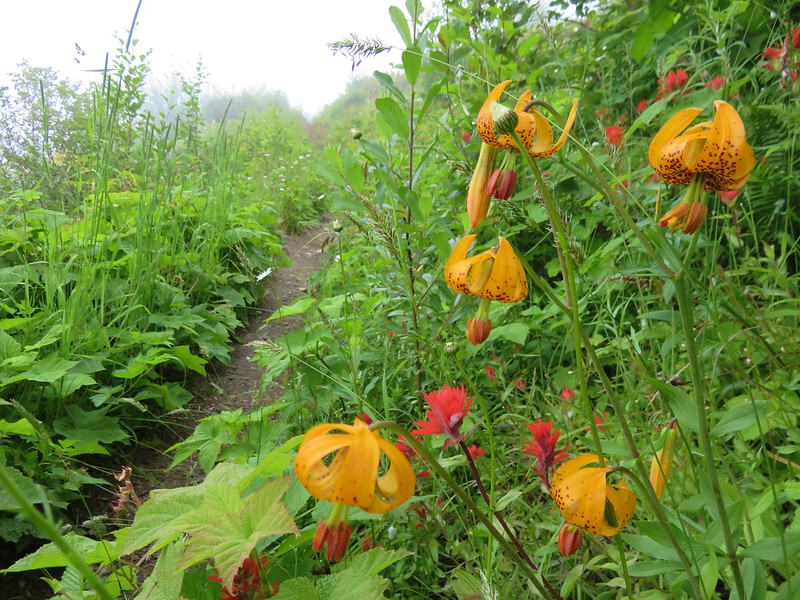
Tiger lilies
IMG_1614

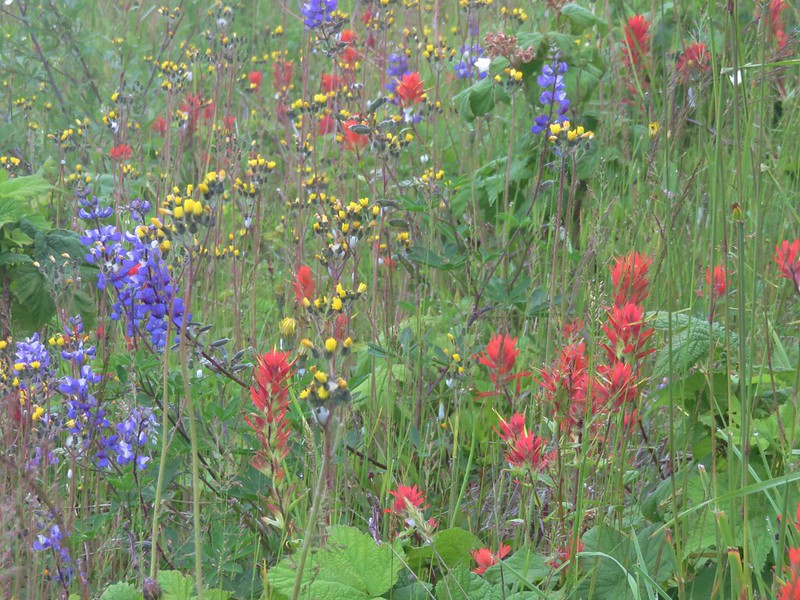
Lupine, paintbrush and yellow wildflowers
IMG_1616

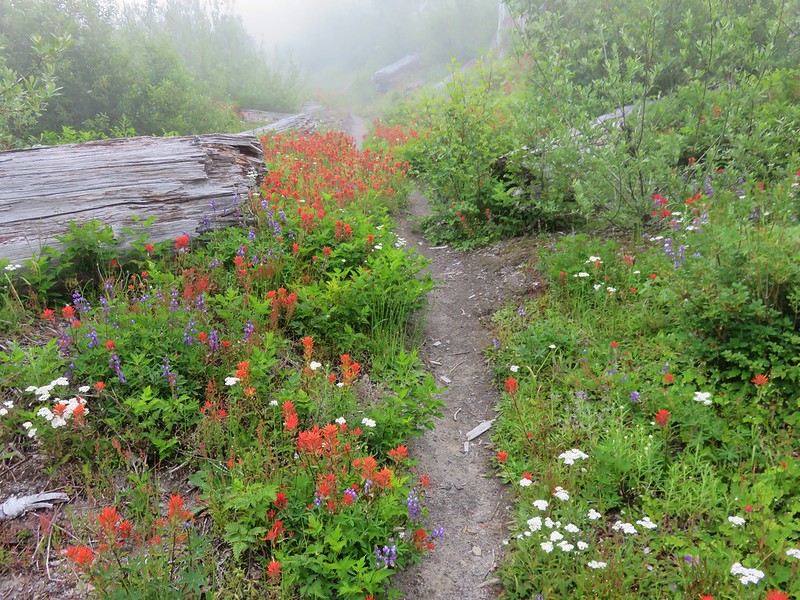
Large patch of paintbrush
IMG_1642

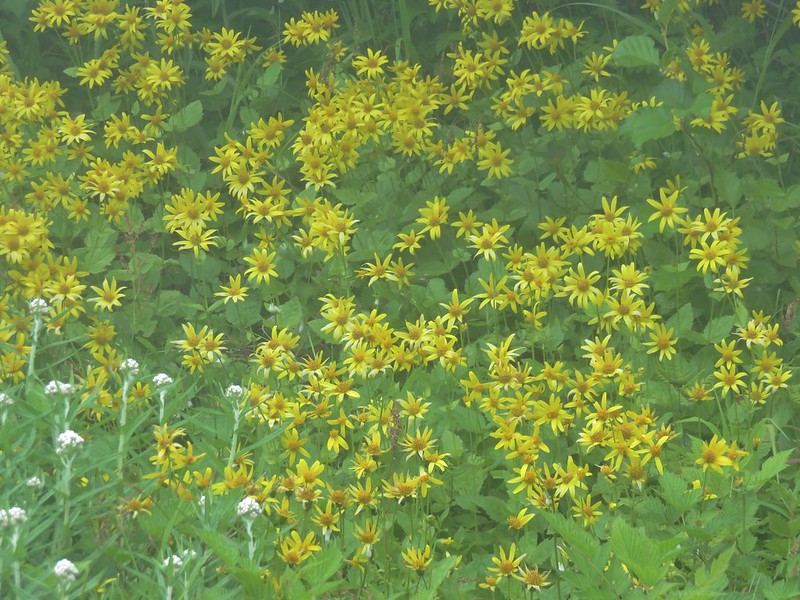
Arnica
IMG_1649

Bugbane
IMG_1651

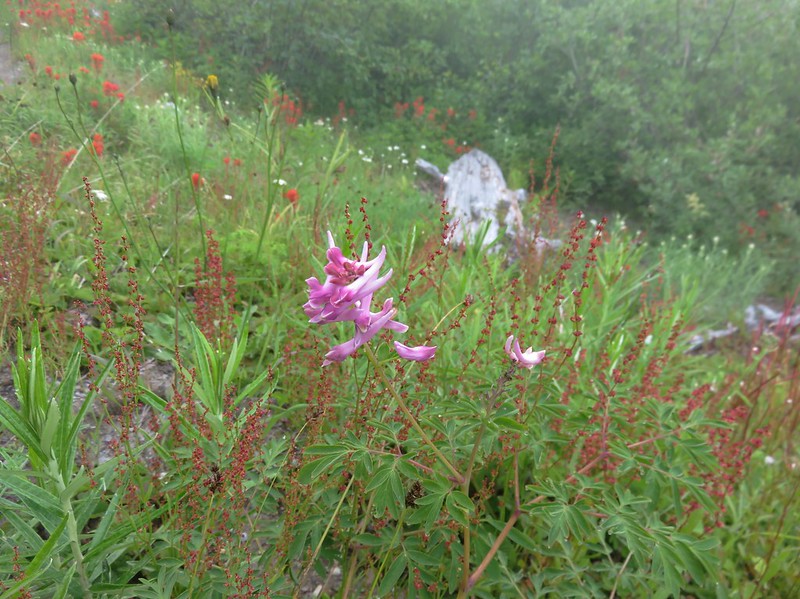
Corydalis
IMG_1657

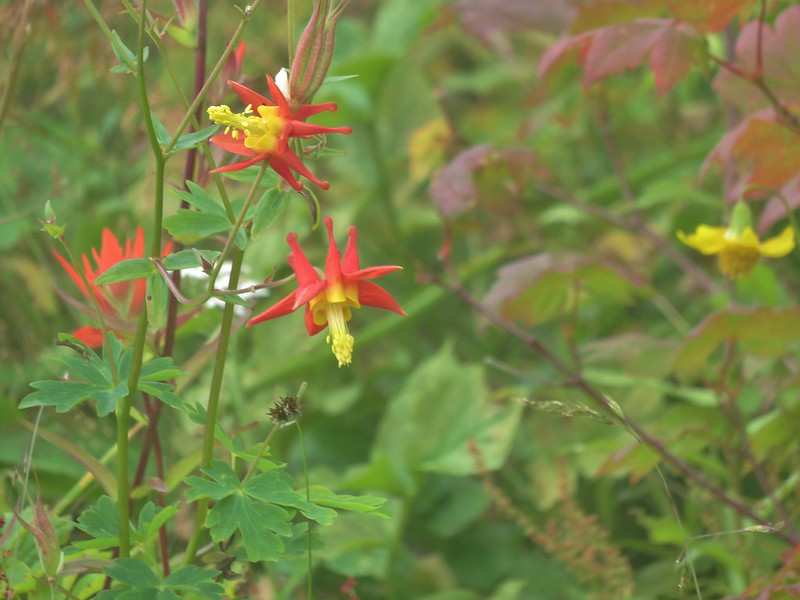
Columbine
IMG_1670

Scouler’s bluebell
IMG_1673

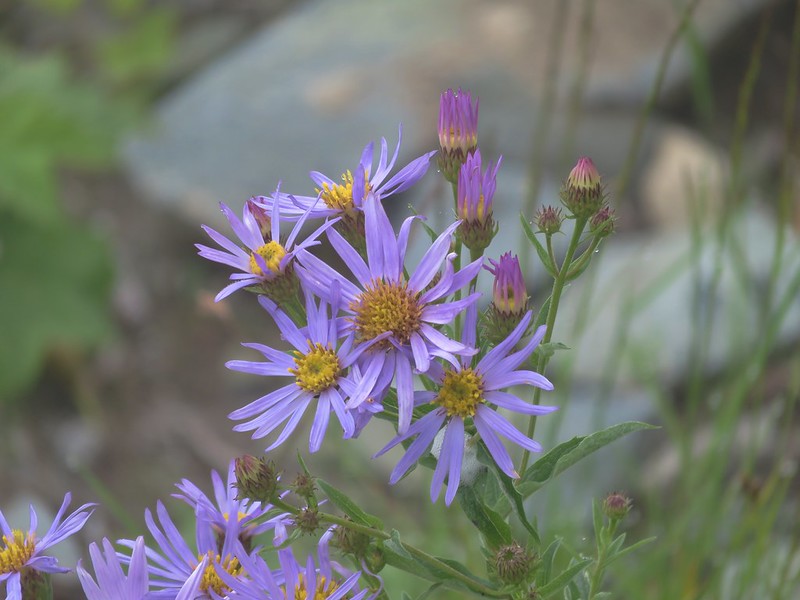
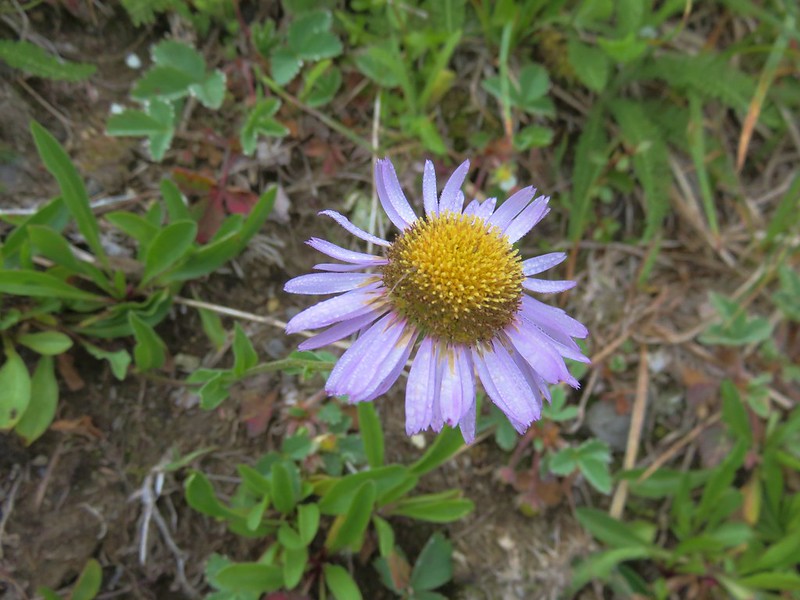
An aster or fleabane
IMG_1676

Pussypaws
IMG_1679

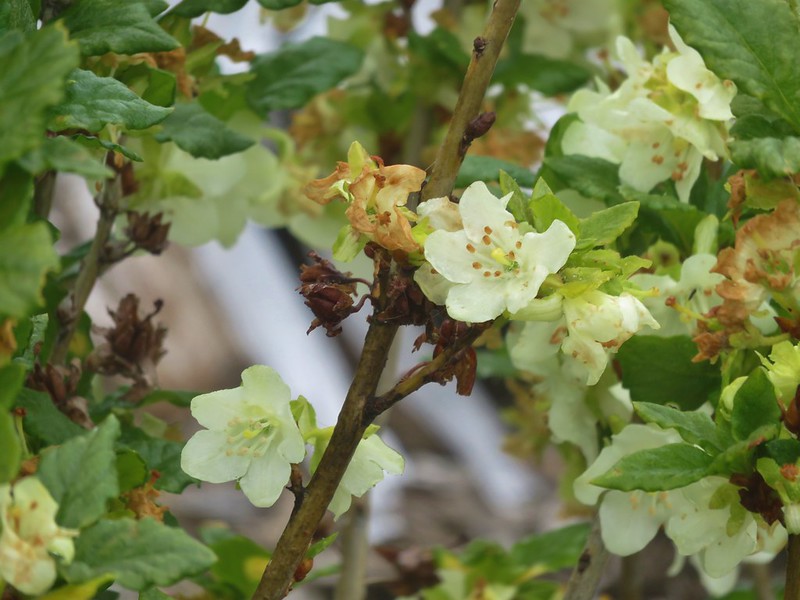
Mock orange
IMG_1688

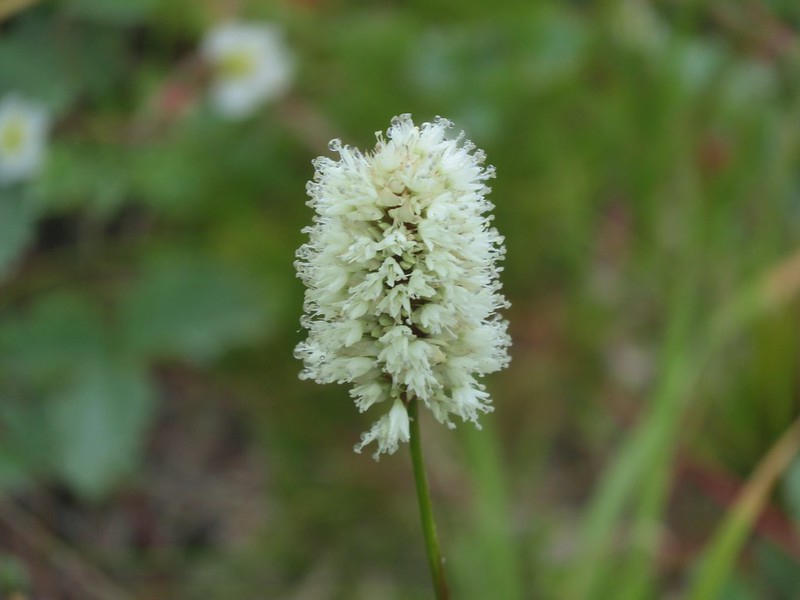
Bistort
IMG_1692

Another type of aster or fleabane
IMG_1695

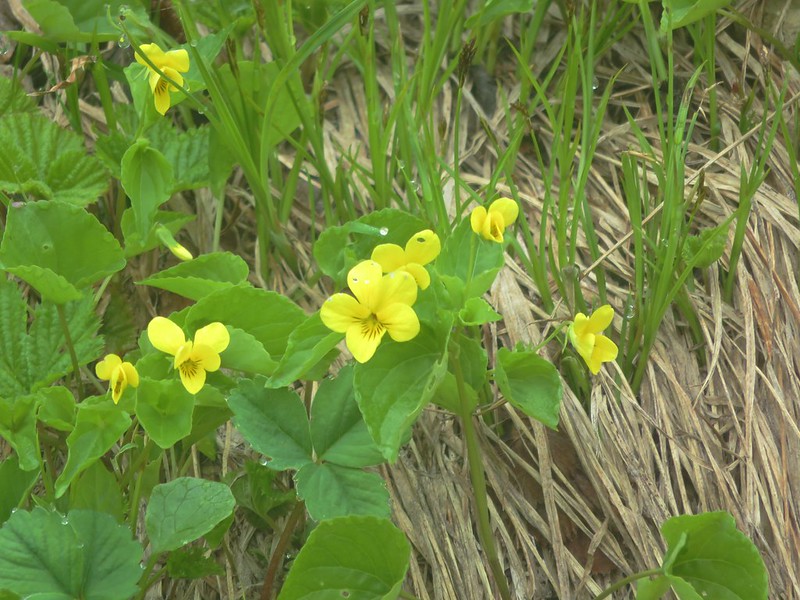
Violets
IMG_1697

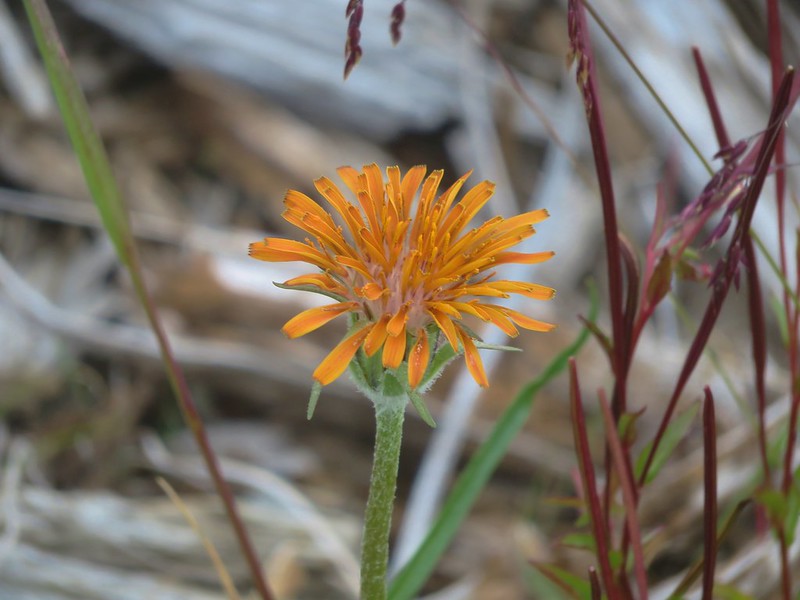
Orange agoseris
IMG_1701

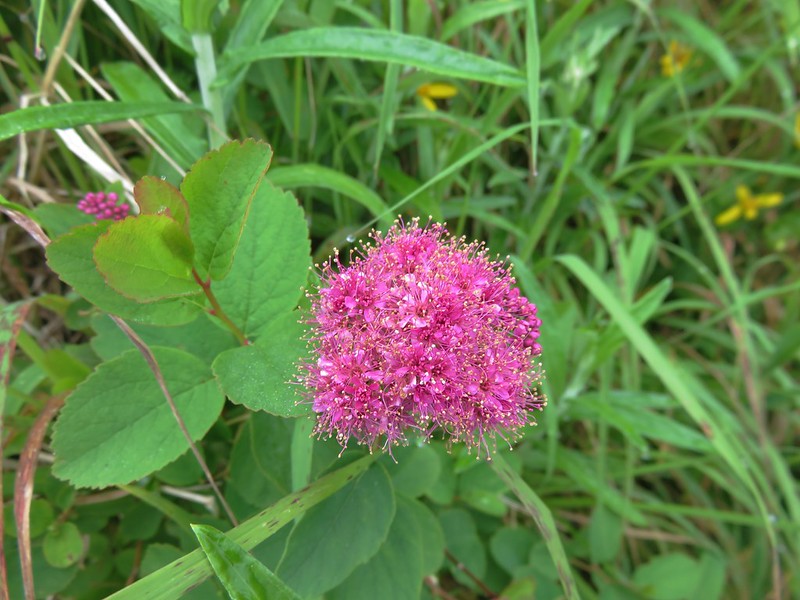
Spirea
IMG_1666

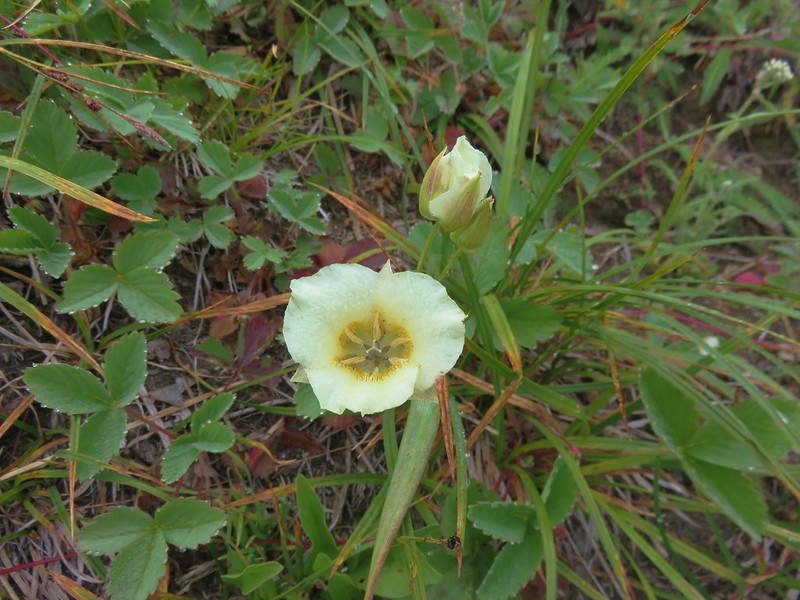
Cat’s ear lily
IMG_1693

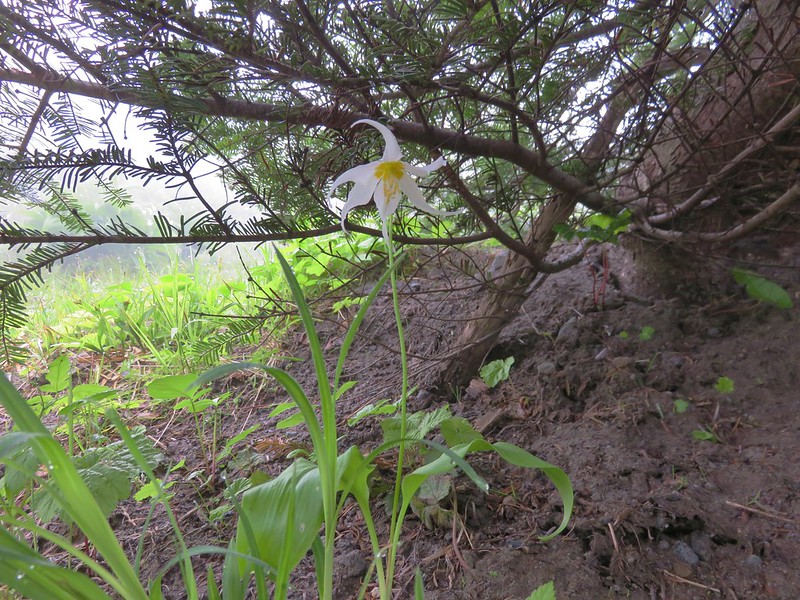
Avalanche lily
IMG_1699

We were pleasantly surprised when we arrived at the junction with the Boundary Trail overlooking St. Helens Lake. We had suddenly found a little blue sky and some better visibility.
IMG_1719

IMG_1711

IMG_1710

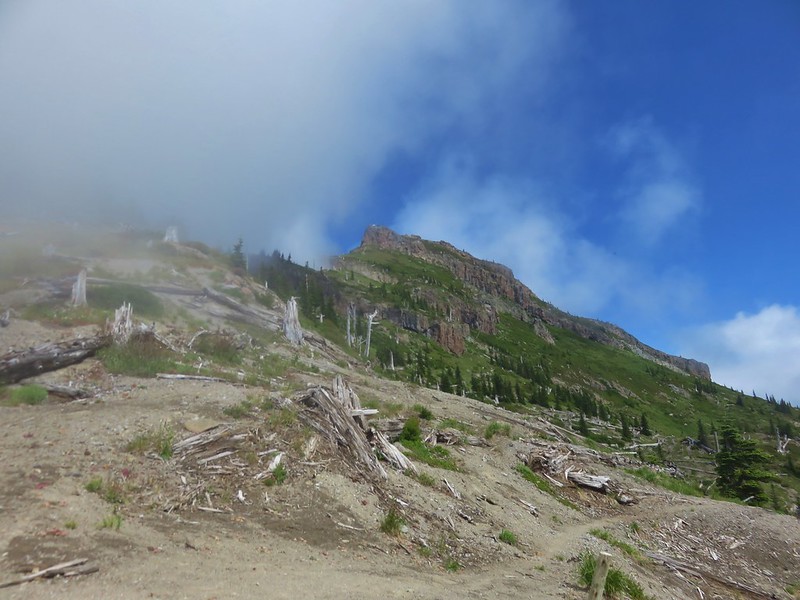
Coldwater Peak was to our left and seemed to be acting as a cloud break.
IMG_1714

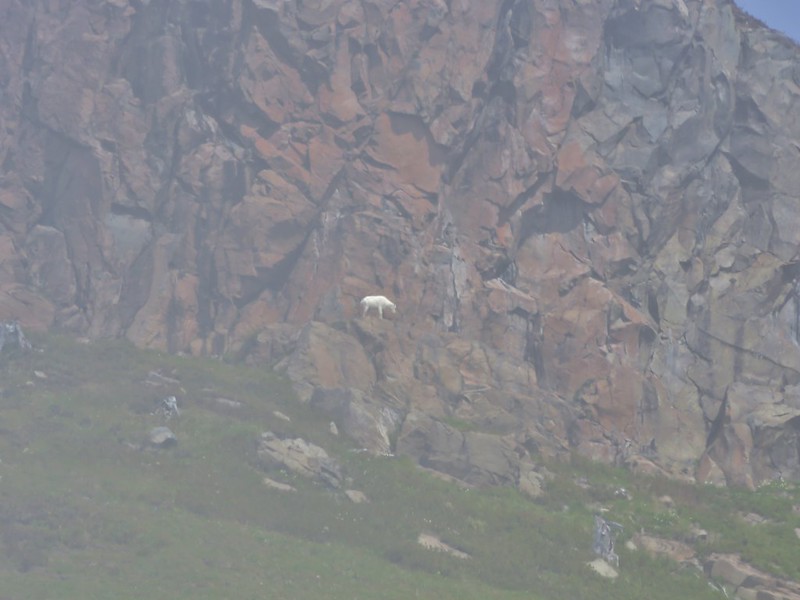
While we were watching the clouds swirl around the back side of Coldwater Peak we noticed a mountain goat on the cliffs below the summit.
IMG_1716

We took a nice long break at the junction watching the mountain goat and the ever changing clouds. When we finally set off again we passed by Coldwater Peak in sunlight.
IMG_1724

We had some great views of St. Helens Lake below us as we passed the spur trail to Coldwater Peak after .4 miles.
IMG_1748

IMG_1751

The trail the continued around the lake with views opening up to Spirit Lake below St. Helens Lake.
IMG_1766

For the next 3 plus miles the clouds came and went as the drifted over the ridge down toward Spirit Lake.
IMG_1786

There was more snow along this section of trail and we started seeing more flowers that bloom soon after snow melt.
IMG_1780

Cinquefoil
IMG_1811

IMG_1815

Cusick’s speedwell
IMG_1805

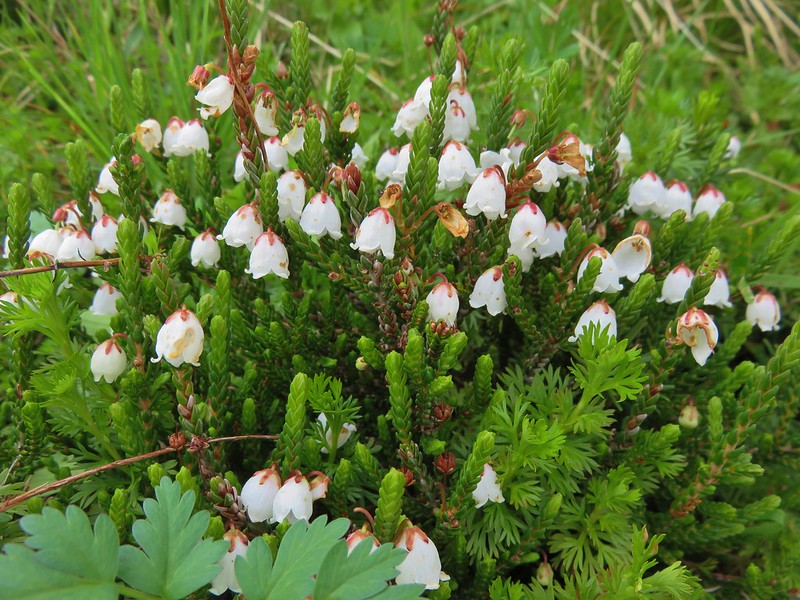
White heather
IMG_1827

Avalanche lilies
IMG_1830

Cat’s ear lily
IMG_1836

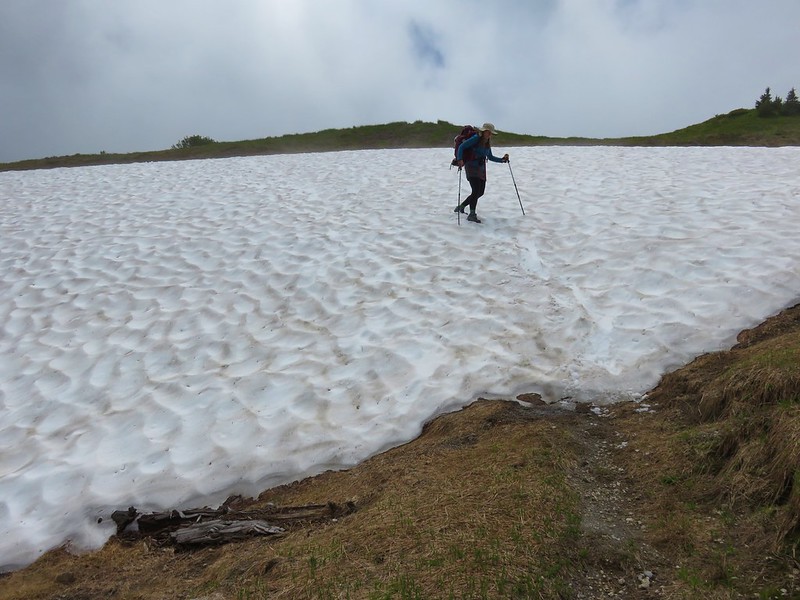
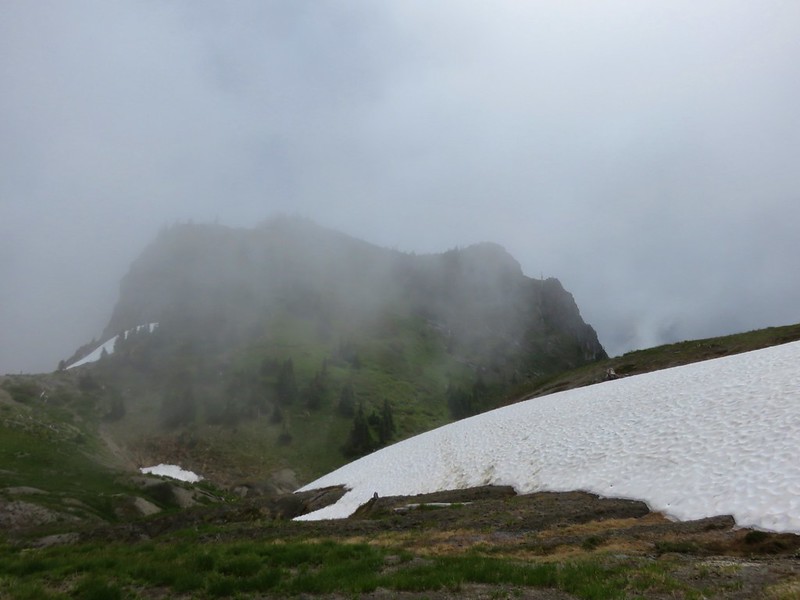
We crossed our first snowfield near The Dome, which was mostly hidden by the clouds.
IMG_1844

IMG_1846

It was a bit of a shame that we couldn’t see more of the surrounding area because the peaks and cliffs we could see where really neat.
IMG_1850

IMG_1859

The view downhill was a little better and we got a decent look at the outlet of St. Helens Lake, a log jam on Spirit Lake, and some elk in the valley.
IMG_1866

IMG_1875

IMG_1880

IMG_1877

We had skipped the .6 mile trail up to the summit of Coldwater Peak not wanting to make that climb with our full packs on a day when the visibility wasn’t great, but when we reached the shorter spur trail to the summit of Mt. Margaret we decided to head up. Unlike Coldwater Peak we had not been up this trail before so even if we didn’t have a view we couldn’t pass it up. The view from Mt. Margaret turned out to not be too bad. We could see Spirit Lake fairly well and the Boundary Trail below the peak. Other nearby peaks occasionally emerged from the clouds.
IMG_1896

IMG_1911

IMG_1900

We could see some spots where mountain goats had been on a nearby ledge but no goats, just a swallowtail butterfly.
IMG_1902

IMG_1907

IMG_1908

We took a nice long break and had some lunch on Mt. Margaret. As we were preparing to start hiking again we could hear people coming up the Boundary Trail, lots of people. Heather counted nearly 30 folks emerging from the trees below. We made it back to the junction with the Boundary Trail just as the first of these other hikers were arriving. The majority of them turned out to be members of the Mazamas, a nonprofit Mountaineering Education Organization based in Portland, Oregon.

After passing through the Mazamas we crossed another nice snowfield and reached a junction with the Whittier Ridge Trail.
IMG_1927

IMG_1929

IMG_1930

The Whittier Ridge Trail was not on our to-do list on this hike. The trail is narrow and in places along exposed cliffs where the rocks had to be blasted to create a trail at all. Recent reports from members of the Oregon Hikers forum reported some snow still along the trail as well and with little visibility it wasn’t even tempting. We continued on the Boundary Trail getting our first view of some the lakes in the Mt. Margaret Backcountry.
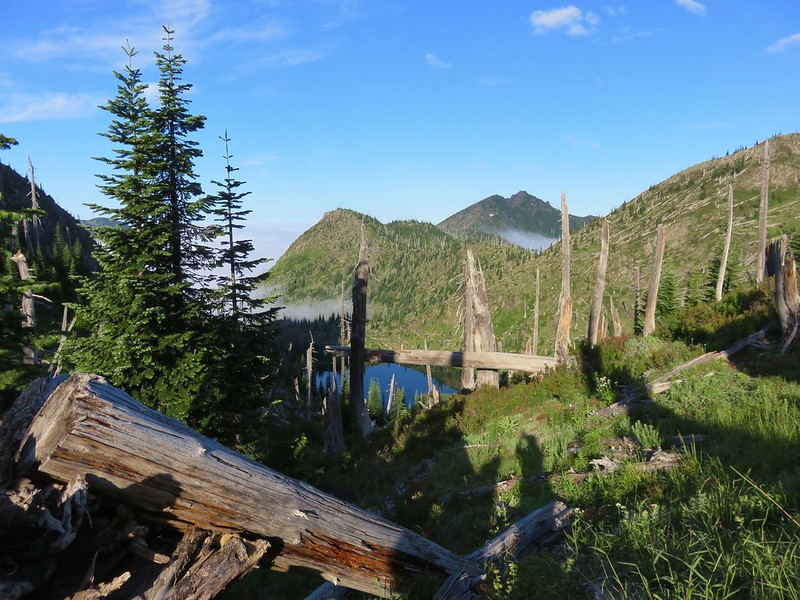
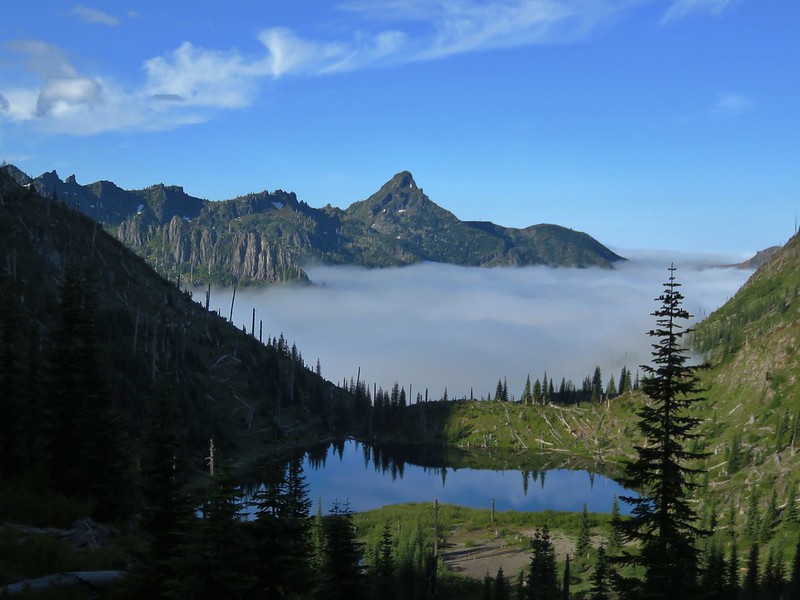
Boot and Obscurity Lakes
IMG_1938

We had been gradually descending since Mt. Margaret and the visibility was getting better the lower we got.
IMG_1944

IMG_1948

IMG_1955

Along the way we spotted another mountain goat not far above the trail.
IMG_1970

IMG_1972

As we got closer it crossed the trail and disappeared over the hillside leaving us with just it’s smell. (And boy did it smell)

We had been working our way around Spirit Lake and were now just to the NE of it. Mt. St. Helens lay directly behind the lake but only the lowest portions were visible. What we could see was Windy Ridge on the Mountain’s flank.
IMG_1984

IMG_1987

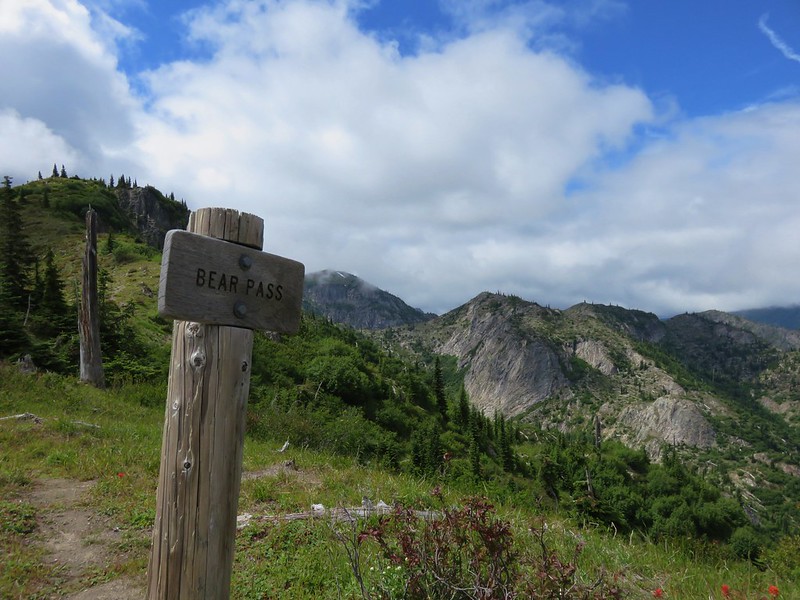
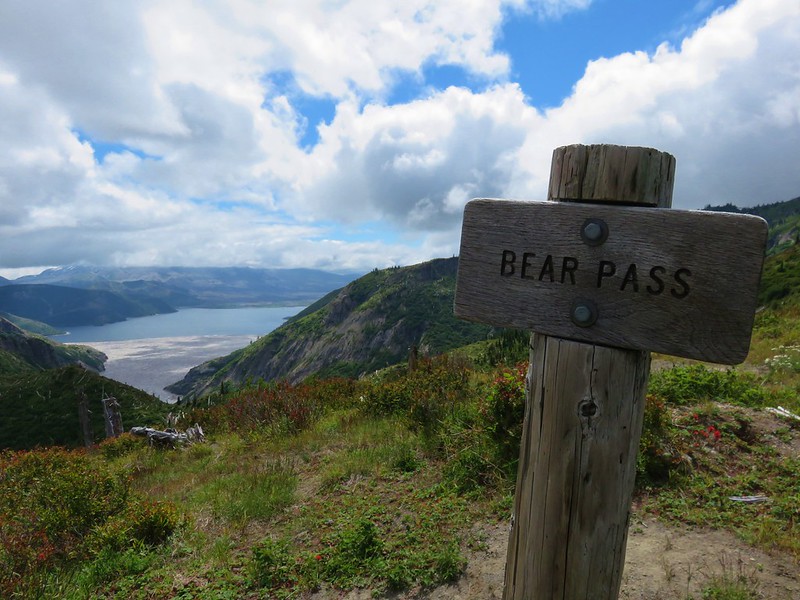
Two miles from the Whittier Ridge Trail we arrived at the junction with the Lakes Trail at Bear Pass.
IMG_1990

IMG_1991

IMG_1992

The Lakes Trail descended from Bear Pass toward Grizzly Lake.
IMG_2001

A trail crew from the Washington Trails Association was busy brushing out the trail and restoring the tread along this section. They were doing some impressive work and we thanked them as we passed by.

Between Grizzly Lake and our final destination at Obscurity Lake were more wildflowers including a few we hadn’t seen yet that day.
Partridge foot and paintbrush
IMG_2008

Penstemon and candyflower
IMG_2016

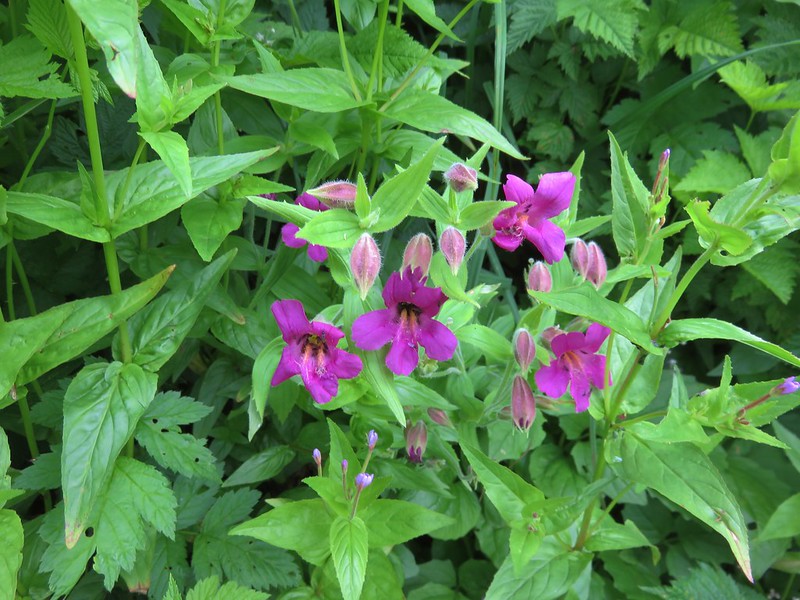
Pink monkeyflower
IMG_2019

IMG_2039

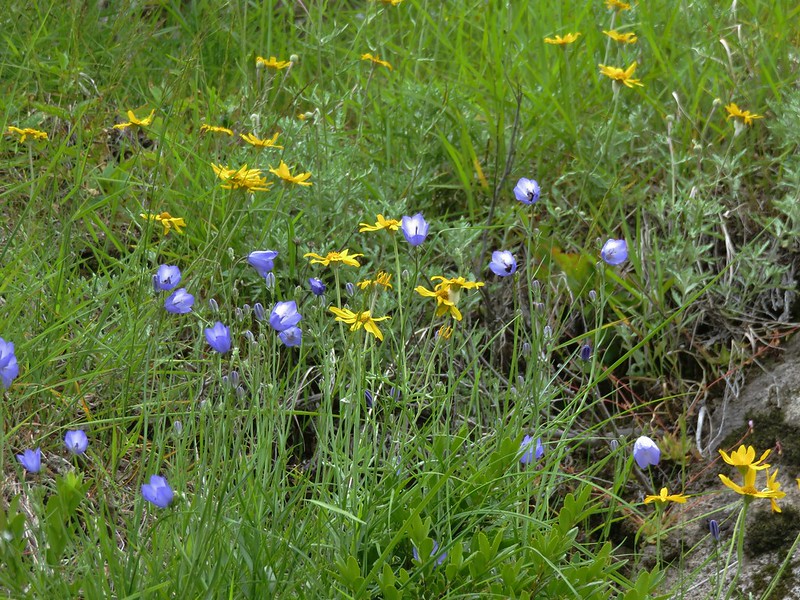
Blue-bells of Scotland
IMG_2043

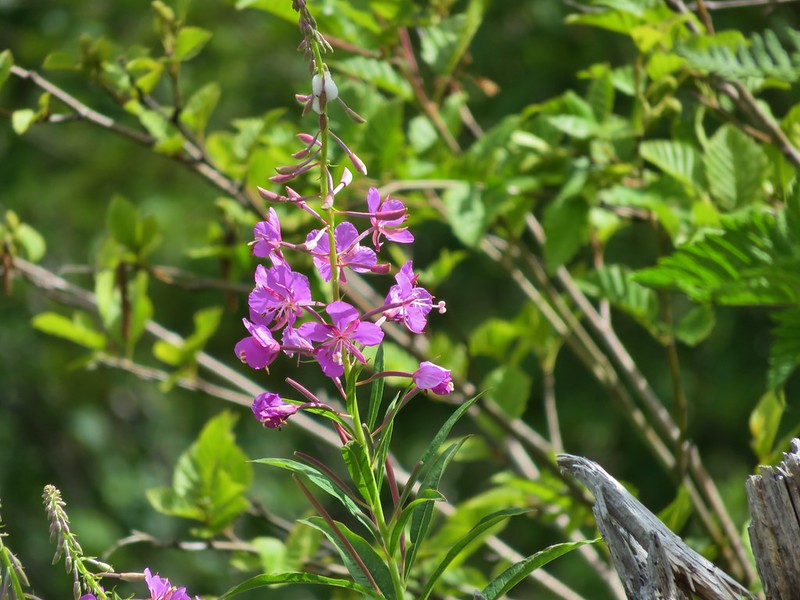
Fireweed
IMG_2044

Bleeding heart
IMG_2050

As we approached Obscurity Lake a waterfall was visible along the outlet creek of the lake.
IMG_2057

IMG_2060

We finally arrived at Obscurity Lake after almost 16 miles of hiking.
IMG_2063

IMG_2066

IMG_2069

IMG_2070

IMG_2079

We thought the hard part was over but then we went in search of the designated camp site. We found one tent pad already occupied and began looking for a second one. When I had made the reservation on the Recreation.gov website there had been 2 available permits for up to 4 people. There were several areas where tents had obviously been placed in the past but we couldn’t find any other tent pad or post marking another designated site. The hikers from the other tent said they had not been able to find a second one either so we picked what seemed like the most likely spot where there was no vegetation to trample and set up the tent.
IMG_2073

We hoped that we had picked the right spot and figured if we hadn’t and a ranger came along we’d just ask them where the other designated site was and move there if we had chosen poorly. Oddly enough a third tent had appeared when we awoke the next morning. I don’t know if they were possibly with the Forest Service, but if they weren’t someone was not where they should have been.

Regardless of the confusion over the camp sites the day had been pretty spectacular. The showers had never materialized and between the wildflowers, wildlife, and scattered views we did get we’d been totally entertained. The clouds just made us more eager to come back again someday in the future so we could see what we missed this time around. Happy Trails!

Flickr: https://www.flickr.com/photos/9319235@N02/albums/72157668318616563

Categories
Hiking Trapper Creek Trip report Washington Washington Cascades

Siouxon Creek & Peak

**Note the 2020 Big Hollow Fire burned a portion of this hike.**

It was finally time for our first overnight trip this year. We picked the Siouxon Trail for the trip which would be our test run for our backpacking season. Our plan was to hike up the Siouxon Trail approximately four miles, find a campsite to set up in then hike up to Siouxon Peak on a loop using the Wildcat, Chinook, and Huffman Peak Trails.

The trail is located in the Gifford-Pinchot National Forest and is accessed via forest road 5071 which is east of Chelatchie, WA. Although the roads are mostly paved, washouts and pot holes made it interesting on the way to the trailhead.
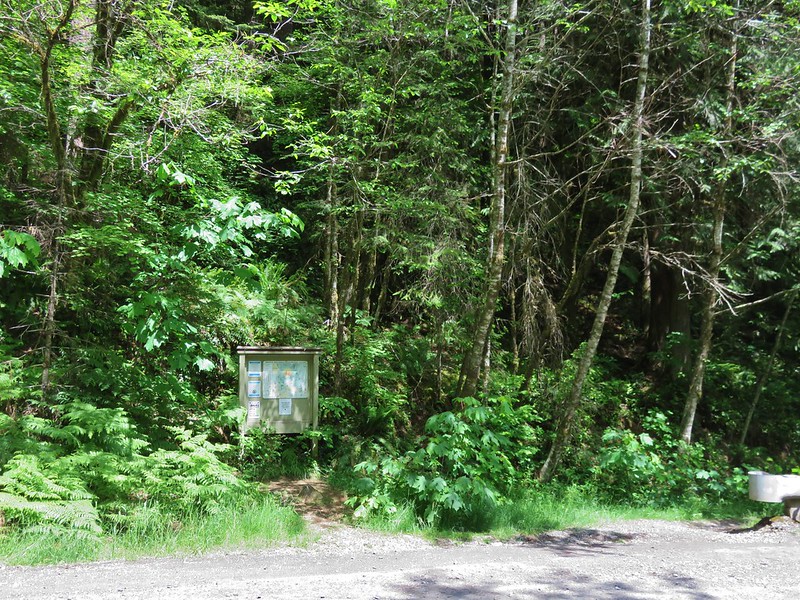
Siouxon Trailhead

There were already quite a few cars in the parking area when we arrived shortly after 7am. Since this was our first hike here we weren’t sure what to expect for campsites and hoped that we would be able to find an open one in the area we had planned on. We slung our packs on and set off downhill toward Siouxon Creek.

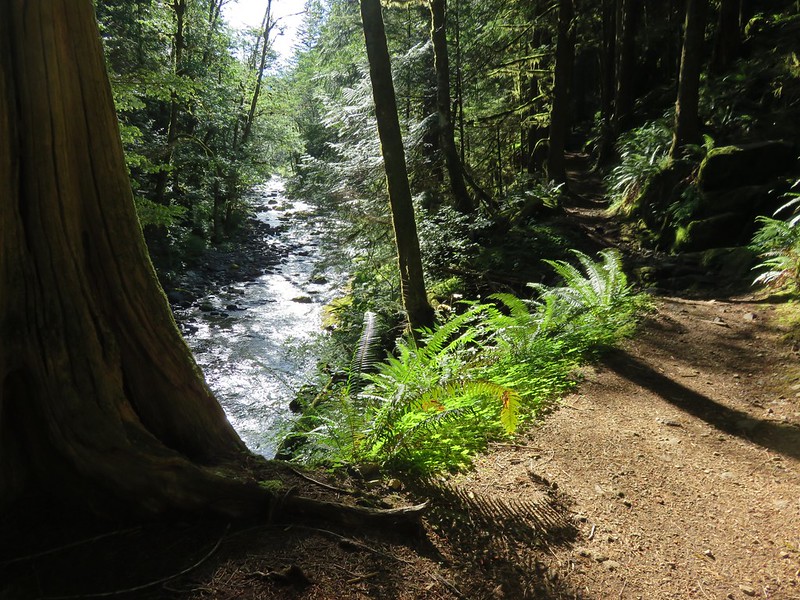
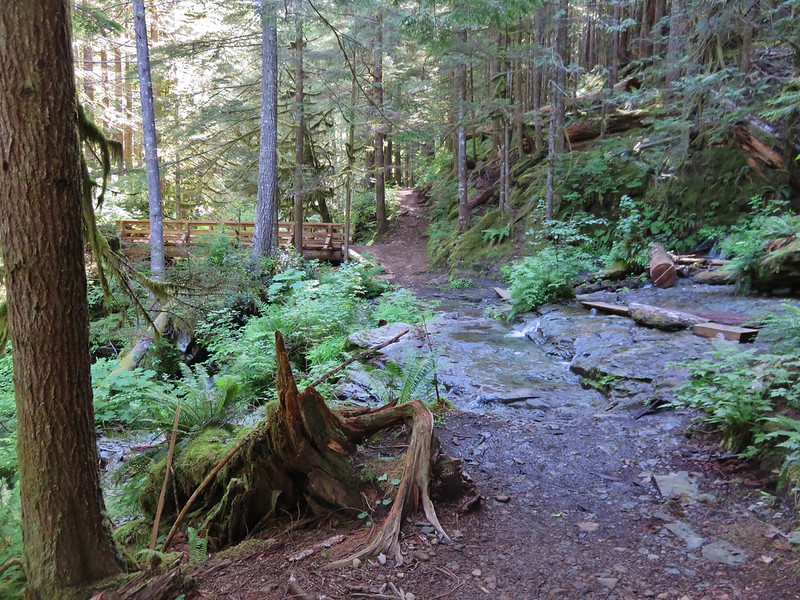
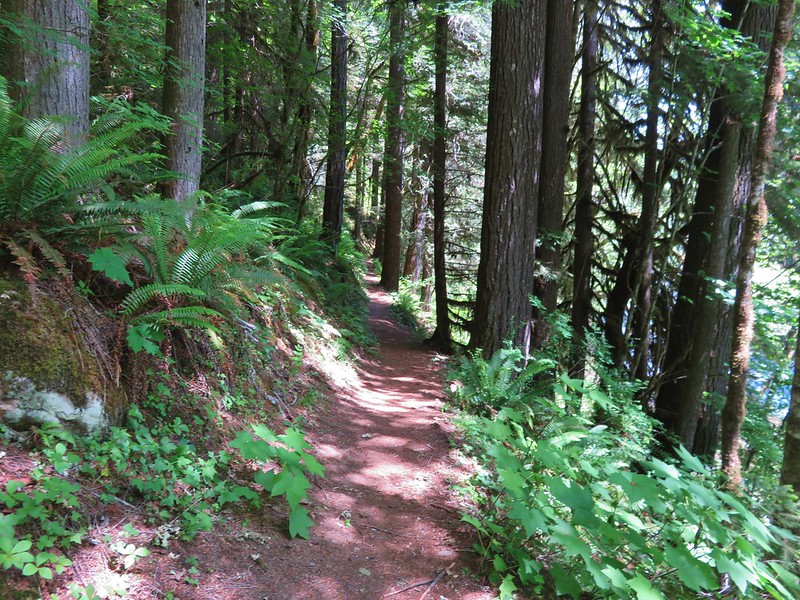
We crossed West Creek on a nice footbridge and continued along in a cool, green forest.
Siouxon Trail

West Creek

Siouxon Trail

Cool was going to be important as the forecast called for temperatures in the mid-90s for some nearby areas.

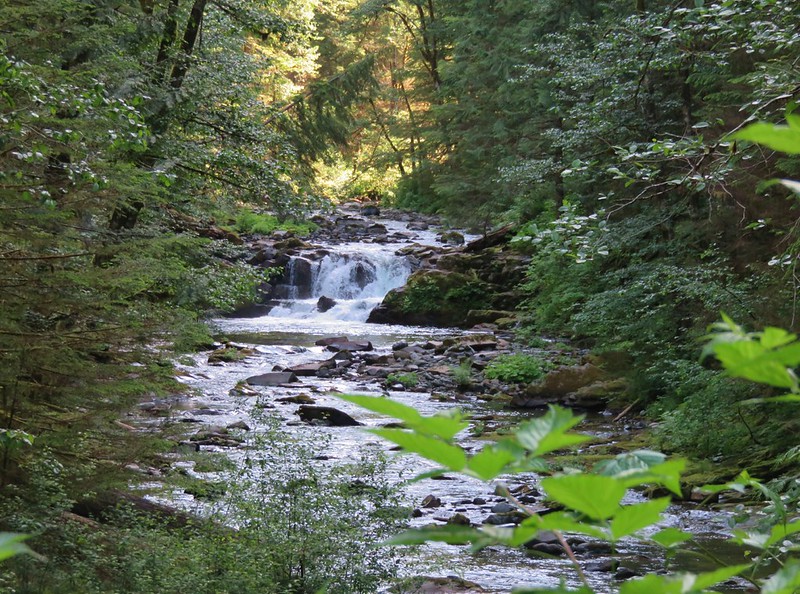
It wasn’t long before Siouxon Creek came into view with crystal clear water and colorful pools. It reminded us a lot of our previous hike along the Lewis River.
Siouxon Creek

Siouxon Creek

The trail then bent back away from Siouxon Creek as it crossed Horseshoe Creek above Horseshoe Creek Falls on another footbridge.
Horseshoe Creek Falls

Horseshoe Creek Falls

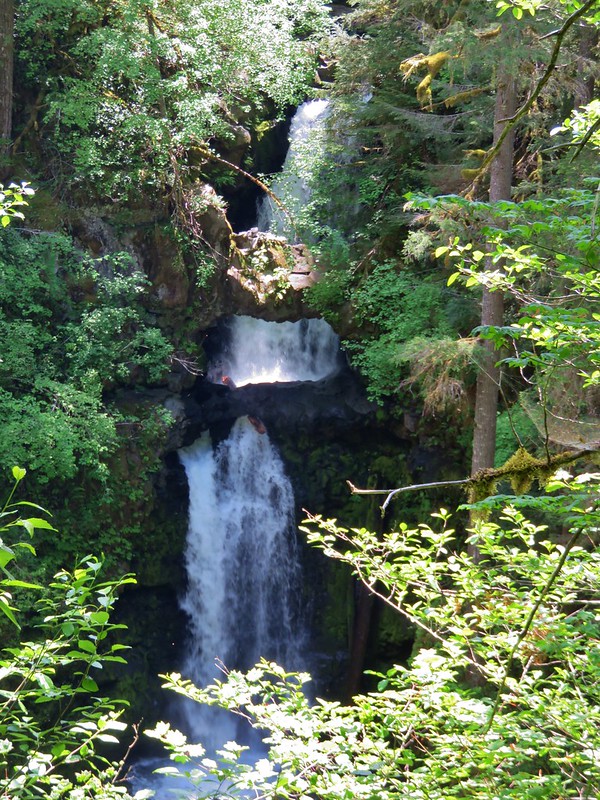
Just over a mile and a half from the trailhead Siouxon Falls came into view. Here Siouxon Creek drops in an S-shaped chute into a green pool.
Siouxon Falls

Siouxon Falls

Beyond Siouxon Falls the trail continued along the creek offering views of a few smaller cascades and more green pools.
Siouxon Creek

Small fall along Siouxon Creek

Pool below small waterfall along Siouxon Creek

We passed a trail sign for the Wildcat Trail around the 3 mile mark which would wind up being our return route the following day. Shortly after the Wildcat Trail sign was another junction, this time with the Horseshoe Ridge Trail.
Siouxon Trail junction with the Horseshoe Ridge Trail

We continued on the Siouxon Trail another 3/4 of a mile to a footbridge over Siouxon Creek.
Unnamed creek and the bridge across Siouxon Creek to Chinook Falls

We had begun keeping an eye out for a good campsite following the Horseshoe Ridge Trail junction but  most were already taken and the few that remained were near other groups of backpackers. We crossed on the footbridge and found the sites on the opposite side occupied as well.

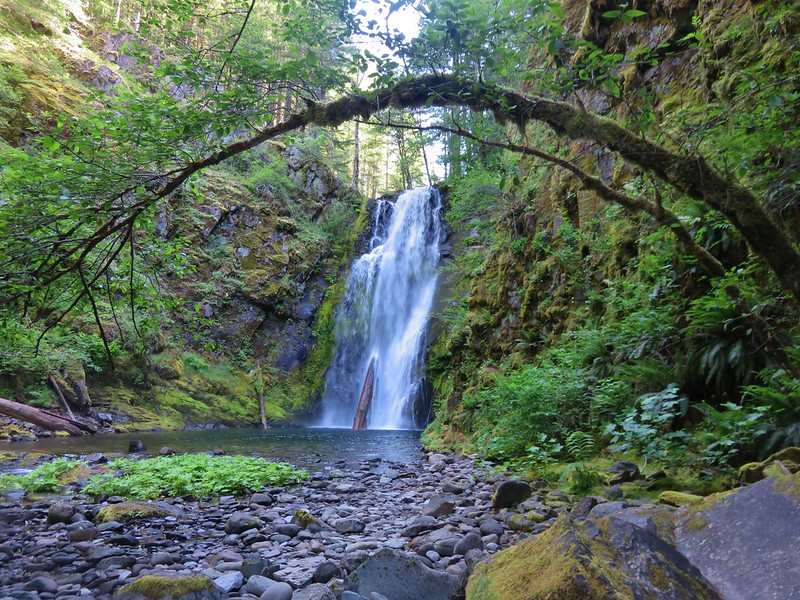
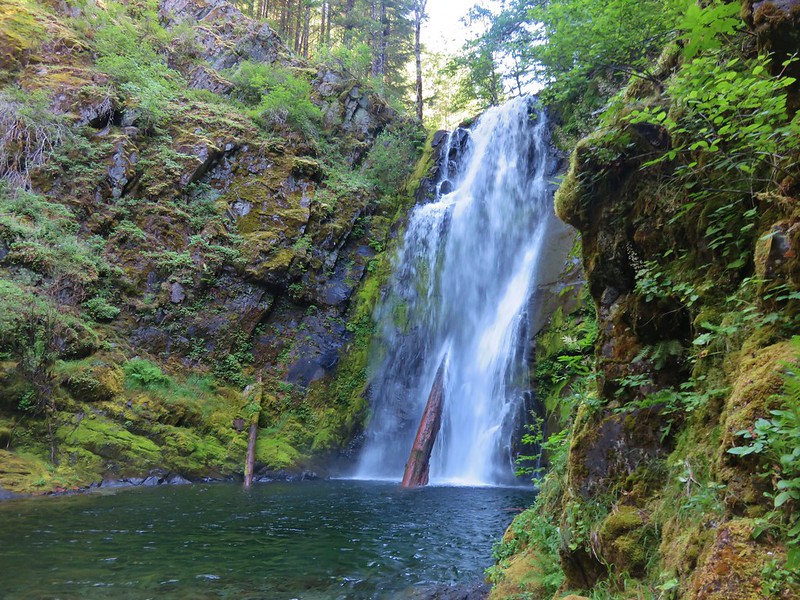
We had left the Siouxon Creek Trail and were now following Chinook Creek. In 0.2 miles we came to 50′ Chinook Falls.
Chinook Falls

Chinook Falls

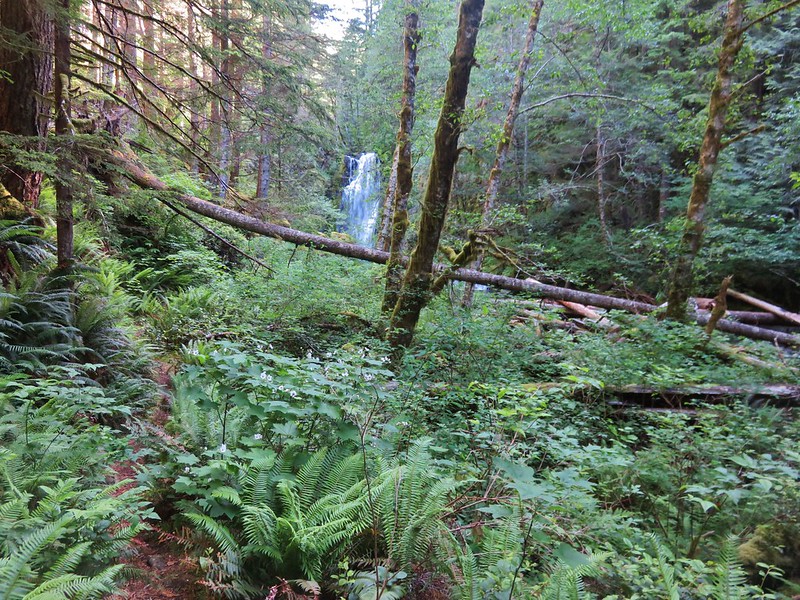
To continue we would need to cross Chinook Creek which did not have a bridge. Logs provided a dry crossing and we were quickly across heading toward yet another trail junction.
Chinook Falls

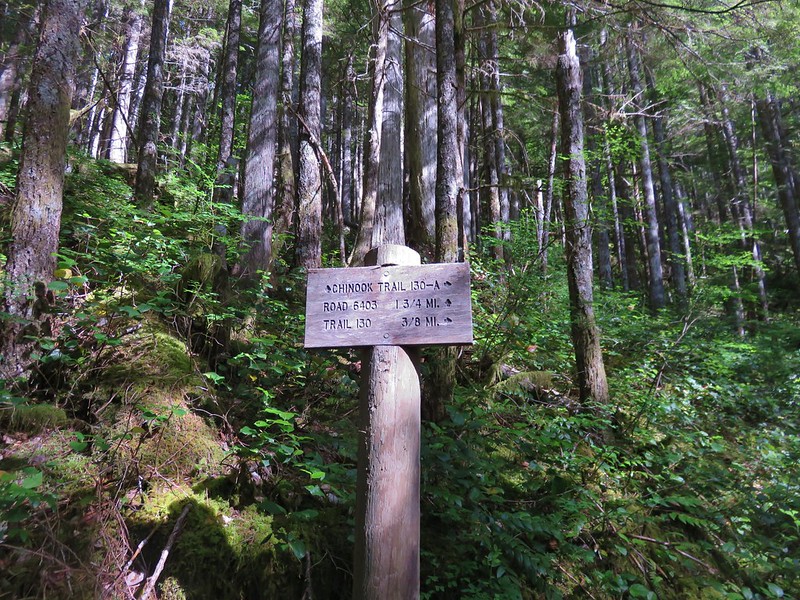
Junction with the Chinook Trail

If we had been able to find a campsite before reaching this point we would have headed up the Chinook Trail at this point. Since we were still searching we decided to take the connector trail between this junction and the Wildcat Trail. Even though the sign here didn’t point left for a trail there was a clear one there. It climbed a bit at first then dropped down closer to Siouxon Creek again in a much denser forest than on the Siouxon Trail side. We were focused on finding a suitable campsite but instead all we found was a lot of elk sign. As we neared Wildcat Creek we decided that if we hadn’t found a spot by the time we reached the Wildcat Trail we would loop back on the Siouxon Trail and take one of the few spots we’d seen near other groups. Luckily we didn’t need to implement that plan as we found a small secluded spot near Wildcat Creek with just enough room for a tent.
Campsite near Wildcat Creek

After getting settled we switched to our little daypacks and crossed Wildcat Creek on some more logs.
Wildcat Creek

Just on the other side of the creek was the junction with the trail coming from the Siouxon Trail
Wildcat Trail junction

We headed uphill on the Wildcat Trail. The trail stayed a bit above the creek but we spotted a couple of small cascades that warranted checking out on short scramble trails.
Wildcat Trail

Cascades along Wildcat Creek

Slide falls along Wildcat Creek

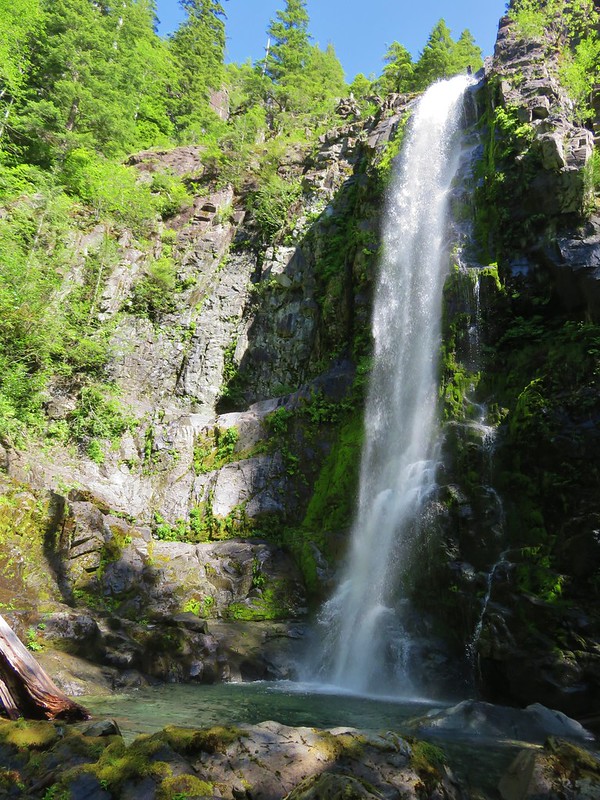
The best fall of the day came a half mile up the Wildcat Trail. The 225′ Wildcat Falls drops 3 times with the final drop being 124′.
Wildcat Falls

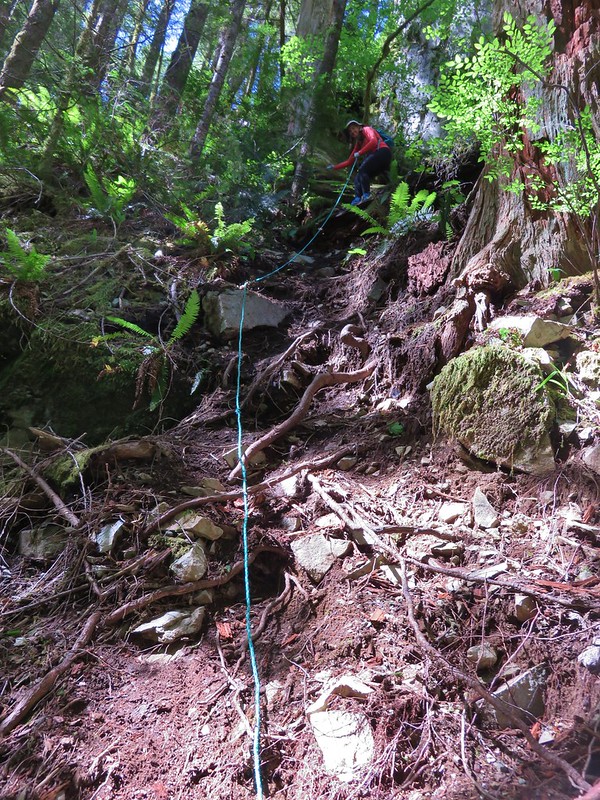
To reach the base of the falls a steep trail headed downhill. The assistance of a rope which we found waiting was almost a necessity here.
Rope down to Wildcat Falls

Wildcat Falls

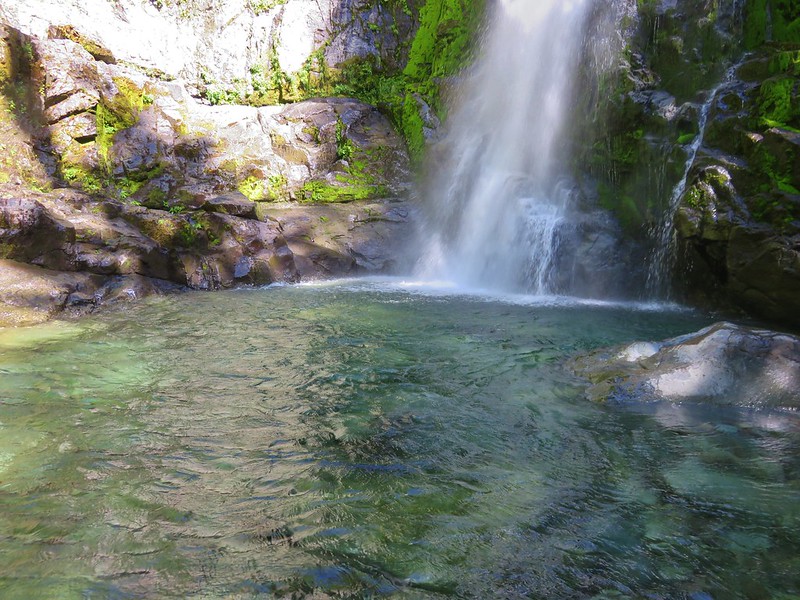
We’d timed it well both for the day and the time of year. According to the information on the falls from the Northwest Waterfall Survey the falls become “substantially less impressive as summer progresses”. There was plenty of water now and there was no one else at the falls when we arrived. We sat on some rocks at the edge of the splash pool letting the misty wind from the falls cool us off.
Splash pool of Wildcat Falls

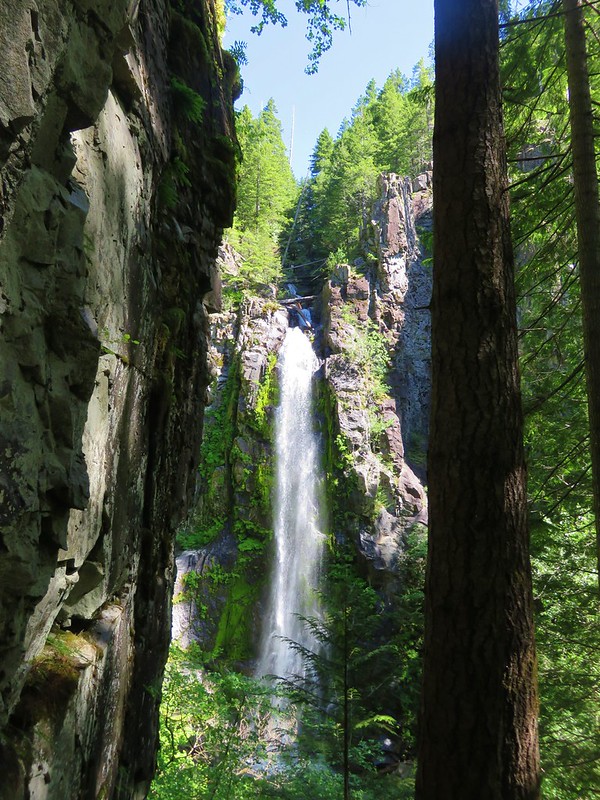
When other hikers began to arrive we climbed back up using the rope and continued our loop. We started to climb looking back after about a hundred feet to see the upper tiers of the falls.
Wildcat Falls

The Wildcat Trail switchbacked uphill to a viewpoint above Wildcat Falls allowing us to see the upper tier even beter.
Wildcat Falls

Upper tier of Wildcat Falls

From the falls the trail gained approximately 2000′ in 2 miles to a junction with the Huffman Peak Trail. It was starting to get really warm and we were forced to take quite a few more breaks than usual along the way. Fortunately there was a bit of an off-and-on breeze that helped to cool us off a little as we took in the scenery.
Wildcat Trail

Little prince’s pine
Little prince's pine

Tiger lily
Tiger lily

Penstemon
Penstemon

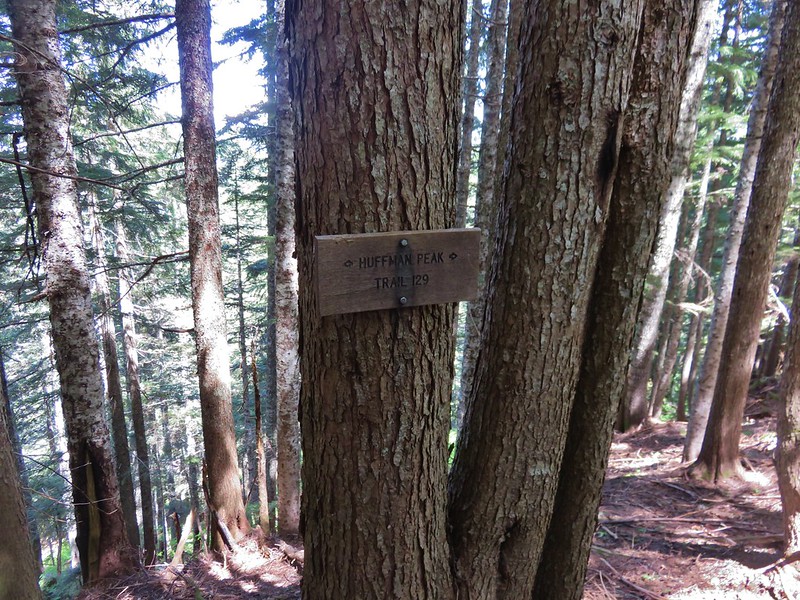
We turned right when we reached the Huffman Peak Trail which promptly began descending to a saddle.
Wildcat Trail junction with the Huffman Peak Trail

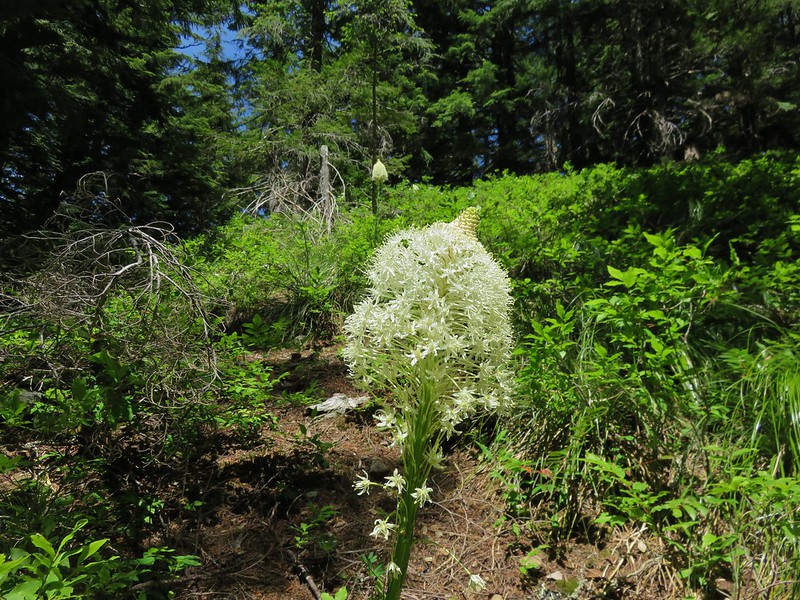
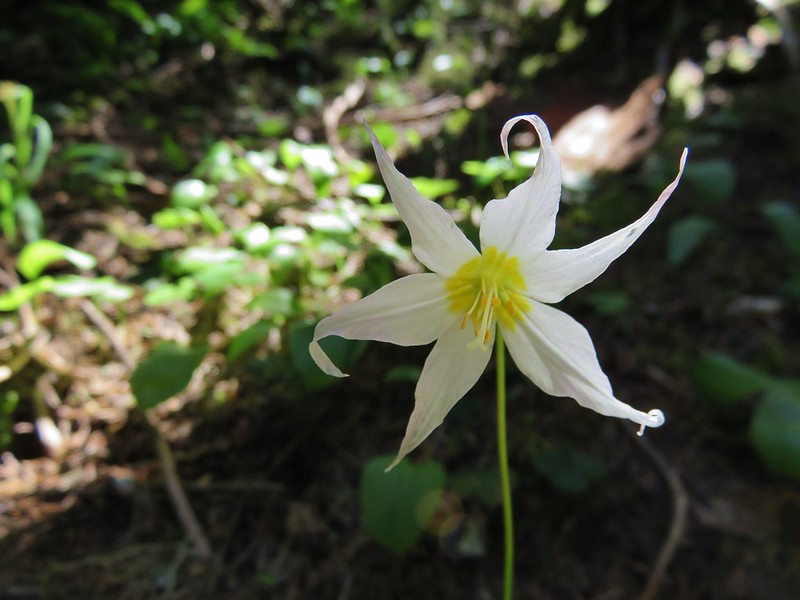
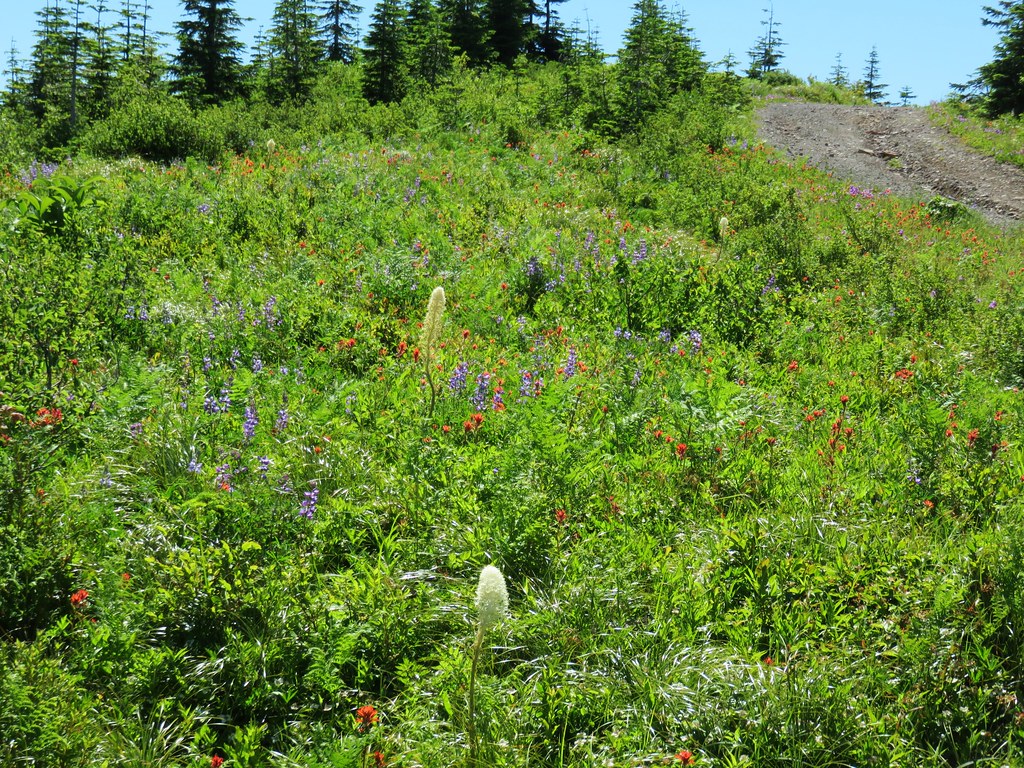
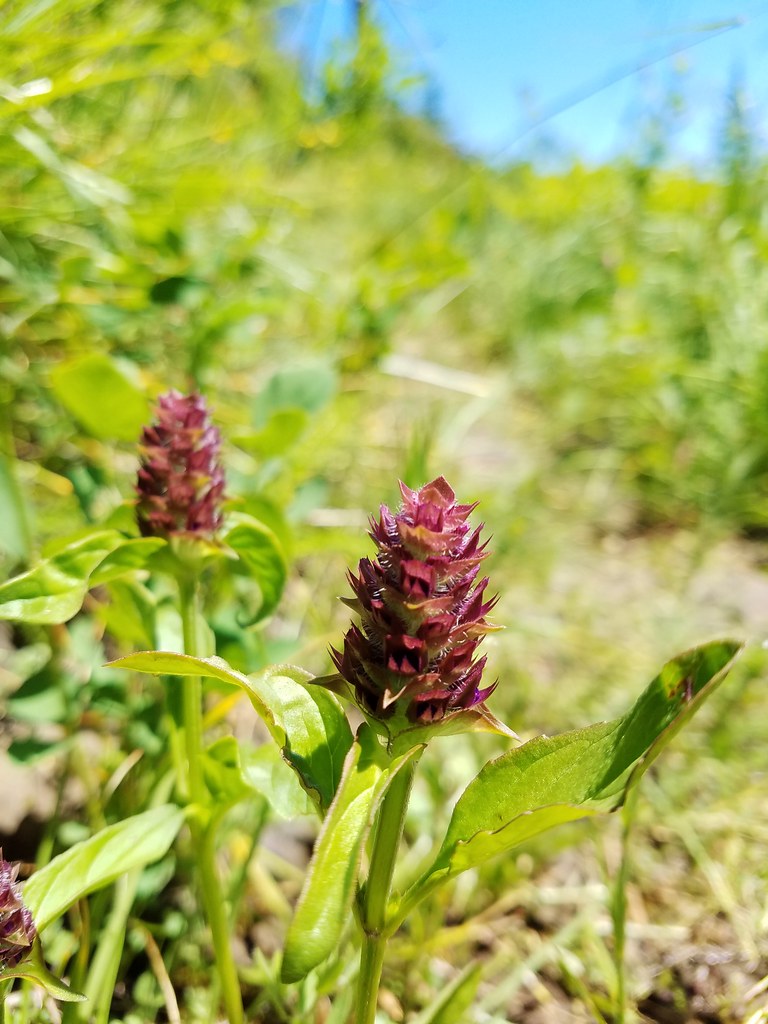
It eventually leveled out and then began climbing again as it headed up the side of Siouxon Peak. Wildflowers along this section included beargrass, avalanche lilies and pioneer violets.
Beargrass

Avalanche lily

Violets

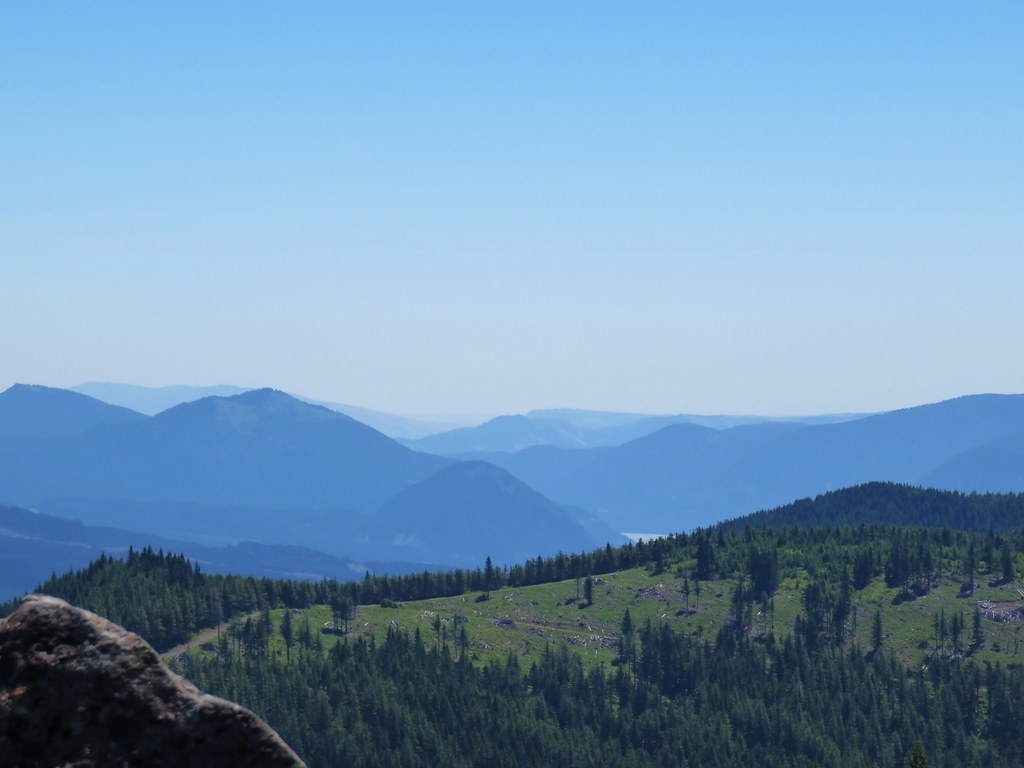
We hadn’t seen any other hikers since we’d left Wildcat Falls but just before we reached the spur trail to the summit of Siouxon Peak we met another pair of hikers that had just come down. We had seen them earlier at Chinook Falls but they had headed up that trail doing the loop the way we’d originally planned on. They said it was beautiful up at the summit and they weren’t kidding. We had been seeing glimpses of several mountains through the trees from the Huffman Peak Trail but no clear views. As we began up the summit spur trail though that all changed.
Mt. Rainier, Goat Rocks, and Mt. Adams

An exposed ridge led up to the former site of a lookout tower on top of Siouxon Peak. Snowy peaks dominated the horizon while numerous butterflies flitted among the various wildflowers.
Mt. Hood heading to the summit of Siouxon Peak

Mt. Hood
Mt. Hood

Mt. Adams
Mt. Adams

Goat Rocks
Goat Rocks
Mt. Rainier
Mt. Rainier

Phlox
Phlox

Swallowtail above the meadow
Swallowtail butterfly flying over wildflowers on Siouxon Peak

Butterflies above the meadow with Goat Rocks and Mt. Adams in the distance.
Goat Rocks and Mt. Adams from Siouxon Peak
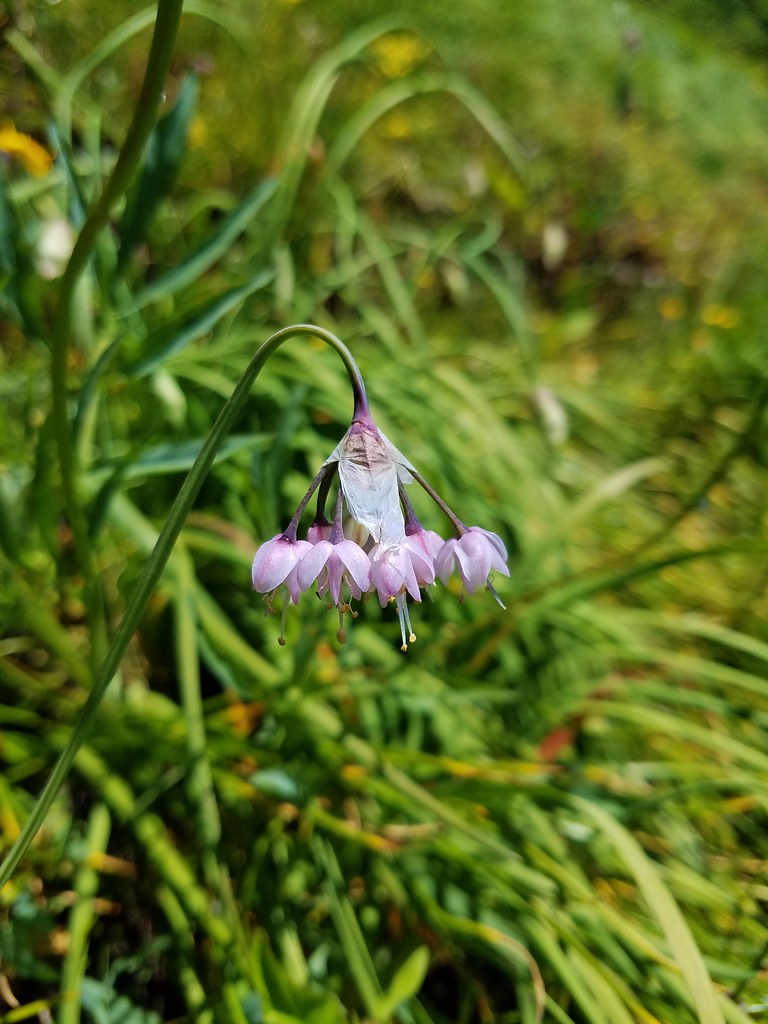
Penstemon
Penstemon

Mt. Rainier, Goat Rocks, Mt. Adams and Swift Reservoir from the summit of Siouxon Peak

Goat Rocks and MT. Adams from the summit of Siouxon Peak
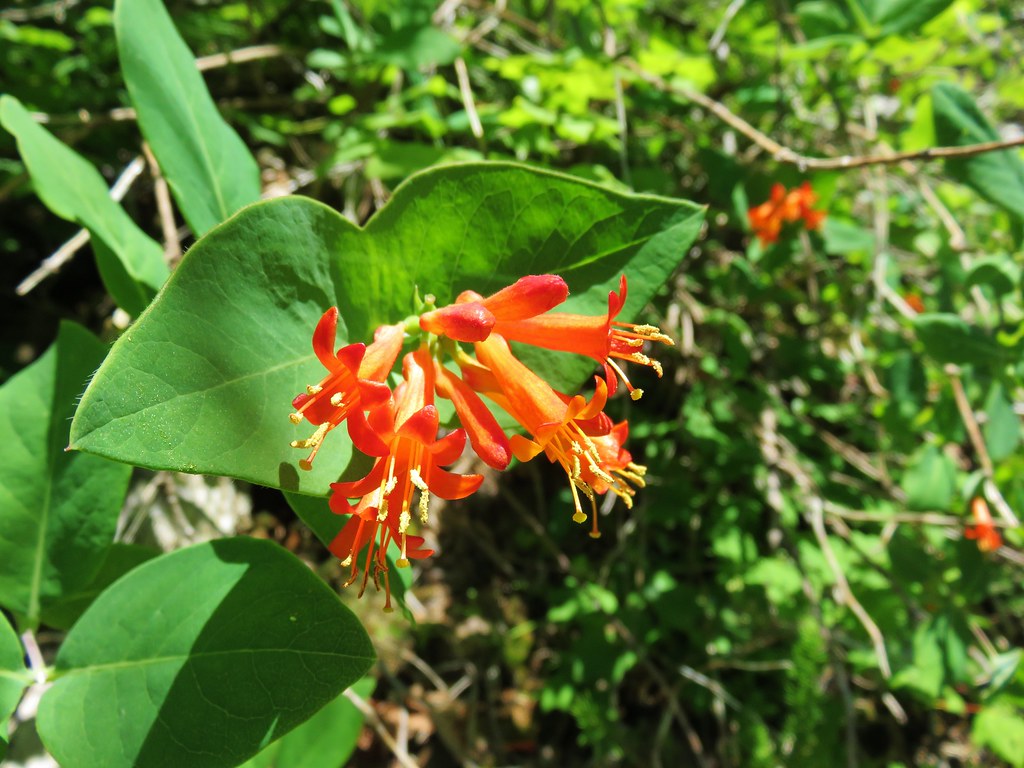
Butterfly on bistort
Hairstreak butterfly on bistort

Swallowtail on phlox

Swallowtail overhead
Swallowtail soaring overhead

We sat for awhile at the summit. There was just enough breeze to keep it from being too warm and it was just too beautiful to not spend some time appreciating it. Ironically the closest mountain to us was Mt. St. Helens which we couldn’t see due to trees lining the west side of the peak.

After pulling ourselves away and returning to the Huffman Peak Trail we spotted a little spur trail on the opposite side. This one led to a viewpoint that included Mt. St. Helens.
Mt. St. Helens and Mt. Rainier from a viewpoint below Siouxon Peak

We continued on our loop passing beneath Siouxon Peak in a meadow of strawberry blossoms and phlox.
Strawberries and phlox

After a few switchbacks the trail leveled out some as it began following an old roadbed.
Huffman Peak Trail

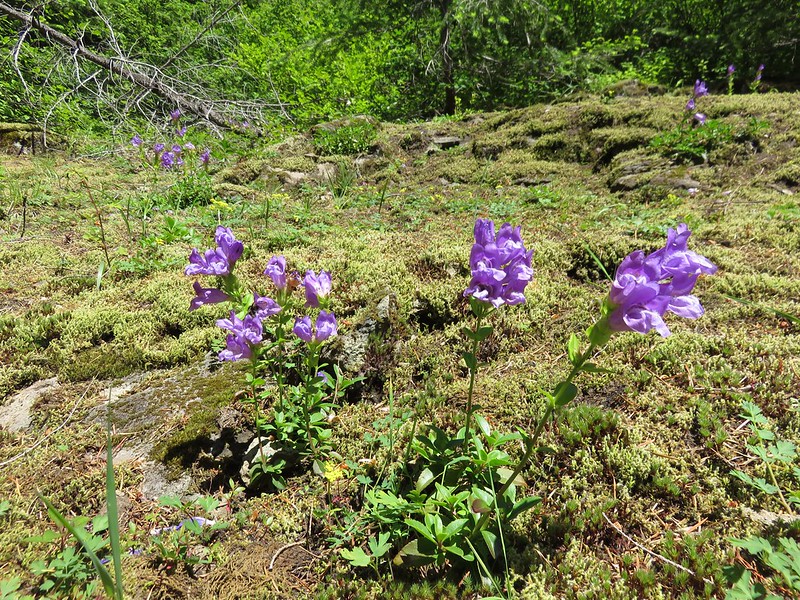
The trail entered a section of young trees where the penstemon display was amazing. There was also quite a bit of paintbrush and some lupine mixed in.
Penstemon

Penstemon and paintbrush along the Huffman Peak Trail

Penstemon and paintbrush along the Huffman Peak Trail

Paintbrush

Lupine

There was a bit of a washout in this section but it was not too difficult to cross.
Washout along the Huffman Peak Trail

Slide along the Huffman Peak Trail from the other side of the valley

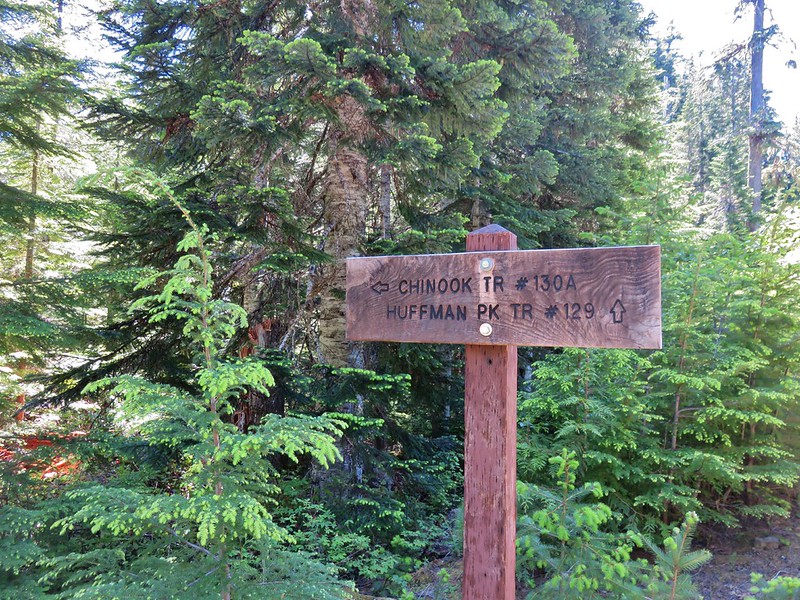
We turned onto the Chinook Trail at a signed junction.
Huffman Peak Trail junction with the Chinook Trail

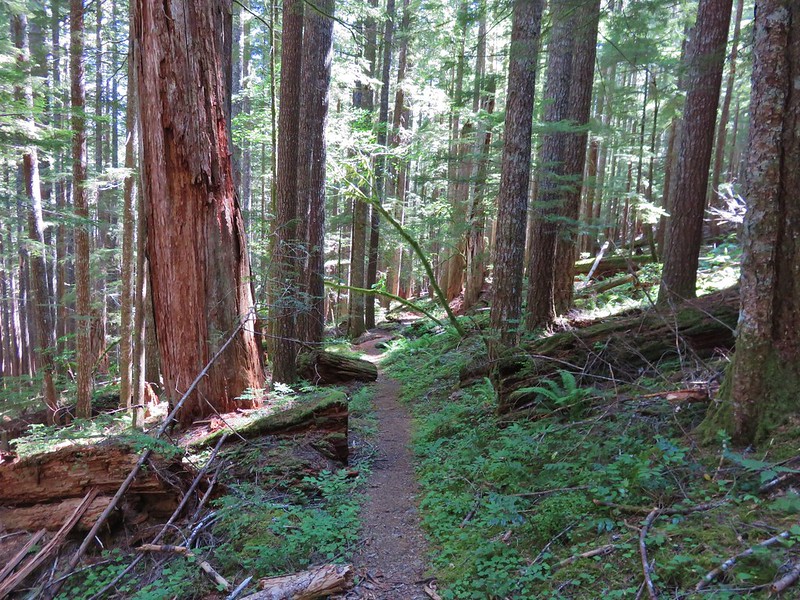
The Chinook Trail began as an old narrow jeep track which eventually turned to a true trail.
Chinook Trail

As we were coming down the Chinook Trail we met our neighbor from across Siouxon Creek. She had set up camp Friday night and was now doing the Siouxon Peak loop in the opposite direction. After a nice conversation she introduced herself as Nicole and we shared our names before continuing on. It turns out she is a fellow member of the //embedr.flickr.com/assets/client-code.js“>PortlandHikers Facebook group. It’s always nice to put faces to names and have these chance meetings out on the trails.

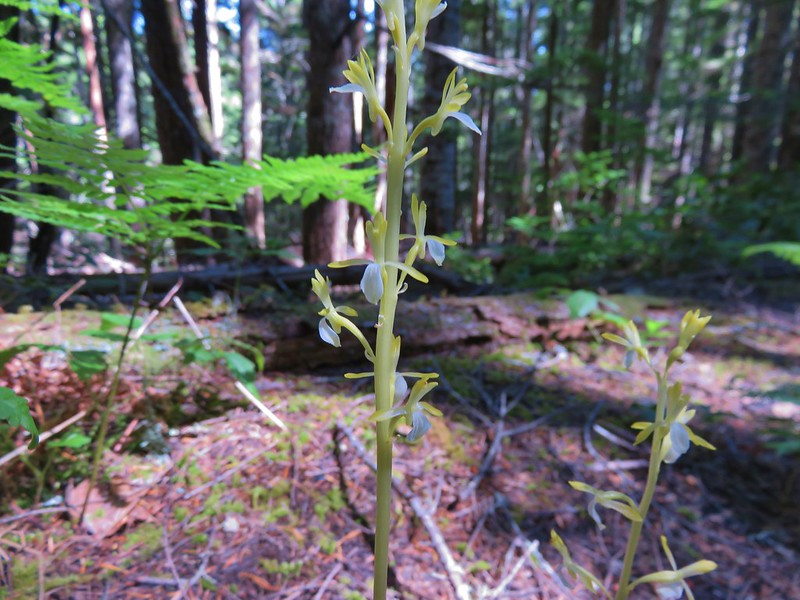
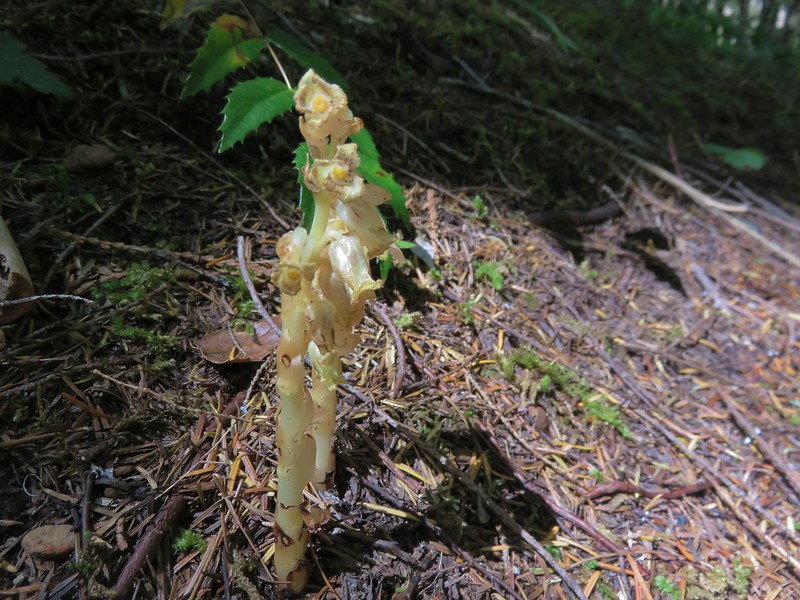
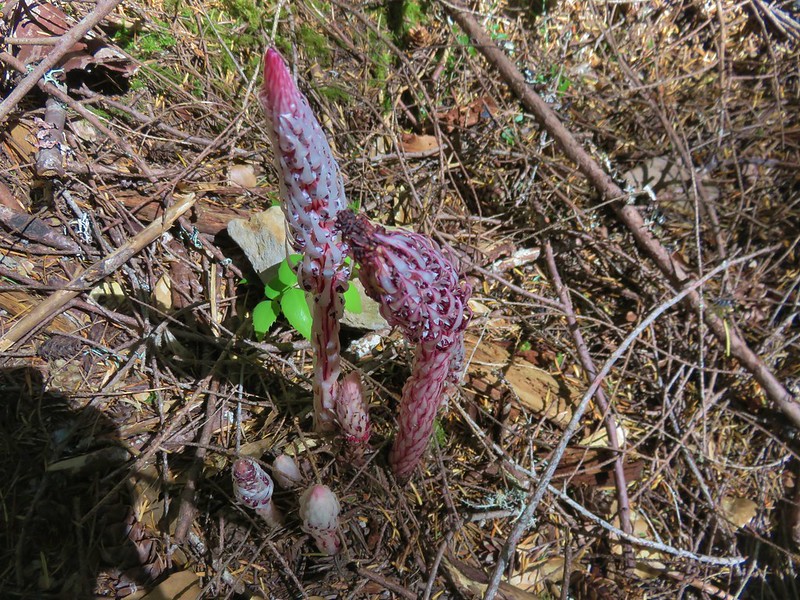
We spotted a variety of interesting plants in the forest along this trail including yellow coralroot, indian pipe, and some candysticks.
Yellow coralroot

Indian Pipe

Candystick

Candysticks

Before returning to our campsite we detoured back to Chinook Falls to see how it looked in the afternoon sunlight and to cool off by the splash pool.
Chinook Falls

While we were enjoying the falls we noticed a few tadpoles nearby.
Tadpole

We returned to camp and got ready for dinner. We were excited to try out our new Alite Mayfly chairs. I had been a bit reluctant to add any extra weight to my pack but at 1lbs 4oz the chairs aren’t that heavy. I was still thinking I might only bring mine on shorter trips or trips where we establish a base camp for multiple days, but after eating dinner and relaxing next to Wildcat Creek in the chair it will be coming with me from now on.

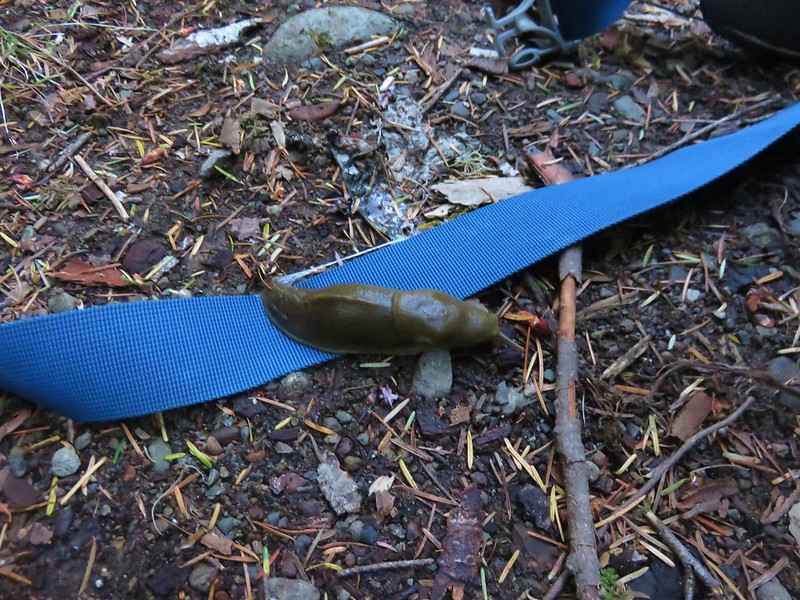
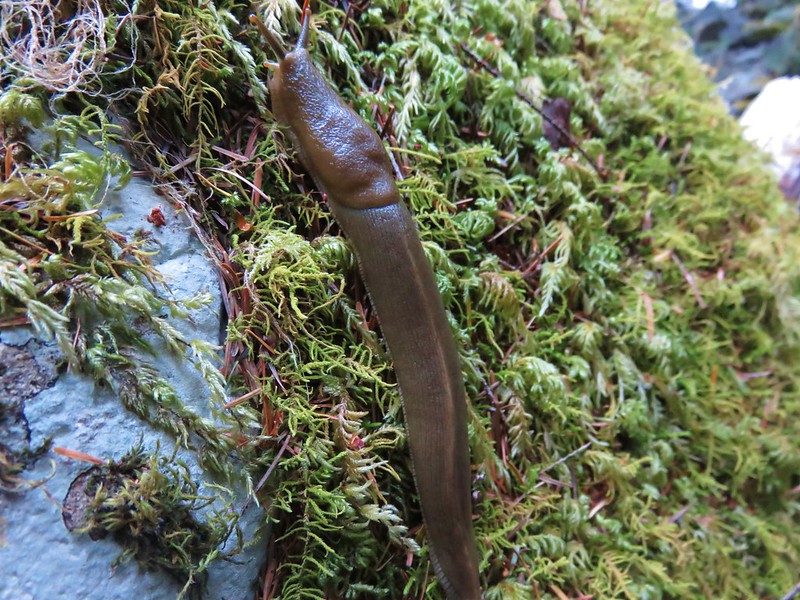
The next morning we woke a little before 5am and began packing up. Heather had a baby shower that afternoon and we were hoping to be home in time for her to attend. While we were working on breakfast we were thoroughly entertained by a slug that had passed over a strap on my pack then set to scaling a mossy boulder.
Slug on my backpack strap

Slug on a boulder

Instead of going back to the bridge across Siouxon Creek at the Chinook Trail we decided to shorten the morning hike by fording Siouxon Creek at the Wildcat Trail. The ford is not recommended in high water but it wasn’t running too swiftly so we plunged in. At it’s deepest the water came up just a bit past our knees but we had no problems reaching the trail on the other bank.
Siouxon Creek ford between the Wildcat and Siouxon Trails

We returned to the Siouxon Trailhead a just before 8am and Heather was back in plenty of time to go to the baby shower. All in all it was a pretty successful first over night for the year. We thought we had forgotten a couple of items only to discover that they had been in our packs the whole time and our new chairs worked out great. We’re looking forward to several more backpacking trips in the next few months. Until next time, happy trails!

Flickr: https://www.flickr.com/photos/9319235@N02/albums/72157666763253394

Categories
Hiking Mt. St. Helens Trip report Washington Washington Cascades

Lewis River and Curly Creek Falls

After our vacation in Gold Beach, OR we began our next hike 300 miles away along the Lewis River in Washington’s Gifford-Pinchot National Forest. The Lewis River Trail is one of those very popular trails that we had not yet been to. We hoped an early start would help avoid the bulk of the Memorial Day Weekend crowds. We parked at the Lower Falls Recreation Area just a short distance from the first of the days waterfalls.
Trail sign at the Lower Falls Recreation Area

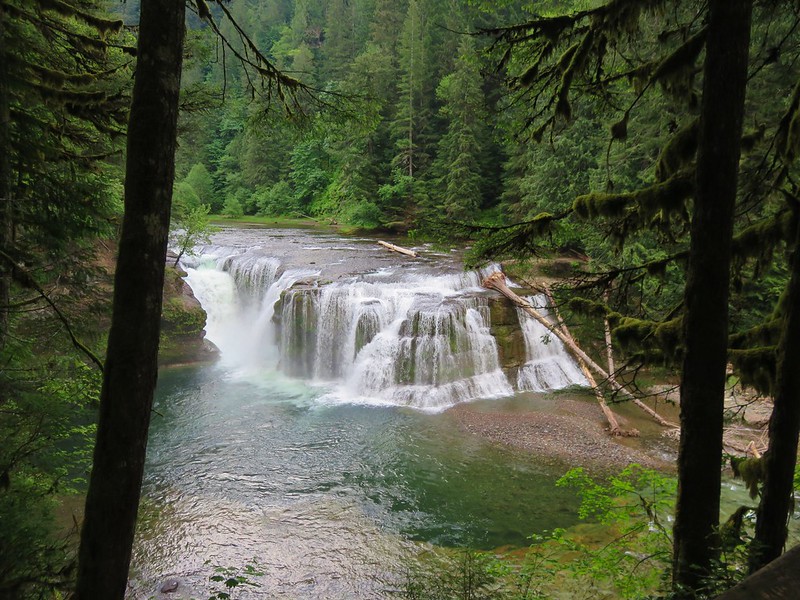
We walked down to a platform overlooking the Lower Falls. This was another waterfall that was much larger in person than it had looked in pictures.
Lower Falls viewing platform

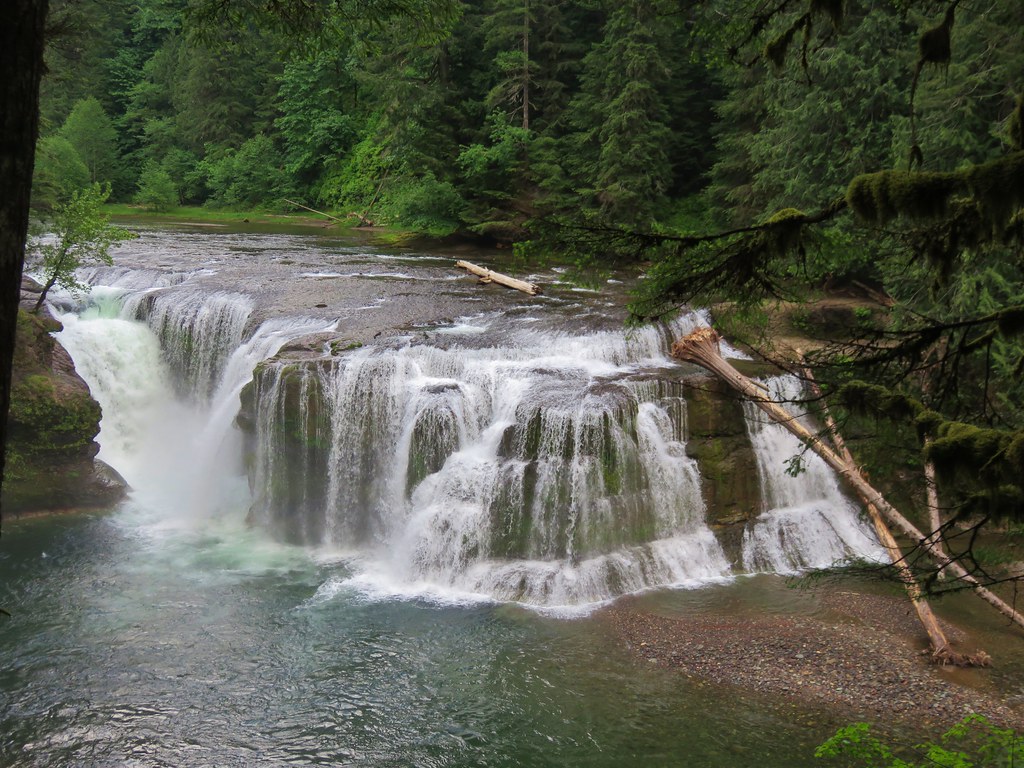
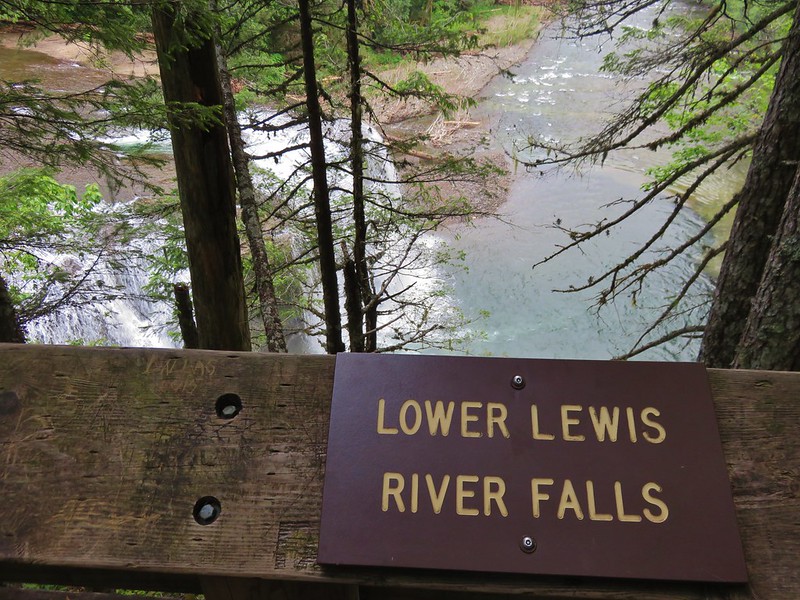
Lower Lewis River Falls

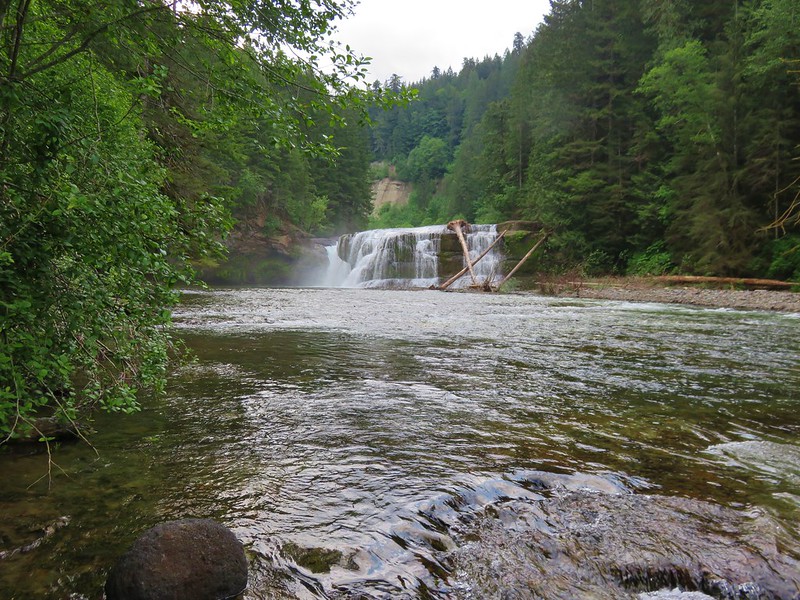
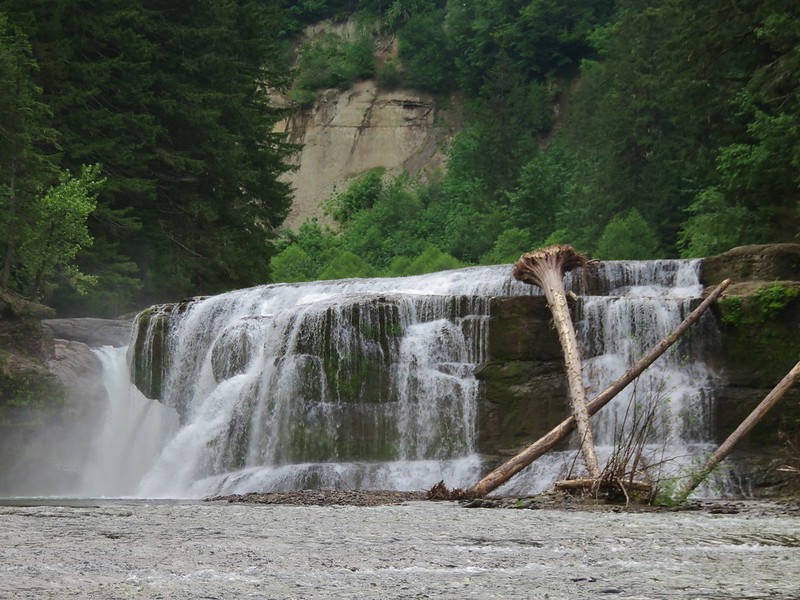
We then headed down to river level to see what the falls looked like from that angle.
Lower Lewis River Falls

Lower Lewis River Falls

After getting the view from below we climbed back past the first platform and headed NE along the Lewis River Trail. A second viewpoint looked down from above the falls.
Lower Lewis River Falls

A couple of wooden staircases led down to little beaches along the river.
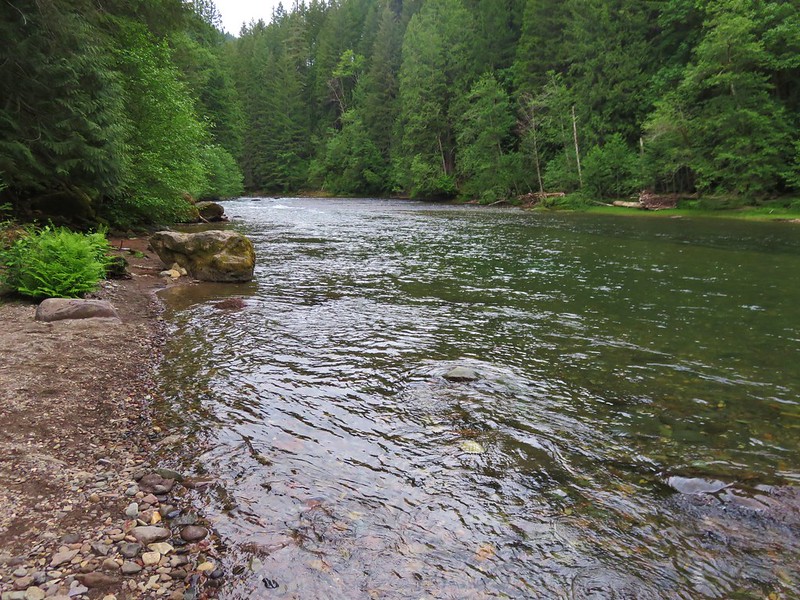
Stairs to the bank of the Lewis River

Lewis River

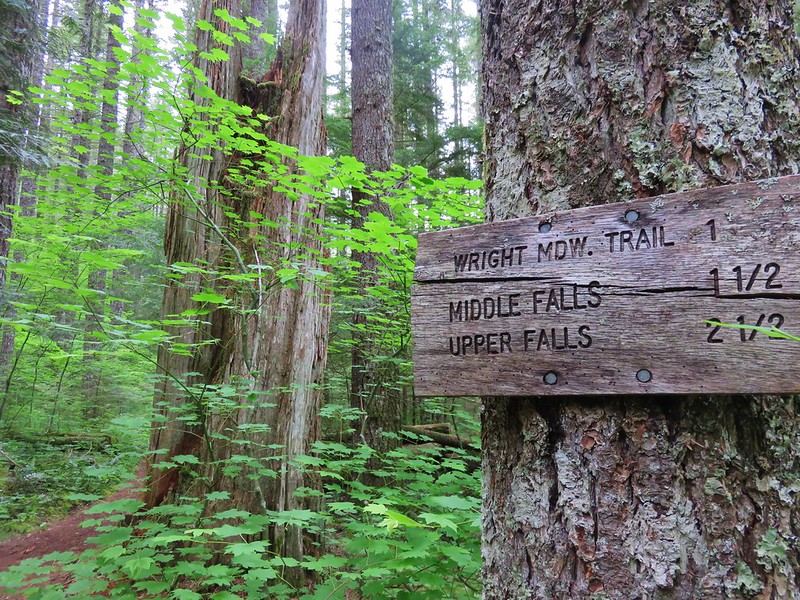
We followed the trail between the river and the Lewis River Campground then deeper into the forest toward the Middle and Upper Falls.
Trail sign along the Lewis River Trail

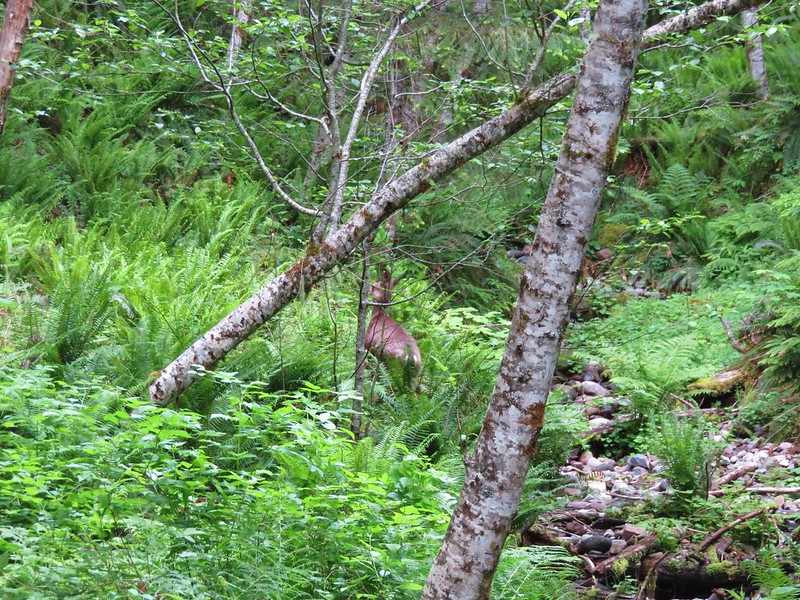
As we were crossing a footbridge Heather noticed something along the side creek. She said she almost mistook it for a statue because of how still it was standing but then the doe began heading back up the creek.
Deer along a small creek

Doe

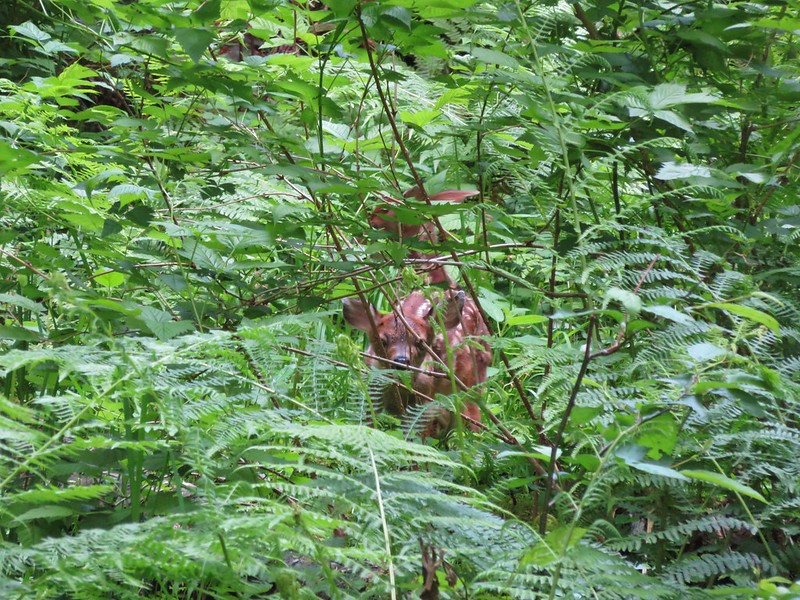
As she retreated we noticed more movement in the underbrush. A pair of wobbly young fawns had been with the doe.
Fawns

After snapping a couple of quick pictures we continued on so mom could get back to her fawns.

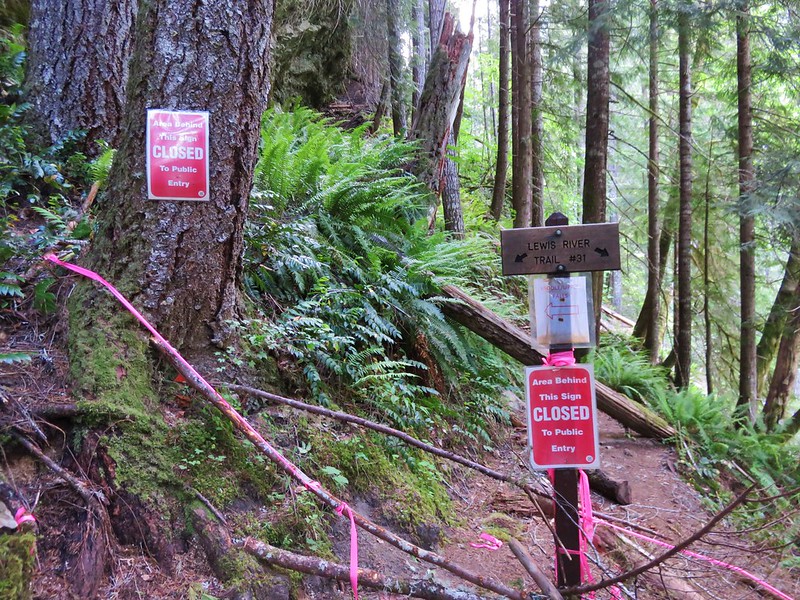
A section of trail was closed near Middle Falls but a detour was in place using the Middle Falls Parking Area.
Trail reroute due to slides

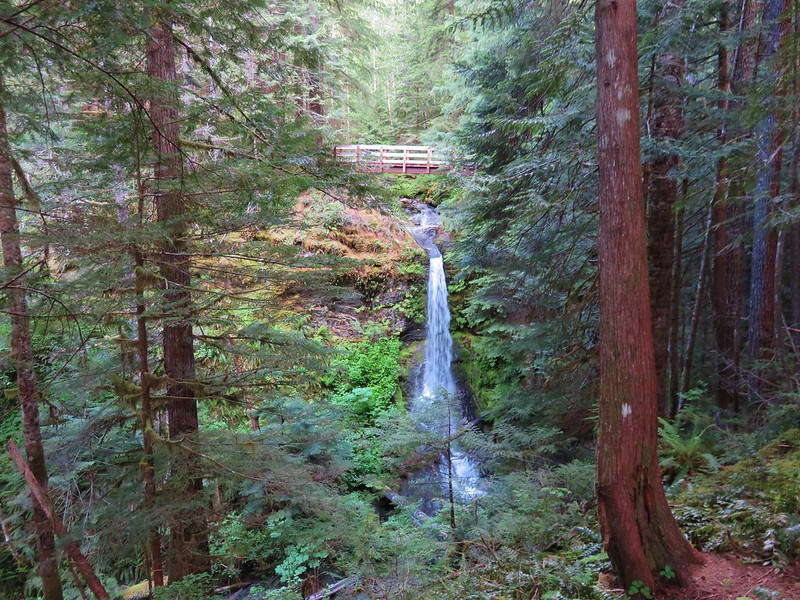
We had been planning on taking this route anyway since it passed another waterfall along Copper Creek.
Copper Creek Falls
Copper Creek Falls

When we were back on the Lewis River Trail we followed a sign for Middle Falls.
Lewis River Trail

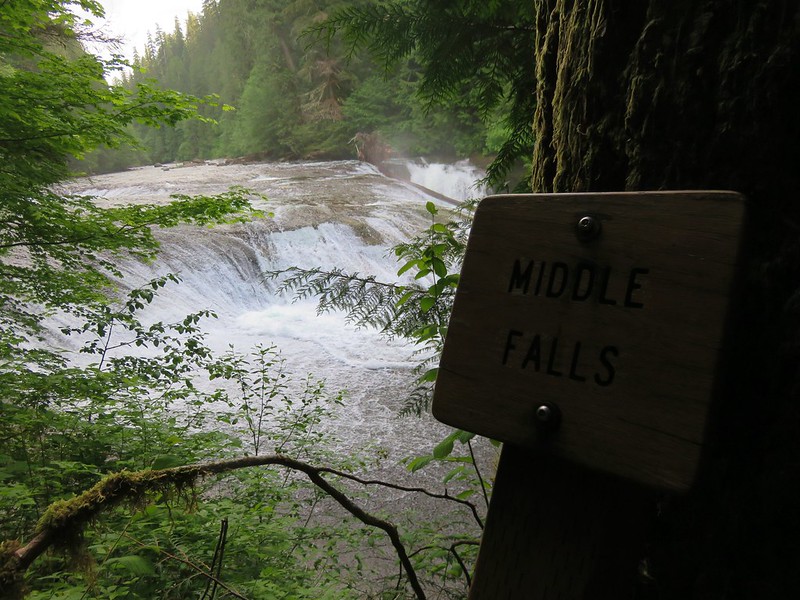
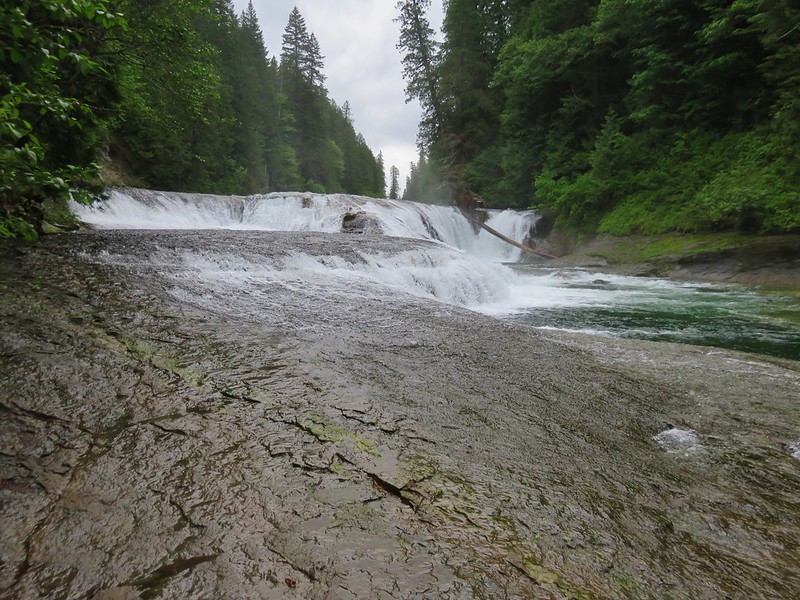
Middle Lewis River Falls

Middle Lewis River Falls

Middle Lewis River Falls

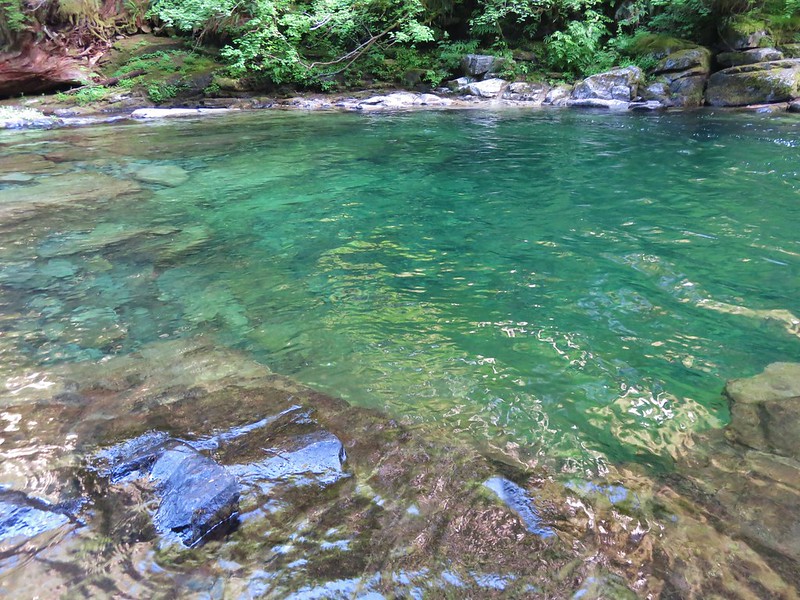
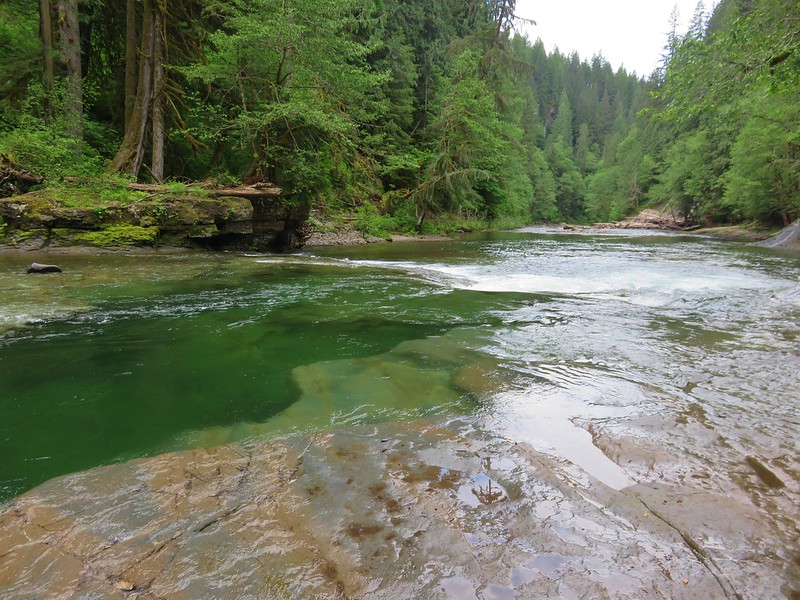
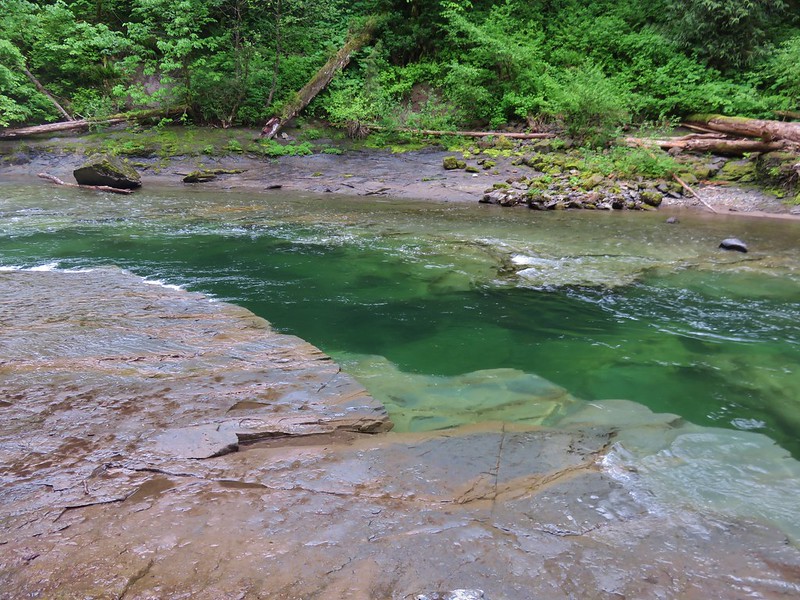
In addition to the waterfalls the Lewis River had some beautiful colored water due to the presence of rock shelves which created some deep green pools.
Lewis River

Lewis River

Before continuing on to Upper Falls we headed for the bridge over Copper Creek. The trail closure was posted at the bridge but below the bridge was a scenic water slide.
Slide on Copper Creek

Continuing on the Lewis River Trail we passed some large cliffs covered in green lichen.
Lichen covered rocks along the Lewis River Trail
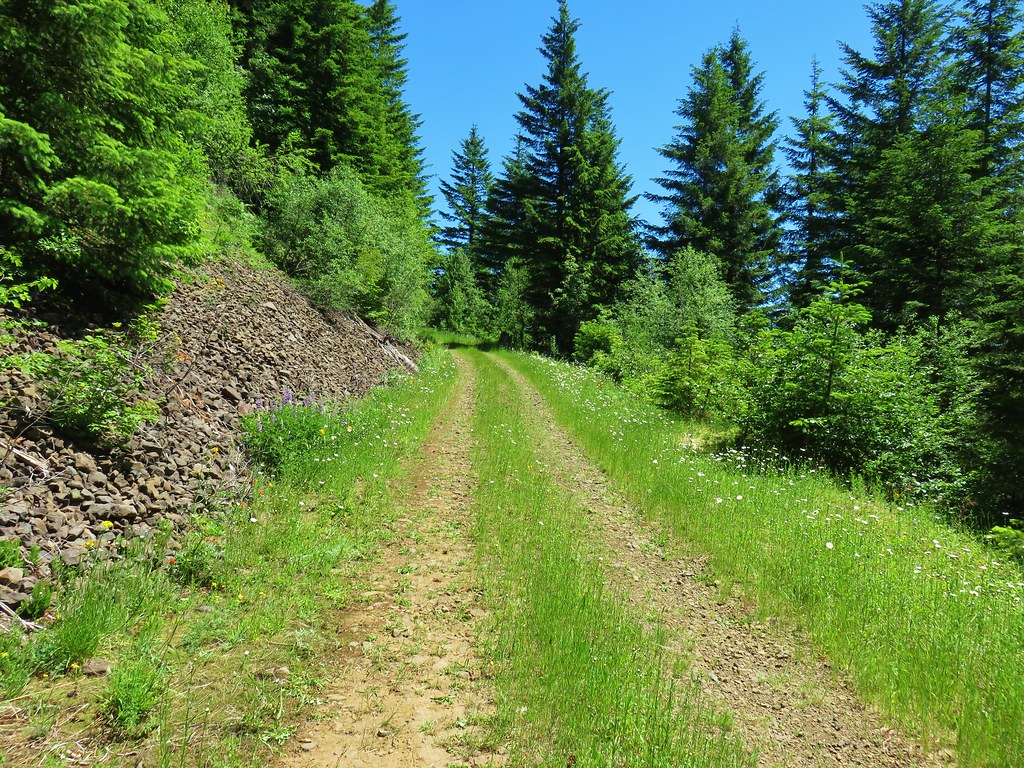
Lewis River Trail

Another section of cliffs were of particular interest. Several trees were perched along the cliff edge with exposed roots high in the air. The rock showed clear signs of having been worn by the river which seemed to indicate that the roots of these trees had once been under the river bank, but as the river eroded the banks and deepened it’s canyon, the roots were left exposed. Given how far above the current river these trees were, we wondered how old they were.
Tree roots showing where the Lewis River once was.

Tree roots showing where the Lewis River once was.

The Upper Falls was another impressive, thundering waterfall.
Upper Lewis River Falls

Upper Lewis River Falls

Upper Lewis River Falls

We made our way out onto a gravel bar for a better view and found a few flowers as well as some elk sign.
Tall bluebells

Upper Lewis River Falls

The trail then climbed up to an upper viewpoint via a wide arc around some rock outcroppings.
Upper Lewis River Falls

Upper Lewis River Falls

Upper Lewis River Falls

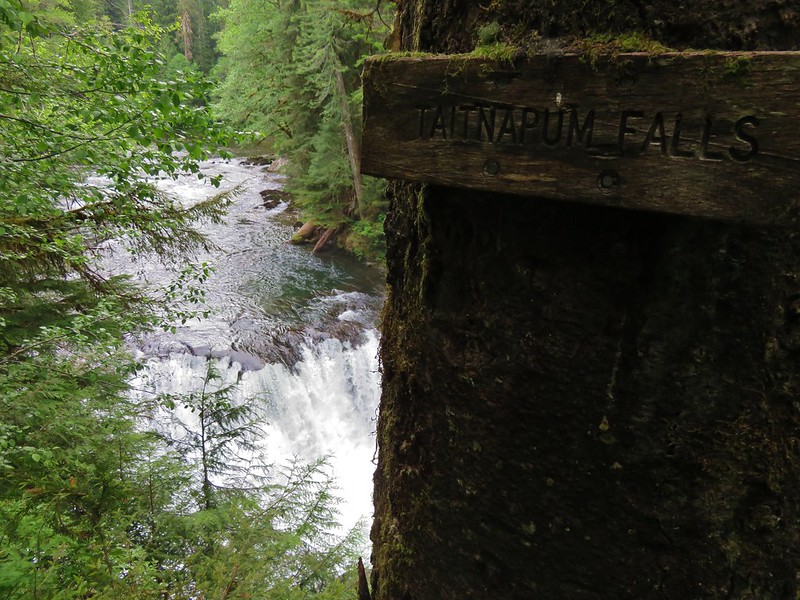
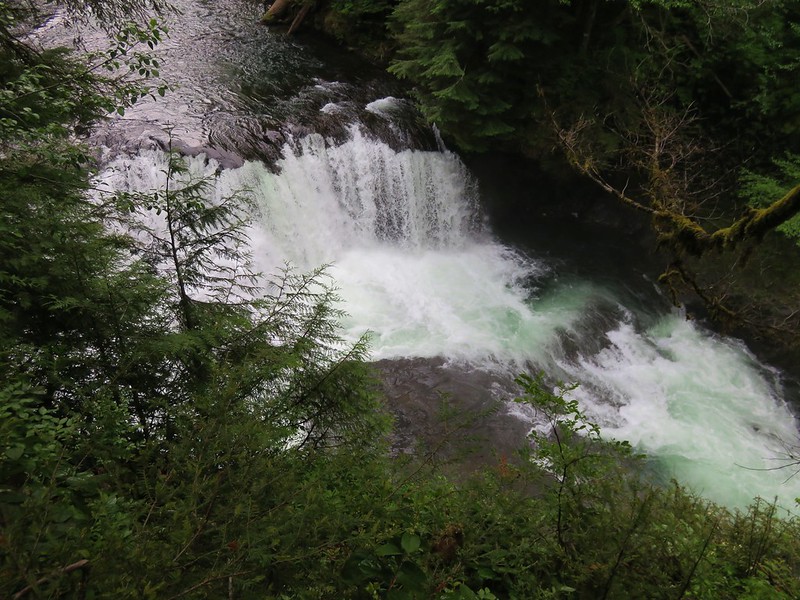
Continuing on we passed a spectacular green pool before reaching Taitnapum Falls.
Lewis River

Taitnapum Falls

Taitnapum Falls

We turned around after reaching the end of the Lewis River Trail and NF Road 90. The Quartz Creek Trail continued on the far side but for us it was time to head back and get to our second hike.

We had seen a handful of people on our way out along the trail and wound up having each of the falls to ourselves, but on the way back it was a steady stream of people. The Recreation Area parking lot was packed as we left making us glad we had started with this hike. We drove back towards Cougar, WA on forest road 90 turning right on road 9039 at a sign for the Curly Creek Trailhead. We parked in a gravel lot just before reaching a bridge across the Lewis River. The trail was on the far side of the bridge so we crossed on foot and headed downstream to the West. A platform along the trail offered views across the Lewis River to the unique Curly Creek Falls with its pair of rock arches.
Curly Creek Falls

Curly Creek Falls

Curly Creek Falls

Just a short distance further was another viewpoint. This time for Miller Falls.
Miller Falls

Miller Falls

One of the reasons we had not done these hikes before was due to the length of the drive vs. the amount of  hike time. At 3 hours one way the 9-10 miles would cause us to spend more time in the car than on the trail. Our solution was to visit the Bolt Camp Shelter after Curly Creek and Miller Falls. To do this we returned along the trail to the road 9039 bridge, crossing the road and continuing on the Lewis River Trail.

Lewis River Trail

Lewis River Trail

This portion of the Lewis River Trail was along a calmer section of the river offering plenty of access to the river.
Lewis River

Lewis River

We stopped for a short rest along the river at the Bolt Camp Shelter before returning to the trailhead.
Bolt Camp sign

Bolt Camp Shelter along the Lewis River

When it was all said and done we’d spent 6 hours and 42 minutes on the trail which meant we hadn’t violated our rule of not spending more time driving than hiking. It was easy to see why this area is so popular, but even with all the people we had still found some solitude along the trails and at every waterfall we’d visited. We couldn’t have asked for more. Happy Trails!

Flickr: https://www.flickr.com/photos/9319235@N02/albums/72157668708267141

Categories
Columbia Gorge North Hiking Trip report Washington

Dog and Augspurger Mountains

This was our second visit to Dog Mountain and probably our final one for several years at least. While the wildflower meadows on Dog Mountain are arguably the best in the Columbia Gorge, that distinction brings crowds. We do our best to avoid crowded hikes, but our visit in May 2014 was on a morning when low clouds covered the upper meadows limiting views of the gorge and the flowers. https://wanderingyuncks.wordpress.com/2014/05/18/dog-mountain/

Reports of the flower show being near peak and the promise of a sunny day brought us back to Dog Mountain for the views we missed and an additional visit to Augspurger Mountain which we had done on our previous trip. We left extra early arriving at the trailhead just after 6am to find close to a dozen cars already in the parking area. The parking area has recently gone through some changes reducing the number of spots from 200 to 75. For more information check out http://www.oregonhikers.org/forum/viewtopic.php?f=14&t=23519.

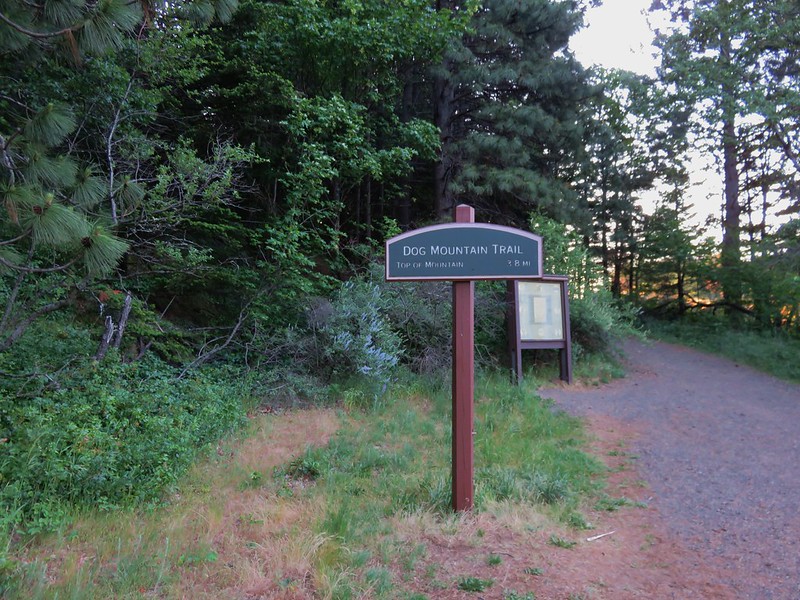
Two trails start from the parking lot, the Dog Mountain and Augspurger Trail, which make an 7 mile loop possible. The Augspurger trail also continues 4.7 miles beyond its junction with the Dog Mountain Trail past the summit of Augspurger Mountain to meadows with views of 3 Washington volcanoes.

We started up hill on the Dog Mountain Trail gaining almost 700′ in the first half mile to a junction in the forest.
Dog Mountain Trailhead

We forked right at the junction following the slightly longer, less difficult, and more scenic trail. After another mile (and another 800′ of elevation gain) we arrived at the lower meadow. The flowers were still in pretty good shape here and the view was better than during our first visit.
Upper meadow on Dog Mountain from the lower meadow//embedr.flickr.com/assets/client-code.js

Lower meadow on Dog Mountain

Columbia River from the lower meadow on Dog Mountain

Paintbrush, lupine, balsamroot and other flowers in the lower meadow

Wildflowers in the lower meadow on Dog Mountain

Wind, Greenleaf and Table Mountains from the lower meadow

The less and more difficult trails rejoined after another half mile back in the forest.
Dog Mountain Trail

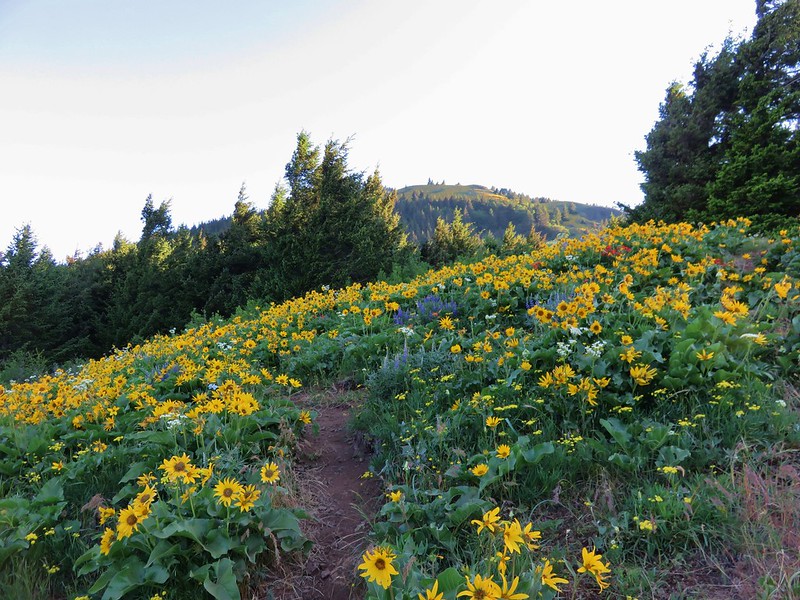
Another 550′ climb over the next half mile brought us to the site of a former lookout at the lower end of Dog Mountain’s upper meadow. The balsamroot painted much of the hillside yellow. Other flowers were mised in adding splashes of red, white, and purple to the color palette.
Dog Mountain Trail

Upper meadow on Dog Mountain

Lakrspur and balsamroot with a little paint

Balsamroot, lupine and paintbrush

Upper meadow on Dog Mountain

Upper meadow on Dog Mountain

Larkspur, balsamroot, and paintbrush

Upper meadow on Dog Mountain

We continued .4 miles from the former lookout site to a signed junction where a .1 mile path led up to the trails high point at the top of the meadow.
Upper meadow on Dog Mountain

Upper meadow on Dog Mountain

Balsamroot on Dog Mountain

Dog Mountain Trail

Junction in the upper meadow

The trail had not been too crowded, but we had already encountered more people in the first three miles than we had on our previous thirty-three miles of trail. It wasn’t the people that chased us from the top of the meadow though, it was the bugs. There was no breeze to keep them down and there were a lot of them including some biting flies. After taking in the view including Mt. Hood and Mt. Defiance to the south and Mt. St. Helens to the west we headed back down to the junction.
Mt. Hood and Mt. Defiance form the top of the upper meadow

Mt. Hood

Mt. St. Helens from the top of the upper meadow

Mt. St. Helens

Wind Mountain and the Columbia River from the top of the upper meadow

We continued on the Dog Mountain Trail another 1.1 miles, passing more wildflowers and fewer people, to its junction with the Augspurger Trail.
Paintbrush, buttercup, larkspur, balsamroot and chocolate lily

western stoneseed

Phlox

Balsamroot, paintbrush, phlox and larkspur

Meadow on Dog Mountain

White capped sparrow on balsamroot

Vanilla leaf and star flowered solomon's seal

Junction with the Augspurger Mt. Trail. (The spelling is wrong on the sign.)

We turned right at the junction and headed for Augspurger Mountain. It was immediately obvious that far fewer hikers used this portion of the trail. Brush crowded the path as it followed a wooded ridge dropping 400′ into a small valley.
Augspurger Trail

Augspurger Trail

A fairly steep climb on the far side of the valley brought us to a dirt road which we followed uphill to the right. After passing under some powerlines the road reentered the forest. At a sharp right hand turn markers indicated the continuation of the Augspurger Trail.
Augspurger Trail

Augspurger Trail

Another half mile of climbing brought us to the first of several small meadows. This one had wildflowers and views back to Dog Mountain and Mt. Hood and to the west down the Columbia River.
Dog Mountain, Mt. Hood and Mt. Defiance from the Augspurger Trail

Wind Mountain and the Columbia River

Augspurger Trail

Chocolate lily and larkspur

Serviceberry, paintbrush and larkspur
Lomatium and paintbrush

For the next 2+ miles the trail alternated between trees and meadows as it followed a ridgeline up Augspurger Mountain. Each meadow seemed to host a different combination of flowers and plants and the sections of forest all had different feels to them.
Augspurger Trail

Dutchman's breech

Augspurger Trail

Augspurger Trail

Fairy slippers

Augspurger Trail

Wildflowers along the Augspurger Trail

Chocolate lily and a beetle

Trillium

Augspurger Trail

Valerian

We momentarily lost the trail in the final meadow near the top of the mountain. Between some downed trees and new growth it was hard to tell where the trail was. I thought I had found it leaving from the right side of the meadow but quickly lost an sign of it in the trees. We went back to the meadow and picked up a faint but clear path heading to the left out of the top of the meadow.
Augspurger Trail

We followed this path into the trees. We were passing below the summit of Augspurger Mountain when we spotted a “summit” sign on a tree above us to the right. We headed uphill to tag the summit before continuing.
Summit of Augspurger Mountain

The path then began to lose elevation and entered another long meadow. This meadow provided views of Mt. Adams and Mt. Rainier in addition to Mt. St. Helens and also contained a fair amount of glacial lilies.
Mt. St. Helens, Mt. Rainier, and Mt. Adams

Mt. Adams

Mt. Rainier

Mt. St. Helens

Glacial lilies

Glacial lilies

The one constant in all the meadows we’d been through was the bugs. The trail continued faintly down through the meadow which we could have followed down another couple of tenths of a mile, but we didn’t really want to have to regain any more elevation than we were already going to need to so after a brief rest we began our return trip.
Augspurger Trail

We ran into two other groups of hikers along the Augspurger Trail on the way back to the Dog Mountain Trail junction. There was a good deal of traffic on the final 2.8 mile stretch from the junction down to the trailhead, most of which was headed in our same direction. The parking lot was packed when we arrived back at the trailhead a little after 1pm and people were walking along the highway to cars they had parked along the shoulder. We had managed to get the wildflower and mountain views that had eluded us in 2014 and now we’ll leave Dog Mountain for others to enjoy. After all there are plenty of less popular trails we have yet to explore and even though they may not have the wildflowers to rival Dog they’re all worthy of a visit. Happy Trails!

Flickr: https://www.flickr.com/photos/9319235@N02/albums/72157668107094945

Categories
Columbia Gorge North Hiking Trip report Washington

Catherine Creek, Coyote Wall, and the Weldon Wagon Trail

** Note the 2025 Burdoin Fire burned over much of the route described here. **

Similar to last months hike our March trip consisted of shorter hikes at three separate locations. We had been waiting for a day off with decent weather to head out toward the eastern end of the Columbia Gorge to see some early wildflowers and finally got one on the day before Spring.

We started our day at the Catherine Creek Trailhead located approximately 6 miles east of Bingen, WA along Old Highway 8. We managed to arrive at the trailhead just as the sunrise began to light up with color.
Sunrise from the Catherine Creek Trailhead

Sunrise from the Catherine Creek Trailhead

Sunrise from the Catherine Creek Trailhead

We took the paved Catherine Creek Trail on the south side of the old highway toward the Columbia River. We followed the 1 mile loop past wildflowers, vernal ponds, oak woodlands, Catherine Creek Falls, and views of Mt. Hood.
Mt. Hood catching some early sunlight

Grass widows
Grass Widows

Prairie Stars
Prairie stars

Shooting stars and saxifrage
Shooting stars

Lomatium
Lomatium

Lomatium

Mt. Hood across the Columbia River

Mt. Hood

Reflections along the Catherine Creek Trail

Catherine Creek Falls

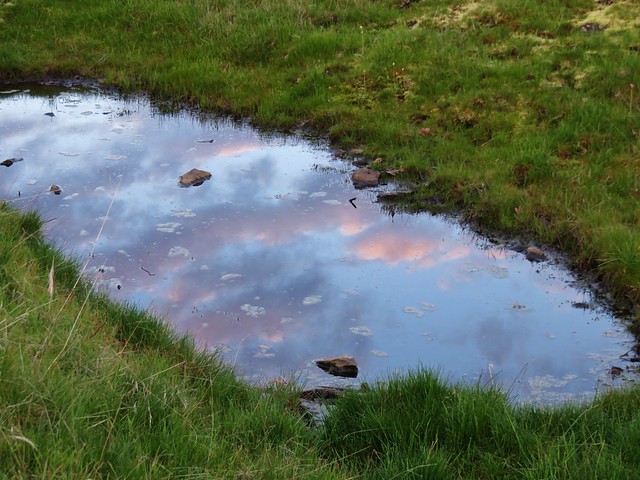
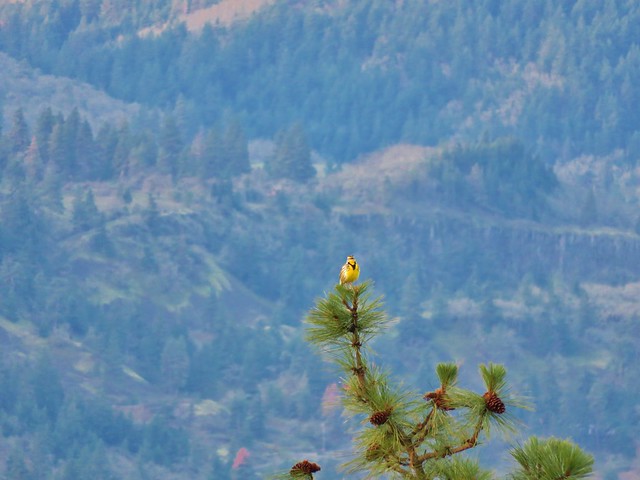
After completing the loop we crossed the road and head north on an old roadbed marked as “20”. At a fork we should have veered right on another road marked with a “21” sign but we initially missed that turn which turned out okay because we came upon a scenic vernal pond reflecting the clouds in the sky above and were serenaded by a western meadowlark.
Catherine Creek Trail

Clouds reflecting in pool of water along the Catherine Creek Trail

Western meadowlark

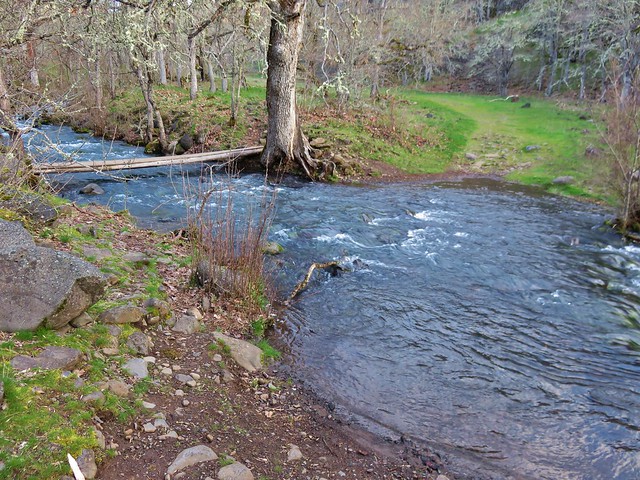
Once we had backtracked onto the correct road bed we followed it to a crossing of Catherine Creek then on to an old corral below the Catherine Creek Arch.
Catherine Creek

Catherine Creek Trail

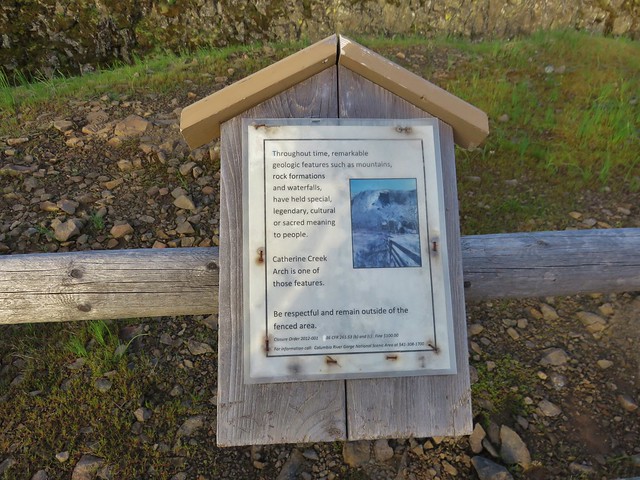
The Forest Service has closed off the area near the arch with fencing but the view from below near the corral is nice.
Sign near the Catherine Creek Arch

Catherine Creek Arch

We continued on the old road climbing gradually and after passing under a set of power lines we came to a trail junction. We took the signed trail to the right which led up a small hill to a ridge with a view of Mt. Hood.
Mt. Hood from the Catherine Creek Trail

This trail followed the ridge down toward the old highway passing the top of the Catherine Creek Arch along the way.
Mt. Hood and the Columbia River from the Catherine Creek Trail

We arrived at the old highway about a quarter mile east of the trailhead and simply walked along the shoulder back to the car. From there we headed back toward Bingen and our next stop at the Coyote Wall Trailhead just off Courtney Road (approx. 3 miles east of Bingen). Our early start allowed us to get to this second trailhead before 9am which was nice because this is a very popular destination.

From the parking area we followed a closed section of old highway 8 east passing a nice view up Coyote Wall. After passing some cliffs the scenery shifted to rocky green hillsides dotted with wildflowers.
Coyote Wall

Biscuitroot surround a small hole in the rocks

View from the old highway

Wildflowers on the rocks along the old highway

Our plan was to take the Labyrinth Trail up to the Rowland Creek Trail then head left from that junction to old road 20 following that left to a creek crossing and following it all the way to a junction with the Coyote Wall Trail. The Labyrinth Trail sets off from old highway 8 approx .75 miles from the trailhead, but before turning up that trail when we came to it we continued on a couple hundred yards to check out Lower Labyrinth Falls.
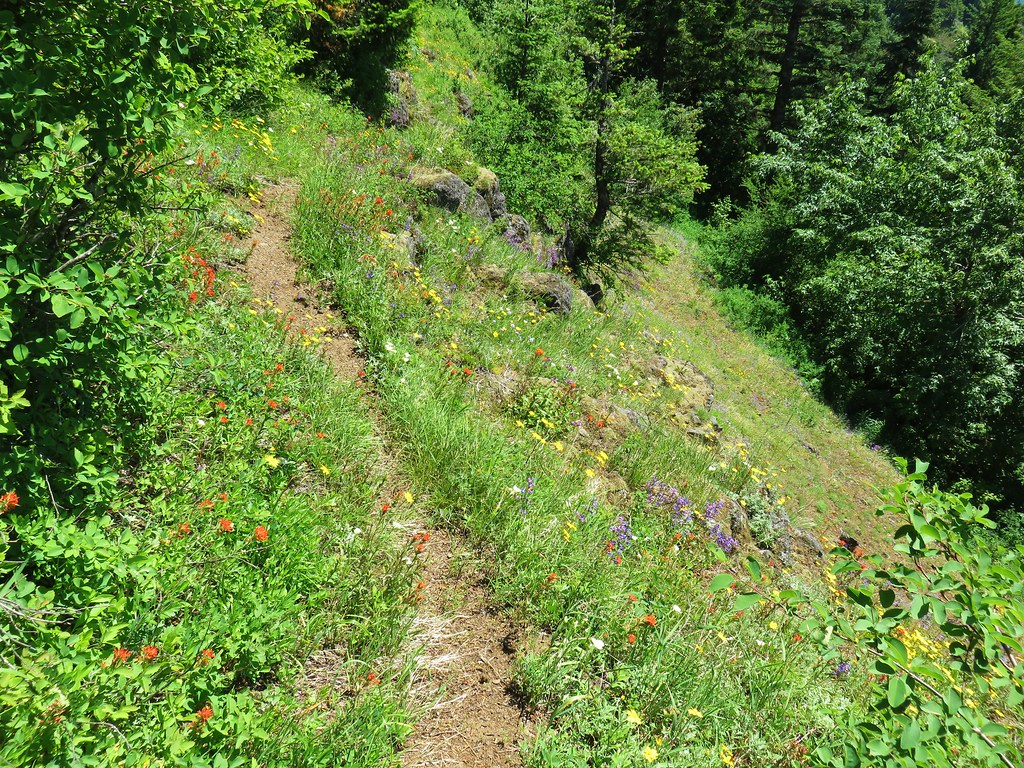
Lower Labyrinth Falls

Lower Labyrinth Falls

Mt. Hood from Lower Labyrinth Falls

After returning to the Labyrinth Trail we headed uphill climbing past wildflowers and rock outcrops to a view of Labyrinth Falls near a small cave.
Labyrinth Trail

Labyrinth Trail

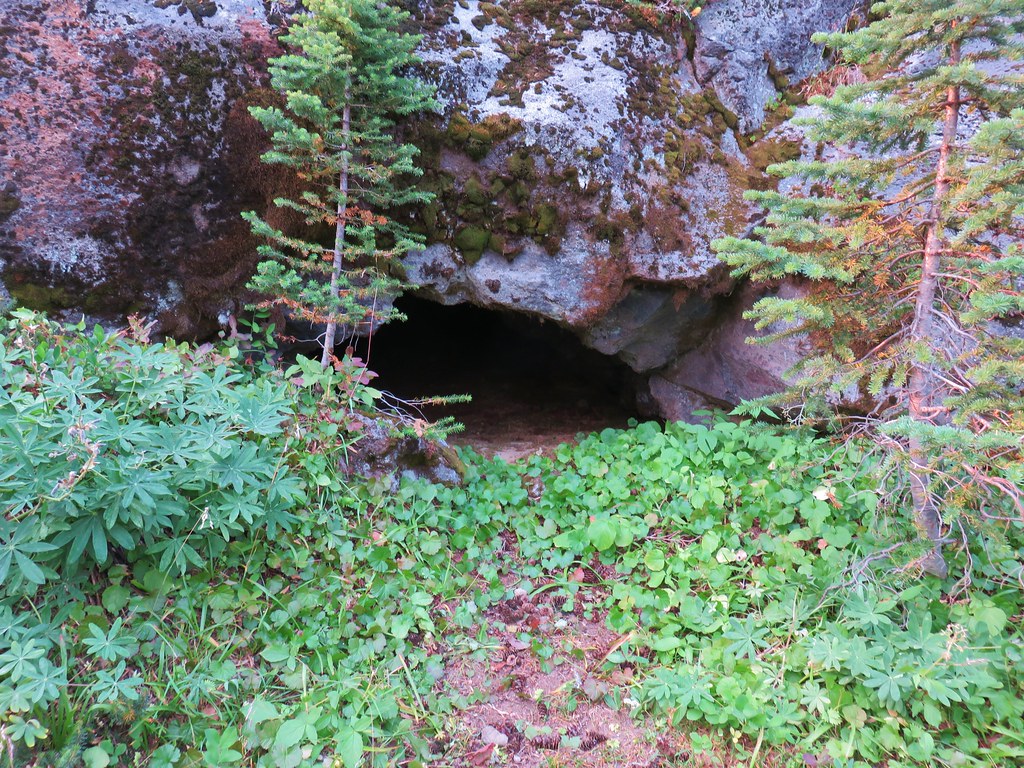
Cave along the Labyrinth Trail

Wildflowers along the Labyrinth Trail

Wildflowers along the Labyrinth Trail

Labyrinth Trail

Labyrinth Falls

From the falls the trail continued to climb through a mix of grasslands and oak woods gaining better views of Mt. Hood.
Labyrinth Trail

Labyrinth Trail

Mt. Hood from the Labyrinth Trail

Mt. Hood

We saw lots of wildflowers along the way and passed a trail crew from the Washington Trails Alliance.

Grass widows
Grass widows

Prairie stars
Prairie star

Lomatium
Biscuitroot

Larkspur
Larkspur and a grass widow

Yellow bell lilies
Yellow bell lilies and a grass widow

Toothwort
Toothwort

We arrived at the road 20 creek crossing as planned but things began to unravel a bit shortly afterward. Signage had been virtually non-existent and after climbing up from the creek crossing we arrived at large junction where the WTA trail crew had parked their vehicles. Several trails and old roads headed off in various directions here and were not shown on the map we were using. We first set off straight ahead on an old road bed but quickly saw a sign indicating it was private property, we turned back to the junction and began to head uphill on a clear trail. It didn’t seem like we should be going that direction though so we pulled out our guidebook and GPS before going any further. After some deliberation we returned once again to the junction and headed downhill on another old road which was the correct route. Here we passed an impressive meadow filled with yellow bell lilies and grass widows.
Labyrinth Trail

Grass widows and yellow bell lilies

Grass widows and yellow bell lilies

Grass widows and yellow bell lilies

We passed several more junctions that were not on our map and made one more wrong turn (it appears it would have led us to the top of Coyote Wall in the end) before finally making it down to the junction we had been looking for with the Coyote Wall Trail. At this point we were about halfway up the wall and made our way over to check out the view.
Coyote Wall

Mt. Defiance (with the snow)
Snow on Mt. Defiance

Mt. Hood
Mt. Hood across the Columbia River from Coyote Wall

From there we headed downhill staying as close to the wall as possible before the trail finally veered away as it neared the old highway.

We spotted a few additional flowers on this lower portion before popping back out on the old highway and making our way back to the busy trailhead.

Woolly-pod milk vetch
Woolly-pod Milk-vetch

Gold stars
Gold stars

Popcorn flower
Popcorn flower

Manroot
Manroot

The unfortunately named Broomrape
Broomrape

Fiddleneck
fiddleneck

Our final stop for the day was the Weldon Wagon Trail. For this hike we headed back through Bingen and continued west on Highway 14 to Alternate Highway 141 just before the White Salmon River. We followed this road north to Husum, WA where we turned right on Indian Creek Road. We followed signs for the Wagon Trail and parked at an unmarked pullout at the crest of Indian Cemetery Road. To reach the trail we needed to walk .2 miles up a logging road.
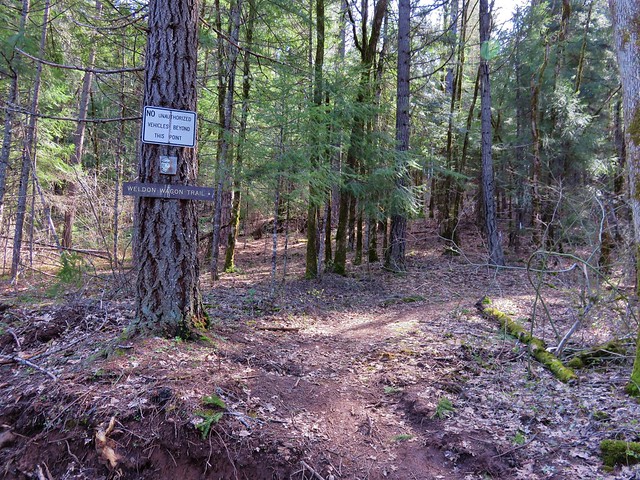
Weldon Wagon Trail

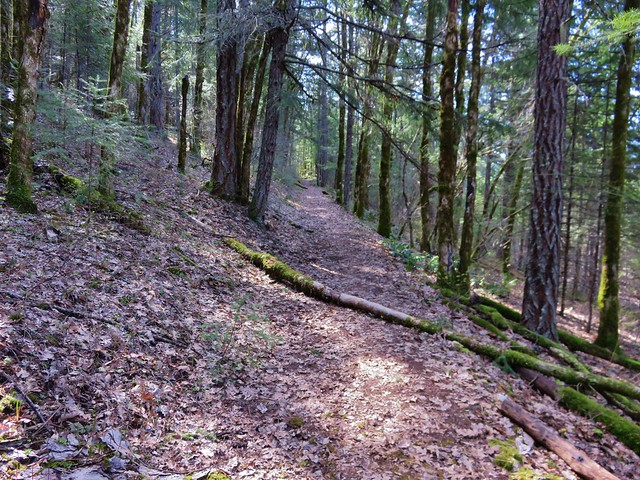
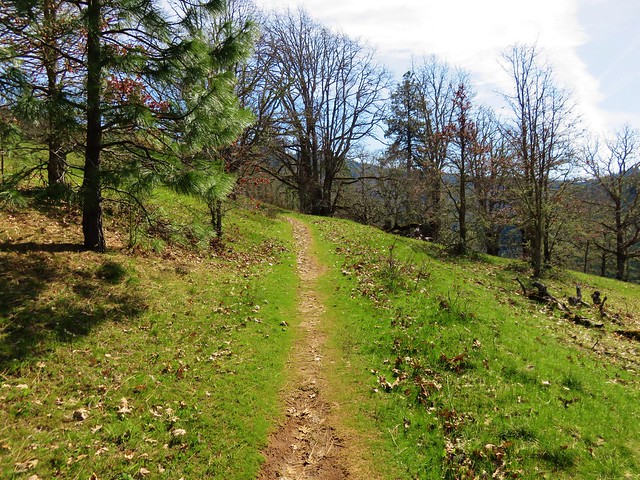
The Wagon Trail follows an old wagon road built in the early 1900’s to cart apples down to Husum. The trail began in a forest before entering more open grasslands.
Weldon Wagon Trail

Weldon Wagon Trail

View from the Weldon Wagon Trail

The trial offers a pretty good climb gaining over 1000′ in the first 1.8 miles where a conservation sign sits in the middle of a hillside with a view of Mt. Hood.
Interpretive sign along the Weldon Wagon Trail

Mt. Hood from the Weldon Wagon Trail

Weldon Wagon Trail

Although the trail continues another .7 miles to another road we turned around at the sign knowing we would be over 13 miles for the day by the time we arrived back at the car and that this was the best of the views from the trail.

On our way home we made one final stop, this time for food, at Mekong Bistro in Portland. We’re blaming this one on the good folks over at Trail Keepers of Oregon for having their Winter Meet-n-Deet there last year. 🙂 We enjoyed the food enough that night to have it now be our go to spot on the way back to Salem after hiking in the Gorge.  It didn’t disappoint and was a great end to a good day of hiking.

Although we did not have any issues ticks can be a problem on these hikes so be sure to keep your eyes out and check for any after your visit. Poison oak is also possible, as are rattlesnakes. Happy (and safe) Trails!

Flickr: https://www.flickr.com/photos/9319235@N02/albums/72157666169966955

Categories
Columbia Gorge North Hiking Trip report Washington

Cape Horn

For our November hike we chose the Cape Horn trail. We had wanted a hike that was a little shorter than our normal trips since Heather had just run her first race in awhile. The 7+ mile loop around Cape Horn fit the bill perfectly and it was a good time for a visit given the full loop is closed from February 1st to July 15th due to nesting Falcons.

Just 30 minutes from the Portland airport the trailhead is located at the Skamania County Transit Park & Ride lot near milepost 26 along State Highway 14 at Salmon Falls Road. The all volunteer Cape Horn Conservancy works with the United States Forest Service (USFS), Washington Trails Association (WTA), and Friends of the Columbia Gorge (FOCG) to maintain and improve the trail here which was evident by the well maintained trail and abundant signage along the way which began at the trailhead.
IMG_2624//embedr.flickr.com/assets/client-code.js

IMG_2621//embedr.flickr.com/assets/client-code.js

IMG_2622//embedr.flickr.com/assets/client-code.js

Cape Horn Trailhead//embedr.flickr.com/assets/client-code.js

Almost immediately after crossing Salmon Falls Rd. and starting on the trail we faced the choice of going clockwise or counter-clockwise around the loop. We stayed to the right heading counter-clockwise and began climbing up toward the viewpoints on top of Cape Horn.
IMG_2631//embedr.flickr.com/assets/client-code.js

IMG_2633//embedr.flickr.com/assets/client-code.js

Our first good views were to the north as the trail neared some power lines where several snow dusted peaks were visible.
Lookout Mountain
IMG_2635//embedr.flickr.com/assets/client-code.js

Silver Star Mountain, Little Baldy, and Bluff Mountain
Silver Star, Little Baldy, and Bluff Mountain//embedr.flickr.com/assets/client-code.js

The trail then crossed over to the Columbia Gorge side of Cape Horn for our first unobstructed views of the Columbia River. The Sun had just crested over Larch Mountain to the southeast and was creating some glare limiting the views. A cold wind was racing down the Gorge which made it a little too chilly to spend much time at any of the viewpoints which was too bad because they were nice enough to warrant a longer stay.
Columbia River from the Cape Horn Trail//embedr.flickr.com/assets/client-code.js

IMG_2640//embedr.flickr.com/assets/client-code.js

A little bit of ice at the viewpoint.//embedr.flickr.com/assets/client-code.js

The trail then dropped down away from the Gorge (and out of the wind) briefly joining an old roadbed and then climbing to a crossing of paved Strunk Rd. where the trail passes through grassy fields on a gravel road.
IMG_2651//embedr.flickr.com/assets/client-code.js

IMG_2653//embedr.flickr.com/assets/client-code.js

The next viewpoint of the Columbia Gorge was the Nancy Russell Overlook which had recently undergone some repairs. A long stone bench in the overlook offered plenty of space for hikers to relax and soak in the view, but again the cold wind wasn’t going to allow us to enjoy it for long.
IMG_2654//embedr.flickr.com/assets/client-code.js

Columbia River from the Cape Horn Trail//embedr.flickr.com/assets/client-code.js

The trail began to descend after the Nancy Russell Overlook switchbacking and passing yet another viewpoint on it’s way down to a tunnel beneath SR 14.
IMG_2661//embedr.flickr.com/assets/client-code.js

IMG_2662//embedr.flickr.com/assets/client-code.js

IMG_2671//embedr.flickr.com/assets/client-code.js

Yet another viewpoint awaited on the other side of the highway.
IMG_2674//embedr.flickr.com/assets/client-code.js

IMG_2675//embedr.flickr.com/assets/client-code.js

A nice waterfall cascaded down a grassy slope near the viewpoint.
IMG_2678//embedr.flickr.com/assets/client-code.js

The section that is closed for the Falcons begins shortly after that viewpoint but that wasn’t an issue now so we continued on. After another series of switchbacks the trail began to head back leading us east parallel to the river. The wind was really whipping down closer to the river and we were blasted by it every time there was a break in the trees. We passed an unsigned side trail to the right and momentarily paused wondering where it might go. After continuing on for a minute or so it dawned on us that it had likely led to an overlook of the railroad tracks as they headed into the tunnel beneath Cape Horn. We began looking for the other end of that side trail to rejoin the main trail and spotted it at a set of trail signs. We turned right and headed out to check out this unsigned trail. It led to a series of grassy viewpoints and the view of the railroad tracks as we had suspected.
IMG_2683//embedr.flickr.com/assets/client-code.js

IMG_2685//embedr.flickr.com/assets/client-code.js

Railroad entering the tunnel beneath Cape Horn//embedr.flickr.com/assets/client-code.js

The wind along here was so strong that we struggled to not be pushed around by it. It was a challenge to try and stand in one spot for anytime at all. We followed the side trail all the way back to the unmarked junction we had wondered about earlier and then resumed our hike on the main trail. Another windy viewpoint awaited not far ahead where three unique rock formations where visible. From this spot Cigar Rock, Beacon Rock, and Phoca Rock were all visible.
IMG_2691//embedr.flickr.com/assets/client-code.js

Cigar Rock is the tall column of rock on the left, Beacon Rock is in the distance straight ahead, and Phoca Rock is in the middle of the Columbia to the right.
Cigar, Beacon and Phoca Rocks//embedr.flickr.com/assets/client-code.js

After fighting with the wind attempting to take pictures of the rocks the trail turned uphill passing through an interesting rock field below some cliffs.
IMG_2696//embedr.flickr.com/assets/client-code.js
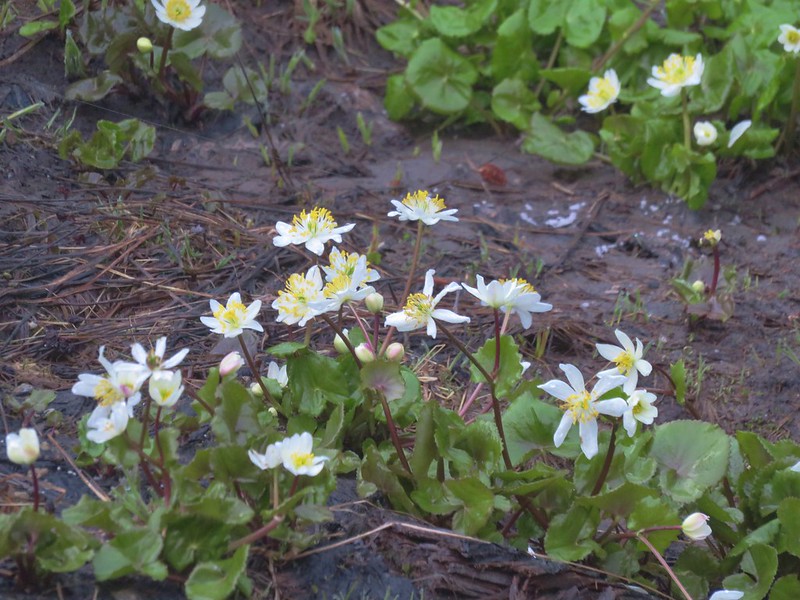
IMG_2697//embedr.flickr.com/assets/client-code.js

As we crossed the rock field we got our first view of Cape Horn Falls.
Cape Horn Falls//embedr.flickr.com/assets/client-code.js

The falls were a delight. A small rainbow appeared and faded at the base of the falls as wind gusts blew the cascade from side to side. The footbridge below the falls was somewhat protected from the wind allowing us to spend some time watching the water dance in the wind.
Cape Horn Falls//embedr.flickr.com/assets/client-code.js

IMG_2713//embedr.flickr.com/assets/client-code.js

IMG_2718//embedr.flickr.com/assets/client-code.js

Rainbow beneath Cape Horn Falls//embedr.flickr.com/assets/client-code.js

Beyond Cape Horn Falls the trail continues through the trees below the cliffs until it finally drops down to Cape Horn Road.
IMG_2722//embedr.flickr.com/assets/client-code.js

IMG_2728//embedr.flickr.com/assets/client-code.js

The paved road acts as the trail for the next 1 1/4 miles passing farmland below Cape Horn.
Cape Horn from Cape Horn Road on the way back up to the trailhead.//embedr.flickr.com/assets/client-code.js

The trail leaves the road just prior to reaching SR 14 leading to another tunnel and than a short climb to complete the loop.
IMG_2731//embedr.flickr.com/assets/client-code.js

The hike was just what we were hoping for. Not too long (7.3 miles) but packed with views and diverse scenery. Happy Trails!

Flickr: https://www.flickr.com/photos/9319235@N02/albums/72157661488144815