Categories
Hiking Mt. Rainier Trip report Washington Washington Cascades

Mt. Rainier National Park – Northern Loop Day 2

The possible thunderstorms forecast for our first night had never really materialized. We heard a few rumbles in the distance but nothing had seemed close and we didn’t experience any rain overnight. The sky was a little cloudy as we packed up our tent but they seemed to be breaking up. We stopped at Mystic Lake to eat breakfast and enjoy the beautiful morning that was developing around us.
IMG_7883

IMG_7888

IMG_7889

IMG_7893

IMG_7900

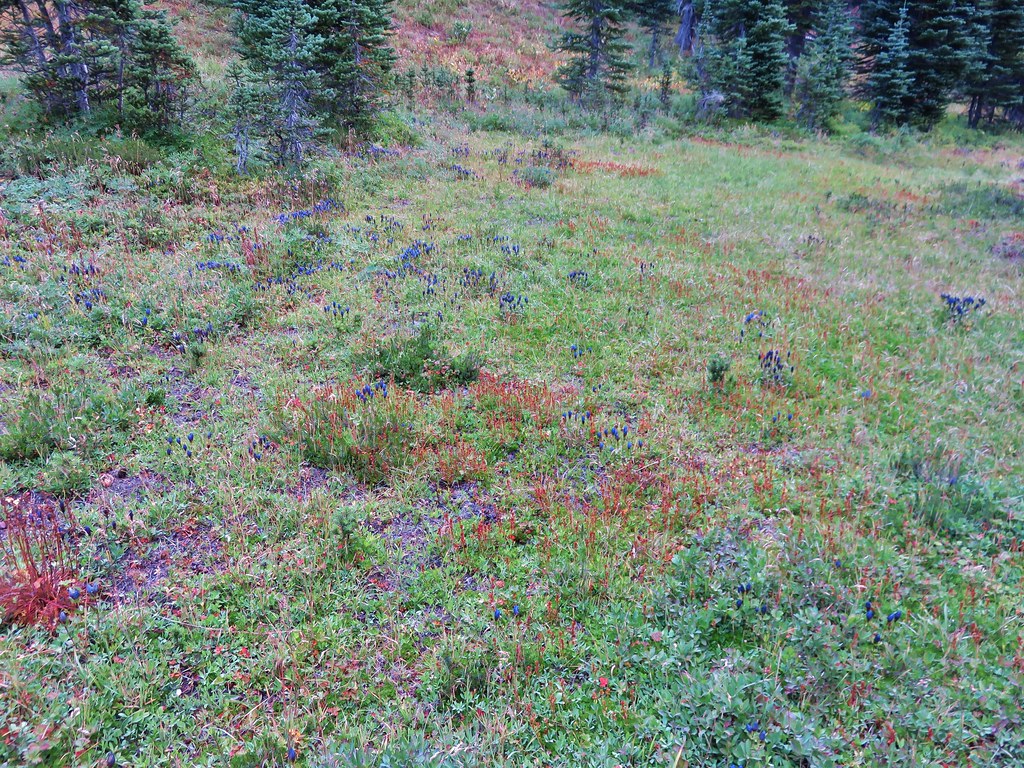
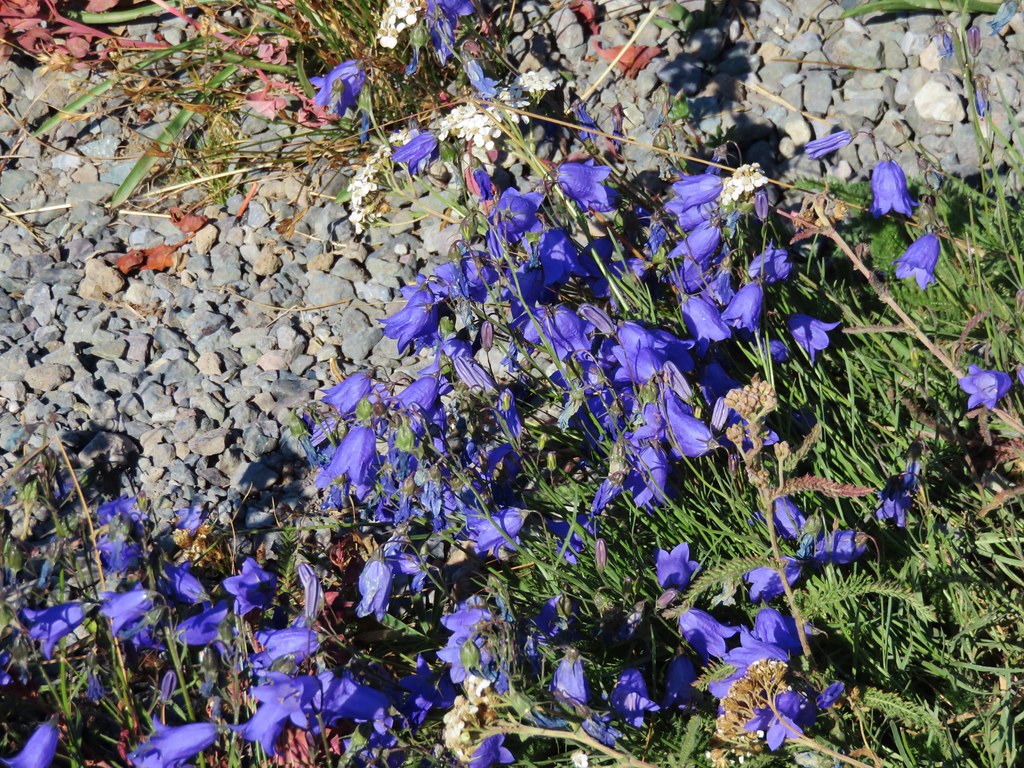
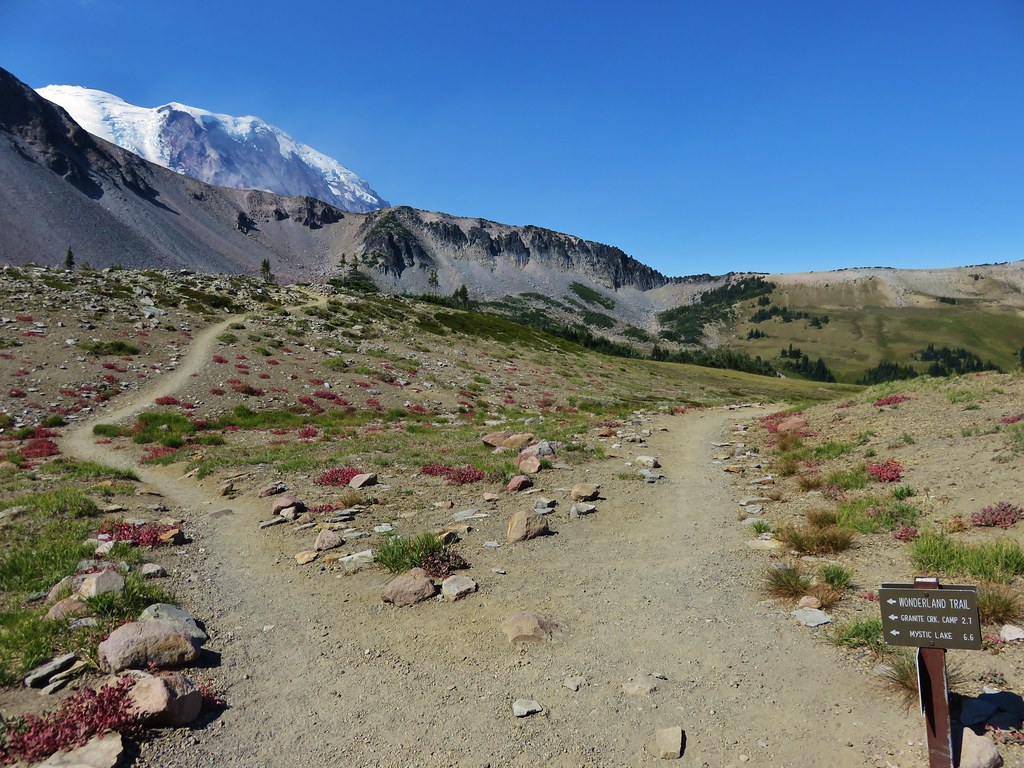
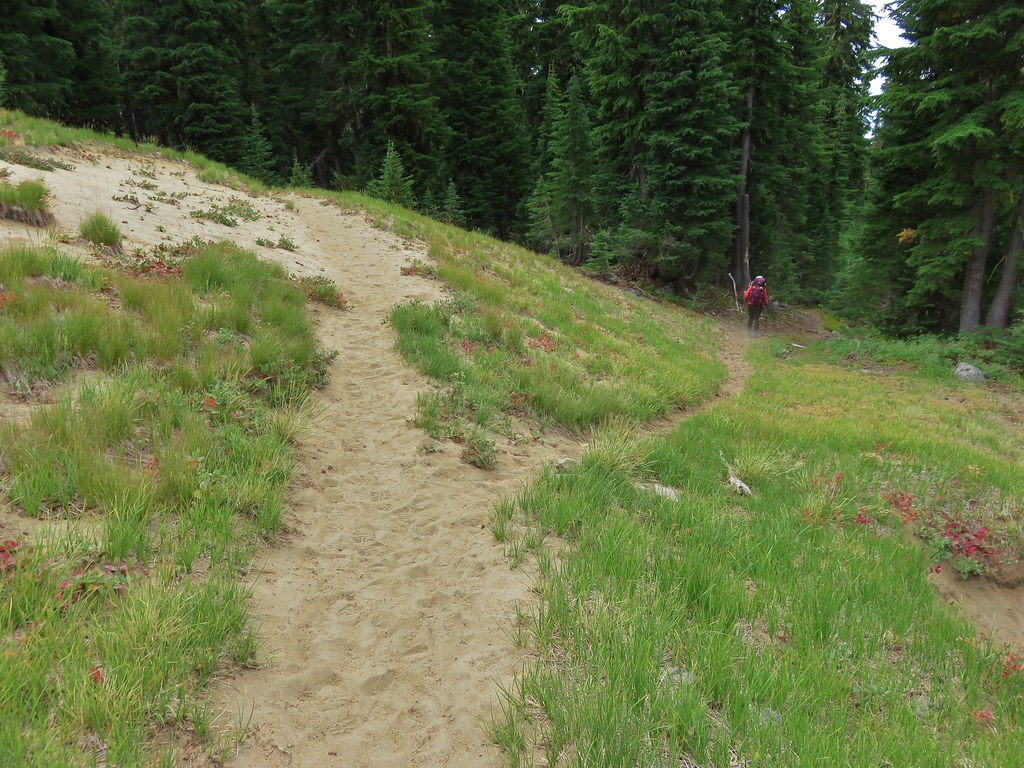
From Mystic Lake the Wonderland Trail climbed through gentian filled meadows to a saddle between the mountain and Old Desolate.
IMG_7901

IMG_7911

IMG_7910

IMG_7924

IMG_7936

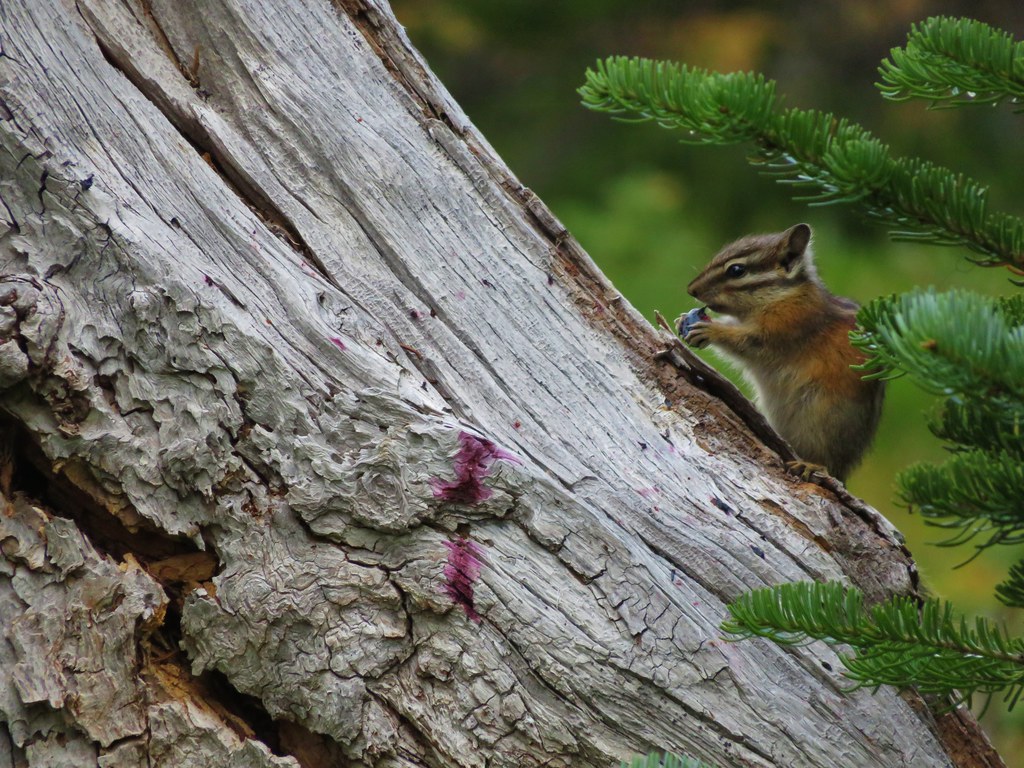
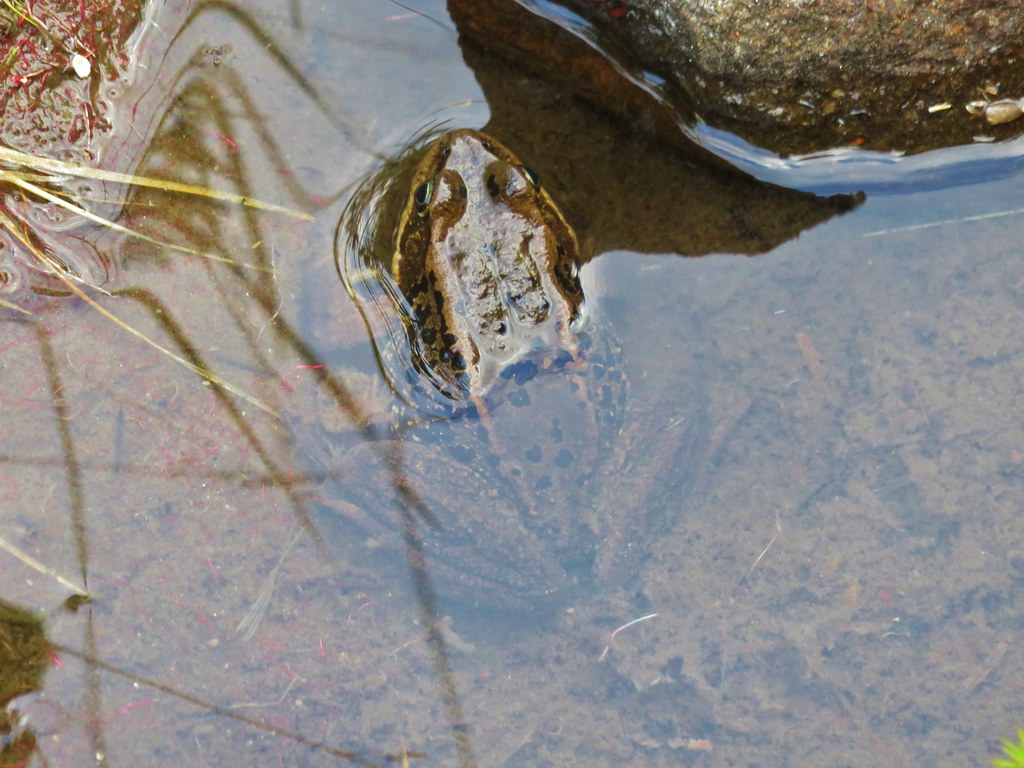
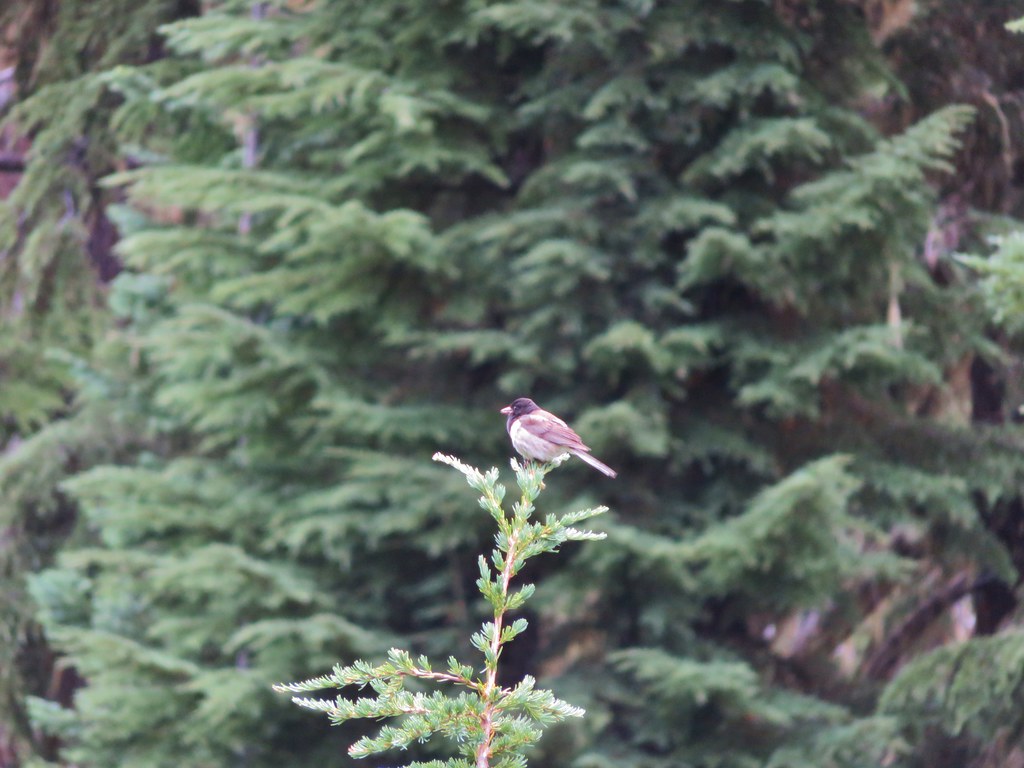
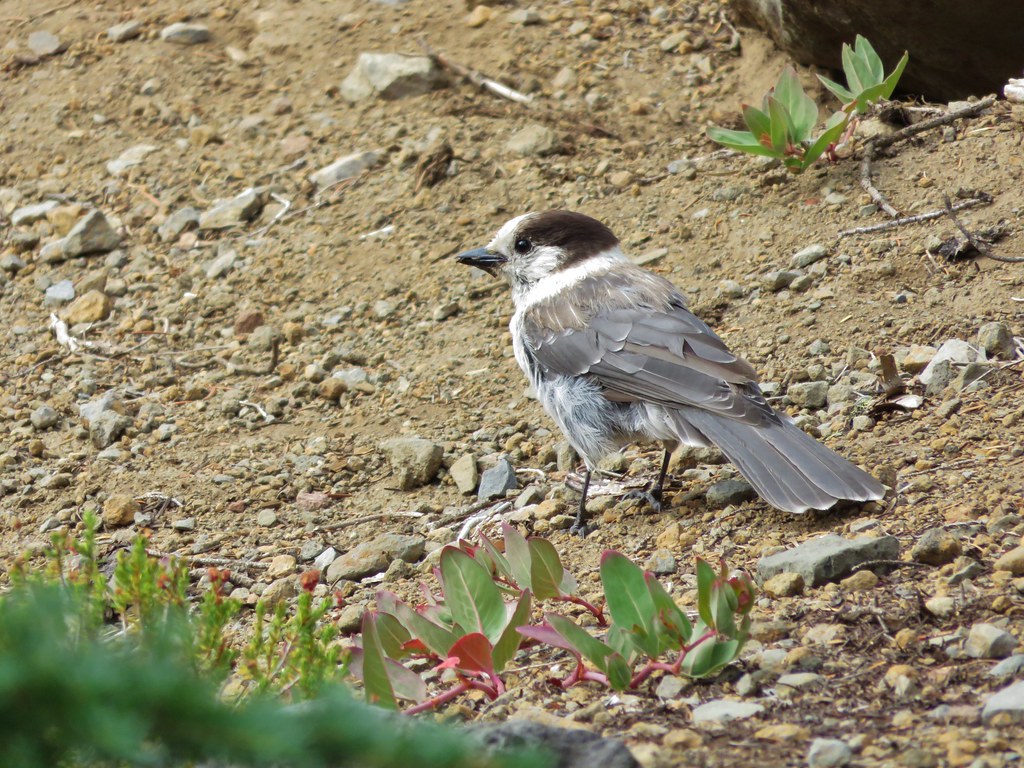
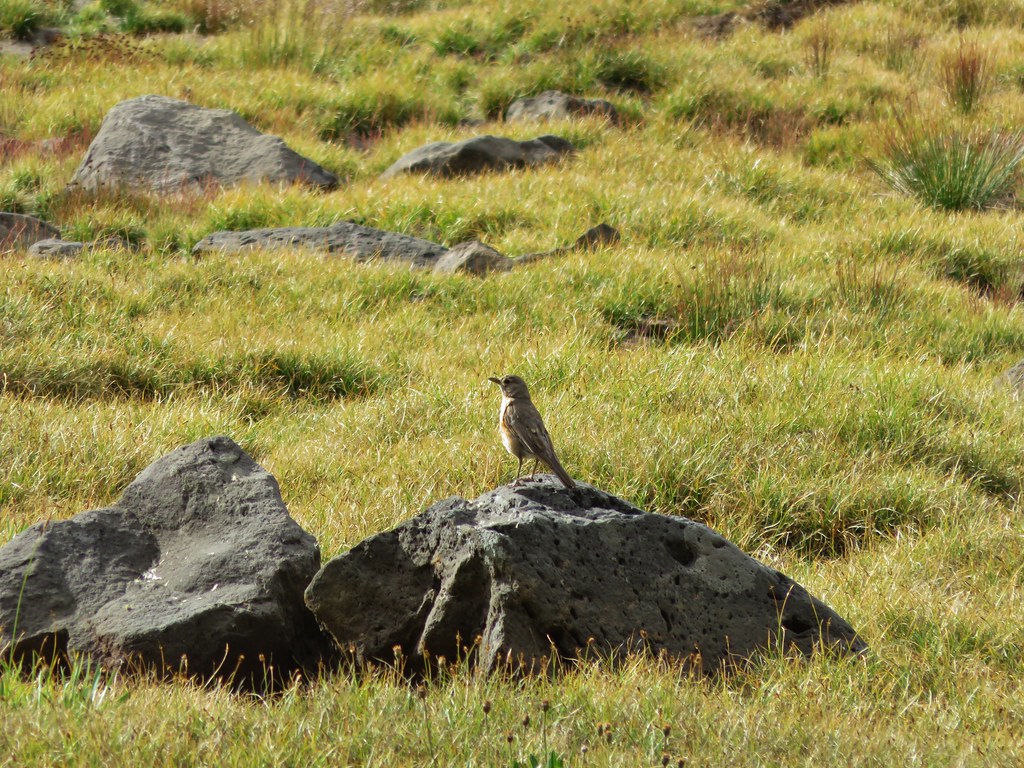
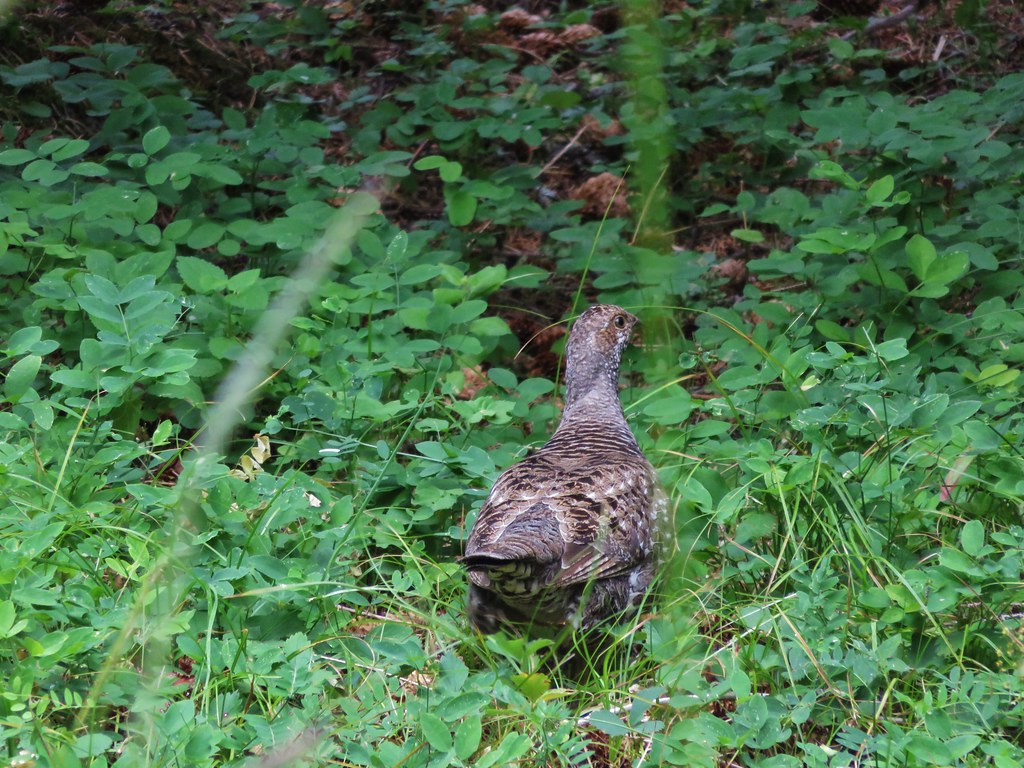
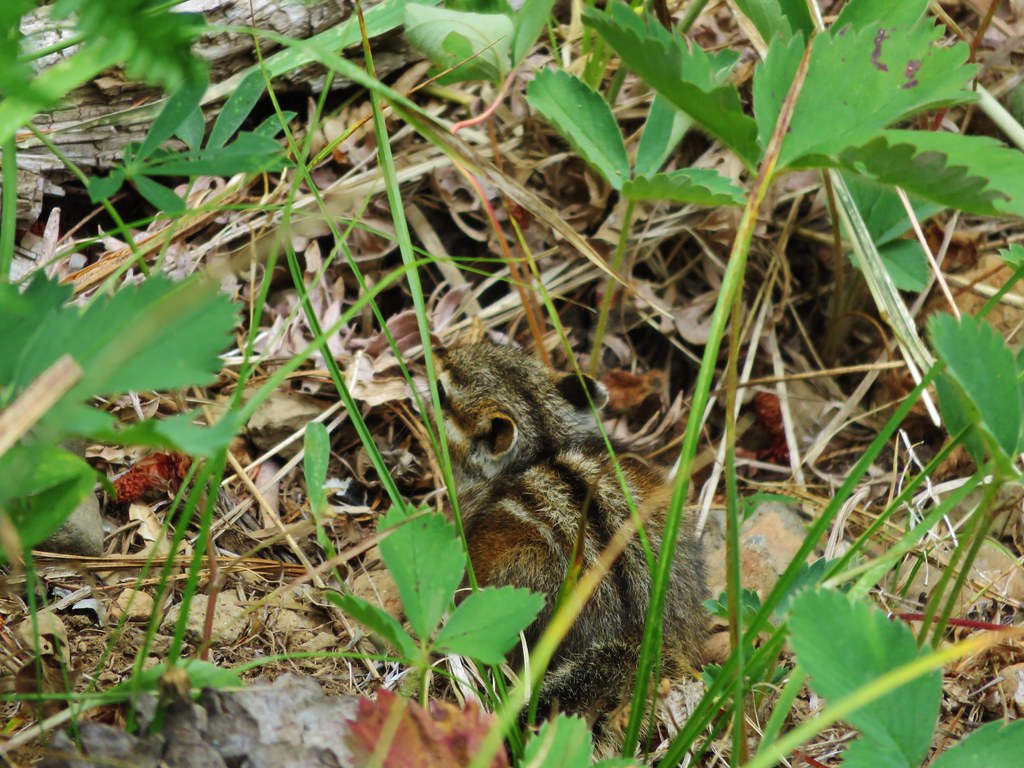
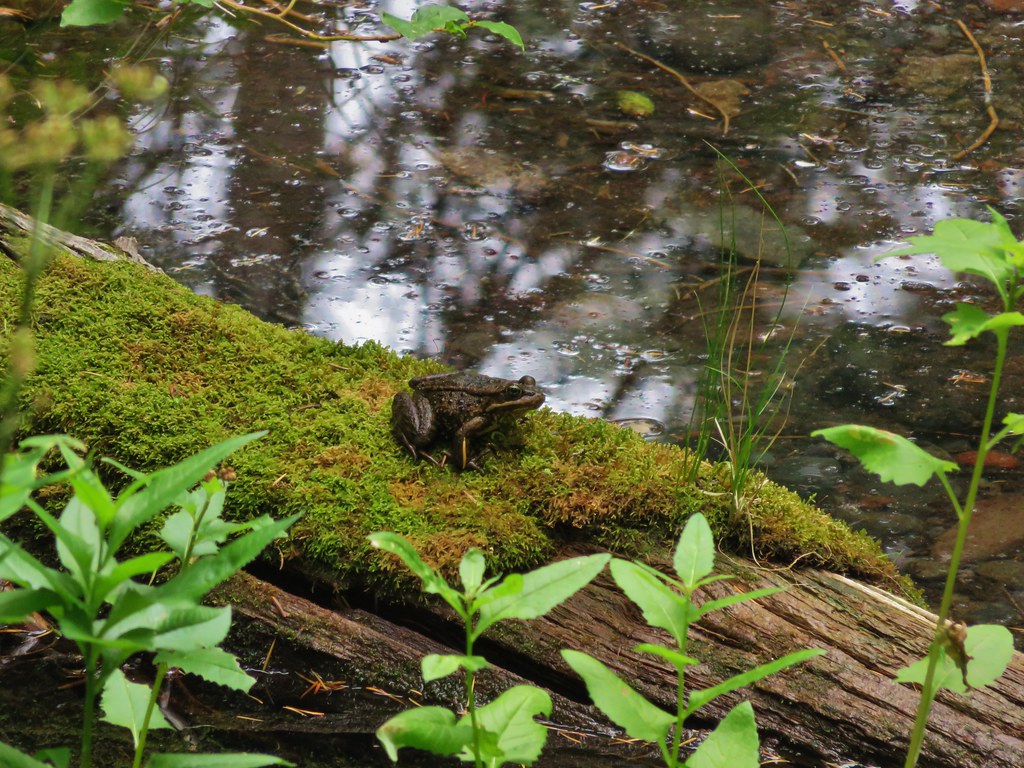
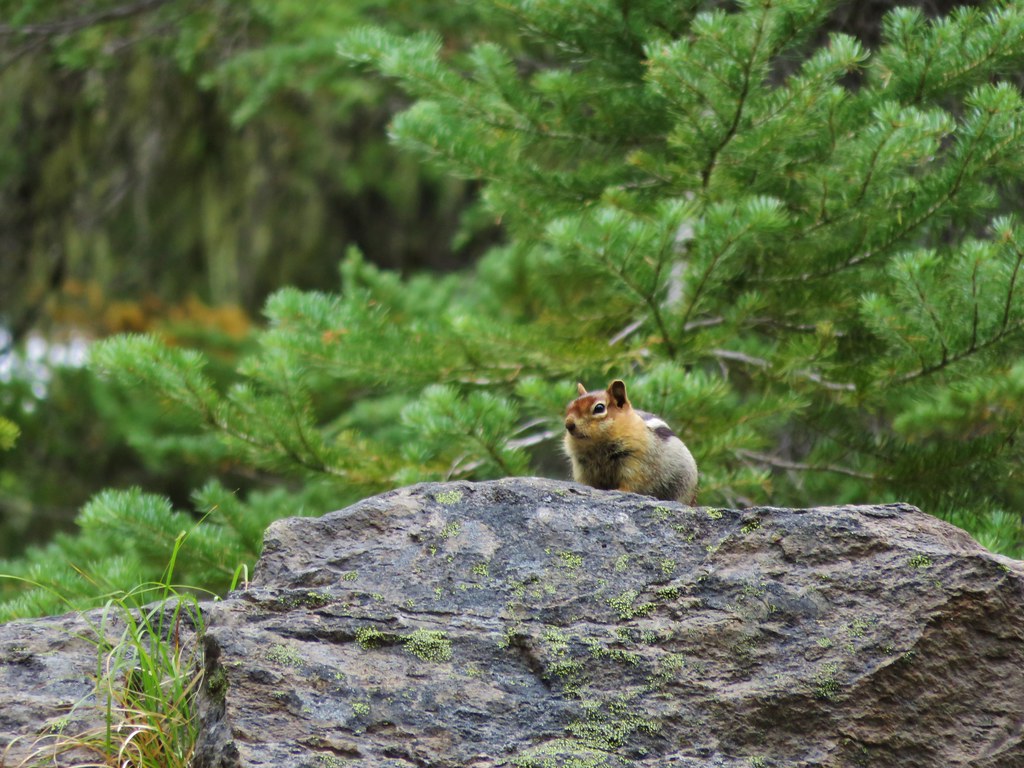
We were hiking with the animals this morning passing birds, frogs, chipmunks, and an owl who silently flew over our heads and down into a lower meadow.
IMG_7945

IMG_7895

The owl flying low over the meadow just before disappearing down the hillside.
IMG_7948

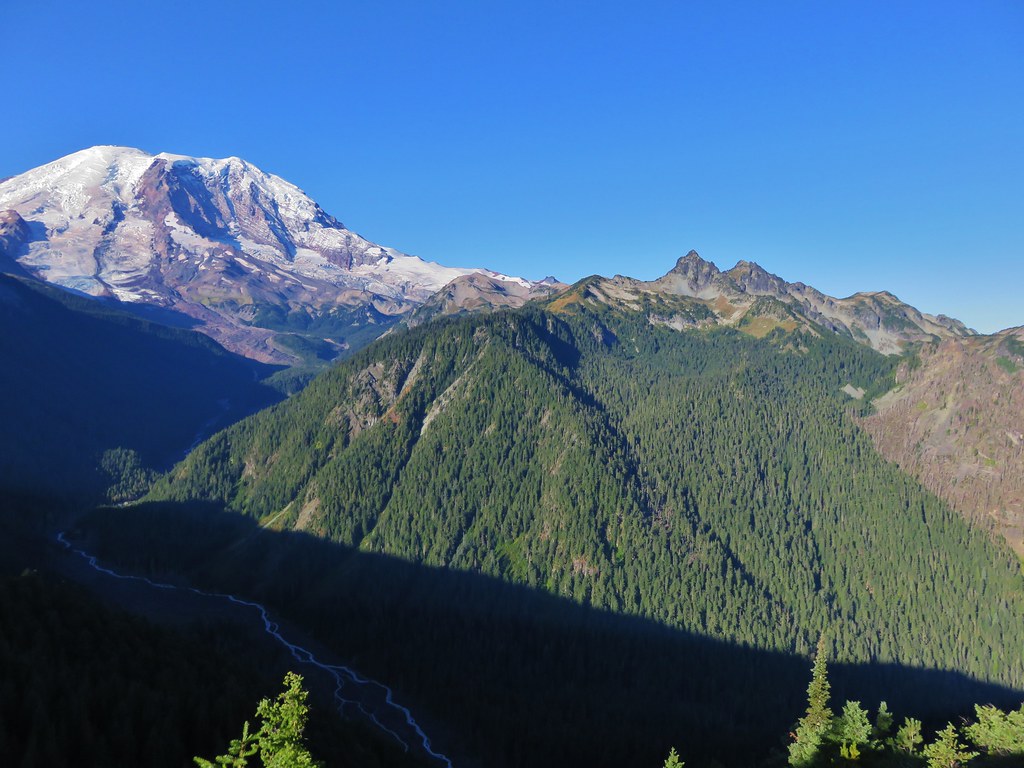
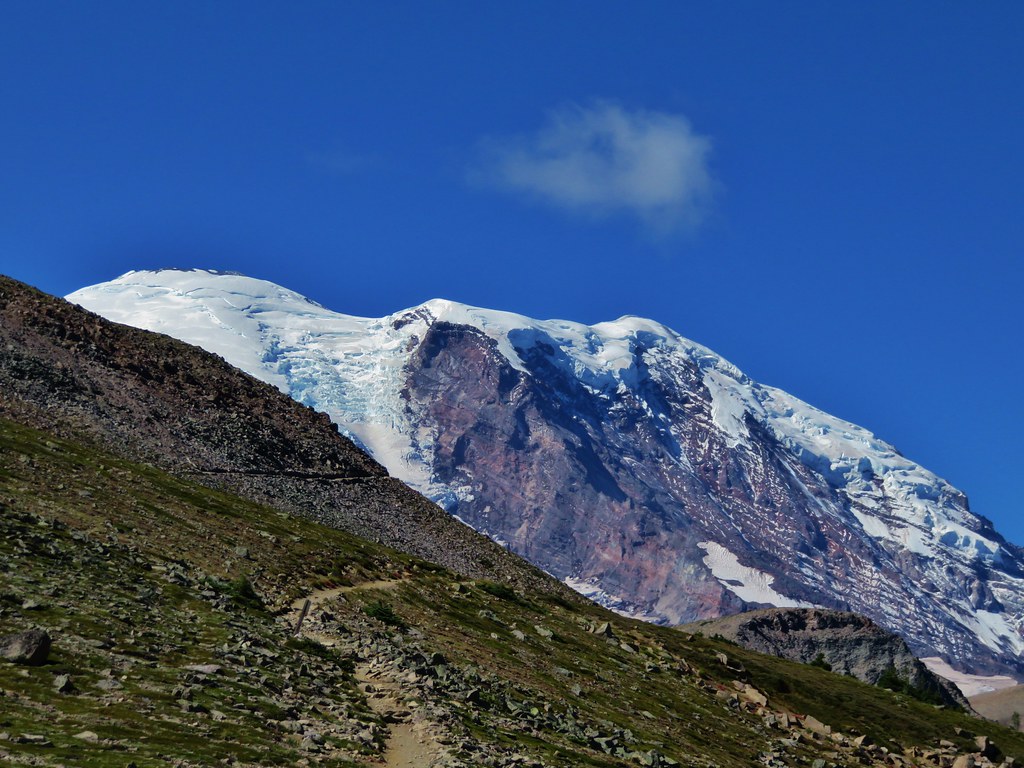
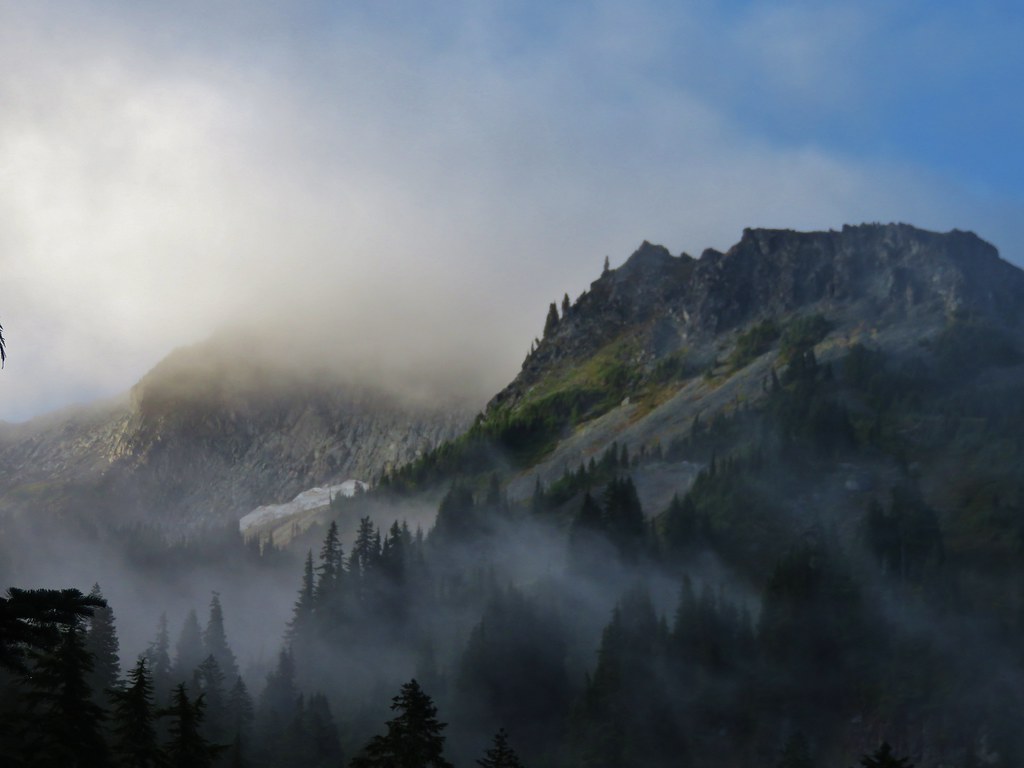
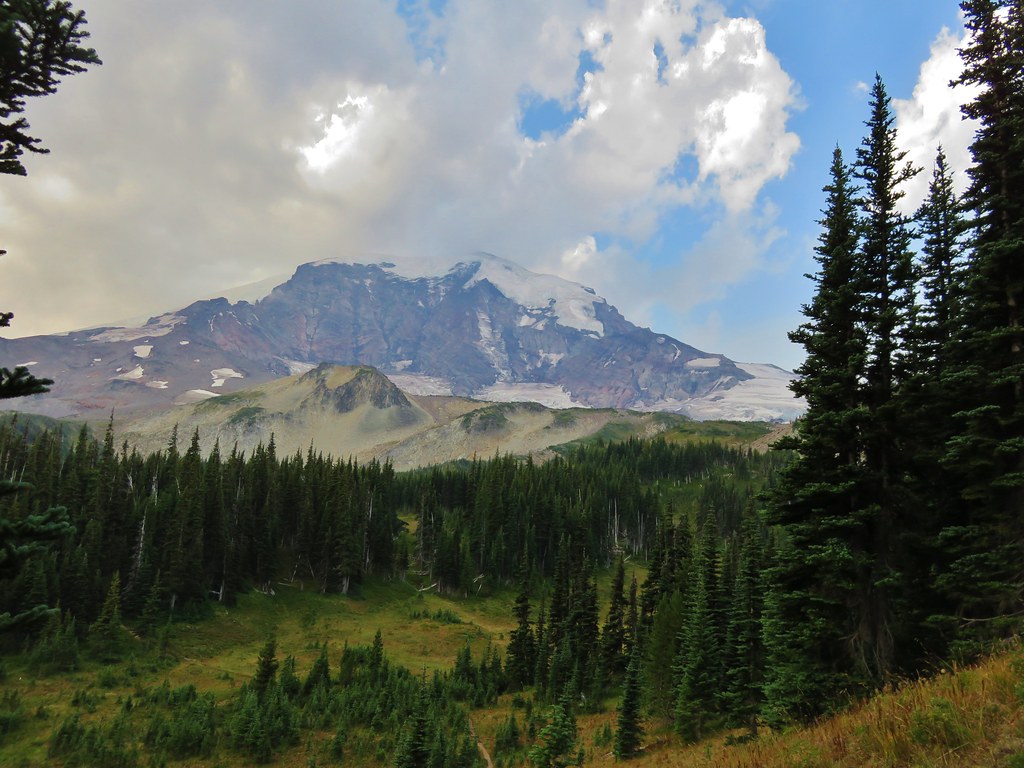
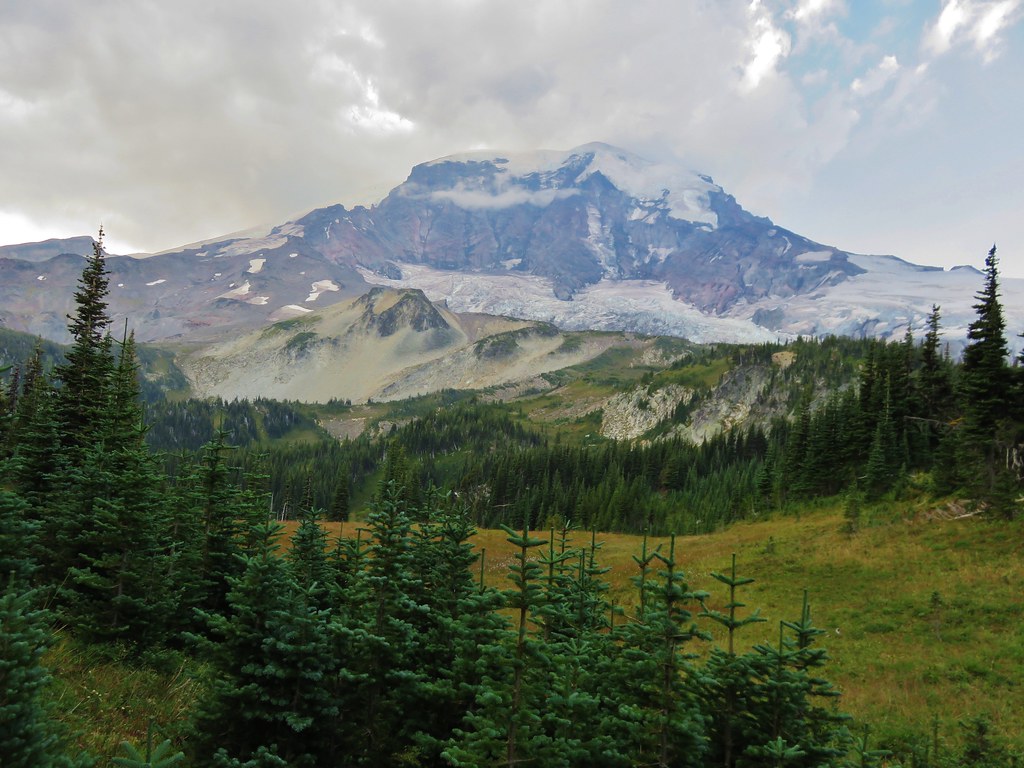
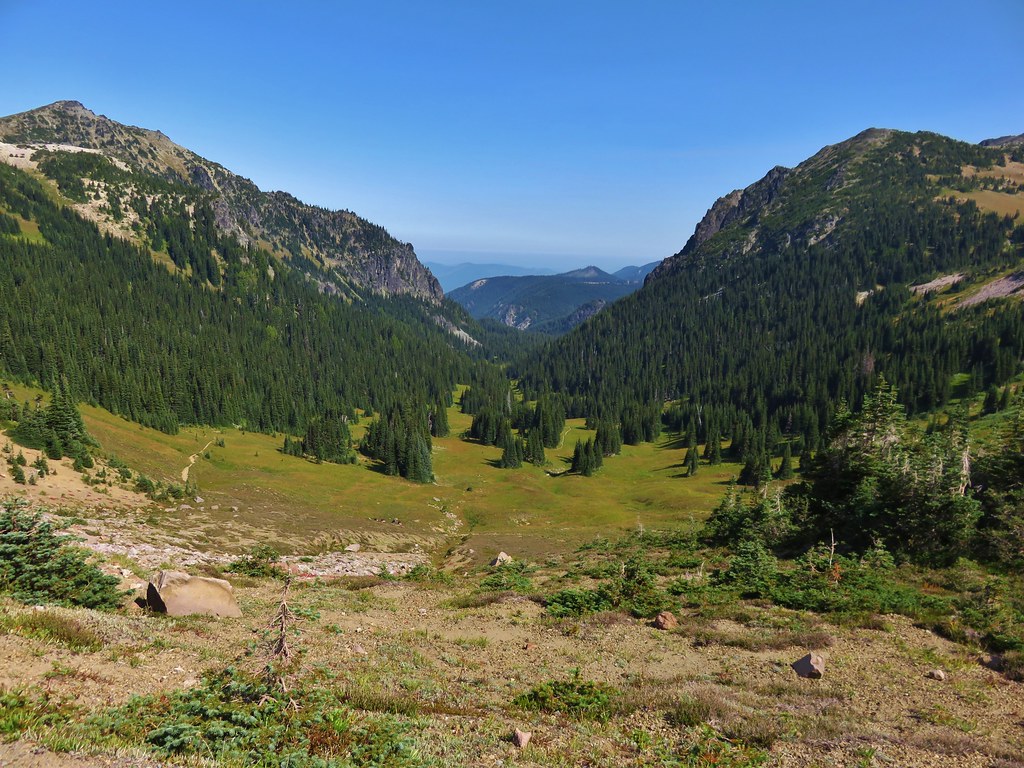
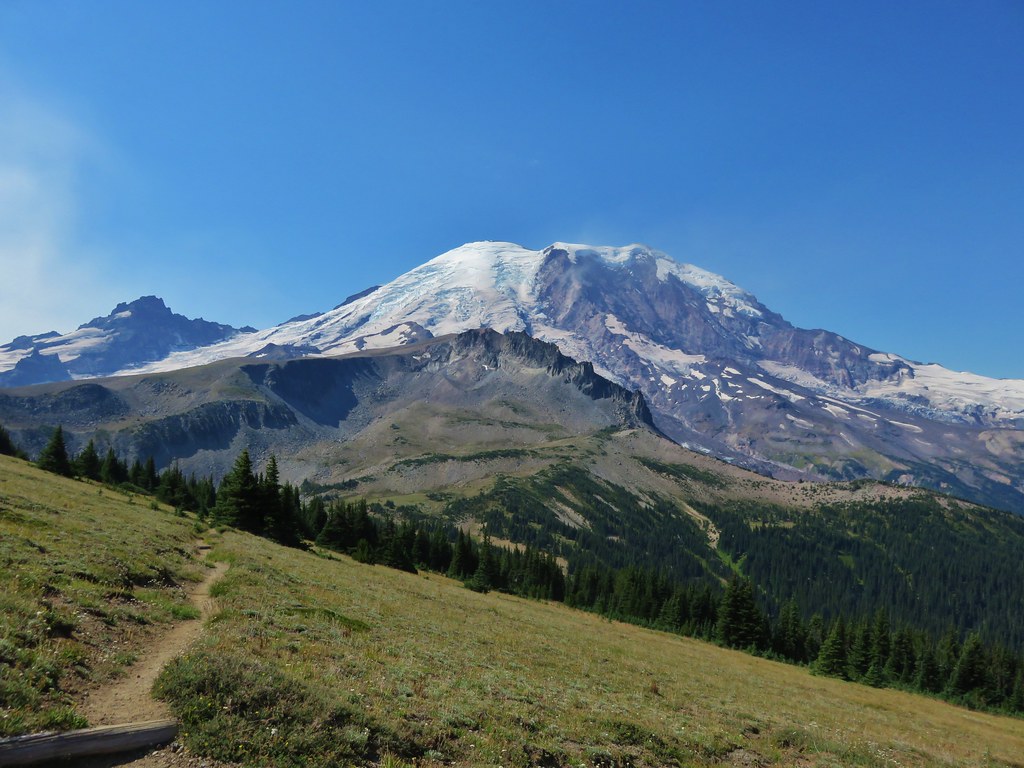
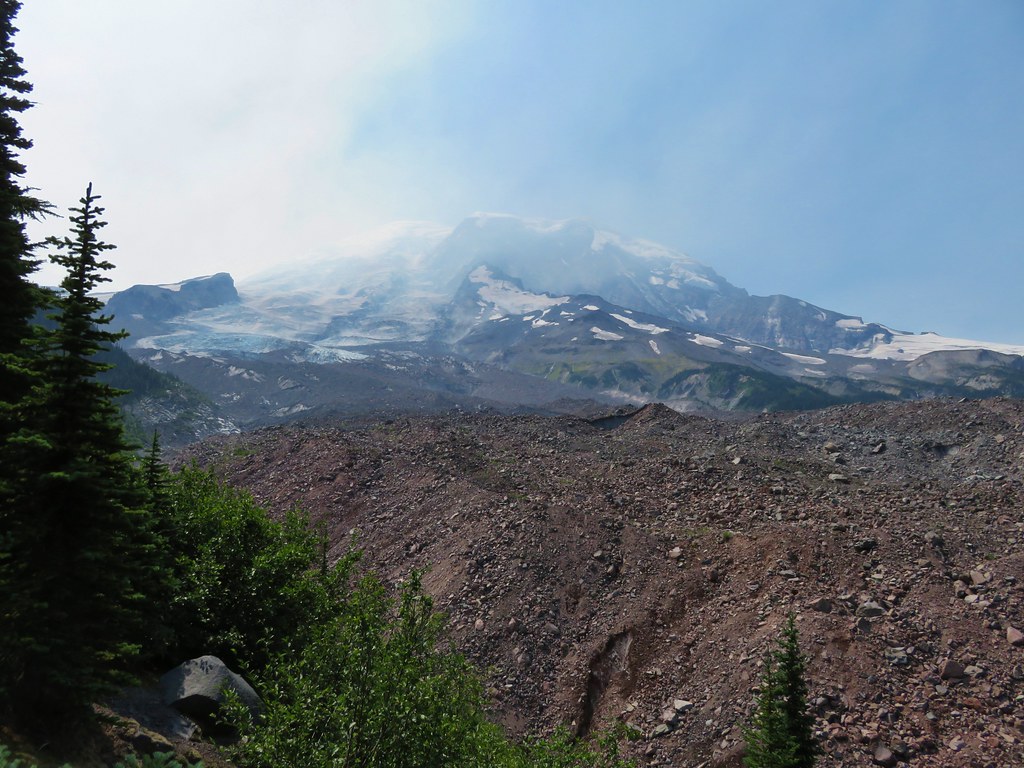
Mt. Rainier was visible beneath the ever shifting clouds as we crested the saddle. The Carbon Glacier filled the valley before us and beyond that was Echo Cliffs and Mother Mountain.
IMG_7960

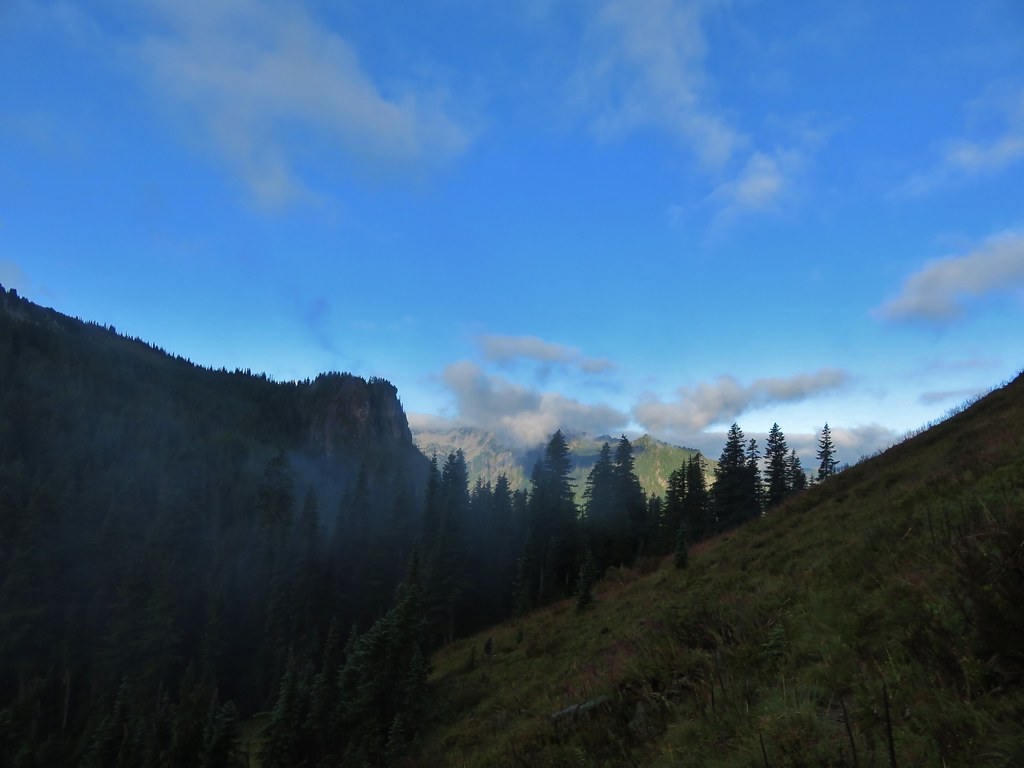
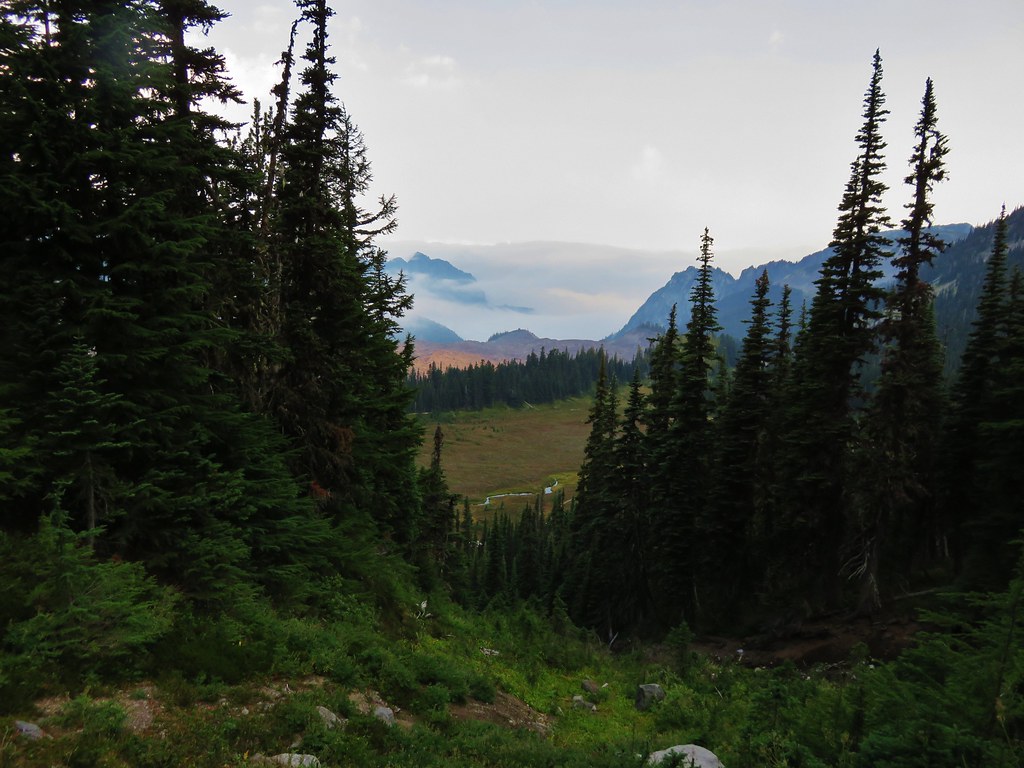
Further down the glacial valley a mass of clouds covered the terrain. We were heading down toward those clouds and we remembered the rain that had been in the forecast for the day.
IMG_7959

We followed the trail down to the meadows surrounding Moraine Creek. Along the way we spotted several pikas and had great views of a huge waterfall below Observation and Echo Rocks.
IMG_7963

IMG_7991

IMG_7999

IMG_7978

IMG_7969

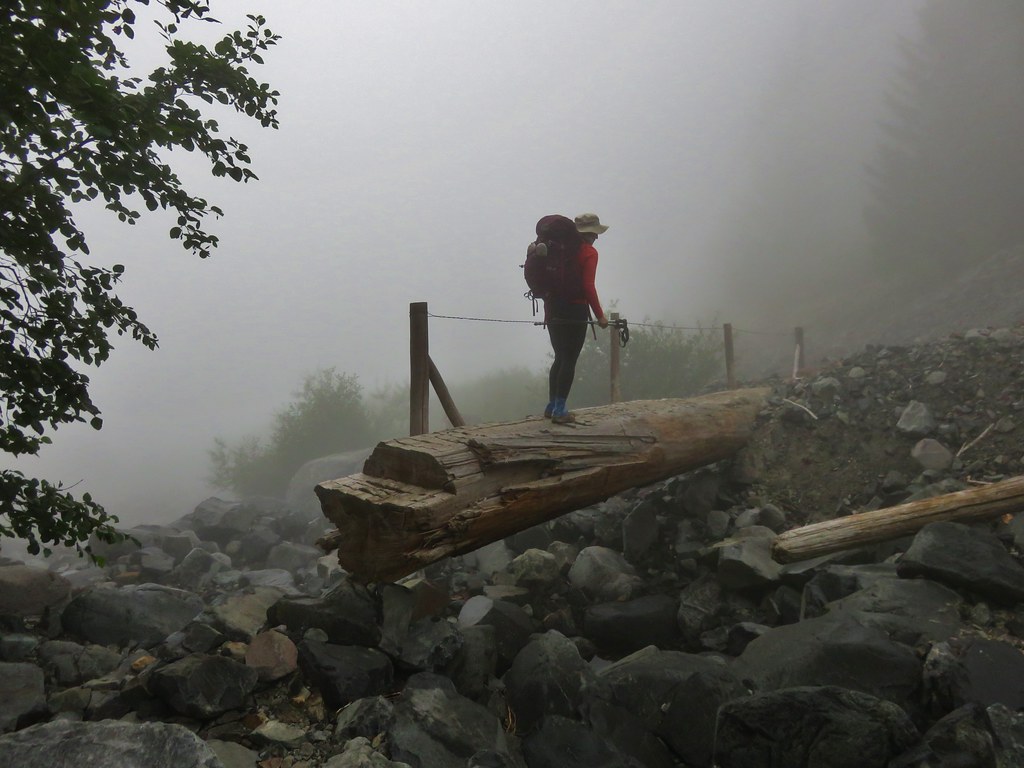
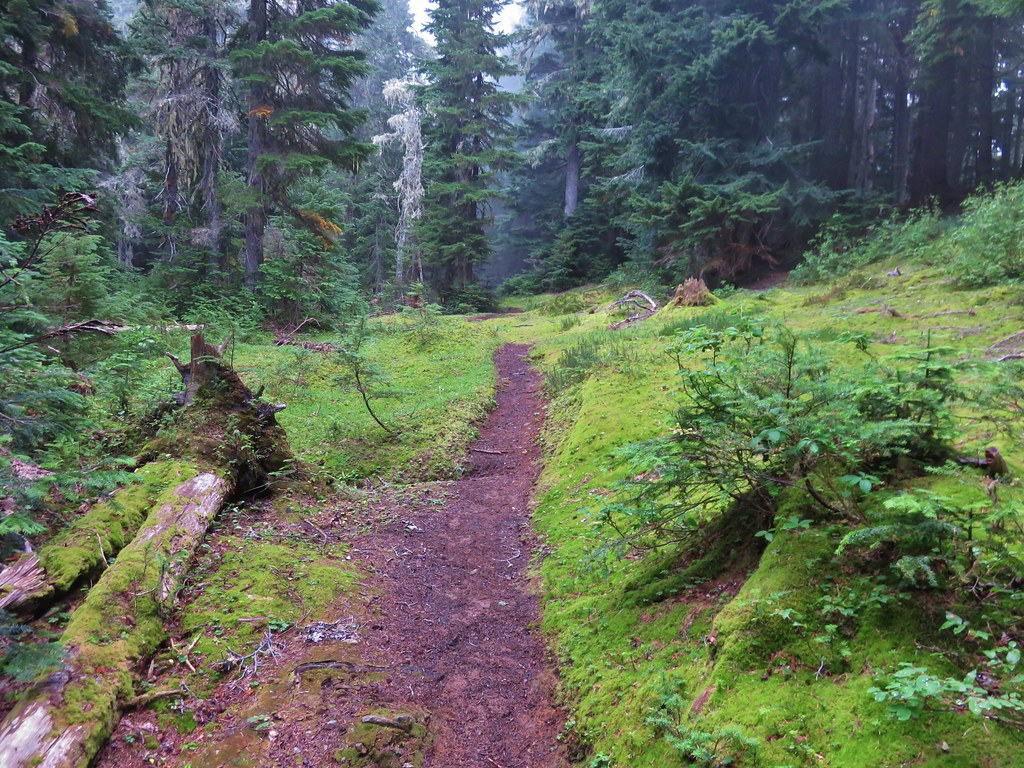
As we continued along Moraine Creek we entered the clouds.
IMG_7995

IMG_8036

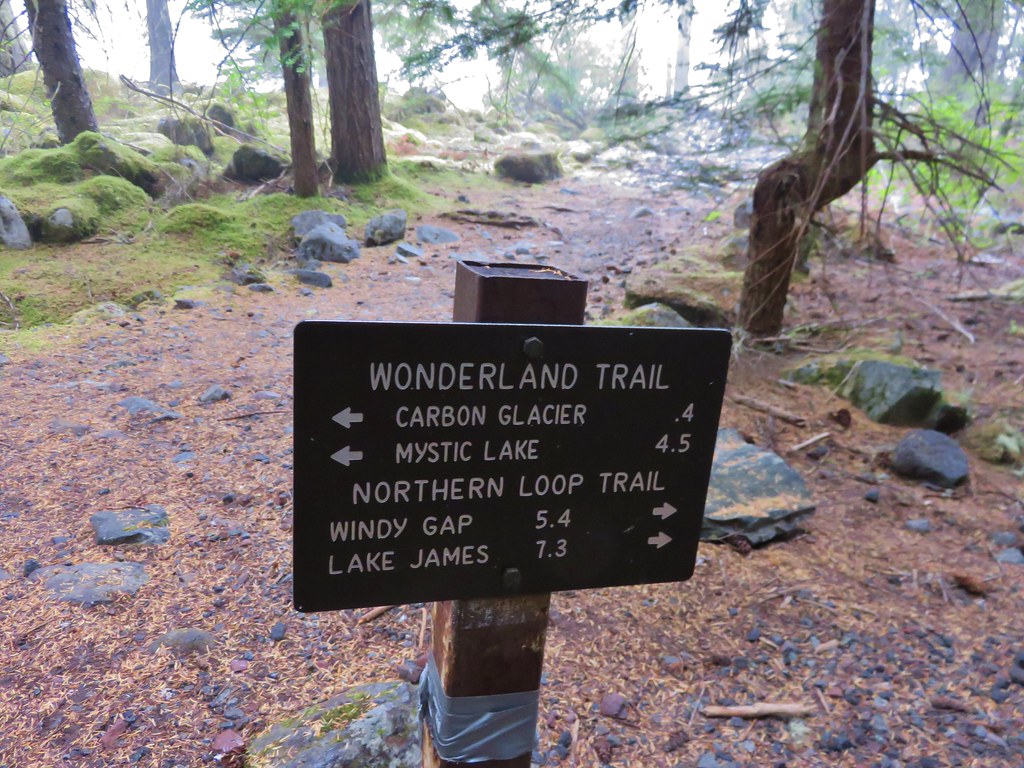
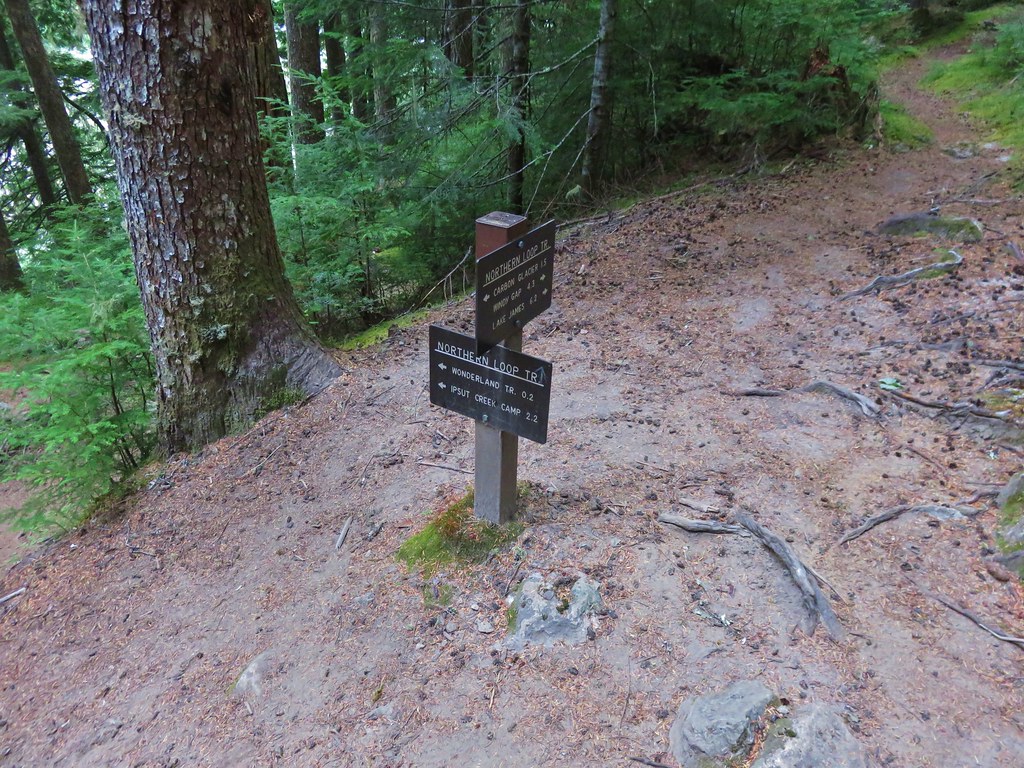
About four and a half miles from Mystic Lake we came to the junction where the Northern Loop Trail split from the Wonderland Trail. The Wonderland Trail crossed the Carbon River on a suspension bridge while the Northern Loop Trail continued to follow the river down the valley. We took a short break here and took a peek at the bridge.
IMG_8054

IMG_8055

IMG_8058

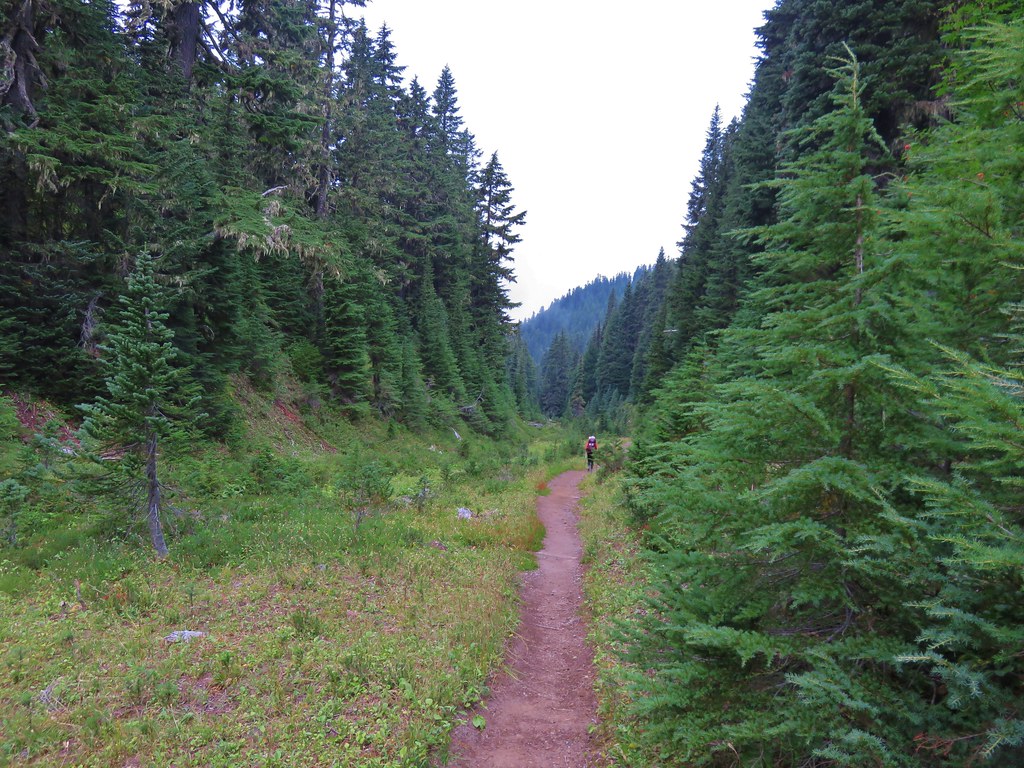
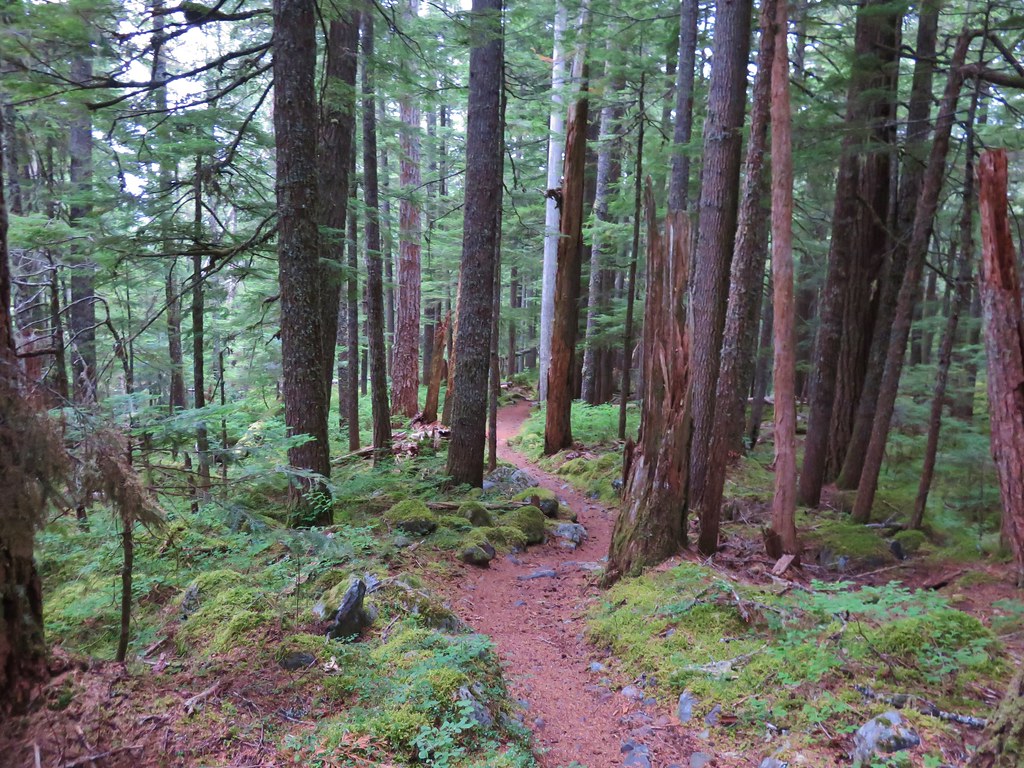
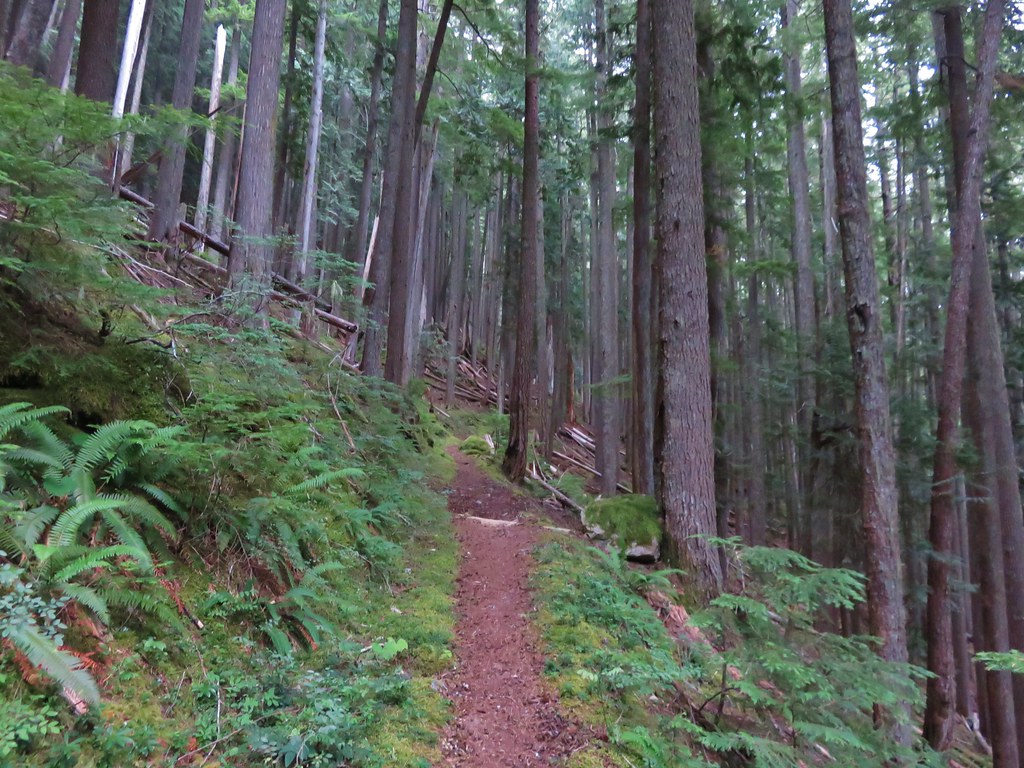
We continued on the Northern Loop Trail for another mile passing through a damp forest to another trail junction.
IMG_8059

IMG_8061

IMG_8072

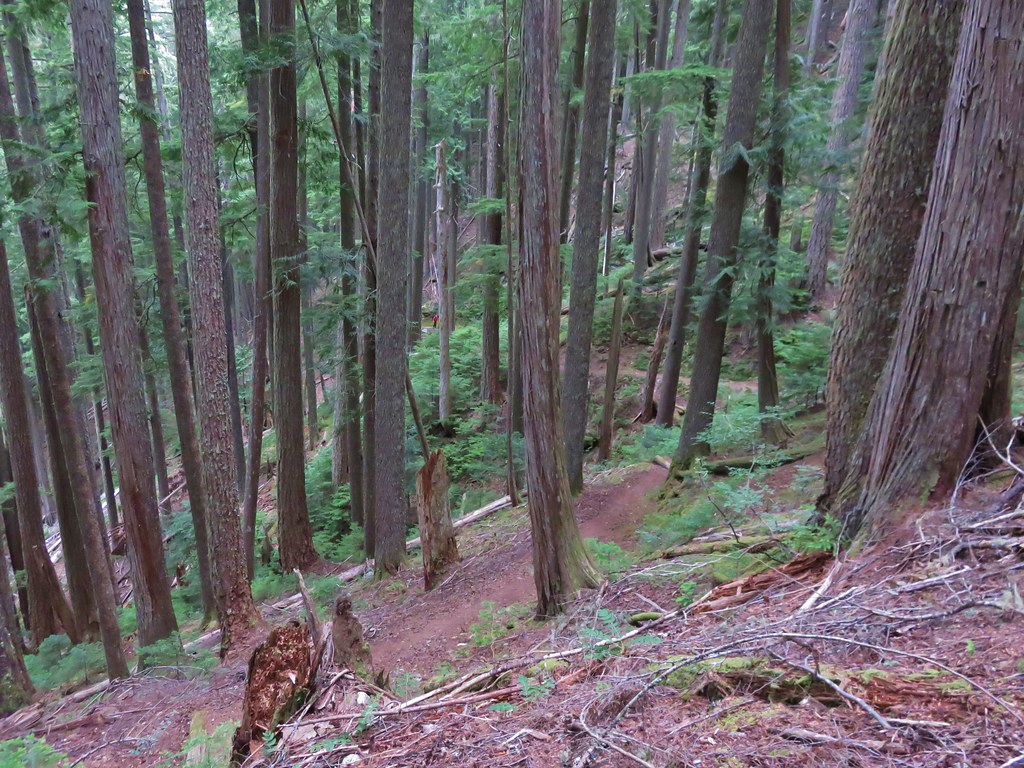
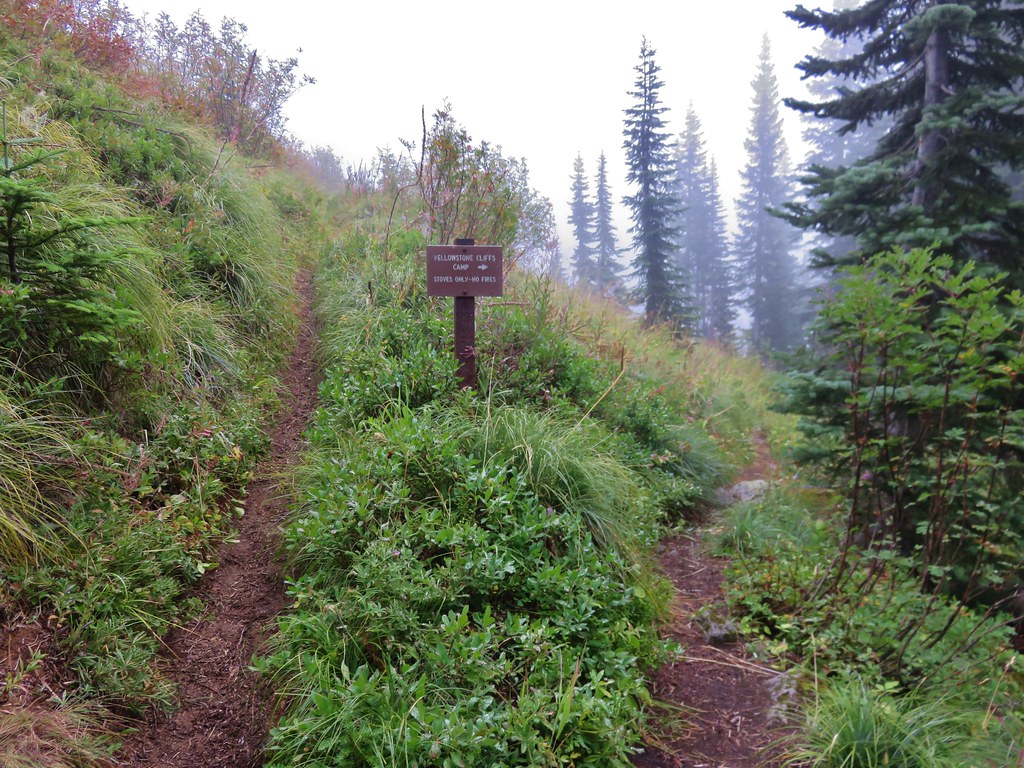
This junction was located near the lowest elevation point of our whole trip. From the junction the Northern Loop Trail turned uphill for a steep climb to Yellowstone Cliffs. We would be gaining some 2200′ in less than 3 miles to reach the spur trail to Yellowstone Cliffs Camp where we were to camp for the night. The park ranger who had given me our permits said the climb consisted of 38 switchbacks so we began counting them as we climbed. As we trudged up the hillside we were thankful for the clouds since they were keeping the temperature down. We were pleasantly surprised when we ended the switchbacks after about two dozen, well short of the 38 we had expected.
IMG_8073

Heather coming up the switchbacks.
IMG_8074

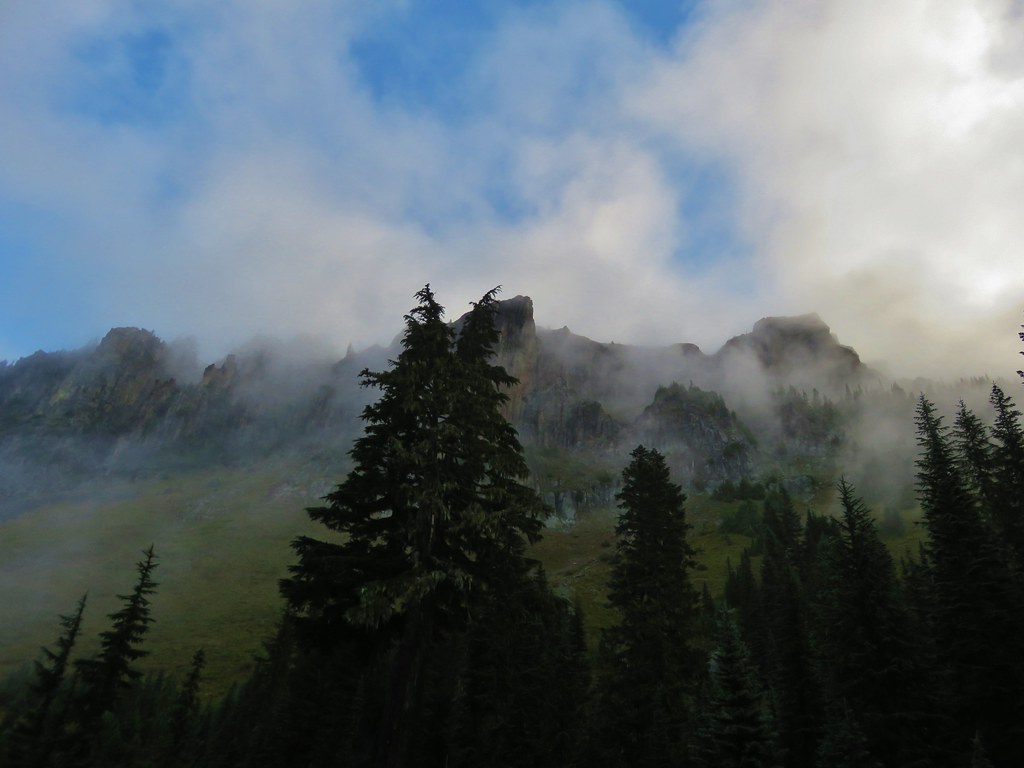
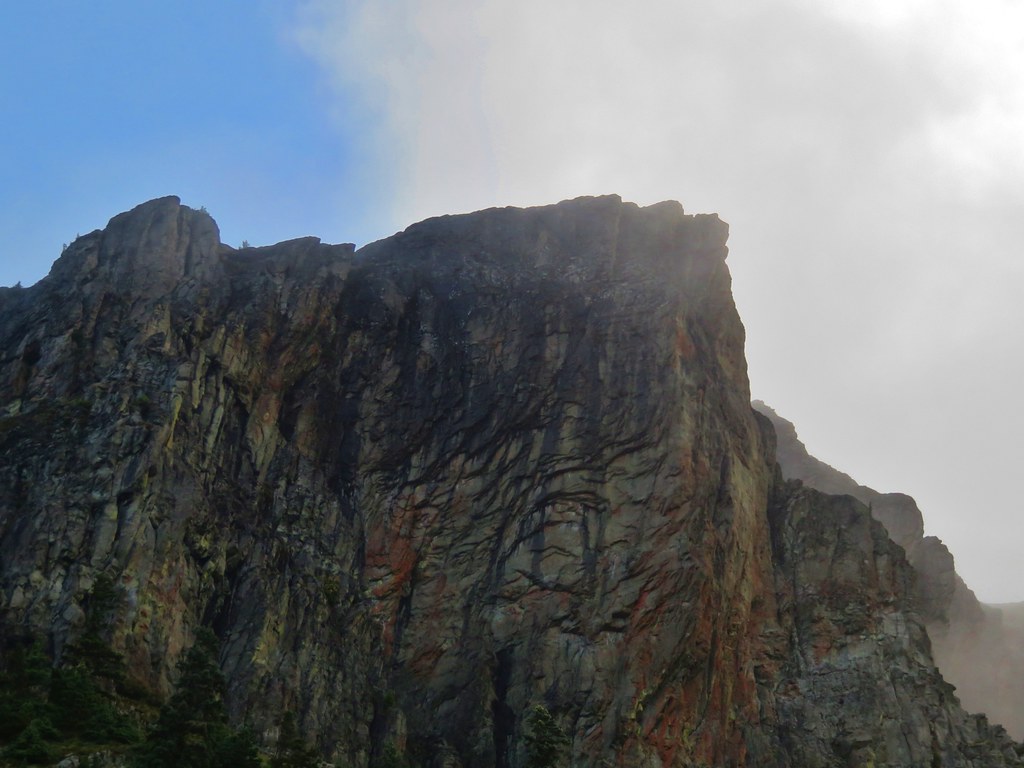
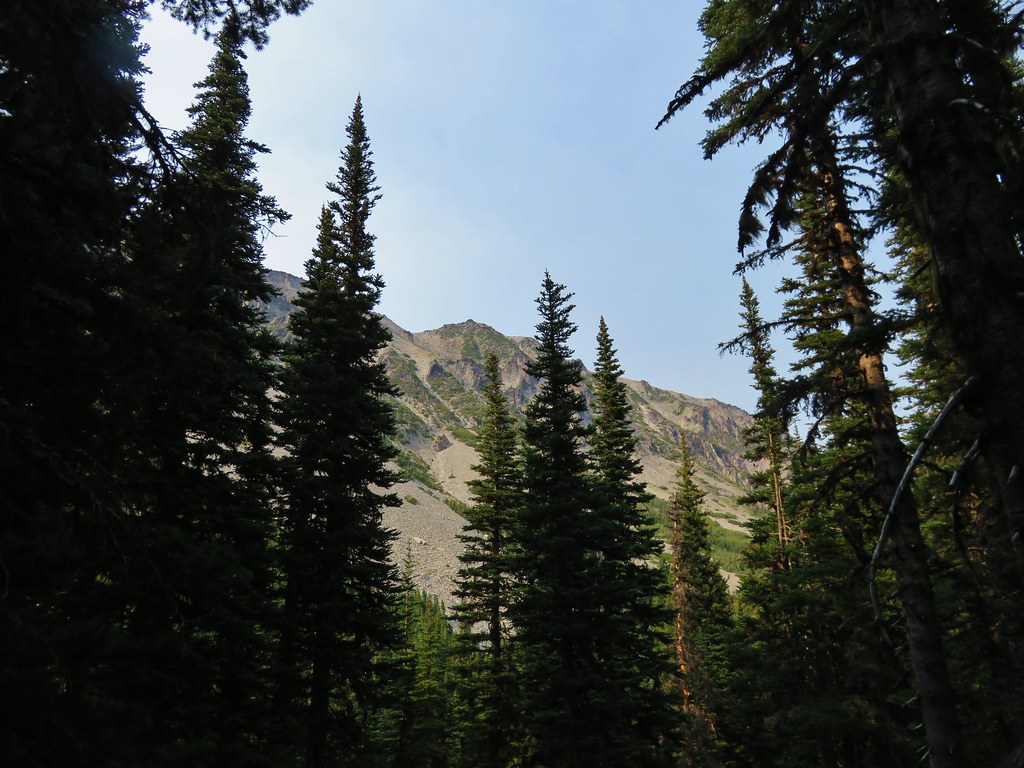
The trail became less steep after the swtichbacks before entering the meadows below Yellowstone Cliffs. The cliffs were shrouded in clouds as we started down the spur trail to camp.
IMG_8075

IMG_8080

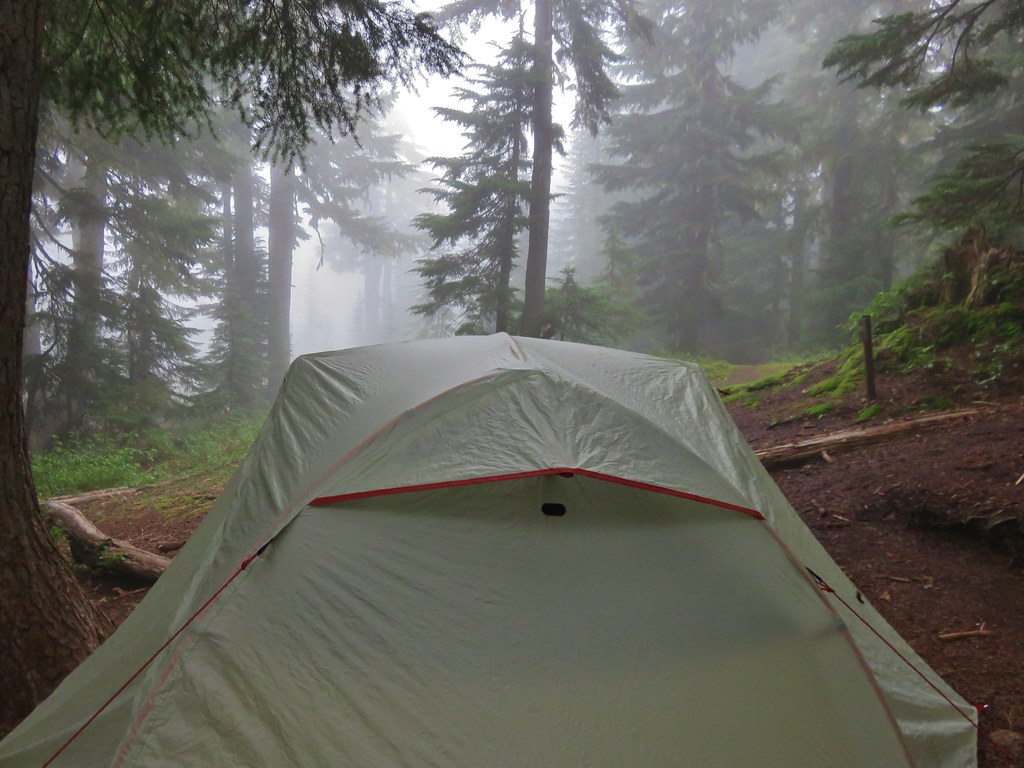
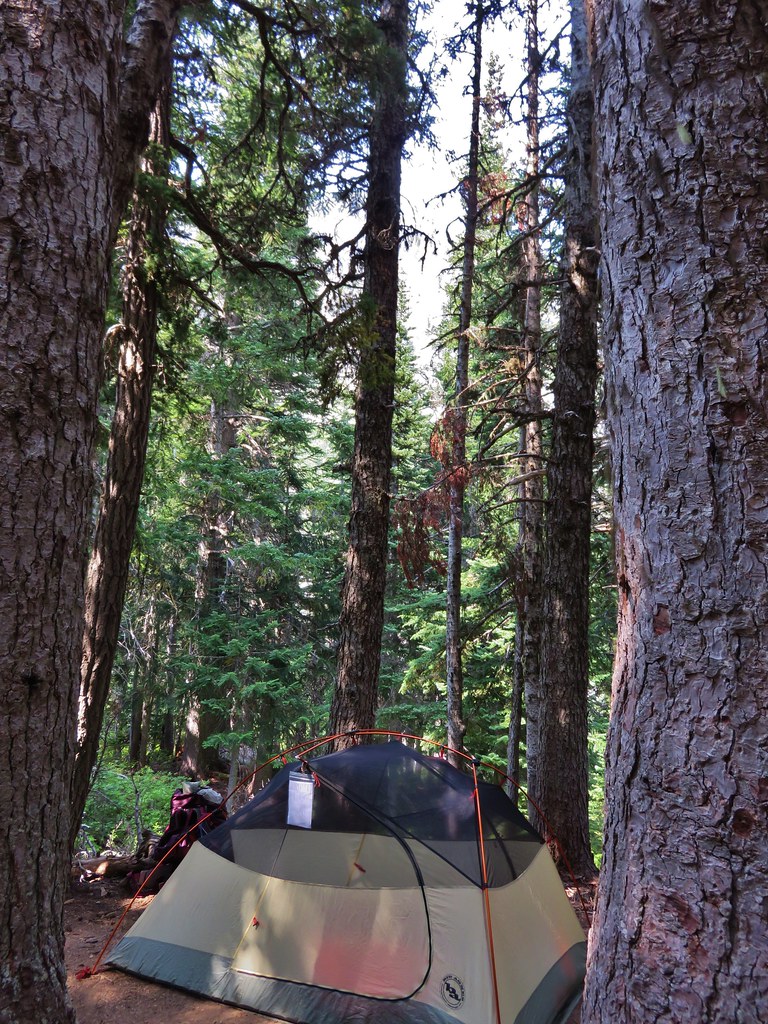
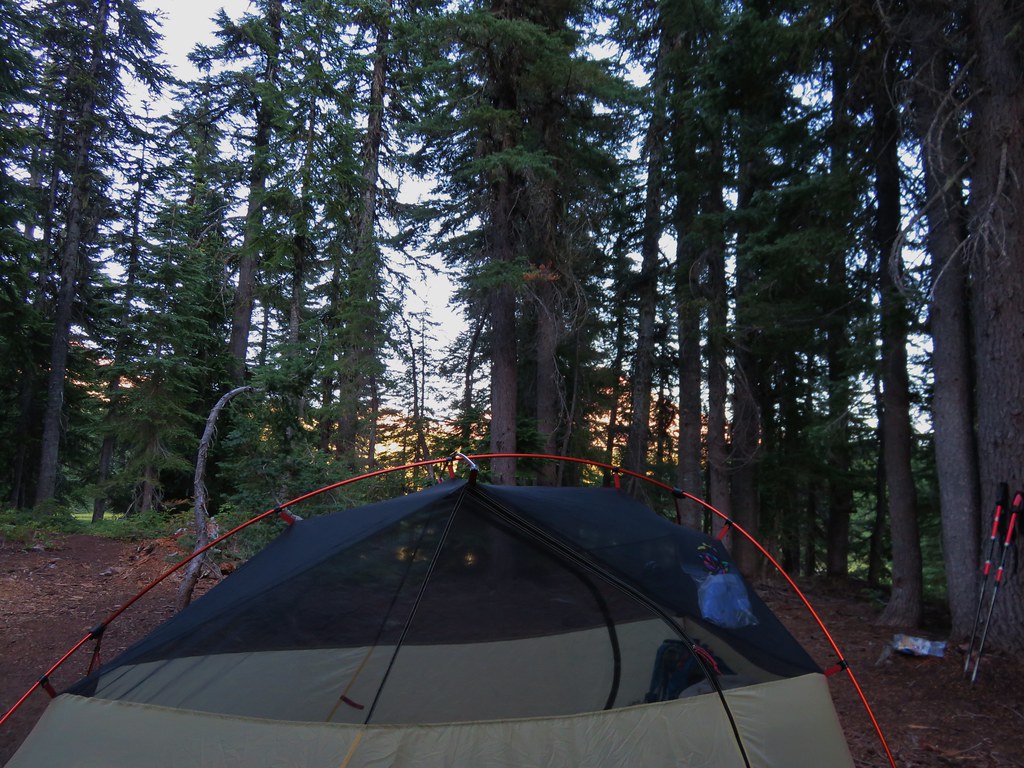
By the time we arrived at the tent sites we were soaked due to the moisture on the plants. We quickly picked out our site and set up our tent.
IMG_8086

Shortly after getting set up the rain began. It was early afternoon when it started and it wouldn’t let up until sometime during the night. This was our first experience with backpacking in the rain and we were a little concerned about our ability to stay dry. This became more of a concern when I noticed water pooling up outside of the tent near our heads. The ground was so dry and hard that the water wasn’t being absorbed at all. I quickly grabbed our trowel and attempted to drain and steer the water away from the tent. We’d also managed to forget to keep any food out for dinner. When it had started raining I ran the bear bag down to the bear pole and hung it without pulling anything out for dinner. We were left with some peanut m&ms, a small package of green olives, and a meat and cheese stick package apiece.

We stayed in the tent except for a quick trip the bathroom before attempting to sleep. Heather didn’t seem to have any trouble but I had a difficult time. The rain kept coming and I couldn’t stop wondering if we would stay dry and on top of that there was an occasional sound of large rocks falling from the cliffs. The camp was far enough away that I wasn’t worried about them at the time, but I wondered what would happen if they were still falling while we were on the trail in them morning. To top it all off my stomach decided that it really would have enjoyed dinner and that made it just a little harder to get any sleep. I managed to get a couple of hours of broken sleep waiting for morning to arrive. Happy (dry) Trails!

Flickr: https://www.flickr.com/photos/9319235@N02/sets/72157657416432875

Categories
Hiking Mt. Rainier Trip report Washington Washington Cascades

Mt. Rainier National Park – Northern Loop Day 1

At the beginning of the year Mt. Rainier National Park was near the top of our list of places we still needed to visit. On our initial hiking schedule I put down four days at Mt. Rainier and began researching possible hikes. The Northern Loop Trail looked to be the perfect choice coming in at close to 40 miles. We decided to submit a request for the necessary wilderness permits in hopes that we would be lucky enough to acquire them. In order to camp in the parks wilderness we needed to have permits and the number of permits are limited due to the limited number of designated camp sites available. The park began accepting permit applications on March 15th and ours was in the mail that day. All requests submitted between 3/15 and 3/31 were collected and on April 1st they began to process them. We found out on May 1st that our application had been accepted and our planned itinerary approved. We had requested Thursday 8/13/15 thru Sunday 8/17/15 with our camp sites being Mystic Camp, Yellowstone Cliffs Camp, and Fire Creek Camp.

We had been excited about the possibility of this trip even before finding out that we got our permits and that excitement only grew when we got the good news. As the date of our trip approached we kept a close eye on wildfire and weather information. Although it has been a bad year for fires none were affecting the park which was good news. The weather news was a little less exciting. The forecast called for a chance of showers or thunderstorms Thursday afternoon and evening and rain on Friday, possibly up to half an inch. There was also a slight chance of showers Saturday morning before becoming sunny for the rest of the weekend. We had our reservations though so we made sure we had plenty of waterproof gear before heading to the park.

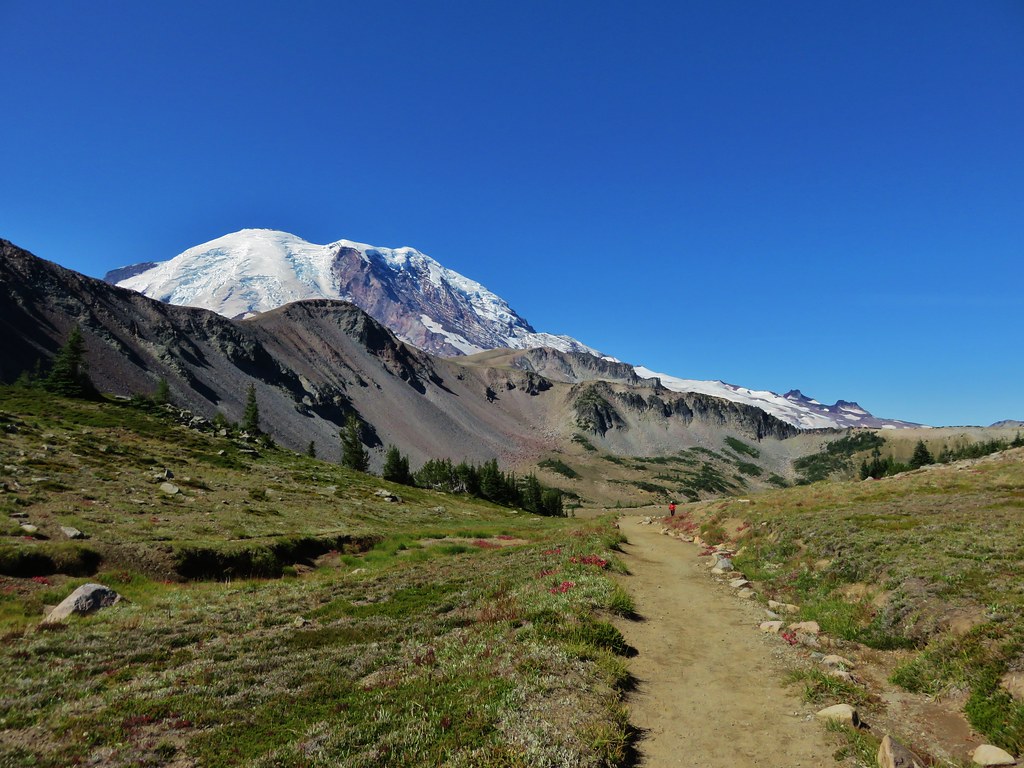
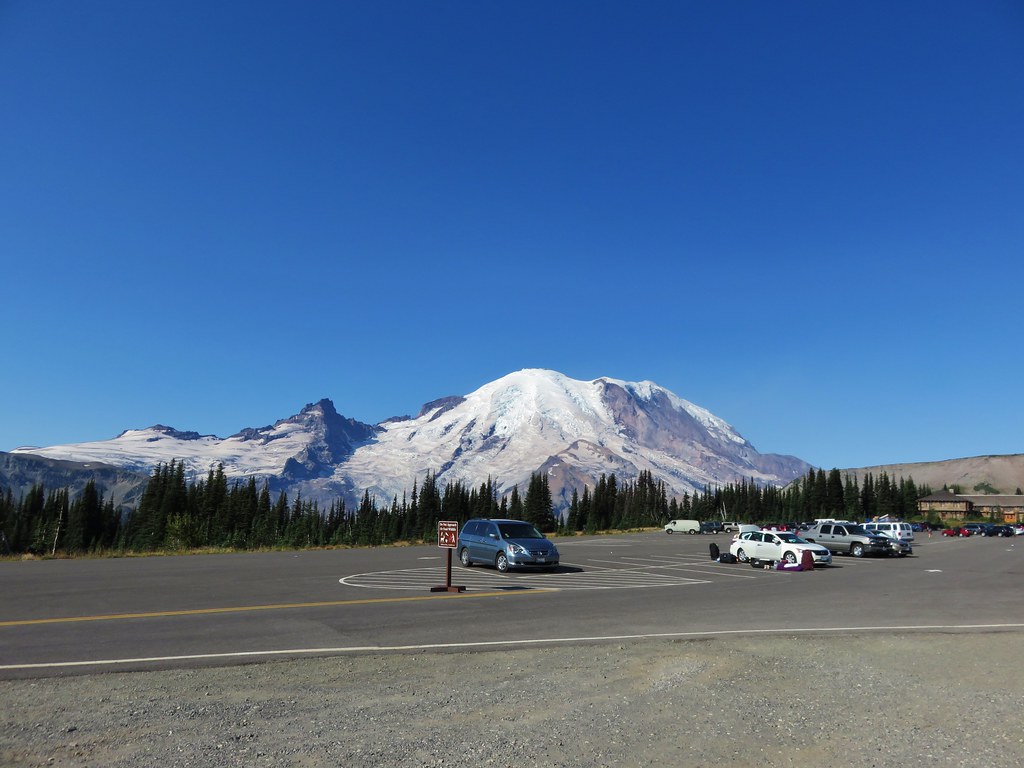
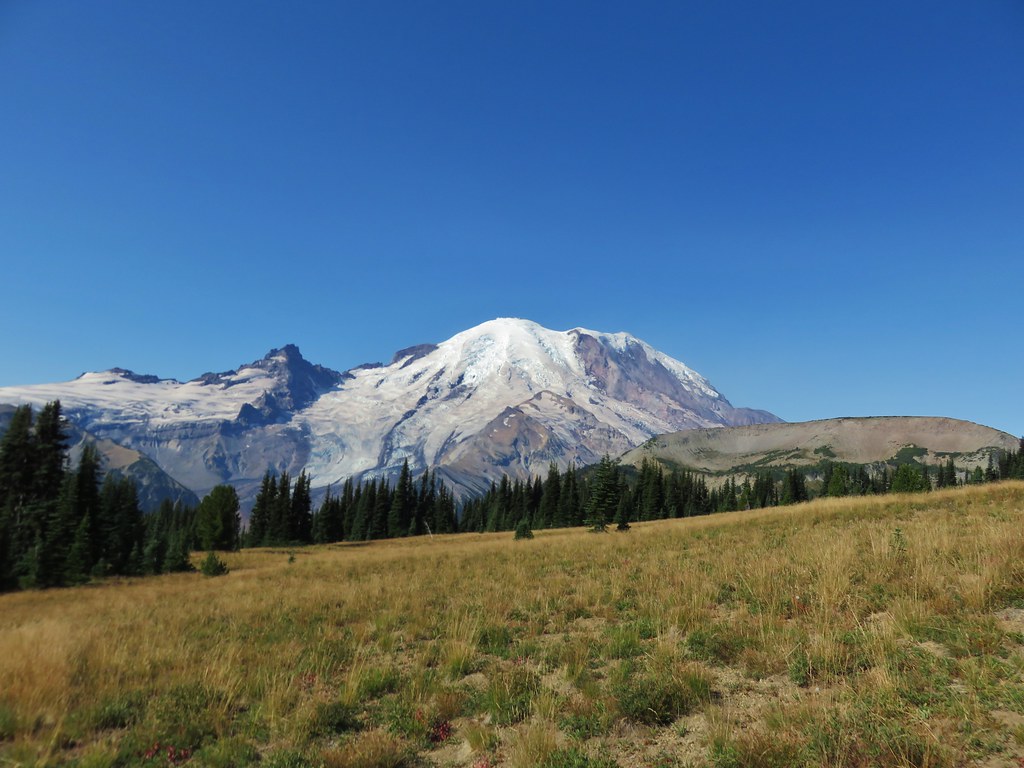
The weather was beautiful when we arrived at the Sunrise Visitors Center on Thursday morning. Mt. Rainier was as massive as we’d been led to believe and we couldn’t wait to get started.
IMG_7598

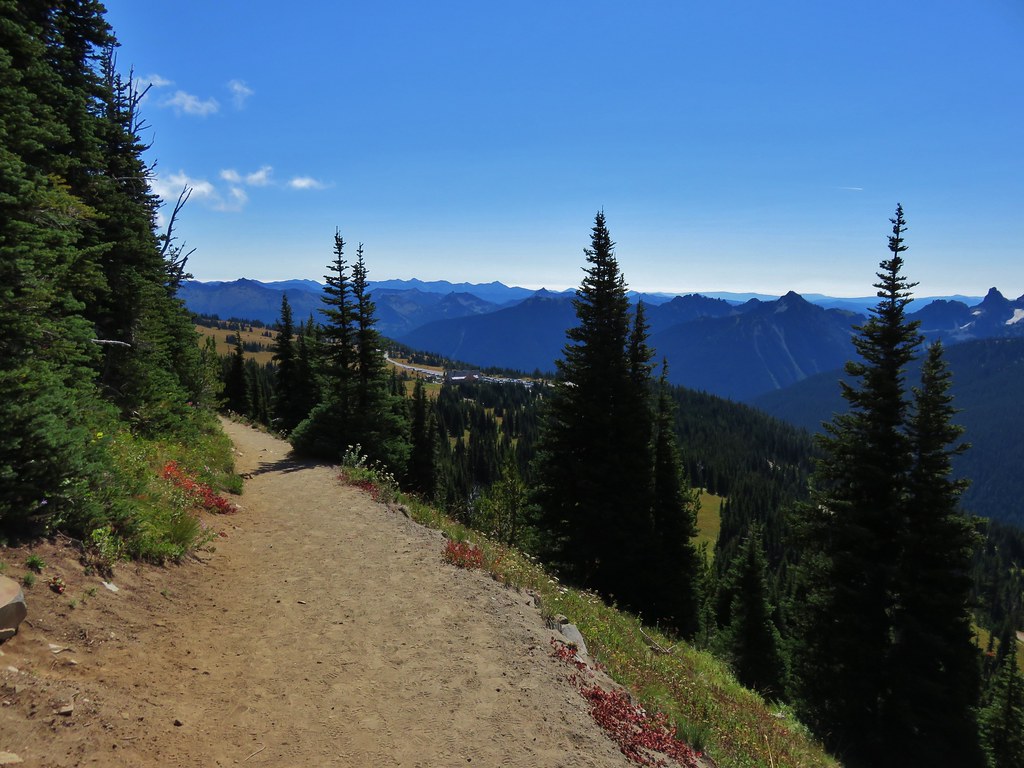
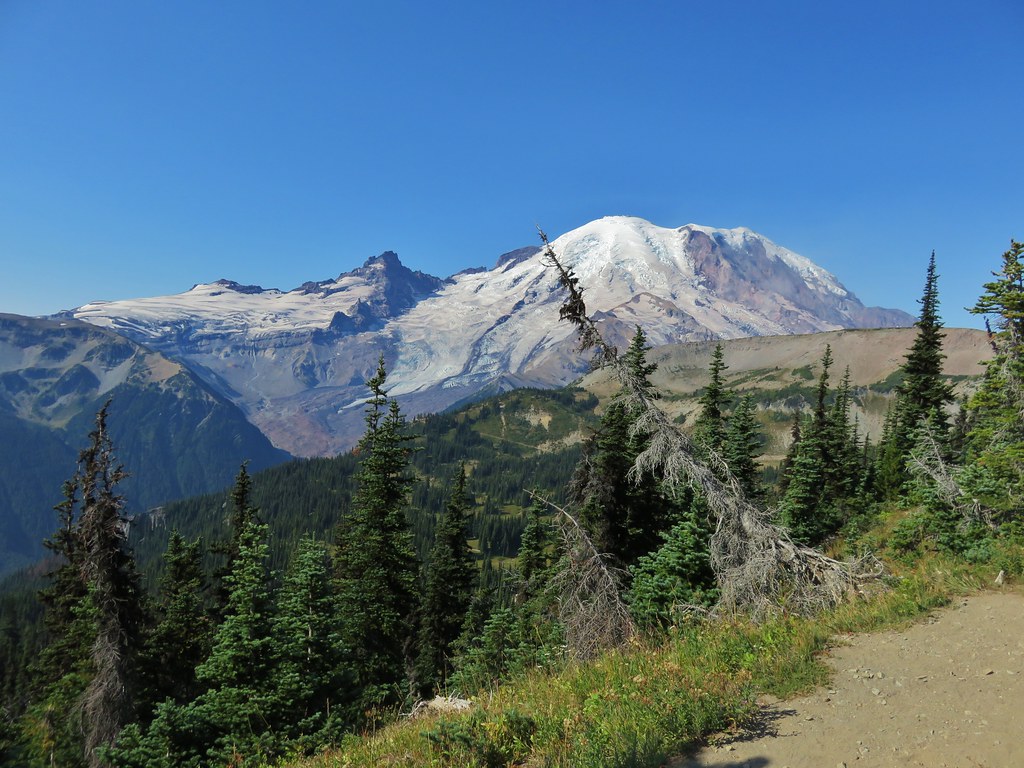
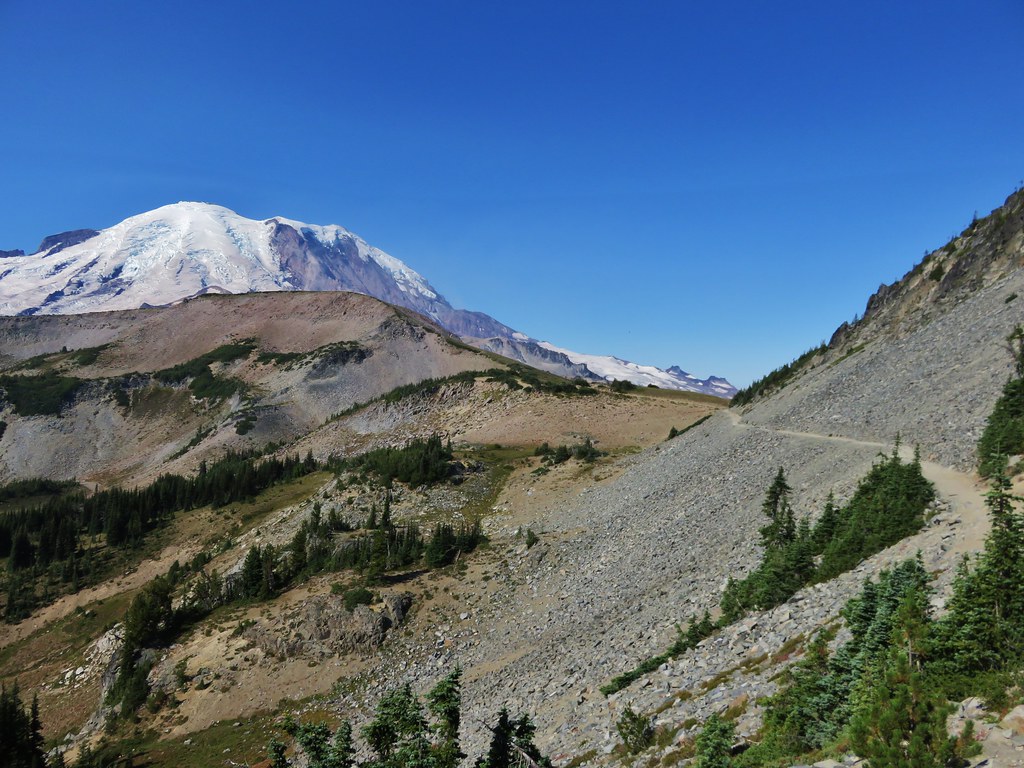
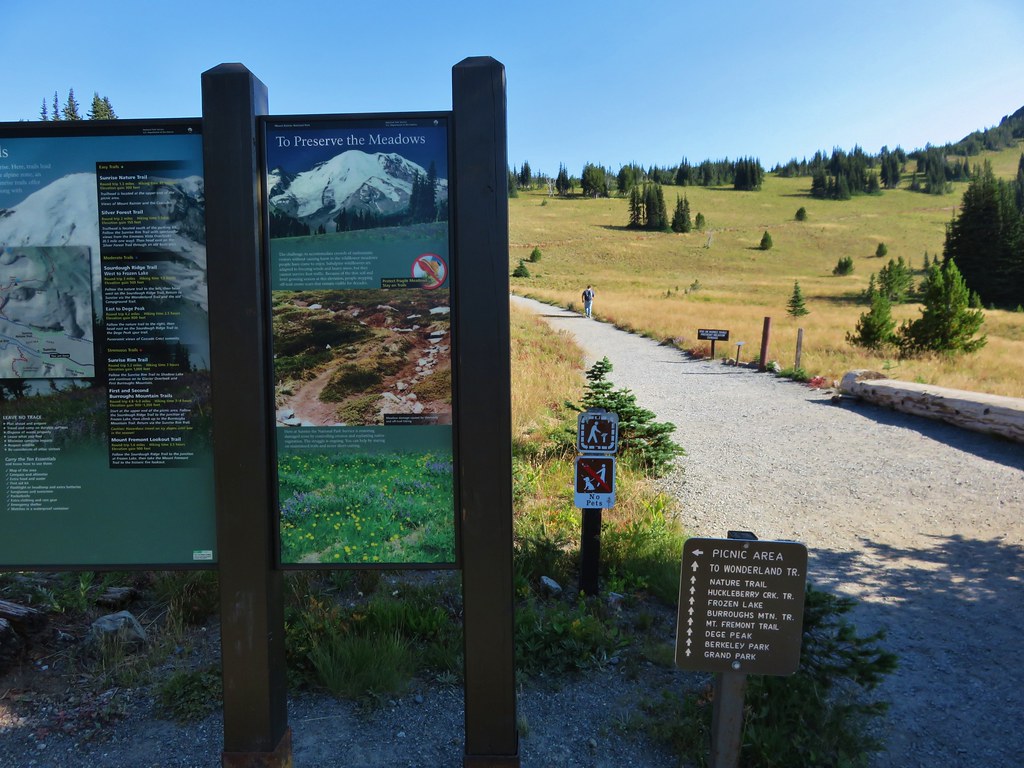
We took the Sourdough Ridge Trail up toward the Wonderland Trail (the 93 mile trail that loops the entire mountain) marveling at the views along the way.
IMG_7625

IMG_7636

IMG_7604

IMG_7605

IMG_7608

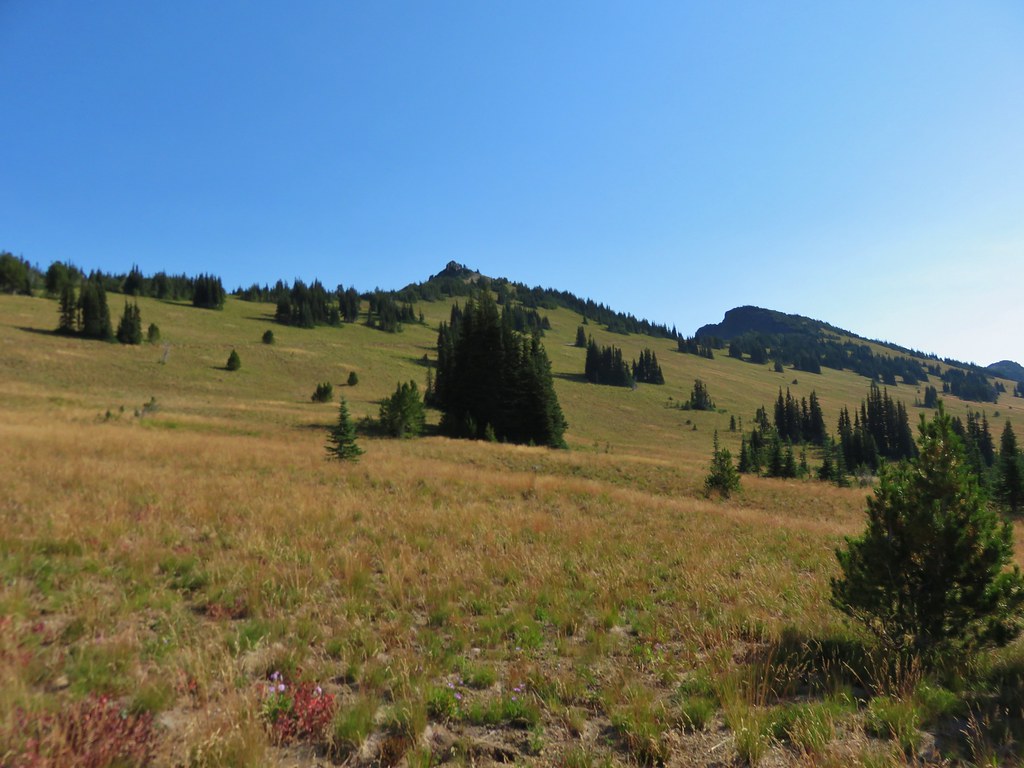
In a typical year the flower displays would have been near their peak but just like the rest of the Pacific Northwest they had bloomed at least a month earlier than normal. It didn’t matter though because the scenery and views were spectacular and the few flowers that remained gave us an idea of what it might look like in full bloom.
IMG_7611

IMG_7615

IMG_7616

IMG_7623

IMG_7629

IMG_7638

We met the Wonderland Trail near Frozen Lake. This lake acts as a domestic water supply and was roped off.
IMG_7639

IMG_7645

Two other trails met at the junction, the Mt. Freemont Trail and the Burroughs Mountain Trail. Both of these looked interesting but would have to wait for another day.
IMG_7646

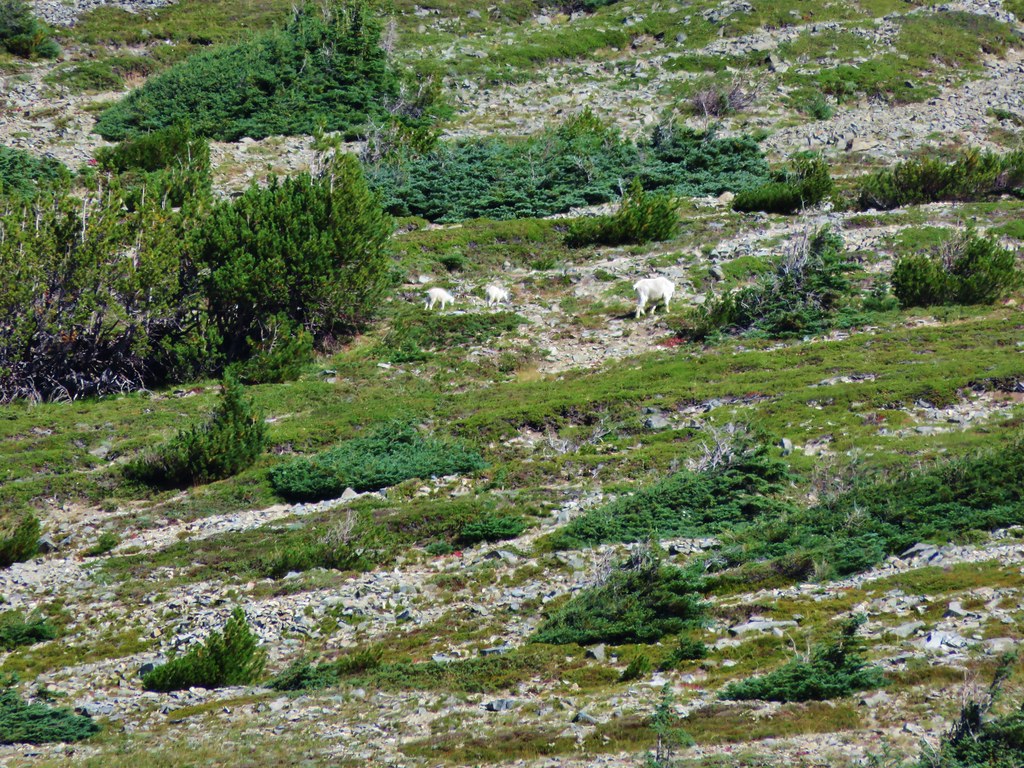
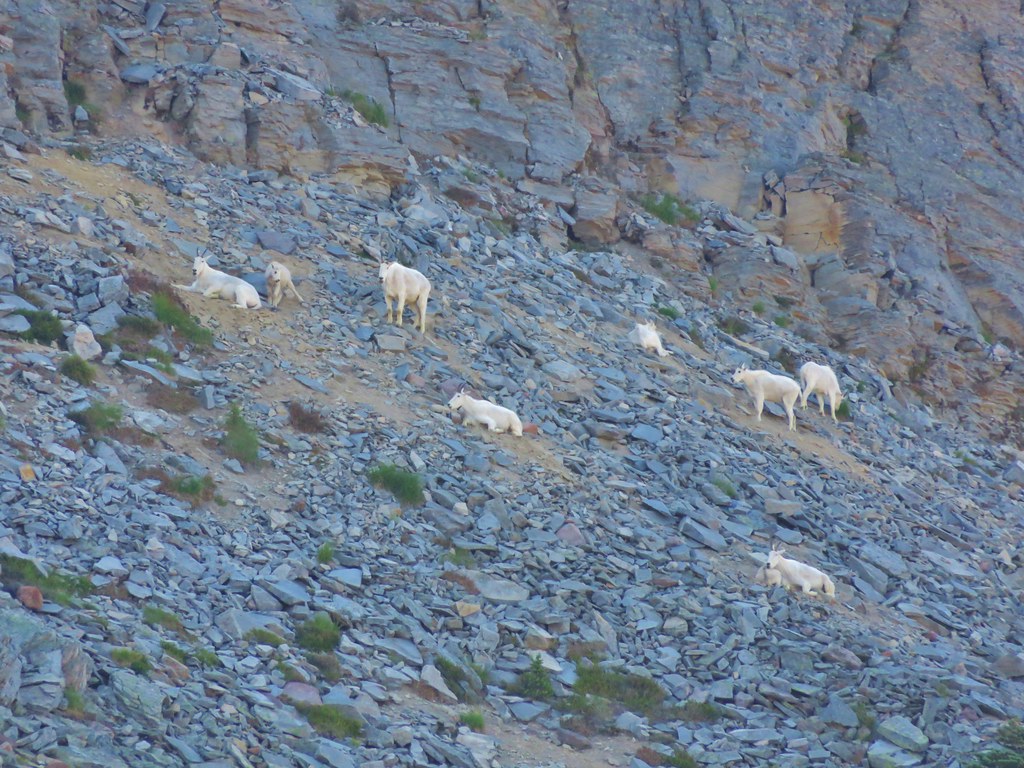
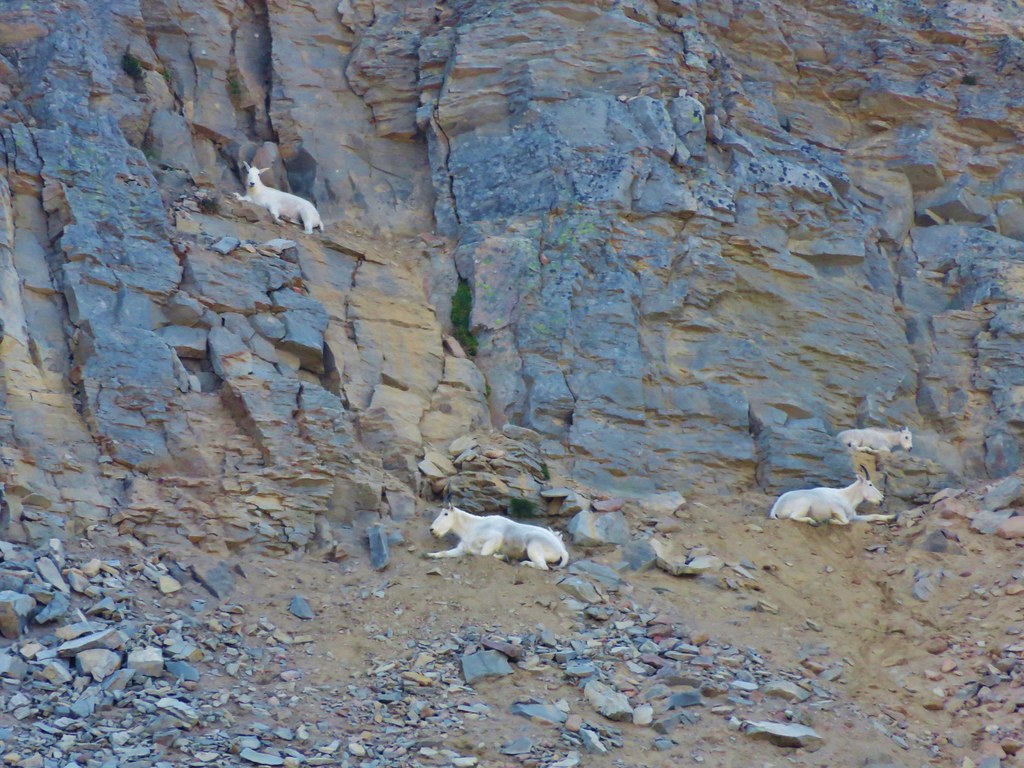
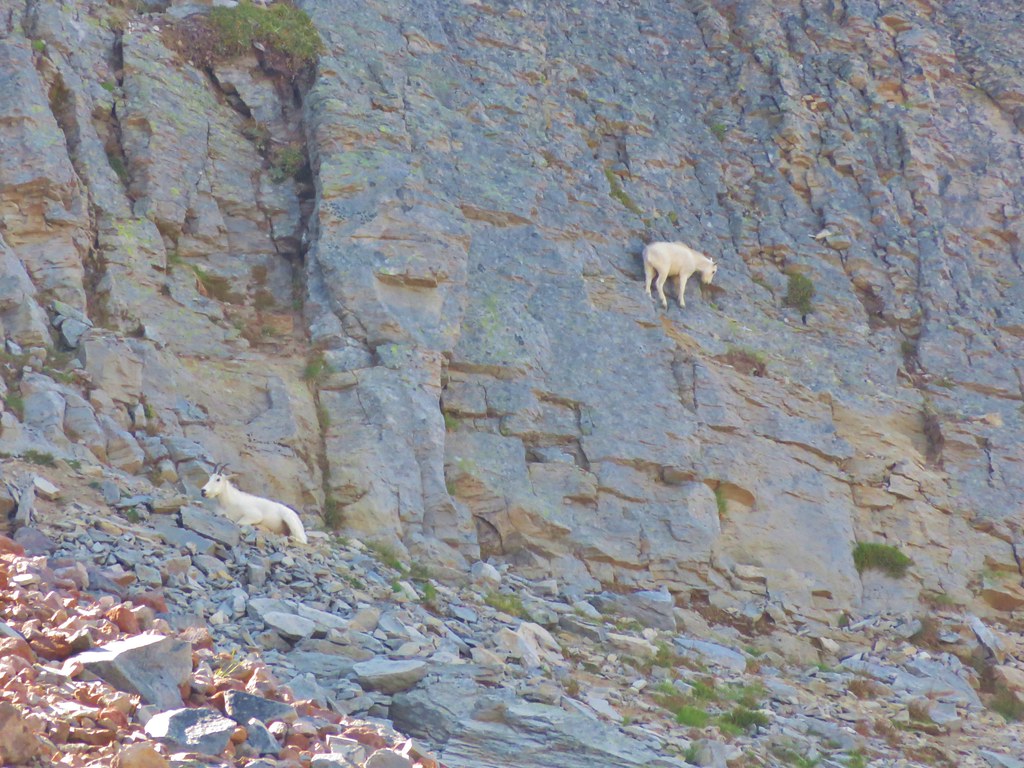
We took the Wonderland Trail which passed below Burroughs Mountain where we spotted over two dozen mountain goats lounging in the shade of the cliffs.
IMG_7657

IMG_7660

IMG_7665

IMG_7675

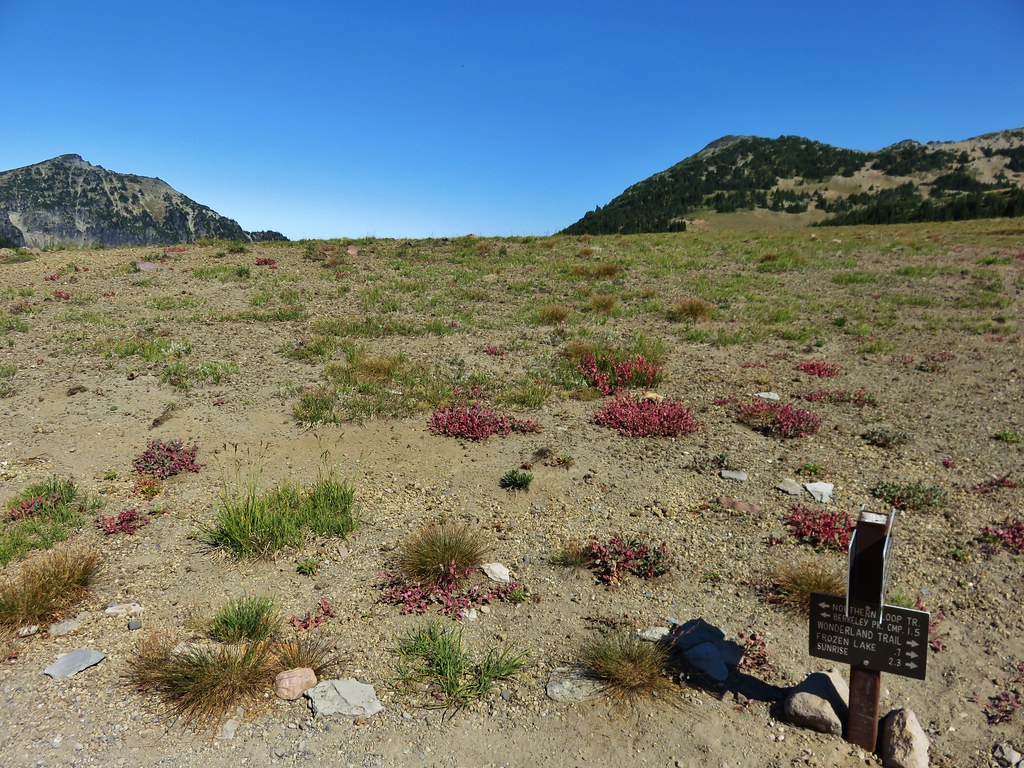
We continued down to another junction, this one with the Northern Loop Trail. This would be our return route to complete the loop on Sunday.
IMG_7678

IMG_7679

From the Wonderland Trail we had a good view of the climb that awaited us on that final day.
IMG_7684

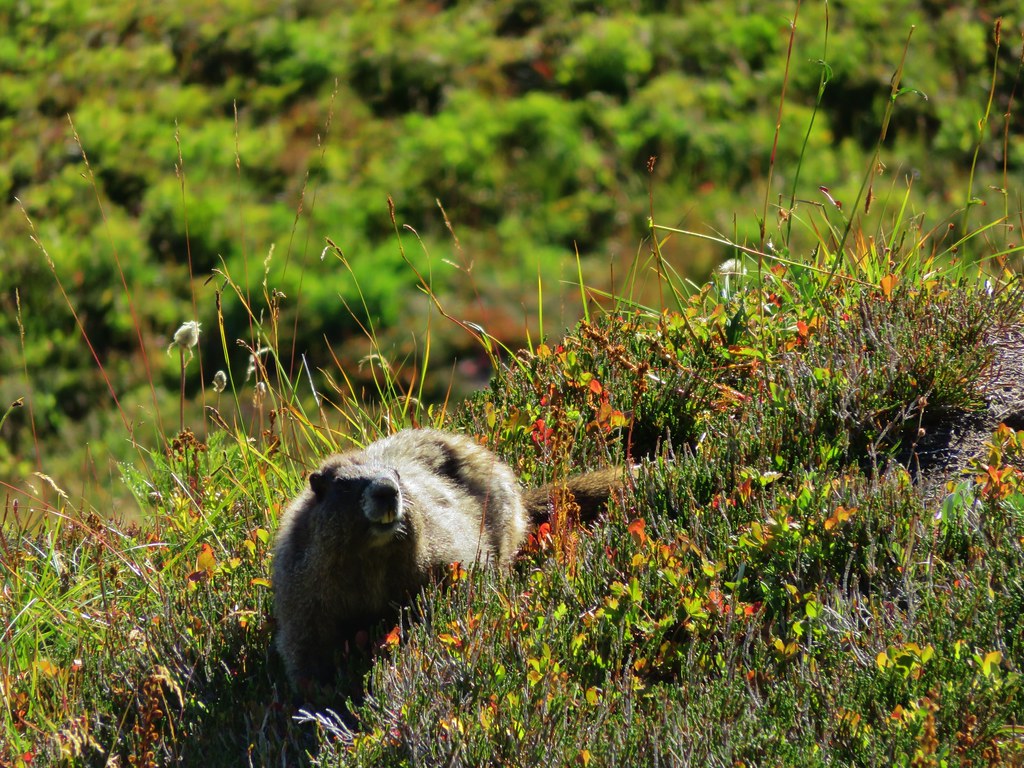
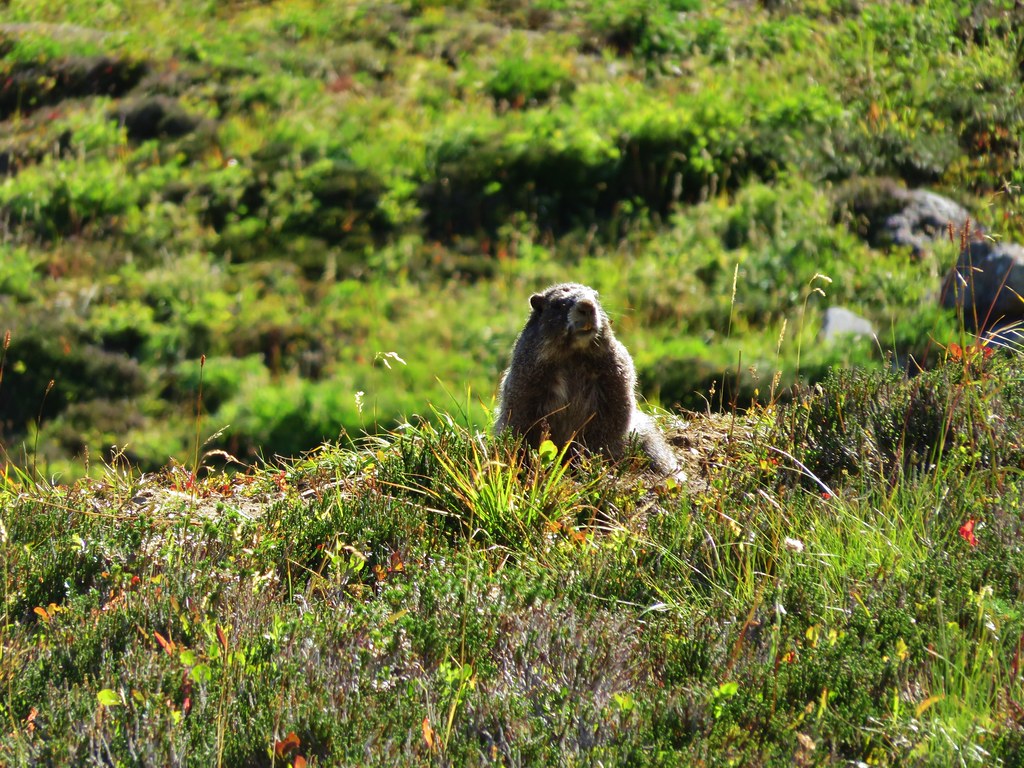
The Wonderland Trail then climbed to a pass on a ridge below Skyscraper Mountain where we took our first snack break where we were joined by a marmot.
IMG_7702

IMG_7710

IMG_7712

From the pass the trail then headed downhill into a forest passing Granite Creek Camp.
IMG_7718

IMG_7730

IMG_7738

IMG_7745

We were on our way down to the Winthrop Glacier and to a crossing of Winthrop Creek. The sky had become rather hazy by the time we made it down to the glacier making it difficult to see the mountain. The glacier was much larger than any we’d been around on other mountains in the Cascades.
IMG_7768

IMG_7769

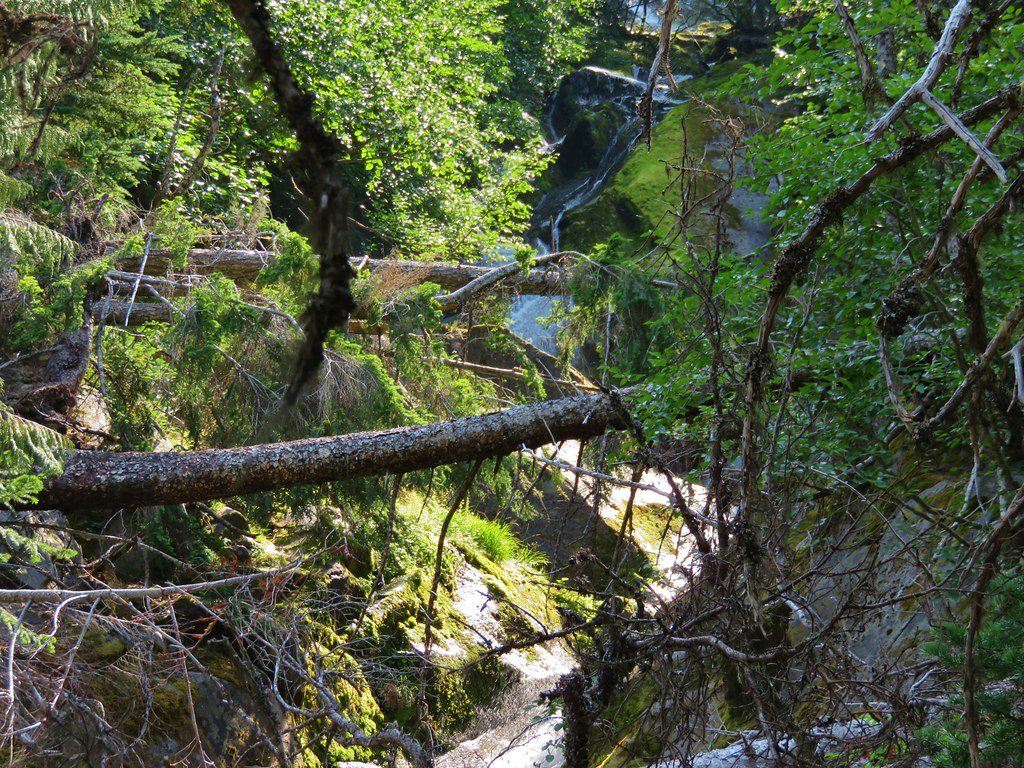
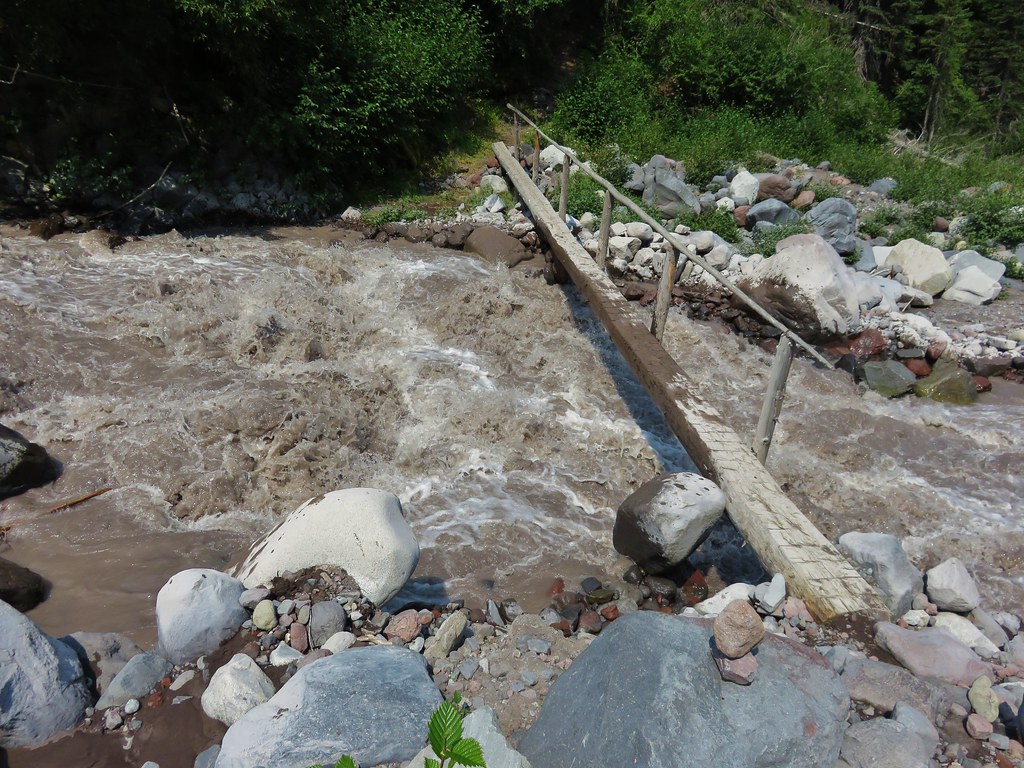
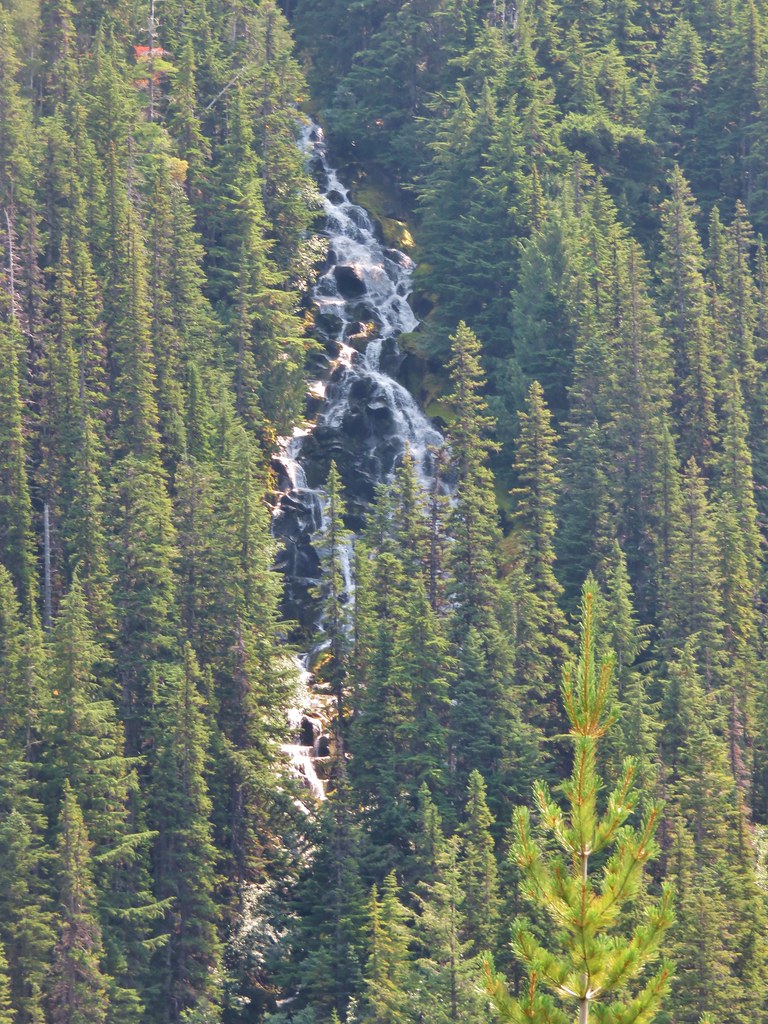
We passed under Garda Falls which was hidden from the trail, but after crossing Winthrop Creek on a foot bridge and climbing a bit we could look back and see the falls in the forest.
IMG_7781

IMG_7790

IMG_7800

We climbed out of the glacial outwash plain and back into the forest.
IMG_7794

IMG_7803

IMG_7805

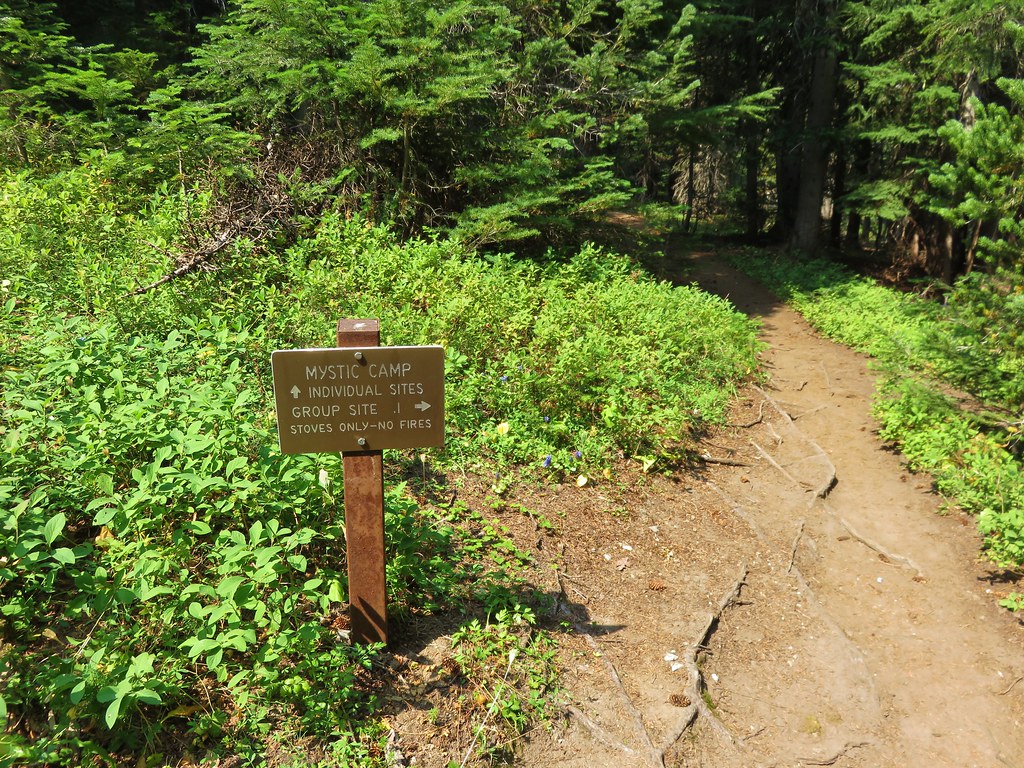
Shortly after reentering the forest we arrived at a sign announcing Mystic Camp where we picked out a site and set up camp.
IMG_7817

IMG_7818

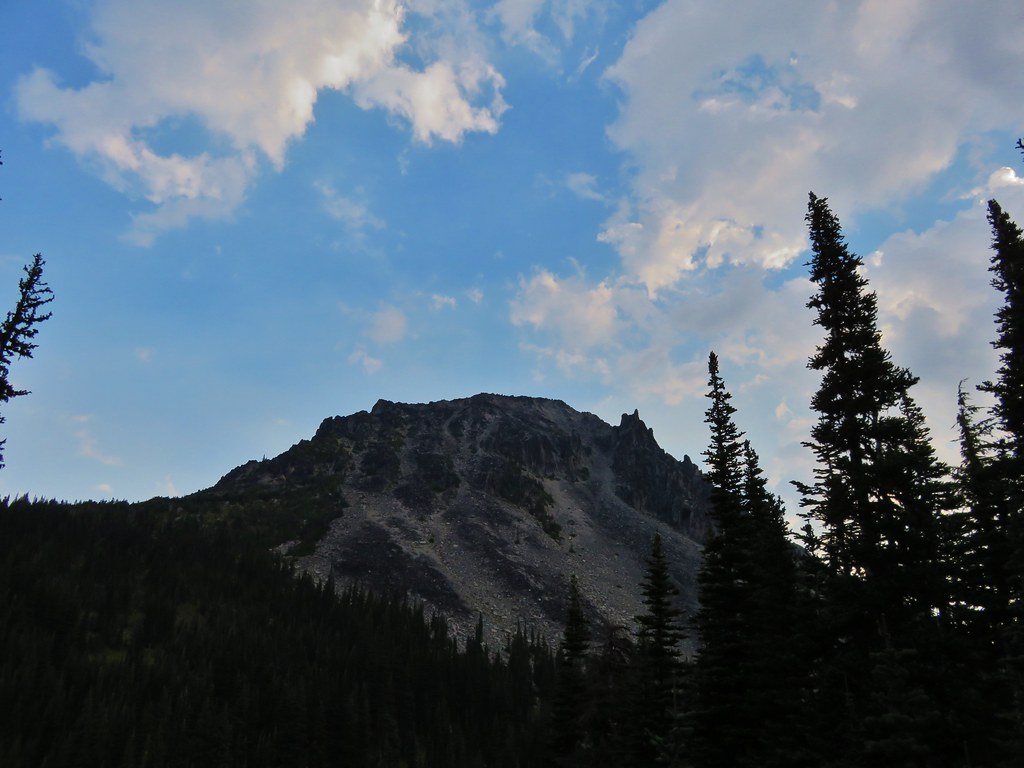
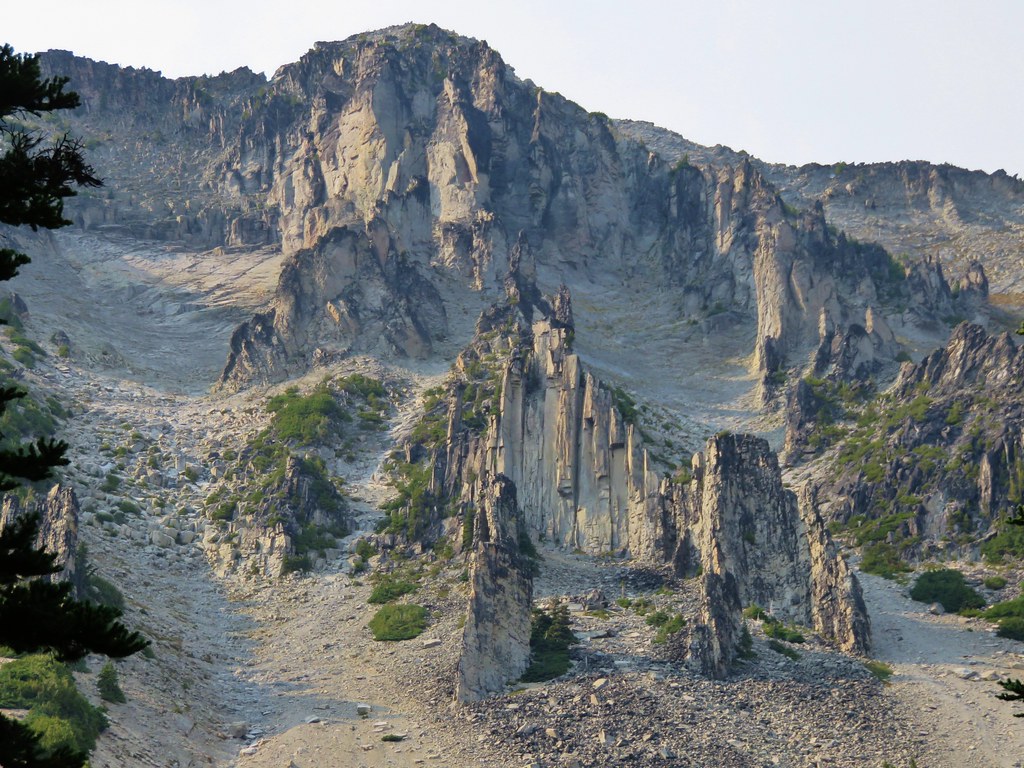
The camp was below Old Desolate and near Mystic Lake. The rocks on Old Desolate were very interesting.
IMG_7820

IMG_7824

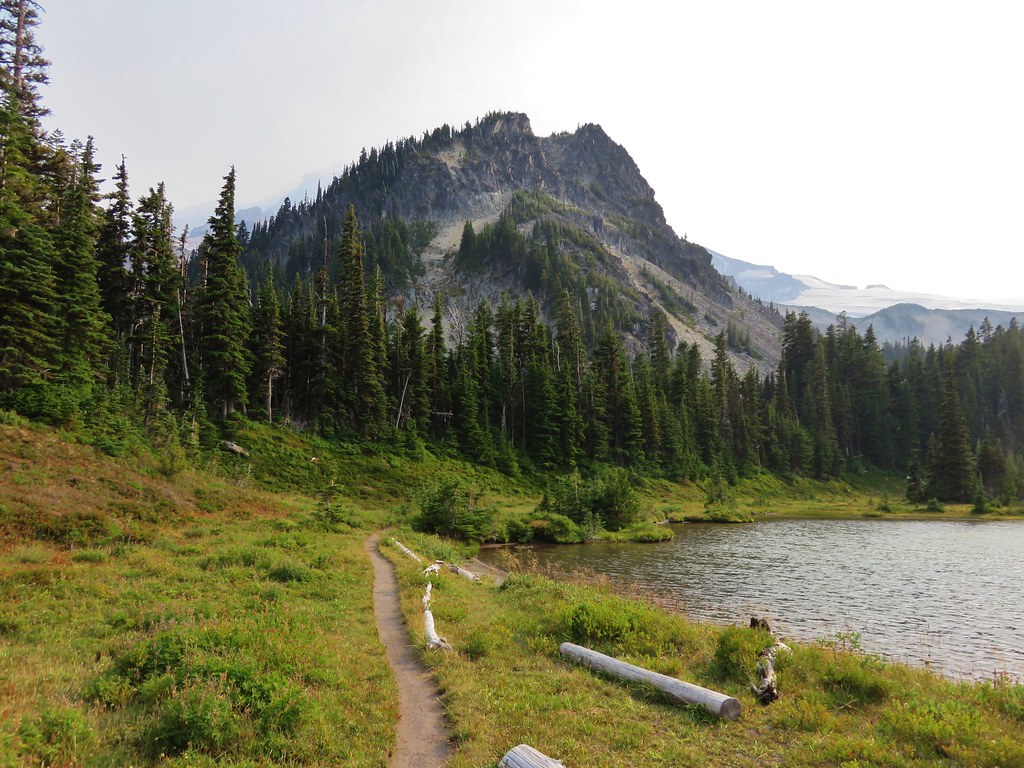
After setting up camp we headed up the trail to Mystic Lake. It was a pretty alpine lake nestled between Mineral Mountain and Old Desolate. The lake shore was dotted with gentians.
IMG_7835

IMG_7842

IMG_7841

IMG_7839

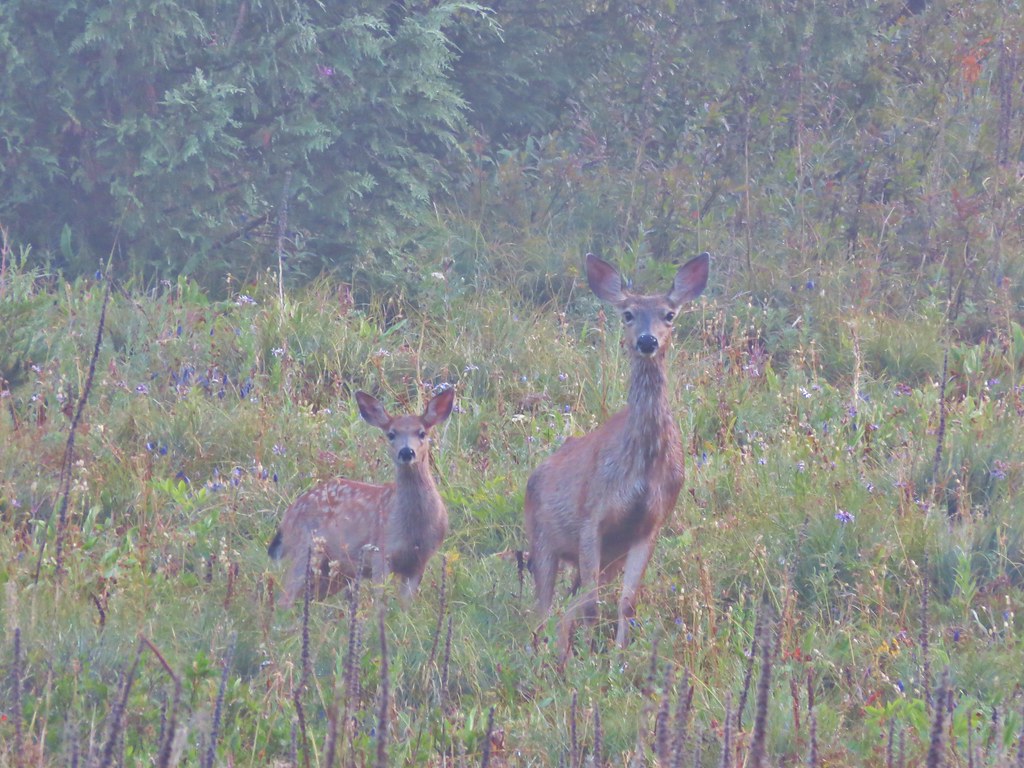
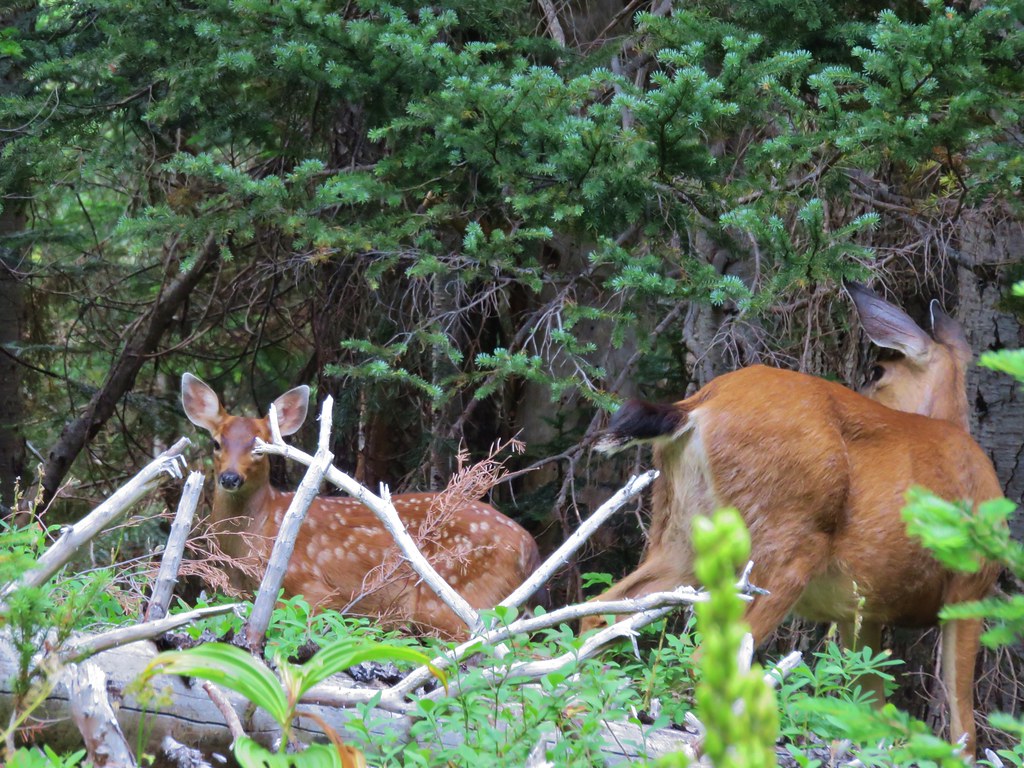
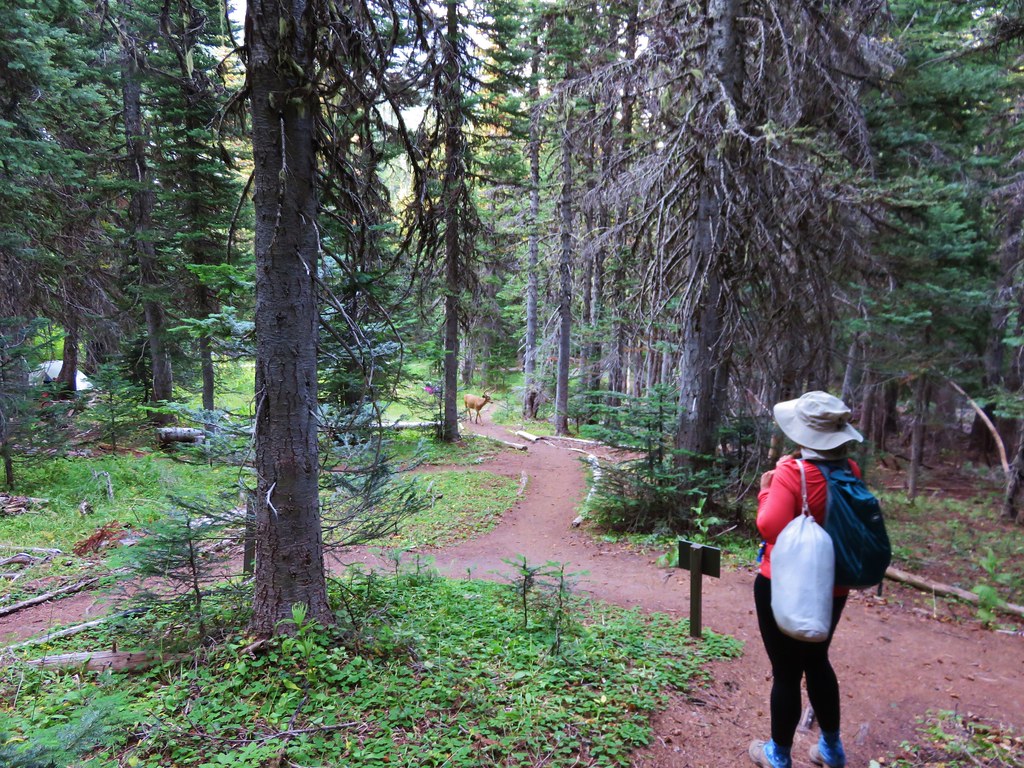
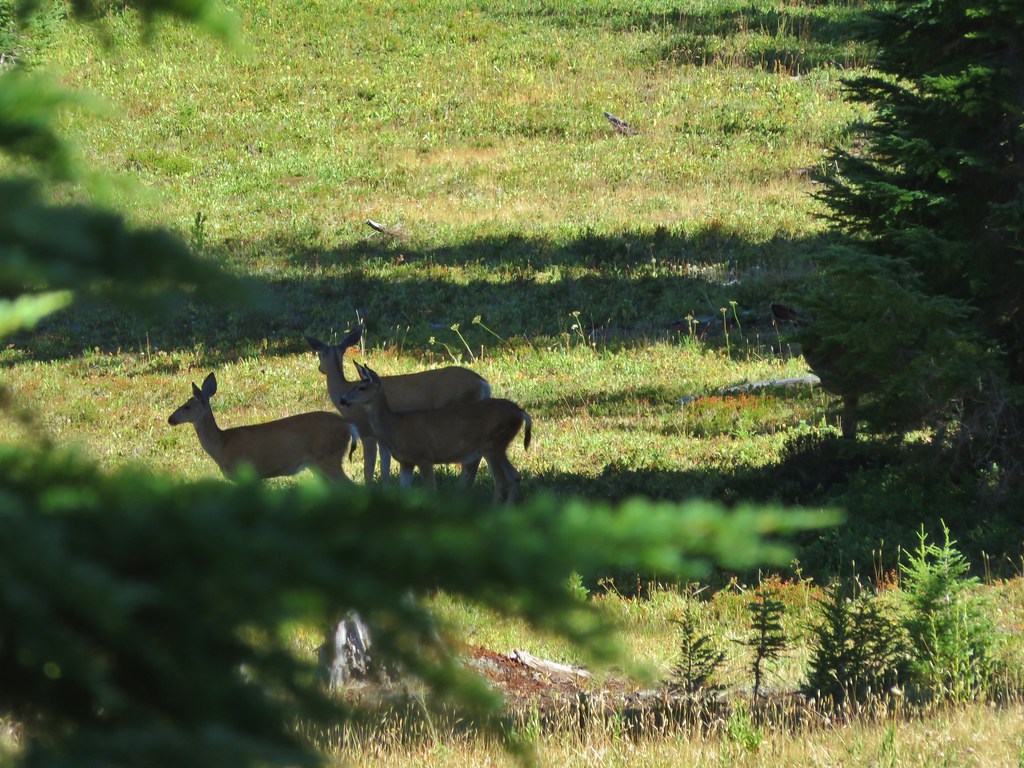
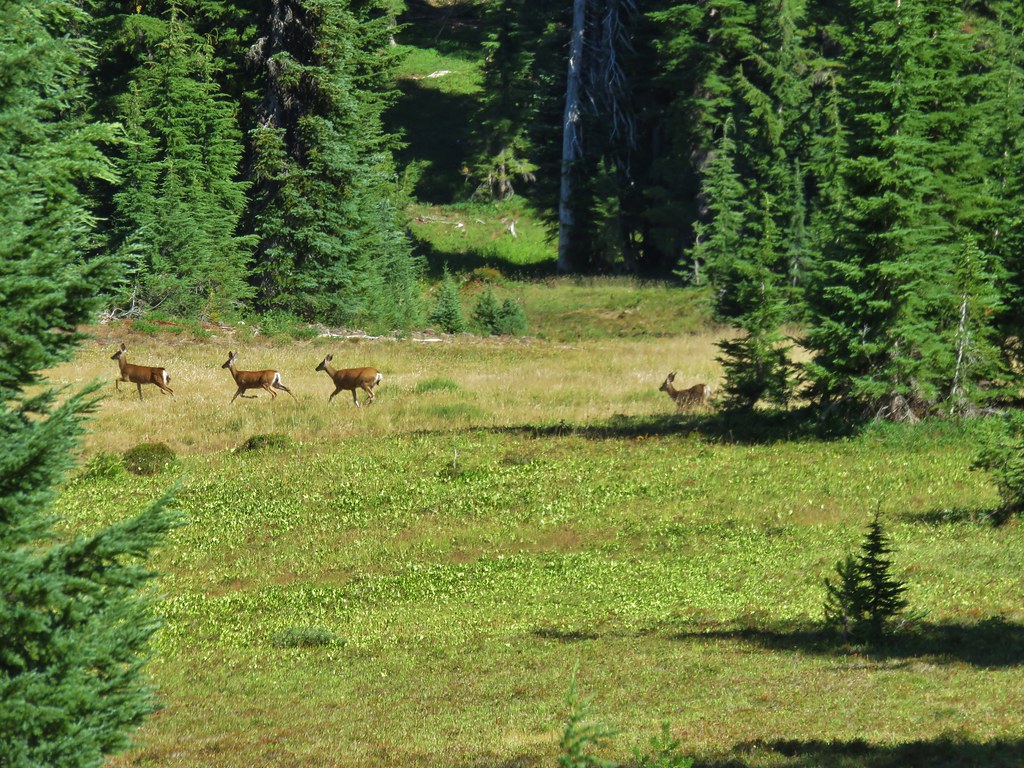
We decided to have our dinner at the lake but hadn’t brought it with us so Heather headed back to camp to get our stove and food. When she got back she told me she met a doe and her two fawns along the trail. After dinner we headed back to camp and discovered the deer were still in the small meadow where she had seen them earlier.
IMG_7863

IMG_7869

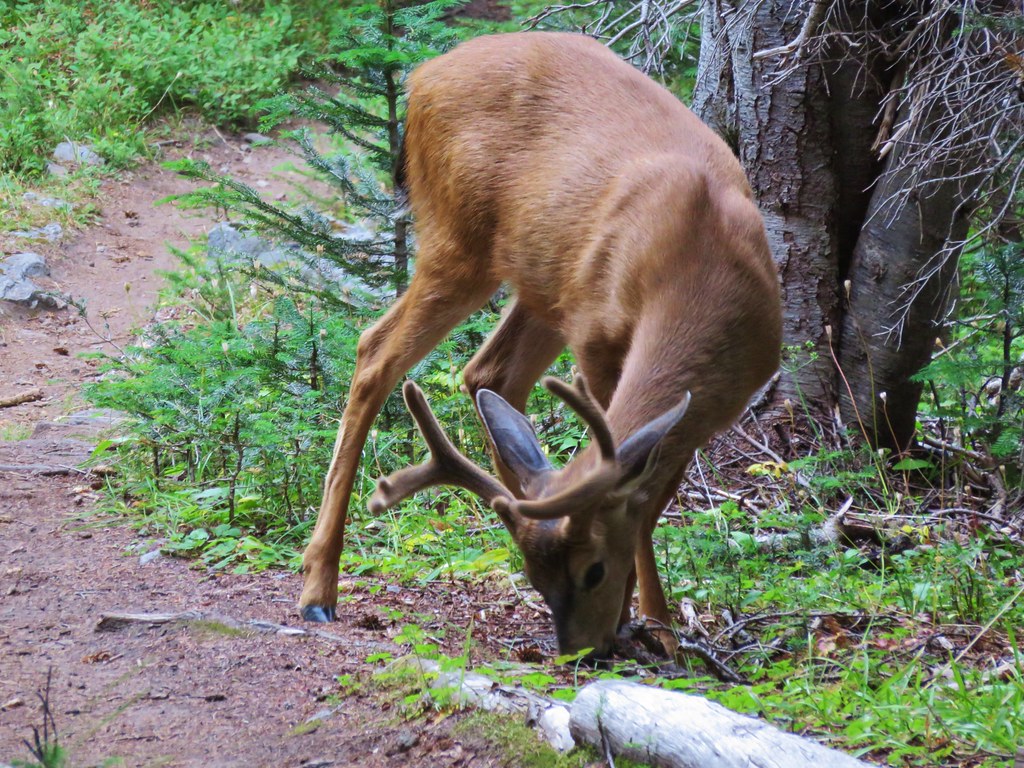
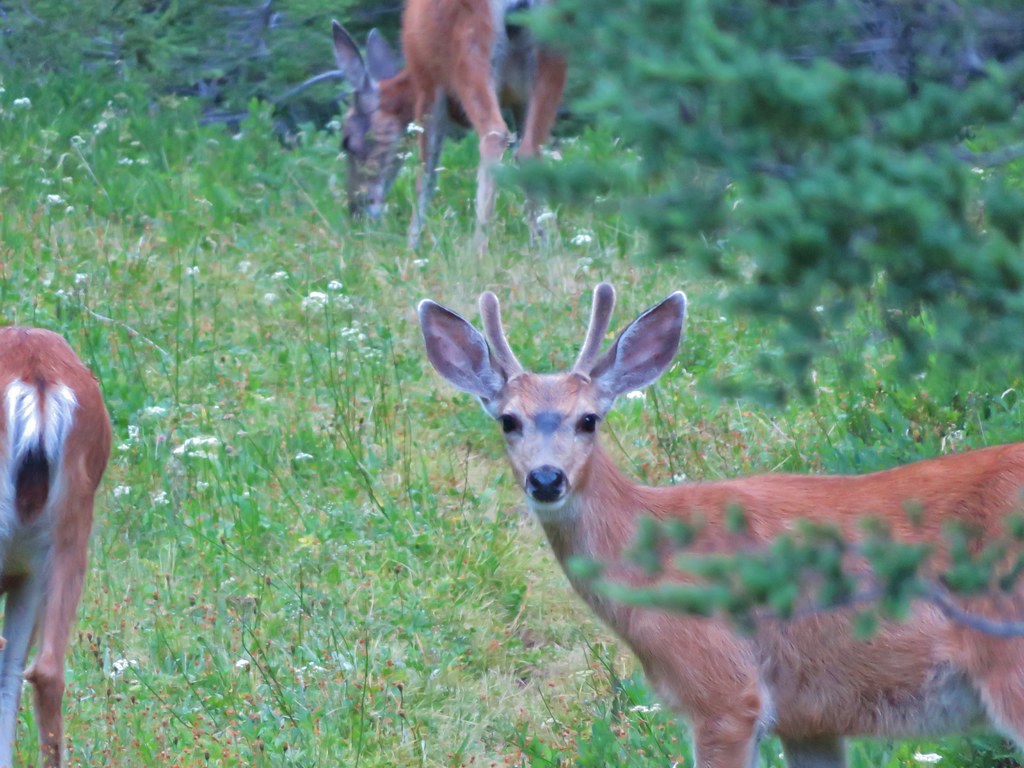
Back at camp we found another deer. This one was a buck who was leisurely passing through camp eating as he went.
IMG_7877

IMG_7880

The showers had never materialized as we turned in for the night. We did hear a couple of rumbles of thunder during the night but never saw any lightning and it never did rain. It had been a great start to the trip and we were looking for to the rest of it. Happy Trails!

Flickr: https://www.flickr.com/photos/9319235@N02/albums/72157657389155121

Categories
High Cascades Hiking Mt. Jefferson Area Oregon Trip report

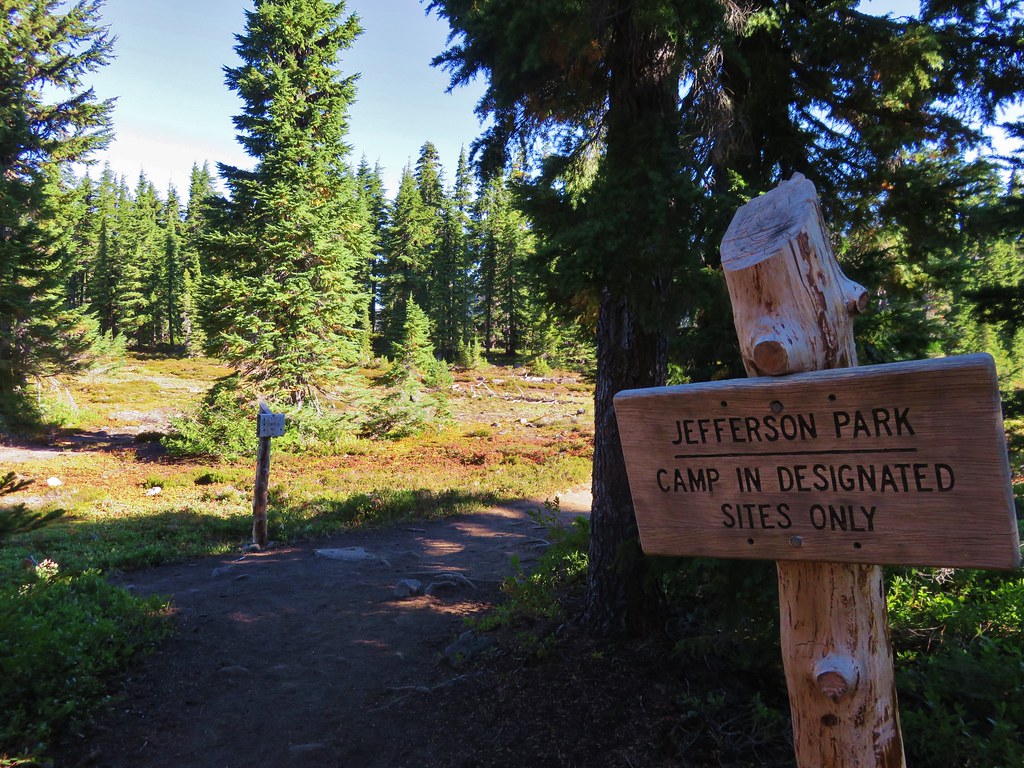
Jefferson Park – 2015

**Note the 2017 Whitewater Fire burned a portion of this hike.**

Since 2011 Jefferson Park has been the one destination that has been on our schedule every year. This year we planned a joint outing with my parents who had not been to Jefferson Park yet. We picked them up bright and early from the Whispering Falls Campground and drove to the Whitewater Trailhead arriving shortly after 6am. We had agreed that we would hike at our own paces and would look for each other in Jefferson Park and if we didn’t meet up there we would do so back at the car. What we failed to do was set a time that we would start back to the car at in case we didn’t run into them. After giving my parents a brief description of what to expect from the trail on the way up we set off.
Whitewater Trailhead

The forest showed the same signs of the warm and dry year we’ve had. Everything seemed to be at least a month ahead of schedule. Few flowers remained and some of the leaves were already starting to turn color.
IMG_7249

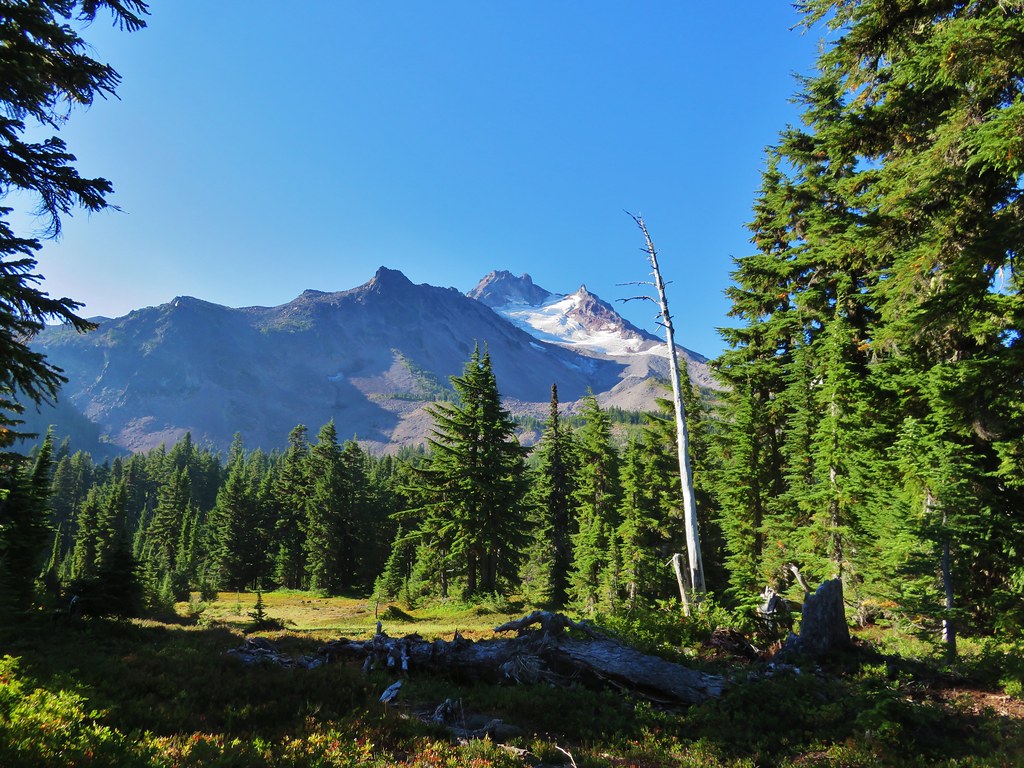
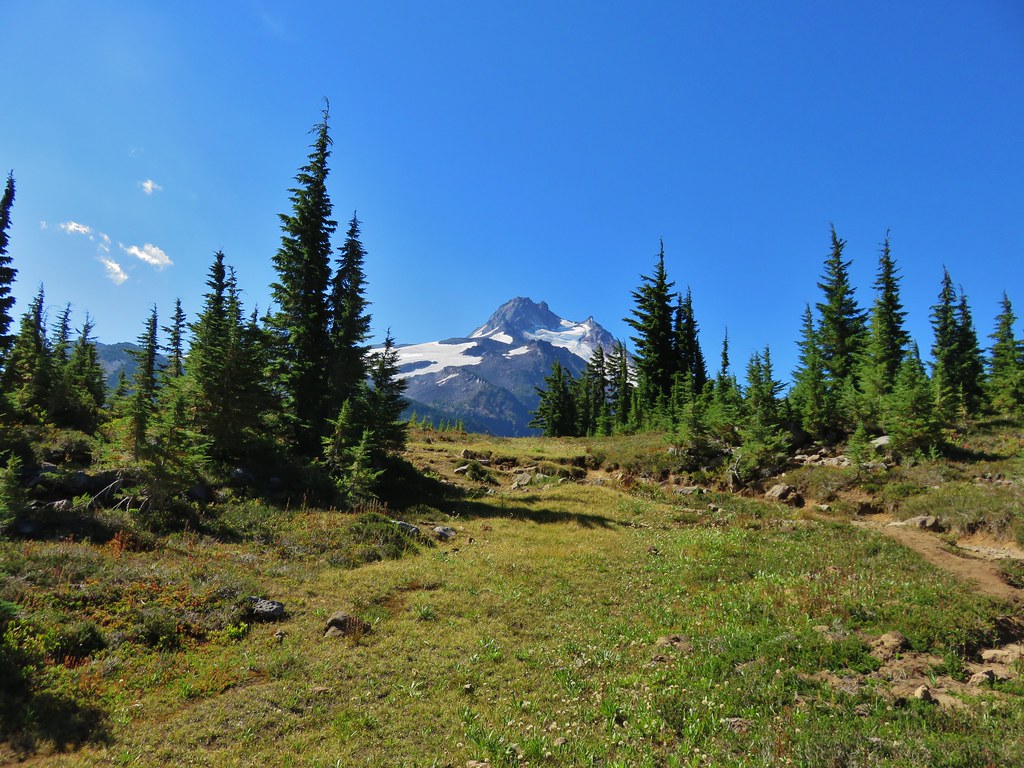
The sky to the south was a bit hazy with smoke from fires in Southern Oregon, but Mt. Jefferson was enjoying relatively blue skies.

The Three Pyramids
IMG_7253

IMG_7259

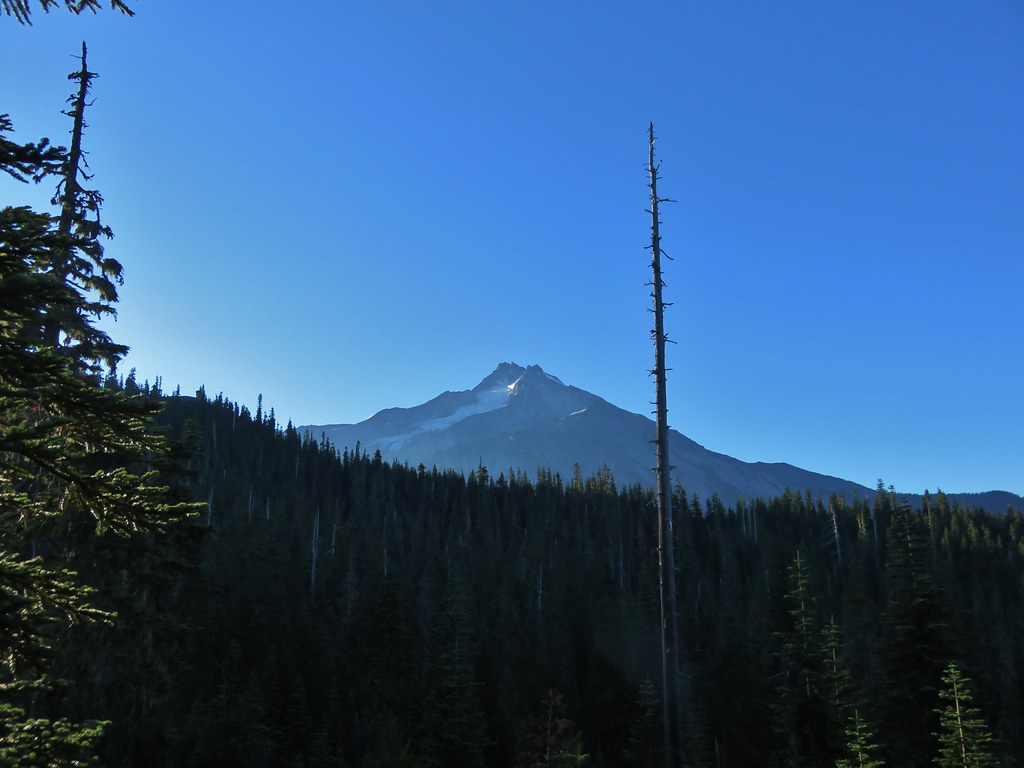
At the 1.5 mile mark the Triangulation Trail joined from the left at a saddle. This marked the end of the steepest portion of the hike which is never really all that steep to begin with. Approximately a mile from that junction the trail enters a small rock field with a view of the top of Mt. Jefferson.
Mt. Jefferson from the Whitewater Trail

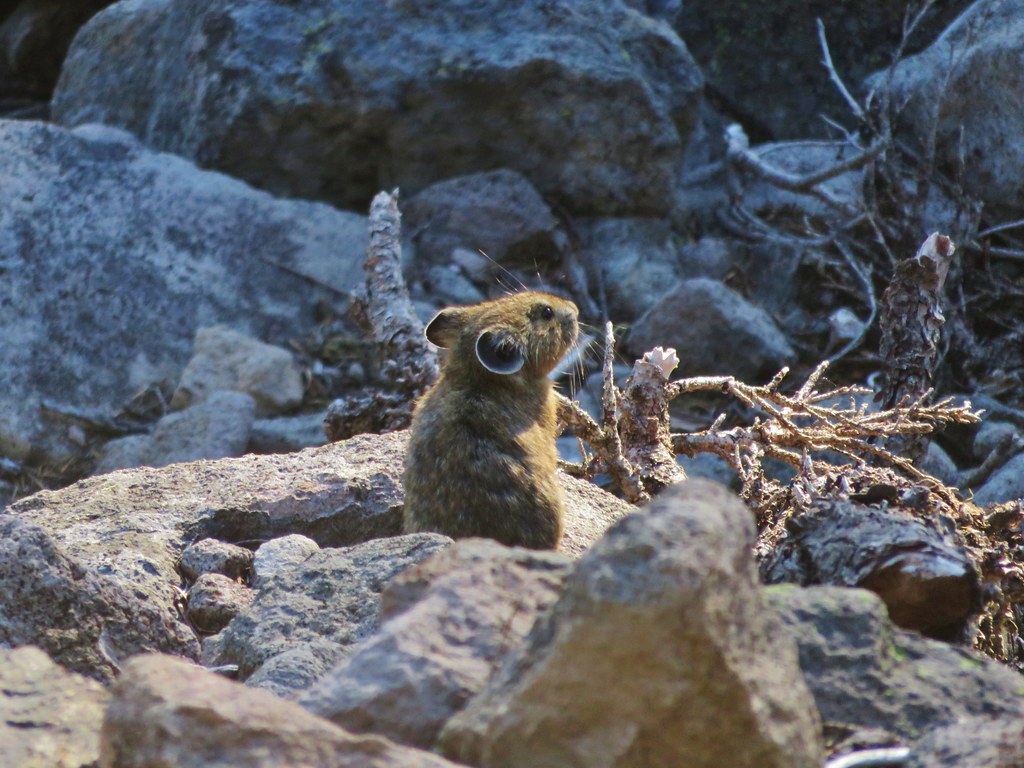
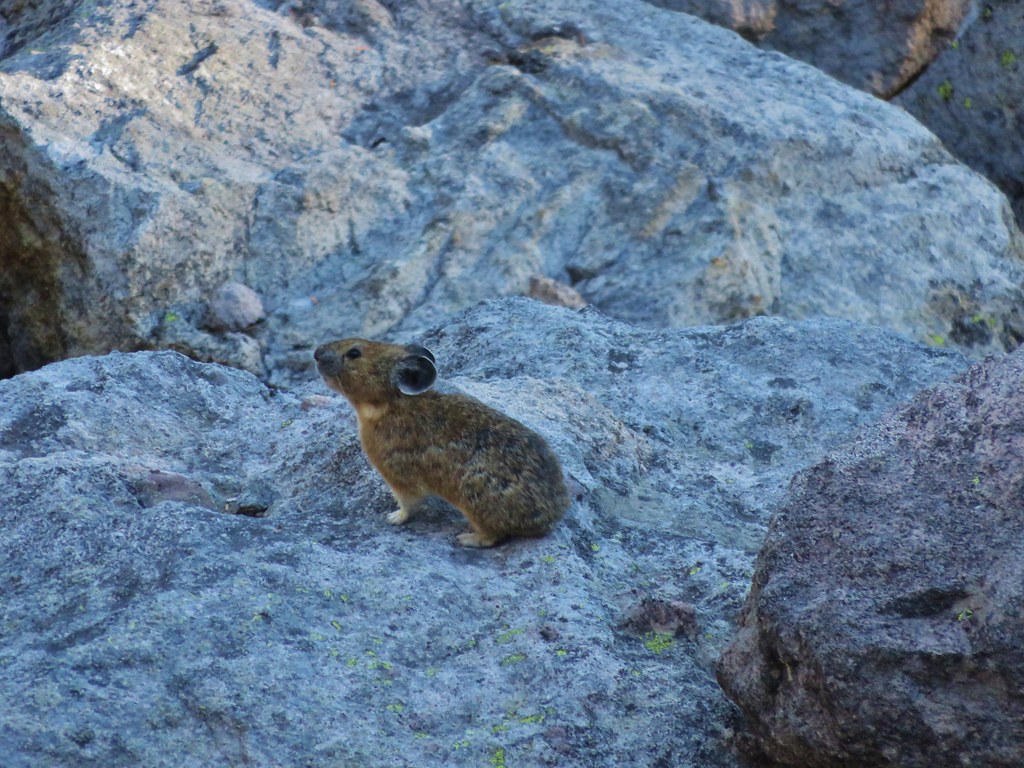
As I was taking a picture of the mountain I noticed movement in the rocks to my left. I looked over to see a pika dart out onto the rocks.
Pika

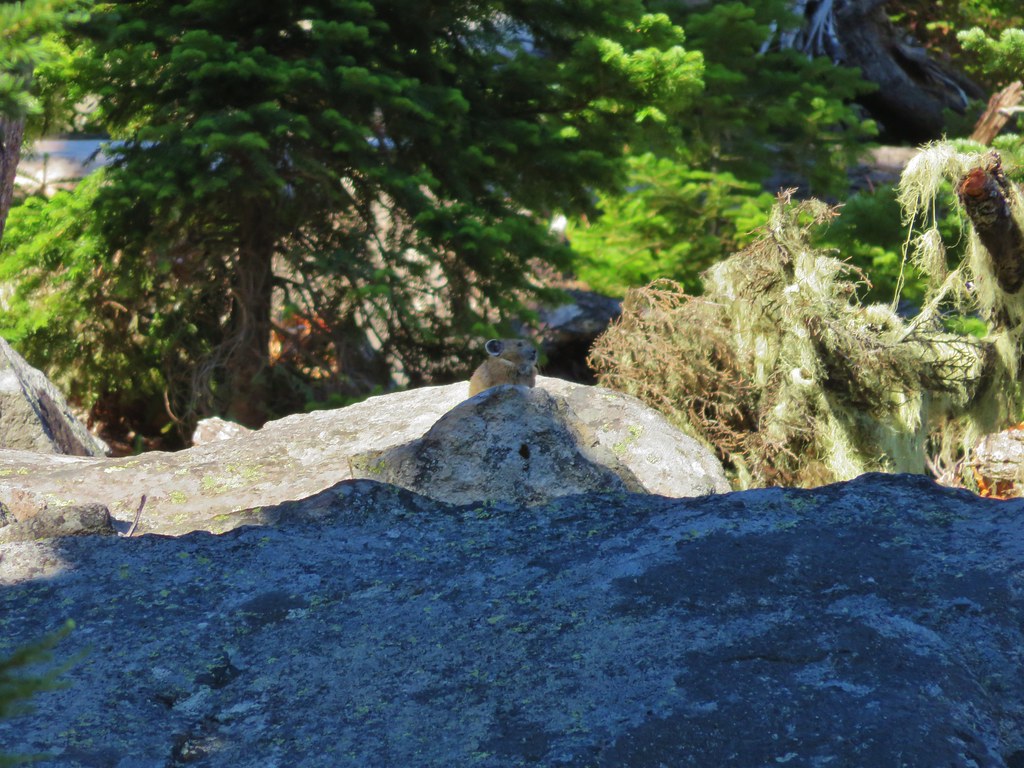
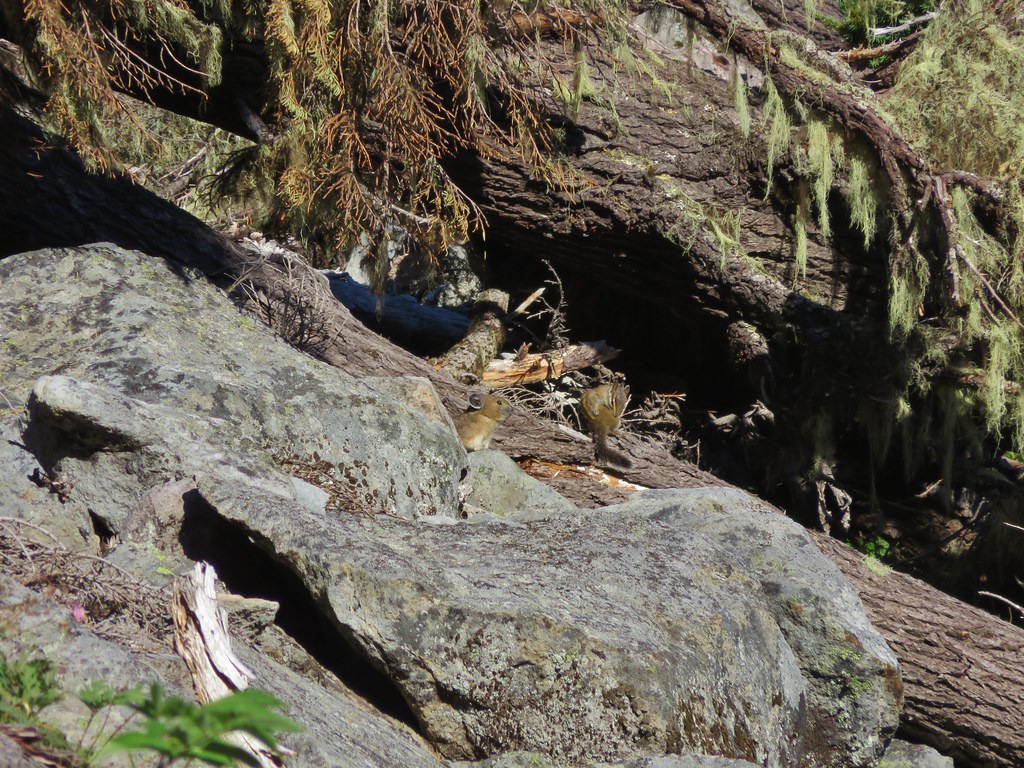
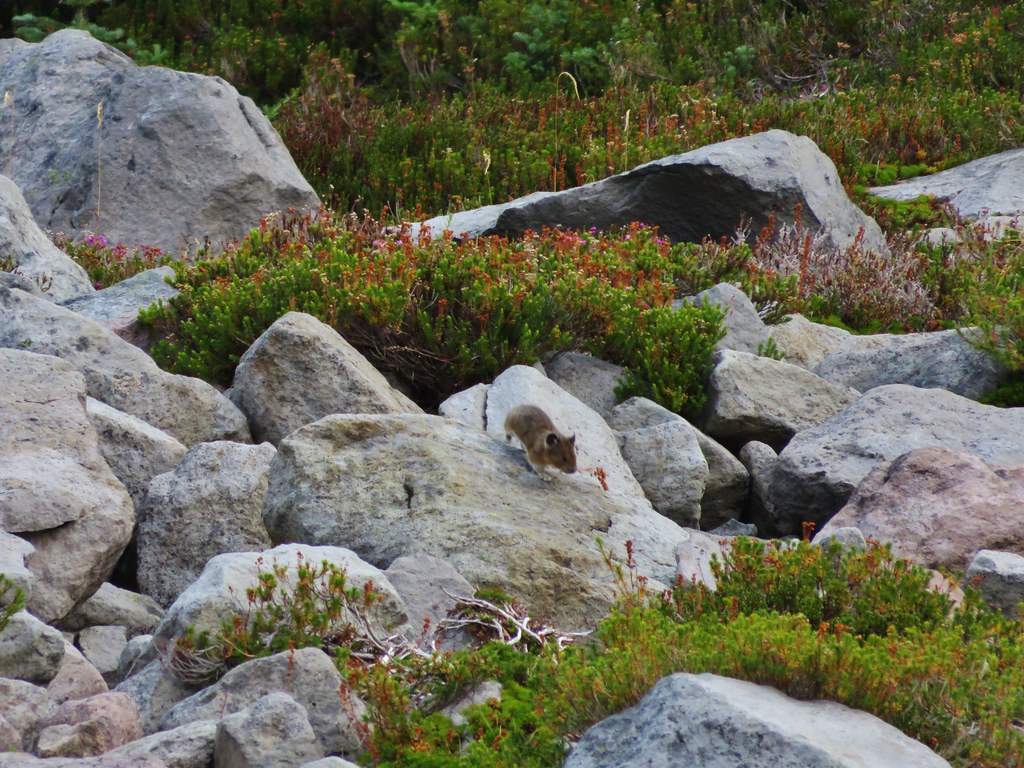
We love pikas and were excited to be getting such a good look at this one since we typically only hear their “meep” warning of our presence. As we were watching the first pika we began to notice others. In the end we’d spotted 5 different pikas and a chipmunk in the area.
Pika

IMG_7277

Pika and a chipmunk

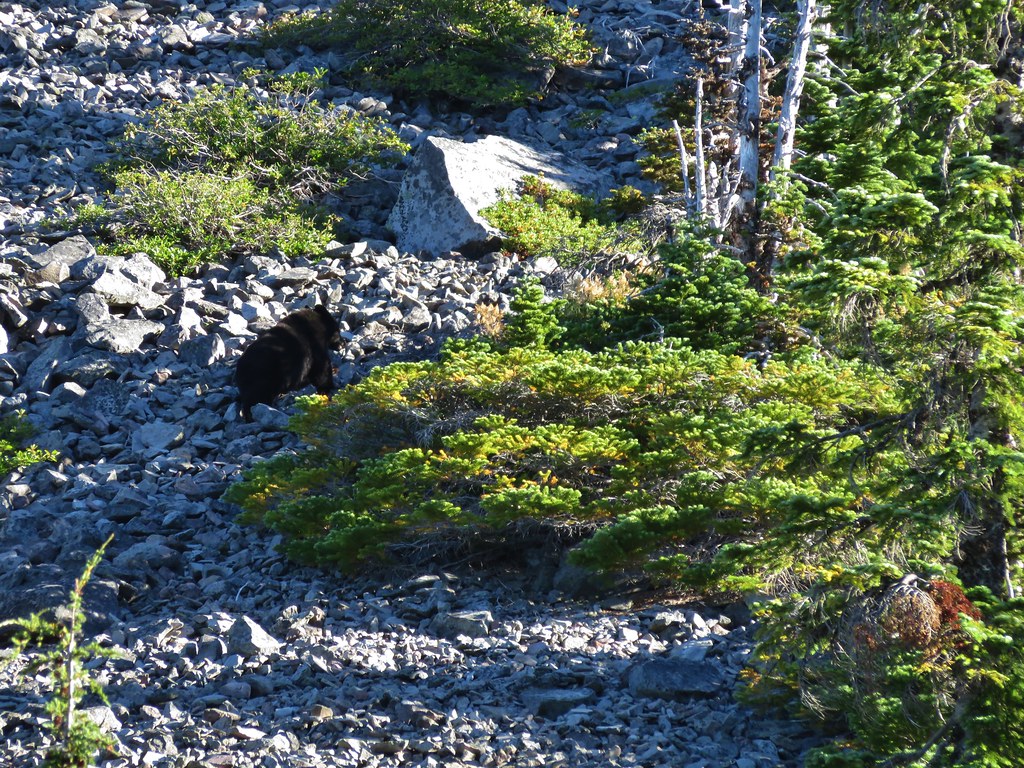
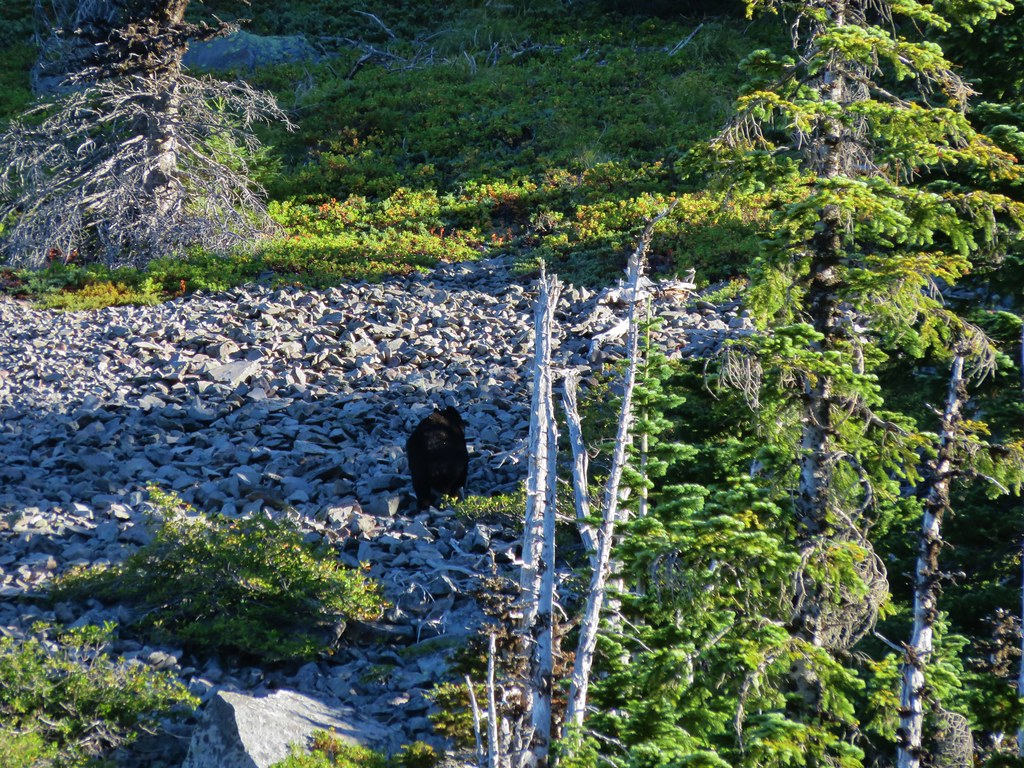
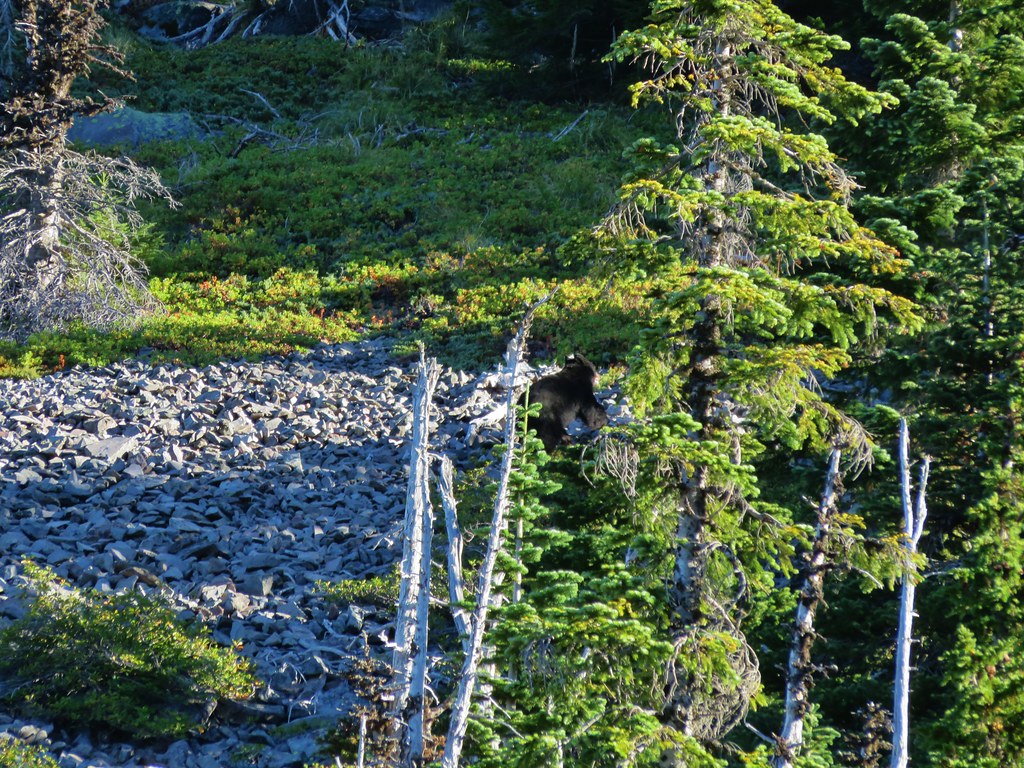
We wound up seeing a sixth pika a little further along the trail making this the highest number of pikas we’d seen on a single hike. Normally seeing a pika, let alone 6, would be the wildlife highlight of a hike, but shortly before reaching the first crossing of the Whitewater Creek around the 4 mile mark the pikas were topped. As we passed a small meadow at the base of a butte we heard some rocks sliding. My first thought was mountain lion because of a recent discussion on how many of the cougar sightings I heard about were the result of hikers hearing rocks moving. When we looked over toward the source of the noise the animal we saw was black so we knew it wasn’t a cougar. It was a bear. This was only the second bear we’d seen while hiking and the first one had run away so quickly that I wasn’t able to get a picture. This time I had my camera ready and the bear was running up an exposed rock slide so I was able to get a few pictures before it disappeared.
Black Bear

IMG_7289

IMG_7290

IMG_7291

We continued on to the Pacific Crest Trail energized from the excitement of seeing the bear. At the PCT we turned left, re-crossed Whitewater Creek, and entered Jefferson Park.
IMG_7301

Shortly after entering the park we came to a signed junction and needed to decide where we wanted to go this time.
IMG_7324

We settled on heading north on the PCT and trying to find a climbers trail that was shown on one of our maps leading up to the Whitewater Glacier. As we made our way through the park we were struck by just how dry it was and how far past all the flowers already were. The scenery was still amazing though.
IMG_7326

IMG_7331

IMG_7333
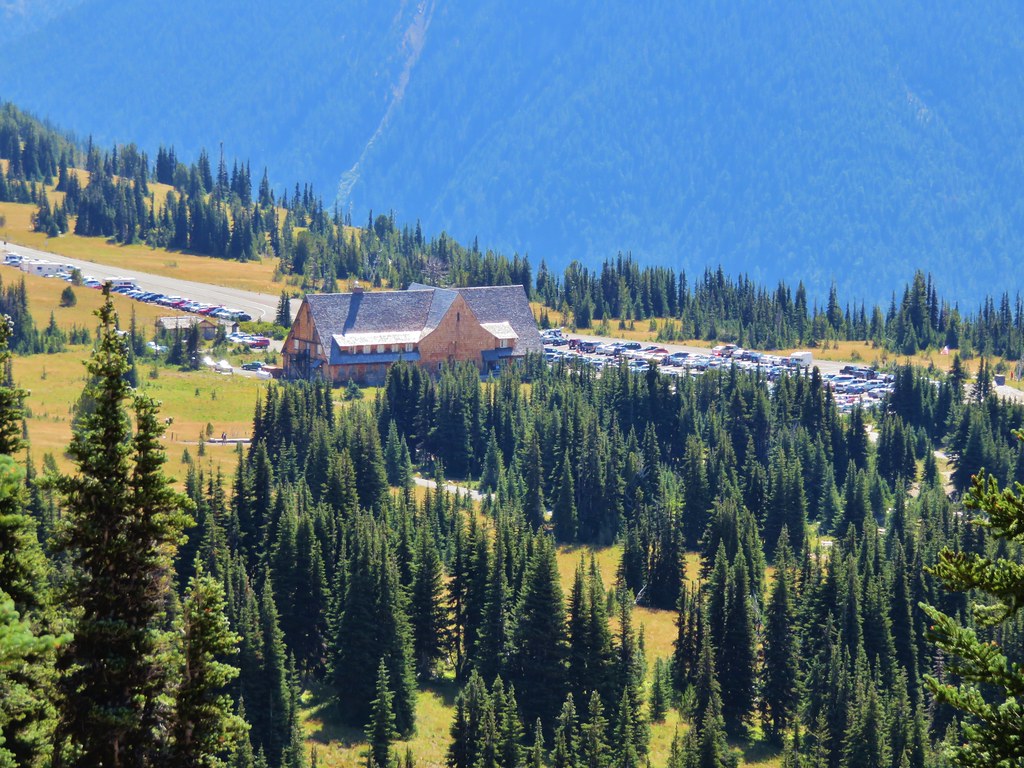
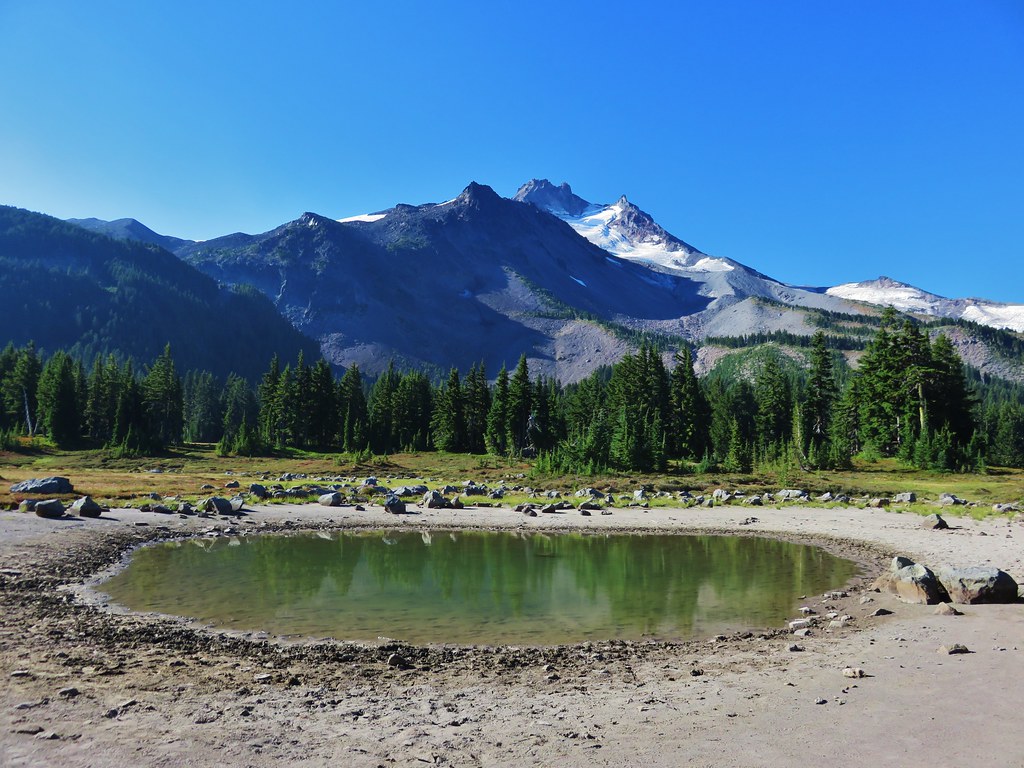
Pond in Jefferson Park

IMG_7336

We found what appeared to be a decently used trail in what seemed to be the correct area and set off toward the mountain. The trail we were following started bending back to the south though so we were forced to abandon it and take a more direct route toward the ridge where we hoped to pick up the climbers trail. We found another clear path and began following it but then it petered out on a tree covered ridge.
IMG_7345

We seemed to be in the correct area according to the map and GPS, but we were unable to spot anything that looked like a trail so we decided to go to plan b and head to Russell Lake where we could pick up the PCT again and decide what to do from there.

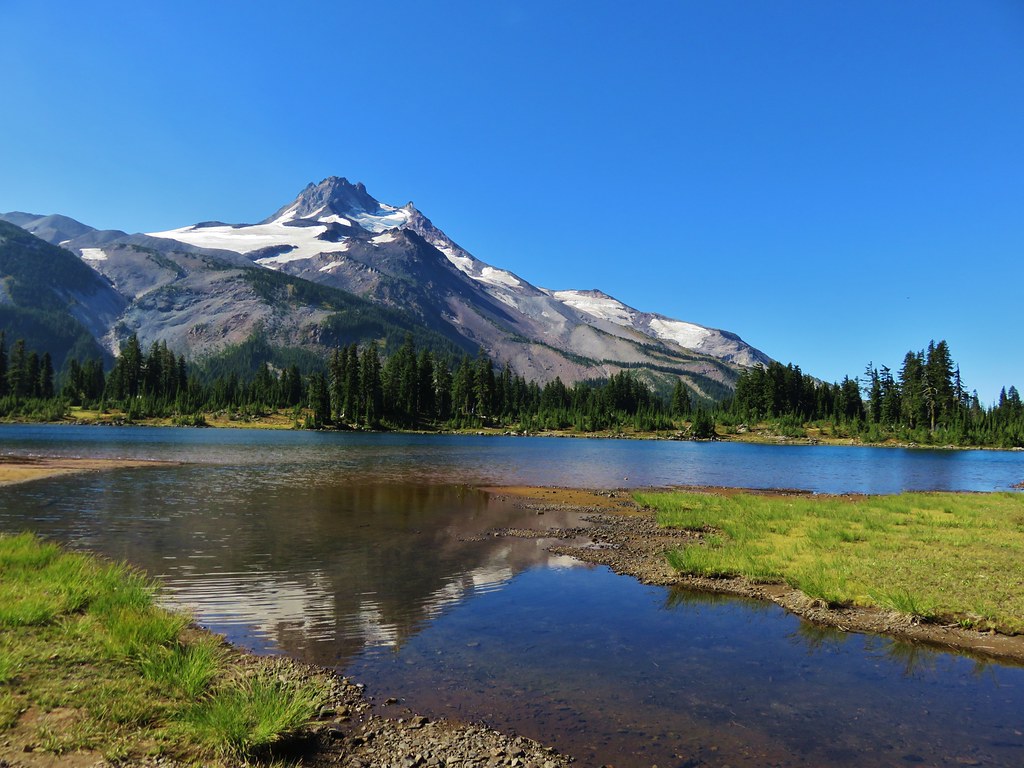
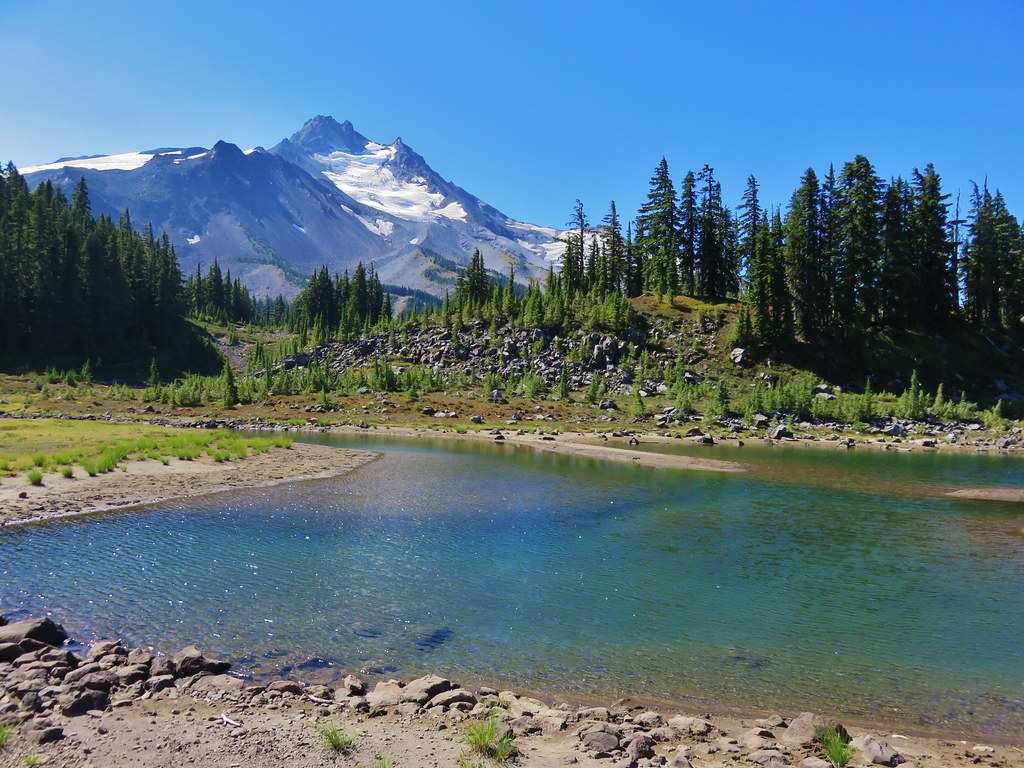
We found a few flowers around Russell Lake but again the dry year was evident. The lake was at the lowest level we’d seen and there was no water flowing out of the lake to the South Breitenbush River.
Mt. Jefferson from Russell Lake

IMG_7367

IMG_7369

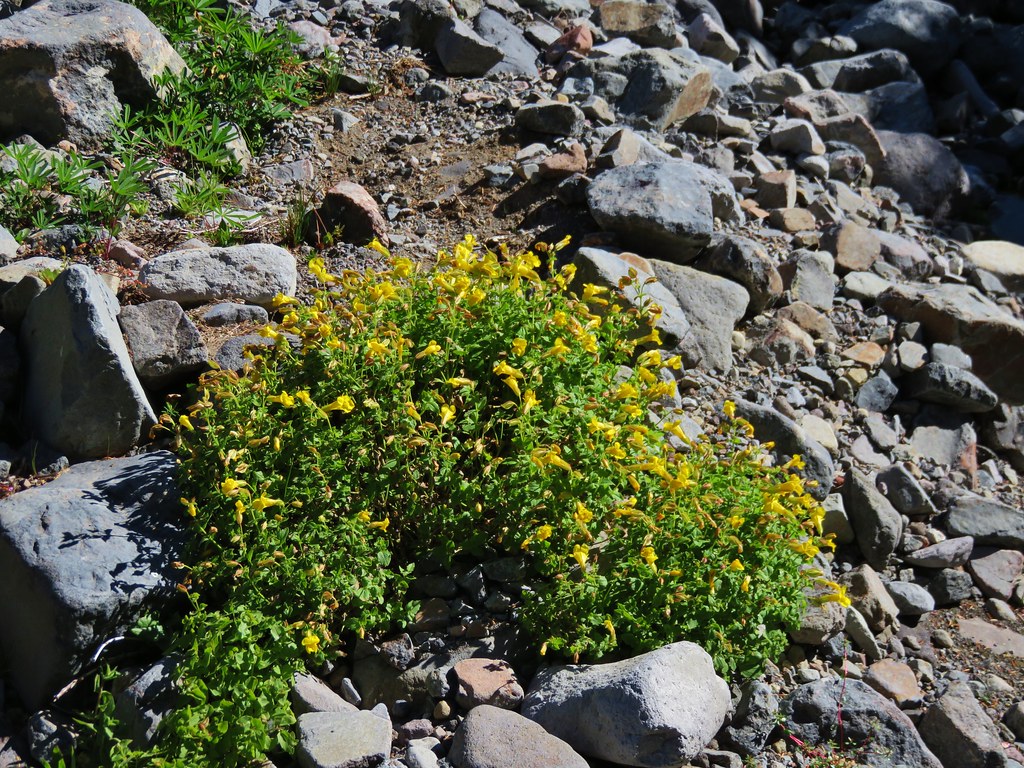
There was still a little water coming down another branch of the river from Park Ridge allowing some monkeyflowers to still be blooming.
IMG_7387

IMG_7388

IMG_7386

We had considered following the PCT part way up Park Ridge and visiting Sprauge Lake which we had not done before, but after looking up at the climb we’d need to do we decided to save that for another trip and instead we headed for the South Breintenbush Trail.
IMG_7399

As we reached the South Breitenbush Trail we ran into another couple who recognized my Portlandhikers button. They had stayed overnight near Bays Lake and were on their way up to Park Ridge. After talking for a bit we continued on watching for the side trail to Park Lake which we’d find in a hillside meadow above the river.
IMG_7407

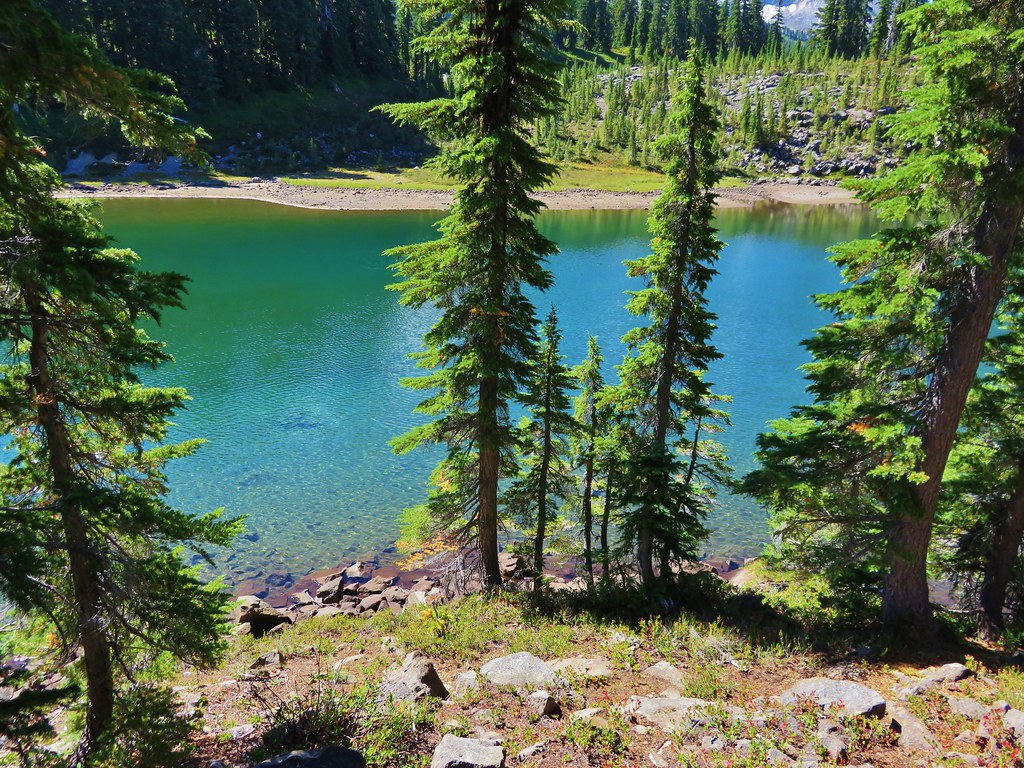
The water level at Park Lake was also lower than we’d ever seen, but we realized it was a deeper lake than we’d thought as we looked down into the green water.
IMG_7409

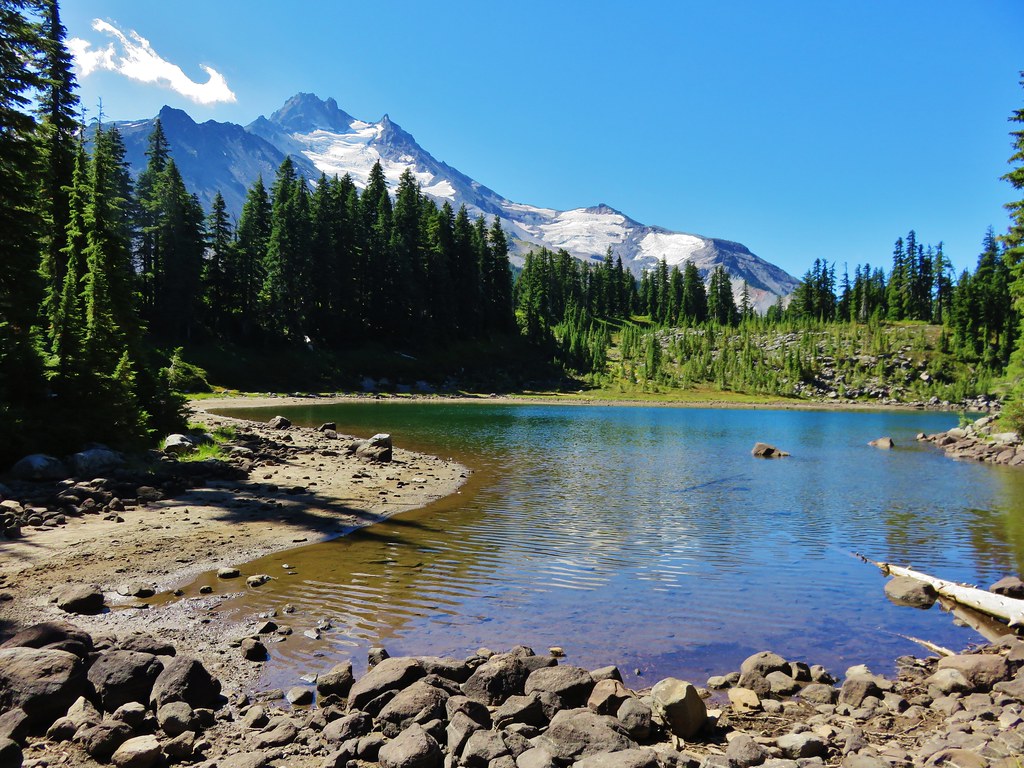
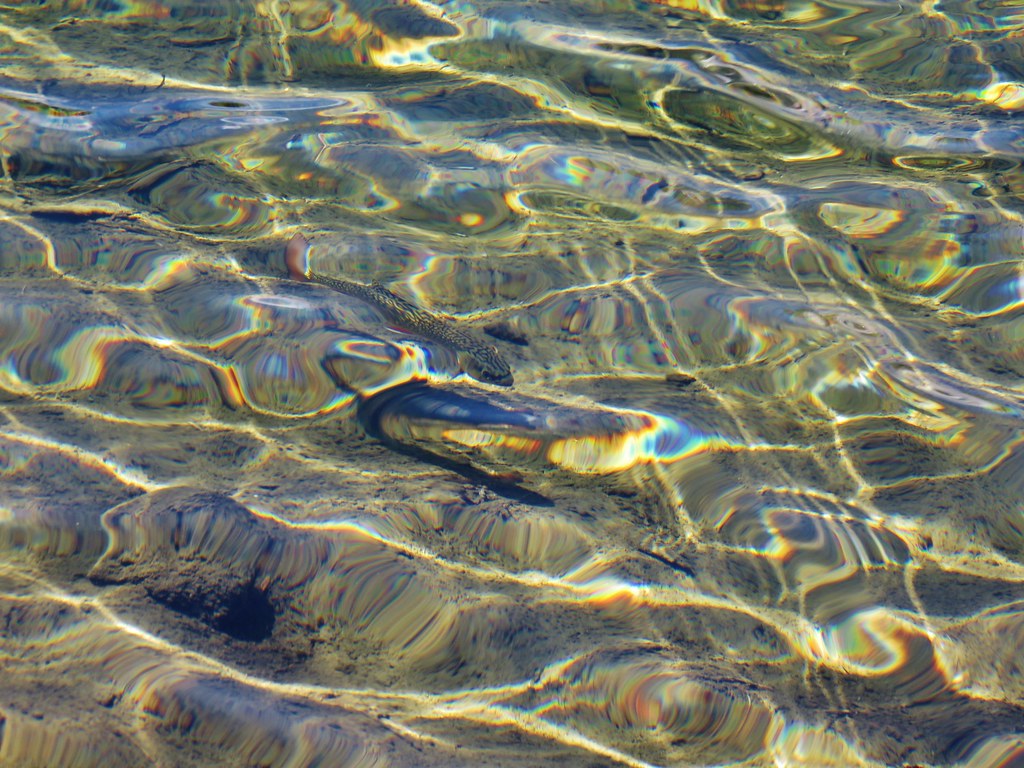
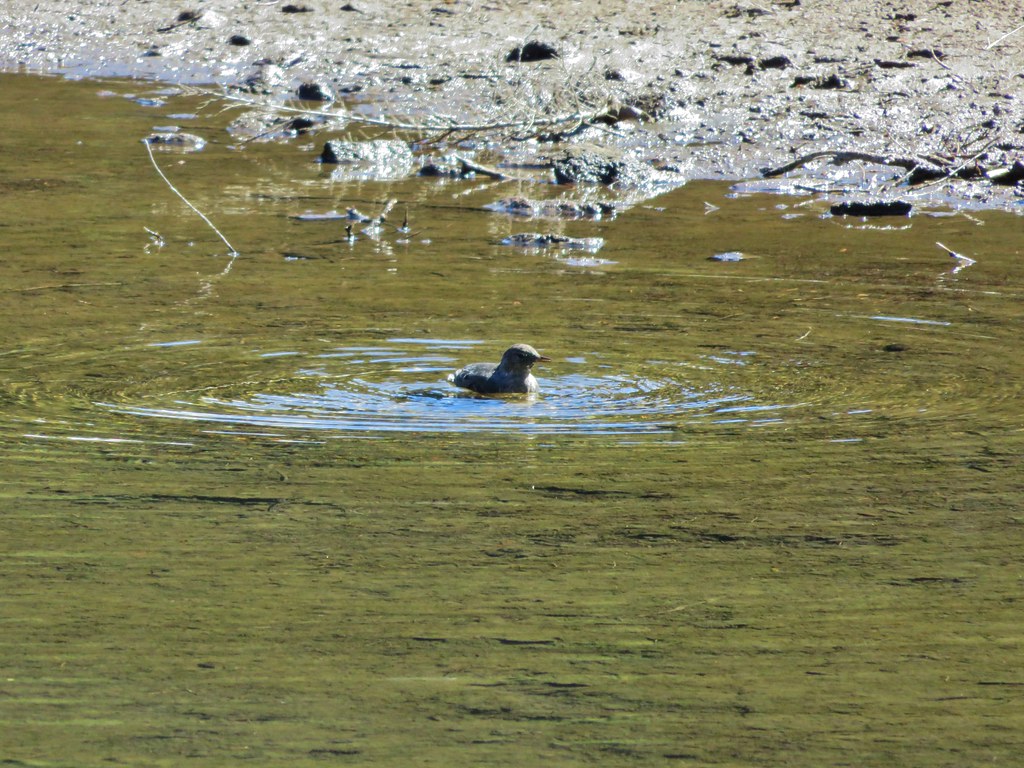
Next up along the trail was Rock Lake. Like all the lakes in Jefferson Park this one has colorful water and great views of the mountain. We spotted some trout in the lake as we passed by and got a kick out of watching a happy bird bathing along the shore.
IMG_7414

IMG_7422

IMG_7425

IMG_7437

From Rock Lake we made our way to Scout Lake where we thought we might find my parents. It was around 11am and we thought they might have stopped at the lake for a break. We didn’t see them, just more wonderful Jefferson Park scenery.
IMG_7440

IMG_7447

Our next thought was that they might be at Bays Lake so we headed over to the south end of that lake to take a look. We hadn’t spent much time on that side of Bays Lake so we decided to do some exploring.
IMG_7463
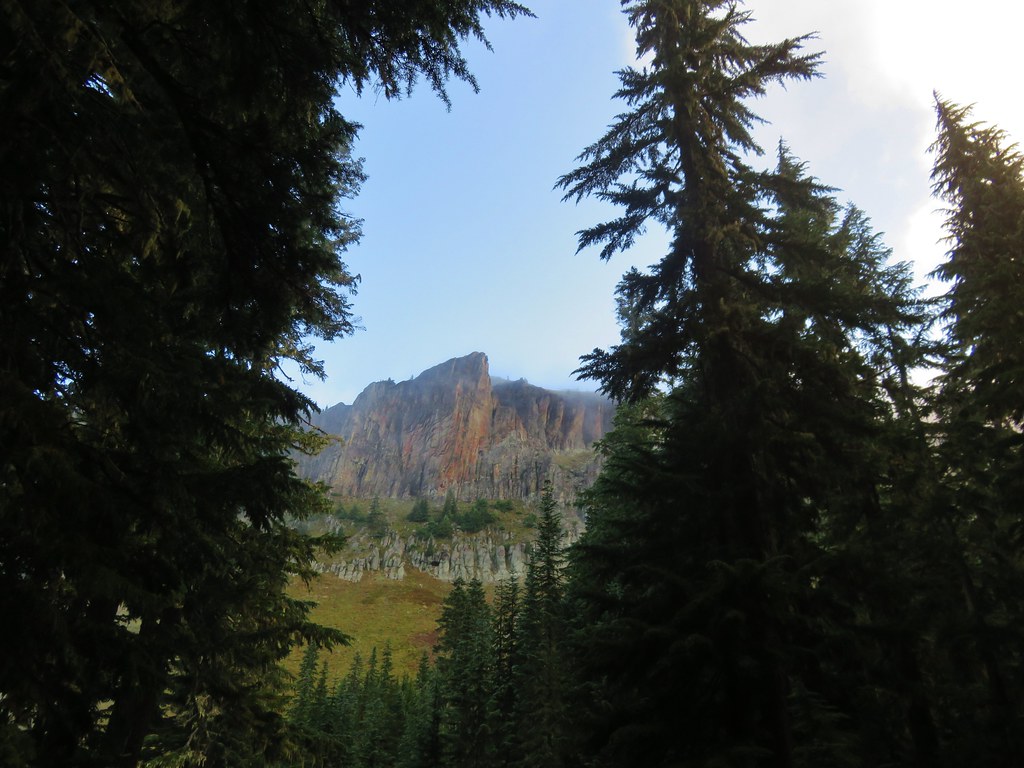
Park Butte from Bays Lake

We headed down to the day use peninsula and removed our packs to take a break and check out the area.
IMG_7468

IMG_7472

Mt. Jefferson from Bays Lake

IMG_7496

When we resumed our hike we decided to just loop around the rest of the lake and then head back to Scout Lake.
IMG_7506

IMG_7514

IMG_7526

IMG_7534

We still hadn’t seen any signs of my parents by the time we had made it back to the PCT from Scout Lake and we debated on whether to head back to the car or go up the PCT again toward Russell Lake in search of them. It was at this point that we realized that it would have been a good idea to establish a time at which we would head back to the car. We made it all the way back to Russell Lake without running into them which had us a little concerned that they may not have made it all the way to the park. Heather had come up with a theory though, she suggested that they might have gone directly to Russell Lake since that was the ultimate goal for my Mom. If they had done that we easily could have missed them while we were touring the other lakes and then missed them again while we were on the PCT if they had taken one of the other signed trials to Scout Lake. Either way we were fairly certain they were either on their way back to the car or were already there waiting so we headed back down ourselves.

Heather asked a group of young hikers that were on their way up if they’d seen anyone matching my parents description and they had, which made us feel better. We didn’t think to ask how far ahead of us they were though. We picked up our pace but kept getting distracted along the way. It was interesting to see how much the water level had risen in Whitewater Creek as the heat caused an increase in the glacial runoff.
IMG_7297

IMG_7564

We also kept looking back at the views of Mt. Jefferson.
IMG_7574

IMG_7575

IMG_7576

We were still making pretty good time trying to catch them when we rounded a little bend in the trail and saw a gentleman trying to dust himself off. He was covered in dirt with some scratches on his head and there was a camera mounted on a tripod behind him on the trail. He explained that he had set the timer on the camera and was running up the trail to get in position for the picture when he had tripped. He said he was fine but hadn’t realized he was bleeding until Heather pointed it out. Luckily none of the cuts were deep and there was no real damage. He told us that it wasn’t going to affect his enjoyment of his hike. Just more proof that there is no such thing as a bad hike.

We never did catch up to my parents and I half expected to see them sitting on the bench along the trail at the trailhead, but instead we found them at a picnic table just a few feet away. We found out that they had indeed gone straight to Russell Lake and relaxed there awhile before heading to Scout and Bays Lakes. Heather had been right again. We didn’t know how far we’d wound up hiking with all the wandering we’d done, but we found out when I plugged the Garmin into the computer. According to the GPS we’d covered 18.1 miles, a little bit more than we’d planned on but that’s what can happen with a place as scenic as Jefferson Park. Happy Trails!

flickr: https://www.flickr.com/photos/9319235@N02/sets/72157656592737940

Categories
Central Coast Hiking Oregon Oregon Coast Trip report

Salishan Spit

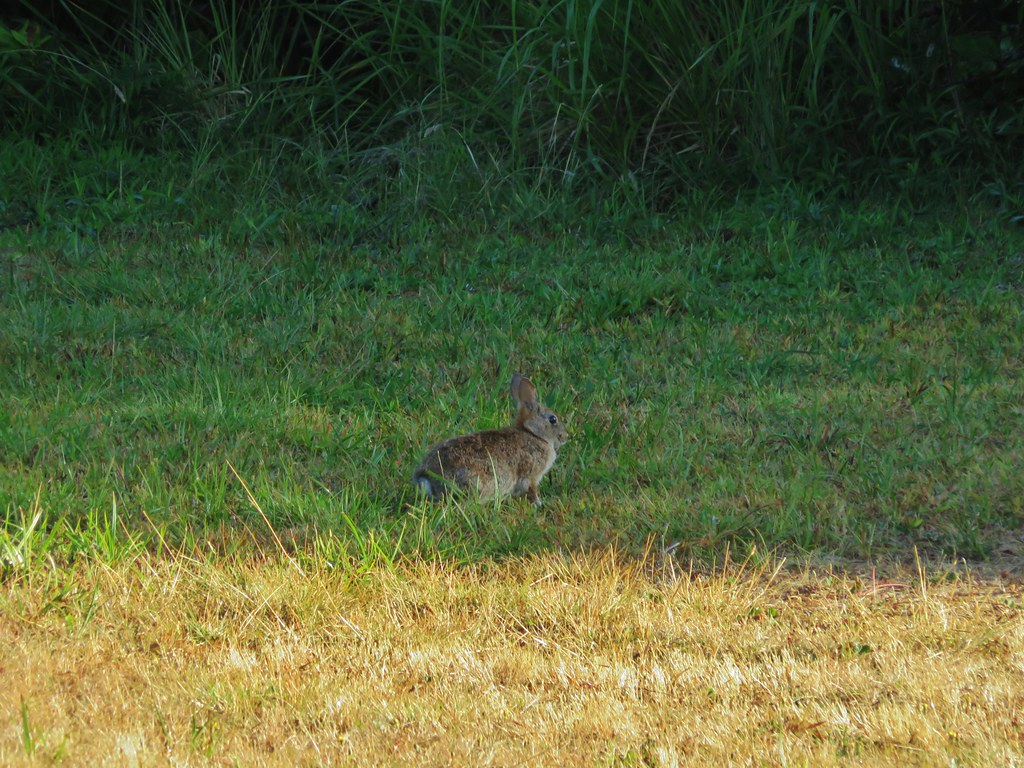
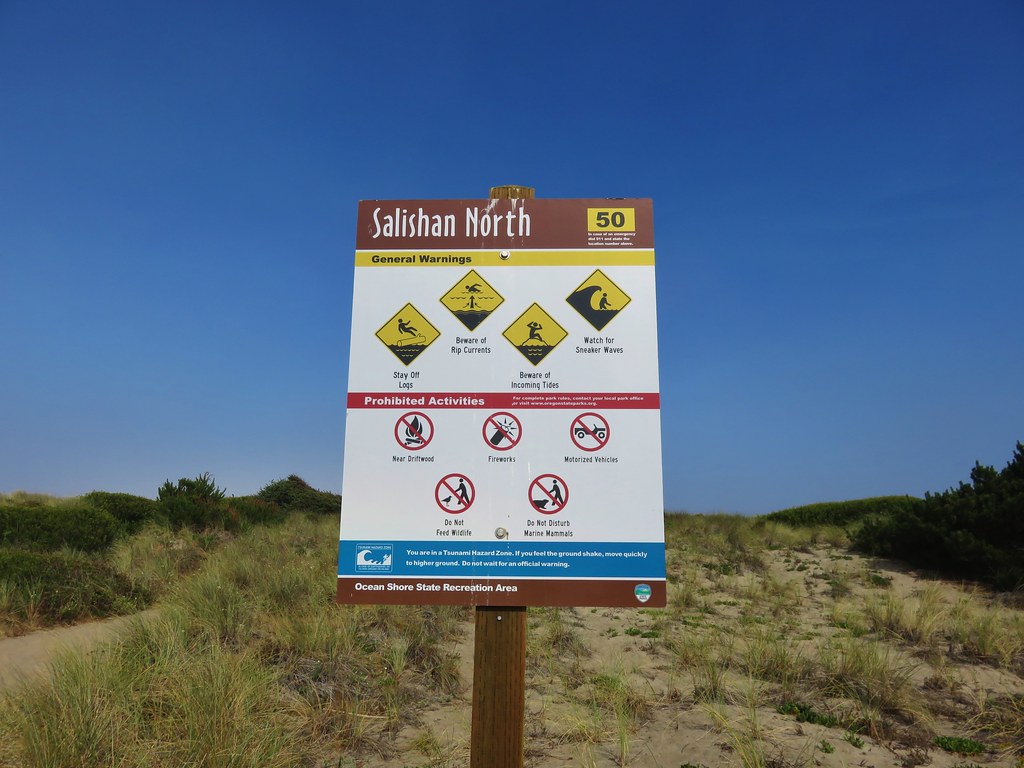
Every August we head to Gleneden Beach for a family reunion, and almost every year we consider hiking Salishan Spit due the starting point being less than a mile from the site of the reunion. We had consistently passed on it though in favor of doing a wildflower hike in the mountains the day after instead. With the wildflower season over early this year it was a perfect time to finally check out the spit. We started at the Gleneden Beach Wayside south of Lincoln City, OR. The wayside consisted of a large parking area, picnic tables, restrooms, and a large gazebo. A rabbit was the only one present when we arrived.
IMG_7066

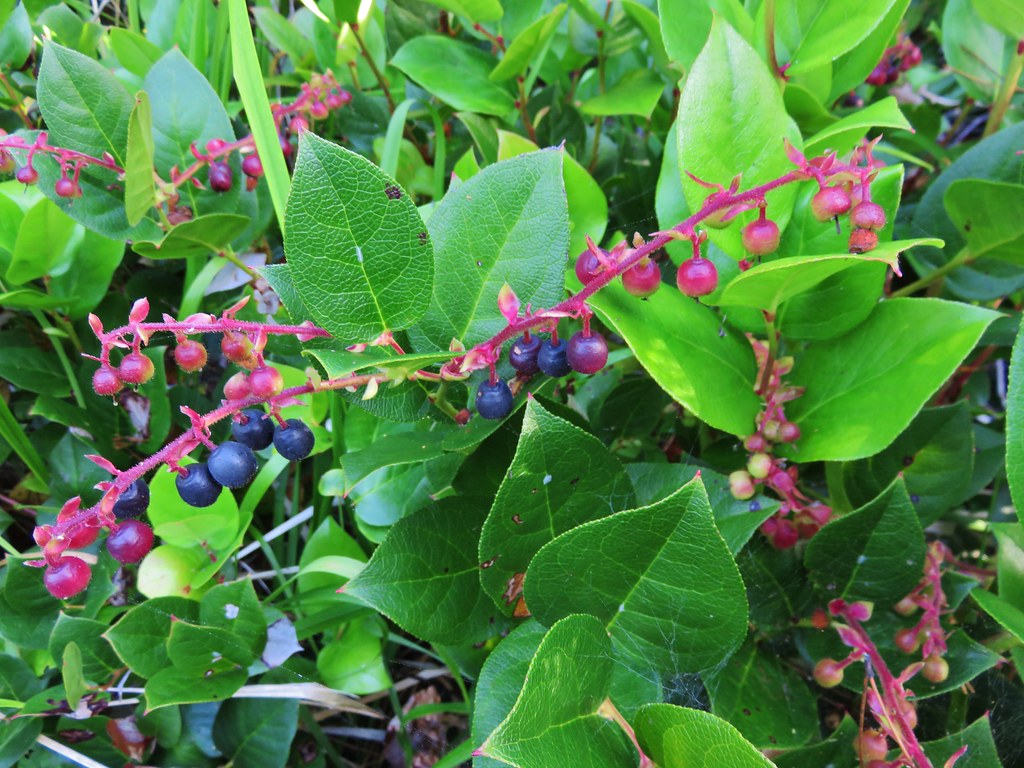
The area was full of salal berries which are edible but not one of our favorites.
IMG_7068

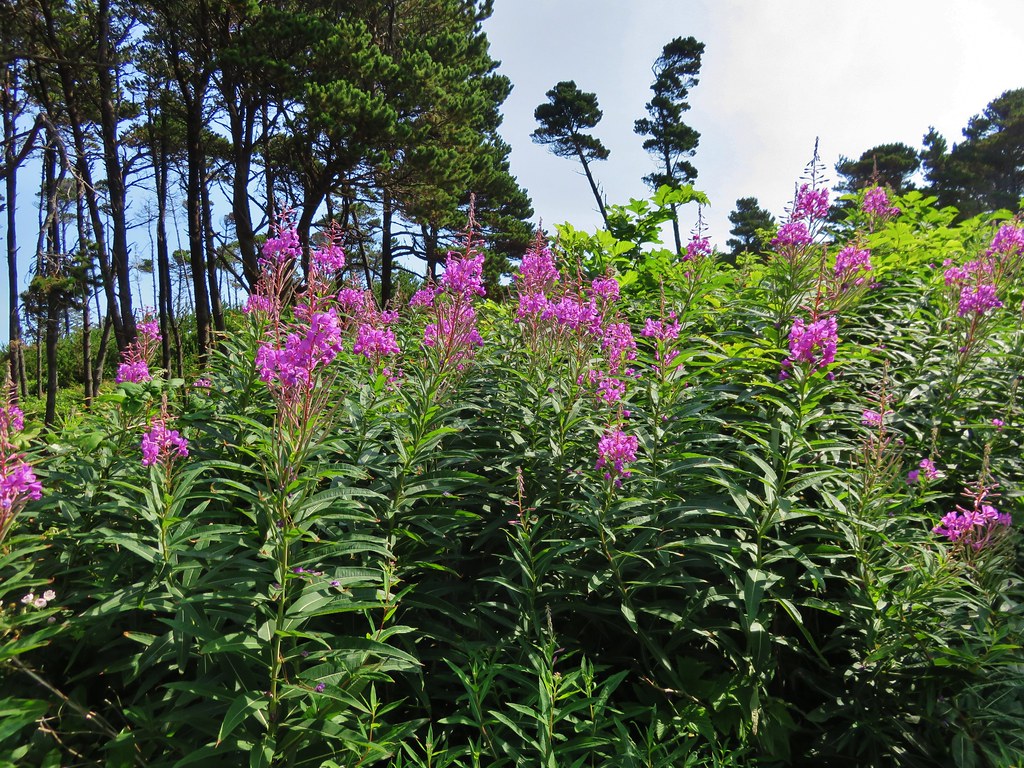
There were a few flowers at the wayside as well.
IMG_7244

IMG_7246

A short path led through a small stand of trees and down to the beach.
IMG_7069

IMG_7071

IMG_7072

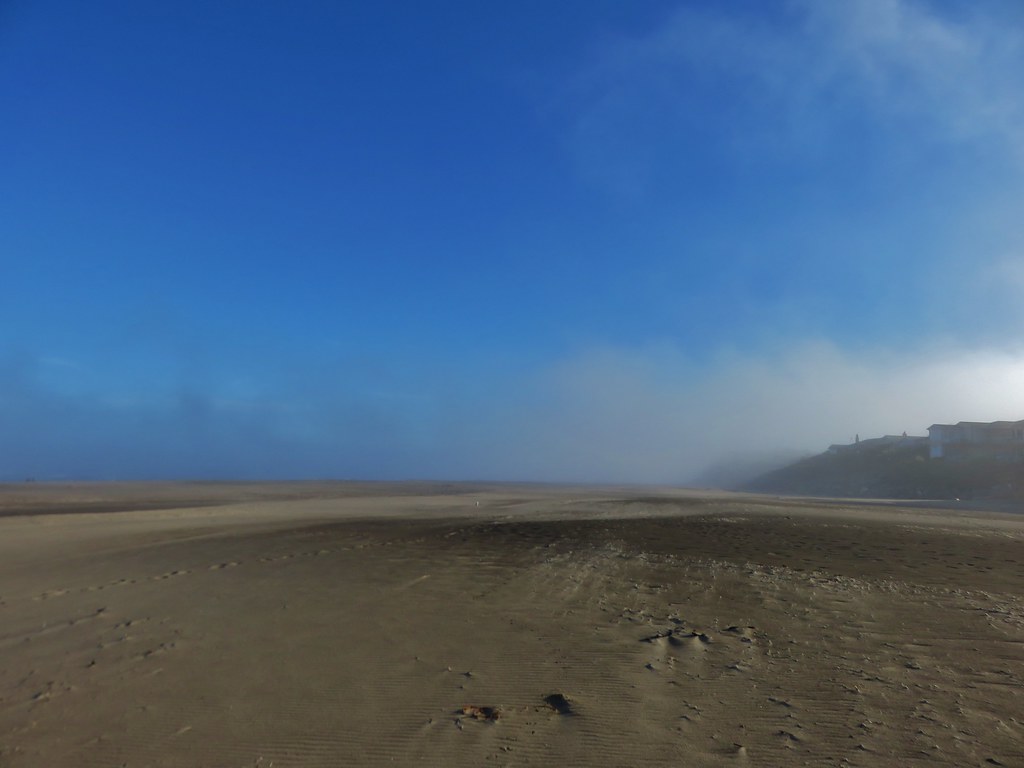
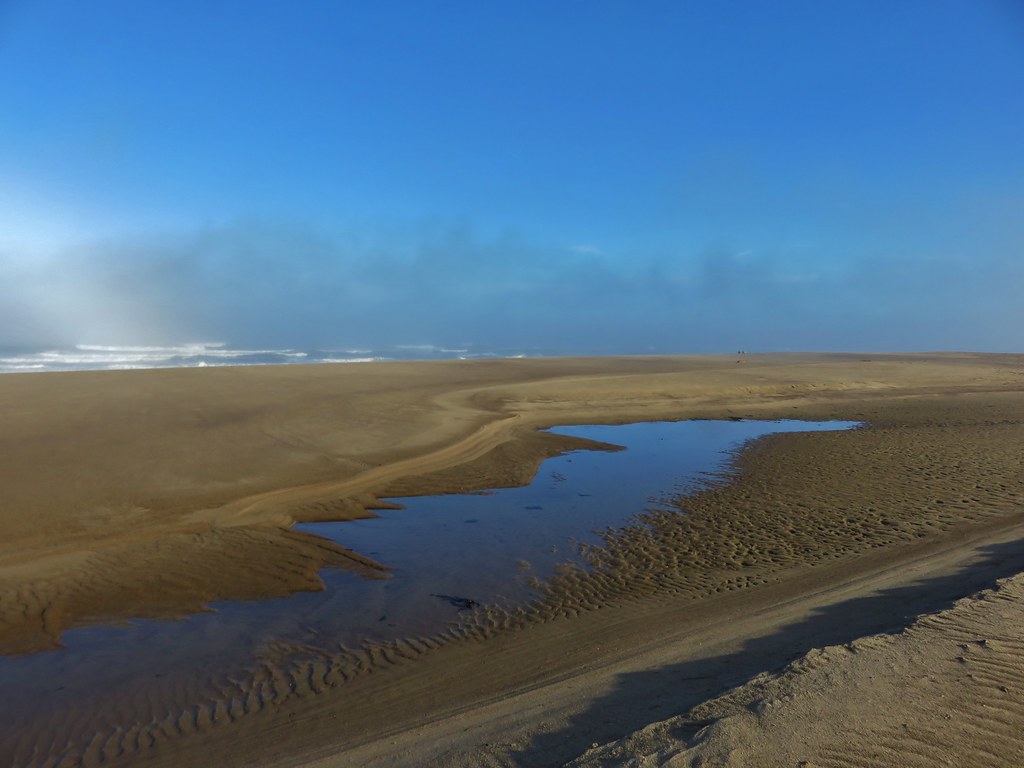
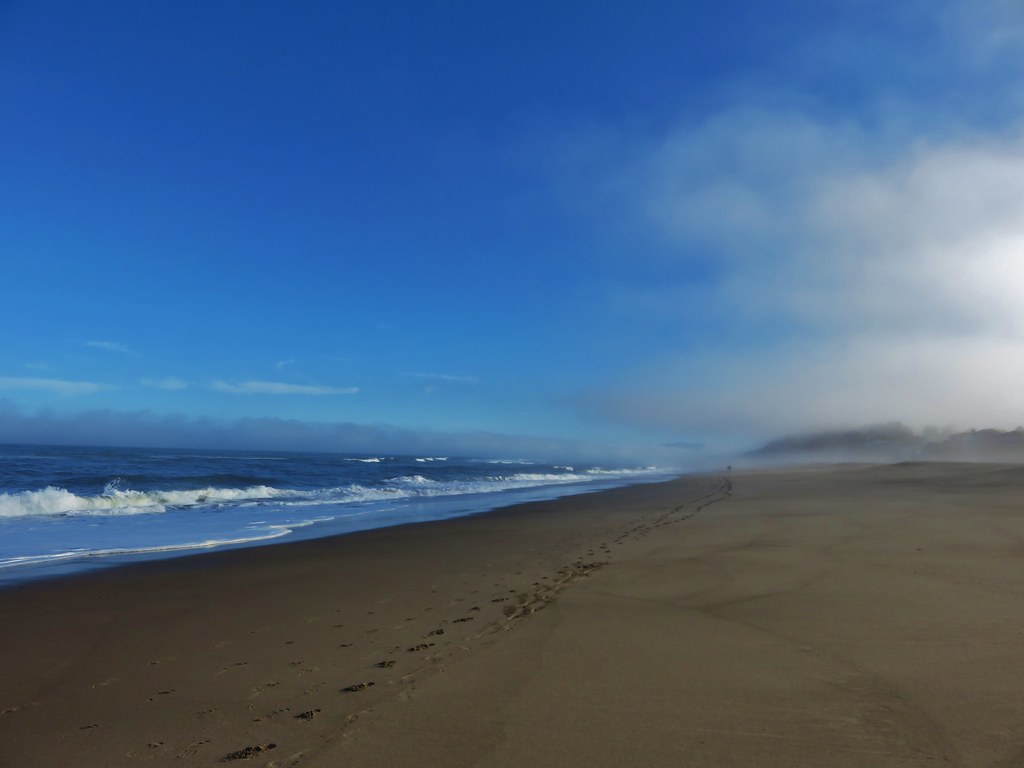
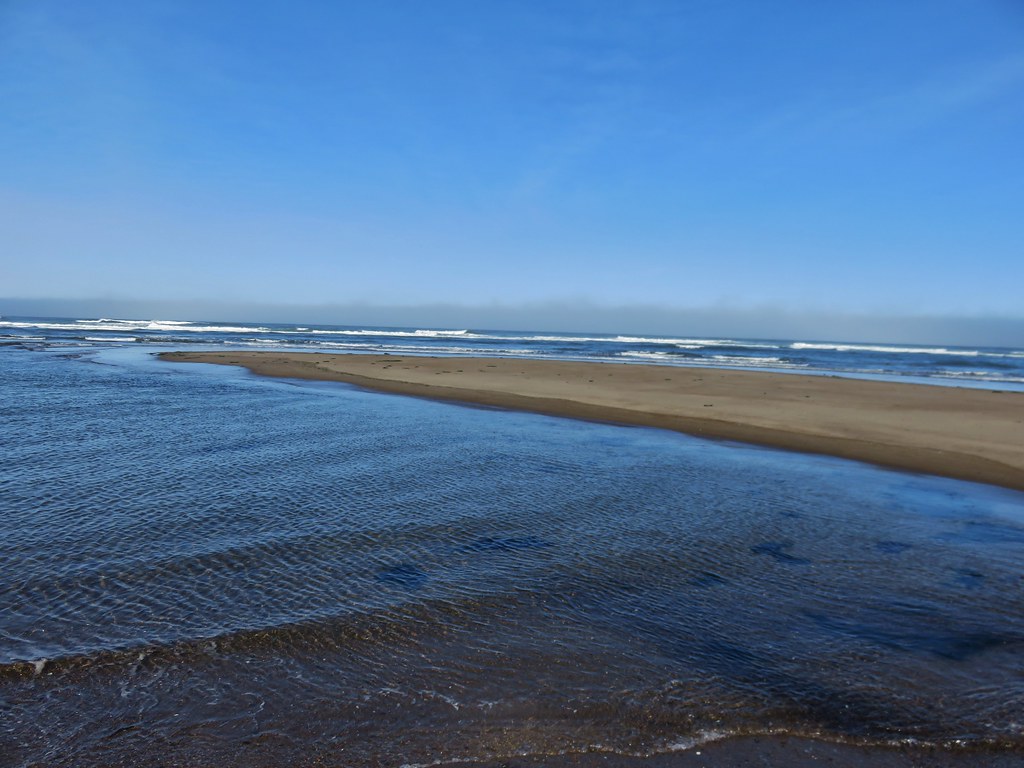
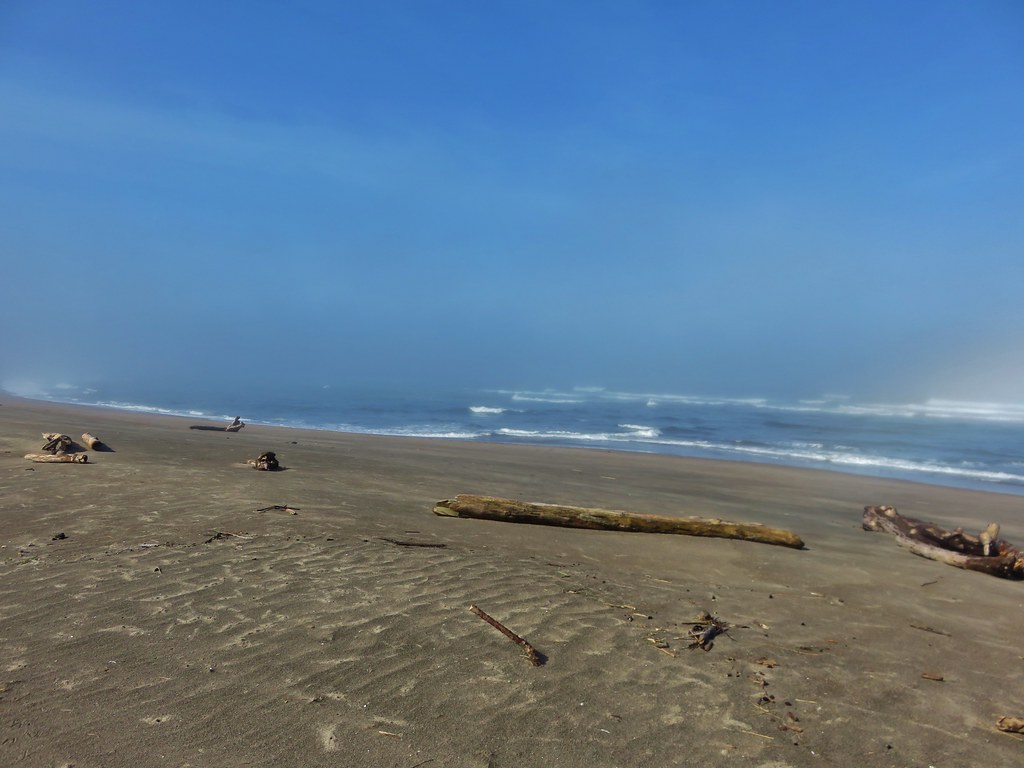
It was a weird day at the beach. We had been having a heat wave in the Willamette Valley with highs over 100 degrees and our drive to the coast had been under bright blue skies. When we had arrived at Lincoln City the sky was still blue but there was a big wall of clouds visible off-shore over the Pacific. As we drove south down Highway 101 toward Gleneden Beach the blue sky was replaced by fog. It was blue sky again at the wayside, but when we reached the beach we saw that we were in a pocket of blue amid the fog. The bank of clouds off-shore was also visible.
IMG_7075

IMG_7076

IMG_7083

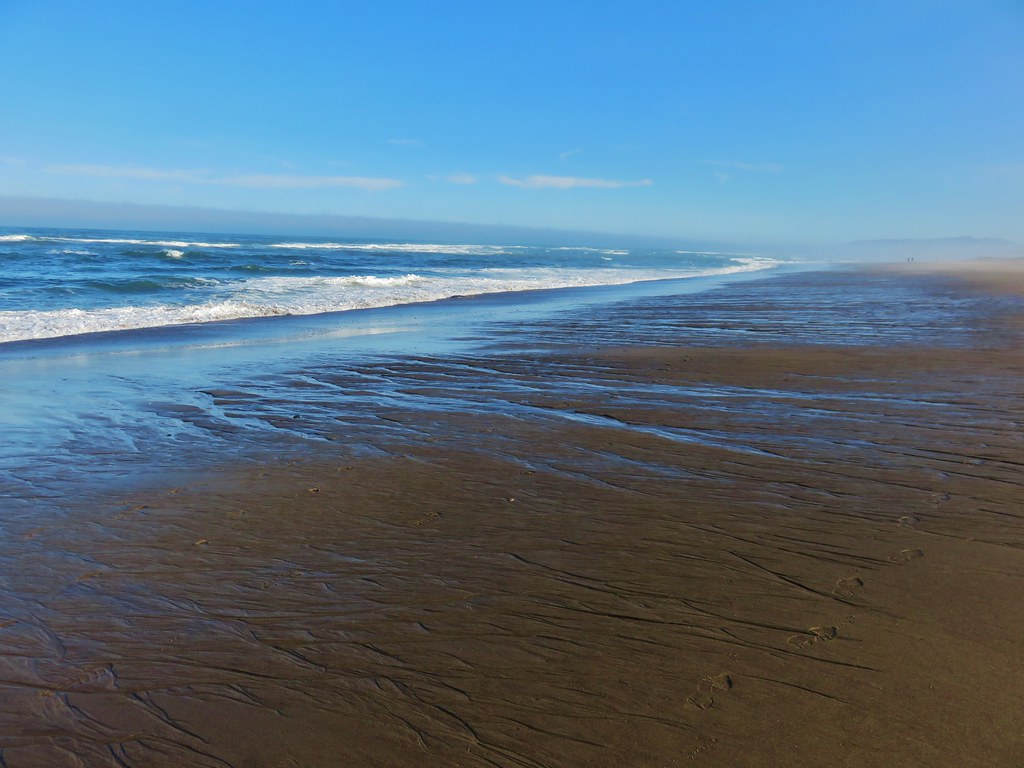
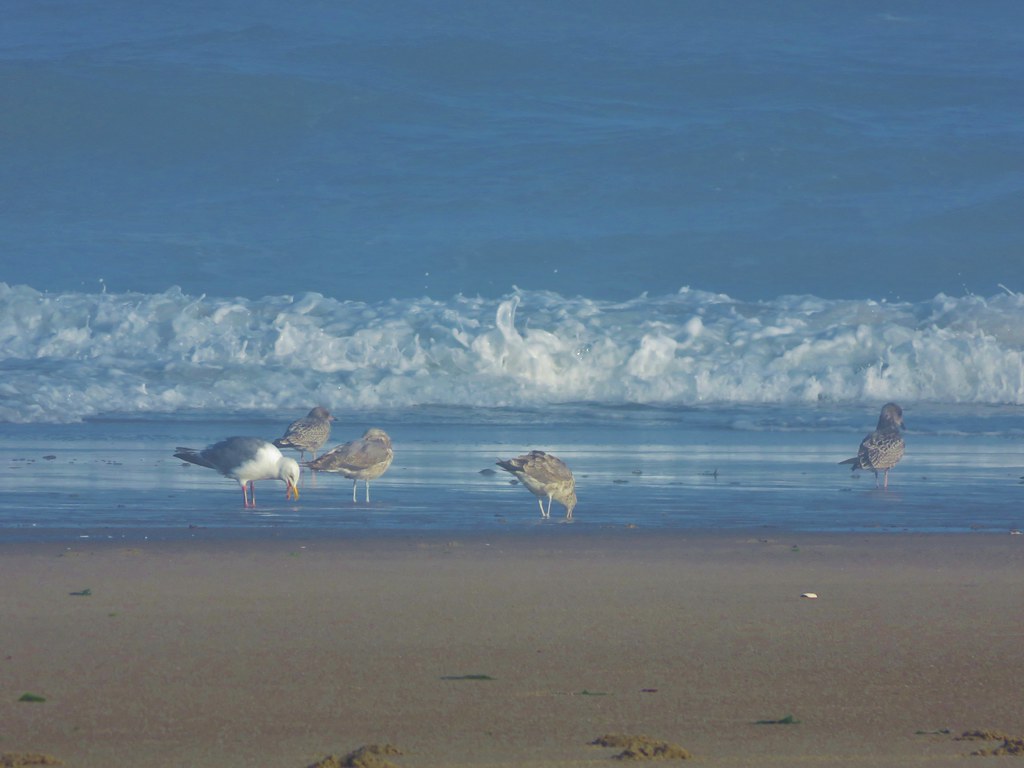
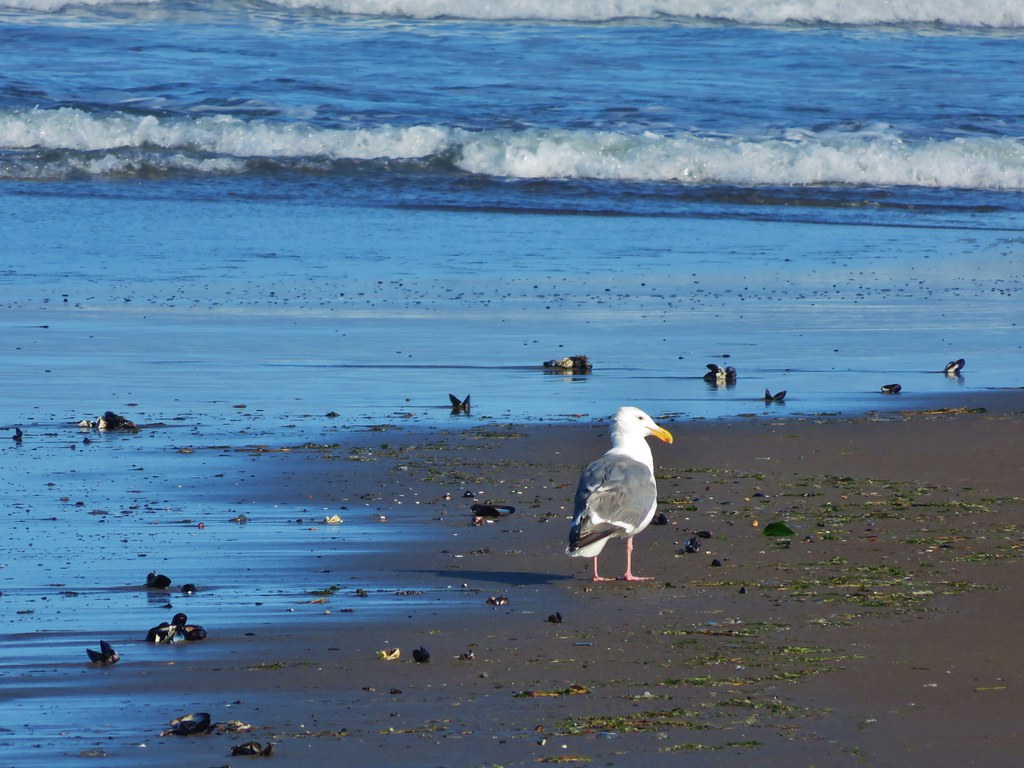
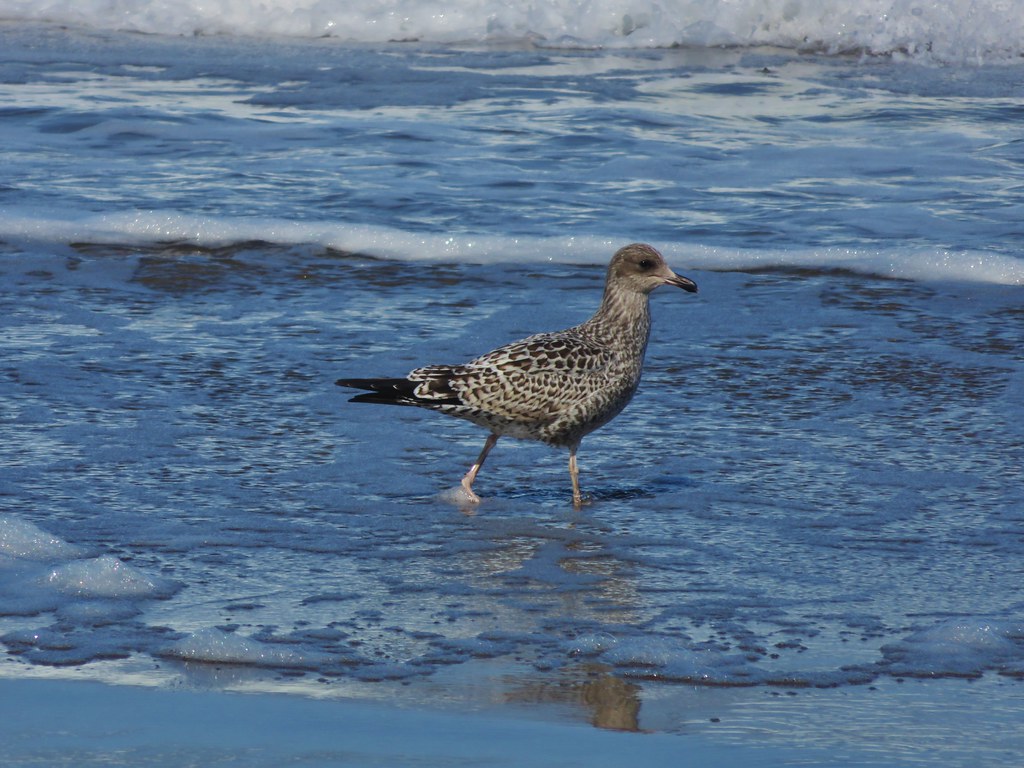
We headed north along the beach. The tide was out as we watched seagulls search for snacks in the surf.
IMG_7087

IMG_7078

IMG_7099

IMG_7097

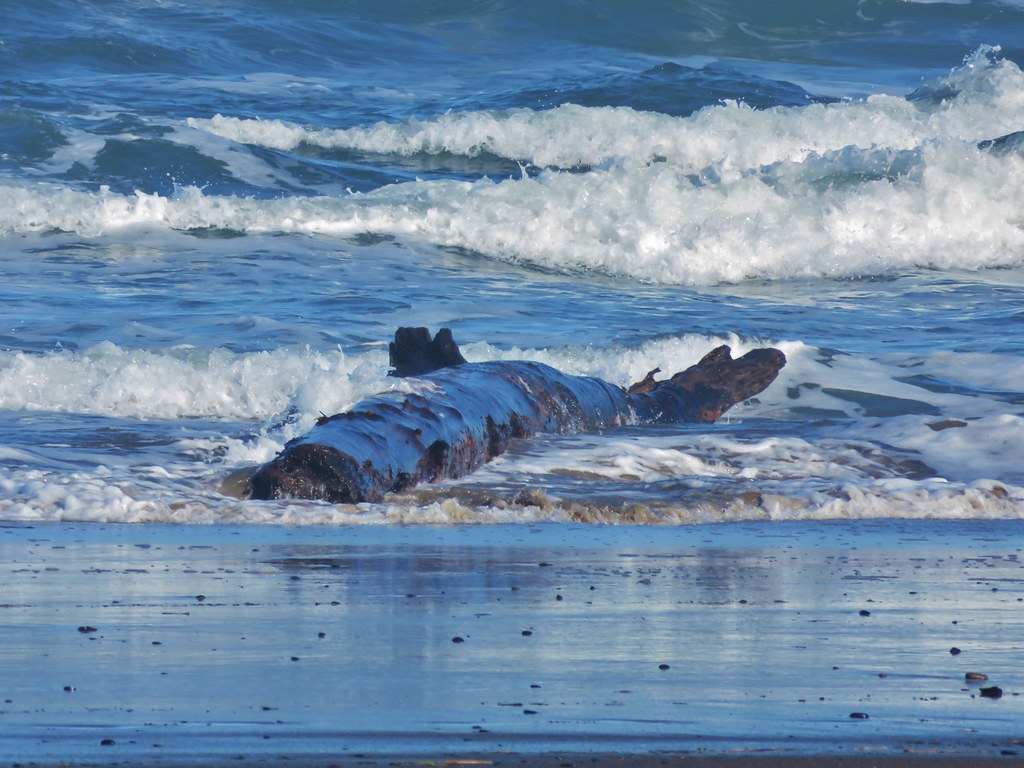
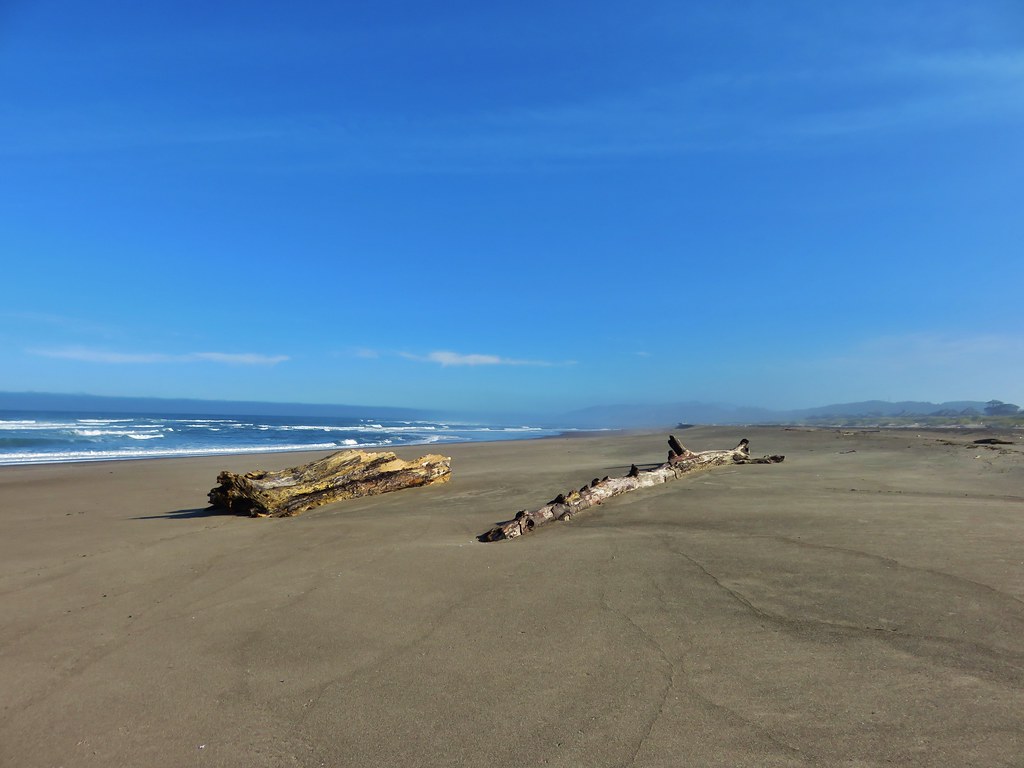
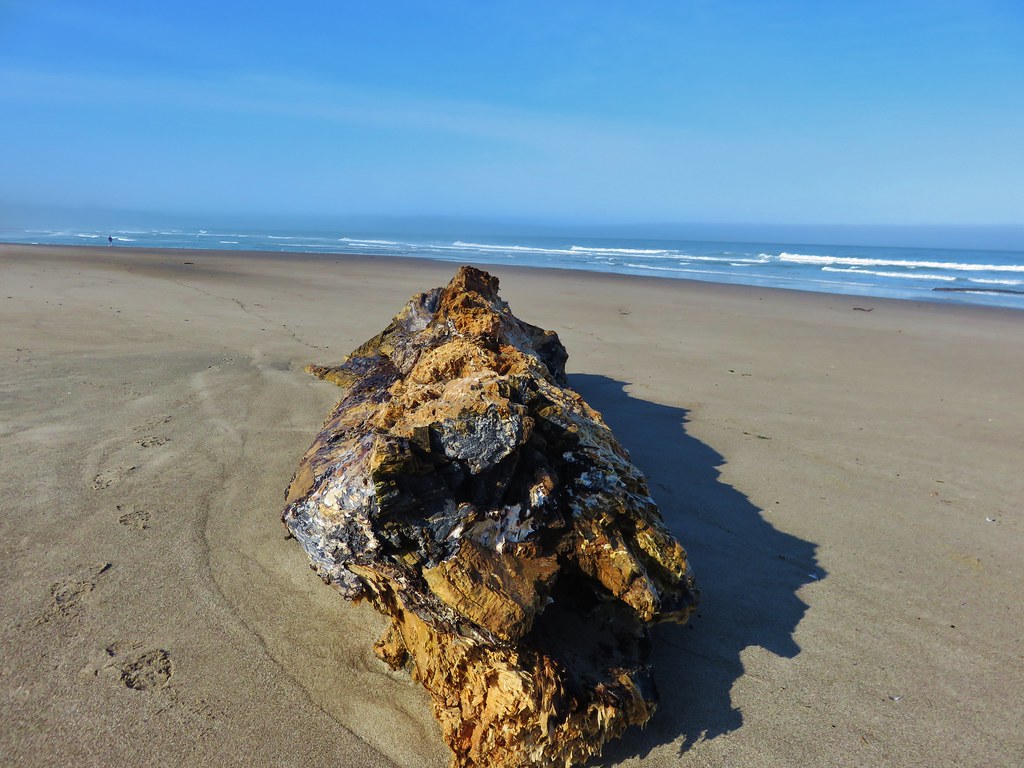
The beach was fairly free of debris but there were a few items to inspect including some nice drift wood.
IMG_7098

IMG_7101

IMG_7103

IMG_7104

IMG_7107

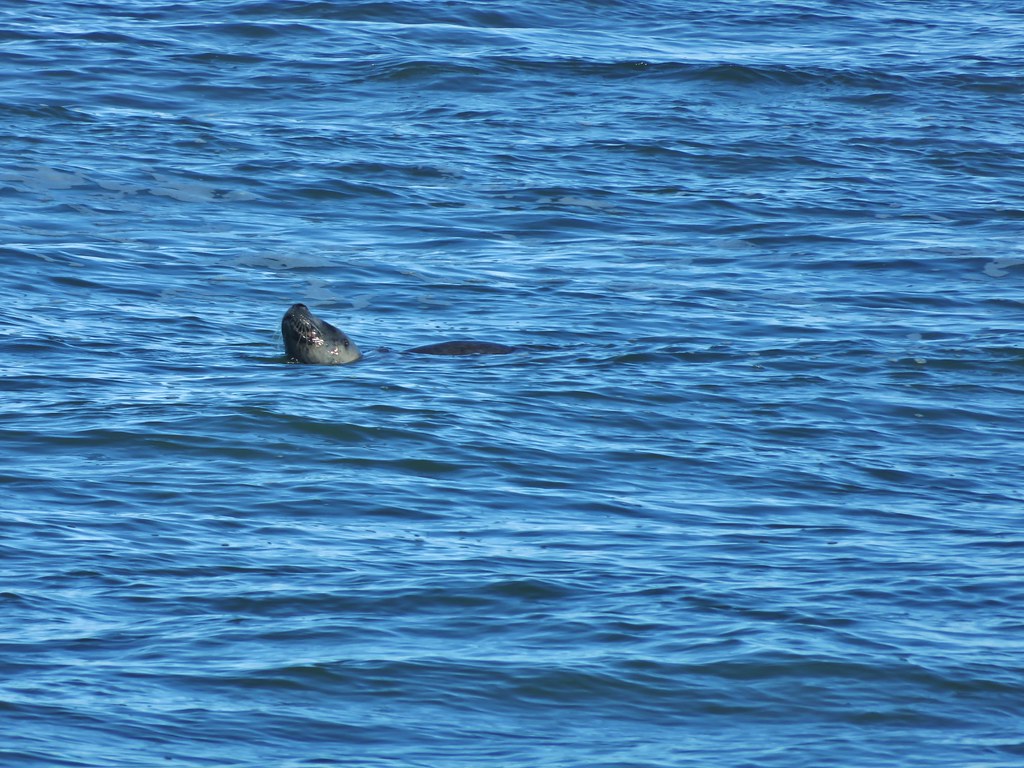
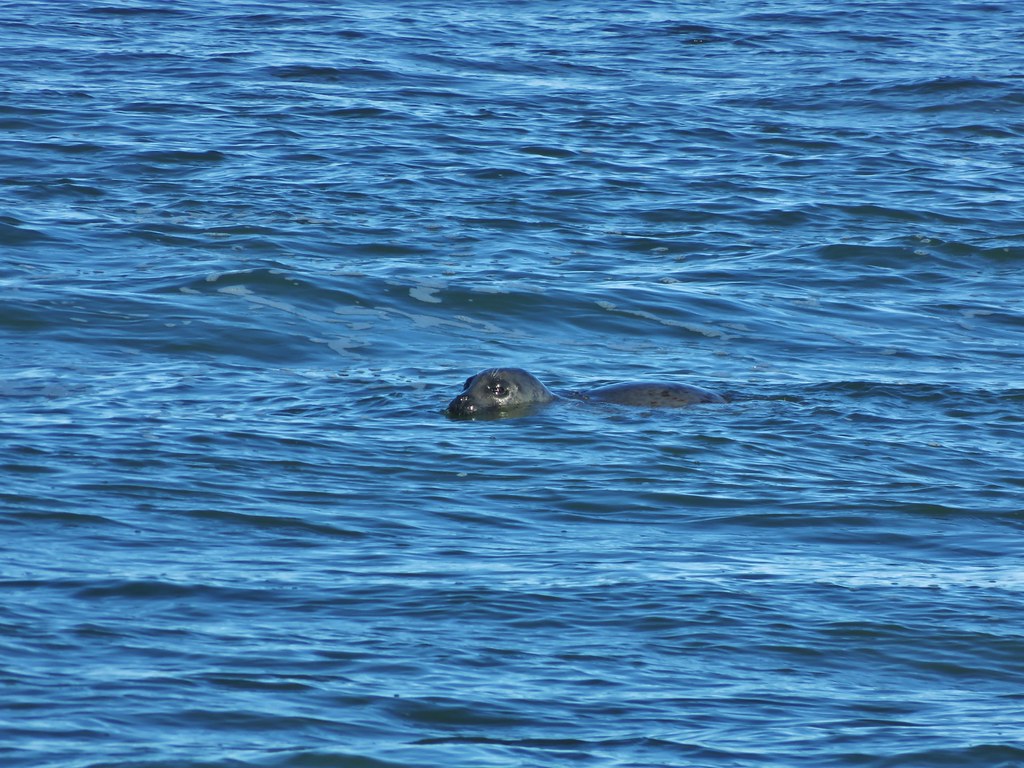
One of the things we were looking forward to on this hike was the possibility of seeing some seals. We spotted the first one of the day in the ocean about half way down the spit.
IMG_7109

IMG_7110

IMG_7113

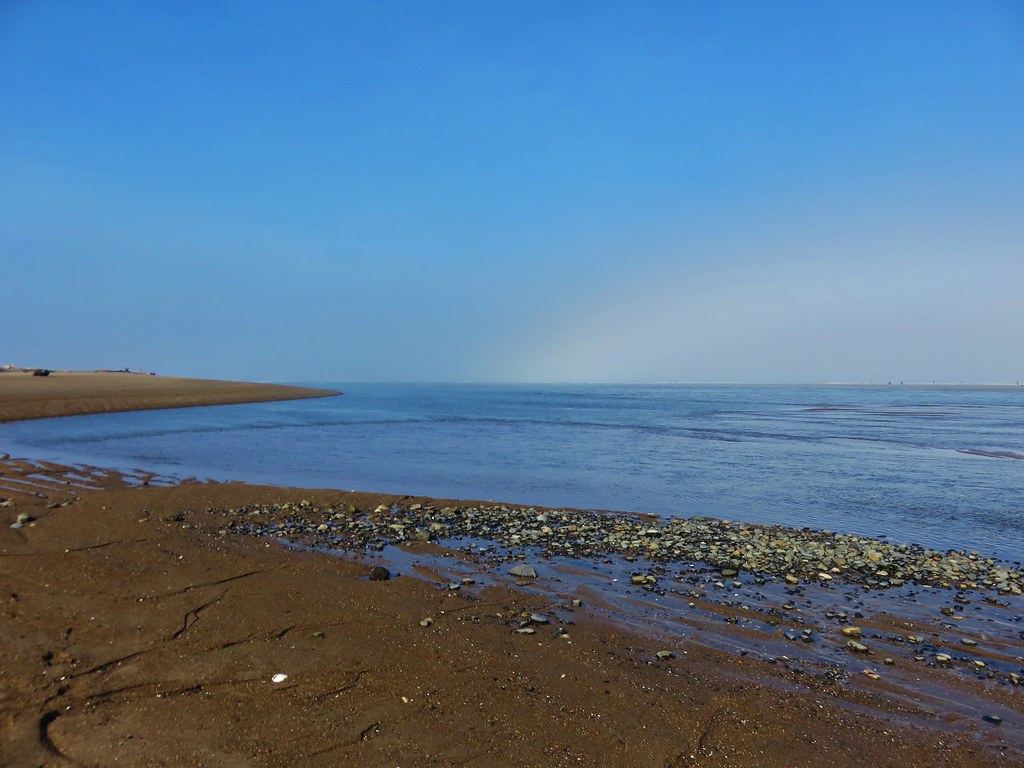
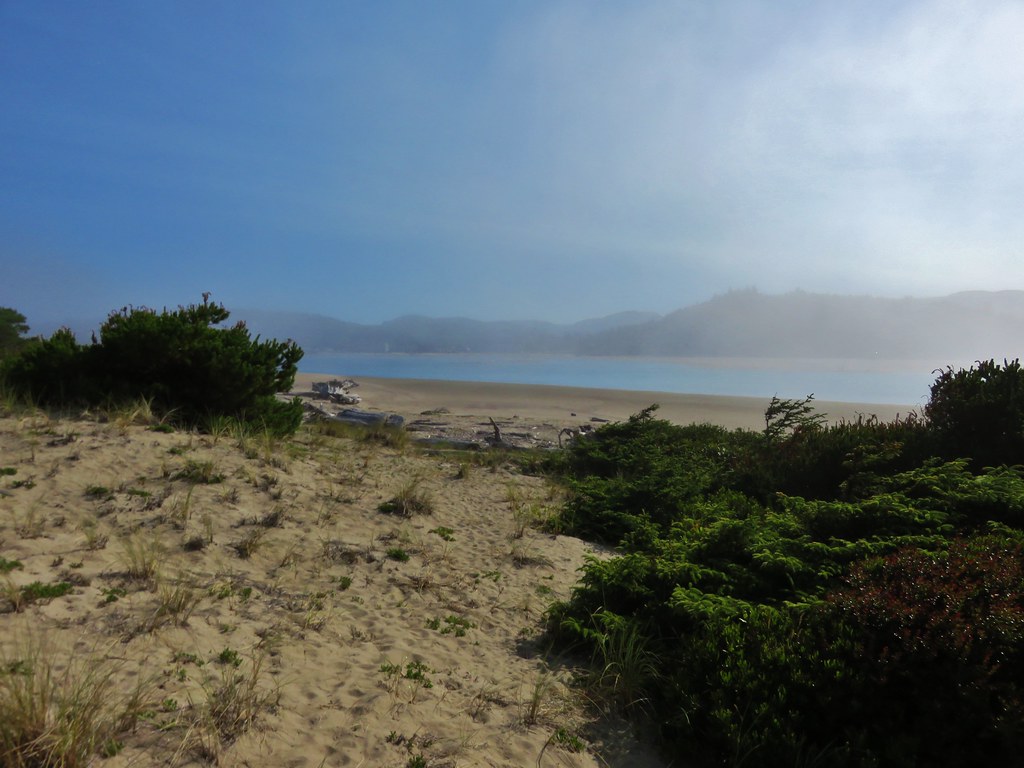
The spit ends where Siletz Bay meets the Pacific Ocean.
IMG_7114

IMG_7128

As we walked around the end of the spit we spotted many seals floating past on their way back out to the ocean.
IMG_7135

IMG_7137

IMG_7143

We then turned along the bay.
IMG_7152

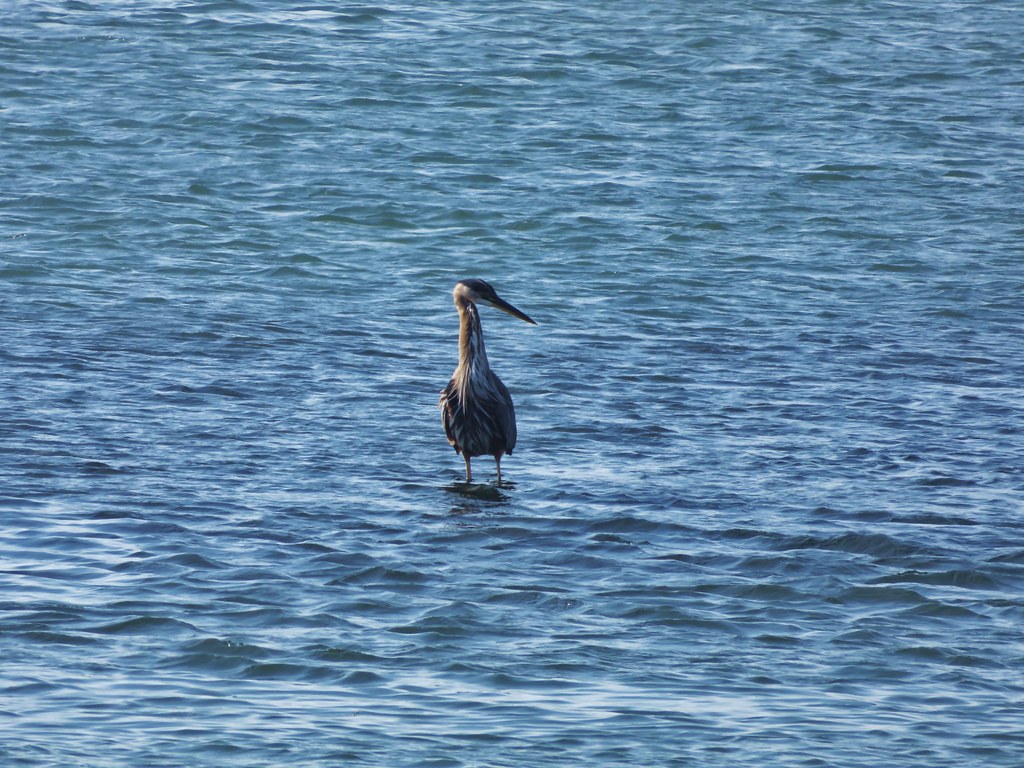
There were several groups of seals lounging in the bay as well as a Great Blue Heron looking for breakfast.
IMG_7148

IMG_7153

IMG_7156

IMG_7158

IMG_7179

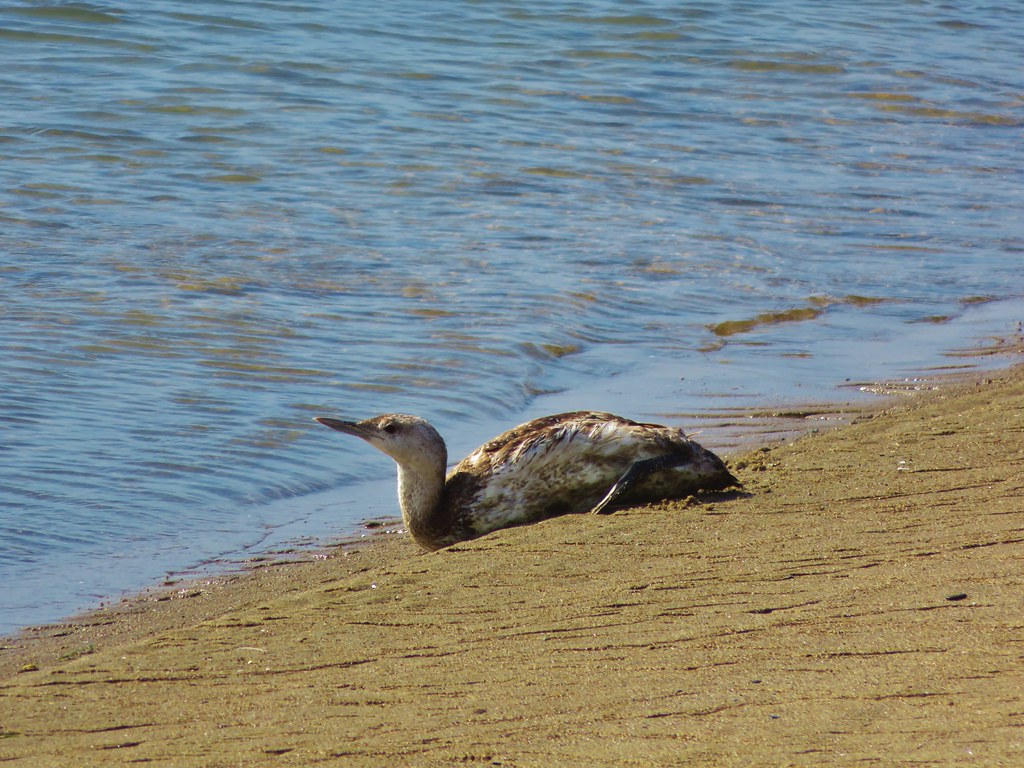
Along the shore we spotted a bird laying in the sand. We weren’t sure if it was injured or just a young bird but we kept our distance so we didn’t disturb it.
IMG_7182

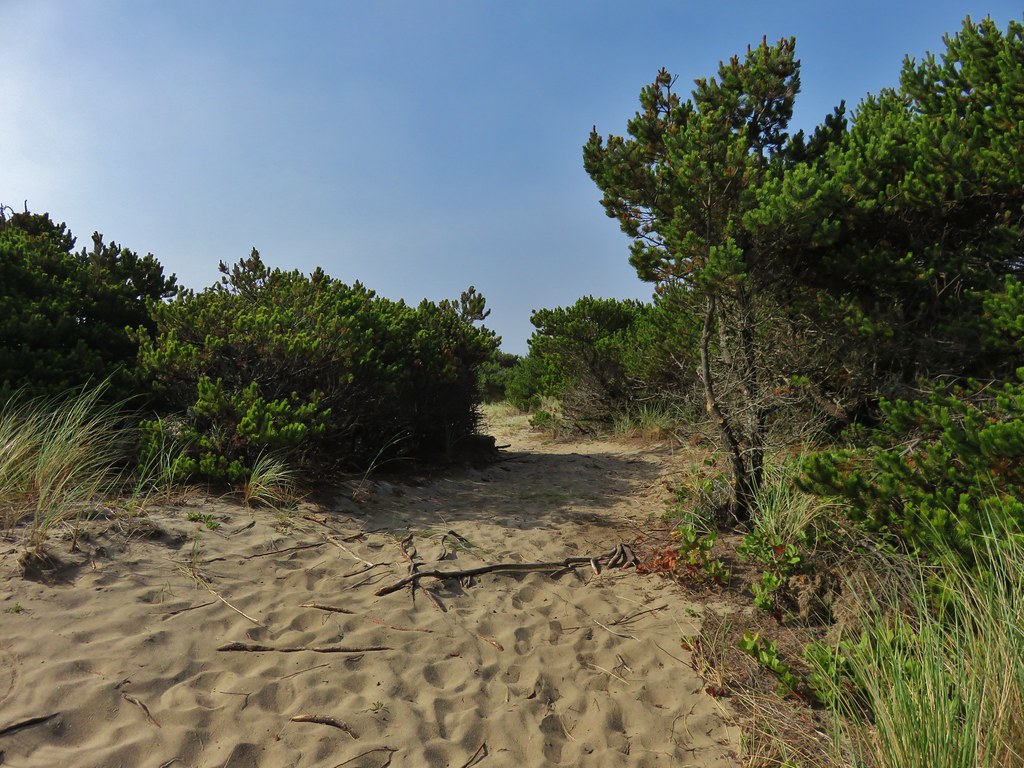
A wide path then led through some stunted pines and grasses to the Salishan North parking area.
IMG_7209

IMG_7195

IMG_7213

From the parking area we crossed back over to the ocean due to the presence of private residences on the bay side of the spit beyond the parking area.
IMG_7218

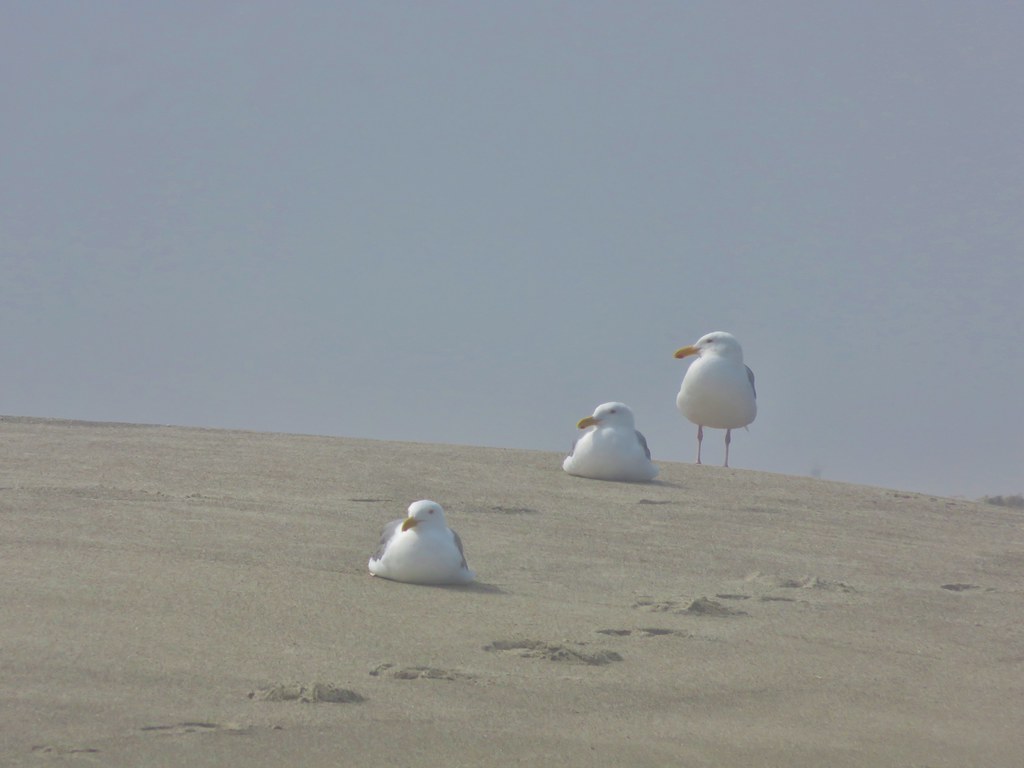
We returned along the beach to the wayside. Many of the seagulls were still hunting for goodies to eat although some were now taking a break.
IMG_7229

IMG_7238

IMG_7240

Our total distance was 7.7 miles making this a relatively short hike for us but we finished with plenty of time to get to the reunion on time. It was a far cry from the previous weeks hikes in the Three Sisters Wilderness but it was great to see so many seals and the mild temperatures made for a really nice hike. Happy Trails!

Flickr: https://www.flickr.com/photos/9319235@N02/sets/72157656249280980

Categories
High Cascades Hiking Oregon Three Sisters Area Trip report

Three Sisters Wilderness Days 3 & 4

**Note the 2017 Separation Fire burned a portion of these hikes.**

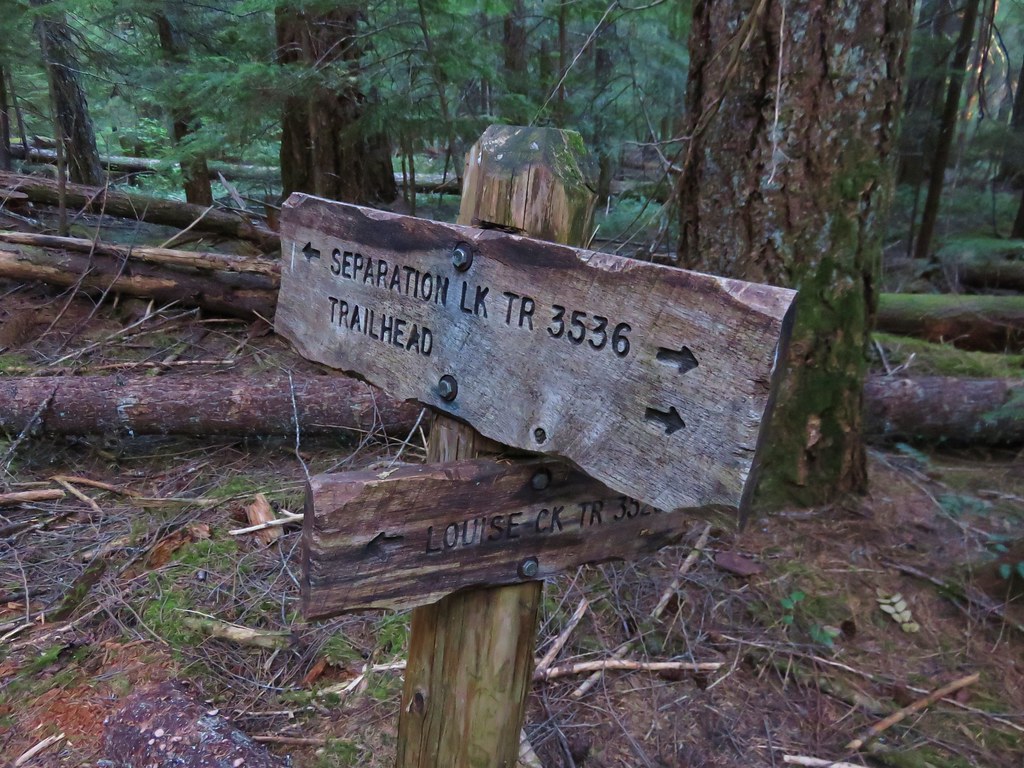
I am combining the final two days of our Three Sisters Backpacking trip because the last day was simply a 7 mile hike back to the trailhead along portions of the Louise Creek and Separation Lake Trails that we had done on the first day.

The day after our successful off-trail exploration of Linton Creek it was time to pack up camp and move on. We woke to find that the clouds had finally won out overnight and now covered the Three Sisters.
IMG_6749

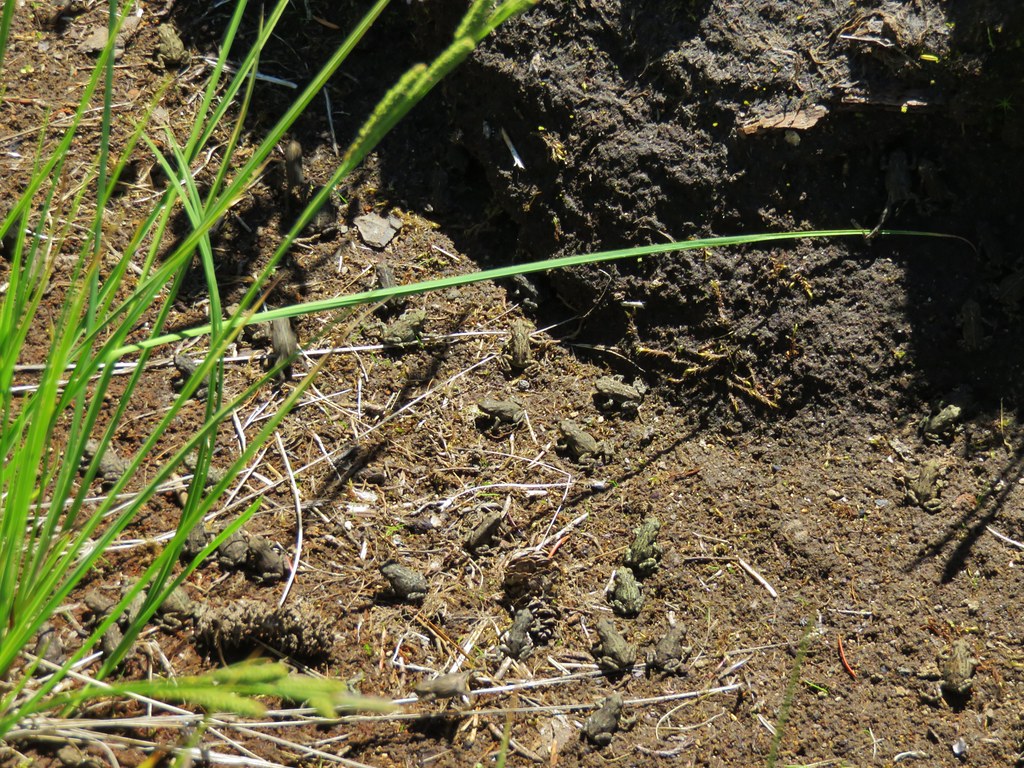
We were once again visited by the deer who stayed back in the trees this time as they made their morning rounds. We packed our things and ate some breakfast then headed back toward Husband Lake. The frog situation around Eileen Lake seemed to have worsened with the arrival of the clouds. There were even more frogs on the trail and the going was pretty slow.
IMG_6758

We discovered that tapping our trekking poles on the ground in front of us got the frogs to start getting out of the way sooner so we tapped our way through the frogs and past the lake. The frogs weren’t the only animals out as we had spotted several different types of birds by the time we’d gotten to Husband Lake.
IMG_6766

IMG_6769

IMG_6779

IMG_6781

IMG_6785

We topped off our water at Husband Lake and then headed for the big trail junction where we would be looking for the Separation Creek Meadow Trail which would take us down to Indian Hole Falls. We had not seen the trail when we were at the junction on the first day and when we got back there we still didn’t see it. Heather thought it might be just a bit up the trail toward the James Creek Shelter and went to investigate. She was right and just over a little rise there was an unsigned but clear trail heading down to the right.
IMG_6799

The Forest Service described this trail as “a primitive trail that may be hard to find at times.” That sounded a lot better than the impassable due to heavy blowdown description of the Separation Creek Trail. There were a few downed trees but the path was easy to see and some trees had been blazed to mark the trail.
IMG_6802

IMG_6844

The trail met Separation Creek in what must have been a spectacular field of lupine. Now it had all gone to seed.
IMG_6809

IMG_6806

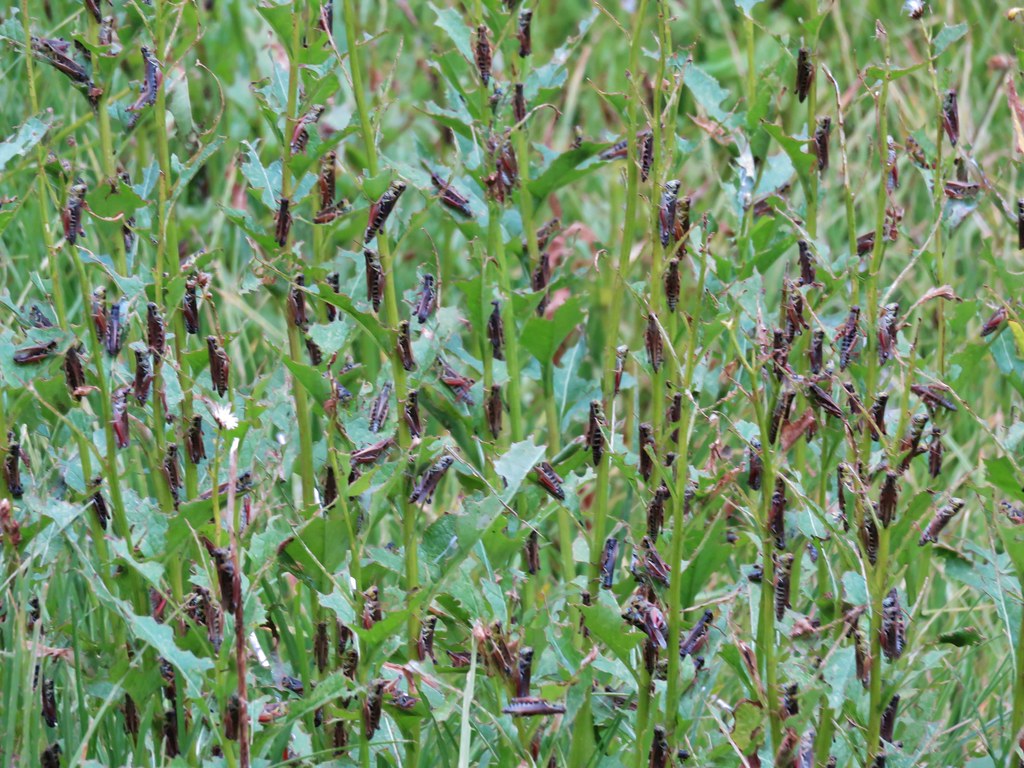
It had also been invaded by grasshoppers.
IMG_6811

IMG_6813

As we walked they would all jump in unison and make all kinds of noise. I would have liked to get a better look at them but there were also plenty of mosquitoes present and whenever I stopped they landed. We were just about to Separation Meadow and we hadn’t had any issues following the trail up to that point. Then the trail just disappeared. We knew it was to the right of the creek and we noticed a tent set up at the far end of the meadow so we simply aimed for the trees between those two things.
IMG_6816

IMG_6824

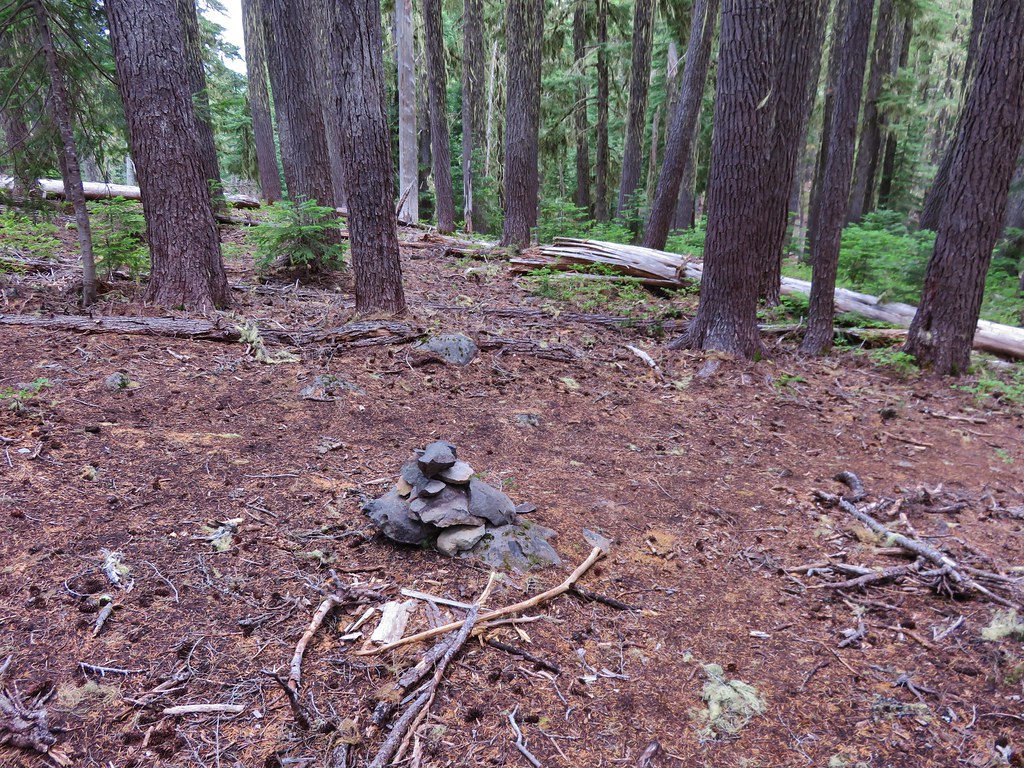
We had to hunt for a couple of minutes to find the trail again once we arrived at the trees. We managed to follow it fine after that all the way to a trail junction with the trail from Buck Meadows. This junction was also unsigned but it was marked with a rock cairn.
IMG_6849

We turned left at the junction and began to descend toward Cole Chuck Meadows. Views included Sphinx Butte and The Wife.
IMG_6850

IMG_6852

The trail went around Cole Chuck Meadows without ever entering it then headed steeply downhill. There was a large meadow below to our left and we could hear Separation Creek roaring in the distance. The trail had loose rocks and dirt and it also passed below the Indian Holes, springs that flowed across the trail and down toward Separation Creek.
IMG_6871

IMG_6861

The trail then entered the large meadow at a narrow point. The grasses were tall enough to hit us in the face as we passed through. We then entered another treed area before arriving at Separation Creek.
IMG_6878

The creek was much wider and deeper than it had been in Separation Meadow. Several other creeks and springs had fed into it since then. We crossed on an old log and and quickly arrived at another unsigned trail junction with the “impassible” Separation Creek Trail.
IMG_6880

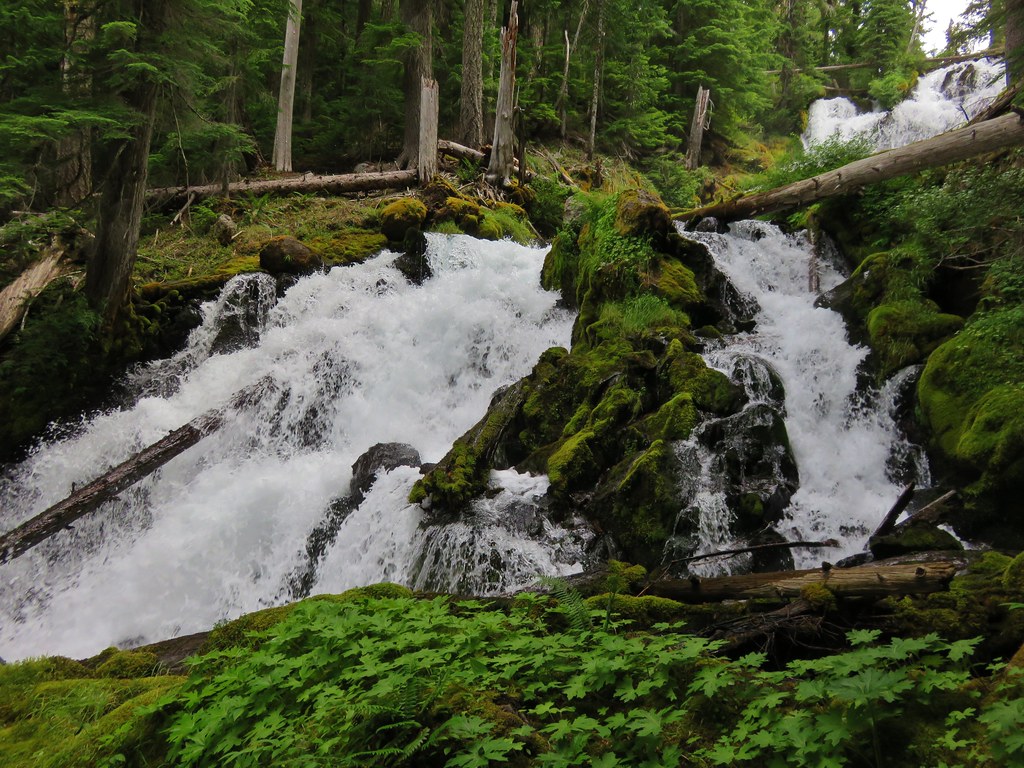
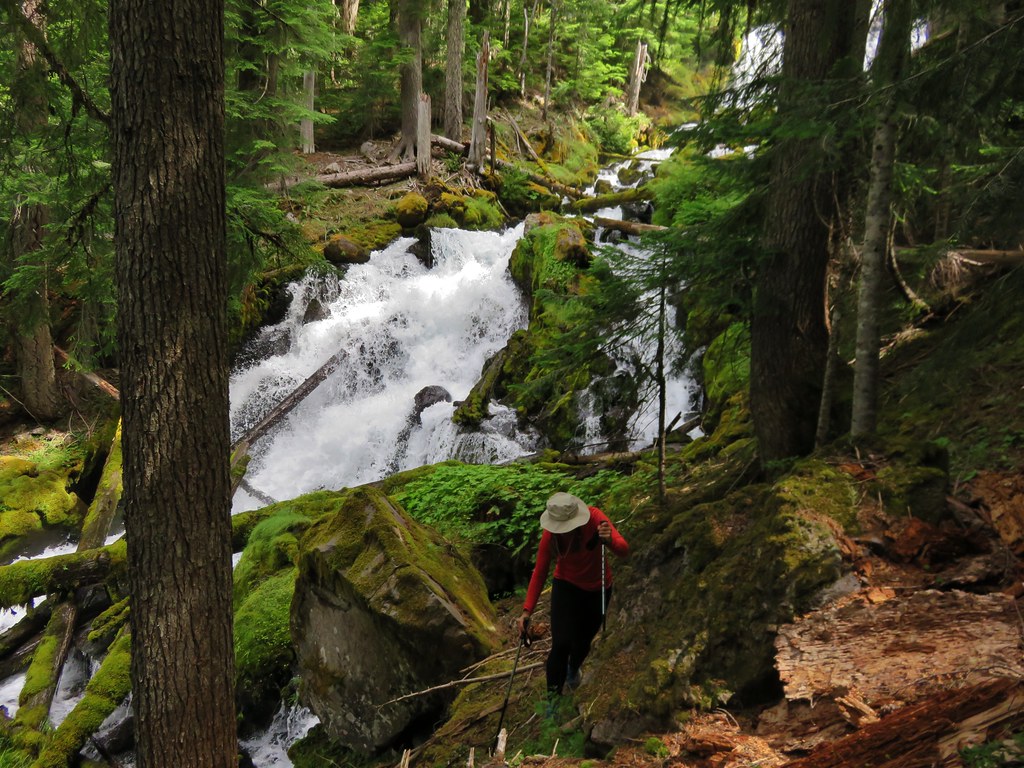
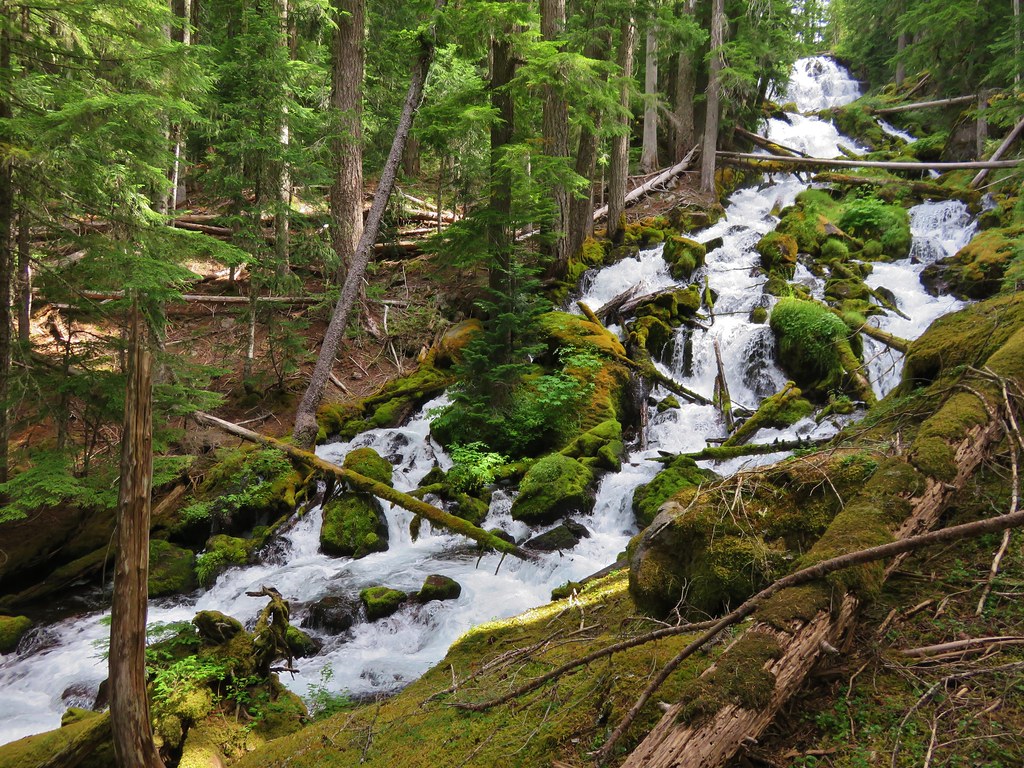
We could hear Indian Hole Falls from the junction. It was only a couple hundred yards to the top of the falls. This was another impressively massive waterfall. An upper viewpoint allowed for a close up view of the top portion of the falls while a steep scramble down along the creek led to a lower moss covered viewpoint where the entire cascade was visible.
IMG_6883

IMG_6894

IMG_6897

The Three Sisters Wilderness had managed to wow us again and we sat on the mossy ledge of the lower viewpoint in the cool breeze of the waterfall. We climbed back up from the lower viewpoint and decided to head out the the upper one.
IMG_6916

After checking out that view we headed back up to the trail to pick up our packs. It was my turn to get stung by an angry yellow jacket. Just as I was about to step back onto the trail I felt a sharp pain on my ankle bone. It took me a minute to figure out what was causing it but once I realized what it was I was able to knock it out of my pant leg. I took a moment to be a bit of a baby then we resumed our hike and head back toward the creek crossing.

As we were passing back through the tall grasses of the meadow we heard some strange noises ahead. It was a family of grouse. The adult stood watch as the young made their way into the safety of the trees.
IMG_6938

IMG_6934

IMG_6936

She stood guard until they were all safe then headed into the trees herself.
IMG_6942

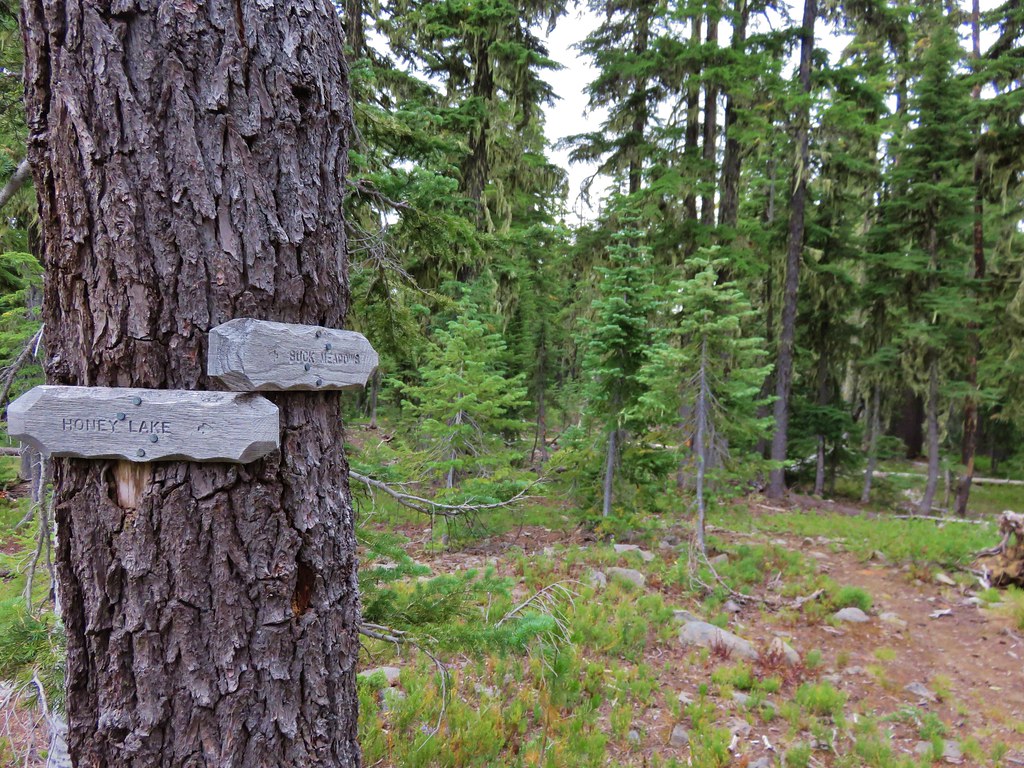
We climbed back up the steep trail past the Indian Holes and went straight past the rock cairn. Our plan was to stop at Honey Lake to fix an early dinner and fill back up on water for the final day since we knew there were no sources from Buck Meadows on. We weren’t sure what we’d find at Honey Lake because none of the maps or the Forest Service showed a trail going to the lake but we had seen the pointer for it at the junction by Buck Meadows. As we were looking for the mystery trail we spotted various wildlife along the way.
IMG_6945

IMG_6951

IMG_6956

Sure enough we came to a side trail with a pointer for Honey Lake.
IMG_6968

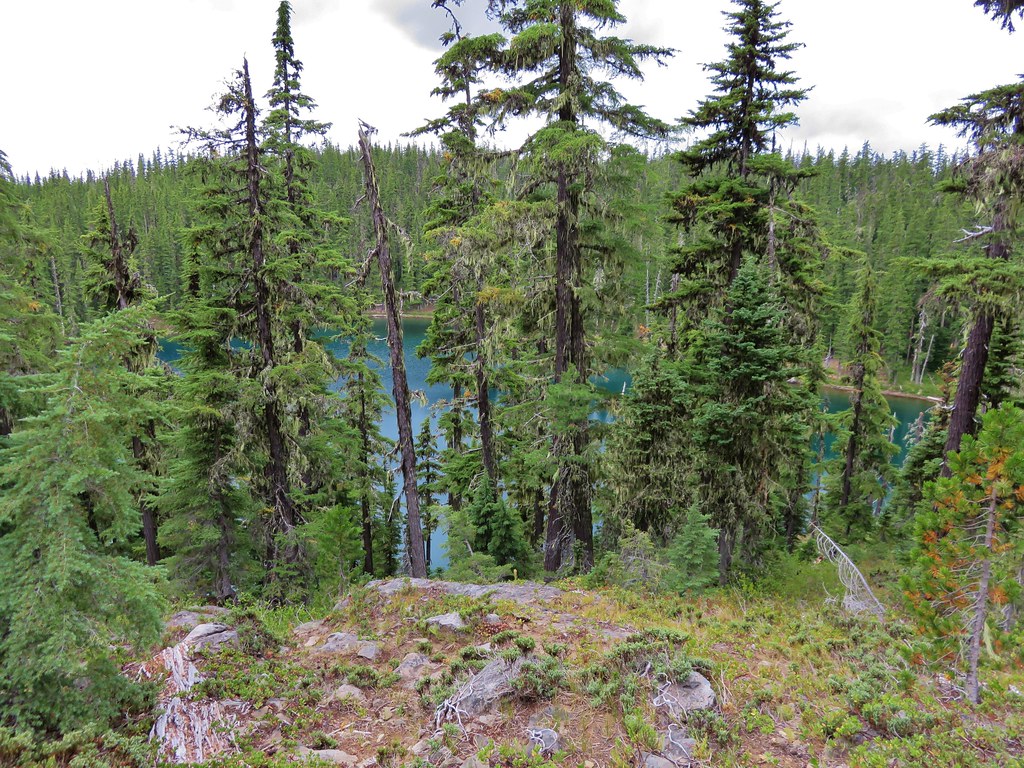
We momentarily had second thoughts about our plan when we saw how far below us the lake actually was.
IMG_6971

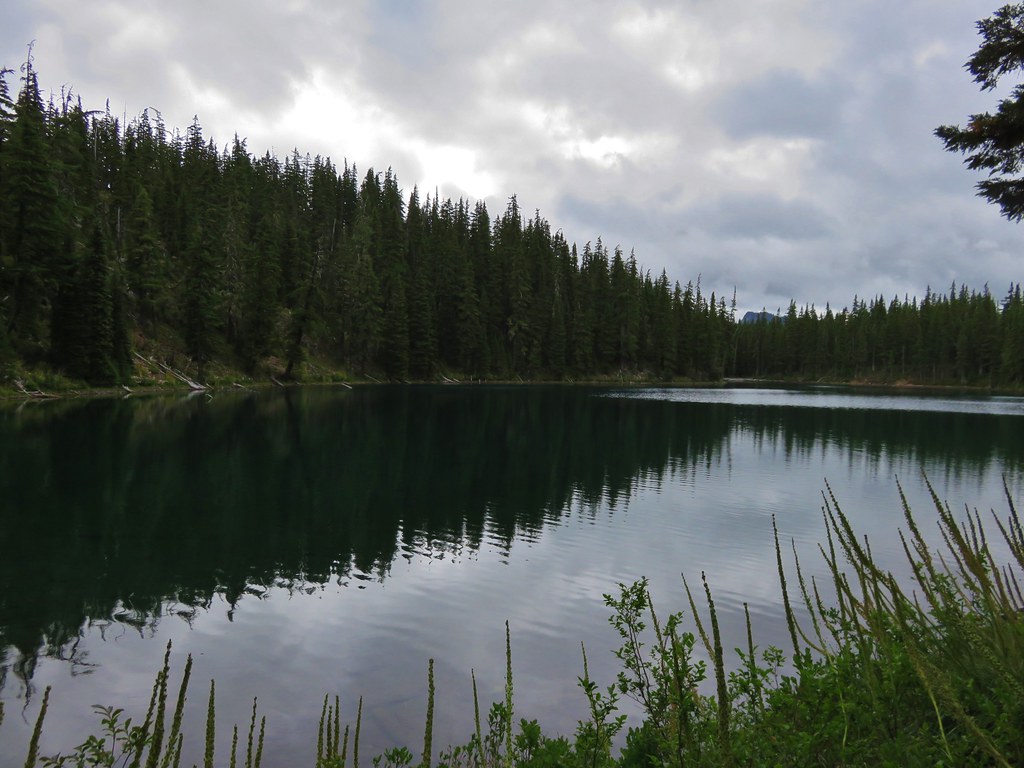
We knew we needed water though and the lake looked very pretty so we headed down the steep path to the lake shore. It really was a pretty lake and larger than we had been expecting.
IMG_6974

IMG_6976

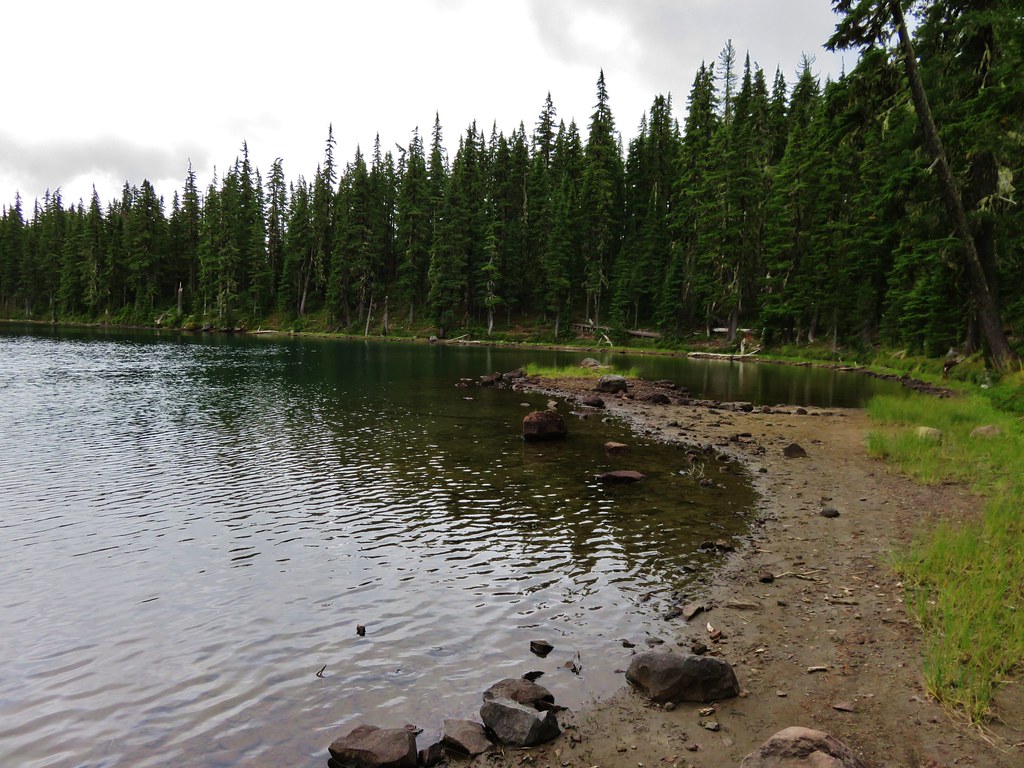
We noticed a tent back up in the forest on the far side of the lake and headed around the lake counter-clockwise looking for a good spot where we could set our things down and cook dinner. We found a pair of spots where people had obviously camped, fire rings and all, both of which are illegal within 100 feet of water in the wilderness. One of the fire rings was full of cigarette butts. Yay for people, not 😦 We took off our packs and wandered out to a little peninsula where the breeze kept the mosquitoes at bay.
IMG_6979

IMG_6981

We took a nice long break at the lake and felt recharged after having our dinner and we were ready to tackle the climb back up from the lake.
IMG_7004

The climb back up turned out to be a lot easier than we’d expected and we were soon back on the trail to Buck Meadows. We stuck to the trail this time when we arrived at the meadows and wound up going right around the area we had considered camping in. Once we saw that we had passed it we decided to just keep going and we’d look for a spot further along the meadows. The view from the meadow was changed a bit from our first day with clouds now hiding The Husband.
IMG_7021

There wasn’t a viable spot to camp anywhere else along the meadows that we saw so we just kept going keeping our eyes open for an acceptable site. About 1 1/2 miles from the junction at Buck Meadows we came to a dry pond. On the opposite side of the trail was a flat area perfect for setting up camp.
IMG_7033
IMG_7032

We woke up so early the next morning that we needed our headlamps as we began packing up. We ate breakfast at the edge of the dry pond and then set off down the trail. The 2 man trail crew had done a fine job clearing the trail and we were making great time since we’d just been on this trail a few days earlier and weren’t distracted by many new sights. There are always some new things to see though and we noticed a few flowers we’d missed on the first day.
IMG_7037

IMG_7045

We reached the Separation Lake Trail a few minutes before 9am and according to our Green Trails map we then had 1.2 more miles to go to the trailhead.
IMG_7052

We figured we’d be back at the car around 9:45 based on our normal pace so we were surprised when we saw a familiar wooden bridge that we remembered being near the trailhead sooner than we expected.
IMG_7059

We actually wound up back at the car before 9:15. We were moving pretty fast but not that fast. Checking another map it showed the distance from the trailhead to the junction as 0.9 miles which made a little more sense. We were happy to be able to change into some clean clothes and different shoes, but we were also sad to have the trip end. We were already thinking about our next backpacking trip, wondering what new adventures awaited us. Happy Trails!

Flickr: https://www.flickr.com/photos/9319235@N02/sets/72157654071670793

Categories
High Cascades Hiking Oregon Three Sisters Area Trip report

Three Sisters Wilderness Day 2 – Linton Creek Exploration

**Note the 2017 Separation and 2024 Linton Creek Fires burned portions of this hike.**

The second day of our four day backpacking trip was set to be an adventure. Our plan was to spend the day “off-trail” exploring Linton Creek which is home to several rarely visited waterfalls. We had camped at Eileen Lake on the NE side of The Husband and originally planned on hiking down the official trail to Linton Creek where we had eaten our dinner the night before, but during our evening exploration of the area behind our campsite we realized we should be able to follow a dry creek bed we’d seen and reach Linton Creek by a more direct route. It would also allow us to avoid another trip through all the frogs along Eileen Lake.

I woke up a little before 5 and went down to the lake for a bit to look at the mountains.
IMG_6484

Heather woke up and I was busy getting ready for our breakfast and the days hike when I looked up and noticed there were deer about 50 feet from our tent. Heather was still inside putting her hair into braids and hadn’t noticed them yet.
IMG_6486

I got her attention and we watched as they nibbled on some plants then entered the little meadow by our site and had their own breakfast.
IMG_6501

IMG_6493

They looked up at us occasionally but didn’t seem to be the least bit concerned with our presence then left the same way they’d come slowly disappearing into the forest.
IMG_6491

IMG_6500

After our breakfast we threw on our daypacks and got ready for our adventure. We had our compass and three different maps including the map loaded on the Garmin and I had studied the area using Google Earth. That research along with information from a few trip reports and the Northwest Waterfall Survey had us feeling pretty confident that we would at least be able to reach Duncan Falls and possibly Upper Linton Falls if time allowed. I also established a turn around time in order to make sure we had enough time to climb back up from wherever we ended up.

We followed a use path from our campsite through the little meadow along the dry creek into a larger meadow. The use path ended at the larger meadow so we hopped into the dry creek bed planning on following it as far as possible.
IMG_6504

IMG_6505

We had to leave the creek bed in the meadow for a bit when we started running into small pools of water. We got back in shortly after leaving the meadow but that also didn’t last long because the creek bed was getting deeper and we spotted downed trees blocking it further downhill. We didn’t want to get stuck in the bed and be forced to backtrack so we got out and started bushwacking through the forest.
IMG_6508

We gradually made our way downhill toward the meadows surrounding Linton Creek. There was some blowdown in the forest but it wasn’t ever too bad and the vegetation was sparse enough not to cause any problems. We used the Garmin and our maps to keep us heading in the direction we wanted. We were aiming for the northwestern end of the meadows where Linton Creek enters the forest near a series of whitewater. We managed to reach the meadows fairly close to that area and made our way to the glassy creek.
IMG_6509

IMG_6523

There were a few flowers still blooming including some very tall monkshood.
IMG_6511

IMG_6514

The South Sister loomed behind us over the creek and meadows.
IMG_6522

Shortly after Linton Creek enters the trees it takes a horseshoe bend through a rocky chasm where it puts on its first whitewater show. We were on the south side of the creek and able to side-hill along and around the ridge that the creek bent around which allowed us some good views of the now raging creek.
IMG_6531

IMG_6536

IMG_6540

After rounding the ridge we came to the first small unnamed waterfalls. A pair of short drops were visible through the trees.
IMG_6545

IMG_6548

A little further was another whitewater slide.
IMG_6551

The creek was putting on a good show and we were trying to stick as close as possible to it given the terrain. When we couldn’t see the creek we listened intently for any indication of another fall. The creek then began a second horseshoe bend turning back toward the NW. Somewhere in the middle of the bend was where we would find Duncan Falls. It was one the two main targets for our hike and we heard it well before reaching it. We arrived at the top of the falls and could tell we were not going to be disappointed.
IMG_6560

IMG_6562

The ridge stayed and made a wide swing around the falls. We were finally able to get a good view though.
IMG_6565

IMG_6567

It was a spectacular waterfall. After standing in awe of this hidden gem we worked our way down a steep hillside to the creek a little ways below Duncan Falls. We could just see the bottom of the falls through some trees and briefly considered hiking up the creek to reach the base but decided against that in the end. We still had a lot of bushwacking ahead of us and the thought of wet shoes and socks was not appealing plus I was fairly certain that I’d fall in and ruin the camera.
IMG_6575

Below Duncan Falls the creek settled down some as the terrain became a little more level.
IMG_6576

At one point we found what looked like it could possibly be a beaver pond.
IMG_6579

IMG_6580

IMG_6581

We then came upon another pair of small waterfalls.
IMG_6582

IMG_6589

IMG_6594

In the other trip reports that I had seen the hikers had been on the north side of the creek from Linton Lake until somewhere below Duncan Falls. We had originally planned on staying on the south side of the creek the entire time, partly to be different, and partly because the top tiers of Upper Linton Falls were said to not be visible from the north side of the creek. That changed when we could see that we had arrived at point directly across from the start of a large meadow on the other side of the creek. It looked so much easier than picking our way over and around logs and brush and there was a perfect log to cross the creek on near us. We gave in and walked across the log and entered the meadow. I had read about the meadow and the reports called it marshy but I was hopping the dry year we were having would lessen that, but there was still plenty of wet spongy ground and both of us had soaked shoes in no time.
IMG_6601

We aimed for the closest stand of trees and exited the meadow. We took a short side trip to check out one of two small lakes/ponds that the maps had shown toward the back of the meadow.
IMG_6602

After checking out the pond we began making our way back toward the creek. Shortly after rejoining the creek we found another log we could cross on and got back to our original plan of being on the south side of the creek for Upper Linton Falls.

We knew we were getting close to our goal but before we got to Upper Linton Falls there was another nice little fall with a great viewpoint.
IMG_6620

The next fall we came to was the top tier of Upper Linton Falls.
IMG_6623

The roar from the creek was amazing as it thundered steeply down toward Linton Lake.
IMG_6625

We found our way down to the third tier where there was a nice viewpoint.
IMG_6633

IMG_6634

The fourth tier was visible below.
IMG_6640

The ridge we were on began to swing away from the creek though. We could see Linton Lake far below and went in search of a decent view but there were too many trees to ever get a good clear look.
IMG_6641

IMG_6646

We found one final viewpoint of Upper Linton Falls. We appeared to be somewhere between the 5th and 6th tiers.
IMG_6655

There was a big drop below us but no way to get a look at the lower tiers from the south side. We decided that just gave us an excuse to come back some day and hike up from Linton Lake to see Lower Linton Falls and get a look at the lower tiers from the north side. In the meantime we sat at the edge of the enormous fall recharging in the cool breeze it generated.
IMG_6660

We had made it to our goal just before the established turnaround time and now it was time to climb back up to Eileen Lake. This time we did stick to the south side of the creek avoiding the marshy trap of the meadow. By doing so we located a couple more small falls we’d missed on the way down.
IMG_6678

We also managed to find a balloon which happens more often than you’d think (and we’d like) in the forest. We retrieved the garbage and packed it out with us.
IMG_6691

IMG_6692

We arrived back at Duncan Falls to find it was just as impressive the second time around.
IMG_6700

IMG_6697

After Duncan Falls we left the creek and took a more direct route toward Linton Meadows which avoided the steep ridge above the whitewater of the first horseshoe bend. White fluffy clouds hung over the mountains when we finally reentered the meadows.
IMG_6707

We were paying more attention to the views than to where we were going and wound up passing the spot where we had entered the meadows in the morning. We turned up a different creek bed instead. It looked similar enough that we both thought we remembered certain details as we passed them but as the drainage got steeper and we started noticing more blowdown than we’d remembered we knew we had made a wrong turn. Using the GPS and our maps we could see that we were just on the other side of the ridge we’d come down but we had found a different little meadow here and it’s creek had a little more water which was home to some larger frogs and fish.
IMG_6720

IMG_6715

IMG_6717

IMG_6719

We were able to make our way over the ridge at the far end of the meadow and picked up our earlier path just about where we had entered the dry creek bed near the start of our hike.

According to the Garmin we had covered 9.3 miles. We both had a few scrapes and bruises as well as some mosquito bites and Heather had been stung in the shin by a yellow jacket but it had all been worth it. We spent the evening at Eileen Lake watching clouds float by and then disappear over the Three Sisters.
IMG_6724

Happy Trails!

Flickr: https://www.flickr.com/photos/9319235@N02/sets/72157656375371832

Categories
High Cascades Hiking Oregon Three Sisters Area Trip report

Three Sisters Wilderness Day 1 – Separation Lake Trailhead to Eileen Lake

**Note the 2017 Separation Fire burned a portion of this hike.**

We just started backpacking last year and we really enjoyed it so we were looking forward to our first outing of the year which we recently completed. I plan on covering our trip over three entries starting with this post featuring our first day.

We had originally planned on spending a long weekend in the Opal Creek and Bull of the Woods Wilderness areas, but with the early snow melt in the mountains we changed our destination to the Three Sisters Wilderness. I had been wanting to check out the waterfalls along Linton Creek since seeing a trip report that was posted on Portlandhikers.org in 2013. There is no official trail to any of the falls along the creek and in most places there is no trail at all. The few reports I found on the area all began their hike at Linton Lake along Highway 126 and climbed up toward Linton Meadows. In the report on Portlandhikers they had hiked up the creek then over to Eileen Lake for the night then returned to Linton Lake the next day. I wasn’t too keen on the idea of carrying our full packs while bushwacking uphill so I came up with a different plan.

The solution was to start the exploration of Linton Creek from Eileen Lake where we would already have established our campsite. This would allow us to explore down stream as far as Upper Linton Falls using daypacks. I began studying our maps trying to plan the trip. The three closest trailheads to Eileen Lake are the Obsidian Trailhead, the Foley Ridge Trailhead, and the Separation Lake Trailhead. I quickly settled on the Separation Lake TH since it was the closest to us, didn’t require a limited entry permit, and offered a couple possible return loops.

We had been to the Separation Lake Trailhead in May 2014 when we hiked to Separation Lake so we were familiar with the trail when we slung our packs on and set off into the Three Sisters Wilderness.
IMG_6216

This time we took the Louise Creek Trail when we reached the junction just under a mile from the trailhead.
IMG_6217

Our plan was to follow the Louise Creek Trial for 7.2 miles to another trail junction at Buck Meadows then continue up to the Foley Ridge Trail which would take us to yet another junction. From there we would take the Linton Meadows Trail to a final junction where we would head for Husband Lake and our ultimate destination of Eileen Lake.

As we climbed up the Louise Creek Trail we met a couple that were hiking out after having camped at Sisters Mirror Lake. They had come down a portion of the Separation Creek Trail from the James Creek Shelter to Indian Hole Falls and reported that the trail did indeed have many downed trees across it. This confirmed what the information on the Forest Service website which called the trail “impassible due to heavy blowdown”. We had planned on visiting Indian Hole Falls then taking that trail down to Separation Lake where we would camp on our third night but had nixed those plans after seeing the information on the website. The other couple said the falls were beautiful and we still planned on visiting them but by using the Separation Creek Meadows Trail instead.

They also reported that there were a couple of people doing trail maintenance just up the trail and that they had not seen any water along the trail for quite some time. We had plenty of water for the day but it was good information to have for our return trip so we didn’t short ourselves hiking out.

The Louise Creek Trail was indeed dry and most of the flowers had long since passed although a few stragglers could be found here and there. There was also the remains of what must have been an impressive beargrass display lining much of the trail.
IMG_6226

IMG_6229

IMG_6242

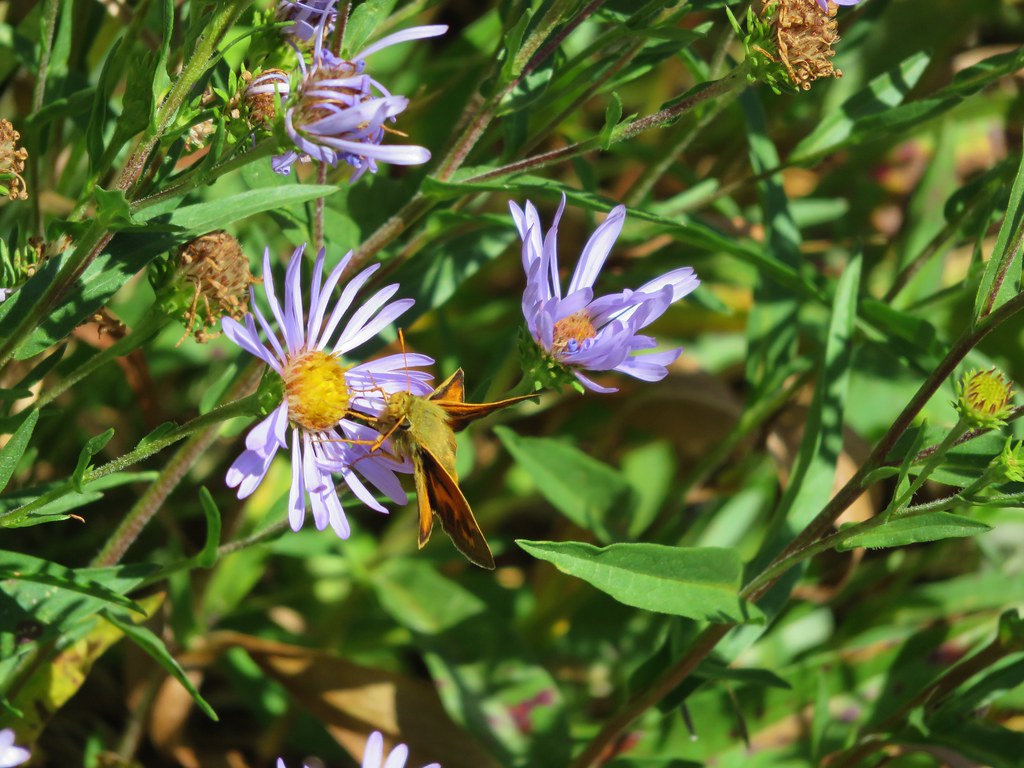
The meadows of Buck Meadows were also dry as far as we could tell. There were some patches of green but no visible water. Purple aster dotted the dry grasses and were popular with the butterflies.
IMG_6265

IMG_6263

We got our first look at The Husband from the meadows. We knew Eileen Lake was on the far side of the rocky mountain.
IMG_6273

The final meadow was surprisingly long and we wound up losing track of the trail near the far end and just headed cross county to a small knoll with trees. We were now planning on staying somewhere in the area of the meadows on our final night and this seemed to be a viable spot. We picked up the trail again near the signed trail junction.
IMG_6279

The pointer to the left was for the Foley Ridge Trail and the right was for Honey Lake. Oddly none of our maps or the Forest Service website showed a trail going to Honey Lake, instead the trail passed by on its way to the Separation Creek Meadows Trail. It was also unclear if either or both forks were still considered the Louise Creek Trail. Our two maps indicated the right hand fork was the Louise Creek Trail but the Forest Service showed it as the left fork. Either way we needed to get to the Foley Ridge Trail so we headed left. The trail switchbacked uphill offering a brief view of Diamond Peak to the south before arriving at the Foley Ridge Trail junction.
IMG_6282

IMG_6287

It had been a tough climb up for us not being used to carrying full packs so we rested a bit at the junction where we were joined by a hummingbird.
IMG_6291

Shortly after setting off again we passed the first water we’d seen all day, a few small ponds that still held some water.
IMG_6292

IMG_6296

IMG_6305

We followed the Foley Ridge Trail for almost two and a half miles to the next trail junction.
IMG_6316

Four trails met at this junction. The Foley Ridge Trail we had come up and on its right was the trail to the James Creek Shelter. To the left were two trails one to the Pacific Crest Trail and to the immediate left the trail to Linton Meadows. We had expected to see a fifth trail at the junction, the Separation Creek Meadows Trail, which appeared to also meet here according to the maps. We thought it was odd but it was a question for another day and headed toward Linton Meadows.
IMG_6317

We had been on this portion of trail during our backpacking loop around the South Sister the previous year. The trail passes through a pumice plain which manages to support a good amount of colorful vegetation.
IMG_6321

IMG_6322

IMG_6333

Just .3 miles from the big junction the Linton Meadows Trail split again. The right fork headed down to Linton Meadows while the left fork pointed to Husband Lake. The left fork then passes Eileen Lake before rejoining the right hand fork at Linton Creek.
IMG_6324

We stopped at Husband Lake for a moment to take in the views before continuing on our way.
IMG_6338

IMG_6342

IMG_6352

We finally came upon a creek with flowing water between the lakes coming down from The Husband.
IMG_6366

On our previous visit there had been tons of frogs along the shore of Eileen Lake and we had been wondering if we would find the same thing this time. That question was answered upon arriving at the lake.
IMG_6382

IMG_6386

There were more this time than before and we slowly made our way around the lake being careful not to step on any of them. We were planning on setting up camp on the far side of the lake where we would be able to set up at least 100 feet away from the water and the trail per wilderness regulations. We found our spot on a small rise with a small meadow behind us and no frogs to have to watch out for.
IMG_6479

After setting up camp we decided to hike down to Linton Creek to have dinner in the same location we had eaten at the year before and to fill up on water from the creek. We tried going around the lake on the other side hoping the frogs would be less but it proved just as challenging and slow. On our way down to the creek we spotted 4 deer also making their way down the meadows.
IMG_6407

IMG_6419

We arrived at Linton Creek to find it flowing strongly. It is primarily fed by Linton Springs so the dry year apparently hadn’t effected it as much as the other creeks. The springs also mean the water is cold and we had forgotten just how cold until we tried to soak our feet. The water was too cold to keep them in for more than 10 or 15 seconds.
IMG_6425

After having dinner and filling up on the wonderfully cold water we returned to Eileen Lake where we explored the area behind our campsite then sat by the water watching the frogs along the shore and small fish occasionally jumping from the water disrupting the reflection of the mountains.
IMG_6471

It had been a great start to our trip and the adventure had just begun. Happy Trails!

Flickr: https://www.flickr.com/photos/9319235@N02/sets/72157656374056692

Categories
High Cascades Hiking Mt. Hood Area Oregon Trip report

McNeil Point

A week after visiting Mt. St. Helens we were headed to another of the Cascades volcanoes – Mt. Hood. We were meeting my parents in the morning for a hike up in the area of McNeil Point. The plan was to begin at the Top Spur Trailhead with them and hike together to an area below McNeil Point where ponds collect the melting winter snows. From the ponds Heather and I would head up to McNeil Point to visit the shelter there and continue up the ridge behind it toward Mt. Hood. We picked up my parents at McNeil Campground in the morning and were ready to set off on the Top Spur Trail just before 7AM.
IMG_5739

IMG_5740

The first section of trail led through a forest filled with huckleberries and blueberries. Tree roots covered the path in many areas making for an uneven surface for walking.
IMG_5741

The Top Spur Trail joined the Pacific Crest Trail for a tenth of a mile before splitting off at a four way trail junction where the PCT and the Timberline Trail intersect.
IMG_5743

We took the middle of three forks following the Timberline Trail toward the Muddy Fork River. The PCT continued down the far right-hand fork and the left-hand fork was the continuation of the Timberline Trail on its way toward Cairn Basin.
IMG_5744

It would have been a little shorter hike if we had taken the Timberline Trail toward Cairn Basin which was the more direct way to get to the ponds below McNeil Point, but by heading toward the Muddy Fork we would pass through some open meadows on the south side of Bald Mountain where Mt. Hood would be visible. The meadows fill with flowers in early summer but were mostly passed now, however the view of Mt. Hood was still there.
IMG_5747

After passing through the second (smaller) meadow on Bald Mountain the trail reentered the forest. We were now looking for a side trail that would take us over the top of the Bald Mountain ridge to the Timberline Trail on the north side. Heather and I had taken this trail in 2012. At that time it was an unmarked use trail up and over the ridge. We spotted a worn trail to the left in the area we expected and headed toward the ridge. I managed to lead us over a small ridge and right back onto the Timberline Trail that we had already been on. We had to walk back through the small meadow and look for a different trail. Just around the corner from where we had turned off the trail the first time there was another side trail. This one had a nice new sign indicating it was the Cut Off Trail. Apparently it was now an official trail and there was a similar sign on the far side of the ridge.
IMG_6210

Now that we were back on track we headed uphill through the forest. More root covered trail awaited as we passed through some past-its-prime beargrass and headed up the ridge.
IMG_5768

IMG_5769

The trail climbed fairly gently up the ridge passing a couple of open views of the mountain.
IMG_5777

IMG_5786

In a typical year the flowers along this hike would have been at or near their peak in mid-July but this year the majority of them had already gone to seed. We did manage to spot a few late bloomers along the ridge though.
Paint
IMG_5790

Columbine
IMG_5788

Fireweed
IMG_5791

False Hellbore
IMG_5792

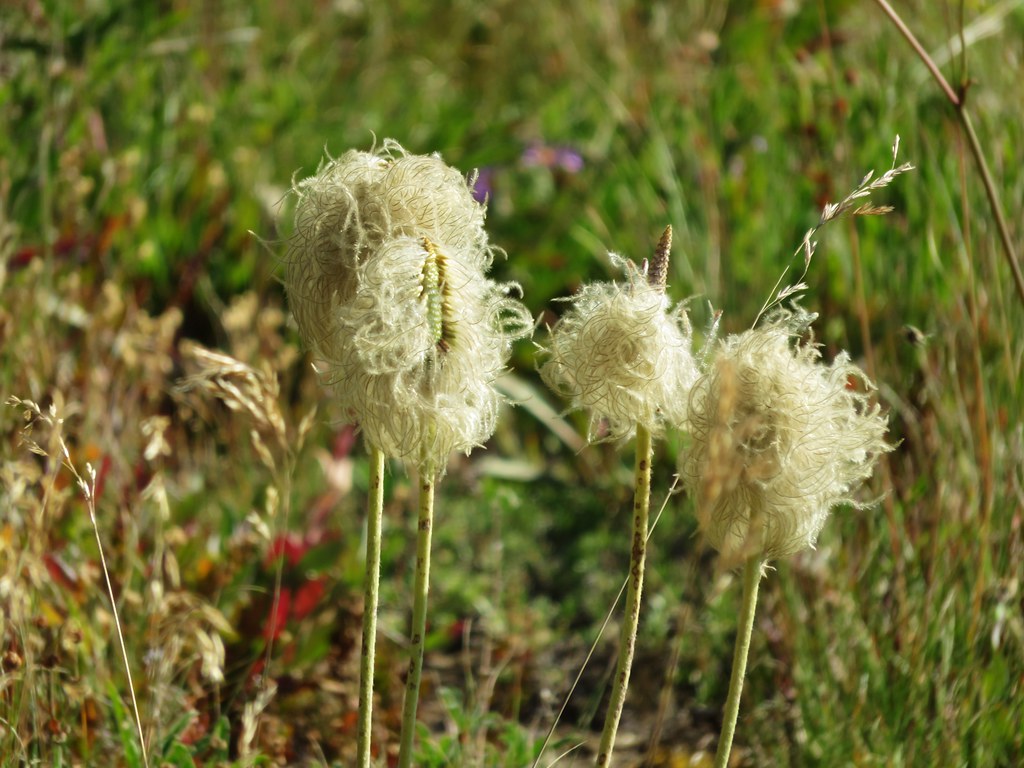
Western Pasque Flower (seed-head)
IMG_5797

After a few switchbacks the trail final leveled out some as it traversed a hillside where several branches of McGee Creek flowed across the trail. Additional flowers began popping up along this stretch but only the late blooming gentians and monkeyflower in larger quantities.
A branch of McGee Creek
IMG_5805

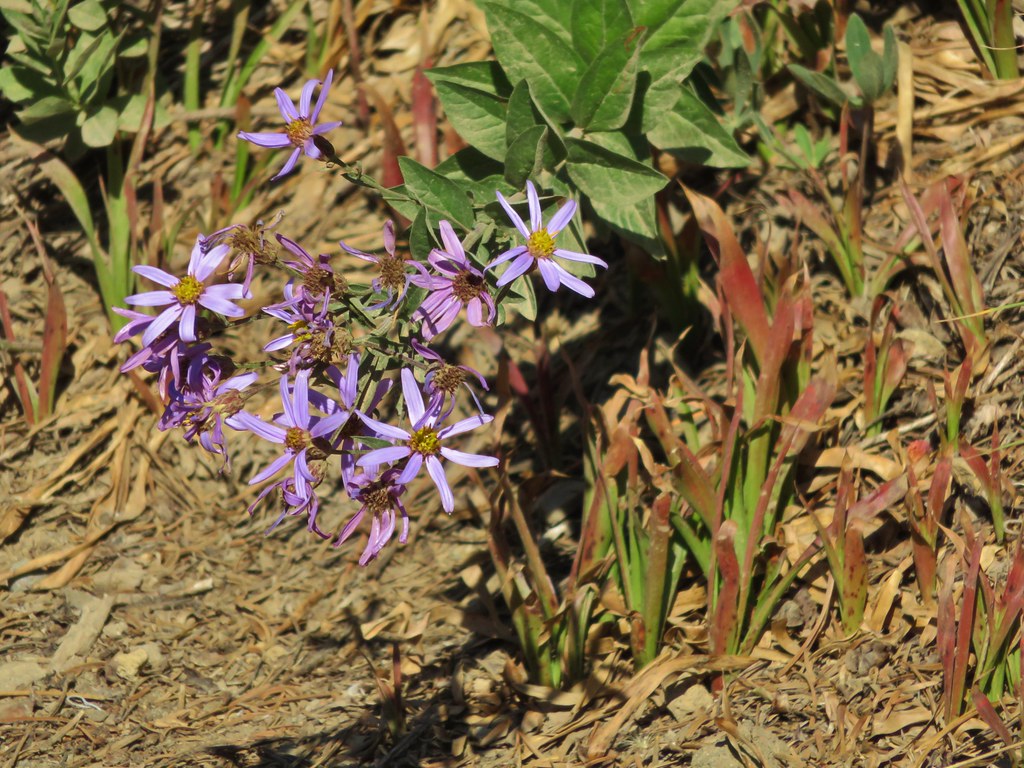
Aster or fleabane
IMG_5804

Spirea
IMG_5806

Gentians
IMG_5808

IMG_5834

Monkeyflower
IMG_5822

Another branch of McGee Creek
IMG_6188

The trail passed below a pair of rock outcroppings below McNeil Point. At the second outcropping we found the first of the ponds completely dried up.
Passing the first outcropping.
IMG_5827

Dry pond
IMG_5843

Dry pond below the rocky outcrop and Mt. Hood beyond.
IMG_5848

The second pond still had a little water and a nice view of the top of Mt. Hood.
IMG_5853

IMG_5858

We erroneously followed the trail leading away from the second pond believing it would reconnect with the Timberline Trail which had forked to the right after passing the dry pond. The trail we were on eventually petered out and we were left with a short bushwack to get back onto the correct trail. We popped back out of the trees onto the trail and turned left continuing toward the McNeil Point Trail and Cairn Basin. We passed a junction with the Mazama Trail, a trail we had hiked in 2013, and decided it was time for our party to split up.
IMG_5869

Heather and I would go ahead at our own pace and head up to McNeil Point, and my parents would continue on toward Cairn Basin. We headed off amazed at the lack of flowers along the trail. On our previous visit to McNeil Point on 8/20/12 and Barrett Spur on 8/12/13 this section had been full of flowers but here we were a full month earlier than those visits and the flowers had long since passed. It was a clear indication of just how hot and dry this year had been. The good news was it was a clear day we had still had the views. In addition to Mt. Hood we could see three Washington snow peaks to the north.
IMG_5870

IMG_5876

Mt. Adams
IMG_5878

Mt. Rainier
IMG_5877

Mt. St. Helens
IMG_5879

We left the Timberline Trail at the sign for McNeil Point.
IMG_5882

The trail up to the shelter begins on a ridge next to silty Ladd Creek.
IMG_5887

IMG_5889

Heather enjoying the day.
IMG_5896

The trail then crossed a rock field where there is normally also a snowfield. Not this year though.
IMG_5905

Once past the rock field the trail passed beneath hills that hid most the mountain. Here we began to encounter more flowers in bloom.
IMG_5916

IMG_5917

IMG_5919

IMG_5932

IMG_5937

IMG_5939

There was also a lovely little creek lined with monkeyflowers.
IMG_5925

IMG_5927

IMG_5929

We faced a choice as we neared the shelter. We could head straight for the stone building or we could veer uphill and gain the ridge behind the shelter and then head up it. On our previous visit we had simply gone to the shelter and turned back there. (We had also visited Cairn & Wy’East Basins and Eden Park that day.) We decided to head directly for the ridge and turned uphill.
IMG_5946

As we headed for the ridge Mt. Hood began to peek out from above it.
IMG_5947

Heather spotted an interesting looking ladybug along the way.
IMG_5950

We gained the ridge and could see our route laid out before us with a closer look at Mt. Hood being the reward.
IMG_5955

As we were climbing and looking around at all the scenery I noticed something brown near the top of the ridge to our left. It didn’t look like it belonged there but we couldn’t make out what it exactly was at first.
IMG_5988

Once again the 30x zoom on our camera came in handy and we were able to see that it was a good sized buck bedded down for the day.
IMG_5998

The best flower display of the day was in a little basin below the ridge where the deer was. Lupine, Mountain Heather, Paintbrush, Partridgefoot, Bistort, and Pasque flowers were all present.
IMG_5993

IMG_6008

IMG_6012

IMG_6016

The buck kept an eye on us as we continued up a very steep section of the ridge. Looking back down near we could see the trail to the shelter below and beyond McNeil Point was Bald Mountain and the ridge we and climbed from there.
IMG_6047

McNeil Point Shelter
IMG_6028

We were near what looked like the end of the climb.
IMG_6041

We were wrong and there was one more stretch of uphill ahead of us.
IMG_6043

To our left was Barrett Spur where we climbed to in August of 2013. https://wanderingyuncks.wordpress.com/2013/08/15/barrett-spur-via-the-mazama-trail/
IMG_6042

To our right was Yocum Ridge which we visited later that same year. https://wanderingyuncks.wordpress.com/2013/08/26/yocum-ridge/
IMG_6046

On our right was also the Sandy Glacier which feeds the Muddy Fork, a branch of the Sandy River. The scenery around the Sandy is just amazing.
IMG_6054

IMG_6055

IMG_6056

IMG_5966

IMG_6072

IMG_6070

We stopped on on a rocky spine just before a saddle where it would have required a sketchy looking descent to continue on any further.
IMG_6103

We took a couple of pictures then pulled out some potato chips for a snack.
IMG_6076

IMG_6080

IMG_6093

There had been two small groups ahead of us but they had since headed back down so we had the view almost to ourselves.
IMG_6088

IMG_6095

We headed back down toward the shelter, our next destination. Along the way we spotted a few flowers we’d missed on the way up.
Yellow cinquefoil
IMG_6119

Cats ear lily
IMG_6122

Blue-bells of Scotland
IMG_6131

We paid a quick visit to the shelter then continued to make our way back down.
IMG_6137

A few small clouds had formed by the time we arrived back at the ponds.
IMG_6168

IMG_6170

And the gentians had opened up some in the sunlight.
IMG_6176

It was another hot day so we stopped at a nice pool in one of the branches of McGee Creek to filter some cold mountain water into our Hydroflasks.
IMG_6179

We had some great views on the way down the ridge toward the trailhead. This had been the first day we’d been able to pick out an ice cave on the Sandy Glacier.
IMG_6196

IMG_6199

IMG_6198

We had decided to take the shorter path back opting not to go around Bald Mountain with its views again so we said goodbye to the mountain at the last viewpoint along the ridge before heading back into the trees of the Mt. Hood Wilderness.
IMG_6202

IMG_6208

We found my parents back at the car, having finished their hike about 15-20 minutes prior to us. They had made it to Ladd Creek on the Timberline Trail and turned back there. It was a great day to be on the mountain and we ended it with dinner back at my parents campsite. Happy Trails!

Flickr: https://www.flickr.com/photos/9319235@N02/sets/72157655660865389

Categories
Hiking Mt. St. Helens Trip report Washington Washington Cascades

Ape Cave and Ape Canyon

We are in the midst of revisiting several trails that we first hiked in 2012. Next up after our return trip to the Table Rock Wilderness we headed to the Mt. St. Helens National Volcanic Monument for a second hike on the Ape Canyon Trail. In 2012 we had done a second short hike along Lava Canyon after finishing the Ape Canyon Trail and this time we decided to add a visit to Ape Cave to the agenda.

At 12,810 feet long Ape Cave is the longest known Lava Tube in North America. It is also one of the more popular places to visit in the monument so we decided to tackle this trail first in an attempt to beat the crowds. A staffed information booth awaits at the trailhead, but we had arrived before it opened for the day.
IMG_5518

A short paved trail leads to an kiosk with signboards and the lower cave entrance.
IMG_5521

IMG_5593

IMG_5594

IMG_5595

IMG_5523

An above ground trail leads past the lower entrance to an upper entrance (or exit).
IMG_5525

We decided to hike up to the upper entrance and then descend down the lava tube to it’s end 3/4miles past the lower cave entrance. The trail to the upper entrance passed through the forest before skirting a lava flow and passing some smaller lava tubes that were not part of the cave.
IMG_5526

IMG_5527

IMG_5528

IMG_5529

The trail actually did pass over the cave three times before arriving at the site of the upper entrance. We walked passed the entrance initially following a well used path about 50 yards too far before realizing our mistake. There was no sign marking the upper entrance and the hole was much smaller than the lower entrance. It took a moment for us to spot the metal ladder barely sticking up from out of the dark hole.
IMG_5531

IMG_5533

Climbing down the ladder was interesting as the first 17 steps angled downward before the ladder suddenly dropped straight down for the final 10 or 12 rungs.
IMG_5536

The cave extends another .1 miles or so beyond the upper entrance so we turned north and walked to the end before turning around and heading for the lower entrance.
IMG_5537

The cave was really neat. The rock surrounding the tube was full of colors and different textures. White portions of rock reflected our headlamps imitating rays of sunlight along the walls and ceiling.
IMG_5541

IMG_5544

IMG_5547

A third of a mile from the upper entrance the trail past under a skylight where green ferns and mosses grew on the rocks.
IMG_5553

The lower entrance was another 1.1 miles beyond the skylight. This section of the lava tube was a workout. Ten different rock falls required scrambling over and around piles of lava rock and a pair of lava falls, drops of around 8 feet, proved a challenge to descend. The second lava fall was particularly difficult requiring us to slowly lower ourselves down using small nubs on the cave floor as handholds. The scenery of the cave was worth the effort and we wondered if climbing up would have been easier than coming down as we had.
IMG_5557

IMG_5563

IMG_5565

IMG_5577

It was fairly slow going but we eventually made it to the base of the staircase leading down from the lower entrance.
IMG_5582

IMG_5579

We headed down the lower end of the cave which was, as the sign said, a relatively easy walk. We turned around when the cave had become small enough that we would have had to crawl to continue any further.
IMG_5584

IMG_5586

IMG_5588

We had started to run into a few more people near the end of the lower cave and on the way back to the lower entrance the number of people increased dramatically. We exited up through the lower entrance and headed for the car.
IMG_5590

In hindsight we should have descended through the lower entrance as it seemed like it would have been easier to ascend up through the cave and it would likely have avoided the crowds that had formed later in the morning in the lower cave.

We drove from the Ape Cave parking area to the Ape Canyon Trailhead for our second hike of the day. On our previous visit we had taken the Ape Canyon Trail to the Loowit Trail and then followed that trail to a junction with the Abraham Trail which covered a total of 12.7 miles. Our second hike that day at Lava Canyon was only 1.3 miles for a 14 mile total. This time around we had already done nearly 5 miles at Ape Cave so the plan was to stop at a spring along the Loowit Trail in the Plains of Abraham. The small parking lot at the Ape Canyon Trailhead was full so we parked along road 83 and walked to the start of the trail.
IMG_5596

IMG_5598

We were on high alert as we started the trail due to warnings about local wildlife.
IMG_5601

The Ape Canyon Trail starts in the forest next to a lahar created by the Muddy River when the mountains 1980 eruption sent a large portion of the Shoestring Glacier down the valley. Our previous visit had been on a clear day in Mid-September where the views across the lahar to Mt. St. Helens were spectacular.
021

We were not to be so lucky on this day with our Mt. St. Helens views but the temperature was pleasant and we hoped to see more flowers this time than we had previously.
IMG_5602

IMG_5606

We did see more flowers along the lower section but we were a little late due to the weather we’d been having this year.
IMG_5614

IMG_5619

IMG_5620

IMG_5635

The trail passes through an old growth forest starting at the 1.4 mile mark then climbs a series of switchbacks as it heads up a ridge toward the Loowit Trail. We passed a few viewpoints that had provided impressive views on our first visit but today we had to rely on those memories to picture the mountain.
157

IMG_5633

After 4 miles the trail enters the blast zone from the 1980 eruption. The trail spends winds a half mile through the blast zone above forested Ape Canyon.
IMG_5712

A narrow slot at the top of the Canyon frames the creek below and apparently Mt. Adams in the distance. I say apparently because we have not been able to confirm this on either of our visits. In 2012 the Cascade Creek Fire was burning on the slopes of Mt. Adams filling the sky with smoke and clouds were now playing the same role on this day.
087

IMG_5645

IMG_5647

The trail ends after 4.5 miles at the Loowit Trail which circles the entire mountain.
IMG_5650

IMG_5651

We turned right here heading for the Spring .8 miles away. This section of the Loowit Trail passes through the Plains of Abraham, a pumice plain with a barren looking landscape which is really fascinating. Heading NE Mt. St. Helens looms on the left across the broad plain while hills on the right reveal the force of mountains eruption. Trees lay blown down on the hillsides facing the mountain while other sides are striped away exposing various layers of rock. Other areas green with trees and other vegetation.
IMG_5657

Flowers are sparse but some still manage to bloom in what looks like the most improbably conditions.
IMG_5653

IMG_5654

IMG_5656

IMG_5659

IMG_5679

One thing that didn’t change from our previous visit was being greeted by a marmot as we crossed this section. We couldn’t help but wonder if it was the same furry little guy.
IMG_5661

IMG_5664

When I had added this hike to the schedule I had hoped to find flowers near the spring where we would turn around, but with the timing being so far off this year due to the weather I wasn’t sure what we’d find. It wound up working out even though things were beginning to dry out. We spoted several different types of flowers including a nice clump of bluebell-of-Scotland.
IMG_5694

IMG_5690

IMG_5706

IMG_5693

IMG_5700

IMG_5688

IMG_5685

It was no apline wildflower meadow but considering the area it was an impressive display. What surprised us was the lack of water from the spring. Despite it being September on our previous visit a small steady stream of water was flowing down the rocks and into Ape Canyon, but this time the only water was a small pool left filling a depression in the rock.

2012
Spring fed stream

119

2015
IMG_5705

After resting a bit, and starting to get chilly due to a nice breeze and cooling our sweat, we headed back down. The clouds had only lifted a little as we passed the lower viewpoints and small pockets of blue sky teased us from above the mountain.
IMG_5730

It had been a long but interesting day of hiking. It was also our first visit of the year to one of the major Cascade mountains and it had been a good reminder of just how much we enjoyed our hikes on them. Happy Trails!

Flickr: https://www.flickr.com/photos/9319235@N02/sets/72157655789278375

Categories
Hiking Mollala Old Cascades Oregon Trip report

Table Rock to Pechuck Lookout

**Note the 2020 Beachie Creek Fire burned a portion of this hike.**

We have two lists of “To Do” day hikes within a reasonable driving distance. One list is the hikes we have yet to do, and the second list is hikes we want to try again for one reason or another. Table Rock was one of the hikes on the later list having first visited in October of 2012. During that hike smoke from the Pole Creek fire in the Three Sisters Wilderness had limited the views and being fall it was too late for many flowers. We had seen enough on that visit to think it would be worth a second visit in early summer to see if we could catch the views and see what flowers there might be. I put it down on our schedule as our annual 4th of July hike thinking the timing might be good for wildflowers plus the drive avoided much time on freeways or busy highways.

The Table Rock Wilderness consists of 6028 acres designated in 1984 as wilderness and is managed by the Bureau of Land Management. Several trailheads access the 16 miles of trails in the area. For our hike we started at the Table Rock Trailhead which happens to be the shortest route to the summit of Table Rock, the highest point in the wilderness.
IMG_5256

IMG_5257

When we redo a trail I try to find some way to differentiate the hike from the earlier visit. Only 13 of our 172 hikes so far had been “re-hikes” and only 3 of those had we done the same exact trails. Three other times we added other short hikes on different trails, and on the remaining 7 we extended the hike visiting new places further along the trail. The plan to make this visit unique was to continue on past Rooster Rock, where we had turned around on our first visit, and continue on to Pechuck Lookout.

We set off on an old roadbed that is now the Table Rock Trail after rocks slides closed the road, the first at the current trailhead. We reached the second slide after .3 miles where the trail briefly entered the forest to bypass the slide.
IMG_5262

IMG_5263

Beyond the second slide the old road again becomes the trail for nearly another mile. Small trees and flowers now line the gravel road making it a pleasant walk.
IMG_5267

Rabbit along the road.
IMG_5269

At the 1.3 mile mark the trail leaves the road for good at the site of the former trailhead. Shortly after reentering the forest the Image Creek Trail joins from the right. A nice sign that had not been there in 2012 pointed to the Table Rock Trail.
IMG_5272

From this junction the trail passes below a large rock field that extends from the base of Table Rock then swings out and around a rocky ridge before turning back toward Table Rock and entering the rock field going the opposite direction of the earlier pass below.
IMG_5277

The rock field offers a close up look at Table Rocks columnar basalt cliffs. Numerous pikas were calling out from the rocks all around us but we weren’t able to spot any.
IMG_5292

IMG_5294

IMG_5300

There were also a few flowers managing to bloom in the rocks.
IMG_5285

IMG_5293

IMG_5295

IMG_5310

IMG_5497

The trail then reenters the forest and climbs to a trail junction in a saddle. We turned left and followed the Table Rock Summit trail .4 miles to the tilted plateau of Table Rock.
IMG_5322

The view was indeed better than it had been on our previous visit despite a fire that had broken out on Mt. Adams the day before. We could just make out Mt. St. Helens and Mt. Rainier along with Mt. Adams in Washington and had good views of Mt. Hood, Mt. Jefferson, Three Fingered Jack, Mt. Washington, and the Three Sisters in Oregon.

Mt. Jefferson to the Three Sisters
IMG_5330

Mt. Hood
IMG_5331

Mt. Jefferson
IMG_5332

Three Fingered Jack
IMG_5334

Three Sisters
IMG_5335

Mt. Adams
IMG_5350

After exploring the plateau we returned to the junction and took the unsigned Saddle Trail toward Rooster Rock. Two things stand out about this trail. First is the ants which were everywhere. They were all over the trail and there were several large anthills right next to it.
IMG_5363

IMG_5364

The second thing that made an impression is the steepness of this trail as it dips down and then back out of a thimbleberry meadow at the head of Image Creek. The trail all but disappeared in the thimbleberry bushes but it wasn’t too hard to follow. The nice thing about thimbleberry is that the plants do not have thorns so they are not bad to walk through. We did have to maneuver around a couple of devil’s club plants though.
IMG_5373

IMG_5374

The steep climb up from Image Creek ends at a saddle below Rooster Rock. Trees here block the view of Rooster Rock but a short path to the right goes up through a small meadow to a rocky viewpoint.
IMG_5385

I had thought this small meadow might be a good wildflower spot, and there were some but not in any large amounts.
IMG_5378

IMG_5392

IMG_5409

IMG_5413

IMG_5414

IMG_5415

IMG_5418

The view toward Rooster Rock was better this time too.
IMG_5396

IMG_5398

IMG_5399

After a short rest we were ready to head for Pechuck Lookout. From the saddle we needed to drop down on the other side of the ridge to the High Ridge Trail. We were now starting the portion of the hike that we had not done before and we were in for a surprise. Just on the other side of the saddle was a meadow full of wildflowers.
IMG_5423

IMG_5422

IMG_5425

IMG_5426

IMG_5429

IMG_5433

IMG_5437

IMG_5439

Many of the flowers were past their prime succumbing to the heat, but there were still enough to make it an impressive sight. In most years our timing would likely have been spot on but the hot dry weather we’d been having has all the flowers at least two weeks ahead of schedule. On the far side of the meadow the trail again entered the trees.
IMG_5440

The High Ridge Trail was far more gentle with its ups and downs than the Saddle Trail had been. After .7 miles the Rooster Rock Trail joined from the right coming up from the trailhead on Rooster Rock Rd.
IMG_5442

We continued going up and down along the ridge leaving the wilderness and arriving at another former trailhead along the gated road near Pechuck Lookout.
IMG_5446

The trail continued on the far side of the road passing a nice view of Table Rock along the way.
IMG_5448

IMG_5449

This short section of trail was another steep one before ending at the lookout.
IMG_5450

Pechuck Lookout was staffed from 1918/19 until 1964 with the current structure having been built in 1932. It is now available for overnight stays on a first come first serve basis. There was no one staying there so we went inside to take a look around and sign the log book.
IMG_5453

IMG_5454

IMG_5455

It was too warm to stay inside for long so we headed back out into the shade and had anther bite to eat while watching the many butterflies flitting about.
IMG_5459

IMG_5464

IMG_5466

Aside from the view of Table Rock only Mt. Jefferson was visible and that mountain could only be seen in a couple of spots between some trees so it wouldn’t be a good place to stay if you’re hoping for mountain views.

We returned the way we’d come, skipping the side trips to the rocky viewpoint and the summit of Table Rock. The views to the south had become increasingly hazy, but Mt. Hood looked much clearer now that the sun had passed over.
IMG_5489

IMG_5491

The only other hikers we saw all day were between the summit trail junction and the old road on the way back to our car and that was only two other couples. The final stretch along the old road felt really long after all the climbing we’d done. I spent part of the final 1.3 miles chasing an orange butterfly that wouldn’t sit still long enough for me to get a picture. It took awhile but Warren (as I named him) finally gave me some shots.
IMG_5507

IMG_5510

It wound up being a longer hike than we expected. Everything we looked at indicated we’d be doing 14.8 miles but the final GPS reading was 15.7. With the various trailheads available this could have easily been split up into several shorter hikes for more sensible hikers. The Table Rock Wilderness is certainly a place worth visiting, and there should be plenty of ripe thimbleberries come August. Happy Trails!

flickr: https://www.flickr.com/photos/9319235@N02/sets/72157655417439836