Categories
High Cascades Hiking Mt. Jefferson Area Oregon Trip report

Hunts Cove

There isn’t much like a midweek hike in September, the crowds have thinned out but the weather can still be great. When I was putting together our hiking plans at the beginning of the year one of the hikes I really wanted to do was Hunts Cove. The hike starts at the very popular Pamelia Lake Trail in the Mt. Jefferson Wilderness which is one of only two areas in the Oregon Cascades (not counting Crater Lake NP) that requires you purchase a permit in order to enter them. Due to the popularity I decided to purchase our permit for a weekday after school started to hopefully minimize the number of other people we’d run into.

Having purchased our permit over four months in advance I was gambling on the conditions. Last year we had gotten permits for the other fee area along the Obsidian Trail in the Three Sisters Wilderness, only to spend the entire 18.6 mile hike in wet and view less low clouds. We lucked out this time though. The forecast had started out as cloudy with a chance of rain but by the time the big day arrived the outlook had greatly improved to clear skies and a high in the low 70s. As a bonus the snow level had dropped down to between 6500-7000′ meaning there would likely be some new snow on Mt. Jefferson. As an added bonus a friend of ours, one of Heather’s running buddies, Jessie, was able to get the day off and join us.

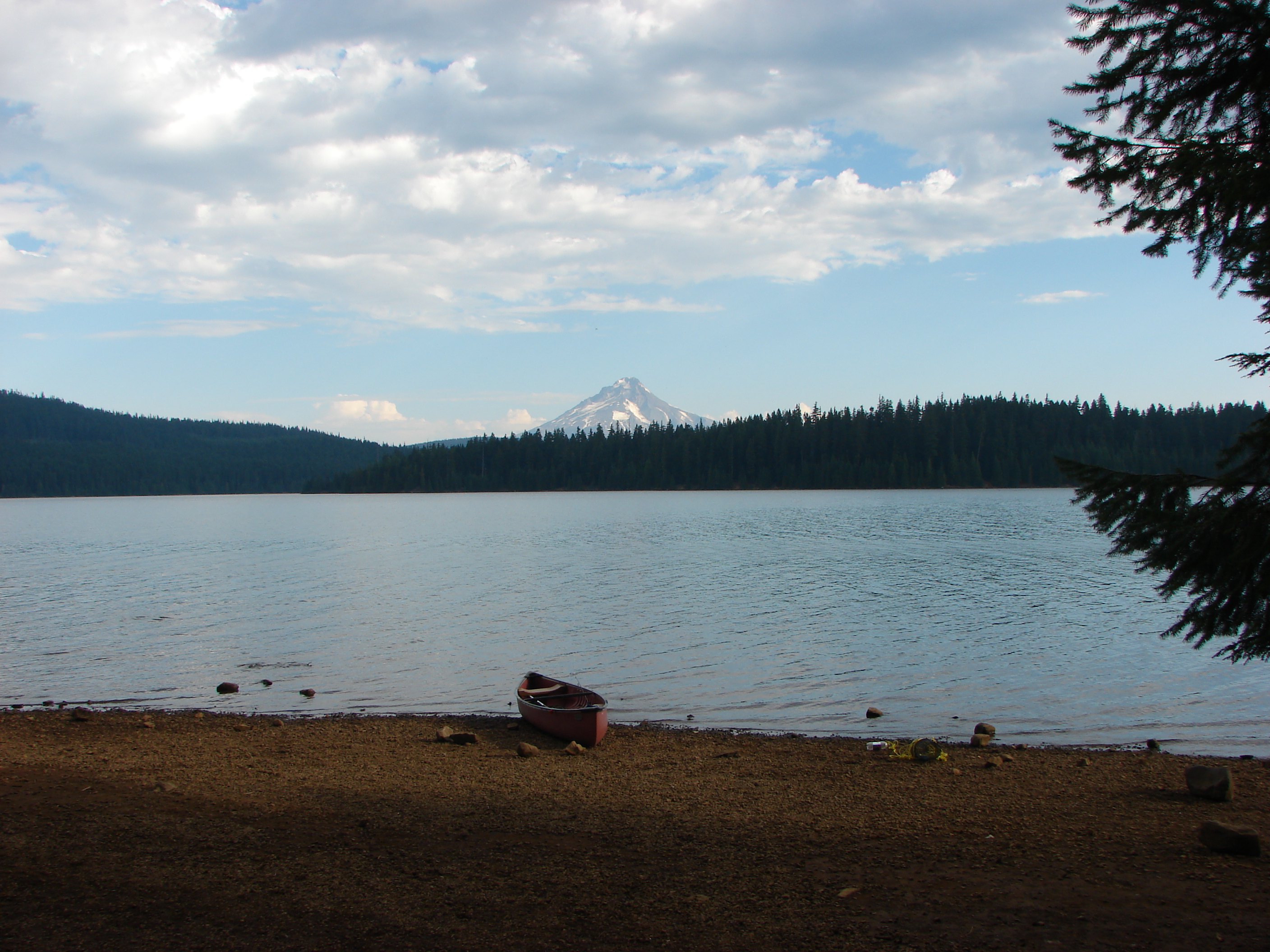
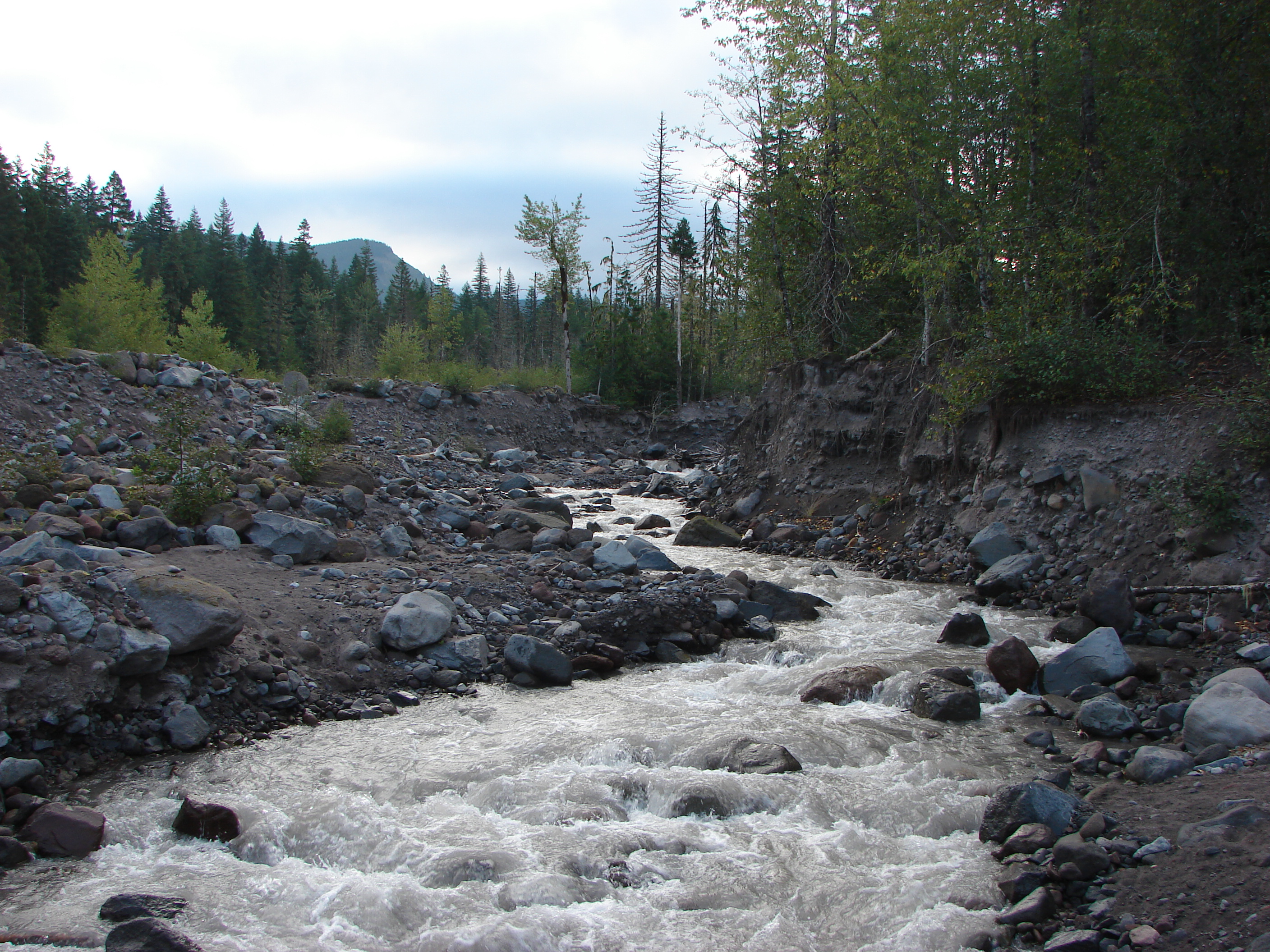
We set off on the Pamelia Lake trail in the soft light of morning through a peaceful forest along side Pamelia Creek. Soon we were surrounded by the sound of rushing water with Milk Creek to our left and Pamelia to our right. Milk Creek comes from glaciers up on Mt. Jefferson and evidence of a 2006 mudslide littered the forest floor. Just over 2 miles in on the trail we reached a T shaped junction at the edge of Pamelia Lake. To the right was a 3 mile trail up Grizzly Peak and to the right lay the path to our loop into Hunts Cove and then back on the Pacific Crest Trail. Before turning right though we headed down to the lake for a photo op.

Mt. Jefferson from Pamelia Lake

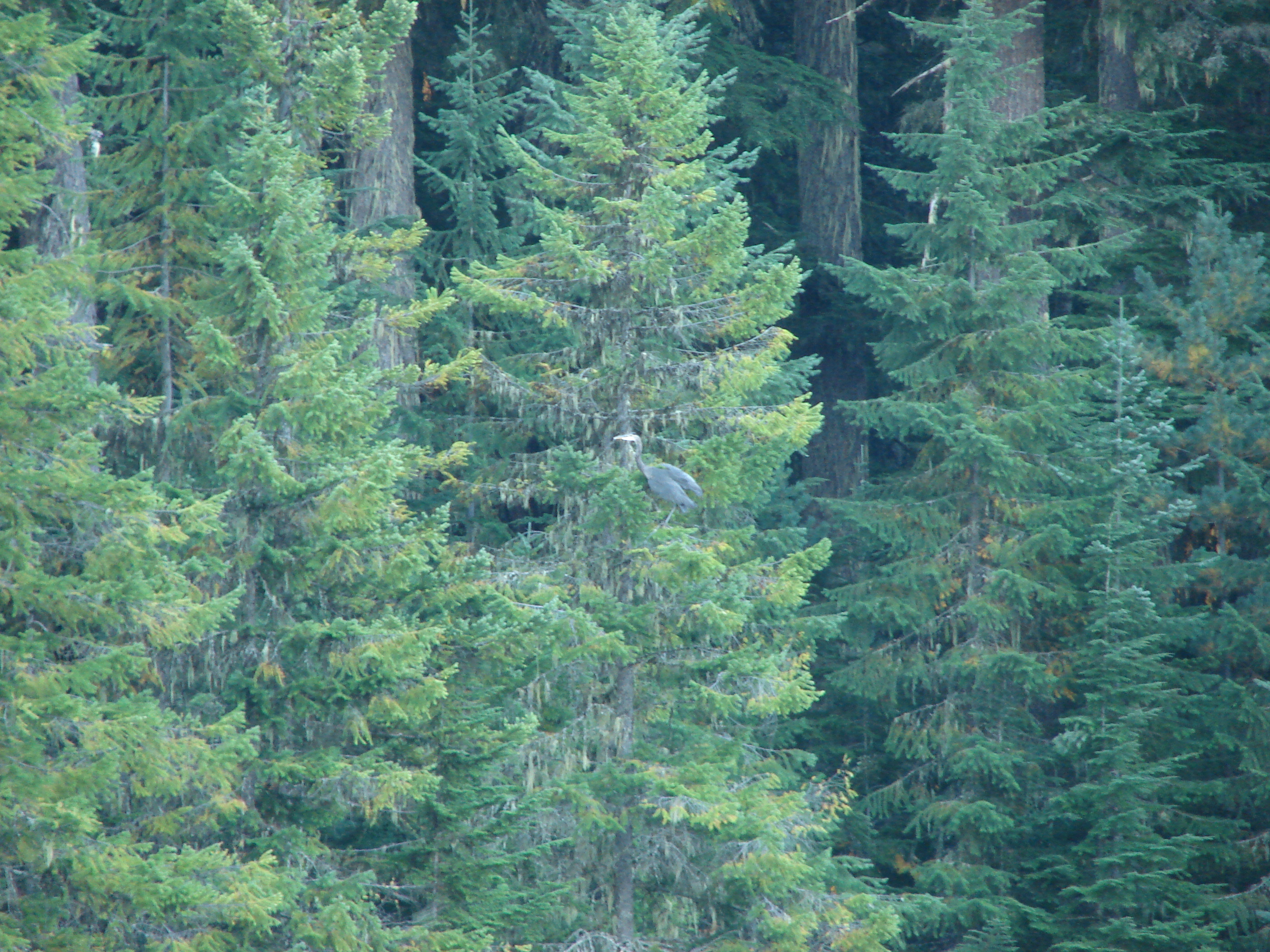
There was a good deal of wildlife present on the lake. A great blue heron flew from a log in the center of the lake into the far grassy shore and a family of ducks glided silently into the reeds. Several canada geese could be seen at the far end of the lake near the lakes inlet.
030

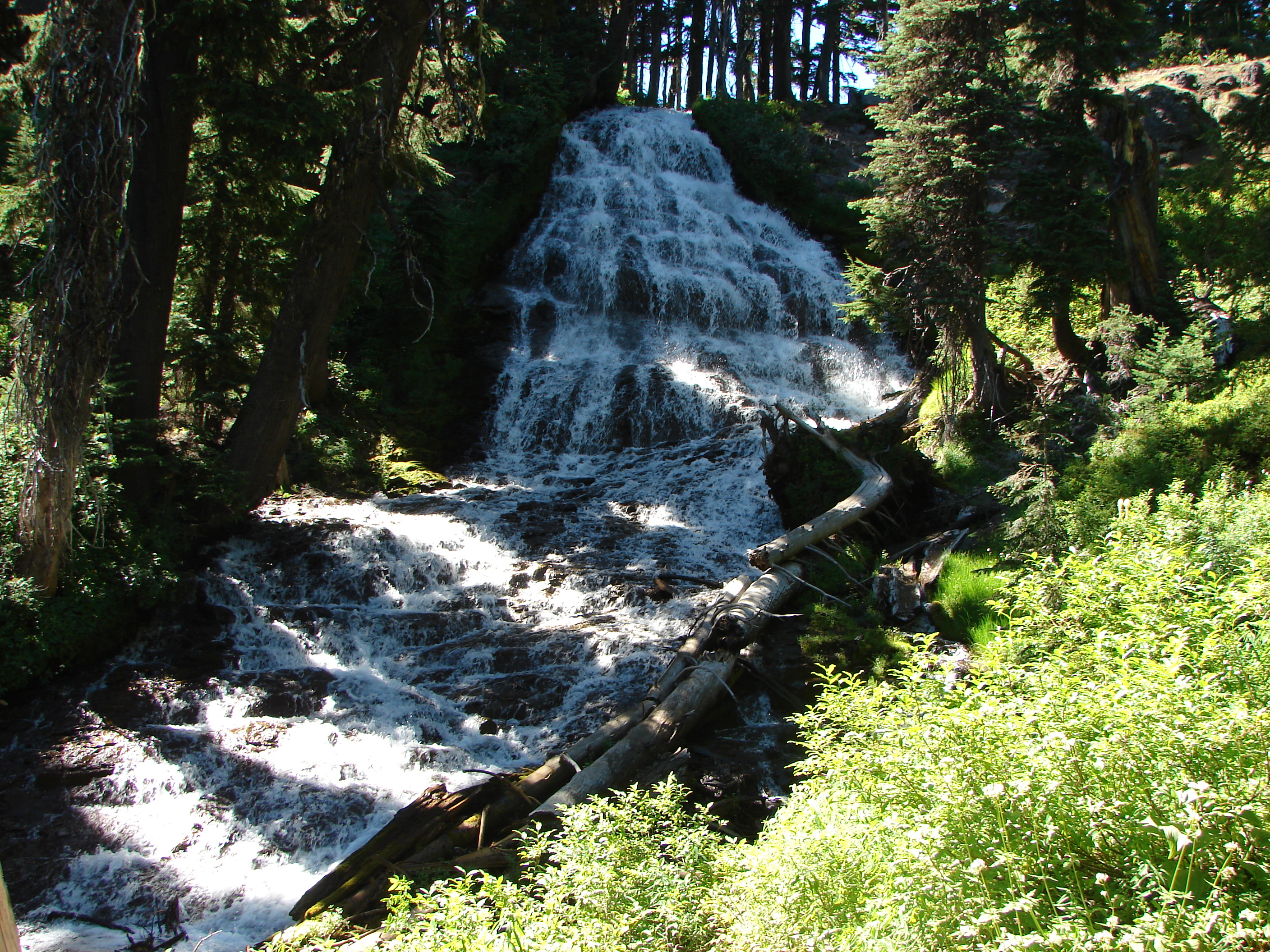
We made our way around the lake to a second junction. Here we had to decide if we would do the loop clockwise or counterclockwise. We decided to stick to the lake shore and go counterclockwise first to Hunts Cove and then to the PCT. The trail crossed several streams that seemed to be flowing very well given the time of year. We assumed the recent rain/snow had helped rejuvenate them. Our favorite crossing was on a footbridge over a small scenic falls.

Footbridge & falls
Footbridge & falls

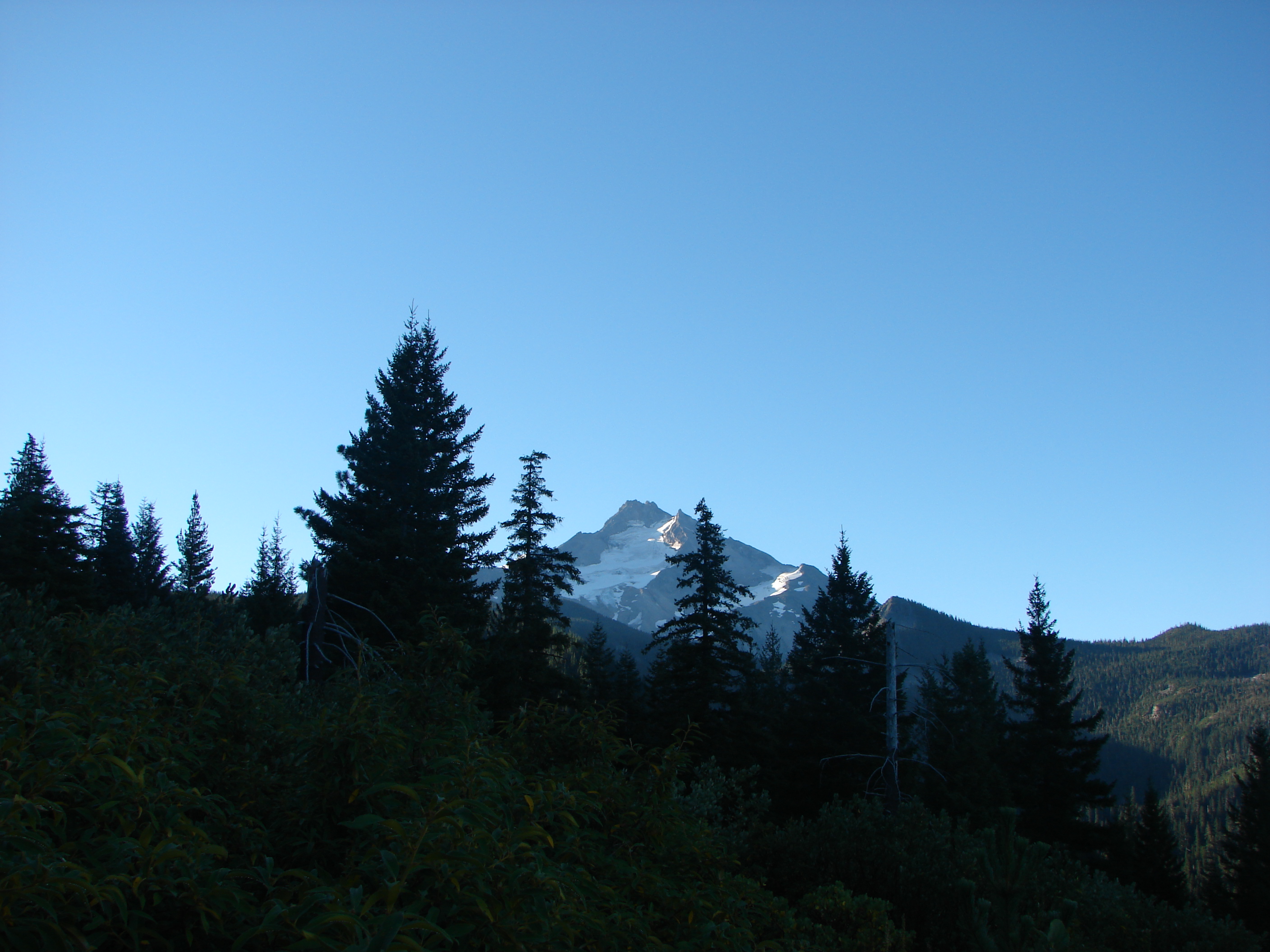
The trail began climbing gently as we passed the far end of Pamelia Lake. The path traveled along Hunts Creek, crossed over it, and then climbed up above it on the side of a ridge. As we climbed we began getting glimpses of Mt. Jefferson across the valley with it’s dusting of new snow.
057
At a sharp switchback we could hear what sounded like a waterfall a short distance away so we took a faint side trail in the direction of the sound and discovered a beautiful waterfall on Hunts Creek.
063

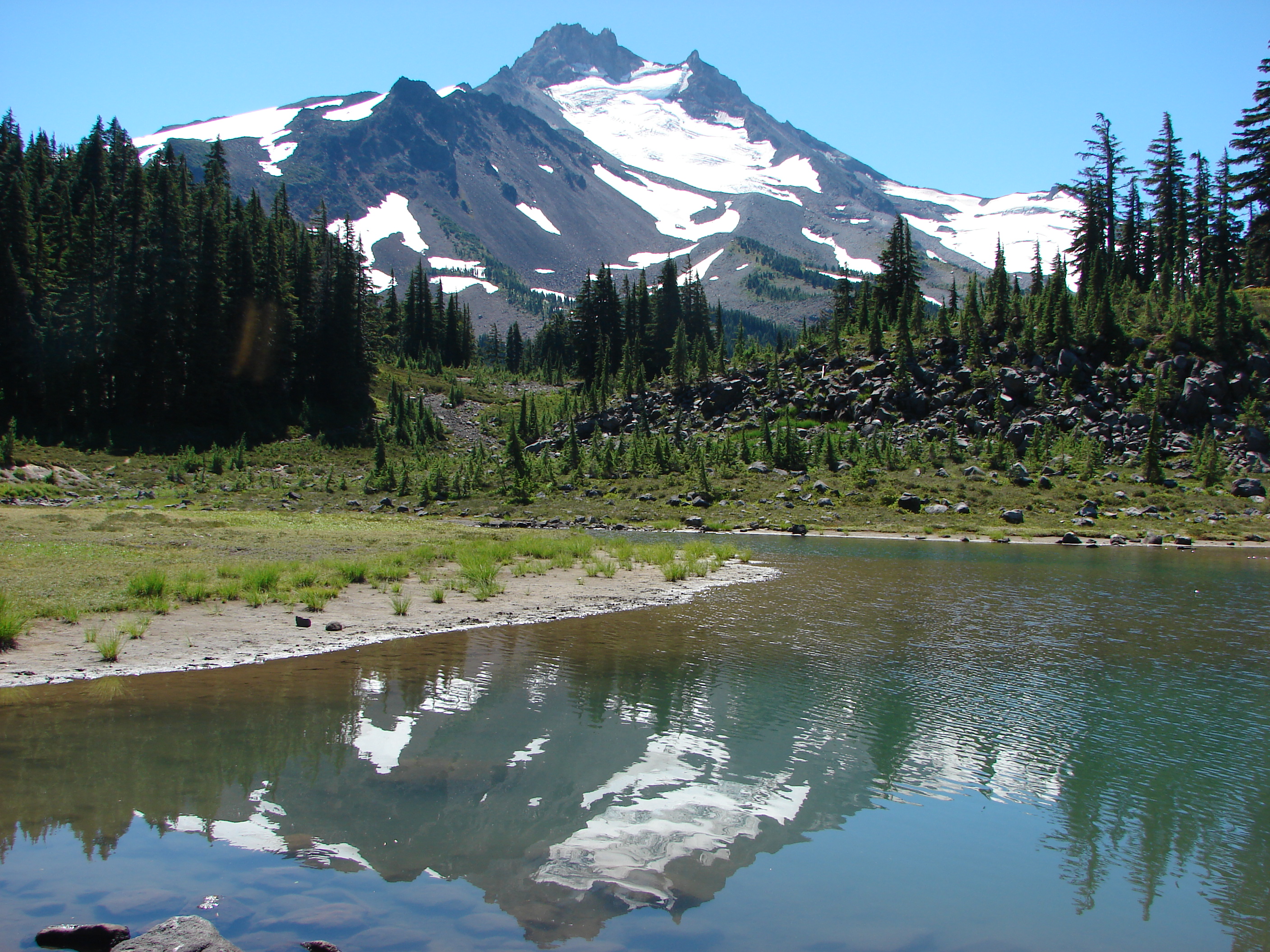
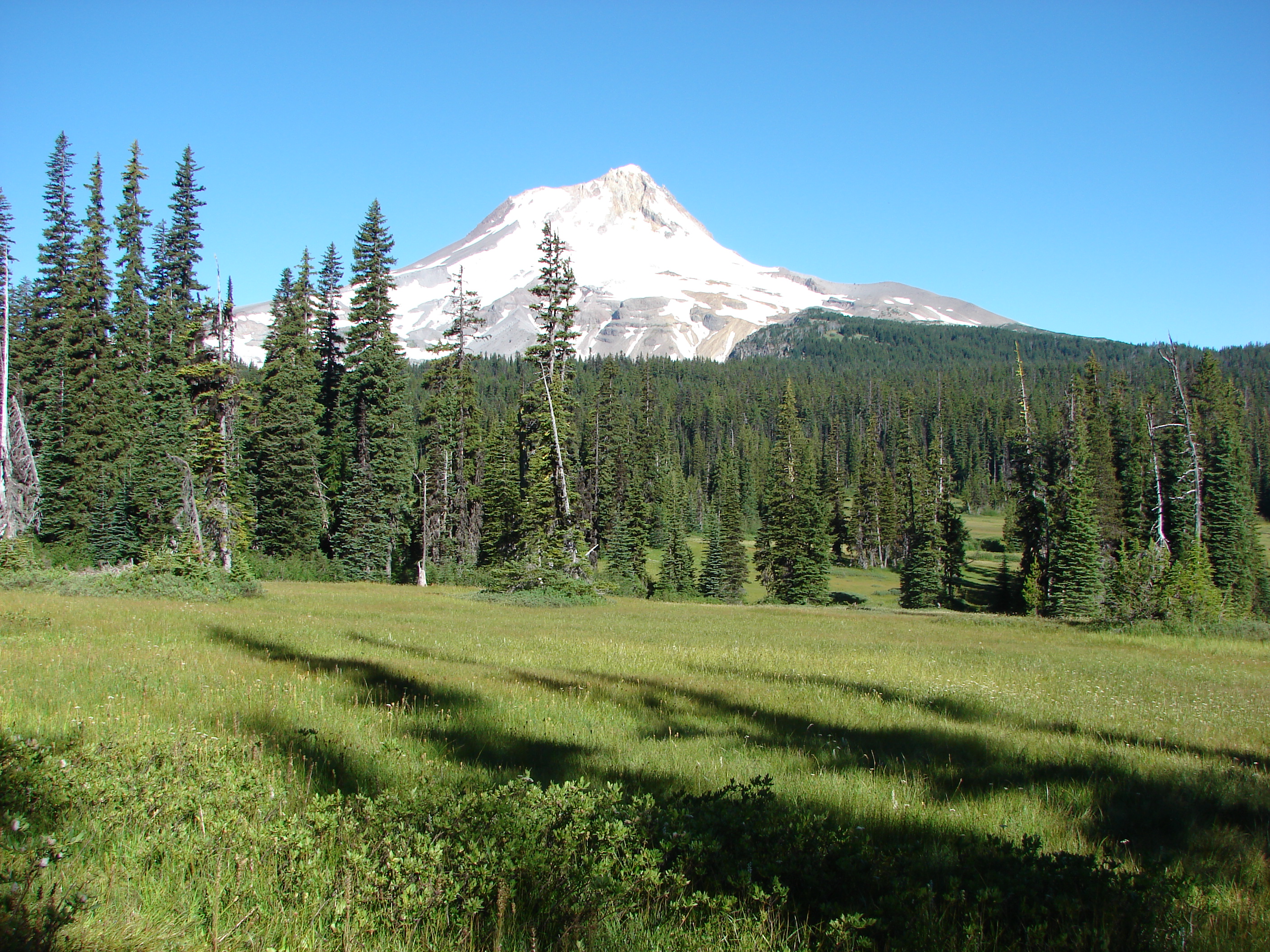
Just a short distance from the falls we found the signs marking the trail to Hunts Cove where we took the left fork travelling above a pretty meadow with a view across to the mountain. A half mile later we arrived at the first of the two lakes that call the cove home. Hanks Lake was up first. It was a lovely lake lined with meadows and a view of Mt. Jefferson.

Mt. Jefferson from Hanks Lake

Some of the biggest huckleberries and blueberries we’d seen were growing in large patches around the shore and we stumbled up a pair of sooty grouse in one of the thickets.

Sooty grouse on a downed tree

After a refreshing rest on the shore of Hanks Lake we continued on to Hunts Lake. Although Hunts Lake has no view of Mt. Jefferson it offered it’s own attractions. Heather spotted several fish in the clear water and over the lake loomed Cathedral Rock where we would eventually find the PCT.

Hunts Lake and Cathedral Rocks

We left Hunts Lake and returned to Hanks Lake to begin the real adventure. From Hanks Lake we could have returned to the trail junction and continued 3 miles to the PCT on the official trail or we could look for a former trail that lead from the far end of Hanks Lake up to the PCT shaving off a mile or more from the hike. We opted for the off trail adventure and set off around Hanks Lake in search of the old path. Using a Green Trails map I knew the old trail followed an inlet creek up to the PCT below Cathedral Rocks so we worked our way to an inlet creek and began working our way up along it. The map only showed one creek so despite not being able to find a convincing former trail we sallied forth through the brush.

Inlet creek we followed from Hanks Lake

The map indicated that the trail had eventually crossed the stream and continued on the far side so when I spotted a decent place to cross we hopped over to the other side. We found several sections of what could have once been a trail, but they could have been game trails as well and never saw any blazes or other indications of an official trail. Next we stumbled on a lovely meadow with a small pond in the center. At that point I decided to consult the Garmin. I knew we were headed in the right direction for the PCT but it wasn’t until I looked at the Garmin that I realized we had followed the wrong creek up. The Garmin clearly showed the additional stream that wasn’t on our other maps so that mystery was solved. Now it was a matter of finding the least steep climb up to the PCT. Using the GPS I headed to what looked like the most gradual ascent passing through a pair of small heather meadows.

Heather & Jessie in one of the small meadows

Leaving the second little meadow we climbed one last steep section and suddenly popped out on the PCT. We were probably about a half mile further down the PCT than where I had expected to meet up with it, but that just meant a little shorter hike. After celebrating our find we turned left and headed north. After just a couple hundred yards the PCT dipped a bit and passed right along the edge of the meadow we had just left. That was good for a laugh or two :). This section of the PCT was great as it traveled between Cathedral Rocks on the right and Hunts Cove below to the left. Views extended across Hunts Cove to the far ridge and Three Fingered Jack beyond.

Three Fingered Jack from the PCT


Hanks and Hunts Lakes from the PCT

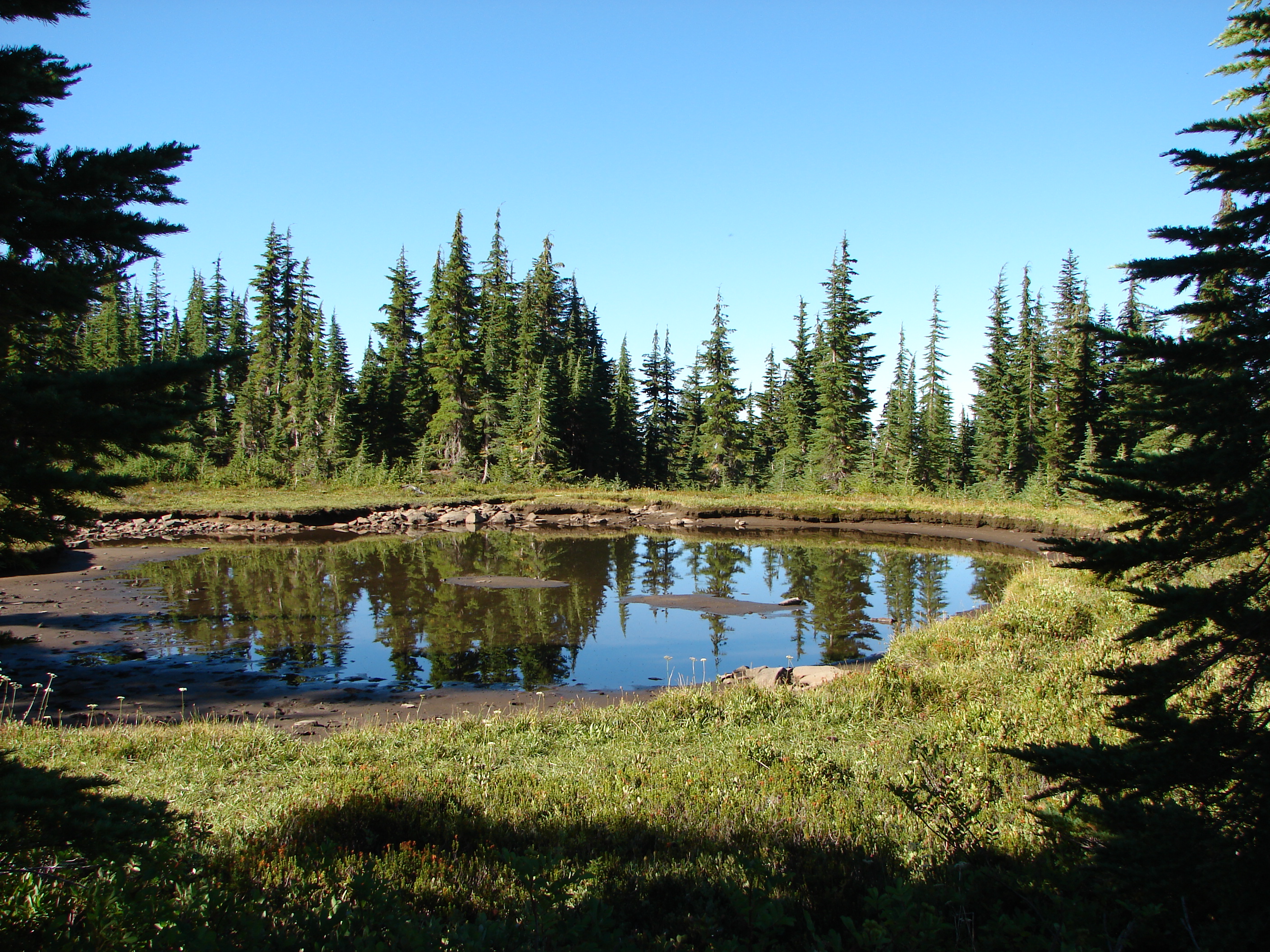
The PCT then reaches a plateau below Mt. Jefferson that is dotted with lakes and ponds. The first pond we arrived at was a strange red color. As I approached the water a frog swam from the shore and floated in the colored water.
168
Next up was Shale Lake and a wonderful view of the mountain.

Mt. Jefferson from Shale Lake

Shale Lake had some great looking tent sites and next to it was nearly dry Mud Hole Lake. Across the trail lay Coyote Lake and several other small ponds.

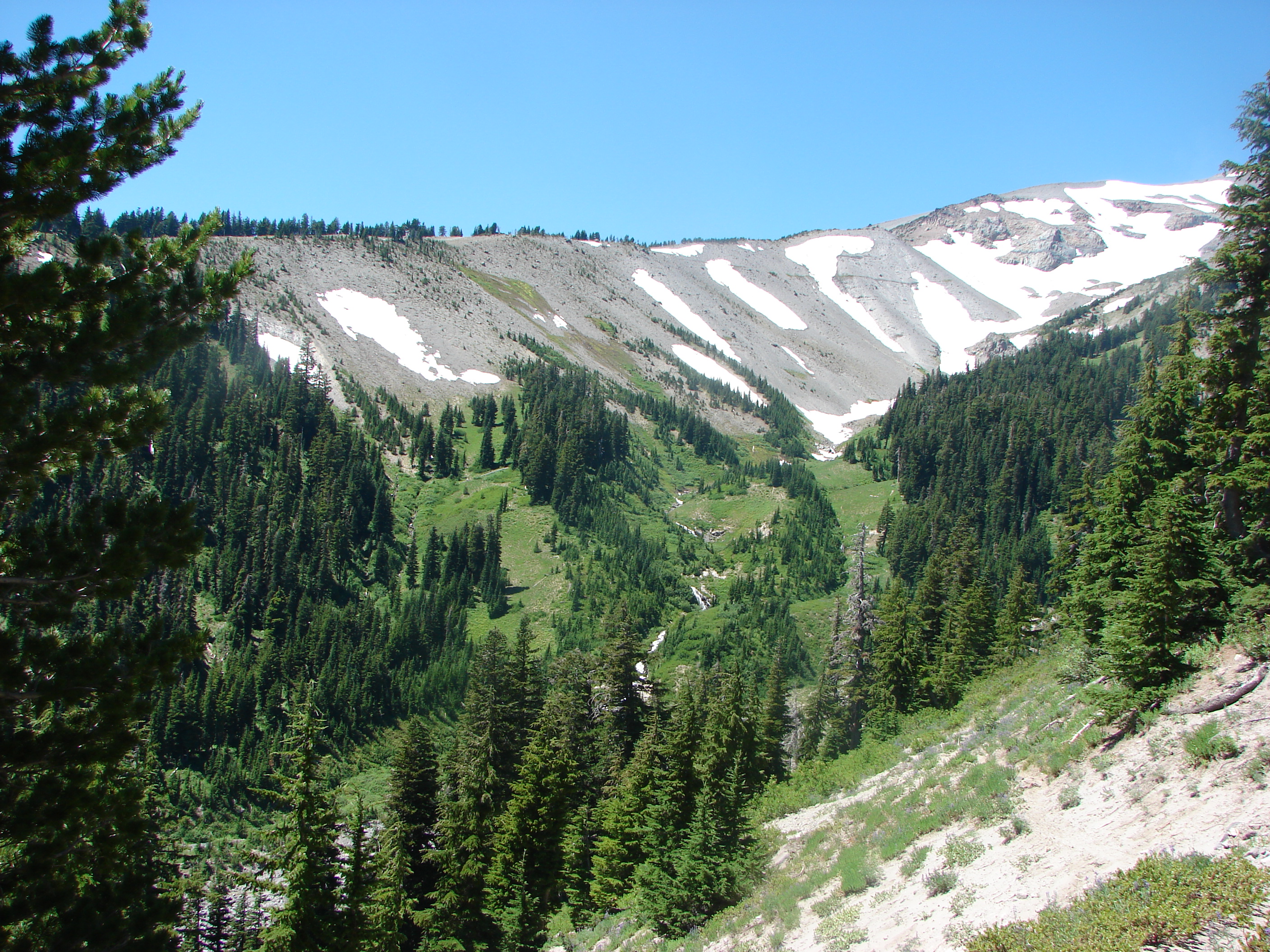
Leaving the plateau we began descending down toward Milk Creek with views of Pamelia Lake below. Just before reaching Milk Creek we reached the turn off for the return trail to Pamelia Lake. Before heading back I went down to the Milk Creek crossing to get a picture of Mt. Jefferson.
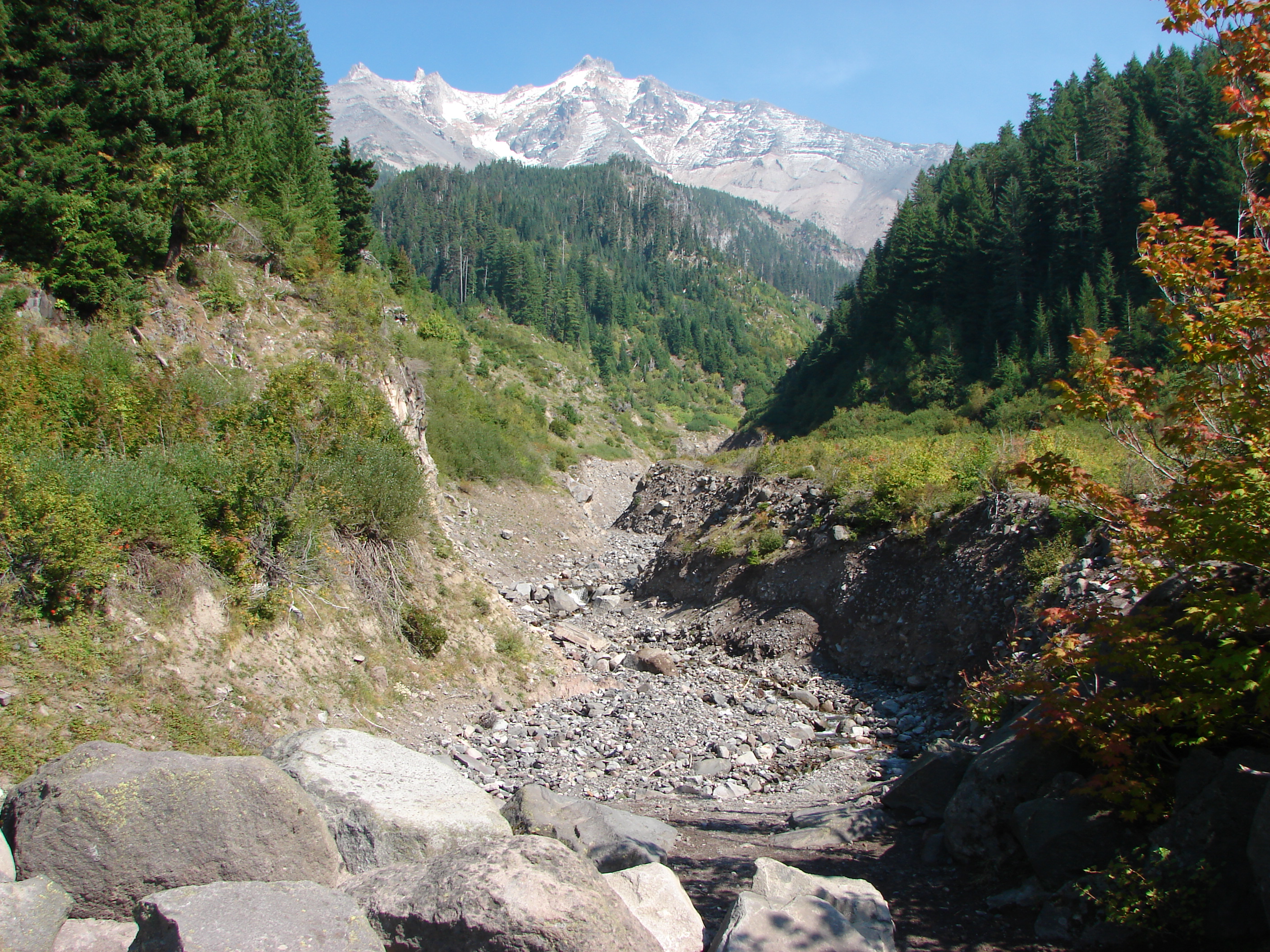
Mt. Jefferson from Milk Creek

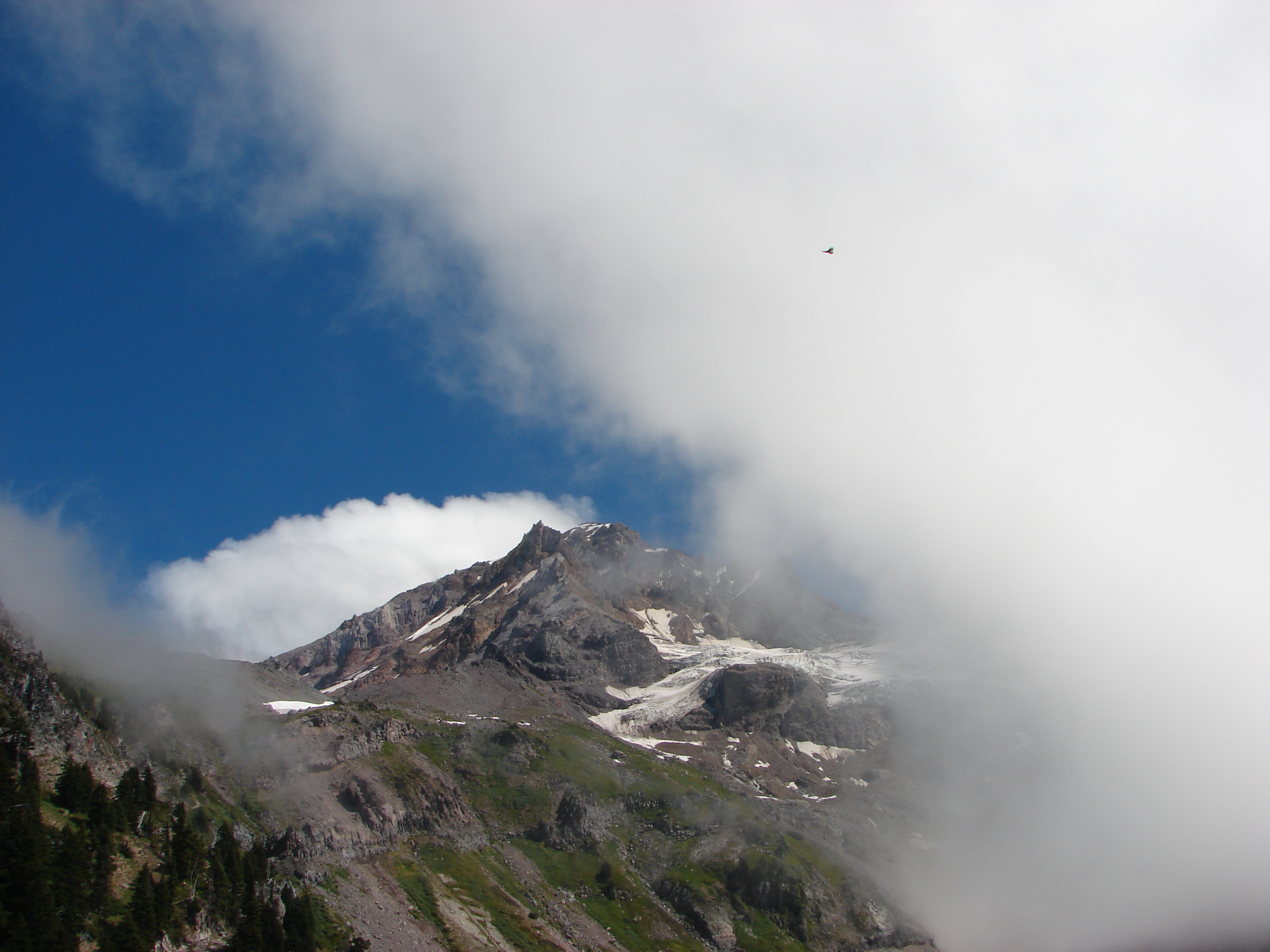
We started smelling smoke while I was getting the picture at Milk Creek and when I turned around the sky behind us was filled with smoke. Then I notice that there was smoke drifting in front of Mt. Jefferson as well. When we got back to Pamelia Lake the scene was quite different than it had been in the morning.

Smoke over Pamelia Lake

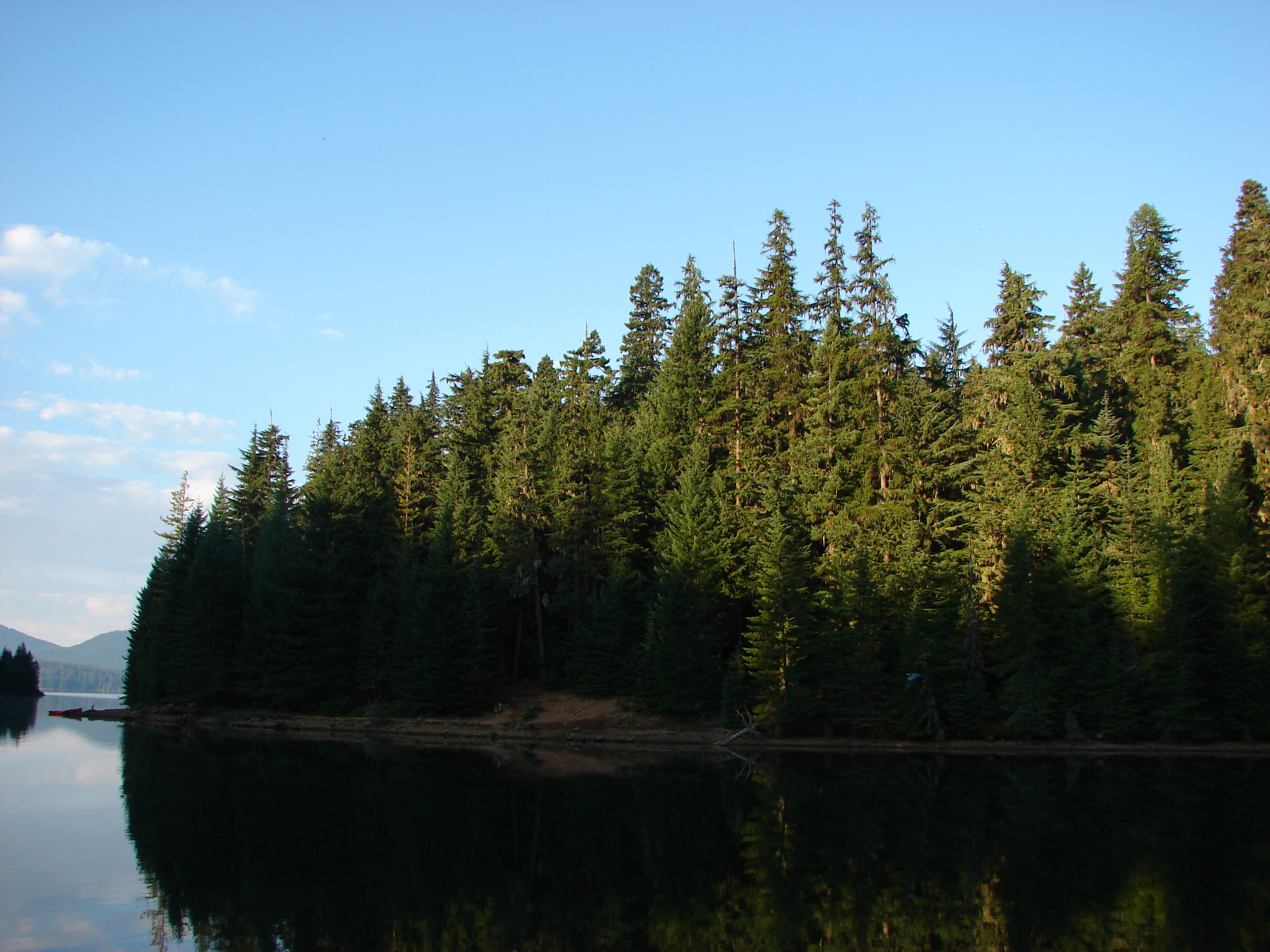
Smoke had settled in the valley but we had no idea what the source was. On the way out there was just a bit of smoke in the forest but it didn’t detract from the beauty. Green moss covered much of the ground and dozens of varieties of mushrooms and fungus added character to the view.
227

239

244

246

We had a blast on this hike. For the most part we had the trails to ourselves the whole day and the weather had been perfect. Aside from the bit of smoke at the end of the day (which was apparently due to a controlled burn being done by the Forest Service near Sisters, OR) it couldn’t have been better. We’d knocked out 18.2 miles in just over 9hrs. It was really fun having Jessie join us on the hike. It was great having someone that didn’t even blink at the 5am departure time or the distance/time we were planning on doing. What a way great to spend a Thursday in September 😀 Happy Trails!

Facebook photos:https://www.facebook.com/deryl.yunck/media_set?set=a.10202196386858309.1073741857.1448521051&type=3
Flickr: http://www.flickr.com/photos/9319235@N02/sets/72157635671937895/

Categories
Clackamas Hiking Old Cascades Oregon Trip report

Timothy Lake

We reached into our bag of backup hikes this past weekend and grabbed what wound up being a decent little hike. We were needing something in the Portland, OR area because after the hike we were set to celebrate the upcoming birthdays of my Grandmother Zana (89) and our Son Dominique (18) at Gustav’s http://gustavs.net/. Our original plan was to hike up Cooper Spur on Mt. Hood but the forecast called for thunder storms so we decided to save that one for another time and went to plan B which was a loop around Timothy Lake.

I am a bit hesitant when it comes to hiking around a lake because loops like that can sometimes lack a scenic diversity, but Timothy Lake was in the right area and had an appealing distance and elevation gain (14.2mi & <1000'). We started our hike at Little Crater Lake Campground in order to visit Little Crater Lake before starting the loop. Little Crater Lake is the result of a cold spring that has removed soft soils over time leaving a clear blue pool of water.
Reflection in Little Crater Lake Reflection in Little Crater Lake
A pair of ducks floated on the small lake while the surrounding meadows were draped in a low layer of fog. Shortly after leaving the lake we arrived at a junction with the Pacific Crest Trail where we turned left for .3 miles to the start of the official loop.

We remained on the PCT heading south, crossing Crater Creek, and passing several small springs before reaching our first good view of Timothy Lake. A great blue heron flew by and landed in a tree a little further down the lake shore from where we stood.

Timothy Lake
Timothy Lake
Great blue heron
Great blue heron

For the next 2 miles the PCT stayed in the forest away from the lake shore. Numerous paths led from the trail toward the lake but we stuck to the PCT as I was on a mission to find a view of Mt. Hood.

We knew Hood was visible from the lake, but we didn’t know from which part of the trail, and we’d managed to forget both the guide book and a map. When we reached the Oak Grove Fork Clackamas River the trail split from the PCT and continued along the lake shore toward the first of several busy campgrounds. It was at the second of these campgrounds that Mt. Hood was finally visible.
057
The campgrounds reminded me of another reason I am leery of lake loops. Crowded, noisy, and often disappointingly dirty (Is it really that hard to throw your garbage away?) these types of campgrounds are diametrically opposed to the tranquil beauty of nature. I think it’s great that people want to go out and enjoy God’s creation, but it would be nice if more of them respected it enough to be good stewards as I believe God intended when he gave man dominion over it. End of rant and back to the trail ;).

We hurried our way through the first 3 campgrounds and then were faced with a fork in the trail. To the right a path led along the lake but the sign indicated the only allowed use was for bikes. The left fork showed open to horses, hikers, and bikes and since we had already commented on the bike tire marks on a hiker only portion earlier we went left. This fork crossed paved road 57 and continued through the forest parallel to the road until reaching the dam that created Timothy Lake.

Oak Grove Fork Clackamas River continuing on from the Timothy Lake dam.

After passing through yet another campground the trail once again became peaceful as it continued on to Meditation Point. Meditation Point is a peninsula with a small tent campground. We took the short .3 mile trial to the end of the peninsula which had a nice view despite no longer having a view of Mt. Hood.

Timothy Lake from Meditation Point

Continuing on the loop after Meditation Point we worked our way around the lake to the NW side where the top of Mt. Jefferson was now visible.
103
Just a short while later we spotted a line of ducks floating on the lake. We headed down to the shore to get a closer look and as we were doing so an osprey had the same idea.

Osprey flying of ducks on TImothy Lake

It was interesting to watch as the ducks began to huddle together while the osprey flew overhead. After a couple of passes the osprey flew off leaving the ducks in peace.
127

After that interesting encounter the hike was fairly uneventful. We went around one final campground before veering away from the lake for good and returning to the PCT. We stopped again to marvel at Little Crater Lake before returning to our car and completing the trip.

Reflections on Little Crater Lake

Happy Trails!

Facebook photos:https://www.facebook.com/deryl.yunck/media_set?set=a.10202157025074289.1073741856.1448521051&type=3
Flickr: http://www.flickr.com/photos/9319235@N02/sets/72157635562348915/
Categories
High Cascades Hiking Mt. Hood Area Oregon Trip report

Yocum Ridge

Yesterday we completed what turned out to be our longest hike to date – Yocum Ridge. According to our 100 hikes guidebook the distance of the trail is 8.7 miles one way to a viewpoint of Mt. Hood’s Sandy Galcier. With that in mind we were anticipating a total distance around 17.5 miles, but by the time we were done exploring Yocum Ridge our garmin showed a total distance of 19.7 miles. :O Our original plan was to meet my parents at the trail head and hike together to Ramona Falls, but they were unfortunately unable to make it so Heather and I were off on our own just before 7am.

It was a cloudy morning as we crossed the Sandy River and made our way along Ramona Creek toward the falls.

Crossing the Sandy River

Ramona Creek is one of the prettiest creeks we’ve hiked along, but the dense forest always seems too dark to get any pictures to really do it justice.

Ramona Creek
Ramona Creek

When we arrived at Ramona Falls it was just as impressive as we had remembered it from our first visit the previous July.

Ramona Falls
Ramona Falls

From Ramona Falls we took the Timberline Trail north for .7 miles to the Yocum Ridge trail and began our climb. We were presently surprised by the gentle grade of the trail which climbs nearly 3000′. The lower portion of the trail was heavily forested with lots of mushrooms and red huckleberries. We spotted one pika (and heard many more) and a small frog along the trail as well. The clouds were low and a light fog filled the trees making it impossible to tell if the trail offered any views. We passed a couple of small ponds and some meadows that had been home to flowers earlier in the year.
048

We were holding out hope that we would eventually climb above the clouds and into blue skies but we began to think that was just wishful thinking. We caught our break though as we approached the south side of the ridge near a rock field and wild flower meadow. When we came out of the trees in the meadow we were greeted by blue sky and sunlight. Looking up toward Mt. Hood the summit was visible above the tree tops.

Mt. Hood above the tree tops.

The clouds were still all around so we decided to double time it up the trail not knowing how long the views would last. We were slowed by the increasingly scenic wildflower meadows and views to the south across Paradise Park to the distant summit of Mt. Jefferson.

Paint & aster meadow


Paradise Park & Mt. Jefferson

As we hurried up the trail other flowers such as western pasque, bistort, fireweed, and groundsel showed up in the meadows. The trail then entered a series of spectacular meadows as it traversed around the ridge finally revealing a view of Mt. Hood.
110
Small clouds were passing in front of the mountain as we approached through the meadows. From this side of the ridge we had an up close view of Illumination Rock and the Reid Glacier.

Reid Glacier & Illumination Rock

The wildflower meadows were on all sides as the trail headed straight for the mountain.
129

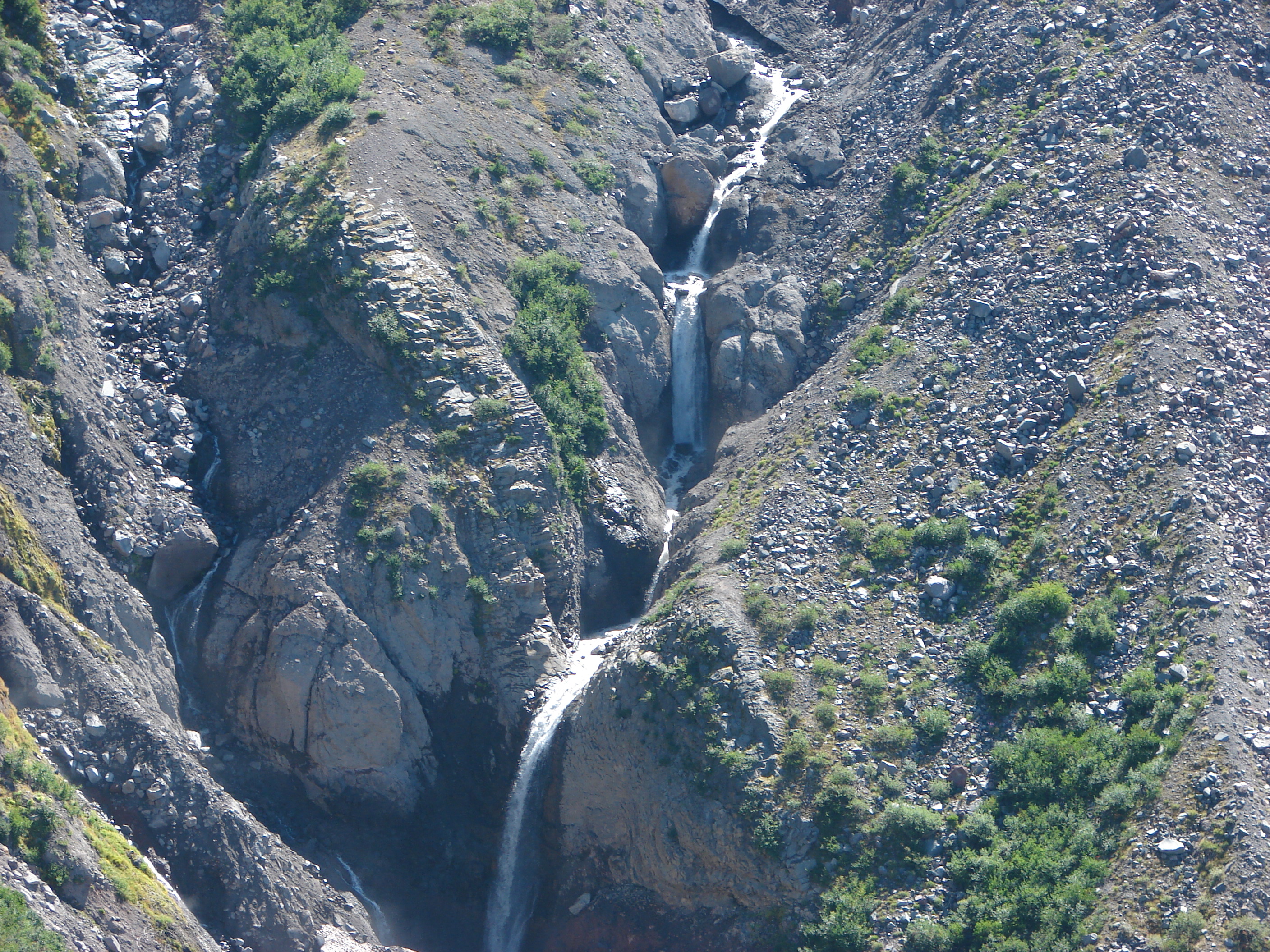
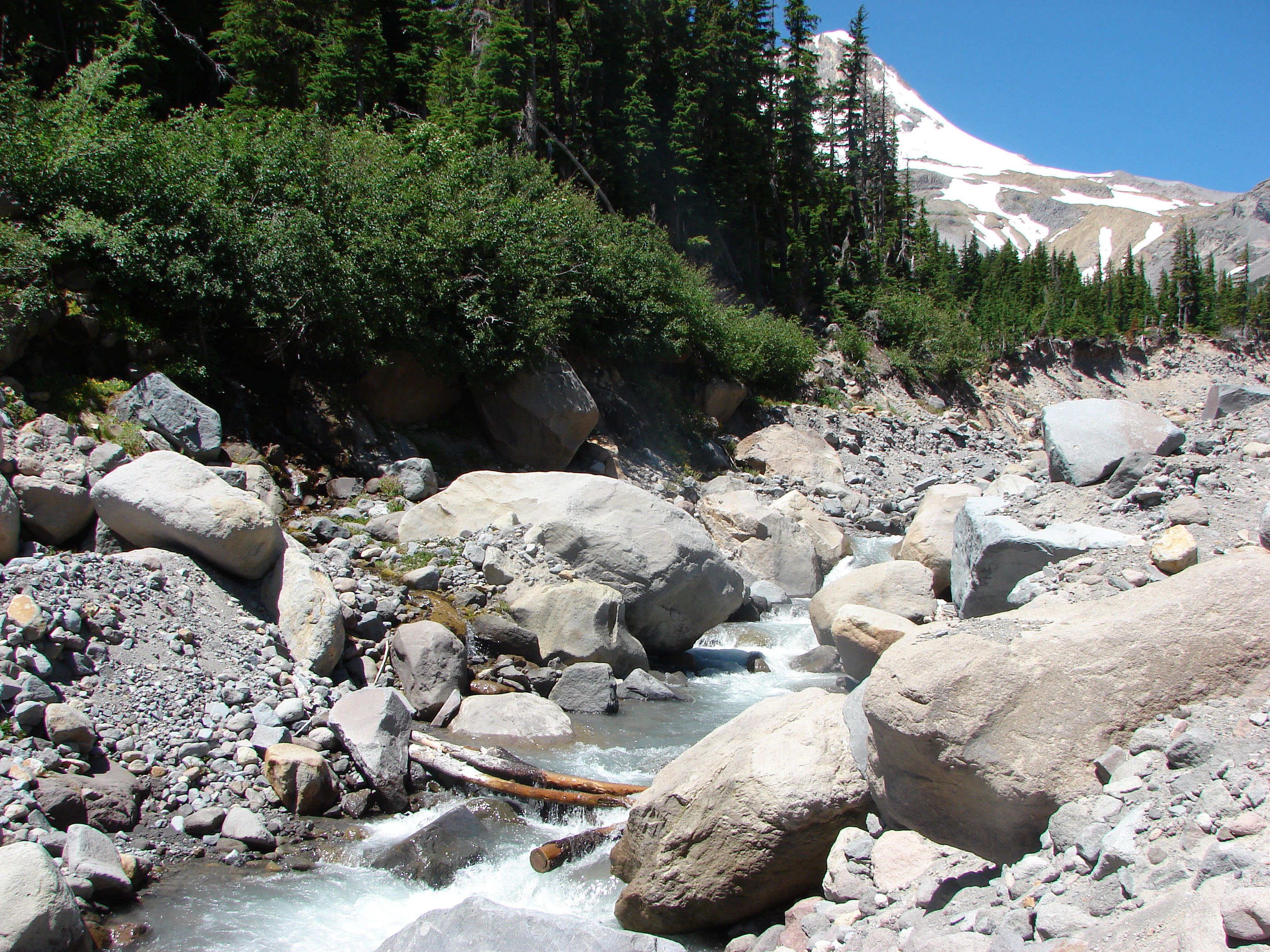
The trail eventually came to the edge of the Sandy River canyon where melt water from the Reid Glacier feeds the Sandy River. A series of waterfalls could be seen (and heard) below.
145
We explored the area and spotted another good sized water fall further down and across the canyon. This one was flowing from the Paradise Park area down into the Sandy River.

Waterfall along the Paradise Park branch of the Sandy River

We finally pulled ourselves away from the spectacular views and continued on the trail toward the north side of the ridge. The trail climbed as it crossed the ridge and passed through many more wildflower meadows. When we reached the north side of the ridge we found the clouds again. There was a bank of clouds settled over the valley between Yocum Ridge and McNeil Point. Here the trail turned up the ridge at it’s steepest grade. We reached a small saddle below the rocky cliffs that top the ridge where we found a couple of camp sites and lingering snow patches. To the right of the cliffs we could see blue sky, but on the left it was all clouds. We decided to continue on what appeared to be a faint path across loose rocks and sand to see if we could once again rise above the clouds. The “faint path” completely disappeared and visabillity was all but gone when we decided to turn around and go back. We looked at some trip reports later that showed we had been headed straight for the mountain with the Sandy Glacier to our left but we’d have never known it.

Heather returning on the “faint path”.

Back at the saddle the clouds began to rise keeping the mountain hidden but giving us a better look at the flowers surrounding this area. He we found lupine, cat’s ears, and even a few avalanche lilies. While exploring the tent sites we stumbled on a small group of scotch bluebells.

Avalanche lilies
Avalanche lilies
Cat's ear
Cat’s ear


Scotch bluebells
Scotch bluebells

When we started our return trip the clouds had risen from the valley floor giving us views below, but when we arrived at the Reid Glacier viewpoint Mt. Hood was hidden. We found a couple of fellow hikers here that we had met near Ramona Falls and asked if they had made it in time to see the mountain and they had not. We all stuck around waiting to see if we would catch another cloud break since there was still plenty of blue sky around. While we were waiting a Red Tailed hawk circled overhead checking us and the meadow out.

Red Tailed hawk
Red Tailed hawk

While I was attempting to catch the hawk in flight Mt. Hood decided to make an encore appearance.

Red Tailed hawk over Mt. Hood

The clouds continued to roll in allowing us brief glimpses of the mountain before we decided it was time to start our return trip.

On the way down we were provided some new views due to the rise in the cloud levels. We spotted the bottoms of Mt. Jefferson and Mt. Adams, Lost Lake, and the large waterfall coming from Paradise Park.
360
We stopped briefly at Ramona Falls where a large crowed now milled about and then continued on the final 3.4 mile leg along the Sandy River to our waiting car. It was a long hike and we only got to see half of the views, but in the end it didn’t matter. What we did see was amazing enough and now we have an excuse to return since we have unfinished business on the north side :). Happy Trails.

Facebook photos: https://www.facebook.com/media/set/?set=a.10201968046749949.1073741852.1448521051&type=1
Flickr: http://www.flickr.com/photos/9319235@N02/sets/72157635221888570/
Categories
High Cascades Hiking Mt. Jefferson Area Oregon Trip report

Jefferson Park via South Breitenbush Trail

**Note the 2020 Lionshead Fire burned the area covered by this hike.**

Our hike this week brought us back to what is my personal favorite destination – Jefferson Park. I can’t really say what it is about the area that makes it my favorite, but I think it is a case where the sum of the parts is greater than the whole. Jefferson Park is home to several lakes, wildflower meadows, berry patches, snow melt ponds, creeks, and the beginnings of the South Fork Breitenbush River. Oh yeah, the back drop to all of this is Mt. Jefferson, Oregon’s 2nd tallest peak at 10,497′. Our first visit came late in September 2011 when we took the Whitewater Trail and entered the park from the south. In October 2012 we took the Pacific Crest Trail from the north up Park Ridge and down into Jefferson Park. This year we would be coming from the west on the South Breitenbush Trail.

This wasn’t our first time on the South Breitenbush Trail. Earlier this year we had hiked a lower portion of the trail along the South Breitenbush Gorge. https://wanderingyuncks.wordpress.com/2013/05/12/south-breitenbush-gorge-trail/ For this hike we drove past that portion of trail to the third trail head 5 miles up road 4685. We set off from the large parking area just as the Sun was beginning to shine on the top of the ridge across the South Fork Breitenbush River’s valley. The forest was dense and quite dark as the Sun was hidden behind the ridge we were climbing. The trail climbed steadily far enough from the river to hide it’s existence. The trees also hid Mt. Jefferson as we crossed several small streams before the forest began thinning as it became drier. I noticed what appeared to be a brushy clearing that might offer a view so I started looking for a side trail. Sure enough I spotted a pair of rocks oddly placed on a small log which signaled a faint path out through the manzanita. A short distance later Mt. Jefferson came into view giving us our first good view of the mountain.077

Onward and upward we trudged as the forest became sparser offering more frequent views of the mountain. We started noticing more and more ripe huckleberries as we entered the areas that got more sunlight and made sure we took a good sampling. The trail finally flattened out on a plateau where we encountered our first snow melt pond.
111
It seemed to belong in Jefferson Park which made us feel like we must be close which turned out to not exactly be the case. We passed through heather meadows that must have been quite a display when they were in bloom and also found some nice patches of wild blueberry bushes where the ripe berries in the sun smelled just like a freshly baked pie. We finally switchbacked down along the edge of a rock slide and followed a flower lined creek toward the South Fork Breitenbush River.

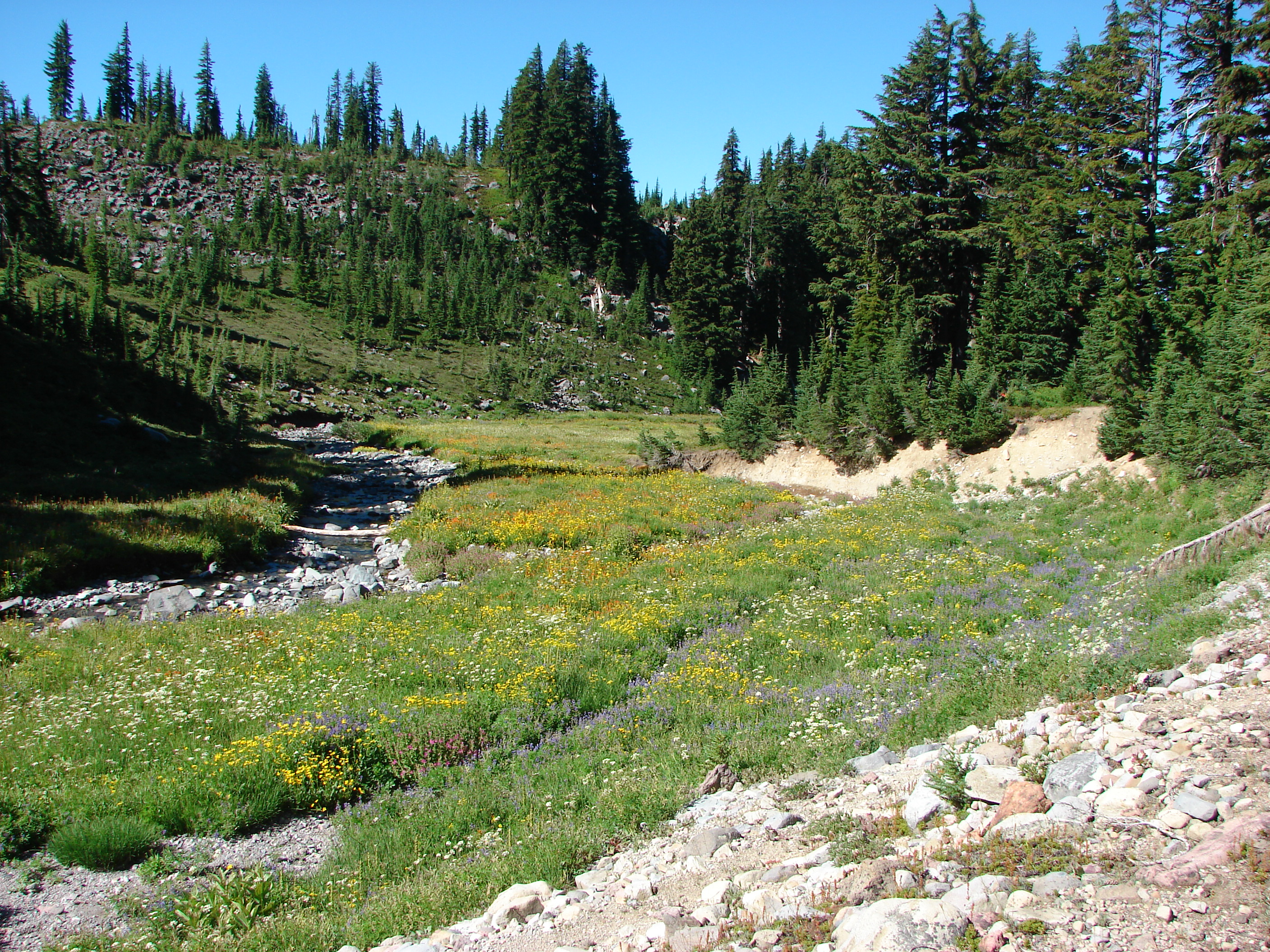
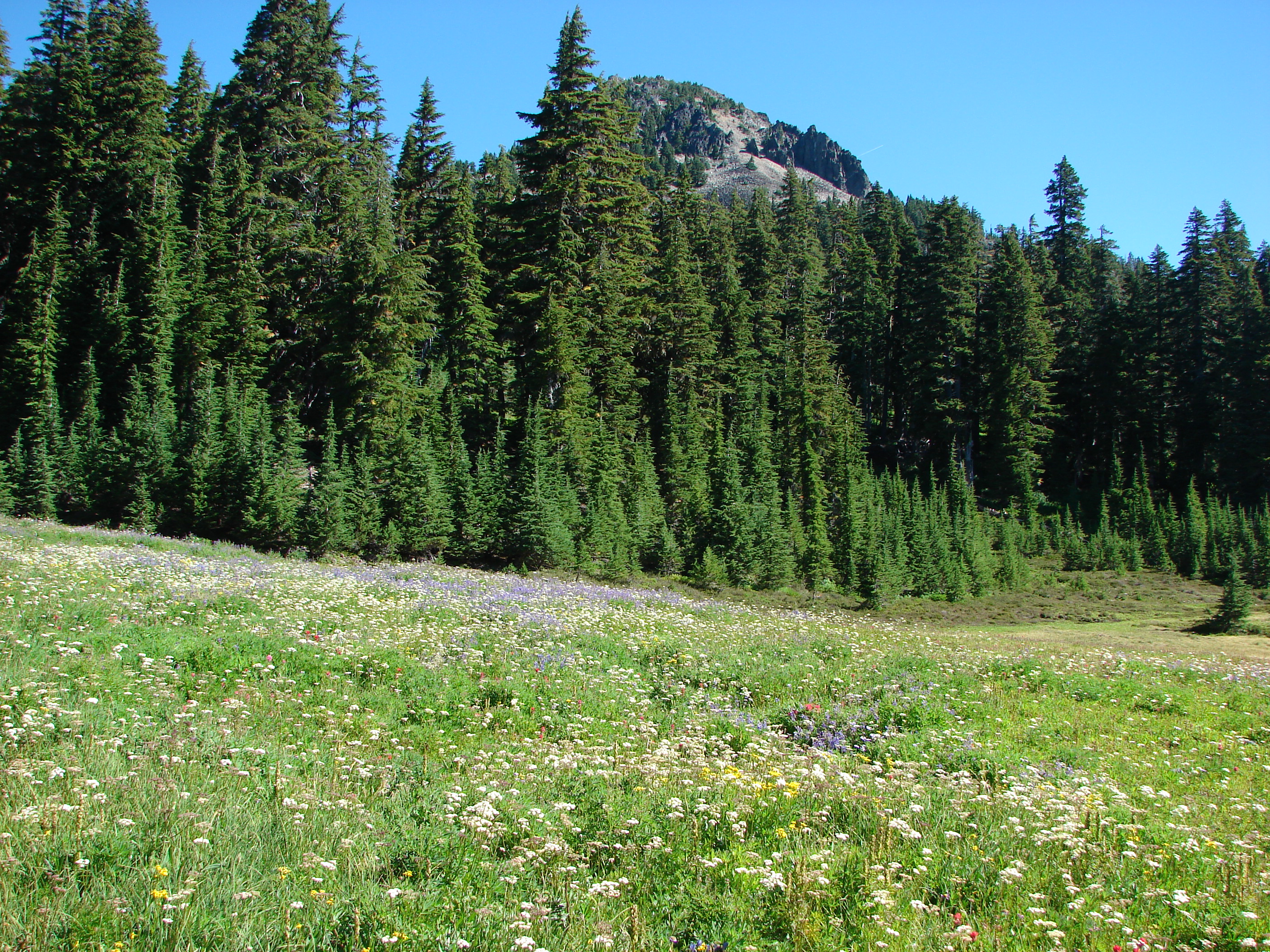
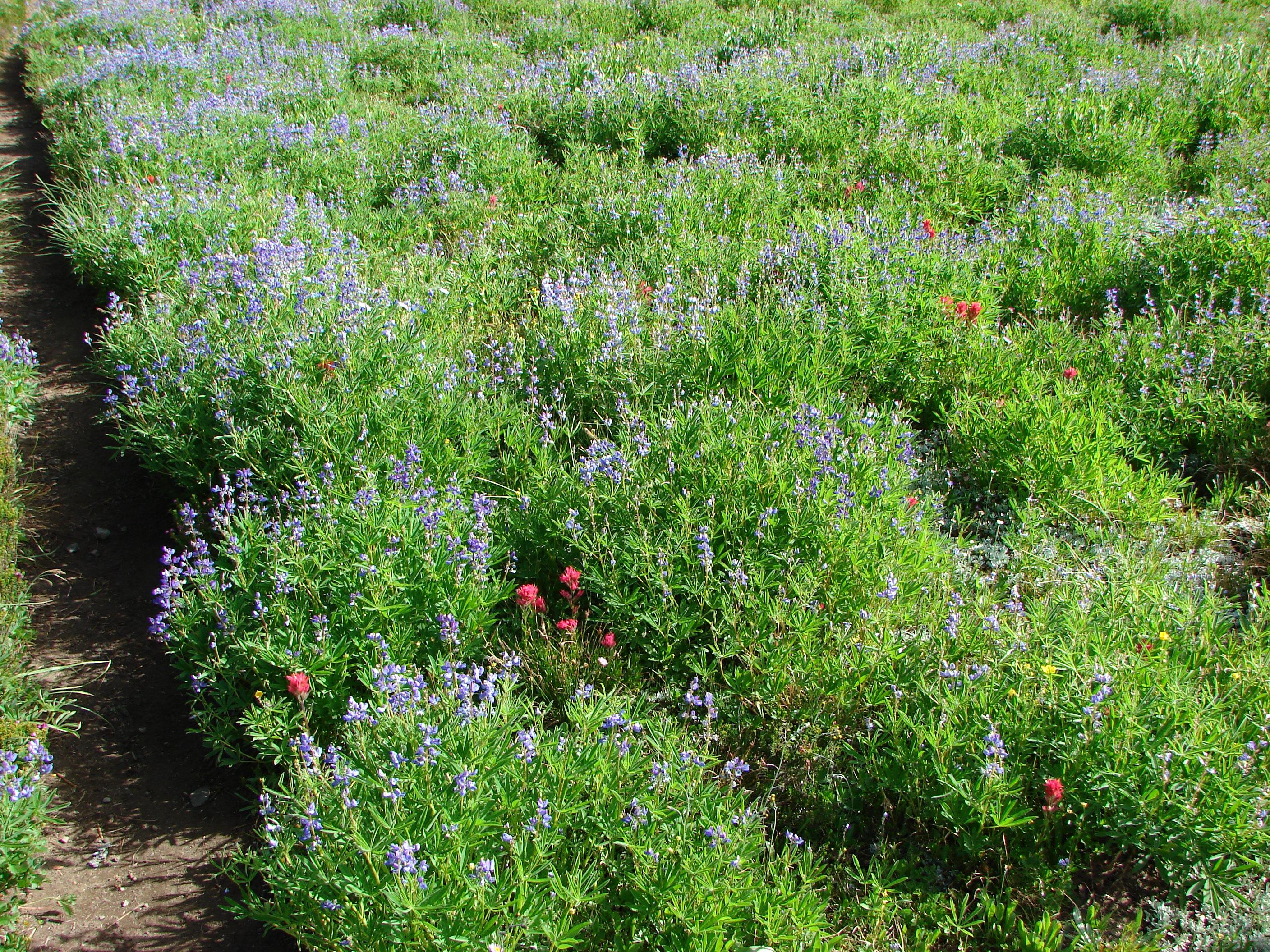
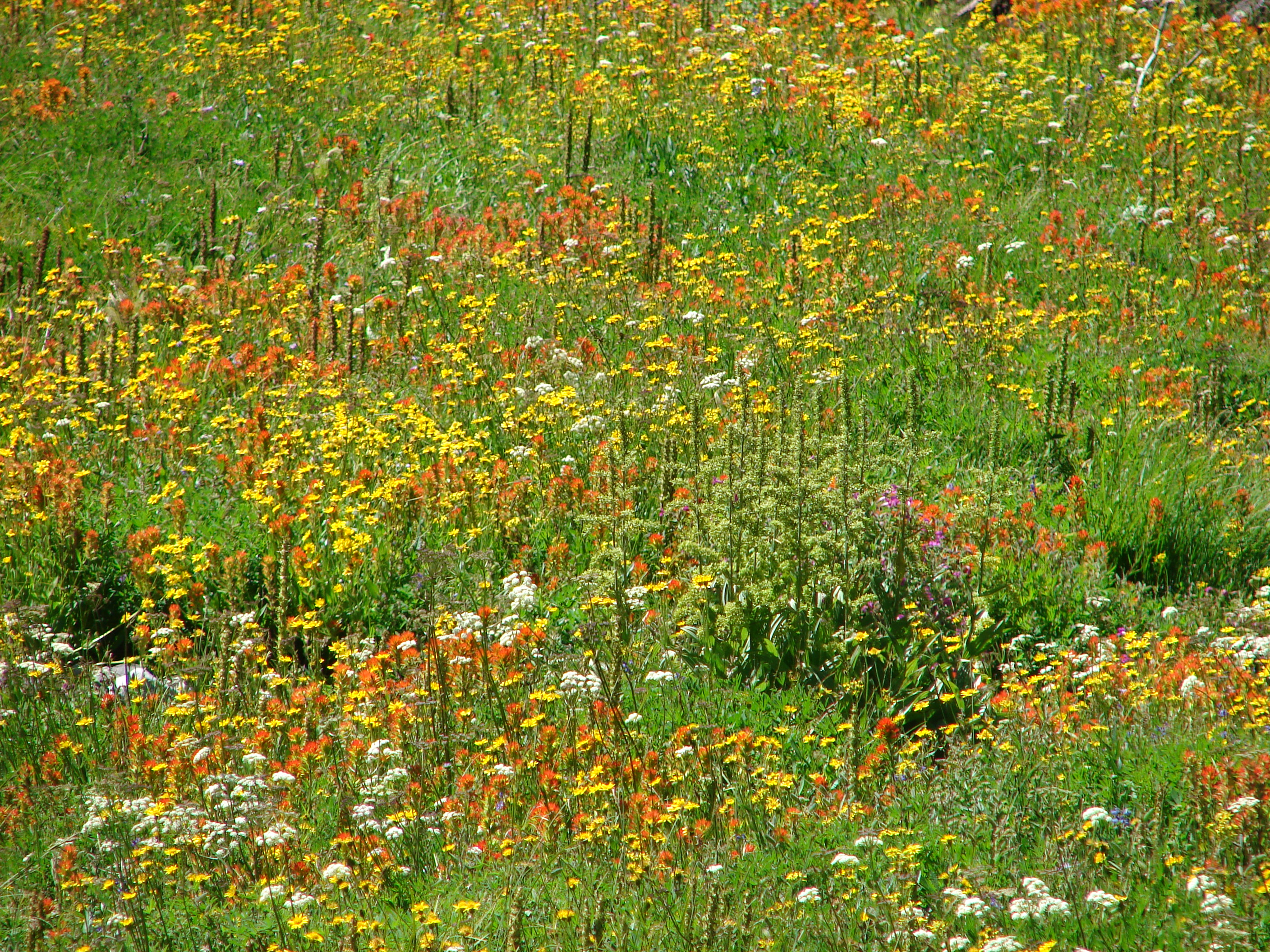
I had begun to think that we might have missed out on most of the wildflowers despite the fact we had come much earlier than in previous years. As usual I was worrying for nothing. Beginning with the creek the number of flowers began to increase and by the time we had traveled a short distance along the river we found the bank was ablaze in yellow and orange.
181
On the other side of the trail was a field of purple and white below the rock summit of Park Butte.
184
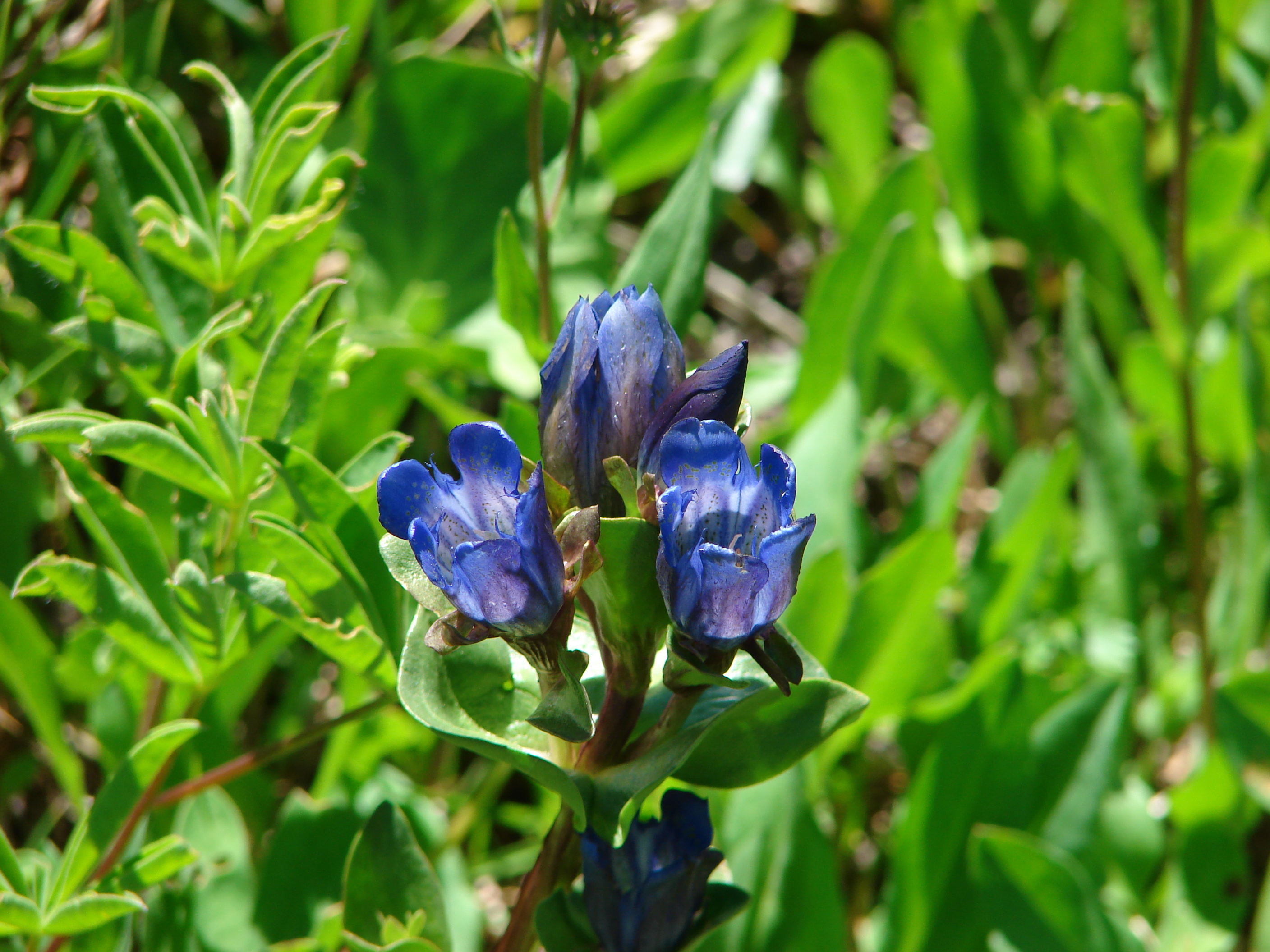
We had managed to come at a great time when many of the earlier flowers were still in bloom, but there were also later flowers such as gentians on display. To top it off the mosquitoes were no longer a nuisance.

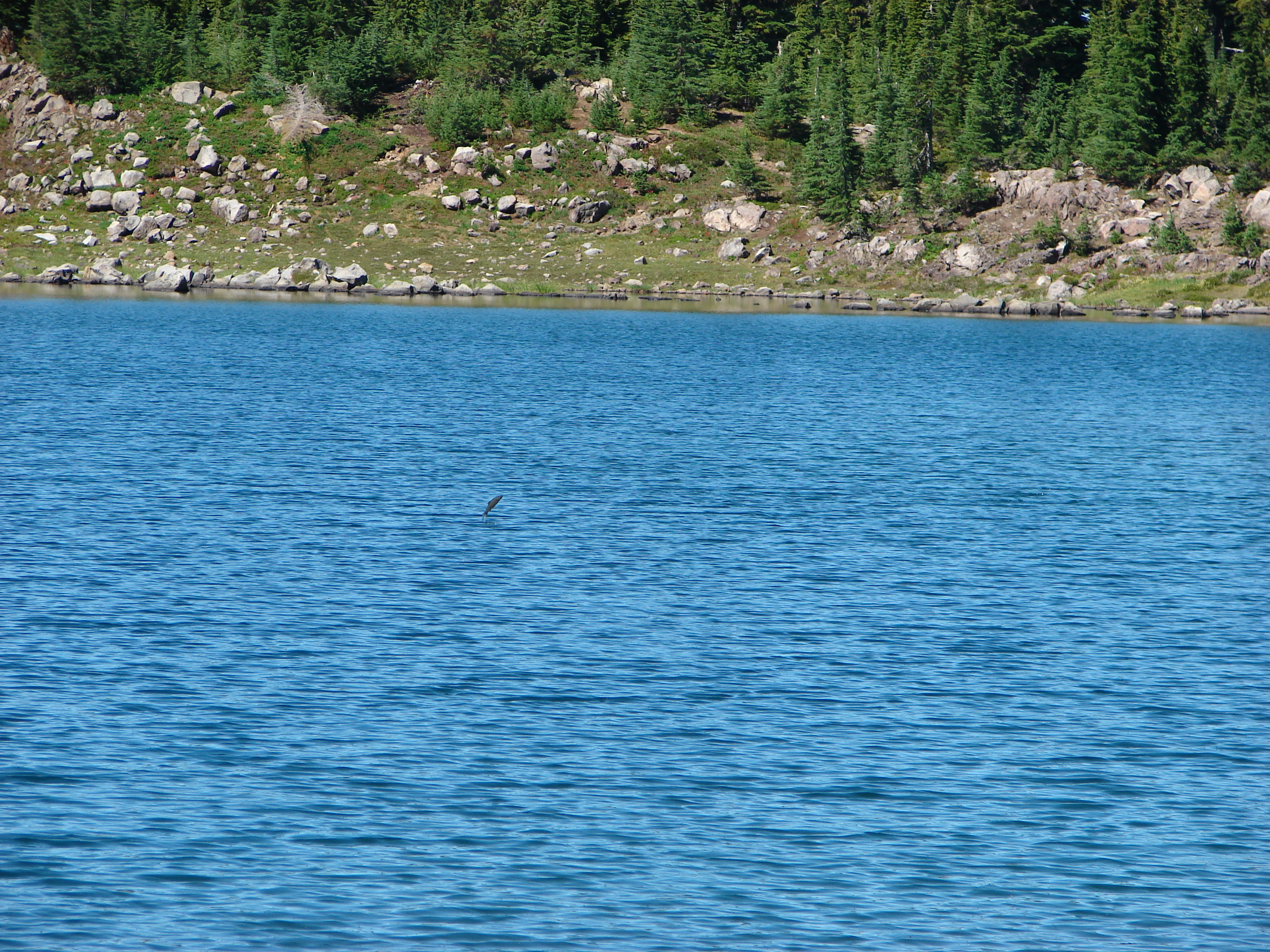
We crossed the river and climbed a small ridge to the junction with the Pacific Crest Trail and turned north (left) toward Russell Lake. The outlet of Russell Lake is one of the sources of the river and its location between Park Butte and Mt. Jefferson makes it an ideal lunch spot. We ate our lunch (and a few more berries) while we watched a plethora of fish jumping in the lake. It seemed like there was one jumping everywhere you looked, and I even managed to get a picture of one.
225

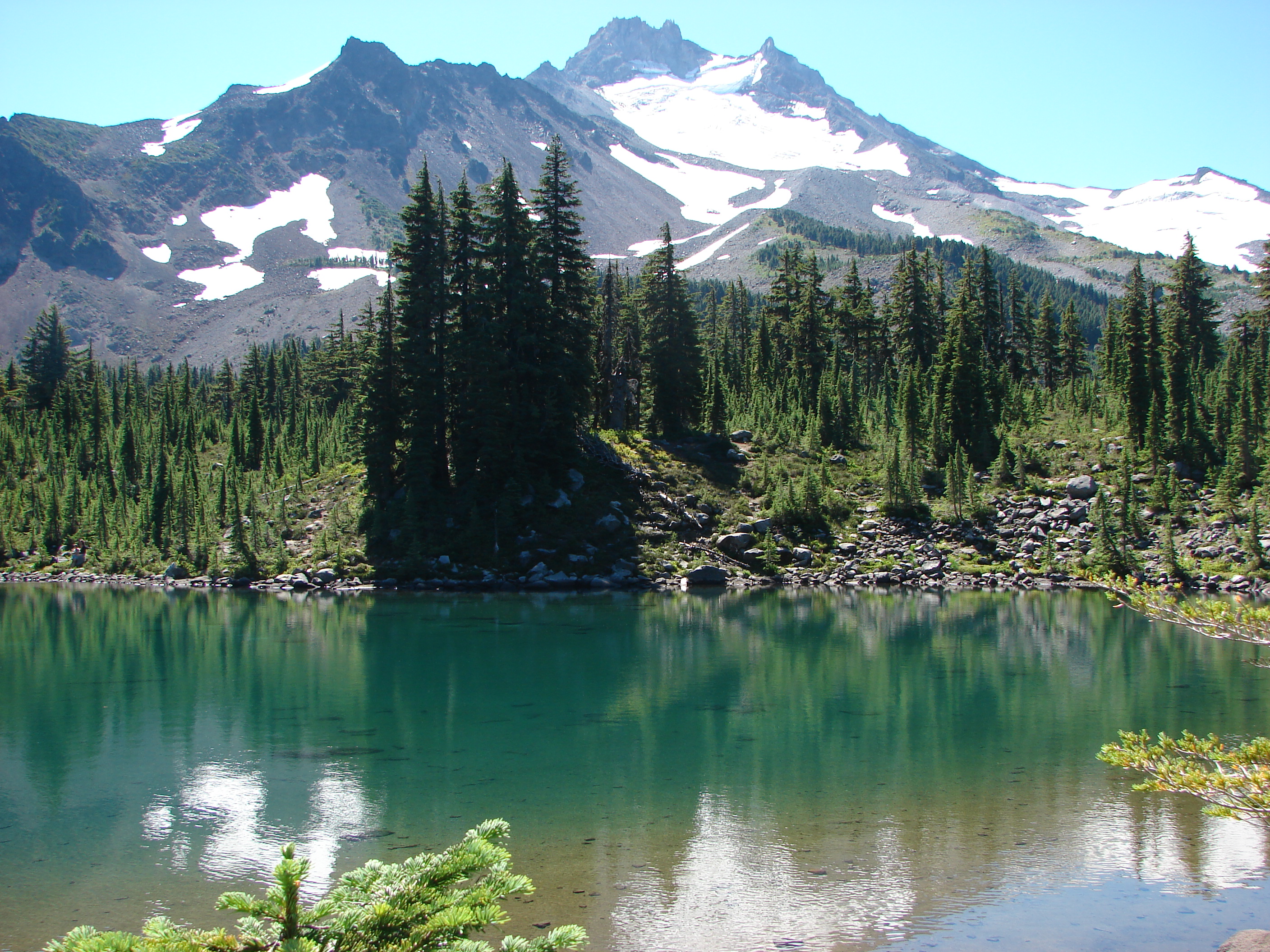
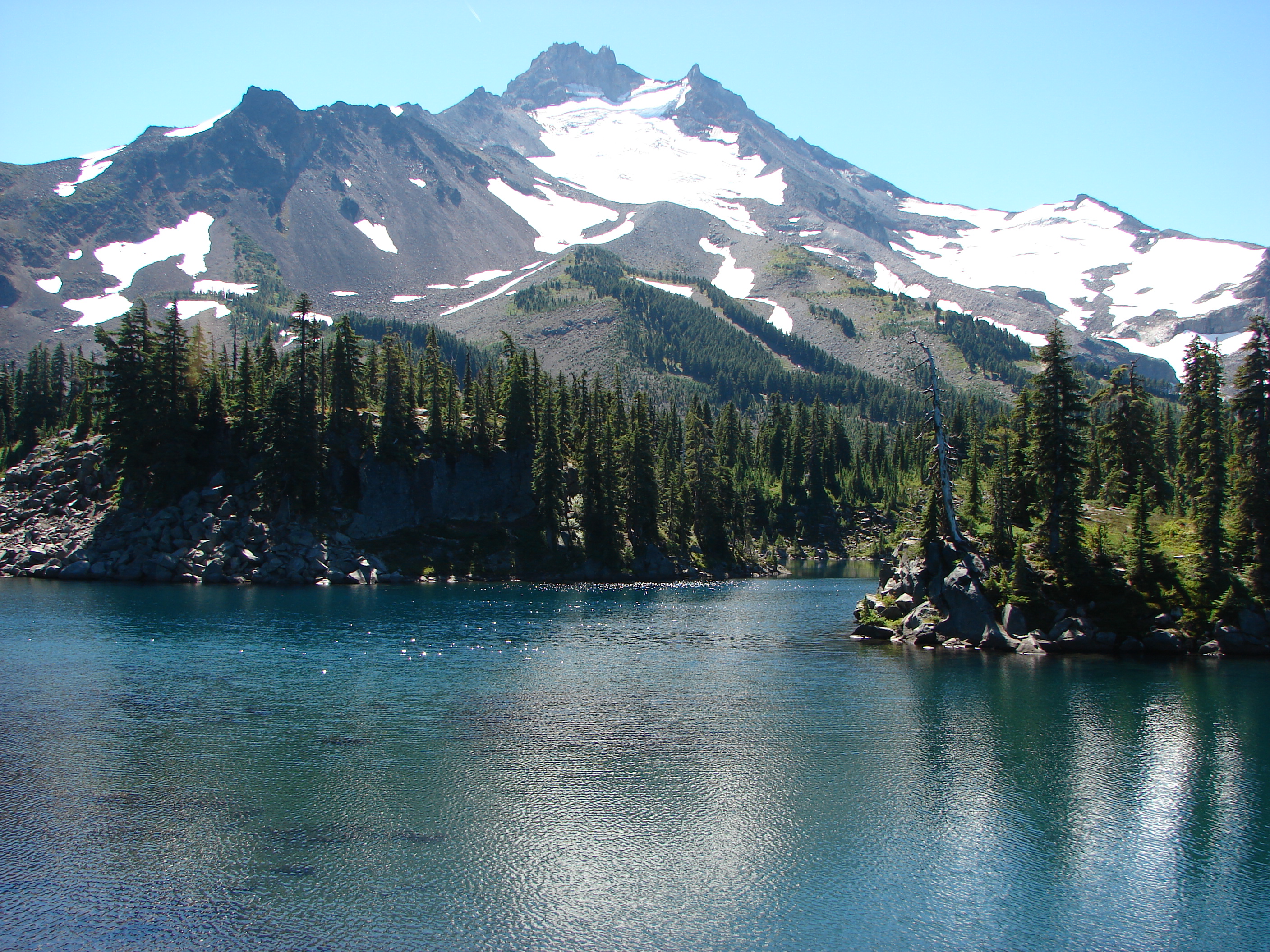
After lunch we headed south along the PCT through the meadows of Jefferson Park eventually taking one of the many side trails toward the other lakes of the park. We started at Scout Lake and worked our way around the shore so we were across from Mt. Jefferson.
250
We then headed west over a small hill and down to blue Bays Lake with its rocky peninsulas.

Bays Lake
Bays Lake

From Bays Lake we made our way north past small Rock Lake to Park Lake and another great view.

Park Lake
Park Lake

A trail following the outlet of Park Lake led us back to the South Breitenbush Trail near the river crossing.

The wildflowers were even more impressive on the way out as the Sun was now overhead and many of the flowers such as the gentians were opening.

Gentians
Gentians

290
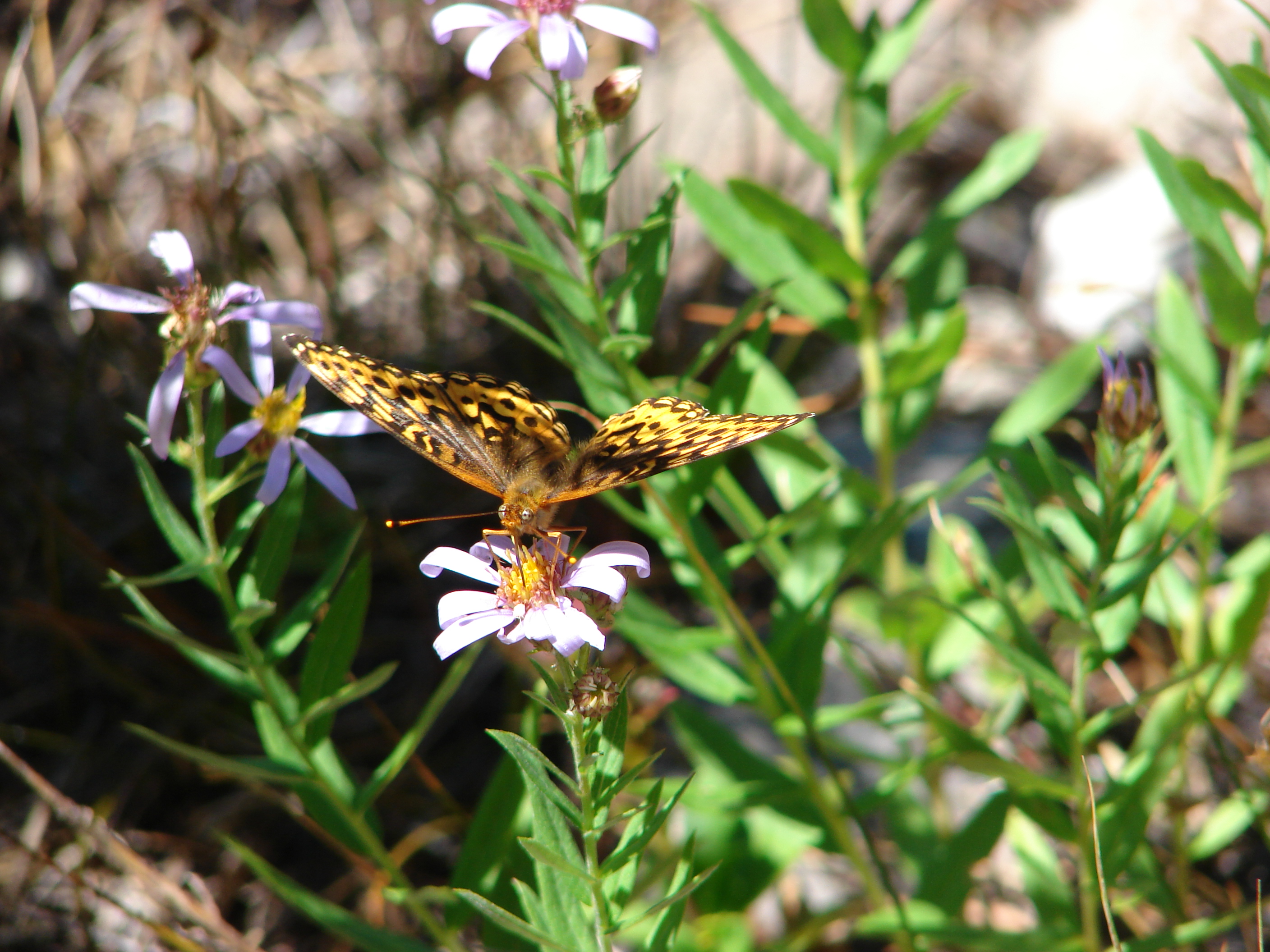
Butterflies had also come out to play.
369

After having taken all three of the main approaches to Jefferson Park my favorite would be coming in from the north on the PCT over Park Ridge. The view from the ridge is second to none, but the awful road to the trail head also has few rivals. The Whitewater trail was the easiest and offered nice views, but the entrance to Jefferson Park is not as impressive as the others. The South Breitenbush Trail was the longest (6.2miles one way compared to 5.6 & 5.1 respectively) and gained the most elevation but it offered a great variety of scenery and is the least visited of the trails. In reality you can’t go wrong by picking any of these trails as Jefferson Park is well worth the trip. Happy Trails.

Facebook photos: https://www.facebook.com/media/set/?set=a.10201909424804437.1073741850.1448521051&type=1
Flickr: http://www.flickr.com/photos/9319235@N02/sets/72157635134756828/

Categories
High Cascades Hiking Oregon Three Sisters Area Trip report

Matthieu Lakes

**Note the 2017 Mili Fire burned a portion of this hike.**

After finally successfully hiking Canyon Creek Meadows the next day we headed to McKeznie Pass to visit the Matthieu Lakes. We had been in this part of the Three Sisters Wilderness the previous October on a dreary day that left us without any views of the mountains and too late in the year for flowers. We arrived at the trail head at about 6:30am and were quickly reminded of how cold it is in the Cascades early in the morning. Looking behind us from the parking area we could see the spire of Mt. Washington as the morning sunlight reflected off the volcanic rock. We had already seen one more mountain than we had the previous year and we hadn’t even started hiking yet.

A short path led to the Pacific Crest Trail which we turned left on and started a gradual climb up to the start of the Matthieu Lakes loop. At the loop junction we kept on the PCT and headed toward South Matthieu Lake. As we climbed the tress began thinning out giving us glimpses to the north and west. The further we went the more we could see and soon a string of volcanoes was lined up on the horizon.

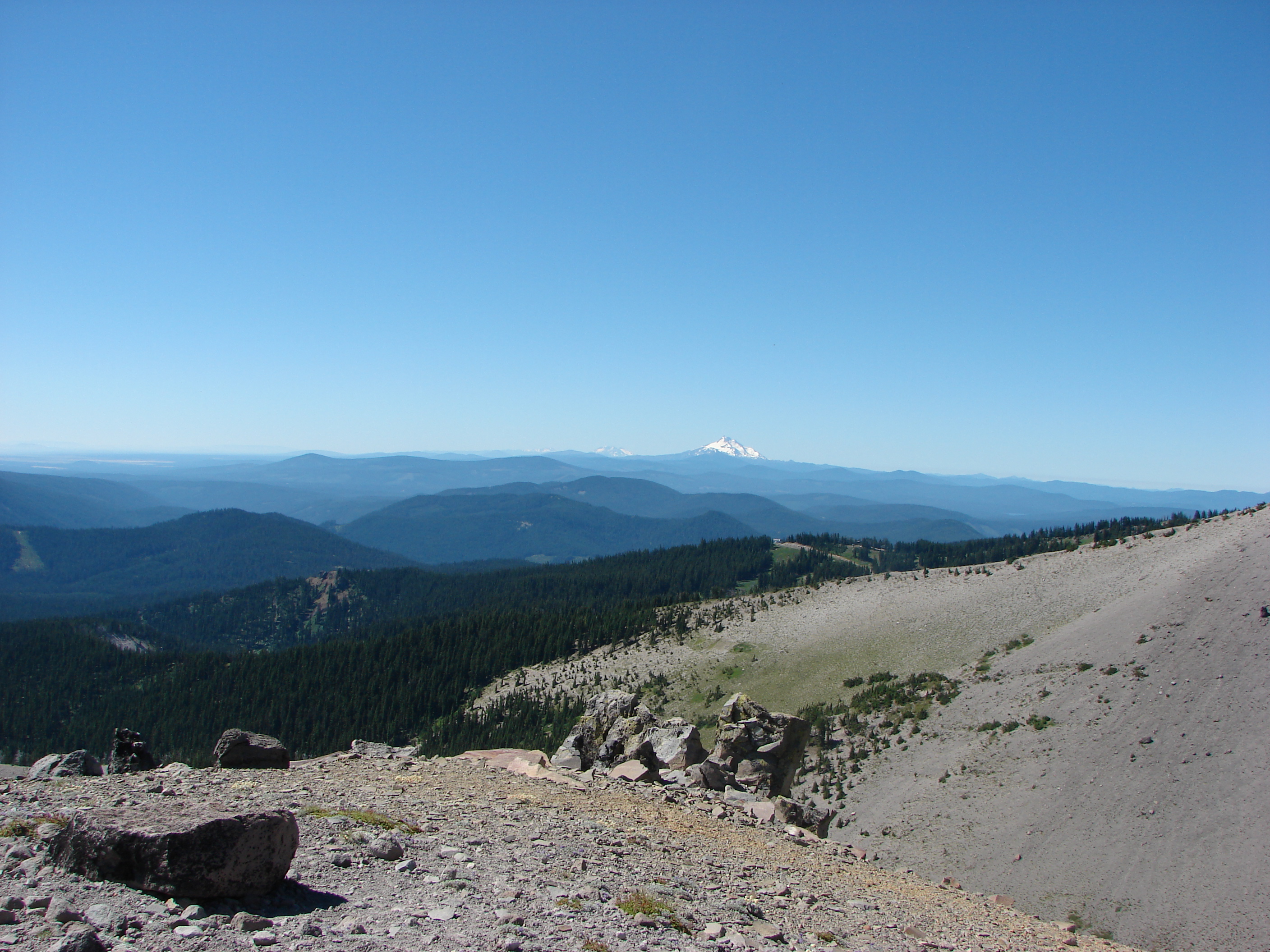
Belknap Crater, Little Belknap Crater, Mt. Washington, Three Fingered Jack, Mt. Jefferson, and Mt. Hood from L to R

When we reached South Matthieu Lake North and Middle Sister had joined the visible volcanoes to the south. They rose above the small lake making for a pretty scene.
071

At the north end of the lake was a trail junction for the return loop, but first we continued on the PCT heading for the meadow at the Scott Trail junction. In October we had come from the other direction on the PCT and then taken the Scott Trail back to our car and we could see the potential for the meadow to be a beaut at the right time.
This section of the PCT started along side a lava flow where we spotted a Pika who seemed to be as interested in us as we in it.
081
The trail then passed over the lava flow and headed for Yapoah Crater, one of many cinder cones that helped create the volcanic landscape. The Sisters got larger as we neared and to the north the view became even better as we gained elevation. As we contoured around Yapoah Crater we could even see the top of Mt. Adams in Washington join the volcanic line beyond Mt. Hood. Here the crater hid the Sisters, but as we came around they came into view joined by The Little Brother.
144

A short while later we reached a ridge looking down into the meadow. The purple patches of lupine were visible from above and as we descended other flowers became evident. Pink heather, red paintbrush and several different yellow flowers were joined by a single western pasque flower at the meadows edge. Here we also ran into our first mosquitoes of the day but they were not too bad. The meadow itself was filled with flowers and a view ahead to the Sisters.
158
Here is the same meadow from our visit last October:
23916_4744965989267_997769053_n
We crossed through the meadow on the PCT enjoying the display of wildflowers. Had the mosquitoes been less it would have been a perfect lunch spot, but as it was we just turned around and passed back through.
181

When we reached South Matthieu Lake we took the North Matthieu Lake trail to visit that lake and complete our loop. North Matthieu Lake was much larger than South Matthieu, but being lower in elevation meant almost no view of The Sisters save at the very north end and then only just the tip of the North Sister was visible. What it lacked in mountain view it made up for in color. The water went from blue to green depending on where you looked.
220

Past North Matthieu Lake we encountered a number of small ponds. The last of which was teeming with birds. We spotted a variety of birds in the trees around the pond and sometimes in it.
238
Finally we passed through a small meadow beside a lava flow that was home to a number of butterflies. Here we saw our first California Tortoiseshell.
254

It was a great hike and really nice to be able to visit a place we had been before at a different time. It’s amazing how much timing can change the experience. It was a good reminder that it can be worth going back to a previous hike at a different time of year to see how things have changed. Happy Trails.

Facebook photos: https://www.facebook.com/deryl.yunck/media_set?set=a.10201705197258876.1073741845.1448521051&type=3
Flickr: http://www.flickr.com/photos/9319235@N02/sets/72157634853318672/

Categories
High Cascades Hiking Mt. Jefferson Area Oregon Trip report

Canyon Creek Meadows

Canyon Creek Meadows had been a monkey on our backs, or is it packs for hikers? We had tried several times in the past two years to get this hike in and either snow or forest fires forced us to change our plans. We had put it back on our schedule for August 2nd this year hoping this year would be different. Thanks to a very helpful trip report on 7/26 by pdxgene via portlandhikers.org we learned that the meadows were not only snow free but the flowers were in bloom. We were now in danger of being too late for the full flower display so we moved the hike up in the rotation and off we went.

It was a beautiful morning at the Jack Lake trail head and after a minor detour around the wrong side of the lake we were headed for the lower Canyon Creek meadow. The trail alternated between burned and unburned forest as it climbed to the first meadow. The flowers here were still in bloom despite some already feeling the effects of a warm and dry late Spring and early Summer.
295
Beyond the meadow Three Fingered Jack filled the horizon beneath a blue sky.
065

As we continued on toward the upper meadow the views of the mountain got better and better. A near full moon hovered above the summit all morning shifting positions as time passed. We skirted the edge of the upper meadow and headed up toward a saddle with a view of a cirque lake below a glacier on the flank of Three Fingered Jack. The path was steep with a lot of loose rock but the views were more than worth it, and a healthy wind quickly cooled us off on top of the saddle.
154

Looking south from the saddle

We had some food and explored the ridge along the saddle where we found a less steep trail down from the east. In the post on portlandhikers Gene had mentioned that after 12:00 the shadows from the mountain causes issues with picture quality from the upper meadow so we wanted to get back down before we ran out of time. Canyon Creek flows out of the cirque lake through the upper meadow creating a wonderful wildflower display. The lupine was especially thick here.
271

After exploring the upper meadow we followed Canyon Creek down to the lower meadow and began the loop back to the car. (To help control the foot traffic on this popular hike there is a loop that you are asked to hike in a clockwise direction.) Before we got back we took a short side trip to Wasco Lake for no particular reason. It was pretty and quite but we were ready to get back to the car so we took a quick break and finished the hike and removed the monkey from our packs. Happy Trails.

Facebook photos: https://www.facebook.com/media/set/?set=a.10201704844290052.1073741844.1448521051&type=1
Flickr: http://www.flickr.com/photos/9319235@N02/sets/72157634839391624/

Categories
High Cascades Hiking Mt. Hood Area Oregon Trip report

Elk Meadows

Greetings, we recently made our first visit of the year to Mt. Hood. We had taken a handful of trips to the west side of the mountain last year and had fallen in love with it. So for this hike we decided to check out the east flank of Oregon’s tallest mountain. The plan was to travel a big loop around the area to hit as many sights as possible. Starting at the Elk Meadows trail head just off highway 35 near the Mt. Hood Meadows ski area the plan was to hike around the far end of the meadow, head up Gnarl Ridge for an up close view, then take the Timberline Trail through Mt. Hood Meadows, and return to the car via the Umbrella Falls trail to visit two waterfalls along the East Fork Hood River. Total planned distance was 15.2 miles (which I verified using two different maps).

We set off on the Elk Meadows and soon reached the boundary of the Mt. Hood Wilderness at Clark Creek. After crossing the creek (and into the wilderness) another .6 miles brought us to Newton Creek and a nice view of Mt. Hood.
040
We crossed the creek on a makeshift bridge and began climbing up towards Elk Meadows. Purple lupine began lining the trail as we approached the meadows and soon we could see the open green expanse through the trees ahead. Our arrival was ill timed as it was early on a weekend morning so many backpackers were camped around the perimeter. We did our best to avoid disturbing the campers and skipped a visit to the old shelter, but we still managed to get some good views.

Mt. Hood from Elk Meadows

We veered off the perimeter trail and took the Gnarl Ridge trail up toward the mountain. After a mile or so we reached the junction with the Timberline Trail on its way around Mt. Hood. We continued on the Timberline Trail through ever better wildflower meadows as we gained elevation. This portion of the trail winds around Lamberson Butte which kept Mt. Hood hidden for awhile. As we worked our way around the butte we spotted Mt. Adams and the very top of Mt. Rainier away to the north. Eventually forest began to give way to sand and rocks as we approached the Gnarl Ridge viewpoint. Dwarf lupine and buckwheat dotted the drier ground able to survive in the exposed dry climate. Mt. Hood now loomed before us while the Newton Creek Canyon replaced Lamberson Butte on our left. Behind us to the south snowy Mt. Jefferson was joined by the Three Sisters and Broken Top in Central Oregon. To the SE there appeared to be a fire which it turned out was in fact a forest fire on the Warm Springs Indian Reservation.
171

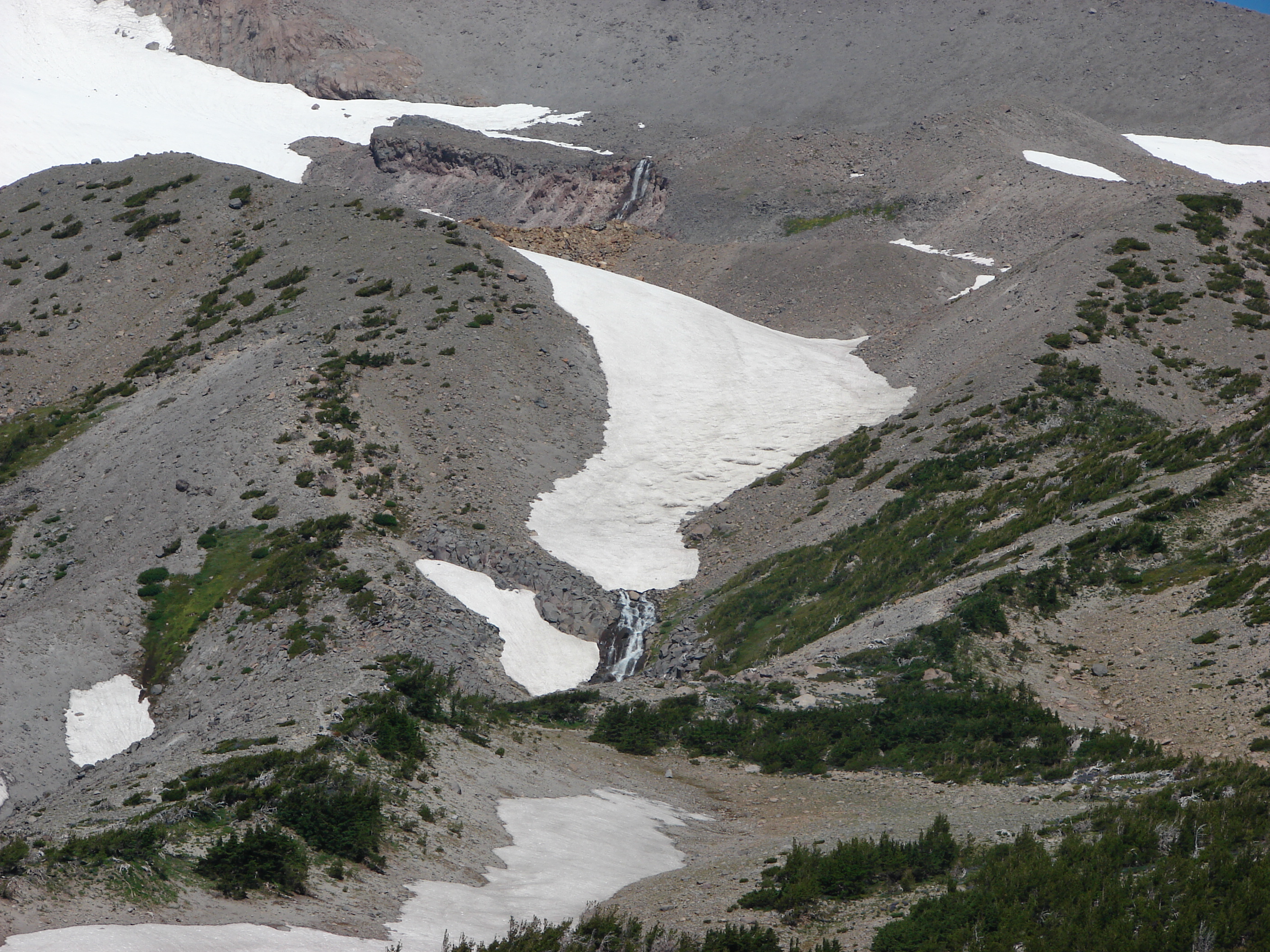
We had been informed by a fellow hiker we’d run into earlier that there were a couple of waterfalls coming off of snow melting higher up on the mountain, but we couldn’t see them from where we’d stopped. We decided to split up and see if we could get a view so Heather headed further up the ridge while I turned around and scrambled up Lamberson Butte. From the butte I was able to see the falls, the higher of the two seemed to be flowing straight out of the rocks and sand.
193
I could barely make out Heather up on the ridge and decided to go see if she had a closer view from where she was. She didn’t, but she did find a great overlook of Newton Creek as it flowed down through the canyon.

Having found the waterfalls we headed back down the Timberline Trail and headed down into the Newton Creek Canyon. On the way down we ran into Ken, the hiker who had told us about the waterfalls, on his way back up the trail. He had been down to the creek but was uncertain of the correct place to cross and hadn’t been able to spot the continuation of the trail on the opposite side of the creek. I had seen trail reports on Portlandhikers.org from hikers that had made the crossing in the previous couple of weeks so I knew there was one, and between my maps and GPS unit felt confident we could find it. Ken decided to join us and followed us back down to the creek. We wound up using the map, GPS, and binoculars but in the end found two good crossings and Ken quickly spotted the flagging marking the continuation of the trail.

One of the “bridges” across Newton Creek

At the top of the canyon Ken turned down the Newton Creek Trail to complete his planned loop and we continued clockwise around the mountain on the Timberline Trail.

When we reached the Clark Creek canyon the gray sandy ground began to give way to more plants and flowers. We could see down to Heather Creek as it flowed through the canyon on its way to join Clark Creek. The lush valley below was a stark contrast to the bare ridges beyond as Heather Creek flowed down the middle in a series of picturesque waterfalls.
311
We crossed the creek just above a nice waterfall surrounded by beautiful wildflowers. It was certainly one of the prettiest places we’ve been.

When we gained the canyon ridge we came to the Mt. Hood Meadows. The ski lifts sat idle and the ski runs were replaced with green slopes decorated with wildflowers. As we passed through the meadows we noticed that each one seemed to have a slightly different mix of flowers often with Mt. Hood towering above. One would be cat’s ear lilies and lupine, another beargrass and paintbrush, and yet another of western pasque flowers and paintbrush. This was a treat for Dominique since his favorite flower is the paintbrush but he also enjoys the “Hippies on a stick”.

Paintbrush & Western Pasque Flowers (Hippies on a Stick)

After a little over three miles since saying goodbye to Ken we reached the Umbrella Falls Trail. In 3.5 miles we would be back at our car but first we had some waterfalls to visit. Up first was Umbrella Falls, the trails namesake. We crossed the East Fork Hood River just below this fall which was rather scenic.
545
Normally we would have stuck around for awhile and enjoyed a snack while taking in the falls, but after the unplanned scramble up Lamberson Butte and extra climb up the Timberline Trail it was getting late and we were all pretty tired. We continued on to a sign for Sahalie Falls which was down in a narrow canyon. The trail down was steep and after surveying it I went down alone. This was another nice waterfall and the breeze created by it felt wonderful. After climbing back out of the canyon we completed the final .5mi leg of our loop and arrived at the trail head.

Once again Mt. Hood had delivered a spectacular hike. In addition to the mountain views, wildflowers, and waterfalls we saw dozens of butterflies and a pair of Western Tanagers. We have three more hikes planned around Mt. Hood this year and can’t wait to see what else the mountain has to offer. Happy Trails.

Facebook photos:https://www.facebook.com/media/set/?set=a.10201658556452885.1073741843.1448521051&type=1
Flickr:http://www.flickr.com/photos/9319235@N02/sets/72157634743927448/

Categories
High Cascades Hiking Mt. Hood Area Oregon Trip report

Salmon Butte

It’s raining mice! We’ve all heard the saying “It’s raining cats and dogs” but on our last hike it rained mice (well a mouse anyway). I’ll explain that later, but for now let me tell you where we were. For Father’s Day we headed toward Mt. Hood and the Salmon-Huckleberry Wilderness. Our plan was to head to the top of 4877′ Salmon Butte where we hoped to have a view of about a half dozen Cascade peaks.

The trail head is located next to the Salmon River, a fork of which it quickly crosses on a old bridge. The river is left for good here as the path follows an abandoned road up toward a former trail head. The road was closed down due to repeated washouts which we could see evidence of as we passed over numerous small creeks. The roadbed was fairly overgrown with green grasses and many small flowers. After travelling on the road for a little over a mile we reached the former trail head and turned into the forest. Not long after entering the forest a we came to a sign announcing the boundary of the wilderness. This was our first visit to the 62,455 acre Salmon-Huckleberry Wilderness which is part of the Mt. Hood National Forest.

The trail offered no real views for the first 2.5 miles as it steadily climbed up through the forest. Rhododendrons lined the trail, many of which were in bloom adding a splash of pink amid the green. Although the total elevation gain for the trail is almost 3200′ it was rarely steep and never for very long which was a welcome change to last week’s trudge up Heartbreak Ridge. At the 2.6 mile mark a viewpoint at a rocky ridge end opens across the Mack Hall Creek Valley and to Salmon Butte itself. The ridge end was home to a small but diverse number of flowers. There were a couple red paintbrush, a single lupine, a lone cats ear, a couple of yellow flowers, and a blue filed gilia which was a first for us.
290

Leaving the viewpoint the trail reentered the forest and climbed along the west side of a ridge for 2 miles before we would reach the next viewpoint. Still there was plenty to keep us entertained which is where the mouse rain incident occurred. As we were walking along I saw something out of the corner of my eye and heard a “thump” on the hillside just to the left of us. My first thought was pine cone, but the thump was too loud and the color wrong for a cone so my next thought was that someone had thrown a rock at us. It nearly rolled into Heather. As she attempted to avoid it we realized it was an animal. The poor mouse got its bearings and scurried off the side of the trail and disappeared into the brush. We have no idea where it came from, if it just slipped or possibly escaped from a bird in the trees above, but we certainly won’t forget our first encounter with mouse rain.

At a switchback near the 3.9 mile mark a short side path extended out to a small but amazing hillside meadow. There was no view to speak of but the hill side was carpeted with plectritis, larkspur, and little yellow monkeyflowers.
109

The trail eventually moved from the west side of the ridge to the east and shortly after reached a viewpoint with the first view of Mt. Hood. Here beargrass and rhododendrons lined the trail in various states of bloom. For the next half mile the trail climbedd gently along the top of the ridge before a couple of steep switchbacks reached a second abandoned road. This was the road to the former lookout tower that no longer exists on Salmon Butte. As the road curved up around the summit Mt. Jefferson came into view to the south followed by Mt. Hood to the north. After .3 miles we reached the summit and sweeping across the Salmon-Huckleberry Wilderness to the north, south, and east.

Although there were a few clouds in the sky we had an excellent views of Mt. Hood and Mt. Jefferson.

Mt. Hood
Mt. Hood

Mt. Adams and Mt. St. Helens were clearly visible in Washington and the North Sister was peaking over the shoulder of Mt. Jefferson to the south. With an assist from the binoculars we were finally able to identify Mt. Rainier as well. We enjoyed a peaceful lunch as the only people on the summit. We were not alone though. A couple of swallowtail butterflies flitted around the summit and a gray jay flew up to check us out. There was also a chipmunk busy eating seed on a tree trunk, obviously knowing this was a perfect spot for lunch.

We passed several hikers on our way back down but no more falling mice. When we rejoined the old road near for the final 1.2 miles the scenery had changed. Scores of white candy flowers had opened to the sun and now dotted the green grass along the path. This was a really nice hike and in the end didn’t feel like we’d gone 3170′ in 11.2 miles. Until next time – Happy Trails (and watch out for falling mice :))