Categories
Central Coast Hiking Oregon Oregon Coast Trip report

Cape Lookout State Park – 01/24/2026

While a winter storm was impacting much of the country the Oregon Coast was experiencing clear skies and high in the low 50’s, which was too good to pass up so I headed out for another solo hike. I decided to head out to Cape Lookout State Park to check out the recently reopened North Trail along with the Cape and South Trails. Heather and I had visited the park way back in November 2011 but had not hiked the North Trail that day (post).

A section of the North Trail was closed in December 2024 after a tree fell and damaged the suspension bridge over Cape Creek and as of this post both the Oregon Hikers Field Guide and AllTrails still show the trail as closed, but when I checked the park’s website there was no longer a closure notice for the trail. (There is a notice that the park will be closed starting April 1st for improvements which will likely last into the Summer.) With no closure notice listed on the website I was pretty confident that the trail had been reopened. Worst case scenario would be that there would be notices posted at the trailhead in which case I would still be able to hike the Cape and South Trails allowing me to still get plenty of hiking in.

I made the hour and a half drive from Salem to the Cape Lookout Trailhead which is open from either 7am to 9pm or Dawn to Dusk depending on who you ask. Regardless with first light not being until 7:12am and sunrise at 7:44am I had timed my departure to arrive in between and was ready to set off just before 7:30am.
IMG_4079
The trailhead signboard says Dawn to Dusk.

Unsurprisingly I was the first car in the lot and after double checking for any closure notices for the North Trail I started off on the Cape Trail.
IMG_4081

My plan was to hike the Cape Trail out to the end of Cape Lookout first to avoid the crowds that would surely be arriving later. After hiking the Cape Trail I would take the North Trail to the Cape Lookout Day Use Area where Heather and I had parked for our Netarts Spit hike in 2020 (post). Assuming I had anything left in the tank after returning from the North Trail I planned on hiking the South Trail down to the beach for the up-close view of the basalt cliffs of Cape Lookout’s southern side. It’s 2.4 up and down miles to the end of Cape Lookout with occasional views to both the north and south.
IMG_4085
In between views the trail passes through a coastal forest.

IMG_4089
Looking SE toward Sand Lake.

IMG_4093

IMG_4094
Looking south to Haystack Rock and Cape Kiwanda (post) with Cascade Head further south (post).

IMG_4099
Haystack Rock with the tip of Cape Kiwanda to its left. Cascade Head is next and the headland furthest south is Cape Foulweather.

A little over a mile and half in the trail passes a memorial plaque for an Army Air Force plane that crashed nearby claiming the lives of the crew.
IMG_4100

The trail is almost always muddy in spots and downed trees sometimes require less than ideal reroutes of the trail.
IMG_4103

IMG_4108
Coming up to the first view to the north.

IMG_4109
View north along the coast.

IMG_4110
Three Arch Rock across from Oceanside (post) followed by Cape Meares (post), and then Cape Falcon (post). The inland peaks starting with the rounded one of the left are Neahkahnie Mountain (post), Angora Peak, Rock Mountain, West Onion Peak and Onion Peak.

IMG_4116
Wells Cove

IMG_4119
It was close to freezing so the trails weren’t as muddy as they can be on warmer days. The good news was there was no ice to deal with.

IMG_4129
Here comes the sun.

IMG_4130

IMG_4134
Along this section I heard a blowing sound in the ocean below.

At 400′ above the water I could see something swimming around but couldn’t make out what it was. I had the larger camera that I like to use at the wildlife refuges in my pack, so I pulled it out and started taking pictures. The way it was coming up out of the water and making a blowing sound I mistook it for a small whale, but it turned out to be a sea lion.
DSCN7787

The sea lion was attracting seagulls which began arriving en masse.
DSCN7799

The sea lion eventually moved on and so did I.
IMG_4139

DSCN7801
Seagulls and cormorants.

IMG_4140
Barrier at the end of Cape Lookout.

There is a small bench and viewpoint at the end of the trail where I paused briefly to appreciate the views.
IMG_4141
View south.

IMG_4142
View north.

I headed back toward the trailhead stopping to get a few pictures with the bigger camera now that it was unpacked.
DSCN7809
American kestral

DSCN7812
I’m fairly certain this is a ruby crowned kinglet in the salal.

DSCN7820
Hermit thrush

DSCN7824
Three Arch Rocks

DSCN7831
Varied thrush

Back at the trailhead I turned left and headed down the North Trail.
IMG_4152

It was clear from the trail tread that this trail hadn’t been used much recently however there were signs of recent trail maintenance. Aside from a few trees that I needed to watch my head going under the trail was clear as it dropped down to the suspension bridge over Cape Creek.
IMG_4154

IMG_4156

IMG_4162
There was a lot of blowdown, mostly older, along this section.

IMG_4163
Reenforced trail along this switchback.

IMG_4166
It was 0.8-miles to the bridge with an elevation loss of 550′, but the bridge is worth seeing and would be a worthy turnaround point for a shorter hike.

IMG_4167

IMG_4168
Camp Creek

The trail made a quarter mile climb on the north side of Camp Creek to a signed junction at an old roadbed.
IMG_4170

IMG_4172
Sea stack out on the ocean.

IMG_4173

IMG_4174
This junction is where the trail had been closed coming from the day use area.

IMG_4175
I double checked to make sure it wasn’t still signed closed at this end.

Most of the next 1.2-miles to the day use area followed the old roadbed as it descended to the beach. This section was in good shape except for a short section along a slide approximately a half mile from the day use area.
IMG_4176

IMG_4179
Netarts Spit and Bay.

IMG_4181
A rerouted section of trail near the slide area.

IMG_4183
This small stream appears to be the reason for the slide which is now being funneled over the hillside. On the far side the trail drops steeply down wet rocks next to wire covered rocks.

IMG_4184
Looking down at the continuation of the trail on the far side of the stream.

IMG_4186
Looking back up from the bottom. Coming down this was a lot harder than going back up due to how slick the damp rocks were.

After getting past the slide it was an easy half mile down to the day use area.
IMG_4188

IMG_4190
The sign of a good coastal trail is it going through a tree.

IMG_4191

IMG_4197

IMG_4198
Bridge over Jackson Creek.

IMG_4199
Jackson Creek

IMG_4202
The parking lot at the day use area.

I took some time to read some of the interpretive signs/plaques and take a short break at one of the picnic tables before starting back.
IMG_4201
Cape Lookout from the day use area.

IMG_4203

IMG_4206

IMG_4207

I made the 2.2-mile, 800′ plus elevation gain return trip to the Cape Lookout Trailhead and decided that I would go ahead and hike down the South Trail as well. That trail started a little under 100 yards from trailhead where it split off from the Cape Trail.
IMG_4215

IMG_4216
Turning onto the South Trail.

Like the North Trail the South Trail loses over 800′ to reach the ocean which it does in 1.8-miles.
IMG_4217

DSCN7835
Spotted towhee

IMG_4218
Good use of switchbacks keeps the trail from ever being too steep.

Halfway down the trail passes a bench with a nice view of Cape Lookout through the trees.
IMG_4220

IMG_4221

IMG_4223
Camp Clark (Scouting America) below the trail to the south.

IMG_4225
Getting closer to the beach.

IMG_4227
Self-heal

IMG_4232

DSCN7843
Columnar basalt on Cape Lookout.

IMG_4234
The view south towards the sun.

When Heather and I visited in 2011 we continued a little to the south so this time I headed north toward Cape Lookout and then found a nice rock to take a seat on.
IMG_4236
My view.

DSCN7838
One of three bald eagles that flew over.

After resting and psyching myself up for the climb I headed back.
IMG_4242
The trail is marked by a colorful buoys and ropes.

IMG_4243
Today’s hike came in at 13.2-miles with approximately 2000′ of cumulative elevation gain.
Screenshot 2026-01-24 152148

Of course, there are plenty of shorter options available, but you could also go further by heading north along Netarts Spit or south along the beach to Sand Lake. If you do visit be prepared for muddy conditions and crowds on the Cape Trail. Having been the first car at the trailhead I didn’t see anyone until I was headed back from the end of the cape. I passed just eight people on the way back, but it wasn’t yet 9:30am when I turned onto the North Trail. I only saw three people on the that trail and then another eight on the South Trail, plus a few more on the beach itself. By the time I was ready to leave at 1:15pm the trailhead was overflowing and cars were parked along the shoulder out to Cape Lookout Road. Score another one for early starts. Happy Trails!

Flickr: Cape Lookout State Park

Categories
Hiking Oregon Salem/Albany Trip report Willamette Valley

Baskett Slough National Wildlife Refuge – 01/19/2026

I took advantage of having a day off for MLK Day to make the quick drive to Baskett Slough NWR for a short recovery hike after Saturday’s 15-mile hike at Ellendale Creek (post). Heather did not get the day off, so this was another solo outing for me and my sixth hike at the refuge. It was however my first visit during the seasonal closure period which runs from October ER 1st through March 30th. While much of the refuge is closed to protect wintering wildlife the Rich Guadagno Memorial and Inter-Tie Trails are open year-round. I parked at the Baskett Butte Trailhead planning on hiking those two trails and then hike along Coville Road to the Taverners Marsh parking area.

I arrived shortly before sunrise and headed up the Rich Guadagno Memorial Trail and detoured to the wildlife viewing platform before starting the loop.
IMG_4021

IMG_4026
Seasonal closure map.

IMG_4024
Mt. Jefferson

IMG_4023
Geese in South Slough Pond.

IMG_4027

IMG_4034
Heading toward the viewing platform.

IMG_4038

DSCN7598

IMG_4040
Heading back to start the loop.

IMG_4041
Here comes the sun.

I opted to hike the loop counterclockwise due to an even earlier bird having been ahead of me doing the loop counterclockwise.
IMG_4042

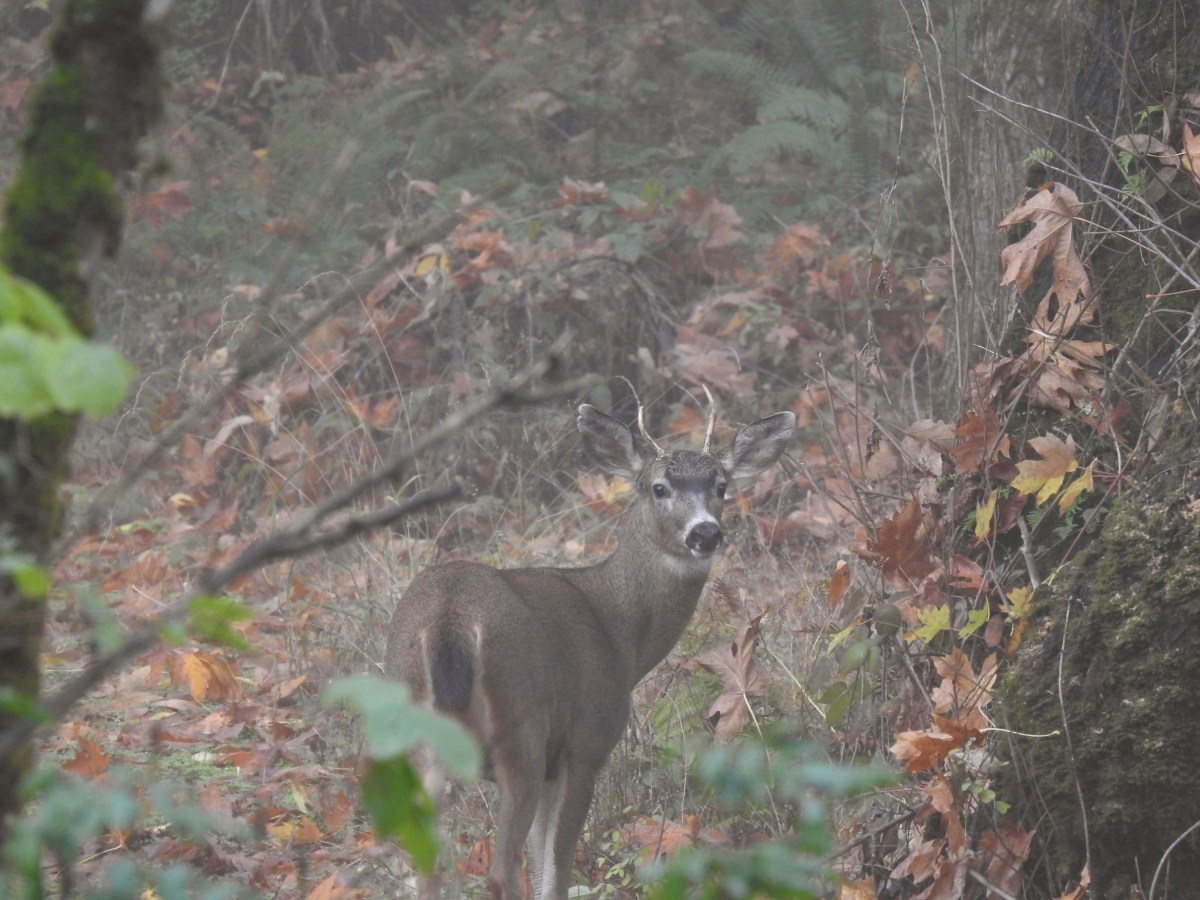
Shortly after entering the trees I noticed three deer just up the hillside above the trail.
IMG_4043

DSCN7616
The three deer.

DSCN7613
First deer

DSCN7619
Second deer. The third deer was too busy munching on grass to look up.

After watching the deer for a moment I continued on getting a glimpse of Morgan Lake through the trees.
DSCN7623

Next I spotted a bald eagle through the trees.
DSCN7629

DSCN7626

I could hear a number of other birds but spotting them was another thing. I was finally able to locate an acorn woodpecker though.
DSCN7633

And a pair of starlings.
DSCN7636

A little further along the loop I noticed another woodpecker. It was either a hairy or downy woodpecker, I didn’t get a look at the beak or face so I’m not sure which.
DSCN7637

DSCN7639

I turned left onto the Inter-Tie Trail when I came to that junction and followed it to the seasonal closure boundary and a bench overlooking Morgan Lake.
IMG_4049

IMG_4051

IMG_4053
The white sign ahead marks the start of the seasonally closed section of trail.

IMG_4055
Morgan Lake from the bench.

DSCN7646
Egret hunting in a field.

DSCN7647
Cackling geese

DSCN7649
More geese headed for Morgan Lake.

After watching and listening to the geese on Morgan Lake I headed back and finished the loop.
IMG_4058

DSCN7660
Northern flicker

IMG_4062
There were a bunch of birds in these trees by the sounds, but I only caught glimpses of them flying from tree to tree.

DSCN7664
The end of the loop ahead.

After completing the loop I returned to the trailhead and headed down Coville Road.
IMG_4064
Leaving the trailhead parking area.

The road is open to vehicles but why drive when I could walk the half mile to Taveners Marsh?
IMG_4066
South Slough Pond from Coville Road.

There were a lot of birds to see as I passed along South Slough Pond.
DSCN7667
This looks like mostly northern pintails, northern shovelers and American wigeons.

IMG_4068
Coville Road. Notice the seasonal closure signs on either side.

DSCN7677
Geese and northern pintails.

IMG_4069
Baskett Butte

DSCN7682
A mallard and an American wigeon along with geese.

DSCN7685
Another bald eagle

DSCN7694
American kestral

DSCN7696
Hawk

DSCN7702
American wigeon

DSCN7712
An Amrican coot, bufflehead, and northern shoveler walk into a bar…..

DSCN7716
Barn swallows

Taveners Marsh was also full of birds. Most of the ducks there were busy eating breakfast which resulted in a lot of duck butts.
DSCN7720
Northern pintails, a northern shoveler and an American coot.

DSCN7728
Red-winged blackbird

DSCN7729
American coot

DSCN7731
Northern shovelers and Merlin says the little shore birds are dunlins.

DSCN7735
Gadwall pair

IMG_4072
Taveners Marsh

DSCN7741
Northern pintail

DSCN7744
Northern pintail

DSCN7746
Name that duck butt.

DSCN7756
Song sparrow

After spending a good amount of time at Taveners Marsh I headed back along Coville Road to the Baskett Butte Trailhead.
IMG_4074
Baskett Butte from Taveners Marsh

DSCN7765
Hawk

DSCN7771
Western meadowlark

DSCN7777
Mt. Jefferson and an eagle.

IMG_4076

DSCN7782
Juvenile bald eagle seen from the trailhead parking lot.

Another wildlife filled outing at this refuge. Today’s hike came in at just 3.6-miles and 275′ of elevation gain.
Screenshot 2026-01-19 102542

I’m waiting for the winter weather to hit, but until it does we are more than happy to take advantage and get a few extra hikes in. Happy Trails!

Flickr: Baskett Slough 2026

Categories
Coastal Range Hiking Oregon Salem/Albany Trip report Willamette Valley

Ellendale Creek – 01/17/2026

Over the last few months, a couple of people including a coworker and my cousin and Uncle mentioned a hiking option just west of Dallas, OR around Ellendale Creek. It wasn’t something that had ever hit my radar, but they all live in the Monmouth/Dallas area and suggested it might be something we’d like to check out. Since I’m always looking for new options I looked into it and found the Ellendale Creek Loop entry in AllTrails which is listed as a 4.9-mile loop gaining 987′. Full disclosure, I have a tolerate/dislike relationship with AllTrails. For me there are two things it can be useful for – locating hikes like this one and getting trail conditions. The latter use depends on how frequently a trail is used since seldom hiked trails result in seldom updated conditions. Even when a hike has frequent recent updates the information needs to be taken with a grain of salt due to people’s different interpretations of what things like “steep”, “muddy”, “buggy” etc. What I dislike about it is the lack of detailed descriptions of the route(s) and that even though community submitted hikes are vetted before being added they sometimes don’t make any sense why the route was chosen. (See our Emigrant Springs State Heritage Area post.) But I digress so back to this hike.

The brief AllTrails description mentioned an extensive network of singletrack in the area thar eventually led to the Siuslaw National Forest. With that tidbit of information I turned to CalTopo to get a better look at the roads and trails in the area with their Public Lands layer enabled. That revealed that the loop described by AllTrails spent most of the 4.9-miles on private timber land, but a section along the top of the loop passed through a Bureau of Land Management (BLM) parcel. That parcel shared a border with one of four Siuslaw National Forest parcels, each of which shared a corner with one of the other FS parcels. The map showed a number of roads and trails throughout the parcels allowing for a longer hike than the 4.9-mile loop. I came up with a general plan to leave the loop in the BLM parcel and explore into the Siuslaw National Forest before returning and finishing the loop. With no information on trail conditions and not knowing if any of the roads/trails that crossed into private lands would be marked private or signed no trespassing it made sense to leave my options open. The one thing I had been warned of on both AllTrails and the limited information I could find in the online mountain biking community was that none of the trails were signed.

I parked along the south shoulder of Reuben Boise Rd near a gated road.
IMG_3814
I was the second car here. There was room for quite a few more along the shoulder.

IMG_3813
I spotted this trail just behind where I’d parked but I didn’t take it because I wanted to make sure I’d read the information at the gate.

With the loop being primarily on private lands it was important to make sure it was open, didn’t require a permit, and to be aware of the landowner’s rules/regulations.
IMG_3815

IMG_3816

After reading up on the rules I headed down the gated gravel road which crossed an unnamed creek after 0.2-miles.
IMG_3817

IMG_3818

The loop was shown as beginning on the far side of the creek and I wound up missing it. It was a good example of one of my frustrations with AllTrails. I was planning on hiking the loop counterclockwise and should have turned right on a trail almost immediately after passing the creek.
IMG_4018
The correct trail in the afternoon on my way back.

Had the hike description mentioned taking a right on a singletrack after crossing the creek I’d have been fine, but it simply said the “outer loop crosses Ellendale Creek and passes through dense forest”. Had I had cell service I would have likely been okay as I would have been able to view my location on the AllTrails map, but I didn’t have service so I checked the maps on my GPS and that I’d downloaded from CalTopo. The GPS didn’t show anything to my right and none of the maps (including the AllTrails base layer) showed a trail heading off to the right. What the maps did show was a road splitting and then a second split off of the lefthand fork. Looking ahead I could see the road splitting so I continued forward and took the right hand fork.
IMG_3819

About 100 yards up this road I realized something was off. I was headed south instead of NW. I stopped and looked at the maps again but saw the same three roads and I know I hadn’t passed a road on my right. I happened to be standing near another trail veering off to the right and I could see on the CalTopo map a couple of trails located between the “road” I was supposed to be on and the road which I had determined I was actually on.
IMG_3820

I decided to take this trail hoping I might find a way over to the right road, but it didn’t exactly do what CalTopo showed it doing. It dumped me back out on the road I’d been on after 0.2-miles in the forest.
IMG_3822

I confirmed on the maps that the road I was on would eventually connect me up to the route of the loop and simply stuck to this road as it climbed steadily.
IMG_3823

IMG_3826
The road heading down to the left wasn’t shown on any maps which is something to be aware of anywhere recent logging has occurred.

IMG_3827
Mt. Jefferson in the distance from the road.

IMG_3829
Mt. Jefferson

IMG_3830
I passed the first of just four people I’d see on the trails all day along this stretch.

The next moment of confusion came when the roadbed curved left with what appeared to be singletrack continuing straight.
IMG_3832

Once again the maps all showed a road going straight and a “trail” veering left. Regardless of which was the road or the trail it was clear from the maps that going straight would lead me directly to the AllTrails loop. Just to be sure I checked to see if I had cell service which I now did so I pulled up AllTrails and confirmed all my suspicions. This was the first time I’d ever used my phone to actively track my location since I always have the Garmin on me. If this were something I was to do regularly I would use Gaia GPS and not AllTrails, but for today it was helpful. I headed straight on the singletrack which turned out to be a much older roadbed.
IMG_3833

This quickly brought me to a “T” junction with the “road” that the loop followed where I turned left.
IMG_3834

IMG_3835
This was obviously a road too at one point, but not anytime recently.

IMG_3837
Had I veered left instead of staying straight I would have eventually come up here from the left.

IMG_3838
The map showed this as a 4-way road junction where the loop route turned left which is what I did.

I was now on BLM land and headed toward a crossing of Ellendale Creek.
IMG_3841
Queen Anne’s Lace (non-native)

IMG_3842
Salal blossom beginning to form.

IMG_3844

As I neared Ellendale Creek two deer dashed across the road and up the forested hillside.
IMG_3845
I took a picture but between the forest and the distance I didn’t get the deer. Shortly after resuming the hike a third deer came up from the creek and ran across the road, again before I could get a photo.

IMG_3850
The third deer is somewhere up on that hillside.

IMG_3852
Ellendale Creek

A tenth of a mile beyond the creek I came to a road junction where trails also headed up and downhill. Here the route of the loop was along the road to the left, but this was where I had planned to leave the loop and head into the National Forest. I stayed straight ignoring a second road on the left and began climbing.
IMG_3855

IMG_3856

Shortly after I started the climb I spotted a mountain biker and their pup heading in the same direction. They were taking a break and as I neared I thought for a moment I heard my name but then decided they were probably just calling to their dog. Then I heard my name again and thought that Deryl was an odd name for a dog. Another Deryl later and I realized that it was our friend Yolanda and she was trying to get my attention. She was able to provide me with some information about some of the trails in the area as we continued uphill to Rob Mill Road (Road 1924).
IMG_3858
Robb Mill Road at the junction.

Most of the mountain bike websites mentioned starting from Robb Mill Road which is what she’d done. They were heading left on the road back toward the gate at its end and my plans had me going right so after a little more information we said goodbye and went our separate ways. I followed the fairly level gravel round along the hillside above Ellendale Creek watching for the “White Gate” on a spur road that would be on my right.
IMG_3860

IMG_3861

IMG_3863

Yolanda had told me to keep an eye out for a trail veering off to the left shortly beyond the White Gate. This spur trail would lead to split where the Tree Fort and Tree House trails (shown on the CalTopo & AllTrails maps) both head south back to Robb Mill Road. Before reaching that split this spur also connected to what was shown as a road labeled Muddy Puddles on the maps right at the National Forest border. My plan was to follow Muddy Puddles west to a crossing of Canyon Creek then continue on and hook back up with Robb Mill Road.
IMG_3864
The spur trail.

IMG_3865

IMG_3866
Muddy Puddles on the right. Again, this was shown as a road on the maps.

I was now in the Siuslaw National Forest and the trail was a little rough but passable with signs of occasional trail maintenance.
IMG_3867

IMG_3870

IMG_3871

IMG_3879

IMG_3880
I’m not sure who has been out working on these trails, but they’d done some recent work.

IMG_3881

IMG_3883
This was the biggest tree that I saw over any trail during my hike.

IMG_3885

IMG_3887

The trail got pretty faint as it neared Canyon Creek. Shortly before reaching the creek I noticed an even fainter trail veering off to the right that the map showed connecting up to Robb Mill Road.
IMG_3889
There are two trails in the above photo, the one to the right heads to Robb Mill Road.

I passed some flagging on my left that was a little earlier than where the map showed the trail crossing Canyon Creek so I ignored it and continued on reaching the creek a short distance later.
IMG_3890

IMG_3891
Remains of a little footbridge on Cayon Creek.

Based on the map the trail bent around after crossing the creek and climbed a little over 100′ to Robb Mill Road. I nearly lost the tread completely on the far side of the creek and used my phone to stick to the track. The tread became clearer near what I determined to be the current creek crossing which the orange flagging I’d passed had been for.
IMG_3892

IMG_3894
The new route of the trail across Canyon Creek.

IMG_3898

IMG_3899
Robb Mill Road.

This had become a choose your own adventure hike at this point so I paused on the road to plot the next leg of my hike. Turning left on the road would simply head me back toward where I’d left the road near the White Gate and a right would lead me out of the National Forest for a bit before reentering another parcel further south. My other option was to cross the road sticking to singletrack and climbing to a ridge on what the maps show as the Burma Trail. If I chose the right combination of trails and roads I would eventually connect back up with Robb Mill Road near the southern end of that second National Forest parcel. That was the plan I settled on and across the Robb Mill Road I went.

Burma gained over 500′ from Robb Mill Road over the next 1.25-miles.
IMG_3900

IMG_3902

IMG_3903
The trail leveled out a bit a couple of times along a ridge before dipping down twice to saddles.

IMG_3905

About a half mile from the road the trail made a “corner crossing” between the two Forest Service Parcels.

IMG_3907
Forest Service boundary sign.

IMG_3913
Nearing the high point of the trail which also ran along the border of a clear cut.

The trail began descending from its high point and I came to a fork. It didn’t matter which way I went as the two forks rejoined in a tenth of a mile according to the maps so I forked right.
IMG_3914

IMG_3915

IMG_3916
The forks rejoining.

My biggest mistake of the day came shortly after the forks rejoined. I’d noticed that I would be coming to another fork and the lefthand fork led to Robb Mill Road while the right looped around to the west to join Burma Road.
IMG_3919

Despite the left fork being the used trail my ability to tell my left from my right malfunctioned and I forked right. I quickly found myself struggling through a mess of downed trees.
IMG_3920

At the second pile of blowdown I did a map check and realized what I’d done. Fortunately I had only gone a tenth of a mile down this trail, but unfortunately I had to go back through the blowdown.
IMG_3922

IMG_3921
At least it was a little clearer after I’d removed a few limbs during my first pass.

I turned onto the correct fork and followed it somewhat steeply downhill a third of a mile to Robb Mill Road.
IMG_3923

IMG_3927
Unnamed creek crossing just before reaching the road.

IMG_3928
Robb Mill Road through the trees.

Since I hadn’t had an exact route planned I had set a three-hour turnaround time which was 10:45am. It was 10:35am when I arrived at Robb Mill Road which was close to my turnaround time and the road provided an opportunity to make a loop back without having to climb back up to the high point. That was assuming none of the private land was off-limits, which they were not on this day. I turned left on the road and followed it back 2.1-miles to where the Burma Trail had crossed it.
IMG_3929

IMG_3931
Markes at the boundary of the National Forest.

IMG_3932
There were a couple of logging roads that weren’t shown on any maps, so I used my phone quite a bit to make sure I was still on Robb Mill Road.

IMG_3934
Views opened up as the road passed through previously logged areas.

IMG_3936
Madrone

IMG_3937
Mt. Hood straight ahead with Mt. Jefferson visible in the gap on the right. In addition to Hood and Jefferson Three Fingered Jack and the Three Sisters were also visible.

IMG_3946
Mt. Hood

IMG_3949
Back in the Siuslaw National Forest.

IMG_3951
Arriving at the Burma Trail junction.

In hindsight I should have stayed straight on the road and followed it all the way back, but instead I dropped down on the trail and descended to Canyon Creek.
IMG_3952
If I hadn’t come up here earlier I don’t know that I would have seen the path down.

I didn’t want to follow the exact same route back so after crossing Canyon Creek I took the faint trail I’d passed on my way up and followed it 0.2-miles to Robb Mill Road.
IMG_3954

IMG_3955

IMG_3957

I turned right onto the road and followed it 1.4-miles to where I’d left the road in the morning.
IMG_3959

IMG_3961
Gate at the national forest boundary.

IMG_3962

I turned onto the spur trail again but forked left at the Muddy Puddles junction then forked right at the next “Y” onto the Tree Fort Trail.
IMG_3965
Left is Tree House and right is Tree Fort.

This was a totally unnecessary detour simply to check out some additional trails. I followed Tree Fort for 0.7-miles then made a hard left at a three-way junction onto Tree House.
IMG_3966

IMG_3969
Mary’s Peak (post) in the distance.

IMG_3970
A little patch of snow on Mary’s Peak.

IMG_3971
After 0.4-miles I arrived at the above three-way junction. Tree Fort followed an old logging road headed left while singletrack continued downhill to, you guessed it, Robb Mill Road.

IMG_3973

IMG_3974
Orange peel fungus.

IMG_3975
Junction with Tree House (on the left).

I followed Tree House for half a mile to yet another three-way junction.
IMG_3978

IMG_3979

Had I taken Tree House instead of Tree Fort I would have arrived here in just a tenth of a mile instead of 1.1-miles. I turned right then forked left when this trail split and in two tenths of a mile found myself at Robb Mill Road near where I had said goodbye to Yolanda earlier.
IMG_3980

IMG_3981
I stayed left but either path would have dropped me down to Robb Mill Road.

IMG_3982

Instead of following the road down I crossed over and picked up the continuation of the trail.
IMG_3983

In another third of a mile I was back on the AllTrails Ellendale Creek Loop.
IMG_3986

I was kind of tired of road walking so when I saw that there was trail parallel to the road that the loop followed, I decided to try it.
IMG_3987

This turned out to be a mistake as the trail dropped steeply into then out of a depression. It was so steep and slick that I had to slide down.
IMG_3989

I climbed up the far side which was slightly less steep then bushwacked 100′ over to the road.
IMG_3990

IMG_3991

I followed the road downhill 2.3-miles to complete the loop.
IMG_3993
Road 1906 was the number.

IMG_3995
More views of the Cascade Mountains.

IMG_3996
The Three Sisters

IMG_4001
Mt. Jefferson beyond the Willamette Valley.

IMG_4014

IMG_4016
Ellendale Creek

IMG_4017
Arriving back at the road junction where I started my loop.

There were quite a few cars at the trailhead when I got back at 1:20pm. Despite the number of cars, I only saw four people on the trails. My convoluted route came to 15.1-miles with approximately 1800′ of cumulative elevation gain.
Screenshot 2026-01-18 064832
Blue represent the area covered by AllTrails with the orange being my addition.

Here is the track on the CalTopo map showing the National Forest (green) and BLM (orange).
Screenshot 2026-01-18 055100

This is truly a choose your own adventure area and offers a lot of options as long as access is allowed. Watch for active logging operations and seasonal fire closures, but otherwise this was a great place to get some trail miles in less than 30-minutes from Salem. Happy Trails!

Flickr: Ellendale Creek
Categories
Hiking Old Cascades Oregon Salem/Albany Trip report

Monument Peak Loop – 12/13/2025

It had been a couple of weeks since we’d had a chance to hit the trails, but a favorable forecast gave me an opportunity to check out the Monument Peak Trail system in the Santiam State Forest just south of Gates, OR. Heather would not be joining me on this outing as she had some Christmas preparations to attend to.

There isn’t a lot of information online about the trail system. Oregon.gov has a pdf trail map and the Statesman Journal recently featured the area in a story, but outside of that not much came up in searches. The trails are shown on both CalTopo and Gaia GPS. Interestingly both of these mapping apps showed the various trail names while the trail names on the current Oregon Department of Forestry pdf rarely lined up with the trail signs on the ground. On the other hand, the ODF’s Santiam Horse Camp Brochure does contain a map with all the trail names, however it does not show the most recent addition, the Bobcat Trail at all. Regardless of the trail names the locations of the trails shown were correct on all of the maps.

There are two official trailheads serving the area, Santiam Horse Camp and the Monument Peak Trailhead. The road to the horse camp is closed seasonally from November through April so that left the Monument Peak Trailhead for my starting point. (It’s possible to start at several of the road crossings by parking along the shoulder of either Monument Peak or Mad Creek Roads.)
IMG_3424
I was the first car at the trailhead.

IMG_3425

IMG_3426
The trail map at the trailhead matched the online pdf.

My plan was to take the 1.1-mile Magic Trail (Monument Peak Trail on the signboard map) up to the Monument Peak Loop and start the loop in a counterclockwise direction. Instead of simply hiking the loop though I intended to do a figure eight by cutting across the loop on the Bobcat Trail then looping back around to that trail in a clockwise direction. I would then re-hike the Bobcat Trail and turn left to complete the Monument Peak Loop creating the figure 8. While this would add 3.6-miles and a several hundred feet of elevation gain I wanted to take the opportunity to check out as much of the trails as possible.
IMG_3427

The Magic Trail began along an unnamed creek before switching back uphill through forest affected by the 2020 Beachie Creek Fire.
IMG_3430

IMG_3435

IMG_3437

The trail crossed two gravel roads before ending at the Monument Peak Loop Trail.
IMG_3441
The second road crossing.

IMG_3442
Trail signs at the junction with the Monument Peak Loop.

IMG_3443
Here the trail sign agreed with the signboard map calling this the Monument Peak Loop. It is also referred to as the Wild Boar Trail on the older ODF map. I headed right here toward the Santiam Horse Camp.

IMG_3444
There was a lot of recent and/or future logging activity in the area, partly a result of the fire.

IMG_3447
A lone bleeding-heart blossom.

It was a half mile from the Magic Trail junction to the horse camp. As I neared the horse camp the trail arrived at the edge of a clearcut that provided views across the Santiam River Canyon.
IMG_3450

IMG_3451
Looking west toward Salem and the Willamette Valley which was covered by low lying clouds. The Coast Range is visible on the far side of the clouds.

IMG_3453
The city of Gates in the shadow below. The aftermath of the Beachie Creek Fire is on full display on the opposite side.

IMG_3455
The high peak at the center (behind the lone snag) is Rocky Top (post) and high peak near the right side is Sardine Mountain (post).

IMG_3458
One of the corrals at the horse camp.

IMG_3462
The horse camp opened in 2006 and the trails developed with equestrian use in mind however they are open to all non-motorized use.

I passed by the horse camp and continued along the loop. The trail gradually climbed for 2.3-miles to the unsigned junction with the Bobcat Trail. Along the way the trail passed the historic Quartzville Trail which I haven’t been able to find much about online other than Judge John B. Waldo, Oregon’s first Supreme Court justice, used the route to travel from Gates to presumably the Quartzville district where mining activity was prevalent.
IMG_3466

IMG_3468
Hawk in the shadows.

IMG_3478
There were a few obstacles on this side of the loop, but all were easy to navigate.

IMG_3481
A bit of forest that was spared from the 2020 fire.

IMG_3484
Market at the site of the historic trail.

IMG_3485

IMG_3488
The trail joined an old roadbed for a portion of this section.

IMG_3491

IMG_3494
The trail sign at this road junction was hidden behind the downed tree. The loop continues to the left here.

IMG_3498
At the next road junction the trail went right.

IMG_3500

IMG_3501
The trail leaving the roadbed. The post on the left names this the Radio Flyer Trail while the trail sign on the right says Monument Peak Loop. At this point the trail had left the fire scar and now continued through nice second growth forest.

IMG_3502

IMG_3503

IMG_3505

IMG_3513

IMG_3514
Flooded trail from the atmospheric river that passed over the PNW at the beginning of the week.

IMG_3515

Just before reaching Wagon Road, I came to the unsigned Bobcat Trail forking off to the left.
IMG_3517

IMG_3518
Wagon Road from the junction. You can see the back end of a mushroom hunter’s car that was parked along the shoulder.

I turned left onto the Bobcat Trail which provided a mostly downhill break from the steady climb I had been doing since starting my hike.
IMG_3519

IMG_3522
Rhododendron

I encountered the first major obstacle of my hike on this trail; a good-sized tree had fallen along the trail on a slight downhill. I wound up walking on top of the tree for a bit to get around some of the larger limbs then spent some time clearing some of the broken branches from the trail before continuing on.
IMG_3524

IMG_3525
Coming up on Monument Peak Road.

IMG_3527
The Bobcat Trail continuing on the other side of the road.

IMG_3528

IMG_3529

The Bobcat Trail dropped down to Mad Creek Road which I had to cross and then follow road MC100 for a little over 100′ to find the continuation of the trail.
IMG_3531
Mad Creek Road is running left to right with MC100 straight ahead.

I had to walk down MC100 a bit to pick up the continuation of the trail.
IMG_3532

There was a lot of target shooting happening just up Mad Creek Road which prompted me to speed up a bit as I continued on the final half mile to the junction with the Monument Peak Loop.
IMG_3534
Back in the fire scar.

IMG_3535
Dropping down to the trail junction.

IMG_3536
Looking back at the Bobcat Trail.

I turned right at the junction and headed toward the gunfire. While I was fairly certain they were using an appropriate gravel pit I was a little more comfortable now that I was well below the road in a bit of a canyon. Below the trail Mad Creek was occasionally visible.
IMG_3538

IMG_3543

The trail turned away from Mad Creek near one of its tributaries which had a nice little waterfall boosted by the recent rains.
IMG_3544

IMG_3545

The trail climbed out of the canyon and crossed Mad Creek Road near the gravel pit where I could see the target shooters.
IMG_3547

The maps all showed two road crossings along this section, Mad Creek Road and MP 800, before arriving at Monument Peak Road. That being said I crossed at least four roads and a fire break in the 1.3-miles to Monument Peak Road.
IMG_3549
I’m not sure if this is MP800 or if it was the next one.

IMG_3552

IMG_3553
The fire break.

IMG_3555

IMG_3557
Woodpecker

IMG_3558
Another road that isn’t on any of the maps to the right with Coyote Rock on the far side. (I assume this is Coyote Rock as this section of trail is also known as the Coyote Rock Trail.)

IMG_3559
Coyote Rock

IMG_3561
The trail crossing the mystery road.

The trail then made a steep descent below Coyote Rock to Monument Peak Road.
IMG_3562

IMG_3565

IMG_3567
The trail is to the right here. The road straight ahead is also not shown on the maps.

After crossing Monument Peak Road the trail descended another half mile descent to Wagon Road where I had turned onto the Bobcat Trail earlier.
IMG_3568

IMG_3571
Another woodpecker

IMG_3575
Arriving at Wagon Road. You can see a trail sign through the trees to the left. The mushroom hunter was here at his car, and we spoke for a moment before I continued on.

I turned onto the Bobcat Trail for the second time and followed it back to the Monument Peak Loop, this time without the sound of gunfire. This time I went left at the junction.
IMG_3579

This portion, the Rhody Ridge Trail, of the loop began with a climb up what I assume is Rhody Ridge after crossing a gravel road.
IMG_3580

IMG_3582
This section had the most and trickiest blowdown of the day. I didn’t take pictures of most of it as I was too busy trying to figure out how to get over, through or around it.

IMG_3584

IMG_3585

After passing over the top of the ridge the trail switched back down the far side before crossing another gravel road.
IMG_3586

IMG_3587
Blowdown just before the gravel road. It would have been easier had I simply turned left at the first road crossing and followed the roads around the ridge to this point, but I had no way of knowing how bad the conditions were on the trail.

The trail continued through the burned forest before rejoining the gravel road for a short stretch.
IMG_3589

IMG_3592

IMG_3593
Turky tails

IMG_3594

At a point the trail veered left leaving the road. This section was also called the Pine Trail.
IMG_3597

IMG_3600

IMG_3601
Signs for the Pine Trail at the end of a gravel road.

IMG_3604

IMG_3606
Approaching an old clearcut.

IMG_3608
Rough-skinned newt crossing

IMG_3610
More blowdown in the clearcut.

IMG_3611
I was shocked to find some frost/ice here given my car had shown the temperature as 46 degrees Fahrenheit when I’d arrived at 7:45am. It certainly didn’t feel cold enough for anything to be frozen.

IMG_3612
The Pine Trail section ending at MP400.

I turned left onto road MP400 and followed it for 0.7-miles to Monument Peak Road.
IMG_3616

IMG_3621
Little Rock Creek

IMG_3623
Little Rock Creek

IMG_3624

IMG_3625
Trail signs at the junction with Monument Peak Road.

I turned right onto Monument Peak Road for a little over 100′ then picked up the continuation of the loop.
IMG_3627
There were vehicles parked in a turnout across the road here and I’d seen both hikers and cyclist heading up Monument Peak Road from MP400.

I followed this section of trail (Wild Boar) three quarters of a mile to complete the loop. This section was through a clearcut which allowed for some views.
IMG_3629

IMG_3631
Daisies

IMG_3632
Rocky Top over the trees.

IMG_3634
It was a bit of a climb to get back up to the junction.

IMG_3641
The trail intersected an old logging road where I turned right along a wall of rock.

IMG_3643
Rocky Top and Sardine Mountain up the Santiam Canyon.

IMG_3646
Looking back along the old logging road.

IMG_3649
Thistle

IMG_3651
Sign post at the Magic Trail junction ahead.

I turned right onto the Magic Mile Trail and shuffled my way back to the trailhead. My feet and legs had apparently gotten soft during the couple of weeks off from hiking.
IMG_3653

IMG_3656
Stellar’s jay

IMG_3660

Today’s hike wound up showing 14.5-miles on the GPS. Cumulative Elevation Gain was in the 3000′ range.
Screenshot 2025-12-14 053607

I would have saved myself 3.6 miles and at least 700′ of elevation gain by just doing the loop and skipping the Bobcat Trail. Starting at the horse camp when it is open would reduce the distance by another 2.2 miles. All that to say that there are options for shorter outings than what I wound up doing. While the area doesn’t have any major features that tend to draw crowds it was an enjoyable hike with just enough variety to keep things interesting. Given the relatively low elevation it is another nice option for the winter and early spring months when higher elevation trails are not yet accessible. Happy Trails and Merry Christmas!

Flickr: Monument Peak Loop

Categories
High Cascades Hiking Mt. Washington Area Oregon Trip report

McKenzie River Trail – Clear Lake to Carmen Reservoir – 11/22/2025

A bluebird day forecast in the mountains on a day off equaled a trip to the northern end of the McKenzie River Trail at the Upper McKenzie River Trailhead for a hike past Clear Lake, Sahalie Falls, Koosah Falls and Carmen Reservoir. While we’d visited each of those sites previously this hike would include two sections of the McKenzie River Trail that we had not hiked before.

We left the Willamette Valley fog behind and arrived at the trailhead a little after 7am and were greeted with clear skies and freezing temperatures.
IMG_3000

Two trails leave from this trailhead, the Old Santiam Wagon Road which we’d hiked in 2023 (post) and the McKenzie River Trail. The McKenzie River Trail starts to the right of a large signboard and immediately crosses the bed of Fish Lake Creek which is dry most of the year.
IMG_3003

IMG_3006
Spring snowmelt fills Fish Lake (post) but the porous lava beneath the lake drains it by Summer.

The trail passed through the forest between Highway 126 and Fish Lake Creek for a mile to a junction with the Clear Lake Trail.
IMG_3007

IMG_3008
The trail crossed Eno Road at the 0.2-mile mark.

IMG_3010
At the junction with McKenzie River Trail turns left and recrosses Fish Lake Creek with the Clear Lake Trail continuing straight allowing for a loop around Clear Lake.

We had decided to stick to the McKenzie River Trail and pass around the eastern side of the lake first and return on western side. The primary reason was that there is a view of several Cascade mountains from the Clear Lake Trail, but with the Sun having just risen it would have been behind the mountains. By saving the views for the return trip the Sun would be almost directly overhead allowing for a better view of the snowy peaks.
IMG_3011
The second footbridge over Fish Lake Creek.

It wasn’t long after crossing the footbridge that we got our first views of Clear Lake.
IMG_3012

IMG_3013

There were dozens of ducks on the lake including buffleheads, common mergansers, and Barrow’s goldeneyes.
IMG_3018
The ripples in the lake are the ducks moving away from the annoying hikers.

IMG_3020
Barrow’s goldeneye

IMG_3028
Common mergansers

IMG_3030
The Clear Lake Resort across from the trail.

A half mile from the junction the trail passes Great Spring which is the primary source of Clear Lake and the McKenzie River.
IMG_3039

IMG_3041

IMG_3042

Beyond the spring the trail continued around the lake passing through frosty lava flows and small sections of forest for another 1.8-miles before reaching a junction with the other end of the Clear Lake Trail.
IMG_3045
The boat ramp at the resort.

IMG_3047

IMG_3053
There were quite a few American dippers (ouzels) along the shore of the lake.

IMG_3056

IMG_3062

IMG_3066
Buffleheads

IMG_3074

IMG_3090
A section of the trail is paved near the Coldwater Cove Campground.

IMG_3093

IMG_3094
The trail crosses the campground boat ramp.

IMG_3100
Looking back across the lake we could see several of the Old Cascades peaking up over the trees.

IMG_3102
Crescent Mountain (post) and The Three Pyramids (post)

IMG_3105

IMG_3107
Another ouzel

IMG_3109

IMG_3113

IMG_3115
The southern end of the Clear Lake Trail.

We stayed on the McKenzie River Trail which crossed FR 770 after 0.4-miles then Highway 126 before arriving at a junction with the Waterfalls Trail 0.7-miles from the Clear Lake Trail junction.
IMG_3116

IMG_3121
Witch’s butter

IMG_3123

IMG_3124

IMG_3125
FR 770 provides access to the Coldwater Cove Campground.

IMG_3127
The trail crossing Highway 126. We were lucky there was not much traffic to deal with on either dash across today.

IMG_3129
After crossing the highway the trail joined the McKenzie River.

IMG_3133

IMG_3135
The junction with the Waterfalls Trail.

We decided to leave the McKenzie River Trail here and take the Waterfalls Trail down to Carmen Reservoir and then return via the McKenzie River Trail. It was a little over a third of a mile from the junction to an overlook above Sahalie Falls.
IMG_3138

IMG_3142

IMG_3145

IMG_3150
Sahalie Falls

IMG_3146
McKenzie River below Sahalie Falls.

IMG_3154
McKenzie River above Sahalie Falls.

A tenth of a mile further down the trail is a second viewpoint with a direct view of the falls.
IMG_3156

IMG_3165

IMG_3164

We continued past this viewpoint another half mile to the top of Koosah Falls.
IMG_3168

IMG_3171

IMG_3177

IMG_3181

IMG_3185
Ouzel

IMG_3187

IMG_3191
This unnamed waterfall was off the trail a bit and hard to get a good view of from this side of the river.

IMG_3194

IMG_3195
View from above Koosah Falls.

There were two viewpoints for Koosah Falls along the trail.
IMG_3199

IMG_3200

IMG_3210
The second viewpoint.

IMG_3211

IMG_3214

From the second Koosah Falls viewpoint it was another third of a mile to Carmen Reservoir where we turned right on FR 750 for a tenth of a mile to the Carmen Reservoir Trailhead.
IMG_3218

IMG_3222
The FR 750 bridge over the McKenzie River.

IMG_3223

IMG_3226
Carmen Reservoir

IMG_3228
Walking along FR 750 toward the McKenzie River Trail.

IMG_3230

We took a short break on a bench at the trailhead then followed pointers for the McKenzie River Trail.
IMG_3231

After a short climb we turned right onto the McKenzie River Trail and in 0.2-miles came to a series of views of Koosah Falls.
IMG_3235

IMG_3236
Coral fungus

IMG_3237

IMG_3240

IMG_3242

IMG_3251

The trail initially climbed gradually from Koosah Falls before steepening as it neared Sahalie Falls.
IMG_3253
McKenzie River above Koosah Falls.

IMG_3254

IMG_3255
The unnamed waterfall.

IMG_3259
It was a little tricky to find the right use path that led to this view of the unnamed waterfall and it required scrambling between some wet logs and mossy rocks.

IMG_3264

As the trail steepened a use trail forked off to the right which led to a direct view of Sahalie Falls.
IMG_3271
Looking back along the use trail. It was a sketchy in spots, especially with how wet everything was.

IMG_3272
To get a view of the falls I had to scramble over these rocks.

IMG_3266

IMG_3269

We continued on past Sahlie Falls to the footbridge over the river and the junction with the Waterfalls Trail.
IMG_3275

IMG_3282

IMG_3286
The McKenzie River from the footbridge.

From the junction we returned to the Clear Lake Trail junction and turned onto that trail to finish the loop around the lake.
IMG_3289

IMG_3292
Turning onto the Clear Lake Trail.

IMG_3294

The Clear Lake Trail crossed the McKenzie River at the outlet of Clear Lake then traversed a forested hillside above the lake for a mile to the Clear Lake Day Use Area.
IMG_3296

IMG_3297

IMG_3299
Clear Lake from the bridge.

IMG_3305

IMG_3307
Sand Mountain (post) with some snow patches across the lake.

IMG_3308
The Sand Mountain lookout tower on the summit to the right.

IMG_3311
Mt. Washington across the lake.

IMG_3313
The top of Mt. Washington.

IMG_3317

IMG_3335
The top of North Sister with a bit of Middle Sister to far right.

IMG_3336
Picnic shelter at the day use area.

IMG_3337

We briefly lost the trail here as there wasn’t any obvious signage near the resort.
IMG_3341
Cafe and boat rentals.

We wound up following a pointer for restrooms instead of following the trail along the shore of the lake and had to cut down through the cabins to rejoin the actual trail.
IMG_3343

IMG_3345

IMG_3347
Back on the official Trail.

We followed the Clear Lake trail as it bowed out and around the Ikenick Creek arm of Clear Lake.
IMG_3348

IMG_3350
More Barrow’s goldeneyes.

IMG_3356
Footbridge over Ikenick Creek.

After crossing Ikenick Creek the trail returned to Clear Lake and arrived at a bench with a view across the lake of the Three Sisters.
IMG_3363
Scott Mountain (post) across the lake.

IMG_3369
Tree trunk in Clear Lake.

IMG_3376
The Three Sisters

IMG_3380

IMG_3383
North, Middle, and South Sister

After taking in the view of the Three Sisters we completed the loop and returned to the car stopping often along the way to take photos of the numerous mushrooms that lined the trail.
IMG_3392

IMG_3393

IMG_3396

IMG_3399

IMG_3405

IMG_3411

IMG_3413

IMG_3415

While the temperatures had risen into the 40’s by the time we got back to the trailhead there was still plenty of ice and frost left on the ground.
IMG_3422

The GPS put our hike at 11.7-miles with approximately 1000′ of cumulative elevation gain. For shorter hikes either of the loops that we did during this outing are worthy options.
Screenshot 2025-11-22 152352

This was a great hike with a lot of variety. Lakes, waterfalls, mountain views, lava fields, mossy green forest and some wildlife. The lack of leaves on the bushes and trees around the lake provided a little better viewing experience than we’d had on our first visit to Clear Lake and the cold temperatures reduced the crowds around the waterfalls. With the additional sections of the McKenzie River Trail completed we now only have about 1.5 of the 26.5-mile trail left to hike. Happy Trails!

Flickr: McKenzie River Trail – Clear Lake to Carmen Res.

Categories
Hiking Oregon Salem/Albany Trip report Willamette Valley

Racket Ridge-Roemer’s Meadow Loop (Silver Falls S.P.) – 11/11/2025

After missing out on some nice weather due to an illness more good weather on Veterans Day offered me an opportunity to hit the trails. Heather unfortunately didn’t get this holiday off, so it was another solo outing for me.

I decided to head back to Silver Falls State Park and check out three more of the backcountry trails that I had yet to hike. These were the Racket Ridge, Racket Ridge Connector, and Roemer’s Meadow trails. I had two options for trailheads, Howard Creek or North Falls. The Howard Creek Trailhead provided the shortest access to these three trails, but I would need to use a horse ford to cross the South Fork Silver Creek to do so. Starting at the North Falls Trailhead eliminated the need to ford any creeks, but it would add 2.4-miles to my planned route as I would need to use a 1.2-mile section of the Perimeter Trail to reach the Roemer’s Meadow Trail.

I chose the longer, drier, route and parked at the North Falls Trailhead.
IMG_2768

I crossed the North Fork Silver Creek using the footbridge near the signboard then turned left passing under Highway 214 to reach a junction with the Perimeter Trail.
IMG_2770

I hiked the Perimeter Trail back in 2022 and had passed the upper terminus of both the Roemer’s Meadow and Racket Ridge Trails on that big loop. From the junction it was a 1.1-mile climb to the Roemer’s Meadow Trail and another 1.9 to the Racket Ridge Trail. My plan was to go all the way to the Racket Ridge Trail and follow it downhill to its junction with the Roemer’s Meadow Trail. Before taking the Roemer’s Meadow Trail back up to the Perimeter Trail, I would continue on the Racket Ridge Trail to the Racket Ridge Connector Trail and then follow that trail 0.6-miles to the Nature Trail then turn around.

The Perimeter Trail was in good shape and as is always the case the Silver Falls Backcountry was beautiful.
IMG_2771

IMG_2776

IMG_2781

IMG_2782
The Roemer’s Meadow Trail junction. The Perimeter Trail turns to the left here.

IMG_2786
The Moon above the treetops.

IMG_2788
No flowers this late in the year, but there were plenty of mushrooms.

IMG_2792

IMG_2795

IMG_2799

IMG_2802

IMG_2811

IMG_2815

IMG_2819

IMG_2824
Arriving at the junction with the Racket Ridge Trail.

IMG_2828
Map at the Racket Ridge junction.

I turned right onto the Racket Ridge Trail and followed it downhill 2.2-miles to the Roemer’s Meadow Trail.
IMG_2831

IMG_2834

IMG_2837
A few of the deciduous trees still had their leaves.

IMG_2840

IMG_2843
Ruffed grouse

IMG_2847
Coral fungus

IMG_2848
The trail briefly followed this road.

IMG_2851

IMG_2856

IMG_2858
The junction with the Roemer’s Meadow Trail which is to the right.

IMG_2859
South Fork Silver Creek next to the Racket Ridge Trail.

IMG_2862

IMG_2865
Shortly before I reached the Racket Ridge Connector Trail, I ran into a doe coming up the trail toward me.

This was clearly the doe’s trail. She was not in the least concerned by my presence and she nibbled on leaves as she continued toward me. In an attempt to stick to Leave No Trace Principles I backed up a little and she just kept coming. Luckily the road that I had crossed was still nearby so in the end I cut up through some brush and stood on the road as she passed by on the trail.
IMG_2869

Back on the trail I quickly came to the ford which was at the junction with the Racket Ridge Connector Trail.
IMG_2871

IMG_2872

I followed the Racket Ridge Connector to the South Falls Campground and its junction with the Nature Trail.
IMG_2877

IMG_2878

IMG_2880
Another road crossing.

IMG_2882
The trail followed along the road to cross the South Fork Silver Creek.

IMG_2884

IMG_2886
Trail pointer at the junction.

I had been at this junction three previous times, most recently in October during my Howard Creek Loop hike (post) making it a good spot to turn around.

I returned to the Roemer’s Meadow/Racket Ridge Trail junction and turned onto the Roemer’s Meadow Trail which immediately crossed a road.
IMG_2891
Roemer’s Meadow Trail straight ahead.

IMG_2893

IMG_2896

After a brief climb the trail arrived at Roemer’s Meadow which it skirted before reentering the forest.
IMG_2903

IMG_2907

IMG_2908

IMG_2910

IMG_2911

This was another nice trail with a couple of steeper sections which utilized switchbacks to climb those portions.
IMG_2912

IMG_2916

IMG_2920
The trail made several access road crossings.

IMG_2921

IMG_2923

IMG_2928
Arriving back at the Perimeter Trail.

I turned left onto the Perimeter Trail and followed it back down to the junction near Highway 214.
IMG_2931

IMG_2935

Since it was still before 11am when I arrived back at the junction I decided to visit Upper North Falls and turned right. It was 0.3-miles to the falls.
IMG_2938

IMG_2941
Upper North Falls

After visiting the falls I headed back toward the trailhead, but it was still before 11am when I was passing by so I decided I should visit North Falls as well. I passed the footbridge and headed for the junction of the Rim and Canyon Trails. On my way to that junction I decided why not just do the three-mile loop using the Rim, Winter Falls, and Canyon Trails. I took the Rim Trail just over a mile to the Winter Falls Trailhead.
IMG_2946

IMG_2949
Pointer at the Winter Falls Trailhead.

I took the Winter Falls Trail down to Winter Falls which was flowing nicely.
IMG_2950

IMG_2955
These falls all but dry up during the summer months.

I followed the Winter Falls Trail across the North Fork Silver Creek then turned right on the Canyon Trail.
IMG_2956

IMG_2961

IMG_2960

It was 0.3-miles to Twin Falls then a little over a mile back to the trailhead.
IMG_2962

IMG_2965
Twin Falls

IMG_2970

IMG_2976
North Falls

IMG_2983

IMG_2991
From behind North Falls.

IMG_2995

IMG_2998
Cars parked at the trailhead ahead on the left.

This wound up being a 14-mile hike with approximately 2000′ of elevation gain. Had I skipped the waterfalls it would have been closer to 10.5-miles with a little over 1600′ of elevation gain.
Screenshot 2025-11-11 135911

During my time in the backcountry I only saw two mountain bikers. (Twice since they were riding the Racket Ridge/Roemer’s Meadow Loop in the opposite direction I was hiking.) There were quite a few more people on the waterfall trails but it didn’t feel too crowded. Now that I’ve added the Racket Ridge, Racket Ridge Connector, and Roemer’s Meadow trails to those that I’ve hiked in the park the only trails that I haven’t hiked is the downhill only upper section of the Catamount Trail, half of the Newt Loop, and parts of the paved Bike Path. Given the park is only 45-minutes from Salem I’m sure I’ll have the opportunity to check those sections of trail off at some point down the road. Happy Trails!

Flickr: Racket Ridge/Roemer’s Meadow Loop

Categories
Hiking Oregon Salem/Albany Trip report Willamette Valley

Willamette Mission S.P. Equestrian Trails – 11/02/2025

A storm system moved through Oregon a week ago followed by a few nice days and then another round of rain on Saturday. This was a much weaker system, and it had moved on by Sunday morning. I had few free hours at the beginning of the morning which was boosted by falling back an hour for Daylight Savings. Heather was walking with her friend Elizabeth so I would be on my own. I decided to head back to Willamette Mission State Park for the second time this year (9/1/25) and check out some of the equestrian trails.

With Daylight Savings moving Sunrise back up to 6:52am I was able to make the 25-minute drive and be there when it opened at 7am. I parked at the equestrian trailhead.
IMG_2620

While there was no rain in the forecast patchy fog was, but it was supposed to burn off around 9am. I picked up the dirt equestrian trail from the trailhead and followed it across the paved bike path.
IMG_2622

IMG_2623

The route I’d planned would be a little over six miles with less than a half mile of that being on sections of trail that we’d hiked before. I followed the equestrian trail for a half mile before arriving at a signed junction.
IMG_2628

IMG_2632

IMG_2634
It won’t be long and some of the trail in the park will be closed due to seasonal flooding.

IMG_2635
Right after I took this picture a deer dashed out of the brush on the left, ran across the trail and vanished before I could take another photo.

IMG_2638
I went left at this junction which was labeled “H North Loop Start” on the signboard map.

IMG_2639

This 0.4-mile section of trail wound through the woods before arriving at a 4-way junction.
IMG_2640

IMG_2641

IMG_2642

IMG_2643

IMG_2644

IMG_2645

IMG_2649
I turned right onto the paved path at this junction and followed it for a tenth of a mile to a 3-way junction.

IMG_2650

IMG_2652

I turned left at the 3-way junction and continued on the paved bike path for 0.6-miles. There was some blue-sky on my right and fog to my left.
IMG_2654

IMG_2655

IMG_2656

DSCN7525
American kestrel in the fog.

IMG_2659

IMG_2661
I left the paved path here and veered right to rejoin the equestrian trails and stayed right at the junction for just under a quarter mile to a junction with the South Hill Trail.

IMG_2662

IMG_2664

IMG_2665
This section of trail crosses this high-water channel coming off of Windsor Island Slough meaning the south loops are sometimes cut off from the rest of the park.

IMG_2666
The path passes close to the slough, but it was hard to see with the dense fog. There was a great blue heron on the far side, but the fog made it virtually impossible to photograph.

IMG_2676
The South Hill Trail to the left.

I stayed straight saving the South Hill Trail for my loop back and continued another 0.4-miles to another junction.
IMG_2677

IMG_2678

IMG_2680

I turned right at this junction in order to make the widest loop possible. The trail passed through an open bottomland then curved left at a pointer to pass through a short section of forest before making a brief climb to the edge of a filbert grove.
IMG_2683

DSCN7545
Northern flicker

IMG_2685

IMG_2687

IMG_2690

IMG_2692

The trail turned right here following a roadbed around the filbert trees.
IMG_2693
This post is “L” on the park map.

IMG_2695
A coyote trotted across the road in front of me but disappeared in the trees before I got the camera up.

IMG_2698

At the far end of the trees was the “M” signpost.
IMG_2699

I turned left continuing around the filberts until I came to post “N”.
IMG_2700

IMG_2701

DSCN7553
Quail

At “N” the trail made a ninety-degree turn to the right along a barren field.
IMG_2705
Looking back at the “N” post.

IMG_2706
This was the least obvious section of trail over the whole hike.

IMG_2707
The “patchy” fog was not letting up.

DSCN7557
A covey of quail.

After passing post “O” the trail curved along Goose Lake which I detoured down to when the opportunity presented itself.
IMG_2711

IMG_2713

IMG_2716
Goose Lake

There were a lot of birds around the lake including a couple of ducks, but with all the fog it was hard to get any photos.
DSCN7562
Stellar’s jay

After checking out the lake I continued around the field until reaching post “P” at a junction.
IMG_2719

DSCN7565
Doves

IMG_2720

I turned right at post “P” which put me on the South Hill Trail which led through the woods for almost a mile to complete the loop.
DSCN7567

DSCN7568
Squirrel

DSCN7573
This little buck was slowly walking up the trail in front of me for a while before deciding to duck into the brush.

IMG_2723

IMG_2728
These were some cool mushrooms.

IMG_2734

IMG_2735

IMG_2739
Completing the loop.

I turned right and recrossed the high-water channel then veered right on a narrow path that led me back to the paved bike path.
IMG_2741

DSCN7577
Starlings

IMG_2743

I turned right on the bike path for a few steps then veered left onto the continuation of the equestrian trail.
IMG_2744

I followed this section of the equestrian trail for 0.6-miles to the 4-way junction where I’d turned right onto the paved path earlier in the morning.
IMG_2748

DSCN7587
American kestrel

IMG_2752

I turned right onto the paved path and followed it three-quarters of a mile back to the equestrian trailhead.
IMG_2753

IMG_2754
Self-heal

IMG_2758
Two tenths of a mile after turning right I passed a junction with the bike path I had just crossed a little earlier.

IMG_2766
The fence along the parking area just ahead.

My hike came in at 6.3-miles with minimal elevation gain.
Screenshot 2025-11-02 163951
The dotted line is today’s track. Dark blue is our 2019 track and the track to the left is from our Spring Valley Greenway hike in 2022.

This was a nice little outing despite the fog and some muddy tread. Hopefully it will be a little clearer next time I visit but I did get to see quite a bit of wildlife so I can’t complain. Happy Trails!

Flickr: Willamette Mission Equestrian Trails

Categories
High Cascades Hiking Mt. Jefferson Area Oregon Trip report

Maxwell Butte & Lava Lakes Trails – 10/18/2025

I had been looking for a good time to check out the Lava Lakes Trail since my hike to Duffy Lake in September (post). That opportunity presented itself when Heather decided she wasn’t quite feeling up to an outing. A quick check of the forecast showed mostly sunny skies with temperatures close to freezing in the morning and gradually increasing to the mid 50s.

My plan was to take the Maxwell Butte Trail to the Lava Lakes Trail then follow that trail to the Duffy Lake Trail and visit Duffy Lake for the second time this year. If I felt up to it on the way back, I would detour up Maxwell Butte before returning to the car.

We have hiked up Maxwell Butte twice in the past (2015) & (2019) and both times had parked near the restrooms at the Maxwell Butte Sno-Park. With the current government shutdown I wouldn’t be utilizing those facilities so this time I drove the extra 0.5-miles to the Maxwell Butte Trailhead.
IMG_2420

This is one of the trailheads that requires a Central Cascades Wilderness Day Use Permit however they are only required between June 15th and October 15th meaning shutdown or not I didn’t need one today.
IMG_2619

It was 2.2-miles of gradual climbing from the trailhead to the junction with the Lava Lakes Trail.
IMG_2422

There are a couple of signed junctions with Nordic Trails in the first 1.2-miles before the trail enters the Mt. Jefferson Wilderness.
IMG_2424
The first junction was at the half mile mark. The nordic trail is the one to the right.

IMG_2425
The Maxwell Butte Trail also has nordic markers.

IMG_2428
At the 1.2-mile mark a nordic trail crosses the Maxwell Butte Trail. This trail is part of a 7.3-mile loop that passes two snow shelters.

IMG_2430

IMG_2431

The Cascades got their first significant snow the previous weekend and I started seeing some small remaining patches around 4800′ in elevation.
IMG_2432

IMG_2435
Frosty leaves

IMG_2436
This hawk seemed a little irritated with my presence.

IMG_2438

IMG_2440
Signpost at the Lava Lakes/Maxwell Butte Trail junction.

I stayed left at the junction on what was now the Lava Lakes Trail. I took a brief detour to see Twin Lakes near the junction before continuing on.
IMG_2442

IMG_2443

The Lava Lakes Trail extends 2.8-miles between the Maxwell Butte and Duffy Lake Trail. The trail was in good shape and relatively level all things considered.

A little under a half mile from the junction the trail passed near Train Lake which wasn’t really visible from the trail, but a very short use trail brought me to a campsite on the rocks above the lake.
IMG_2447

IMG_2448
The top of Maxwell Butte was visible over the trees on the far side of Train Lake.

IMG_2449
Train Lake

I started encountering more snow beyond Train Lake, but it was only about an inch or two deep at most.
IMG_2451
Both trails had a few small logs down that were easily stepped over or around.

IMG_2452
A kitty had used the trail at some point.

IMG_2453

IMG_2458

Just under 2-miles from the junction the trail passed a small pond/lake at the base of a talus slope.
IMG_2463

IMG_2464

While I was checking out the body of water I was also keeping an eye out for pikas which eventually paid off.
IMG_2465

IMG_2472

After passing the pond the trail began to descend toward the Duffy Lake Trail.
IMG_2473

IMG_2475
Coral fungus

As I neared the Duffy Lake Trail I came to what appeared to be an old junction.
IMG_2476
Note the pieces of trail sign on the tree.

There had not been any other trail junctions on any of the maps I had looked at during my planning, and there was clear tread straight ahead, so I continued straight here. Had I stopped to check the GPS I would have seen that the trail as shown on the map made a hard left here and I would have reached the Duffy Lake Trail in 100 yards. Instead I wound up in some meadows along channels of the North Santiam River.
IMG_2477
Duffy Butte rising above the trees.

I spotted a blaze in a tree next to some trail tread so I headed in that direction.
IMG_2478

That led me to another meadow where I completely lost any sign of trail. I finally checked my GPS and realized what had happened. I had gone two tenths of a mile toward Duffy Lake through Duffy Prairie and was now only about 100′ from the Duffy Lake Trail, so I simply crossed the dry riverbed and popped onto the trail and headed right.
IMG_2479
Duffy Lake Trail

Less than a tenth of a mile later I was at the junction with the Duffy, Blue, and Santiam Lakes Trails.
IMG_2480

At the junction I turned left toward Duffy Lake to the day use area I’d stopped at in September.
IMG_2484
Duffy Butte

IMG_2482
Duffy Lake

After a brief stay at Duffy Lake I headed back along the Duffy Lake Trail. It was 0.3-miles to the actual junction with the Lava Lakes Trail.
IMG_2482

I turned left at the junction, crossed the North Santiam River (bed), and came to the junction where I’d gone straight earlier.
IMG_2487

IMG_2488
The riverbed was still dry despite the recent rain and snow.

IMG_2491
Approaching the junction. I could see why I had missed the tread; there were a couple of downed trees laying along it and blocking the view coming from the direction that I had.

I turned right and made the 2.8-mile hike back to the Maxwell Butte Trail junction. I scanned for pikas as I passed the talus slope and stopped again briefly at Train Lake, but it was a pretty uneventful return. The forest was beautiful, one of the few trails left in the wilderness that doesn’t pass through any recent fire scars. (The Cal Topo fire history layer shows no fires on the 1900-present layer.)
IMG_2493
There were a few snags around the talus slope but also many tall green trees.

IMG_2495
With the Sun higher up Train Lake was a greener color now.

IMG_2500
Back at the Maxwell Butte Trail junction just after 10:30am.

It was such a gorgeous day that I couldn’t skip a side trip up Maxwell Butte so I turned left at the junction and passed Twin Lakes on the other side.
IMG_2504
It isn’t easy to make out in the photo but the snowy top of Mt. Jefferson was visible in the distance over Twin Lakes.

While there had been snow on the Lava Lakes Trail there were more clear sections than snowy. That wasn’t the case with the Maxwell Butte Trail beyond Twin Lakes. It still wasn’t deep but it made the going a little slower.
IMG_2507

IMG_2510

IMG_2516

IMG_2517

IMG_2518
Deer print

As the trail neared Maxwell Butte the forest thinned out which also lessened the amount of snow covering it.
IMG_2519

With less trees and more elevation I began getting views to the south of several Cascade peaks.
IMG_2522

IMG_2524
Mt. Washington partially behind the tree on the left. Broken Top is visible between the flank of Mt. Washington and the North Sister. Middle and South Sister are to the right.

IMG_2526
Maxwell Butte looming above the trail.

IMG_2528
Flat topped Hayrick Butte and Hoodoo Butte in front of the above-mentioned peaks. To the right of the Three Sisters is The Husband (with snow). To the right of that in the distance is Substitute Point (post) and Proxy Point. The hump with a little snow on it closer to the right is Scott Mountain (post).

IMG_2532
Diamond Peak (post) in the distance behind Sand Mountain and the Sand Mountain Lookout (post).

The trail eventually begins a series of switchbacks to reach the former lookout site atop Maxwell Butte.
IMG_2532

IMG_2542
A better look at Tam McArthur Rim (post) and Broken Top behind Mt. Washington.

IMG_2544

IMG_2545
Black Butte (post) to the east.

IMG_2546
Zoomed in on Black Butte.

IMG_2547
There wasn’t a lot of snow along the switchbacks but there were a few drifts like this. I had my micro-spikes with me just in case, but someone had already been through to create steps, so I never actually felt the need to put them on.

IMG_2550
Snow in the crater on Maxwell Butte.

IMG_2551
Almost to the summit.

IMG_2553
Mt. Jefferson from the former lookout site.

It was about 20-minutes before Noon when I reached the summit which was almost 2 hours later than it had been on our last visit. I was hoping that the later arrival would improve the view by allowing the Sun to be more directly overhead and that was indeed the case. (Our first visit doesn’t count because we were socked in by clouds that day.)
IMG_2558
With the recent snow it was a lot easier to make out Mt. Hood to the left of Mt. Jefferson.

IMG_2560
Mt. Hood and Mt. Jefferson

IMG_2563
Three Fingered Jack and Black Butte

IMG_2572
Mt. Hood with Bear Point (post) and Dinah-Mo Peak along the ridge in front.

IMG_2568
Mt. Jefferson

IMG_2569
Three Fingered Jack

IMG_2574
The view south.

IMG_2575
Black Crater (post) to the left of Broken Top, Mt. Washington and the Three Sisters.

I took a break on a rock outcrop overlooking the wilderness and looked for the various lakes we’ve visited over time.
IMG_2581
Mt. Hood, Mt. Jefferson, and Three Fingered Jack along with several lakes in the Mt. Jefferson Wilderness.

IMG_2577
Santiam Lake (post)

IMG_2578
Upper (closer) and Lower Berley Lakes (post)

IMG_2579
I could just see a little of Craig Lake (post) ontop of this plateau.

IMG_2580
Mowich Lake and Red Butte.

After having a snack and resting my feet I tagged the actual summit and then headed back down.
IMG_2587

IMG_2589
The summit view.

IMG_2592
Heading down.

IMG_2599
The clouds were showing their hand that a change in the weather was coming. Another wet system would be moving in overnight.

I ran into the first other hikers, a couple and a dog, that I’d seen all day while I was taking a picture of some ferns that had turned color.
IMG_2601

IMG_2603
Passing Twin Lakes again.

IMG_2607
Huckleberry bushes along the Maxwell Butte Trail.

IMG_2612
Vine maple leaves turning color.

IMG_2613
A varied thrush. For those of you who regularly read our trip reports you know this is my nemesis as far as photos go. For me this is a pretty good one as I can tell what kind of a bird I was trying to photograph.

IMG_2617
Back at the trailhead.

I saw one other hiker, and her dog, after the couple and that was it. There had been people camped at Duffy Lake, but I only heard them and saw the tents in the distance. I had expected to at least see a hunter or two given it was rifle season for deer, but I’m not complaining. I was anticipating 15.6-miles and my GPS showed 15.7 which made sense given the handful of detours to get a view of the lakes. Total elevation gain was approximately 3100′.
Screenshot 2025-10-19 040754

This was a really enjoyable hike. The forest was great, and the handful of lakes and ponds provided some additional attractions. The view from Maxwell Butte was excellent as well and I did not regret adding the extra distance and elevation to my day. Happy Trails!

Flickr: Lava Lakes Trail

Categories
Hiking Northern Coast Oregon Oregon Coast Trip report

Elk Run Trail and Manhattan Beach – 10/11/2025

A wet system moved in toward the end of the week and prompted us to look for a good rainy-day hike. After coming up with a few possibilities along the Pacific coastline I checked several local forecasts and landed on Manhattan Beach. With that hike being roughly 7.5-miles, I looked for another nearby trail on the Oregon Hikers Field Guide which led me to the Elk Run Trail near Nehalem, OR.

We started the morning with the Elk Run hike since it was the shorter of the two at 3.6ish miles, and it was just a few miles further away than Manhattan Beach. We parked at the Alder Creek Trailhead per the entry in the Oregon Hikers Field Guide.
IMG_1944
We parked along the shoulder across from the gate which is not to be blocked at any time.

Beyond the gate the Alder Creek Trail follows an old roadbed on a levee 0.4-miles to a footbridge over Alder Creek.
IMG_1945

IMG_1950

IMG_1952
Neahkahnie Mountain (post) to the left and Rock Mountain to the right.

IMG_2064
Looking back along the footbridge.

On the far side of the footbridge was a junction with the Elk Run Trail.
IMG_2062

We stayed straight at the junction continuing along the old roadbed.
IMG_1957

There was a meadow to the right of the trail where we spotted a small herd of elk.
IMG_1962

IMG_1968

A third of a mile from the footbridge the trail arrived at a gravel road which it followed for about 50 yards before continuing on a grassy track to the right.
IMG_1972
The small building at the end of the gravel road was some sort of wastewater

IMG_1973
The continuation of the trail was unsigned but obvious as it cut through a wall of blackberry bushes.

IMG_1974

A tenth of a mile from the gravel road the trail split at another unsigned junction. This was the other end of the trail that had split off after crossing Alder Creek.
IMG_1976
The tenth of a mile stretch passed behind some new construction.

IMG_1977

We would be using that trail for our return but for now we stayed straight crossing the end of a paved road after another 0.3-miles and arriving at yet another junction a tenth of a mile later.
IMG_1978

IMG_2027
Looking up the paved road.

IMG_2026
There was actually a pickup parked at this junction when we first passed, but it was gone by the time we came back by. The righthand fork makes a second loop possible, but this one can be submerged during higher tides.

We again stayed straight and in another three tenths of a mile we came to the other end of the loop at a “T” junction near the bank of the Nehalem River.
IMG_1984
The other end of the second loop.

IMG_1986
Nehalem River

IMG_1988
Hooded merganser

We turned left and continued another two tenths of a mile around Dean Point to the trails end at a rocky river beach.
IMG_1992

IMG_1994
Highway 101 across the Nehalem River.

IMG_1995
Cormorant

IMG_1998
Nehalem River

After taking in the view from the end of the trail we returned to the “T”-junction. We hadn’t originally planned on doing the second loop because we hadn’t checked the tide tables and with the recent rain we weren’t sure how muddy/wet it might be. After seeing that it clearly wasn’t high tide I decided to give it a try. Heather decided to take the conservative approach and return the way we’d come so we split up here and planned to meet back up at the other end of the little loop.

This section of the loop was 0.4-miles long and was quite a bit rougher than the main trail, but it wasn’t too wet and there were only a couple of small muddy sections where the trail briefly dropped off the narrow dike it was following.
IMG_2004
The trail briefly followed the river before making a right turn away from it.

IMG_2008
Rainbow to the north.

IMG_2010
Planks were placed at various points along the trail. They helped avoid muddy spots, but I had to be careful because some of them were really slick.

IMG_2012

IMG_2013
Looking toward Nehalem Bay (post).

IMG_2017
Heading north after turning away from the river.

IMG_2020
Sparrow

IMG_2021
Yarrow

IMG_2022
When the trail turned again to complete the loop it crossed a relatively deep (3-4 feet) channel on a narrow plank.

IMG_2023
Not long after reentering the trees seen ahead I ran into Heather who had come down from the junction which was just a short distance away.

We continued on our way back and when we arrived at the unsigned junction for the first loop we turned left. This was another 0.4-mile section which passed the same meadow we’d seen the elk in earlier from the Alder Creek Trail. They hadn’t moved on so we got to see them for a second time.
IMG_2028

IMG_2029
On the first loop.

IMG_2033
Salal lining the trail.

IMG_2038

IMG_2036

IMG_2044

IMG_2053

IMG_2049
We snacked on a few evergreen huckleberries while we watched the elk.

IMG_2056
Bench overlooking the meadow. There were two similar benches along the other loop.

IMG_2060
Alder Creek heading out to Nehalem Bay.

IMG_2061
Arriving back at the footbridge.

We recrossed Alder Creek and returned to our car. Both our GPS Units showed 3.5-miles for our hikes so doing or not doing the loops didn’t make a difference distance wise. Elevation change was easily under 50′.
Screenshot 2025-10-12 045826

It was about a 15-minute drive to the Manhattan Beach Wayside where we parked near the restrooms which is also where an Oregon Coast Trail pointer was located.
IMG_2066

IMG_2068
Oregon Coast Trail pointer.

A short trail led through a strip of trees and over the foredune to Manhattan Beach.
IMG_2069

IMG_2071

We had a choice of going north or south and planned on doing both before returning to the car. To the north was the mouth of the Nehalem River at Nehalem Bay and to the south was Rockaway Beach where we had started our Twin Rocks hike just five weeks before (post).
IMG_2073
To the north we could see Cape Falcon (post) beyond the south river jetty.

IMG_2072
To the south Twin Rocks was visible off the coastline.

We decided to head south first with our plan being to turn around at the creek just north of the Rockaway Beach Park where we had parked in September. While we had avoided rain during our first hike the rain arrived shortly after we set off along the beach. In typical fashion the wind was blowing south to north, so we were heading into it which prompted us to throw on our rain gear. It also kept me from trying to take too many photos during the nearly 2-mile hike to the creek.
IMG_2074
Gulls

IMG_2080
Brown pelicans

IMG_2081
Rockaway Beach

IMG_2082

IMG_2084
Rain incoming.

IMG_2085
Twin Rocks

IMG_2088
Our turnaround point through the water on the camera lens.

After turning around and putting the wind at our backs it didn’t feel like it was raining as hard and I tried a few more photos as we headed for the jetty which was just under 3-miles from the creek.
IMG_2089

IMG_2091
Mine! (If you know you know.)

IMG_2101
Some heavy rain off the coast heading north.

IMG_2103
Homes along Manhattan Beach.

IMG_2107
The south jetty.

We climbed onto the jetty to get a look at the Nehalem River.
IMG_2109

IMG_2108
Looking toward Nehalem Bay.

The Oregon Hiker Field Guide entry for Manhattan Beach mentioned hiking inland along the jetty to McMillan Creek. Despite the rainy conditions I decided to go ahead and do that while Heather opted to skip this portion of the quest. Instead of trying to walk directly along the jetty I headed back north to a path near beach mile marker 24 and followed it inland.
IMG_2112
The neon sign marking mile 24.

I then picked up one of a number of use paths leading through the grassy spit and veered back toward the jetty.
IMG_2116

I was able to find one that led back up to the top of the jetty and then followed the jetty to McMillan Creek.
IMG_2118

IMG_2119
The jetty was rough with a few sinkholes.

IMG_2122

IMG_2129
My turn around point, where McMillan Creek passes under the remains of the jetty.

IMG_2131
McMillan Creek from my turnaround point.

The rain had let up during my hike down the jetty to the creek, but as I started back the rain picked up noticeably. I cut back across the grassy spit area to mile marker 24 and then hopped back onto the beach. From there it was a mile back to the trail up to the Manhattan Beach Wayside.
IMG_2137
I got another brief respite from the rain once I was back on the beach.

IMG_2139
Those dark clouds were angry and wet.

IMG_2143

IMG_2144

IMG_2146
Mile marker 25 is up on the foredune to the right which is also where the trail was back to the wayside.

Heather was sitting on a bench on the foredune when I got back and we finished the hike together.
IMG_2148
Our car in the wayside parking lot from the trees.

The GPS put my hike at 7.5-miles with minimal elevation gain.
Screenshot 2025-10-12 045917

As we were trying to change out of our wet clothes the sky really opened up and it poured. These wound up being great choices for a rainy day. We were especially pleased with the Elk Run hike. It was a relatively quiet hike given how close we were to homes and the highway and it had some really nice views. Seeing the elk also gave it a boost. Happy Trails!

Flickr: Elk Run Trail and Manhattan Beach

Categories
High Cascades Hiking Mt. Jefferson Area Oakridge Area Old Cascades Oregon Trip report

Head of Jack Creek (10/4/2025) & McCredie Hot Springs (10/5/2025)

Hiking took a backseat this past weekend as we headed to Bend for a joint birthday celebration for our son and Heather’s father. Both have October birthdays with a 50-year gap in between, and this year was 30 & 80 respectively. Despite those ages not seeming possible (or believable) celebrate we did.

On our way from Salem over to Bend we made a stop at Jack Creek Campground for a short leg stretching hike to the Head of Jack Creek.
IMG_1882

From the end of the campground a wide, nearly level, 0.4-mile trail parallels Jack Creek leading to several springs.
IMG_1885

IMG_1888
Chipmunk

IMG_1889
Jack Creek stays within earshot of the trail but glimpses of it are rare until near the springs.

IMG_1892
The trail passes along the eastern end of the 2003 B & B Fire scar.

IMG_1893
Larch tree starting to don its fall color.

Near the three-quarter mile mark we passed a bench at a junction with a spur arriving from the right. There is another possible trailhead, but there is little information on its exact location or on the condition of the access road.
IMG_1895

IMG_1896

IMG_1898

IMG_1899

IMG_1903
Sign for the Head of Jack Creek at the end of the trail.

IMG_1906
Head of Jack Creek

IMG_1908

After seeing the springs we returned the way we’d come and finished our drive to Bend. We spent just over an hour on the 2.6-mile hike so there was plenty of day left to visit and celebrate with Heather’s family.

Heather had picked our son up in Eugene on Friday and we’d celebrated his birthday with my parents that night. Since we needed to drop him off back in Eugene before we headed back to Salem we took Highway 58 over Willamette Pass. I had been looking for a similar leg stretcher along this drive and decided to finally check out McCredie Hot Springs and make it a theme weekend. There is a day use area along Highway 58 just over 8-miles east of Oakridge with very short path leading to pools on the north bank of Salt Creek. A longer trail beginning at a pullout along gravel forest road 5875 leads to some pools on the south bank of the creek. This “longer” trail is just 0.4-miles making it another short hike.
IMG_1943
Sign above the pullout.

IMG_1916
One of two access points to the trail from the pullout.

The trail had a couple of downed trees along with some roots and rocks along with a little under 100′ of elevation change.
IMG_1917

IMG_1918

IMG_1922

IMG_1925
Salt Creek

IMG_1941
These mushrooms were a color that we couldn’t recall seeing before.

IMG_1930
McCredie Hot Springs. Please be aware that nudity is allowed at most hot springs in Oregon and McCredie is no exception. There were a couple of people in the hot springs on the north bank so there are no pictures of that side.

IMG_1938
This was the largest pool. We wouldn’t call it hot but it was nice and warm.

IMG_1932
This smaller pool was a little warmer.

IMG_1936
Reflection in the hot springs.

After inspecting the pools we returned to the car and drove on to Eugene and then headed home. This stop was under a mile with around 75′ of cumulative elevation gain.

Both of these stops were nice breaks on the drives over the passes. It was fun to have them both involve springs but have them be such different types. Happy Trails!

Flickr: Head of Jack Creek & McCredie Hot Springs