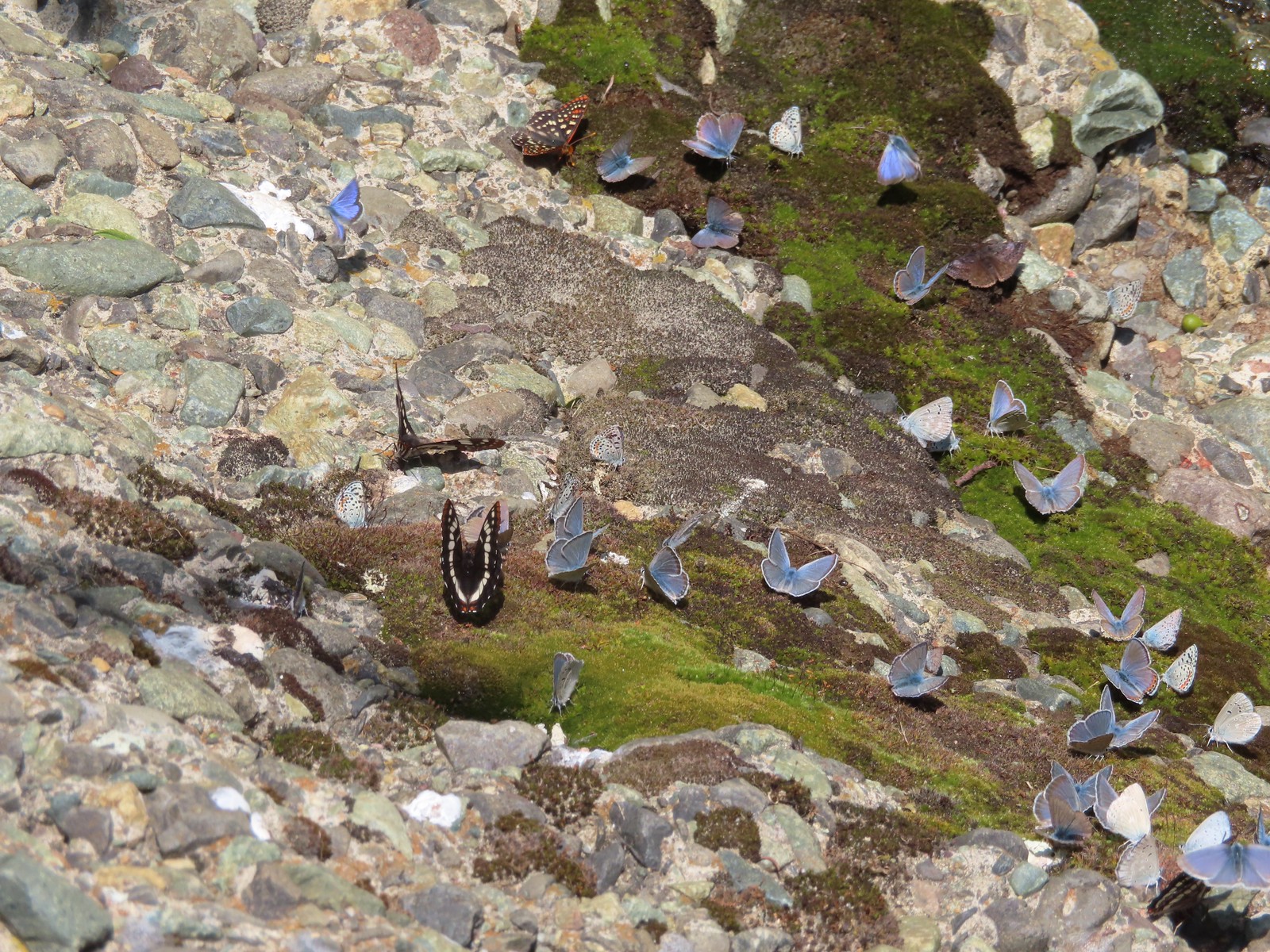
After the difficult hike to Stuart and Red Blanket Falls (post) we had a three-stop day planned starting with Plaikni Falls. Plaikni Falls was one of two hikes included in Sullivan’s featured hike along with The Pinnacles Trail. Unfortunately Pinnacles Road was under construction and closed to any entry beyond the Plaikni Falls Trailhead.

While it was a bummer about the closure our criteria for checking off a featured hike has been hiking (or attempting) to hike just one of the options Sullivan lists in his featured hikes (post) meaning Plaikni Falls would satisfy our criteria.
We set off on the mile long ADA accessible trail just after 6:15am.


 There were pikas out there in the rocks but we only heard them this time.
 We did spot this western tanager though.
 Pink monkeyflowers. One of our favorite wildflowers.

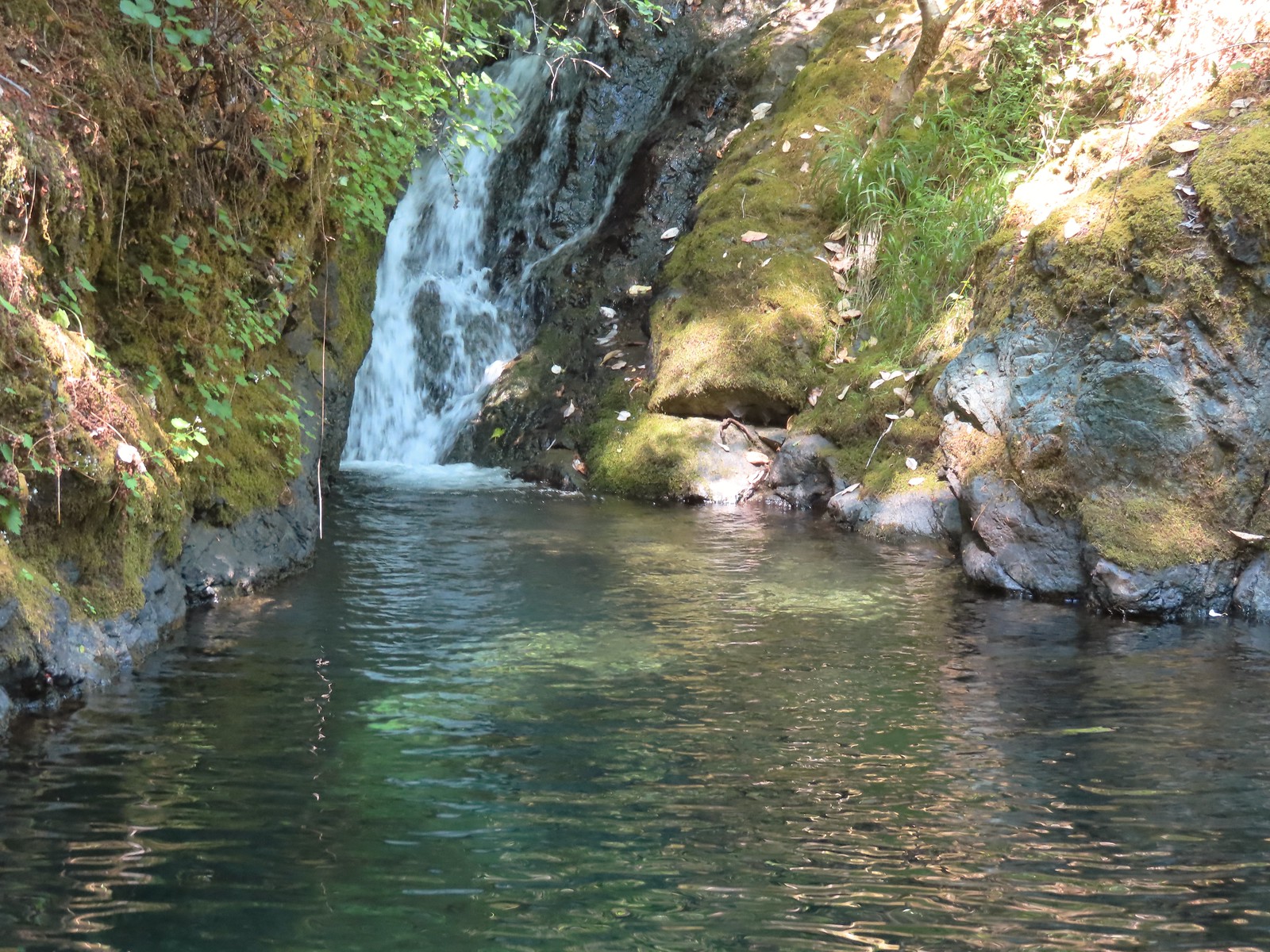
 The trail climbed gradually along Sand Creek before rounding a corner to a view of Plaikni Falls.
 Paintbrush and columbine along with lupine and groundsel.
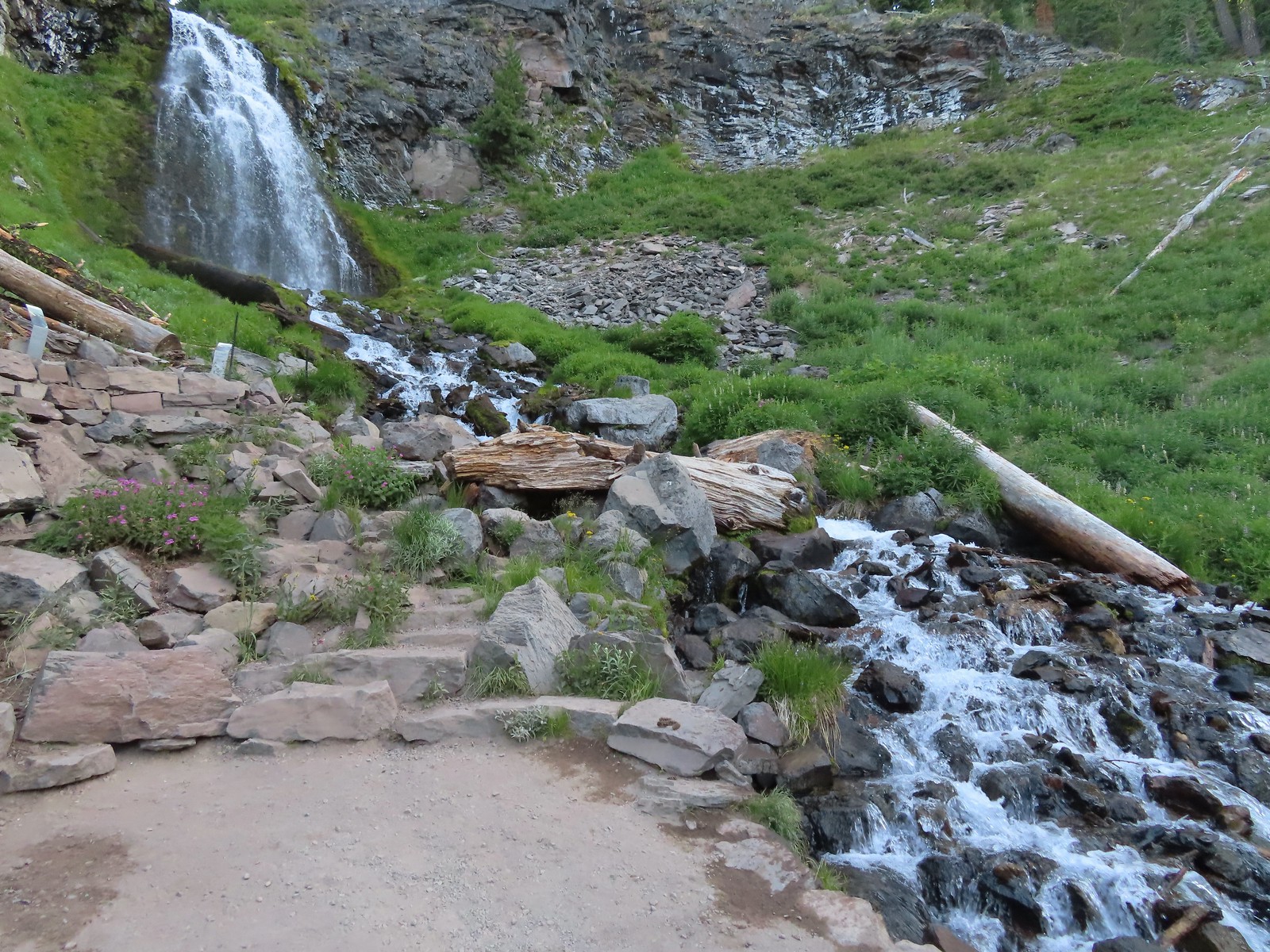

 Hummingbird visiting a paintbrush.
 Monkshood
 Yellow monkeyflower
We began here hoping to avoid any crowds and it worked. We were the only ones on the trail and had the falls to ourselves. The first person we saw was just getting ready to exit their car at the trailhead as we finished our hike.
We got back in our car and drove to the Sun Notch Trailhead.

 Applegate Peak from the Sun Notch Trailhead.
From the parking area we hiked up the trail 0.2 to the start of a 0.6-mile loop which we hiked counter-clockwise.


 There is a nice green meadow in the center of the loop.
The loop briefly follows the rim of Crater Lake passing several nice viewpoints.


 The Phantom Ship.
 Diamond Peak (post), Sawtooth Mountain (post), and Mt. Thielsen (post).

 The Watchman (post) and Hillman Peak with Wizard Island below. Llao Rock in the center and Mt. Thielsen to the right.


 Garfield Peak, The Watchman, and Hillman Peak.
 Heading back down to the start of the loop.
 Marmot
After completing the loop here we drove back toward Rim Village along East Rim Drive 1.4 miles to the Vidae Falls Picnic Area and parked in front of a signboard for the Crater Peak Trail.

The Crater Peak Trail travels 3.2-miles through the forest climbing to the rim of the peak’s crater. A 0.4-mile loop around the crater is possible on an unofficial but well-established path.

 Vidae Creek
The first 0.6-miles paralleled East Rim Drive before turning South along a broad ridge toward Crater Peak.
 East Rim Drive was up above the trail.
 Crater Peak through the trees on the left.
 Paintbrush
 Stonecrop

 Setting off on the broad ridge.
The trail was in need of a little maintenance as there were several larger trees down along the ridge.


 There was a very short steep climb to reach this small meadow with a view ahead to Crater Peak.
 Female western tanager
Near the 2.5-mile mark we arrived at the base of Crater Peak where the trail suddenly steepened as it began its climb.

 Looking up Crater Peak.
 Little prince’s pine
Views opened up as we climbed.
 Union Peak (post)
 Mt. McLoughlin (post) to the South.
 Mt. McLoughlin behind Lee & Devil’s Peaks.
 Mt. Shasta was visible, barely, through wildfire smoke.
 Arriving at the crater.
We took a short break on a log to catch our breath after the climb then hiked clockwise around the crater gaining views of the peaks around Crater Lake.
 Scarlet gilia lining the trail around the crater.
 The Watchman to the left and Garfield Peak.
 Applegate Peak and Mt. Thielsen
 View south to Mt. McLoughlin with the Goose Nest to the closer to the right.
 Dutton Cliffs and Mt. Scott (post)
 Pussytoes
 The peaks around Crater Lake.
 Paintbrush

 Western pasque flowers
 Klamath Basin with haze from (most likely) the Golden Fire near Bonanza.
 The Rabbitt Ears and Hershberger Mountain (post) along the Rogue-Umpqua Divide.
After completing the loop we headed back to the trailhead where we were stopped by a couple looking for Vidae Falls. Those falls are located along East Rim Drive, not near the picnic area so we let them know where to find the roadside pullout and then followed them to the small parking area.


It was well worth the quick stop before heading back to our cabin at Mazama Village. We had completed our hikes just after Noon and had plenty of day left so we decided to make the 30-minute drive to Union Creek and have a late lunch/early dinner at Beckie’s Cafe.
Beckie’s was busy but the food was great as usual. We each got a slice of pie to go for desert later and returned to Mazama Village. It was still pretty early so I was doing some research on our remaining hikes for our trip. Looking at the Park website I had noticed that in addition to The Pinnacles Trail two additional trails we were hoping to hike were listed as closed, Lady of the Woods and Annie Creek. Again these were both one of two featured hike options so they wouldn’t affect our ability to check off the featured hikes, but it would be a bummer to miss them nonetheless. I then looked at All Trails and saw that there were very recent trip reports from Annie Creek.
That trailhead was located next to the store in Mazama Village so after eating our pie we decided to make an evening hike out of it to see if the trail was indeed open.


We followed an unsigned path from the store/restaurant parking lot to a signed junction where we turned right.

The trail passed between Annie Creek Canyon and the Mazama Campground. We passed a junction where a 1.7-mile loop began/ends that would take us down to Annie Creek.

 Signboard at the loop.
We stayed up and hiked the loop counterclockwise.
 Crater Peak from the trail.

 Ash pinnacles
 Getting ready to drop into the canyon.
 The trail had been closed for hazard tree removal and we could see that there had been some big trees that had to be cleared.

 Wildflowers in the meadows below.
 Annie Creek

The trail crossed Annie Creek a couple of times on footbridges before climbing steeply back up to campground.


 Monkeyflower and lupine
 Final pitch to end the loop.
 The Annie Creek Restaurant.
Unsurprisingly this had been the busiest hike of the day. After seeing no one on the Plaikni Falls and Sun Notch Trails we’d seen just four other hikers (2 pairs) on the Crater Peak Trail. Our total mileage for the day came in at 12.3 miles (2.2, 0.9, 6.8, and 2.4 miles respectively). Total elevation gain was 1525′ with over a thousand of that coming from the Crater Peak hike. Annie Creek and Plaikni Falls were each 200′ and Sun Notch a little over 100′.


It was a great day of hiking and having a piece of pie from Beckie’s Cafe was the cherry on top. Happy Trails!
Flickr: Plaikni Falls, Sun Notch, Crater Peak, & Annie Creek
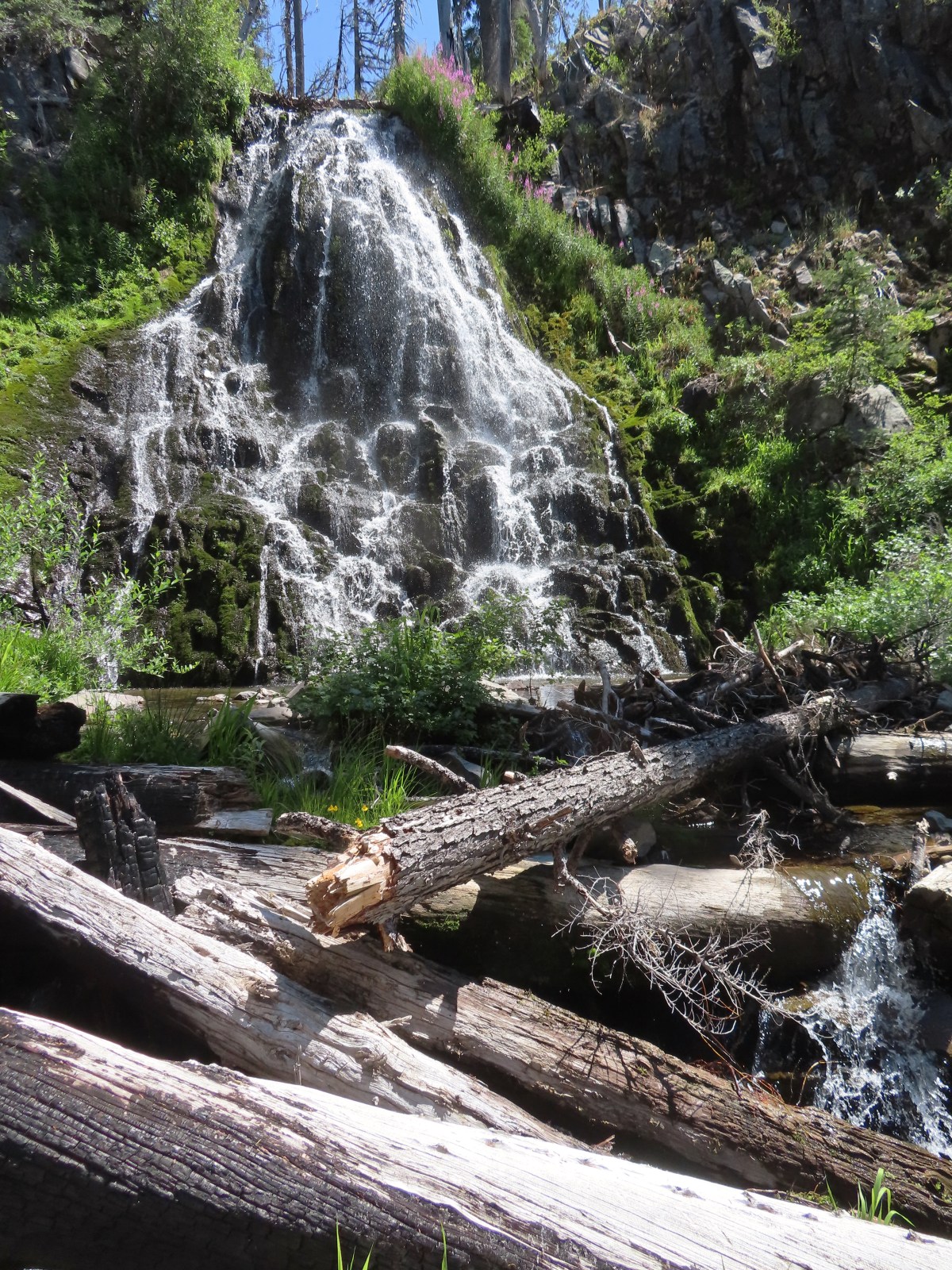

 Arriving at the highway.
 Trail on the far side of Hwy 62.

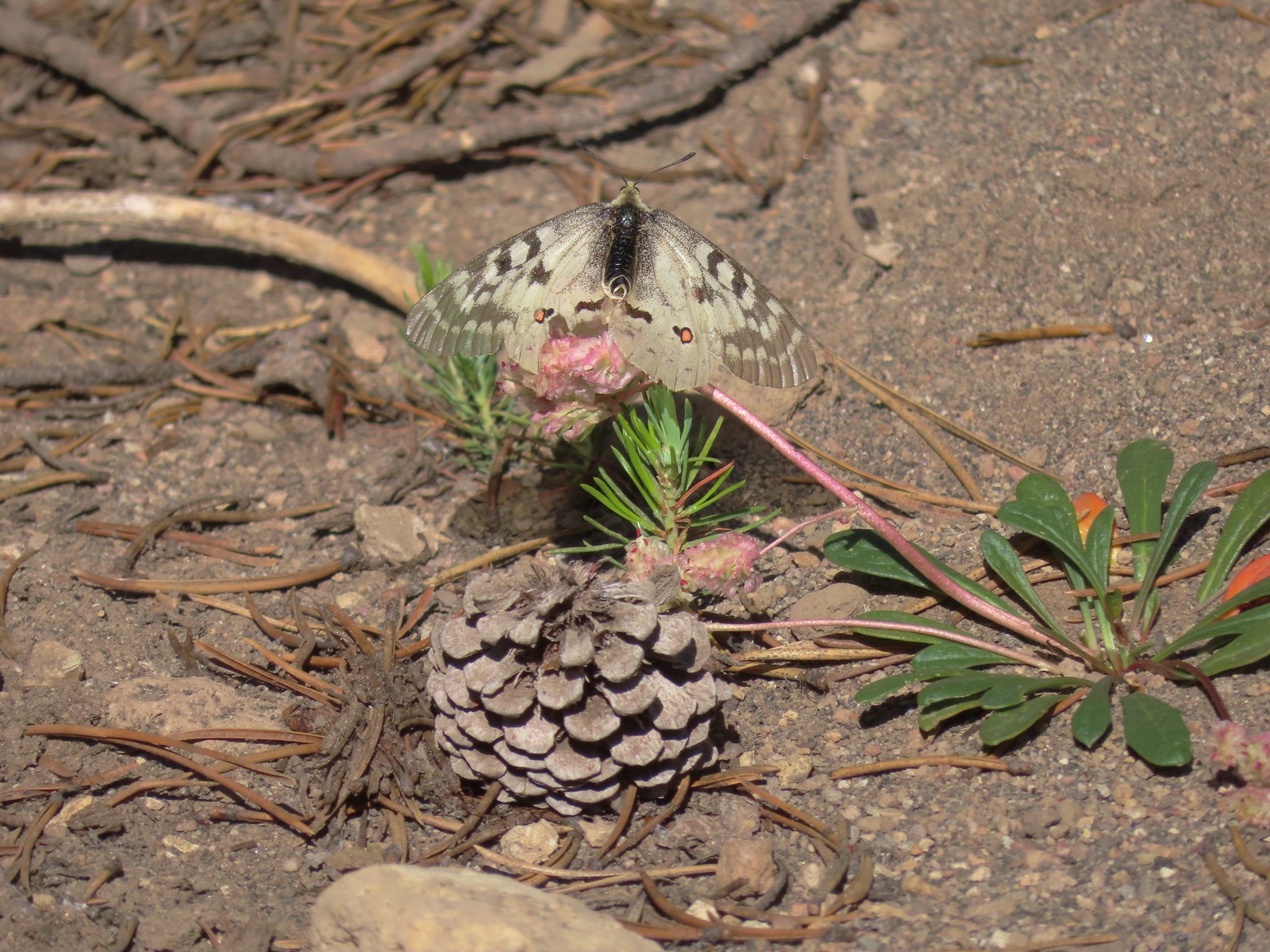 Clodius parnassian on a pussy paw.
 Much of the trail followed an old roadbed.
 PCT junction.
 Butterfly on the Crater Lake PCT register. While I was working on getting the butterfly photo a northbound thru hiker arrived. He mentioned not having had a shower in 10 days and being really excited to reach

 Older cut logs helped us locate the trail at times.
 Union Peak from the trail (
 It took a second to find the tread in this meadow.
 Once we found it though it was easy to follow.
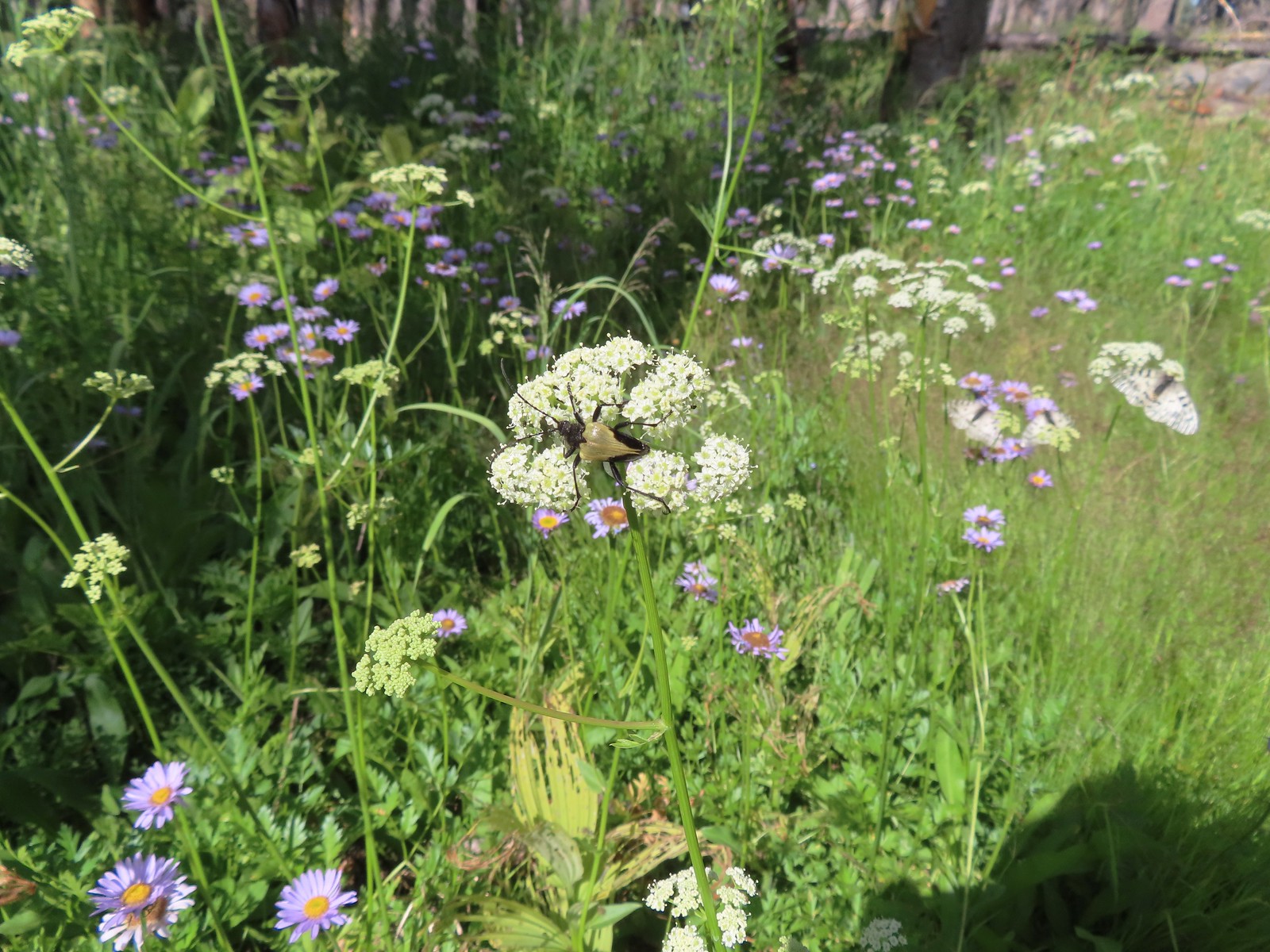 Big beetle. There are also three clodius parnassian butterflies behind to the right.
 Typical trail conditions. I spent a good deal of time removing limbs from the larger trees and pulled some of the smaller ones off the trail.
 Doe below the trail.
 More messy trail.
 There was one small stand of unburned forest which provided a brief break from the blowdown.
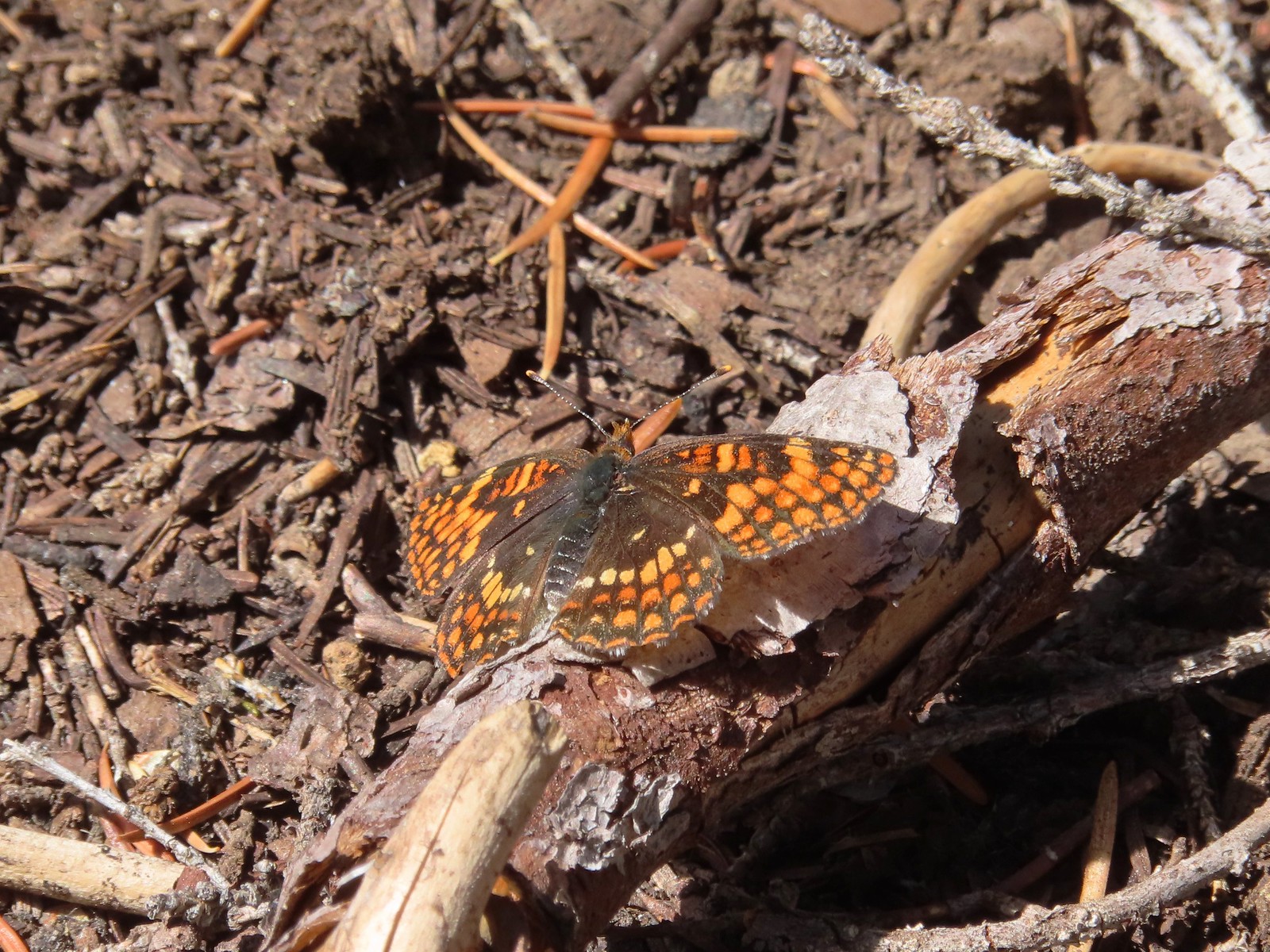 Checkerspot butterfly
 Mylitta crescent and a hoary comma on spreading dogbane.
 Paintbrush
 I believe that is Tom Mountain and Jerry Mountain.
 Bald Top to the right.
 Skipper
 Mt. McLoughlin
 Lorquin’s admiral
 This was the worst of the obstacles.
 We hadn’t seen a blue diamond since before the PCT but near the SW corner of the Park boundary we spotted a couple.
 Post ahead marking the boundary. The trail passed through a narrow gap here where the blowdown was heavy.


 Arnica below the falls and fireweed above the falls added some nice color to the scene.
 One-sided wintergreen


 Small falls on Red Blanket Creek.
 Pink monkeyflower
 I’d lost the trail here but headed for the patch of bright orange wildflowers to see what they were.


 Red Blanket Falls
 View down Red Blanket Creek
 A spring fed waterfall along Red Blanket Creek below the falls.
 A second and third tier of Red Blanket Falls just below the upper fall. I wasn’t able to get a clearer view of these two drops. I hiked a short distance down the creek but decided the poor trail conditions and loss of elevation weren’t worth going further down the trail with no guarantee of a better view.
 The three drops of Red Blanket Falls
 One more of Red Blanket Falls.
 Another little cascade.

 Along this rock outcrop I found switchbacks that I’d missed on the way to the falls.
 This might be a black backed woodpecker.
 This cairn was new to me as well. At this point I was quite a bit below our track from the morning and I was afraid that I might pass Heather without knowing it if she was sticking to the earlier route.
 Hummingbird
 Goose egg on the left.
 Painted lady
 A checkerspot and a copper on sub-alpine fleabane.
 Arriving back at the PCT. We again crossed paths with a thru hiker on the way to Mazama Village.
 Pussypaws
 Dwarf lupine
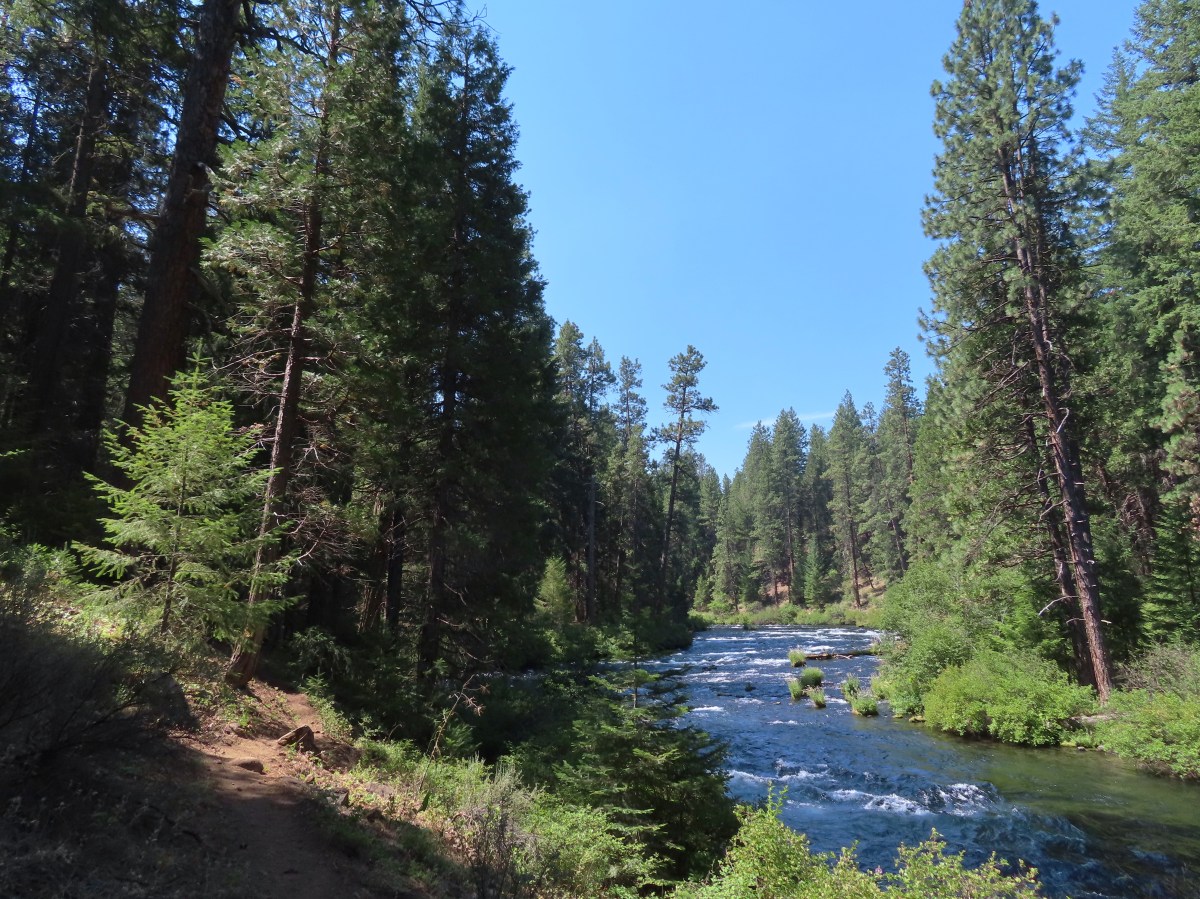


 The sign is visible from the campground road.


 Common mergansers
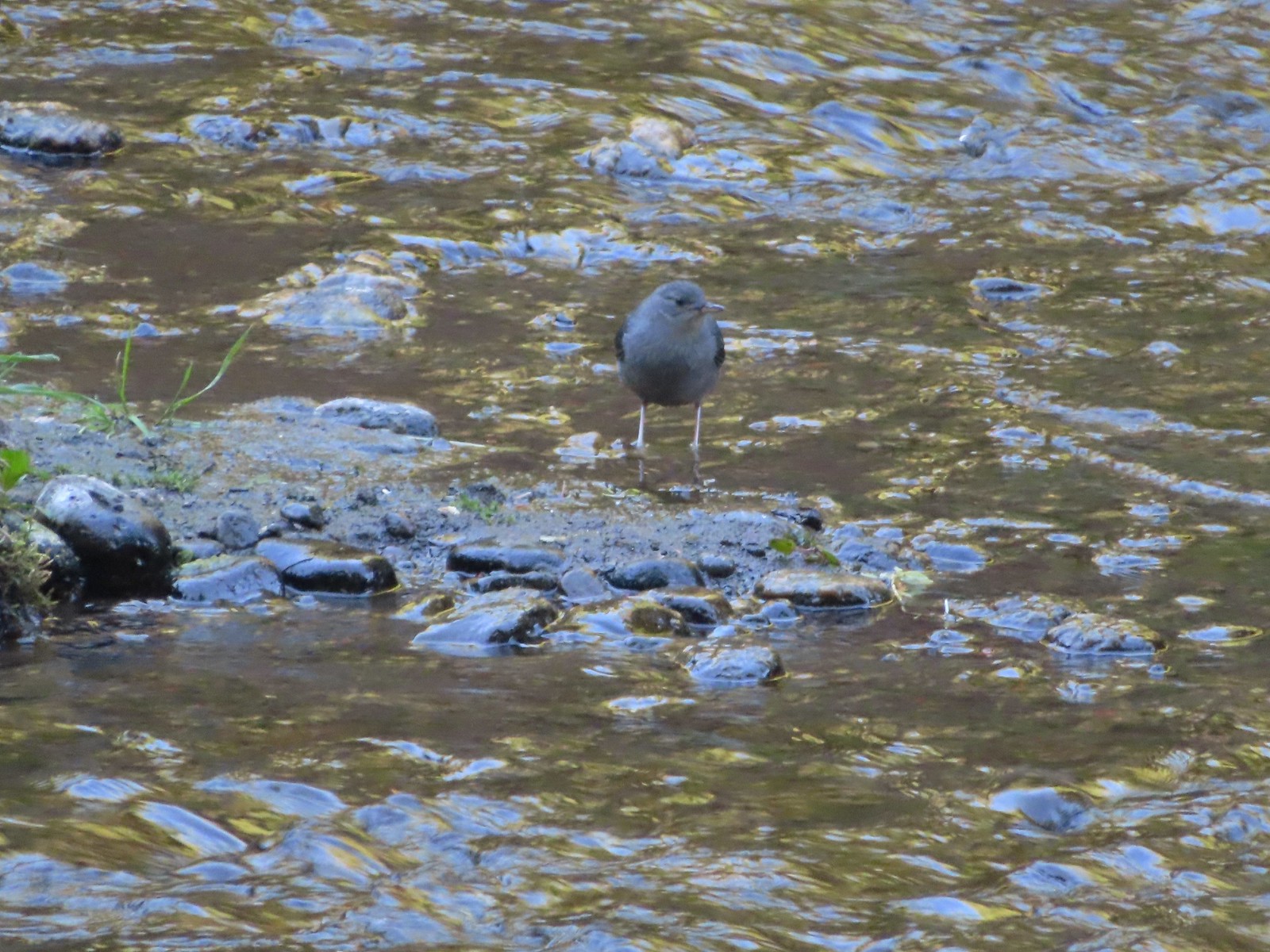 Ouzel
Ouzel Goldenrod
 Passing some of the campsites.
 The Candle Creek Campground across the Metolius.
 We actually went left below the stump here but, on the way back wound up coming downhill by the stump.
 More campsites.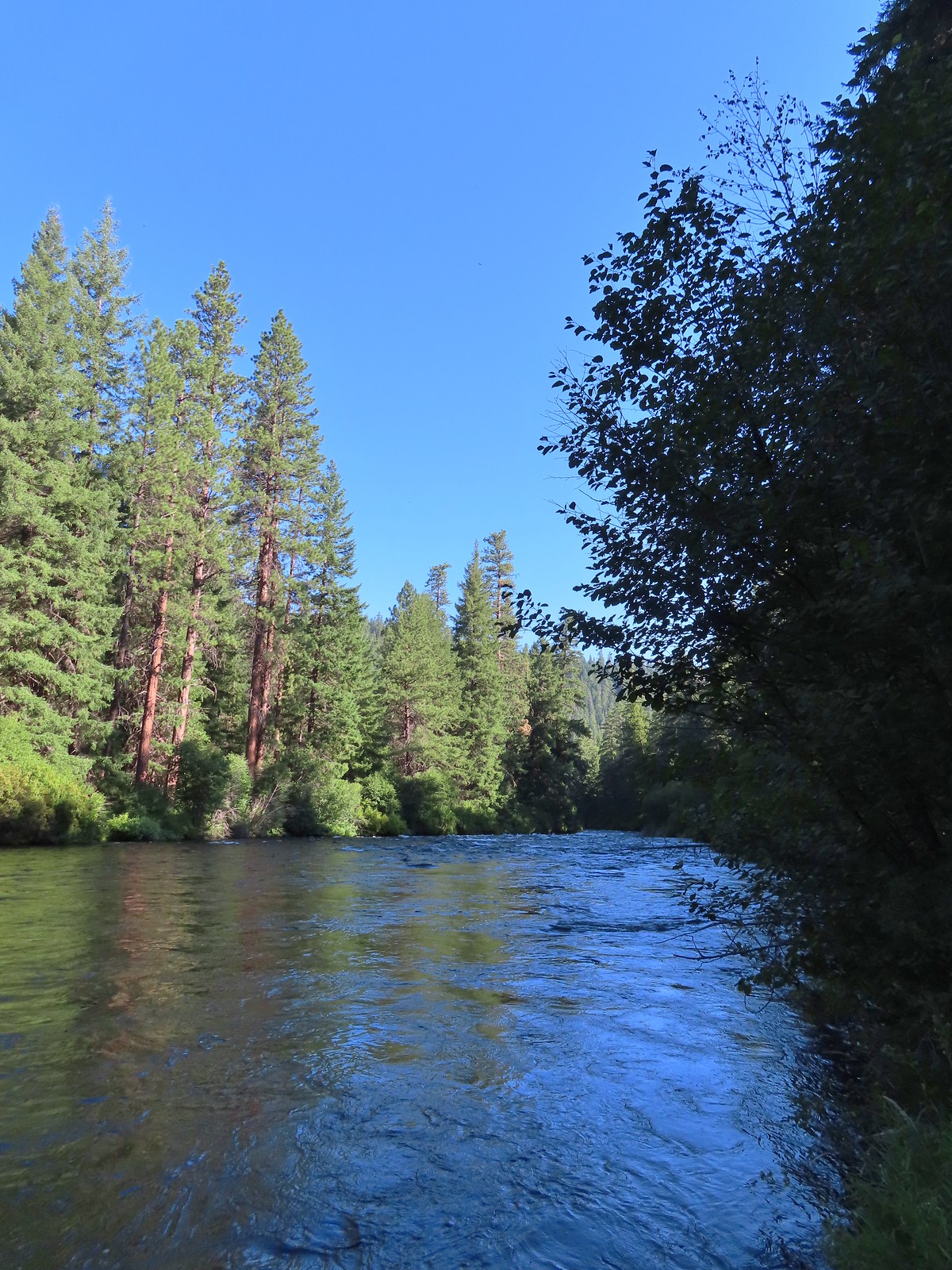
 As we got further from the campground we encountered more and more brushy sections.
 Another section with an increased number of obstacles.
 Getting a bit brushier.
 We left the river for the road at this bend.
 Heading up to the road.
 The use trail from the road.
 We wondered what this post signified.
 They were way past blooming but there were several mountain lady slippers along the road.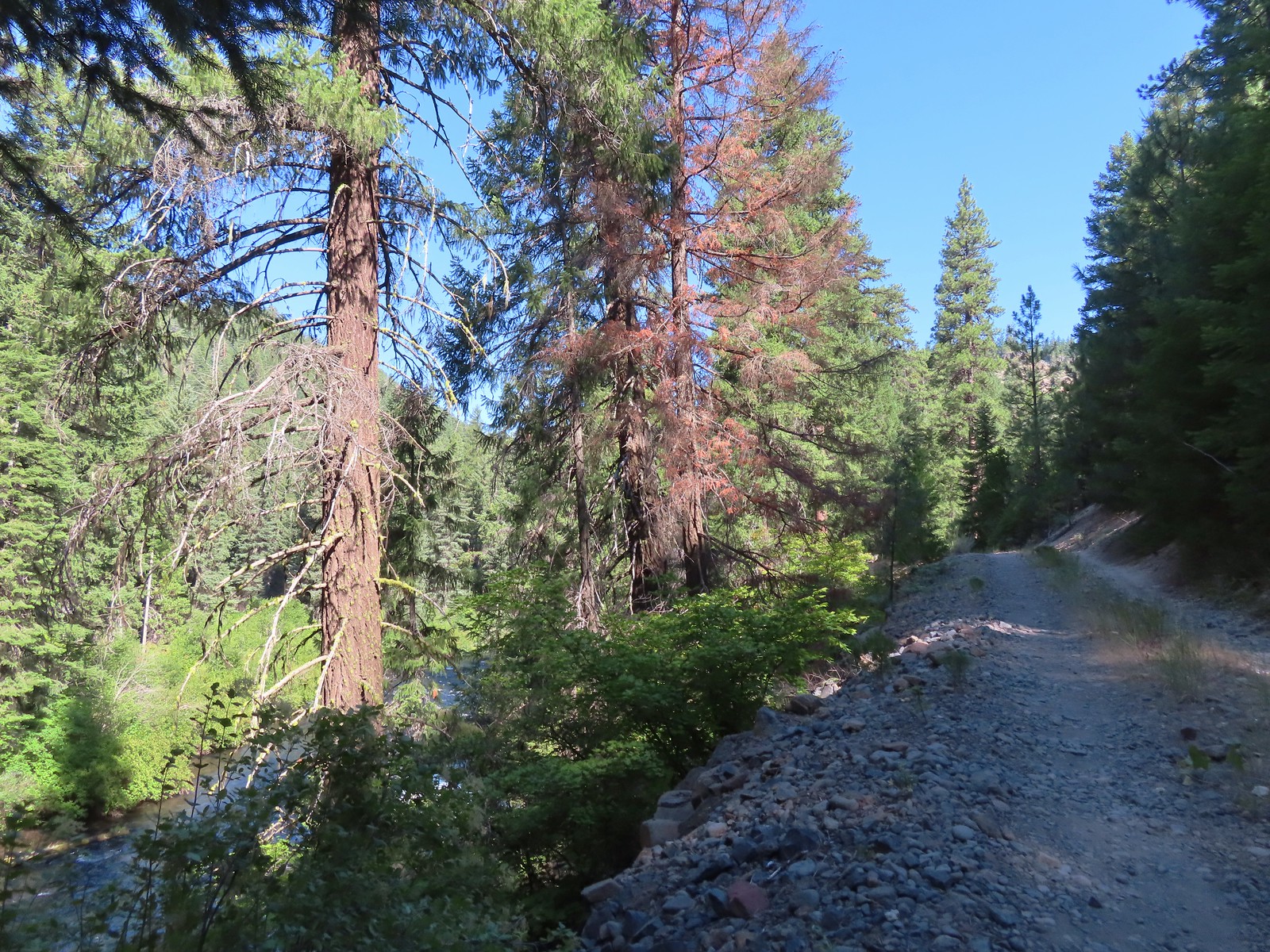
 Osprey nest
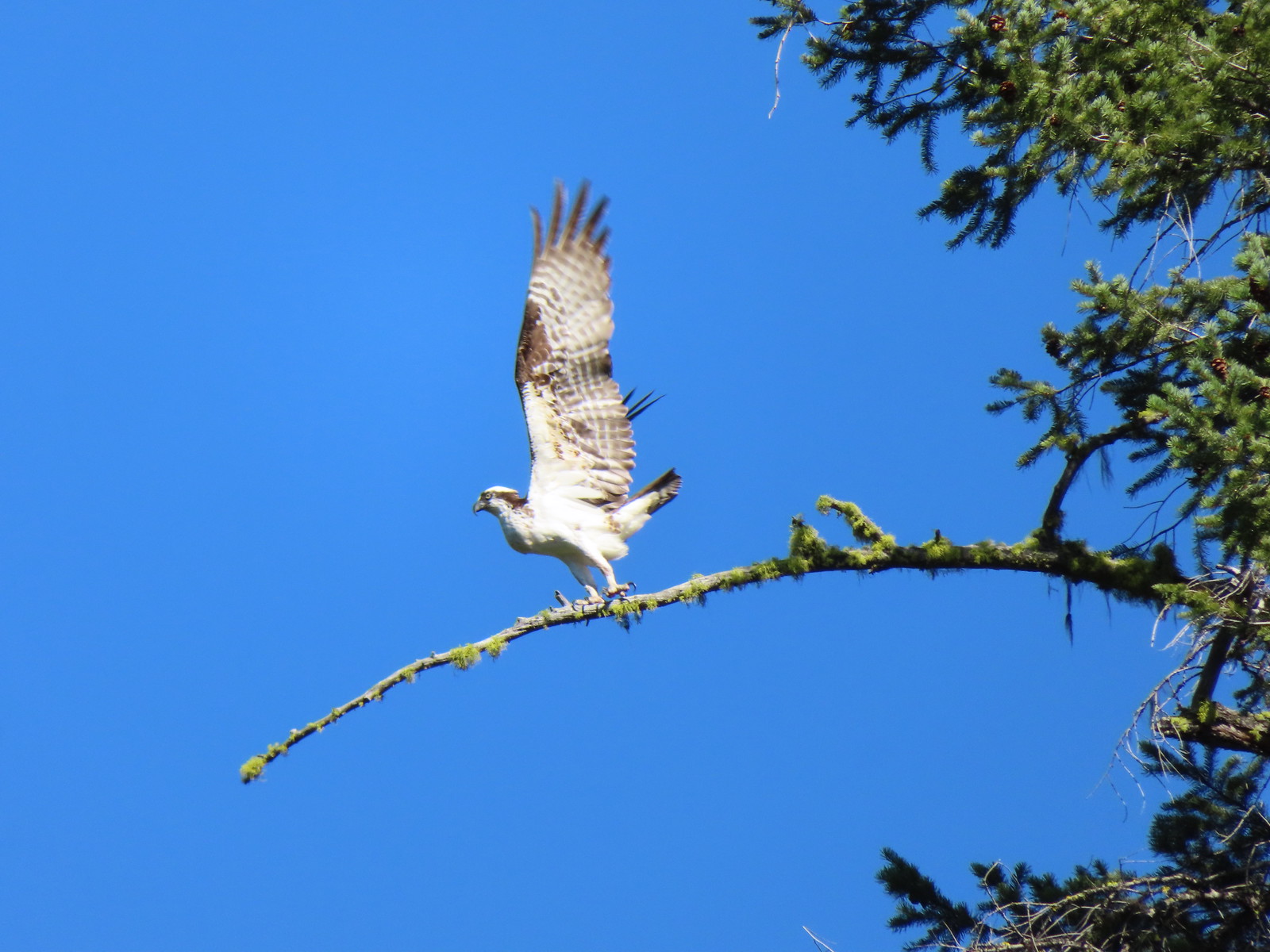
 Rock spire on lower section of Green Ridge. There are several interesting rock features higher up on the northern end of Green Ridge that were not visible from the road.
 Orchid
 Scarlet gilia
 Some of the private cabins from the road.


 A couple more cabins.
 The end of the private land.
 The clear water allows for nice views of the rocks making up the riverbed.
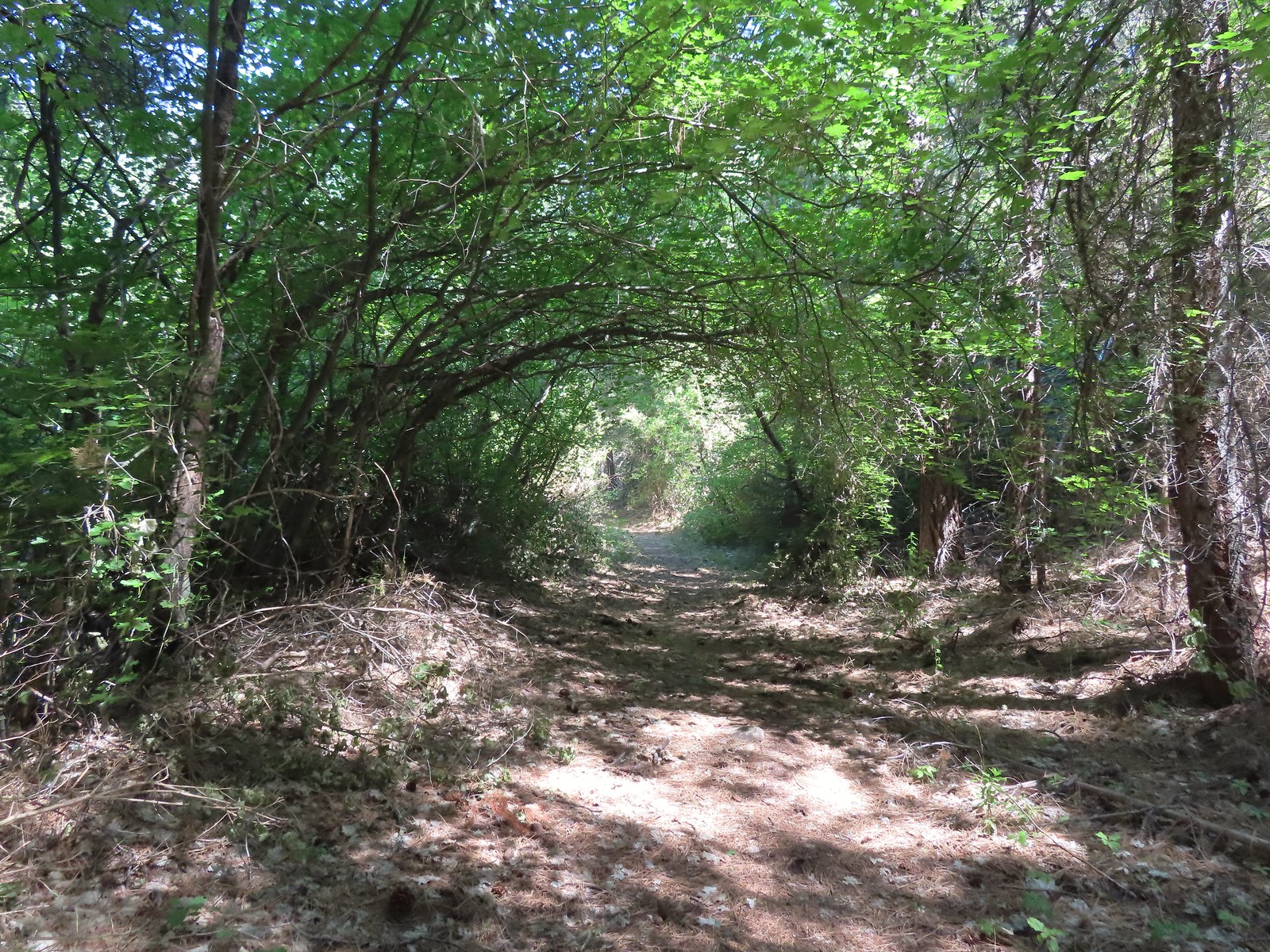
 Even though it had received maintenance the road was not in good enough condition for larger vehicles.

 Pink monkeyflower

 Lorquin’s admiral
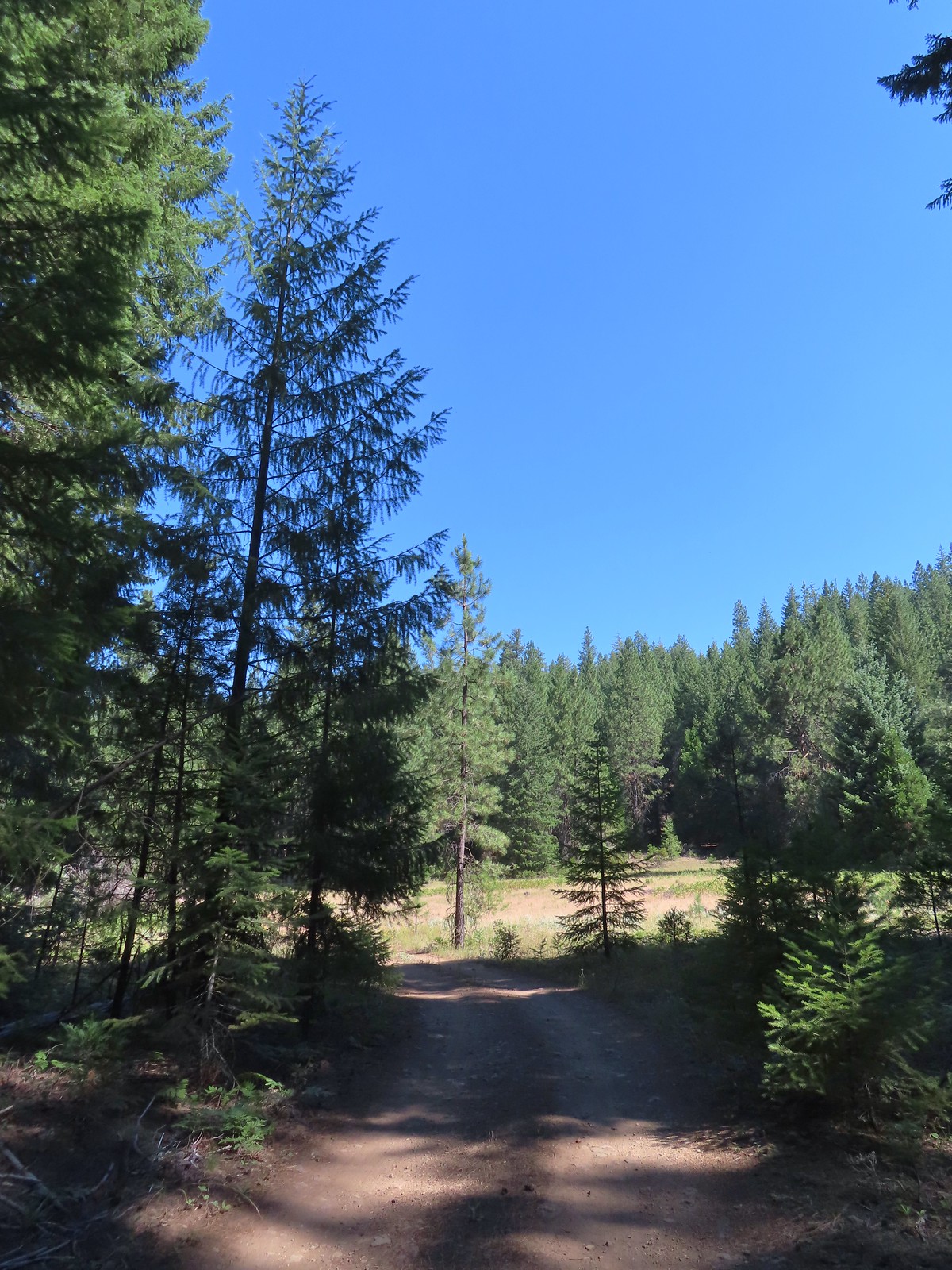
 The forest opened up near the end of the road where we set up camp.
 Campsite
 Yellow monkeyflower
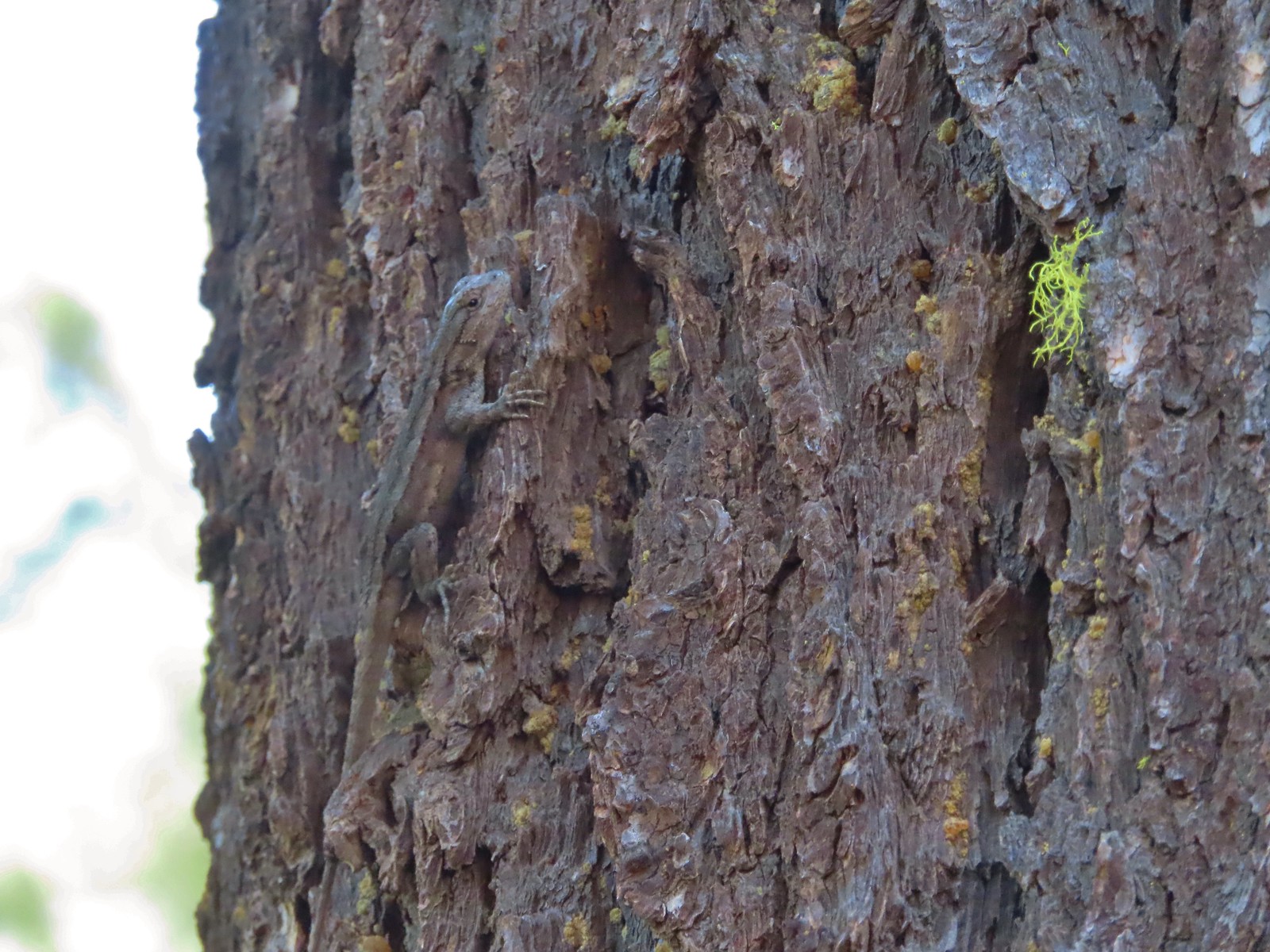 Lizard hanging out near the campsite.

 Grouse
 The answer to the questions is yes bears do.
 The Metolius through the trees.
 Sagebrush mariposa lily. There also tire tracks in the trail behind.
 Recent brushing had been performed through this area.
 Looking up the end of Green Ridge.
 This large tree had been cut fairly recently.
 Flagging marking a reroute around a downed tree.
 Starting to get brushy.
 View across the river to the Warm Springs Indian Reservation.
 Flowers along the Metolius.
 The Whitewater River was behind the rock formation on the far side. The Whitewater River begins at the Whitewater Glacier on Mt. Jefferson and flows roughly 7.5 miles through the Warm Springs Reservation to the Metolius.
 More clear water.
 Fireweed
 Thimbleberries provided us with a few after dinner snacks.
 Hedgenettle
 The Shut-In Trail traveled right along the riverbank at times.
 There was a small set of boards nailed together to assist with crossing the sketchiest part, but they were just lying on the hillside and not anchored in any way.
 The Shut-In Trail from CR-64.
 CR-64
CR-64
 Frog on a skunk cabbage leaf. There were a few wet areas along the Shut-In Trail which meant a few mosquitos were present.
 The Sun going down as we approached camp.
 Pinedrops
 Squirrel
 Bee sleeping on thistle.
 Large boykinia
 We t
We t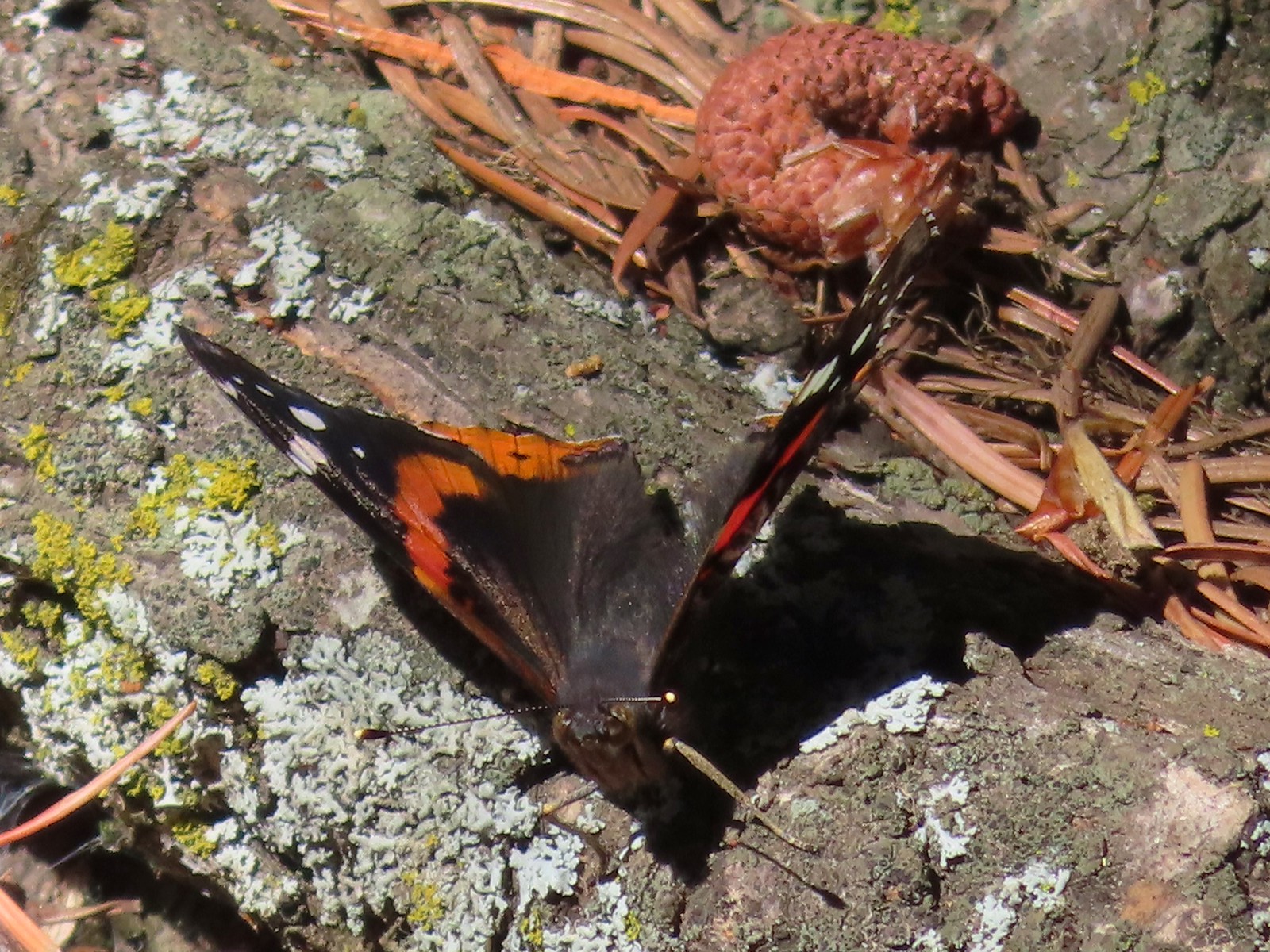 Red admiral. As far as I know this is the first one of this species of butterfly that we’d seen.
 Common wood nymph
 Across from the Candle Creek Campground.
 Green Ridge through some smoke. A couple of new fires, one on the Warm Springs Reservation and one East of Eugene had started over the weekend.
 Love the colors of the Metolius.
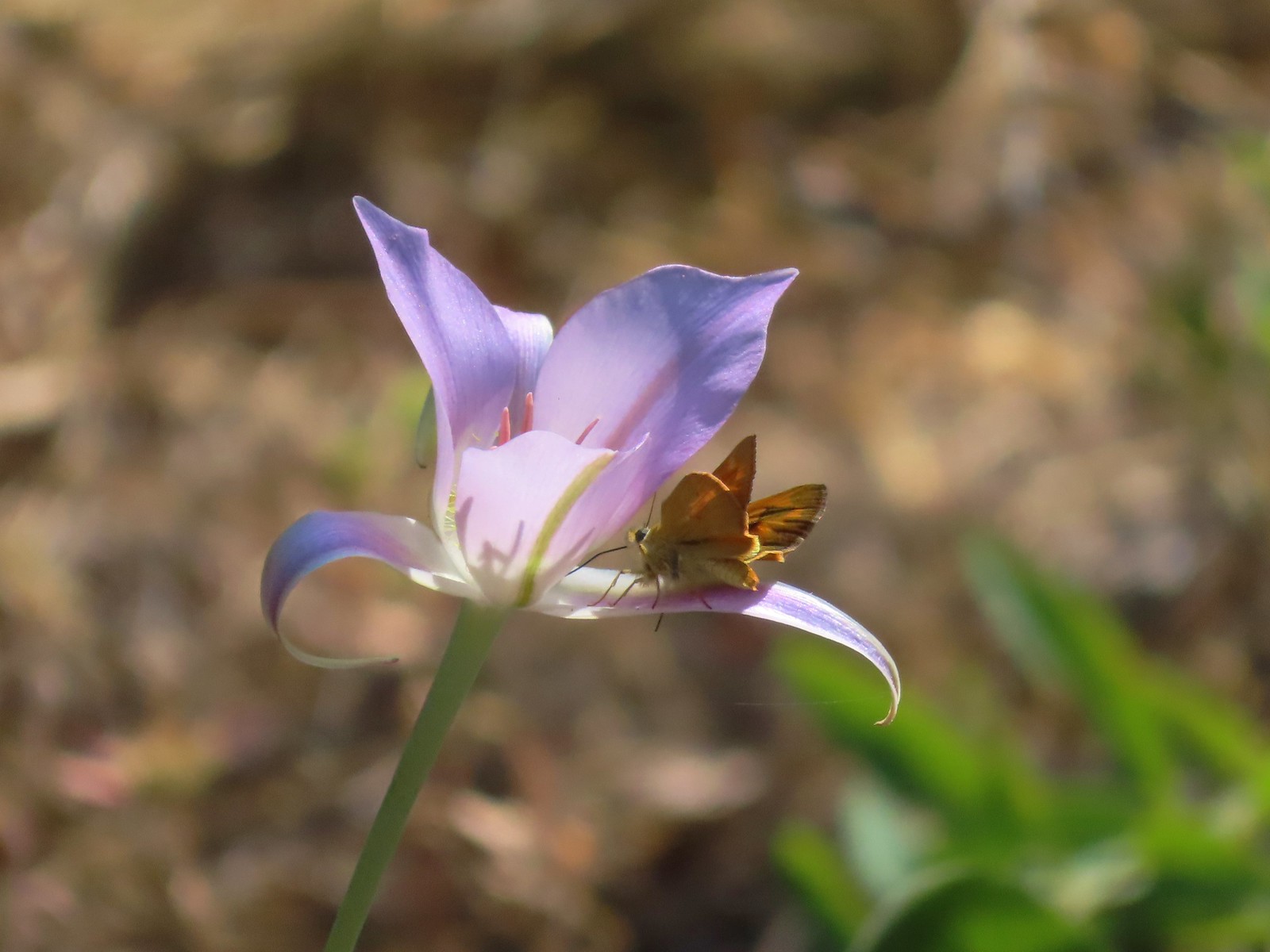 Skipper on a mariposa lily.
 Lower Bridge Campground is ahead to the left in the trees.
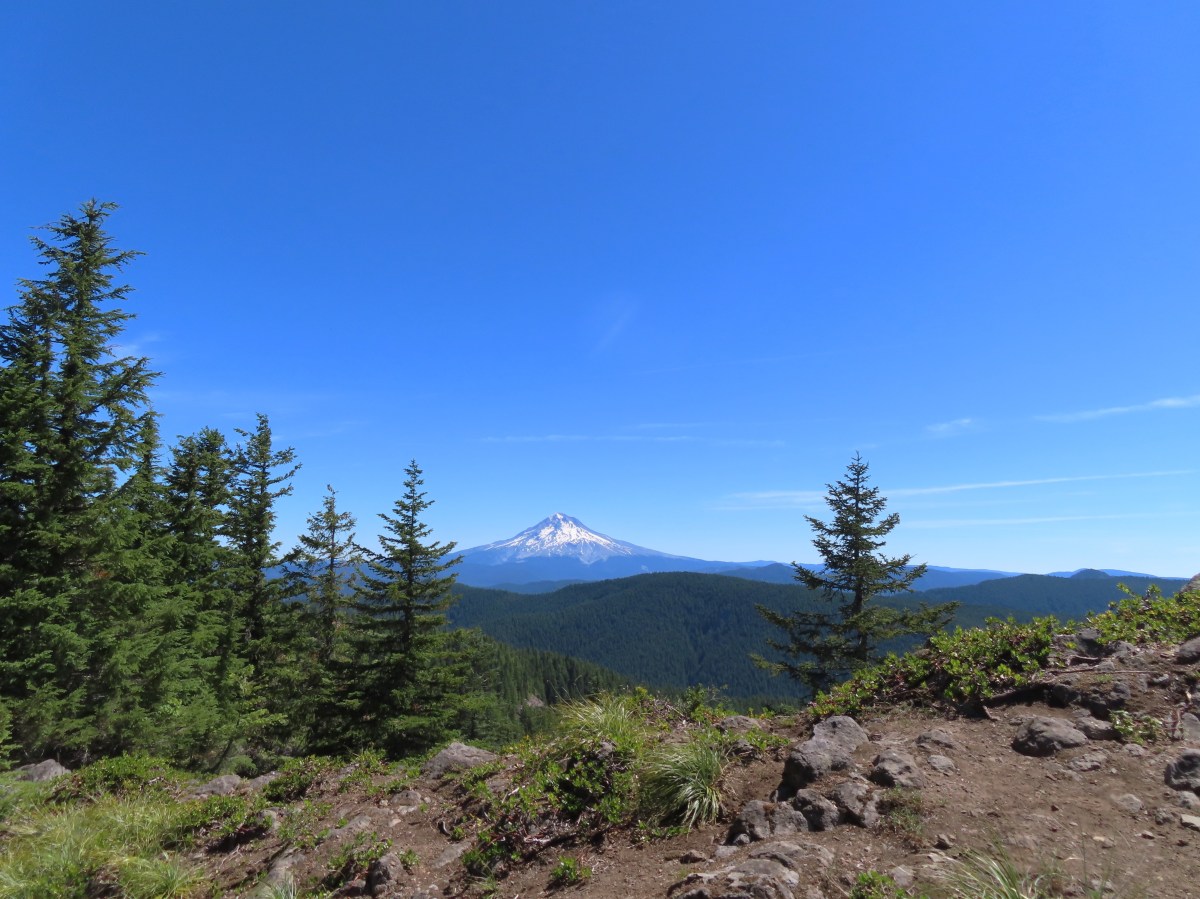

 Rhododendron at the trailhead.
 Eagle Creek Cutoff Trail on the left just before the first steep climb.
 Salmon-Huckleberry Wilderness sign. I would be in and out of the wilderness several times on my route.
 Pictures rarely capture the actual steepness of the trails but the third of a mile past this trail sign had me wondering if I was going to be able to complete my planned hike.
 Starting the descent to the saddle.
 The
The  Coral fungus
 The Old Baldy Trail turns left here while the Tumala Mountain Trail continues straight.
 A small unreadable sign was the only identifier for the continuation of the Old Baldy Trail. I was a little concerned seeing blowdown on this trail from the junction but as it turned out the trail was in good shape and the trees that were down were easily stepped over.
 One of four switchbacks in the first 0.3-miles.
 Cat’s ear lily
 Cascade lily
 Oregon sunshine
 Larkspur & ?
 Paintbrush
 Bunchberry, not sure what is causing the white at the end of the leaves. I’d never noticed that before.
 Lupine
 View at the scree slope
 I’m pretty sure there were at least three pikas down there somewhere.
 Tumala Mountain in the center.
 From left to right is East Mountain, Thunder Mountain (
 Little prince’s pine
 Cascade lilies, a few lupine and a paintbrush.
 Carolina bugbane and foam flower.
 Spur trail from the Twin Springs Trailhead (Old Baldy East) on the right.

 Part of the foundation at the former guard station site.
 The old road.


 Not a big beargrass year but there was a few blooming along the trail.
 I went up this trail to find it just immediately dropped back down to the Plaza Trail.
 The correct spur to Sheepshead Rock.
 Mt. Hood
 Mt. Adams and Mt. Hood
 Some light scrambling brought me to the top of the rock.
 Mt. St. Helens, Goat Rocks, and Mt. Adams in the distance. The high point to the left along the forested ridge is Wildcat Mountain (
 Mt. St. Helens
 Goat Rocks and Mt. Adams
 Mt. Hood with the South Fork Salmon River valley below.
 Orange agoseris
 Oregon sunshine and yarrow
 Saxifrage
 Penstemon
 Bluebells of Scotland

 Valerian
 Moth on an arnica.
 The Plaza Lake Trail sign on the left.
 View from one of the switchbacks.
 Pacific coralroot
 Bunchberry with the more familiar all green leaves.
 Plaza Lake below from the trail.
 Twin flower
 There were some nice big trees along the trail.

 Looking up from the lakeshore.


 I’d missed Mt. Hood on the way down.
 Mt. Hood
 Anemones
 Spirea and lupine
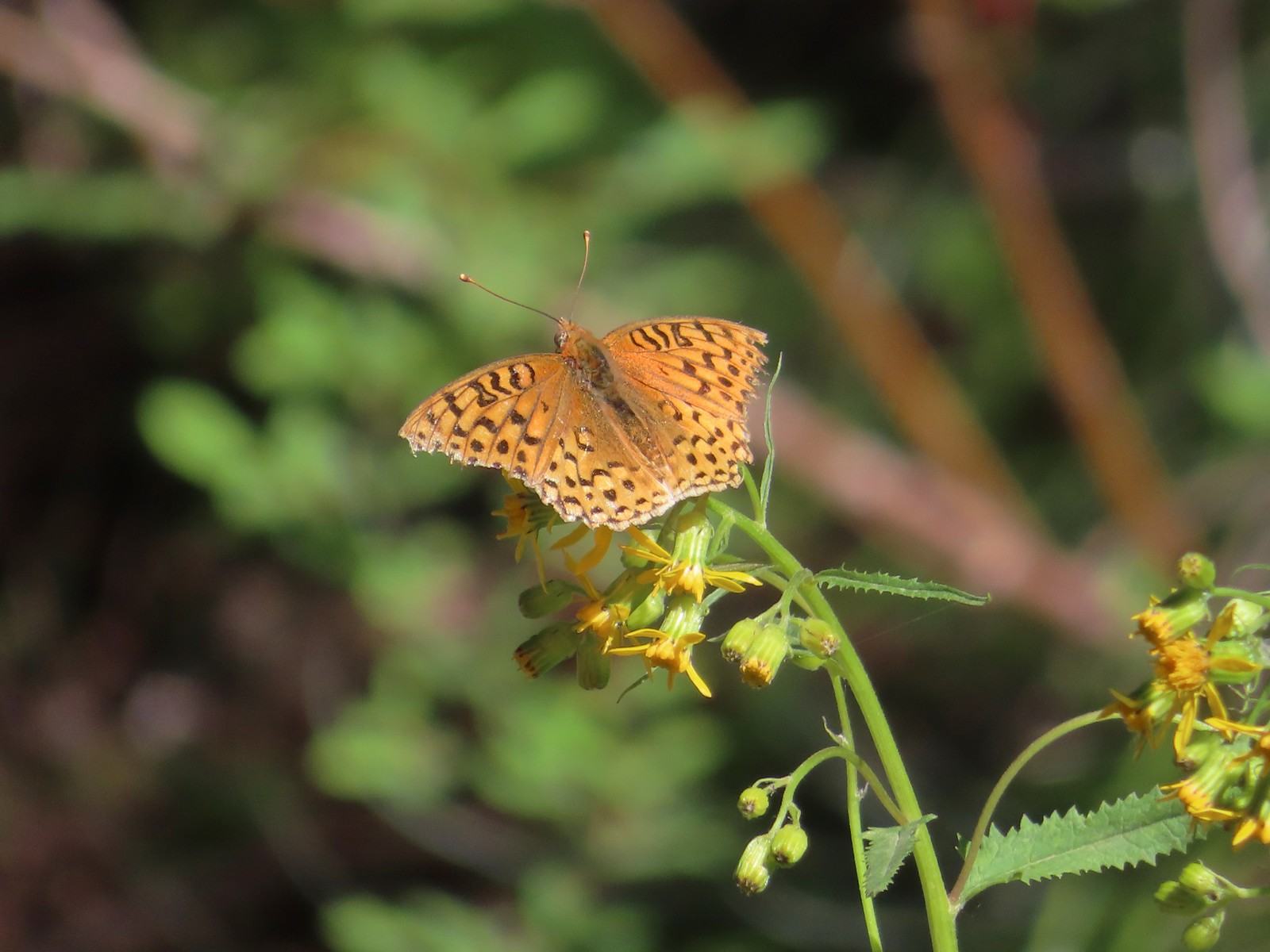 A fritillary butterfly.
 The former Twin Springs Campground was near the trailhead on the opposite side of FR 4610.
 The Twin Springs Trailhead.
 Old Baldy Trailhead sign at the Twin Springs Trailhead.
 Salmon-Huckleberry Wilderness sign (straight ahead) at the Old Bald/Plaza Trail junction.
 I stopped again at the scree slope to look for pikas. All was quiet as they apparently had retreated underground to avoid the heat, but with more light in the valley below I could make out a green meadow in the trees.
 Columbine along the trail.
 Grey jay
 Back at the Tumala Mountain Trail junction.
 My first view of Mt. Jefferson on the day.
 Mt. Jefferson
 A yet to blossom rhododendron.
 Fading lousewort and valerian.
 A blooming rohdodendron.
 Mt. Hood. The scree slope is also visible through the trees on the hillside to the lower right.
 Mt. Jefferson in the distance.
 Mt. Jefferson
 Three Fingered Jack and the Three Sisters
 More Cascade lilies.
 Mt. St. Helens in the distance.
 Mt. St. Helens
 A better view of the scree field and the meadows below Tumala Mountain.
 Penstemon and lupine.
 Passing the Fanton Trail junction on the way back.
 Looking at the final climb of the day from the saddle.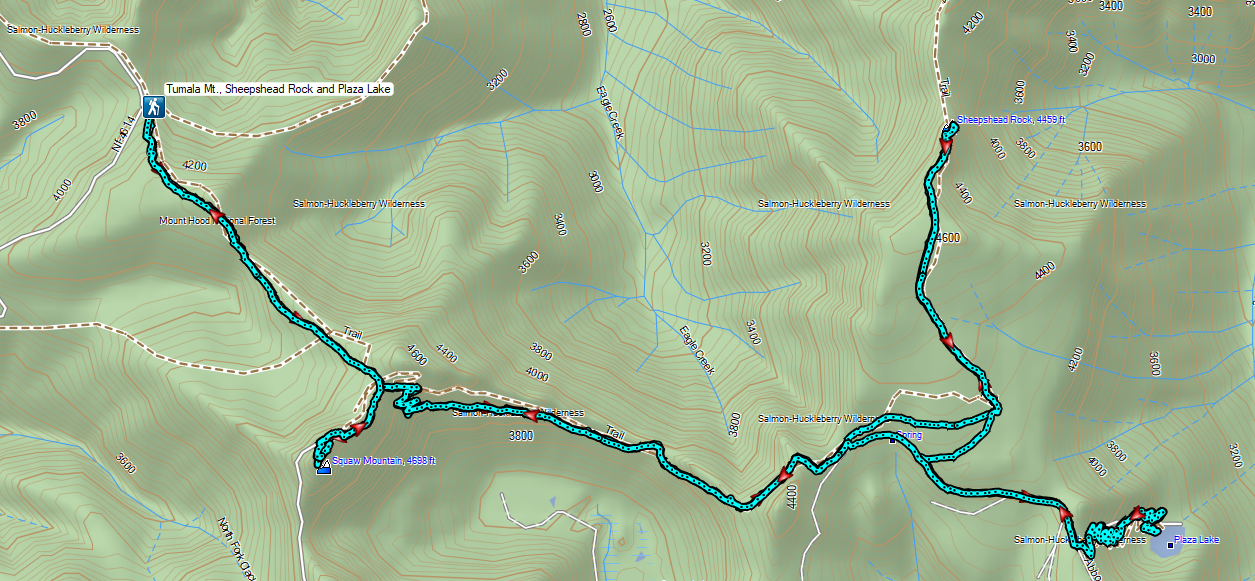


 Prince’s pine
 Candystick
 Twinflower
 Big uprooted tree.
 A carpet of vanilla leaf leaves.
 FR 2676
 Despite the “Closed to all Motor Vehicles” sign it was obvious, and unfortunately not surprising, that some people feel they have a right to ignore anything they disagree with.
 More candysticks
 The few sections that weren’t sandy consisted of lava rock.
 Dwarf lupine
 Pussy paws
 Pygmy short-horned lizard next to a deer print.
 Sand Mountain on the right.
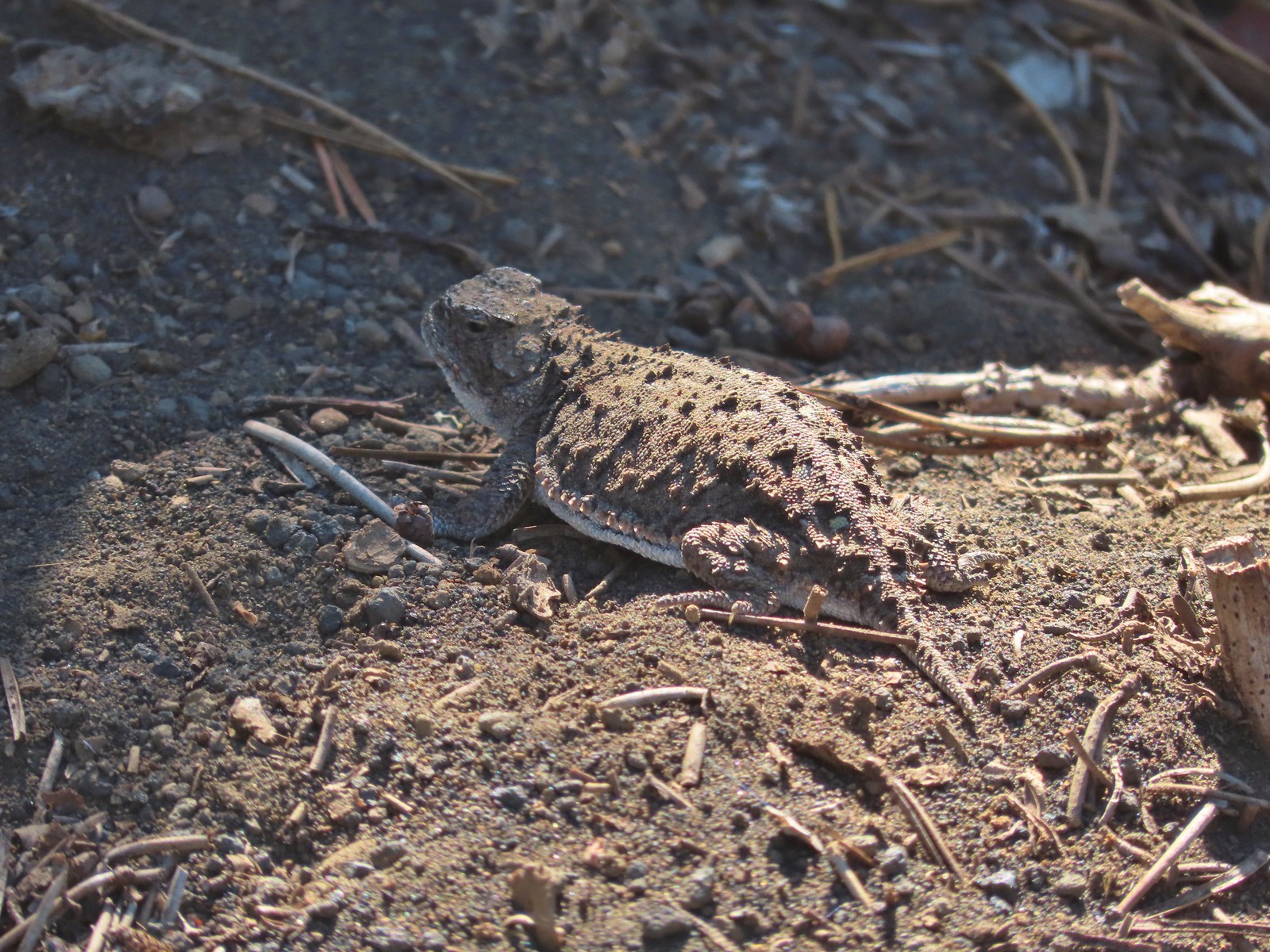 Another pygmy short-horned lizard
 Snowbrush lining the road with the northern end of Sand Mountain ahead.
 Butterflies, including this hoary comma, and other pollinators love the snowbrush.
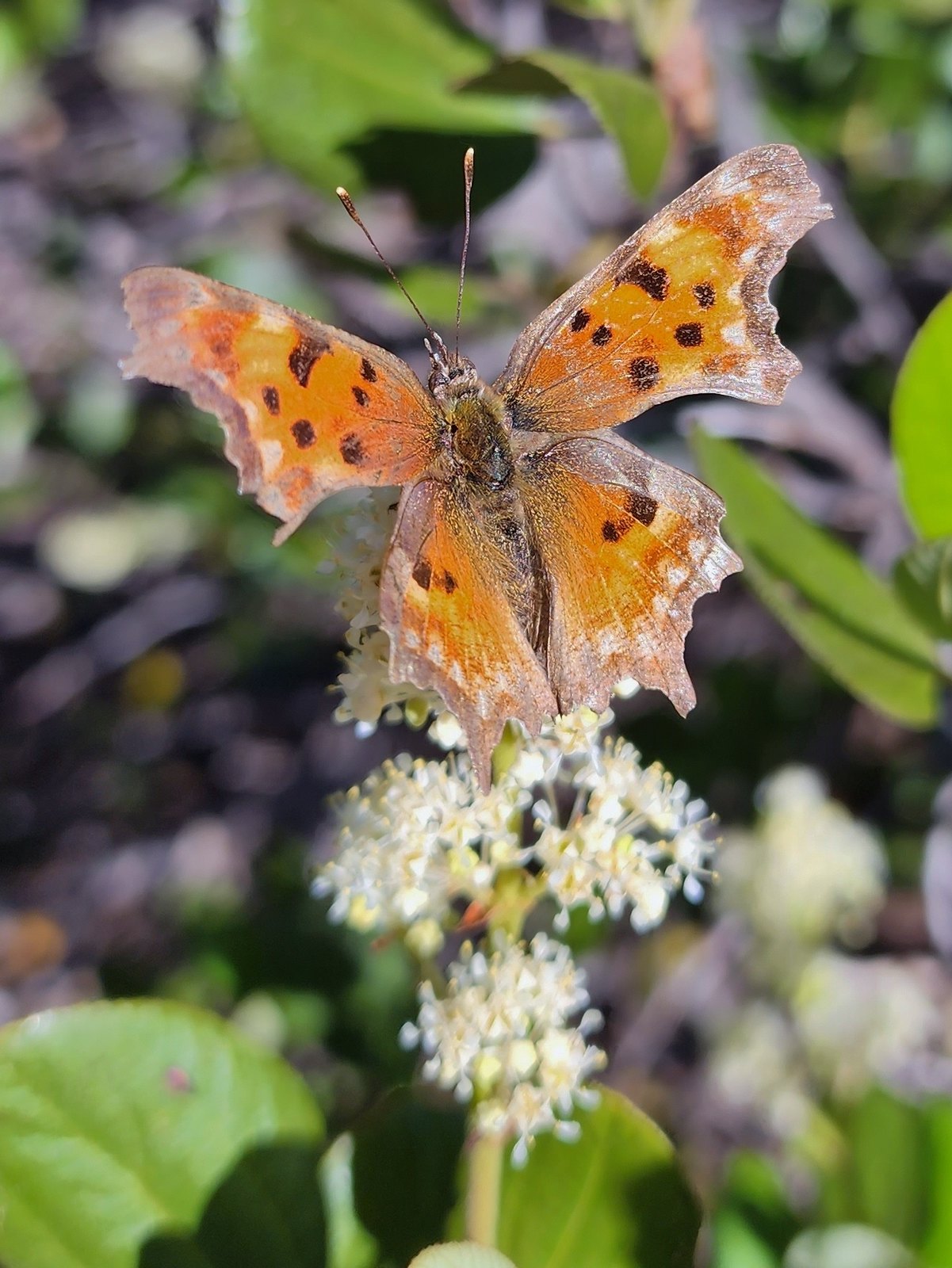 Hoary comma

 Penstemon
 The Moon over Sand Mountain.
 Mt. Washington
 Sign and gate at the road to Sand Mountain.
 Buckwheat
 More snowbrush
 California tortoiseshell
 The Sand Mountain Lookout from below.
 Mt. Jefferson and Three Fingered Jack
 Mt. Washington and the Three Sister
 Western swallowtail
 The Three Pyramids(
 Echo Mountain & North Peak to the left and Crescent Mountain(
 Browder Ridge (
 Lorquin’s admiral

 Mt. Washington (
 Maxwell Butte (
 Just a bit of snow left on the North facing slope.
 Western pasque flower
 It’s very faint but the top of Mt. Hood was visible over the lower left shoulder of Maxwell butte.
 Penstemon
 Belknap Crater, the Three Sisters, The Husband, Scott Mountain (
 Zoom of Diamond Peak. The round looking hump in front is Fuji Moutain (
 Hoodoo and Hayrick Buttes, Black Butte (
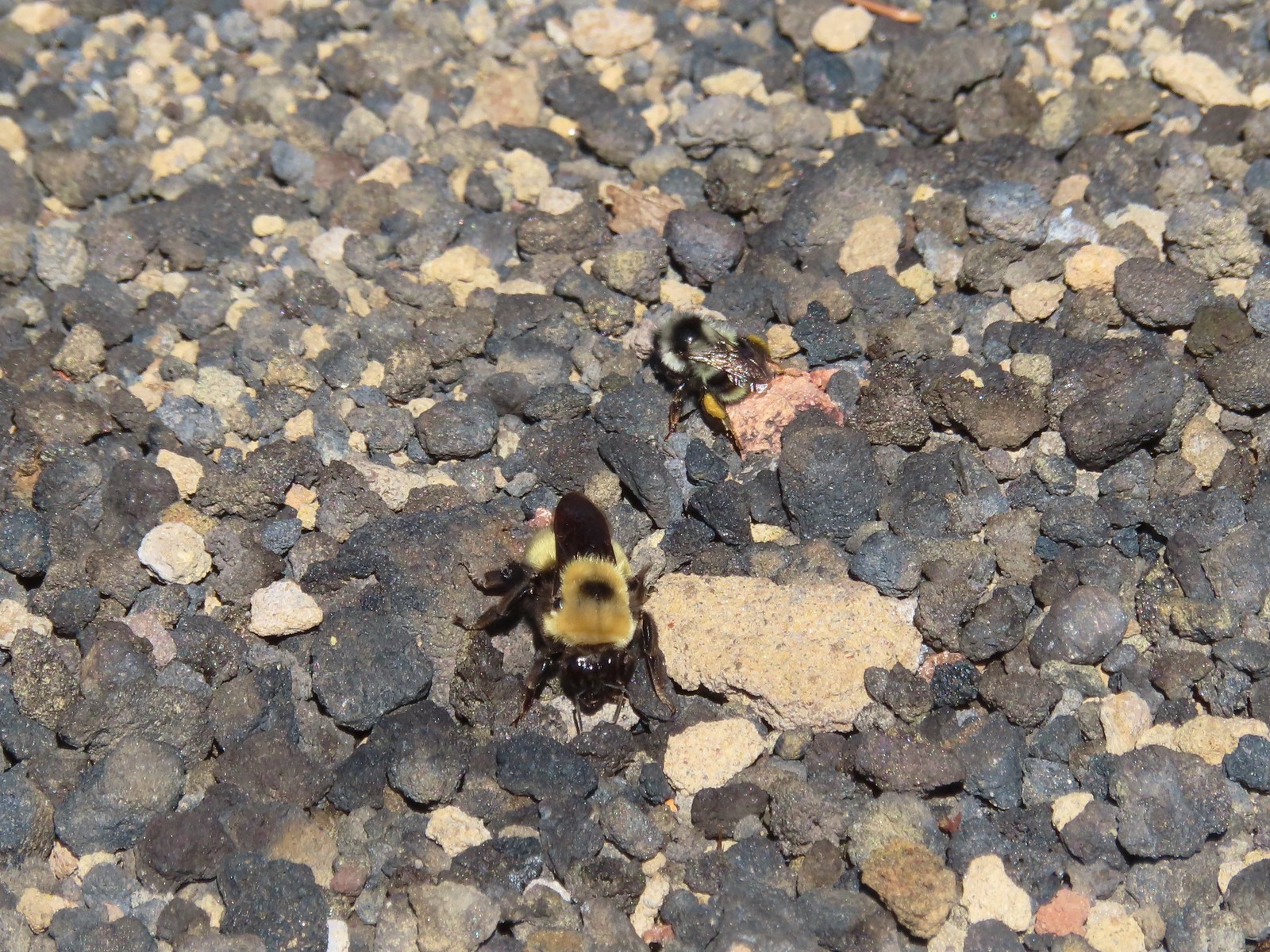 There were quite a few bumblebees at the summit interested in the rocks in this area.
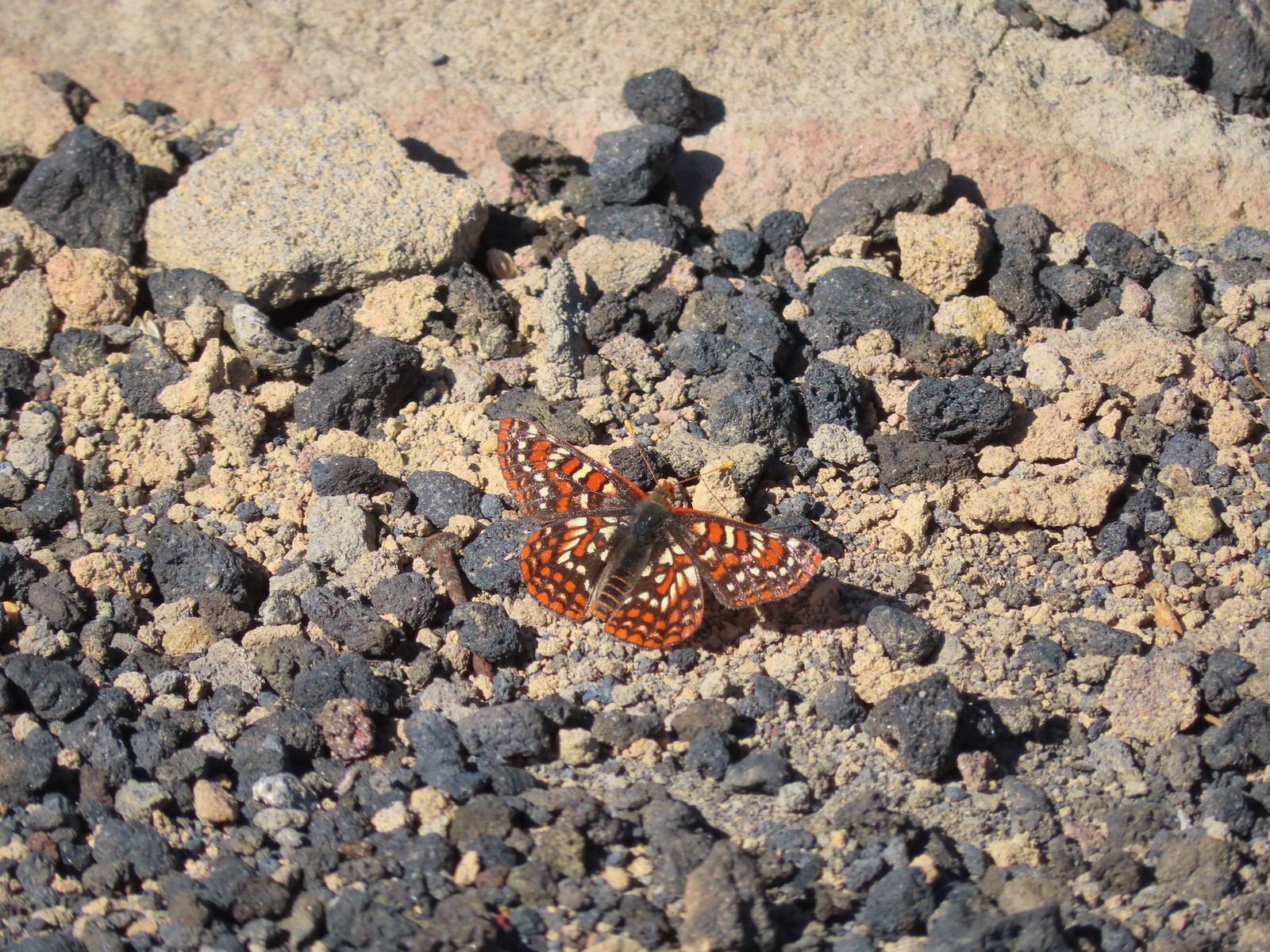 This Edith’s checkerspot joined the bees for a moment.
 Viewpoint below the lookout.
 The lookout from the viewpoint.
 Not sure if this is an aster or a fleabane.
 The trail getting ready to drop down to a saddle. The peaks from right to left are: Browder Ridge, Twin Buttes, Latiwi Mountain, Wildcat Moutain, Tidbits Mountain (
 We were a little surprised to find these broomrape hiding in this silverleaf phacelia.
 Drummond’s anemone
 Look into the crater.
 A couple of penstemon blossoms with the Three Sisters in the background.
 The colors around the crater add to the scenery.
 Pyrola of some sort.
 Starting the steep climb back toward the lookout.
 View from the roadbed. We opted to do as the lookout staffer suggested and follow the road back down toward the parking area instead of back up to the lookout.
 There was one good sized snow drift left encroaching on the road.
 This little cloud wasn’t much of a threat.
 If anything the views had improved now that Sun was more directly overhead.
 A checkerspot
 A hairstreak
 Three Fingered Jack and Hoodoo Butte
 Three Fingered Jack. Note the climbers trail on the slope to the right.
 Ash in the basin below Sand Mountain.
 Pussy paws
 Female western tanager
 Moth
Moth Snake in the trail.
 The snake retreated to a nearby log when we approached.
 Back in the forest.
 This moth blended with the nearby fungus.


 The forecast for Salem was for temps in the mid-90s so we got an early start.
 Bleeding heart and penstemon
 Iris
Iris Cascade lily
 Scouler’s bluebell
 Inside-out flower
 A few green trees remain.
 Another Cascade lily
 The trail was in pretty good shape overall and we could tell there was ongoing trail work. It looked like there were some rock steps that were going be placed in this section.
 Penstemon
 Oregon sunshine
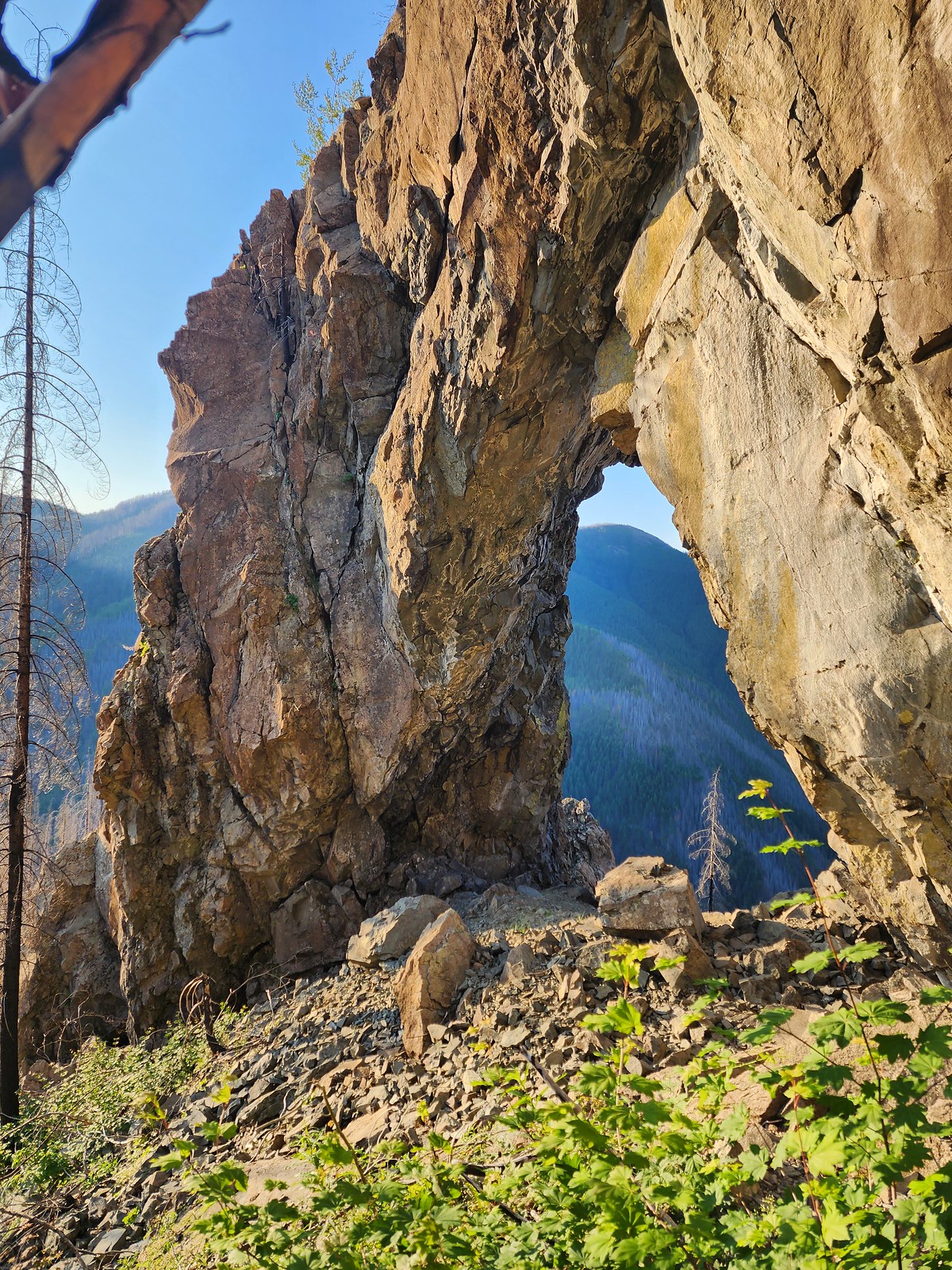
 View from the arch.
 Fin below the arch.




 Snowberry checkerspot
 Rocky Top straight ahead.
 Penstemon and big deer vetch
 Cascade lily
 Oregon sunshine, penstemon, Oregon bedstraw, and a daisy or two.
 Oregon sunshine and paintbrush
 There was a fair amount of shade while the Sun was still low.
 Paintbrush and penstemon
 Thimbleberry
 Bleeding heart. There was more bleeding heart on this hillside than we’d ever seen in one spot.
 Pika below the road.
 Pika
Pika Rhododendron
 The Three Sisters on a hazy morning.
 Anemone
 Paintbrush and lupine
 Beargrass
 A few patches of green below Rocky Top.
 This was probably the worst spot in the road in between the two trailheads.
 Bunchberry
 Trillium with a few petals yet to fall off.
 Violets
 Spirea and valerian

 Large boykinia
 Lots of lupine.
 Larkspur and phacelia
 Arriving at the Rocky Top Trailhead.

 Clodius paranssian
 Columbine
 Beardstongue
 Lupine
 The road from the trail. The taller, rounded, peak in the center is Sardine Mountain (
 Mt. Washington and the Three Sisters.

 Mt. Jefferson, Three Fingered Jack, Mt. Washington and the Three Sisters.
 Mt. Jefferson through the haze.
 Elkhorn Ridge (
 Mt. Hood above ridges of burned forest.
 The loss of the trees did result in better views of the various rock formations in the area.
 We’d never seen so many of these eight-spotted forester moths.
 Hummingbird taking a rest from visiting the penstemon and paintbrush.
 Another moth that had some excellent camo.
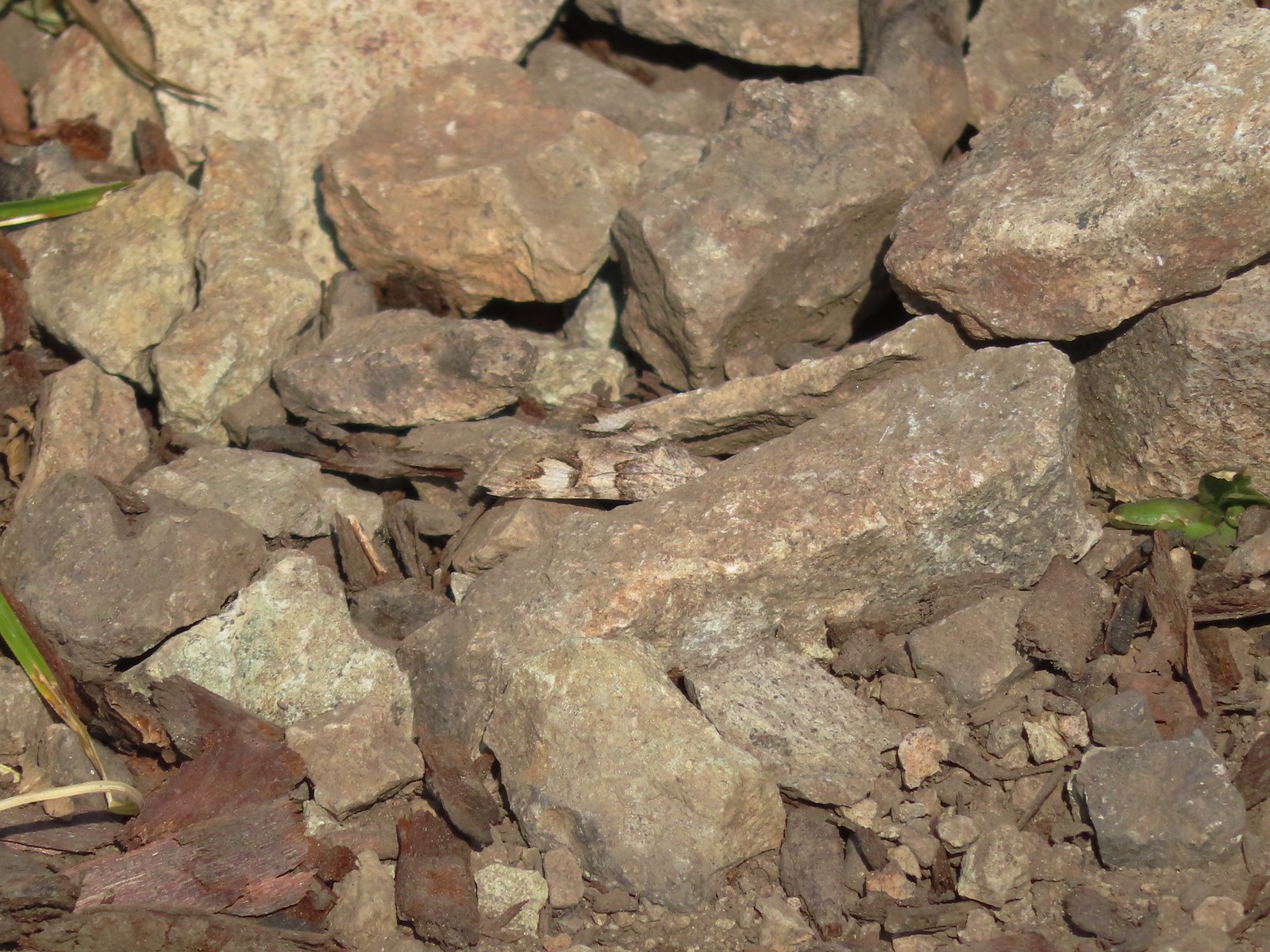 The moth putting its camouflage to use.
 Penstemon
 Rose
Rose
 Rocky Top from the trail.
 This was the only pink colored penstemon we spotted.
 Lupine and beargrass
 Not sure which of the Lycaenidae this is but it was pretty.
 The spirea was popular.
 Bumble bee
 At one point it looked like Three Fingered Jack was sitting on top of Coffin Mountain (
 Nice blue sky overhead.
 Looking North. Henline Mountain (
 Bistort and penstemon
 Haven’t been able to identify this one yet.
 Beargrass
 A snowberry checkerspot and some fried avalanche lilies.
 The trail wound behind Rocky Top to come up the West ridge to the summit.
 Arnica
 Sub-alpine mariposa lily
 Tiger lily and beardstongue
 Catchfly
 Not sure what the story is behind this chair, but we weren’t about to test its stability.
 Detroit Lake
 Mary’s Peak (
 Looking North we could see Table Rock (
 Closer look at Table Rock.
 Henline Mountain, Table Rock, Mt. Hood, in front and just to the right of Mt. Hood is Whetstone Mountain (
 Mountain bluebird checking us out.
 Mt. Jefferson
 Three Fingered Jack behind Coffin Mountain, Maxwell Butte (
 Zerene fritillary
 Beargrass
 Moth and a checkerspot
 A bee, a moth, and a butterfly land on some flowers…
 Painted lady
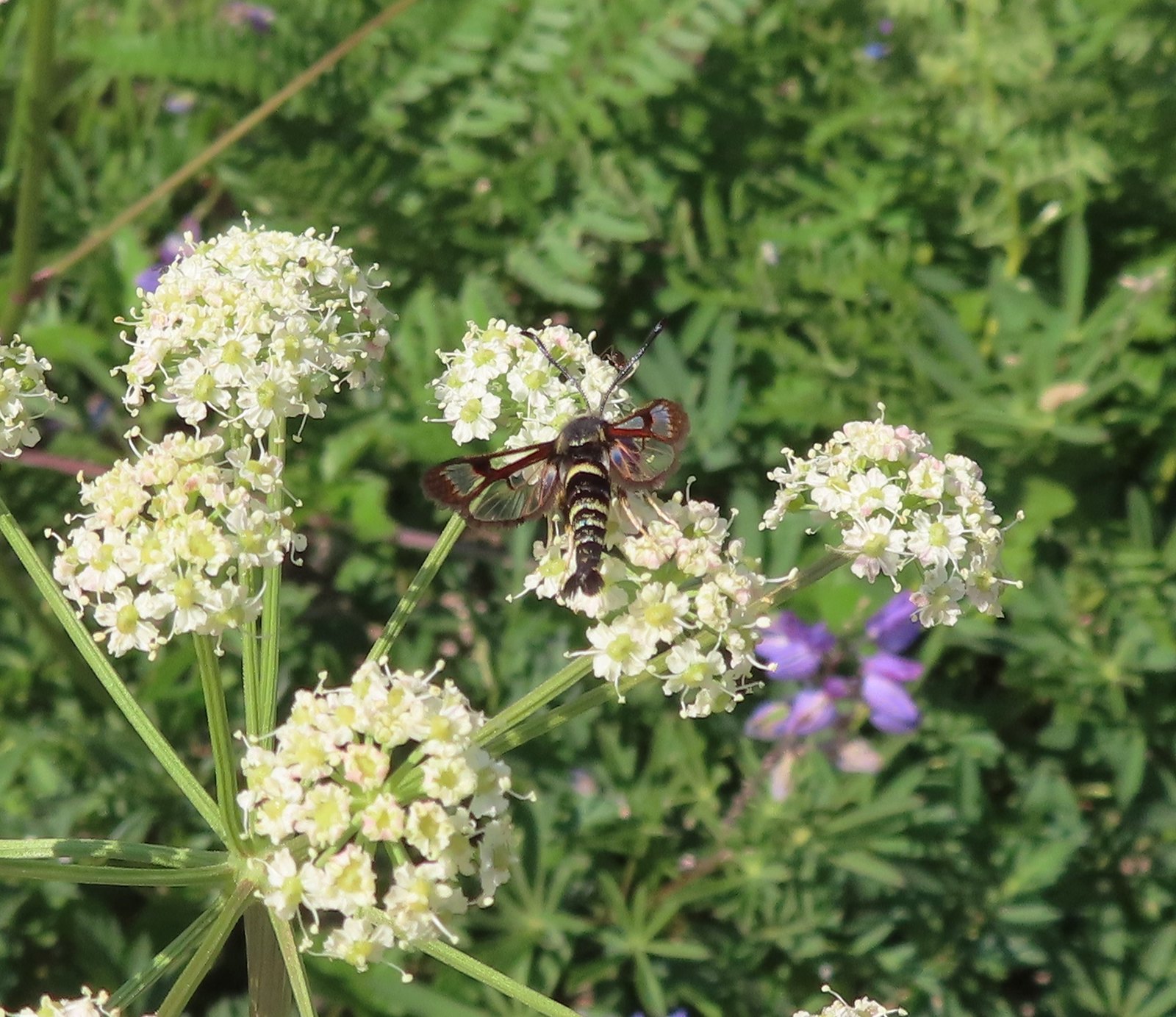 Fireweed Clearwing Moth (Albuna pyramidalis).
 A fritillary and a copper.
 Two coppers and a bee.
 Checkerspots, a bee, a copper and part of an eight-spotted forester moth.
 Eight-spotted forester moth.
 The previous four photos were all from this group of Oregon sunshine.
 Bleeding heart, no butterfly but a nice group of blossoms.
 More moths and butterflies.
 Swallowtail on penstemon
 One of the blues I think, but not sure which.
 Lorquin’s admiral


 Sparrow
 Stellar’s jay
 The spur trail is to the right just ahead.
 We watched a norther flicker fly into the snag ahead and it took a minute to figure out where he was.
 The flicker
 Trailing blackberries. We might have found a few ripe ones.
 Arriving at the camping area.
 North Santaim River
 Oregon grape
 Mock orange
 The boat launch.
 North Santiam River
 The park host on the left and the parking lot on the right.
 Crosswalk for the pre-fire loop.
 Looking North from the crosswalk there was zero sign of the former trail.
 They had at least restored this short section of the loop so we were able to return to the spur trail and turn right then right again to complete the inner loop.
 The “To River” sign at the spur trail junction.
 Possibly a western wood pee-wee
 Spotted towhee
 Osprey
 The park host from the trail.


 While the loop did come in at 2.5-miles it was a little over 3/4 of a mile to the Boundary Trail.
 Lupine
 One of several ponds along the trail.
 A “Student Stop” marker surrounded by dwarf lupine. We aren’t sure what the these meant or what program they are related to.
 An interpretive sign along the trail facing some of the hummocks.
 Penstemon
 Mt. St. Helens as we neared the Boundary Trail junction.
 Trail guide marker #3 and an interpretive sign at the junction.
 The lower left map shows the current closure area and open trails. In a nutshell, all the trails are open but everything off-trail to the side facing SR504 is currently closed.
 The views of Mt. St. Helens were great.
 The trail began to climb as it squeezed between a gap in the hillsides ahead.
 View back to the hummocks from the gap.
 Trees in the gap.
 After exiting the gap we got another good view of the mountain before the trail veered left turning away from the mountain.
 Heading away from Mt. St. Helens to start the climb.
 Dwarf lupine was profuse below the ridge.
 Scouler’s bluebell
 Thimbleberry blossoms
 Castle Peak above Castle Lake with Spud Mountain to the right and the North Fork Toutle River below.
 Horned lark
 Tiger lily
 Savannah sparrow
 Heading back toward Mt. St. Helens.
 The North Fork Toutle River flowing between Spud Mountain (left) and Elk Rock (right).
 Castle Peak and Castle Lake
 Elk Rock on the left and Coldwater Lake on the right.
 Coldwater Lake
 Mountain bluebird.
 At one point quite a bit of dust? kicked up from the South Fork Toutle River canyon.
 Cardwell’s penstemon

 Coldwater Peak with Mt. Adams to the far right of the photo. The hiker ahead to the left of Coldwater Peak was from Belgium. He was here on work but using the weekends to explore the area. We would see him two more times, once from the observatory as he continued on the Boundary Trail and then as we were exiting the trailhead. He had done a loop using the Coldwater Trail (
 Mt. Adams from the viewpoint on our way back. The angle of the Sun earlier caused the mountain to look pretty washed out.
 Mt. St. Helens from the viewpoint.
 Variable-leaf collomia
 The Loowit Viewpoint on the ridge ahead.
 Paintbrush covered hillside.
 Mt. St. Helens from the Loowit Viewpoint.
 Mt. St. Helens crater.
 Golden mantled-ground squirrel. These brazen con-artists often convince visitors they would starve without humans help. While this is definitely not the case and
  A single plant.
 A lot of paintbrush.

 Daisies and paintbrush
 Penstemon, yarrow, and Scouler’s woolyweed along with the paintbrush.
 Paintbrush and penstemon along the trail.

 Passing by the Johnston Ridge Observatory.
 Before and after photos of the 1980 eruption.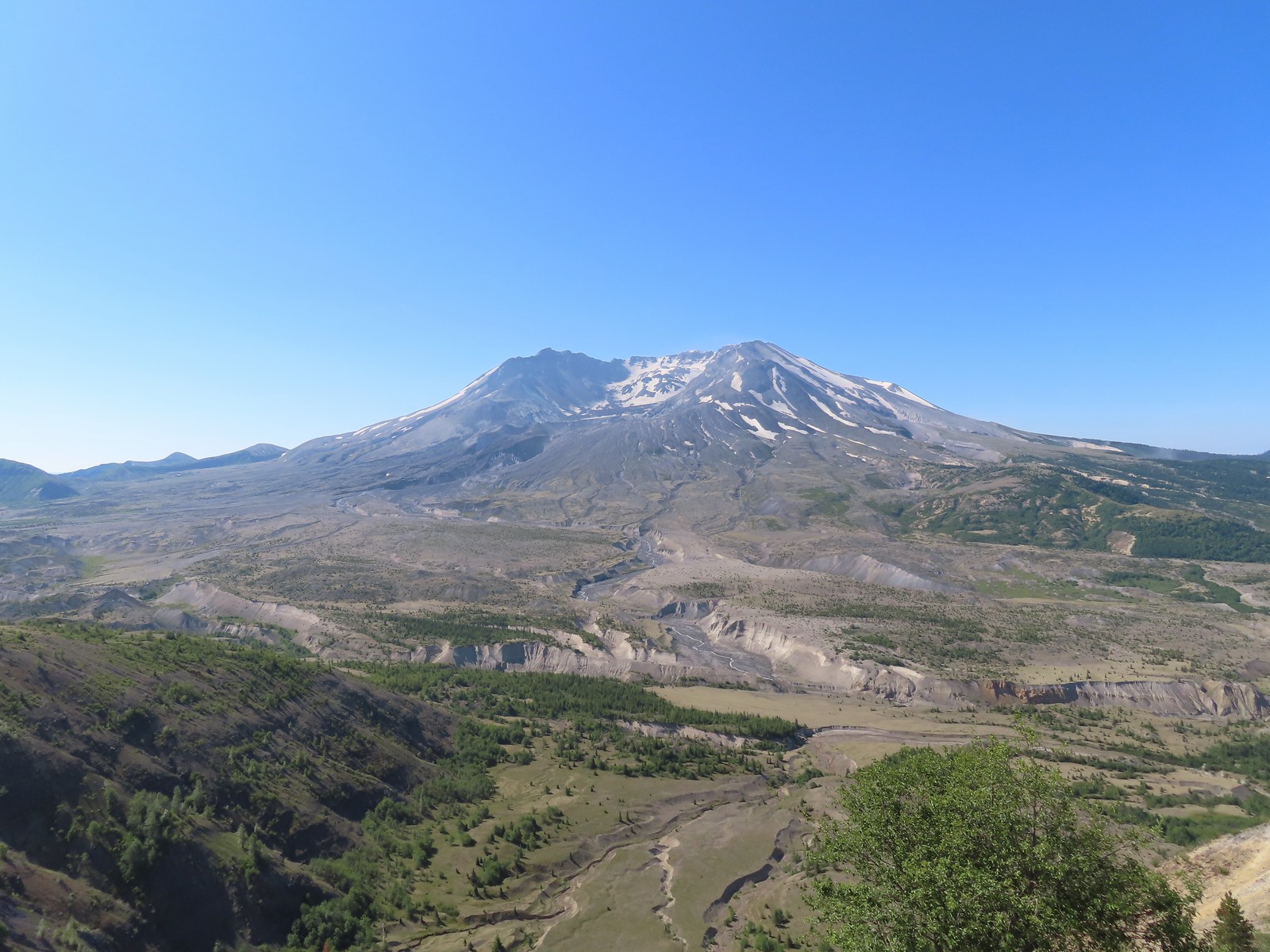

 Mt. Adams peaking over the ridges with Spirit Lake also visible (center).
 Spirit Lake
 The mountain identifier ahead on the left.
 We could see where the repair work was happening on SR504 from this trail.
 The rounded peak to the right is Goat Mountain (
 Goat Mountain with a few patches of snow still showing up.
 Rock Arch near Coldwater Peak.
 Memorial for the lives lost in the 1980 eruption.
 Junction with the Boundary Trail.
 Pussypaws


 Another view of the washout.

 Our turn around spot. You can see the trail on far side of the saddle veering left behind the ridge.
 Coldwater Peak from our turnaround spot.
 The Johnston Ridge Observatory from the trail. We hadn’t realized how much elevation we’d lost until we turned around.
 Castle Peak and Spud Mountain on the left and the observatory above some colorful cliffs.
 Penstemon
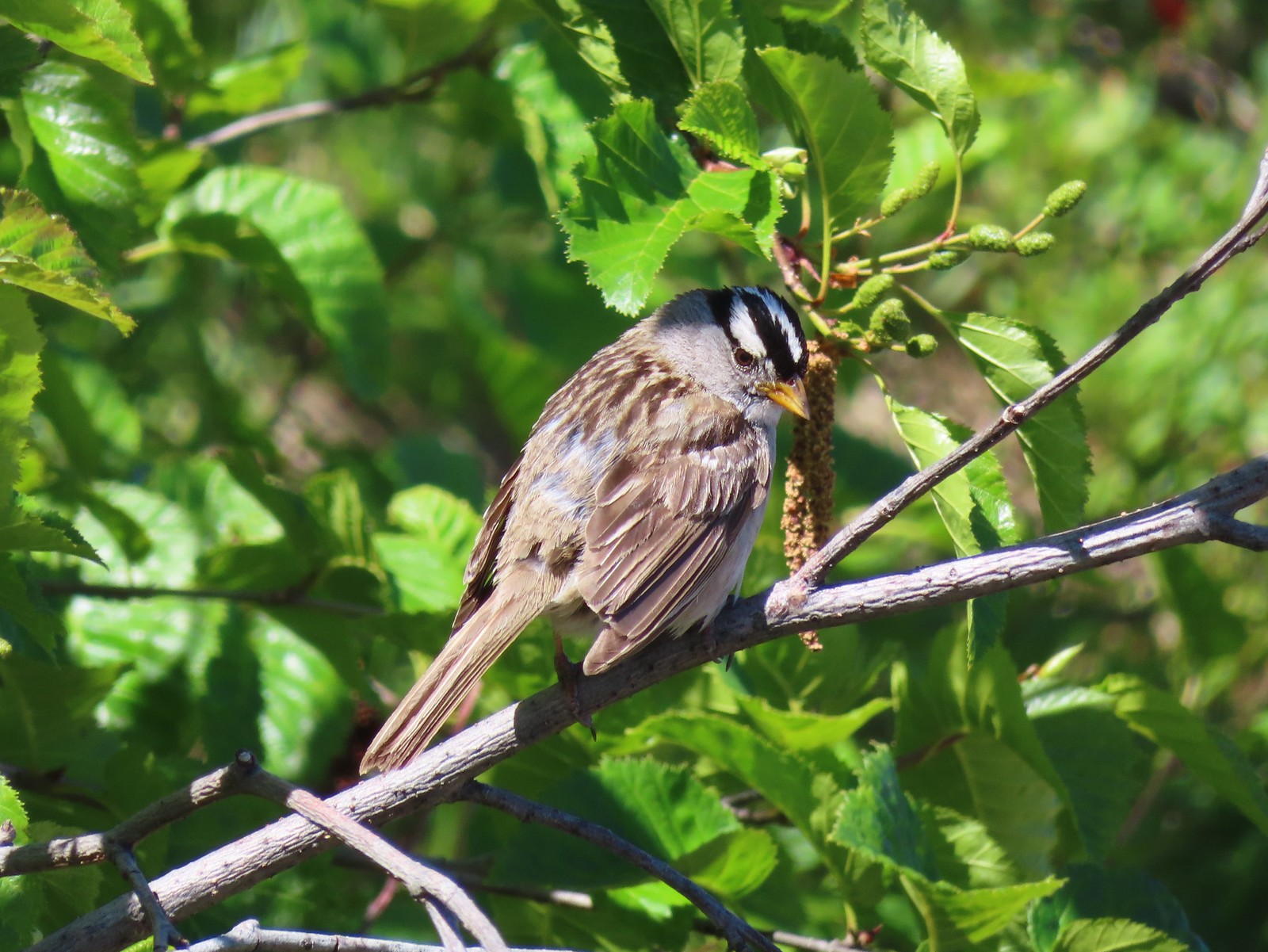 White crowned sparrow
 Boundary Trail leaving the Loowit Viewpoint.
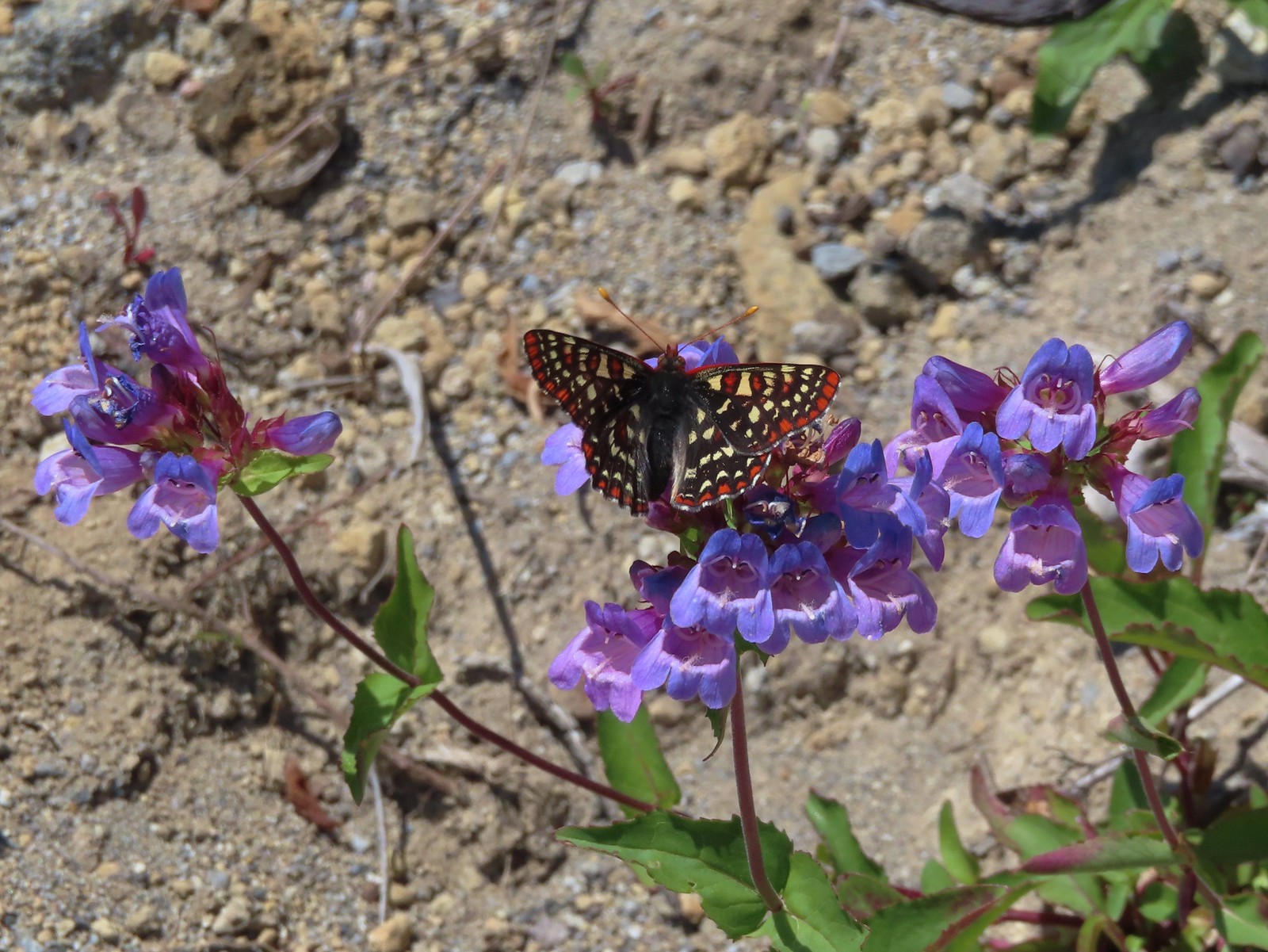 Snowberry checkerspot on penstemon.
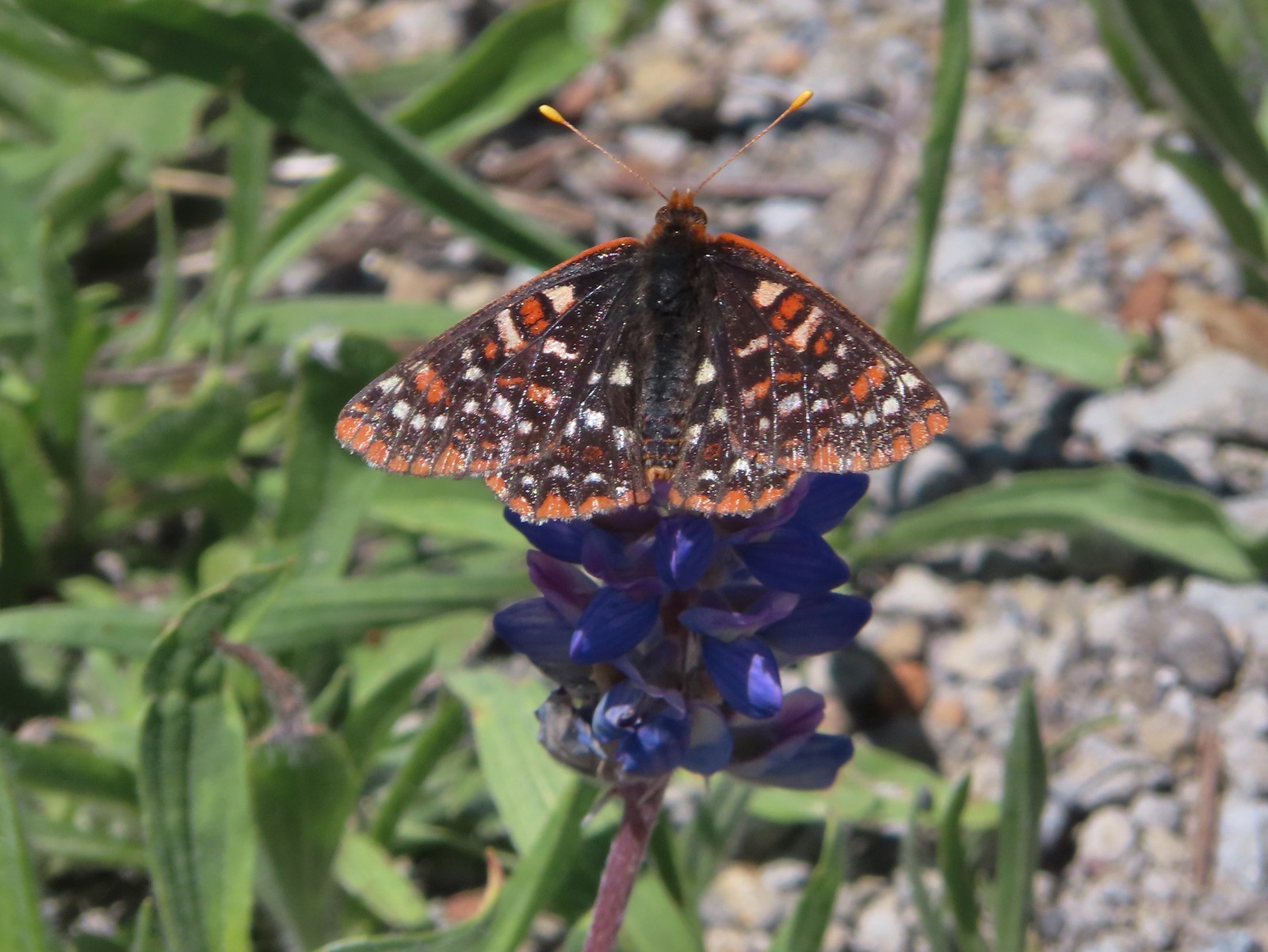 Another checkerspot, this time on lupine.
 Cedar waxwings


 Mt. St. Helens and the North Fork Toutle River.
 The same view in May 2014.
 Same spot, different angle 2014.
 Monkeyflower
 Maybe a yellow-rumped warbler.
 Caterpillar
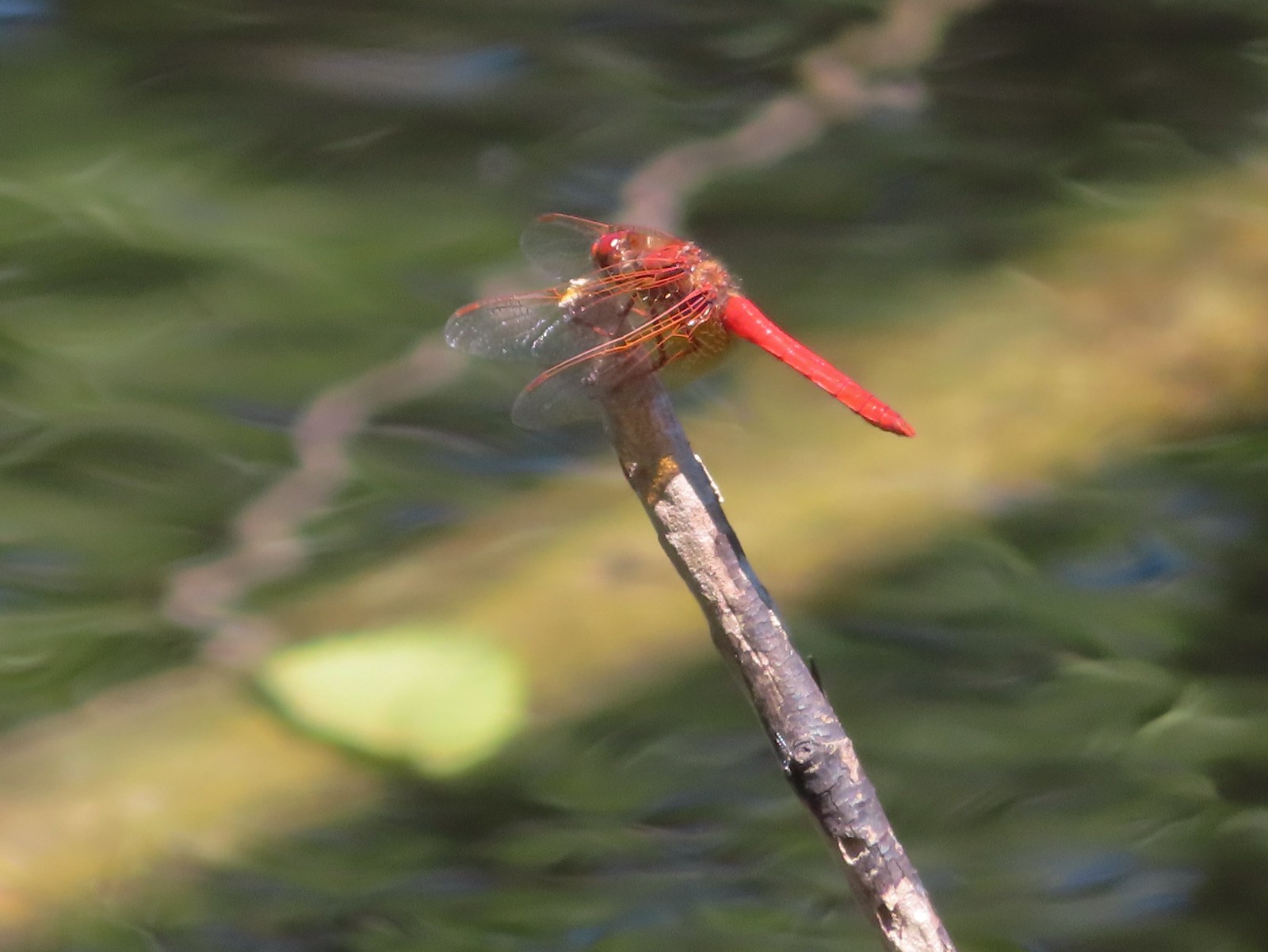 Dragonfly
 Pearly everlasting
 Arriving back at the Hummocks Trailhead.


 Fireweed


 Deadline Falls
 Signs of ongoing trail work.
 Northern phlox
 Remains of a footbridge lost to the Archie Creek Fire.
 The current creek crossing. We joked that this was a prime difference between the BLM and Forest Service. It feels like the Forest Service waits until everything has been repaired (plus a year or two) before reopening trails after a fire while the BLM reopens them once they are passable.
 Self-heal
 The trailing blackberries were ripening along the trail providing us with a nice second breakfast.
 North Umpqua River from the trail.
 We also spotted a few ripe blackcap raspberries.
 Bleeding heart
 Crab spider on a California harebell.
 Heather was really excited to find ripe thimbleberries too.
 Highway 138 on the far side of the river.

 Musk monkeyflower
 I managed to pull a ripe salmonberry out of this bush below Fern Falls.
 Moth
Moth Lazuli bunting
 Black-headed grosbeak
 Unidentified small bird.
 Wren, possibly a house wren.
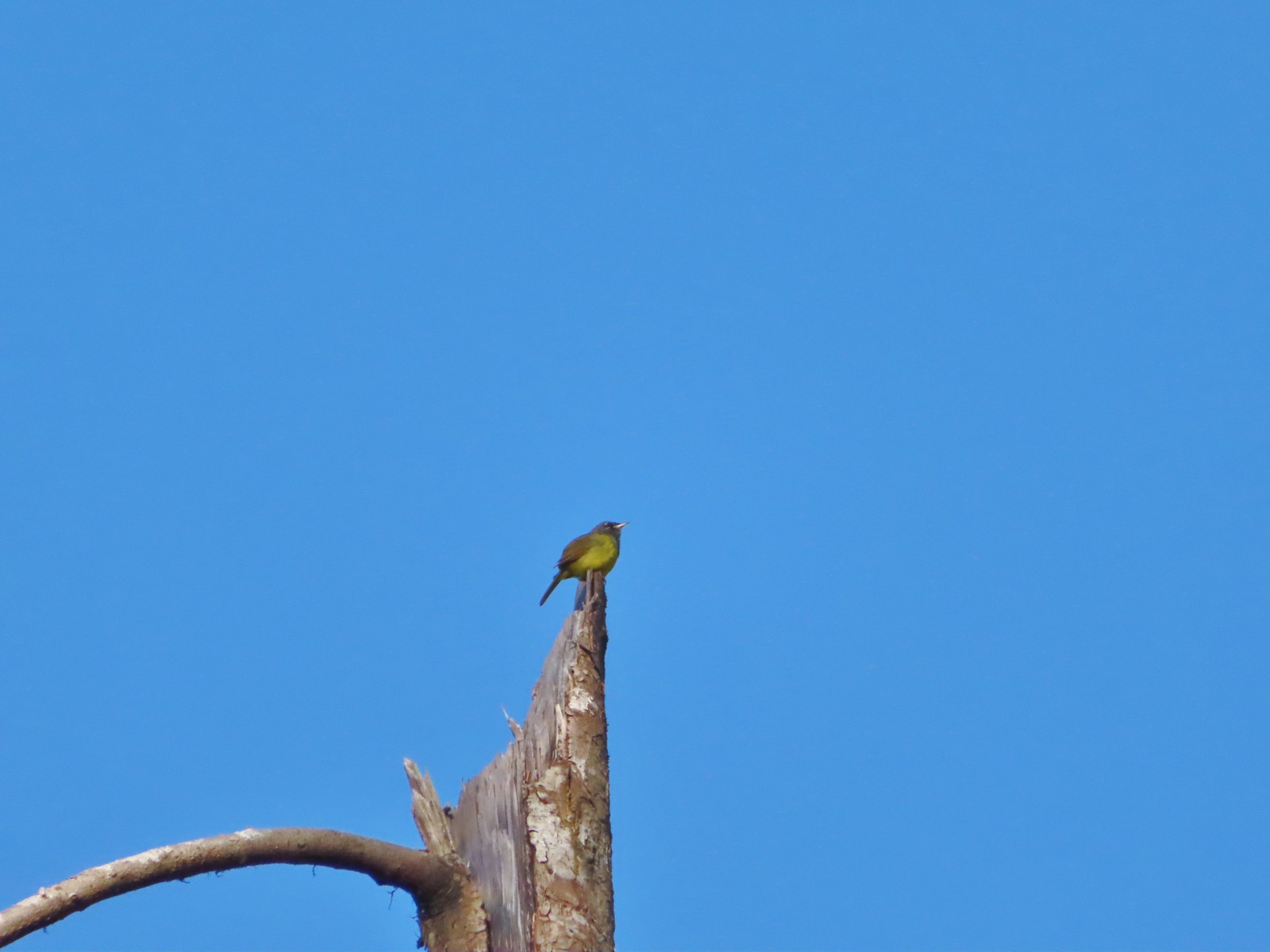 This little one was way up atop a snag. Merlin suggests it’s a Macgillivray’s warbler.
 Woodpecker
 Backside of a Stellar’s jay.
 Raven
Raven


 Checker-mallow
 Turkey vulture
 We spotted a deer way up on the hillside in the distance.
 Heading down to Soggy Bottom.
 Middle Barn
 Soggy Bottom
 Bindweed
 The North Gate Trail ahead on the left.
 North Gate Trail
 Elegant brodiaea
 Common wood nymph

 The cedar grove.
 A little past the cedar grove we passed an old structure on the opposite side of a barbed wire fence.
 On the far side of the structure was a sign for the Wrong Way Trail which looked as though it saw little to no use. The map at the trailhead showed this trail dead-ending in the forest which might explain why.
 View from the North Gate Trail.
 Steepest section of the trail but at least there was some shade here.
 Gopher snake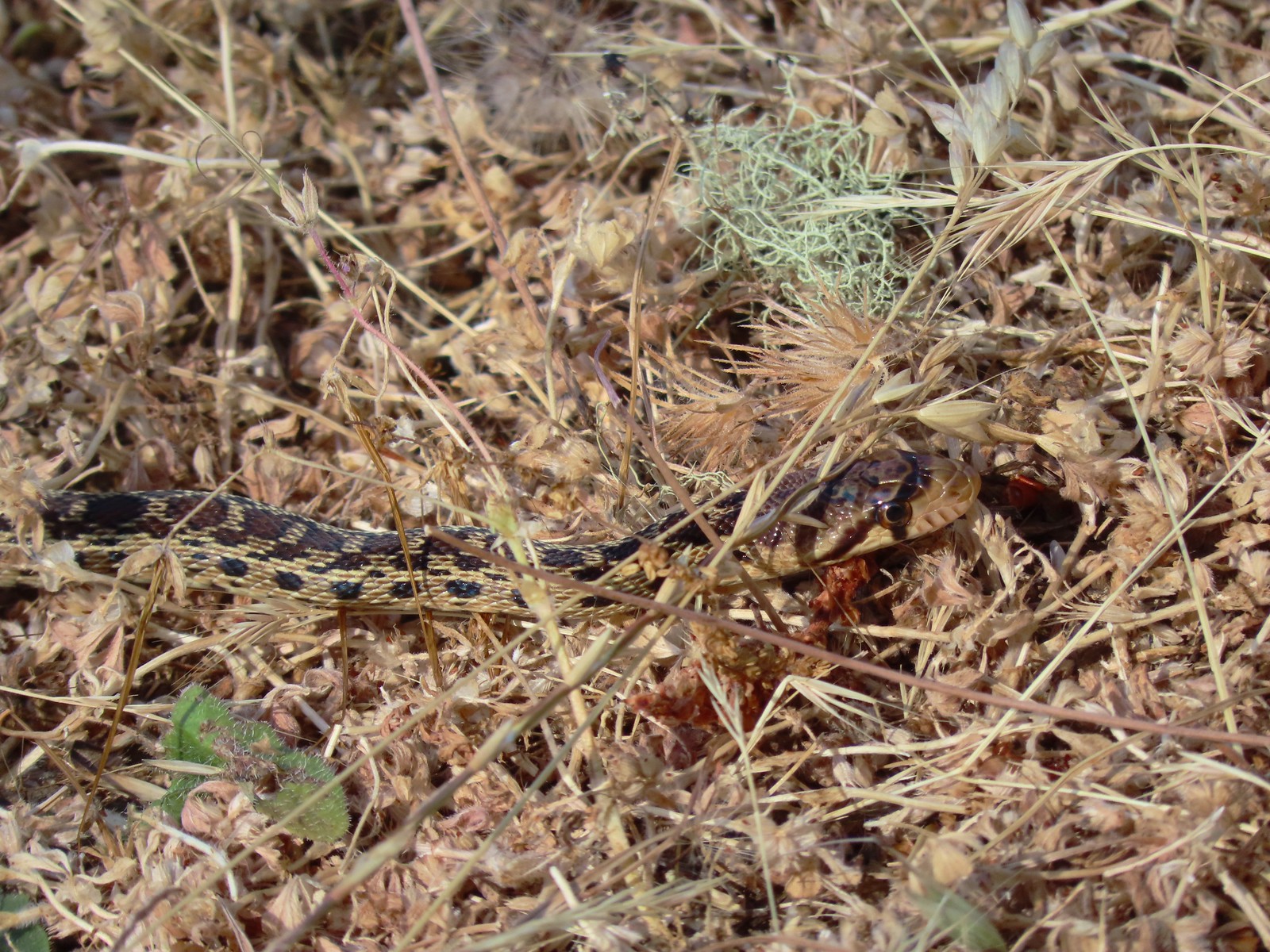
 Trail sign at the saddle.
 The Middle Ridge Trail.
 View from the Middle Ridge Trail.
 View from the saddle.
 A dip along the ridge.
 First view of the North Umpqua River.
 Hawk on a tree.
 A different hawk in flight.
 Elegant brodiaea
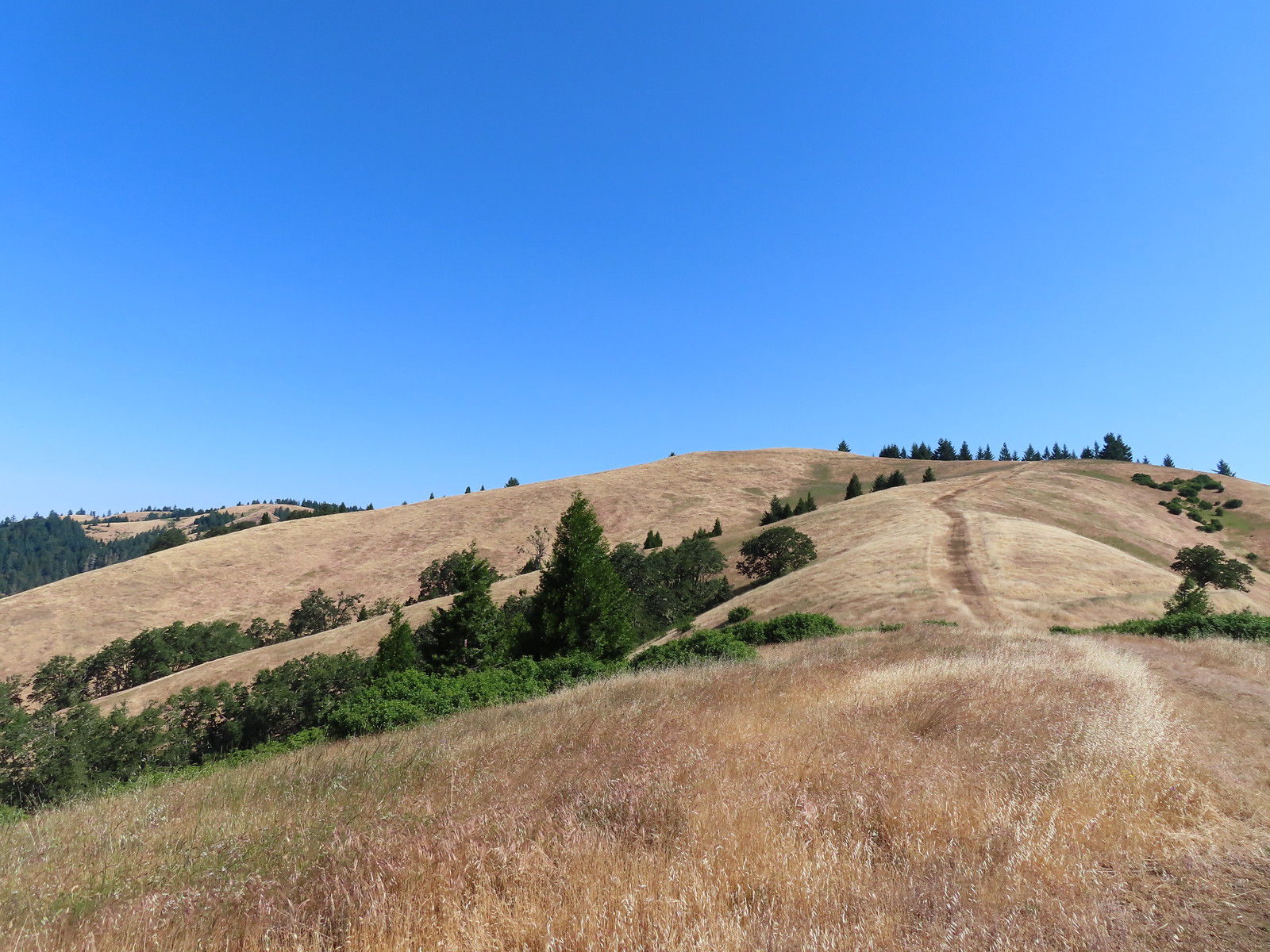 Looking back along the Middle Ridge Trail.
 We remembered this structure in the ground.

 Approaching the junction.
 View back up along the trail.
 Whistlers Bend Reservoir and the North Umpqua River. Despite a bit of haze the view was far better than it had been in 2015.
 The 2015 view on a cloudy June 5th.

 Ookow
Ookow View from the Thistle Ridge Trail. Below is the lower portion of the trail which seemed to be quite a way down.
 When you can’t see the bottom of the hill you know it’s steep.
 The trail finally leveled out a bit through a stand of oak trees.
 The junction below from the Thistle Ridge Trail.
 European centaury (invasive but pretty)
 West Barn
 The West Barn Road was a little muddy in spots.
 Daisies were profuse in some areas.
 We ignored the Deer Hollow Tie Trail that joined on the right.
 The Comstock Day Use Area from the West Barn Road.
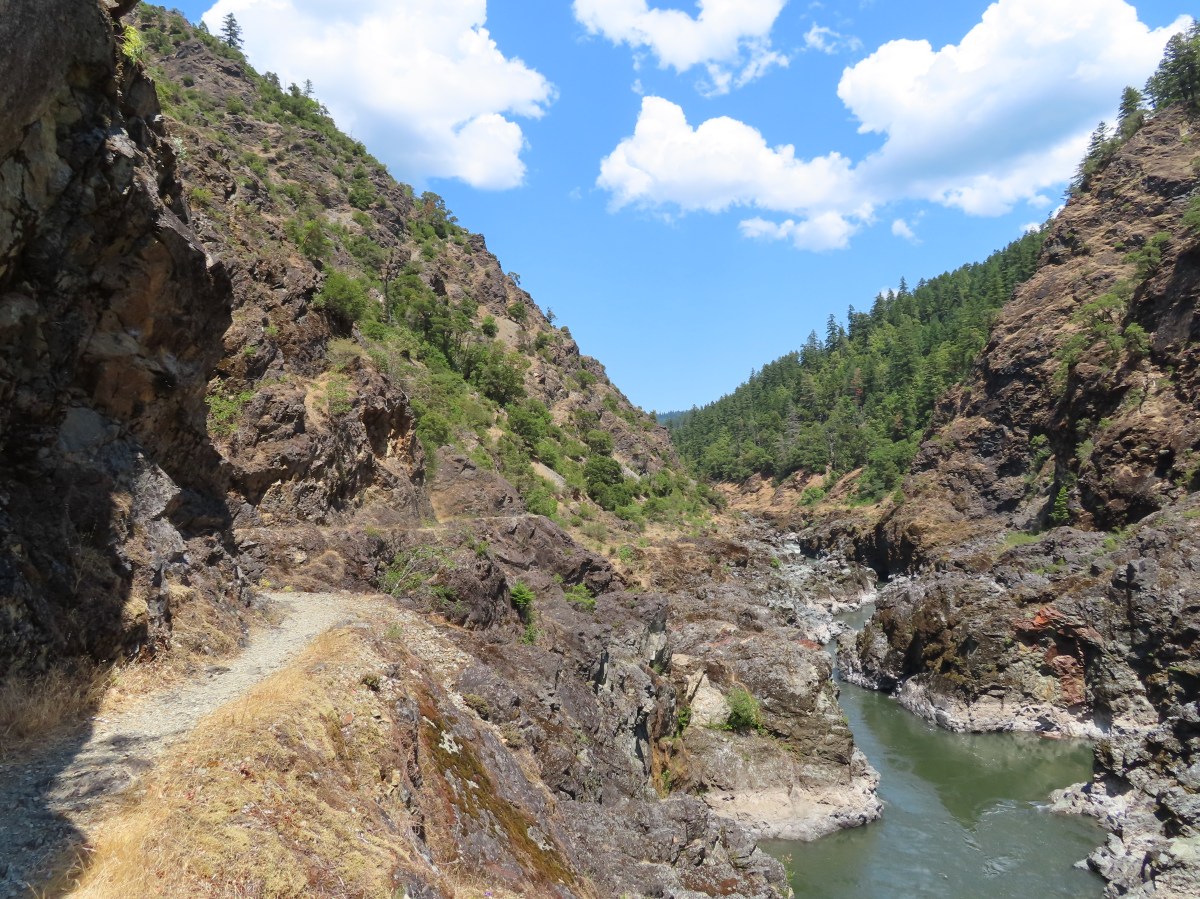
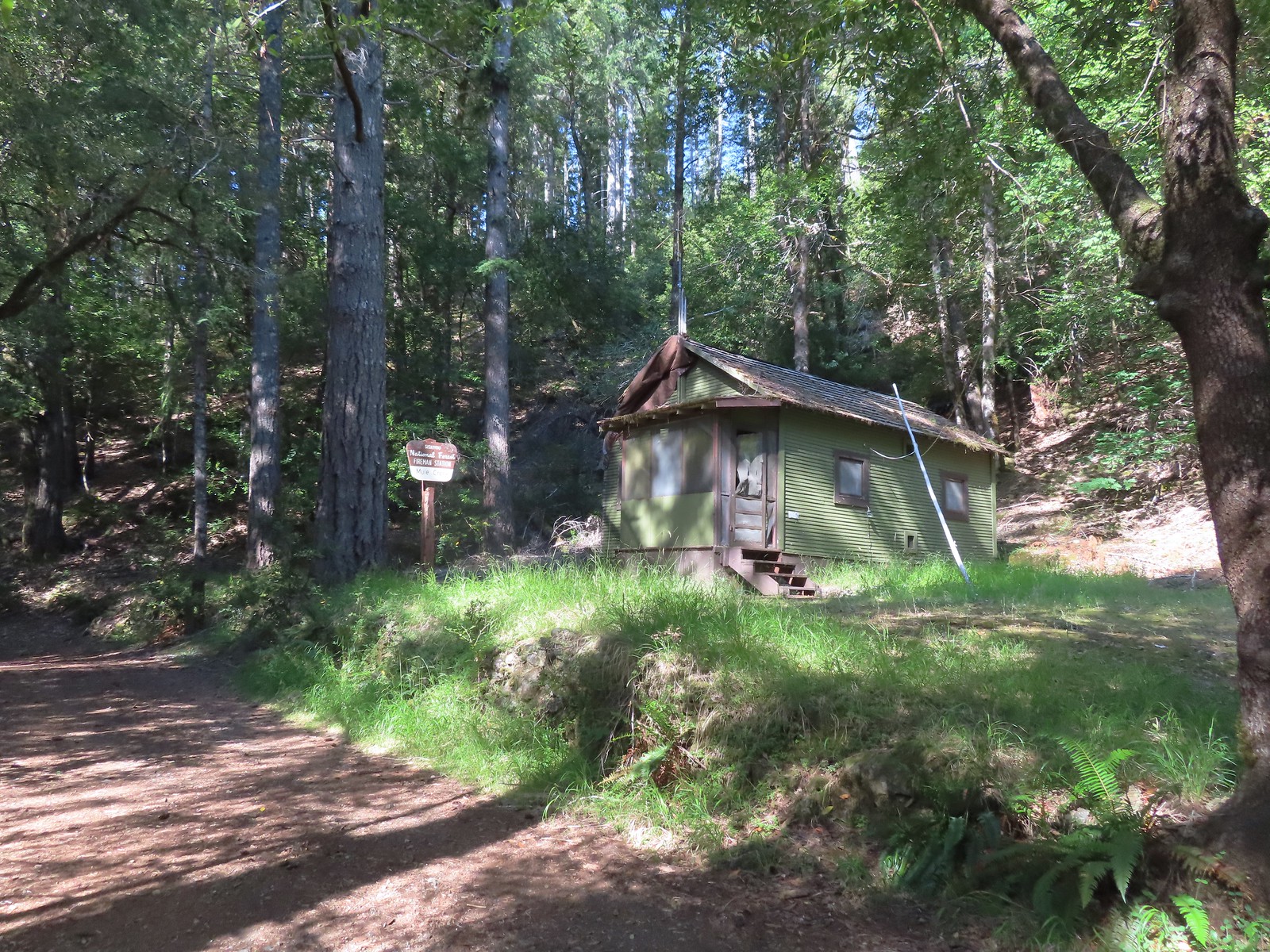
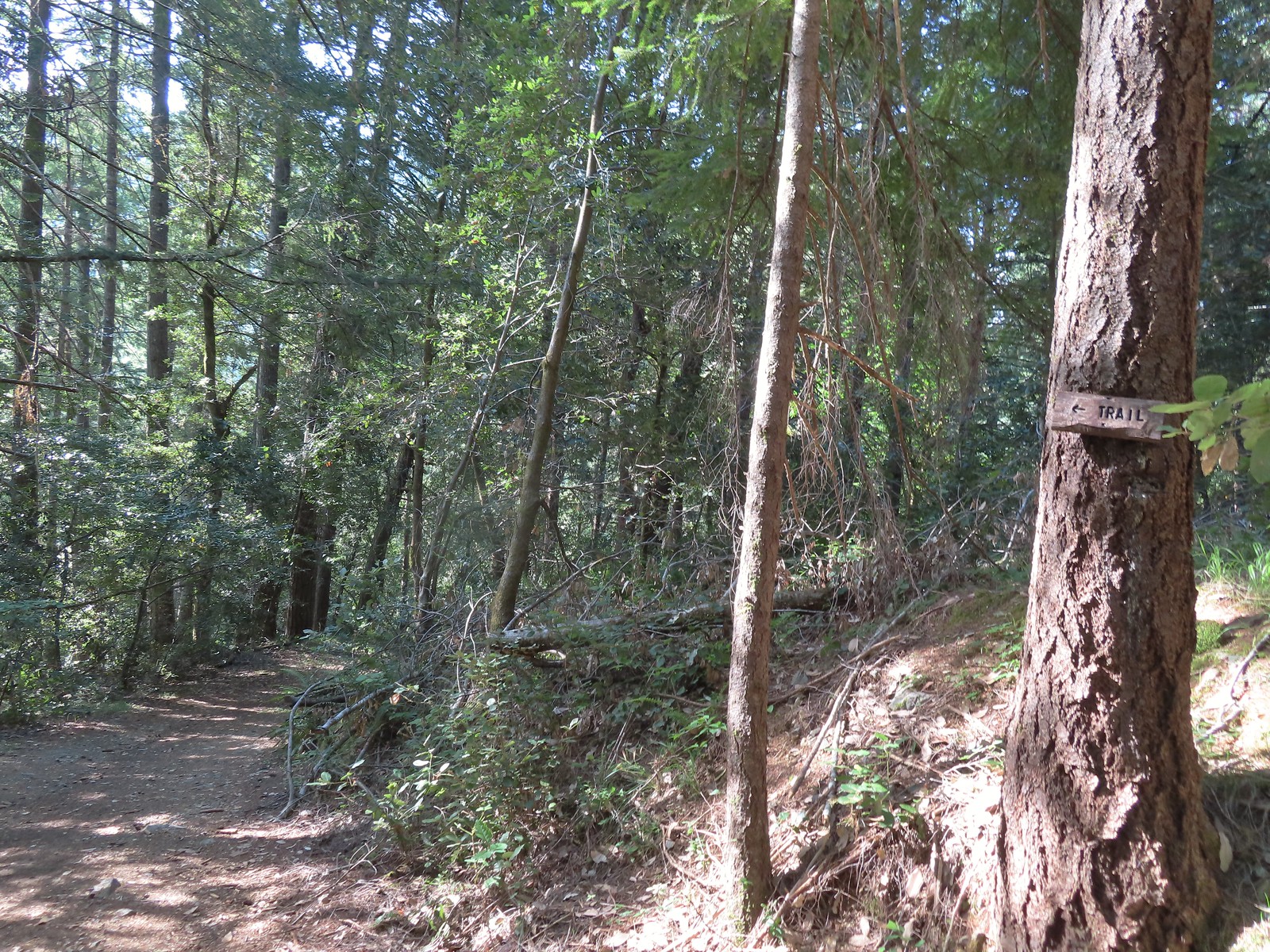 There were trail pointers at spur roads to ensure we stayed on the right one.
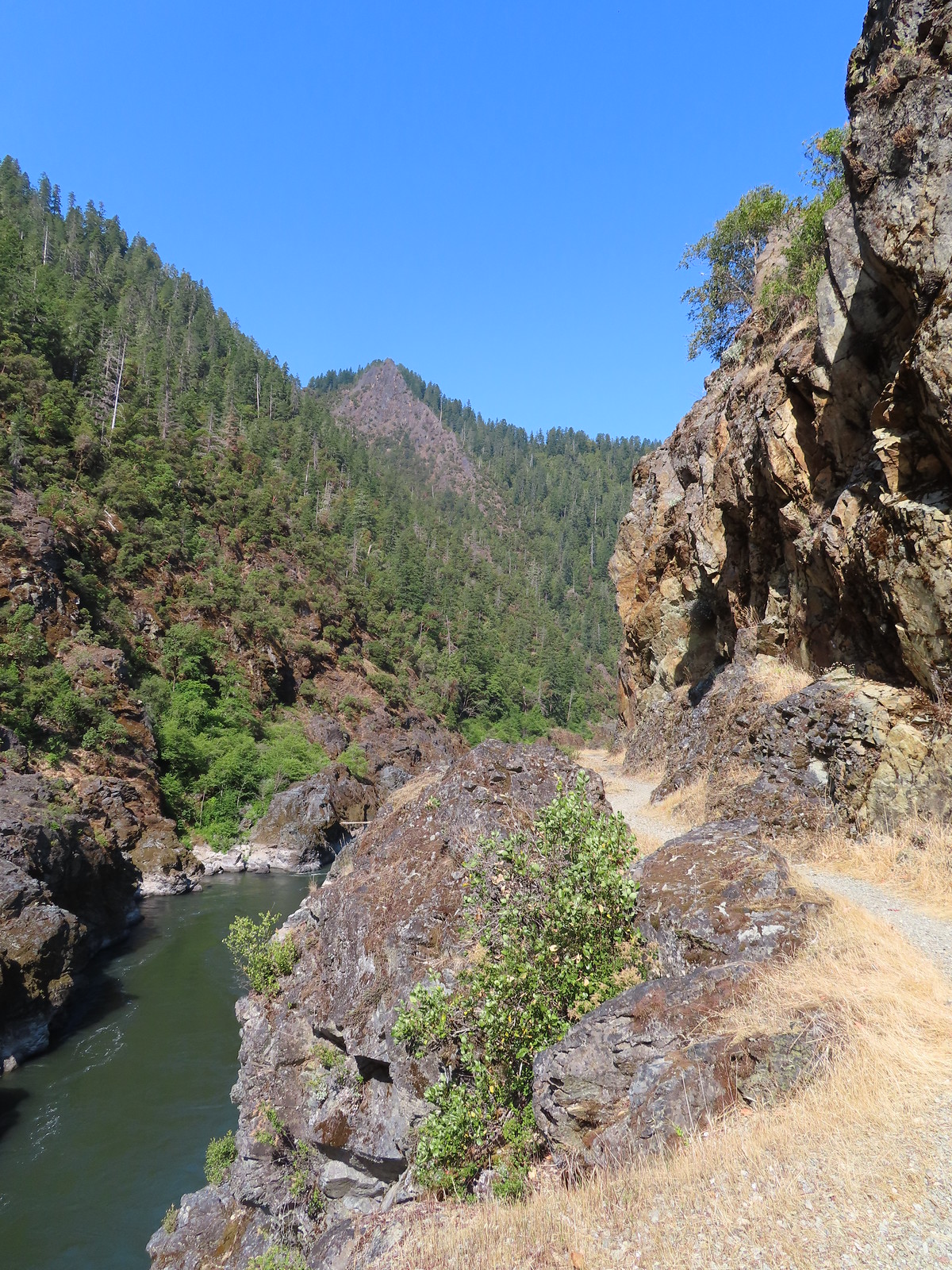
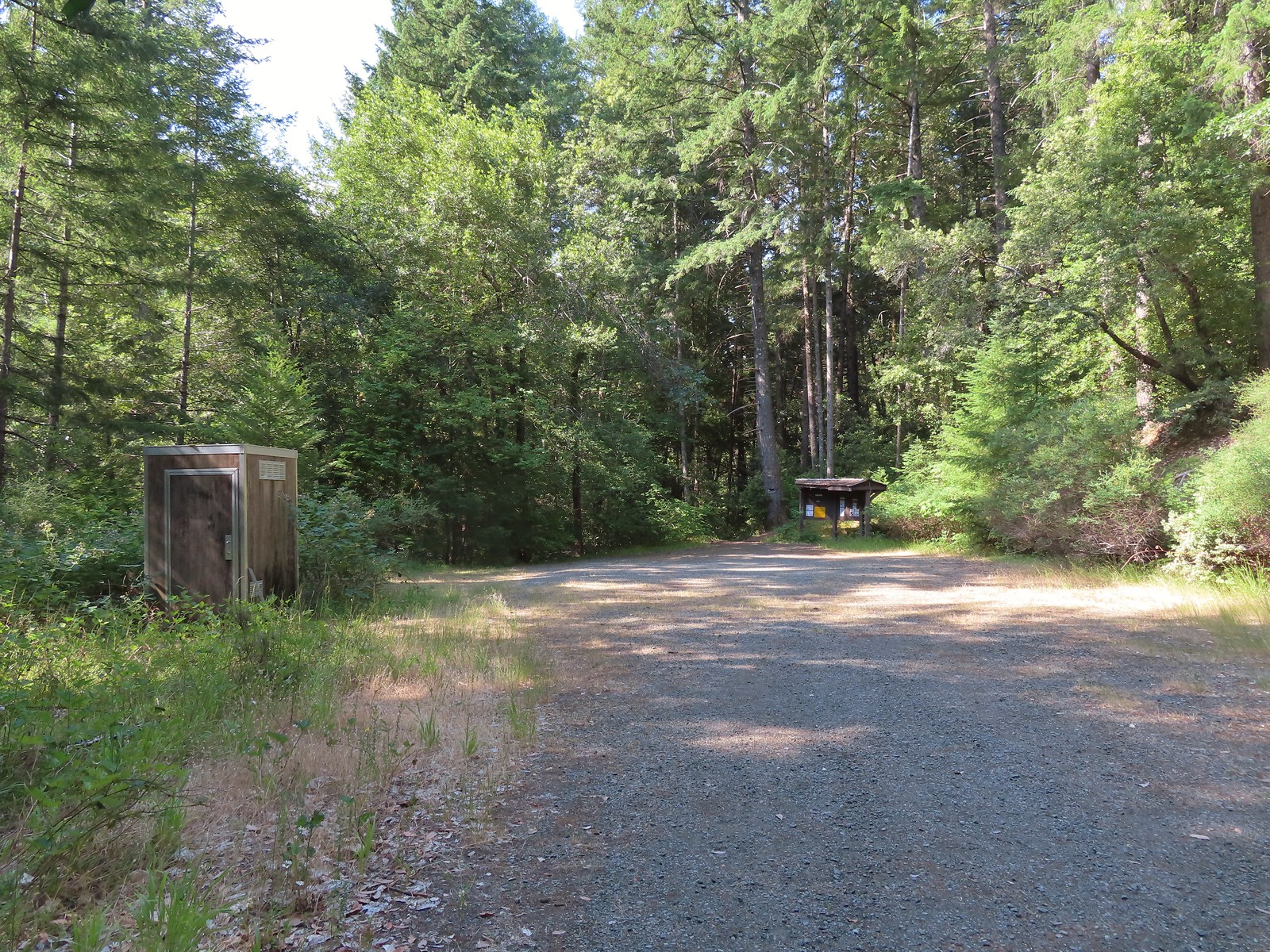 The trailhead near Marial. I couldn’t find any directions online for this trailhead which is why we used a combination of the BLM’s directions to the ranch and Sullivan’s to the trailhead.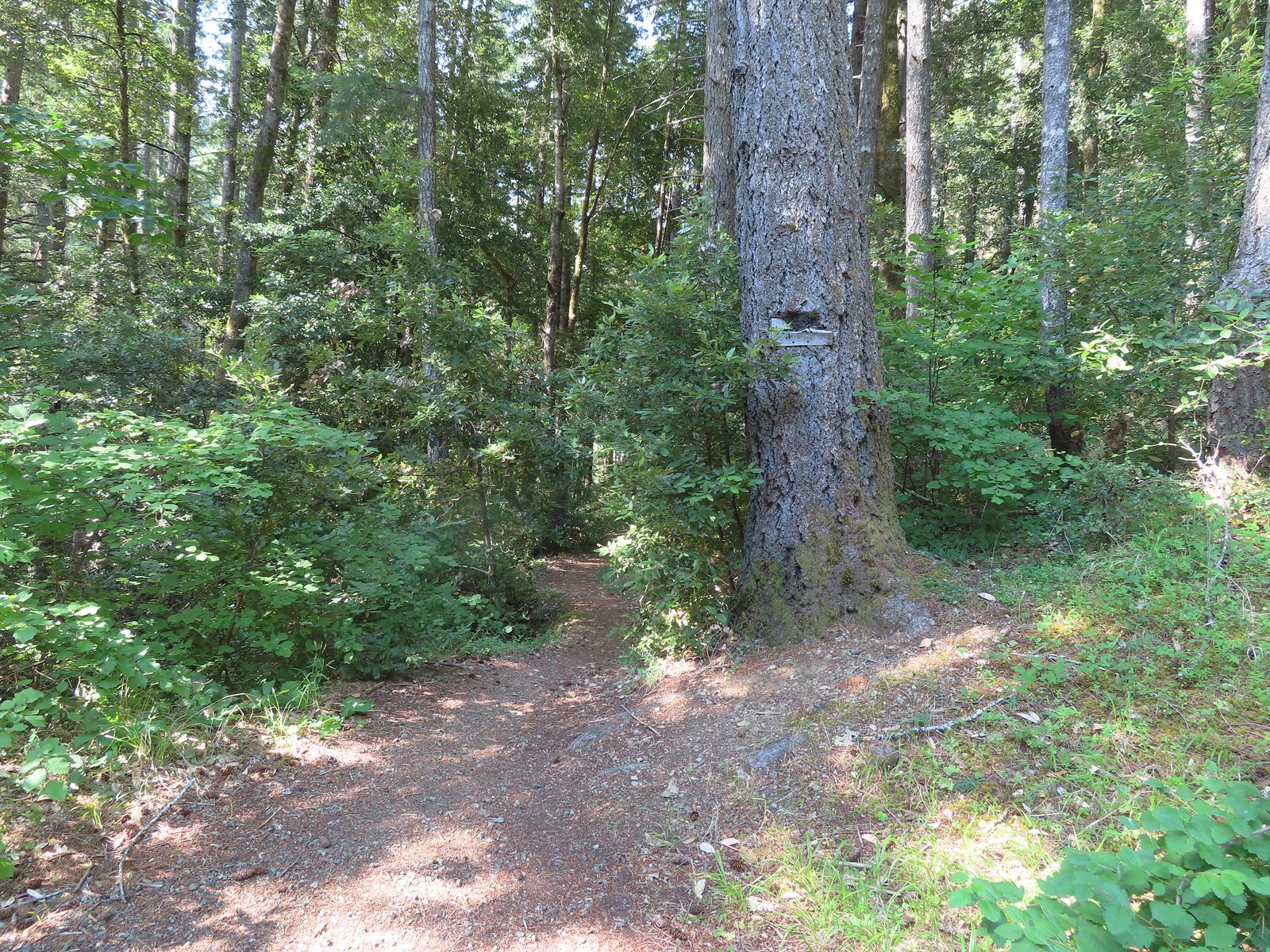

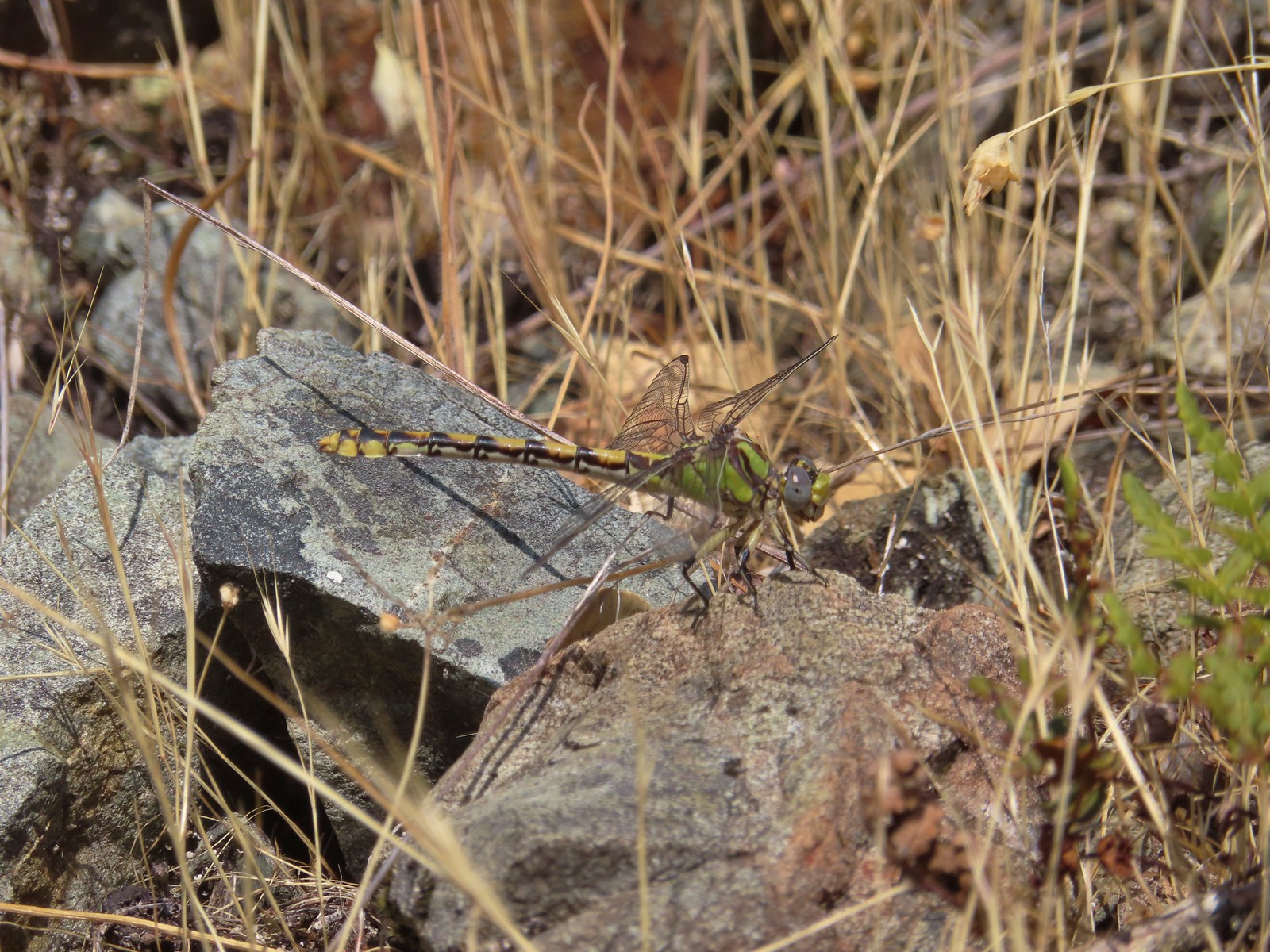 Dragonfly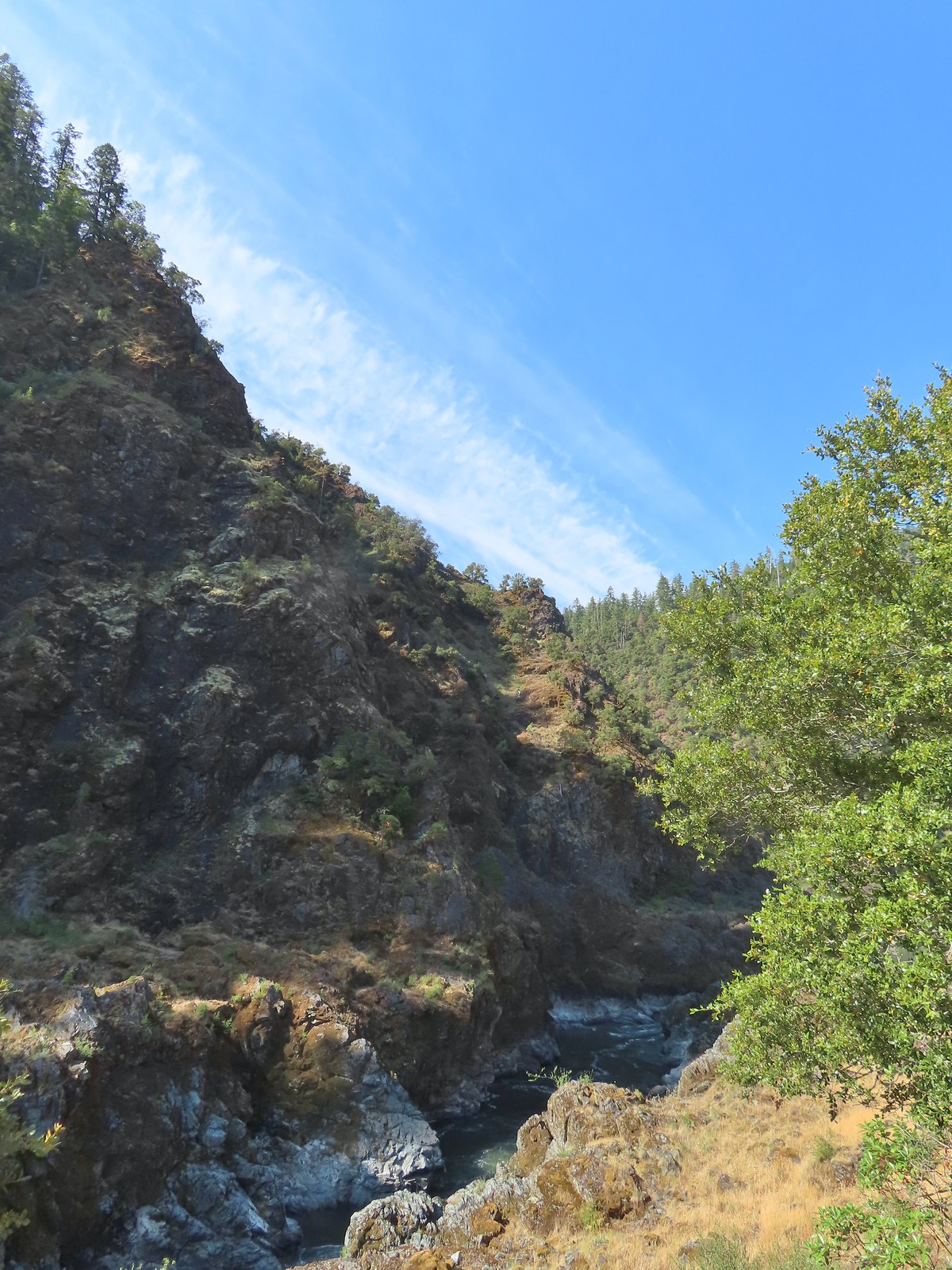
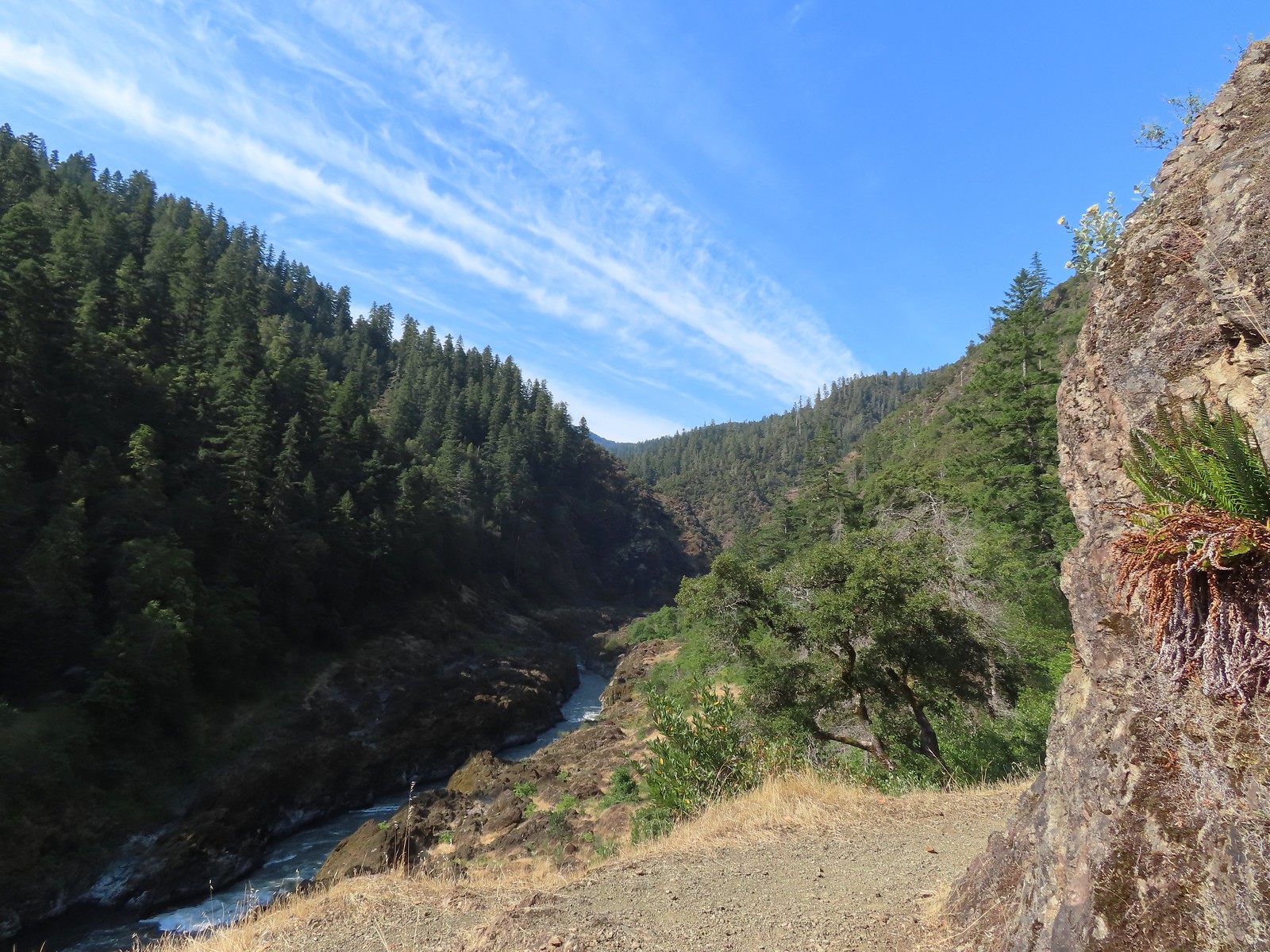
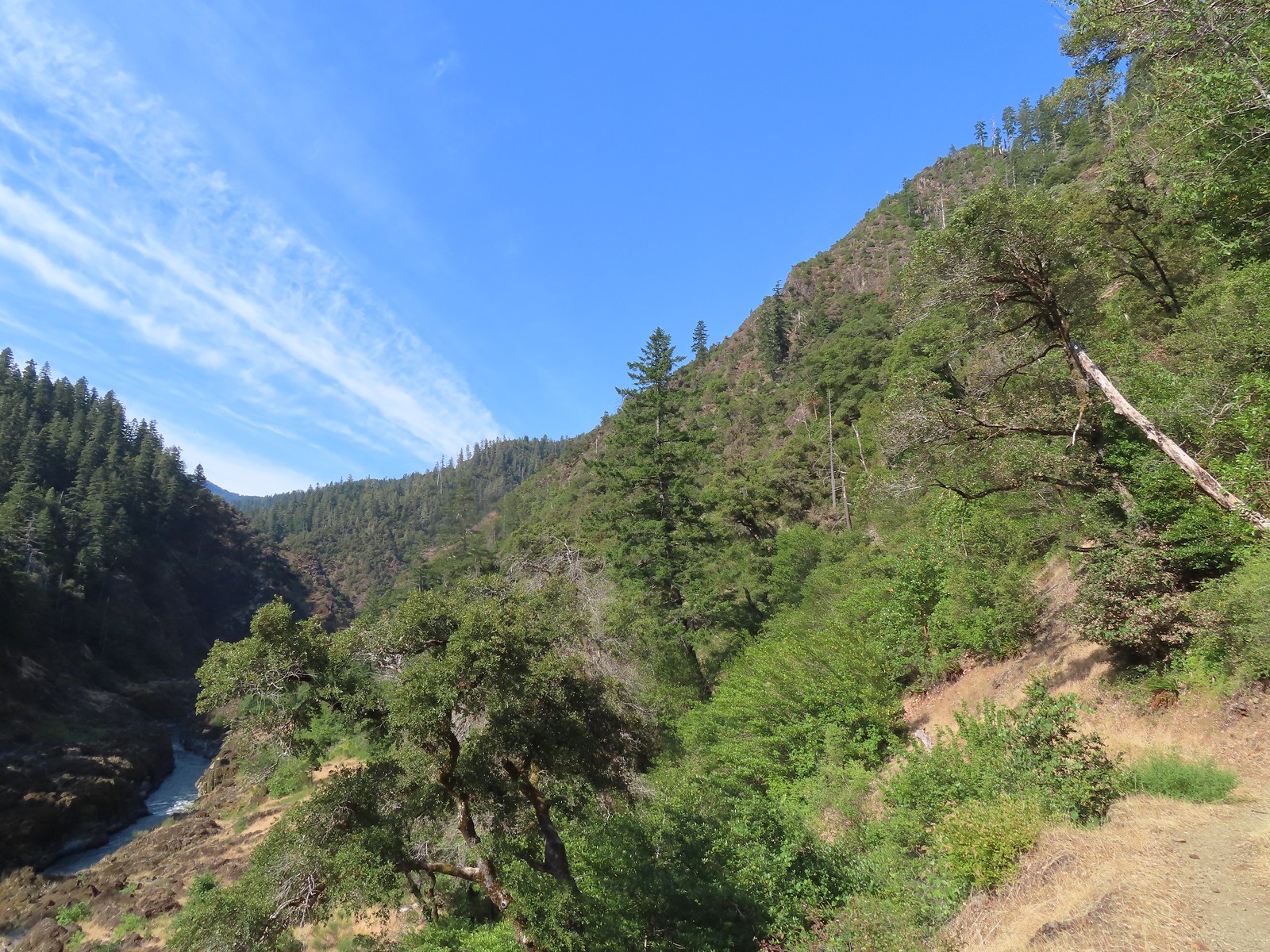
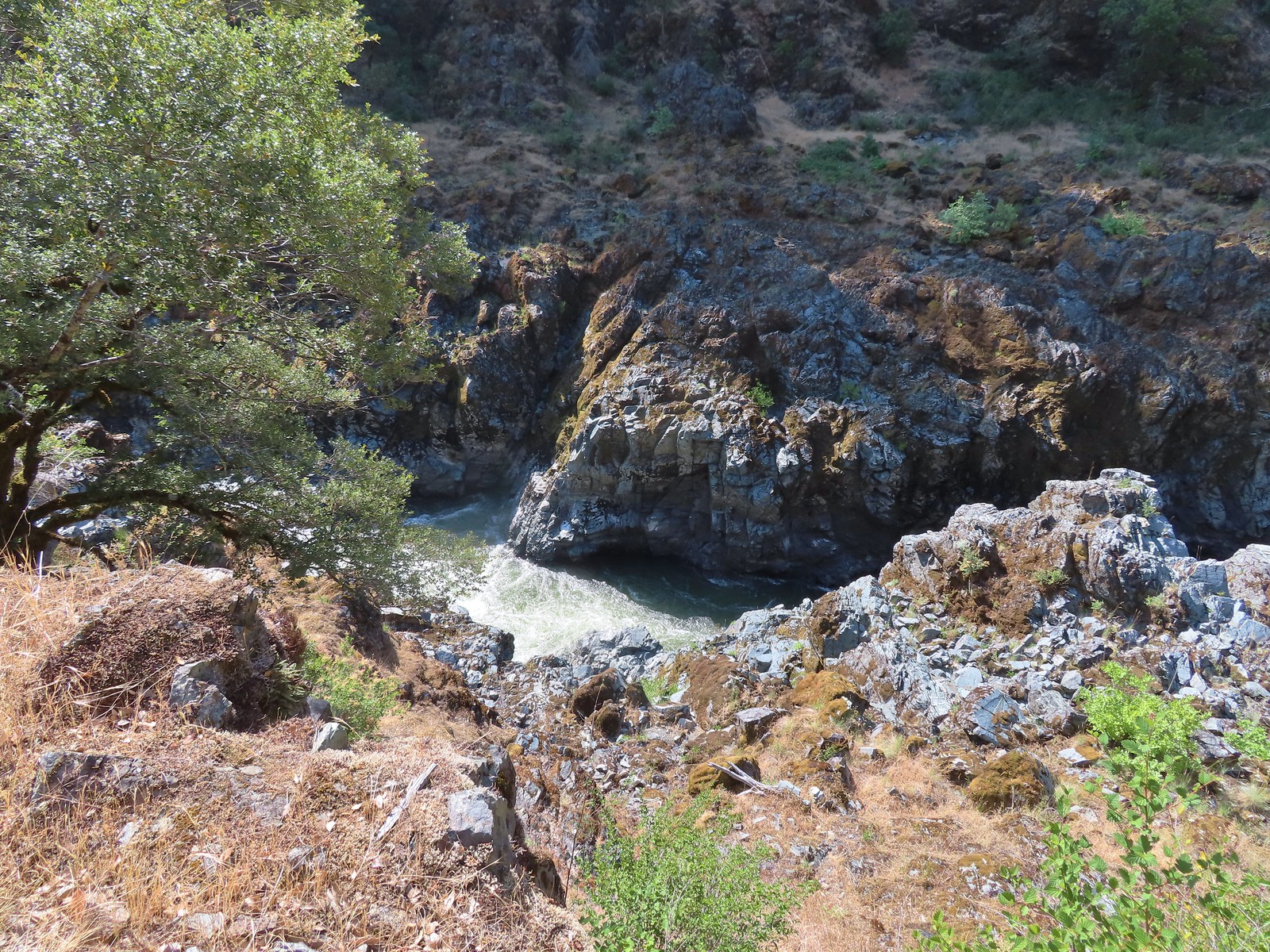 A peak into Mule Creek Canyon.
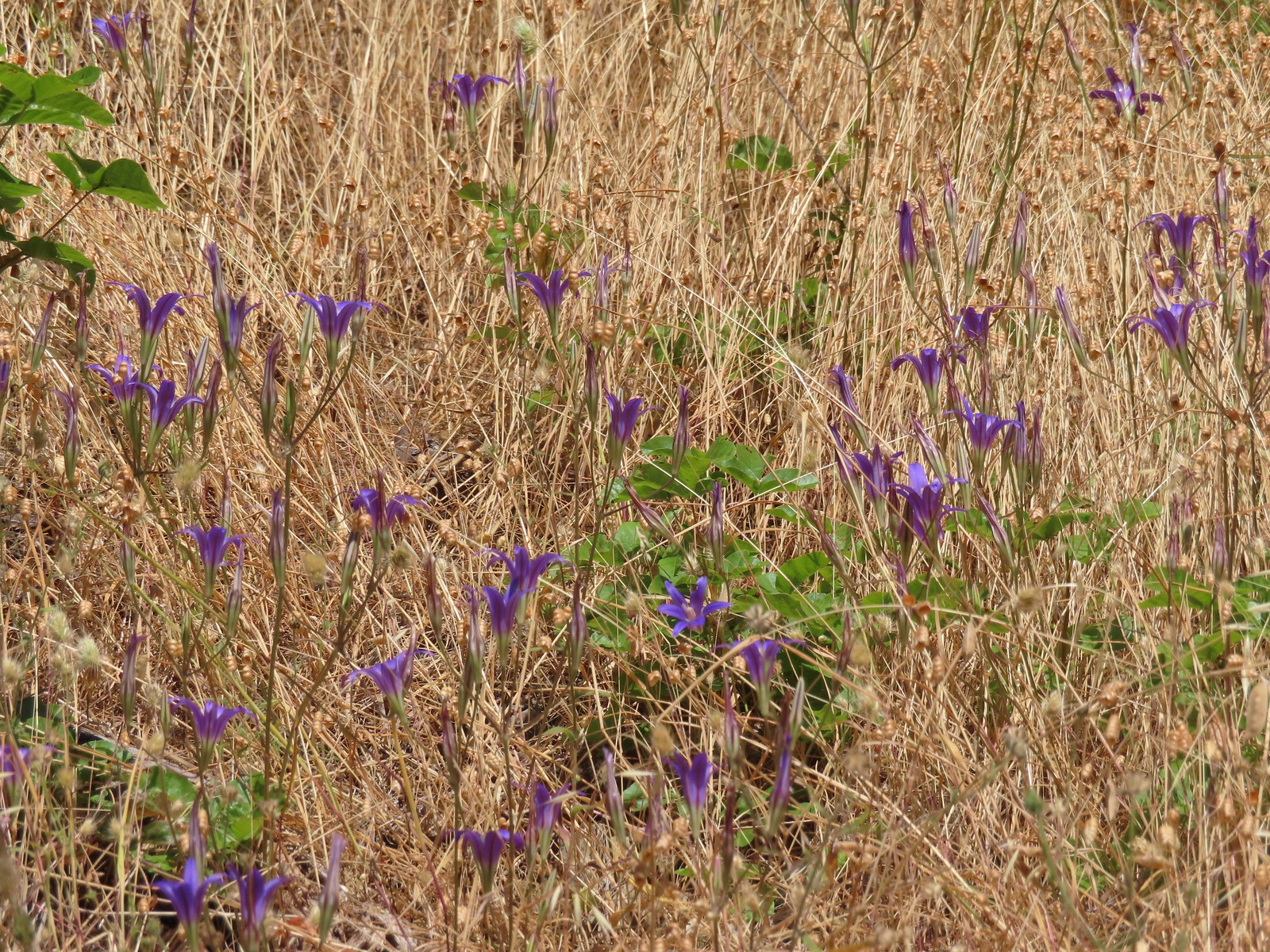 There weren’t many flowers left blooming but we did see a lot of elegant brodiaea.
 Elegant brodiaea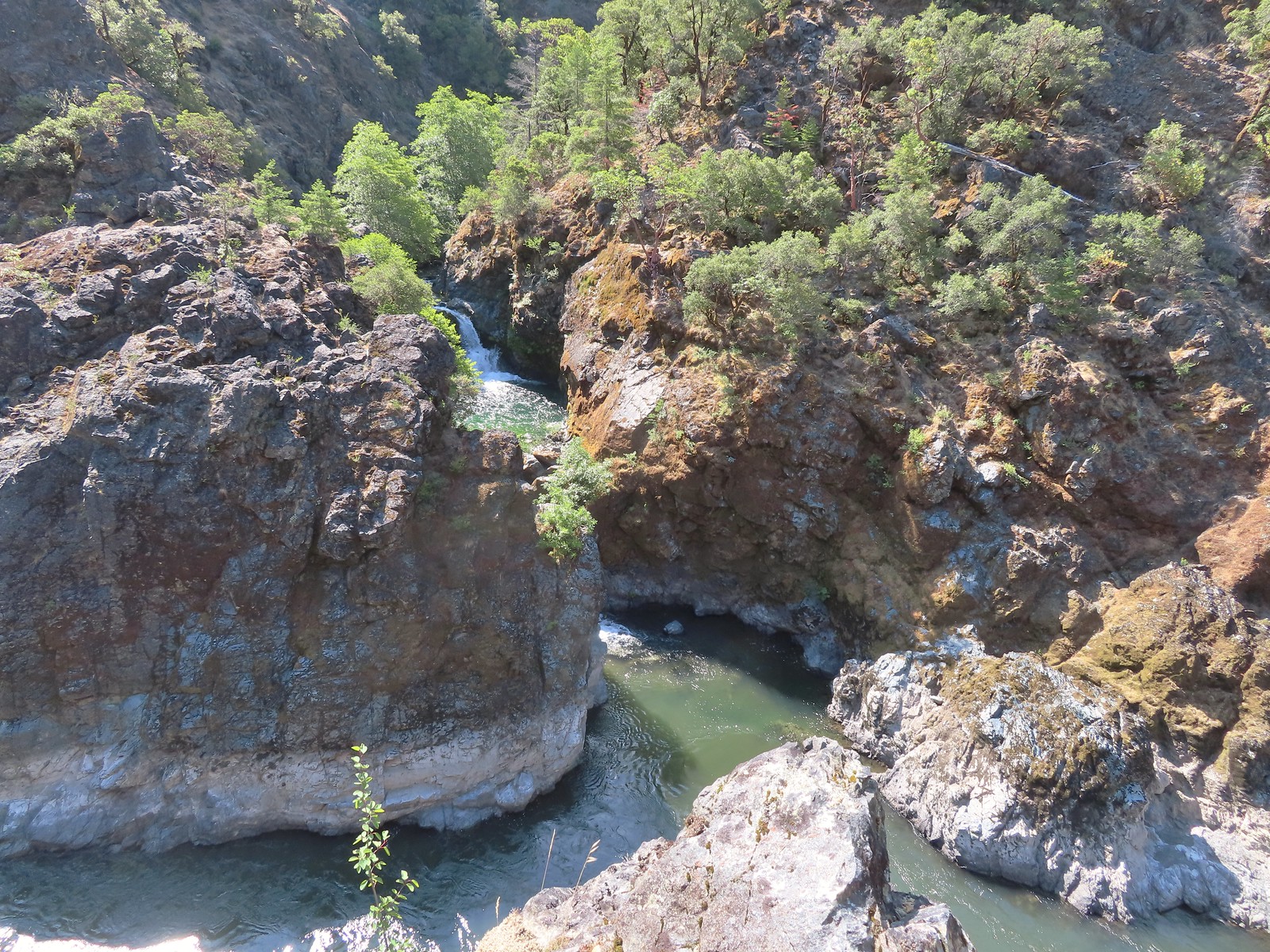
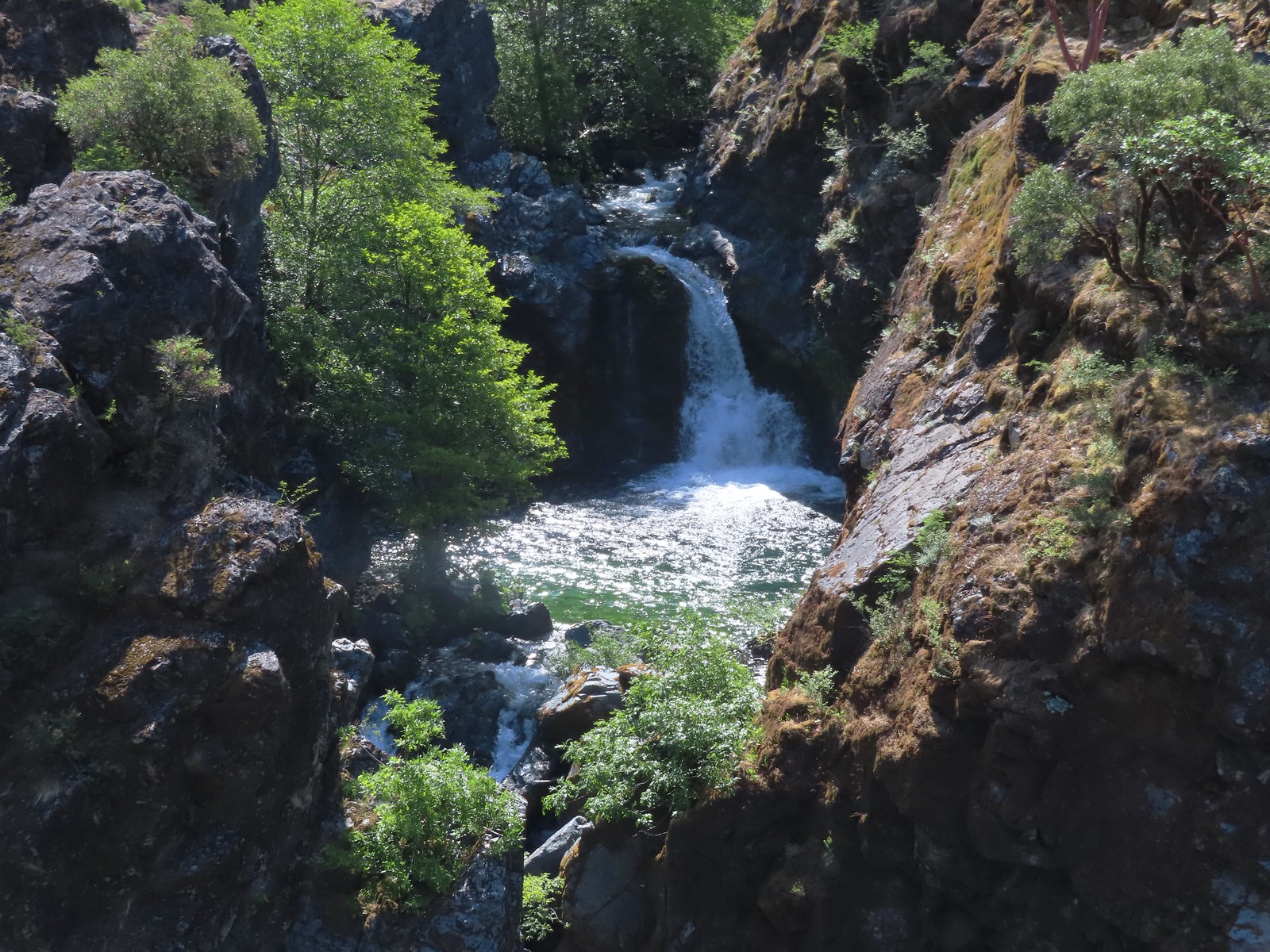
 Mule Creek Canyon from Inspiration Point.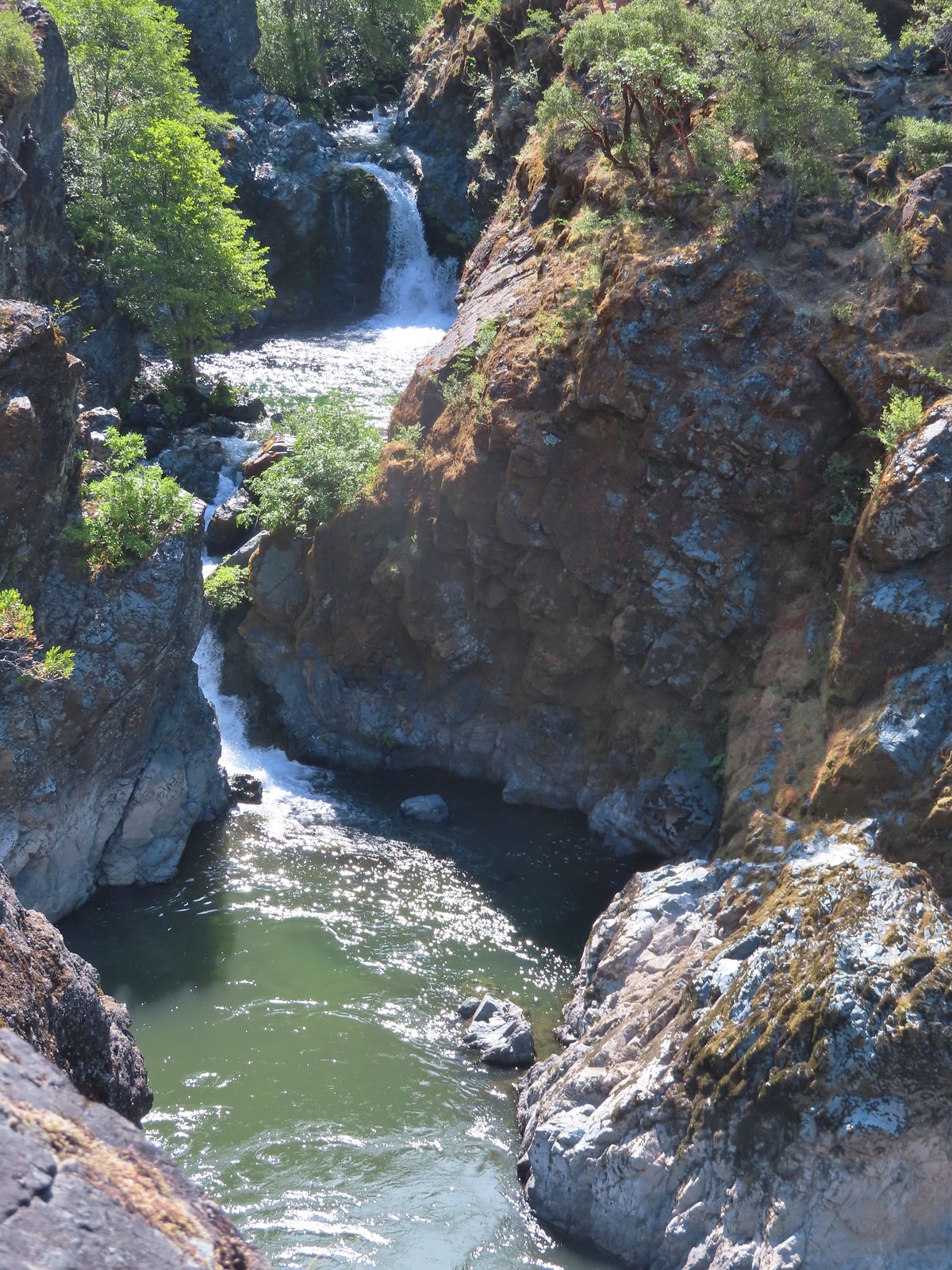
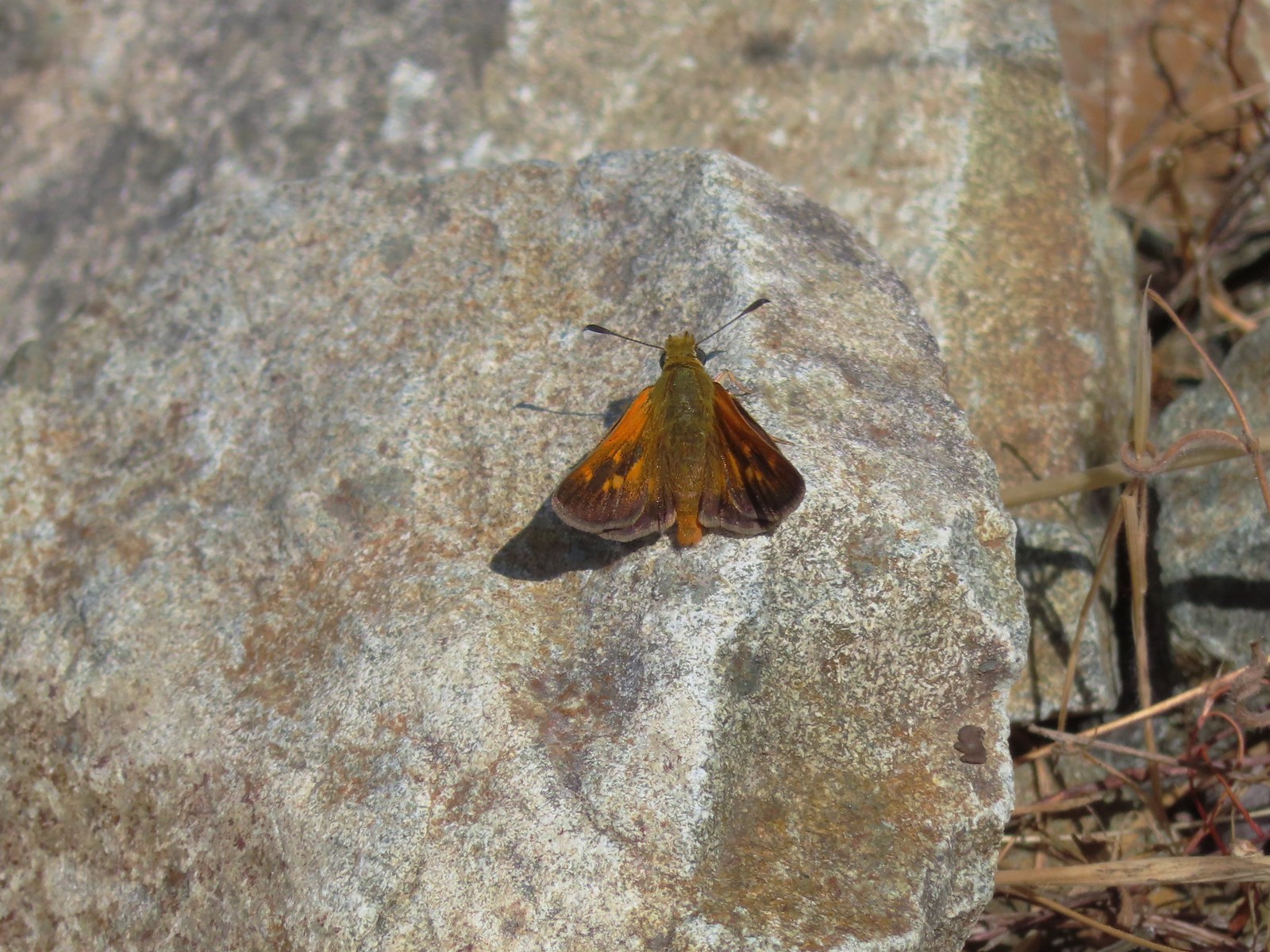 Skipper
 Common wood-nymph
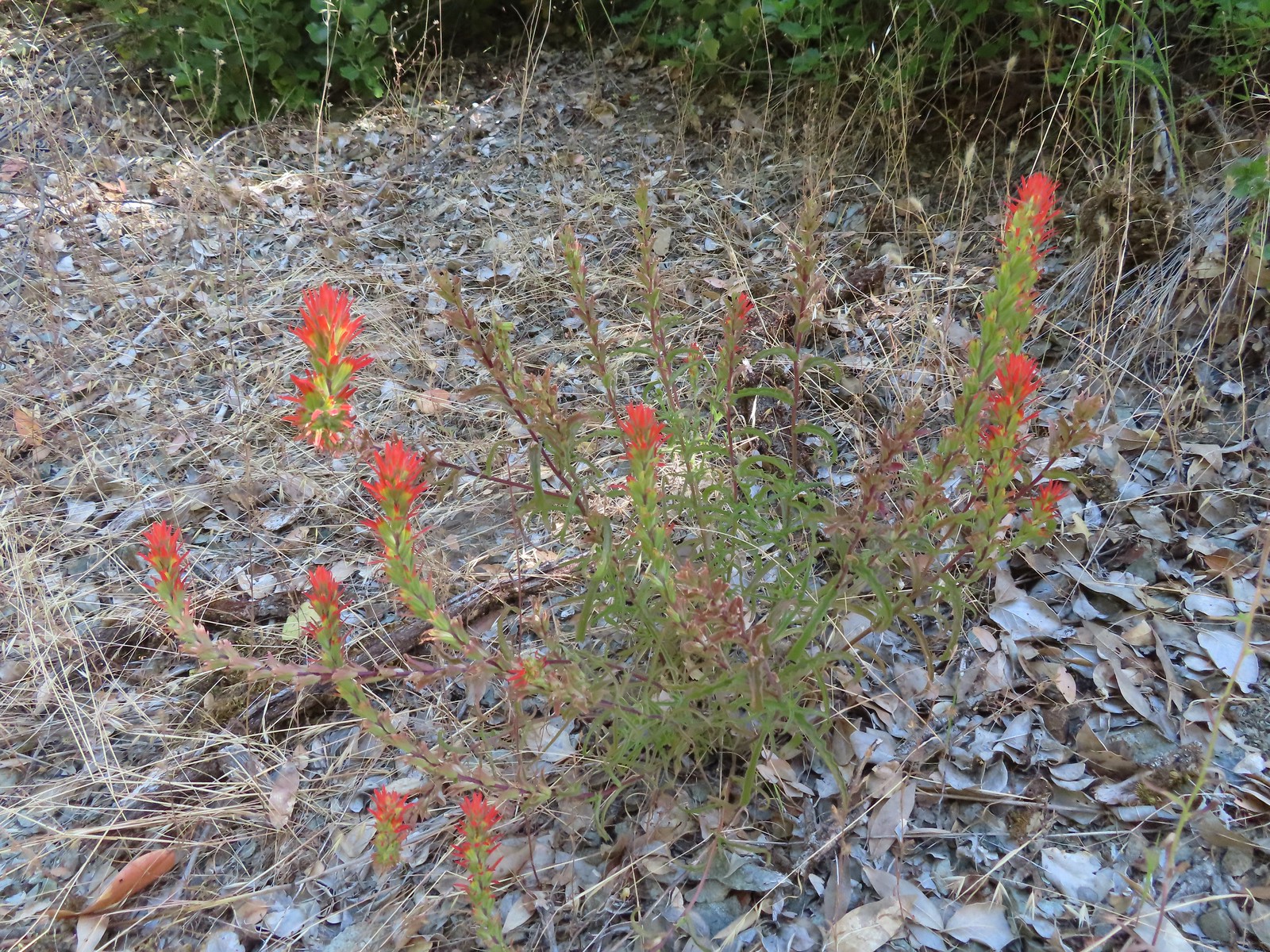 Paintbrush
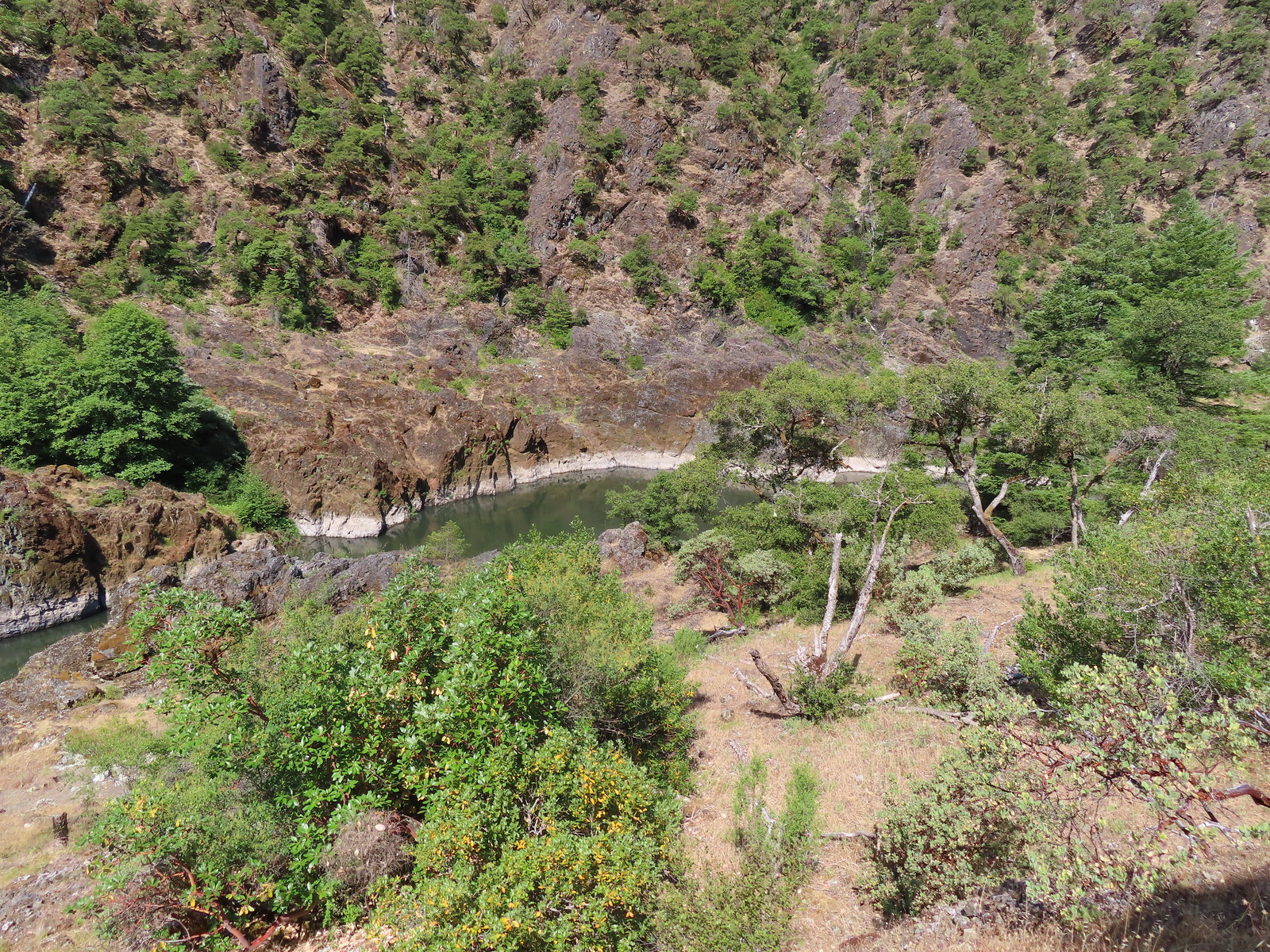 Calmer waters.
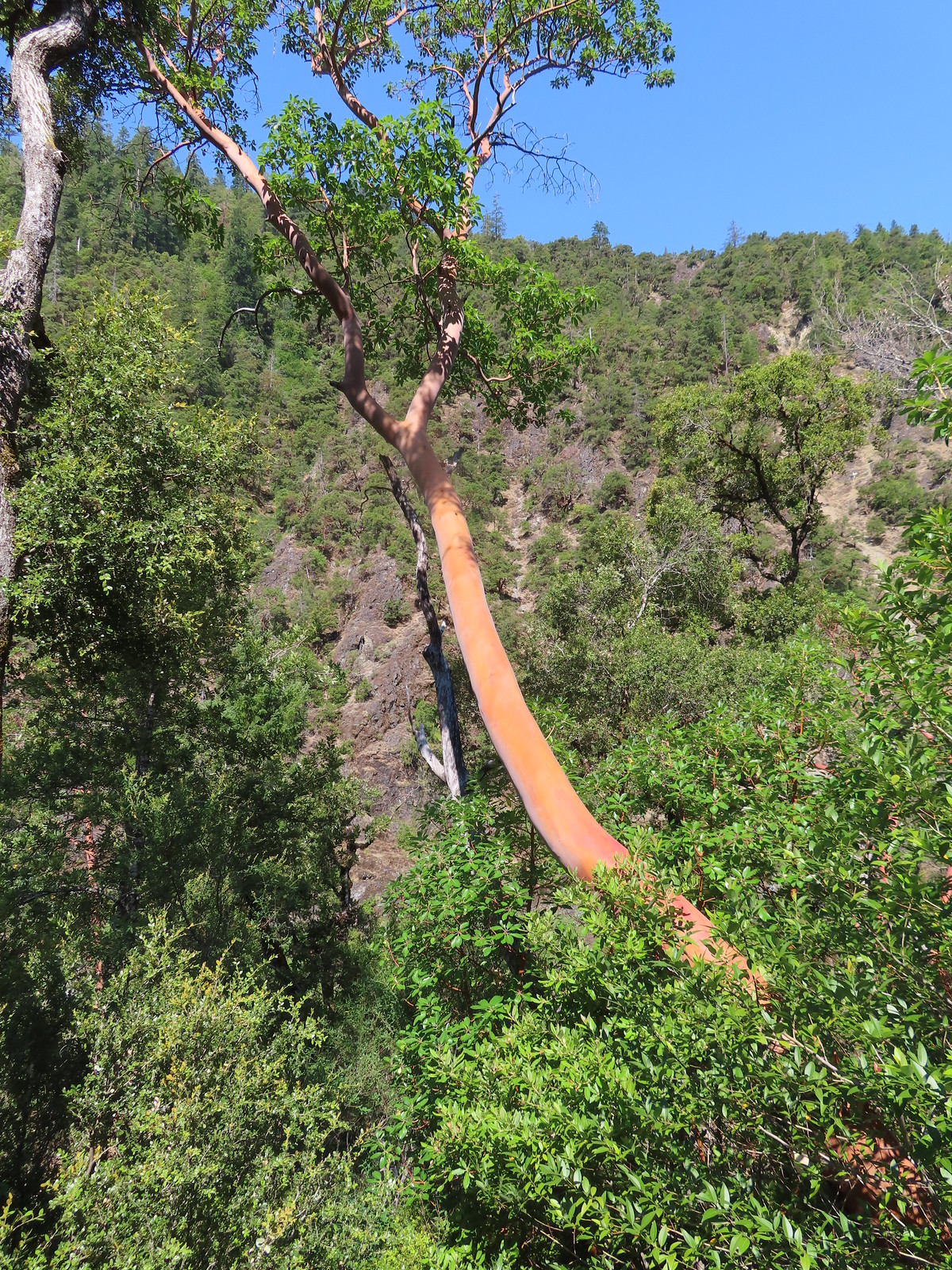 Madrone
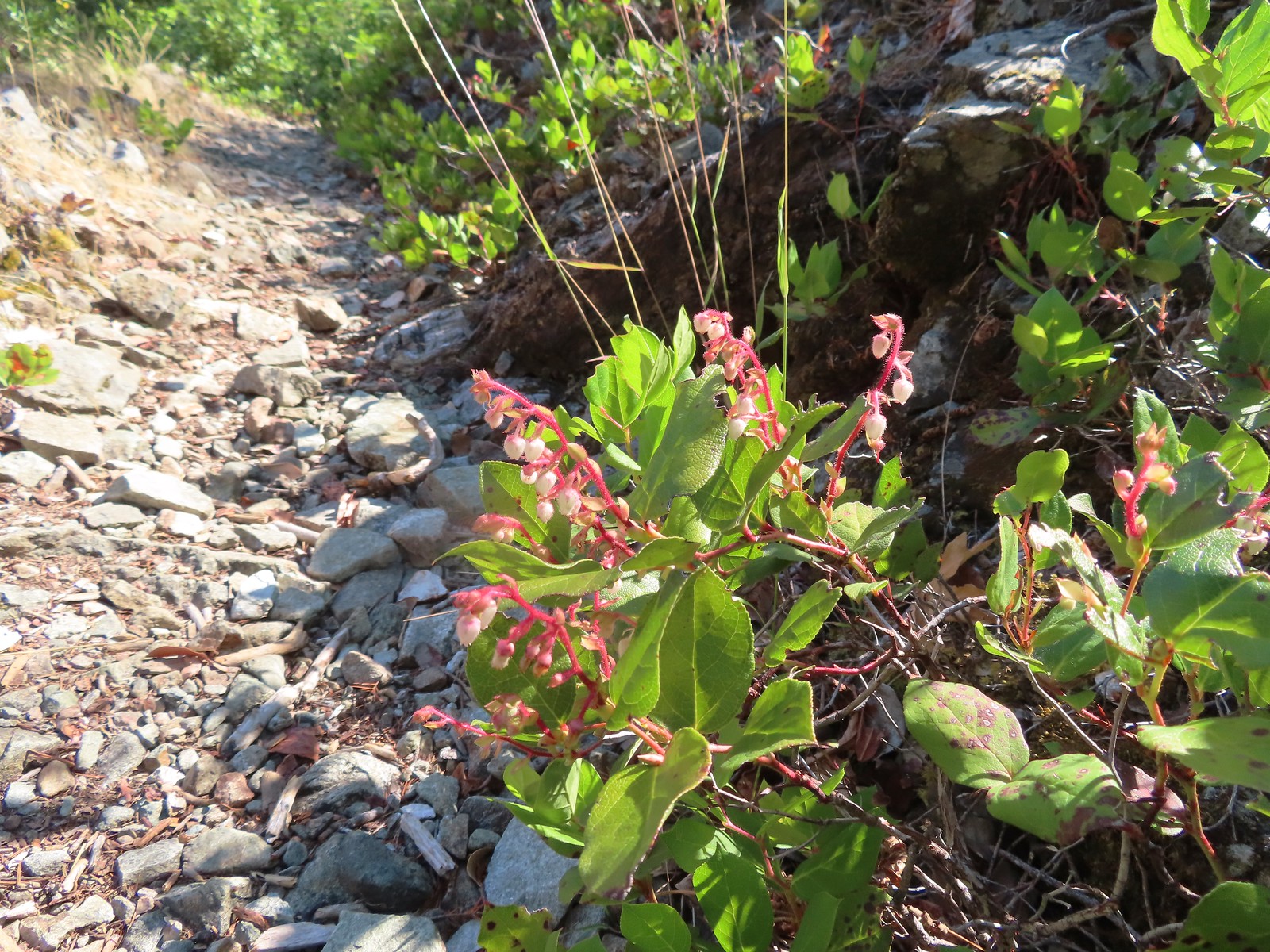 Salal
Salal Some poison oak on the right.
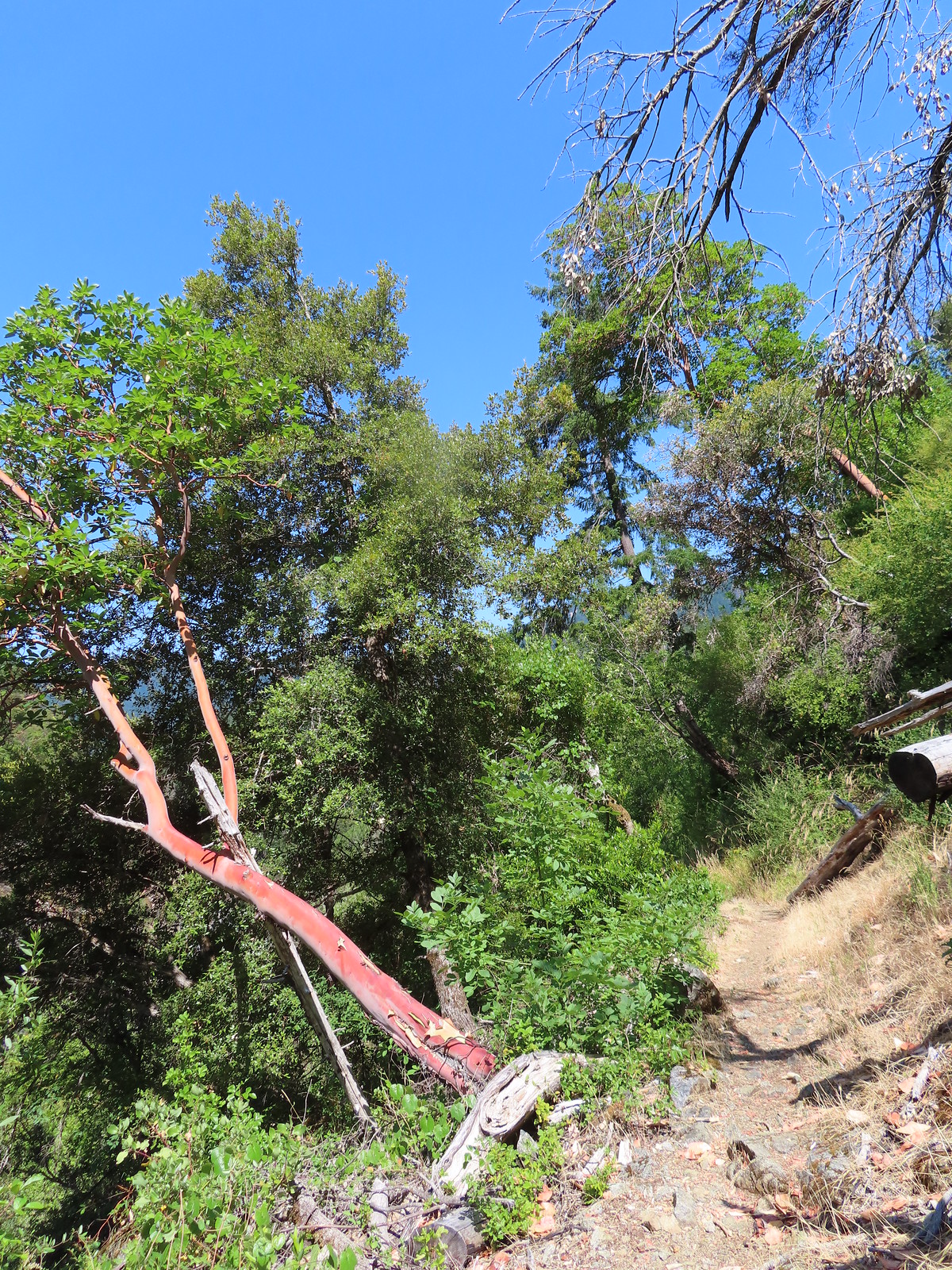 Another madrone at the start of more brush. This area was full of small birds that turned out to be bushtits.
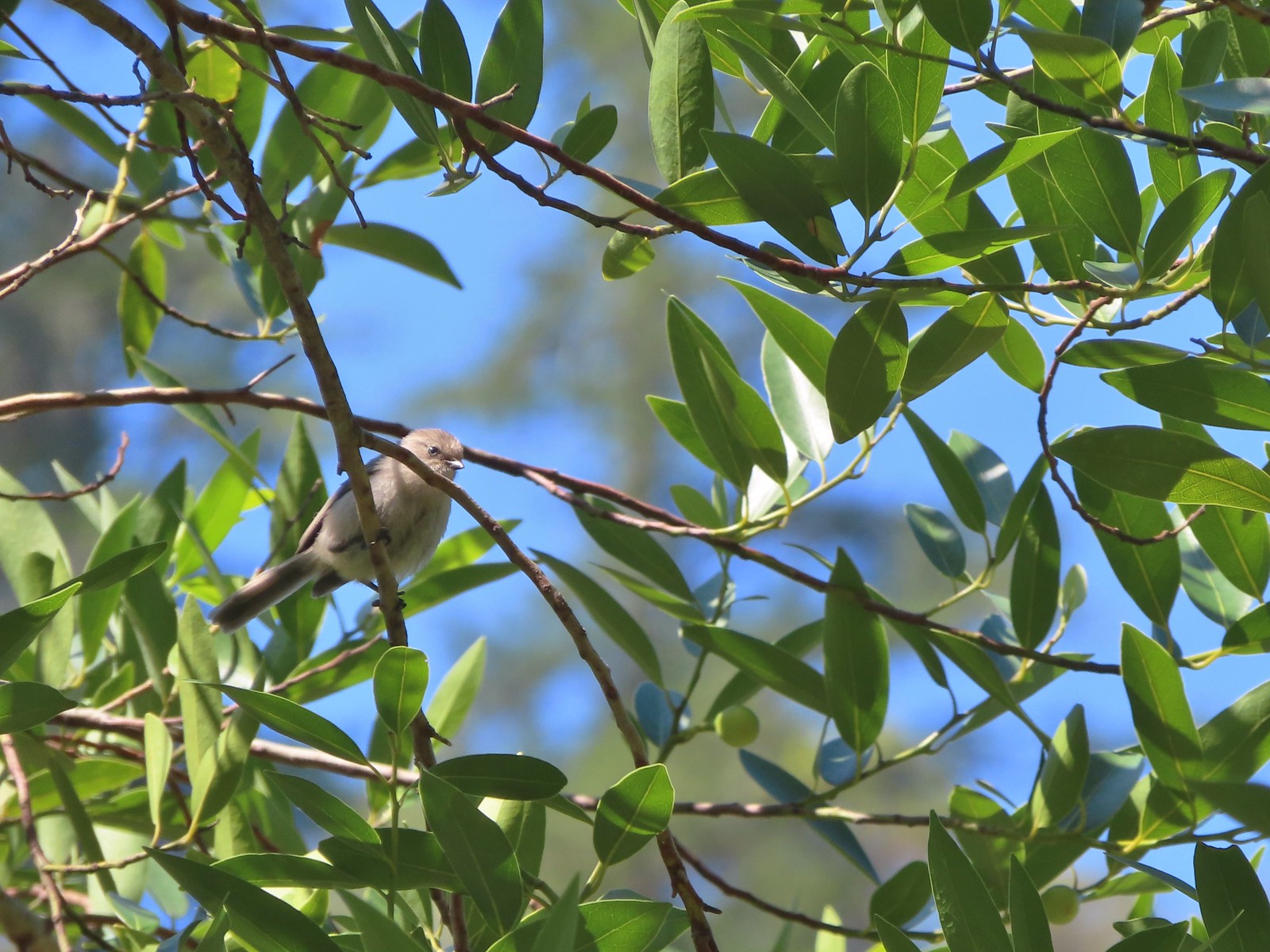 It took a bit to get one of the bushtits out in the open and in the camera frame.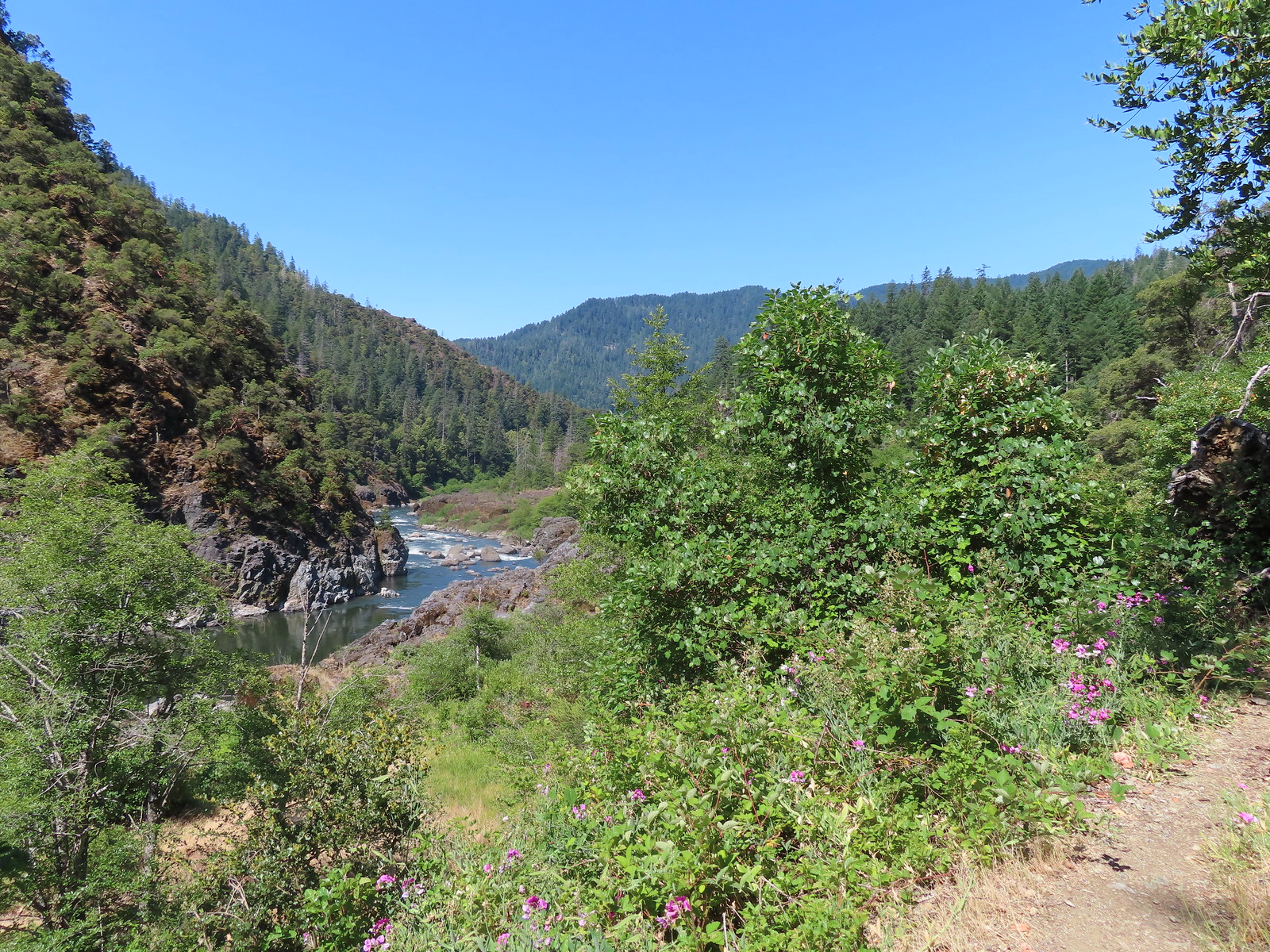
 Blossom Bar Rapid
 Footbridge over Burns Creek.
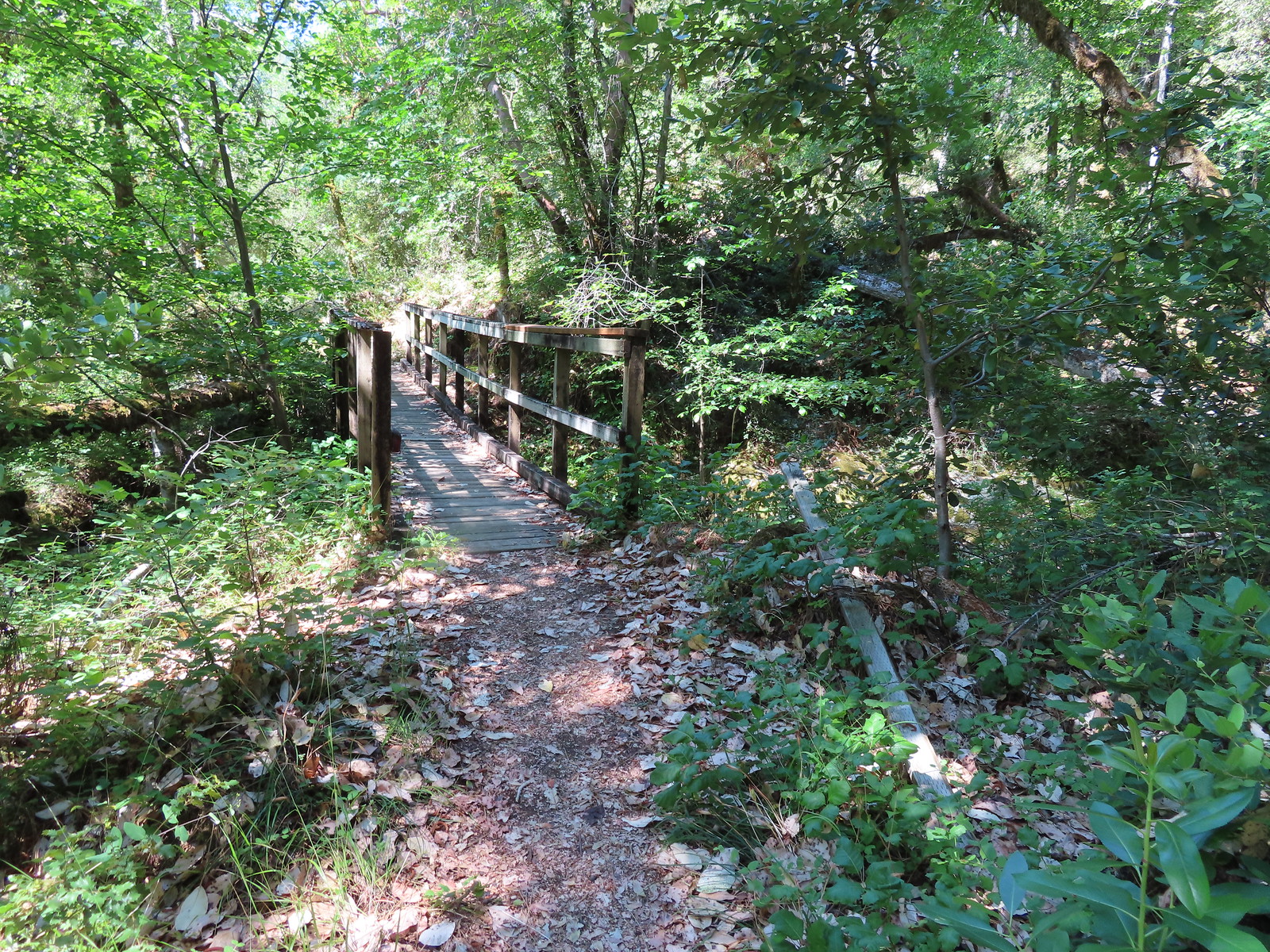 Footbridge over Blossom Creek.
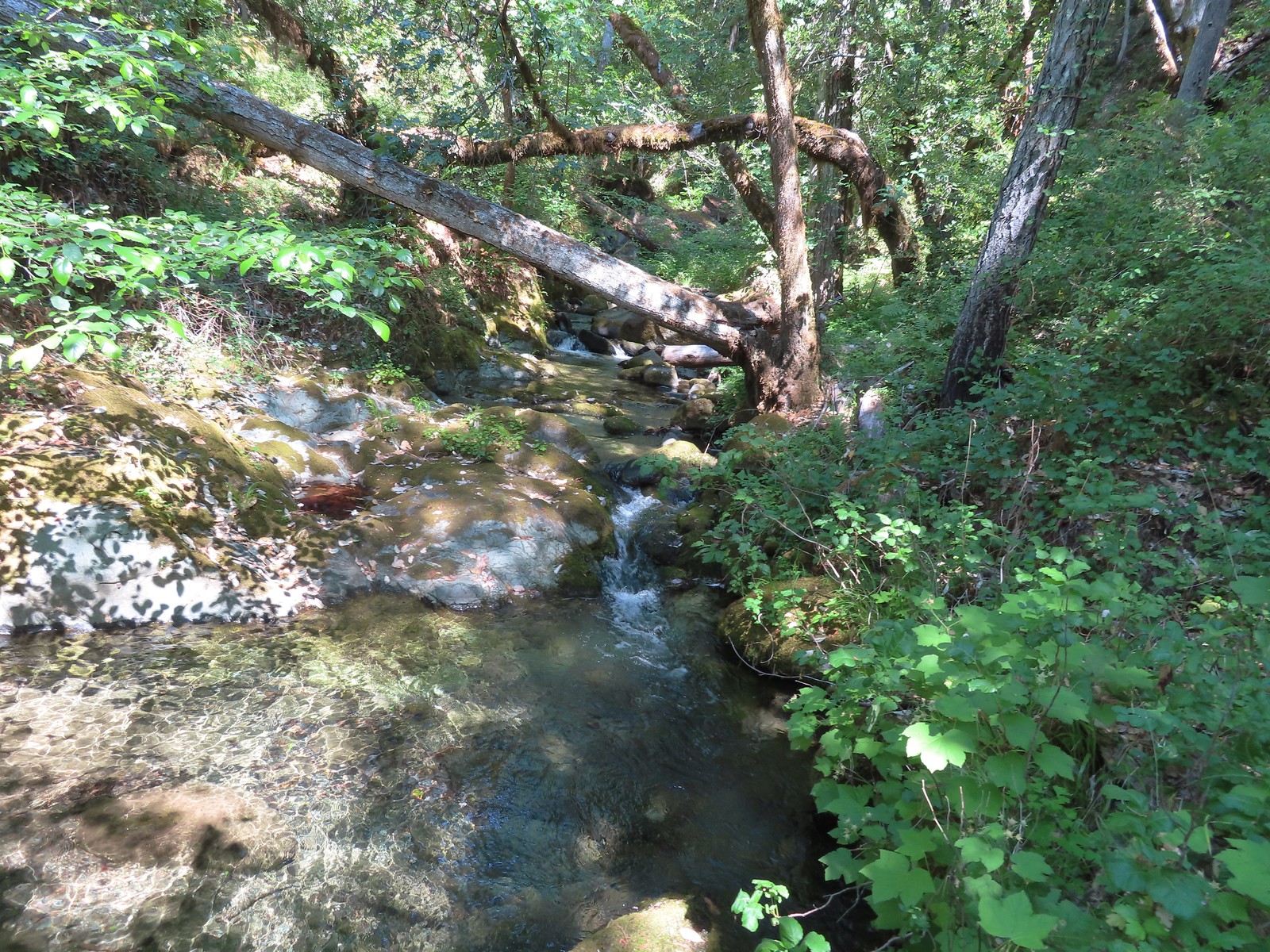 Blossom Creek
 Trail crossing Blossom Bar.
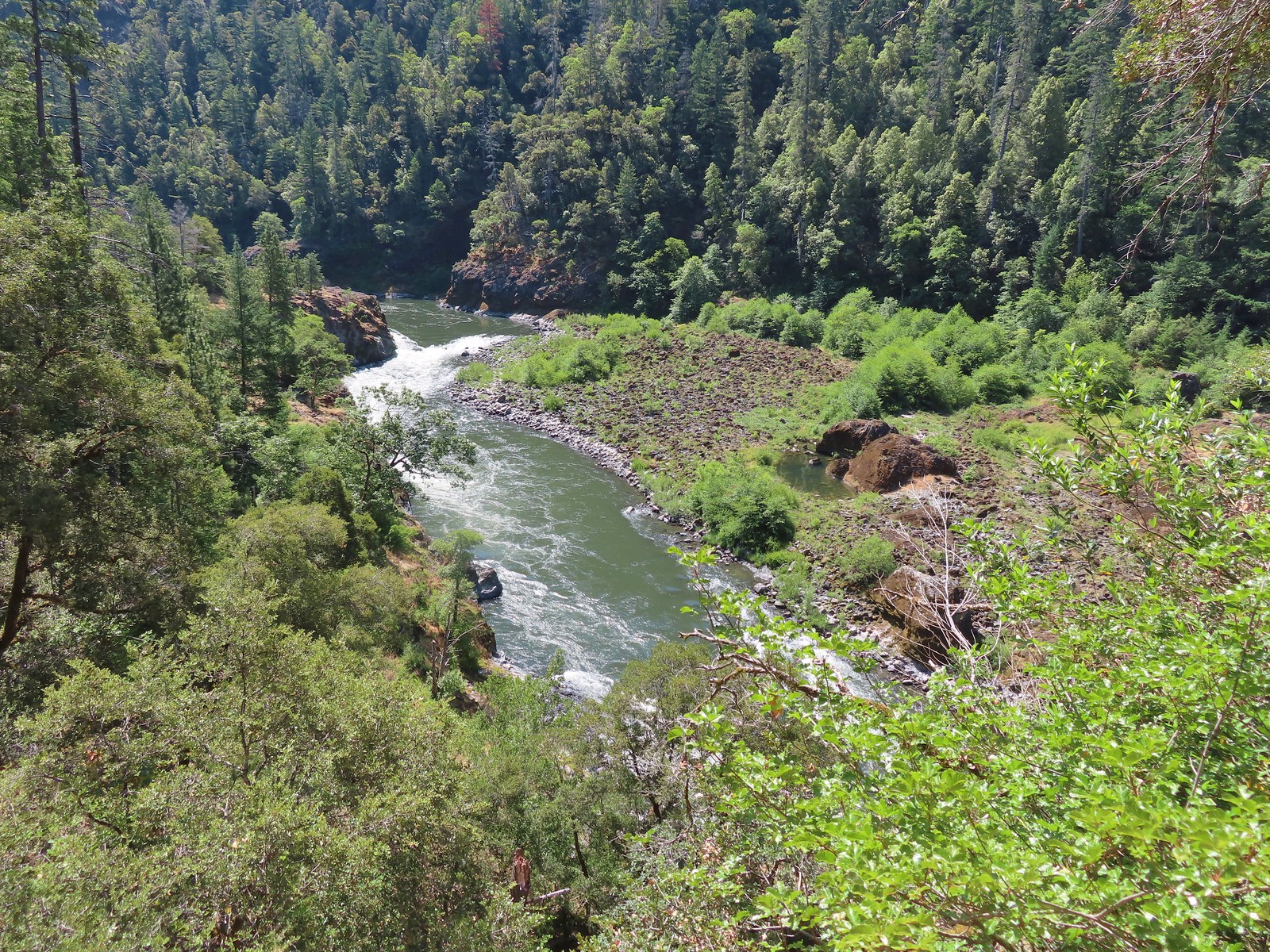 Rogue River leaving Blossom Bar.
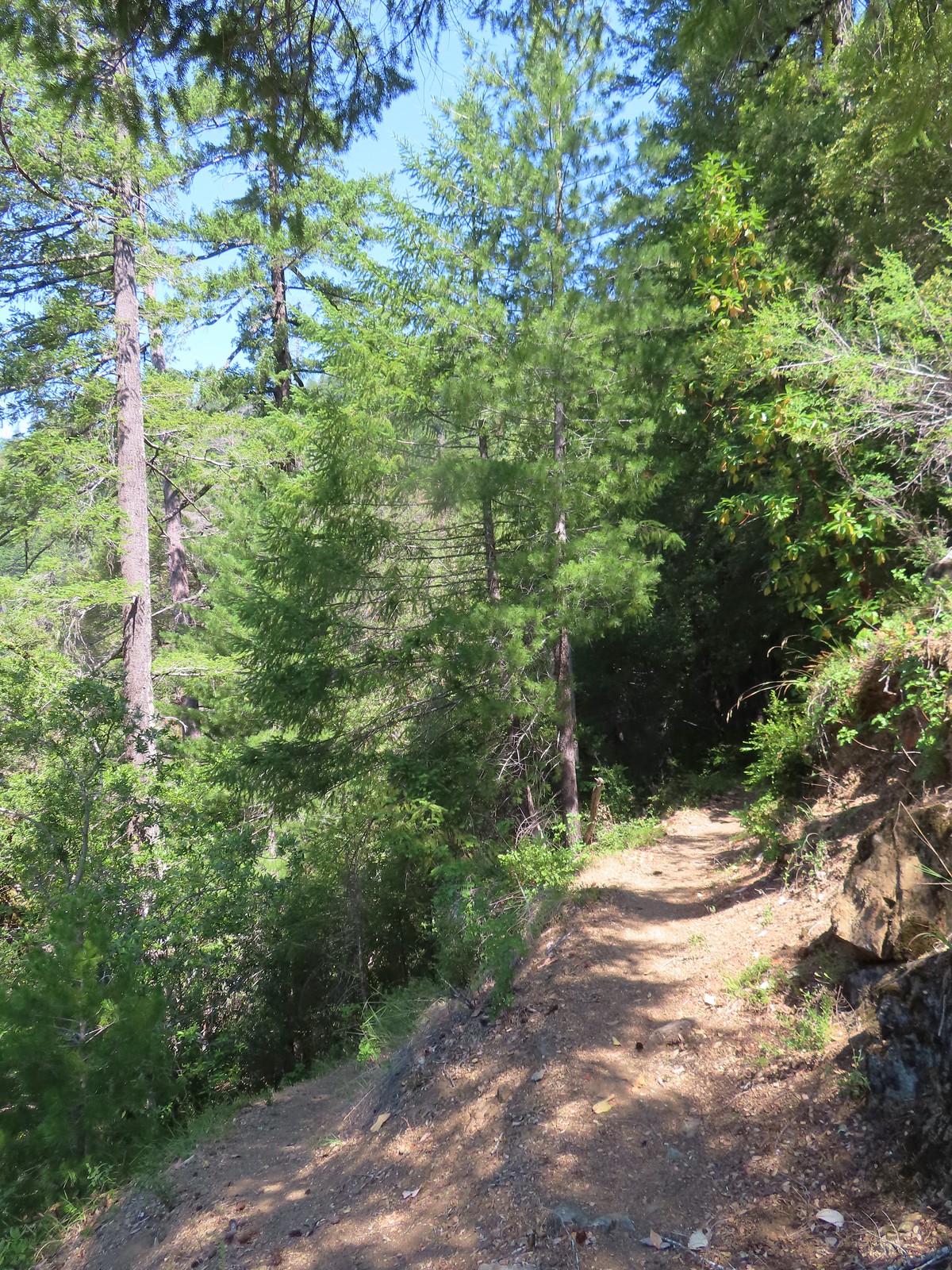 Trail to Gleason Bar on the left.
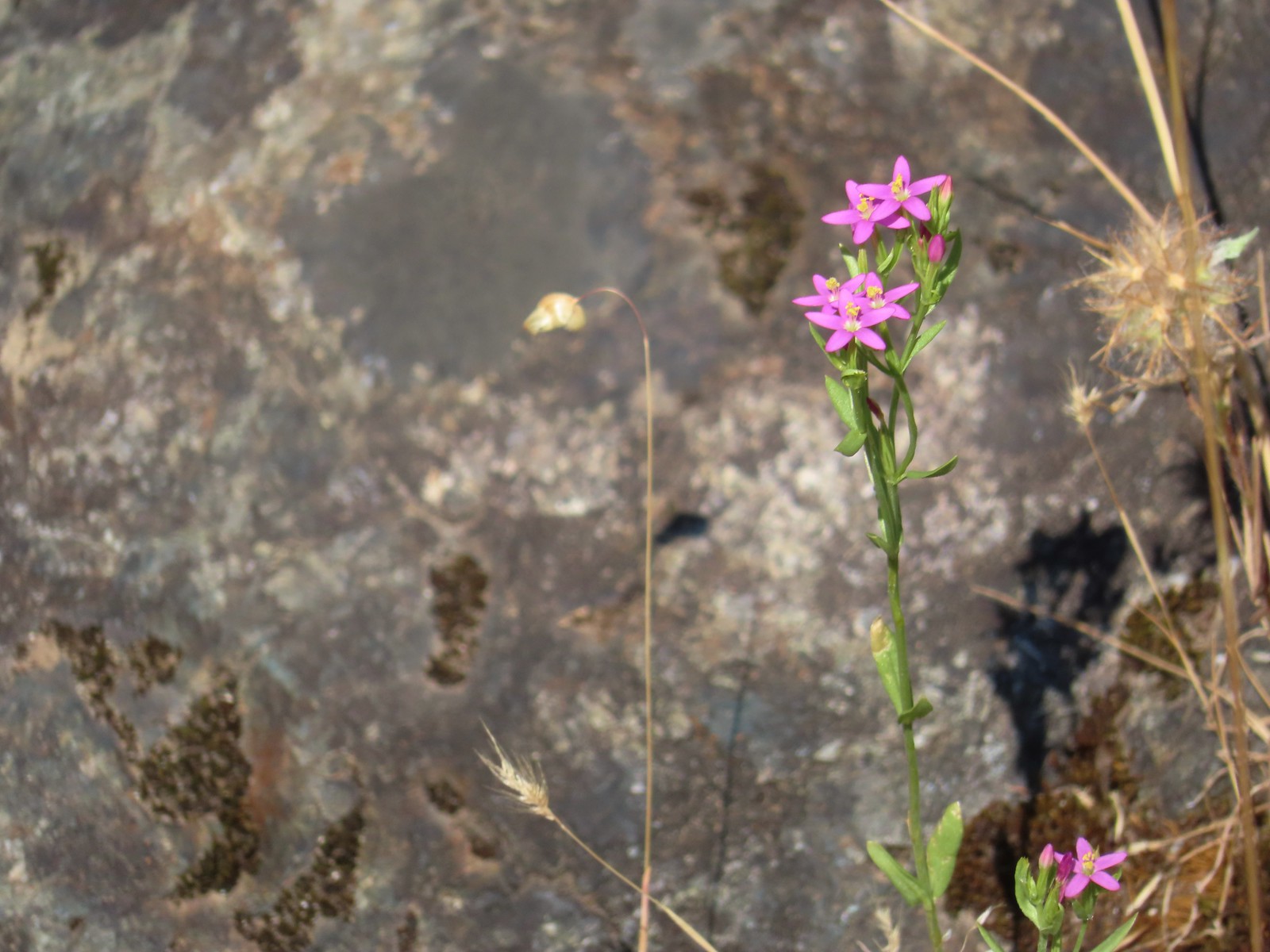 Variable-leaf collomia
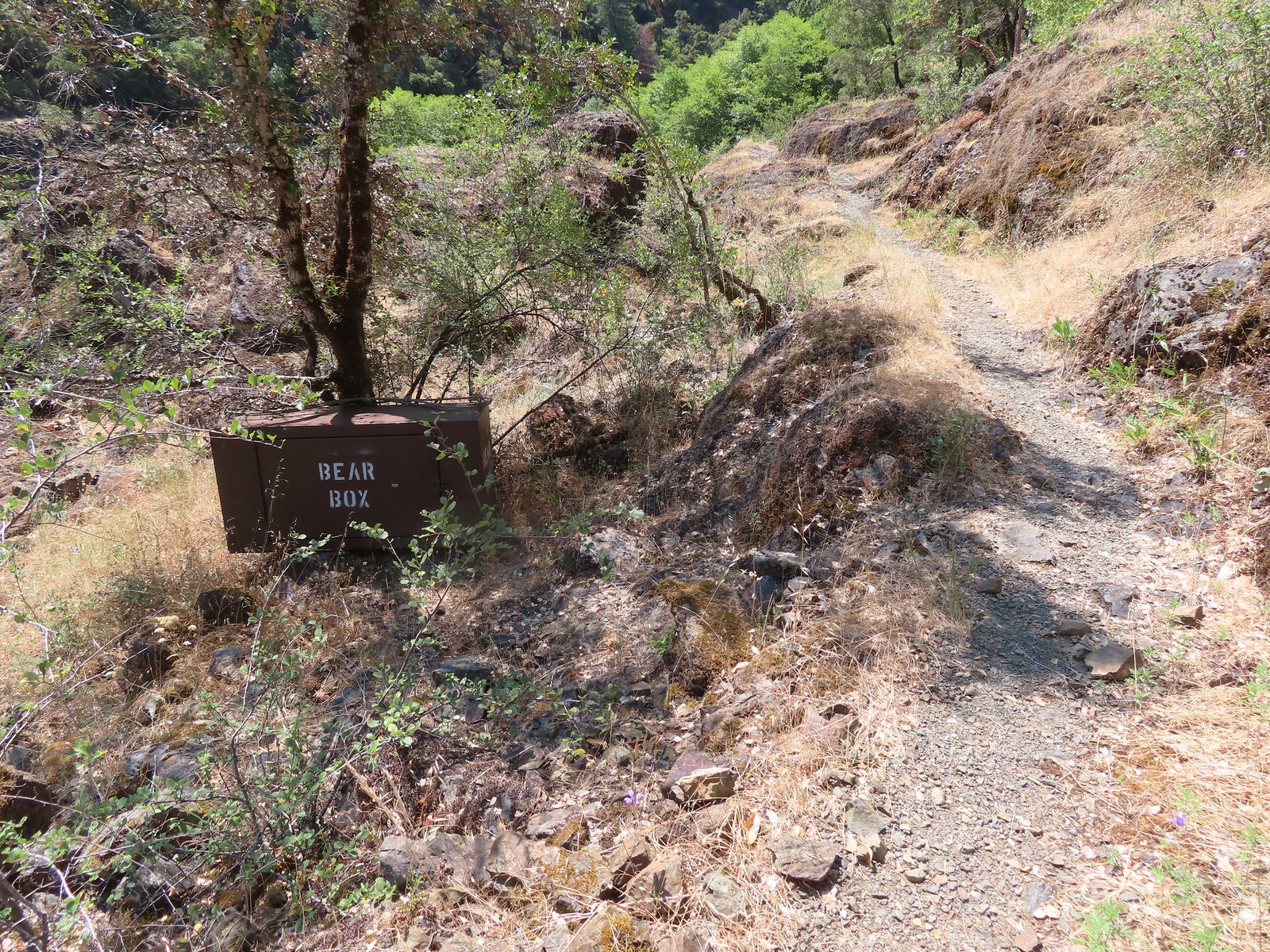 Bear box near Gleason Bar. We didn’t see any bears on our hike but we did have a bear cub run in front of our car on the drive to the trailhead.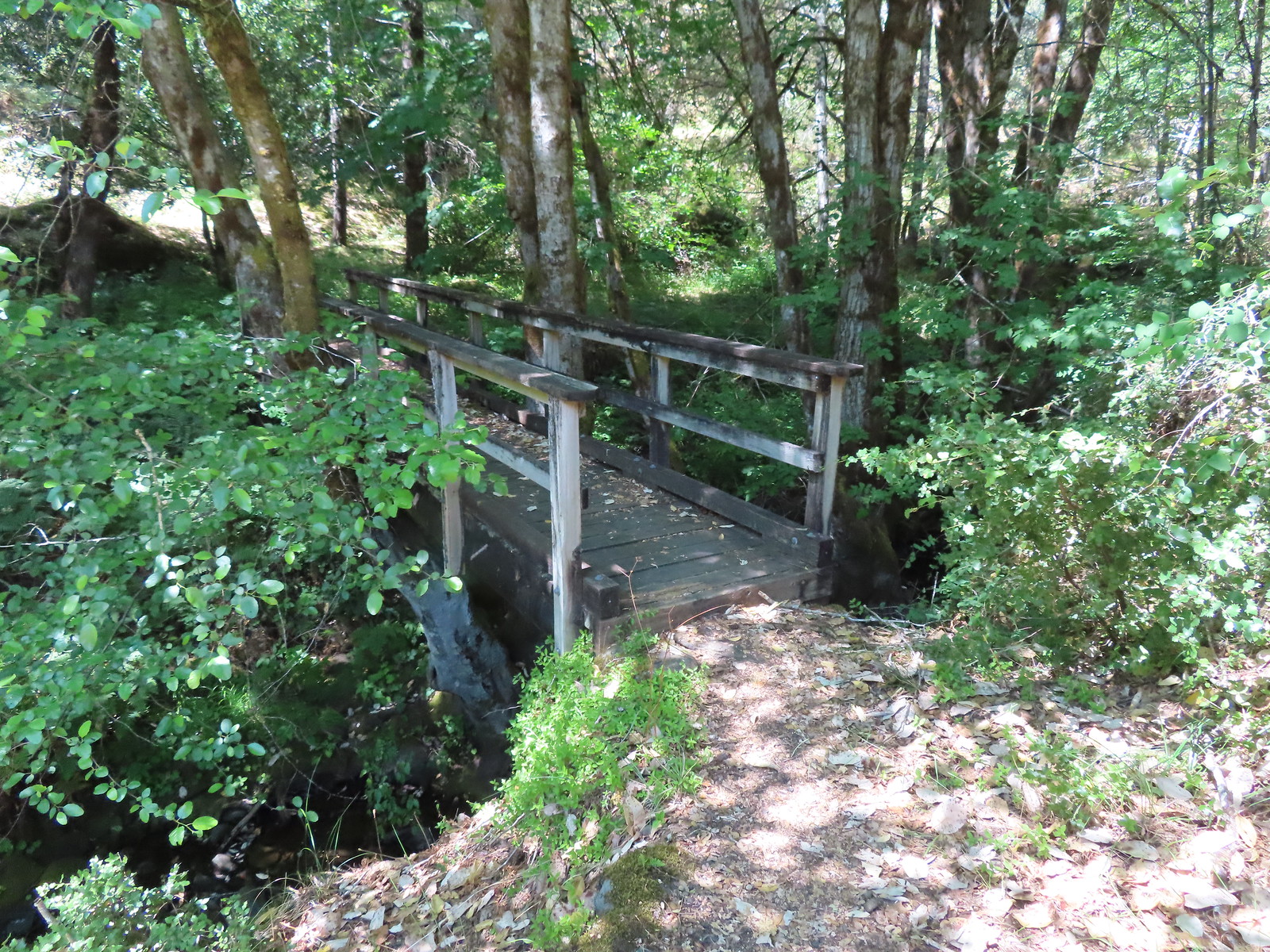
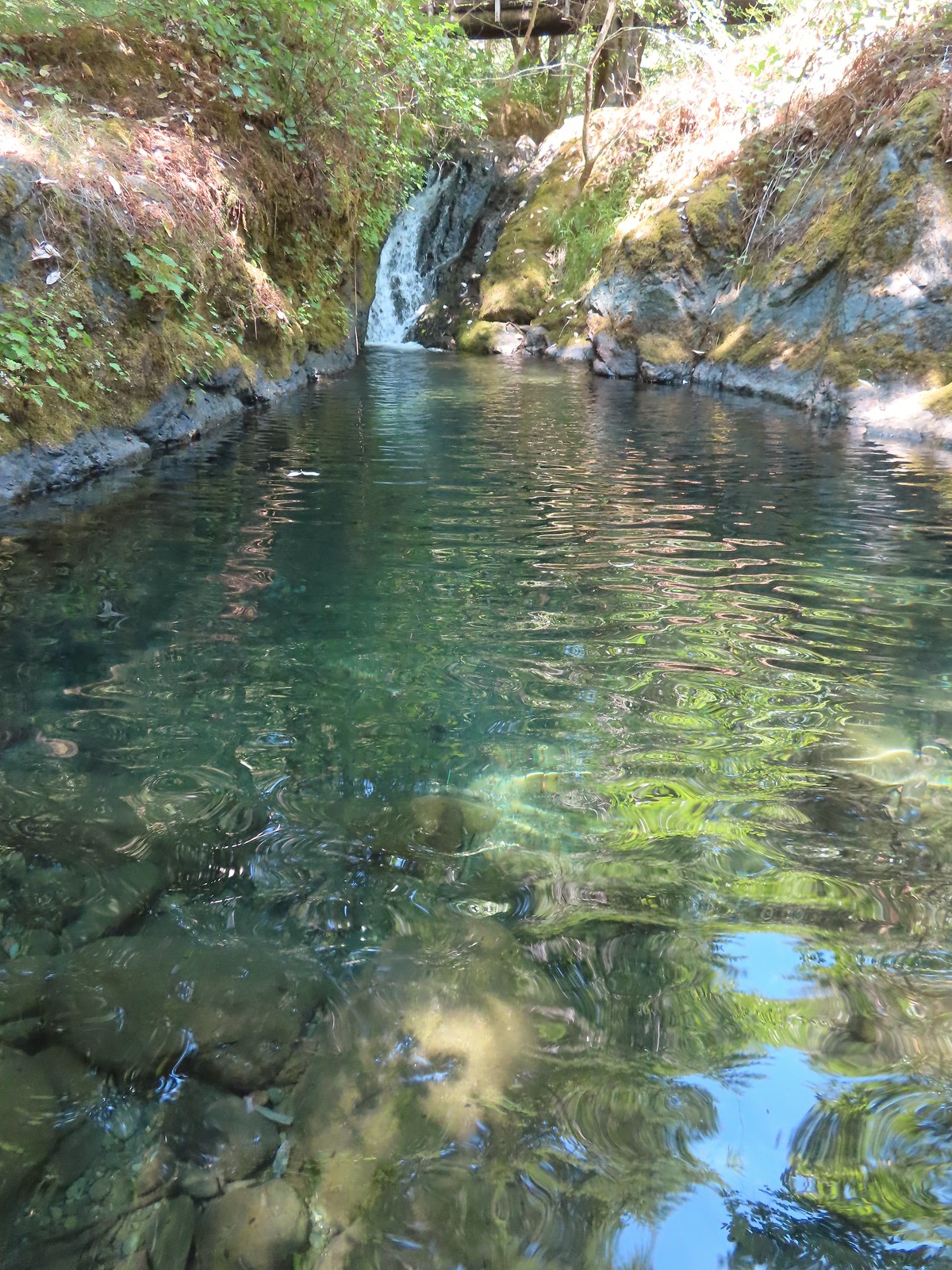
 Paradise Bar
 The trail skirted the grassy airstrip before entering the forest.
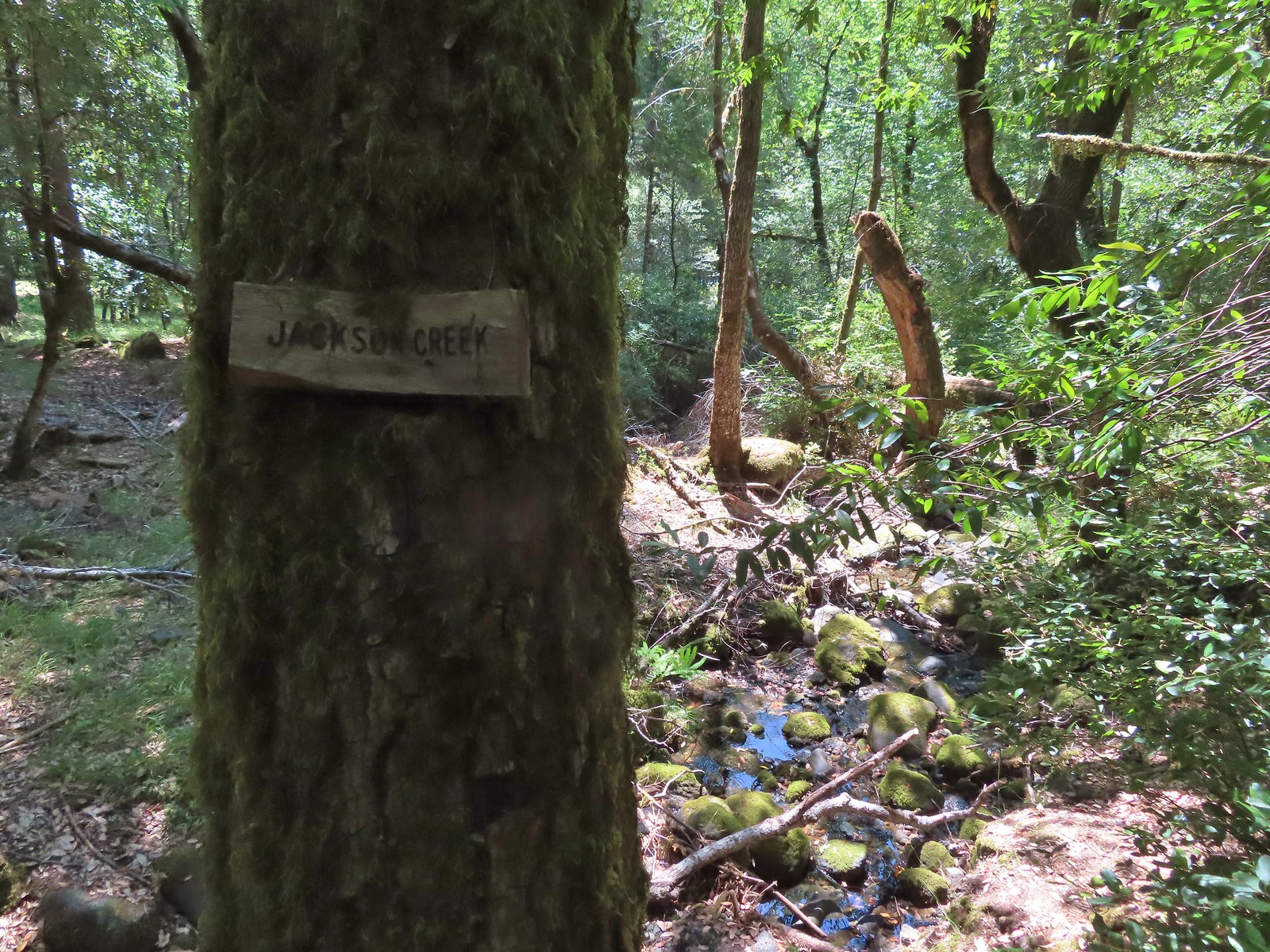 Jackson Creek. Most if not all of the creeks had signs letting us know their names.
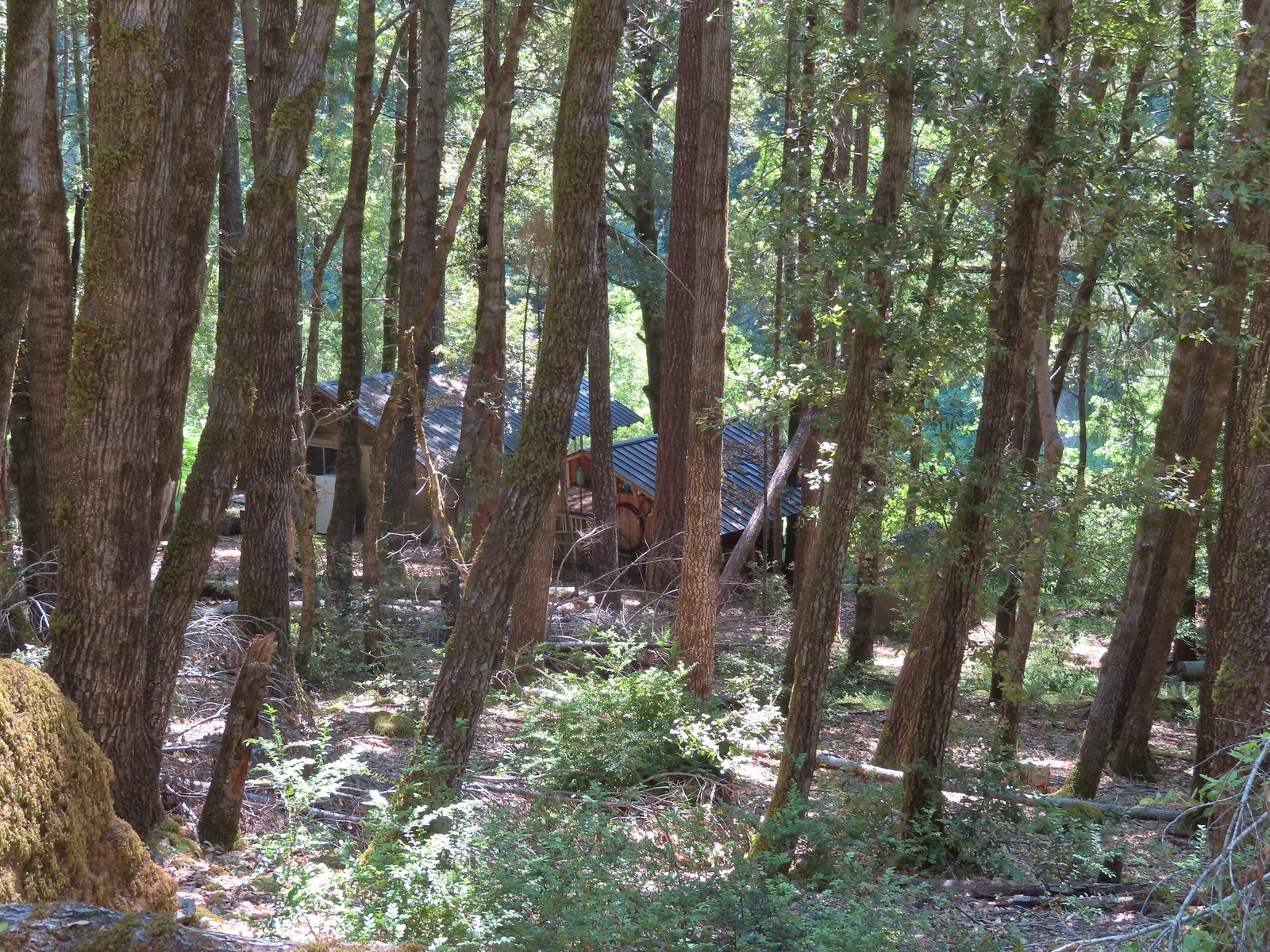 Some of the buildings related to Paradise Lodge.
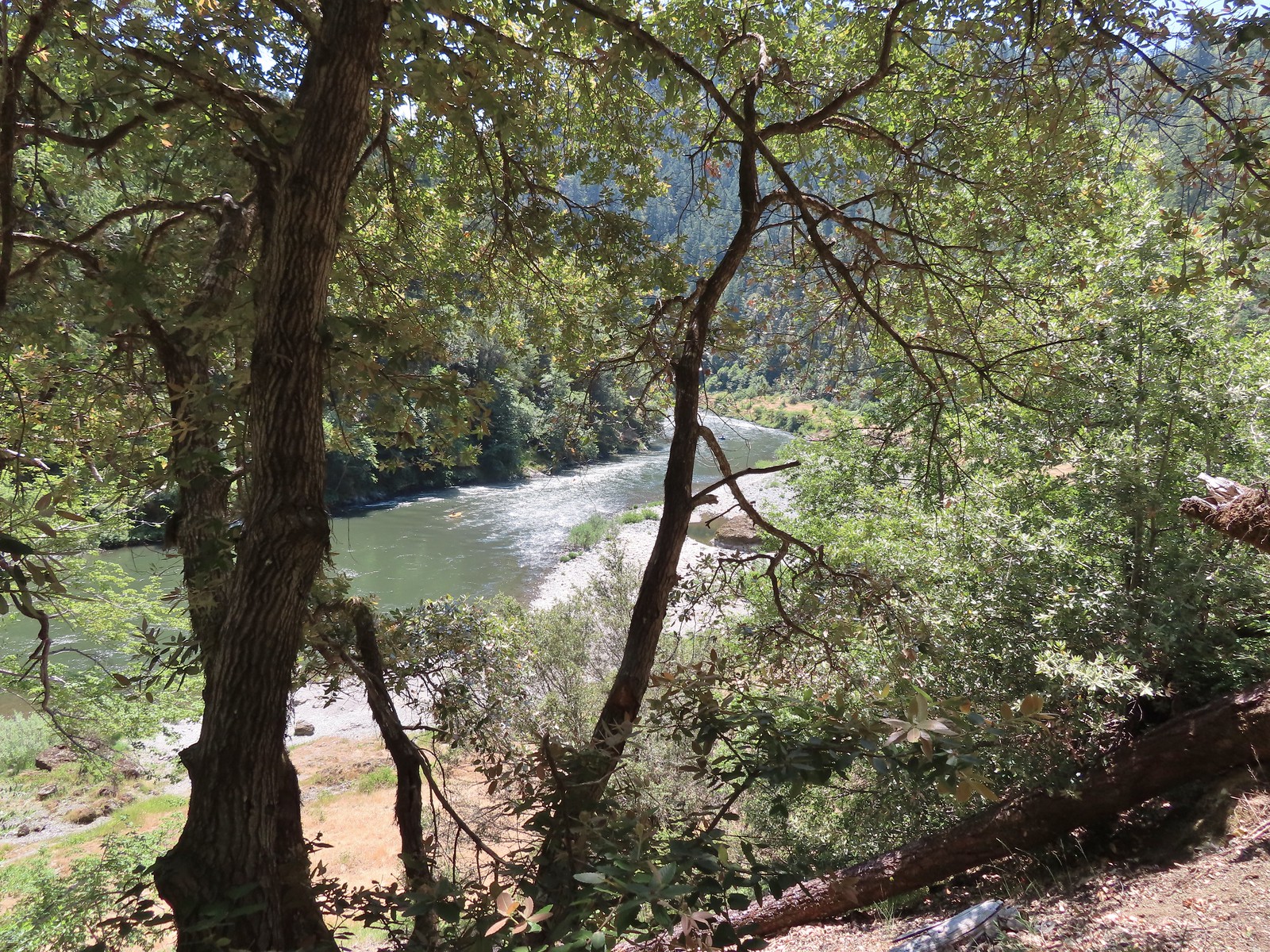 Rafters and kayakers passing through Half Moon Riffle.
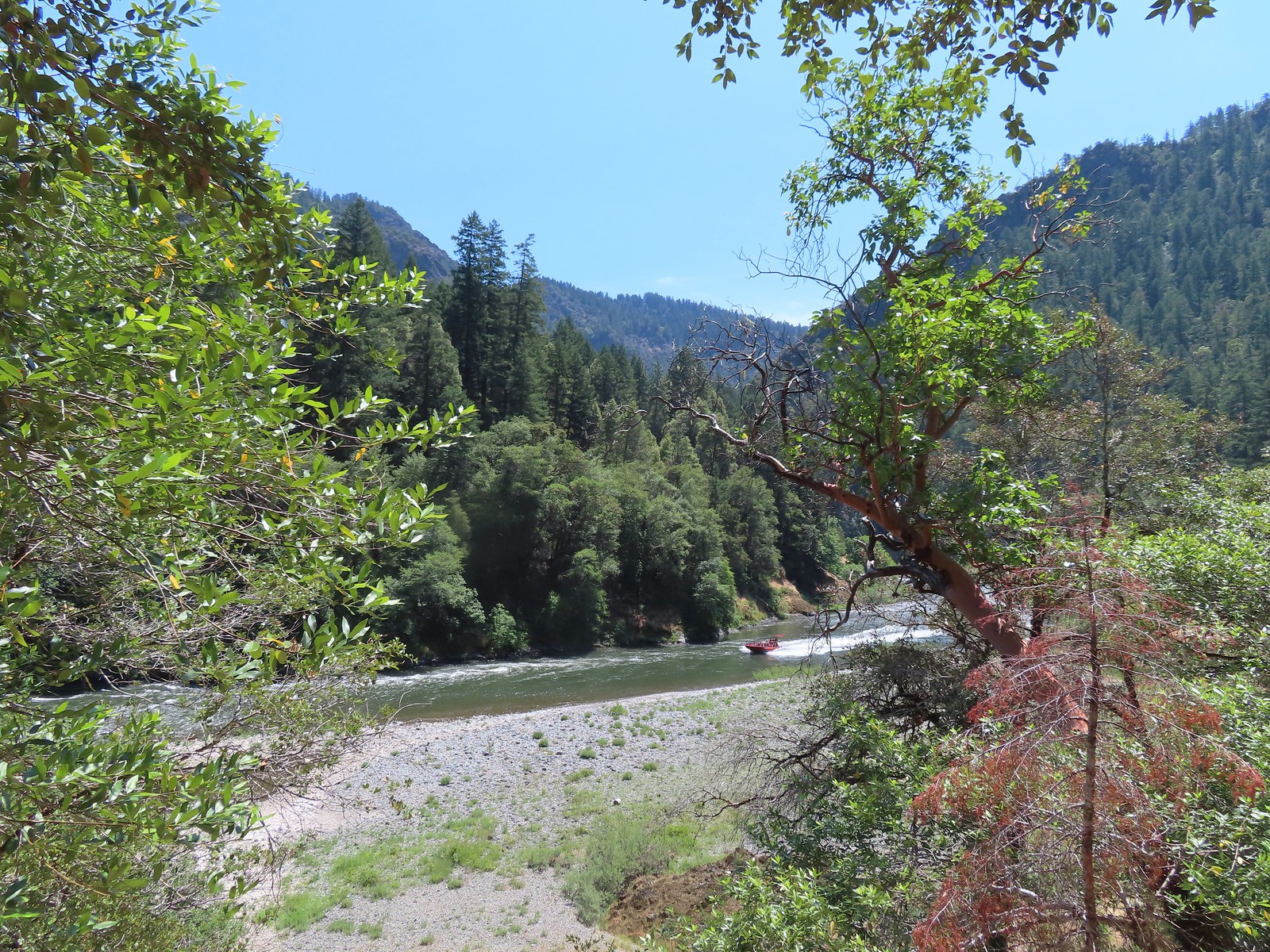 One of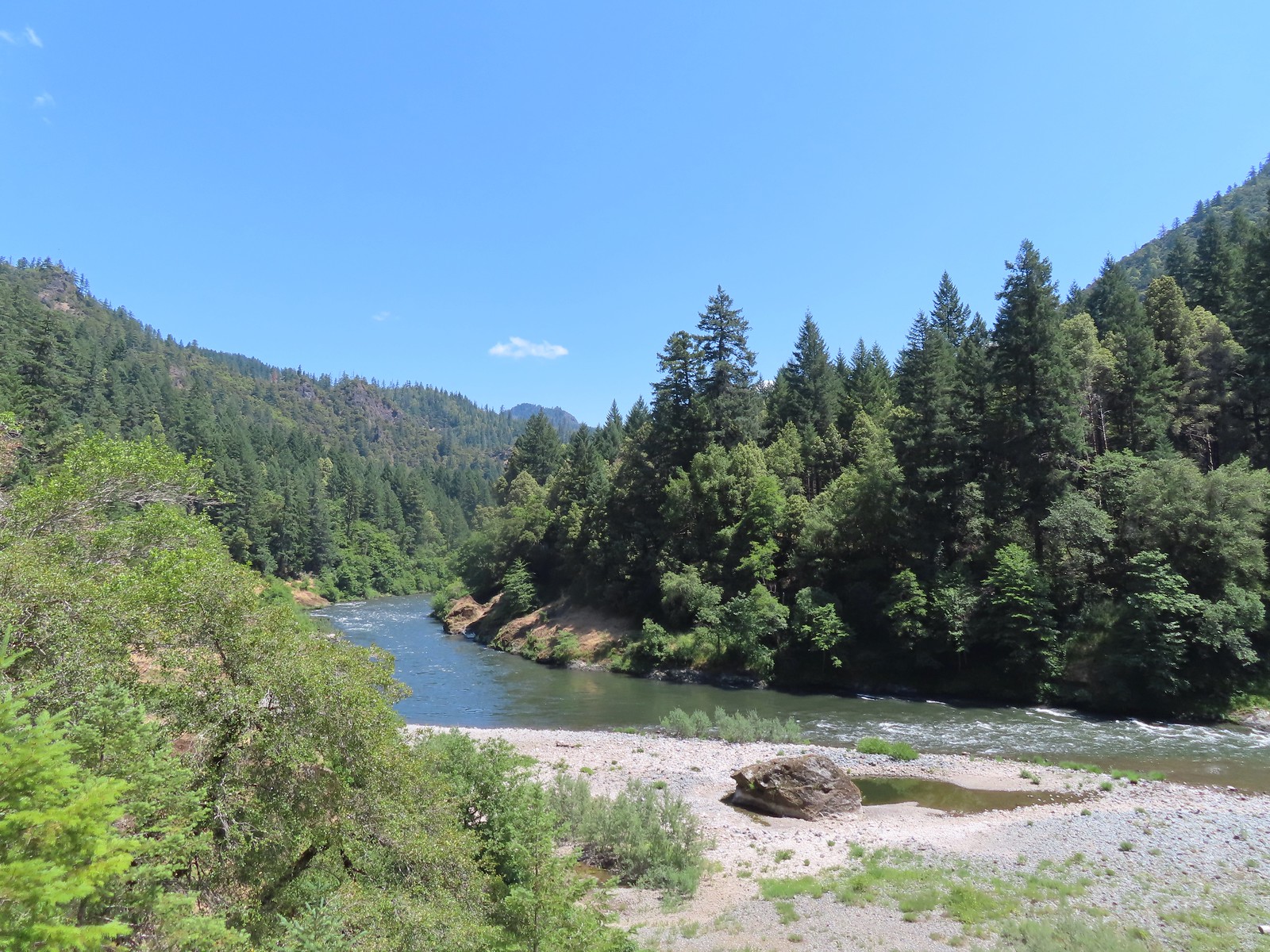
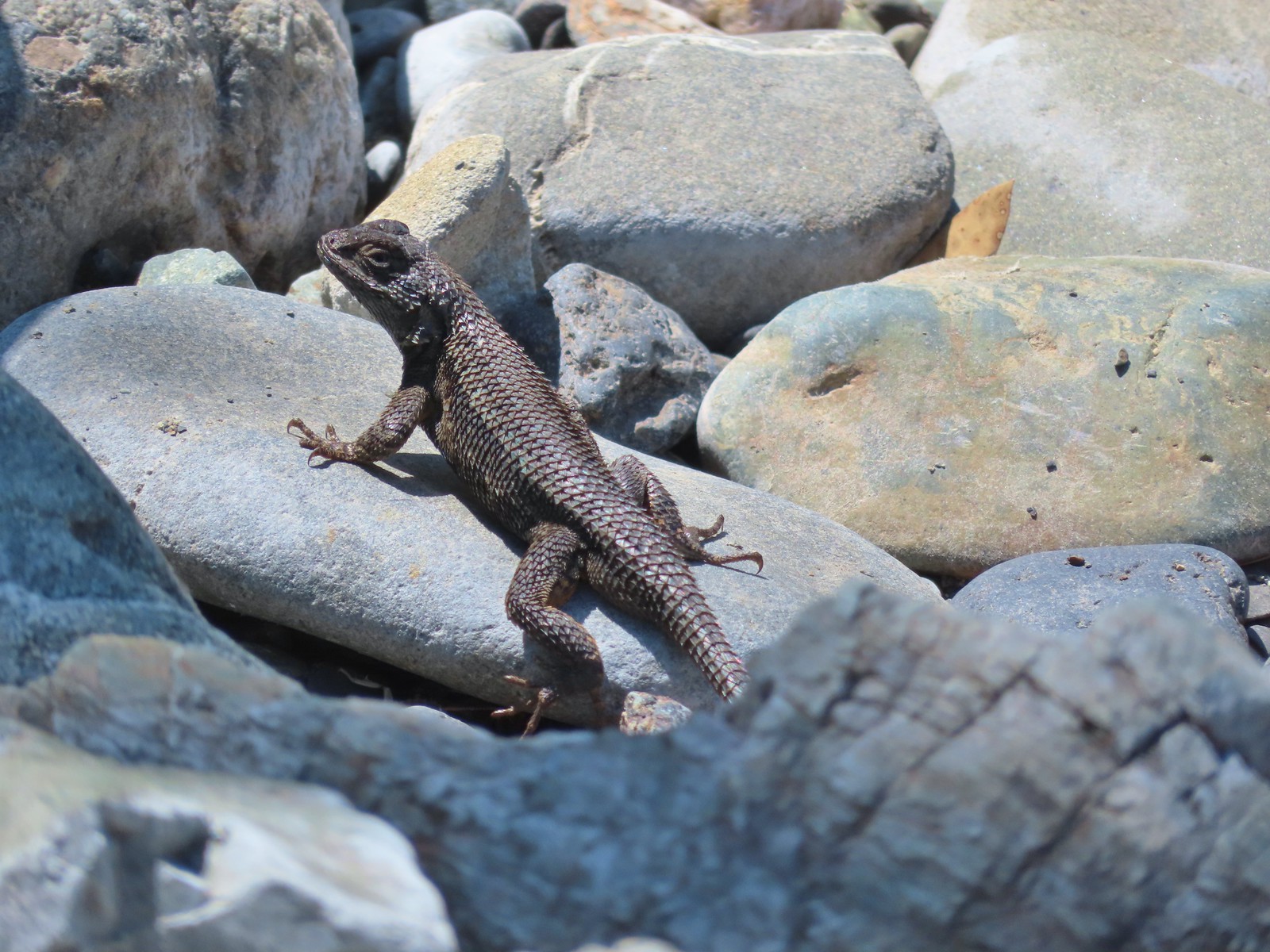
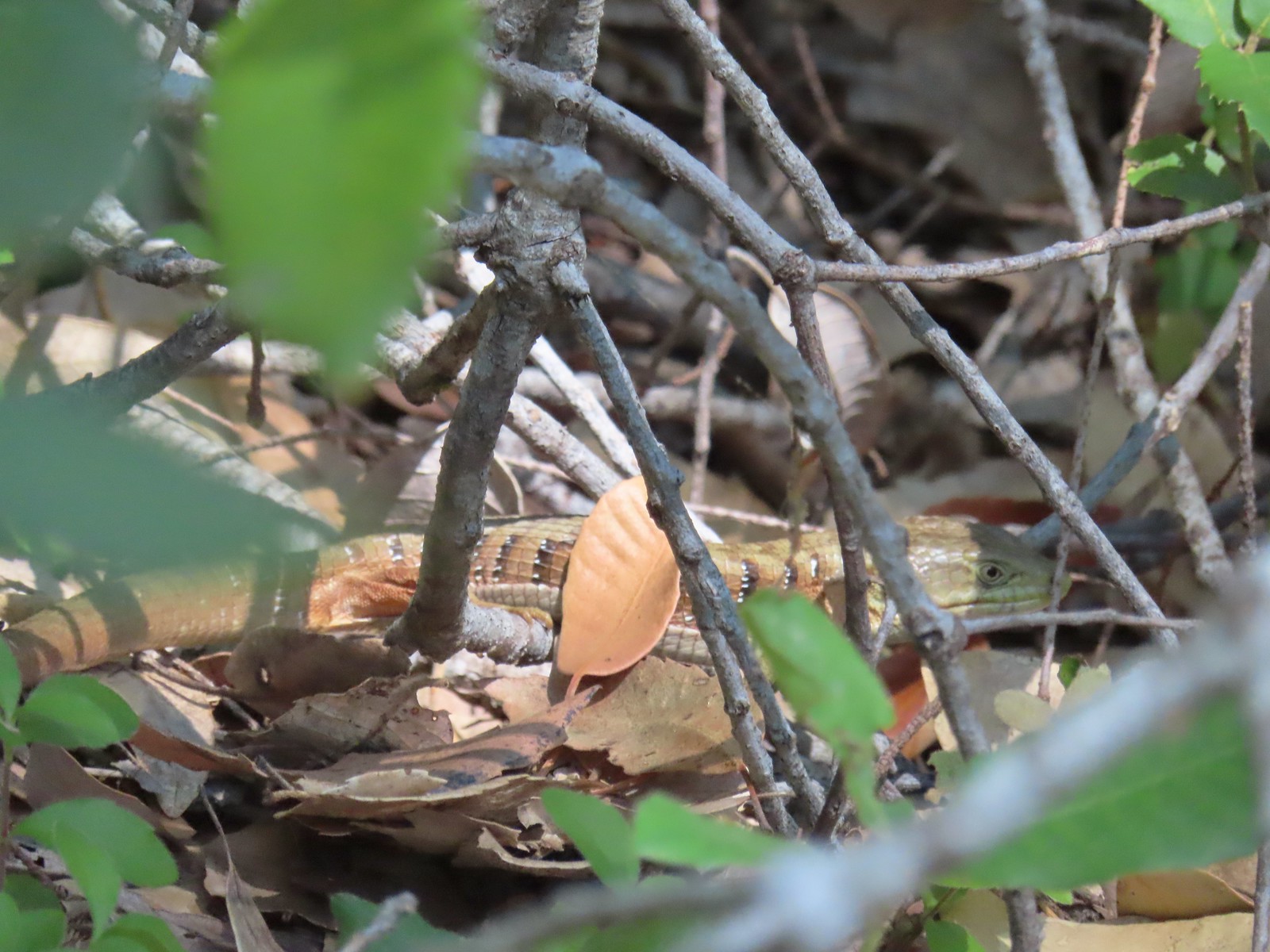 Alligator lizard
 Wine-cup clarkia
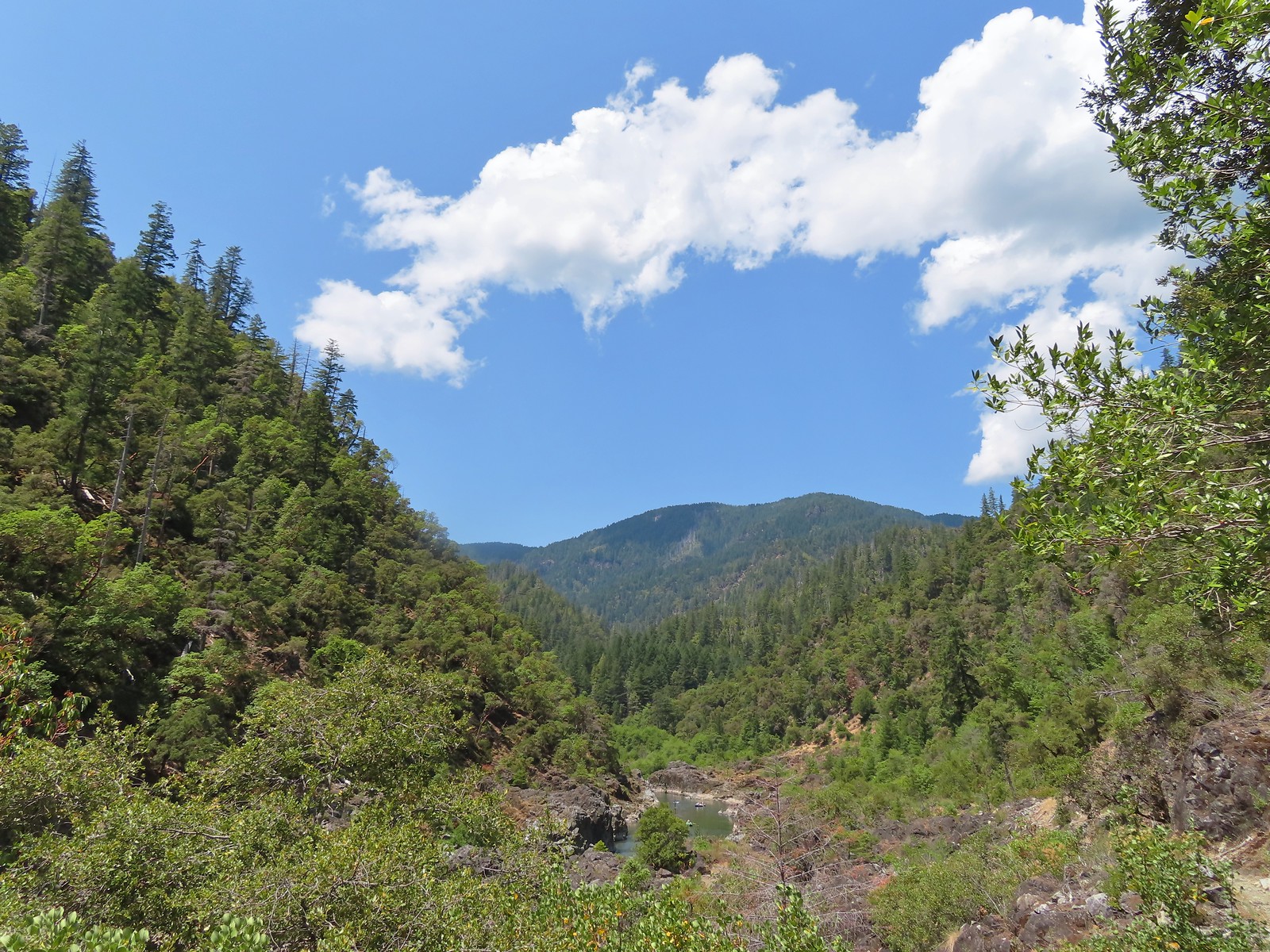 A few fluffy clouds moving in.
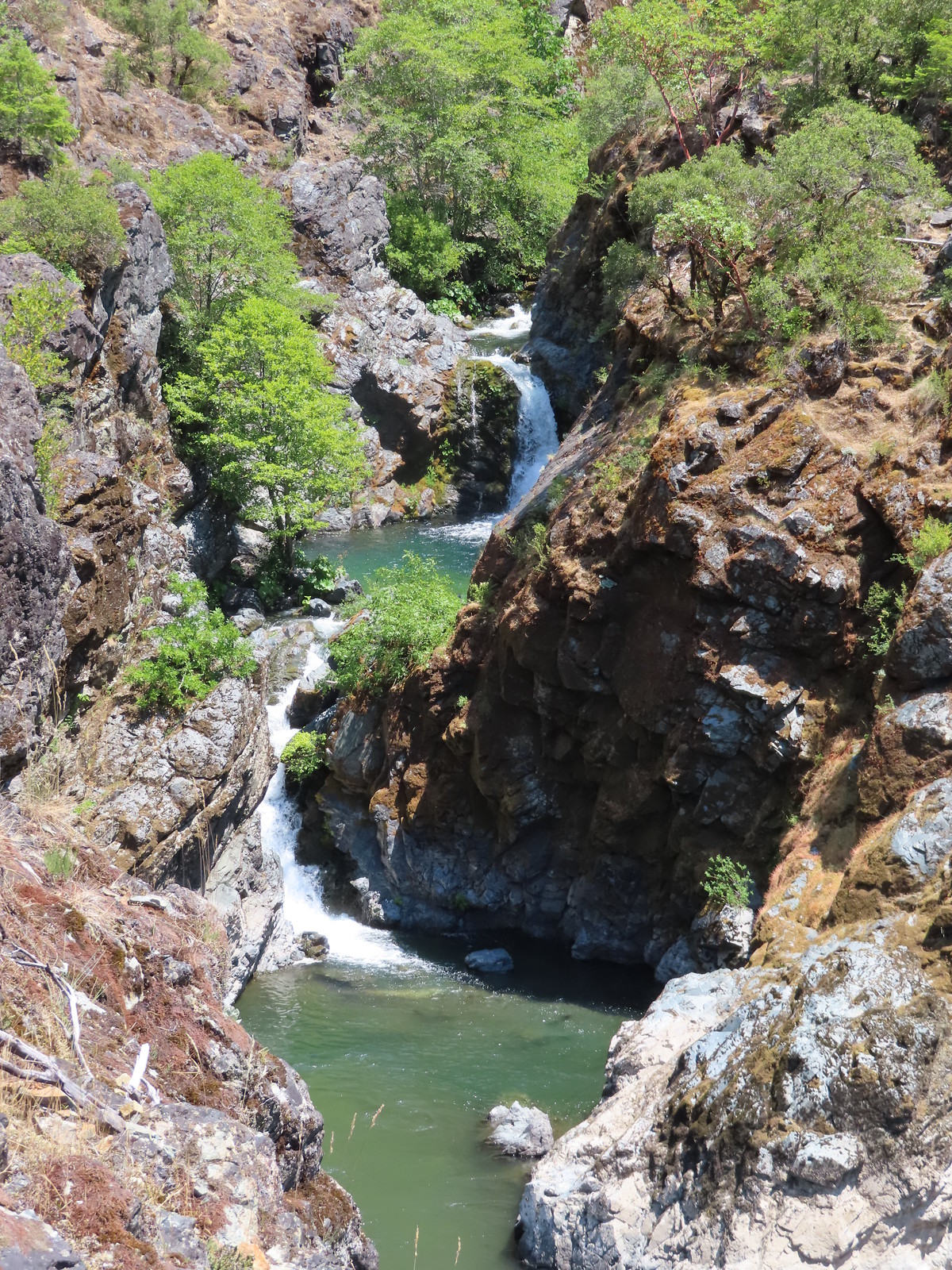 Stair Creek Falls on the way back.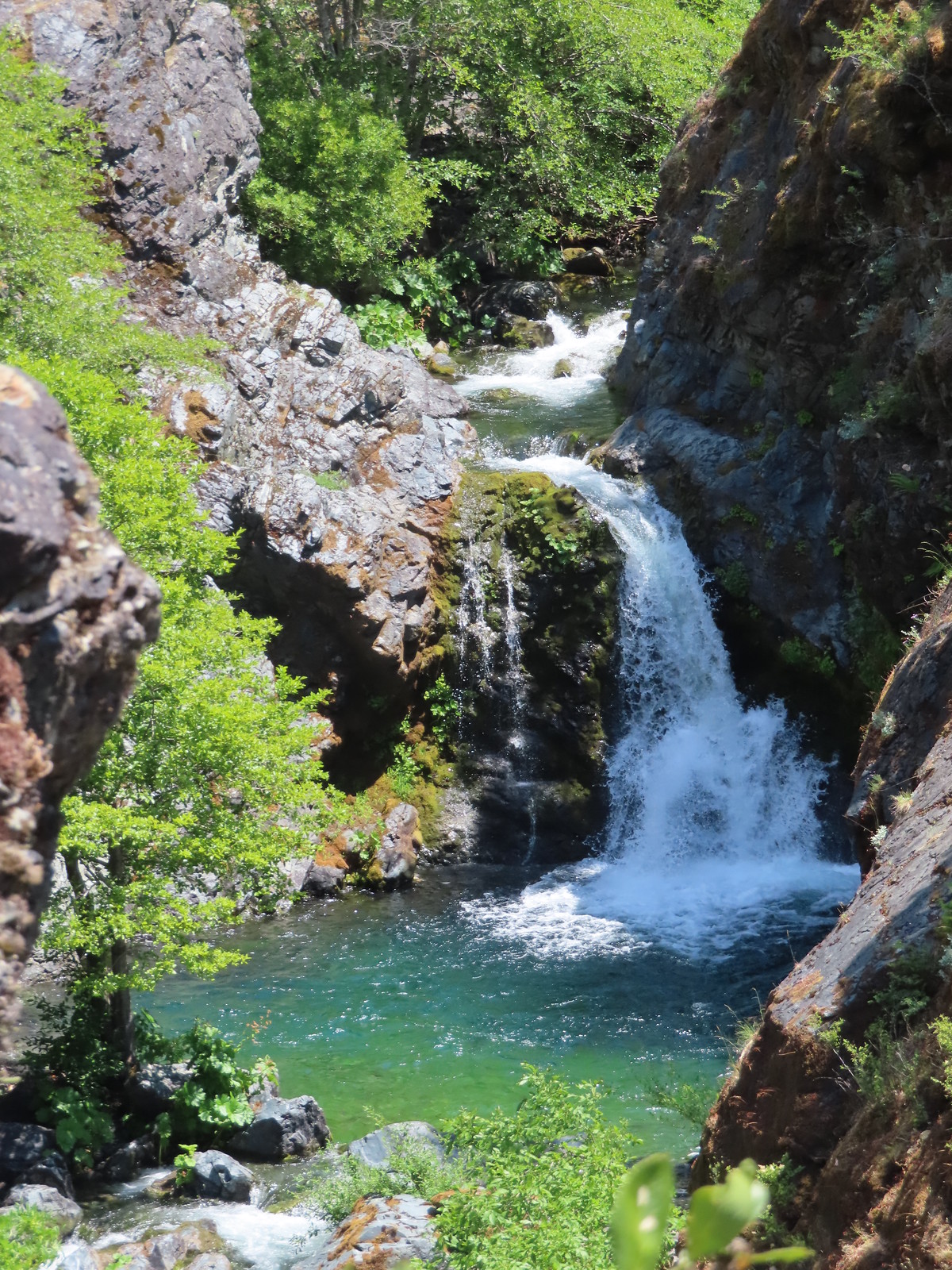
 Mule Creek Canyon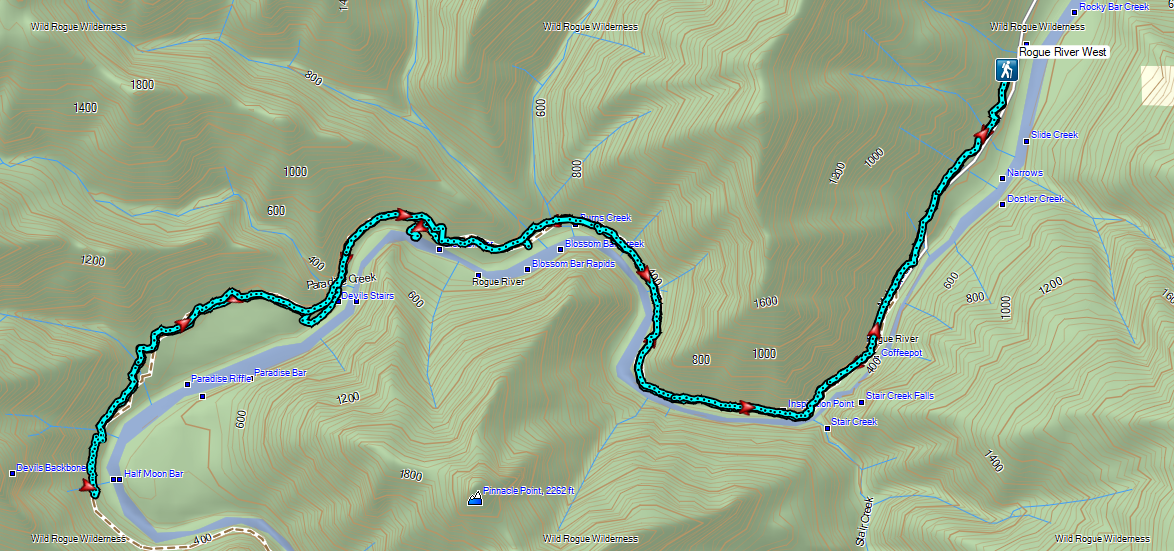

 The smoke that had moved in the day before was still around.

 Toadflax
 Fleabane

 There were lots of fish visible in the reservoir.
 Penstemon
 Showy milkweed
 Approaching Nelson Creek.
 Nelson Creek
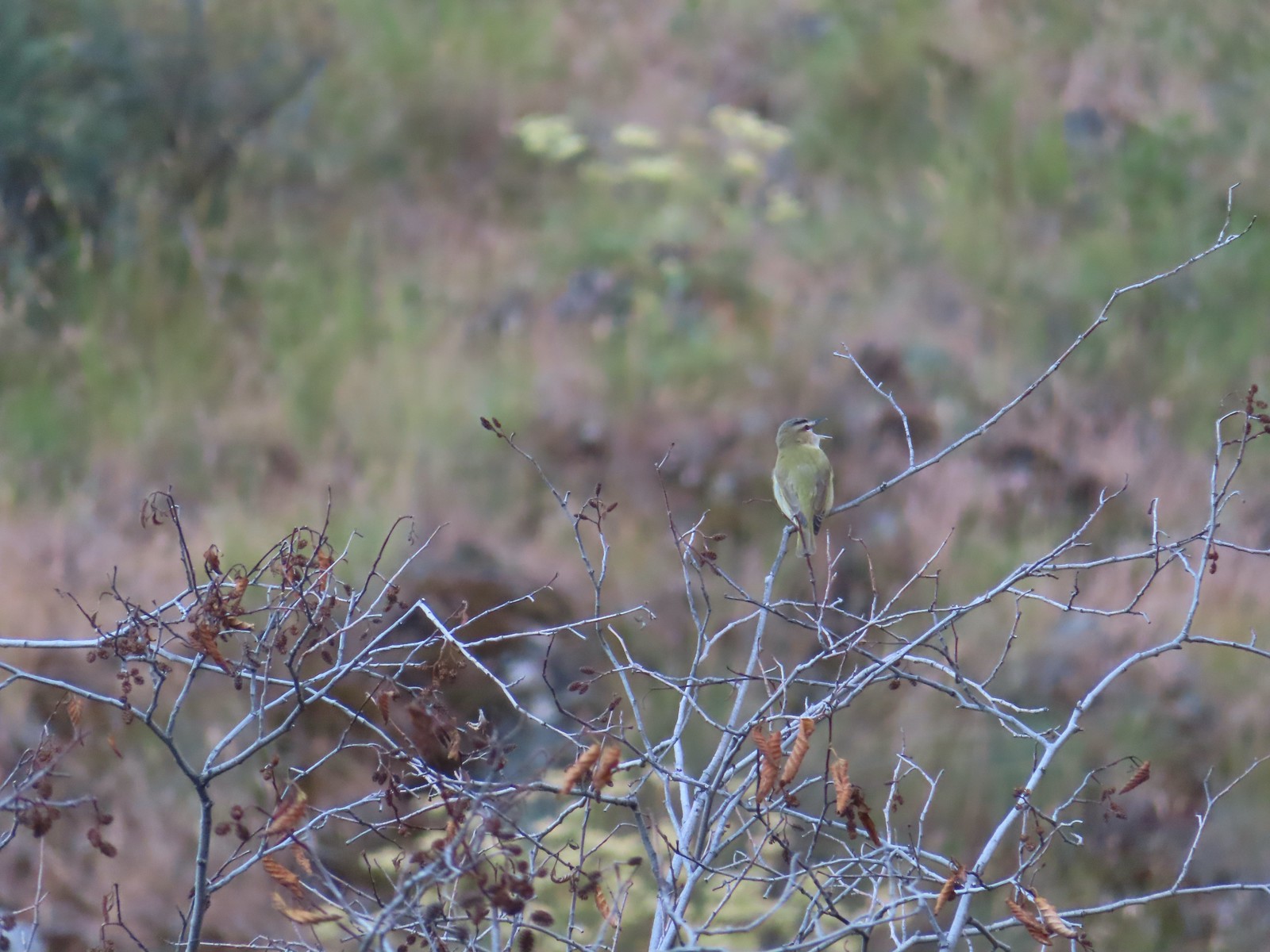 Red-eyed vireo
 Looking up Nelson Creek.
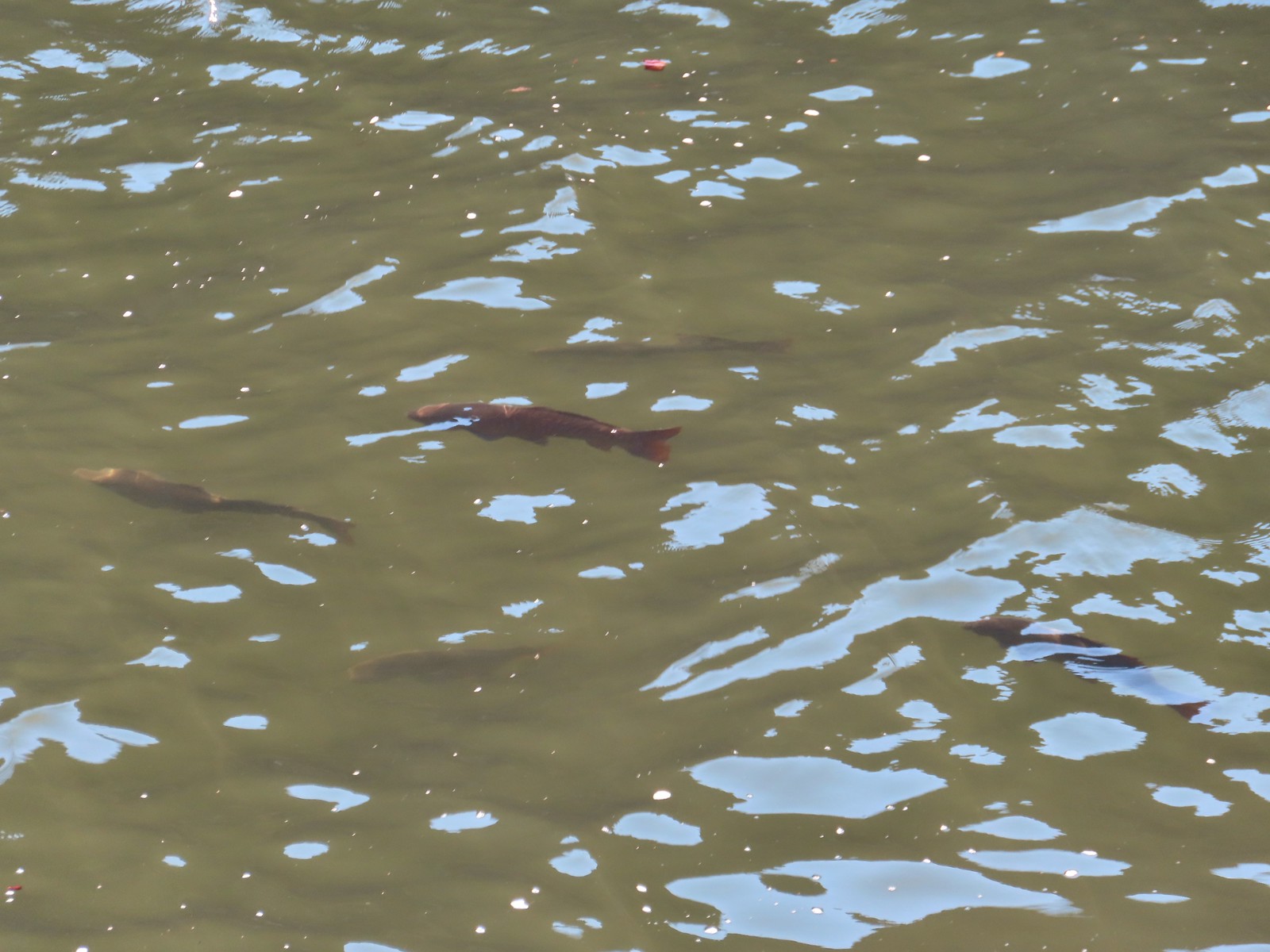 More fish.
 Lazuli bunting

 McGraw Creek
 Lizard
 Common wood nymph
 Moth
Moth Cabbage whites
 Lorquin’s admiral
 Copper Creek Trailhead from the trail.


 The start of the trail.
 Penstemon

 Western clematis
 We watched an osprey dive for a fish in the river.
 It pulled a small fish out of the water.
 Threadleaf phacelia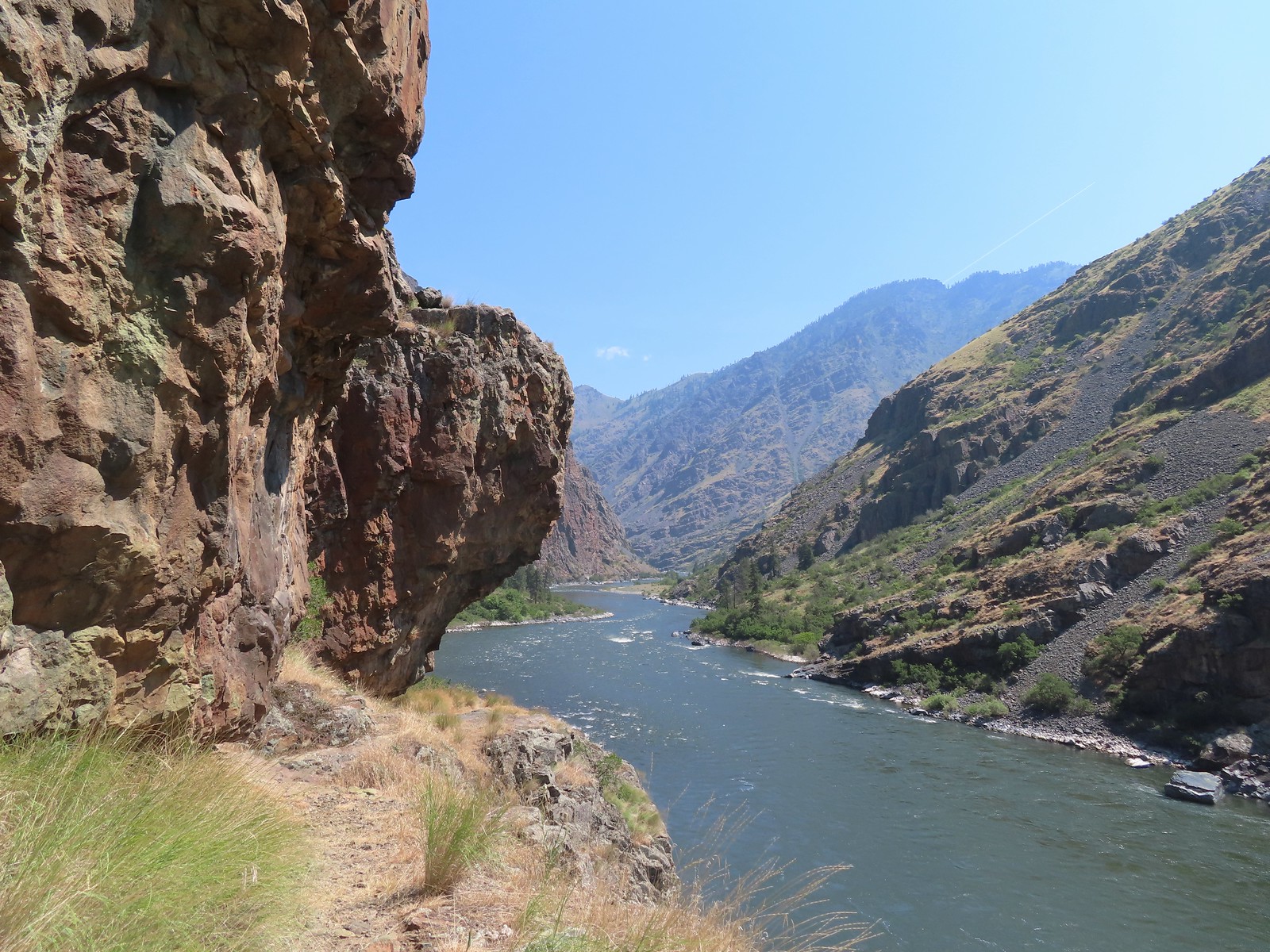
 Rafters that had set off from the dam.
 Ant in a sagebrush mariposa lily.
 Monkeyflower and heart-leaved bittercress
 View near Stud Creek.

 Cobble Beach near Stud Creek
 Jet boat passing by.
 Interpretive sign near the visitors center.
 Hells Canyon Creek
 View from the visitors center.
 The empty trailhead parking area.
 The structure on the right is an old fish trap.
 This was only our second hike in Idaho (
 The Payette National Forest manages this trail.

 Going up.
 Snake River from the trail.
 Going back down.
 There were a couple of dirt/rock sections, but the trail was mostly metal stairs and catwalks.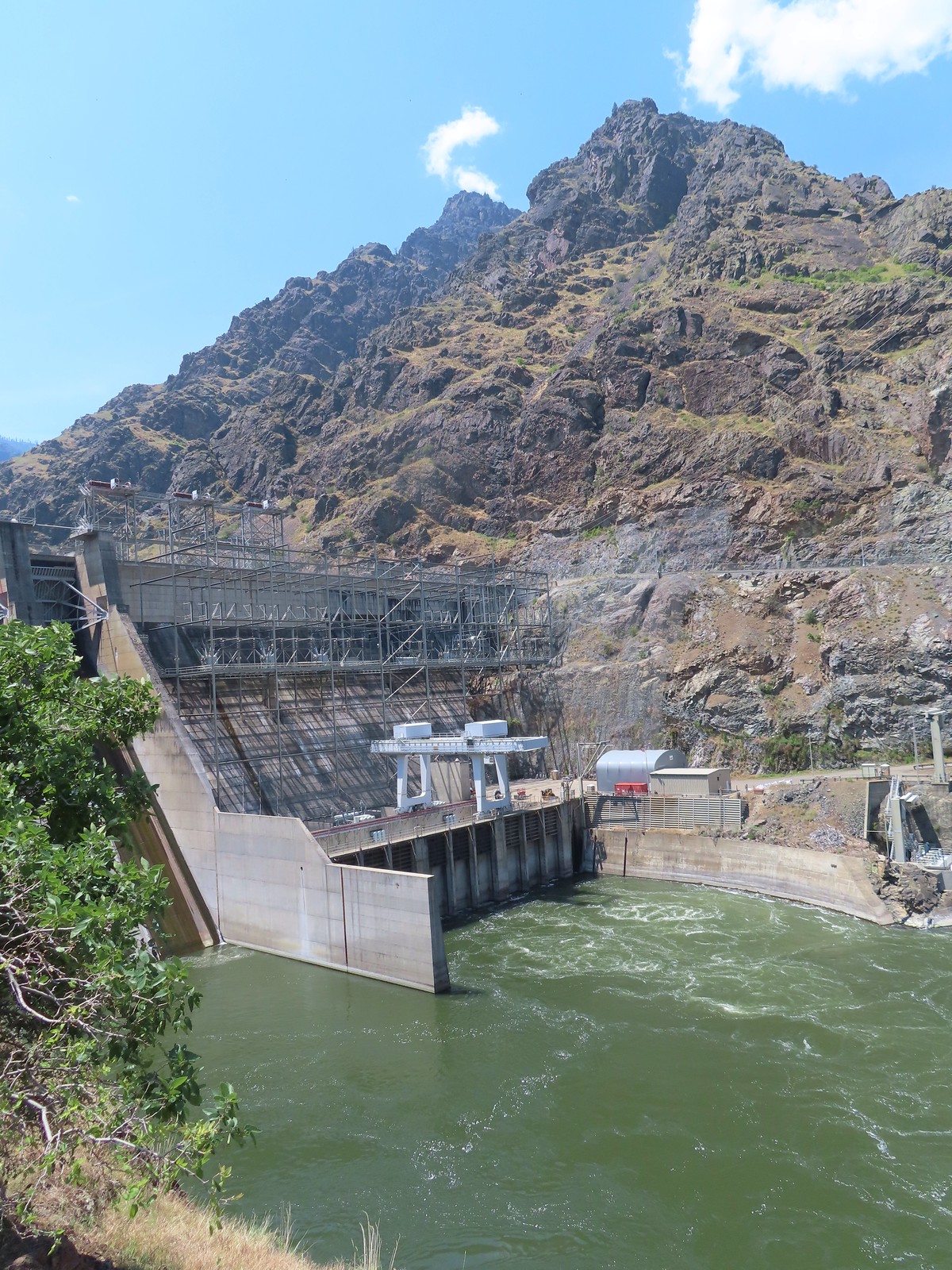
 Ahmed’s fishing pole was still out, and you might notice a little red to the left of the structure ahead.
 There was a very short scramble to get up to the continuation of the trail above the structure along the creek.
 A few patches of snow in the Payette National Forest.
 Deep Creek