Categories
High Cascades Hiking Mt. Jefferson Area Oregon Trip report

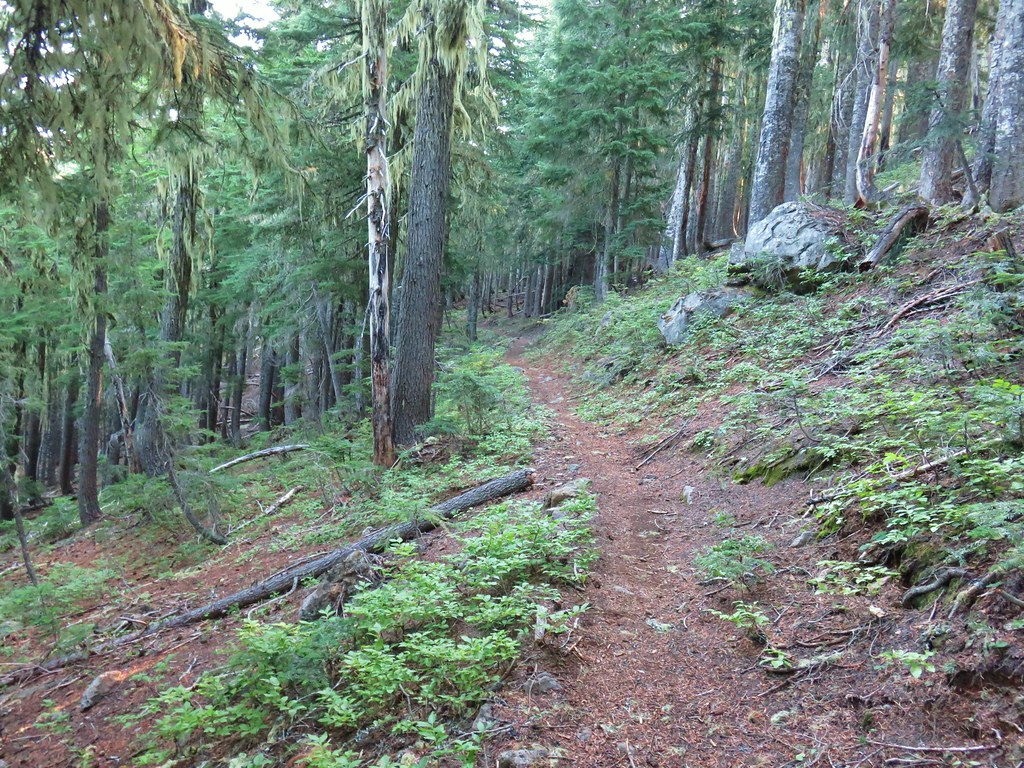
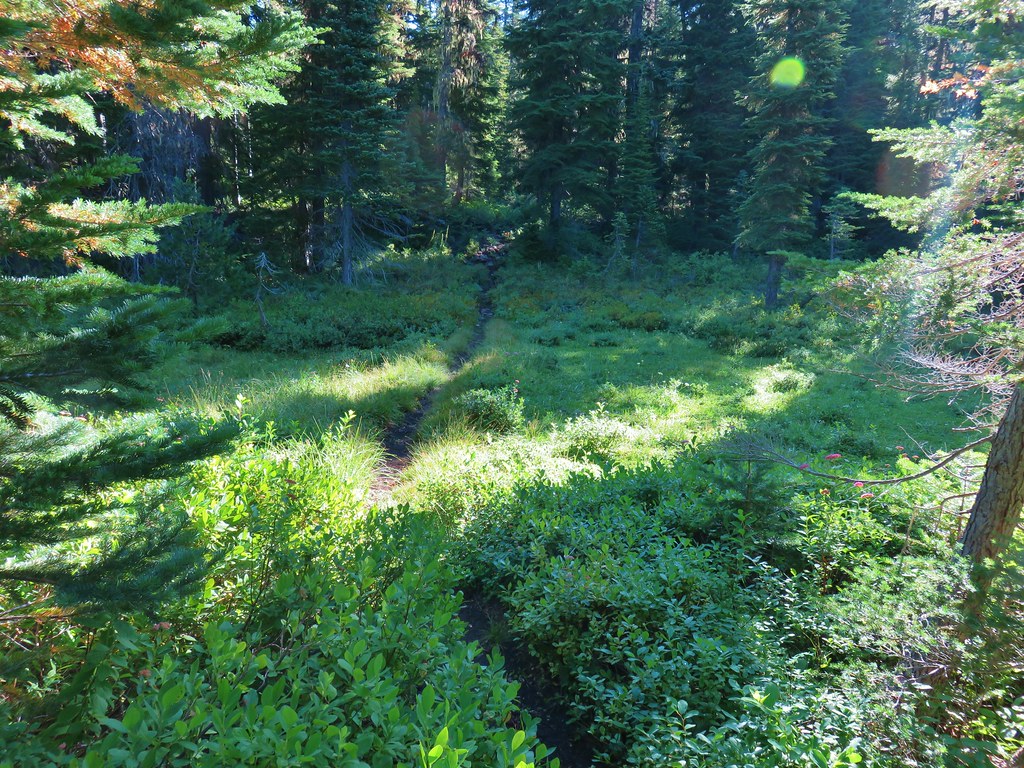
Monon Lake-Ruddy Hill Loop – 9/12/2019

**Note the 2020 Lionshead Fire burned the area covered by this hike.**

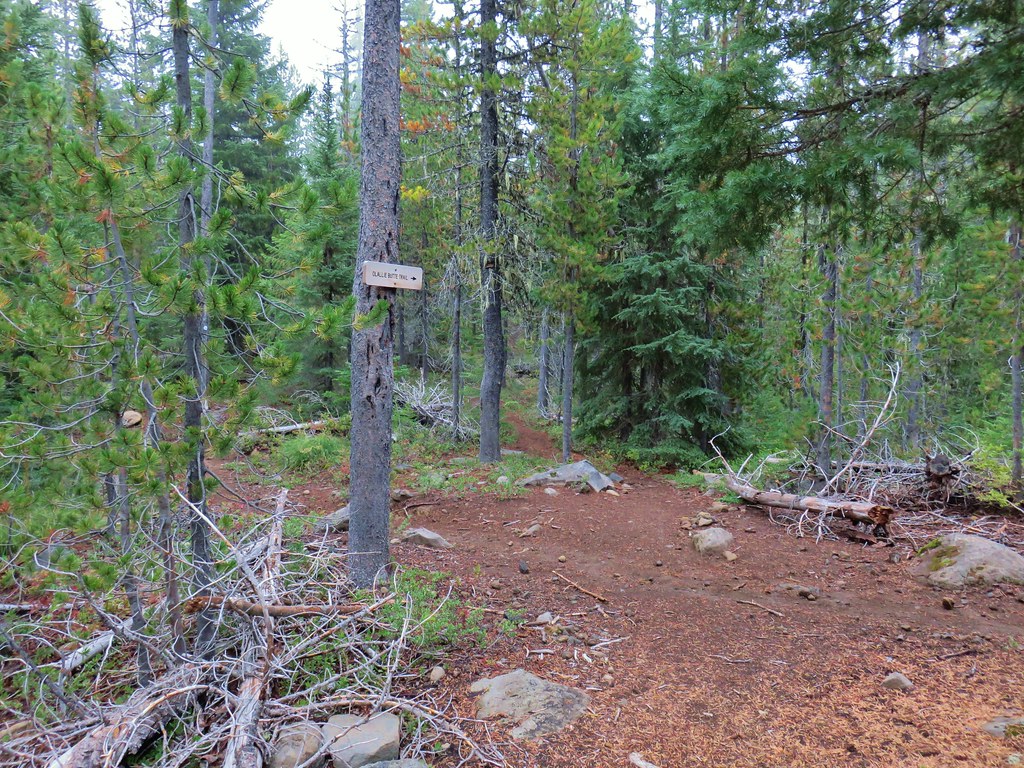
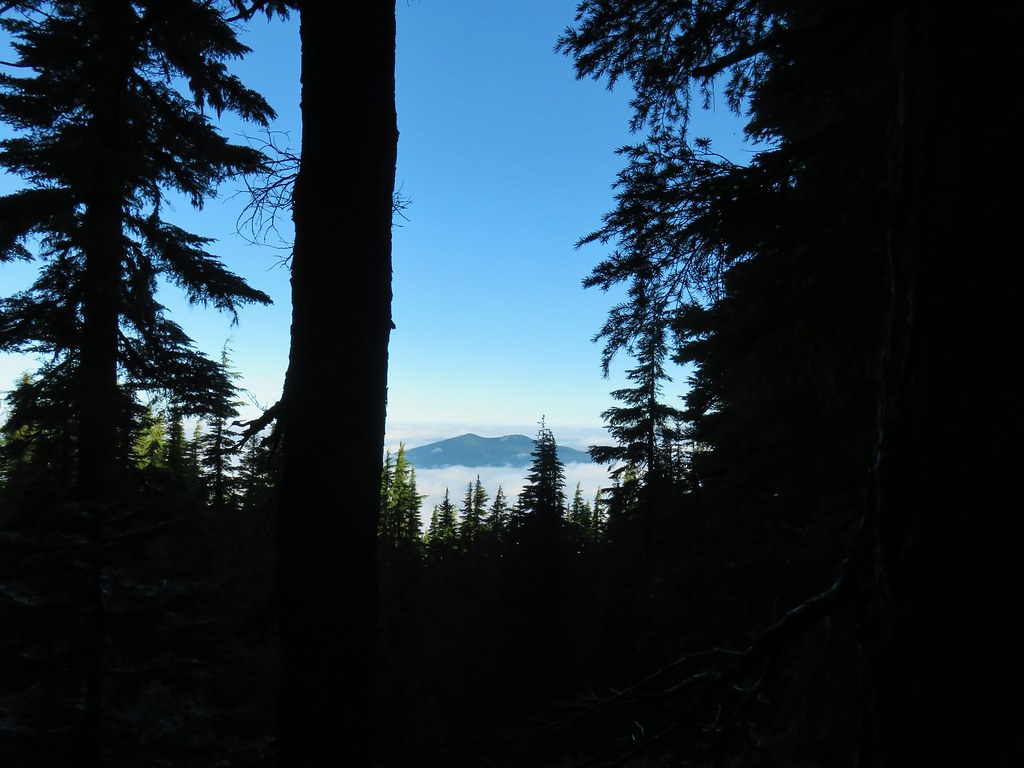
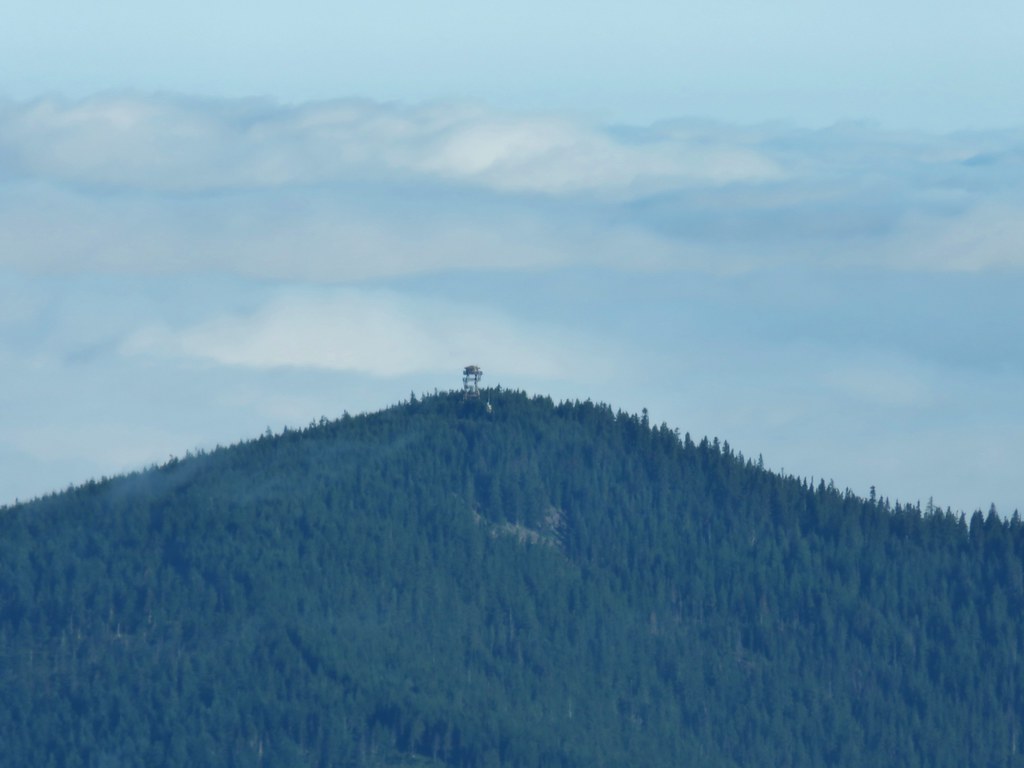
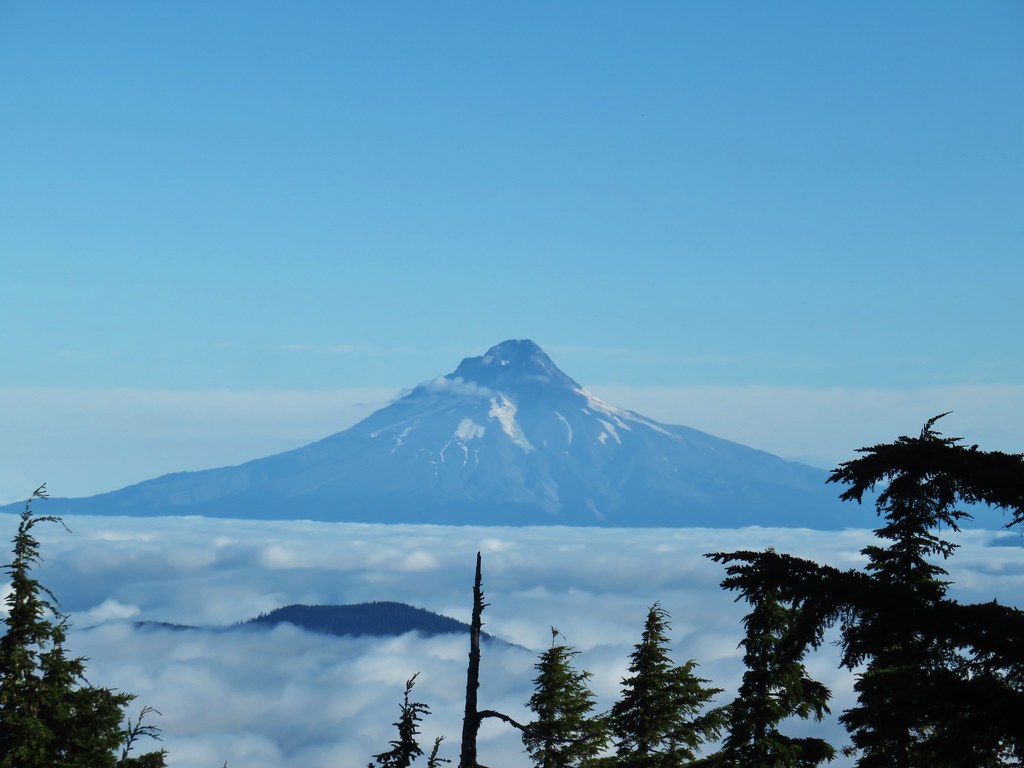
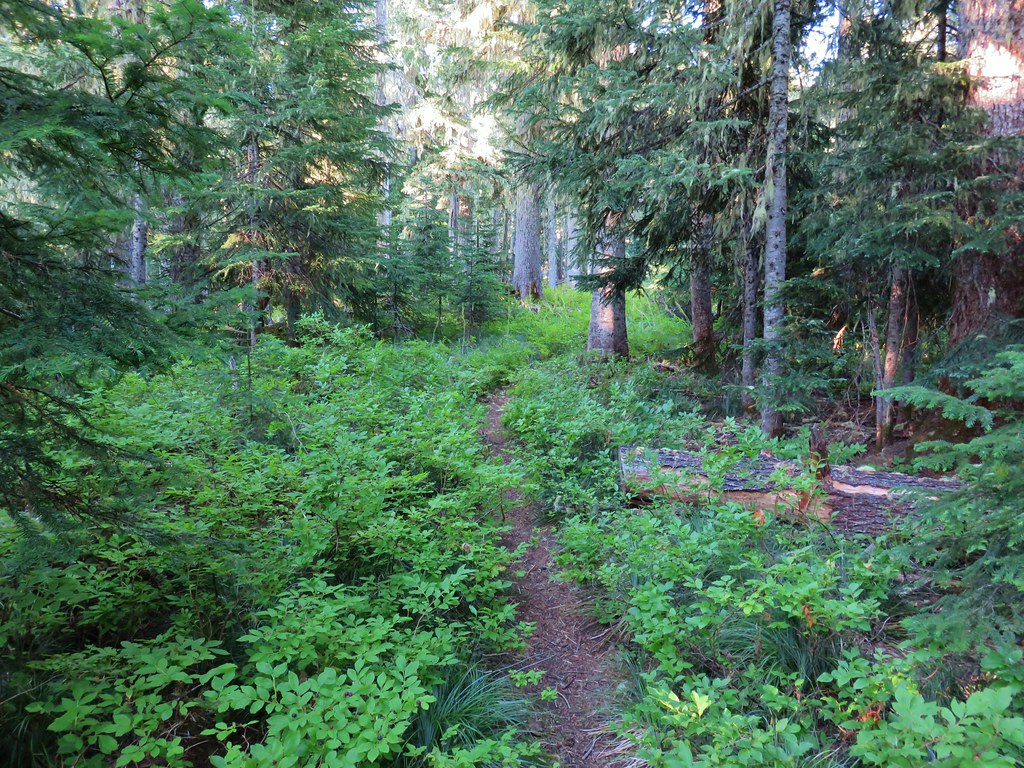
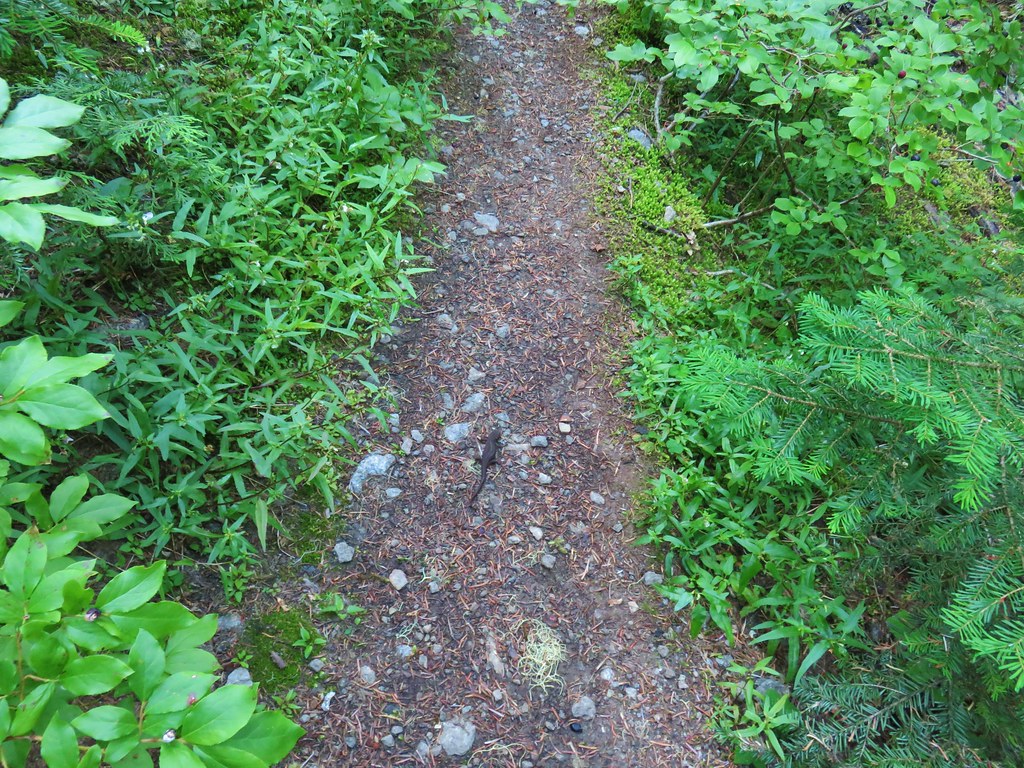
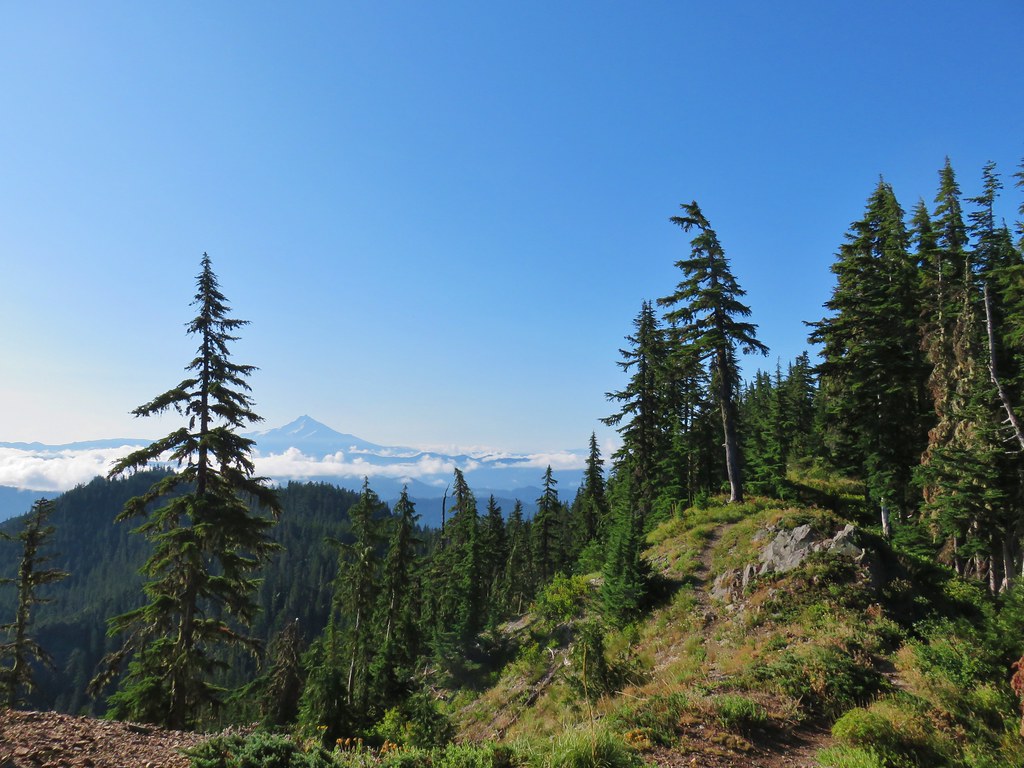
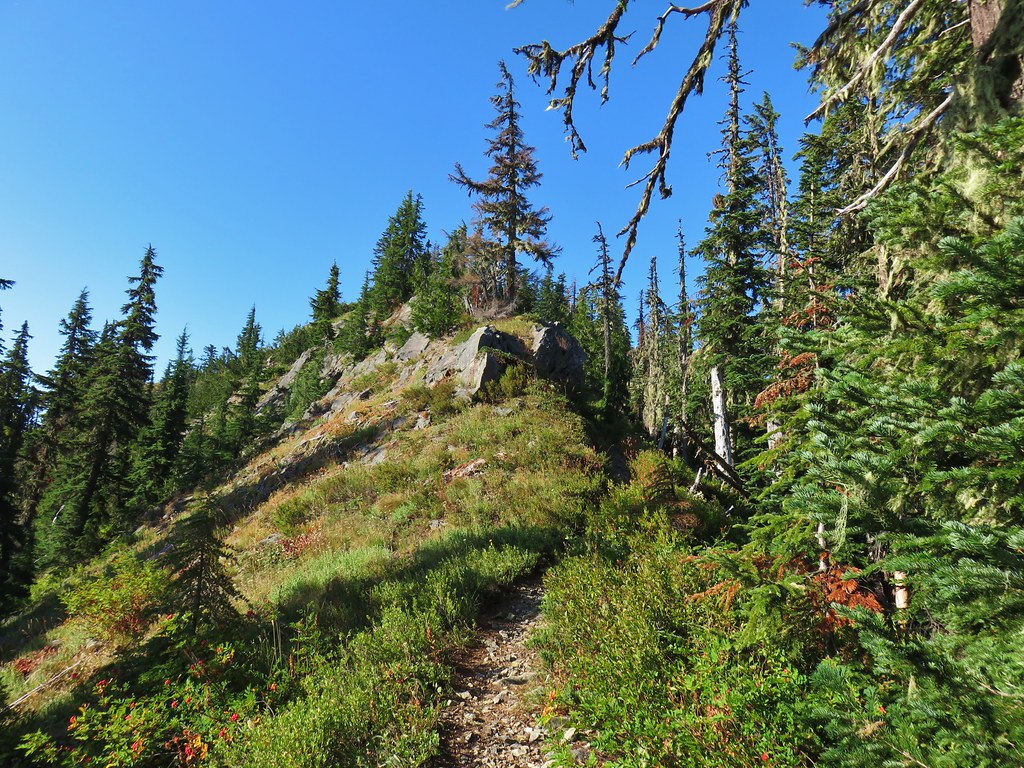
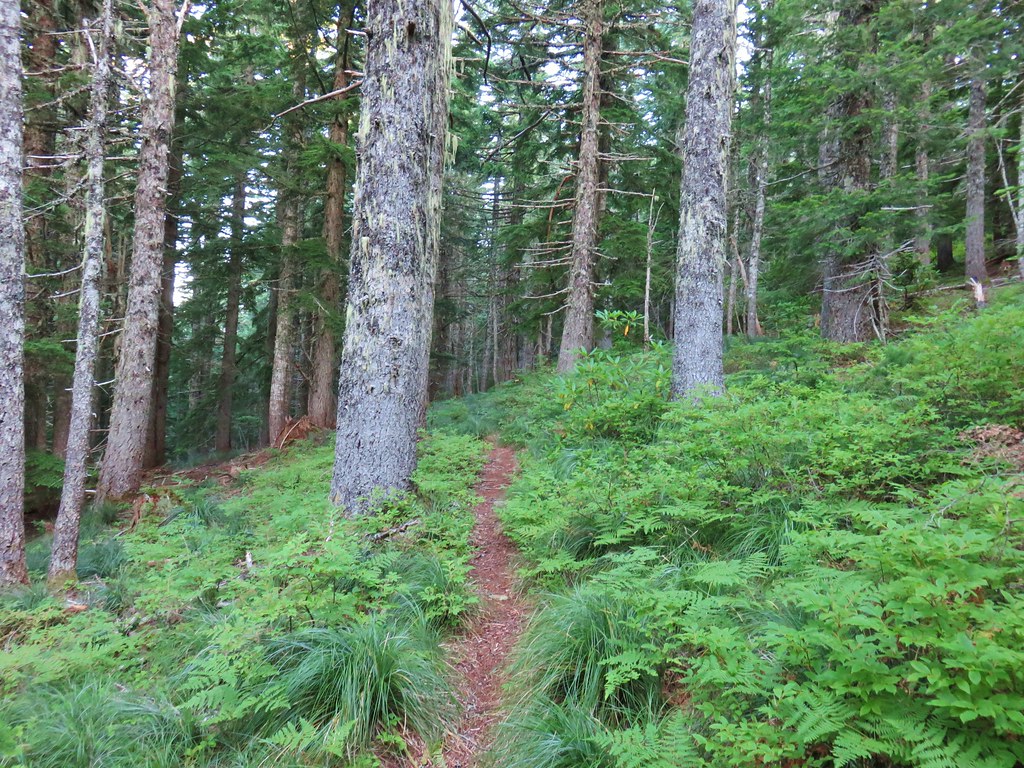
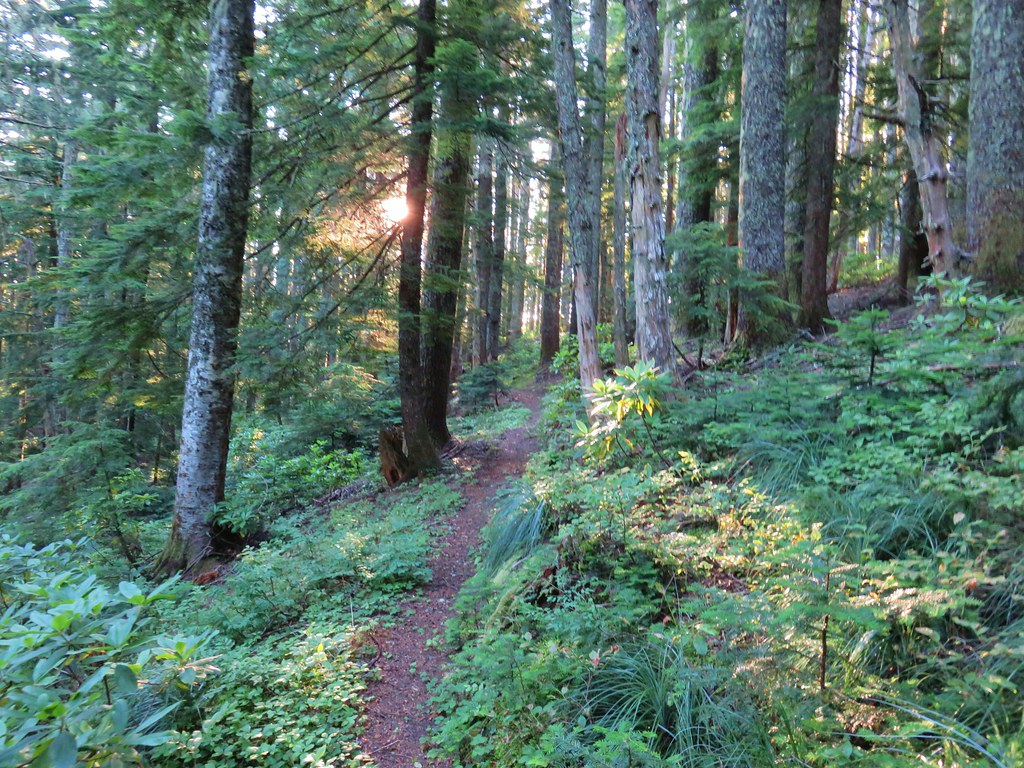
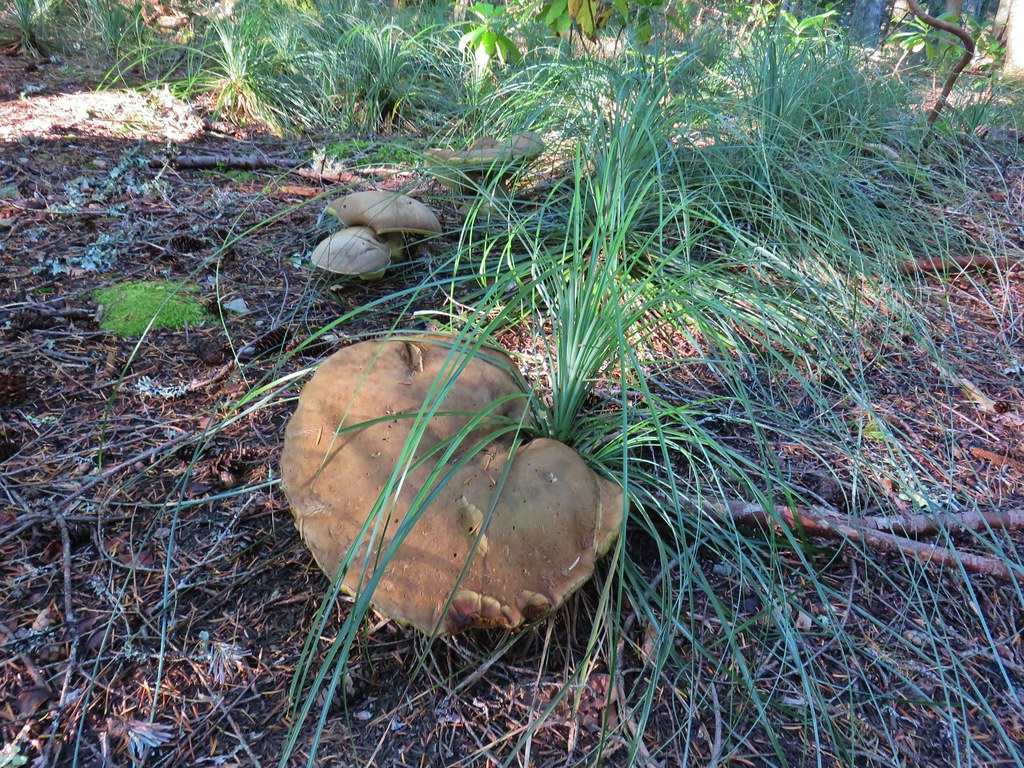
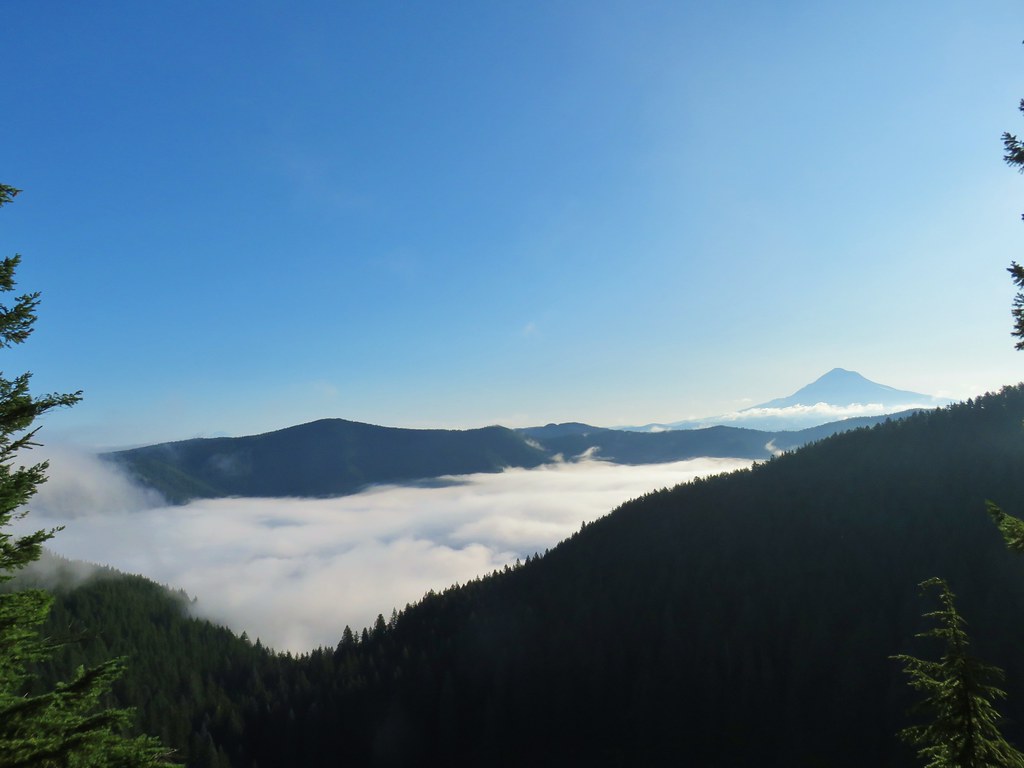
A series of wet storms passed through Oregon just in time for an extended weekend of hiking. With a sunny forecast for Thursday we headed back up to the Olallie Lake Scenic Area to check off another one of Sullivan’s featured hikes (Monon Lake) and to revisit Ruddy Hill since our first time up this peak was viewless (post). With the addition of Ruddy Hill to the Monon Lake hike we used Matt Reeder’s “101 Hikes in the Majestic Mt. Jefferson Region” for additional inspiration and came up with our own hike mashup.

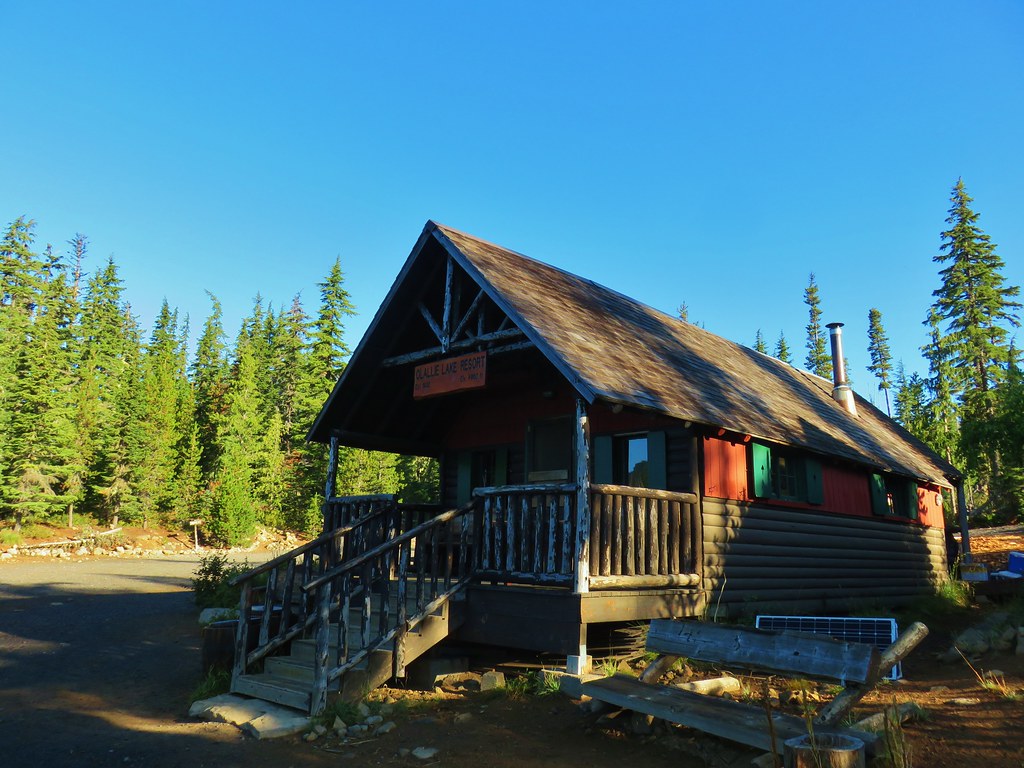
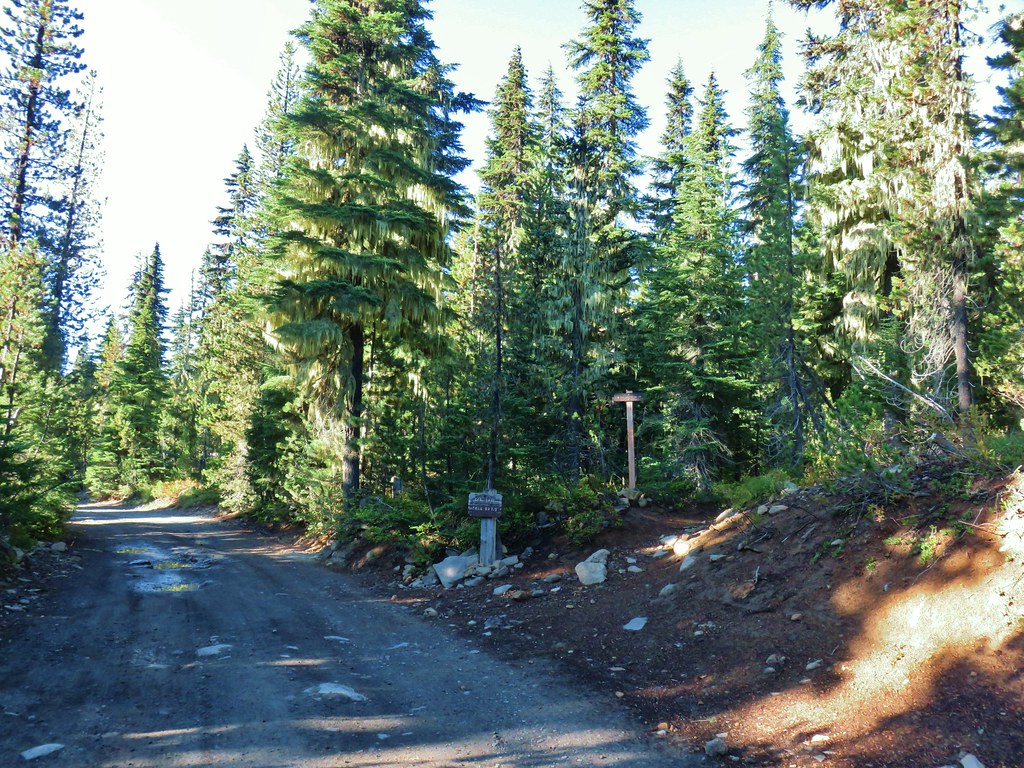
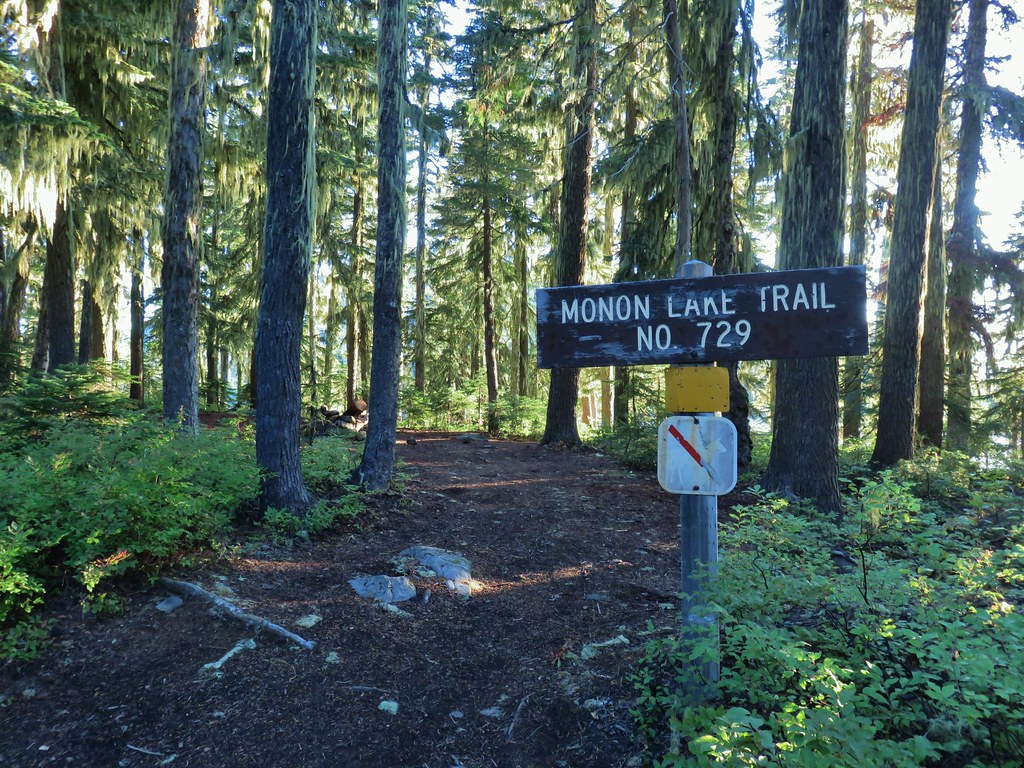
In addition to Monon Lake and the view from Ruddy Hill we also wanted to see Timber and Horseshoe Lakes for the first time. Our plan was to start our hike at Monon Lake and do a clockwise loop with side trips up Ruddy Hill and to Timber Lake. This meant driving past the Olallie Lake Resort on the infamous Skyline Road to the northern Monon Lake Trailhead. The road was passable in our Outback and the recent rains helped clearly identify the numerous potholes along the way.
IMG_8671

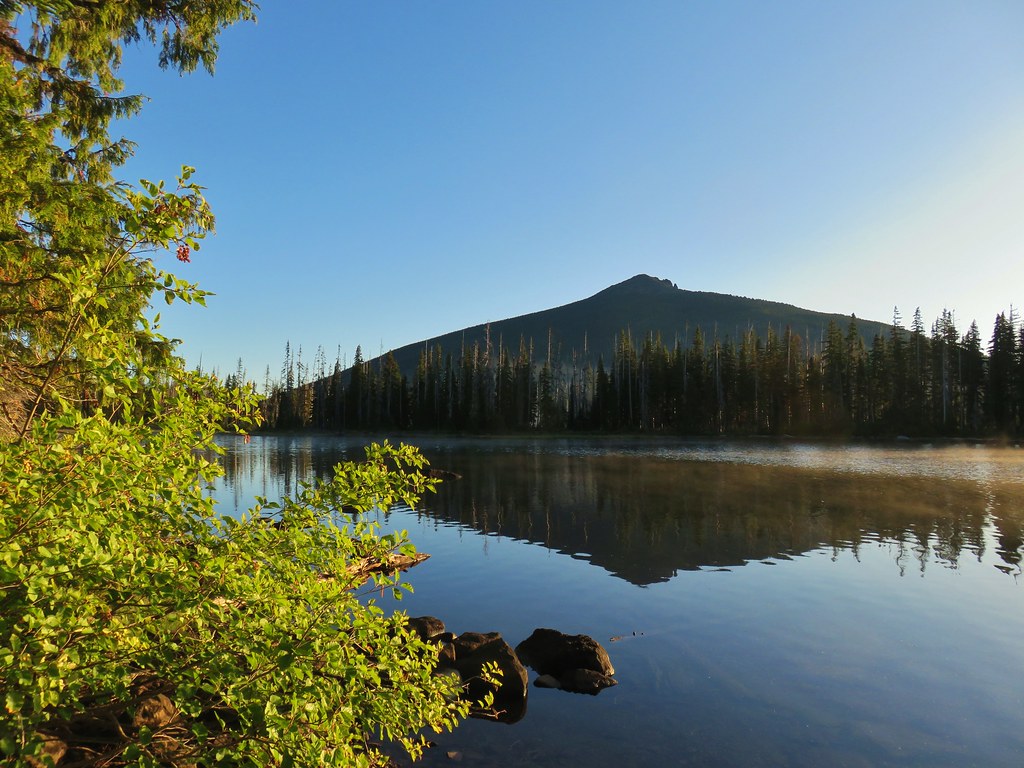
There was a nearly immediate view across part of the lake to Olallie Butte which we had recently climbed (post).
IMG_8673

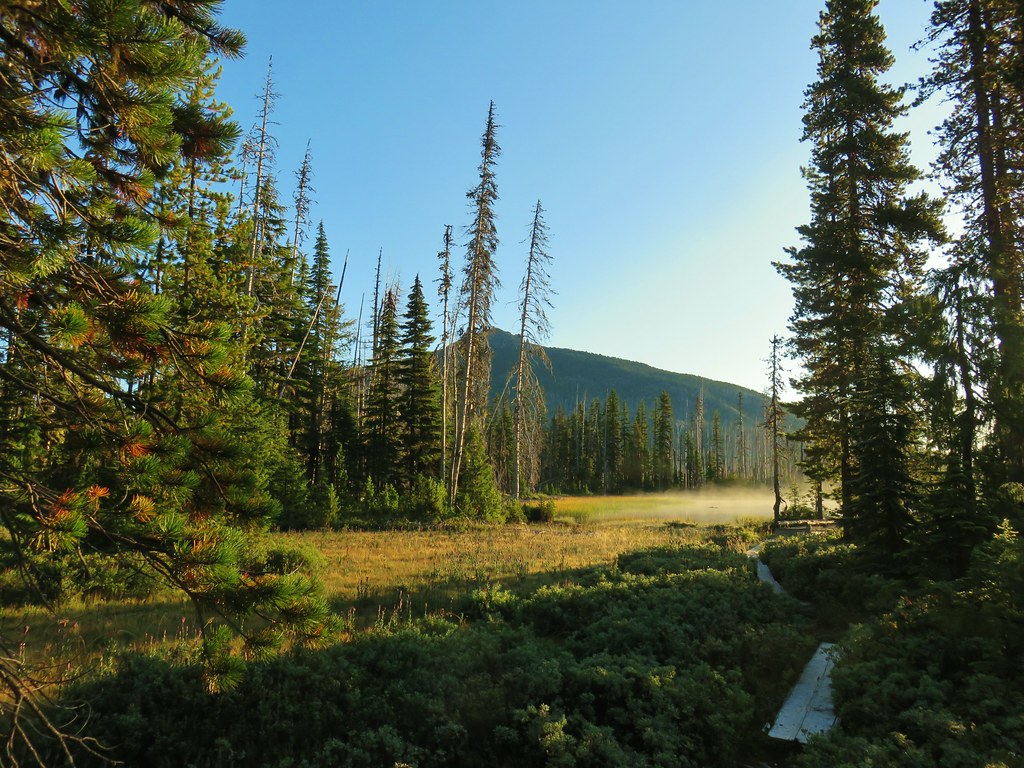
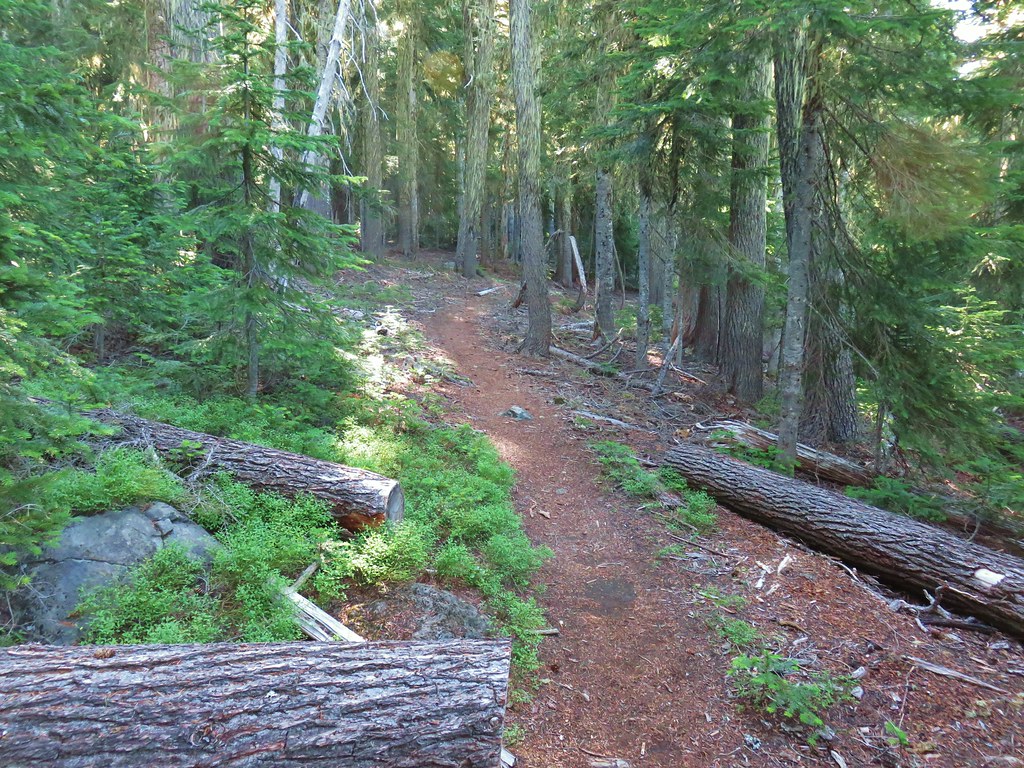
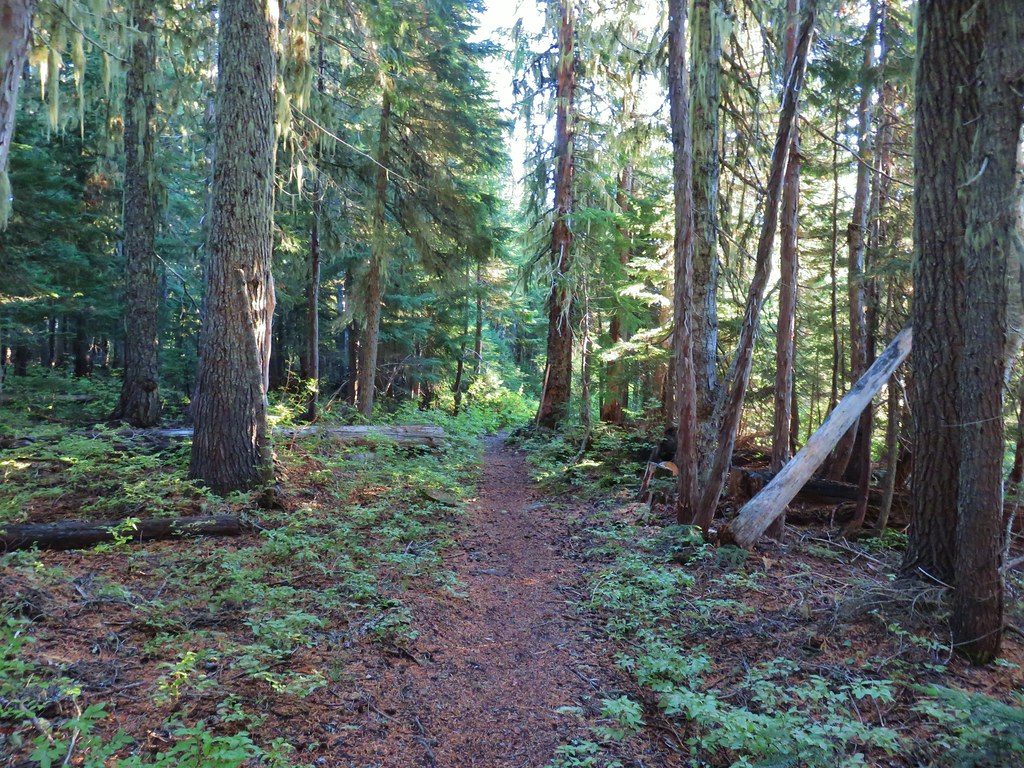
The trail began to curve around the northern end of the lake passing through a section of forest before reaching some boardwalks and bridges in a meadow between Monon Lake and a smaller unnamed lake to the north.
IMG_8676

IMG_8680

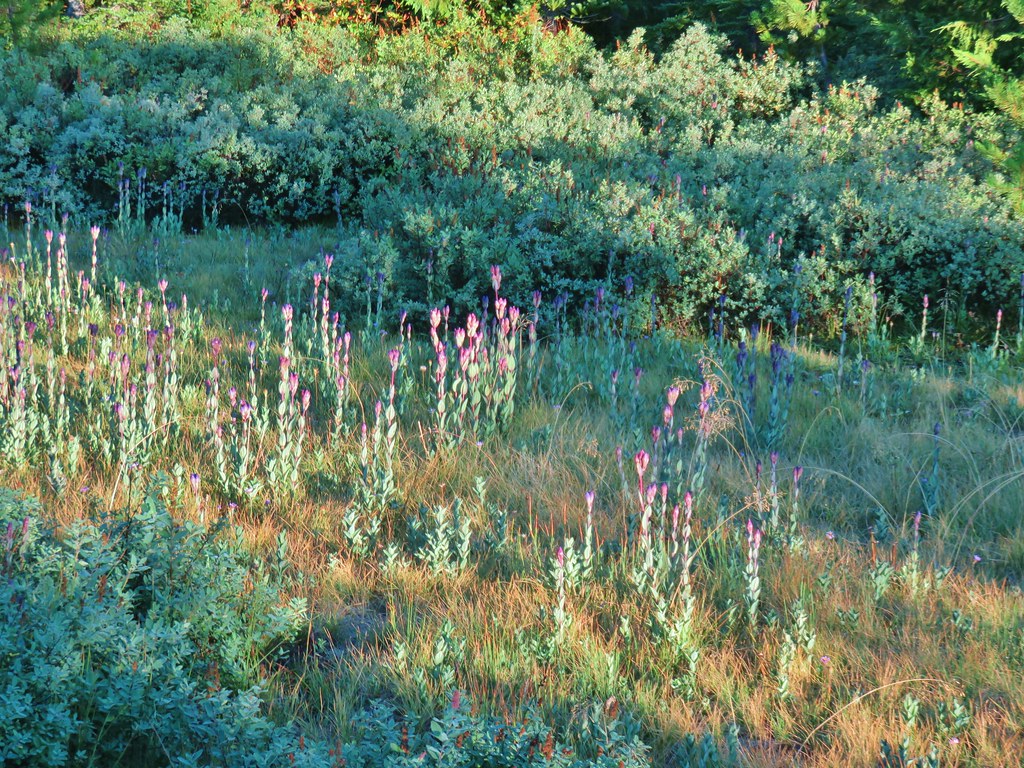
IMG_8681Fading gentians

IMG_8677A few gentians still holding their blue color.

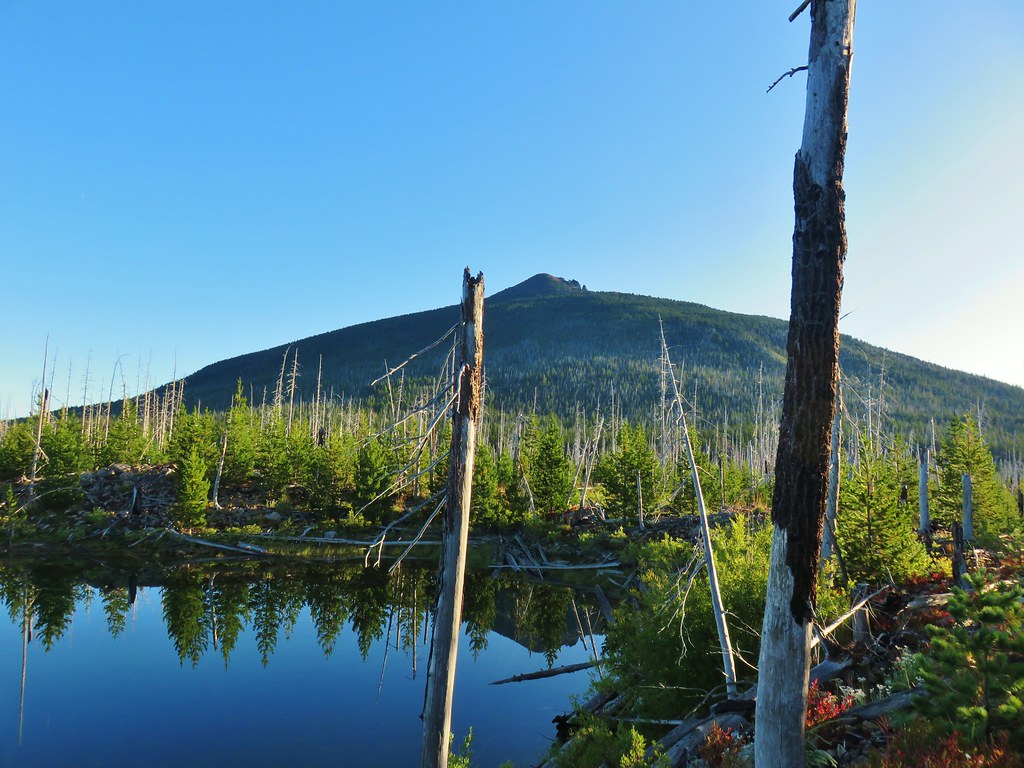
IMG_8683Olallie Butte and the unnamed lake.

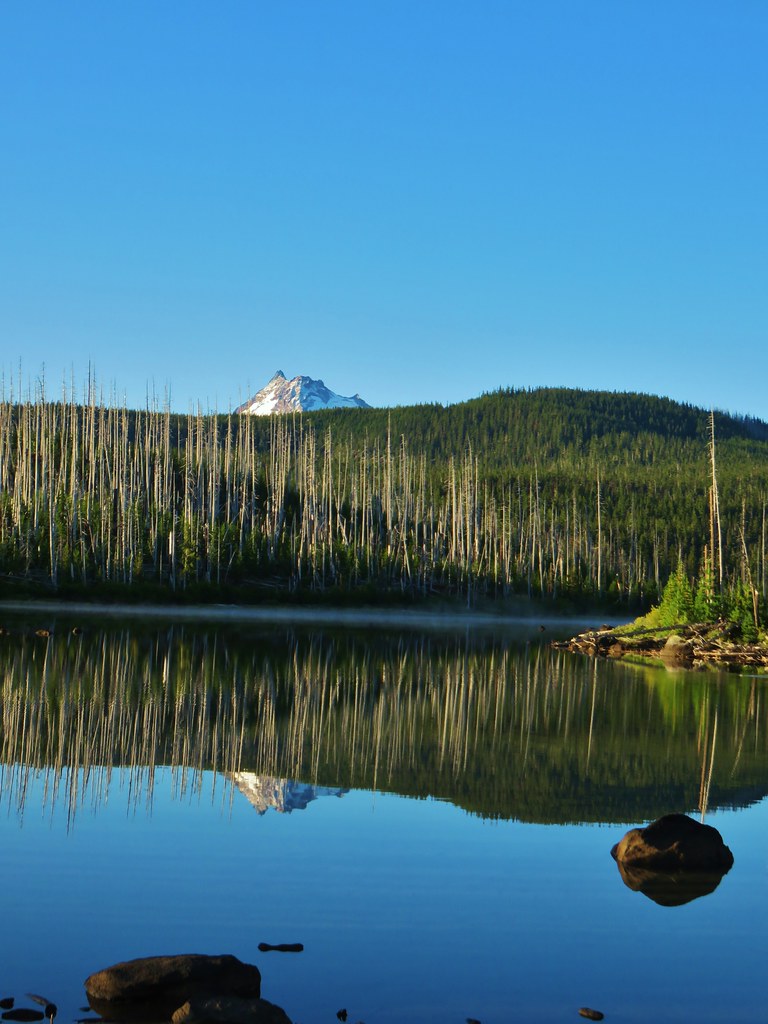
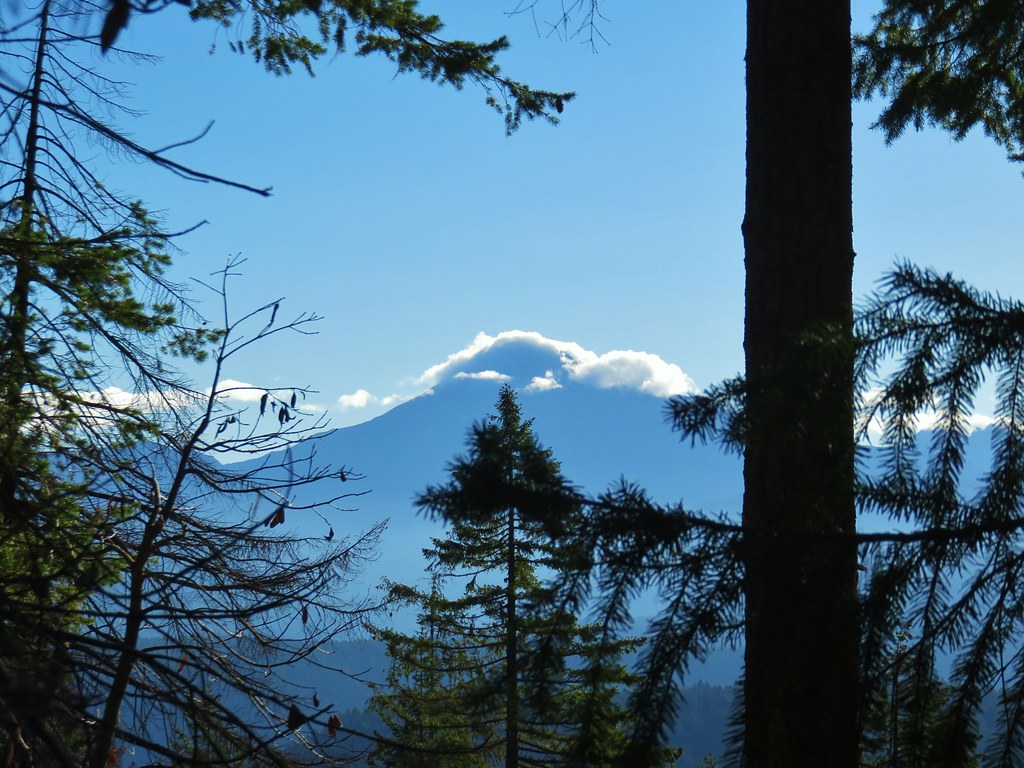
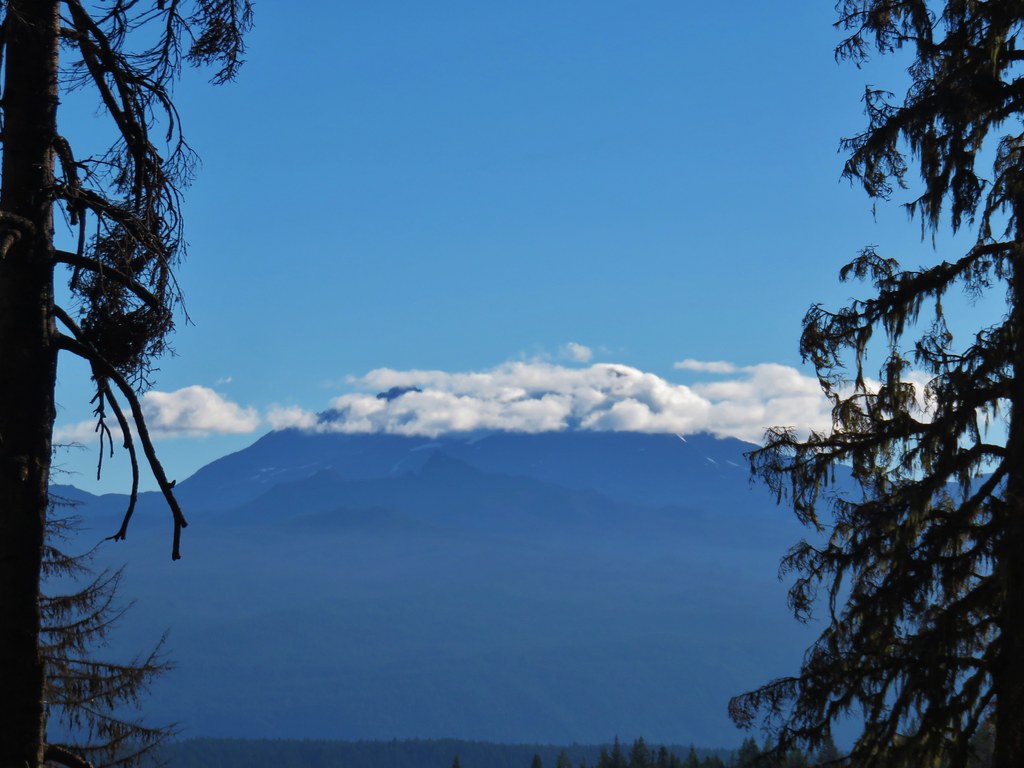
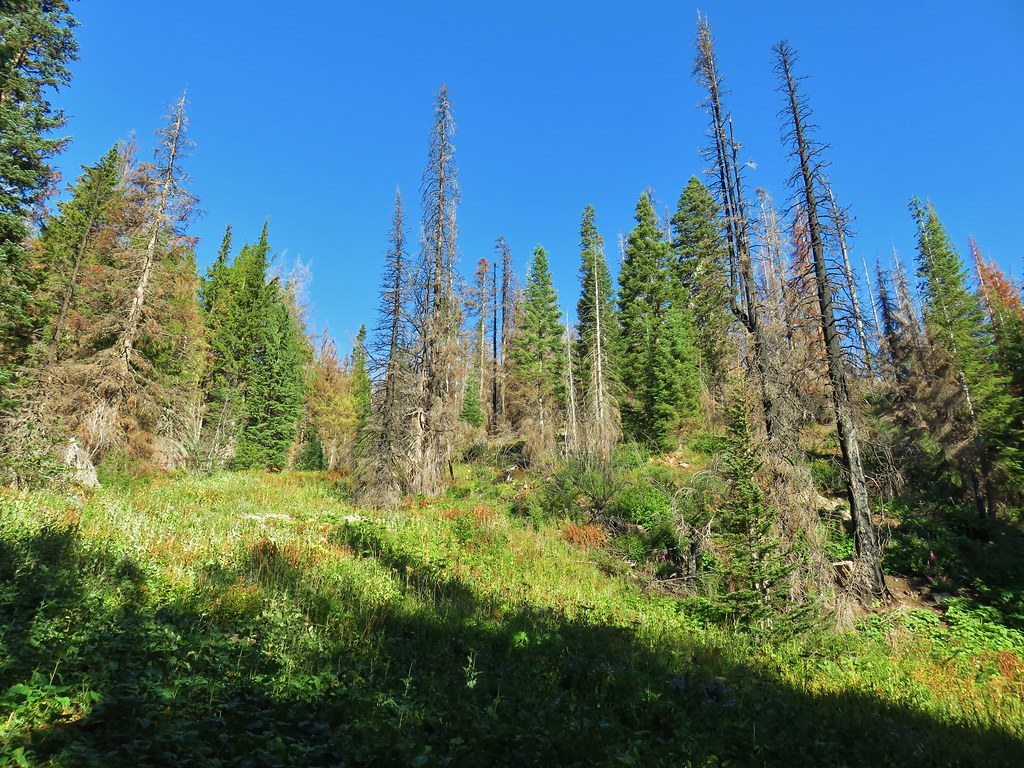
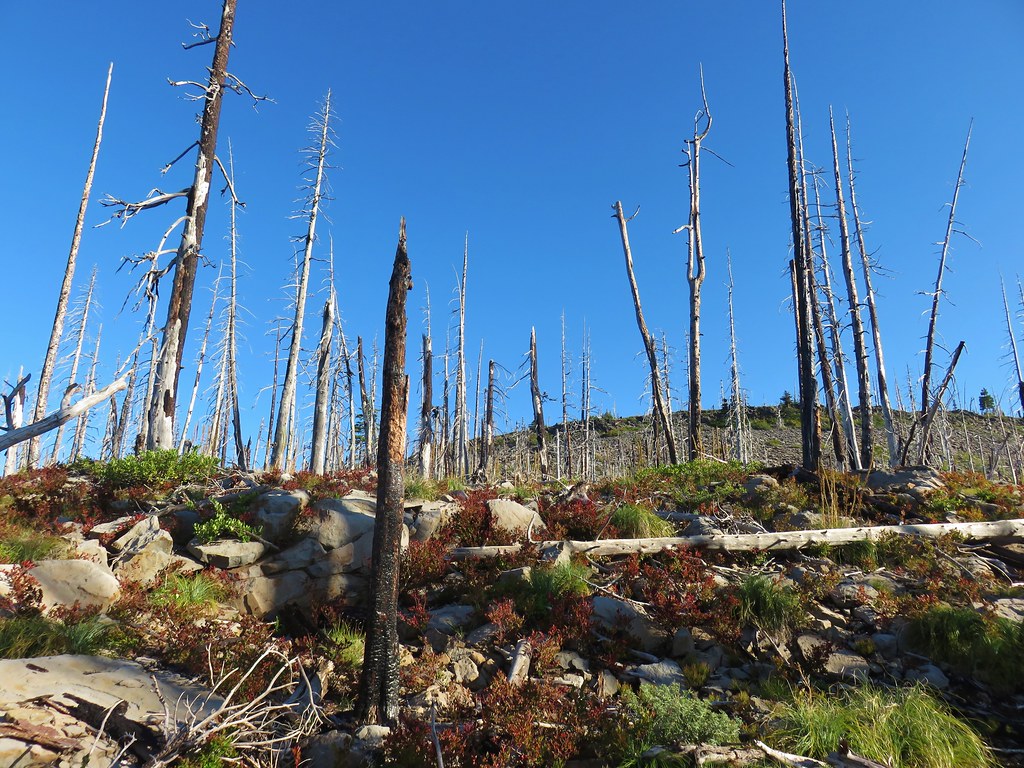
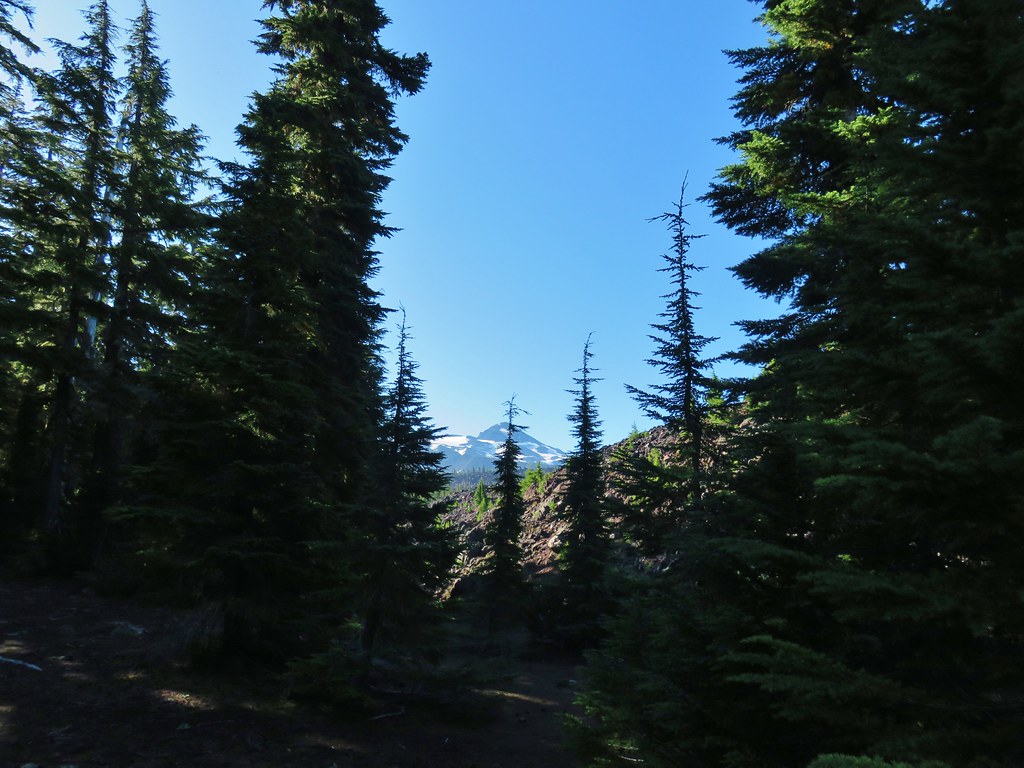
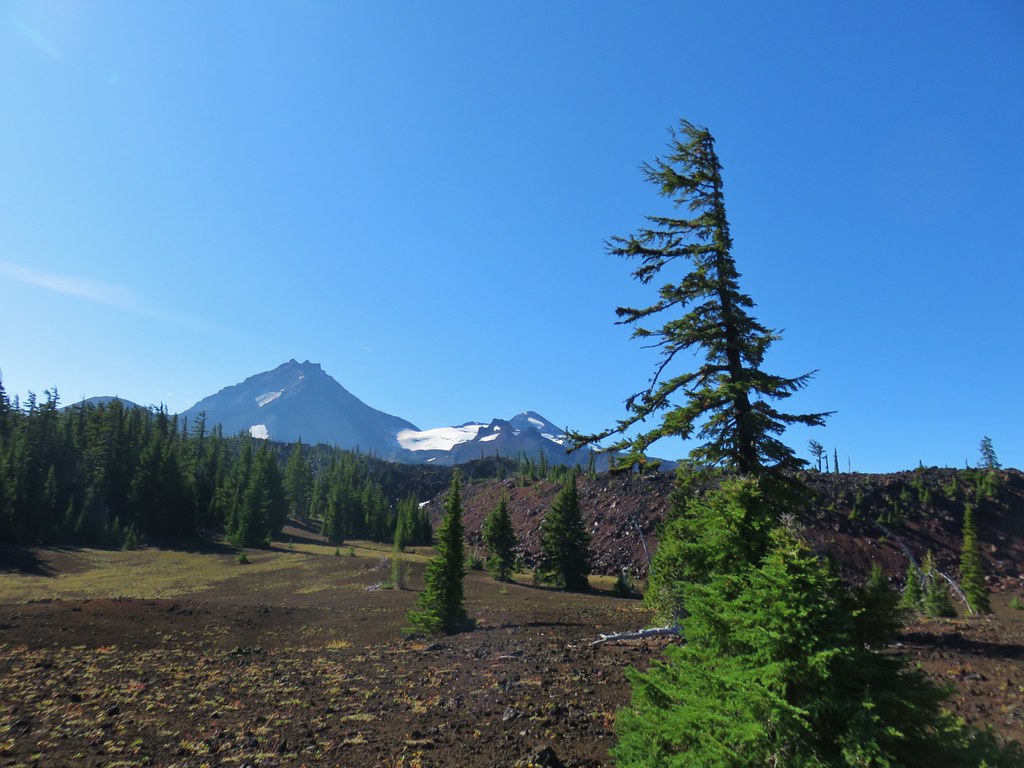
There were plenty of views across Monon Lake as the trail entered a fire scar. More and more of Mt. Jefferson was revealed as we continued east.
IMG_8684The tip of Mt. Jefferson sticking up above the high point on the ridge.

IMG_8687More of the mountain (Ruddy Hill is the round butte to the right.)

IMG_8689Dusting of new snow on Mt. Jefferson

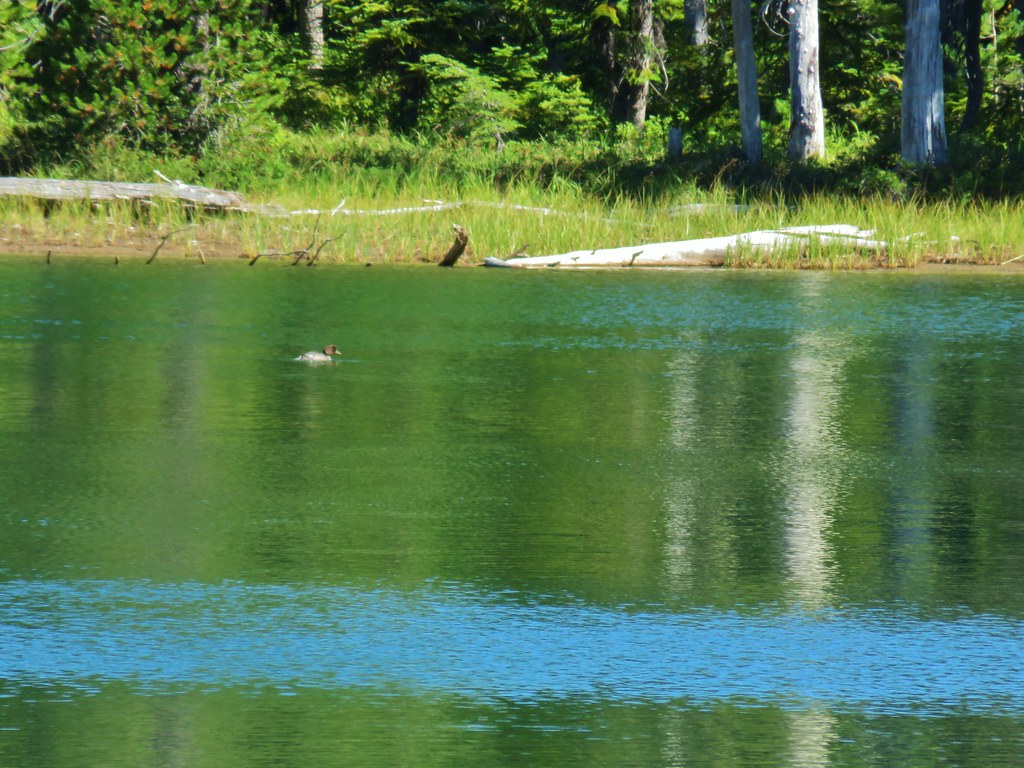
IMG_8692Duck on the lake.

IMG_8697A little more of Mt. Jefferson showing.

The trail climbed atop a small rocky hill above the lake which happened to be where a trial junction was hidden.
IMG_8704View from atop the rocks.

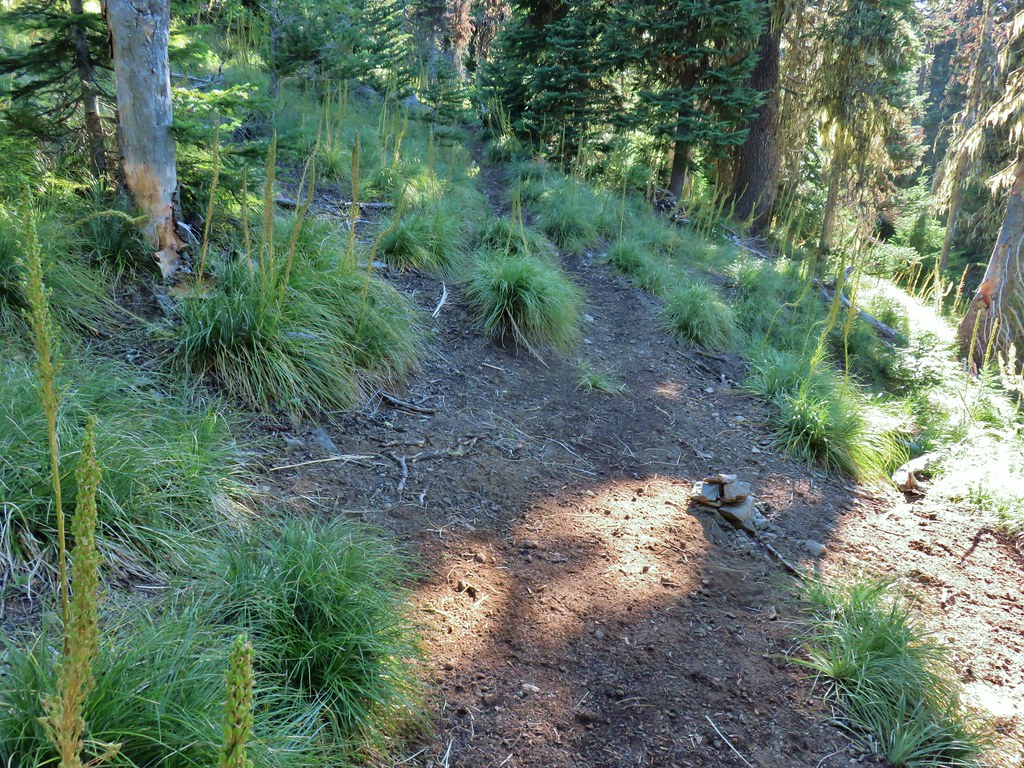
The Monon Lake Trail continues to the right around the lake while the Mon-Olallie Trail forked left for .3 miles to the Olallie Lake Trail. We completely missed the Monon Trail and the small rock cairn marking the junction.
IMG_8970The small rock cairn coming from the opposite direction on the Monon Lake Trail later in the day.

Having missed the junction where we had planned to go right we wound up on the Mon-Olallie Trail which passed Mangriff Lake on the left.
IMG_8705

IMG_8707

Just beyond Mangriff Lake was Nep-te-pa Lake on the right.
IMG_8708

Nep-te-pa Lake

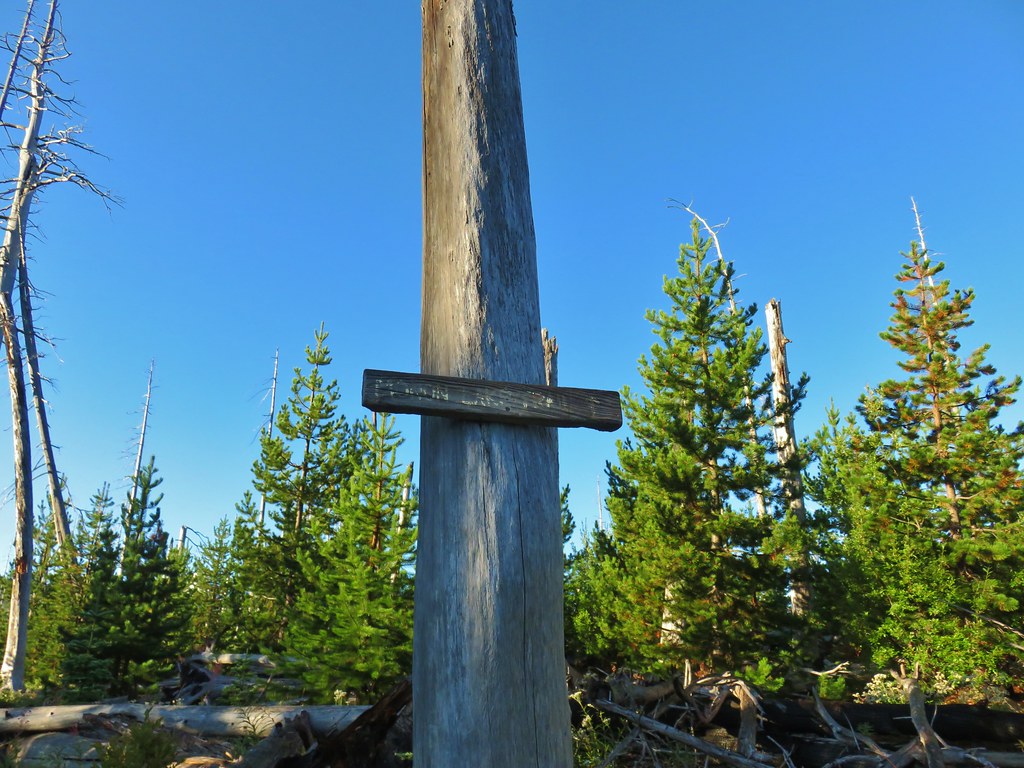
By the time we realized that we had missed our junction we were nearing Olallie Lake so we decided that we would just do our loop in the opposite direction of what we had planned. The Mon-Olallie Trail ended at an obvious and signed junction near Olallie Lake.
IMG_8712

IMG_8713

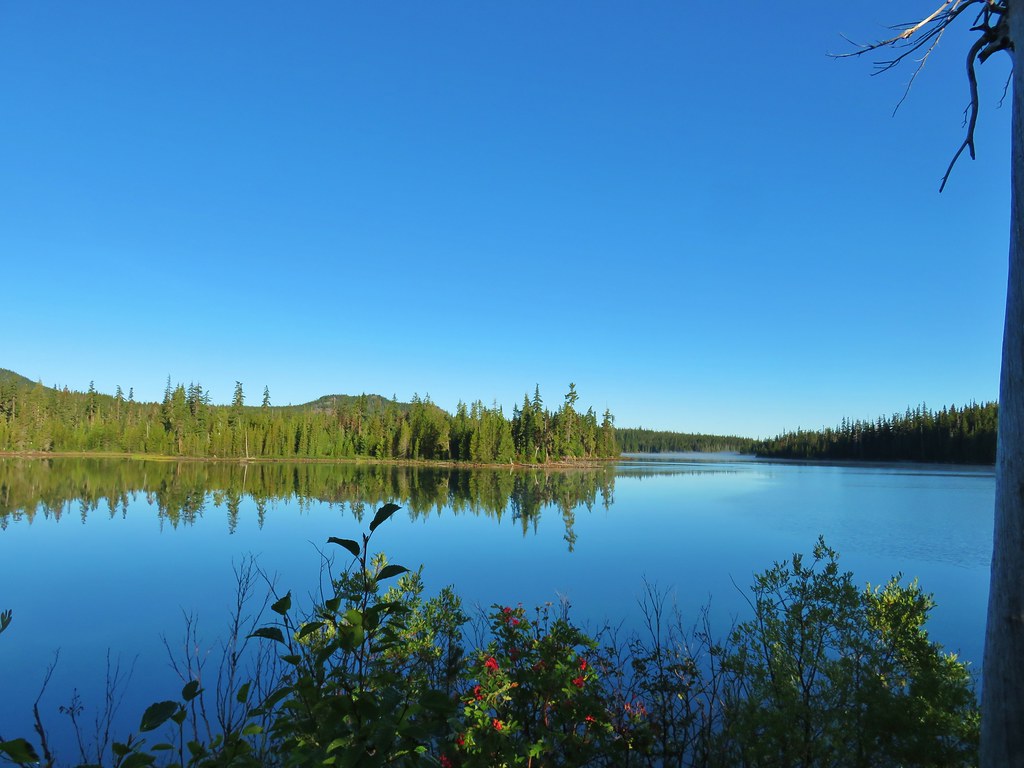
We turned right and after a nice view of the lake entered a stand of green trees.
IMG_8717

IMG_8718

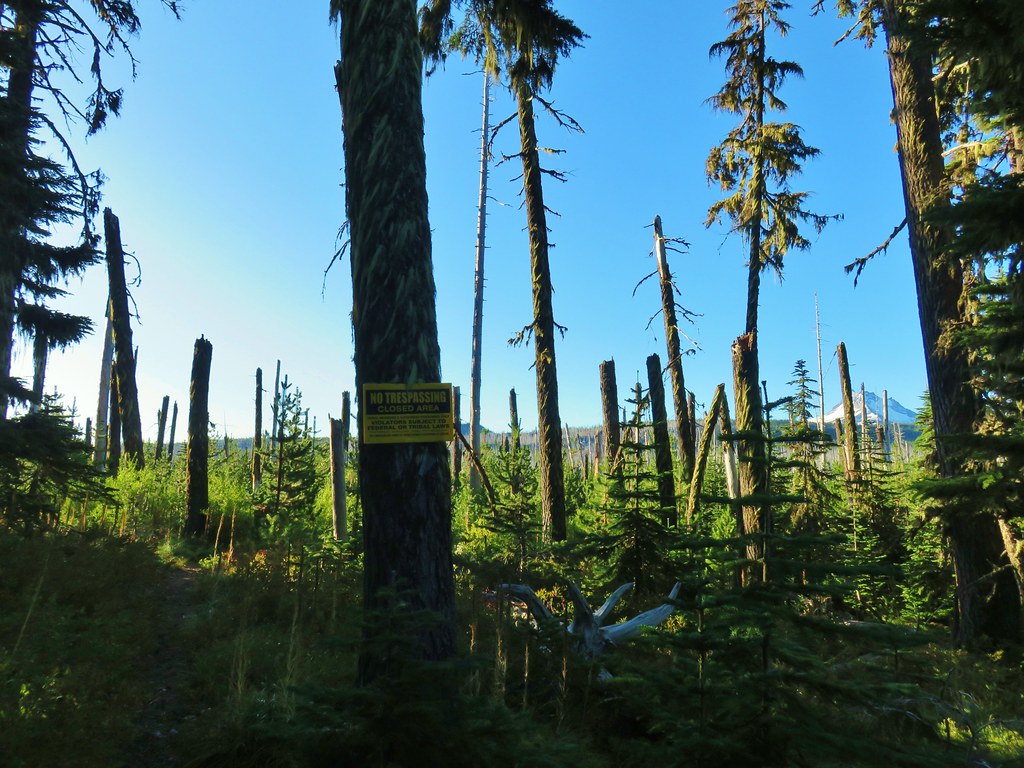
Approximately .4 miles from the Mon-Olallie Trail junction we arrived at another junction with the Long Lake Trail at the border of the Warm Springs Reservation. Unlike the trail up Olallie Butte this trail was clearly marked as closed to the public.
IMG_8719

We continued around Olallie Lake passing numerous spectacular views of Mt. Jefferson.
IMG_8726_stitch

IMG_8724

IMG_8734Mergansers

IMG_8744

IMG_8745

Three quarters of a mile from the Long Lake Trail junction we came Paul Dennis Campground.
IMG_8748

A brief road walk brought us to the Olallie Lake Resort where we followed a trail between the lake and some cabins.
IMG_8750

IMG_8749

IMG_8753

The views of Mt. Jefferson from the resort were great and we stopped at the dock and the picnic area for photos.
IMG_8754

IMG_8755

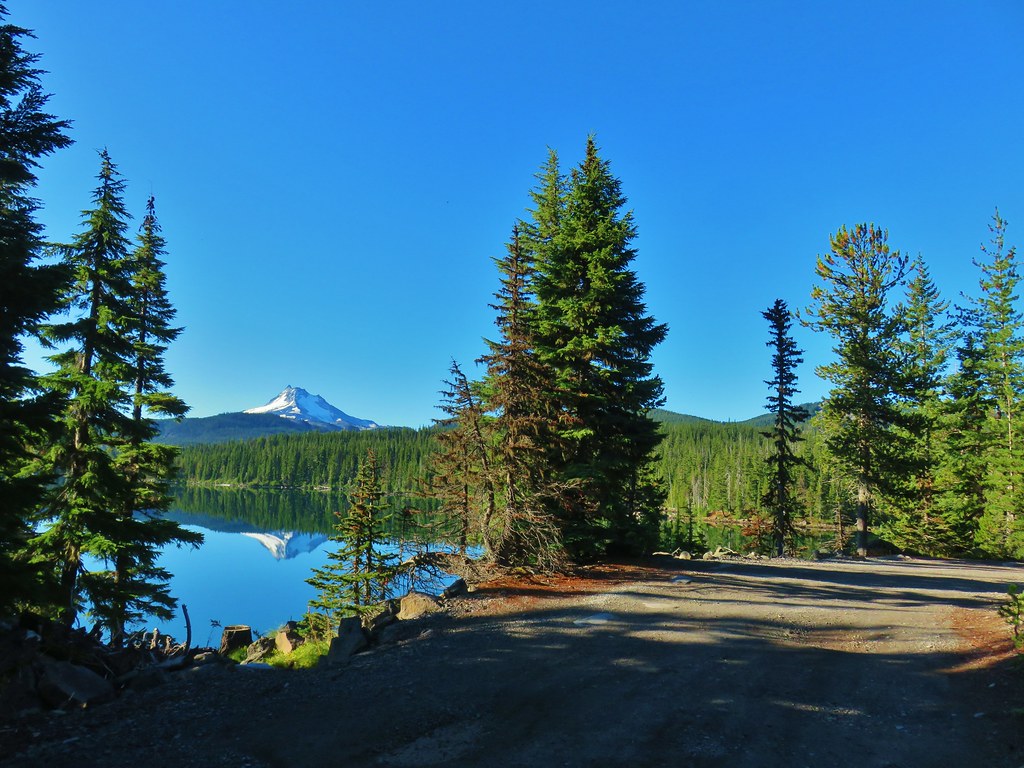
We passed through the picnic area and popped onto Skyline Road where we turned left for three tenths of a mile to the Red Lake Trail.
IMG_8758

IMG_8759

We had come down this trail to visit Olallie Lake during our previous Ruddy Hill hike. That had been a 17.9 mile day so we had skipped the side trail to Timber Lake. After a .7 mile gradual climb past several small ponds we arrived at the junction with the Timber Lake Trail.
IMG_8761

IMG_8762

IMG_8763

IMG_8767

IMG_8768

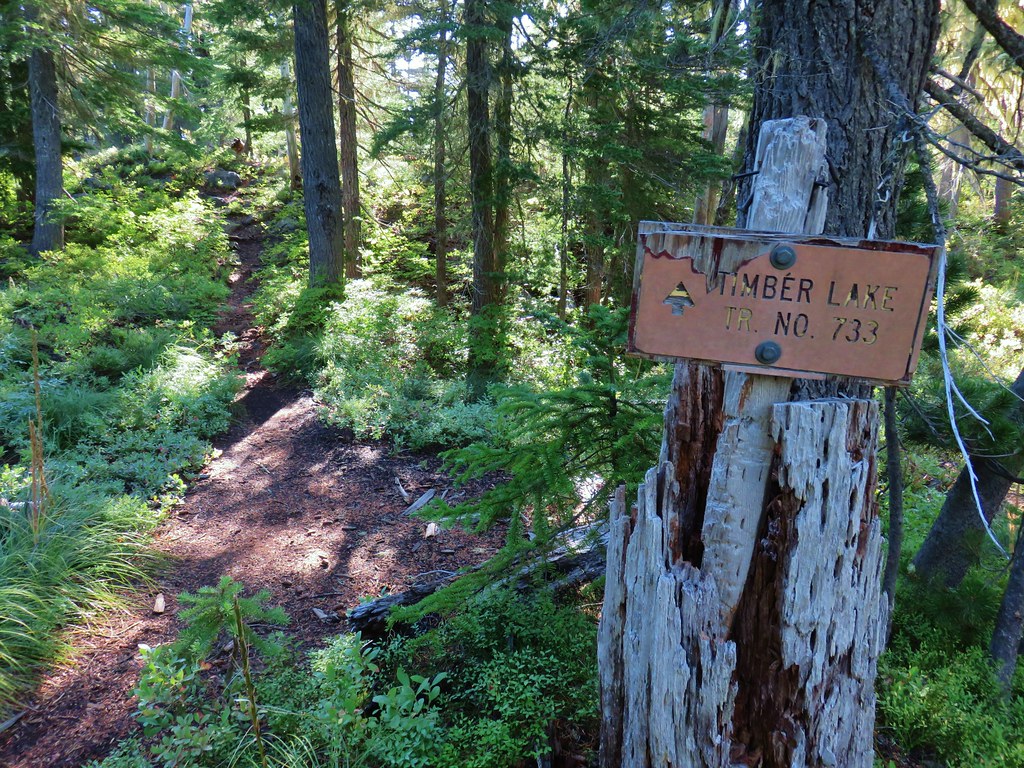
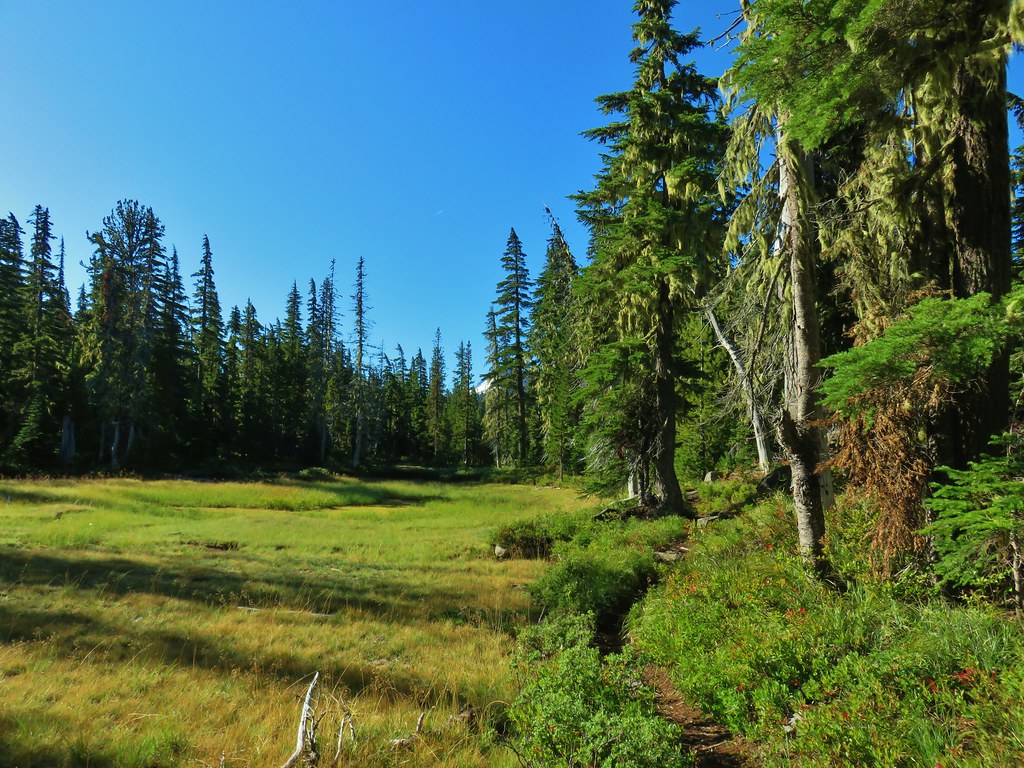
We turned down this trail and followed it .6 mostly level miles (there were two short but steep climbs over ridges) to Timber Lake.
IMG_8774

IMG_8777

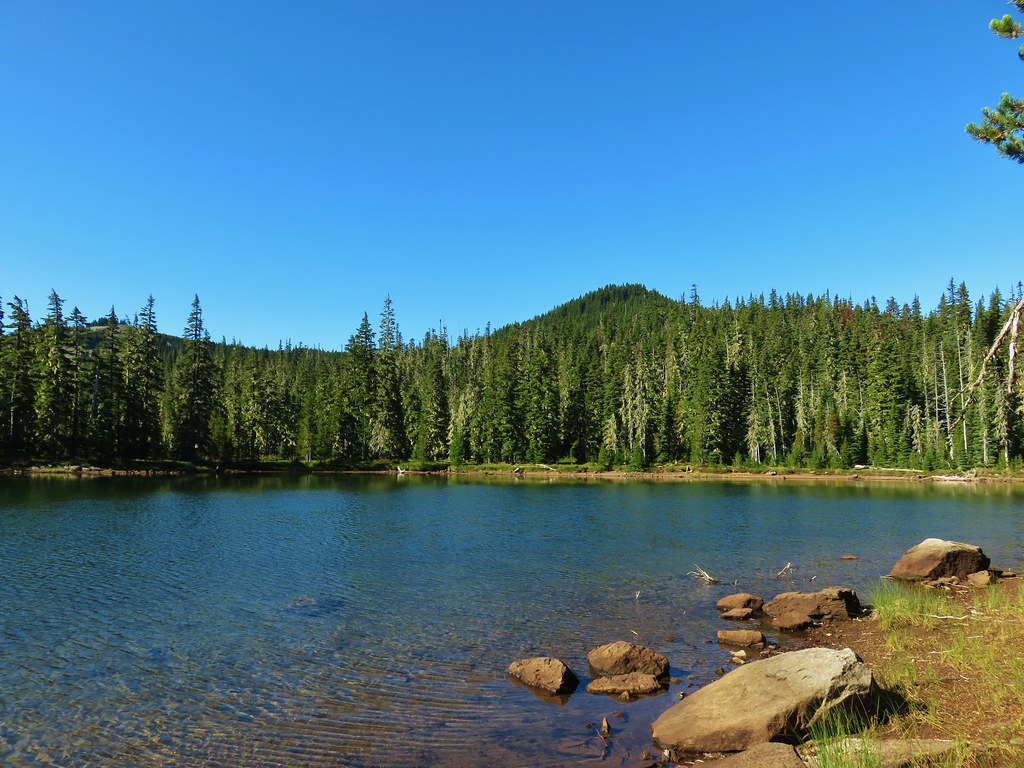
We followed a path along the northern shore of the lake until we had a decent view of the top section of Mt. Jefferson.
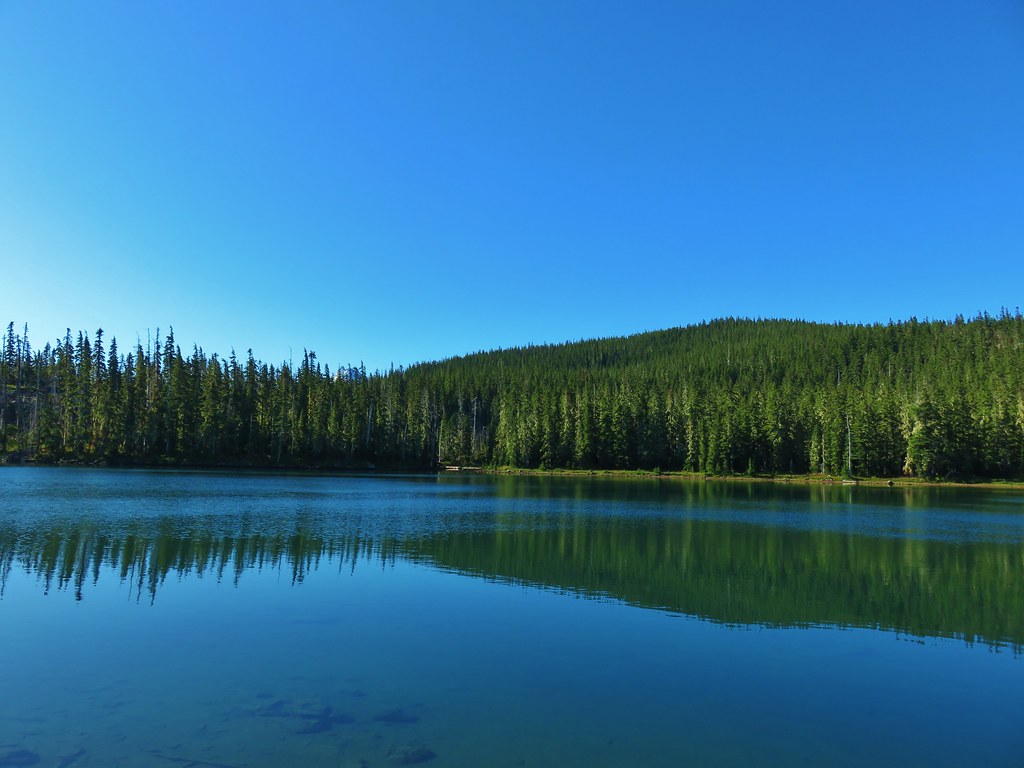
IMG_8785

IMG_8790

IMG_8789

After getting our view of the mountain we returned to the Red Lake Trail. We turned left and continued the gradual climb to the Pacific Crest Trail. In a little over a quarter mile we arrived at Top Lake.
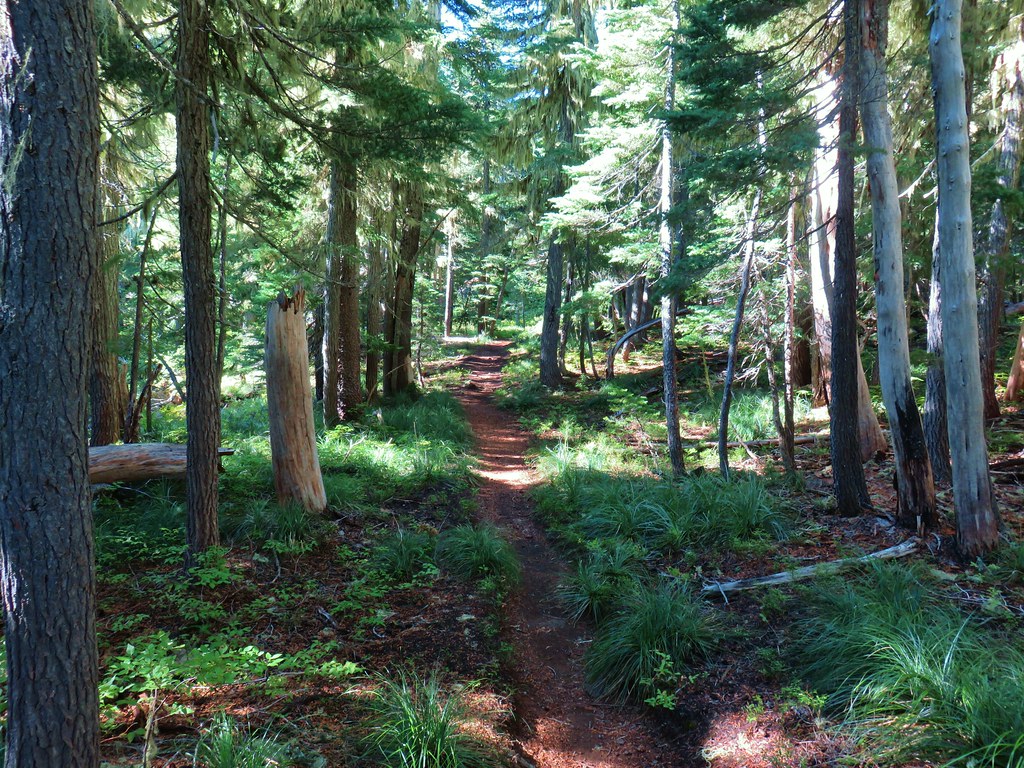
IMG_8792

IMG_8793

At the NW end of the lake the Red Lake Trail forked right but we turned left passing a nice view of Olallie Butte.
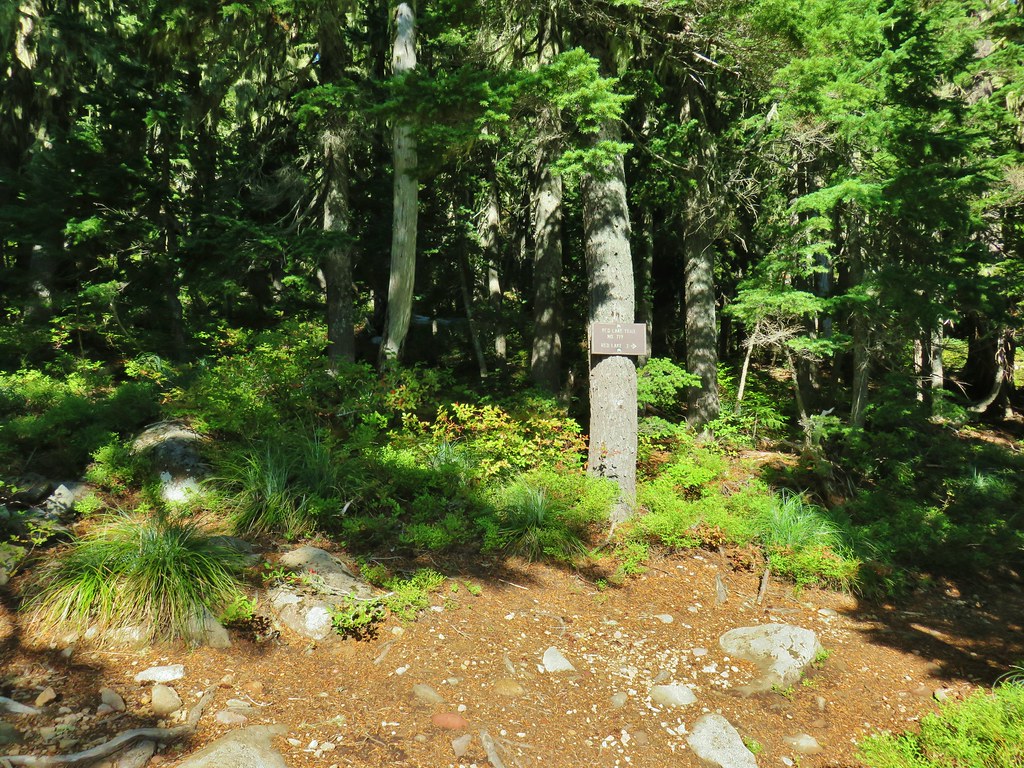
IMG_8796

IMG_8797

This connector trail climbed steeply via a series of switchbacks to an unsigned junction with the Pacific Crest Trail near Cigar Lake where we turned left (south).
IMG_8799Rock cairn along the PCT marking the connector trail.
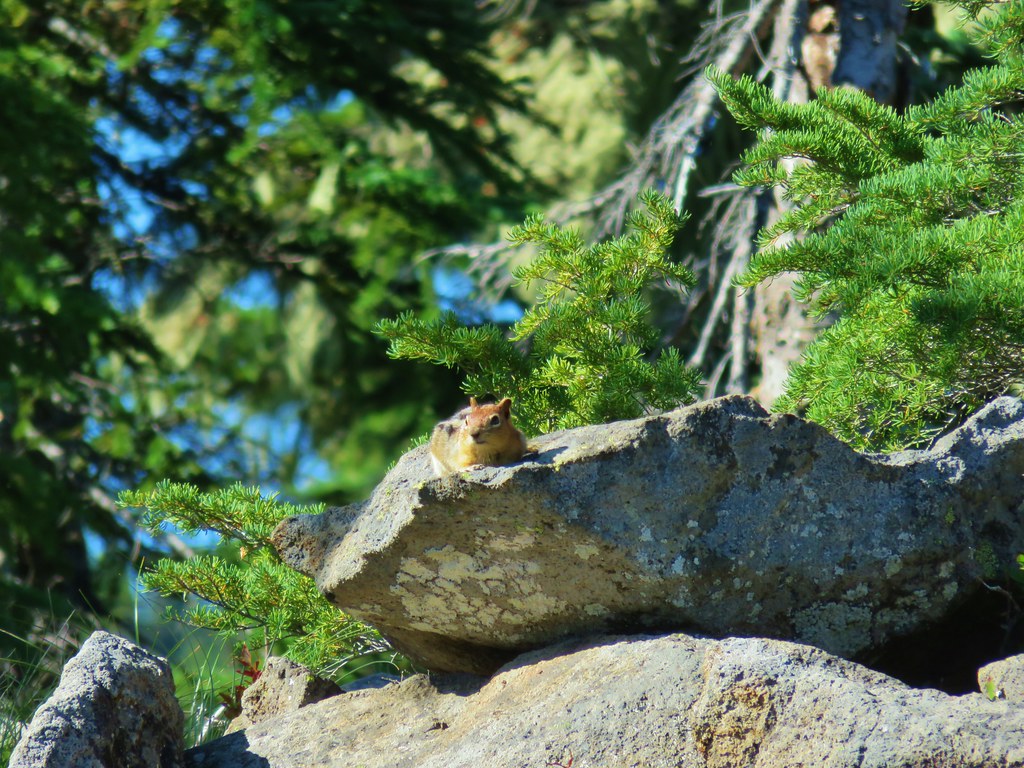
IMG_8807PCT lookout.

IMG_8813

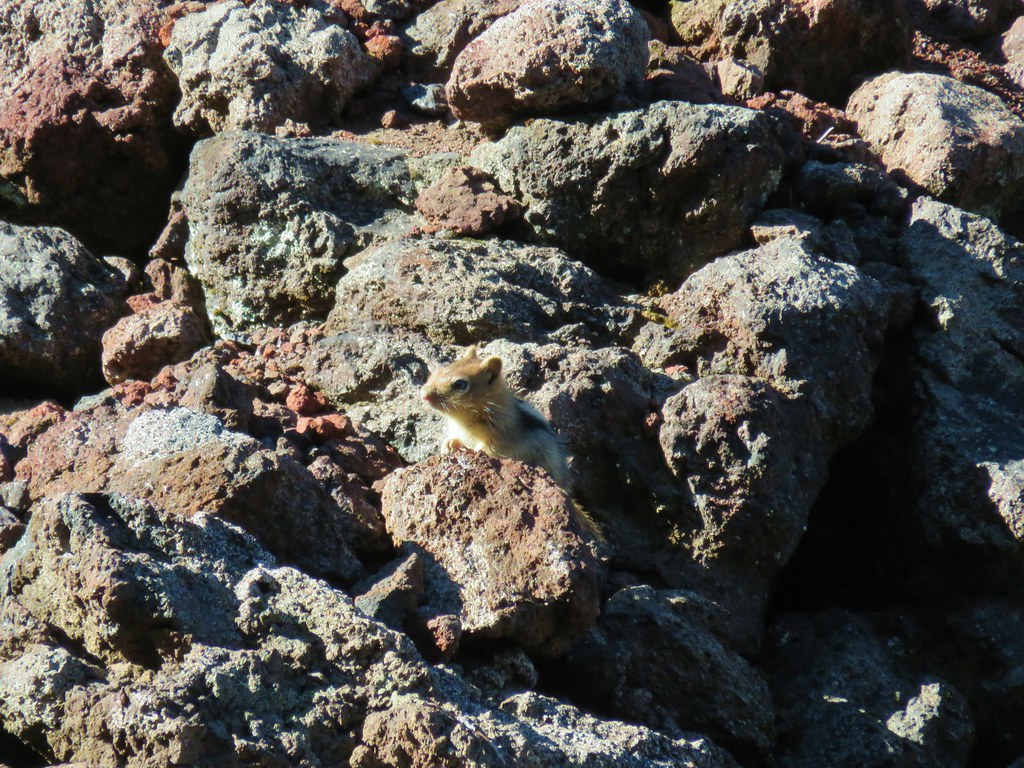
IMG_8811Golden-mantled ground squirrels at Cigar Lake.

The southern end of Cigar Lake is the location of the Double Peaks Trail. We had taken this trail twice hoping for nice views to no avail. (One was the 17.9mi hike including Ruddy Hill, the other was in 2013.) It would have likely been a great view now, but the .7 mile trail is frustratingly steep and we just didn’t feel like tackling it again. On the other hand the PCT remained fairly level over the next mile as it passed Upper Lake then a meadow with a view of Mt. Jefferson.
IMG_8820

IMG_8822Double Peaks from Upper Lake

IMG_8829

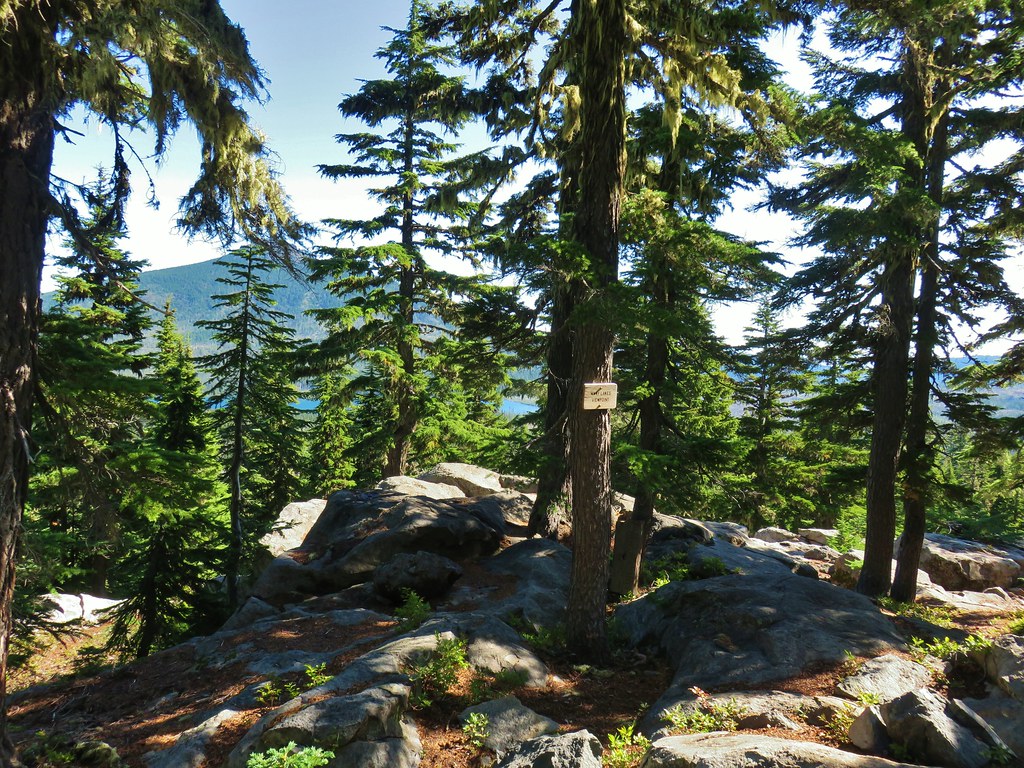
At the meadow the PCT turned left and began a brief climb up a butte. A third of a mile into the climb we passed the Many Lake Viewpoint. Here we had a nice view of Mt. Hood (and many lakes).
IMG_8832

IMG_8834

IMG_8835

IMG_8838

IMG_8841Company at the viewpoint.

We continued south from the viewpoint and were soon descending along a forested hillside when we heard an elk bugle. We guessed that it was a bow hunter but hoped it was an actual elk. Our guess was right though and we stopped to briefly talk to the hunter before continuing on.
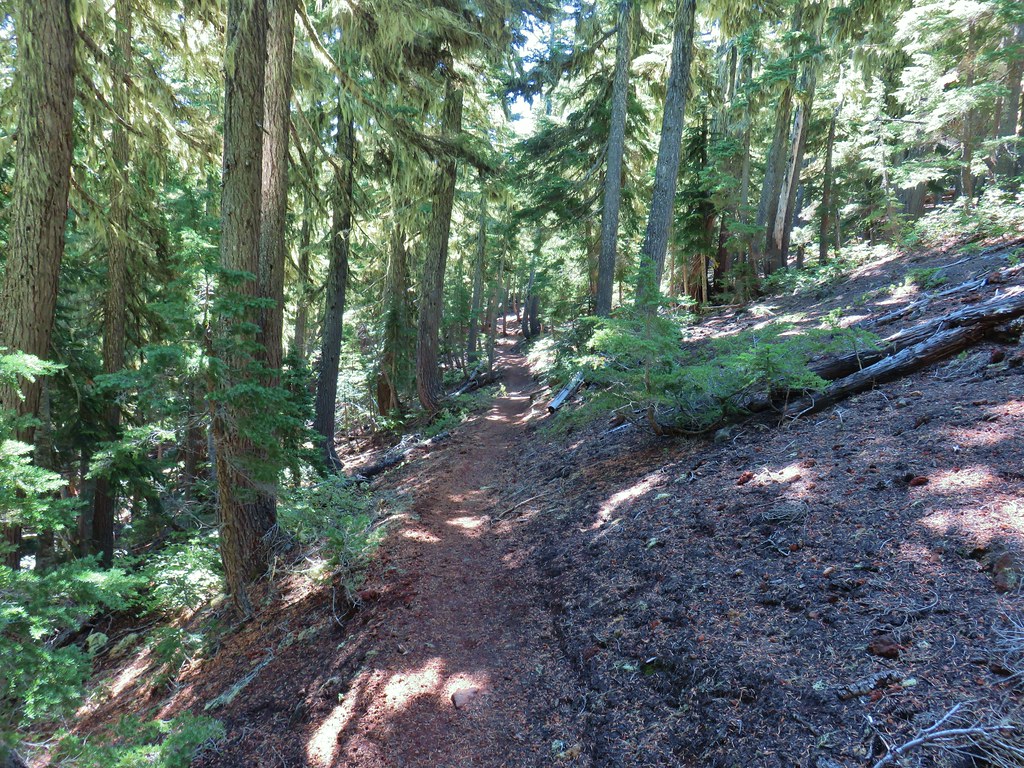
IMG_8844Approximate location when we heard the “elk” bugle.

Just over a mile from the Many Lakes Viewpoint we arrived at the Ruddy Hill Trail where we turned right leaving the PCT.
IMG_8847

The nearly half mile trail was quite a bit steeper than we’d remembered but we soon found ourselves on the red topped summit looking at the view of Mt. Jefferson that we had missed on our previous visit.
IMG_8853

IMG_8858_stitch

IMG_8867

Although there was no view north, the view to the west was good with the peaks of the Bull of the Woods Wilderness.
IMG_8869 Flat topped Battle Ax Mountain to the left to the fire scarred summit of Schreiner Peak to the right.

IMG_8875Battle Ax (post)

IMG_8877Bull of the Woods (post)

After resting at the summit we headed back down the PCT and continued south another .2 miles where we turned left on the “Rondy Trail”.
IMG_8882

IMG_8883

This trail descended a drainage before leveling out and arriving at Horseshoe Lake in three quarters of a mile. There was a nice variety of mushrooms along the way.
IMG_8884

IMG_8888

IMG_8890

IMG_8895

IMG_8897

IMG_8904

IMG_8907

IMG_8916

We followed the trail along the lake shore to the Horseshoe Lake Campground located right on Skyline Road.
IMG_8917

IMG_8919

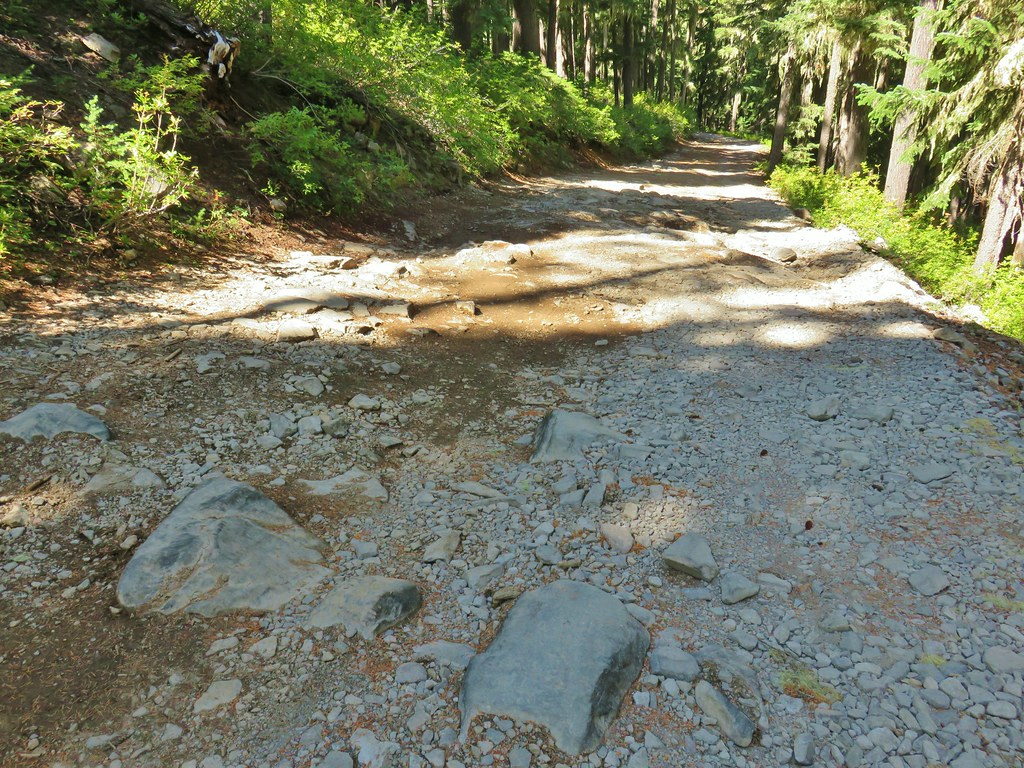
For second time on this hike we went the wrong way and turned right on Skyline Road thinking it was an entrance road to the campground. We had only gone a tenth of a mile before realizing our mistake and turning around. We followed Skyline Road north for a mile. We were eager to get a firsthand look at what many consider one of the worst trailhead roads in NW Oregon. It was certainly a bad looking road but the section we hiked wasn’t quite as bad as some we’d seen in eastern and southeastern Oregon. It may well be worse beyond Horseshoe Lake though.
IMG_8923

When we arrived at the southern end of Monon Lake we were just .3 miles from our car, but we turned onto the Monon Lake Trail to finish that trail. The views of Olallie Butte from this end of the lake were spectacular.
IMG_8925

IMG_8931

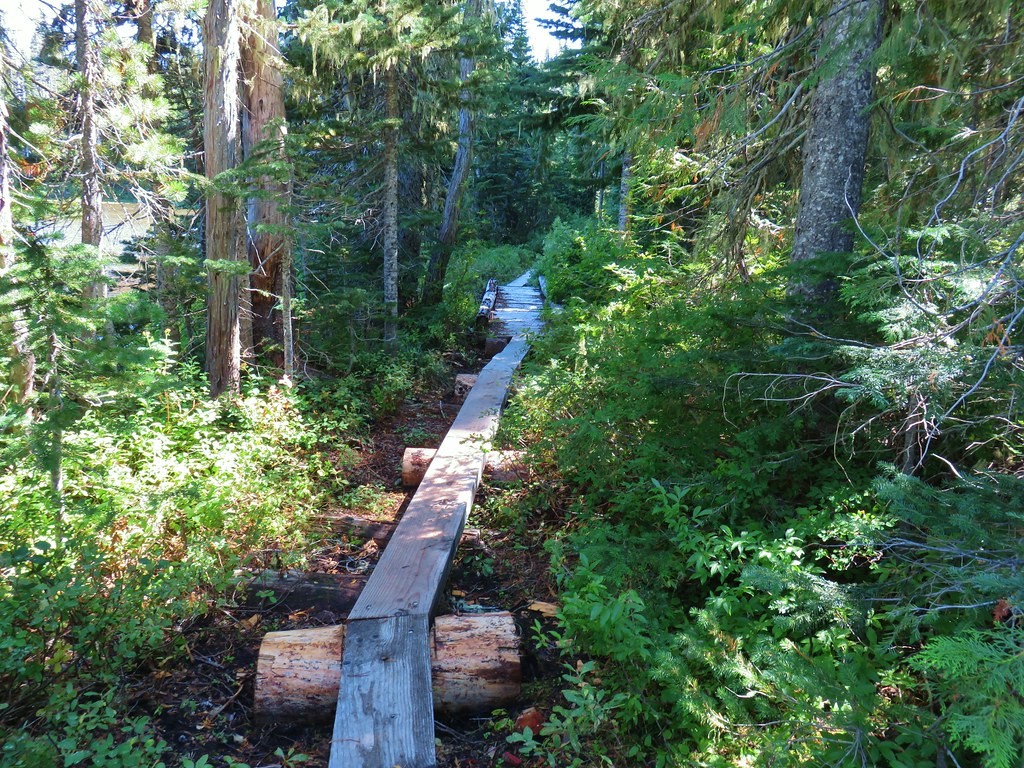
More boardwalks were present as we passed through the forest along this end of the lake.
IMG_8933

We soon found ourselves back in the fire scar which just provided more views of the lake and Olallie Butte.
IMG_8946

IMG_8950

IMG_8957

A little over a mile from the road the trail began to curve around to the west where we once again had views of Mt. Jefferson across the lake.
IMG_8968

One and a quarter miles from the road we were back on top the rocks above the lake and heading for the junction we’d missed that morning.
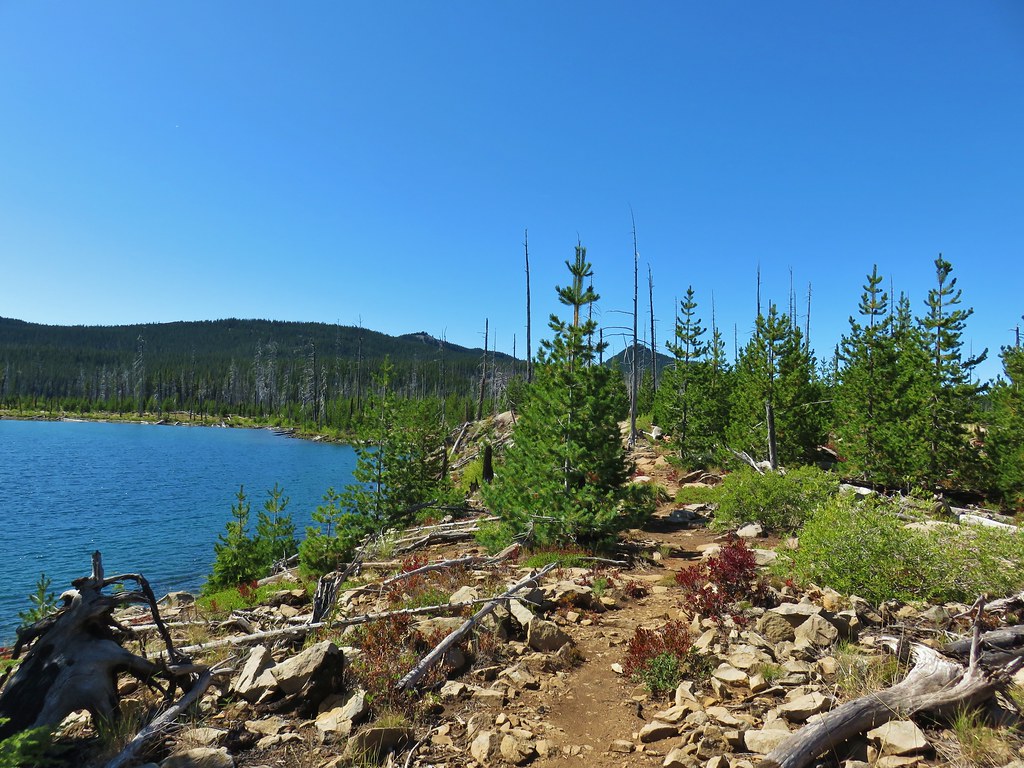
IMG_8969

We then followed our route from the morning back to our car. We had hopped that the Sun would have coaxed some of the gentians to open, but it appeared to be too late in their life cycle for that to happen.
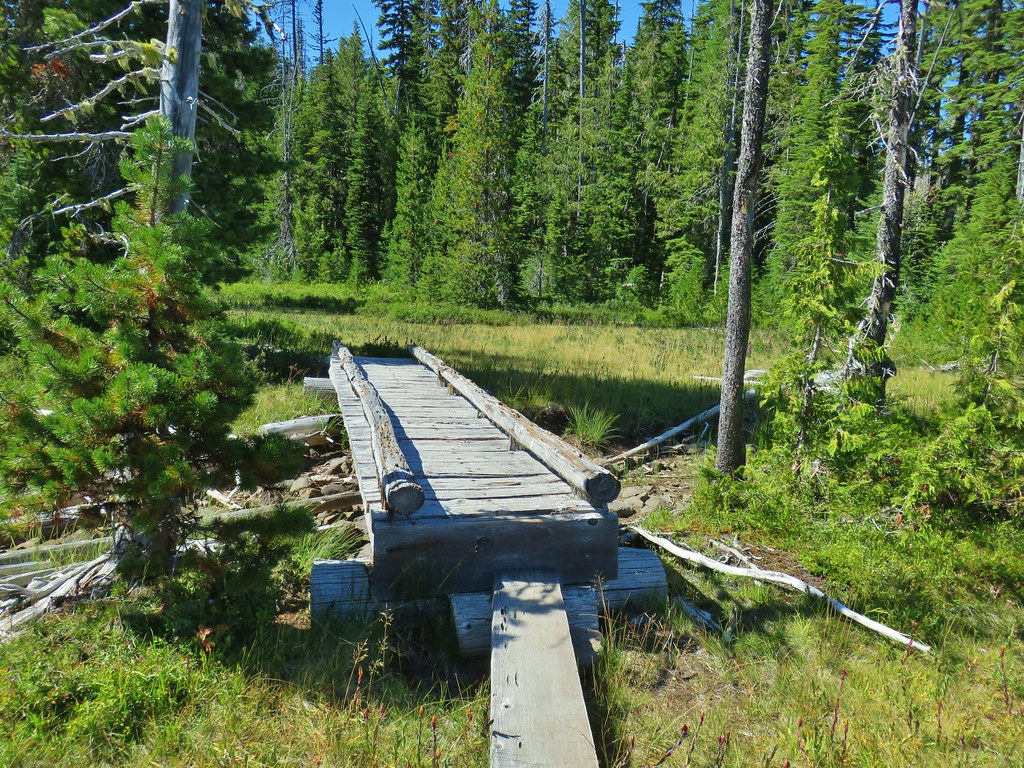
IMG_8985

IMG_8989

Our loop with side trips came in at 13.6 miles with approximately 1500′ of elevation gain. It was a beautiful day and so nice to have been able to get that view from Ruddy Hill. Happy Trails!

Flickr: Monon Lake- Ruddy Hill Loop
Categories
Hiking Middle Santiam Old Cascades Oregon

Crabtree Lake – 9/07/2019

A less than ideal forecast had us looking for a hike that wasn’t view dependent and wouldn’t be too negatively impacted by rain. Crabtree Lake in Crabtree Valley seemed to fit the criteria and it was a featured hike in Sullivan’s 4th edition of his “100 Hikes in the Central Oregon Cascades” guidebook.

It was a cloudy, drizzly, morning as we headed for the trailhead NE of Sweet Home, OR. Although we knew there was a nice view of Mt. Jefferson from the trail that wasn’t the main goal of the hike so missing out on it wouldn’t be too disappointing. As we climbed along the BLM road to the trailhead we emerged from one set of clouds to find that we were in between cloud layers and so were the mountains. We parked at the junction of BLM road 11-3E-35.3(aka S. Fork Packers road) and the final .9 mile gravel road to the actual trailhead.
IMG_8503The gravel road from the junction.

The gravel road was in pretty good shape, but we had opted to walk it primarily due to the fact that from the trailhead the hike would be under 5 miles (excluding any exploration). The extra 1.8 miles would give us enough more time hiking that we wouldn’t break our hike to drive timie ratio rule. As we walked up the road we got a nice view of Three Fingered Jack in a beautiful sunrise.
IMG_8506

IMG_8507

A bit later Mt. Jefferson became visible.
IMG_8509

IMG_8510

The actual trail begins at a berm where the road has been closed.
IMG_8516

It then follows the road bed around a ridge end in .3 miles where the viewpoint of the mountains is.
IMG_8522

IMG_8524Coming up on the viewpoint.

Instead of not having a view we were treated to a beautiful scene.
20190907_071805_HDR

IMG_8529Mt. Jefferson

IMG_8532Three Fingered Jack

After oohing and awwing over the view we rounded the ridge end and began a 1.1 mile descent to a junction. There were a few left over flowers and dozens of rough skinned newts. We had to really watch were we stepped due to their presence on the trail.
IMG_8570

IMG_8547Maybe a ragwort?

IMG_8549Yarrow

IMG_8553St. John’s wort

IMG_8554Daisy and pearly everlasting

IMG_8648Beardstongue

IMG_8652Fireweed

IMG_8560Not a flower but colorful maple leaves.

IMG_8569A common sight on the trail.

IMG_8567Rough skinned newt

Although there were no mountain views on this side of the ridge there were a couple of openings to the west across Crabtree Valley.

IMG_8557

IMG_8558

IMG_8566

At a barricade we turned left and dropped down to another roadbed.
IMG_8573

We turned left and started a gradual climb along this road. It wasn’t clear what the status of this road is, at times it looked like there were some tire marks but we didn’t run into any vehicles along the .4 mile stretch to some concrete barricades.
IMG_8574

IMG_8575

The roadbed became more of a trail beyond the barricade continuing uphill another .3 miles to Crabtree Lake.
IMG_8576

IMG_8578

We found a few tents set up along the shore (there were 2 cars at the trailhead and one where we had parked along the lower road). We checked out the lake near the outlet where we found yet more rough skinned newts in the water.
IMG_8584

IMG_8582

We followed a trail around the lake to the left and headed down to the lake shore for another view.
IMG_8588

IMG_8590

We would later find out from some of the campers that there was an otter swimming in the lake while we were taking these pictures that we hadn’t seen. (I couldn’t find it in the photos either 😦

Now that we had seen the lake it was time to do a little big tree hunting. Crabtree Valley’s cliffs have protected the trees here allowing for some of Oregon’s oldest surviving trees. We followed the trail around the lake until it petered out near some empty campsites.
IMG_8591Old growth cedar

IMG_8593

IMG_8594

The basin here is home to a 270′ Douglas fir that has been dubbed “Nefertiti”. We had the GPS coordinates for the tree and decided this would be a good time to practice using our Garmins. We plugged in the coordinates and immediately ran into an issue, our devices didn’t agree even though they are the same make and model. We decided to try the location showing on my device first and made our way cross country to those coordinates. While there were many large old growth trees we weren’t convinced that any were the 8′ diameter tree we were looking for.
IMG_8600

IMG_8602

IMG_8605

IMG_8607

IMG_8609

We turned to Heather’s location next which resulted in our best guess as to the identity of the tree.
IMG_8610

IMG_8611

Whether on not we actually found Nefertiti we saw a lot of massive old growth, some of which may be close to 1000 years old. We headed back and almost went out to a viewpoint that overlooks Waterdog Meadow (a small lake and meadow that Crabtree Creek passes through after leaving Crabtree Lake) but a combination of fog and campers being set up near the viewpoint kept us from checking it out.
IMG_8615A less impressive viewpoint near the creek but the fog below made passing through the camps to reach the viewpoint pointless.

After hearing about the otter we left the lake and headed back. Before returning to the trailhead though there was another tree in the valley we were hoping to visit. King Tut, a 9′ diameter Douglas fir, is located off trail. Sullivan described the route as rugged and not recommended so we were prepared to turn back at any point. We again used GPS coordinates, which again disagreed, to find the tree. There was at times a rough trail to follow but any sign of it ended before reaching the tree.
IMG_8623

IMG_8624

We remained undeterred and picked our way through and around thorny berry bushes and devil’s club to the location showing on my GPS. There was a very large cedar in the area, but no King Tut.
IMG_8629

IMG_8631The cedar trunk through some branches.

We turned to Heather’s device and made our way to that location where we found what we believe to be the estimated 800 year old behemoth.
IMG_8632

IMG_8637

Having found this tree at the location shown by Heather’s GPS we were more confident that the tree we identified as Nefertiti using her device was probably correct as well.

Even though we were able to locate (we think) the tree, like Sullivan we wouldn’t recommend this excursion, especially without map and navigational skills.

We then headed back and climbed out of the valley along the road where the newts had been mostly replaced by other critters and the view of Mt. Jefferson was just a memory.
IMG_8655Fritillary butterfly

IMG_8657Dark eyed junco

IMG_8661Bumble bee

IMG_8647Back at the viewpoint.

It had been a great hike and despite having missed seeing our first otter we had seen a lot more than we were expecting. Between parking where we did and visiting the trees we turned the 4.6 mile hike into an 8.7 mile adventure. Happy Trails!

Flickr: Crabtree Lake

Categories
Hiking McKenzie River Old Cascades Oregon Trip report

Olallie and Lowder Mountains – 09/01/2019

For our final outing of Labor Day Weekend we set our sights on a pair of peaks in the Three Sisters Wilderness. Both the Lowder Mountain Upper Trailhead and Pat’s Saddle Trailhead (for Olallie Mountain) are located just 2 miles apart along Forest Road 1993. These were two more featured hikes from Sullivan’s 4th edition Central Cascades guidebook that we had yet to do. (Olallie Mountain was removed from the featured hikes in the 5th edition due to a 2017 fire that burned much of the route.) On their own the hike to driving time ratios didn’t pan out, but doing them both on the same day would, and as it turns out FR 1993 was in excellent shape allowing for a driving time closer to 2 1/2 hours versus the nearly 3 hours that Google predicted.

We drove south to Eugene and took Highway 126 four miles east of Blue River where we turned right on FR 19 to Cougar Dam. After turning left on FR 1993 and crossing the dam we followed the road 11.2 miles to the Pat’s Saddle Trailhead.
We chose to start with Olallie Mountain for a couple of reasons, first we thought that the lack of tree cover due to the fire might make this a warmer hike later in the day and second it was the longer of the two hikes. There are a couple of trails that leave from this trailhead. The French Pete Creek Trail is the first trail on the right. The upper section of this trail is not maintained (according the Forest Service webpage) and the forest around the lower section was impacted by fires in both 2017 and 2018. We hiked the first 5 miles of the trail from the lower trailhead prior to the fires in 2015 (post)
IMG_8177

The trail we were taking on this trip was the second one on the right, the Olallie Trail.
IMG_8179

This trail promptly enters the Three Sisters Wilderness amid old growth that escaped the fire.
IMG_8180

IMG_8183

The signs of the fire could be seen after about a third of a mile.
IMG_8184

At the half mile mark we arrived at a small stream flowing from Wolverine Lake which was about a quarter mile uphill on our right. The forest on the right hand side of the trail had burned pretty good while the left hand side had fared much better. There was already plenty of green vegetation growing amid the snags on the hillside though.
IMG_8185

IMG_8186

20190901_073350Cone flower

Sullivan had mentioned visiting Wolverine Lake by heading uphill cross country after crossing over the stream but the vegetation here looked pretty thick so we waited until we had climbed a bit beyond the stream and angled back toward the lake.
IMG_8191Cross country to Wolverine Lake.
There were a fair number of trees down from the fire so it wasn’t too difficult to reach the lake, but it was tricky trying to get a good look at it due to the brushy shore.
IMG_8192

It looked like there might have been a better vantage point around the lake to our right, but it wasn’t worth fighting through the brush and fallen trees to try and reach it so we settled for the view we had and headed back to the Olallie Trail. From above, the route down along the creek looked much more appealing and we wound up taking a track much closer to what Sullivan had shown on his map to arrive back on trail. Once we were back on trail we turned right and passed through a patch of thimbleberry bushes encroaching on the trail.
IMG_8195

We emerged from the thimbleberries and rounded a ridge end where the forest became a bit more open and many of the trees had survived the fire.
IMG_8196

IMG_8198

IMG_8204

A sooty grouse caught our attention as it crossed the trail ahead of us.
IMG_8208

IMG_8206

The trail climbed gradually along the hillside and we marveled at the varying effects of the fire and how the forest was in different stages of recovery already.
IMG_8213

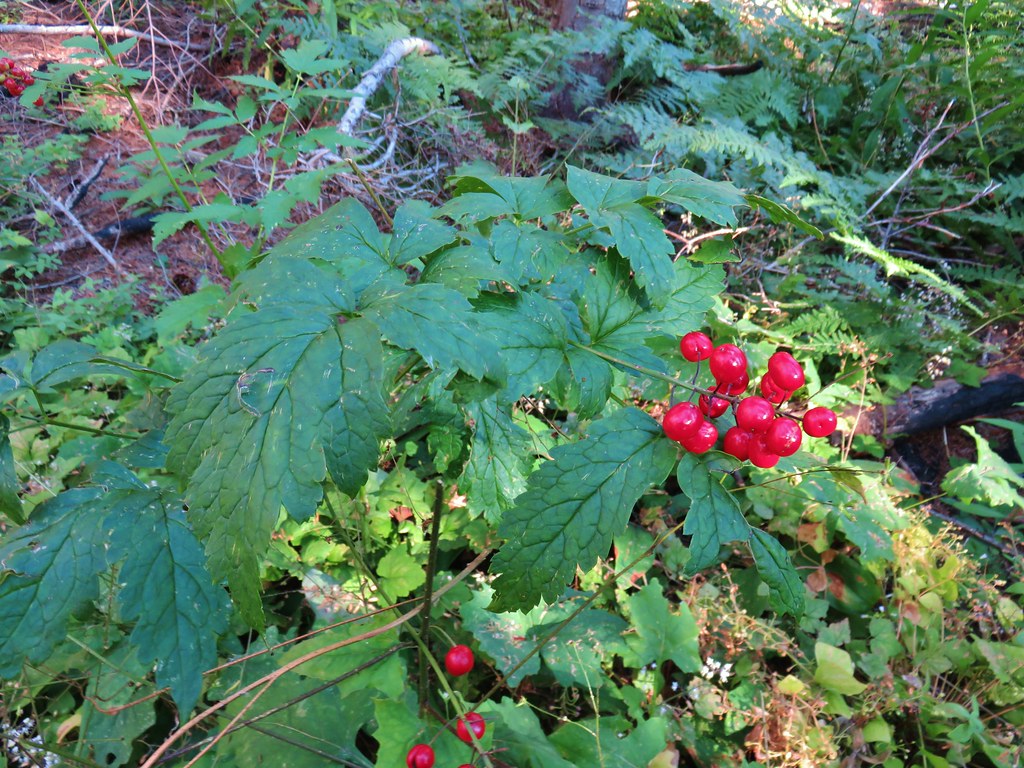
IMG_8215Baneberry

IMG_8217Monkshood

There were also some views that might not have been there if some of the trees hadn’t burned.
IMG_8221

IMG_8201South Sister

IMG_8220Middle and North Sister

IMG_8223Mt. Washington

IMG_8226Mt. Jefferson and Three Fingered Jack

The line of clouds obstructing the view of the mountains wasn’t exactly a welcome sight, but we could at least see some of them and it was early so maybe they would eventually burn off.

A little over 2 miles from the trailhead we arrived at a junction in a grassy saddle.
IMG_8228

The Olallie Trail continued straight passing an old guard station site at Olallie Meadows in .9 miles then continuing deeper (and fainter) into the Three Sisters Wilderness eventually ending at Horse Lake (post). We turned right though, onto the Olallie Mountain Trail.
IMG_8230

This trail began with a reasonably gradual climb past a series of meadows where a few late blooming flowers remained.
IMG_8235

IMG_8240Aster and pearly everlasting

IMG_8250

IMG_8252Columbine

IMG_8255

The trail briefly leveled out on top of ridge where the fire had burned intensely in some areas while sparing trees in others.
IMG_8256

IMG_8257

After the brief respite from climbing the trail steepened below the summit of Olallie Mountain and began to wrap up and around its rocky western face.
IMG_8258

IMG_8259

IMG_8260

The tread along the steep hillside here was a little sketchy in part due to the fire but we made our way up to the summit. The remains of the Olallie Mountain lookout tower still stand on the summit having been covered by firefighters to protect it from the blaze.
IMG_8269

IMG_8304

The three hundred and sixty degree view was impressive and would have been more so if not for the presence of clouds to the north and in front of many of the cascade peaks. On top of that our early ascent left the Sun in a less than ideal overhead position for lighting.
IMG_8306_stitchParts of the Cascades from Mt. Jefferson to the NE to Mt. Bachelor to the SE.

IMG_8302Mt. Jefferson was still tangled up in the clouds.

IMG_8300Just a peak at Mt. Washington (which was more than we could see of Three Fingered Jack)
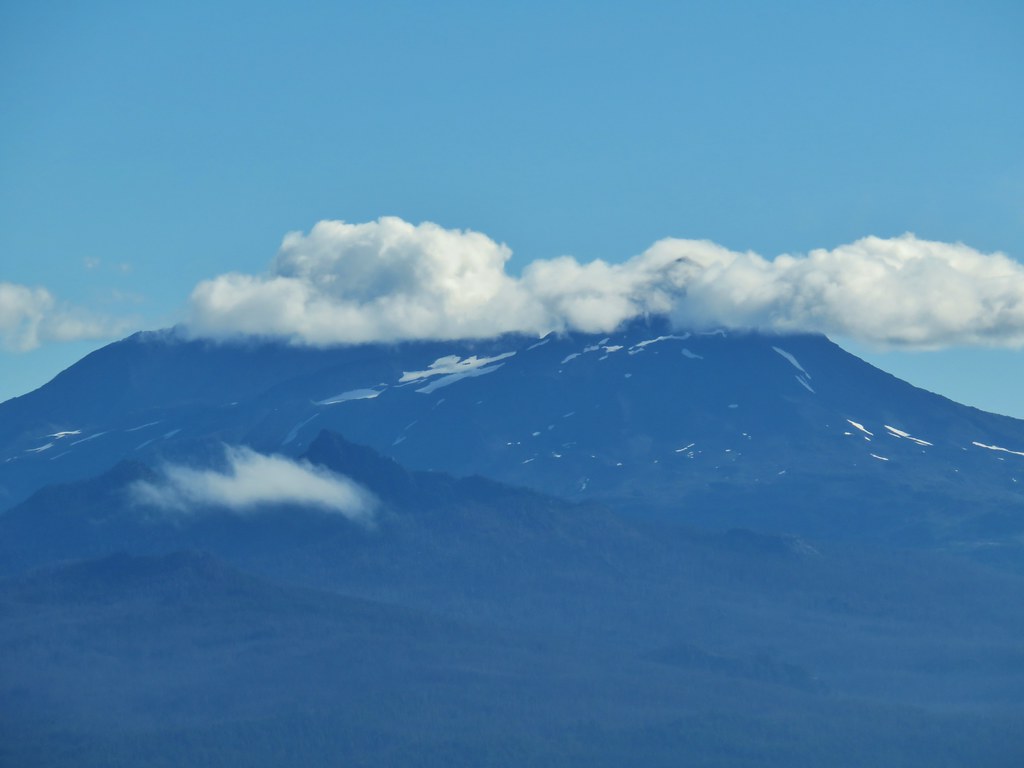
IMG_8297Middle and North Sister behind The Husband
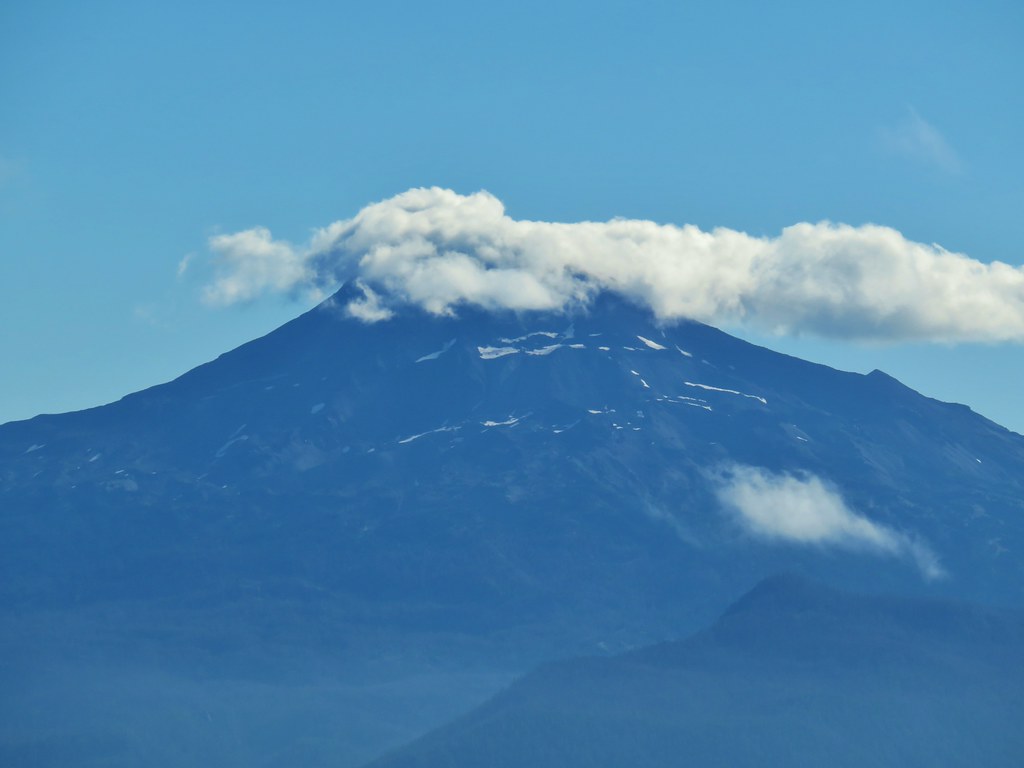
IMG_8296South Sister

IMG_8295Broken Top

Things were a little less cloudy to the south where Cowhorn Mountain (post) and Mt. Thielsen (post) seemed to be cloud free while Diamond Peak wasn’t so lucky.
IMG_8281

IMG_8282Cowhorn Mountain and Mt. Thielsen

IMG_8291Diamond Peak

We were able to identify the cliffs of flat topped Lowder Mountain, our next stop, to the NW.
IMG_8312Lowder Mountain to the left of the tree in the foreground.

IMG_8317Lowder Mountain

After watching the clouds pass by (but not leave) for awhile we headed back down. We had passed a single backpacker on the way up and on the way down we encountered a trio of hikers making their way up. When we got back to the stream below Wolverine Lake we spotted a frog (no wolverines though).
IMG_8331

IMG_8334

We completed our 8 mile hike here and drove back the two miles to the Lowder Mountain Upper Trailhead and parked at a pullout near the trailhead signboard. The signboard announced three trails: the Quaking Aspen, Lowder Mountain, and Walker Creek Trails.
IMG_8337

We weren’t paying close attention as we set off on a trail heading for a wilderness to the left of the signboard.
IMG_8338

IMG_8340

Our first clue that we were on the wrong trail should have been the location of the trail signs on the signboard but away we went following the Quaking Aspen Trail downhill parallel to FR 1993. We had a feeling something might be off but a quick glance at the GPS showed that we were almost to some switchbacks which matched up with Sullivan’s map but we were surprised that they were headed downhill and not up (the one complaint we have about Sullivan’s maps are that they are not topographic so we can’t always tell when a trail is climbing or dropping). We were zoomed in too far to see the other trail behind us that switchbacked uphill. Just after turning on the first of the switchbacks Heather figured it out and got us turned in the right direction but not until we’d covered a third of a mile.

We hiked back uphill to the trailhead and looked at the signboard and area more closely. Sure enough there was another trail and wilderness to the right of the signboard (the side listing the Lowder Mountain and Walker Creek Trails).
IMG_8346

IMG_8355

We now set off on the Lowder Trail and began switchbacking uphill through an old growth forest.
IMG_8356

IMG_8357

After a quarter mile of serious climbing the trail leveled out a bit (and straightened out) as it traversed along a hillside. We soon got a quick glimpse of Olallie Mountain across the valley.
IMG_8359

For the next 1 3/4 miles the trail alternated between meadows and forest before arriving at a junction in one of the meadows.
IMG_8360

IMG_8364Skipper

IMG_8365This reminded us of a torture device.

IMG_8368

IMG_8369

IMG_8372This meadow had a lot of buckwheat.

IMG_8373

IMG_8377Olallie Mountain again.

IMG_8380The lookout tower on Olallie Mountain

IMG_8381Diamond Peak had shed its cloud cover momentarily.

IMG_8384Diamond Peak

IMG_8387

IMG_8386Pollinators got to pollinate.

IMG_8389

IMG_8391

This junction marked the start of the Walker Creek Trail which climbed up through the meadow to the right. This was actually the trail to take in order to reach the viewpoint atop Lowder Mountain.
IMG_8393

The Lowder Mountain Trail continued on straight but beyond the junction is no longer maintained due to “lack of use”.
IMG_8392

A series of 12 switchbacks led steeply up through the meadow and forest to a large meadow atop Lowder Mountain.
IMG_8394The trail heading up through some thimbleberry.

IMG_8397Butterfly

IMG_8405Another skipper

IMG_8412This guy was the size of my pinky.

IMG_8399A few scarlet gilia still in bloom.

IMG_8415Pearly everlasting at the edge of the large meadow.

We followed a well worn path across the broad summit to the edge of the large meadow where it turned right passing along the tree line.
IMG_8419

Like the Lowder Mountain Trail the Walker Creek Trail is no longer maintained beyond the meadow. The clear path along the impressively large meadow is a user trail to the viewpoint above Karl and Ruth Lakes.
IMG_8420

IMG_8421

IMG_8479

IMG_8426

IMG_8427Karl & Ruth Lakes

The clouds were still a bit of an issue but it was now late enough in the day for the lighting to be much better.
IMG_8433Mt. Jefferson and Three Fingered Jack with Horsepasture Mountain (post) in the foreground.

IMG_8431Mt. Washington

IMG_8440North and Middle Sister

IMG_8438South Sister and Broken Top

IMG_8443

We made our way south along the cliffs to reach a view of Mt. Bachelor.
IMG_8453

IMG_8456Mt. Bachelor

In addition to the great views there was an interesting little rock feature that looked a lot like a head of some kind.
IMG_8468

IMG_8469

We took a good break here before heading back. On the return trip we discovered that we had actually spent a decent amount of time losing elevation traversing along the hillside on the way to the Walker Creek Trail junction. It had been so gradual that we hadn’t noticed but it was evident that we were going uphill a lot more than we’d expected once we were back on the Lowder Mountain Trail. There were quite a few butterflies out searching for the remaining flowers which gave us something to focus on (in addition to eating quite a few ripe thimbleberries).
IMG_8496Butterfly with a small crab spider on the next flower head to the right.

Between taking the wrong trail from the trailhead and wandering around at the viewpoint we managed to turn a 5.6 mile hike into 6.8 miles making our total for the day 14.8 miles. The elevation gains were roughly 1400′ for Olallie Mountain and 900′ for Lowder Mountain. The views were great from both peaks and we were already talking about a return trip earlier in the Summer to see what all the meadows might look like earlier in the year. Happy Trails!

Flickr: Olallie and Lowder Mountains

Categories
High Cascades Hiking Oregon Trip report Waldo Lake Area

Lillian Falls and Joe Goddard’s Old Growth Trail – 8/31/2019

**Note a portions of these hikes burned in the 2022 Cedar Creek Fire.**

As we continue to move closer to our goal of completing all of the featured hikes in William L. Sullivan’s 100 Hikes series of guidebooks (post) we have begun narrowing down the specific editions to base our progress off of. (For various reasons the featured hikes are a little different with each edition.) For the central cascades region we have decided to focus on the 4th edition from 2012. A few of the remaining featured hikes from that book are not part of the 100 hikes in the 5th edition as was the case with Lillian Falls.

It’s not always evident why Sullivan removes a hike from featured status and moves it to the back of his book (or removes it all together), but we thought it might have something to do with what he describes as “dangerous” potholes on the road to the trailhead. I checked with the Middle Fork Ranger District on the status of the road and the ranger there indicated that the road was fine for a high clearance vehicle but needed to be driven carefully. That sounded reasonable enough to us so we headed for the Black Creek Trailhead for the second hike of our long Labor Day Weekend.

We had planned on stopping at the short Joe Goodards Grove Trail first as it is located 1.6 miles before the Black Creek Trailhead on FR 2421 but we missed the unsigned turn (we saw the road but didn’t realize it was the one we wanted) and by the time we realized it we decided it was just going to be easier to do the longer hike first then end the day with the nature trail. We parked at the end of FR 2421 and took the unsigned Black Creek Trail into a second growth forest.
IMG_7877

IMG_7878

Less than a quarter mile from the trailhead we arrived at a signboard where we filled out a wilderness permit.
IMG_7880

Just beyond the signboard we crossed a small stream and entered the Waldo Lake Wilderness
IMG_7881Looking back at the stream.

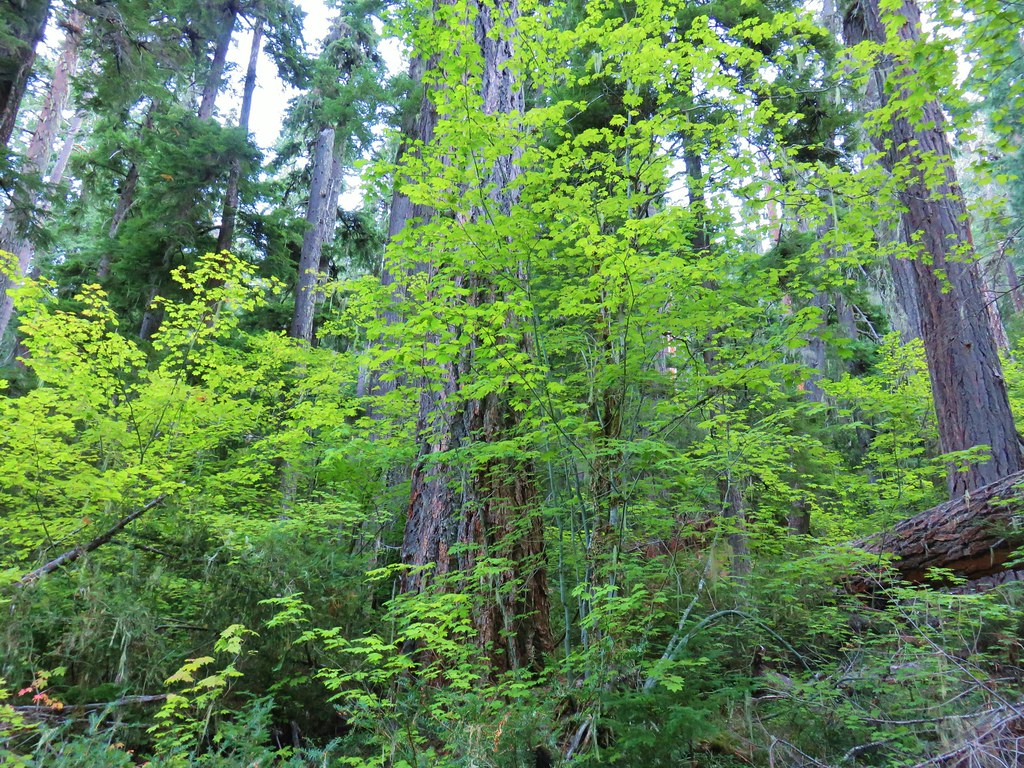
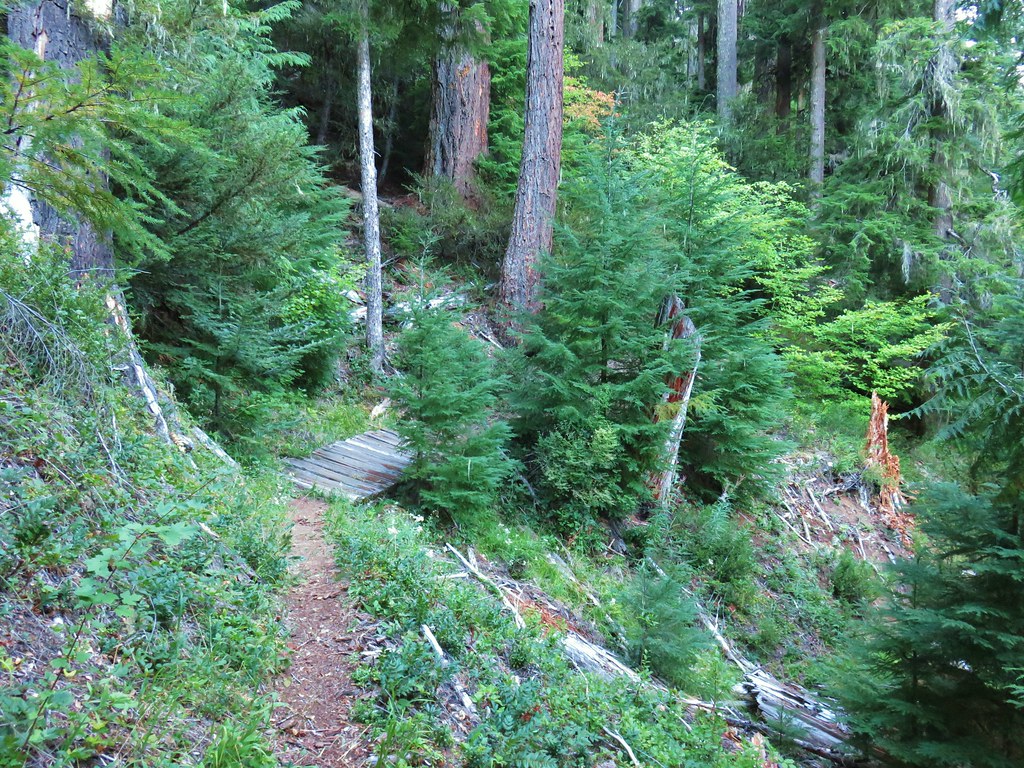
A few old footbridges remained as we passed through old growth above Black Creek.
IMG_7883

20190831_074449Not many flowers left but this one reminded us of fireworks.
IMG_7887

IMG_7889

IMG_7892

The trail climbed gradually for just over a mile to a switchback along Nettie Creek where we could hear the roar of Lillian Falls just upstream.
IMG_7946Nettie Creek at the switchback.

We honestly weren’t expecting much from the falls which was described as a 150′ series of cascades. The drops visible from the switchback were nice enough and about what we had expected to see.
IMG_7898

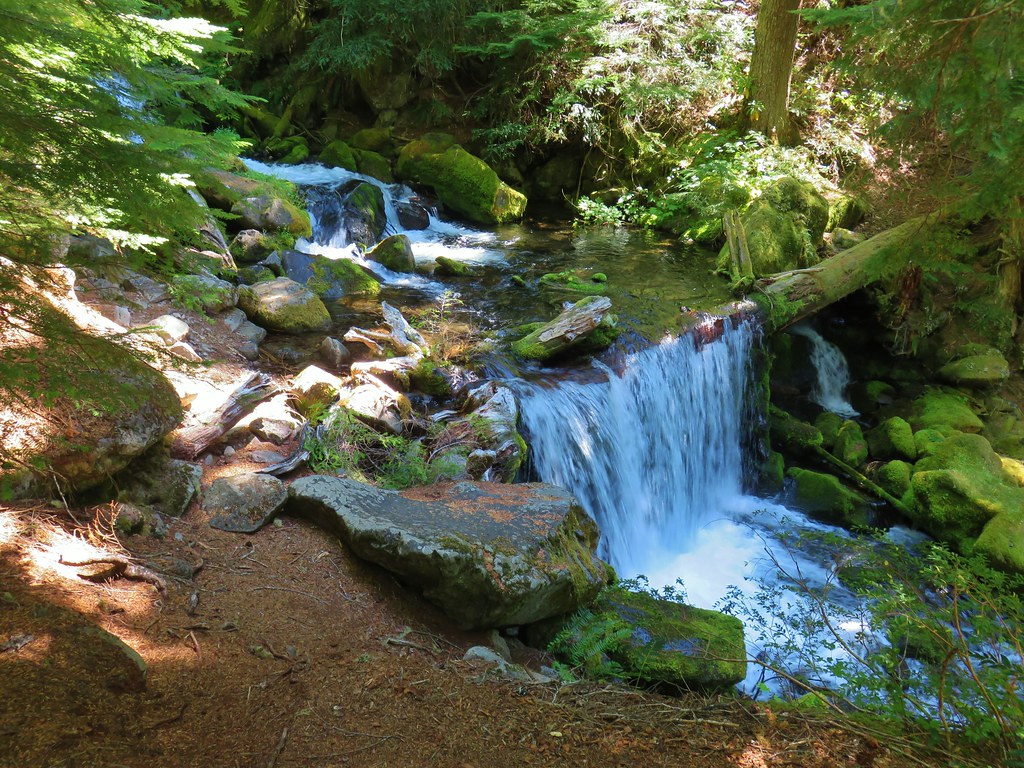
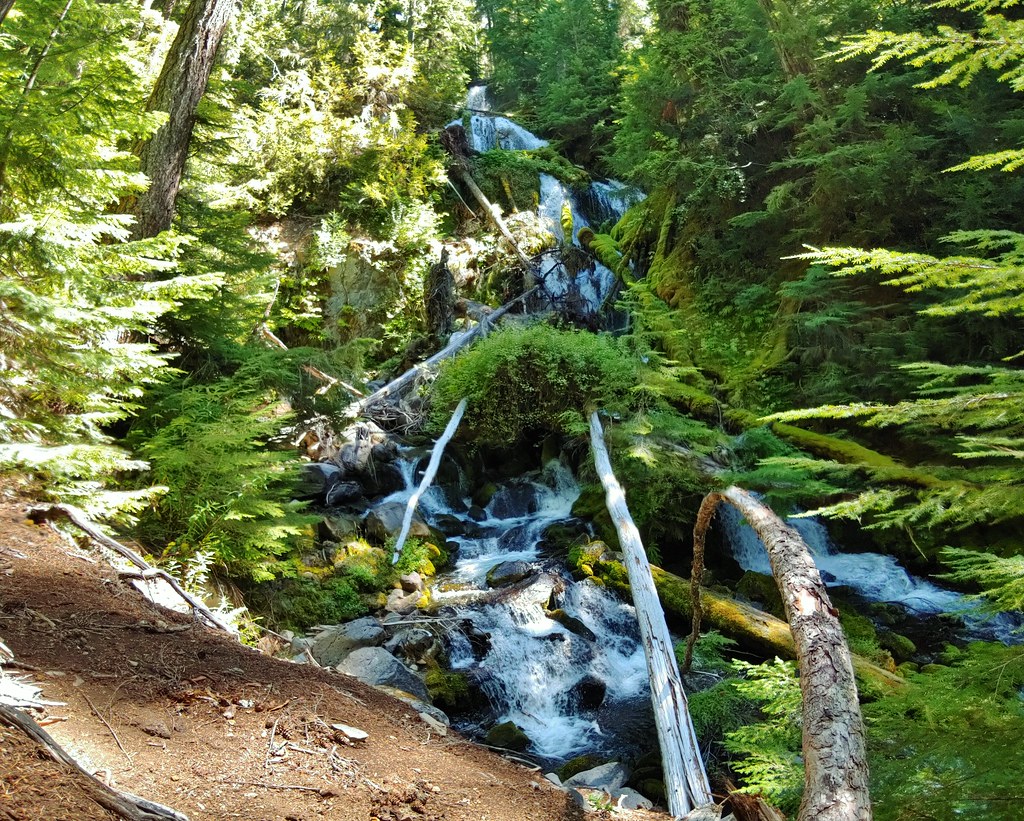
Working our way up alongside the cascades though revealed a much more impressive sight than we were prepared for.
IMG_7905

IMG_7917

20190831_081149_HDR

Lillian Falls was a worthy goal on its own, but at just over 2.5 miles round trip it was too short of a hike to justify the nearly 5 1/2 hours of driving to get to the trailhead and back so after thoroughly enjoying the falls we continued up the Black Creek Trail.
IMG_7947

The trail veered away from Black Creek as it began a relatively steep climb up a a ridge along Nettie Creek. We leveled out a bit .7 miles from Lillian Falls passing through a section of forest with rhododendrons.
IMG_7954

We crossed Nettie Creek on stones .4 miles later.
IMG_7957

The trail continued its fairly level grade as it passed through more forest before arriving at a rocky hillside where it turned north and began to climb again.
IMG_7959

IMG_7961

The open hillside provided a view west and to a lesser extant south to Fuji Mountain (post).
IMG_7960SW view

IMG_7963Looking south

IMG_7967Fuji Mountain

IMG_7969

Just before reentering the forest there was a short section of narrow tread where the hillside appeared to be slide prone.
IMG_7970

There had been a dry creek bed below the trail but as we reached the trees we began to hear running water, faintly at first, but then suddenly there was a full creek in front of us flowing through the forest.
IMG_7972Klovdahl Creek

After briefly leaving the creek to pass around a small hill the trail crossed Klovdahl Creek.
IMG_7973

A fairly steep quarter mile climb followed as the trail gained 275′ via a series of switchbacks. The trail then leveled out a bit again. Instead of rhododendron this section was full of huckleberry bushes and a sooty grouse.
IMG_7978Grouse on the Black Creek Trail.

IMG_7981Huckleberry bushes along the trail.

We kept waiting to reach a purported downhill to Waldo Lake which finally arrived about a hundred yards before arriving at a junction with the Jim Weaver Trail which loops around the lake.
IMG_7983Heading down to the Waldo Lake Trail (Jim Weaver Trail)
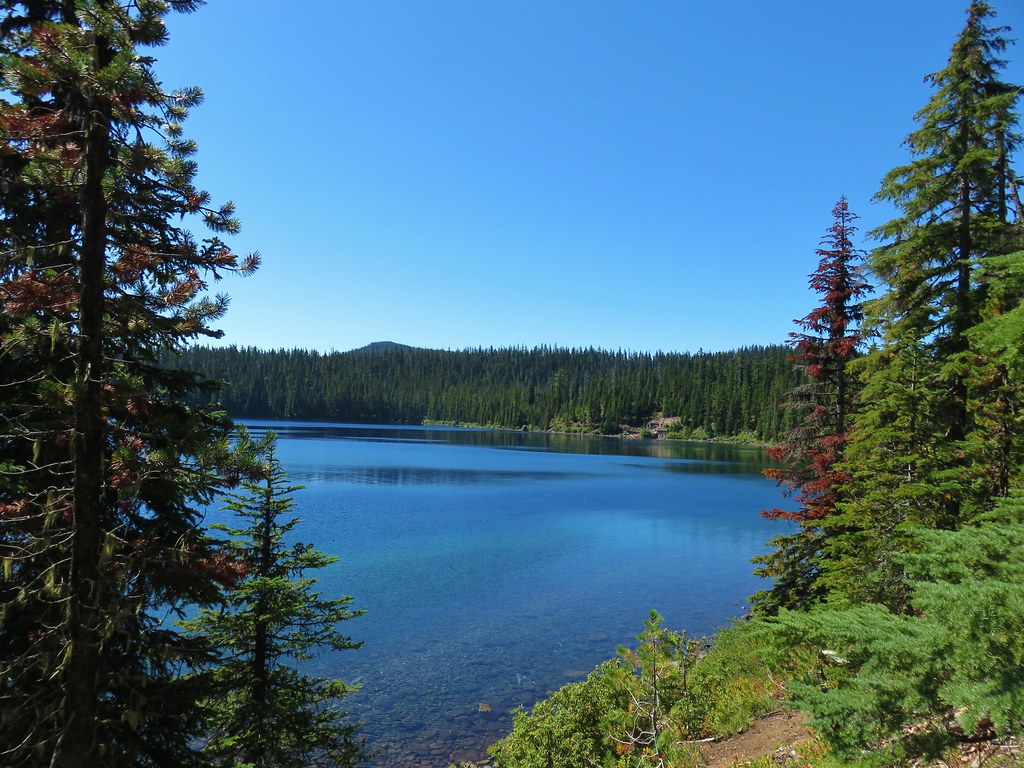
Across the lake we could see the distinct summit of Maiden Peak (post).
IMG_7989

To the right along the shore of Klovdahl Bay the remains of an attempted diversion tunnel for hydroelectric power and irrigation.
IMG_8052

IMG_8054

We considered hiking the half mile to visit see the tunnel up close but opted instead to turn left and head north along the lake to visit Green Lake. Green Lake is part of a 5th edition featured hike that also includes Elbow Lake. We had visited Elbow Lake in 2013 as part of our Waldo Mountain hike. (post)

The trail climbed a bit in this direction as it veered away from Waldo Lake to pass several much smaller, unnamed lakes.
IMG_7991

IMG_7993

IMG_7995First lake on the left.

IMG_7997Second lake on the left.

IMG_7998A third lake on the left that was set back in the trees.

IMG_7999First lake on the right.

IMG_8005Ducks at the lake on the right.

IMG_8014Dry pond on the right.

After 1.9 miles on the Waldo Lake Trail we came to a junction with the Koch Mountain Trail where we turned right at a pointer for Green and Waldo Lakes.
IMG_8017Wide trail junction.

IMG_8018

We passed by Green Lake opting to visit the shore of Waldo Lake first and followed this trail downhill a third of a mile to it’s end at the lake.
IMG_8020Dry creek bed along the way.

IMG_8023

We sat on the rocky shoreline here for a bit enjoying the view of Broken Top and Mt. Bachelor.
IMG_8025

Across the lake to the east were The Twins, a peak that we hope to hike later this year.
IMG_8030

After the break we headed back up to the Waldo Lake Trail but first detoured to visit Green Lake which was a few hundred feet off the main trail to the north.
It was a nice little lake, enough so that it warranted a second short break.
IMG_8040

IMG_8044

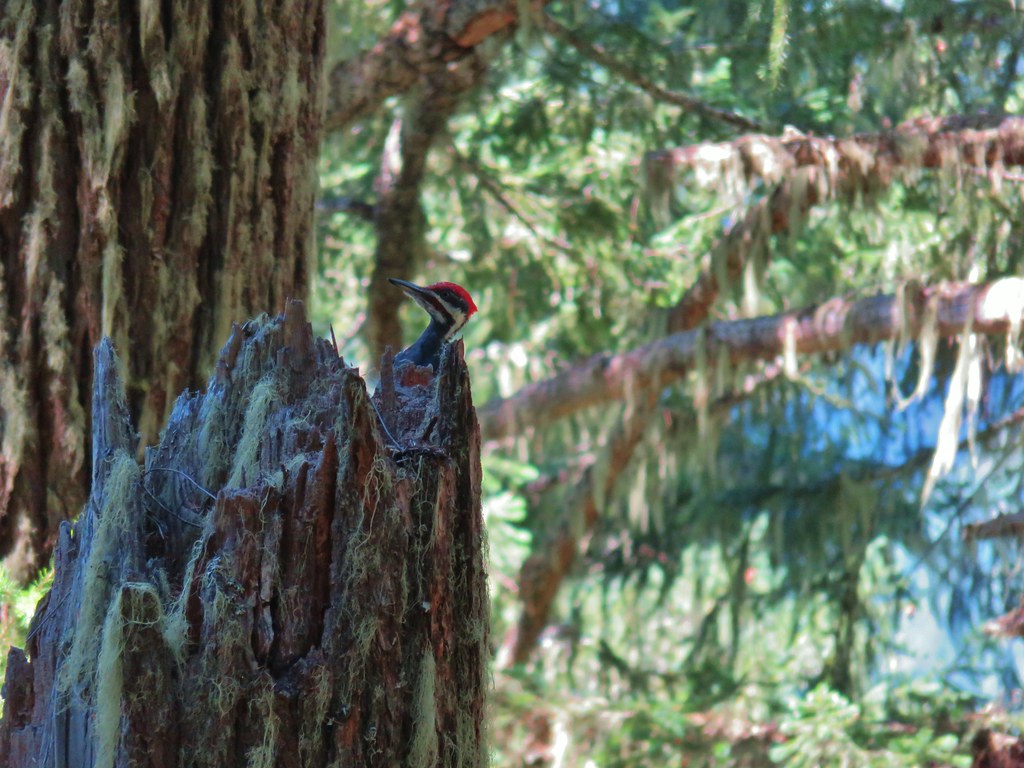
It was close to 11am when we left Green Lake and headed back along the Waldo Lake Trail. There was a marked increase in traffic on the trail now, but after turning onto the Black Creek Trail again we didn’t see another person, but we did get a chance to watch a pileated woodpecker for a bit.
IMG_8068

IMG_8067

IMG_8072

We stopped again at Lillian Falls which was now receiving more light.
IMG_8082

20190831_130930

We then returned to our car and drove back along FR 2421 the 1.6 miles to the unsigned road (now on the left). We parked at its end after a tenth of a mile and took an unsigned path to a nice footbridge over Black Creek.
IMG_8124Unsigned start of the nature trail.

IMG_8127

IMG_8129Black Creek

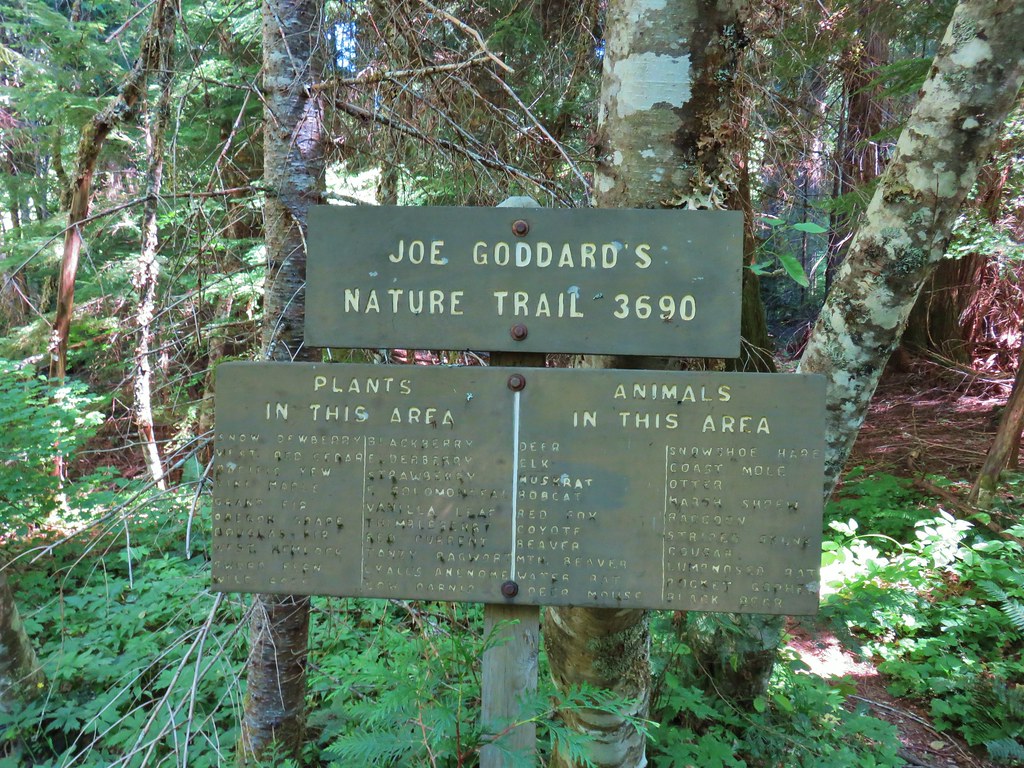
Once across the creek the trail passes briefly through a former clearcut before arriving at a sign announcing the Joe Goddard’s Nature Trail.
IMG_8133

IMG_8135

IMG_8138

Just beyond the sign the trail split marking the start of the loop.
IMG_8139

We went left here but in hindsight it might have been a little better to go right based on the direction the signs along the trail were facing. In any case after taking the left fork we quickly came to another fork where a footbridge crossed Louisie Creek near a picnic table.
IMG_8140

IMG_8145

IMG_8146

IMG_8148

We crossed the bridge and followed a path past an impressive old growth cedar.
IMG_8149

IMG_8151

The path appeared to end back at Black Creek although there were some faint trails in the area. This was a bit confusing because the trail that was shown on our Garmin maps appeared to be in this same area, but we knew that the location of trails on maps isn’t always correct so we crossed back over Louise Creek and continued on the clearer trail which crossed a dry creek bed.
IMG_8155

The creek bed was followed by a large old growth Douglas Fir that a sign put at 217′ tall and over 118 inches in diameter.
IMG_8155

IMG_8158

Even though our GPS track was not matching up at all with the trail shown on the device the signage along the route we were following told us we were on the right path. We continued on the loop and came to a log that had been cut for the trail and subsequently marked with Joe Goddard’s birthday and the year “1776”. A little online research revealed that this tree dated back to the year 1340.
IMG_8165

IMG_8162

It was an interesting little loop (.5 miles total from the parking area) and well worth the stop.
IMG_8166Another picnic table.

IMG_8167Another big Doug fir.

IMG_8168

IMG_8173

We ended the day having covered 13 miles, 12.5 for Lillian Falls and Waldo Lake and the half mile at Joe Goddard’s Grove. We were a bit surprised that the only people we saw were along Waldo Lake given how nice the falls were, but perhaps their out of the way location and potholed road keeps them a bit less visited. The only negative on the day was Heather getting stung by a yellow jacket at Lillian Falls. Those things are just mean. Happy Trails!

Flickr: Lillian Falls and Joe Goddard’s Nature Trail

Categories
High Cascades Hiking Mt. Jefferson Area Oregon Trip report

Olallie Butte – 8/30/2019

**Note the 2020 Lionshead Fire burned the area covered by this hike.**

At the beginning of the year we had requested the Friday before Labor Day Weekend off in hopes of backpacking around Diamond Peak (With a side trip up to the summit) but with our backpacking plans on hold while we care for our elderly cats we switched our plans to day hikes instead. For our first hike we chose Olallie Butte.

Before getting into the trip report we wanted to point out that this hike is in part located on the Warm Springs Reservation. It wasn’t entirely clear whether or not non-tribal members are allowed on the trail. We did some research before heading out and discovered that this uncertainty has existed for some time. We decided to go ahead and start the hike but were prepared to turn around if there were any signs posted letting us know that the trail was off-limits. There were several other nearby hikes that are still on our to do list so we had plenty of alternate options if that did happen.

The hike starts at a nondescript pullout under some power lines. We were a little apprehensive upon arriving at the trailhead, not because we were worried the trail would be closed, but rather due to the clouds that were overhead. The forecast had called for sunny skies on the butte so we hoped that either the clouds would be burning off or we would be climbing above them. We had tried for a similar view two other times by climbing nearby Double Peaks (post) and Ruddy Hill (post), but had been foiled by clouds on both of the trips.
IMG_7702

The actual trail was marked by some pink flagging off a dirt road across from the parking area.
IMG_7703

After just a tenth of a mile we arrived at the Pacific Crest Trail where there was what appeared to be a newer sign for the Olallie Butte Trail.
IMG_7705

IMG_7706Trail sign with the PCT heading north behind it.
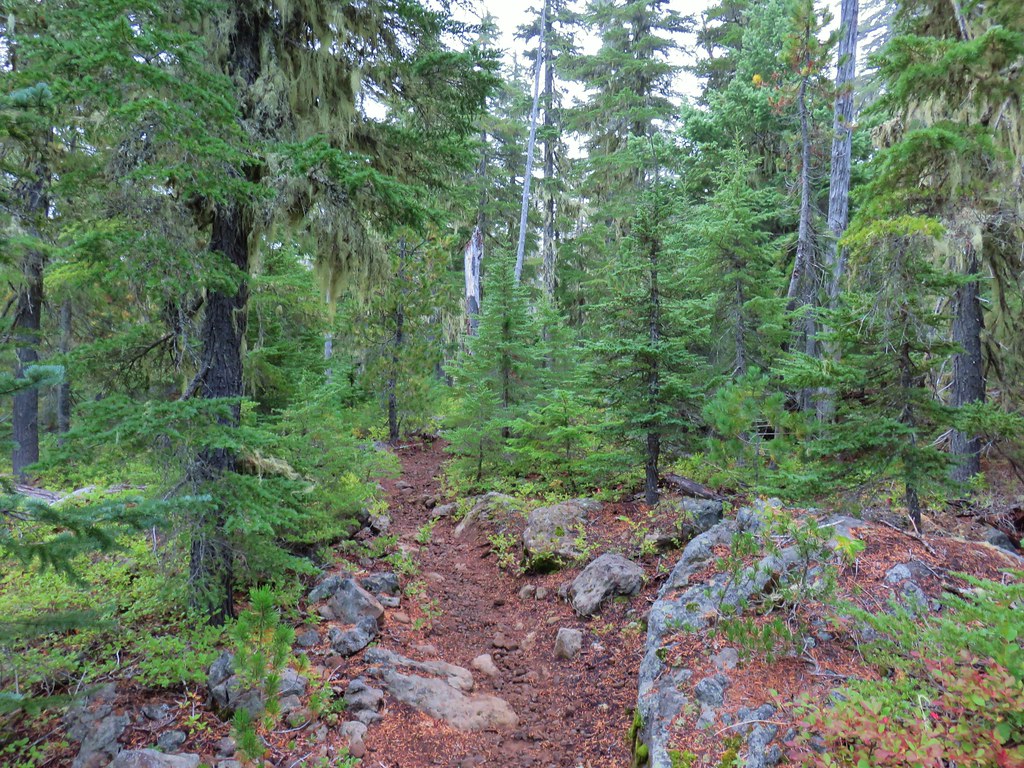
We crossed the PCT and headed uphill through the forest which was very typical for the Olallie Lake Scenic Area.
IMG_7710

IMG_7712

IMG_7716

After approximately a mile and a half of gradual climbing we came to a sign announcing the start of the Warm Springs Reservation.
IMG_7719

IMG_7722

There were no signs of restricted access so we continued on making sure that we remained on the trail and respected the area.
IMG_7724

We did indeed emerge from the clouds not long after entering the reservation which allowed for occasional views of nearby Sisi Butte and Mt. Hood.
IMG_7725Sisi Butte

IMG_7727Lookout tower on Sisi Butte

IMG_7732Mt. Hood

IMG_7735

It was too late in the year for most of the flowers but there was a little color left on a few of them.
IMG_7739

IMG_7740

IMG_7743

Just beyond the three mile mark the trail leaves the forest and traverses a cinder slope beneath the summit.
IMG_7746

IMG_7749

The view south to Mt. Hood is unobstructed here.
IMG_7750

Shortly before starting a series of swtichbacks we got our first look at Mt. Jefferson through some trees.
IMG_7761

The view of Mt. Jefferson improved as we climbed and soon Olallie and Monon Lakes joined the scenery along with several more Cascade peaks further to the south.
IMG_7765

IMG_7767Olallie Lake

IMG_7770_stitchMonon Lake just beyond Olallie Lake (Timber Lake is the smaller lake in the trees to the west.
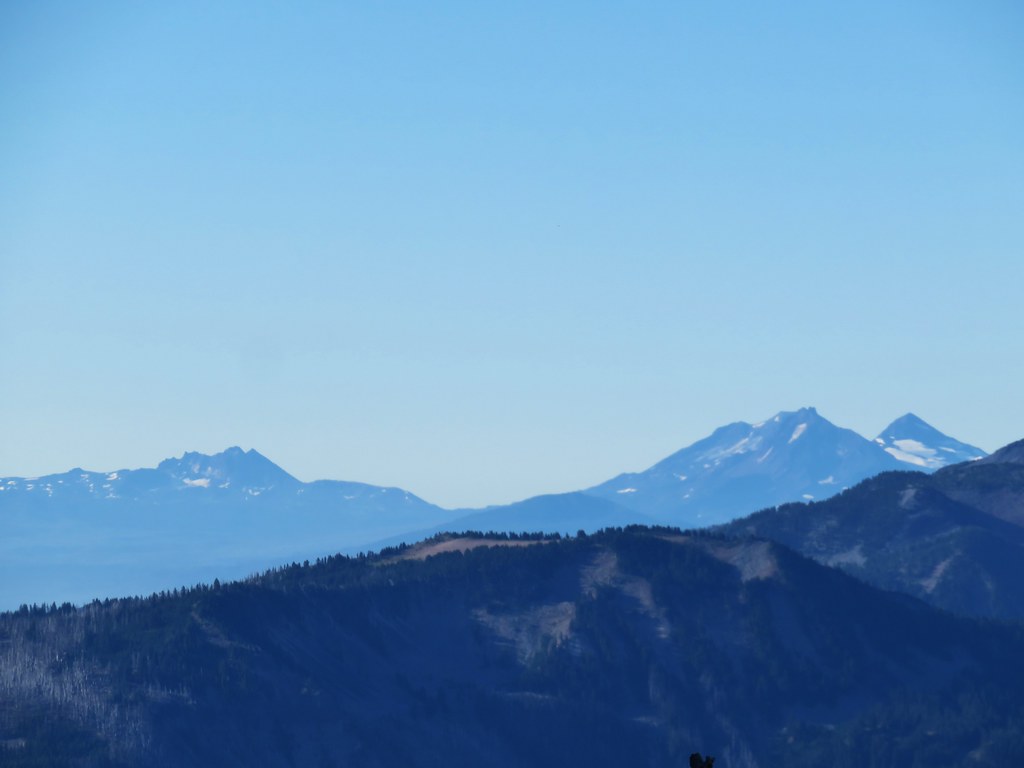
IMG_7775Broken Top and The Three Sisters

There were also some familiar features from earlier this year.
IMG_7782Dinah-mo Peak and Bear Point (post)

IMG_7783Bear Point

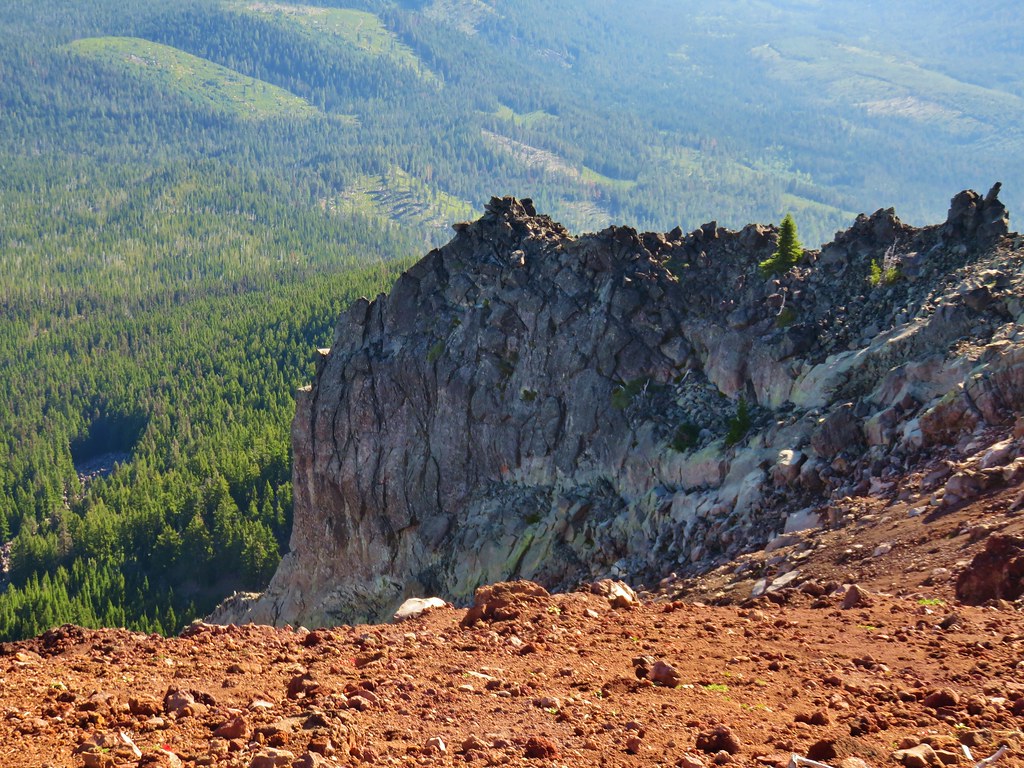
After completing the switchbacks the trail arrived at a saddle atop the broad summit of Olallie Butte. To the north were the remains of a former lookout tower while a close up view of Mt. Jefferson awaited to the south.
IMG_7790Lookout tower remains

IMG_7791

IMG_7789

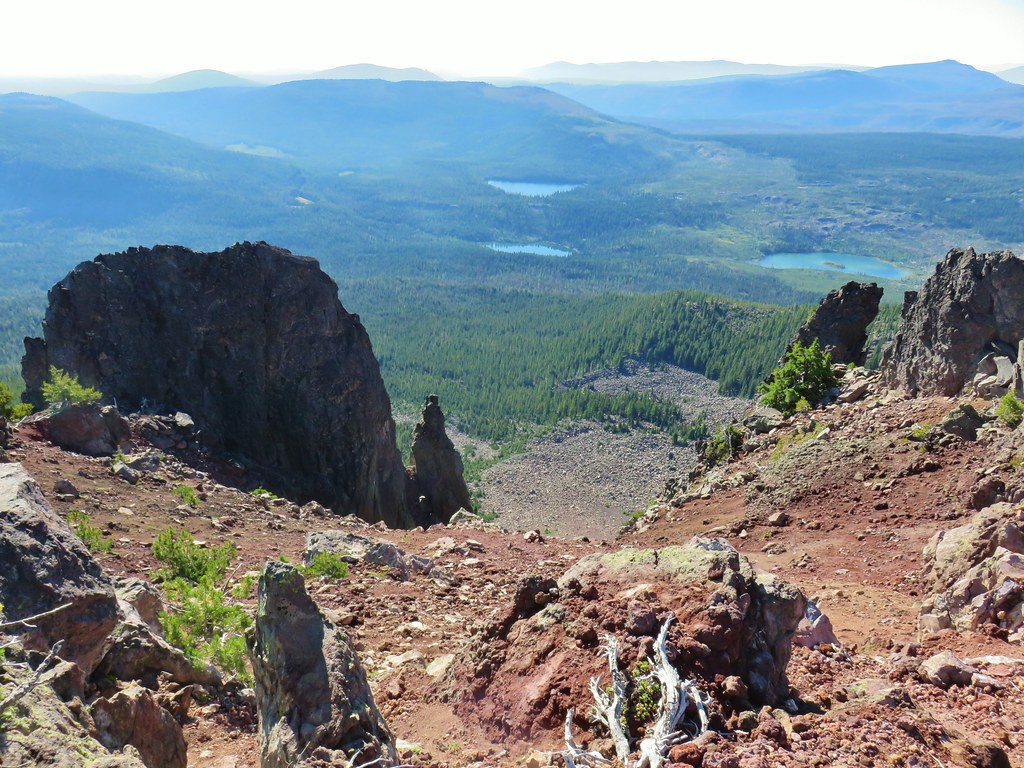
We started by visiting the southern end of the summit to get that close up view of Mt. Jefferson and the many lakes between that mountain and the butte.
IMG_7792_stitch Starting from the left – Trout Lake with Boulder Lake beyond, Island Lake, Dark Lake, Long Lake. The three smaller lakes are Lake Mary (closest), Lake Marie (middle), and Lake Alice (furthest). Lake Hazel is the small lake up and to the right of those three. All of these lakes are part of the Warm Springs Reservation and off-limits unless a permit to visit has been obtained.

IMG_7806Monon, Olallie, and Timber Lakes in the Mt. Hood National Forest to the west.

IMG_7804Mt. Jefferson

An interesting feature on this end of the butte is a natural rock arch.
IMG_7796

IMG_7828

We eventually pulled ourselves away from this view to head over to the former lookout.
IMG_7798

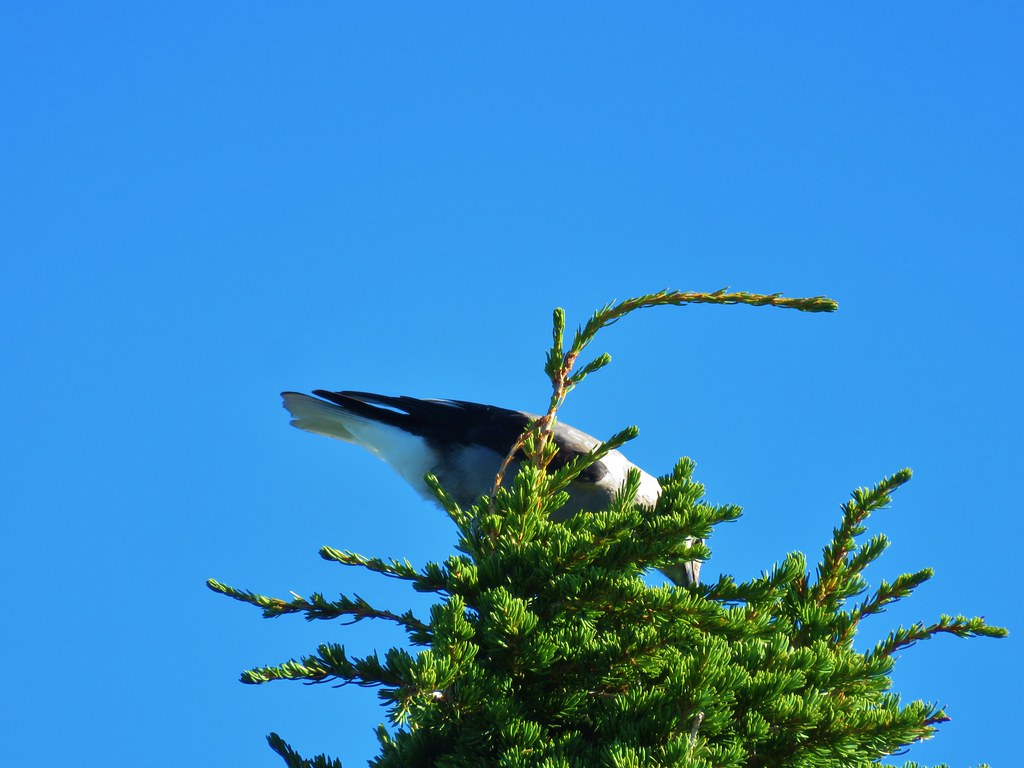
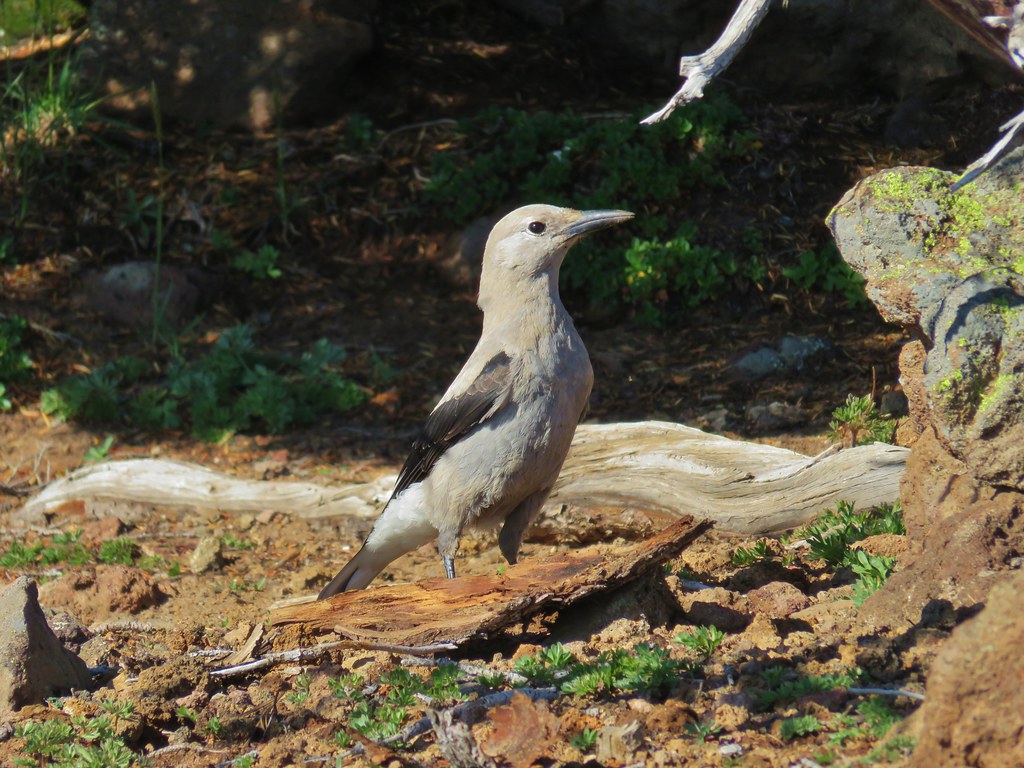
We found a pair of Clark’s nutcrackers enjoying breakfast.
IMG_7851

IMG_7834

IMG_7859

IMG_7865

The clouds were receding to the north which revealed Mt. Adams behind the right shoulder of Mt. Hood and further to the west we could just make out Mt. St. Helens above the clouds.
IMG_7835

IMG_7809Mt. St. Helens as a dark spot on the horizon.
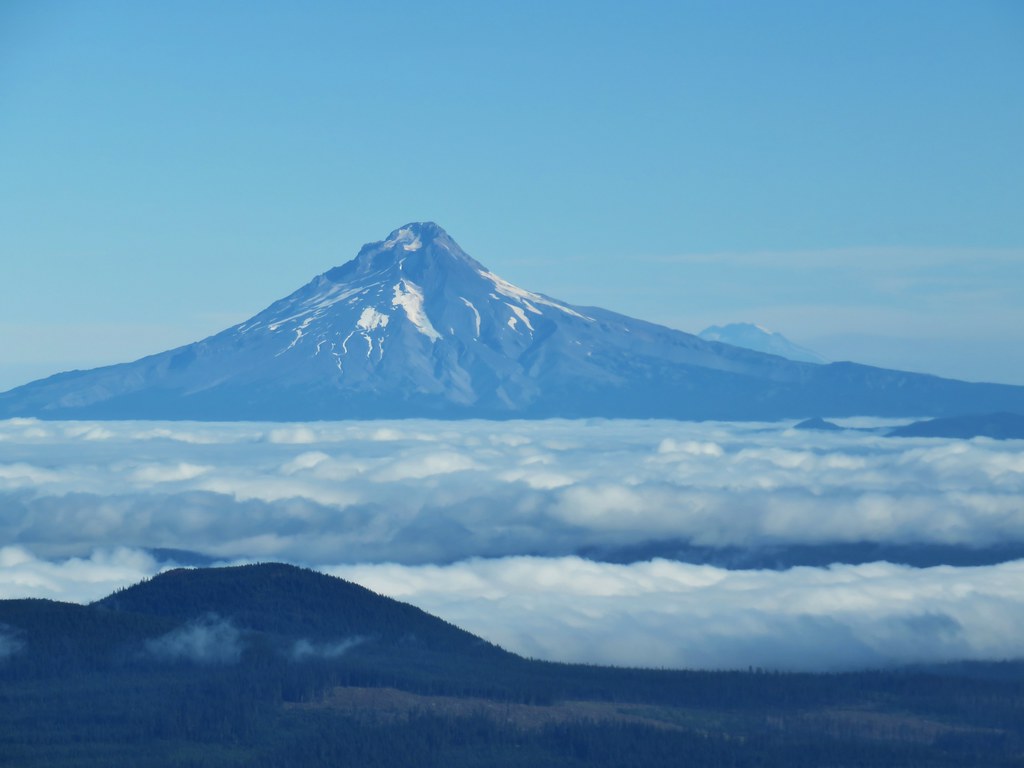
IMG_7860Mt. Adams beyond Mt. Hood

IMG_7844Mt. Jefferson from the lookout site.

There were more rock fins on the NE side of the butte but no rock arches.
IMG_7857

IMG_7871

We visited the south end of the summit once more before heading back down the trail. The view was a little different on the return trip as the clouds had departed creating several additional views of Mt. Hood along the lower portions.
IMG_7876

We had planned to pack out any litter we found on the reservation as one of the things that could easily lead to the explicit closure of the trail would be damage to the area but we didn’t see any other than the remains of the old lookout while on the reservation. On the other hand closer to the trailhead we removed a shoe sole, a couple of crushed cans, and a pile of apparently discarded clothing and a tent fly.

Other than the trash this was a spectacular hike. The views were great and we didn’t see any other hikers. For us this was roughly an 8 mile hike gaining 2700′ of elevation. Despite that number the climb was never particularly steep making it feel a little easier than might be expected. Happy Trails!

Flickr: Olallie Butte

Categories
High Cascades Hiking Mt. Jefferson Area Oregon Trip report

Bingham Ridge (Mt. Jefferson Wilderness) – 8/24/2019

**Note the 2024 Bingham Fire burned a portion of this hike.**

After a week back at work it was time to hit the trails again. We once again turned to Matt Reeder’s “101 Hikes in the Majestic Mount Jefferson Region” for inspiration choosing the Bingham Ridge Trail as our destination.

The Bingham Ridge Trailhead is located 5 miles up Forest Road 2253 aka Minto Road. That road is just 17 miles east of Detroit, OR and was in great shape except for some water damage in the first quarter of a mile. Beyond that short stretch it was a good gravel road all the way to the parking area just before the road was gated.

The trail began opposite the little parking area where we had parked along side two other vehicles.
IMG_7369

IMG_7371

The trail climbed through a green forest along the dry bed of Willis Creek before briefly passing through the edge of a clear-cut.
IMG_7372

IMG_7373

IMG_7381Huckleberry bushes and beargrass in the clear-cut.
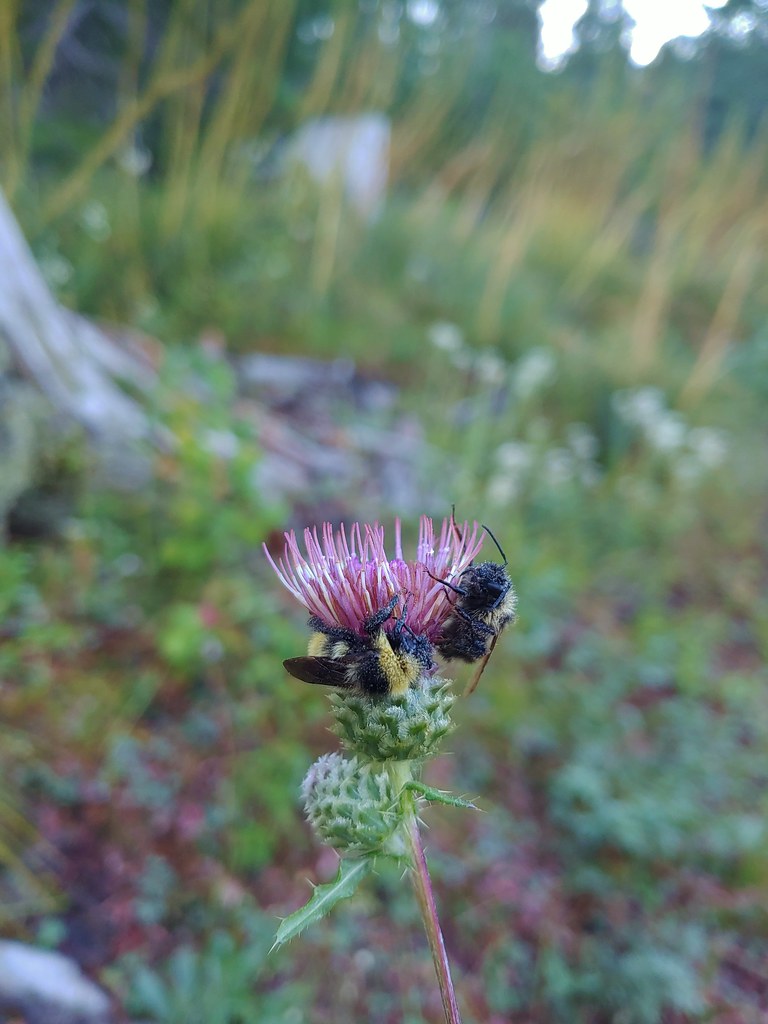
20190824_065018Sleeping bees on some thistle.

The trail soon reentered the trees and then passed into the Mt. Jefferson Wilderness.
IMG_7384

IMG_7386

IMG_7395The bees on the thistle may have been asleep but a western toad was out and about.
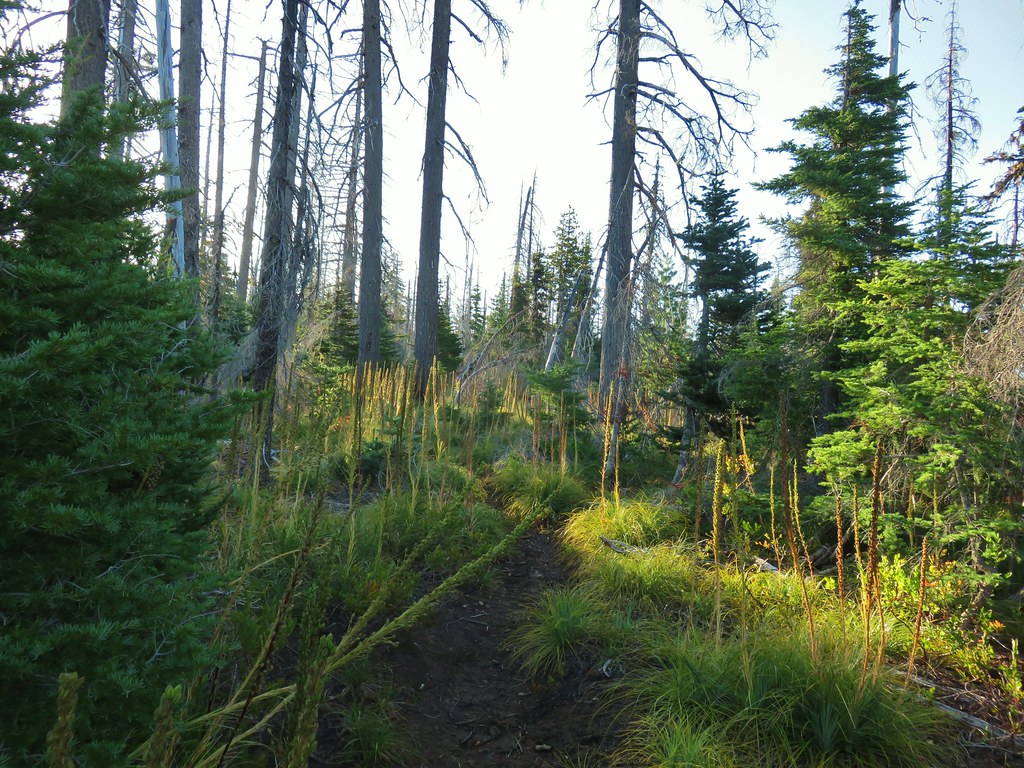
After entering the wilderness the trail continued to climb very gradually as it passed through alternating sections of green trees and forest scarred by the 2006 Puzzle Creek Fire.
IMG_7396

IMG_7400Mt. Jefferson through the burned trees.

IMG_7402Back in the green.

IMG_7404Three Fingered Jack through the burned trees.
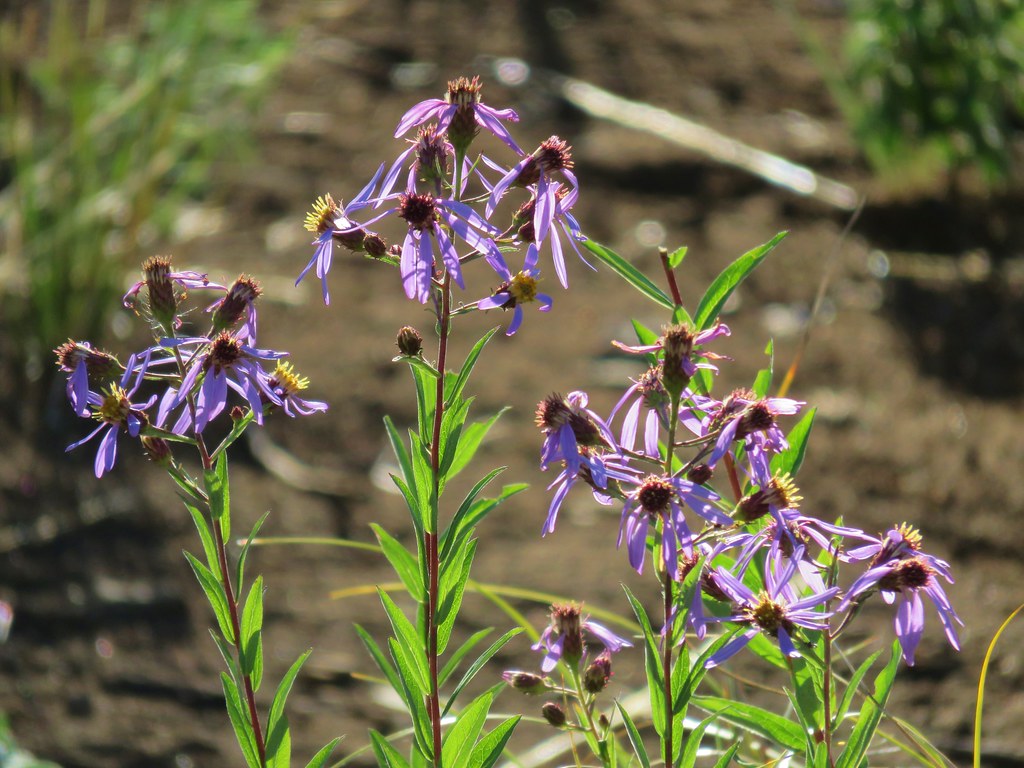
IMG_7408Aster

IMG_7409Pearly everlasting

IMG_7410Fireweed

The longest stretch through burned forest occurred as the trail passed to the right of a rocky rise along the ridge.
IMG_7412Three Fingered Jack

IMG_7416

IMG_7417The rock covered rise.

IMG_7418South Cinder Peak (post) to the left and Three Fingered Jack to the right.

IMG_7422Still passing the rocks.

We heard a couple of “meeps” from pikas in the rocks but we only managed to spot a golden-mantled ground squirrel.
IMG_7423

As the trail passed around the rocky rise we reentered green forest and quickly came to the end of the Bingham Ridge Trail at a junction with the Lake of the Woods Trail 3.7 miles from the trailhead.
IMG_7426

IMG_7427

The Lake of the Woods Trail runs north-south between the Pamelia Limited Entry Area and Marion Lake (post). We turned left (north) onto this trail which promptly crossed over the ridge at a low saddle and began to traverse a forested hillside.
IMG_7429The low saddle.

IMG_7430

IMG_7431

The trail wound around the basin arriving at a ridge end viewpoint where we had hoped to get a view of Mt. Jefferson but soon realized that we hadn’t come far enough around yet and we were looking west not north.
IMG_7432Coffin and Bachelor Mountains (post).

We continued along the hillside finally coming far enough around to get a look at Mt. Jefferson.
IMG_7433

Just a little further along we arrived at Reeder’s turn around point for the 8.8 mile hike described in his book. A cinder viewpoint of Mt. Jefferson across the Bingham Basin.
IMG_7438

IMG_7439

There was a strange group of clouds hanging out on the top of the mountain. We could see them moving in what appeared to be a SE direction but despite seeing the movement it never really appeared that they were going anywhere.
IMG_7443

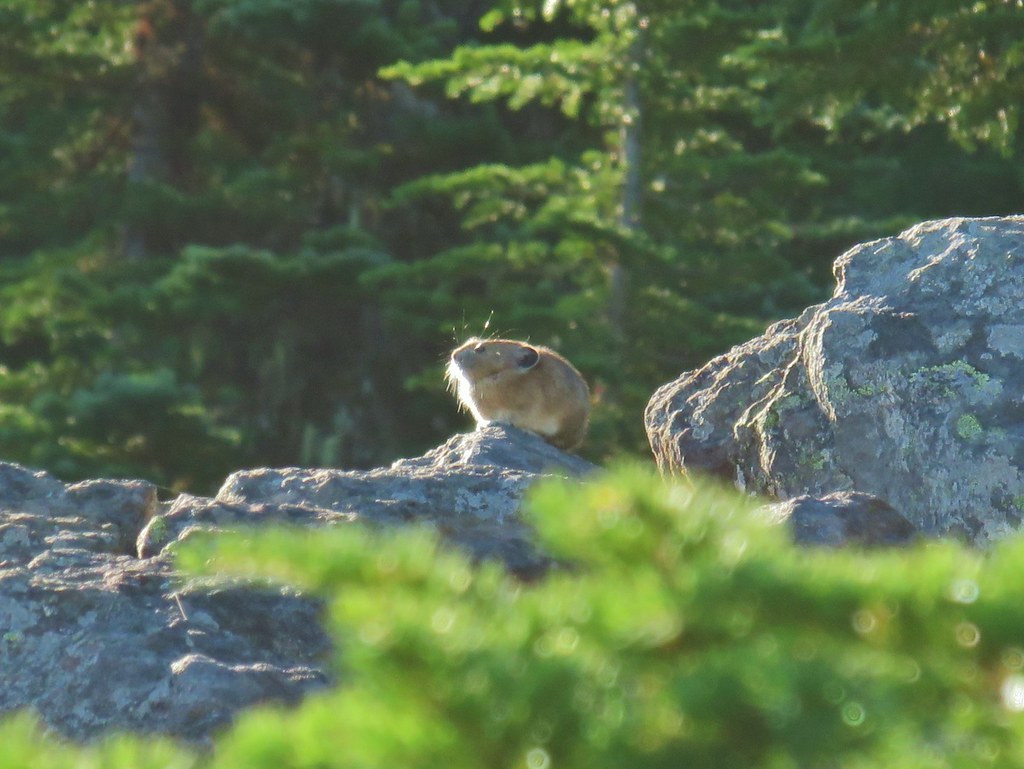
As we stood at this rocky viewpoint we could hear more pikas and then Heather spotted one sitting on top of some rocks, maybe enjoying the same view we were.
IMG_7448

Even though Reeder calls this viewpoint “the most logical stopping point for dayhikers” he does provide information for those wishing to continue. Since logic sometimes goes out the window with regards to hiking we continued on. The trail dropped just a bit to a fairly level bench where it passed through a couple of meadows before arriving at an unnamed lake with a view of Mt. Jefferson on the left.
IMG_7460

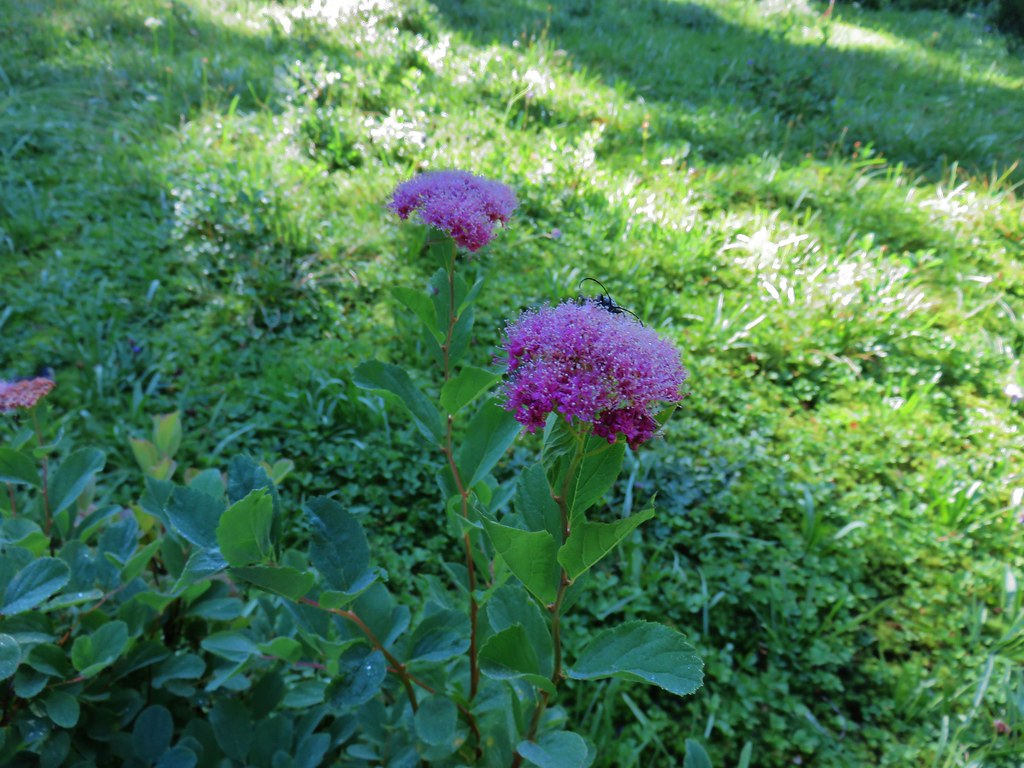
IMG_7461Spirea with a beetle.

IMG_7464Unnamed lake with Mt. Jefferson (and those pesky clouds).
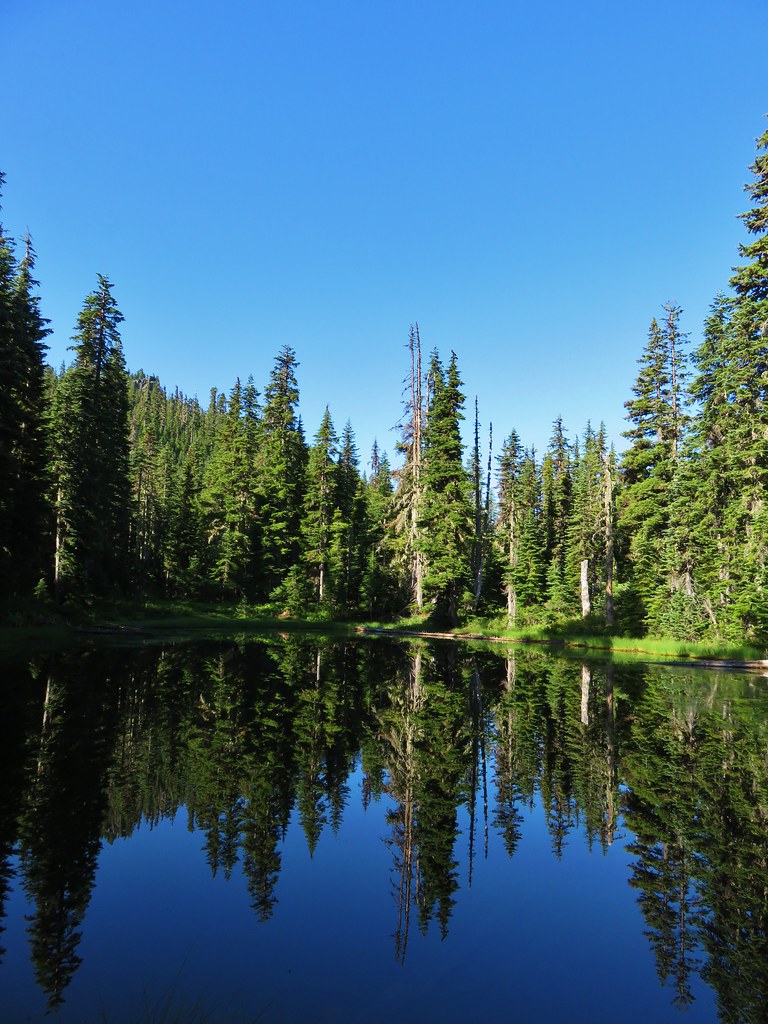
IMG_7469From the opposite side of the lake.

A half mile later (or just under 2 miles from the Bingham Ridge Trail junction) we arrived a Papoose Lake.
IMG_7470

IMG_7482

The mountain was mostly hidden by trees from this lake but there were several frogs to watch and a short scramble up a rockpile on the east side of the lake did provide another look at Mt. Jefferson.
20190824_092141

IMG_7492

IMG_7484

It was actually a really impressive amount of boulders here and although we didn’t spot any, we could hear a number of resident pikas.
IMG_7483Looking south over the rock field.

Turning back here would have put the hike in the 11.5 mile range, but we had our sights set on a further goal – the Pacific Crest Trail. Beyond Papoose Lake the Lake of the Woods Trail passed several seasonal ponds which were now meadows where we had to watch out for tiny frogs.
IMG_7495

IMG_7496One of the frogs.

IMG_7667

IMG_7663Frog in the trail.

IMG_7672

Just under three quarters of a mile from Papoose Lake (6.3ish from the trailhead) we arrived at the northern end of the Lake of the Woods Trail where it met the Hunts Creek Trail (post).
IMG_7500

A left on this trail would lead us into the Pamelia Limited Entry Area for which we did not have a permit, but to the right the trail remained out of the limited area as it headed to the Pacific Crest Trail.
IMG_7501

In his book Reeder describes this section of trail as “spectacular” which is what prompted us to abandon logic in the first place. We turned right and continued the theme of gradual climbs as the trail passed a hillside dotted with a few asters.
IMG_7503

IMG_7504

After little over a quarter of a mile we found ourselves beneath a large talus slope (by the sound of it filled with a pika army).
IMG_7507

Here we embarked on possibly the most significant climb of the day as the trail switchbacked up through the rocks to a saddle.
IMG_7510Apparently the trail was rerouted at some point because we could see tread that we never used.

IMG_7511The Three Pyramids beyond Bingham Ridge.
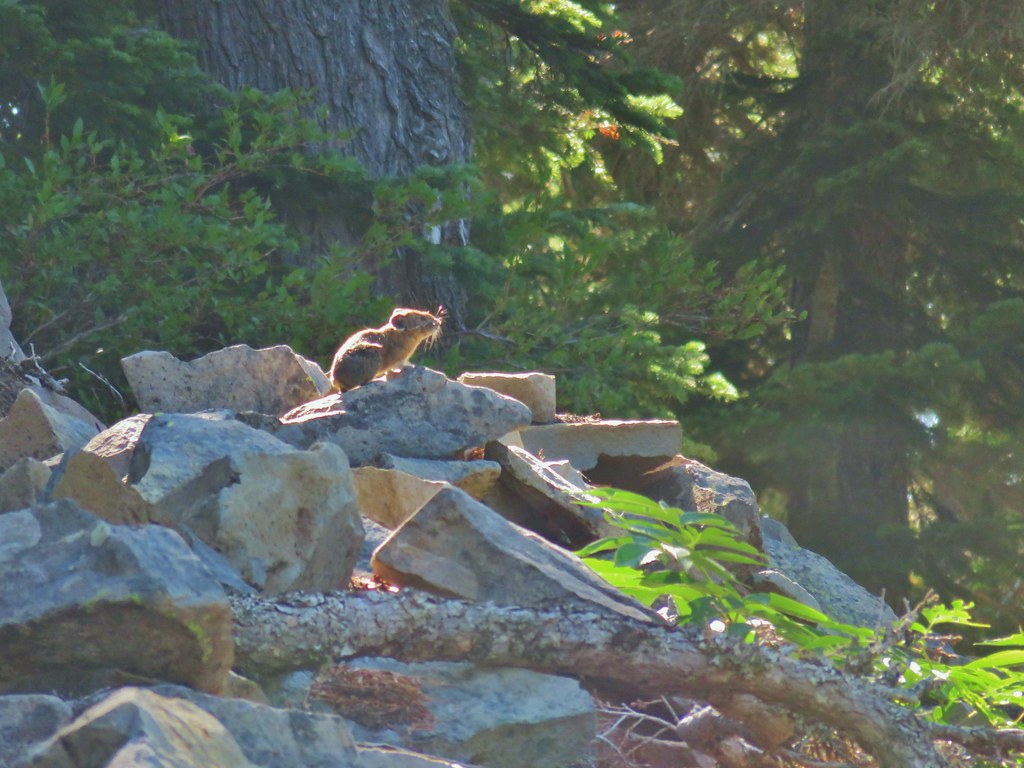
As we neared the saddle we spotted what must have been the pika lookout.
IMG_7515

IMG_7516

There was more talus on the opposite side of the saddle, and more pikas too!
IMG_7520

IMG_7526

We spotted at least 4 pikas (it’s hard to keep track when they are running in and out of the rocks) and heard many more. The only thing that could tear us away from our favorite wildlife critters was the view of Mt. Jefferson looming over Hunts Cove.
IMG_7534 (the clouds had finally vanished)

Continuing away from the saddle just a bit provided an excellent view of the mountain and Hanks Lake with a bit of Hunts Lake visible as well.
IMG_7648_stitch

IMG_7551Hanks Lake

IMG_7552Hunts Lake

IMG_7553Rock fin above Hunts Cove.

Reeder hadn’t exaggerated by using spectacular to describe this section of trail. The views of Mt. Jefferson were amazing and a variety of wildflowers (past peak) lined the trail.
IMG_7560Penstemon and a western pasque flower.

IMG_7563Western pasque flower seed heads.

IMG_7568

20190824_101714Hippie-on-a-stick

IMG_7570

IMG_7574

IMG_7576Paintbrush and lupine

IMG_7582

20190824_102625Patridge foot

IMG_7584Mt. Jefferson, Goat Peak (behind the tree) and the Cathedral Rocks.
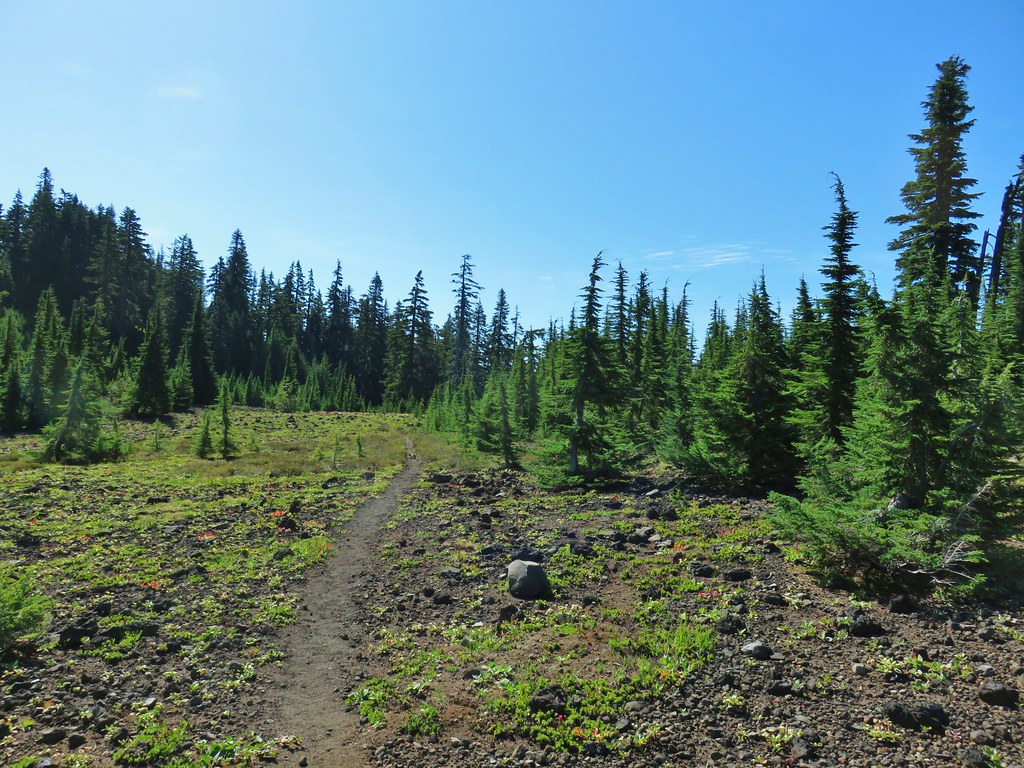
As the trail crossed a cinder field glimpses to the south between trees reveled the Three Sisters (among others).
IMG_7586

IMG_7588South Cinder Peak

IMG_7591The Three Sisters

IMG_7594Three Fingered Jack

The trail briefly lost sight of Mt. Jefferson as it passed around a butte, losing a little elevation as it did so.
IMG_7596

IMG_7597Paintbrush in a meadow behind the butte.
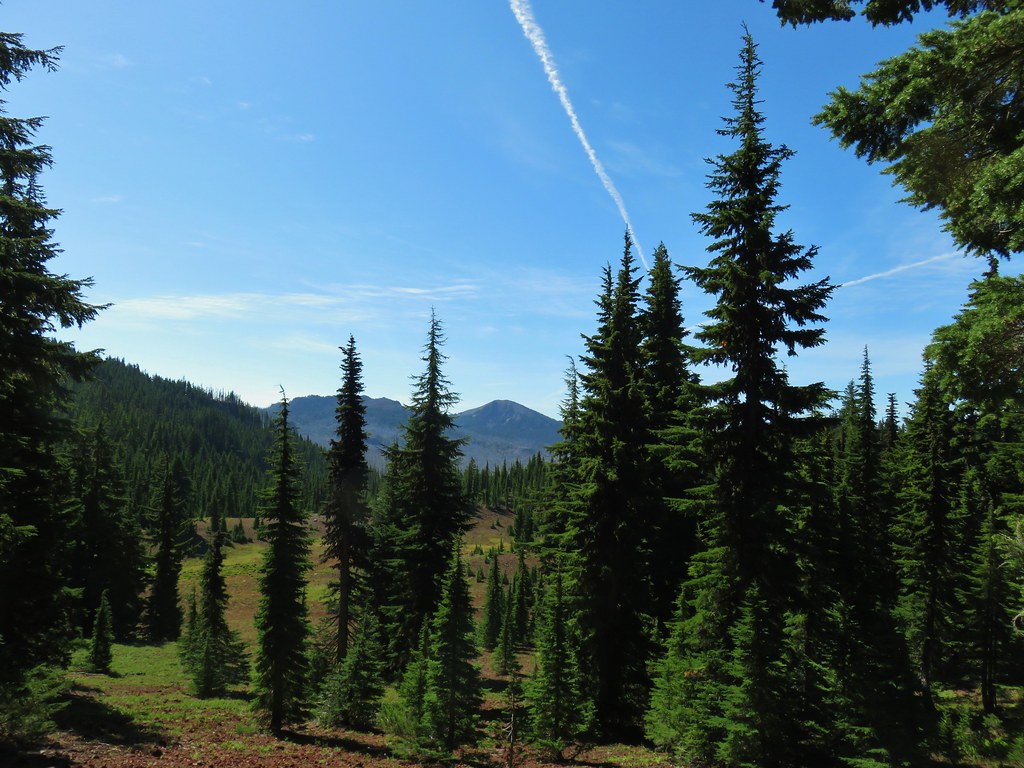
Although the view of Mt. Jefferson was temporarily gone the view was still good. There was a large basin full of meadows just below the trail and occasional views of South Cinder Peak and Three Fingered Jack.
IMG_7602South Cinder Peak

IMG_7603Three Fingered Jack

IMG_7630

The trail gained a little of the elevation back as it came around the butte regaining a view of Mt. Jefferson in the process.
IMG_7606

After passing another sign for the Pamelia Limited Entry Area at a now abandoned (but still used) portion of the Hunts Creek Trail we arrived at the Pacific Crest Trail.
IMG_7608

IMG_7620_stitch

We sat on some rocks here and rested. We were now at least 8 miles (that is the mileage Reeder assigns but with some extra exploring we’d done a bit more) from the Bingham Ridge Trailhead and needed a good break. Up until this point we’d only run into one other person, a bow hunter along the Bingham Ridge Trail. As we rested in the shade a pair of backpackers heading south on the PCT stopped briefly to talk. After they continued on we did little bit of exploring in the immediate area since there were a few flowers about and at least one tree frog.
IMG_7619Mostly past lupine

20190824_110312Paintbrush

20190824_110411

We returned the way we’d come enjoying the views just as much on the way back as we had the first time by. We didn’t see anyone else the rest of the day and we didn’t see anymore pikas, but as always there were a few things we spotted on the way back that we hadn’t seen or noticed earlier.
IMG_7632Butterfly on an aster.

IMG_7636Never seen one of these looks so clean and smooth, it almost looked fake.

IMG_7660We don’t know if this was just a stunted wallflower or something we’d never seen before.
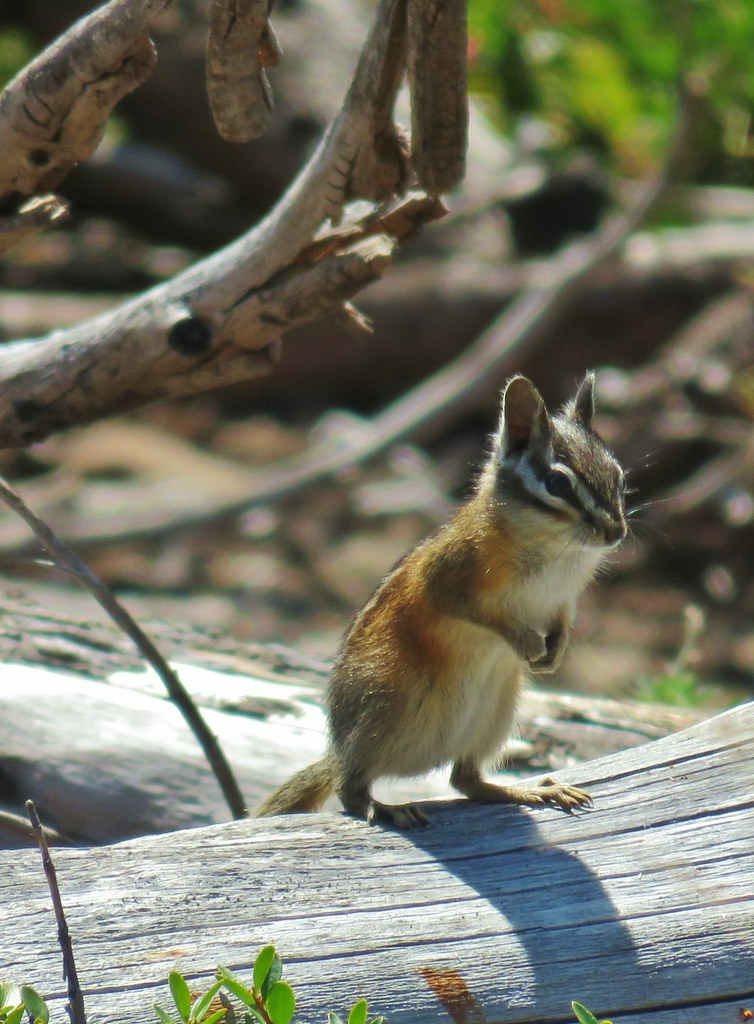
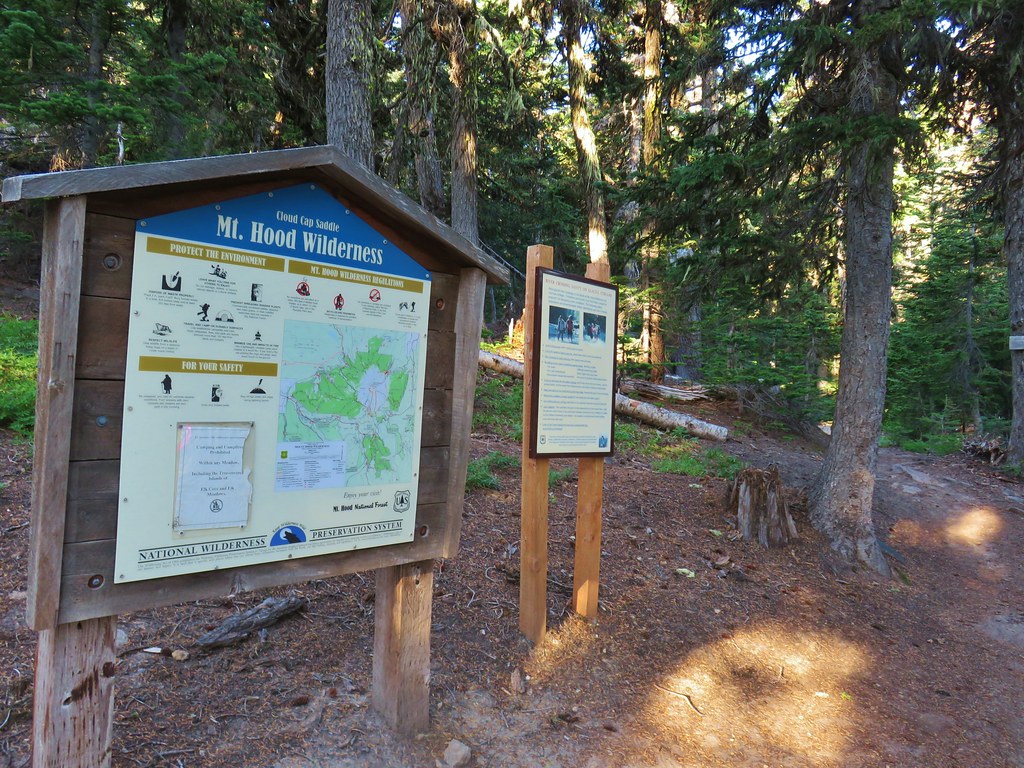
IMG_7692

We ended the day nearly out of water (luckily for us the temperatures stayed below 70 so it wasn’t too warm) and with some sore feet. Our GPS devices both showed us having traveled nearly 17 miles which was further than we’d planned but all the little side trips and exploring can really add up. Depsite the distance this was a great hike with varied scenery, good wildlife, and a reasonable elevation gain made better by the trails having such gradual grades. Of course any trail where we see multiple pikas is going to be aces in our minds. Happy Trails!

Flickr: Bingham Ridge

Categories
High Cascades Hiking Mt. Hood Area Oregon Trip report

Cloud Cap to Elk Cove – 8/17/2019

For the grand finale hike of our August vacation we headed for Mt. Hood to do the section of the Timberline Trail from Cloud Cap to Elk Cove. We had been to Cloud Cap in 2016 during our hike up Cooper Spur (post) and we’ve visited Elk Cove a couple of times (most recently in 2017 post) via a western approach on the Timberline Trail. We had not however been on the 5 mile section of the Timberline Trail between the Coe Branch (we turned back at the crossing in 2014 post) and the Cloud Cap Saddle Campground.

We had a bit of a scare on the way to the trailhead as most of the drive was spent in a light drizzle which became heavier at Government Camp. At the White River sno-park Mt. Hood was hidden behind a layer of gray clouds but as we continued north on Highway 35 we emerged from the grey. By the time we were winding our way up Cloud Cap Road the sky was blue and there were no signs of the clouds hiding on the other side of the mountain. We parked at the Cloud Cap Trailhead and hiked through the campground to a pair of signboards marking the Timberline Trail.
IMG_6943

We turned right onto that trail and followed it through a short stretch of green trees before emerging into a recovering fire scar.
IMG_6945

IMG_6948

The trail turns north toward Mt. Adams and away from Mt. Hood as it prepares to drop steeply into the gorge carved by the glacial Eliot Branch which could be heard roaring in the chasm below.
IMG_6951Mt. Adams ahead above the clouds.

We descended a series of switchbacks which provided ample views of Mt. Hood without having to strain our necks looking behind us.
IMG_6954Mt. Hood

The Eliot Branch has a reputation as being one of the trickier crossing on the mountain ever since a bridge was swept away over a decade ago. In fact the Timberline Trail had “officially” been closed for years (there were still unofficial crossings) until the Forest Service completed a reroute of the trail in 2016. As we neared the stream the first looks were impressive.
IMG_6957

IMG_6960

The combination of the cloudy water, thundering noise, and swift current make glacial streams seem particularly daunting. Crossing earlier in the day minimizes the amount flow making morning crossings easier than those later in the afternoon or evening. We arrived at the crossing shortly before 8am so that was in our favor. There was also a promising looking log a bit downstream but it looked like it might be a tricky descent to reach it from this direction and we were (or at least I was) hoping to get a little fording practice in so we picked a reasonable looking spot and made our way through the water which was only just reaching our calves at its deepest.
IMG_6966

20190817_074932

IMG_6967

It was a fairly uneventful crossing except for having forgotten just how cold a glacial stream is. Brrrr!!

We had lost over 350′ of elevation getting down to the Eliot that needed to be made up now that we were across. The Timberline Trail gained over 500′ in the next three quarters of a mile as it climbed out of the canyon.
IMG_6970

IMG_6973We entered the Mt. Hood Wilderness on the way up.

IMG_6976

IMG_6979

The burned trees allowed for fairly consistent views of both Mt. Hood and Mt. Adams.
IMG_6980Mt. Adams

IMG_6981Mt. Rainier peaking over the clouds to the left of Mt. Adams.

IMG_6985Mt. Hood

IMG_6987

The trail leveled out near the 6000′ elevation and passed through a stand of green trees before arriving at a small wildflower lined stream. A pair of marmots ran into the rocks as we approached.
IMG_6988

IMG_7006Penstemon

IMG_7001

IMG_7008Monkeyflower

IMG_7009

IMG_7011Jacob’s ladder

IMG_7012Western Pasque flower

A second stream followed shortly after.
IMG_7019

20190817_082231Paintbrush

20190817_082250Lupine with a beetle.

Continuing on we passed a hillside covered with western pasque flower seed heads, often referred to as hippies on a stick.
IMG_7030

IMG_7028

As we rounded a ridge end we stopped to talk to a backpacker going in the other direction. He asked if we were from the area and wanted to know which mountains he had been seeing to the north. In addition to Adams and Rainier, Mt. St. Helens was just barely visible from that spot which we were able to point out to him.
IMG_7034

We rounded the forested ridge and came to a large rock field below the Langille Crags.
IMG_7039

IMG_7040

IMG_7041

Just over a mile from the Eliot crossing we arrived at the first of Compass Creeks three branches.
IMG_7051_stitch

Compass Creek is fed by the Langille Glacier and each branch sports a waterfall above the Timberline Trail.
IMG_7059

A short scramble up the rocks along the creek brought us to the base of the falls.
IMG_7062

IMG_7069

IMG_7076Mt. Adams from Compass Creek.

IMG_7079Wildflowers along Compass Creek.

IMG_7083Monkeyflower and paintbrush

IMG_7101Hummingbird near Compass Creek.

After admiring the falls we continued on rounding two small ridges before arriving at the middle branch of Compass Creek .3 miles from the first.
IMG_7102

IMG_7105

IMG_7106

This branch didn’t have nearly the amount of water as the first leaving the waterfall a little wispy.
IMG_7111

There was yet another stream a short distance away which was putting on a wonderful wildflower display including a nice combination of pink and yellow monkeyflowers.
IMG_7119

IMG_7123Lupine, paintbrush and monkeyflower.
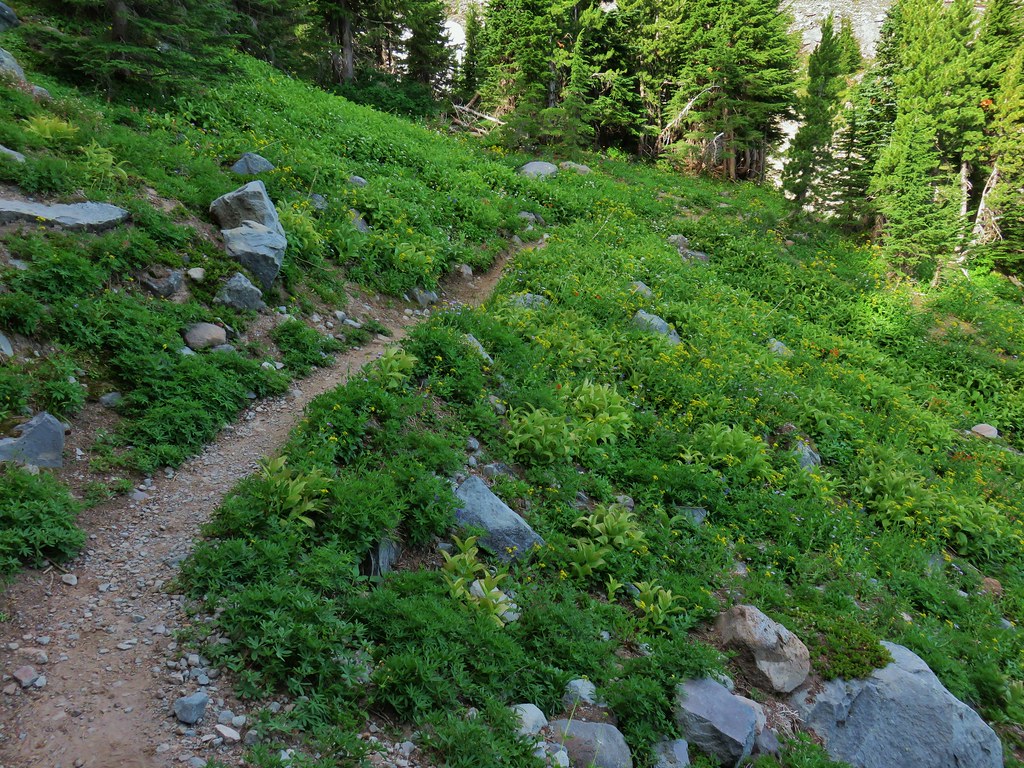
IMG_7124

IMG_7126

IMG_7130

This alpine stream was sublime and a reminder of why Mt. Hood is such a wonderful place. We kept going passing an aster covered hillside and then another meadow full of other types of flowers.
IMG_7144

IMG_7147

IMG_7149

It was another .3 miles between the middle and final branches of Compass Creek where another waterfall crashed down behind a snow bridge.
IMG_7152

IMG_7263

IMG_7271

IMG_7268

After crossing the final branch of Compass Creek the trail headed down a ridge along the creek passing views of a lower waterfall.
IMG_7157Mt. Adams (again) from Compass Creek.

IMG_7159

IMG_7164Waterfall on Compass Creek below the Timberline Trail.
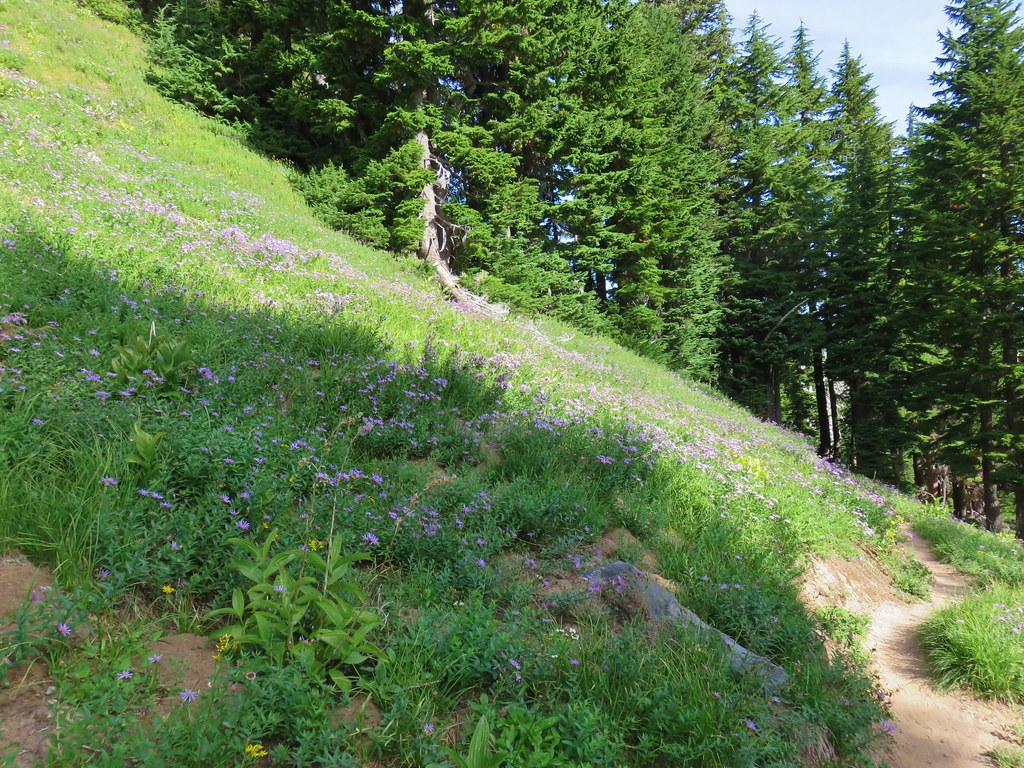
In the next mile we passed through a wildflower meadow, green trees, a fire scar, and lost 350′ of elevation before arriving at yet another little stream.
IMG_7172

IMG_7174

IMG_7176

IMG_7177

IMG_7178

IMG_7185

The trail then headed downhill more quickly as we approached the Coe Branch.
IMG_7191

A little over a mile and a half from Compass Creek we arrived at the Coe Branch and were pleased to find a pair of nice makeshift log bridges spanning the stream.
IMG_7192

IMG_7194

The crossing was no issue at all and we soon found ourselves climbing away from the Coe.
IMG_7204

IMG_7209

The climb away from the Coe Branch wasn’t nearly as steep as the descent had been and after three quarters of a mile we arrived at a sign for Elk Cove.
IMG_7217

We followed the trail into the meadow where the view of Mt. Hood and Barrett Spur (post) was as impressive as always.
IMG_7223

IMG_7224_stitch

IMG_7230

20190817_104227

We explored a bit and then rested at a familiar spot along the stream that flows through Elk Cove.
IMG_7238

IMG_7246

IMG_7249Coe Glacier

After resting and soaking in the scenery we headed back. We stopped again below Compass Creek Falls where we watched a hummingbird moth visiting the monkeyflowers.
IMG_7286

IMG_7294

When we had finally made it back to the Eliot crossing we used the log we’d seen that morning as suggested by some hikers who we passed shortly before reaching the stream.
IMG_7341

IMG_7344

We actually wouldn’t have minded the ice cold water at that point, but the flow had increased now that it was after 1pm so the log was the safest option. We made the final climb back up to Cloud Cap taking our final look at Mt. Hood and the Eliot Glacier.
IMG_7359

IMG_7364

IMG_7365

The hike was 12.3 miles round trip with approximately 2700′ of cumulative elevation gain, most of which came from dropping down to and climbing up from the Eliot and Coe Branches. It was a perfect day, blue skies and cool temperatures, and there couldn’t have been a better way to end our 6 days of hiking. Happy Trails!

Flickr: Cloud Cap to Elk Cove

Categories
Bull of the Woods/Opal Creek Hiking Old Cascades Oregon Trip report

Bull of the Woods Lookout & Pansy Lake – 8/16/2019

**Note a portion of this hike burned in the 2021 Bull Complex.**

For the 5th hike of our vacation we finally got around to one of Sullivan’s featured hikes that we hadn’t done yet, Pansy Lake.  Pansy Lake is located in the Bull of the Woods Wilderness in a basin below the Bull of the Woods Lookout.  In his guidebook Sullivan has you start the hike from the Pansy Lake Trailhead which is just over a mile from the lake. He gives two options, a 2.4 mile out-and-back to Pansy Lake or a 7.1 mile loop past the lake up to the lookout and then back down passing Dickey Lake along the way. Either of these options would have caused us to break our self-imposed rule against driving for more time than we spend hiking due to the driving time to the Pansy Lake Trailhead being roughly 2:45 for us. Fortunately Sullivan also mentions the option of starting at the Bull of the Woods Trailhead for an easier hike to the lookout. The Bull of the Woods Trailhead was about a 15 minute closer drive and it added almost 3 miles to the round trip which provided an acceptable drive/hike ratio.

With our plan in place we set off on the drive which proved to be a bit of an anomaly. The trailhead is located at the end of Forest Road 6340. Where the road was good it was an excellent gravel road but there were a couple of ugly obstacles along the way. The first was a slide that covered the road, half of which was impassable while the spot that could be driven over required a very slow, bumpy crossing (high clearance is probably necessary until it gets cleaned up). This was prior to a fork where the right hand fork (FR 6341) continued to the Pansy Lake Trailhead. After this fork sections of FR 6340 were deeply rutted by channels created by runoff again requiring careful placement of tires. We arrived at the trailhead no worse for wear though and set off on the signed trail.
IMG_6715

IMG_6713

The first few hundred yards were a little brushy but soon the vegetation gave way to a huckleberry filled forest.
IMG_6724

IMG_6725

IMG_6726

IMG_6717

There were ripe berries everywhere and they were big juicy berries too. In fact for most of the day there were ripe berries available and we ate quite a few. We weren’t the only ones feasting on berries though as we counted no less than 13 piles of berry filled bear scat along the trails.
IMG_6734

Although we kept our eyes open for a bear all we ran into on the trail was a rough skinned newt.
IMG_6740

IMG_6743

The Bull of the Woods Trail climbed gradually as it passed below North and South Dickey Peaks.
IMG_6736

A little over 2.25 miles from the trailhead we arrived at a junction with the Dickey Lake Trail. We would be coming back up that trail later after visiting Pansy and Dickey Lakes.
IMG_6746

As the trail continued to climb we were treated to a couple of different views. First was to the west across the Pansy Lake Basin.
IMG_6750

A little further along, when the trail crested the ridge, we got a look a Mt. Hood which was rising above some clouds.
IMG_6754

The trail left the ridge for a bit and then regained it where the view also included Mt. Jefferson to the SE.
IMG_6763Mt. Hood

IMG_6772Mt. Jefferson

The trail then followed a narrow rocky ridge passing below the lookout and coming up to it from the other side, 3.5 miles from the trailhead.
IMG_6770

IMG_6777

IMG_6785

IMG_6789

A lizard scurried into the rocks beneath the lookout as we approached. Aside from a bit of morning haze the view was great. The clouds to the north hid the Washington volcanoes from sight but Mt. Hood stood out just fine.
IMG_6787

IMG_6806

To the south Mt. Jefferson was cloud free and so was Three Fingered Jack for a bit. Mt. Washington and the Three Sisters played peek-a-boo through the clouds though.
IMG_6795

IMG_6796Three Fingered Jack

IMG_6846Mt. Washington and the Three Sisters
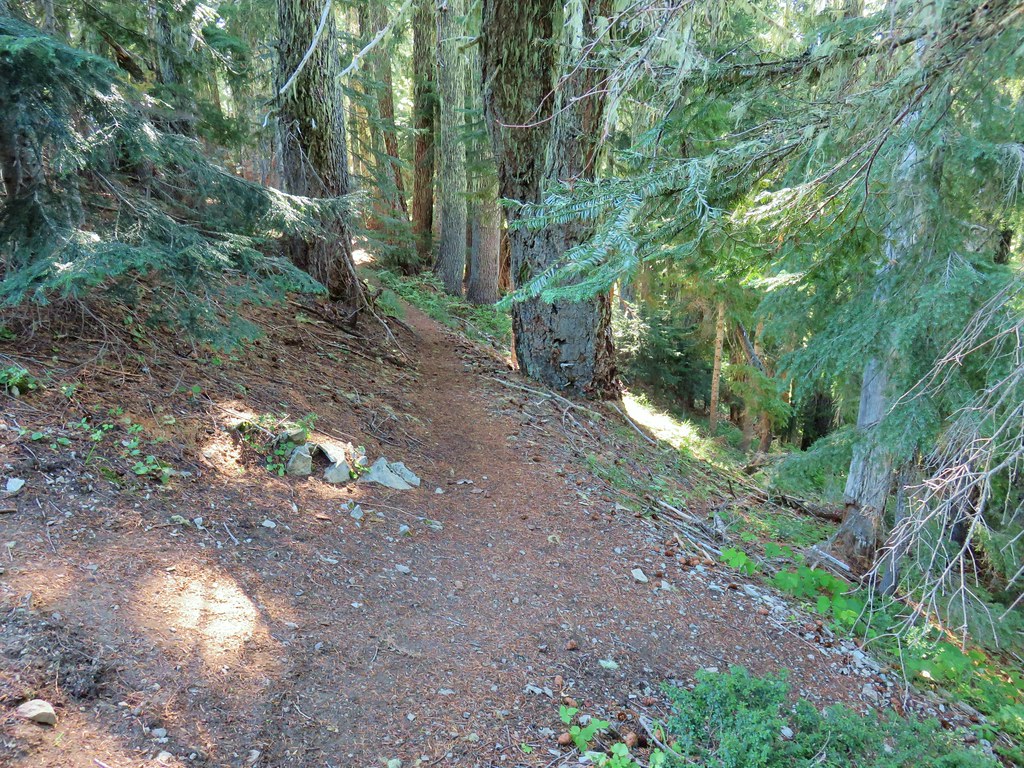
In the basin to the NE Big Slide Lake (post) was visible.
IMG_6801

IMG_6812

To the SW the flat topped Battle Ax Mountain (post) rose up above the surrounding peaks.
IMG_6790

We sat below the lookout for awhile enjoying the cool morning air as we watched the procession of clouds around us. After our break we headed steeply downhill via switchbacks for just over half a mile to the Mother Lode Trail.
IMG_6851

IMG_6855Bull of the Woods Trail ending at the Mother Lode Trail.

We turned right onto the Mother Lode Trail.
IMG_6856

We continued to descend as we followed this trail for approximately 1.25 miles, passing a viewpoint of Mt. Jefferson shortly before arriving at another junction.
IMG_6858

IMG_6864

IMG_6873

We turned right again, this time onto the Pansy Lake Trail.
IMG_6875

More downhill hiking ensued as we dropped into the basin. The trail was a bit rockier than the others and passed over a couple of talus fields.
IMG_6876

We’re always on the lookout for pikas and have had quite a bit of luck in spotting them this year, enough so that we have started calling it “the year of the pika”. As we came to the second section of talus Heather spotted one of the little “rock rabbits” scurrying along the hillside.
IMG_6879

IMG_6881

After talking to the pika (I don’t know why but we tend to have a lot of one sided conversations with the wildlife) we continued on. Shortly before reaching the lake we found a couple of ripe thimbleberries, they were delicious.
IMG_6883

IMG_6885First look at Pansy Lake.
20190816_102219

We passed by the lake and reached a junction .8 miles from the Mother Lode Trail. We turned left and quickly arrived at the lake where we were a bit surprised that we were the only people there.
IMG_6888

IMG_6890

We wandered around the lake passing through numerous empty campsites before finding a little log to sit on by the lake where we could watch the dragonflies and ducks.
IMG_6894

IMG_6898

IMG_6891

IMG_6902

After a short break we returned to the trail junction and turned left continuing on the Pansy Lake Trail for another .2 miles to the Dickey Lake Trail junction.
IMG_6907

It was time to climb now and we headed up the Dickey Lake Trail which climbed relatively steeply at times. After .6 miles we came to a spur trail on the right which led down to Dickey Lake.
IMG_6910

IMG_6912

The lake was quite a bit smaller than Pansy Lake and a lot brushier. After getting a look we returned to the Dickey Lake Trail and continued the climb back up to the Bull of the Woods Trail. A bit beyond the lake the trail passed through a little meadow with some remaining wildflowers and a few more thimbleberries.
IMG_6913

IMG_6918

IMG_6921

IMG_6924

We gained approximately 800′ over the next .8 miles before reaching the junction. There was a few more downed trees along this trail than we had encountered on any of the others but none of them were too troublesome.
IMG_6925

We turned left onto the Bull of the Woods Trail and followed back to the car getting one last look at Mt. Hood along the way.
IMG_6935

With the extra exploring around the lakes we wound up doing 10.6 miles (for the third time in the week). We both thought that the elevation gain doing the loop from the Pansy Lake Trailhead would have been quite a bit worse so the extra miles were worth it in our minds, plus it gave us that much more time to eat berries. Happy Trails!

Flickr: Pansy Lake and Bull of the Woods Lookout

Categories
Clackamas Hiking Old Cascades Oregon Trip report

Old Baldy and Tumala Mountain – 8/15/2019

Hike number four of our vacation week was chosen in an attempt to avoid the sound of gunfire which seems to be extremely prevalent along the Forest Service roads near Estacada. We figured our best chance to minimize that unpleasant noise would be a mid-week early morning hike so when the forecast for the area called for sunny skies Thursday we jumped on the chance and headed to the Old Baldy West Trailhead. Our plan for the day was to start by hiking up to the summit of Old Baldy then returning past the Trailhead and heading SE to the summit of Tumala Mountain, a rare double out-and-back.

A bonus for this hike are the paved roads to the trailhead which is a small pullout near some boulders.
IMG_6497

Reminders of the penchant for shooting guns in the area were everywhere.
IMG_6499

Just beyond the trailhead we met the Old Baldy Trail where we went left toward Old Baldy. The trail briefly follows the Forest Road before they veer away from one another.
IMG_6500

The Old Baldy Trail runs right along the border of the Salmon-Hucklberry Wilderness through a nice quiet (on this day) old growth forest. It was too late for the Rhododendron bloom which happens in early summer but there was a great variety of mushrooms to look at as we climbed up and down for nearly 3 miles to a cliff top viewpoint.
IMG_6503

IMG_6515

IMG_6518

IMG_6521

IMG_6525

IMG_6527

IMG_6529

IMG_6531

IMG_6536

20190815_072114

IMG_6538

IMG_6539

IMG_6541

IMG_6547Wildcat Mountain (post) and Mt. Hood

The sunny forecast appeared to be being threatened by some encroaching clouds as we continued on from the viewpoint.
IMG_6553

IMG_6561

More varieties of mushrooms followed as we made our way toward Old Baldy.
IMG_6557

IMG_6559

IMG_6576

The final pitch up Old Baldy was a steep one as the trail launched straight uphill to the site of a former lookout tower.
20190815_081555

IMG_6581

A thin layer of fog had moved in over the mountain, but that didn’t matter here because there are no longer any views except for back down through the trees.
IMG_6582

After catching our breath at the summit we headed back the 3.8 miles to the trailhead, stopping again at the viewpoint to note the creeping clouds as they moved east over the Eagle Creek Valley (post).
IMG_6585

We walked past the spur to the trailhead and ignored the unmarked Eagle Creek Cutoff Trail that descended to the left.
IMG_6605

The Old Blady Trail quickly launched uphill briefly entering the Salmon-Huckleberry Wilderness.
IMG_6606

After a short but extremely steep climb the trail leveled out for a bit. That was both good and bad news because it was only 1.7 miles from the trailhead to the top of Tumala Mountain but we needed to gain nearly 800′ so every step that wasn’t going uphill meant that the ones that did would need to be that much steeper. Just for kicks the trail dropped about 80′ to a saddle before starting abit of a more gradual climb to a junction with the Fanton Trail.
IMG_6617Huge mushroom along the downhill.

IMG_6620

IMG_6624Fanton Trail coming up from the right.

The trail did give back a little as we began finding ripe huckleberries to snack on.
IMG_6625

Approximately 1.3 miles from the trailhead we ignored a semi-signed trail to the left that went to Twin Springs Campground.
IMG_6631

We stayed right climbing briefly along a narrow rocky ridge then beneath a rock outcrop to a rocky road bed where we turned uphill.
IMG_6635

IMG_6645

IMG_6649

There were a few flowers clinging to the cliffs along the road.
IMG_6653

IMG_6654

20190815_110407

A short road walk brought us to a tower just below the summit.
IMG_6655

From the summit we had a pretty good view of Mt. Hood although the clouds had begun to get in the way.
IMG_6657

IMG_6661

To the south though we had a clear view of the more distant Mt. Jefferson.
IMG_6662

IMG_6665

IMG_6671Three Fingered Jack and the Three Sisters even further south.

IMG_6673Looking west into the cloud covered Willamette Valley.
IMG_6679

We joined a chipmunk and took a snack break before exploring the old lookout site.
IMG_6665

IMG_6698Stairs to the former lookout.

IMG_6702Mt. Hood from the former lookout site.

By the time we began our descent Mt. Hood had vanished behind the clouds. Our timing had been pretty good, not only for the views but we made it back to our car without seeing another person or hearing a single gunshot.

The hike was 10.6 miles and approximately 2200′ of cumulative elevation gain. Skipping the viewless summit of Old Baldy would shed 1.8 miles and a couple hundred feet of elevation and only going to one viewpoint instead of both would lower the numbers even further. It was a really nice hike so hopefully the reputation of the area doesn’t scare hikers off. Happy Trails!

Flickr: Old Baldy & Tumala Mountain

Categories
High Cascades Hiking Oregon Three Sisters Area Trip report

Four-In-One Cone – 8/14/2019

The third hike of our vacation was another repeat (this time only partially) of a viewless outing. In 2012 we had embarked on “the hike that shall not be named” (post) It was an ambitious hike that went wrong in a couple of ways. First I misunderstood the guidebook and turned a 15 mile loop into an 18.6 trudge and second the persistent low cloud layer denied us of virtually any views. Our plan to hike to Four-In-One Cone would cover part of that hike.

We chose the Four-In-One Cone portion of that hike for two reasons. First Four-In-One Cone is a really cool volcanic feature and second much of the remainder of that loop passes through the Obsidian Limited Entry Area for which we didn’t have a permit nor were any available. We started the hike at the Scott Trailhead located along Highway 242 (17 miles from Highway 126 or 20.3 miles from Highway 20).
IMG_6219

The Scott Trail briefly follows along the highway before crossing it and entering the Three Sisters Wilderness.
IMG_6223

IMG_6224

A third of a mile from trailhead we came to a somewhat familiar junction.
IMG_6236

Neither of us quite remembered it looking like it did now (for one thing the trail sign was missing) but the right hand fork led to the Obsidian Trailhead and had marked the final .6 miles of THAT hike. We forked left and began to climb via several switchbacks which we had no recollection of. We also passed a viewpoint at one of the switchbacks.
IMG_6245

After the viewpoint the trail continued to climb but more gradually as it passed through a mixed forest.
IMG_6247

IMG_6249Pinesap

IMG_6251

IMG_6252A very blurry deer spotted through the trees.
IMG_6257

IMG_6258

IMG_6262

Three miles from the trailhead we arrived at the first of two short lava flow crossings. A large western toad was in the trail here and there was also a squirrel nearby which seemed like a suspicious combination.
IMG_6265

IMG_6270

20190814_085527

IMG_6274

The lava crossings are separated by an island of forest that escaped the flow.
IMG_6282

IMG_6284North Sister

IMG_6290Middle Sister

IMG_6288More spies watching us.

Beyond the second lava crossing we spent a little time back in the forest before once again entering a volcanic landscape as we came around the south side of Four-In-One Cone.
IMG_6294

IMG_6299

IMG_6300

Unlike our previous visit the Cascade Mountains were visible.
IMG_6301North and Middle Sister behind the Little Brother.
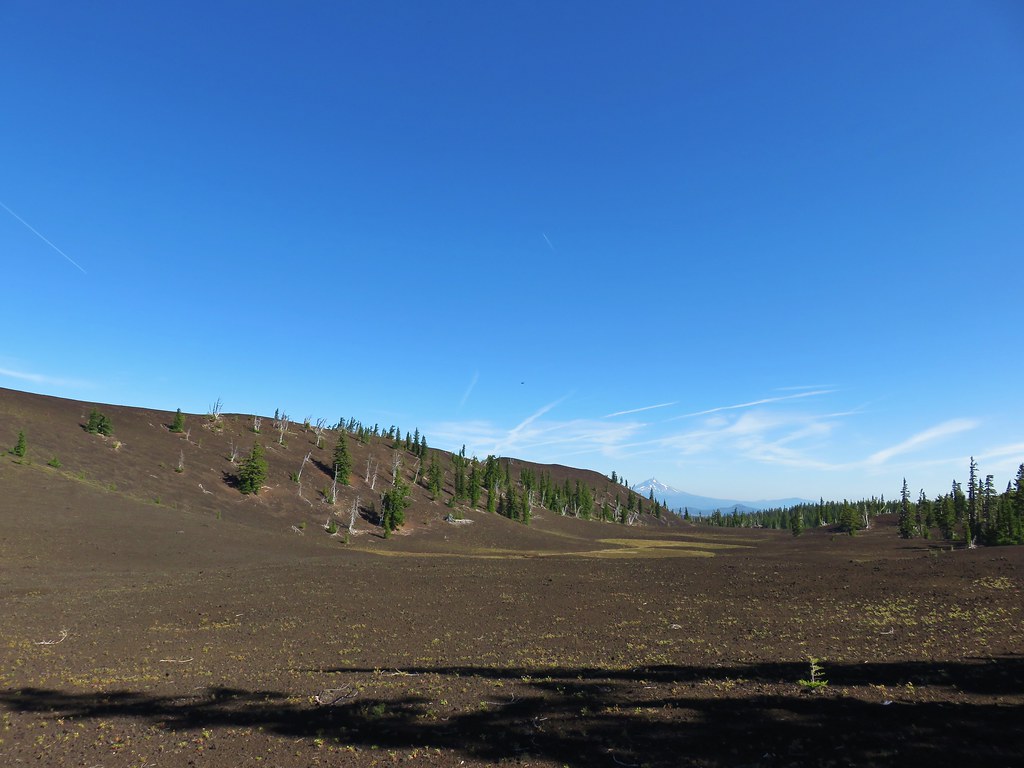
IMG_6312Mt. Jefferson beyond Four-In-One Cone

IMG_6317Mt. Hood over the right shoulder of Mt. Jefferson.
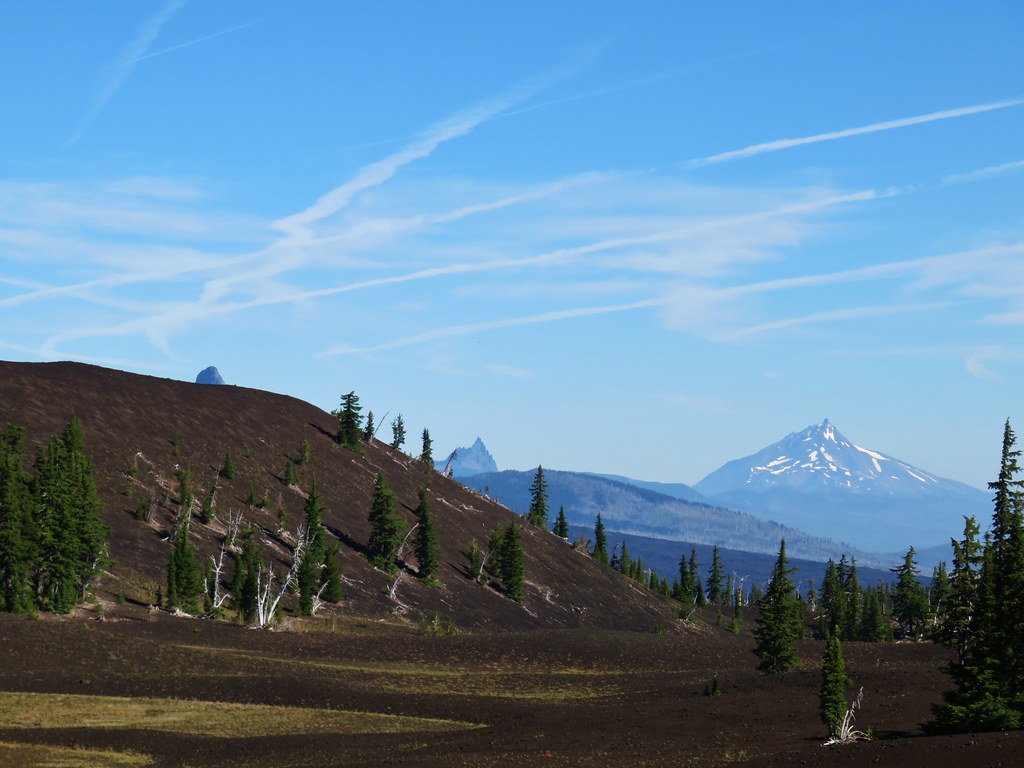
IMG_6319Mt. Washington’s spire behind the cone with Three Fingered Jack and Mt. Jefferson.
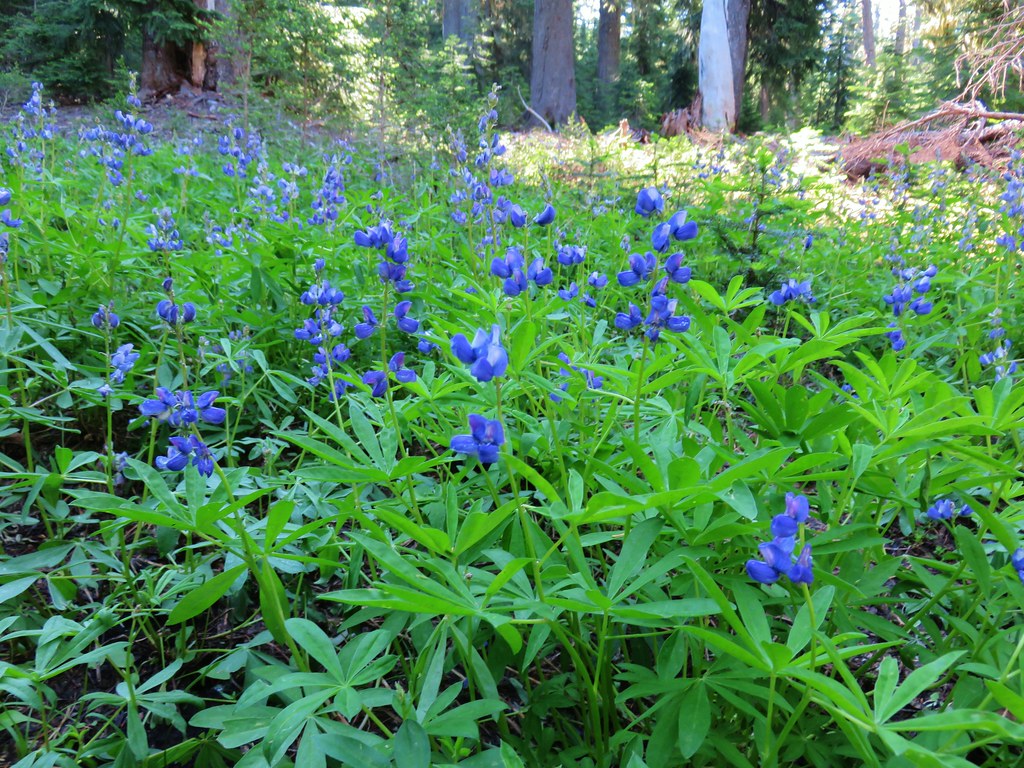
The route up Four-In-One Cone is just under 1.5 miles from the first lava crossing and is marked by a signpost.
IMG_6309

Before going up the cone we decided to continue another .8 miles to the Pacific Crest Trail in Scott Meadow. We had of course been to that junction during our loop in 2012 but we’d also visited it in 2013 from the north on the PCT from South Matthieu Lake (post). Lupine is said to bloom profusely from mid-July through August but we hadn’t seen much in 2013 (2012 was late September) so we thought we’d give it another try. Prior to reaching Scott Meadow we did pass a couple of hillsides with a decent amount of lupine but I don’t know that we considered it profuse
IMG_6328

IMG_6331

IMG_6333

IMG_6335

IMG_6343Scott Meadow

There wasn’t any lupine at all around the PCT junction but the view of Little Brother next to the North and Middle Sisters is nice.
IMG_6358_stitch

After a short break and pointing a group of trail runners toward Opie Dilldock along the PCT we turned around and headed back for Four-In-One Cone.
IMG_6369

IMG_6383

Four-In-One Cone is just that, four cinder cones which erupted at different times but are joined together creating a .4 mile long ridge.
IMG_6390

To the SE the North and Middle Sister are closer than the Cascades to the NW the position of the Sun made the view of the further peaks a little clearer.
IMG_6398North Sister, Middle Sisters behind Little Brother and The Husband.
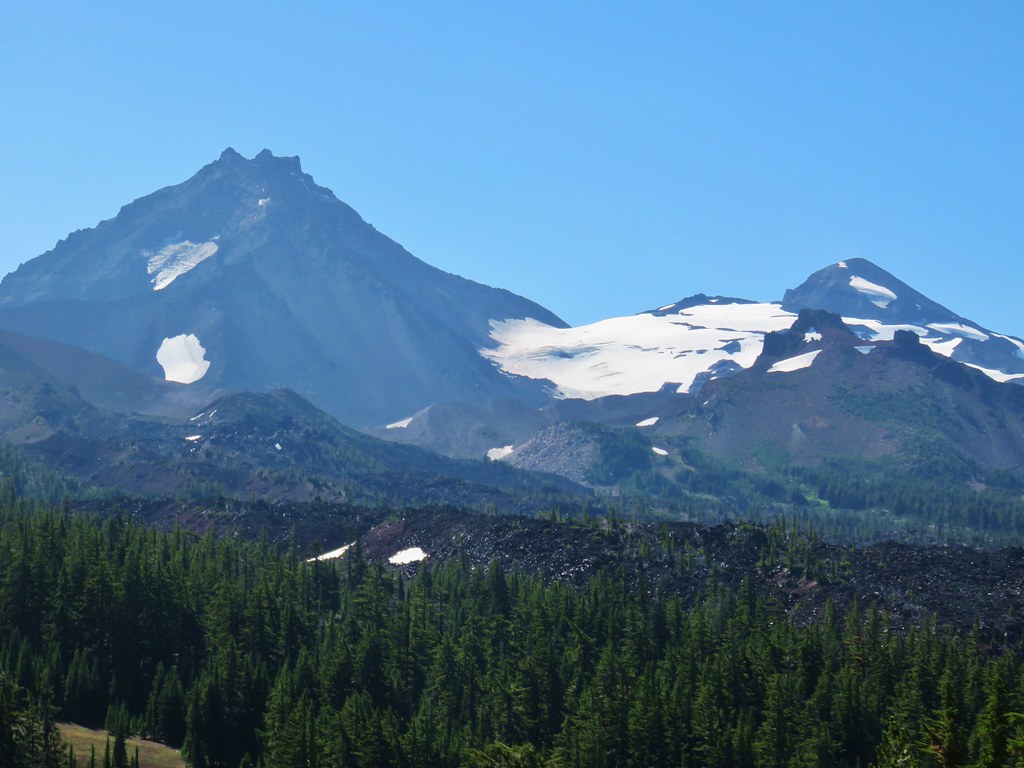
IMG_6392North Sister with Collier Cone in front and South Sister behind Little Brother.
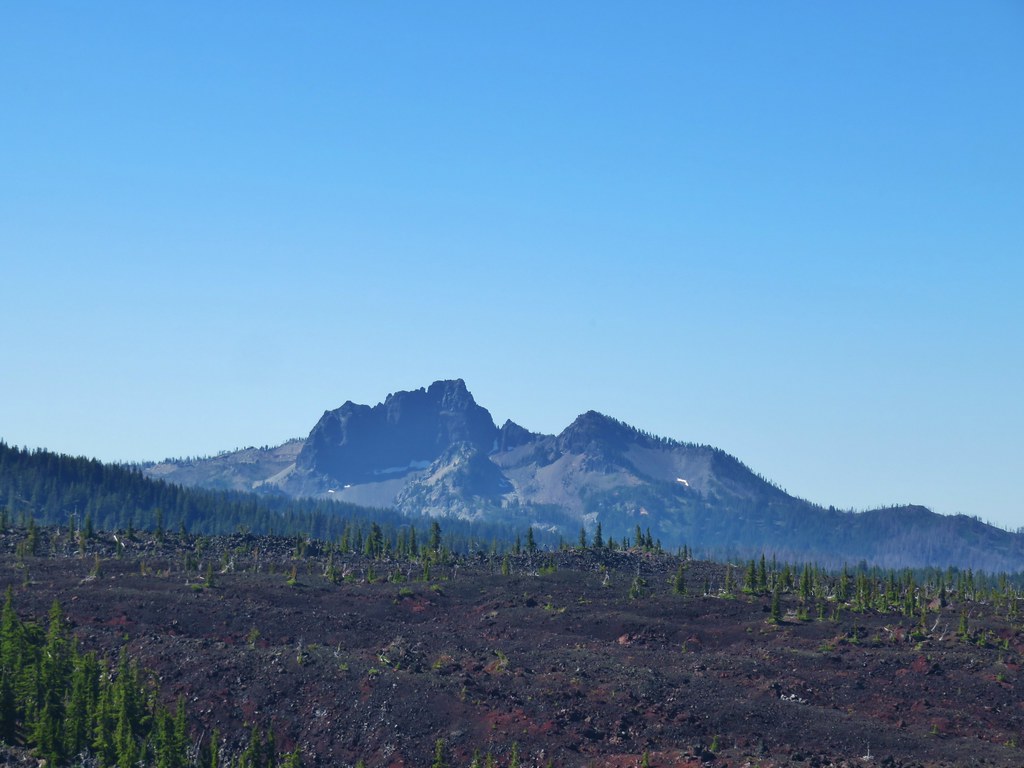
IMG_6411The Husband

IMG_6443Scott Mountain (post) beyond the lava flows of Four-In-One Cone.

IMG_6404One of the craters.

After visiting the southern end of the cones we made our way to the northern end.
IMG_6434Mt. Washington, Three Fingered Jack, Mt. Jefferson, Mt. Hood, and Black Crater (post)

IMG_6444Looking back south.

IMG_6460Belknap Crater (post)

IMG_6459Mt. Washington beyond Little Belknap Crater with Three Fingered Jack behind.

IMG_6462Mt. Jefferson and Mt. Hood

After fully exploring the cones we returned the way we’d come capping off a 12.3 mile, 1750′ elevation gain hike. We were happy to have finally gotten to see what we’d missed back in 2012. Happy Trails!

Flickr: Four-In-One Cone