A YouTube video posted last year by Hike Oregon brought our attention to a section of the Alpine Trail near Oakridge, OR. She described an out-and-back hike along this popular mountain bike trail over Sourgrass Mountain to visit the Elk Camp Shelter.
The Alpine Trail extends a total of 15.3-miles between Westfir, OR to Forest Road 1912 with a number of potential starting points. We hiked a different section of this trail in 2014 as part of our Tire Mountain hike (post). For this hike we parked at the junction of FR 1912 and FR 661 where the Alpine Trail crossed FR 1912.


We headed north on the Alpine Trail which climbed for almost 2 miles to a large meadow on Sourgrass Mountain. The climb was fairly gradual using switchbacks on the steeper parts of the ridge. Mountain bikers ride the trail south to Westfir so we were on the lookout for bikes coming downhill but we had started early enough in the morning to not run into any. (It was a different story on the way down.) The forest along the trail was very nice and there was a nice variety of wildflowers in bloom.


Little prince’s pine

Bunchberry

Rhododendron

Wild ginger

Queen’s cup

Beargrass


Stonecrop

Larkspur

There was a large patch of blue head gilia on this rock above the trail.


Vetch

Honeysuckle


Anemone

Pacific coralroot


Valerian

Starflower

Penstemon

Tiger lilies

Columbine

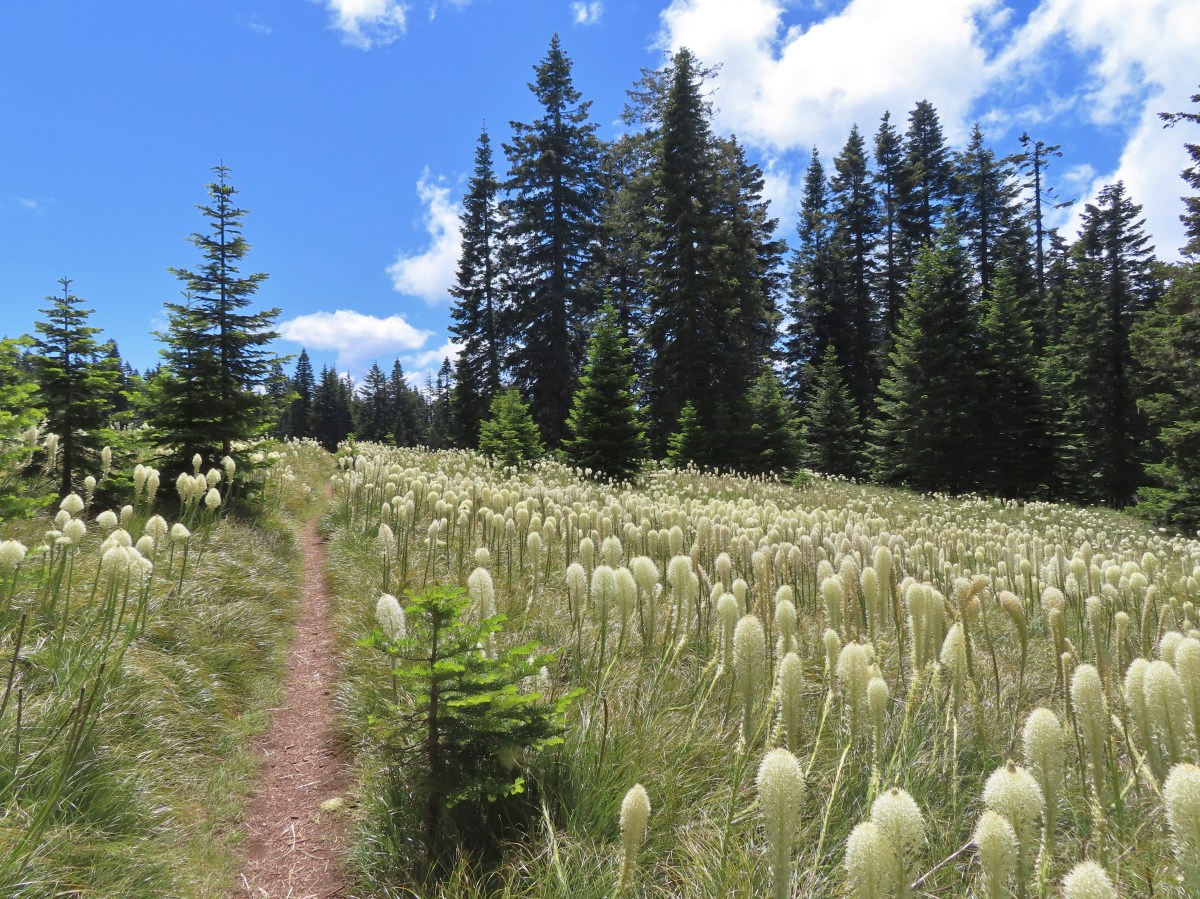
As we neared the meadow on Sourgrass Mountain we began to see an increasing amount of blooming beargrass.

A member of the lily family, beargrass only blooms when conditions are right, so their bloom cycle is a bit unpredictable. Due to the unpredictability it is always exciting when a visit aligns with a bloom cycle.


At the far end of the meadow we passed a newish looking bench.

Beyond the bench the trail descended along the north ridge of Sourgrass Mountain then followed a wide ridge with some small ups and downs on its way to Elk Camp Shelter.

Sub-alpine fleabane

Sub-alpine mariposa lily

Bleeding heart


That might be rainiera behind the beargrass.

Roses

Valerian along the trail.

Anemone, bunchberry, and foam flower


At 2.8-miles from the trailhead we passed a junction with Kate’s Cut In where it appears that most mountain bikers begin their rides.
We could hear a large group of bikers on FR 1912 below getting ready for their rides as we continued straight on the Alpine Trail.


Spotted coralroot

Northwestern twayblade and foam flower


 Arnica
A little over 4-miles from our trailhead we came to a 4-way junction at FR 142 which is the location of Alpine Trailhead 4.

We turned right at the 4-way junction following arrows on the road to the continuation of the trail.

Approximately a half mile from the 4-way junction we arrived at the Elk Camp Shelter.


Violets

Rhododendron and beargrass

Arnica


A short spur trail from FR 142 came in from the left shortly before arriving at the shelter.

Meadow just before the shelter.

There was a decent amount of coiled lousewort but it was all past its bloom.

First view of the shelter behind the trees.


Looking up from the shelter.

Information about the shelter on the table inside.
Hike Oregon’s entry for the hike has you turn around at the shelter making this a moderate 9-mile, 1623′ elevation gain out-and-back. The trail actually continues another nearly 2-miles to the Alpine Trailhead 5.
Looking at Google Earth it appeared that the trail passed through two more small meadows between the shelter and a road crossing approximately 0.75-miles from the shelter. It also appeared that there was minimal elevation loss along that section of the trail, so we had decided to make the road crossing our turn around point. After spending a little time at the shelter we’d attracted enough mosquitos to prompt us to move on.


Small-flowered solomonseal

Coneflower

The first meadow.

Coneflower, valerian, and columbine.

Inside-out-flower

Ragwort

Western meadow-rue

This meadow was very damp making the trail slick with mud.

Meadow fritillary

Self-heal

The second meadow.
 Spirea, tiger lilies, columbine, valerian, and cinquefoil.

Sticky cinquefoil

Columbine

Bog orchids

White bog orchids

Lupine

The forest road where we turned around.
We took a break on some stumps along the road where mosquitos were not an issue and then headed back the way we’d come. We kept our eyes open for flowers we’d missed on our first pass and for mountain bikers making sure to step aside when we heard/spotted them coming.

Gold threads

Rhododendron blossoms

Clodius Parnassian

Fairy lanters

Baneberry


Arnica
There weren’t any unobstructed views at any point along this trail. We could occasionally see snow covered Cascade peaks through the trees, but the only peak we were able to identify was The Twins (post) near the junction with Kate’s Cut In.

The Twins are in the center with Waldo Mountain (post) closer and to the left.

One sided wintergreen.

Candy flower

Wallflower

Nearing the bench at the edge of the meadow on Sourgrass Mountain.
We took a break on the bench and were joined by a pair of mountain bikers who were making the ride from Kate’s Cut In to Westfir. The first gentleman explained that some cyclists head north on the trail from Kate’s Cut In and ride (mostly) downhill to the Alpine Trailhead 5 then loop back to Kate’s Cut In along FR 1912 before heading south to Westfir. That loop is known as the “Chrome Toilet” (no explanation given), but he had never ridden that loop. We had passed one group heading down the Alpine Trail as we were heading back by the shelter.
The cyclists continued on, and we followed shortly after. It was just after Noon and as we made our way through the meadow the first of several groups rode past us. They were all very polite about sharing the trail with hikers and we did our part by stepping off the trail as quickly as possible whenever we spotted them coming. This meant a lot of looking back over our shoulders and led to us hiking a little faster than we normally would have otherwise.


Looking up at the highpoint of Sourgrass Mountain.


Larkspur

Royal Jacob’s ladder


The trail dropping down to FR 1912 where we’d parked.
Our version of this hike clocked in at just over 10.5 miles with roughly 1700′ of cumulative elevation gain.

This was a really enjoyable hike made better by the beargrass bloom. Even if the beargrass had not been blooming this year there were enough other flowers to make it a good wildflower hike, and the forest along the trail was lovely. We could see why it is such a popular biking trail which is the only real drawback as a hike. Weekday mornings would probably be a good time to limit the number of bikers to watch for. If you do visit just stay aware and share the trail appropriately. Happy Trails!
Flickr: Sourgrass Mountain


 Cow Creek Gorge

 Prince’s pine


 Clearly the trail has been realigned based on where the map shows it is and where our track shows we were.


 There was a lot of white-stemmed frasera blooming which was exciting because we had been too early for the bloom when we were in the area Memorial Day Weekend (


 Please note that this campground is one of several that the Forest Service has contracted private concessionaires to manage and there is a $10.00/day parking fee for day-use. An annual NW Forest Pass is accepted in lieu of the fee but a single day NW Forest Pass and some interagency passes may not be. There is conflicting information online through the Forest Service website and what is posted at the trailhead.
 Signage at the trailhead still shows that a variety of passes are honored there but the link for the campground provided above only lists the annual NW Forest Pass as accepted.


 Clockwise provides the gentlest climbing for the loop which is the direction we were hiking so I went left.


 Mt. Adams between the trees.
 Larkspur


 Rosy pussytoes


 The pullout only has room for two cars, a third might be able to squeeze in but it would be tight. DO NOT drive past the gate if it happens to be open as motor vehicle use by the public is not allowed beyond the gate.


 A section of intact forest.


 False lily-of-the-valley


 Chipmunk


 Salmonberry


 Another junco


 Mt. Rainier


 Dandelion (non-native) in the penstemon. There were surprisingly few non-native wildflowers which was nice.

 Looking back after having made it onto the ridge. The loop route is the road seen on the right cutting along the hillside, not the roadbed straight ahead going up the knoll.


 Lomatium


 Small parking area at Wildwood Falls Park.


 We’ve found that the Forest Service seems to sometimes round milage shown on trail signs.


 We took a break in this rocky section of trail which was the only place we could find where the mosquitoes weren’t too plentiful. The lower portion of the trail had been fine but as we climbed the mosquitoes became more plentiful. While we were taking our break we heard the distinctive “meep” of a pika “meep”, but we weren’t able to spot any.


 Rough tread on the Marten Flume Trail.


 Dotted line is the current loop. Green is our track from 2016 and red is a part of our Brice Creek Hike in 2014.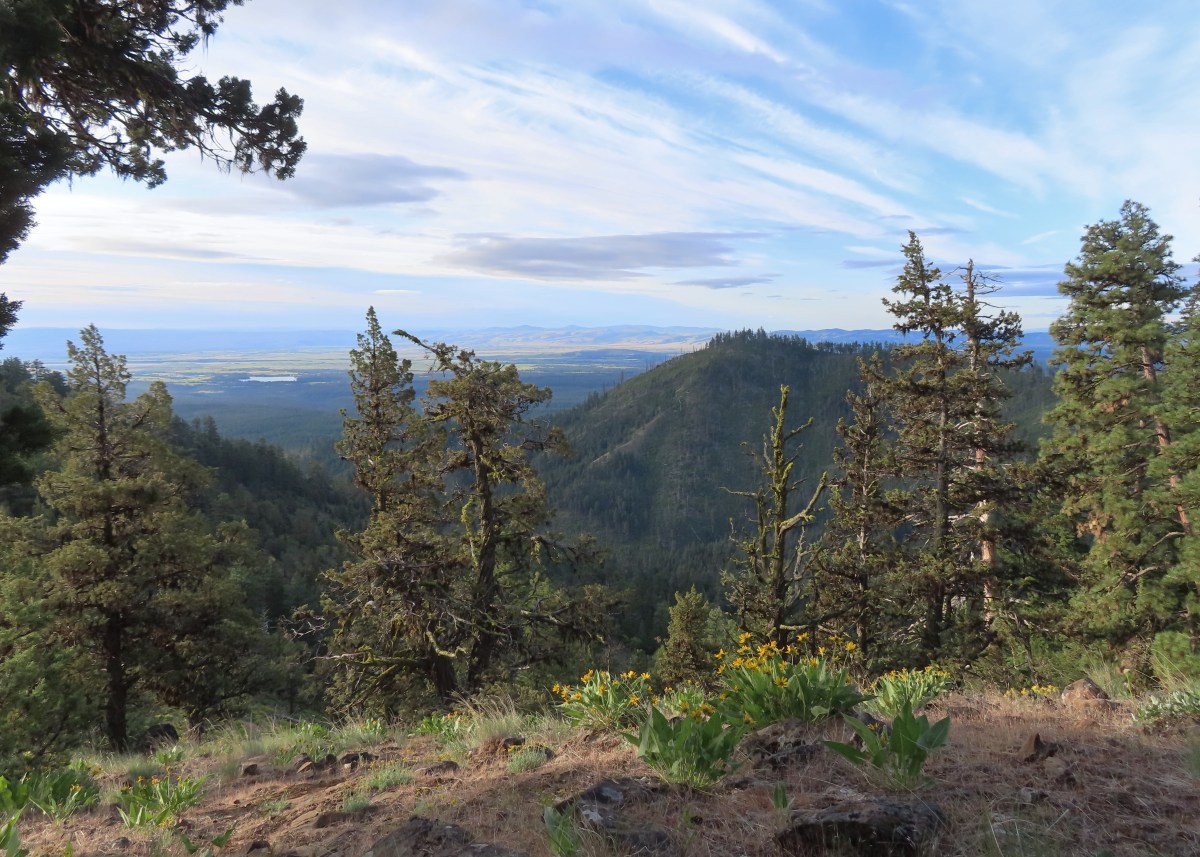
 The Tygh Creek Trail across FR 27 from the Tygh Creek Trailhead.
 The only two trees down that needed to be climbed under/over.
 Tygh Creek
 Distance + low light + moving animal = blurry photo.
 The skunk had been at the far end of this section of trail which was lined with lupine.
 The little stinker had a pretty cute face.
 The trail is to the right in this photo.
 Paintbrush, balsamroot, and a strawberry blossom.
 Ball Point
 Rough eyelashweed
 When a trail looks steep in a photo that tells you something.
 More paintbrush and balsamroot.
 Townsend’s solitaire
 Buckwheat
 My goal, the turn around point, was up on the crest of that ridge ahead.
 Lupine, balsamroot, and a death camas.
 Dogwood tree among the ponderosa pines.
 Mahala mat
 Getting close to the ridge and still steep.
 The trail got less steep near the ridge.
 Gordon Butte to the right. Broken Top, the Three Sisters, and Mt. Jefferson would also have been visible if not for the clouds.
 Level trail on the ridge!
 Looking ahead at the trees atop the “small” ridge.
 Sandwort
 Oregon sunshine
 Wildflowers on the “small” ridge.
 Almost to the crest.
 The clouds here are hiding Mt. Hood which should be visible behind the ridge. What is visible is Flag Point (
 Looking toward Mt. Jefferson.
 Parts of Mt. Jefferson peeking out through the clouds.
 I’d seen a couple whitestem frasera going up but coming down I realized just how many there actually were, although none of the plants were quite blooming yet.
 Groundsel
 Broken Top and some of the Three Sisters were visible on the way down.
 Tam McArthur Rim (
 I missed this whole patch of silvercrown earlier.
 Pine Hollow Reservoir and Central Oregon.
 Elkhorn clarkia aka ragged robin.
 Threadleaf phacelia
 Paintbrush with Ball Point in the background.
 Vetch
Vetch Penstemon
 Bastard toadflax
 Back in the forest near Tygh Creek.
 Tygh Creek
 Squirrel
 Starflower
 Coral fungus
 The trailhead in sight.
 The Tygh Creek track along with a portion of Saturday’s hike on the School Canyon Trail at the bottom.


 Phacelia
 Fleabane
 Thistle
 Madia
Madia
 Fiddleneck and lupine
 The first of several deer we spotted during the day.
 The distinctive cliffs behind the lupine are across the river from the parking area so we were almost always able to tell where we had parked.
 This jeep track would veer to the left to pass between the smaller hills and cliffs ahead.
 Western meadowlarks could be heard throughout the hike.
 The view south.
 Desert yellow fleabane
 The view west.
 Mt. Hood peaking over the canyon rim to the NW.
 Mt. Hood
 Butterfly on yarrow
 Grasses and wildflowers added color to the landscape.
 The route became very faint at times.
 Balsamroot
 Looking back at the route so far.
 View from the trail after passing between the hills and cliffs.
 An old fence.
 Mt. Hood and Lookout Mountain (

 Buckwheat

 Rough eyelashweed
 Paintbrush


 Another stretch of faint tread.
 It was often easier to see the road ahead than below our feet.
 Balsamroot and lupine
 Grand collomia and lupine.
 Spreading dogbane
 Digging in.
 Small water trough (empty).
 View from the water trough.
 Haven’t identified this bird yet.
 Looking back at the route again.
 Mt. Hood again.
 Ochre ringlet. There were hundreds of butterflies.
 Looking at the climb ahead. At this point most of the rest of the hike would be in direct sunlight, and it was already getting warm.
 Buck
Buck Buck number two.
 We had to get pretty high up before we could see Washington’s Mt. Adams and even once it was in view the lighting made it hard to make out.
 Mt. Adams
 The newer barbed wire fence at the public land boundary. This is around 3.5-miles from the parking area.
 Hawksbeard
 The fence went up and down steeply so that meant we got to as well.
 Crow
Crow Fritillary
 Cattle trail
 Western kingbirds
 A milkvetch
 Another butterfly on balsamroot.
 Stag Point is the high triangular point along the plateau in the foreground.
 Zoom in on Stag Point. (The lone post on top gives it away.)
 First and only brief view of the top of Mt. Jefferson.
 Mt. Jefferson
 The newer fence turned left at the corner.
 Onion
Onion This rocky gully was a little tricky to cross.
 Checkerspot
 Old stone structure along the fence.
 Western meadowlark
 Lark sparrow
 Probably cattle bones.
 Checkerspot on fiddleneck.
 Balsamroot and Mt. Hood from the road.
 Phlox
Phlox Indra swallowtail
 Checkerspot
 Another checkerspot
 A blue or copper of some sort.
 Oregon sunshine
 Skipper
 Colorful rocks
 Looking back up along the switchback section.
 Gate along the road at the end of the switchbacks.
 Allumroot

 Cusick’s sunflowers and desert yellow fleabane.
 Cusick’s sunflowers
 Looking back up the road toward the snake.
 The still coiled snake to the right of the track.
 The fainter jeep track split off here to the right. It’s really hard to see it in the photo but was a little more obvious in person.
 The goal was to aim for the knoll ahead then find two junipers that were relatively close together and descend between them.
 Looking back up from the jeep track.
 The view upriver with a private house.
 Going between the two junipers.
 Looking back up at the two junipers.
 It’s a checkerboard of public and private land along the road. While this portion of the road is open to hikers, public fishing along the riverbank is limited to the public land portions. No trespassing signs line the road in the private sections.
 Heather spotted this rattlesnake off the side of the road. We couldn’t tell if it was still alive and didn’t really want to find out.
 One of the few bits of shade along the road walk.
 Probably some sort of flycatcher.
 There were a lot of osprey along the river.
 There were also quite a few Bullock’s orioles.
 Mock orange along the river.
 Mallard
 Bindweed
 Another unknown bird and an angler in the river.
 Cliff swallow
 Dove
Dove More osprey
 Portland Deschutes Club Gatekeepers House

 Geese
Geese Common merganser
 Yarrow covered hillside.
 Rock formations above the road.
 The distinctive cliffs on the opposite side of the river from the parking area.
 Arriving back at the parking area.
 Yellow is our track from 2023.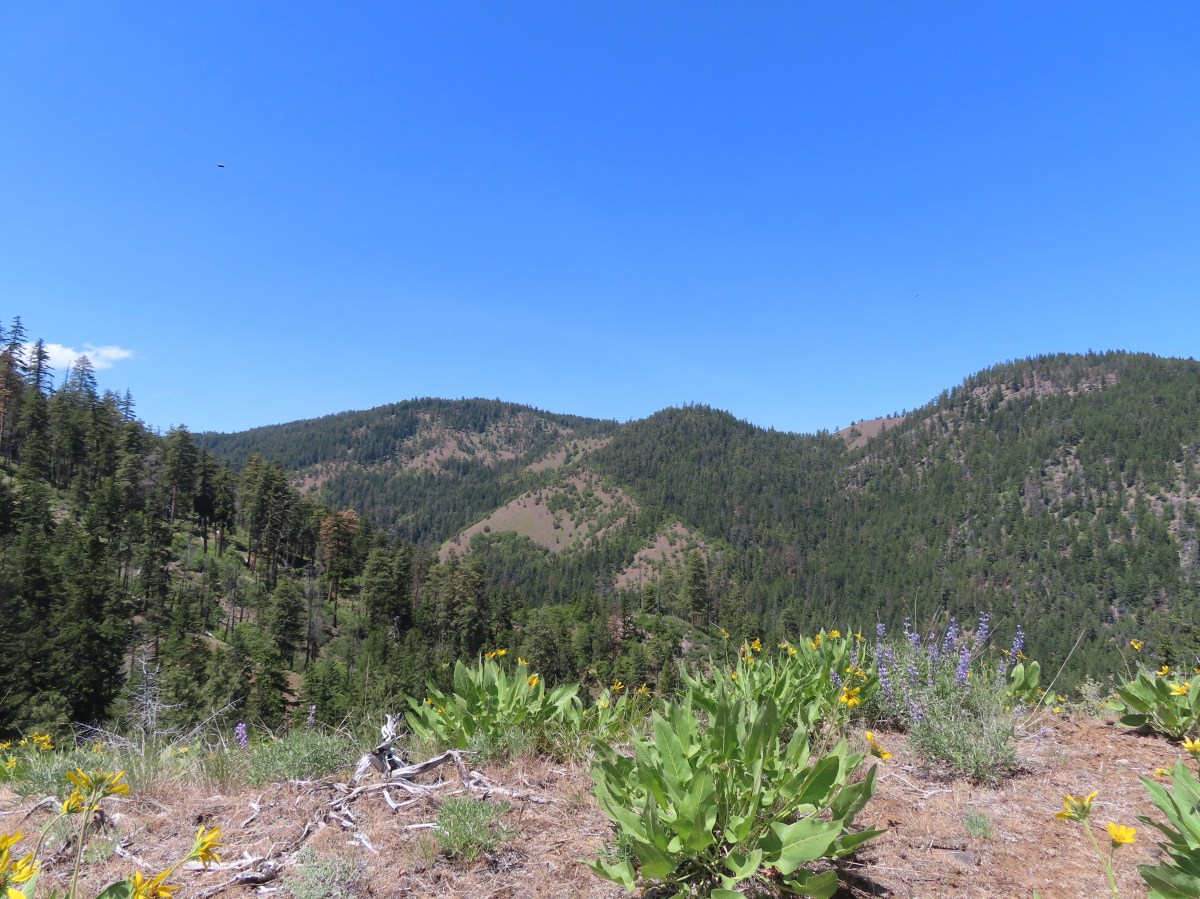


 We headed off through the trees here.
 Mt. Jefferson and Olallie Butte (
 Gordon Butte in the foreground.
 Balsamroot and oak trees.
 Buckwheat and balsamroot
 Whitestem frasera with Mt. Jefferson in the background.
 Rough eyelashweed
 Paintbrush
 We picked up a faint path, not sure if it was a game or use trail.
 Lupine and ponderosa pines.
 The trailhead is on the opposite side of FR 2710 from the trail.
 Sign at the start of the Little Badger Trail.
 Badger Creek Wilderness sign next to Little Badger Creek.
 Groundsel
 Woodland stars
 Little Badger Creek
 Fairy slipper
 American vetch
 Bastard toadflax
 Duskywing on sagebrush false dandelion.
 Balsamroot
 Bee coming in for a landing on phacelia.
 Sticky cinquefoil
 Western wood-pewee
 Madia
Madia Brown elfin (and another pollinator) on Oregon sunshine.
 Starflower
 Mahala mat along the trail.
 Duskywing on blue-eyed Mary
 Largeleaf sandwort along the trail.
 Skunk cabbage
 Red-flowering currant
 Duskywing on arnica
 Silvercrown
 Oregon grape
 Last of the trillium.
 Plumed solomonseal
 What’s left of the cabin.
 Little Badger Creek at the cabin site.
 Anemone
 There was a short climb before reaching the spur trail.
 Spur trail to the mine.
 The old mine. We did not go in as wildlife do sometimes use it for shelter.
 Ballhead waterleaf near the mine.
 Western tanager
 A stand of oaks ahead.
 Balsamroot along the trail.
 Paintbrush
 Buckwheat
 Juniper trees
 Threadleaf phacelia


 Signpost ahead for the trail junction.
 Wildflowers along the trail.
 The spur trail on the left to the Helispot.
 Penstemon

 Pine Hollow Reservoir in Central Oregon.

 Woodland star
 This was the most significant obstacle we had to navigate on the entire loop.
 Yarrow
 A dogwood on top of the rocks and penstemon below.
 First view of Ball Point.
 Penstemon
 From the ridge we could faintly make out Broken Top and the Three Sisters.
 The Three Sisters on the right and Broken Top with Tam McArthur Rim (
 Pen Point across the Tygh Creek Valley.
 Passing through the 2009 Ball Point Fire scar.
 Pen Point toward the center and the taller Hootnanny Point to the right.
 Death camas
 View east as we came around Ball Point.
 Desert yellow fleabane.
 Prairie smoke aka Old Man’s Whiskers


 Heather coming down the ridge.
 I think this is a western racer.
 Looking up at the ridge.
 A clarkia
 Lewis’ woodpecker
 Lizard


 On last view of Mt. Jefferson
 Ball Point
 Butterfly on whitestem frasera
 Signs at the trailhead.
 Orange is the road + cross country portion.
 wanderingyuncks
