Categories
Bull of the Woods/Opal Creek Hiking Old Cascades Oregon Throwback Thursday Trip report

Throwback Thursday – Dome Rock

**Note the 2020 Beachie Creek Fire burned a portion of this hike.**

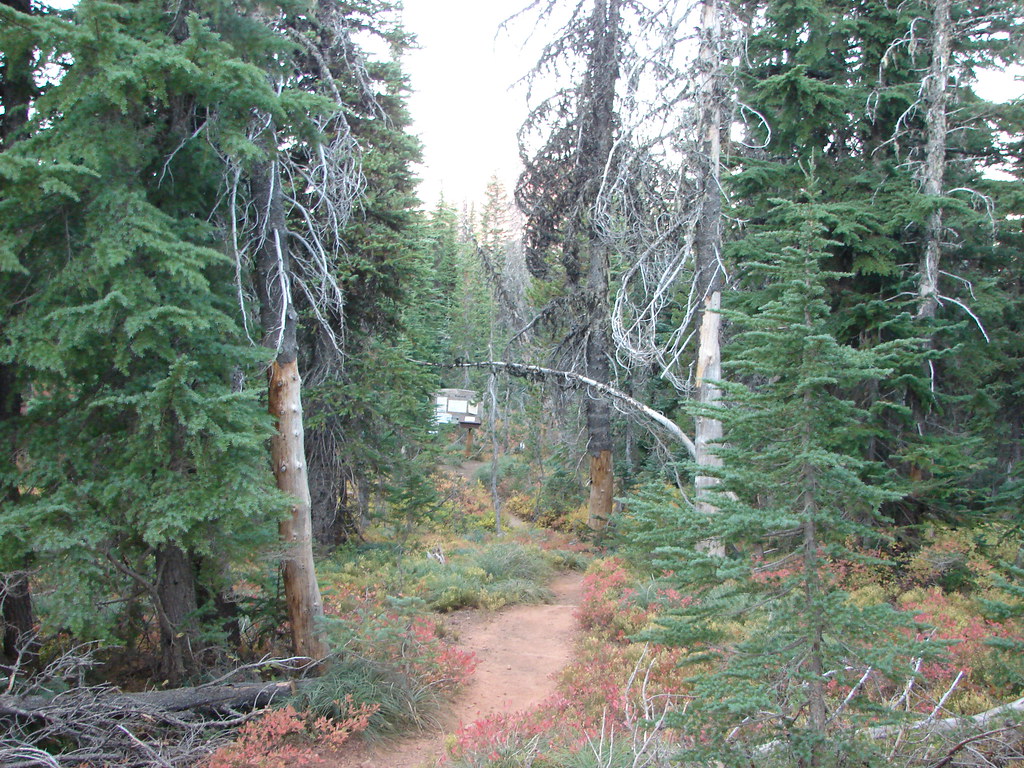
In July of 2010 we made our first attempt to hike to Phantom Bridge (we finally made it in 2011 on our third try). A washout had closed access to the most popular trailheads and the trailheads shown in our guidebook, the Phantom Bridge Trailhead and the French Creek Trailhead – West. This left us looking for an alternate route to the natural arch and while I was doing some research on the Willamette National Forest website I came across the French Creek Trailhead – East. I was able to find a photo at the time online of a sign at this trailhead along Forest Road 458.

It was going to make the hike quite a bit longer than necessary but we were obsessed with seeing the Phantom Bridge. From Detroit, OR we followed the directions from the Forest Service website to FR 480. The road was narrow and exposed with steep drop-offs which made it one of the more nerve wracking drives to date. The road conditions weren’t as bad as some we’ve driven but the scare factor was high. We watched the odometer but when we had gone the correct distance we saw no sign of the trailhead. After finding a place where we could turn around (the road was blocked by a small rockslide beyond) we slowly backtracked looking for any signs of a trail.

Instead of continuing to search for a trailhead that we now weren’t even sure existed anymore we decided to get down off the scary road and try something else. When we were back down to safer roads we consulted our guidebook and discovered that just 2.3 miles west of Detroit along Highway 22 was the Tumble Creek South Trailhead. A 10.3 mile hike from this trailhead would take us to the former lookout site atop Dome Rock and back.

The thought of a trailhead that didn’t require any more driving on Forest Roads was too tempting to pass up so we drove west of Detroit on Highway 22 and parked on the north shoulder at a gated road bed nest to Tumble Creek. The actual trail started .4 miles up the closed road at a small trail sign.
Tumble Ridge Trail

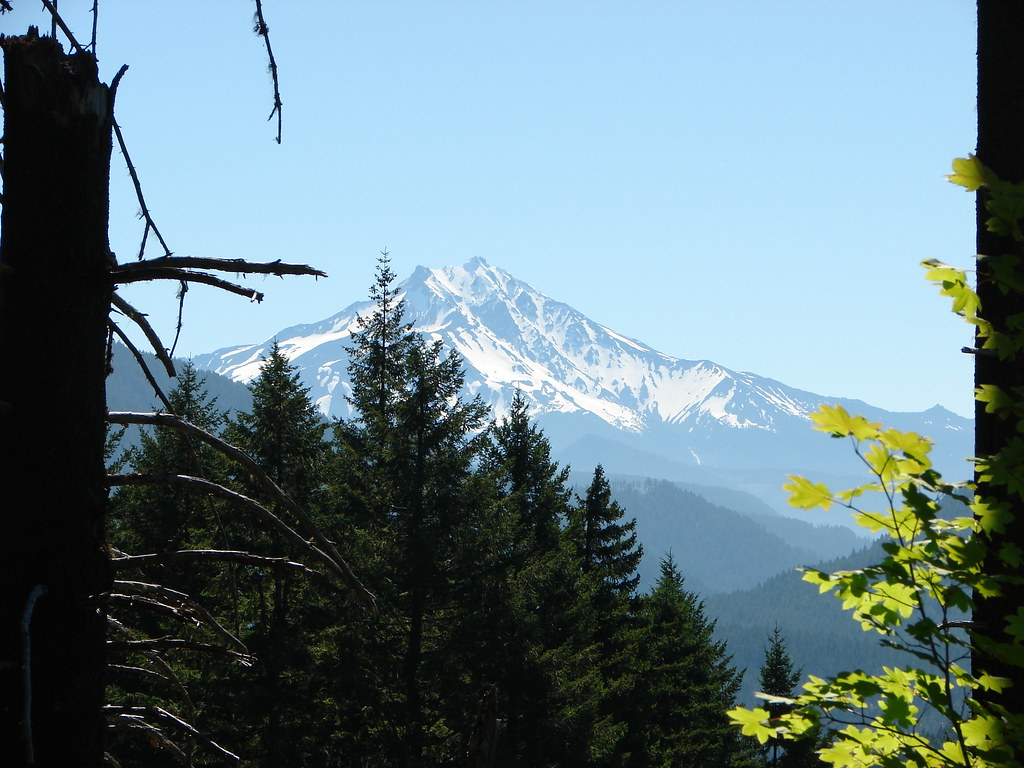
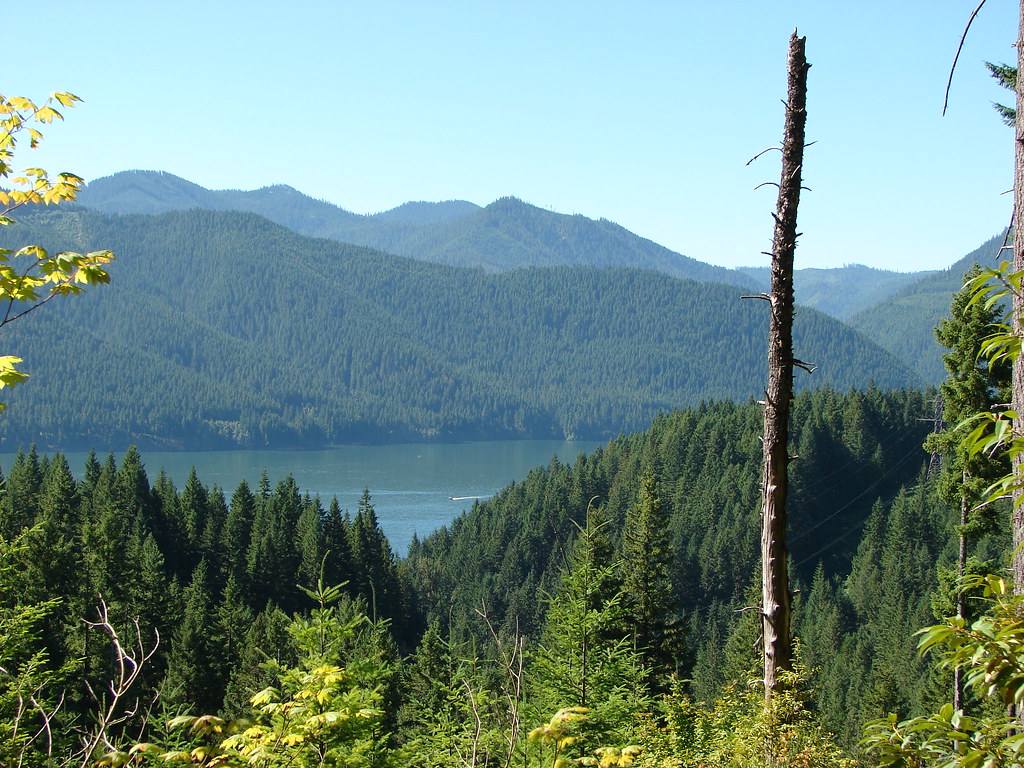
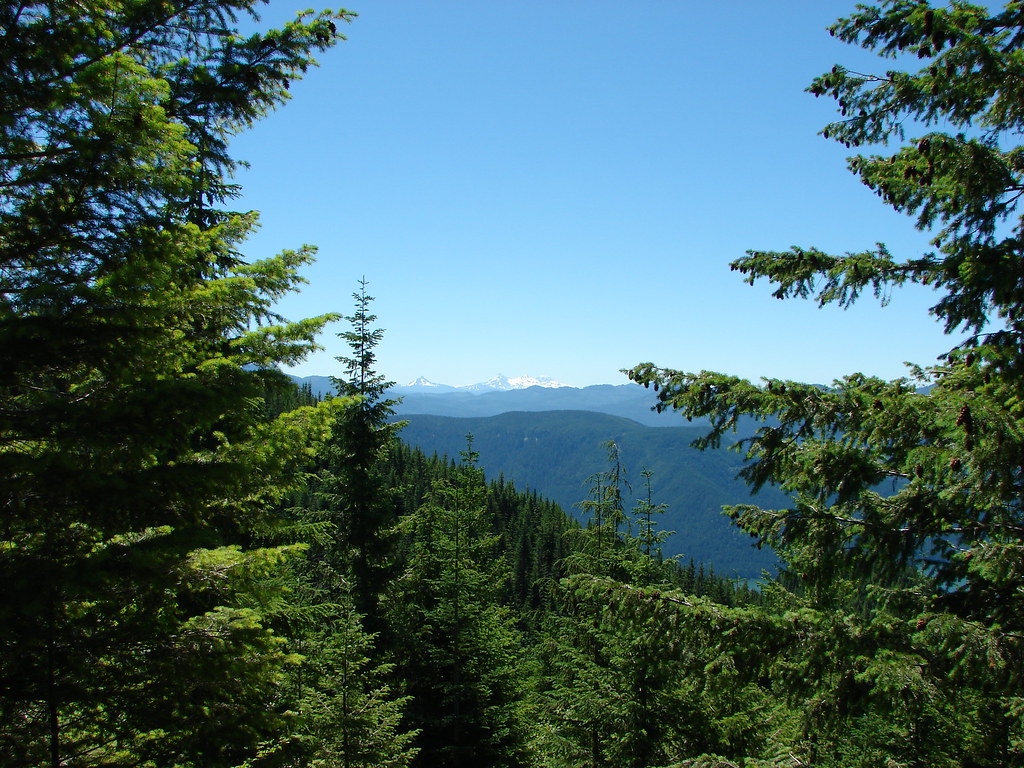
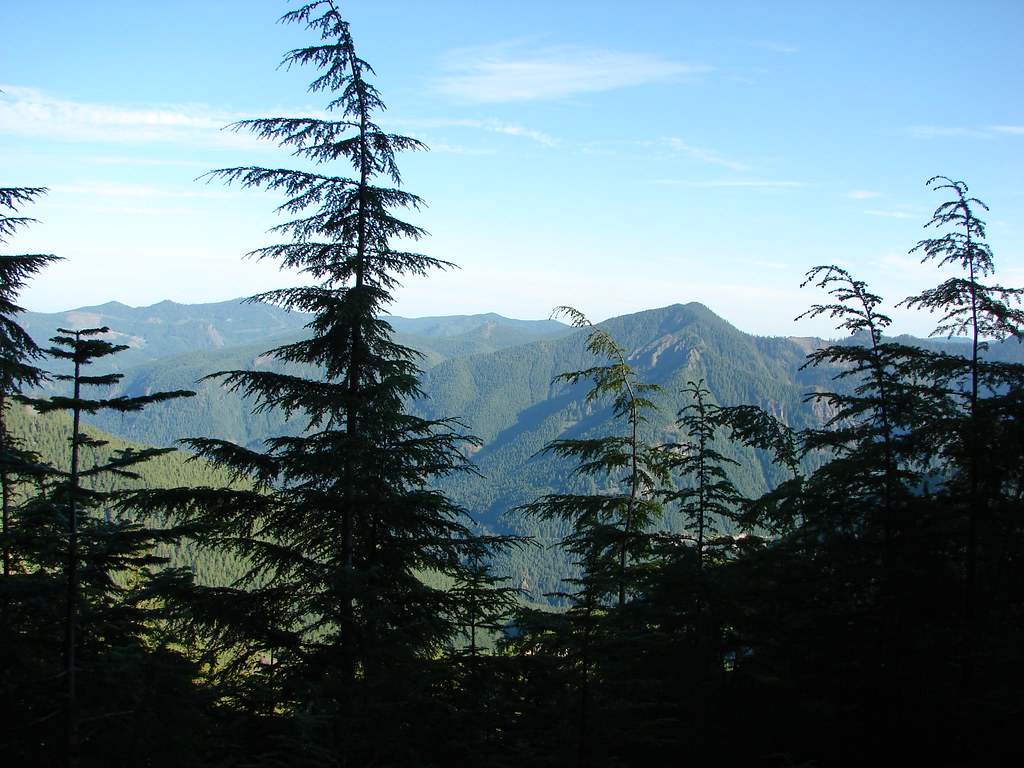
The trail climbed steeply uphill making several switchbacks. Occasional views could be of Detroit Lake and several Cascade peaks.
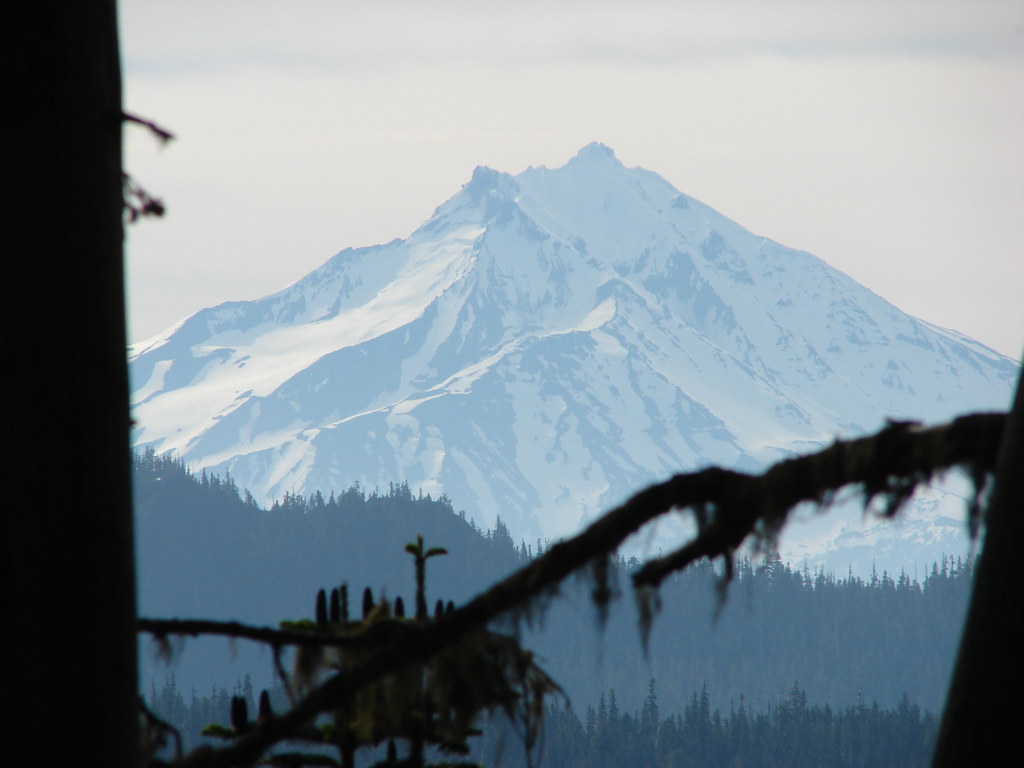
Mt. JeffersonMt. Jefferson

Detroit LakeDetroit Lake

Mt. Washington and the Three SistersMt. Washington and the Three Sisters

Mt. Washington and the Three SistersMt. Washington and the Three Sisters

Park Ridge and Mt. JeffersonMt. Jefferson

The trail passed through a brushy area at an old road bed near the Margie Dunham Spring approximately 3 1/4 miles from the old road bed along Tumble Creek.
Tumble Ridge Trail

From there the climb became more gradual as it passed a couple of interesting rock formation including one dubbed “Toilet Rock”.
Toilet Rock

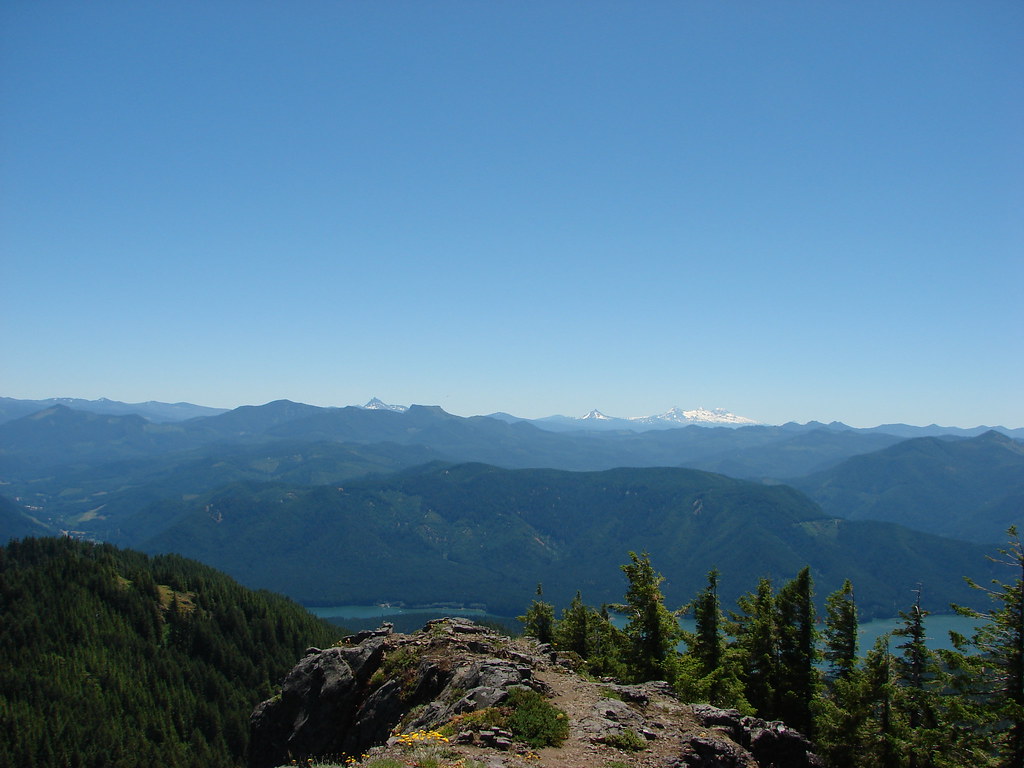
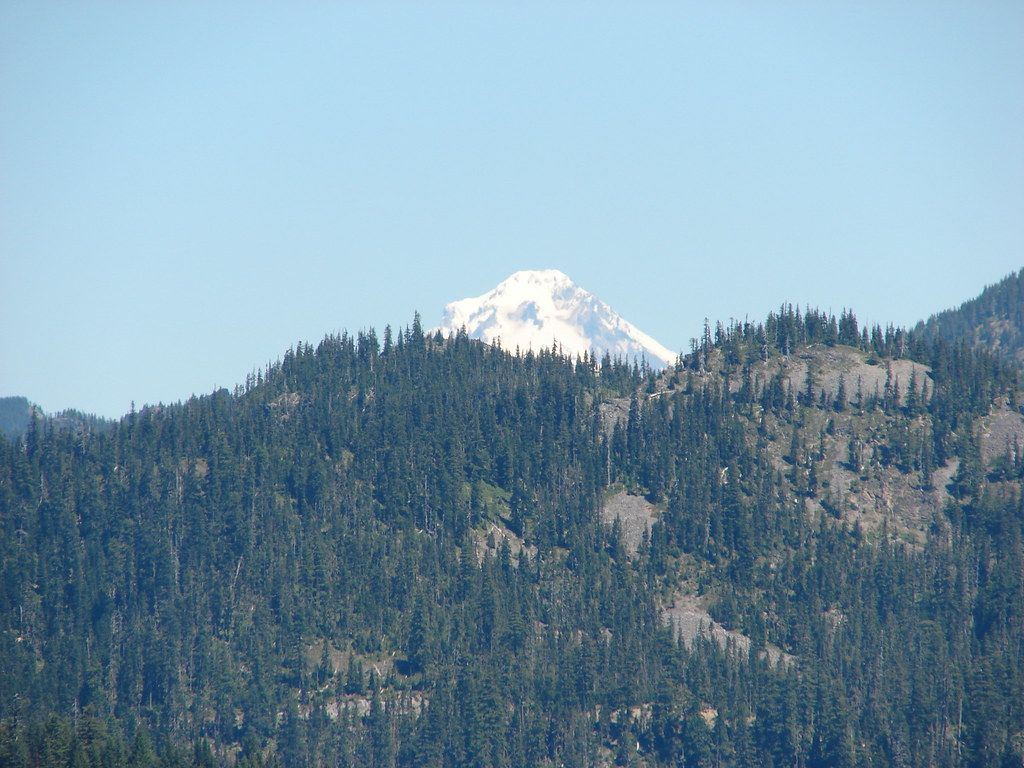
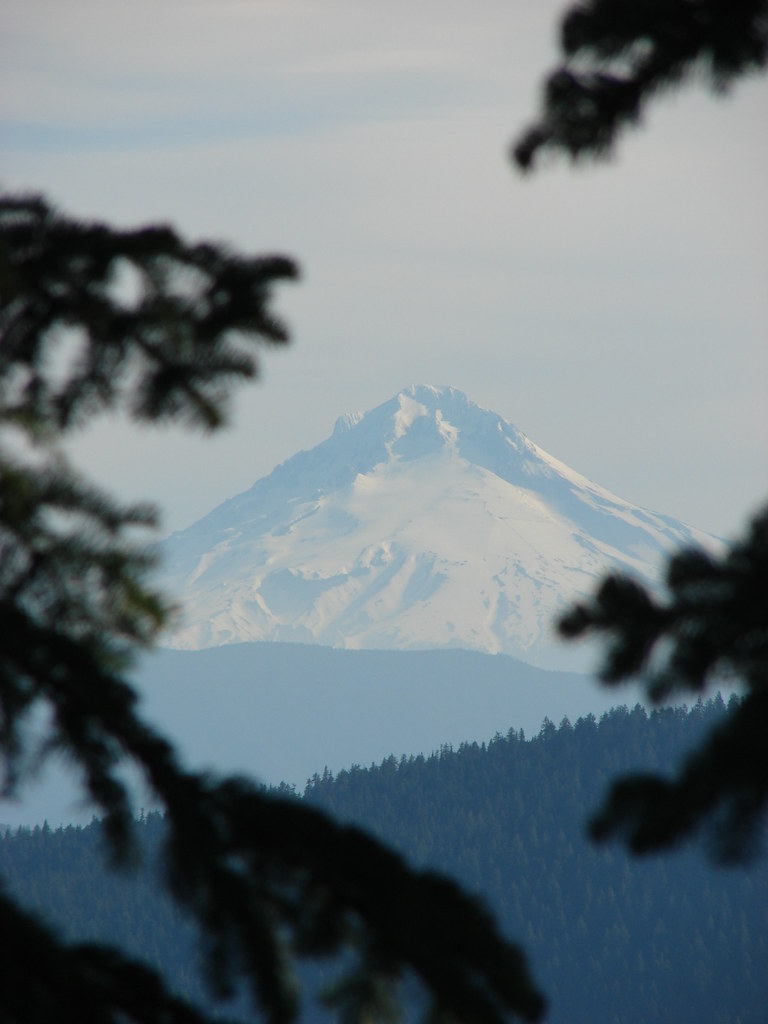
About a mile from the Margie Dunham Spring we came to the junction with the trail up to Dome Rock. Here we turned right climbing a final .5 miles to the old lookout site. The view was great from the summit and included the top of Mt. Hood to the north and Tumble Lake below to the NW. It was also our first good look at the distinctively flat topped Coffin Mountain (post).
View from Dome Rock Coffin and Bachelor Mountains in front of Three Fingered Jack, Mt. Washington, and The Three Sisters

Tumble LakeTumble Lake

Mt. HoodMt. Hood

Mt. JeffersonClose up of Mt. Jefferson

After admiring the view we returned to the Tumble Lake Trail. We briefly considered continuing to Tumble Lake but it was another 1.7 miles just to get to the lake meaning 3.4 additional miles in all plus we would lose around 800′ of elevation going down to the lake and we had already climbed over 3250′. Maybe next time. Instead we retraced our steps down to Highway 22 and headed back to Salem. Happy Trails!

Flickr: Dome Rock

Categories
Hiking Oregon Salem/Albany Trip report Willamette Valley

Silver Falls State Park

It’s been a while since we’ve had a recent trip report to post but we finally took our March hike on Heather’s birthday. We are in the midst of training for the Corvallis Half-Marathon so we were looking for something on the shorter end and without too much elevation gain. After our first plan was scrapped due to our most recent snowfall we turned to – Silver Falls State Park.  We had done this hike a couple of times in the past before starting the blog. In fact our first visit to the park happened on a hot day in August, before we had started hiking, and resulted in us thinking we might die of heat stroke causing us to be unable to visit all the waterfalls. We returned slightly more prepared in July of 2006 and completed the hike which we consider our first true hike.  We went back once again on 7/30/2010 when Dominique chose this hike as his pick during our vacation that year.

It turns out we were there a little early. The posted hours for the day use areas were 8am to 8pm which hadn’t been clear on the park website and the entrance to the South Falls day use area was still gated so we began our hike at the North Falls Trailhead.
North Falls Trailhead

There is a $5 day use fee which we attempted to pay but the envelope box had been removed, presumably for the night, so after filling out an envelope we left the stub on our dash along with a note that the box was not in place so we would drop our payment off on the way out. With that taken care of we took a footbridge over North Fork Silver Creek and followed a pointer for Upper North Falls.
North Fork Silver Creek

Sign for Upper North Falls

The trail immediately passed under Highway 214 then in a quarter mile brought us to the 65′ Upper North Falls.
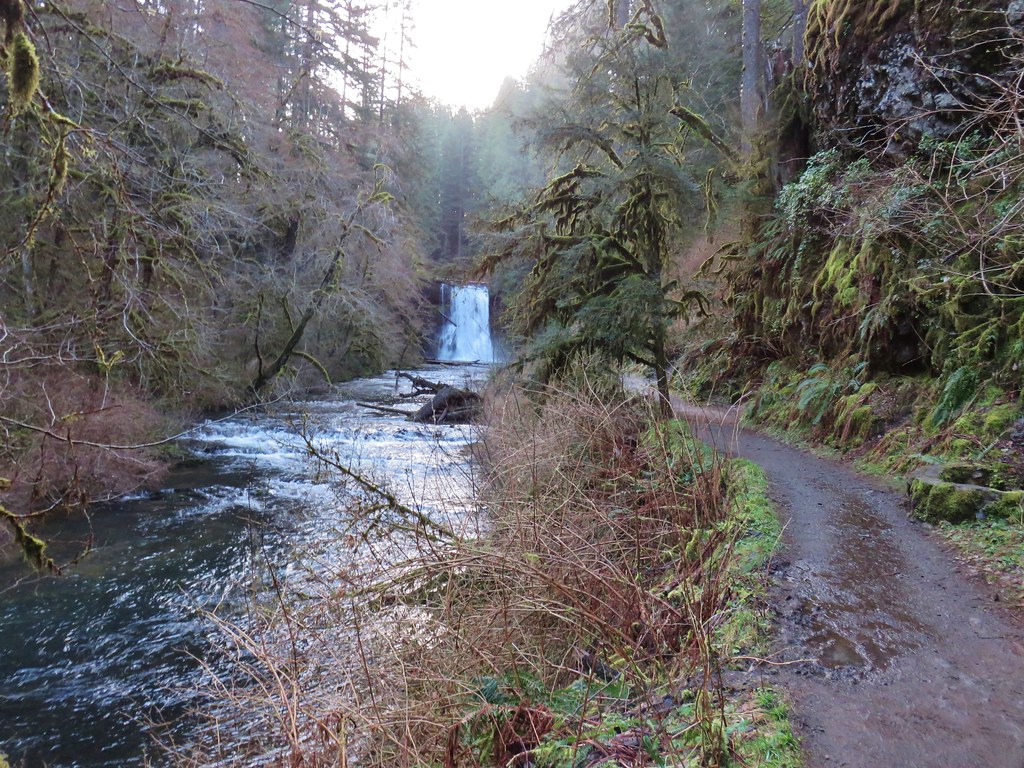
Upper North Falls

Upper North Falls

Upper North Falls

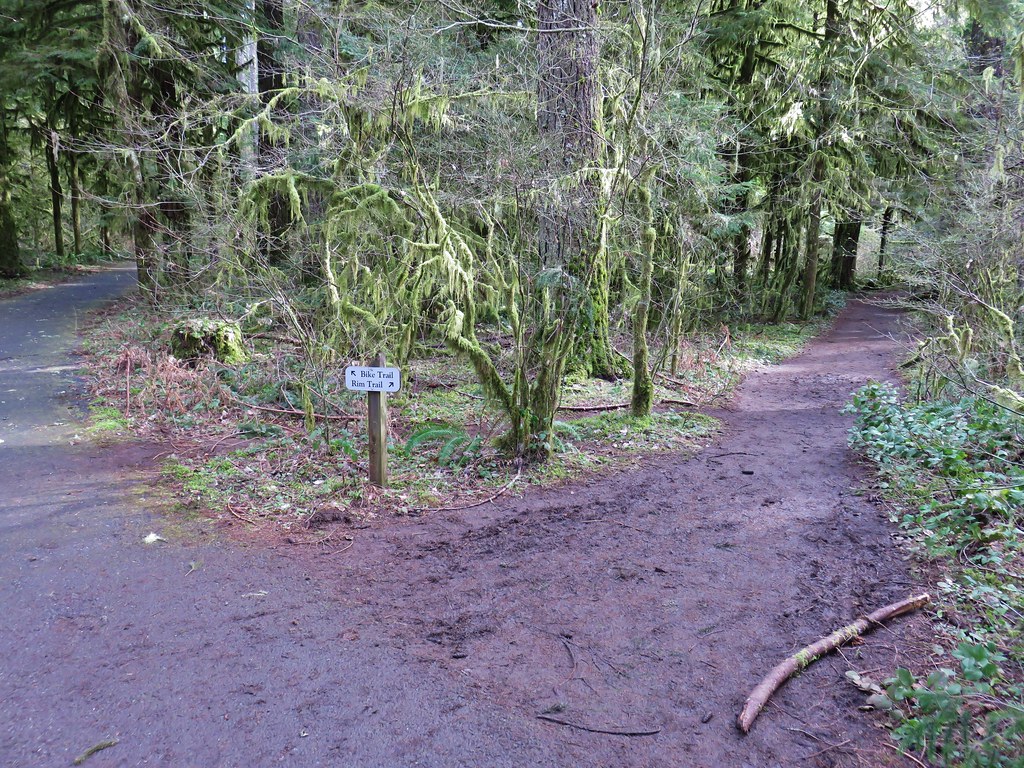
After admiring the fall we returned the way we’d come and after passing back under the highway faced a choice at a junction. To the left the Rim Trail headed uphill and would follow the highway along the canyon rim to the South Falls Day Use area while the right hand fork would lead us on a longer trek through the canyon and the other waterfalls.
Trail junction in Silver Falls State Park

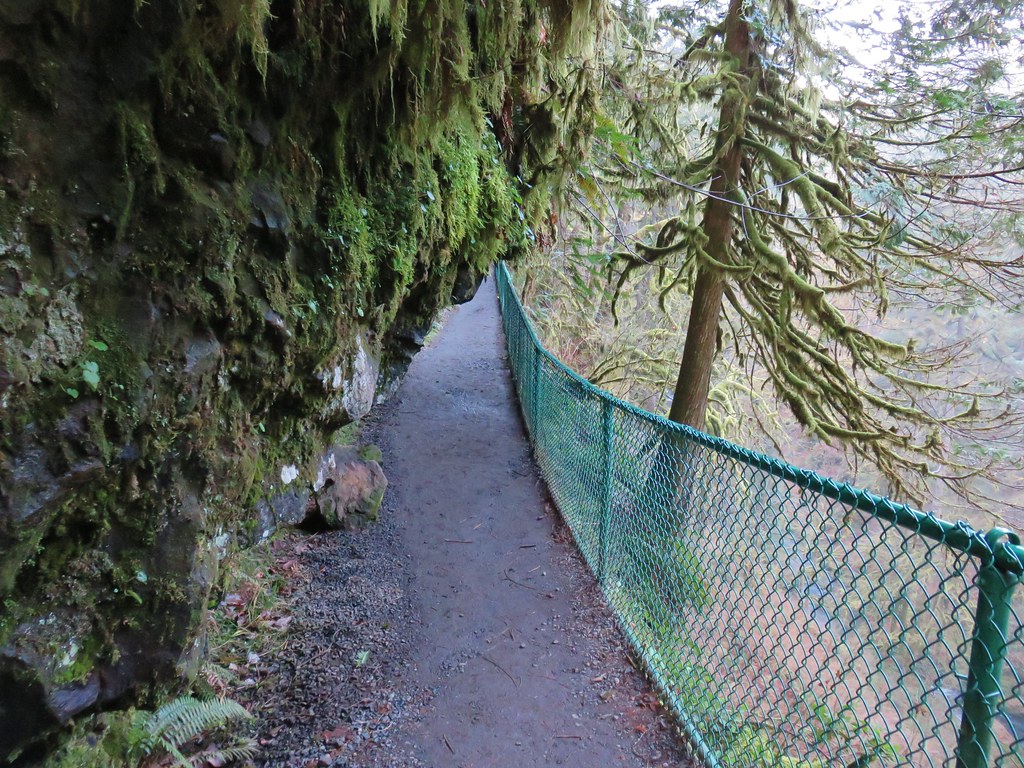
The question was did we want to end with the more scenic trail through the canyon or start with the canyon figuring that there would be fewer people on the trails earlier in the morning. The prospect of fewer people won out and we took the Canyon Trail along the creek (please note dogs are banned on the Canyon Trail). Not far from the junction the trail descends past a sign for North Falls and passes under basalt overhangs.
Sign for North Falls

Trail to North Falls

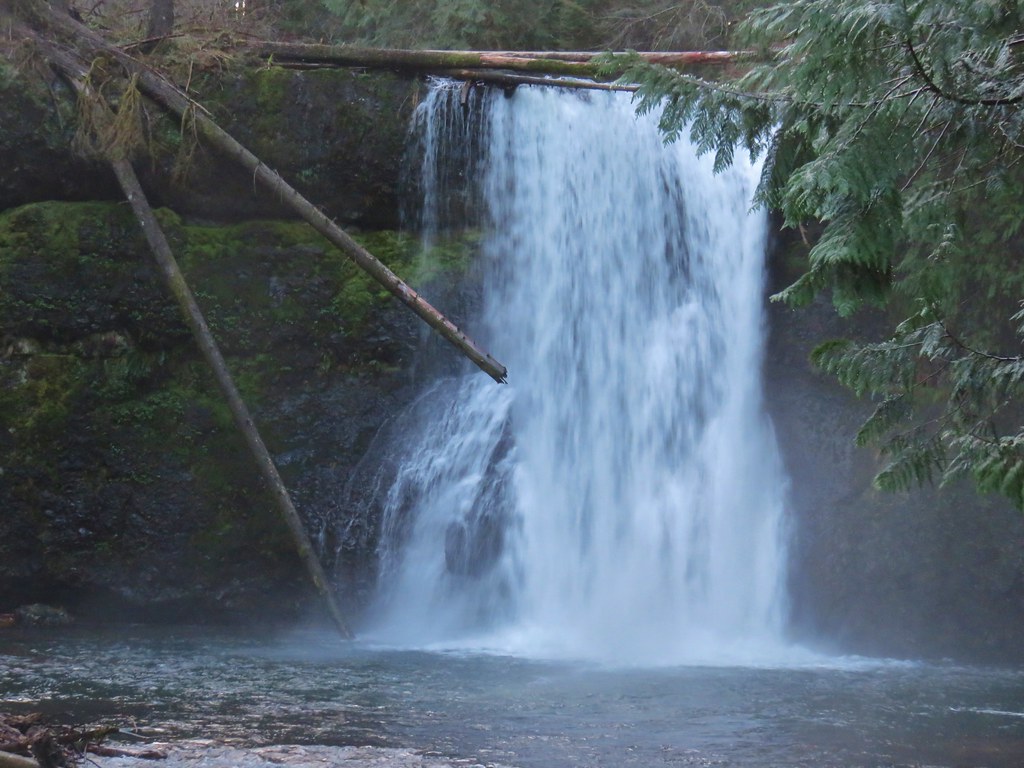
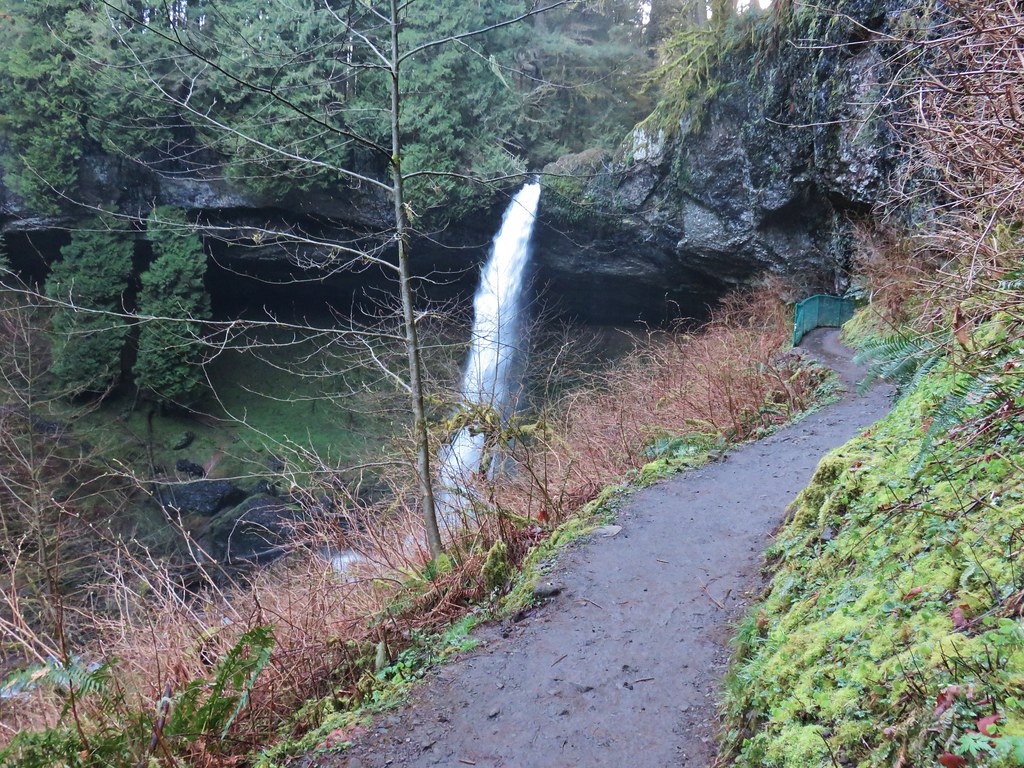
North Falls came into view as we descended some stairs before turning back towards the falls and ultimately passing them.
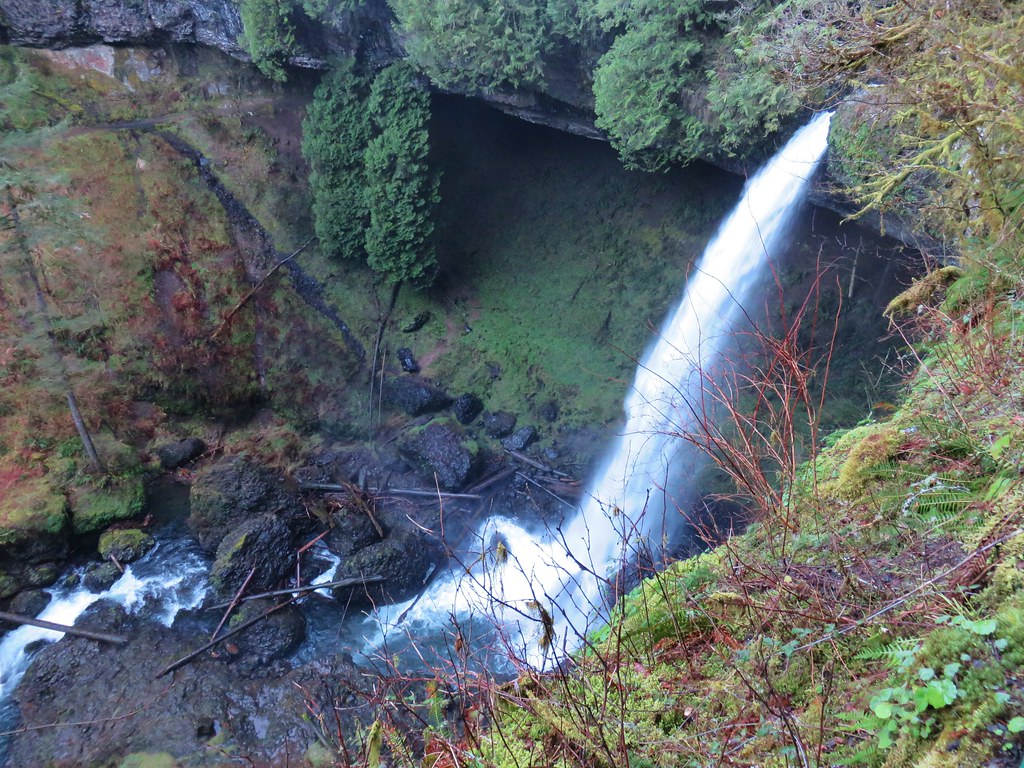
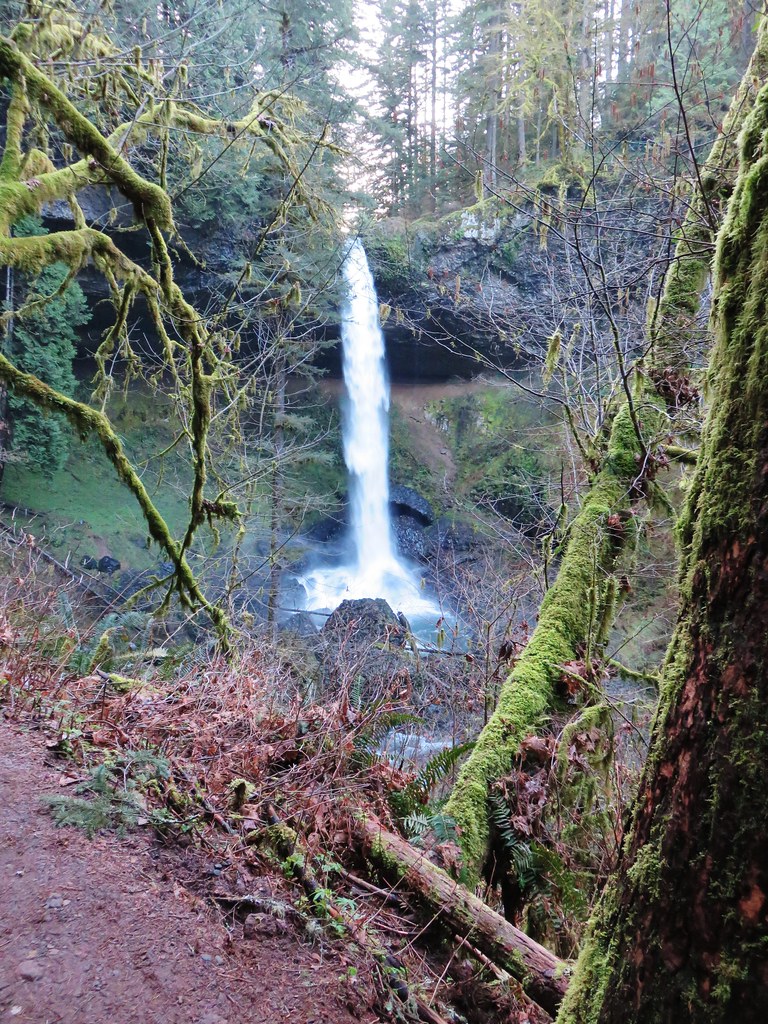
North Falls

North Falls

North Falls

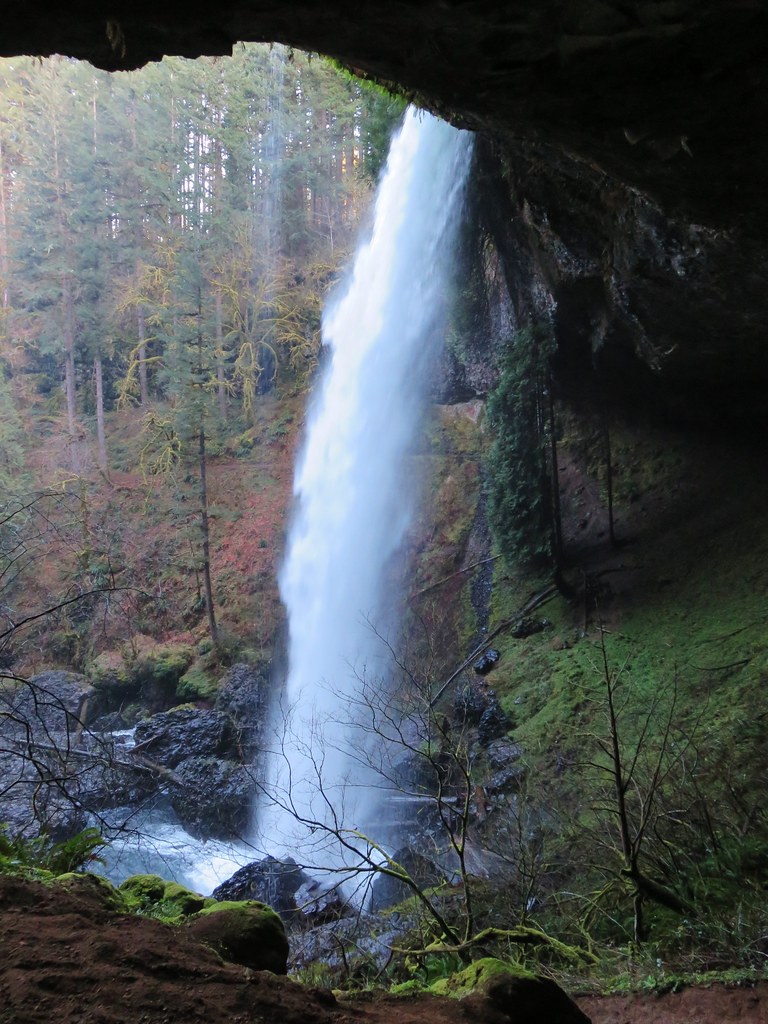
View from behind North Falls

The water was roaring as it crashed down into the splash pool. It was a stark difference from our July 2010 visit.
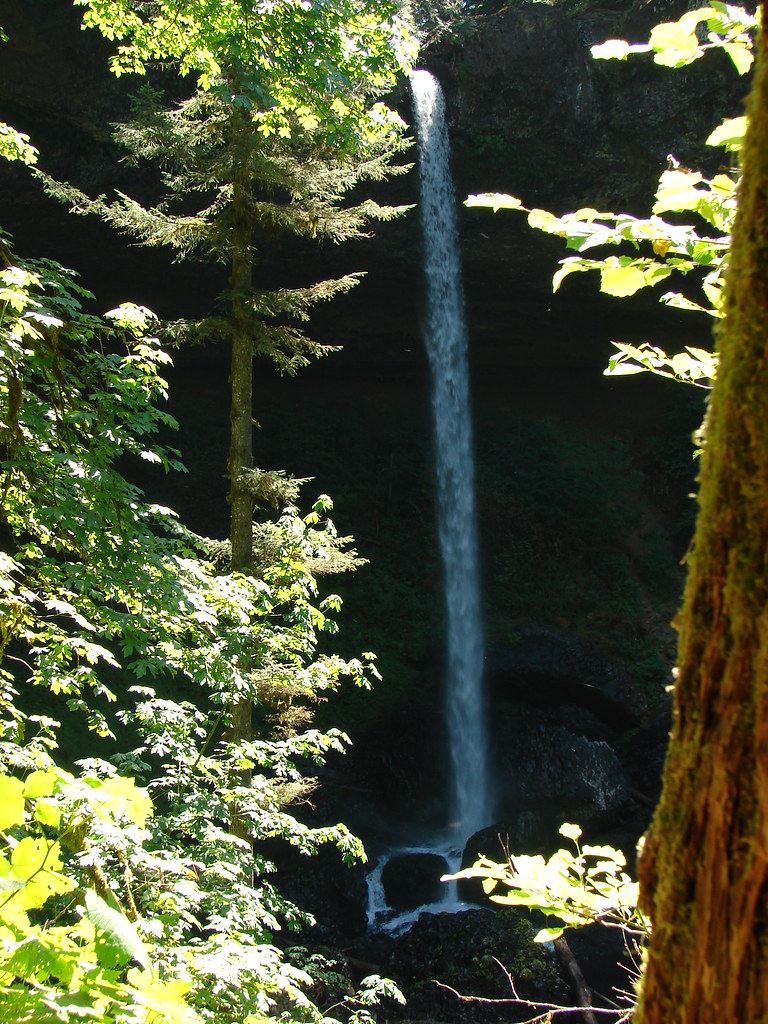
North Falls
July 30, 2010

North FallsMarch 29, 2018

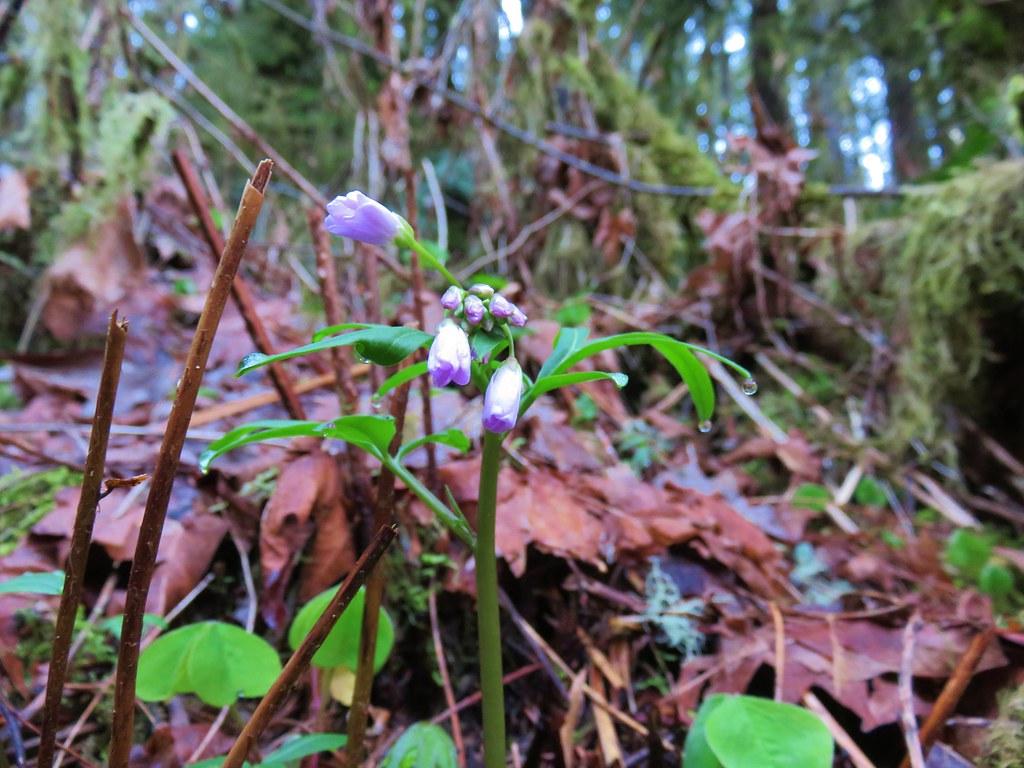
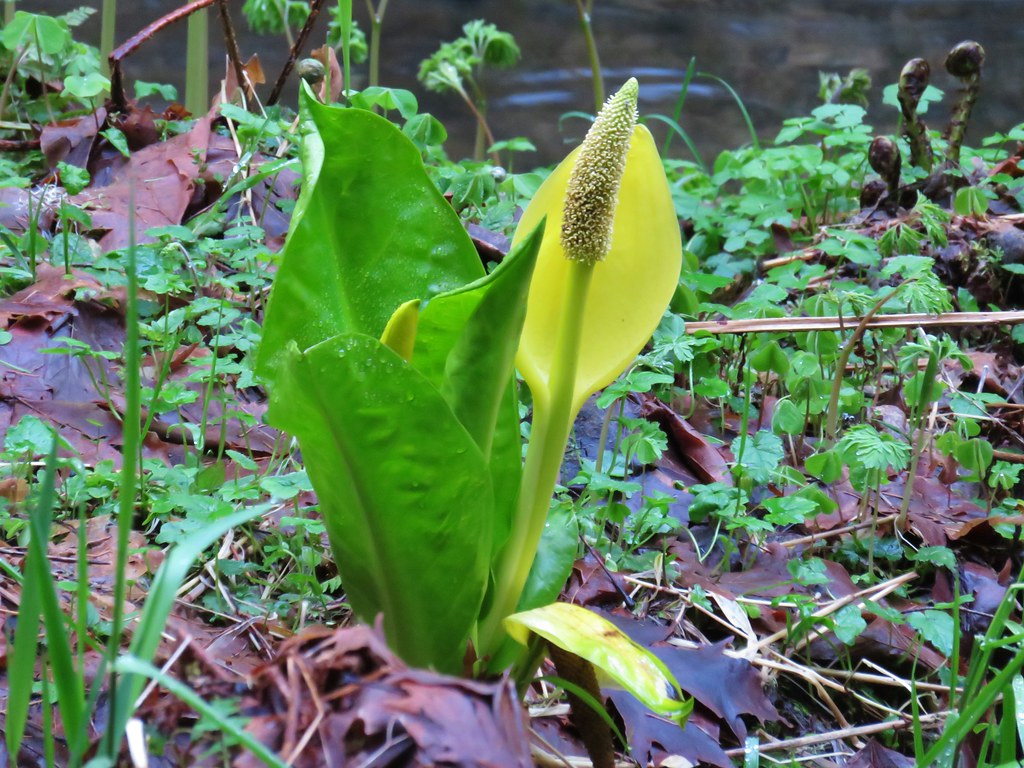
The trail was now on the north side of the creek and remained fairly level for over a mile as it passed through the canyon. We spotted quite a few flowers starting to bloom along this stretch.
North Fork Silver Creek

ToothwortToothwort

Skunk CabbageSkunk cabbage

Salmonberry blossomsSalmonberry

Blossoms along North Fork Silver CreekIndian plum

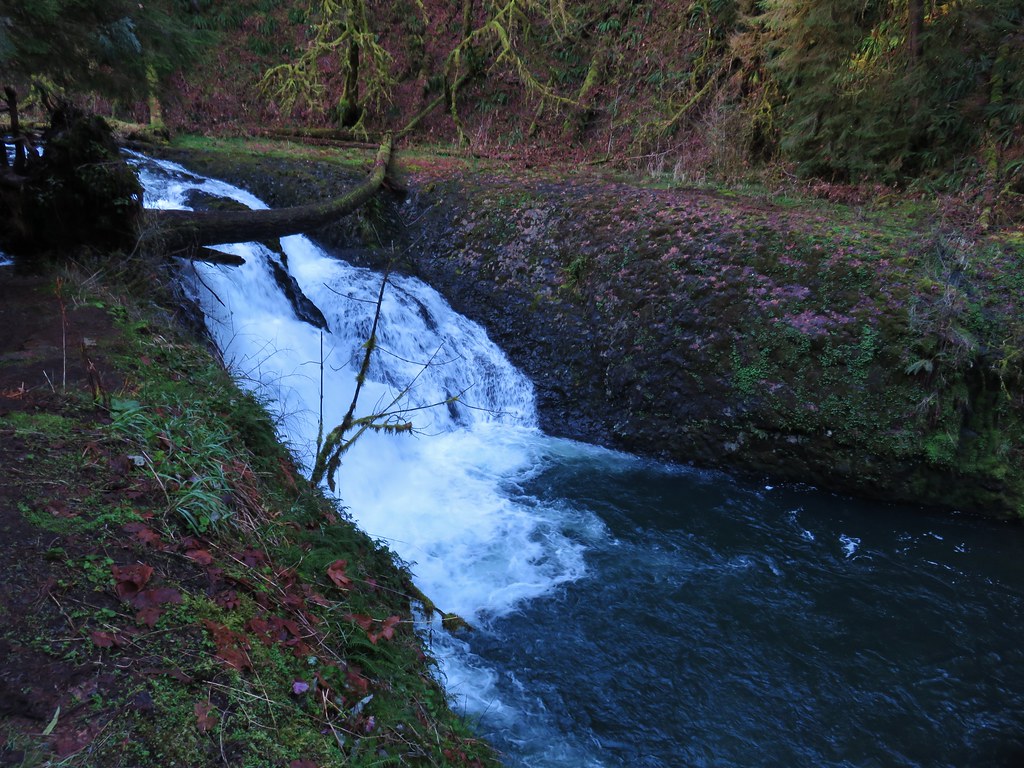
The next waterfall up on the Trail of Ten Falls was 31′ Twin Falls.
Sign for Twin Falls

Twin Falls

A short distance from Twin Falls (and about 1.5 miles from the North Falls Trailhead) we came to a junction with the Winter Falls Trail.
Footbridge over North Fork Silver Creek

The half mile Winter Falls Trail starts at the Winter Falls Trailhead along Highway 214 passing Winter Falls and ending at the Canyon Trail. We turned left onto a footbridge crossing North Fork Silver Creek and headed for Winter Falls.
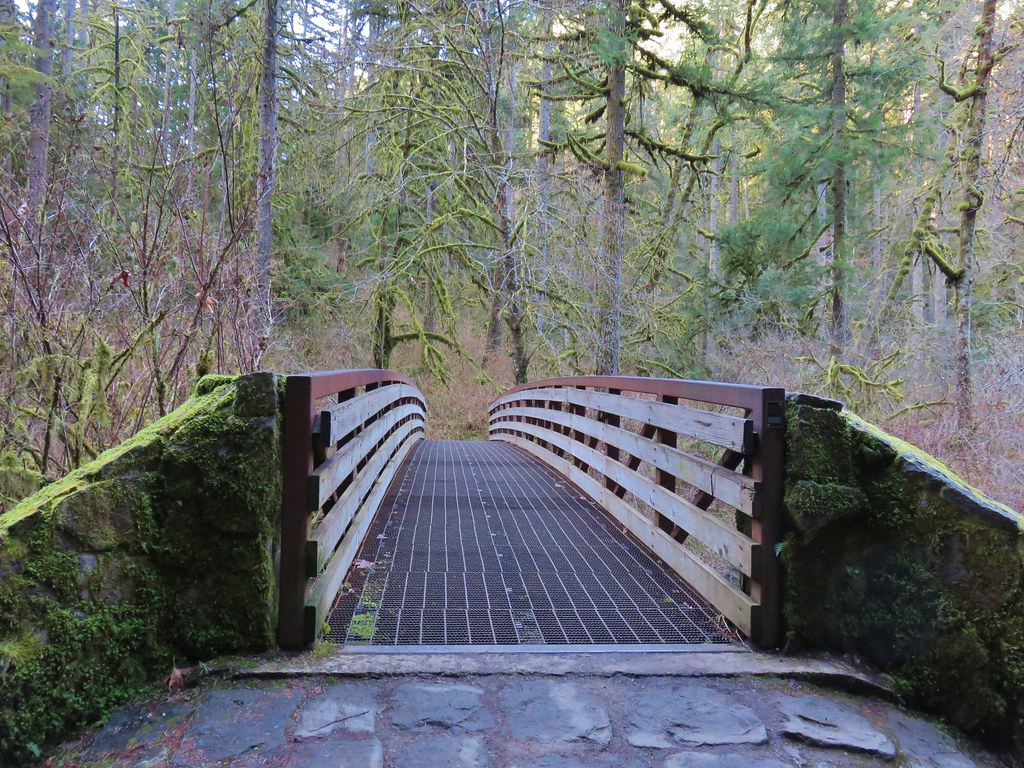
Footbridge over North Fork Silver Creek

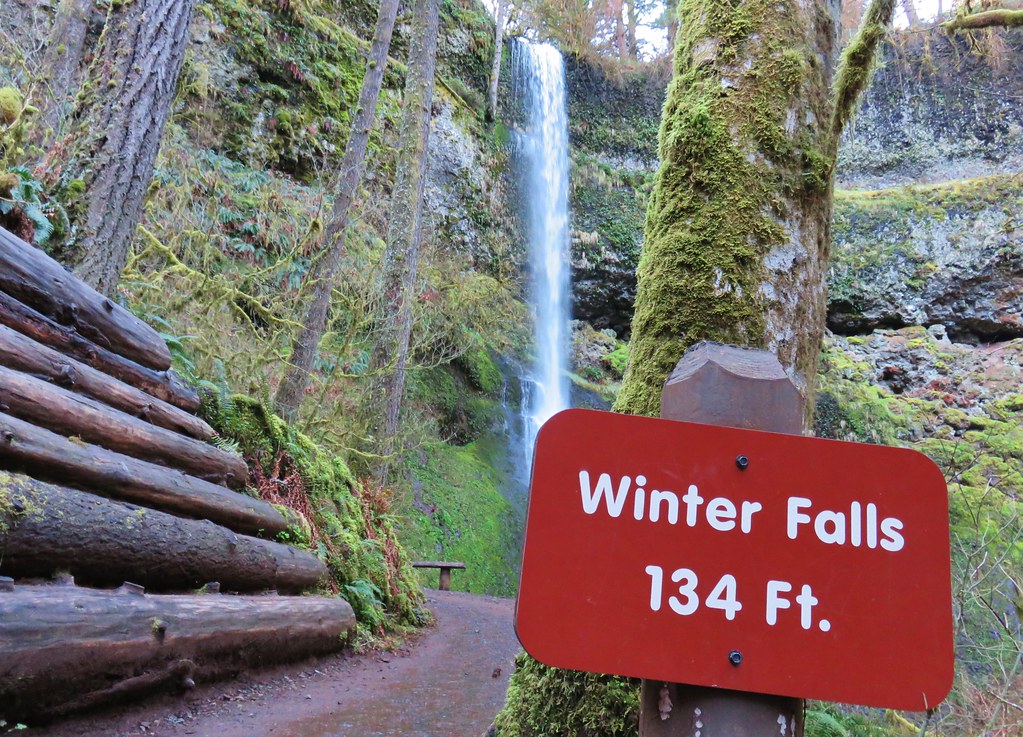
The trail was fairly level as it led to the 134′ waterfall.
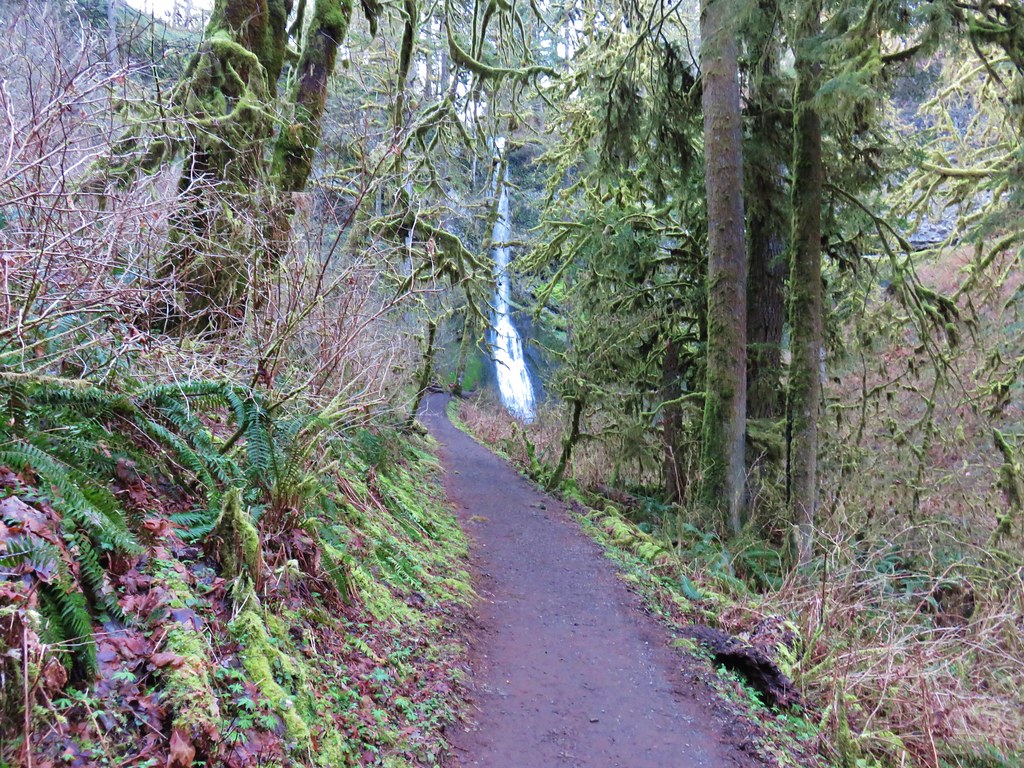
Winter Falls

Winter Falls

Later in the year Winter Falls all but dries up so this was the first time we’d gotten to see this waterfall.
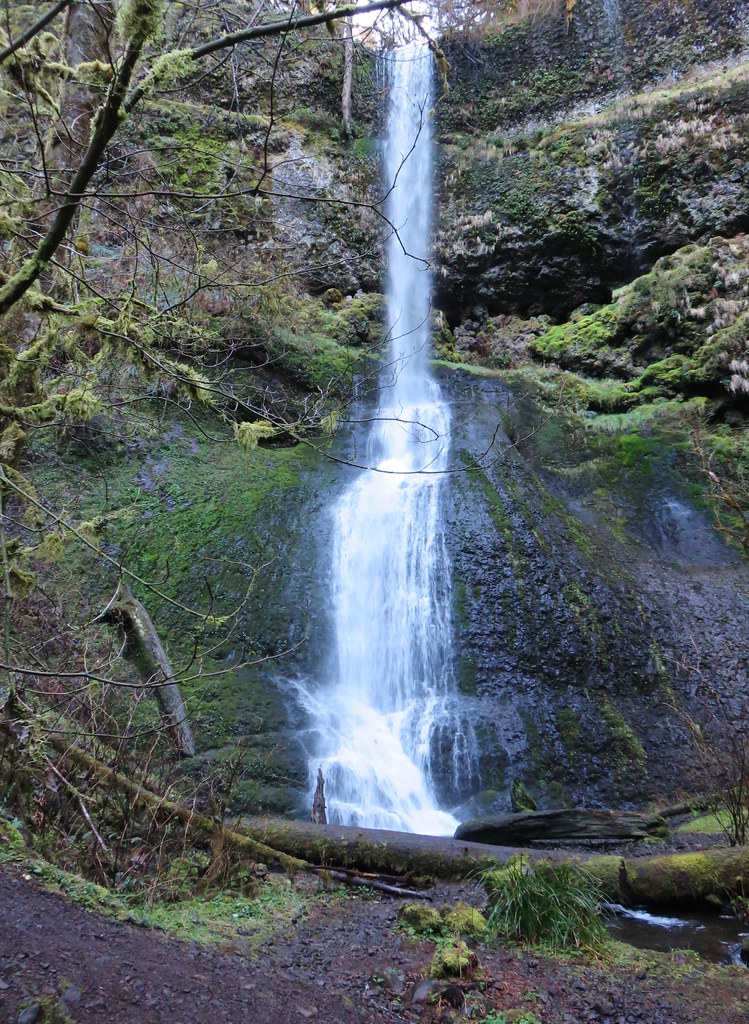
Winter Falls

After checking this fall off our list we returned to the Canyon Trail and continued downstream toward Middle North Falls.
Sign for Middle North Falls

In just .2 miles we came to the side trail down to Middle North Falls.
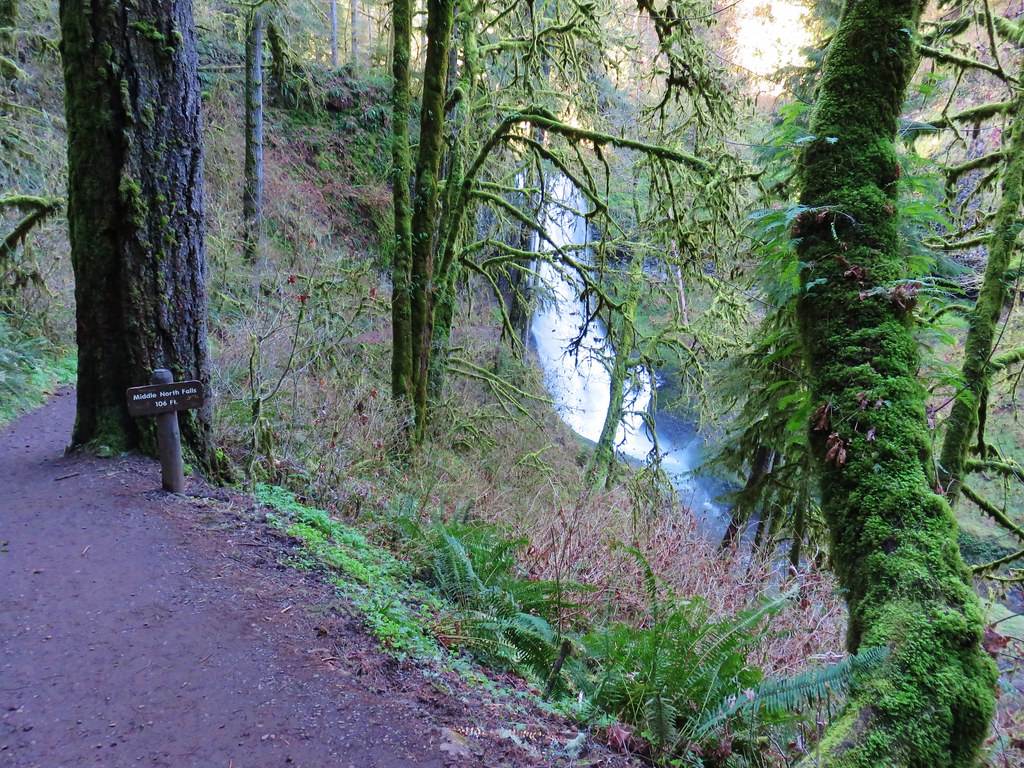
Middle North Falls

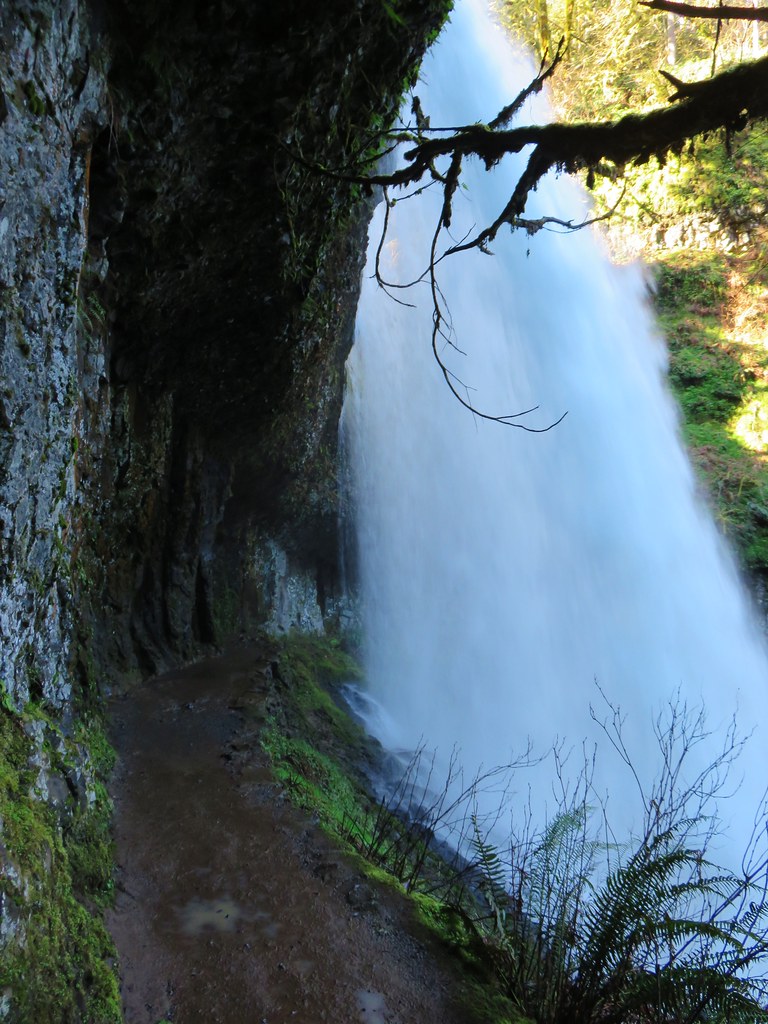
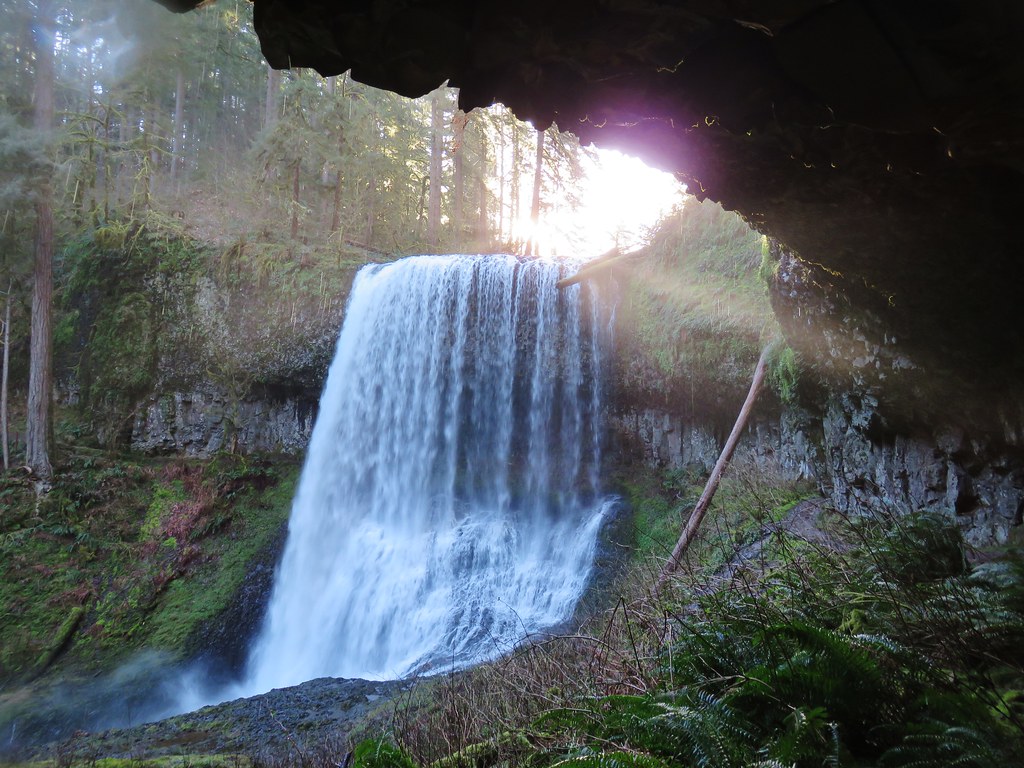
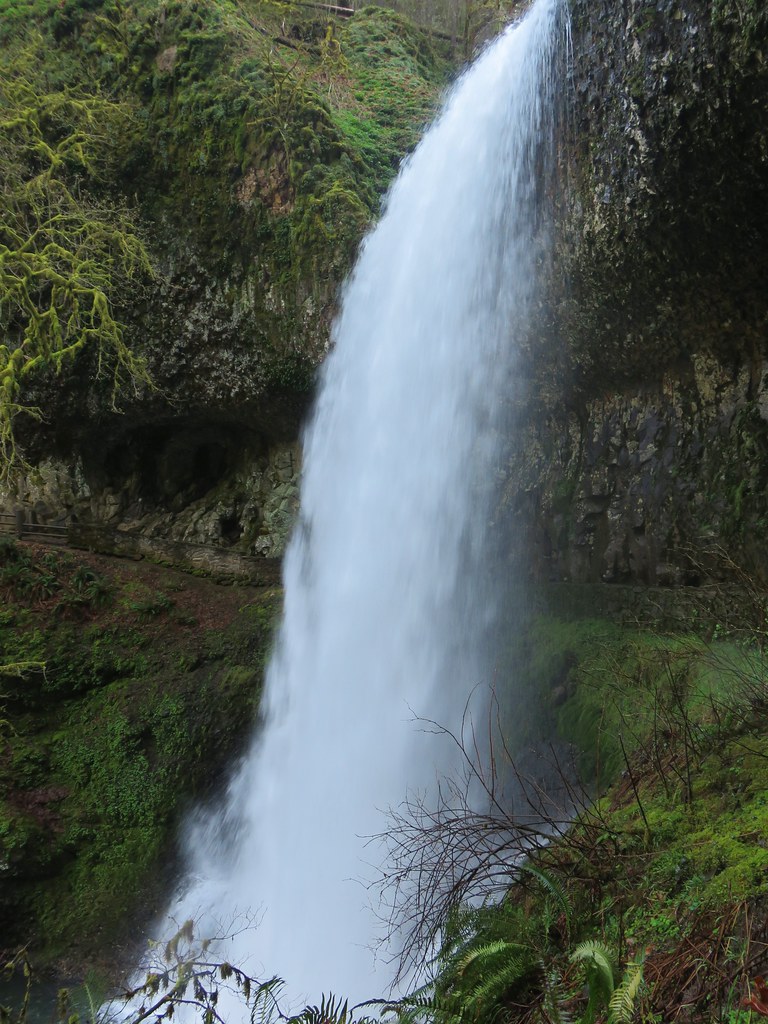
Here there was another opportunity to go behind the waterfall.
Middle North Falls

Trail behind Middle North Falls

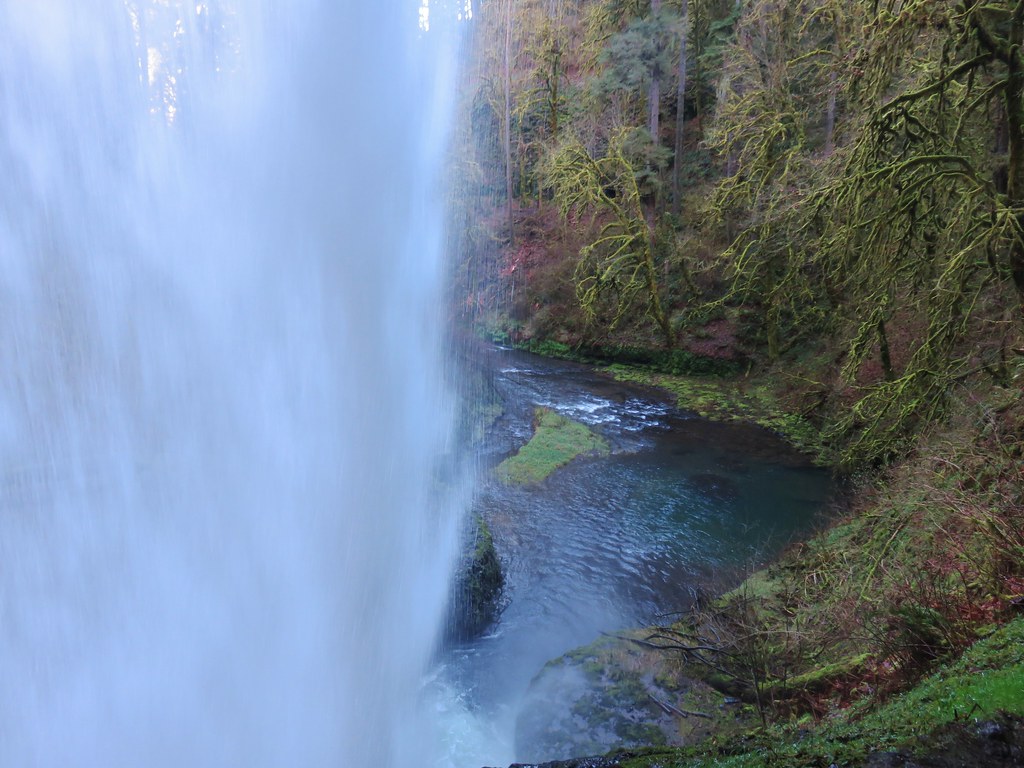
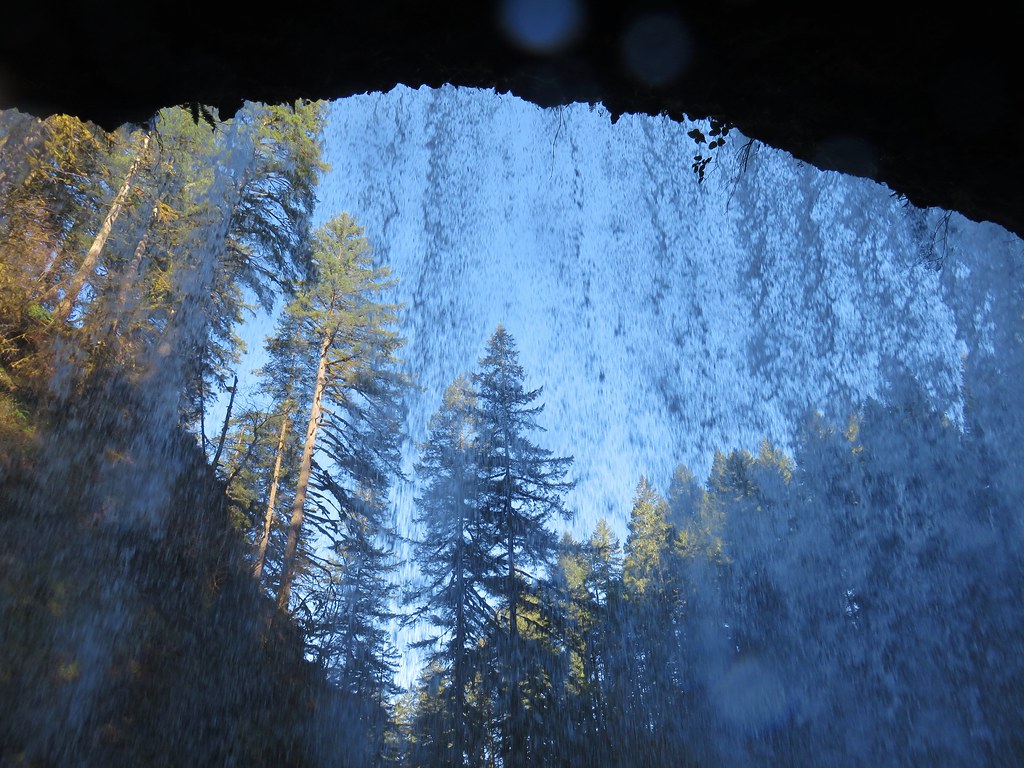
View from behind Middle North Falls

View from behind Middle North Falls

The side trail continued on the far side of the fall wrapping around the canyon to a great view of the cascade.
Middle North Falls

Middle North Falls

After oohing and ahhing at this waterfall we returned to the Canyon Trail which also had several nice views of this fall. Of all the waterfalls on this hike this one was probably the most visibly different from our previous visits.
Middle North FallsJuly 7, 2006

Middle North FallsJuly 30, 2010

Middle North FallsMarch 29, 2018

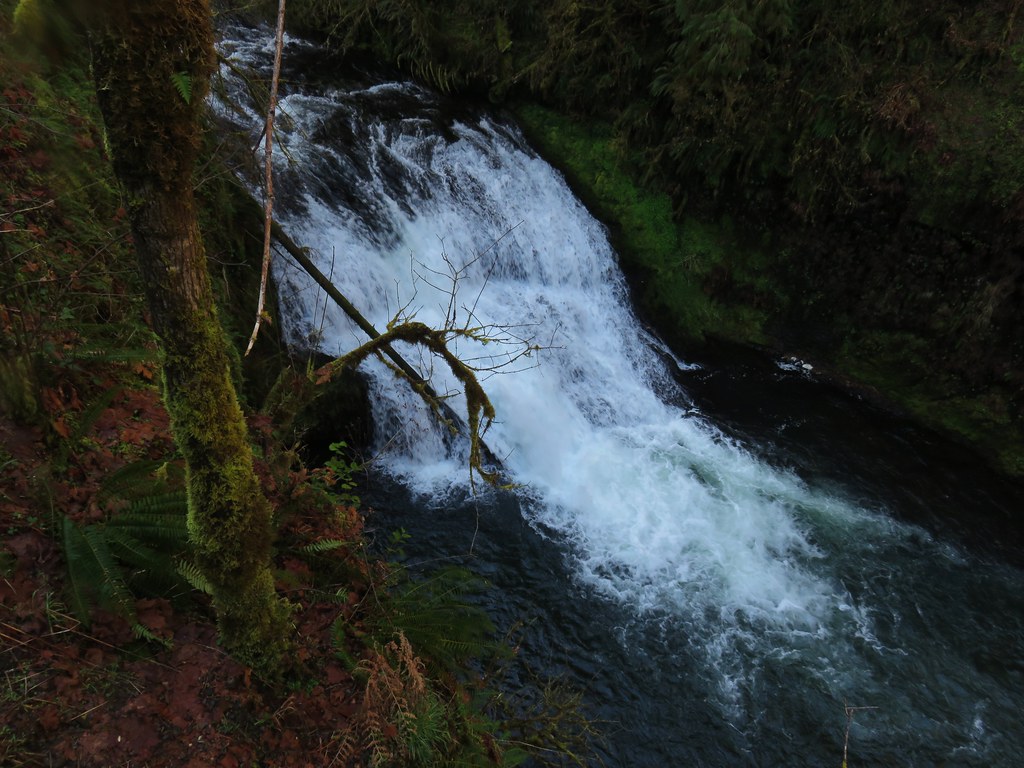
A little downstream from Middle North Falls we came to a viewing platform above little Drake Falls.
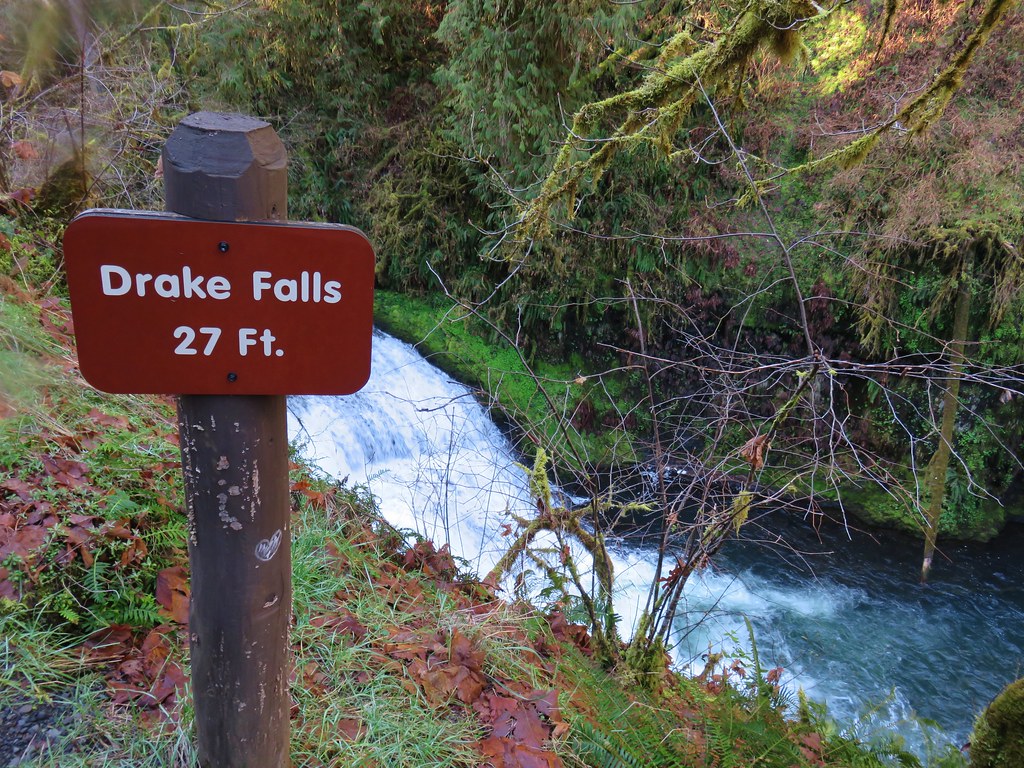
Drake Falls

Drake Falls

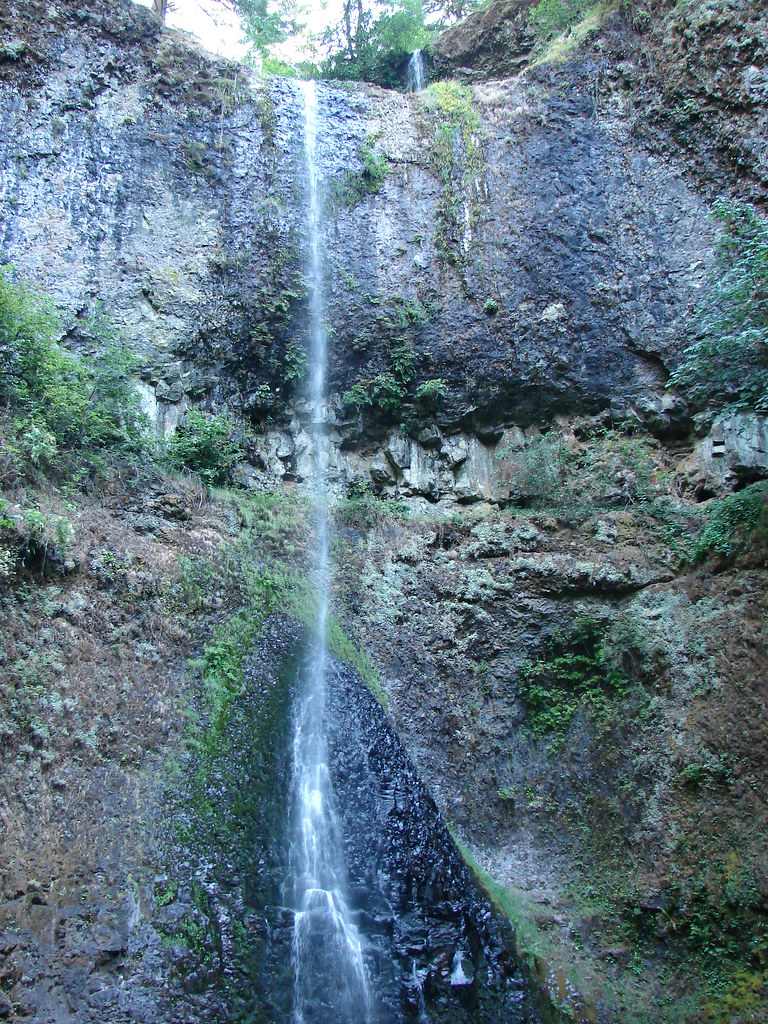
Less than a half mile from the Winter Falls Trail junction we arrived at another junction. This time with a very short spur trail to Double Falls.
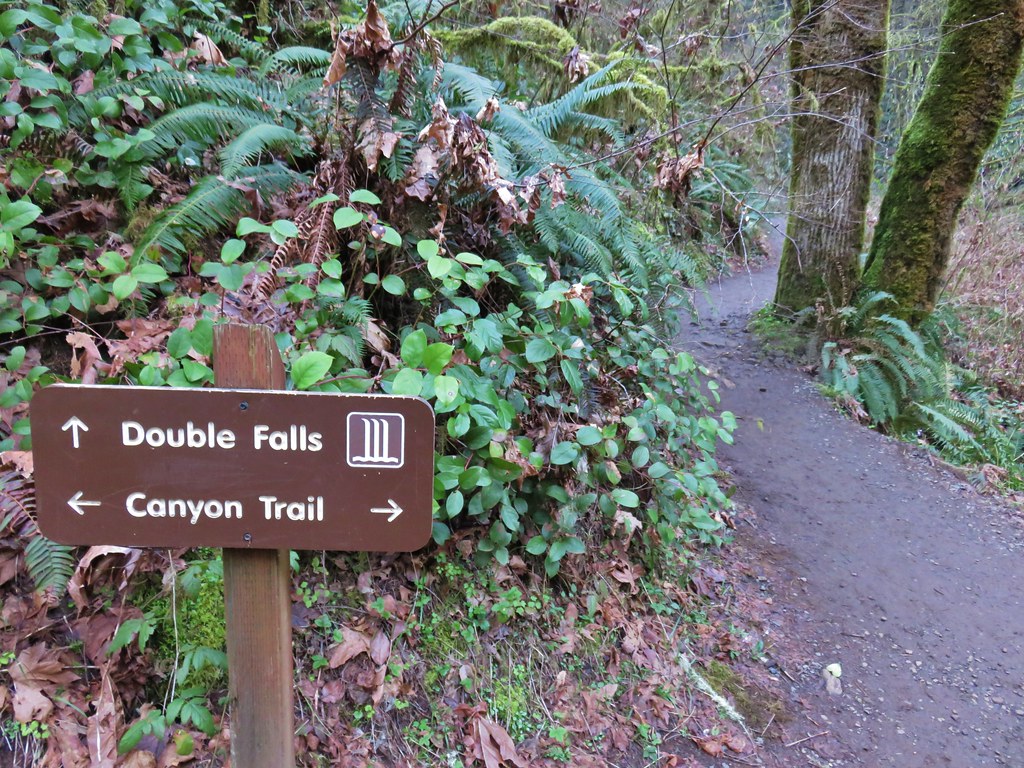
Sign for Double Falls

Here again the difference in water volume was very apparent.
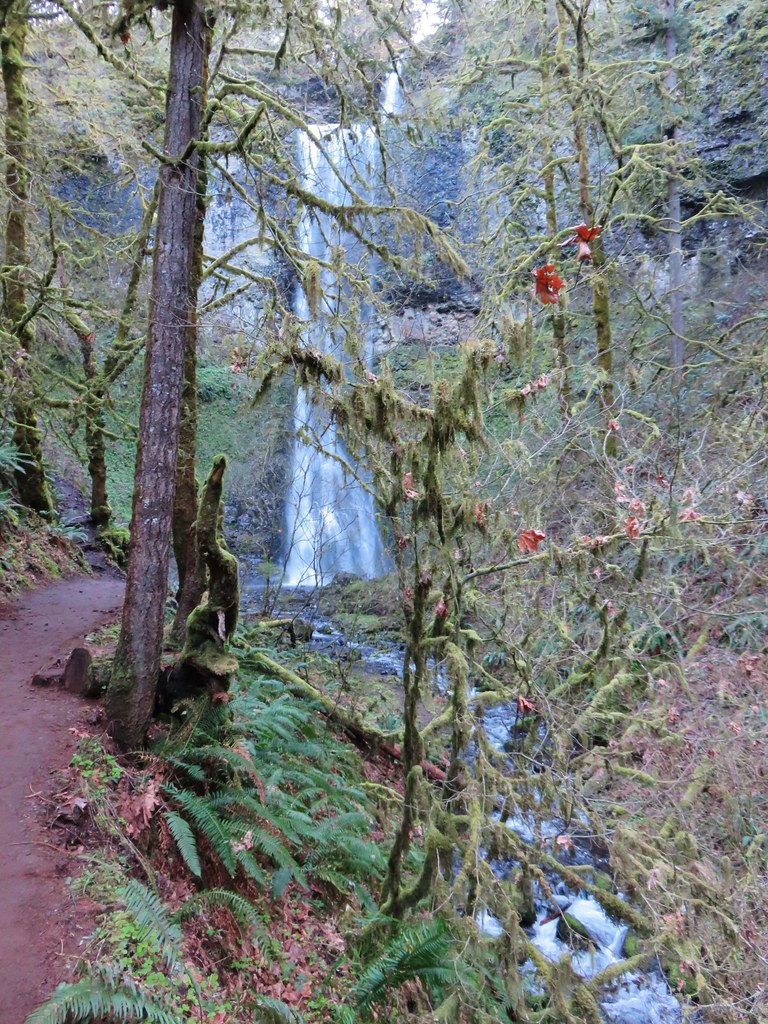
Double Falls

Double FallsJuly 7, 2006

Double FallsJuly 30, 2010

Double FallsMarch 29, 2018

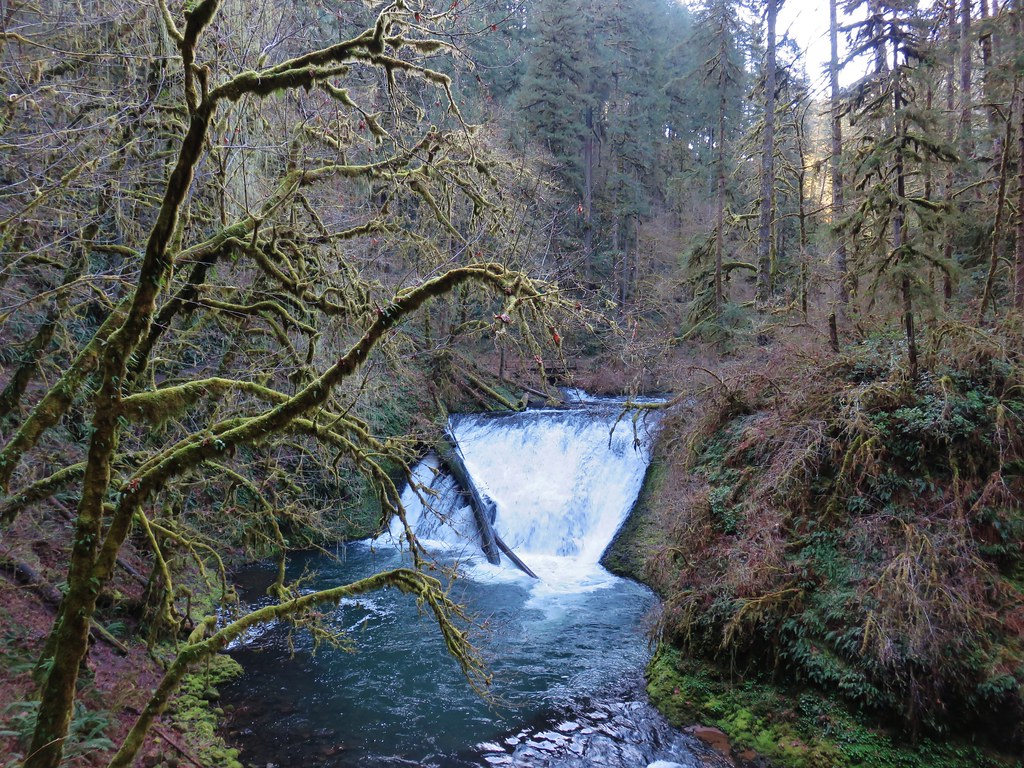
Just beyond the spur trail to Double Falls the Canyon Trail passed 30′ Lower North Falls.
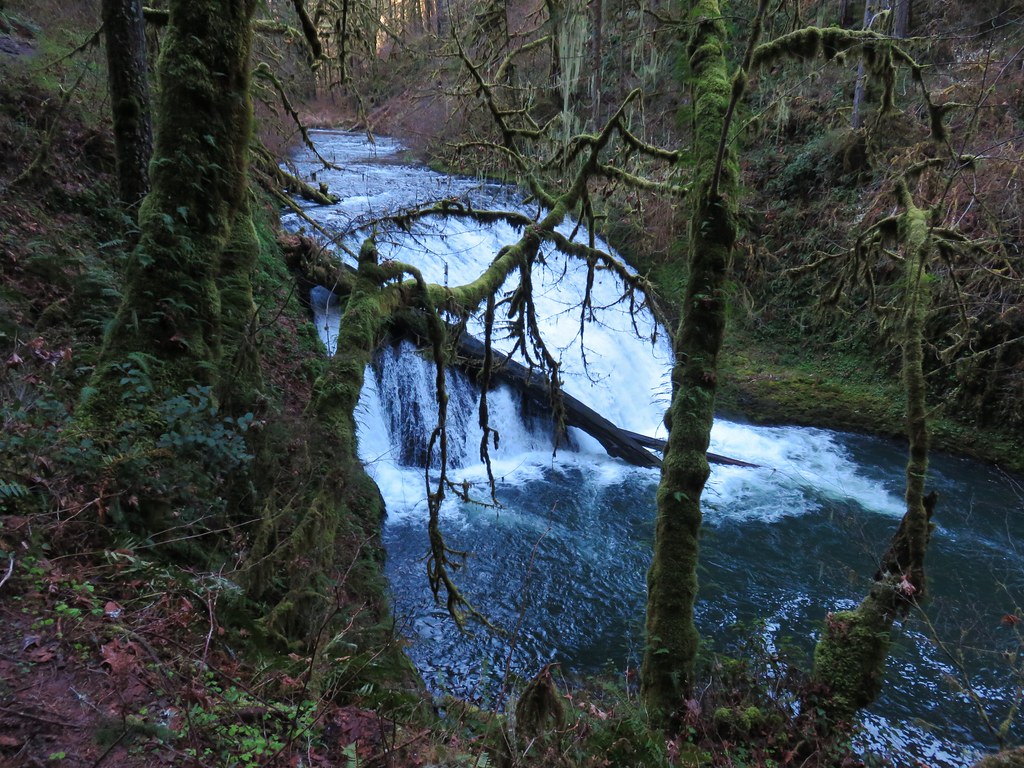
Lower North Falls

Lower North Falls

After the flurry of waterfalls in the three quarters of a mile between Twin Falls and Lower North Falls things settled down. The trail continued on the north side of the creek for about a quarter of a mile before crossing over on a footbridge.
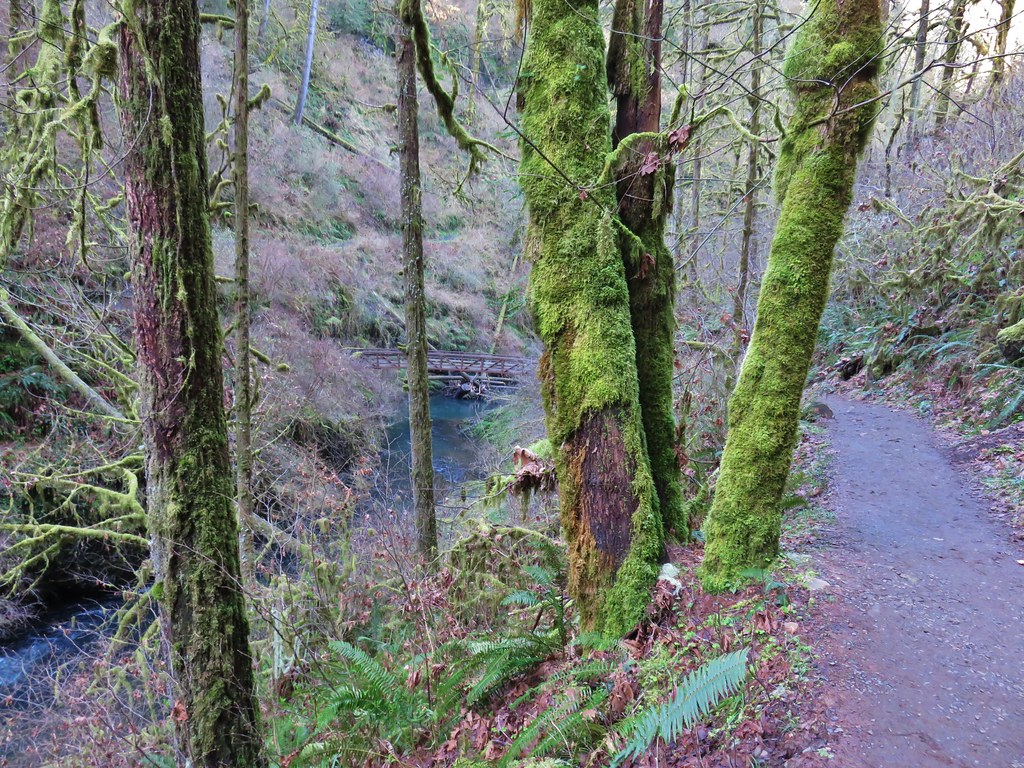
Footbridge over North Fork Silver Creek

The trail then stayed on the south side of the creek passing an unnamed seasonal waterfall.
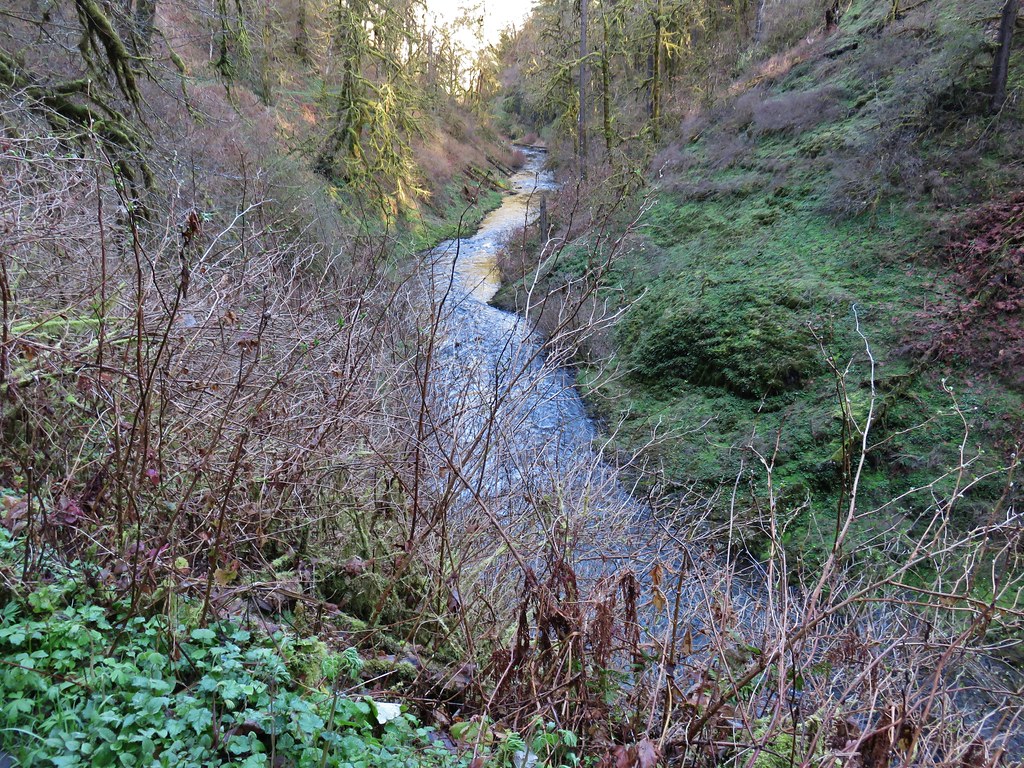
North Fork Silver Creek

Unnamed waterfall in Silver Falls State Park

The trail soon veered away from North Fork Silver Creek and a mile from the spur trail to Double Falls we arrived at a junction with the Maple Ridge Trail.
Maple Ridge Trail junction

The Maple Ridge Trail allows for a shorter loop option if you start at the South Falls Day Use Area but that loop only passes three waterfalls. It was however our escape route on our first visit when the heat of August and our lack of carrying water forced us to abandon our attempt at the full loop. The Canyon Trail here rejoined a creek but not the North Fork Silver Creek. This was now the South Fork Silver Creek. A short distance upstream we came to Lower South Falls.
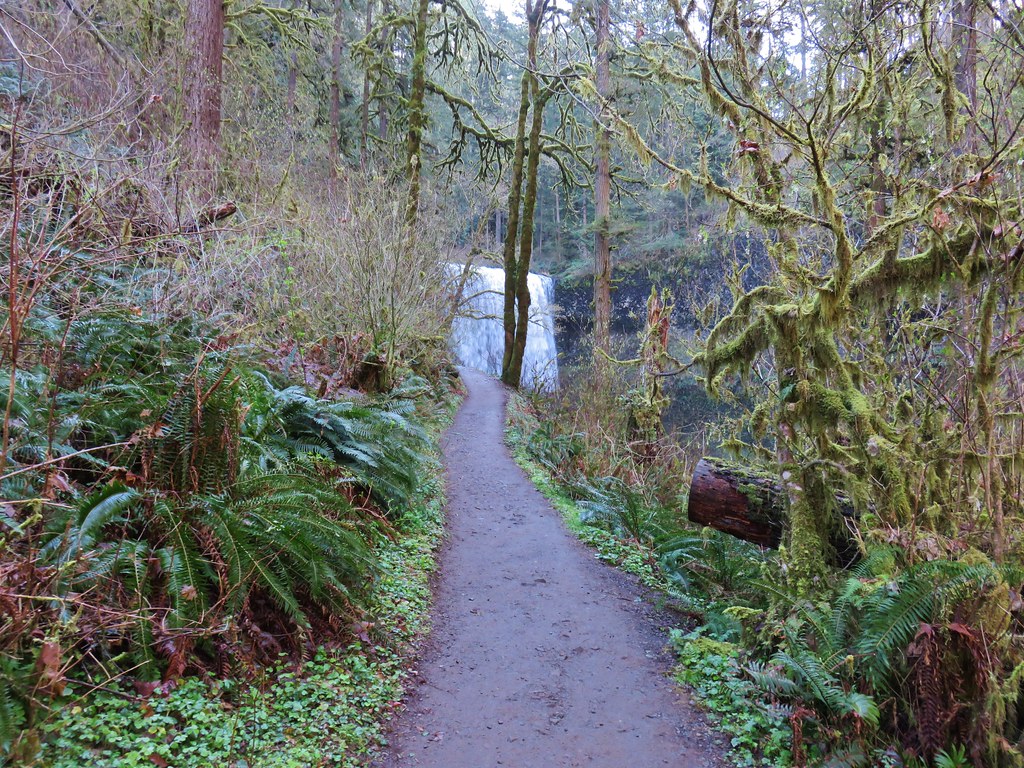
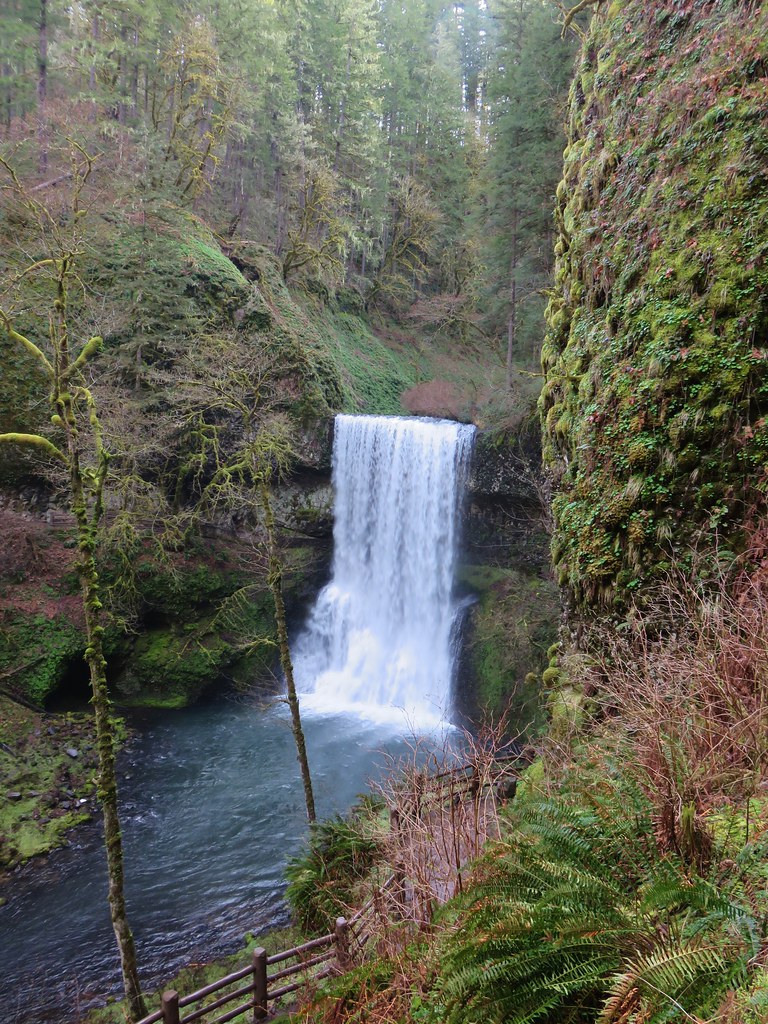
Lower South Falls

Lower South Falls

Lower South Falls is another that the trail passes behind but before we headed behind the water a varied thrush landed on a branch just a few feet from us. I’ve mentioned before that these birds are my nemesis as I can rarely get a decent photo of one. This guy was no exception, despite his sitting on the branch for a good 15 seconds or more I could not get the camera to focus on him.
Varied Thrush at Lower South Falls

Having failed to get a clear picture of the bird we headed behind the waterfall and out the other side.
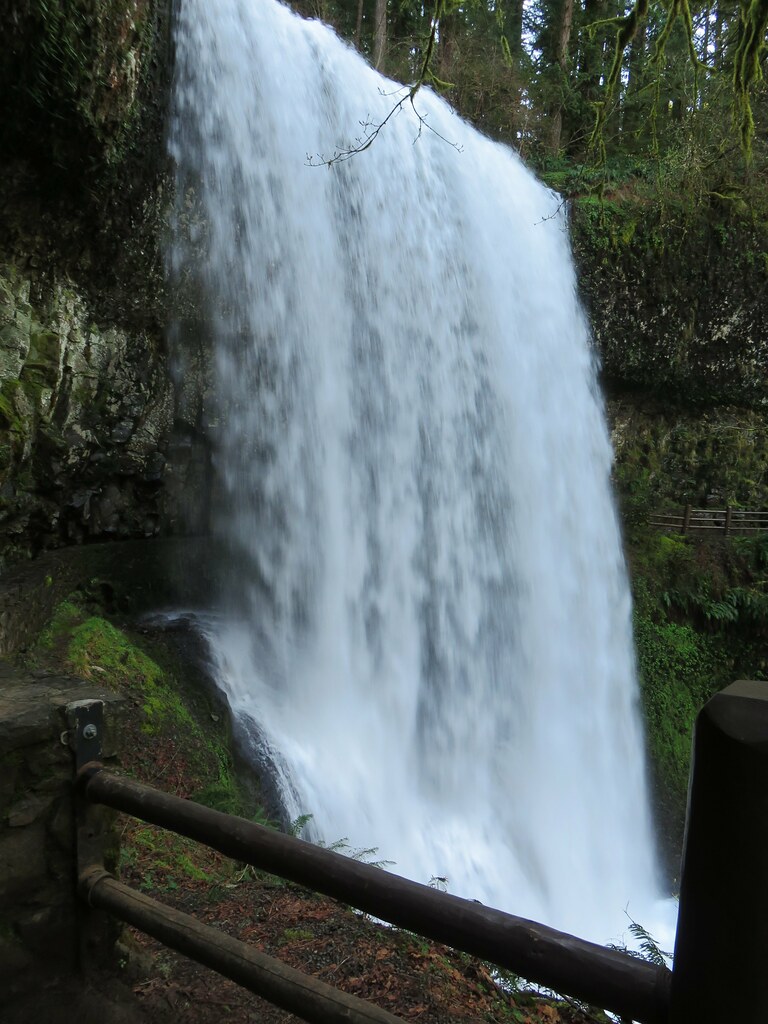
Lower South Falls

View from behind Lower South Falls

Lower South Falls

Again the difference in the appearance from our previous visits to this waterfall was obvious.
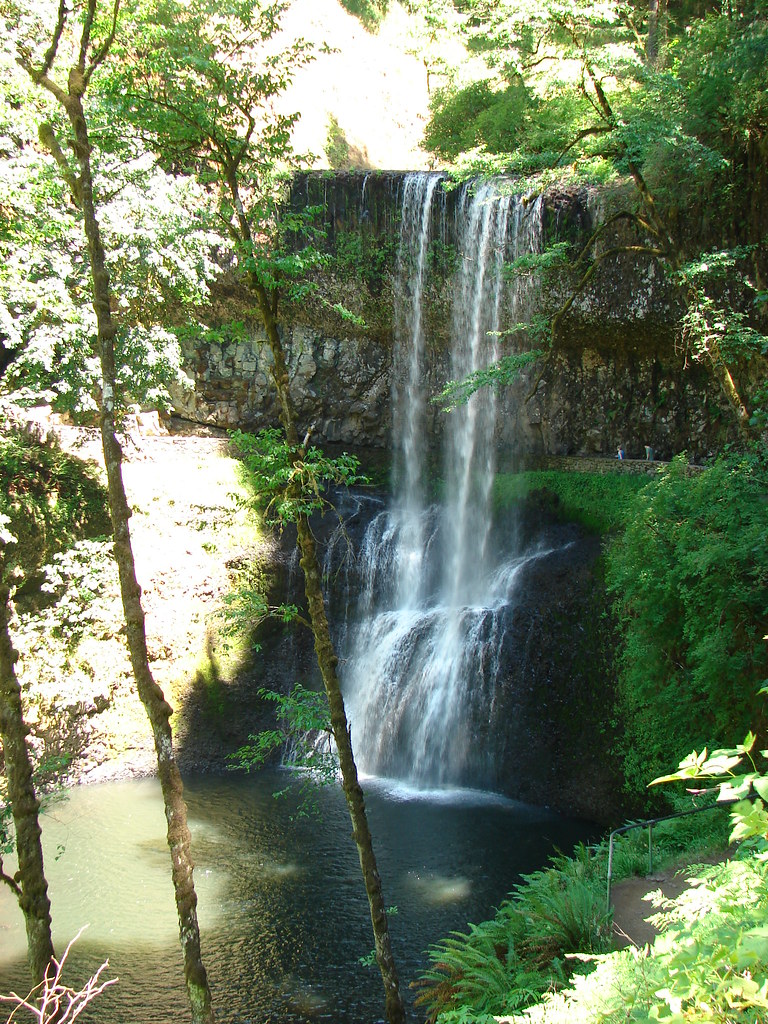
Lower South FallsJuly 7, 2006

Lower South FallsJuly 30, 2010

Lower South FallsMarch 29, 2018

Another series of stairs climbed up above Lower South Falls which was probably the most strenuous part of the hike. The trail then leveled out again for about a mile before arriving at South Falls.
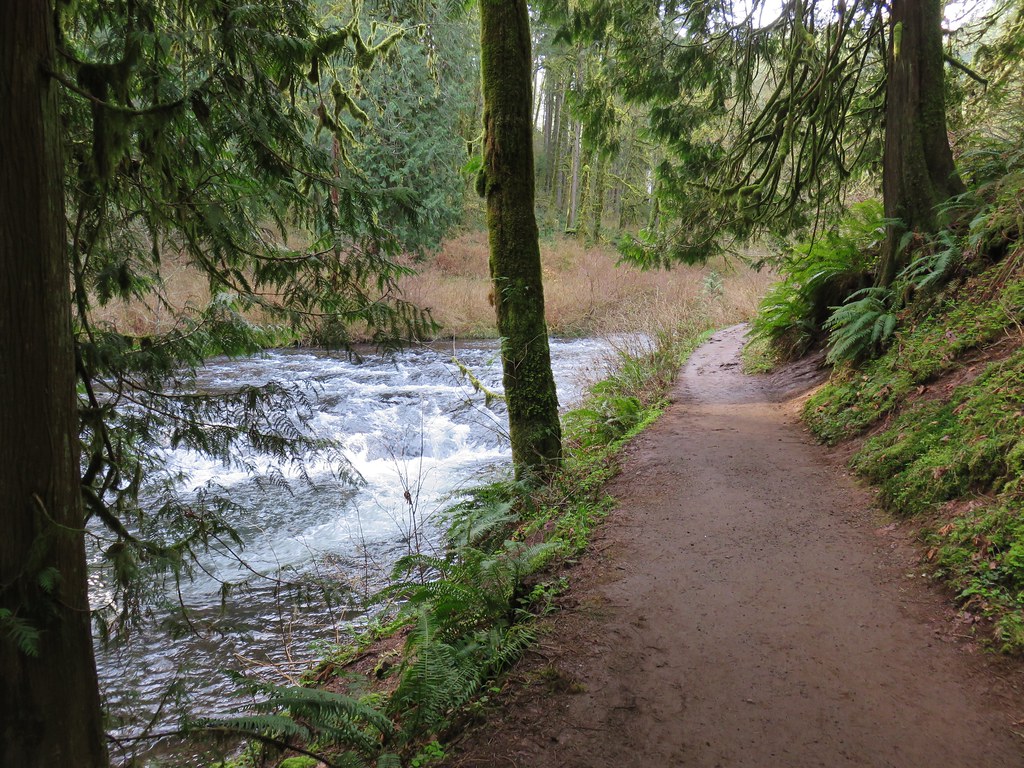
South Fork Silver Creek

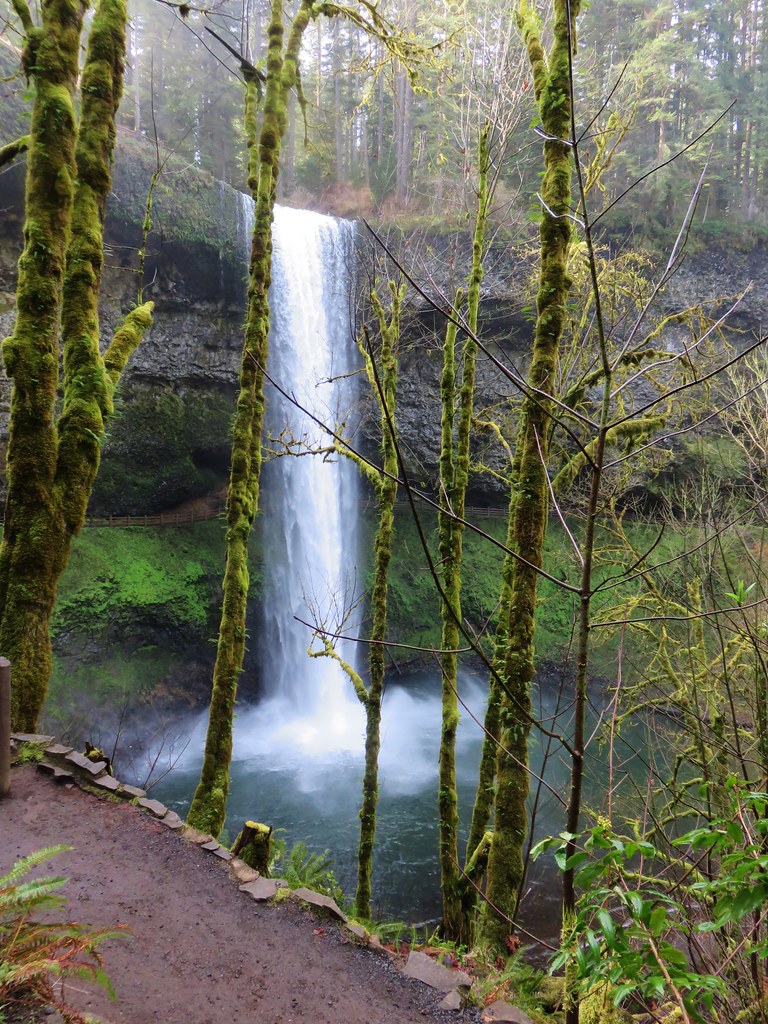
South Falls

A footbridge over the creek below the falls allows for a short loop from the day use area. We passed by the footbridge opting to pass behind this waterfall as well.
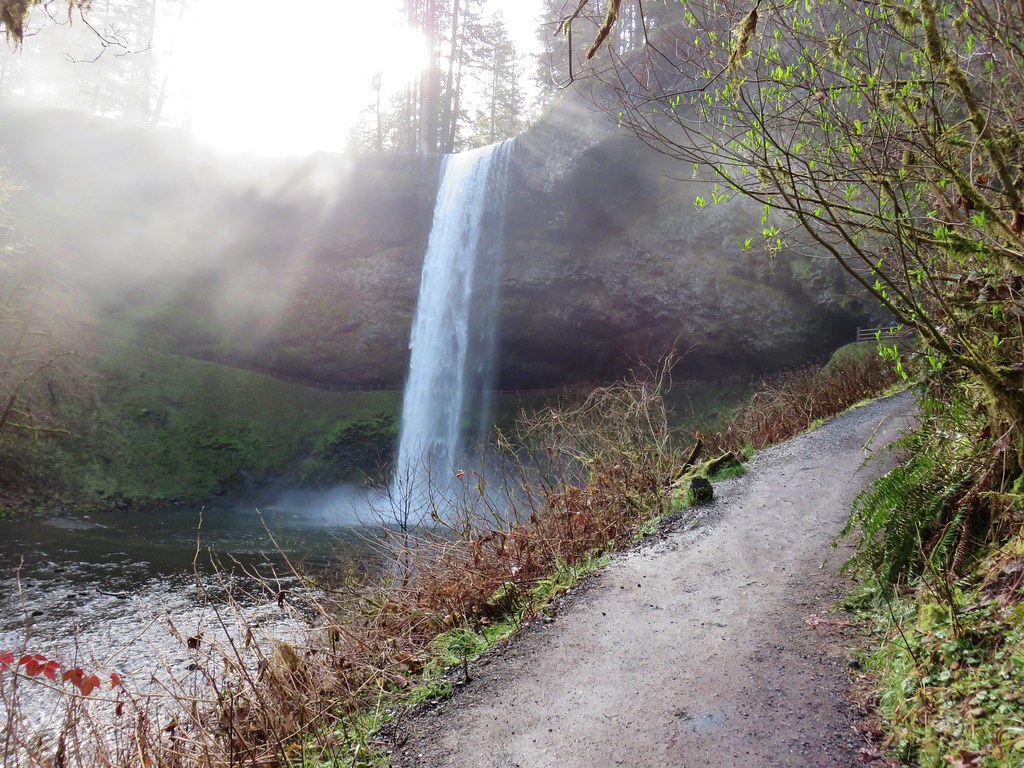
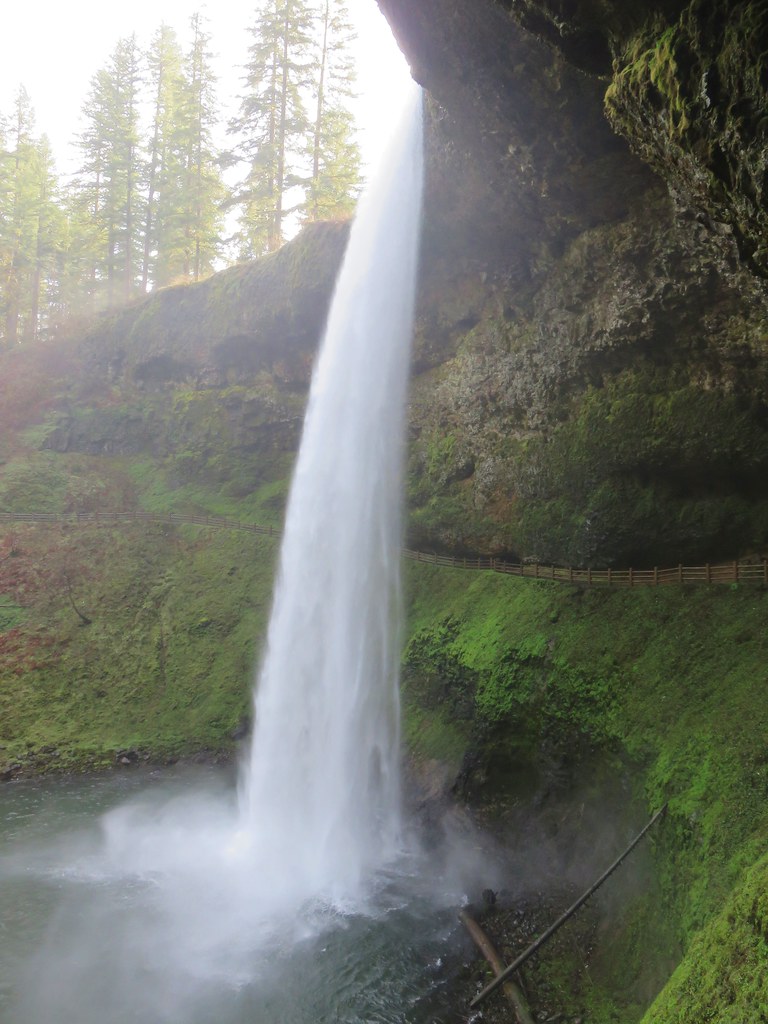
South Falls

South Falls

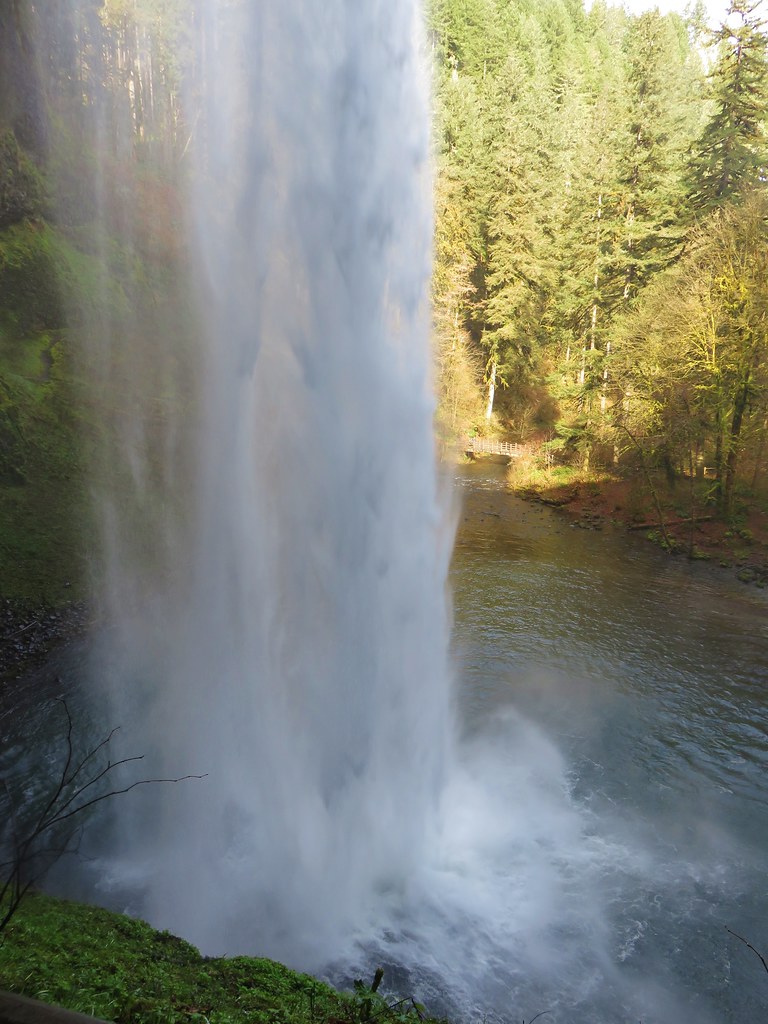
View from behind South Falls

A comparison of our visits shows the difference that the timing of a visit makes.
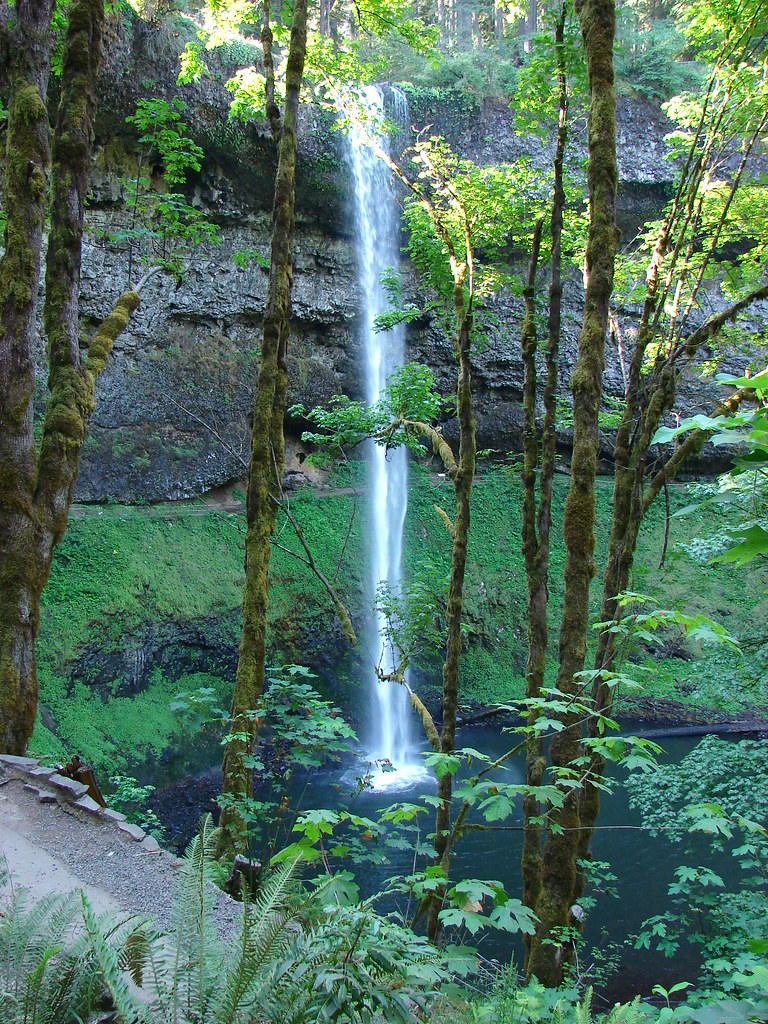
South FallsJuly 30, 2010

South FallsMarch 29, 2018

Doing the loop in the direction we’d chosen made South Falls the 10th of the 10 waterfalls along the Trail of Ten Falls but that didn’t mean it was the last waterfall we’d visit on the hike. That honor went to Frenchie Falls. A sign part way up the trail from South Falls pointed toward this little fall.
Sign for Frenchie Falls

Even at this time of the year it wasn’t much more than a wisp of water and it lacks a good vantage point but it’s a named fall none the less.
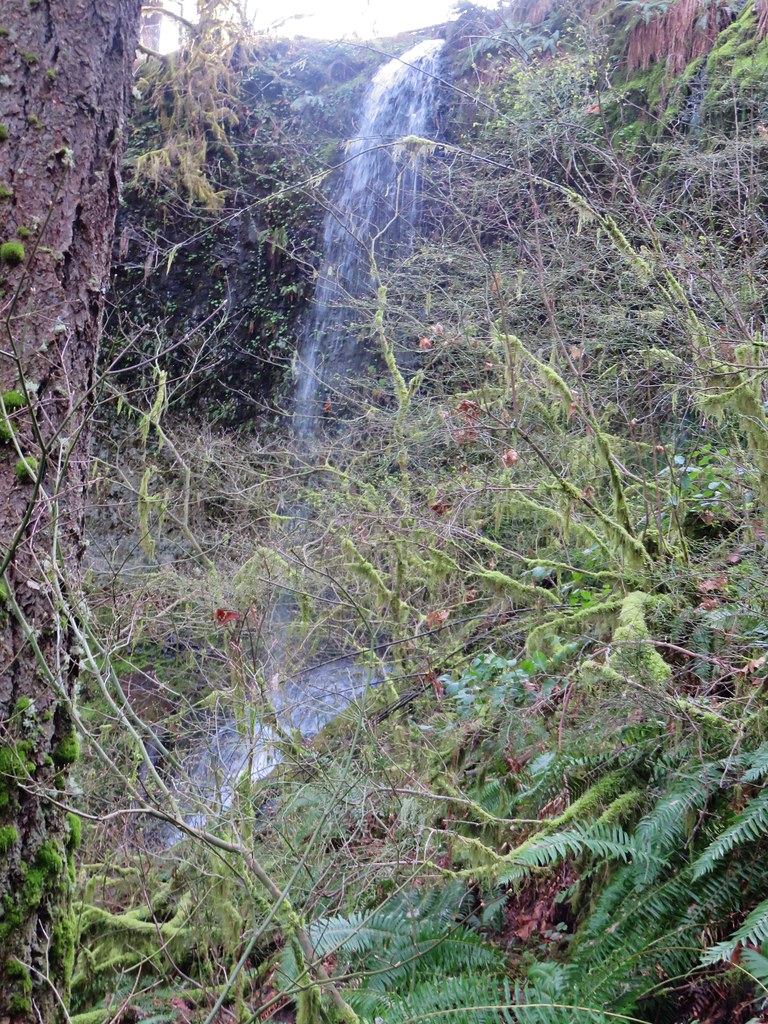
Frenchie Falls

After checking out Frenchie Falls we completed the climb out of the canyon to a viewpoint above South Falls.
Plaque above South Falls

Looking down from the top of South Falls

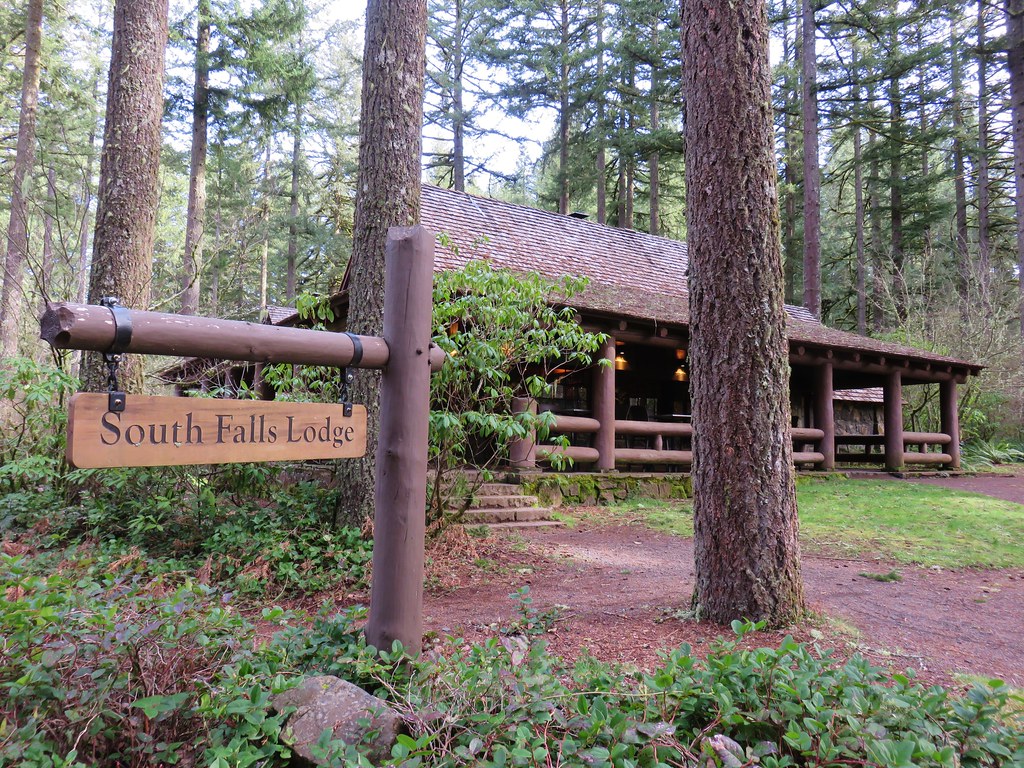
We then looped around a picnic area and into the South Falls Historic District.
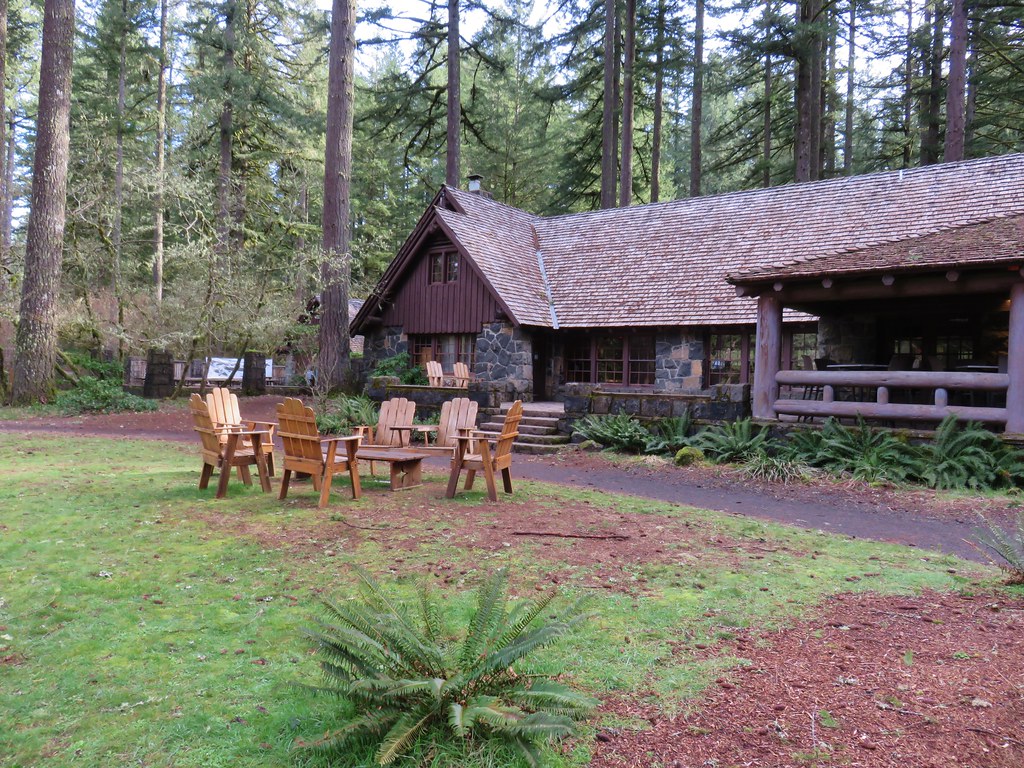
South Falls Historic District at Silver Falls State Park

South Falls Lodge

South Falls Lodge

Nature Store

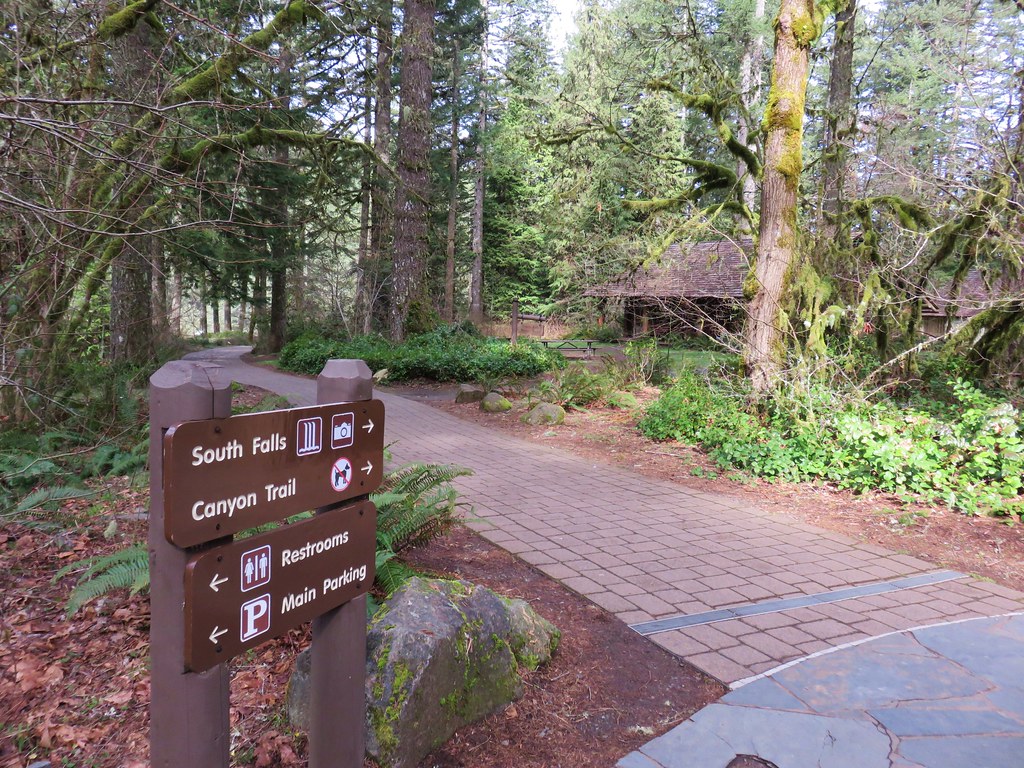
Here we passed the cafe, store and theater before arriving at a junction with the start of the Maple Ridge and Rim Trails.
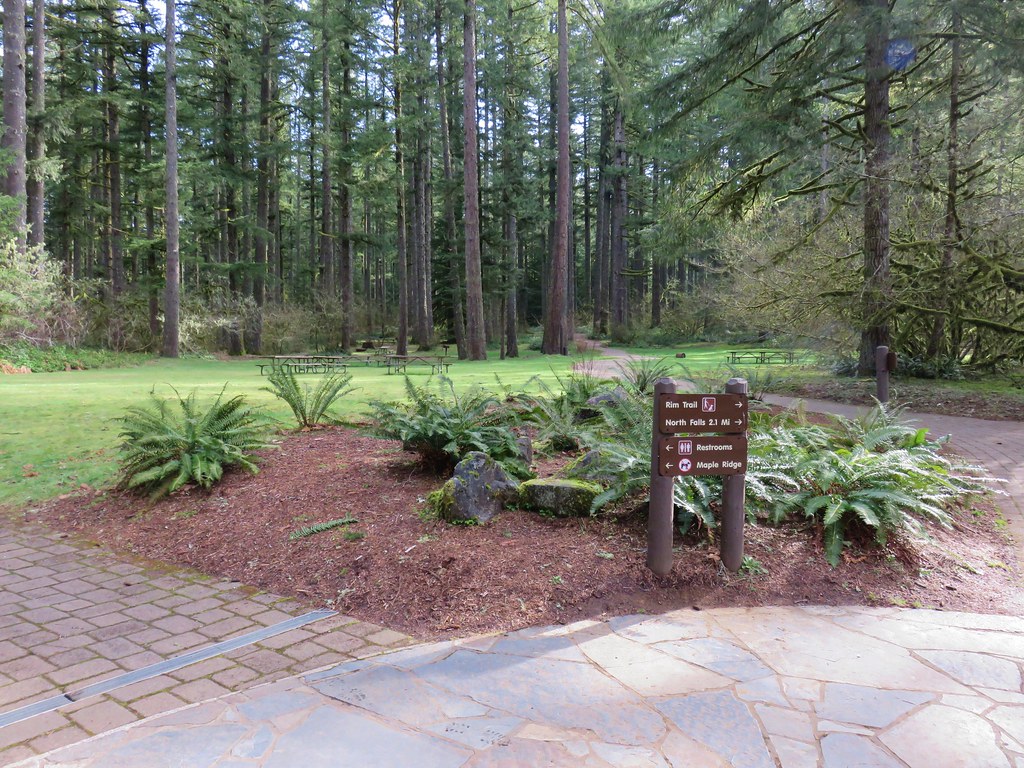
Rim and Maple Ridge Trails

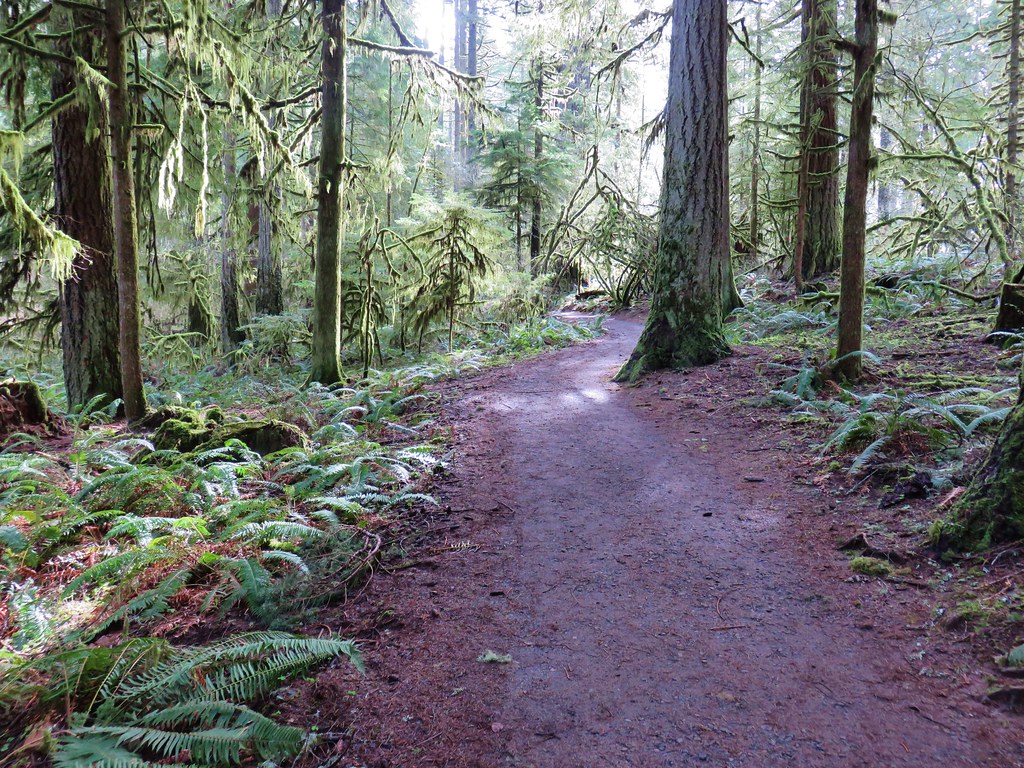
We followed the Rim Trail through a picnic area and into the forest.
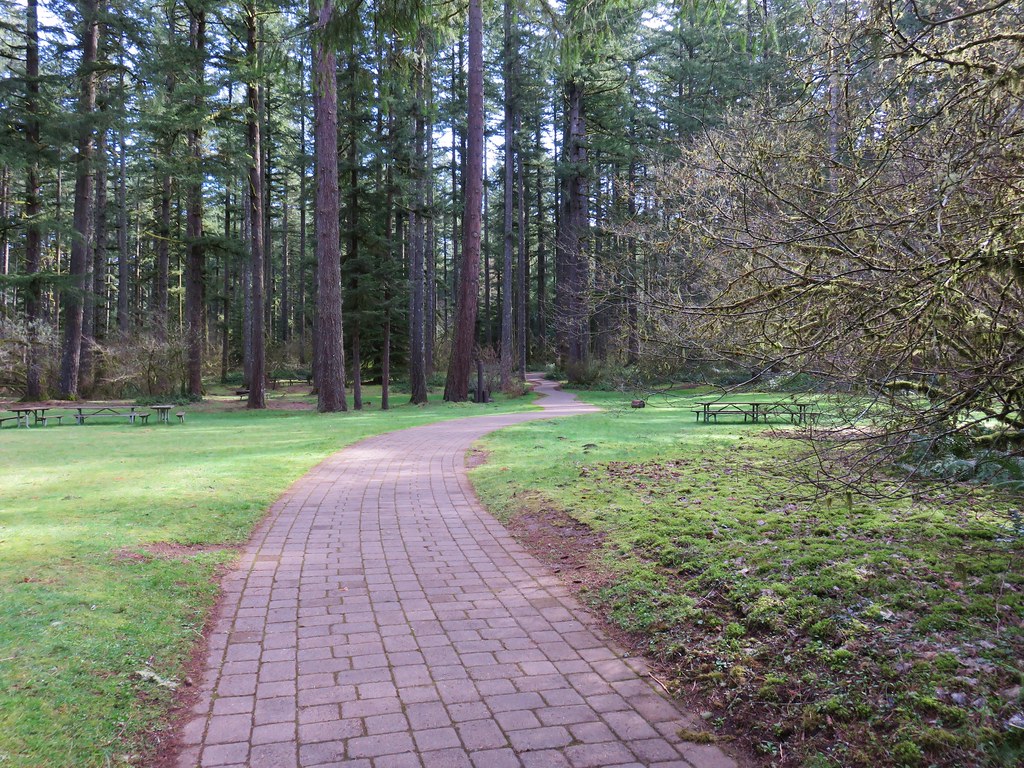
Rim Trail

Rim Trail

Rim Trail

The last of the winter snow was melting as the first of the spring flowers were coming to life.
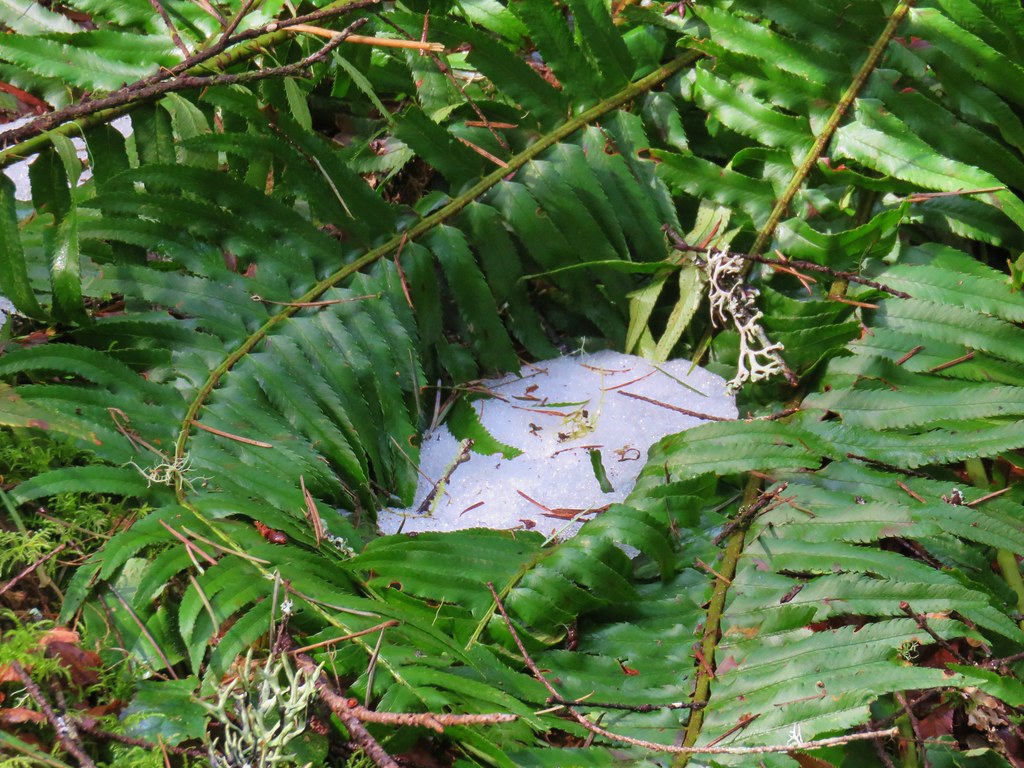
Snow along the Rim Trail

Violet

The Rim Trail passed through the Winter Falls Trailhead parking but offered no views of the waterfall. The only real view of any of the falls came near the end of the 2.1 mile trail when North Falls was visible down in the canyon below.
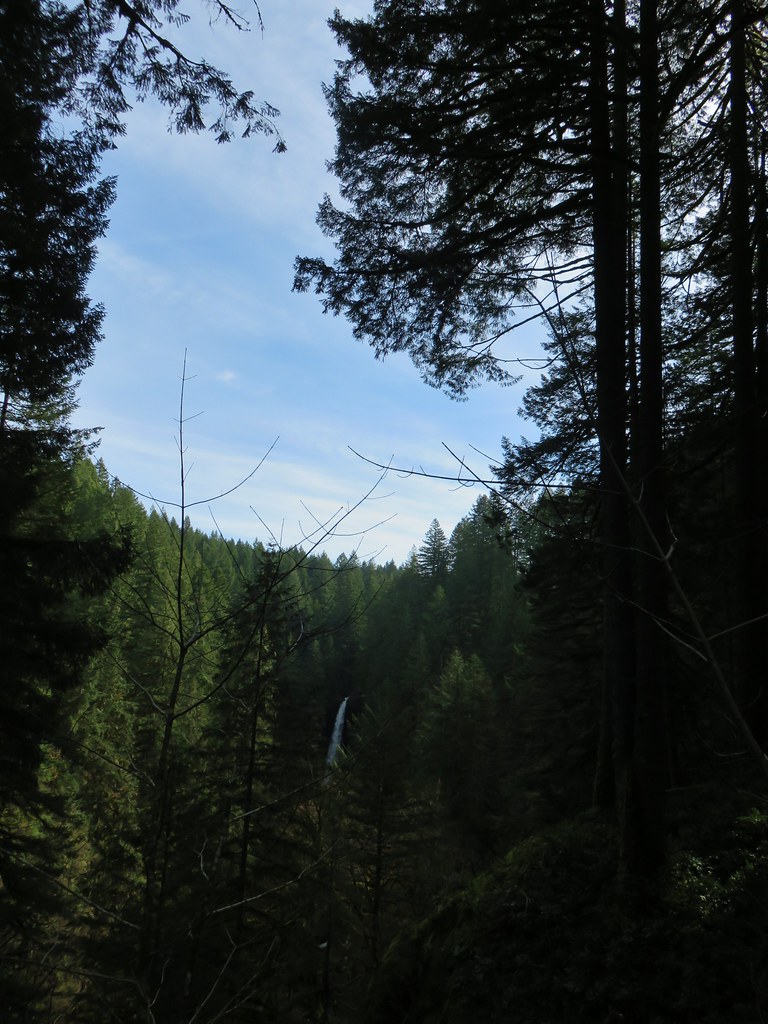
North Falls from the Rim Trail

The pay box was in place at the trailhead (which was now full of cars) so we dropped off our $5 before driving back home.  With all of our previous visits having come during the summer months it was great to visit when the water levels were higher. A few more weeks will bring out the flowers adding to the beauty of this hike. Happy Trails!

Flickr: 2018
2010
2006

Categories
Central Coast Hiking Oregon Oregon Coast Throwback Thursday Trip report

Throwback Thursday – Cape Lookout

This Throwback Thursday hike took place on our 16th wedding anniversary. To celebrate we headed to Cape Lookout State Park on the Oregon Coast. We parked at the Cape Lookout Trailhead where we had three trails to choose from.

Trail sign in Cape Lookout State Park

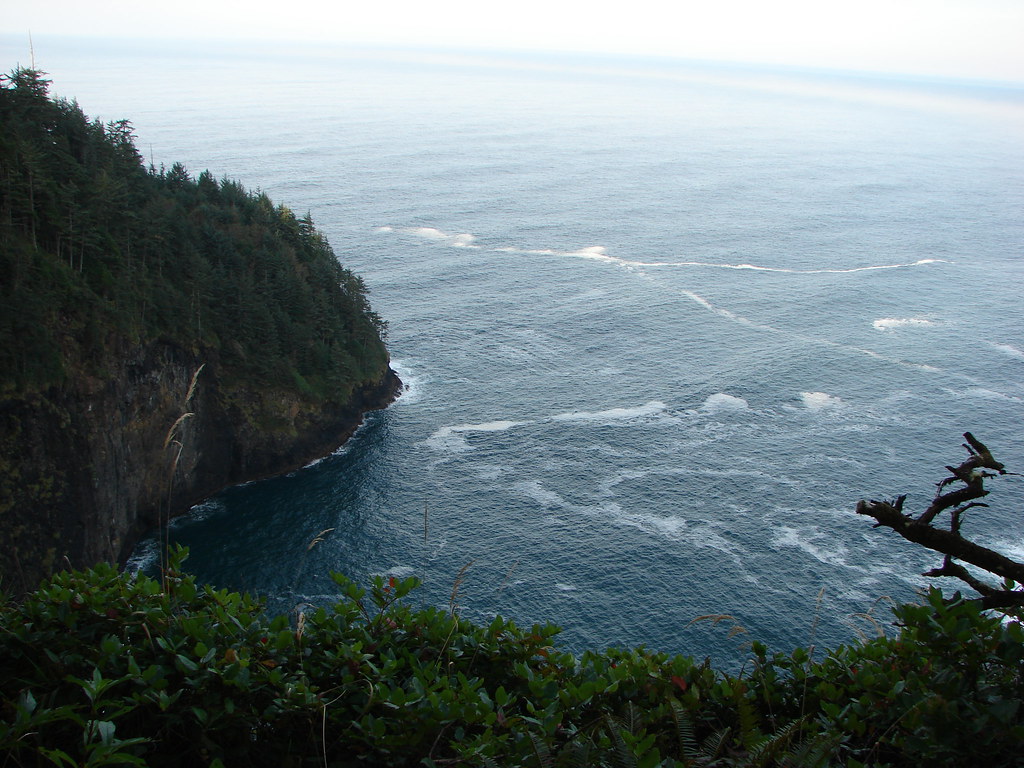
The most scenic (and popular) of the three trails is the Cape Trail which we started out on. This nearly 2.5 mile trail follows Cape Lookout to it a viewpoint overlooking the tip of the Cape. The trail starts out on the southern side of Cape Lookout offering a view after .6 miles of Cape Kiwanda and Haystack Rock near Pacific City (post).

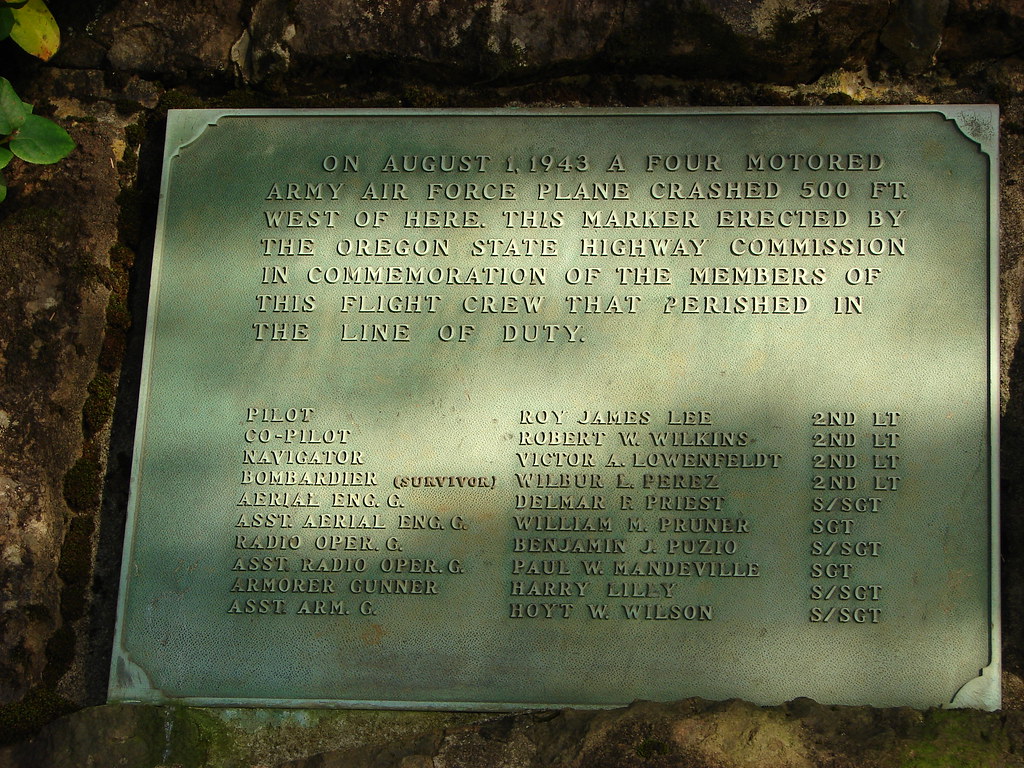
The viewpoint is also near the site where a B-17 bomber crashed in 1943.

Memorial plaque along the Cape Trail

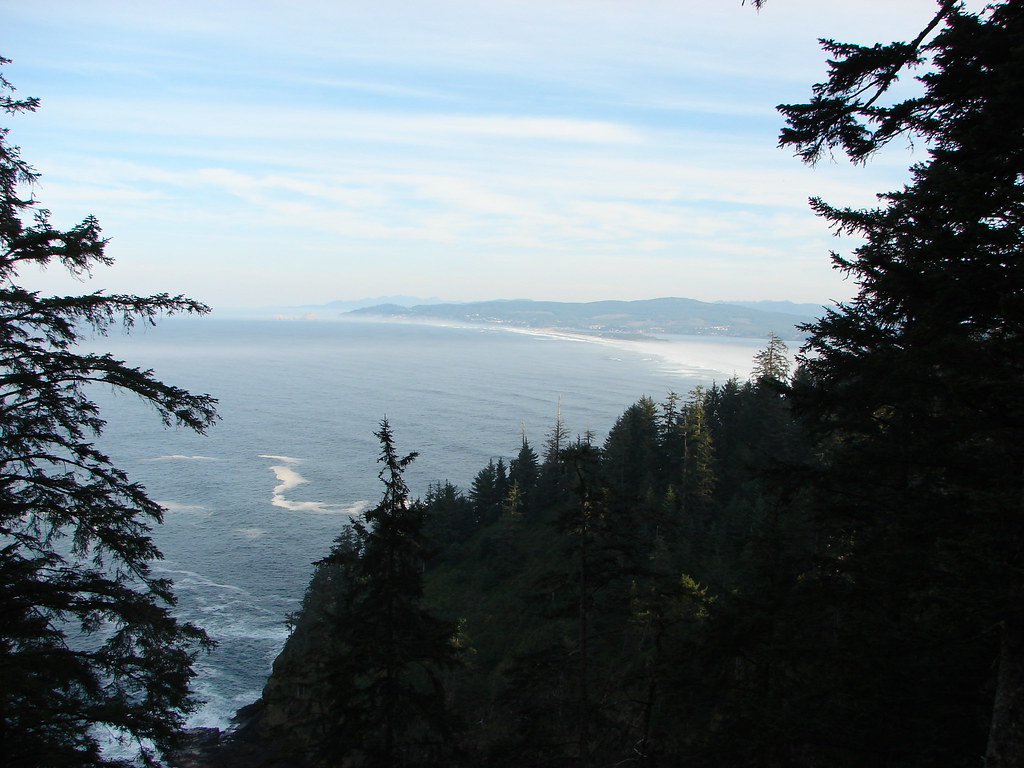
The Cape Trail soon crosses the cape to the northern side where Cape Mears (post) and the Three Arch Rocks Wilderness could be seen.

View from the Cape Trail

Storm Rock, Finley Rock, Shag Rock and Seal Rock

We followed the trail around Wells Cove before it returned to the southern side of the cape.

Wells Cove

Wells Cove

Cape Trail

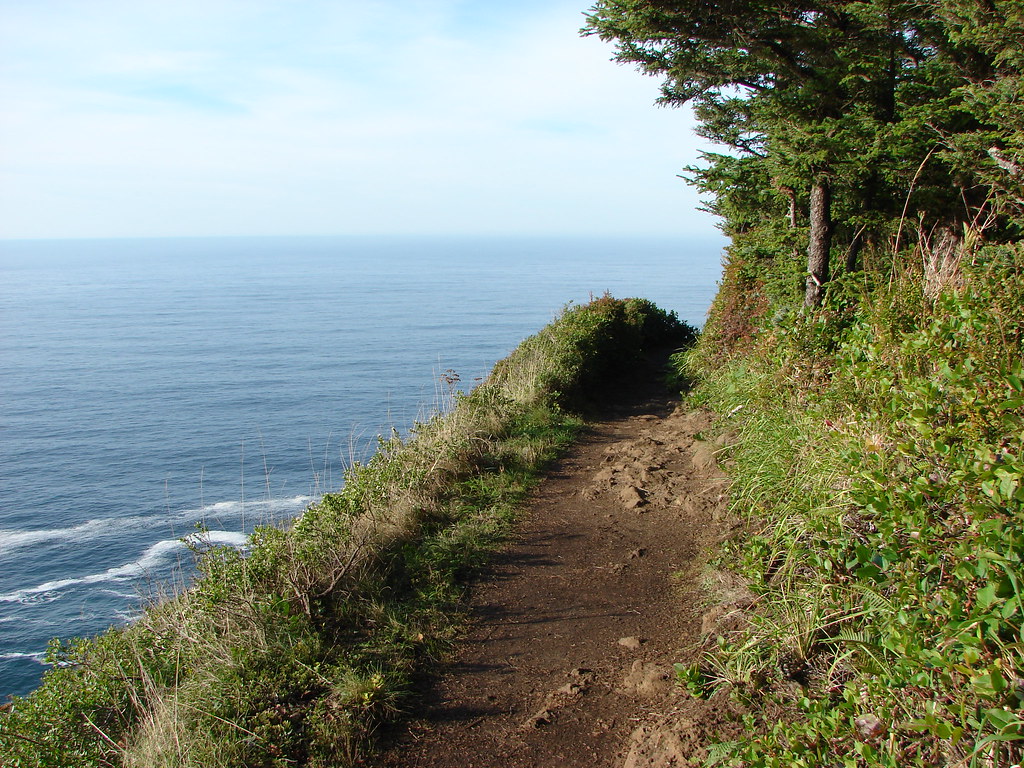
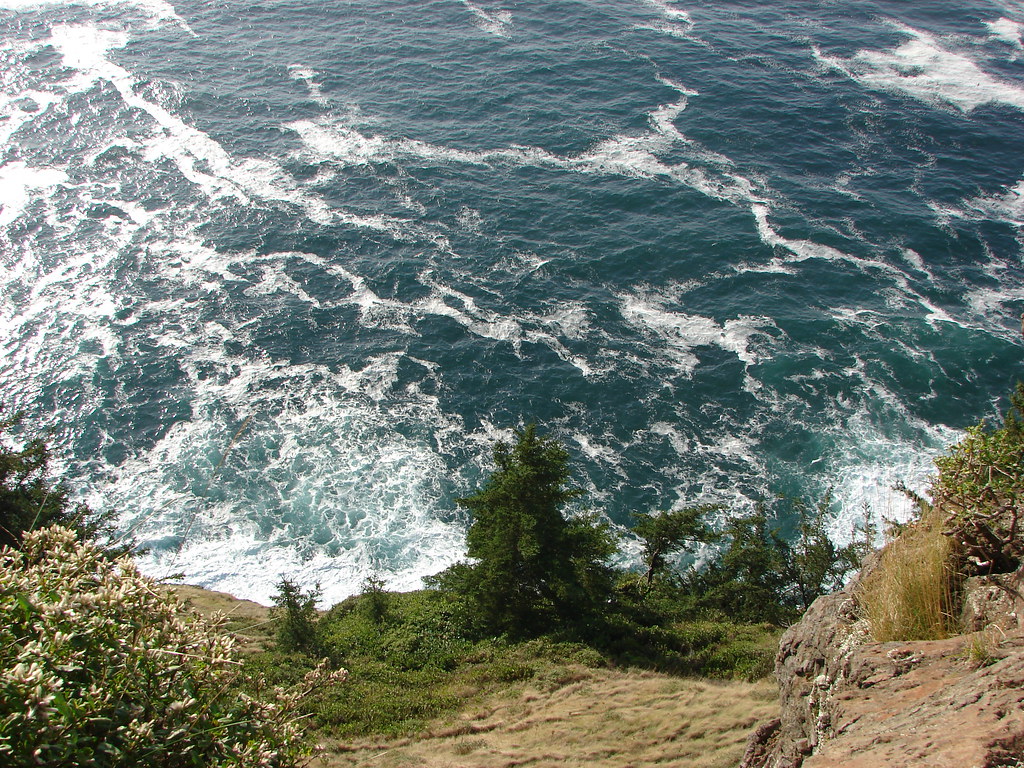
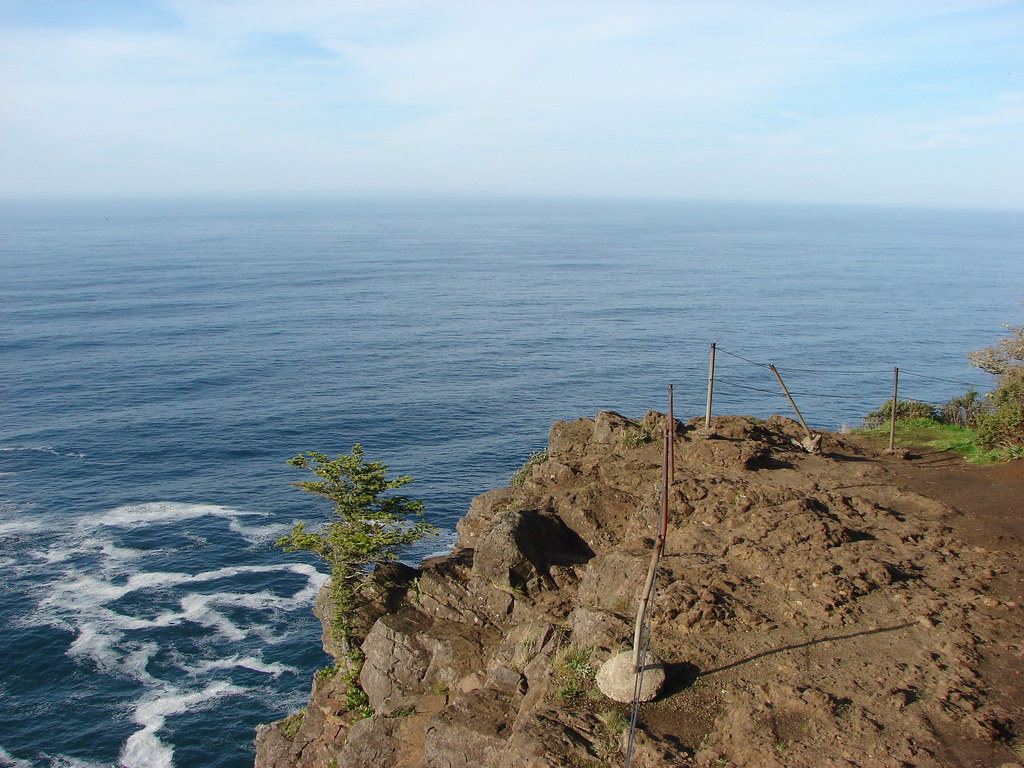
The final stretch of trail offered wide open views down to the Pacific.

View from Cape Lookout

View from Cape Lookout

View from Cape Lookout

It was a busy day on the trail, there had been a few other hikers out as well as several locals along the trail.

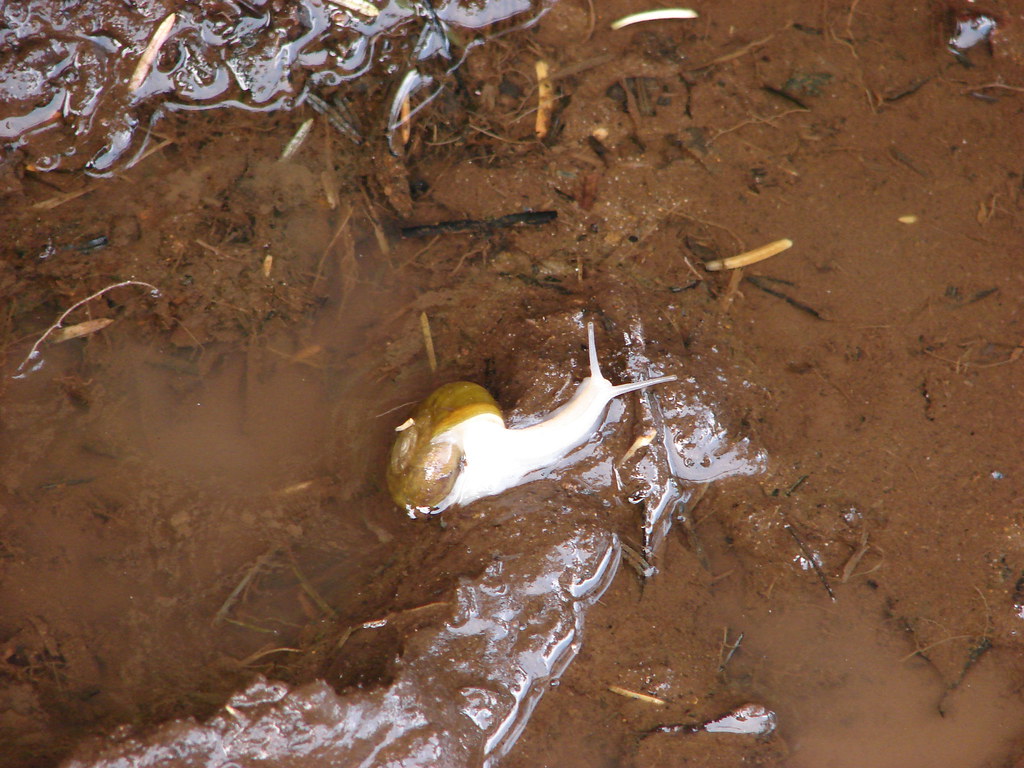
Snail

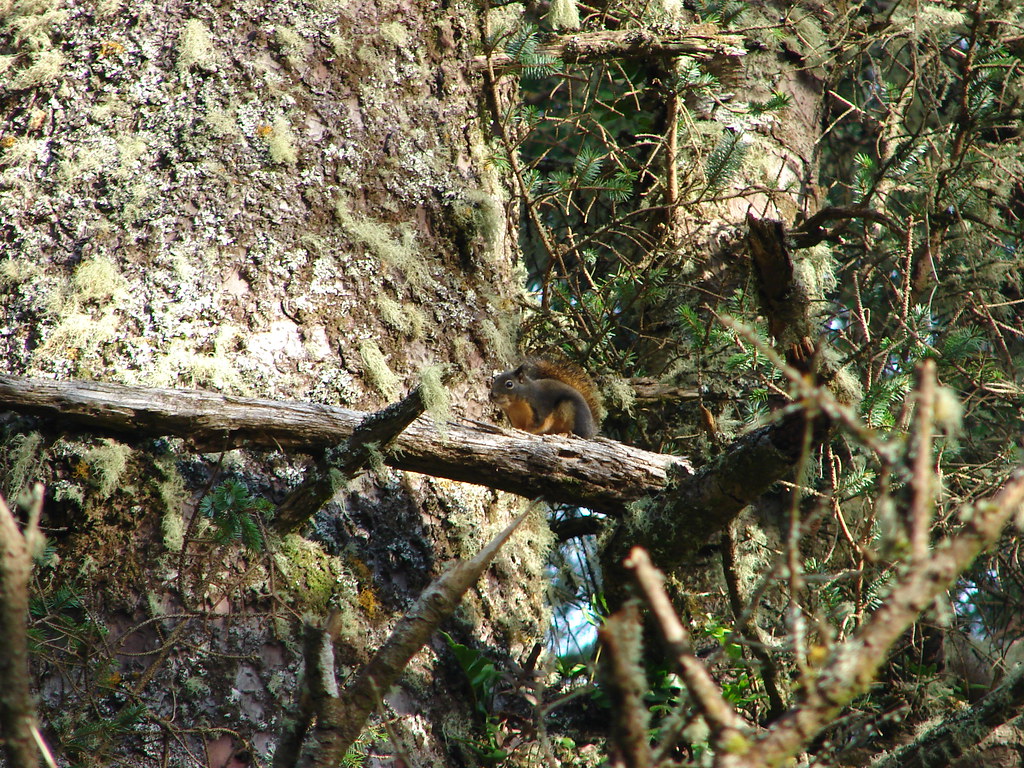
Douglas squirrel

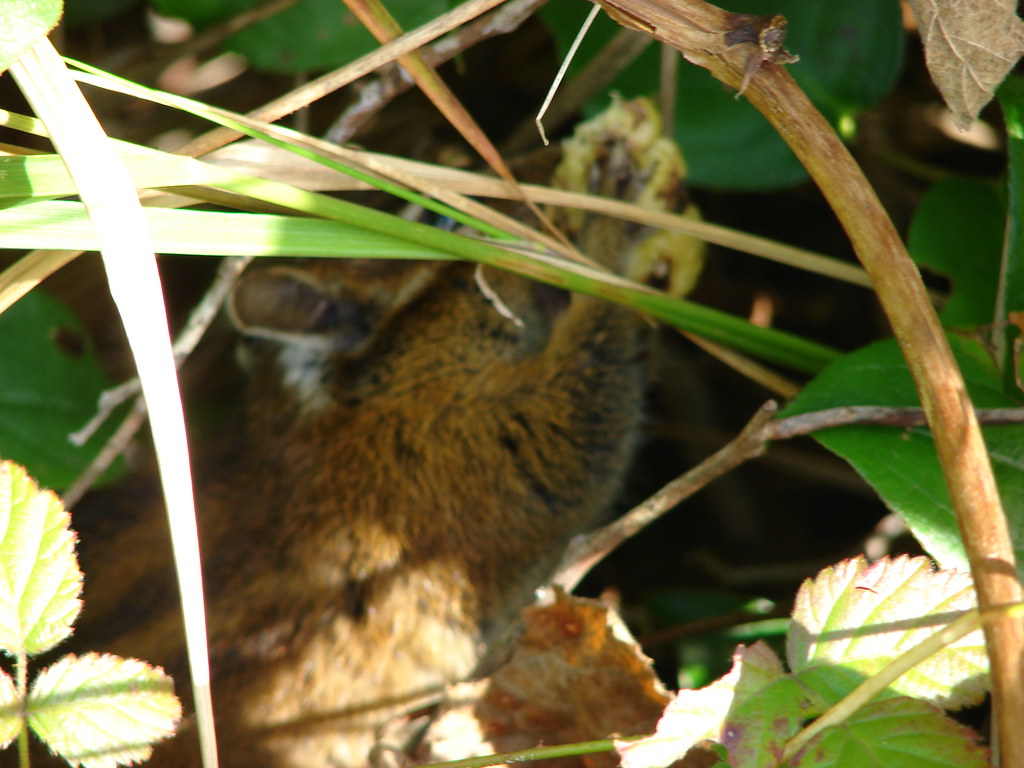
Chipmunk

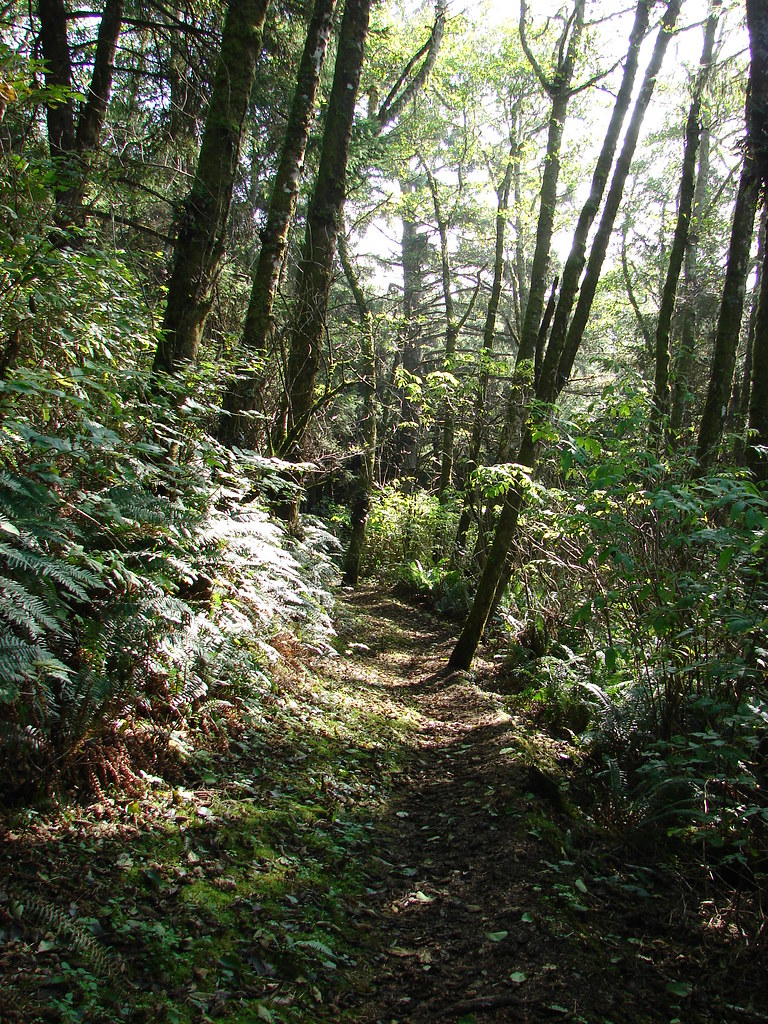
After resting at the viewpoint we returned to the trailhead and decided to try the South Trail which led 1.8 miles down to the beach. The trail switchbacked down through the forest but offered occasional views of the cliff lined southern face of Cape Lookout.

South Trail

Forest along the South Trail

Cape Lookout

We spotted another local on the way down to the beach.

Snake

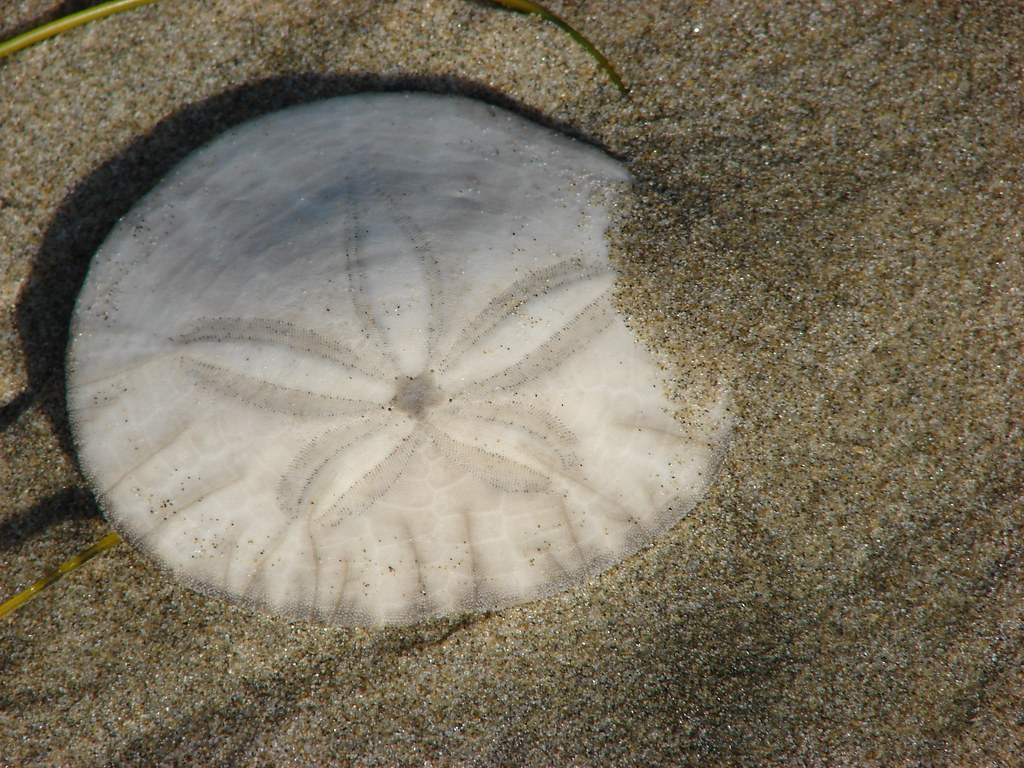
We walked along the beach watching for sand dollars for a bit finally sitting down on a log and taking a nice long break as we listened to the ocean and watched more locals as they went about their days.

Cape Lookout

Sand dollar

Sand dollar

Beach south of Cape Lookout

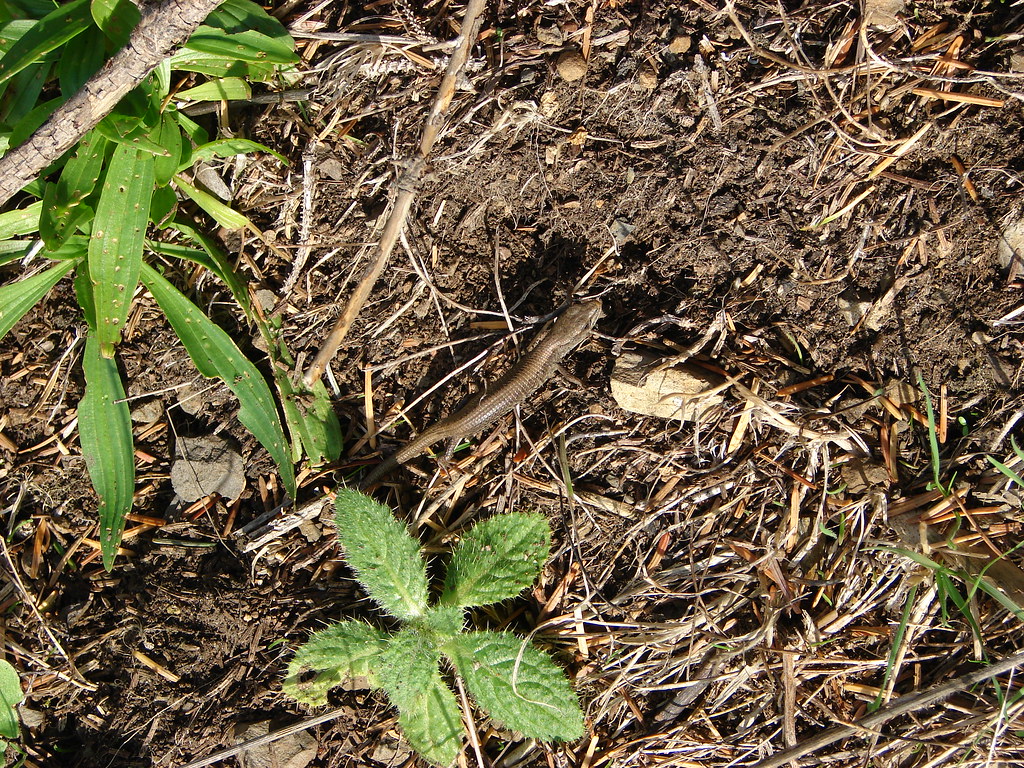
Northern alligator lizard

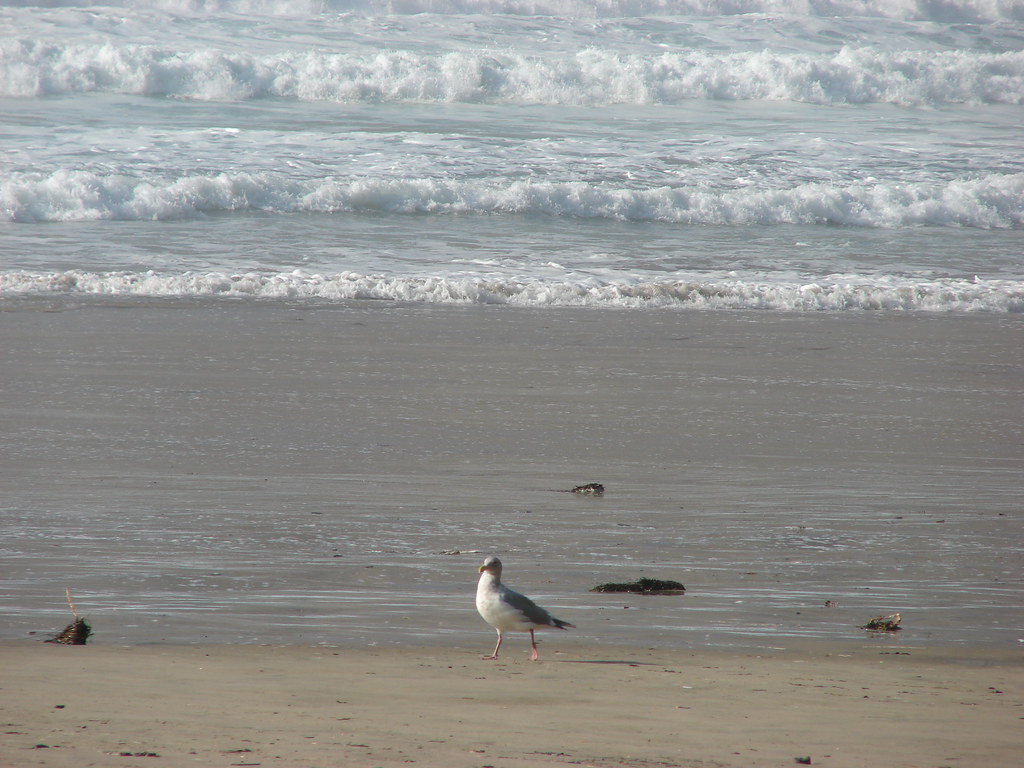
Seagull

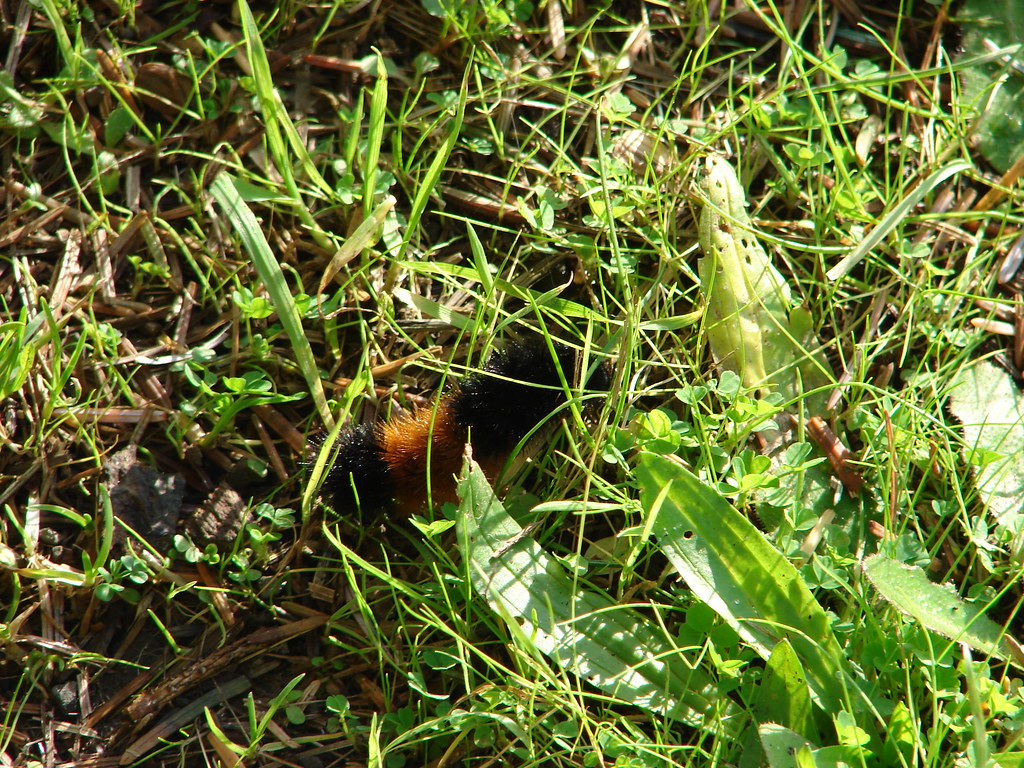
Wolly bear caterpillar

We eventually pulled ourselves away from the hypnotic trance of the Pacific and climbed back up to the trailhead. Other than one woman with her dog that we spotted in the distance we had been the only humans on the beach making it a relaxing way to end the day. Happy Trails!

Flickr: Cape Lookout

Categories
Coastal Range Hiking Oregon Throwback Thursday Trip report

Throwback Thursday – Elk & Kings Mountains

This week’s Throwback Thursday hike features one of the most challenging hikes in the Oregon Coast Range. On 8/16/2010 we headed to the Elk Creek Trailhead located just off Highway 6 twenty-four miles west of it’s junction with Highway 26 near Banks, OR.

This was one of our earliest hikes so we were still on a steep learning curve and in hindsight August probably wasn’t the best time of year for this particular hike but not knowing any better we arrived at the trailhead for an early morning start. After reading the information posted at the start of the trail we began wondering exactly what we were getting into.
Elk Mountain Trail information

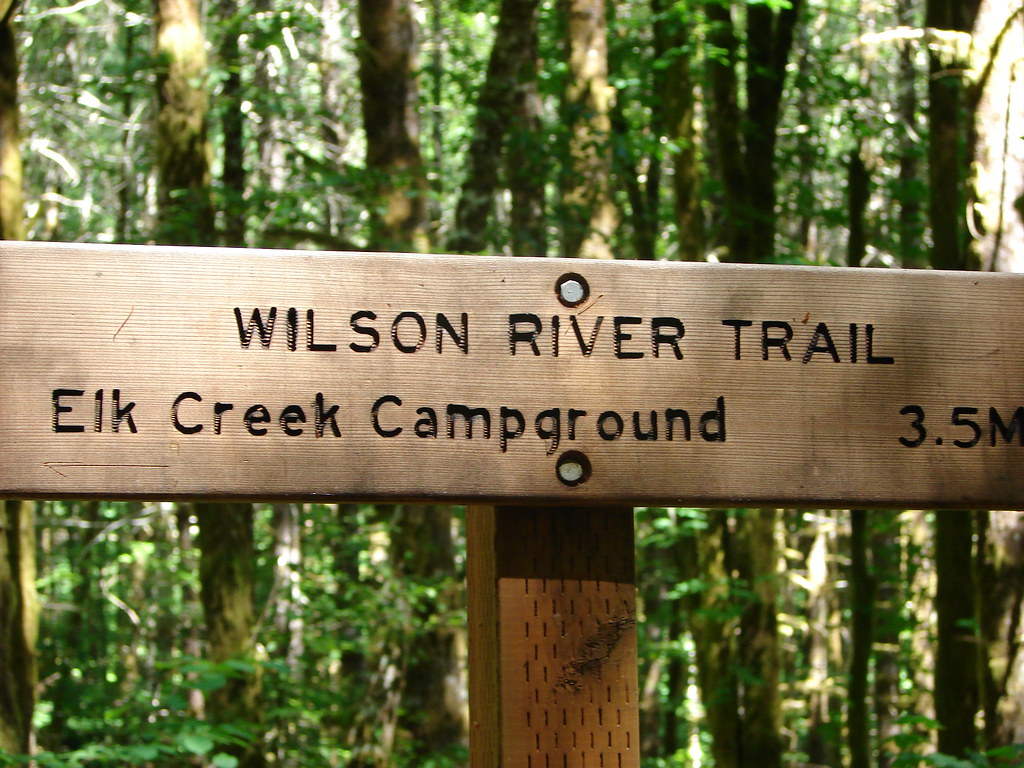
Our plan was to do the nearly 11 mile loop which came with nearly 4000′ of elevation gain. We set off at a sign for the Wilson River Trail which crossed Elk Creek then split after .2 miles. The Wilson River Trail continued to the left and would be our return route. We veered right continuing onto the Elk Mountain Trail.
Trail sign at the Elk Mountain Trailhead

Elk Creek

Trail sign for the Elk Mountian Trail

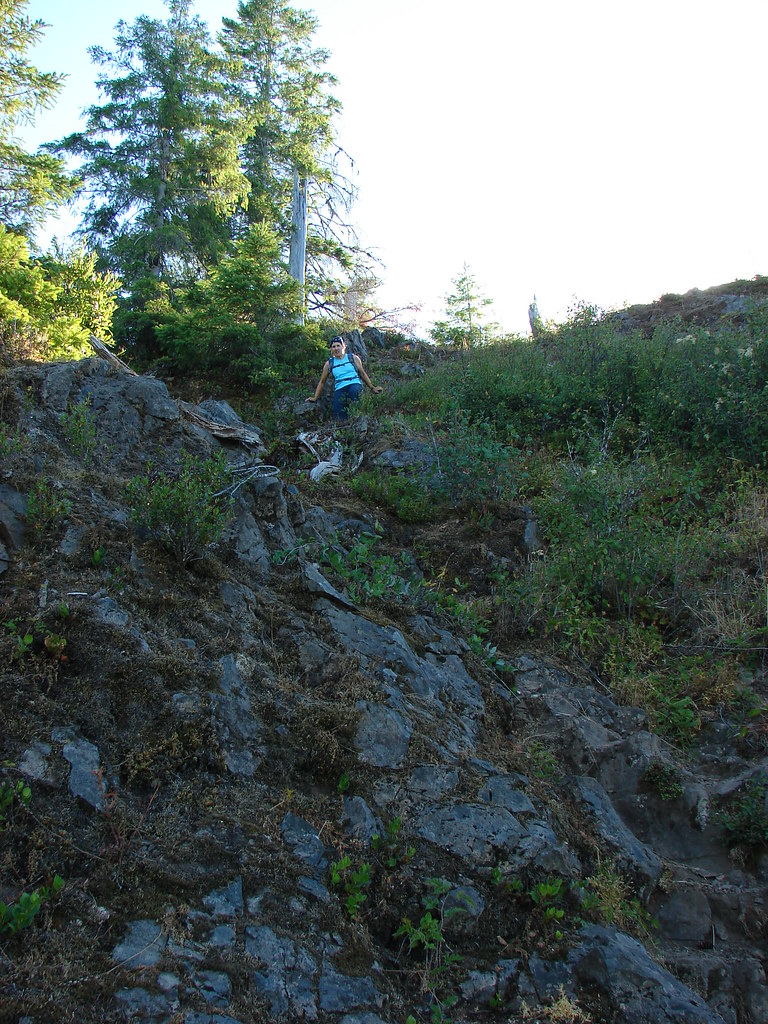
We were, as usual, following William Sullivan’s guidebook in which he describes the the Elk Mountain Trail as having “all the subtlety of a bobsled run”. The nearly 1.5 mile climb was certainly deserving of that description and was unlike any trail we’d experienced to that point. In fact this hike was the impetus for looking into and eventually getting trekking poles as we were at times forced to use our hands to make it past sections of loose scree.
Elk Mountian Trail

Elk Mountian Trail

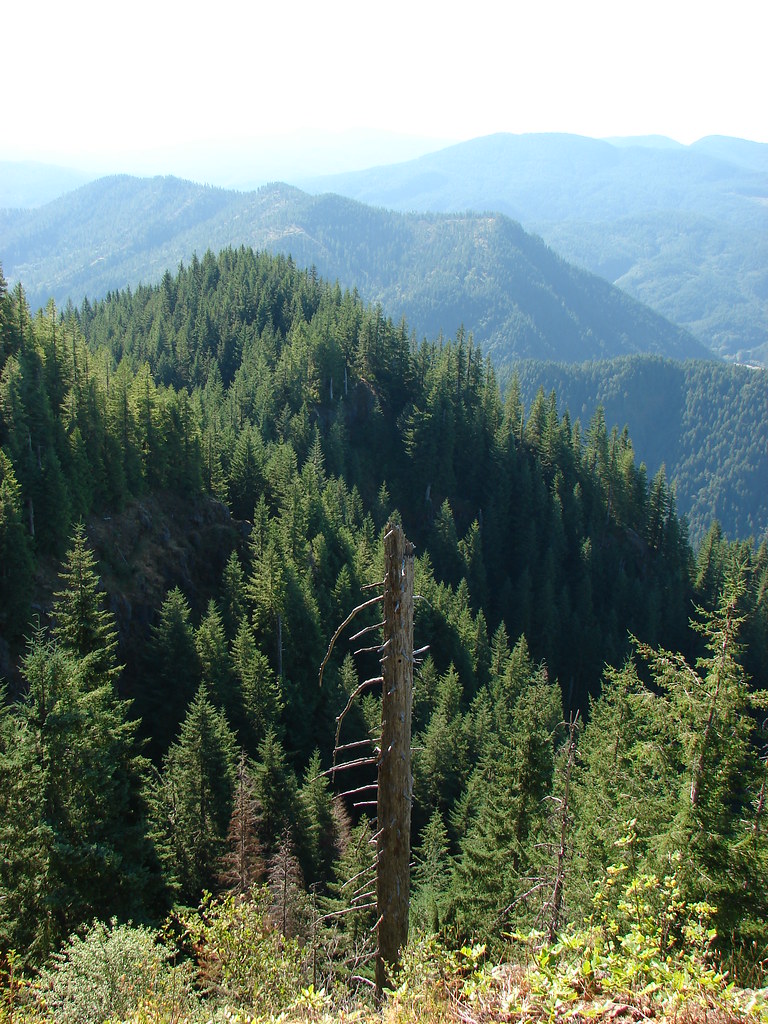
The trail did have some positive attributes including some views that were not for folks made nervous by heights.
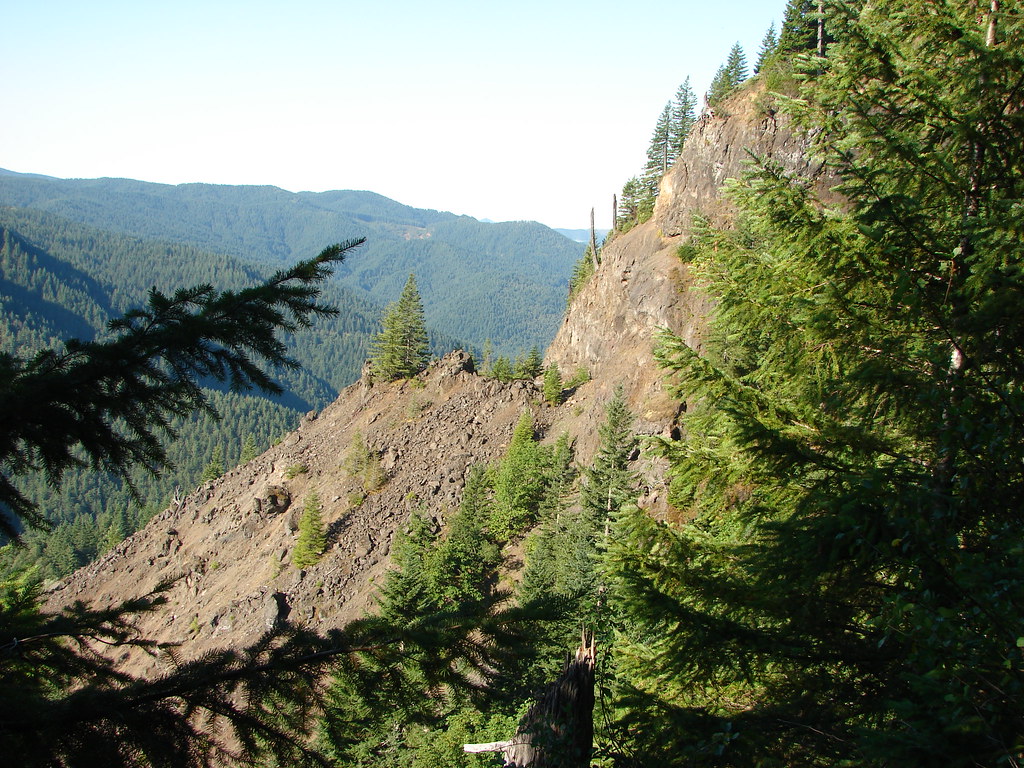
View from the Elk Mountian Trail

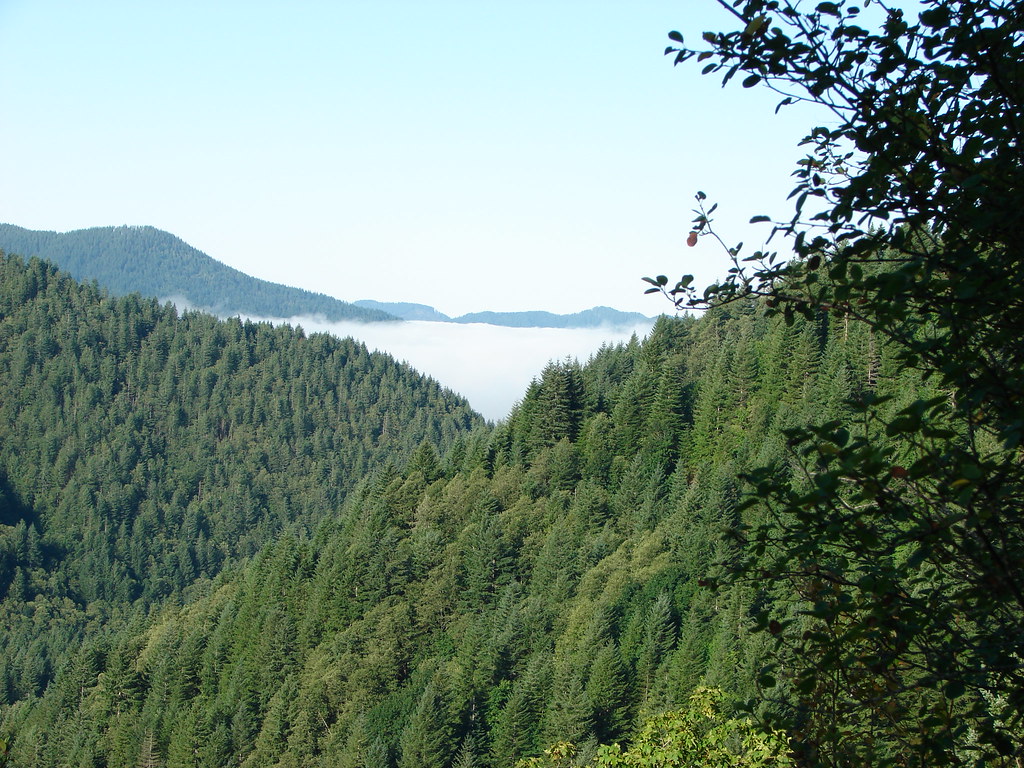
Low clouds in the valley

Looking down from the Elk Mountian Trail

View from the Elk Mountian Trail

Only a few flowers remained along the trail which is one of the reasons that our timing wasn’t great, the other being the exposed sections of trail were really warm in the August sun.
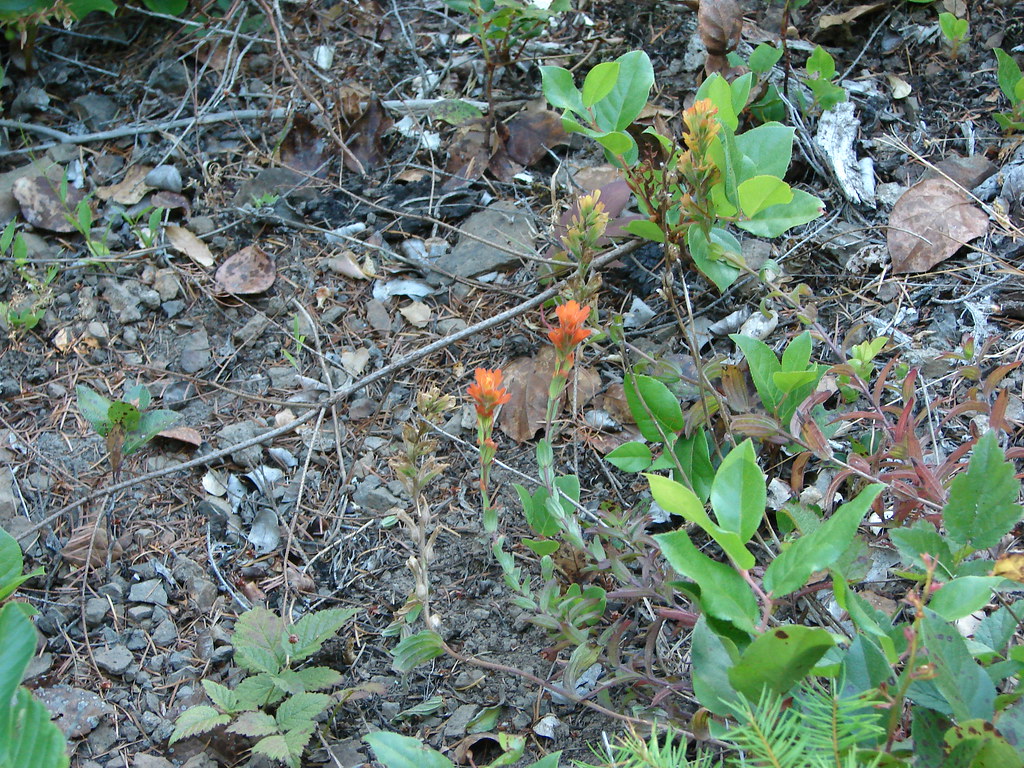
Paintbrush

View from the Elk Mountian Trail

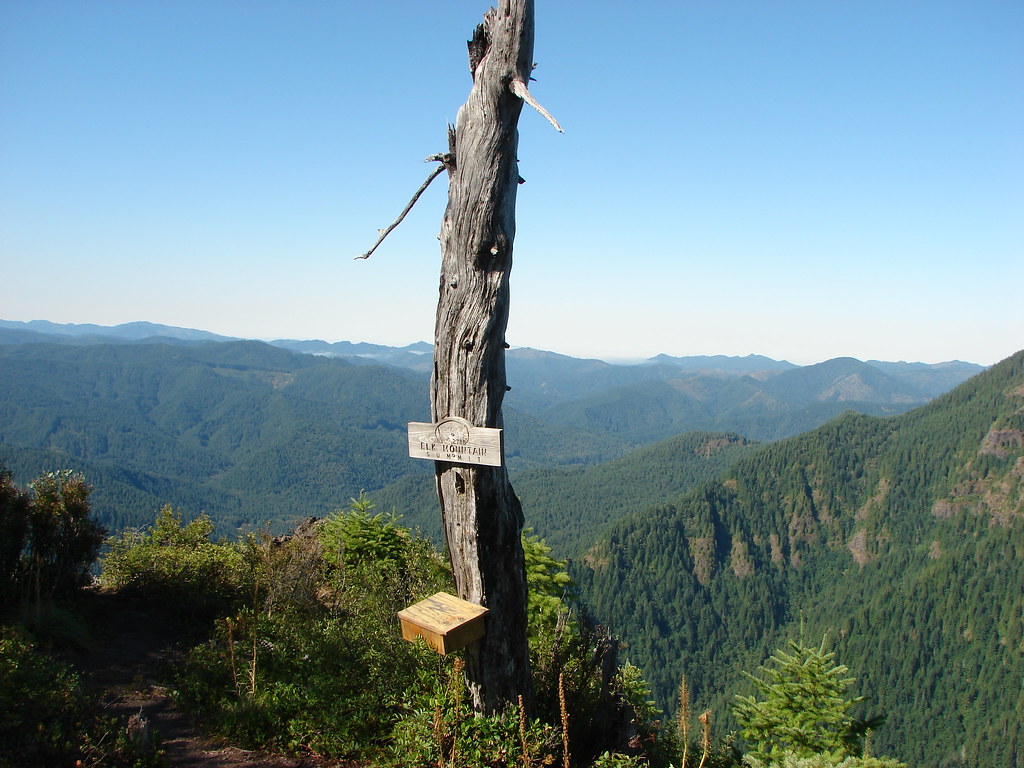
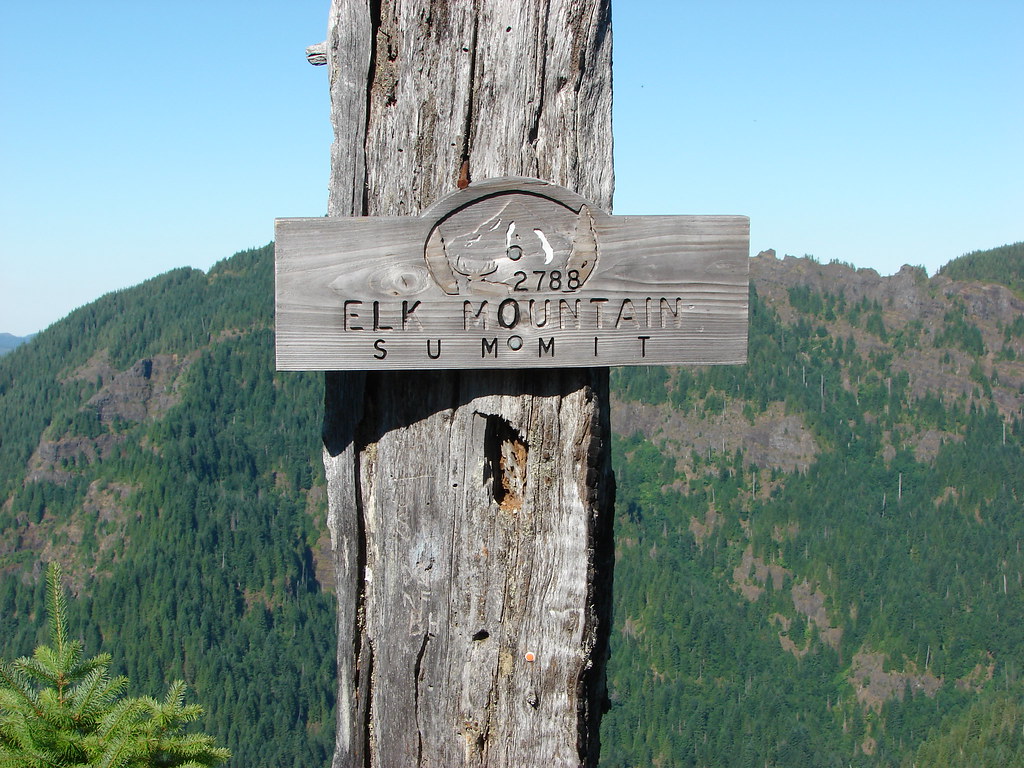
A nice sign and summit register greeted us at the summit letting us know that we’d made it.
Elk Mountain Summit

Elk Mountain summit

From the summit we were able to get a good look at the days second summit, Kings Mountain, to the west.
Kings Mountain from Elk Mountain

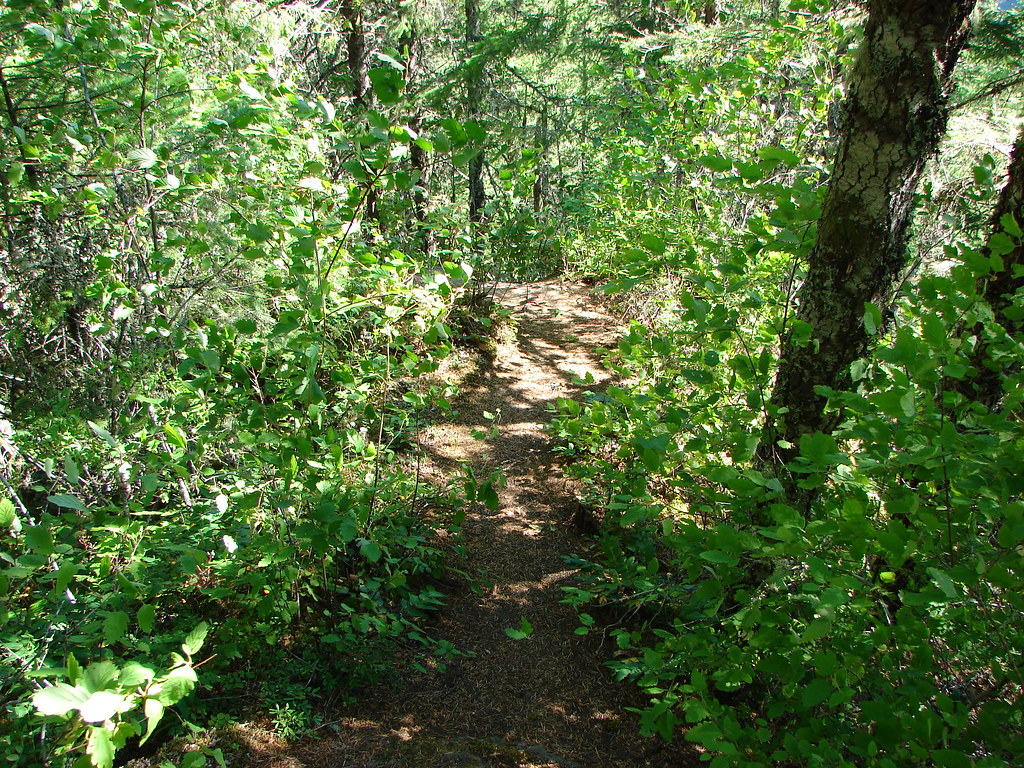
We continued on the loop which dropped steeply off the far side of Elk Mountain.
Elk Mountian Trail

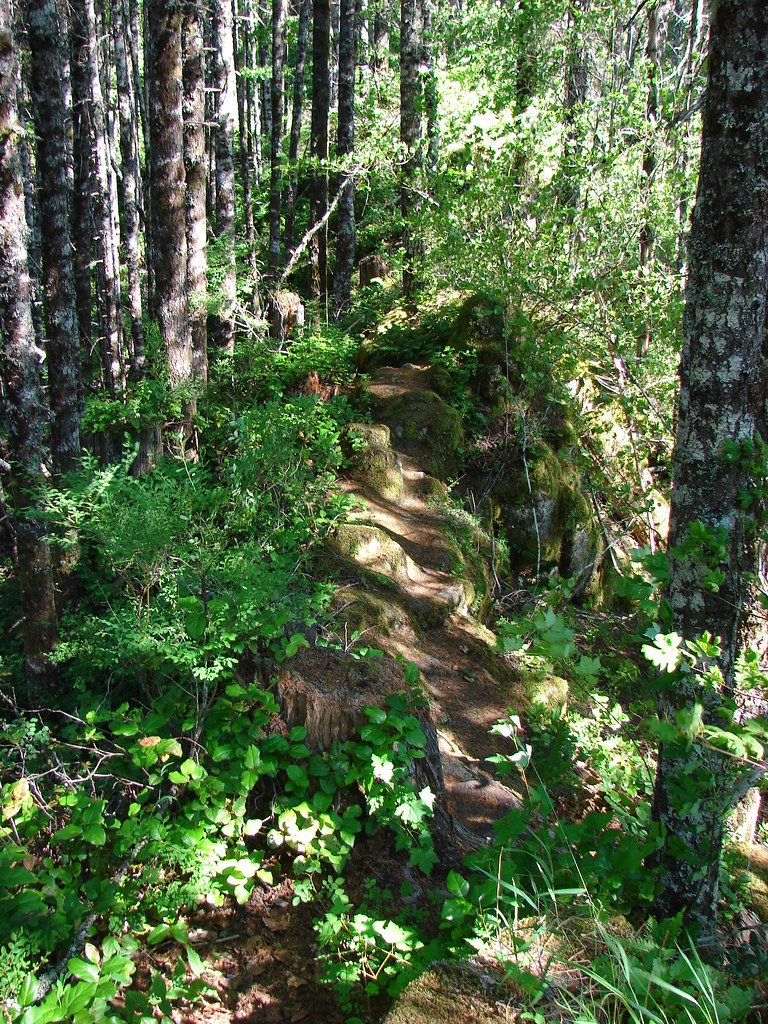
For the next half mile the trail traversed a ridge that was rather narrow and rocky in spots.
Elk Mountian Trail

Elk Mountian Trail

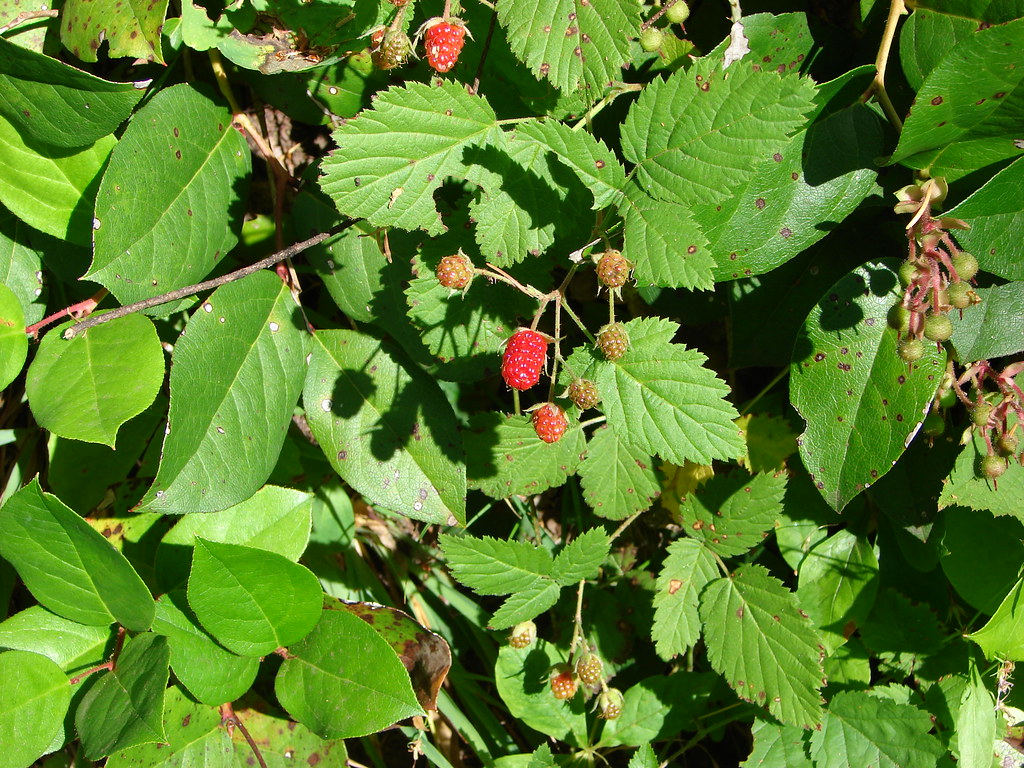
We were relieved when we reached an old roadbed which we then followed for the next mile and a half. This section was much easier on the nerves (and knees). Berries and wildflowers lined the old roadbed.
Raspberries and salal

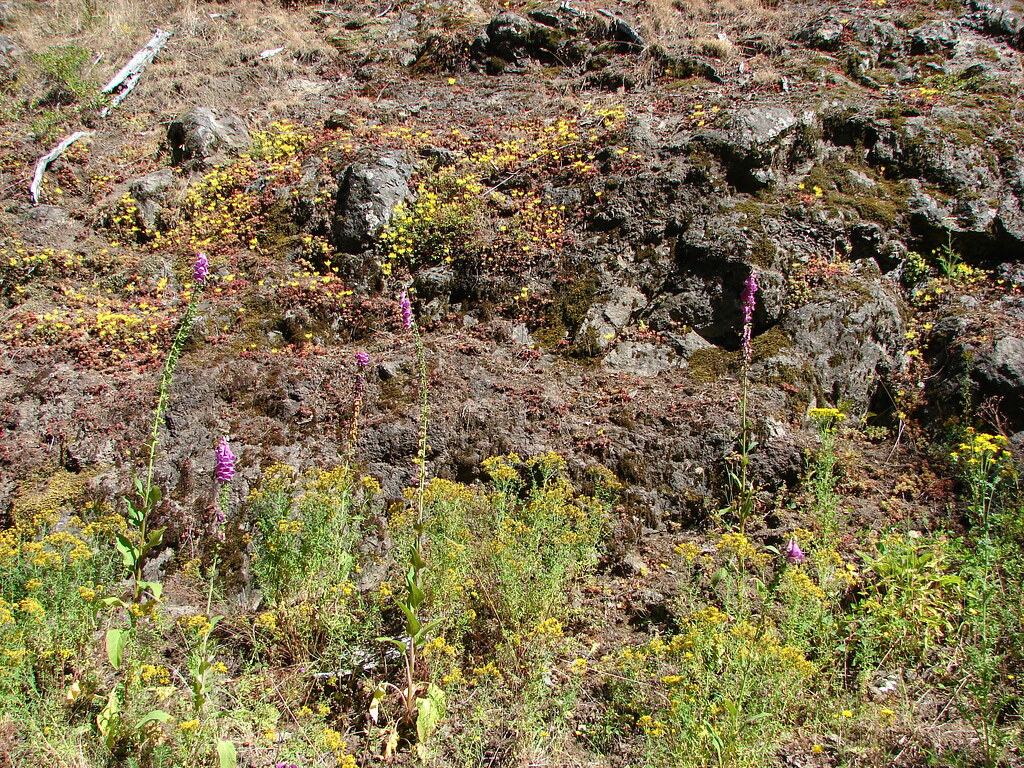
Foxglove

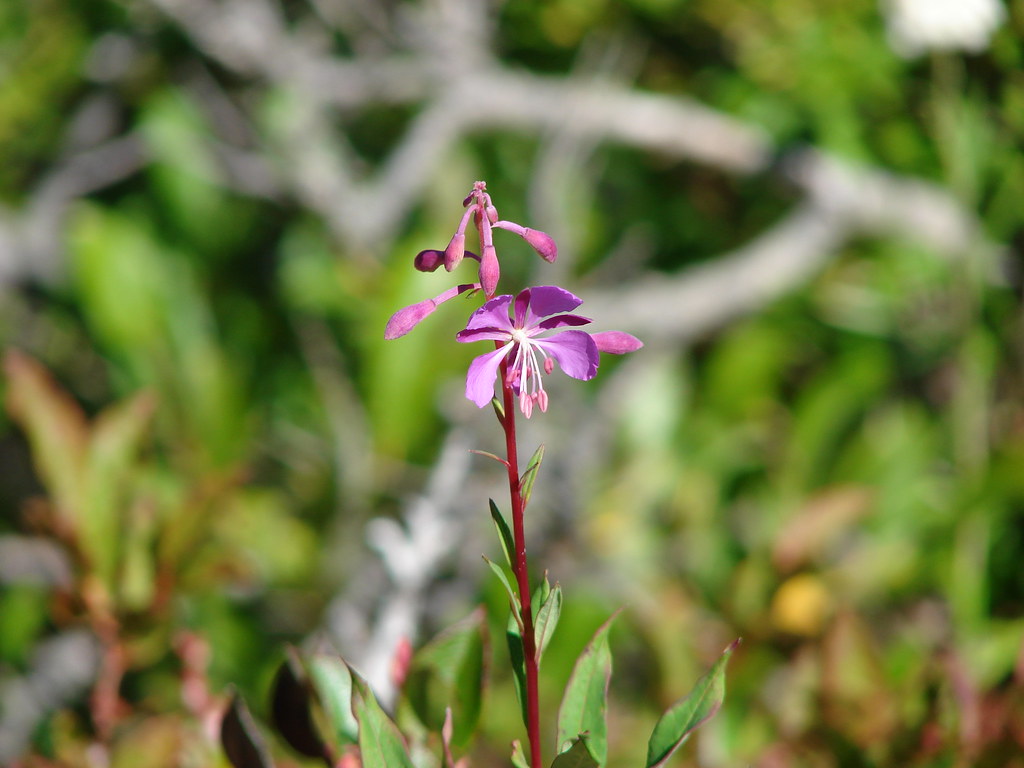
Fireweed

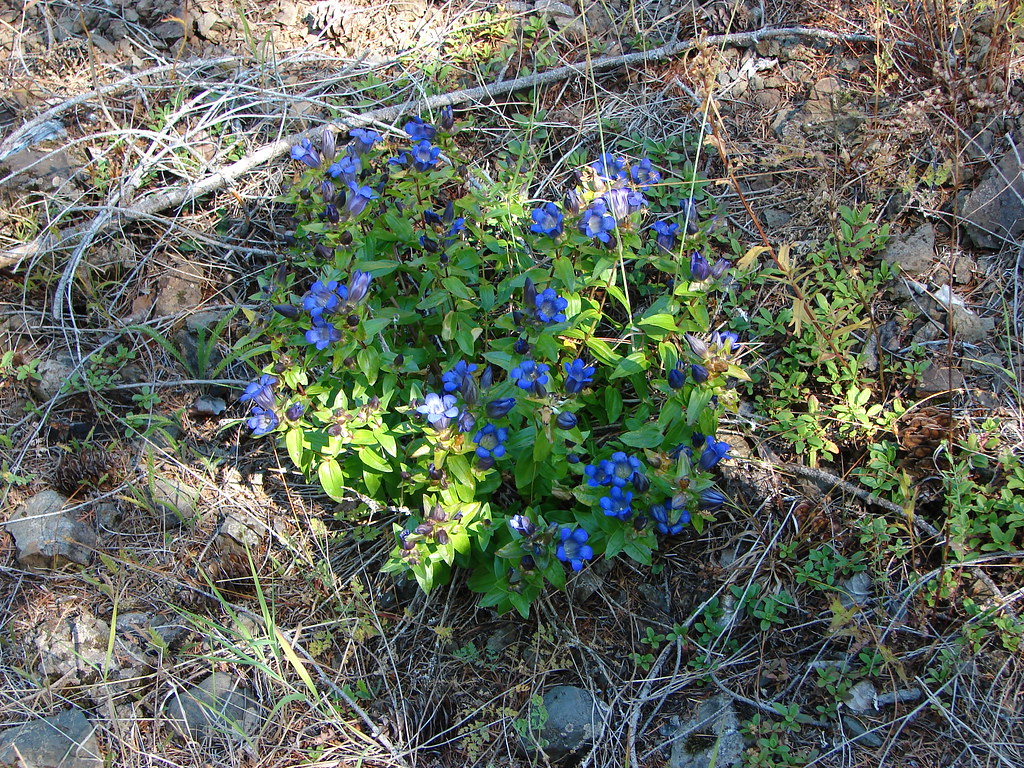
Gentian

At a pass two miles from the Elk Mountain summit we arrived at signed junction where we followed pointers for the Kings Mountain Trail.
Junction with the Kings Mountain Trail

The old roadbed soon gave way to another narrow rocky section of trail.
Kings Mountain Trail

Kings Mountain Trail

Soon the trail came to a series of pinnacles which forced the trail from the south side of the ridge to the north side. The vertical face of the pinnacles also forced the trail to drop in order to get far enough below them to traverse the hillside. If we thought the trail couldn’t get any more nerve wracking we were wrong. A small caution sign on a stump tipped us off that the next section was going to be a doozy.
Caution sign along the Kings Mountain Trail

A rope was in place here to assist with the descent.
Kings Mountain Trail - rope section

The traverse below the pinnacles was the by far the scariest section of trail we had been on and remained so until 2014 when the section of the Pacific Crest Trail known as The Knifes Edge took that title. There was a vertical rock wall along the trail and the drop on the other side of the trail seemed nearly as vertical. Thimbleberry bushes lined the trail on the down slope side making the trail feel even narrower than it was. No pictures were taken along this stretch as I was too busy using my hands to grab whatever I could along the rock wall.

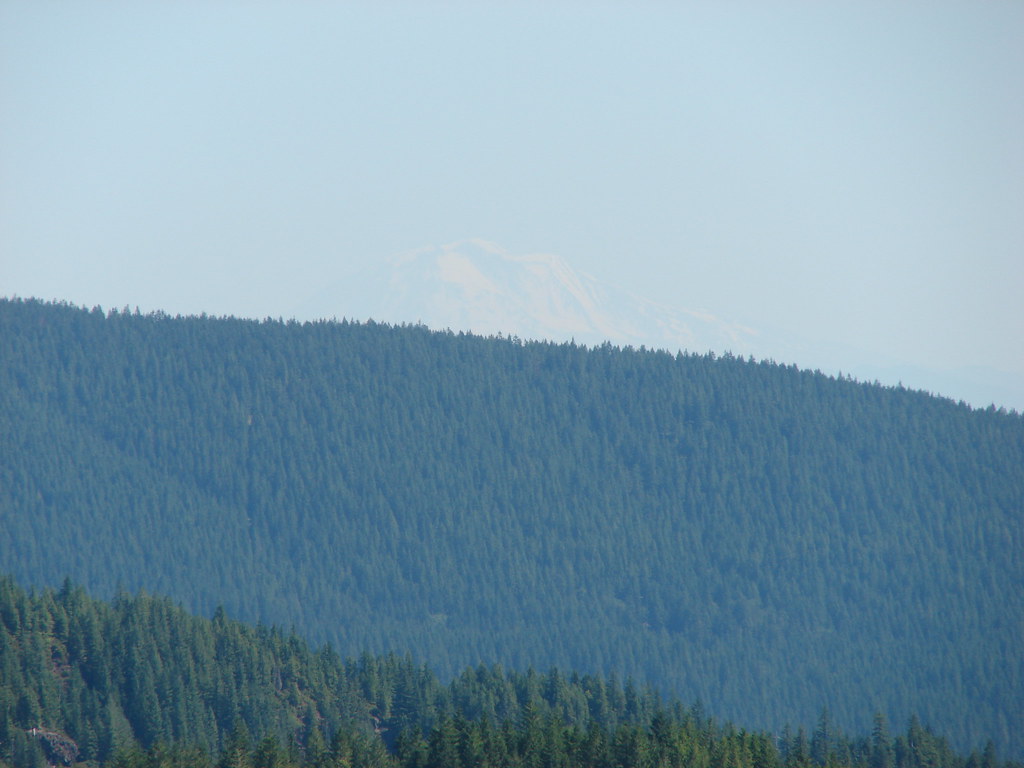
Upon reaching the far end we briefly distracted ourselves with the view to the north which included a vary hazy Mt. Hood and Mt. Adams.
View from the Kings Mountain Trail

Mt. Hood

Mt. Adams

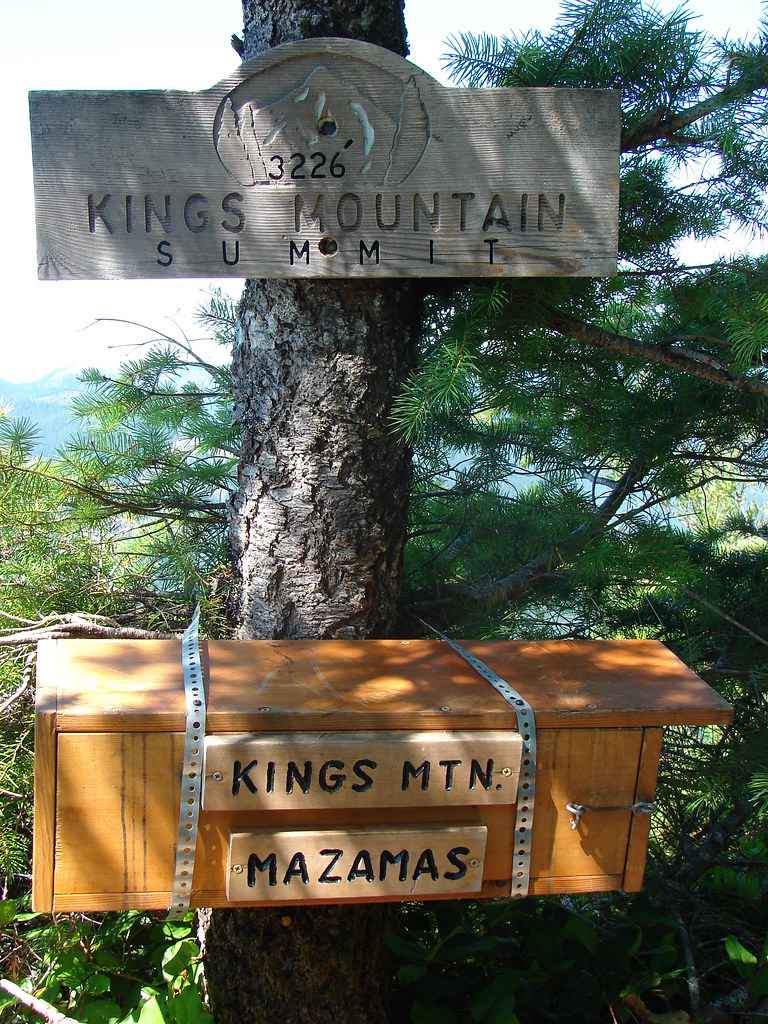
After we recovered our wits we continued on the much less stressful section of the trail and shortly arrived at the Kings Mountain summit.
Kings Mountain summit register

We had only gone 1.3 miles from the junction at the pass but the traverse below the pinnacles had made it seem much longer. An interesting oddity near the summit was a picnic table placed by Troop 299 of the Eagle Scouts.
Picnic table along the Kings Mountain Trail

Picnic table along the Kings Mountain Trail

From the summit the Kings Mountain Trail simply headed straight down a steep ridge.
Kings Mountain Trail

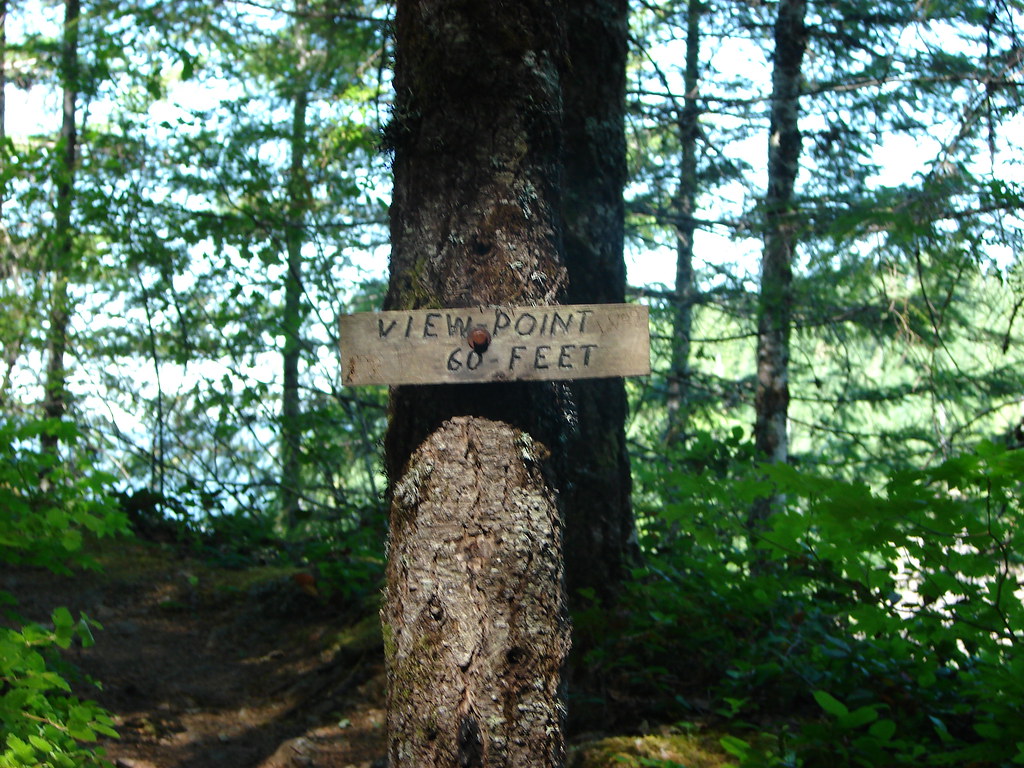
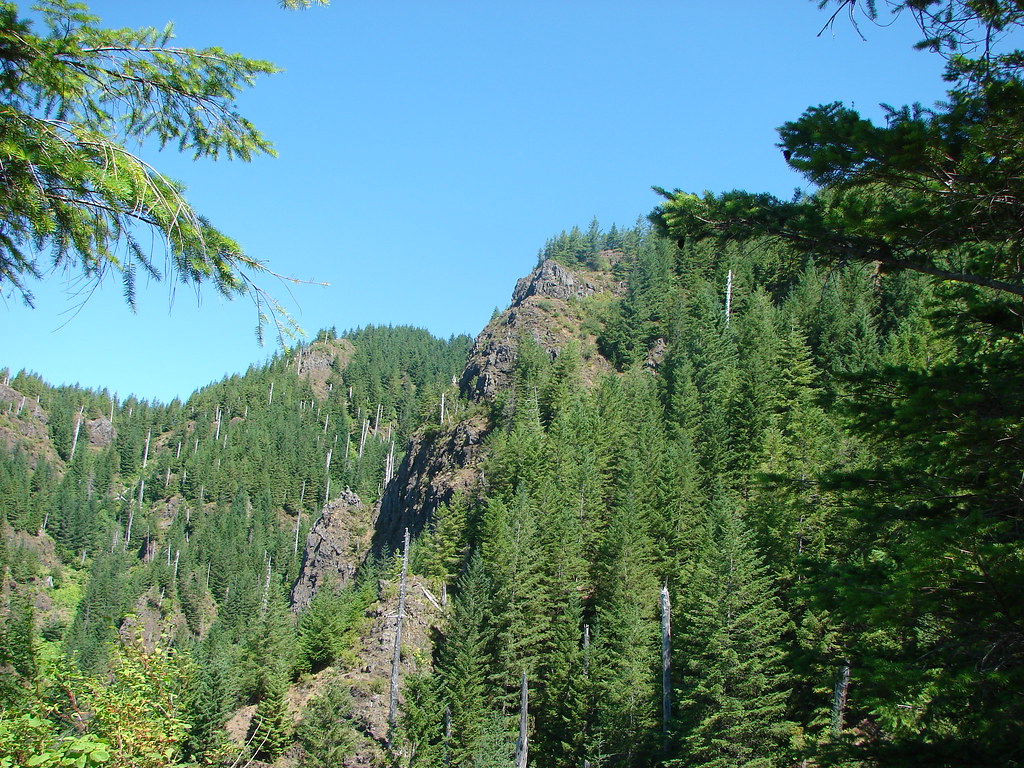
We managed to slow our descent long enough to visit a signed viewpoint on the way down.
Viewpoint sign along the Kings Mountain Trail

Kings Mountain Trail viewpoint

Again trekking poles would have been wonderful on the 2.5 mile descent. As it was we did our best to stay upright as we bounced from tree to tree using them in an attempt to control our speed. As we neared the bottom the trail mercifully began to level out in the forest.
Kings Mountain Trail

We turned left onto the Wilson River Trail when we came to the junction near the Kings Mountain Trailhead.
Wilson River Trail sign

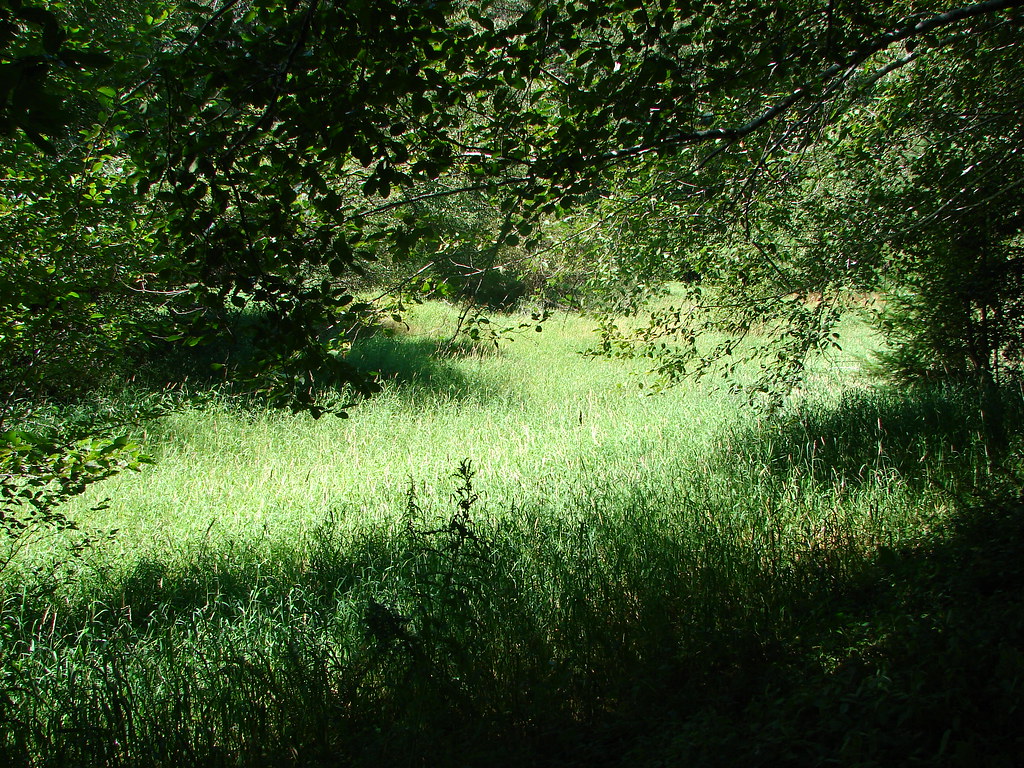
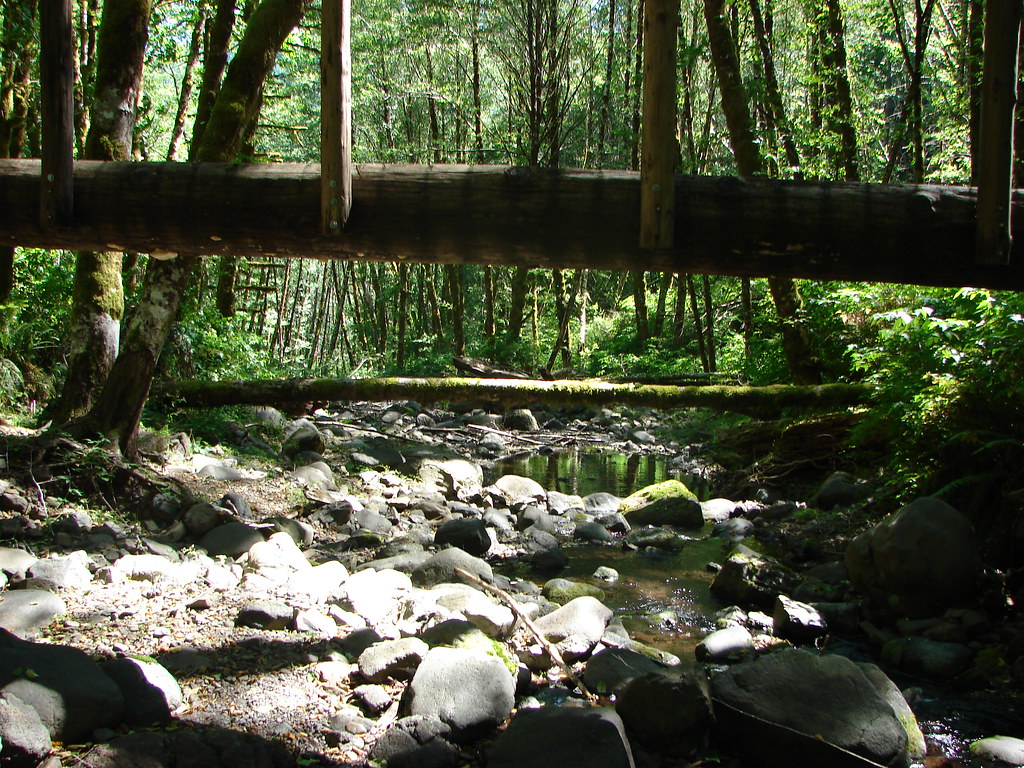
It was a fairly easy, but warm, 3.5 mile hike back to the Elk Creek Trailhead. The Wilson River was on the opposite side of Highway 6 but the trail passed through a nice meadow and crossed Dog Creek on a footbridge in the first mile and a half.
Meadow along the Wilson River Trail

Creek along the Wilson River Trail

The final two miles were more exposed allowing the mid-day sun to beat down us so we were glad when we finally made it back to Elk Creek. It had been a pretty amazing hike, definitely unlike anything we’d done up to that point and we are looking forward to going back in the not too distant future to see what it’s like now that we’ve been hiking for a much longer time. Happy Trails!

Flickr: Elk and Kings Mountains

Categories
Central Coast Hiking Oregon Oregon Coast Throwback Thursday Trip report

Throwback Thursday – Cascade Head

This Throwback Thursday hike was the first of what has become a tradition of hiking at the coast on the morning of family reunion in August. The festivities typically begin somewhere between noon and 1pm which give us plenty of time to get a short hike in beforehand.

In 2010 the hike we chose was at Cascade Head just north of Lincoln City. We started our hike at the lower trailhead at Knights Park.

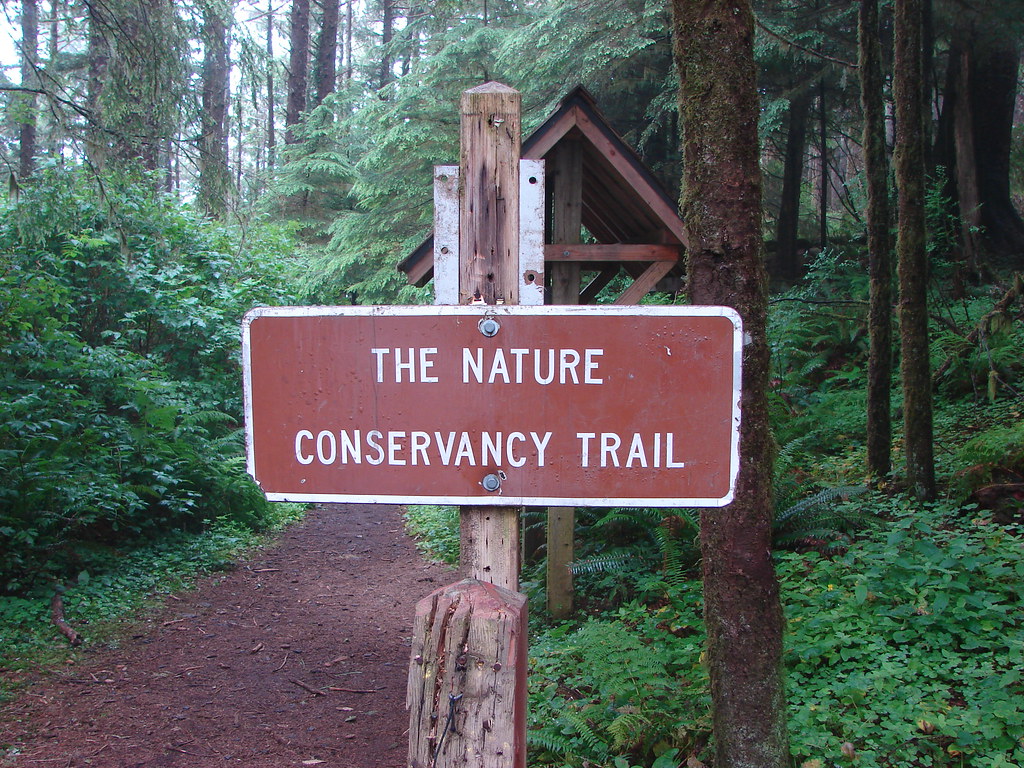
The Nature Conservancy manages the Cascade Head Preserve and does not permit dogs, horses, bicycles, hunting or camping at the preserve.
Signboard at the Cascade Head Trailhead

The trail sets off from Knights Park through a typical coastal forest crossing Three Rocks Road after .4 miles then climbing through more forest for 1.1 miles (and crossing the road two more times) to an open meadow.
Nature Conservancy Trail

Nature Conservancy Trail

Mushrooms

Meadow on Cascade Head

View from the Nature Conservancy Trail

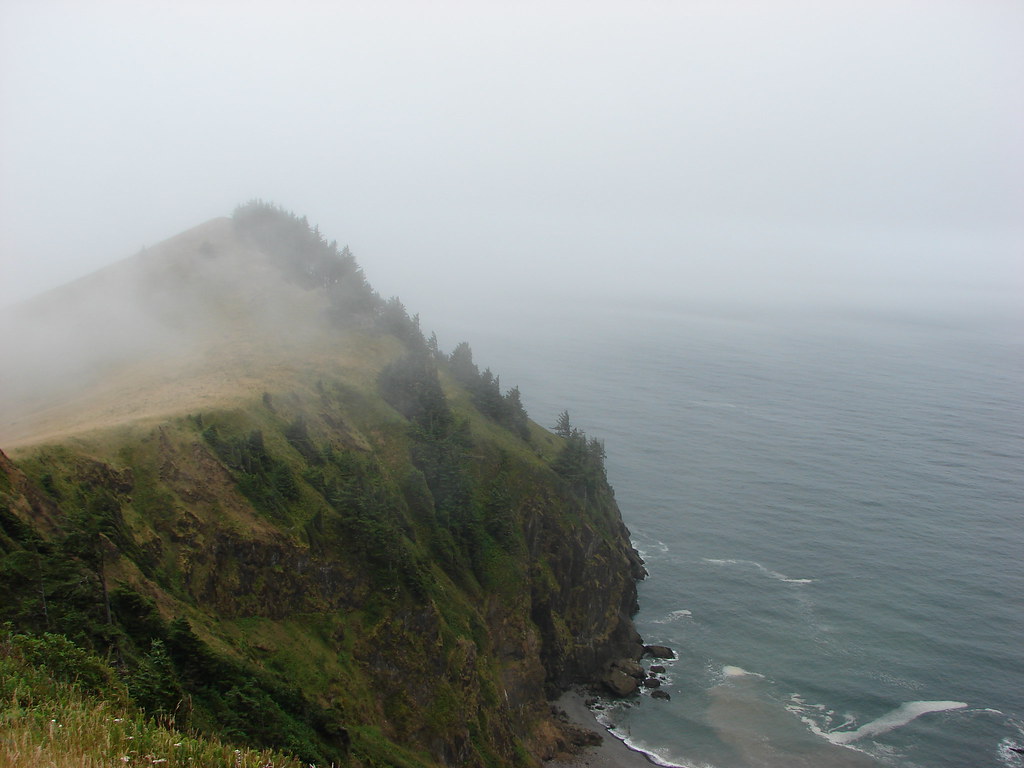
It was a cloudy day so the views were a bit limited but we could see Gods Thumb to the south of the mouth of the Salmon River.
View from the Nature Conservancy Trail

The trail then traversed the meadow steepening to an upper viewpoint in another .6 miles.
Nature Conservancy Trail

View from the Nature Conservancy Trail

Cascade Head

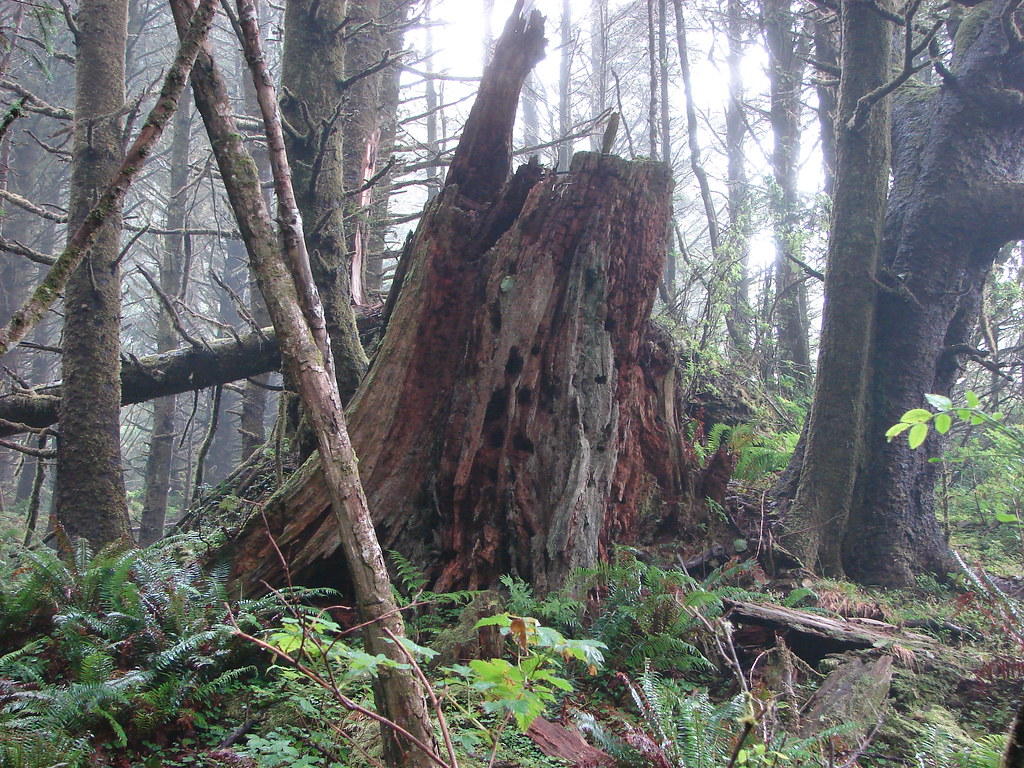
We followed the Nature Conservancy Trail another mile through a damp mossy forest to the upper trailhead.

Forest on Cascade Head

Forest along the Nature Conservancy Trail

050

053

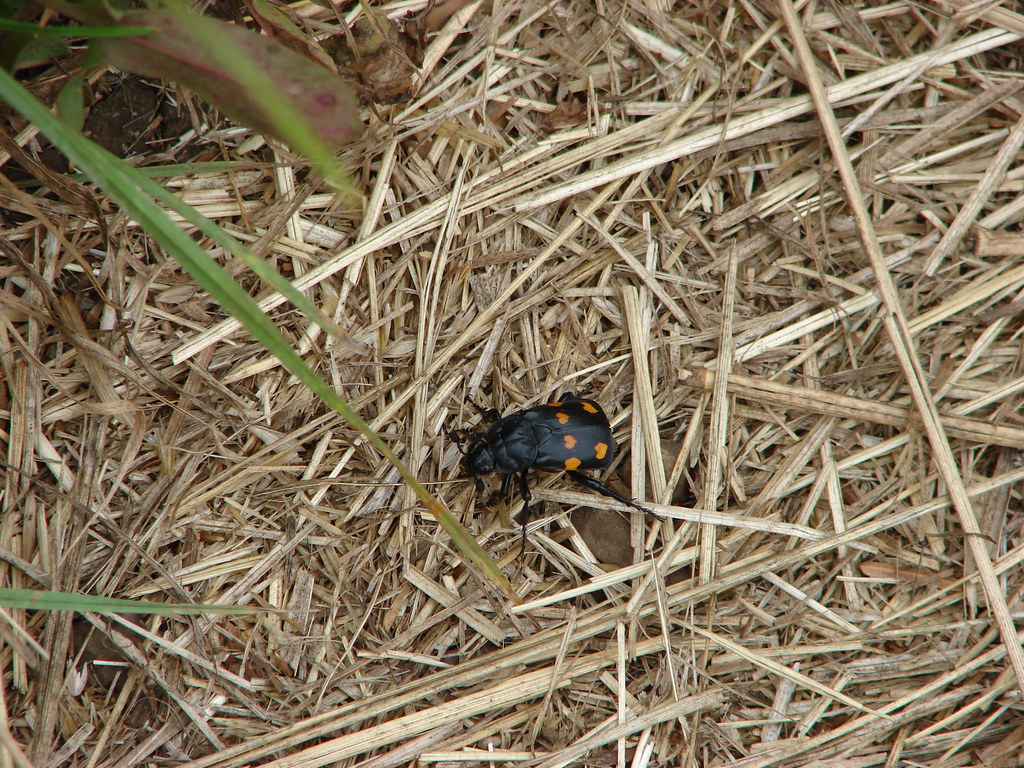
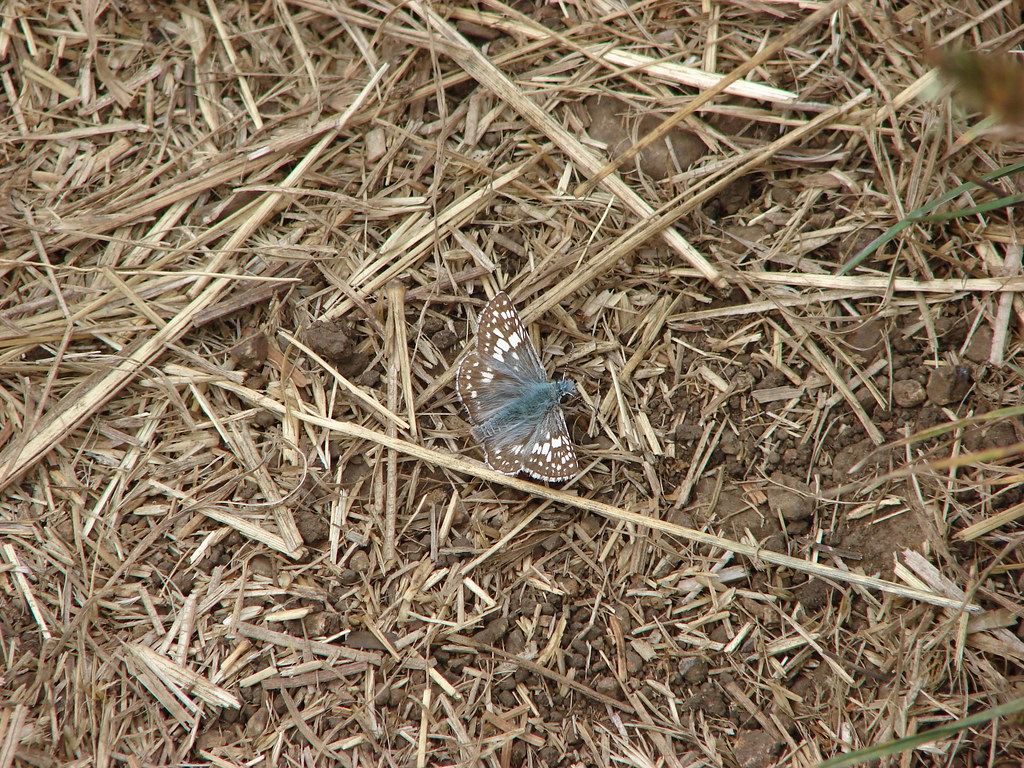
After reaching the upper trailhead we returned the way we’d come. We had hoped to see some of the elk that frequent the area but that didn’t happen. We did however see a decent variety of insects along the way.
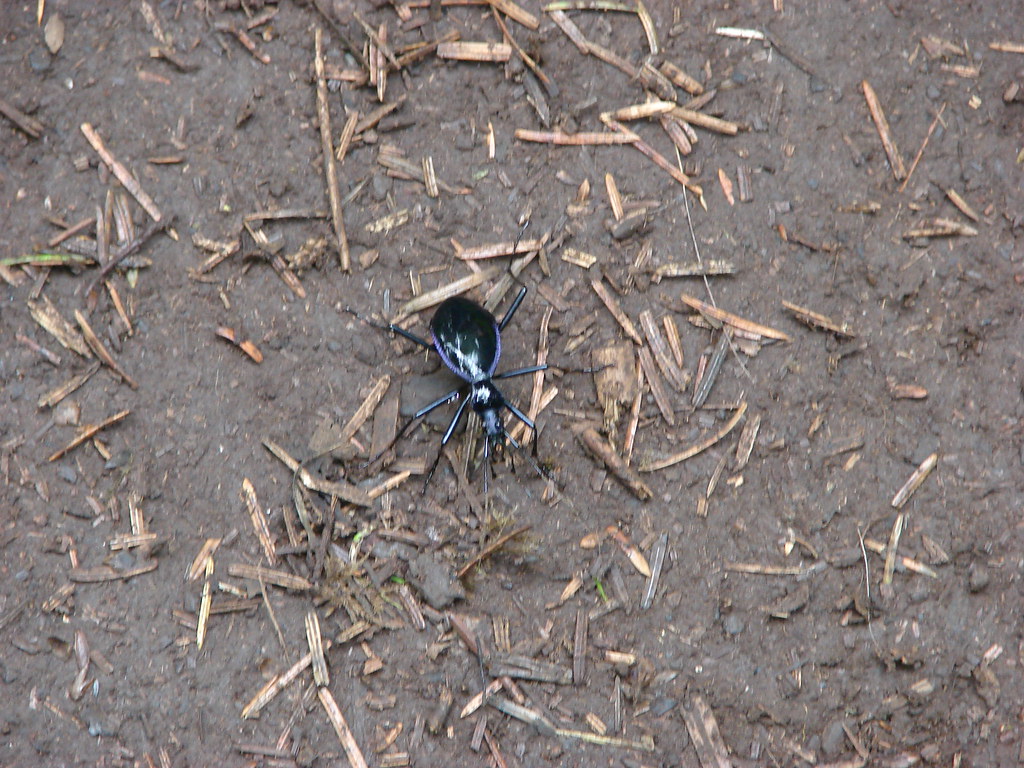
Heart beetle

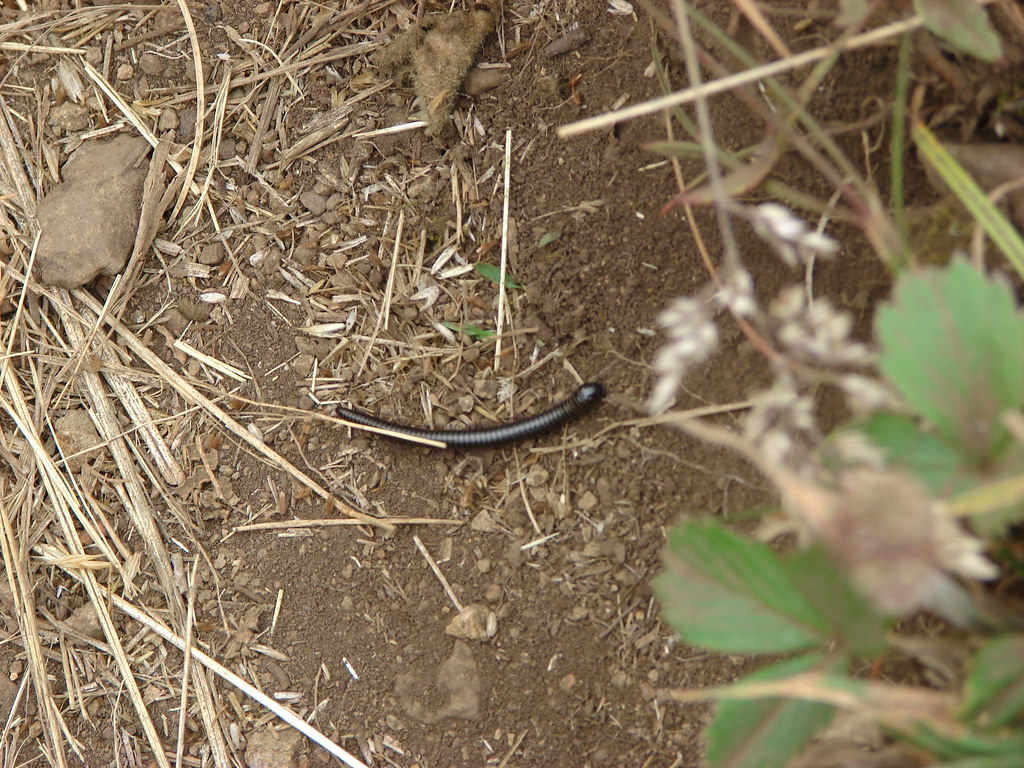
Millipede

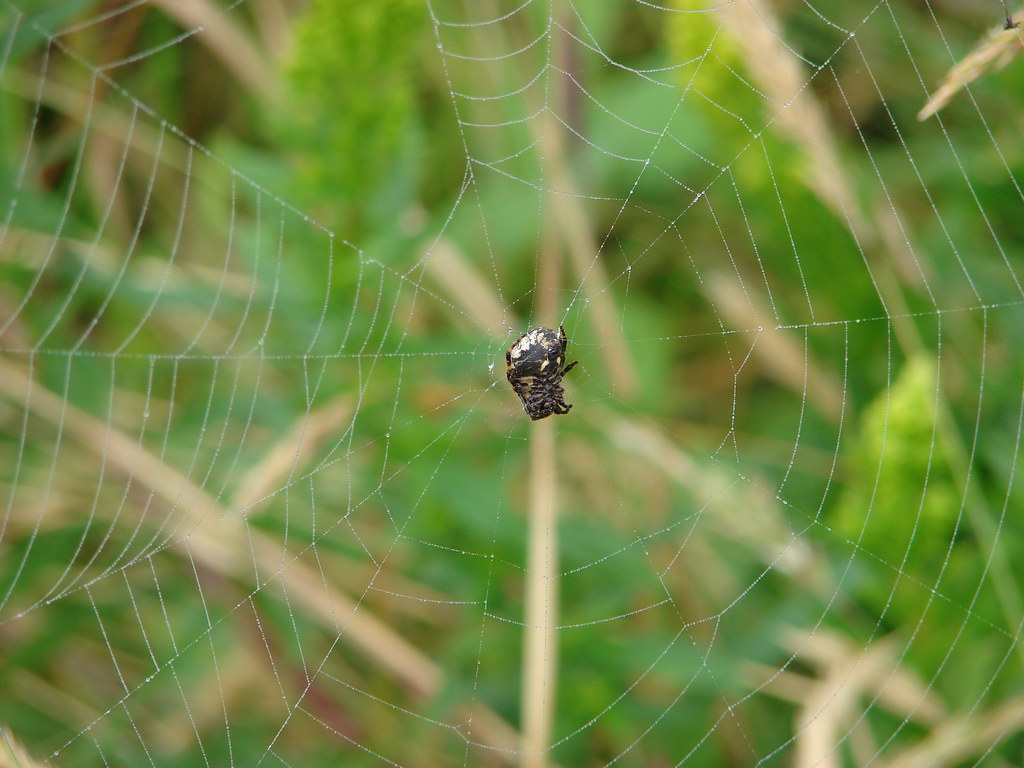
Spider

049

055

The hike was approximately 6.5 miles with 1300′ of elevation gain. We hope to get back someday when the skies are clearer and the elk are present. We will likely try earlier in the year too when the meadow hasn’t been subjected to the summer heat yet. Happy Trails!

Flickr: Cascade Head

Categories
Hiking McKenzie River Middle Santiam Old Cascades Oregon Throwback Thursday Trip report

Throwback Thursday – Browder Ridge and Sahalie & Koosah Falls

This week we are revisiting a pair of hikes we took on 9/8/12. A pair of Heather’s running buddies were going to be running the McKenzie River 50k that day and we wanted to be a the finish line to greet them so we found a hike in the area that we thought would make that possible. The 8.5 mile up Browder Ridge seemed to be a perfect fit.

We started at the Gate Creek Trailhead just 4.5 miles off of Highway 20 via Hackleman Creek Road and Road 1598.
Gate Creek Trail sign at the trailhead

The trail never really got close to Gate Creek as it climbed through forest and fern filled meadows.
Gate Creek Trail

Meadow along the Gate Creek Trail

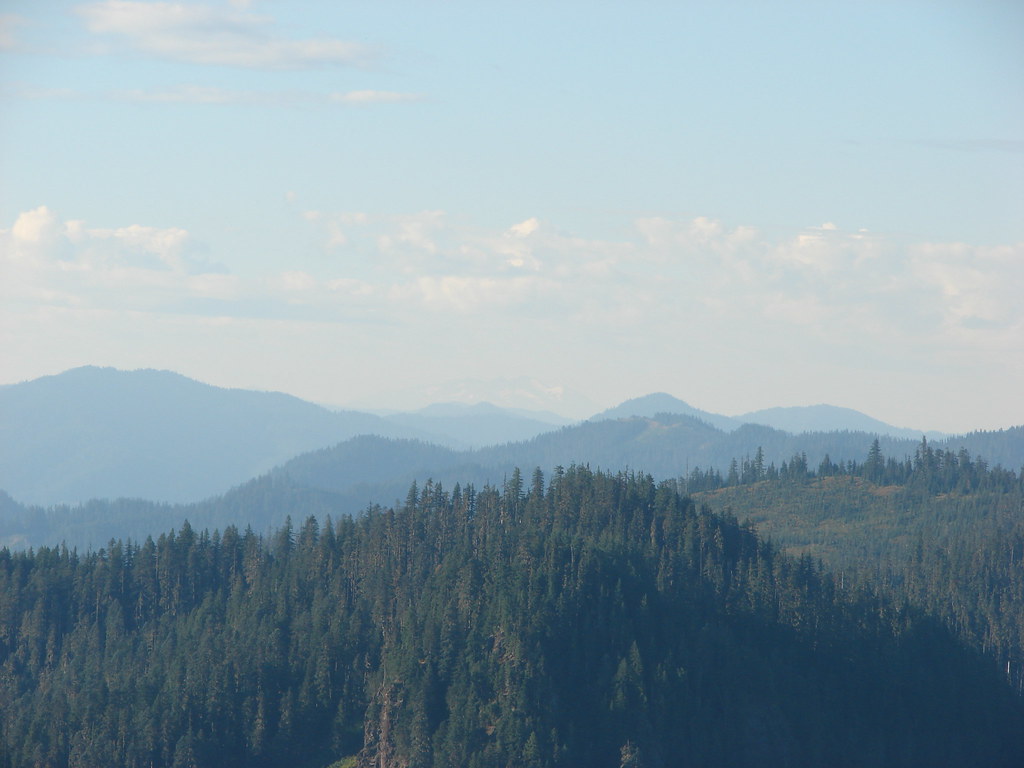
Just over a mile and a half from the trailhead we arrived at a viewpoint which provided views of the Cascade Mountains from Mt. Jefferson south to the Three Sisters. It was an unfortunately hazy view due to the sun still rising in the east and the presence of smoke from the Pole Creek Fire.
Mt. Jefferson and Three Fingered JackMt. Jefferson and Three Fingered Jack

Mt. Washington, Black Crater, Belknap Crater and the Three SistersMt. Washington and the Three Sisters

We continued on climbing gradually for another 1.5 miles to a junction. White pearly everlasting and pink fireweed could be seen along the trail. More hazy mountain views greeted us along the way with Diamond Peak joining the line of Cascade peaks.
Pearly everlasting

Gate Creek Trail

View from the Gate Creek Trail

We also had a nice view of our ultimate goal – Browder Ridge.
Browder Ridge

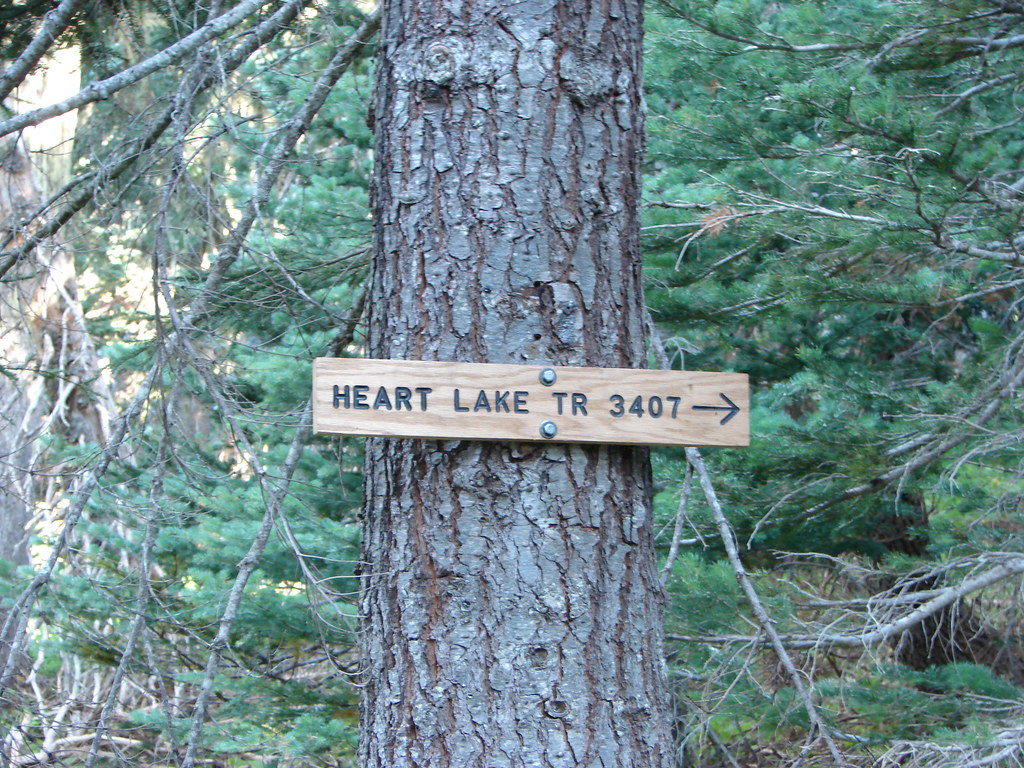
At the junction we turned right onto the Heart Lake Trail.
Sign for the Heart Lake Trail

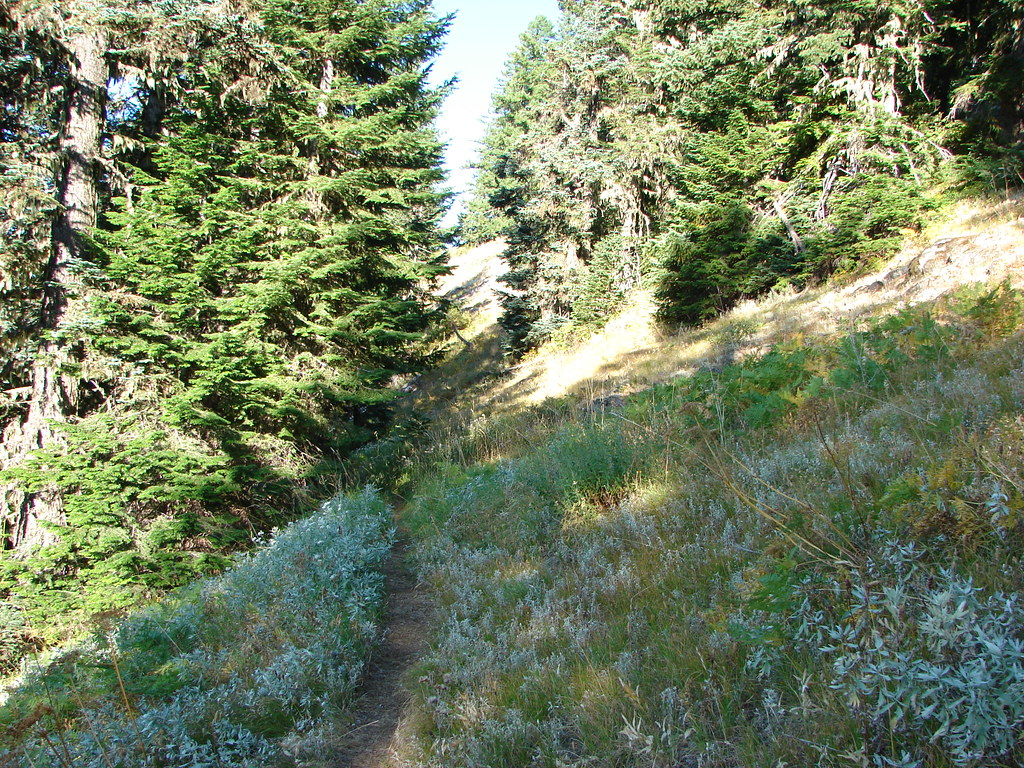
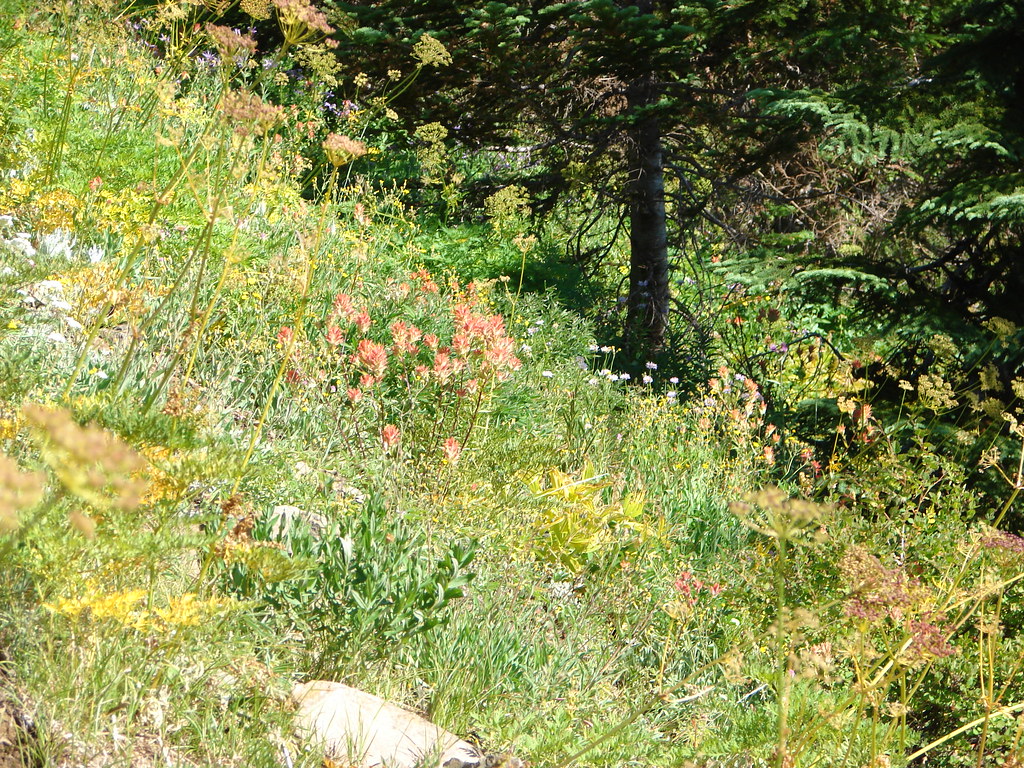
This trail passed below the rocky cliffs of Browder Ridge passing through the remains of an early summer wildflower meadow before reentering the forest.
Rock outcrop on Browder Ridge

Paintbrush

Aster

Heart Lake Trail

As the trail reentered the trees we left the Heart Lake Trail turning uphill along the rocky ridge.
Browder Ridge

A .2 mile scramble along the ridge brought us to the 5760′ summit of Browder Ridge.
Black Butte, Mt. Washington, Black Crater, and Belknap Crater from Browder Ridge

Despite the haze from the Pole Creek Fire the views were pretty good.
View from Browder Ridge

View from Browder Ridge

Mt. Jefferson and Three Fingered Jack

Mt. Jefferson

Black Crater, Belknap Crater, the Three Sisters, Mt. Bachelor and The Husband

View from Browder Ridge

After enjoying the view we headed back down to the trailhead. Butterflies had begun to come out as we made our way back.
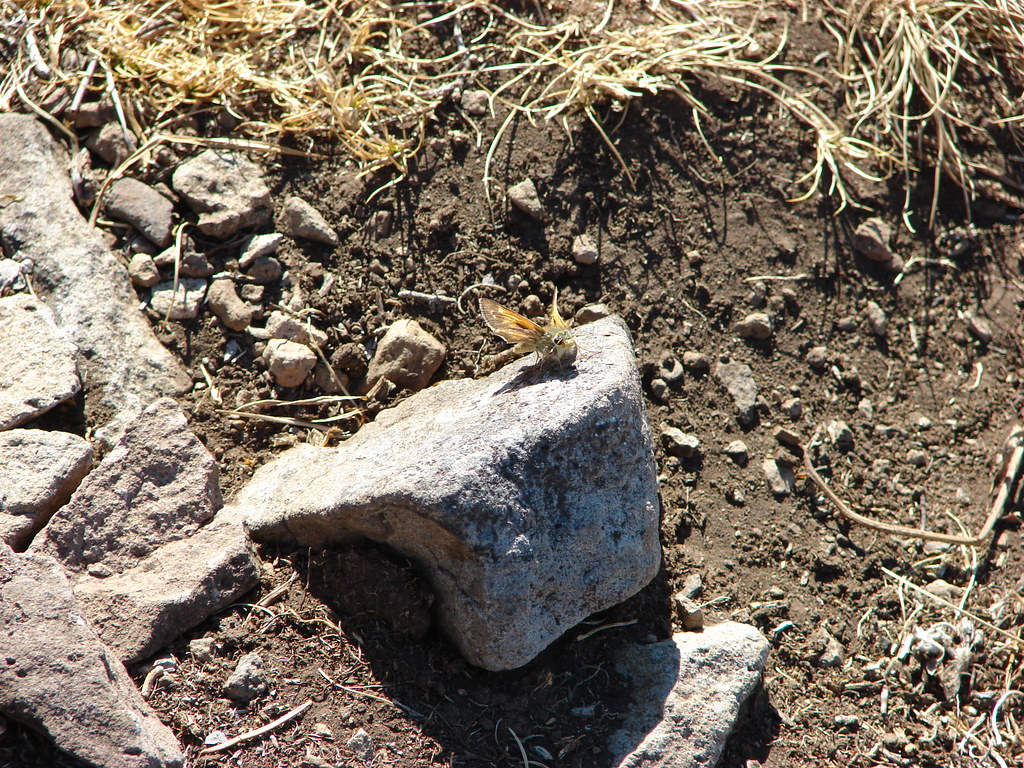
Some sort of Skipper butterfly

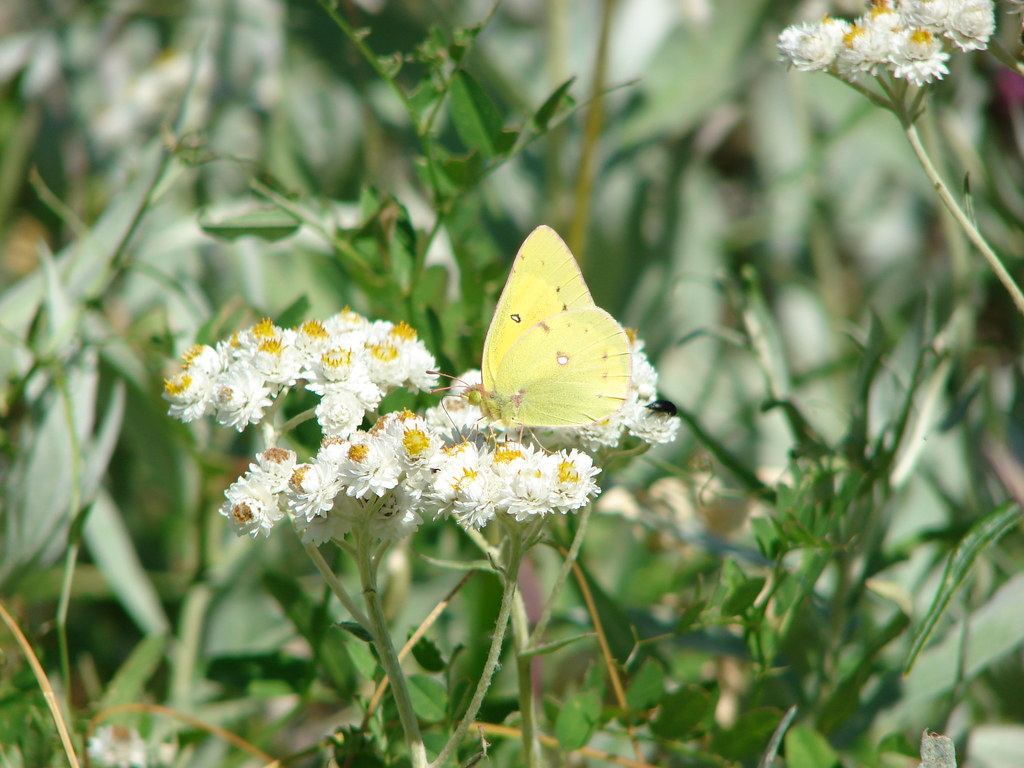
Pine white butterfly on pearly everlasting

Orange sulpher butterfly on Pearly Everlasting

We got back to the car with time to spare before the end of the race so we made a second stop on the way to the finish line. We drove east on Highway 20 to its junction with Highway 126 where we turned right for 5.2 miles to the Sahalie Falls Trailhead.

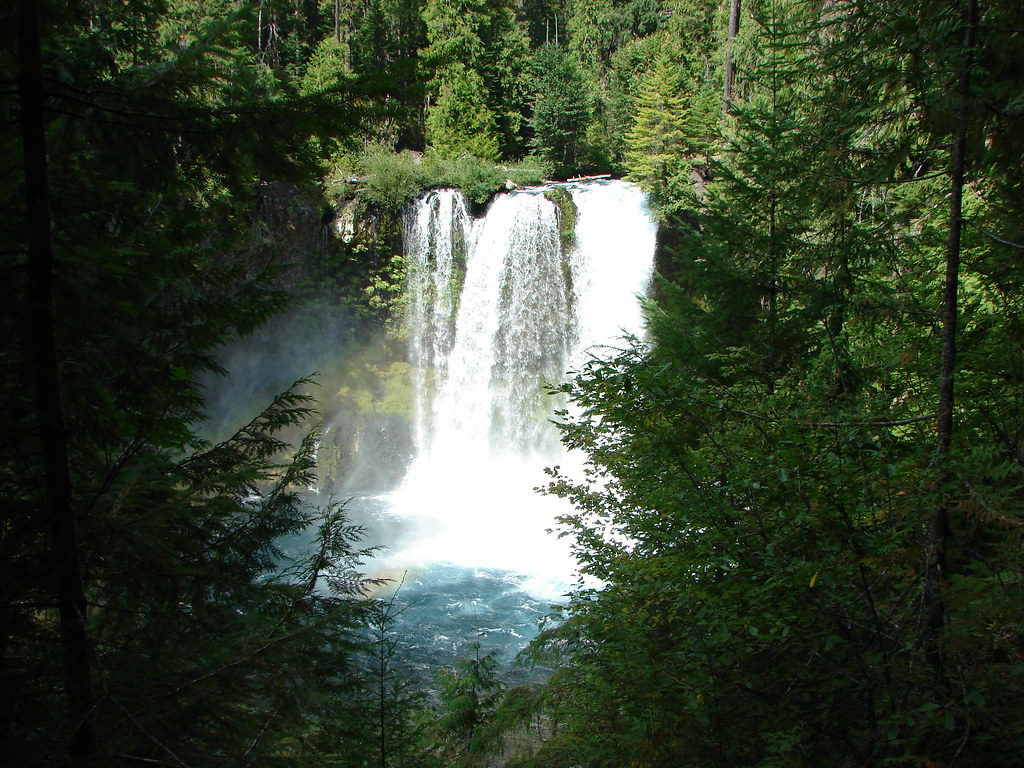
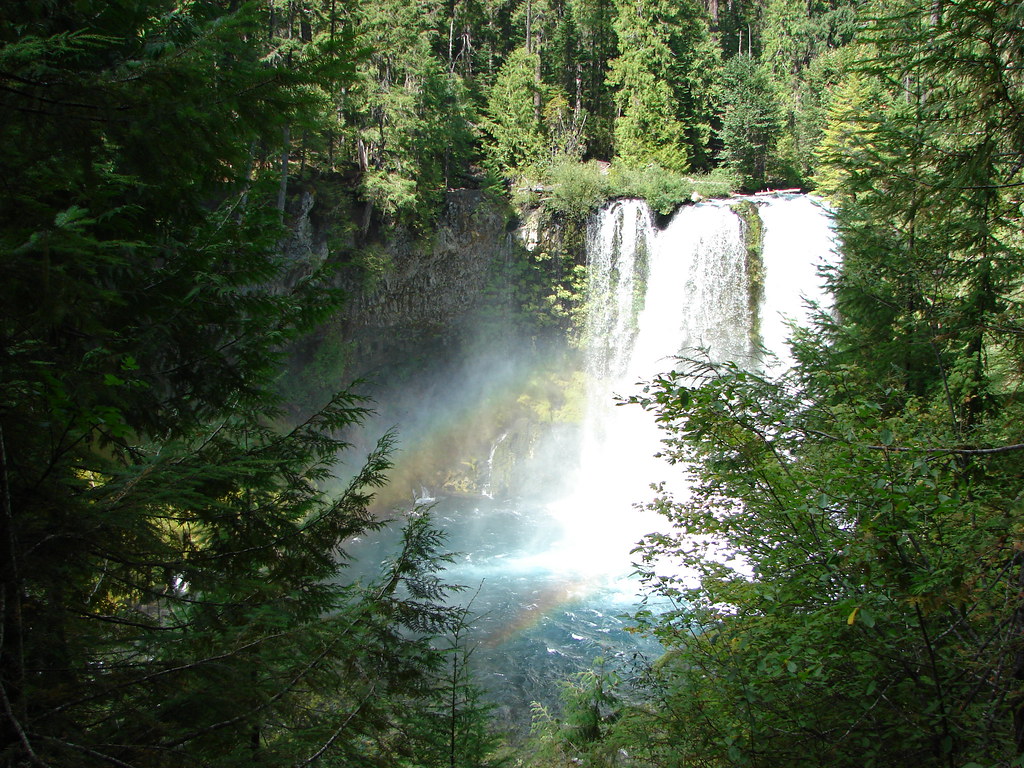
A half mile segment of the Waterfalls Loop Trail runs between Sahalie and Koosah Falls along the McKenzie River here. It’s possible to complete a 2.6 mile loop incorporating the McKenzie River Trail, but we wanted to make sure we didn’t miss the end of the race so we did an out and back past Sahalie Falls to Koosah Falls.

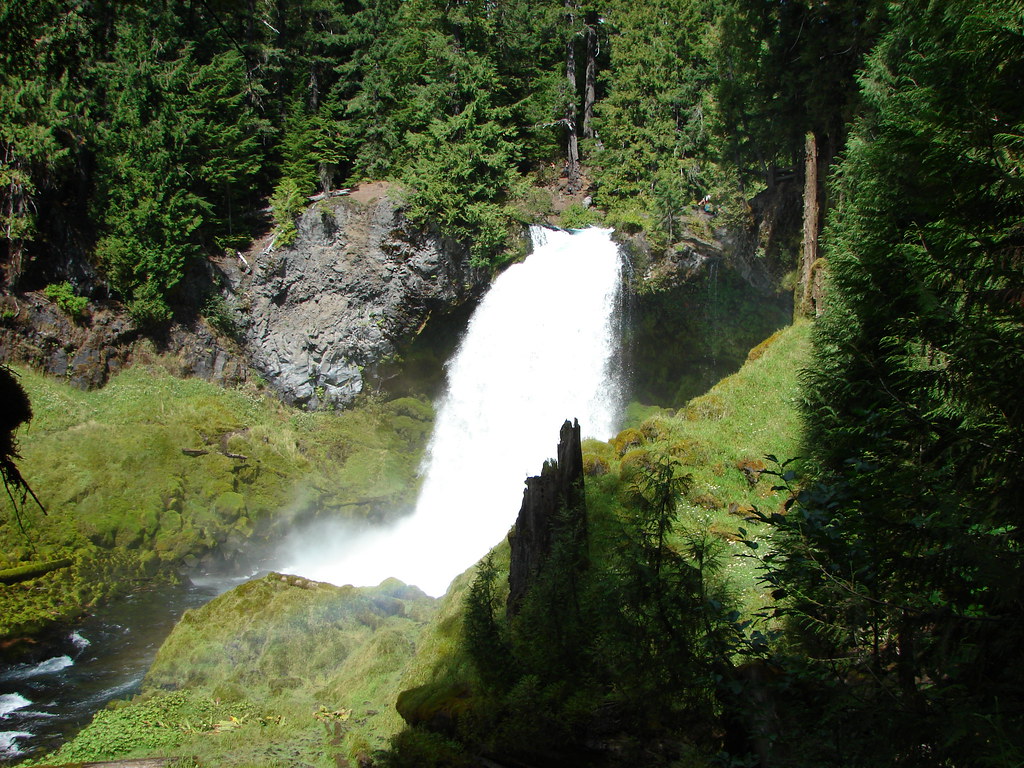
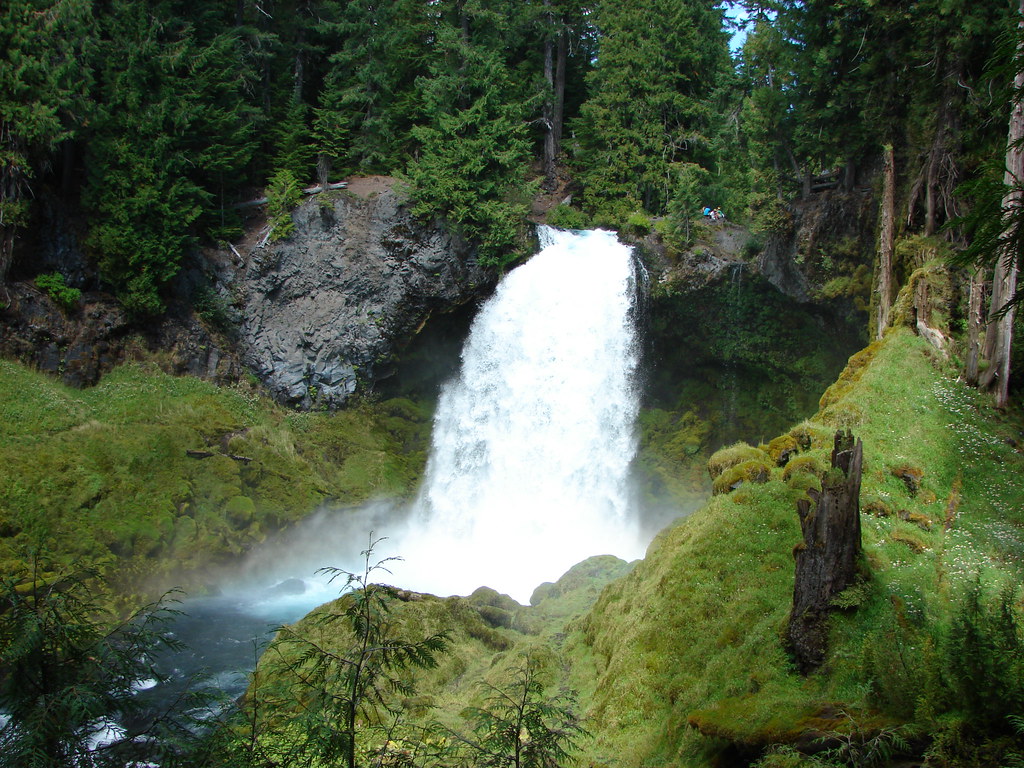
Sahalie Falls was not far at all from the parking area.
Sahalie Falls

Sahalie Falls

We headed downstream following the beautifully blue McKenzie River to Koosah Falls.
McKenzie River

McKenzie River

Koosah Falls

Koosah Falls

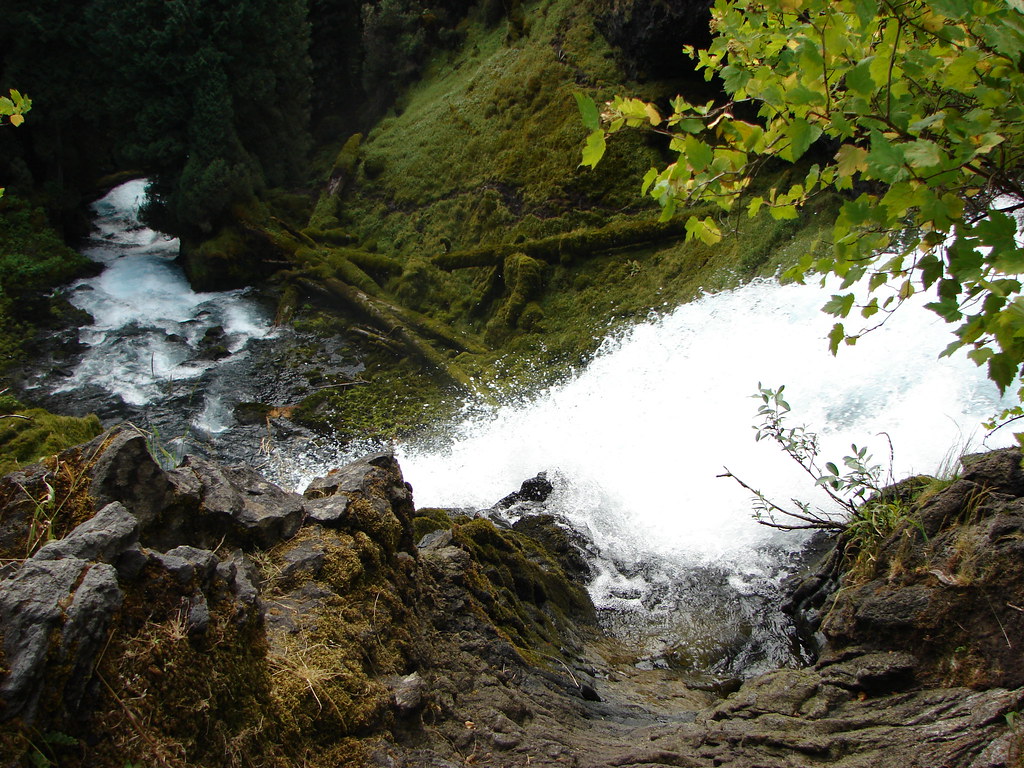
We returned the way we’d come but instead of returning to the car we had just enough time to visit the top of Sahalie Falls.
Sahalie Falls

These are two really nice and easily accessed waterfalls. We returned to Koosah Falls in 2013 along the McKenzie River Trail but have yet to be back to Sahalie Falls.

We made it to the finish line of the race in plenty of time to see Heather’s friends finish their 50k making it a successful day.

We are planning on heading back to Browder Ridge this year to see what the meadows look like earlier in the Summer. If all goes well we will be coming from the other end of the Browder Ridge Trail and may even make an attempt to reach Heart Lake along an unmaintained portion of the Heart Lake Trail. Happy Trails!

Flickr: Browder Ridge and Sahalie & Koosah Falls

Categories
High Cascades Hiking Mt. Jefferson Area Oregon Throwback Thursday Trip report

Throwback Thursday – Jefferson Park Ridge

**Note the 2020 Lionshead Fire burned the area covered by this hike.**

This week’s Throwback Thursday hike features our second hike to Jefferson Park. Jefferson Park had been the one destination that we had visited each year starting in 2011. Unfortunately that streak ended in 2017 due to the area being closed by the Whitewater Fire. That fire started along the Whitewater Trail which we used in 2011, 2014, and 2015 and also swept over the Woodpecker Ridge Trail which we took in 2016. There are two other approaches for day hikes to Jefferson Park which appear to have escaped the Whitewater Fire for the most part, the South Breitenbush Trail and the Pacific Crest Trail from Forest Road 4220. In 2013 we used the South Breitenbush Trail and on October 7th, 2012 we completed the hike featured in the post.

Of the four approaches we’ve done this was the most scenic in large part due to the dramatic view from Park Ridge. It is also the approach with the worst (by far) drive to the trailhead. Forest Road 4220 aka Oregon Skyline Road can be accessed via Forest Road 46 from the north (Portland) by turning left off of FR 46 21.8 miles beyond Ripplebrook onto FR 4690 for 8.1 miles then turning right onto FR 4220 at a stop sign. As FR 4220 passes the Olallie Lake Resort and Horseshoe Lake Campground it deteriorates. Beyond the Horseshoe Lake Campground the final two miles may be impassable to passenger cars. From the south (Salem or Bend) the trailhead is accessed from the other end of FR 4220. From Detroit, OR we took FR 46 north for 16.9 miles to a junction where we turned right onto FR 4220. The 6.5 mile drive to the trailhead was narrow and rough and can be impassable when wet or snowy. The drive was bad enough that we have no plans to repeat it despite this being a very good hike.

We arrived at the large parking area relieved to be done with the drive.
Big parking lot at the Pacific Crest Trail

The large parking area was fairly empty due to it being fairly late in the year so we had the trail to ourselves as we headed south on the PCT.
Pacific Crest Trail

Not far from the trailhead we passed some talus where we spotted a pika for the first time.
Pacific Crest Trail

Pika

We then passed through a short section of forest burned in the 2010 Pyramid Butte Fire.
Huckleberry bushes

Pyramid Butte

We had planned on taking a side trail to Pyramid Butte as there had been a trail to the top of the butte but the fire had made the area confusing so we decided to stick to the PCT. We were soon out of the burned area and passing through forest colored with red huckleberry leaves.
Pacific Crest Trail

From the trailhead the PCT gained 1400′ in 3.7 miles to its crest on Park Ridge but much of the gain was gradual especially early on. The elevation gain provided for some excellent views to the north where Mt. Hood was visible beyond Pyramid Butte.
Ruddy Hill, Pyramid Butte, Mt. Hood and Olallie Butte

Pyramid Butte and Mt. Hood

To the south though the much closer Mt. Jefferson merely peaked over the top of Park Ridge.
Mt. Jefferson

Mt. Jefferson behind Park Ridge

Pacific Crest Trail

Pacific Crest Trail

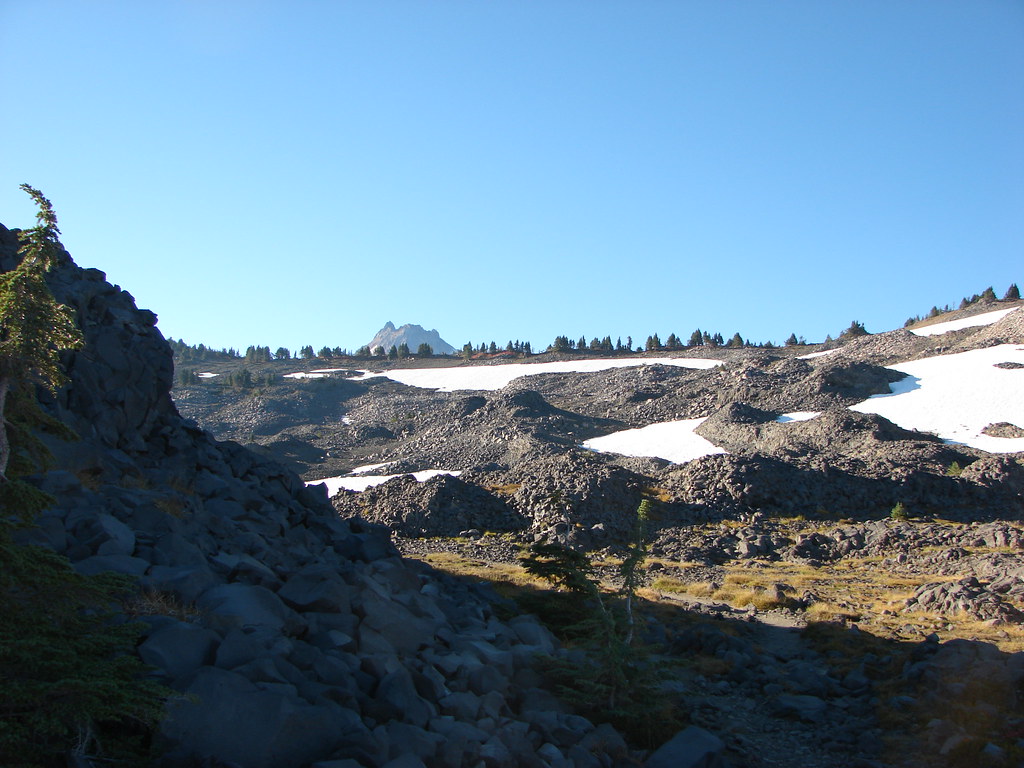
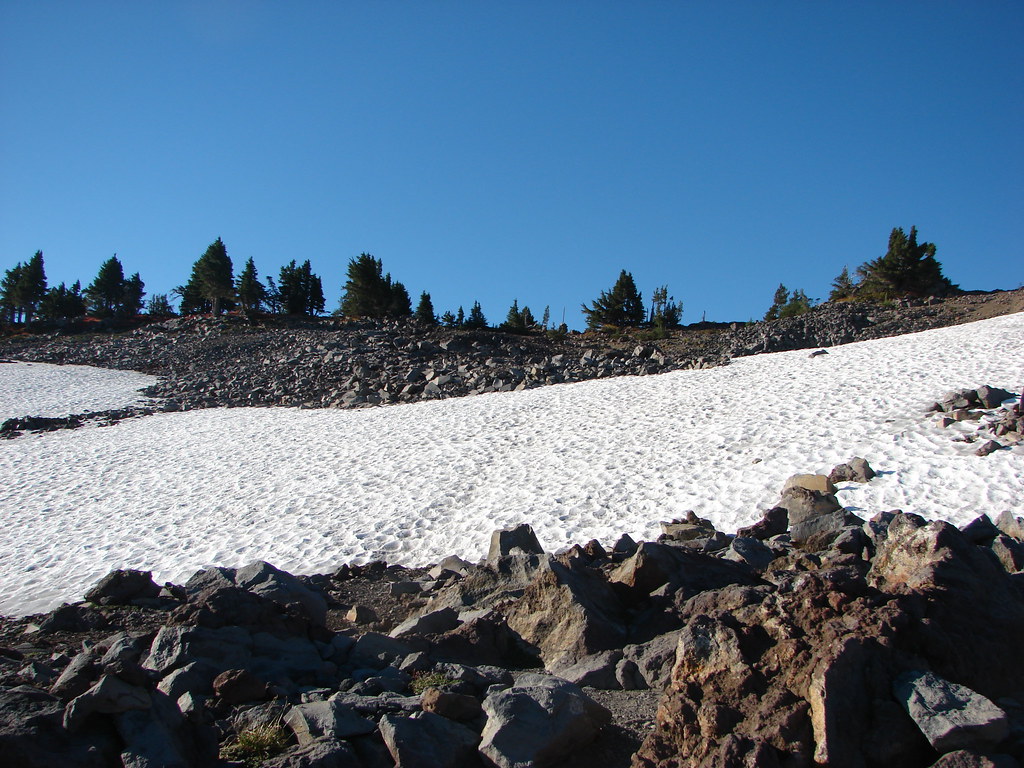
It was a little chilly and got chillier as we approached Park Ridge. Snow patches and partially frozen ponds lined the trail as we began to leave the trees and climb up the ridges northern flank.
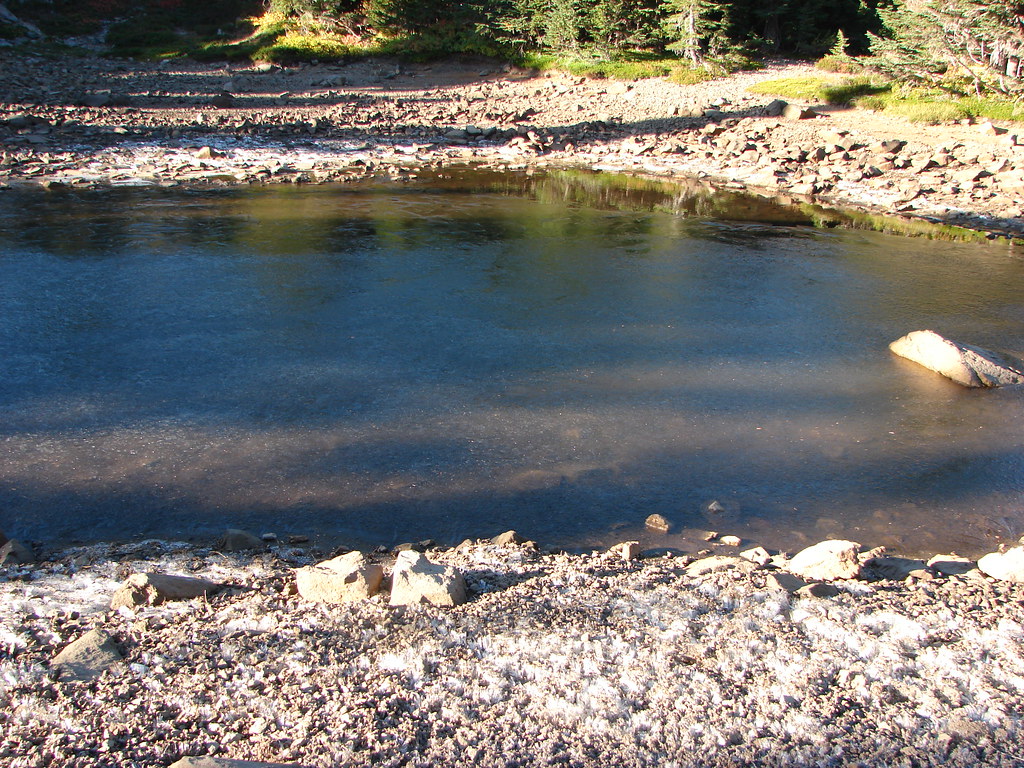
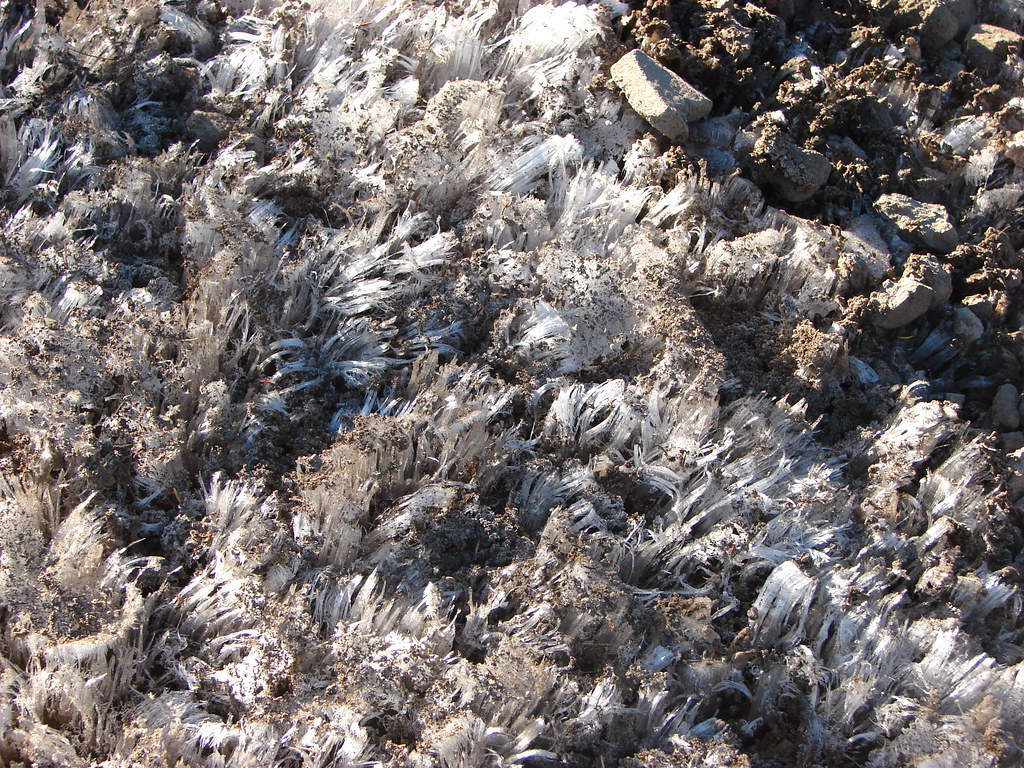
Frozen pond along the Pacific Crest Trail

Frost around the pond

Park Butte

Pacific Crest Trail

Rock cairns and posts helped mark the way through the rocks which had replaced the meadows and we followed existing footprints through patches of snow.
Pacific Crest Trail

The view north to Mt. Hood from the open ridge was spectacular.
Mt. Hood and Olallie Butte

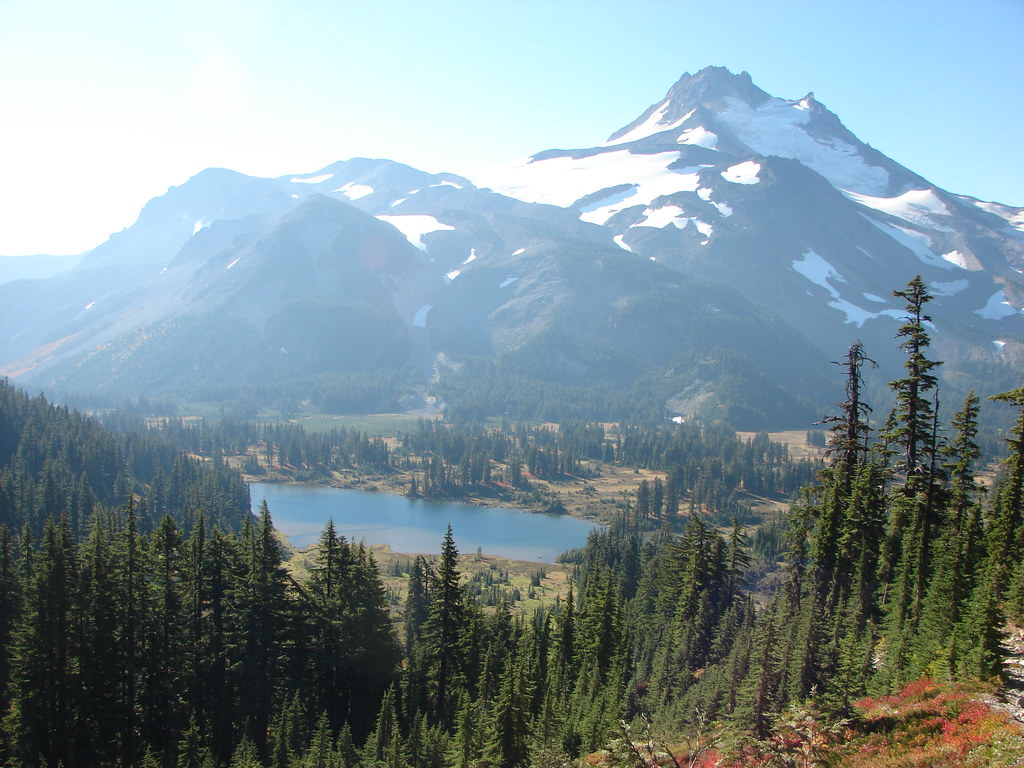
That view was quickly trumped though as we crested the ridge and finally had a full view of Mt. Jefferson with Jefferson Park below.
Mt. Jefferson, Russel Lake, and Sprauge Lake from Park Ridge

The ridge marks the boundary of the Mt. Hood and Willamette National Forests.
Sign marking the border between the Willamtte and Mt. Hood National Forests

Sign marking the border between the Willamtte and Mt. Hood National Forests

We took a nice long break on top of the ridge enjoying the views. As we rested a couple on horseback rode by stopping momentarily to discuss the beauty of the area. After resting up we headed down toward Jefferson Park.
Mt. Jefferson and Jefferson Park
It was just under 2 miles down to Russell Lake. The PCT was a little steeper on this side of Park Ridge as it traversed downhill past springs, red huckleberry bushes and meadows with wildflowers still in bloom.
Pacific Crest Trail

Huckleberry bushes along the Pacific Crest Trail

Lupine

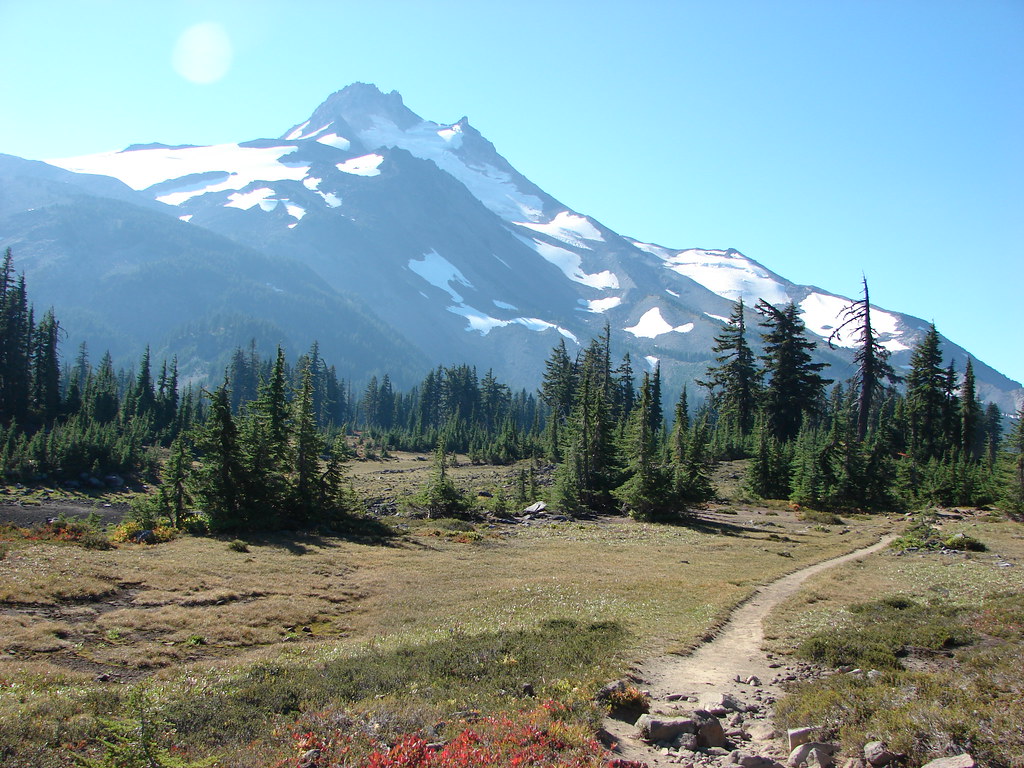
Mt. Jefferson from the Pacific Crest Trail

Behind us Park Butte rose from the end of Park Ridge.
Park Butte

We eventually got a good look at Russell Lake.
Russell Lake

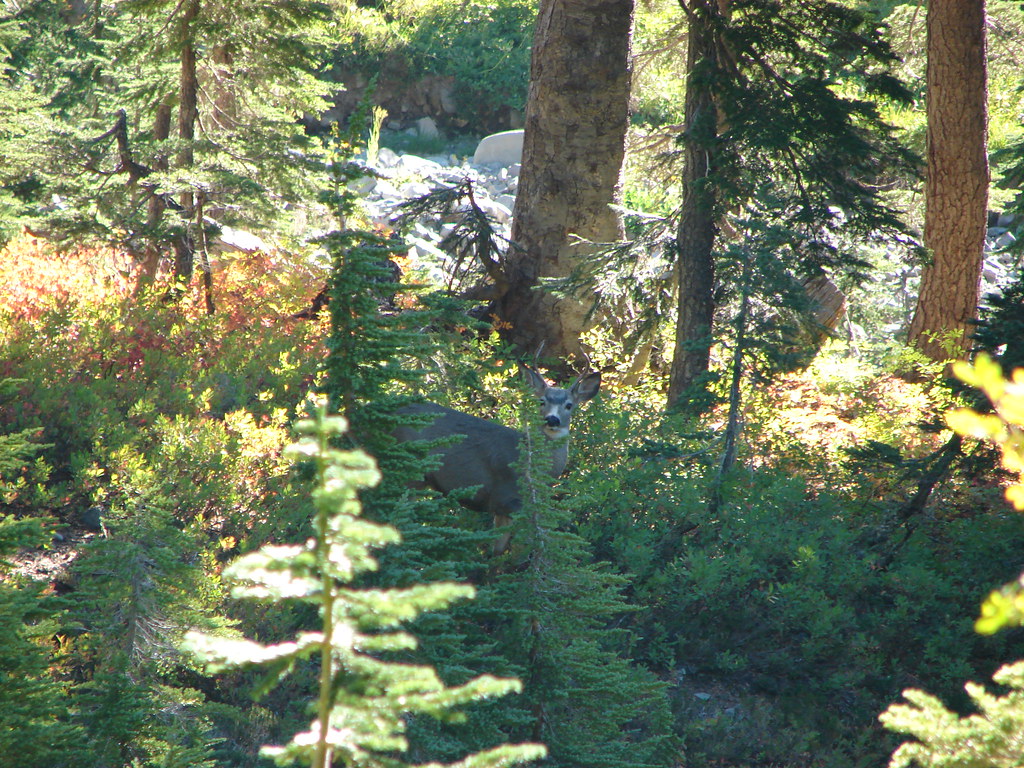
Before we made it down there though we ran into a small buck.
Small buck along the Pacific Crest Trail

After crossing the dry bed of the South Breitenbush River we turned off the PCT to visit Russell Lake.
Wildflowers along the South Breitenbush River

Mt. Jefferson from Russel Lake
After visiting that lake we returned to the PCT and continued south another three quarter miles to Scout Lake.
Mt. Jefferson
Scout Lake

After another short rest we returned the way we’d come. On the way back the remaining gentians were opening up to the sunlight.
Gentians

We followed the PCT back up Park Ridge where the views were no less impressive.
Pacific Crest Trail

Mt. Hood and Olallie Butte

Mt. Hood, Olallie Butte and Sara Jane Lake

We cruised back past the now thawed ponds and more blooming gentians to the trailhead where we would once again need to brave FR 4220 in order to get home.
Pond along the Pacific Crest Trail

Gentians

Pyramid Butte, Mt. Hood and Olallie Butte

Ruddy HillFR 4220 visible below the rocky slope.

We obviously survived the drive back. We hope to get back to Park Ridge someday. We have considered heading up the PCT from Jefferson Park on subsequent visits but have wound up balking at prospect of the 1000′ of elevation gain necessary to get to the top. It will likely be part of a backpacking trip the next time we are up there, until then we have the memories. Happy Trails!
Flickr: Jefferson Park Ridge
Categories
Bull of the Woods/Opal Creek Hiking Old Cascades Oregon

Throwback Thursday – Elkhorn Ridge Trail

**Note the 2020 Beachie Creek Fire burned the area covered in this hike.**

Today’s Throwback Thursday hike is the last of the hikes we did prior to starting this blog that are currently not on our schedule of future hikes. On July 10, 2011 we made our second attempt to visit Phanton Bridge (post).

This hike wasn’t included in any of our guide books (we would discover why) and only came to our attention as I was researching possible routes to reach Phantom Bridge. On the Willamette National Forest website I noticed that it appeared possible to follow the Elkhorn Ridge Trail east to the natural bridge. The route appeared a bit longer than the others I knew of but the road to the trailhead was open unlike Forest Service Road 2223 which was closed by a washout at the time.

The shot up remains of a trail sign marked the beginning of the trail as it set off along a forested ridge line with views of Rocky Top and Henline Mountain.
Elkhorn Ridge Trailhead

Rocky TopRocky Top

Henline MountainHenline Mountain

The trail was a bit faint with occasional patches of snow remaining from an unusually late melting snowpak that year.
Elkhorn Ridge Trail

Snow along the Elkhorn Ridge Trail

As we continued to make our way along the ridge we spotted Mt. Hood and Mt. Jefferson through the trees.
Mt. HoodMt. Hood

Mt. JeffersonMt. Jefferson

The further along we went the fainter the trail got and we found ourselves relying on pink flagging to mark the way. We had a map but it wasn’t an adequate map and even if we’d had a proper topographic map we were not yet experienced enough to have been able to use it properly. We also didn’t have a GPS unit yet. Shortly after the trail emerged from the trees and began to drop along the north side of the ridge we wound up losing it.
Elkhorn Ridge Trail

After a couple of minutes searching from the next flagging we decided to call it and turned around. This was one of several outings in 2011 that really helped hammer home just how important having the proper tools and knowledge of how to use them was going to be if we were serious about this hiking thing.

We estimate that we only went a little over a mile of the approximate 3 miles to Phantom Bridge before turning back. I have no doubt that if we were to attempt this hike with the experience we have now we’d have no trouble reaching Phantom Bridge, but turning around that day was the right call. Happy Trails!

Flickr: Elkhorn Ridge Trail

Categories
Corvallis Hiking Oregon Trip report Willamette Valley

Peavy Arboretum – McDonald Forest

We are in the middle of an extremely mild winter. Aside from some freezing rain on Christmas Weekend we’ve experienced no other snow or icy conditions. That of course changed when we decided that we would take our February hike on Presidents Day. After making that decision the weather forecast immediately called for a snow event that same weekend with Sunday night expected to be the worst of it. After double checking the forecast Saturday afternoon we moved our hike up by one day and changed destinations to something closer to Salem, the McDonald Forest. The forest has become our go to destination in inclement weather having visited McCulloch (post) Peak in October 2016 and Dimple Hill (post) in December of that same year.

For this visit we chose the trails around the Peavy Arboretum. The arboretum is located at the northwestern end of the forest and can be reached by driving Highway 99W north of Corvallis 5 miles and turning left on Arboretum Road for .8 miles to the Peavy Arboretum entrance sign on the right. There are several potential parking areas to choose from and we stayed to the left at forks for .3 miles to a trailhead sign where the road ahead was gated.
Peavy Arboretum Trailhead

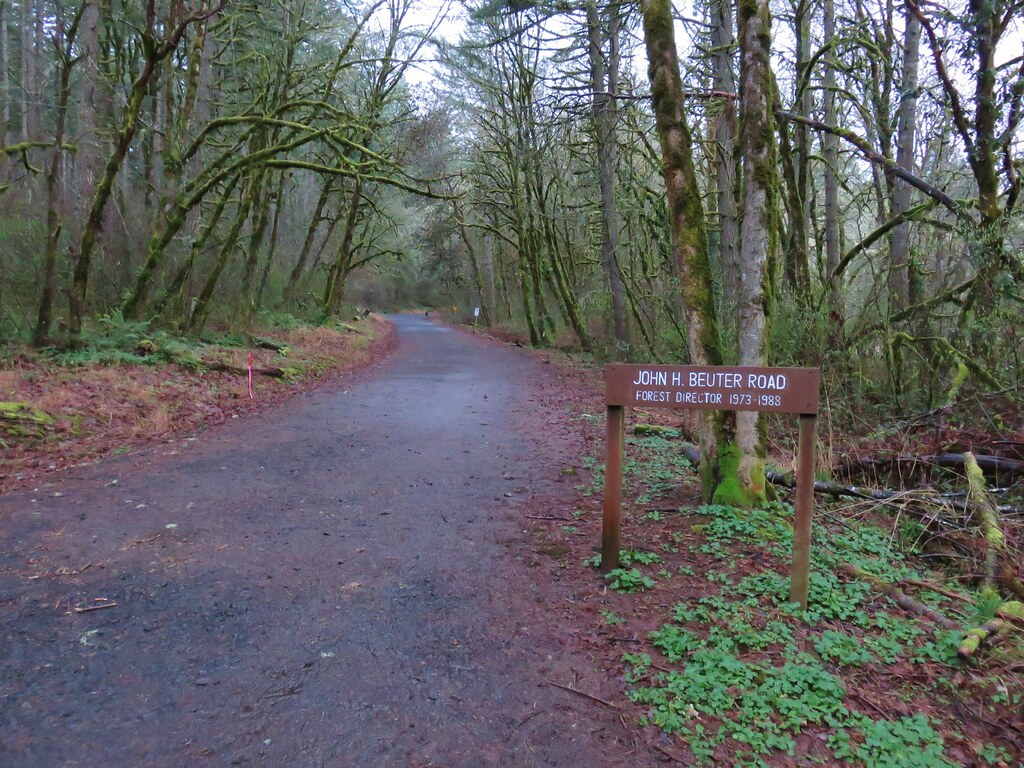
John H. Beuter Road

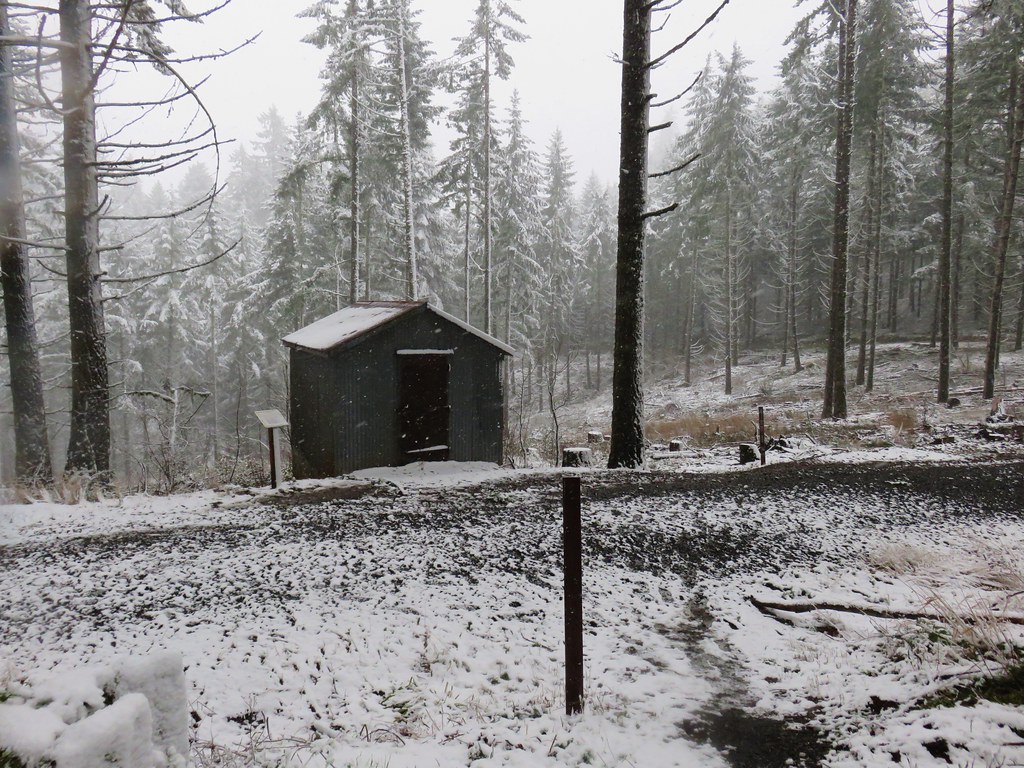
After picking up a trail map we headed up John H. Beuter Road for .3 miles to the OSU Forestry Club Cabin.
OSU Forestry Club Cabin

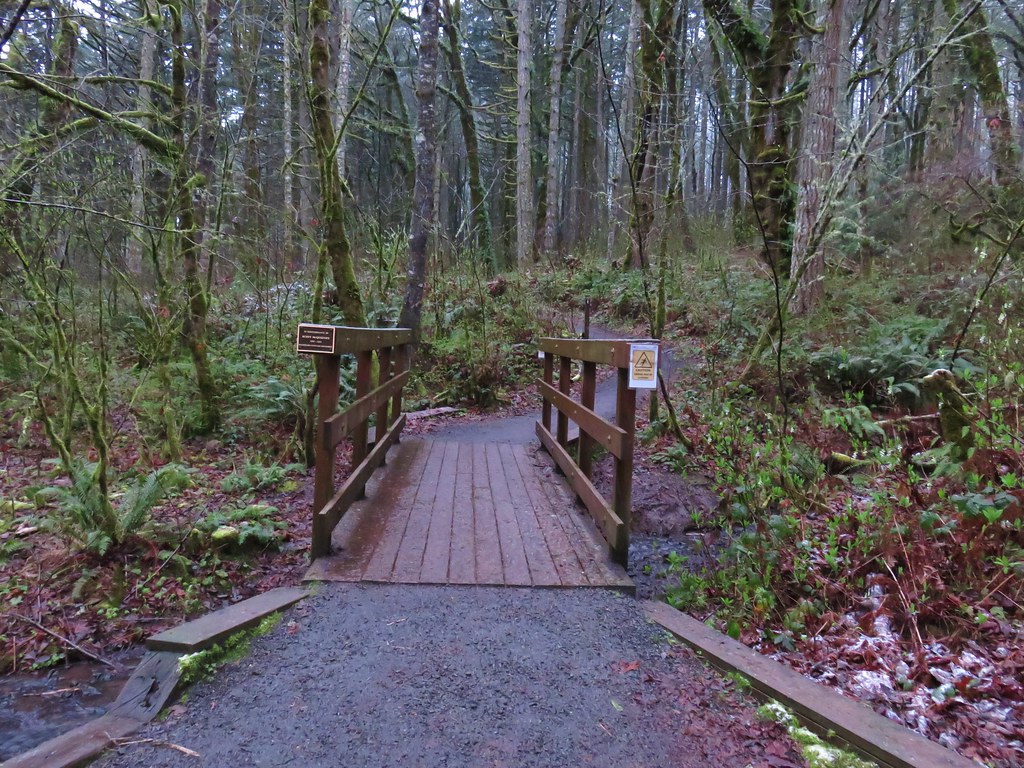
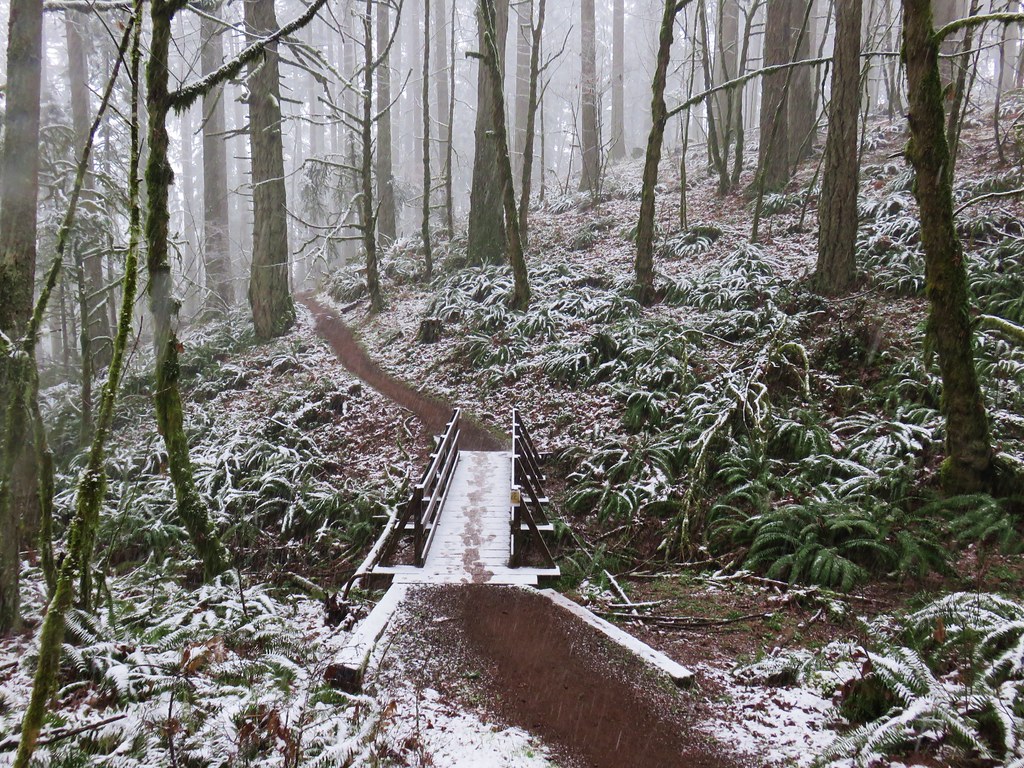
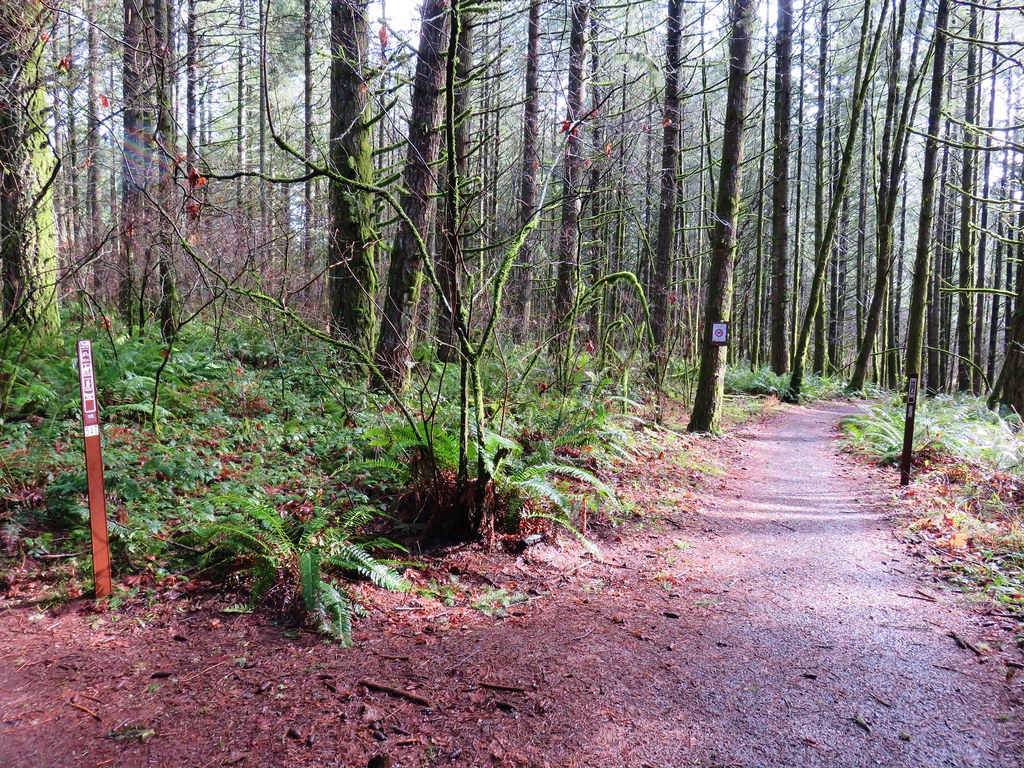
We turned left onto the Section 36 Loop Trail at the start of the lawn and crossed a small stream on a footbridge.
Section 36 Loop Trail

Section 36 Loop Trail

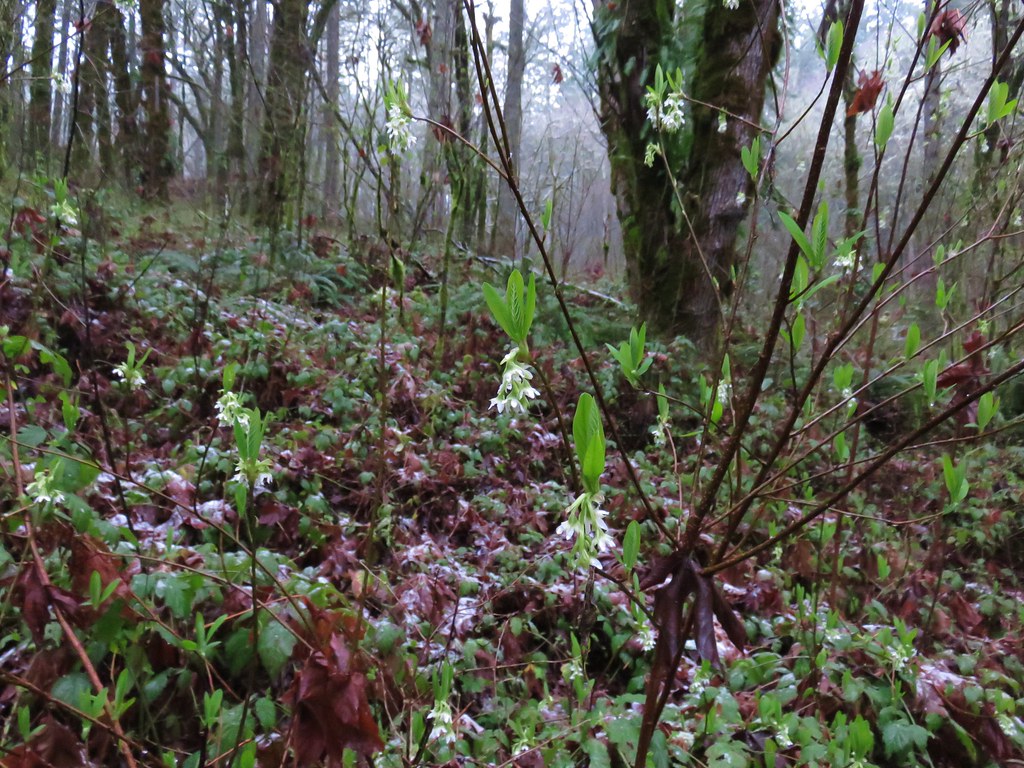
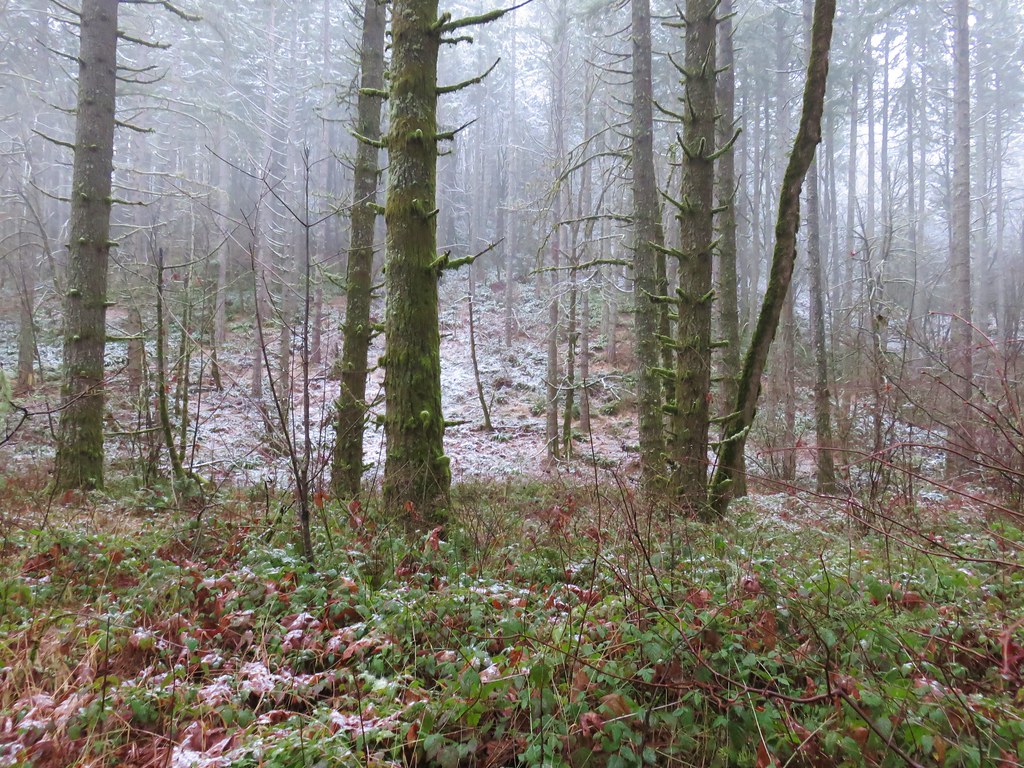
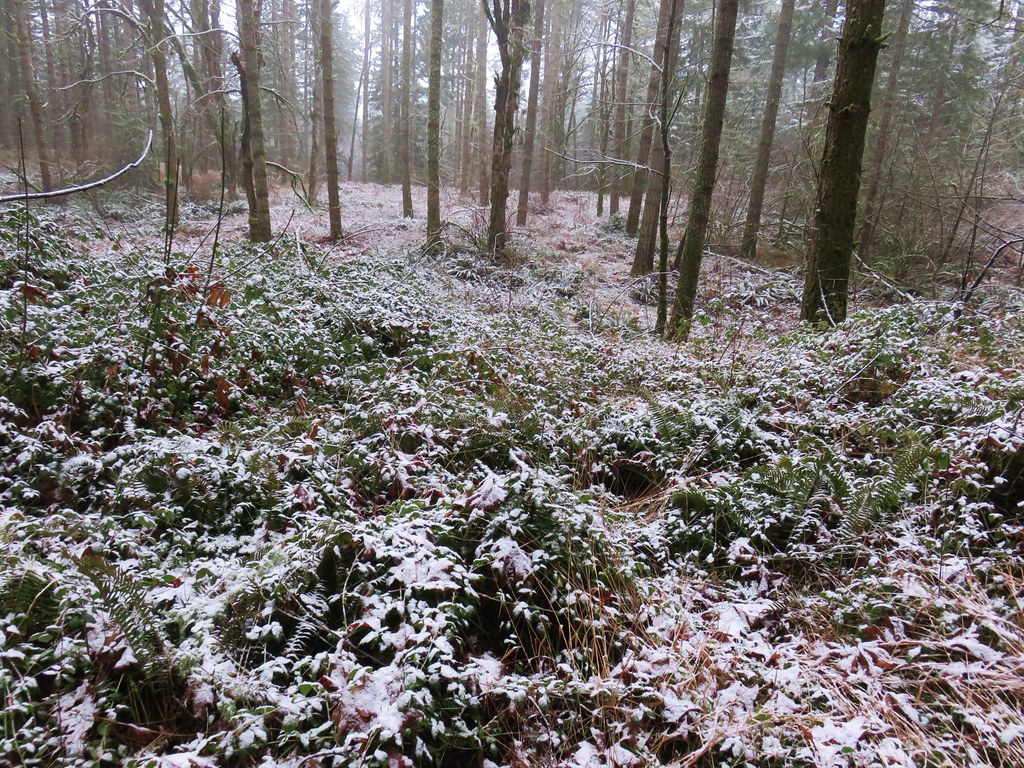
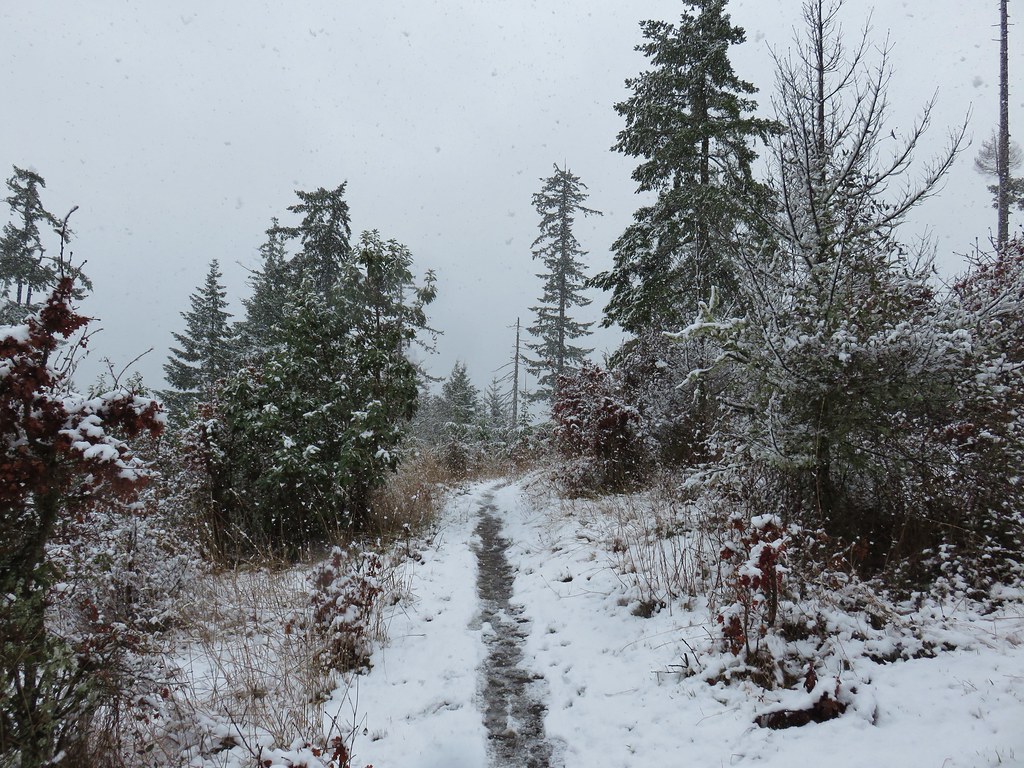
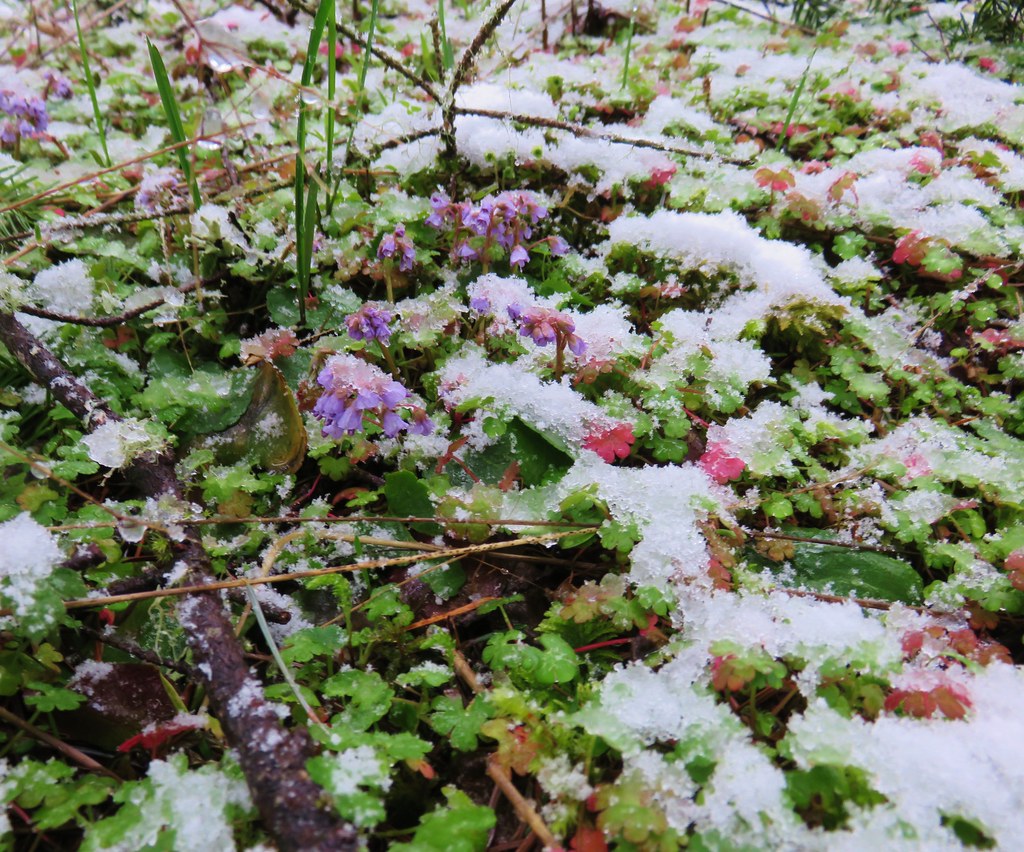
We had woken up to a small amount of snow and as we gained a little elevation on the trail, we began to encounter some on the vegetation. It was a strange mix of Winter and Spring as some of plants were starting to blossom.
Spring blossoms with a dusting of snow on the leaves behind

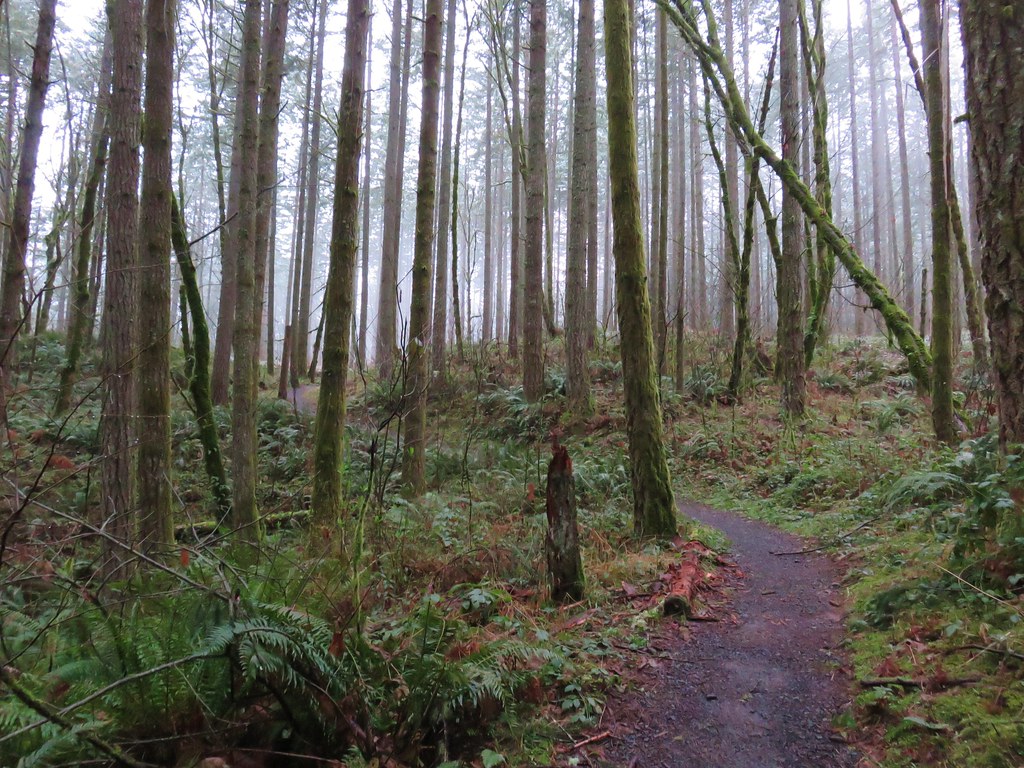
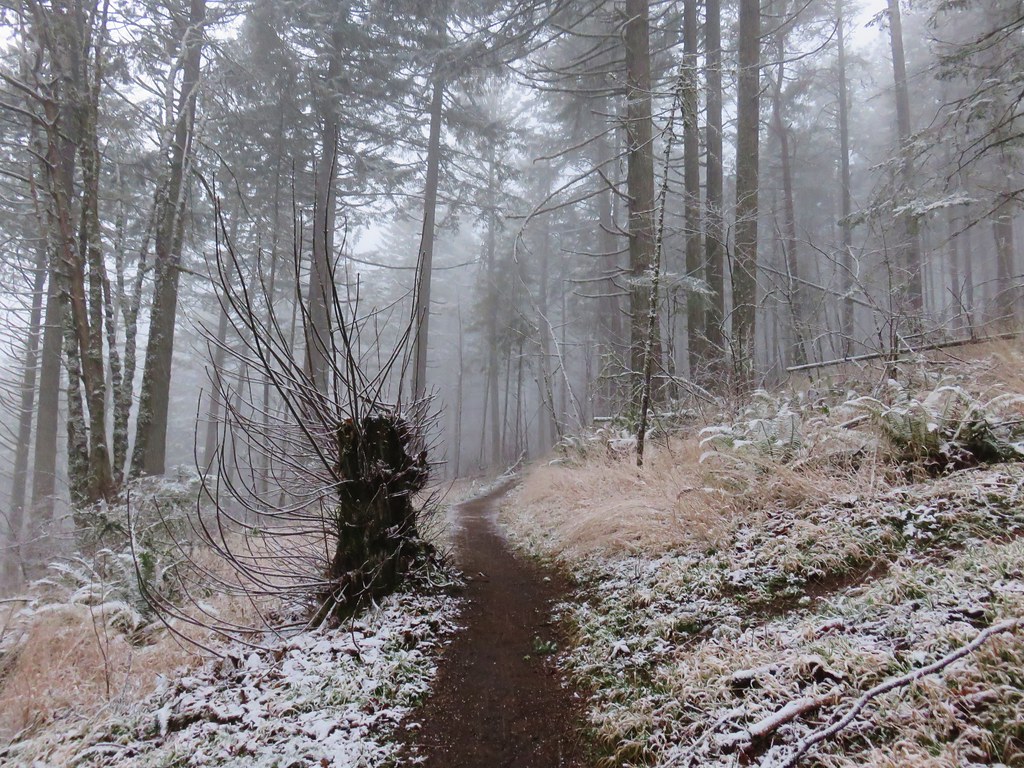
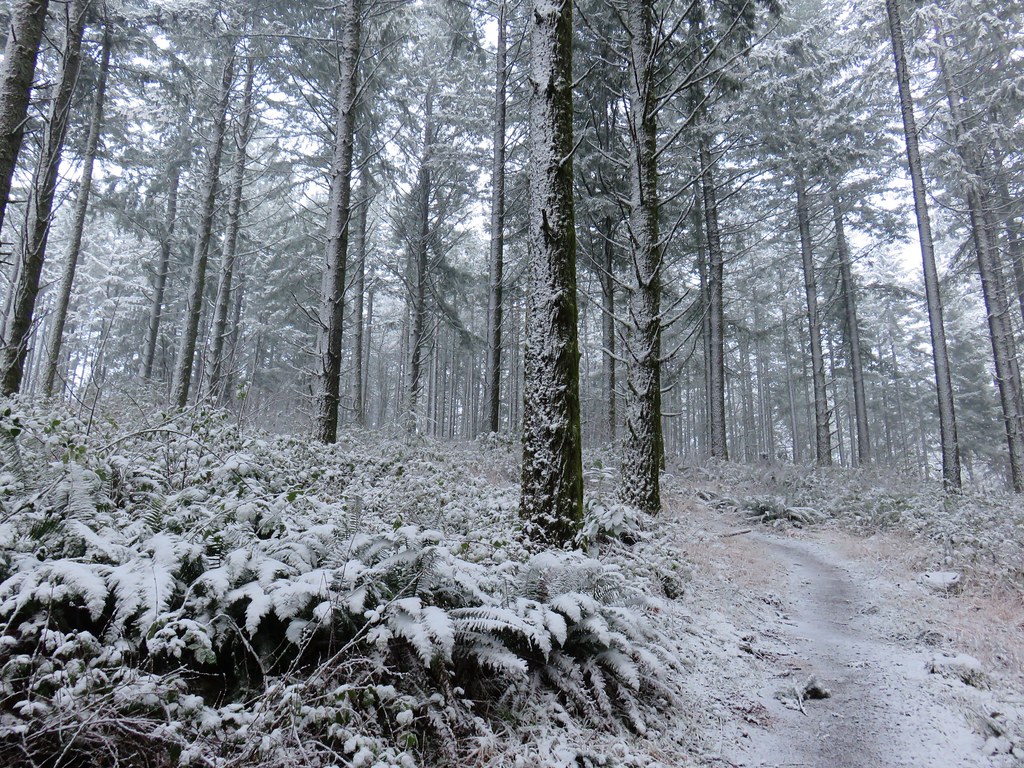
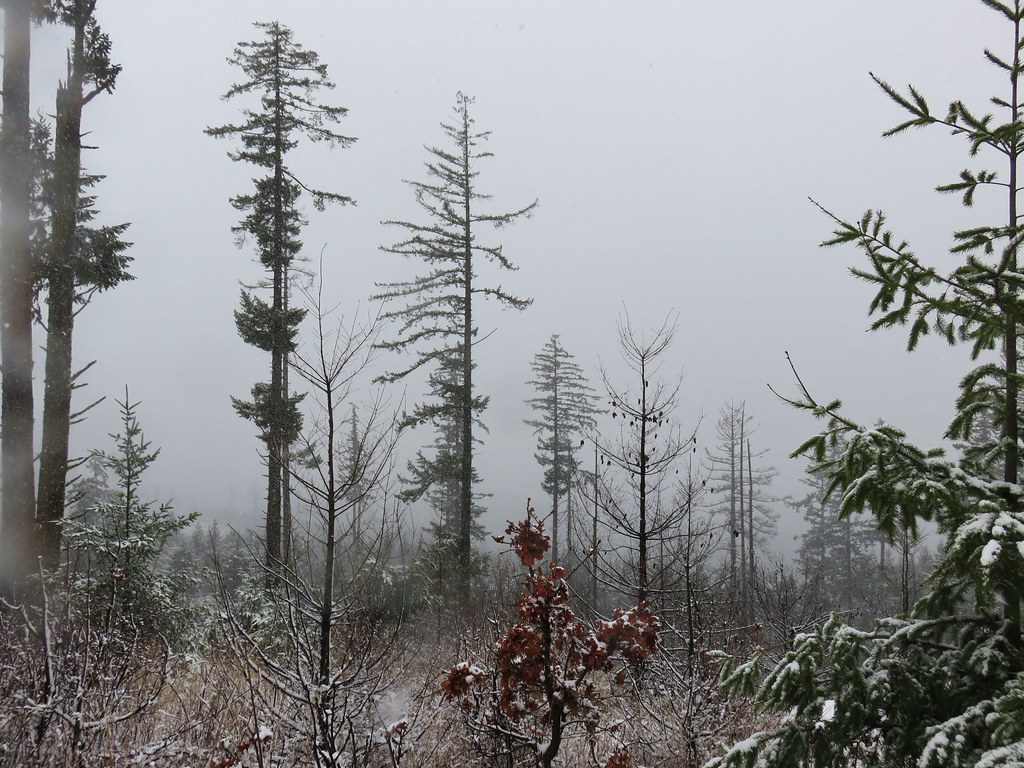
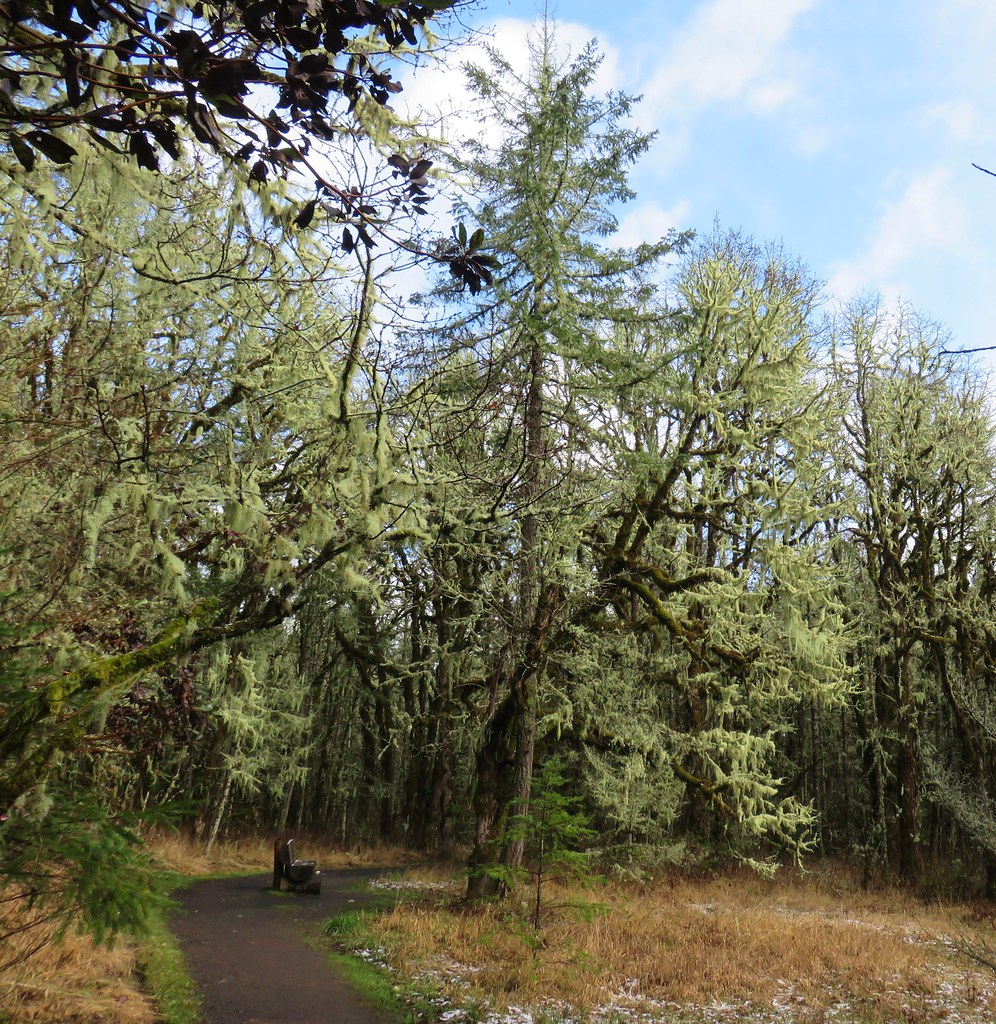
The trail continued to climb through a foggy forest and past benches to more and more snow covered ground.
Section 36 Loop Trail

Section 36 Loop Trail

Snowy hillside

Snow along the Section 36 Loop Trail

Section 36 Loop Trail

Section 36 Loop Trail

Section 36 Loop Trail

Section 36 Loop Trail

We stuck to the Section 36 Loop ignoring side trails for 1.4 miles. Then we came to a T-shaped junction with the Powder House Trail where we turned left.
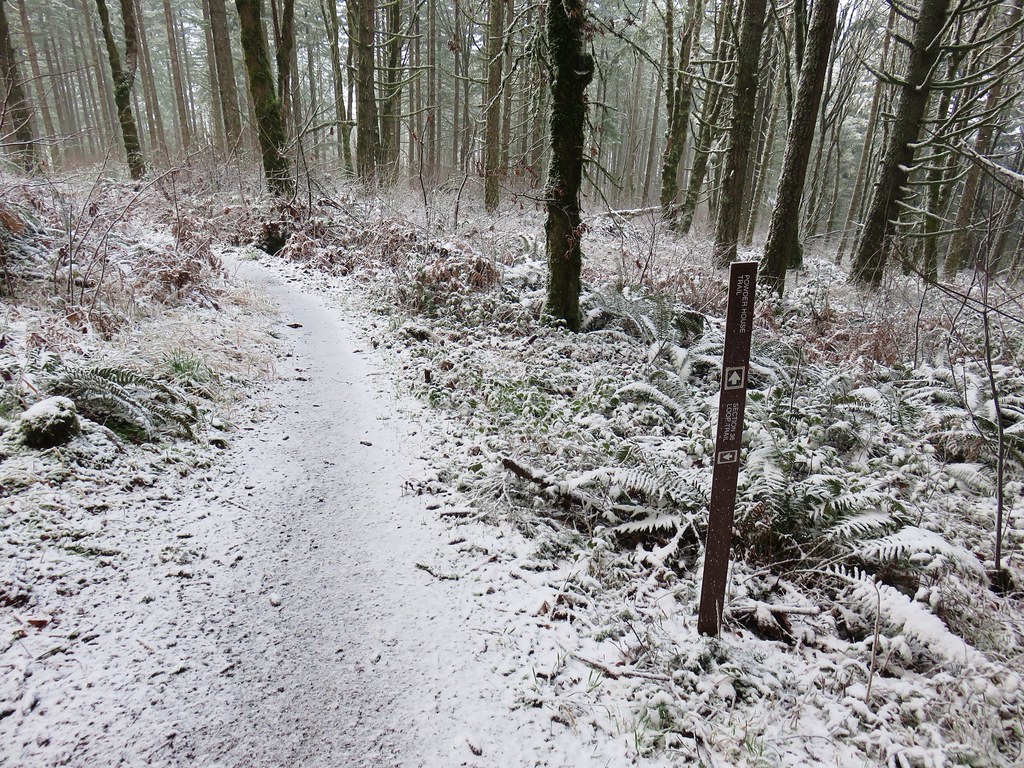
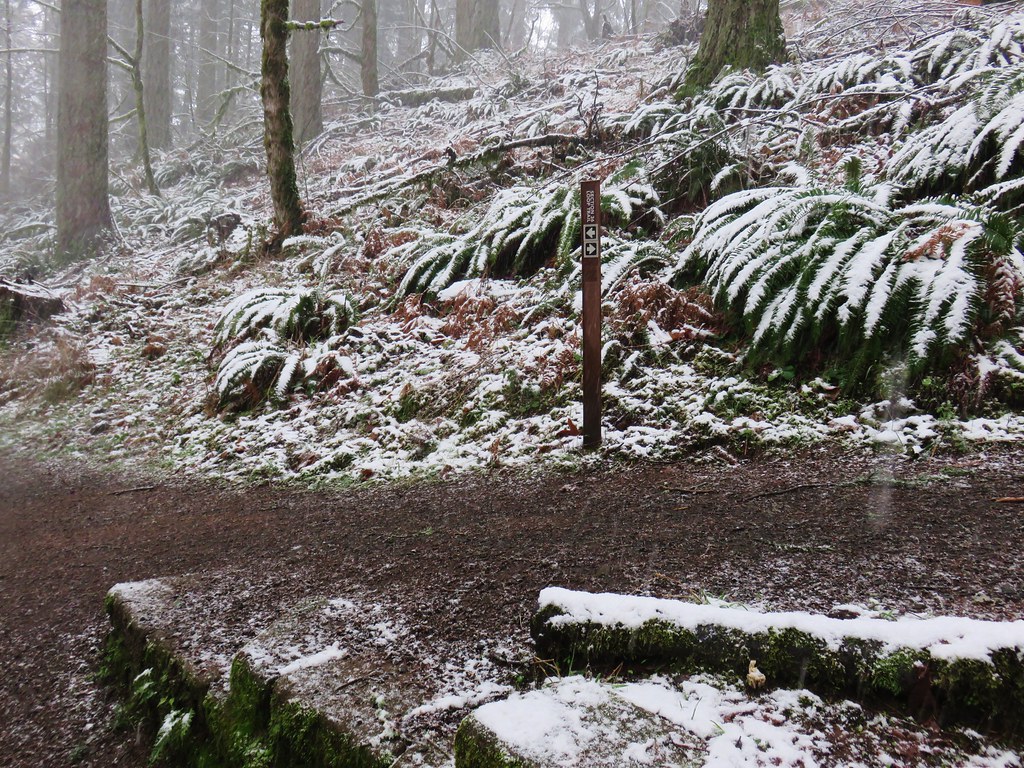
Powder House Trail

About a quarter mile from the junction the Powder House Trail crossed a series of three gravel roads. We had been planning to turn left on the first road (Road 500) and follow it to the Vineyard Mountain Trail and down to a trailhead at Lewisburg Saddle where we would then take a different series of trails and one of the other roads (Road 580) back up to the Powder House Trail. On the far side of Road 500 was a cougar sighting warning.
Cougar warning along the Powder House Trail

We were so distracted by the sign and our conversation that we forgot to turn onto the road. It wasn’t until we were about to cross the third road and we were looking at the map that it dawned on us that we should have turned left back on the first road.
Powder House Trail

Fortunately we had only passed Road 500 by a tenth of a mile so we backtracked and turned right onto the road.
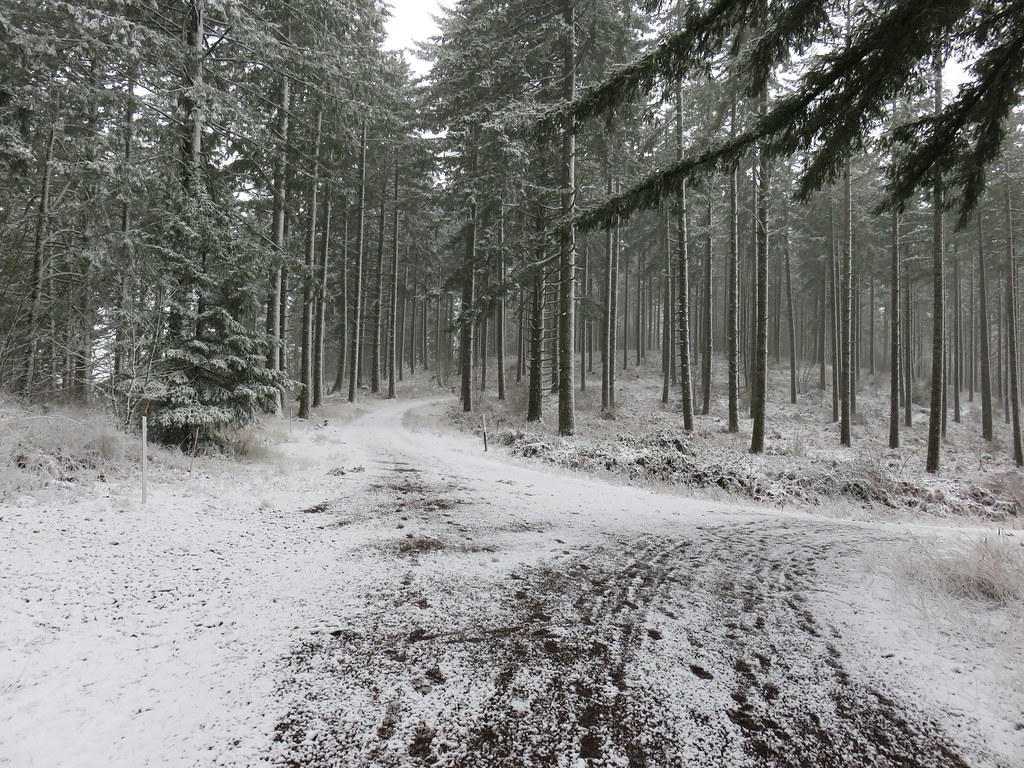
Road 500

We didn’t see any cougars but we did see a whole bunch of juncos.
Junco invasion

We followed Road 500 for just over a mile and a half to a junction at a saddle.
Road 500

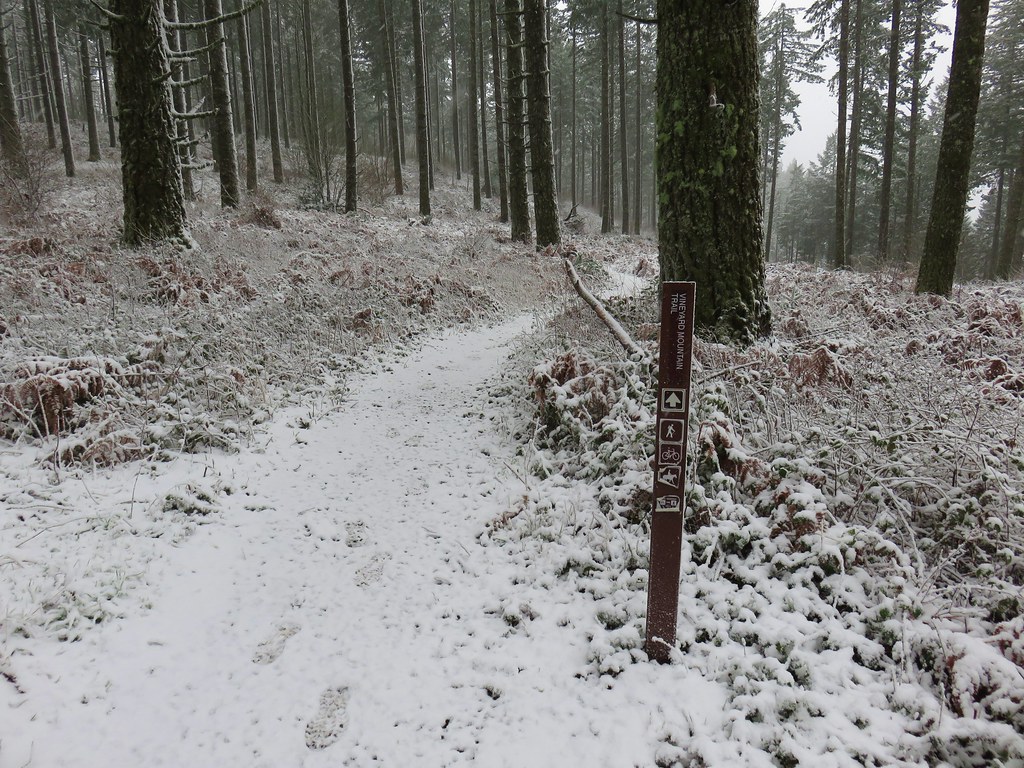
Here the Vineyard Mountain Trail began at a signpost.
Vineyard Mountain Trail

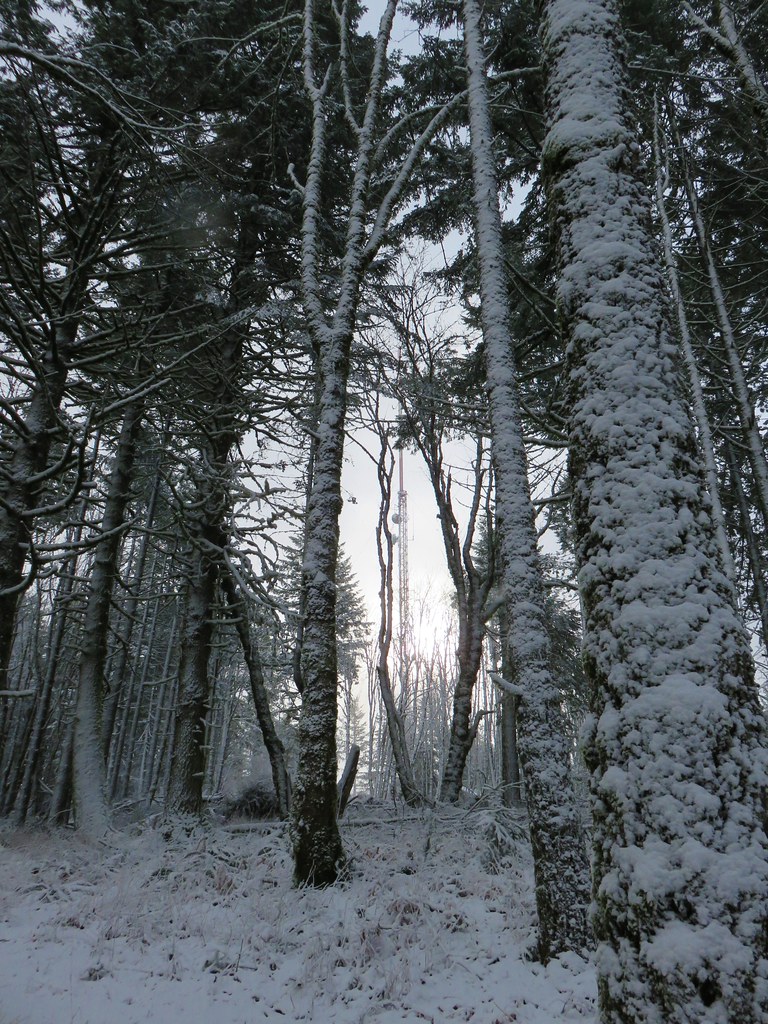
This trail climbed for .4 miles to a point near the some towers at the summit of Vineyard Mountain.
Radio tower on Vineyard Mountain

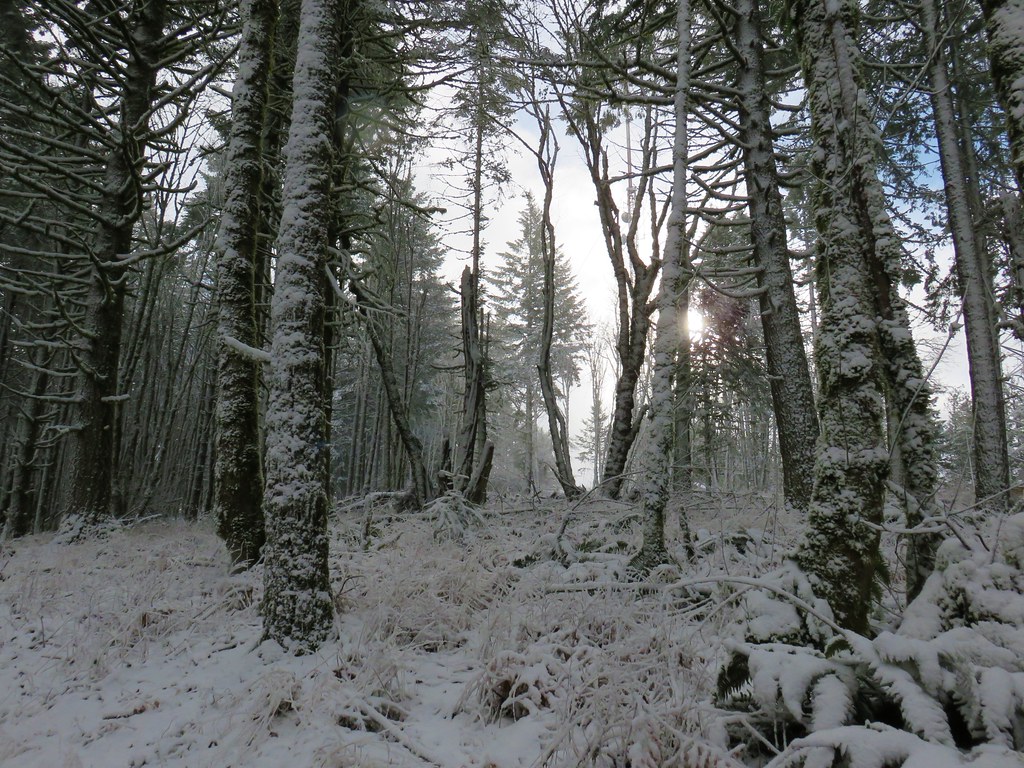
Vineyard Mountain

The trail then began descending along the southern ridge of Vineyard Mountain.
Vineyard Mountain Trail

Vineyard Mountain Trail

Just under a mile and a half from the summit we arrived at the Lewisburg Saddle Trailhead.

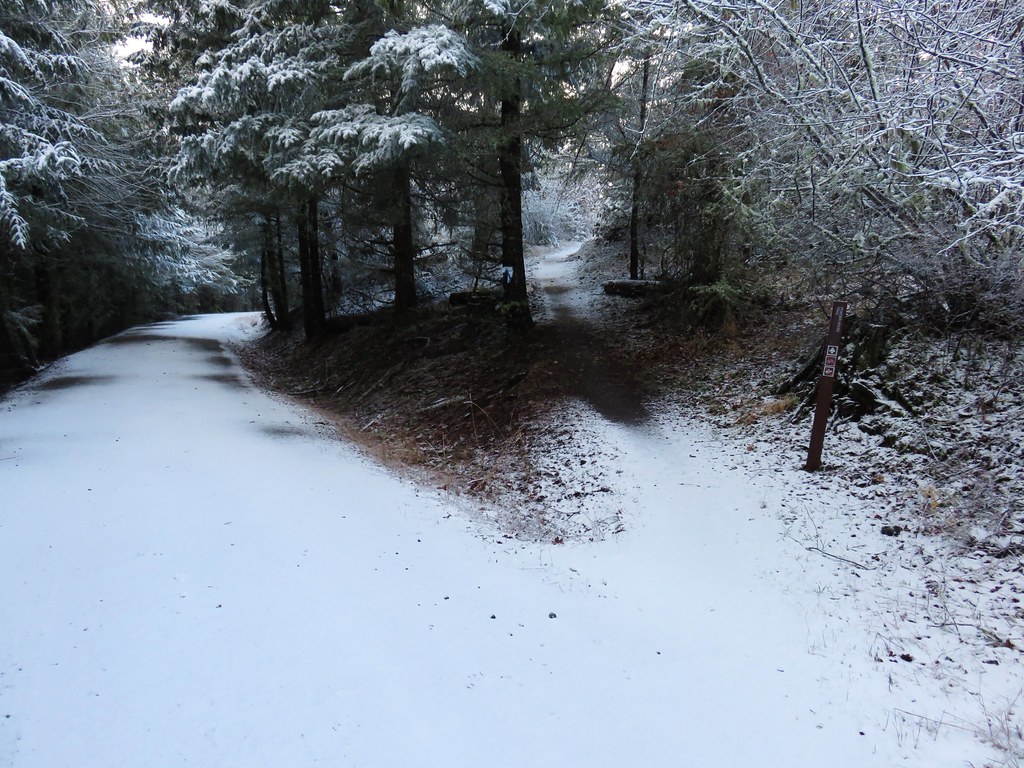
Here we briefly followed William A. Davies Road aka Road 580 before turning left onto the unsigned New Growth Trail.
New Growth Trail

An interpretive sign a little ways down the trail let us know that we were on the right path.
New Growth Trail Sign

The New Growth Trail lost enough elevation that we were soon on a snow free trail. Although snow melting from the tops of the trees made the stretch somewhat wet.
New Growth Trail

New Growth Trail

After a half mile we arrived at a junction. Here the half mile Old Growth Trail lay straight ahead or for a short loop back to the Lewisburg Saddle TH the right fork led back uphill to Road 580.
Old Growth Trail junction with the New Growth Trail

We took the Old Growth Trail which led us back into the snow.
Footbridge along the Old Growth Trail

The Old Growth Trail ended further up along Road 580 where we turned left and continued uphill.
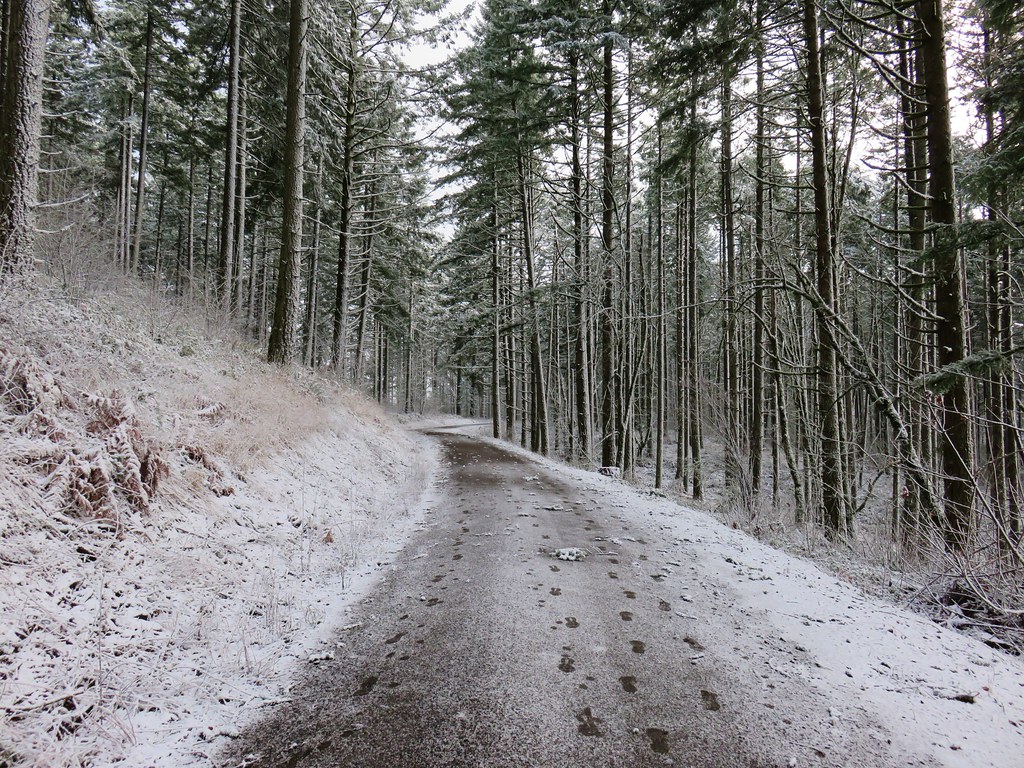
Road 580

And into a decent snow flurry.
Snowing on Road 580

There had been a couple of quick breaks in the clouds earlier in the day but after this snow flurry passed the largest patch of blue sky yet appeared.
View from Road 580

View from Road 580

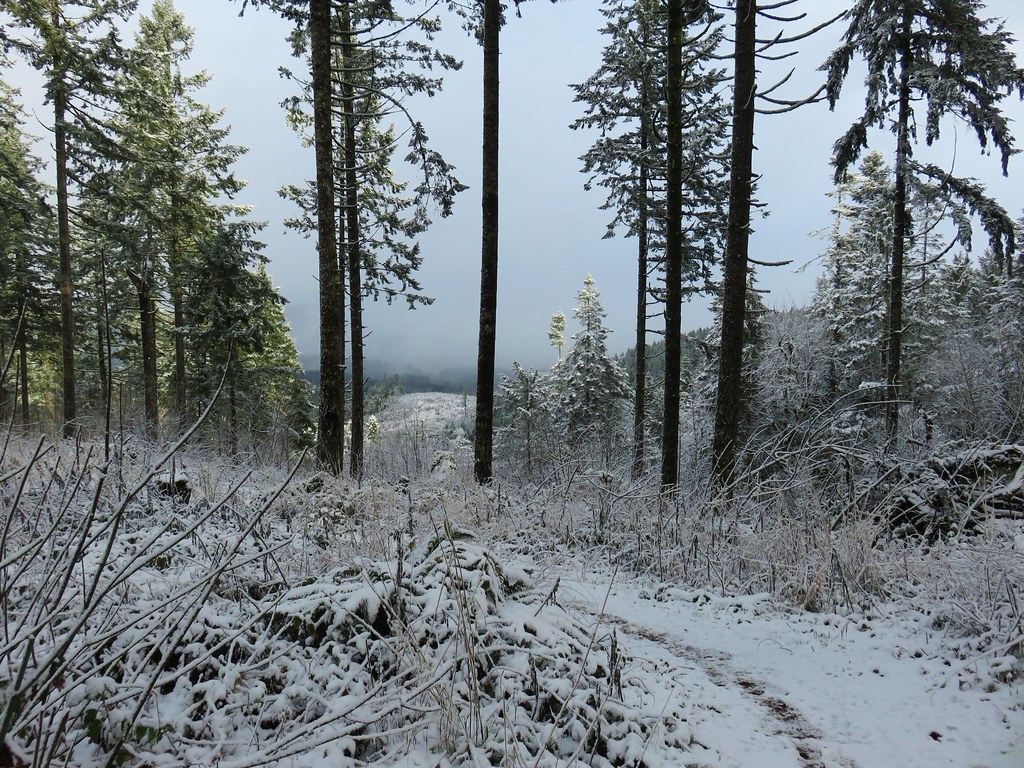
It just so happened that the section of Road 580 that we were on at the time passed by a clearcut which allowed us a nice view across the valley to peaks on the other side of the McDonald Forest.
View from Road 580

View from Road 580

The road then passed through a brief stand of remaining trees before entering another clearcut where the views had mostly disappeared.
View from Road 580

Approximately 2.5 miles from the end of the Old Growth Trail we arrived back at the Powder House Trail where we turned left.
Powder House Trail

This time we crossed the third road and headed uphill through a clearcut to a bench where we imagined the views would be pretty good on a clearer day.
Powder House Trail

Snow covered bench along the Powder House Trail

View from the snowy bench

The trail then curved back downhill to the Cap House where the Civilian Conservation Corps had once stored blasting caps.
Cap House

Interpretive sign at the Cap House

The trail continued to the right of the Cap House and descended a short distance to rejoin the Section 36 Loop Trail. Along the way we encountered several snow queen plants in bloom.
Snowy snow queen

Powder House Trail

We turned left onto the Section 36 Loop.
Powder House Trail junction with the Section 36 Loop Trail

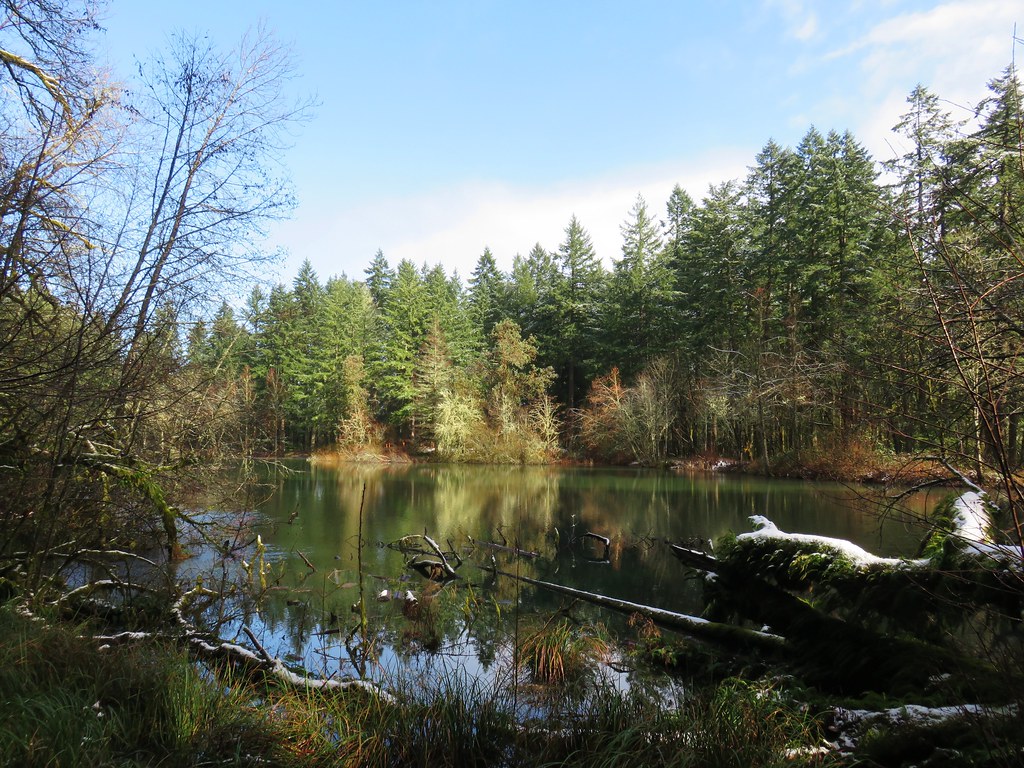
The trail gradually descended as it passed through the forest for almost a mile to Cronemiller Lake.
Section 36 Loop Trail

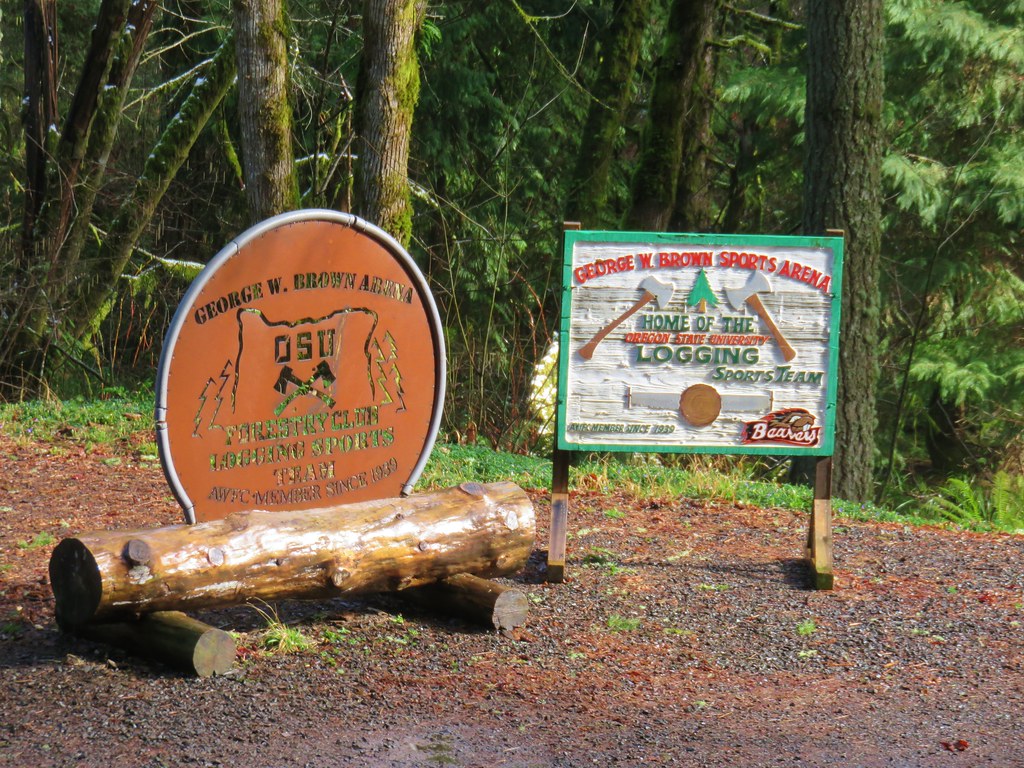
Signs for the George W. Brown Sports Arena

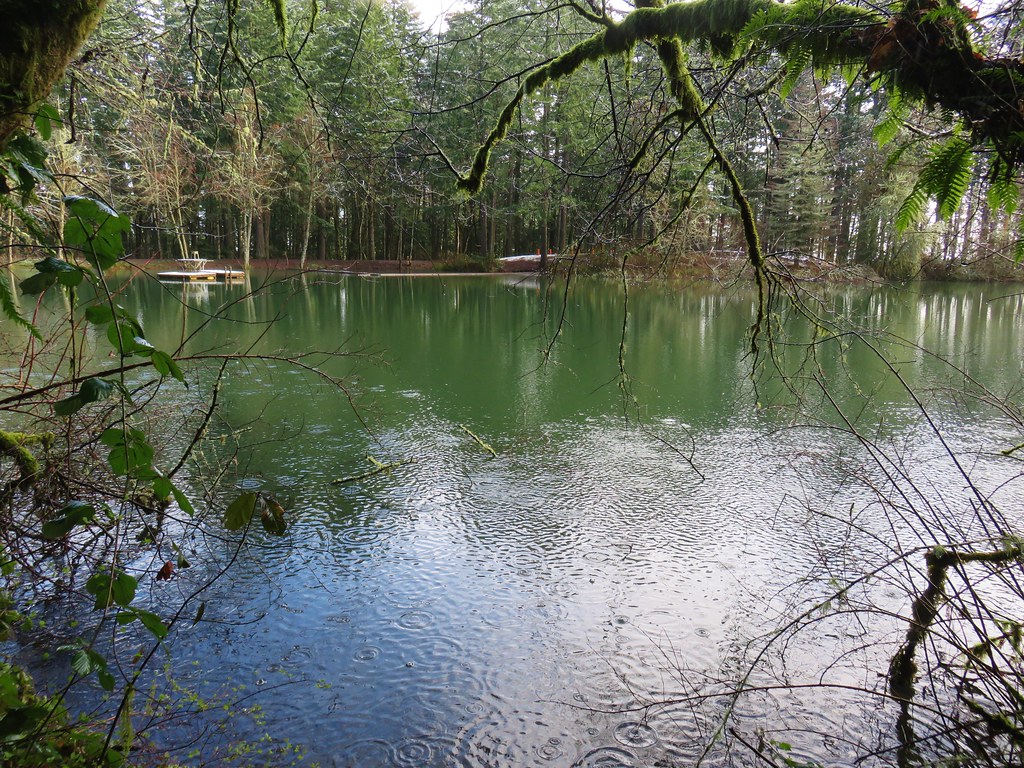
Cronemiller Lake

Cronemiller Lake

We followed the lake shore all the way around to the right until we reached the signed Calloway Creek Trail.
Calloway Creek Trail

Closed from April to November to bike traffic we followed the Calloway Creek Trail a total of 2.5 miles staying left at most junctions except for the signed trail to Road 547 where we stayed right.
Calloway Creek Trail

Calloway Creek Trail

The trail crossed Calloway Creek twice and passed a small meadow with a bench.
Calloway Creek

Calloway Creek Trail

After the 2.5 miles we turned left onto the Intensive Management Trail.
Calloway Creek Trail junction with the Intesive Management Trail

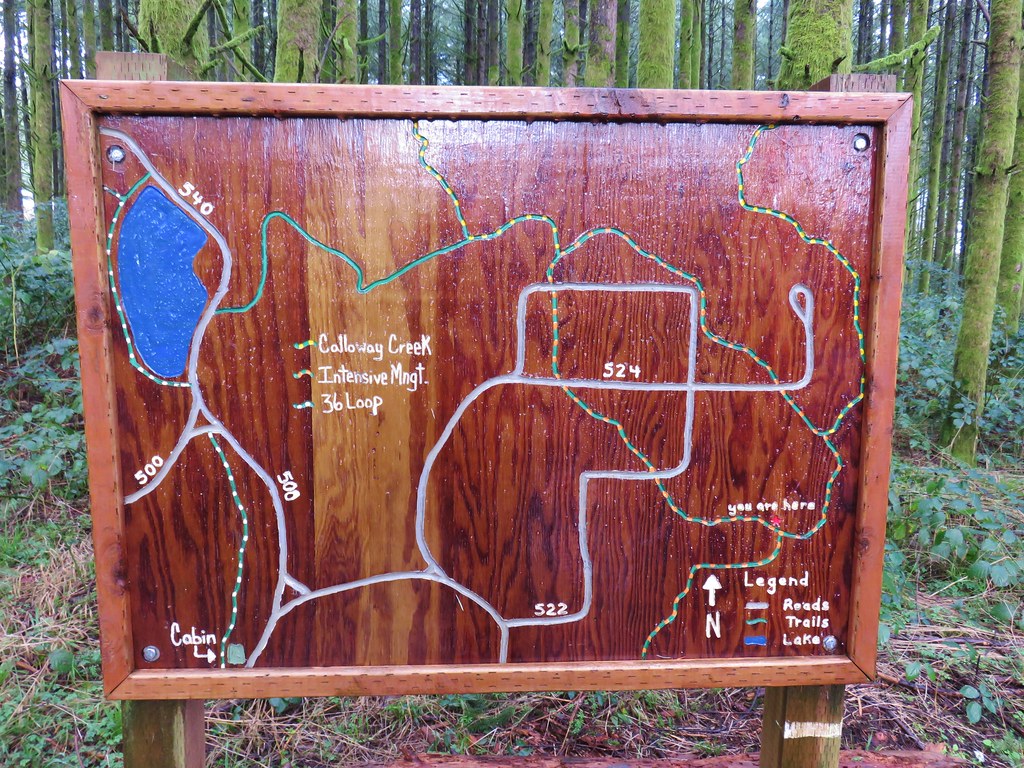
At the next junction was a signboard map which could have been a little more descriptive.
Trail sign along the Intesive Management Trail

We stuck to this trail following pointers for the Arboretum Parking to a different parking lot a tenth of a mile from where we had started.
Intesive Management Trail

From here we took the .1 mile Firefighters Memorial Trail past a nice shelter and back to our car.
Firefighter Memorial Trail

Shelter along the Firefighter Memorial Trail

The hike turned out to be an approximately 14 mile loop with around 2000′ of elevation gain. A little more than we had planned for the day but a nice hike none the less. Alternating between being above and below the snow line added to the variety of the hike. It had turned out to be a good choice and another fun hike in the McDonald Forest. Happy Trails!

Flickr: Peavy Arboretum

Categories
Central Coast Hiking Oregon Oregon Coast

Throwback Thursday – Devil’s Punchbowl and Beverly Beach

On May 12th, 2012 we were in Newport scouting out the route of the Newport Marathon which we would be running the next month and while we were there we took a short hike along Beverly Beach starting at the Devil’s Punchbowl State Natural Area.
Devil's Punchbowl Trailhead

From the parking area we headed down to the beach on the north side of the Devil’s Punchbowl. The large Gull Rock rose out of the Pacific just offshore.
Gull Rock

We turned south to explore what we could of the punchbowl.
Devi's Punchbowl

Devil's Punchbowl

We hadn’t looked up the tide table so we played it safe and didn’t go in too far but were still able to get a nice look. In addition to the rock formations there was plenty of wildlife to see.
Harlequin DucksHarlequiin ducks

StarfishStarfish

Oyster catchersOyster catchers

SeagullSeagull

After exploring down on the beach we headed back up to a viewpoint overlooking the Devil’s Punchbowl.
Devil's Punchbowl

Devil's Punchbowl and Gull Rock

We then descended to the beach on the south side of the punchbowl. Our plan was to follow the beach for 1.5 miles to Beverly Beach State Park. There we hoped to hike a .7 mile nature loop. The hike along the beach included views south to the Yaquina Head Lighthouse (post) and back north to the Devil’s Punchbowl. It also required an easy crossing of shallow Johnson Creek.
Yaquina Head Lighthouse from Beverly Beach

Yaquina Head Lighthouse

Gull Rock and Devil's Punchbowl

Johnson Creek

We turned inland at Spencer Creek and passed under Highway 101. A footbridge spanned the creek to a picnic area but we kept straight into the park campground.
Spencer Creek

The nature trail began at campsite C5 but we were disappointed to find signs indicating that it was temporarily closed just beyond a bench.
Trail in Beverly Beach Campground

We turned around and briefly wandered through the campground. Our first camping trip together had been at this park and we were wondering if we would recognize the site we’d stayed at over 17 years before. We were unsuccessful in making a positive id and headed back to the Devil’s Punchbowl parking lot. From there we headed to Newport and drove the marathon course to see what we’d gotten ourselves into. Happy Trails!
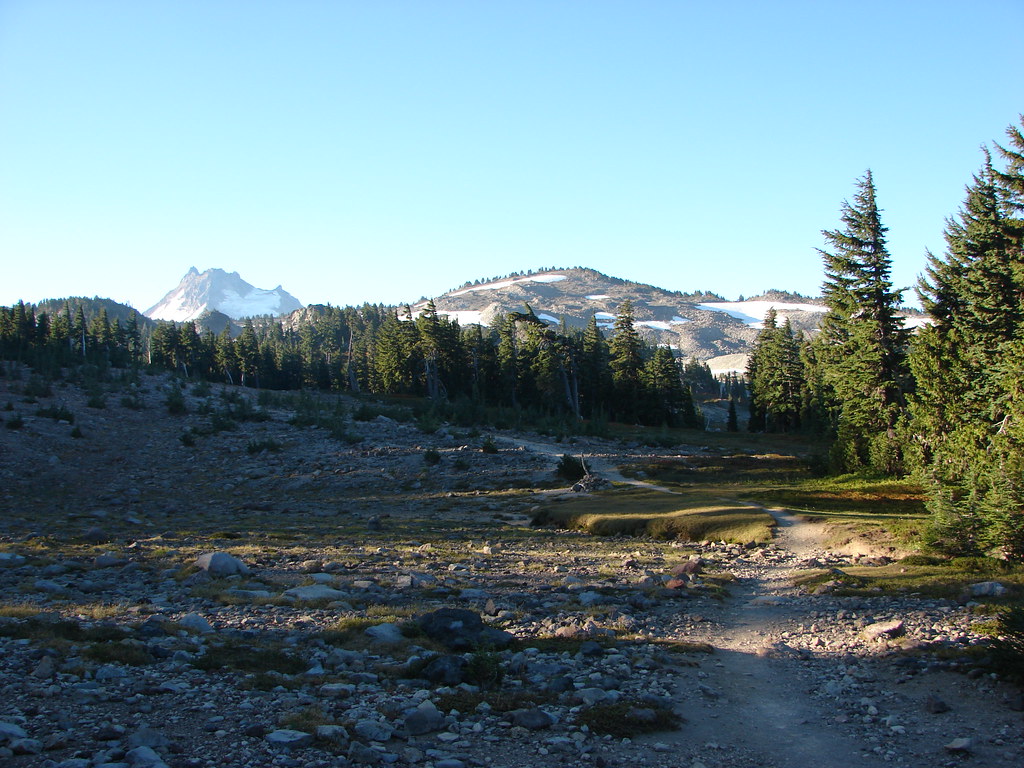
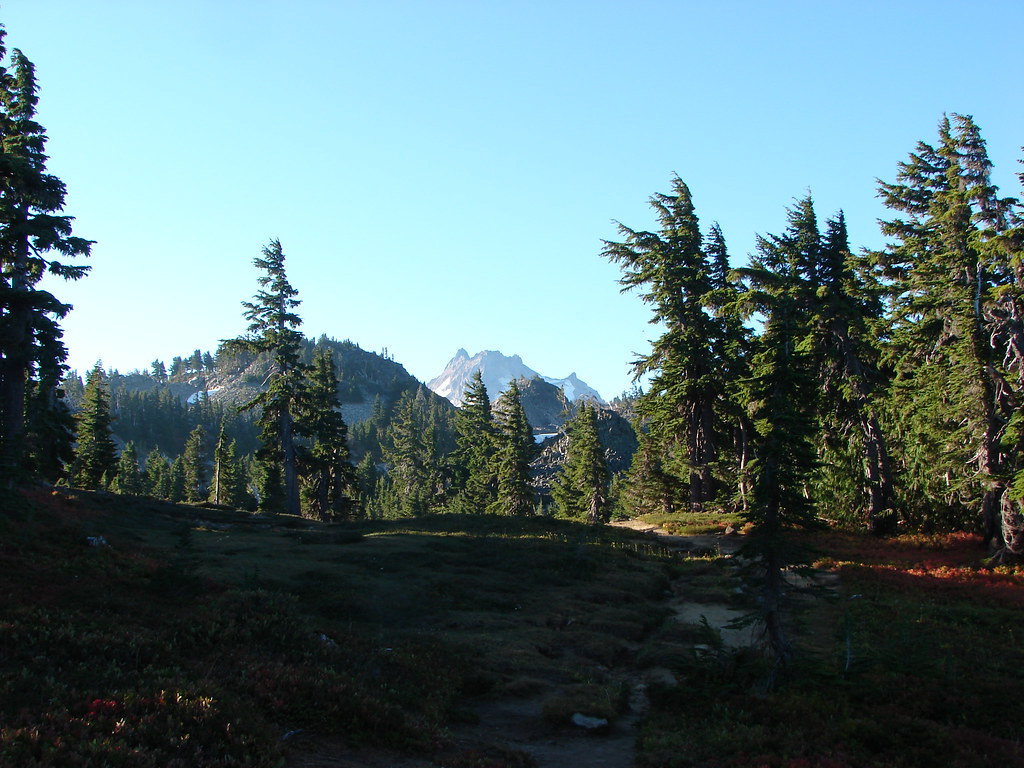
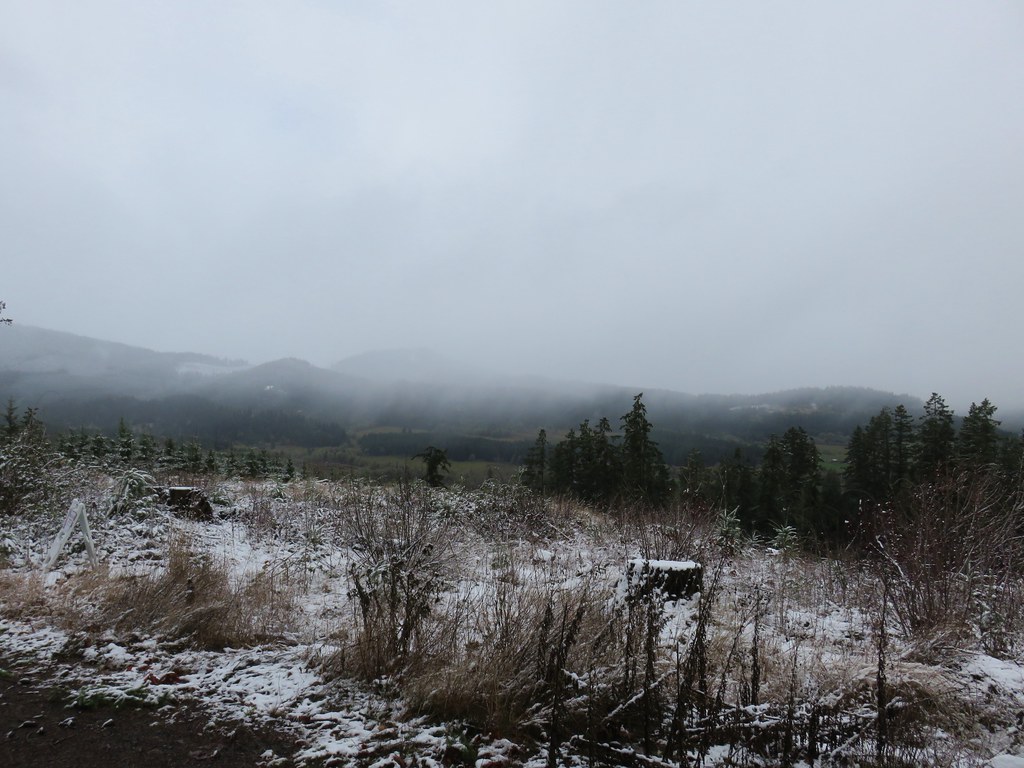
Flickr: Devil’s Punchbowl and Beverly Beach.