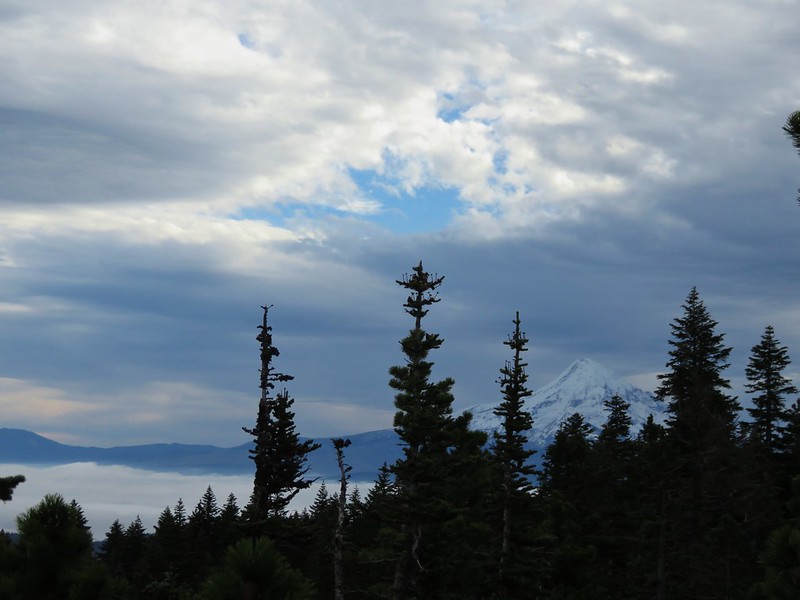
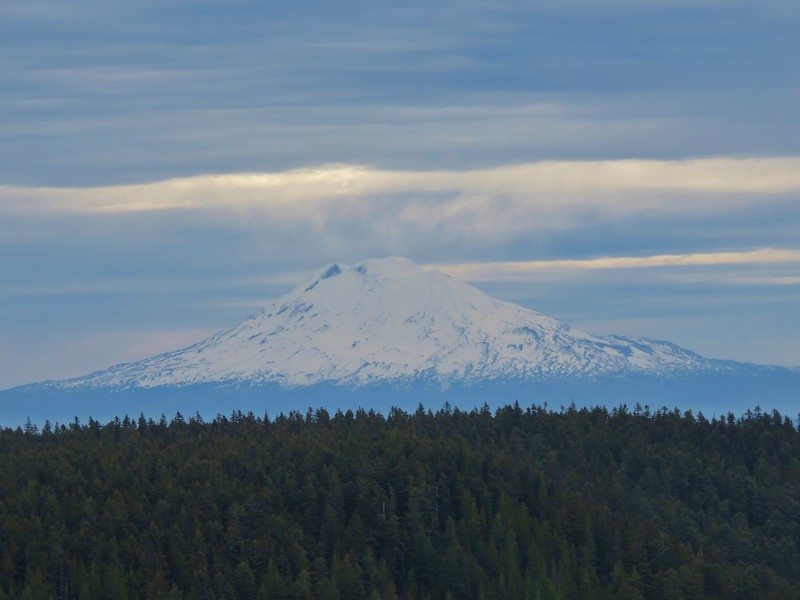
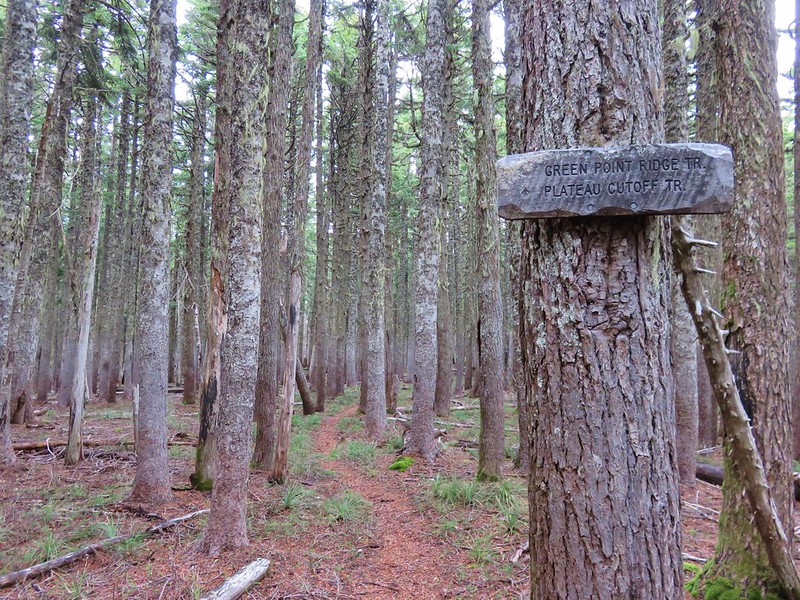
Categories
Columbia River Gorge South Hiking Oregon Trip report

Wyeth Trail To North, Rainy, and Black Lakes

**Note the 2017 Eagle Creek and 2024 Whiskey Creek fires burned portions of this hike.**

This past Veterans Day we celebrated our 21st wedding anniversary with a hike. Heather had spent the first part of the week in Las Vegas attending a convention for her work so we were looking to spend some quality time together and what better way than out on the trail away from distractions.

Our hike on the schedule for this month was to be a lollipop loop starting at Wyeth Campground in the Columbia Gorge and passing North, Rainy, and Black Lakes before returning via Green Point Ridge. I had originally estimated this hike to be a little over 16 miles with around 4000′ of elevation gain. Both of these figures turned out to be low. The total elevation gain was closer to 5000′ and the GPS read 21.5 miles when all was said and done.

The Wyeth Trail begins at Wyeth Campground which was gated closed for the season so we parked near the gate on the side of the Wyeth Road (Exit 51 off of I-84) and walked through the empty campground.
Sunrise from Wyeth Campground

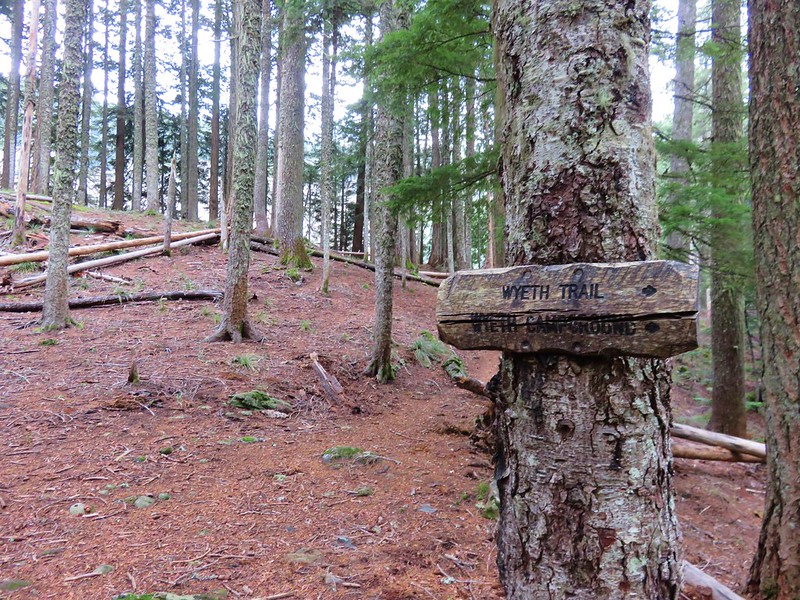
Wyeth Campground

The campground is the eastern terminus for the Gorge Trail #400 which we followed briefly to a signed junction near a footbridge over Gorton Creek.
Footbridge over Gorton Creek

Wyeth Trail junction with the Gorge Trail

We turned left following the pointer for the Wyeth Trail passing under a set of power lines before the bridge-less crossing of Harphan Creek.
Creek crossing

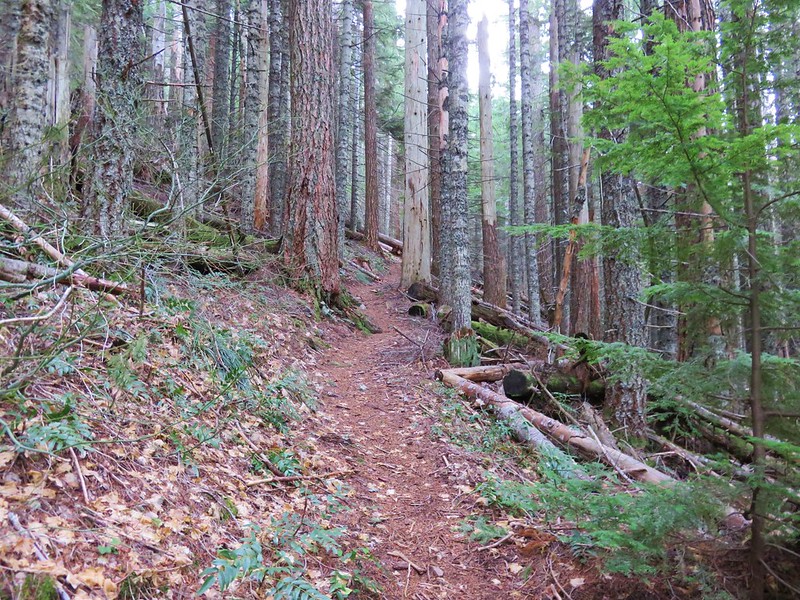
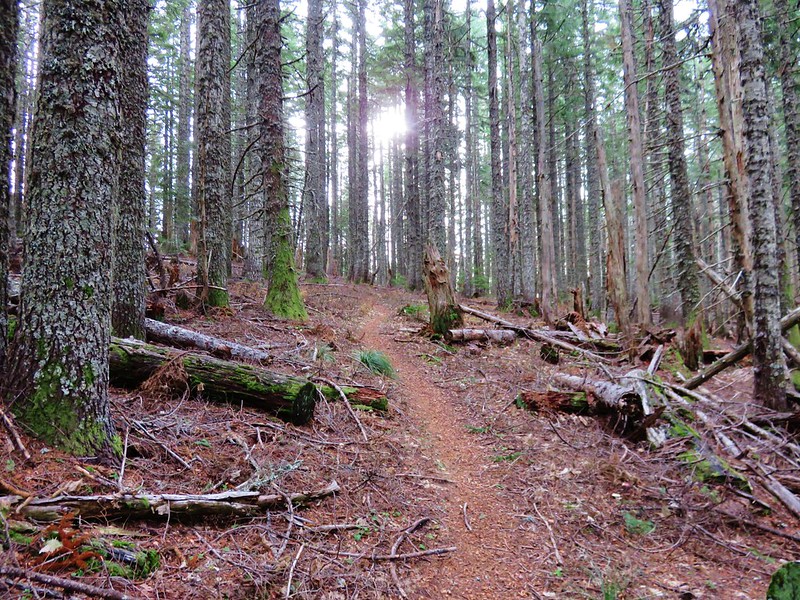
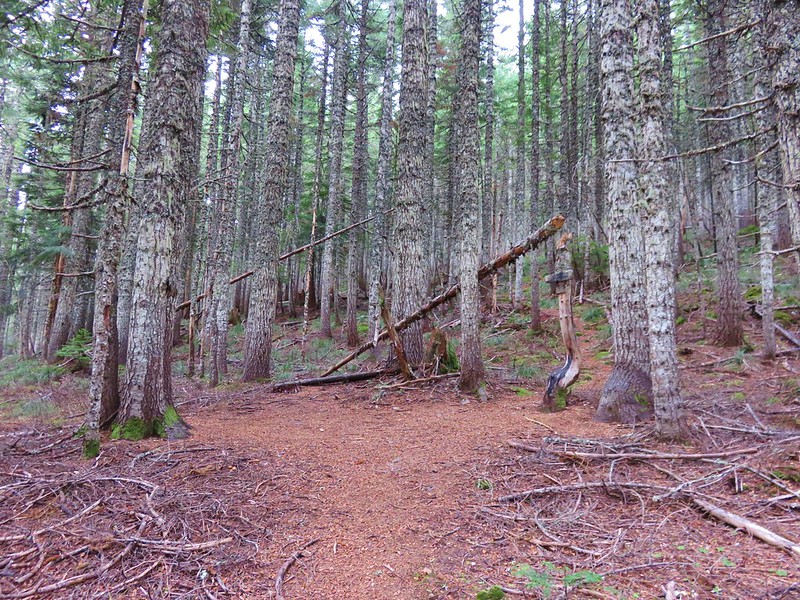
Not long after crossing Harphan Creek the Wyeth Trail began its climb. The trail gained approximately 3500 over the next 4.8 miles. This mostly forested section used numerous switchbacks to keep from ever being too steep.
Wyeth Trail

Wyeth Trail

Wyeth Trail

Wyeth Trail

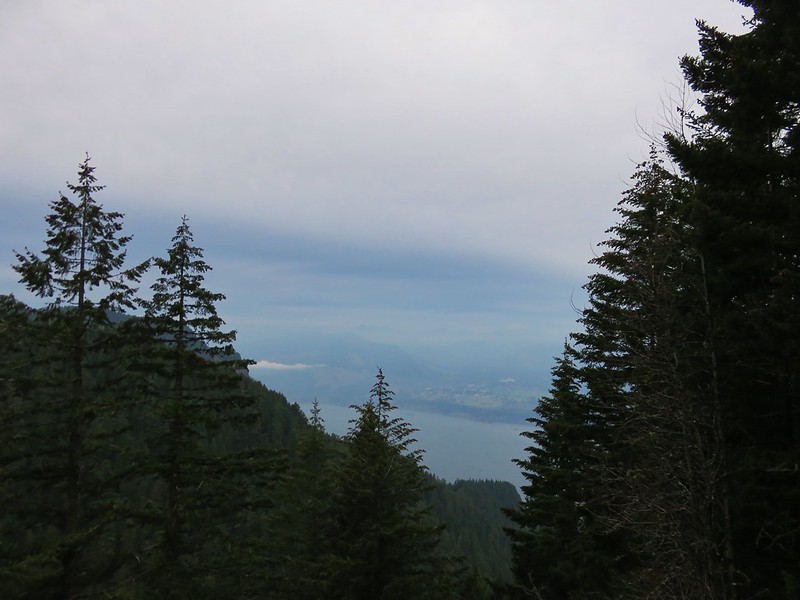
There were a couple of open areas which offered small views across the Columbia River toward Mt. St. Helens. Although the mountain was free of clouds the gray skies above and behind it provided a good camouflage from the camera.
Columbia River from the Wyeth Trail

The trail leveled off at a saddle where it began following the ridge south to the Green Point Ridge Trail junction.
Wyeth Trail juntion with the Green Point Ridge Trail

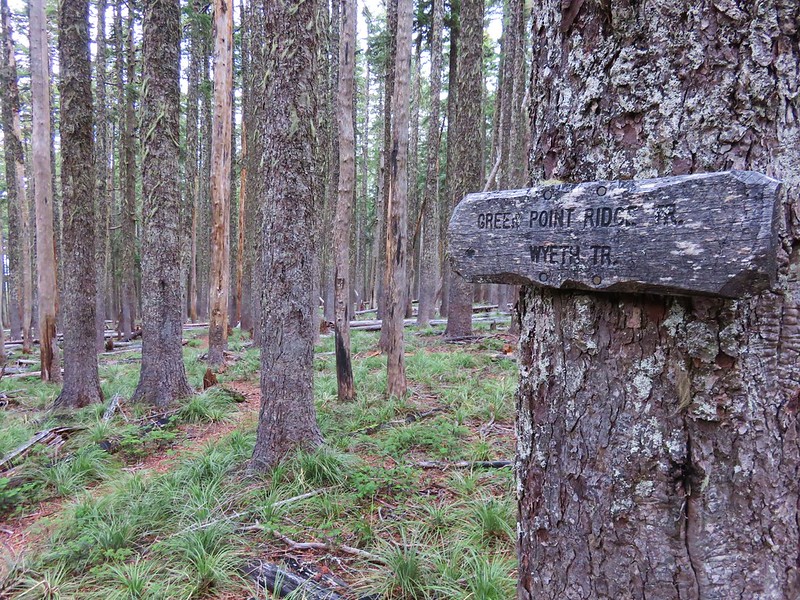
Green Point Ridge Trail

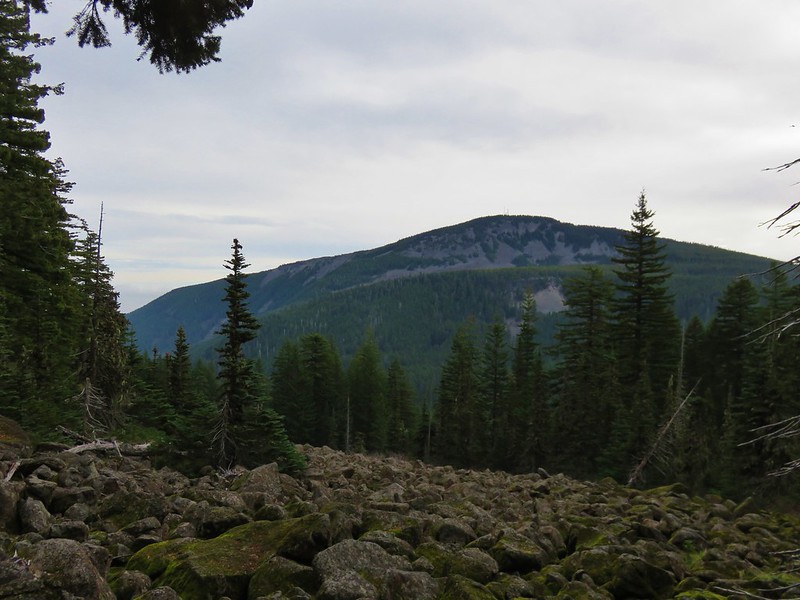
The Green Point Ridge Trail was our return route so we stayed left and continued 1.4 miles to North Lake. Along the way there was a nice view of Mt. Defiance from a rock field.
Mt. Defiance from the Wyeth Trail

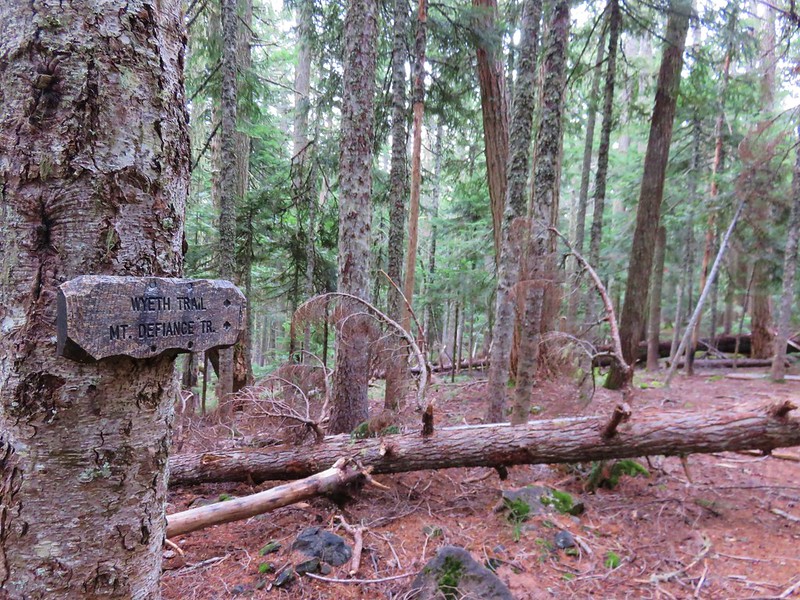
To see North Lake we followed an unsigned trail to the right at a junction where signs pointed back to the Wyeth Campground and ahead to the Mt. Defiance Trail.
Wyeth Trail

Wyeth Trail sign for the Mt. Defiance Trail

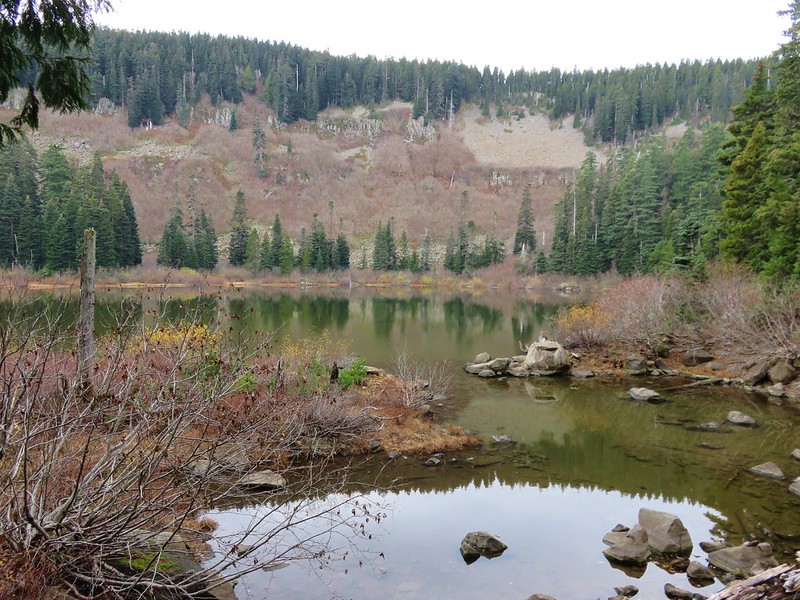
North Lake
North Lake

After sitting for a bit on some rocks along North Lake we continued along it’s shore back to the the Wyeth Trail at a junction with the North Lake Trail.
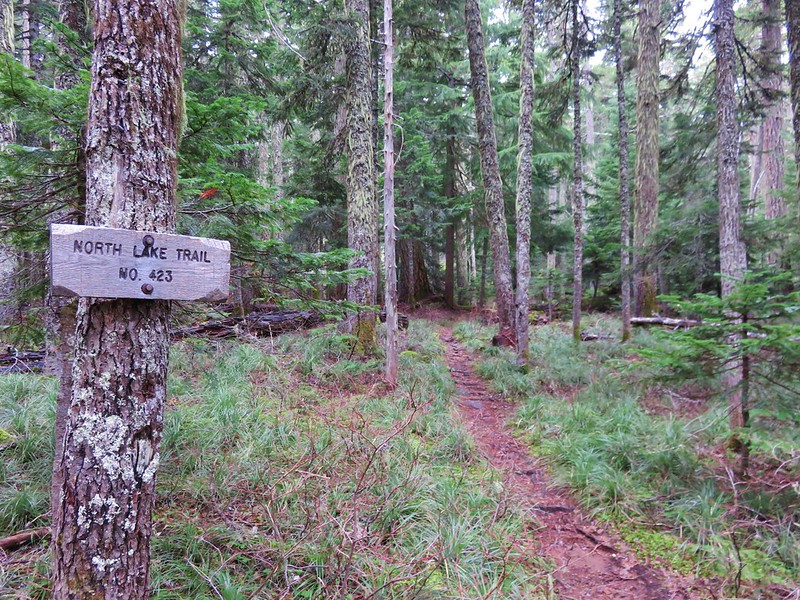
North Lake Trail

We took the North Lake Trail following it for a mile past a small pond to another trail junction.
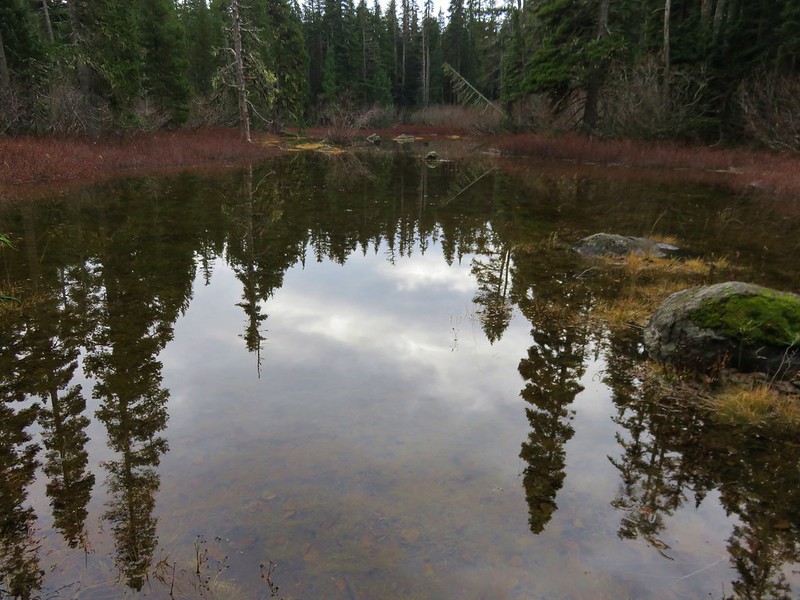
Pond along the North Lake Trail

North Lake Trail junction with the Rainy Lake Trail

We headed to the left onto the Rainy Lake Trail.
Rainy Lake Trail

A quick .4 miles brought us to Rainy Lake with a view of Green Point Mountain on the far side.
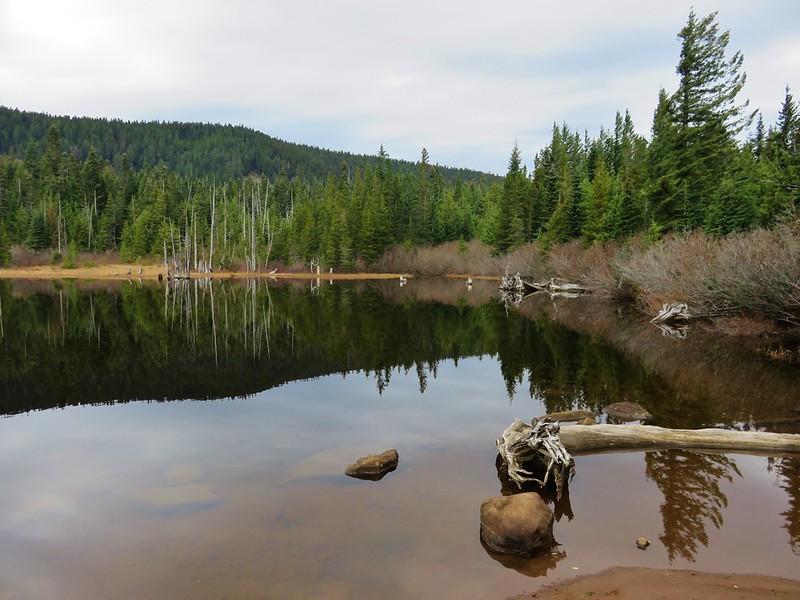
Rainy Lake

Green Point Mountain from Rainy Lake

Green Point Mountain

A tenth of a mile beyond the lake the trail left the Mark O. Hatfield Wilderness and ended at the Rainy Lake Campground, which can be driven to. Directions

Mark O. Hatfiled Wilderness boundary near the Rainy Lake Campground

We walked through the campground passing the unique outhouse to the Rainy-Wahtum Trail.
Outhouse at the Rainy Lake Campground

Rainy Lake Trail

The Rainy-Wahtum Trail would lead us up to a junction with the Gorton Creek Trail where we would begin our return to the Wyeth Campground but before we did that we had wanted to visit nearby Black Lake. Both the North Lake Trail map available on the Mt. Hood Forest Service website and Google showed a trail descending to Black Lake from the Rainy-Wahtum Trail. We were keeping our eyes out for this trail and just when we began to think we had missed it we spotted a path near a small cairn.
We thought this was marking the trail to Black Lake

We turned left onto this faint path passing the remnants of an old sign that could no longer be read. All traces of the path soon disappeared and we looked around for old blazes or any other sign of the correct route. With nothing to be seen we pulled out the Forest Service map and compared it the map shown on the Garmin. The GPS didn’t show the trail but we could compare the topography of the two maps to get a good idea of where the trail should be. We bushwacked downhill using the topographic maps in an attempt to pick up some sort of trail but weren’t having any luck so we finally decided to follow a decommissioned logging road down to its junction with Dead Point Road which went by Black Lake after passing the Rainy Lake Campground.
Road to Black Lake

We found a few flowers along the road before arriving at the Black Lake Campground.
Thistle

Black Lake Campground

Black Lake

Black Lake

We took a break at one of the picnic tables which we shared with a caterpillar.
Caterpillar

We followed the road back to the Rainy Lake Campground and set off once again on the Rainy-Wahtum Trail. We watched again for any signs of a different trail to Black Lake both before and after the one we’d turned down but never saw anything.

The Rainy-Wahtum Trail followed what was once Wahtum Road up to a 4-way trail junction.
Rainy-Wahtum Trail

The junction is the meeting point of the Rainy-Wahtum, Gorton Creek, and Herman Creek Cutoff Trails.
Rainy-Wahtum Trail junction with the Gorton Creek, and Herman Creek Cutoff Trails

Gorton Creek Trail

WWII signal Hut

Our route was to follow the Gorton Creek Trail but first we took a very short detour on the Herman Creek Cutoff Trail to check out a WWII signal hut which seemed fitting on Veterans Day.
WWII signal Hut

We started down the Gorton Creek Trail reentering the Mark O. Hatfield Wilderness and gradually climbing Green Point Ridge.
Wilderness sign along the Gorton Creek Trail

As we approached Green Point Mountain, which is really just the highest point on the ridge, the first view to open up was of Rainy Lake and Mt. Defiance beyond.
Mt. Defiance and Rainy Lake

Rainy Lake

The Oregon Hikers Field Guide entry for  Green Point Mountain mentions views of Mt. Defiance, Rainy Lake, and Mt. Adams but we quickly found that there were more views than that. Before we were able to see Mt. Adams to the north a glance behind us to the south revealed Mt. Hood rising above the tress.
Mt. Hood

A viewpoint near the summit offered the Mt. Adams, Mt. Defiance, and Rainy Lake view.
Mt. Adams, Mt. Defiance and Rainy Lake

Mt. Adams
Mt. Adams

The view of Mt. Hood was especially nice with a layer of clouds in the valley below it and an opening of blue sky in the clouds above.
Mt. Hood from Green Point Mountain

When we reached the summit we were a bit surprised to see Mt. Rainier join the view to the north and Mt. Jefferson to the south.
Mt. Rainier from Green Point Mountain

Mt. Jefferson and Olallie Butte
Olallie Butte and Mt. Jefferson from Green Point Mountain

Mt. Hood & Mt. Jefferson
Mt. Hood and Mt. Jefferson from Green Point Mountain

In addition the Goat Rocks were also visible between Mt. Rainier and Mt. Adams.
Goat Rocks from Green Point Mountain

After enjoying the surprisingly good view we began our descent. It was nearly 2pm and we’d been hiking for almost 7 hours already. I was beginning to suspect that the hike was going to be longer than what I had estimated. We tend to average right around 2mph so a 16 mile hike should take us 8 hours. We hadn’t taken any extended breaks and it didn’t feel like we’d been going particularly slowly on the climb up so extra distance was the only explanation for the time. We picked up the pace on the way down not wanting to have to rely on using lights to finish the hike in the dark.

A quarter mile from the summit we left the Gorton Creek Trail at a three-way junction. The Gorton Creek Trail headed downhill to the left and on the right the North Lake Trail came up from the lake. We stayed straight on the Green Point Ridge Trail.
Green Point Ridge Trail

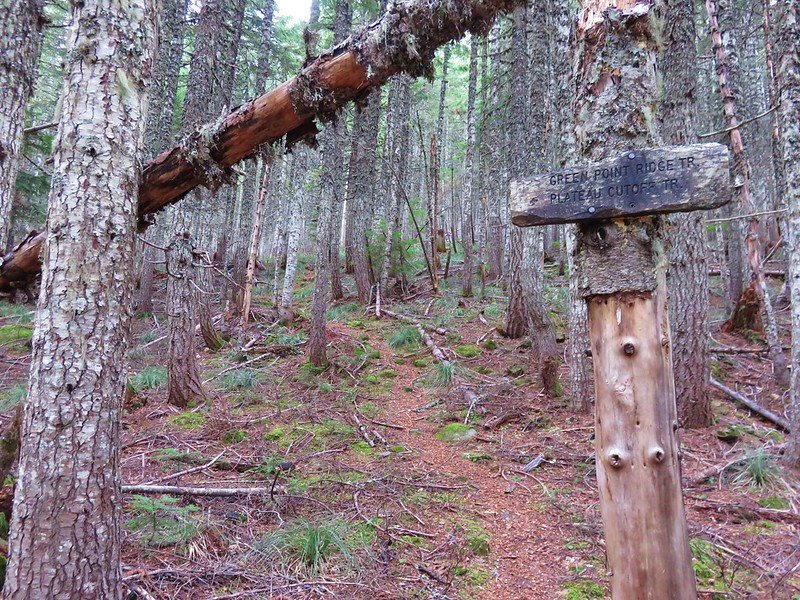
We followed the wooded ridge another 2.5 miles ignoring the Plateau Cutoff Trail to the left after 1.5 miles.
Green Point Ridge Trail

The steepest section of trail we’d been on all day was the final descent down to the Wyeth Trail.
Green Point Ridge Trail descending to the Wyeth Trail junction

Once we were back on the Wyeth Trail we retraced our steps down to the power lines. Mt. St. Helens was a little more visible on our way down in the afternoon light.
Mt. St. Helens in the distance

Mt. St. Helens from the Wyeth Trail

That morning we had noticed a trail coming up from the Wyeth Campground at the power lines which appeared to be a shorter route than what we had done so when we spotted it on the way down we followed it into the campground arriving back at our car ten minutes before 5pm.

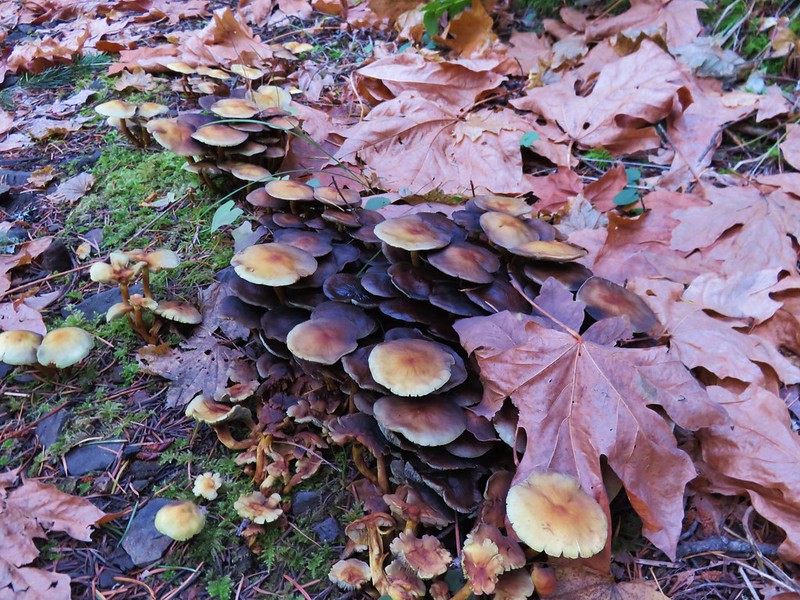
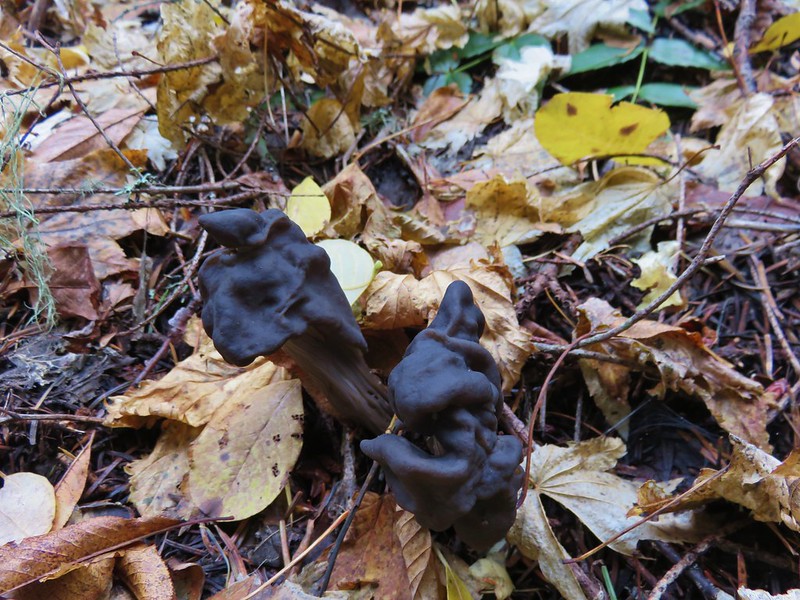
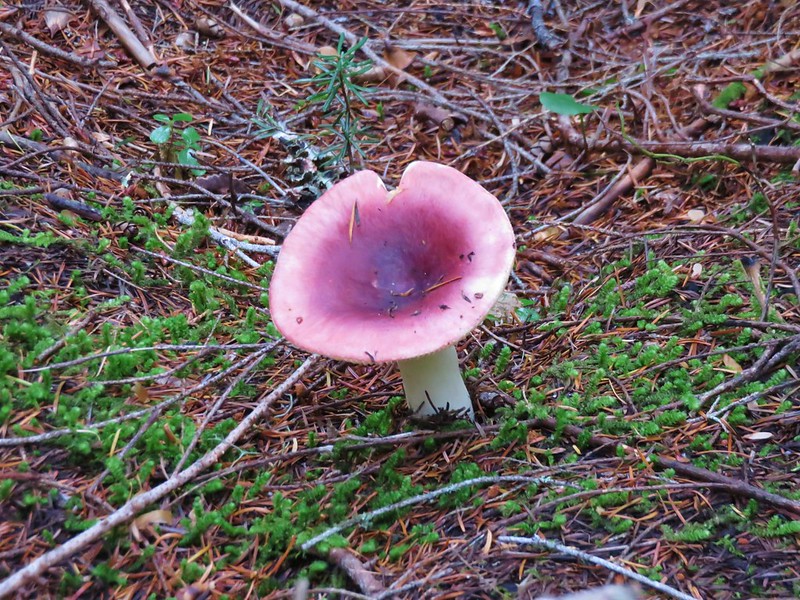
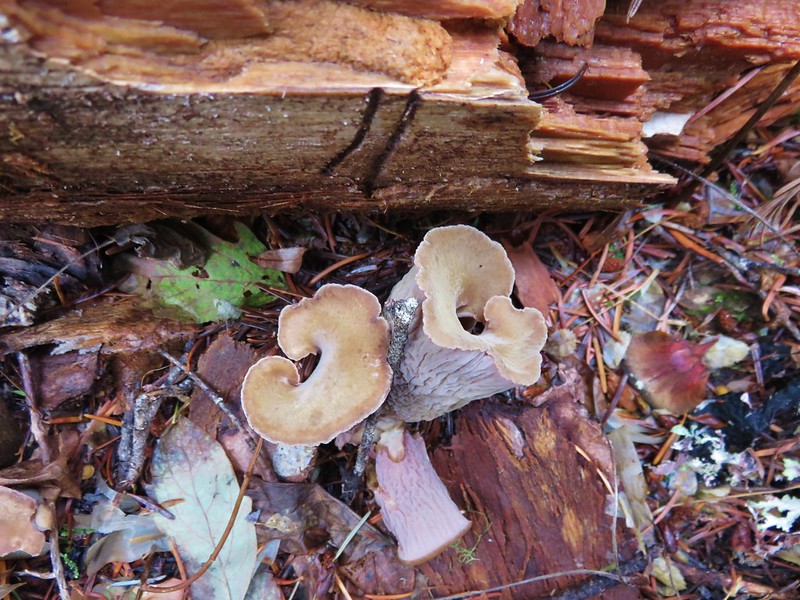
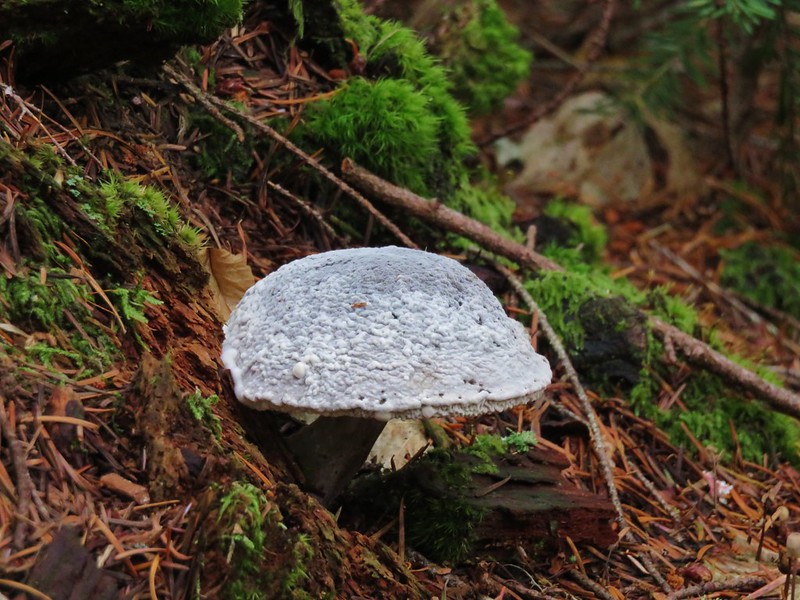
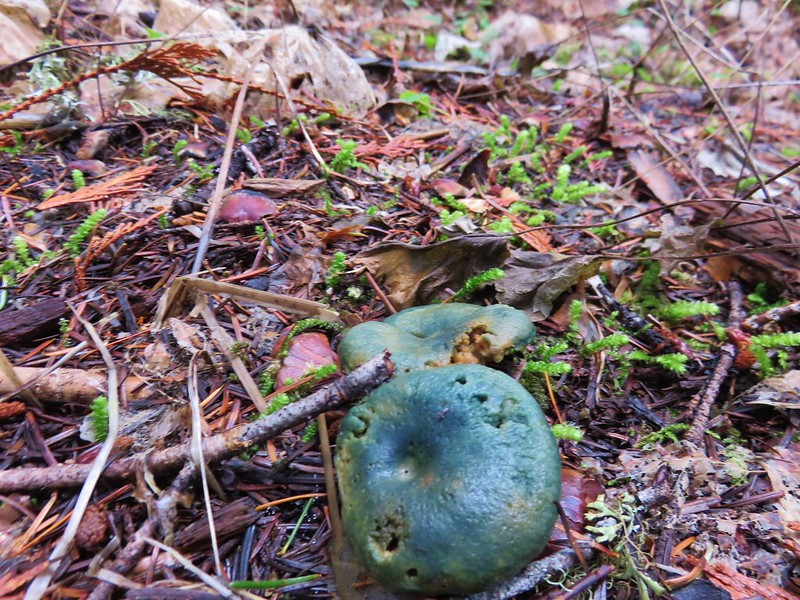
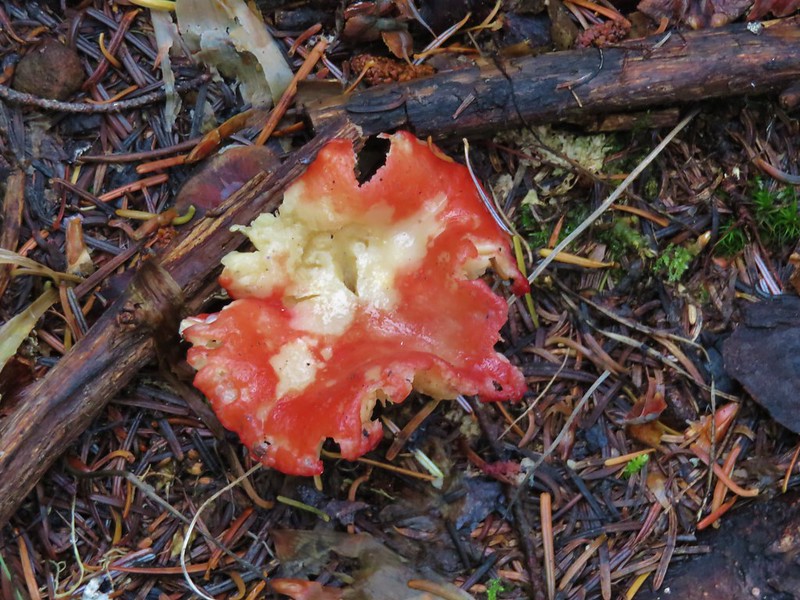
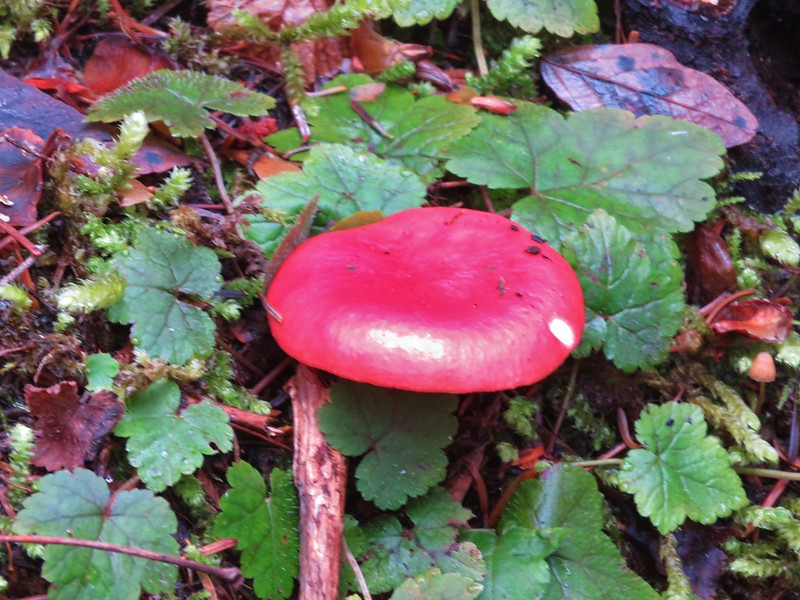
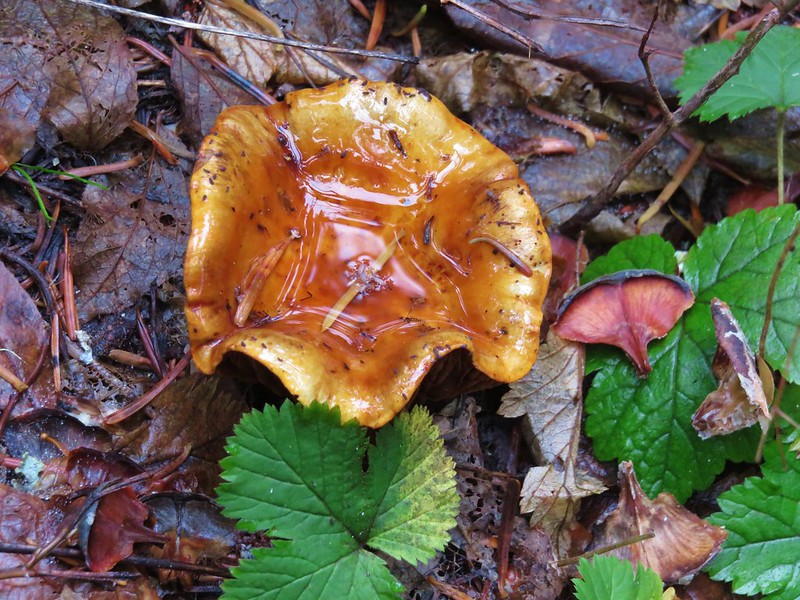
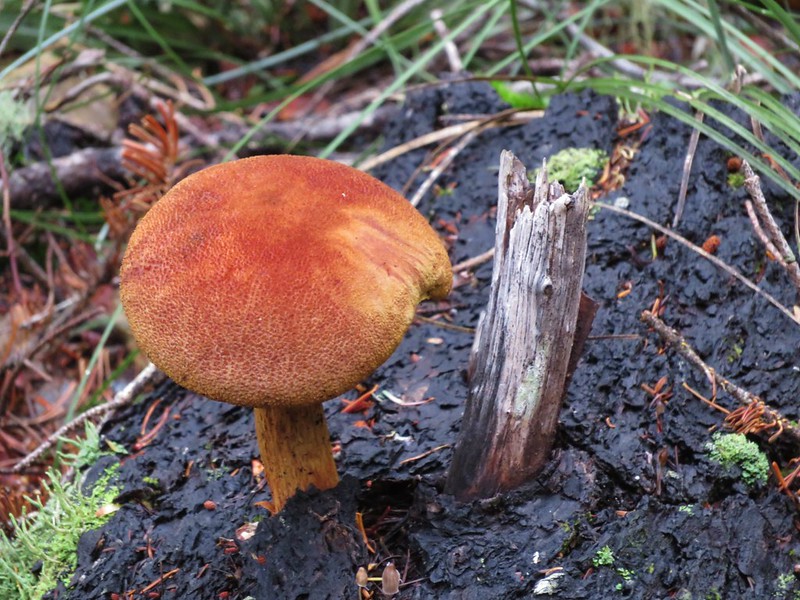
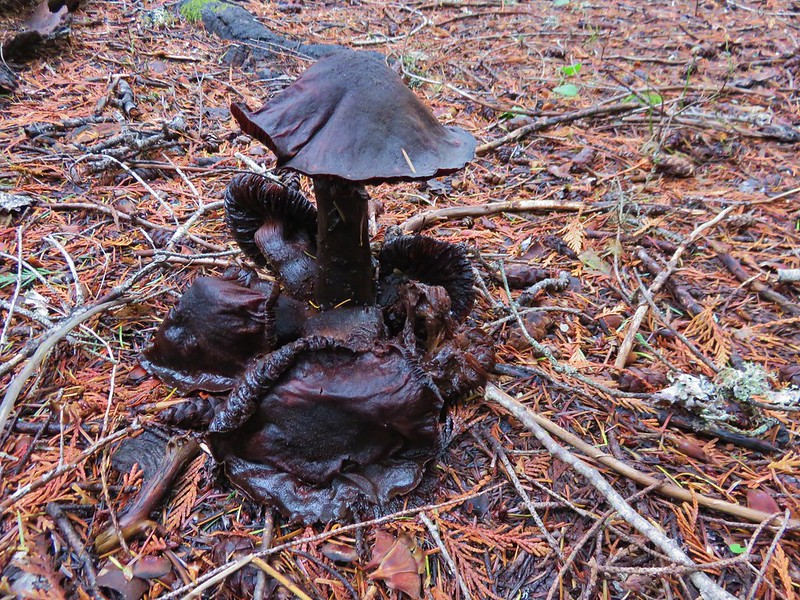
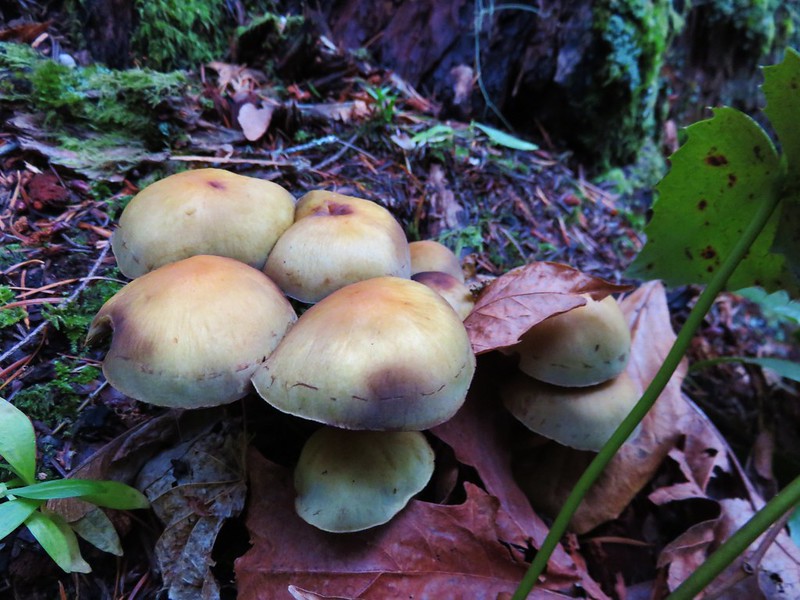
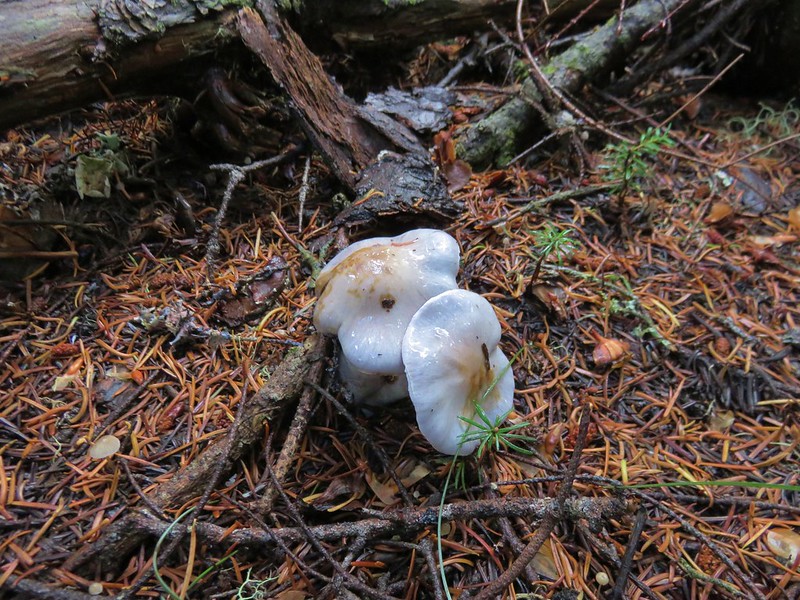
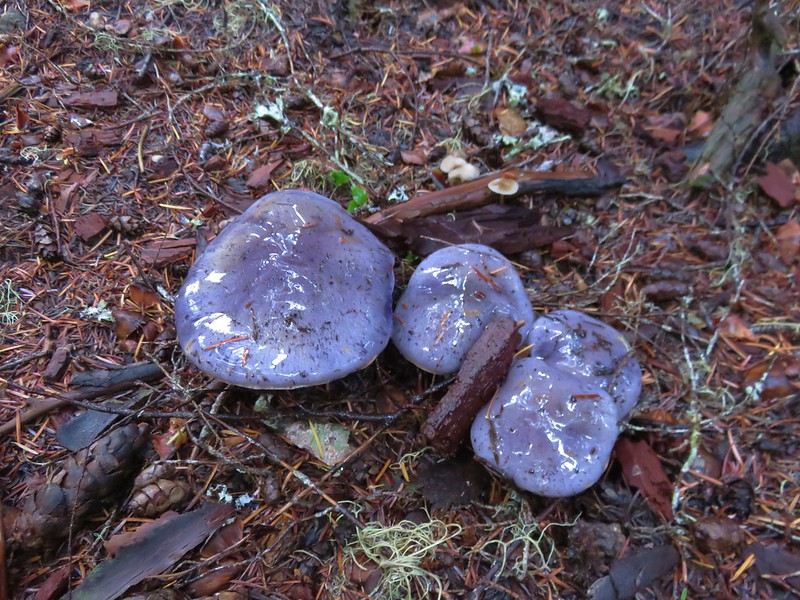
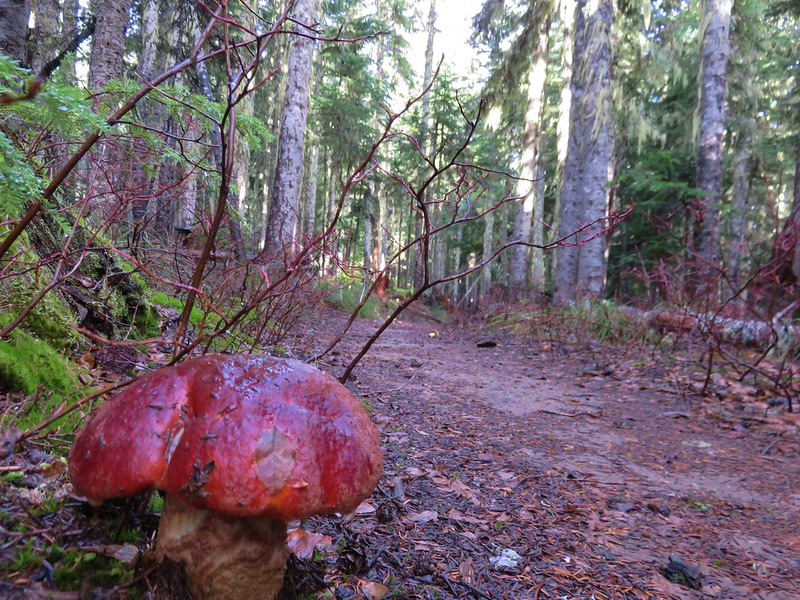
We had hiked from dawn to dusk (nearly 10 hours) without seeing anyone else on the trails. The views had been much better than expected and the lakes were all nice. One of the things that held our interest was the amazing variety of mushrooms along the way. The various colors, shapes, and sizes were impressive. Here is a small sample of that variety.
Mushrooms along the Wyeth Trail

Mushrooms

Mushroom

Mushrooms

Mushroom

Green mushrooms

Mushroom

Red mushroom

Another mushroom

Orange mushroom

Yellow mushrooms

Mushroom on a log

Mushroom groud near Black Lake

Mushrooms along the Wyeth Trail

Despite the hike turning out to be a lot longer than planned it was a great way to spend our anniversary. Happy Trails!

Categories
High Cascades Hiking Mt. Hood Area Oregon Trip report

Lower White River Wilderness and Twin Lakes Loop

We took advantage of a favorable weather forecast and ended our “hiking season” with a pair of hikes south of Mt. Hood in two separate wilderness areas. Our first hike was in the Lower White River Wilderness.

Designated a wilderness area in 2009, the 4 square mile Lower White River Wilderness has no official trails. The narrow wilderness SE of Mt. Hood covers a portion of the White River and it’s canyon on either side from Keeps Mill Forest Camp for approximately 7.5 miles. A use trail from the forest camp follows the river a short distance and this was our planned route into the wilderness.
Lower White River Wilderness Sign

Keeps Mill Forest Camp is located at the end of Road 2120 which is accessed from Highway 216. The narrow dirt road is poorly maintained along the final mile and a half making it suitable only for high clearance vehicles. Instead of driving all the way down to the camp we parked at a pullout near the Camas Trail which crosses Road 2120 on it’s way from Camas Prairie to Keeps Mill Forest Camp.
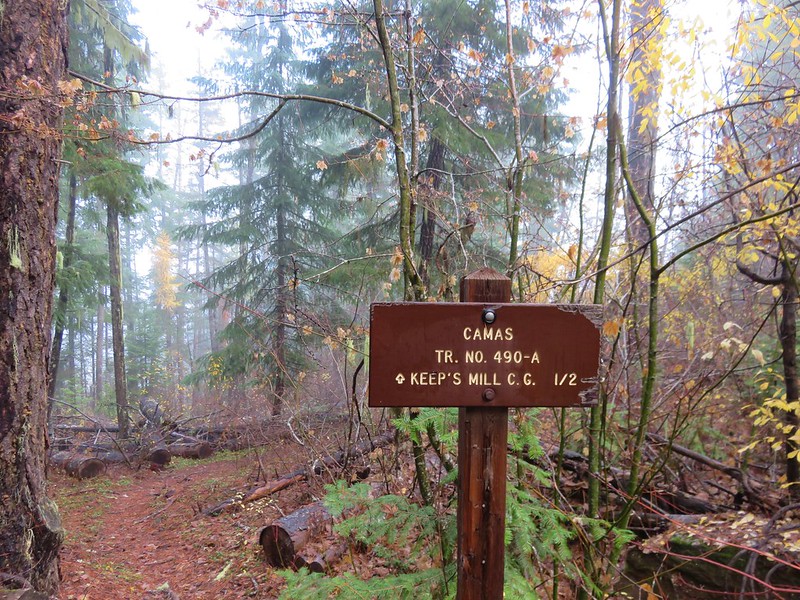
Camas Trail sign along Road 2010

We followed the Camas Trail down to the campground. It was still pretty dark and also fairly foggy when we arrived back on Road 2120 near the entrance of Keeps Mill Forest Camp.
Keep's Mill Forest Camp

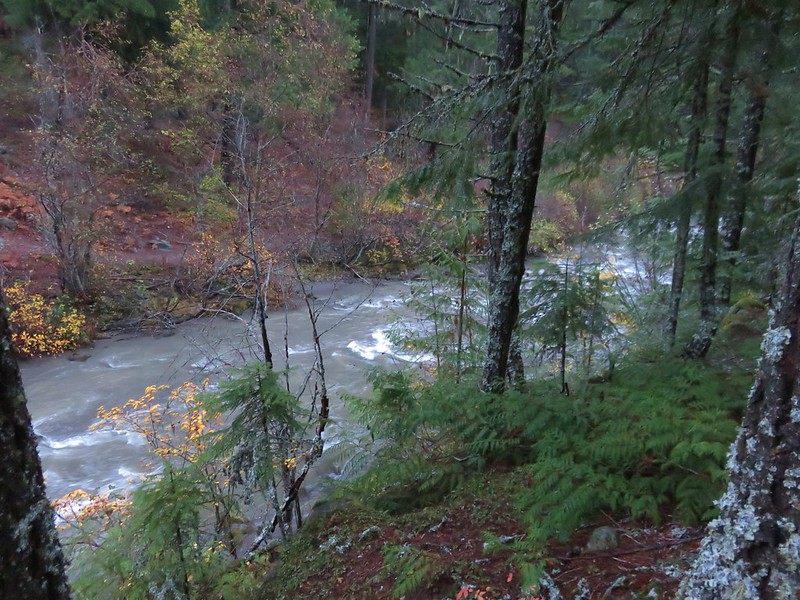
The campground is located near the confluence of Clear Creek and the White River.
Clear Creek
Clear Creek

White River
White River

We found the use trail along the river and followed it for about half a mile where it appeared to become fairly brushy.

Lower White River Wilderness

White River

Lower White River Wilderness

The trail had been traveling between the river and a talus slope where the remains of an old flume could be seen amid the rocks.
Talus slope with the remains of an old flume

Old flume remains in the Lower White River Wilderness

We turned around here having accomplished our goal of hiking into the wilderness and seeing some of the flume remains and headed back to the campground and up the Camas Trail.
Camas Trail

Fog and a little blue sky over the talus slope along the Camas Trail

When we got back to where we’d parked Heather spotted a doe that quickly fled into the forest. The hike had been just under 2 miles with approximately 250′ of elevation gain climbing up the Camas Trail.

We hopped back into the car and headed toward Mt. Hood turning off Highway 26 at the Frog Lake Sno-Park for our next hike.
Frog Lake Sno-Park sign

Our planned hike here was a loop visiting Palmateer Point, the Twin Lakes, Frog Lake Butte, and Frog Lake. We began by heading north from the large parking lot on a short connector trail that brought us to the Pacific Crest Trail.
Pacific Crest Trail near the Frog Lake Sno-Park

We turned right on the PCT at a sign for Barlow Pass.
Trail sign for Barlow Pass

Pacific Crest Trail

After 1.4 miles we arrived a trail junction with the Twin Lakes Trail.
Pacific Crest Trail near the Mt. Hood Wilderness boundary

Turning right on the Twin Lakes Trail would have led past Lower then Upper Twin Lake before returning to the PCT 1.4 miles to the north after traveling a total of 3.1 miles. We had a longer loop planned so we stuck to the PCT and entered the Mt. Hood Wilderness.
Pacific Crest Trail entering the Mt. Hood Wilderness

There were no views along this section of the PCT but it was a pleasant forest walk and we kept busy spotting all the different mushrooms along the trail.
Mushroom

Mushrooms

Mushrooms

Mushrooms

Mushrooms

Mushroom along the Pacific Crest Trail

We passed the other end of the Twin Lakes Trail sticking to the PCT for another 3/4 miles to the Palmateer Trail.
Twin Lakes Trail

Palmeteer Trail

We turned onto the Palmateer Trail and followed it for nearly a mile passing a junction with the Devil’s Half Acre Trail along the way.
Palmateer Trail

Trail sign along the Palmateer Trail

We forked left at a post after .9 miles.
Spur trail to Palmateer Point

This .3 mile spur trail led up to Palmateer Point.
Heading to Palmateer Point

View along the spur trail to Palmateer Point

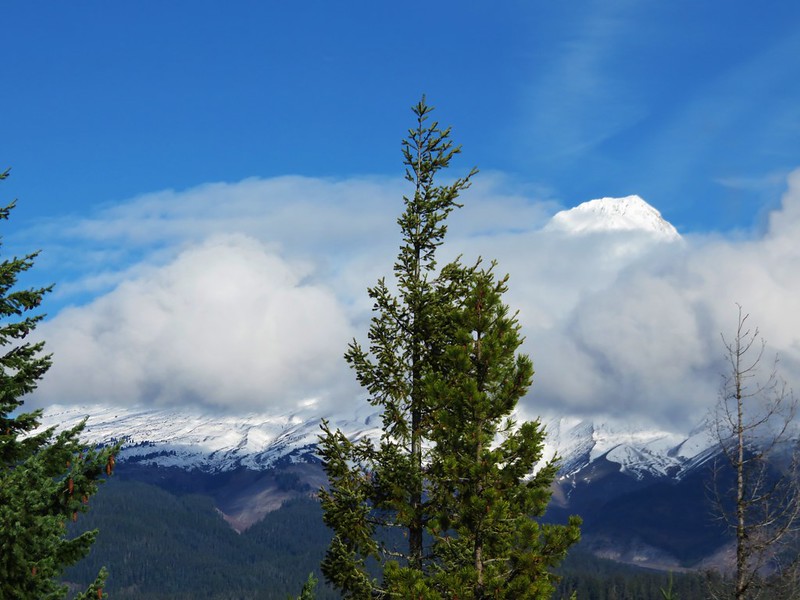
We were hoping for a close up view of Mt. Hood but found that a jumble of clouds were preventing that.
Mt. Hood behind clouds from Palamteer Point

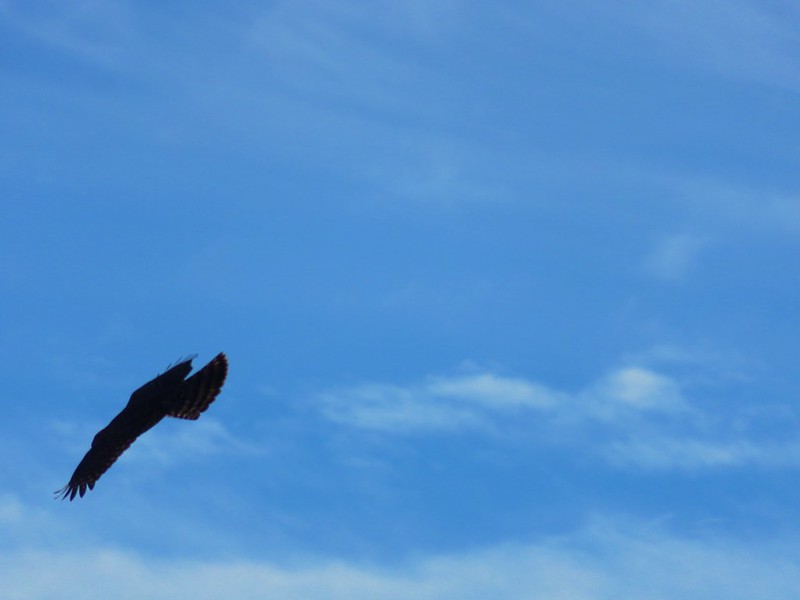
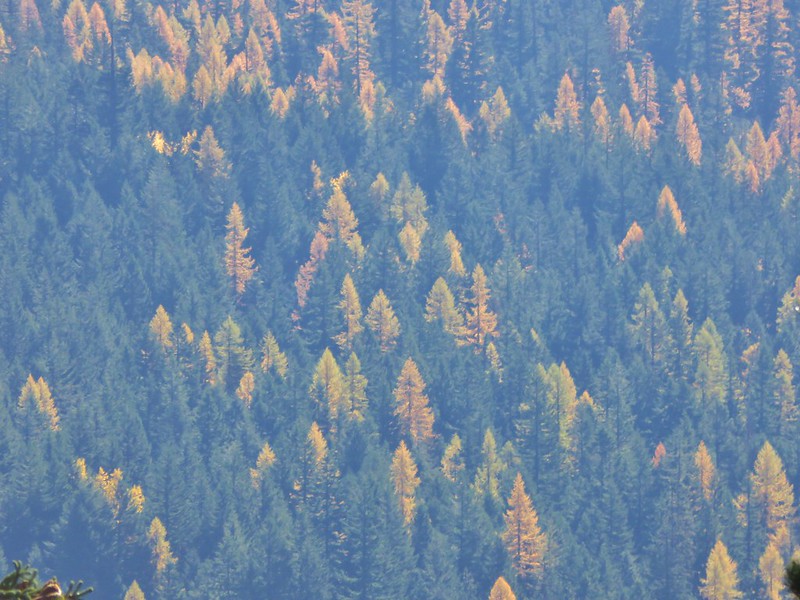
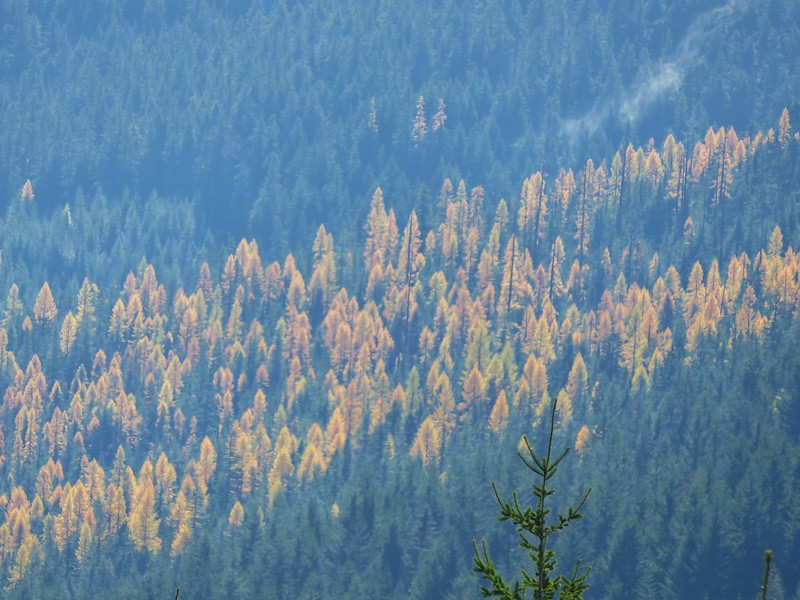
We took a break on the point watching a pair of hawks soaring nearby and admiring the golden larches in the valley below.
One of two hawks flying around Palmateer Point

Hawk on Palmateer Point

Larches

Larches

This was our first good look at the larches, the only deciduous conifers, sporting their fall colors.

After getting a brief glimpse of Mt. Hood’s summit we headed back down to continue our loop.
Mt. Hood hiding behind clouds from Palmateer Point

We passed in and out of small patches of fog for the next .6 miles to a junction with a .2 mile tie-trail that would have led to the Twin Lakes Trail.
Sunrays in the Mt. Hood Wilderness

Trail sign along the Palmateer Trail

This was the route equestrians would need to take, but we stuck to the Palmateer Trail heading for another viewpoint.
Palmateer Trail

Mt. Hood was still mostly hidden when we arrived at the small rocky viewpoint so it was once again the larches that were the highlight.
Mt. Hood from the Palmateer Trail

Larches in the valley below the Palmateer Trail

Larches

We followed the Palmateer Trail to it’s end at the Twin Lakes Trail along Upper Twin Lake.
Upper Twin Lake

Mt. Hood was starting to reveal more of itself as the day went on.
Mt. Hood from Upper Twin Lake

We followed trails counter-clockwise around the lake getting an even better view of the mountain’s snowy summit from the lake’s southern end.
Upper Twin Lake

Mt. Hood from Upper Twin Lake

Mt. Hood from Upper Twin Lake

When we arrived back at the Twin Lakes Trail we headed south down to Lower Twin Lake which was .7 miles away.
Trail junction near Upper Twin Lake

The lower lake is just off the Twin Lakes Trail and is accessed from the direction we were coming from by the Frog Lake Butte Trail.
Frog Lake Butte Trail sign near Lower Twin Lake

Lower Twin Lake

Again we did a counter-clockwise loop around the lake.
Lower Twin Lake

The quickest way back to the sno-park would have been to return to the Twin Lakes Trail and follow it back to the Pacific Crest Trail for a 9.1 mile loop (not counting the loops around the lakes). By being willing to do an extra 4 miles though we could visit one more viewpoint and another lake by taking the Frog Lake Butte Trail.
Frog Lake Butte Trail

This trail led 1.3 miles to a junction on a saddle with the Frog Lake Trail.
Frog Lake Butte Trail

At the junction we turned uphill toward Frog Lake Butte climbing steeply for .7 miles to the summit.
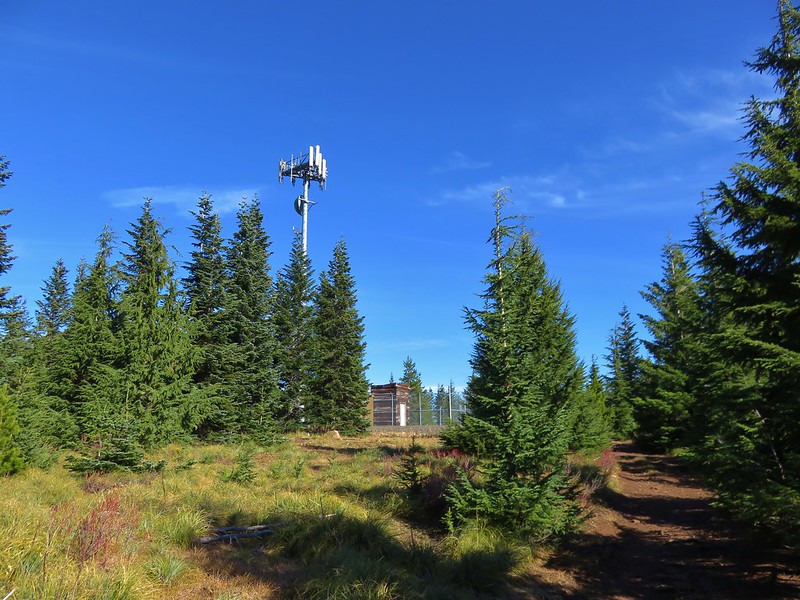
Cell tower on Frog Lake Butte

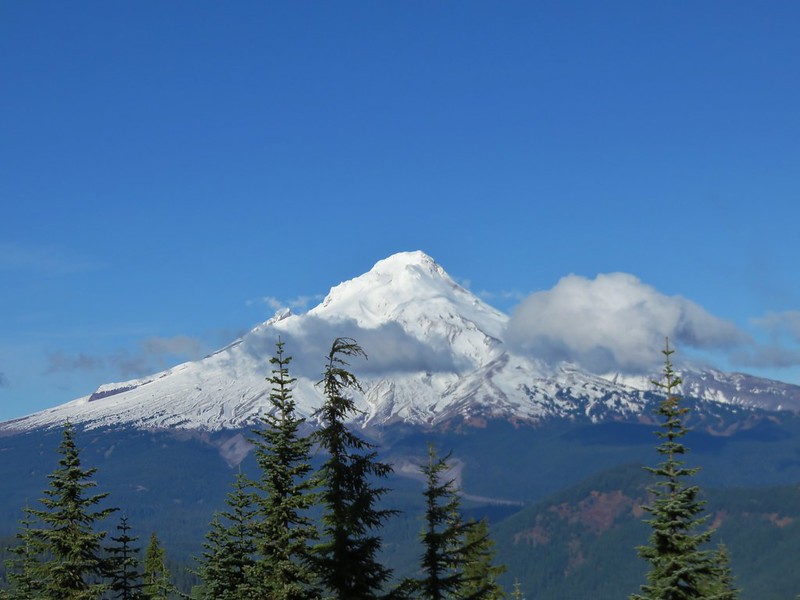
The final portion of the trail followed Frog Lake Butte Road past a communications tower to a viewpoint where Mt. Hood was now mostly visible.
Mt. Hood from Frog Lake Butte

Mt. Hood from Frog Lake Butte

We stayed at the viewpoint for awhile watching as the clouds slowly passed by.
Mt. Hood from Frog Lake Butte

When we were satisfied that we’d gotten about as good a view as we were going to get we headed back down to the Frog Lake Trail and continued downhill on it.
Frog Lake Butte Trail

This trail crossed Frog Lake Butte Road before entering what appeared to be an old clear cut where we had a nice view of Mt. Jefferson to the south.
Frog Lake Butte Trail

Mt. Jefferson from the Frog Lake Butte Trail

Mt. Jefferson from the Frog Lake Butte Trail

After 1.3 miles we arrived at the Frog Lake Campground where we detoured briefly to get a look at Frog Lake.
Frog Lake

Frog Lake

A .7 mile walk along Frog Lake Butte Road brought us back to the sno-park and our waiting car.
Frog Lake Butte Road

The loop came to 14.1 miles which was nicely broken up into shorter sections by the various sights and trail junctions. It was a very enjoyable hike on a great weather day and a perfect end to our 2016 hiking season. We’ll try and get out on a trail at least once a month until next year’s season starts. For now – Happy Trails!

Flickr: https://www.flickr.com/photos/9319235@N02/albums/72157672250482753

Categories
Corvallis Hiking Oregon Trip report Willamette Valley

Bald Hill & McCulloch Peak

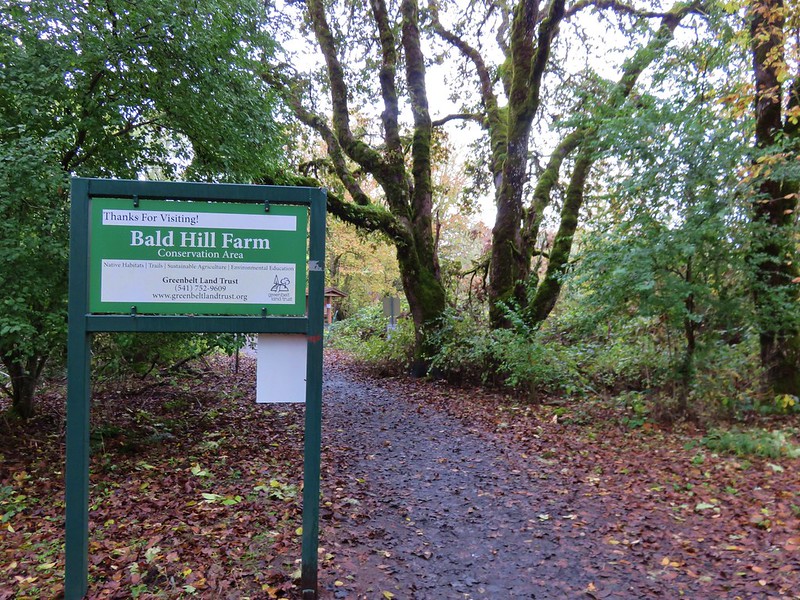
Our latest outing took us to the Bald Hill Natural area and the McDonald Dunn Forest. (Hike #48 in William L. Sullivan’s “100 Hikes/Travel Guide Oregon Coast & Coast Range” 4th edition.) This pair of hikes near Corvallis, OR was a recent substitution in our hiking schedule. We were looking for a hike closer to home for the day after attending the homecoming game at my alma mater – Western Oregon University (It was Western Oregon State College back in my day) with my college roommate and his family. My roommate Tim and his wife Erin had already been dating when Heather and I began seeing each other so the four of us had spent quite a bit of time together in those days. We spent all day Saturday reminiscing starting with an alumni breakfast and ending with dinner at Mendi’s Pizza.

We were able to sleep in a little on the day of the hike since the drive was just under an hour and it hadn’t been getting light out until almost 7:30am. We took Highway 99W to Corvallis then turned right (west) onto NW Walnut Blvd for 4.3 miles to NW Oak Creek Drive where we once again turned right. Both of the days trailheads were located along this road and we hadn’t yet decided which we were going to start with. We had been waiting to see what the weather was like. It had been extremely foggy the prior morning and we didn’t want to head up Bald Hill (the shorter of the two hikes) if there was no visibility because the guidebook indicated that it had the better views. The forecast for the day called for patchy morning fog and a 20% chance of showers before 11am, but as we neared the Bald Hill Natural Area .8 miles along NW Oak Creek Dr. there was no fog just some higher clouds so we pulled into the already busy parking lot.

The majority of cars seemed to belong to runners and the rest dog owners. The area offers numerous trails, some paved and some not, as well as an off leash dog area. It reminded us a bit of Minto-Brown Island Park in Salem except there were hills instead of a river.

We set off from the parking area crossing Oak Creek on a footbridge and heading straight out a wide paved path.
IMG_7537

IMG_7539

As the path began to curve through the wetlands Bald Hill came into view.
IMG_7541

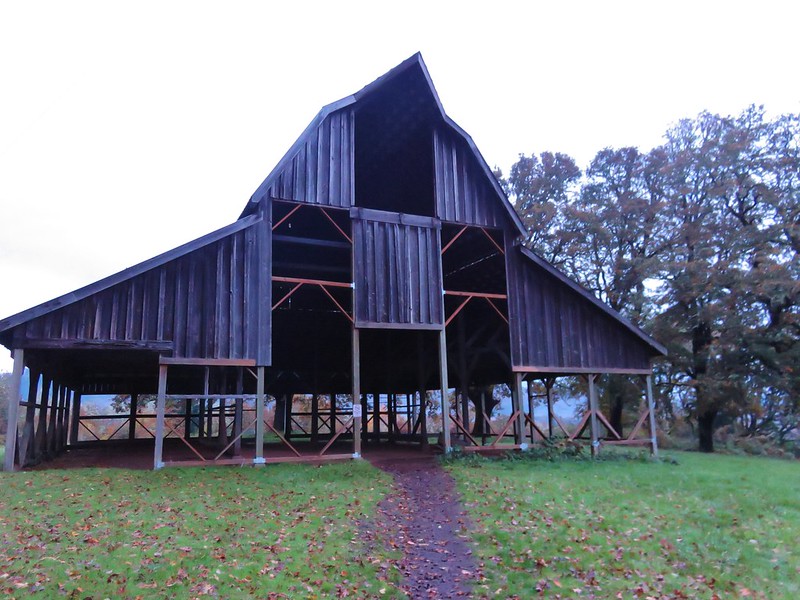
The route suggested by Sullivan turns right off the paved path after a half mile passing an old barn on the right. We wound up turning right one path too soon though and found ourselves passing through a field with the barn up on a hill to our left.
IMG_7542

IMG_7546

We followed a faint path up through the field to the barn where we picked up the correct trail.
IMG_7547

IMG_7548

IMG_7549

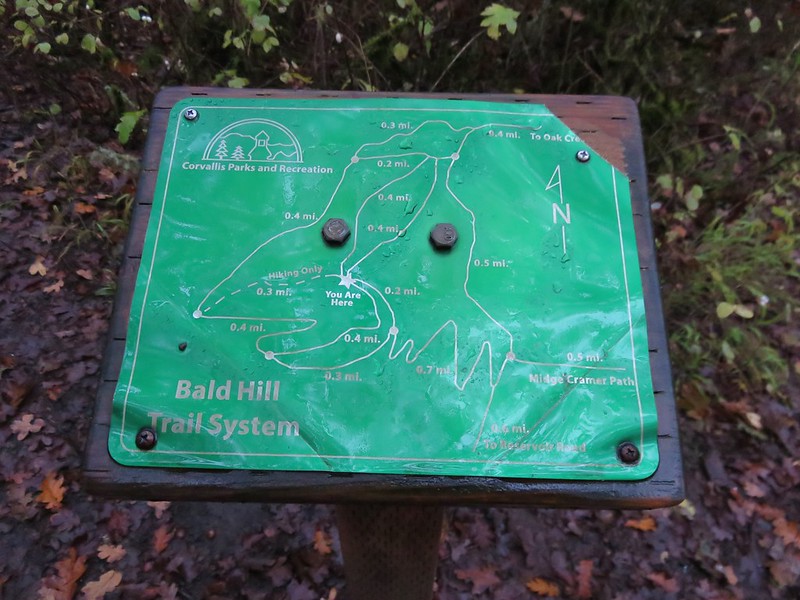
With the aid of trail maps at junctions we were able to stay on Sullivan’s route climbing .8 miles to the summit of Bald Hill.
IMG_7551

IMG_7552

IMG_7557

For a cloudy day the view was very nice. The first of two benches on the hill overlooked the southern end of Corvallis where trees blazed with fall colors amid the houses.
IMG_7561

IMG_7558

Various fruit trees lined the trail at the summit drawing birds to the area.
IMG_7553

IMG_7564

IMG_7567

The second bench looked to the SW towards Mary’s Peak which was mostly hidden by clouds.
IMG_7566

IMG_7568

After passing the second bench we continued on our loop 1.9 miles passing farmland and more birds on the way back to the parking lot.
IMG_7582

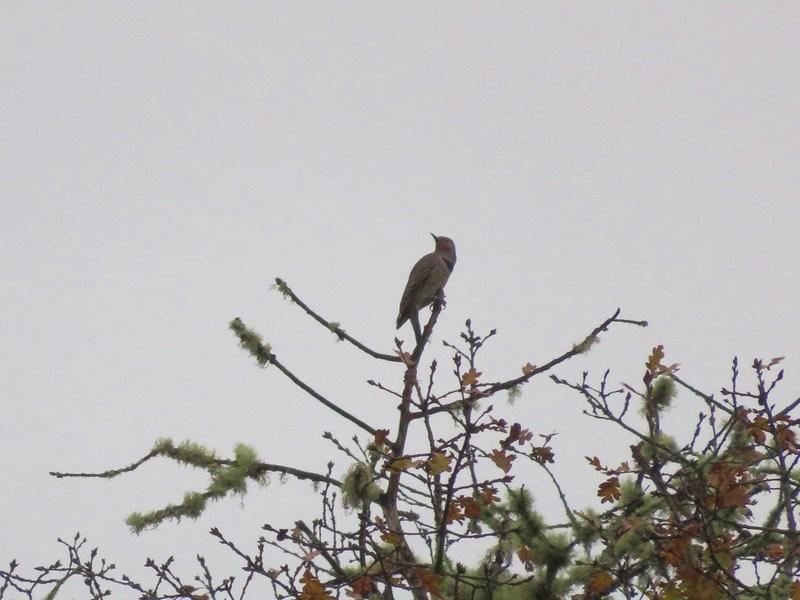
Northern Flicker
IMG_7575

IMG_7579

IMG_7585

IMG_7583

IMG_7586

The loop was 3.3 miles which was a nice warm up for our next stop which was to be a 9.5 mile loop in the McDonald Dunn Forest with a stop atop 2154′ McCulloch Peak. From the Bald Hill parking lot we continued west on NW Oak Creek Drive following it to the right at a fork after 1.1 miles and continuing to a parking area at the roads


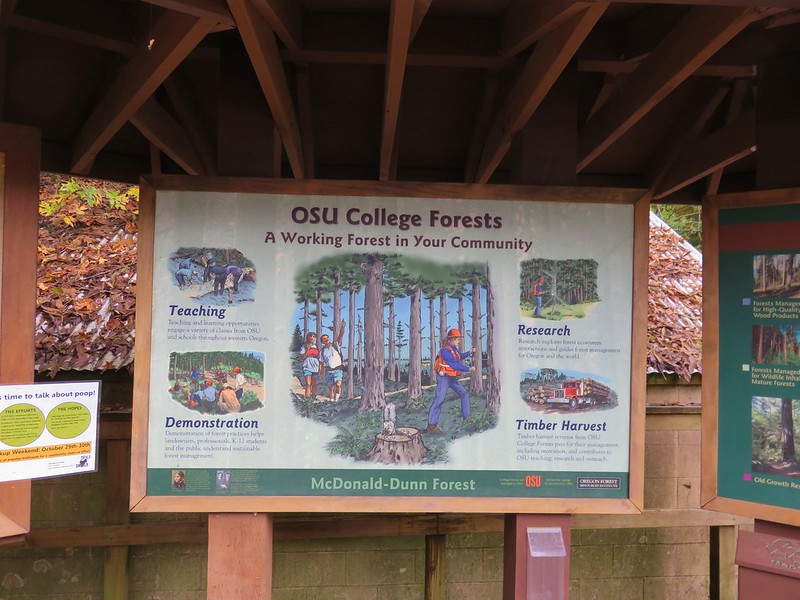
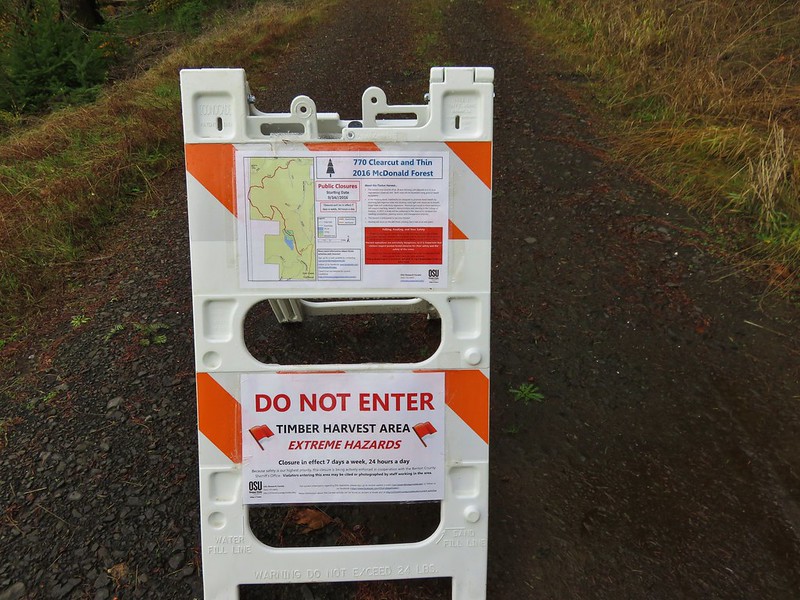
gated end. The McDonald-Dunn Research Forest consists of approximately 11,250 acres largely used by Oregon State University for instruction and research. Various trails and roads are open to hikers, bikers, and equestrians although occasional closures do occur due to forestry activities. Despite having checked the forest website the night before we noticed a sign at the trailhead stating that our planned return route (Road 770) was currently closed due to a timber harvest. The route up to McCulloch Peak was open though and there appeared to be a couple of other ways to return using different roads and/or trails so we sallied forth.
IMG_7587

IMG_7590

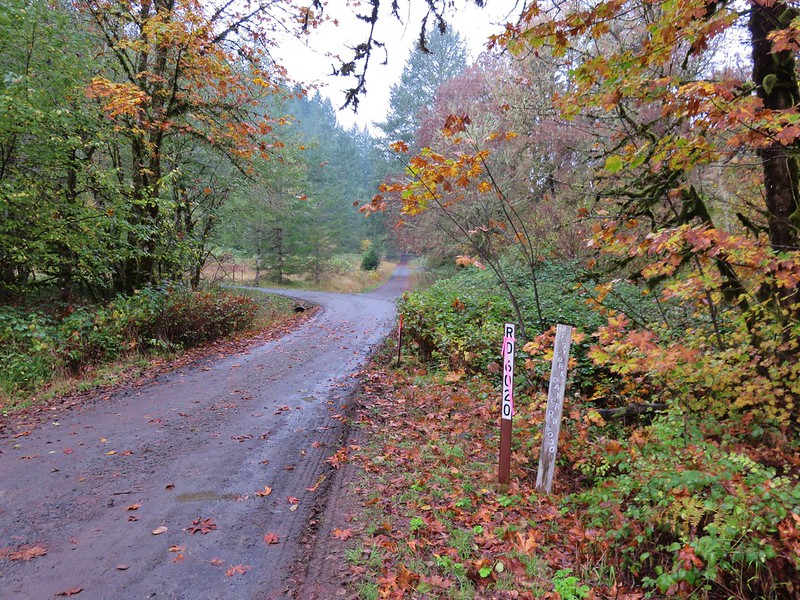
We followed Patterson Road from the gate just over half a mile to a junction with road 6020.
IMG_7593

Near the junction was the beginning of the Extendo Trail.
IMG_7595

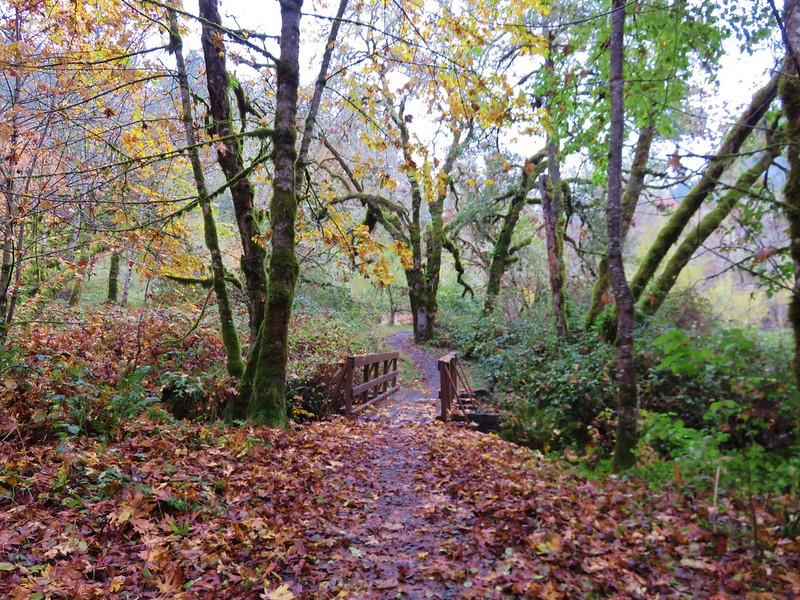
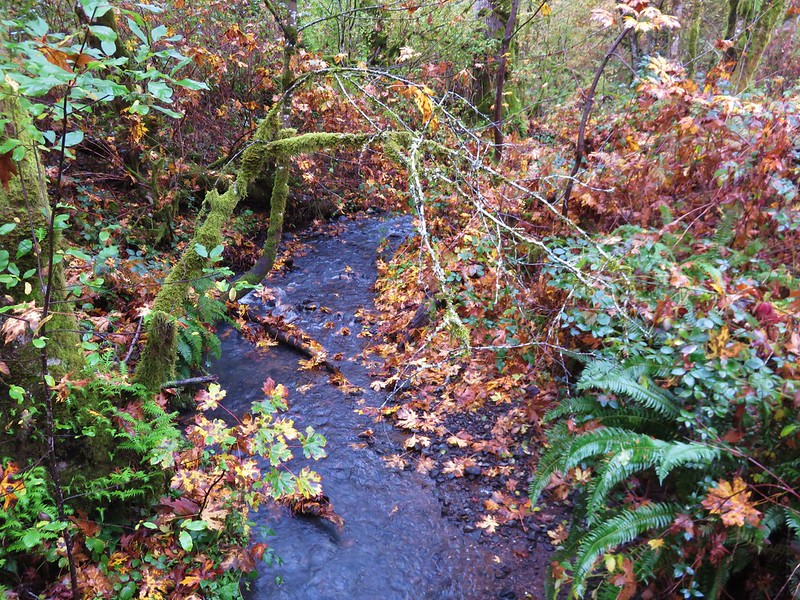
The Extendo Trail is open to Bikes, horses, and hikers from April through October and then to hikers only from November through March. We followed this trail across Oak Creek and then uphill for almost 1.5 miles. Fall was on full display in the forest along the trial with colorful leaves and plenty of mushrooms to be seen.
IMG_7597

IMG_7600

IMG_7601

IMG_7602

IMG_7603

IMG_7606

IMG_7610

Some of that fall color was attributable to poison oak which we were keeping a close eye out for.
IMG_7615

IMG_7616

The Extendo Trail ended at a 4-way junction. To the left was the Uproute Trail which headed back downhill to Road 6020. An unofficial (illegal) path continued straight uphill and to the right was gravel Road 680 and a pointer for McCulloch Peak.
IMG_7619

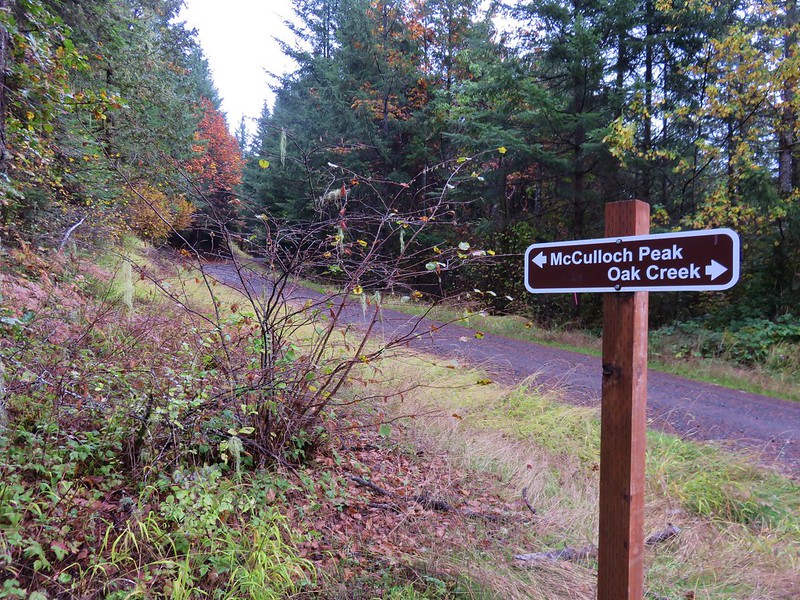
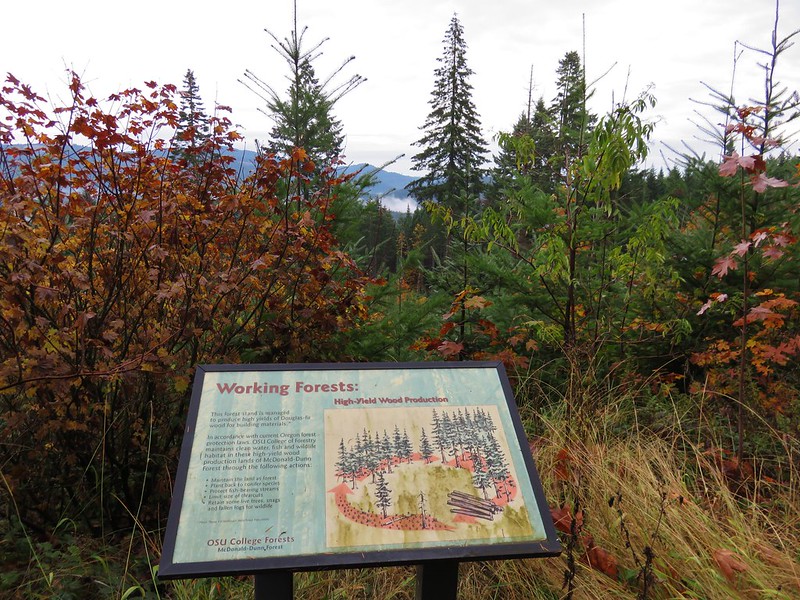
We followed road 680 uphill to a clearcut saddle with an interpretive sign and a bit of a view to the NW.
IMG_7620

IMG_7621

IMG_7623

IMG_7626

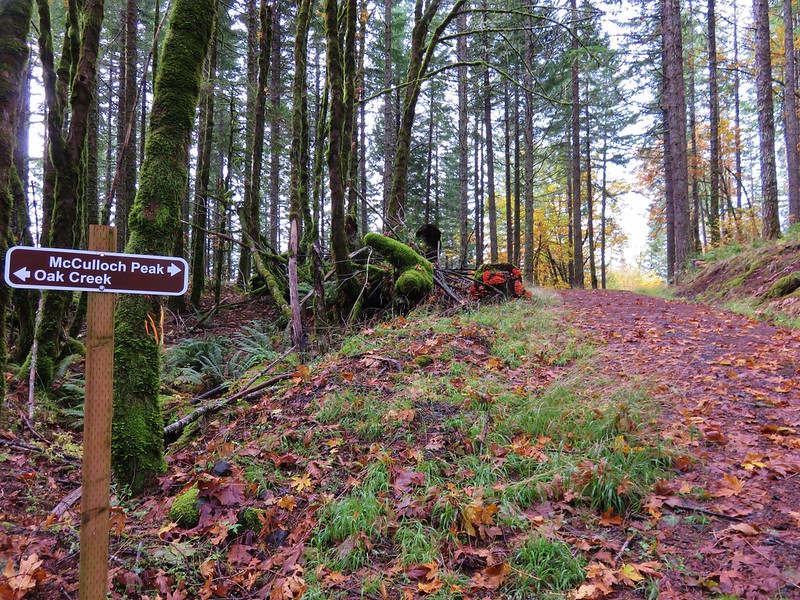
Beyond the saddle Road 680 came to an end at Road 700 where we followed another pointer for McCulloch Peak.
IMG_7629

Just before reaching the junction with Road 770 we got a clear look at our destination, McCulloch Peak.
IMG_7630

We passed closed road 770 1.1 miles from the Extendo Trail.
IMG_7631

IMG_7632

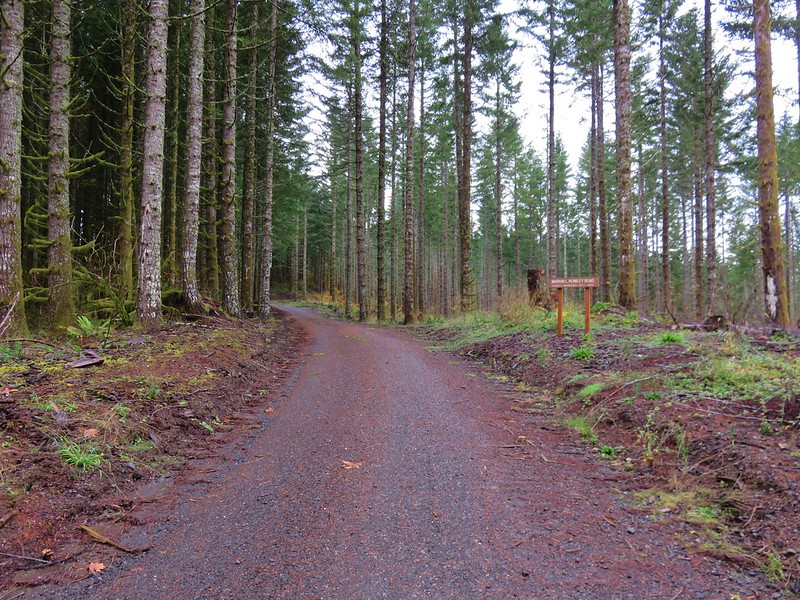
We passed several roads sticking to Road 700 until we reached Road 790 which was also signed Marvin L. Rowley Road (named after the former Forest Manager).
IMG_7639

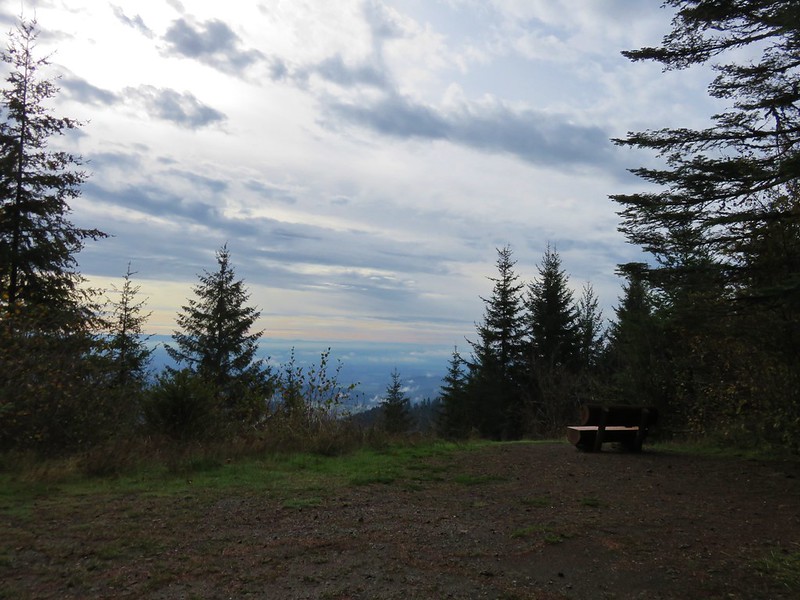
We reached the summit a little over a mile from Road 770 where a small bench awaited.
IMG_7645

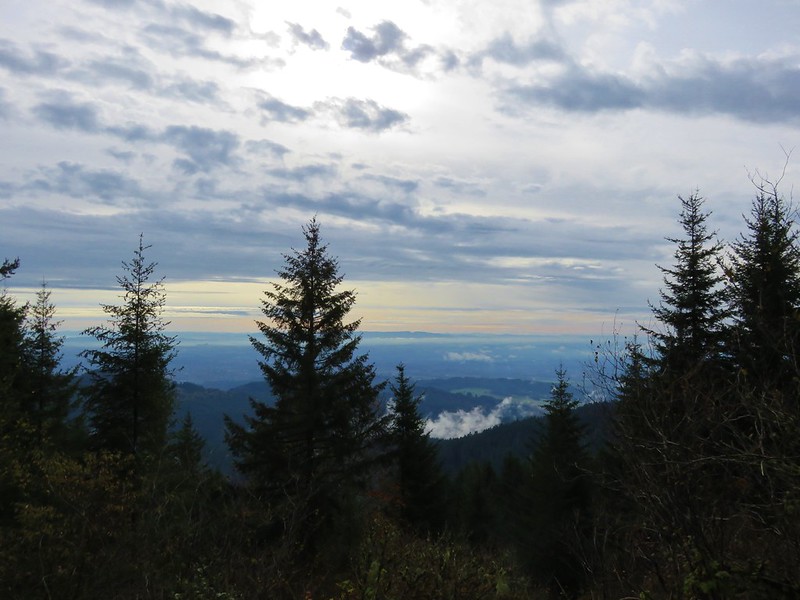
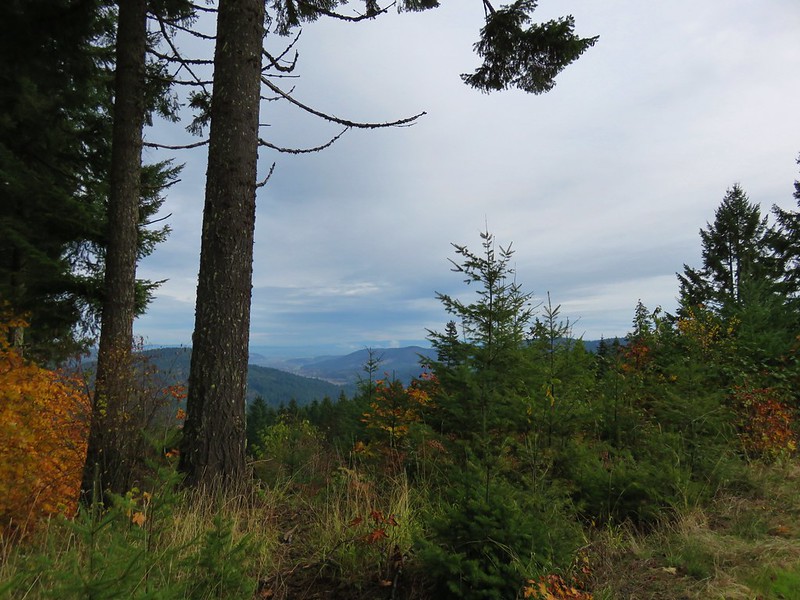
Although it wasn’t wide, the view was nice enough.
IMG_7646

IMG_7648

IMG_7649

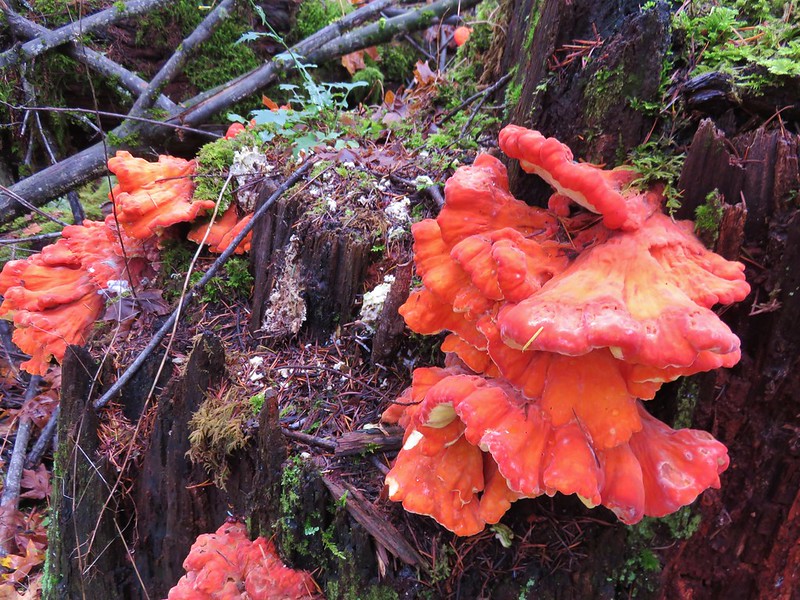
After a brief break we headed back downhill. Since our planned return route was closed we decided to look at the map and see what other options we had. First we turned left when we got back to Road 700 following it for a quarter mile to Road 740 which looped around a small knoll before rejoining Road 700 after another quarter mile. Near the end of Road 740 we passed a stump covered with Chicken of the Woods mushrooms.
IMG_7658

IMG_7660

IMG_7664

We then retraced our path down Road 700 to Road 680. At the clearcut viewpoint on Road 680 we spotted a faint Mt. Jefferson against the clouds.
IMG_7665

IMG_7668

We had a choice when we reached the junction with the Extendo and Uproute Trails. We could return on either of those trails or stay on Road 680 and follow it down to Patterson Road. We decided on following the road which swung out to the west for .6 miles to Patterson Road just over a mile from where we had turned off it earlier to take to Extendo Trail uphill. It was a pleasant walk through the woods back to the trailhead.
IMG_7675

The hike wound up being a little over 9 miles giving us a total of 12.4 miles for the day. The trails (and roads) in both of the areas were in excellent shape and the number of options and year round accessibility makes them nice options anytime of the year. They will be on our list of nearby alternatives when we want to get outside but don’t want (or can’t get) too far from home.

Happy Trails!

Flickr: https://www.flickr.com/photos/9319235@N02/albums/72157674433573180

Categories
Columbia River Gorge South Hiking Oregon Trip report

Nesmith Point

**Note the 2017 Eagle Creek Fire burned a portion of this hike.**

With the remnants of Typhoon Songda sending a series of storms over the Pacific Northwest we were wondering what kind of conditions we’d be hiking in as we headed out to the Columbia Gorge for our 56th hike of 2016. The storms had not lived up to the dire predictions we had been hearing but there had been a good amount of rain and some stronger than normal winds over the previous couple of days.

Our goal for this hike was Nesmith Point, a 3800′ climb from John B. Yeon State Park.
Nesmith Point Trailhead

We had started at this same trailhead in March 2015 when we visited Elowah and Wahclella Falls. The trail set off uphill from the parking area where it promptly forks.
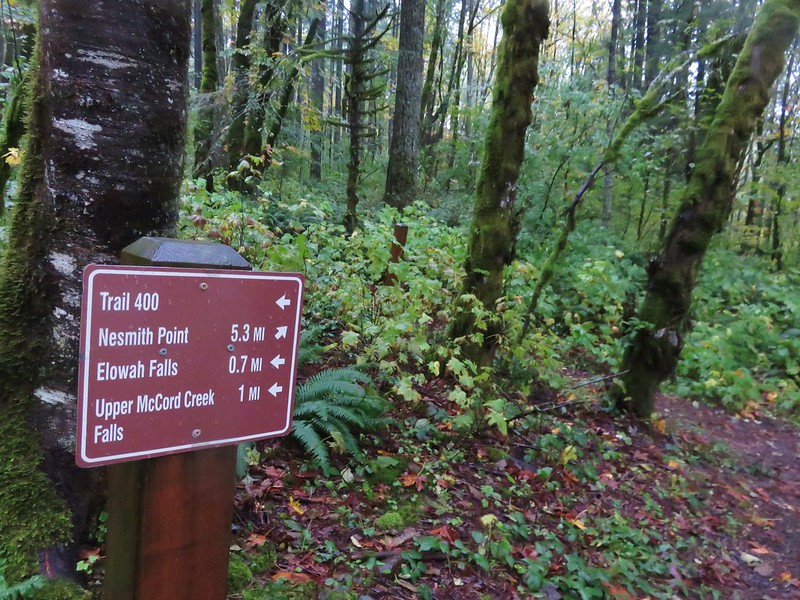
Trail sign for Nesmith Point

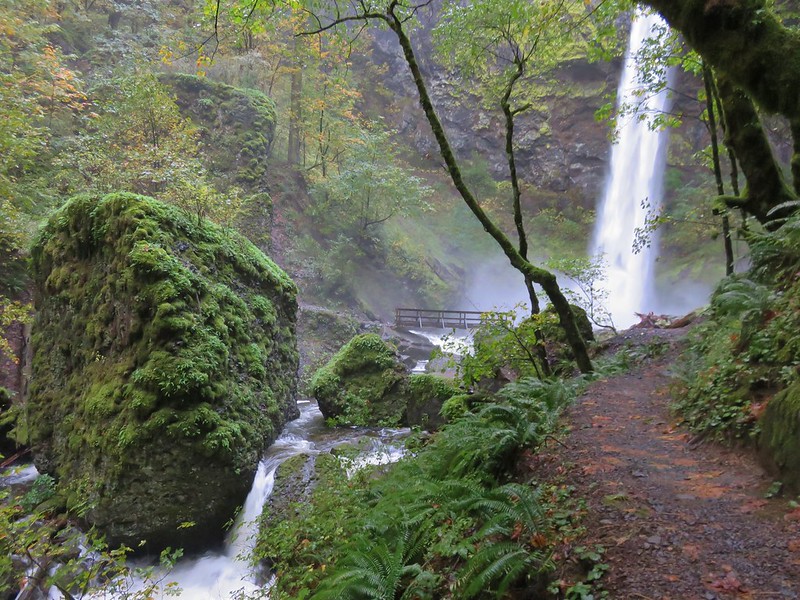
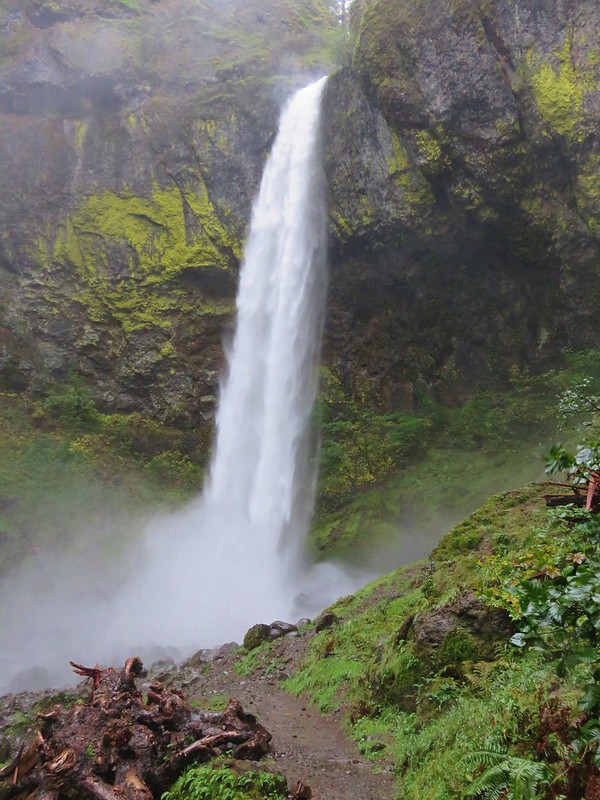
We hadn’t originally been planning on revisiting any of the waterfalls from our previous visit, but the recent rainfall piqued our interest enough that we decided to hike the .7 miles to Elowah Falls before heading up to Nesmith Point. There was definitely a lot more water pouring over the basalt now.
Elowah Falls

Elowah Falls

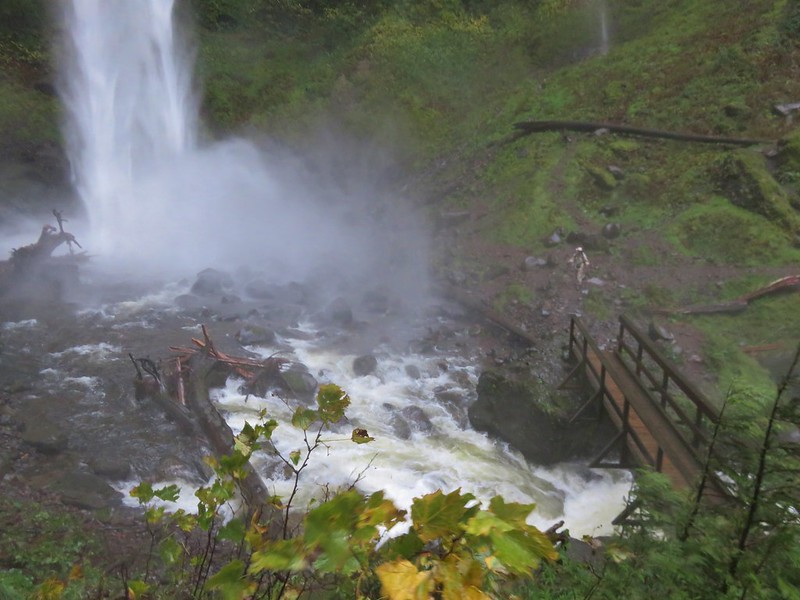
One of the great things about Elowah Falls is that the Gorge Trail crosses McCord Creek on a footbridge very close to the waterfall’s splash pool. Crossing it was literally a blast as wind and water sprayed out from the thundering waterfall.
Elowah Falls

After crossing the bridge we turned right back around and headed back across. We were sufficiently wet at that point and ready to begin the day’s big climb. When we got back to the fork in the trail near the trailhead we stayed on the Gorge Trail following the pointer for Nesmith Point. The Gorge Trail led uphill at a reasonable grade crossing an unnamed creek that was also swollen with rain water.
Creek crossing

Our maps showed the Nesmith Trail splitting off from the Gorge Trail after approximately .9 miles at a swtichback along another creek. We passed the switchback without realizing it because there was no sign of the Gorge Trail continuing from it across the creek. It turns out a 2.4 mile section of that trail is missing from the creek to Ainsworth Campground. We were now climbing in earnest and wondering when the .9 mile section was going to end. I eventually took a peak at the Garmin which is when I discovered that we had already passed the switchback where we should have split from the Gorge Trail. Heather was quite relieved when I informed her that we were now well into the 2.4 mile climb from the phantom trail split to a ridge top saddle. This portion of the Nesmith Trail was forced to climb steeply due to the narrowness of the valley we were heading up. Several sets of switchbacks alternated sides of the valley allowing views from different angles.
Nesmith Point Trail

Fall colors and seasonal waterfalls along the Nesmith Point Trail

Fall colors along the Nesmith Point Trail

View from the Nesmith Point Trail

Occasional views across the Columbia River included Beacon Rock along with Hamilton and Table Mountains.
Beacon Rock from the Nesmith Point Trail

Hamilton and Table Mountains from the Nesmith Point Trail

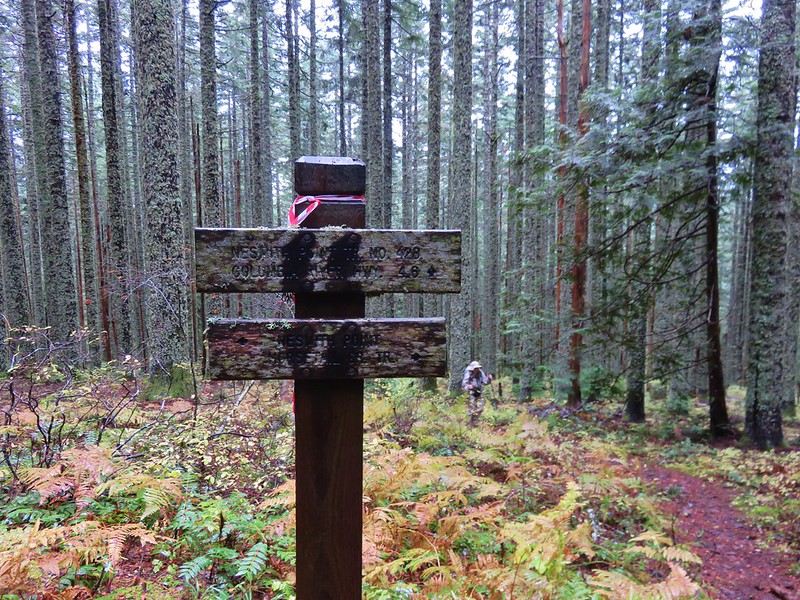
The trail showed little sign of damage from the storms as we slowly made our way up to the saddle where a trail sign awaiting announcing it was only 1.6 more miles to Nesmith Point.
Nesmith Point Trail

At the saddle we could see across the McCord Creek valley to the next ridge but not beyond.
View from the Nesmith Point Trail

From the saddle the trail wrapped around the SE side of a ridge extending to the NE from Nesmith Point. One of the rewards of climbing up out of the Gorge is getting to experience the change in the forests. At the lower elevations along the Gorge the forest typically looks something like this:
Forest along the Gorge Trail

Gorge Trail

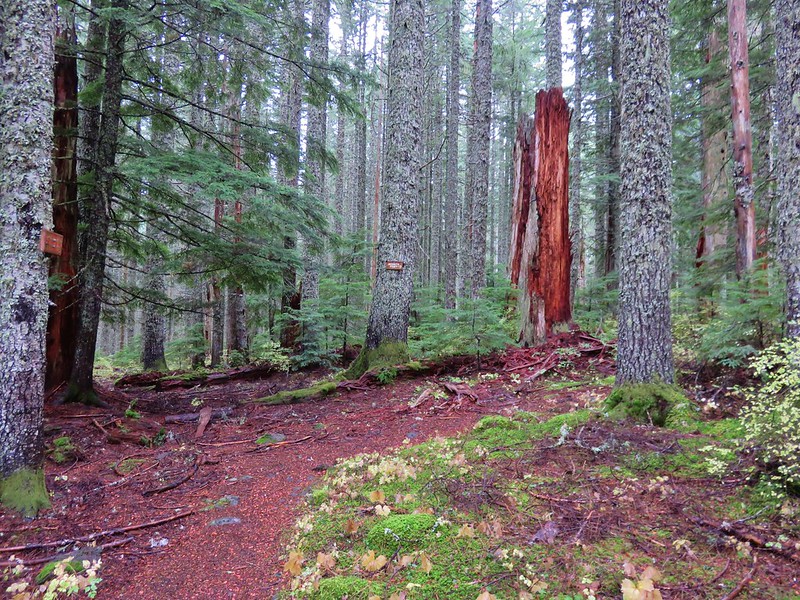
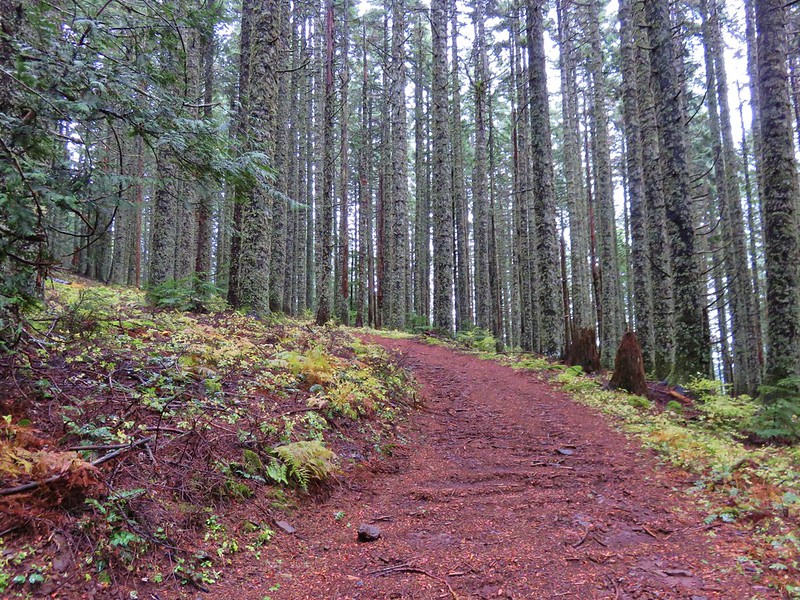
On top of the basalt plateau the forest is noticeably different.
Nesmith Point Trail

Nesmith Point Trail

The stark contrast makes it hard to believe that these ecosystems are so close to one another as they feel like different worlds. We were now climbing at a much more reasonable grade. Approximately 1 1/4 mile from the saddle the trail curved sharply to the right at a pointer for Nesmith Point.
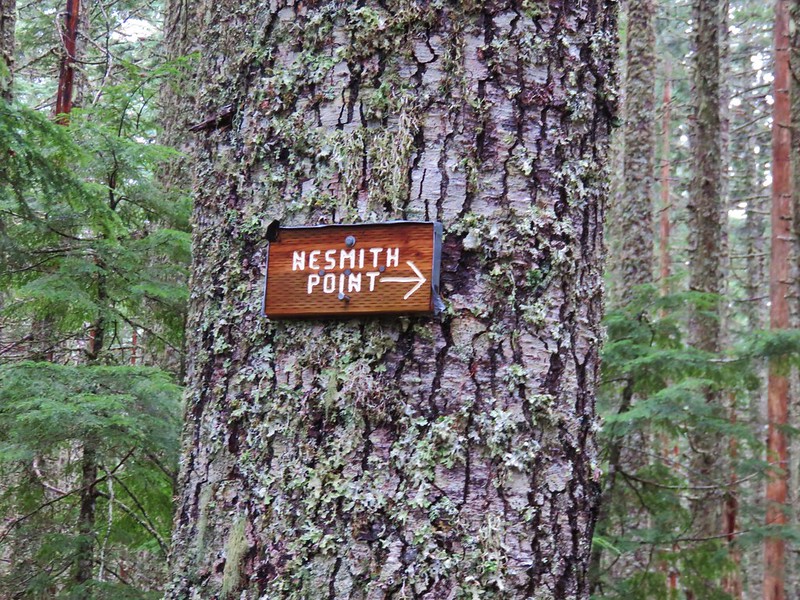
Nesmith Point Trail

Trail sign for Nesmith Point

Less than a quarter mile from the sharp turn we arrived at the now closed road that led to the former lookout tower on Nesmith Point.
Trail junction near Nesmith Point

Nesmith Point Trail

We followed the old road uphill .3 miles to the now overgrown site of the old fire lookout.
Anchor for the former lookout tower on the rocks

Just before reaching the lookout site there was a break in the trees that offered a bit of a view across the Columbia River Gorge.
View from Nesmith Point

Columbia River from Nesmith Point

Columbia River from Nesmith Point

To get a better view (and on a clear day a view of Mt. St. Helens and Mt. Adams) we continued on the trail past the old lookout site. This path led downhill before splitting. We took the right had fork to begin with which led us down to a cliff top viewpoint that was a little sketchy on such a damp day. The cloudy conditions weren’t allowing for any better view than what we’d seen at the viewpoint before the lookout site either, so we backtracked to the split and took the left hand fork. This fork led to a viewpoint across from where we had just been. Again the clouds effectively canceled the views but it was fun to watch them as they swirled below.
View from Nesmith Point

View form Nesmith Point

We decided to take a break there and eat some food. It was very peaceful being that far above the noise of the cars on I-84 and the trains chugging through the gorge. I found myself thinking I could spend quite a while just watching everything pass by below. Just a couple of minutes later our hands were becoming numb and we were ready to get moving again. Between the damp conditions and the breeze on the plateau our core temperatures had fallen and now we were cold. So much for the peaceful bliss 🙂 We retraced our steps making our way back downhill past several hikers and a number of beetles.
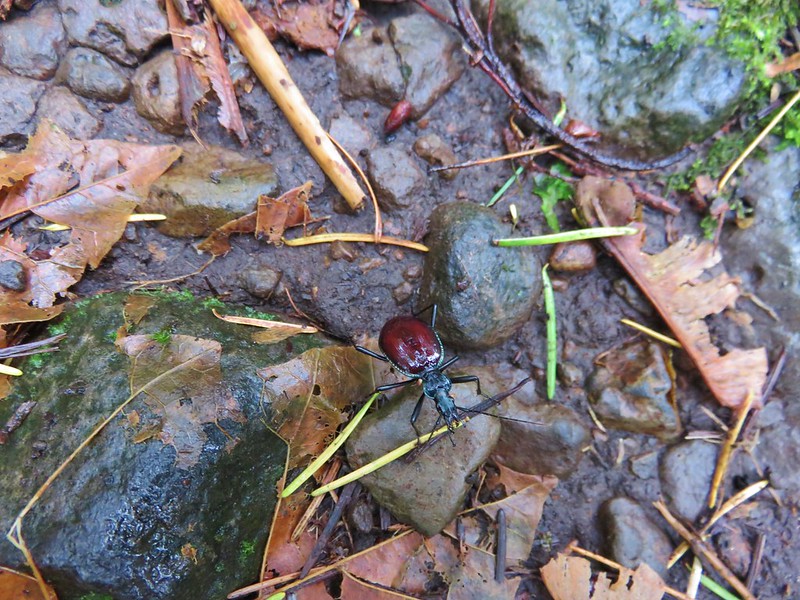
Beatle on the Gorge Trail

At the switchback where we had expected the Gorge Trail to split off we looked for any signs of the other trail. The only thing we could see was a wooden post surrounded by rocks at the switchback but there was nothing on the other side of the creek to even hint at where the Gorge Trail had been. We felt better about having missed that spot now that we knew there was really nothing there that we should have seen. We returned to the now full trailhead having finished our 56th hike of the year equaling our total from last year. Only 4 hikes remained on our 2016 schedule and we wondered what would be in store for us on those. Happy Trails!

Flickr: https://www.flickr.com/photos/9319235@N02/albums/72157675210106016

Categories
High Cascades Hiking Mt. Washington Area Oregon Trip report

Scott Mountain Loop Day 2 – Mt. Washington Wilderness

We had set our alarms for 5:30am hoping to get a jump on the day and be ready to start hiking as soon as there was enough light. The forecast had called for increasing chances of rain as the day went on and we had watched an increase number of clouds fill the sky the night before including some low clouds descending to the tree tops around the Tenas Lakes. When we stuck our heads out of the tent we were pleasantly surprised to see a sky filled with stars overhead. We turned our MPOWERED Luci inflatable solar lantern on and began packing up. As we cooked breakfast and finished packing the sky filled with color.
Sunrise from our campsite

Sunrise from our campsite with North Sister peaking through the trees

Sunrise from the little lake near our campsite

Sunrise from the little lake near our campsite

We began hiking shortly after 7am returning to the Benson Trail where we headed north .2 miles to the Scott Mountain Trail. Scott Mountain was already catching the morning sunlight as we approached.
Scott Mountain

We momentarily considered heading back up to the summit, but neither of us really felt like hauling our full backpacks up the steep trail. We settled for the few views along the trail below Scott Mountain where the Three Sisters appeared cloud free through the trees.
North Sister
North Sister

Middle Sister
Middle Sister

Middle Sister

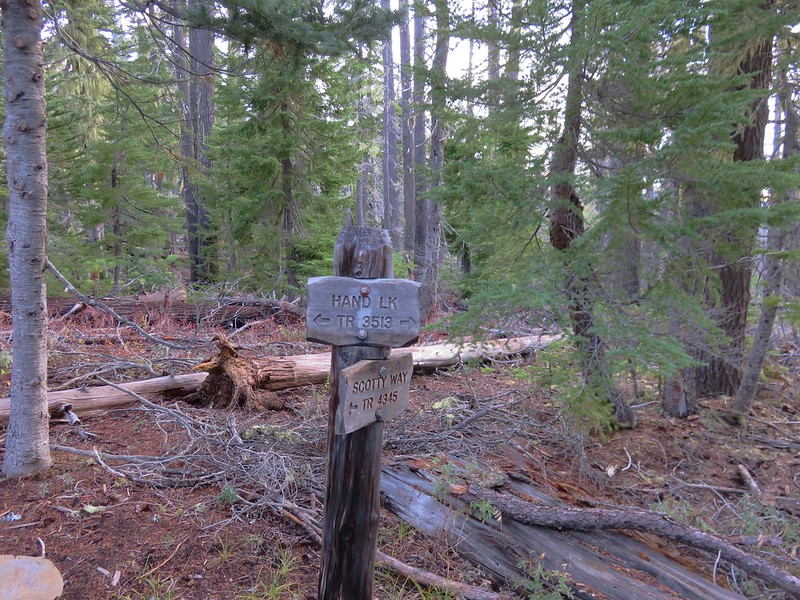
After a mile on the Scott Mountain Trail we took the Scotty Way Trail and began descending toward the Hand Lake Trail.
Scotty Way Trail junction with the Scott Mountain Trail

Scotty Way Trail

We followed this trail approximately 1.7 miles to its end at the Hand Lake Trail where we turned left.
Hand Lake Trail junction with the Scotty Way Trail

As usual I had checked the Forest Service websites for the trails that we would be using a couple of days before our trip to make sure there were no closures or alerts we needed to be aware of. The Willamette National Forest page for the Hand Lake Trail listed the current conditions for the Hand Lake Trail as ” open and cleared” as of 7/22/2016.
What part of this picture is “cleared”?
Blowdown over the Hand Lake Trail

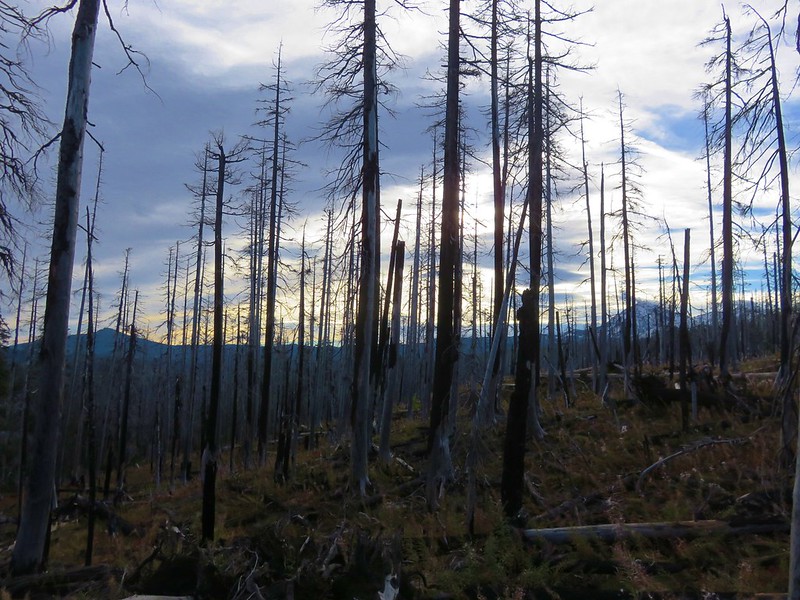
For the next two and a half miles the trail (when there was one) passed through burnt forest with faint tread and a good deal of blowdown. For awhile we were able to follow tracks left by a horse; that helped keep us on the right course.
Hand Lake Trail

More blowdown over the Hand Lake Trail

When we weren’t searching for the trail there were some decent views.
Black Crater and North & Middle Sister
Black Crater and the North & Middle Sisters from the Hand Lake Trail

Mt. Washington
Mt. Washington from the Hand Lake Trail

Mt. Washington from the Hand Lake Trail

After approximately 1.75 miles we lost the hoof prints and were forced to make a wide arc to the south away from where the map showed the trail should have been. We were coming up on a steep drop down into a basin where the map showed the trail descending in a series of six switchbacks so using the Garmin we worked our way back toward the location where the switchbacks began on the map.
Looking west from the Hand Lake Trail

With no obvious trail visible we searched around a bit and found what may have been part of the original trail but now it appeared to be a simple game trail from the amount of deer and elk sign we were seeing.
Following a game trail down into a basin

In any event it was the only trail in sight so we followed it steeply downhill reaching the basin where we were able to relocate the actual trail near an unnamed lake.
Unnamed lake along the Hand Lake Trail

Unnamed lake along the Hand Lake Trail

After another quarter mile of faint trail and blowdown we entered unburnt forest on a much clearer trail.
Hand Lake Trail

Hand Lake Trail

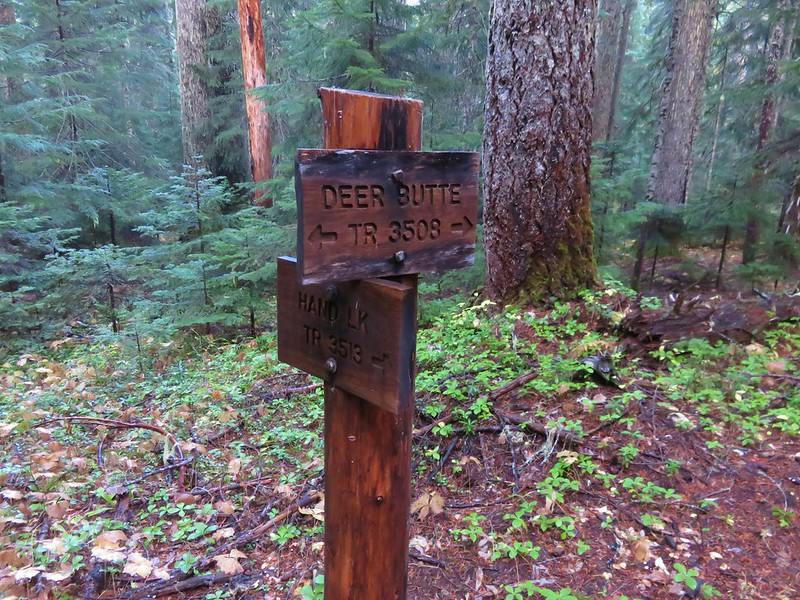
A mile and a half on this nicer trail brought us back to the junction with the Deer Butte Trail we had passed the day before.
Hand Lake Trail junction with the Deer Butte Trail

We followed the Deer Butte Trail just over two and a quarter miles back to the Robinson Lake Trailhead ending our final backpacking trip of the year.
Deer Butte Trail

The distance from Tenas Lakes back to the Robinson Lake Trailhead came to 8.9 miles according to the GPS which was almost a mile further than we had expected, but we hadn’t planned on wandering back and forth trying to keep on the Hand Lake Trail. Had we known what a mess that 2.5 mile section was we wouldn’t have even tried it, but we made it and it was another chance to put our navigational skills to the test. Happy (blowdown free) Trails!

Flickr (both days): https://www.flickr.com/photos/9319235@N02/albums/72157674905089576

Categories
High Cascades Hiking Mt. Washington Area Oregon Trip report

Scott Mountain Loop Day 1 – Mt. Washington Wilderness

With our hiking season starting to wind down we took advantage of a decent weather forecast for one final overnight trip. Our plan was to begin at the Robinson Lake Trailhead and take the Deer Butte Trail to the Benson Trail then follow that trail up into the Mt. Washington Wilderness where we would set up camp in the Tenas Lakes area. After setting up camp we’d visit the summit of Scott Mountain and Benson Lake to fill out the afternoon/evening. This would be our third attempt at getting a decent view on Scott Mountain. We never made it to Scott Mountain on our first attempt in 2012 due to not being prepared for the amount of snow covering the trail, and although we reached the summit on our second attempt in October 2014 we found ourselves in a cloud with no views whatsoever.

We began both of our previous visits to the area from the Benson/Tenas Trailhead near Scott Lake off of the McKenzie Highway (242). In order to do something a little different and see some new lakes we started on the other side of the wilderness at the Robinson Lake Trailhead. This trailhead is located at the end of Robinson Lake Road (2664) off of Highway 126 4.7 miles south of the Clear Lake Resort.

Robinson Lake Trailhead

The short half mile hike to Robinson Lake is included in William L. Sullivan’s 100 Hikes in the Central Oregon Cascades guide books as a non-featured hike in the more hikes section in the back of the books. The hike is also included in another of our guide books, Bend, Overall 2nd Edition (Hiking and Exploring Central Oregon)written by Scott Cook. The Robinson Lake Trail actually begins .4 miles from the trailhead where it splits from the Deer Butte Trail which is the trail that leaves from the trailhead.

Deer Butte Trail junction with the Robinson Lake Trail

The Robinson Lake Trail leads a tenth of a mile to a campsite near the little lake.

Robinson Lake

Robinson Lake

After visiting Robinson Lake we returned to the Deer Butte Trail and continued another 1.2 forested miles to an unsigned junction with an unofficial trail to Kuitan Lake.

Deer Butte Trail

Deer Butte Trail

Unofficial trail to Kuitan Lake to the left:

Side trail off of the Deer Butte Trail to Kuitan Lake

Kuitan Lake

Kuitan Lake

From Kuitan Lake we followed the Deer Butte Trail another .8 miles to a junction with the Hand Lake Trail.

Deer Butte Trail junction with the Hand Lake Trail (our return route)

Originally we were going to take this trail and do our loop around Scott Mountain clockwise but after doing some distance calculations it appeared that doing the loop counter-clockwise would leave us with a slightly shorter hike out on the second day so we stuck to the Deer Butte Trail and continued south skirting the Mt. Washington Wilderness.

Deer Butte Trail

Mt. Washington Wilderness boundary

Just under 1.5 miles from the Hand Lake Trail junction the Deer Butte Trail passed a small unnamed lake.

Deer Butte Trail

Unnamed lake along the Deer Butte Trail

Unnamed lake along the Deer Butte Trail

Another 2.5 fairly level miles beyond the unnamed lake we a arrived at a 4-way junction with the Benson Trail.

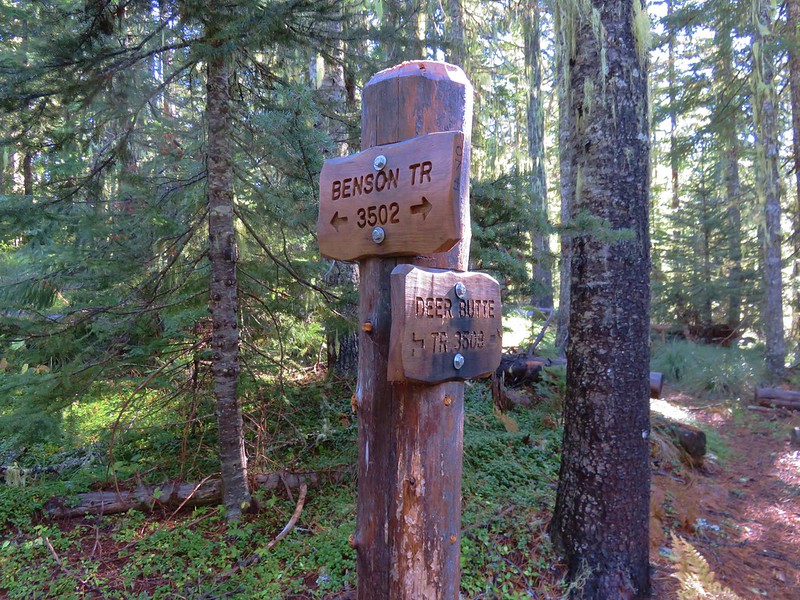
Benson Trail junction with the Deer Butte Trail

Here we turned left and began climbing into the Mt. Washington Wilderness.

Benson Trail

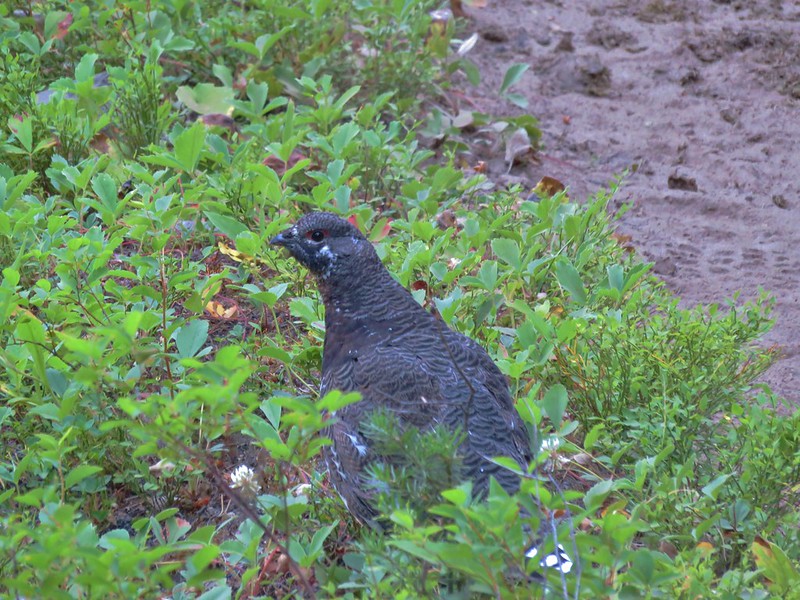
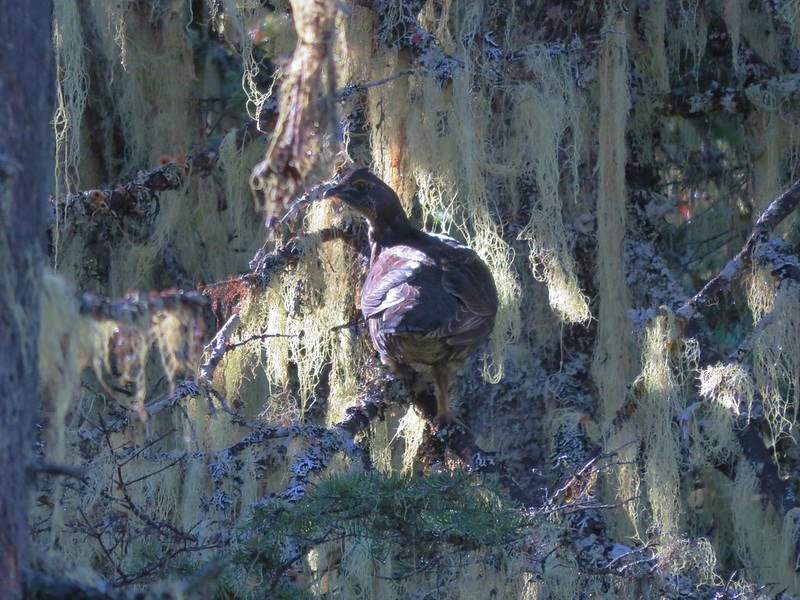
This section of the Benson Trail was in pretty good shape but it was a bit overgrown and the recent wet weather made it a wet 2.6 mile, 1200′ climb to our next junction. The forest was nice but there were no views or wow scenery along the way, but we did startle a grouse out of the underbrush.

Grouse

When we arrived at the junction with the Scott Mountain Trail we stayed on the Benson Trail and headed for the Tenas Lakes area.

Benson Trail junction with the Scott Mountain Trail

The Tenas Lakes area is home to a number of lakes and smaller ponds filling glacier carved bowls. We headed cross country past one of the smaller lakes/ponds to find a campsite near the largest of the Tenas Lakes.

One of the many bodies of water in the Tenas Lakes area

The largest of the Tenas Lakes

The largest of the Tenas Lakes

We didn’t see any other tents set up anywhere in the area and chose a spot following Leave No Trace Principles.

Our initial campsite

After setting up camp we had a choice between heading north to Scott Mountain or south to Benson Lake. We had decided to base the timing of our visit to Scott Mountain on the weather conditions. The sky seemed fairly clear so we decided to go to Scott Mountain first and then to Benson Lake later in the day in case more clouds moved in. We took the Tenas Lakes Trail .1 miles from the largest lake to the Benson Trail and turned left for .2 more miles back to the Scott Mountain Trail junction.

Tenas Lakes Trail junction with the Benson Trail

We followed the Scott Mountain trail for a mile to yet another trail junction getting a nice view of the cloud free summit along the way.

Scott Mountain

Scott Mountain Trail junction with the Scotty Way Trail

We would be taking the Scotty Way Trail the next day on our hike out, but for now we stuck to the Scott Mountain Trail and headed up toward the summit. Heather had remembered that .7 mile climb to the summit was on the steeper side, but I hadn’t. She had remembered it correctly (no surprise there). On the way up we passed some small patches of snow presumably left over from the week before when we had been hiking in snow on Black Crater.

Snow along the Scott Mountain Trail

Near the summit the trail began passing through open meadows where the snow gave way to butterflies and few left over flowers.

Scott Mountain Trail

Fritillary butterfly on some leftover aster

As the trail wound its way up to the former lookout site atop the mountain The Husband come into view.

The Husband from the Scott Mountain Trail

The Husband

Just a bit further the snow covered lower portions of the Three Sisters joined the view.

The Three Sisters and The Husband

At the summit the view to the north opened up.

Mt. Jefferson, Three Fingered Jack, Mt. Washington and Belknap Crater

It was interesting watching the clouds. There were two lines of clouds that seemed to be headed for one another in the gap between Mt. Washington to the north and the Three Sisters to the south. We had brought our Alite Mayfly chairs with us and set them up on the summit watching the clouds move, yet not appear to get anywhere. Occasionally more of a mountain would appear but every time we thought we might get a clear view of one of the major cascade peaks more clouds would arrive.
Double, Belknap, Little Belknap, and Black Craters

Double Craters, Belknap Crater, Little Belknap Crater, and Black Crater

Mt. Jefferson and the lower portion of Three Fingered Jack

Mt. Jefferson and the lower portion of Three Fingered Jack beyond Hayrick Butte

Mt. Washington

Mt. Washington

The Three Sisters

View from the summit of Scott Mountain

The clearest major cascade peak was actually the furthest away – Diamond Peak to the south.

Diamond Peak

Despite the pesky clouds the view was infinitely better than it had been in 2014.

No view from Scott Mountain

After making good use of our chairs we packed them up and headed back to our campsite where we grabbed a couple of extra clothing items and then began exploring the Tenas Lakes area passing a half dozen lakes and ponds.

Pond near the Tenas Lakes

North Sister beyond a Tenas Lake

Scott Mountain from one of the Tenas Lakes

One of the Tenas Lakes

Looking south from the Tenas Lakes area

Pond/lakelet in the Tenas Lakes area

One of the lakes in the Tenas Lakes area

The largest of the Tenas Lakes

We had seen a number of empty campsites as we looped around, but when we arrived back at the Tenas Lakes Trail we noticed that a small group of people were setting up tents along the big lake not 20 yards from our site. We prefer to have as much privacy as possible when we’re out, but more disappointing was they were setting up right between our site and its view of the lake. We discussed whether or not to move our campsite as we returned to the Benson Trail and headed toward Benson Lake.

It was just under a mile from the Tenas Lakes Trail to Benson Lake. We hoped to be able to hike around the lake, something we had not tried to do on either of our previous visits. We had followed a fisherman’s path a short distance along the southern end of the lake and seen people camped on the far side in 2014 so we knew that we should at least be able to get part way around the west side of the lake. The issue with going all the way around appeared to be a rocky outcrop jutting out into the water on the NW side.

Benson Lake

We started around the lake clockwise crossing the dry outlet creek then climbing up onto glacially scarred rocks with a nice view down to the lake.

Scott Mountain from Benson Lake

Benson Lake

We climbed up to the top of the rocks which provided some great views but not a path around the lake.
Scott Mountain

Scott Mountain from the rocks above Benson Lake<
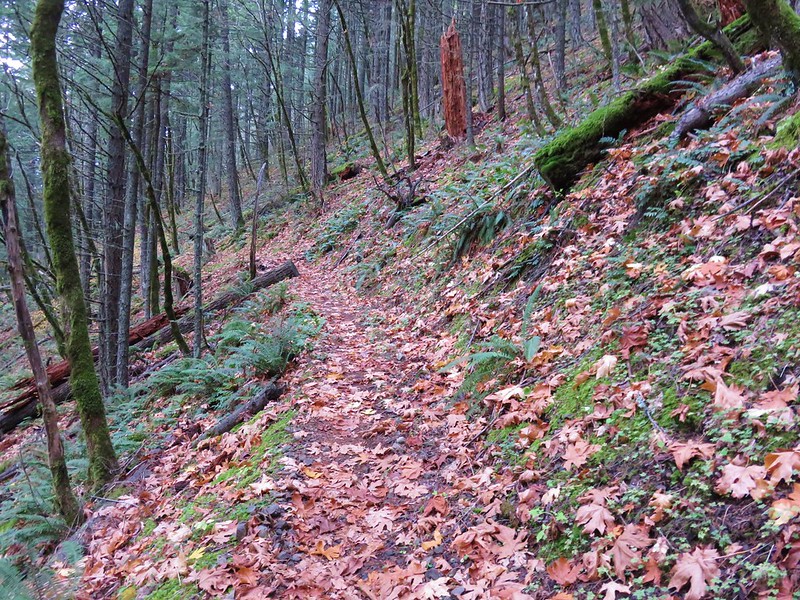
The Three Sisters and The Husband

View from the rocks above Benson Lake

North Sister

North Sister

Middle Sister

Middle Sister

South Sister

South Sister

Mt. Washington, Belknap and Little Belknap Craters

Mt. Washington and Belknap Crater from the rocks above Benson Lake

Mt. Washington

Mt. Washington

Heather had seen another possible route as we were heading up the rocks so we backtracked a bit and found the trail she’d seen which did indeed lead us further around the lake.

Benson Lake

The trail petered out at a rock slide near the outcrop that we had seen from the far side of the lake. We rock hopped across the slide then picked up a faint trail before coming to a very short but steep section where we were forced to scramble along a rock face. We both wondered if it would have been better to have tried to get up on top of the outcrop which it turns out is a sacred prayer site for Native Americans. Statesman Journal article

On the other side of the outcrop we picked up the user trail again and followed it back to complete our loop.

Benson Lake

We returned to camp having decided that we would indeed change our campsite. We had our pick since there still wasn’t anyone else camped in the area save us and the group that had set up next door. We chose a spot about 100 yards away near a smaller lake. We were able to carry our tent there without having to take it down making the move pretty simple.

IMG_7262

Huckleberry leaves near the small lake

We ate dinner by the lake, went to one of the larger lakes to pump water, and watched the sunset before turning in for the night.

Sunset from the little lake

With all the side trips and exploring our distance for the day wound up being a little over 18 miles which was more than planned but we’d gotten to see a lot and finally gotten some views from Scott Mountain. Happy Trails!

Flickr (both days): https://www.flickr.com/photos/9319235@N02/albums/72157674905089576

Categories
High Cascades Hiking Oregon Three Sisters Area Trip report

Black Crater

**Note the 2017 Mili Fire burned a portion of this hike.**

What a difference a week can make this time of year. Our previous hike had been up Cooper Spur on Mt. Hood on a beautiful (albeit chilly) day with mountain views in every direction. One week later we found ourselves on a snow covered trail in the Three Sisters Wilderness while hiking to the 7251′ summit of Black Crater.

We were actually in Central Oregon to celebrate our Son’s 21st birthday, but had wanted to fit a hike in as well. As it turned out Dominique really wanted to go on a hike with us which was nice because we hadn’t gotten to hike with him since August 1st, 2015 when we visited Salishan Spit prior to our annual family reunion.

We chose Black Crater due to it’s relatively short distance (a little over 7 mile round trip) and proximity to my parents house. The forecast was for a chance of snow showers which had evidently started the night before because the top portion of Black Crater was white as we headed toward Sisters, OR that morning. The trailhead is located near milepost 80 along the McKenzie Highway 242 just beyond the signed Windy Viewpoint coming from Sisters.
Black Crater Trailhead

A light rain was falling at the trailhead but not enough to make us put on any rain gear. The trail almost immediately entered the Three Sisters Wilderness and began the steady 2500′ climb to the summit.
Black Crater Trail entering the Three Sisters Wilderness

On a clearer day Mt. Washington would have been visible beyond a lava flow at a viewpoint after .3 miles but the clouds were staying low to the NW so we enjoyed the forest scenery instead.
Black Crater Trail

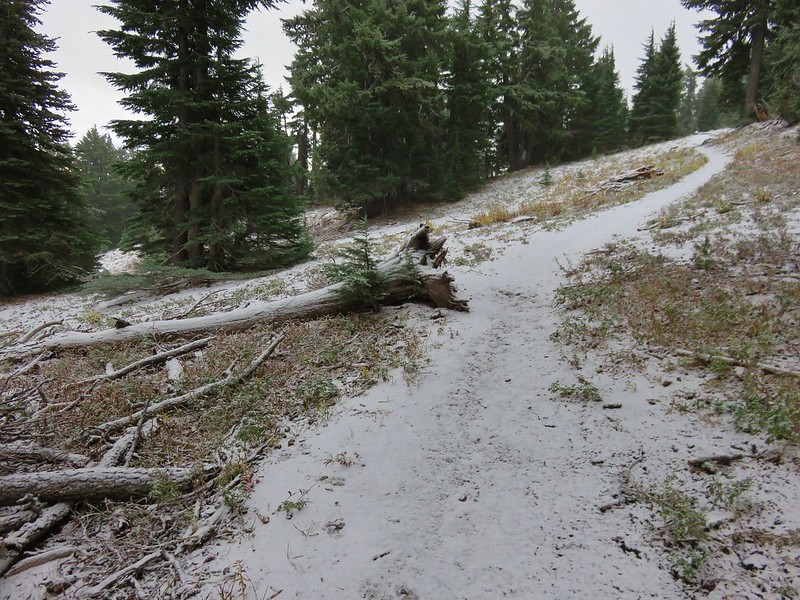
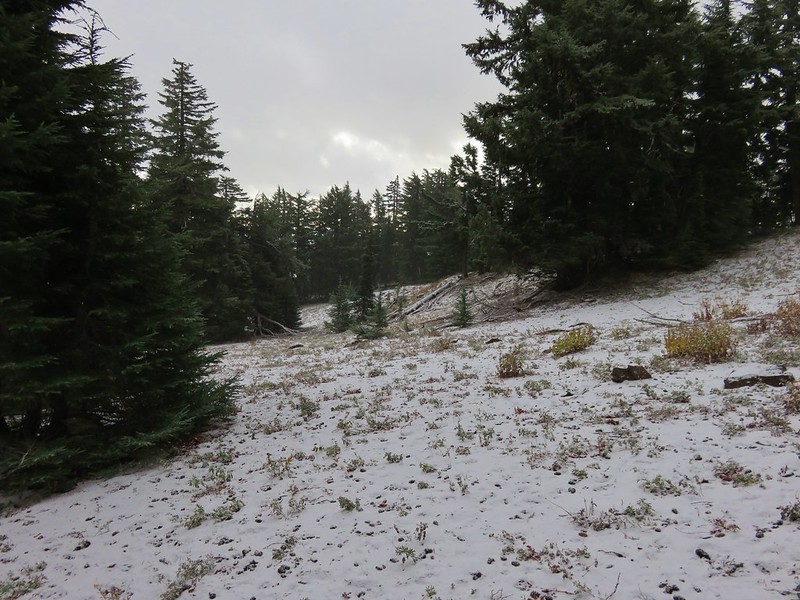
The light rain had quickly turned to a light snow and as we gained elevation we began to see more and more of it along the trail.
Black Crater Trail

Snow along the Black Crater Trail

Black Crater Trail

Black Crater Trail

Black Crater Trail

Snow along the Black Crater Trail

One of the nice things about Central Oregon snow is that it is rarely very wet and this was typical Central Oregon snow. The dry snow on the trail squeaked beneath our feet and the flakes falling on our clothing didn’t cause them to feel damp. We were the first hikers on the trail since the snowfall but we weren’t the first to have used the trail.
Grouse
Grouse tracks

Deer
Deer tracks on the Black Crater Trail

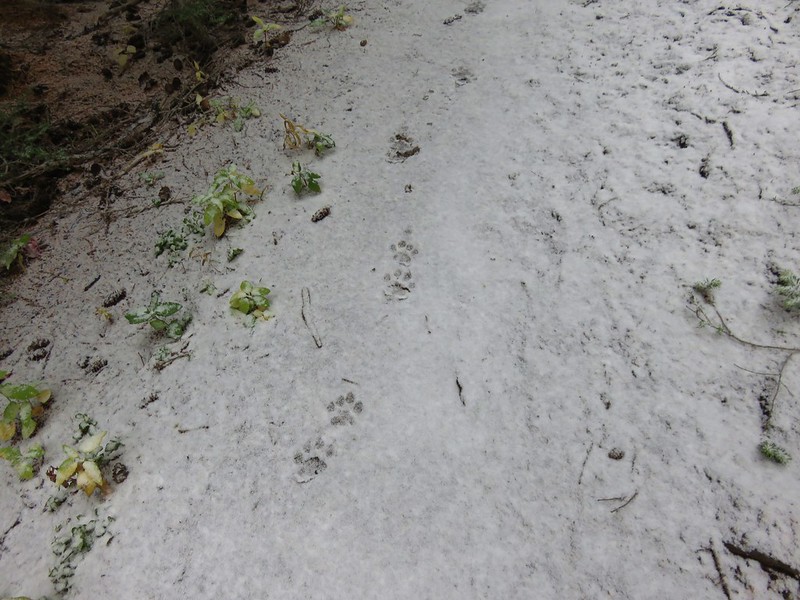
Cougar or bobcat
Cougar or bobcat prints on the Black Crater Trail

After 2 miles of climbing the trail traversed a glacially carved valley with some open meadows.
Black Crater Trail

View along the Black Crater Trail

We were now winding around the east side of Black Crater where the clouds were not blocking all the views.
View along the Black Crater Trail

Gray Butte

Black Butte from the Black Crater Trail

After .7 miles we arrived at the far side of the valley and turned uphill on a series of switchbacks toward the cinder cone’s summit.
View along the Black Crater Trail

Black Crater Trail

Shortly before reaching the summit the trail crossed a barren plateau where we found ourselves in the middle of the clouds.
Black Crater Trail

Heather and Dominique crossing the plateau.
Black Crater Trail

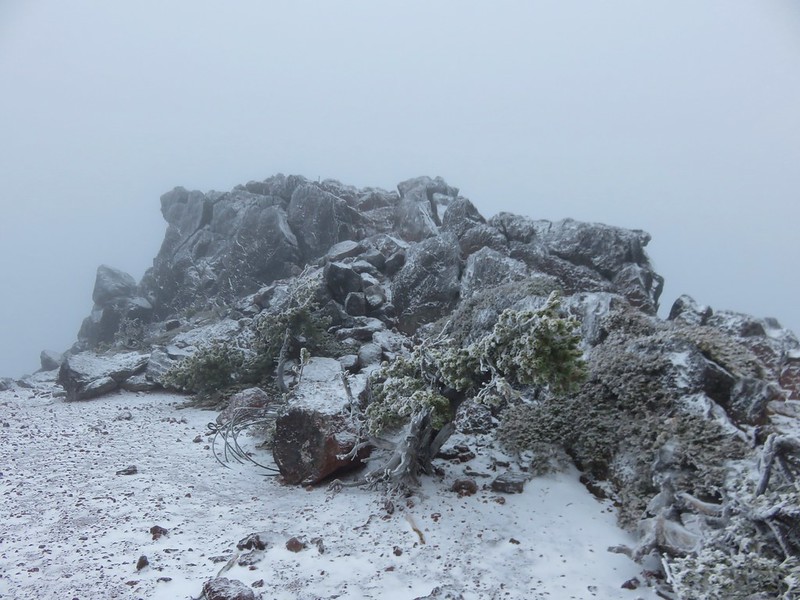
The wind was really blowing as we explored the summit’s rocky crag.
Summit of Black Crater

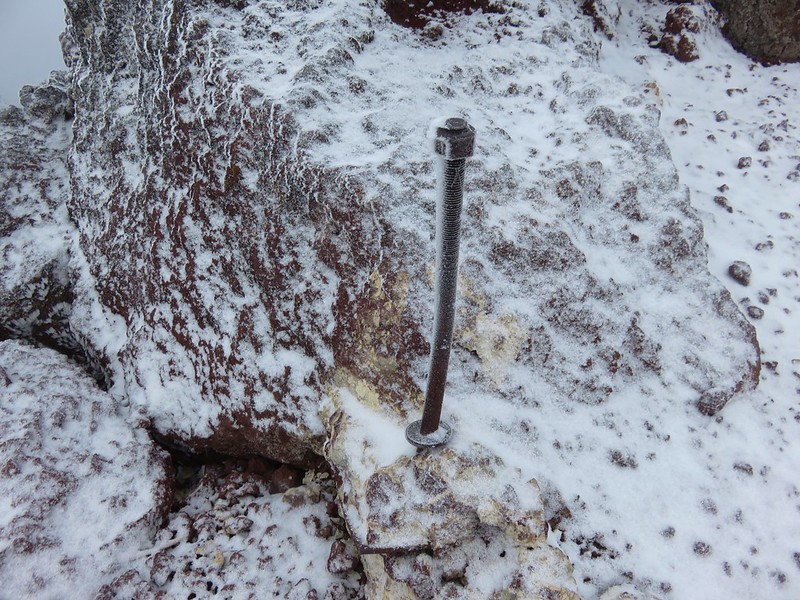
Remnants remained where a former lookout tower sat perched on the rocks.
Black Crater summit

Frozen rocks at the summit of Black Crater

Remanants of the lookout tower on Black Crater

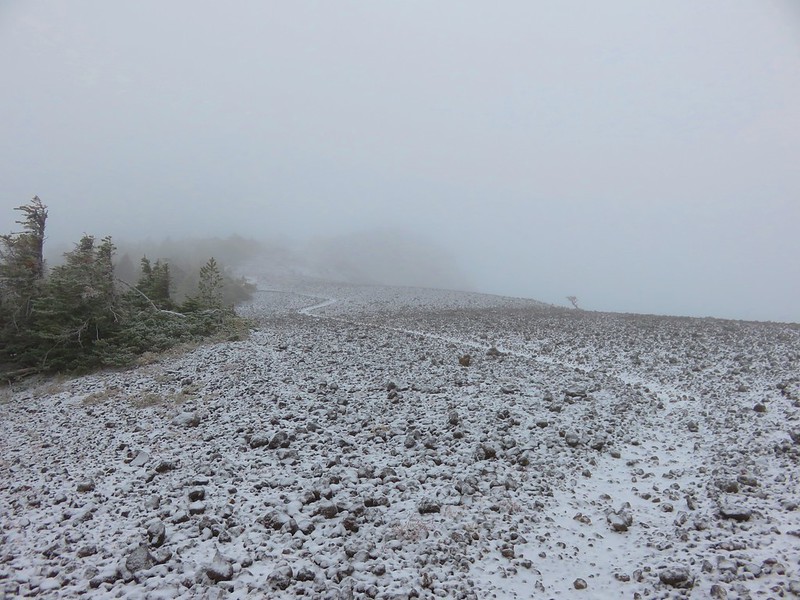
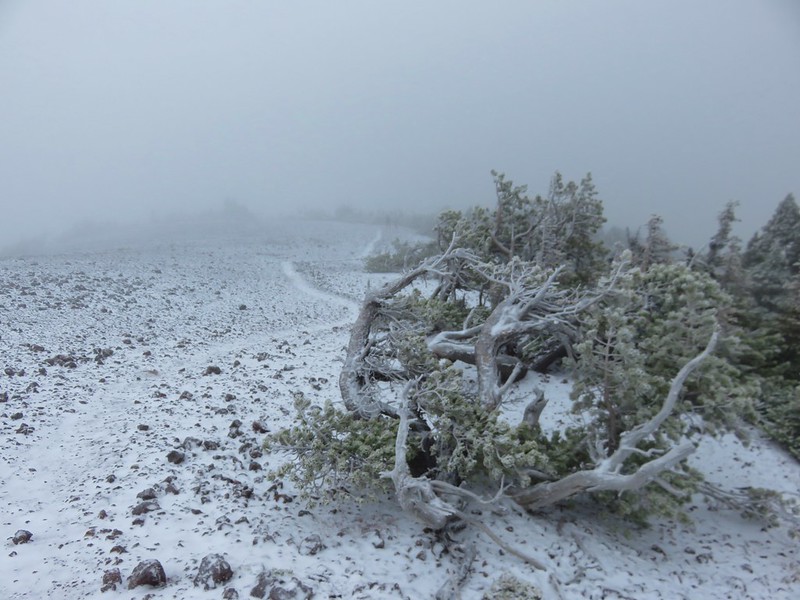
With the wind blowing and snow falling it didn’t take long to start feeling like we might wind up looking like the nearby whitebark pines.
Frozen whitebark pines on Black Crater

We headed back across the plateau and met the first of a half dozen or so hikers on their way up the trail. We saw them all before we’d finished coming down the switchbacks and then never saw another hiker until we were back at the trailhead. The snow continued to fall most of the way back down but it was not accumulating and much of the snow that had been along the lower portions of the trail was gone by the time we passed again.
Snow falling in the Three Sisters Wilderness

We were on our way back to my parent’s house shortly after 11am where Dad had pancakes, bacon, and eggs waiting. Happy Trails!

Flickr: https://www.flickr.com/photos/9319235@N02/albums/72157674602749496

Categories
High Cascades Hiking Mt. Hood Area Oregon Trip report

Cooper Spur

We have had the hike up Cooper Spur on Mt. Hood in our plans for the last several years but for one reason or another it has wound up getting bumped from the schedule.  It was on our schedule again this year with an October date set.  Not wanting to miss out on this hike again we decided to take advantage of what appeared to be an excellent weather forecast and move it up.

Our plan was to start out at the Tilly Jane Ski Trail along Forest Road 3512 and explore the Cloud Cap/Tilly Jane Historic District as well as hiking up Cooper Spur. This starting point adds nearly 2000′ of elevation gain and approximately 5.5 miles to the hike vs starting at either the Tilly Jane or Cloud Cap Saddle Campgrounds but we decided we’d rather spend time hiking up to those areas than driving an additional 30 minutes each way.

The trailhead is located just beyond the Cooper Spur Ski Area on Forest Road 3512. To reach it turn off of Highway 35 onto Cooper Spur Road then turn left onto Cloud Cap Road (Forest Road 3512) at the Cooper Spur Mountain Resort. The trailhead is 1.5 miles along this road with parking on the right.
IMG_6569

Informational signs at the trailhead told a little about the historic district.
IMG_6567

IMG_6568

The trail headed uphill through the forest, reaching a junction after a half mile with the Polallie Ridge Trail which we would be taking as part of our return route.
IMG_6572

IMG_6574

The trail climbed very steadily and soon entered forest burned in the 2011 Dollar Lake Fire.
IMG_6579

The burnt trees allowed for some nice views of not only Mt. Hood but also Mt. Adams, Mt. Rainier, and Mt. St. Helens in Washington.
IMG_6587

IMG_6590

It was very apparent that earlier in the year there had been a nice display of wildflowers along the trail but most of them had long since passed although a few holdouts did remain.
IMG_6606

The dead trees seemed to host plenty of life in the form of a variety of birds flying from tree to tree.
IMG_6601

IMG_6619

IMG_6627

After nearly 3 miles of climbing we neared the Tilly Jane A Frame which was hidden in non-burnt trees.
IMG_6628

Despite being threatened by the 2011 fire, firefighters had been able to save all the structures in the historic district.

Heather and I were busy talking as we approached the A-Frame and I suddenly noticed there was a deer in the trail about 20 yards away. It walked into the trees as I was grabbing the camera, but then a second deer appeared.
IMG_6629

She sized us up for a moment then proceeded to take a few bites of the plants as she followed the other one into the trees.
IMG_6631

IMG_6633

As we continued up the trail we spotted the first deer and saw that it was a young buck.
IMG_6634

After watching the deer for a moment we proceeded to the A-Frame to have a look.
IMG_6638

IMG_6639

IMG_6640

IMG_6642

The A-Frame was constructed by the Civilian Conservation Corps in 1939 and can sleep up to 20. It originally had a kitchen and dining hall on the ground floor with the sleeping area above in the loft.

West of the A-Frame is the Legion Cookhouse (built in 1924) which is not in the best of shape.
IMG_6644

IMG_6645

Just beyond the cookhouse a trail sign announced the Tilly Jane Trail.
IMG_6649

We turned left on the trail after taking a quick look at the American Legion Amphitheater which was also constructed in the 1920s.
IMG_6651

The Tilly Jane Trail enters the Mt. Hood Wilderness about a quarter mile from the cookhouse.
IMG_6654

The trail then proceeds uphill along the Polallie Creek Canyon just over three quarters of a mile to the Timberline Trail. A 1980 flash flood sent an 80′ deep wall of water and debris down the canyon. Viewpoints along the way offered a look at the origin of the flood at the headwall of the canyon.
IMG_6656

IMG_6659

Beyond the viewpoint of the headwall the forest began thinning out providing nice views ahead of Mt. Hood.
IMG_6666

We also had a great view of Mt. Adams which is something we seem to rarely get.
IMG_6676

Just over a mile from the cookhouse and 4 miles from the trailhead on FR 3512 we arrived at the Timberline Trail.
IMG_6681

We followed the pointer for Cooper Spur a tenth of a mile to the Cooper Spur Shelter.
IMG_6688

Cloud Cap Inn was visible from the shelter which we planned to visit on our way down.
IMG_6690

IMG_6691

We continued up from the shelter following a clear trail.
IMG_6701

The official trail shown on maps switchbacks uphill but we wound up off the trail after visiting a viewpoint of the Eliot Glacier near a memorial plaque for Robert Edling, a mountain rescue pilot that died in a crop duster accident near The Dalles.
IMG_6703

IMG_6708

From the memorial plaque we headed straight up the ridge following a confusion of faint paths up through the rocks.
IMG_6713

This was much steeper than the switchbacks would have been and when the official trail came close enough for us to see it we hopped back on. We left it again though when it headed straight for a snowfield. It was a cold morning (the expected high for the day in the area was 48) and we knew that the snow would be covered in ice so we wouldn’t be able to cross it. We returned to the edge of the ridge and headed straight up again. In addition to making the distance a little shorter, the main advantage to this route were the views. The views of the Eliot Glacier were really interesting.
IMG_6718

IMG_6719

IMG_6720

IMG_6721

IMG_6722

IMG_6723

IMG_6717

The route steepened quite a bit as it veered to the east to climb to the top of a moraine.
IMG_6725

A stone windbreak at the top wasn’t housing any hikers but there were a few ladybugs taking shelter.
IMG_6736

IMG_6768

The official trail ends here where the views were spectacular. To the south Broken Top, The Three Sisters, and Mt. Jefferson were all visible.
IMG_6738

To the north Mt. St. Helens, Mt. Rainier, and Mt. Adams were all virtually cloud free.
IMG_6740

IMG_6746

IMG_6741

IMG_6743

To the NE the Columbia River snaked from the dry brown landscape of eastern WA and OR into the forested cliffs of the Columbia Gorge.
IMG_6755

Further to the east the Newton Clark Glacier drained into the Newton Creek Canyon.
IMG_6756

Mt. Hood provided the most dramatic view though.
IMG_6750

One of the features on Mt. Hood that we had a good view of was Pulpit Rock.
IMG_6760

Another unique feature in the area is Hiroshima Rock. A boulder inscribed by a group of Japanese climbers in 1910.
IMG_6751

For more information on the Hiroshima Rock check out this post by WyEast Blog.

Even though the official trail ended at roughly 8500′ on top of the moraine, a climbers trail continued along the ridge past Tie-in Rock, a large boulder not far beyond the start of the ridge. The ridge was snow free so we continued on passing Tie-in Rock and continuing to an elevation just over 8900′ where the trail dropped slightly to a saddle between the Eliot and Newton Clark Glaciers.

Heather crossing the ridge. (Tie-in Rock is the large boulder in the distance just to the right of the trail.)
IMG_6770

The first section of the ridge was somewhat level before a final rocky climb to our turnaround point.
IMG_6773

We passed a final memorial plaque along the way remembering the victims of a 1981 climbing accident.
IMG_6774

IMG_6775

Other than a bow hunter, who had been at the trailhead when we arrived that morning, we hadn’t seen anyone other people and were alone on the ridge.
IMG_6785

From this highest point one final Cascade Peak came into view to the south – Diamond Peak.
IMG_6804

After enjoying the views we headed back down the way we’d come. As we were descending some high clouds passed overhead changing the scenery a bit.
IMG_6817

We decided to follow the official trail on the way down from the moraine which turned out not to be the best decision. The snowfield was still impassible and it was a lot bigger than we had anticipated which caused us to have to swing out wide and make our way down along the snow in loose rocks and sand.
IMG_6821

After passing below the snowfield we contoured back toward the official trail eventually picking it up about a mile and a half from the Timberline Trail. We then followed it back down to the junction and turned left on the Timberline Trail and headed toward Cloud Cap.
IMG_6824

IMG_6825

The trail descended to a crossing of the upper (and dry) portion of Tilly Jane Creek where it split. With no signs it was difficult to tell if we should turn downhill along the creek or climb to the ridge along the Eliot Moraine. We chose to go up where we found a nice path with great views along the ridge.
IMG_6832

IMG_6828

IMG_6830

Near the end of the moraine the trail dropped down to the right into the forest.
IMG_6835

After 1.2 miles we came to a sign for the Cloud Cap Trailhead.
IMG_6836

We followed that trail for 100 yards to the Cloud Cap Saddle Campground where a road led up and around a hill to the Cloud Cap Inn.
IMG_6837

IMG_6838

Snowshoe Cabin
IMG_6839

Cloud Cap Inn
IMG_6846

IMG_6848

IMG_6849

The inn was opened in 1889 and is currently maintained by the Hood River Crag Rats who use the inn as a base for snow surveys and mountain rescues. Click  here for more on the inn’s history.

After visiting Cloud Cap we passed back through the campground where we turned left on the Tilly Jane Trail.
IMG_6852

This section of the trail passed through a mix of burnt and unburnt forest and still had a few flowers along it.
Aster
IMG_6854

Pearly everlasting
IMG_6855

Goldenrod
IMG_6857

IMG_6859

We followed signs to the Tilly Jane Campground and the 1924 Tilly Jane Guard Station.
IMG_6860

IMG_6863

IMG_6864

The trail crossed Tilly Jane Creek on a footbridge between the Guard Station and the amphitheater.
IMG_6866

IMG_6868

Instead of returning on the Tilly Jane Ski Trail which led past the A-Frame we turned back uphill on the Tilly Jane Trail for a couple hundred feet to a trail sign for the Polallie Ridge Trail.
IMG_6871

The Polallie Ridge Trail quickly entered the Dollar Fire burn area. The trail stuck closely to the top of the ridge as it headed straight downhill.
IMG_6876

IMG_6882

There was a nice view back to Mt. Hood as well as the headwall of the Polallie Creek Canyon.
IMG_6878

The trail was faint and appeared to get more use by deer than hikers. Manzanita and chinkapin covered sections of the trail but it was passable.
IMG_6883

IMG_6888

chinkapin
IMG_6885

The trail eventually reentered forest unaffected by the fire and just over 2 miles from the Tilly Jane Trail junction we turned left following a blue arrow for the Polallie Ridge Trail.
IMG_6889

IMG_6890

IMG_6891

Another quarter mile brought us back to the Tilly Jane Ski Trail just .5 miles from our car.
IMG_6892

IMG_6894

The total distance for the hike was 13.9 miles with a little over 5000′ of elevation gain. It had been a near perfect day for the hike with the cool temperatures and lack of troublesome clouds. Having had Cooper Spur all to ourselves was just a bonus. We had begun seeing other hikers when we began descending from the moraine at 8500′ and there were plenty of cars at Cloud Cap and the Tilly Jane Campground as well as the trailhead when we got back. It was another good reminder why we get ourselves up so early on hiking days.

Happy Trails!

Flickr: https://www.flickr.com/photos/9319235@N02/albums/72157674245738906

Categories
Diamond Peak Area High Cascades Hiking Oregon Trip report

Windy Lakes and Beyond

The third, and what turned out to be final day, of our trip around Cowhorn Mountain was originally going to be a 10 mile hike moving our camp near Indigo Lake on the west side of the Cascade Crest to the Windy Lakes on the east side. That would have left us about 11 miles from our car for the final day’s hike out. I had already begun rethinking that in the days before we started out because we’d likely be at the Windy Lakes before 1pm which would mean we’d be hanging around that group of lakes for half of the day when we could have been shortening the distance for our final day.

After going over our maps the night before and discussing it we had decided that we would continue past the Windy Lakes and set up camp at one of several other lakes along our route. We would let our bodies and the time of day decide when it was time to stop. Our options were Suzanne and Darlene Lakes which were a mile beyond the Windy Lakes, Oldenburg Lake which was another 4 miles along, or go another 2+ miles to Nip & Tuck Lakes.

Before we could decide where to camp for the night though we had to get to these lakes. We said goodbye to the little lake we had been staying at and set off a little before 7am.
IMG_6379

We took the Indigo Extension Trail down to Indigo Lake then followed the Indigo Lake Trail nearly 2 miles to the trailhead near the Timpanogas Lake Campground. A short road walk into the campground brought us to the Lake Shore Trail along Timpanogas Lake.
IMG_6383

IMG_6384

IMG_6385

IMG_6387

We followed the Lake Shore Trail for .4 miles to the Timpanogas Shelter.
IMG_6389

IMG_6392

IMG_6394

IMG_6395

IMG_6396

IMG_6397

Just beyond the shelter were signs for the Start O’Willamette Trail.
IMG_6403

We turned uphill on this trail and climbed nearly 600′ in just over a mile to the Windy Pass Trail.
IMG_6408

IMG_6412

There were several unnamed lakes shown on the map near the junction and we quickly passed on after turning right onto the Windy Pass Trail.
IMG_6413

From the junction we needed to follow the Windy Pass Trail for 2.7 miles to the Cowhorn Traverse Trail where we had come down from the Pacific Crest Trail two days before. This section of trail gained almost 900′ but it was never steep making it a fairly easy climb. The trail was forested but there were occasional views of Sawtooth Mountain across the valley we were circling.
IMG_6415

IMG_6420

We were in a zone and making good time when a pair of grouse startled us.
IMG_6424

IMG_6426

After stopping to watch the grouse we continued on to the junction with the Cowhorn Traverse Trail where we turned left and followed it .3 miles to the PCT.
IMG_6429

IMG_6431

IMG_6432

If we turned right (south) on the Pacific Crest Trail it would be about than 5 miles to our car, but we turned left and headed north. The PCT traveled along the Cascade Crest offering some big views in all directions as the trial occasionally switched sides along the ridge.

Diamond Peak to the north
IMG_6441

IMG_6451

Maiden Peak, Mt. Bachelor and Crescent Lake to the NE
IMG_6444

Mt. Thielsen, Mt. Bailey, and Sawtooth Mountain to the south
IMG_6456

Mt. Thielsen, peaks around Crater Lake, Union Peak, and Mt. McLoughlin
IMG_6459

The trail began a series of sections where it would switchback down through the forest on the west side of the crest before popping out at a viewpoint along the ridge. The Windy Lakes were below the ridge to the east and we were gaining better views of them each time we reached the ridge.
IMG_6463

Our plan to visit the Windy Lakes included some off-trail hiking because there was no direct route from the PCT to the Windy Lakes Trail. We spent quite a bit of time looking at the topographic map determining where we thought the best spot to head cross country would be. We identified a switchback due west of Middle Windy Lake as the best option. We used the GPS to make sure we were in the right area when we finally decided to leave the PCT just under 3 miles from the Cowhorn Traverse Trail.
IMG_6464

The cross country route was much easier than we could have ever hoped for with very little blowdown and no underbrush to speak of.
IMG_6465

IMG_6466

We used the GPS to make sure we were staying on the right heading and were quickly approaching a lake. For all the good the GPS does it occasionally messes with us. The lake we were approaching was the furthest lake shown on the display to the south. We had expected to be headed toward Middle Windy Lake but the furthest Windy Lake to the south is South Windy Lake. We would have preferred reaching South Windy Lake first because we planned on visiting it in any event and it would have been out of the way to head there from Middle Windy Lake. As we approached the lake shown on the GPS the Windy Lake Trail was shown on the map on the opposite side.
IMG_6468

We decided to go around the southern end of the lake to meet up with the trail closer to its end. I should have realized something was amiss when I noticed that the GPS showed the trail continuing even further south even though there was no lake shown at its end. I was too busy enjoying the scenery of the lake though to pay much attention to a trail to nowhere though.
IMG_6470

IMG_6472

We located the Windy Lakes Trail near a campsite at the SE end of the lake and turned left hiking along the lake.
IMG_6474

We decided to take a break and sat on a log along the sandy beach watching some birds hunting for food.
IMG_6477

From there we continued north on the Windy Lakes Trail passing briefly through forest before arriving at the next lake.
IMG_6483

IMG_6484

We thought this must be Middle Windy Lake and it had a bit of a view of Diamond Peak.
IMG_6486

It also had a nice looking peninsula which was a little odd because we remembered from the maps that East Windy Lake had peninsula.
IMG_6487

The peninsula prompted me to look at the GPS again and I noticed that we were getting pretty close to our next trail junction and we’d only passed two lakes not the three we were expecting. I scrolled the display back up to the where it showed the end of the Windy Lakes Trail and zoomed in to find that instead of showing a lake the map had the area labeled as a marsh. We don’t know why the map (Google is the same) didn’t show the actual lake but we knew it was there having seen it from the PCT. We briefly considered skipping it, but that just didn’t sound like us so we turned around and headed back up the Windy Lakes Trail. After passing East Windy Lake and the correctly identified Middle Windy Lake we came to the campsite where we had first stepped onto the Windy Lakes Trail and continued into the forest.
IMG_6490

It was just under a half mile to South Windy Lake from the campsite.
IMG_6491

The lake was in a bowl at the head of the valley and the shore was heavily forested with a lot of brush making it a little less inviting than the other two lakes we had visited. We both thought it was prettier to look at from above through the trees where it was a little more colorful.
IMG_6498

In any event we’d seen it and now had our lakes properly identified so now we could continue our loop. We passed Middle and East Windy Lakes once again and then turned right following a pointer for Oldenburg Lake at a 3-way junction.
IMG_6499

After passing an unnamed lake we arrived at a second 3-way junction where we once again turned right ignoring the pointer for the Spring Trail.
IMG_6503

IMG_6507

The next lakes up were Suzanne and Darlene. Suzanne Lake was a quick, level mile from first 3-way junction.
IMG_6510

IMG_6511

IMG_6513

IMG_6517

There were a couple of established tent sites here but it was still too early in the day for us to want to stop so we continued to Darlene Lake which was only a quarter mile away.
IMG_6527

The summit of Cowhorn Mountain was visible over the forest on the far side of the lake.
IMG_6519

We took a short break on a log at Darlene Lake but it was only just now after 1:00pm and Oldenburg Lake was less than 4 miles away so we sallied forth.
IMG_6530

It had been growing increasingly cloudy which was something we had been keeping our eyes on. We had come prepared for rain, but we hadn’t really expected any based on the forecast the morning we had left. We had noticed though that the forecast for some of the rest of Oregon had suddenly been calling for rain over the final days of our trip so we knew there was a possibility that the forecast might change while we were out. Not far from Darlene Lake a light rain began to fall. Heather was the first to suggest what we had both been considering, hiking all the way to the trailhead instead of stopping at one of the lakes for the night. We discussed it briefly and decided that we’d both prefer not to mess with the rain gear and since we would still be getting to visit everything we’d planned on we wouldn’t be missing out on anything. With that settled we picked up our pace and really started moving.

The forest began to change as we got closer to Oldenburg Lake and we were soon hiking through lodgepole pines on a dusty trail.
IMG_6535

We arrived at Oldenburg Lake just after 2:30 having traveled the final 3 miles in about an hour.
IMG_6538

IMG_6541

We took another short break at Oldenburg Lake before continuing on toward Nip & Tuck Lakes. This next section of trail was a little slower due to a gentle but steady uphill. Just over 2 miles from Oldenburg Lake our GPS showed that Nip & Tuck Lakes were off the trail to the east. They were hidden by trees so we were watching for any sign of a side trail down to the lakes. According to the maps we had there was no official trail leading to them. When it looked as though we were about to pass them completely we decided to attempt a cross country route but were quickly stymied by closely knit lodgepole stands. We decided to skip these lakes after all and returned to the Oldenburg Lake Trail. About a hundred yards from where we had left the trail to go cross country we came to a junction with a signpost for the lakes.
IMG_6547

It was less than a tenth of a mile to this pair of little lakes. They were unlike any of the other lakes we’d visited during our trip. They were smaller, shallower, and ringed mostly with grasses and reeds.
IMG_6549

IMG_6550

When full it is actually one continuous lake but this late in the year the two parts were separated by a grassy meadow.
IMG_6552

We took one final break at the larger of the two bodies of water before setting of on the final stretch. We were a little under 2 miles from the Oldenburg Lake Trailhead and it was just about 3:45pm. The final section of trail was only sightly uphill so we made decent time and managed to arrive at the trailhead along Forest Road 60 just after 4:20pm.
IMG_6560

IMG_6562

We were soon on our way home. The GPS put us at 22 miles even for the day which was the most we’d ever done with our full backpacks and our feet knew it. 🙂 We don’t know how much it rained or if it even did where we would have camped, but we drove through plenty of it on the way back home. It had been a great three days with some amazing views and above all it had been another great adventure. Happy Trails!

Flickr: https://www.flickr.com/photos/9319235@N02/albums/72157672911107731

Categories
Diamond Peak Area High Cascades Hiking Oregon Trip report

Sawtooth Mountain and June Lake

Our second day in the Oregon Cascades Recreation Area was a day hike from our base camp at the little green lake above Indigo Lake. Our plan was to do a loop around Sawtooth Mountain (with a side trip up to the summit). Before completing the loop we also planned to to take another side trip to visit nearby June Lake.
IMG_6181

We chose to go around Sawtooth Mountain in a clockwise direction. Heather had pointed out that this was a shorter route to the summit from where we were camped which would mean we’d be climbing in cooler temperatures and it also would allow us to visit June Lake later in the day when we would likely be welcoming a nice break.

We left the lake and returned to the Indigo Extension Trail which we took uphill to the junction with the Windy Pass Trail.
IMG_6184

Here we turned right onto the Windy Pass Trail and began a downhill traverse behind Sawtooth Mountain.
IMG_6185

The downhill meant more climbing to get to the 7301′ summit so we weren’t overly thrilled as we continued to lose elevation. The trail eventually began to climb after descending to an elevation of approximately 6350′. The climb was quite a bit steeper than the descent had been. We did have occasional views up through the forest to various rock formations on Sawtooth Mountain but not of the summit itself.
IMG_6188

IMG_6191

IMG_6194

We also saw the only deer we’d encounter on the entire trip along this section when a doe and her fawn ran down a gully toward seasonal Bradley Creek.

The trail really steepened in very loose dirt below an interesting pillar, where we also got a good look our goal, which we had now worked our way around.
IMG_6195

IMG_6198

We found the .4 mile scramble trail to the summit a very short distance after climbing past the pillar. The trail was marked with rock cairns.
IMG_6202

From the beginning of the scramble trail we could get a little idea of our route but the view turned out to be pretty deceiving.
IMG_6206

Beyond Sawtooth Mountain was Cowhorn Mountain which we had climbed the previous day.
IMG_6208

The climb up Sawtooth Mountain was not as steep as the climb up Cowhorn Mountain had been but it had it’s own challenges. The first tenth of a mile or so was an easy to follow dirt path along a ridge. The dirt gave way to rock and we were soon climbing more steeply up a scree slope to a dark rock outcrop.
IMG_6220

A second outcrop lay a couple hundred feet further along the ridge.

Looking back to the first outcrop from the second.
IMG_6221

Hidden behind the second outcrop the ridge continued on but it was much narrower.
IMG_6222

It was narrow enough that there was a moment of hesitation before stepping out and heading across. To make things just a little more challenging there was a small rock spire toward the end of the narrow section to navigate around.
IMG_6223

At the far end of the ridge was a patch of western pasque flowers.
IMG_6224

The route headed to the left along a scree field below the mountains craggy summit.
IMG_6227

After passing a narrow chute filled with loose rock we scrambled up to the summit from the NW side.
IMG_6228

Despite this peak being 350′ shorter than Cowhorn Mountain we felt the views were a bit better. Indigo Lake lay almost directly below and several mountains that we had not been able to see from Cowhorn Mountain were visible from this summit.

Looking north
IMG_6229

Indigo Lake
IMG_6271

Diamond Peak and Summit Lake
IMG_6244

Mt. Jefferson
IMG_6232

The Three Sisters, Broken Top and Mt. Bachelor behind Maiden Peak
IMG_6233

To the east was Cowhorn Mountain
IMG_6238

View south
IMG_6236

Mt. Scott behind Mt. Thielsen
IMG_6255

Union Peak and Mt. McLouglin
IMG_6257

Mt. Bailey
IMG_6259

There also didn’t seem to be as many yellow jackets flying around (just a bunch of flies)which allowed me to be a little more relaxed as we took a break and ate some food. On the way back to the Windy Pass Trail we spotted a marmot foraging in the dirt. We’d seen it on the way up but it had run off as we approached but now it didn’t seem to be too worried about us.
IMG_6287

IMG_6290

Approximately 1.2 miles after starting back on the Windy Pass Trail we came to a junction with the Sawtooth Mountain Trail.
IMG_6302

The Windy Pass Trail continues 2 more miles to Forest Road 770 but according to the forest service that section of trail is no longer maintained. Our route took us onto the Sawtooth Mountain Trail though. We followed this path downhill through the forest for approximately 2.25 miles. At times the trail was rather steep and it was evident why it appeared to be popular with mountain bikers.
IMG_6304

After the 2.25 miles we arrived at a trail junction with the Indigo Lake and June/Indigo Tie Trails.
IMG_6317

To get back to our camp we would need to head toward Indigo Lake but first we wanted to visit June Lake so we made a sharp left turn onto the tie trail.
IMG_6318

After about half a mile the tie trail met the June Lake Trail coming up from a trailhead near the Timpanogs Lake Campground.
IMG_6321

IMG_6322

The hike to June Lake was nearly flat, especially in relation to what we’d just come down. Sections of the trail were also lined with colorful huckleberry bushes.
IMG_6323

IMG_6325

June Lake was a little bigger than we expected and, like the other lakes in the area, very colorful. The only thing it seemed to lack was a mountain view.
IMG_6332

IMG_6335

We walked around the lake stopping on the far side to sit on some rocks along the shore. We had to watch where we sat because we weren’t the only ones enjoying the rocks.
IMG_6343

IMG_6344

As we rested we watched busy birds and butterflies along the lakes sandy shore.
IMG_6336

IMG_6337

We had gone around the lake clockwise and near the end of the loop we came to the lakes now dry outlet creek.
IMG_6348

IMG_6351

We stopped for a moment to ponder what might have once been on a small signboard that was nearby.
IMG_6349

After completing the loop we followed the June Lake Trail back to the junction with the tie trail where we decided not to turn onto the tie trail but instead take the .7 mile trail down to the trailhead.
IMG_6352

This section of trail lost about 200′ of elevation as it descended to a junction with the Middle Fork Trail.
IMG_6354

The 33.1 mile Middle Fork Trail follows the Middle Fork Willamette River from the Sand Prairie Campgound near Hills Creek Reservoir near Oakridge up to the trailhead near Timpanogas Lake. Just before the trailhead it passes Lower Timpanogas Lake. In order to get a decent look at that lake we had to hike 100′ down the Middle Fork Trail.
IMG_6355

IMG_6356

To be honest it was the least impressive of the lakes we’d visited on the trip so far but Heather did see some good sized fish swimming in the water. We walked back up to the junction and turned left onto what was now an old roadbed leading to the trailhead. At the trailhead we headed up the Indigo Lake Trail.
IMG_6357

We climbed for .7 miles back to the junction where we had taken the June/Indigo Tie Trail then continued on the Indigo Lake Trail an additional 1.2 miles uphill to Indigo Lake.
IMG_6358

IMG_6359

IMG_6361

IMG_6364

After a brief stop at one of the picnic tables along Indigo Lake we made our way back up to our campsite where we had dinner and watched the sky change colors as the sunset.
IMG_6367

IMG_6370

IMG_6371

We would be packing up in the morning and saying goodbye to the little unnamed lake, but for one more night it was home. Happy Trails!

Flickr: https://www.flickr.com/photos/9319235@N02/albums/72157672828693740