Categories
Hiking Mt. St. Helens Trip report Washington Washington Cascades

Coldwater Lake & The Hummocks

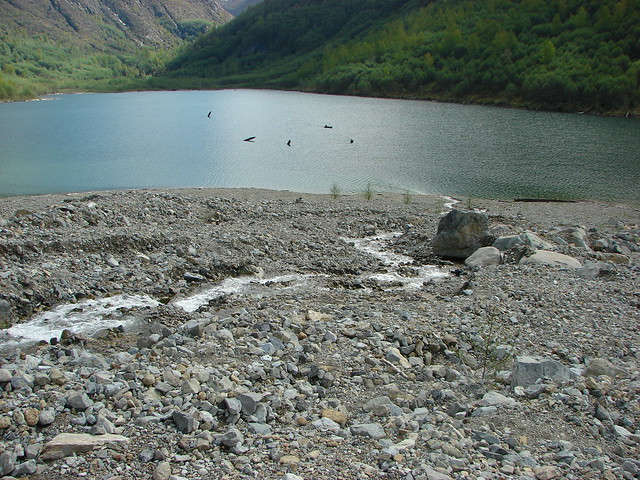
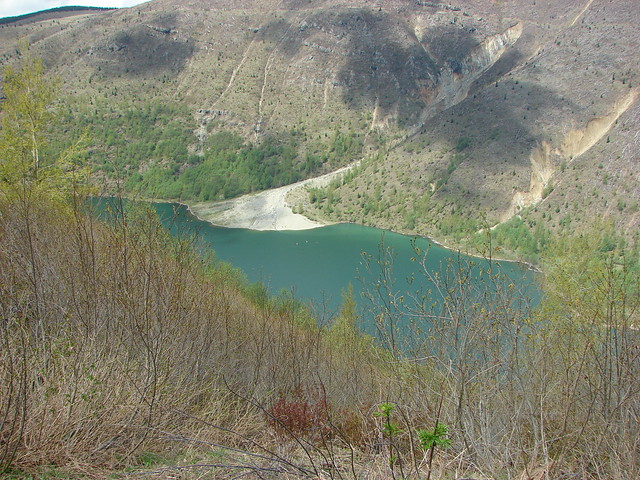
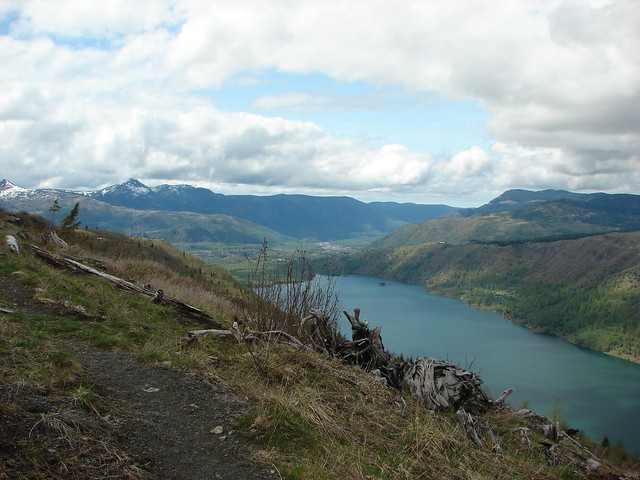
We ended our “Creek Week” vacation by changing things up a bit and heading to the Mt. St. Helens National Volcanic Monument hoping to see some snowy mountains. Our creek theme wasn’t totally abandoned though. Our destination was Coldwater Lake which was formed during the 1980 Mt. St. Helens eruption when Coldwater Creek was blocked by debris from the mountain. The creek still flows into and out of the lake on it’s way to the North Fork Toutle River.

The slide that created Coldwater Lake also created the Hummocks which are piles of rock, ash, and other debris that was washed down and deposited along the Toutle River. A 2.5 mile trail loops through these mounds and that was where we decided to start our hike. Our plan was to hit that popular trail first before it got crowded then walk back along the shoulder of Highway 504 for a quarter mile to the entrance to Coldwater Lake and once there either do an 8.8mi out and back to a footbridge over Coldwater Creek or continue over the bridge on a longer loop up and around the lake. We decided to wait until we got closer to the bridge before choosing which option we would take.

It was quite foggy when we arrived at the trailhead for the Hummocks loop making it pretty clear that we wouldn’t be seeing Mt. St. Helens for awhile at least.
The Hummocks trailhead

The scenery along the trail deserved our attention anyway with many ponds and streams nestled between the various mounds.
Ducklings on one of the ponds
DSC04973

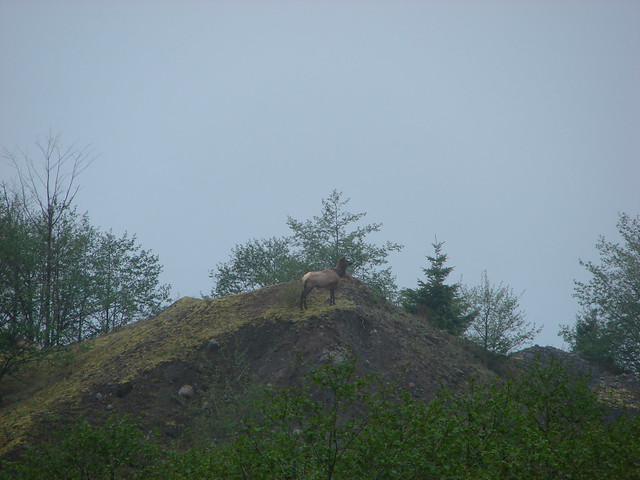
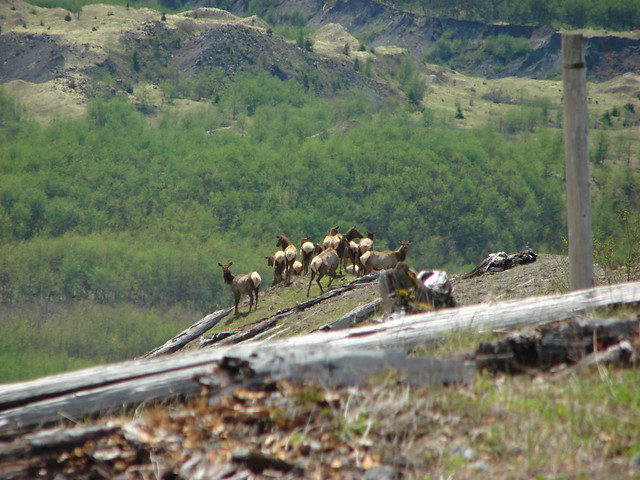
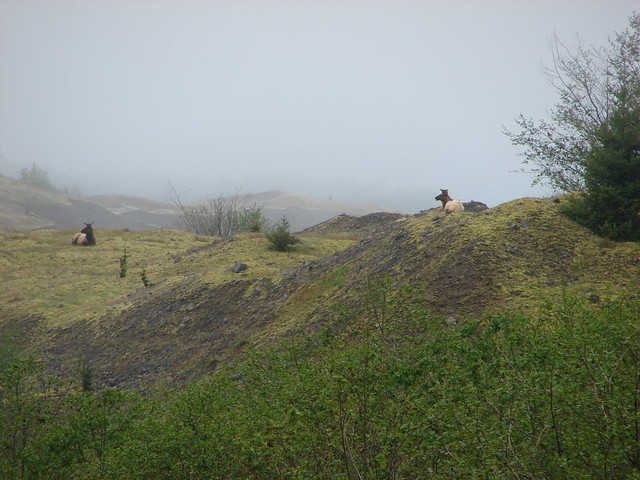
As we were making our way through the strange landscape we spotted some elk on one of the Hummocks a short distance away.
DSC04984
DSC04989
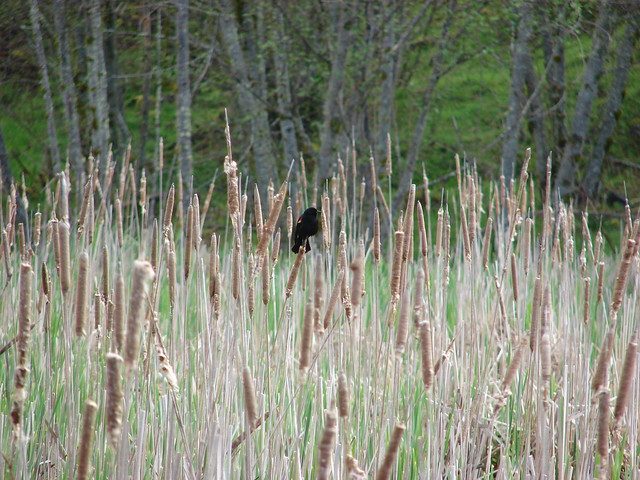
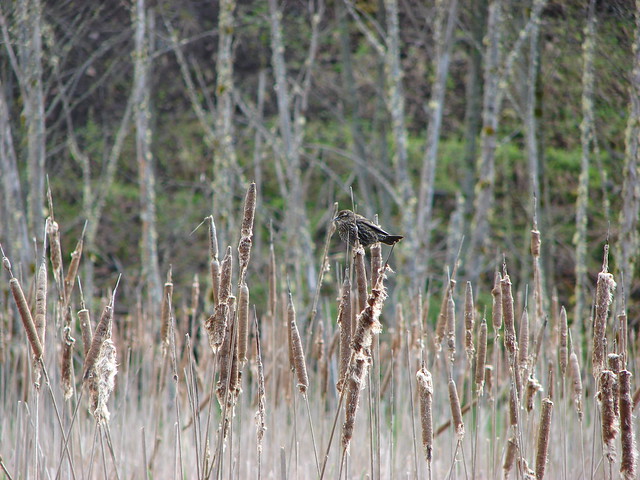
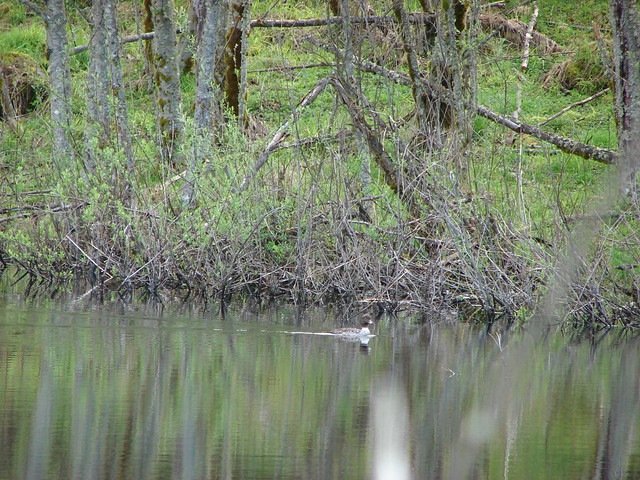
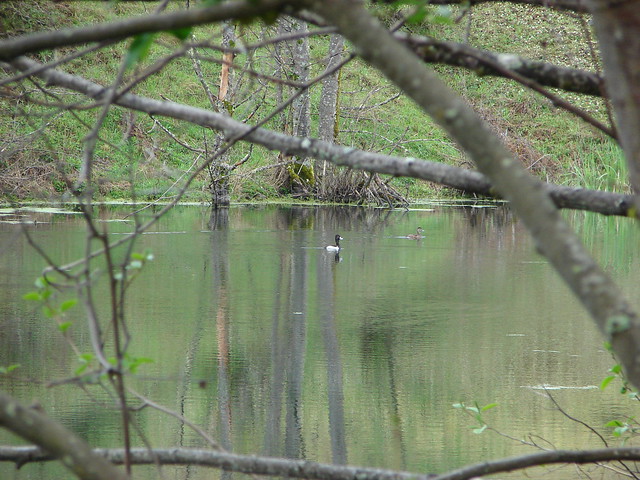
They didn’t seem to be the least bit concerned with us. There were also numerous ducks, geese, and other birds enjoying the ponds and marshes along the trail.
DSC05009
DSC05040
DSC05057
DSC05059
DSC05069

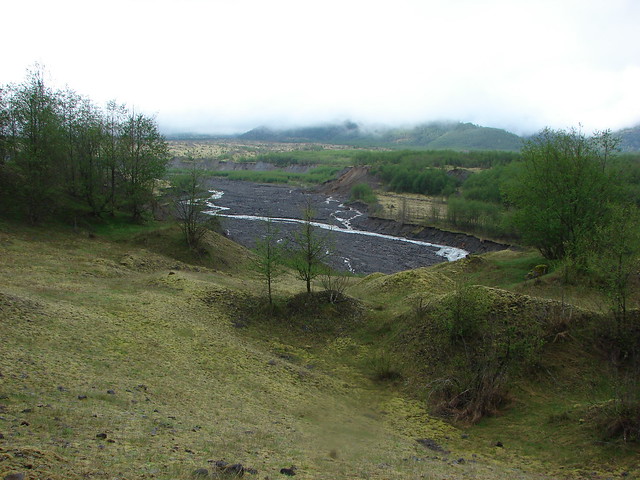
The trail also passes a nice viewpoint above the North Fork Toutle River where Mt. St. Helens would be visible on a clear day. We settled for the river and another group of elk grazing on the far bank.
DSC05032
DSC05026
Shortly after leaving the viewpoint we were passing through a wooded area when I noticed an elk around 30′ away standing in the trees. Before I could get the camera up it disappeared but that had been the closest we’d come to an elk yet.

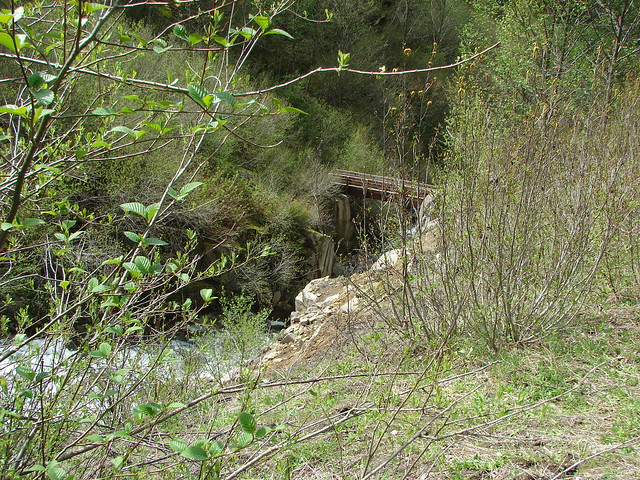
The clouds were beginning to clear up when we made it back to the parking lot and set off along the highway toward the Coldwater Lake entrance. We passed over Coldwater Creek on it’s way from the lake down into the Toutle Valley and then crossed the road and headed down to the lake.
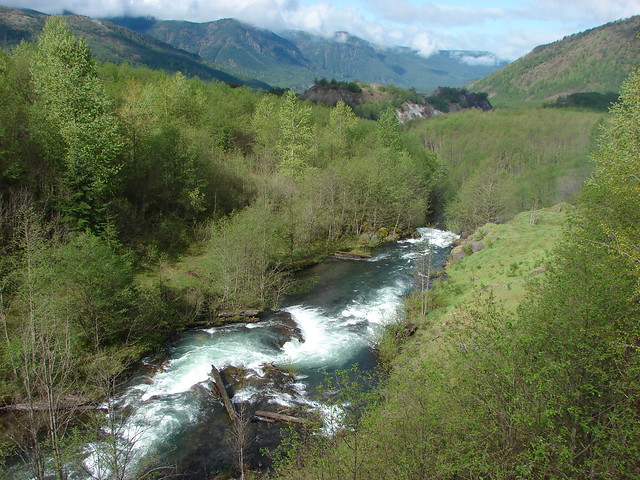
Coldwater Creek

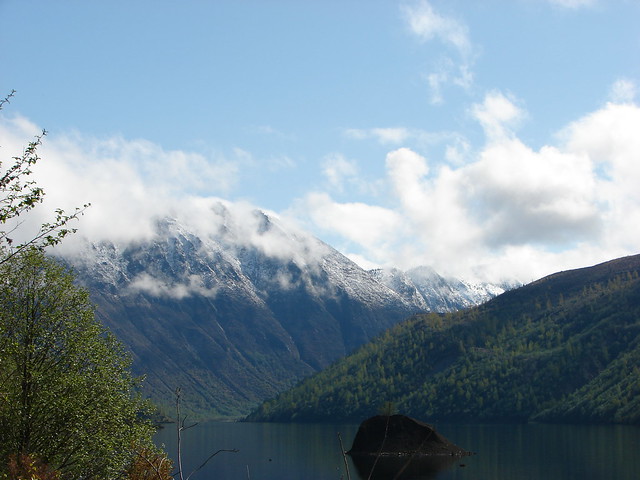
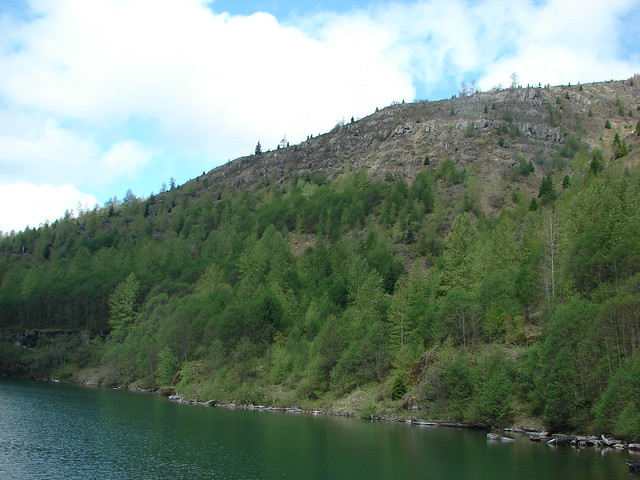
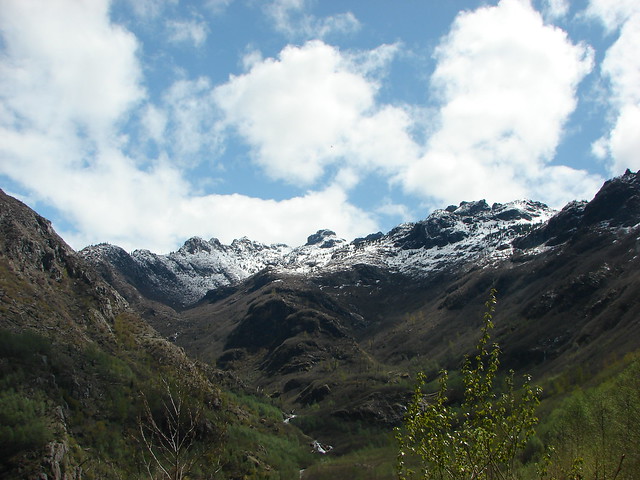
The view across the lake was spectacular from the trailhead. Minnie Peak lay ahead with a dusting of snow and a misty covering of clouds.
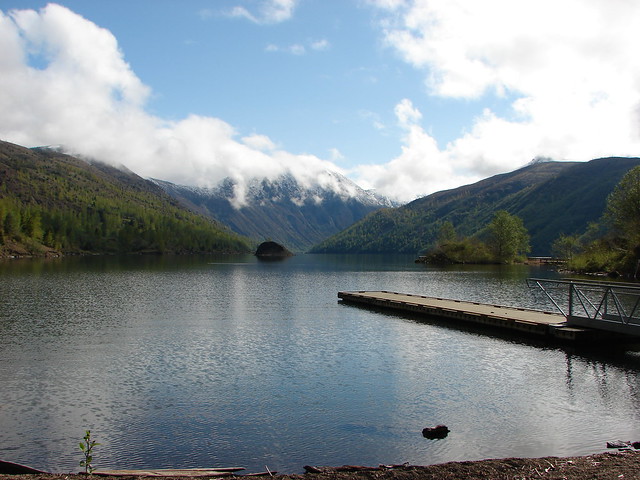
Coldwater Lake
DSC05091

A little island was a popular spot for geese and ducks. I am sure they were there for the views.
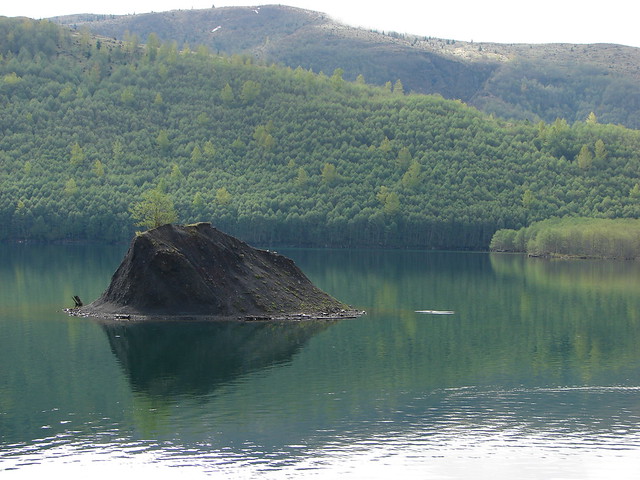
DSC05102

As we traveled along the north shore of the lake the views both ahead and behind kept getting better. The clouds were lifting revealing more and more snow covered peaks.
Coldwater Lake
DSC05110

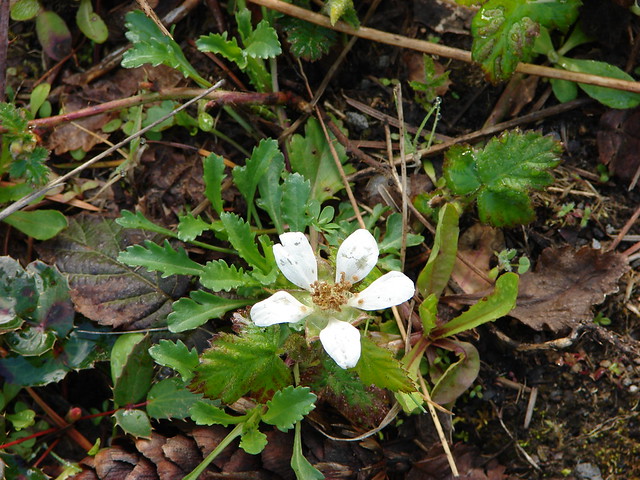
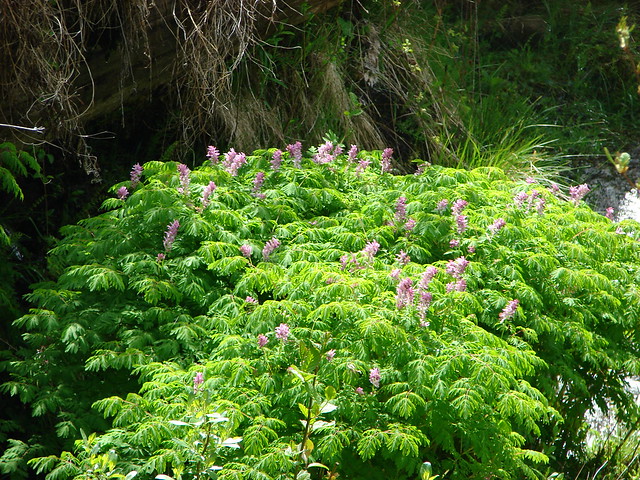
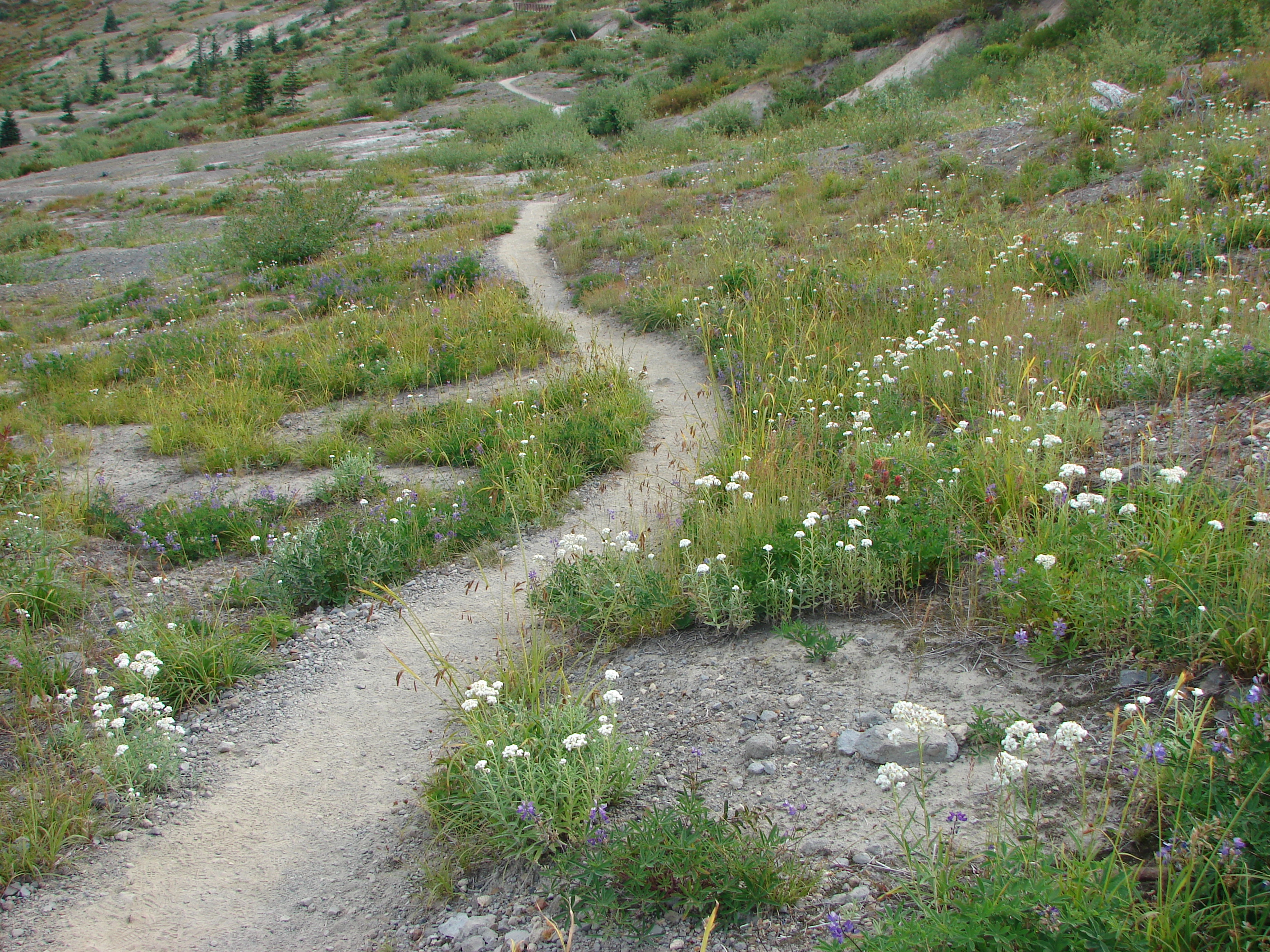
A few flowers were ahead of schedule giving us a taste of what will be coming in the next few weeks.
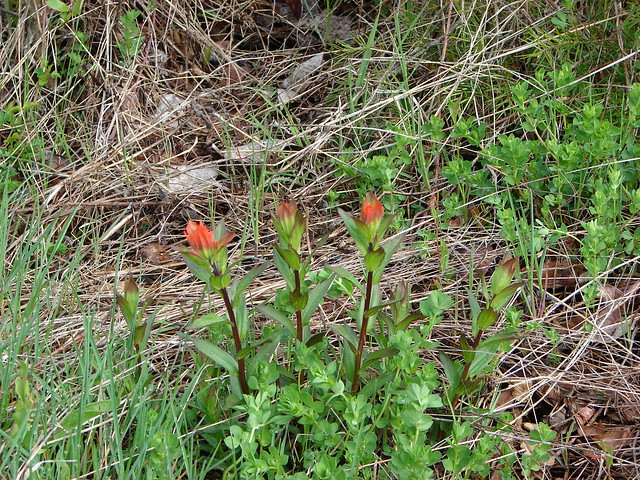
DSC05115
DSC05106
DSC05117
Scouler's Cordaylis

I had my eyes on Minnie Peak waiting for the last cloud to finally let go. It was a stubborn one though and just wouldn’t quite disappear.

DSC05149

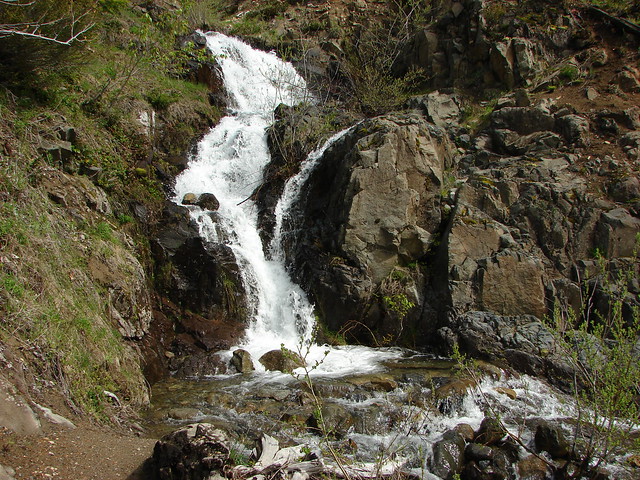
The trail crosses several small streams before reaching what was a very nice waterfall on this day. Rock Gully Falls, as it’s called in Sullivan’s book, was swollen with melt water making it a damp crossing since there is no bridge.
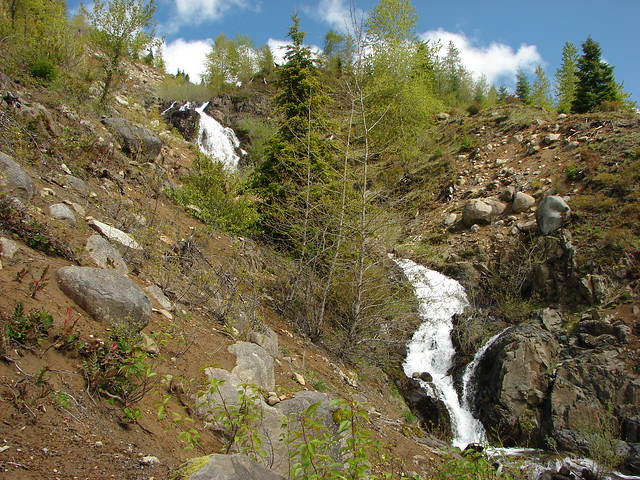
Rock Gully Falls
The crossing
DSC05166

We spotted several more elk above us on the hillside as we rounded a small peninsula shortly after passing the falls. It was amazing watching them quickly traverse the steep hillside.
DSC05188
Can you spot them here?
DSC05192

The next marker along the trail was a fan of rocks that had been part of a slide into the lake.
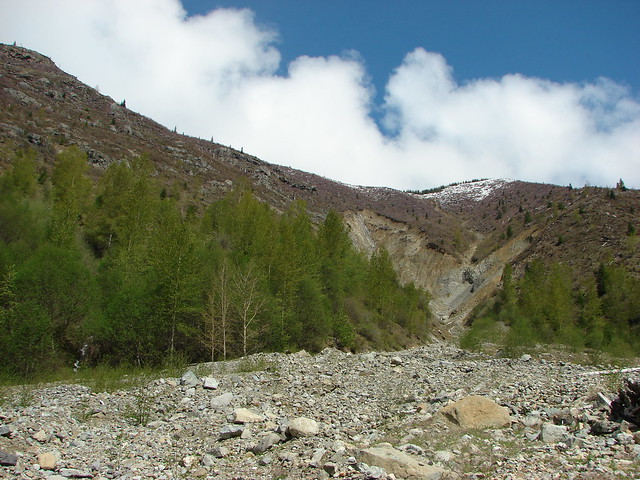
DSC05222
DSC05227

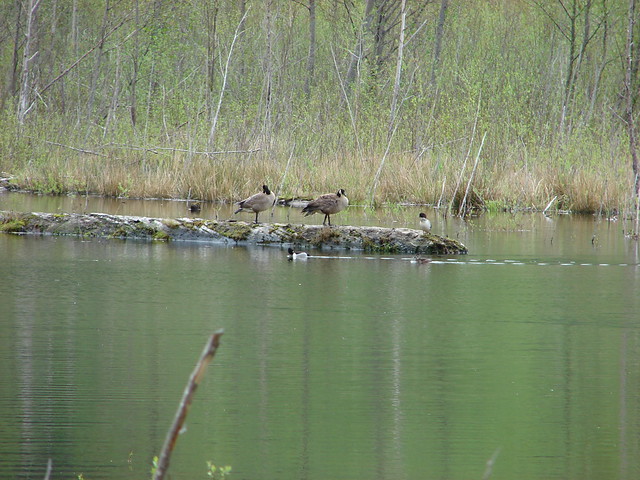
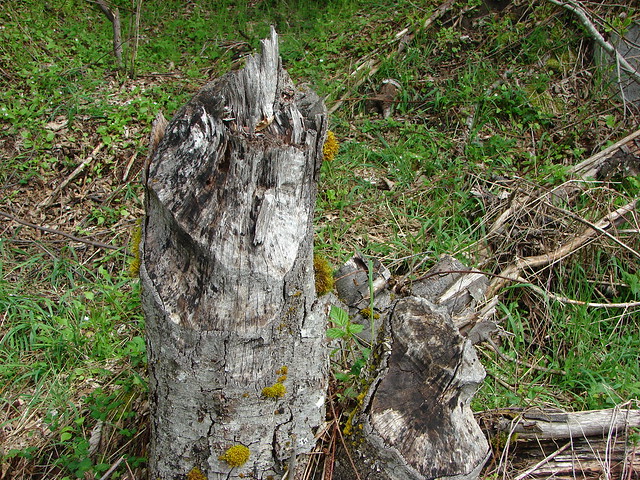
Near the end of Coldwater Lake we came to a shallow pool of water that was, at least at one time, home to a beaver. We didn’t see one but we did see plenty of ducks and geese here.
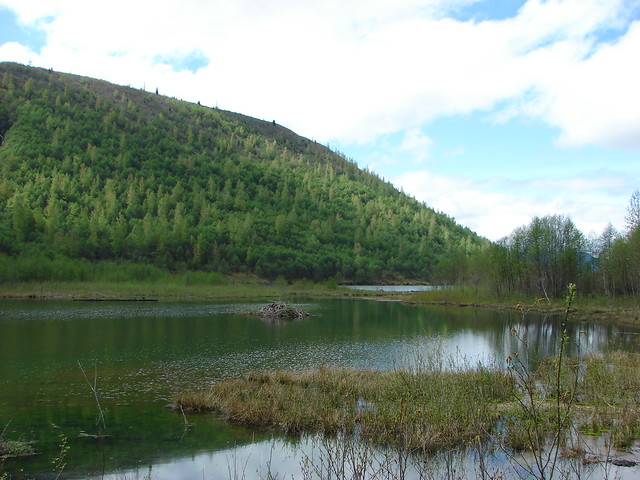
DSC05276
DSC05269
Evidence of Beaver work
DSC05272

The cloud had finally left Minnie Peak revealing the craggy mountain top by the time we reached the trail junction just above the bridge over Coldwater Creek.
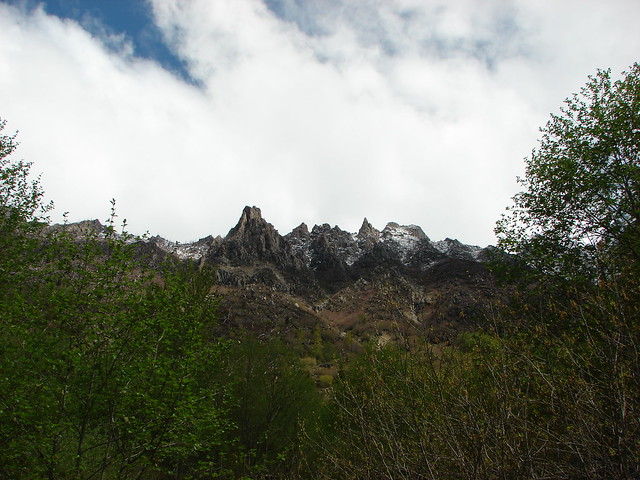
DSC05284
DSC05306
Coldwater Creek came raging down the valley putting on an impressive show.
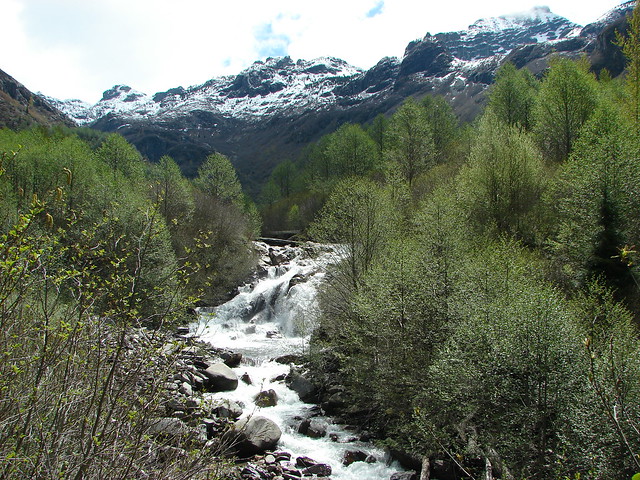
DSC05297

We had decided to do the full loop as it appeared that snow would not be an issue and loops are generally more fun than retracing your steps so we crossed the bridge and began to climb the ridge on the south side of Coldwater Lake. The views behind us as we climbed just kept getting better.
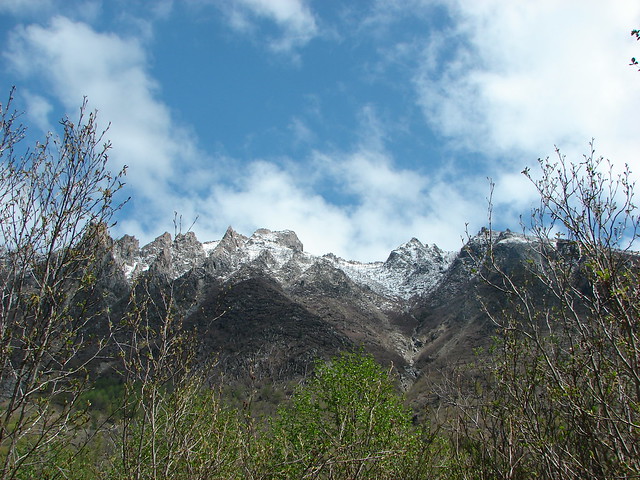
DSC05315
DSC05318
DSC05332
The rock fan
DSC05362

It was a stiff climb but the views eased the pain some. As the trail began to become more gradual, we could see the Coldwater Visitor Center far off in the distance on the opposite hillside.
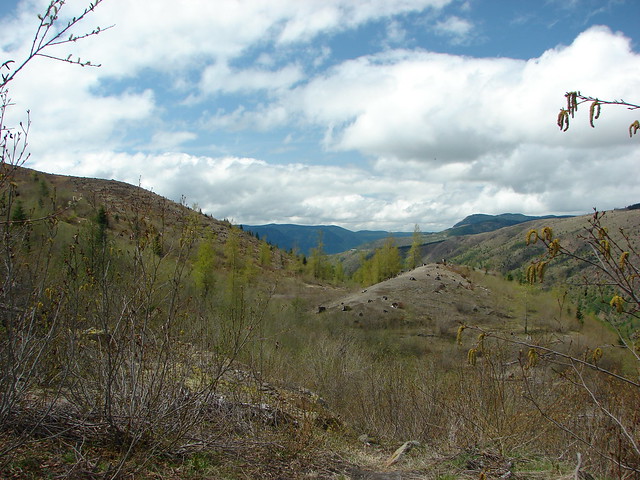
DSC05369
Down in the little valley Heather spotted more elk moving in the trees.
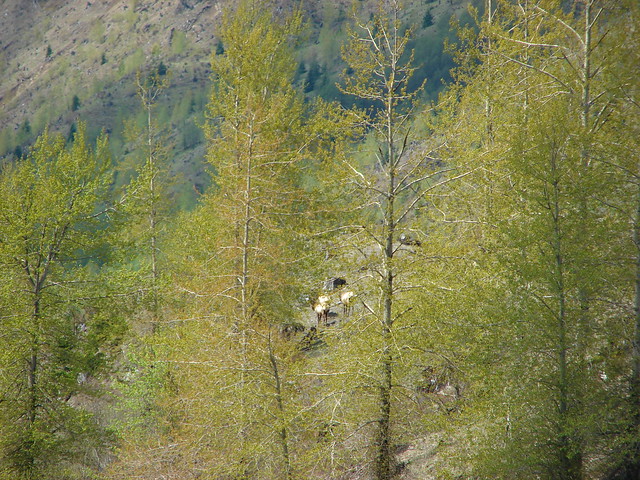
DSC05377

Just a short while later she spotted another elk heading our way. It stopped in a little bowl below us to check us out.
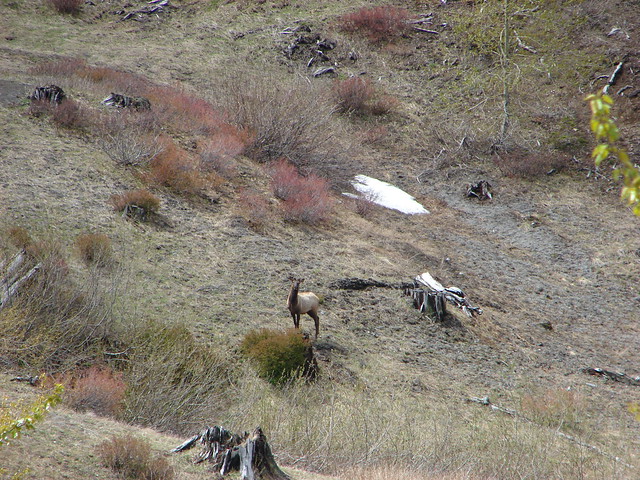
DSC05396
Nique correctly identified it as a young bull as it began to come toward us again.
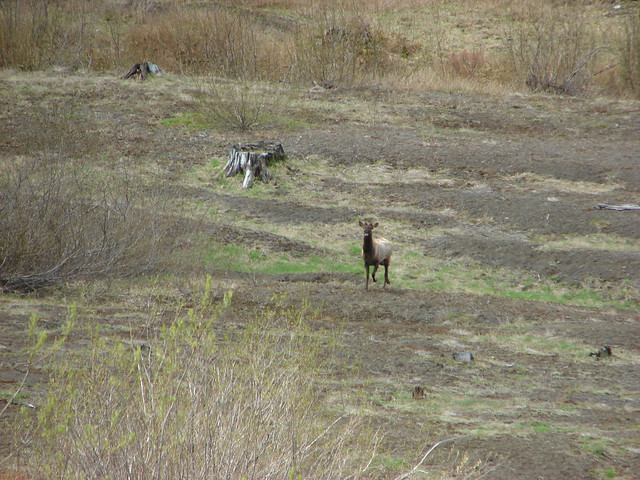
DSC05400
He then veered slightly away from us and crossed the trail a ways ahead and disappeared behind a small rise. I kept looking up the hillside to see if I could see where he was heading.
DSC05404
Just moments after taking the above picture he popped his head up over the rise and looked right down at us. As I fumbled with the camera he jumped down onto the trail no more than 10 yards in front of us and sped off back the way he had come originally. By the time I got a picture he was quite a ways down the into the bowl.
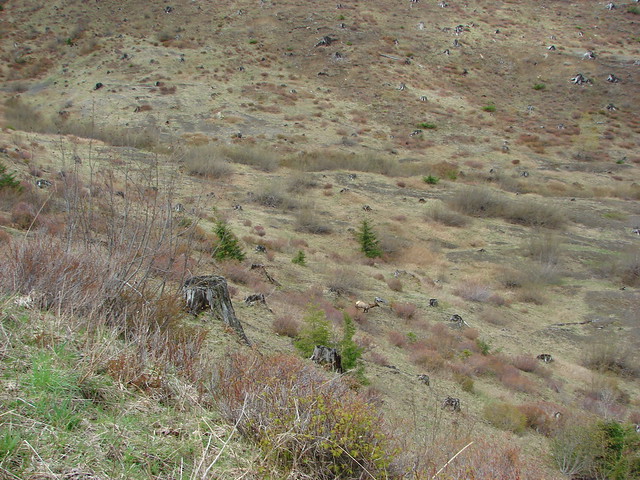
DSC05407

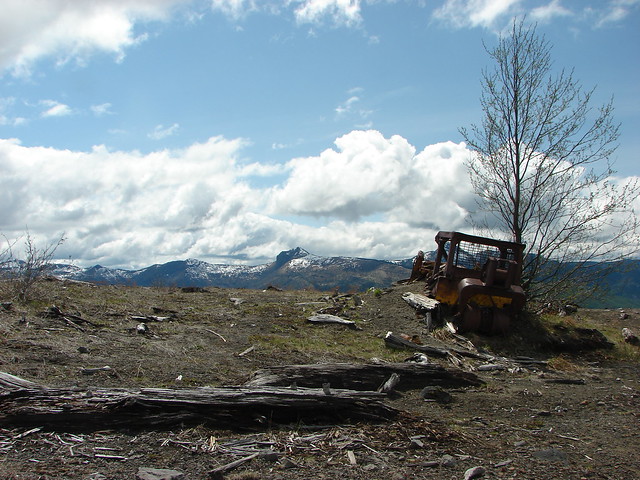
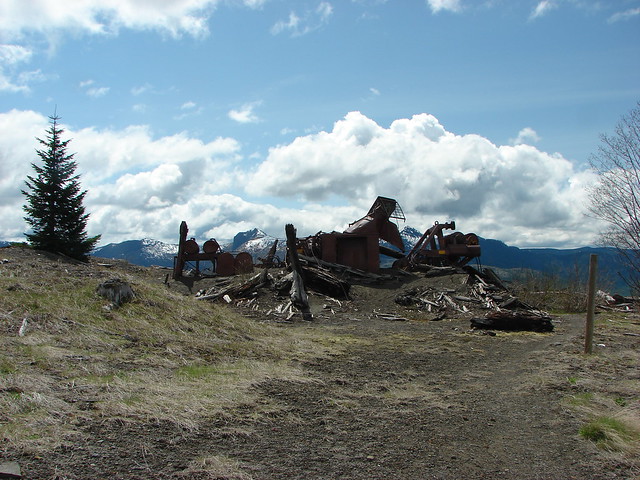
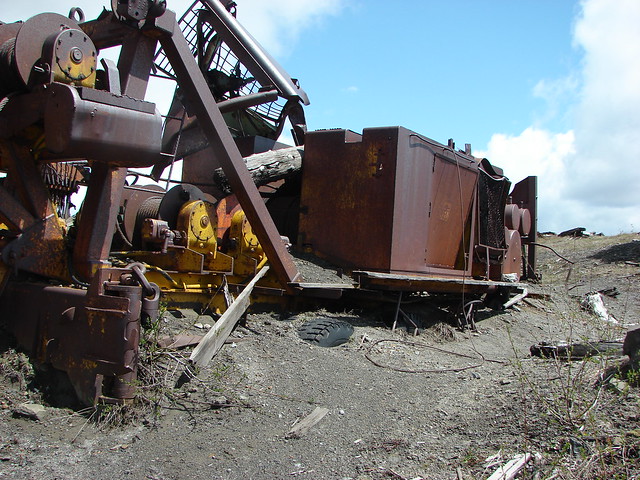
That had gotten my heart racing as I wasn’t sure if he had decided to turn aggressive. I had been expecting him to run away from us not at us. After the excitement we continued on to tractor junction where a trail leads up to Coldwater Peak. The junction is named for the piece of logging equipment that was laid to rest there by the eruption.
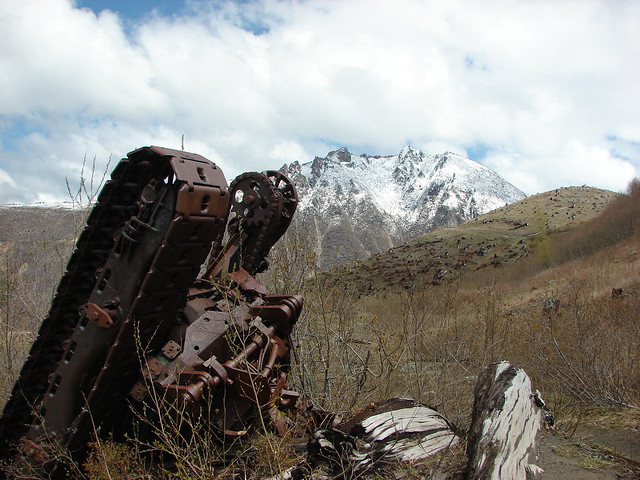
DSC05415

We had finally found a little snow in this area but not much was left.
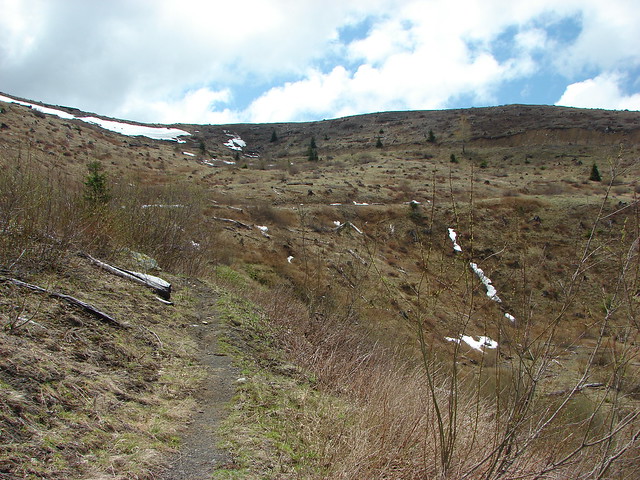
DSC05418
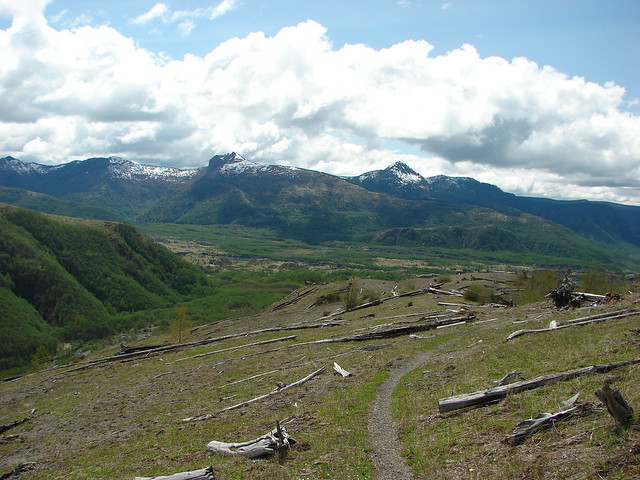
After curving around the trail came to a great open viewpoint.
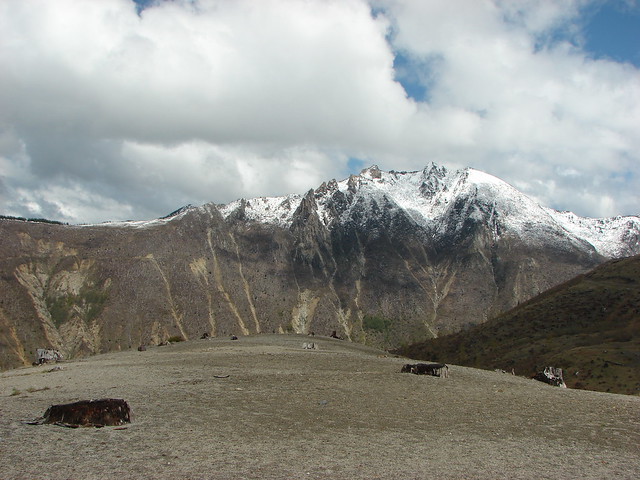
DSC05432
DSC05446
DSC05455

We could see Rock Gully Falls and the North Coldwater Lake trail really well.
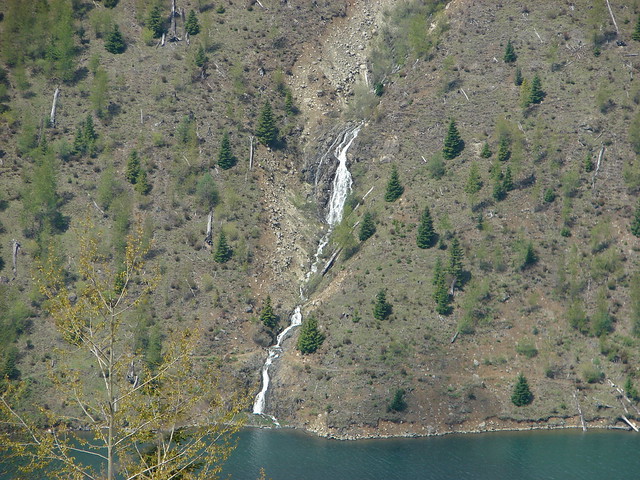
Rock Gully Falls

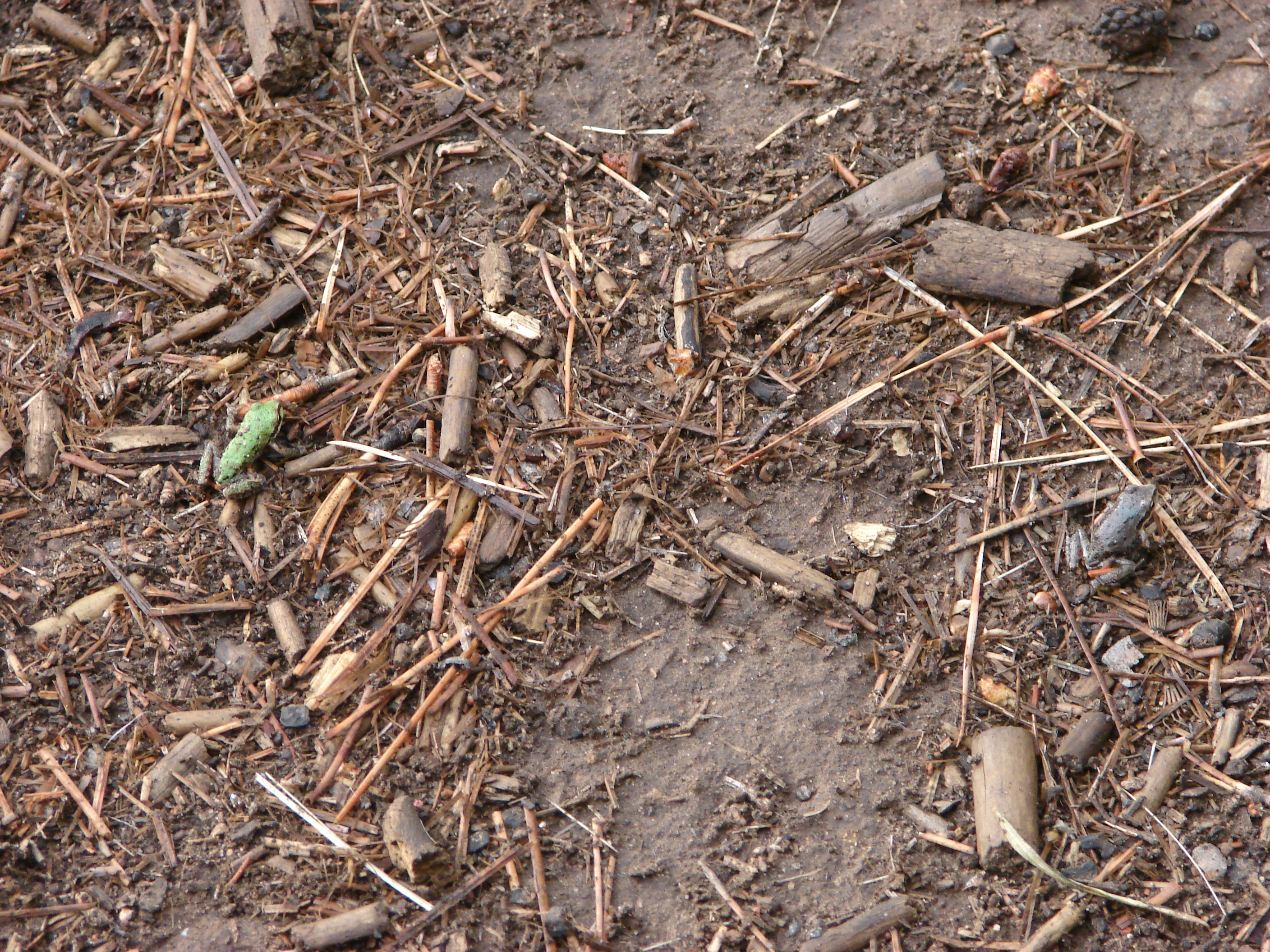
We had heard a lot of croaking on the Hummocks trail but hadn’t seen any frogs or toads there or along the lake, but now at almost 3500′ Nique spotted one.
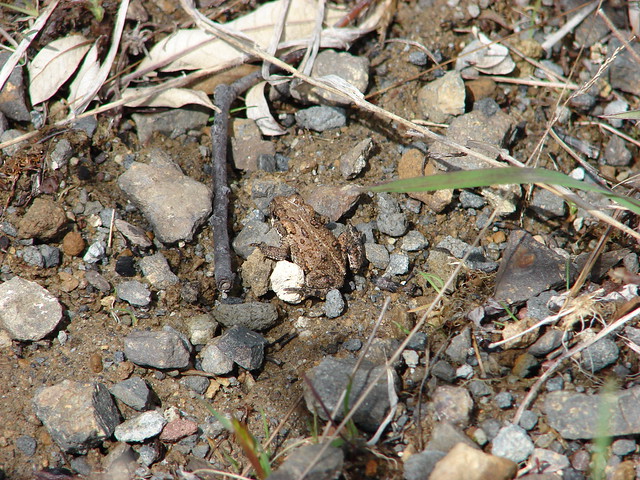
DSC05490

Coldwater Peak became visible as we made our way back toward the west end of the lake. It was interesting to see this side of it after having hiked up it last year.
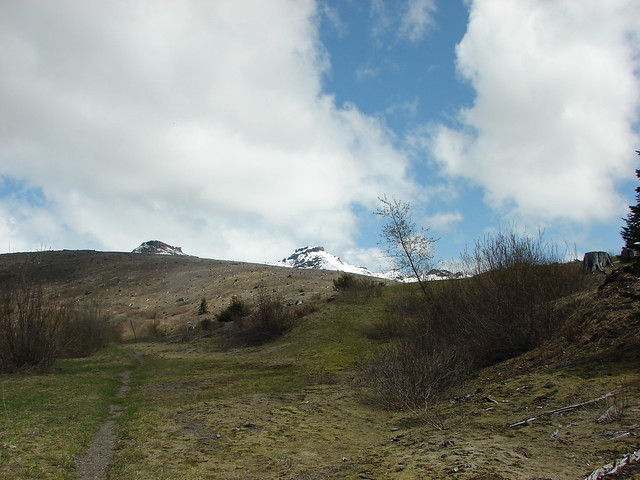
DSC05500
DSC05508

Just as the trail began to descend we came to more logging equipment that didn’t survive the eruption.
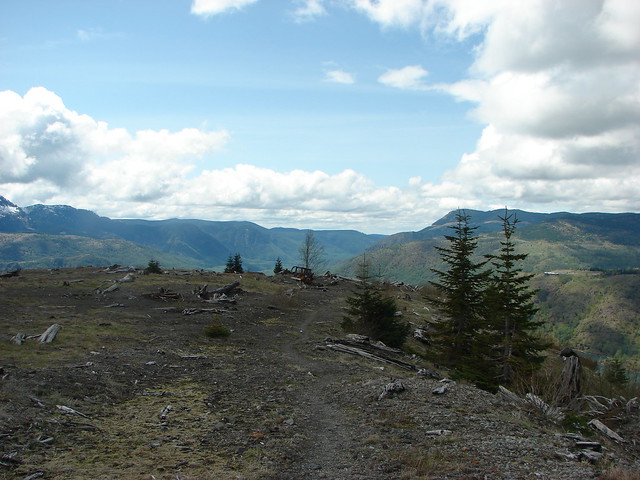
DSC05533
DSC05550
DSC05555
DSC05558

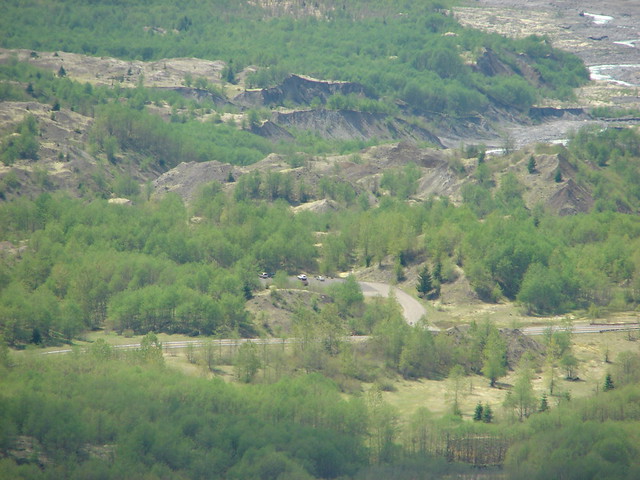
From here we could also see the Hummocks parking lot and our car.
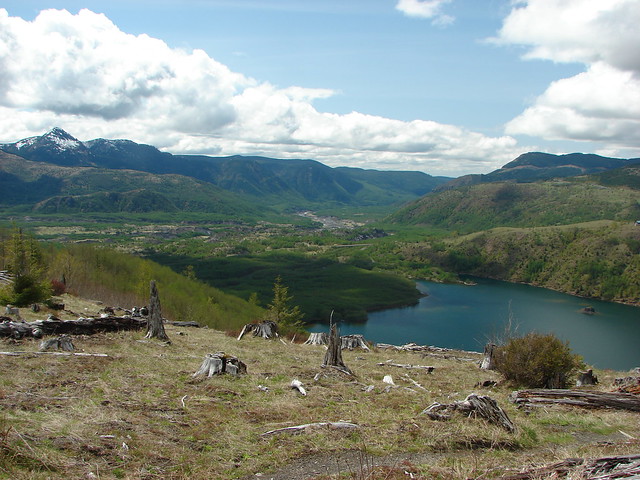
DSC05563
DSC05564
We still had a ways to go.

Our last elk sighting was a big one. As we were coming down, the largest herd we’d seen was scrambling to stay ahead of us and dropping down over the hillside.
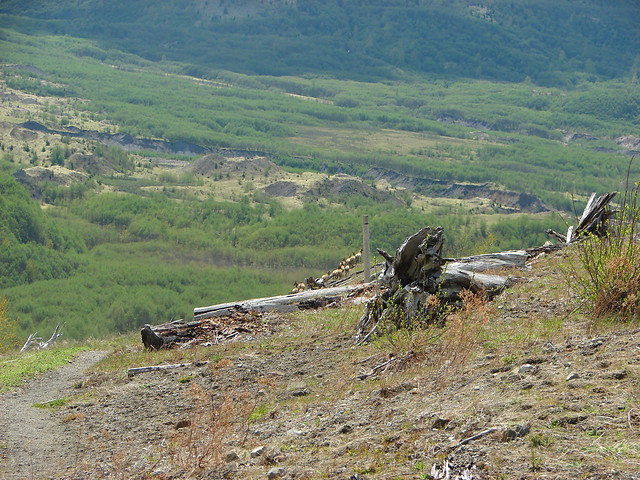
DSC05571
DSC05578
What a sight 🙂
DSC05584

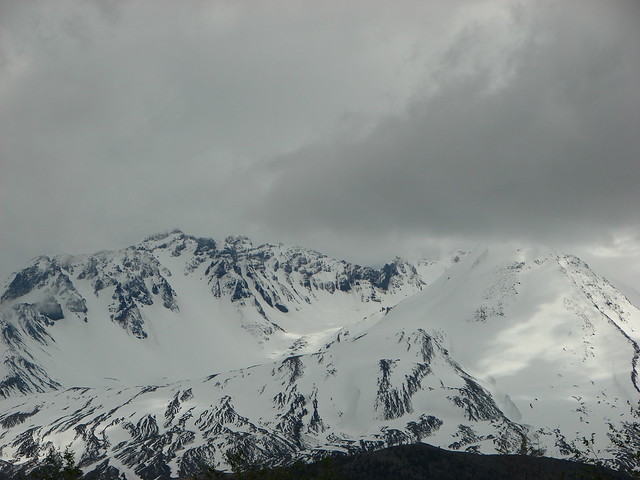
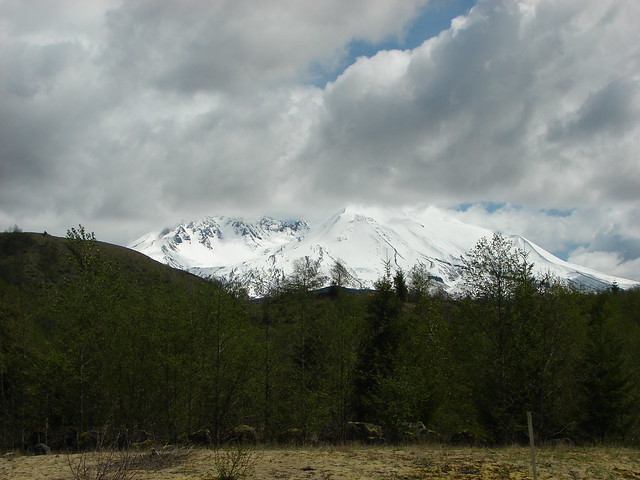
We made it down to the South Trailhead and began our road walk back to our car. Mt. St. Helens finally decided to make an appearance at this point.
DSC05600
When we got back to the car I dropped off my pack and jogged down the Hummocks Trail to the first good viewpoint to get my volcano pictures.
DSC05607
DSC05614
Now that’s the way to end a hike – Happy Trails indeed! 🙂

flickr: https://www.flickr.com/photos/9319235@N02/sets/72157644218596998/
facebook: https://www.facebook.com/deryl.yunck/media_set?set=a.10203973677849473.1073741876.1448521051&type=1
Categories
Year-end wrap up

The hikes of 2013 – A year in review.

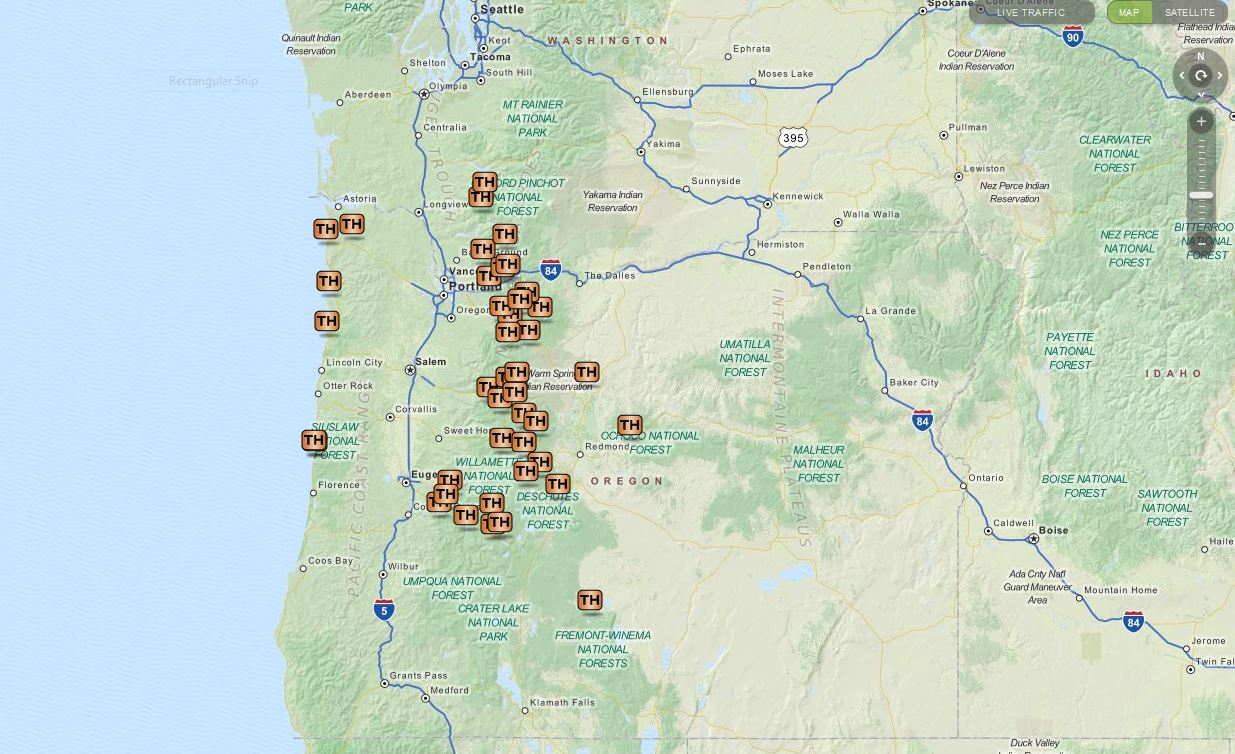
What an amazing year of hiking it was! As we reach then end of 2013 we thought we’d make one final entry recapping the beautiful areas and unique features we were blessed enough to encounter while out on our “wanderings”. We began the year in February at the Oregon Coast, hiking at Gwynn Creek and Cape Perpetua then finished up just a couple of weeks ago, once again on the Oregon Coast at Tillamook Head, 140 miles north of where we had started. Sandwiched in between these two hikes were 40 other adventures in which we climbed mountains, crossed rivers, and scrambled cross-country to explore a small sampling of the trails of NW Oregon and SW Washington. We put together a map of the approximate location of the trailheads for each of the hikes.
2013 Trailheads
An interactive version can be viewed on mapquest using the following link.
http://mapq.st/1bQXoXo

I’ve always been interested in numbers so I have kept quite a few statistics regarding these 42 hikes. Here are some of those that I found most interesting. We visited 10 wilderness and 2 scenic areas in 8 different national forests. In addition to the national forests we hiked in 4 state parks and at a national volcanic monument. Some of the other numbers are as follows:
Total Miles (according to the Garmin) – 515.2
Cumulative Elevation Gained (approx.) – 88,000′
Minimum/Maximum Elevation – sea level/10,358′
Total Moving Time (per the Garmin) – 240hrs 36min
Total Time on the Trails (per the Garmin) – 280hrs 6min
Total Miles Driven (approx.) – 7550 miles

For the most part the weather was good. We had a warm, dry end to Winter which carried into Spring clearing many trails of snow earlier than normal. This allowed for some earlier visits to some of the higher elevation areas and also an early bloom for most of the wildflowers including the bear grass which only blooms every 2nd or 3rd year. A mild summer kept temperatures bearable and despite the dry beginning to the year the fire season wasn’t too bad. Fall brought an early snowstorm and left an early winter wonderland at mid-elevations and some unusually cold temperatures of late created some interesting ice displays.

Words can’t do justice to the beauty of God’s creation that we experienced this so year I’ll try to keep them to a minimum and attempt to let pictures show what they can.
I have to start with the Cascade Mountains. The most awe inspiring creations, these steadfast beacons that on clear days dot the horizon always seem to draw our attention.

From the rim of Crater Lake in the south to Mt. Rainier in the north they rise above the other ridges, rooted in their positions, yet ever changing in order or varying in appearance depending on what our location was. Some of the views we had were amazing.

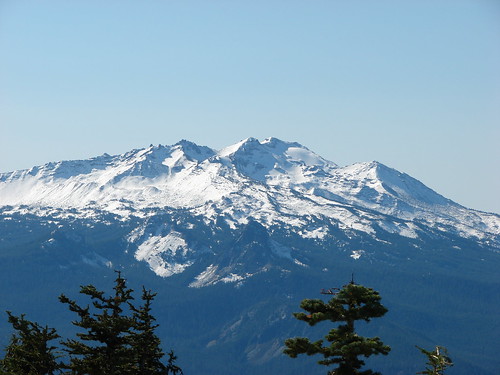
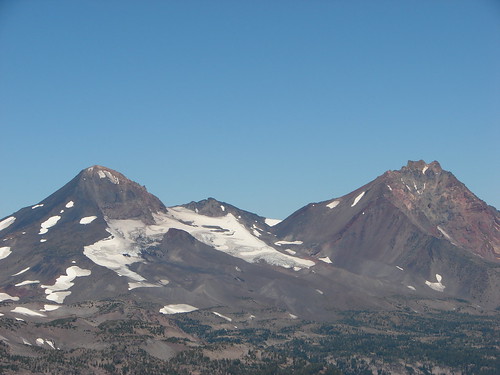
Mt. Scott, Mt. Thielsen, Mt. Baily, & Diamond Peak from the South Sister Summit
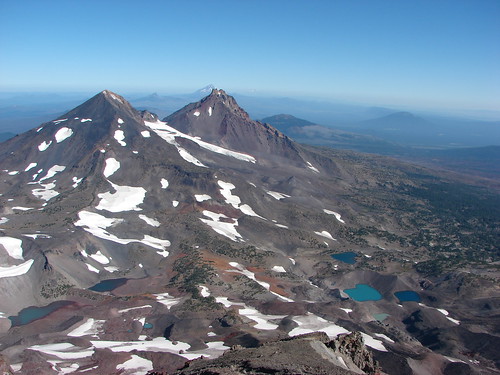
View from the South Sister
Cascade Peaks from Mt. Bachelor to Mt. Hood (minus the North Sister which was hidden behind the Middle) from Mt. Fuji
Waldo Lake
Mt. Washington to Mt. Hood from the Pacfic Crest Trail near Yapoah Crater
Belknap Crater, Mt. Washington, Three Fingered Jack, Mt. Jefferson & Mt. Hood
Mt. Washington to Mt. Bachelor from Three Fingered Jack
Broken Top, Mt. Bachelor, The Three Sisters, Mt. Washington and The Husband
Mt. Rainier, The Goat Rocks, and Mt. Adams from Wildcat Mountain
Mr. Rainier, The Goat Rocks, and Mt. Adams
Mt. St. Helens, Mt. Rainier, and Mt. Adams from Silver Star Mountain
View from Ed' Trail

Individual peaks working from the south to the north.
Mt. Thielsen:
From Fuji Mountian
Mt. Thielsen

Diamond Peak:
From Waldo Mountain
Fuji Mountain and Diamond Peak
From Fuji Mountain
Diamond Peak

Mt. Bachelor:
From Fuji Mountain
Mt. Bachelor
From Tam MacArthur Rim
Mt. Bachelor

Broken Top:
From above Moraine Lake
Broken Top and Moraine Lake
From Fuji Mountain
Broken Top and Ball Butte
From Tam MacArthur Rim
Broken Top

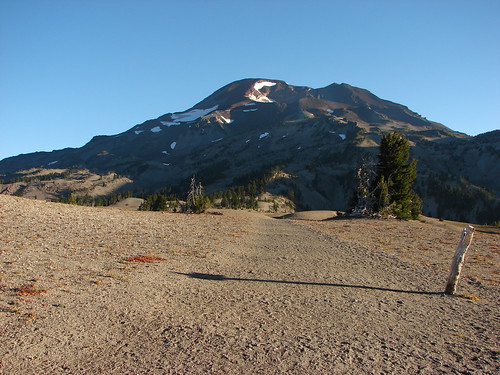
South Sister:
From above Moraine Lake
South Sister Climbers Trail
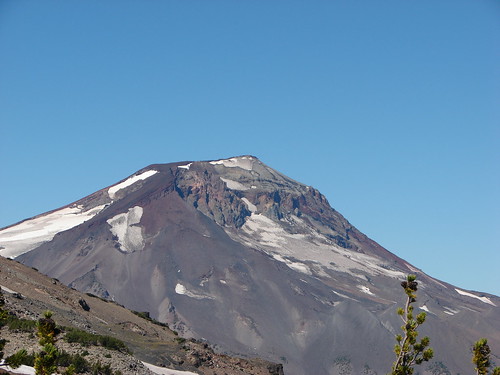
From Tam MacArthur Rim
South Sister
From Fuji Mountain
South Sister

Middle & North Sister
From Tam MacArthur Rim
Middle and North Sister
From Scott Meadow
North & Middle Sister and Little Brother from Scott Meadow
From the South Sister
South Sister summit view

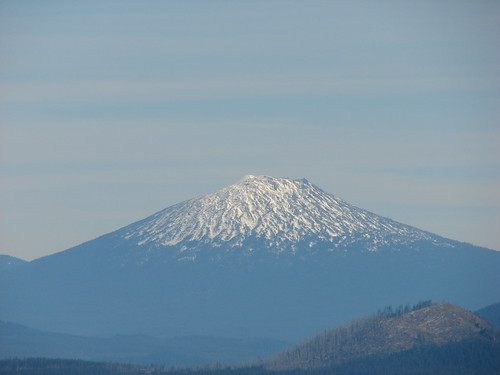
Mt. Washington
From the Matthieu Lakes Trail
Mt. Washington
From Fuji Mountain
Mt. Washington and Belknap Crater
From Three Fingered Jack
Mt. Washington and The Husband

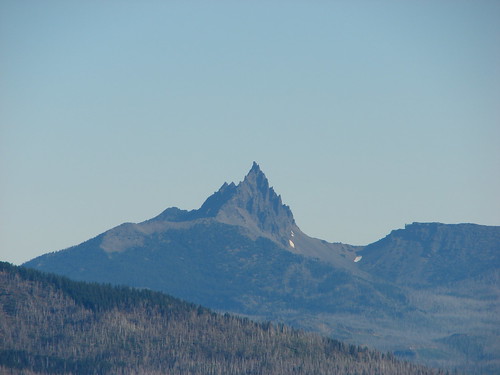
Three Fingered Jack:

From the Matthieu Lakes Trail
Three Fingered Jack
From Canyon Creek Meadows
Three Fingered Jack from the upper meadow

Mt. Jefferson:
From Fuji Mountain (Dwarfing Three Fingered Jack)
Mt. Jefferson and Three Fingered Jack
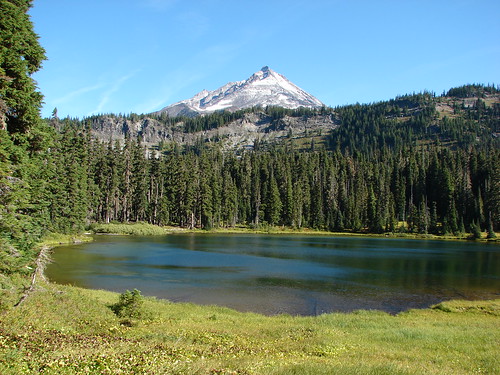
From Hanks Lake
Hank's Lake
From Three Fingered Jack
Looking back down
From Bays Lake in Jefferson Park
Bays Lake in Jefferson Park

Mt. Hood:
From Barrett Spur
Mt. Hood from Barrett Spur
From Table Mountain
Mt. Hood from Table Mountain
From Elk Meadows
Mt. Hood from Elk Meadows
From Lamberson Butte
Mt. Hood
From Youcum Ridge
Mt. Hood from Yocum Ridge
From Timothy Lake
Mt. Hood from Timothy Lake

Mt. St. Helens:
Mt. St. Helens
From the Loowit Trail on Mt. St. Helens
Mt. St. Helens from the Loowit Trail
From Johnston Ridge
Mt. St. Helens

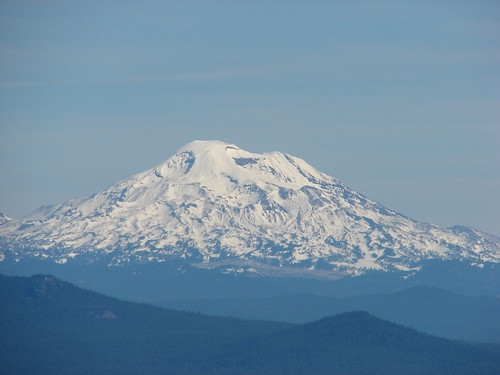
Mt. Adams:
From Silver Star Mountain
Paintbrush, penstemon and Mt. Adams

Mt. Rainier:
From Wildcat Mountain
Mt. Rainier

From the giant rock towers of the mountains we move on to the delicate meadows full of wildflowers that often times call the mountains home. We visited amazing wildflower displays near Mt. Hood, Mt. Jefferson, and Three Fingered Jack but the Cascades were possibly outdone by Silver Star Mountain in Washington.
Bear Grass on Mt. St. Helens
Mt. St. Helens from a beargrass meadow along the Loowit Trail
Balsam Root and Paintbrush in the Ochoco National Forest
Paintbrush and balsamroot
Clearcut on Silver Star Mountain
Tarabell Trail
Meadow on Salmon Butte
An arnica in  a meadow of plectritis, larkspur and monkeyflower
Elk Meadows
Elk Meadows
Near Heather Creek on Mt. Hood
Wildflowers along the Timberline Trail at Heather Creek
Mt. Hood Meadows
Wildflowers in Mt. Hood Meadows
Lupine in Canyon Creek Meadows
Three Fingered Jack
On Coffin Mountain
Aster, penstemon and paintbrush
Avalanche Lilies on the Timberline Trail
Avalanche lilies
Western Pasque flowers and Paintbrush near Elk Cove
Mt. Hood from the Timberline Trail near Elk Cove
Barret Spur on Mt. Hood
Lupine and monkeyflower
Gentians in Jefferson Park
Gentians
Jefferson Park
Wildflowers along the South Breitbenbush Trail
Along the South Brietenbush River in Jefferson Park
Wildflowers along the South Breitenbush River
Aster on Yocum Ridge
Aster field on Yocum Ridge
On Yocum Ridge
Wildflowers along the Yocum Ridge Trail
More from Yocum Ridge
Paintbrush and aster

There weren’t many hikes where the presence of water was not felt. We encountered it in various forms and in an array of colors. There were lakes, creeks, rivers, waterfalls, springs, and the Pacific Ocean adding sights and sounds to our hikes.
Roaring Creek
Roaring Creek
McKenzie River
Mckenzie River
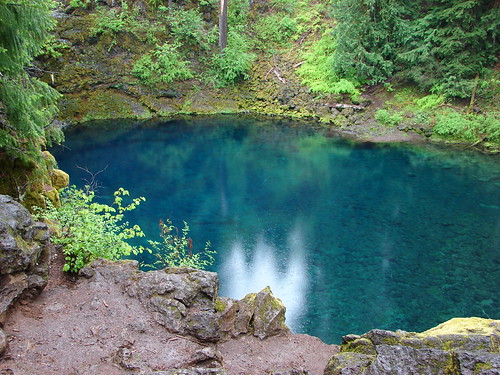
Tamolitch Pool
Tamolitch Pool
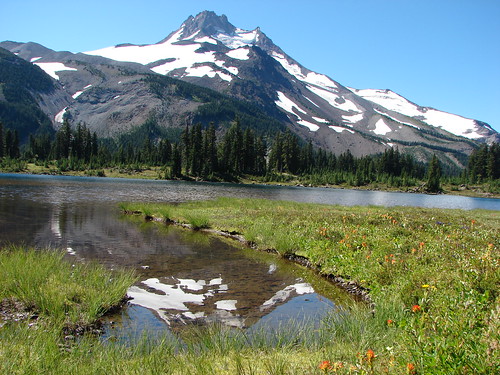
Russell Lake
Mt. Jefferson from Russell Lake
Umbrella Falls
Umbrella Falls
Diamond Creek Falls
Diamond Creek Falls
Heather Creek
Waterfall on Heather Creek
South Matthieu Lake
South Mattieu Lake
Benham Falls
Benham Falls
Carver, Camp, and the Chambers Lakes
Carver, Camp and some of the Chambers Lakes
Lewis Tarn
Lewis Tarn
Creek near Pamelia Lake
Waterfall near Pamelia Lake
Timothy Lake
Timothy Lake
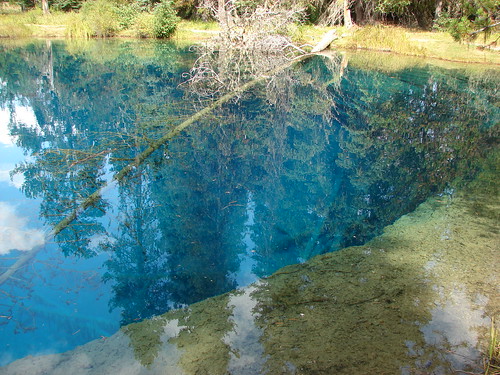
Little Crater Lake
Little Crater Lake
Frozen pond near Fuji Mountain
Half frozen pond
Birthday Lake
Birthday Lake
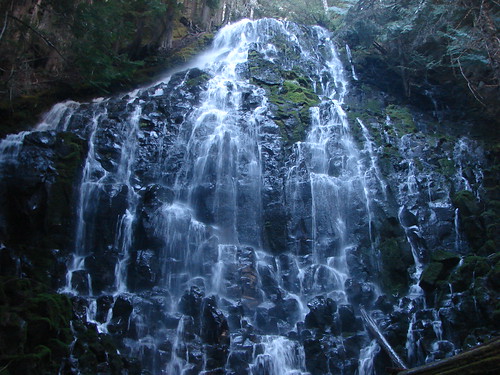
Ramona Falls
Ramona Falls
Pacific Ocean at Tillamook Head
View from Ecola State Park
Pacific Ocean from Cape Perpetua
Looking south from Cape Perpetua
Last but not least the most unpredictable of the sights out on the trails are the creatures that call these places home. From flying ants on Coldwater Peak to the black bear who left its tracks in the snow on Fuji Mountain we were the tourists traipsing through their neighborhoods. We spotted our first elk, snow shoe hare, and sooty grouse this year. We also had the mysterious case of “mouse rain” on Salmon Butte which you can read about here:https://wanderingyuncks.wordpress.com/2013/06/20/salmon-butte/
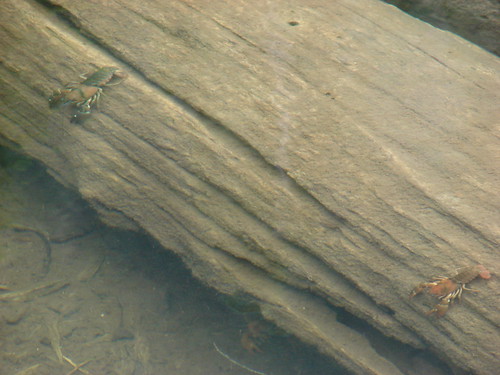
Crawdads in Middle Rock Lake
Tide pool at Cape Kiwanda
Snail
Rough skinned newt
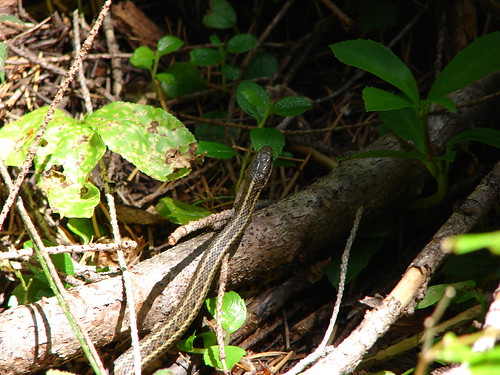
Snake
Tree frog
Spider along the Tam McArthur Rim Trail
Bug on Fuji Mountain
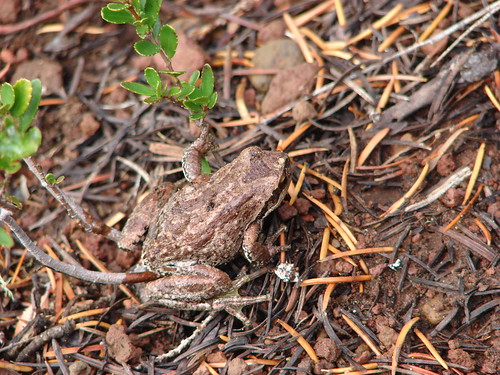
Frog
Butterflies
Zerene fritillary butterfly
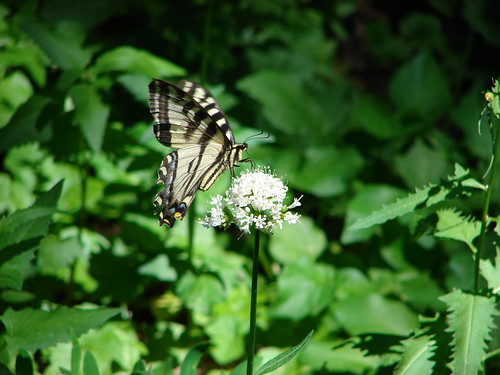
Swallowtail butterfly
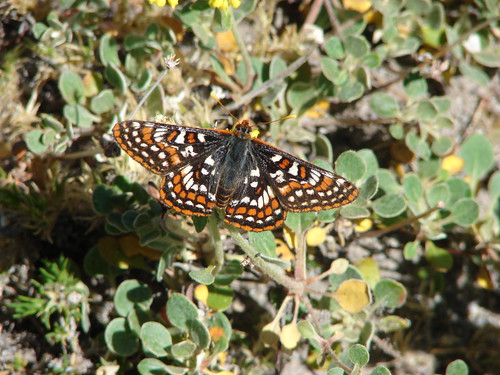
Edith's checkerspot
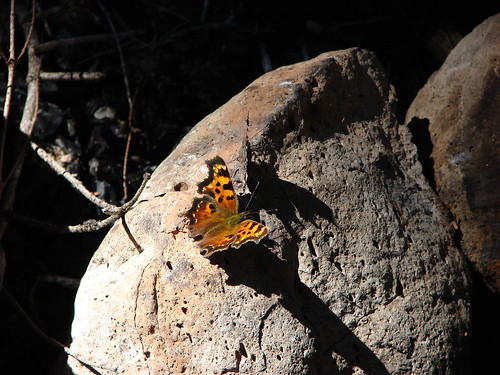
Milbert's Tortoiseshell Butterfly on the way up Coldwater Peak
Hoary Comma
Hoary Comma
Clodius parnassian
Birds
Bald eagle
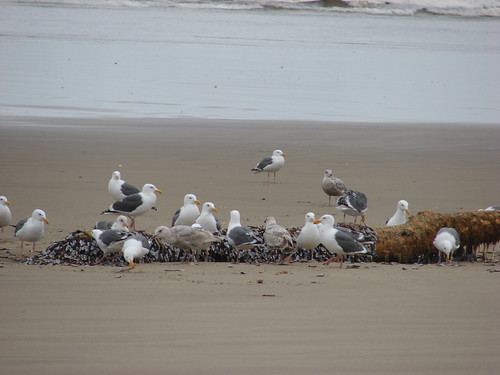
Seagull buffet
Yellow-Rumped Warbler
Owl
Gray jay taking a bath
Duck family
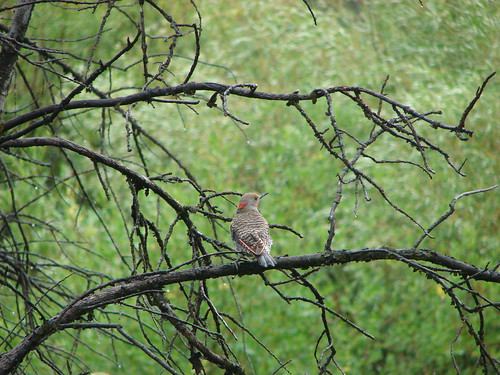
Northern Flicker
Osprey
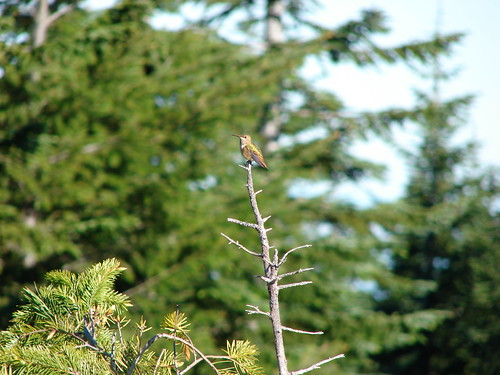
Hummingbird
Red Crossbill
Osprey flying over ducks on Timothy Lake
Hummingbird
Canada geese
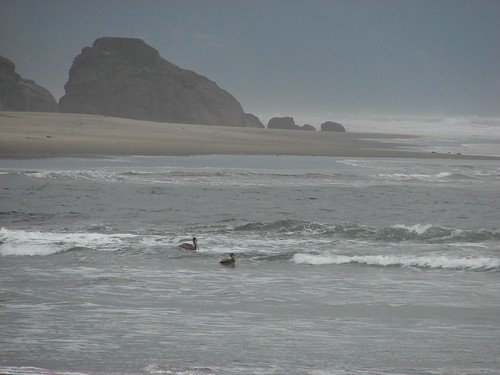
Pelicans
Common goldeneyes on Wall Lake
Great Blue Heron
Little guys
Chipmunk
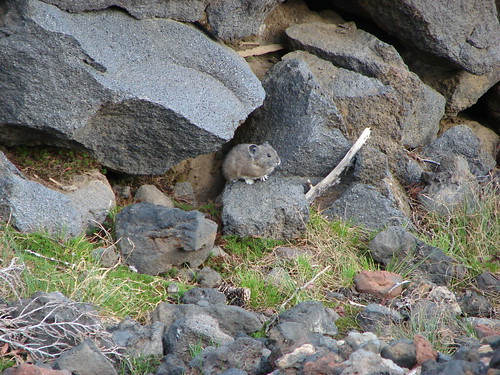
Pika
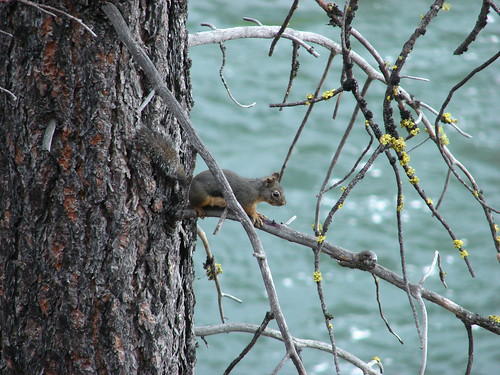
Douglas squirrel
Golden Mantled Squirrels
Snowshoe hare

Big Guys
Our first elk sighting. Near the Observation Peak Trailhead
Columbia Black Tailed Deer
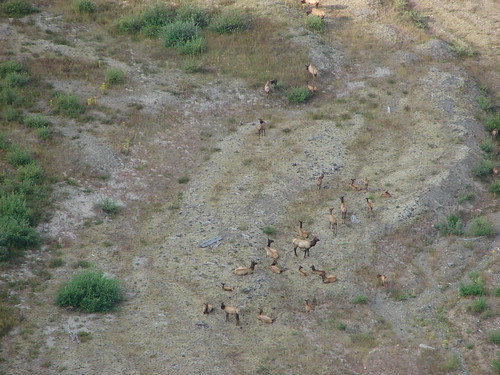
Elk herd on the far shore of the Deschutes River
Elk
Deer near the Lower Black Butte Trailhead

We’d like to leave you with what each of us found to be their favorite hike and the most difficult. For myself Elk Meadows was my favorite. https://wanderingyuncks.wordpress.com/2013/07/24/elk-meadows/ The variety and beauty we encountered on that hike put it atop my list. As for the most difficult I chose Silver Star Mountain https://wanderingyuncks.wordpress.com/2013/07/04/silver-star-mountain/ which was also in the running for my favorite. The heat on that day made it the hardest one for me.

After much deliberation Heather chose the same hike as I did her favorite, Elk Meadows; something about that day had her mesmerized as we traveled up Gnarl Ridge towards Mt. Hood. For the most difficult she picked Observation Peak due in part to having fallen shortly after we stared the hike and spraining her hand and wrist. It made for a more challenging and uncomfortable hike as she endeavored to keep her injury elevated above her heart during most of the journey. https://wanderingyuncks.wordpress.com/2013/07/09/observation-peak/

Dominique chose Fuji Mountain for his favorite. There was snow and a great view with a reasonable amount of distance. https://wanderingyuncks.wordpress.com/2013/10/09/fuji-mountain/ For the most difficult he picked Table Mountain and the climb up Heartbreak Ridge. https://wanderingyuncks.wordpress.com/2013/06/14/table-mountain/

I am already hard at work putting together a 2014 itinerary which will include some overnight backpacking trips and hopefully visits to the Goat Rocks Wilderness and Mt. Adams in Washington. If all goes as planned we will kick things off in January, take things slow until we’ve recovered from our April half or full marathons, and then be ready to crank things up in May. Until 2014 here is a link to a 2013 hikes in pictures album on Flickr http://www.flickr.com/photos/9319235@N02/sets/72157635497870439/

Merry Christmas & Happy Trails!

Categories
Hiking Mt. St. Helens Trip report Washington Washington Cascades

Johnston Ridge Observatory & Coldwater Peak

We took advantage of a day off recently and headed up to the Johnston Ridge Observatory at Mt. St. Helens. This was the farthest north we have traveled for a hike and would be the first time we would be able to see the collapsed side of the volcano. We were a bit disappointed when we arrived and realized that the winds had shifted and were blowing from the south east causing a hazy sky due to smoke from a wildfire near The Dalles Oregon. We parked in the observatory parking lot and surveyed our hike’s destination, Coldwater Peak.

Coldwater Peak from the parking lot.

The observatory was not open yet (It opens at 10:00am) but we walked around the paved loop trail there before setting off on the boundary trail. Good views of Mt. St. Helens were plentiful despite the blue haze from the smoke.
004
I had us all on the lookout for elk down in the valley below and it wasn’t long before we spotted a small group.
030
It appeared to be a small heard of about 15 elk but as we worked our way along the trail and got a better view of the valley below we saw the rest of the heard.
041

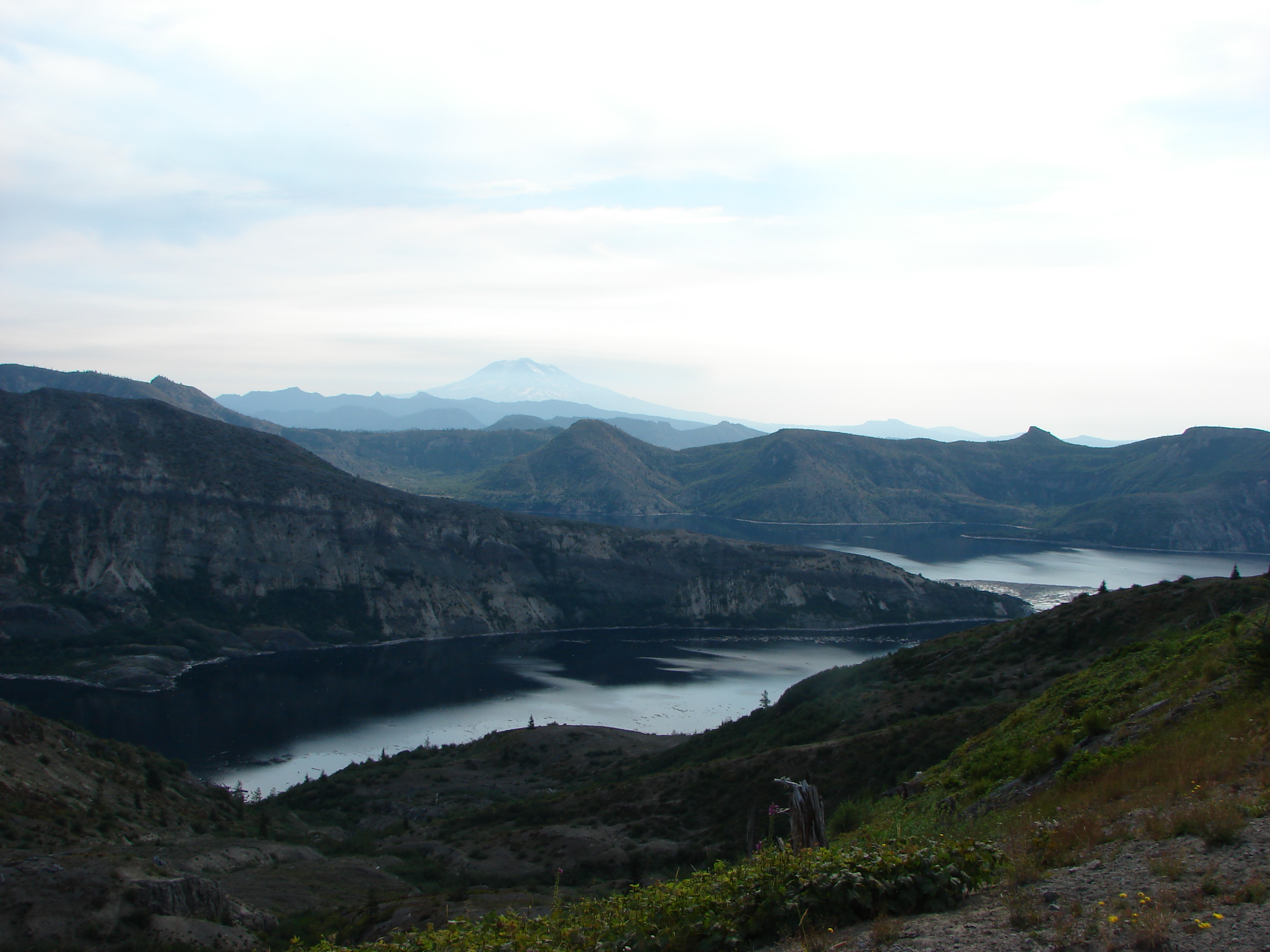
As we rounded a ridge end we got our first view of Spirit Lake and it’s floating trees. Mt. Adams was visible through the haze further to the east.
082
The trail then dipped slightly to a jct with the Truman Trail and continued on behind Harry’s Ridge. Here there was a decent variety of flowers that were growing in the mud and ash that had spilled over the ridge here during the 1980 eruption.
106
We also began to find berries :). Here were mostly thimble and huckleberries but we even found a few ripe salmon berries.

Thimble & huckleberries

Later we would add strawberries to the menu.

Just after we had reached the Harry’s Ridge trail we spotted another half dozen elk running up a game trail below us. The trail was now gaining elevation providing better views of Spirit Lake and distant Mt. Adams.
133
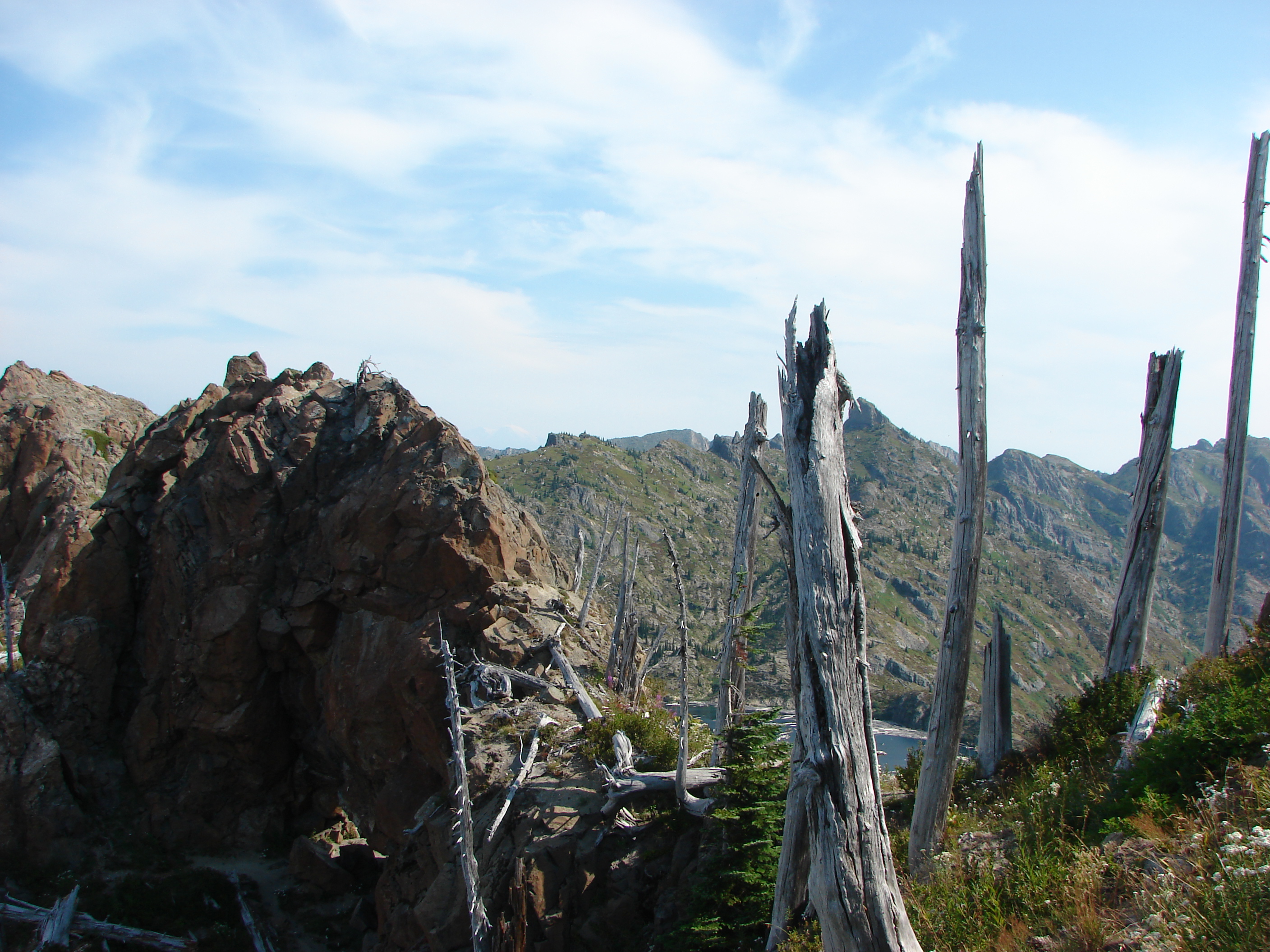
When the trail crested we had a nice view of St. Helens Lake below. The trail then drops down in order to pass through a rock arch before continuing above the west side of the lake.

The rock arch that the trail passes through and St. Helens Lake

Near the north end of St. Helens Lake was the sign for the Coldwater Peak Trail which we turned up to begin our climb. We were so busy looking for berries (which we had all been snacking on as we hiked) that we somehow walked right off the trail at a switchback. It took a moment but I finally spotted it across the hillside going up so we headed cross country until we intersected it. Back on the trail we continued our climb up amid an increasing number of flowers (and plenty of berries).
266

The views from the summit were good despite the persistent haze which had now completely hidden Mt. Adams.

Mt. St. Helens from Coldwater Peak


Johnston Ridge Observatory from Coldwater Peak


Mt. Rainier from Coldwater Peak

We couldn’t get to the highest point on the rocks of Coldwater Peak though. We found that we were greatly outnumbered on the summit by flying ants!

Flying ants filling the sky and covering the rocks on Coldwater Peak

They were sticking to the west side of the peak and as long as we remained a few feet from that edge they left us alone so we were able to eat in peace.

We headed back down the trail and tried to figure out where we had lost it on the way up but we never did figure that mystery out. The smoke had gotten worse and it could now be faintly smelled in the air. We ate more berries on the way back and stopped to watch the elk heard again before dropping our packs off at the car and heading to the now open observatory to pay for the passes that we were supposed to have in order to hike in the area. Since we were there we took a tour around the small but interesting observatory before getting in the car and daring Portland’s rush hour traffic. Happy Trails

Facebook photos: https://www.facebook.com/media/set/?set=a.10201951052645107.1073741851.1448521051&type=1
Flickr: http://www.flickr.com/photos/9319235@N02/sets/72157635195793722/

Categories
Bend/Redmond Central Oregon Hiking Oregon Trip report

Dillon & Benham Falls

Thunderbolts and lightning, very, very frightening. We were driving up the Cascade Lakes Highway through an impressive thunderstorm attempting to reach the Green Lakes trail head at Fall Creek when we came to our senses. The second round of hail and the increasing display of lighting prompted a retreat back down toward the city of Bend, OR. We had known this was a possibility the day before when the lighting and thunder had started so we invoked our backup plan and headed south of Bend to the Benham Falls picnic area on the Deschutes River near the Lava Lands Visitor Center.

We parked on the east side of the river at the picnic area and waited for a rain shower to pass and some sunlight before setting out. We promptly crossed the river on a footbridge and remained on the west side for the remainder of the hike. The river was calm and peaceful above Benham Falls as we walked along watching the sun rise through the clouds to the east while the thunder and lighting continued to the west.
013

After approximately .7 miles the river became louder as it approached Benham Falls. The falls are not a classic waterfall but rather a series of turbulent rapids as the Deschutes flows through a lava canyon.
019
We headed up to the parking area here to make use of the facilities and had a deer bolt away as we came around a corner. Then a forest service vehicle pulled up and we spoke briefly with the driver who confirmed we made the right choice when we turned around. He said it was a mess up in the Cascades with many small lightning fires having been spotted. Indeed we heard (and saw) the helicopters and planes throughout the day flying over on their way assist with the fires.

The river calmed again after Benham Falls passing forest on the west bank and a lava flow on the east. The sun made a couple of brief appearances, once creating a faint rainbow in front of us, and then disappeared. We were heading toward the Slough Day Use area and the hike was quickly turning into a wildlife spotting bonanza. We saw douglas squirrels, golden mantled squirrels, chipmunks, and scores of birds. Heather also spotted a paper wasp nest near the trail which was not the kind of wildlife I was interested in seeing.

When we reached a small slough pond we started noticing little Pacific Tree Frogs hopping along the trail.

A pair of Pacific Tree Frogs

The further we walked the more frogs we spotted and soon our progress was slowed as we tip-toed along trying to avoid all the little frogs.

We made it to the day use area and went down to the river for a closer look when I noticed something staring at us from across the water. At first we thought it was another deer, but then I spotted a second one and we noticed that their heads were darker than that of a deer. We broke out the binoculars and while we were watching a couple more came into view and we confirmed that they were indeed elk. The first we have seen while actually hiking :). They headed on down the river and out of sight so we continued on as well. We didn’t have to go far when we spotted them again on the opposite bank. There was now close to 20 elk including a small bull and several calves.
109
The trail then swung around a 10 acre slough lake where the number of frogs somehow increased. There were now dozens of frogs hopping in all directions. There were also several families of ducks who left the reeds and headed for the center of the water as we approached.
133

Next we passed through a short forested section of the trail and came to the edge of a large meadow. Looking across the meadow we could see Mt. Bachelor beneath the clouds in the distance. Here we were greeted by mosquitoes which quickly became a nuisance. The thunder and lightning had not quit and as we hurried across the meadow a heavy rain began to fall. It was both a blessing and a curse as the rain helped keep the mosquitoes at bay, but drenched us in the process.
161

Shortly after leaving the meadow we reached the parking area for Dillon Falls. Like Benham Falls, Dillon Falls was a series of rapids in a lava canyon. We spotted an Osprey clenching a fish that it had snatched from the river as we descended down toward the calmer waters below the falls.
177
A series of log steps brought us down into the canyon and to the river’s bank where we passed through some different types of vegetation including a section of trail lined with ferns.

Over the next three miles we passed Aspen (where whitewater rafters put in), Big Eddy Rapids (where the rafters scream), and Lava Island (where they get out). Near Big Eddy there were several Osprey across the river including one perched on its nest.
207
A smaller bird was circling the river, occasionally diving into the water hunting for something. Just past the Lava Island Day Use area we came to our turn around point a small rock shelter used long ago by hunters.
231

The thunderstorms had ended and the trail became increasingly crowded on our way back, but the wildlife remained abundant. The birds and golden mantled squirrels kept us entertained as we returned to the car. We had started the morning expecting mountains and lakes, but instead found a river and wildlife which proved to be a more than adequate replacement.
Happy Trails 🙂
256

Facebook pictures: https://www.facebook.com/media/set/?set=a.10201735043005001.1073741847.1448521051&type=1
Flickr: http://www.flickr.com/photos/9319235@N02/sets/72157634888763551/