Categories
High Cascades Hiking Mt. Jefferson Area Oregon

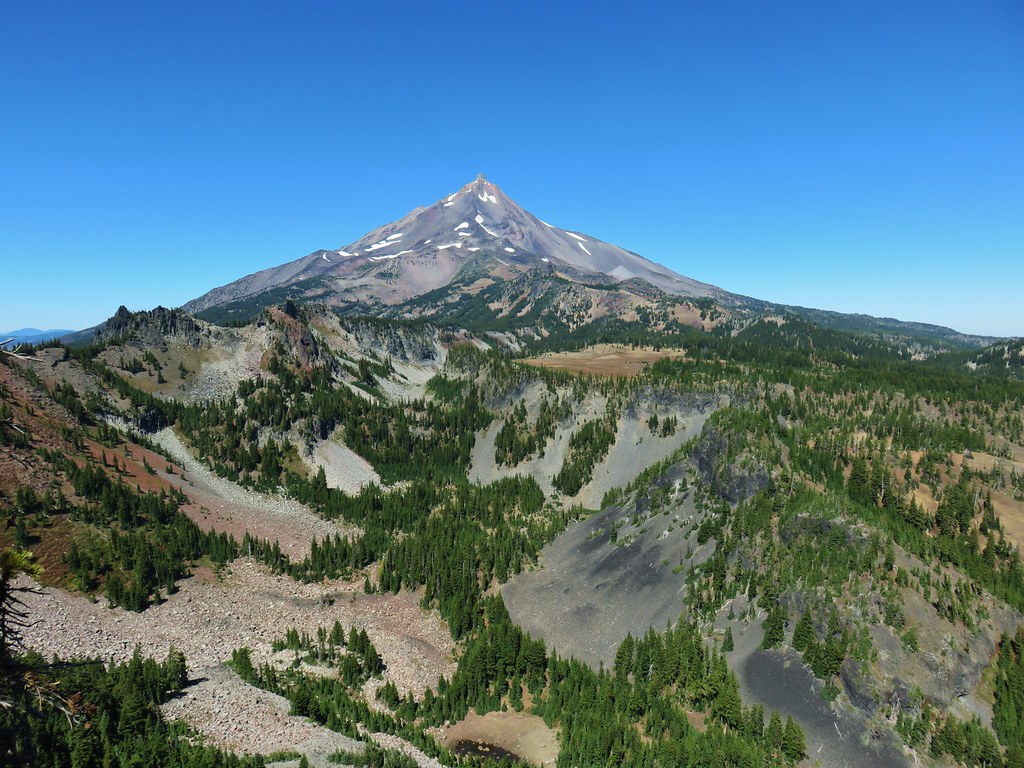
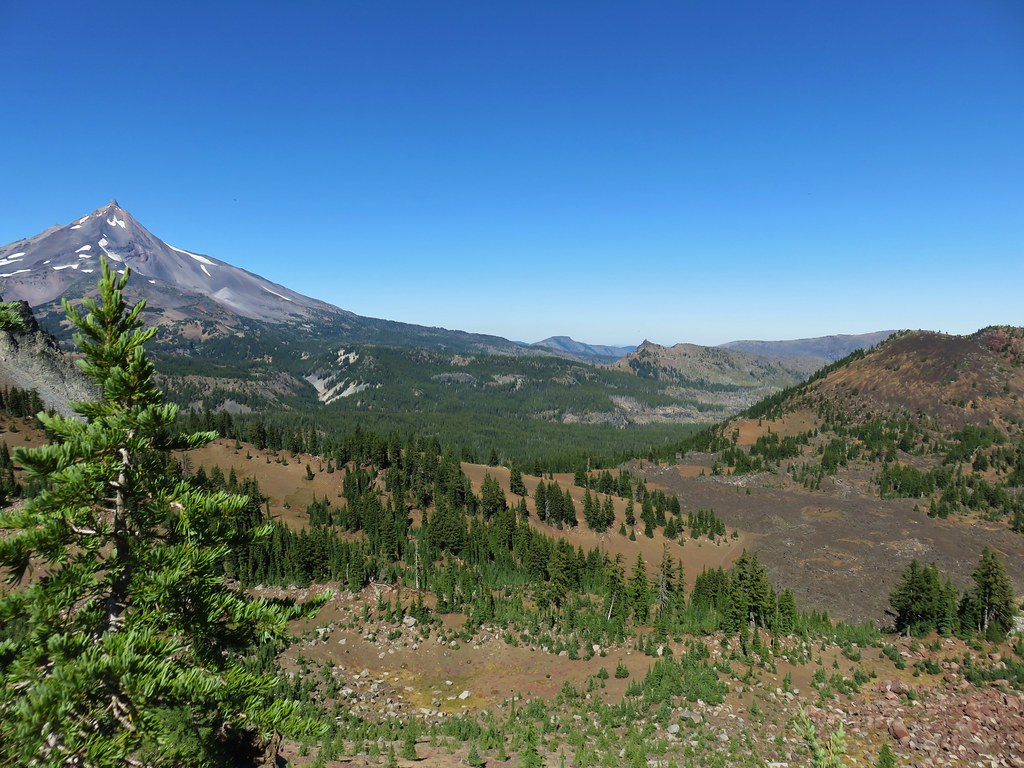
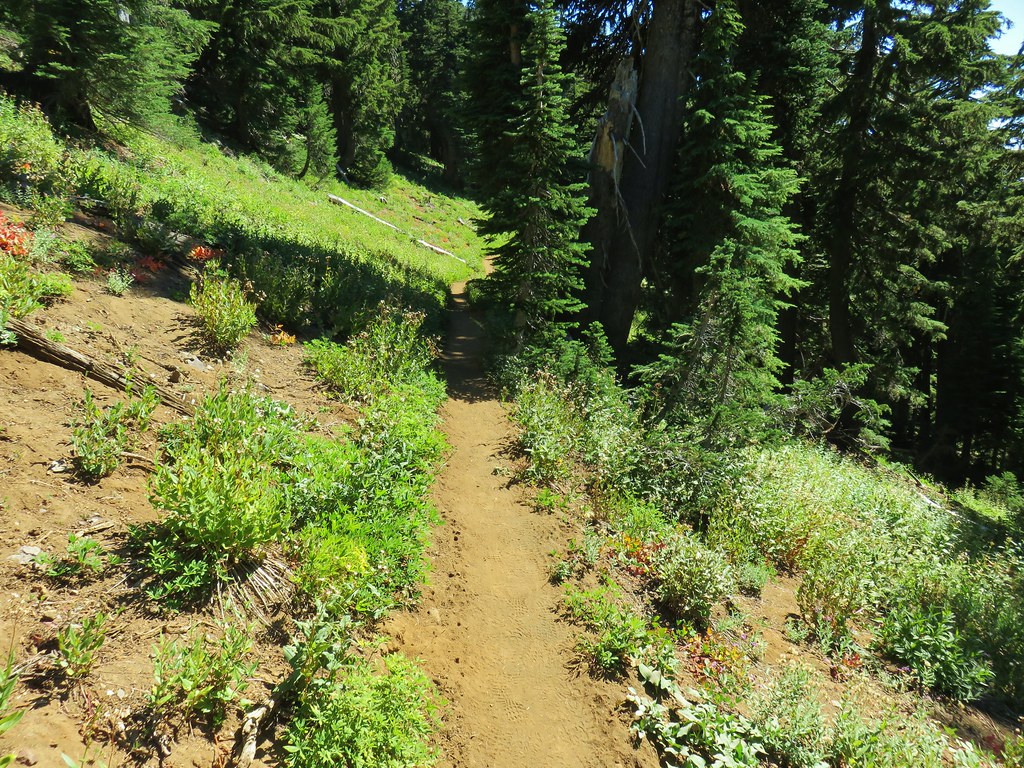
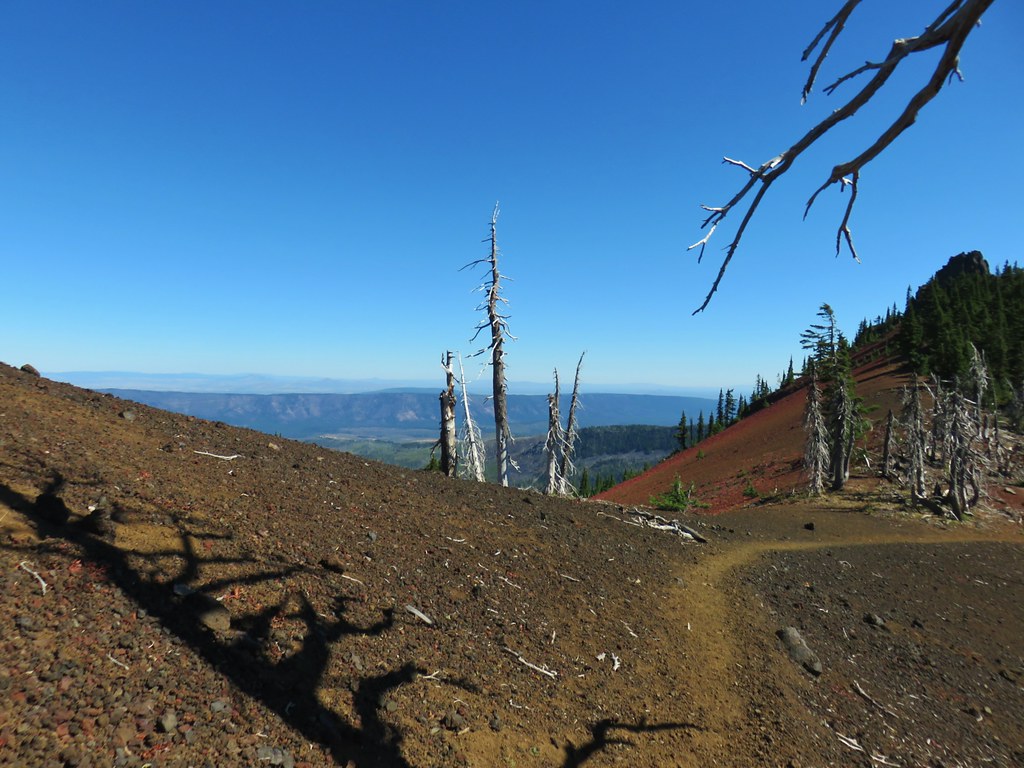
Mt. Jefferson Wilderness Days 2 & 3 – Table Lake Loop

After turning in early the night before we were up before the Sun which wasn’t such a bad thing.
IMG_1497

IMG_1506

IMG_1511_stitchCarl Lake

For the second day of our trip we planned on taking the Cabot Lake Trail to Table Lake and then on to a viewpoint above Hole-in-the-Wall Park before returning to Carl Lake. We were still debating our return route though. We could simply follow the Cabot Lake Trail back, or we could complete a loop described in Matt Reeder’s “101 Hikes in the Majestic Mount Jefferson Region”. The loop option would require using what is believed to have been an old Native American trail, not shown on any of our maps, to reach the Pacific Crest Trail. We could then follow the PCT south to the Shirley Lake Trail which would take us back down to Carl Lake. One of the things we really like about Reeder’s book is that most of the suggested hikes have an accompanying GPS track overlaid on a topographic map which can be really helpful.

We decided to wait and see how the day was going before making a final decision about our return route. One thing we did know was that we didn’t want to try and walk around the north side of Carl Lake to hook up with the Cabot Lake Trail after having come back on that side the day before (post). It would have been shorter than taking the Cabot Lake Trail around the southern and western ends of the lake but certainly not easier so we proceeded as we had the day before only this time we went right when we arrived at the junction with the Shirley Lake Trail.
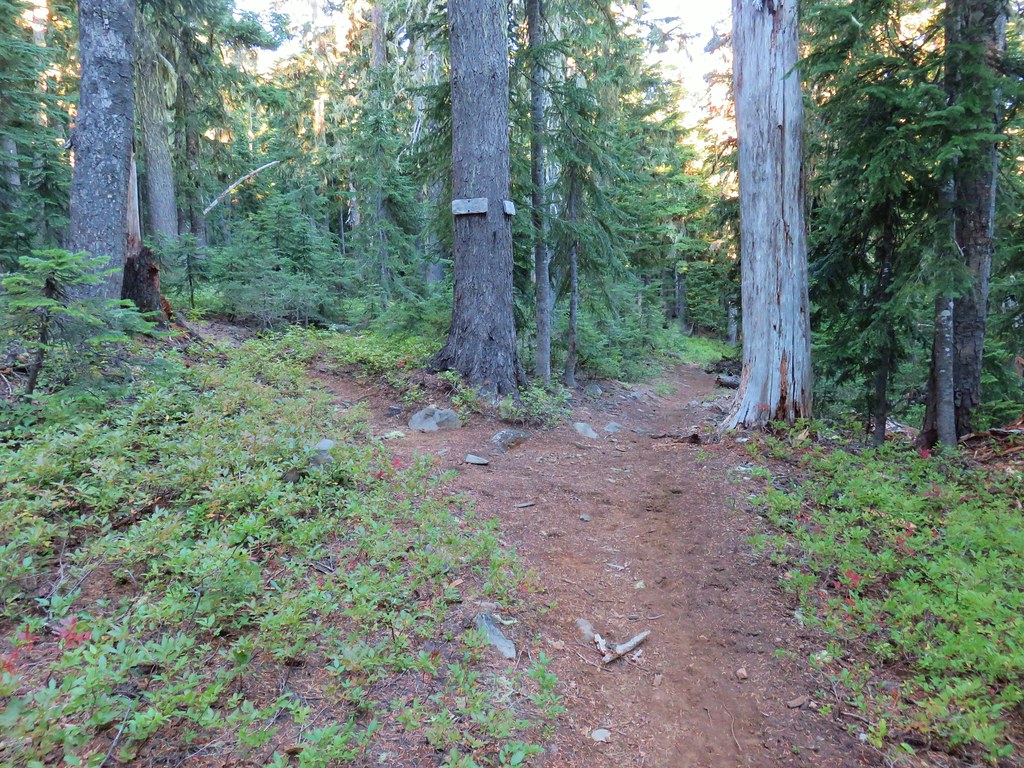
IMG_1516

As we followed the trail around the west end of the lake we noticed that the water at this end was completely calm. It was the only time during the entire weekend that any of the water in the lake was still.
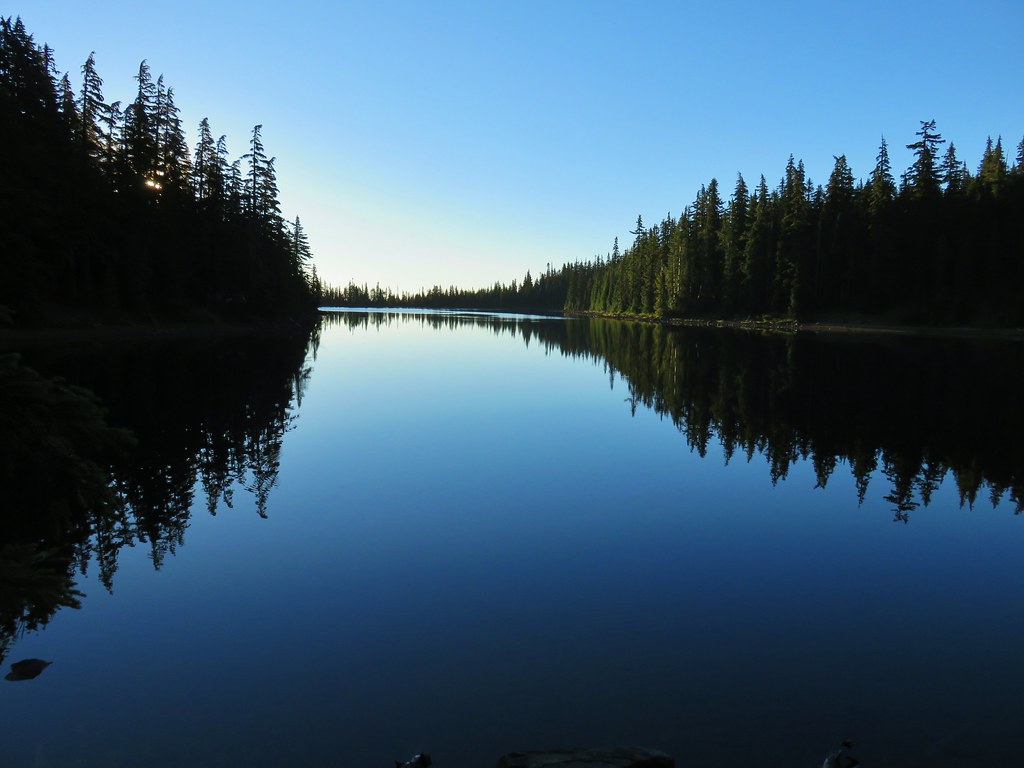
IMG_1522

When we made our way around to the point where we had left the trail to cross the rock outcrop the day before we found the most of the campsites were now occupied which was another good reason for us to not have tried coming from that way.

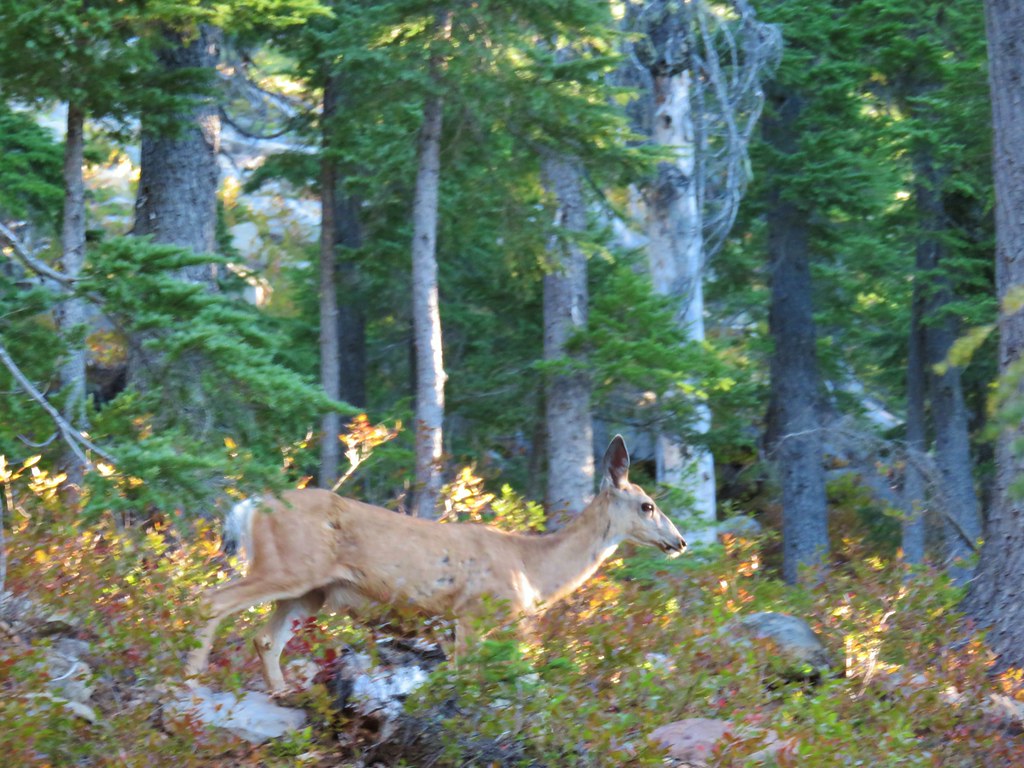
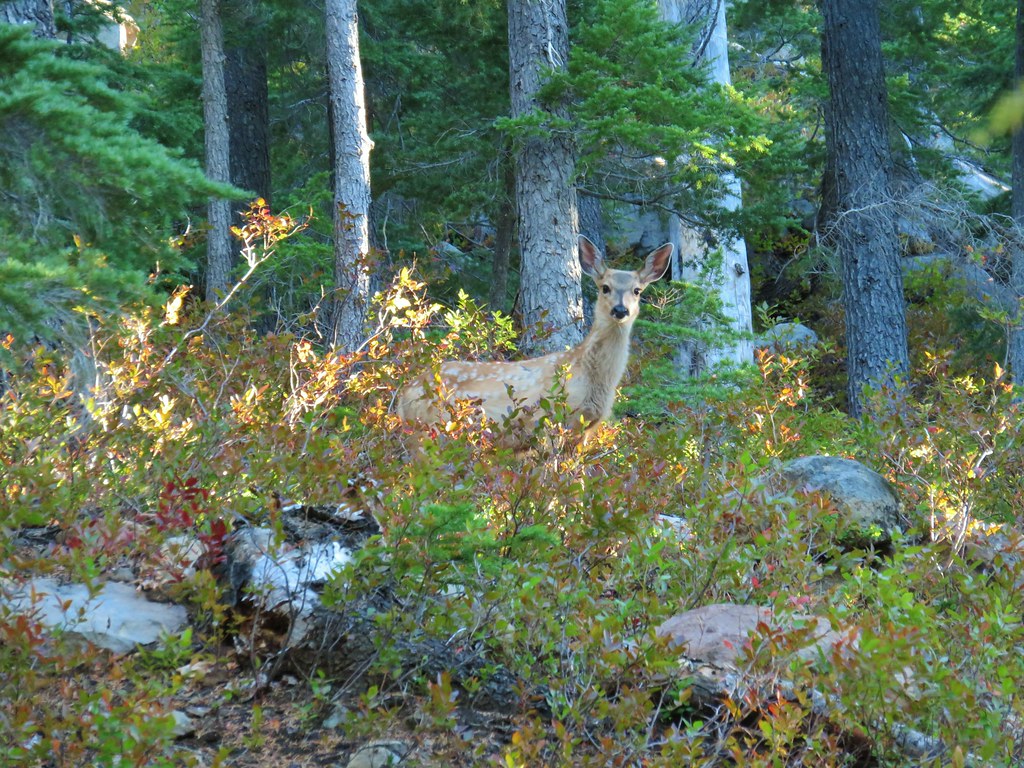
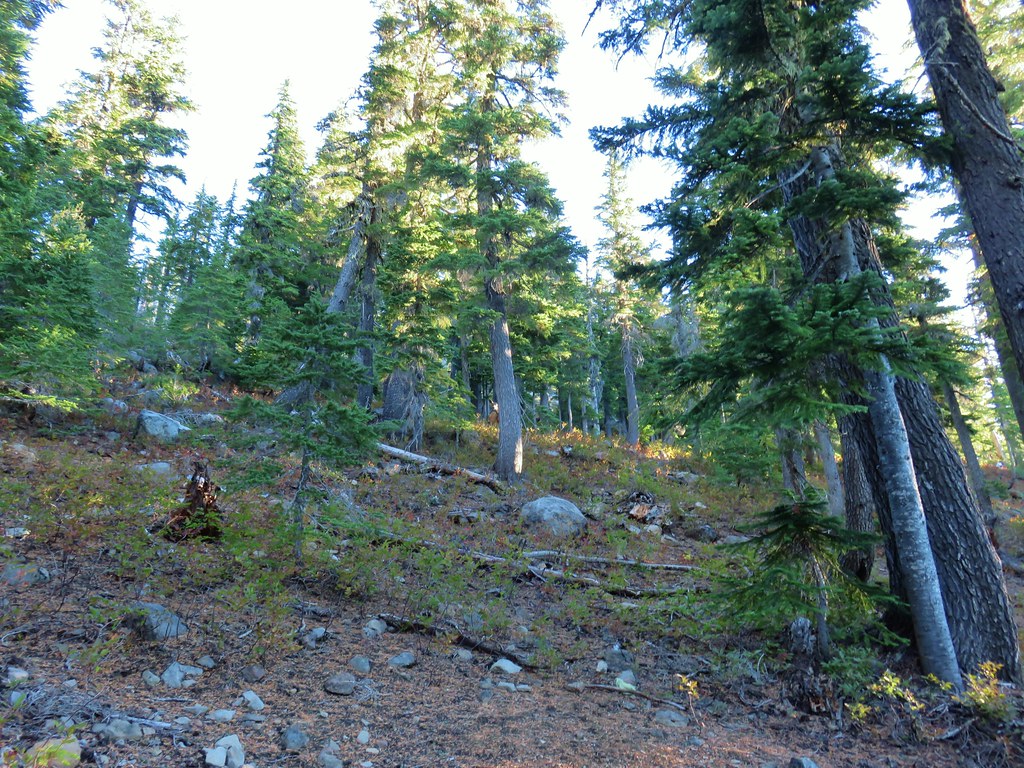
The trail veered away from the lake and began a half mile climb via a series of short switchbacks. As we made our way up the hillside we spotted a doe and her two fawns coming down the trail.
IMG_1524

IMG_1526

IMG_1529

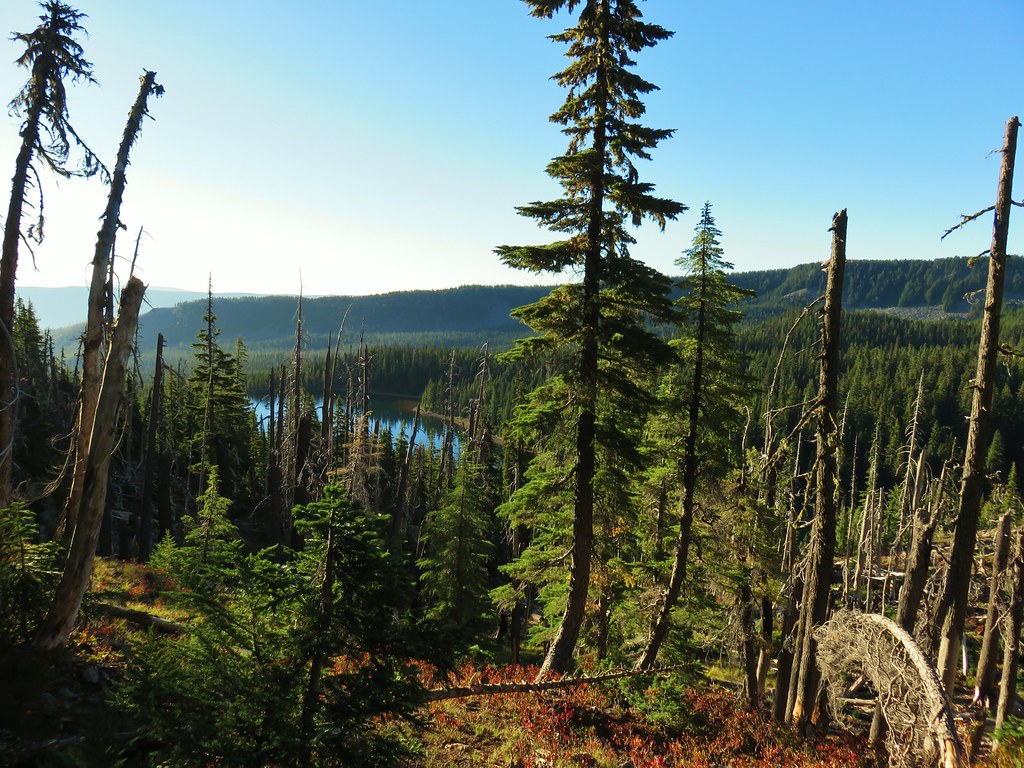
Near the top of the climb we had a decent view of Carl Lake below.
IMG_1540

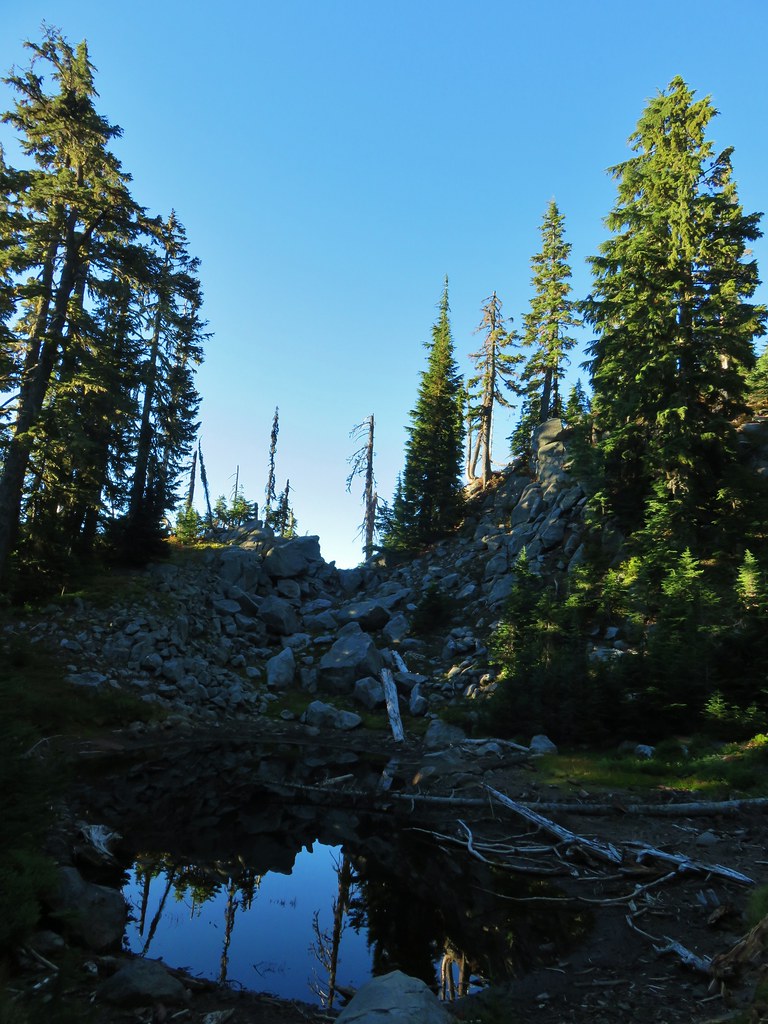
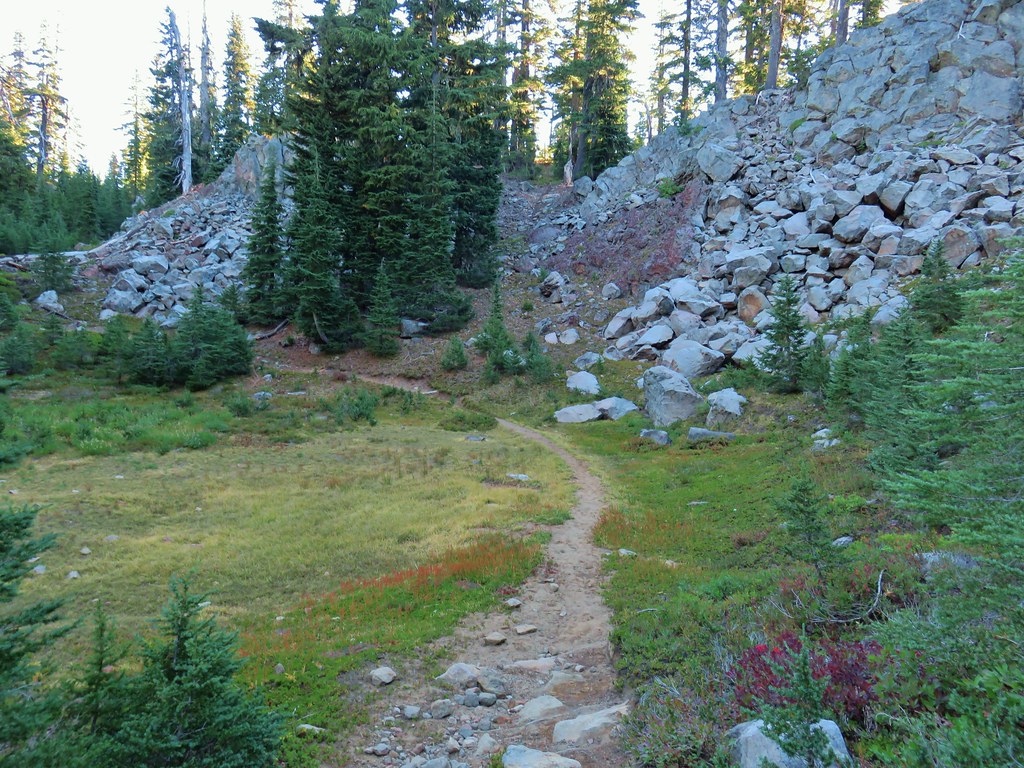
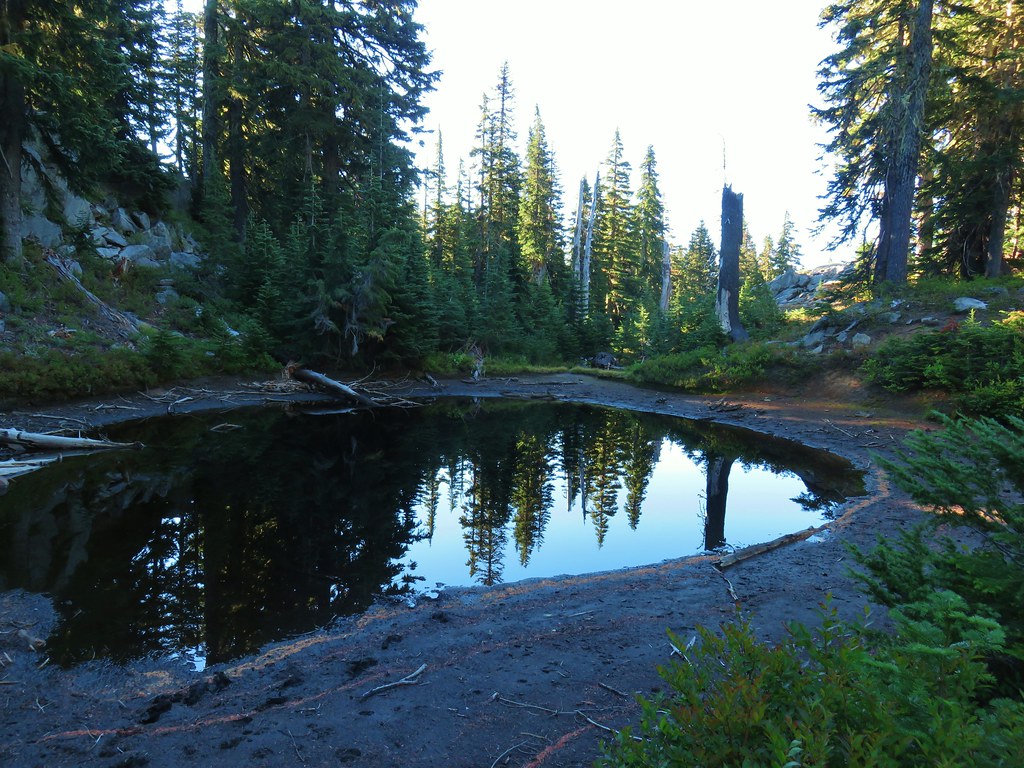
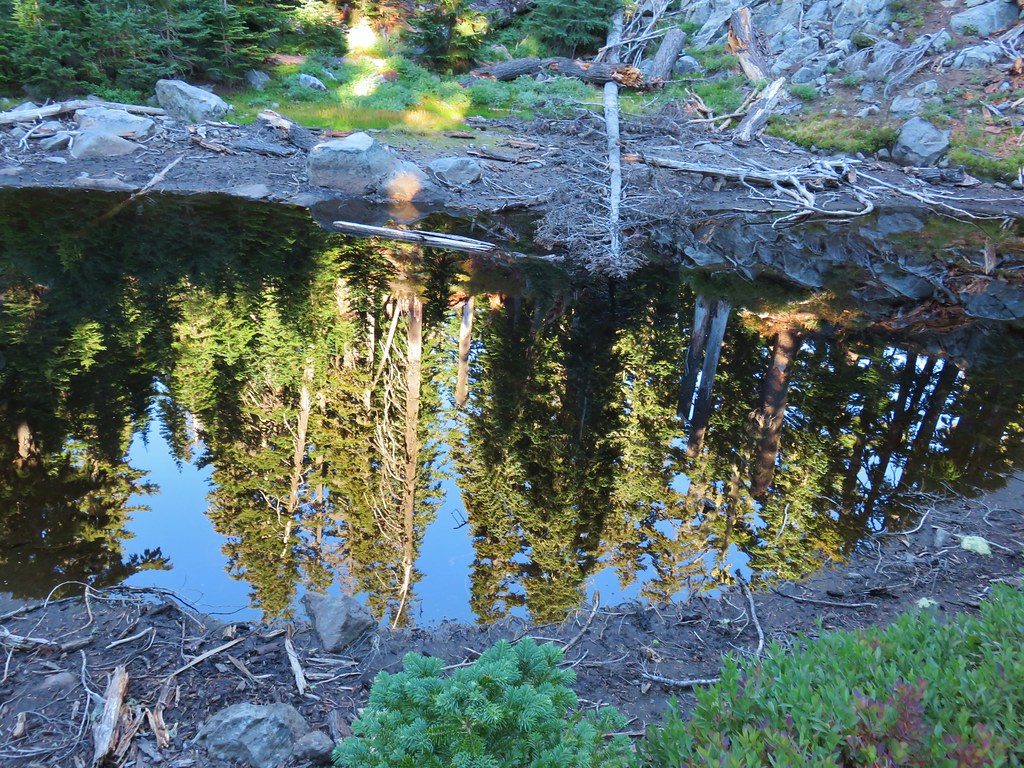
The trail then leveled out in a forest accentuated with small ponds and rock formations.
IMG_1541

IMG_1543

IMG_1546

IMG_1549

IMG_1552

IMG_1554

IMG_1567

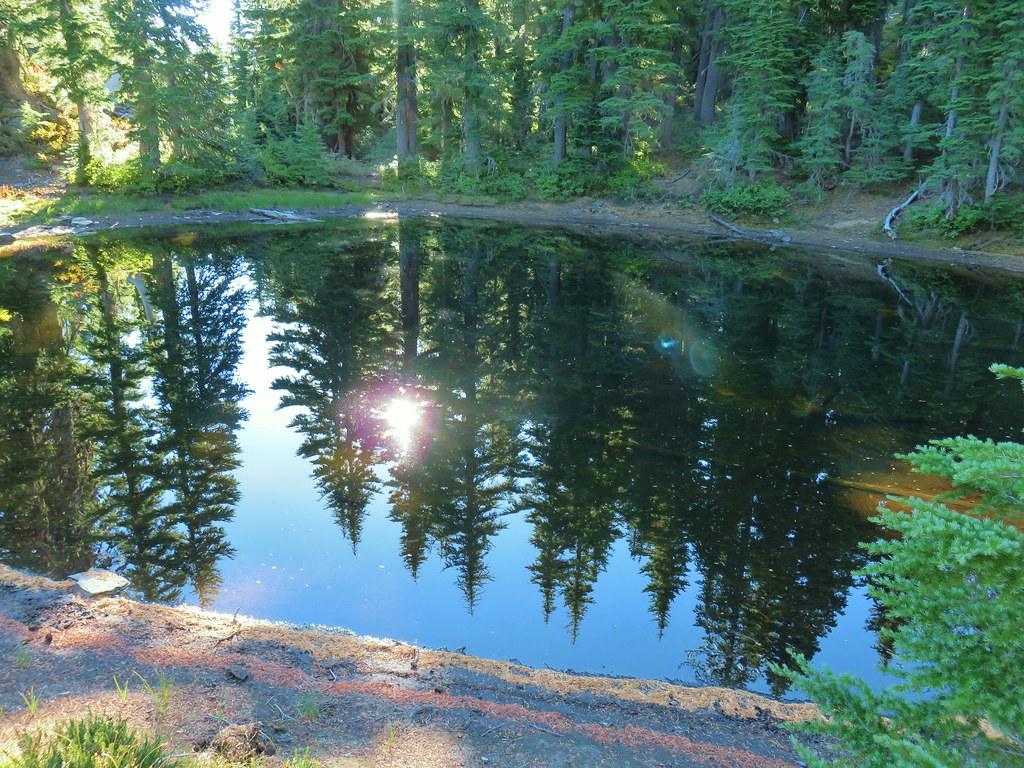
Approximately 1.75 miles after turning away from Carl Lake we arrived at tiny Junction Lake.
IMG_1569

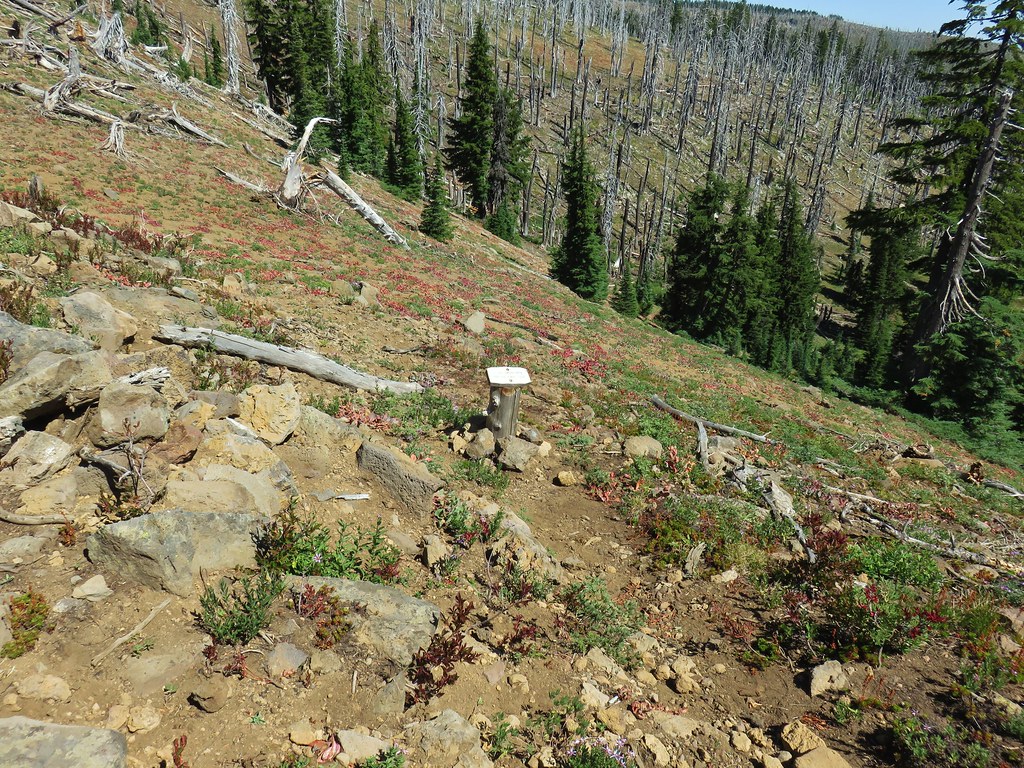
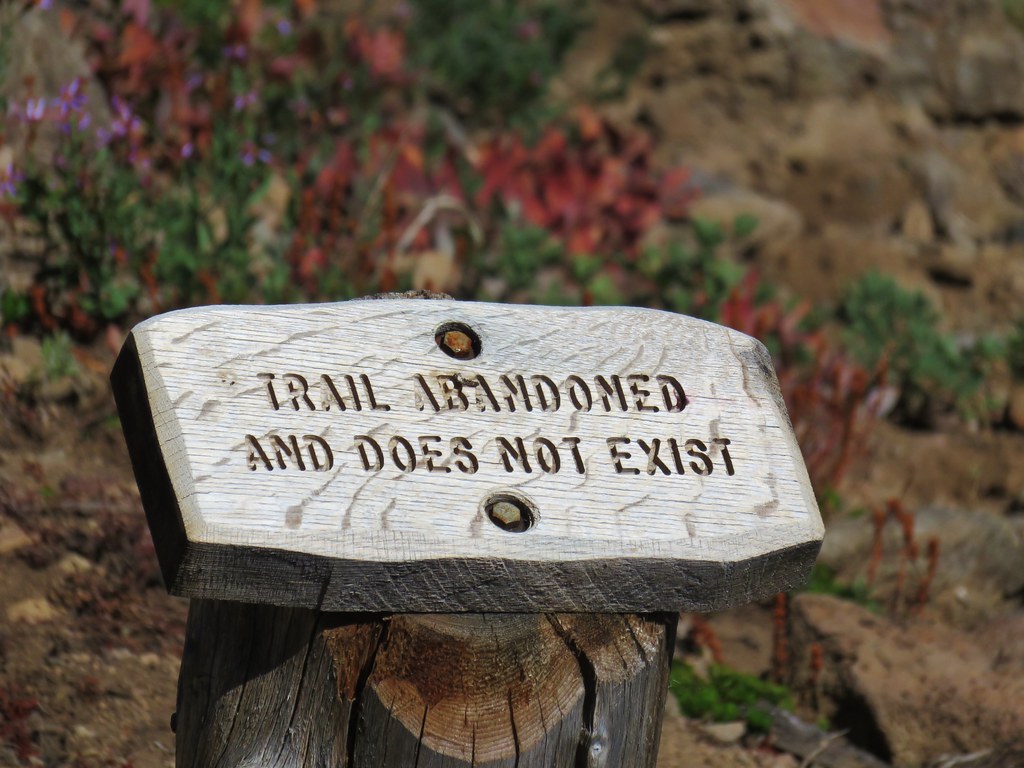
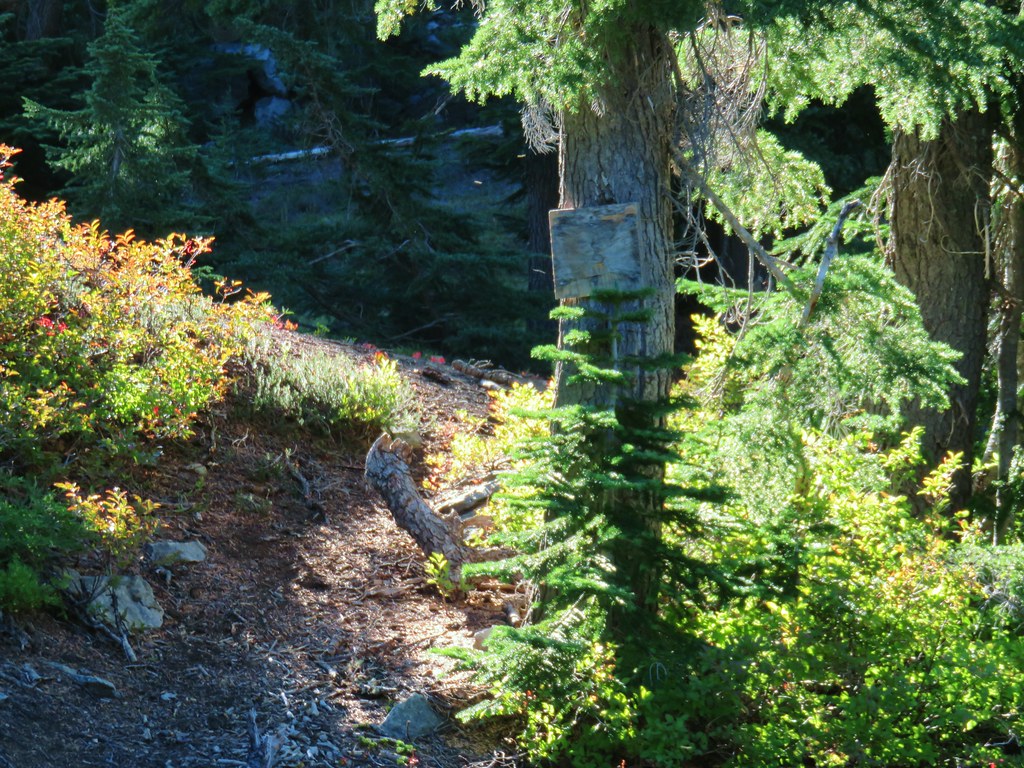
There was a small wooden sign here marking the now lost Sugar Pine Ridge Trail which was abandoned after the 2003 B & B Fire.
IMG_1571

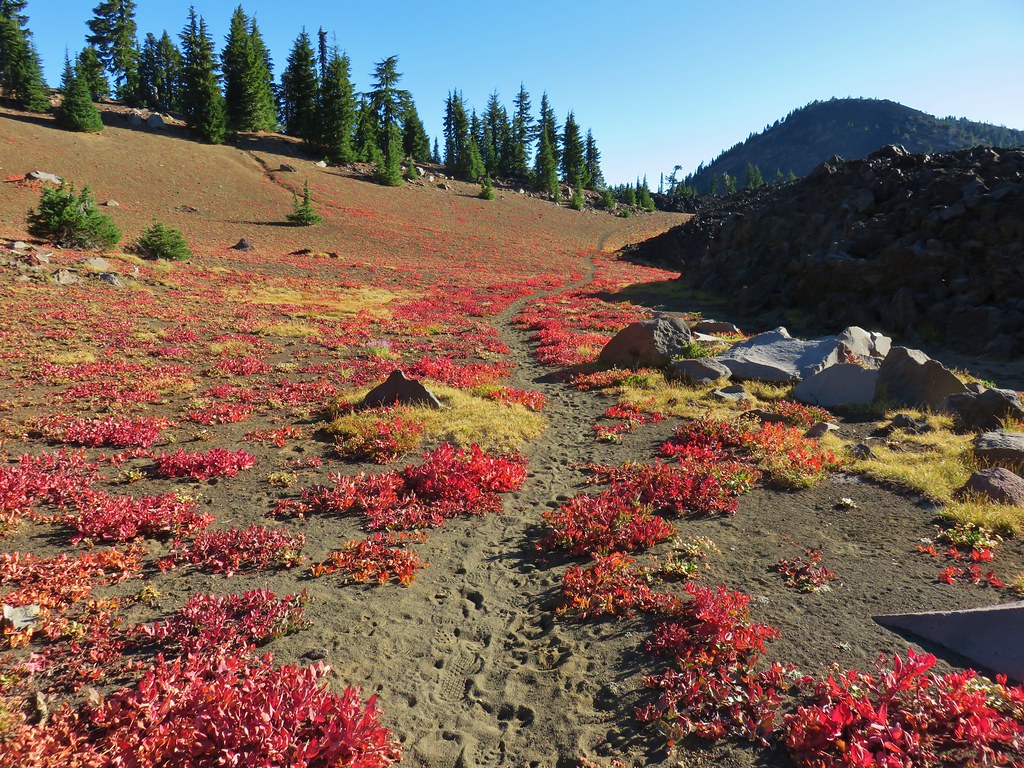
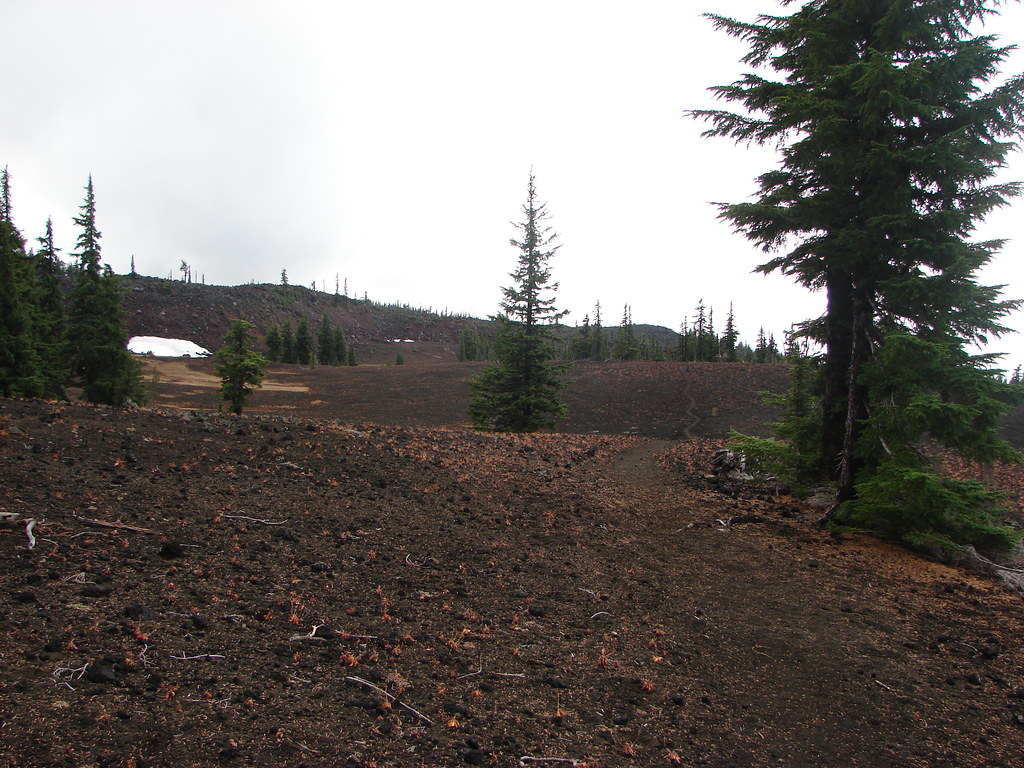
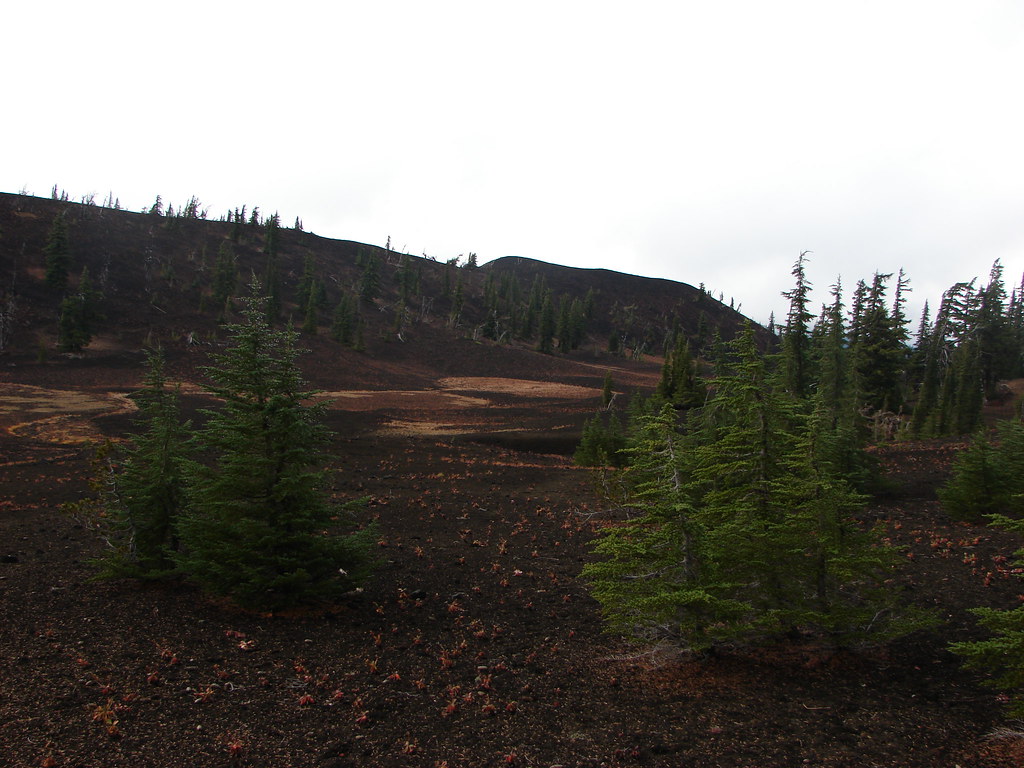
What had already been a scenic hike got even better over the next mile and a half as the Cabot Lake Trail passed through an increasing volcanic landscape.
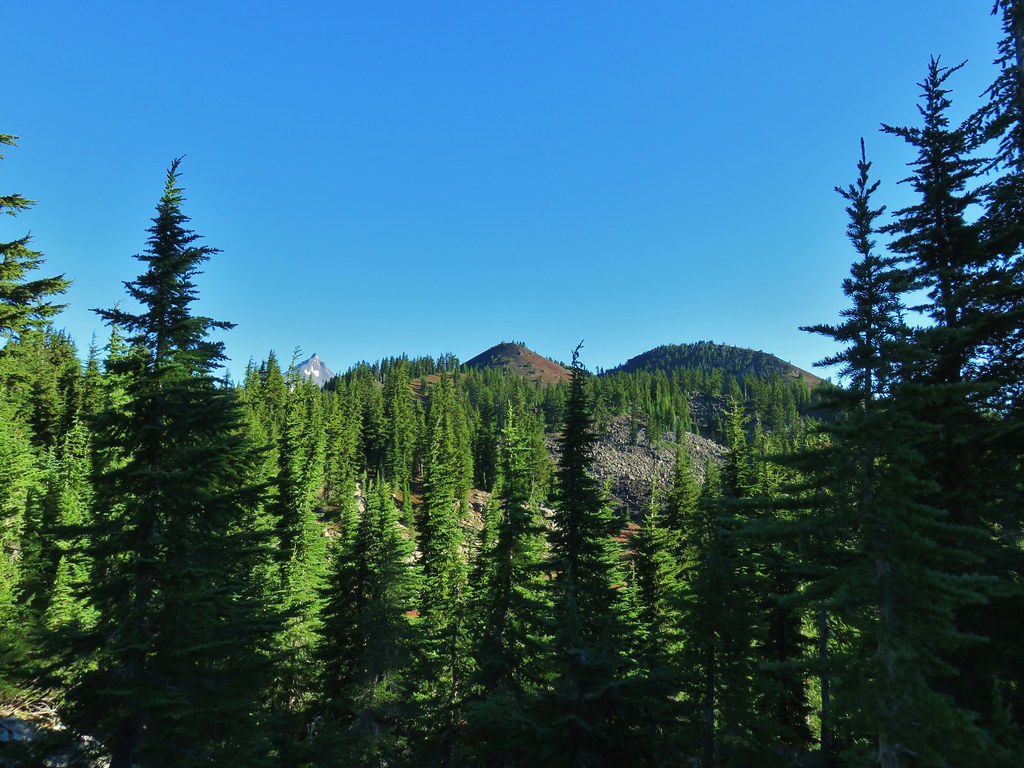
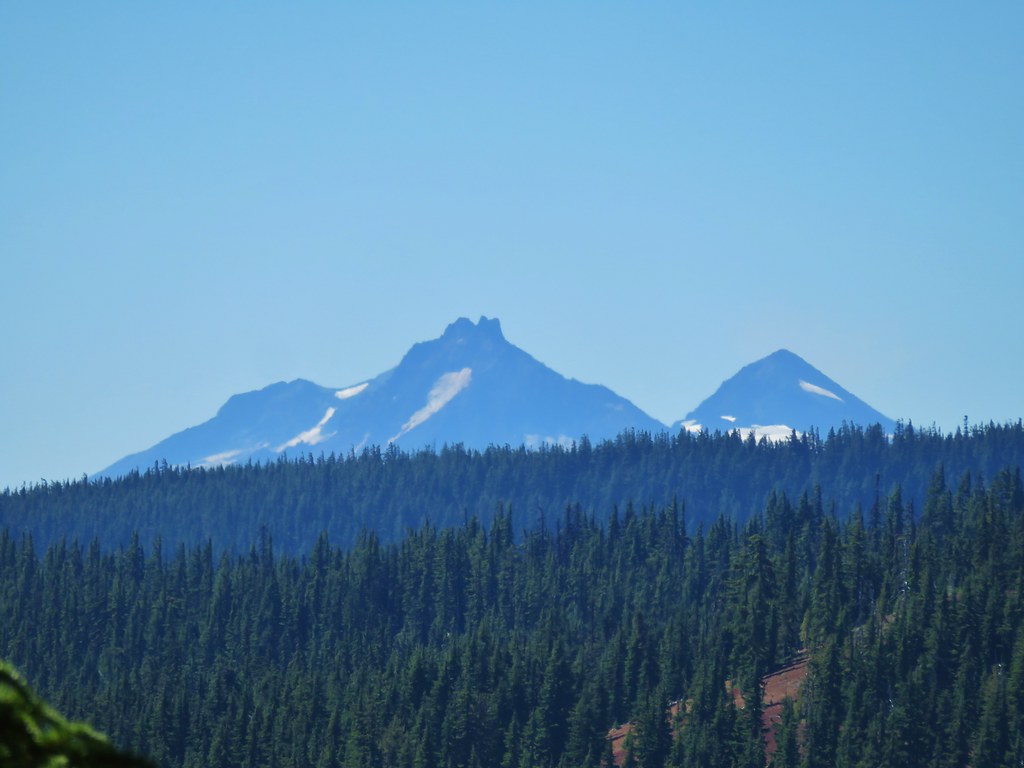
IMG_1573Mt. Jefferson and Forked Butte poking up over the trees.
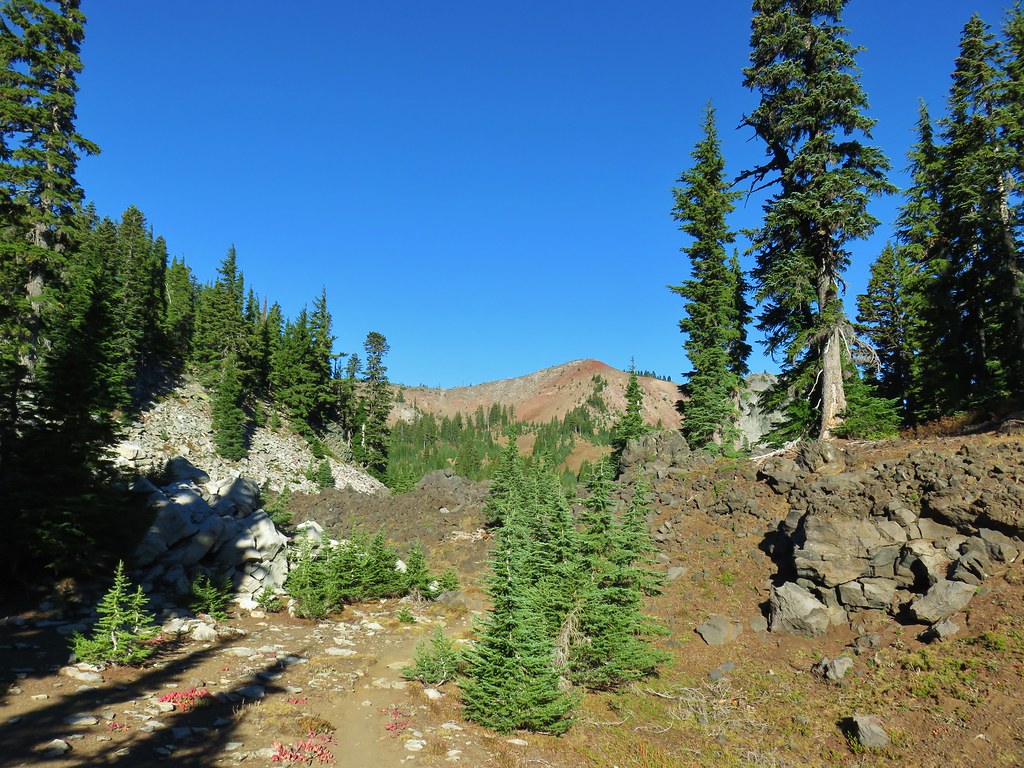
IMG_1583North Cinder Peak

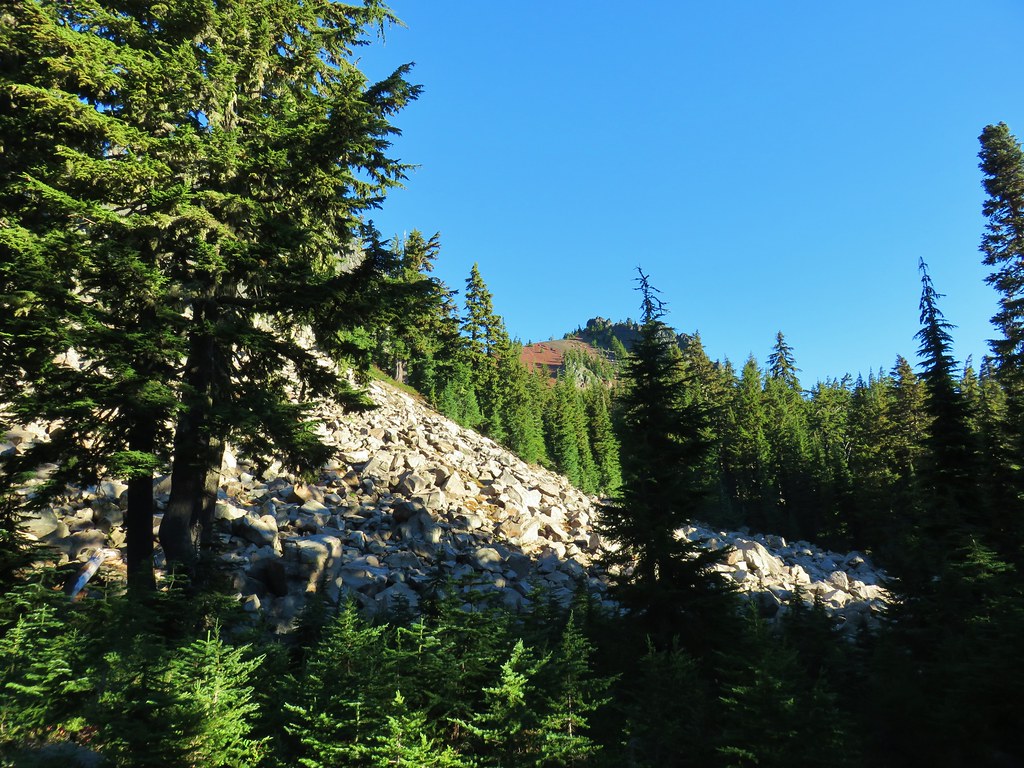
Our favorite part of this section was when the trail passed between a jumble of white rocks on the left and the dark lava from the Forked Butte Lava Flow.
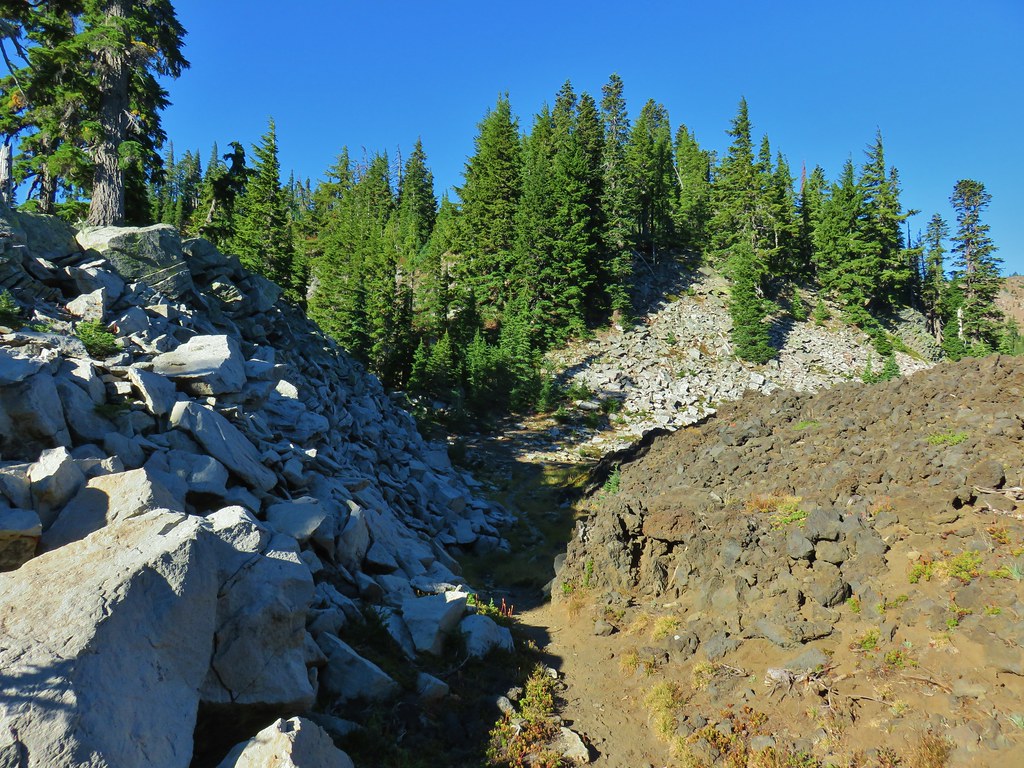
IMG_1585

IMG_1587

The contrasting colors and textures made for some excellent scenery.
IMG_1590

IMG_1597

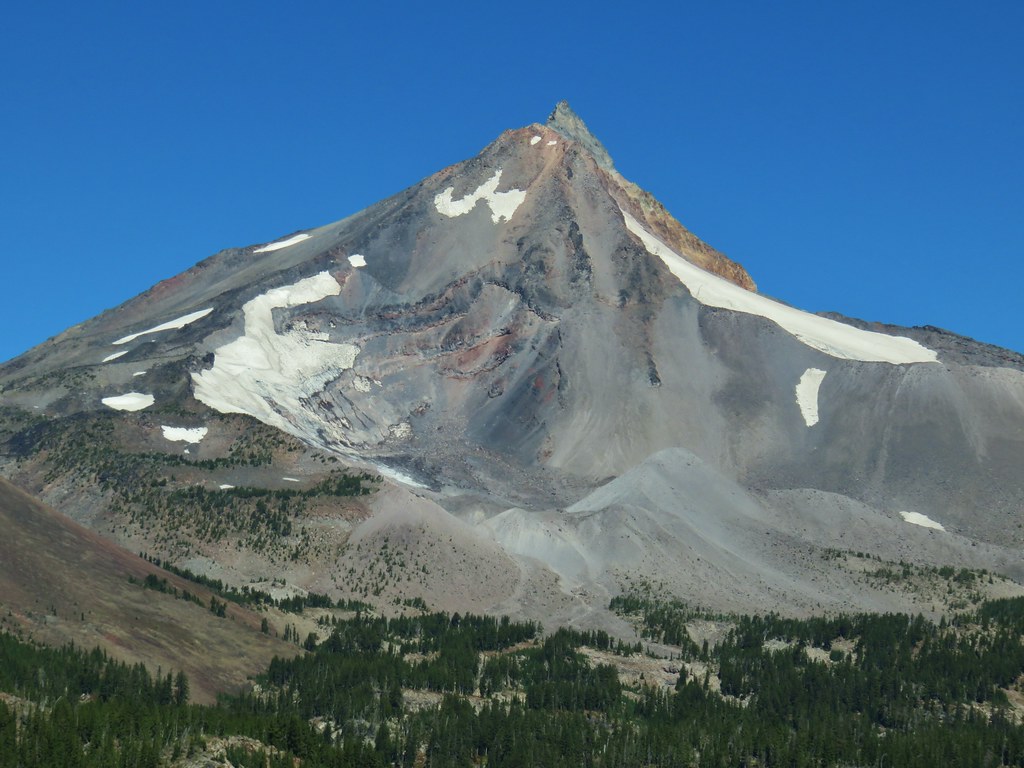
IMG_1596Moraine below the Waldo Glacier on Mt. Jefferson.

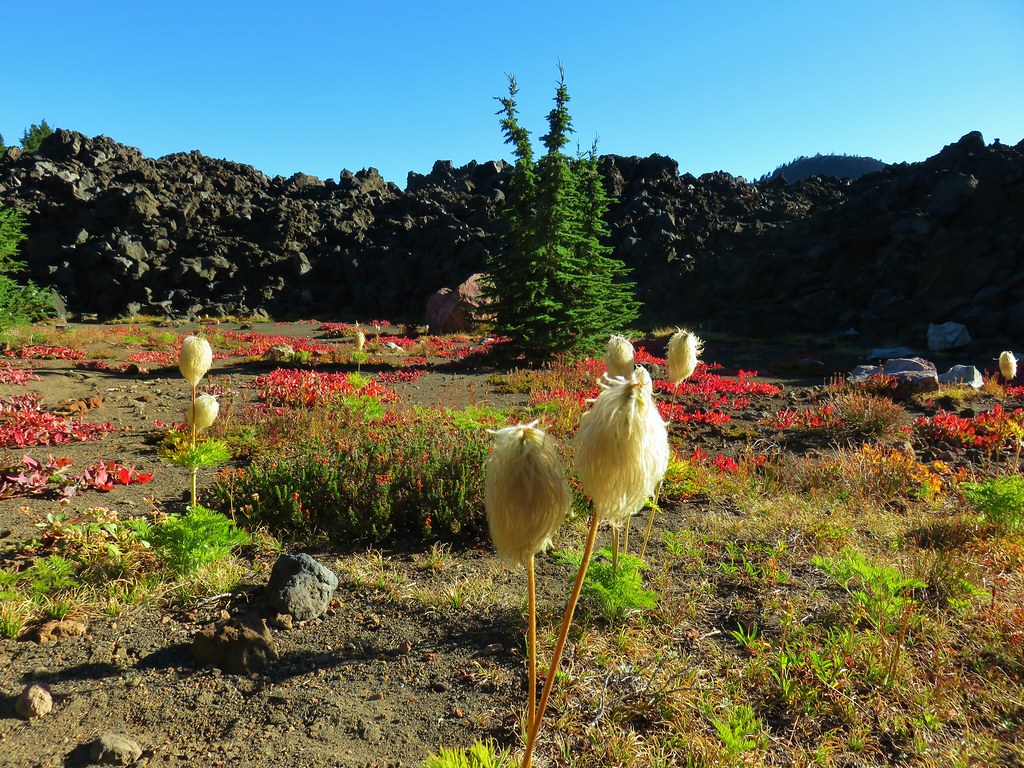
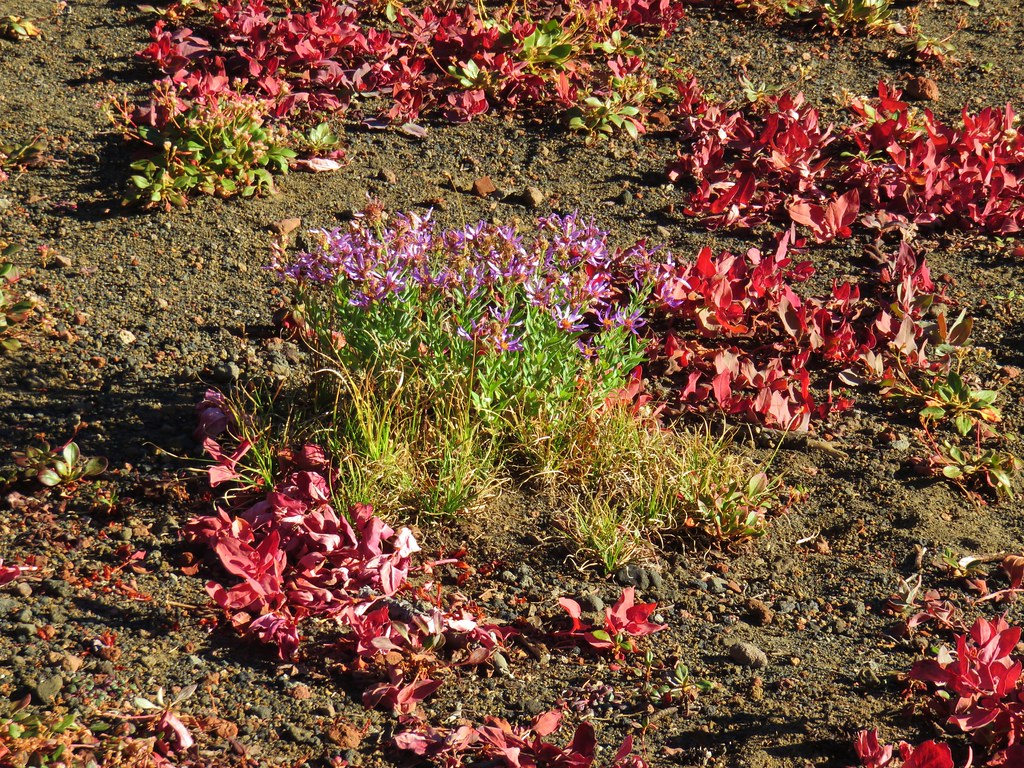
The trail wound around the lava flow where we found a small patch of western pasque flowers that had gone to seed and the remains of a lone clump of aster.
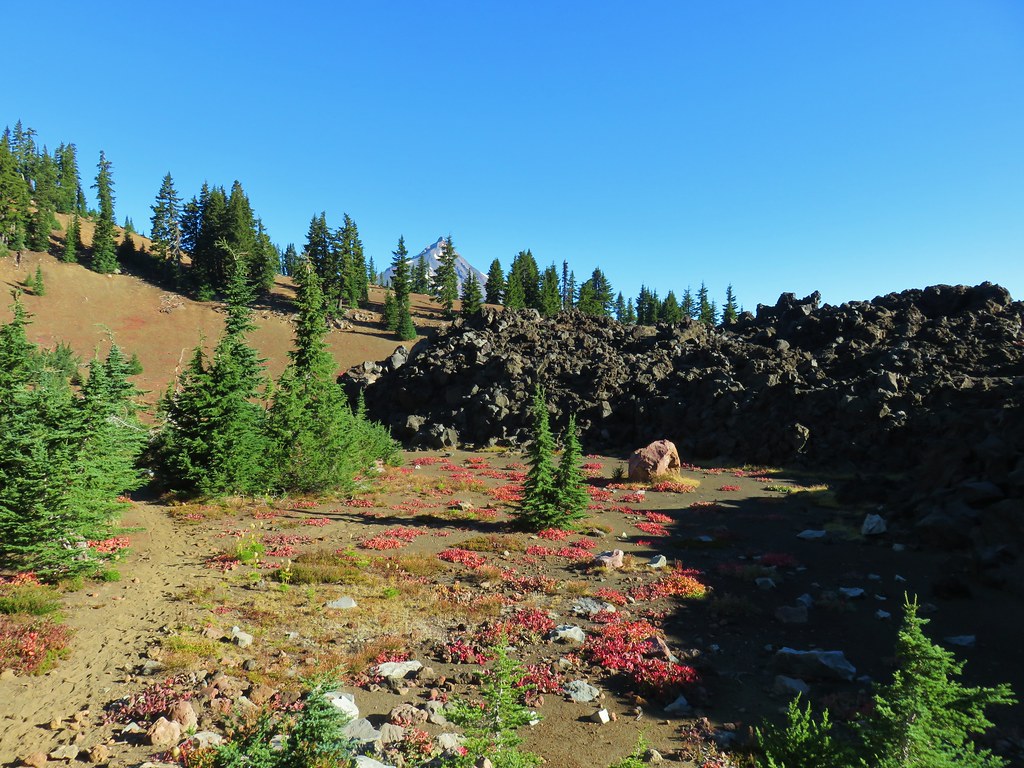
IMG_1599

IMG_1602

IMG_1606

IMG_1607

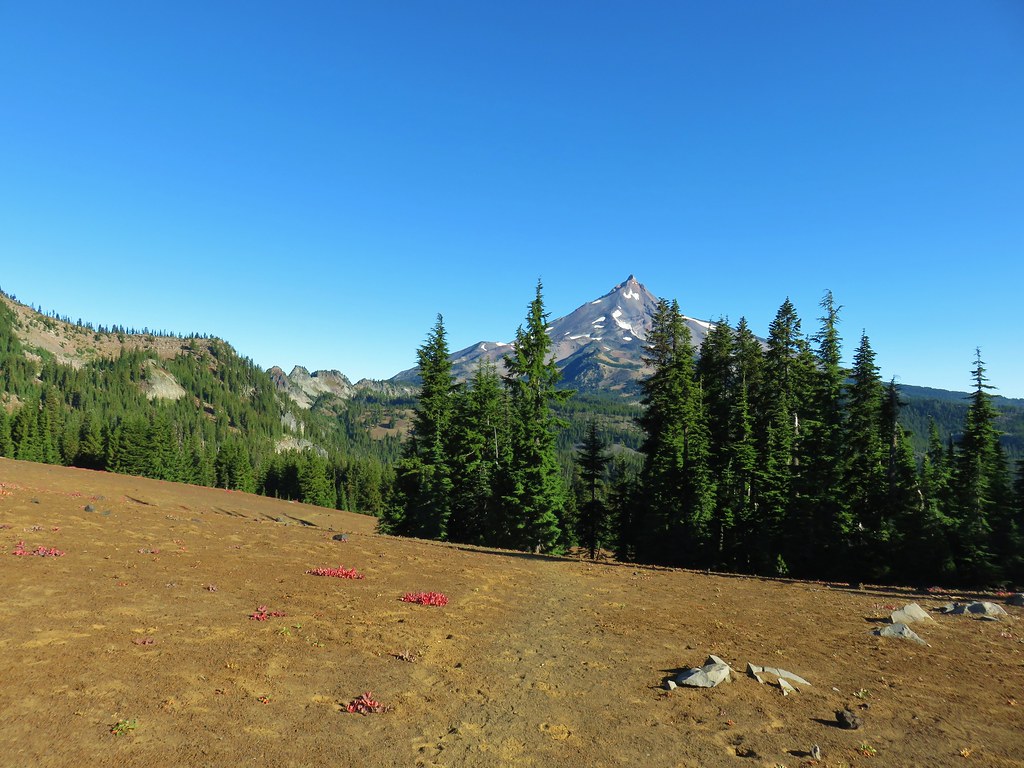
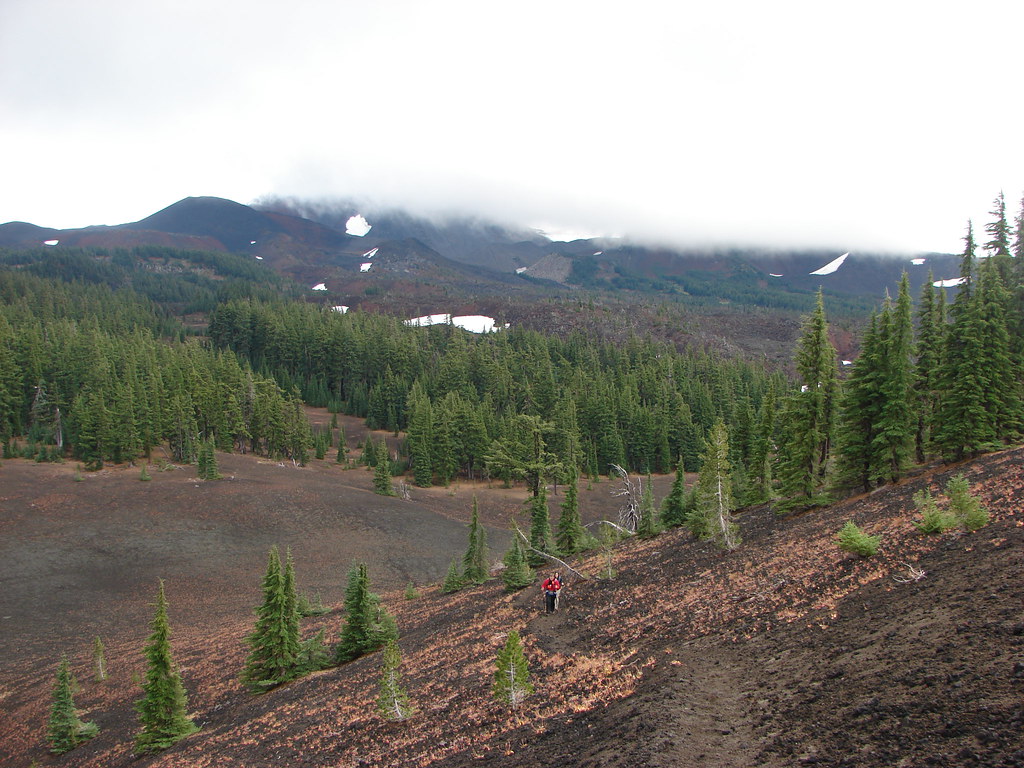
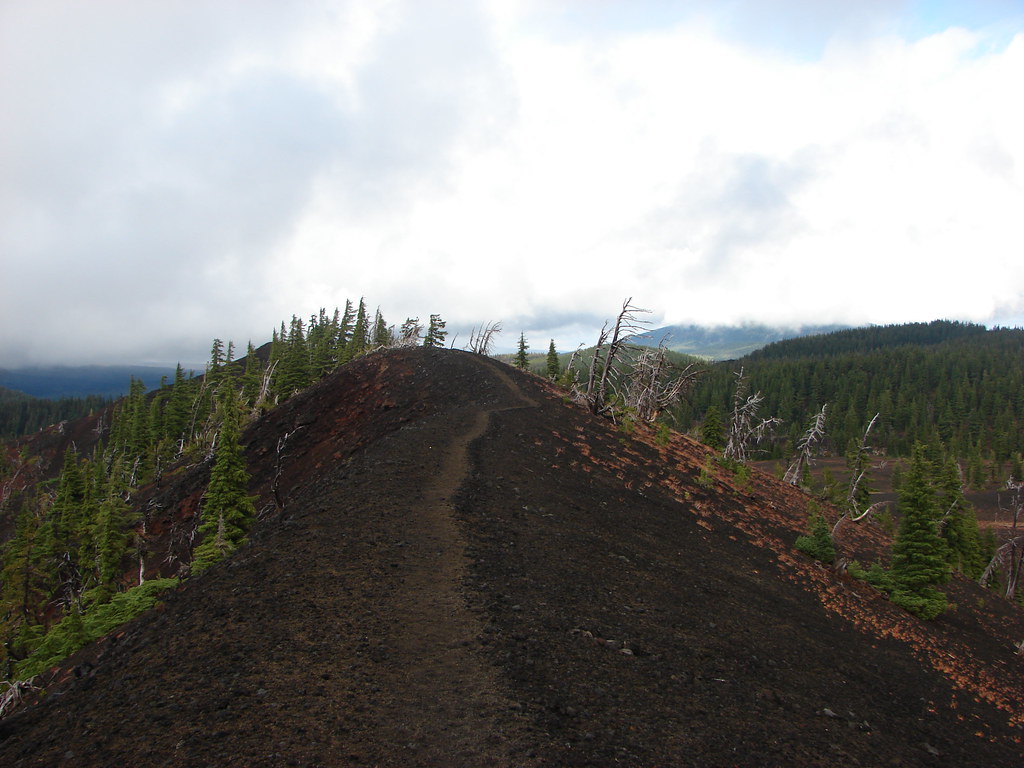
The trail crested a cinder hillside with spectacular views of North Cinder Peak and Mt. Jefferson and began to descend toward a green forest.
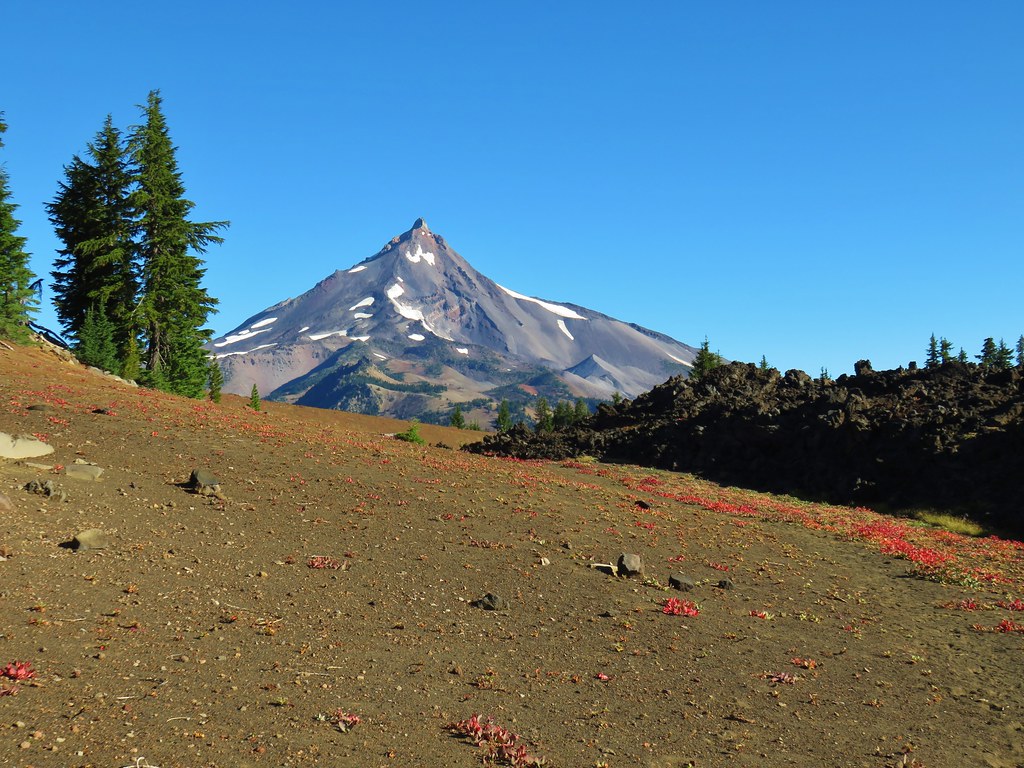
IMG_1612

IMG_1616

IMG_1617

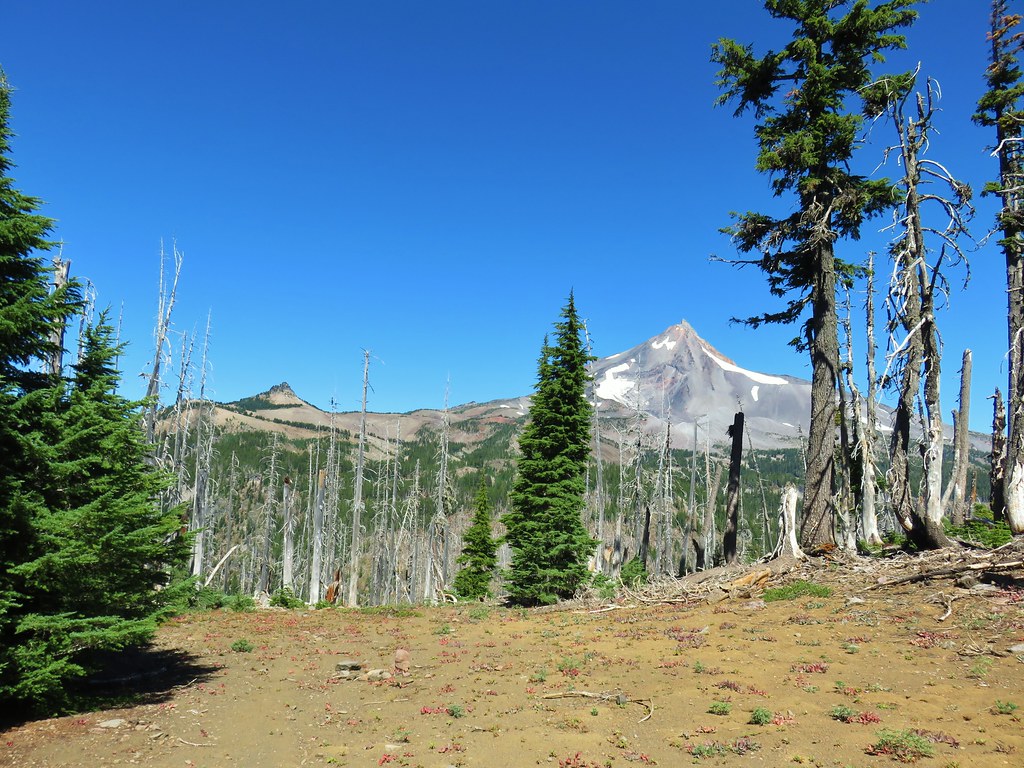
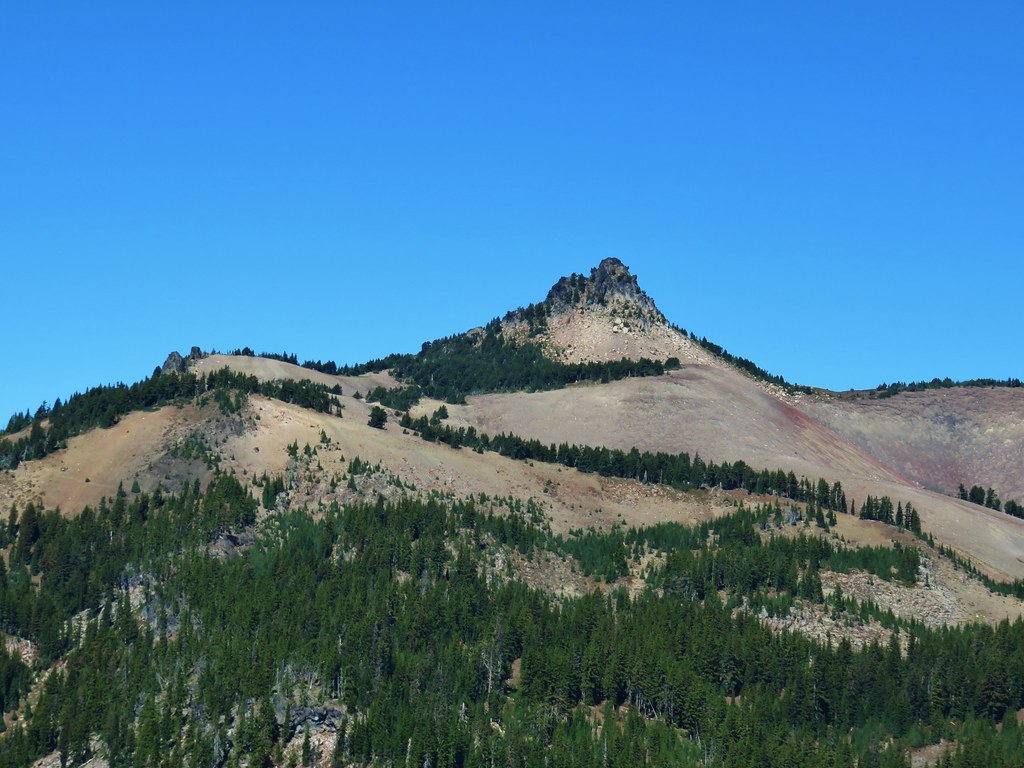
As we came down and around we got a good look at pointy Bear Butte poking up from a ridge to the right of Mt. Jefferson. Our turn around point for the day was at a viewpoint below and to the left of that butte.
IMG_1623

IMG_1624

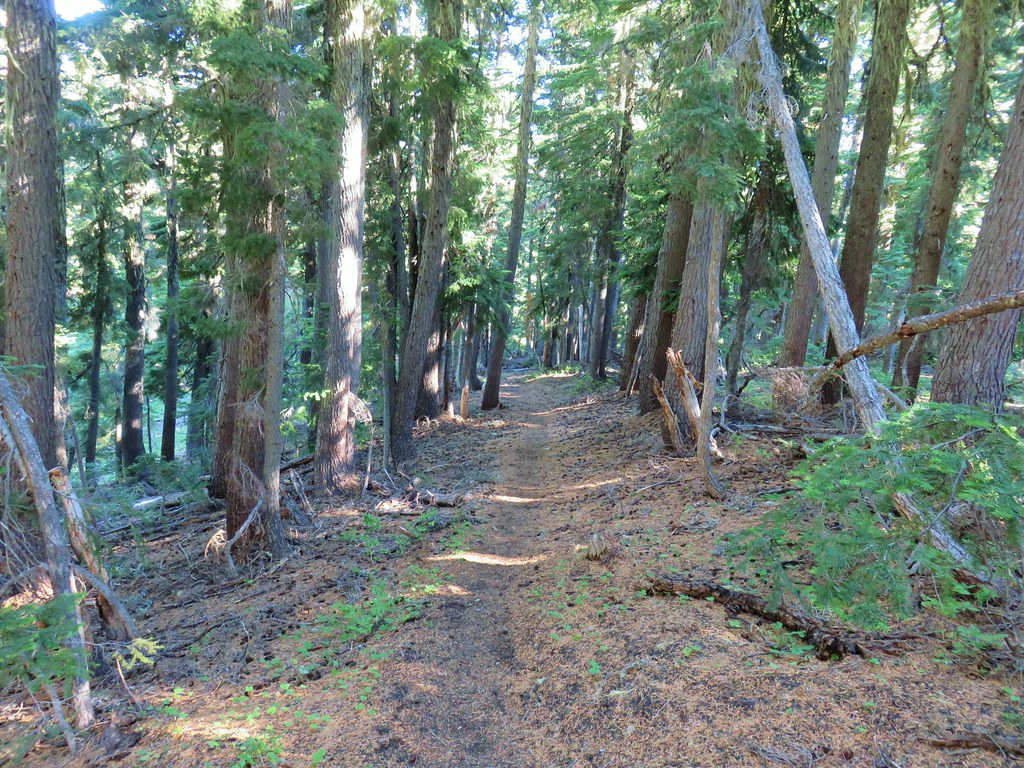
At the end of this 1.5 mile stretch the Cabot Lake Trail reentered the forest and began a 350′ drop down to Patsy Lake. This .4 mile section was fairly steep as it dove down via one long switchback.
IMG_1632

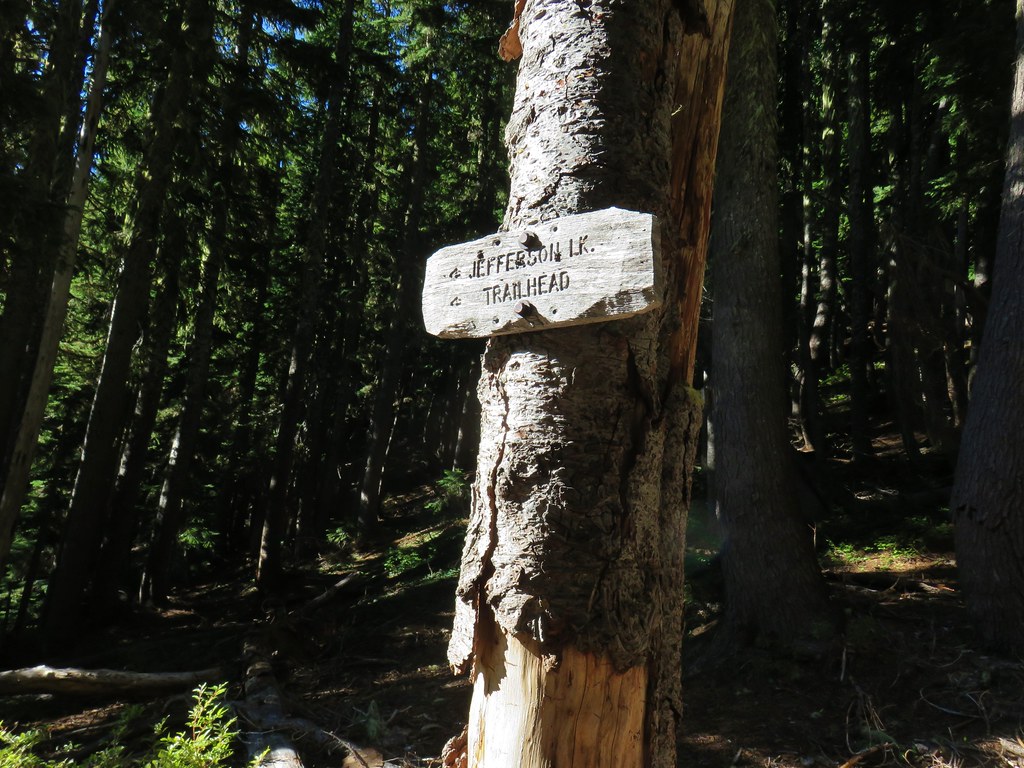
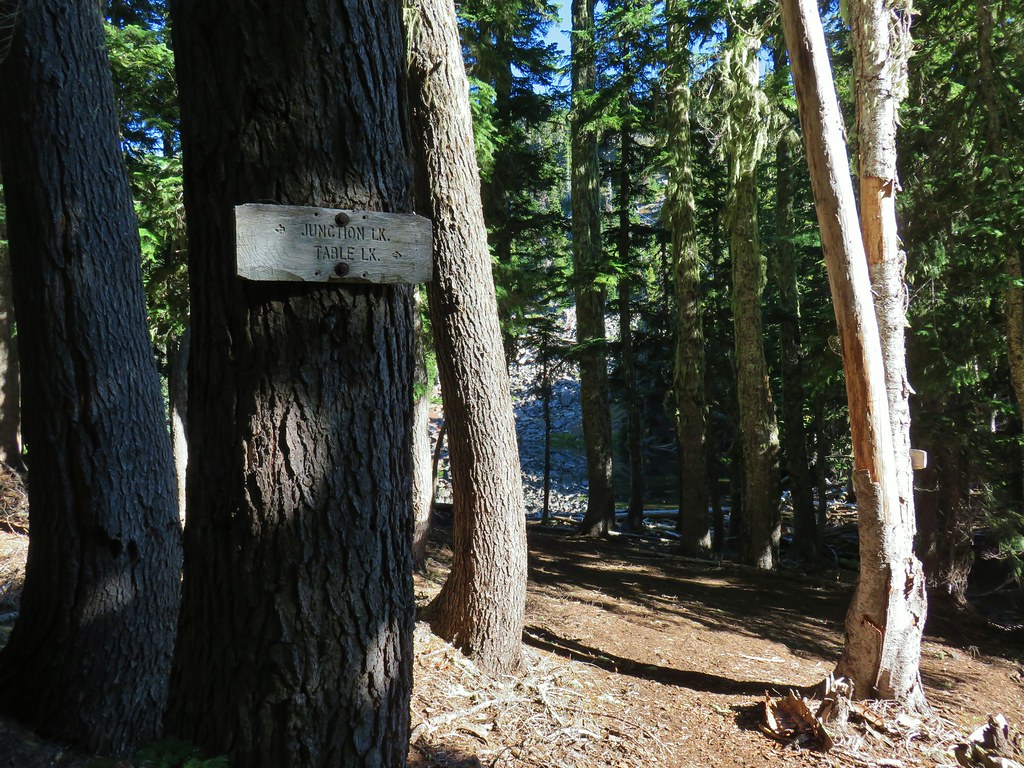
A signed junction at Patsy Lake announced the location of another abandoned trail – the Jefferson Lake Trail.
IMG_1636

IMG_1637

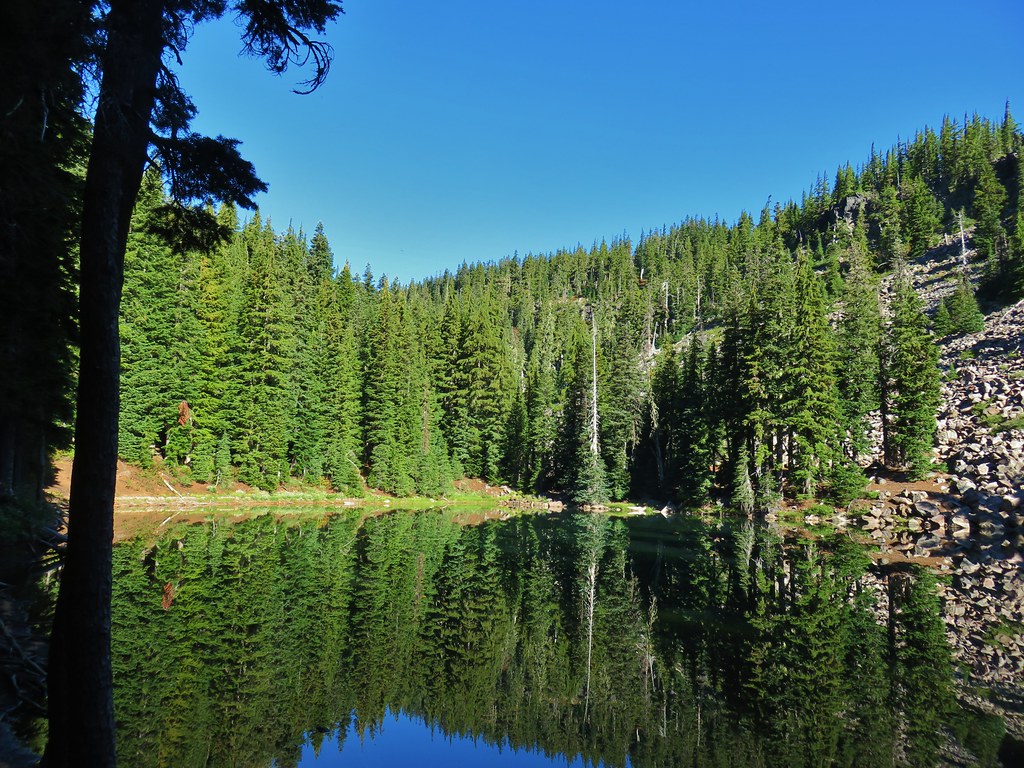
Patsy Lake was forested except for on the northern side where a rock field dipped down into the water.
IMG_1640

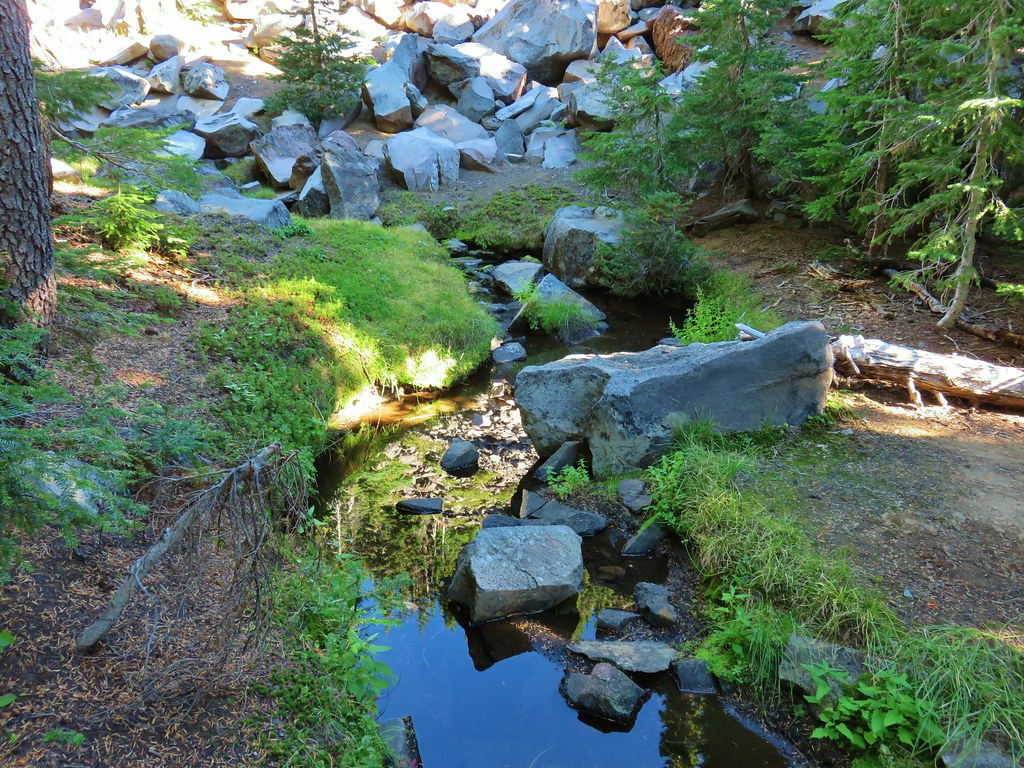
We got ourselves a little confused here about where the trail was and wound up following a use trail clockwise around the little lake. By the time we realized our mistake we were at the NW end of the lake at an inlet creek.
IMG_1645

We decided to finish the loop and passed through a couple of decent campsites where we stopped for a short break before having to cross the rock field.
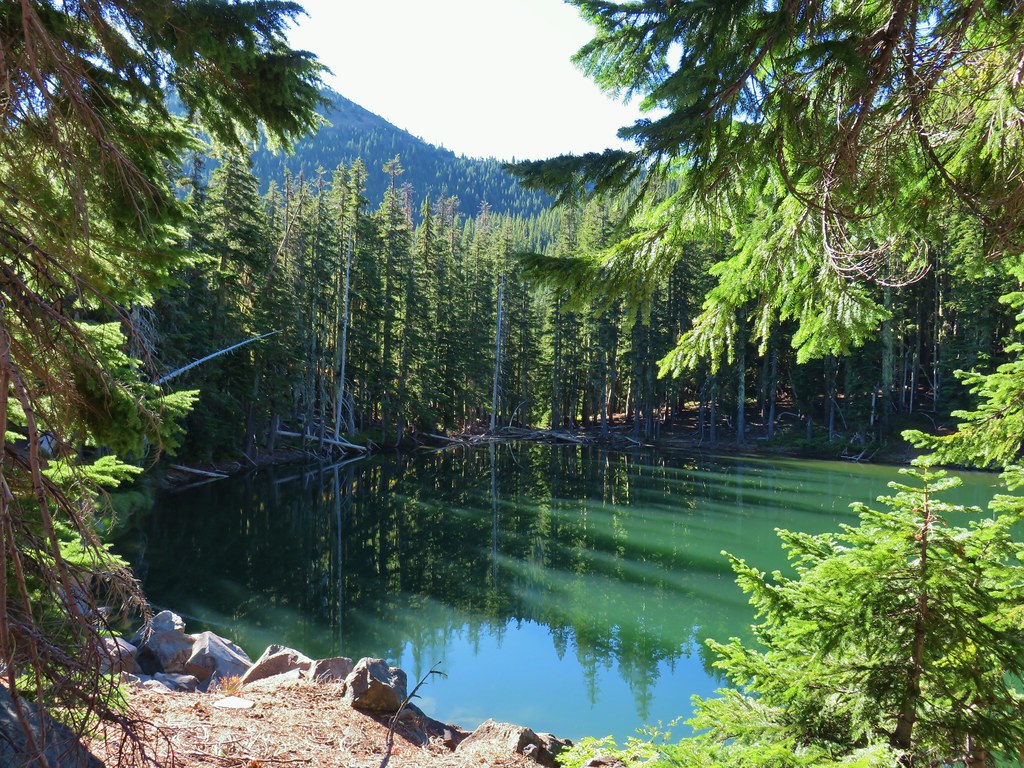
IMG_1646

After picking our way across the rocks we arrived at the lakes dry outlet creek. It was here that we could see where we’d made our mistake. The Cabot Lake Trail continued on the other side of a downed tree after sharing tread briefly with the Jefferson Lake Trail. It also didn’t follow the lake shore but instead veered away from the lake on the opposite side of a ridge. The trail then began to regain much of the elevation it had lost on its way down to Patsy Lake.
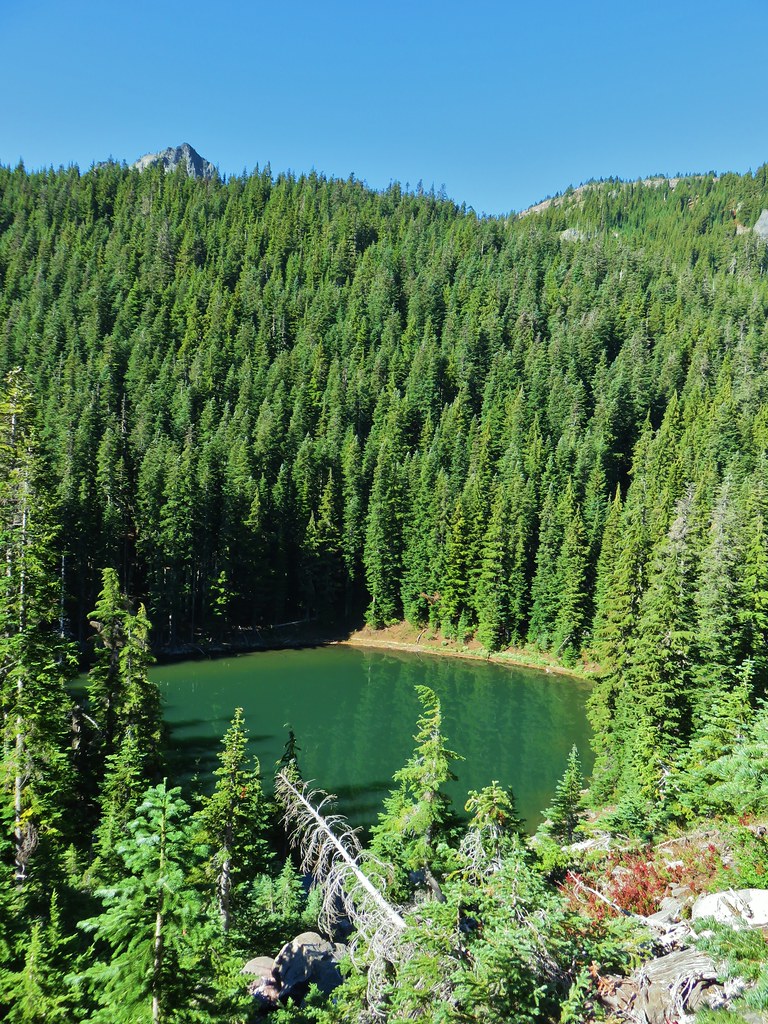
IMG_1649

IMG_1652The Jefferson Lake Trail used to come up this valley.

The trail leveled out again this time passing through a series of alpine meadows and over dry creek beds.
IMG_1656

IMG_1657

We were keeping our eyes open for the unofficial trail in case we decided on returning via the loop option which was what we were leaning towards. Approximately .6 miles from the trail junction at Patsy Lake we spotted what appeared to be a trail leading off into a meadow to the west.
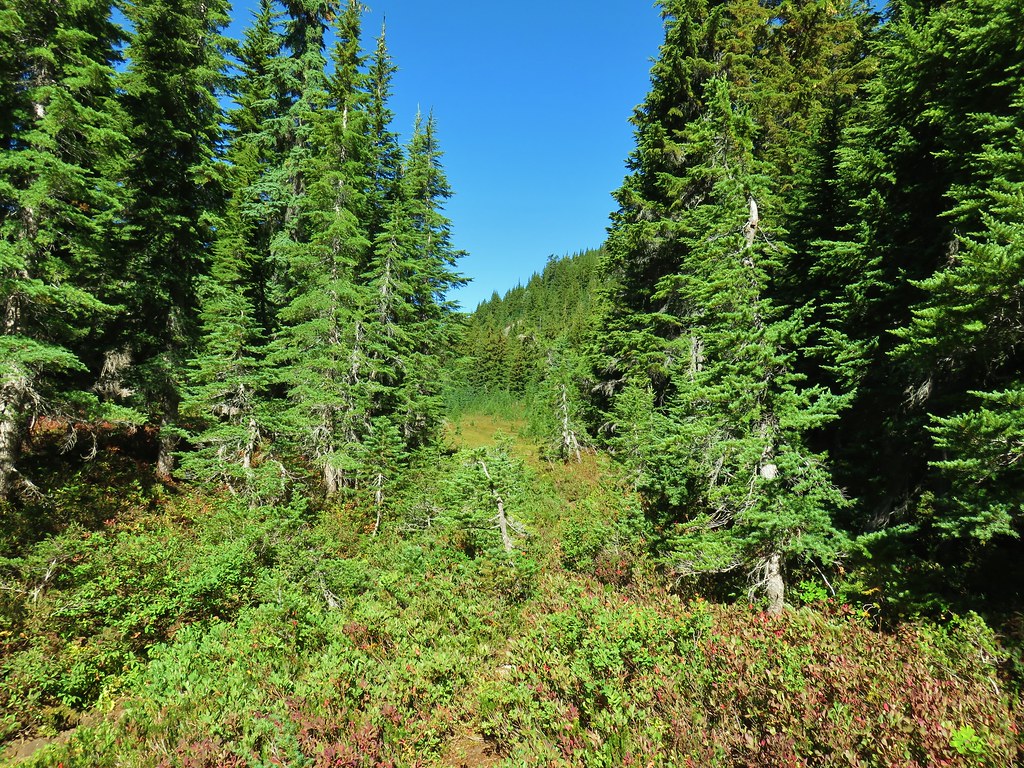
IMG_1660

I marked that spot on our GPS so that we wouldn’t miss it on the way back. A short distance later Heather spotted a second possible trail heading off toward that same area. We had forgotten to bring a copy of Reeder’s GPS track with us so we couldn’t be sure which one was correct, but we had memorized his route description so we knew if we aimed between a cinder cone and The Table we should be okay. The Table is an unmistakable large plateaued feature south of Mt. Jefferson.
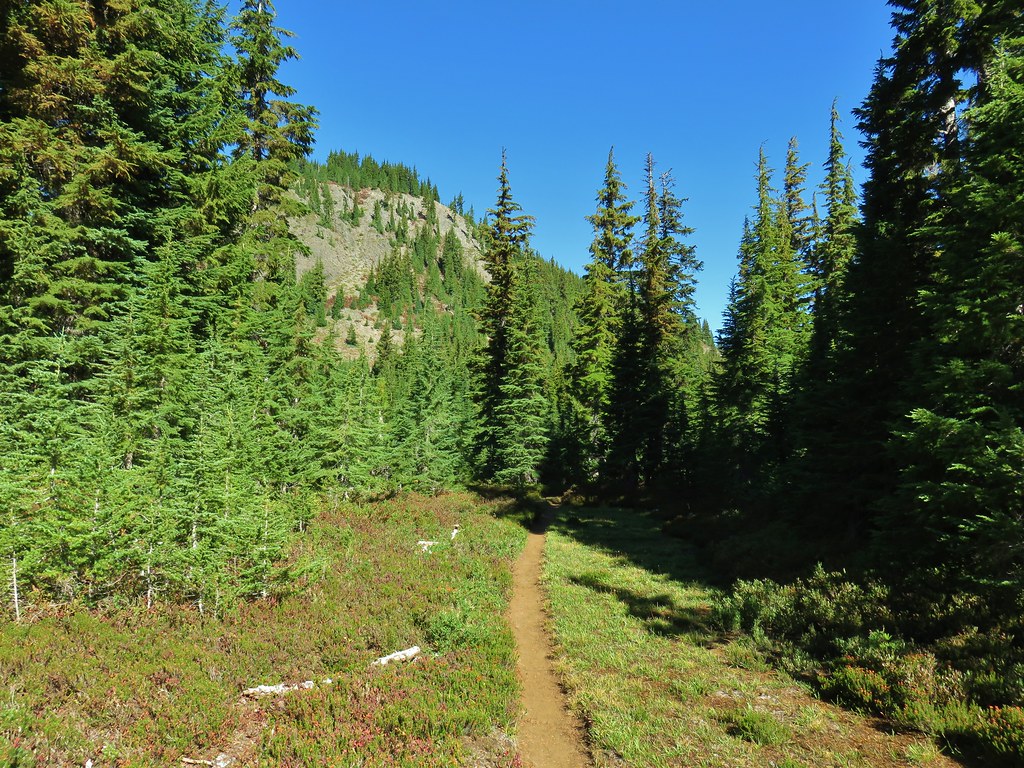
IMG_1661The end of The Table to the left of the trail.

The trail descended a bit as it passed by The Table on its way down to Table Lake.
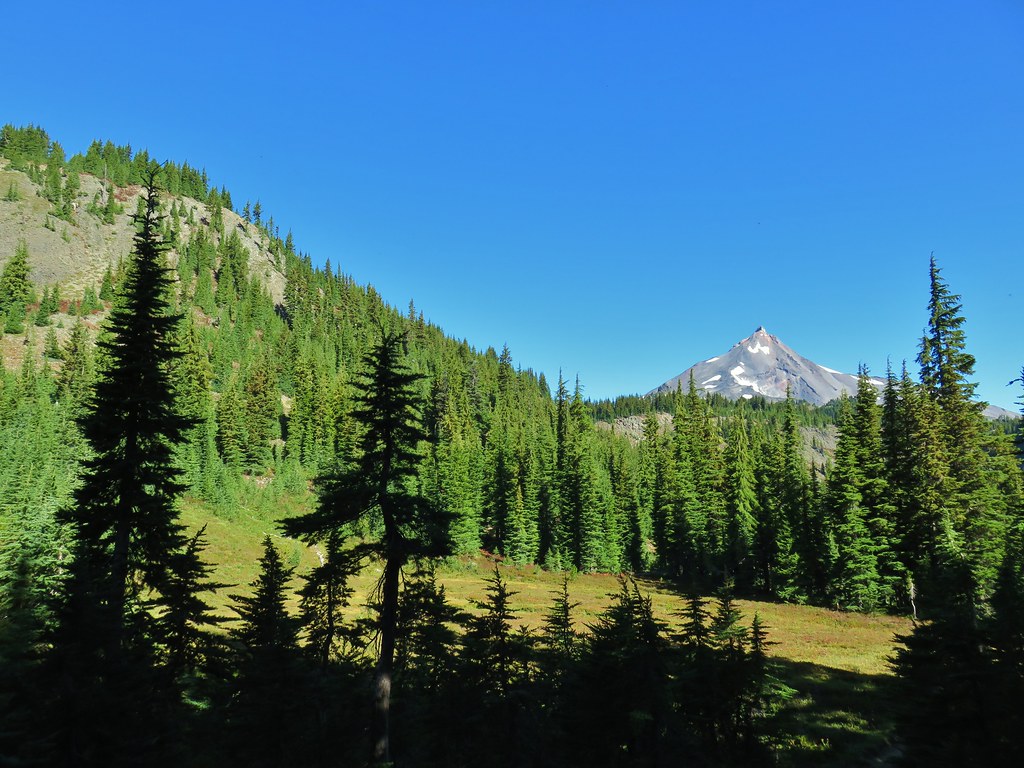
IMG_1664

Our first look at Table Lake confirmed that this was going to be another nice one.
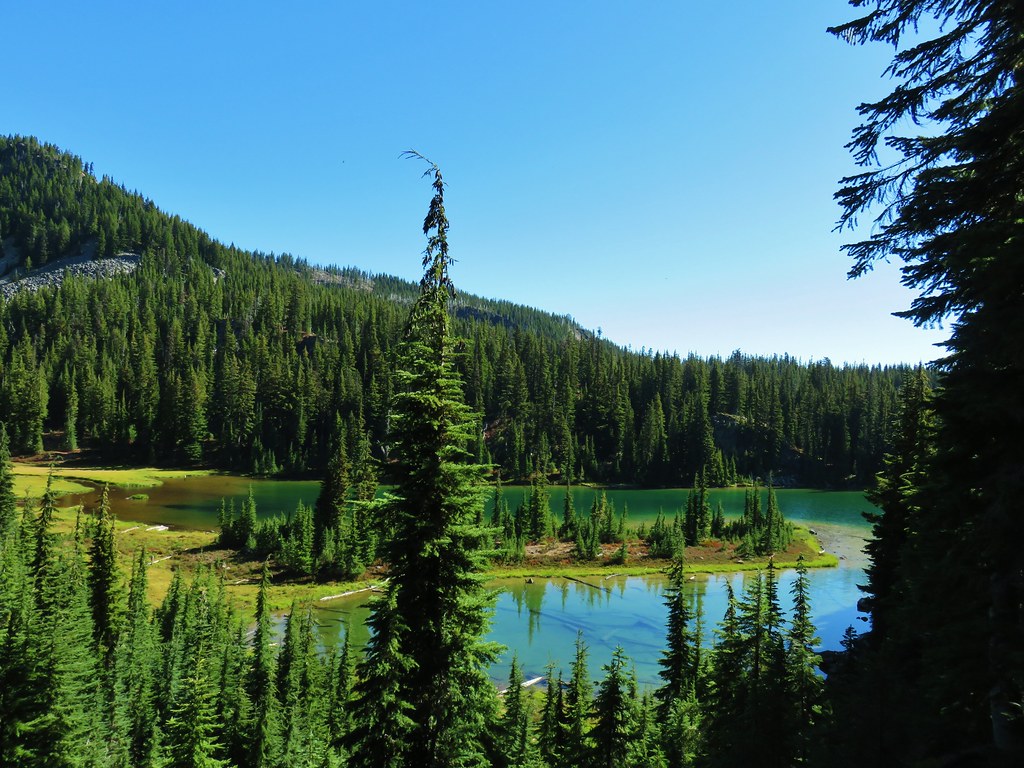
IMG_1666

We passed a backpacker who had stayed at the lake the night before and was now heading to Carl Lake. She told us where to find a view of Mt. Jefferson from the lake so we made our way to the spot she had suggested.
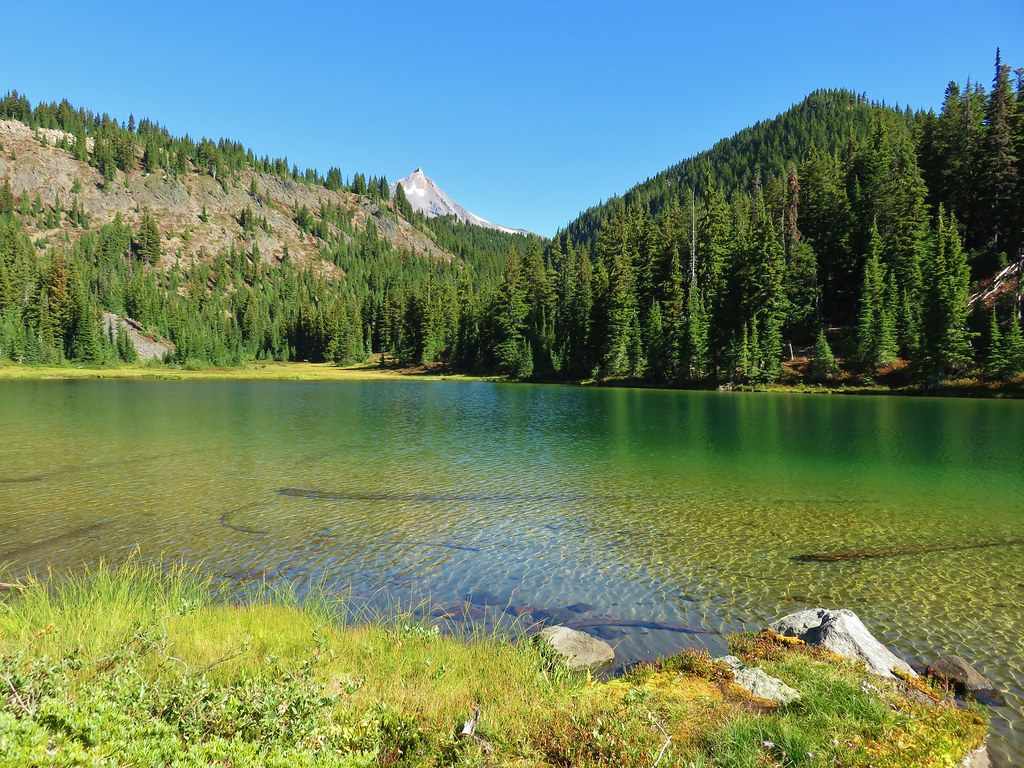
IMG_1669

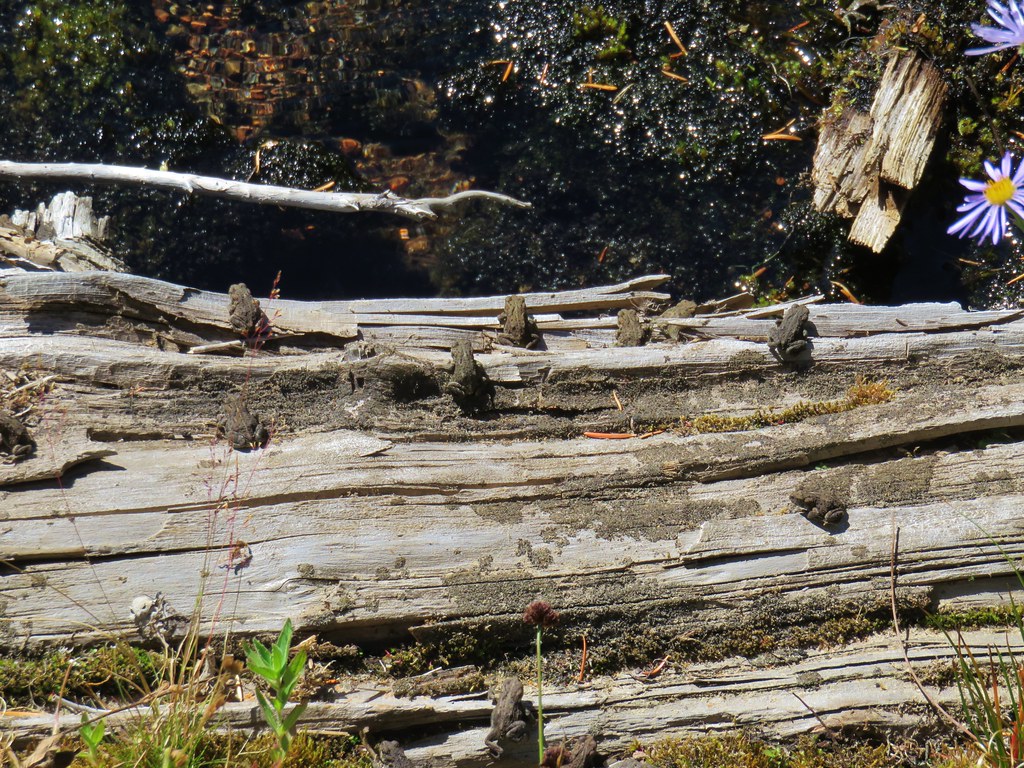
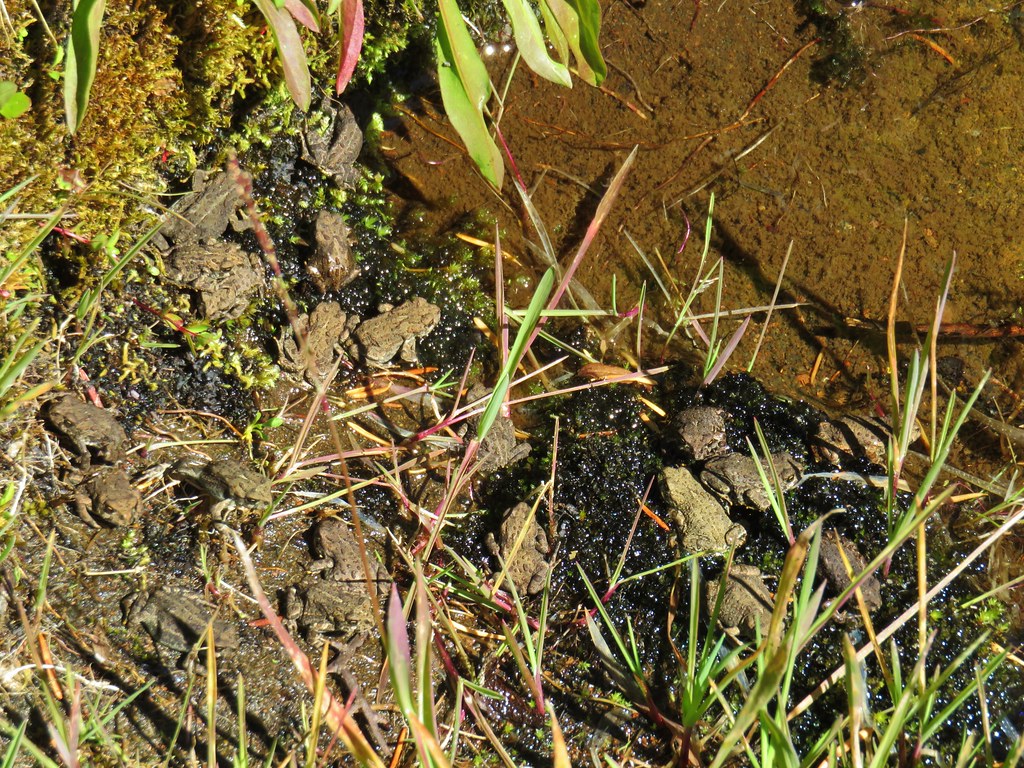
After checking out the viewpoint we continued along the Cabot Lake Trail crossing above a spring feeding into the lake and then an inlet creek where we had to watch our step due to the presence of hundreds of little frogs.
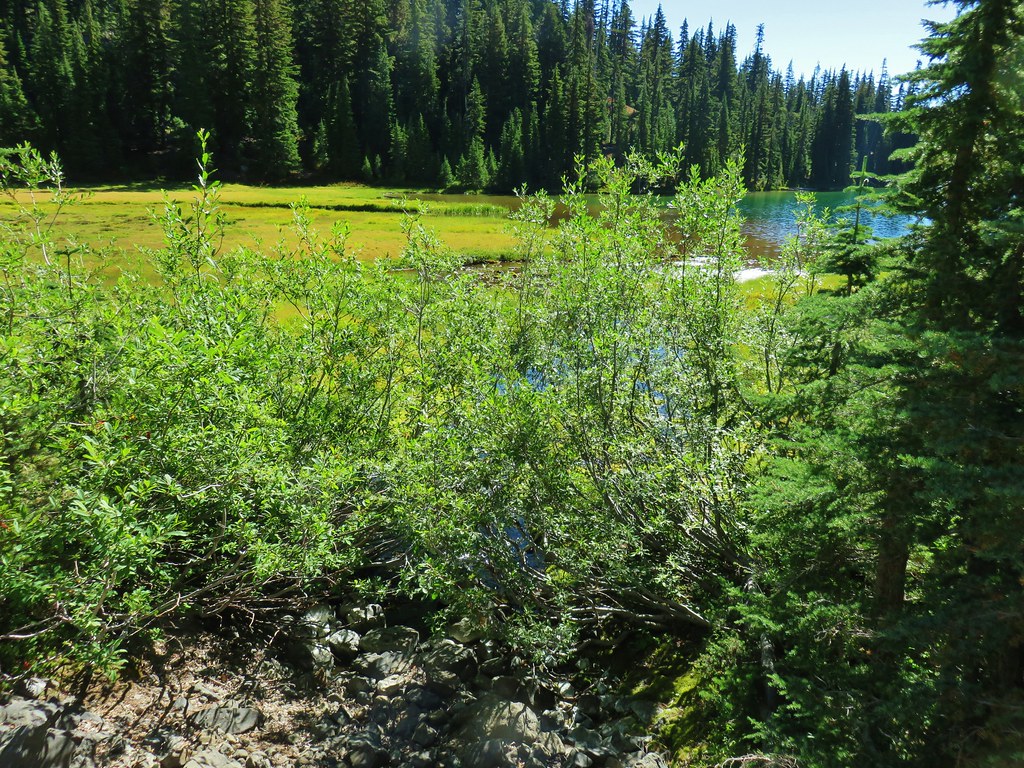
IMG_1680

IMG_1682

IMG_1764

After crossing over the creek we decided to try to make our way back to a smaller unnamed lake shown on the map which the creek flowed out of.
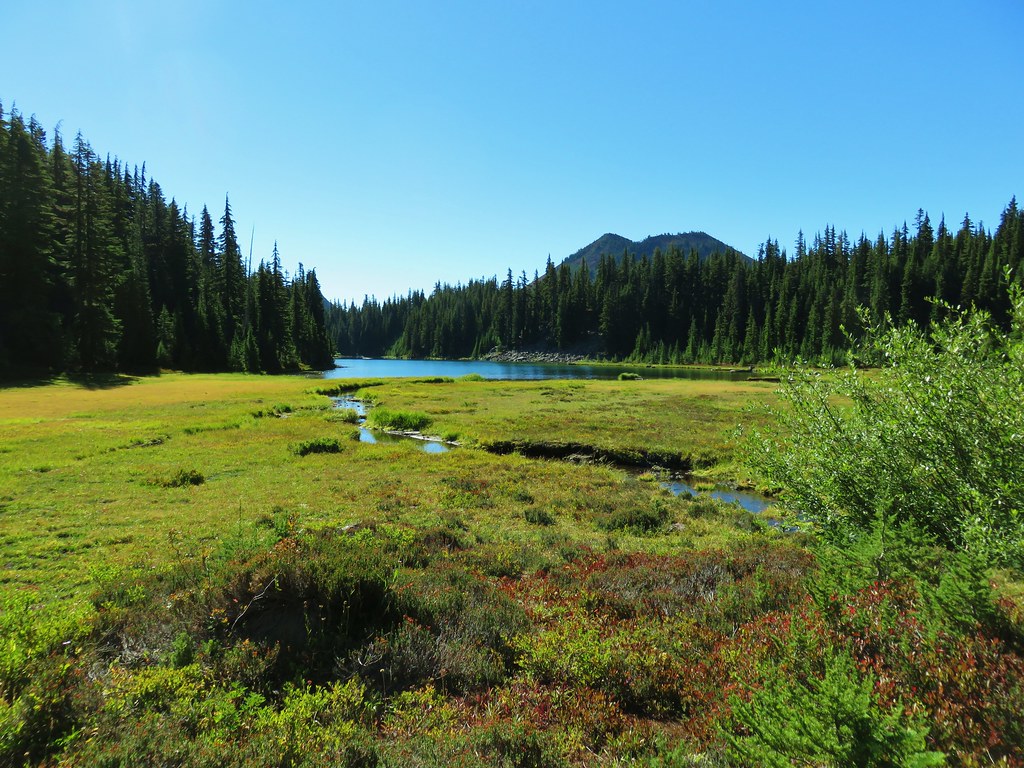
IMG_1685Table Lake and Forked Butte

We followed a clear path past a large campsite and along the creek for a bit (Watch out for frogs!) then came to a wall of small pine trees. It took a little effort to get through the thicket of trees but the reward was worth it.
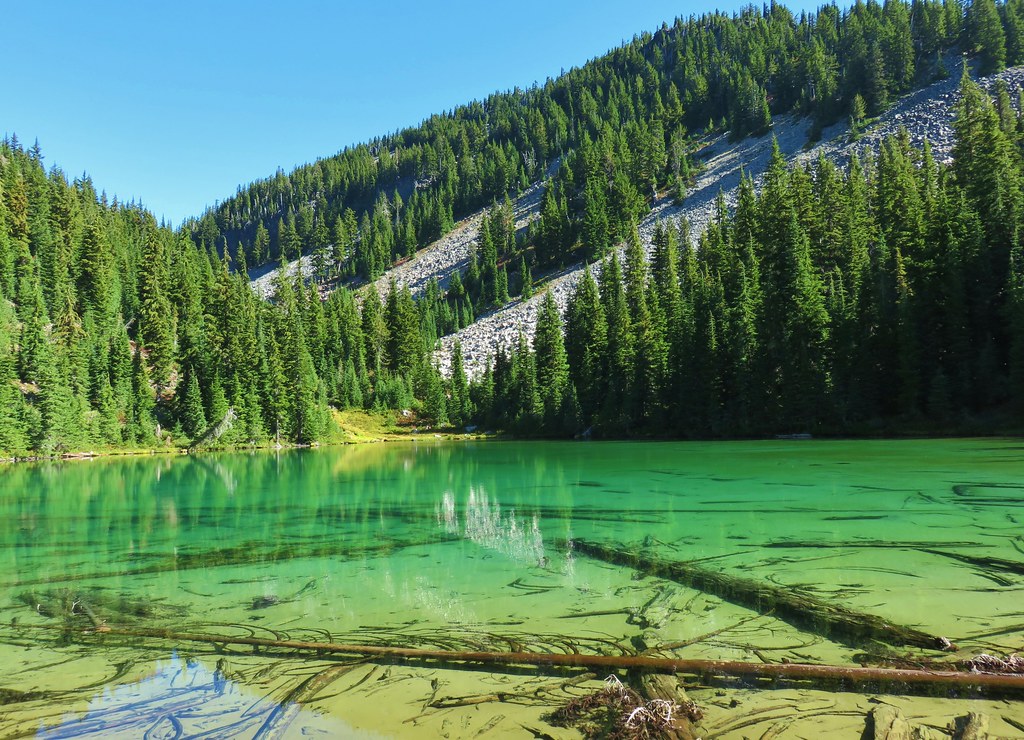
IMG_1686

With no where to sit along this lake we headed back toward Table Lake and picked up the Cabot Lake Trail which we followed to a sign apparently marking the current “end” of the trail.
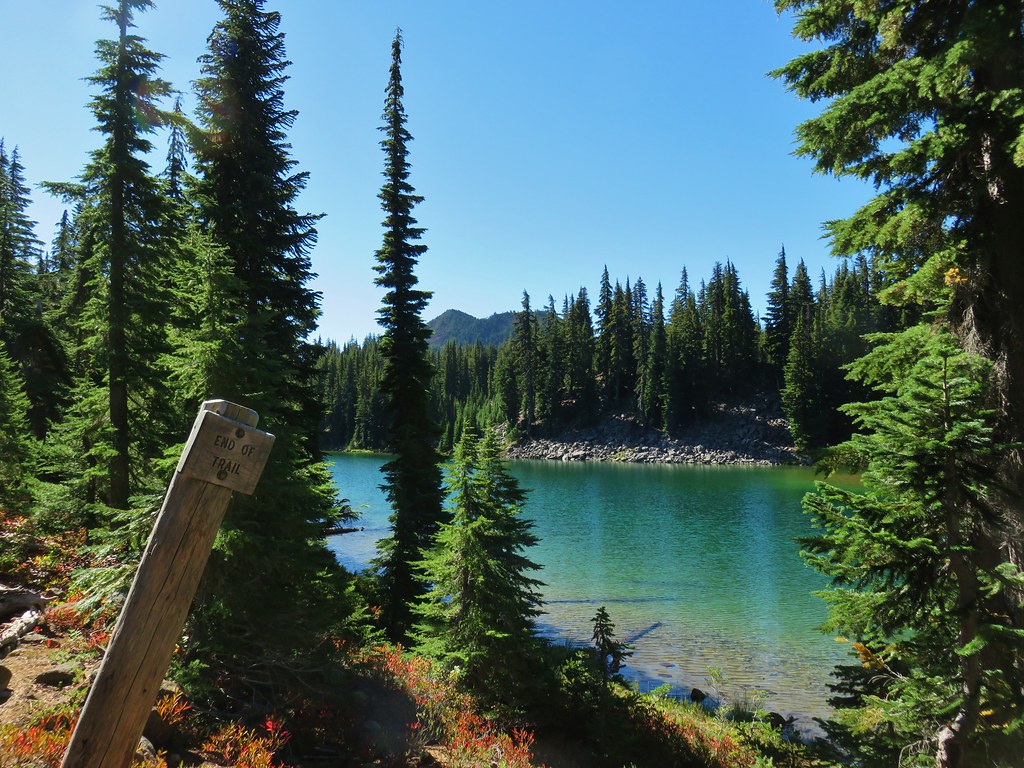
IMG_1693

If the Forest Service has indeed abandoned the remainder of the trail it would be shame. The final portion of the trail down to Hole-in-the-Wall Park has been lost for years since the B & B Fire but we hadn’t heard that they had given up on the section between Table Lake and the viewpoint below Bear Butte.

In any case we continued on to a rock outcrop above Table Lake where we took a snack break.
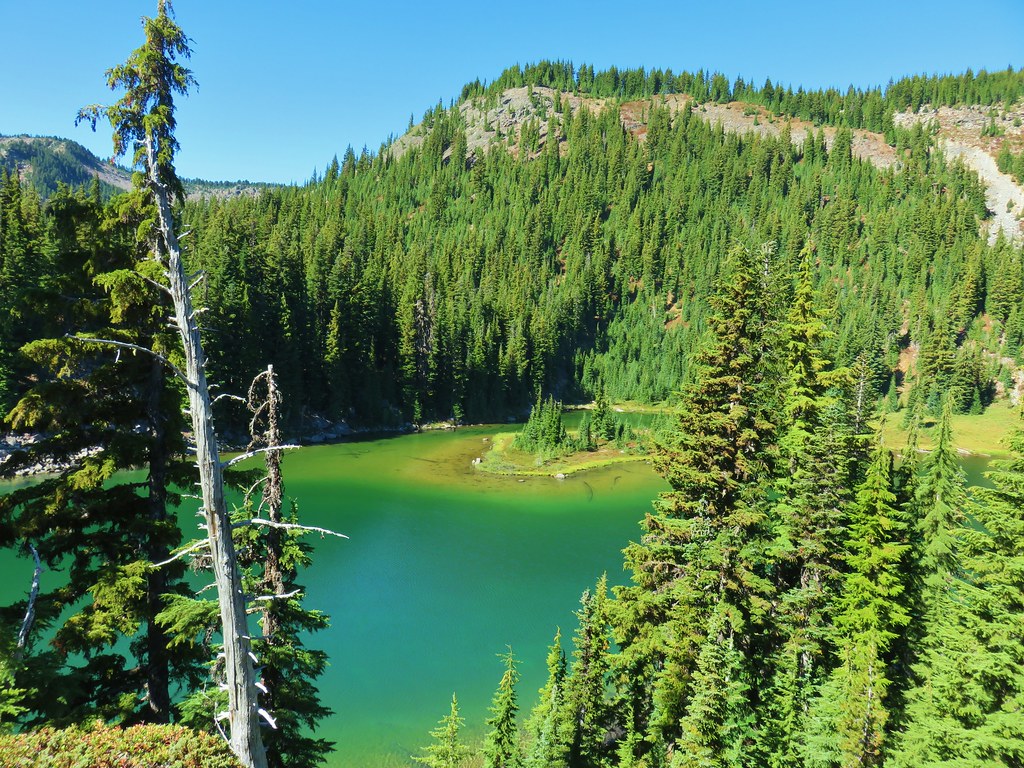
IMG_1695

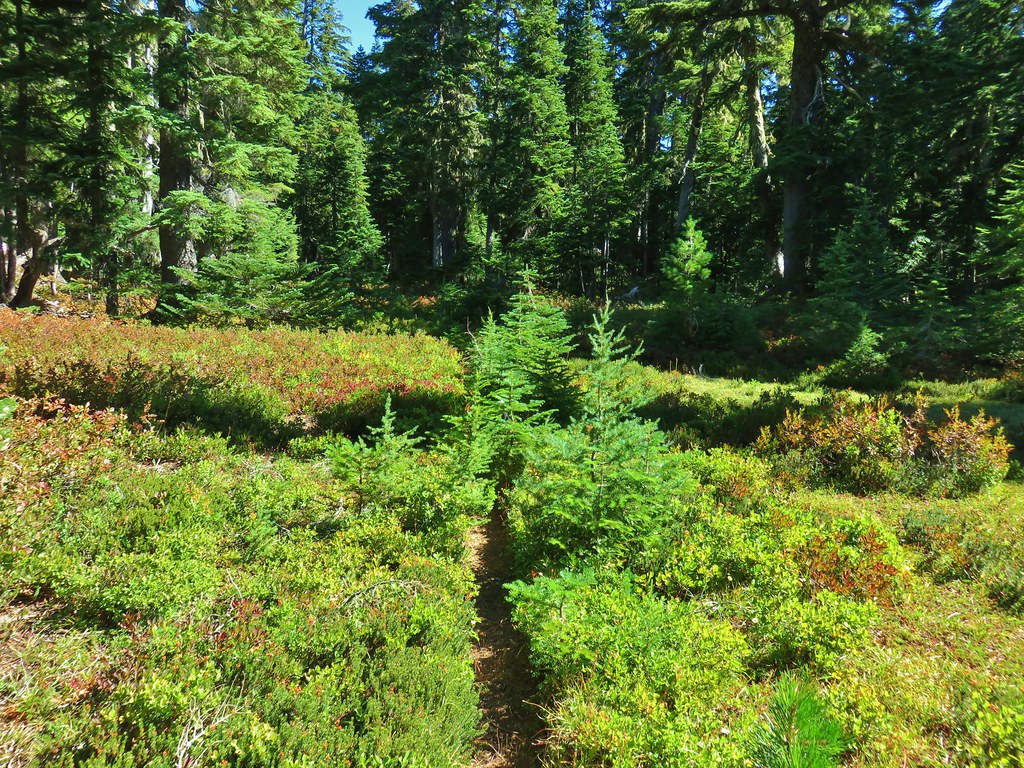
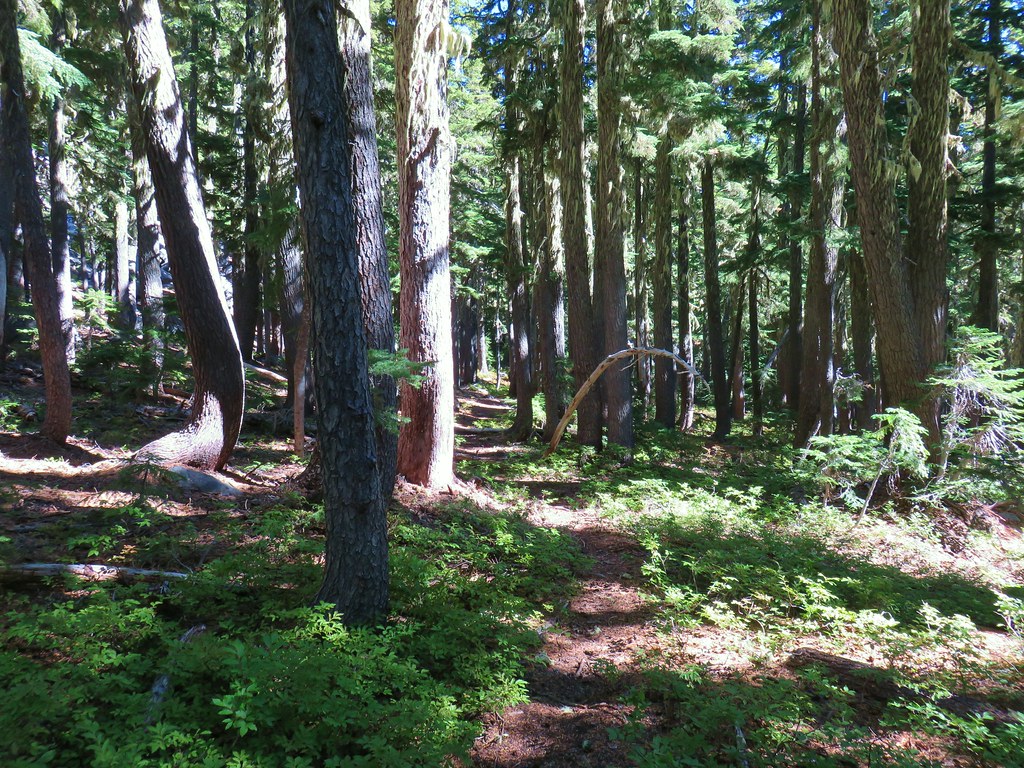
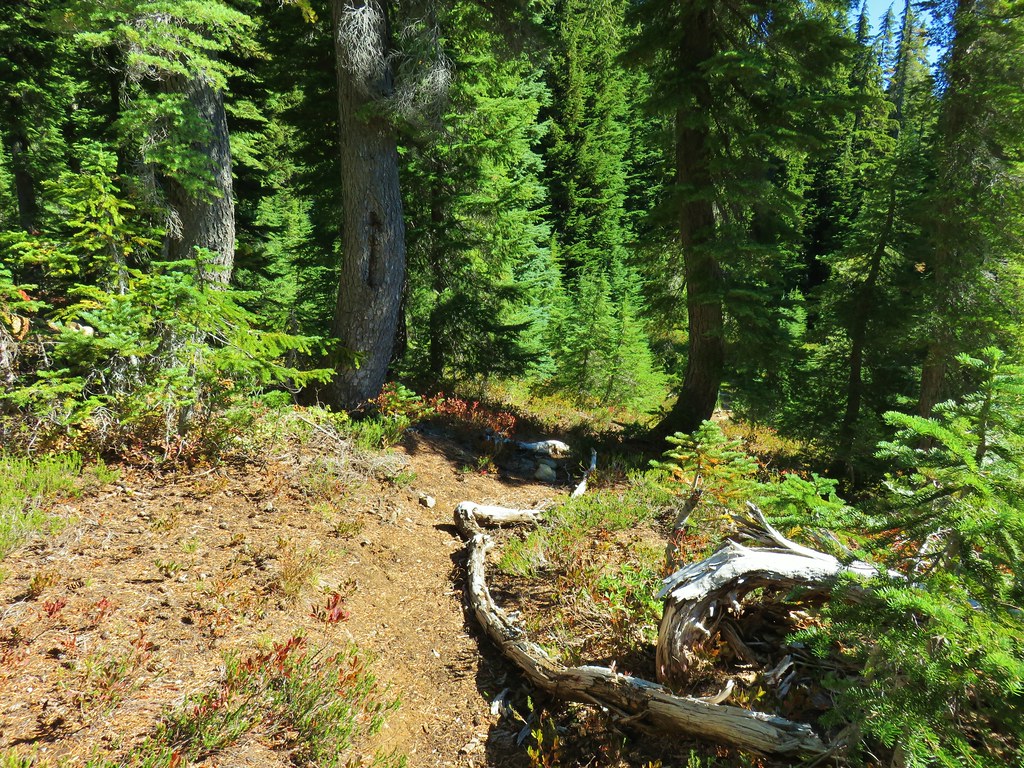
From Table Lake the trail climbed gradually save for about 100 yards of switchbacks after three quarters of mile. The trail was a little crowded with brush and had a few downed trees over it but nothing too challenging as it passed through a mix of meadows, trees, and huckleberry bushes.
IMG_1698

IMG_1700

IMG_1704

IMG_1705

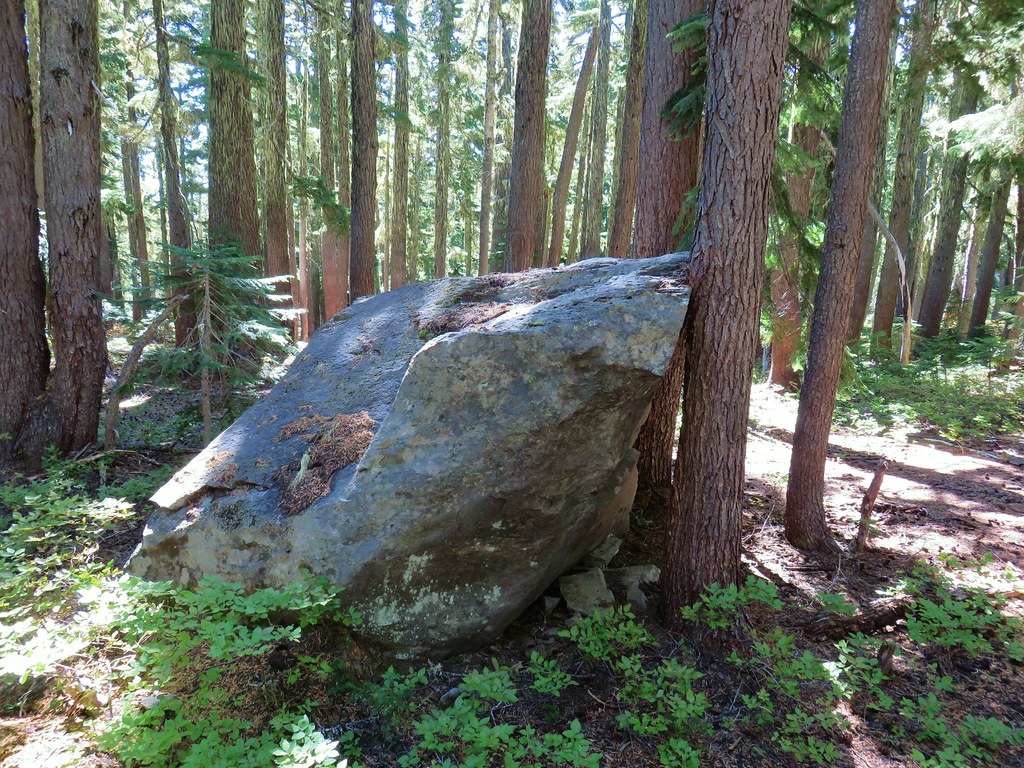
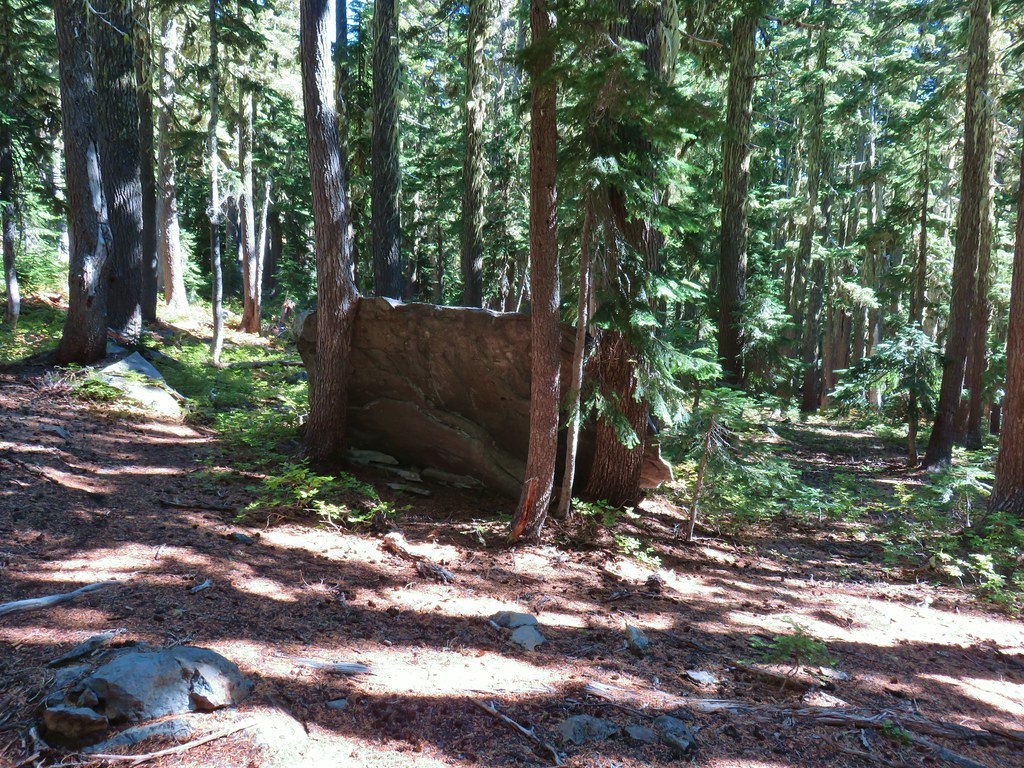
Shortly before the switchbacks the trail passed a large boulder leaning up against a pair of trees. It looked like the rock was going to be flat and thin from the direction we were coming but it turned out to not be flat on the other side at all.
IMG_1707

IMG_1708

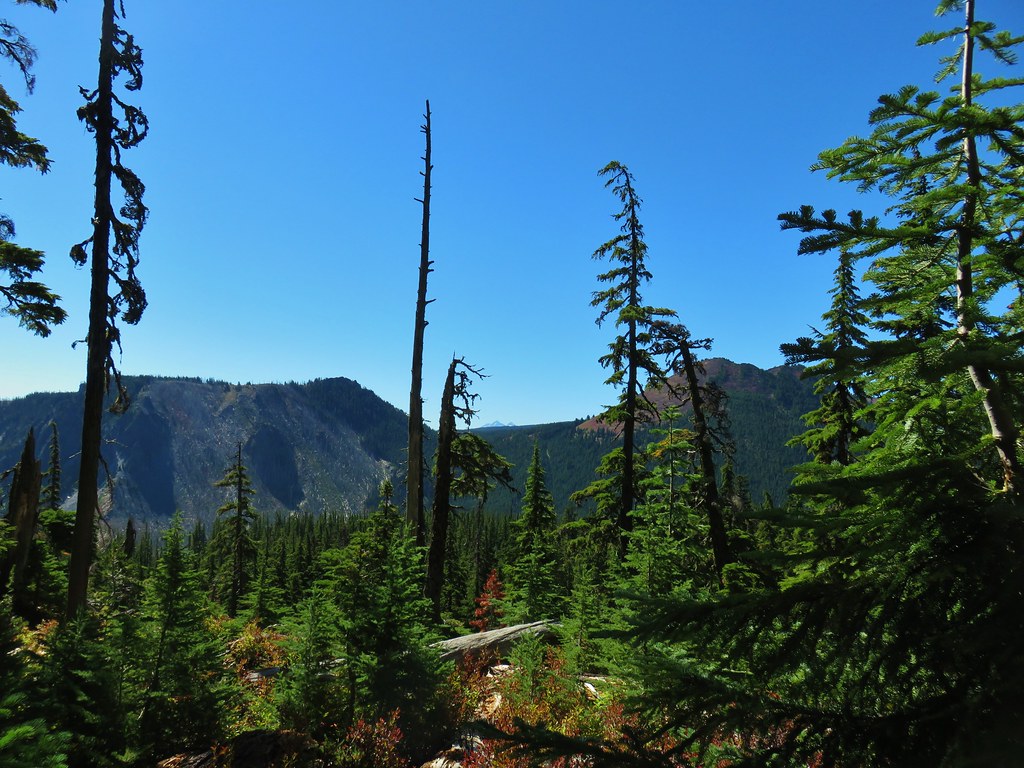
Beyond the switchbacks the trail leveled out again for about a quarter mile with a view south of the Three Sisters in a gap between Sugar Pine Ridge and Forked Butte.
IMG_1710

IMG_1712

After the quarter mile of more level trail the Cabot Lake Trail headed steeply up a gully arriving at a saddle with a view of Mt. Jefferson after another quarter mile.
IMG_1715

IMG_1717

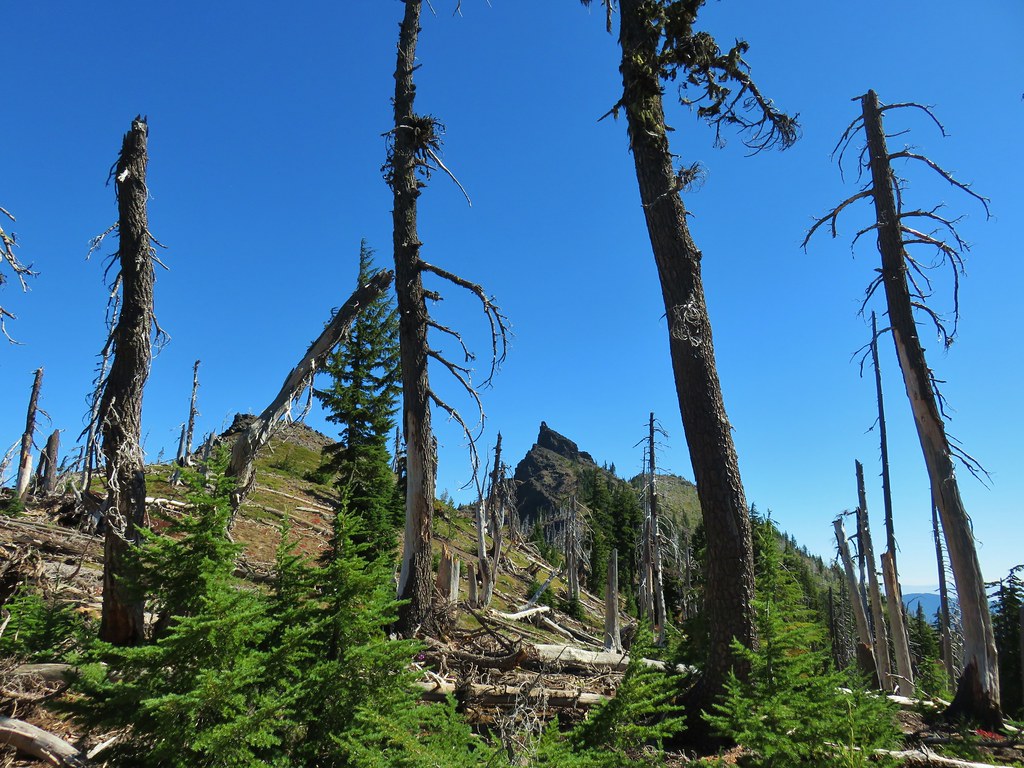
The viewpoint that we were aiming for was to the right of the saddle visible atop the ridge below pointy Bear Butte.
IMG_1718

A straight forward cross country walk brought us to the top of the rocky outcrop.
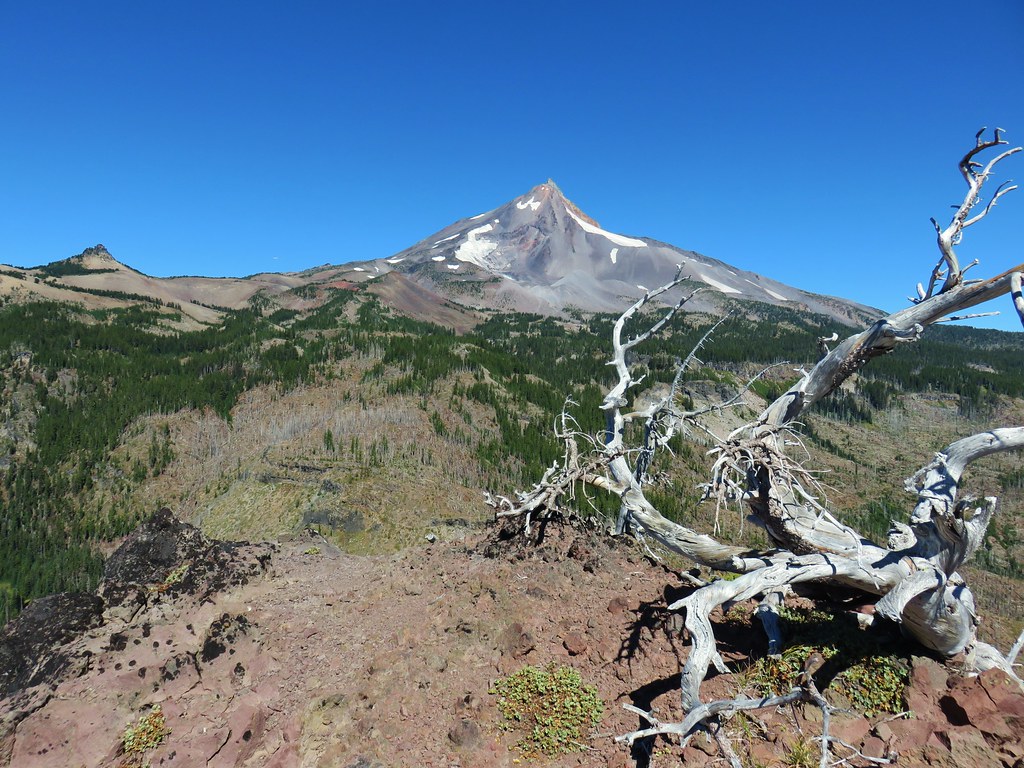
IMG_1730

The view of Mt. Jefferson was spectacular. In the valley below was green Hole-in-the-Wall Park with Mt. Jefferson on the other side. Along the ridge to the left of Mt. Jefferson was Goat Peak, a feature we are hoping to visit someday in the future.
IMG_1732

IMG_1736

IMG_1742

IMG_1740

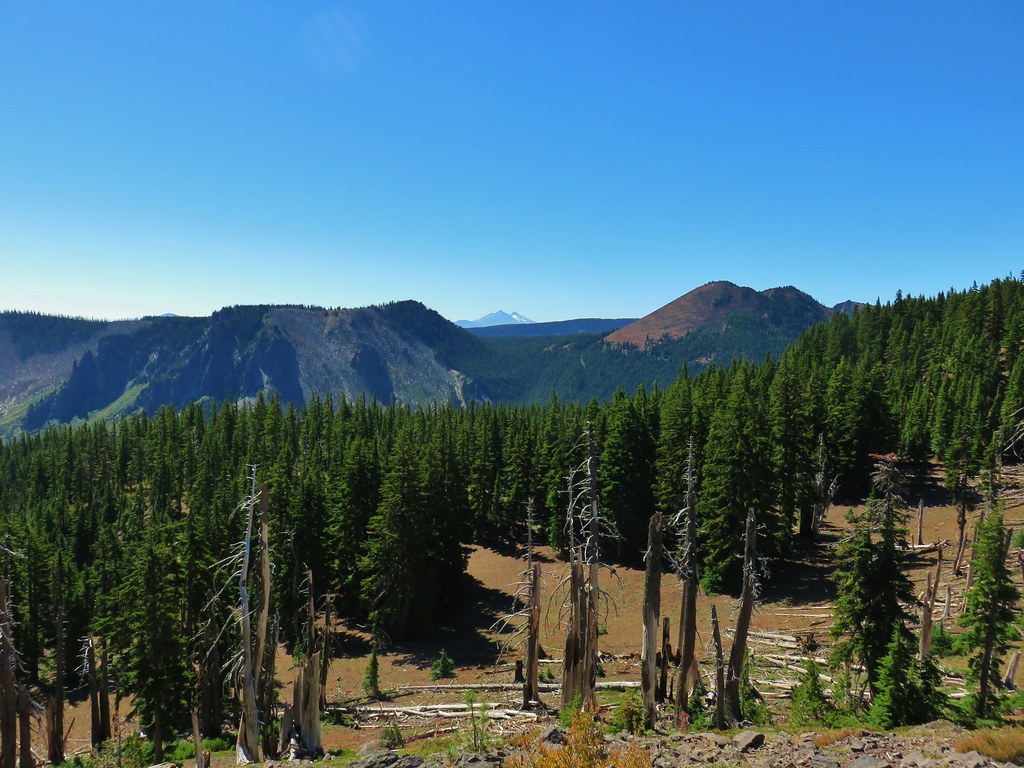
The view south wasn’t too bad either despite the presence of a little haze.
IMG_1725

IMG_1726

To the east was Bear Butte.
IMG_1721

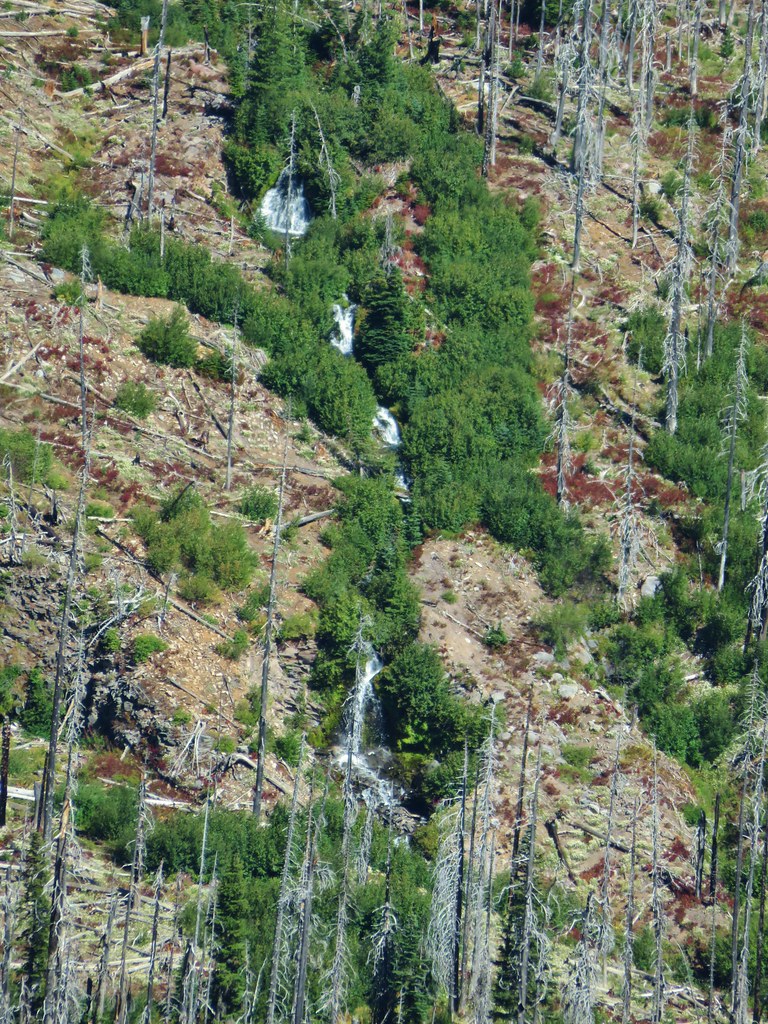
To top it off the sound of crashing water filled the air. Heather spotted the series of cascades creating all the noise well before I did.
IMG_1754

After soaking in the view we returned down to the saddle and sat in the shade of some trees while we had another bite to eat. We then hiked the 1.5 miles back down to Table Lake and refilled our water supply from the inlet creek where there was clearly a frog convention occurring.
IMG_1772

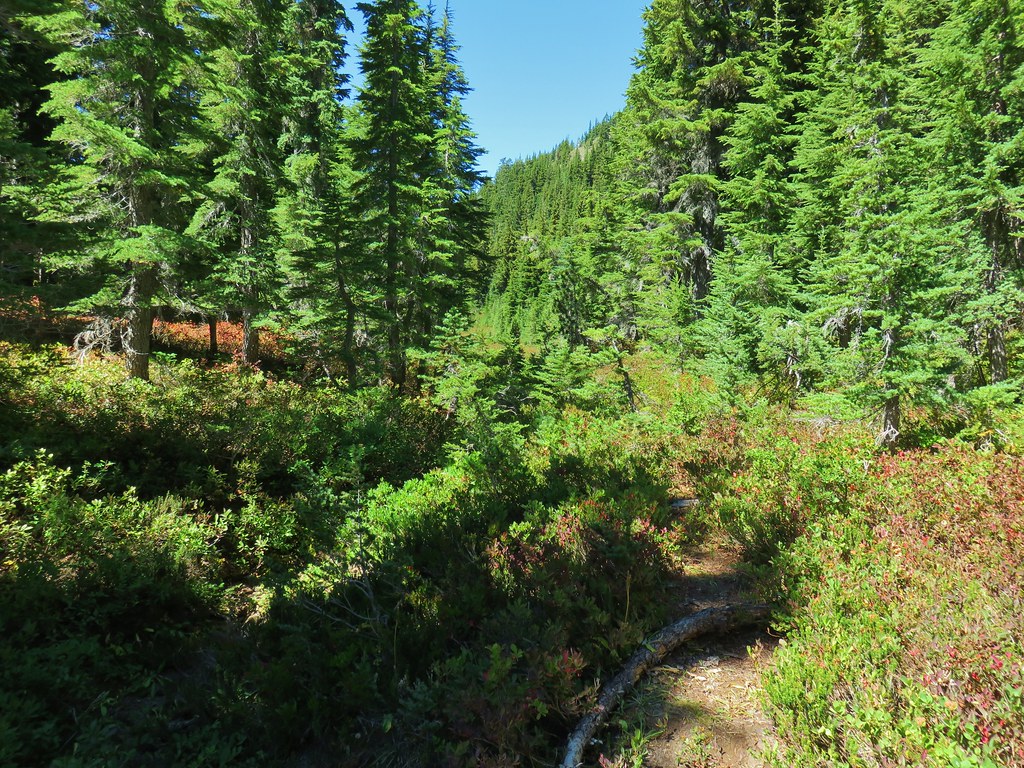
With our water replenished we left Table Lake and hiked back along the Cabot Lake Trail approximately a quarter mile to the side trail we had marked earlier.
IMG_1779

As I previously mentioned there was another side trail that probably would have been the better option about 30 yards north of where we turned. The trail we chose started clearly enough but soon was lost in a meadow.
IMG_1783

IMG_1785

We knew from the description in the guidebook that the trail passed between a cinder cone and The Table so we just headed in that direction and were able to once again locate an obvious path.
IMG_1786

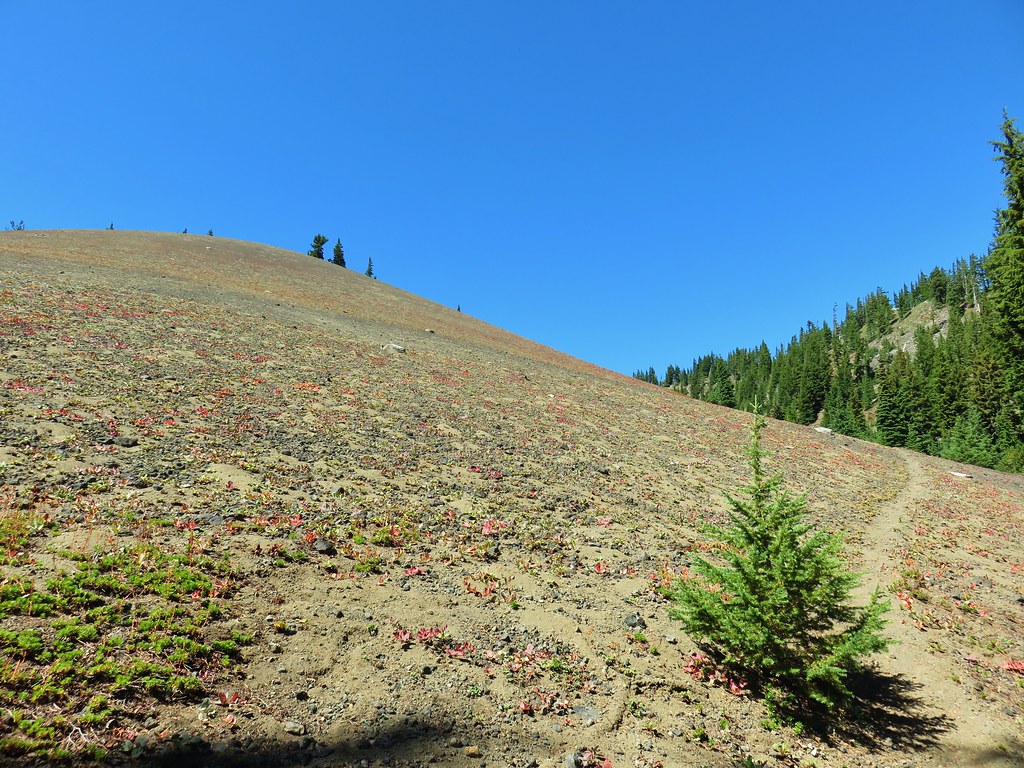
As we neared the cinder cone the trail climbed up along its side as it squeezed between the cone and the rocky hillside of The Table.
IMG_1790

IMG_1797

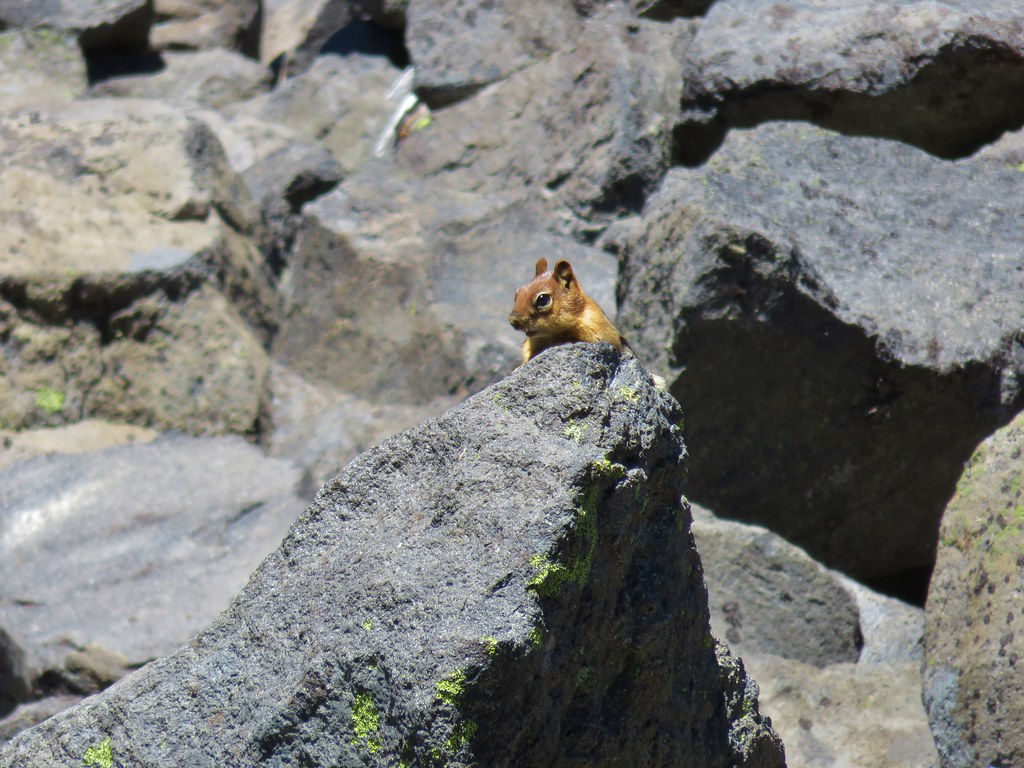
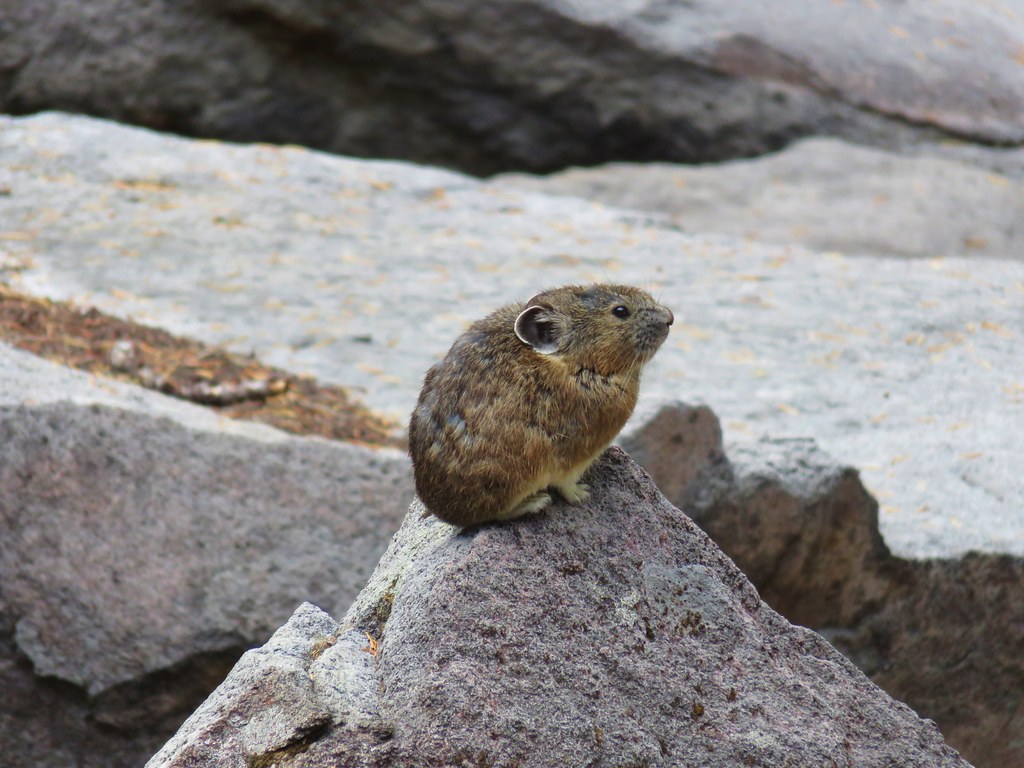
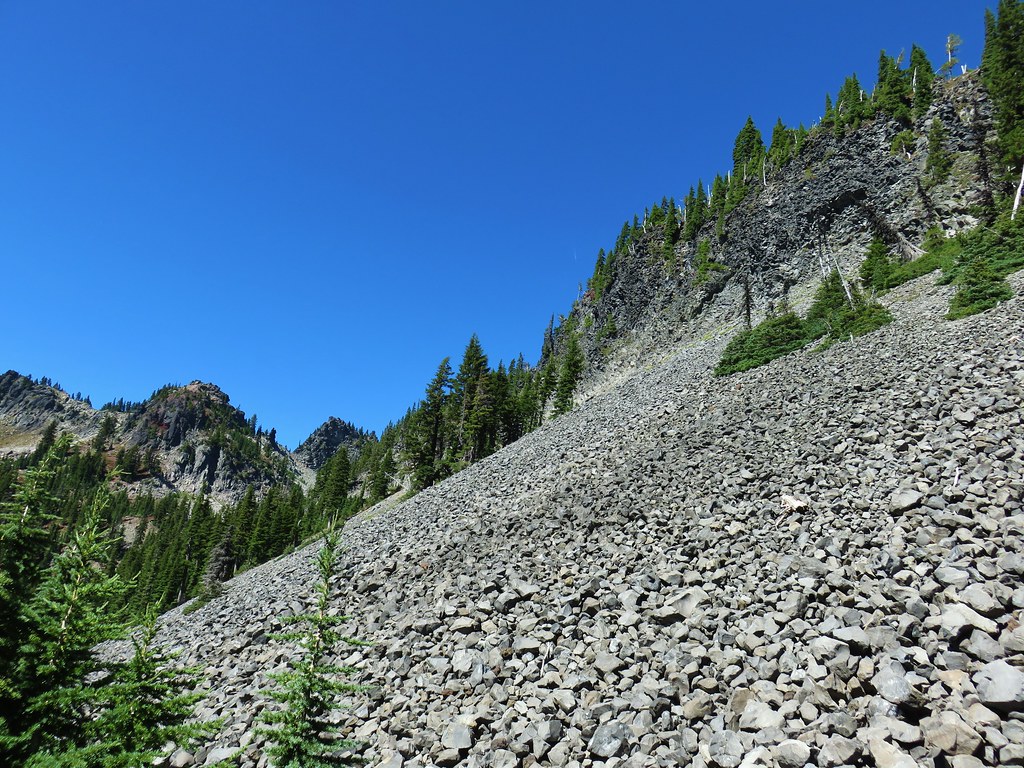
This area looked like it should be full of pikas and although we heard a few “meeps” that let us know they were there, all we spotted were golden-mantled ground squirrels and chipmunks.
IMG_1802

IMG_1800

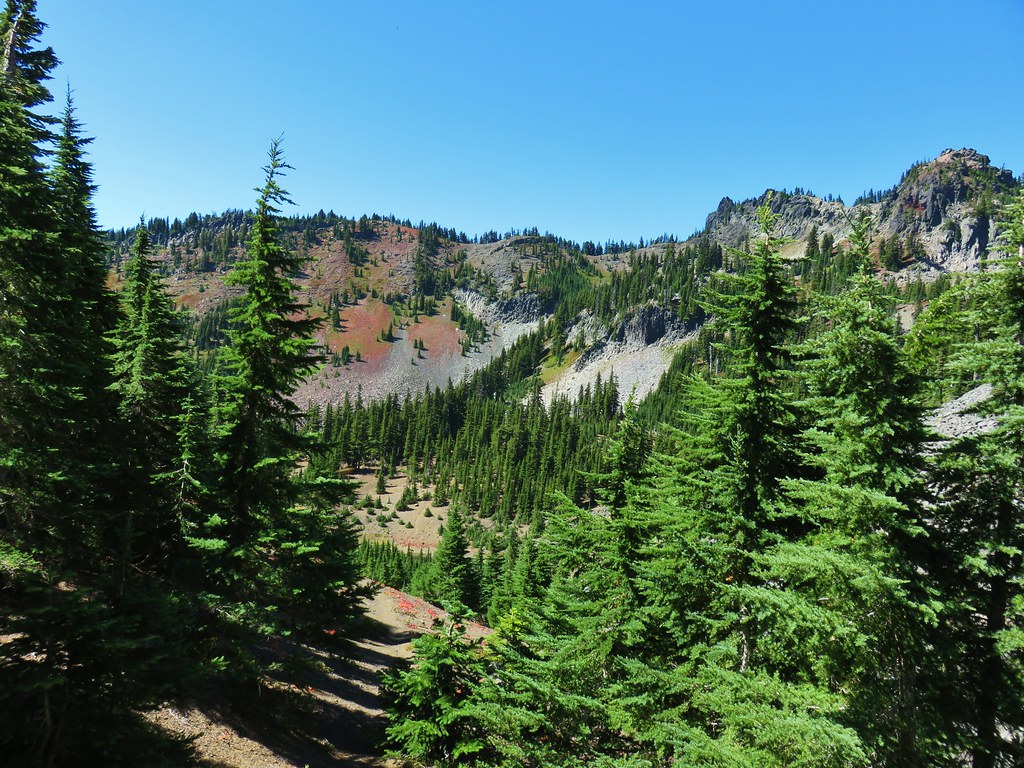
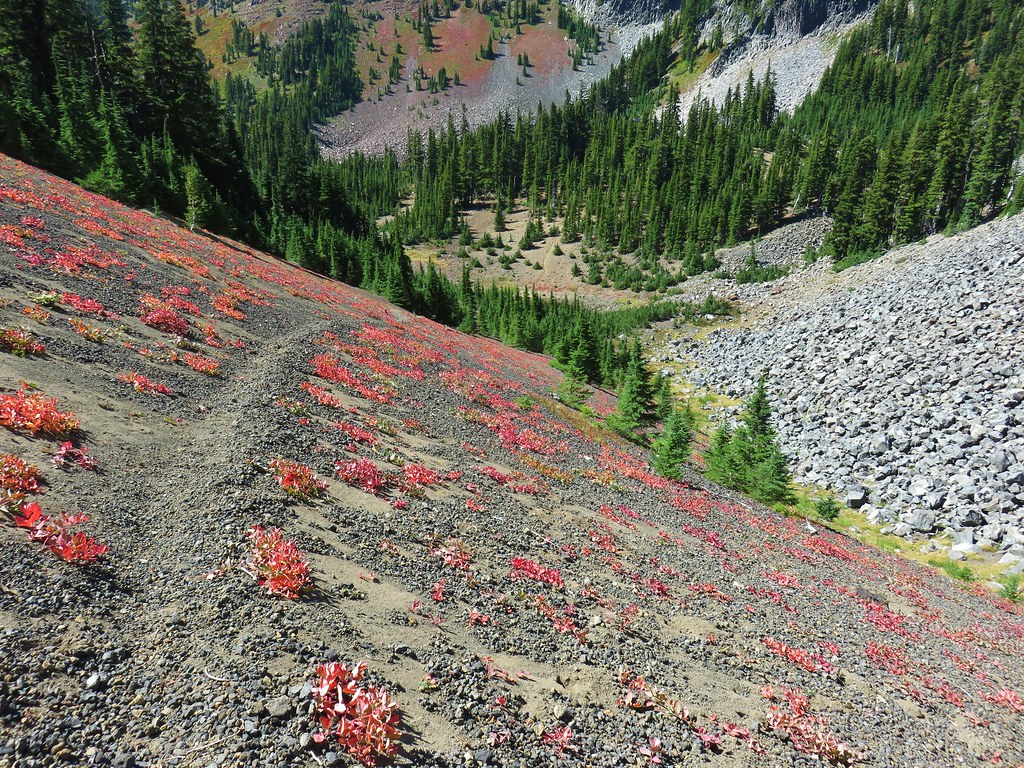
As the trail passed by the cinder cone views ahead opened up to a large valley below the Cathedral Rocks.
IMG_1804

All the climbing along the side of the cinder cone was now lost as we dove downhill into the valley.
IMG_1806

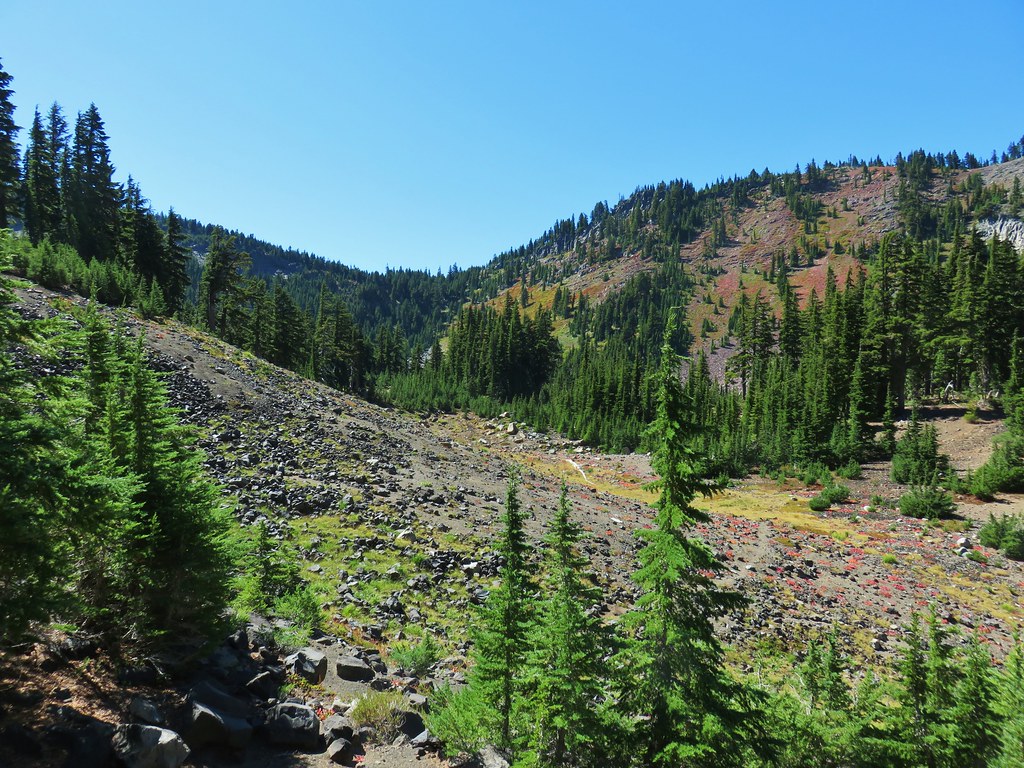
The GPS track we’d seen showed the trail passing to the left of two ponds then to the right of a third in this area. The tread was fairly easy to follow here and there was at least one recent set of shoe prints leading the way.
IMG_1808

IMG_1809First pond on the right.

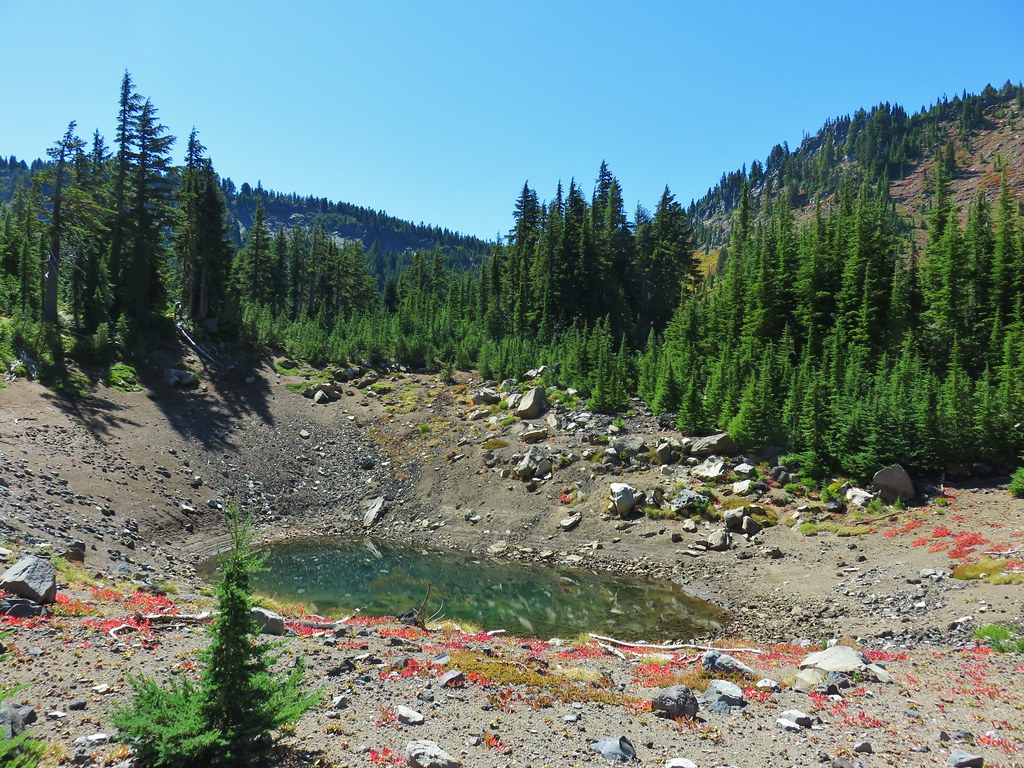
The traverse around the second pond was a little tricky. The cinder hillside was loose and sharply angled and there was no clear trail around to the left save for at the far end.
IMG_1812

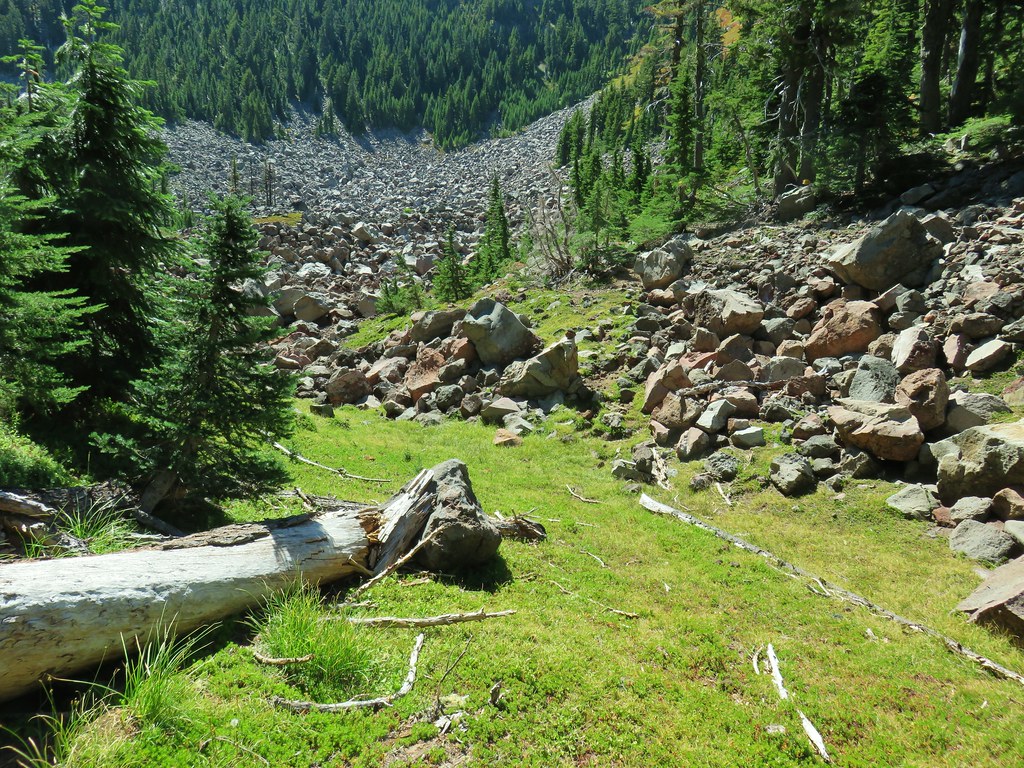
It may have been a better option to have gone around on the other side but we managed to make it around the second pond and then the trail dropped into a dry creek bed where the tread disappeared. Fortunately someone had placed a small cairn on the other side though so we knew where to exit.
IMG_1814

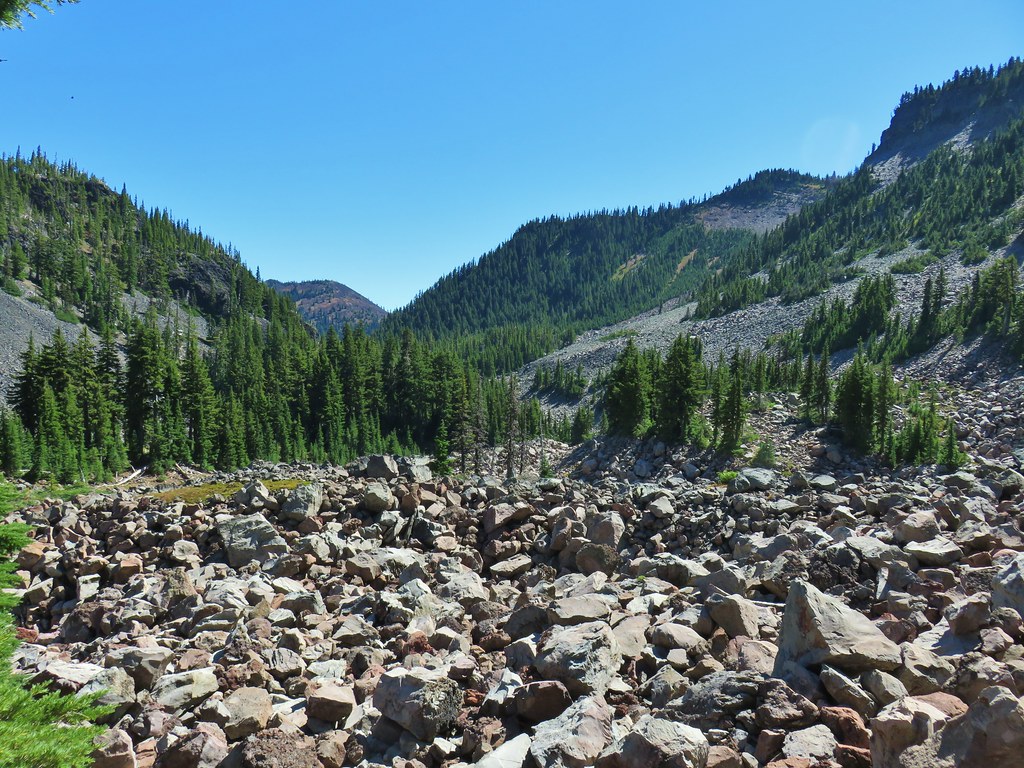
The trail was now passing along the left hand side of an enormous rock field.
IMG_1816

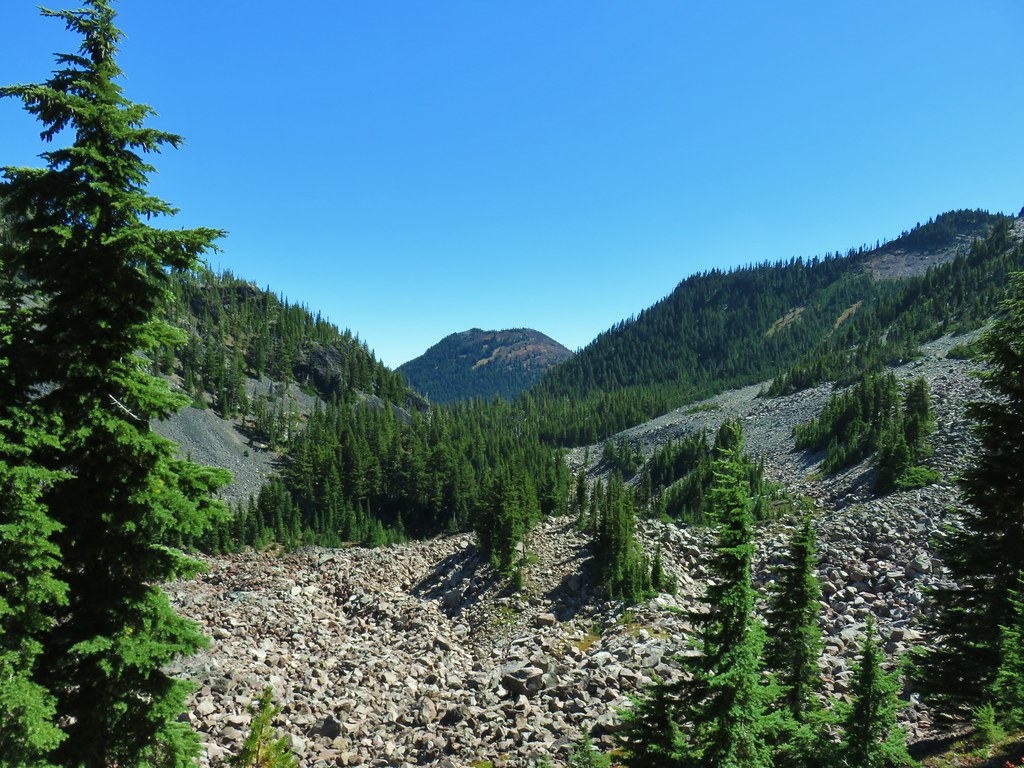
Keeping track of the actual route here was near impossible but we kept our eyes out for cairns and footprints which were just frequent enough to keep us on track until we found the clear path again entering a hillside of huckleberry bushes.
IMG_1817

IMG_1821

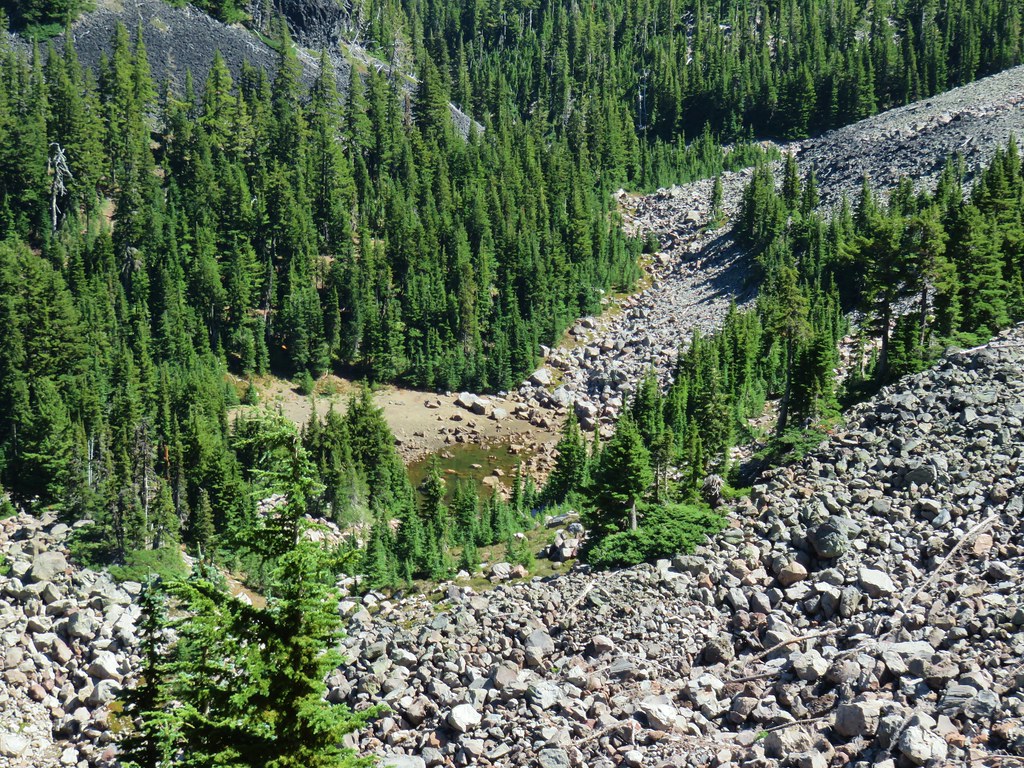
It wasn’t until we had climbed a bit above the rock field that we were able to spot the third pond that had been on our left.
IMG_1827

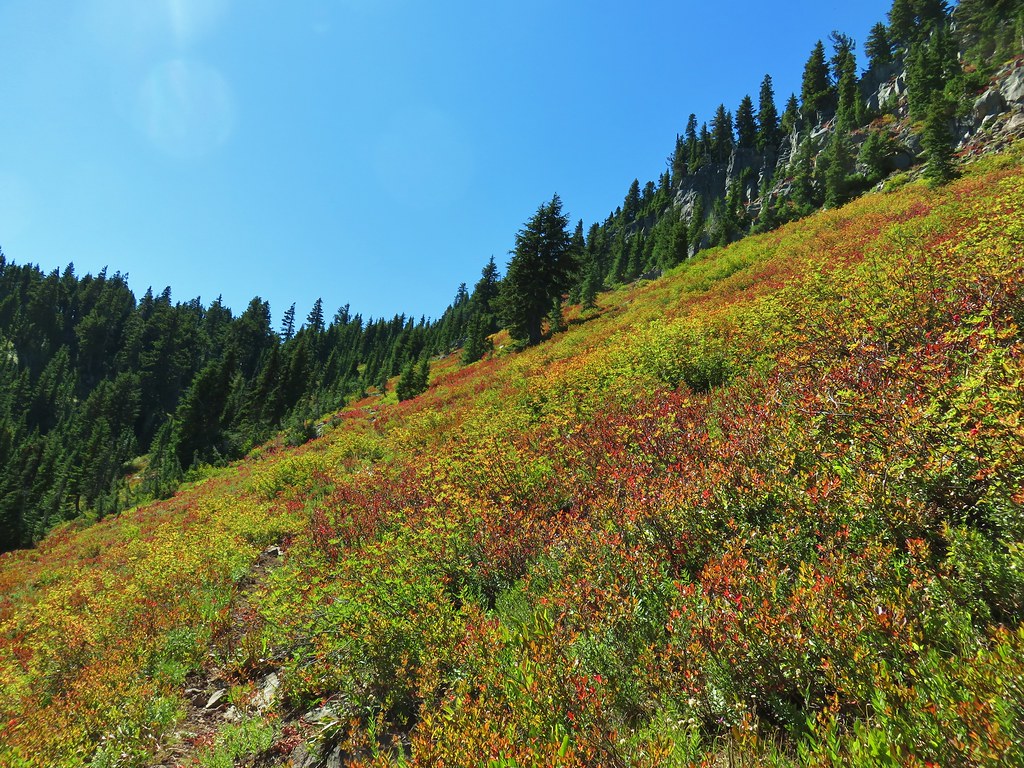
The climb out of the valley and up the Pacific Crest Trail only lasted a half mile but it was steep through the huckleberry bushes gaining 400′ in a little under .4 miles.
IMG_1824

Things began to level out a bit once we were back into the trees though.
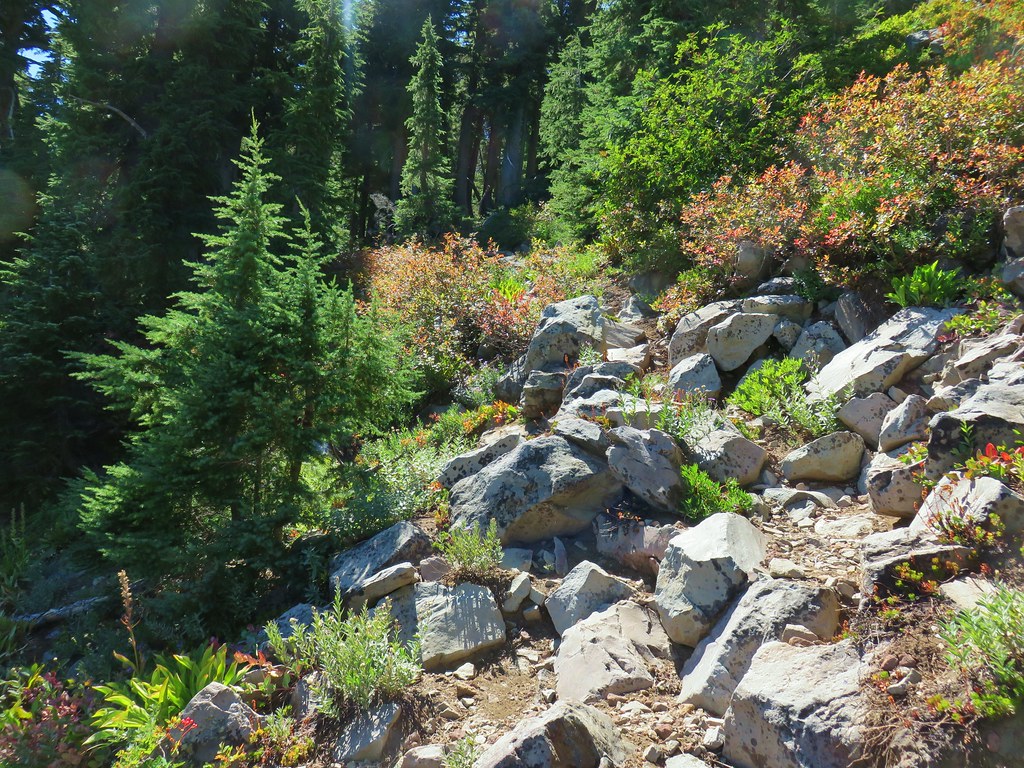
IMG_1835

One item of note here was that the location of the Pacific Crest Trail shown on the topographic map, the Garmin, and the one in our guidebook is incorrect in this area. Thankfully we had noticed that the GPS track on the map in the guidebook crossed over the supposed location of the PCT before turning south and eventually rejoining the trail shown on the map as the PCT rounded a ridge end. If we hadn’t noticed that we might have wasted some time searching for it amid the small pines that were growing where the Garmin showed the PCT should be.
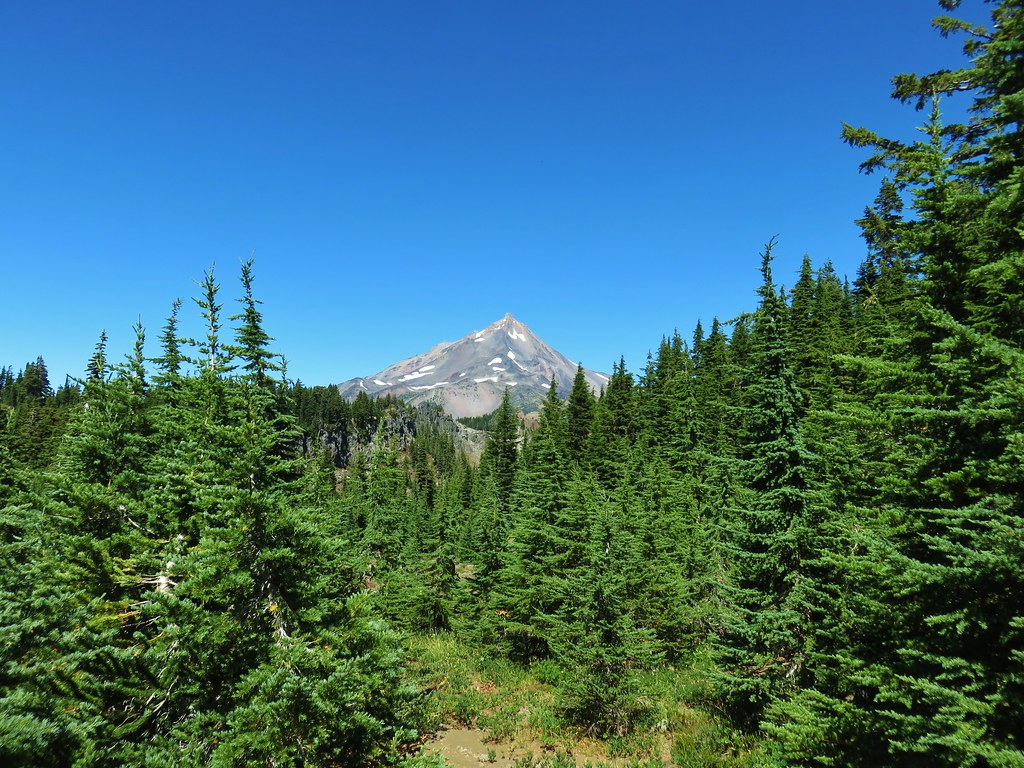
IMG_1839

The actual location of the PCT was about a tenth of a mile to the west of its location on the maps near some much larger trees.
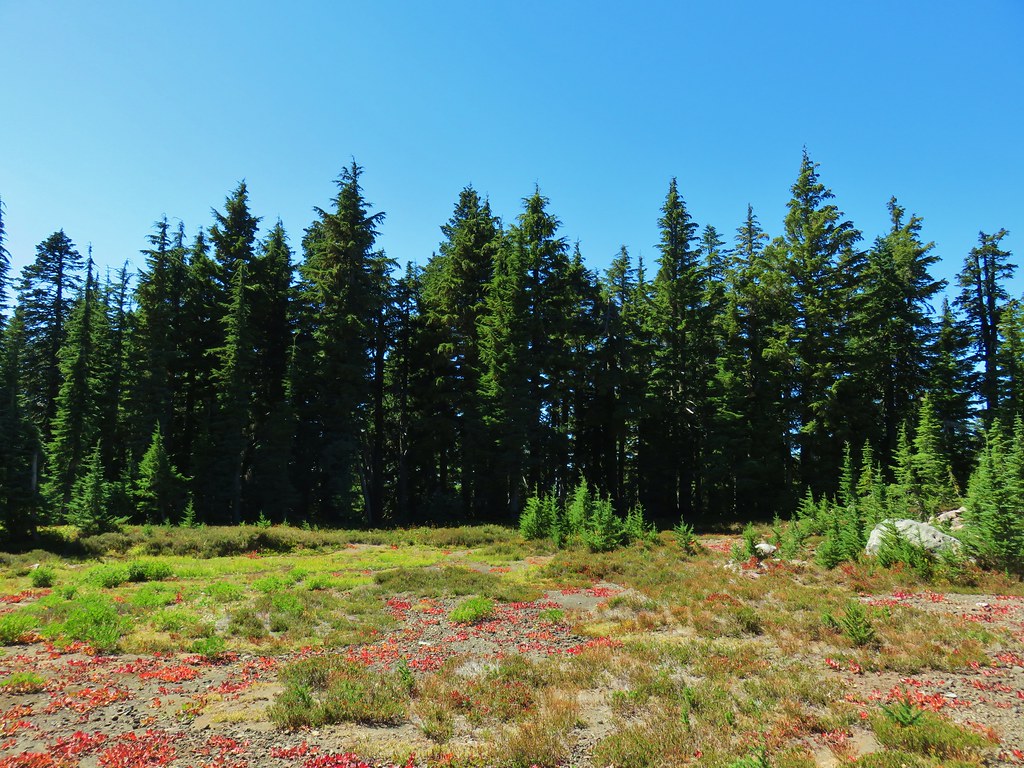
IMG_1840

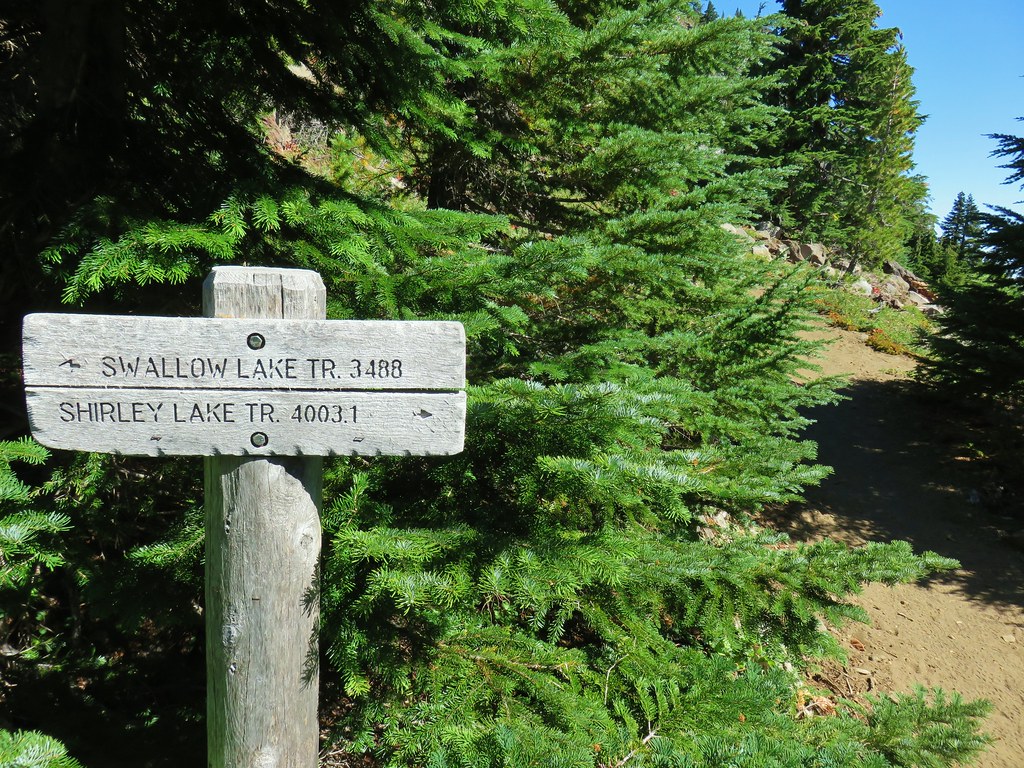
We turned left (south) on the PCT and began the 4.3 mile stretch to the Shirley Lake Trail.
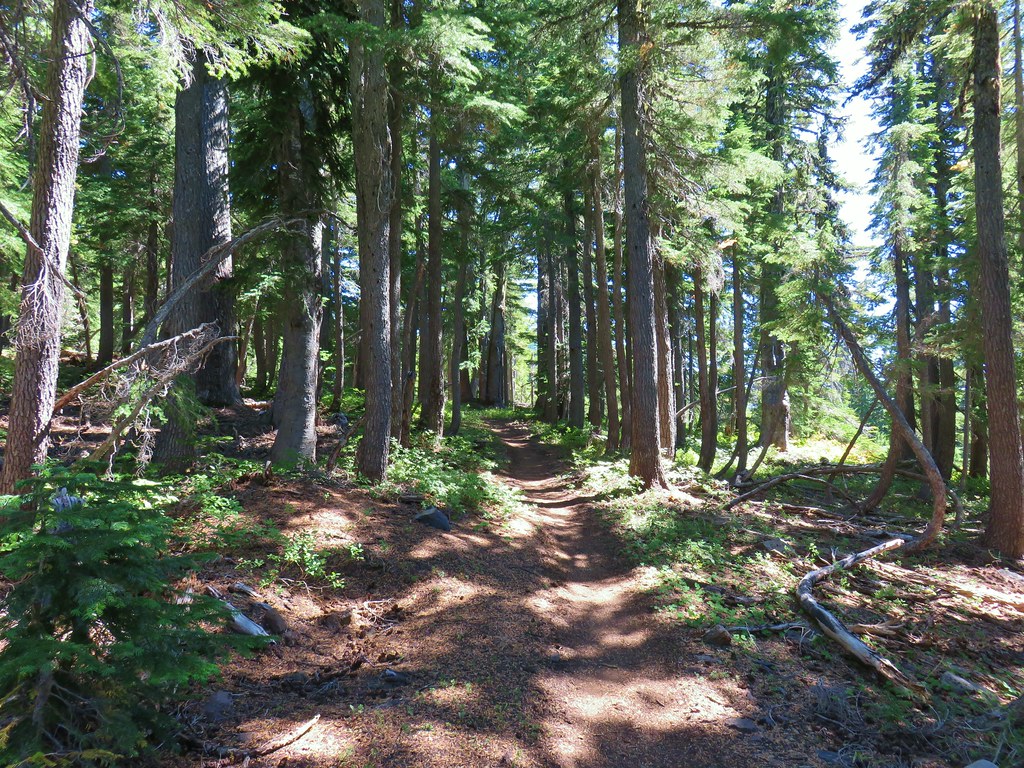
IMG_1843

After about a quarter mile on the PCT we arrived at the first of several excellent viewpoints of Mt. Jefferson and some of the areas we hiked through earlier.
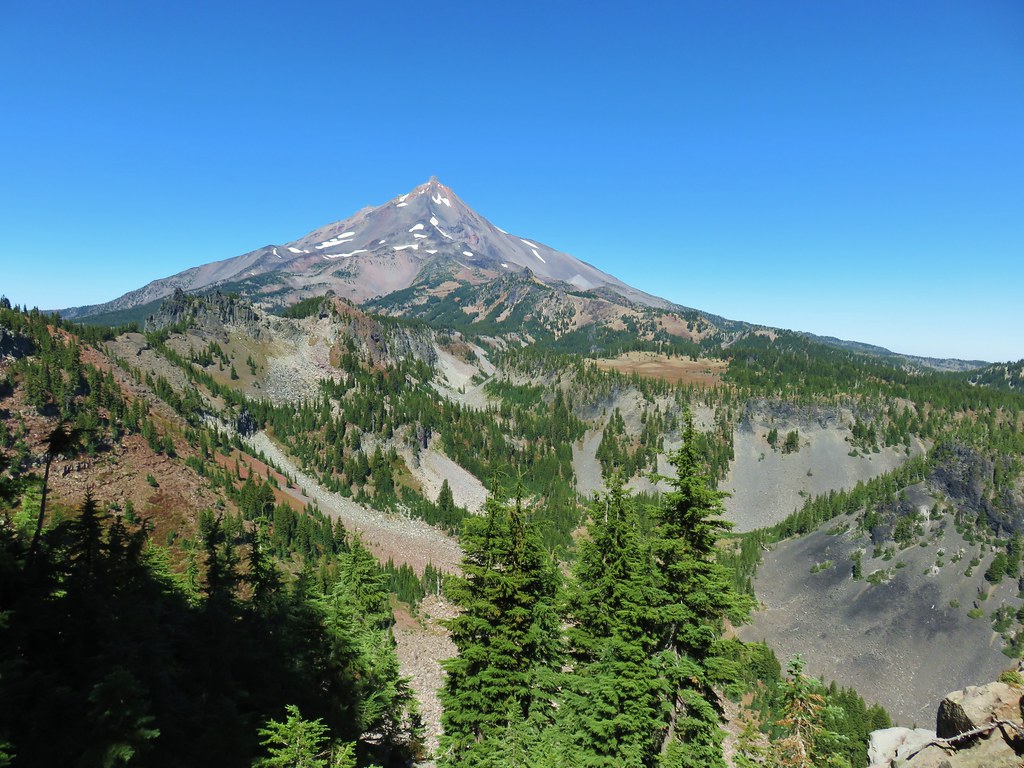
IMG_1844

IMG_1850Bear Butte

IMG_1851Another viewpoint overlooking the valley we climbed out of.
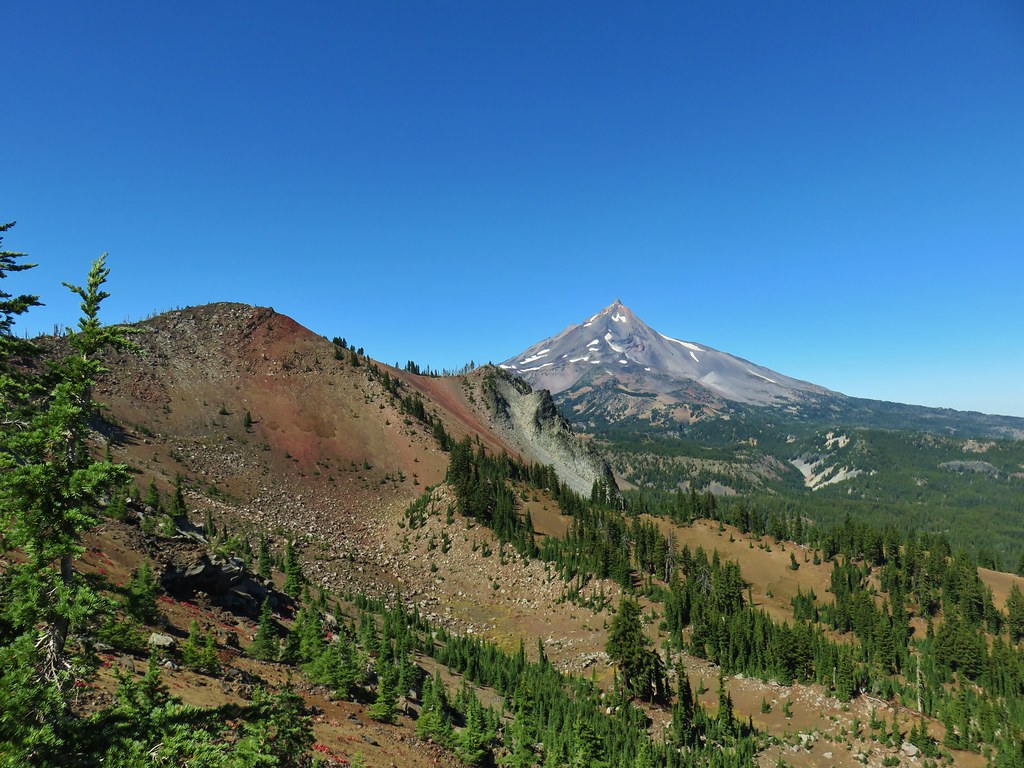
IMG_1880North Cinder Peak and Mt. Jefferson

IMG_1886Cabot Lake Trail along the Forked Butte Lava Flow
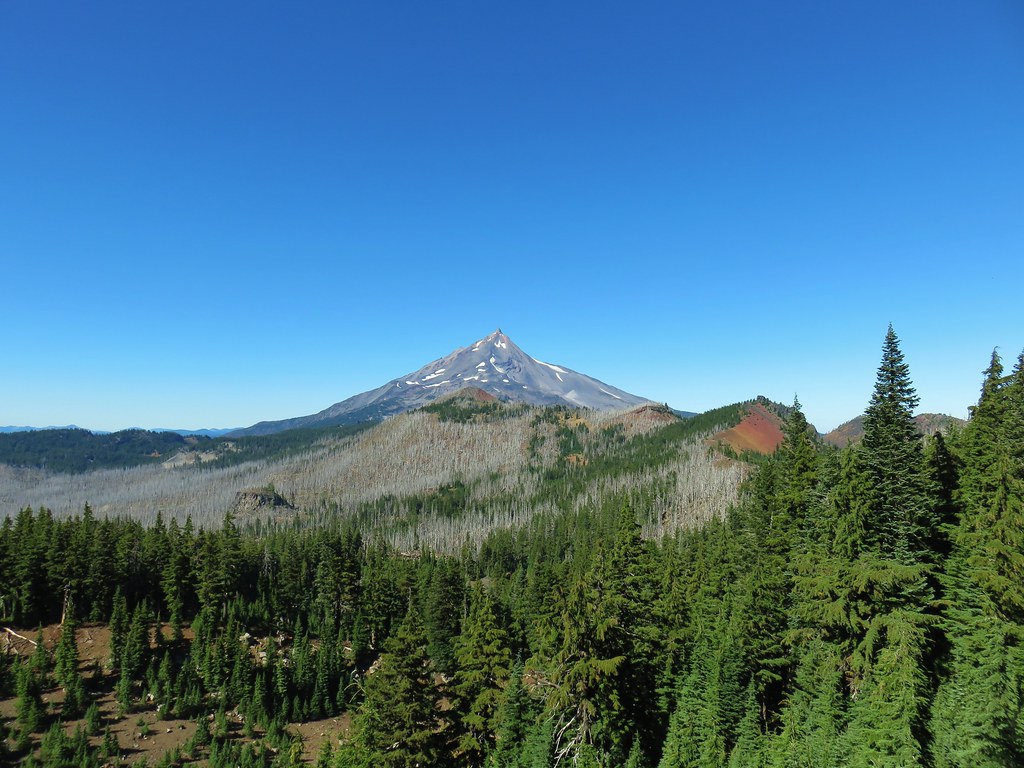
IMG_1896

We were surprised by the amount of climbing the PCT did along this stretch gaining over 750 unexpected feet in all as it passed a wide variety of scenery.
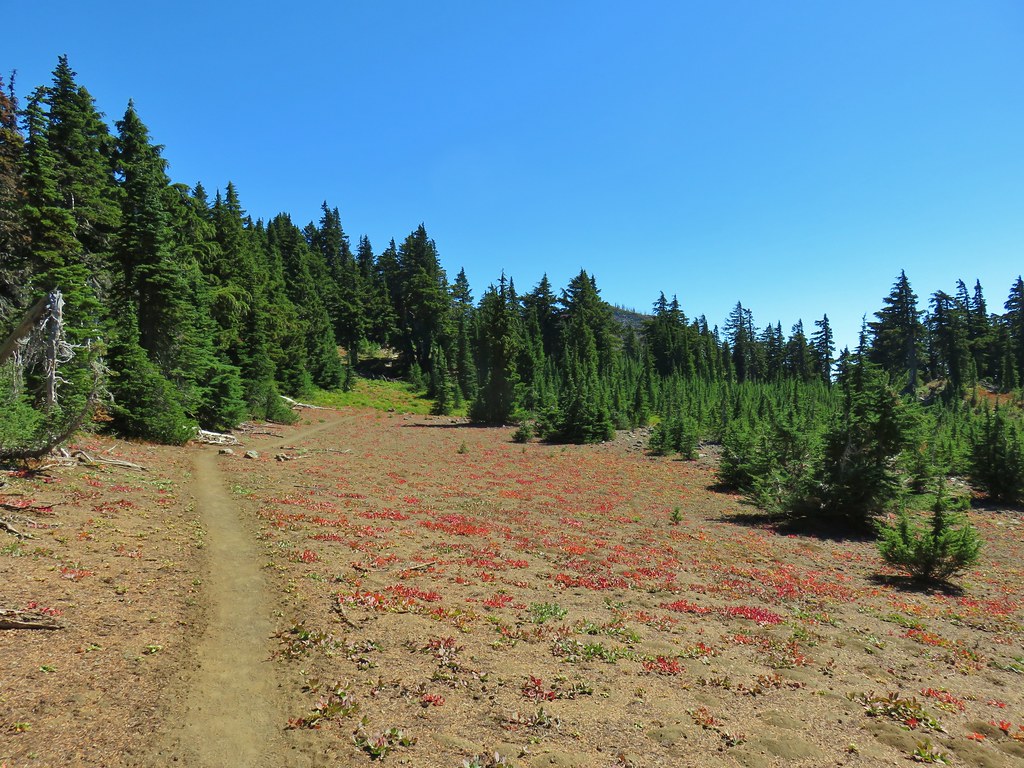
IMG_1855

IMG_1856

IMG_1864

IMG_1889
IMG_1899

A little under 3 miles along this stretch we got a look at Carl Lake below to the east.
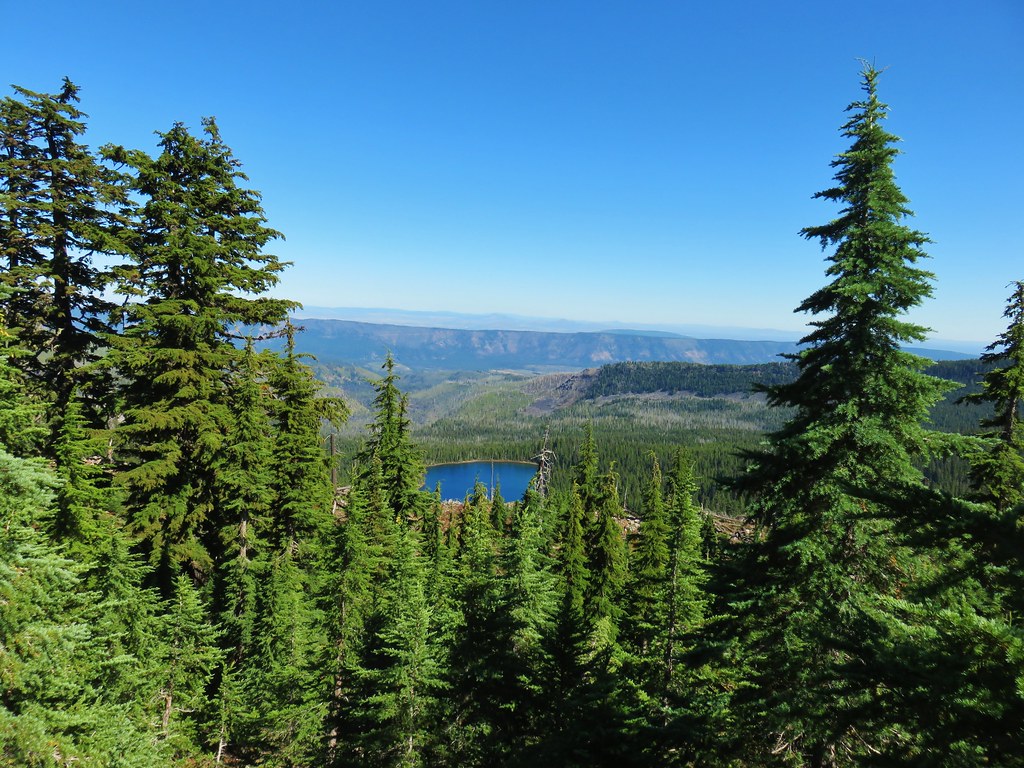
IMG_1894

Not long after we got a good look at South Cinder Peak to the south with Mt. Washington peaking up over a ridge.
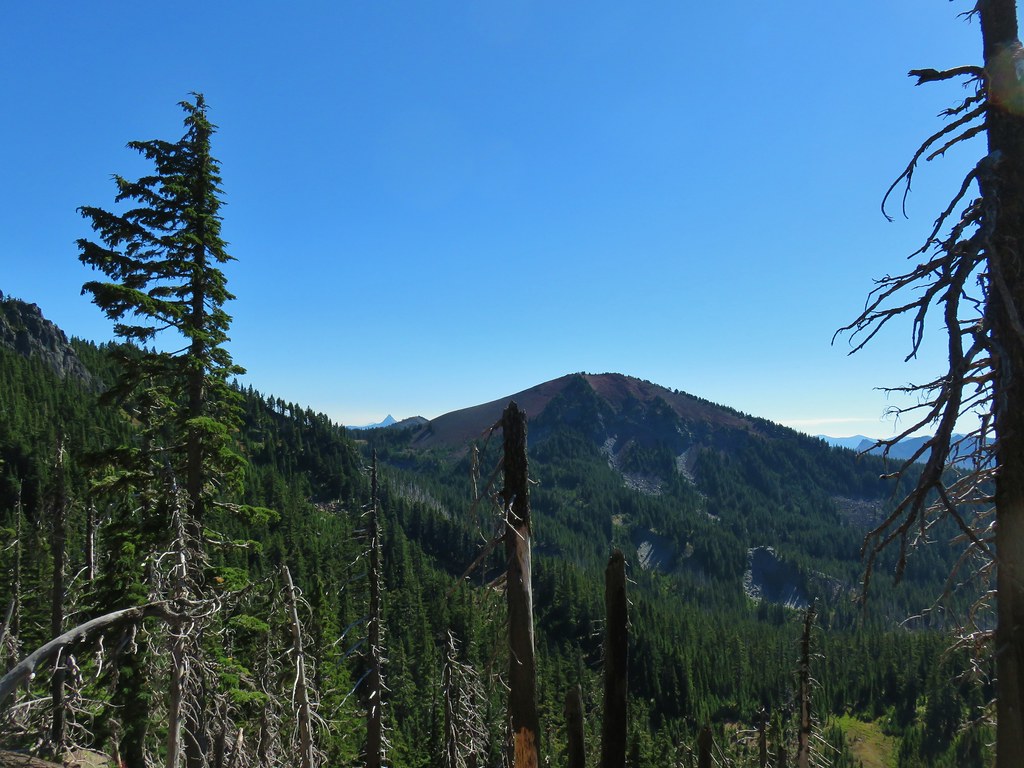
IMG_1900

When we finally arrived at the Shirley Lake Trail junction we turned left and headed back down to Carl Lake just as we had done the day before.
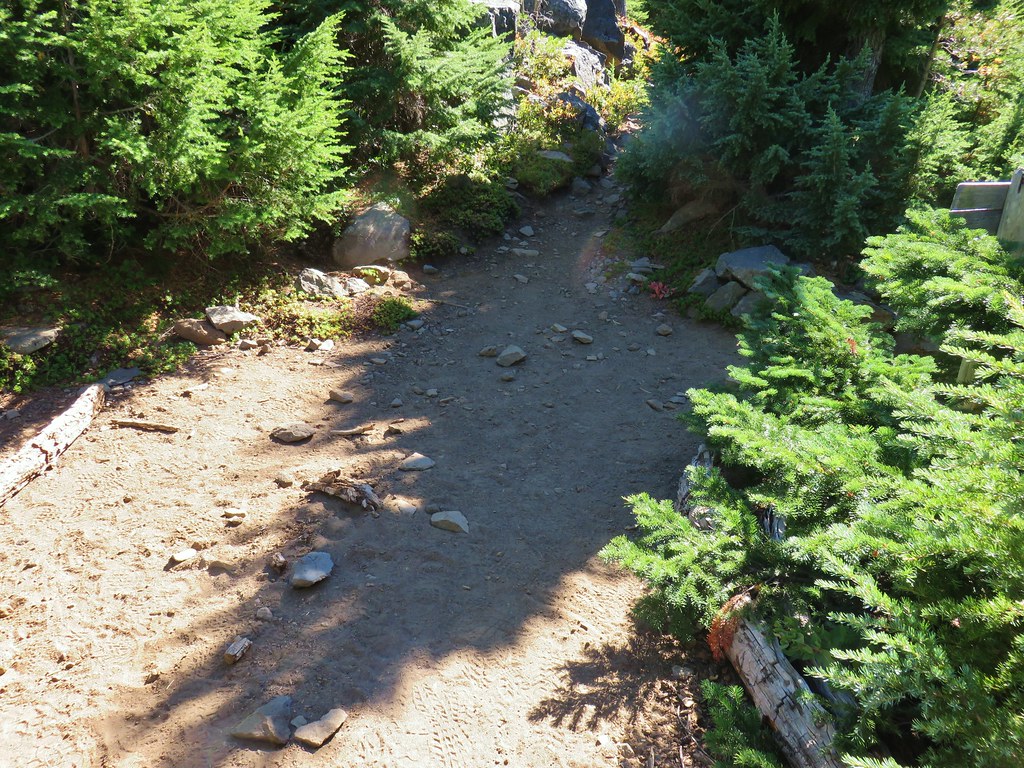
IMG_1909

We headed down to the lake shore again and this time went counter-clockwise around the shore to complete the loop we had started the previous day.
IMG_1913

Much like the day before our time at the lake was plagued by a chilly breeze (The only place that we experienced any significant breeze the whole weekend.) and glare from the sun.
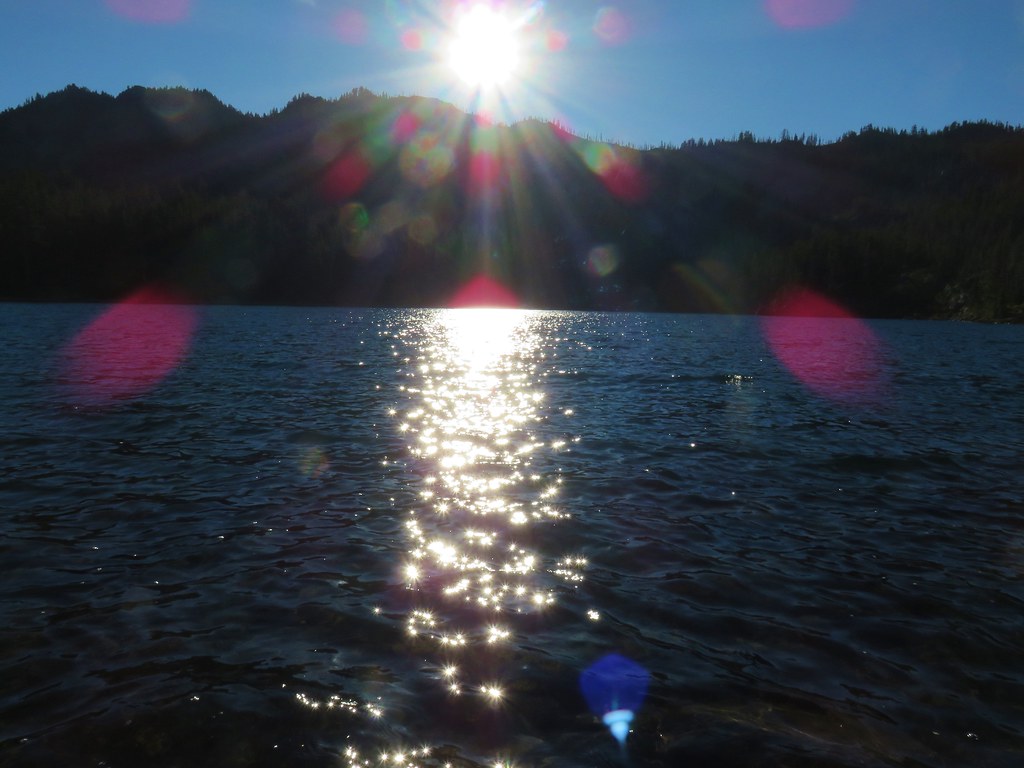
IMG_1914

We spent most of the evening sitting near our tent behind the trees facing east until it was time to turn in for the night. The mileage for our hike came in at 17.4 miles for the day which included the unintended loop around Patsy Lake and the side trip to the unnamed lake near Table Lake.

Another early bed time led to another predawn wake up on Labor Day.
IMG_1916

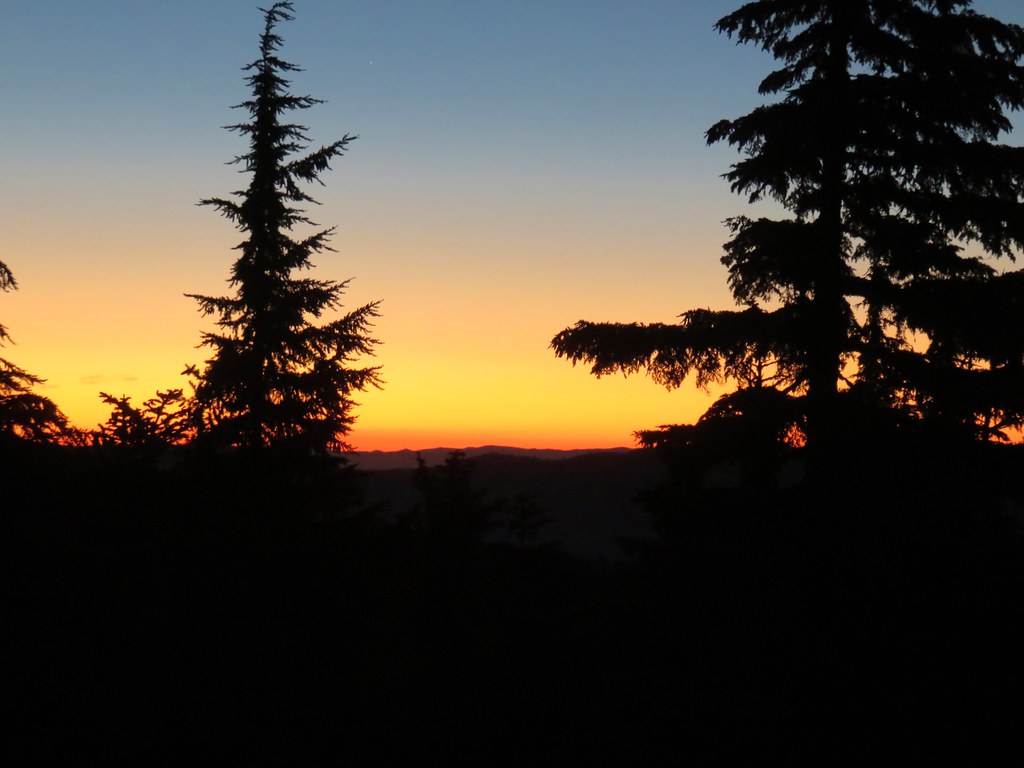
We used the light of the moon and our Luci inflatable lantern to work on packing up and cooking breakfast while we waited for enough light to begin our hike out of the wilderness.
IMG_1918

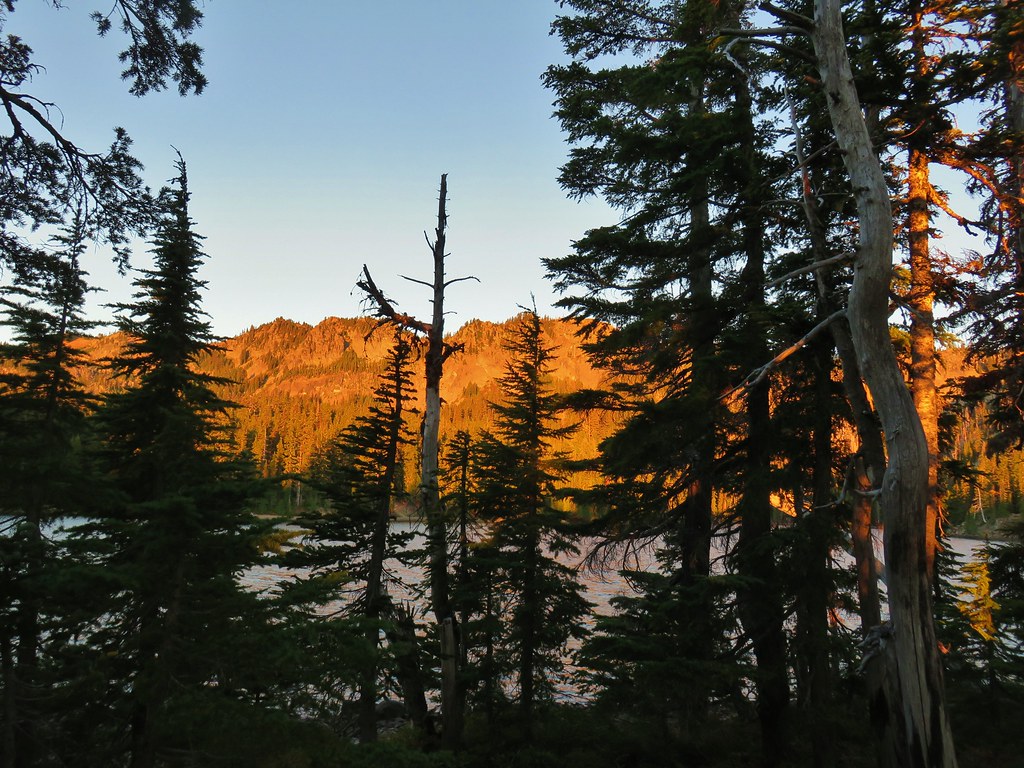
We were on our way a little after 6:30am, saying our goodbyes to Carl Lake and beginning our descent to Cabot Lake.
IMG_1927

IMG_1936Cabot Lake in the trees below and Mt. Jefferson in the distance.

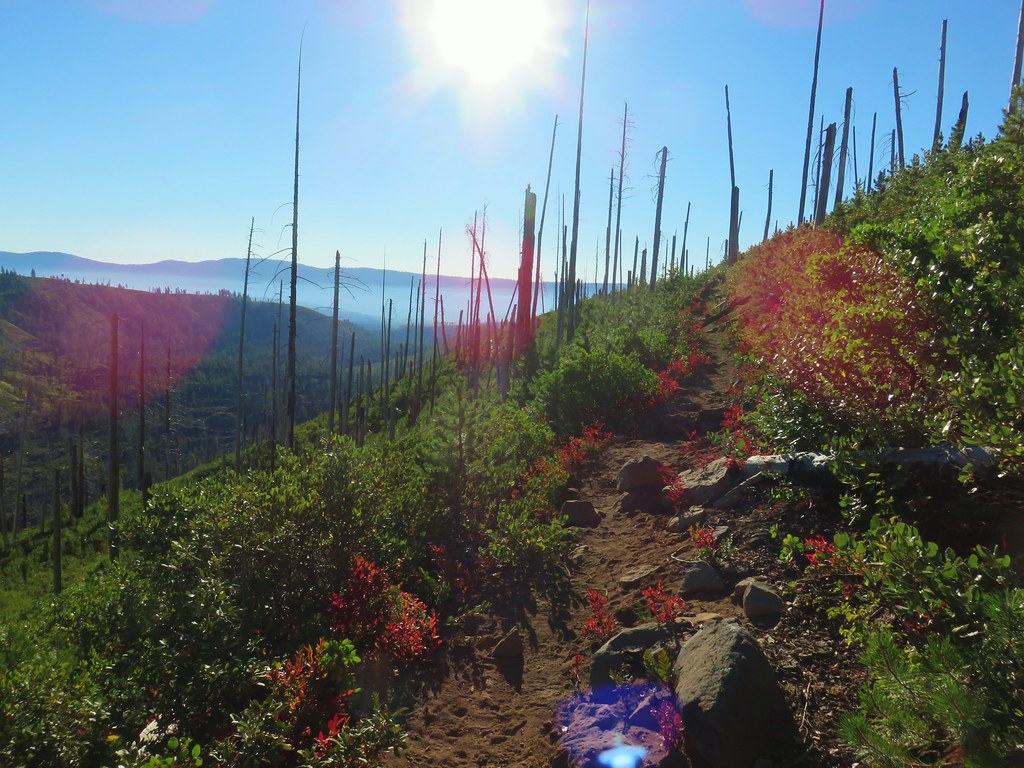
As we reentered the snowbrush covered landscape of the B & B Fire we noticed quite a bit of smoke in the Metolius River Valley.
IMG_1940

It gave us a little cause for concern as we wondered if some new fire had started nearby but it was smoke from some more distant wildfire that had settled in the valley. We completed the 4.9 mile hike back to the car in about 2 hours and were headed back home before 9am, but not before one last look at the mountain.
IMG_1943

Happy Trails!

Flickr: Table Lake Loop and Carl Lake to the Cabot Lake THTable Lake Loop and Carl Lake to the Cabot Lake TH
Categories
High Cascades Hiking Mt. Jefferson Area Oregon

Mt. Jefferson Wilderness Day 1 – Carl Lake and South Cinder Peak

Following our somewhat underwhelming backpacking trip in the Waldo Lake Wilderness (Day 1, Day 2) we spent Labor Day Weekend backpacking in the Mt. Jefferson Wilderness.

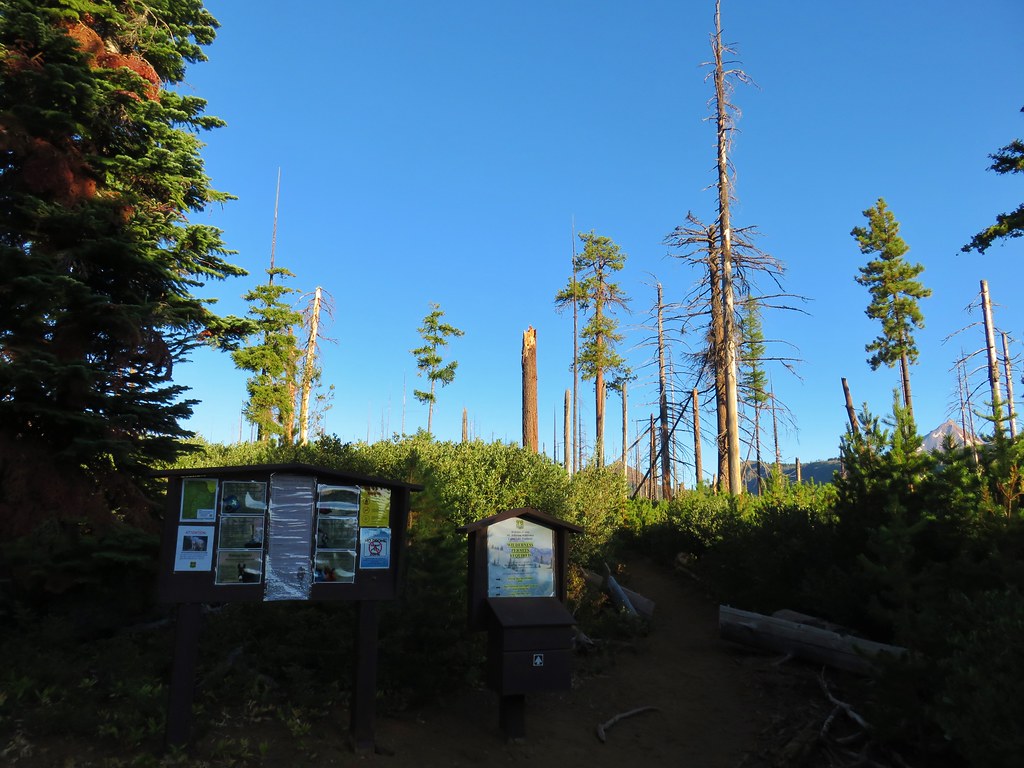
For this trip we began at the Cabot Lake Trailhead.
IMG_1268

The trailhead is located at the end of Forest Road 1230 which is accessed via Forest Road 12. Forest Road 12 is located 8 miles east of Santiam Pass or 12 miles west of Sisters along Highway 20.

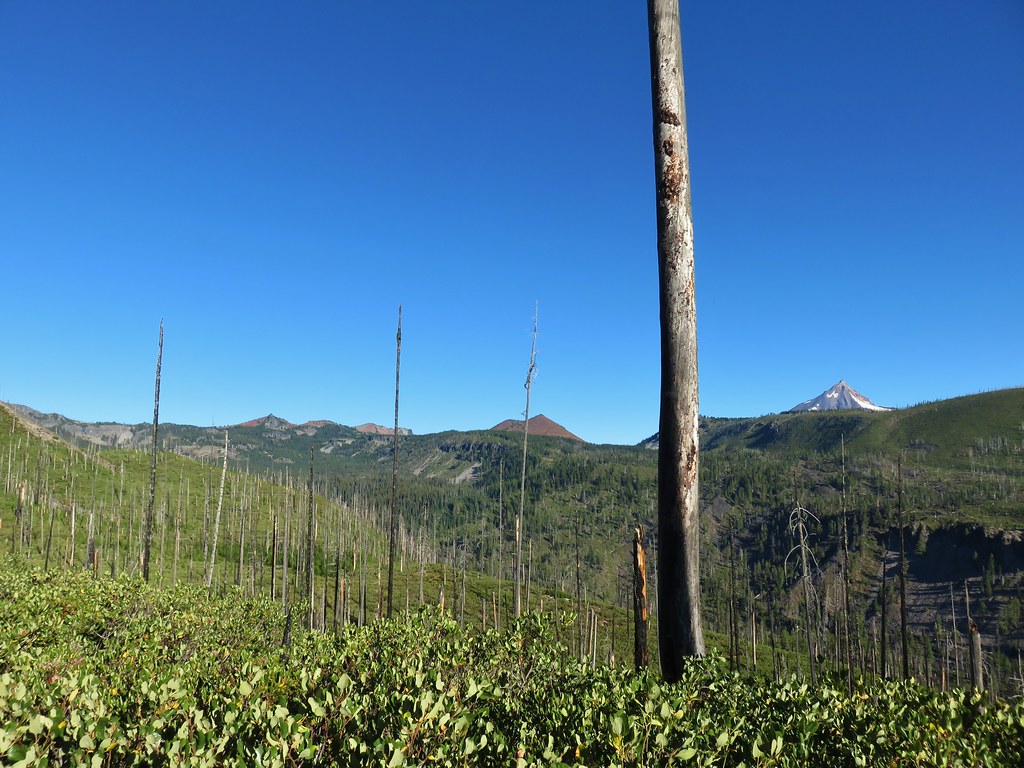
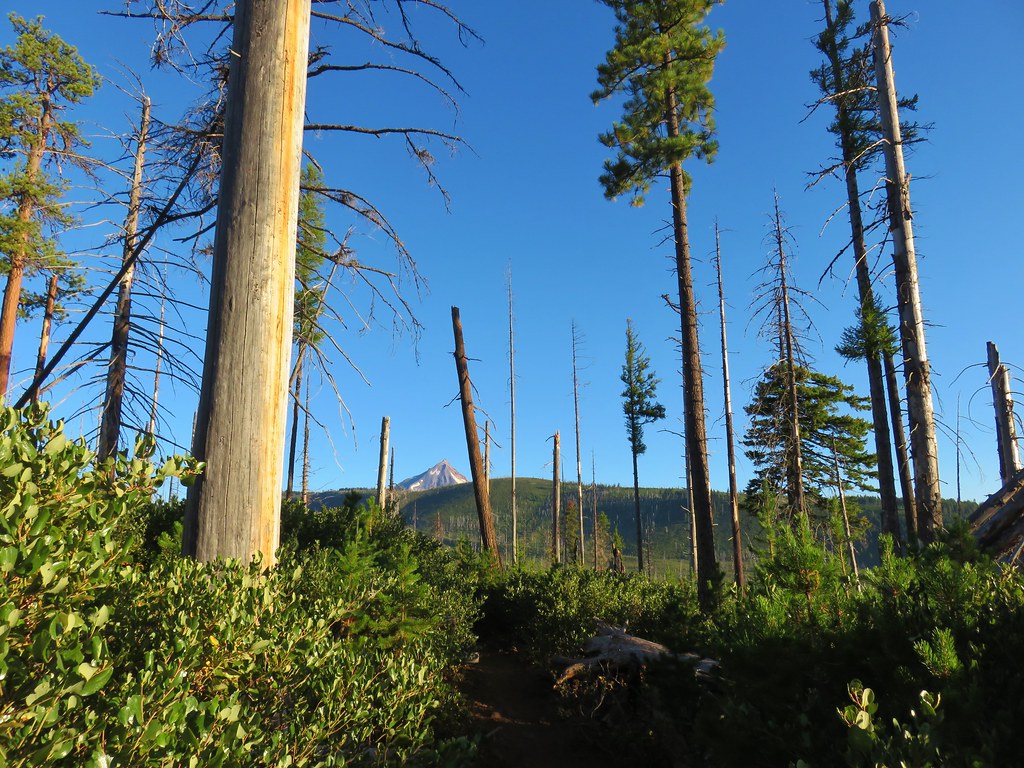
The first 1.8 miles of the Cabot Lake Trail pass through the scar of the 2003 B & B Fire. Much of the area burned in this fire has been taken over by snowbrush which is the case along this section of trail. Several other trails in the Mt. Jefferson Wilderness have been lost to the fire and subsequent thickets of snowbrush but the Cabot Lake Trail has been kept open and was in good shape as it passed through the shoulder high brush. Without trees to block the views Mt. Jefferson could be seen in the distance behind Sugar Pine Ridge.
IMG_1271

IMG_1273

IMG_1281

IMG_1280From left to right – North Cinder Peak, Forked Butte, and Mt. Jefferson
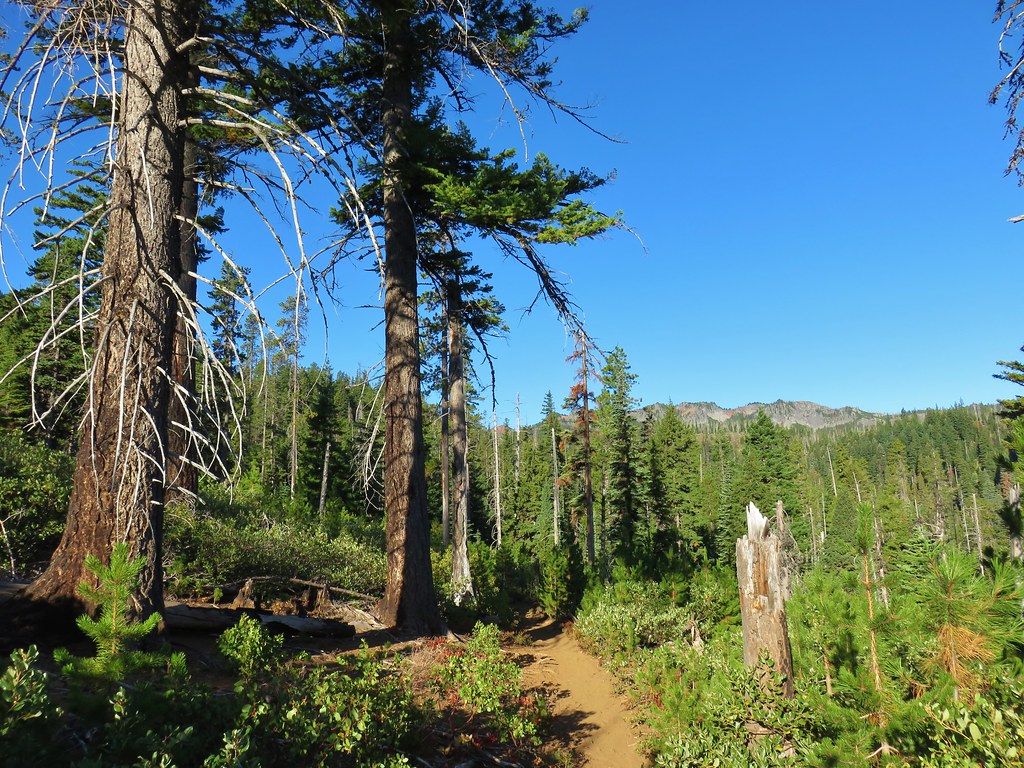
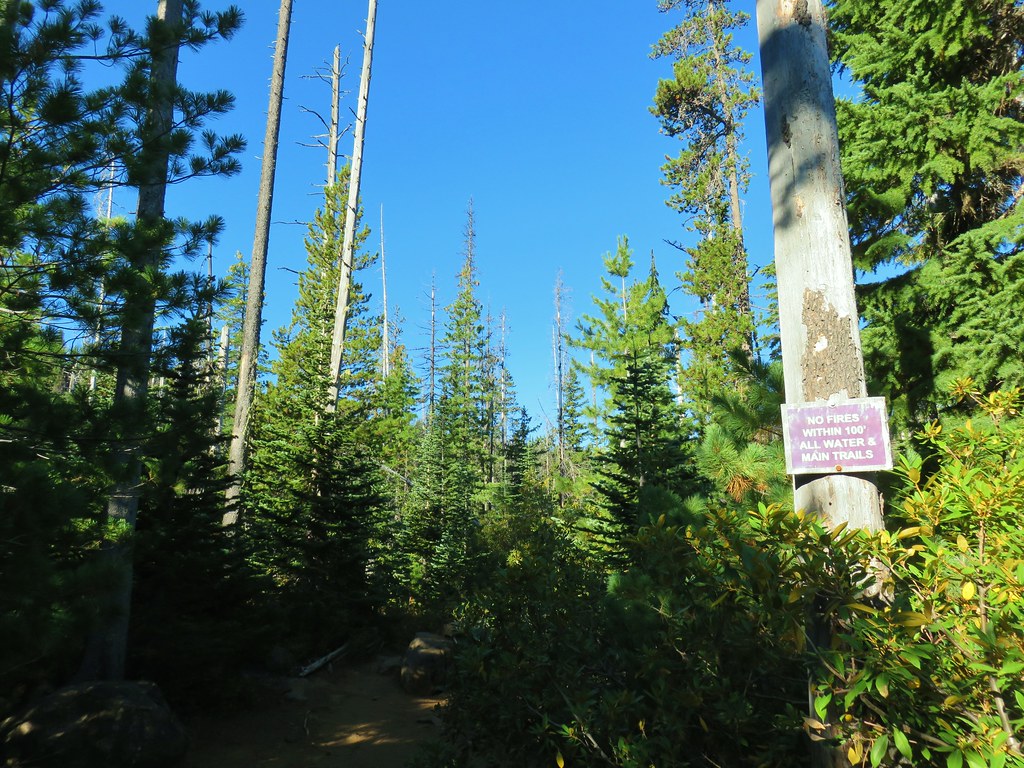
Just over 1.75 miles into the hike we began seeing more green trees.
IMG_1283

Shortly after leaving the snowbrush behind we came to a junction with a short side trail down to Cabot Lake.
IMG_1284

We turned right and descended steeply downhill to visit the small lake.
IMG_1288

Returning to the Cabot Lake Trail we continued on, climbing a series of switchbacks with occasional views to the north of Mt. Jefferson.
IMG_1289

IMG_1290

After about a half mile of good climbing the trail began a more gradual climb. Along this section we passed many ponds, some dry some not.
IMG_1295

IMG_1297

IMG_1299

Just under two and a half miles from Cabot Lake we passed a final pond. This was the largest (with water) and had a view of Mt. Jefferson. There were a couple of campsites nearby which we made note of in case we couldn’t find one at Carl Lake.
IMG_1301

Another half mile brought us to Carl Lake.
IMG_1302

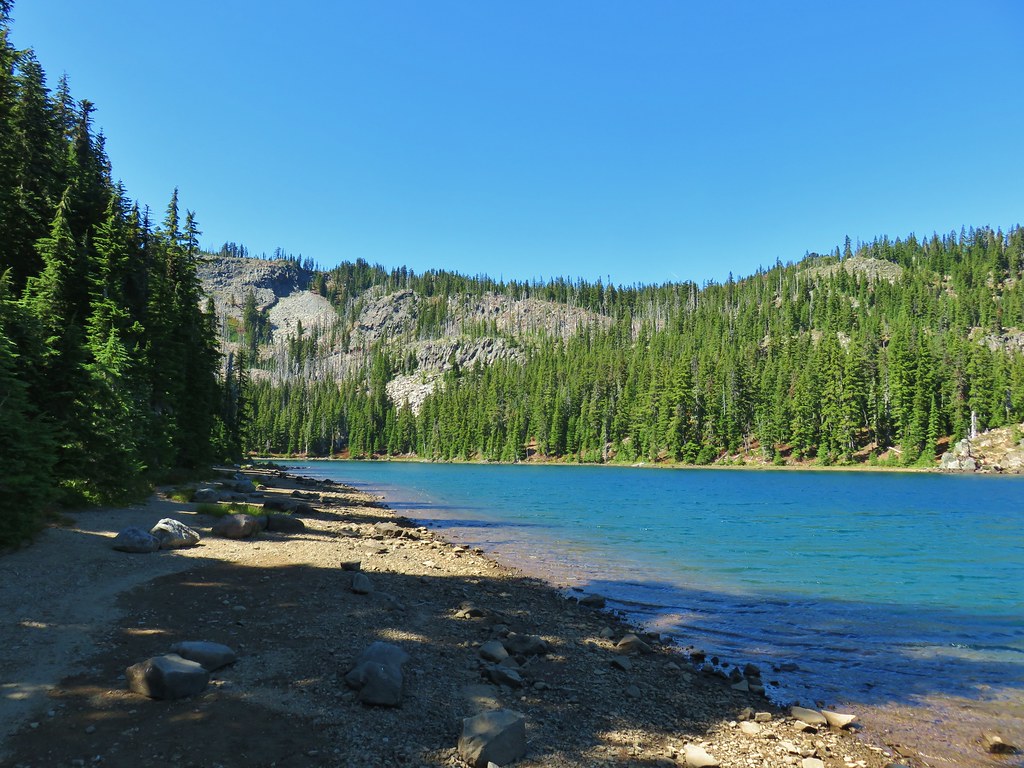
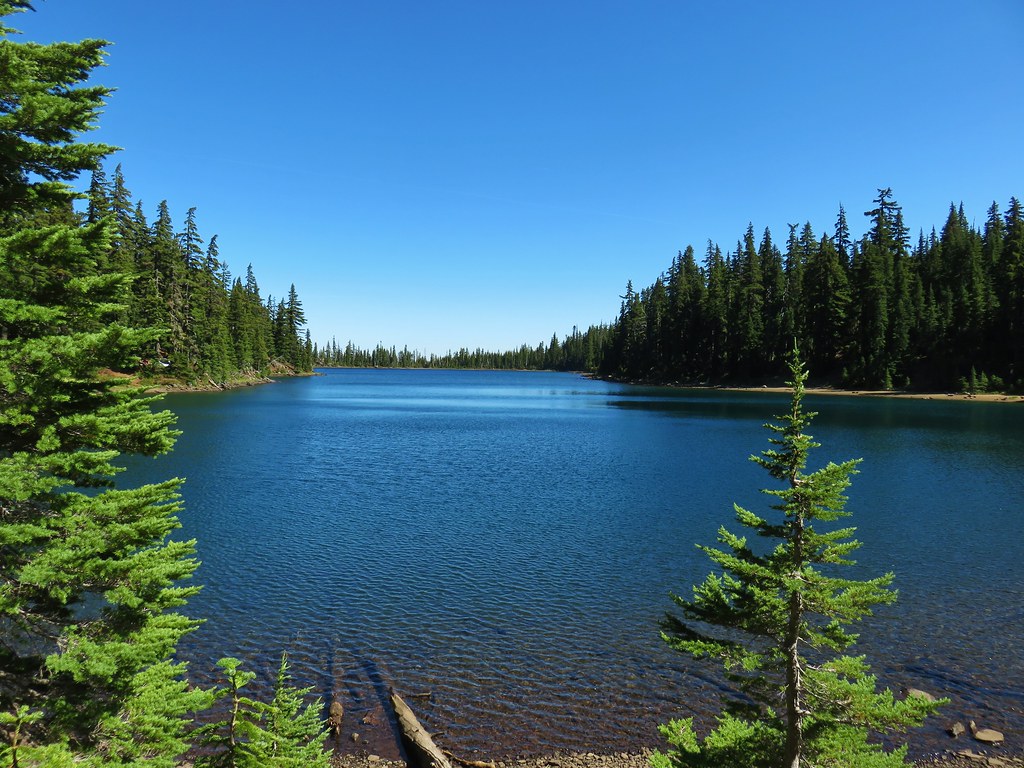
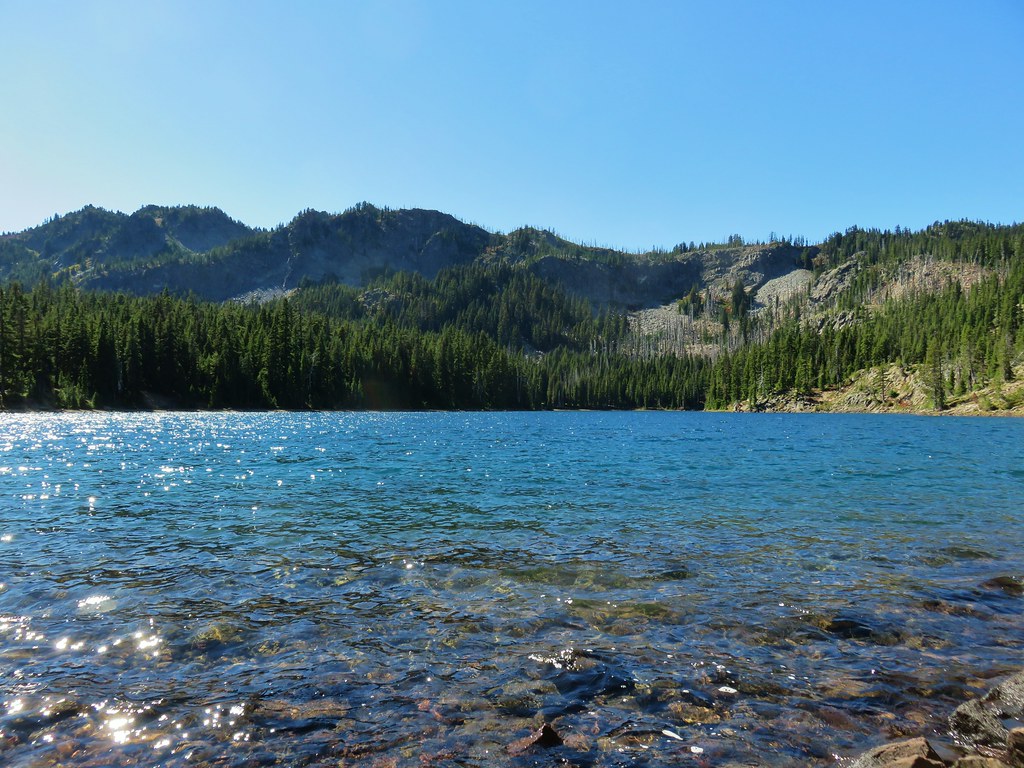
Larger than we’d expected, Carl Lake was a beautiful blue lake backed by the cliffs of the Cascade Crest.
IMG_1304

There had been a decent number of cars (and two horse trailers) at the trailhead which had us a little worried about available campsites. At the lake we turned right planning on taking the first available spot we found but as we made our way around the lake we didn’t see any other tents anywhere. We settled on a spot as far back from the lake as the rocky ledge would allow due to a steady wind blowing across the water. Our little spot had just enough trees between it and the lake to create a nice wind break.
IMG_1309

After setting up camp we returned to the Cabot Lake Trail and followed it around the southern side of Carl Lake for a quarter mile to a signed junction with the Shirley Lake Trail.
IMG_1315

We veered left onto the Shirley Lake Trail which began climbing toward the Cascade Crest. After another quarter mile we spotted green Shirley Lake through the trees below the trail to our left.
IMG_1318

We didn’t see any obvious trails down to the lake so we followed an open ridge down through the trees to the lakes northeastern shore.
IMG_1319

We climbed back up to the trail and continued uphill toward the crest. As we climbed the view of Mt. Jefferson to the north improved.
IMG_1329

The trail left most of the trees behind as it rounded a ridge three quarters of a mile beyond Shirley Lake. The valley below was full of rock fields and cliffs.
IMG_1335

IMG_1332

IMG_1344

A little over 1.25 miles from Shirley Lake we arrived at a four-way junction at a saddle. Here the Shirley Lake Trail from the east and the Swallow Lake Trail from the west ended at the Pacific Crest Trail.
IMG_1347

Our plan was to hike up to the summit of nearby South Cinder Peak which was just SW of the junction. We turned south on the PCT (we could also have taken the Swallow Lake Trail) and followed it until we were due east of South Cinder Peak.
IMG_1350

IMG_1351

We left the PCT and headed cross country, crossed the Swallow Lake Trail, and picked up a use trail up the cinder cone.
IMG_1355Mt. Jefferson and the Swallow Lake Trail

IMG_1357

The quarter mile climb up South Cinder Peak was a little steep and the loose rock required some extra effort but the views were worth it. We benefited from a cloud free sky and the smoke was limited to the east and south where the Terwilliger Fire continued to burn near Cougar Reservoir.
IMG_1370

IMG_1384

IMG_1388Broken Top, The Three Sisters, Mt. Washington, and Three Fingered Jack to the south.

IMG_1392Mt. Jefferson to the north.

IMG_1382Black Butte to the SE

IMG_1398The Three Pyramids and Marion Lake to the west

IMG_1402Coffin Mountain and Bachelor Mountain to the NW

IMG_1377Maxwell Butte, Red Butte, and Duffy Butte to the SW

IMG_1412Cinder cone below South Cinder Peak

After a break at the summit we returned to the PCT and decided to continue south to Rockpile Lake which was just over a mile away. It turned out to be a good decision as the open views along this stretch of the PCT were nice.
IMG_1417

We stopped again at Rockpile Lake which was right next to the PCT.
IMG_1422

IMG_1426

IMG_1429

After a relaxing break at the lake we started back. Along the way we noticed a small sign marking the location (or maybe not) of the abandoned Brush Creek Trail.
IMG_1437

IMG_1438

We both got a kick out of the sign wondering how a trail that doesn’t exist can be abandoned.

We took the Shirley Lake Trail back down to its junction with the Cabot Lake Trail then decided to follow one of the many use paths down to the shore of Carl Lake.
IMG_1448

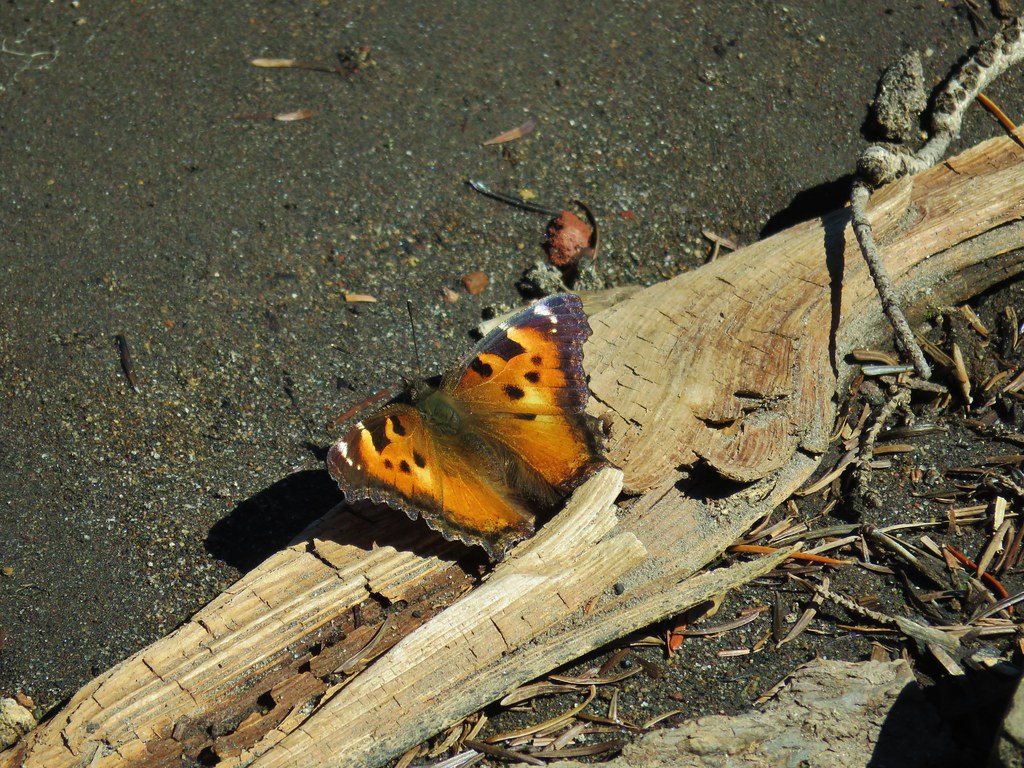
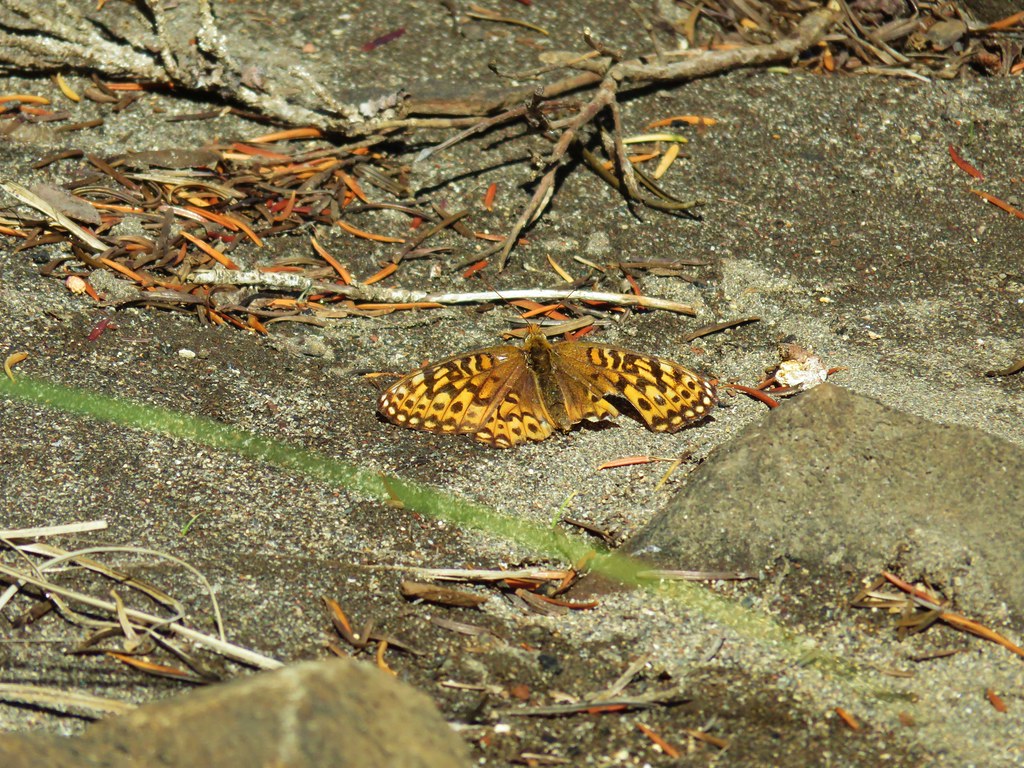
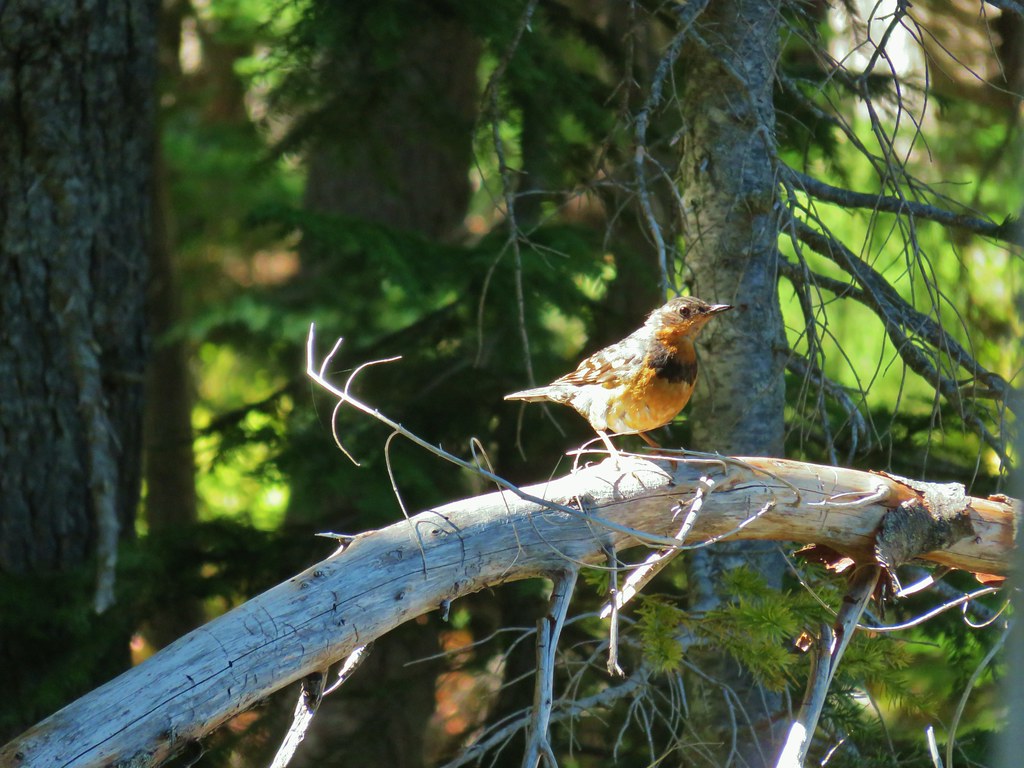
We then decided to walk clockwise around the lake to get back to our campsite. The walk was easy at first and we spotted a good number of butterflies and a varied thrush along the way to the lakes western end.
IMG_1456

IMG_1458

IMG_1460

IMG_1463

IMG_1464

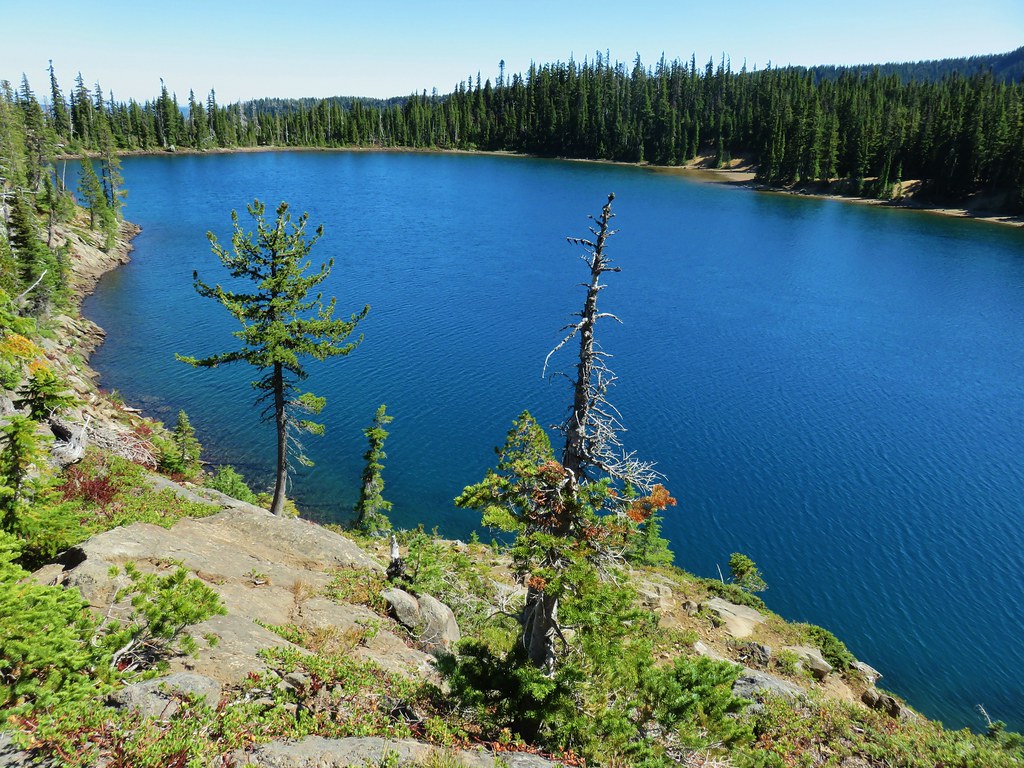
The Cabot Lake Trail came down nearly to the shore at this end so we hopped back onto it for a bit. When the trail turned away from the lake at some campsites we were no longer able to follow the shoreline around. A narrow rock outcropping running along the northern end of lake bordered the water forcing us to scramble over it. The view down to the lake was nice but the scramble was a bit of a pain.
IMG_1474

We made it back to camp around 2:45pm having hiked 13.1 miles on the day. That gave us plenty of time to relax by Carl Lake which we did as best as we could. There was a nearly constant breeze blowing across the lake at us which made it a little chilly when we were simply sitting by the water. To make matters a little worse the glare from the Sun became intense as it made its passage west.
IMG_1477

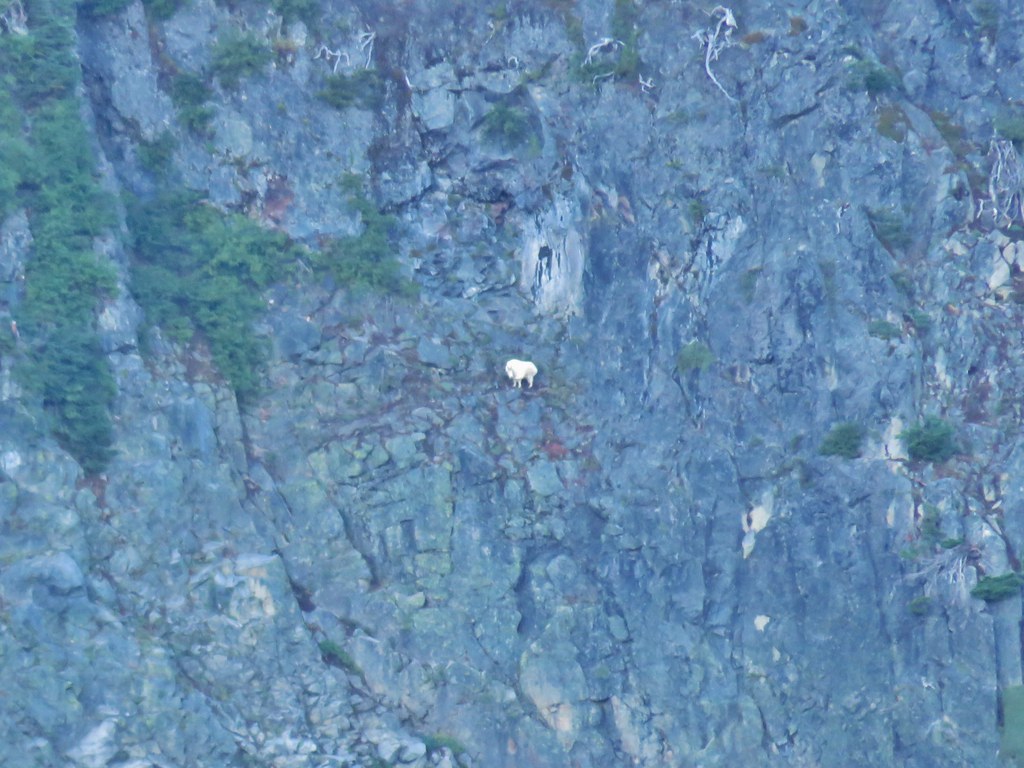
We put on some of our extra layers and moved around a few times looking for a comfortable place to settle down. We couldn’t really find one but we did manage to hold out long enough to spot a mountain goat on the cliffs beyond the lake. Between the distance and the lighting it was hard to get a decent photo but I was able to get a couple where the goat can at least be identified.
IMG_1488

Mountain Goat Above Carl Lake

We eventually took our chairs back to our campsite where the breeze was mostly blocked but with the Sun now behind the crest we were having trouble warming up so we called it a day and turned in early. We had another big hike ahead of us the next day so the extra sleep couldn’t hurt. Happy Trails!

Flickr: Carl Lake and South Cinder Peak

Categories
High Cascades Hiking Oregon Trip report Waldo Lake Area

Waldo Lake Wilderness Day 2 – Rigdon Lakes

**Note a portion of this hike burned in the 2022 Cedar Creek Fire.**

After the 20+ mile hike the previous day we woke up at 5am feeling somewhat refreshed and happy to find that it wasn’t nearly as cold as it had been the morning before. A layer of clouds had moved in pushing out most of the smoke and trapping some heat in.
Morning at Waldo Lake5am clouds over Waldo Lake

We ate breakfast, packed up and then briefly hopped onto the Shoreline Trail following it to the signboard for the Wahanna Trail near Dam Camp.
Wahanna Trail

The Wahanna Trail quickly entered the Waldo Lake Wilderness and nearly as quickly entered the 1996 Taylor Burn fire scar.
Wahanna Trail entering the Waldo Lake Wilderness

Wahanna Trail

The Wahanna Trail passed around the west side of Rigdon Butte near the edge of a plateau above the North Fork Middle Fork Willamette River. Across the river valley was Waldo Mountain with Winchester Ridge extending to the north.
Rigdon Butte

Rigdon Butte

Waldo Mountain and Winchester Ridge

Although the area is still struggling to recover from the fire there was a lot of color and interesting sights along the route. We also spotted three deer as they bounded over a ridge.
Ponds along the Wahanna Trail

Pond along the Wahanna Trail

Meadow along the Wahanna Trail

Wahanna Trail

Buck

A little over a mile along the trail we spotted a larger body of water off to our right which we would later identify as Ernie Lake.
Ernie Lake

After 1.3 miles on the Wahanna Trail we arrived at a junction with the two mile long Rigdon Lakes Trail where we turned right.
Rigdon Lakes Trail

We quickly got our first view of Lake Kiwa which was larger than we’d expected and turned out to be our favorite lake (not named Waldo) of the trip.
Lake Kiwa

Lake Kiwa

The trail followed the lake shore south providing a nice view ahead of Rigdon Butte.
Rigdon Butte from Lake Kiwa

Beyond Lake Kiwa the trail climbed over a small ridge and arrived at Lower Rigdon Lake just a tenth of a mile later.
Lower Rigdon Lake

The trial passed around this lake to the left then climbed up and over another ridge to Upper Rigdon Lake.
Rigdon Lakes Trail along Lower Rigdon Lake

Upper and Lower Rigdon Lake

Upper Rigdon Lake

Upper Rigdon Lake was also quite nice with a couple of small islands adding character.
Upper Rigdon Lake

Beyond Upper Rigdon Lake the trail wound its way over and around small rocky ridges to the Waldo Lake Shoreline Trail.
Rigdon Lakes Trail

Rigdon Lakes Trail junction with the Waldo Lake Shoreline Trail

We turned left onto the Shoreline Trail and stayed left at forks opting to take a different (slightly shorter) route back to the trailhead instead of following the lake shore.
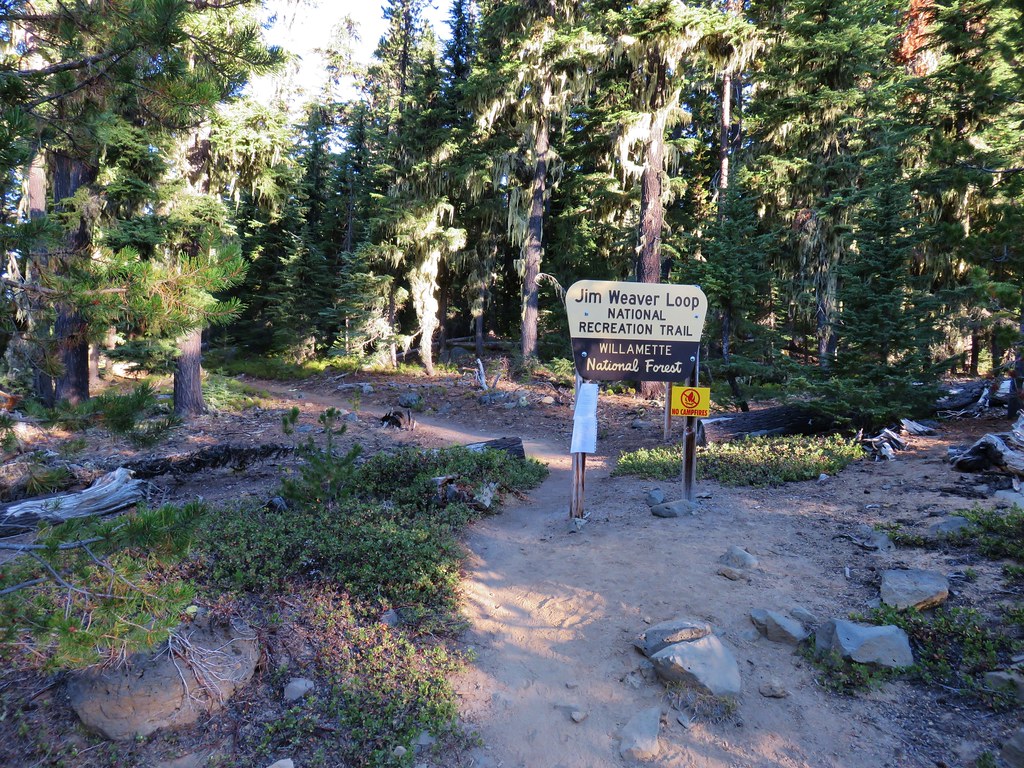
Jim Weaver LoopFirst left fork

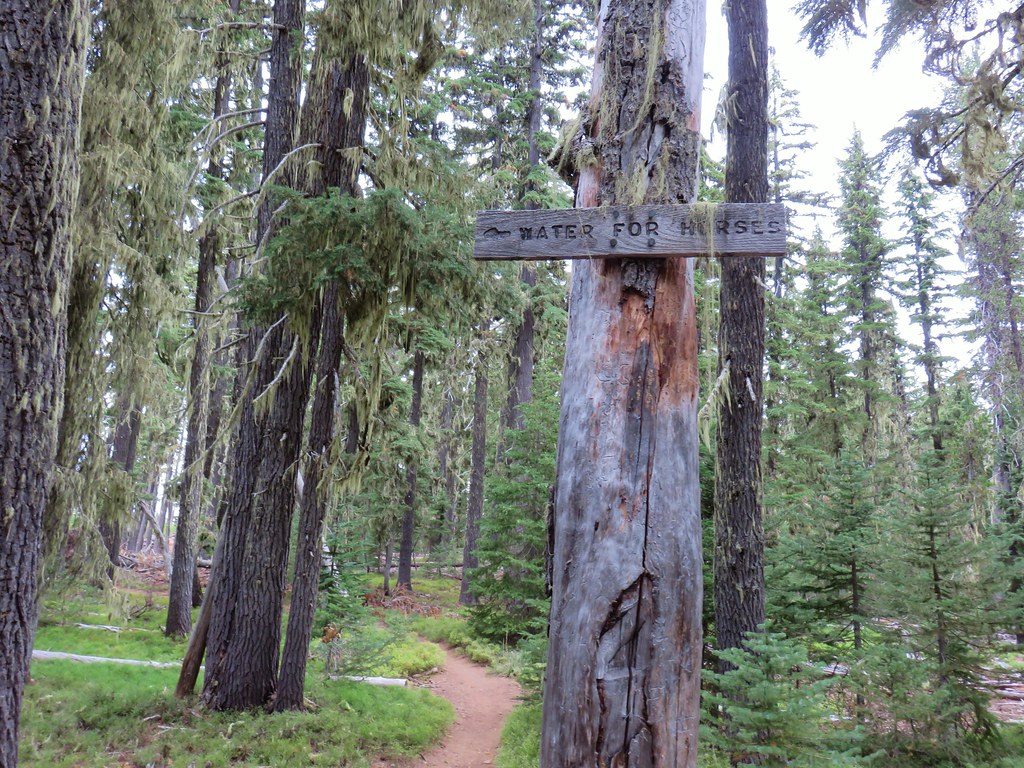
Water for horses along the Jim Weaver Loop TrailSecond fork left at a “water for horses” sign

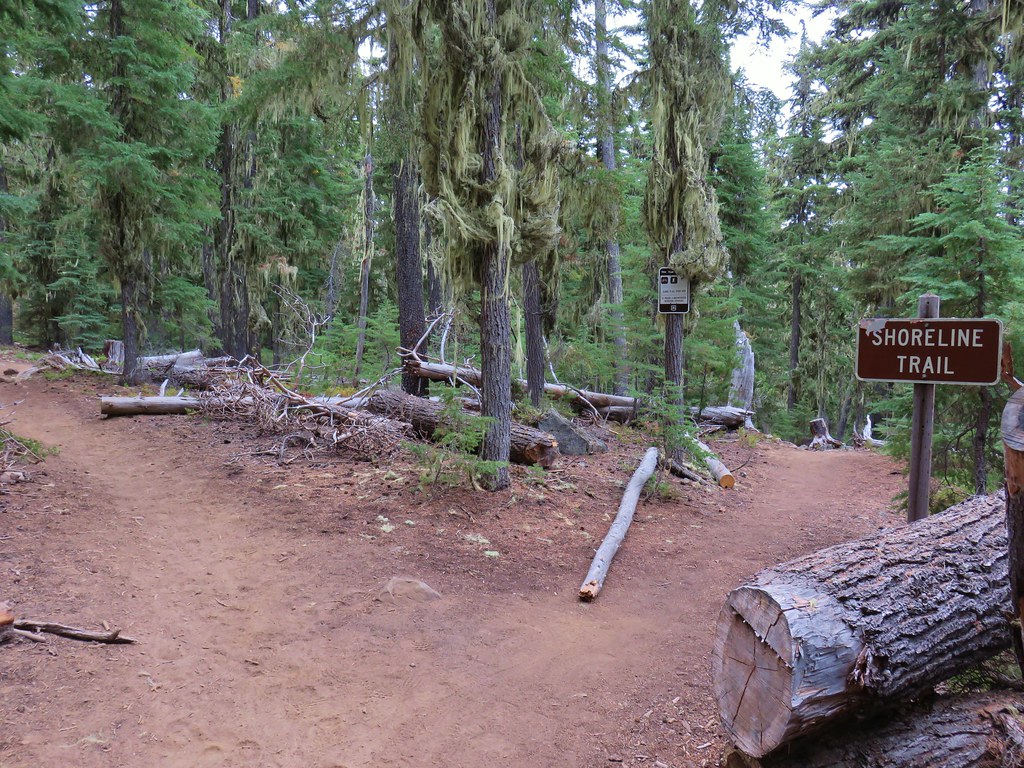
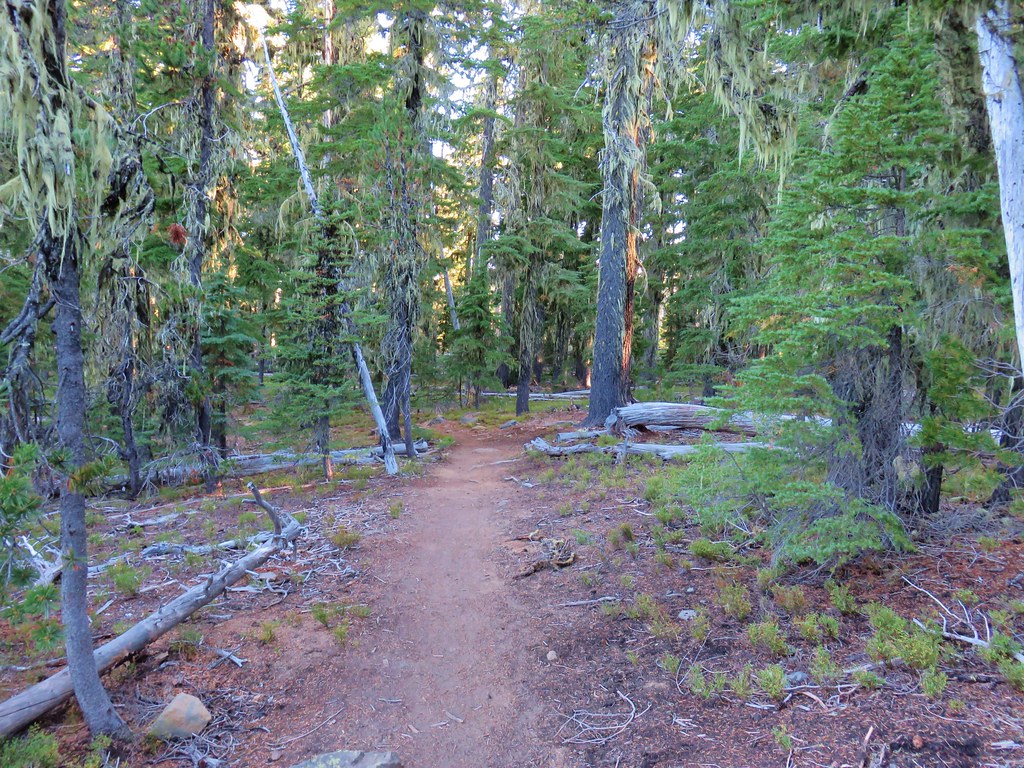
Jim Weaver Loop TrailThird left fork at a junction with the Shoreline Trail

Jim Weaver Loop TrailFourth left fork at another junction with the Shoreline Trail

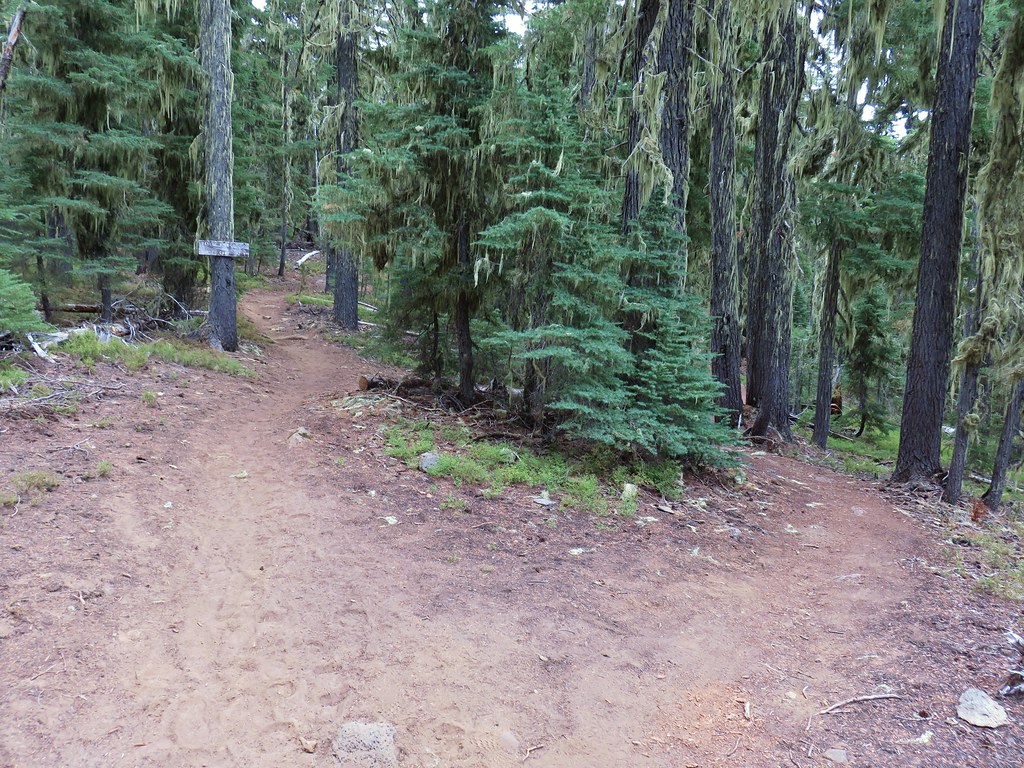
We should have stopped with the fourth left hand fork when we arrive at a fifth fork, but the topographic map on the GPS showed we weren’t at the correct right hand fork to lead us back to the trailhead.
Jim Weaver Loop TrailFifth left fork which should have been a right.

We realized our mistake but then spotted a faint abandoned trail near the spot the trail was shown on the topographic map so we followed it for just over 100 yards to a picnic table across the parking lot from our car. It had been a nice 5.4 mile hike with scenery that exceeded our expectations. A great way to end our August hikes and get us ready for September. Happy Trails!

Flickr: Waldo Lake Wilderness Day 2 – Rigdon Lakes

Categories
High Cascades Hiking Oregon Trip report Waldo Lake Area

Waldo Lake Wilderness Day 1 – Winchester Ridge and Eddeeleo Lakes Loop

**Note a portion of this hike burned in the 2022 Cedar Creek Fire.**

We ended our August hikes with an overnight stay near Waldo Lake. After several days of smokey skies the weather had shifted and most of the smoke had been pushed out of the area. The exception to that was the smoke being produced by the Terwilliger Fire burning east of Eugene along Cougar Reservior and into the Three Sisters Wilderness. 😦

We were hoping that the smoke from that fire wasn’t going to be aimed right at us all weekend.  Things were off to a good start when we arrived at the Jim Weaver Trailhead at the north end of Waldo Lake. The sky was a crisp blue but the sky wasn’t the only thing that was crisp. The temperature gauge in the car had read 36 degrees when we’d parked.
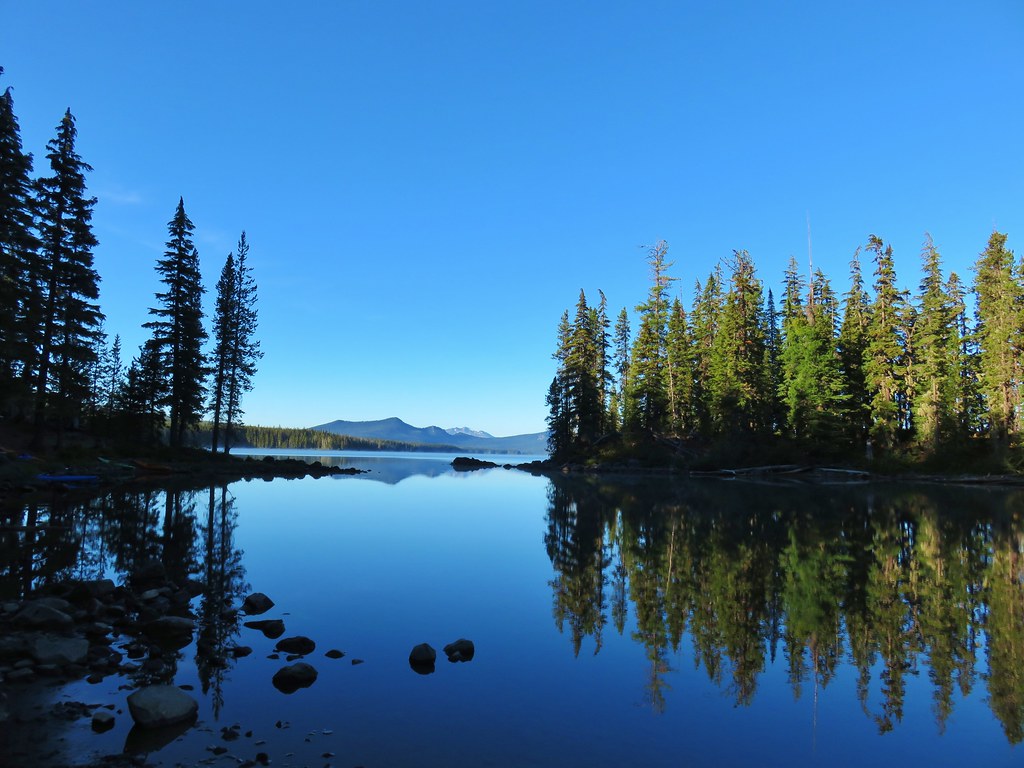
Jim Weaver Loop Trailhead

Diamond Peak from Waldo Lake

From the parking area we walked down to boat ramp and turned right at a Shoreline Trail sign.
Shoreline Trail

Initially the trail passed through green trees with occasional views across the lake to Diamond Peak and Fuji Mountain (post).
Shoreline Trail

Diamond Peak and Fuji Mountain from Waldo Lake

Diamond Peak and Fuji Mountain from Waldo LakeDiamond Peak to the left and Fuji Mountain directly behind the island

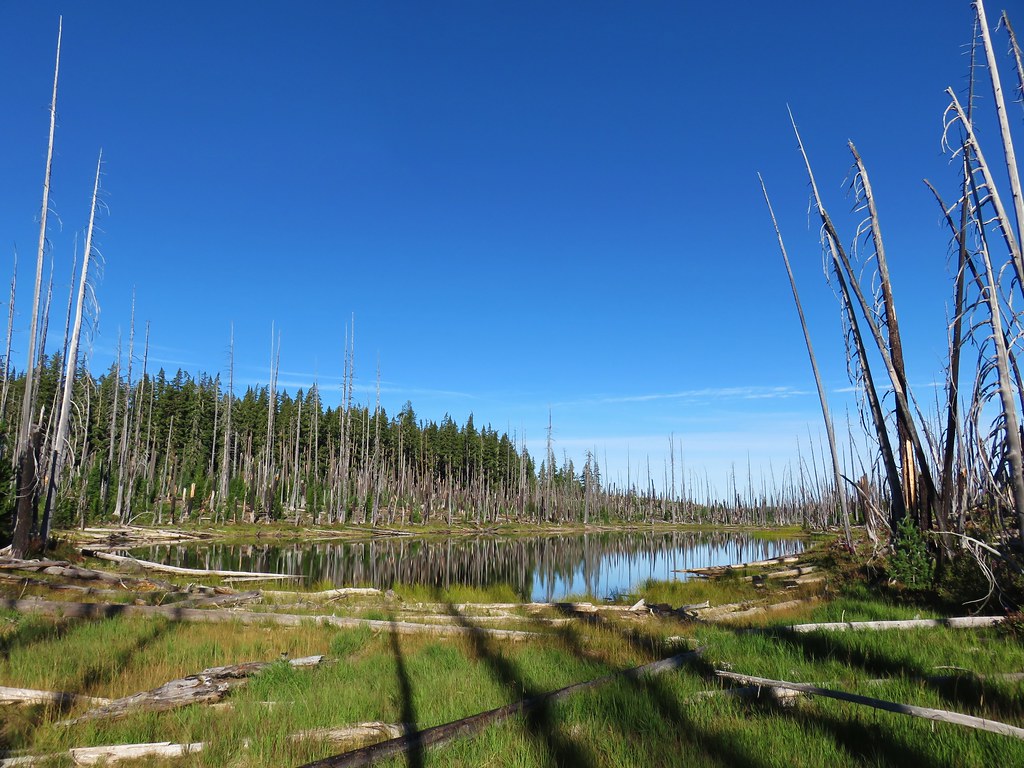
Soon the trail entered the fire scar of the 1996 Taylor Burn.
Waldo Lake

Diamond Peak and Fuji Mountain from Waldo Lake

Despite the frosty morning the wildlife was out in force.
Frost on the Shoreline Trail

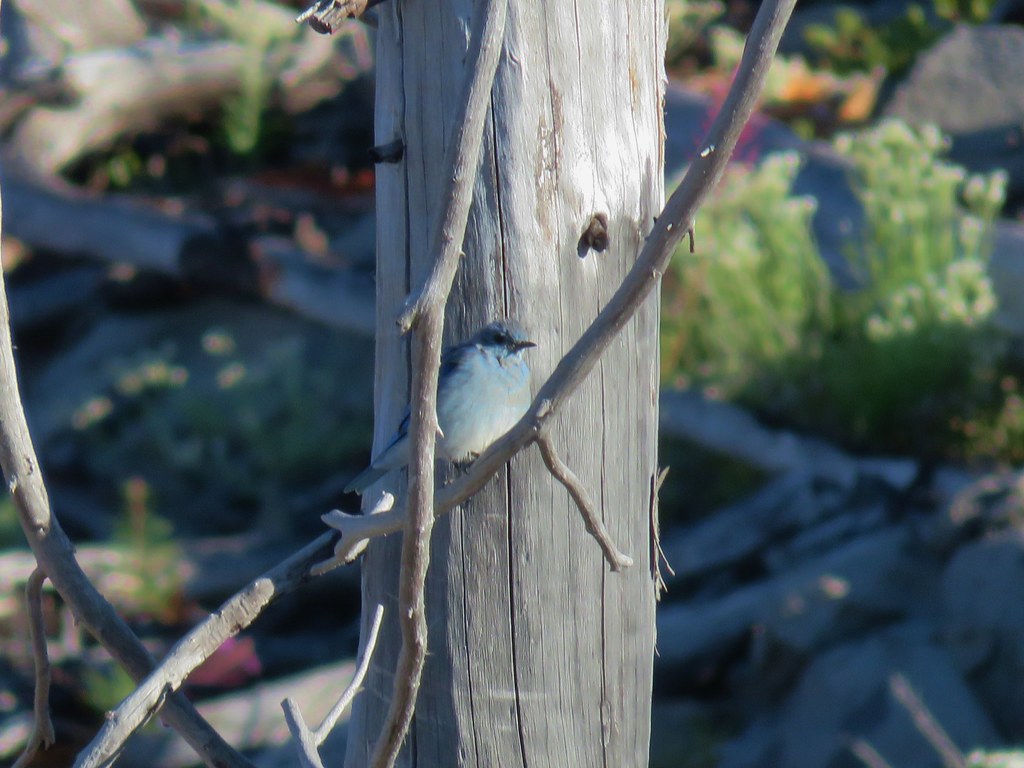
Bluebird

Tree full of birds

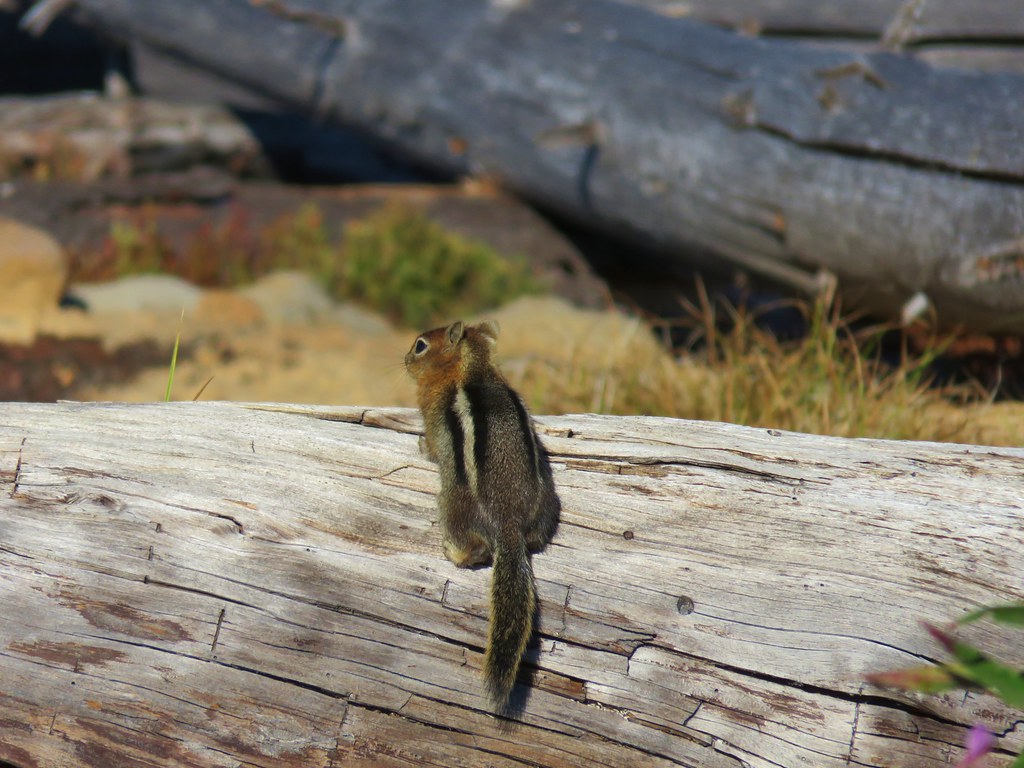
Golden-mantled ground squirrel

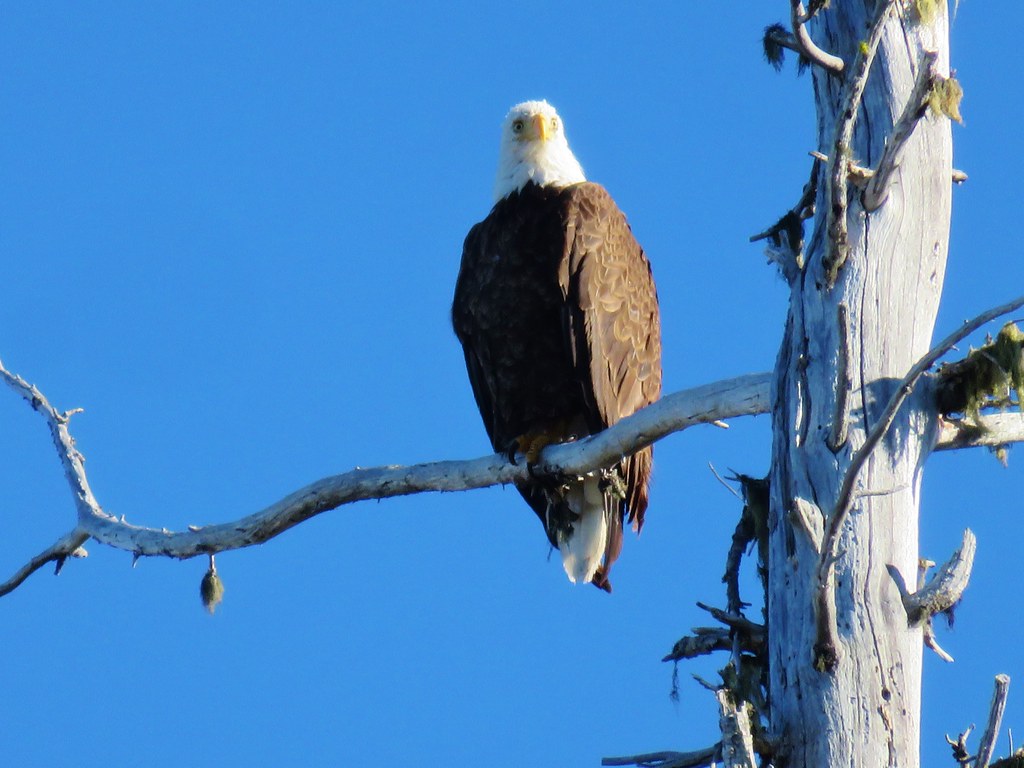
Bald eagle

After 2.3 miles we passed a trail signboard for the Rigdon Lakes Trail. We planned on returning the next day via that trail so for the time being we stuck to the Shoreline Trail for an additional 1.4 miles to another trail signboard, this time marking the Wahanna Trail. Along the way we’d passed Conim Lake on our right just a bit before leaving the Talor Burn fire scar.
Conim Lake near the edge of the 1996 Taylor Burn

Wahanna TrailWahanna Trail

Just beyond the Wahanna Trail junction we came to the North Fork Middle Fork Willamette River flowing from Waldo Lake.
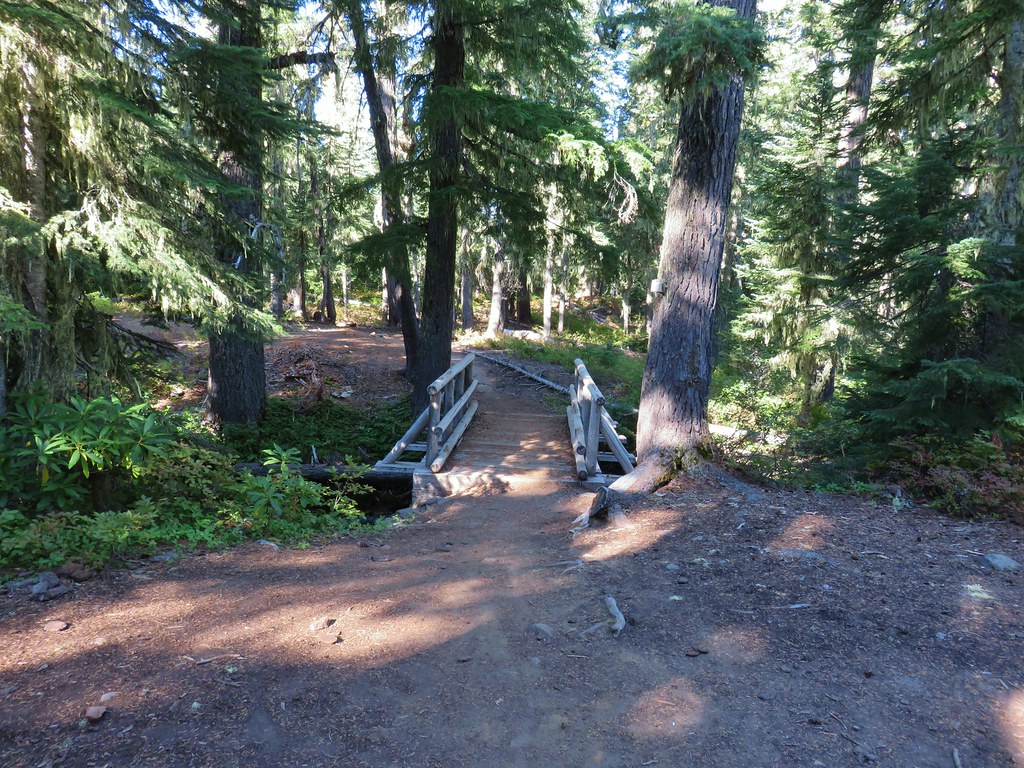
Footbridge over the North Fork Middle Fork Willamette River

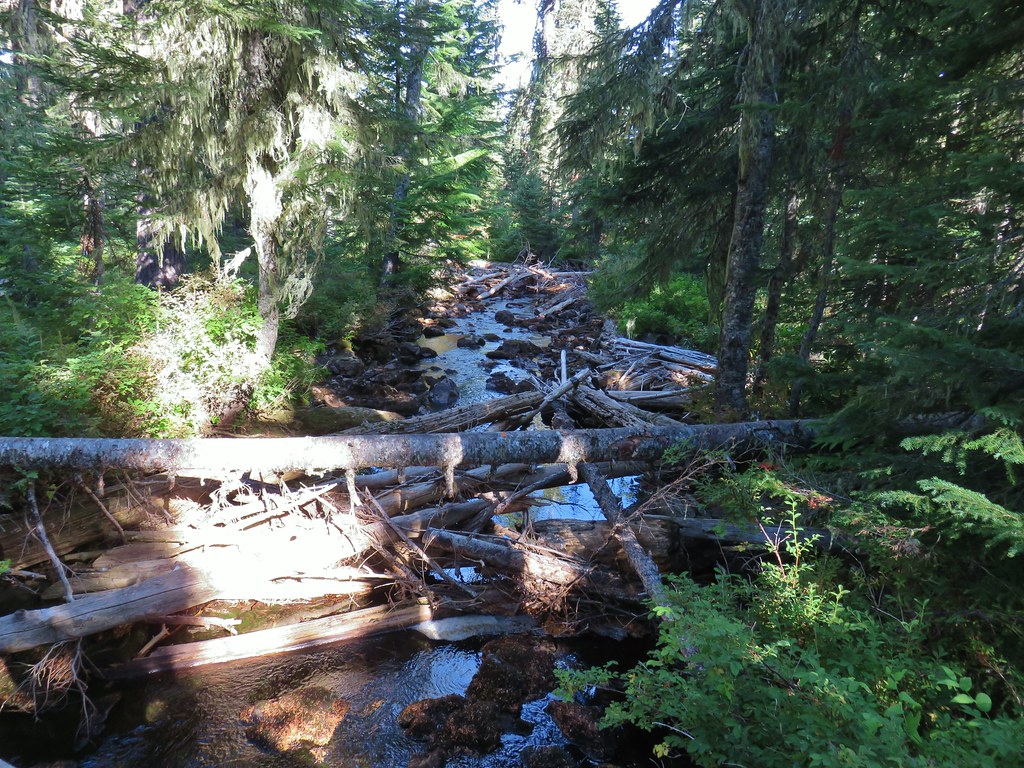
North Fork Middle Fork Willamette River

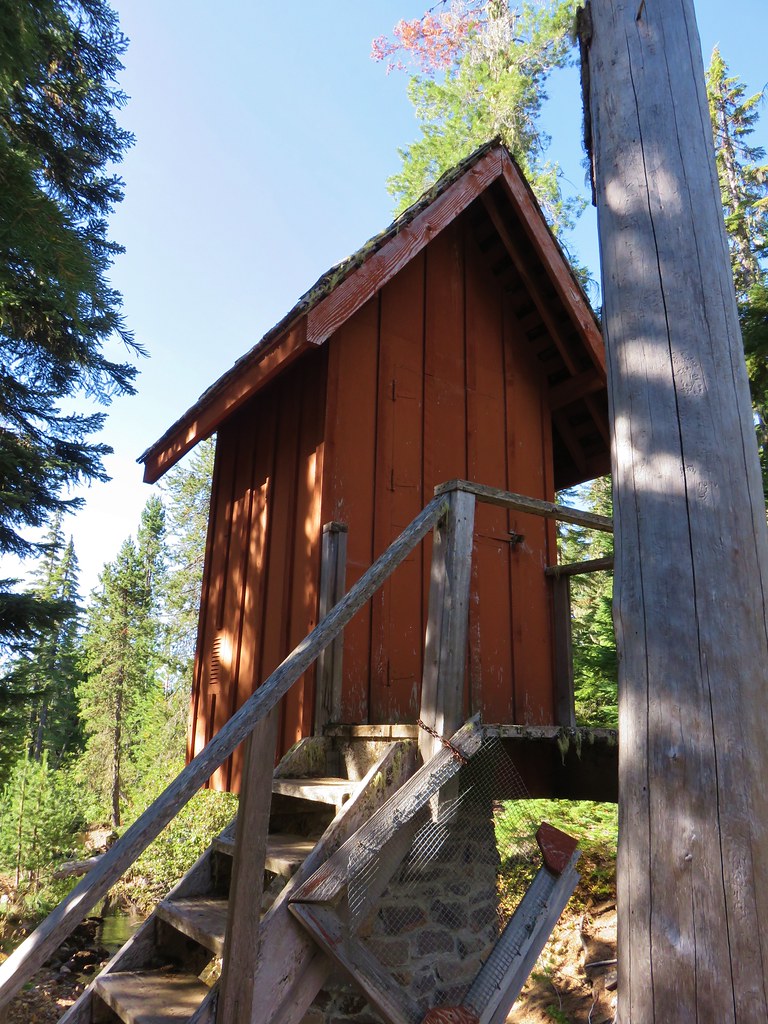
A side trail to the left here led passed a small outbuilding to Dam Camp where we had hoped to find a camp site but that area was already spoken for so we settled for a spot further back from lake.
Some sort of monitoring station

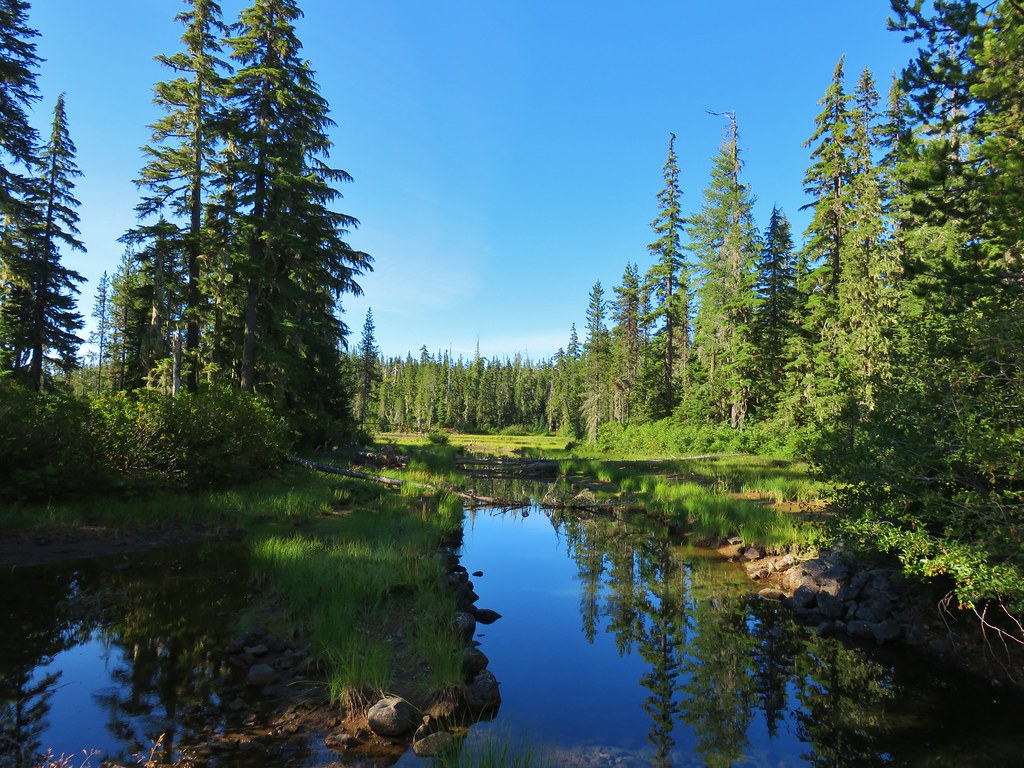
Outlet of Waldo LakeDam Camp is to the left in the trees and rhododendron

Campsite near Waldo Lake

This worked out to be a fine spot despite not being close to the lake as it was closer to the Wahanna Trail which we would be taking then next day on our way to the Rigdon Lakes Trail. After getting camp set up we put on our day packs and continued beyond the river crossing just a tenth of a mile to a fork where the Wahanna Trail forked downhill to the right (the Wahanna and Shoreline Trail briefly share tread).
Wahanna Trail splitting to the right from the Shoreline Trail

The trail promptly entered the Waldo Lake Wilderness.
Entering the Waldo Lake Wilderness

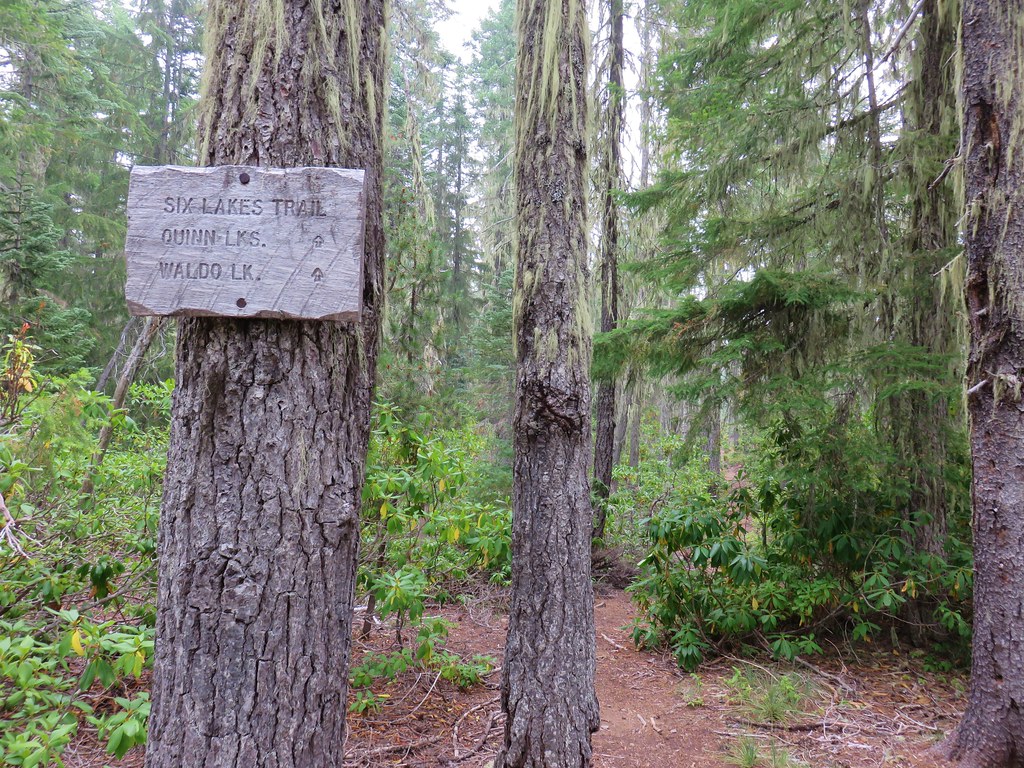
Just a quarter mile from the fork the trail forked again. This time the Wahanna Trail forked to the left while the right hand fork was the Six Lakes Trail.
Wahanna Trail to the left and the Six Lakes Trail to the right

Here we faced a choice. If we stayed left we could complete a long loop past Lake Chetlo and along Winchester Ridge and eventually following the Six Lakes Trail from its other end past the Quinn and Eddeeleo Lakes. Alternatively we could go right and after visiting the lakes turn back or decide to complete the loop in the opposite direction. We were feeling ambitious and felt up to the loop so we decided to go left. This way we would be saving the bulk of the lakes for the end of the loop.
Wahanna Trail

The trail remained relatively level for the next mile passing through a forest full of huckleberry bushes and several small meadows.
Wahanna Trail

Meadow along the Wahanna Trail

It was along this section that we encountered the only other people we would see during the loop. After 1.2 miles we spotted Lake Chetlo through the trees on our left.
Lake Chetlo

Lake Chetlo

Expecting to find a side trail down to the lake we continued on but the trail began to climb up and away from the lake. Less than a quarter mile later we were at a junction with the Winchester Ridge Trail and that had been the only look we had at Lake Chetlo.
Wahanna Trail junction with the Winchester Ridge Trail

We turned right onto the Winchester Ridge Trail which climbed steeply for a little over half a mile to another junction. We had been on this section of trail before in 2012 as we were coming down from the Waldo Mountain Lookout and heading for Elbow Lake (post).
Winchester Ridge Trail

We turned right at this junction as well to continue on the Winchester Ridge Trail which now leveled out somewhat as it traveled along the ridge.
Winchester Ridge Trail

The blue skies from the morning were quickly being replaced by smoke from the Terwilliger Fire as we made our way along Winchester Ridge. There aren’t many views from this trail to begin with and the couple that we did get we could just barely make out the Three Sisters to the NE.
South Sister through smoke

Smoke from the Terwilliger Fire obscuring the view of South SisterSouth Sister

Smokey view from the Winchester Ridge Trail

The Three SistersThe Three Sisters

View from the Winchester Ridge TrailRigdon Butte beyond the Eddeeleo Lakes from the Winchester Ridge Trail

Not only does the Winchester Ridge Trail suffer form a lack of views, but there aren’t many distinguishable landmarks along the way. A little over two and a half miles from the fork though the Waldo Meadows Trail came up from the left.
Waldo Meadows Trail to the left and the Winchester Ridge Trail to the right

That trail went downhill for .5 steep miles to Swann and then Gander Lakes, neither of which we could not see from the Winchester Ridge Trail. The trail climbed briefly beyond this junction before descending to yet another junction with a trail on the left. This time with the Winchester Trail, a total of 1.8 miles from the Waldo Meadows Trail.
Winchester Ridge Trail

Winchester Ridge Trail junction with the Winchester Trail

The Winchester Ridge Trail ends at the Winchester Trail. We stayed straight at the junction and followed the Winchester Trail for a half mile to its end at the Blair Lake Trail.
Winchester Trail

Blair Lake Trail sign

We turned right onto the Blair Lake Trail.
Blair Lake Trail

We had hiked the western end of this trail in 2015 on what remains to this day as the best beargrass hike ever. (post)

The Blair Lake Trail descended for a mile to Lower Quinn Lake which was unfortunately suffering from the increased smoke.
Lower Quinn Lake

After a brief stop at the lake we continued on the Blair Lake Trial for another quarter mile before reaching the signed junction with the Six Lakes Trail.
Blair Lake Trail junction with the Six Lakes Trail

Six Lakes Trail

We turned right onto this trail which climbed gradually for the next half mile to a fork where we went right to visit Upper Quinn Lake.
Upper Quinn Lake

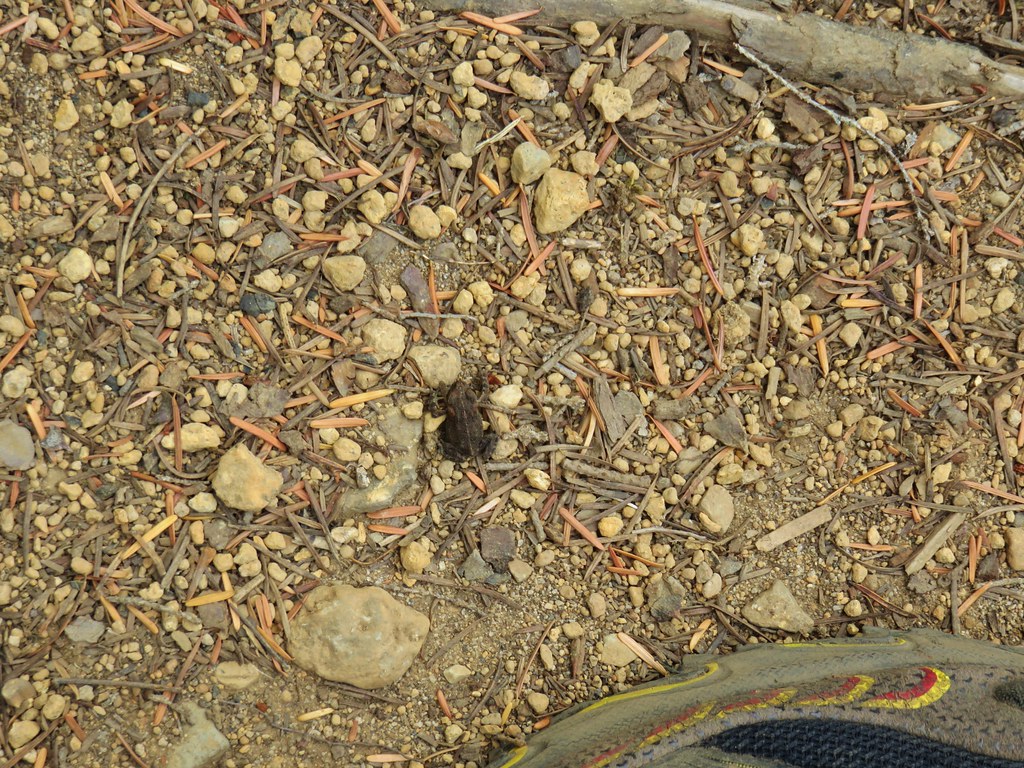
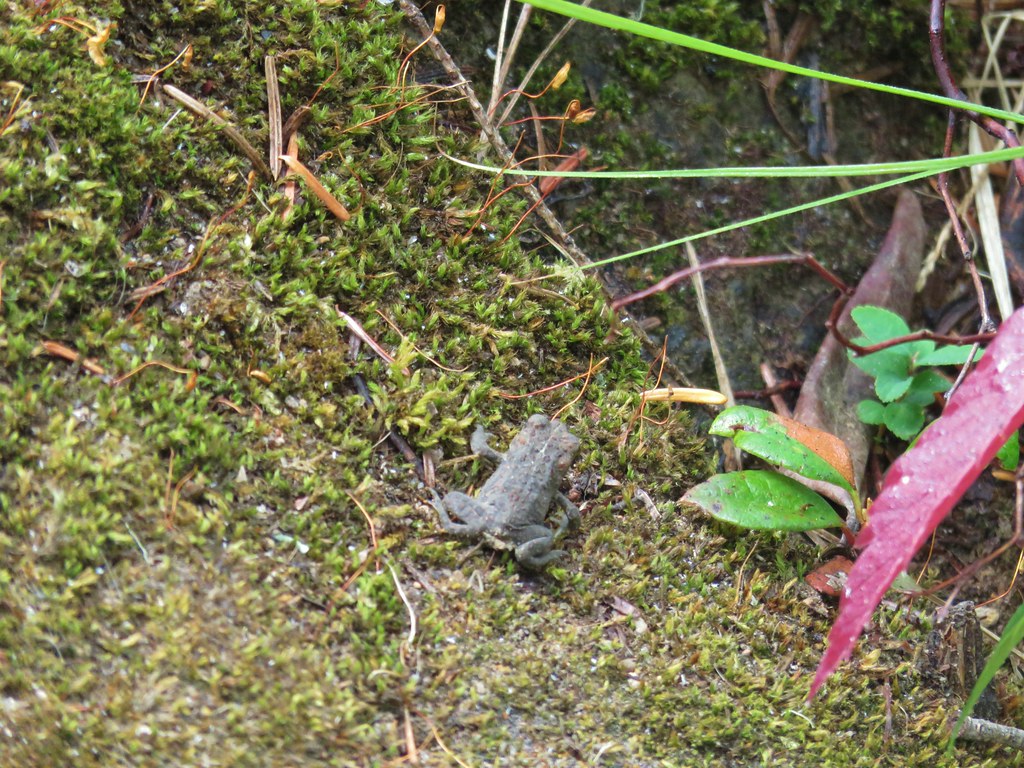
Although the smoke wasn’t bad enough to cause us any issues with breathing or our eyes it was putting a damper on the views of the lakes. At Upper Quinn Lake we found a few empty campsites and lots of little frogs.
Frog at Upper Quinn Lake

Frog

Somewhere along the way we wound up losing the trail (most likely in one of the campsites) and had to bushwack back to the Six Lakes Trail. Once we had regained the trial we turned right and in just a tenth of a mile spotted the northern end of Long Lake beyond a grassy meadow.
Long Lake

Again we erroneously assumed there would be obvious side trails leading to the lake but the Six Lakes Trail passed on the opposite side of a rocky ridge for nearly a mile which hid the lake from sight.
Six Lakes Trail

When the GPS showed that we were nearly past the lake we decided to try and bushwack through the rhododendron to the southern end of the lake. We had managed to make it most of the way there when we spotted a tent set up near the shore. Not wanting to stumble into someones camp we settled for an obstructed view through the trees.
Long Lake

Long Lake

We left Long Lake and continued for another half mile toward Lower Eddeeleo Lake. Shortly before reaching the lake there was an obvious side trail to the left.
Side trail at Lower Eddeeleo Lake

This side trail led across a dry outlet creek to an open area along the lake shore. We took a longer break here. We could just make out the old Waldo Mountain Lookout through the smoke.
Waldo Mountain from Lower Eddeeleo Lake

Waldo Mountain

Waldo Mountain Lookout

We might have taken an even longer break if not for the yellow jackets who were just a little too interested in us for my liking. We left the lower lake and returned to the Six Lakes Trail which climbed a short way above the lower lake which was barely visible through the trees.
Six Lakes Trail

Lower Eddeeleo Lake

Just under one and three quarter miles from the side trail to Lower Eddeeleo Lake we came to a short side trail to Upper Eddeeleo Lake on our right. We stopped again briefly at this lake which had a little sunlight glinting off the water.
Waldo Mountain from Upper Eddeeleo Lake

The next lake on the map was Round Lake which lay below and to the east of Upper Eddeeleo Lake. The Six Lakes Trail wound around the lake but never got very close to it and the one side trail we spotted heading to the lake would have required a steeper climb back up than either of us were willing to do at that point so we once again settled for a very limited view through the trees.
Round Lake through the trees

The Six Lakes Trail climbed up a ridge away from Round Lake for the final mile of its 6.6 mile length before dumping us back out on the Wahanna Trail.
Six Lakes Trail

According to our GPS we had hiked a total of 19.4 miles at that point and still had the quarter mile climb back up to the Waldo Lake Shoreline Trail. We had known that this was going to be a long day but by our calculations we were expecting closer to a 17 mile day. We had also brought our dinner with us thinking we could eat it at one of the lakes, but between the smoke, yellow jackets, and a few hardy mosquitoes we hadn’t found a spot where we really wanted to sit for an extended time.

When we got back to the Shoreline Trail we turned right (away from camp) hoping to find a spot along Waldo Lake to eat. Fortunately we only had to go about 100 yards where we found a trail down to the rocky sore across from Dam Camp.
Waldo Lake with some smoke

Even better was the fact that the smoke was starting to move out of the immediate area bringing back some of the blue sky from the morning.
Waldo Lake

We tried a new meal, three cheese chicken pasta, which wound up being underwhelming. It sort of fit with much of the day. The hike was nice but nothing really stood out and the smokey conditions at the lakes didn’t help. It also seemed like most of the lakes were very similar in that they were surrounded by forested hillsides but nothing dramatic.

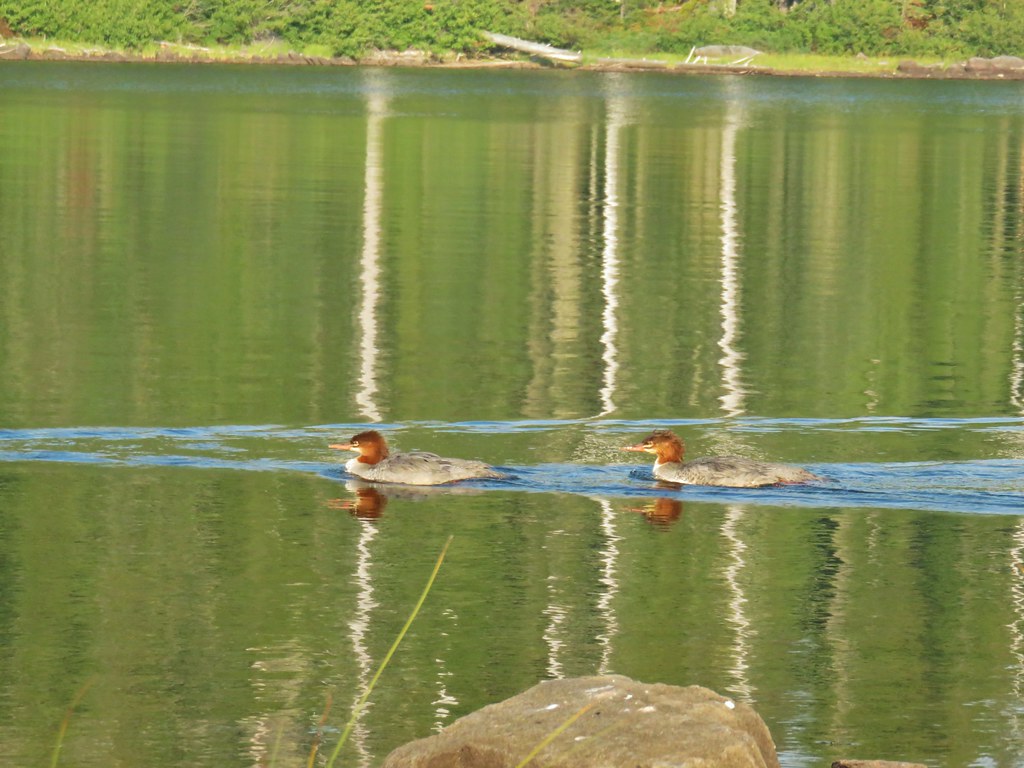
We sat out on the rocks for quite a while watching a paddle boarder and a canoe float around on the lake as well as having some mergansers swim by.
Merganser

It was quite a bit busier at the lake than where we normally camp and after getting a little chilly and returning to our tent to put on some extra clothing we noticed that a family? that had set up camp near where we had eaten had lit a campfire. Just a couple of days earlier the Willamette National Forest had announced a ban on all campfires and we had seen numerous posted signs that morning. On top of the illegal campfire we were also being treated to the melodious (NOT) sounds of someones portable music player. Thankfully the music died down and at one point we heard someone yell to the family that they needed to put the fire out. We went to bed hoping that the next day would be just a bit better. Happy Trails!

Flickr: Waldo Lake Wilderness Day 1

Categories
High Cascades Hiking Mt. Jefferson Area Oregon Trip report

South Breitenbush Trail to Jefferson Park 8/11/18

**Note the 2020 Lionshead Fire burned the area covered by this hike.**

We kicked off six days of hiking with a visit to Jefferson Park. Since 2011 Jefferson Park had been an annual destination until last year when we were forced to skip our visit due to the Whitewater Fire. For this years visit we started at the South Breitenbush Trailhead.
IMG_9825

This was our second time on this trail with our first coming in 2013 (post). We had remembered that the trail was quite rocky, but forgotten how much more of a climb it was than either the Whitewater (post) or Woodpecker Ridge (post) trails. The Whitewater Trail remains closed for now due to the fire while the Woodpecker Ridge Trail is open but undergoing repairs by the Forest Service. The other option to reach Jefferson Park is from the north via the PCT over Park Ridge (post) but one time driving the road to that trailhead was enough for us.

We followed the South Breitenbush Trail uphill through the trees along the increasingly rocky tread.
IMG_9828

IMG_9830

At the two mile mark we found that the Forest Service had replaced the sign for the Bear Point Trail, a hike that is on our schedule for next year.
South Breitbenbush Trail junction with the Bear Point TrailBear Point Trail sign 2013

IMG_9831Bear Point Trail sign 2018

There aren’t many views of Mt. Jefferson along the lower portion of the trail and on this day the mountain was playing peak-a-boo through some clouds.
IMG_9836

IMG_9838

We noticed another difference at the 4.2 mile mark where the trail passes a small pond. This years drought conditions were obvious by the difference in the water present.
Unnamed pond8/19/2013

IMG_98578/11/2018

Just over a half mile from the pond the trail passes over a ridge and descends through a rock field where we spotted one of our favorite animals, a pika.
IMG_9868

IMG_9867

After the descent the trail levels out somewhat as it passes through wildflower meadows before arriving alongside the South Breitenbush River.
IMG_9877

IMG_9872

IMG_9874

IMG_9882

IMG_9894

As we neared a junction with a side trail to Park Lake at the six mile mark a break in the clouds finally revealed Mt. Jefferson.
IMG_9908

IMG_9911

We decided to return via Park Lake so we stuck to the South Breitenbush Trail after crossing the river on rocks and climbed for nearly a half mile to its end at the Pacific Crest Trail.
IMG_9912

IMG_9924South Breitenbush Trail sign at the PCT junction.

IMG_9925PCT heading south through Jefferson Park.

We turned left on the PCT and headed north crossing the river again before turning right toward Russell Lake after .2 miles.
IMG_9930

IMG_9934

Russell Lake never disappoints. We passed around its north end and took a break on some rocks on its SE side.
IMG_9937

IMG_9941

IMG_9946Park Butte

After a snack we continued around the lake for a bit before veering to the SW and returning to the PCT which we followed south for .3 miles to a sign for Scout and Bays Lakes.
IMG_9948

By the time we had reached Scout Lake the clouds had gained the upper hand and Mt. Jefferson had all but vanished.
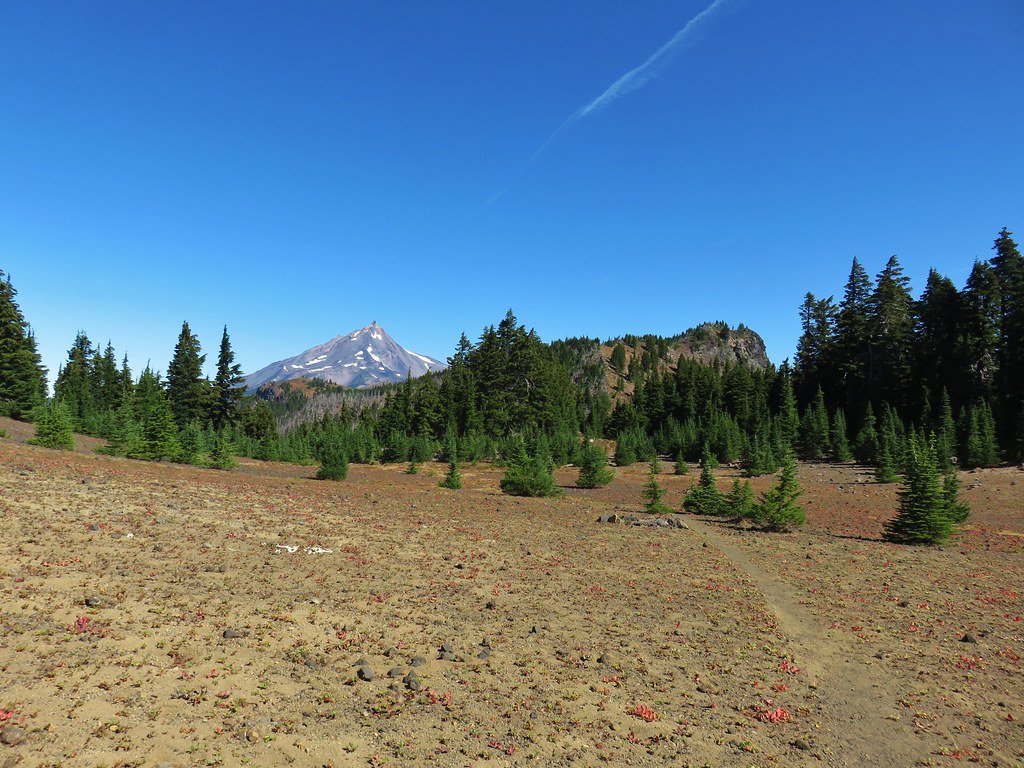
IMG_9956

IMG_9957

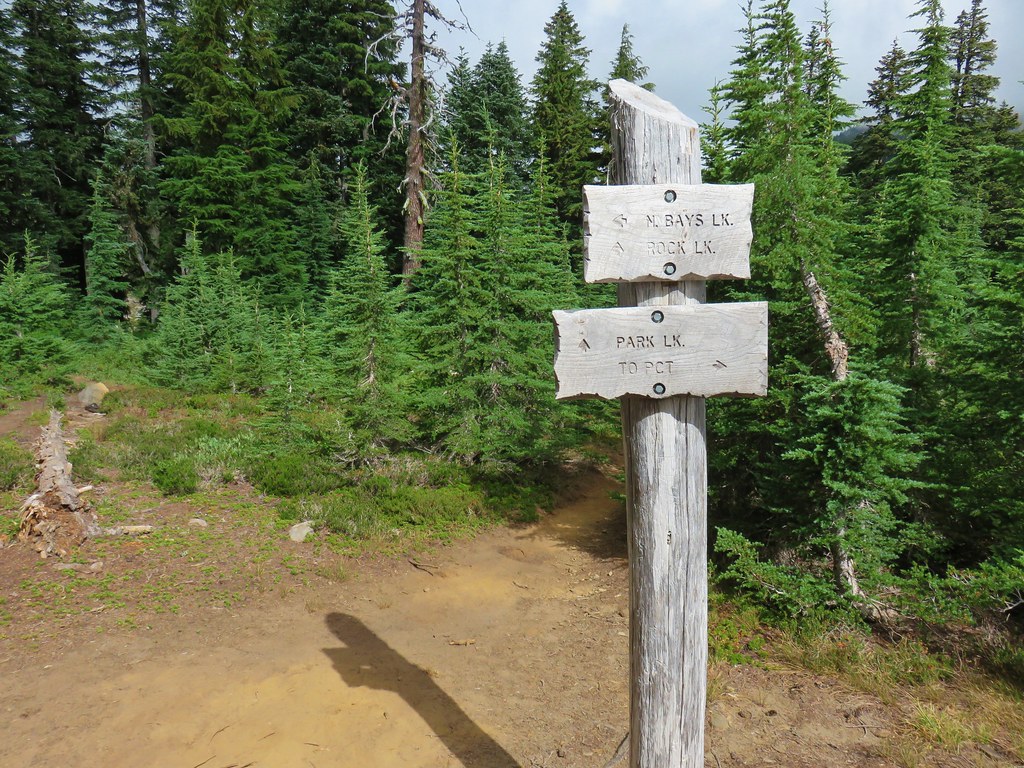
With the mountain hidden and a five day backpacking trip beginning the next day we decided to skip Bays Lake and turned right at a sign for Rock and Park Lakes.
IMG_9958

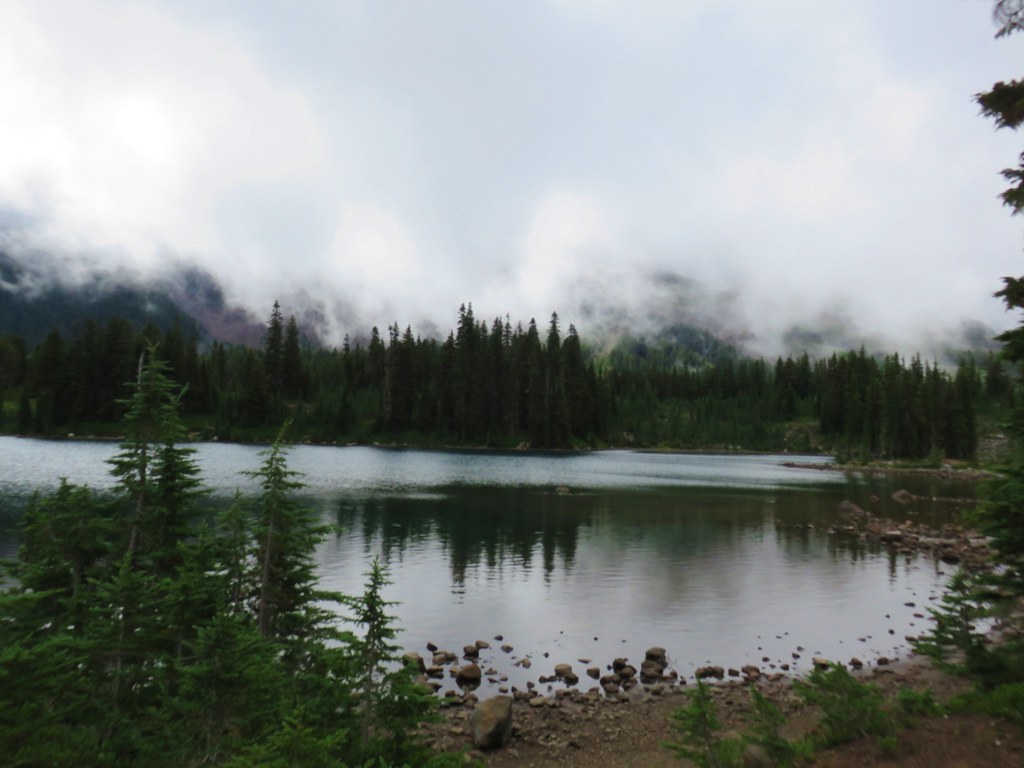
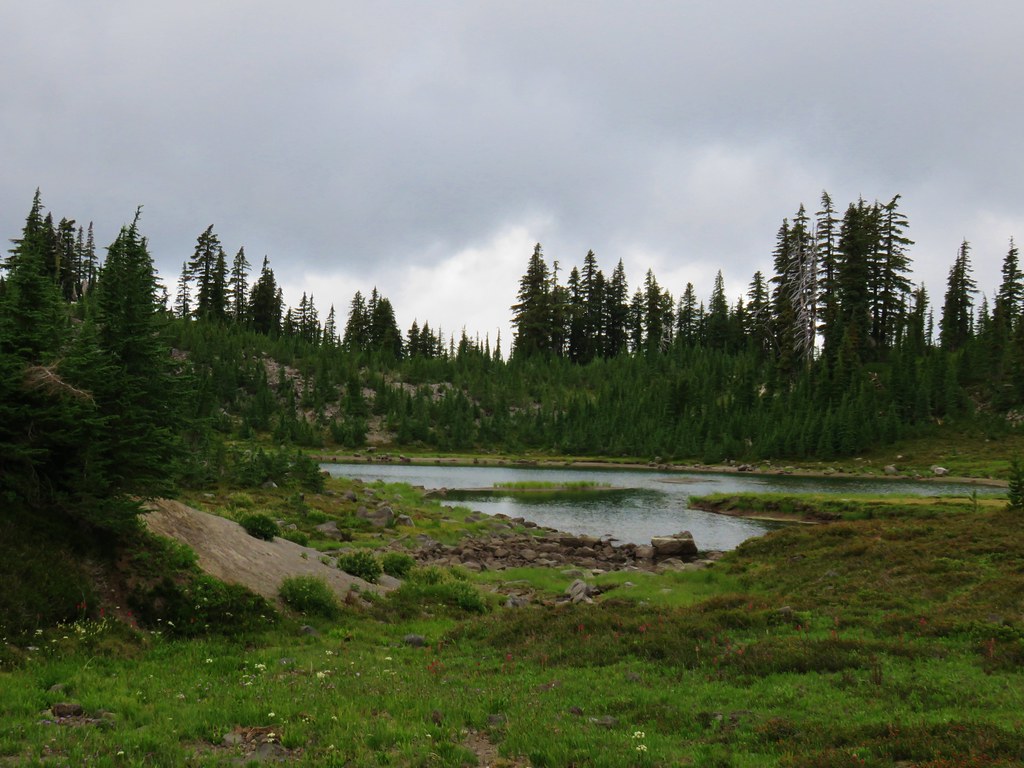
We likewise skipped Rock Lake this time staying above it and passing Park Lake.
IMG_9959

IMG_9961

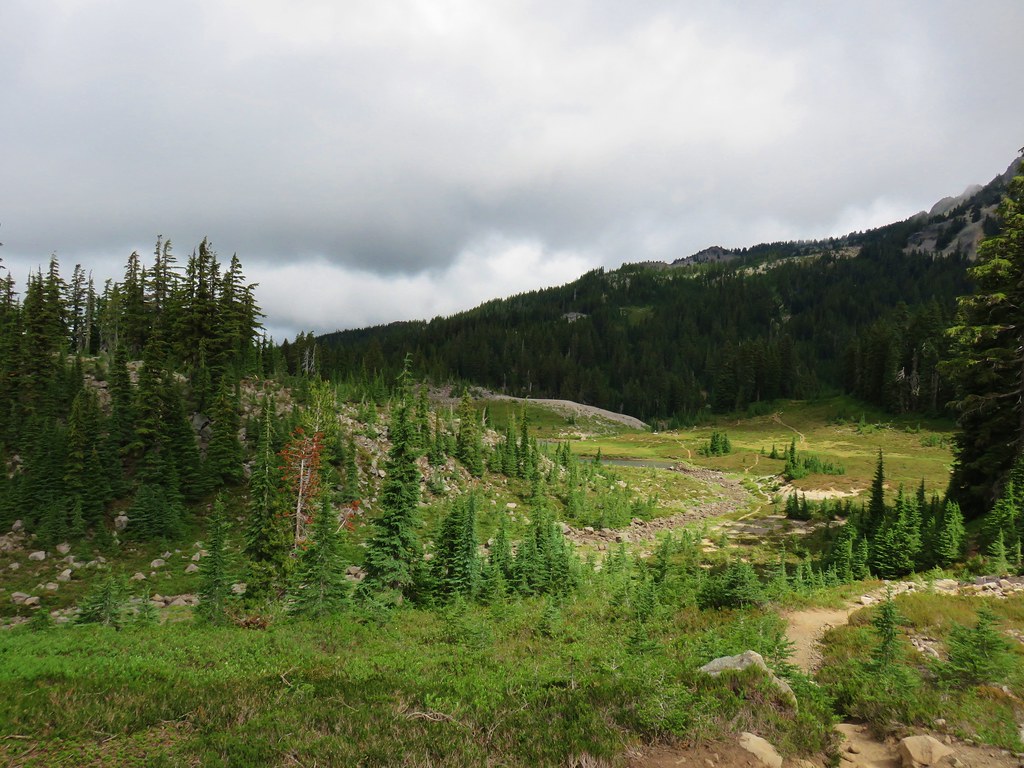
We returned to the South Breitenbush Trail and headed back down to the trailhead. With the clouds rising to overtake Mt. Jefferson there was a better view of the surrounding valleys and ridges which showed the scars of the Whitewater Fire.
IMG_9974

Aside from a few trees on hilltops surrounding the park there was no other visible sign of the Whitewater fire in the areas we visited.

We had been a little surprised by the lack of people we encountered in Jefferson Park but we were apparently just a bit early because we passed a lot of people heading up as we were descending. We made it back to our car by 1:30pm after hiking 14.3 miles and headed home to pack. It had been a relatively quick visit to Jefferson Park but we were planning on being on the road by 5am the next morning in hopes of reaching the Elkhorn Crest Trailhead before 11am. Happy Trails!

Flickr: South Breitenbush Trail to Jefferson Park

Categories
Hiking Mt. Hood Area Oregon Trip report

Salmon River Overnight

For our first overnight outing of 2018 we chose the Salmon River Trail which we had previously visited on August 30, 2015. (post) That hike included approximately 3.5 miles of the 14 mile trail from the west trailhead. This time we would start from the east trailhead with our plan being to set up camp somewhere along the trail then continue to same viewpoint where we had turned around on our previous visit to complete the trail.

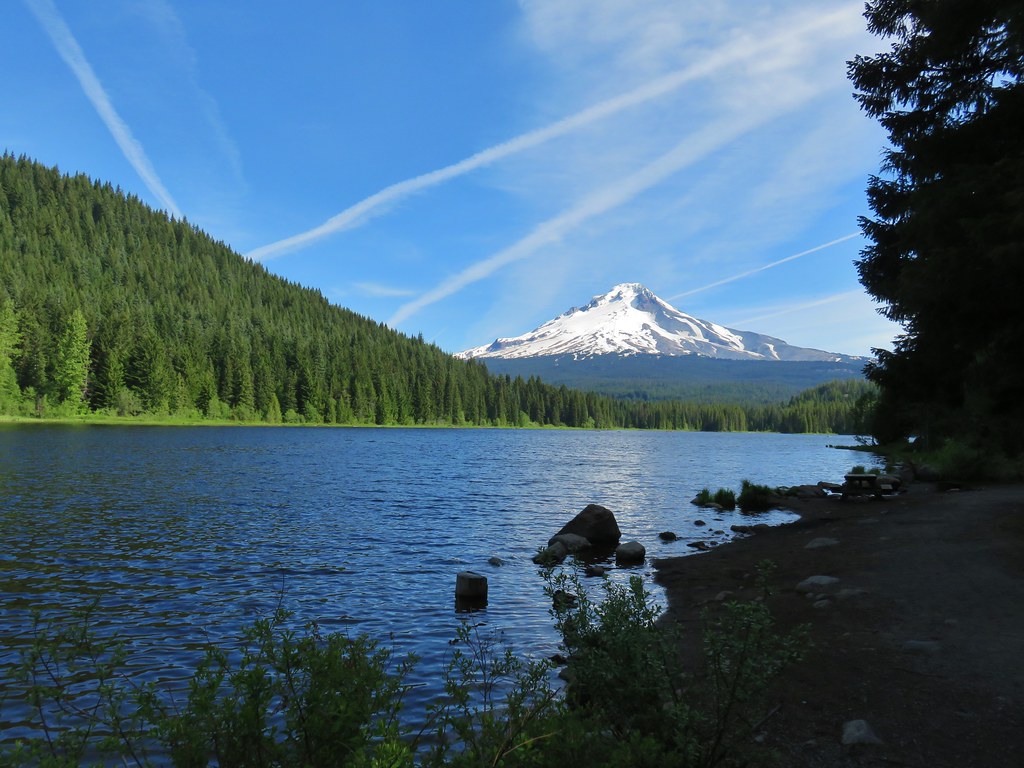
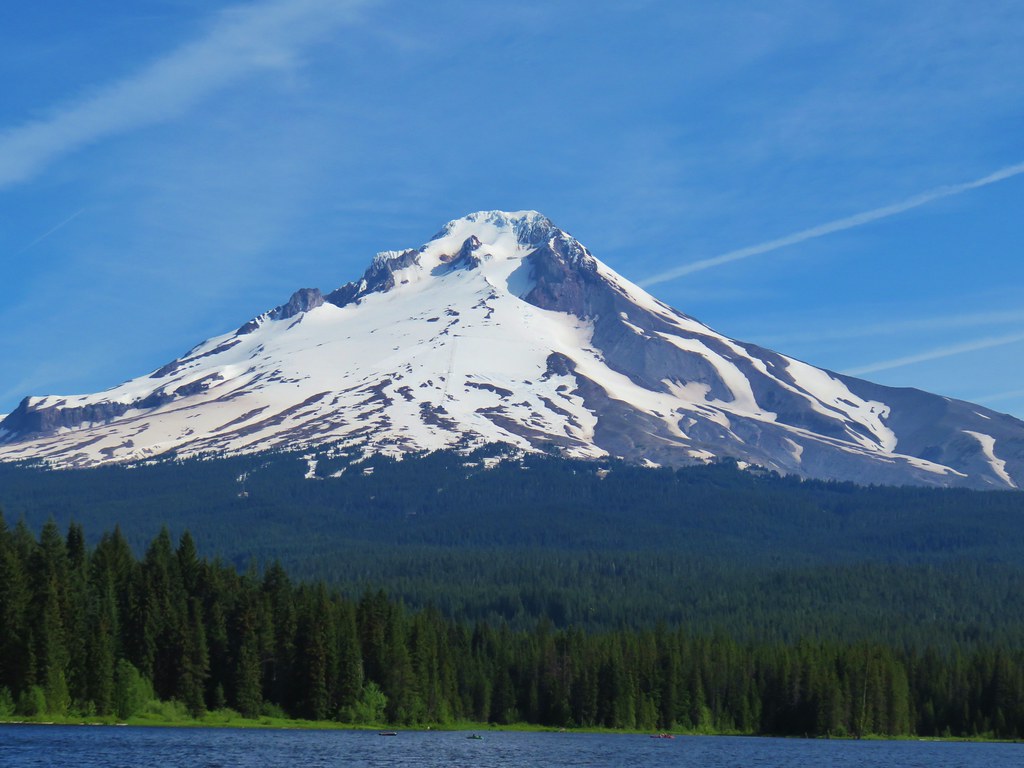
Before we could start our hike though we needed to get some water since the city of Salem’s water had been testing positive for a toxin. We stopped at the Trillium Lake picnicking area on our way to the trailhead and filled our packs there. We didn’t take the time to visit the lake since we were on a mission to start hiking but we did stop again on they way home to see the lake and its view of Mt. Hood.
IMG_5083

IMG_5088

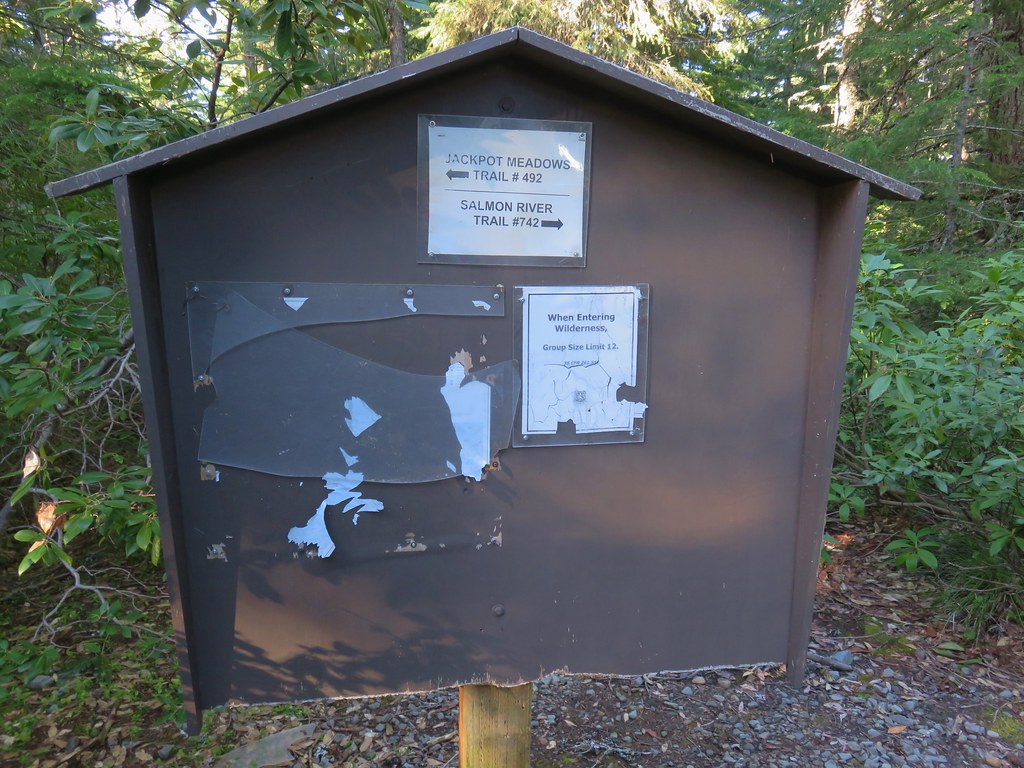
After filling up on water we continued to the trailhead where we were the only vehicle. The trailhead also serves as the north trailhead for the Jackpot Meadows Trail.
IMG_4754

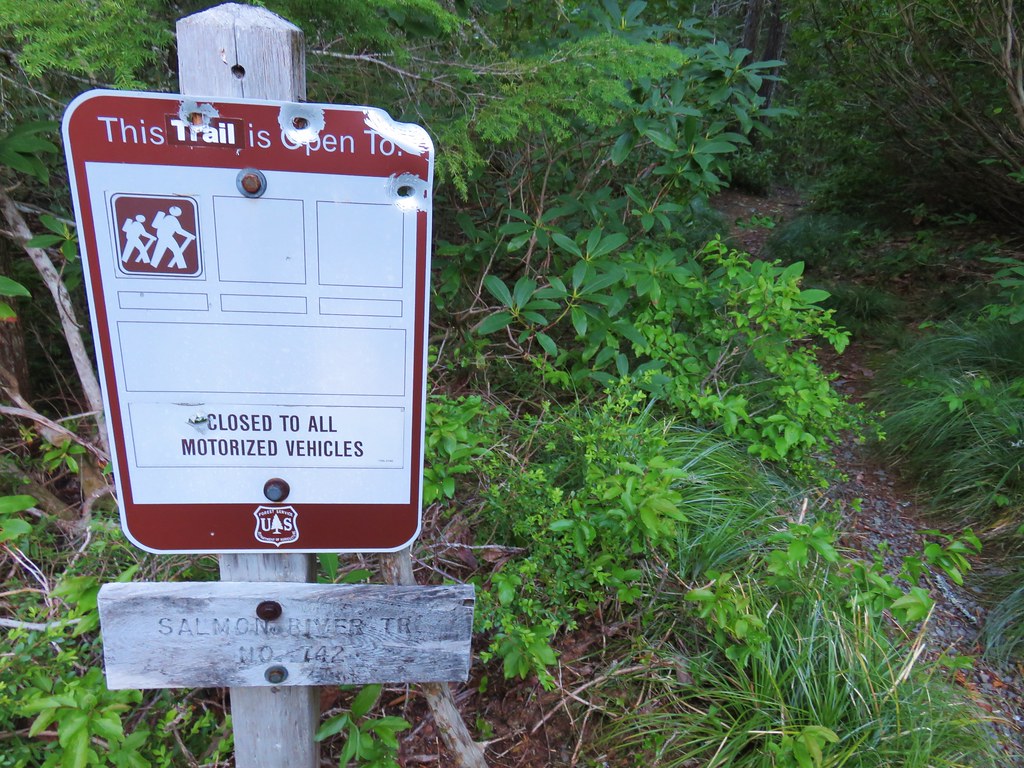
We took the signed Salmon River Trail and headed downhill.
IMG_4756

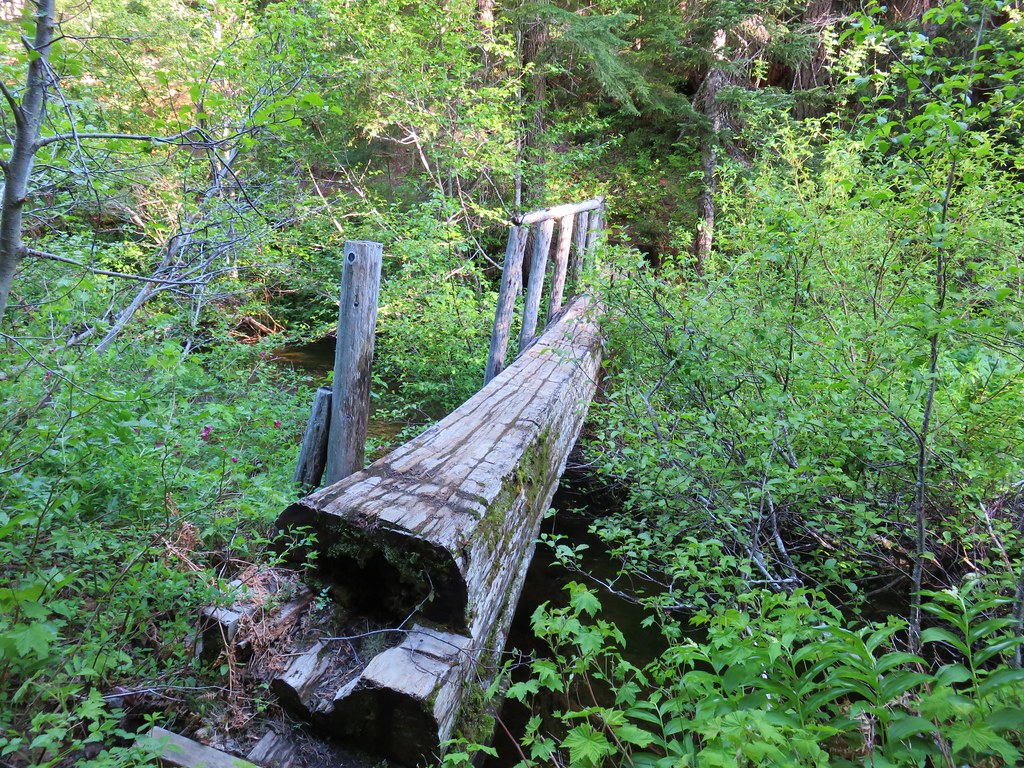
The trail descended in the first quarter mile to a footbridge over Mud Creek which flows from Trillium Lake.
IMG_4760

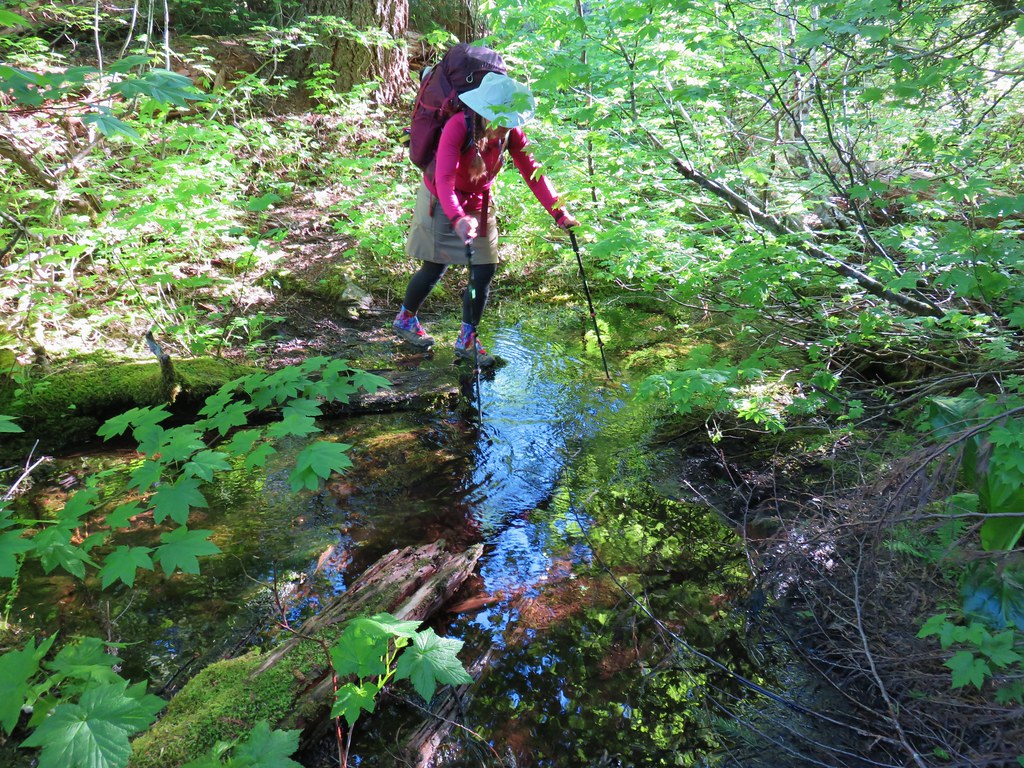
This was the only creek crossing with an official bridge. Over the next mile and a half the trail would cross Fir Tree Creek three separate times.
IMG_47621

IMG_47672

IMG_47833

Between the first and second crossings the trail passed a now abandoned section of trail that led up to the Dry Fir Trail.
IMG_4764

It also passed through some nice forest with rhododendron beginning to bloom along with a little beargrass.
IMG_4779

IMG_4771

IMG_4777

Beyond the third crossing of Fir Tree Creek we entered the Salmon-Huckleberry Wilderness and passed through a variety of scenery.
IMG_4786

IMG_4792

IMG_4793

IMG_4794

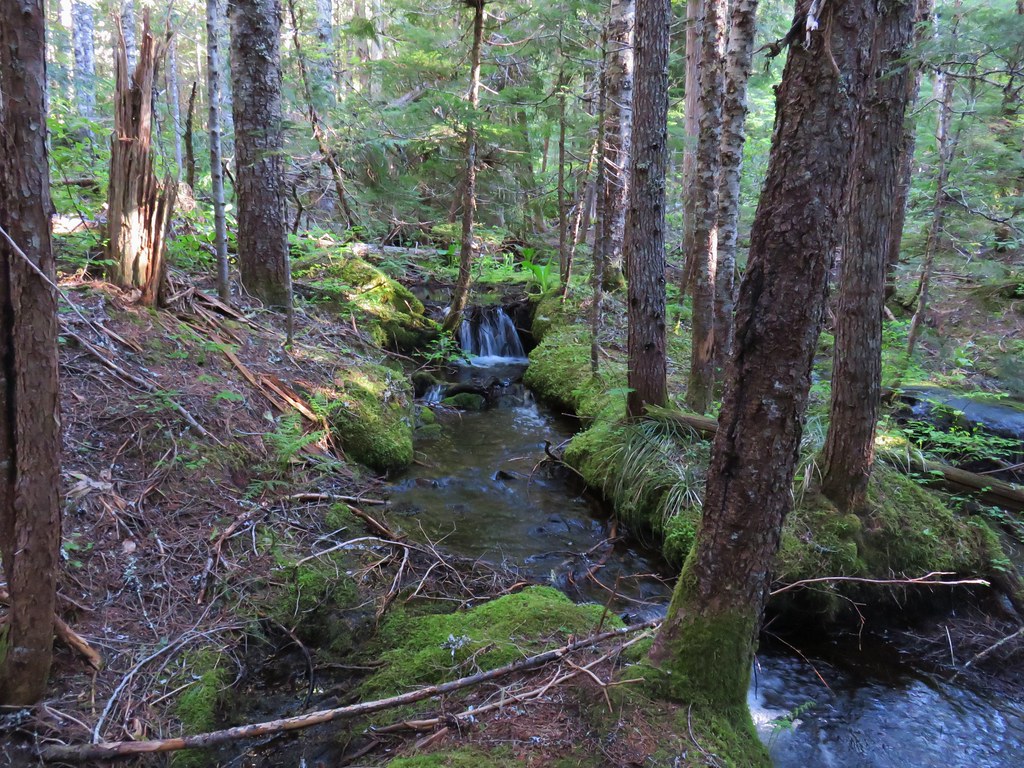
The trail also crossed more creeks.
IMG_4799

IMG_4803

We had passed a few possible campsites but felt they were too close to the trailhead, but after 5.5 miles we came to a junction with the Linney Creek Trail.
IMG_4810

We had spotted some potential campsites along the Salmon River from above just before the junction so we turned down the Linney Creek Trail to check them out.
IMG_4811

The remnants of an old bridge could be seen on the far side of the Salmon River where the Linney Creek Trail used to cross.
IMG_5056

There was a nice large established campsite here which we claimed and set up camp.
IMG_5059

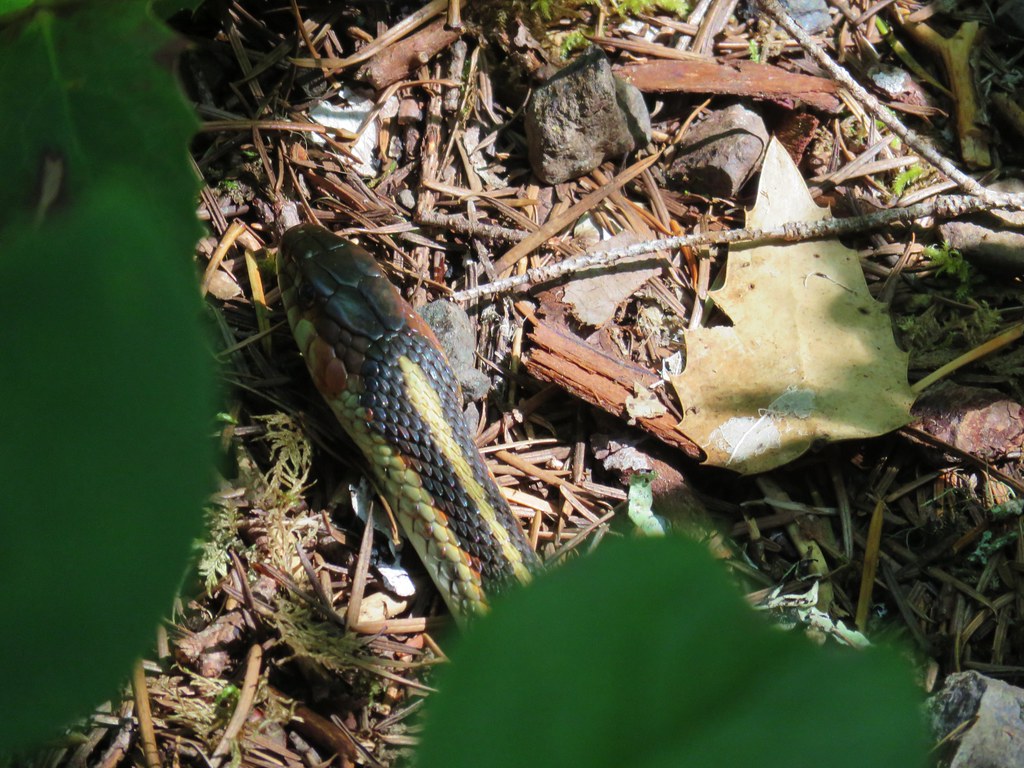
After getting set up we switched to our day packs and climbed the short distance back up to the Salmon River Trail and continued west. For the next three miles the trial continued above the Salmon River to a junction with the Kinzel Lake Trail. We began seeing more flowers along this stretch and also saw the first of two garter snakes for the day.
IMG_4817

IMG_4821

IMG_4824

IMG_4825

IMG_4841

IMG_4835

Shortly before reaching the Kinzel Lake Trail we crossed Kinzel Creek which had a small waterfall visible through trees.
IMG_4845

IMG_4843

IMG_4852

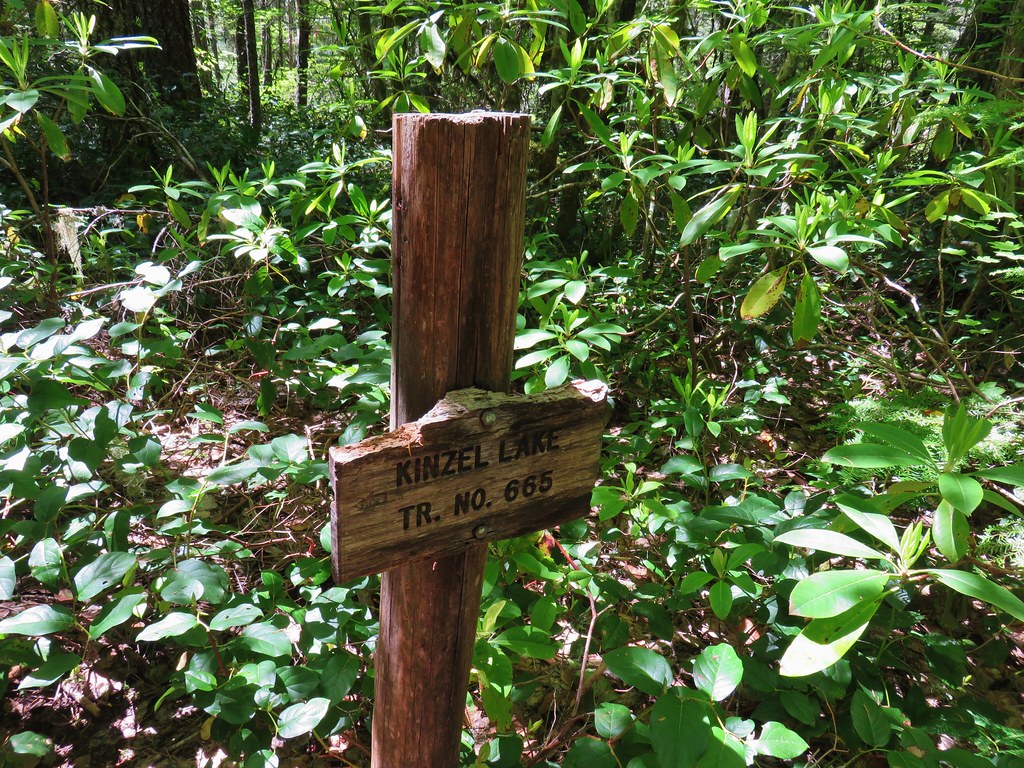
IMG_4853Kinzel Lake Trail

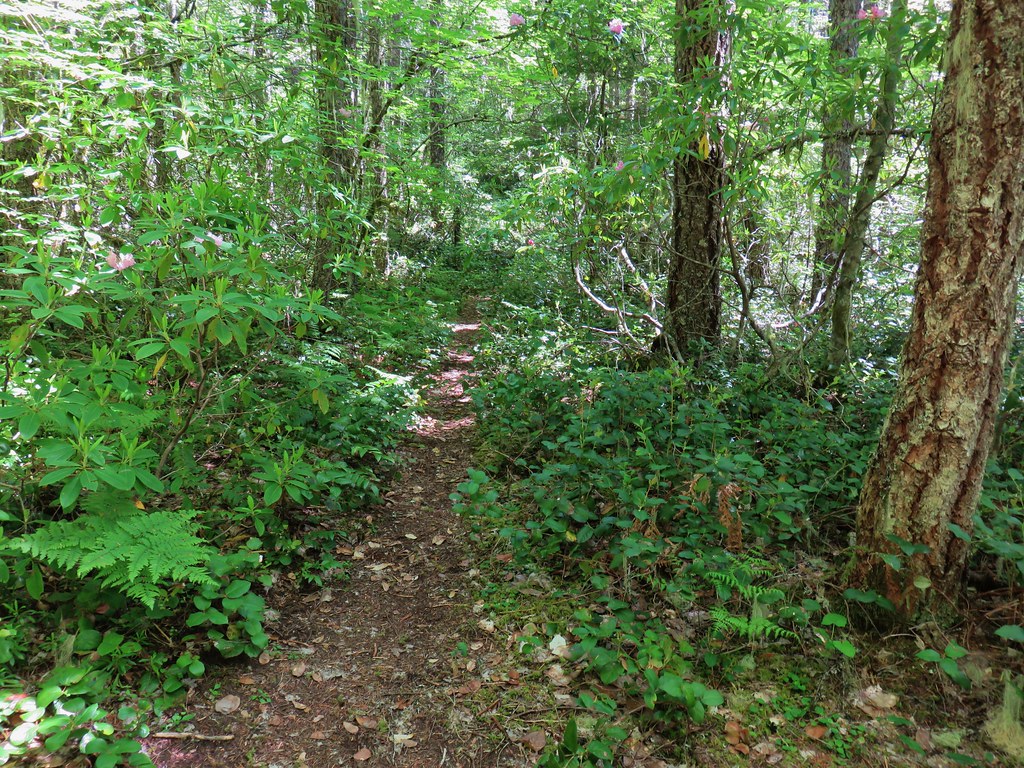
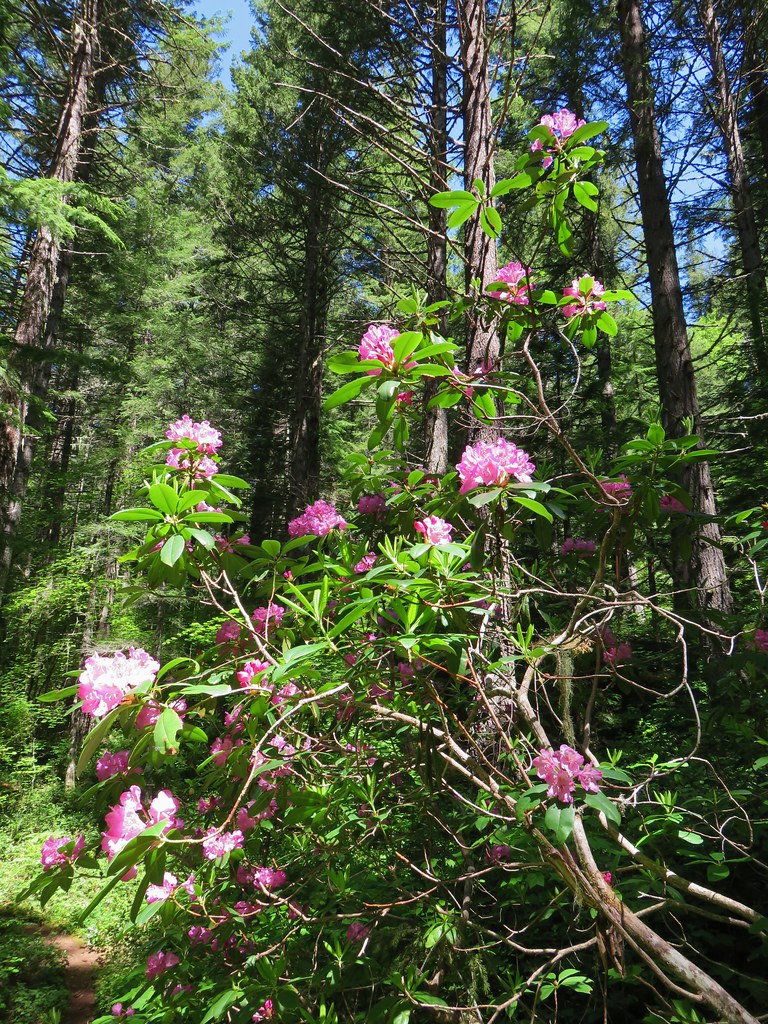
The flower display continued to improve beyond the Kinzel Lake junction with the rhodies now in full bloom.
IMG_4858

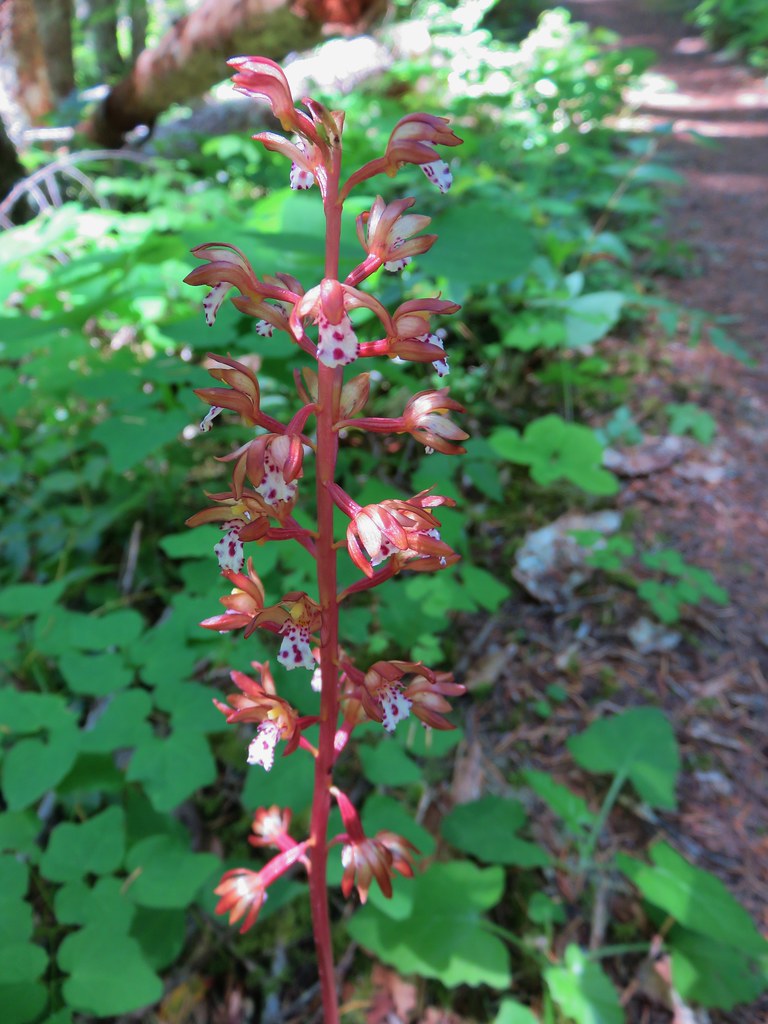
IMG_4870Spotted coralroot

IMG_5032Paintbrush and plectritis

We also passed our first other person of the day when we spotted another backpacker camped near Goat Creek. A bit over a half mile beyond Goat Creek the trail entered a grassy area with the first real viewpoint of the day.
IMG_4878

We turned out toward the viewpoint where we found more flowers and a limited view of the Salmon River below.
IMG_4888

IMG_4892

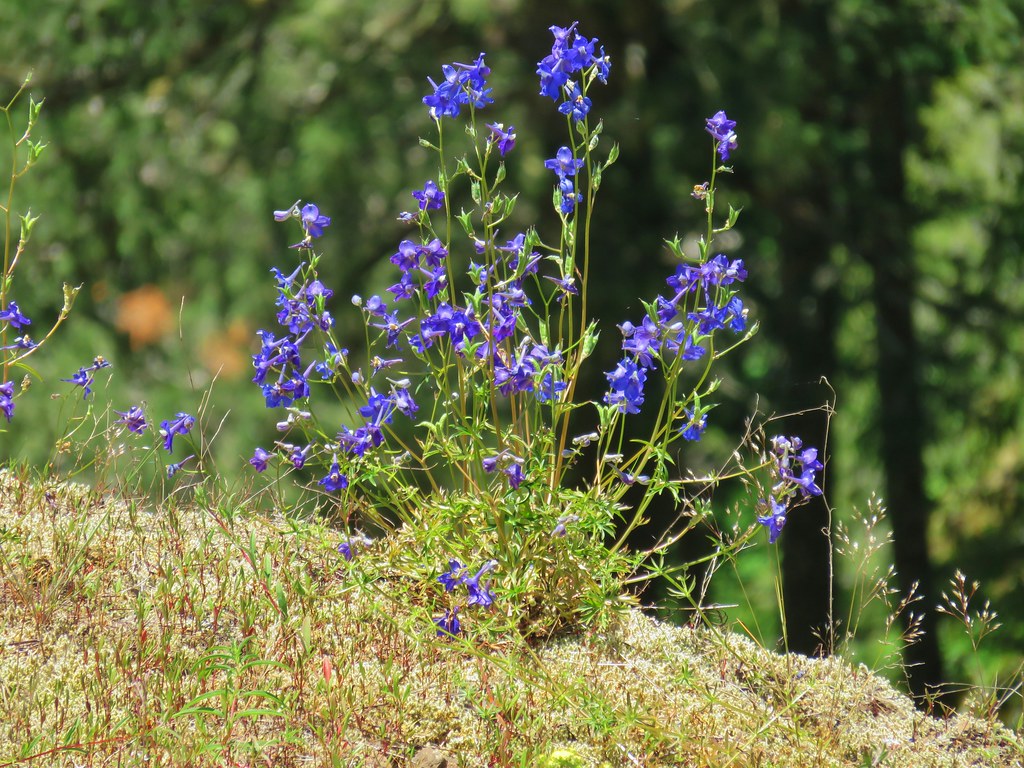
IMG_4896Larkspur

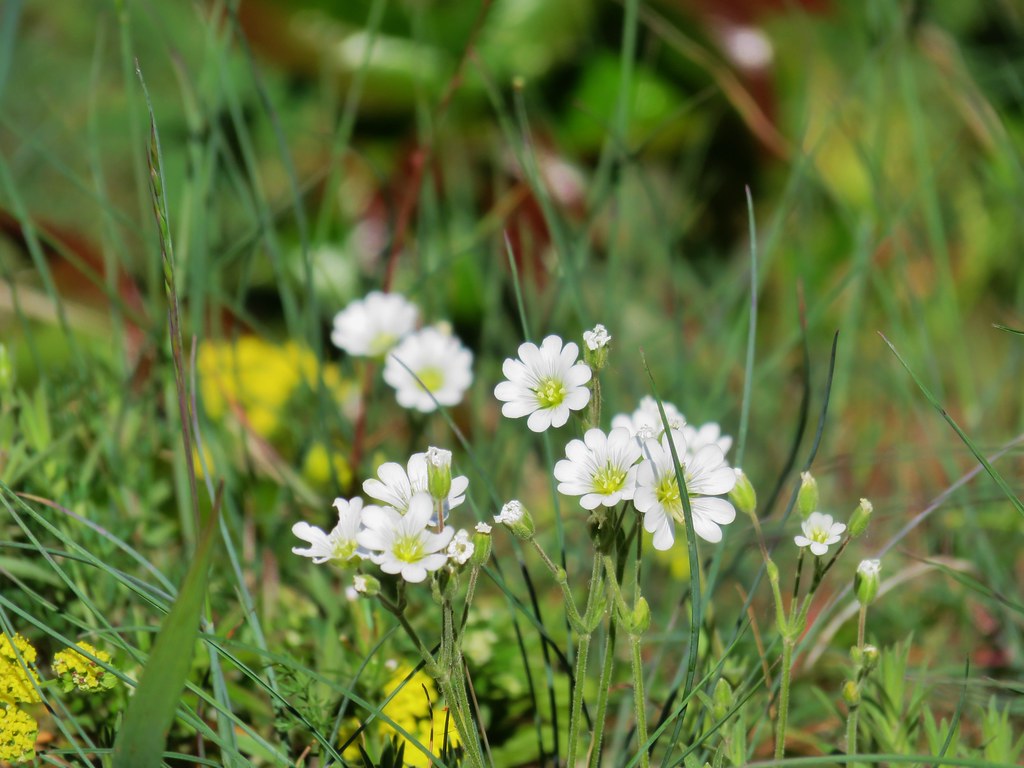
IMG_4902Field chickweed

We knew from our 100 Hikes in Northwest Oregon guidebook that there was a series of three viewpoints along this section of trail. The third of which (coming form the east) being the only one we had visited on our previous hike. After the first viewpoint we passed by what appeared to be a use trail and kept going for a moment before deciding to go back and make sure this wasn’t the route to the middle viewpoint. It was not, but what it turned out to be was the very steep, rugged scramble to an overlook of Frustration Falls.
IMG_4947

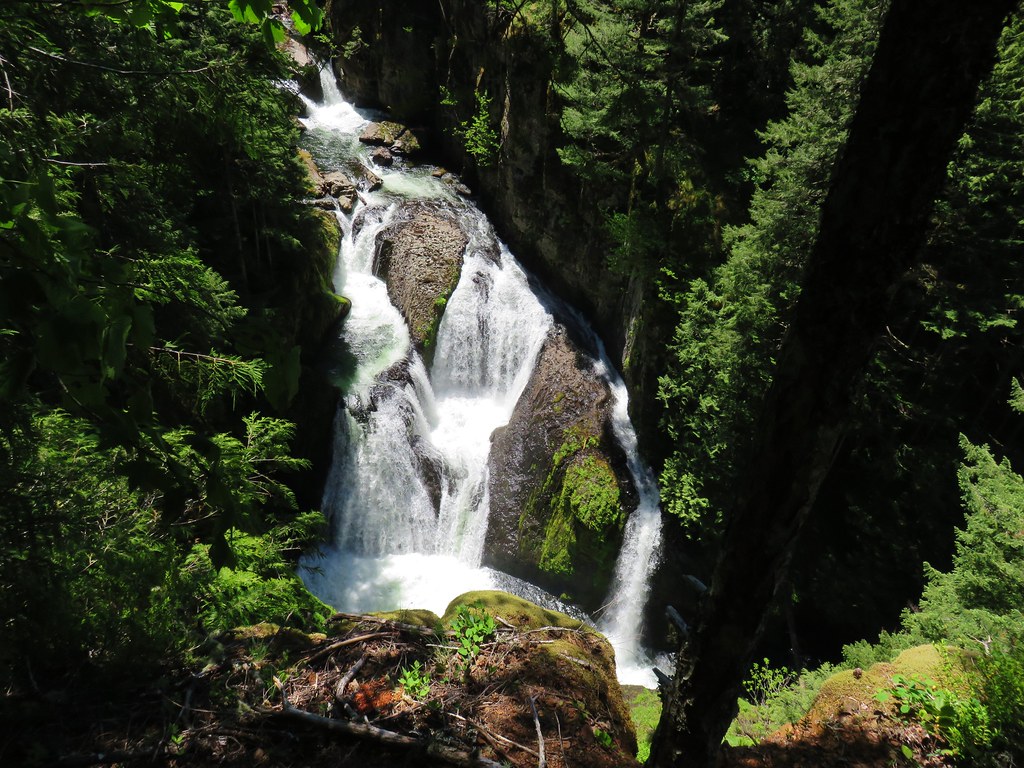
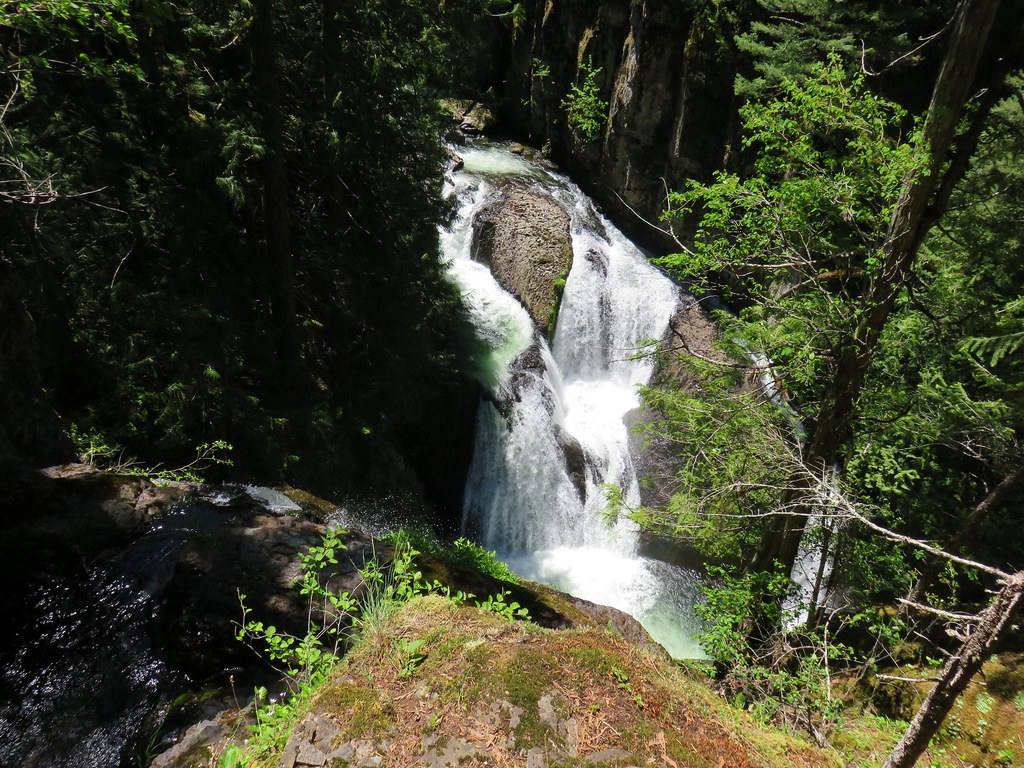
We were aware that there was a use trail to a view of these falls and originally had no intention of seeking it out. We lucked out in that the conditions were perfect on this day so the trail was not wet or muddy which could make it extra slick. It was slick enough just due to the steepness and loose rocks so we relied heavily on our poles. In all the trail lost around 350 feet in less than a quarter mile. This was definitely not a trail for everyone and anyone wishing to attempt it does so at their own risk. With that said we were happy to have accidentally stumbled on the trail and sat next to a small creek with it’s own fall for a bit admiring the thundering cataract below.
IMG_4928

IMG_4941Cliffs along the hillside above the Salmon River

After the break we struggled back up the scramble path.
IMG_4953

Shortly after being back on the Salmon River Trail we came to the actual middle viewpoint which didn’t have a view of the river at all just up and down the forested canyon.
IMG_4961

IMG_4962

Another quarter mile brought us to the start of a familiar small loop around the final viewpoint area.
IMG_4966

This was as far as we’d come from the west end of the trail and meant that we had now covered the entire Salmon River Trail. The grassy viewpoint here was full of June flowers which would be long gone at the end of August.
IMG_4969

IMG_4970

IMG_4980

IMG_4990

IMG_4994

IMG_5006

The view was quite a bit different too.
IMG_4997

Salmon River Canyon

We finished the .4 mile loop and started back for camp. We had run into a few more hikers since Goat Creek but by the time we got back to the campsites along that creek we had passed them all. We saw one additional hiker between Goat Creek and the Kinzel Lake Trail then not another soul on the rest of the backpacking trip.

We got back to camp a quarter to five and relaxed for the rest of the evening. I had figured that it could be a 16 mile day if we decided to camp near Linney Creek, but I hadn’t figured in the side trips to viewpoints, the scramble trail down to the Frustration Falls view, or the hike up and down the Linney Creek Trail to the campsite. At the end of the day we’d covered closer to 18 miles so we were pretty well pooped. We were however excited to try out some new pieces of gear including an Enlightened Equipment quilt that Heather had recently purchased and for me it was a Thermarest Air Head pillow.

We were both pleased with our new gear and after a good nights sleep at what turned out to be a great campsite we were up at 5am ready to hike back to the trailhead. Even though we had hiked those same 5.5 miles the previous day we managed to spot some candy sticks starting to sprout that we’d missed on our way by the first time.
IMG_5067

As I mentioned at the beginning of this post we stopped by Trillium Lake on the way home where we got some more water and took a look at the lake. This time we paid a $5 day use fee that attendants were collecting, apparently we were there early enough the day before that the attendants weren’t yet out. We figured we’ve paid $5 for two bottles of water before so why not.

Were looking forward to more overnight trips in the next several months and this was a great trial run for the new gear. Happy Trails!

Flickr: Salmon River Overnight

Categories
High Cascades Hiking Mt. Jefferson Area Oregon Throwback Thursday Trip report

Throwback Thursday – Three Fingered Jack

This week’s Throwback Thursday hike is a 13.5 mile loop taken on 10/13/12 partly along the Pacific Crest Trail in the Mt. Jefferson Wilderness. We started our hike at the Pacific Crest Trailhead near Santiam Pass along Highway 22. Our plan for the day was to follow the PCT to the SW flank of Three Fingered Jack then return on a loop by leaving the PCT on the way back above Martin Lake and hiking cross country past that lake to the Summit Lake Trail.

We arrived just before daylight and were rewarded with some amazing sights as we waited for enough light to start hiking.Three Fingered Jack/PCT trailhead

Morning from the trailhead

Mt. Washington in the morning from the trailhead

Mt. Washington

The trailhead is located in the fire scar of the 2003 B & B Fire. One of those B’s is for Booth Lake which we planned on visiting as we returned on the Summit Trail.Pacific Crest Trail

Pacific Crest Trail

A short distance after passing the junction with the Summit Trail the PCT entered the Mt. Jefferson Wilderness.Entering the Mt. Jefferson Wilderness on the Pacific Crest Trail

From the wilderness boundary Three Fingered Jack was only about 3 miles away but was hidden behind the rise of the land. There were plenty of views to be had to the south though.Hayrick Butte and Hoodoo

Hayrick Butte and the Hoodo Ski Area

View from the Pacific Crest Trail

Mt. Washington and the North and Middle Sisters

We spent a lot of time looking over our shoulders as the views only got better as we made the gradual climb toward Three Fingered Jack.Black Crater, Broken Top, the North & Middle Sister and Mt. Washington

Mt. Washington

Mt. Washington

North and Middle Sister

North and Middle Sister

Broken Top

Broken Top

Three Fingered Jack finally came into view when the trail leveled out on a plateau.Three Fingered Jack

Three Fingered Jack

At the 1.25 mile mark we arrived at a junction with the Santiam Lake Trail.Pacific Crest Trail junction with the Santiam Lake Trail

We continued on the PCT through the silver snags of the B & B Fire which were a surprisingly nice contrast to the bright red Fall huckleberry leaves.Pacific Crest Trail

Contrasting colors in the Mt. Jefferson Wilderness

Another impressive view came two miles from the Santiam Trail junction.Three Fingered Jack

Three Fingered Jack

View from the Pacific Crest Trail

Looking south

The PCT had steepened a bit as it climbed to this view on a ridge which it now followed into green trees.Three Fingered Jack

Pacific Crest Trail

The ridge passed above Booth and Martin Lakes which lay to the east.Martin and Booth Lakes and Black Butte

Black Butte (post) beyond Martin and Booth Lakes

Just under a half mile from the viewpoint we passed a spot along the ridge where we would head cross-country on the way back. We were still gaining elevation which gave us a view of Diamond Peak even further south.View from the Pacific Crest Trail

Diamond Peak

We also noticed that the stubborn Pole Creek Fire was still putting up a smoke column from the Three Sisters Wilderness.Black Crater, Broken Top, smoke from the Pole Creek Fire, Mt. Bachelor, The Three Sisters, Mt. Washington, The Husband, Big Lake, Hayrick Butte, Scott Mountain, and Diamond Peak

Broken Top and the Pole Creek Fire

To the west we spotted Lower Berley Lake.Lower Berley Lake

Three Fingered Jack disappeared again for a bit but not long after crossing a rocky section of the ridge the PCT rounded a corner and Three Fingered Jack came back into view.Three Fingered Jack

Continuing on just a couple tenths of a mile more brought us to even better views of the volcano’s western face.Three Fingered Jack

A climbers trail was clearly visible heading up toward the summit.Three Fingered Jack

We followed the PCT to the junction with the climbers trail which was approximately 5.5 miles from the trailhead.Three Fingered Jack

It was tempting to head up the path but apparently only for me. Heather and Dominique were good turning around here so they took a short break as I went up a very short distance. The trail was fairly steep and the loose rock made it more effort than I was willing to expend so I quickly returned and we began our hike back.

On the way back along the PCT we spotted a trail heading off to the right (SW) just over half a mile from the climbers trail. This short spur led to a rock outcrop with spectacular view.View from the Pacific Crest Trail

From here we could see at least a part of 7 Cascade Peaks: Broken Top, Mt. Bachelor, All three of the Three Sisters, Mt. Washington, and Diamond Peak.Black Crater, Broken Top, Mt. Bachelor, the Three Sisters and Mt. Washington

From left to right: Broken Top, Mt. Bachelor, North Sister, the summit of South Sister, Middle Sister, and Mt. Washington.

Scott Mountain and Diamond Peak

Diamond Peak

After a nice long break soaking in the view we continued south on the PCT past the rock section along the ridge.Pacific Crest Trail

Shortly after the rocks we headed downhill at a low point along the ridge into the least steep looking gully we had seen on the way by earlier.Off-trail route to Martin Lake from the Pacific Crest Trail

The route was fairly steep but the good news was that the lake was at the bottom of a bowl so we basically just needed to stay heading downhill and we would by default find Martin Lake. The trees were sparse enough to make travel easy and we soon found ourselves along a fern covered hillside.Cross country route from the Pacific  Crest Trail to Martin Lake

Fern covered hillside near Martin Lake

This was our first real foray into off-trail travel but between the map, GPS and knowing that the lake was at the bottom of the bowl we had no trouble finding the water after traveling approximately .4 miles.Martin Lake

Several deer had been on the far side of Martin Lake but ran as we emerged from the trees. They had been in the area of an old trail that ran from the Summit Trail to Martin Lake but had not been maintained since the B & B Fire.Martin Lake

Martin Lake

We made our way around the south shore of the lake to its east end hoping to pick up the trail we had seen from the west end.Martin Lake

The trail was basically non-existent though.Cross country route to the Summit Trail

The good news was we knew that the Summit Trail was due east from Martin Lake and to make things easier so was Black Butte. We used the 6436′ butte as our guide as we traveled the half mile from Martin Lake to the Summit Lake Trail.Black Butte

We were a little concerned that the Summit Lake Trail might be hard to spot so I occasionally checked the GPS to make sure it wasn’t showing that we’d crossed it. We wound up having no problem identifying the dusty Summit Lake Trail though and turned right onto it. After a quarter mile we took a short spur to the right to Booth Lake.Booth Lake

We were joined by an eagle who landed in the snags on the far side of the lake.Eagle on the far side of Booth Lake

From the shore Three Fingered Jack was visible peaking over a ridge.Three Fingered Jack from Booth Lake

There was a decent breeze which created some eerie sounds as it passed through the dead trees. We left Booth Lake and continued south on the Summit Lake trail which remained in the B & B scar for the rest of the hike.Three Fingered Jack

Mt. Jefferson Wilderness along the Summit Trail

Colorful hillside along the Summit Trail

The trail climbed gradually for 3/4 of a mile to a saddle before descending more steeply for a little over a mile to Square Lake.Square Lake, Broken Top, North & Middle Sister and Mt. Washington

As we began descending the clouds over the North Sister formed into an interesting shape.Cool cloud formation passing over the North Sister

We took another short break at the lake where the only view we had was east to Black Butte.Square Lake

Square Lake

We followed a pointer for the Santiam Pass Trailhead at the junction with the Round Lake Trail.Trail sign for the Santiam Pass Trailhead

It was roughly 2.2 miles back to the PCT from Square Lake. The trail climbed away from the lake gaining a final view of Three Fingered Jack to the north.Three Fingered Jack and Square Lake

We then passed along a hillside covered in golden ferns with decent views of Mt. Washington but an increase in clouds and slight drizzle began obscuring the views of the other mountains.On the way back to the Santaim Pass Trailhead

Mt. Washington

After completing the loop and arriving back at the trailhead we drove to my parents house near Bend. They were away for the weekend but the house was being watched carefully by their guard owl.Owl in Central Oregon after the hike

We had another hike planned for the next day in the Three Sisters Wilderness so we spent the night at their house and set off the next day on what would become known as “The hike that shall not be named“. Happy Trails!

Flickr: Three Fingered Jack

Categories
High Cascades Hiking Oregon Three Sisters Area Throwback Thursday Trip report

Throwback Thursday – Obsidian Trail & Four-in-One-Cone

Today’s Throwback Thursday hike was given the name “The hike that shall not be named” by our Son, Dominique. What was supposed to be a 15 mile loop with spectacular mountain views in the Three Sisters Wilderness wound up being an 18.6 mile, mostly view-less loop, through fog and drizzle.

On 10/14/2012 we set off from the large Obsidian Trailhead into the Obsidian Limited Entry Area. The trailhead is located on Forest Road 250 off of Highway 242. A number of wildfires burned through the Three Sisters Wilderness in 2017 most likely affecting some of the forest in this area. As always, check with the Forest Service for current conditions before heading out.

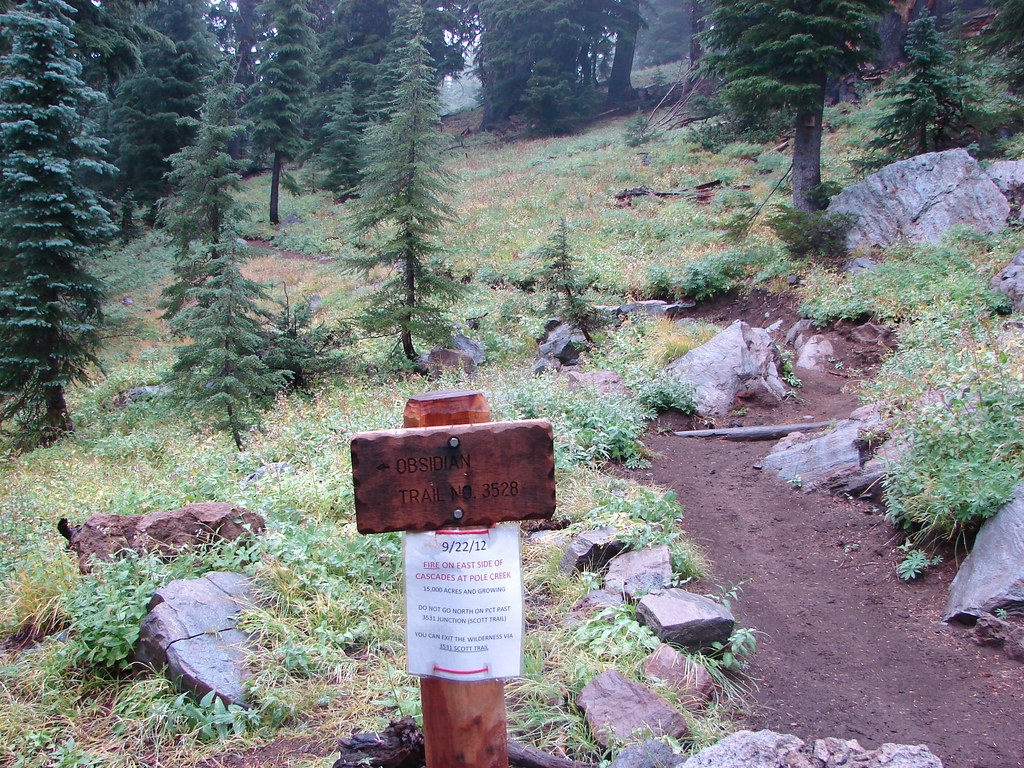
A limited number of permits are available each day for entry into the Obsidian area and we had purchased ours months in advance. Due to having to purchase the permit early we were at the mercy of weather. We arrived before day light which would be delayed a bit due to the damp fog covering the area.
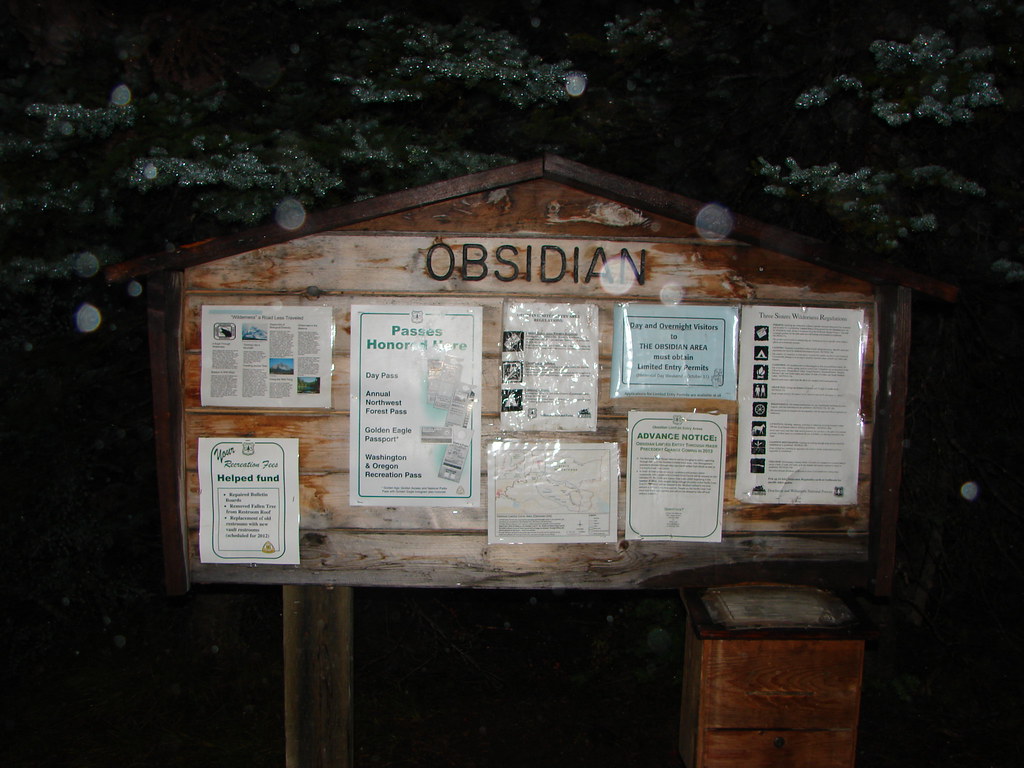
Signboard at the Obsidian Trailhead

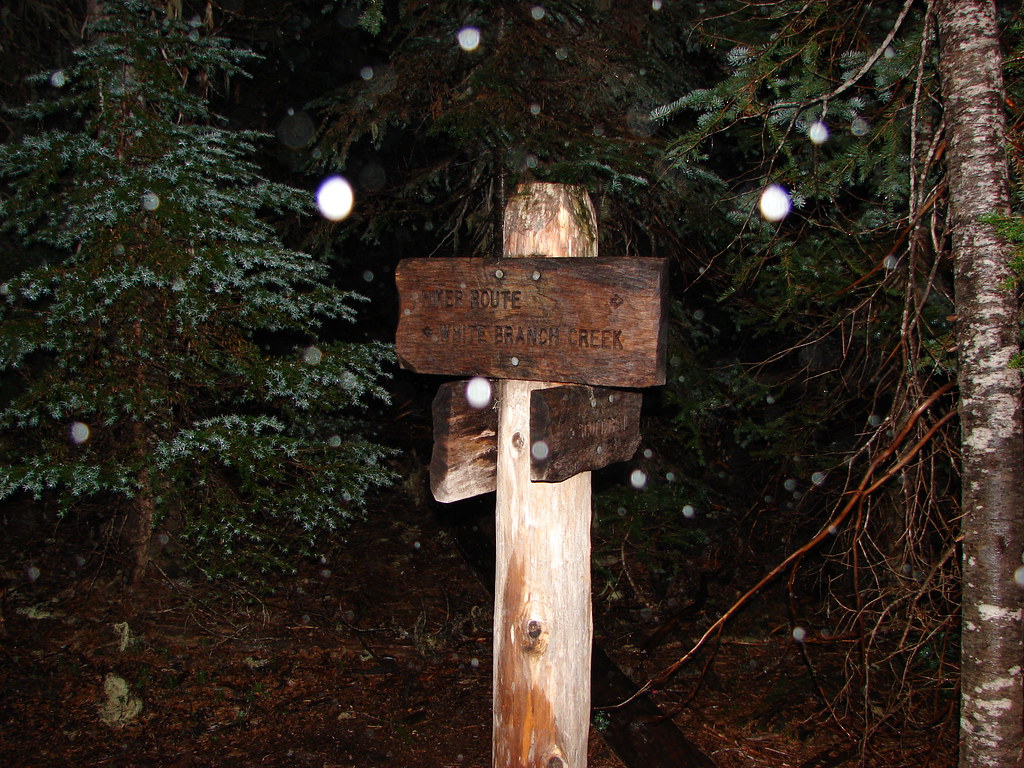
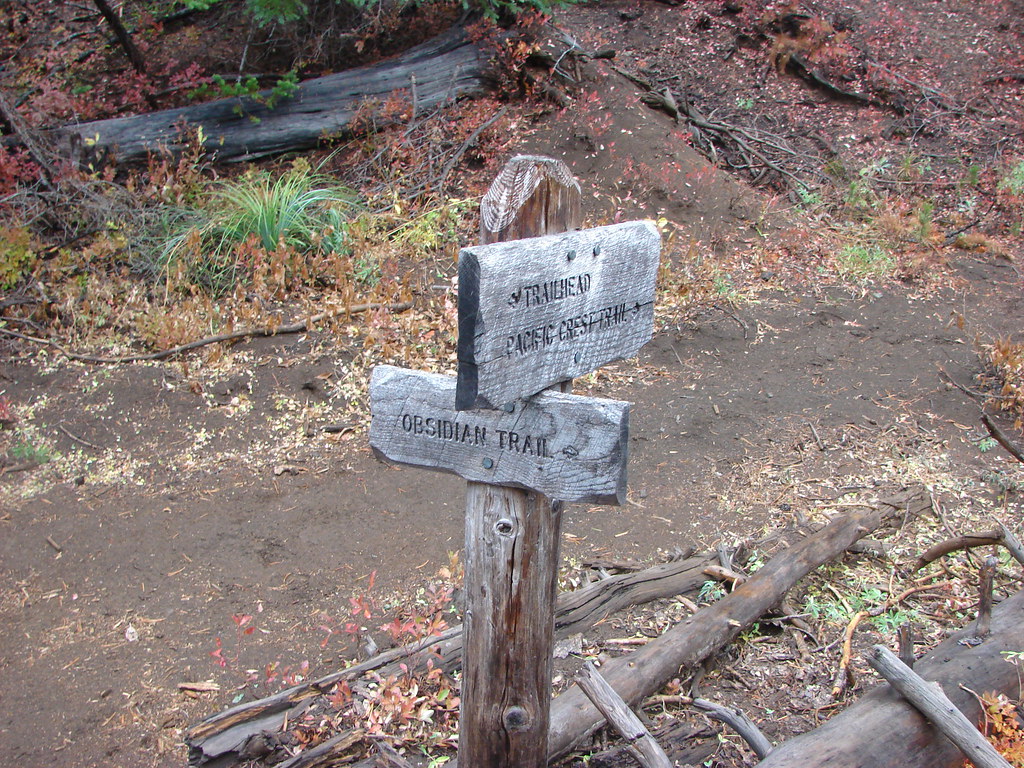
Trail sign along the Obsidian Trail

When we had enough light we set off on the Obsidian Trail which quickly entered the Three Sisters Wilderness.
Obsidian Trail entering the Three Sisters Wilderness

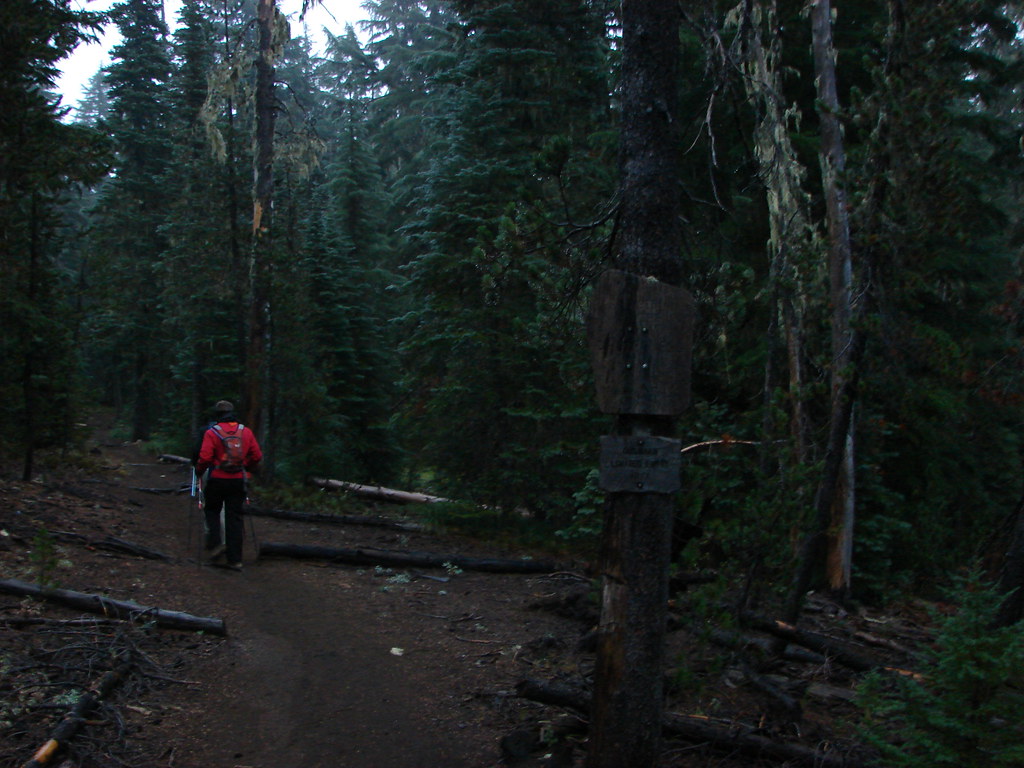
Obsidian Trail

Just under 3.5 miles from the trailhead the trail passed through the Jerry lava flow. According to our guidebook there is a view of several Cascade peaks from the flow but all we could see were clouds.
Obsidian Trail

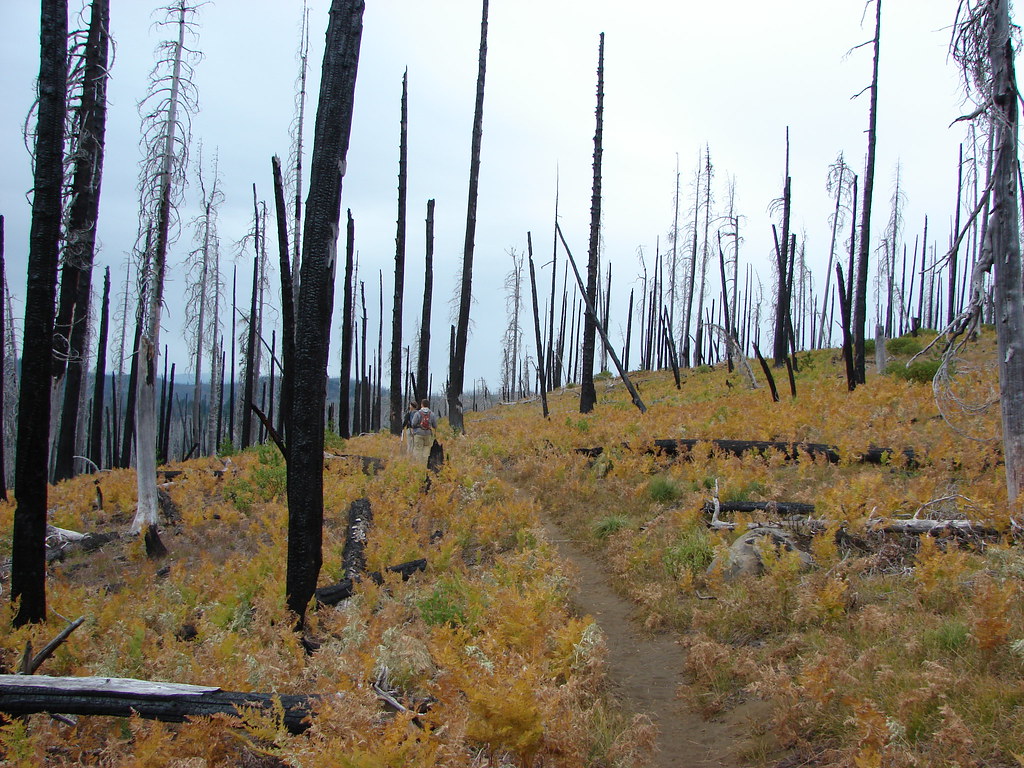
Cloudy day in the Three Sisters Wilderness

Jerry Lava Flow

The trail descended on the far side of the lava to a crossing of the White Branch Creek which was practically dry at the time.
Obsidian Trail approaching the White Branch

White Branch

The trail split just on the other side of the creek which is where our 15 mile hike turned into something longer. I had misunderstood the description of the loop option in the guidebook. The entry in the book was for a 12 lollipop hike for which it had you take the right hand fork 1.7 miles to the Pacific Crest Trail then turn left on that trail for 1.4 miles to another junction in the Sunshine Meadow. Here a left turn would lead .7 miles back to the junction near the White Branch. The loop option that we were trying to follow simply said that from Sunshine continue on the PCT for 2.2 miles to Collier Cone then another 1.8 miles to the Scott Trail, turn left for 4.9 miles, and turn left again on a .6 mile connector trail back to the Obsidian Trailhead. I failed to notice that the entire route was only 15 miles if we took the left fork to the PCT which was .7 vs 3.1 miles (The other additional mileage was due to side trips up the Collier and Four-in-One Cones).
Trail sign near White Branch

We went right. The scenery along the trail was nice but would have been even better without the clouds and with some flowers still in bloom. That being said the South Fork White Branch still had water flowing and there was plenty of obsidian along the trail making it pretty obvious how this trail got its name.
Obsidian Trail

Obsidian on the hillside

Obsidian

South Fork White Branch

South Fork White Branch

We reached the junction with the PCT where signs were posted about the stubborn Pole Creek Fire which was still smoldering in the eastern portion of the wilderness.
Obsidian Trail junction with the Pacific Crest Trail

Dominique spotted a small group of deer near the junction but they scampered off before I could get a clear picture due to the camera lens continually fogging up.
Deer near the Pacific Crest Trail

A short time after turning north onto the PCT we came to Obsidian Falls, a small but scenic cascade.
Obsidian Falls

Obsidian Falls

After visiting the base of the falls we continued north crossing Obsidian Creek and passing its source at Sister Spring.
Obsidian Creek

Sister SpringSister Spring

At this point we were very near to the Middle and North Sisters but there was no way we were going to see anything above us through the clouds.
Talus above Sister Spring

The PCT then passed the small Arrowhead Lakes and more obsidian.
Pacific Crest Trail

One of the Arrowhead Lakes

Obsidian

We continued on the PCT which was now approaching the 7810′ Little Brother which was beyond Sunshine. We could see the meadow and Glacier Creek below but the Little Brother was for the most part hidden from sight.
Sunshine

Snow from the Pacific Crest Trail

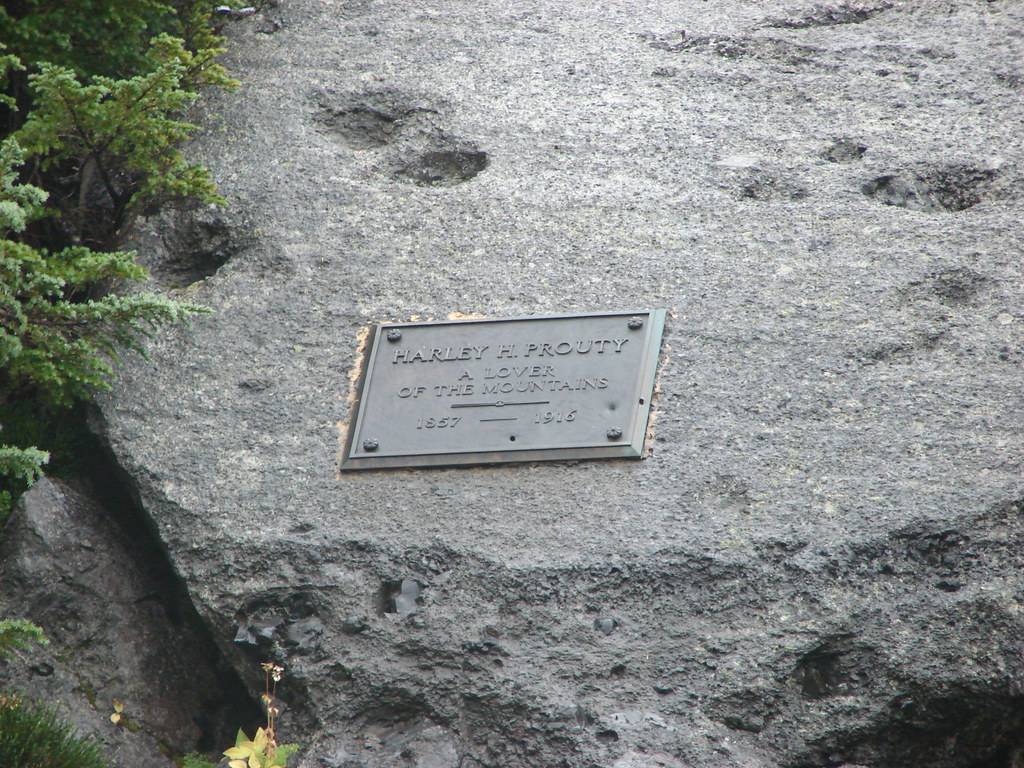
On the way down to Sunshine we spotted the Harley H. Prouty Memorial Plaque.
Harley H. Prouty Memorial Plaque

Sunshine

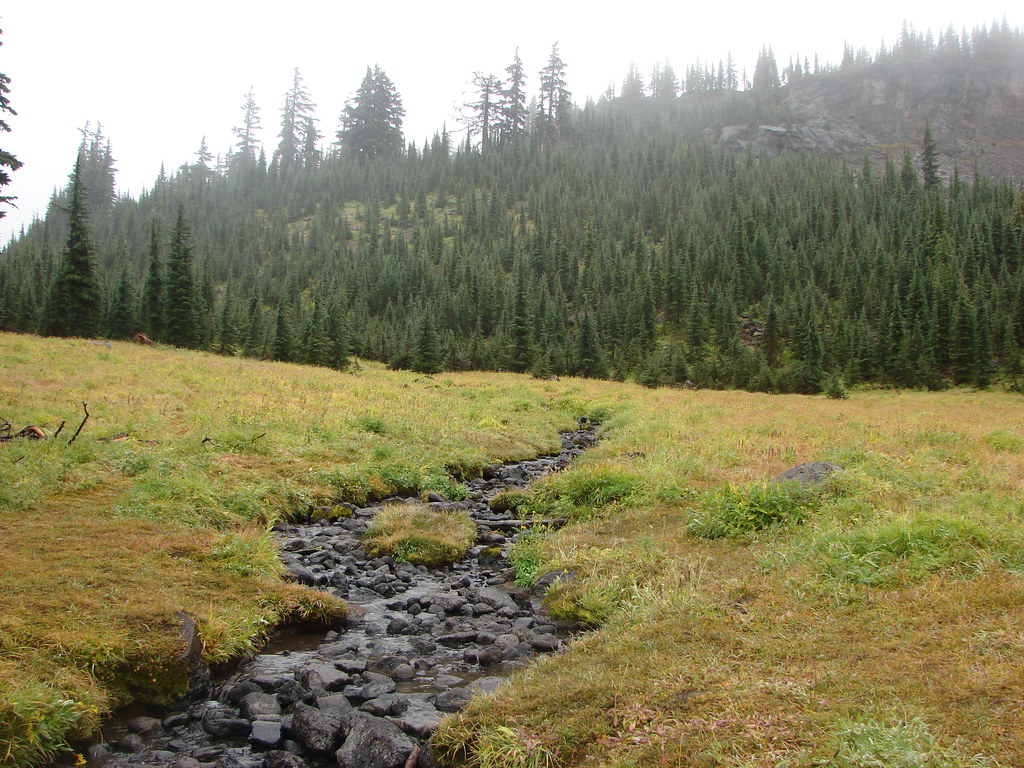
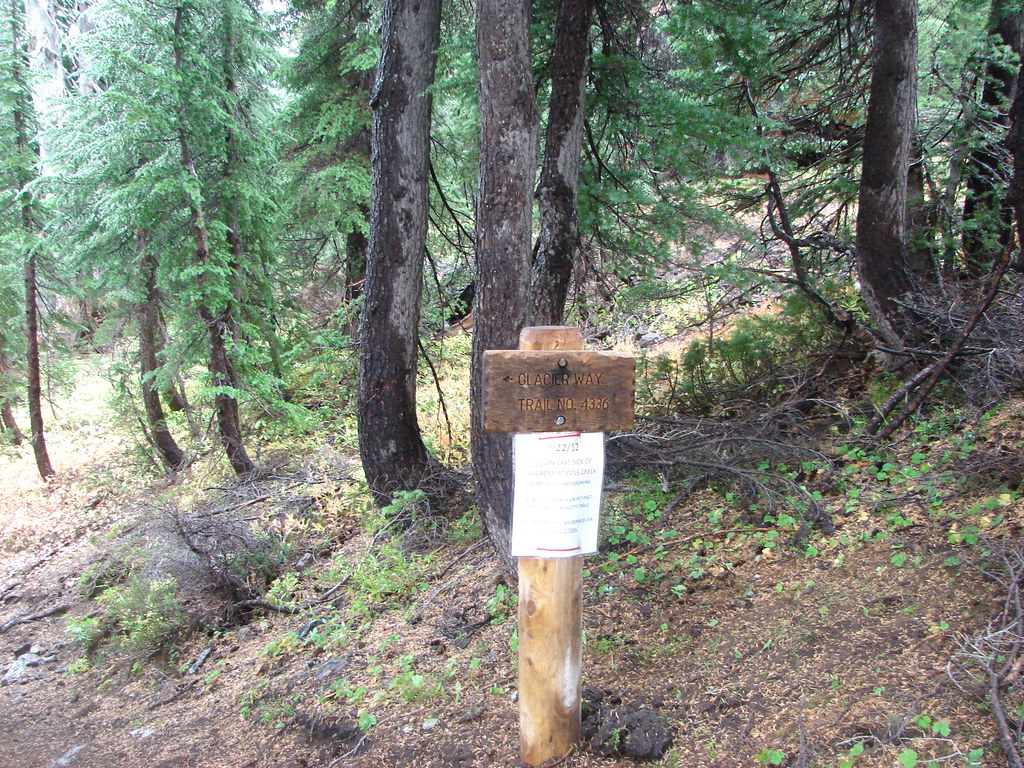
At Glacier Creek we found the junction with the Glacier Way Trail which was the left hand fork we should have taken at the White Branch.
Glacier Creek

Pacific Crest Trail junction with the Glacier Way Trail

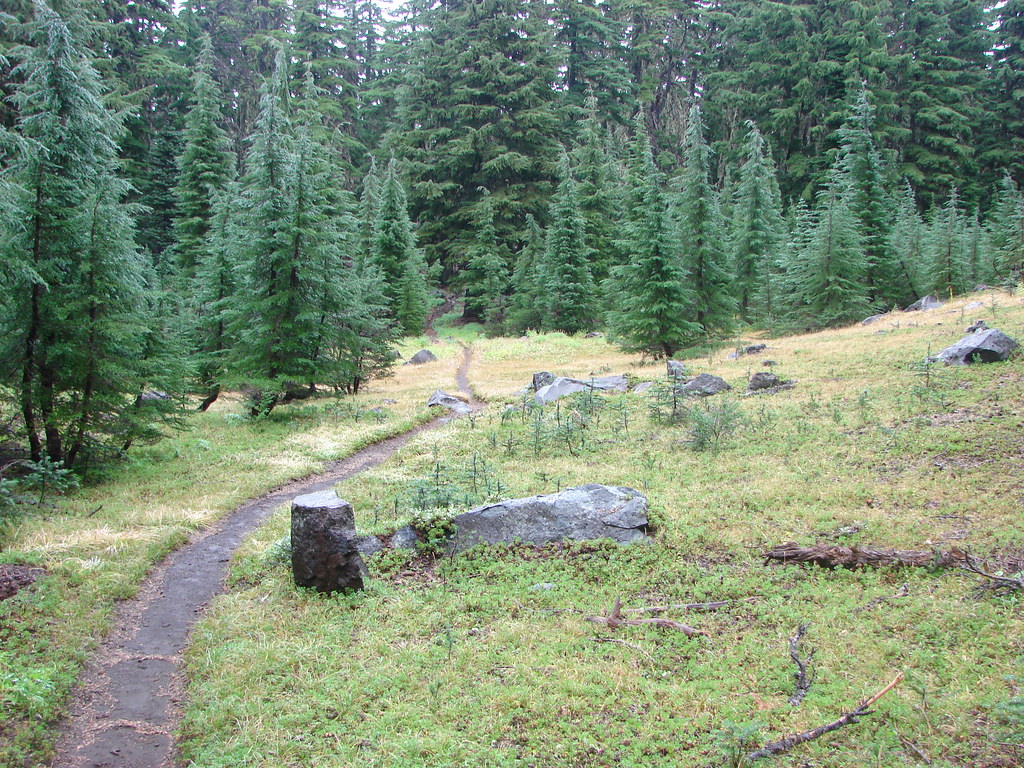
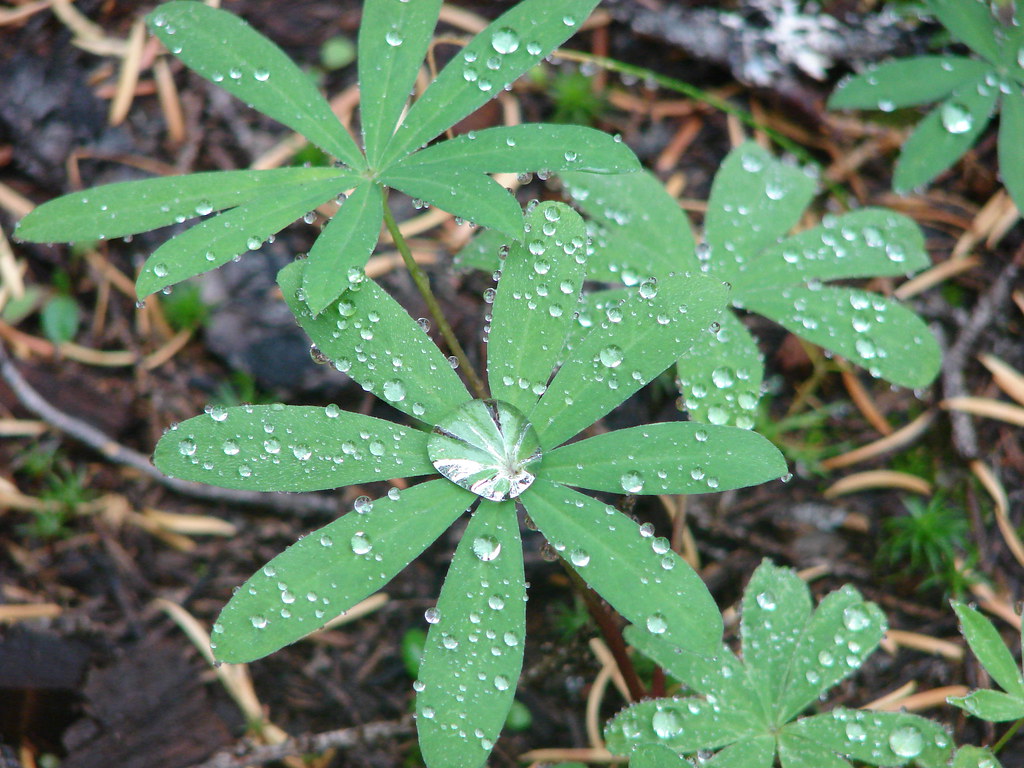
Still thinking we were on a 15 mile hike we continued north on the PCT instead of opting for the 12 mile hike and turning down Glacier Way. The trail passed through many small meadows that were probably home to plenty of summer wildflowers based on the amount of lupine leaves we saw. There was no lupine blooming anymore but we did spot a lone western pasque flower gone to seed.
Pacific Crest Trail

Drops of water on lupine leaves

Western pasque flower

A little under 2 miles from Sunshine the PCT arrived at the Jerry Lava flow.
Pacific Crest Trail

Above the lava in the fog we could see the Collier Cone.
Jerry Lava Flow

A .3 mile side trip would lead to a viewpoint along the rim of the cinder cone but first we had to pass through the lava flow to Opie Dildock Pass. Along the way there we spotted some lupine still in bloom, patches of snow, a tree with a rather unique top, and some real life blue sky.
Pacific Crest Trail

Lupine

Snow patch in the Jerry Lava Flow

Sculpted tree top

A little blue sky

We almost thought we’d lost the trail below the pass but the PCT simply scrambled up a gully in the lava.
Pacific Crest Trail heading up to Opie Dildock Pass

Pacific Crest Trail

A small cairn marked the side trail into the fog filled cone.
Heading into Collier Cone

We followed a use path up to the rim.
Inside Collier Cone

But for the fog we would have had an up close view of the Collier Glacier and the North and Middle Sister.
Collier Glacier

We took an extended break on the rim and in that time the fog lifted just a bit. We could at least see back down into the cone and every once in a while we got a glimpse of the northern flank of the North Sister.
Collier Cone

Light coming from the NE side of the North Sister

North Sister

We finally headed down resigning ourselves to the fact that the views weren’t going to get any better on this trip. We returned to the PCT and headed north once again. We did get a little more blue sky overhead and the fog continued to lift allowing us to at least see a little more of our surroundings.
Blue sky for a brief moment

Pacific Crest TrailYapoah Crater in the distance.

We were now heading away from the North Sister toward Scott Meadow and the Scott Meadow Trail. We arrived at the meadow and trail junction 1.8 miles from the side trail into Collier Cone.
Scott Meadow

Pacific Crest Trail in Scott Meadow

The Pole Creek Fire had forced the closure of the PCT at the junction.
Pacific Crest Trail closed due to the Pole Creek Fire at the Scott Trail junction

The meadow looked like it would be an impressive wildflower meadow in summer and provide some good mountain views. On this day the meadow was mostly brown and the mountains nearly hidden although we did get our best glimpse of a mountain looking back at the North Sister from the junction.
North Sister and Collier Cone

North Sister and Collier ConeNorth Sister and the Collier Cone

We vowed to come back to that spot to try again some summer which we did in 2013.
(post)

We turned down the Scott Trail which followed a dry creek bed for a bit before entering a vast pumice plain.
Dry creek along the Scott Trail

Scott Trail

Just over 3/4 of a mile from the Scott Meadow jct we turned right onto a side trail which led up another cinder cone – Four-in-One Cone.
Four-in-One Cone

Climbing Four-in-One Cone

As the name indicates this geologic feature is not a single cinder cone but four connected cones. A path follows the length of the ridge providing plenty of opportunity for views, but not necessarily for us.
Four-in-One Cone

View from Four-in-One Cone

View from Four-in-One Cone

I arrived at the top of the cone first and Dominique soon joined me as I gazed toward the cloud covered Three Sisters. We were about 13 miles into the hike now (we had also done a 13.5 mile hike the previous day) and we were all getting a little tired. The lack of views wasn’t helping raise spirits either. When Dominique reached me he looked around and then asked where the trail went from there. When I informed him it didn’t go anywhere and that it was just another spur trail to a viewpoint he gave me what could only be described as a death stare. His only response was “You mean we didn’t have to climb up here?”. I left him fuming at the southern end of the cone while I headed north along the rim. There I stared into the clouds where Mt. Jefferson, Three Fingered Jack and Mt. Washington should have been.
Four-in-One Cone

We were all dragging a bit as we made our way back to the Scott Trail and headed west. It wasn’t long before we were all suffering from what I’d call “trail madness”. We were moving but only because we had to in order to get back.

A little under a mile from the cone we crossed another lava flow.
Scott Trail

We spent the next 2.7 miles in the forest wondering why a 15 mile hike was seeming so hard and taking so long.
Scott Trail

When we finally arrived at the junction with the .6 mile connector trail to the Obsidian Trailhead Heather gave it a kiss.
Scott Trail junction with the connector trail to the Obsidian Trailhead

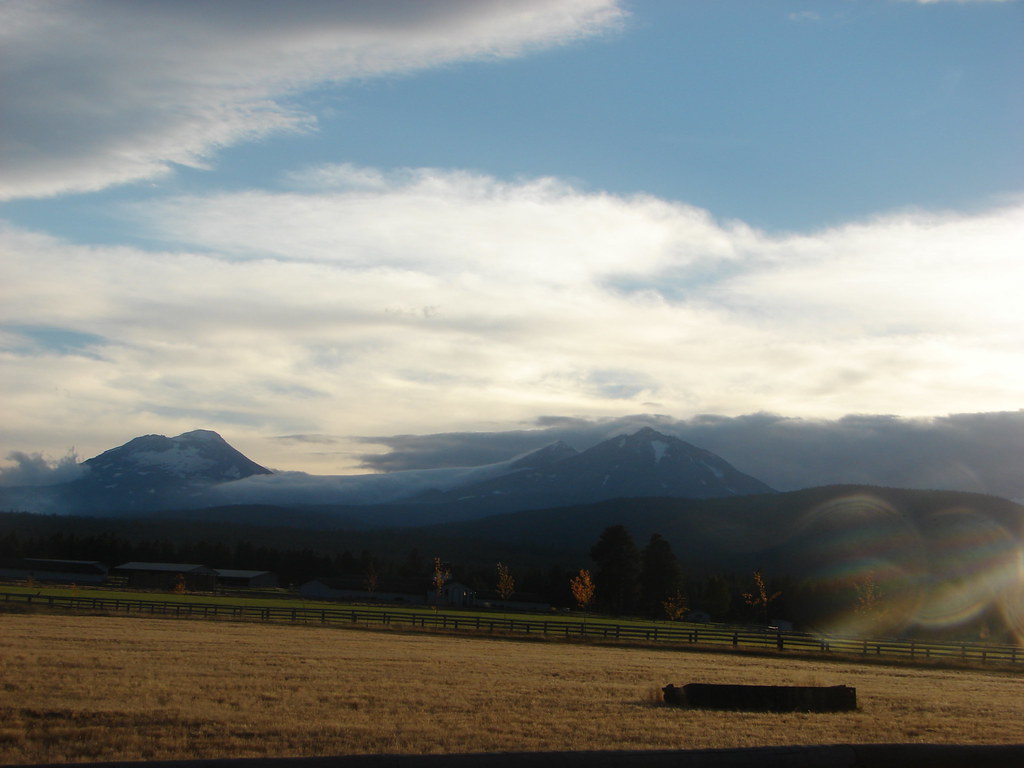
We managed to will ourselves through the final stretch and back to our car eager to get back to Bend and find some substantial food. The lack of views had been really disappointing given just how spectacular they should have been, but the real kick in the teeth came after we’d made it back to the east side of the mountains. Beyond the farms near Sisters we had a clear view of all Three Sisters as well as the bank of clouds that had plagued us all day on their western flanks.
The Three Sisters from Sisters, OR

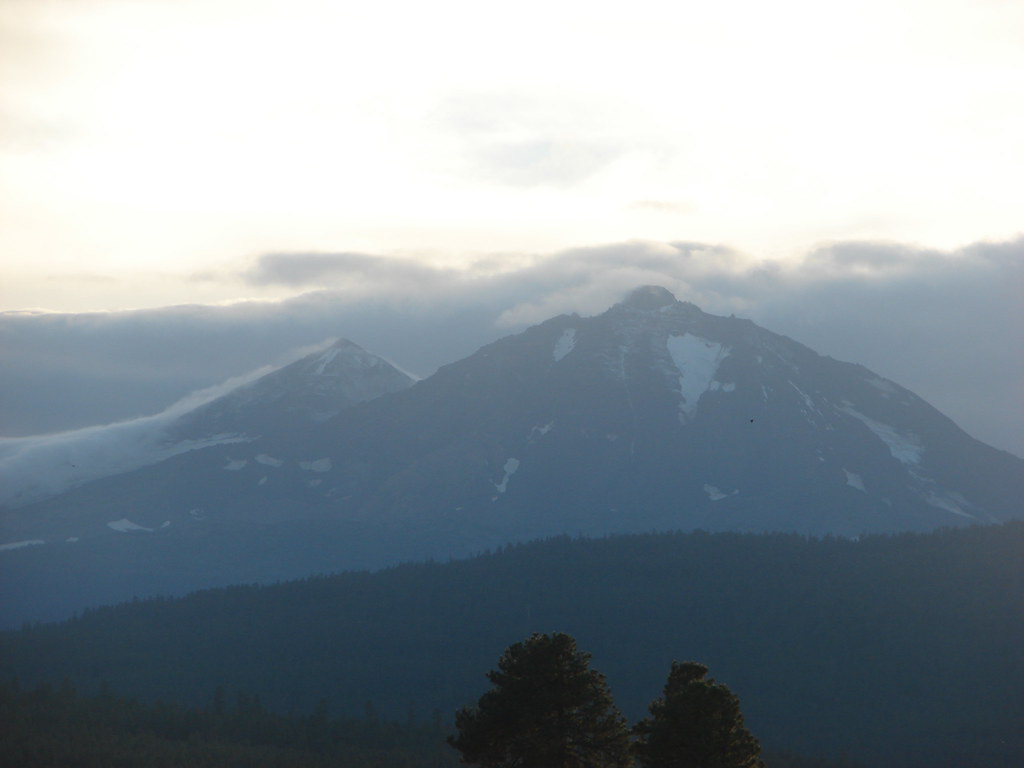
Middle and North Sister

It appeared that we’d been on the wrong side of the mountains all day. Some day we’ll get back to the area which hopefully wasn’t too damaged by last years fires. Until then we have the memories of the “Hike that shall not be named”. Happy Trails!

Flickr: Obsidian Trail & Four-in-One Cone

Categories
High Cascades Hiking Mt. Jefferson Area Oregon Throwback Thursday Trip report

Throwback Thursday – Jefferson Park Ridge

**Note the 2020 Lionshead Fire burned the area covered by this hike.**

This week’s Throwback Thursday hike features our second hike to Jefferson Park. Jefferson Park had been the one destination that we had visited each year starting in 2011. Unfortunately that streak ended in 2017 due to the area being closed by the Whitewater Fire. That fire started along the Whitewater Trail which we used in 2011, 2014, and 2015 and also swept over the Woodpecker Ridge Trail which we took in 2016. There are two other approaches for day hikes to Jefferson Park which appear to have escaped the Whitewater Fire for the most part, the South Breitenbush Trail and the Pacific Crest Trail from Forest Road 4220. In 2013 we used the South Breitenbush Trail and on October 7th, 2012 we completed the hike featured in the post.
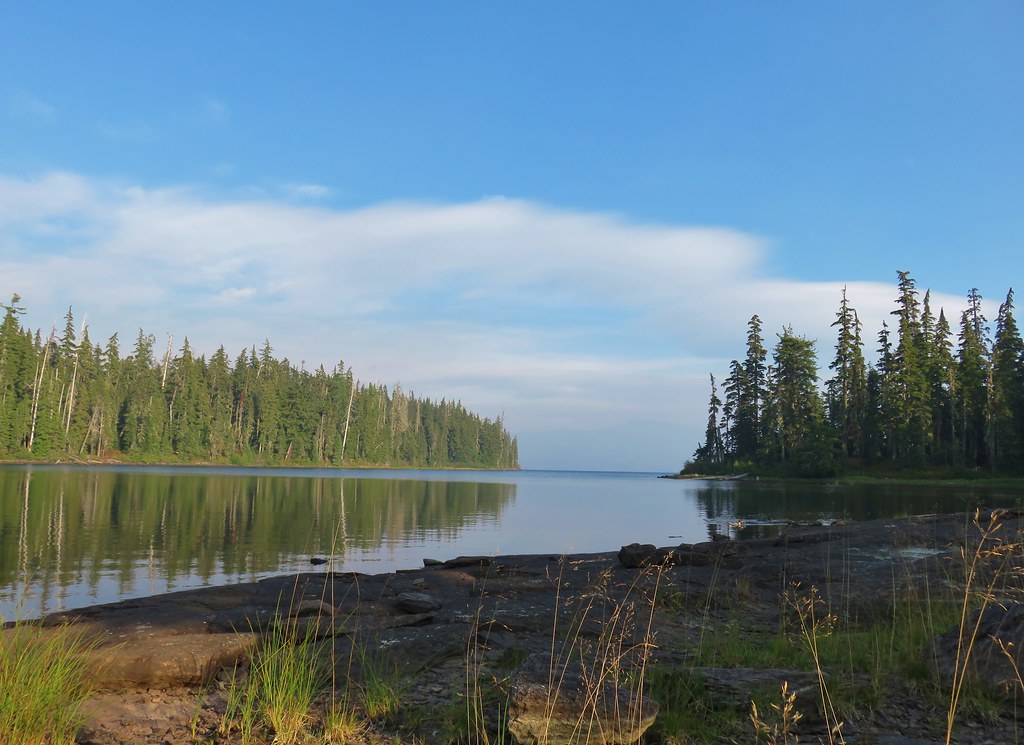
Of the four approaches we’ve done this was the most scenic in large part due to the dramatic view from Park Ridge. It is also the approach with the worst (by far) drive to the trailhead. Forest Road 4220 aka Oregon Skyline Road can be accessed via Forest Road 46 from the north (Portland) by turning left off of FR 46 21.8 miles beyond Ripplebrook onto FR 4690 for 8.1 miles then turning right onto FR 4220 at a stop sign. As FR 4220 passes the Olallie Lake Resort and Horseshoe Lake Campground it deteriorates. Beyond the Horseshoe Lake Campground the final two miles may be impassable to passenger cars. From the south (Salem or Bend) the trailhead is accessed from the other end of FR 4220. From Detroit, OR we took FR 46 north for 16.9 miles to a junction where we turned right onto FR 4220. The 6.5 mile drive to the trailhead was narrow and rough and can be impassable when wet or snowy. The drive was bad enough that we have no plans to repeat it despite this being a very good hike.

We arrived at the large parking area relieved to be done with the drive.
Big parking lot at the Pacific Crest Trail

The large parking area was fairly empty due to it being fairly late in the year so we had the trail to ourselves as we headed south on the PCT.
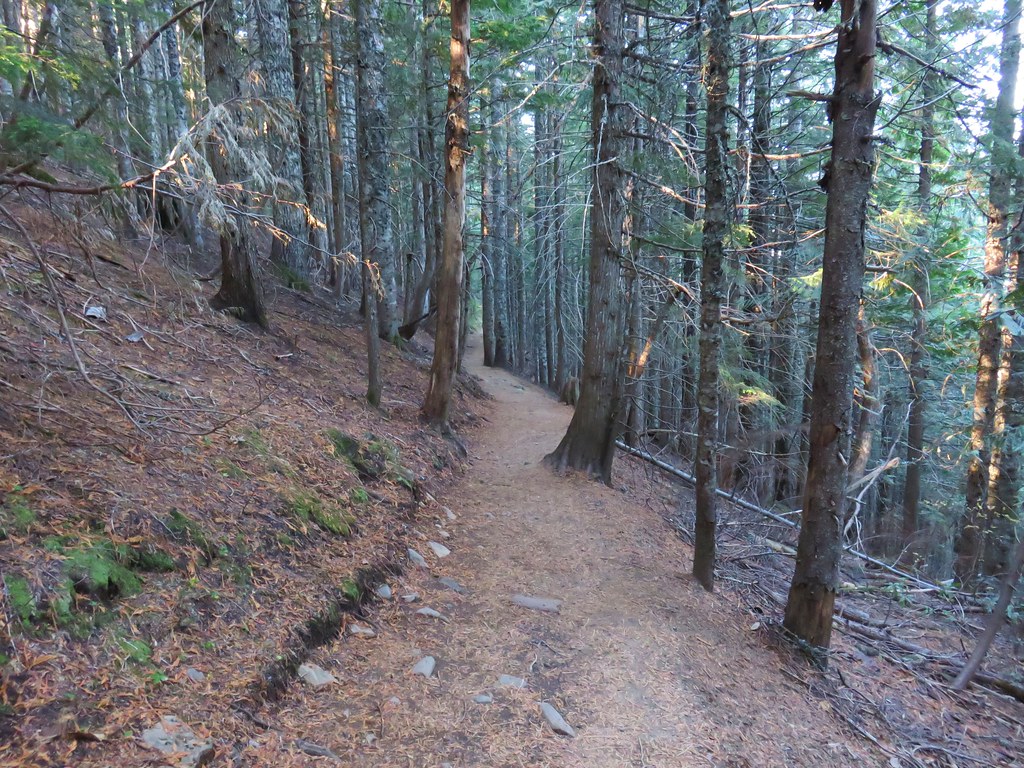
Pacific Crest Trail

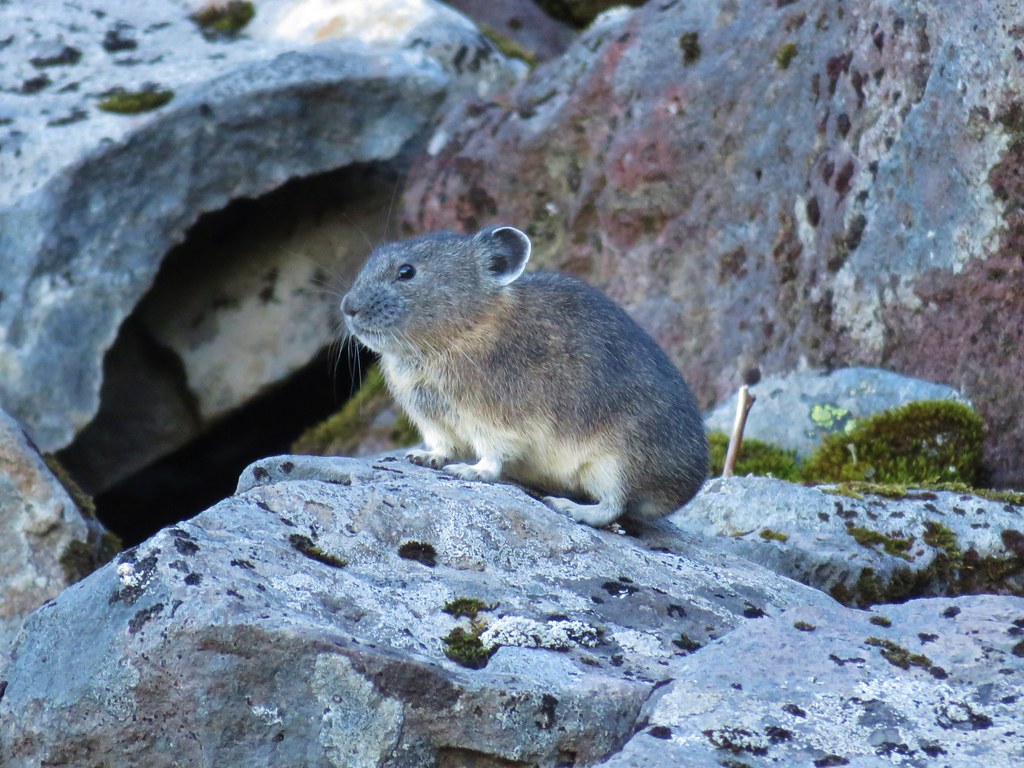
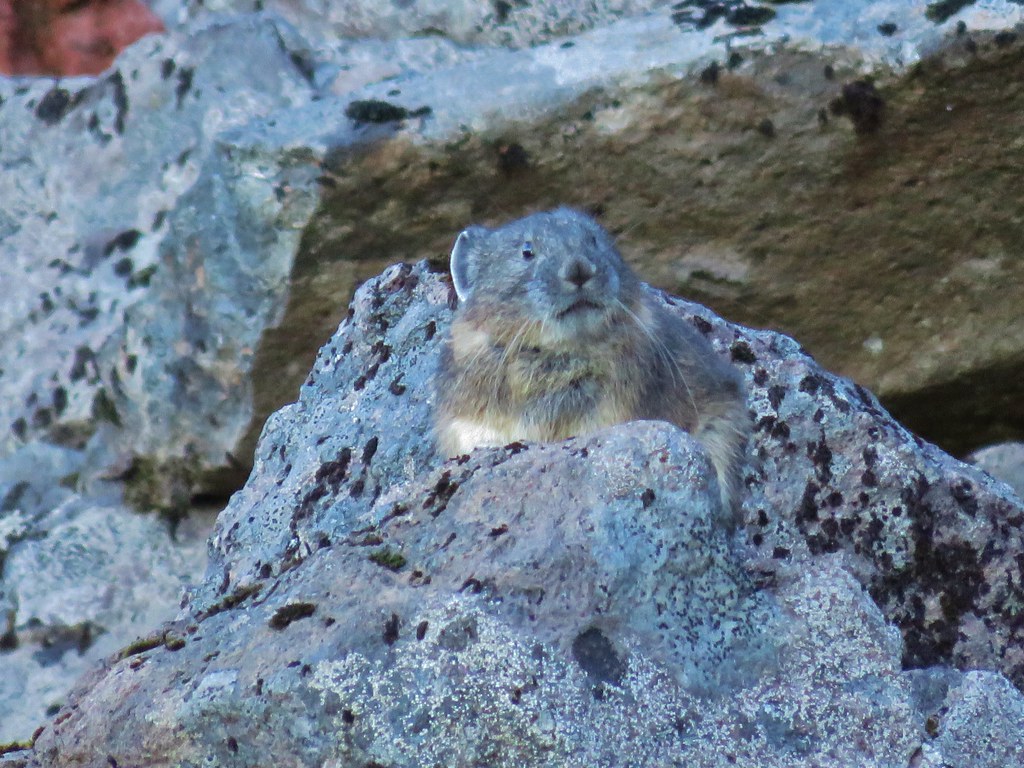
Not far from the trailhead we passed some talus where we spotted a pika for the first time.
Pacific Crest Trail

Pika

We then passed through a short section of forest burned in the 2010 Pyramid Butte Fire.
Huckleberry bushes

Pyramid Butte

We had planned on taking a side trail to Pyramid Butte as there had been a trail to the top of the butte but the fire had made the area confusing so we decided to stick to the PCT. We were soon out of the burned area and passing through forest colored with red huckleberry leaves.
Pacific Crest Trail

From the trailhead the PCT gained 1400′ in 3.7 miles to its crest on Park Ridge but much of the gain was gradual especially early on. The elevation gain provided for some excellent views to the north where Mt. Hood was visible beyond Pyramid Butte.
Ruddy Hill, Pyramid Butte, Mt. Hood and Olallie Butte

Pyramid Butte and Mt. Hood

To the south though the much closer Mt. Jefferson merely peaked over the top of Park Ridge.
Mt. Jefferson

Mt. Jefferson behind Park Ridge

Pacific Crest Trail

Pacific Crest Trail

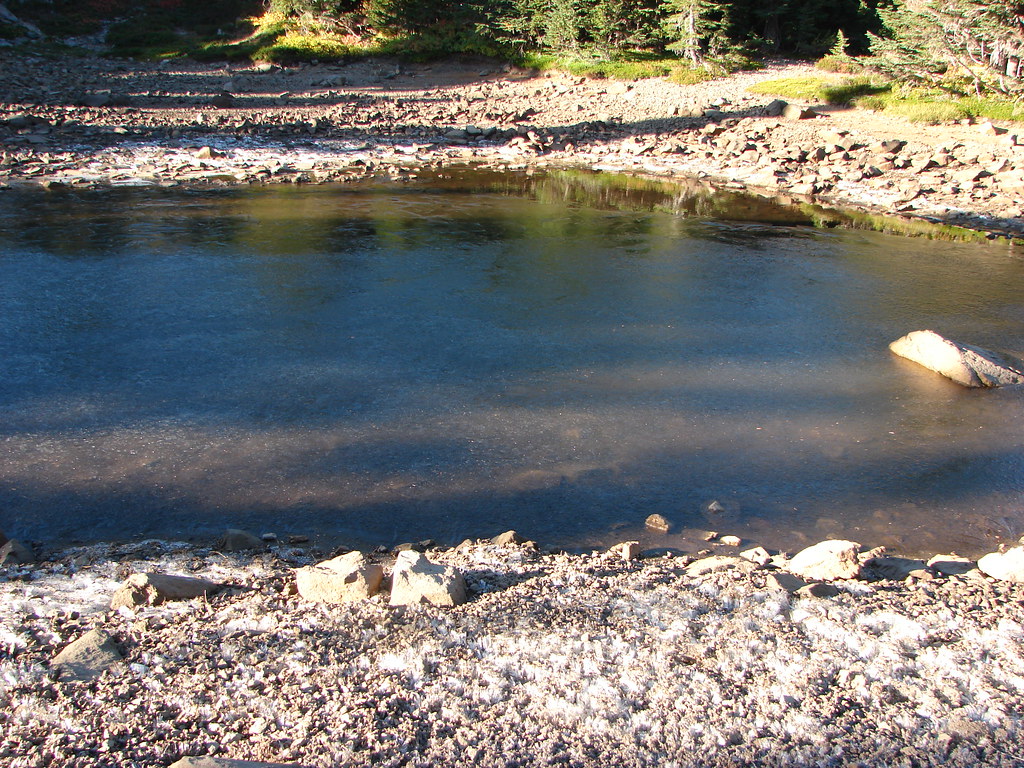
It was a little chilly and got chillier as we approached Park Ridge. Snow patches and partially frozen ponds lined the trail as we began to leave the trees and climb up the ridges northern flank.
Frozen pond along the Pacific Crest Trail

Frost around the pond

Park Butte

Pacific Crest Trail

Rock cairns and posts helped mark the way through the rocks which had replaced the meadows and we followed existing footprints through patches of snow.
Pacific Crest Trail

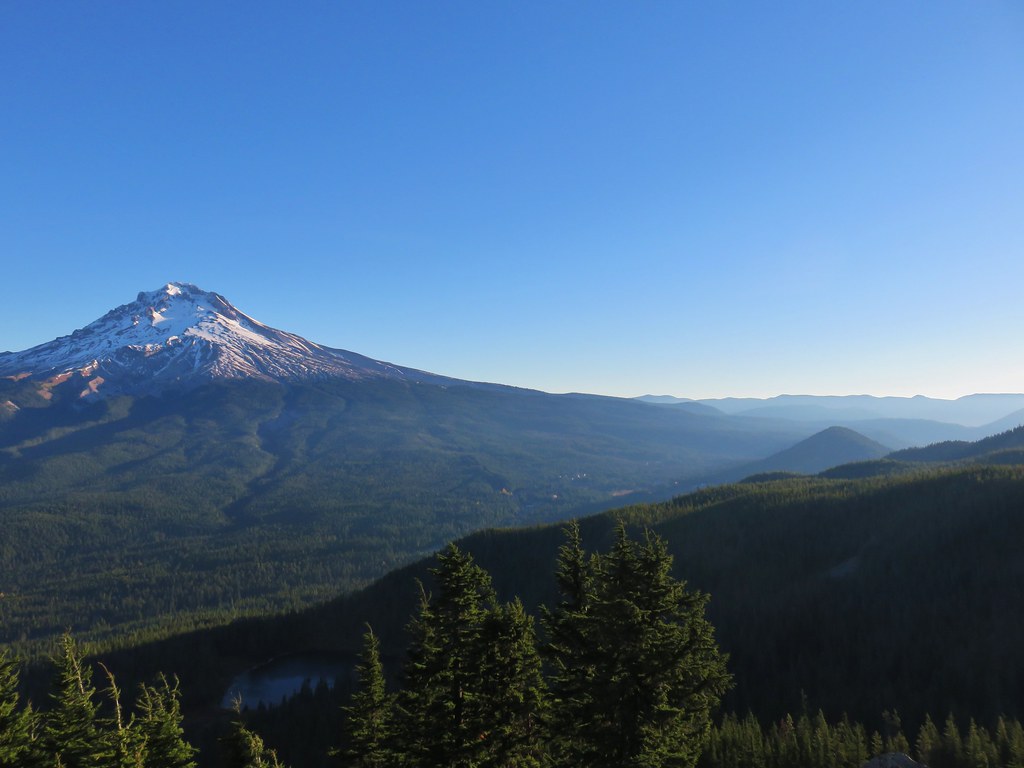
The view north to Mt. Hood from the open ridge was spectacular.
Mt. Hood and Olallie Butte

That view was quickly trumped though as we crested the ridge and finally had a full view of Mt. Jefferson with Jefferson Park below.
Mt. Jefferson, Russel Lake, and Sprauge Lake from Park Ridge

The ridge marks the boundary of the Mt. Hood and Willamette National Forests.
Sign marking the border between the Willamtte and Mt. Hood National Forests

Sign marking the border between the Willamtte and Mt. Hood National Forests

We took a nice long break on top of the ridge enjoying the views. As we rested a couple on horseback rode by stopping momentarily to discuss the beauty of the area. After resting up we headed down toward Jefferson Park.
Mt. Jefferson and Jefferson Park

It was just under 2 miles down to Russell Lake. The PCT was a little steeper on this side of Park Ridge as it traversed downhill past springs, red huckleberry bushes and meadows with wildflowers still in bloom.
Pacific Crest Trail

Huckleberry bushes along the Pacific Crest Trail

Lupine

Mt. Jefferson from the Pacific Crest Trail

Behind us Park Butte rose from the end of Park Ridge.
Park Butte

We eventually got a good look at Russell Lake.
Russell Lake

Before we made it down there though we ran into a small buck.
Small buck along the Pacific Crest Trail

After crossing the dry bed of the South Breitenbush River we turned off the PCT to visit Russell Lake.
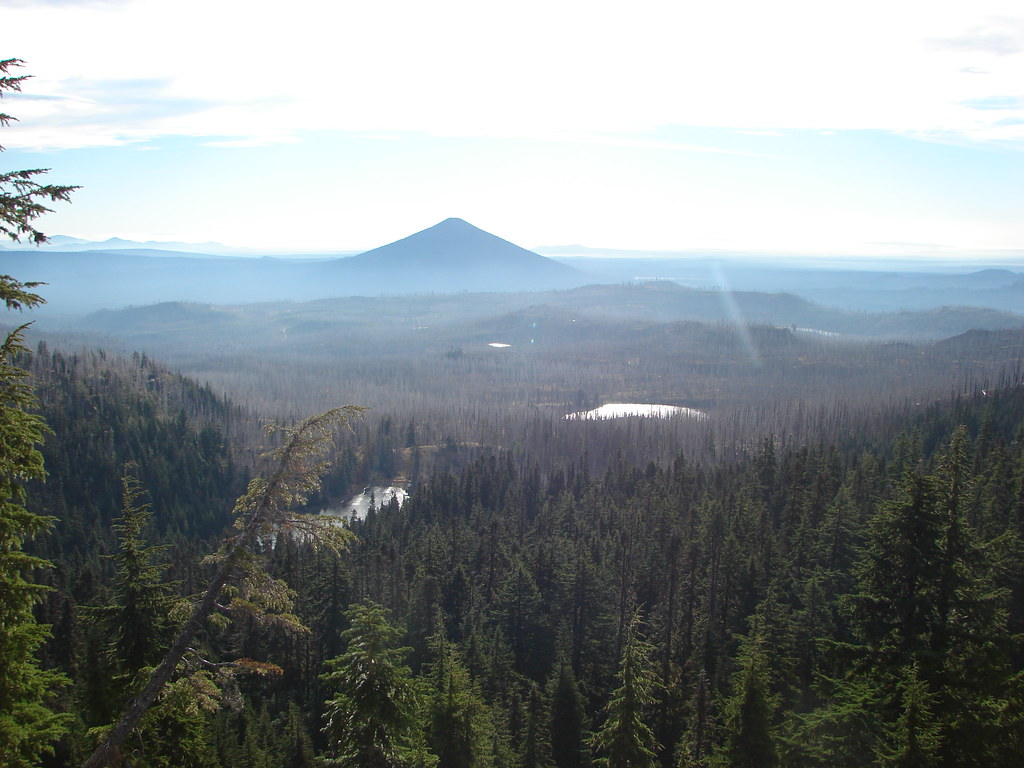
Wildflowers along the South Breitenbush River
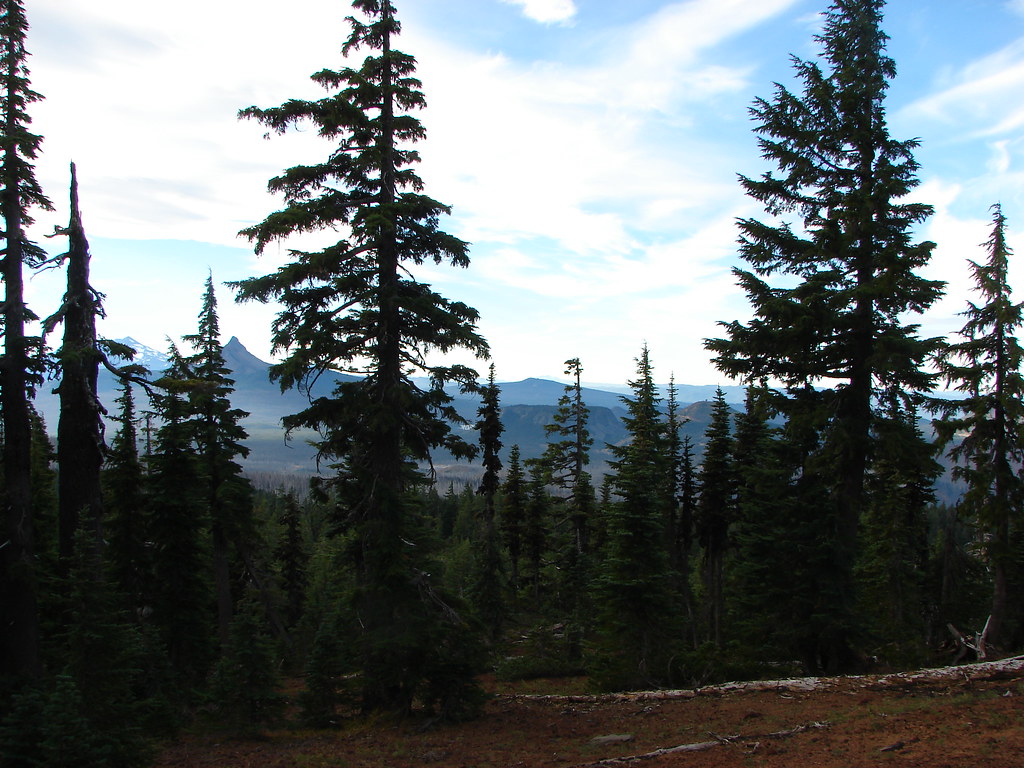
Mt. Jefferson from Russel Lake

After visiting that lake we returned to the PCT and continued south another three quarter miles to Scout Lake.
Mt. Jefferson

Scout Lake

After another short rest we returned the way we’d come. On the way back the remaining gentians were opening up to the sunlight.
Gentians

We followed the PCT back up Park Ridge where the views were no less impressive.
Pacific Crest Trail

Mt. Hood and Olallie Butte

Mt. Hood, Olallie Butte and Sara Jane Lake

We cruised back past the now thawed ponds and more blooming gentians to the trailhead where we would once again need to brave FR 4220 in order to get home.
Pond along the Pacific Crest Trail

Gentians

Pyramid Butte, Mt. Hood and Olallie Butte

Ruddy HillFR 4220 visible below the rocky slope.

We obviously survived the drive back. We hope to get back to Park Ridge someday. We have considered heading up the PCT from Jefferson Park on subsequent visits but have wound up balking at prospect of the 1000′ of elevation gain necessary to get to the top. It will likely be part of a backpacking trip the next time we are up there, until then we have the memories. Happy Trails!

Flickr: Jefferson Park Ridge

Categories
High Cascades Hiking Mt. Hood Area Oregon Trip report

Mirror Lake and Pioneer Bridle Trails

As our official 2017 hiking season came to a close, a break from the recent wet and cold weather provided us an opportunity to turn back to a hike we had be planning to do two weeks earlier. Possible icy road conditions had kept us from attempting the early morning drive to the Mirror Lake Trailhead near Government Camp, OR then.

The Mirror Lake Trail is one of the most popular trails in the Mt. Hood area and the parking area fills up fast so we wanted to get to the trailhead as early as possible. The Federal Highway Administration is in the process of moving the trailhead which is scheduled to be completed in the Fall of 2018 (click here for details).

We arrived before dawn and then discovered that the batteries were dead in my headlamp so we had to wait for some light before setting off on the trail which starts by crossing Camp Creek on a footbridge.
IMG_1011

A second footbridge crosses over Mirror Lake’s outlet creek.
IMG_1016

It was still fairly dark as we climbed up towards Mirror Lake which is just 1.4 miles from the trailhead. The short distance is part of the reason for the trails popularity as it makes it kid friendly. As it climbs the trail passes through some rock slides with limited views.
IMG_1017

IMG_1022

Just before reaching the lake the trail splits providing a loop around the water. We went left crossing the outlet creek again and worked our way clockwise around the small lake.
IMG_1024

IMG_1026

Across the lake we could see our goal for this hike, Tom Dick and Harry Mountain.
IMG_1031

One of the other things that makes this hike popular is that there is a view of Mt. Hood from the south end of Mirror Lake.
IMG_1043

It was too windy to have a reflection of Oregon’s tallest peak.
IMG_1033

IMG_1036

When we came to a T-shaped junction on the west side of the lake we turned left toward Tom Dick and Harry Mountain and we were soon in the Salmon-Huckleberry Wilderness.
IMG_1048

The trail traversed along a hillside passing through more rock slides where we heard some pikas and had a view across Highway 26 and back over our shoulders to Mt. Hood.
IMG_1053

IMG_1052

IMG_1054

Approximately a mile from the junction the trail turned sharply left at a huge rock pile.
IMG_1061

The trail then climbed gradually through an open forest to the rocky summit of the western most of three summits that earned the mountain three names.
IMG_1063

IMG_1064

Two weeks before, snow had been down to Mirror Lake and the summit was covered but warmer weather had melted all of it. It was going to be another unseasonably warm bluebird day which allowed us a clear 360 degree view from the summit.
IMG_1077Mt. Hood and Mirror Lake with Mt. Adams in the background

IMG_1081From left to right: Mt. St. Helens, Mt. Rainier, and Mt. Adams.

IMG_1073Salmon-Huckleberry Wilderness

IMG_1071Mt. Jefferson

IMG_1094Olallie Butte, Mt. Jefferson, and the top of Three Fingered Jack

IMG_1096The rest of Tom Dick and Harry Mt.

IMG_1099Lookout Mountain and Gunsight Butte in the Badger Creek Wilderness east of Mt. Hood.

There were a few other hikers at the summit (those that had working headlamps) but it was still early enough not to feel crowded. We spent a while sitting on the rocks and might have spent more time had it been a little less breezy. Instead of pulling layers out of our packs we headed back down. We passed a lot of people on their way up, but we also passed a number of local residents including a squirrel and a pika who both took a breaks from gathering food to pose for us.
IMG_1106

IMG_1114

IMG_1123

Any hike that involves a pika sighting is a success.

By the time we passed by Mirror Lake there was a steady stream of hikers coming uphill. Luckily the trail is wide enough to allow two way traffic in many places. IMG_1126

The roundtrip distance for the hike was 6.5 miles with 1500′ of elevation gain. That left us with plenty of time and enough gas in our tanks for a second stop.

That second stop was basically just across Highway 26. From the current Mirror Lake Trailhead we headed east on the highway for three quarters of a mile where we turned left opposite the western entrance to Mt. Hood Ski Bowl at a sign for the Glacier View Sno-Park. We parked at a gate after just .2 miles and followed a pointer for the Crosstown and Pioneer Bridle Trails.
IMG_1134

IMG_1135

A confusion of trails met here but we followed the pointers and signs for the Pioneer Bridle Trail.
IMG_1137

After a very short distance on the Pioneer Bridle Trail we came to a fork where a sign on the path to the left identified it as the “Route of Barlow Road
IMG_1140

IMG_1141

The 80 mile Barlow Road is a historic wagon road was built by Sam Barlow, Phillip Foster and their crews in 1846 as a new route on the Oregon Trail. Although it was steep and rough the route offered an alternative to the dangerous and expensive Columbia River passage. The ability of large wagons to pass over the Cascades to the Willamette Valley led to a significant increase in the number of emigrants to Oregon.
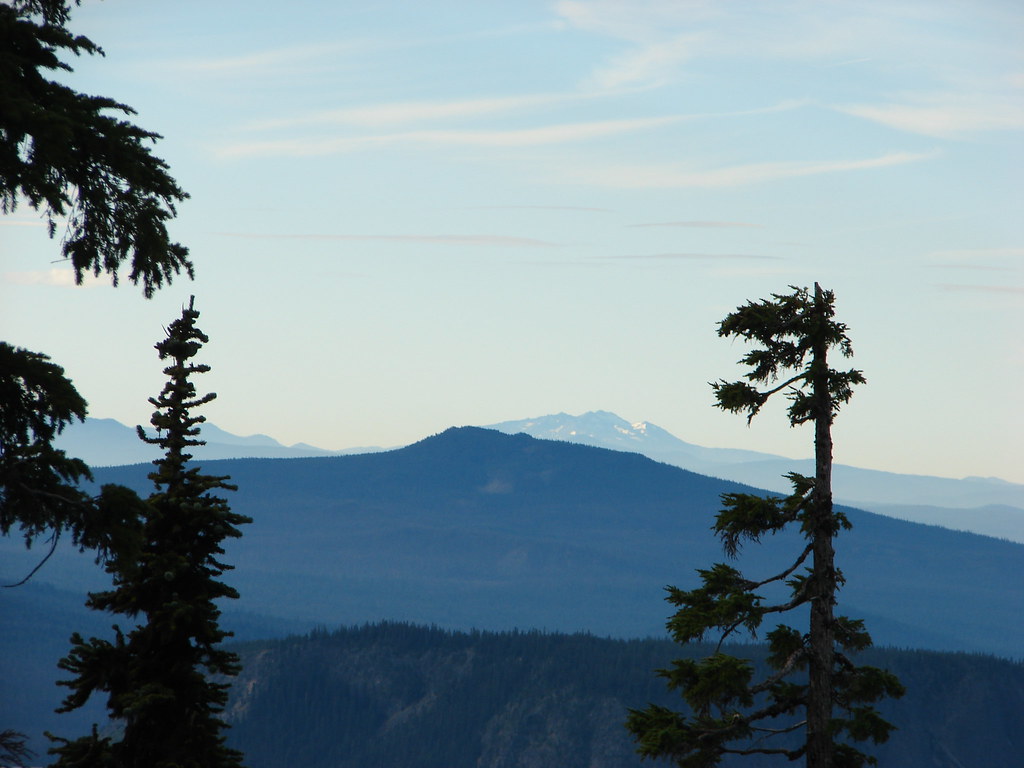
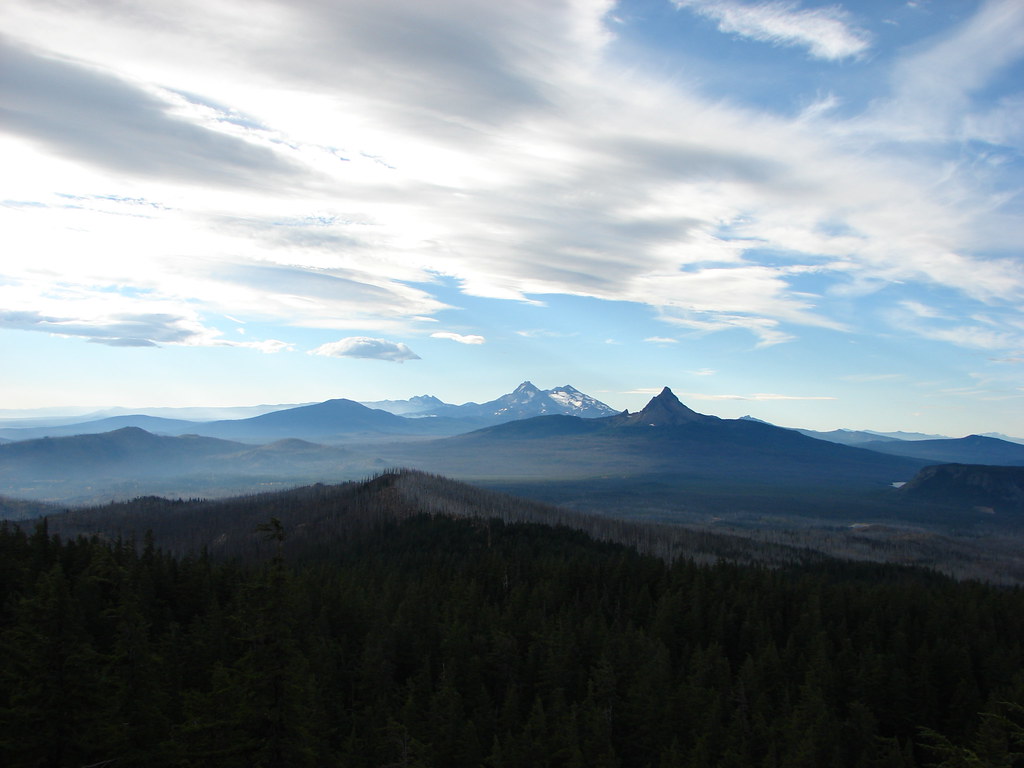
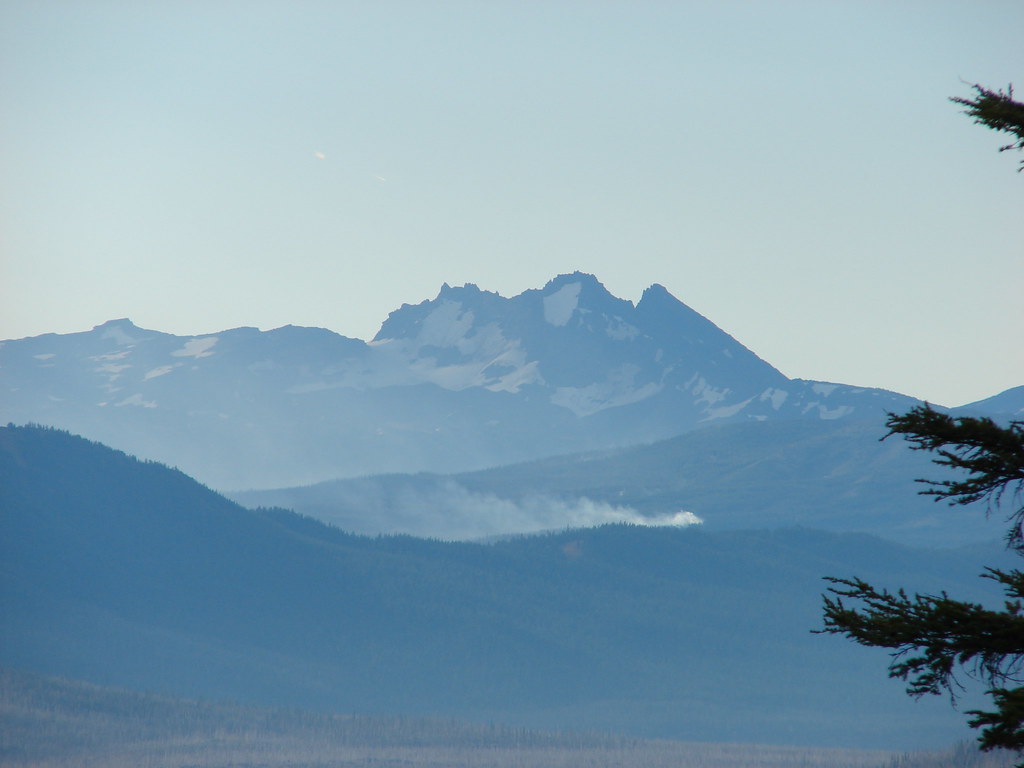
Our route followed the Pioneer Bridle Trail though so we took the signed right hand fork which soon crossed over the small outlet creek of Enid Lake.
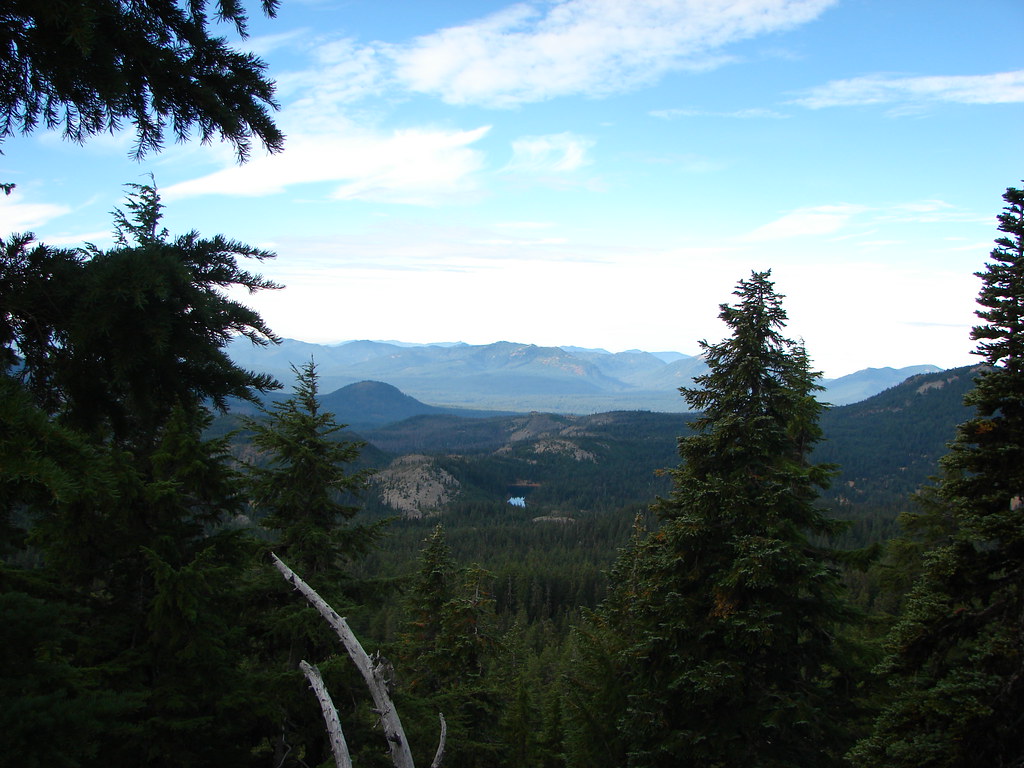
IMG_1142

IMG_1144

IMG_1145

The Pioneer Bridle Trail spent most of it’s time close enough to Highway 26 that the sound of traffic on the road was consistent and for a short stretch was right next to the guard rail which didn’t make for the most peaceful hike. Just under a mile and a half from where we’d parked the Pioneer Bridle Trail passed under the abandoned Mt. Hood loop highway.
IMG_1186

Before descending to the tunnel we took a short spur path to the old road and turned right hoping to visit Little Zigzag Falls.
IMG_1149

IMG_1150

After following the road for a tenth of a mile we arrived at the Little Zigzag Falls Trailhead (yes you can drive here).
IMG_1151

A short quarter mile family friendly path here follows Little Zigzag Creek to scenic Little Zigzag Falls.
IMG_1159

IMG_1162

IMG_1171

IMG_1179

After visiting the falls, which we were lucky enough to have to ourselves for a bit, we returned to the Pioneer Bridle Trail. We turned right and passed through the tunnel continuing west on the trail.
IMG_1187

Not long after passing under the old highway the current highway began to fall away from the trail making this section a bit more serene. A fence along the way marked the spot of an old mine shaft.
IMG_1189

IMG_1188

Approximately three quarters of a mile from the tunnel the trail split. This wasn’t shown on our map or in our guidebook but we forked right which wound up being the Original route of the Oregon Trail.
IMG_1191

The trails rejoined in under a half mile (the Pioneer Bridle Trail was often visible through the trees). We continued for approximately another 3/4 miles to the start of a series of switchbacks. We decided to end our hike here instead of descending for about a mile to the lower Pioneer Bridle Laurel Hill Trailhead.
IMG_1195

We stuck to the Pioneer Bridle Trail on the way back. The total distance for this hike was 7.4 miles with around 700′ of elevation gain. If we were to do it over as a stand alone hike we probably would have started at the lower trailhead and hiked up to Little Zigzag Falls and back due to how close Highway 26 was to the trail at the upper end but having done the Mirror Lake hike first it made more sense to start at the upper end.
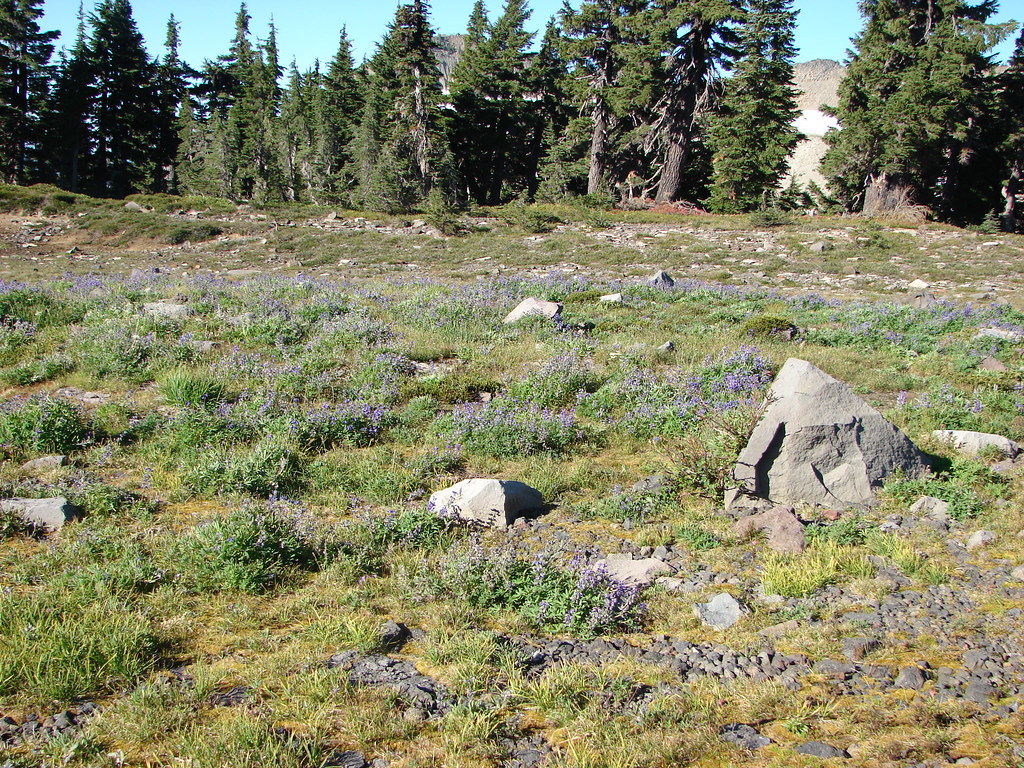
For the day we put in 13.9 miles and we got a lot back. Clear views of 5 volcanoes (and the top of Three Fingered Jack), a lake with a mountain view, a waterfall, some history and best of all a Pika. Happy Trails!

Flickr: Mirror Lake and Pioneer Bridle Trails