Categories
Hiking Oregon Salem/Albany Trip report Willamette Valley

Salem Parks – 4/26/2020

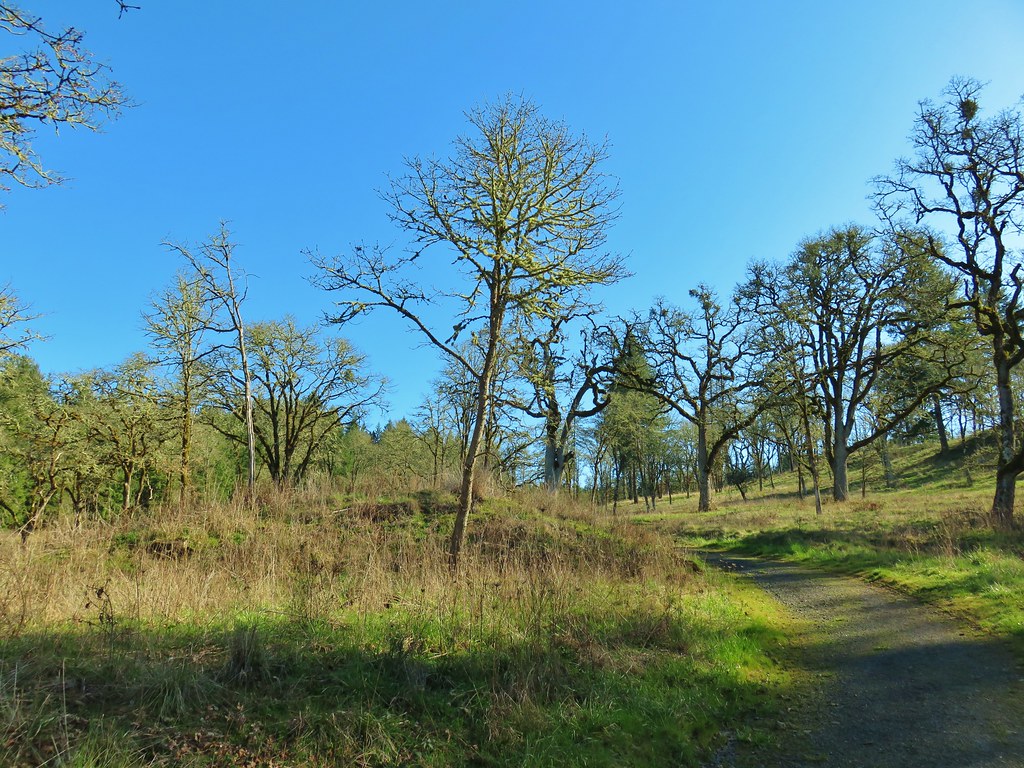
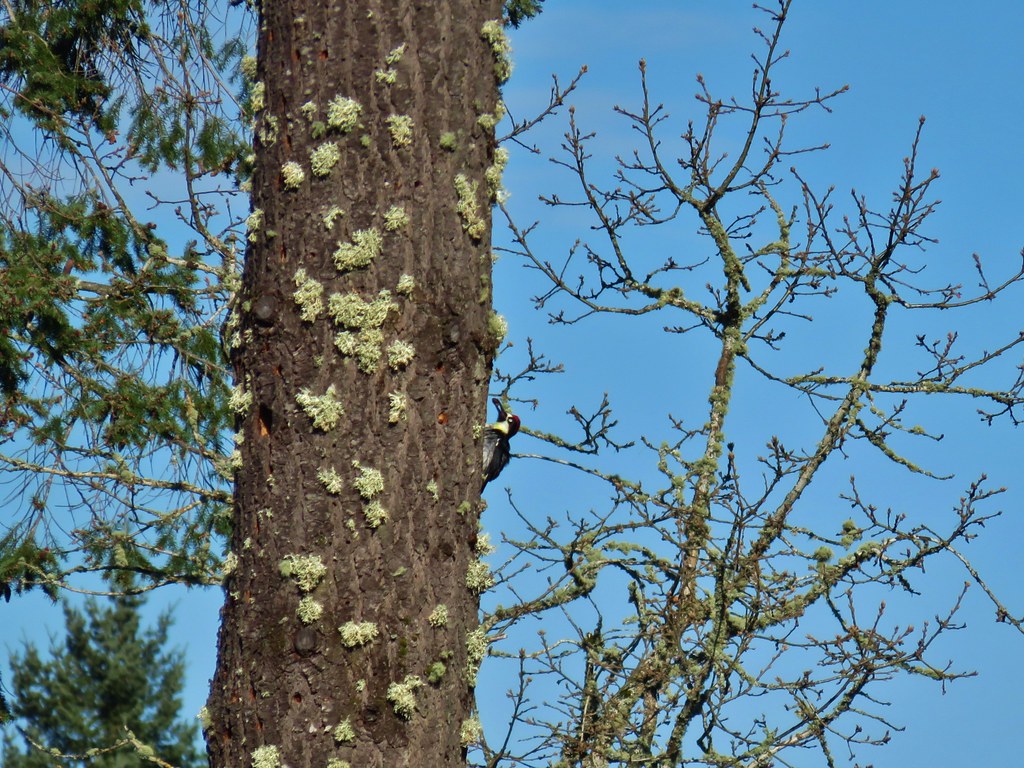
With COVID-19 still affecting every day life we decided to get a little creative with our April hike. We wanted to get outside and do our best to see some of the typical Spring sights that we have been missing while still following responsible stay-at-home guidelines. Our solution was to set off on an urban hike from our house to visit a number of area parks and natural areas. We grabbed our smallest day packs and some face masks (just in case) and headed out our front door.
IMG_2627

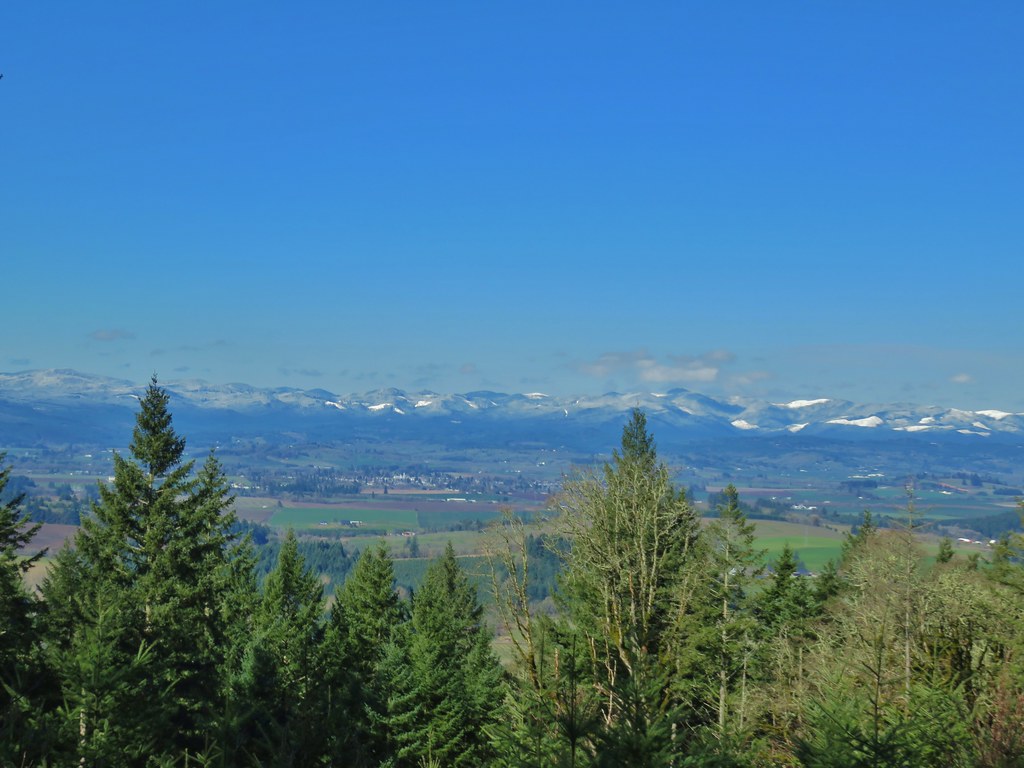
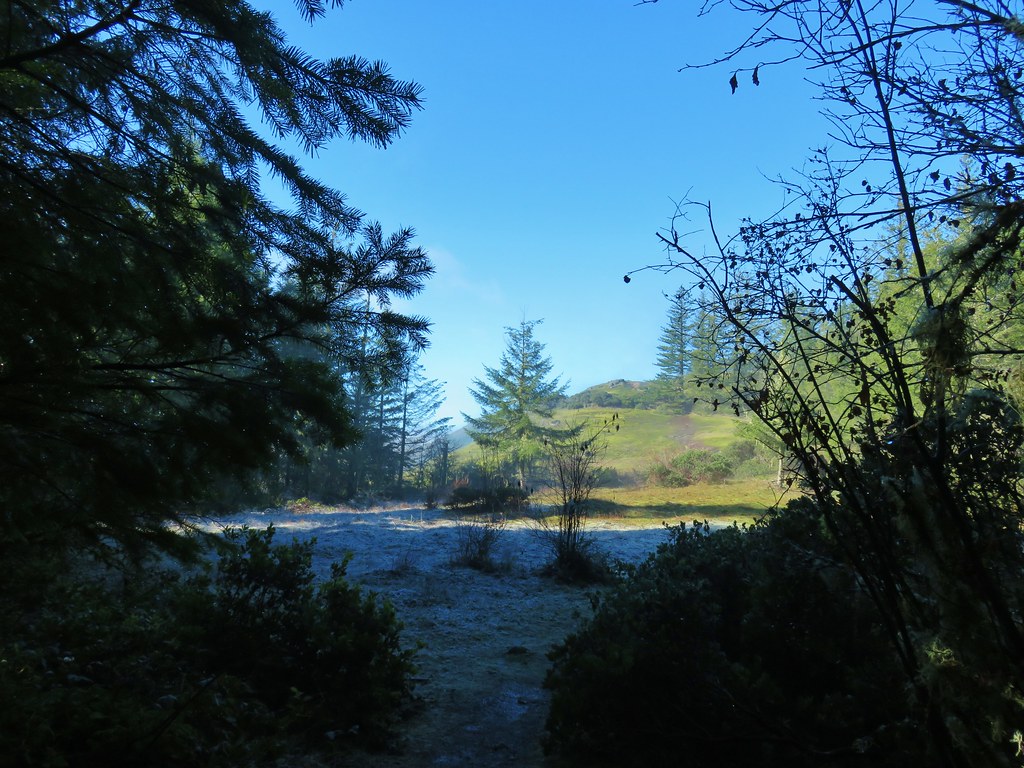
Living in the hills of West Salem we are often greeted with blue sky when the city below is shrouded in fog and this was one of those mornings.
IMG_2629

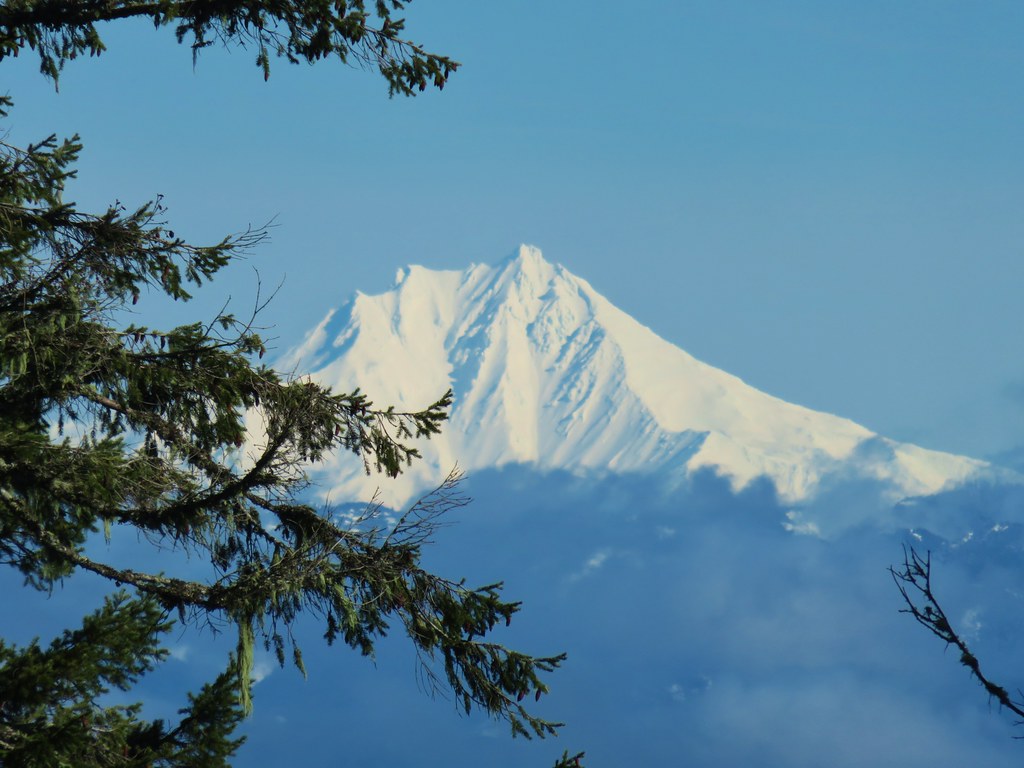
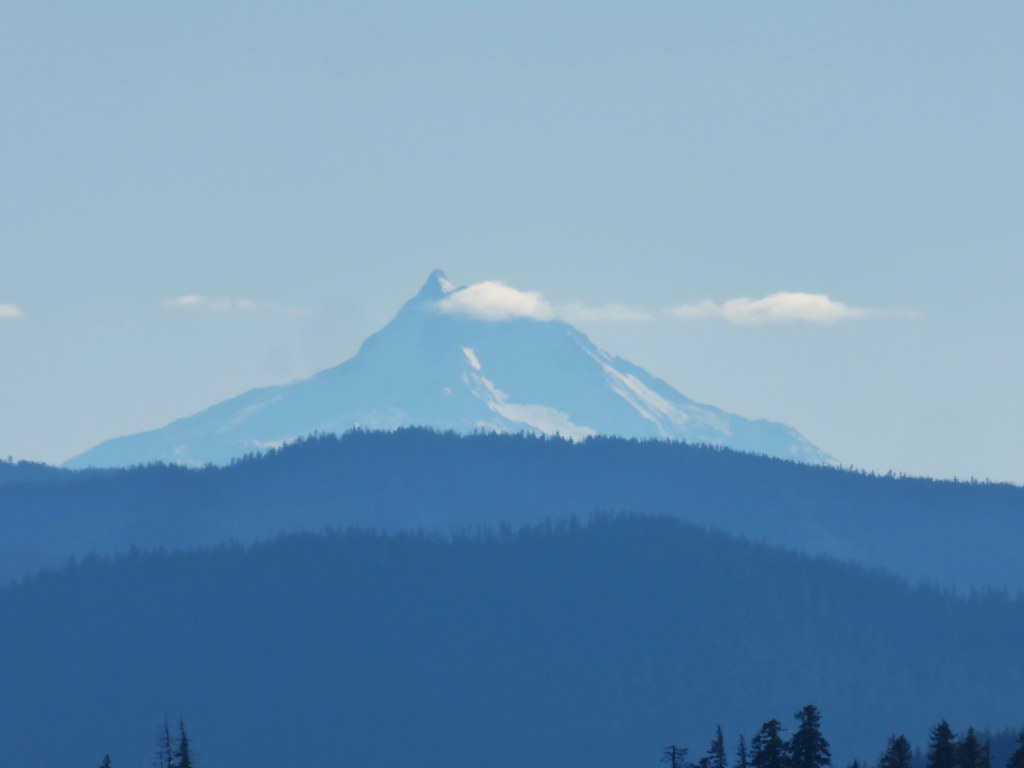
In addition to a few less mornings of fog, living up in the hills also provides us views of several Cascade mountains from various spots in the neighborhood. At one intersection we always look for Mt. Jefferson (Jeffry as we refer to the mountain). It’s become a kind of running joke that even if it’s pouring rain one of us will ask if Jeffry is visible. We were lucky enough this morning to be able to make out the mountain through a thin layer of fog.
IMG_2630

Our hope for the outing was to spot some wildlife and enjoy some flowers. Being an urban hike through neighborhoods there were plenty of flowers to see in different yards but what we were really looking for were the ones growing wild.

The first park that we passed was 5.5 acre Eola Ridge Park. The neighborhood park is thin on development other than some picnic tables and short paved path between Eola Dr. and Dan Ave NW. Wetlands on the western end of the park attract birds and other wildlife.
IMG_2631Wetlands near Eola Ridge Park

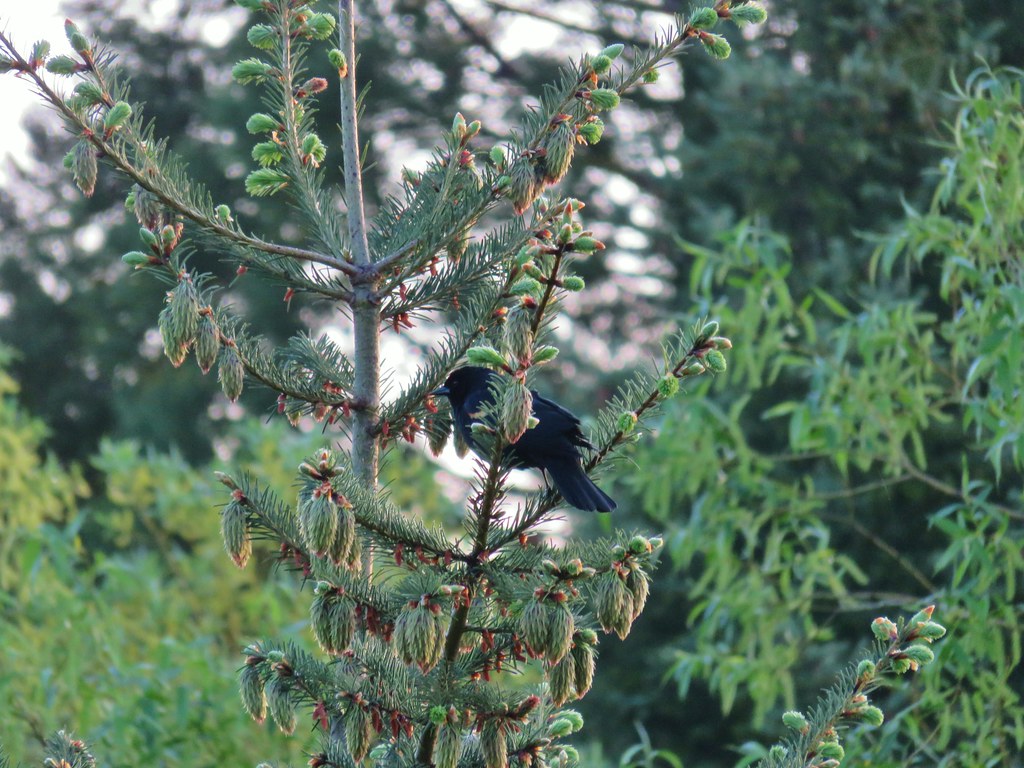
IMG_2633Red-winged blackbird

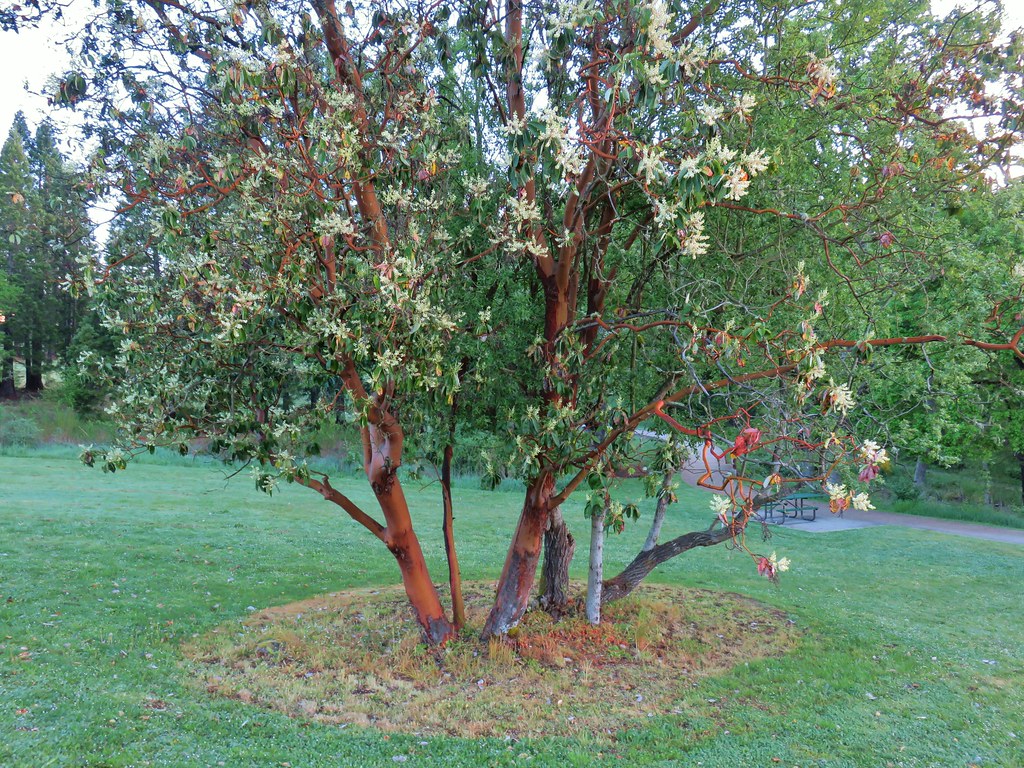
IMG_2635Madrone in Eola Ridge Park

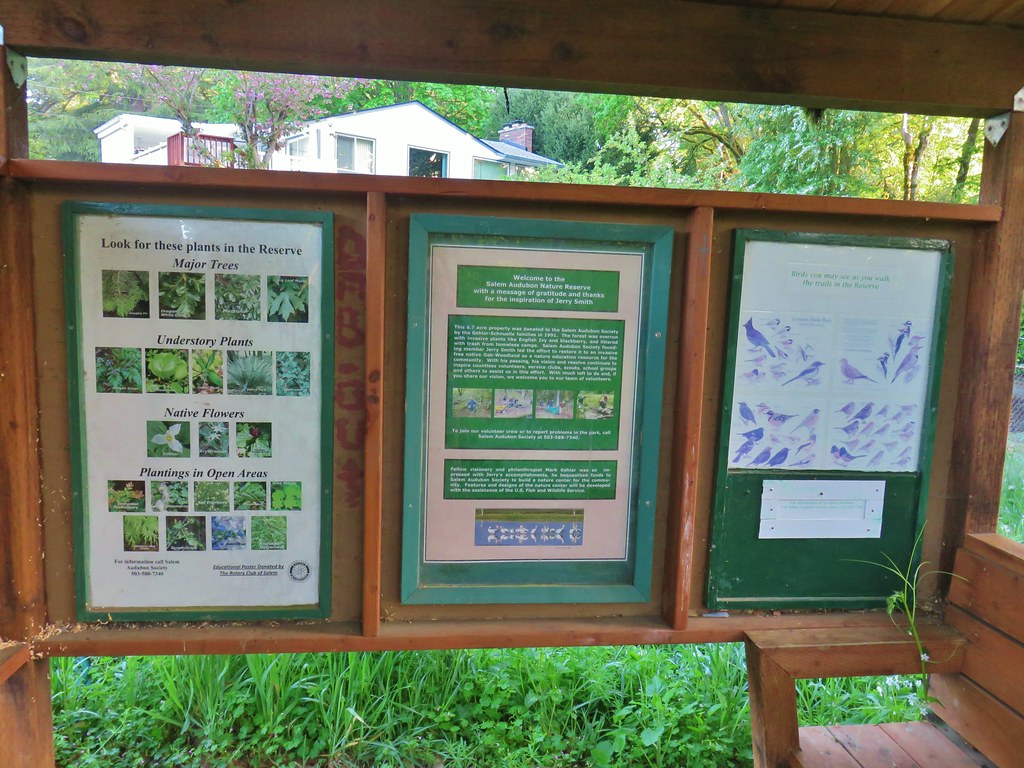
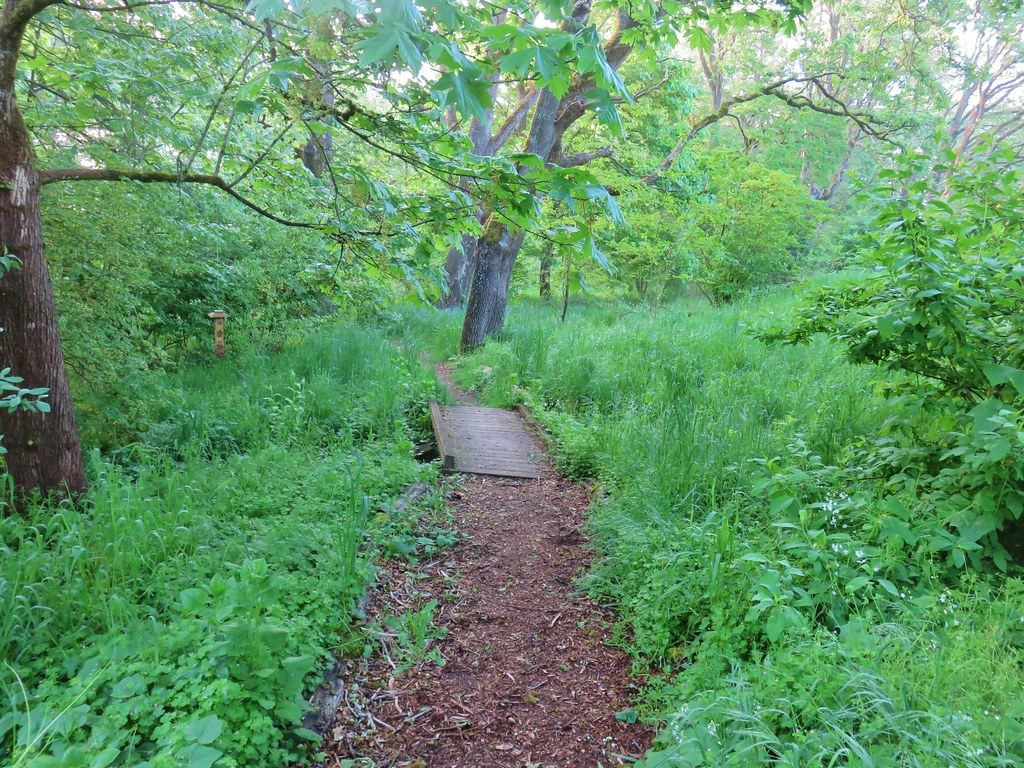
Continuing east on Eola Dr the next natural area we came to was the Salem Audubon Nature Reserve. This seven acre reserve has a few trails and interpretive signs.
IMG_2641

IMG_2645

We drive by the reserve daily and often see volunteers working on the area and their dedication showed as we made our way through the area.
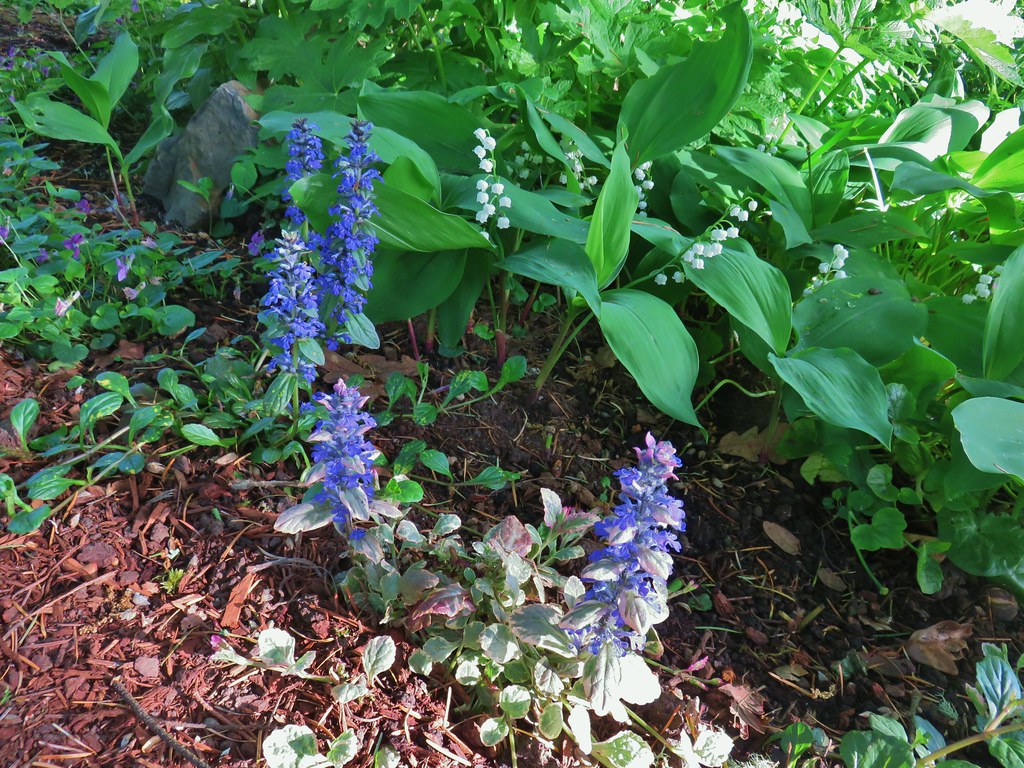
IMG_2643Bleeding heart and miners lettuce around a small bench.

IMG_2646

20200426_070411

IMG_2647

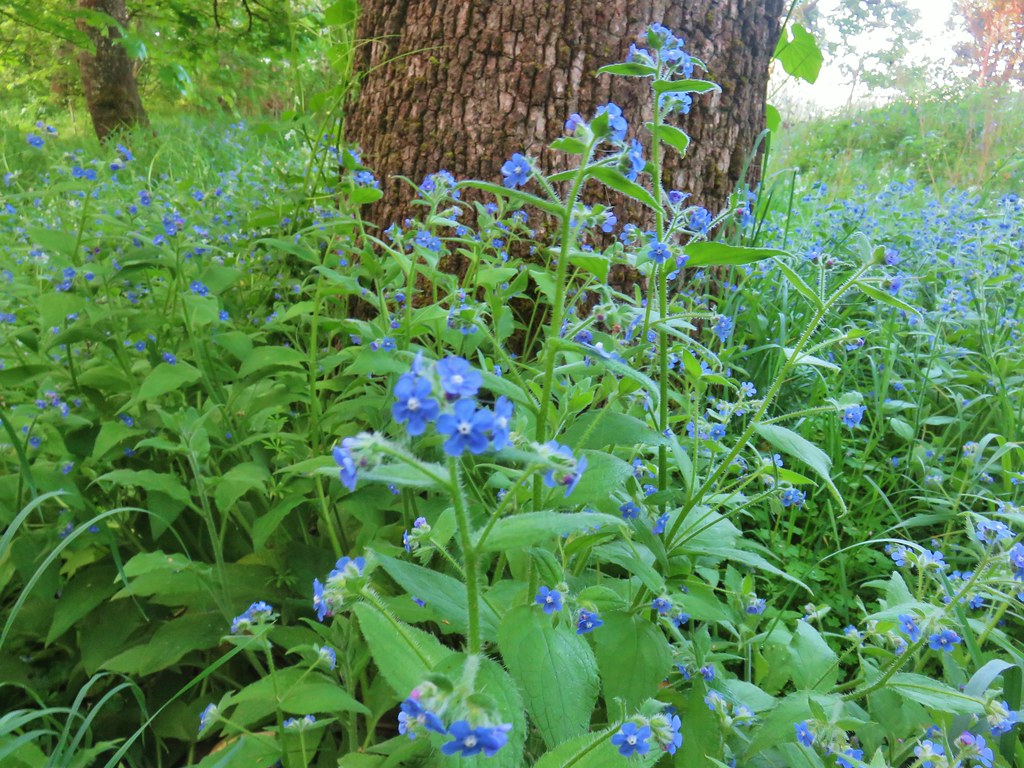
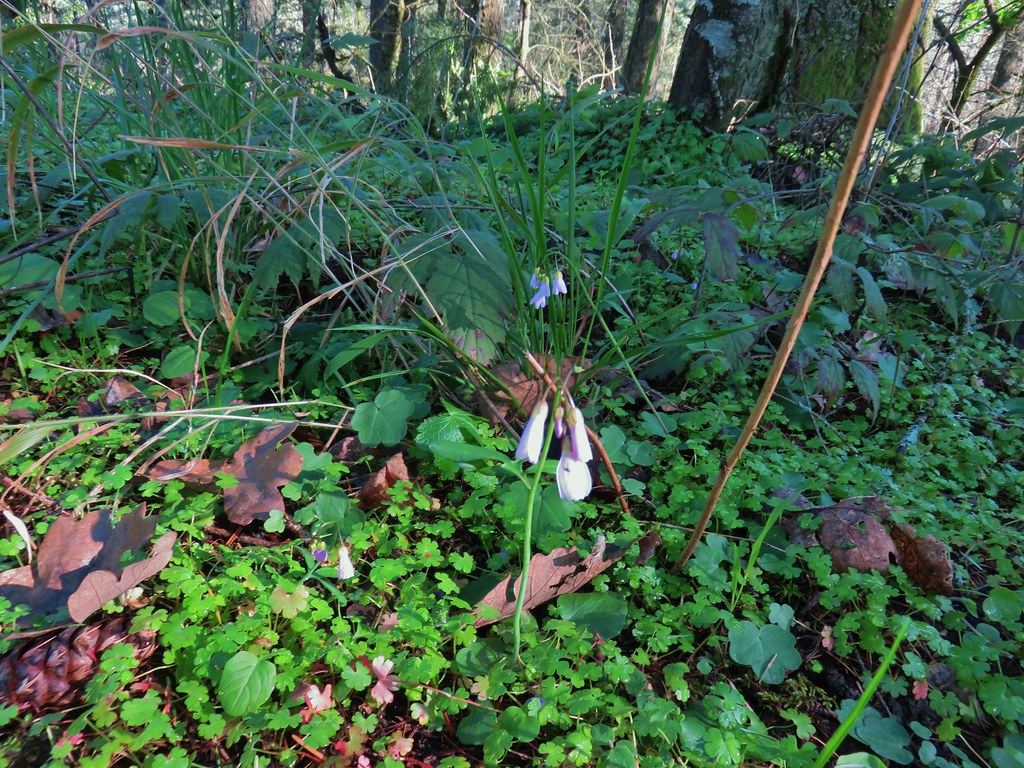
IMG_2650Possibly forget-me-nots.

IMG_2653Fringecup

IMG_2654

IMG_2655Giant white wakerobbin

IMG_2657Coastal manroot and annual honesty

IMG_2659Blue-bells

IMG_2661Plummed solomon’s seal

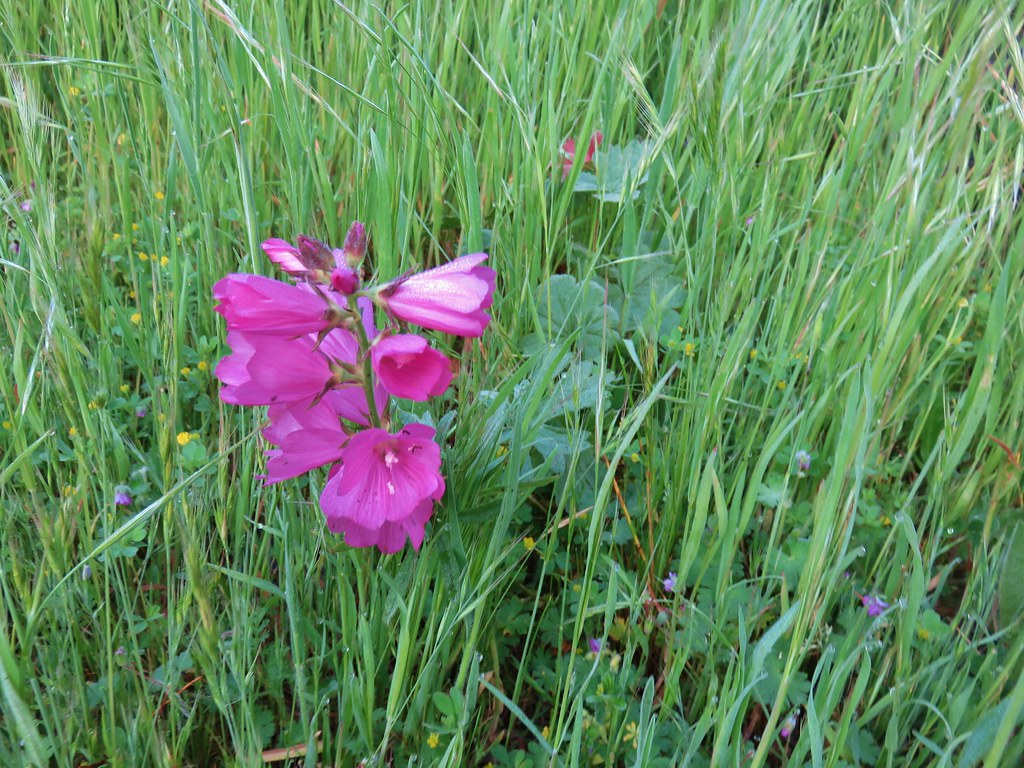
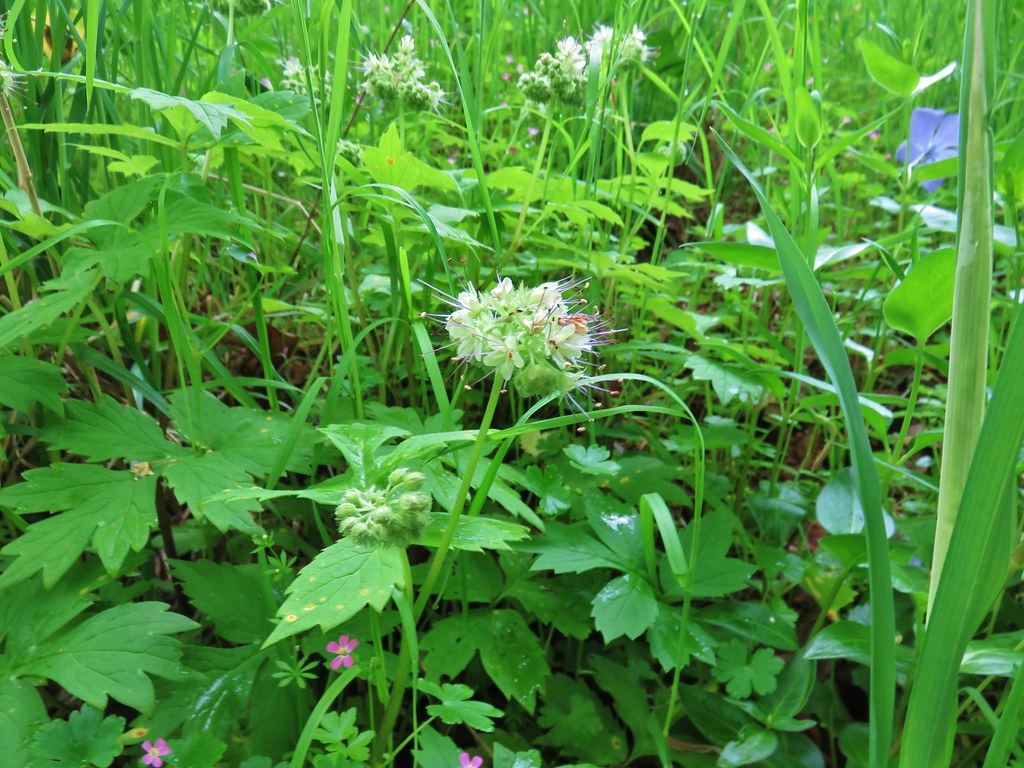
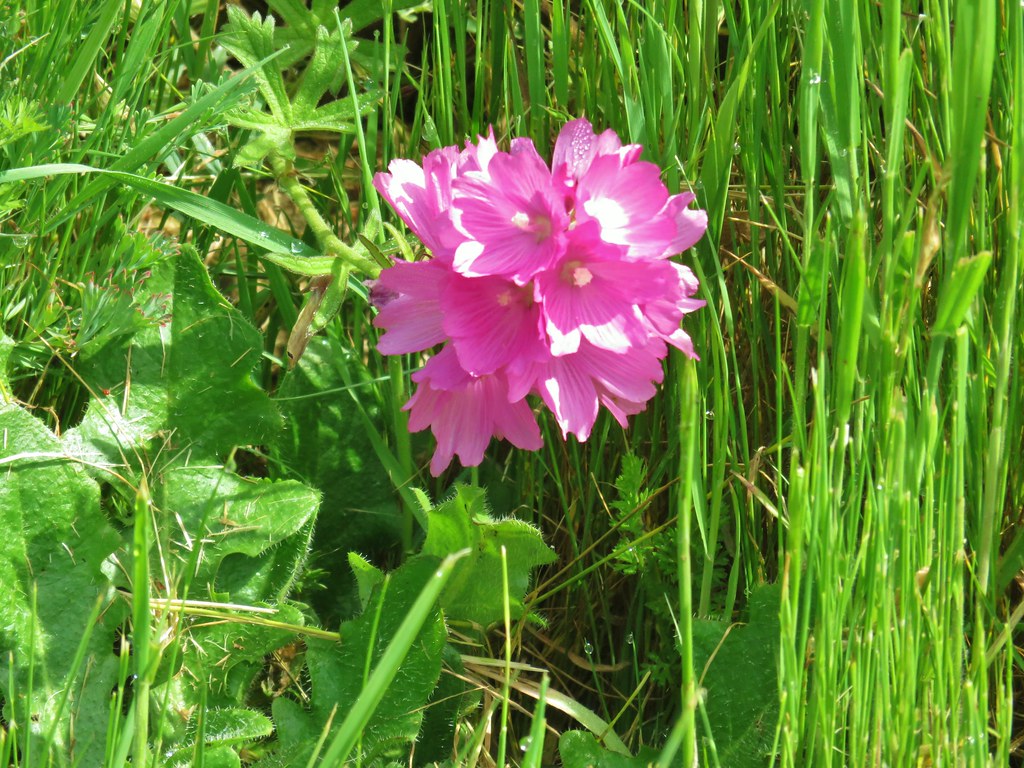
IMG_2664I think this is a checker-mallow but I’m never sure between the checker-mallows and checkerblooms.

After leaving the Audubon Nature Reserve we made our way down to Edgwater Street where we turned left eventually passing the old West Salem City Hall.
IMG_2665

From 1913 to 1949, when it merged with the city of Salem, West Salem was it’s own incorporated city. The old city hall building was opened in 1935 and functioned as city hall until the merger.

We could have followed Edgwater east to Wallace Road (Highway 221) and from that intersection crossed the Willamette River on the Center Street Bridge, but that is a noisy walk along the busy Highway 22 so instead we opted for a slightly longer route to the bicycle and pedestrian only Union Street Bridge. To reach the Union Street Bridge we wound through some neighborhoods eventually making our way to Wallace Road on Taggert Drive and then heading south along Wallace to the now paved former rail line leading to the bridge.
IMG_2672 The city has put up a number of these direction pointers all over Salem which are actually really helpful.

We’d heard a lot of birds in the nature reserve but couldn’t see most of them in the woods there but in the neighborhoods they were easier to spot.
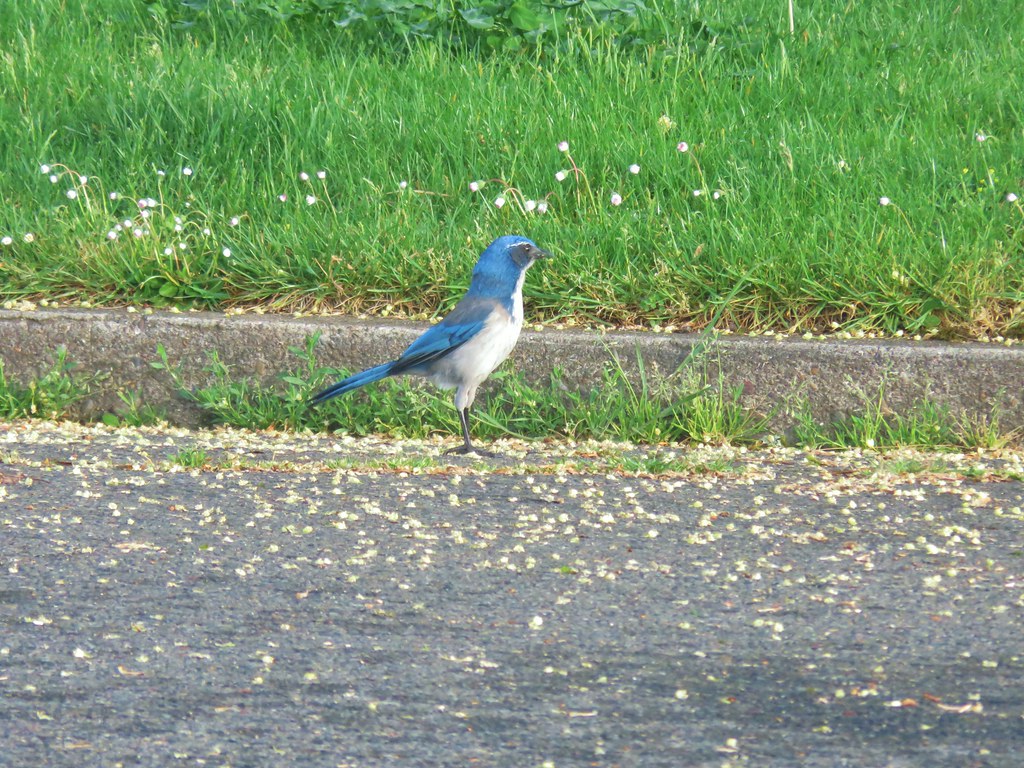
IMG_2667Scrub jay

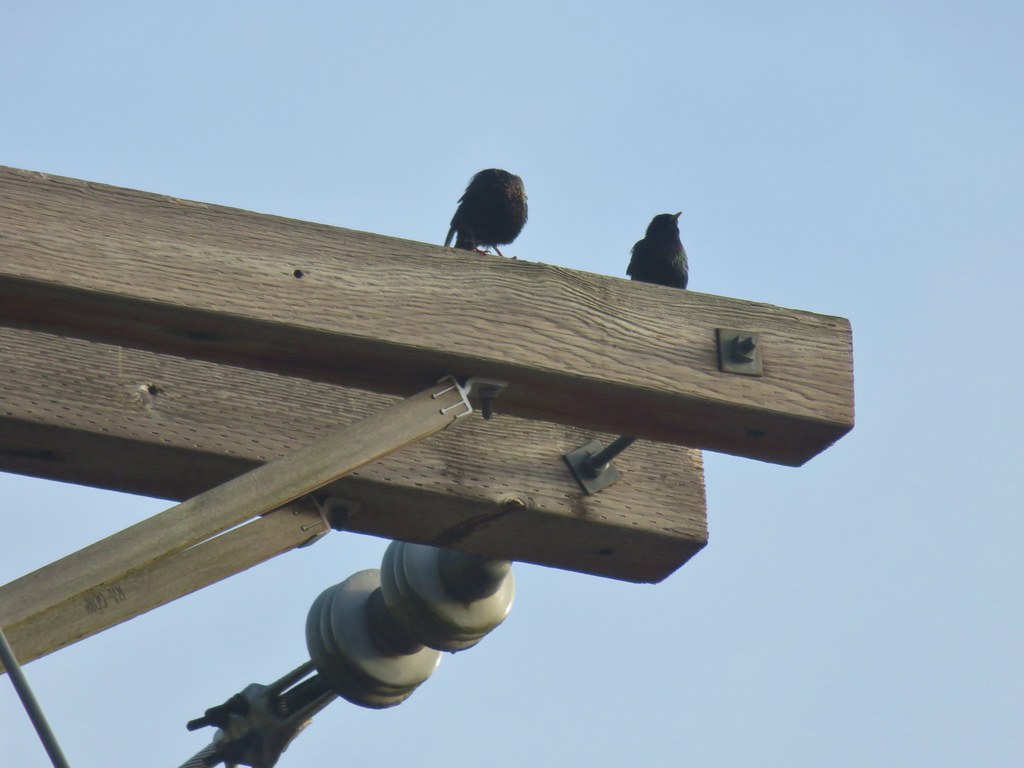
IMG_2668Starlings

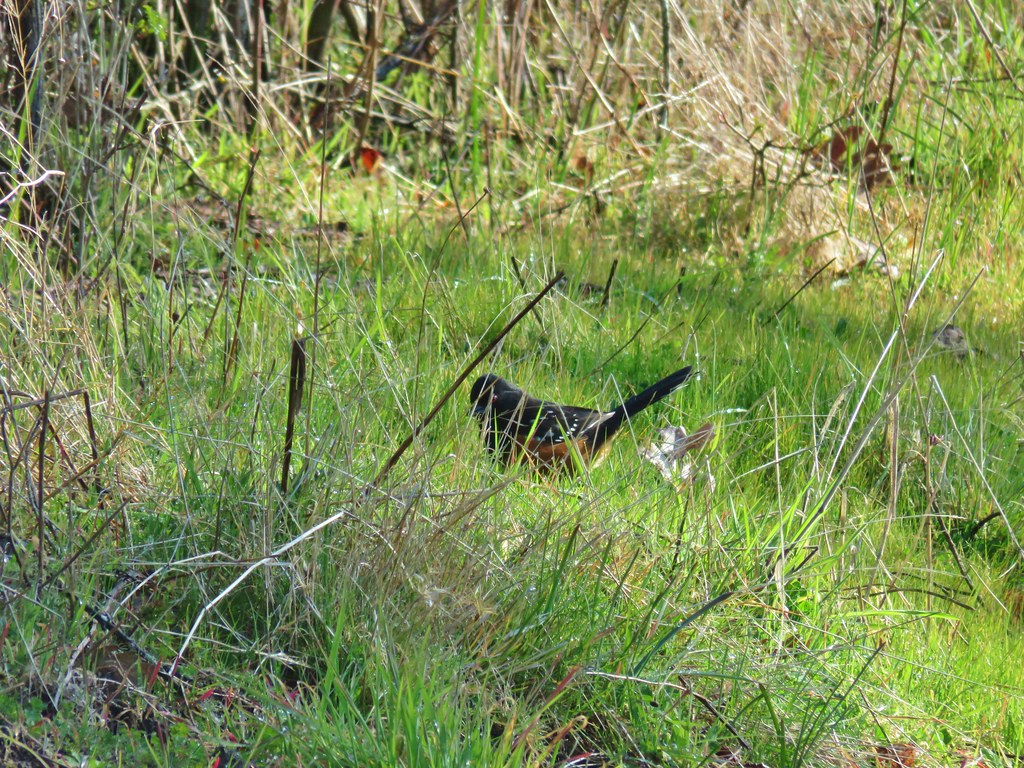
IMG_2673Spotted Towhee

The morning fog was burning off quickly save for a little lingering over the Willamette here and there as we approached the bridge.
IMG_2674Path leading to the Union Street Bridge

This bridge showed up in one of our other hikes back in 2018 when we toured Wallace Marine, Riverfront, and Minto-Brown Island Parks (post). The bridge connects Wallace Marine and Riverfront Parks by spanning the Willamette River and is always a good place from which to spot ducks and geese.
IMG_2675

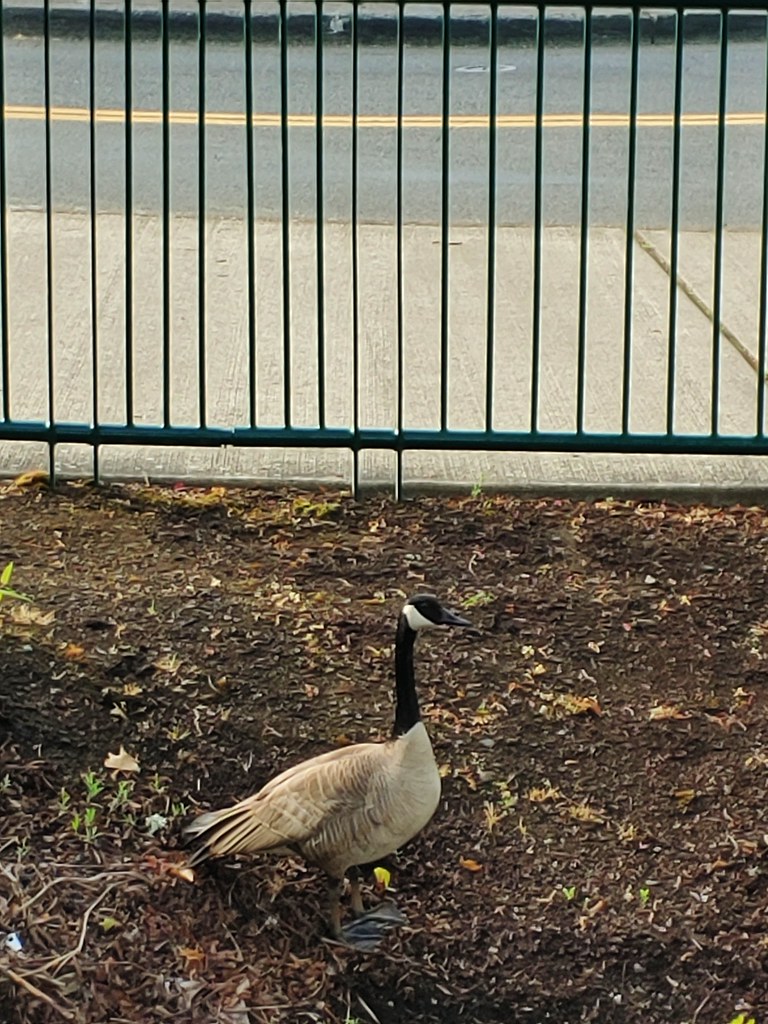
IMG_2676Family of geese

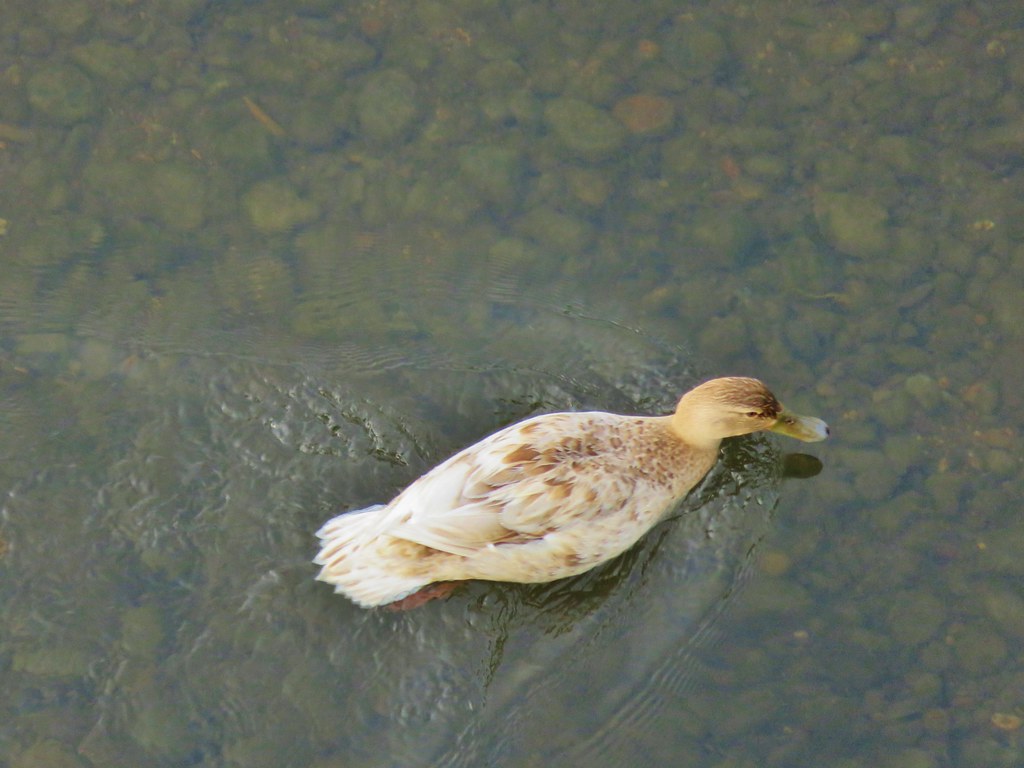
IMG_2682A very light colored mallard

20200426_075631

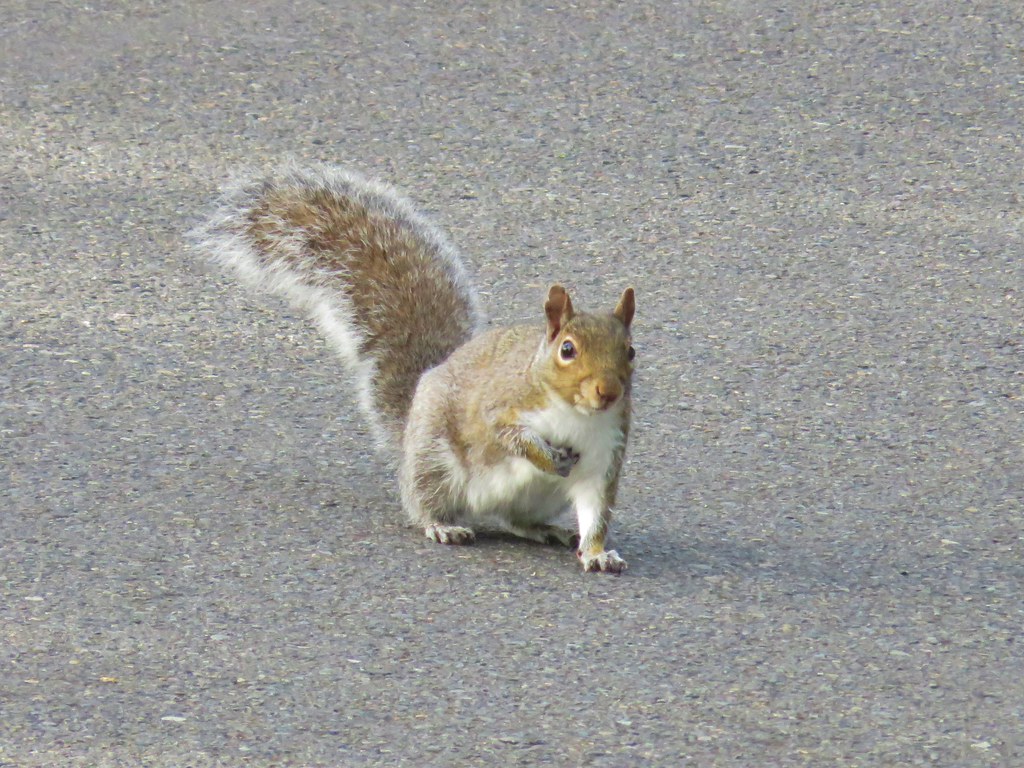
As we reached the eastern end of the bridge near Riverfront Park we started to see a lot of squirrels.
IMG_2683

IMG_2686

IMG_2687Two squirrels on a tree.

IMG_2693This squirrels was vigoursly attacking this bush.

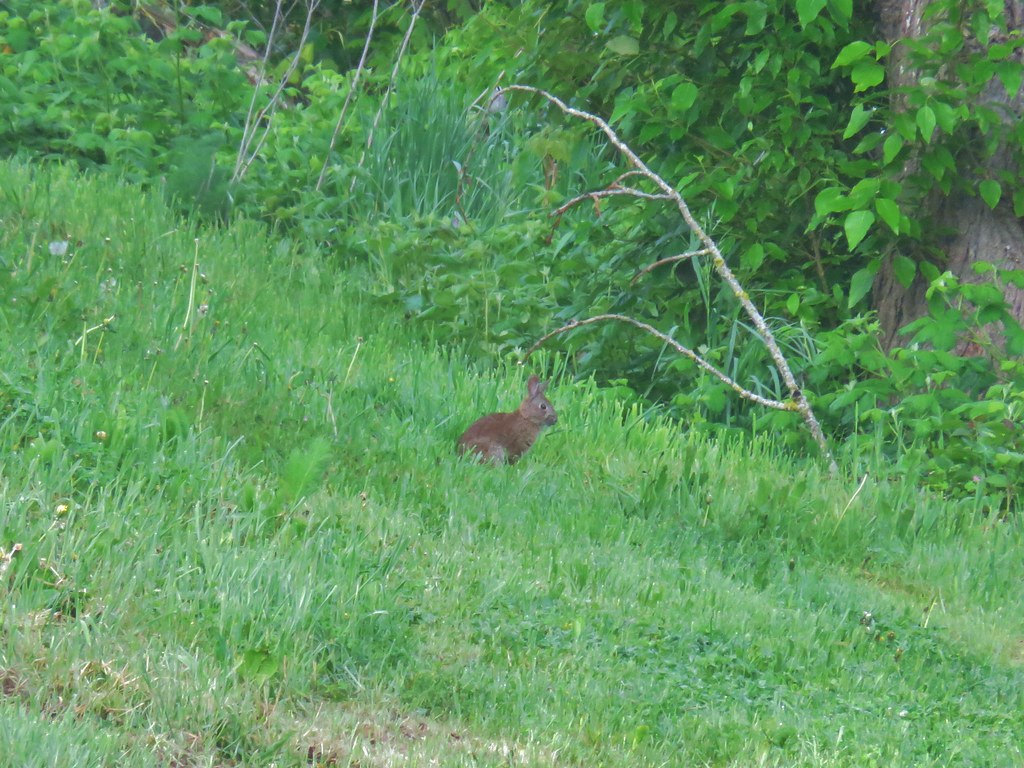
As we neared the Willamette Queen Heather spotted a rabbit in the grass.
IMG_2688

IMG_2689

There were a few people out and about, some of which were wearing masks.
IMG_2692 (We hope this mask was no longer usable because we’d hate to see them wasted, but it did make us chuckle.)

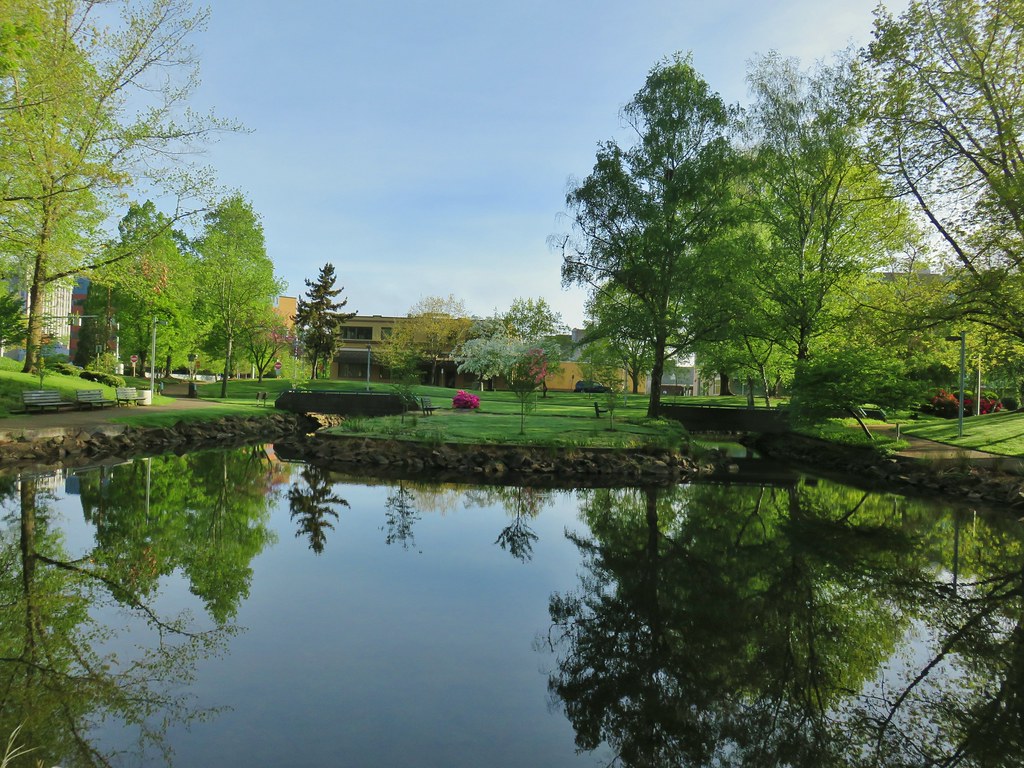
Since we covered Riverfront Park during our 2018 hike we walked through the park and crossed into downtown at State and Front Streets. We then walked a block down State Street to Commercial Street where we turned right (south) and passed the Salem Convention Center on the way to The Mirror Pond in front of the Salem City Hall.
IMG_2697

IMG_2698Pringle Creek from Commercial Street with City Hall in the distance.

IMG_2699The Mirror Pond

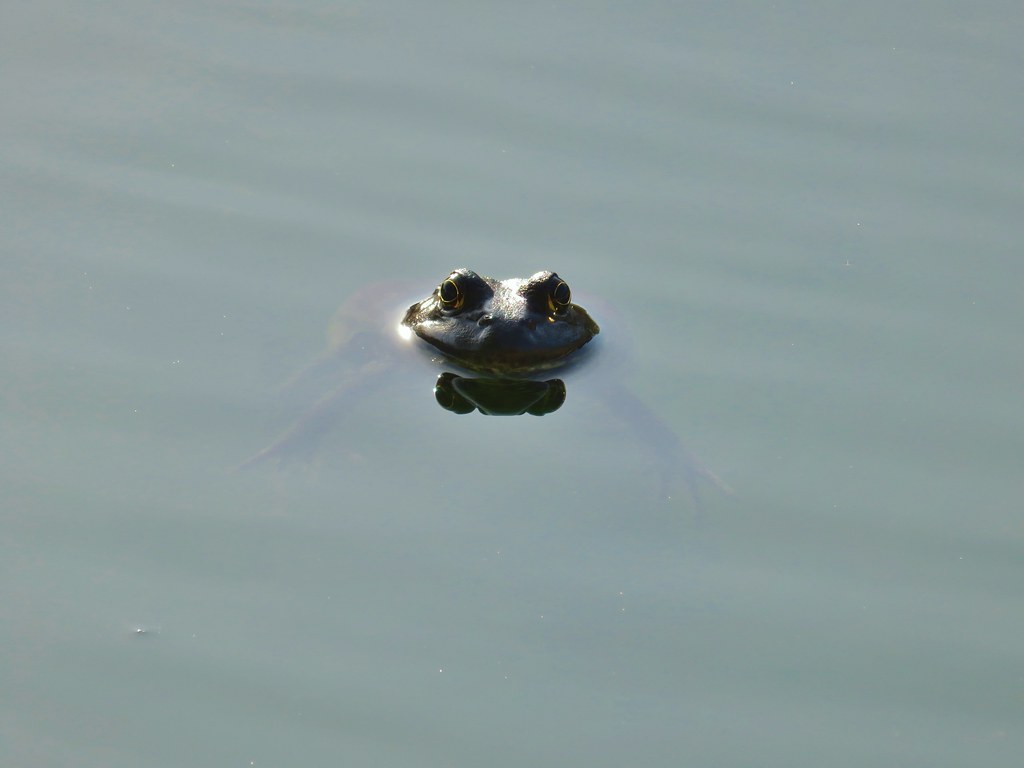
We’d seen blue herons in the water here (in addition to the statute of one that is in the pond) but as we neared the pond today it was two sets of eyes that caught my attention. I wasn’t sure what I was seeing until one set disappeared and then I realized they were frogs.
IMG_2701

IMG_2702

IMG_2705The heron statue

IMG_2707Mallards

We passed The Mirror Pond and followed a path beneath Liberty Street and over Pringle Creek.
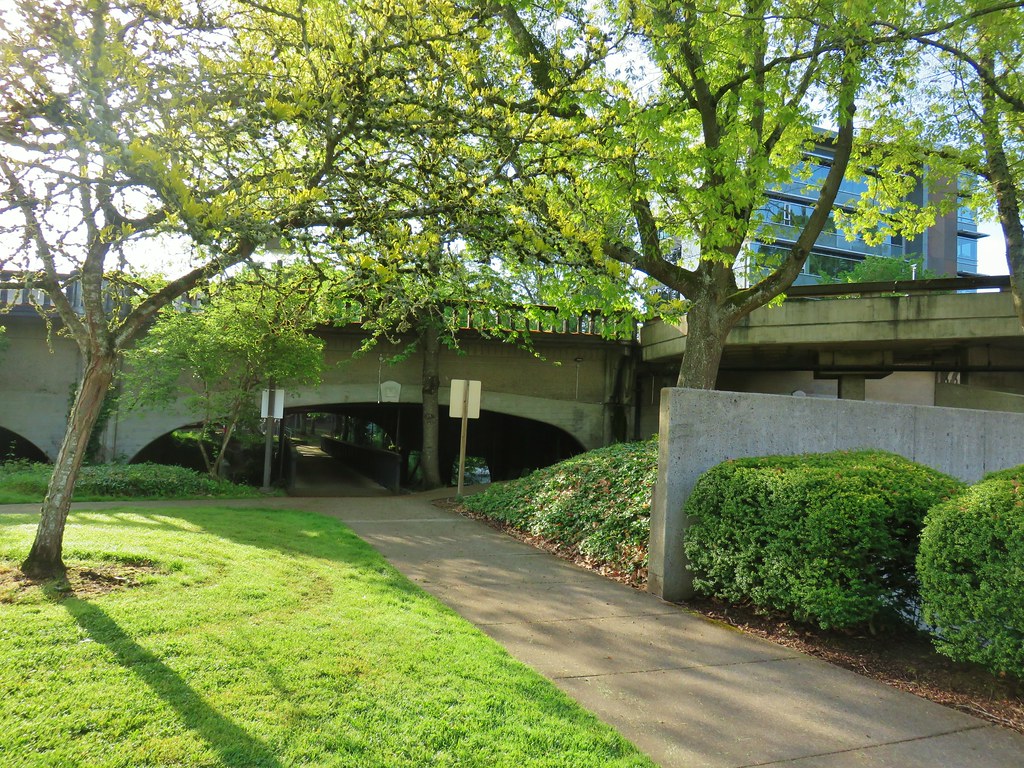
IMG_2709

IMG_2710

We then made our way to High Street crossing it in front of the SAIF building where another small green space and water feature tends to attract ducks.
IMG_2711

IMG_2713

IMG_2715

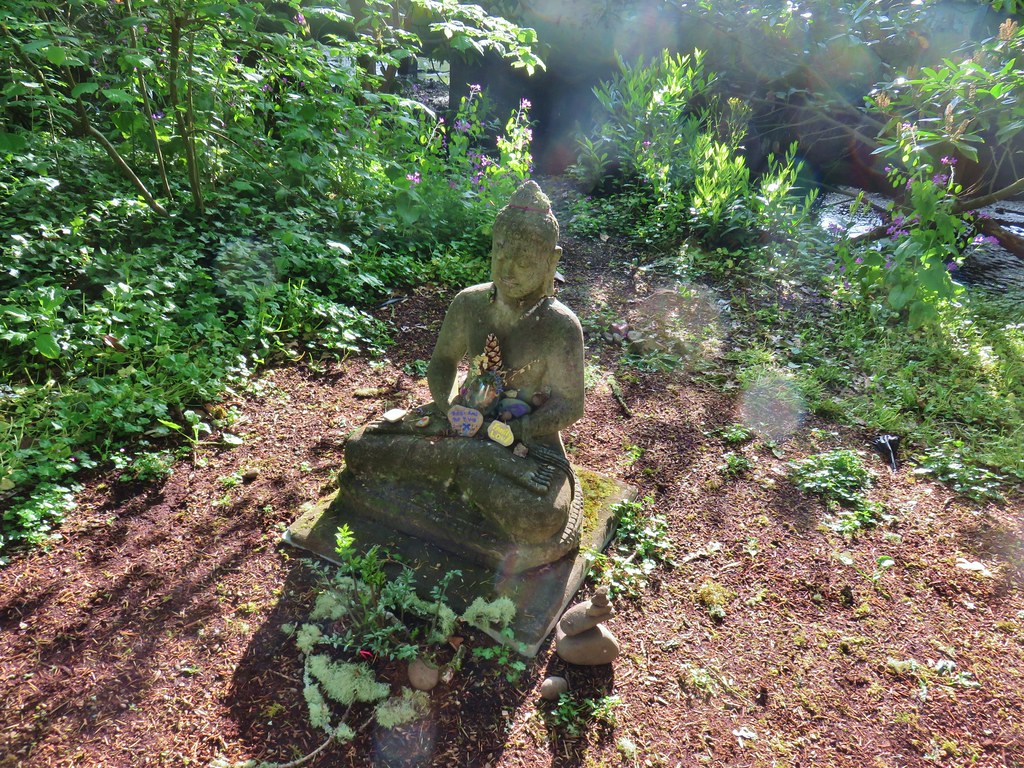
We passed through the green space and then turned right on Church Street (south again). We crossed over Pringle Creek again and took a quick detour down to the George Arthur Powell Meditation Garden.
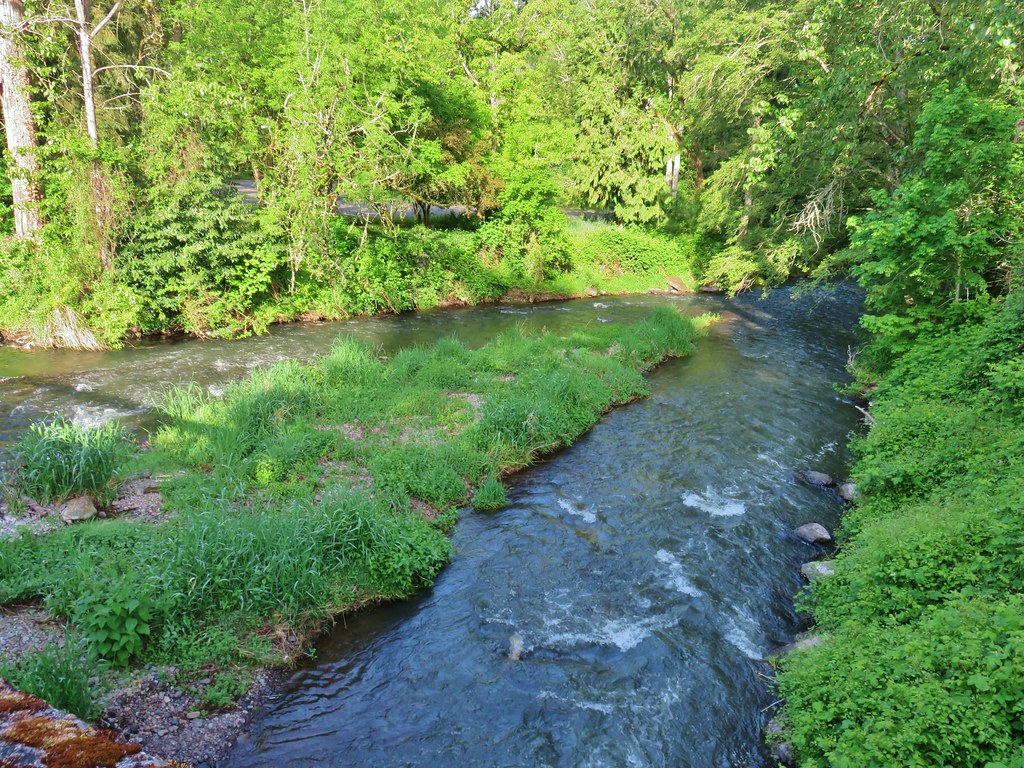
IMG_2718Pringle Creek at Church Street.

IMG_2719

The small garden had a small bench and lots of flowers.
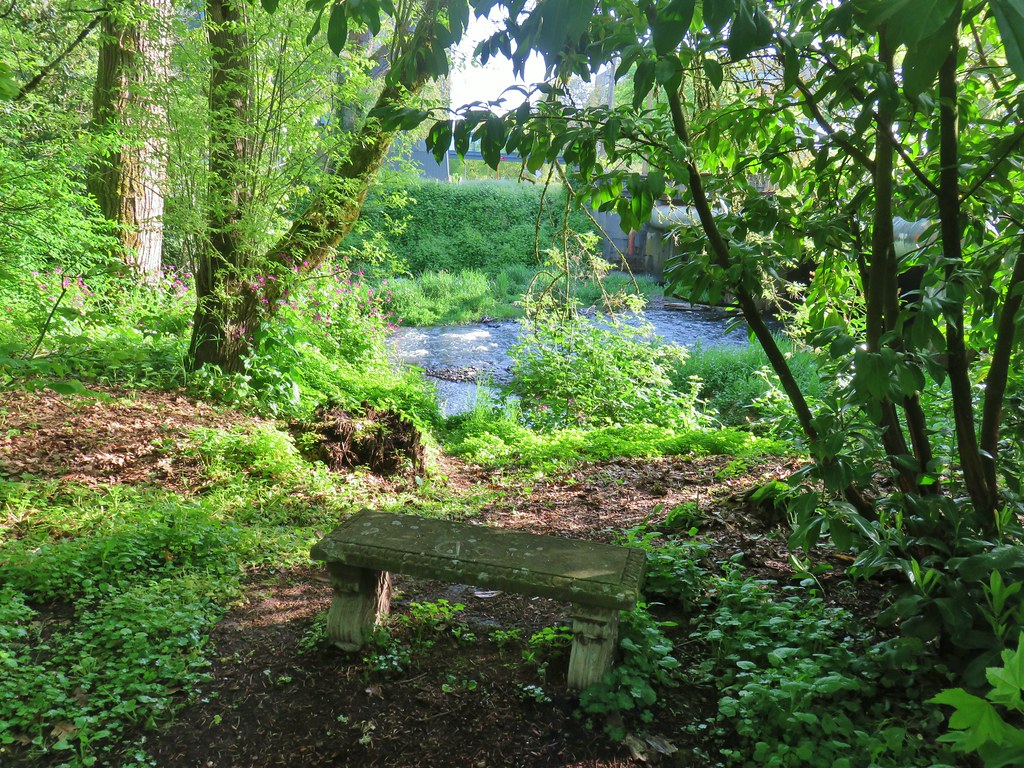
IMG_2722

IMG_2720

IMG_2721

On the opposite side of Church Street is Pringle Park and the Pringle Community Hall. When we both worked near the hospital we would often walk through this park during lunches.
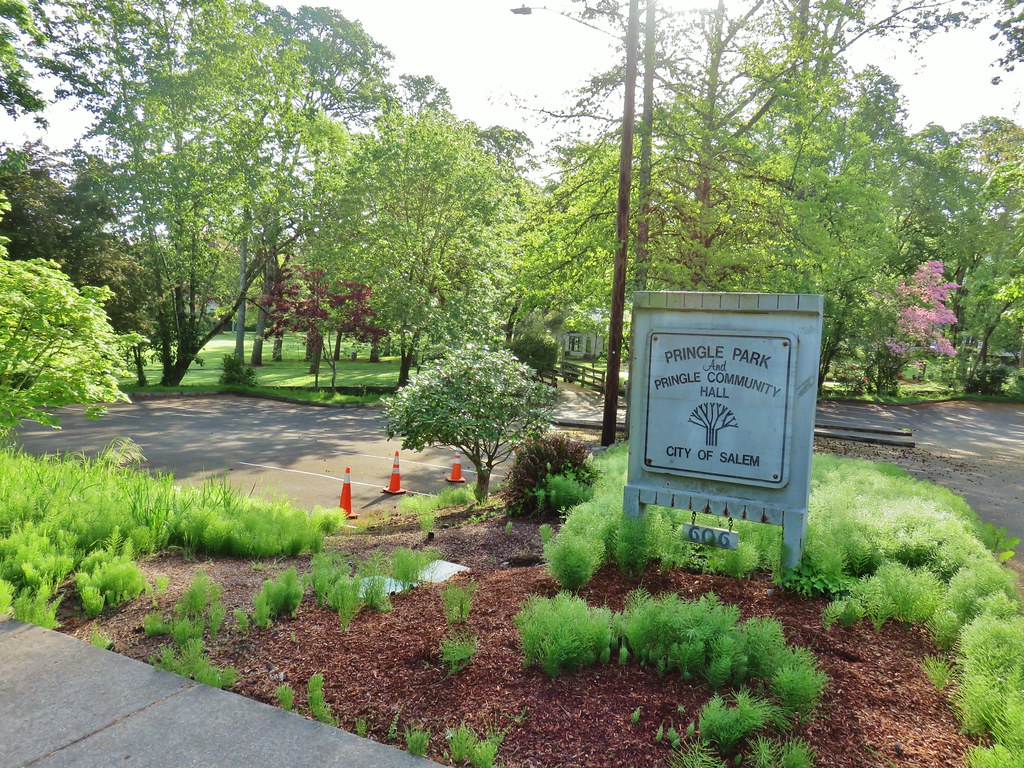
IMG_2723

We skipped Pringle Park today though and continued south on Church Street toward Bush’s Pasture Park.
IMG_2725 Passing the Let’s All Play Park. part of the Salem Hospital Campus on Church Street.

IMG_2726Sign at Bush Park

IMG_2728Bush House Museum

At 90.5 acres Bush’s Pasture Park is one of the larger parks in Salem and may provide the most diverse set of activites. Along with the Bush House Musuem and Rose Garden there are picnic areas, playgrounds, tennis courts, ball fields, woods, and open swaths of grass. There is also a soap box derby track and some of Willamette University’s sports fields.
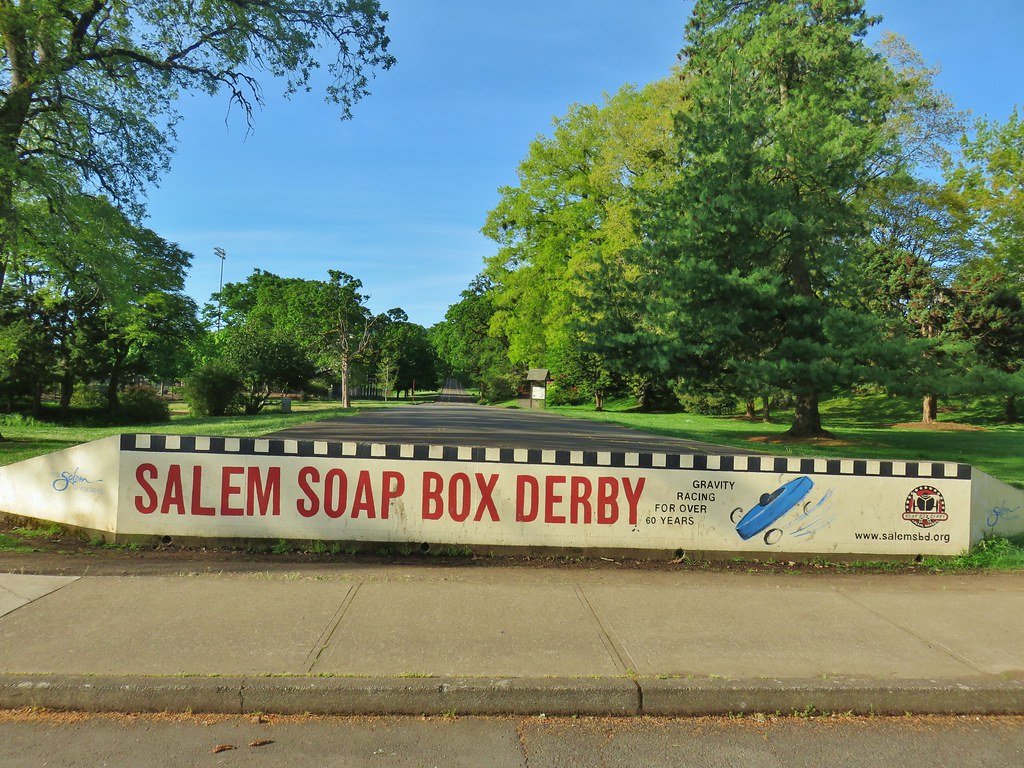
IMG_2730

IMG_2731

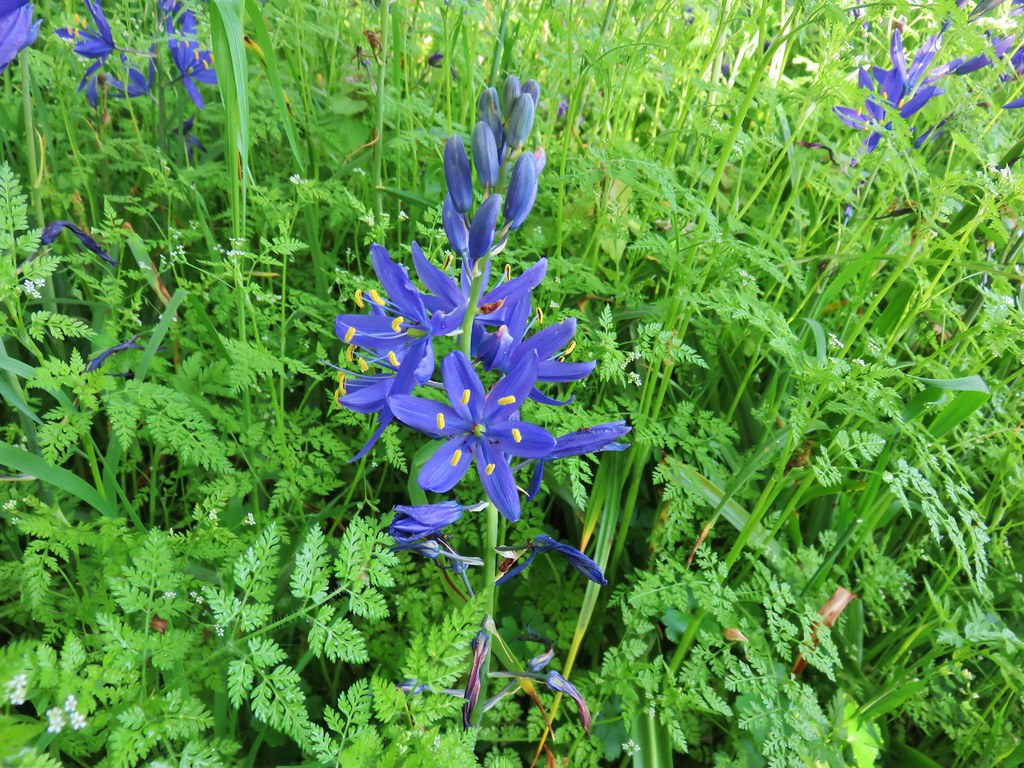
Our main motivation for getting to Bush Park though was to check out the camas bloom. For years I’d been wanting to see the camas bloom at Bush Park up close instead of from the car while driving by on Mission Street. COVID-19 had at least provided the right situation to prompt us to finally get here. We made our way to the NE end of the park and turned into the woods at the interpretive signs for the camas.
IMG_2737

IMG_2739

IMG_2743

IMG_2735

IMG_2742

IMG_2748

IMG_2761

IMG_2774A white camas

While camas was the predominate flower there were a few others present.
IMG_2749

IMG_2776Western buttercups

IMG_2765Buscuitroot

IMG_2763

We emerged from the woods near the SE end of the park at a large open field.
IMG_2780

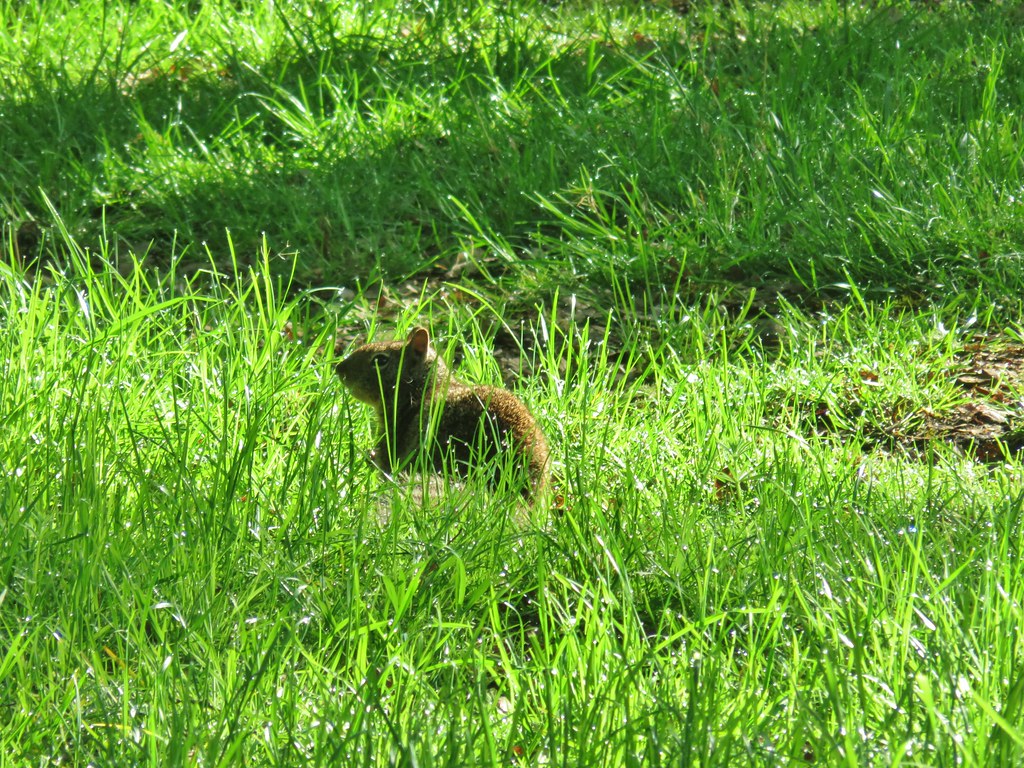
IMG_2778Ground squirrel

We headed SW along the field to a newer flower garden along a hillside.
IMG_2785

IMG_2787

IMG_2788

IMG_2789

IMG_2790

After climbing the hill we passed through a grassy picnic area (the tables weren’t out due to COVID-19) and exited the park at its SW corner.
IMG_2791

Our plan from here was not very well thought out. The rough plan was to make our way up to Fairmount Park in the foothills of South Salem. We hadn’t laid out a route though so after recrossing Liberty and Commercial Streets we simply zigzaged our way through neighborhoods up to the park. On on occassion we had to back track when the street we had chosen had no outlets.
IMG_2792Neat old carraige in a yard.

IMG_2794Stellars Jay

After wandering for a little over a mile we finally arrived at Fairmount Park.
IMG_2796

This neighborhood park is just under 17 acres with a picnic shelter, playground, a half-court basketball hoop and is next to the Fairmount Reservoir.
IMG_2798

Our reason for coming here though was the Fairmount Park Trail which we could theoretically follow down to the River Road entrance to Minto-Brown Island Park.
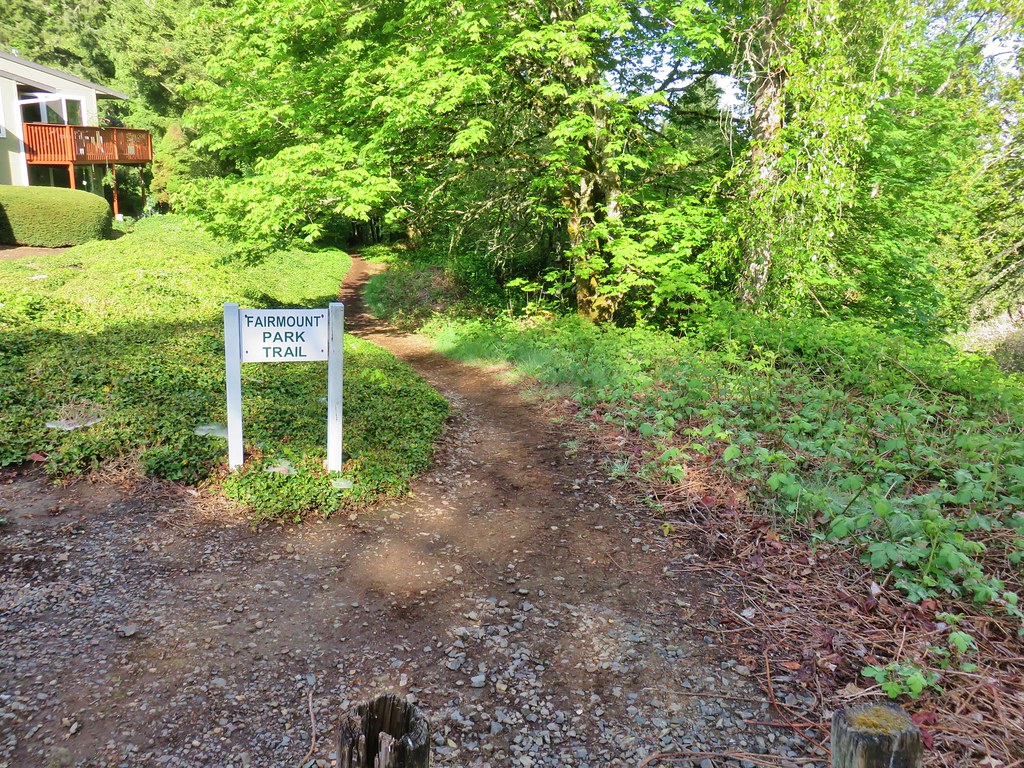
IMG_2799

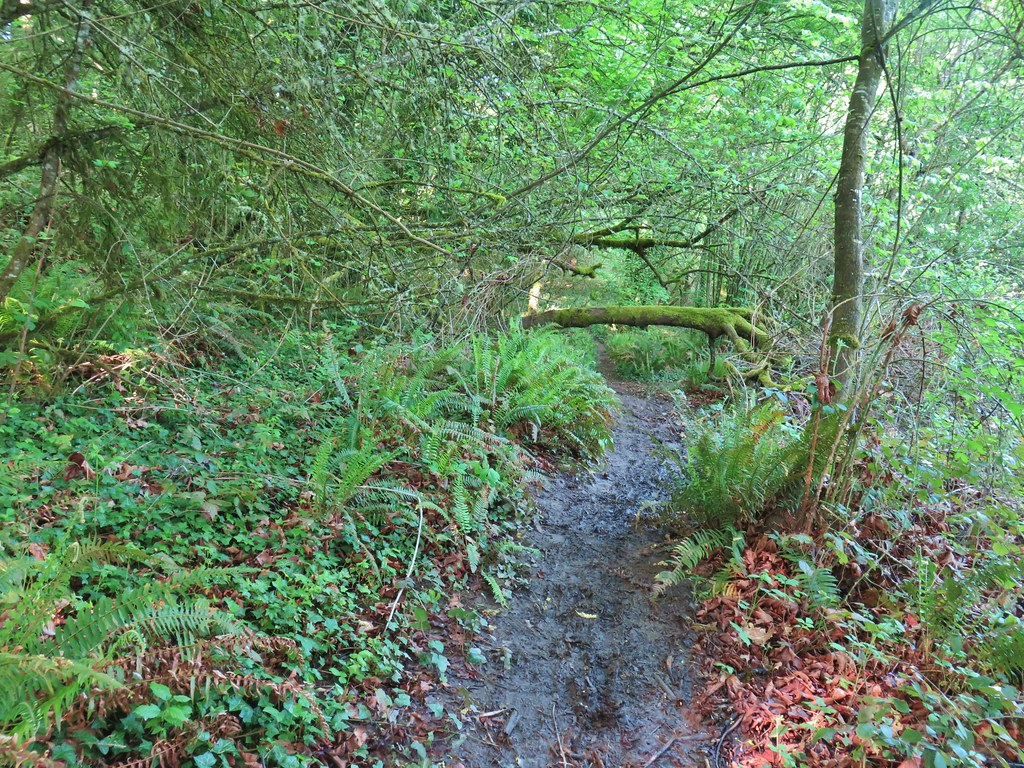
I said we could theoretically follow the trail down becuase we knew from other people that it was possible, but we had never tried it and we quickly discovered that there were a number of spur trails, none of which were marked to let us know if we were following the correct one. The muddy sufrace and presence of poison oak along the trail made it a bit more of an adventure than anywhere else we’d been in the morning.
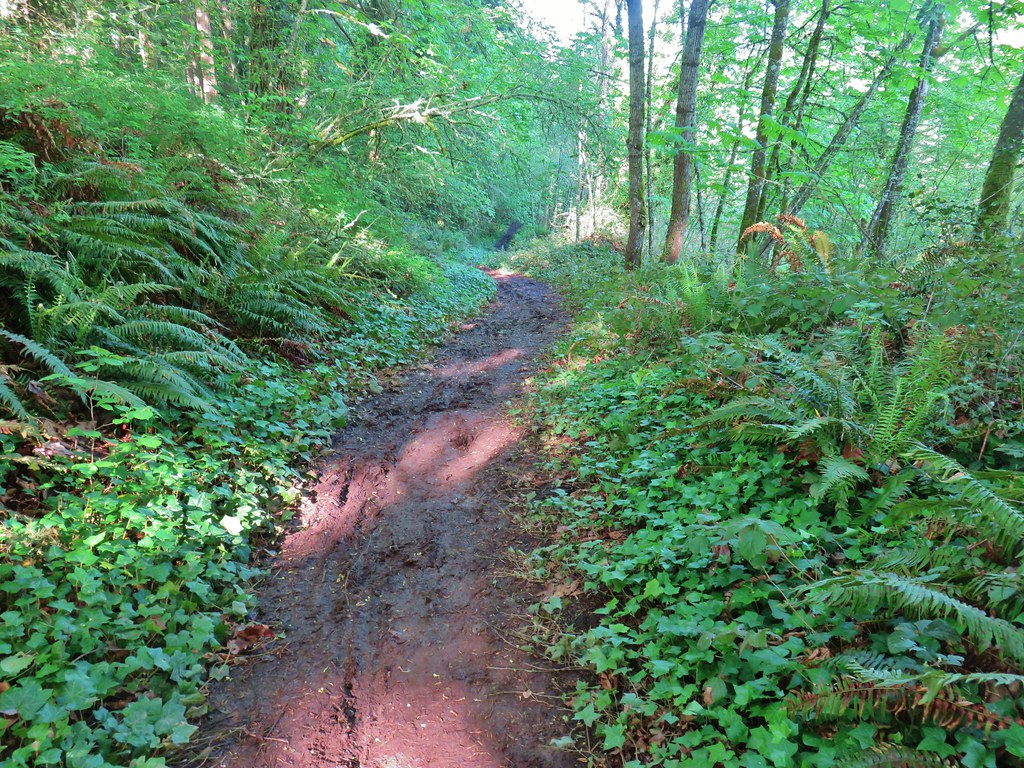
IMG_2801

IMG_2802

We had been behind a couple and their dog but lost them when we stopped for a quick break at one of the unmarked intersections. We decided that we would simply choose downhill trails to the right whenever possible knowing that River Road was in that general direction. This worked fine for the first three tenths of a mile or so but just after spotting River Road the trail we were on began deteriorating quickly on the steep hillside.
IMG_2803

We weren’t all that high up, but the poison oak had become much more abundant so we didn’t want to get off the trail at all. Some fancy footwork and a lot of luck at the bottom got us onto the shoulder of River Road less than a quarter mile NE of the entrance to Minto-Brown. As we arrived at the entrance we spotted the couple that we had briefly followed on the Fairmount Trail approaching form the opposite direction. Clearly they had known a safer route down than we had and must have kept left at one of the junctions where we had gone right.
IMG_2804

At this point we were approximately 8.5 miles into our hike and given that most of it had been paved our feet were starting to feel it so we took the most direct route through Minto-Brown to the Peter Courtney Bridge which brought us back to Riverfront Park. We did of course stop for birds and flowers along the way.
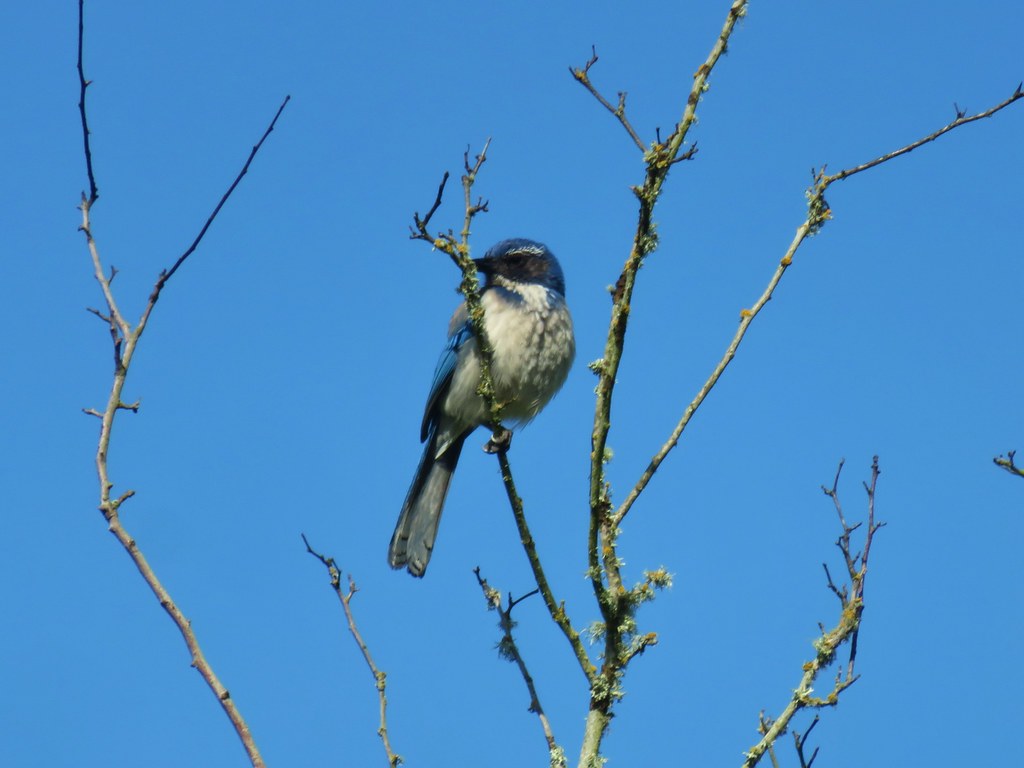
IMG_2805Another scrub jay

IMG_2806We risked the caution for mud and high water since this was the shortest way to the bridge.
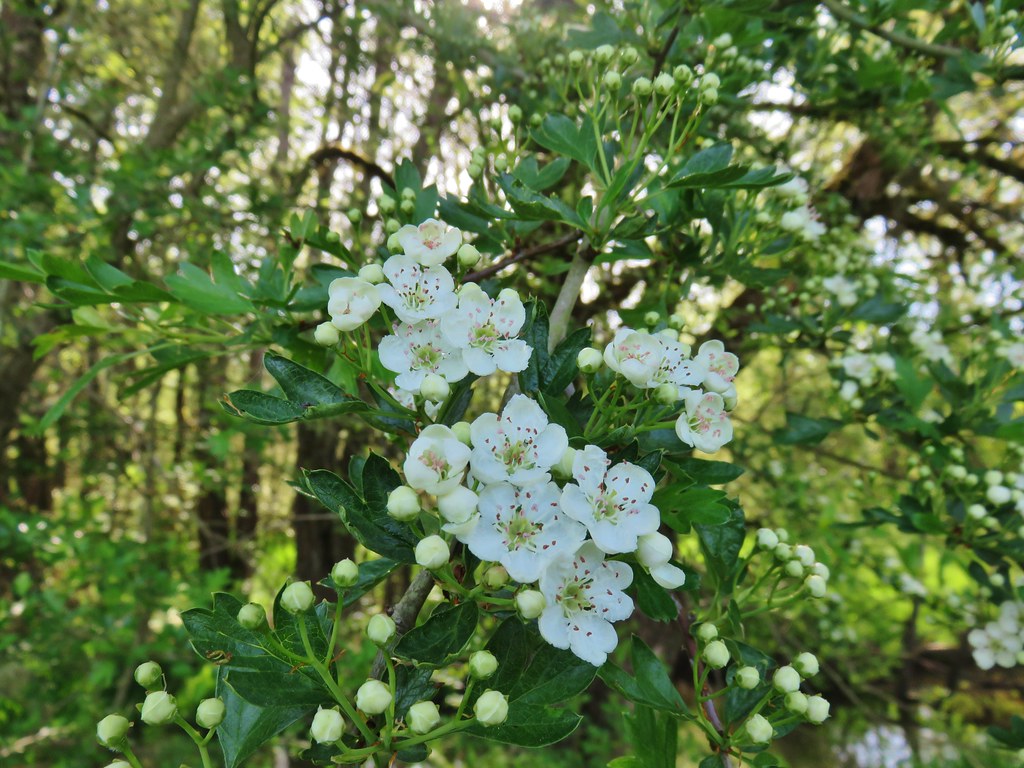
IMG_2808Tree blossoms

IMG_2812The high water wasn’t an issue, but it was really muddy around that puddle.

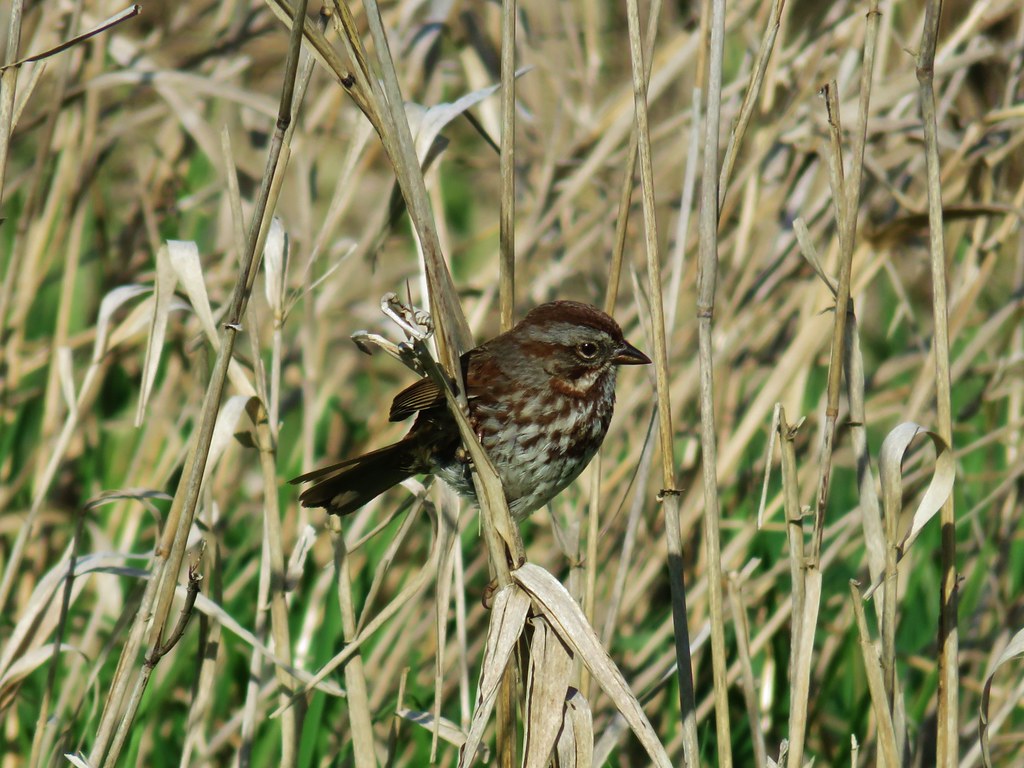
IMG_2817Sparrow

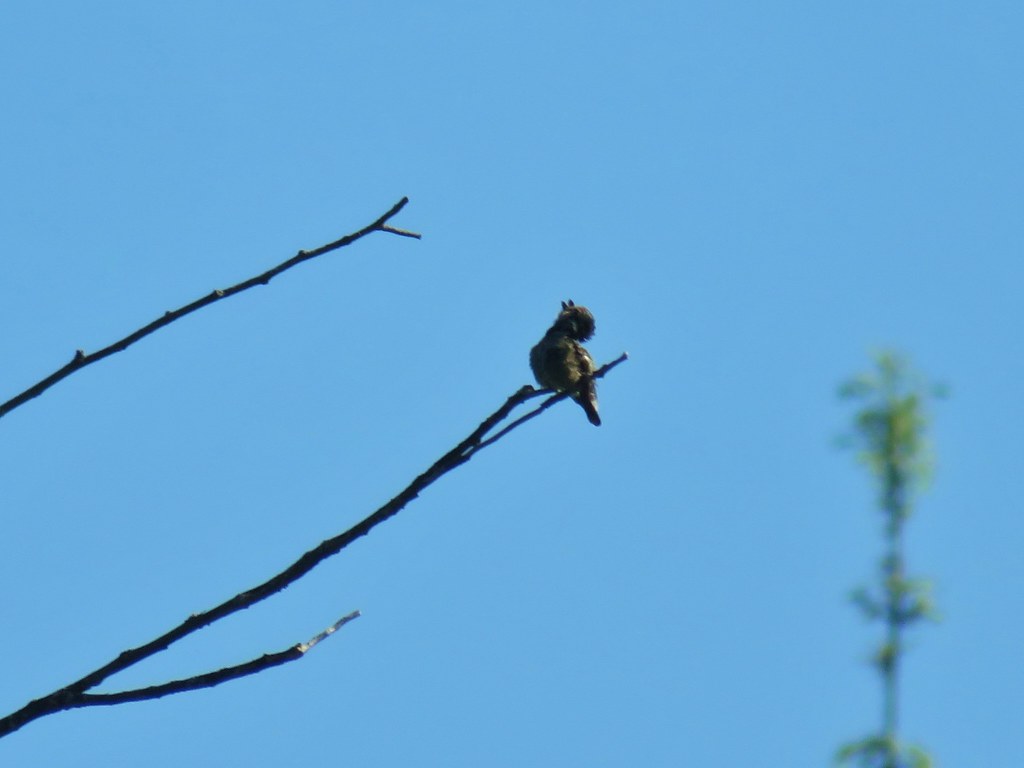
IMG_2820I mistook this small bird for a hummingbird but after looking at the photo it might just be a baby?

IMG_2823We tried to take our first sit down break of the day here but the bench was still wet from the morning. On to Riverfront it is.

IMG_2824Riverfront Park and the Peter Courtney Bridge in the distance. (We had found a dry bench by this time, thank you Gallagher Fitness Resources)

IMG_2825Looking across a field to West Salem and its green water tower in the hills.

IMG_2827California poppy

IMG_2830Red flowering currant

IMG_2831Sparrow

IMG_2834Western service berry

IMG_2835Crossing the Peter Courtney Bridge.

We then headed back through Riverfront Park to the Union Street Bridge and took a slightly modified route back to the Audubon Nature Reserve.
IMG_2836Willamette River from the Union Street Bridge

IMG_2839More geese

IMG_2846

Having taken the Hillside Trail that morning we followed the Upper Trail uphill through the reserve.
IMG_2849Perriwinkle

IMG_2850Pacific waterleaf

IMG_2857Camas

IMG_2860Another checker-mallow(or checkerbloom)

IMG_2861California poppy

IMG_2863Haven’t figured this one out yet.

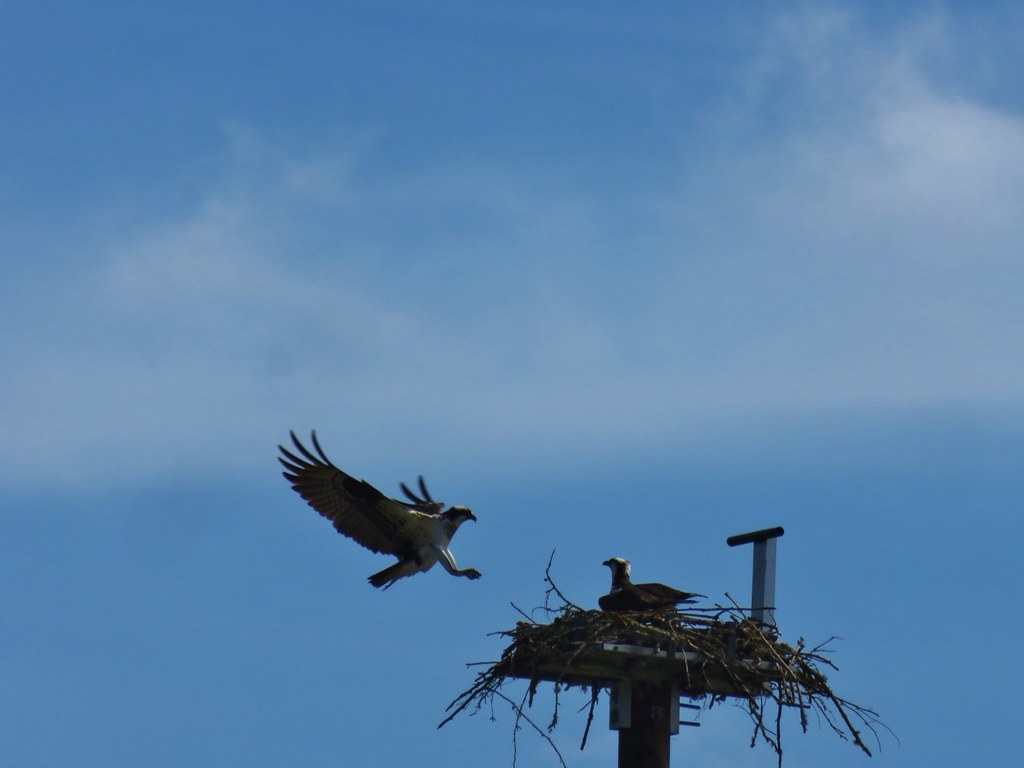
One of the things that we look forward to every year is the return of osprey to a nesting platform at the reserve. The platform had been replaced earlier this year and Heather had noticed some new sticks showing up recently. We hadn’t noticed any activity earlier when we passed by but now there were osprey flying around overhead.
IMG_2864

We watched as one landed with another stick for the nest. It was soon followed by a second.
IMG_2868

IMG_2871

IMG_2872

Hopefully there will be young osprey to watch later this year.

After watching the osprey we trudged uphill (and down and back up) past Eola Ridge Park and back into our neighborhood. By this point we were both dealing with blisters and generally sore feet. Jeffry was still visible, although the positioning of the Sun made it difficult to see. In addition we were able to see both Mt. Hood and Mt. Adams briefly as we limped our way back to our house.
IMG_2878Mt. Hood beyond the green water tower.

IMG_2882Mt. Adams through a little haze.

I had used Google to map out a potential route a week before our outing and it had led me to believe that it would be around 13 miles to hit these different parks. Our Garmin 62s and watch had us in the 15 mile range though which made us feel a little better about how we were feeling at the end.

As long as things stay locked down we’re planning on heading out from home to check out what’s close by (definitely not 15 miles worth though). Hopefully everyone reading this has stayed healthy and things will start getting back to normal sooner rather than later. Happy Trails!

Flickr: Salem Parks Tour

Categories
Coastal Range Hiking Oregon

Miller Woods & Trappist Abbey – 3/15/2020

We had decided to make 3/15 (Sunday) the day for our March hike to take advantage of a clear, albeit cold, forecast and to get it in before COVID-19 becomes any larger an issue. We started our day by visiting Miller Woods, a conservation area maintained by the Yamhill Soil & Water Conservation District. The 130 acre property was donated to the district in 2004 and is open from dawn to dusk for hiking (no pets). Although there is no fee, donations are welcome and can be made online (the option we used). These donations appear to be put to good use based on the amount of obvious work that has been put into the area.

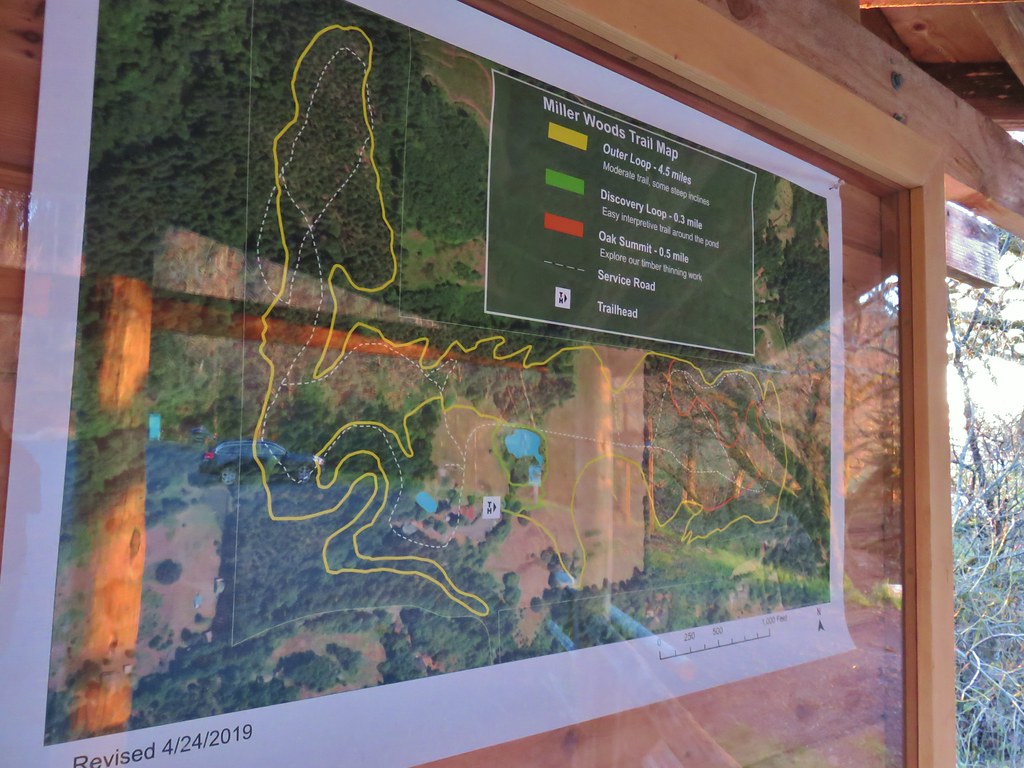
As hard as it may be to believe we were the first car in the parking lot. After stopping at the information kiosk (laminated maps were available) we set off on the Outer Loop Trail planning on going counter-clockwise around the approximately 4.5 mile loop.
Miller Woods Trailhead

Miller Woods

Miller Woods trail map

Morning at Miller Woods

Part of the work being done at Miller Woods is Oak Savanna restoration, which is what most of the Willamette Valley was made up of prior to development.
Interpretive sign at Miller Woods

Miller Woods

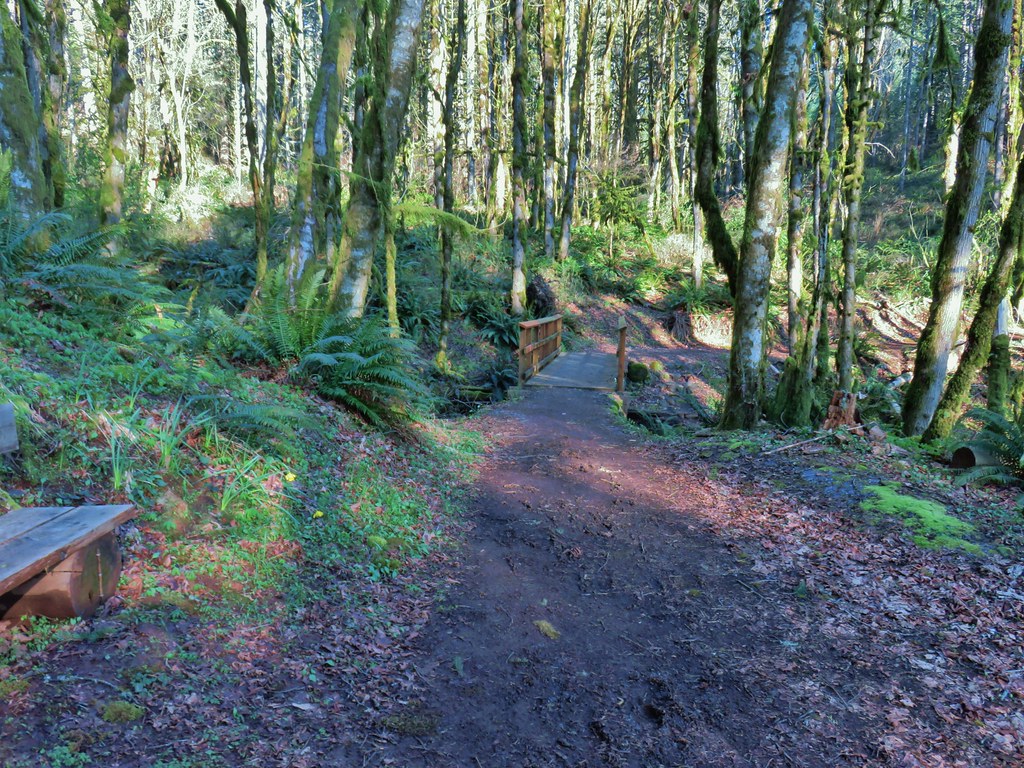
After passing some of the restoration work the trail entered a forest of Douglas firs.
Perimiter trail at Miller Woods

Miller Woods

We had our first covering of snow at our house when we awoke on Saturday and the near freezing temperatures had our hands stinging by the time we had made it to the trees but in the forest we were reminded that Spring is on the way as we began to notice several of the early wildflower varieties.
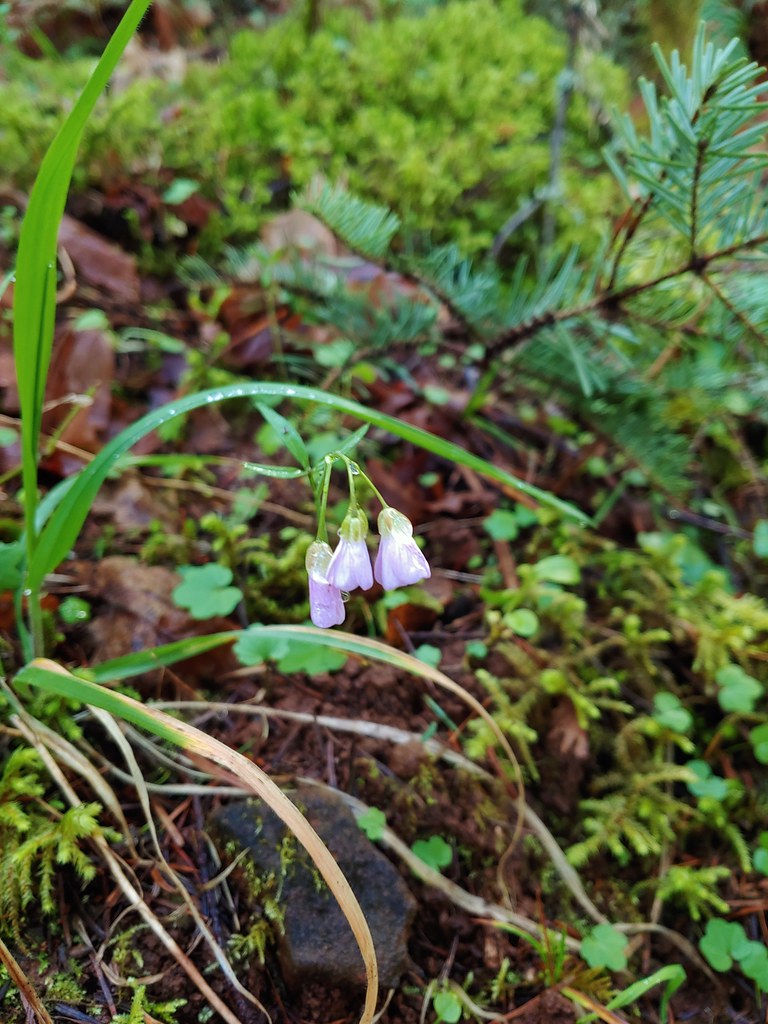
ToothwortSlender toothwort

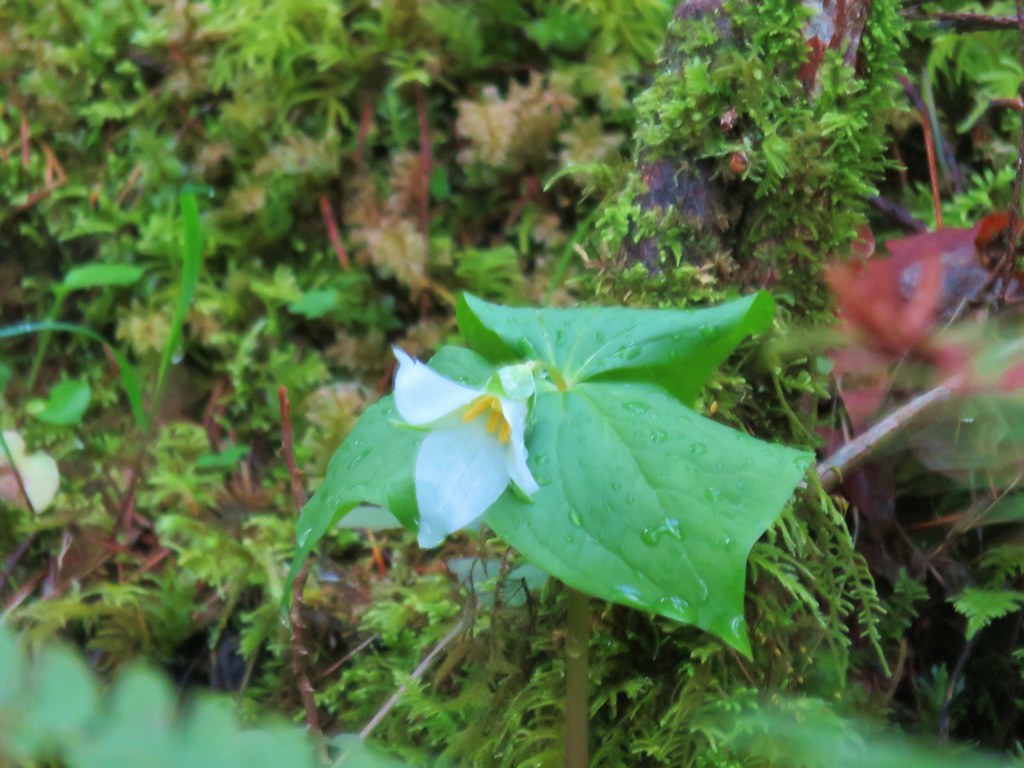
Trillium at Miller WoodsTrillium

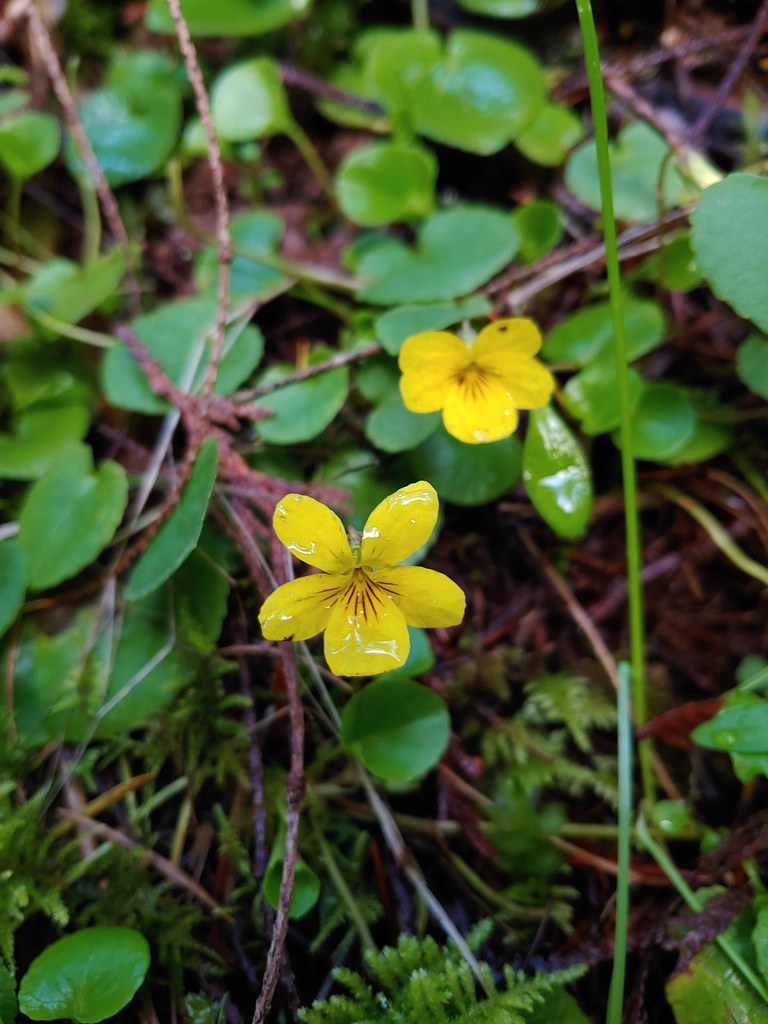
Violet at Miller WoodsViolets

The trail wound around a hillside above Berry Creek before looping back toward the old farm fields.
Miller Woods

Berry CreekBerry Creek

Nest along the trail at Miller WoodsBird’s nest that Heather spotted along the trail.
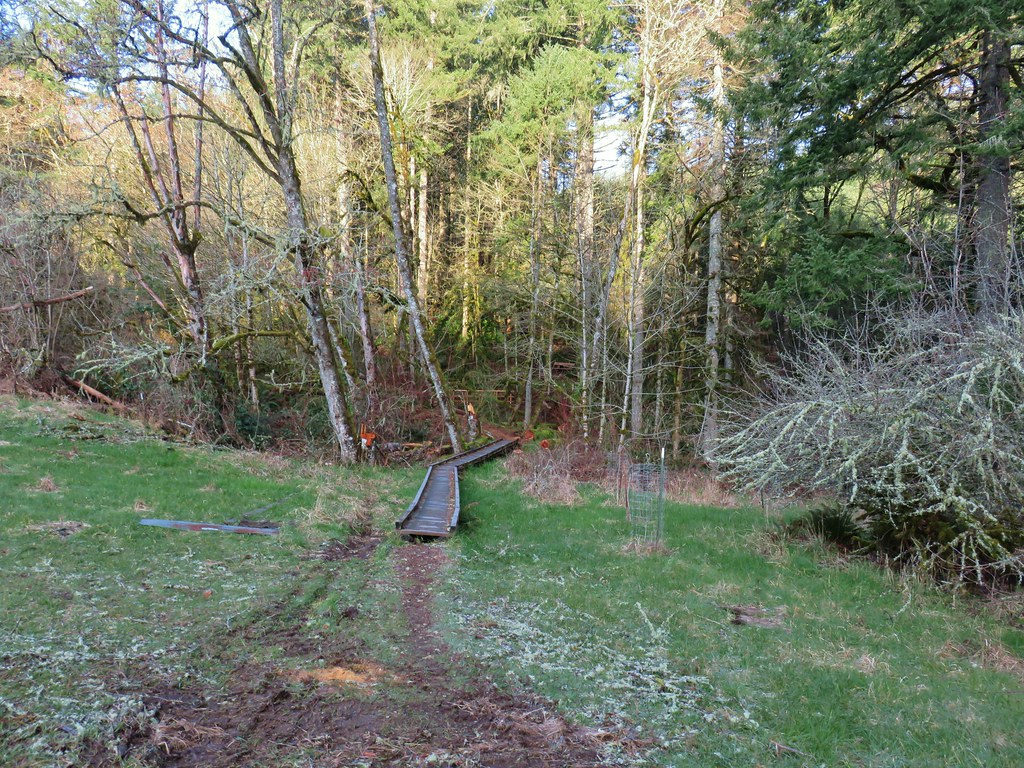
Miller Woods

After briefly passing through the edge of the field the trail reentered the forest after crossing an outlet stream from a pond.
Trail at Miller Woods

Creek at Miller Woods

A shorter loop was possible here by taking the green Discovery Loop back to the parking area.
Trail sign at Miller Woods

We stuck to the Outer Loop though and began a gradual climb to the loop’s high point at the 600′ K.T. Summit. As we were climbing we spotted what we thought was a pair of deer (it turned out to be three).
Deer up on the hillside at Miller WoodsThe first deer we spotted (up near the top of the hill at center).

Deer at Miller WoodsZoomed in shot of the second deer at upper left.
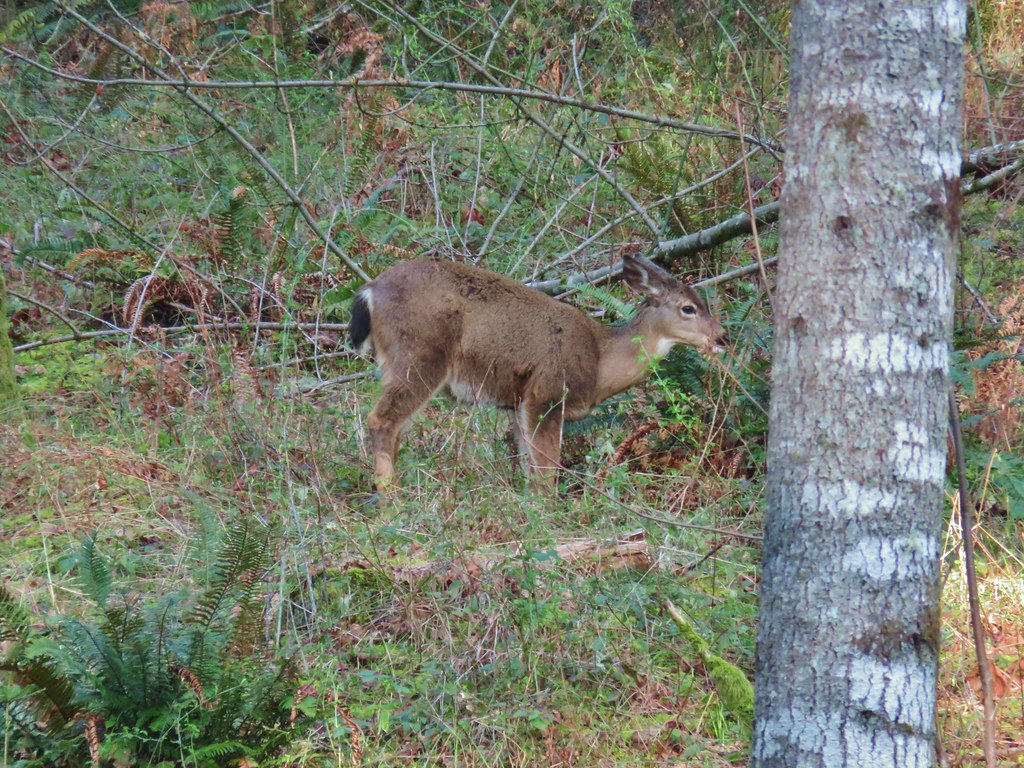
Deer at Miller WoodsFirst deer again.

The trail zigzagged up the hill and wound up taking us right past the deer who seemed less than worried about us.
Deer at Miller WoodsFirst deer crossing the trail ahead of us.
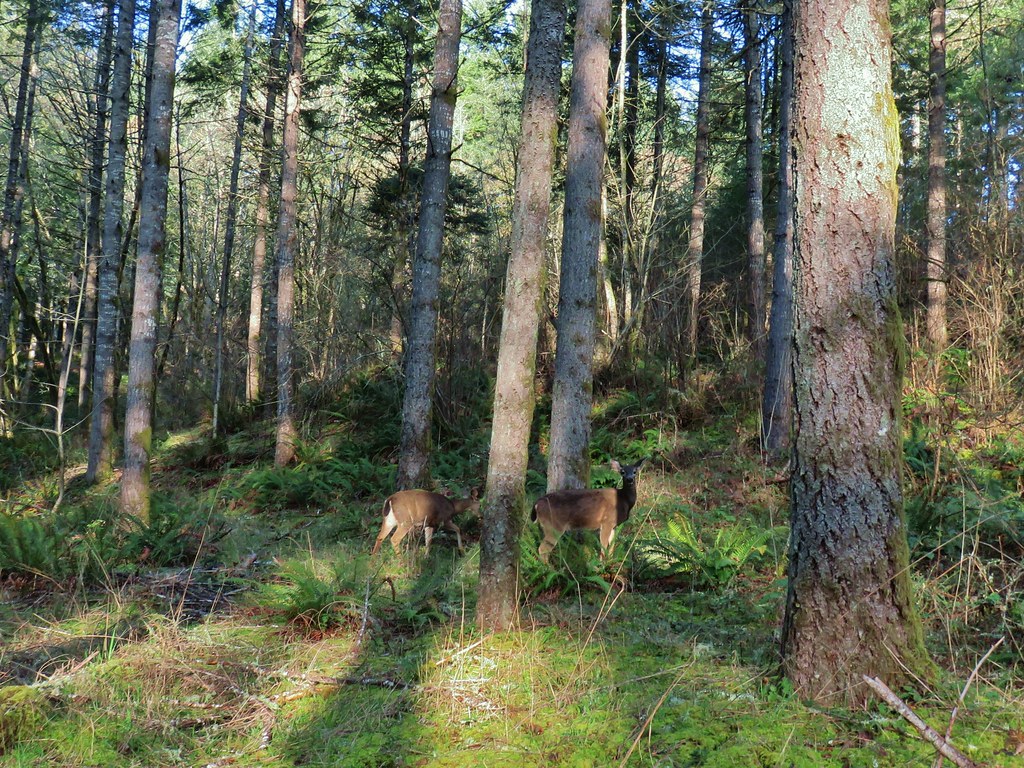
Deer at Miller WoodsThe second and third deer watching us pass.

After passing the deer we also passed a memorial to the Miller’s who had donated the property.
Memorial at Miller Woods

Memorial plaques at MIller Woods

Perimiter trail at Miller Woods

The summit was marked by a sign and a bench but lacked a view.
K.T. Summit sign at Miller Woods

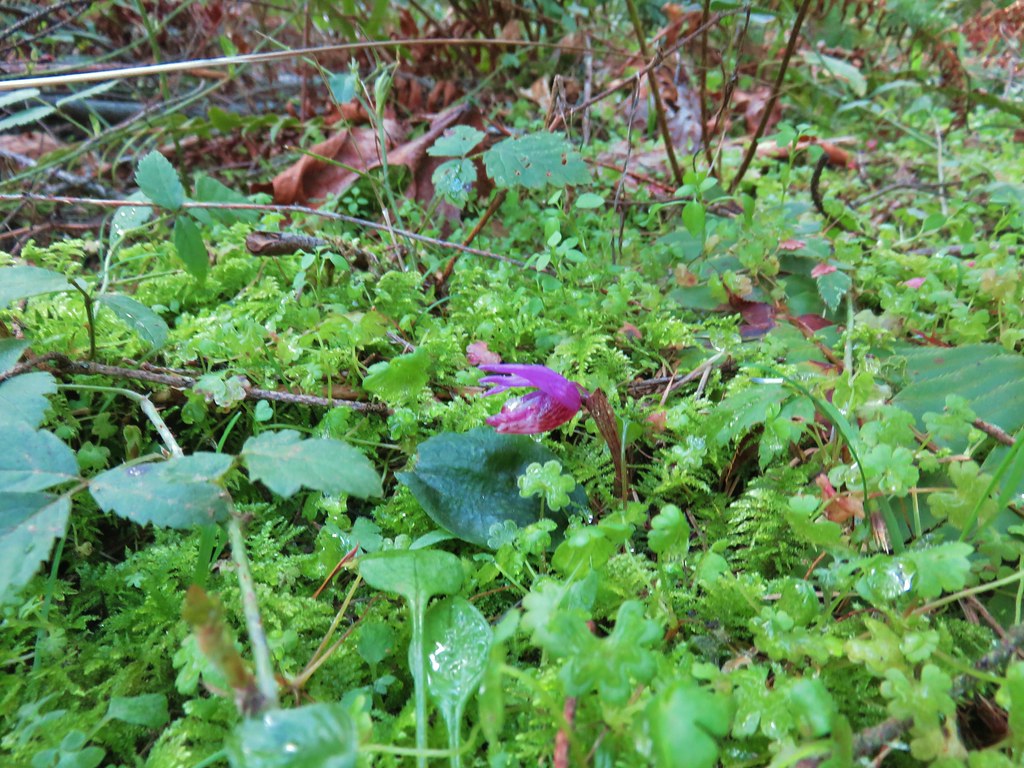
Beyond the summit the trail began to descend back down to the fields. The forest here was a little more mature and we spotted another early wildflower getting ready for Spring when we noticed a fairy slipper emerging from some green moss.
Perimeter trail at Miller Woods

Fairy slipper staring to open at MIller Woods

We also noticed a little dusting of snow left on a few leaves and stumps.
A slight dusting of snow left on a stump at Miller Woods

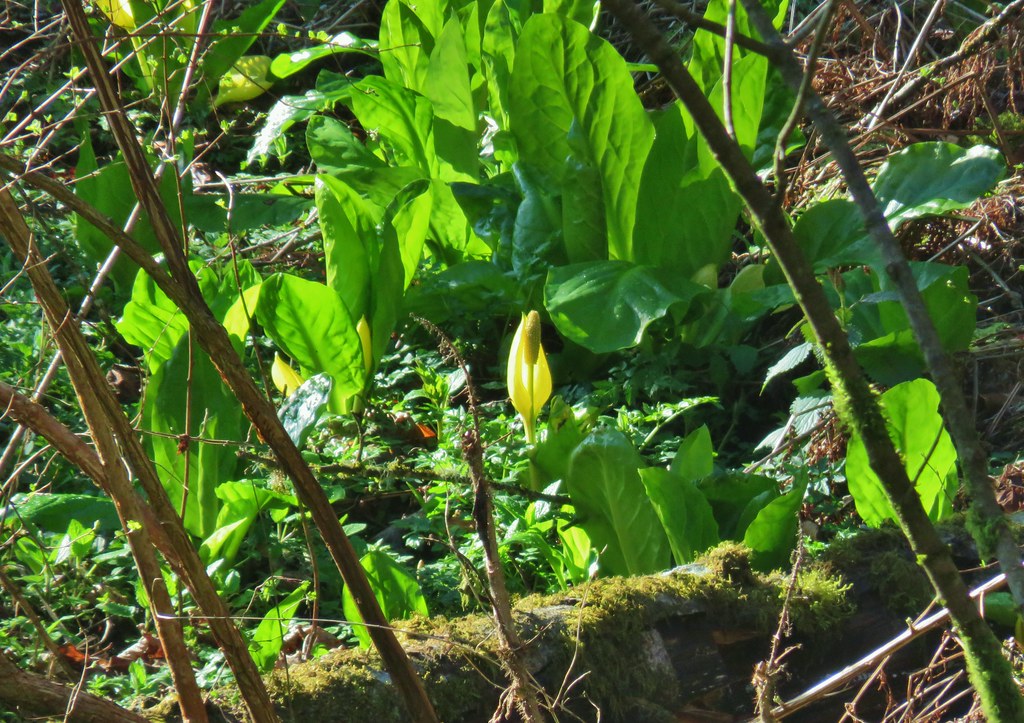
The trail wound down to a crossing of the pond’s inlet creek where some skunk cabbage was putting on a nice display.
Trail at Miller Woods

Creek at Miller Woods

Skunk cabbage

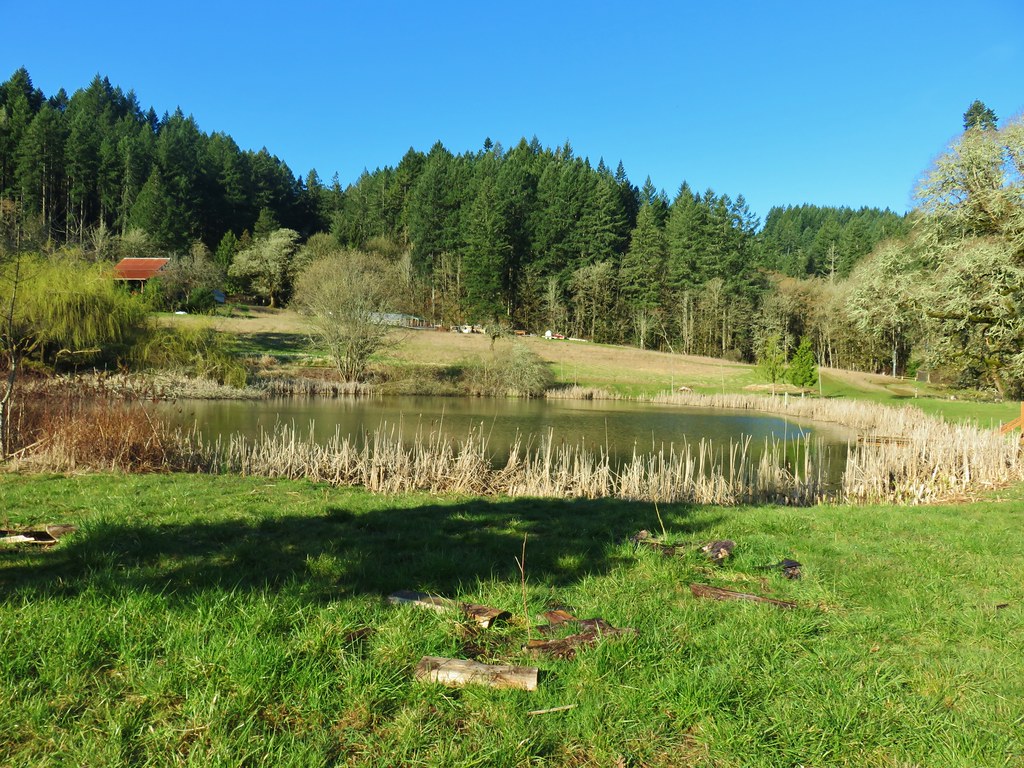
We emerged from the forest and followed the trail to the pond where the trail split. We went left passing the pond on our right and made our way back to the trailhead.
Pond at MIller Woods

Miller Woods

Blackbird at MIller WoodsThe area around the pond was popular with the birds.

Robin at Miller WoodsThere were quite a few robins about.

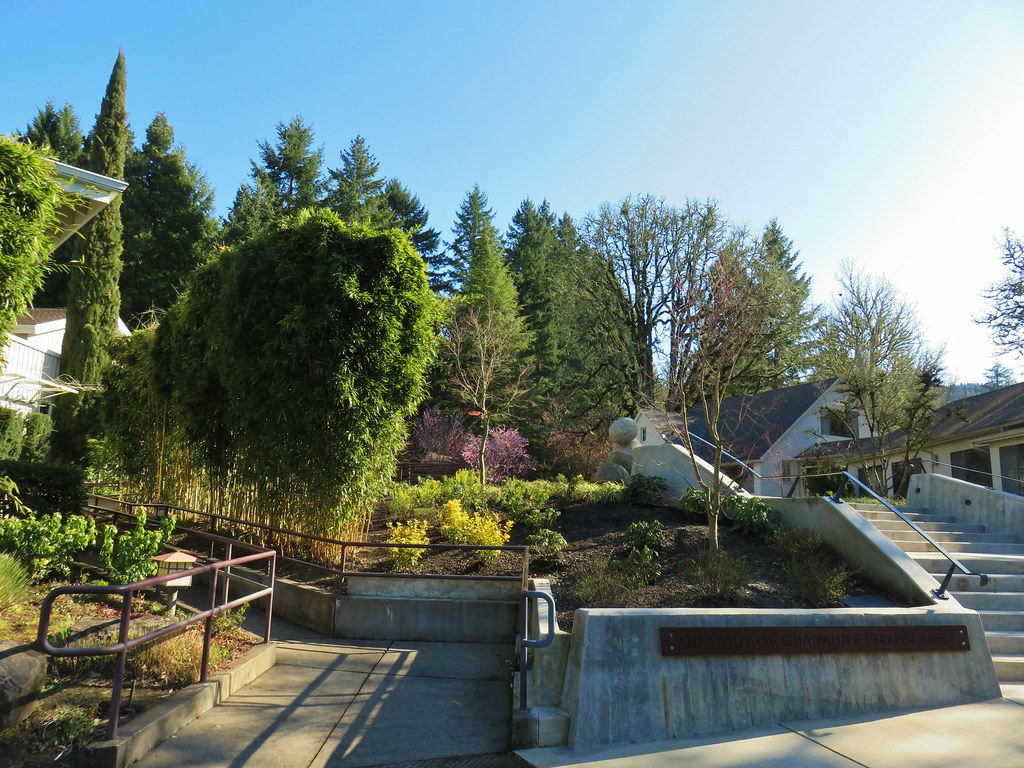
From Miller Woods it was just a 15-20 minute drive to Our Lady of Guadalupe Trappist Abbey.
Our Lady of Guadalupe Trappist Abbey

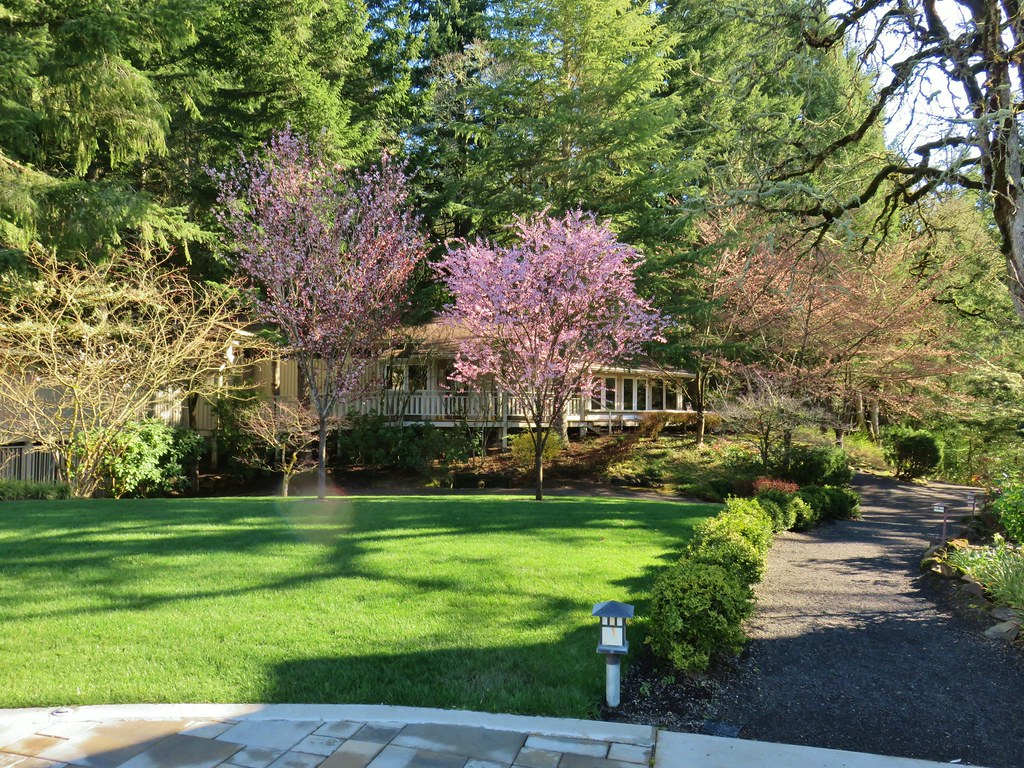
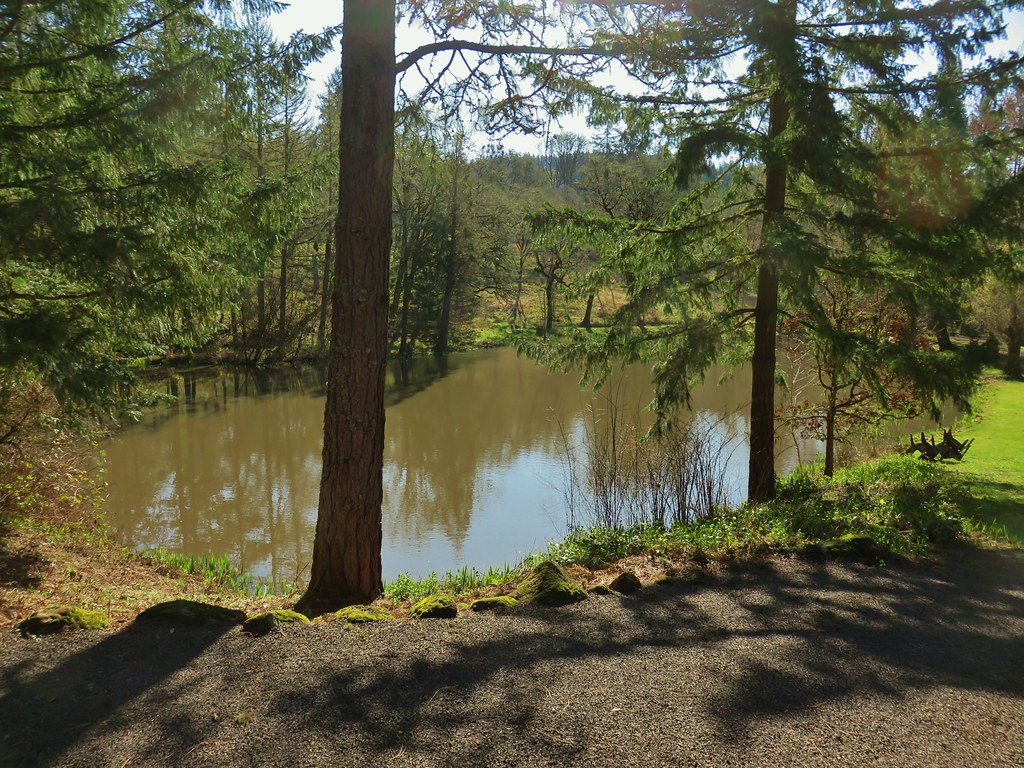
Book binding, a bakery, a wine warehouse and forestry all occur at here and a gift shop sells fruitcakes and honey. Given that “social distancing” is a thing right now we opted not to enter the gift shop or any of the other buildings on this visit and walked through the courtyard to a gravel path leading between two ponds.
Our Lady of Guadalupe Trappist Abbey

Pond at Our Lady of Guadalupe Trappist AbbeyLarger of the two ponds

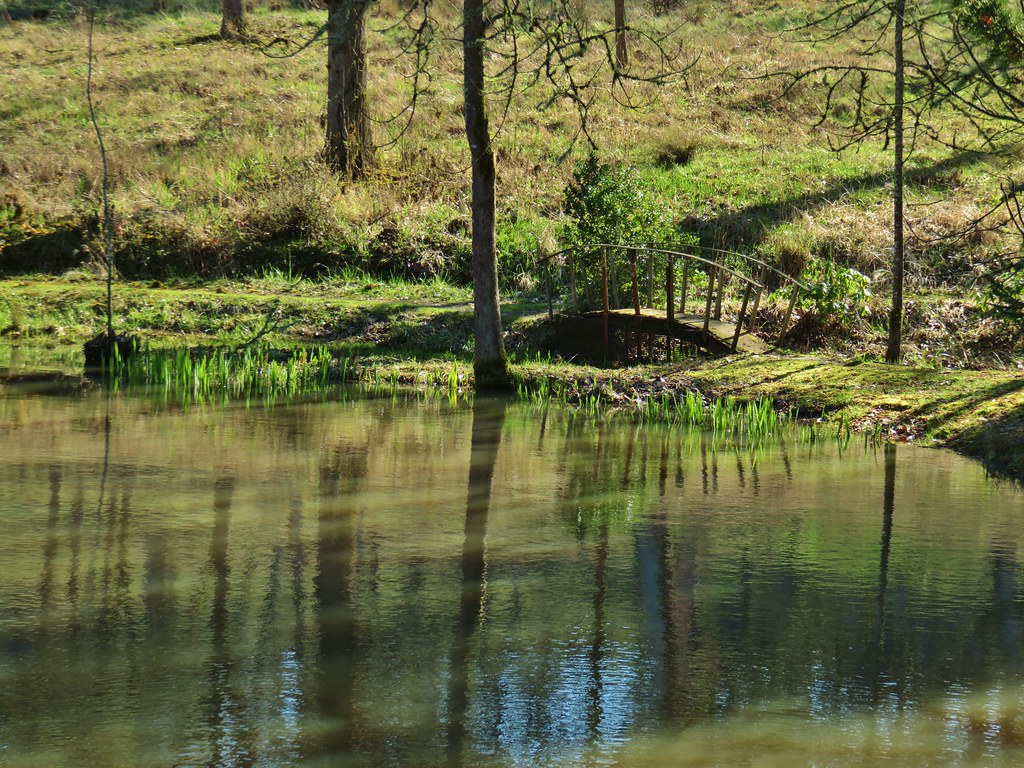
Footbridge by the pondLittle footbridge by the large pond

Pond at Our Lady of Guadalupe Trappist AbbeySmaller pond

Beyond the ponds we turned uphill on an old roadbed.
Trail at Our Lady of Guadalupe Trappist Abbey

We followed the road as it climbed up a tree thined hillside gaining views to the west of the snow covered coastal range.
Monk's Trail junctionWe ignored the signed trails sticking to the road which was also signed as the “Guadalupe Loop”
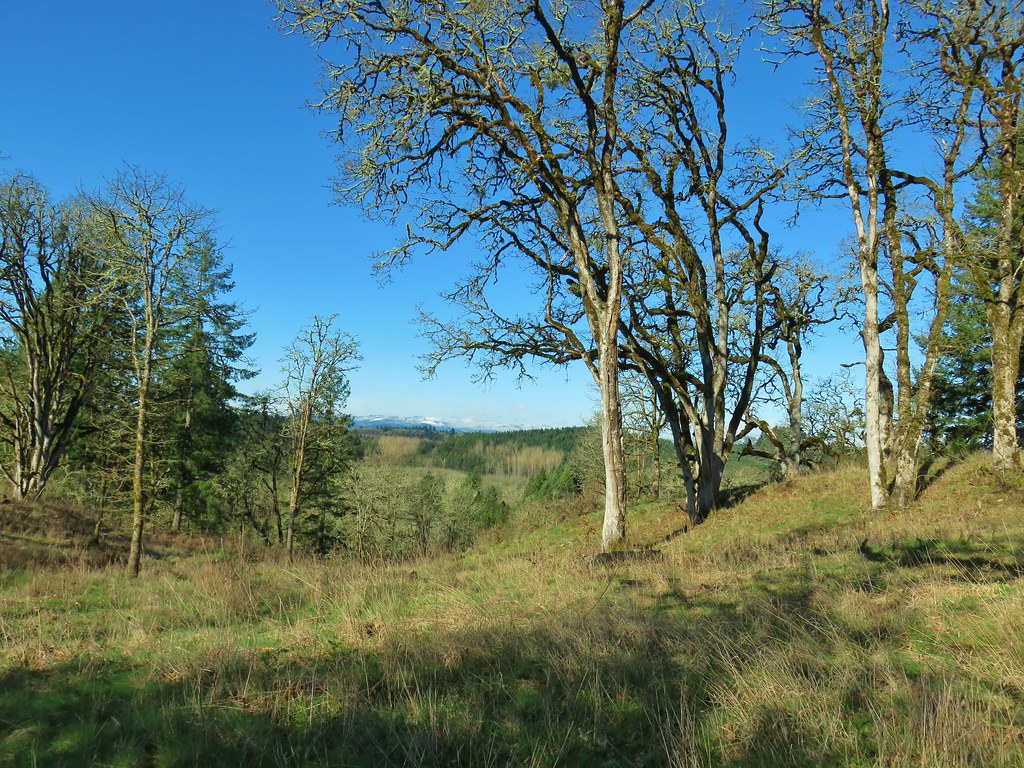
More snow on the Coast Range

View from the Guadalupe Loop

There were quite a few birds in the remaing trees. We watched a pair of acorn woodpeckers for a bit and a spotted towhee was busy picking through some grass while stellars jays could be heard but seldom seen.
Acorn woodpeckerAcorn woodpecker

Acorn woodpeckerSecond acorn woodpecker

Spotted towheeSpotted towhee

We soon left the thinned area and entered a forest where we spotted more toothwort and some sort of blooming tree.
Guadalupe Loop

Toothwort

Blossoms along the Guadalupe Loop

After about a mile we came to a fork in the road where the left side was gated (and posted no hiking beyond the gate). We forked right continuing uphill for a half mile to another fork. This time we went left which led a short distance to a viewpoint overlooking vineyards and Mt. Hood in the distance. (We should have taken a fork right shortly after taking the left but missed it and ended up having to backtrack a bit.)
Mt. Hood from a viewpiont at Trappist Abbey

Mt. Hood from a viewpiont at Trappist Abbey

We returned to the fork and went straight on what was still the Guadalupe Loop for just over a quarter mile to a sign for a shrine.
Snow along the Guadalupe LoopSnow along the Guadalupe Loop

Shrine at Trappist Abbey

A short spur led to the shrine and a viewpoint of the Coast Range.
Shrine at Trappist Abbey

Snowy Coast Range

Snow in the Coast Range

Snowy peak in the Coast Range

Our guidebook said to turn back here and return the way we’d come. We toyed with the idea of continuing on the Guadalupe Loop and started to do just that, but we weren’t certain if it was really in fact a loop or how long it might be. We decided not to tempt fate but then instead of going back the way we’d come we turned left at a sign for St. Juan Diego Pass and followed a grassy track downhill.
Trail at Trappist Abbey

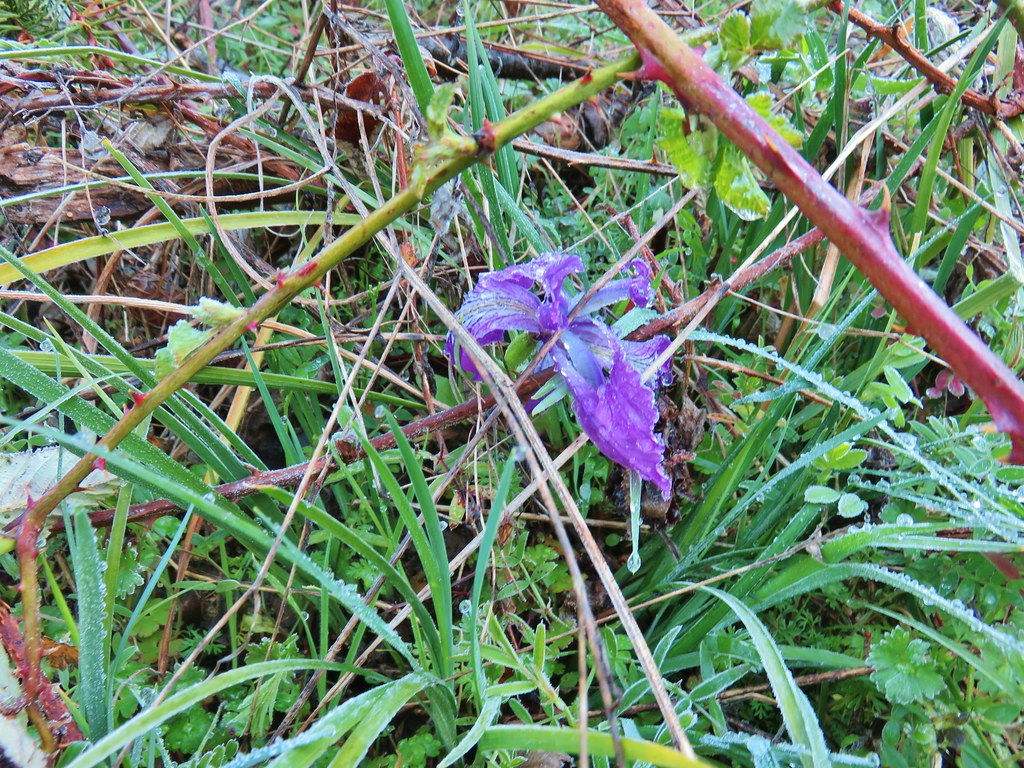
A patch of purple caught our eyes on the hillside and it turned out to be an iris that was weighted down a bit with water.
Iris

ChipmunkThis chipmunk also caught our attention.

We followed the path for a little over half a mile before popping back out on the Guadalupe Loop near the fork with the gated road where we turned left and hiked the mile back down to the parking area.
Trappist Abbey

It turned out to be a beautiful day (once we thawed out from the initial frozen hands at Miller Woods) with a total of 8.2 miles of hiking (4.4 at Miller Woods and 3.8 at Trappist Abbey). There were very few folks out, we saw two trail runners at Miller Woods and passed a handful of groups at Trappist Abbey, had some wildlife encounters, and spotted a few Spring flowers along the way. Hopefully things will settle down sooner rather than later with the corona virus but until then stay safe and Happy Trails!

Flickr: Miller Woods and Trappist Abbey

Categories
Eugene Hiking Oregon Trip report Willamette Valley

Spencer Butte, Shotgun Creek, and Horse Rock Ridge – 2/9/2020

We jumped on a favorable forecast and headed for Eugene for our February outing. On our itinerary was a trio of stops that would allow us to check two more of Sullivan’s featured hikes off our to-do list. The three stops were short enough that even with doing them all the total mileage would remain under 10 miles.

We chose to start off with Spencer Butte (Hike #74 in the 5th edition of “100 Hikes/Travel Guide Central Oregon Cascades”). We started here in hopes to avoid crowds as we’d read that this was a popular hike. We started at the Spencer Butte Trailhead which provides the shortest routes up to the viewpoint atop Spencer Butte.
Spencer Butte Trailhead

Other trailheads and longer hikes are possible using Eugene’s Ridgeline Trail System but we stuck to Sullivan’s described hike this time.
Map for the Ridgeline Trail System

At a fork at the top of some stairs leading uphill from the trailhead we veered left following a sign for the “West (Difficult) Route to Spencer Butte Summit”.
Spencer Butte Summit West Route

This route gained nearly 800′ in less than 3/4 of a mile climbing steeply over exposed rocks and mud. There was a fair amount of fog in the forest which was helping to keep things nice and damp which made the rocks a little slick.
Spencer Butte Summit West Route

Spencer Butte Summit West Route

As we neared the summit we began to break out of the thicker fog and gain some views. A mass of clouds covered the lowlands to the West.
Cloudy, foggy view from Spencer Butte

The trail left the trees a little below the summit and a confusion of trails headed up into the rocks. To fine the recommended route keep left on the main trail to a big switchback in the trees. We turned up a bit early on one of the other, steeper trails which eventually joined the better route above the switchback.
Looking up toward Spencer Butte's summit ridge

A word of warning for this hike (in addition to it being steep) is that there is a fair amount of poison oak in the exposed grassy areas and the butte is home to some rattlesnakes. It was way too cold to be worried about any snakes on this visit but apparently in warmer weather they could be about.

At an elevation just over 2000′ the summit was above most of the clouds although there was some thin fog lifting from the thicker clouds below impacting the views a bit.
Spencer Butte's summitSpencer Butte’s summit high point.

View from Spencer ButteView north from the high point towards Mary’s Peak (post) which was above the clouds.

There is said to be a nice view of the Three Sisters from the summit, but by avoiding the crowds (we hadn’t seen another hiker yet) we were staring directly at the rising Sun which effectively stymied any hopes of a mountain view.
View east from Spencer Butte

The lack of a view was partially mitigated by a really good “glory” or Brocken spectre which is the magnified shadow of an observer cast upon clouds opposite the Sun’s direction surrounded by a rainbow-like halo.

After a short rest we started getting chilly so we began our descent. We headed down a path on the east side of the butte.
Descending Spencer Butte

This longer route was a little less steep and definitely an easier descent than trying to go down the West Route would have been. After a series of stone steps the trail reentered the foggy forest.
Fog in the forest at Spencer Butte

Descending Spencer Butte

A little over 3/4 of a mile from the summit we came to a junction with the Spencer Butte Tie Trail which connects the loop to the Ridgeline Trail.
Trail junction at Spencer Butte

We stayed right here to complete the loop back to the trailhead passing a grassy picnic area near the end.
Picnic tables near the Spencer Butte Trailhead

We passed quite a few more hikers on the way back to the trailhead. Given that we were back at the car by 8:35am we could only imagine how crowded the summit would be later, so even though the view could have been better we were happy with our choice to start here.

Our next stop was at the Shotgun Creek Recreation Site. There is a $3 fee listed on the BLM website but that appears to only be enforced during busier months although be prepared to pay the fee at any time. We began the hike from the Shotgun Creek Trailhead and immediately started up a trail next to the signboard with a pointer for the Tiki Trail.
Tikit Trail

Not far up this trail we spotted our first wildflower of the year, some little snow queen.
Snow queen

We also quickly realized that we were going the wrong way (at least for the hike Sullivan describes in Hike #76 of the 5th edition. We had only gone about a tenth of a mile so we turned around and returned to the trailhead where we crossed the parking lot and took a paved path past the recreation sites amenities.
Shotgun Creek Recreation Area

We followed paved paths to Shotgun Creek and then along the creek to the signed Upper Shotgun Trail.
Shotgun Creek

Upper Shotgun Trail

This trail followed along the creek for a mile before turning into the forest to loop back toward the recreation site.
Shotgun Creek

Upper Shotgun Trail

We spotted our second variety of wildflower as we began to loop back around, a lone skunk cabbage near a small seasonal stream.
Skunk cabbage in the forest

Skunk cabbage

After a little over 2 miles on the Upper Shotgun Trail we came to a 4-way junction.
Upper Shotgun Trail junction with the Tiki and Drury Trails

The trails straight ahead and to the right were labeled for the Tiki Trail with the right hand trail being the one that we had started out on earlier which would have allowed for a short loop of approximately 2.5 miles. Sullivan’s description of the hike would have had us go straight here on the Tiki Trail loop resulting in a nearly 3.5 mile loop. This time we decided not to stick to Sullivan’s hike and instead turned left past a pointer for the Drury Trail.
Drury Trail

This route was the suggested route in the Oregonhikers.org Field Guide. This trail climbed nearly 500′ over the next mile as it passed through the forest. The climb provided no views but simply began dropping back down after reaching its high point near a BLM road. The second mile of the trail approached a clear cut where there were views out of the forest but the view consisted of clear cut scars which are frankly just depressing to look at. That being said along the 2 mile Drury Trail there were a few nice sights include some older trees and our first yellow violet of the year bringing our wildflower variety county up to three.
Drury Trail

Big tree along the Drury TrailAn older tree along the trail.

Tree mushroomsMushrooms on a trunk near the clear cut view.

Wood violet along the Drury TrailViolet

When we arrived back at the Tiki Trail we turned left.
Drury Trail junction with the Tiki Trail

Initially we were headed back toward the clear cuts but then the trail did a 180 degree turn heading back toward the trailhead. Shortly before arriving back at the recreation site we again had a look at Shotgun Creek.
Shotgun Creek

The loop that we did came in at 5 miles. We were just under 7 miles for the day with one stop to go, Horse Rock Ridge. The Horse Rock Ridge Trailhead was only about 6 miles away but 1400′ higher in elevation than Shotgun Creek. We followed the windy narrow paved roads to find that while we’d seen no other hikers at Shotgun Creek that was not going to be the case here. There were a number of cars here so we parked on the side of the road at a pullout and walked up to the start of the trail behind some boulders and a wire fence.
Horse Rock Ridge Trailhead

The first part of the trail follows an old roadbed which is banned to OHVs and other motorized vehicles. The boulders, fence, and logs laying across the old road are unfortunately necessary because despite having miles of OHV friendly roads and trails in the area some of those folks just can’t respect the fragile habitats set aside for preservation such as Horse Rock Ridge.
Horse Rock Ridge Trail

Horse Rock Ridge Trail

After .7 miles the trail entered the first of a series of meadows along the ridge where a reportedly impressive display of late Spring wildflowers occurs in May and June. Being February we were treated to frost :).
Frosty meadow along the Horse Rock Ridge Trail

Frosty meadow

Steam rose from the wet hillsides as we followed the trail through the meadows past exposed basalt formations.
View from the Horse Rock Ridge Trail

Horse Rock Ridge Trail

About halfway through the meadows the trail passed to the north of a large rock outcrop. It had to drop beneath the rocks which proved to be the trickiest part of this hike because the outcrop shielded the north facing side from the Sun leaving the rocks icy and slick.
Frost on the backside of a rock formation along the Horse Rock Ridge Trail

Horse Rock Ridge Trail

I picked on the OHV folks earlier but they aren’t the only ones that can cause damage. Despite signs at the trailhead to remain on the trail to not damage the vegetation it was obvious many “hikers” had been walking on the grass and other vegetation, especially along this section. In a case like this if the condition of the trail is such that you feel it is not safe or possible to use it then it probably should be your turn around point. We took an inventory of the trail and decided that there were enough exposed footholds that we could carefully navigate the icy conditions and continued.
Horse Rock Ridge TrailHeather emerging from behind the outcrop.

More sunny meadows awaited (as did another little climb) and we passed a small pool of water and the only wildflowers we would see here today on some manzanita.
Small pool along the Horse Rock Ridge Trail

Manzanita

Near the top of the meadows the trail approached a basalt dike which we are taking to be Horse Rock although we couldn’t confirm that.
Horse Rock Ridge Trail

From this area the view extended to the snowy Cascade Mountains although the clouds that had been covering the valleys from Spencer Butte had lifted and moved east enough to now be interfering a bit with those views. We still managed to get nice looks at Mt. Jefferson and North & Middle Sister.
View from the Horse Rock Ridge Trail

Mt. Jefferson

North and Middle Sister from the Horse Rock Ridge Trail

Three Fingered Jack was also somewhat visible above the clouds.
Three Fingered Jack

At the end of the dike was a rock overhang.
Small overhang at the end of Horse Rock

The trail continued on into the trees ending near some towers. We went ahead and followed it finding a reminder that despite the sunny green hillsides it was still Winter for a bit longer.
A little snow near the top of Horse Rock Ridge

A little snow near the top of Horse Rock Ridge

We returned the way we’d come ending this hike just under 3 miles giving us 9.8 total miles for the day. While there were quite a few hikers on Horse Rock Ridge it didn’t seem like as many as the cars at the trailhead suggested. All three of the hikes were relatively short but Spencer Butte was not an “easy” hike. The slick rocks on Horse Rock Ridge made that a little tricky although we saw a child around six and another hiker that was easily in their 80’s on the other side of that tricky section. For kids though the Shotgun Creek Recreation Area would probably be the best with the creek and other amenities. We will probably look at getting to Horse Rock Ridge during wildflower season somewhere down the line, but for now it’s another hike checked off our to-do list and we couldn’t have really asked for a much nicer day. Happy Trails!

Flickr: Spencer Butte, Shotgun Creek, and Horse Rock Ridge

Categories
Central Coast Hiking Oregon Oregon Coast

Netarts Spit – 1/25/2020

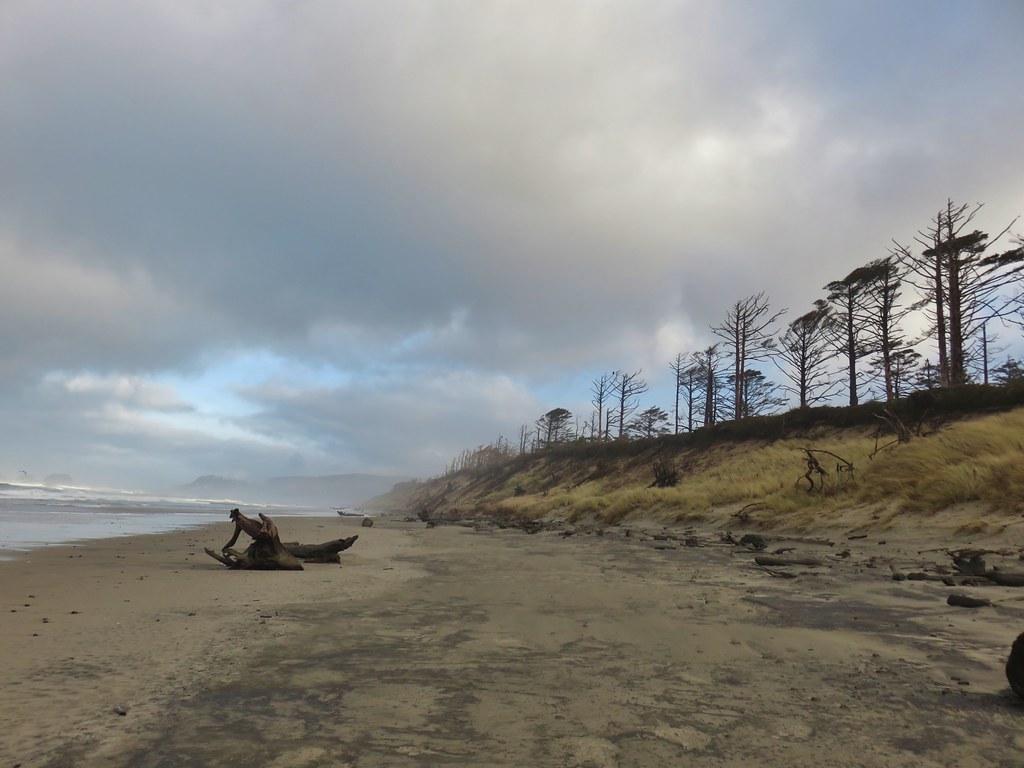
We were down to the last weekend of the month so in order to get our monthly hike in we were going to have to deal with whatever weather we were dealt. Heading into Saturday the forecast was for rain everywhere I checked so we decided to stick to our original plan which was to visit a series of lakes in the coastal range. That plan was scrapped on Friday night when I checked the trail conditions and discovered that one of the ones that we’d be on had been closed this month due to heavy storm damage. Plan B had been a nearly 3 hour drive to Reedsport, but a 100% chance of rain didn’t warrant that long of a drive. I looked to our 2021 hikes and decided on Netarts Spit at Cape Lookout State Park which was a more reasonable hour and a half drive away.

We set off just before 6am with all our rain gear and drove to the Cape Lookout Day Use Trailhead where we purchased a $5 parking pass and noted that it was in fact not raining here.
IMG_2116

We suspected it was just a matter of time and put our rain gear on before starting off. One of the issues with last minute hike swaps is that it limits the amount of time we have to read up on the hike. The Netarts Spit hike is featured in two of our books by Matt Reeder (“Off the Beaten Trail” and “PDX Hiking 365”) as well as in the Oregonhikers.org field guide. I had looked at both and noted that while Reeder’s description indicated to hike along the beach the field guide mentioned an inland route for the first portion. After walking down to the beach near a picnic shelter we walked back up to the shelter and followed a path north through some trees.
IMG_2119

IMG_2122

IMG_2123

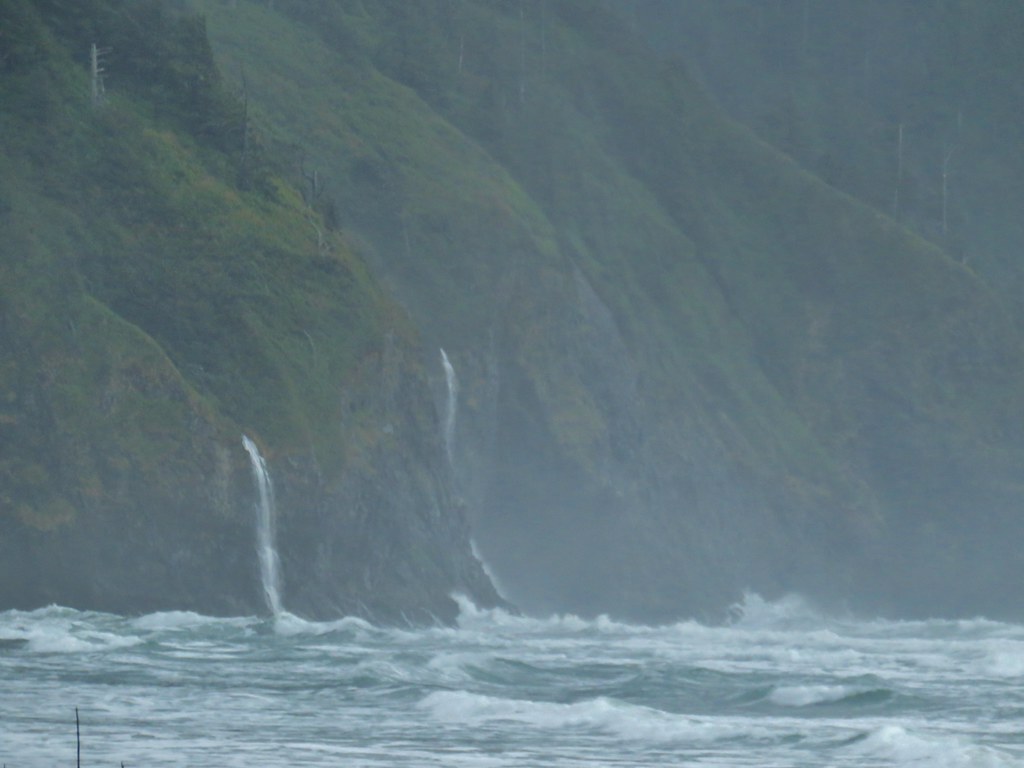
The view south from this path was dominated by Cape Lookout jutting out into the Pacific. Several waterfalls could be seen on it’s flanks.
IMG_2124

IMG_2125

When we came to another beach access point just before a gated section of the campground we decided to head down to the beach.
IMG_2128

Had I studied the entry in the field guide more thoroughly I would have known that it recommends following the road through the campground to avoid the cobblestones along the beach here.
IMG_2132

The tide was just high enough that in order to stay out of the Ocean we were forced to walk on these rocks and they are not fun. Ankles were rolling and twisting in all sorts of directions as we stumbled along.
IMG_2136Ocean coming right up to the rocks.

When we got our next chance we popped back up off the beach into the campground following a gravel track past some group tent sites.
IMG_2141

We’d already seen one bald eagle fly overhead and here we spotted another one sitting in a tree ahead.
IMG_2146

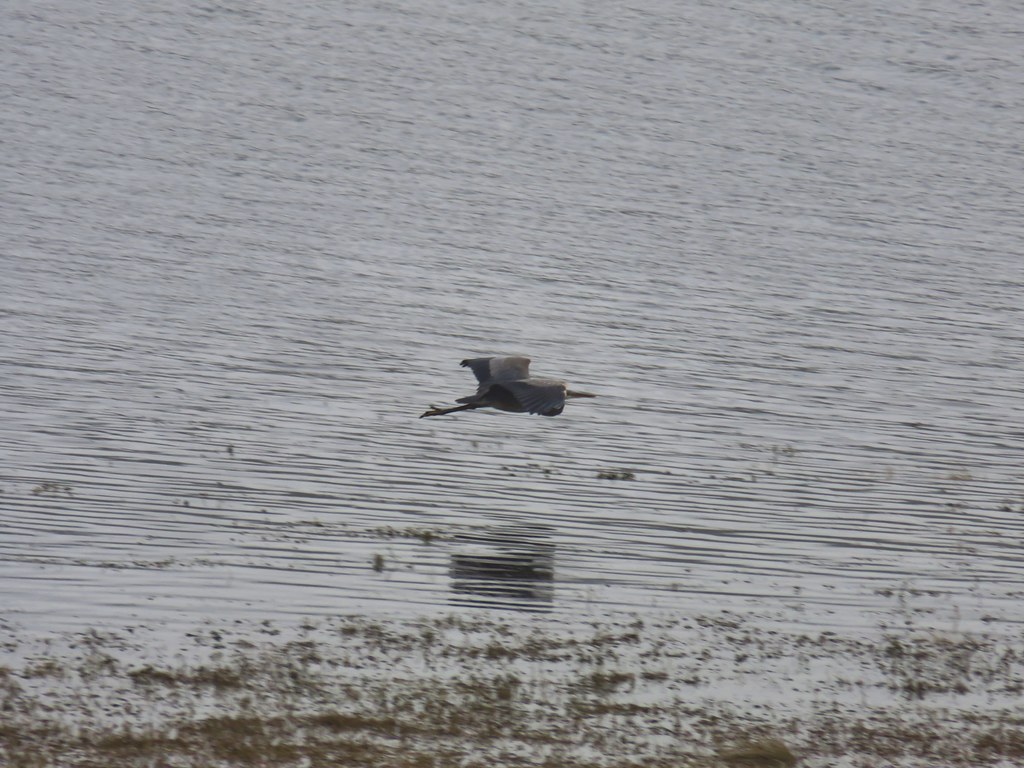
While watching the eagle a great blue heron flew over.
IMG_2144

Beyond the group tent sites the road was gated and turned into a grassy path with Netarts Bay to the right and dunes to the left.
IMG_2150

IMG_2151

The grassy roadbed soon ended at a stand of trees where a clear trail continued.
IMG_2153

IMG_2154Trail at lower right with a little standing water.
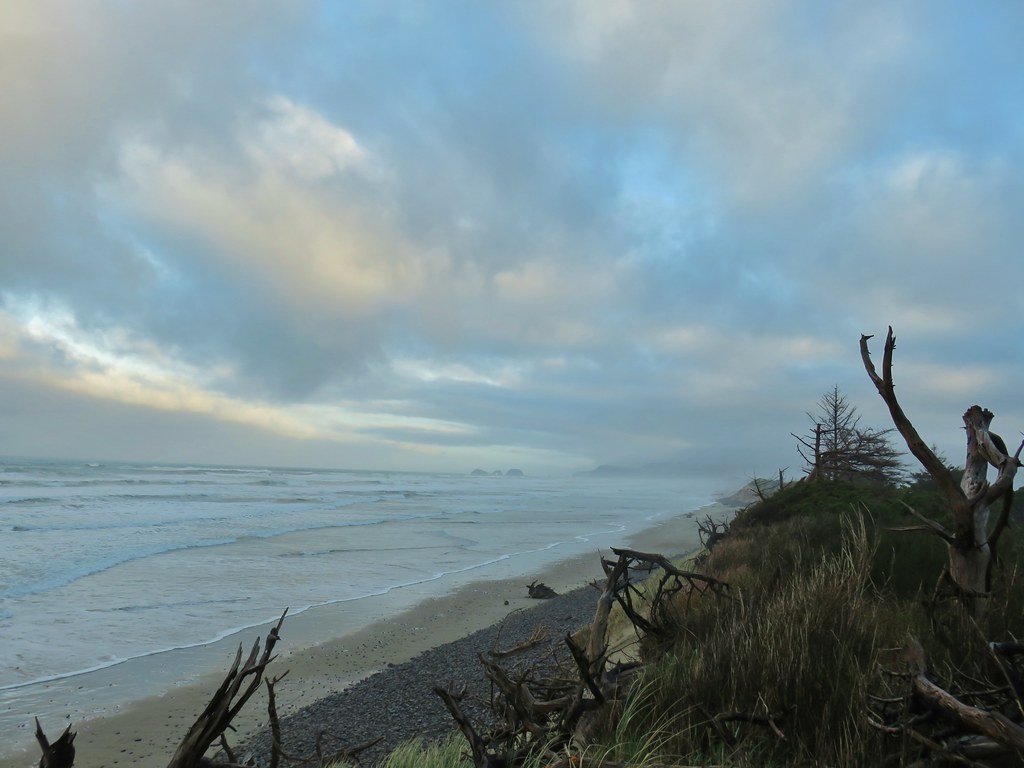
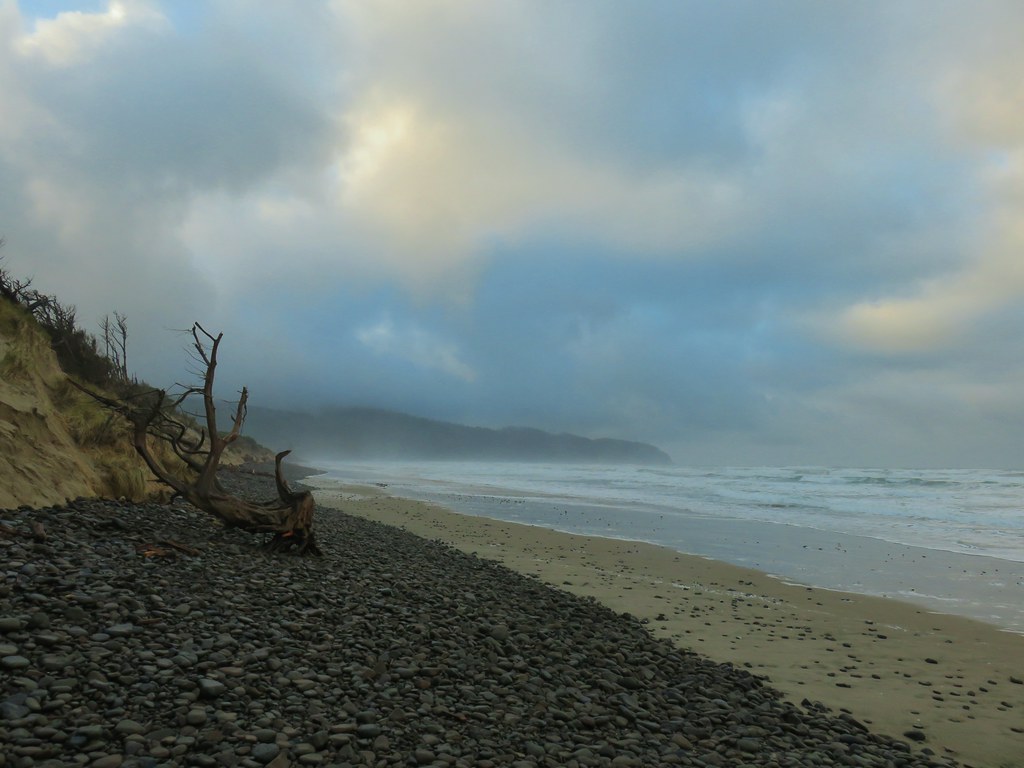
The field guide had mentioned that sections of this trail may have standing water but we weren’t quite prepared for long stretches of calf deep ponds. Heather was smart enough to find a deer path a little higher up on the left side (Which was something the field guide said you might have to do but in my quick reading I hadn’t picked up on that.) I tried sticking to the trail for a bit, but after a while in the water my feet starting getting cold so I joined her. We made the decision to try and follow one of these paths up and over to the beach which we managed to do.
IMG_2155

Then it was just a matter of finding the best spot to drop back down onto the beach, and more cobblestones, yay.
IMG_2156

IMG_2157

Luckily it wasn’t long before we were able to drop onto the sand.
IMG_2167

There was a lot more blue sky than we’d been expecting which was a pleasant surprise. To the north we could see the Three Arch Rocks although a perpetual fog seemed to be hanging over them.
IMG_2172Three Arch Rocks – one of two wilderness areas in Oregon off limits to visitors.

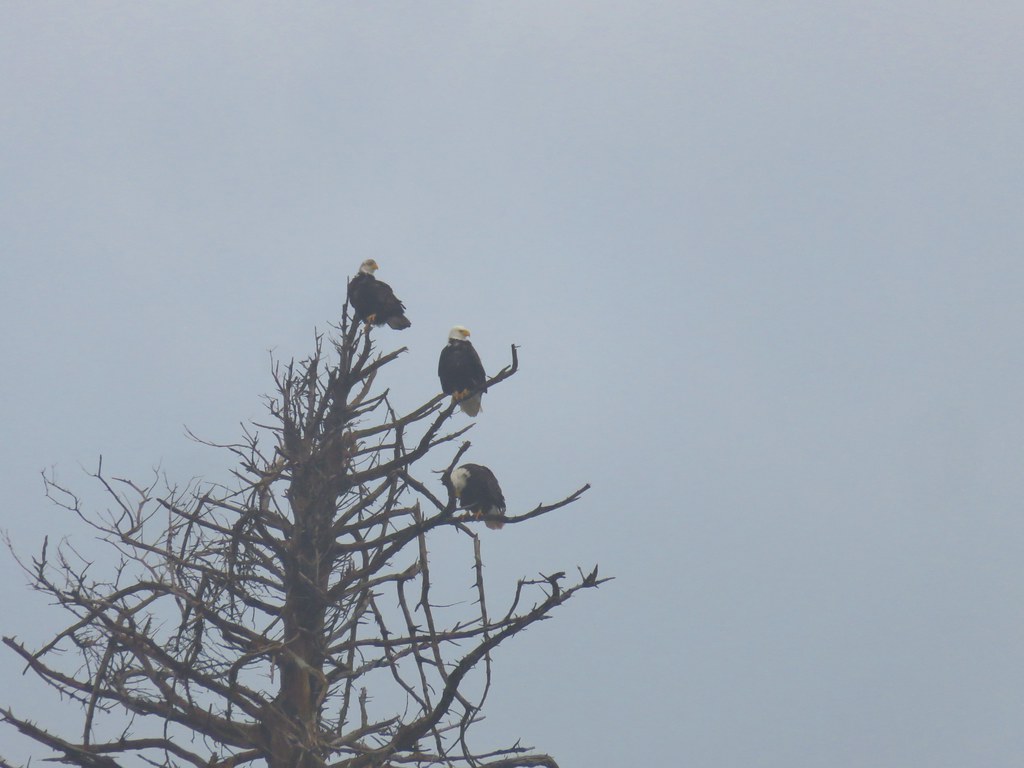
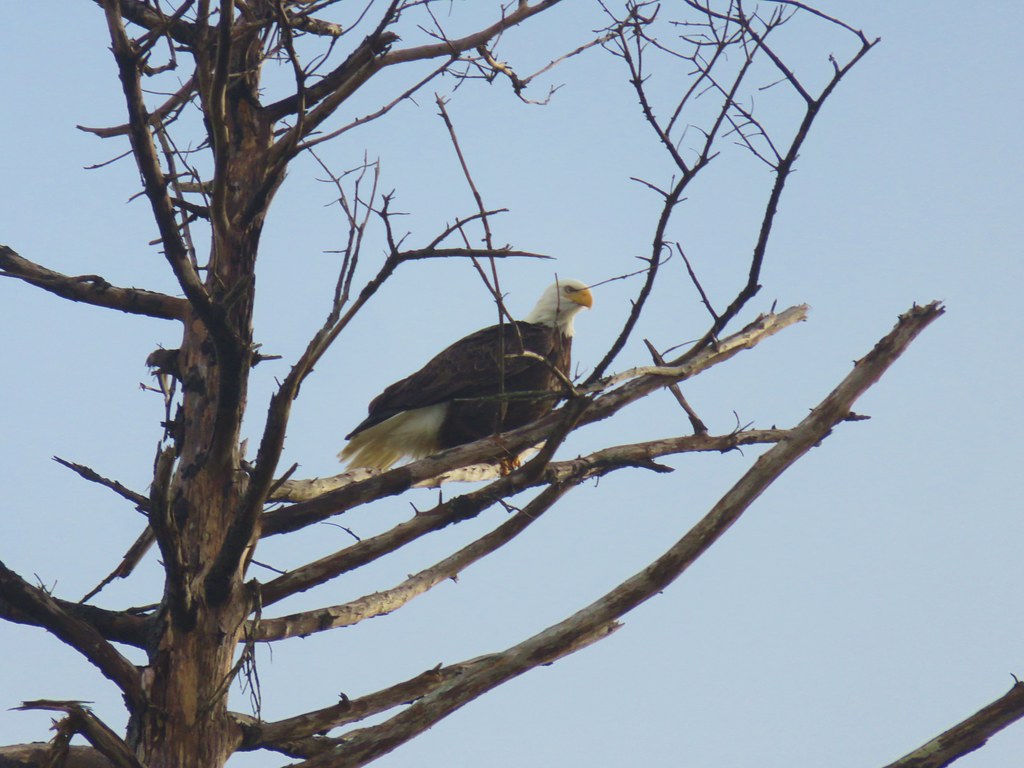
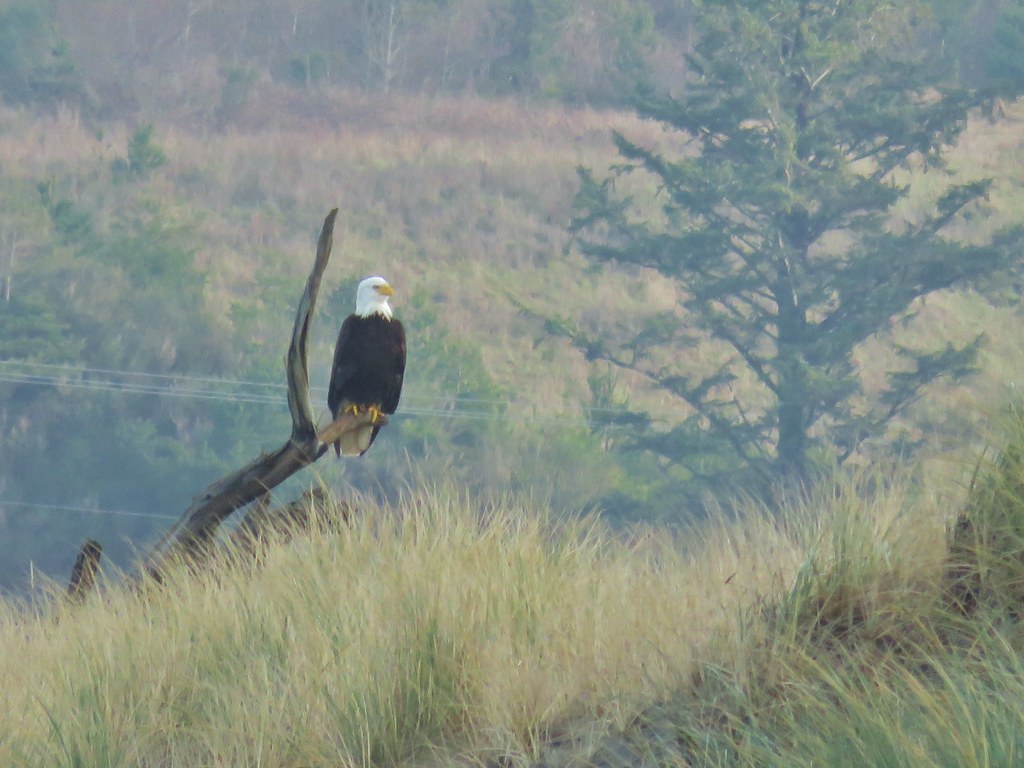
We were able to spend the next 4 miles to the end of the spit on the beach. There were no other people in sight (until the fishing boats in the bay). There were a few seagulls here and there and we saw at least 8 different Bald Eagles counting at least 6 congregated in a short stretch of trees.
IMG_2190

IMG_2174

IMG_2175

IMG_2192

IMG_2200

IMG_2201

IMG_2204

IMG_2207

A final eagle awaited near the end of the spit.
IMG_2212

IMG_2219

We were hoping that by the time we got to the turn around point we’d have a better look at Three Arch Rocks but the view wasn’t much clearer than it had been all morning.
IMG_2221

IMG_2214

IMG_2217

We had stubbornly kept our rain gear on waiting for the forecast to come to fruition, but we stopped here to remove it since we were way too warm. We then made a short loop around the tip of the spit to look at the bay before starting back.
IMG_2222

IMG_2223

One thing that both Reeder and the field guide agreed on was that it was impossible to travel along the bay due to marshy conditions so we started back down the beach.
IMG_2226

The tide was coming in and we noticed that waves were starting to cover the entire beach and forced us up into the dunes a bit where we followed some deer tracks for awhile.
IMG_2227

We spent the majority of the next three and a half miles staying up as high on the dunes as possible which made for some more difficult travel. The grass on the dunes is surprisingly sharp tipped and it was all pointing north so we were walking directly into the points. The thickness of the grass also meant that you couldn’t really tell what the terrain underneath was like so there were plenty of awkward steps, although no falls. I had done that on the beach when I tripped over a small piece of driftwood.
IMG_2233Looking back north from the dune crest.

IMG_2235Looking north at what was to come.

IMG_2230Thick forest between the bay and the dune.
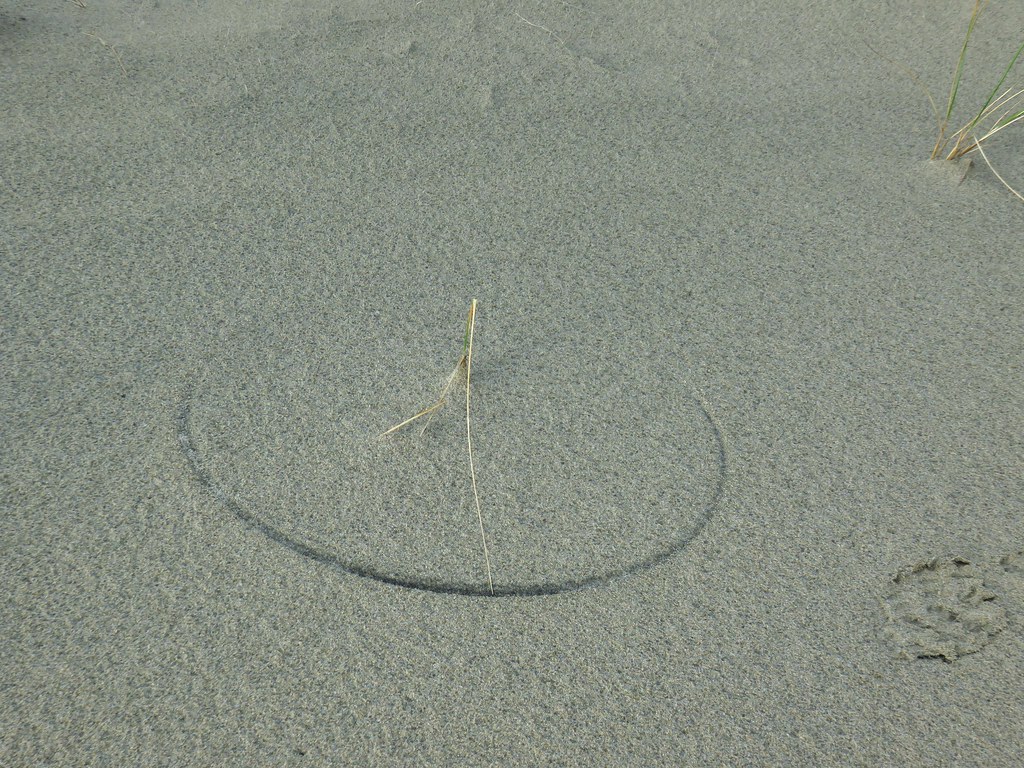
IMG_2236One of several semi-circles created by grass going back and forth.

Being up on the dune did allow for some views of the bay where we spotted birds including surf scooters and great blue herons.
IMG_2238

IMG_2240

IMG_2242

We were forced down onto the backside of the dune as we neared the point where we had crossed over the beach that morning. Here a maze of game trails led in all directions. The trick was attempting to avoid the thorny rose stalks and blackberry bushes as well as thickets of nearly impassable salal.
IMG_2245

We eventually made it back to the submerged trail and grassy track from earlier which we followed back to the campground and then stuck to the paved road as we returned to trail leading between the campground and picnic shelter.
IMG_2255Cape Lookout from the trail to the picnic shelter.

IMG_2257Seagull atop the shelter.

Our GPS put our hike at 11.1 miles which was in line with the field guides 11.2 and a little longer than Reeder’s 10 miles. We both agreed that it may have been the hardest hike we’d done along the coast due to the tricky terrain, although part of it might also be that it had been over a month since our previous hike and we’re a bit out of hiking shape. In any event it felt like an adventure which was nice and the fact that the rainy forecast turned into just a mostly cloudy day with a couple of sun breaks made for a great start to 2020’s hikes. Happy Trails!

Flickr: Netarts Spit

Categories
Hiking Oregon Portland Willamette Valley

Maple Trail (Forest Park) and Tilikum Crossing – 12/14/2019

For our final outing of 2019 we combined a little hiking with a bit of Christmas Shopping by heading up to Portland for the day. Our plan was to do a pair of Sullivan’s featured hikes before visiting the Portland Saturday Market.

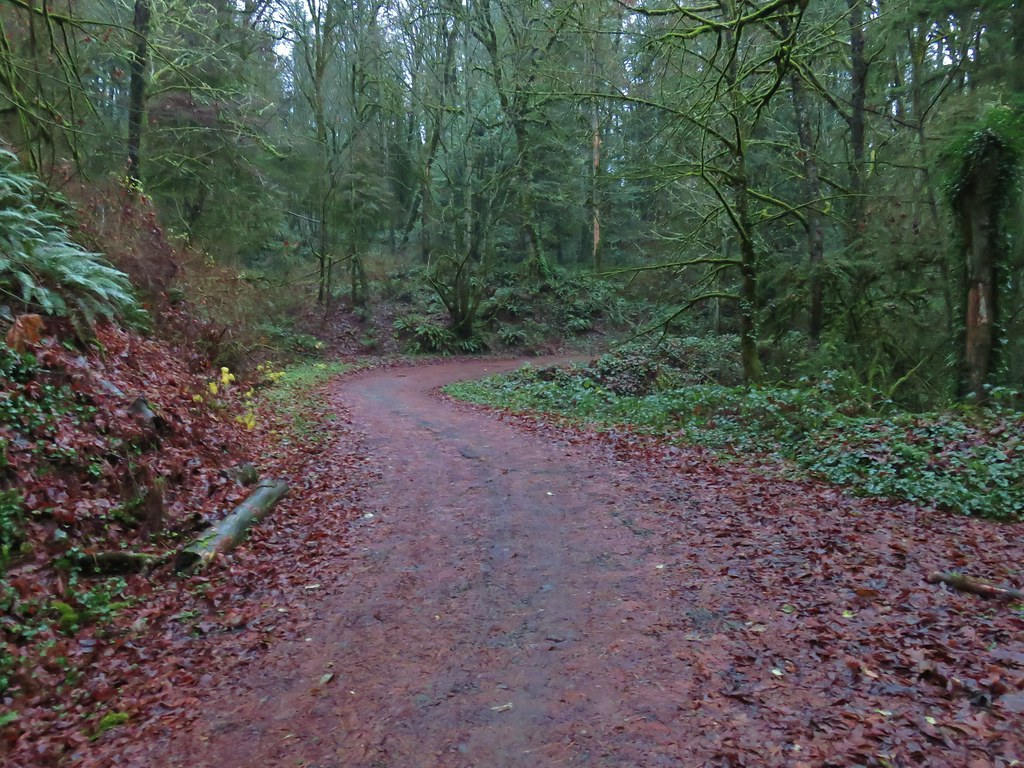
We started our morning at the 5,200 acre Forest Park for a 7.5 mile lollipop hike using the Maple and Wildwood Trails. Our hike started at the Lower Saltzman Road Trailhead

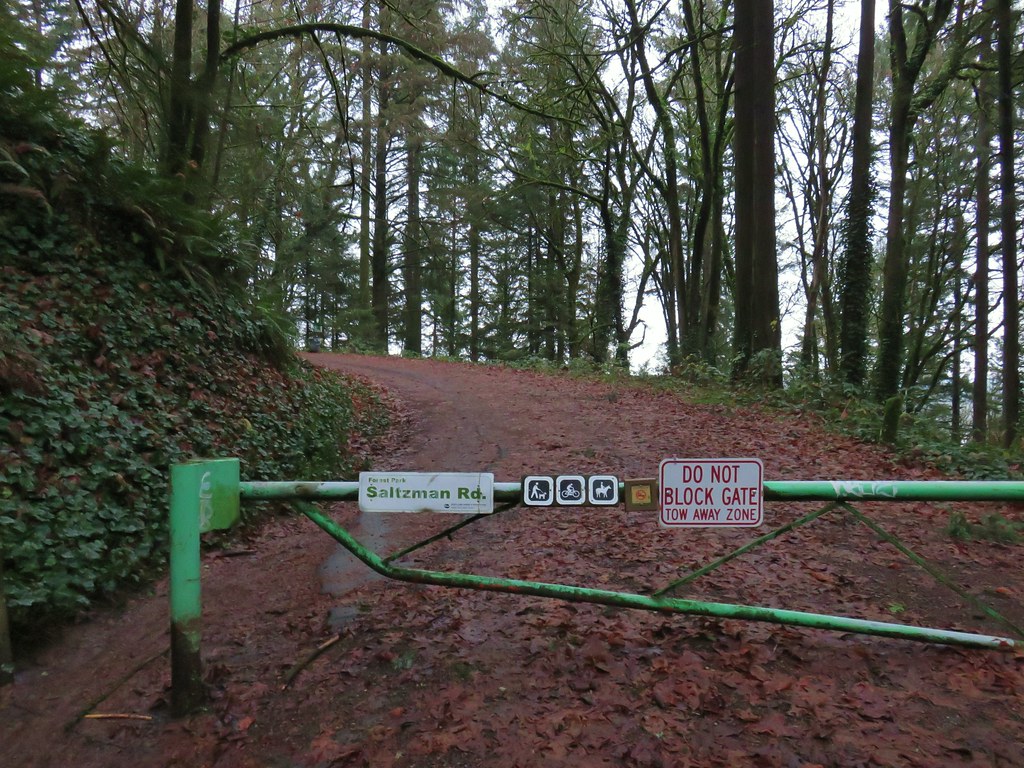
We were the second car at the small parking area where we set off past the green gate blocking further access to Saltzman Road.
IMG_1958

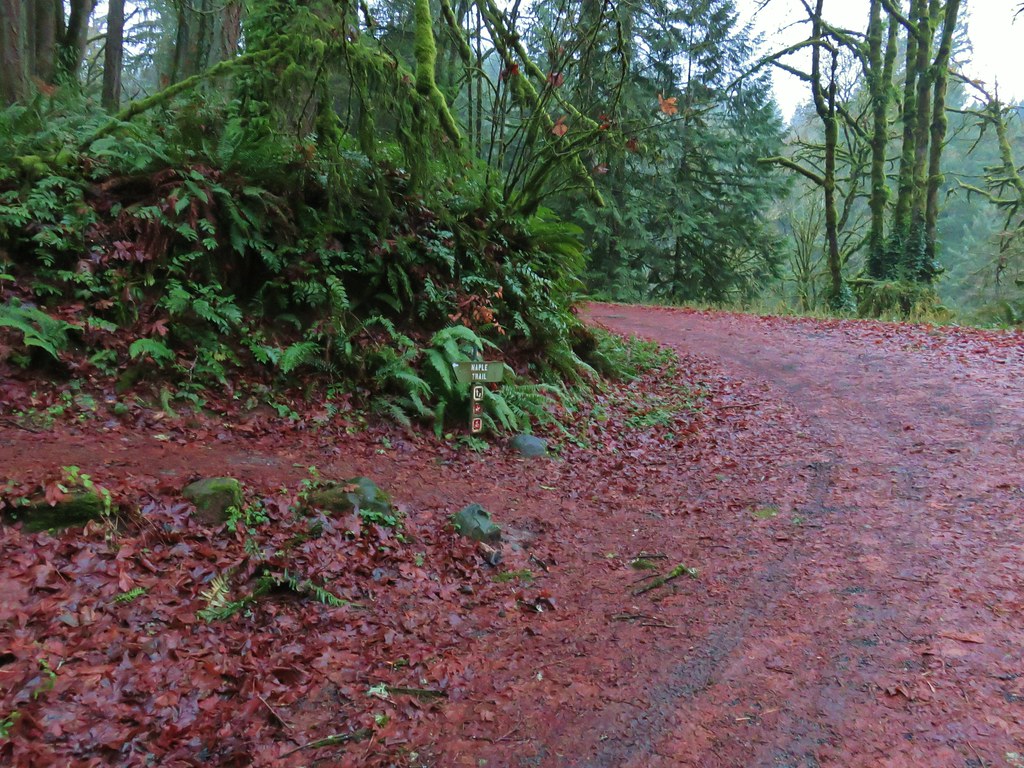
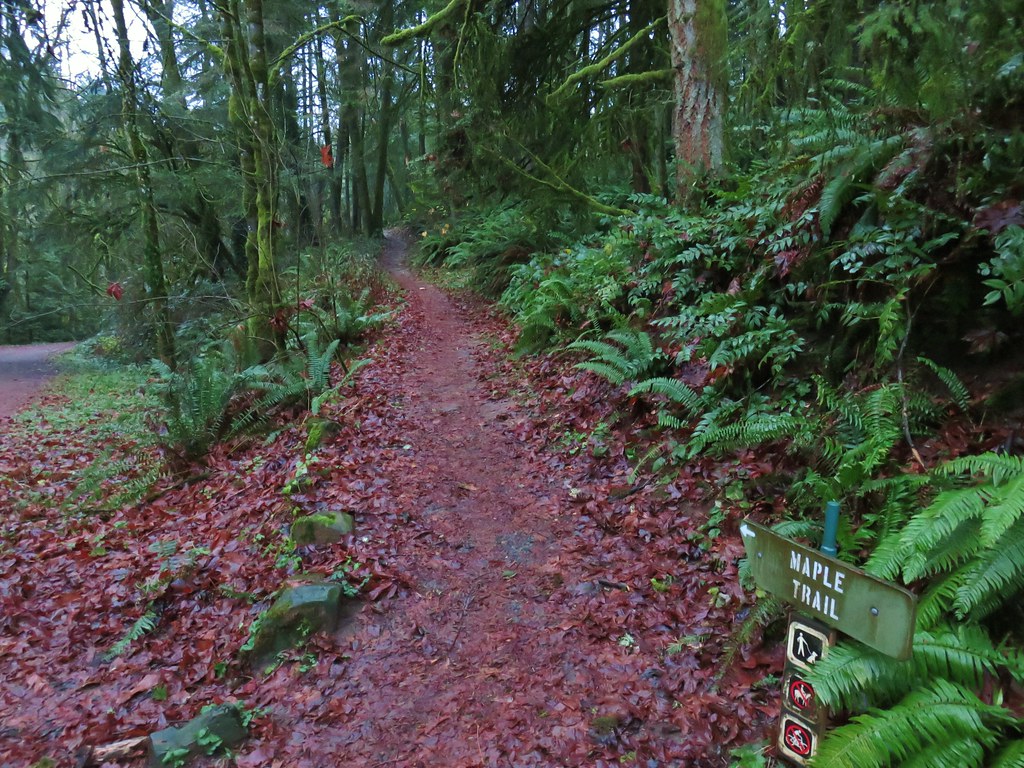
We followed the closed road for .4 miles to a junction where the Maple Trail crossed the road. Here we turned left onto that trail.
IMG_1961

IMG_1962

IMG_1965

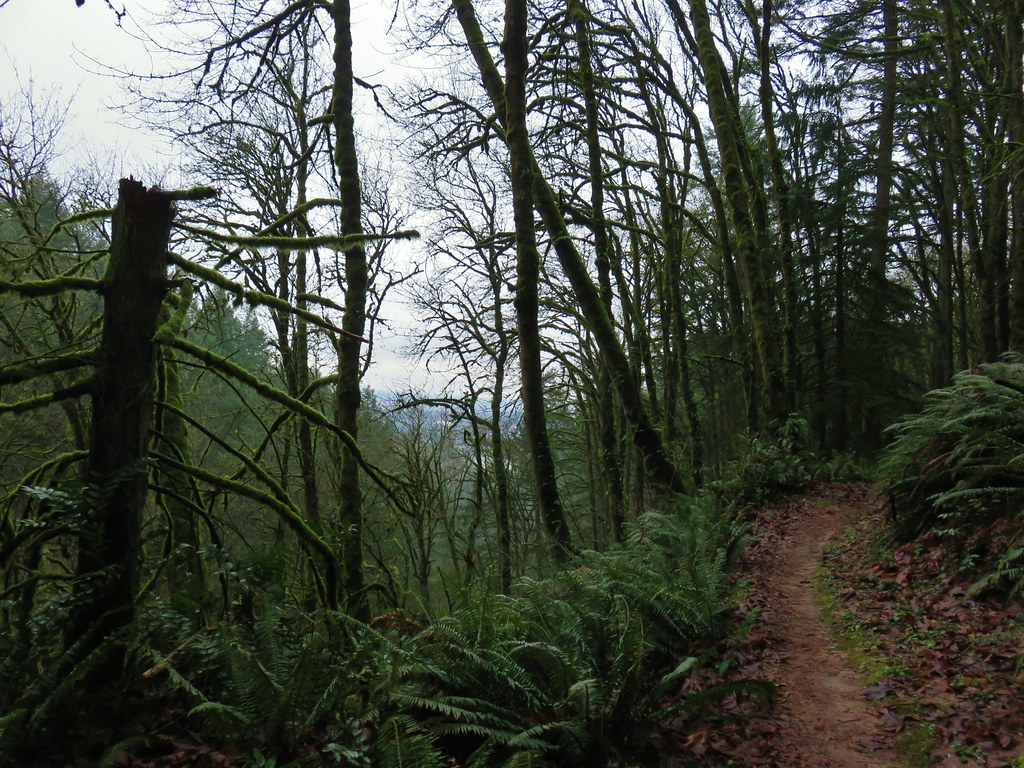
We followed this trail for a mile and a half, ignoring side trails, as we climbed gradually to Leif Erikson Drive. It was a cloudy morning and the forest was damp but it wasn’t raining which made for a pleasant walk amid the trees.
IMG_1968

IMG_1974

IMG_1975Bridge over a small stream.

IMG_1977Heading into a little bit of fog.

IMG_1981Too cloudy for any real views.

IMG_1983Leif Erikson Road.

We crossed the closed road and continued on the Maple Trail for another .4 miles to a fork where we veered right at a pointer for the Wildwood Trail.
IMG_1984

IMG_1989

A short climb brought us to the Wildwood Trail where we turned right and headed up some wooden steps.
IMG_1990

This was our third time on the 30 mile long Wildwood Trail (11/18, 5/18) and we followed it for 3.2 miles through a variety of scenery.
IMG_1992

IMG_1996

IMG_2006

IMG_2017

Along the way we crossed Saltzman Road.
IMG_2018Saltzman Road at the 2.5 mile mark of the 3.2 mile stretch.
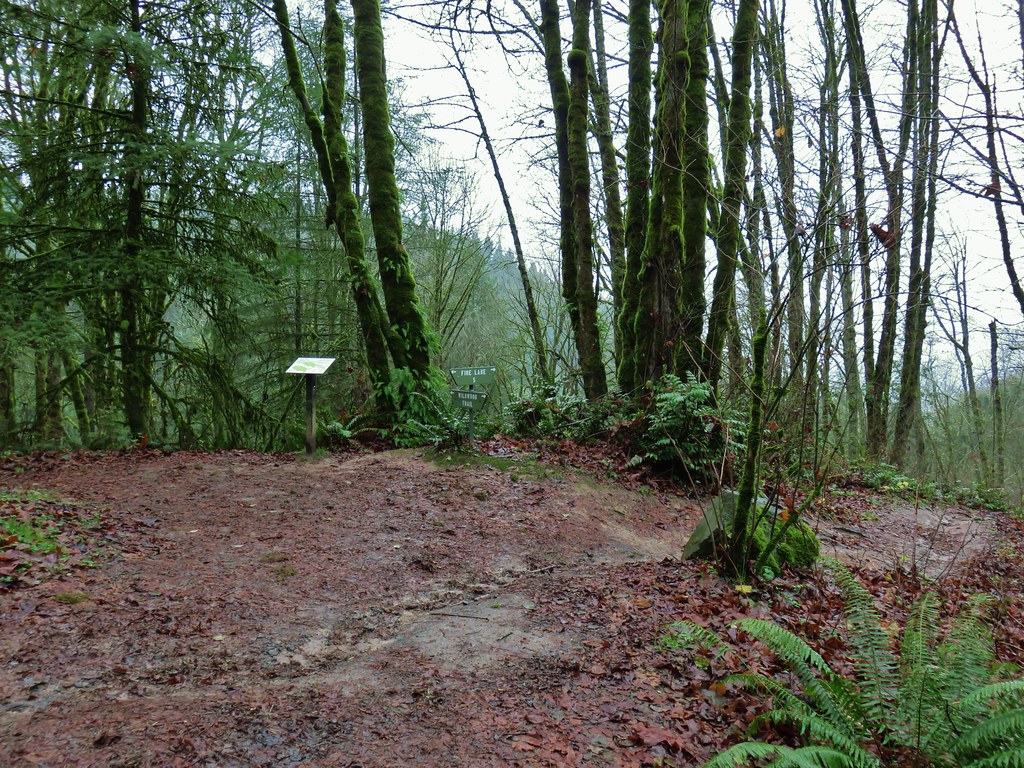
Approximately .7 miles after crossing Saltzman Road we turned right onto signed Firelane 5.
IMG_2022

This windy track was rutted by bike tires as it made its way downhill to Leif Erikson Drive after about half a mile.
IMG_2023

IMG_2025Aproaching Leif Erikson Drive.

We turned right onto Leif Erikson for .2 miles to a curve with a grassy flat on the left with a sign for the Maple Trail.
IMG_2027

IMG_2028

We followed the Maple Trail for 1.2 miles back to Saltzman Road where we turned left and hiked the .4 miles back to the trailhead. The forest along this section of the Maple Trail was nice and on a clearer day there may have been a few views but we settled for the trees and some passing geese.
IMG_2030

IMG_2032

IMG_2034

IMG_2035

IMG_2041

The trailhead was full when we got back so we quickly changed our shoes and opened up a spot for another trail user. We headed for downtown Portland for our next stop at Tom McCall Waterfront Park. We actually parked at a lot on the corner of 4th and Harvey Milk St. and walked 3+ blocks to the park.
IMG_2044

IMG_2050

The Saturday Market was just a bit to the left but we went right heading for the Morrison Bridge and planning on hitting the market at the end of our loop.
IMG_2045

There were almost as many geese as people in this section of the park.
IMG_2052

We followed the Waterfront Park Trail along the Willamette River under the Morrison Bridge and toward the Hawthorne Bridge.
IMG_2053

IMG_2056Hawthorn Bridge

IMG_2060

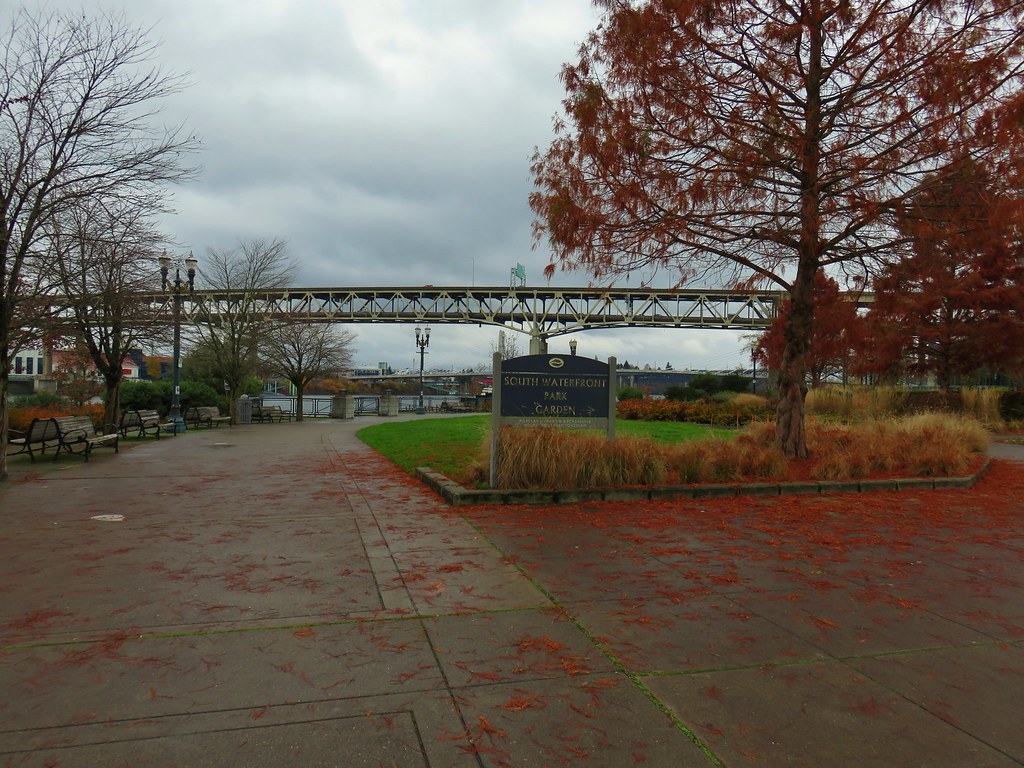
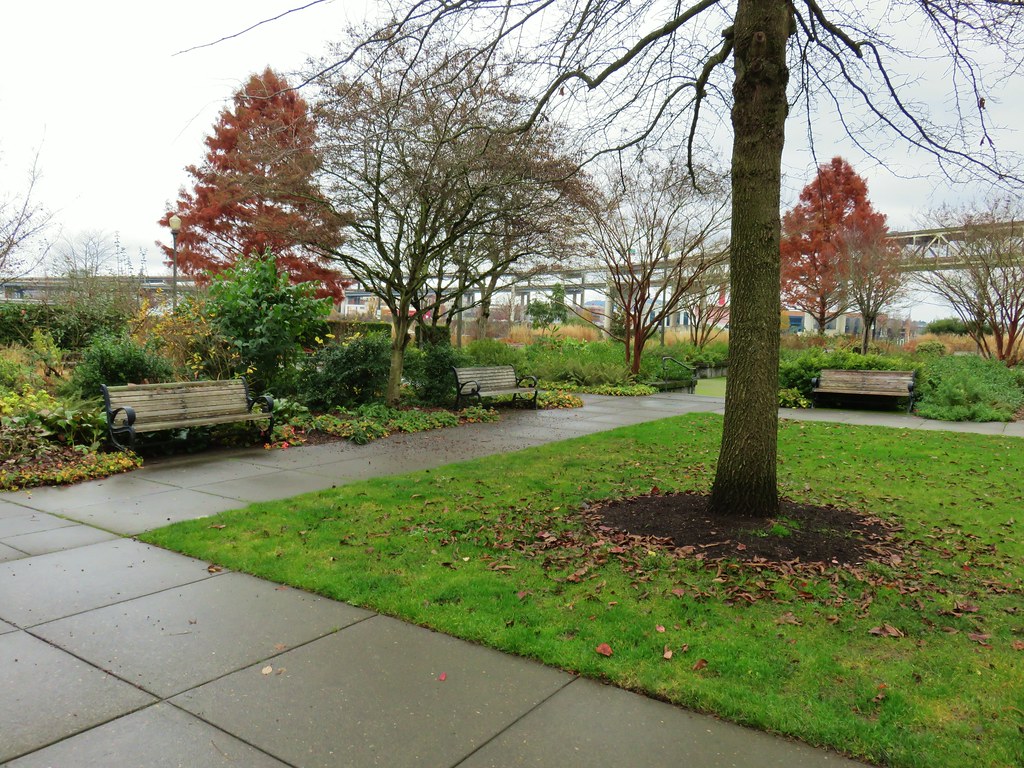
After about three quarters of a mile we passed through the South Waterfront Park Garden.
IMG_2062

IMG_2063

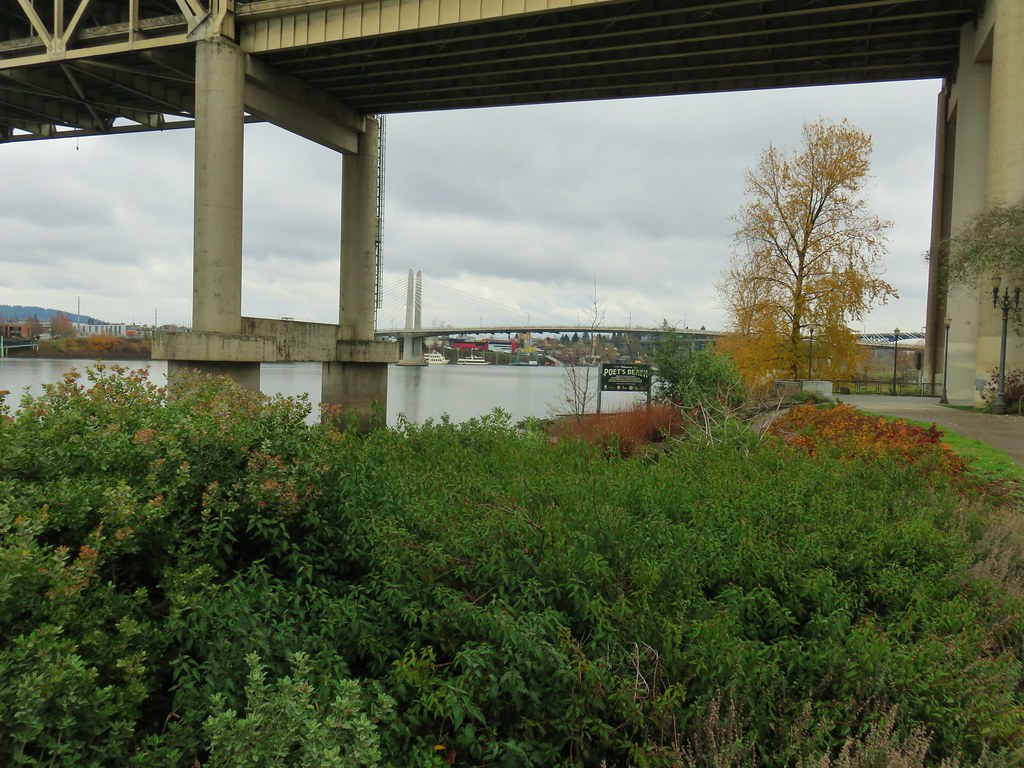
This was quickly followed by Poet’s Beach under the Marquam Bridge.
IMG_2068

IMG_2069

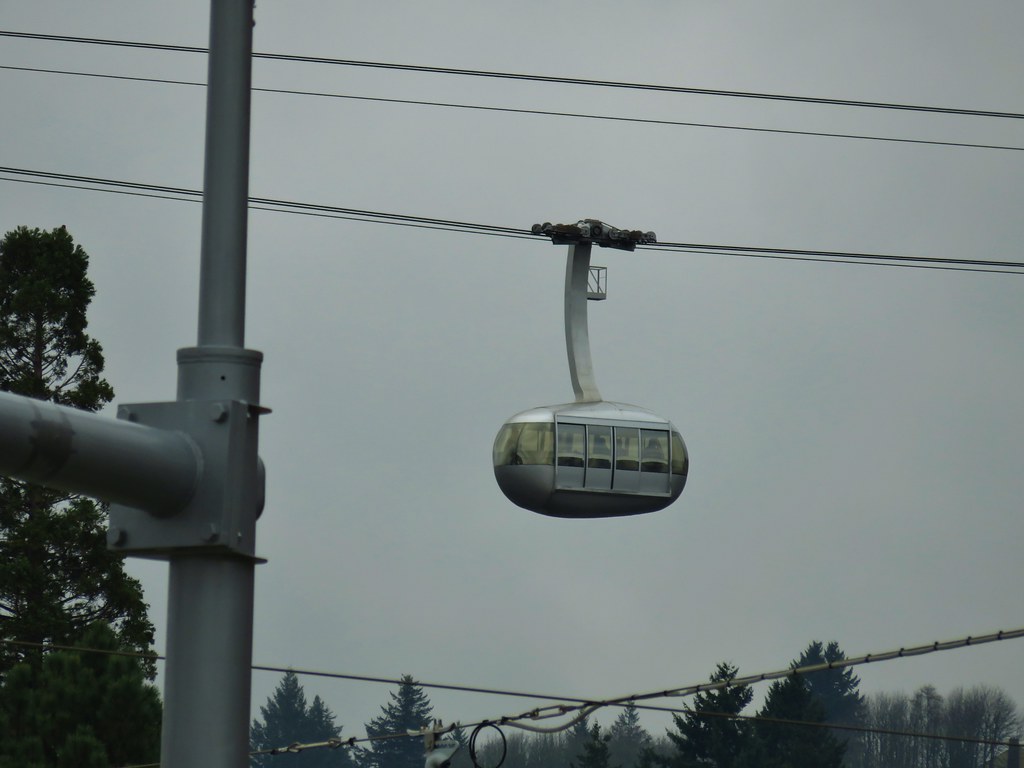
After passing under the Marquam Bridge we had a good look at OMSI and the USS Blueback Submarine on the far side of the Willamette and the OHSU Aerial Tram on our side of the river on Marquam Hill.
IMG_2073

IMG_2072

IMG_2071

IMG_2078

There was also an interesting piece of art near the Tilikum Crossing Bridge where we would be heading across the river.
IMG_2074

IMG_2076

The bridge was opened in September 2015 and is restricted to transit, pedestrian, and cyclist use only.
IMG_2080

IMG_2081

IMG_2083Marquam Bridge from Tilikum Crossing.

After crossing the river we turned left towards OMSI on the Eastbank Esplanade.
IMG_2085Tilikum Crossing from the esplanade.

We followed the Eastbank Esplanade for a total of 1.75 miles to the Steele Bridge. The scenery along this stretch was a bit more industrial with sections not too far from the Interstate, but there were still some interesting and pretty sights along the way.
IMG_2086Behind OMSI

IMG_2090More geese.

IMG_2091

IMG_2093

IMG_2094Cormorants

IMG_2097

IMG_2098

IMG_2103

IMG_2099

We recrossed the Willamette on the Steele Bridge arriving back at Waterfront Park near the Japanese American Historical Plaza and the Portland Saturday Market.
IMG_2106

IMG_2110

IMG_2112

IMG_2113

We wound our way through the market visiting all the booths before returning to our car and heading home. We did manage to find a couple of Christmas gifts so it had not only been a fun day hiking but it had been productive as well. We walked about 5 miles between the loop around the Willamette and the market which was just about as much as our feet could handle for the day.

That’s it for us as far as hikes go for 2019, we hope everyone has a Merry Christmas and Happy New Year! (and Happy Trails too!)

Flickr: Maple Trail and Tilikum Crossing

Categories
Clackamas Hiking Old Cascades Oregon Trip report

Alder Flat and the Riverside Trail – 11/09/19

**Note the 2020 Riverside Fire burned a most of this hike.**

We managed to stay off the trail for two weeks but a favorable forecast called us back out for our November outing.  We chose a pair of hikes along the Clackamas River east of Estacada, OR.  The Riverside Trail was another of Sullivan’s featured hikes that we’d been saving for a rainy day, but we just didn’t have many of those this year so we decided to go ahead and check it off our to do list.

Before getting to the Riverside Trail though we stopped at the nearby Alder Flat Trailhead which is located along Highway 224 just west of the Ripplebrook Guard Station.
Alder Flat Trailhead

We arrived a little before the light so we waited at the trailhead for enough light before setting off on the .9 mile trail that led to the primitive Alder Flat Campground along the Clackamas River.
Sunrise over RipplebrookThere was a nice sunrise while we waited for enough light.
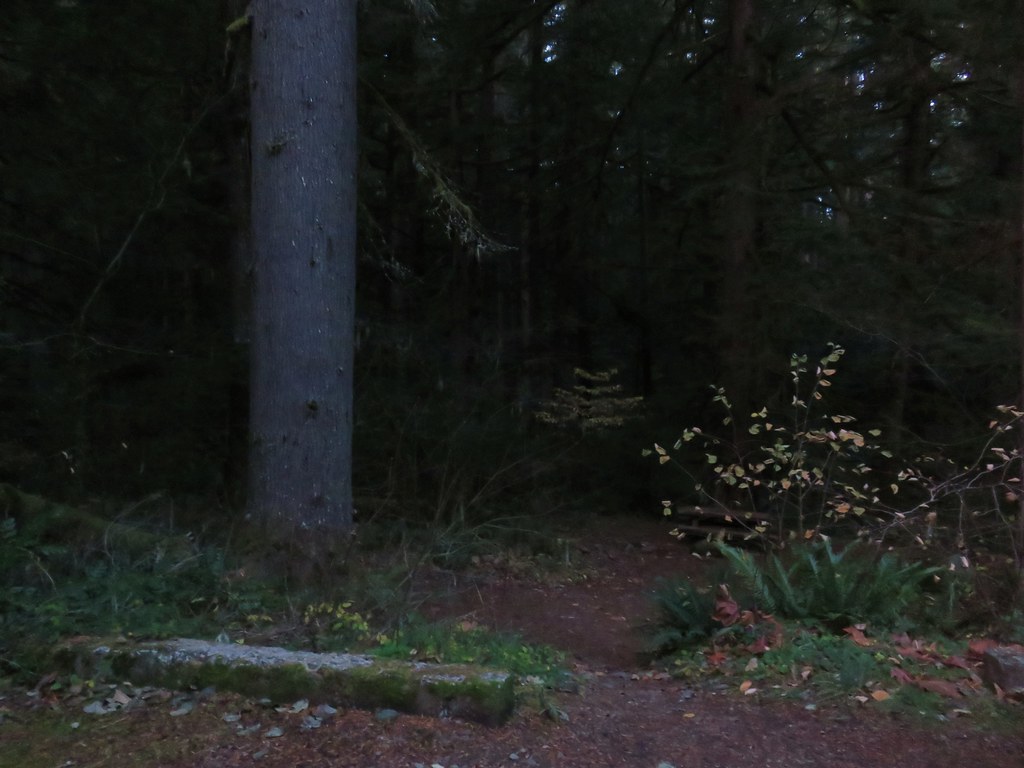
Alder Flat TrailAlder Flat Trail at the trailhead.

The trail passes by an old beaver pond and through a green forest before arriving at the campground near a swimming hole at a bend in the river. Maps also show a trail around the beaver pond but we followed it briefly on the way back and it petered out after crossing the outlet creek on a log.
Sunrise from the Alder Flat TrailPassing the old beaver pond.

Old beaver pond along the Alder Flat TrailBeaver pond from the former trail around it.

Former trail around the beaver pond.The trail around the pond petered out on the far side of this log.

Alder Flat TrailAlder Flat Trail in the forest.

Arriving at the campground.

Clackamas River at Alder FlatSwimming hole (It was a little too cold today.)

Clackamas River at Alder FlatClackamas River at the Alder Flat Campground.

From the Alder Flat Trailhead it was less than a mile to our starting point for the Riverside Trail at the Rainbow Campground.
Gate at Rainbow Campground

When the campground is open you need to pay to park there. With the campground closed there is no fee, but it does add a .3 mile road walk into and through the campground to reach the trail.
Rainbow CampgroundThe Rainbow Campground

The Riverside Trail sets off at the far end of the campground following the Oak Grove Fork of the Clackamas River.
Riverside Trail

Riverside Trail

Oak Grove Fork Clackamas River

The trail climbs up to an overlook of the Clackamas River in the first half mile near the confluence of the two rivers. We both were a bit confused at first when we got to the overlook because the river was suddenly flowing in the opposite direction, then we remembered that is was a different river.
Clackamas River

Clackamas River

Beyond this first viewpoint of the Clackamas River the Riverside Trail continues a little over three and a half miles to its end at the Riverside Campground. Along the way the trail makes several ups and downs as well as dipping deeper into the forest occasionally to navigate side canyons. There were a number of viewpoints above the river as well as numerous chances to explore the river bank. The final mile and half (after passing a spur trail coming from the no fee Riverside Trailhead) did spend more time closer to paved Forest Road 46 but there wasn’t a lot of traffic and the scenery was still nice.
Riverside TrailIn the forest for a bit.

Clackamas RiverViewpoint from above.

Riverside TrailBack in the forest.

Clackamas RiverAt the river.

Sun through the trees along the Riverside TrailSun peaking through the trees.

Rock formation along the Riverside Trailone of several rock formations along the trail.

Clackamas RiverAnother view of the Clackamas.

Riverside TrailSide creek crossing.

Clackamas RiverBack along the river.

Clackamas RiverRock pinnacle in the Clackamas River.

Riverside TrailSpur trail to the Riverside Trailhead.

Clackamas RiverViewpoint near the spur trail.

Clackamas RiverViewpoint near the spur trail.

Riverside Trail

Clackamas RiverAnother rocky beach along the Clackamas.

Clackamas RiverLooking down river.

Clackamas RiverNow from above the rock beach.

Just before reaching the end of the trail at the Riverside Campground the trail passed above a deep green hole.
Clackamas River

We’d been keeping our eyes open for fish all morning given how clear the river was but hadn’t seen any until we gazed into the water here. We spotted several large fish.
Fish in the Clackamas River

Fish in the Clackamas River

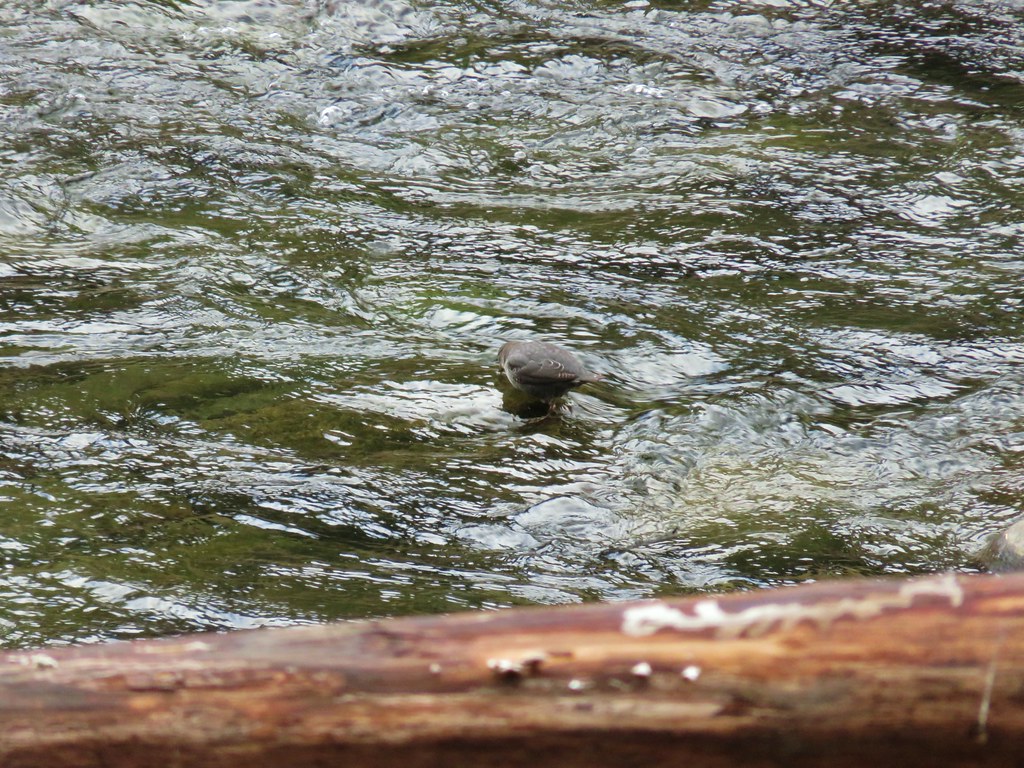
The trail descended from the viewpoint above the hole to the Riverside Campground where we watched an ouzel dip in and out of the river looking for snacks.
Riverside Trail sign at Riverside Campground

Riverside Campground

Ouzel

Ouzel

Clackamas RiverClackamas River at the Riverside Campground.

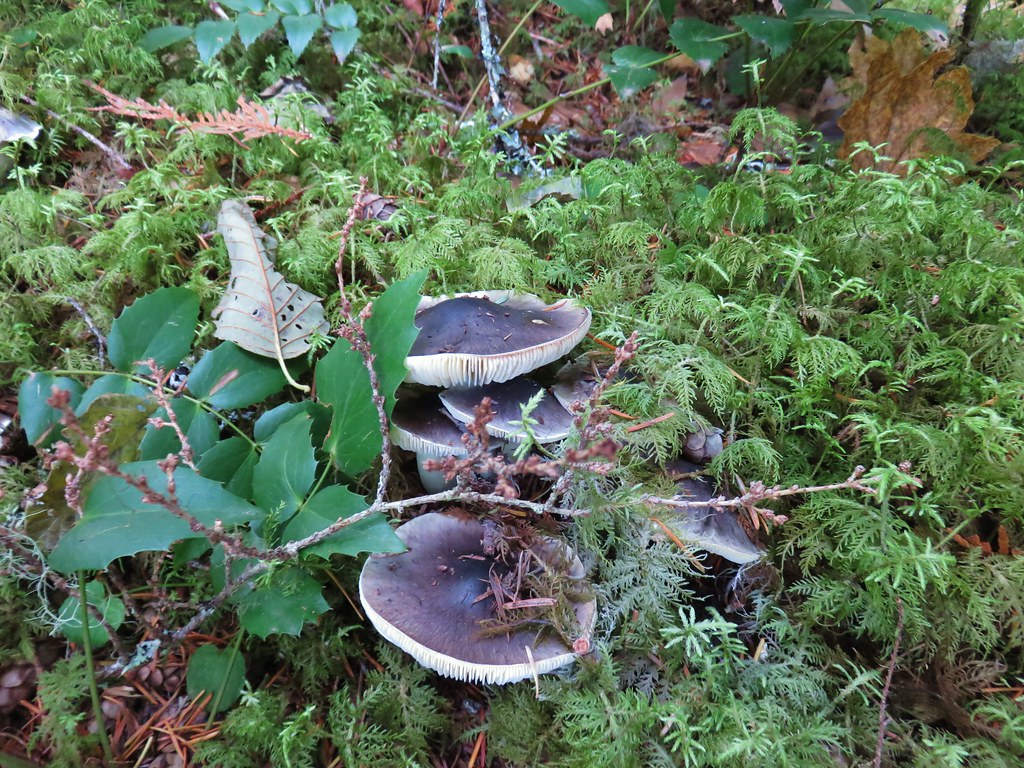
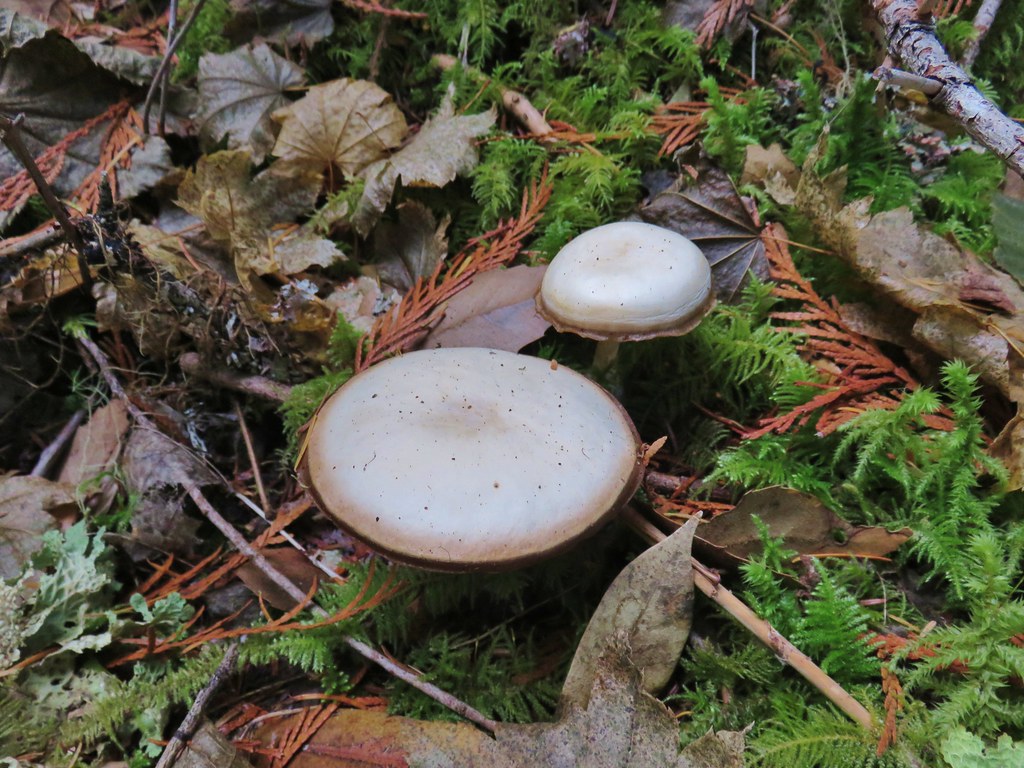
We headed back the way we’d come stopping to admire some of the mushrooms and fungi along the trail.
Mushrooms

Mushroom

Mushrooms

Mushrooms

Tree mushroom

Mushrooms on a log

In addition to the fish we’d been on the lookout for rough skinned newts. As we stopped at a viewpoint looking across the river valley toward Fish Creek Mountain (post) we finally spotted one.
Fish Creek Mountain

Rough skinned newt

This is a very popular trail in the Summer based on the number of cars we’ve seen when driving past on the way home from other hikes. We didn’t see a lot of other hikers on this day although we did pass one group twice (near each end of the trail) and several others as we got close to the Rainbow Campground on the way back. The GPS said we did 9.5 miles which included several side trips along the river and to viewpoints as well as the .6 miles of road walking. For those looking for a shorter hike the Riverside Trailhead would be a good starting point or try the Alder Flat Trail which is only about 2 miles round trip.

With the Holiday Season quickly approaching it was nice to be able to get our November hike in early with such nice weather. We plan to head out once more next month to wrap up our 2019 hikes so until then Happy Trails!

Flickr: Alder Flat and the Riverside Trail

Categories
Columbia River Gorge South Hiking Oregon Trip report

Wahtum Lake with Indian, Chindrie, and Tomlike Mountains – 10/27/2019

After a false start we closed out our 2019 hiking season with a bang on a 16.7 mile jaunt to three peaks near Wahtum Lake. We set off on Saturday morning for this hike but only made it 16 miles from our house where we wound up stuck on Interstate 5 for more than three hours due to an unfortunate accident that resulted in a fatality. By the time we were able to proceed it was too late for our liking so we took a mulligan and tried again the next morning.

Our next attempt went better and we arrived at the trailhead at the Wahtum Lake Campground just before dawn. A loan car was parked at the trailhead with just a bit of fresh snow on it from the night before. (We would find out later that he had spent the night at Mud Lake.)
IMG_1364

After some deliberation regarding our planned route we settled on the following. We would hike down to the lake then go southbound on the Pacific Crest Trail to the Indian Mountain Trial and take it up to the summit of Indian Mountain. Then we would return to Wahtum Lake on the PCT and follow the Chindrie Cutoff Trail around the southern end of the lake and climb up to the PCT near the Chindrie Mountain Trail (This part of the plan wound up being changed but more on that later) and hike up to that summit as well. After tagging Chindrie the plan was to return to the PCT and go southbound once again to the Herman Creek Trail following it to the unofficial trail to the summit of Tomlike Mountain. Finally after returning to the Herman Creek Trail from Tomlike Mountain we would backtrack a few hundred feet to the Anthill Trail which would lead us back to the Wahtum Lake Campground.

From the campground we took the Wahtum Express Trail down a series of slick looking steps entering the Mark O. Hatfield Wilderness along the way.
IMG_1368

IMG_1372

IMG_1374

After dropping a little over 200′ in .2 miles we arrived at the PCT as it curved around Wahtum Lake.
IMG_1377

Before turning left (south) on the PCT we went down to the lake shore. It was a little under 30 degrees and a crisp breeze was making it feel even colder so we didn’t linger but between a small island and a section of snow flocked trees to the north it was a nice scene. Chindrie Mountain was visible across the lake to the SW.
IMG_1379

IMG_1381Chindrie Mountain from across Wahtum Lake.

We set off on the PCT passing a couple of additional nice views of the lake before arriving at a trail junction at the lakes southern end.
IMG_1386

IMG_1383

IMG_1388

IMG_1391

At the junction we noticed a closure sign for the Eagle Creek Fire closure area over the signs for our planned route to Chindrie Mountain.
IMG_1563

I admittedly hadn’t checked the Forest Service closure map in a while but it had been my understanding that the Eagle Creek Trail was closed at the junction with the Chindrie Cutoff Trail but I had expected this trail to be open. Being uncertain we altered our plans and decided to follow the PCT all the way around the northern end of Wahtum Lake on our way between Indian and Chindrie Mountains. According the mileage shown on our map that would and approximately three quarters of a mile to our day. Further research would confirm that it was indeed only the Eagle Creek Trail that was closed which was just over a tenth of a mile further along the Chindrie Cutoff Trail (it would have been nice if the sign had been clear about that).

We continued south on the PCT gradually gaining over 400′ as we contoured along the side of Waucoma Ridge before arriving at the old Indian Springs Campground a little under 3 miles later. Along this stretch we had some additional views of Chindrie Mountain as well as Tanner Butte and Washington’s Table Mountain (post).
IMG_1395Chindrie Mountain

IMG_1399Tanner Butte

IMG_1403

IMG_1404Table Mountain

IMG_1408

IMG_1413Chindrie Mountain again.

We also got our first look at Indian Mountain and Mt. Hood .6 miles from Indian Springs after leaving the wilderness and popping out of the forest alongside Forest Road 660.
IMG_1416Indian Mountain

IMG_1418Mt. Hood

IMG_1428

The presence of ice formations and a bit of snow here and there made the scenery even better.
IMG_1421

IMG_1432

IMG_1435Crossing FR 660 near Indian Springs

IMG_1436Trail sign at the junction with the currently closed Indian Springs Trail.

We continued south on the PCT for another third of a mile crossing a small stream before climbing up and around a treeless ridge where a frigid wind was steadily blowing.
IMG_1439

IMG_1440

IMG_1441

The view from the ridge was spectacular. To the north the snow covered peaks in Washington were visible beyond Chindrie Mountain and to the south was our goal, the 4892′ Indian Mountain.
IMG_1446

IMG_1457

As the PCT rounded the ridge we came to the junction with the Indian Mountain Trail.
IMG_1462

IMG_1463

20191027_091244

The wind was pushing us around a bit as we turned up the Indian Mountain Trail. As this trail climbed the open ridge the views just got better eventually leading to a decent view of Goat Rocks (post) between Mt. Adams and Mt. Rainier.
IMG_1486

IMG_1476Table Mountain and Greenleaf Peak with Mt. St. Helens in the background.

IMG_1491Mt. St. Helens

IMG_1490Mt. Rainier

IMG_1488Goat Rocks

IMG_1477Mt. Adams and Chindrie Mountain

The trail finally went back into the trees which gave us some relief from the biting wind.
IMG_1492

IMG_1493

After passing remains of the former lookout (and bathroom) the trail climbed to the rocky summit a mile from the PCT.
IMG_1495

IMG_1498

Given the time of day and year the Sun wasn’t in the greatest spot for pictures but the view of Mt. Hood was great and there was also a decent view further south to Mt. Jefferson.
IMG_1499Mt. Hood and Mt. Jefferson

IMG_1503Mt. Jefferson

IMG_1514Mt. Hood from the former lookout site.

IMG_1512Mt. Hood with Lost Lake Butte (post) in front.

The snow and cold weather added some nice touches to the scenery here as well.
IMG_1508Snow on the north side, green on the south.

IMG_1524Mt. St. Helens with some snow on the trees in the foreground.

IMG_1528Crystals on a bush.

We headed back the way we’d come and arrived back at the junction with the Chindrie Cutoff Trail where we paused to see if we could find any indication that that trail was indeed open. With no confirmation in sight we erred on the side of caution and stuck to the PCT which began a gradual climb up and away from the lake beyond the Wahtum Express Trail.
IMG_1568

IMG_1571

We gained another 400 plus feet over the next 1.6 miles before arriving at a junction with the Herman Creek Trail.
IMG_1577

IMG_1580Stream crossing

IMG_1581Herman Creek Trail junction.

We stuck to the PCT and promptly passed the junction with the Chindrie Cutoff Trail. At this end there was no closure sign signifying that we could indeed have taken the trail up from Wahtum Lake savings us about .7 miles (but at a “steeper” price).
IMG_1584

Another 100 yards on the PCT brought us to a fork where the Chindrie Mountain Trail headed uphill to the right.
IMG_1585

IMG_1586

This .4 mile trail was the steepest we were on during the hike as it gained approximately 400′ on the way to the rocky viewpoint atop the mountain.
IMG_1590Looking at the summit from the trail.

IMG_1592

IMG_1593

IMG_1596Mt. Hood

The 360 degree view included Wahtum Lake to the east below.
IMG_1609

IMG_1619

The view south included Mt. Hood and Indian Mountain (and some Sun glare).
IMG_1613

Tanner Butte rose above the fire scarred Eagle Creek Valley to the west.
IMG_1603

The best view, given the position of the Sun, was to the north where the Washington Cascades lined the horizon.
IMG_1597

There was also a good view of the rock spine of Tomlike Mountain in front of Mt. Adams.
IMG_1622

From the angle it looked like a pretty gradual ascent. It was a little breezy at the summit so we didn’t linger long because the wind was making it cold. We returned to the PCT and then to the Herman Creek Trail junction where we set off on that trail.
IMG_1632

We had been on the lower end of the Herman Creek Trail before (post) but not this end. Here the trail climbed gradually through an open forest with with lots of beargrass.
IMG_1636

After a quarter mile we passed the Rainy/Wahtum Trail.
IMG_1637

IMG_1645Lots of beargrass clumps.

About a mile from the PCT we passed another junction, this time with the Anthill Trail which we would be taking back to Wahtum Lake later.
IMG_1646

Just under a tenth of a mile later the Herman Creek Trail made a hairpin turn before beginning a steep descent to Mud Lake. Here the unofficial trail to Tomlike Mountain headed out along the ridge to the left. A yellow “temporary” Forest Service sign at the junction identified only the Herman Creek Trail.
IMG_1649Trail to Tomlike on the left.

The trail began in the trees before skirting some cliffs above Mud Lake.
IMG_1652

The trees began to give way allowing for a view ahead to Tomlike Mountain which from this angle looked like it might be a bit steeper of a climb than it had from Chindrie.
IMG_1656

The other thing we noticed was that it looked further than the mile that the map showed between the summit and Herman Creek Trail. Sometimes it seems like it’s better not to be able to see your goal.
IMG_1660

Much of the path was faint with occasional cairns or flagging marking the way. The rocky terrain was somewhat challenging given that we had, by this point, covered over 12 miles already.
IMG_1663

IMG_1671There’s at least one cairn here.

The higher we climbed along the ridge the more of Mt. Hood that was visible behind us.
IMG_1664

IMG_1670

After climbing up a pile of larger rocks the trail entered a patch of small trees which we found to be a fun little section.
IMG_1672

IMG_1673

The trail emerged from the little trees for the final time as it climbed to the rocky summit.
IMG_1674

IMG_1677

IMG_1679Mt. Adams to the right.

IMG_1680

IMG_1683Mt. Hood with Indian Mountain rising up behind Chindrie Mountain to the right.
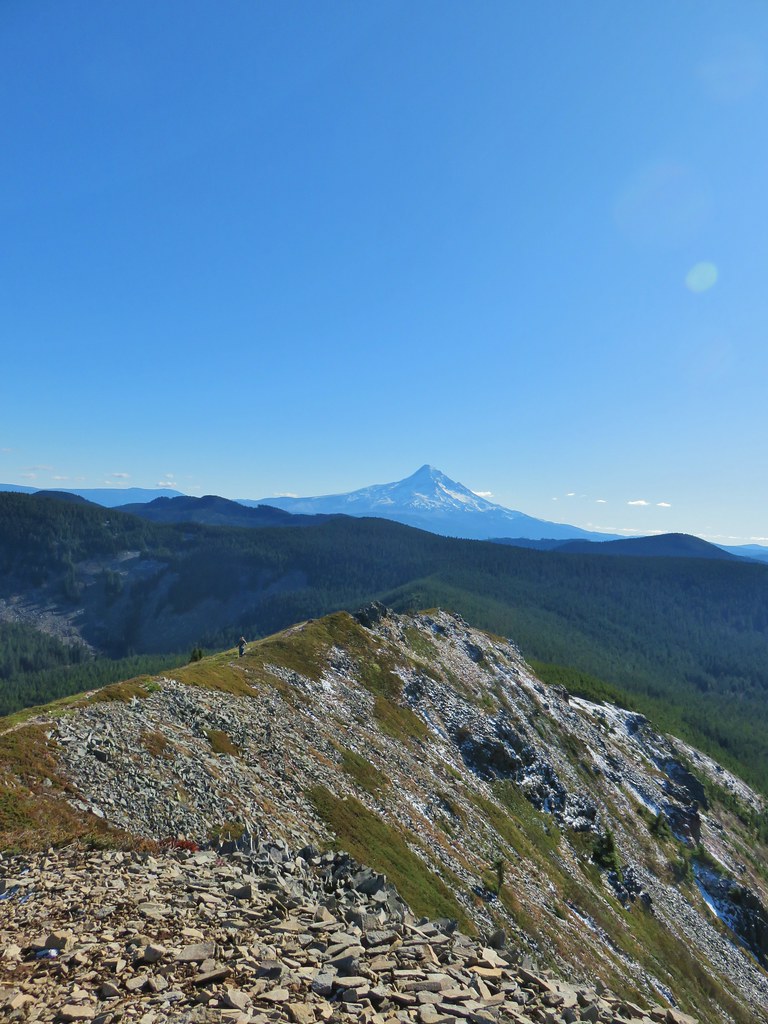
IMG_1693Heather crossing the ridge below the summit.

The trail continued for a bit beyond the summit although it didn’t provide any real different views.
IMG_1694

IMG_1707

IMG_1700Mt. St. Helens, Mt. Rainier, Goat Rocks and Mt. Adams from left to right.
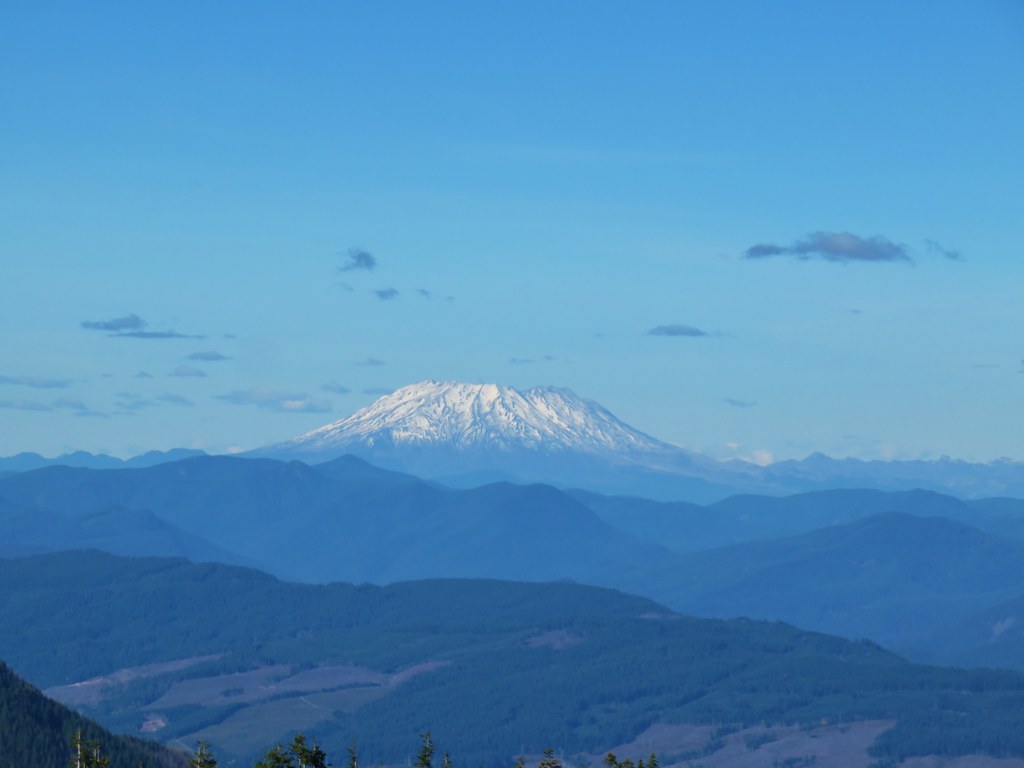
IMG_1706Mt. St. Helens

IMG_1705Mt. Rainier

IMG_1703Goat Rocks

IMG_1701Mt. Adams

We left Tomlike Mountain and returned to to the Herman Creek Trail and then walked back to the Anthill Trial junction and turned up that trail for a final 1.9 miles back to Wahtum Lake.
IMG_1720Anthill Trail on the left.

The Anthill Trail climbed for a half a mile to an old road bed which ran between Wahtum and Rainy Lakes.
IMG_1728

We crossed the road and continued to climb gradually to a saddle where we crosed over a ridge and began a descent which included views of Mt. Hood, Mt. Jefferson and Wahtum Lake.
IMG_1731

IMG_1739

IMG_1742

IMG_1744Mt. Jefferson

IMG_1751Wahtum Lake and Chindrie Mountain

The descent was gradual until the final quarter mile or so where it steepend before arriving at the campground.
IMG_1752

IMG_1755

It was a great way to end our hiking season with a little snow on the ground and a lot of blue sky above. The persistent wind was a little chilly, but we had dressed appropriately so it wasn’t too much of an issue (my fingers weren’t pleased about having to come out so often for pictures). We plan on getting out a couple more times this year but it’s time to back off a bit and relish in the memories of some great hikes this past year. Happy Trails!

Flickr: Wahtum Lake with Indian, Chindrie, and Tomlike Mountains

Categories
Hiking Mollala Old Cascades Oregon Trip report

Mollala River Recreation Area – 10/19/2016

Our recent hike at the Mollala River Recreation Area almost didn’t happen. Three days prior an ingrown toenail suddenly was making every step I took painful. By the next night I had managed to remove a bit of the nail but it was still pretty tender. Luckily the next morning one of Heather’s running buddies mentioned using floss to get under the nail and help alleviate the pressure. I gave that a try and it worked wonderfully.

I was ready to give it a try, then I checked the weather for the following day. One hundred percent chance of rain, breezy with gusts up to 30mph, and a chance of a thunderstorm after 8am. The rest of the weekend didn’t look much better so we momentarily considered skipping this weeks hike but instead we decided to at least make an attempt

The Mollala River Recreation Area is managed by the Bureau of Land Management (BLM). The area contains over 20 miles of trails open to hikers (all year), equestrians (May 16th – Oct. 14th), and mountain bikes (single track May 16th – Oct. 14th and all year for non-singletrack). We had waited for the seasonal closures to minimize the chances of running into other users and a wet, windy day would likely further reduce the number of people out.

There are multiple potential trailheads and we chose to start our day at Amanda’s Trailhead
IMG_1123

It had been raining in Salem when we left but at the trailhead we were spared, at least for the time being.

One thing that the trails in this area don’t do is visit the Mollala River so before we set off I crossed Upper Mollala Road to get a peak of the river through the trees.
IMG_1126

After checking out the river we started up Amanda’s Trail.
IMG_1128

We stopped at a trail map (we had also downloaded the maps to our phones) to discuss our planned route. There were a number of options with many of the trails looping and intersecting each other so having a map is a good idea (it’s always a good idea). Our plan was to take Amanda’s Trail to Looney’s Trail then turn up the Rim Trail and follow it to Bobcat Road. From Bobcat Road we’d follow the Huckleberry Trail back to Looney’s Trail. Finally instead of just retracing our steps back we would turn off Lonney’s Trail at Clifford’s Crossing Trail and take that trail to Mark’s Trail which would then lead us back to Amanda’s Trail for the final leg back to the trailhead. This was an 11.5 mile route with over 1500′ of elevation gain.
IMG_1129

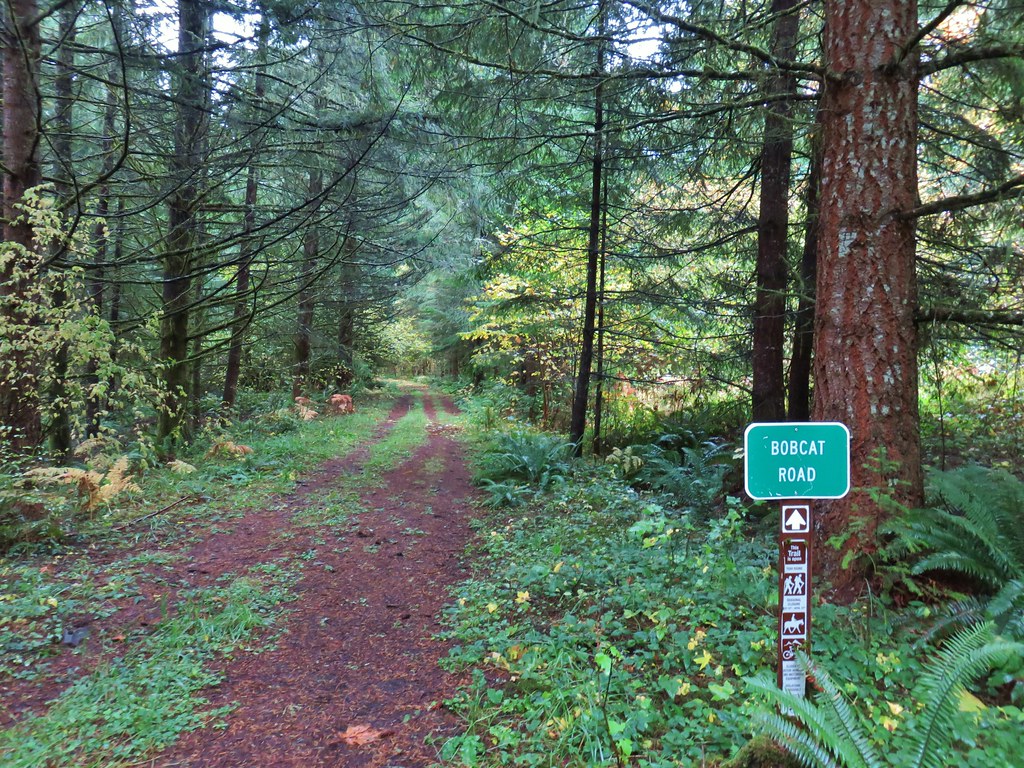
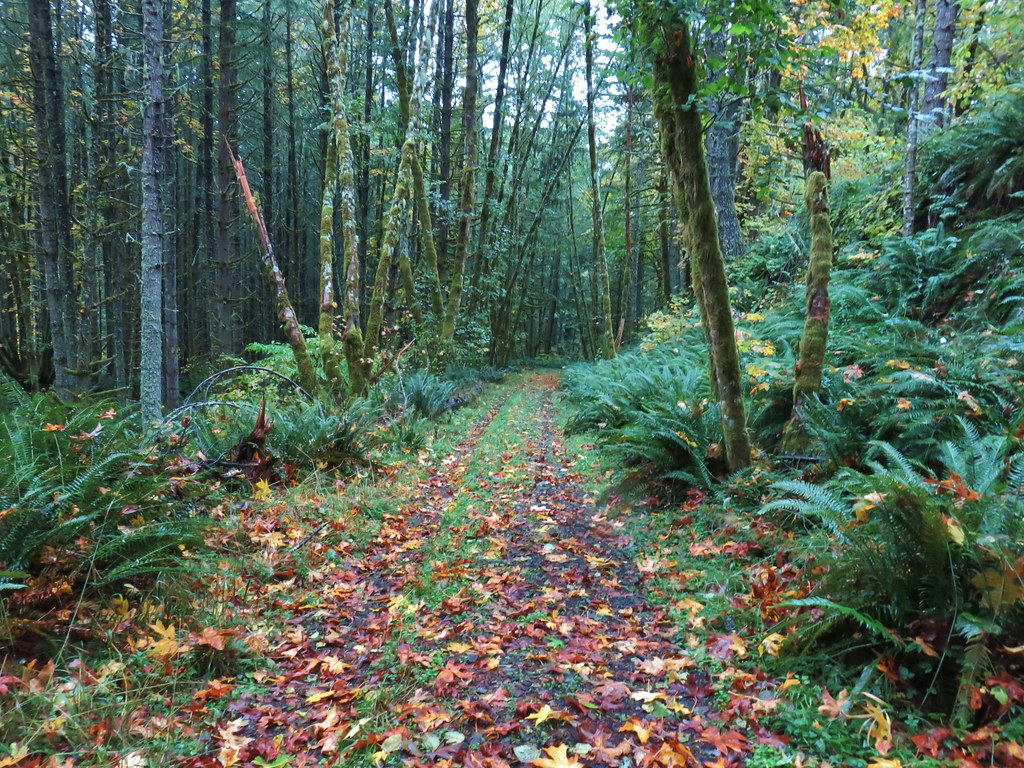
We followed Amanda’s Trail for 1.5 miles to Looney’s Trail ignoring the marked side trails along the way. This stretch of trail followed an old roadbed through second growth forest. Yellow and golden leaves were mixed with the green conifers.
IMG_1132

IMG_1138

IMG_1141Leapfrog Loop

IMG_1143

IMG_1145Mark’s Trail (our return route)

IMG_1147

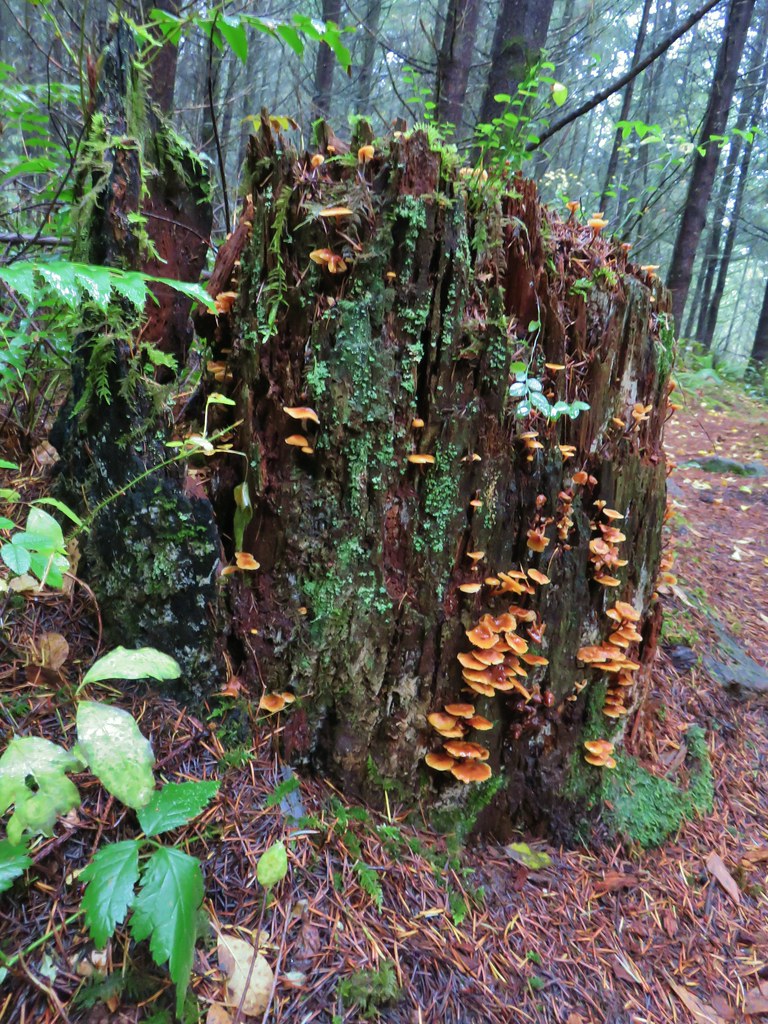
In addition to the Fall colors there were plenty of mushrooms along the trail.
IMG_1148

IMG_1151

This section also had the only view of the day across the Mollala River Valley.
IMG_1153

IMG_1155

Amanda’s Trail simply turned into Looney’s Trail at a sign at the end of the 1.5 miles.
IMG_1158

The mile long Looney’s Trail descended via a series of switchbacks to a bridge over scenic Hardy Creek, then climbed a bit before arriving at a junction with the Huckleberry and Rim Trails.
IMG_1164

IMG_1165

IMG_1171

IMG_1172

IMG_1178

IMG_1180

IMG_1181

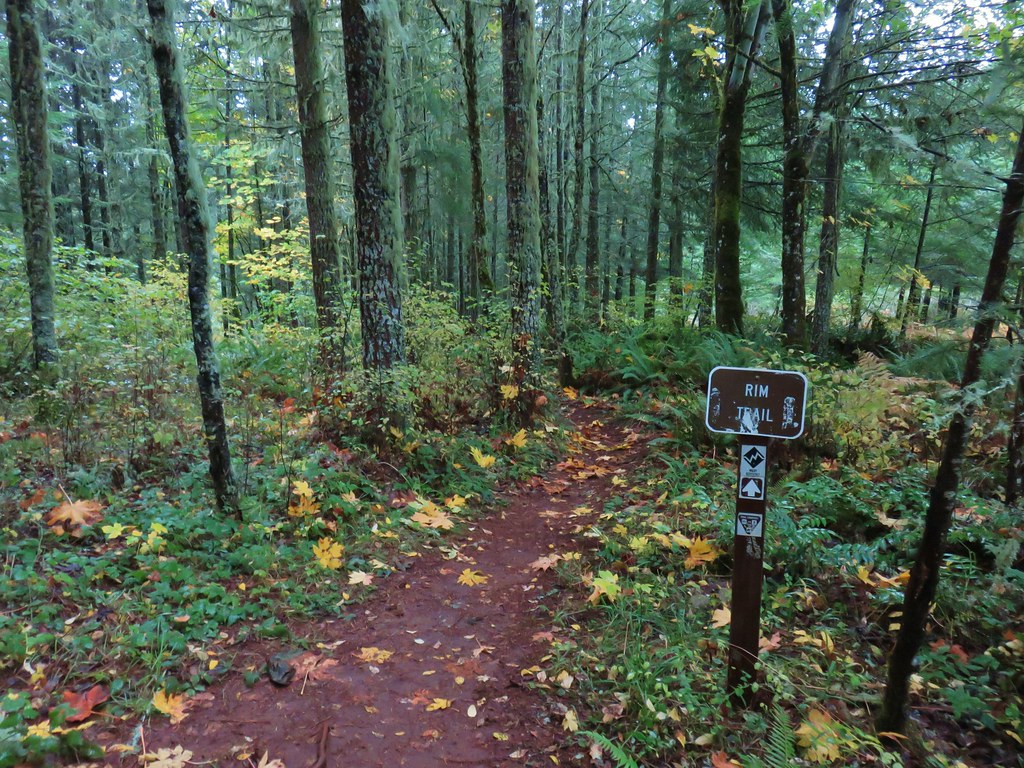
IMG_1186Rim Trail

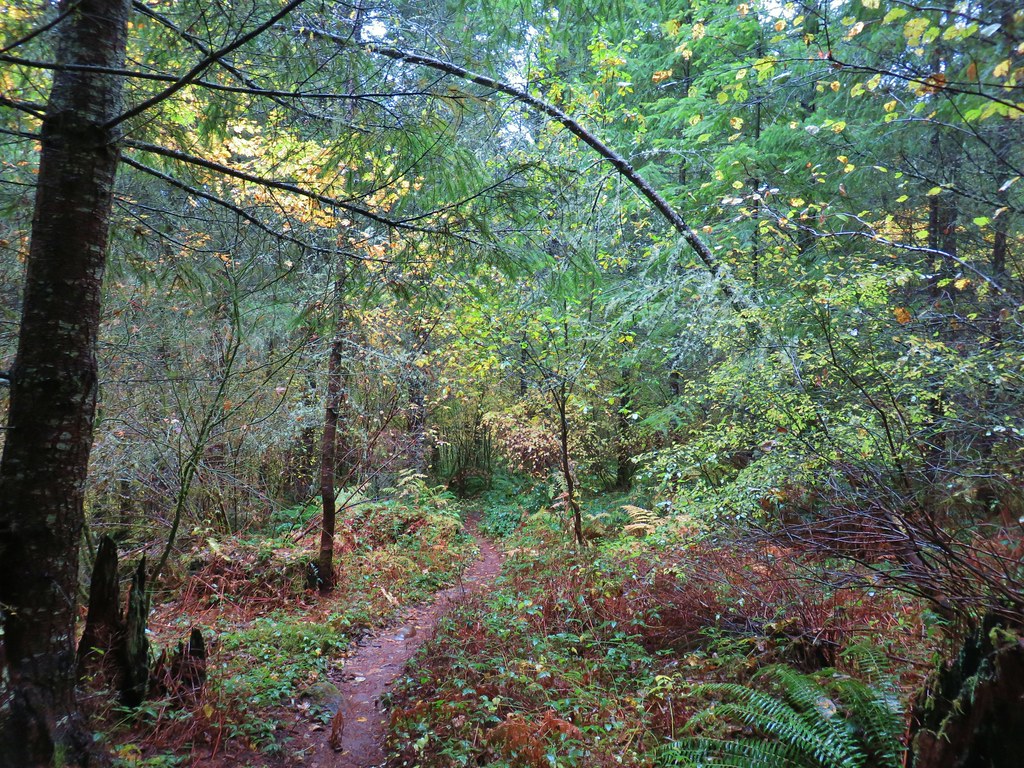
We followed the Rim Trail for approximately 3 miles. The trail gained over 600′ following old roadbeds at times. The trail skirted a farm and a clearcut along the way.
IMG_1190

IMG_1191

IMG_1194

IMG_1195

IMG_1203

IMG_1206

IMG_1220<

IMG_1225

IMG_1229

IMG_1233

IMG_1236Huge anthills could be seen throughout the hike.

IMG_1245Skirting the clear cut.

IMG_1249

There were a number of trail junctions but the signage was good and we just kept following pointers for the Rim Trail.
IMG_1250

IMG_1251

IMG_1262

IMG_1264

IMG_1268

IMG_1273Unnamed creek.

IMG_1281

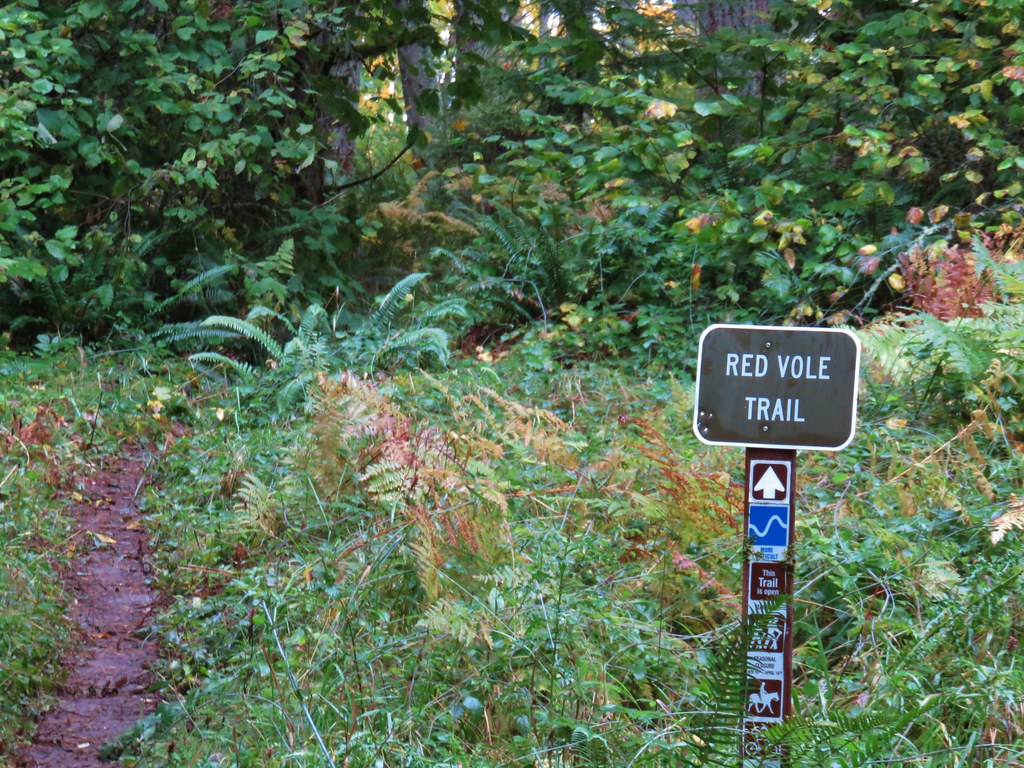
The Rim Trail ended at a fork with the Red Vole Trail to the right and Bobcat Road to the left. In the second edition of “Off the Beaten Trail” Matt Reeder mentions preferring Bobcat Road over the Red Vole Trail so we went left.
IMG_1285

IMG_1286

IMG_1288

We followed Bobcat Road downhill for a little over three quarters of a mile where we met the Huckleberry Trail (another roadbed).
IMG_1292

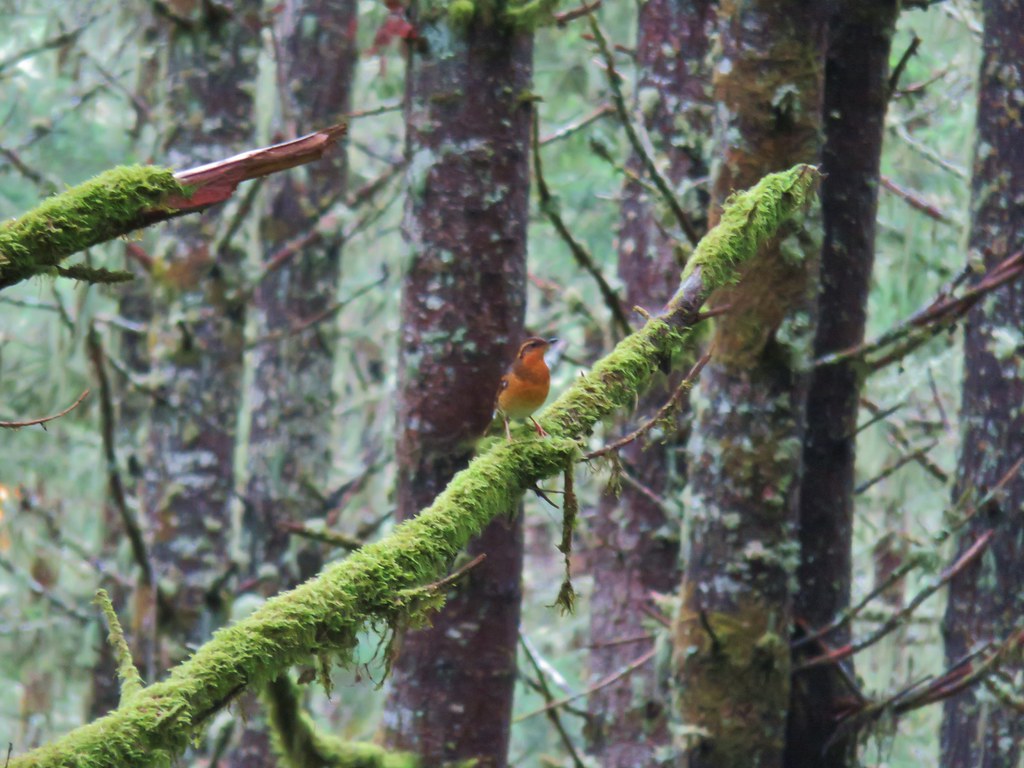
IMG_1295Varied thrush

We turned left onto the Huckleberry Trail which forked left uphill after 100 yards.
IMG_1299

IMG_1300One of the few unsigned junctions we came to.

The trail was fairly level as it contoured along the hillside arriving at Annie’s Cabin, a still functioning shelter, after .6 miles.
IMG_1305

IMG_1311

IMG_1312

IMG_1315

IMG_1316

Up until this point the weather had held up very well. Aside from a couple of very brief periods of sprinkles it hadn’t rained and the wind was mostly non-existent. That ended shortly after leaving the cabin when the clouds opened up and a heavy rain shower passed overhead.
IMG_1323Huckleberry Trail just before the shower.

IMG_1334Near the tail end of the shower.

Luckily the rain didn’t last long and we were back to mostly cloudy skies with a few sun breaks.
IMG_1329

IMG_1335The Hardy Creek Trail coming up from the Hardy Creek Trailhead on the right.

Two miles from Annie’s Cabin we arrived back at the Rim-Looney’s-Huckleberry Trails junction where we went straight onto Looney’s Trail.
IMG_1338

We recrossed Hardy Creek and followed Looney’s Trail until we arrived at a junction with Clifford’s Crossing Trail a total of .8 miles from the Huckleberry Trail.
IMG_1342

We turned right onto Clifford’s Crossing Trail. Our reasoning was simply to see some different trail rather than simply retracing our steps. This half mile trail descended fairly steeply only to immediately regain some of that elevation before making a more gradual descent to it’s end at Mark’s Trail.
IMG_1344Going down.

IMG_1345

IMG_1348Going back up.

IMG_1350

IMG_1353

Mark’s Trail was another half mile that wound its way up through the forest to Amanda’s Trail. These two trails would probably have been more fun on mountain bikes as they were clearly designed for that and not to get from point A to point B. With nothing of note to see there really wasn’t a need to hike this unless you’re looking for some extra climbing or are like us and like to take different routes when possible.
IMG_1354

IMG_1356

IMG_1357Back at Amanda’s Trail.

We turned right onto Amanda’s Trail and followed it back down to the trailhead which was just under a mile away. We had been watching for rough skinned newts all day but hadn’t seen any until this section where a loan newt was sitting in the middle of the trail.
IMG_1358

IMG_1361

The only other people we saw all day was a family coming up from Amanda’s Trailhead to take what appeared to be some senior pictures. The rest of the hike was full of solitude.
IMG_1363

We were glad that we hadn’t let the forecast deter us. It hadn’t rained enough to really affect the hike and both the wind and thunderstorm had never materialized. Happy Trails!

Flickr: Mollala River Recreation Area

Categories
Badger Creek Area Hiking Oregon Trip report

Lookout Mountain and Gunsight Butte – 10/14/2019

With a day off and a mostly sunny forecast we looking for a viewpoint hike for our 50th outing of the year. There were two hikes left on our 2019 schedule that fit the bill and it came down to which one kept us out of Portland’s traffic (since it was a weekday) and that was the hike to Lookout Mountain and Gunsight Butte east of Mt. Hood. We had been to the top of Lookout Mountain in the Badger Creek Wilderness Area during our inaugural backpacking trip (post) but there had been no view that day.

On that previous visit we had started from High Prairie which is less than a half mile from the summit of Lookout Mountain, but this day we chose to start from Highway 35 at the Gumjuwac Trailhead.
IMG_0819Gumjuwac Trail at Highway 35.

From Highway 35 the Gumjuwac Trail wasted no time in heading up hill toward Gumjuwac Saddle.
IMG_0826

The lower portion of the trail climbed via a series of switchbacks before straightening out a bit gaining almost 1900′ in just over two and a half miles to the saddle. There were brief glimpses of Mt. Hood, Mt. Adams, and Mt. Rainier through the trees which improved as we climbed.
IMG_0836

IMG_0839Mt. Hood in the morning Sun.

IMG_0845

IMG_0847

IMG_0849

IMG_0860

IMG_0871Mt. Rainier and Mt. Adams

IMG_0866Mt. Adams

IMG_0879

IMG_0884Finally an unobstructed view of Mt. Hood.
IMG_0891

IMG_0896Gumjuwac Saddle

From Gumjuwac Saddle we turned left onto the Divide Trail which briefly paralleled Bennett Pass Road.
IMG_0897

IMG_0898

The Divide Trail soon entered the Badger Creek Wilderness.
IMG_0899

We had been on this stretch of trail while returning to our car during the backpacking trip so it was a little familiar, but that trip had been in late June so much of the vegetation looked different as we passed from forest into a series of meadows.
IMG_0900

IMG_0901

IMG_0902

The wildflowers were long gone but we did get a view of Mt. Hood that hadn’t been there on the previous visit.
IMG_0905

A pair of raucous ravens provided a bit of entertainment as they harassed an unwelcome hawk.
IMG_0911The hawk.

IMG_0913A less than thrilled raven.

There was another thing that we were hoping to see and that was larch trees turning color. Larches are a deciduous conifer whose needles turn a yellow/gold in the Fall. We were hoping that the recent cold temperatures had helped start the process early and there were a few larches scattered about on the distant hillsides in the process of turning.
IMG_0912Light green to yellow larches on the hillside behind the raven.

The trail left the meadows and began a series of switchbacks on the forested flank of Lookout Mountain where we ran into a little snow left over from the week before.
IMG_0916

As we climbed we got another good look at Mt. Hood and Mt. St. Helens as well as a number of Cascade peaks to the south.
IMG_0921

IMG_0930Mt. St. Helens

IMG_0922View south.

IMG_0923From L to R: Broken Top, The Three Sisters, Mt. Washington, and Mt. Jefferson.

We had expected to run into the High Prairie Loop Trail about 2 miles from the Gumjuwac Saddle but we missed the final switchback and ended up following a deer trail uphill to rejoin the official trail. We came to a rocky viewpoint where we could see the summit to the east and had a great view south.
IMG_0941

IMG_0940

IMG_0946Mt. Jefferson

Beyond the viewpoint the trail passed over to the north side of the ridge into the trees where a little more snow remained.
IMG_0950

IMG_0952

There were a number of birds in the area, many of them varied thrushes which you might know are a nemesis of mine. We see them a lot but rarely can I get even a semi-decent picture. On this hike though I lucked out and one landed on a limb that I was already focused on and I was able to get an only slightly blurry photo.
IMG_0960

As we neared the summit we came to the other end of the High Prairie Loop.
IMG_0961

We stayed right on the Divide Trail which passes just below the summit where a short spur trail brought us the rest of the way.
IMG_0964Approaching the summit.

IMG_0965Lookout on Lookout Mountain.

IMG_0968Flag Point Lookout in the distance.

IMG_0969Flag Point Lookout

As we came around to the summit we could see that the larches further east in the wilderness were a bit further along than those we’d seen so far.
IMG_0971

IMG_0973

IMG_1017

IMG_1023

The view was excellent, making up for the clouds on our first visit. A total of 10 Cascade peaks were visible with Mt. Hood being front and center.
IMG_0980Mt. St. Helens, Mt. Adams, and Mt. Rainier

IMG_0988Mt. St. Helens

IMG_0985Mt. Rainier

IMG_0983Mt. Adams

IMG_0993Mt. Hood

IMG_0997Mt. Jefferson followed by Mt. Washington, The Three Sisters, and Broken Top
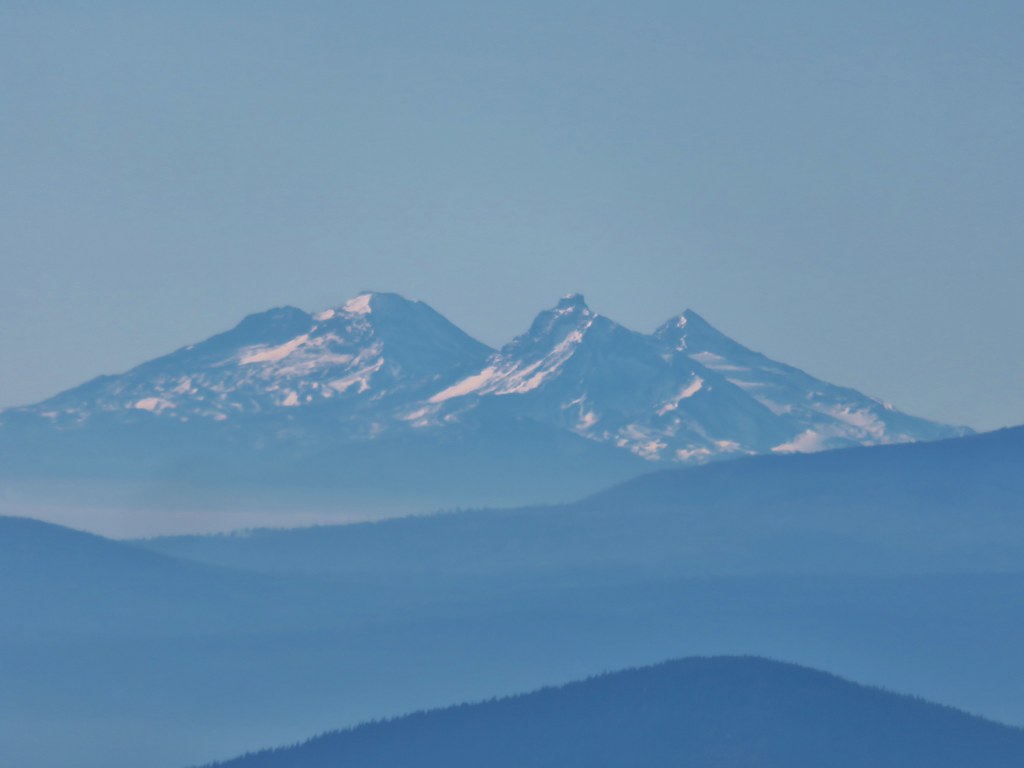
IMG_1001The Three Sisters

After a long break we started to get a little chilly just sitting up on the summit so we started back down. This time we stayed on the official trail and found the end of the High Prairie Loop that we’d missed on the way up.
IMG_1033

We had stopped briefly near a small talus field as we descended the switchbacks and Heather spotted a pika that was gathering tree bits, presumably getting ready to spend the winter underground.
IMG_1041

The pika wasn’t the only critter running around on the rocks.
IMG_1044

We made our way back through the still frosty meadows and returned to Gumjuwac Saddle.
IMG_1046

The saddle can be a bit confusing as several trails converge at Bennett Pass Road here. The Gumjuwac Trail coming up from Highway 35 crosses the road and continues down the other side to the Badger Creek Trail, the Divide Trail crosses the Gumjuwac Trail and descends to Badger Lake (we came up this way on the backpacking trip). We nearly started back down that trail this time before realizing that the trail to Gunsight Butte (the aptly named Gunsight Butte Trail) was on the other side of Bennett Pass Road.
IMG_1048

We headed up this trail which began a gradual climb through trees which included a few larches.
IMG_1053

IMG_1054

IMG_1093

IMG_1099

The trail emerged from the forest into a burn scar along a rocky ridge with a view.
IMG_1057

IMG_1058_stitch

IMG_1088Lookout Mountain from the Gunsight Butte Trail.

IMG_1062Clark’s nutcracker
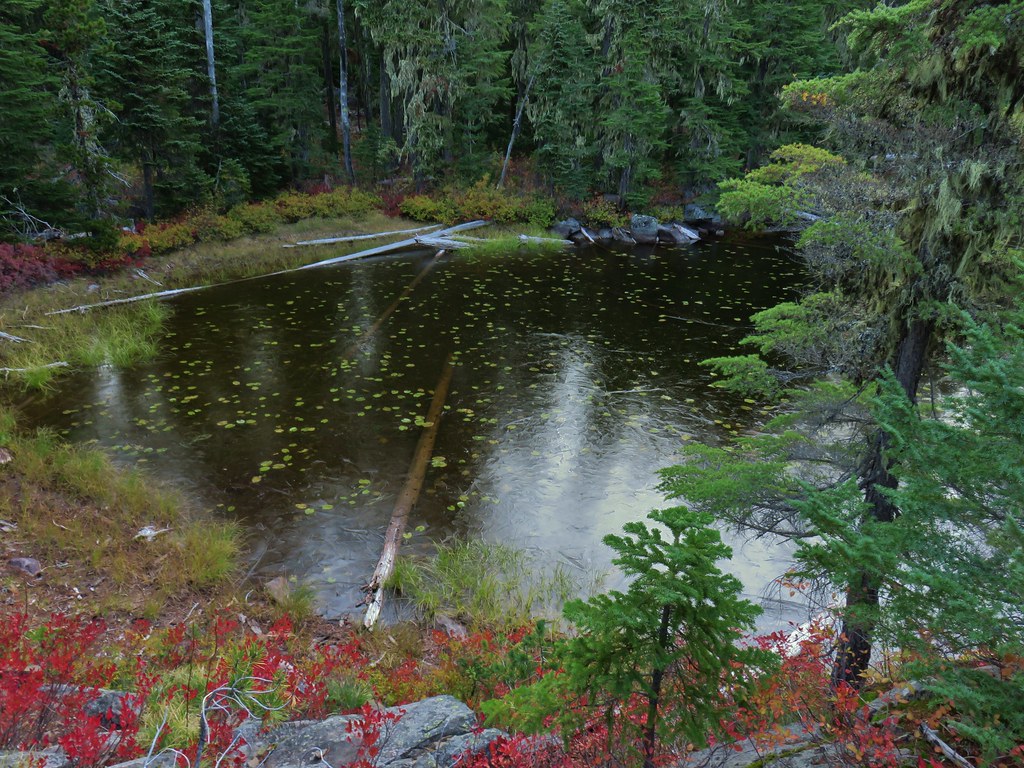
After a mile and a half we found ourselves crossing over the forested summit of Gunsight Butte. Another .1 miles, slightly downhill, brought us to a rock pile with yet another view of Mt. Hood.
IMG_1068

IMG_1069

IMG_1074

It wasn’t quite as impressive a view as Lookout Mountain but it was still pretty good. We returned to Gumjuwac Saddle and then turned down the Gumjuwac Trail for the final 2.5 miles of the day.
IMG_1102

We took our last looks at Mt. Hood from the trail then enjoyed the signs of Fall as we descended.
IMG_1107

IMG_1111

IMG_1112

IMG_1119

This was a 13.2 mile hike with around 3600′ of elevation gain making it a pretty good workout. This may have been our last viewpoint hike for the year, and if it is, it was a great one to end on. Happy Trails!

Flirck: Lookout Mountain and Gunsight Butte

Categories
High Cascades Hiking Mt. Jefferson Area Oregon Trip report

Lodgepole Loop – 10/12/2019

**Note the 2020 Lionshead Fire burned the area covered by this hike.**

We’re entering the time of year where the weather can be a real wildcard. A week earlier there was snow down to the mountain passes. There wasn’t any snow in the forecast but a continuously changing threat of cloudy conditions and rain showers kept us from deciding exactly where we’d be heading until the night before. A mostly cloudy but precipitation free forecast led us to our third hike of the year in the Olallie Lake Scenic Area for a lake filled hike where the presence of clouds would have minimal affect on the scenery.

Our plan was to follow a route suggested by Matt Reeder in his “101 Hikes in the Majestic Mount Jefferson Region” starting at the Olallie Meadows Campground and taking the Lodgepole Trail to the Red Lake Trail which we would then take east to the Pacific Crest Trail. Heading north on the PCT would bring us to the Russ Lake Trail. After a side trip to Russ and Jude Lakes we would take the Russ Lake Trail west to the Lodgepole Trail and return to Olallie Meadows. That was our plan anyway but it isn’t quite how things played out.

We parked at a trail sign at the end of the Olallie Meadows Campground and checked out the meadows while we waited for a little more light. The sky was fairly cloud free which was encouraging but it also meant that the overnight low of 35 that had been in the forecast was actually 27 (according to the car).
IMG_0442

IMG_0446

IMG_0447

We didn’t have to wait long and soon we were crunching along the trail. There was a lot of frozen moisture so every step sounded like we were crushing a bag of potato chips, it wasn’t a good sign for seeing any morning wildlife. A quarter mile from the trailhead we passed the Russ Lake Trail junction where we would be coming from on our return.
IMG_0452

For now we stayed straight enjoying the fall colors and traces of snow along the trail while we tried to keep some feeling in our fingers.
IMG_0455

IMG_0456

After a short climb the view ahead opened up to Olallie Butte which we’d climbed earlier in the year.(post)
IMG_0460

Three quarters of a mile from the Russ Lake Trail we arrived at another signed junction.
IMG_0463

We turned right here onto what turned out to be the Pacific Crest Trail (we didn’t notice the marker on a nearby tree on this first pass) following a pointer for Olallie Lake.
IMG_0464

Shortly afterward we began to realize something was amiss. Prior to setting off we had taken a last look at Reeder’s map and remembered that there was a short section of trail that we would not be hiking on if we did the loop the way we’d planned. What we didn’t remember was where that section was, but if we were already on the PCT it didn’t seem possible for there to be such a section so we differed to the book and realized that somewhere between the Russ Lake Trail and the PCT the Lodgepole Trail should have forked to the right and crossed Skyline Road near the Triangle Lake Horsecamp. Neither one of us remembered seeing anything that looked like a trail. We contemplated going back to look for it, but decided to just continue on in the opposite direction as planned.

We followed the PCT south passing a large dry lake then a small frozen one before crossing under a set of power lines and passing the Olallie Butte Trail in just under a mile.
IMG_0466

IMG_0472

IMG_0474

Another 2.2 miles on the PCT brought us more colorful foliage, another frozen pond, and a glimpse of Mt. Jefferson before arriving at Skyline Road just north of Olallie Lake (post).
IMG_0475

IMG_0480

IMG_0485

IMG_0491

IMG_0493

IMG_0494

IMG_0500

We crossed the road sticking to the PCT and stopped to take a look at Head Lake.
IMG_0508

IMG_0515

IMG_0523_stitch

Beyond Head Lake the PCT climbs for approximately a mile and a half to the Red Lake Trail junction. We had been on this section of the trail before (post) but on that day the clouds had restricted the views to the forest and ponds along the trail. In addition to the great fall colors on this trip we had some excellent views of Mt. Jefferson.
IMG_0532

IMG_0533

IMG_0535

IMG_0536Olallie Butte

IMG_0538

IMG_0553

IMG_0559Mt. Jefferson

IMG_0562Olallie Lake

IMG_0568

IMG_0564

IMG_0575Mt. Jefferson

We even had a rather obscured view of Mt. Hood for a moment.
IMG_0584

IMG_0585

At the junction with the Red Lake Trail we turned right onto that trail.
IMG_0587

IMG_0589

This trail was also familiar to us as including the unnamed lake below Twin Peaks.
IMG_0590

IMG_0591

IMG_0592

Beyond the lake the trail began a rocky descent to a junction with the Lodgepole Trail just over a mile from the PCT.
IMG_0594Potato Butte ahead.

IMG_0596

IMG_0597Lodgepole Trail junction.

Here we turned right back onto the Lodgepole Trail. We were back on new-to-us trail and in less than a quarter mile came to an unnamed lake on the left.
IMG_0606

IMG_0603One of the causes of the noisy steps.

Just over a quarter mile from the junction was Middle Lake on the right.
IMG_0612Twin Peaks on the other side of Middle Lake.

IMG_0616Colors along Middle Lake.

Next up was supposed to be a short out and back to Gifford Lakes on a trail located somewhere between Middle and Lower Lakes. We missed the unmarked trail on our first pass, but realized it fairly quickly when a GPS check showed we were closer to Lower Lake than we should have been. (For the record it’s about a quarter mile from Middle Lake.) We turned around and headed back the way we’d come looking for yet another trail we’d missed. I had an idea of where we’d missed it having noticed some logs and branches that looked like it could have been over an old trail. Sure enough that turned out to be the spot, but between the wood and snow it had been really easy to miss.
IMG_0622

A .2 mile detour brought us to the larger of the two Gifford Lakes. We had heard that this was probably the prettiest lake in the area and we wouldn’t argue that.
IMG_0624

IMG_0625

IMG_0630Olallie Butte

IMG_0636

IMG_0643

IMG_0648Twin Peaks from Gifford Lake.

IMG_0664

A trail to the left around the lake led to a ridge between the two Gifford Lakes. The smaller lake didn’t have the views that its larger neighbor enjoyed but it was scenic nonetheless.
IMG_0669

IMG_0678

IMG_0670

After exploring the lakes and a snack break we returned to the Lodgepole Trail and turned right to continue on our loop. We came to another junction about .4 miles from the trail to Gifford Lakes.
IMG_0702

Here the Lodgepole Trail continued straight crossing the Fish Lake Trail. We turned briefly down the Fish Lake Trail to take a quick look at Lower Lake before continuing on.
IMG_0704Sign for the Fish Lake Trail.

IMG_0705Lower Lake

IMG_0707Olallie Butte

IMG_0713Sign for the Lodgepole Trail.

The trail dropped to a meadow then reentered the forest and climbed to a ridge top .8 miles from the junction.
IMG_0714

IMG_0716

IMG_0719Pinedrops

IMG_0729

IMG_0731The trail was actually the fainter track to the left leading to the bridge, but that wasn’t obvious until we reached the trees.

IMG_0733A lone yarrow.

IMG_0737

After cresting the ridge the trail dropped to a dry crossing of the Clackamas River.
IMG_0746

Approximately two miles from the Fish Lake Trail we found ourselves passing back under the power lines.
IMG_0749

Another mile of fairly level trail brought us to Triangle Lake.
IMG_0752

IMG_0756

IMG_0761

After passing the lake and horse camp we quickly found ourselves crossing Skyline Road again.
IMG_0764

We were really interested in seeing where we were going to meet up with the trail from that morning. Our answer came in less than 100 yards when the clear trail we were on arrived at a junction. A small tree was lying across the trail but the tread was rather obvious. We decided we must have been focused on the hill that was just beyond the junction and not looking at that side of the trail because it was hard to miss.
IMG_0766Approaching the junction.

IMG_0767Quite the camouflage isn’t it?

We turned right climbing the little hill, for the second time that day, and in a tenth of a mile were back at the Pacific Crest Trail. This time we turned left following the Jude Lake pointer.
IMG_0768

The PCT entered the Warm Springs Reservation before arriving at the Russ Lake Trail in a third of a mile.
IMG_0771

IMG_0772

Here we turned right on the Russ Lake Trail (which was not signed).
IMG_0773

The trail passed a small pond after a tenth of a mile and the southern end of Jude Lake after two tenths before arriving at Russ Lake a little of a third of a mile from the junction. (Please note that fishing is not allowed on the Reservation without a permit.)
IMG_0774Jude Lake

IMG_0775Jude Lake

IMG_0776Jude Lake

IMG_0786Russ Lake

IMG_0782

IMG_0801

We watched the ducks on Russ Lake for a bit before heading back. It wasn’t until we were passing Jude Lake again that we actually realized that it was Jude Lake which allowed us to skip a short out and back north on the PCT to see the other side of that lake. Having seen Jude Lake we stayed on the Russ Lake Trail when we got back to the PCT junction and in a tenth of a mile turned right on a short unsiged spur trail to Brook Lake.
IMG_0803

IMG_0805

IMG_0808

From Book Lake it was another .2 miles to the Lodgepole Trail and about the same back to Olallie Meadows.
IMG_0811

IMG_0813

We were anticipating a 13.2 mile loop (per Reeder) but a little extra exploring, missing the Gifford Lakes Trail, and screwing up the route to begin with we ended our day just over 14 miles. It turned out to be a really nice day (after our hands warmed up) with a lot of nice scenery. We only ran into a single pair of backpackers during the hike although there were a number of vehicles on Skyline Road both in the morning and on our drive out. The Olallie Lake Scenic Area is definately a great place for late Summer/Fall hiking. Happy Trails!

Flickr: Lodgepole Loop