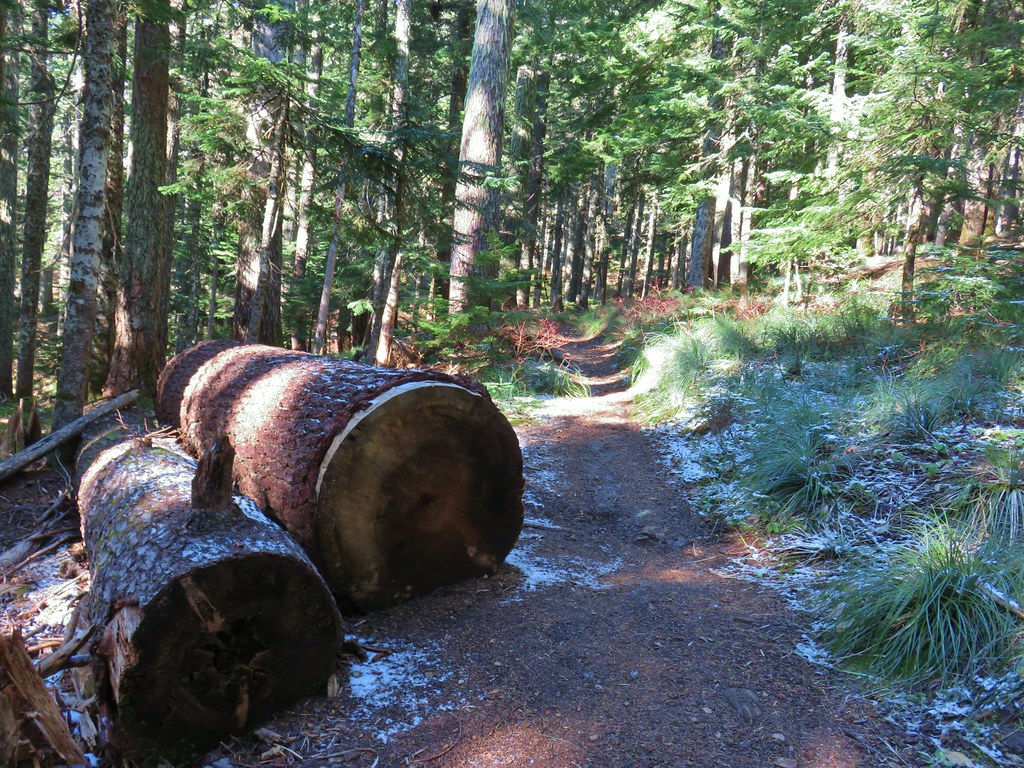
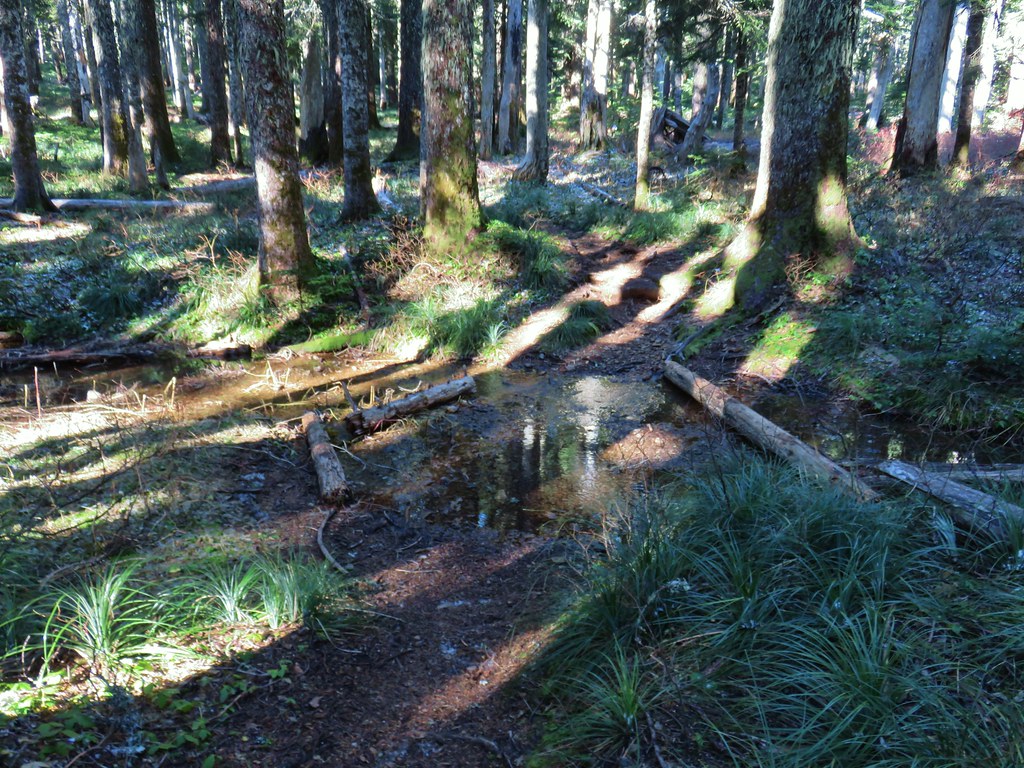
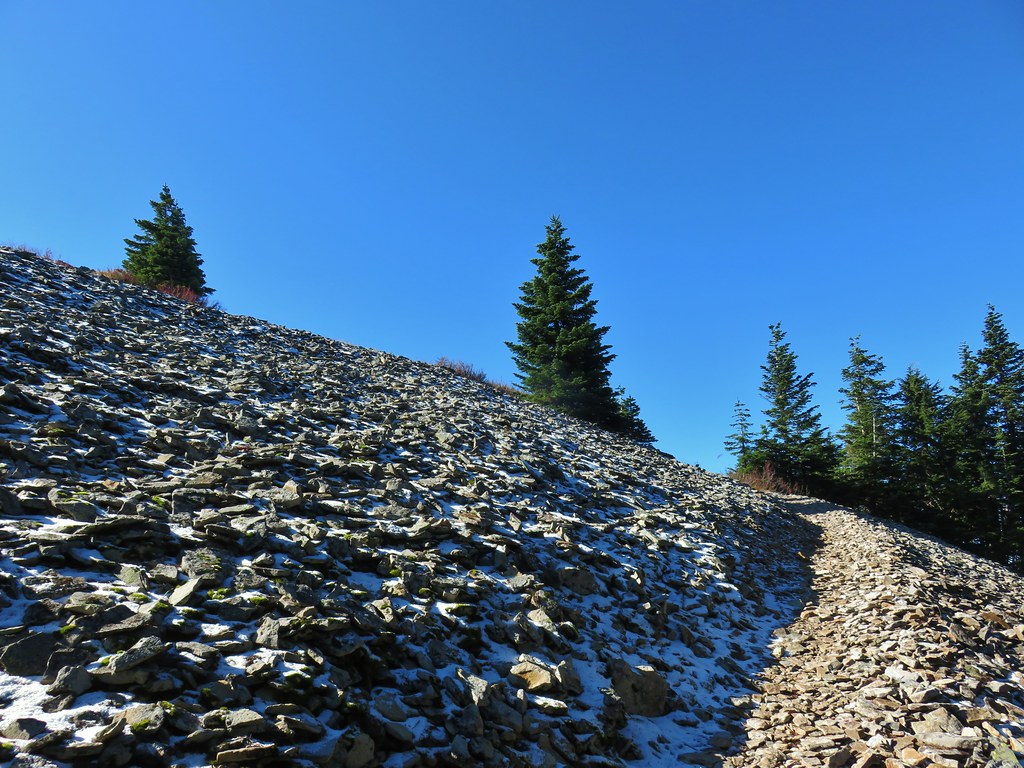
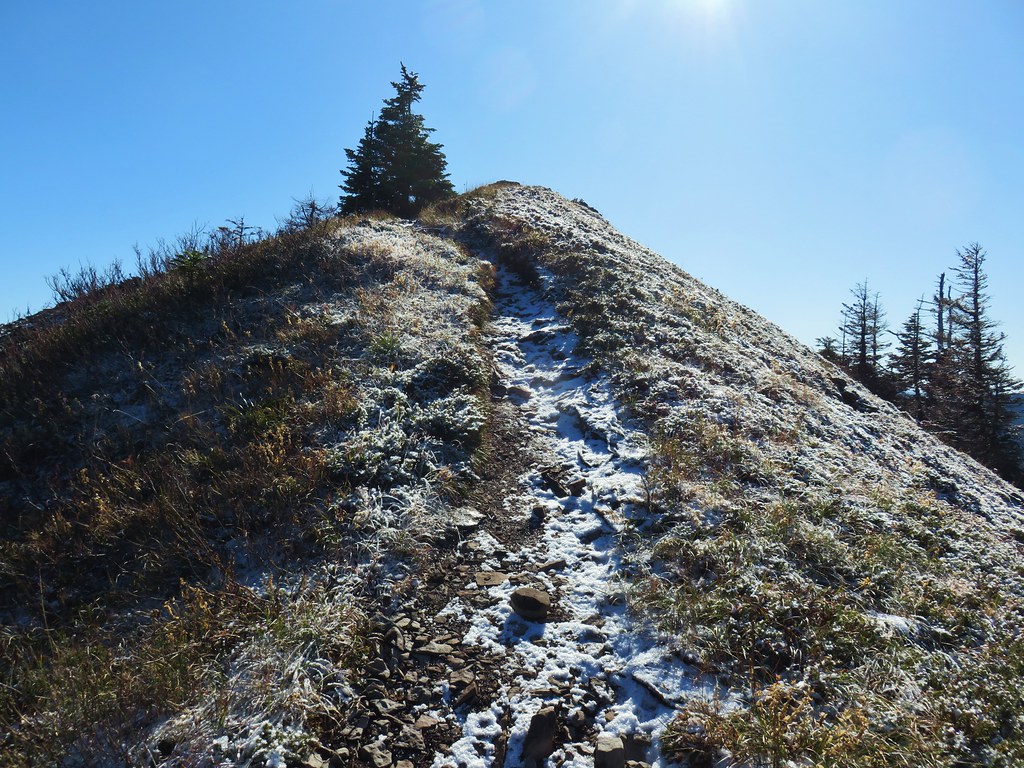
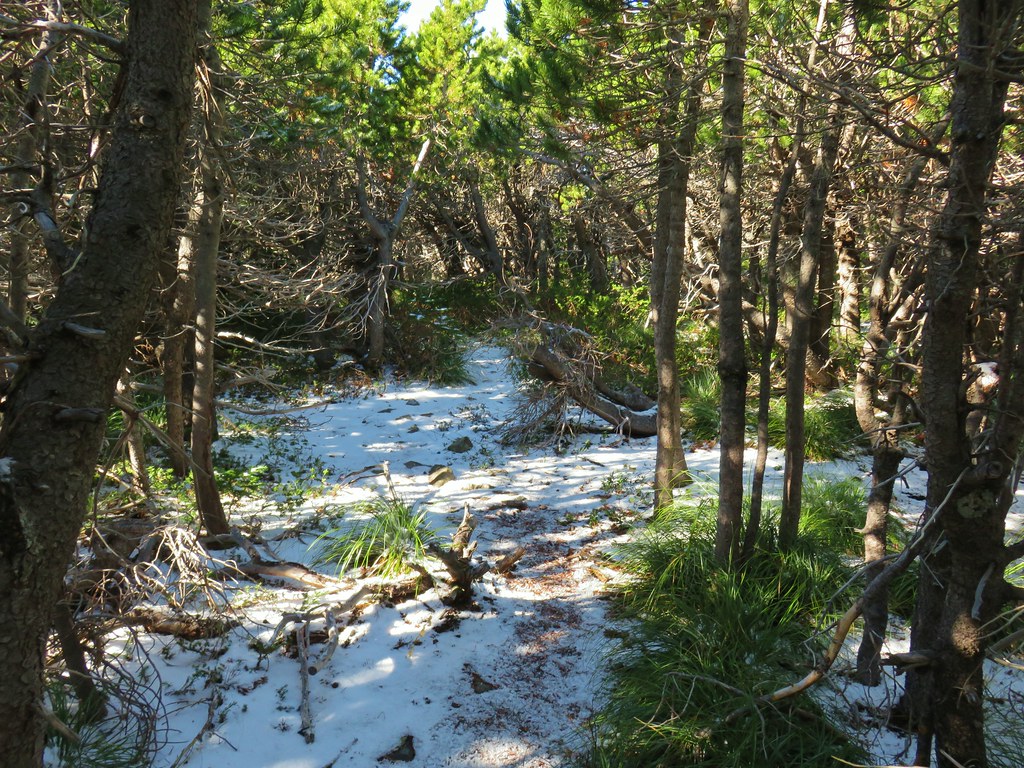
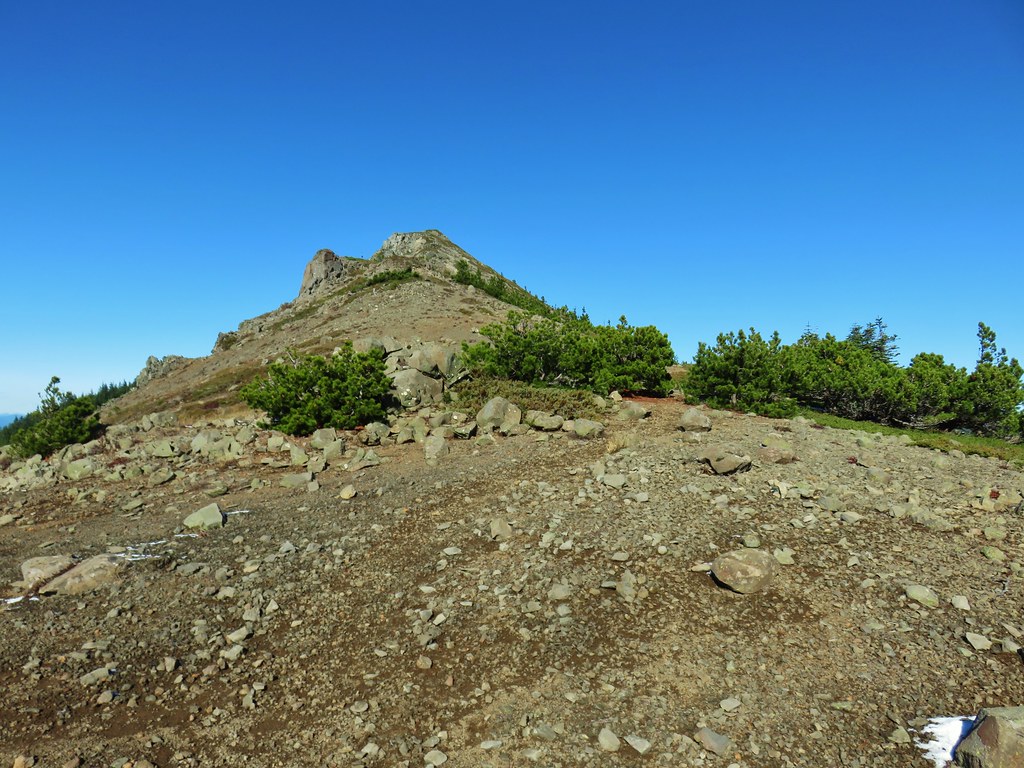
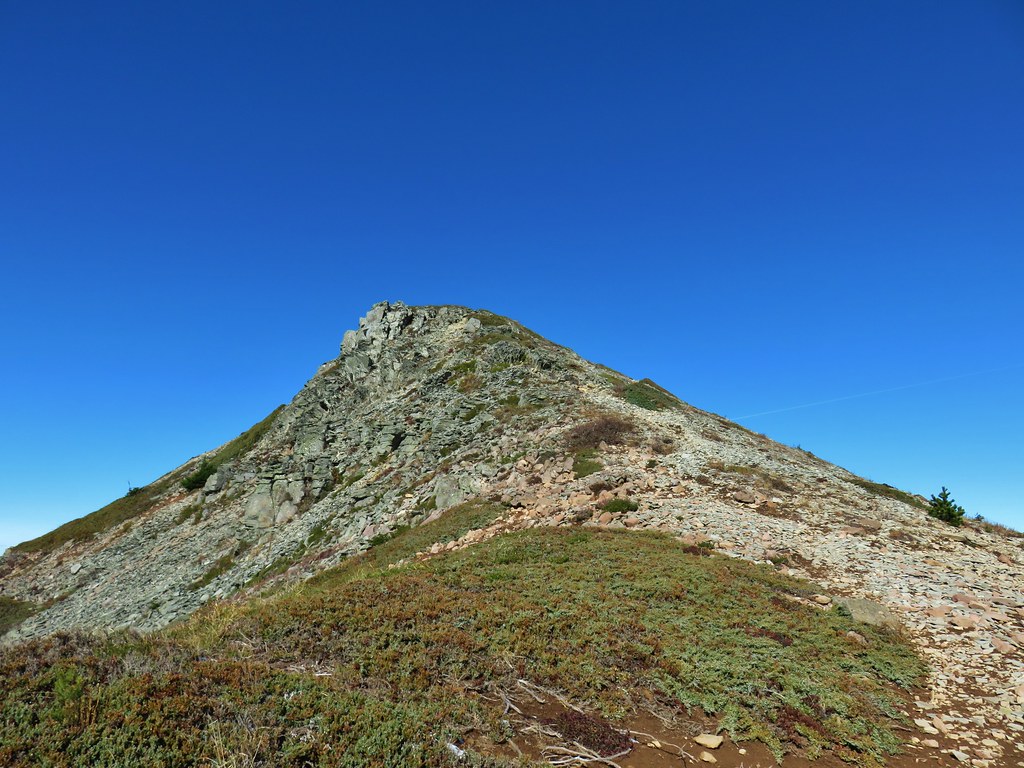
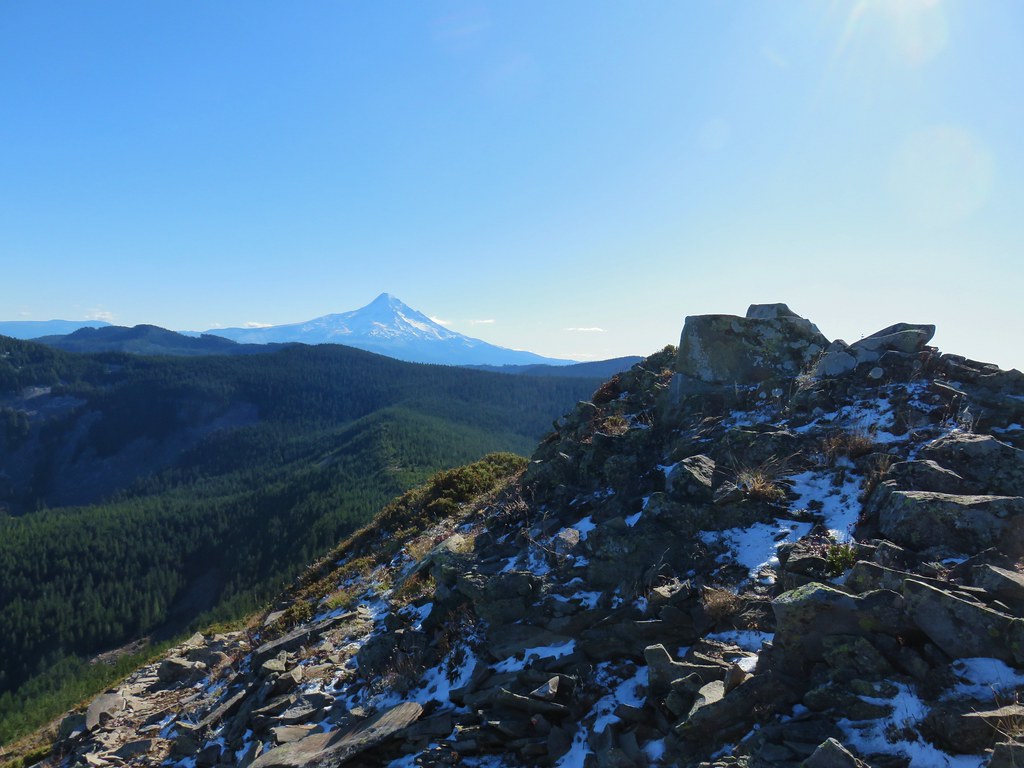
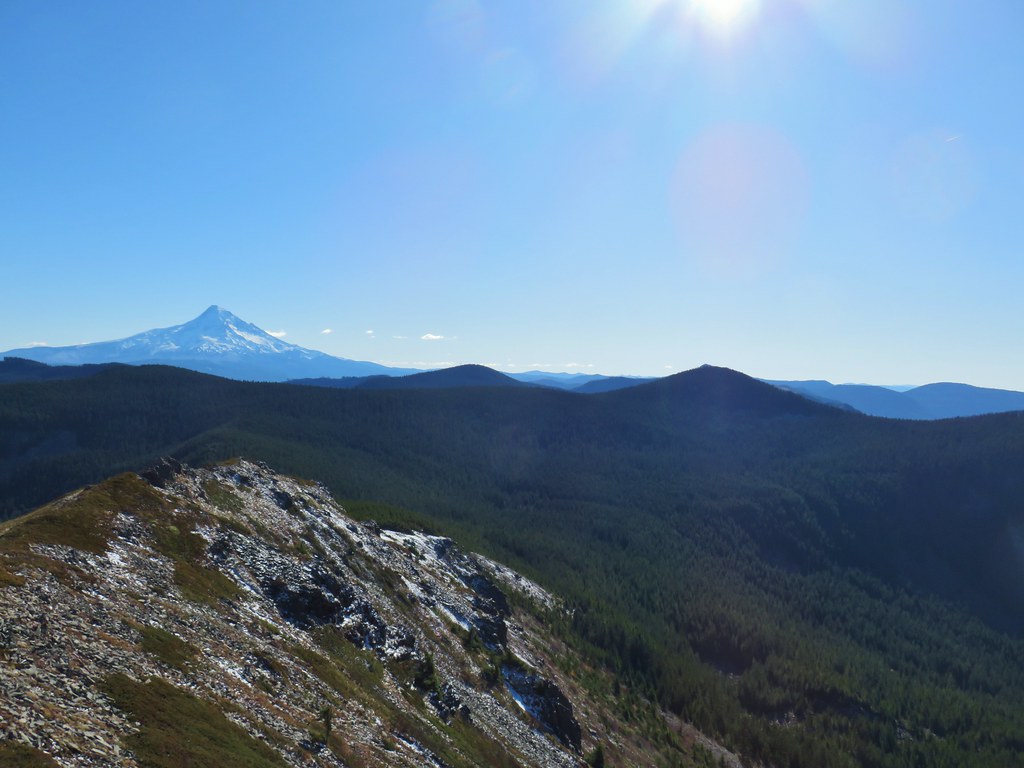
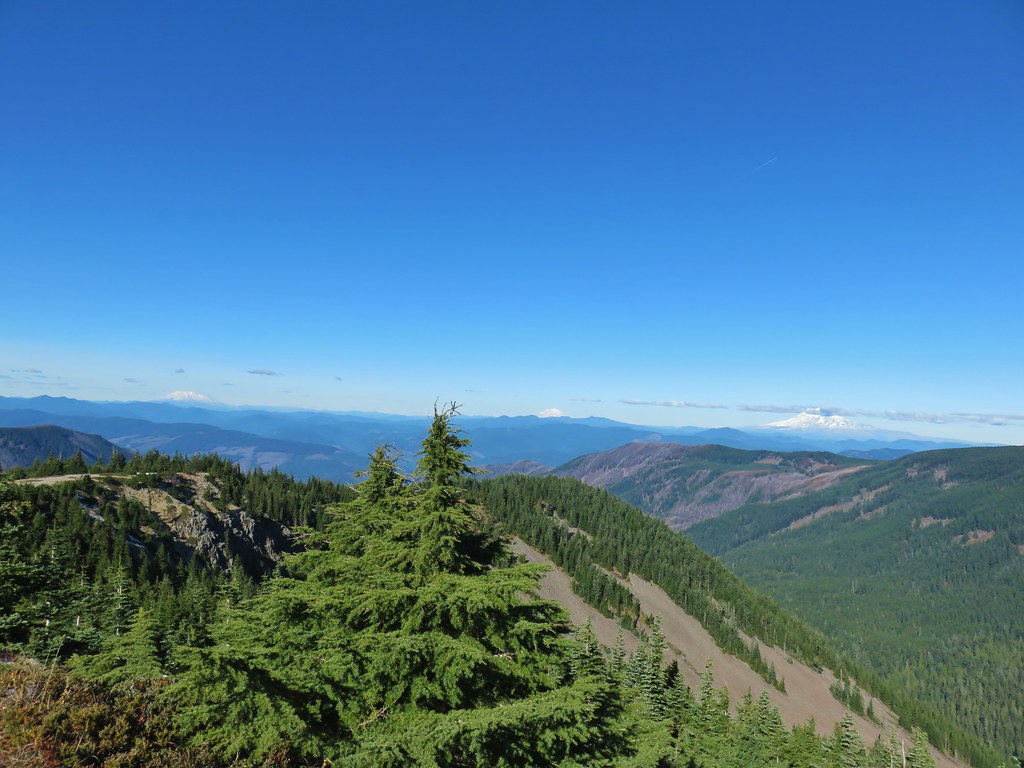
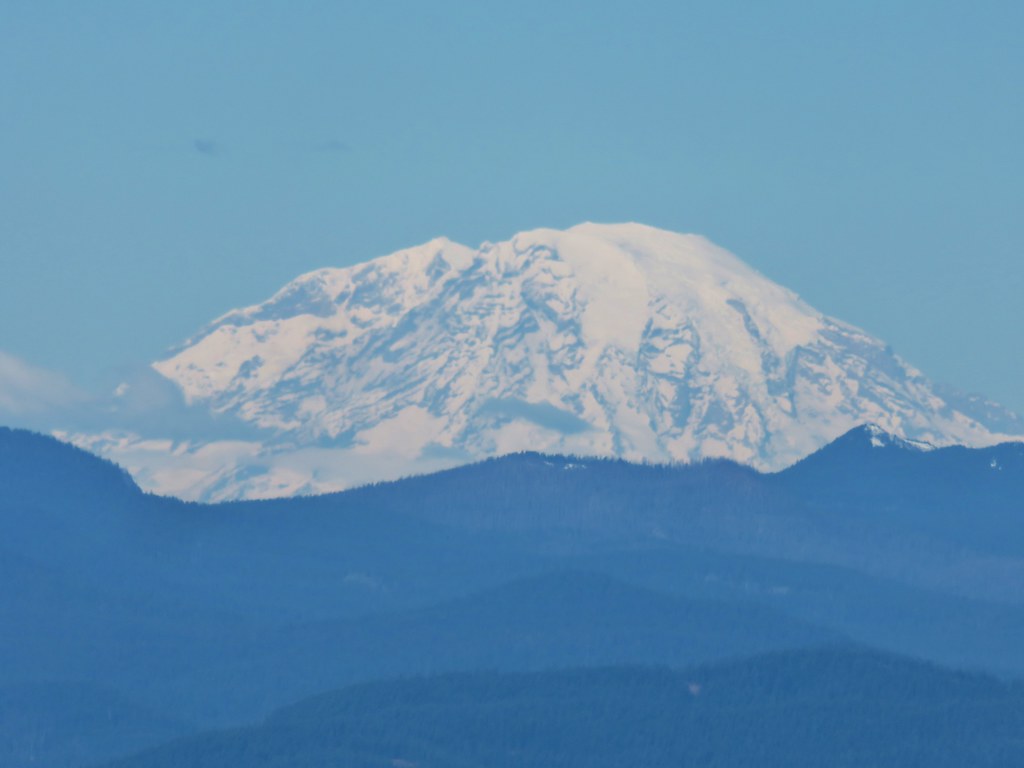
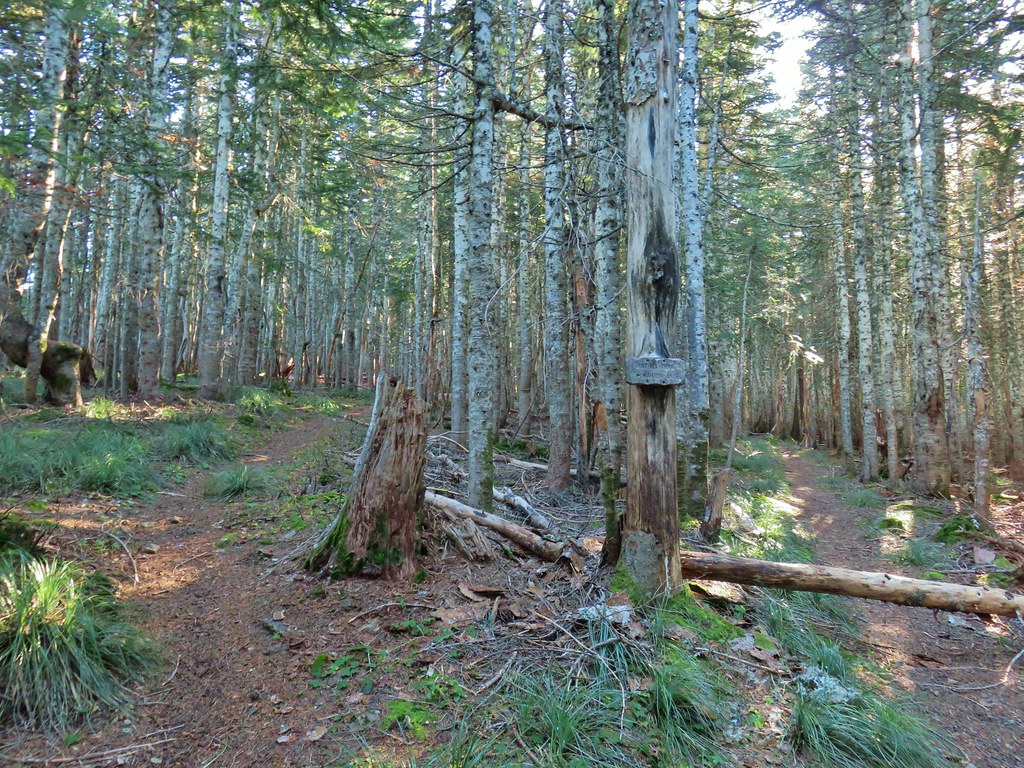
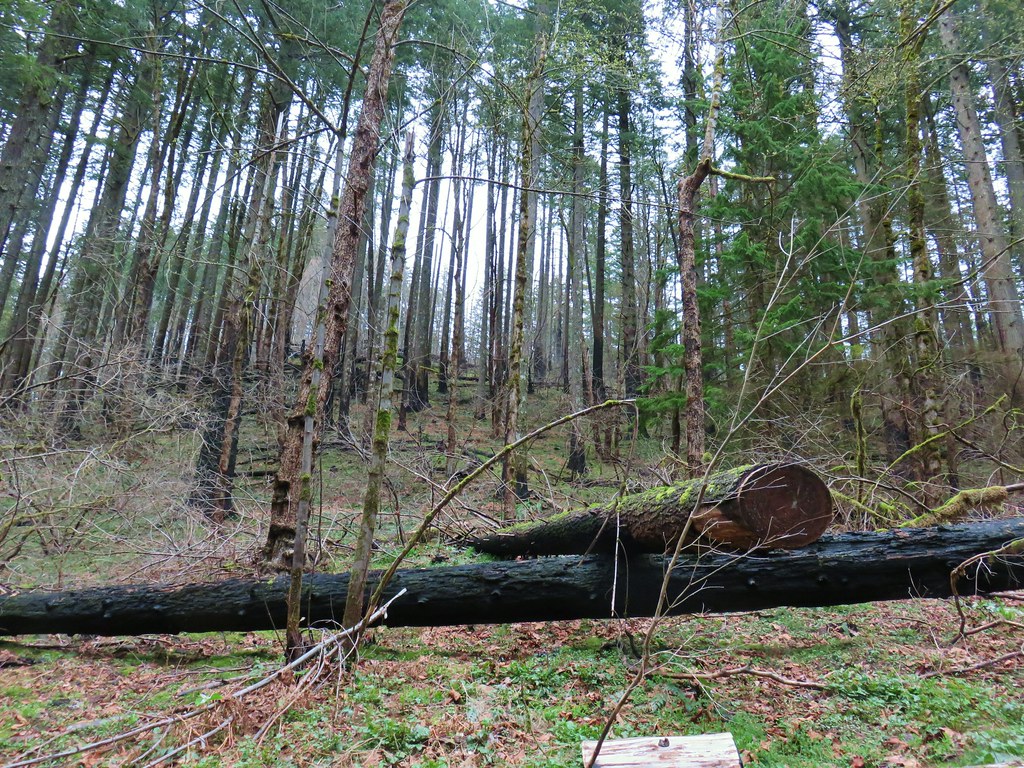
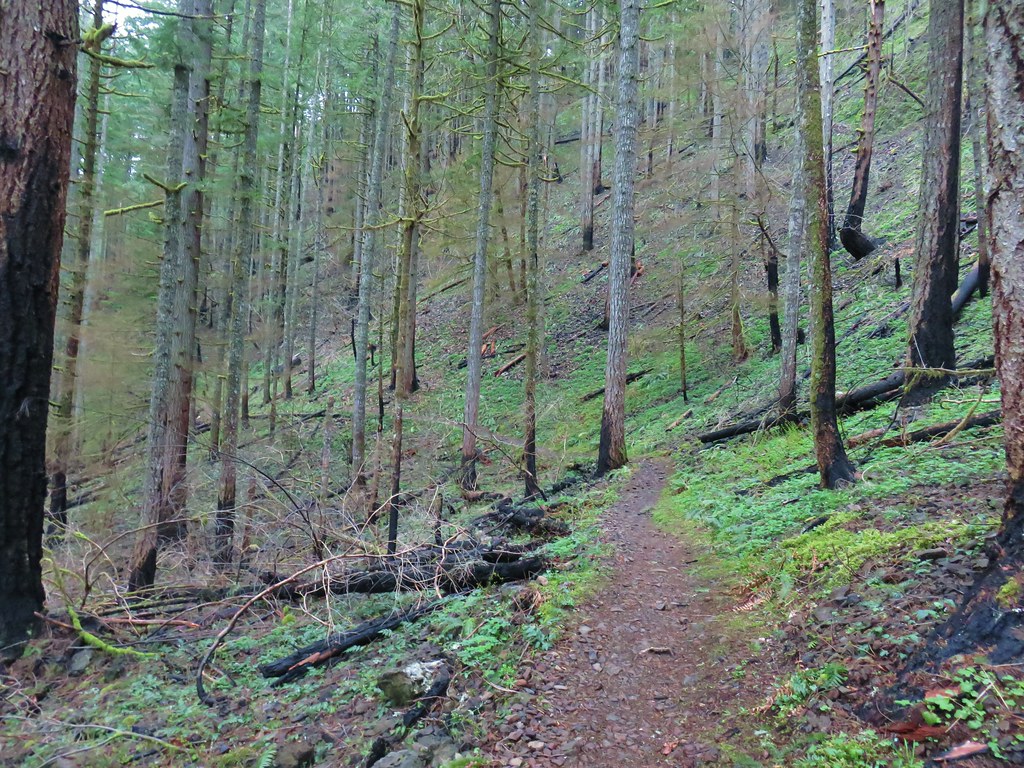
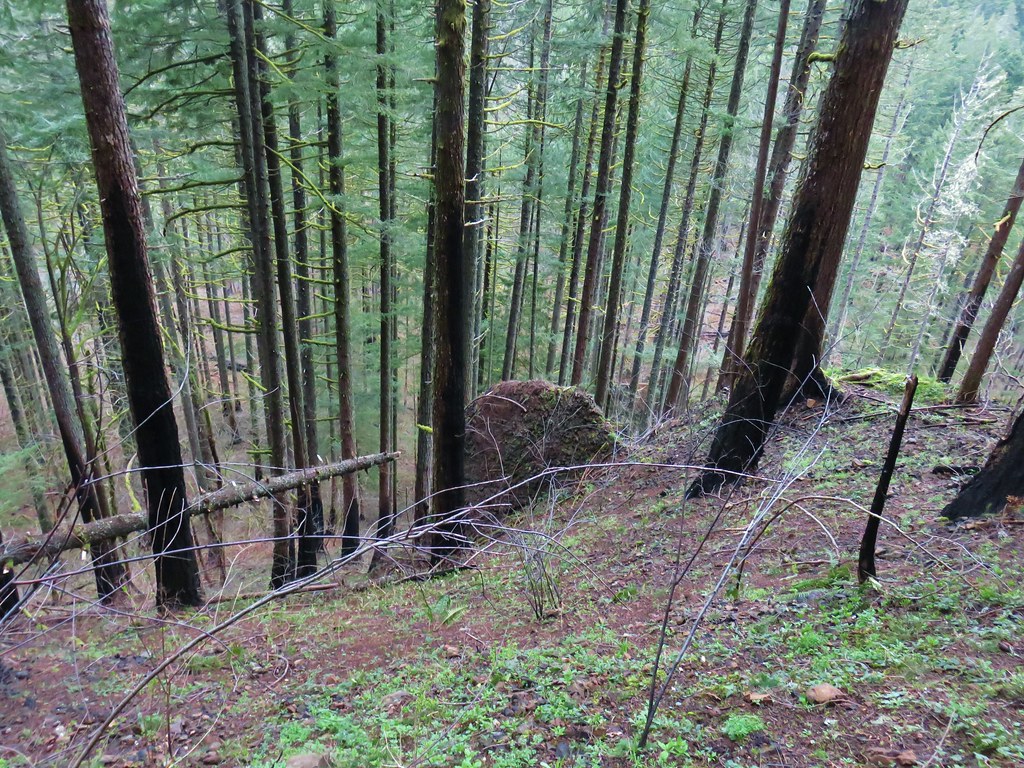
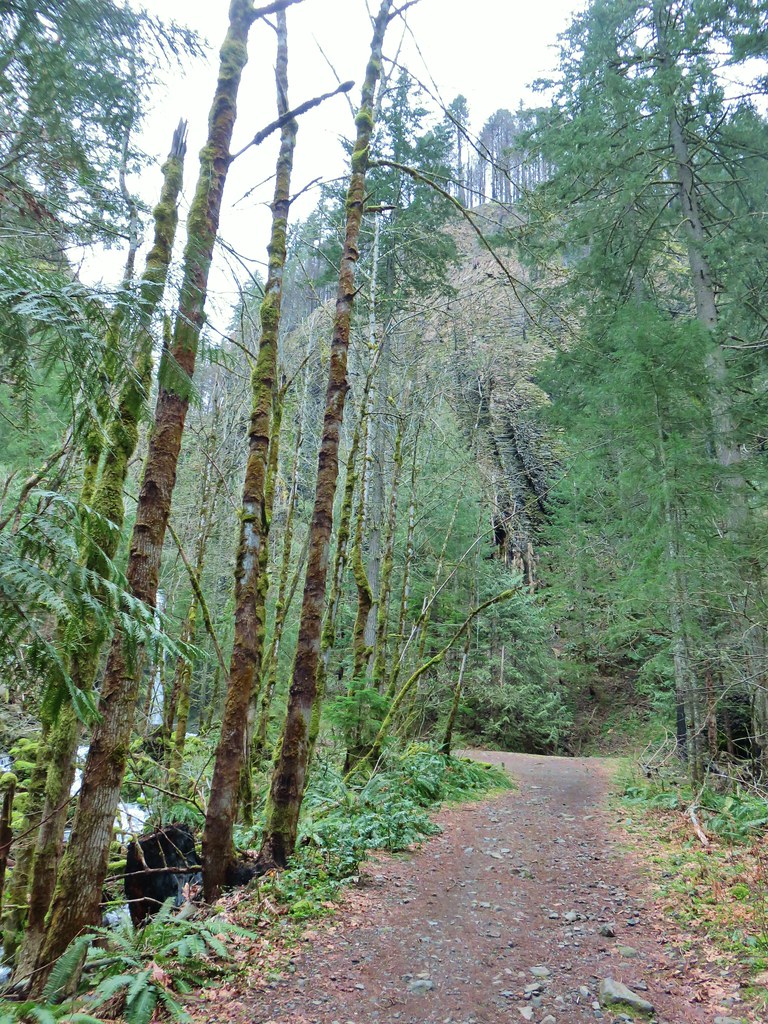
Categories
Columbia River Gorge South Hiking Oregon Trip report

Benson Plateau via the Herman Creek – 09/15/2025

I began my final solo vacation of the year with a visit to the Columbia River Gorge National Recreation Area and the Mark O. Hatfield Wilderness. My plan was based on an entry in Matt Reeder’s “PDX Hiking 365” (1st edition) guidebook.

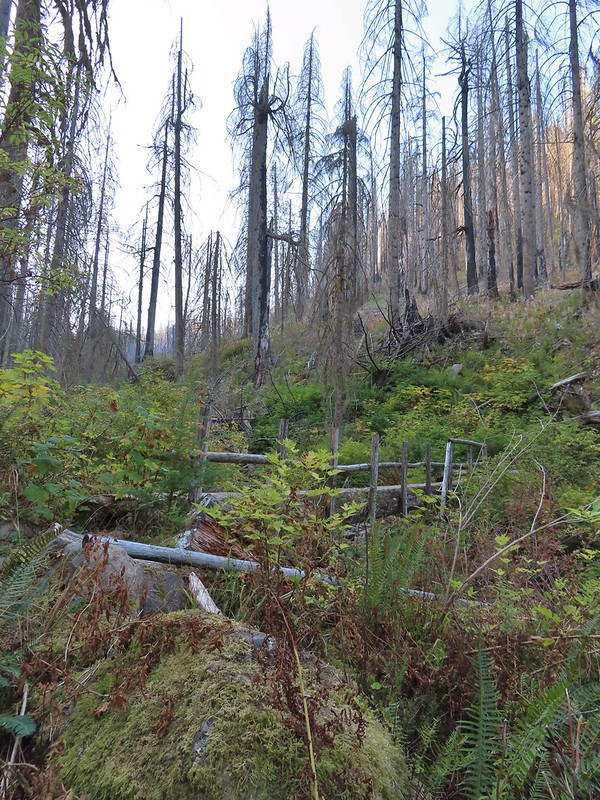
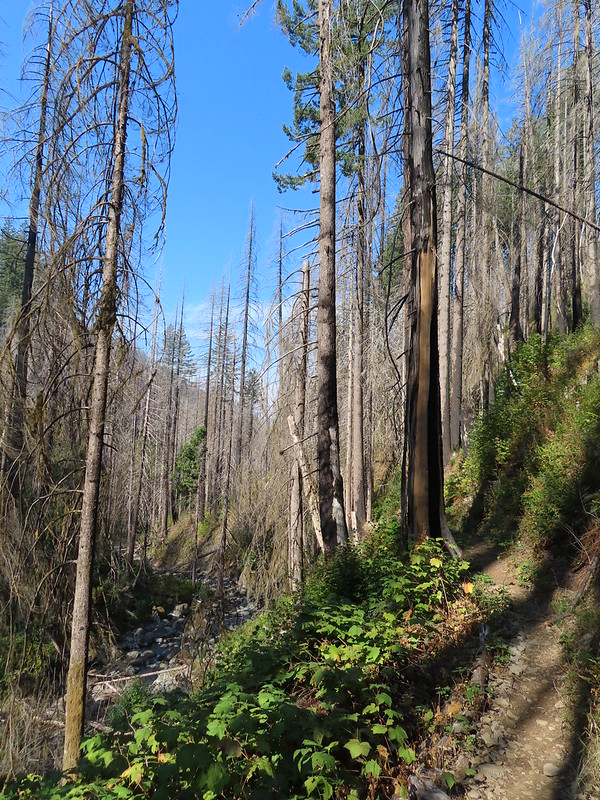
He describes a 14-mile out and back hike to the Plateau starting at the Herman Creek Trailhead with a cumulative elevation gain of 3800′. Most of the hike passes through the 2017 Eagle Creek Fire scar using the Herman Creek, Herman Creek Bridge, and Pacific Crest Trails.

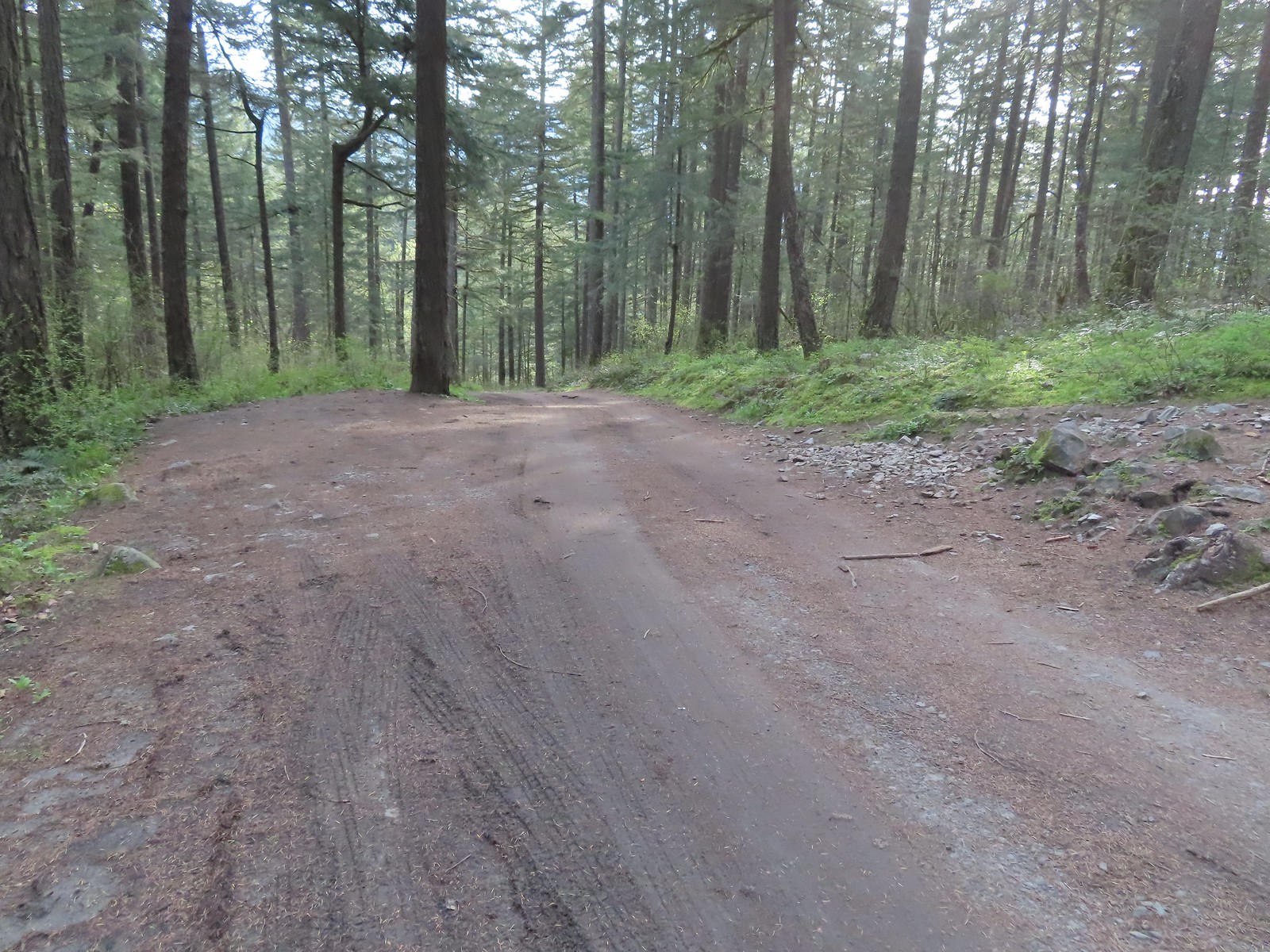
I arrived at the trailhead before sunrise due to wanting to get through Portland traffic before 6am.
IMG_0468

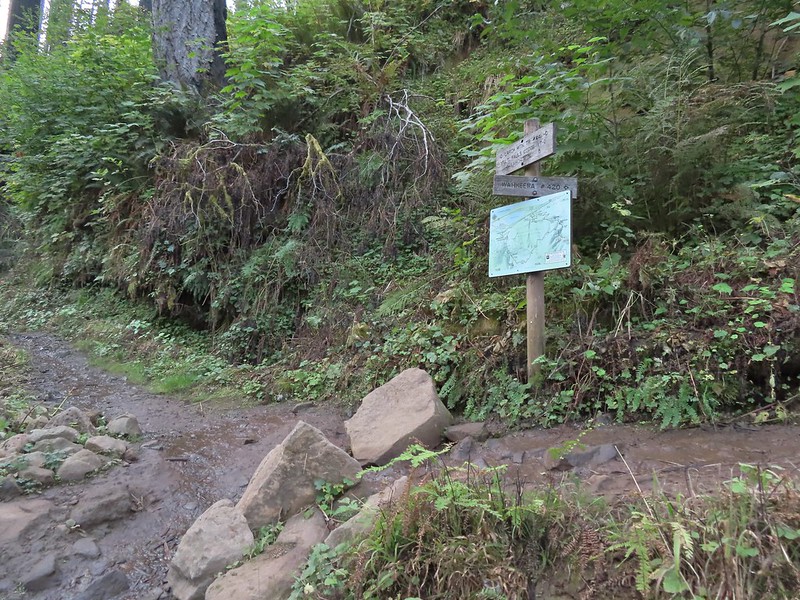
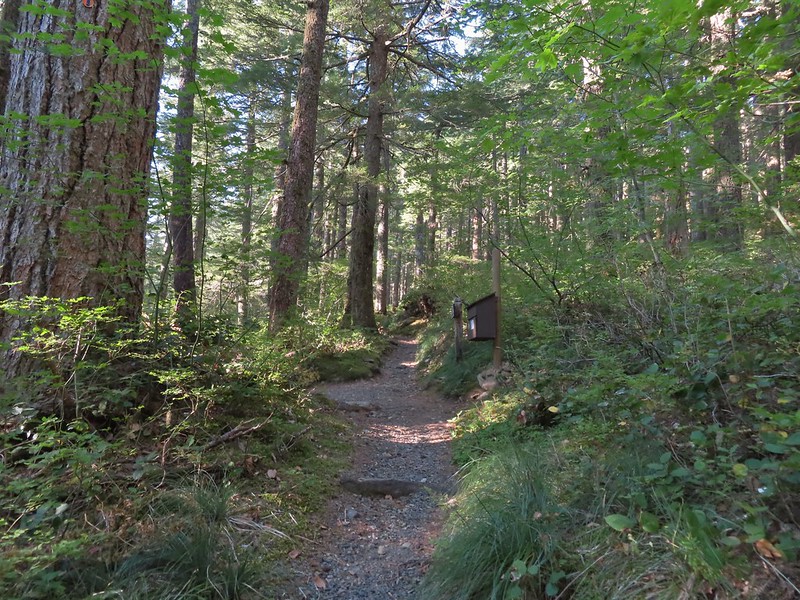
There were a few important pieces of information at the trailhead signboard.
IMG_0470
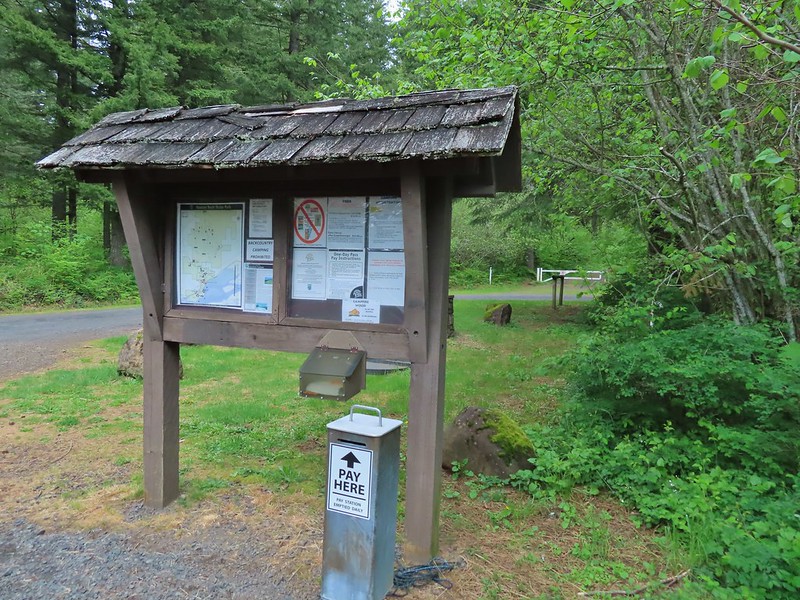
Important information included the need of a NW Forest Pass to park at the trailhead, that there is currently a campfire ban, and no fireworks are allowed (illegal use of fireworks started the Eagle Creek Fire).

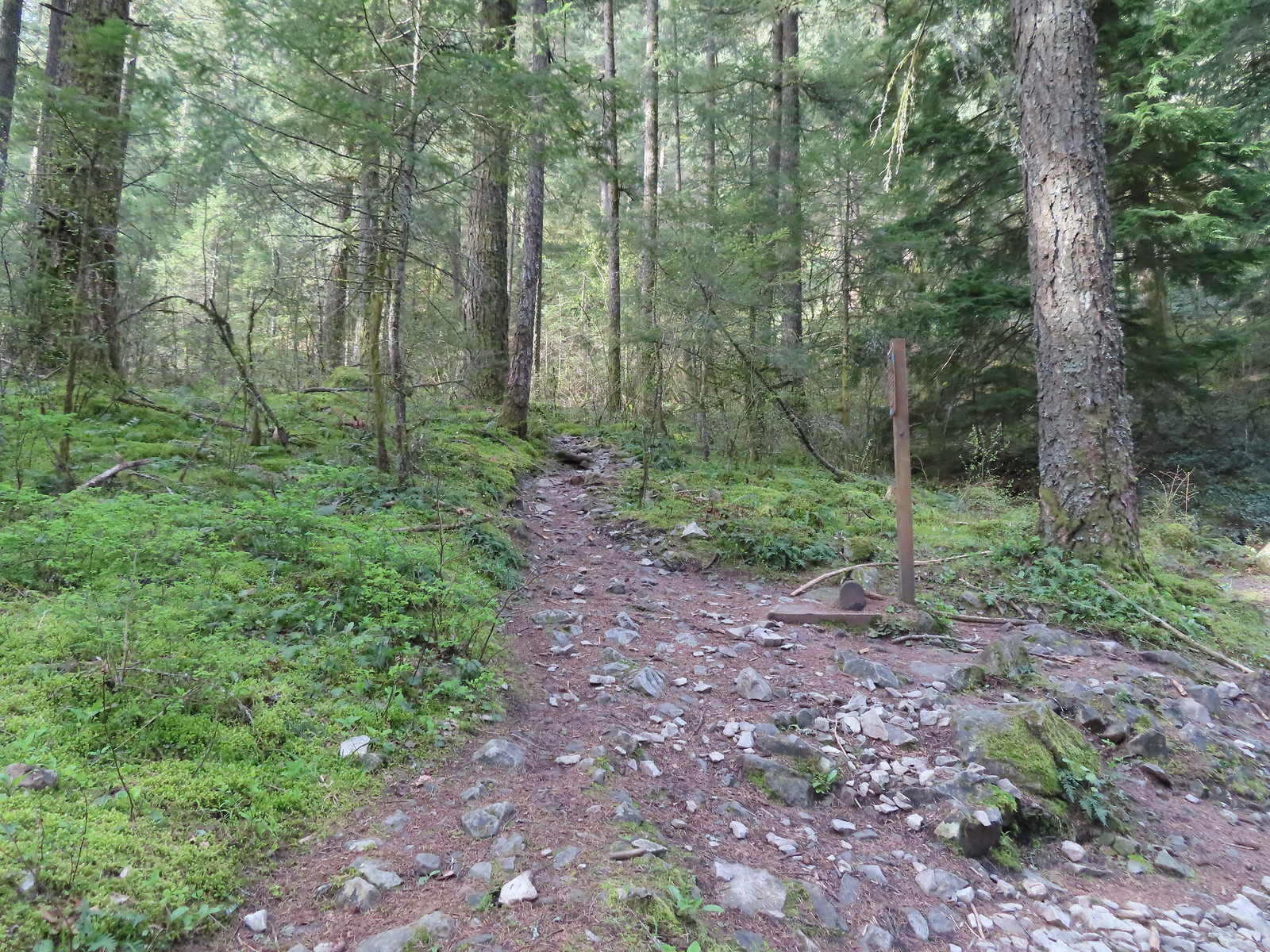
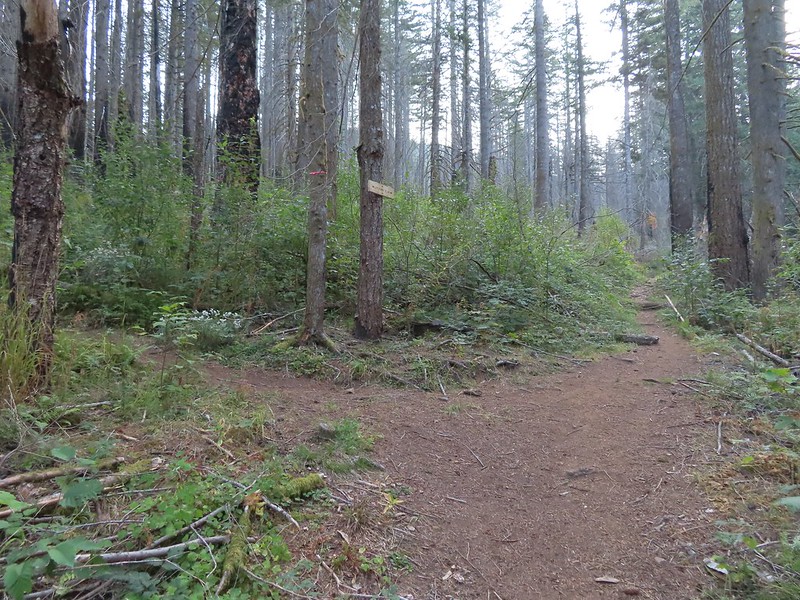
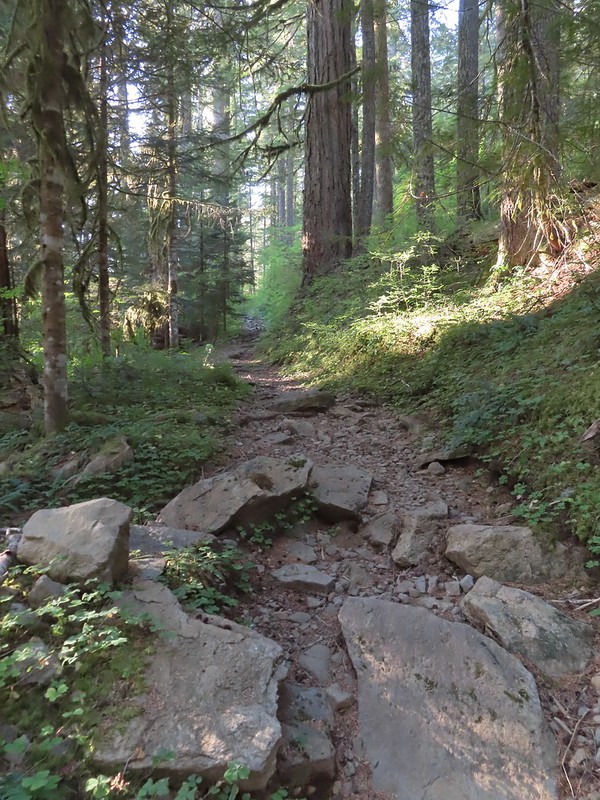
I set off on the Herman Creek Trail and followed it uphill passing under a powerline corridor to a junction with the Herman Creek Bridge Trail at the 0.6-mile mark.
IMG_0471

IMG_0476

IMG_0479

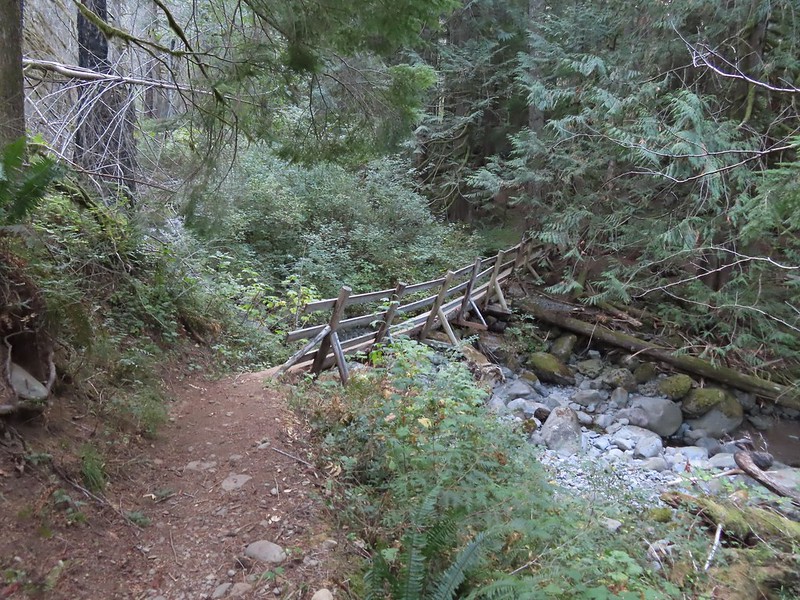
I forked right onto the 1.1-mile-long Herman Creek Bridge Trail which descended to the Herman Creek Bridge then climbed to a junction with the Pacific Crest Trail (PCT).
IMG_0481

IMG_0483

IMG_0484

IMG_0485

IMG_0486
Herman Creek

IMG_0489
Climbing toward the PCT. Note the red leaves on the left which is poison oak. There was a fair amount of poison oak along the lower portion of this hike. There were a couple of spots where I had to get small to squeeze between some of it, but I was able to avoid it by staying alert.

IMG_0490
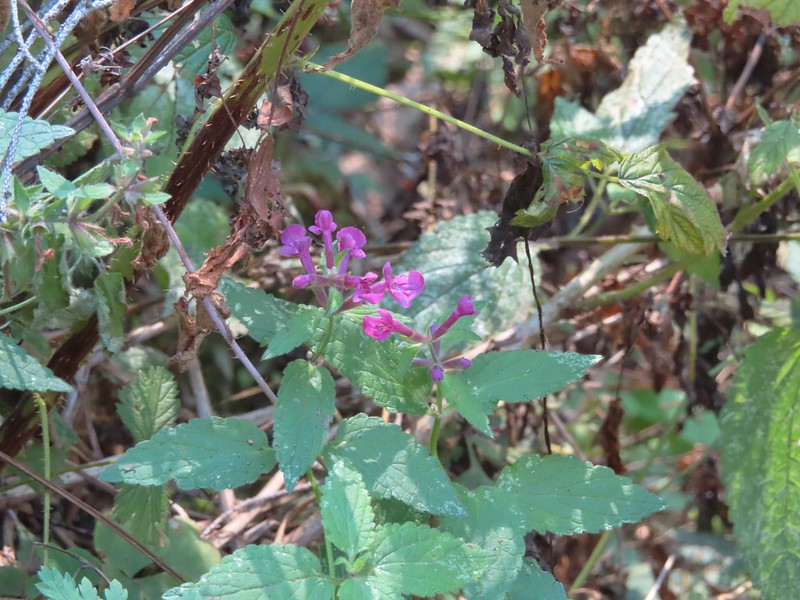
Beardtongue

IMG_0495
More poison oak. With it turning red for the Fall most of it was easy to spot.

IMG_0496
First pika sighting of the day. (Can you spot it?)

IMG_0497
The Columbia River Gorge is the lowest elevation at which pikas live. These members of the rabbit family require temperatures below 78 degrees and primarily live at higher elevations with longer snowy seasons during which they live underground surviving on greens collected during summer months.

IMG_0501
The Moon above cliffs.

IMG_0503
The junction with the PCT. The hike up to this point had retraced part of our 2015 to Pacific Crest Falls (post).

In 2015 we had gone right to visit the waterfall, but this time I turned left on the PCT which quickly entered the Mark O. Hatfield Wilderness.
IMG_0504

From the junction it was a nearly constant 5-mile climb to Benson Plateau. There were a couple of small saddles that provided a little up and down near the plateau but otherwise it was a steady but never steep climb.
IMG_0506
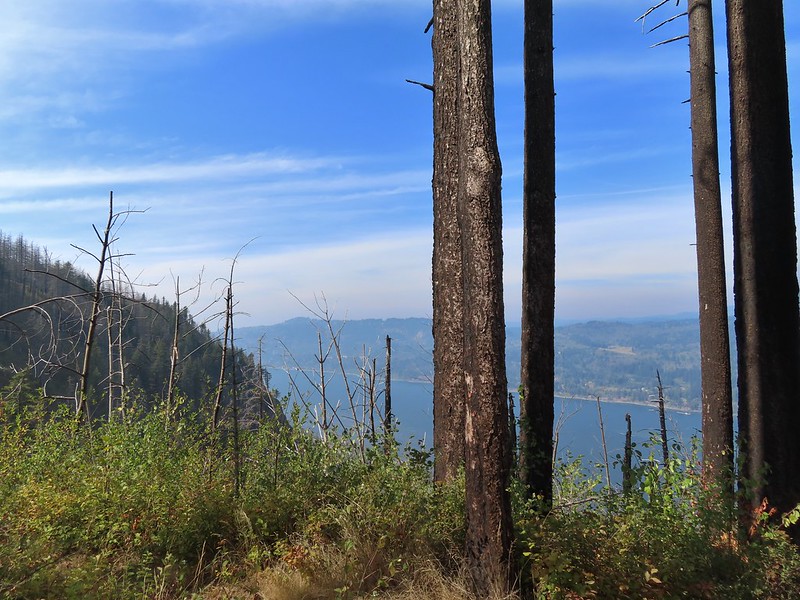
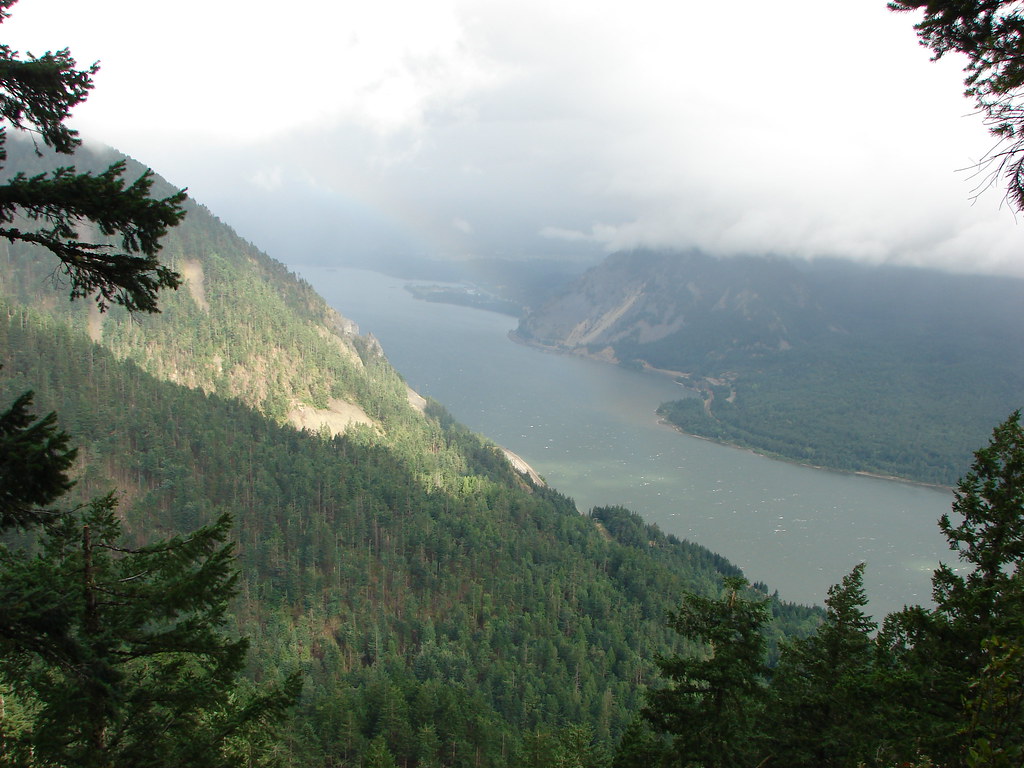
First good viewpoint across the Columbia River.

IMG_0510
Another pika. I heard several but only spotted three or four.

IMG_0514
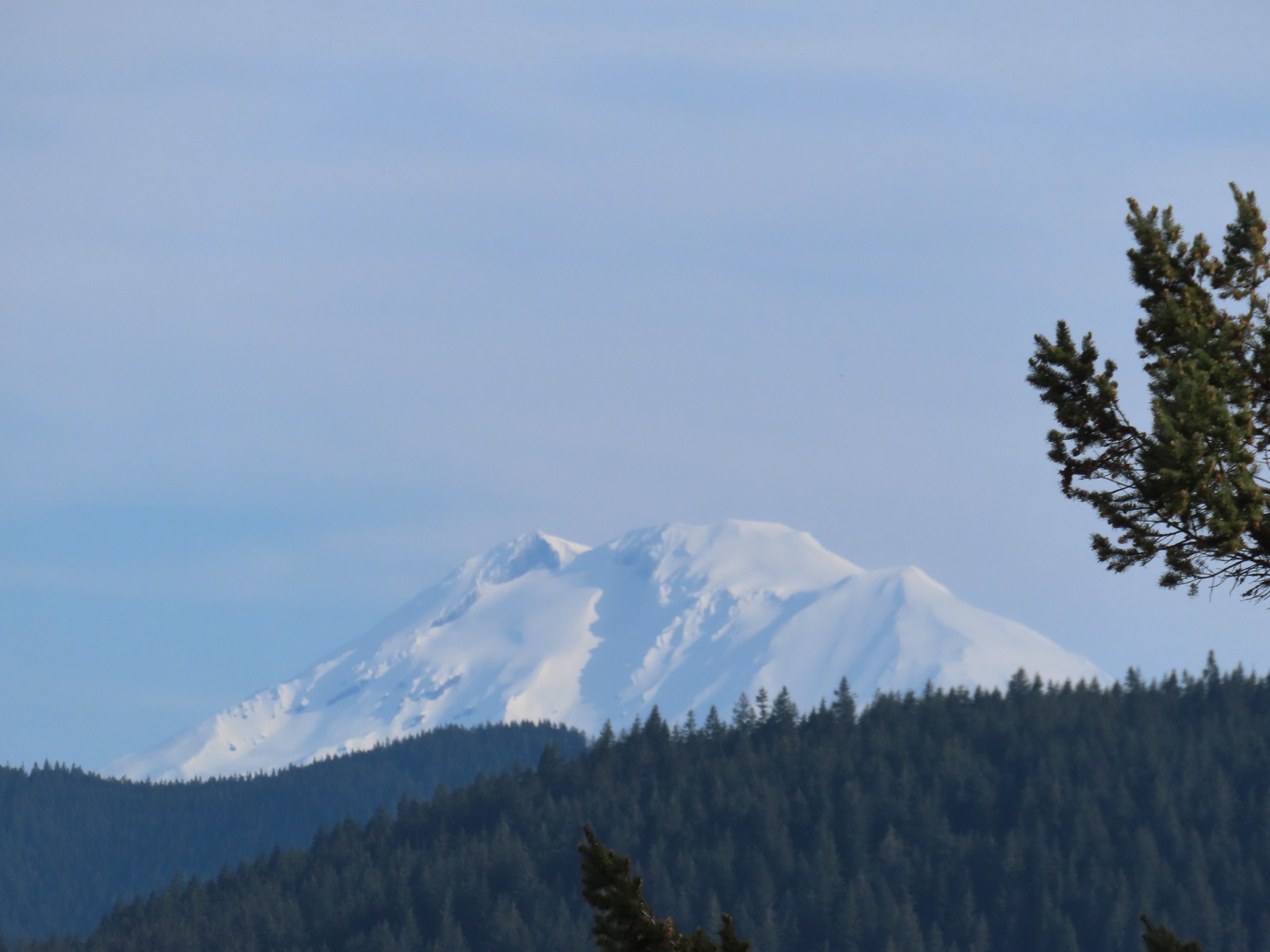
The summit of Mt. Adams peaking over the ridge across the river.

IMG_0518
Table Mountain (post) on the left and Greenleaf Peak (post) on the right.

IMG_0523
The amount of poison oak lessened as the trail climbed giving way to friendlier greenery.

IMG_0524
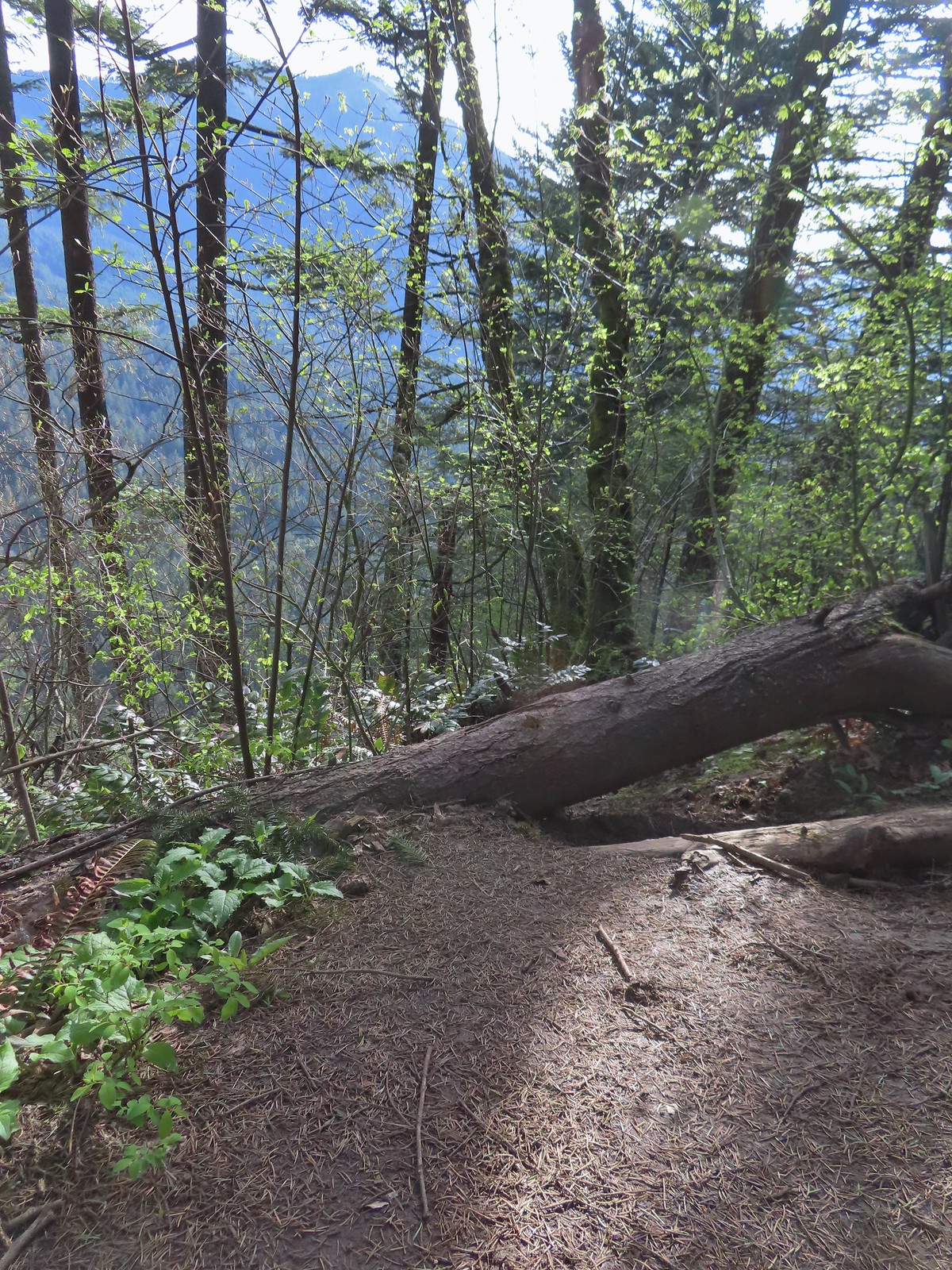
One of two large trees over the trail. This one required the removal of my pack so that I could crawl under. The other one was just enough smaller that it could be climbed over.

IMG_0526
View along the trail.

IMG_0527

IMG_0528
A little more of Mt. Adams showing.

IMG_0532
Heading into the sunlight.

IMG_0534
Grouse on the PCT. There wound up being at least 5 or 6 grouse nearby.

IMG_0537
Grouse in a tree.

IMG_0539
The tree I climbed over.

IMG_0541
There were a few overgrown sections, but fortunately they were high enough up that the poison oak was no longer an issue.

IMG_0545
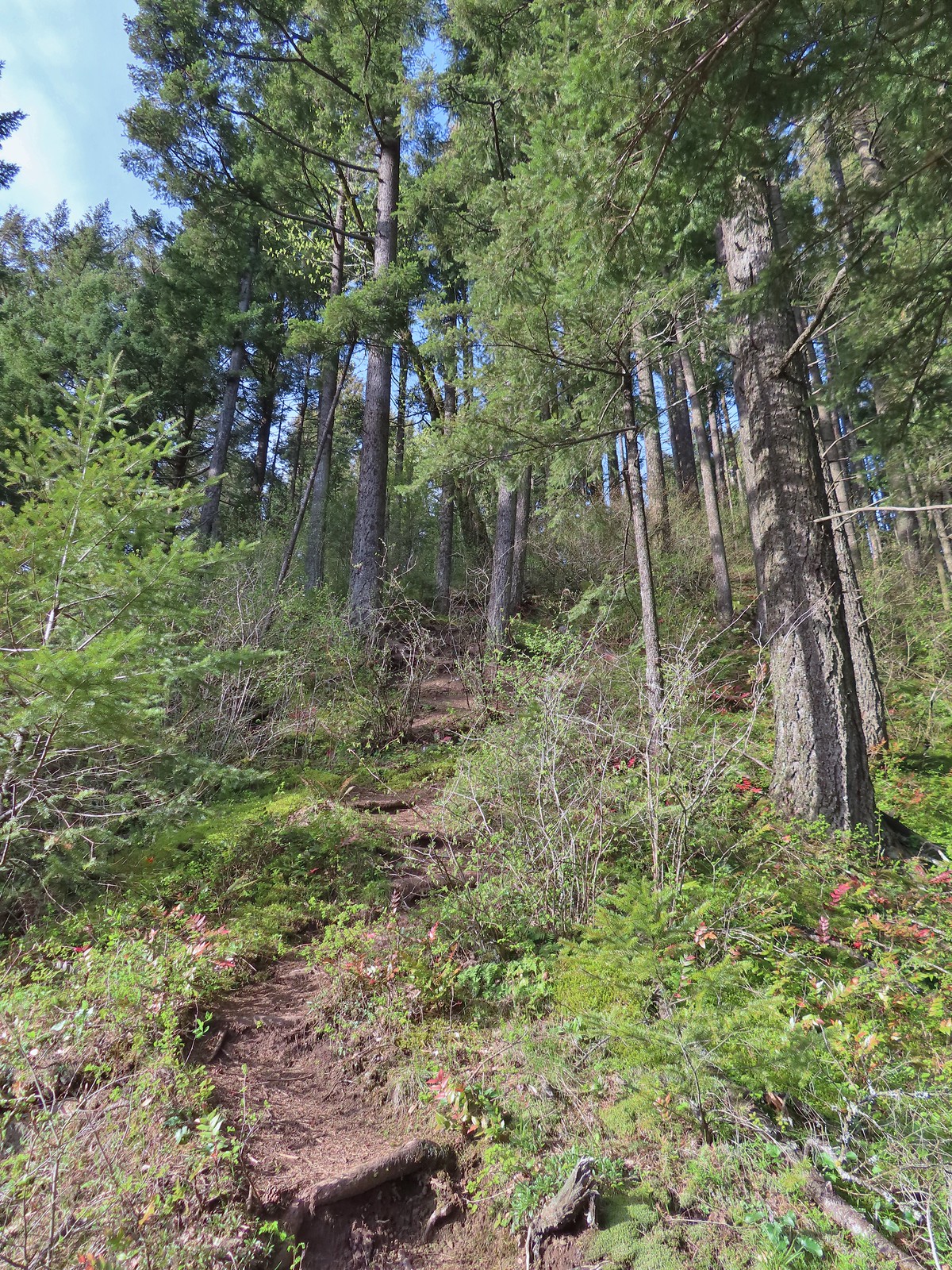
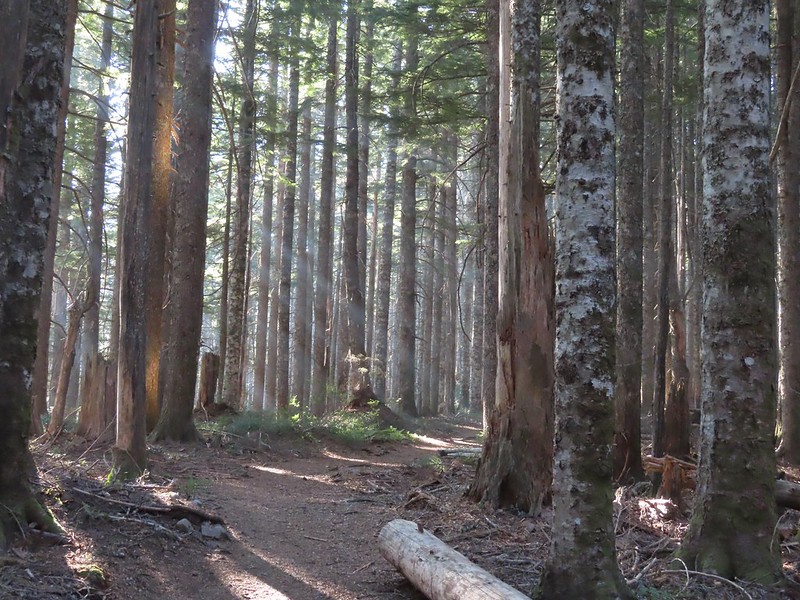
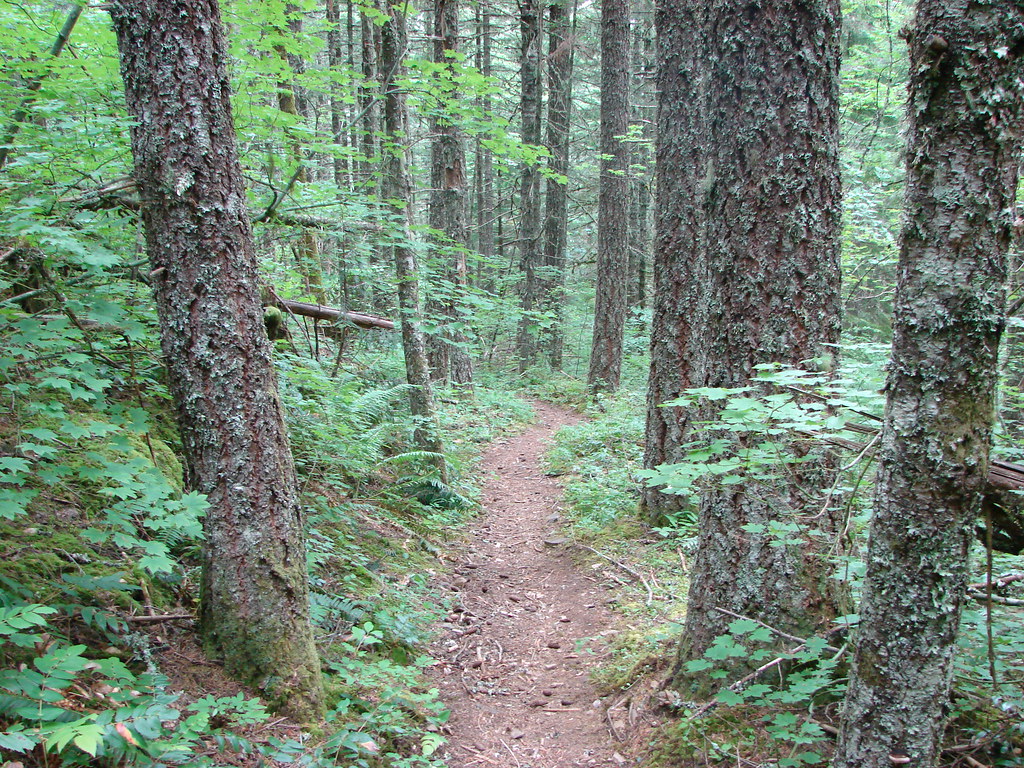
Up, up, up through the forest.

IMG_0548
Strategic use of switchbacks helped keep the trail from being too steep.

Near the switchback above I caught a strong whiff of fire. Not smoke in the air, but the unmistakable smell of fire. It made me a little uneasy because there weren’t any nearby fires showing on the online maps I’d checked before leaving. After climbing another switchback the trail gained a ridgetop, and I discovered the source of the smell. A pair of bow hunters had set up a fire ring and built a fire right next to the trail and a tree. They had their tent, sleeping bags and gear strewn about and when they spotted me they explained they were trying to “dry out” their gear. It was obvious from their need to quickly explain why they had a fire that they knew it wasn’t okay. I didn’t feel comfortable calling them out on it so I made my way around their gear and continued on.
IMG_0549
The ridgetop. The bow hunters were about 100 yards behind me at this point.

I continued on getting a view of Mt. St. Helens through the snags.
IMG_0550

IMG_0552

IMG_0554
Another grouse. This was one of 8 to 10 that were in this area.

IMG_0556
The cliffy Hamilton Mountain (post) on the Washington side of the gorge.

IMG_0558
Explorer’s gentian

After another switchback the trail arrived at an open viewpoint.
IMG_0559
The PCT continuing uphill.

IMG_0562
Mt. Adams

IMG_0563
Closer look at Mt. Adams

IMG_0564
Mt. Hood partially hidden by trees.

IMG_0565
Mt. Hood

IMG_0568

IMG_0570

Approximately a half mile from the illegal campfire I arrived at Teakettle Spring.
Teakettle Spring

IMG_0573

It was good to know that there was water available here as the only other source I’d passed was Herman Creek. I was carrying an extra Hydroflask full of water just in case, and after seeing the campfire I came up with another use for it. I decided that I would add that water to my pack bladder when I reached the plateau and then refill the Hydroflask from the spring on the way down to use on the fire pit if necessary.

The trail continued to climb beyond the spring before crossing two saddles along a ridge. In the second saddle the Benson Way Trail arrived on the right.
IMG_0574
Beargrass along the trail is much better than poison oak.

IMG_0576
Sections of the ridge burned intensely in 2017.

IMG_0577
Near the second saddle the trail left the 2017 fire scar, although a very small section did burn in the 2024 Whiskey Creek Fire.

IMG_0578
The Benson Way Trail on the right.

IMG_0581
The final climb to the Benson Plateau.

The trail eventually leveled out on the plateau.
IMG_0582

IMG_0584

Approximately three quarters of a mile from the Benson Way junction I passed the Benson-Ruckle Trail, again on the right.
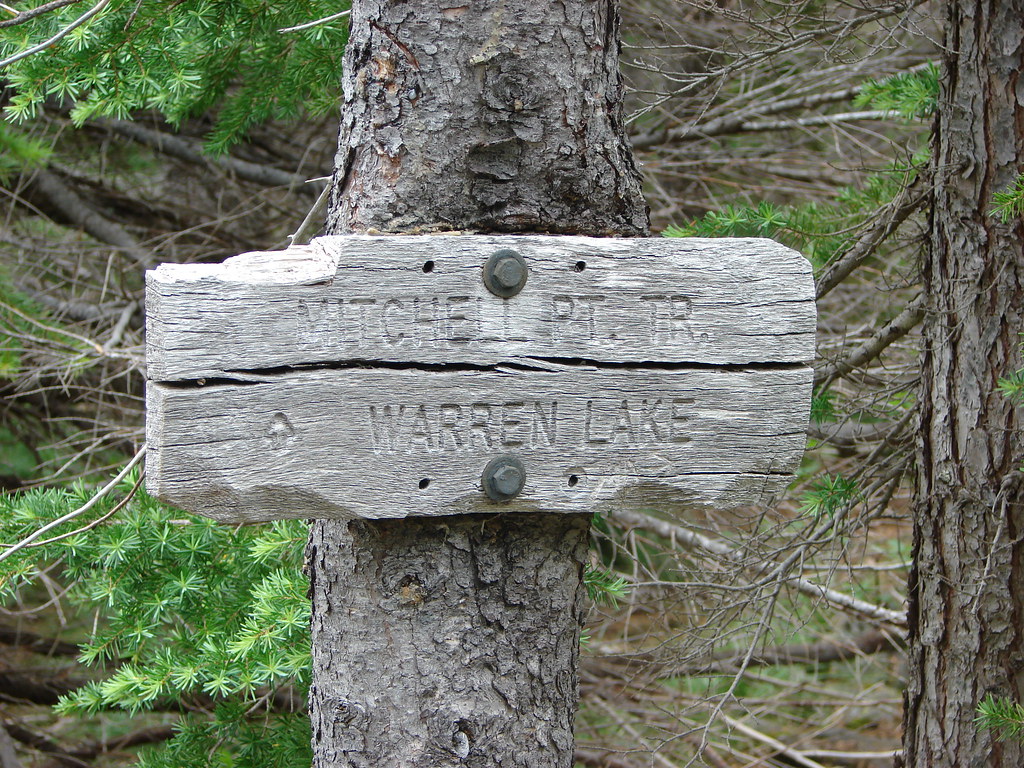
IMG_0585Trail signs for the Benson-Ruckle Trail.

Reeder mentioned a campsite near the junction, but I didn’t see an obvious one. I continued on looking for the campsite but after a tenth of a mile I instead spotted a short use trail to a rocky viewpoint. I decided that would make for a good spot for a break.
IMG_0587
It wasn’t a huge view, but it was nice and the rocks made for a great spot to sit down, have a snack, add the remaining Hydroflask water to my pack, and then change into dry socks.

After the break I headed back the way I’d come. It would have been possible to use the network of trail on the plateau to make a loop around it, but 14-miles was enough for me today.

I made my way back down to Teakettle Spring and refilled the Hydroflask as planned.
IMG_0595

IMG_0597
The hump with radio towers behind the ridge is Mt. Defiance (post).

Not long after leaving the springs I encountered the bow hunters who were standing in the trail looking at their phone. They asked me if I knew where the spring was because they were “plumb out of water”. I informed them it was about 100 yards further up the trail and continued on now wondering if they were out of water due to dousing the campfire or if they had had enough water to do that in the first place.

IMG_0601
Approaching the best viewpoint.

IMG_0602
Not only was Mt. Adams a little clearer but I realized the top of Mt. Rainier was visible from the viewpoint as well.

IMG_0604
Mt. Rainier behind Red Mountain (post).

IMG_0609
Huckleberry leaves.

IMG_0611
Vine maple

When I arrived at the site of the fire pit I could tell that they had at least attempt to extinguish the fire.
IMG_0613
The fire pit. In no way is this acceptable, even if fires weren’t currently banned. If it is legal to have a fire and you feel you must please follow Leave No Trace Principles.

Even though there was no visible smoke I knew that fires can easily burn underground, sometimes for days until they reach a tree or stump at which point they can reemerge above ground causing a full-on wildfire. I felt the dirt over the fire and sure enough it was still putting off heat so I exposed some of the coals and poured the Hydroflask out over them. This produced a lot of hissing so I did a little stirring and added more water from my bladder attempting to make “campfire soup”. After doing what I could with what I was carrying I marked the location with the GPS so I could report it to the Forest Service when I had the chance which I did later.

I continued down the trail and when I neared the tree that required crawling under met a pair of backpackers heading up to the plateau. I described the fire pit to them, and they indicated that they were carrying extra water and would add some if necessary.

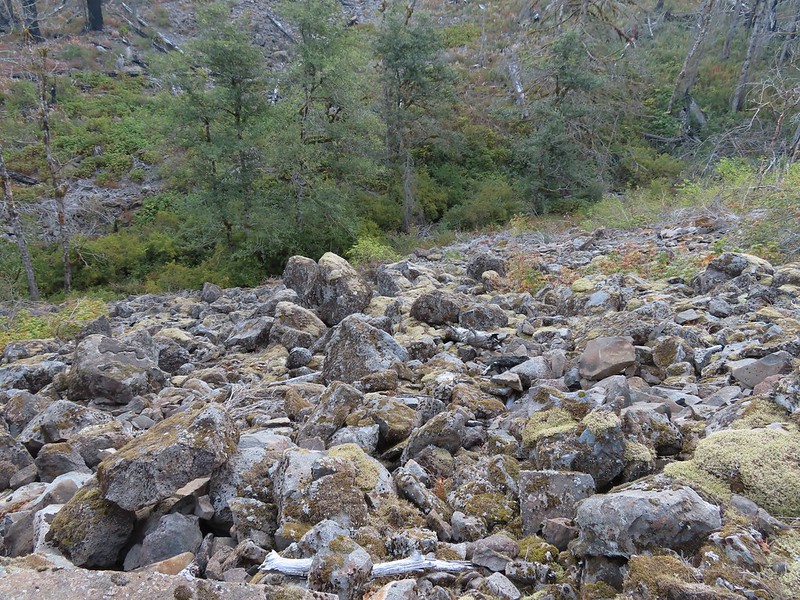
Other than that it was an uneventful downhill until I reached the rocky hillsides where I once again had some luck spotting pikas.
IMG_0626
This one was more than happy to pose for me for a bit.

IMG_0631

At the end of the day my GPS read 14.2-miles with the 3800′ of elevation gain as advertised.
Screenshot 2025-09-15 151348

Despite the issue with the illegal fire this was a nice, challenging hike. There really isn’t anything that will blow you away scenery wise, but there is enough of a mix to keep it interesting. While the upper portion of the trails can get pretty snowy from November through late April/early May this would be a great training hike while waiting for the higher elevations to become snow free. Happy Trails!

Flickr: Benson Plateau

Categories
Columbia Gorge North Hiking Trip report Washington

Cook Hill – 06/01/2024

Cook Hill is a 3015′ peak just east of Dog Mountain (post). Dog Mountain is famous for its wildflower meadows and has become so popular that permits are required for weekend hikes during the peak flower season. Cook Hill has its own, albeit less spectacular, meadows and a recent online report informed us that the wildflower display there was near peak. We did some shifting to our planned hikes and headed out to check them out for ourselves.

The hike up Cook Hill is on unofficial trails, partly using old logging roads, primarily on public lands. (A small section past the summit is on private land held by a lumber company.) Matt Reeder featured the hike in his “off the Beaten Trail” guidebook which is what put it on our radar. It can be done as a lollipop loop or a shorter out-and-back. Reeder’s description as well as older trip reports found online mentioned that the trail could be faint in places and that there was no signage present. This was no longer the case as we found a clear trail the entire route and some signage was now present. It may be that the implementation of the permit system has driven more people to this hike, or it may just be more well known now. Whatever the reason we were thankful to those that have been maintaining the unofficial trail.

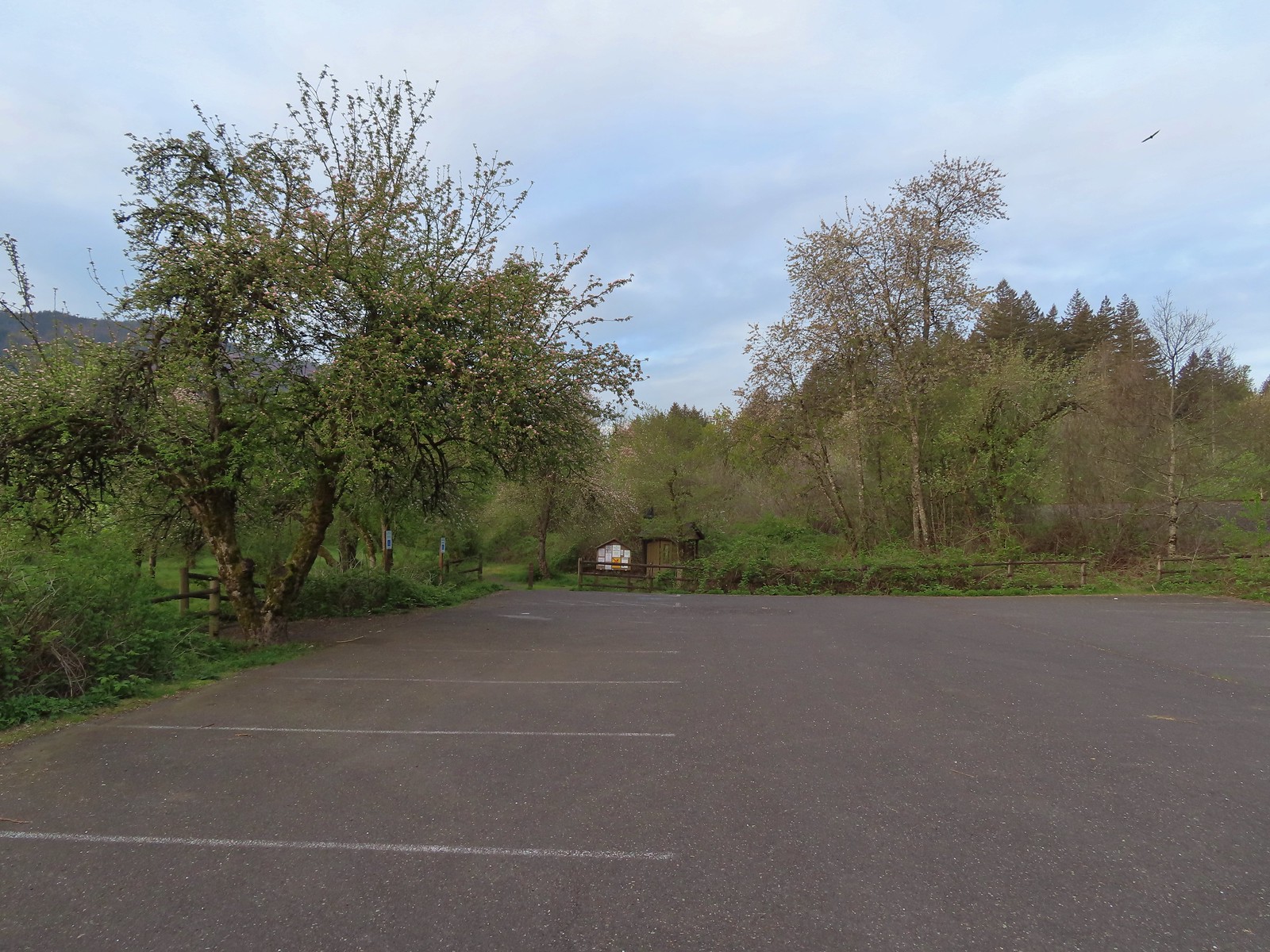
We arrived at 6:30am and were the third car at the trailhead.
IMG_5712The trailhead is just a large gravel pullout along Cook-Underhill Road.

From the parking area we crossed the road to Jackson Rd (to the left in the above photo).
IMG_5716There is no parking for the trail anywhere along Jackson Rd.

Approximately a tenth of a mile up Jackson Road we came to a gate with a “Cook Trailhead” sign.
IMG_5719

IMG_5721

We followed the roadbed uphill through a mixed forest with a lot of poison oak off to the sides.
IMG_5722

IMG_5724Ookow surrounded by poison oak.

IMG_5726

IMG_5728Mt. Defiance (post) across the Columbia River.

IMG_5731Large-flower triteleia

IMG_5733Monkeyflower along the road.

IMG_5737Ookow

IMG_5742

IMG_5743Small waterfall through the vegetation.

IMG_5751The first of two crossings of this unnamed creek.

IMG_5758There was a lot of spotted coralroot along the road.

IMG_5762Most of the trees had been cleared from the road, those that remained were easily stepped over.

IMG_5770Anemones

IMG_5777The second creek crossing.

IMG_5783

IMG_5781Lupine

IMG_5785White groundsel

IMG_5788Small spring near the junction with the start of the loop.

IMG_5792Reeder mentioned a rock cairn at the start of the loop which was still present, but now there were signs too.

IMG_5793Going counterclockwise seemed to be preferred direction based on trip reports. This was also the shorter distance to the summit at 1.6-miles.

IMG_5794The clockwise sign listed the summit as 2.8-miles away in that direction.

We chose counterclockwise and continued through the forest. The roadbed had been fairly steep but soon this trail began to steepen even more as it approached the small lower meadow.
IMG_5798

IMG_5804Arriving at the lower meadow.

At the meadow the trail turned directly uphill through the flowers before reentering the forest.
IMG_5807

IMG_5809Balsamroot

IMG_5811Groundsel and balsamroot

IMG_5808

IMG_5814Lupine

IMG_5817Death camas

IMG_5821The rocks up ahead made for some nice seats to take in the view from.

IMG_5827

IMG_5823Mt. Hood peaking over the ridge to the left with Mt. Defiance to the right.

IMG_5824Mt. Hood

After a much needed break we continued steeply through the forest to the start of the next, much longer meadow.
IMG_5828

IMG_5832Vanilla leaf

IMG_5835Starflower

IMG_5844

IMG_5847Fairybells

IMG_5853The start of the long upper meadow.

There wasn’t as much balsamroot in the upper meadow, but rather a wide variety of flowers in various stages of blooming.
IMG_5855Larkspur

IMG_5858Violets

IMG_5859Slender phlox and blue-eyed Mary

IMG_5864Phlox

IMG_5865Balsamroot surrounded by larkspur and coastal manroot.

IMG_5870Coastal manroot

IMG_5873Groundsel

IMG_5874Dog Mountain from the meadow.

IMG_5878Chocolate lily

IMG_5880This was the closest lupine to blooming in the upper meadow.

IMG_5881Chickweed

IMG_5883Oregon sunshine yet to boom.

IMG_5884Mt. Hood from the meadow.

The trail continued to climb through the meadow with increasingly better views and flowers.
IMG_5891

IMG_5888Woodland stars, larkspur, and lomatium.

IMG_5895

IMG_5902Yellow buttercups lining the trail.

IMG_5904Mt. Hood and Mt. Defiance

IMG_5892Mt. Hood

IMG_5906Mt. Defiance

IMG_5908Alpine pennycress

IMG_5911Larkspur and lomatium

IMG_5915

IMG_5923

IMG_5925Chocolate lily eating a buttercup.

IMG_5933Largeleaf sandwort

IMG_5945The final stretch of the upper meadow.

IMG_5946Violets

IMG_5951Phlox

IMG_5952Dog Mountain

IMG_5960Mt. Hood and Mt. Defiance from the upper meadow.

IMG_5961Table Mountain (post) and Greenleaf Peak (post) further to the west beyond Dog Mountain.

IMG_5966Phlox, paintbrush, and lomatium

IMG_5977

After slowly making our way through the meadow the trail climbed to the forested summit of Cook Hill.
IMG_5978

IMG_5979

At this point we had hiked a little over 3.5-miles and gained over 2800′. To complete the loop portion of the hike we continued past the summit and made an initially steep descent along a ridge past some more meadow and occasional views of Mt. Adams to the north.
IMG_5983

IMG_5984

IMG_5987

IMG_5989Mt. Adams from between trees.

IMG_5992Arnica

IMG_5994The final stretch of the steep descent was through this forest with no understory.

The trail then leveled out along with the ridge and actually made a very gradual climb to a radio tower.
IMG_5995

IMG_6000Vine maple overhanging the trail.

IMG_6002It’s hard to tell from the photo but these were huge paintbrushes.

IMG_6004Another view of Mt. Hood and Mt. Defiance.

IMG_6005Dogwood

IMG_6007

IMG_6009Trillium

IMG_6011The first tower.

The trail continued past the radio tower to the left on a roadbed and soon passed under a large set of powerlines near more towers at Cook Hill Saddle.
IMG_6012

IMG_6013

IMG_6016Looking toward Mt. Adams from beneath the powerlines.

IMG_6015Mt. Adams

IMG_6017Wind Mountain (post) sticking up to the left before the Columbia River.

We made a hard right beneath the powerlines on a fainter old roadbed that quickly reentered the forest.
IMG_6018The faint roadbed heading left back toward the forest.

IMG_6022

We followed this roadbed back to the signed junction to complete the loop. This part of the trail was more overgrown with a few more logs to step over but it was still quite easy to follow and navigate.
IMG_6023

IMG_6026Wild ginger

IMG_6029

IMG_6031Candyflower

IMG_6035The trail passed under a talus slope where a fair number of flowers were present.

IMG_6036

IMG_6039Lupine and yarrow

IMG_6048Stonecrop

IMG_6050Bee visiting penstemon.

IMG_6056The talus slope.

IMG_6064Descending to the junction.

At the junction we turned right to head back to the car. At this point we’d encountered just three other hikers, but now that it was later, and we were off the loop we passed around two dozen more hikers heading up.
IMG_6067

IMG_6073Ookow and bachelor buttons along the trail.

IMG_6078Bachelor button

IMG_6082Heather spotted this arctic skipper on some vetch.

IMG_6087Clarkia. It wasn’t open yet when we’d passed by in the morning.

IMG_6089There were a lot of phantom orchids starting along the lower portion of the hike, but this was the only one with any flowers opened.

IMG_6092Cook-Underhill Road from Jackson Road.
The hike was challenging at 8.5-miles and over 2900′ of elevation gain, but the views and the flowers had made the effort worth it.
Screenshot 2024-06-01 163618

The parking area was full when we got back, and several cars had parked along the shoulder of the road which could become an issue at some point. The other thing we saw that could cause problems were the bags of dog poop left along Jackson Road, yuck. Please be respectful of both public and private lands and happy trails!

Flickr: Cook Hill

Categories
Columbia Gorge North Hiking Trip report Washington

Lower Archer Falls, Wind Mt., Sams-Walker, & Doetsch Ranch – 4/13/2024

Our first April outing was a trip to the Washington side of the Columbia River Gorge to check out four short hikes. These were all new hikes for us located within 23-miles of each other.

We began our day with me realizing that I hadn’t made sure that our NW Forest Pass was in the car since one was needed for two of our planned stops. This despite thinking that I needed to do that several times over the previous several days, including the day before when I was putting the Washington Discovery Pass we needed for Doetsch Ranch in the glovebox. Fortunately we were only in downtown Salem so we weren’t too far from home. Unfortunately the pass wasn’t in the other car or any of the places that I could think (at 5am) of where I might have put it. I decided it would probably quicker and much less stressful to purchase an ePass online for the day and look for the missing annual pass later.

Once we had our pass situation straightened out we drove to our first stop at the St. Cloud Day Use Area.
St. Cloud Trailhead

The day use area has picnic tables, a 1-mile loop trail, and a vault toilet (thus the need for a NW Forest Pass). Before exploring the day use area though we wanted to check out nearby Lower Archer Falls. To reach the trail to the falls we walked back to Hwy 14 and crossed to an unsigned trail that lead into overgrown woods. The need to cross the highway was the deciding factor on us starting our day here. We figured that there would be less traffic before 8am than there would be later in the day.
Trail to Lower Archer Falls across Highway 14 from the St. Cloud Day Use AreaThe brown strip in the grass near the center of the photo is the trail.

Trail to Lower Archer FallsThe trail entering the woods.

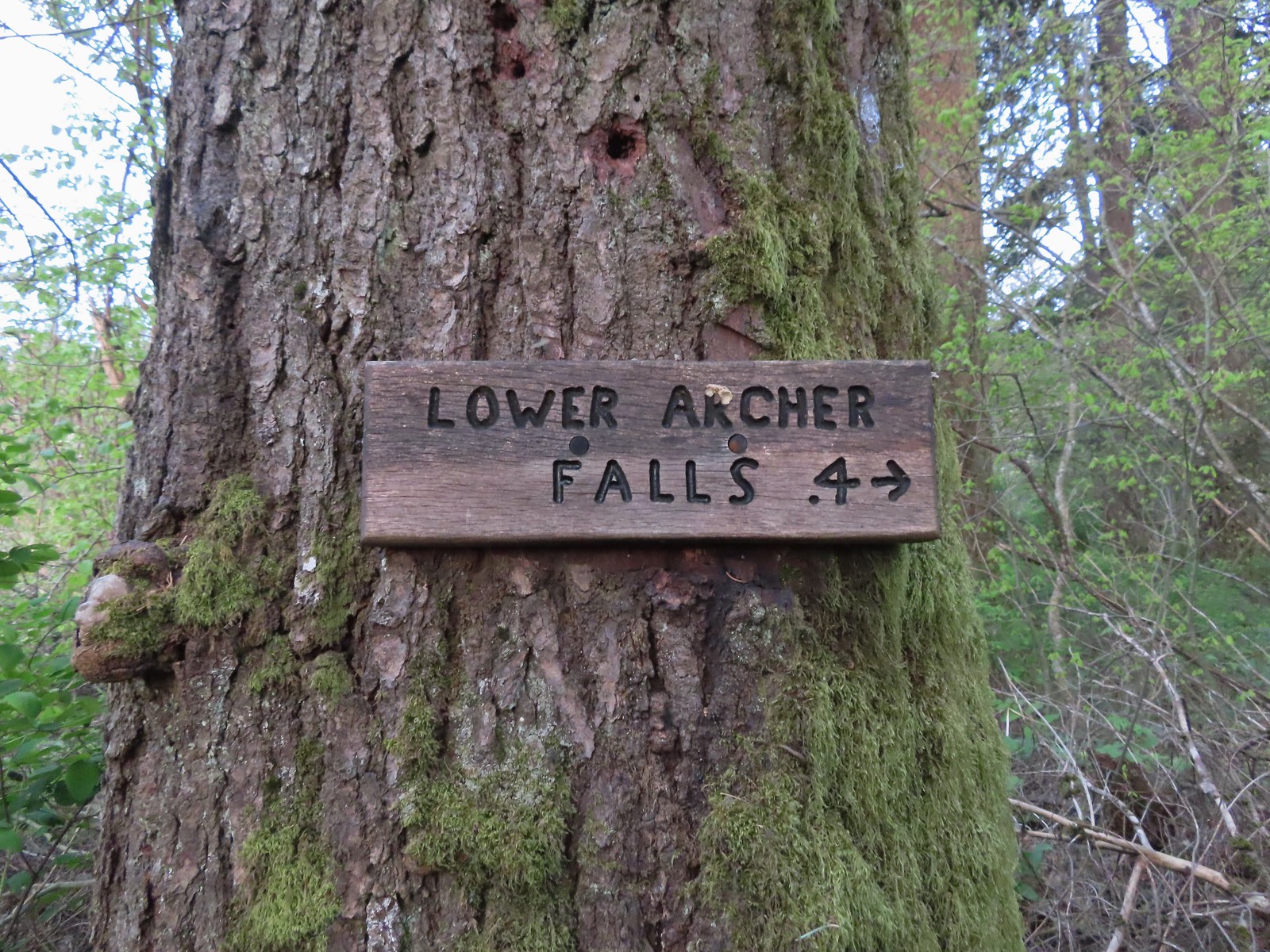
Sign for Lower Archer FallsPointer for Lower Archer Falls.

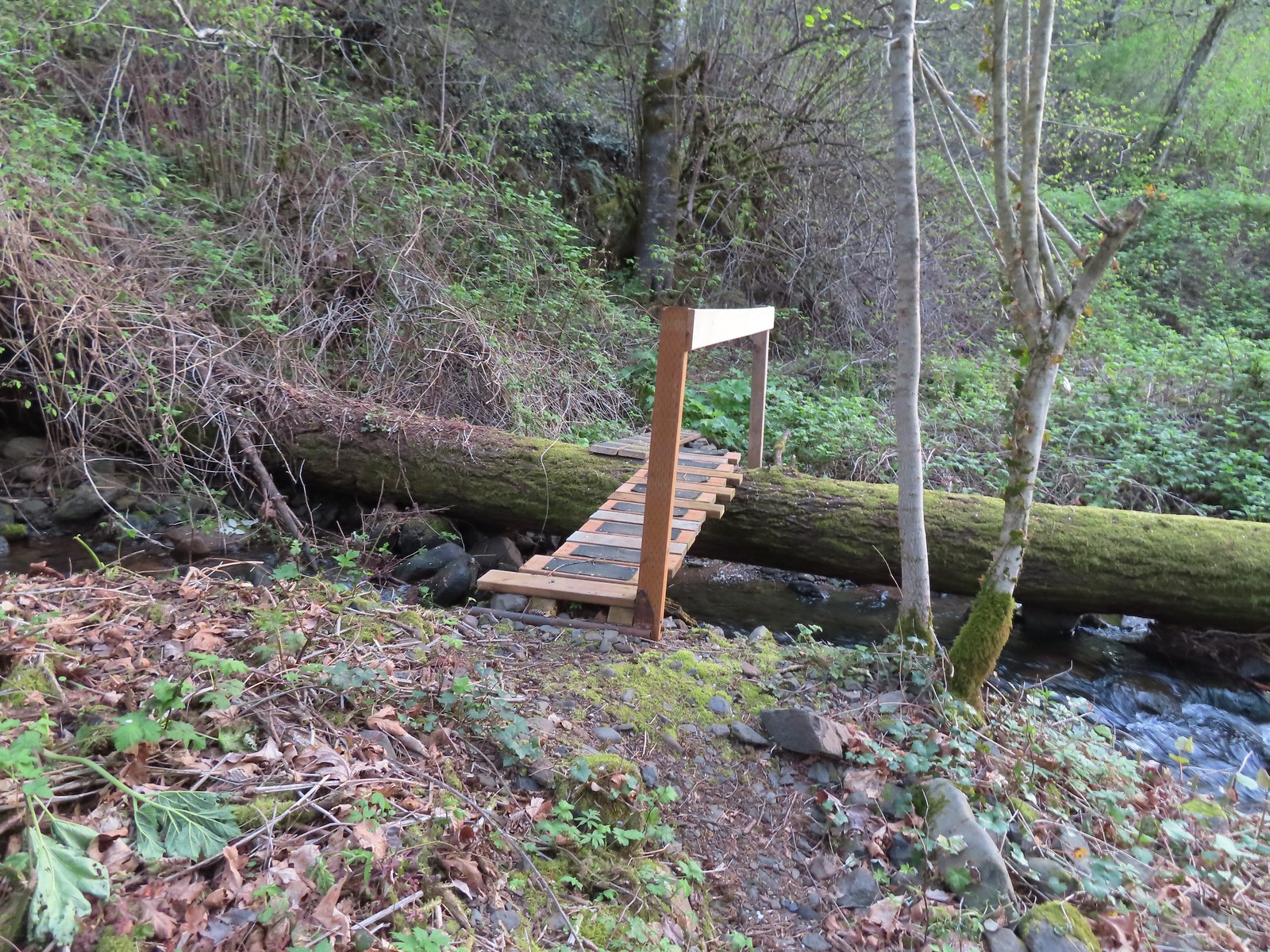
The user-maintained trail was in pretty good shape up until just before the falls where a small slide has done a bit of damage and just beyond that one of the make shift bridges seemed a little sketchy.
Trail to Lower Archer Falls crossing Gable CreekBridges over Gable Creek.

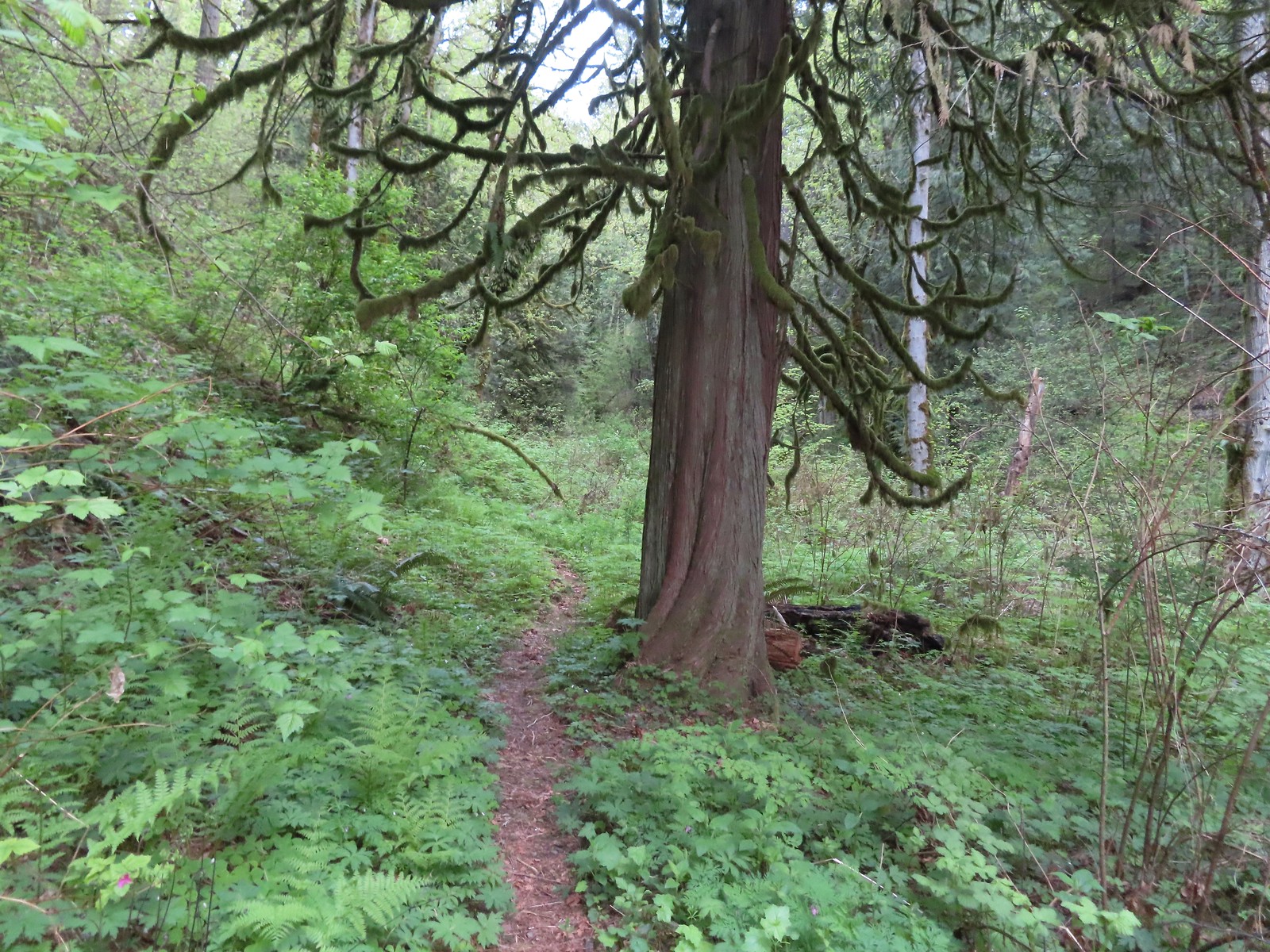
Trail to Lower Archer Falls

Trail to Lower Archer Falls

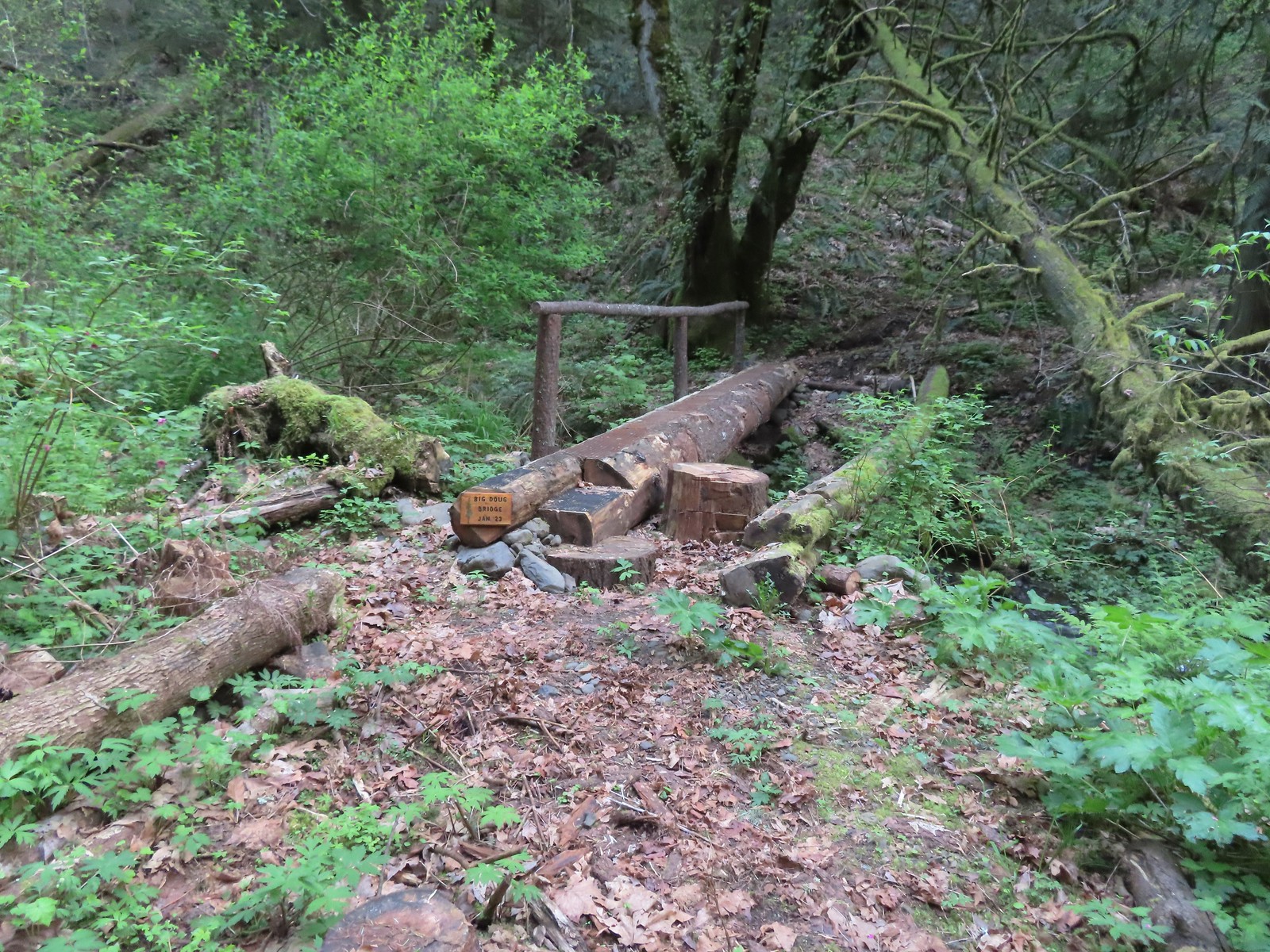
Big Doug Bridge over Archer CreekBig Doug Bridge (Jan 23) over Archer Creek.

Archer CreekArcher Creek

Archer CreekAfter crossing the creek the trail did a short climb gaining approximately 150′ of elevation.

Trillium along the trail to Lower Archer FallsTrillium along the trail.

Trail to Lower Archer FallsOne of several of these style bridges on the way to the falls.
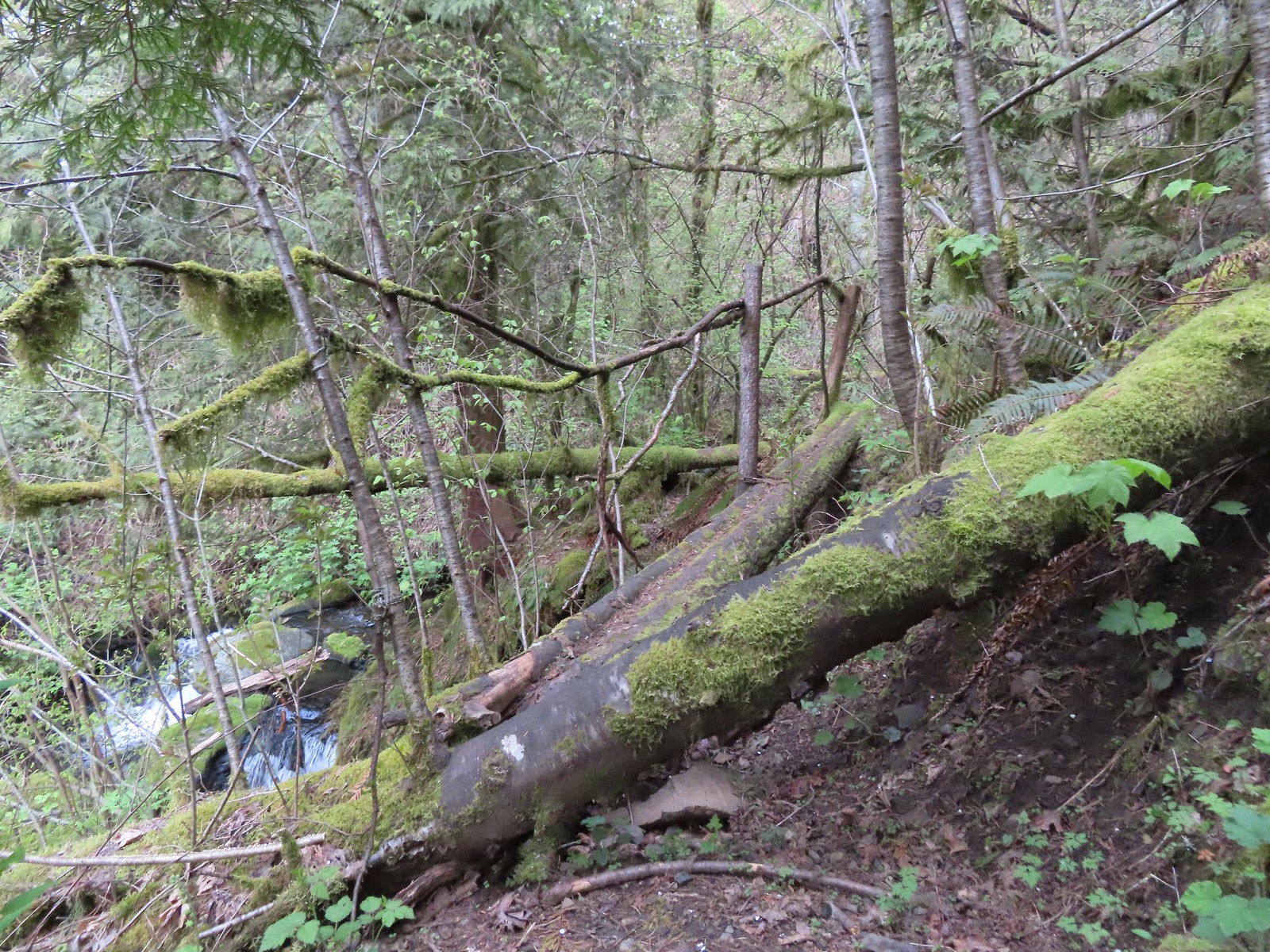
Trail to Lower Archer FallsThe “sketchy” bridge. It felt pretty solid underfoot, but the rail seemed ornamental only.

Trail to Lower Archer FallsThe final footbridge before the falls.

Lower Archer Falls

The trail extends beyond the falls climbing to a junction with the Archer Mountain Trail, but that route is reportedly less maintained with blackberry, poison oak, and nettles crowding the trail at times. We weren’t interested in that much adventure today so after enjoying the falls we headed back stopping along the way to admire the Spring wildflowers.
Steps at Lower Archer FallsSteps leading up from Lower Archer Falls.
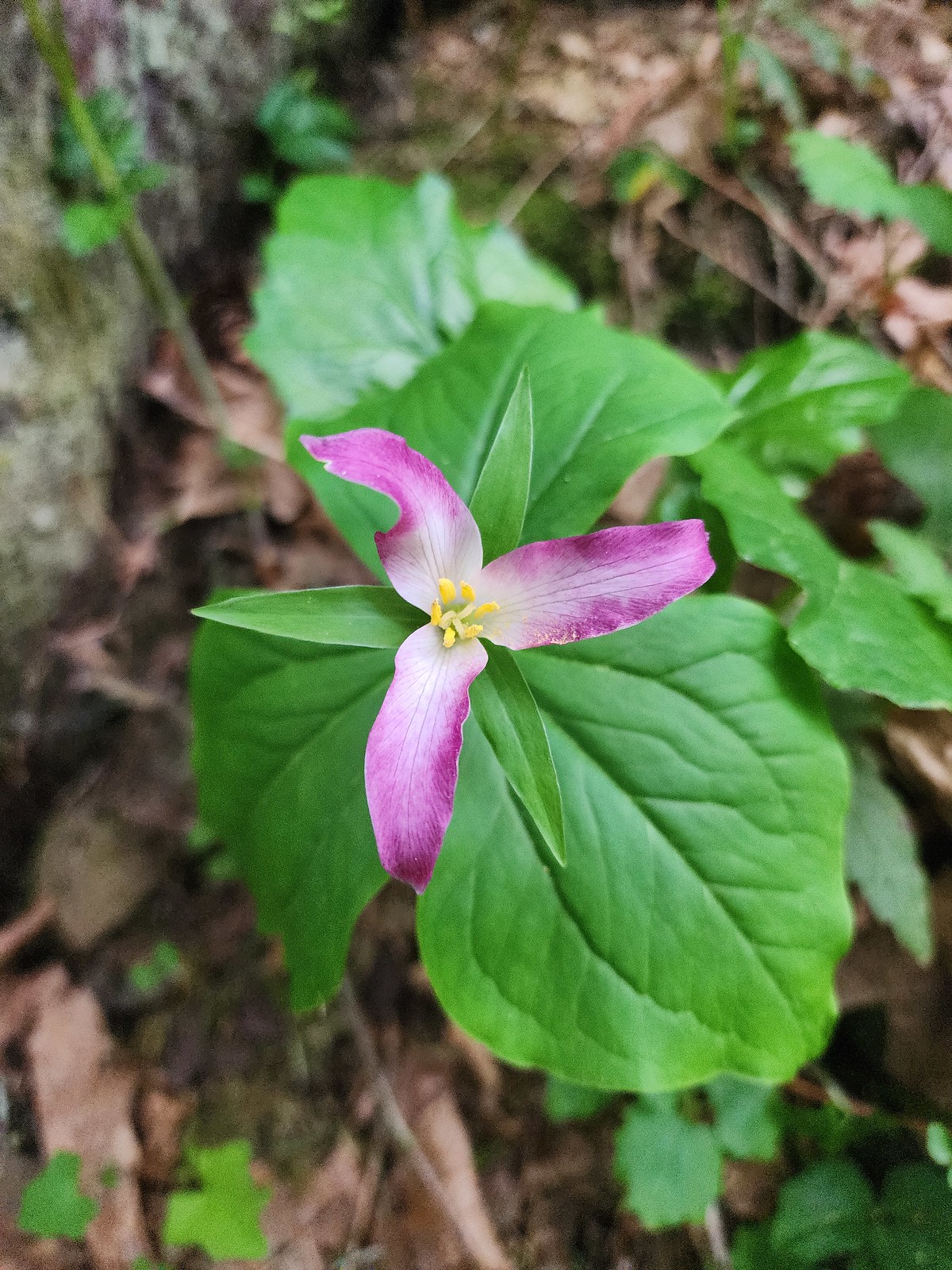
TrilliumTrillium

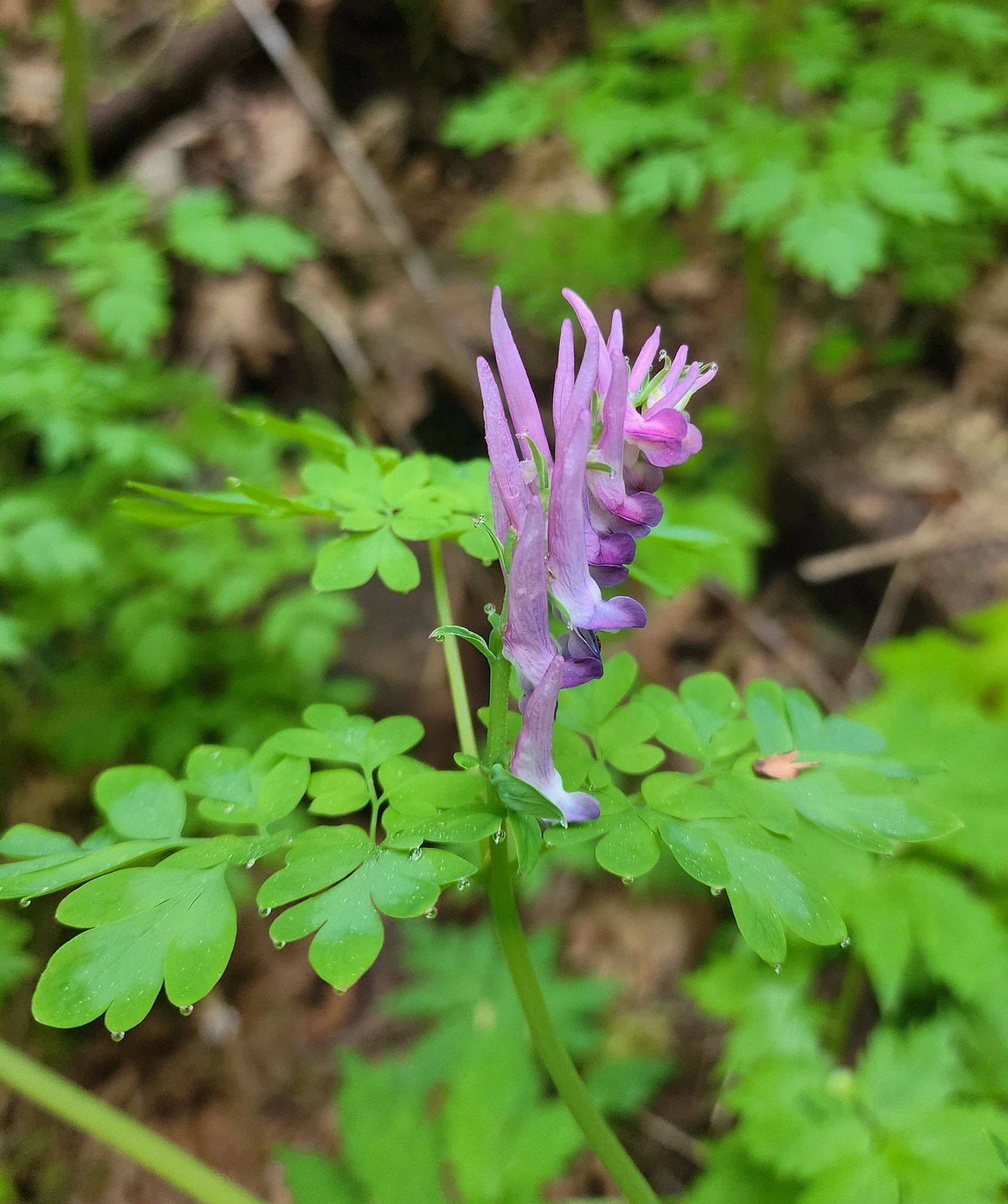
Scouler's corydalisScouler’s corydalis

Bleeding heartBleeding heart

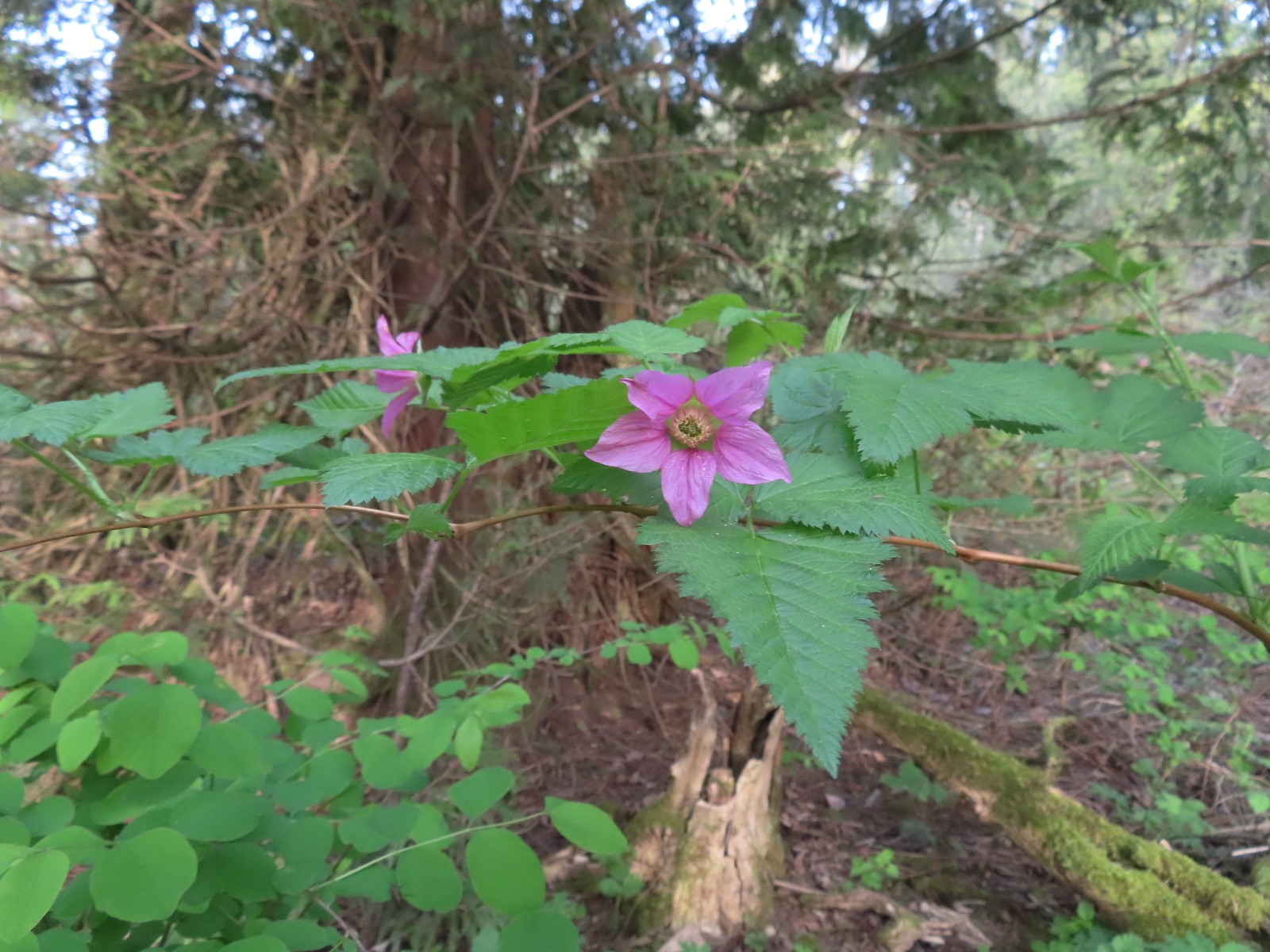
Salmon berrySalmonberry

Fairy bellFairy bell

FringecupFringecup

After successfully recrossing the highway we hiked the mile long St. Cloud Loop.
St. Cloud TrailThe start of the loop.

Apple trees along the St. Cloud TrailThe trail loops around a former apple orchard.
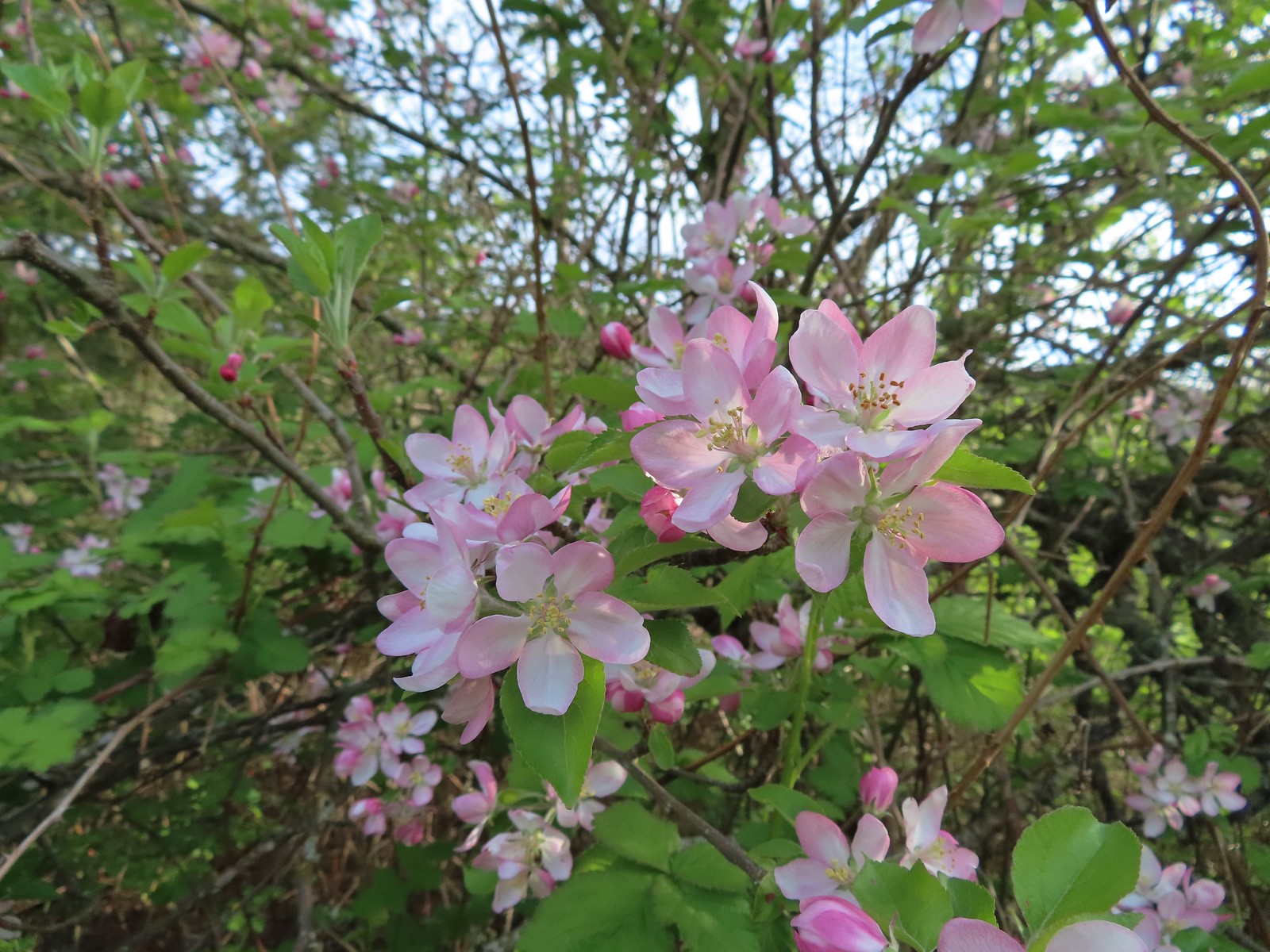
Apple blossomsApple blossoms

Spur trail to the Columbia RiverA spur trail leading down to the Columbia River.
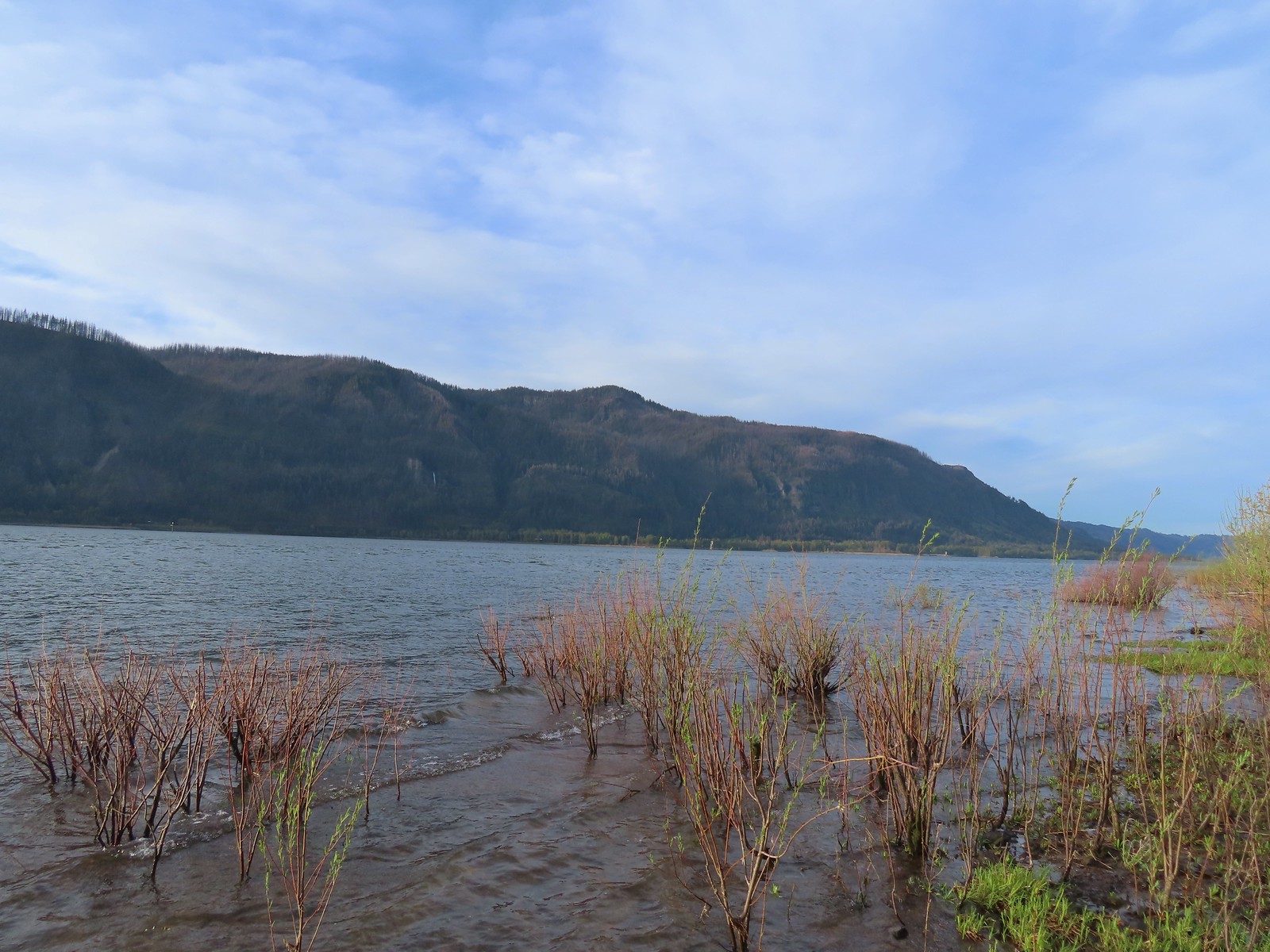
Devil's Rest and Multnomah Falls across the Columbia RiverDevil’s Rest and Multnomah Falls (post)

Multnomah FallsMultnomah Falls

Yellow-rumped warblerYellow-rumped warbler.

The St. Cloud Day Use Area was the westernmost stop of our day, and from there we headed for the easternmost stop at the Wind Mountain Trailhead. The trailhead is approximately a tenth of a mile downhill beyond a quarry. We parked at the quarry where two other vehicles were parked instead of continuing down the narrow, steep, slightly rutted road.
Quarry before the Wind Mountain TrailheadThe quarry later in the morning.

Wind Mountain TrailheadPullout at the actual trailhead.

Wind Mountain TrailThe Wind Mountain Trail at the trailhead.
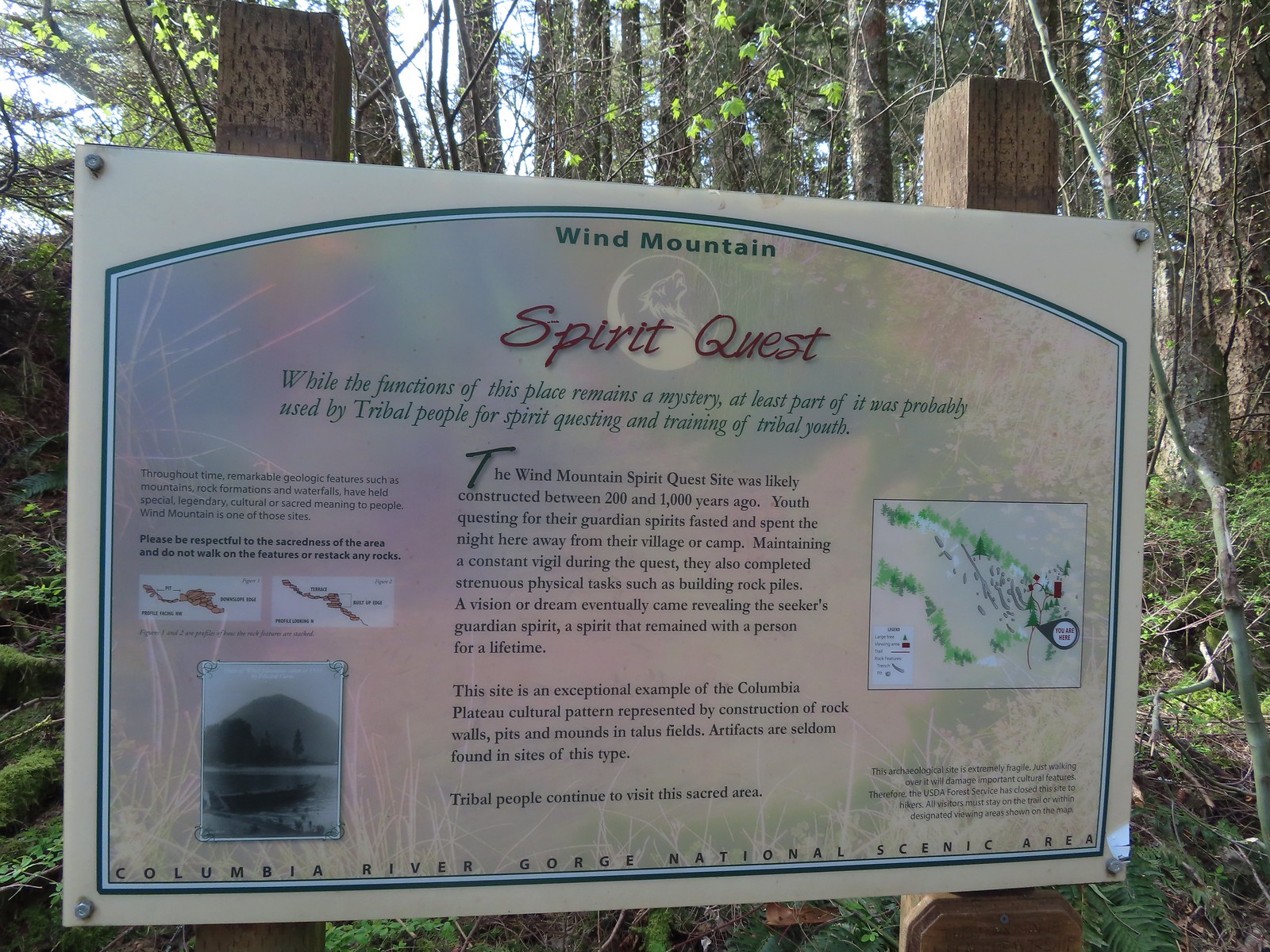
The Wind Mountain Trail gains over 1100′ in just over a mile as it climbs to the summit of Wind Mountain. The mountain’s summit is sacred to the area’s Native American tribes and signs near the summit show the areas where hikers are allowed to be.

The climb was a good workout. While the trail didn’t appear to be all that steep our legs reminded us that it was.
Wind Mountain Trail

There was a nice variety of wildflowers on display and at the 0.4-mile mark we came to a spur trail leading out to a rock outcrop.
ToothwortSlender toothwort

TrilliumTrillium

Red flowering currantRed flowering currant

Red flowering currantClose up of red flowering currant

Pioneer violetPioneer violet

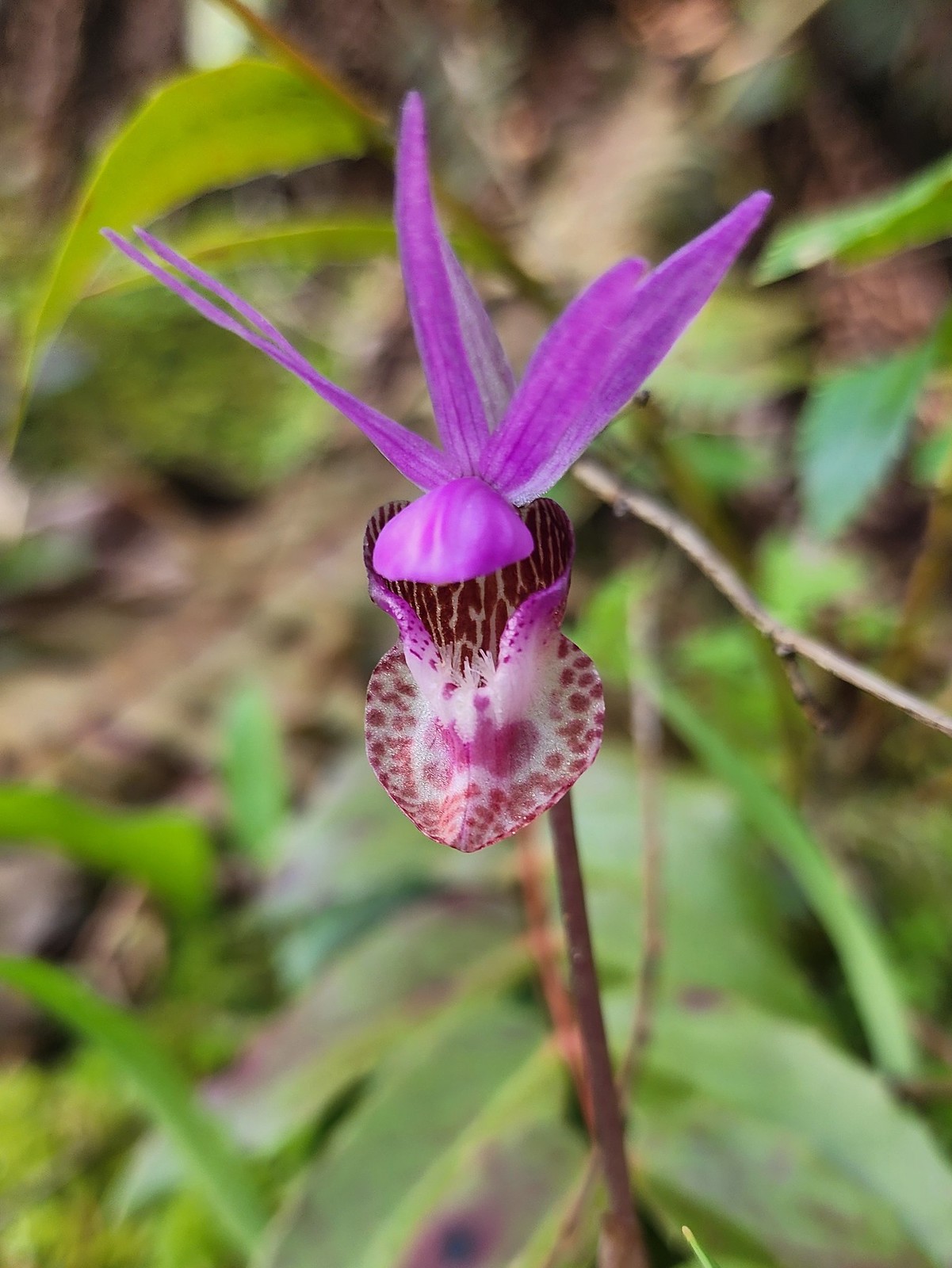
Fairy slipperFairy slipper

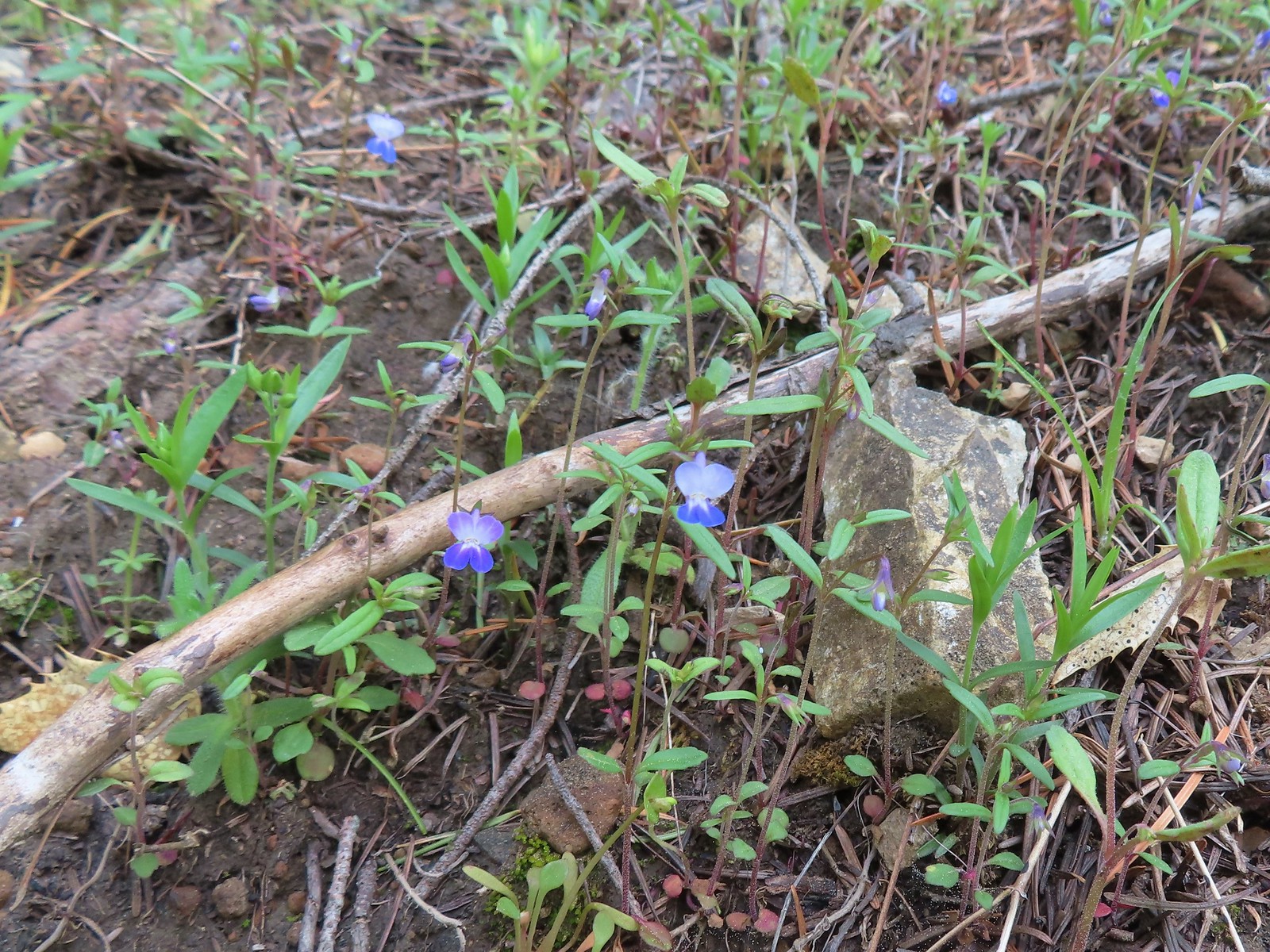
Blue-eyed MaryBlue-eyed Mary

Spur to a viewpoint along the Wind Mountain TrailThe spur trail down to the outcrop.

The spur trail was steep a little sketchy in spots so Heather opted to skip the viewpoint while I carefully made my way down.
Viewpoint spur trailLooking back up the spur trail.

Service berryServiceberry

Overlook just off the Wind Mountain TrailAugspurger Mountain (post) from the outcrop.

Dog MountainDog Mountain (post)

After taking in the view I returned to the trail and continued uphill.
Wind Mountain Trail

Largeleaf sandwortLargeleaf sandwort

Wind Mountain TrailTalus slope on Wind Mountain.

Slender toothwort along the Wind Mountain TrailSlender toothwort along the trail.

Sign along the Wind Mountain TrailOne of the signs near the summit.

Interpretive sign on Wind MountainInterpretive sign with a map of the areas open to hikers.
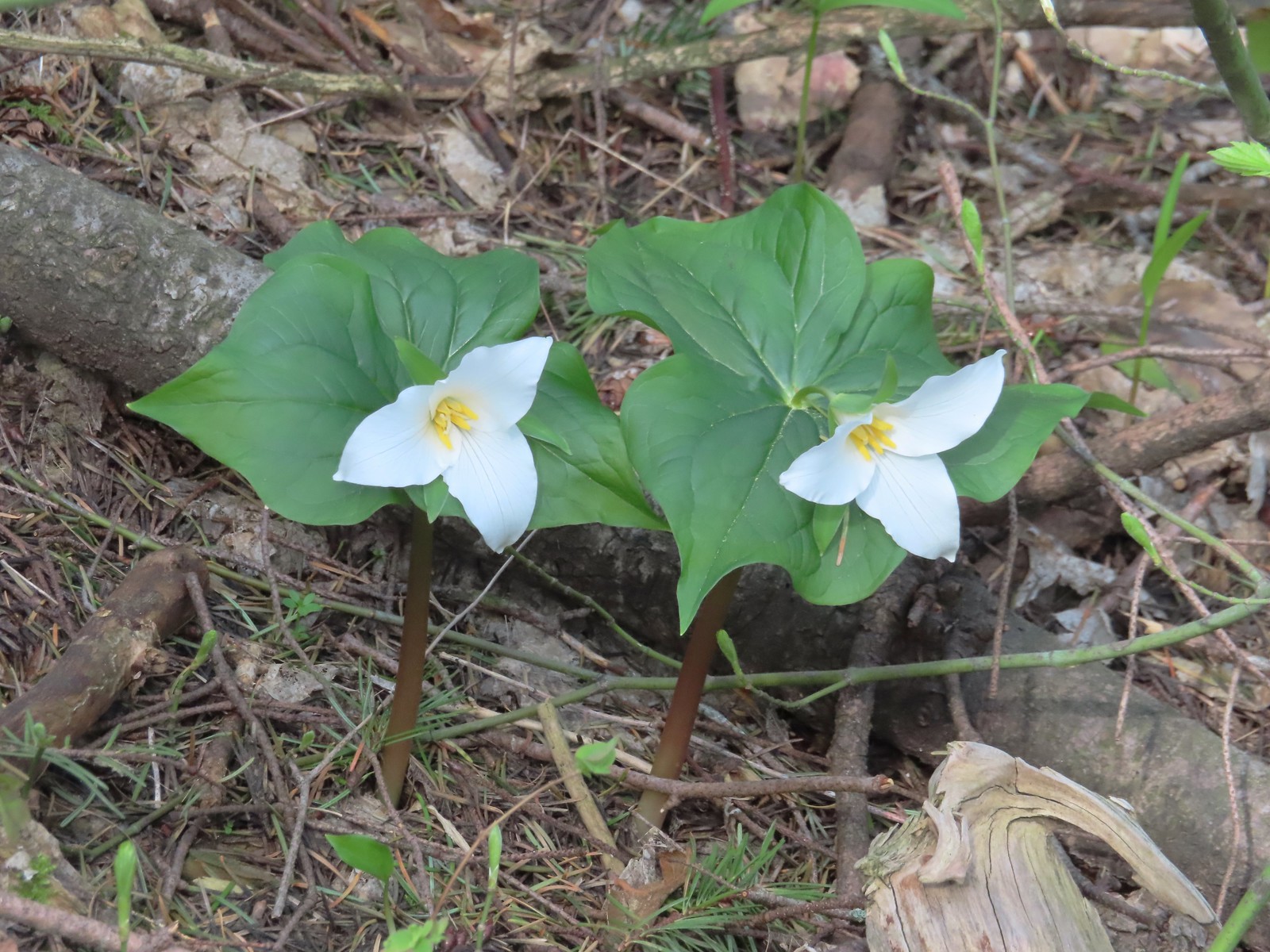
TrilliumsTrillium

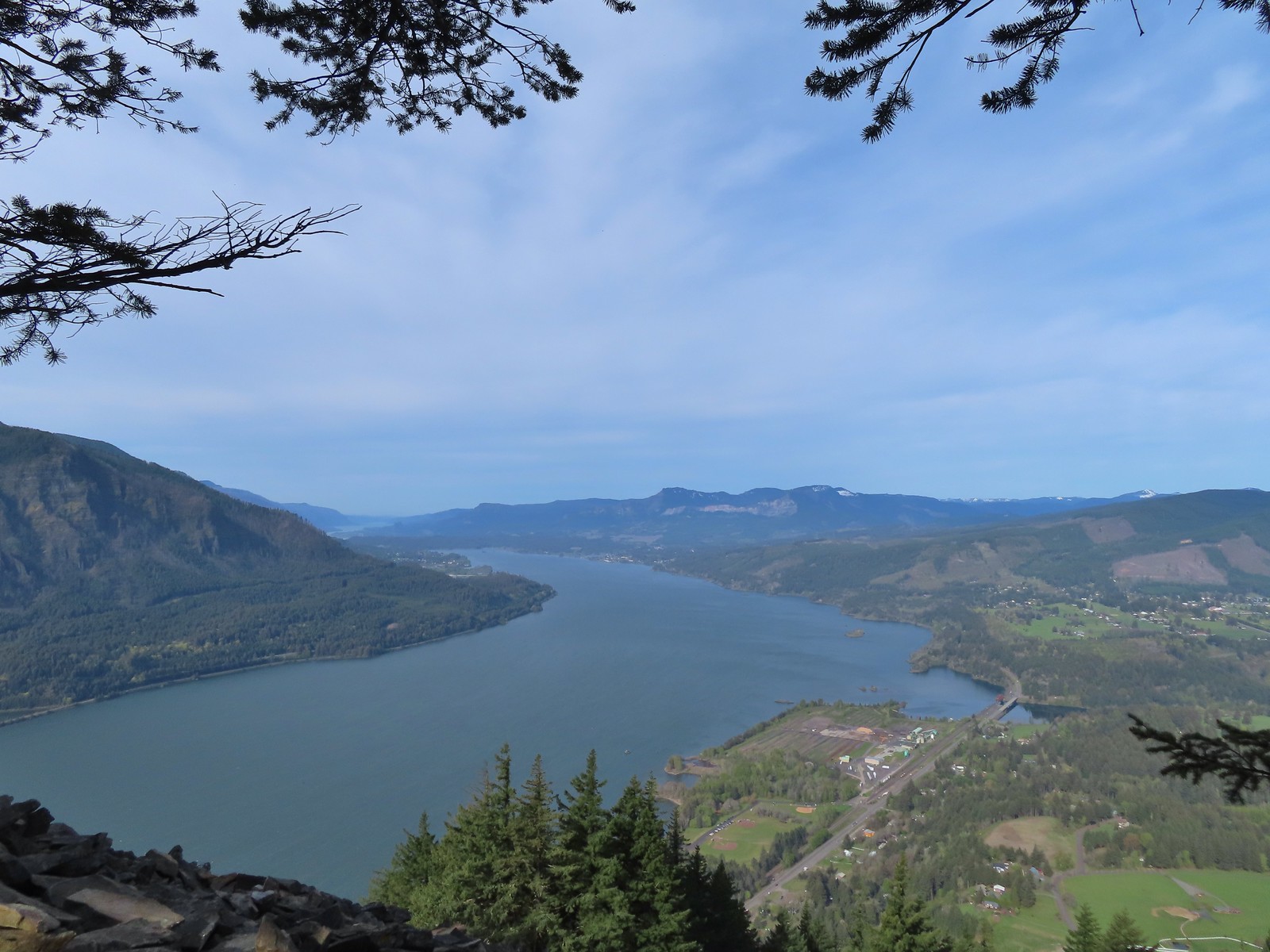
Columbia River from Wind MountainView west down the Columbia River. Hamilton Mountain (post), Table Mountain (post), and Greenleaf Peak (post) from L to R in the center.
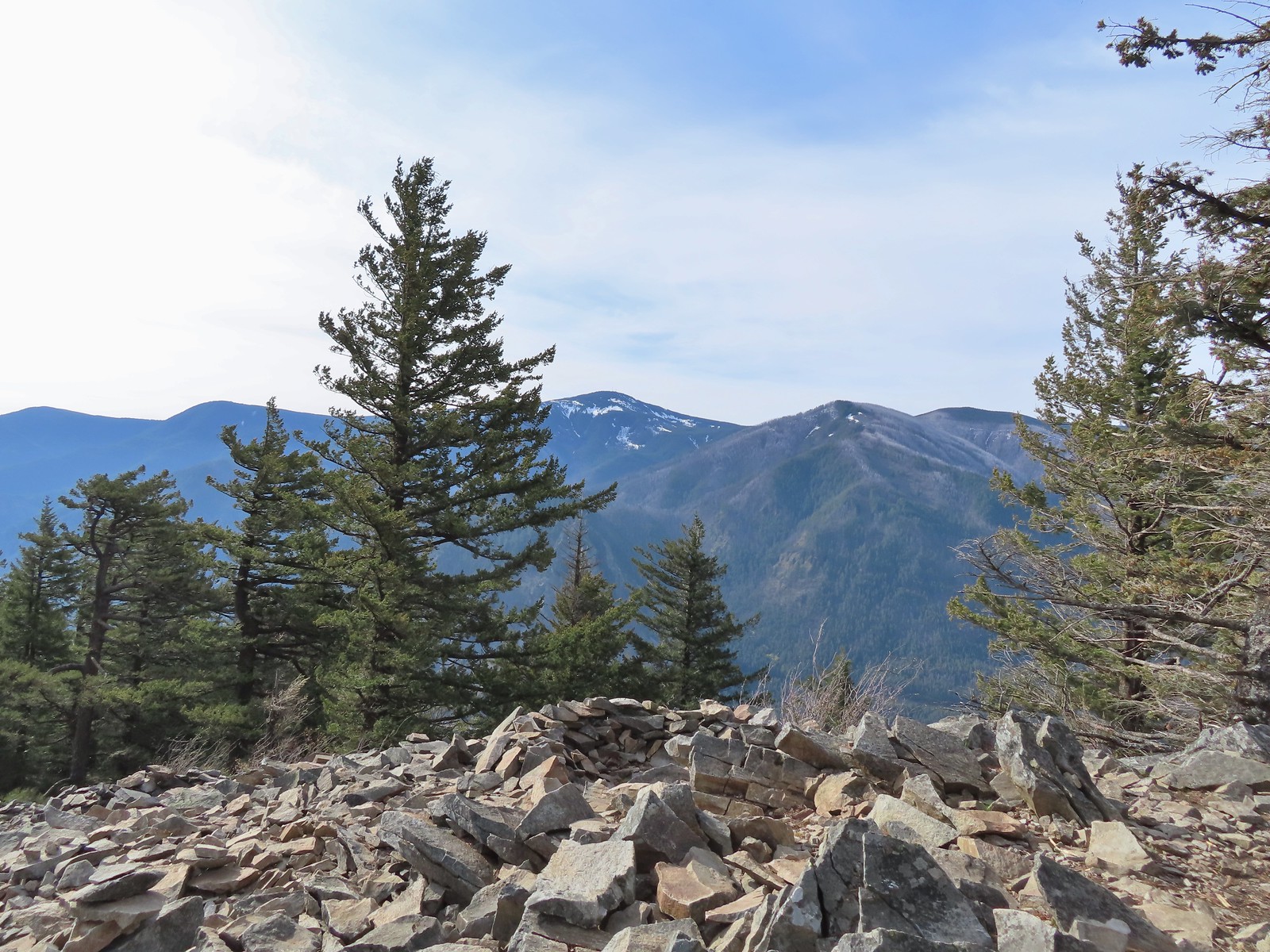
Mt. Defiance from Wind MountainMt. Defiance (post) from the summit.

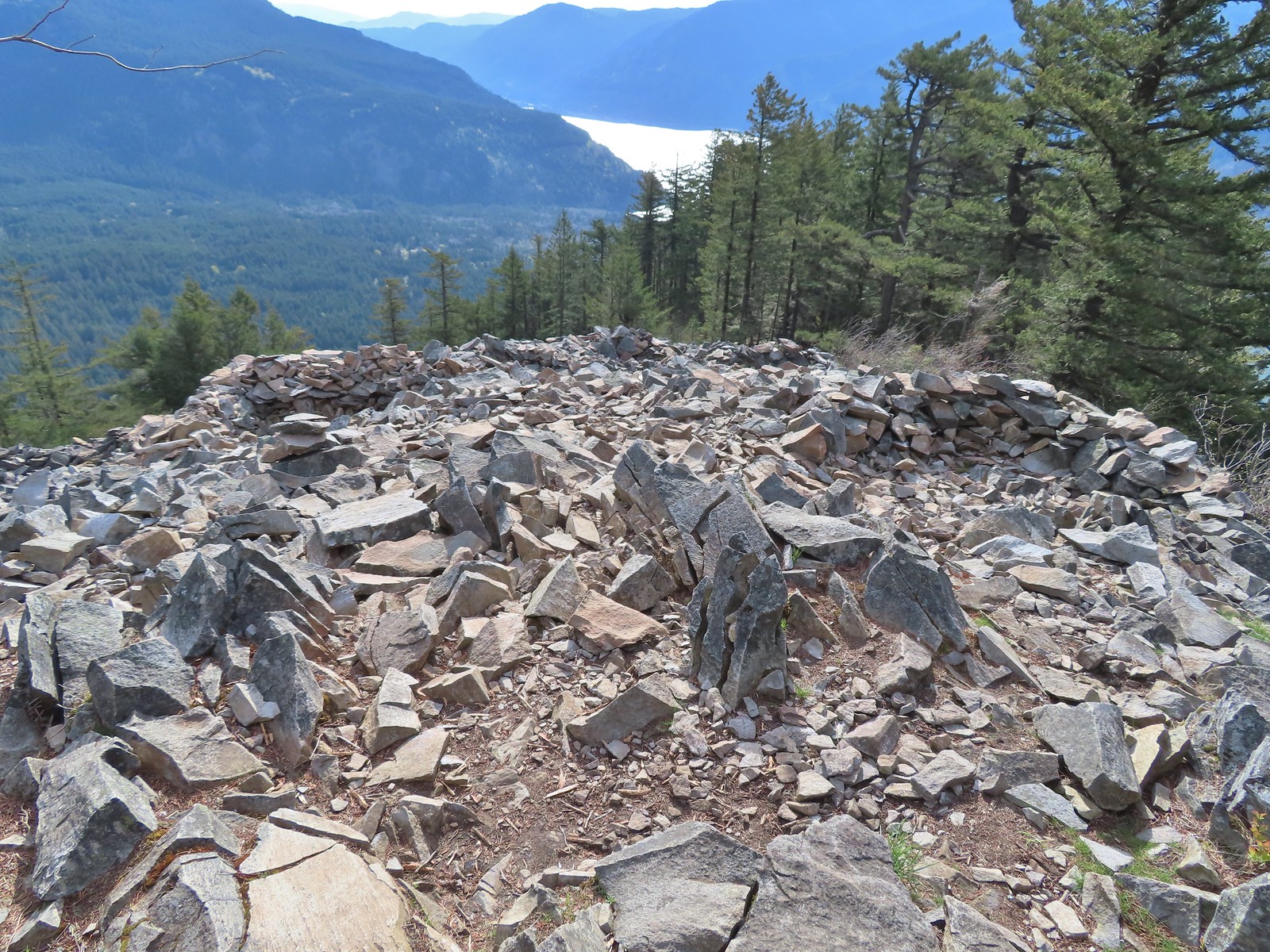
Vision quest pits on Wind MountainVision quest pits on Wind Mountain.

Mt. Adams from Wind MountainMt. Adams beyond Augspurger Mountain.

Mt. AdamsMt. Adams

View across the Columbia River from Wind MountainLooking across the Columbia River.

There was a nice breeze at the summit, and we took a well-earned break before heading down. Up till that point we’d only seen five other hikers all morning, but now that it was later we found ourselves stepping aside regularly to let the uphill traffic pass. From the quarry we headed back West to our next stop at the Sams-Walker Day Use Area.

Similar to the St. Cloud Day Use Area the area is a former homestead with picnic tables, a 1.1-mile loop trail, and vault toilet. We were surprised to find the small parking lot here almost entirely full. As it turned out group from the Friends of the Columbia River Gorge were out doing some planting.

We were able to park along the edge of the trailhead entrance and set off on the loop.
Sams-Walker Day Use Area

There are a couple of loop options here, but no maps to assist with navigation. We had our GPS map and a map from the Oregon Hikers Field Guide, but it turns out they are both outdated so when we veered right at the first split we planned on hiking the outer loop counterclockwise.
Trails at Sams-Walker Day Use AreaThe first split where we went right.

A tenth of a mile later we came to another split which managed to confuse us based on the maps we had available.
Trail at Sams-Walker Day Use AreaTo continue on the counterclockwise loop we should have turned right at the junction ahead.
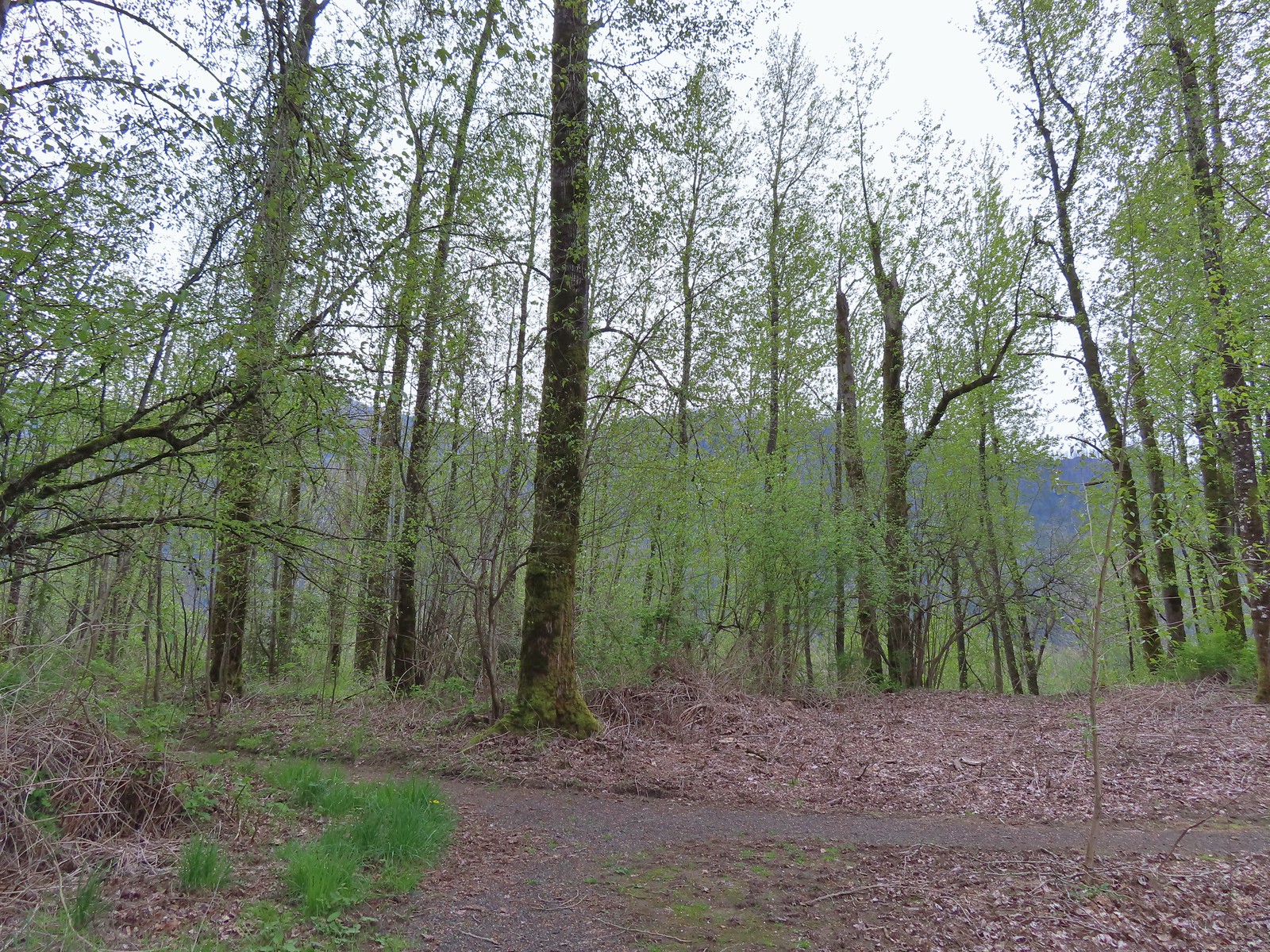
We veered left thinking that the righthand trail was a connector passing through the middle of the day use area. In another tenth of a mile though we arrived at “T” junction where we realized that the left at the first junction was the outer loop going in a clockwise rotation.
Trails at Sams-Walker Day Use AreaWe turned right at the junction now doing the loop clockwise.
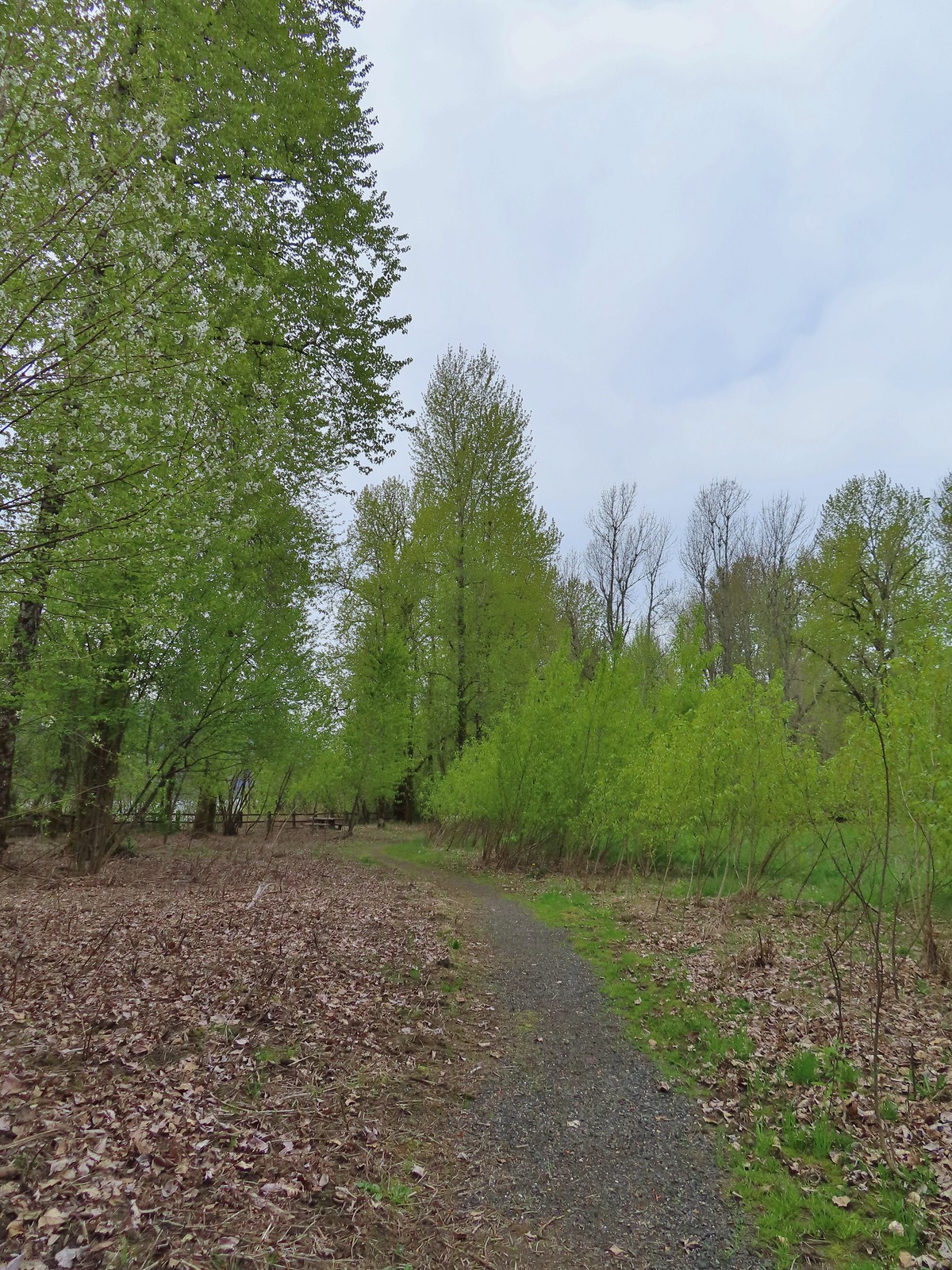
Sams-Walker Day Use AreaComing up on one of the picnic tables along the loop.

Columbia River from Sams-Walker Day Use AreaThe Columbia River from the picnic table.
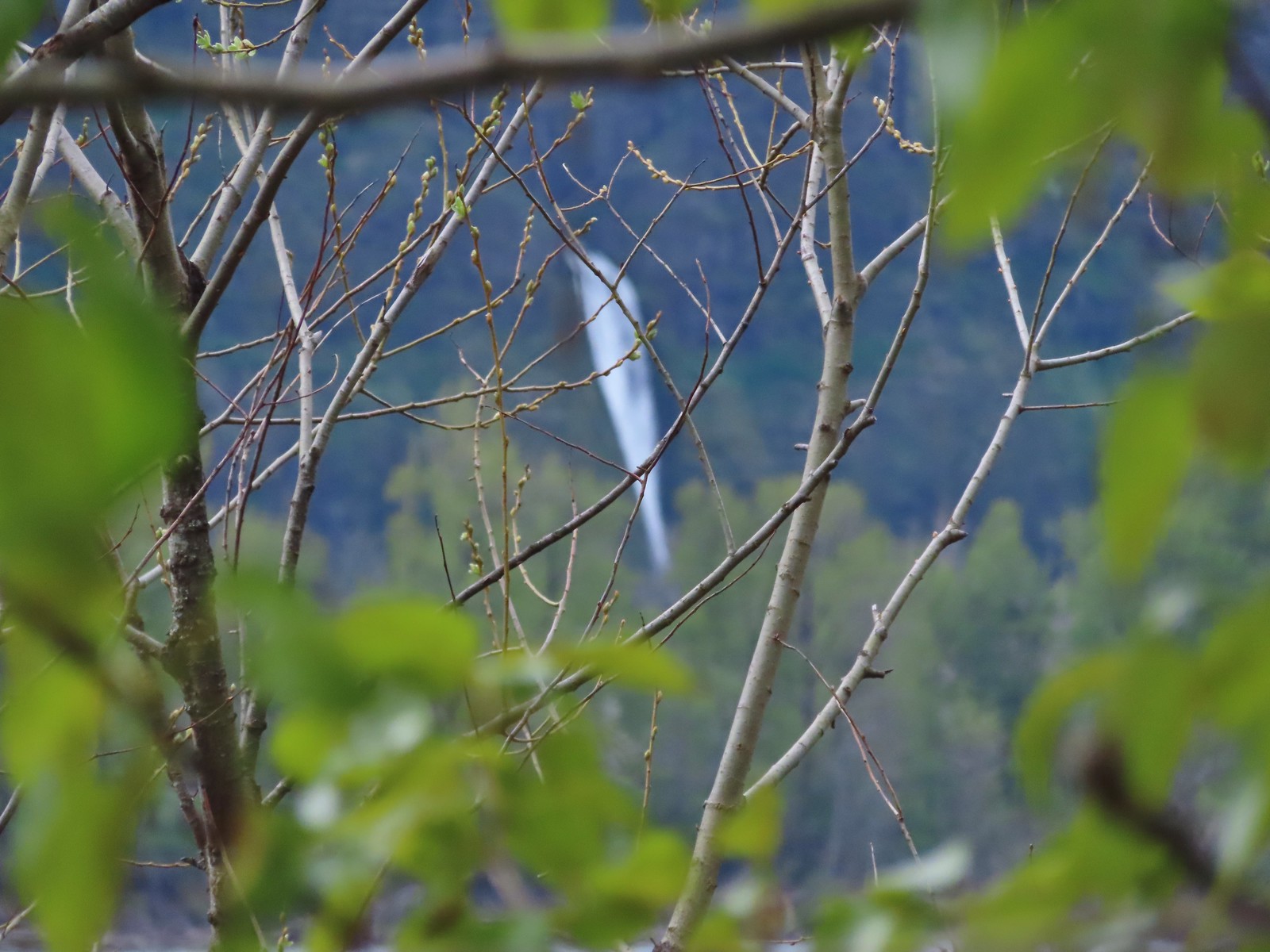
Horsetail FallsHorsetail Falls (post) from the picnic table.

We continued on loop which eventually passed through a cedar grove before bringing us back to the second junction we’d passed.
Sams-Walker Day Use Area

Chipping sparrowChipping sparrow

White-crowned sparrowWhite-crowned sparrow

Fringecup and bleeding heartBleeding heart and fringecup

Cedar grove at Sams-Walker Day Use AreaThe cedar grove

Sams-Walker Day Use AreaCompleting the first loop.

When we got back to the second junction we decided to go right and then take a left at the third junction to hike the portion of the outer loop that we’d missed. It was along this quarter mile section that we passed the group from Friends of the Columbia Gorge.
Sams-Walker Day Use Area

Spider on perriwinkleSpider on perriwinkle

After hiking all the trails here we returned to Highway 14 and drove 2 miles back to the east to turn into the Doetsch Ranch Day Use area of Beacon Rock State Park.
Doetsch Ranch Day Use Area, Beacon Rock State ParkKiosk at Doetsch Ranch.

A 1.1-mile paved loop circles the picnic area. We set off counterclockwise from the kiosk following the paved path for a little over 3/4 of a mile to another parking area along Beacon Rock Moorage Road.
Doestch Ranch Day Use Area

Doestch Ranch Day Use AreaBeacon Rock (post) from the trail.

Beacon Rock and Hamilton MountainBeacon Rock and Hamilton Mountain.

Doestch Ranch Day Use AreaComing up on the other parking area.

We left the loop at the road and followed the road down to the river. Next we walked up the road passing under railroad tracks to find the start of the 0.75-mile River to Rock Trail.
Columbia River

Beacon Rock and Hamilton Mountain

River to Rock Trail

Woodward CreekWoodward Creek

This trail climbs over 250′ before dropping to the River to Rock Trailhead. Along the way the trail passes around Riddle Lake and an old stone structure along with many wildflowers.
Fairy bells, vine maple, and fringecupFairy bells, vine maple, and fringecup

Columbian larkspurColumbian larkspur

Wildflowers along the River to Rock TrailTrillium and voilets

Checker (chocolate) liliesChecker (chocolate) lilies

Stone shed along the River to Rock Trail

Beacon Rock from the River to Rock Trail

Bleeding heartsBleeding heart

Checker (chocolate) liliesThis was just one part of the best display of chocolate lilies we’d ever seen.
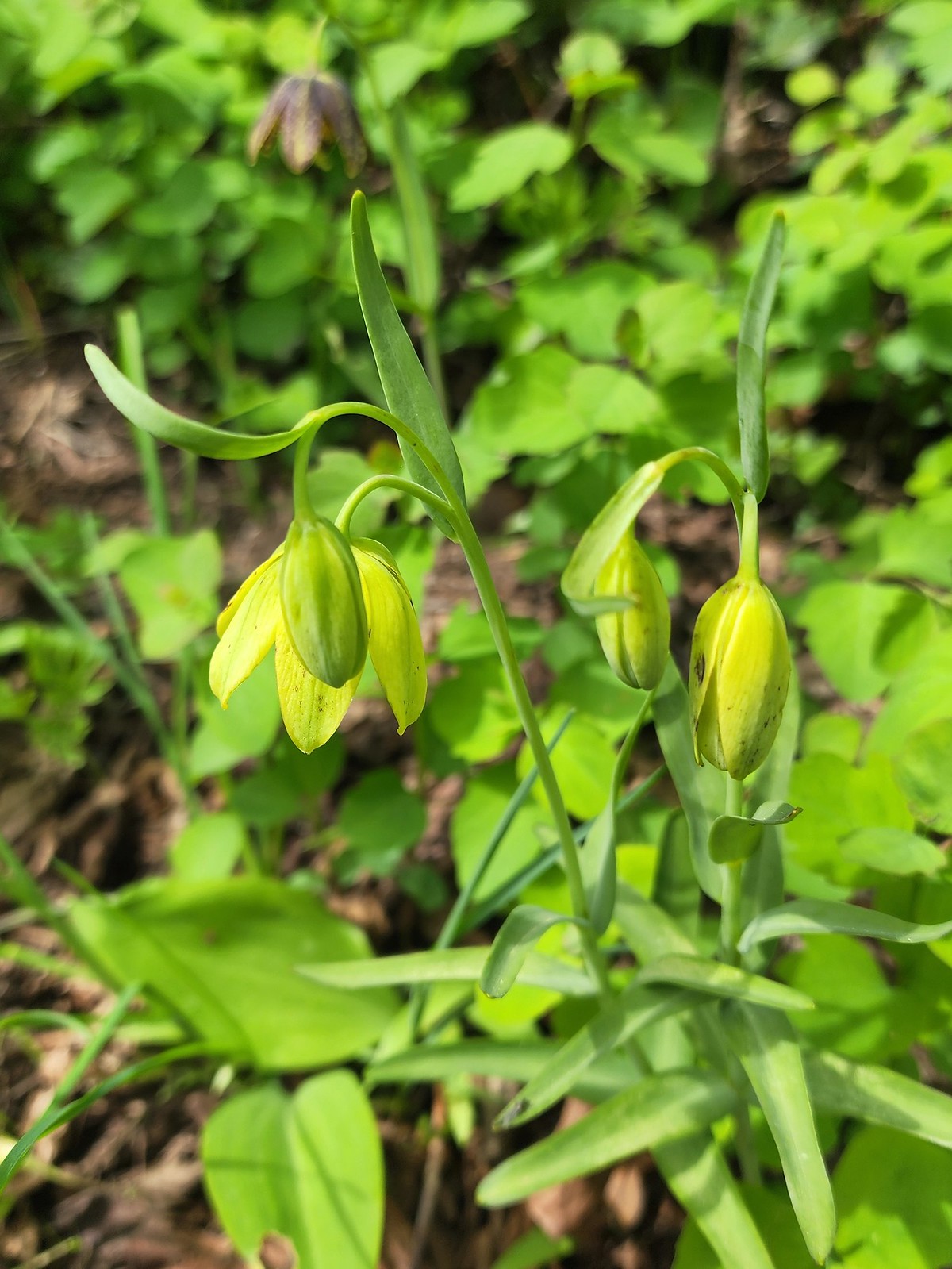
Checker (chocolate) liliesThere were a couple of lilies with this coloration which was new to us.
Beacon Rock beyond Riddle LakeRiddle Lake

River to Rock TrailDropping down to the River to Rock Trailhead.

River to Rock TrailLooking back up the River to Rock Trail.

We hadn’t planned on re-hiking Beacon Rock and the steady stream of people we could see from the trail going up and down the stairs reenforced that choice. We returned the way we’d come and then completed the paved loop at Doetsch Ranch to finish off our day.
Checker (chocolate) lilies along the River to Rock TrailPassing back by the large patch of chocolate lilies.

Echo azureOur first butterfly of 2024, an echo azure.
Doetsch Ranch Trail

Doetsch Ranch TrailCompleting the loop.

Our mileage for the day came to 9.2 with 1.6 coming at each Sams-Walker and St. Cloud, 2.7 at Wind Mountain, and 3.3 at Doestch Ranch. The elevation total was a nearly 1700′ with nearly 1200′ coming at Wind Mountain, 185′ at St. Cloud, and 270′ on the River to Rock Trail.
Screenshot 2024-04-14 122143St. Cloud and Lower Archer Falls

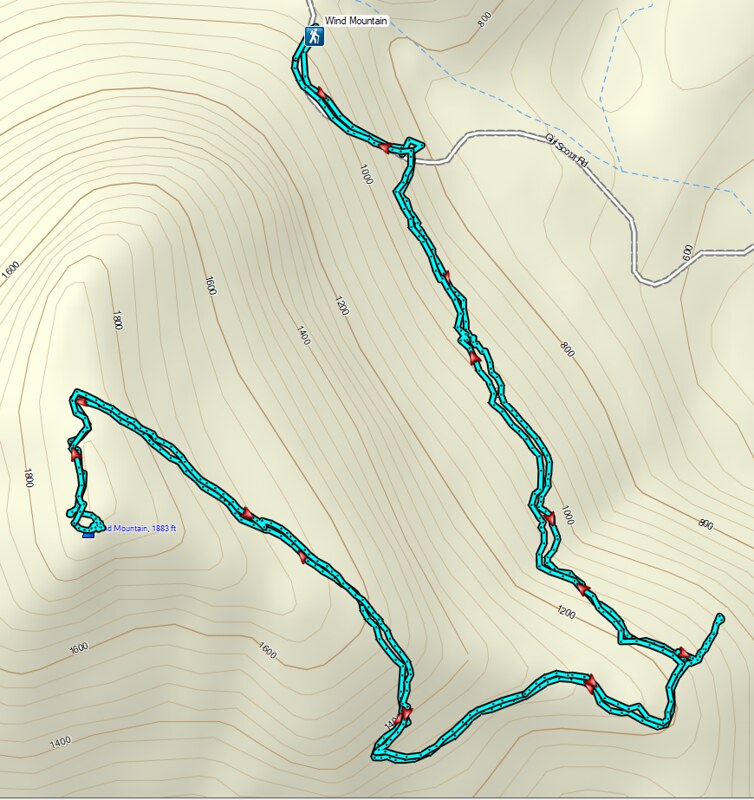
Screenshot 2024-04-14 122029Wind Mountain

Screenshot 2024-04-14 122458Sams-Walker

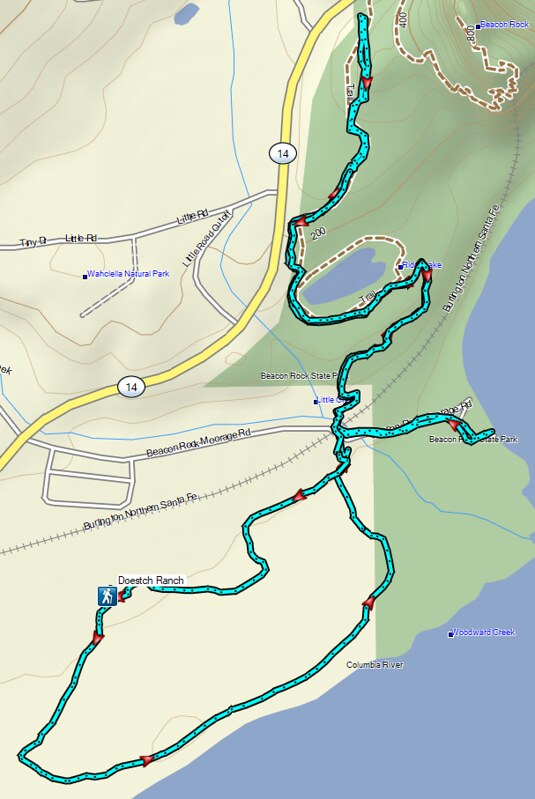
Screenshot 2024-04-14 121925 Doetsch Ranch

While none of the hikes were long enough to justify the 1:30 to 2hr drive from Salem combining them made for a more than worthy outing. When we got home it took me all of 5 minutes to remember where our annual forest pass was. I’d put in a shoebox on the work bench in our garage. Apparently 5am brain isn’t up to par with 3pm brain. Happy Trails!

Flickr: St. Cloud, Wind Mt. Sams-Walker, & Doetsch Ranch

Categories
Columbia River Gorge South Hiking Oregon Trip report

Multnomah Falls to Larch Mountain – 10/10/2022

With Heather still sidelined with a bum knee and a Monday holiday that most of the rest of Oregon didn’t have off I decided to tackle the climb from Multnomah Falls to Larch Mountain. Starting at the Multnomah Falls Trailhead the hike to Sherrard Point is roughly 14.5 miles out-and-back with just over 4000′ of elevation gain. If I was feeling up to it, my plan was to extend the hike just a bit by detouring on the way back to visit Fairy and Wahkeena Falls adding another 1.7 miles and 500′ of elevation to the days total.

We had hiked to Multnomah Falls on a big loop in 2012 starting at Oneonta Trailhead (post), Larch Mountain in 2020 from Road 315 Trailhead (post), and Wahkeena Falls in 2013 from the Angels Rest Trailhead (post). Even though we had visited all of these main attractions before, this route would provide several miles of trail that I had yet to be on. Two of those trips also occurred prior to the 2017 Eagle Creek Fire which burned most of the forest along the lower portion of this hike.

I arrived at the Multnomah Falls parking lot a little before 7am and was pleased to find that I was just the fourth car.
IMG_3027

It was still a bit before sunrise but there was enough light once I had gotten everything together to set off towards the falls.
IMG_3028

The lack of light did nothing for my point and shoot camera but that was a small price to pay to have the falls to myself (save for a few staff preparing the grounds for the day).
IMG_3032

IMG_3043Multnomah Falls

IMG_3046

IMG_3049The Benson Bridge.

IMG_3051View from the bridge.

IMG_3052Multnomah Falls from the bridge.

Beyond the bridge the paved trail climbs steeply via 11 switchbacks. (I’m pretty sure they squeezed a very short 12th in there.)
IMG_3067

IMG_3065The Moon beyond the Columbia River and Multnomah Falls Lodge.

IMG_3063

IMG_3068Beacon Rock (post) to the east on the Washington side of the Columbia.

IMG_3069

IMG_3072The second switchback.

IMG_3073Another view of the falls. I passed a pair of hikers along this stretch then didn’t see another person for another couple of hours.

After climbing above the falls via the switchbacks I took my first detour to visit the Multnomah Falls Viewpoint.
IMG_3078

IMG_3079Viewpoint trail.

This trail descends a tenth a mile to a viewpoint above the falls.
IMG_3081

IMG_3083

IMG_3084Small fall just upstream from Multnomah Falls.

IMG_3085Cape Horn (post) to the right across the Columbia.

I returned to the Larch Mountain Trail and continued towards Larch Mountain. After a brief descent to cross Multnomah Creek the trail began a long gradual climb along the creek.
IMG_3087Bridge over Multnomah Creek.

IMG_3091

IMG_3092Approaching Middle Dutchman Falls.

IMG_3095Middle Dutchman Falls

IMG_3097

IMG_3098Upper Dutchman Falls

IMG_3102Dutchman Tunnel

IMG_3106Wiesendanger Falls is located just beyond Dutchman Tunnel.
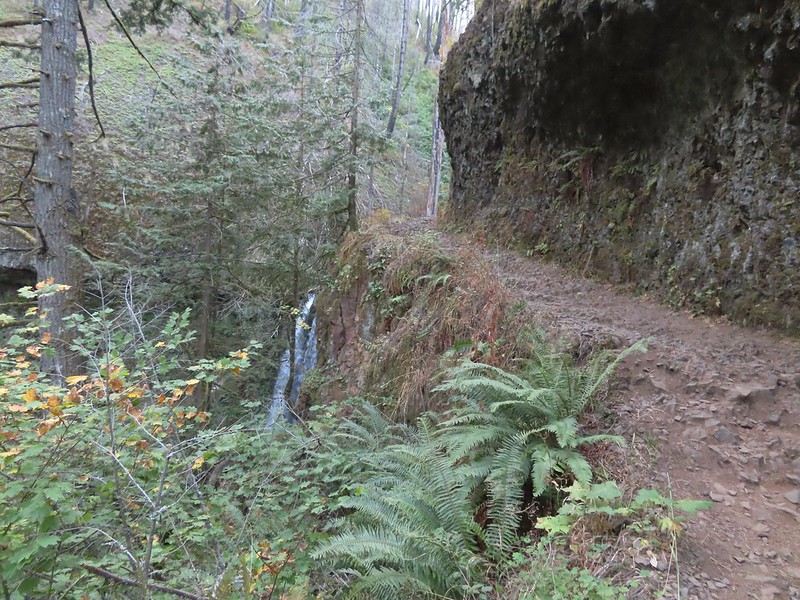
IMG_3110A short distance beyond Wiesendanger Falls is Ecola Falls.
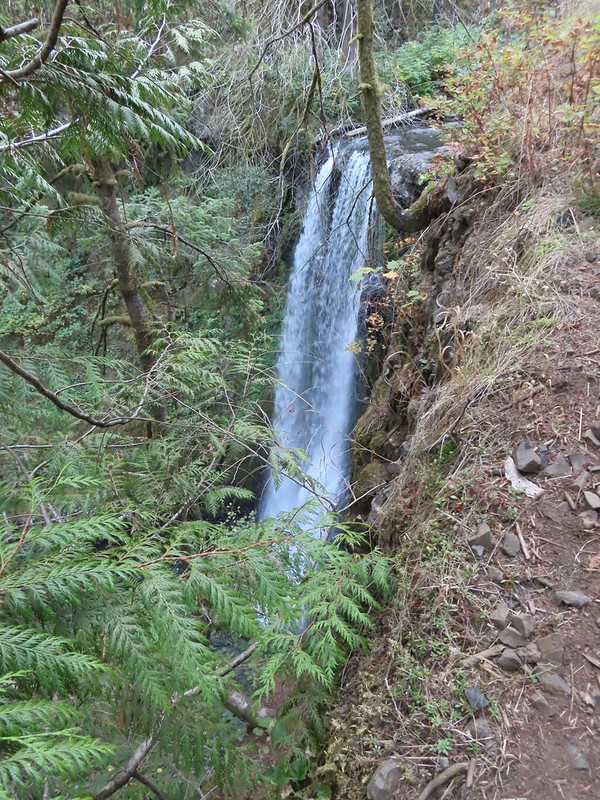
IMG_3111Ecola Falls

A quarter mile beyond Ecola Falls (and 2 miles from the trailhead) I arrived at the Wahkeena Trail junction.
IMG_3118

IMG_3119

IMG_3120Good signage at nearly all trail junctions, especially those closest to the trailheads.

I stayed on the Larch Mountain Trail which crossed the creek on a newer (2018) steel bridge that replaced the one burnt in the Eagle Creek Fire.
IMG_3124

IMG_3126Looking down the creek at sunlight starting to hit the hillside.

IMG_3129A few bleeding heart were still in bloom.
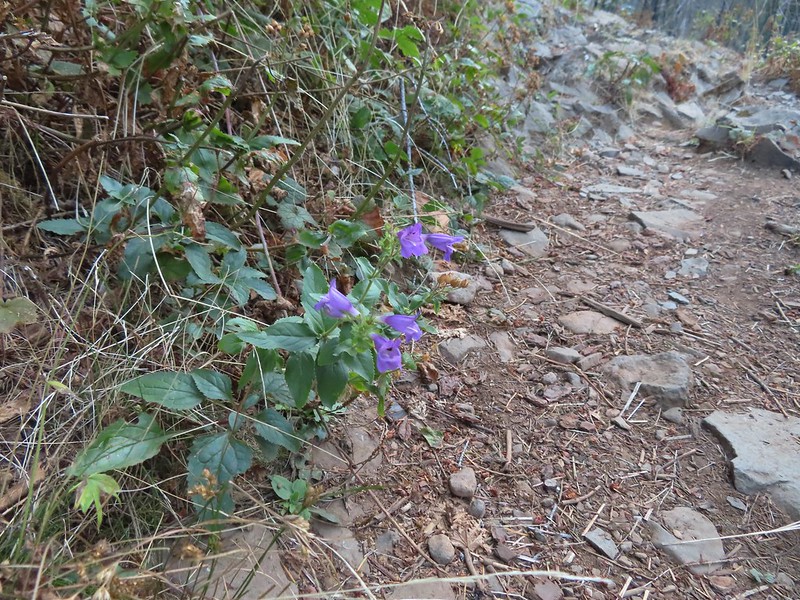
IMG_3131

IMG_3132Penstemon

IMG_3136This section is flooded in late Winter/Spring. The signed High Water Trail leads up and around it for those high water times.
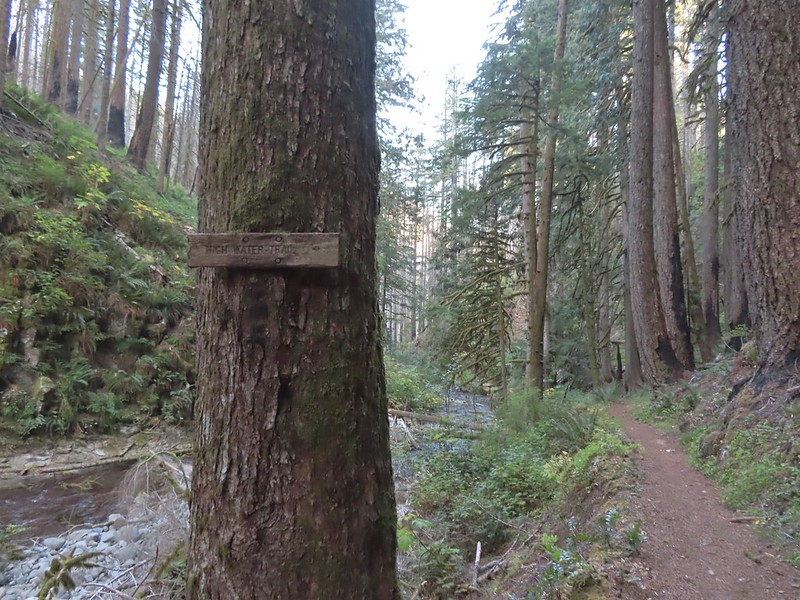
IMG_3138Sign for the High Water Trail at its southern end.

IMG_3139The southern end of the High Water Trail heading uphill to the right.
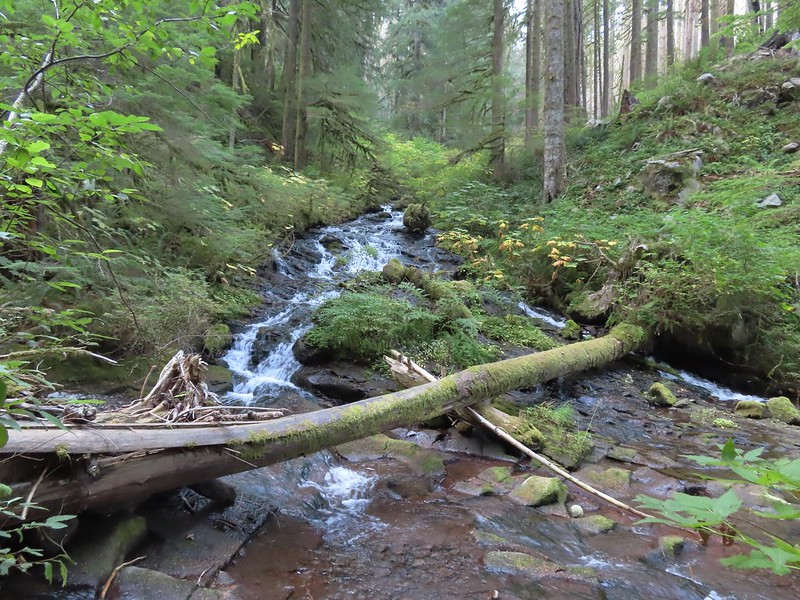
IMG_3140

IMG_3141I couldn’t find a name for this creek but it had a good flow, in fact it was more water than what was in Multnomah Creek upstream from their confluence.
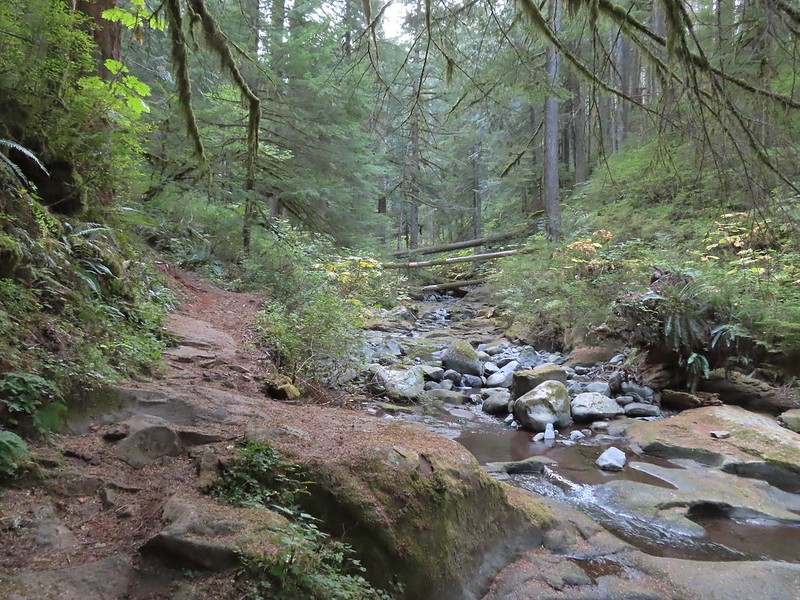
IMG_3144Multnomah Creek upstream from the unnamed creek.
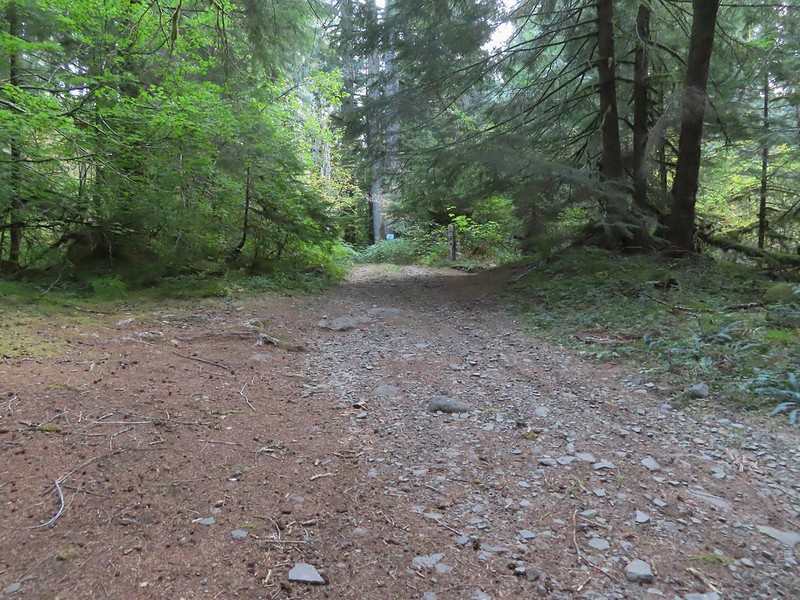
One point two miles from the Wahkeena Trail junction I came to the Multnomah Basin Road where the Larch Mountain Trail jogged slightly left before continuing on and entering the Mark O. Hatfield Wilderness.
IMG_3147

IMG_3148

IMG_3150

IMG_3152

The forest around the wilderness boundary had mostly been spared by the fire but I quickly reentered the burn before arriving at a junction with the Franklin Ridge Trail.
IMG_3154Reentering the fire scar.

IMG_3155The Franklin Ridge Trail on the left.

A tenth of a mile from the junction the trail crossed the nearly dry East Fork Multnomah Creek on a small footbridge.
IMG_3159

IMG_3160

The trail continued briefly through a patch of green trees up a ridge between the East and West Forks of the creek then reentered the fire scar. Four tenths of a mile from the East Fork crossing I came to a second footbridge, this one crossing the West Fork.
IMG_3165

IMG_3166

Beyond this second footbridge the trail crossed a large scree field where I was taunted by the distinctive “meep” of pikas. They were seemingly all around but I wasn’t ever able to spot any of the little rock rabbits this time.
IMG_3170

IMG_3171Maple changing colors

IMG_3172I’m sure there is at least one pika in this photo somewhere.

IMG_3174Looking back toward Franklin Ridge.

A short distance beyond the scree field the trail left the fire scar for good arriving at a junction with the Multnomah Creek Way Trail 1.8 miles from the Multnomah Basin Road crossing.
IMG_3177

IMG_3180Arriving at the junction.

I stayed left at this junction on the Larch Mountain Trail and climbed 0.4 more miles to a road crossing of gated FR 315 (Where we had started our previous Larch Mountain hike).
IMG_3183

IMG_3186

I crossed the road and continued climbing. The trail steepened noticeably at first but quickly relented and resumed a more gradual grade.
IMG_3187

IMG_3191

IMG_3192I was hoping for less smoke in the air but these sunbeams told me that there was still a fair amount lingering around much as it had been for the last several days.
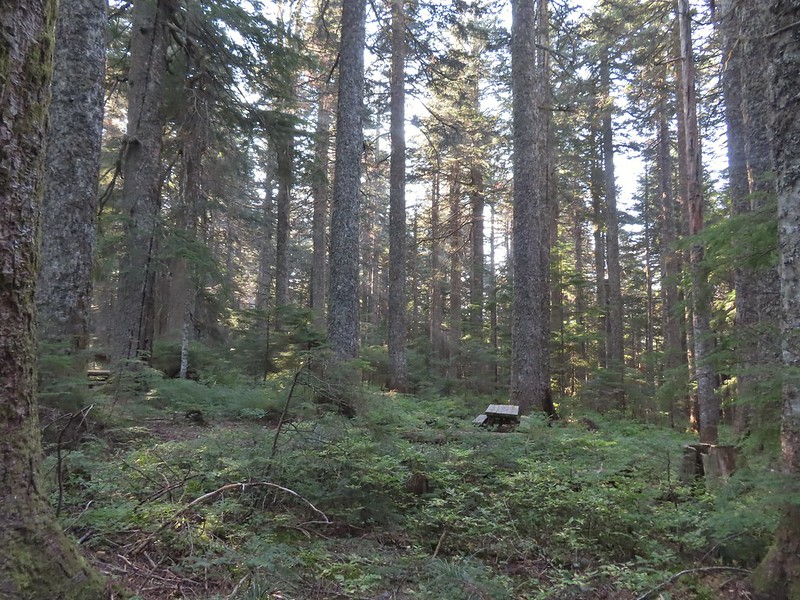
IMG_3194After 1.25 miles I passed a pair of old campsites with picnic tables on the right. I stayed right at an unsigned junction with a trail that led uphill to the left. We had come down that way on our previous trip skipping a short section of the actual Larch Mountain Trail.

Another quarter mile brought me to the Larch Mountain Trailhead
IMG_3198There were four cars at this trailhead.

I’d passed one person with a dog followed by a pair of ladies with another dog between FR 315 and the trailhead. I turned onto the paved Sherrard Point Trail expecting to see the other car owners along this 0.3 mile path but was pleasantly surprised to find that I had Sherrard Point all to myself.
IMG_3200Vine maple near the Sherrard Point Trail.
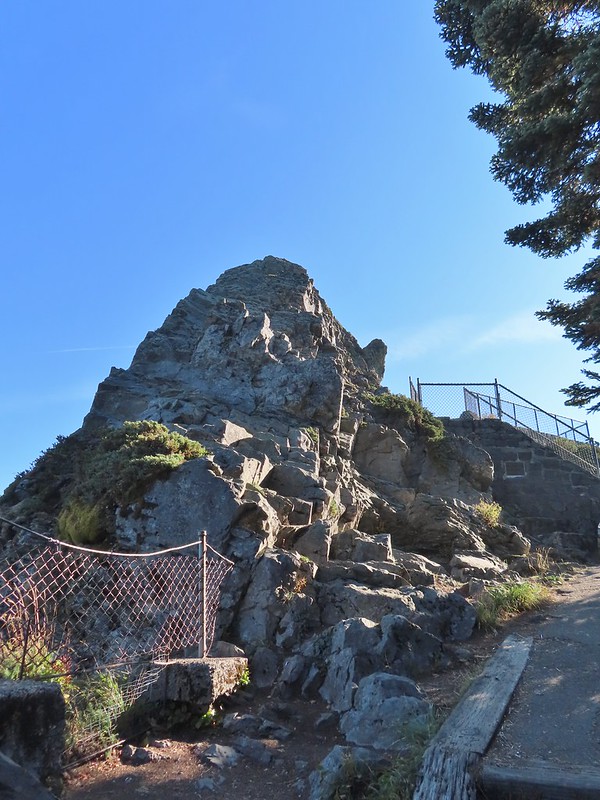
IMG_3203

IMG_3212

One of the factors that had led me to choose this hike for the day was due to the forecast calling for clear sky at this viewpoint whereas the other hikes I had considered were expected to have widespread haze. Technically I think the forecast was correct because if I looked straight up it looked like a blue bird day. Looking out was a different story though with smoke in every direction.
IMG_3232

IMG_3215

IMG_3221Mt. St. Helens in the smoke to the left and Mt. Adams a bit above it to the right.

IMG_3218Mt. Hood

IMG_3208Mt. Adams

IMG_3228Mt. St. Helens

IMG_3229Silver Star Mountain (post)

Unbeknownst to me at the time a new fire, the Nakia Creek Fire, had started near the Larch Mountain in Clark County, WA to the SW of Silver Star less than 24 hours earlier contributing to the smokey conditions.

It wasn’t the view I’d hoped for but it was something, at least I could see parts of several mountains. I didn’t spend much time at the viewpoint given the conditions and made my way back to the old picnic tables by crossing over Larch Mountain. I took a short break at one of the tables to drink a Gatorade I had been hauling around and put on a clean pair of socks for my return hike.
IMG_3230Heading down.

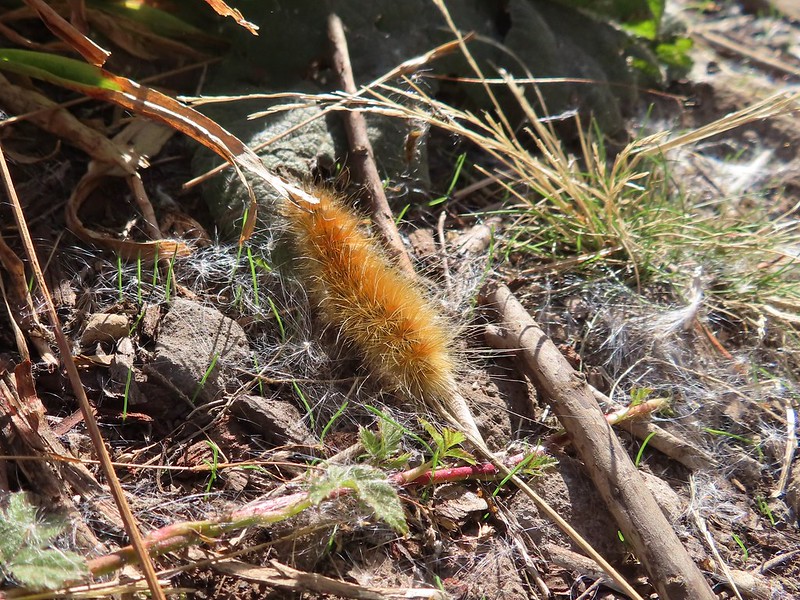
From the picnic table I returned to the way I’d come up to the Wahkeena Trail junction. Up to that point I had only encountered a total of eight other hikers. I had however seen dozens of woolly caterpillars.
IMG_3240

IMG_3243

IMG_3245

IMG_3169

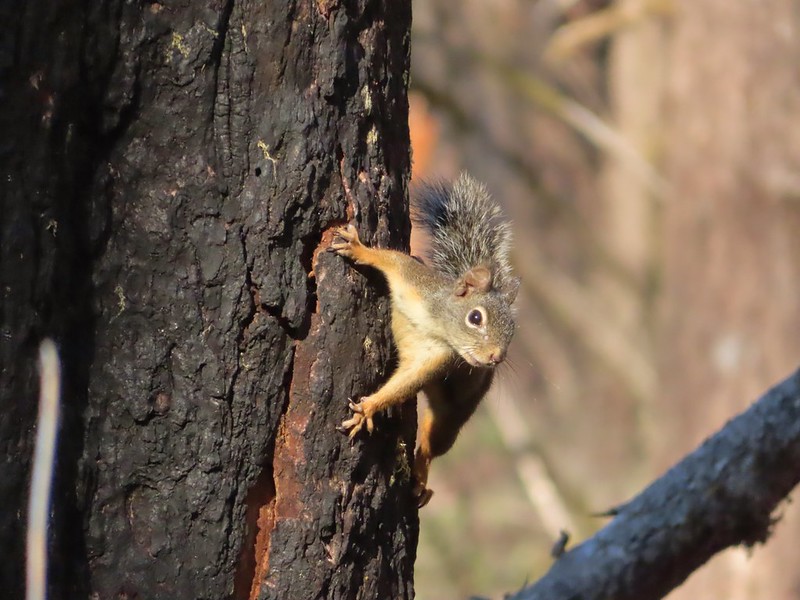
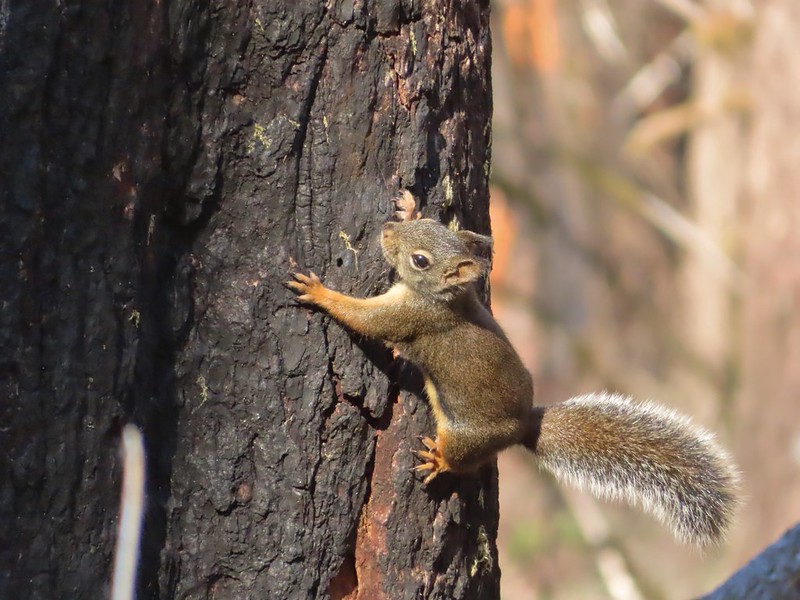
I heard fewer pikas on my way back through the scree field but saw the same number, zero. There was an encounter with a squirrel that came crashing through the brush, jumped across the trail, and climbed a snag so that it could give me a scolding.
IMG_3249

IMG_3250

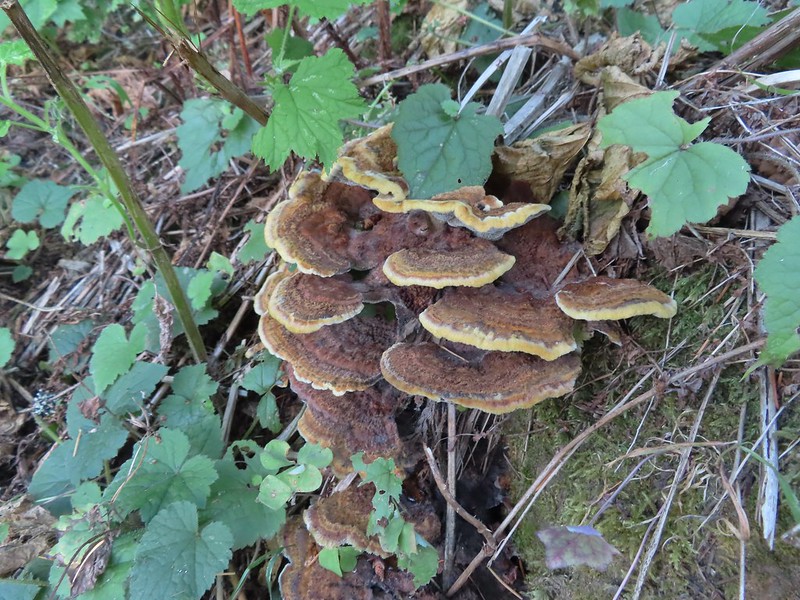
IMG_3266Lots of fungi on this tree.

IMG_3270

IMG_3273Hedgenettle

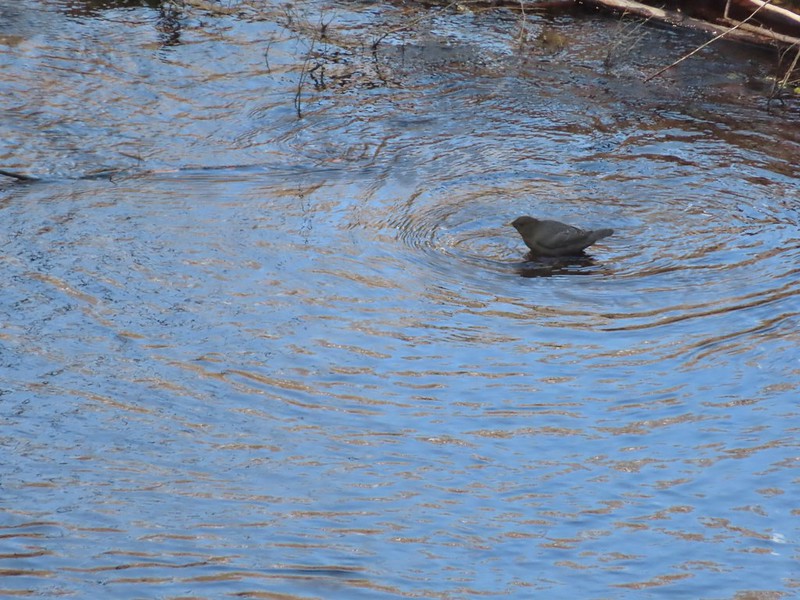
IMG_3278Ouzel

The solitude that I had been enjoying ended abruptly at the Wahkeena Trail junction where a number of hikers could be seen heading uphill on the trail ahead and a group was effectively blocking the trail at the junction as they attempted to make sense of the trail signs.
IMG_3283

I tried to align my photos with the hikers ahead passing behind trees.

I had made the decision to take the longer way back past Wahkeena Falls since I had been making good time and I was still feeling pretty energetic. I hadn’t really paid attention to the fact that the Wahkeena Trail gains over 300′ in the first mile as it traverses up the hillside to a junction on a ridge top.
IMG_3284Looking back down at Multnomah Creek.

IMG_3285

IMG_3288Cape Horn again across the Columbia.

IMG_3289

IMG_3291I couldn’t recall seeing these before on a hike, not this color anyway.

IMG_3295The Devil’s Rest Trail on the left at the ridge top.
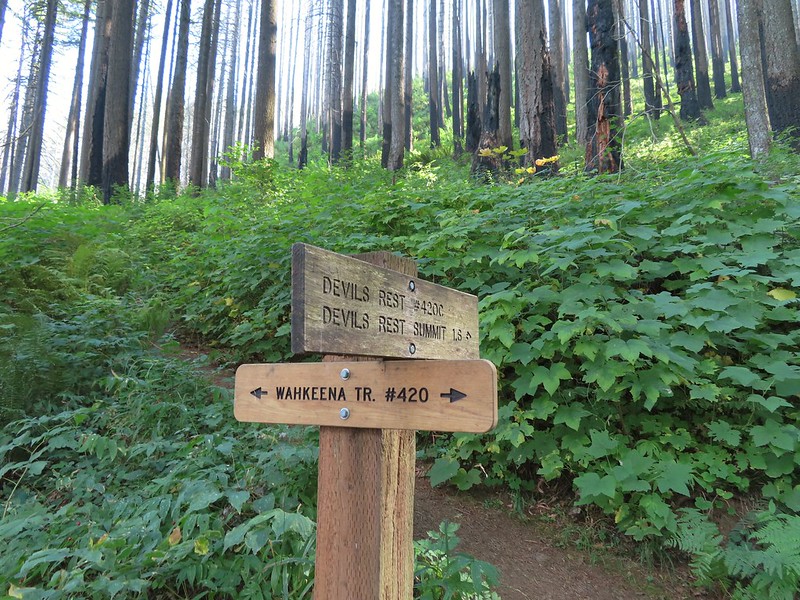
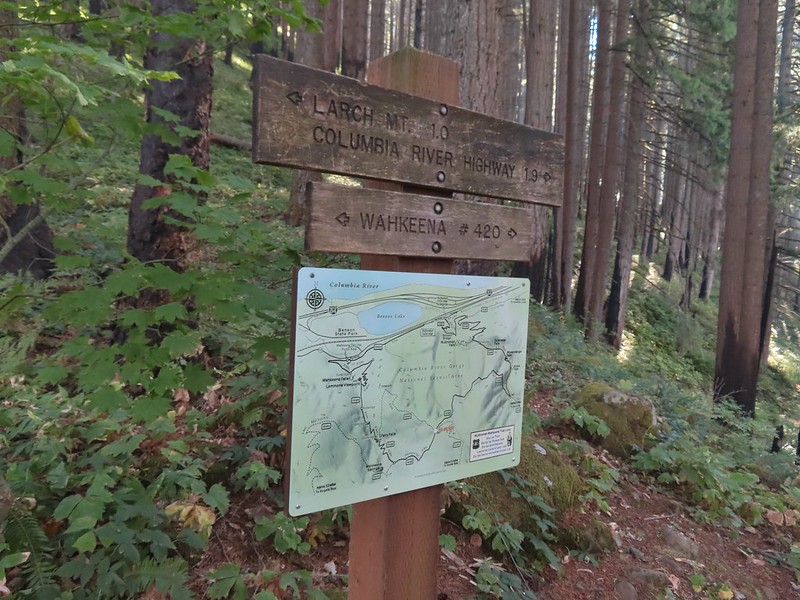
IMG_3296

I wound up getting distracted by the different hikers coming and going atop the ridge and turned right onto the Vista Point Trail instead of staying straight on the Wahkeena Trail which had been my planned route. In the end I was glad I did. It was only about a tenth of a mile longer to take this detour which was a bit overgrown but it also passed a viewpoint that I detoured out to.
IMG_3297I should have followed the Wahkeena Trail Pointer here.
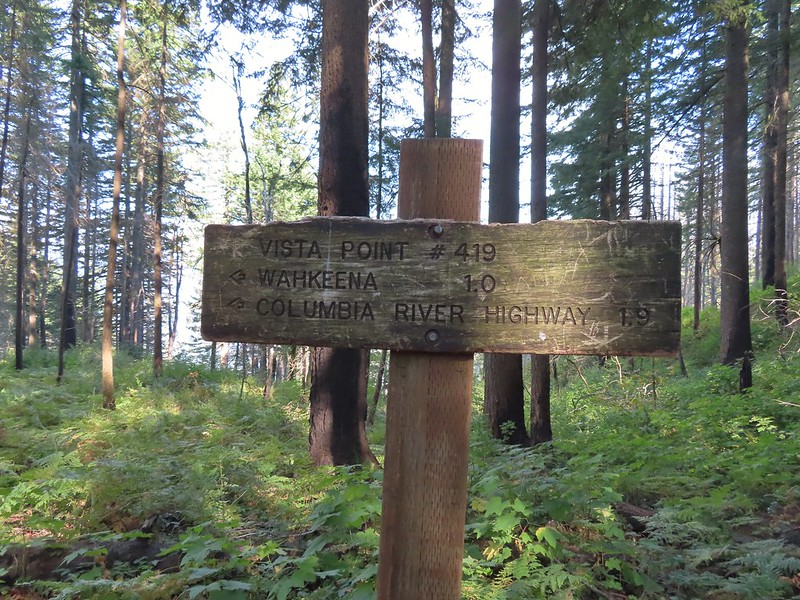
IMG_3298Instead I followed the pointer for Wahkeena 1.0.

IMG_3301Vista Point Trail

IMG_3304

IMG_3306

IMG_3307

I could see my car in the parking lot from the viewpoint.

IMG_3309There is the trail I had intended to be coming down arriving at the junction with the other end of the Vista Point Trail.

The Vista Point Trail was in pretty good shape (other than the overgrowth) save for the final 10-20 feet which was now part of a stream bed. The combination of slick wet rocks and it being downhill made for a tricky descent to the junction.
IMG_3316Looking back at the Vista Point Trail from the junction.
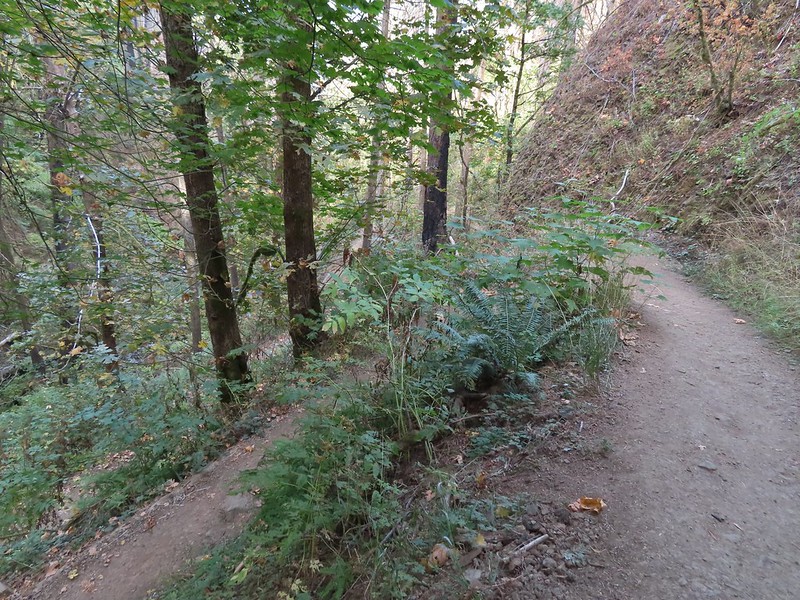
After successfully navigating the wet rocks I turned down the Wahkeena Trail. I immediately was glad that I’d chosen to come this way as I had forgotten how scenic Wahkeena Creek is flowing through the narrow gorge. Even after the fire it was still beautiful.
IMG_3320Lots of tight switchbacks to get down the gorge.
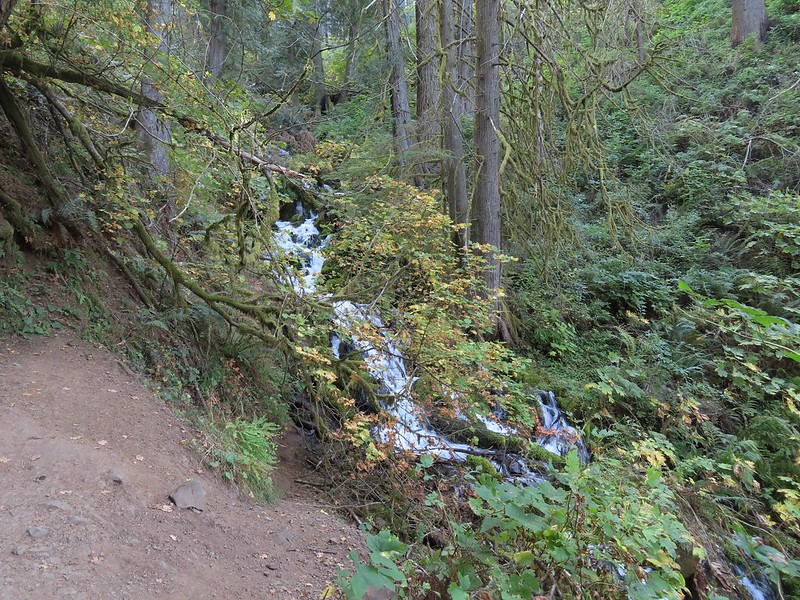
IMG_3321

IMG_3324Fairy Falls

IMG_3326Fairy Falls

IMG_3328

IMG_3330

IMG_3332Looking out across the Columbia River.

IMG_3333

IMG_3335

IMG_3339

IMG_3342

IMG_3344

A half mile down this trail I took a short detour to Lemmons Viewpoint.
IMG_3347

IMG_3348Cape Horn (again)

IMG_3352The Wahkeena Trail from Lemmons Viewpoint.

Another half mile descent brought me to the base of Wahkeena Falls where I was happy to find only a small number of other hikers.
IMG_3354The poison oak was really colorful.

IMG_3355Approaching Wahkeena Falls.

IMG_3357Wahkeena Falls

IMG_3360Wahkeena Falls.

IMG_3362Looking back at Wahkeena Falls.

There were plenty of folks at the trailhead as I passed by before hopping onto the Multnomah Falls Return Trail.
IMG_3363

IMG_3367

IMG_3370One last look at Wahkeena Falls through the trees.

IMG_3372

It was roughly half a mile back to the now busy lodge at Multnomah Falls and another tenth or so to my car.
IMG_3376

IMG_3378A line of cars on Historic Highway 30 in front of the lodge.

IMG_3381

IMG_3383

This hike came to 16.2 miles with around 4500′ of elevation gain. A tough but scenic outing with highlights at the start, mid-point, and end to help take the mind off the body.

I was on my way home at 1:45pm and looking forward to spending some time with our new kittens. After losing Buddy in 2020 (post) and Hazel in 2021 (post) we’d been cat-less for over a year. With Heather unable to hike it seemed to the perfect time to open our home up again and on Monday the 3rd Heather picked up Merry and Pippin from the Humane Society.
20221005_114540Merry (black) is 3 mos. and Pippin is 2 mos. Both boys from separate litters.
20221007_120622

They have been keeping us plenty busy. Merry is a snuggler while Pippin is a ball of chaotic energy until he runs out, then he likes to snuggle too. Happy Trails!

Flickr: Multnomah Falls to Larch Mountain

Categories
Columbia Gorge North Hiking Washington

Hardy Ridge Loop

For the third hike in a row we found ourselves headed to Washington. Our destination this time was Beacon Rock State Park for a hike to Hardy Ridge. We’d been to the park twice before with Hamilton Mountain being our goal each time (on our second visit we also hiked up Beacon Rock (post)). For each of our hikes to Hamilton Mountain we had started at the Hamilton Mountain Trailhead but for today’s hike we parked at the Equestrian Trailhead.
IMG_3820

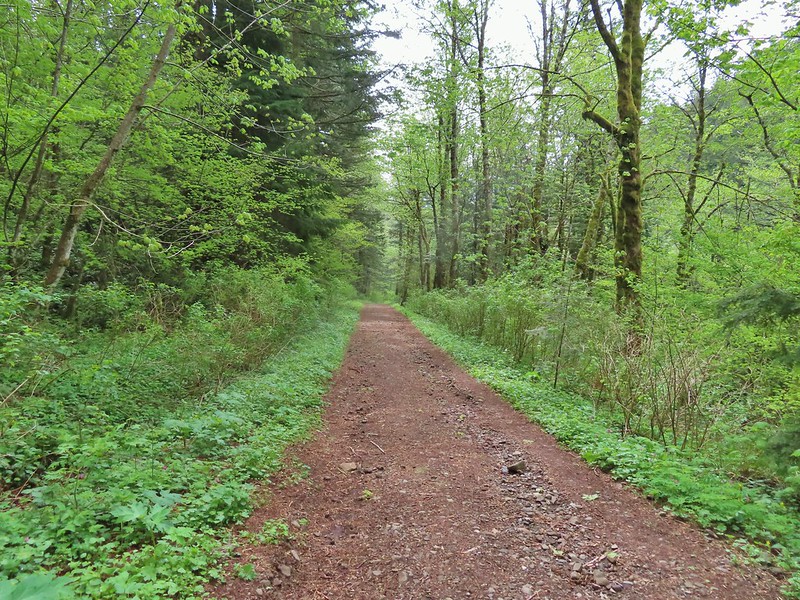
There is a gated road and a trail that begin at the far end of the parking area which meet after a few hundred feet.
IMG_3514Equestrian Trail at the trailhead.

IMG_3528On the old roadbed/Equestrian Trail.

We followed the Equestrian Trail uphill through the forest and past a number of wildflowers for 1.2 miles to a 4-way junction.
IMG_3520Vanilla leaf

IMG_3522Fairy bells

IMG_3529Violets

IMG_3530Star-flowered false solomon seal

IMG_3533Youth-on-age

IMG_3537Possibly a cinquefoil

IMG_3542Thimbleberry

IMG_3545Fringecup

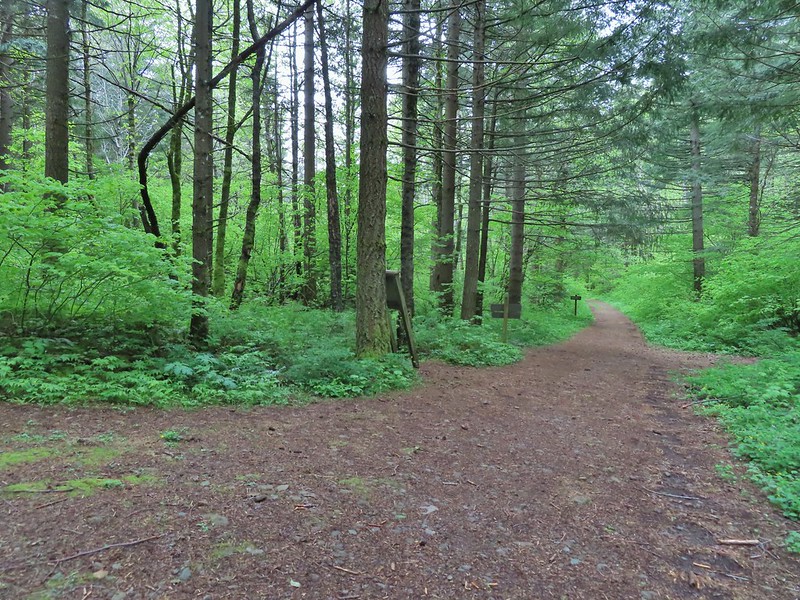
IMG_3547At the 4-way jct the Equestrian Trial continued straight with the West Hardy Trail to the left and Lower Loop Trail to the right.
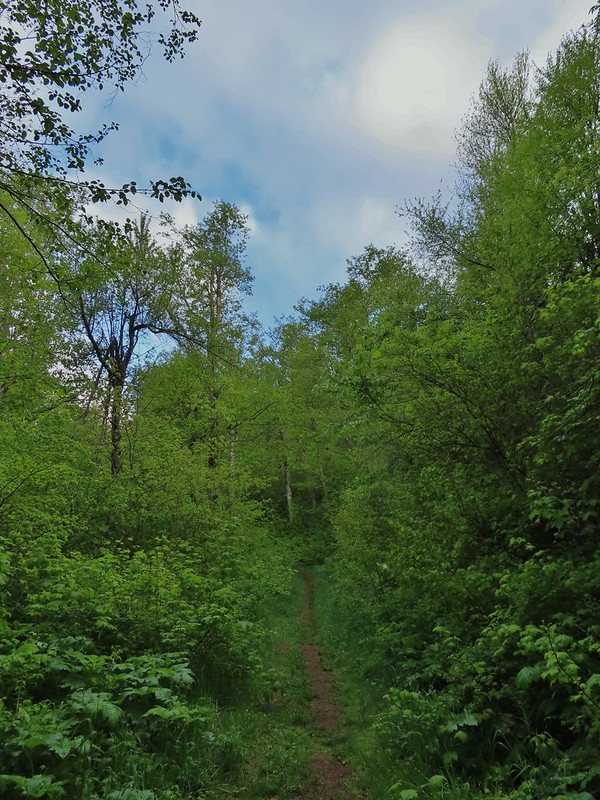
We turned left on the West Hardy Trail which followed an overgrown road bed along the west flank of Hardy Ridge. A brief appearance of blue sky gave us a moment of hope that the mostly cloudy forecast might have been wrong but the blue was quickly replaced with gray clouds.
IMG_3550

IMG_3551

IMG_3556Salmonberry

IMG_3559False solomon seal

IMG_3560Bleeding heart

IMG_3563Here come the clouds.

After 1.3 miles on the West Hardy Trail we turned right onto the Hardy Ridge Trail.
IMG_3571

This hiker only trail climbed approximately 800′ in 0.8 miles to a junction at a saddle on Hardy Ridge.
IMG_3578

IMG_3575Baneberry

IMG_3585Trillium

IMG_3590Paintbrush

IMG_3592Red flowering currant

IMG_3598Chocolate lily

IMG_3616

IMG_3621

IMG_3624Anemones

IMG_3626Looking across the Columbia River into Oregon.

IMG_3627Horsetail Falls (post) in Oregon.

IMG_3629Field chickweed and Oregon grape

IMG_3631Junction at the saddle.

At the junction we turned left onto a well worn trail (not shown on maps) that led north along Hardy Ridge. This trail followed the spine of the ridge 0.8 miles to the ridge’s highest point at an elevation a little under 3000′. On a clear day Mt. Hood and the tops of Mt. Adams and Mt. Rainier would have been visible from the high point, but on this day the sights were limited to the various flowers blooming along the ridge. As we approached the high point we were greeted with a few snowflakes.
IMG_3640

IMG_3637Glacier lily

IMG_3644

IMG_3651Trilliums

IMG_3665Glacier lilies along the trail.

IMG_3668Another hiker caught up to us at this rock field not far from the high point. It looked like the trail was going across the rocks for a bit and she decided to turn around but after just a few feet the trail resumed behind a bush.
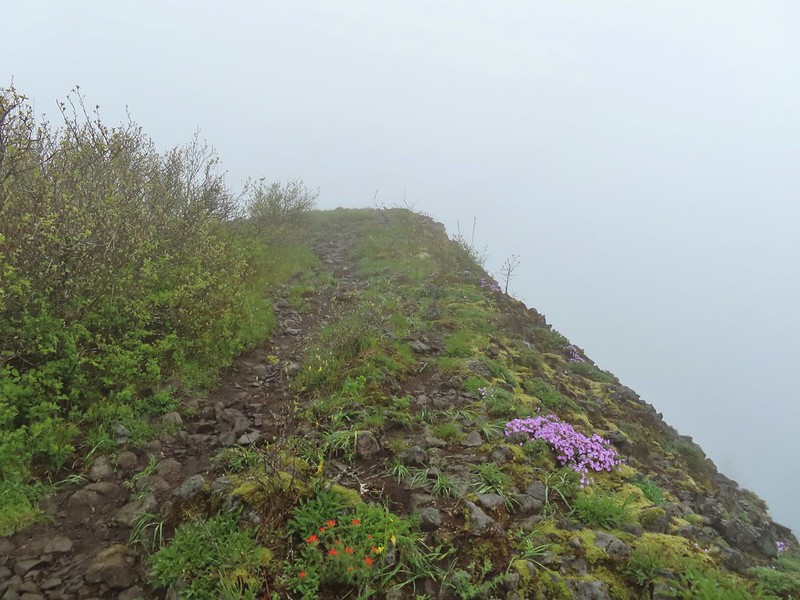
IMG_3669

IMG_3671Phlox

IMG_3676Paintbrush and glacier lilies.

IMG_3678The high point.

IMG_3684Glacier lilies at the high point.

We didn’t stay long at the top, while we were fortunate to not be dealing with any of the winds the Columbia Gorge is known for it was chilly (as evidenced by the snowflakes) so we headed back down. Along the way we met a spotted towhee that wasn’t the least bit bothered by the weather.
IMG_3690

As we made our way down the clouds began to lift a bit and by the time we were approaching the junction we were under them which gave us a nice view of Hamilton Mountain.
IMG_3697

IMG_3701Hamilton Mountain (high point to the right) and the Columbia River.

IMG_3706Bonneville Dam and the Hamilton Mountain Trail crossing The Saddle.
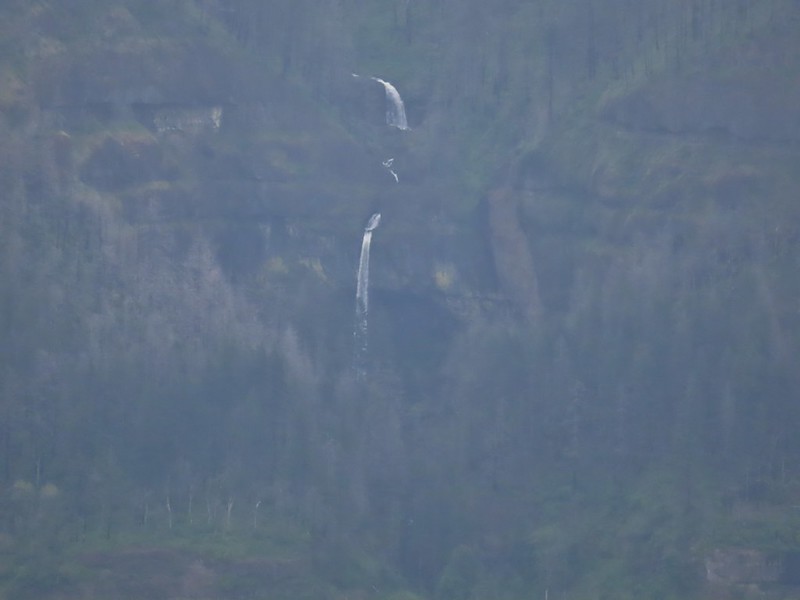
IMG_3708Upper McCord Creek Falls (post-partially closed due to fire damage as of writing)

The only snowy peak we could see though was Larch Mountain (post) to the SW.
IMG_3711

When we reached the junction we turned left onto the East Hardy Trail and began a mile long descent to another junction.
IMG_3715

IMG_3721Squirrel

IMG_3727Snail

IMG_3730

At this 3-way junction we faced a choice. Most descriptions of the Hardy Ridge Loop (including Sullivan’s) would have sent us straight on the East Hardy Trail for 0.8 miles to the Equestrian Trail then right on that trail 1.7 miles back to the trailhead for an 8.5 mile hike. We opted to extend our hike by turning left instead on the Bridge Trail.
IMG_3732

IMG_3738Bleeding heart along a little stream.

IMG_3739False lily-of-the-valley getting ready to bloom.
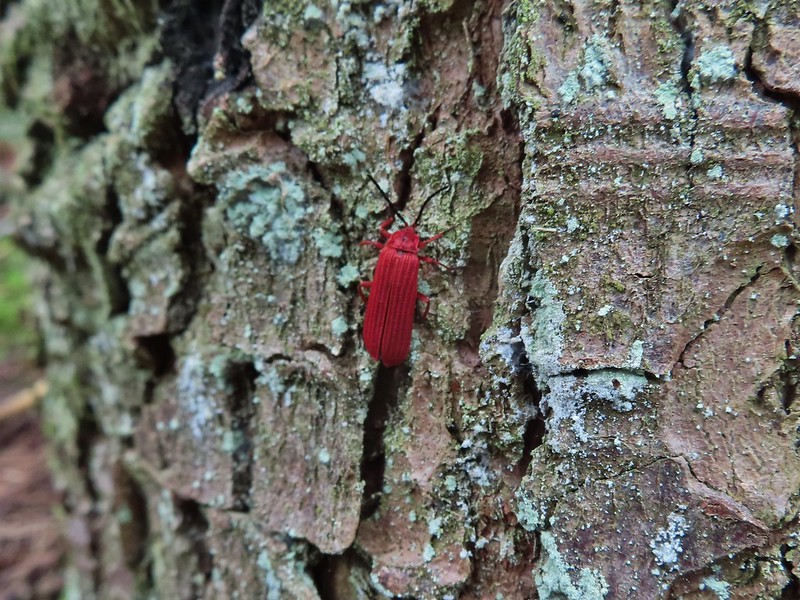
IMG_3743Possibly a Dictyoptera aurora (Golden net-winged beetle)
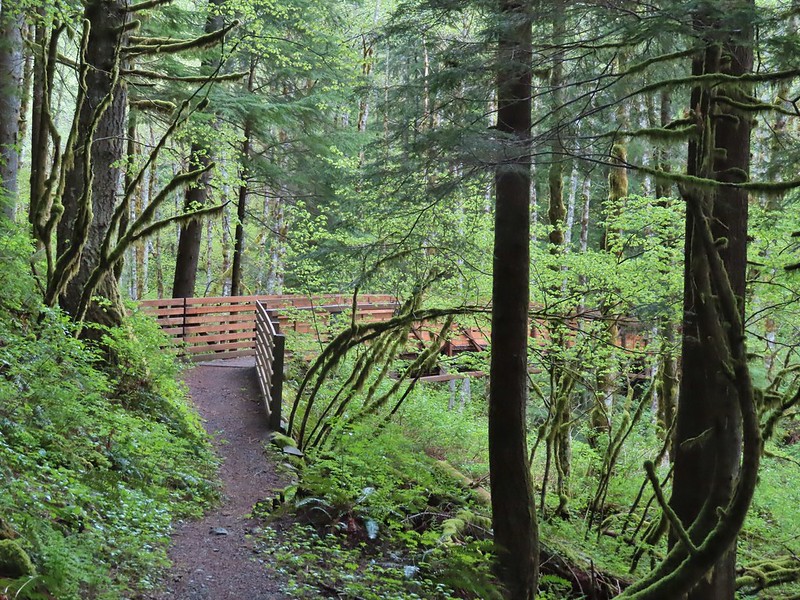
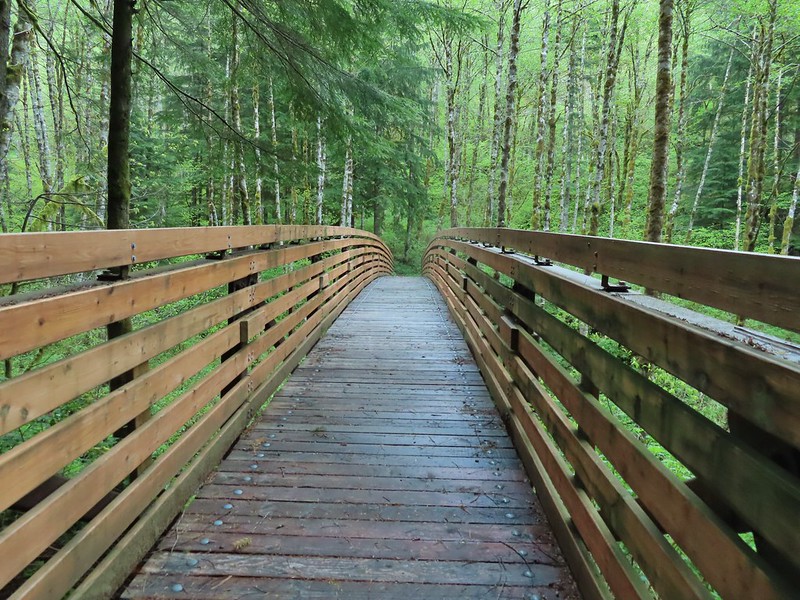
A little over three quarters of a mile we arrived at the trail’s namesake bridge over Hardy Creek.
IMG_3745

IMG_3746

IMG_3749

After crossing the creek the trail climbed for a tenth of a mile to the Upper Hardy Trail (another old roadbed).
IMG_3755

Here again we could have shortened our hike by turning right following a pointer for the Equestrian Trail but we wanted to revisit The Saddle north of Hamilton Mountain. We turned left on the Upper Hardy Trail climbing approximately 300′ in 0.6 miles to yet another junction.
IMG_3757

IMG_3759Hardy Ridge from the Upper Hardy Trail.

We once again faced a choice at this junction.
IMG_3762The left fork would have been slightly longer by leading us around the back side of a knoll and making a 180 degree turn following the east side of the ridge toward The Saddle.
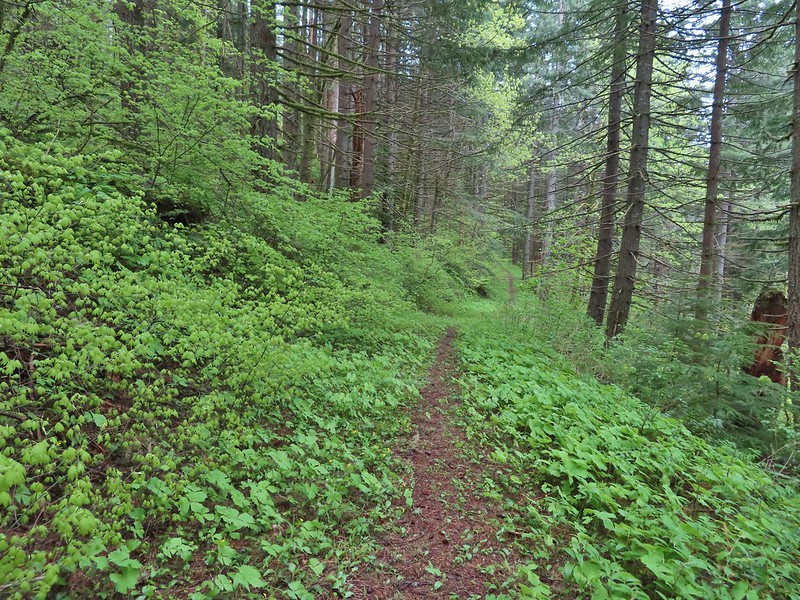
IMG_3764We turned right opting for the slightly shorter route to The Saddle.
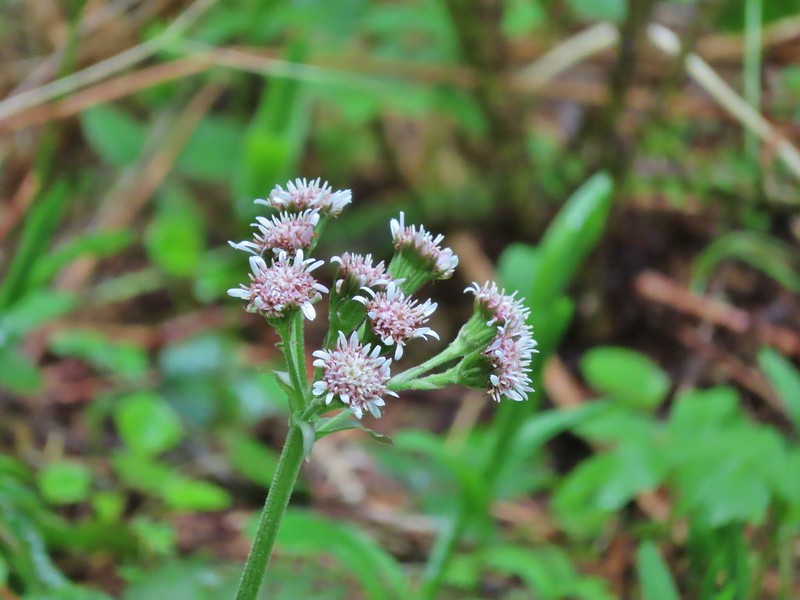
IMG_3768Coltsfoot

Just under three quarters of a mile after turning right we were rejoined by the the left hand fork of the Upper Hardy Trail.
IMG_3769Southern junction of the two forks of the Upper Hardy Trail.

The Upper Hardy Trail then descended for .2 miles to The Saddle and a junction with the Hamilton Mountain Trail.
IMG_3770

IMG_3771Hikers coming down from Hamilton Mountain.
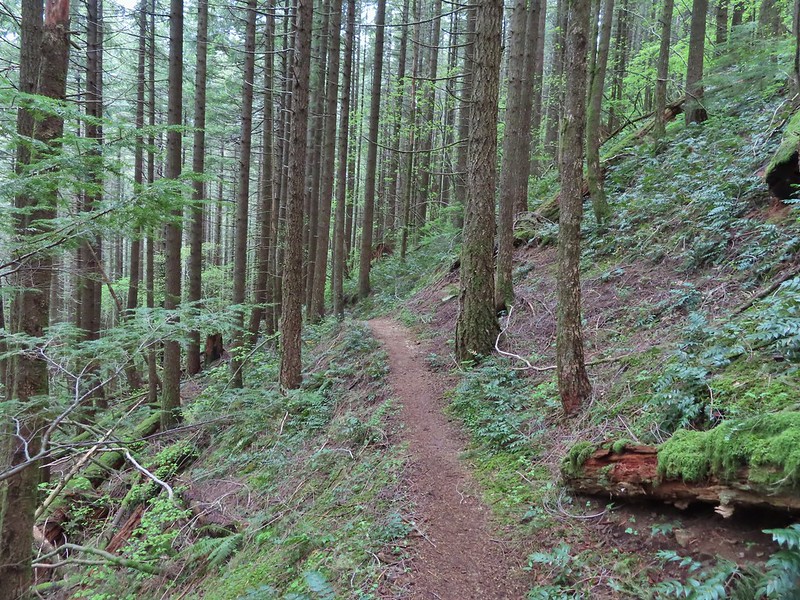
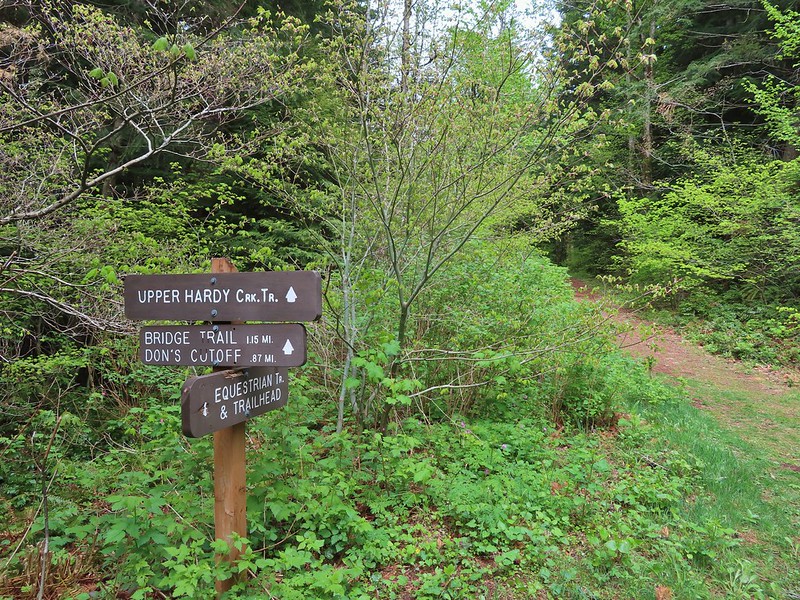
For the first time on this hike were at a familiar spot. We turned right onto the Equestrian Trail following it for 150 yards to a sign for Dons Cutoff Trail.
IMG_3778

On both of our previous visits we had stayed on the Equestrian Trail following it downhill for a mile to a 3-way junction at Hardy Creek. This time we took Dons Cutoff which would bring us to the same junction in just a tenth of a mile more. Dons Cutoff headed steeply downhill arriving at the Upper Hardy Trail after half a mile.
IMG_3779

IMG_3781Dons Cutoff Trail nearing the Upper Hardy Trail.

We turned left on the old roadbed following the Upper Hardy Trail for .4 miles to a junction with the Equestrian Trail and then arrived at Hardy Creek after another tenth of a mile.
IMG_3782Upper Hardy Trail

IMG_3786

IMG_3787Equestrian Trail

IMG_3789Hardy Creek

IMG_3791

We crossed Hardy Creek on the Equestrian Trail following it for a half mile to the 4-way junction.
IMG_3796

Had we opted for the described hike we would have arrived at this junction on the East Hardy Trail. We faced another choice here, keep on the Equestrian Trail for 1.7 miles or turn left onto the Lower Loop Trail and add approximately 0.4 miles to the hike. You guessed it we turned left and took the Lower Loop Trail which popped us out onto the Equestrian Trail at the 4-way junction where we had turned up the West Hardy Trail that morning.
IMG_3798

IMG_3803

IMG_3804

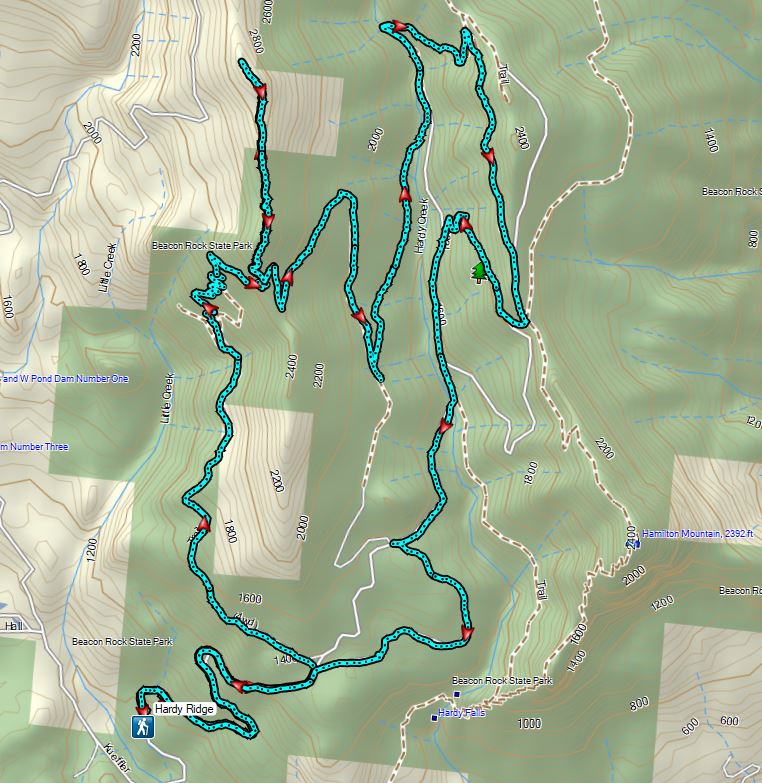
We turned left and followed the Equestrian Trail downhill for the final 1.2 miles of what turned out to be 13 mile hike that gained approximately 2700′ of elevation. Slugs were out in force along the final stretch including a number of small black specimens.
IMG_3806

IMG_3808Spotted this guy while I was photographing the slug above. Not sure if it’s a crane fly or ?
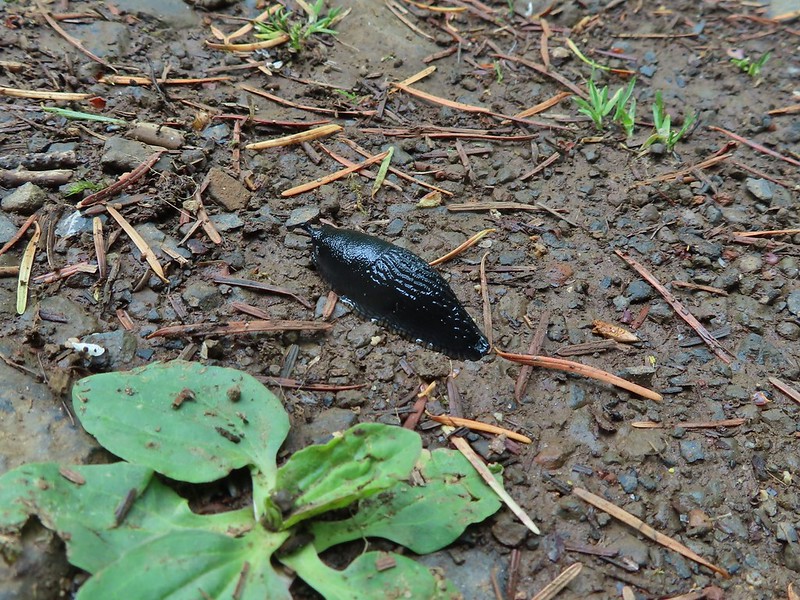
IMG_3813

There are some hikes where missing out on the mountain views is a real bummer but this wasn’t one of those for us. It was just a great day in the forest with flowers, creeks, critters, and a good deal of solitude despite the park being popular. The number of trails and options provided in the park allow for people to spread out a bit with Hamilton Mountain being the busiest area which we pretty much avoided (other than The Saddle) on this day. Happy Trails!

Our track for the day.

Flickr: Hardy Ridge Loop

Categories
Columbia Gorge North Hiking Washington

Columbia Hills State Park – 4/17/2021

We joined the masses of people heading to the eastern end of the Columbia River Gorge to catch the wildflower display which may be brief this year due to a combination of a lack of moisture and higher than normal (what is normal anymore?) temperatures. While we try to avoid crowds the hikes in Columbia Hills State Park are a featured hike in William L. Sullivan’s “100 Hikes/Travel Guide Eastern Oregon” (Hike #2 in the 3rd edition) and one that Heather had missed out on in 2015 when I was joined by my parents (post). Knowing that word was out on social media that the bloom was on, we left even a little earlier than typical in hopes of minimizing the number of encounters with others. We followed the same order that I had done the hikes in during my first visit stopping first at the Horsethief Butte Trailhead.
IMG_2484Mt. Hood from the trailhead.

We followed the trail .3 miles to a junction where, unlike the first visit, we went right first following the trail around to the south side of Horsethief Butte where a fence announced the area beyond was closed.
IMG_2487

IMG_2491

IMG_2502

IMG_2496Death camas

IMG_2575Western stoneseed

20210417_065844Fiddleneck

IMG_2522Large-flower tritelia

IMG_2528Mt. Hood beyond Horsethief Lake

IMG_2534Standing at the fence looking east.

IMG_2531Wren

IMG_2535Horsethief Butte

IMG_2544Lupine

We then walked back about a quarter of a mile to a sign at an opening in the rock formation.
IMG_2510

Here we turned and headed up into the rocks.
IMG_2551

IMG_2560

IMG_2563

There is an optional side trail to a viewpoint inside the formation but we wanted to save the time and get to our second stop sooner rather than later. We had been the only car at the trailhead but half an hour later there were another half dozen cars (mostly rock climbers) with more arriving.
IMG_2571

We descended from Horsethief Butte and after a short detour due to a wrong turn at a junction we arrived back at our and drove east on SR 14 for 0.7 miles to the Crawford Oaks Trailhead. While the trailhead opened in May of 2014 my parents I had not parked here opting instead to park at the Dalles Mountain Ranch making this a primarily new hike for me too.
IMG_2580

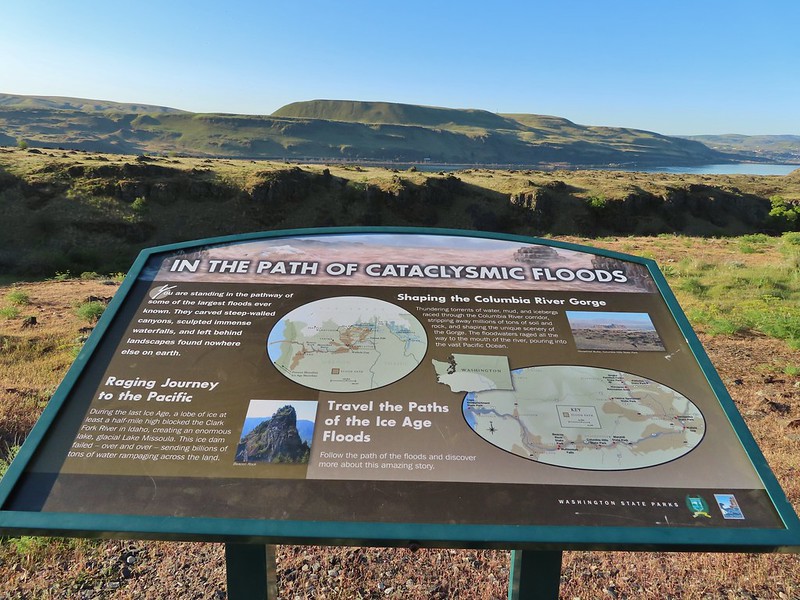
There was a small handful of cars here but not bad (it was a different story later). We followed the Entry (Access) Road Trail uphill form the parking lot past the Ice Aged Floods Viewpoint.
IMG_2587Horsethief Butte and Mt. Hood from the viewpoint.
IMG_2588

After a 180 degree turn the Entry Road approached Eightmile Creek near Eightmile Creek Falls.
IMG_2602

IMG_2605Purple cushion fleabane

IMG_2608Balsamroot

The road turned uphill along the creek where several Lewis’s woodpeckers were flying from oak to oak.
IMG_2612

IMG_2614

IMG_2624

IMG_2627

IMG_2630Western bluebird

We followed the road down and across Eightmile Creek to an interpretive sign at a junction.
IMG_2643

IMG_2642Ground squirrel

IMG_2648

This was the start of a couple different loop options. We chose to take the left fork which was the Military Road Trail. Going this direction is the shortest route to the Crawford Ranch Complex plus it would mean that we would be heading toward Mt. Hood as we looped around on the Vista Loop Trail (the right hand fork here). The Military Road Trail climbed away from the creek reaching another junction after .3 miles. Here we forked left again leaving the Military Road for the Eightmile Trail. (Sticking to the Military Road would have led us to the Vista Loop Trail in .4 miles.)
IMG_2649

IMG_2656

IMG_2666Lupine, balsamroot and parsley

IMG_2668The Crawford Ranch Complex ahead to the left.

IMG_2674Phlox

IMG_2677

The Eightmile trail dropped to cross a smaller stream before finally returning to Eightmile Creek near a fence line.
IMG_2681

IMG_2701

IMG_2702

IMG_2707

IMG_2709

IMG_2718

IMG_2730

IMG_2744Approaching the fence line.

While there was a bit of a break in the flowers at this fence line there was no shortage of birds.
IMG_2747

IMG_2751Yellow-rumped warbler

IMG_2753Back of a scrub jay

IMG_2761

The trail then veered away from the creek and came to another junction after passing through a fence. The flowers here were spectacular and both Mt. Hood and Mt. Jefferson were visible.
IMG_2767

IMG_2768

IMG_2770

IMG_2778

IMG_2779Mt. Hood

IMG_2764Mt. Jefferson

At the junction we went right on the Ranch Route Trail eschewing a visit to what looked like a very busy Crawford Ranch Complex. The Ranch Route meandered for 1.4 miles through the flowered covered hillsides before arriving at a junction with the Vista Loop and Military Road Trails.
IMG_2790

IMG_2796

IMG_2800

IMG_2801

IMG_2809

IMG_2823Yakima milk-vetch

IMG_2827

IMG_2828

IMG_2845

We turned left on the Vista Loop Trail following it a total of 1.8 miles back to the the junction near Eightmile Creek.
IMG_2860The Columbia River, Horsethief Butte, and Mt. Hood

IMG_2863Death camas

IMG_2872Large head clover

IMG_2893Approaching the junction.

We followed the Entry/Access Road back down to the now packed trailhead.
IMG_2896Hawk watching all the hikers.

IMG_2898A different hawk? watching the goings on.

IMG_2908Western fence lizard watching everything.

IMG_2899Poppy, manroot, and red-stemmed storksbill
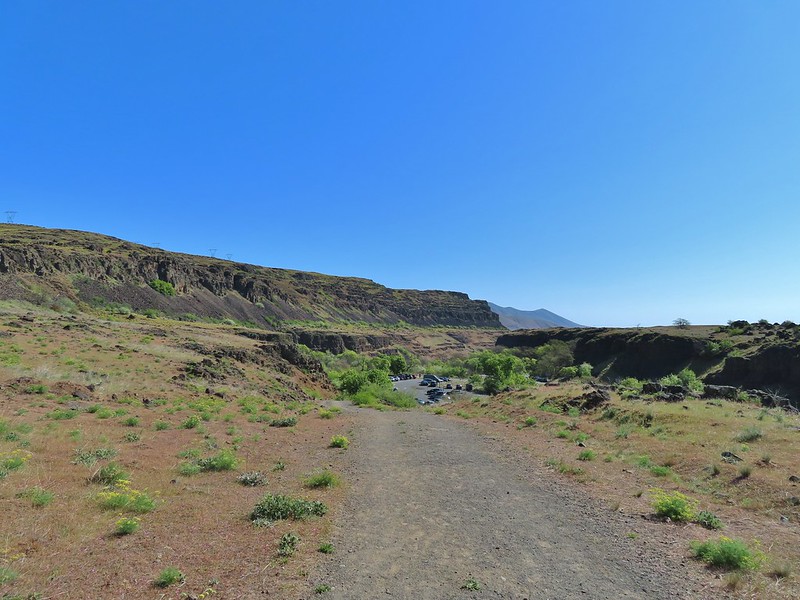
IMG_2913The crowded trailhead

This stop clocked in at 6.9 miles and 900′ of elevation gain.

We opened up a spot here and drove west on SR-14 to Dalles Mountain Road where we turned north (right) and drove 3.5 miles to a fork near the Crawford Ranch Complex. Here we turned left heading uphill for another 1.4 miles (passing a number of hikers walking up along the road) to the Stacker Butte Trailhead. There were a fair number of cars but a few spots were open.
IMG_2916

IMG_2915While both were part of the Crawford Ranch, Stacker Butte is not part of the Columbia Hills State Park but is part of the Columbia Hills Natural Area Preserve.
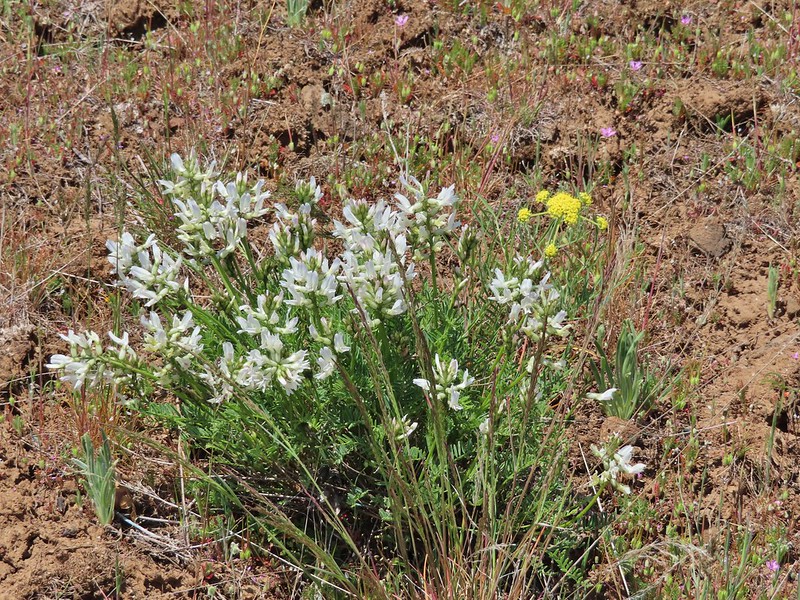
The hike here is pretty straight forward following the gravel road approximately 2.6 miles to some towers on the 3220′ summit of the butte. The flowers were thickest along the lower section of the hike with some that we had not seen down lower including paintbrush, daggerpod and some sicklepod rockcress.
IMG_2928

IMG_3116Yakima milk-vetch

IMG_2935Paintbrush amid the balsamroot.

IMG_2939

IMG_2951Phlox

IMG_2960

IMG_2961Big-seed biscuitroot

IMG_2977Sicklepod rockcress

20210417_122704

IMG_2990Sagebrush false dandelions

20210417_121519Daggerpod

IMG_3044Daggerpod

IMG_3021Slender toothwort?

IMG_3022Shooting stars in front of a little blue-eyed Mary
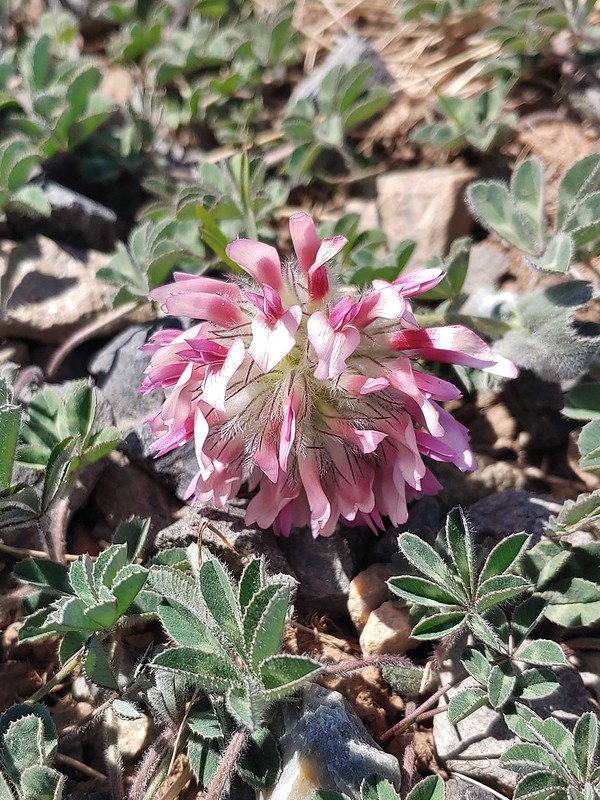
20210417_122308Large head clover

IMG_3031Popcorn flower

IMG_3024Larkspur

20210417_131353Woodland stars

At the summit we were treated to a clear view of Mt. Adams, Mt. Rainier, and Goat Rocks to the north.

IMG_3000Mt. Adams

IMG_3004Mt. Rainier

IMG_3011Goat Rocks

After a little rest on top we headed down admiring the flowers along the way and watching for wildlife too.
IMG_3051Swallowtail

IMG_3058Western fence lizards

IMG_3111White crowned sparrow

IMG_3113Another sparrow

IMG_3100Mt. Jefferson and Mt. Hood as we neared the trailhead.
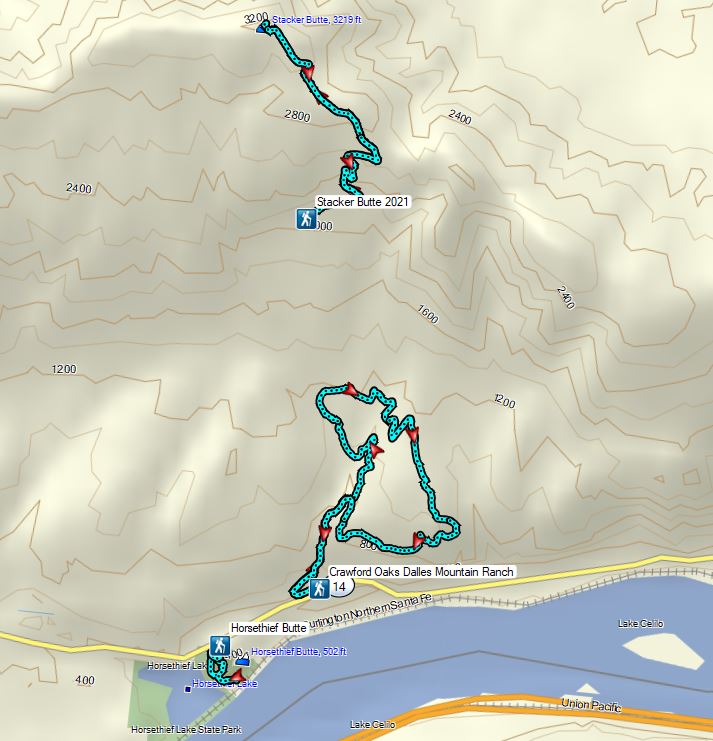
The three hikes came to a combined 13.2 miles and 2240′ of elevation gain which is why we didn’t just hike up the road from the ranch complex. It’s a little too early in the season for a 16 mile, 3000′ hiking day. Maybe in a couple more months. Happy Trails!

All three tracks for the day.
Categories
Columbia Gorge North Columbia River Gorge South Hiking Trip report

Mitchell Point, Lyle Cherry Orchard & Sevenmile Hill – 3/27/21

**Note – In 2025 the Rowena Fire burned over Sevenmile Hill.**

We normally only do one hike a month from November through April but a forecast of sunny skies and highs in the low to mid 60’s combined with a chance to see some early wildflowers was enough to break that rule and head to the eastern end of the Columbia River Gorge. The first wildflowers (usually grass widows and/or parsleys) can show up as early as January in areas such as Catherine Creek (post) with things really picking up by late March and running through early June in the upper meadow of Dog Mountain (post). We had previously been to Catherine Creek (along with Coyote Wall), the Tom McCall Preserve (post), Columbia Hills State Park (post), Memaloose Hills (post) and Swale Canyon (post) so for this outing we decided to check out the Lyle Cherry Orchard and Sevenmile Hill.

Before we got to those wildflower hikes we planned a quick stop at the Mitchell Point Trailhead to make the 1.1 mile climb up to the top of the point. We had actually stopped here in 2018 (after our Memaloose Hills hike) to take the Wygant Trail up to a viewpoint. Originally my plan had been to do these three hikes in a different order starting at the Lyle Cherry Orchard and ending with Mitchell Point but after looking at the plan a little more I realized that it had two flaws. First the exit to the Mitchell Point Trail is only accessible from the eastbound lanes of I-84 and there is no westbound access to I-84 from the trailhead either. (I had made this mistake with the outing in 2018 leading to some extra driving.) The second issue had to do with crowds and our never ending attempt to avoid them. Leaving Mitchell Point as the last hike might have meant dealing with some crowds whereas we didn’t expect Sevenmile Hill to be busy. Our plan seemed to be working pretty well as we were the first car at the Mitchell Point Trailhead.
IMG_0881

We headed to the left of the signboard to the Mitchell Point Trail which began climbing almost immediately.
IMG_0998

IMG_0887

The trail switchbacked up a forested hillside with a few blooming toothworts.
IMG_0890Bench at a switchback.

20210327_080649

We then crossed a talus slope beneath Mitchell Point where lots of tiny blue-eyed Mary grew amid the rocks.
IMG_0907

IMG_0914Reroute below Mitchell Point

IMG_0916

IMG_0919Mushrooms’ and some sedums.

Views to the west along the Columbia River opened up as we climbed.
IMG_0915

The trail briefly reentered the forest and climbed to a set of power lines and an accompanying road.
IMG_0921

The trail never quite reached the road instead turning east then north as it headed out toward Mitchell Point.
IMG_0923

IMG_0927Houndstongue

We followed the trail out onto Mitchell Points Ridge which was dotted with wildflowers including a lot of bright grass widows.
IMG_0939

IMG_0934Grass Widows

IMG_0961Woodland stars

IMG_0955

IMG_0931Yellow bell lily

IMG_0938Desert parsley and woodland stars

IMG_0954A saxifrage

IMG_0965Gold stars and woodland stars

IMG_0977

In addition to the wildflowers the view from Mitchell Point was impressive.
IMG_0962Looking west

IMG_0966North across the Columbia River into Washington
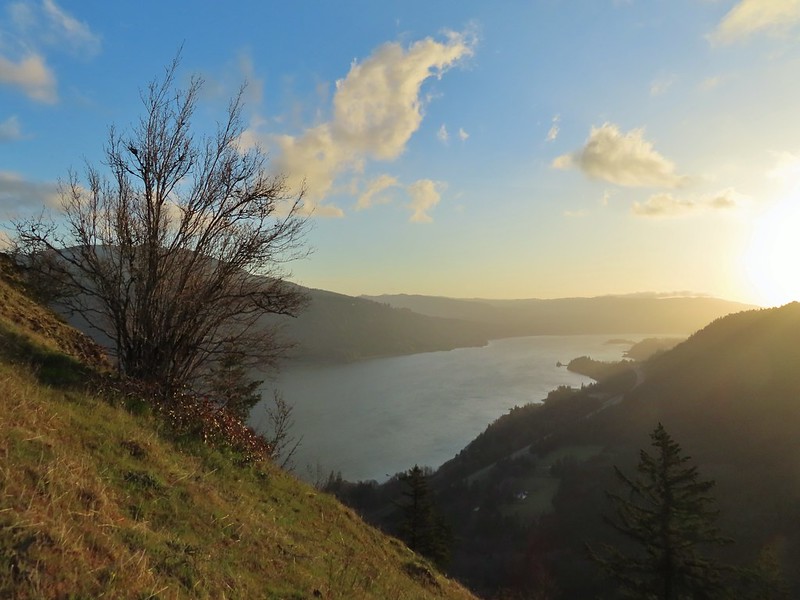
IMG_0964East

In typical Gorge fashion it was a bit windy (a theme that would continue throughout the day) which didn’t seem to bother the birds.
IMG_0985Looks like moss for a nest maybe?

We returned the way we’d come arriving back at the trailhead to find we were still the only people there, but we weren’t alone.
IMG_0995

IMG_1001Turkeys on the Wygant Trail

At just over 2 miles round trip the hike to Mitchell Point made for a nice short hike but it comes at a price gaining over a thousand feet on the way up. From this trailhead we continued east to Hood River where we paid the $2 toll to cross the bridge into Washington. We continued east on SR 14 through the town of Lyle then parked at a gravel pullout on the left hand side of the road just beyond a tunnel. This was the unsigned trailhead for the Lyle Cherry Orchard Hike. There were maybe a half dozen or so cars here already which we were pleased with given the large number of cars we already passed by at the Coyote Wall and Catherine Creek Trailheads (and it wasn’t even 8:45 yet). The unsigned trail starts near the eastern end of the parking area and passing along a rock wall through oak trees with lots of poison oak.
IMG_1003

IMG_1008

IMG_1015Red leaves of poison oak behind a death camas
IMG_1017More poison oak behind a waterleaf

IMG_1012Poison oak around some balsamroot

A short distance up the trail there is a nice  map and trails signboard announcing the start of land owned by the Friends of the Columbia Gorge.

IMG_1027

IMG_1028

From the signboard the trail continues to climb through the rock and oaks to a plateau where the poison oak is briefly left behind.
IMG_1032

IMG_1033

IMG_1037Fiddleneck

IMG_1040Desert parsley

IMG_1045Manroot

IMG_1056

IMG_1057Lots of death camas blooming on the plateau.

We followed the trail as it headed gradually uphill toward a second plateau.
IMG_1062

IMG_1064Looking up at the cliffs above.

IMG_1068Balsamroot blooming below the rim.

At a fork in the trail we detoured left for a view of the Columbia River.
IMG_1076

20210327_091929

We returned to the main trail which began to climb the hillside below the rim. While it was still a couple of weeks from prime wildflower season here there was a good balsamroot display along with a few other flowers in bloom.
IMG_1081Balsamroot

IMG_1085Woodland stars with some lupine leaves

IMG_1090Columbia desert parsley

IMG_1096A biscuitroot

IMG_1104Balsamroot

20210327_092349Balsamroot

The trail leveled out again after reaching the rim of the upper plateau where it also reentered an oak woodland.
IMG_1114View west (With a snow capped Mt. Defiance (post) in the distance.)

IMG_1130

Amid the oaks were some additional types of flowers.
IMG_1125Larkspur

IMG_1131Buttercups

IMG_1138Glacier lilies

IMG_1158Yellow bell lily, woodland stars, grass widows and shooting stars.

20210327_104840Yellow bell lilies

20210327_104217

IMG_1162Toothwort

IMG_1163Sagebrush false dandelions

IMG_1164

IMG_1167Tortoiseshell butterfly

Just under 2.5 miles from the trailhead we came to a junction which is the start of a short loop. We stayed left arriving at an old road bed a short distance later where we turned right and soon entered the site of the old orchard. Nearly all the cherry trees are gone and the few that remain only have a few branches that continue to bloom and we were too early for those.
IMG_1171

The trail looped through the now open meadow with views east of the Columbia River.
IMG_1174

IMG_1176

A short spur trail on the SW part of the loop led to a viewpoint to the west.
IMG_1180

IMG_1183Tom McCall Point and the Rowena Plateau with Mt. Defiance in the distance.

After checking out the view we completed the loop and headed back the way we’d come. We had only encountered a couple of other hikers up to this point (we’d seen more from afar) but the return trip was a different story. There was a lot of mask donning and stepping aside on the way back to the trailhead.
IMG_1205Hikers on the trailhead and below.

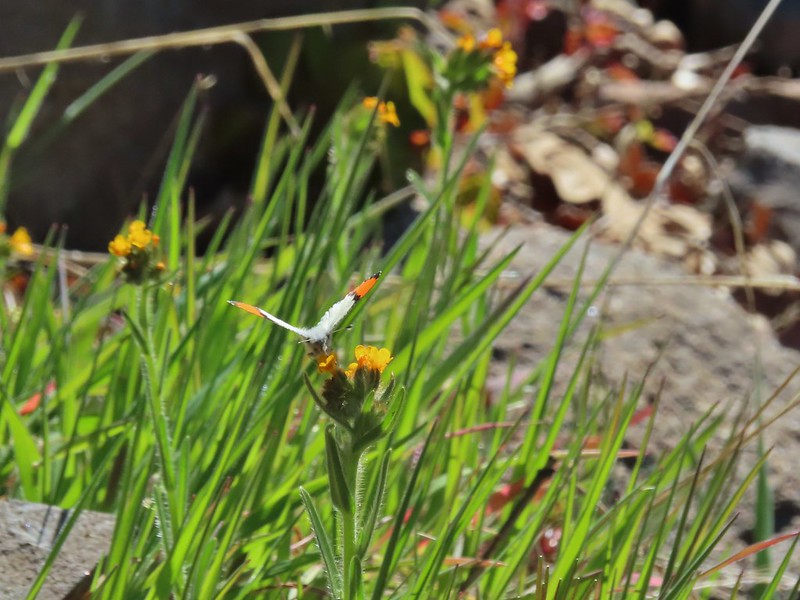
One bit of excitement on the return trip was spotting a couple of orange-tip butterflies. We rarely see these pretty butterflies and it’s even rarer that I manage to get any kind of picture.
IMG_1217Just my third photo of an orange-tip.

The hike here for us came to 5.5 miles with another 1200′ of elevation gain giving us over 2200′ for the day so far. The parking area was now a full two rows of cars with more arriving (it was between 11:30 & 12:00). We quickly packed up and opened a spot for someone else and once again headed east on SR 14. We re-crossed the Columbia River on Highway 197 into The Dalles and took I-84 west for 5 miles following the Oregon Hikers directions to the Sevenmile Hill Trailhead

We weren’t sure how popular this hike is given that there are no official trails. That question, at least for this time of the year, was answered when we pulled into the empty gravel pullout.
IMG_1222

Our plan was to follow the entry in the Oregon Hikers Field Guide (description). The area consists of Forest Service land surrounded by private holdings (note the no trespassing sign across the road in the photo above).
We headed uphill and left, away from the blocked road passing a gravel pit on our left.
IMG_1224

We were supposed to reach a knoll with a small windbreak made out of erratics (rocks from the Rocky Mountains deposited by the Missoula Floods). The first knoll we climbed had some erratics but no windbreak.
IMG_1231Mt. Hood and Columbia desert parsley from the first knoll we tried.

IMG_1234Top of knoll #1.

IMG_1232A lone balsamroot blossom.

We weren’t sure if this was the right knoll or not but we did know from the map in the field guide that we should continue uphill and to the left. We kept climbing up the grassy hillside and reached the top of another knoll where we did indeed find a small windbreak.
IMG_1240

IMG_1241

From the knoll we followed a faint grassy track past a spring to a stand of oak trees.
IMG_1243The path leading past the spring to the oaks.

IMG_1246The spring

There was a fence on the hillside at the oak trees. We got a bit confused here reading the hike description. It reads “Head up gradually to your left, reaching a draw. Walk across the broken fence line here and cross a small bench. Continue hiking up to your left. At some point, you should see the southwest boundary corner of the property and a fence line ahead.” We had not noticed another fence line and this fence was broken here with no signs so we continued on the faint path. That was a mistake and the fence we passed through was the boundary. When we reached a small crest where we could see everything ahead of us there was no other fence in sight.
IMG_1252

We quickly turned and began heading uphill to the NE to relocate the fence line and get ourselves on the correct side (Our apologies to whomever that land belongs too).
IMG_1262Back on the right side

Now we were back on course and followed the fence line uphill. While the wildflowers here would have been better from mid to late April there were a few splashes of color here and there.
IMG_1263

IMG_1249Balsamroot surrounded by some little white flowers.

IMG_1251Lupine thinking about blooming.

IMG_1254Larkspur

IMG_1259Yellow bell lilies

We deviated from the description as we neared the top of the hill electing not to follow the fence through a stand of oak trees, where the guide indicates there is a profusion of poison oak, opting instead to pass through the oaks lower on the hillside.
IMG_1268

IMG_1269We didn’t notice any poison oak here.

On the far side of the oaks we turned almost directly uphill reaching a viewpoint where Mt. Adams rose to the north beyond the Columbia River.
IMG_1270

IMG_1277A grass widow at the viewpoint.

IMG_1286Mt. Adams

IMG_1288Mt. Hood over the oak stand.

IMG_1290

We turned right along the rim following deer and elk trails through the oaks and past more viewpoints.
IMG_1291

IMG_1292

From a grassy rise along the ridge we could see a faint path leading into another stand of trees where we could also make out the fence line marking the eastern boundary of the Forest Service Land.
IMG_1302

We headed downhill and followed the path to the fence line and then followed it down.
IMG_1310The Dalles beyond the fence line.

IMG_1318Heading down the fence line.

As we lost elevation we began to see quite a few more flowers. It seemed that the flowers at this eastern end were ahead of those to the west.
20210327_143435Large head clover

IMG_1319

IMG_1323

IMG_1325A lupine with blossoms.

IMG_1329Hillside covered in Columbia desert parsley

IMG_1333Our car had been joined by one other. (middle left of photo)

IMG_1341Gooseberry Creek

We turned away from the fence on an old farm road following it back to the road near the trailhead by the “No Trespassing” signs.

This loop came in at 4.3 miles according to my GPS and was at least 1250′ of elevation gain which was made more difficult by the cross country terrain. There was little to no level footing for the vast majority of this hike and coming after we had already hiked 7.6 miles and gained 2200′ it really tired us out. That being said it was a great day to be out. One thing to note is that all three hikes are in located in tick country (we were lucky enough not to pick up any) and both Sevenmile Hill and Lyle Cherry Orchard are in rattlesnake country (again didn’t see any). Happy Trails and stay safe out there!

Flickr: Mitchell Point, Lyle Cherry Orchard & Sevenmile Hill

Categories
Columbia River Gorge South Hiking Oregon Trip report

Wahtum Lake with Indian, Chindrie, and Tomlike Mountains – 10/27/2019

After a false start we closed out our 2019 hiking season with a bang on a 16.7 mile jaunt to three peaks near Wahtum Lake. We set off on Saturday morning for this hike but only made it 16 miles from our house where we wound up stuck on Interstate 5 for more than three hours due to an unfortunate accident that resulted in a fatality. By the time we were able to proceed it was too late for our liking so we took a mulligan and tried again the next morning.

Our next attempt went better and we arrived at the trailhead at the Wahtum Lake Campground just before dawn. A loan car was parked at the trailhead with just a bit of fresh snow on it from the night before. (We would find out later that he had spent the night at Mud Lake.)
IMG_1364

After some deliberation regarding our planned route we settled on the following. We would hike down to the lake then go southbound on the Pacific Crest Trail to the Indian Mountain Trial and take it up to the summit of Indian Mountain. Then we would return to Wahtum Lake on the PCT and follow the Chindrie Cutoff Trail around the southern end of the lake and climb up to the PCT near the Chindrie Mountain Trail (This part of the plan wound up being changed but more on that later) and hike up to that summit as well. After tagging Chindrie the plan was to return to the PCT and go southbound once again to the Herman Creek Trail following it to the unofficial trail to the summit of Tomlike Mountain. Finally after returning to the Herman Creek Trail from Tomlike Mountain we would backtrack a few hundred feet to the Anthill Trail which would lead us back to the Wahtum Lake Campground.

From the campground we took the Wahtum Express Trail down a series of slick looking steps entering the Mark O. Hatfield Wilderness along the way.
IMG_1368

IMG_1372

IMG_1374

After dropping a little over 200′ in .2 miles we arrived at the PCT as it curved around Wahtum Lake.
IMG_1377

Before turning left (south) on the PCT we went down to the lake shore. It was a little under 30 degrees and a crisp breeze was making it feel even colder so we didn’t linger but between a small island and a section of snow flocked trees to the north it was a nice scene. Chindrie Mountain was visible across the lake to the SW.
IMG_1379

IMG_1381Chindrie Mountain from across Wahtum Lake.

We set off on the PCT passing a couple of additional nice views of the lake before arriving at a trail junction at the lakes southern end.
IMG_1386

IMG_1383

IMG_1388

IMG_1391

At the junction we noticed a closure sign for the Eagle Creek Fire closure area over the signs for our planned route to Chindrie Mountain.
IMG_1563

I admittedly hadn’t checked the Forest Service closure map in a while but it had been my understanding that the Eagle Creek Trail was closed at the junction with the Chindrie Cutoff Trail but I had expected this trail to be open. Being uncertain we altered our plans and decided to follow the PCT all the way around the northern end of Wahtum Lake on our way between Indian and Chindrie Mountains. According the mileage shown on our map that would and approximately three quarters of a mile to our day. Further research would confirm that it was indeed only the Eagle Creek Trail that was closed which was just over a tenth of a mile further along the Chindrie Cutoff Trail (it would have been nice if the sign had been clear about that).

We continued south on the PCT gradually gaining over 400′ as we contoured along the side of Waucoma Ridge before arriving at the old Indian Springs Campground a little under 3 miles later. Along this stretch we had some additional views of Chindrie Mountain as well as Tanner Butte and Washington’s Table Mountain (post).
IMG_1395Chindrie Mountain

IMG_1399Tanner Butte

IMG_1403

IMG_1404Table Mountain

IMG_1408

IMG_1413Chindrie Mountain again.

We also got our first look at Indian Mountain and Mt. Hood .6 miles from Indian Springs after leaving the wilderness and popping out of the forest alongside Forest Road 660.
IMG_1416Indian Mountain

IMG_1418Mt. Hood

IMG_1428

The presence of ice formations and a bit of snow here and there made the scenery even better.
IMG_1421

IMG_1432

IMG_1435Crossing FR 660 near Indian Springs

IMG_1436Trail sign at the junction with the currently closed Indian Springs Trail.

We continued south on the PCT for another third of a mile crossing a small stream before climbing up and around a treeless ridge where a frigid wind was steadily blowing.
IMG_1439

IMG_1440

IMG_1441

The view from the ridge was spectacular. To the north the snow covered peaks in Washington were visible beyond Chindrie Mountain and to the south was our goal, the 4892′ Indian Mountain.
IMG_1446

IMG_1457

As the PCT rounded the ridge we came to the junction with the Indian Mountain Trail.
IMG_1462

IMG_1463

20191027_091244

The wind was pushing us around a bit as we turned up the Indian Mountain Trail. As this trail climbed the open ridge the views just got better eventually leading to a decent view of Goat Rocks (post) between Mt. Adams and Mt. Rainier.
IMG_1486

IMG_1476Table Mountain and Greenleaf Peak with Mt. St. Helens in the background.

IMG_1491Mt. St. Helens

IMG_1490Mt. Rainier

IMG_1488Goat Rocks

IMG_1477Mt. Adams and Chindrie Mountain

The trail finally went back into the trees which gave us some relief from the biting wind.
IMG_1492

IMG_1493

After passing remains of the former lookout (and bathroom) the trail climbed to the rocky summit a mile from the PCT.
IMG_1495

IMG_1498

Given the time of day and year the Sun wasn’t in the greatest spot for pictures but the view of Mt. Hood was great and there was also a decent view further south to Mt. Jefferson.
IMG_1499Mt. Hood and Mt. Jefferson

IMG_1503Mt. Jefferson

IMG_1514Mt. Hood from the former lookout site.

IMG_1512Mt. Hood with Lost Lake Butte (post) in front.

The snow and cold weather added some nice touches to the scenery here as well.
IMG_1508Snow on the north side, green on the south.

IMG_1524Mt. St. Helens with some snow on the trees in the foreground.

IMG_1528Crystals on a bush.

We headed back the way we’d come and arrived back at the junction with the Chindrie Cutoff Trail where we paused to see if we could find any indication that that trail was indeed open. With no confirmation in sight we erred on the side of caution and stuck to the PCT which began a gradual climb up and away from the lake beyond the Wahtum Express Trail.
IMG_1568

IMG_1571

We gained another 400 plus feet over the next 1.6 miles before arriving at a junction with the Herman Creek Trail.
IMG_1577

IMG_1580Stream crossing

IMG_1581Herman Creek Trail junction.

We stuck to the PCT and promptly passed the junction with the Chindrie Cutoff Trail. At this end there was no closure sign signifying that we could indeed have taken the trail up from Wahtum Lake savings us about .7 miles (but at a “steeper” price).
IMG_1584

Another 100 yards on the PCT brought us to a fork where the Chindrie Mountain Trail headed uphill to the right.
IMG_1585

IMG_1586

This .4 mile trail was the steepest we were on during the hike as it gained approximately 400′ on the way to the rocky viewpoint atop the mountain.
IMG_1590Looking at the summit from the trail.

IMG_1592

IMG_1593

IMG_1596Mt. Hood

The 360 degree view included Wahtum Lake to the east below.
IMG_1609

IMG_1619

The view south included Mt. Hood and Indian Mountain (and some Sun glare).
IMG_1613

Tanner Butte rose above the fire scarred Eagle Creek Valley to the west.
IMG_1603

The best view, given the position of the Sun, was to the north where the Washington Cascades lined the horizon.
IMG_1597

There was also a good view of the rock spine of Tomlike Mountain in front of Mt. Adams.
IMG_1622

From the angle it looked like a pretty gradual ascent. It was a little breezy at the summit so we didn’t linger long because the wind was making it cold. We returned to the PCT and then to the Herman Creek Trail junction where we set off on that trail.
IMG_1632

We had been on the lower end of the Herman Creek Trail before (post) but not this end. Here the trail climbed gradually through an open forest with with lots of beargrass.
IMG_1636

After a quarter mile we passed the Rainy/Wahtum Trail.
IMG_1637

IMG_1645Lots of beargrass clumps.

About a mile from the PCT we passed another junction, this time with the Anthill Trail which we would be taking back to Wahtum Lake later.
IMG_1646

Just under a tenth of a mile later the Herman Creek Trail made a hairpin turn before beginning a steep descent to Mud Lake. Here the unofficial trail to Tomlike Mountain headed out along the ridge to the left. A yellow “temporary” Forest Service sign at the junction identified only the Herman Creek Trail.
IMG_1649Trail to Tomlike on the left.

The trail began in the trees before skirting some cliffs above Mud Lake.
IMG_1652

The trees began to give way allowing for a view ahead to Tomlike Mountain which from this angle looked like it might be a bit steeper of a climb than it had from Chindrie.
IMG_1656

The other thing we noticed was that it looked further than the mile that the map showed between the summit and Herman Creek Trail. Sometimes it seems like it’s better not to be able to see your goal.
IMG_1660

Much of the path was faint with occasional cairns or flagging marking the way. The rocky terrain was somewhat challenging given that we had, by this point, covered over 12 miles already.
IMG_1663

IMG_1671There’s at least one cairn here.

The higher we climbed along the ridge the more of Mt. Hood that was visible behind us.
IMG_1664

IMG_1670

After climbing up a pile of larger rocks the trail entered a patch of small trees which we found to be a fun little section.
IMG_1672

IMG_1673

The trail emerged from the little trees for the final time as it climbed to the rocky summit.
IMG_1674

IMG_1677

IMG_1679Mt. Adams to the right.

IMG_1680

IMG_1683Mt. Hood with Indian Mountain rising up behind Chindrie Mountain to the right.
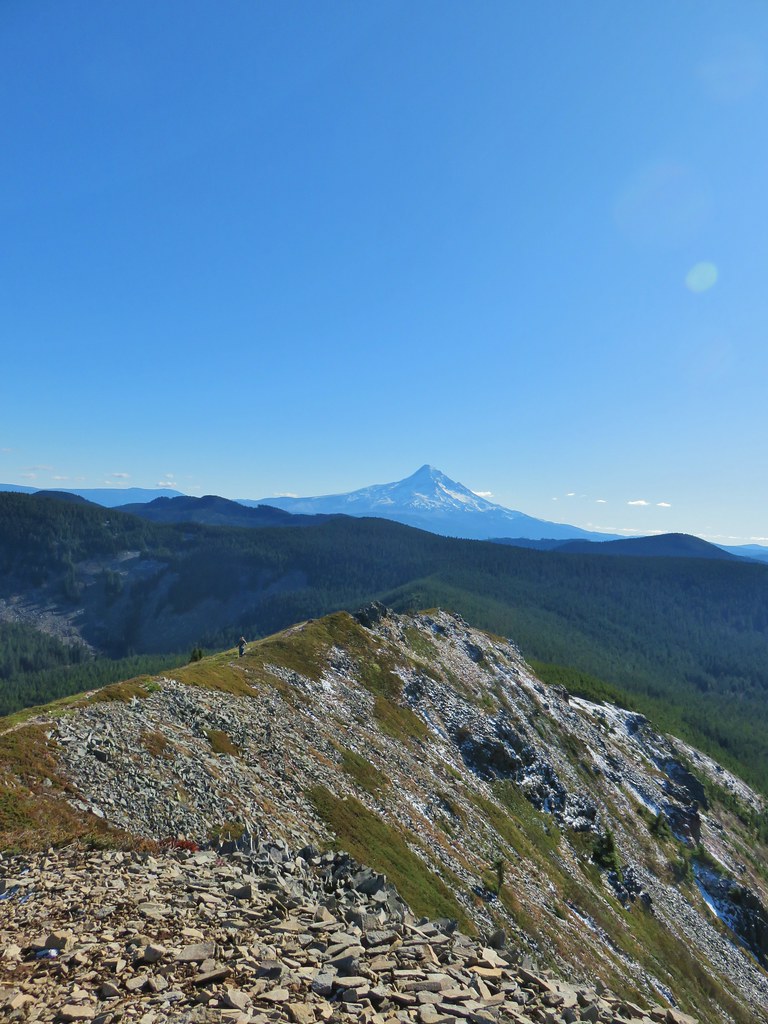
IMG_1693Heather crossing the ridge below the summit.

The trail continued for a bit beyond the summit although it didn’t provide any real different views.
IMG_1694

IMG_1707

IMG_1700Mt. St. Helens, Mt. Rainier, Goat Rocks and Mt. Adams from left to right.
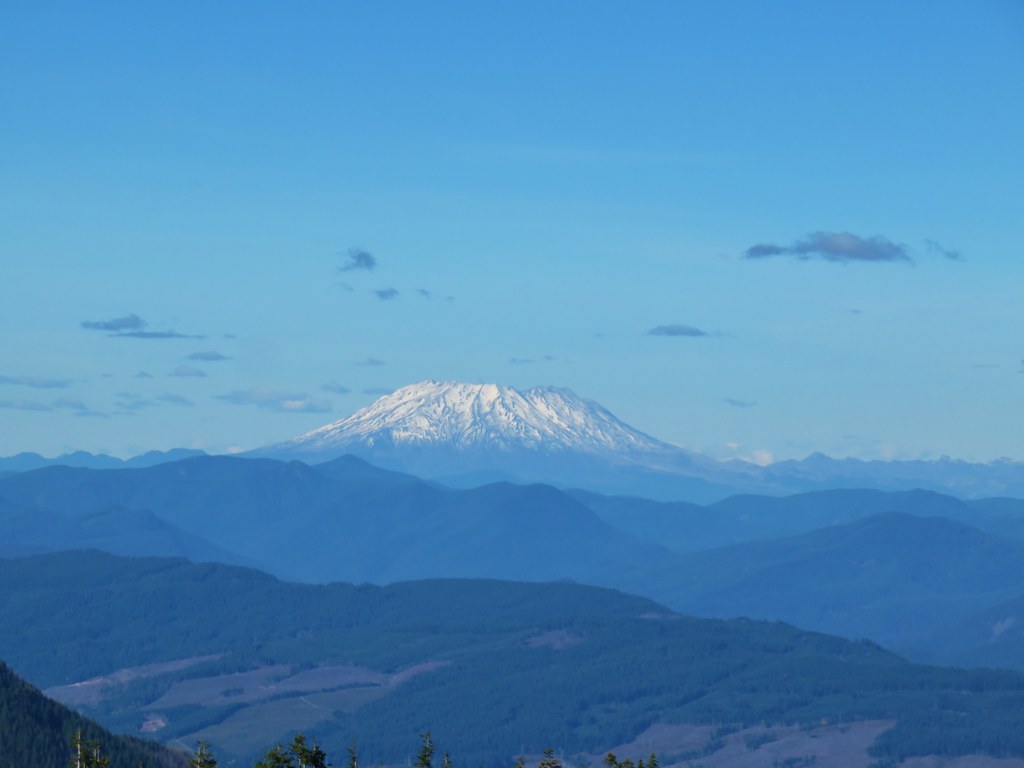
IMG_1706Mt. St. Helens

IMG_1705Mt. Rainier

IMG_1703Goat Rocks

IMG_1701Mt. Adams

We left Tomlike Mountain and returned to to the Herman Creek Trail and then walked back to the Anthill Trial junction and turned up that trail for a final 1.9 miles back to Wahtum Lake.
IMG_1720Anthill Trail on the left.

The Anthill Trail climbed for a half a mile to an old road bed which ran between Wahtum and Rainy Lakes.
IMG_1728

We crossed the road and continued to climb gradually to a saddle where we crosed over a ridge and began a descent which included views of Mt. Hood, Mt. Jefferson and Wahtum Lake.
IMG_1731

IMG_1739

IMG_1742

IMG_1744Mt. Jefferson

IMG_1751Wahtum Lake and Chindrie Mountain
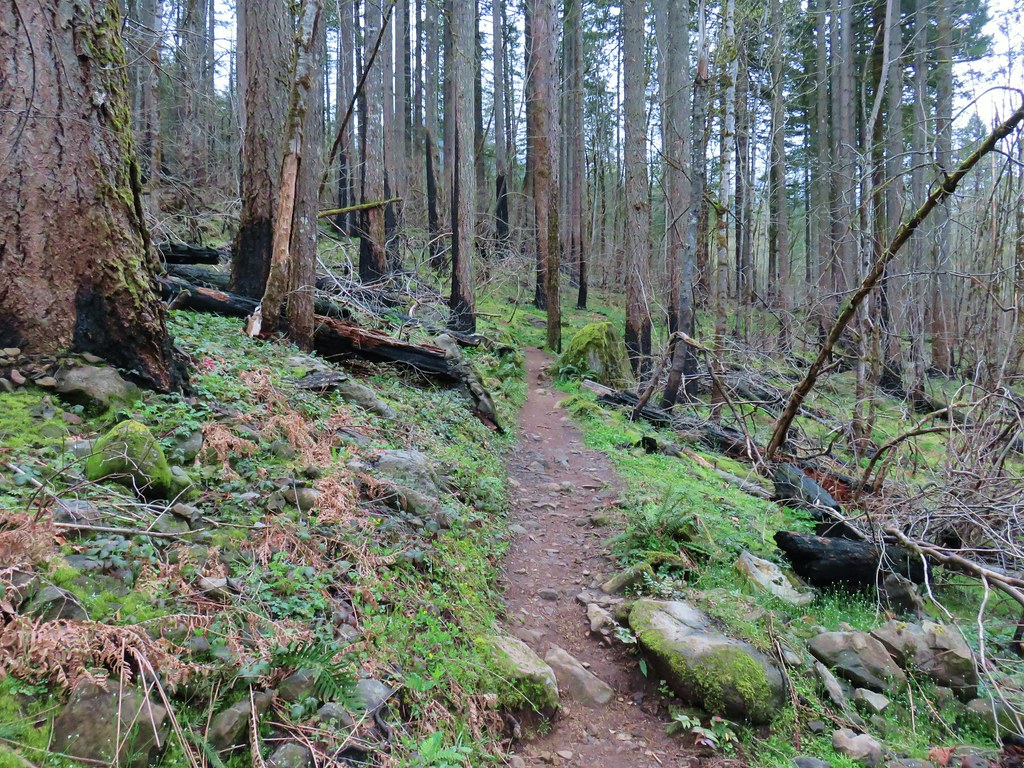
The descent was gradual until the final quarter mile or so where it steepend before arriving at the campground.
IMG_1752

IMG_1755

It was a great way to end our hiking season with a little snow on the ground and a lot of blue sky above. The persistent wind was a little chilly, but we had dressed appropriately so it wasn’t too much of an issue (my fingers weren’t pleased about having to come out so often for pictures). We plan on getting out a couple more times this year but it’s time to back off a bit and relish in the memories of some great hikes this past year. Happy Trails!

Flickr: Wahtum Lake with Indian, Chindrie, and Tomlike Mountains

Categories
Columbia River Gorge South Hiking Oregon Trip report

Dry Creek and Pacific Crest Falls

Despite what the weather thinks we are approaching our hiking season which means we will be hitting the trails much more often over the next 6 months. As we work our way into hiking shape we jumped on a chance at a rain free morning and headed to the Columbia River Gorge to check out a pair of waterfalls. Several trails in the gorge remain closed due to fire damage from the 2017 Eagle Creek Fire and others that had been reopened are again closed due to rock fall and slides caused by our recent weather combined with the fire damage. Please remember to check on the current status and conditions of trails before heading out.

Our sights were set on a section of the Pacific Crest Trail from Cascade Locks to Pacific Crest Falls. We had visited Pacific Crest Falls coming from the other side in October of 2015 (post) but at that time of year there wasn’t much water flowing so we thought a return visit was in order, especially after our recent rains.

We began our hike at the Bridge of the Gods Trailhead in Cascade Locks.
Bridge of the Gods Trailhead

From the trailhead we took the Pacific Crest Trail south.
Pacific Crest Trail sign in Cascade Locks

Pacific Crest Trail at Cascade Locks

The PCT briefly follows Harvey Road as it passes under I84 to a second possible trailhead.
Short road stretch on the PCT

Pacific Crest/Gorge Trail

From the Harvey Road Trailhead the PCT climbed gradually through the fire scarred forest. It was encouraging to see that many if not most of the trees along this section had survived. There was also quite a few early Spring flowers blooming.
Pacific Crest Trail in the Eagle Creek Fire scar

Eagle Creek Fire scar along the Pacific Crest Trail

Violets and snow queenSnow queen and violets

TrilliumTrillium

Just under a mile from Harvey Road the PCT once again briefly shared a gravel roadbed as it passed under a set of power lines.
Another short stretch of road along the Pacific Crest Trail

The trail leveled out shortly after passing the power lines and traversed along a sometimes steep hillside for three quarters of a mile to a signed junction near Dry Creek.
Pacific Crest Trail

Forest along the Pacific Crest Trail

Pacific Crest Trail

Dry Creek Falls Trail

Here we detoured away from the PCT and followed the pointer for Dry Creek Falls. This trail followed an old roadbed along Dry Creek just over a quarter of mile to Dry Creek Falls.
Approaching Dry Creek Falls

Dry Creek with Dry Creek Falls in the distance

Dry Creek Falls

Dry Creek Falls

Dry Creek Falls

After a nice little break at the base of the falls we headed back to the PCT where we turned right and crossed Dry Creek on a footbridge.
Footbridge over Dry Creek

Dry Creek

We had been discussing the fact that hikers were starting to post picture of fairy slippers (Calypso bulbosa) one of our favorites. We weren’t sure if any would be blooming yet in this area but we managed to spot a few as we continued south on the PCT.
Fairy slipper

Approximately 1.25 miles from Dry Creek the PCT crossed a talus slope.
Pacific Crest Trail

At the beginning of this section we spotted group of yellow flowers which turned out to be glacier lilies.
Glacier lilies

Glacier lilies

Glacier lilies

This section also provided the best, albeit limited, view across the Columbia River during this hike.
Columbia River

A half mile beyond the talus we passed the Herman Creek Pinnacles. We detoured briefly to get a closer look at the basalt formation and the cute little monkeyflowers blooming amid the rocks.
Herman Creek Pinnacles

Herman Creek Pinnacles

Chickeweed monkeyflower

Chickweed monkeyflower

After exploring the pinnacles we continued on and in less than a quarter mile arrived at Pacific Crest Falls.
Approaching Pacific Crest Falls

Pacific Crest Falls

The amount of water flowing over the falls was noticeably more this time around.
Pacific Crest FallsOctober 2015

Pacific Crest FallsApril 2019

We turned around here and headed back along the PCT to the junction near Dry Creek. Instead of returning to Cascade Locks via the PCT we turned downhill on the old road and followed the creek downhill.
Old roadbed back to Cascade Locks

Dry Creek

Dry Creek

After approximately 1.25 miles we passed some sort of a structure followed by a gate.
Dry Creek Road

Beyond the gate Dry Creek Road was open and well graveled.
Dry Creek Road

After passing a few logging roads and swinging quite a ways east we passed under I84 by turning left on SW Ruckle St which we followed to its end at SW Adams Ave. We turned left on Adams which brought us to a school.
Cascade Locks

We passed behind the school (and library) and made our way to Highway 30 where we turned left again towards the Bridge of the Gods.
Heading through Cascade Locks

Cascade Locks

Bridge of the Gods

We arrived back at our car as the rain was arriving. The hike was approximately 9.5 miles (I had some battery issues with the GPS) with a little under 1000′ of elevation gain. Hiking through Cascade Locks at the end was definitely not the most exciting end to a hike and unless you’re like us and specifically seek out alternate return routes I’d recommend just returning as you came. That being said the upper portion of the road walk along Dry Creek was nice.

I want to take a moment to thank the volunteers that have worked so hard to restore the trails affected by the fire. In particular the PCTA and Trail Keepers of Oregon (TKO) have been hard at work and doing an excellent job. Happy Trails!

Flickr: Dry Creek and Pacific Crest Falls

Categories
Columbia River Gorge South Hiking Oregon

Throwback Thursday – Mt. Defiance

**Note the 2017 Eagle Creek Fire burned a portion of this hike.**

This week’s hike took place on 7/15/2012 when we tackled the challenging Mt. Defiance Trail in the Columbia Gorge. Unfortunately the area was affected by the 2017 Eagle Creek Fire making it’s current status uncertain.

Our hike that day began at the Starvation Creek Trailhead.
Starvation Creek State Park sign

Prior to setting off on the Mt. Defiance Trail we made the short walk to Starvation Creek Falls.
Trial to Starvation Creek Falls

Starvation Creek Falls

After visiting the falls we followed pointers for the Mt. Defiance Trail.
Trail sign at the parking area

At the time a path followed the shoulder of the freeway for a short distance before veering away into the woods. In 2016 changes were made to the first mile plus of this hike making it wider and putting up a nicer barrier along the freeway section.
Columbia River

Just over a quarter mile from the trailhead we passed our return route, the Starvation Cutoff Trail, and just a bit beyond that we came to a small sign for Cabin Creek Falls.
Sign for Cabin Creek Falls

That small fall was mostly hidden.
Cabin Creek Falls

A little under a half mile further though was a less obscured waterfall – Hole in the Wall Falls.
Hole in the Wall Falls

This waterfall is not a natural occurrence, it was created in 1938 when the Oregon Highway Department rerouted Warren Creek due to Warren Creek Falls being too close to the old Columbia River Highway. The falls name comes from the waters emergence from the cliff via a man made hole.
Hole in the Wall Falls

A tenth of a mile beyond Hole in the Wall Falls we passed a junction with the Starvation Ridge Trail. A left turn here would have brought us to the upper end of the Starvation Cutoff Trail in a mile allowing for a short two and a half mile loop.
Junction with the Starvation Ridge Trail

Having loftier goals we continued straight passing below the lower portion of Lancaster Falls after .2 miles.
Lancaster Falls

It seemed like a nice “little” waterfall but interestingly this lower portion was only a small part of a much taller fall as we would discover in 2014 when we spotted the waterfall from across the Columbia River on the Dog Mountain Trail (post).
Lancaster Falls from Dog Mountain

Another half a mile of fairly level trail brought us to the start of the 4700′ climb to the summit of Mt. Defiance. The trail passed under some powerlines up a fairly open hillside where low clouds only provided a limited view of Wind Mountain across the river.
Wind Mountain and the Columbia River

The trail then entered the trees as it gained 4000′ over approximately three nearly unrelenting miles.
Columbia River

Mt. Defiance Trail

Mt. Defiance Trail

Along the way we passed a Mark O. Hatfield Wilderness sign.
Mt. Defiance Trail entering the Mark O. Hatfield Wilderness

A little further on was a viewpoint along a rocky hillside. Low clouds limited much of the view but a nice rainbow was visible in the valley below.
View along the Mt. Defiance Trail

Rainbow seen from the Mt. Defiance Trail

After gaining those 4000′ we arrived at a junction with the Mitchell Point Trail.
Trail sign for the Mitchell Point Trail

We would be taking that trail on our way back, but first more climbing.
Mt. Defiance Trail

Two tenths of a mile from the Mitchell Point Trail junction a new (at that time) trail led off to the right. The trail was unmarked except for two small rock cairns.
Mt. Defiance Trail

This mile long segment of trail traversed a talus covered hillside above Bear Lake up and around Mt. Defiance to a microwave building at its summit.
Mt. Defiance Trail

Bear Lake

Towers on Mt. Defiance

Unfortunately for us the clouds had not burned off and Mt. Hood was completely hidden.
View from Mt. Defiance

The only view we had from the summit was to the SE.
View from Mt. Defiance

After a nice rest at the summit we opted to head back down to the Mitchell Point Trail via the older summit route which shaved off .2 miles.
Sign for the Mt. Defiance Trail

When we reached the junction we turned onto the Mitchell Point Trail and headed east toward Warren Lake. The clouds to the east had been breaking up revealing some nice blue skies as we reached a viewpoint above Warren Lake.
View from Mt. Defiance

View from the Mt. Defiance Trail

We arrived at the lake .8 miles from the junction.
Warren Lake

Warren Lake

We followed the Mitchell Point Trail another half mile from Warren Lake before turning left onto the unsigned Starvation Ridge Trail.
Trail sign for the Mitchell Point Trail

Mitchell Point Trail

The Starvation Ridge Trail began heading downhill offering a view back to Mt. Defiance.
Starvation Ridge Trail

Mt. Defiance

It was still a bit cloudy for views in other directions though.
View from the Starvation Ridge Trail

View from the Starvation Ridge Trail

View from the Starvation Ridge Trail

The view of Wind Mountain had greatly improved.
Columbia River

As the ridge narrowed the decent steepened and we were soon barreling downhill. The trail ahead would occasionally vanish as is dropped leaving us wondering if it just dropped off a cliff.
Starvation Ridge Trail

For over three miles the trail dove and yet the Columbia River didn’t seem to be getting all that closer. Then the trail came to an opening at the end of the ridge across from Dog Mountain.
Dog Mountain

Wind Mountain on the Columbia River

The view was nice except for the one down to the Starvation Creek Trailhead where our car looked smaller than a Hot Wheels.
Trailhead from the Starvation Ridge Trail

From the ridge end the trail headed downhill away from the trailhead. We turned right onto the Starvation Cutoff Trail at a signed junction and switchbacked down .3 miles to the Mt. Defiance Trail and followed the freeway back to our car.
Trial sign along the Starvation Ridge Trail

Mt. Defiance had lived up to it’s reputation as a challenge and it would have been nice to have had a view at the top but it was rewarding to know that we could accomplish it. It was a boost to our confidence going forward. We look forward to heading back someday when the skies are clearer. Happy Trails!

Flickr: Mt. Defiance