The midway point of my wildlife week vacation was also the 750th day hiking for me since 2006. Given these milestones, and a sunny forecast, I headed to William L. Finely National Wildlife Refuge for the longest hike of the week. The refuge is located south of Corvallis just under an hour drive from Salem.
This was my fifth visit to this refuge (2017, 2020, 2021, 2024) and my plan was to repeat my October 2024 route and add the 1.8-mile Mill Hill Loop. This resulted in a 14.8-mile hike with a little over 950′ of cumulative elevation gain. For a more detailed description of the route you can click the 2024 link above.
The orange loop is the Mill Hill Loop.
I wound up not entirely retracing my 2024 route due to a herd of elk rerouting me around a field. (Oddly today’s route followed the trail whereas I’d gotten off of it in 2024.)
The orange section on the right is my detour with the solid cyan representing the 2024 route. (Other colored lines are from the other previous visits.)
Since I described the majority of the route last October this post will be light on details and even heavier than usual on photos. I set off from the Turtle Flats Trailhead just before 6am and quickly found that the grass was longer and a lot wetter than it had been in October.

Rabbit
Sunrise view
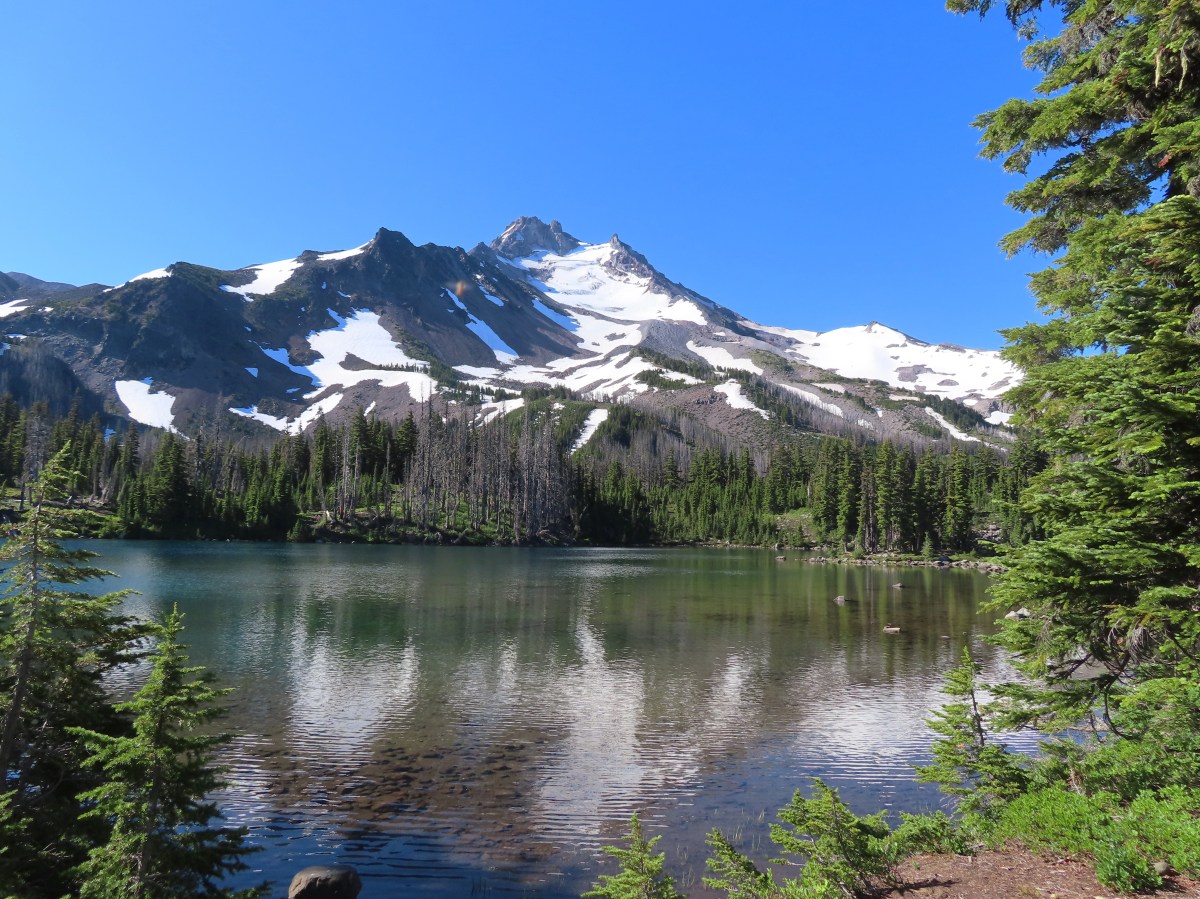
Mt. Jefferson
I hadn’t gotten very far before I spotted a couple of elk ahead.

As I scanned the tree line I realized there was a whole herd out there and then moving across the field I noticed something smaller.
Coyote
The coyote spotted me and decided to head the other way. The elk on the other hand didn’t appear to be too bothered by my presence, at least yet.

I slowly continued in their direction since that was where the Prairie Trail led.

They finally started to take note as more and more elk emerged from the tree line.


I stopped here not wanting to get any closer and waited to see what the elk would do.
The lead bull here seemed to have a leadership role because once he emerged and headed across the field the herd followed and then circled up.

They were still a little too close to the route of the Prairie Trail for my liking and I was doing my best to follow the Leave No Trace principle of respecting wildlife so I turned around and started to head back the way I’d come. As soon as I did that the herd started off in the opposite direction.

I decided to continue on now that they had moved further away and I wouldn’t be following them. They had gone behind a stand of trees and the Prairie Trail cut through the trees several hundred yards from the end of the woods.

Shortly after I exited the trees into the next field the elk herd came around the trees giving me one last look at them as I headed away.
On my 2024 hike I had turned left here on the track at the edge of the photo, but with the elk out there I stayed straight(ish) along the tree line. Apparently that is part of the Prairie Extension Trail, but it was a more obvious path and there was an equally obvious path that angled off the extension trail back to the main Prairie Trail.

The next mile and half was pretty uneventful except for my feet freezing. They were soaked and it has only in the upper 30s Fahrenheit. Once I reached McFadden Marsh the wildlife sightings picked up again.
It was a wet muddy hike this time of year.
Camas and buttercups
McFadden Marsh sending up a light fog.
Wood ducks
Northern shoveler
Mallards, a green winged teal, a cinnamon teal, and a wood duck.
Ruddy duck
I’m sure it’s a nutria, it’s almost always a nutria.
Cinnamon teals
Female wood duck
Bald eagles on the far side of the marsh.
Blackbird
Buffleheads
Great blue heron
Green winged teals and American wigeons
Dove
Marsh wren
Heron hanging out near the Mcfadden Marsh blind.
Egrets and ducks
Egrets
Robin
I left McFadden Marsh behind, and the next wildlife action happened along Cheadle Marsh when an American bittern landed in the reeds ahead of me.


There were actually two bitterns.
It took me a moment to realize there was a second bittern.

Their camo is so good.
American coot
Swallows
Pied billed grebe
Ring-necked duck
Cinnamon teals
I passed Cheadle Barn and saw a few birds near the Cheadle Barn Pond.
Manroot and the Cheadle Barn
California scrub jay
Bittern flying over the Cheadle Barn Pond with Pigeon Butte in the background.
Wildlife and wildflower sightings were scattered along the rest of my route.
Iris and golden paintbrush on the side of Pigeon Butte.
Golden paintbrush and I guess the beetle counts as wildlife.
Savanah sparrow near the Finger Ponds.
Geese in a field near the Finger Ponds.
Turkey vulture
Goose and goslings in Cabell Marsh.
Great blue heron at Cabell Marsh.
American goldfinch near Cabell Marsh.
California quail near Cattail Pond.

Pied billed grebe at Cattail Pond.
Camas along the Cattail Pond Trail.
Pacific waterleaf along the Beaver Pond Trail.
Checker lily along the Beaver Pond Trail.
Fairy lanterns along the Beaver Pond Trail.
Giant white wake-robin along the Beaver Pond Trail.
Bullfrogs and blackbirds were all I saw at the Beaver Pond.
Turkeys along the Beaver Pond Trail near Park Headquarters.

The start and end of the Mill Hill Loop.
Yellow violets in the midst of invasive herb robert.
Bleeding heart
Gray squirrel
Star flower
Spotted coralroot
I’d once spotted a turtle on this log in a pond below the Mill Hill Loop so I took a picture hoping for another one. Instead I got a bullfrog.
Mallards in the same pond.
Solomonseal
Tolmie’s mariposa lily
The forest is pretty along the Mill Hill Loop.
Poet’s shooting star
Small-flowered woodland-star
The end and start of the Mill Hill Loop.
Tough-leaved iris
There were a bunch of bullfrogs sunning at the little pond along the Woodpecker Loop.
Lomatium on the Woodpecker Loop.
Woodpecker Loop Overlook. I took a break on the bench here and changed into dry socks after having a snack.
This northern harrier was putting on an aerial display while I took my break.
Wildflowers along Bald Hill.
Wild rose
Checkerbloom
Tough-leaved iris and golden paintbrush
More turkeys along Finley Refuge Road.


Cabell Barn across from the entrance road to the Cabell Marsh Trail.
Honeybee swarm along the road to the Cabell Marsh Trail. It looks a little like a heart.

This end of Cabell Marsh was practically deserted. My guess was that there was plenty of water right now in less visited areas, so the birds were avoiding this area for now.
You can almost always count on a coot though.
Cormorants out on a log in the middle of the marsh.
Homer Campbell Boardwalk
Wood ducks. These might have been the first significant wildlife I’d seen from the boardwalk. It’s a really neat trail I just rarely see any wildlife from it (with the exception of the shelter).
Turkey vulture flying over Turtle Flats.
Turtles at Turtle Flats!
Ending the day with turtles put a nice bow on a great day of hiking. Finley is a great place to hike and see wildlife. The Mill Hill and Woodpecker Loops are open year around along with the Homer Campbell Boardwalk while the remaining trails are open seasonally from April 1st to October 31st. With over half of wildlife week done it’s going be hard to top today. I’m planning on heading north for the next couple of hikes which might mean a couple of species I haven’t seen yet this week which I’ll be on the lookout for. Happy Trails!
Flickr: Finley Wildlife Refuge 2025


You can actually see some of the route I explored on the left side between Parvipes Marsh and the butte and at the bottom of the picture wrapping around the butte.
Manroot
Camas
Plectritis
Checkerbloom
Tolmie’s mariposa lilies


Morgan Lake with a bit of Moffitti Marsh to the left.
Columbine
Iris
Robin
Sparrows
Gold crowned sparrow
The grass was low enough that the lake was fairly visible. Later in Spring you’re lucky to see any water from the trail.
Not a great picture due to the distance and light, but there are a couple of ruddy ducks to the left hanging out with some ring-necked ducks.
Mallards
American coot
Gadwalls
Buffleheads
Common yellowthroat
Looking for a bittern.
American bittern. I could only see the bittern from a very short section of trail and as soon as I lost a little elevation it disappeared from sight. It never flew off, but I couldn’t see it even knowing where it was.
Following the trail next to Smithfield Road.
Lots of red-winged blackbirds near the trailhead.
Finch
Heading back toward Baskett Butte and Moffitti Marsh.
Northern flicker
Moffitti Marsh
American wigeons
Female common yellowthroat
Spotted towhee
I watched a crow chase off a hawk that had apparently gotten too close.
The official trail heads up the hill to the left. I veered right just beyond the trail sign pointing toward Moffitti Marsh.
Lilac
Parvipes Marsh ahead to the right.
The tractor turned right and drove over a dike at the end of Parvipes Marsh to a field on the other side.
Deer farther up the hillside.

This appears to be balsamroot. There were just a couple of patches on the SW side of the butte.
Cottonwood Pond
Buttercups and miniature lupine
Meadow checker-mallow
Lomatium and plectritis
South Slough Pond
I was a bit surprised to find a bench along this route given it isn’t shown as an official trail.
Grass pea
More checkerbloom
Golden paintbrush
If I hadn’t been looking for the tread I don’t think I would have noticed it.
Lupine
Another Tolmie’s mariposa lily
Western meadowlark
The overlook ahead.
The obligatory photo from the overlook.
Lots of patches of plectritis on the butte.
Ground squirrel
Swallow
Baskett Butte from the Cottonwood Pond parking area.
Mallards
Northern pintails
Northern shovelers
Lesser scaup. They look a lot like ring-necked ducks only without the ring.
Ring-necked ducks
Nap Time.
The route included two short road walks along Buena Vista and Wintel Roads.
Ring-necked ducks
Much of the area, and most trails, are closed between October 1st and April 1st each year.
Ring-necked ducks and a very out of focus pied billed grebe.
Willow Marsh
Northern filckers
Geese
Teal Marsh
Pied billed grebe
Common yellowthroat
Pair of bald eagles in the snag.
One of the eagles.
I believe this is a greater yellowlegs.
Bufflehead
Green-winged teals
Killdeer
Leaving Eagle Marsh. Even over an hour after sunrise there wasn’t much light.
Robin
The mudflats at Mallard Marsh were busy.
Green-winged teals and several species of shore birds. I think the darker, larger birds are short billed dowitchers, the smallest are sandpipers and there is one with a black mark on its underside which may be a dunlin.
Better look at the short billed dowitchers.
A little better look at what I think might be dunlins.
I see you.
This American bittern saw me way before I saw it. It had flown up earlier and landed in the vegetation and even though I watched where it landed, I couldn’t make it out until it took flight again.
Savanah sparrow that appears as annoyed with the bugs as I was.
Not a great photo but there is a northern pintail lower right.
A sandpiper, my guess is a least sandpiper.
American wigeons. Another not great shot but they were all sticking close to the far shore of Mallard Marsh.
Mallards hanging out at Mallard Marsh.
Nearing the 4-way junction.
Northern shoveler
Pintail Marsh from the trailhead along Wintel Road.
Cinamon Teal
Camas
Hawk
Song sparrow
Spotted towhee
Common vetch

Avens
Western meadowrue
Obstacle
Newer looking bridge.
Older bridge.
End of the Woodland Loop.
The boardwalk to the left.
The one trying to land was apparently not invited to the party.

There are 3 immature and 2 adult eagles in the trees. Then there was the juvenile that wasn’t welcome and possibly another juvenile that had been flying around. I was having a hard time keeping track of just how many there were.
Grey ghost
Dunlin Pond
These may be the two juveniles that were not allowed at the meeting.
A nearly dry South Pond on the right after having looped around Killdeer Marsh.
The start of the boardwalk.
Dove
Song sparrow
Wood ducks
Mallard
Swallow
Cinnamon teal
Woodpecker
Pintail Marsh (all the black specs are insects)
Female red-winged blackbird
Male red-winged blackbird
American coot
The highly invasive American bullfrog.
A good look at the size difference between a Canada goose (left) and cackling geese.
Sunning snake
Canada goose
The heron’s head between the interpretive signs.

The landfill to the left.
One of two pointers to keep hikers on track.
Sign at the viewpoint.
The remains of a bench at the viewpoint.
Buttercups and iris
The sign announces the “Summit 604′”, but the actual summit is further along the ridge on private property meaning the trail ends here.
A mariposa lily surrounded by poison oak.
The busy parking area.
My route and the Coffin Butte Trail.
Wandering on trails to the NE of the parking lot.
Apple blossoms?
Concrete structure left over from Camp Adair.
Turkey vultures
Turkey vulture
Heading for the pond.
There were all kinds of birds singing in the trees but nary a feather to be seen.
Iris
I believe this walkway is new since or previous visit.
There were quite a few folks fishing around the pond, and one great blue heron.

Wetlands across the trail from the pond.
Buffleheads
Pied billed grebe
Camas
Hooded merganser drake
Mallards
Killdeer and hooded mergansers
Sandpiper
Heading west through the wildlife area.
Hummingbird
Family of geese
Robin
Black capped chickadee
Northern flicker
Wetlands
Blackbird
Groundsquirrel


Duck and ducklings along with a killdeer.


Chickadee
Mallards
Fanno Creek
Thimbleberry and service berry

Northern flicker
Hummingbird
Red-winged blackbird

Squirrel
The Greenway Loop Trail had the only flooded section on this day.
Wetlands along the Greenway Loop Trail.
Goose
Hooded mergansers
This is another section that may flood at high water times.


We spent some time here watching a female mallard attempt to join the drakes along with her ducklings only to be repeatedly chased off.
Mallards ducklings
The ducklings finally making it across the trail.
Goose and gosling
Avens
Camas
Dirksen Nature Park
Viewing platform
Wetlands from the viewing platform.
Dove
Finch
Robin
Lupine
Woodard Park Trailhead.
This may be a lesser goldfinch, I wasn’t able to see anything but its rear end though.

Spotted towhee
Wood duck


The trails were well marked with plenty of reminders which users were allowed on them.
Giant white wakerobin (Trillium albidum)
The only columbine we spotted.
Fairy lanterns
In addition to identifying the trails by name, several had mile markers.
Trillium

Solomon’s seal
Toothwort
Largeleaf sandwort
Bleeding heart

Old fungus
Oregon grape
The 2.5-mile marker on the Mossy Maple Trail.
Seasonal closure sign and map at the upper junction with the bike only Yee-Haw Trail.
Pacific hound’s tongue
Fairy slippers
Star flowered solomon’s seal
Iris
Vetch
Fringecup
Strawberry
Shooting star
Spotted towhee

Small-flowered woodland-stars
Checker lily and baby blue eyes (Nemophila menziesii)
Manroot
Red-flowering currant
Dogwood
On the Cervus Road passing an old quarry on the right.
The Basalt Rim Trail.
The lupine is still a week or so away from blooming.
Basalt columns


Fawn lily
Springfield from the trail.
There is a short one-way loop at the top.
Looking down from one of the viewpoints.
The highest peak to the left in the distance is Mount June (
Mt. Pisgah (
Biscuitroot
Another viewpoint along the loop.
The peak with two humps is Mount Nebo. With the naked eye we could just make out Tidbits Mountain (
Camas (and poison oak) near the viewpoint.
Finishing the loop.
Stripped coralroot.
Switchbacks leading down to the Basalt Rim Trail.
Wren
Violets
Basalt outcrops
Ginger
Arriving back at the Mossy Maple Trail.
Starflower
Dunn’s salamander
Mossy Maple Connector Trail (left).
The Yee-Haw Trail coming down from the left to the Mossy Maple Connector Trail.
Buttercups
Fairy bells
Meadow near the trailhead.


Menzies’ larkspur
Western meadowrue
Bleeding heart and purple deadnettle
Completing the loop.
Faint grassy path.
Golden crowned sparrow
A section of obvious trail.
The faint path disappeared near the fenced off-leash dog area. The AllTrails loop appeared to turn around here, but since we couldn’t see even a faint path leading back around closer to the parking areas we turned around and followed the river back.
We did find this short section of what appears to have been a paved path in the grass.


An example of the posts. Every directional arrow, including the far side that you can’t see, was for the “Elk Trail”.
Cedar along the Elk Trail.
Candy flower and woodland buttercups
Picnic tables near Lost Creek.
Lost Creek
Not a signed junction so this is the one time we veered right.
Middle Fork Willamette River.
I was hoping that there might be a turtle hiding in this photo but alas it does not appear that is the case.
We veered left here leaving the River Trail briefly to actually get a view of the river.
We hadn’t noticed the goslings in the grass until seeing the picture of the parents.
Another look at the river shortly before the River Trail turned away.
Barrow’s goldeneye
Left here as right led to a picnic area at the end of the entrance road.
Signpost at the second junction where we kept right.
The clouds had been stubborn all morning but by early afternoon they had mostly burned off.
We stayed left on the trail near the entrance road (across from the 

ADA accessible path to a brushy wildlife viewing spot along a backwater channel.
Bufflehead and at least three turtles on the logs behind.
The Lost Creek Trailhead on the far side of the entrance road.

\


Moss carpet
The first of several road and/or OHV trail crossings.
Skunk cabbage
Coming to an OHV trail crossing.
Violet
Another OHV crossing.
Trillium
Mushrooms
Approximately 1.4-miles along the Wilson River Wagon Road the trail followed Saddle Mountain Road for 150 yards before resuming on the far side.
The trail resuming on the left off Saddle Mountain Road.
Deyoe Creek


The Wilson River Wagon Road Trail arriving at University Falls Road across from the University Falls Trailhead.
University Falls Trailhead.

There was a clearcut on the right-hand side of the trail.
The Gravelle Brothers Trail joined from the right after 0.2-miles. This is the trail we’d used to reach the falls in 2015.
Salmonberry blossoms

Trillium near the falls.
Heading down the road from the trailhead.
Coltsfoot


Wood sorrel
University Falls Road below to the right.
This appeared to be a new section of trail replacing the old alignment on the north side of the road.
The closed section of the trail that remains on the north side of the road.
The closed section of trail coming up on the right with the continuation of the trail ahead on the left.
The other end of the closed section.
This section was open so I waved Heather on and we headed down through the clearcut to the horse camp.
A lot more hikes may look like this if the current administration gets its way.
The horse camp in the trees.


Footbridge over Deyoe Creek.
Rough skinned newt.
In true Oregon fashion the weather was a mix of sprinkles and blue skies.
Violet enjoying some sunlight.
This stump looked suspiciously like Davey Jones from the Pirates of the Carribean movies to us.
Huckleberries
Devil’s Fork
I had arrived just after 6:30am so it was still a little dark as I set off.

Please respect private landowners wishes when recreating to ensure that public access continues to be allowed.
Looking back at the sunrise.

Entering the clearcut.
Bleeding heart
The OCT is well marked.
Woodpecker
Back in the forest.
Interpretive signs in the preserve.
Bench at a viewpoint.
Nehalem Bay (
Salmonberry blossom
Leaving the preserve.
Violets and pink fawn lilies. These were the first pink fawn lilies I had seen, it seems that we hadn’t timed our coastal hikes right to catch their bloom in the past.


Trillium
Fringecup
Toothwort


I made use of this bench on the way back to take a break and do some stretching.
View to the north.
Tillamook Head (
It was obvious that there had been some work done to try and shore up this section of trail.
The view south from the viewpoint.
Cape Meares (
Cascade desert parsley near the summit.
Looking up at the viewpoint from the OCT.
Trillium
This was the only obstacle that required any sort of maneuvering.
There are some great trees along the upper section of the trail.
Violets
Recent trail work.
Anemones and violets.
Entering the storm damaged area.
Angora Peak (
Getting creative with the trail route.
Out of the storm damage.
Skunk cabbage
Cape Falcon from the trail.
Pink fawn lilies
Arriving at Highway 101 near the North Neahkahnie Mountain Trailhead.


Snow queen
He may have been moving faster than I was.
There is nothing better than hearing wrens sing in the forest.
More creative trail in the storm damaged area.
Wood sorrel
The view if you don’t scramble up the spine.
Trillium with a touch of pink.
Arriving at the packed trailhead.
Leaving the crowds behind.
Big patch of pink fawn lilies.
Highway 101 from the powerline corridor.
Margined white
One of the more impressive trees in the preserve.
Nearing the Highway 101 crossing. I arrived just as a long line of traffic was passing by but was able to safely cross shortly afterward.


Atwood Road
Death camas
Saxifrage and a yellow bells.
Grass widows
Gold stars, wood-land stars, and blue-eyed Mary.
Catherine Creek from Atwood Road.
Pungent desert parsley

Closer look at the arch.
Buttercup
I believe this was just our second time coming across these flowers.
Closer look at the Dutchman’s breeches.
Hairy bittercress (non-native)
Entering the sunlight.
Glacier lilies
wood-land stars
Toothwort
Columbia desert parsley

Heading through the forest.
Looking east as the road emerged from the forest.
Grassy hillside
Mt. Hood behind a few clouds.
Mt. Hood
Popcorn flower
Rowland Creek
Another user trail on the left, referred to as the Shoestring Trail by the Oregonhikers Field Guide. This trail is not shown on the Forest Service map nor is it mentioned on their website.
Coastal manroot
Grass widows
View of Mt. Hood’s summit.
Robin hunting worms.
Daffodils
The Upper Labyrinth Trail (aka Co8) joining from below. This was the first junction with signs naming official trails.
Labyrinth Creek below Atwood Road.
The Labyrinth Creek crossing.
Wet trail climbing away from Labyrinth Creek.
Red-tailed hawk


Yellow bells

We stayed left here.
We ignored the singletrack leading right on the far side of this unnamed stream.
Here we veered right on the single track. I believe the single track is the “official trail” although both paths led to the signed junction.
A multitude of tracks near the junction.
On one of the switchbacks.
Turkey vulture
The upper viewpoint.
Balsamroot
Looking east over the Columbia River.
Gold stars

The
Woolly-pod milk-vetch
Miniture lupine, redstem storksbill and a popcorn flower.
Fiddleneck
We turned right at this junction with the Old Ranch Trail to continue downhill.
Naked broomrape and redstem storksbill

Tomcat clover and redstem storksbill


We ignored the Little Maui Connector Trail on the left near the old highway.
Larkspur


Crossing for Labyrinth Creek.


First view of the Catherine Creek Trailhead on the plateau ahead.

Hound’s tongue
Rowland Creek
Rowland Basin

Lupine and balsamroot


The Rowland Pinnacle


The small blue sign on the left provides the pay by phone information. This was one of two such signs in the parking area.

Little Joe Creek
The pointer to the right was for the Sandy and Salmon Rivers (.25 miles) while continuing another .18 miles would bring us to the Sandy Ridge Trail System.


Start of the Falls Looop.
Primitive Trail number 2 with the Falls Loop continuing to the left.

This was a nice little cascade this time of year. Later in the Summer the flow reportedly drops down to a trickle.
The self-guided nature tour follows the Northern Loop Trail here as well.
Passing stop #6 on the self-guided tour (Forested Headwaters).
One of the creeks flowing from the forested headwaters.


There are a few Eagle Creeks in Oregon, this is the Eagle Creek that originates in the Salmon-Huckleberry Wilderness (


Snow queen
One of several switchbacks.
Rough-skinned newt and snow queen.
Closer look at the newt.
Blue sky
Traversing the hillside.
The trail below as we neared a switchback to begin descending.


Viewpoint near the end of the loop.
The start of Loop D from Kitzmiller Road.
The remains of former signs can be seen at the split ahead.
The trail made a steady climb to the junction with the supposed Lollipop Loop.
The lower portion of the tree across the switchback.
Left is the continuation of Loop D. We stayed right to attempt the Lollipop Loop.
There were some cut trees along the trail mixed with more recent blowdown but nothing was particularly difficult to navigate.
Wren
There was a lot of snow queen.
The footbridge with a large tree across it.
Look back along the bridge.
The older blowdown had all be cut.
I made it through this muddy mess but couldn’t find any sign of tread on the opposite side.


Swagger Creek
Song sparrow (according to Merlin)

The second unsigned junction.


Swagger Creek (right) joining Clear Creek at the suspension bridge.
The Nature Trail wasn’t signed other than some “No Motor Vehicles” signs.
The old roadbed.
Relative locations of the three stops plus Milo McIver from our previous outing.