
What do you do the day after a 16.5-mile loop with 4355′ of elevation gain (post)? If you’re me, you make a questionable decision. With another sunny day in the forecast before showers moved in, I decided that I would finally check out the Eula Ridge Trail near Eugene. This 4.2-mile-long trail gains over 3000′ from Highway 58 to its end at the Hardesty Trail. The trail is very steep, so steep in fact that the Forest Service description states “After a short descent into a saddle, the really steep climb begins. This is a good place to turn back.” The saddle in question is just over 1.5-miles from the trailhead and marks the start of 16 switchbacks. The switchbacks are nowhere near as steep as the remainder of this trail. From the end of the trail it is just three quarters of a mile to the top of Hardesty Mountain (post), but there is no view from that peak. When we visited Hardesty Mountain it was on an out-and-back from the Mount June Trailhead. That hike gained approximately 2100′ of elevation. My bright idea was to combine the two to revisit Mount June where there was a view.
I set off just after 7am from the Eula Ridge Trailhead and immediately went the wrong way when I forked left on the Lawler Trail.
 This trail would eventually end at the LoneWolf/Patterson Mountain Trail (post).
 The small trailhead along Highway 58.
 Wrong way dummy.
I got a little over a quarter mile up the Lawler Trail before realizing my mistake. The worst part was I’d climbed over 250′ in that quarter mile. I retreated to the trailhead and went right on the Eula Ridge Trail which dropped to a crossing of South Creek before climbing to a junction with the South Willamette Trail (post).

 The South Willamette Trail to the right.
This trail was heavily damaged in a February 2019 storm, but it has since been cleared and was free of any blowdown for its entire length. The trail is forested with no views to speak of, but the forest is very nice. I had a lot of time to study it during my many breaks as I made my way uphill.


 It was clear that mountain bikers use this trail regularly.


Near the 3.75-mile mark the trail passes a rocky spine which is actually an arch. I couldn’t see the arch from the trail, but thanks to Hike Orgon I knew it was there.

 I actually waited until I was on my way down to step off trail and look at the arch.
 Eula Ridge Trail sign at the Hardesty Trail junction.
I turned left on the Hardesty Trail and climbed another 240′ in 0.4-miles to a fork.

 The lefthand fork leads to the viewless summit while the right is the Hardesty Cutoff Trail which bypasses the summit.
I went right forgoing the 100′ climb to the summit which would have also added a little distance to the day. In 0.2-miles I arrived at a junction with the Sawtooth Trail.

 Forest below the Hardesty Cutoff Trail.
 The Sawtooth Trail dropping to the right.
I briefly considered abandoning my original plan here, but it was only 9:40am. I decided to continue on, but with a turnaround time of 11:30am. If I hadn’t made it to Mt. June by then so be it. I had completely forgotten just how many ups and downs there were along the Sawtooth Trail, and how steep some of them were.
 I was not looking forward to climbing back up some of these sections later.
 Another saddle.
 A view through the trees.
 I passed the Hardesty Way Trail 1.5-miles from the Hardesty Cutoff Trail.
Just under two miles from the Hardesty Cutoff Trail the Sawtooth Trail makes two switchbacks downhill to drop below Sawtooth Rock where it enters a grassy hillside.

 Mount June from the hillside.
 Wallflower
I paused in the middle of the open hillside to again rethink my plan. It was now a quarter after 10am so I was fine on time but seeing Mt. June reinforced just how much more climbing lay ahead. I checked my water supply and found that I hadn’t been drinking enough. I still had close to two liters in my pack plus a Hydro Flask with extra water and a small Gatorade. I drank half the Gatorade and continued on. Two-thirds of a mile beyond Sawtooth Rock I came to a junction in yet another saddle.
 Junction with the Lost Creek Trail.
 The pointer for Eagles Rest (post) is the Lost Creek Trail.
Another 0.7-miles brought me to the Mt. June Trail at, you guessed it, another saddle.
 I called this section “rhododendron ridge”.

 The Mt. June Trail coming up from the right.
It was now just after 11am and I was facing a half mile, and nearly 550′, climb to Mt. June’s summit. I headed up and stopped at the first good sized log along the trail to finish off the Gatorade, eat some sweet and salty snack mix, and rest for a few minutes. After the break I headed up the steep trail arriving at the summit at 11:27am.


Unfortunately, the view was less than ideal. The recent warm weather had allowed the many fires still burning to pick up intensity which led to additional smoke.

 If you look closely, you can see the tops of the Three Sisters poking up over the smoke in the distance. The open hillside in the foreground is the meadow below Sawtooth Rock and the hump just behind is Hardesty Mountain.
After another short break, and a change of socks, at the summit I started back. I was feeling okay on the downhills and the more level sections, but whenever the trails became at all steep my legs let me know they weren’t happy.
 Heading down from the summit.
 Climbing the hillside below Sawtooth Rock.
 Sawtooth Rock
 There was just a little smoke now and then in the forest.
 The Eula Ridge Trail coming into view.
I arrived at the Eula Ridge Trail at 1:19pm and bombed down the steep trail as carefully as possible. There are a lot of loose rocks/pebbles along the trail so my trekking poles came in very handy.

 There wasn’t much in the way of Fall colors along the trail, but these leaves really stood out.
 Lookout Point Lake (Middle Fork Willamette River) from the trail.
 There was one more small uphill on the far side of South Creek before dropping to the trailhead.
 South Creek

I made it back to the car at 3:00pm. My Garmin clocked in at an even 17-miles and I estimated close to 5300′ of cumulative elevation gain.

This was a real challenge, especially the day after another difficult hike. It does make for one heck of a training hike, and I didn’t see another person the entire day. Happy Trails!
Flickr: Eula Ridge to Mount June
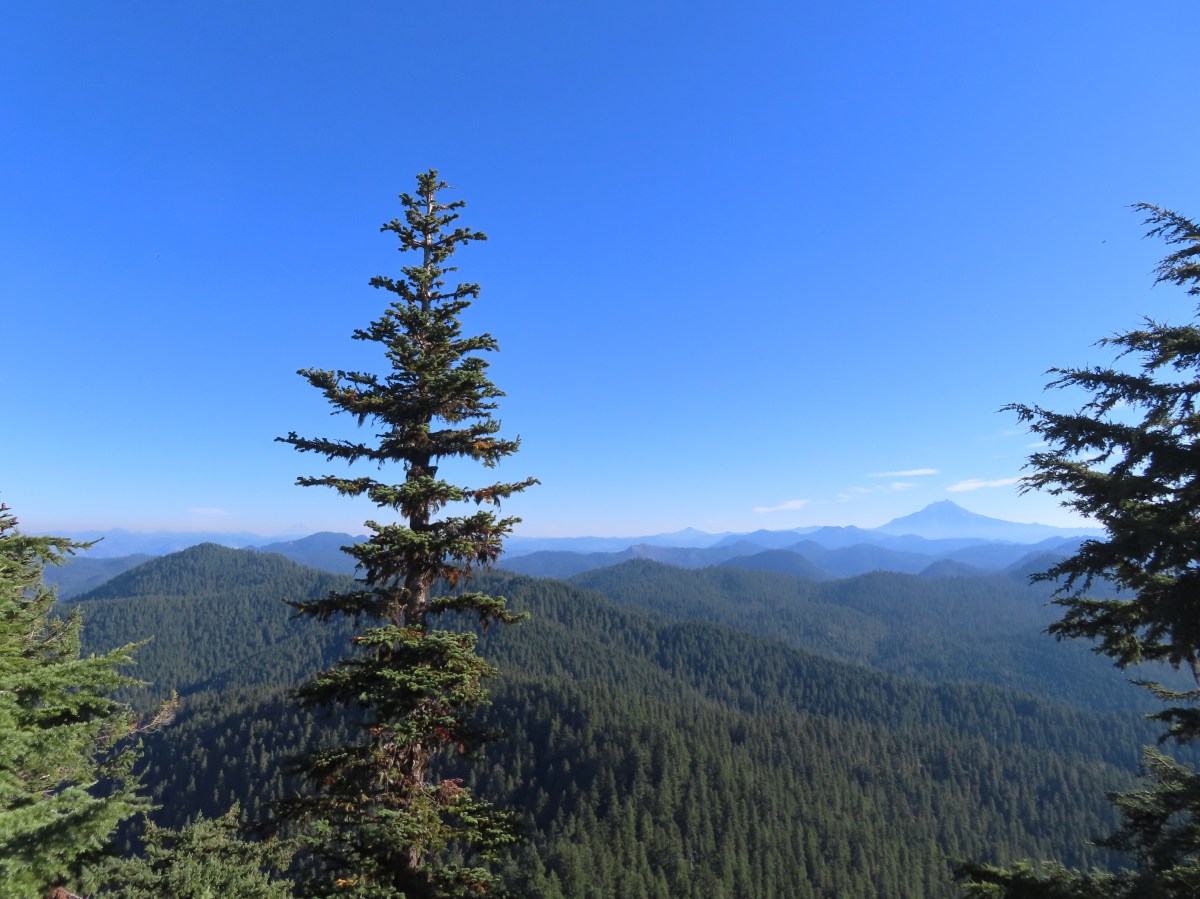
 I actually parked on the shoulder of Forest Road 1142 and walked a tenth of a mile down a spur road to the start of the trail.
 A note stating that access from the eastern side of the wilderness was still closed due to the Pyramid Fire.
 It was early when I started so there wasn’t a lot of light and even on the way back there was a lot of shade.
 A short distance from the trailhead is a crossing of West Fork McQuade Creek.
 A third of a mile from the West Fork the trail crosses McQuade Creek.
 Reportedly this crossing can be quite tricky early in the year, but there wasn’t much water this time of the year.


 Based on trip reports from 2023 and recent cuts seen along the trail it appears that a trail crew passed through this year.


 A reminder that Fall is here.
 The McQuade Creek Trail hidden by the underbrush.
 Lousewort
 Huckleberries
 Views were limited to the nearby ridges and hillsides.
 Vine maple along a rocky slope.
 Pika watching me from behind some cover.
 Flagging along a bit of a washout.


 The McQuade Creek Shelter used to be located near here, but it had collapsed years ago, and I didn’t see any signs of the remains.
 Pointer for Chimney Peak.


 Initially I forked right here because the left hand fork didn’t appear to go anywhere.
 I assume these are remains from the former lookout.
 The start of the scramble route. The crack was too narrow to use but once I got to the top of this rock the route became much clearer.
 Looking down at the first part of the route from above.
 The top is in sight.
 Clouds over Green Peter Lake.
 Mt. Hood in the distance.
 Zoomed in on Mt. Hood and some haze.


 The Three Sisters
 Three Fingered Jack to the left behind the Three Pyramids (
 Mt. Jefferson zoomed.


 West Fork McQuade Creek
 Back at the trailhead.


 Another reminder that overnight permits are required in the wilderness.
 Low clouds in the valley.
 Mt. Jefferson through some of the snags with a few surviving trees on the right.
 Mt. Jefferson from the junction, note the rock cairn on the left marking the PCT.
 The cairn at the junction.
 Triangulation Peak (
 Whitewater Lake
 Triangulation Point and Bocca Cave (Trailheads still closed.)
 Tarn 0.3-miles from the junction.
 Mt. Jefferson reflecting in the tarn.
 Ducks on the tarn.
 The Sentinel Hills with Park Butte behind to the right. The Whitewater Trail (
 The fires did open up fairly consistent views of the mountain.
 A few remaining penstemon blossoms.
 Heading down to the Russell Creek crossing.
 This can be a tricky crossing at times, but there was a makeshift bridge which made it fairly easy this time.
 Aster and pearly everlasting near the creek.
 We started seeing more trees that had survived the fire as we got closer to Jefferson Park.
 Gentians and aster
 Grass-of-parnassus
 There were patches of burned forest along this stretch.
 Approximately 0.4-miles from the junction the trail crosses Whitewater Creek.
 From the other side of Whitewater Creek the views of Mt. Jefferson are amazing.
 Based on the barred sides I believe this is a black-backed woodpecker.
 Unofficial use trails are an issue in Jefferson Park which has prompted the Forest Service to install a number of “Closed for Rehabilitation” sign such as the one on the left side of the trail.
 They’ve also added quite a few signs to indicated sanctioned trails. Typically in wilderness areas the Forest Service tries to keep signage to a minimum, but overuse has led them to add additional signs.
 Another sign with Park Butte in background.
 The last of the pointers for Scout Lake.
 PCT heading for Park Butte and Park Ridge.
 Russell Lake pointer.


 Gooch Falls
 The road widened briefly near the pullout that acts as the trailhead.
 Delicious red huckleberries provided morning snacks along much of the road and trail.

 We forked right when the ancient roadbed headed uphill.


 Not Downing Creek Falls, just one of many streams along the mossy hillside flowing into the creek.
 Downing Creek Falls


 The flat top of Coffin Mountain to the left of the tall trees at center and Bachelor Mountain to the right.
 Coffin Mountain
 It took us a bit to realize that this was indeed a really old roadbed.

 There was sporadic flagging along the creek.
 Another flag ahead.
 The faint trail running along Downing Creek.
 When I lost the path a couple times I just looked for signs like this old log cut for where the tread might be.
 I wasn’t expecting to see caution tape. Maybe that’s all the person had because I couldn’t identify any hazard here.
 A forested island in Downing Creek.
 It was a short climb back up to the road.

 Trail map at the trailhead.
 Rhododendron

 Twinflower and fringed pinesap
 Sugar sticks


 North and Middle Sister followed next.
 The trail spent some time on top of the ridge as well as each side as it gradually climbed.

 Washington lilies
 Paintbrush
 Northern phlox
 Penstemon
 Garter snake
 Mt. Jefferson and Three Fingered Jack
 Entering trees that survived the 2017 fire.
 The hillsides that the trail traverses are pretty steep.
 Common whipplea
 Better view of Mt. Jefferson and Three Fingered Jack with Maxwell Butte (
 Bunchberry, queen’s cup, and foam flower.
 We had hiked to MacDuff Mountain on the O’Leary Trail just a few weeks earlier (

 Columbine
 Mt. Hood, Mt. Jefferson, Three Fingered Jack, Mt. Washington, and Scott Mountain (
 Trillium
 Valerian
 Wallflower and buckwheat
 Purple larkspur, yellow cinquefoil, and white sub-alpine mariposa lilies
 Paintbrush and lupine
 North and Middle Sister with Horsepasture Mountain on the right.
 Oregon bluebells
 Penstemon
 Butterfly on bistort
 Musk monkeyflower
 A stalk of beargrass along the trail.
 Jacob’s-ladder
 Bane berry and solomonseal
 Vanilla leaf
 The Saddle Trail arriving from the right.
 Downhill to the left is the Horsepasture Trailhead, uphill to the left is Horsepasture Mountain and the Olallie Trail continues along the righthand fork.
 Arnica, bunchberry and vanilla leaf
 Fleabane
 It was not a big year for beargrass but if you pick the right year there is an impressive amount along this trail.
 Second snake of the day. I wound up seeing three on the day which was two more than other trail users, excluding Heather.


 Pollinator photobomb in the upper left.

 The Three Sisters and Mt. Bachelor on the horizon.
 Lupine, bluehead gilia, paintbrush, and pussytoes?
 The former lookout site with Mt. Hood and Mt. Jefferson behind.
 The summit
 Survey marker
 Diamond Peak from the summit.
 The Three Sisters
 Mt. Washington, Scott Mountain, Belknap Crater (
 Mt. Hood, Mt. Jefferson, and Three Fingered Jack
 Scarlet gilia
 Buckwheat and bluehead gilia
 An aster or fleabane
 Paintbrush with penstemon in the background.
 Butterfly on bluehead gilia
 Butterfly and bees
 I believe this is a persius duskywing (Erynnis persius)
 Vetch?
 This outcrop is just slightly lower than the summit.
 Cliff beardtongue on the rocks with the Three Sisters and Mt. Bachelor behind.


 Phlox
Phlox Bastard toadflax

 Passing the Saddle Trail on the way back.
 Eight-spotted forester
 Blue-eyed Mary
 Horsepasture Mountain
 Waterleaf
 Mt. Hood, Mt. Jefferson, Three Fingered Jack, and Mt. Washington
 North and Middle Sister
 Larkspur
 Pink pyrola
 Clodius parnassian on a tiger lily.
 Fireweed
 It was right around 90 degrees at the trailhead when we got back at 2:30pm.
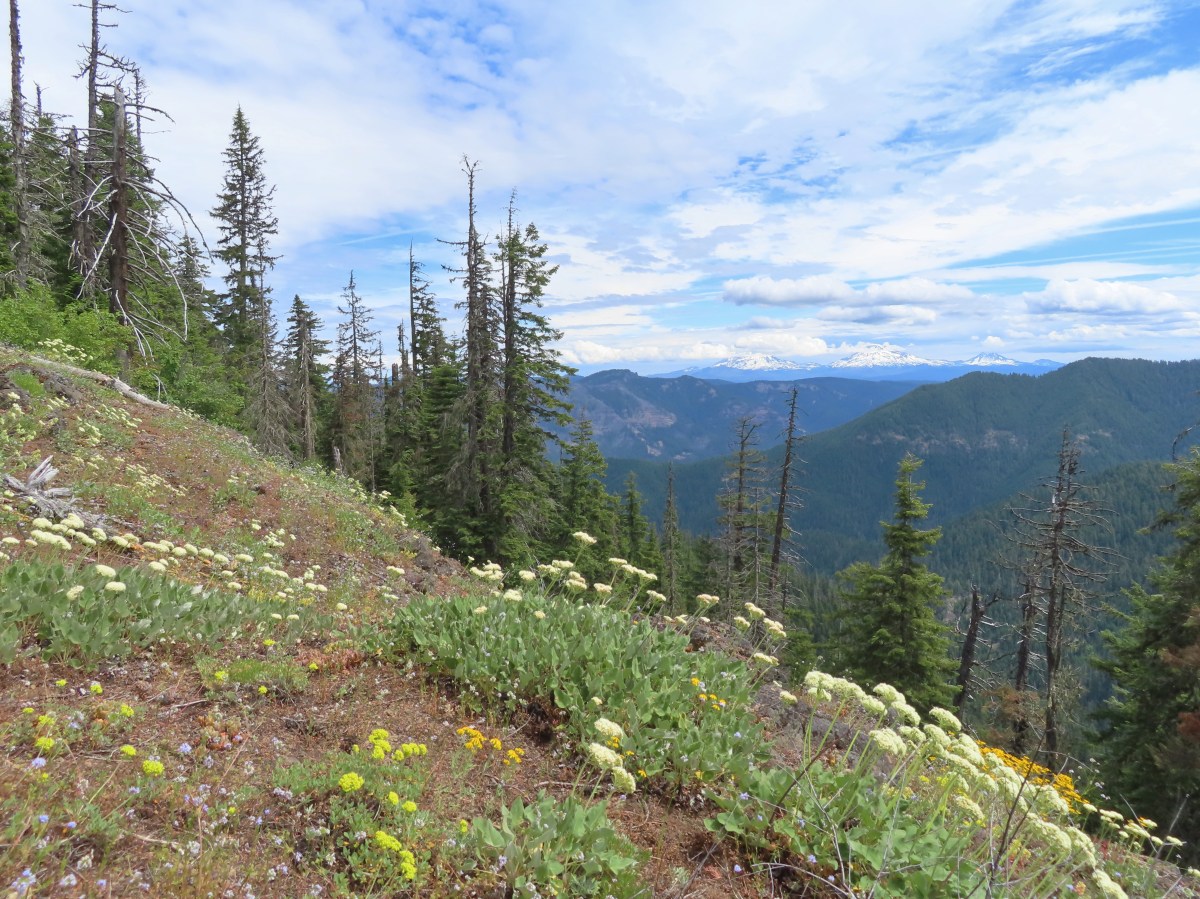

 Valerian along the trail.
 Vanilla leaf and anemones carpeting the forest floor.
 Star-flowered false solomonseal.
 Coneflower with lupine behind.
 Penstemon


 Monkeyflower
 Lupine
 Sub-alpine mariposa lily
 Moth on fleabane.
 Waterleaf
 Tiger lily
 Pussytoes
 From left to right the peaks with snow are: The Twins (
 Diamond Peak
 Grasshopper Mountain above the meadow.
 The post in the rocky area.
 When we visited in 2017 it had been mid-July, and the larkspur show was over.
 A cairn marks the Grasshopper Mountain Trail.

 Looking out over the meadow.
 Fuji Mountain and Diamond Peak
 The saddle below Grasshopper Mountain.
 The Three Sisters and Broken Top
 Mt. Bachelor
 The last of the snow, at least it is all we saw.
 Glacier lilies near the tiny snow patch.
 It was evident that the trail does get maintained on occasion, but none of it appeared recent near Grasshopper Mountain.
 Anemone
 Violets
 Bleeding heart
 Oregon bluebells
 The Three Sisters and Broken Top were visible from this area.
 Back on the slightly overgrown trail.
 Mt. Jefferson and Three Fingered Jack
 Bears appear to use the trail more than hikers. This was the largest of three piles we’d pass on the day.
 Arnica
 This is both the trail and a front (back) door.
 Valerian and tall bluebells
 Fairy bells
 Meadowrue
 Moth on valerian.
 Jacob’s-ladder
 While the trail was overgrown in places it was passable and the tread was in pretty good shape.
 Fringecup
 Possibly a speedwell but unsure and it was the only one we saw.
 More blowdown to maneuver around.
 Edith’s checkerspot
 Trail passing through an area full of monkeyflower and larkspur.
 Cinquefoil, larkspur, and buckwheat
 Scarlet gilia
 Paintbrush
 Bluehead gilia and silverleaf phacelia
 The rocky area from the trail as it crossed the ridge.
 Columbine crowding the trail.
 The wildflower covered rocks on the way back.
 Arrowleaf buckwheat and Oregon sunshine
 The Three Sisters and Broken Top with some clouds moving in.

 Paintbrush surrounded by buckwheat, bluehead gilia, and stonecrop.
 Scarlet gilia
 Wallflower
 Wild rose
 Beargrass near the outcrop.
 The outcrop from the trail.
 Blowdown
 More blowdown
 Western meadow fritillary
 Bunchberry
 Recent trail maintenance! There were a couple of cut trees in the final mile, but there were also still many to step over.
 The trail dropped low enough that there were several rhododendron blooming.
 Queen’s cup.
 South Sister (

 Had I not just come down the trail I might not have even noticed it was there.
 Cardwell’s penstemon
 Starflower
 Ginger
 Mt. Bachelor through the trees.
 Musk monkeyflower
 Grasshopper Mountain from the outcrop.
 Cliff beardtongue
 Blue-eyed Mary
 Cicada, not a pollinator but interesting to see.
 Solomonseal
 Variable-leaf collomia
 Honeysuckle
 Oregon grape
 Pollinator 1
 Pollinator 2
 Pollinator 3 (Clodius parnassian)
 Bees on bastard toadflax
 Checkerspot on groundsel
 Naked broomrape (Aphyllon purpureum)
 Penstemon
 Our guess is this is mile three from Grasshopper Saddle. We didn’t notice any other numbers and missed this one on our first pass.
 Dwarf bramble
 Strawberry
 Cinquefoil
 It started clouding up in the afternoon.
 Back at the saddle below Grasshopper Mountain.
 Great artic butterfly. There were a lot of these flying about. Their dorsum is a bright orange, but they rarely would open their wings when they landed.
 The checkerspots on the other hand are happy to open their wings.
 False hellebore
 It clouded up over Diamond Peak as well.
 Lewis flax
 Orange agoseris
 A Lycaendae on a lupine leaf.
 Moth on a mariposa lily.
 Butterflies gathering at the spring.
 The Prius at the TH. We parked on the shoulder in a pullout.


 Signboard about a tenth of a mile from the trailhead.
 The loop began on the far side of the footbridge.
 As far as we could remember we’d never seen a bench on the other side of a fence before.
 Middle Fork Willamette River through the vegetation.
 Tiger lily
 Self-heal
 Snail
Snail Mock orange

 Anemone
 There are a few junctions prior to reaching the footbridge. The first was the only one with any signage. We stayed on the correct trail by ignoring side trails to the left that headed uphill and on the right that led down to Deception Creek.
 We turned left at the signed junction following half a sign for the Deception Butte Trail.

 At the last unsigned junction there was a signboard, but with nothing on it. (We went straight.)
 Warning sign for the burned area ahead.
 The footbridge over Deception Creek.
 Deception Creek

 The amount of trail work needed to clear the trail was evident by the sheer number of cut trees along the length of the trail.
 This was from 2017 near the same stretch of trail.
 View up the canyon from the trail.
 Clodius parnassian
 There was a lot of vegetation along the trail, so we had to keep an eye out for poison oak which was present at times on the lower two-thirds of the trail. It was never much of a problem, but there were a couple of plants crowding the trail that we had to maneuver around.
 Moth
Moth Starflower
 Rhododendron
 Northern cloudywing
 Big deervetch
 Hummingbird
 Groundsel
 One of the damaged sections of trail.
 There was some forest that survived the fire starting near the 3.5-mile mark where the fire burned less intensely.
 Townsend’s solitaire
 Canada jay
 There were a few views of the Three Sisters through the remaining trees. (Middle & South Sister here)
 Inside-out flower
 Looking up as the trail neared the summit.
 Woodpecker
 Common whipplea
 Anemone
 The Deception Butte Trail arriving at Deception Butte.
 Beargrass


 Looking down at the saddle and wondering if it was really worth having to climb back up.
 Northern flicker
 Lizard
 Rock outcrop on the other side of the saddle.
 Tolmie’s mariposa lilies
 Bluehead gilia
 Squirrel
 Oakridge in the valley below with Diamond Peak (
 Diamond Peak
 Oakridge
 Leafy fleabane
 Oregon sunshine on the hillside looking up Deception Butte from the saddle.
 Wild onion
 One of the fritillary butterflies.
 Fly inside a Tolmie’s mariposa lily.
 There is a very steep trail just below the summit that leads to an upper trailhead. The Forest Service does not recommend using these though as the trail is said to be slippery and steep. We can vouch for the steep just by having looked down from the Deception Butte Trail.
 Plectris and stonecrop
 Coralroot
 The best view of the Three Sisters that we got all day.
 Butterflies enjoying some vetch. There were at least a half dozen butterflies visiting this patch.
 Brown creeper
 Pink pyrola

 Pearly everlasting
 Turkey vulture
 Fireweed
 Entering the trees near the footbridge over Deception Creek.
 Columbine
 Tiger lilies
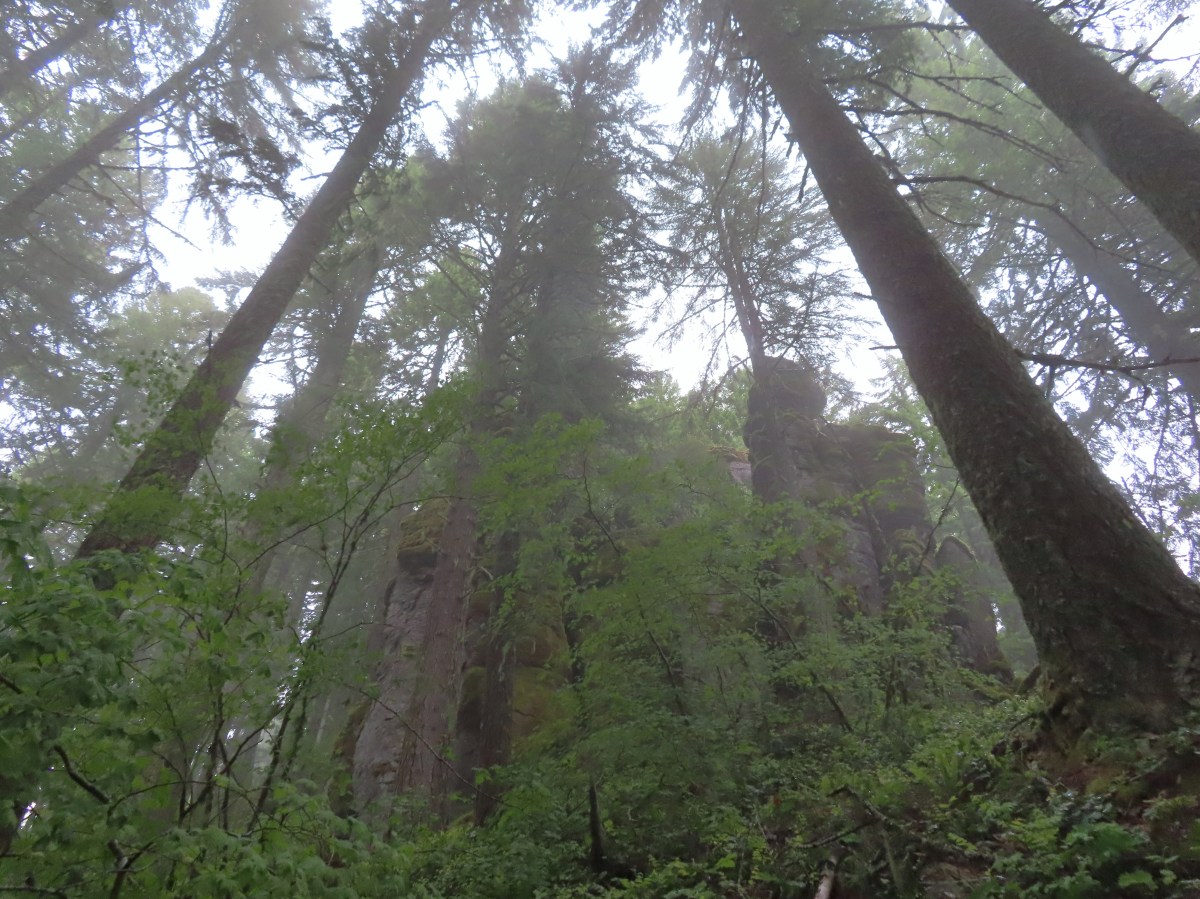


 There were some nice rhododendron blooms along the trail.
 Spotted coralroot
 The first of three crossings of FR 411, this is at the 0.4-mile mark.
 Inside-out flower
 Starflower
 Yellowleaf iris
 The trail is narrow at times but well maintiained.
 Forest filled with rhododendron.
 A closer look at the rhodies.
 There were several madrones in the forest.
 Little prince’s pine
 Sugar sticks
 There were a few places where we might have had a view if not for the clouds.
 Stonecrop
 Passing below some of the rock formations.


 Anemones
 Bleeding heart

 The first small meadow that the trail passed through was full of blue-eyed Mary.

 Northern phlox
 Coming up on another small meadow.
 Subalpine mariposa lily
 Beargrass
 The fog didn’t help with our trying to find the trail. There was enough room along this section of road that parking and starting the hike from here would be possible.
 Back on trail.
 Honeysuckle
 More northern phlox
 This meadow was full of bluehead gilia.


 The trail dropped steeply as it rejoined FR 411.
 There was no parking room that we could see near this area.
 Vanilla leaf along the trail.

 Bunchberry
 Trillium
 We stopped when we spotted something in the trail ahead that looked like it might be an animal. Using the camera to zoom we realized it was a grouse hen with her little chicks.
 The hen got up and then the chicks headed into the underbrush. We felt bad having disturbed them, but once they’d moved, we calmly passed by while momma came back to gather her little ones.
 This was all beargrass, but none of the plants in this area appeared to be planning on blooming this year.
 Hermit thrush
 The rocky summit of MacDuff Mountain.
 A lot of larkspur.
 Subalpine mariposa lilies
 Paintbrush and buckwheat
 Cinquefoil
 A penstemon


 The view from the top.
 No blue sky that way.
 No sign of clearing this way either.
 Cliff beardtongue
 Woodland-stars
 Paintbrush
 Hey look, there is another ridge over there.
 Ookow just starting to open up.
 Steep climb or road walk? We chose the trail again on the way back.
 A wetter road now thanks to the rain shower.
 Blue sky, it does exist.
 The clouds got a late start but eventually started lifting.
 From this angle it looks like a statue.
 Looking down from some of the switchbacks.
 Cougar Reservoir
 Pyrola
 Sunlight!
 I’ve never seen a track this far off.
 The track after manually editing it.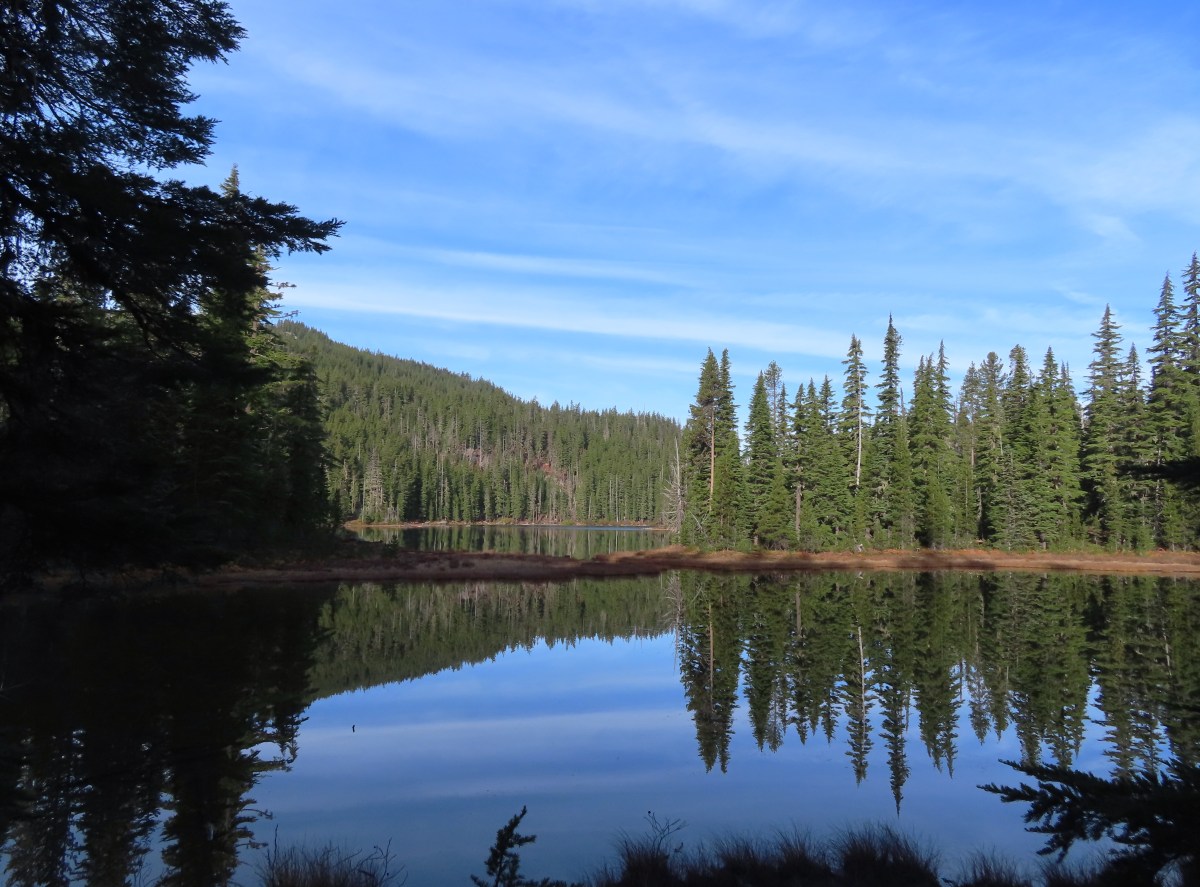


 Along the way we entered the wilderness area.


 It looks to have been a good year for beargrass.


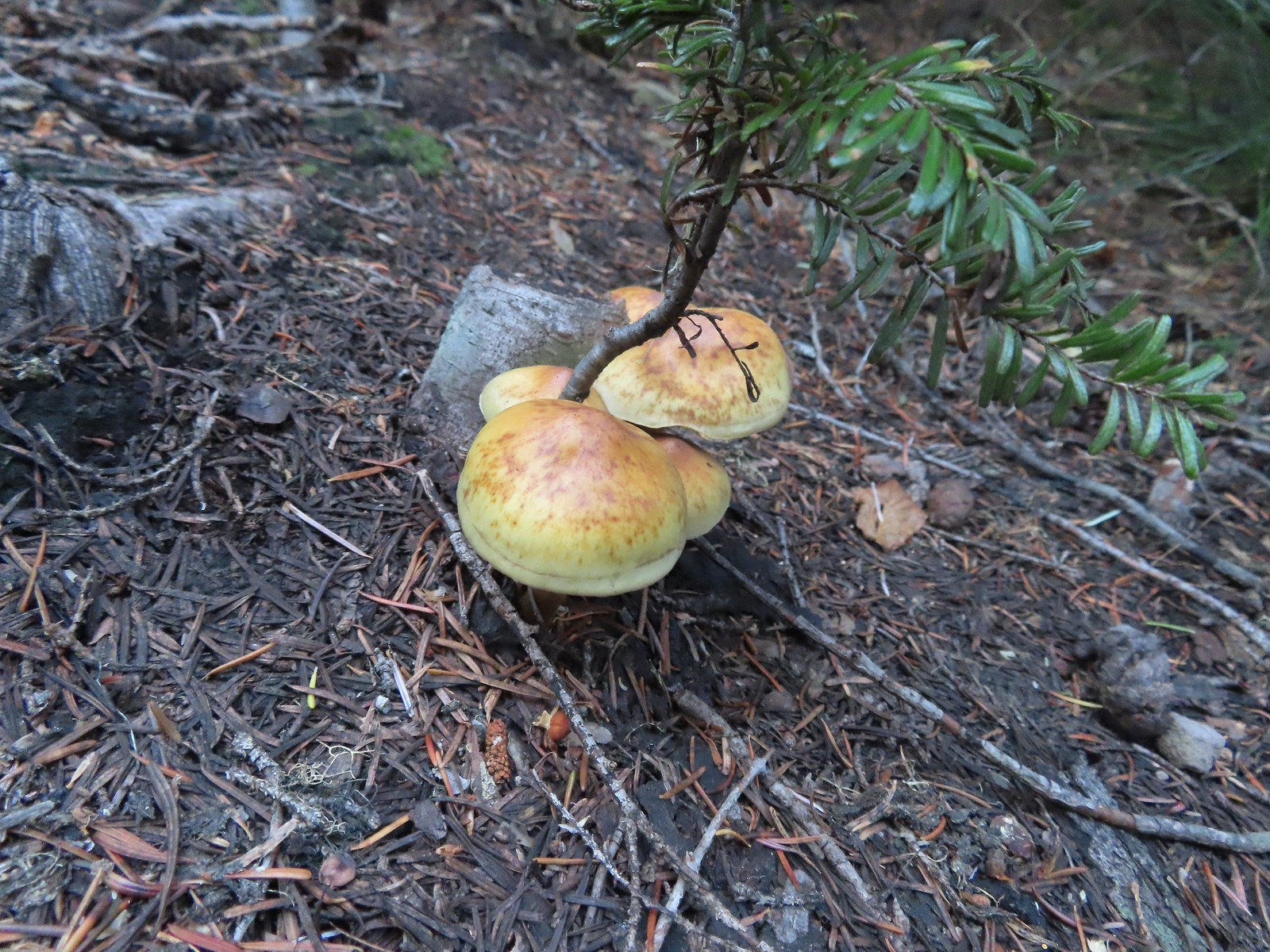
 The trail was well maintained with only one small log across the entire route to Vivian Lake.

 Another level section.
 Pond along the trail.
 The saddle at the high point of the trail.
 Maiden Peak (


 We passed the smaller of the two lakes a half mile below the saddle.
 The second lake, which was just 100 yards from the first, was much larger.
 Mt. Yoran from the lake.
 Ridge above the lakes.
 Just before beginning the descent the trail passed South of a third small pond/lake that was visible through the trees.
 Heading down to the creek.

 The marsh
 Mt Yoran from the marsh. While it looks like a meadow, Fall Creek flows through here, and at times we could see water out in the grass.


 We were able to use these rocks to hop across this narrow channel to the North shore of the lake where we were able to get a view of Mt. Yoran.


 Varied thrush. These continue to be the most frustrating frequently seen bird to try and photograph.


 I believe these were ring-necked ducks.
 Diamond Peak from the trail on the way back.

 Not all of the blowdown was as easy as this log to get over/under.
 Multiple switchbacks kept the lower portion of the climb from feeling too steep.
 The Hemlock Butte Trail succumbing to the vegetation.
 An obvious spur trail at the base of the rock outcrop leads to a view of Mt. Yoran and Diamond Peak. For those not comfortable with the scramble this is a good goal.
 The trail to the summit at the junction with the spur.
 Scrambling up
 Mt. Yoran and Diamond Peak from the summit.
 Wolf Mountain to the NW with clouds covering the Willamette Valley in the distance.
 The view South.
 Looking down from the summit. (The trail is to the right.)
 The “trailhead” was just under 14 miles from Highway 58 or just over 5.5 miles from the Vivian Lake Trailhead.
 The trail sign on the right. The Pool Creek Trail #4228 shows up on the Forest Service map, but they don’t have a dedicated webpage for it. We were made aware of the trail by following
 What looks like it might be tread ahead is actually the log.
 The Pool Creek Trail to the left of the creek. Here you can see the first switchback turning steeply uphill.
 The makeshift creek crossing.
 At the third switchback.
 The reason we hadn’t noticed the trail on the far side was because it climbed quite a bit in an initial series of short switchbacks so from where we had been the trail was already much higher than we’d expected it would be. In the photo Heather is coming up to the third switchback below.
 These two trees are mentioned in the May 2022 trail update on the Cascade Volunteers webpage.
 This one was high enough to easily pass under. On the far side are more cut logs.
 First view of the falls from the trail.
 Pool Creek Falls


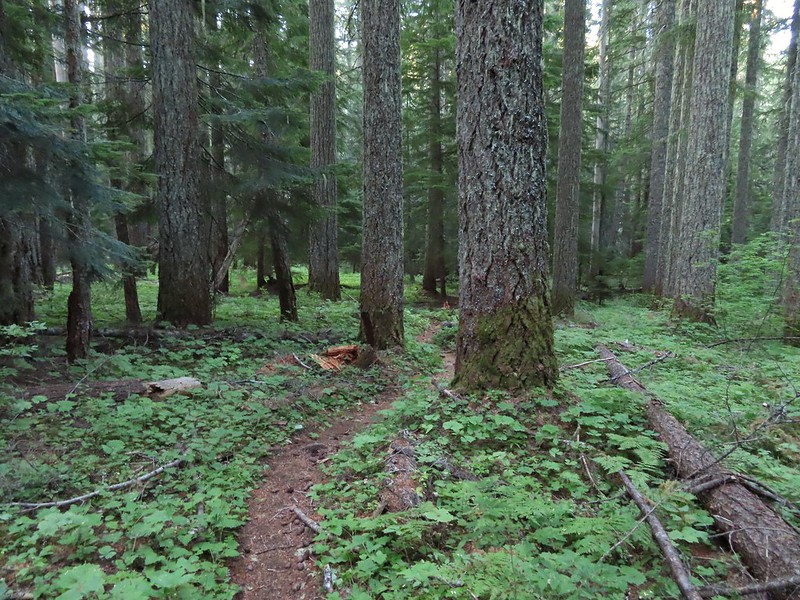
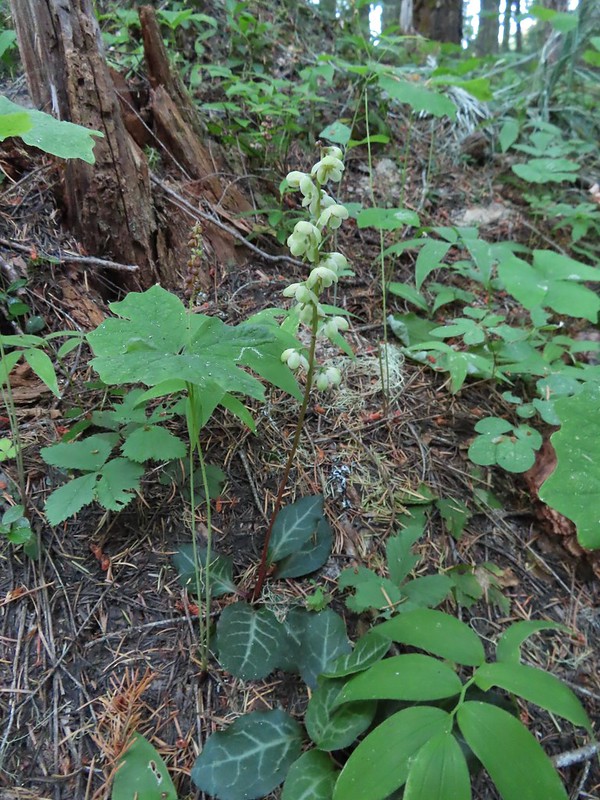


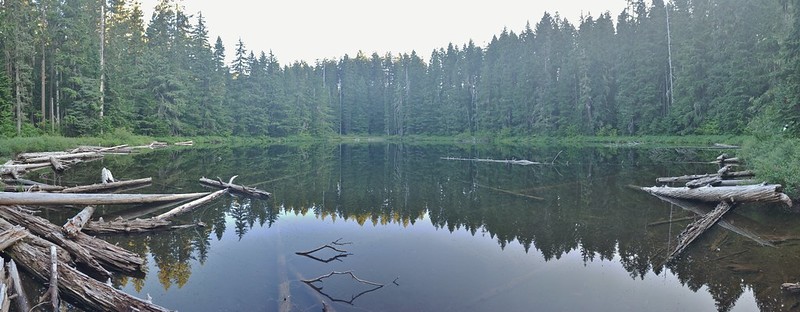
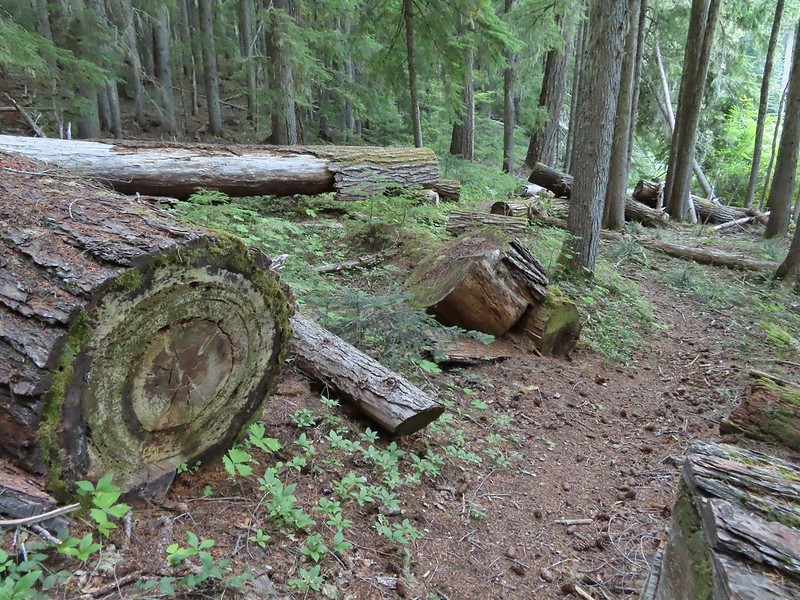
 Unnamed lakelet/pond between Pika and Fir Lakes.
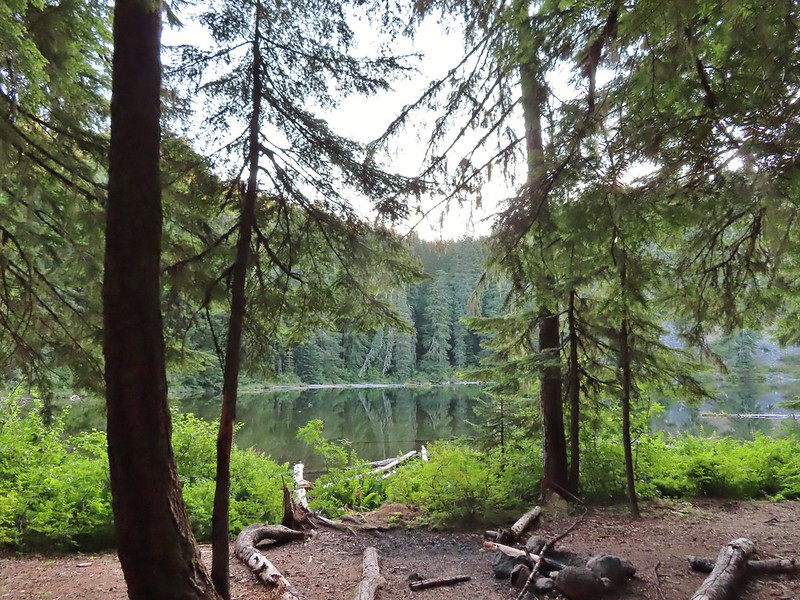 Fir Lake
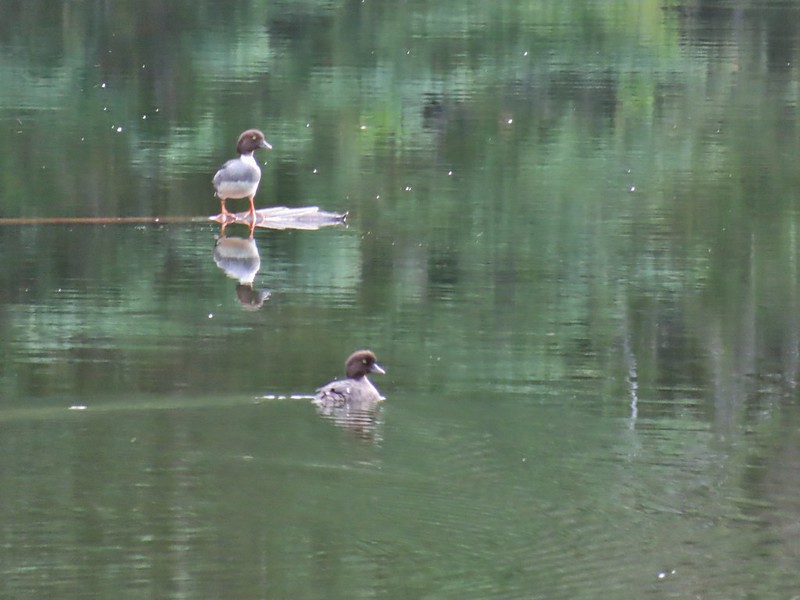 Goldeneyes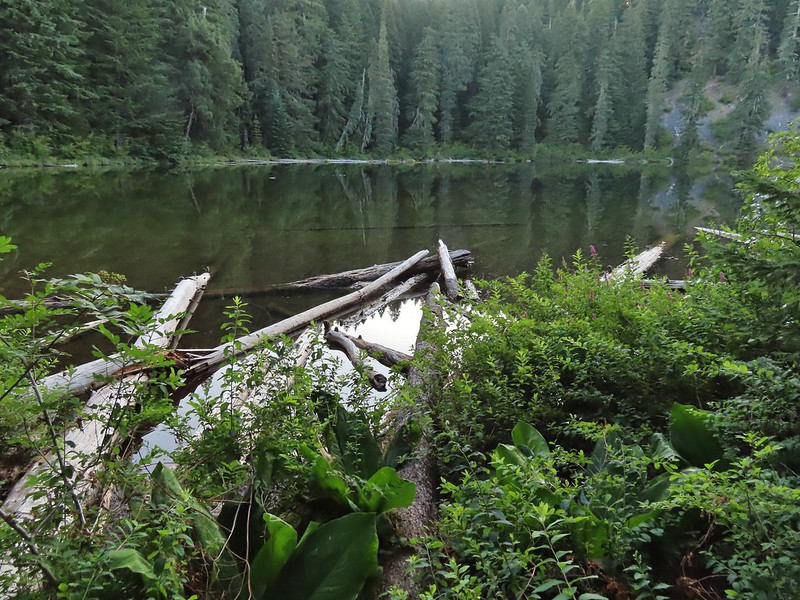



 wanderingyuncks