Categories
High Cascades Hiking Oregon Three Sisters Area Trip report

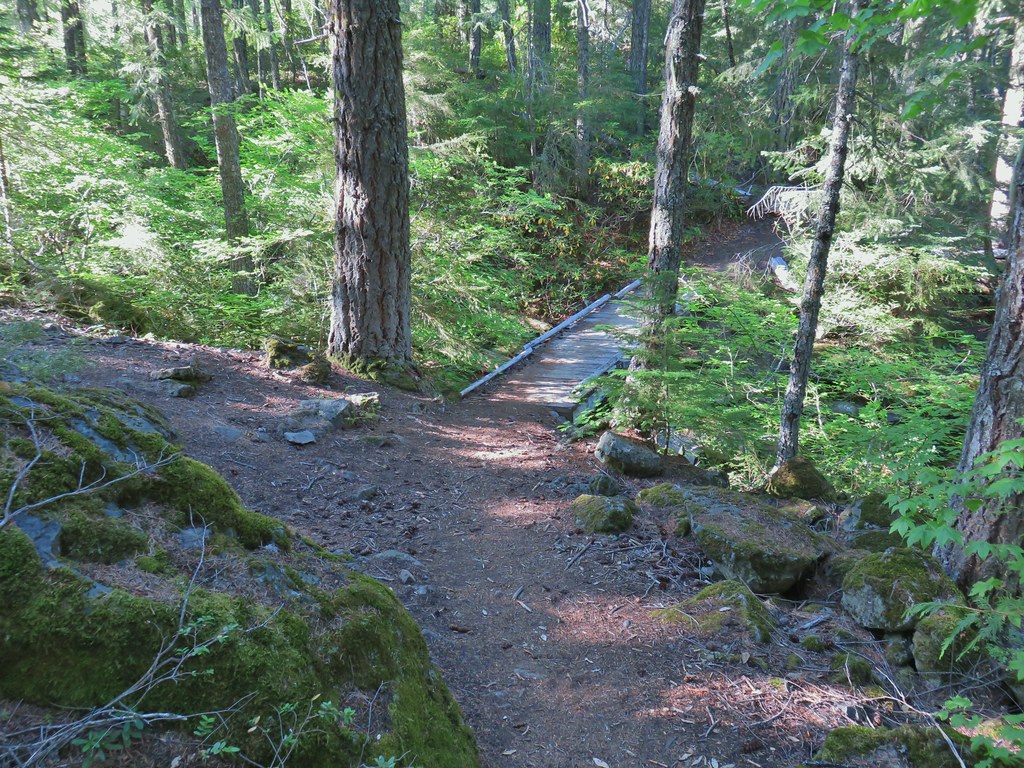
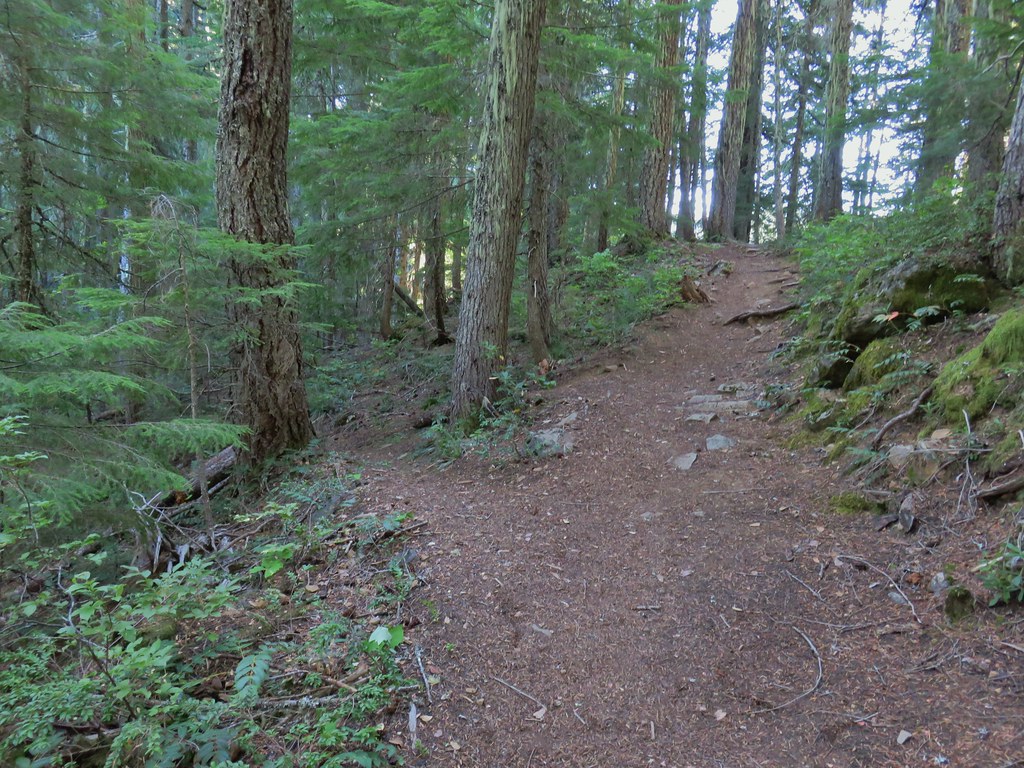
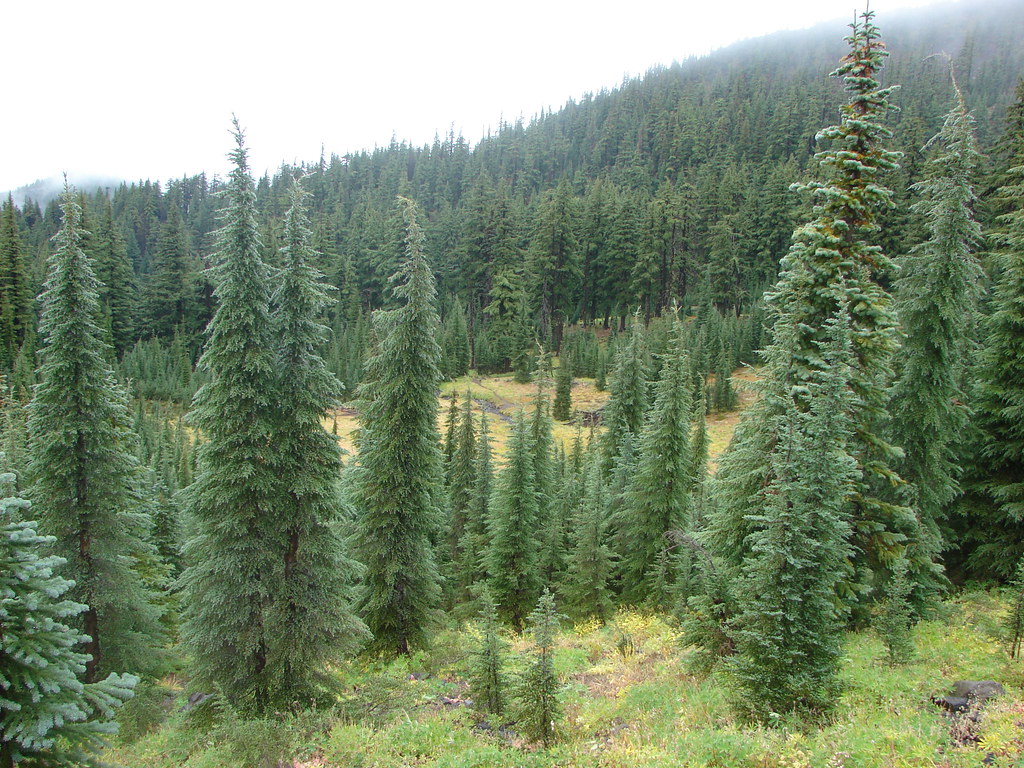
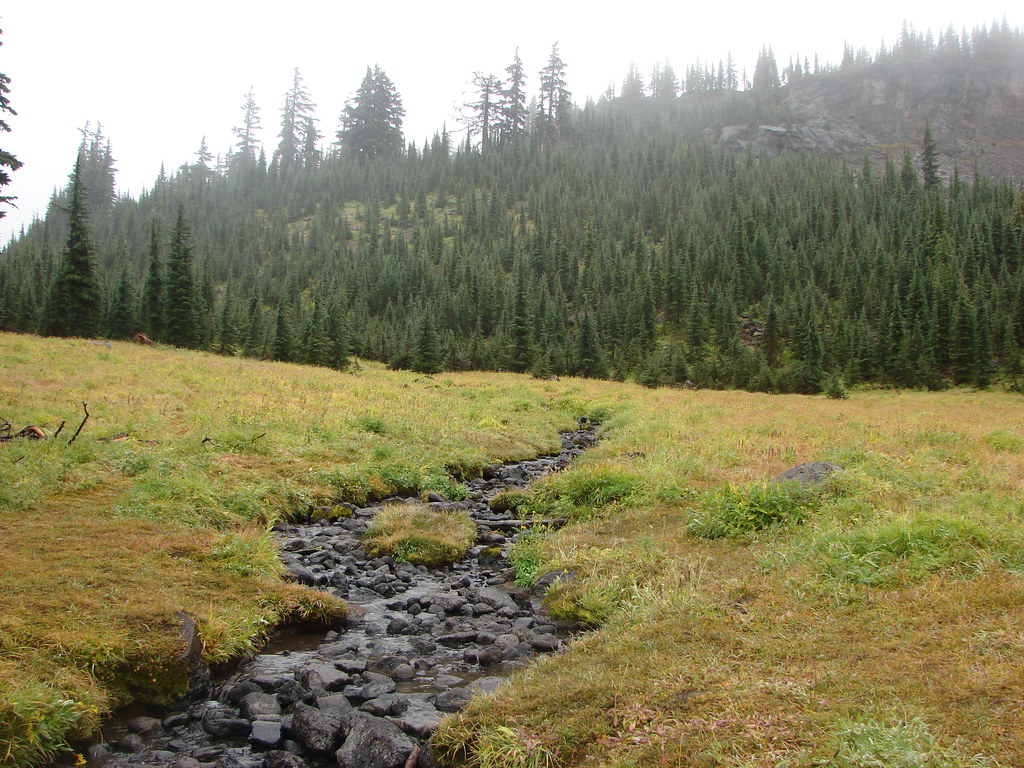
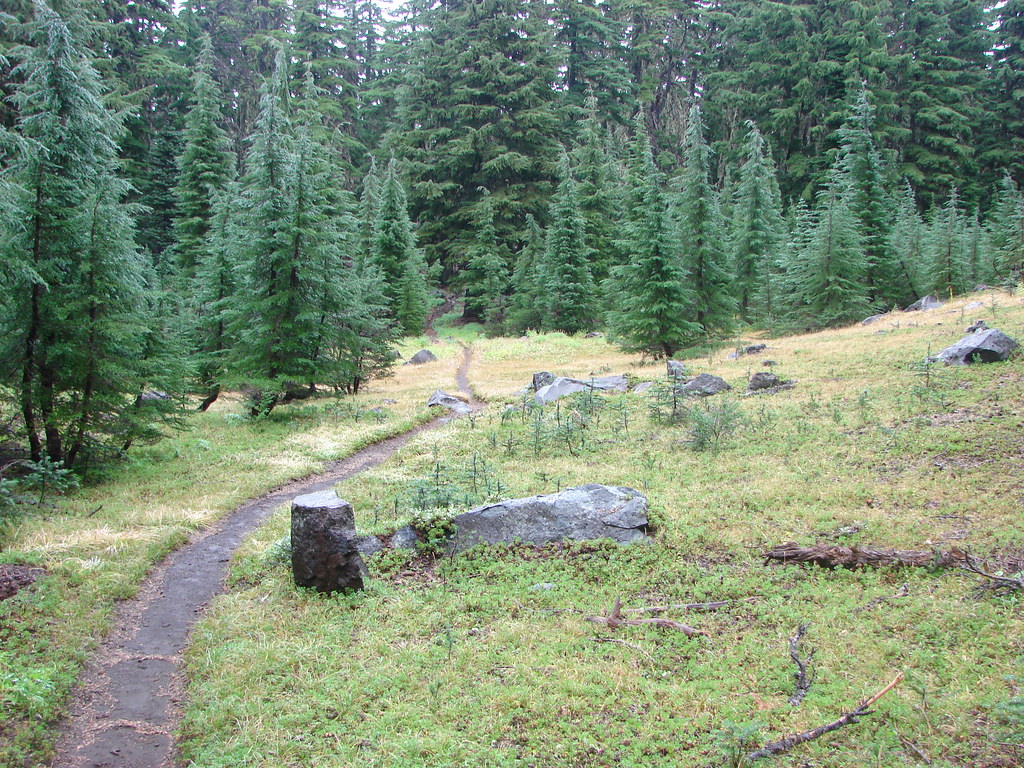
Park Meadow to Golden Lake – 09/13/2025

September is one of the trickier months for picking hikes. The transition to Fall has begun meaning most of the wildflowers are done while the Fall colors are just getting started. Rain begins returning (and sometimes snow at higher elevations), but many of the waterfalls are still running low. Finally, wildfire smoke has often been a problem in recent years.

The hike to Park Meadow and Golden Lake seemed a good option as it isn’t a big wildflower hike and there aren’t a lot of plants known for their Fall colors. We had visited the meadow and Golden Lake during a 2014 backpacking loop around the South Sister (post). That visit was enough for us to count having hiked part of Sullivan’s featured hike in his “100 Hike/Travel Guide Central Oregon Cascades” (post), but it meant we’d skipped the five miles of trail between the Park Meadow Trailhead and Park Meadow.

With a forecast of mostly smoke and cloud free skies we made the two-and-a-half-hour drive to the trailhead.
IMG_0153

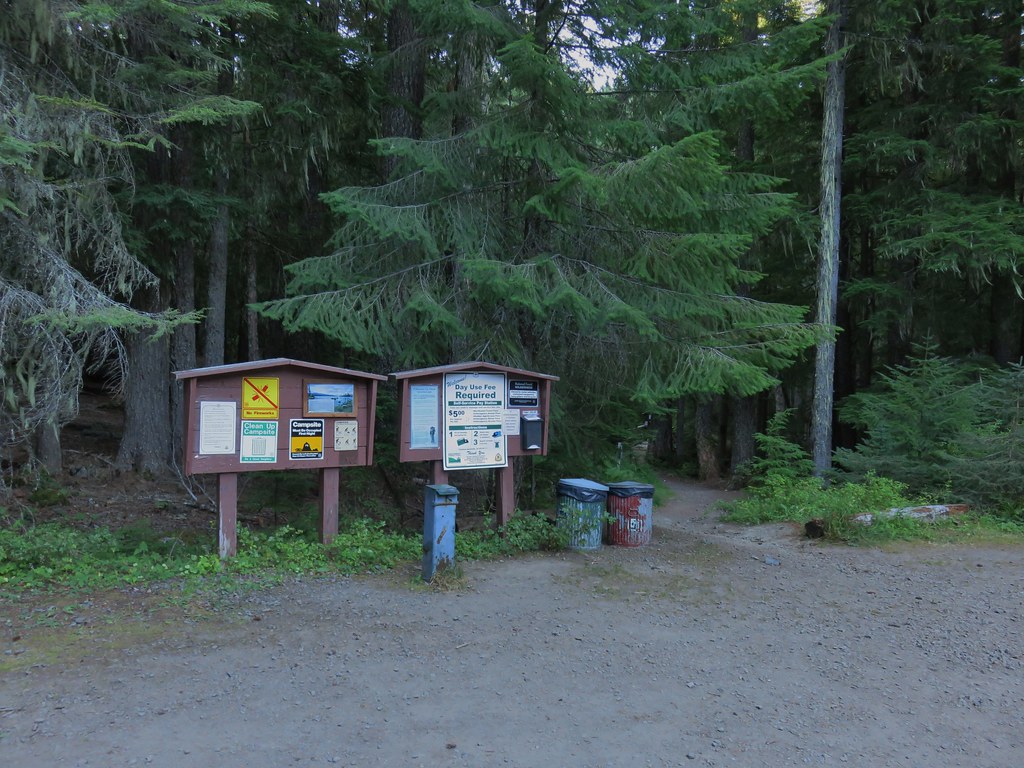
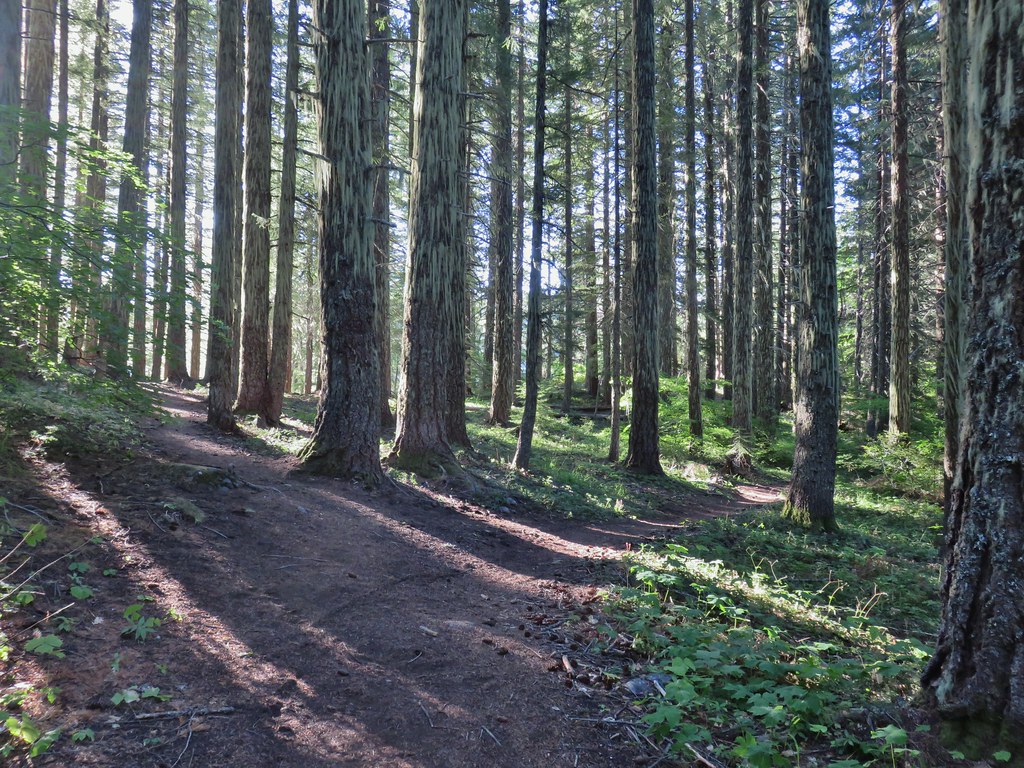
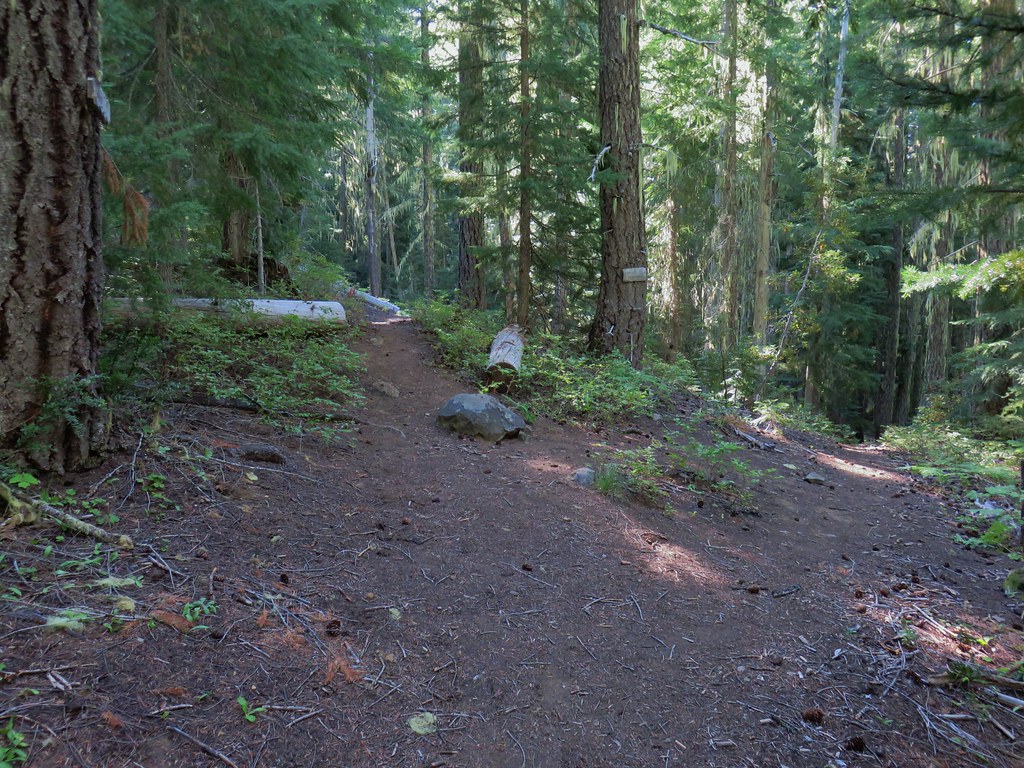
The trail begins across Forest Road 16 from the trailhead at a signboard and wilderness permit box.
IMG_0159

Currently for day hikes the only permit currently required is the free self-issued wilderness permit that we filled out at the signboard. For overnight trips a Central Cascades Wilderness Permit is required.
IMG_0160

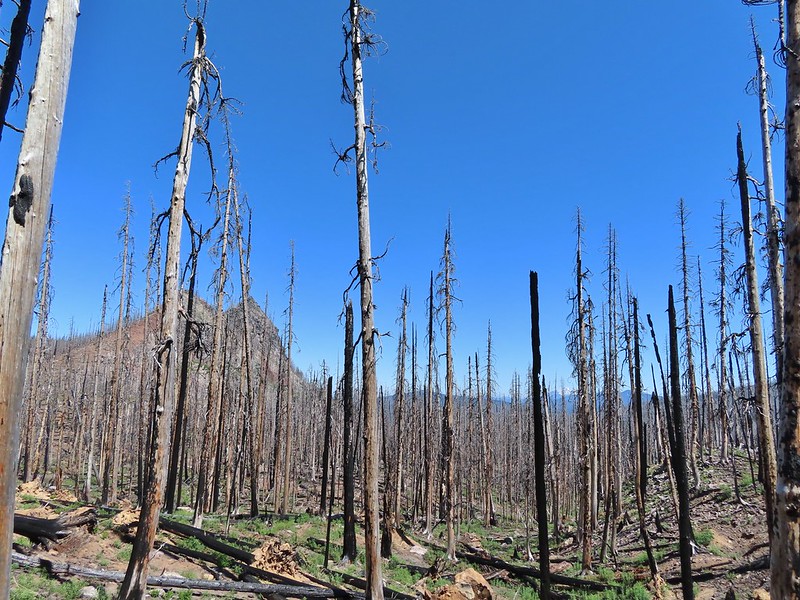
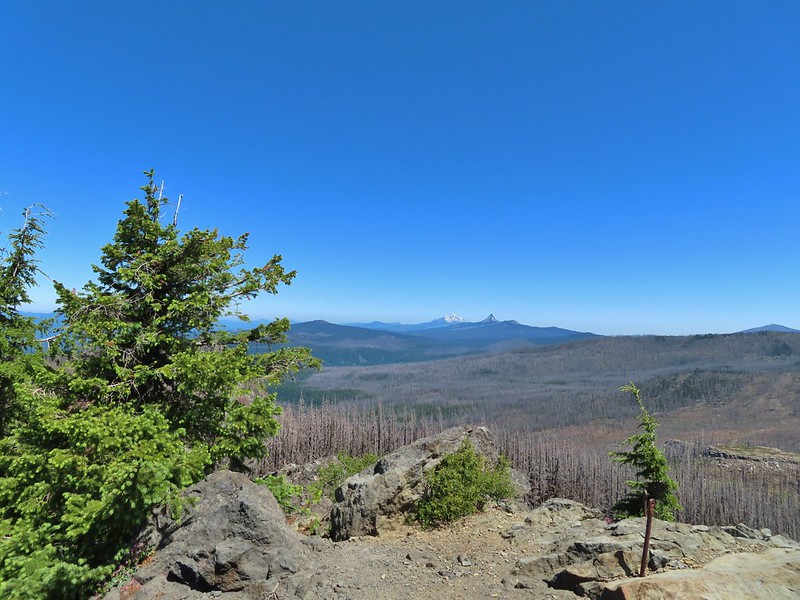
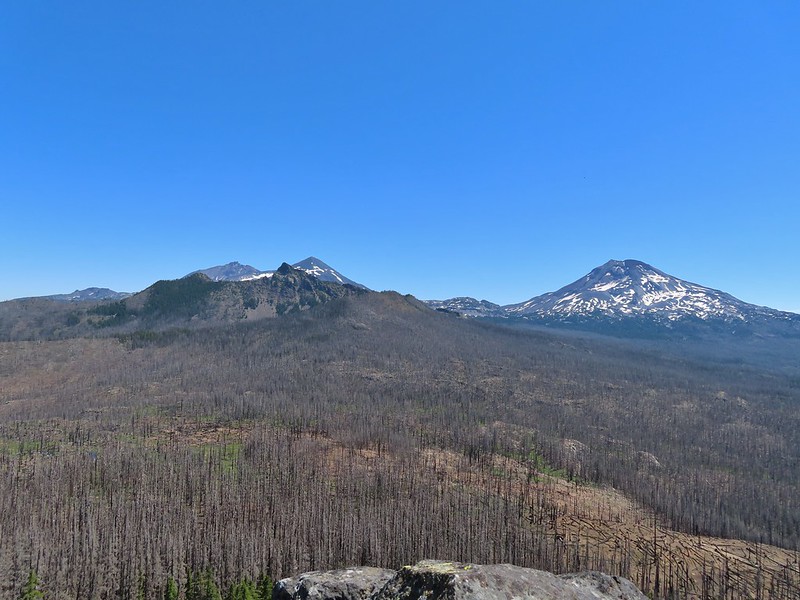
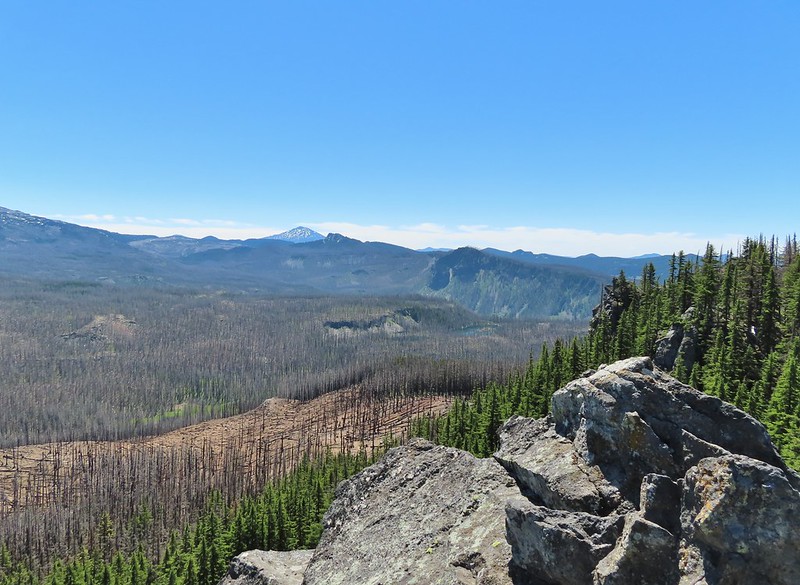
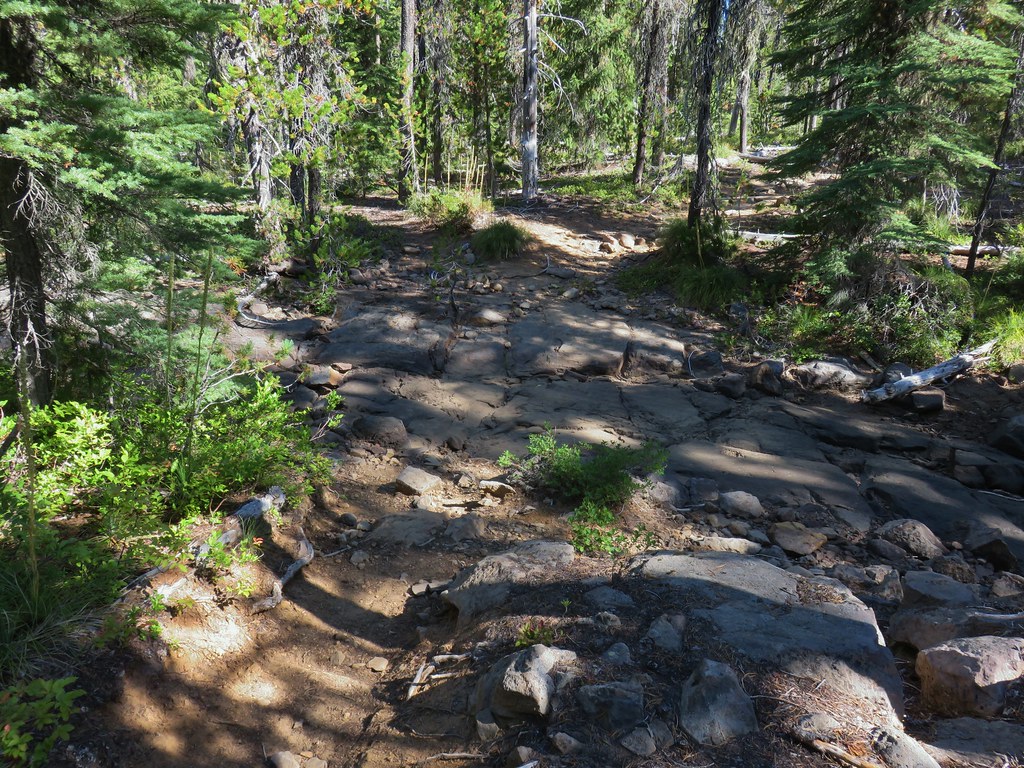
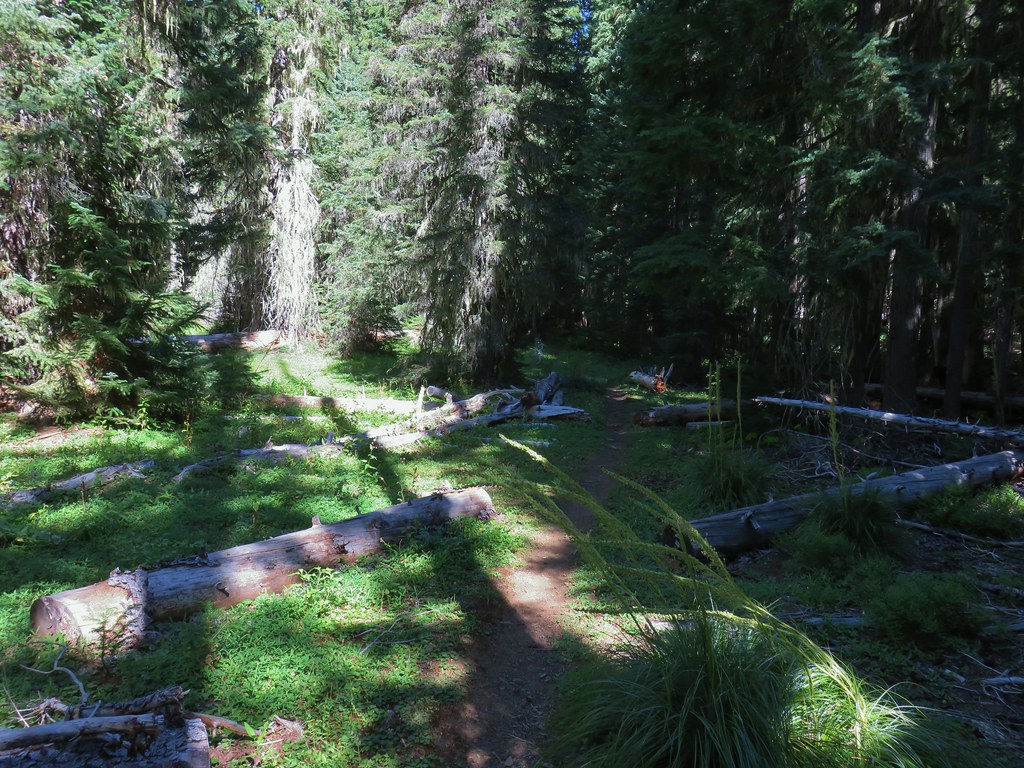
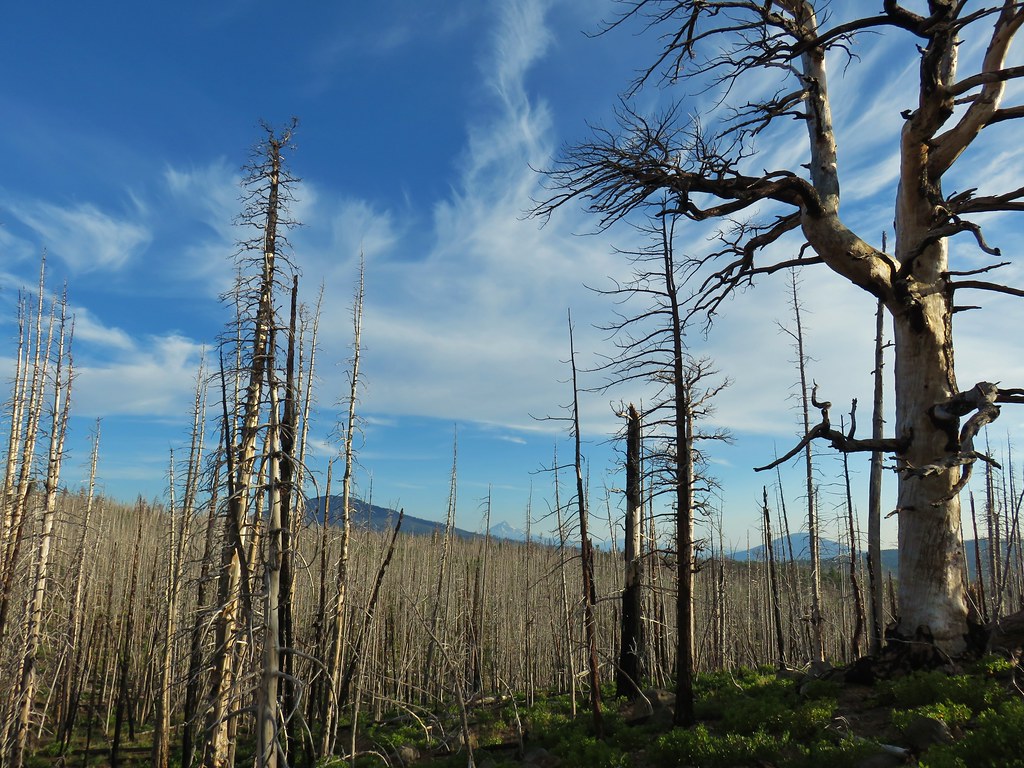
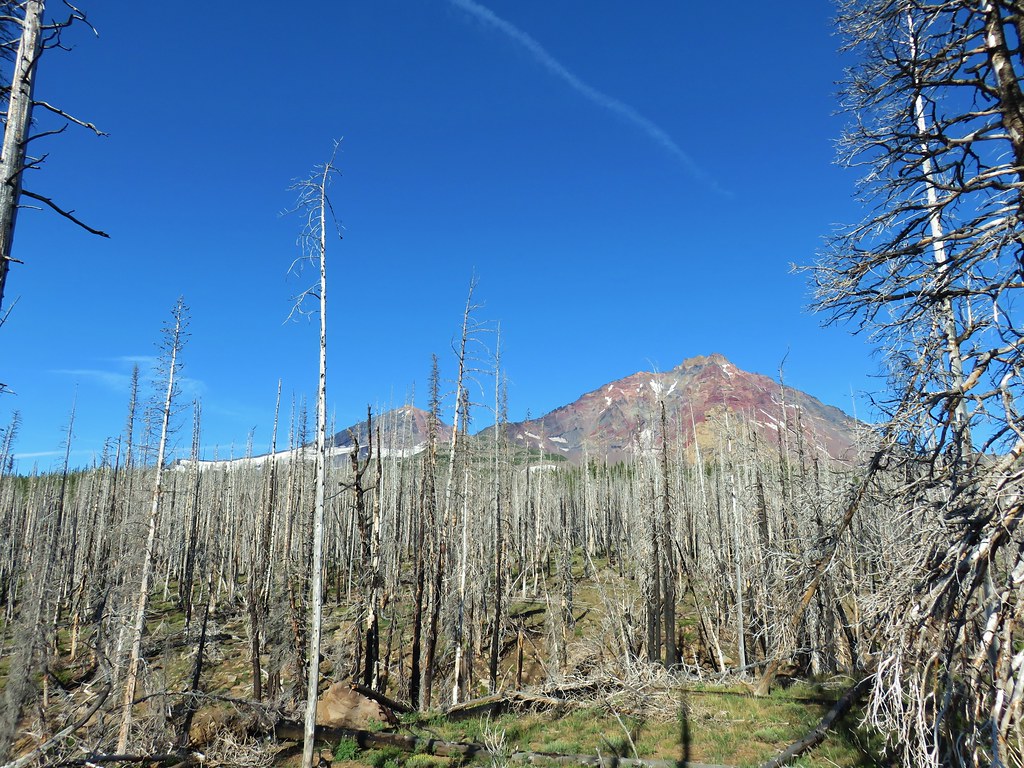
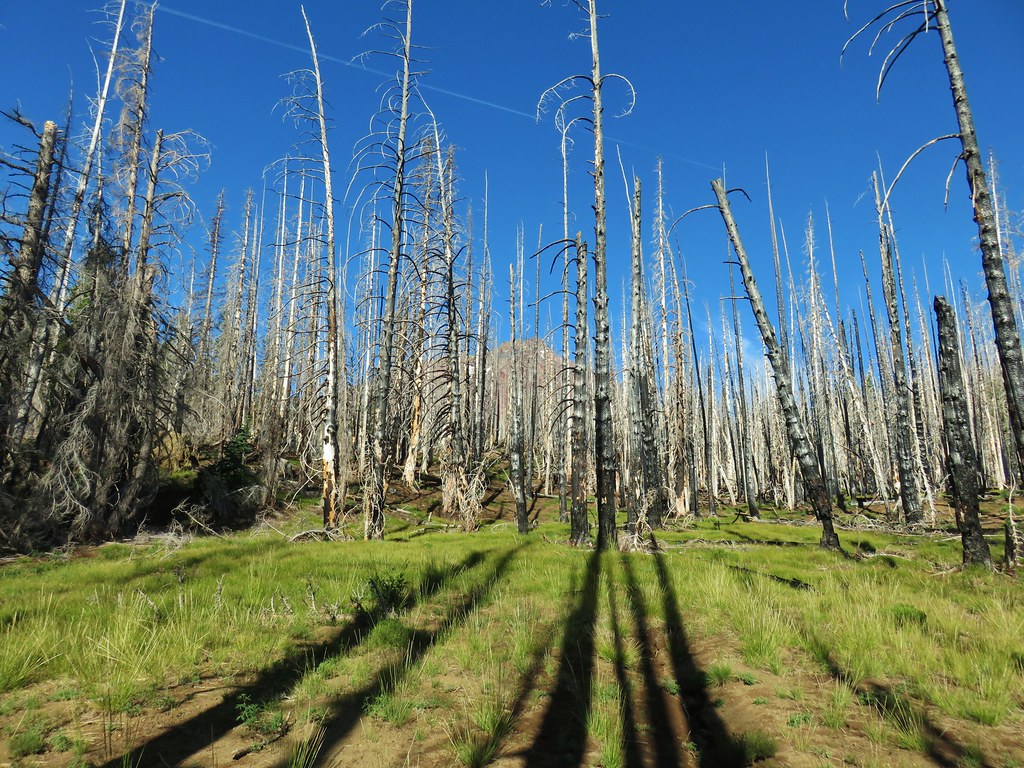
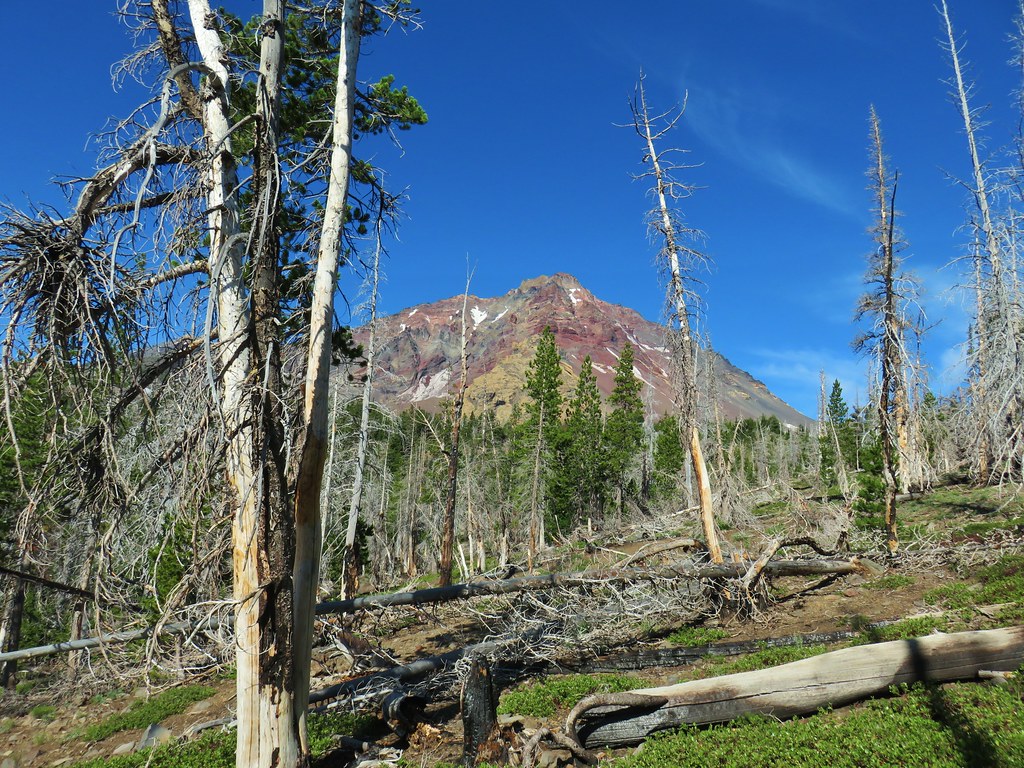
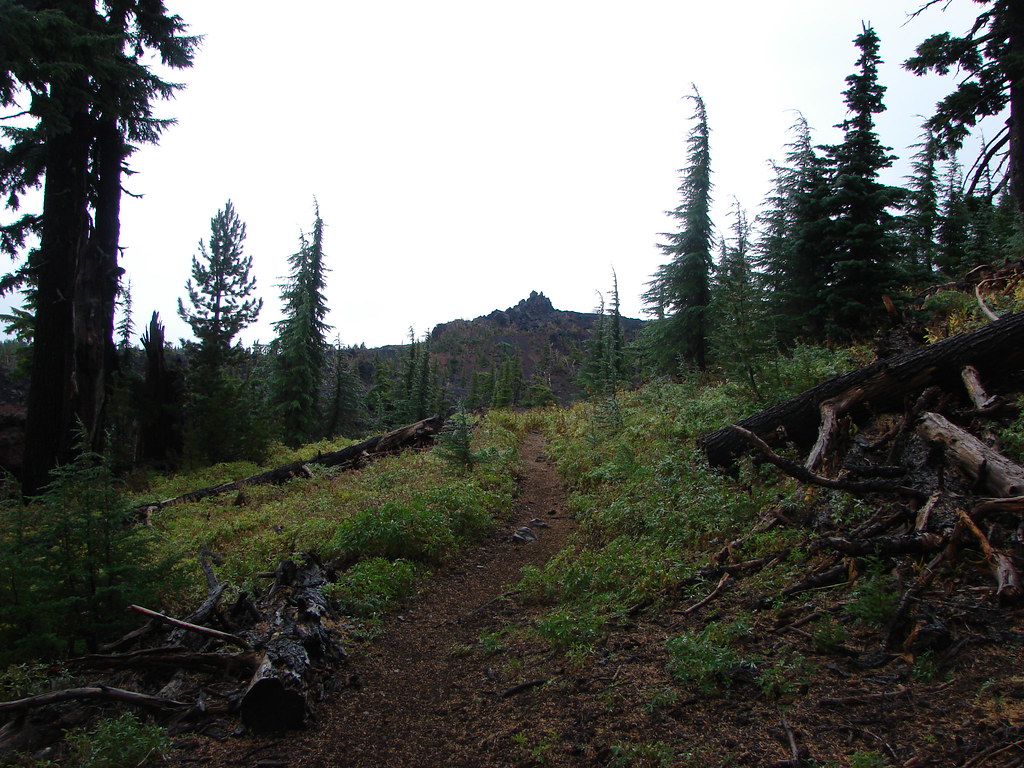
The Park Meadow Trail spends most of its time in the 2012 Pole Creek Fire scar which burned nearly all the trees leaving views of the Three Sisters and Broken Top through the snags. The trail also loses 350′ of elevation for the first 3.9-miles to Wychus Creek.
IMG_0162

IMG_0163
Junco

IMG_0164
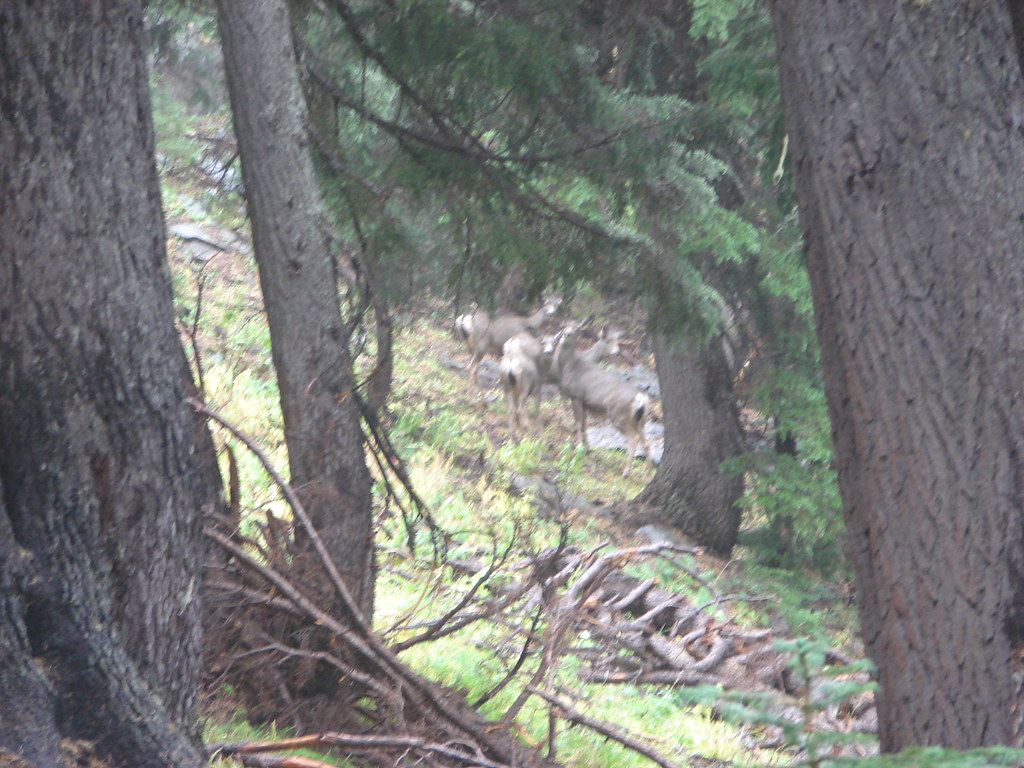
Heather spotted three deer on the rise in the distance.

IMG_0166

IMG_0172
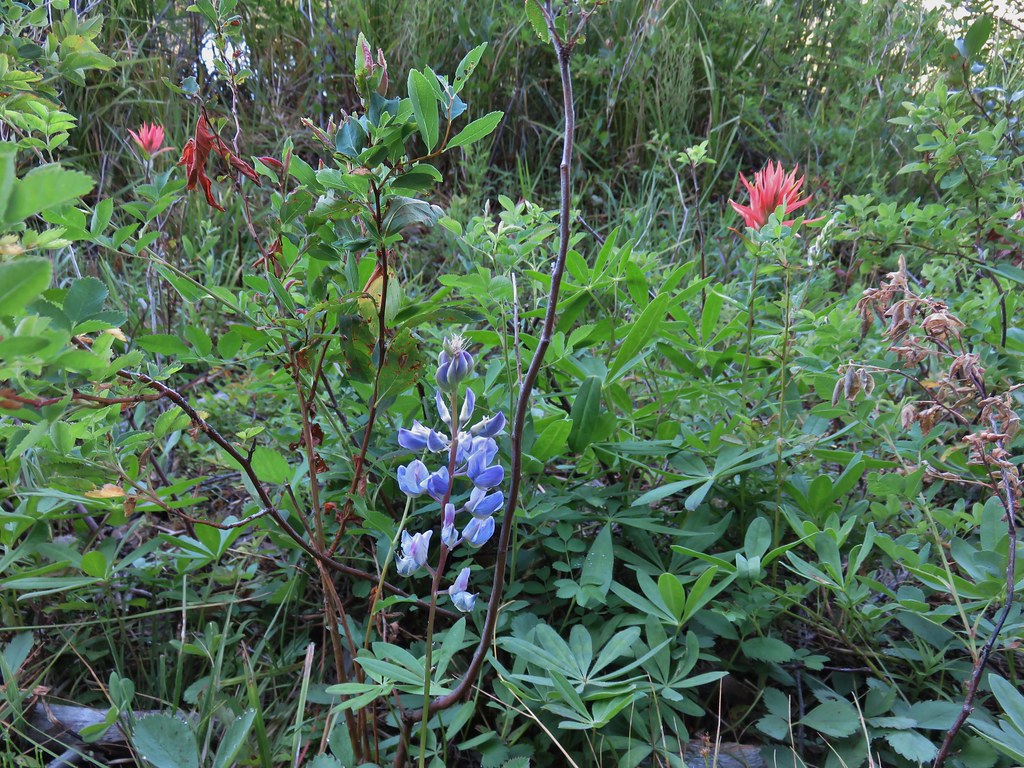
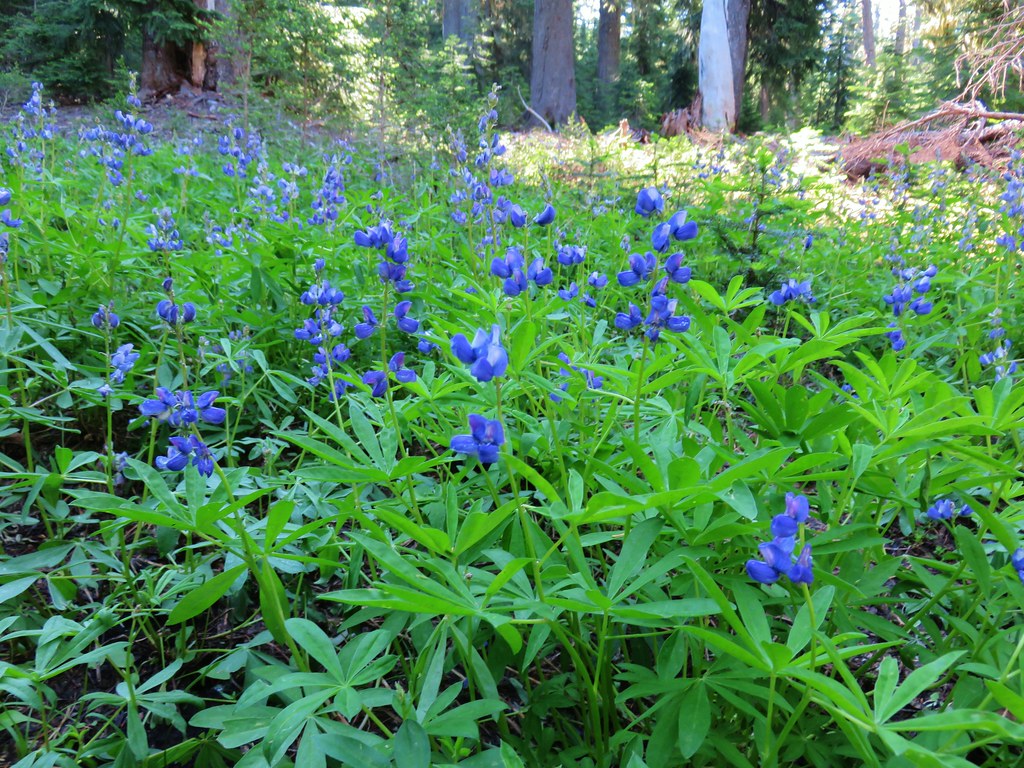
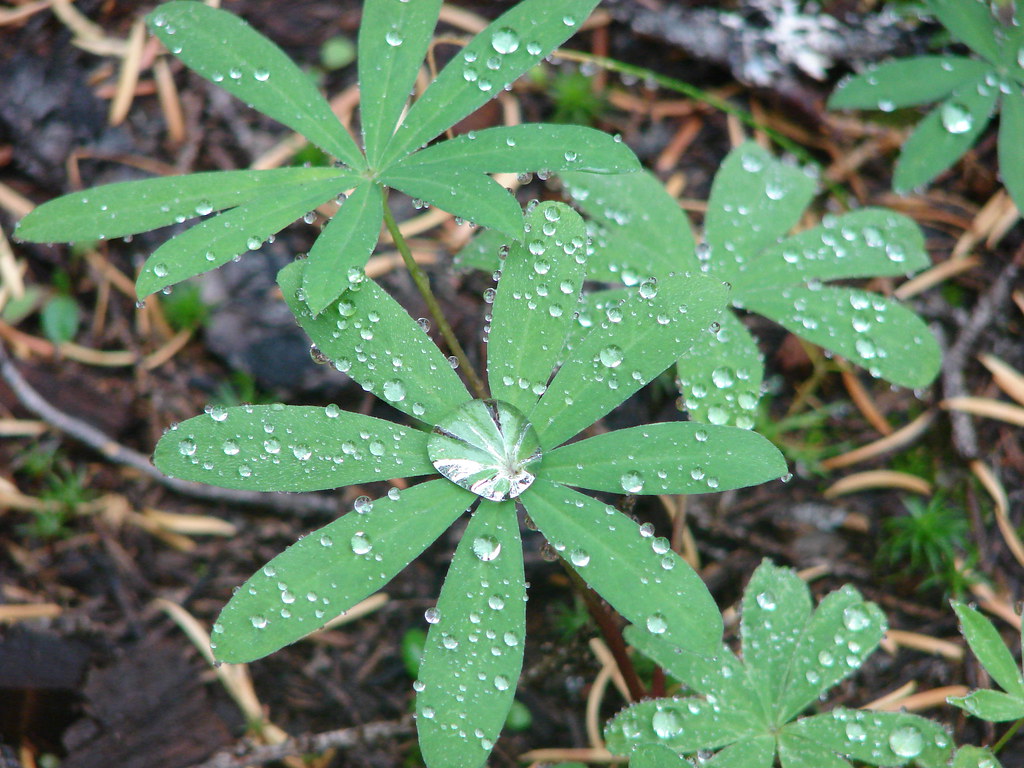
Lupine

IMG_0173
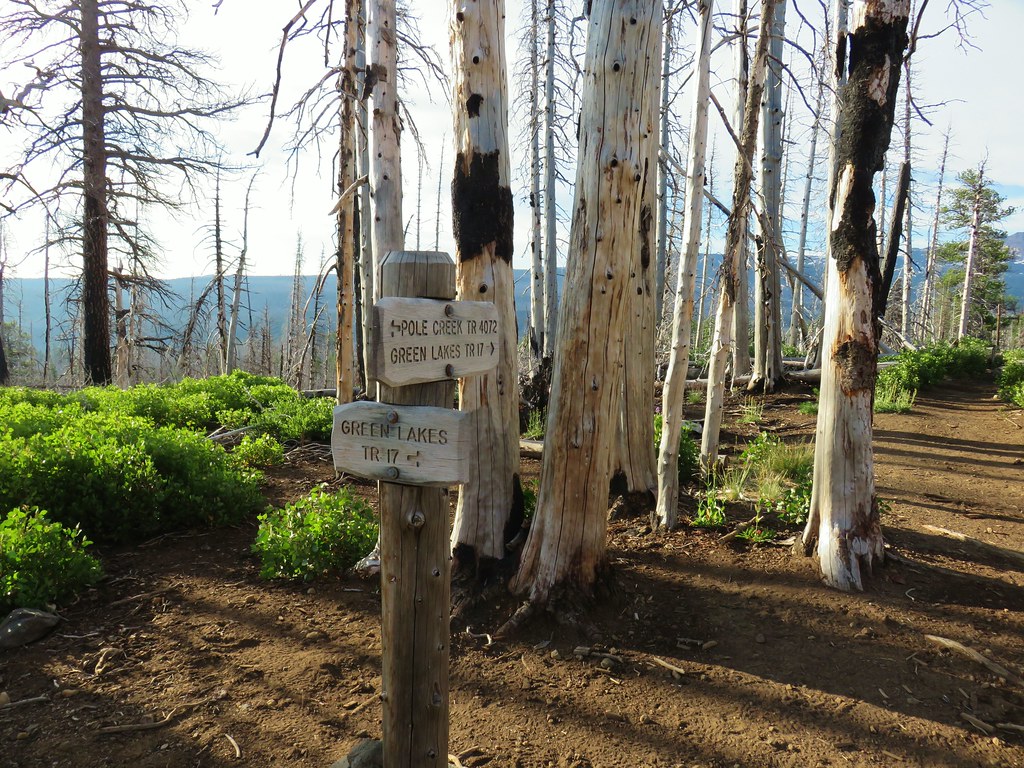
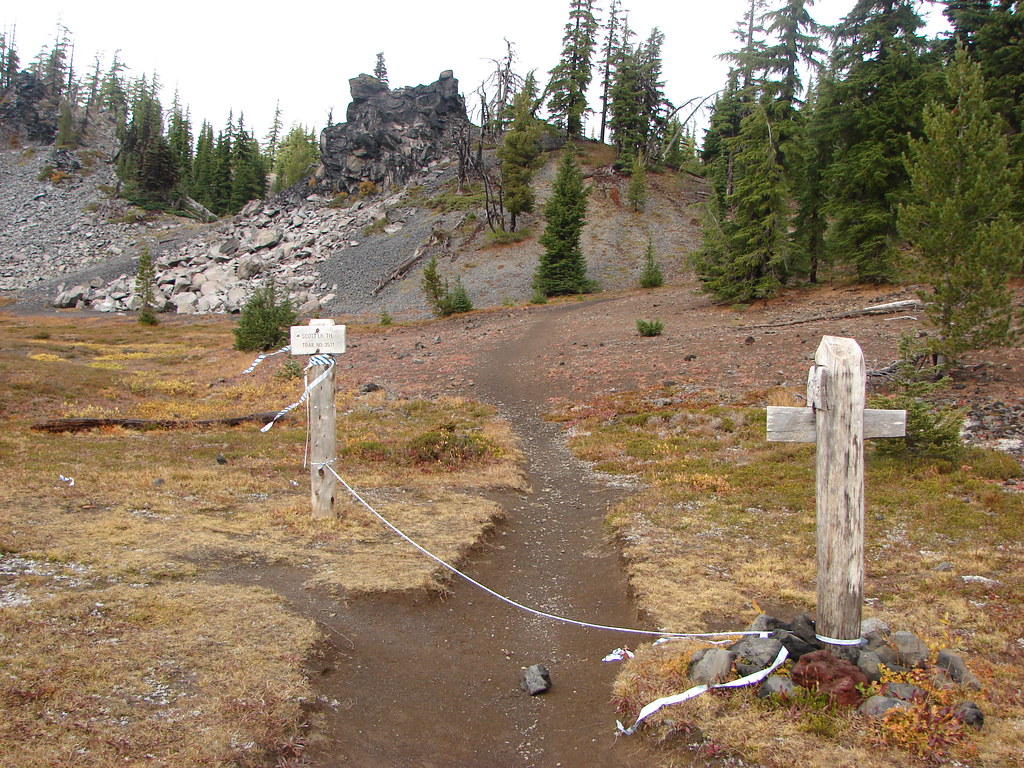
At the 0.25-mile mark the trail arrives at junction with the Metolius-Windigo Trail. We stayed straight following the pointer for “JCT. PARK MEADOW TR.”

IMG_0175
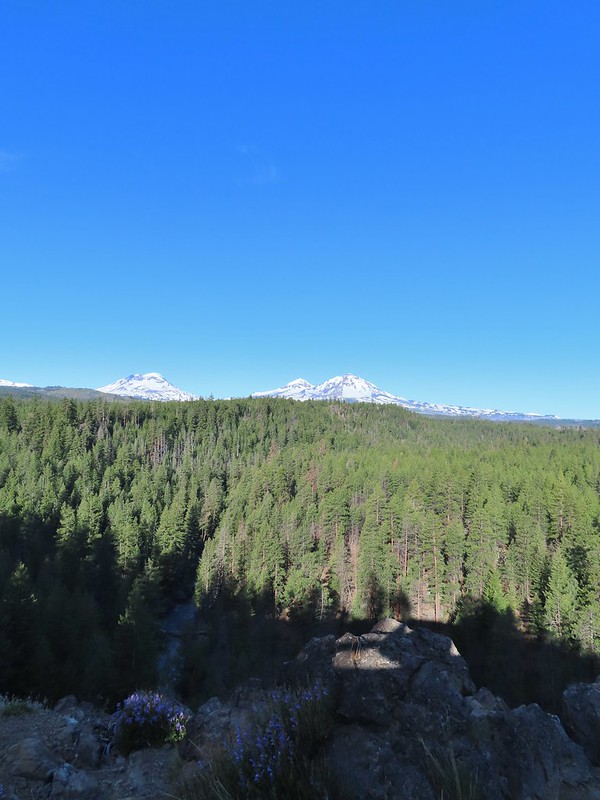
The Three Sisters on the horizon.

IMG_0176
Sparrow

IMG_0182
Fireweed

IMG_0188

IMG_0193

IMG_0196
Northwestern rabbit-tabacco

IMG_0199
Broken Hand along Tam McArthur Rim (post) on the left with the tip of Broken Top above the hill on the right.

IMG_0200

IMG_0213
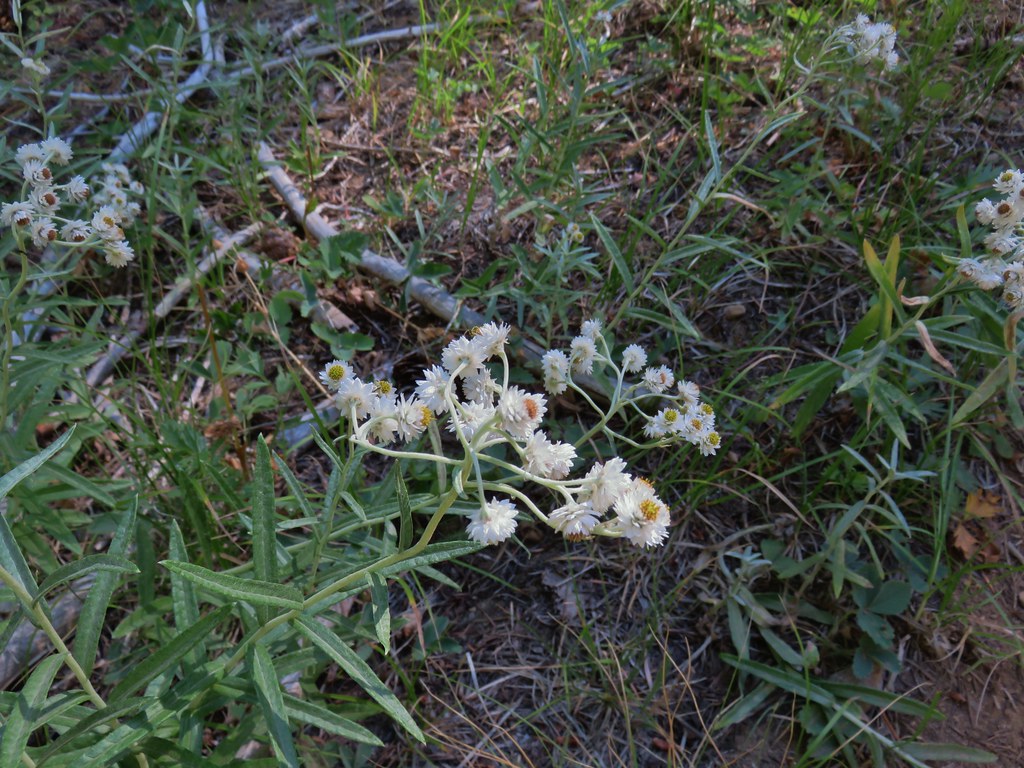
Pearly everlasting

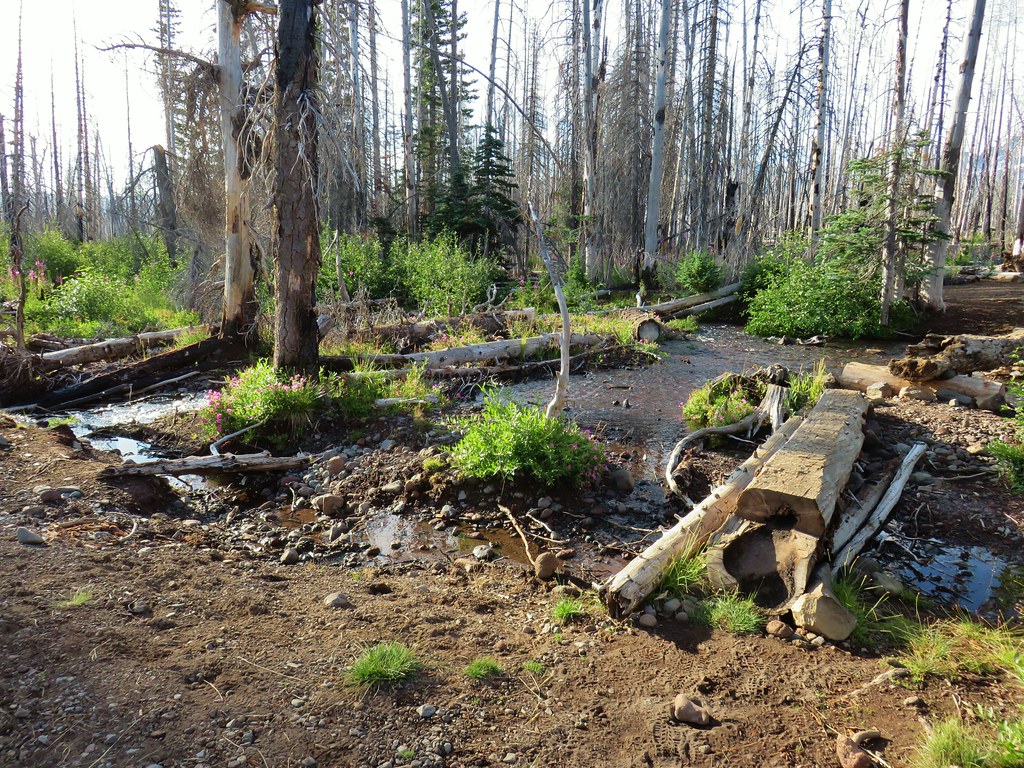
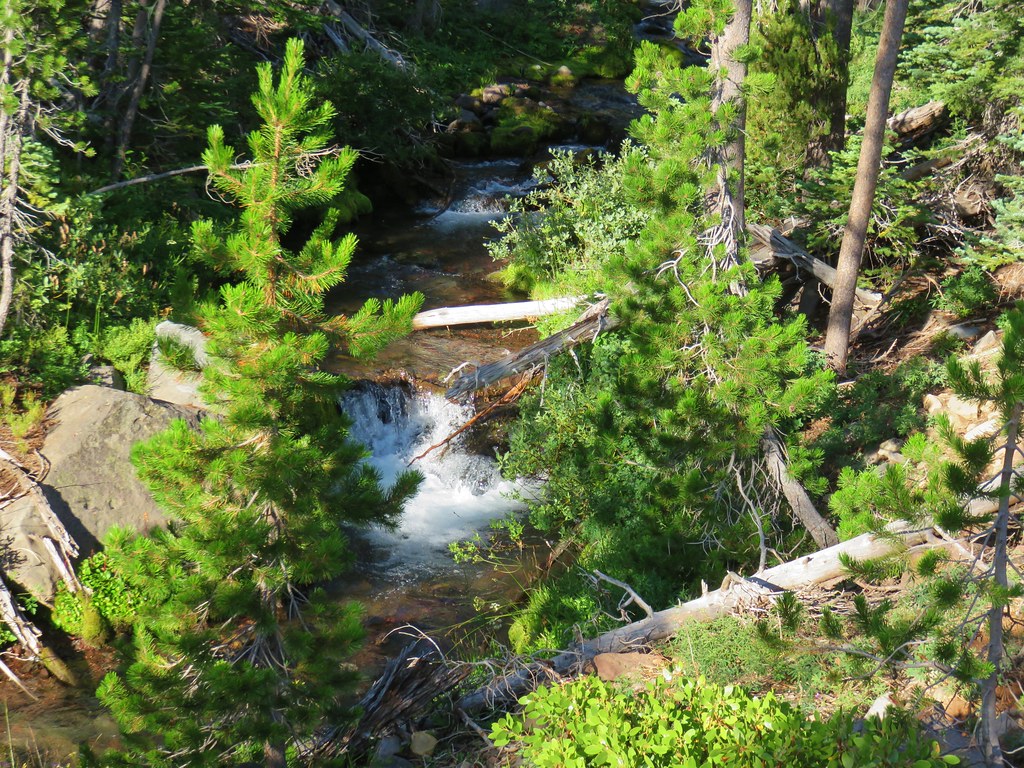
Just over two miles from the trailhead we arrived at an unnamed stream near the second junction with the Metolius-Windigo Trail.
IMG_0214

IMG_0215
Reflection in the stream.

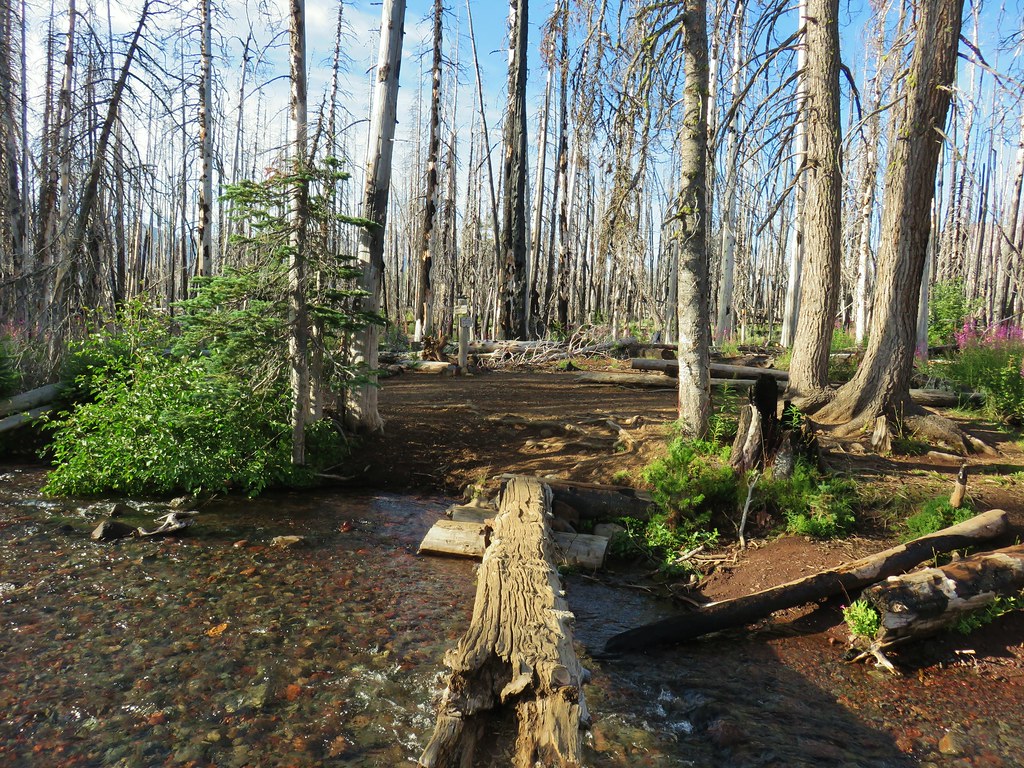
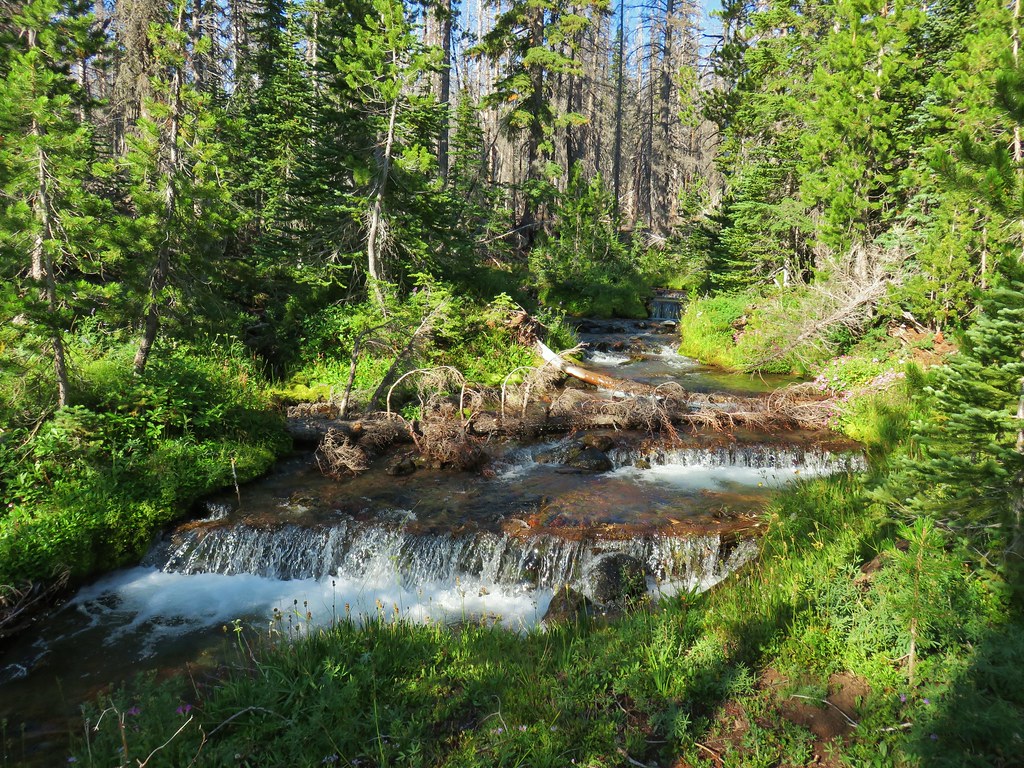
We again stayed straight continuing on the Park Meadow Trail which soon came to a crossing of Snow Creek at the border of the Three Sisters Wilderness.
IMG_0217

IMG_0219

IMG_0227
Pearly everlasting along Snow Creek.

IMG_0226
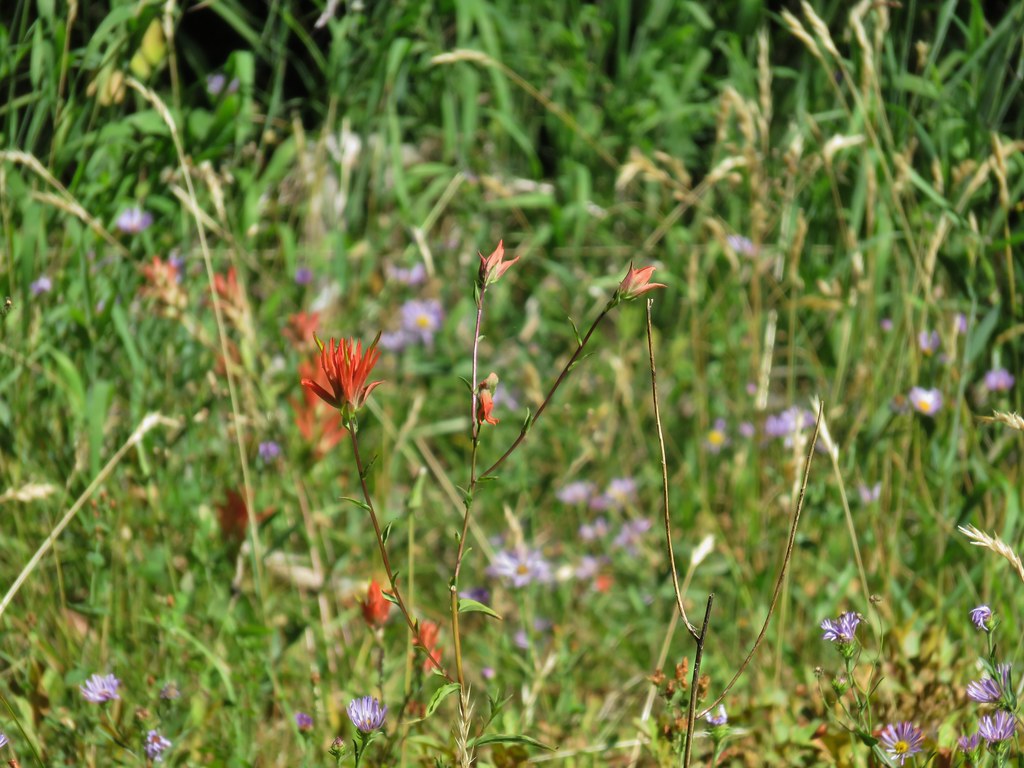
Paintbrush

IMG_0230
Sweet bee on milk kelloggia

IMG_0234
We spotted a pair of ravens in the snag tops ahead.

IMG_0238
Raven

IMG_0241
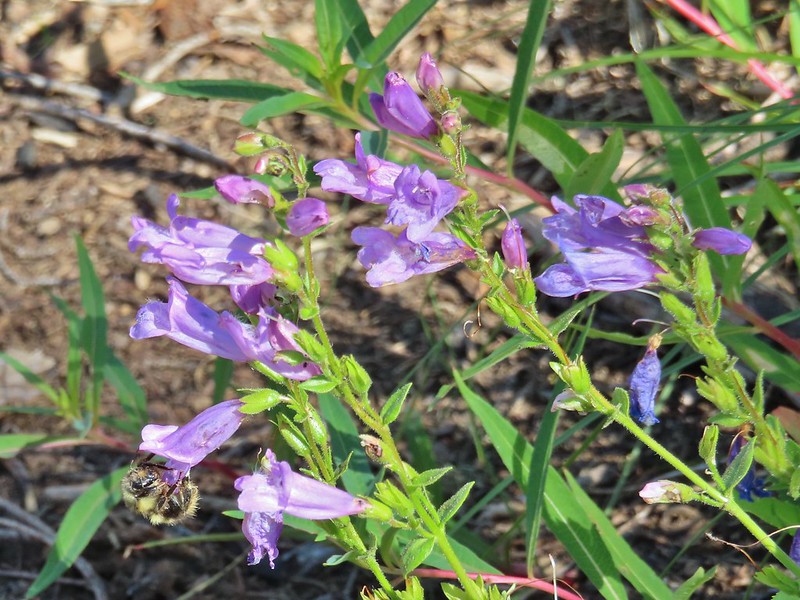
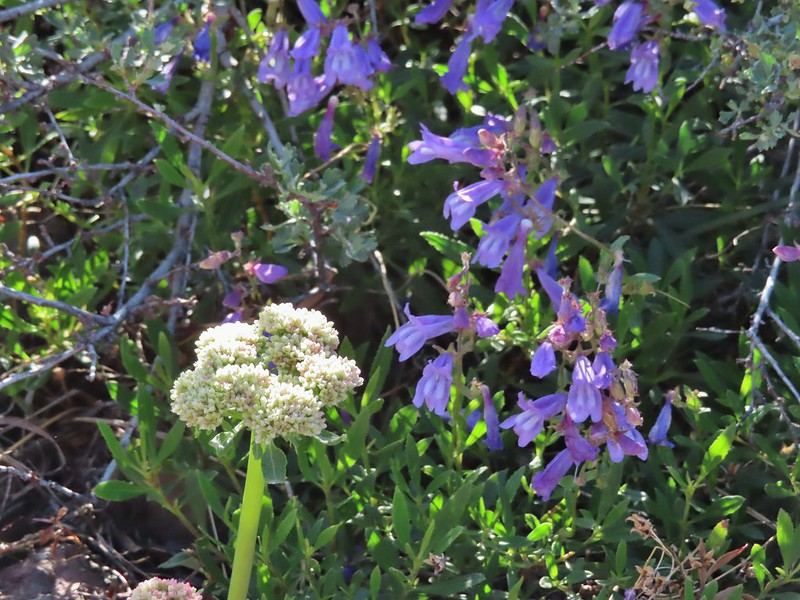
Penstemon

IMG_0251
Broken Top and South Sister (post).

IMG_0252
Broken Top

IMG_0255
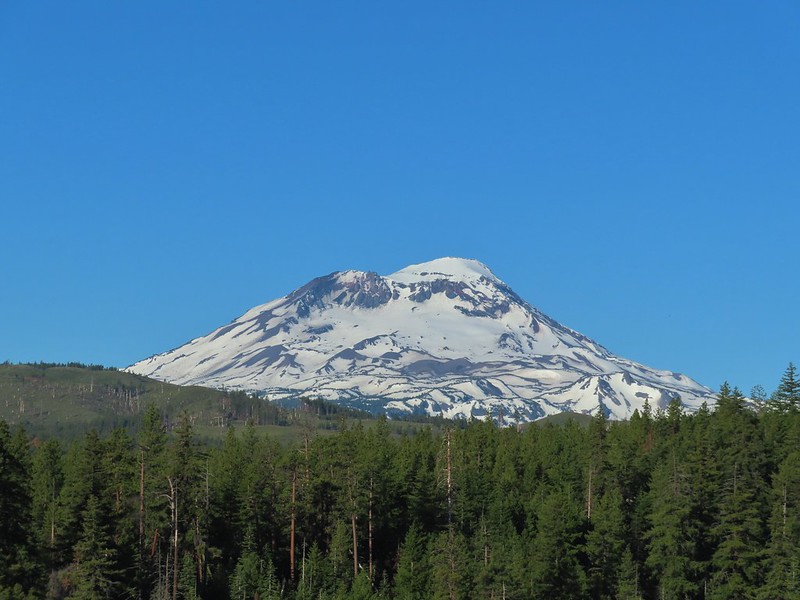
South Sister

IMG_0259
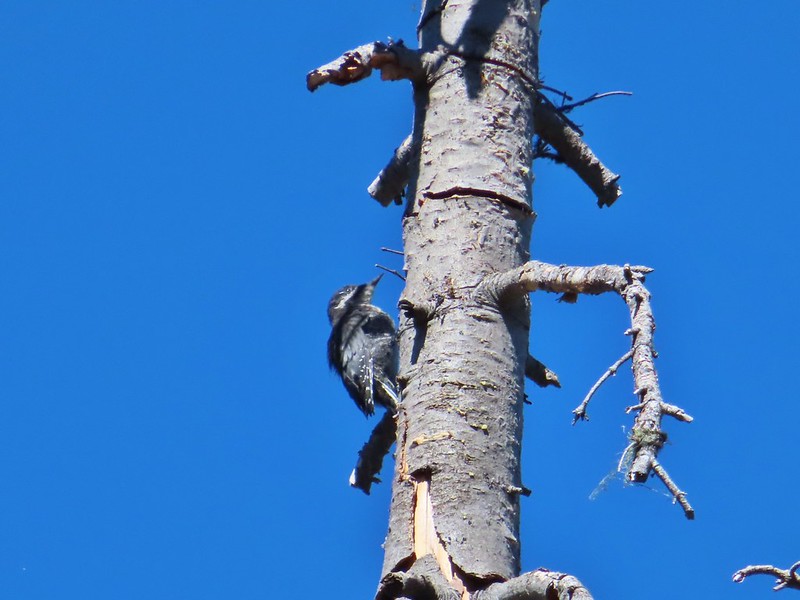
Woodpecker from below.

Near the 4-mile mark we arrived at Wychus Creek. At 6000′ this was the lowest elevation of the hike.
IMG_0265

From Wychus Creek it is just over a mile to Park Meadow. Shortly before reaching the meadow the trail leaves the fire scar.
IMG_0266
Cinquefoil

IMG_0269
Aster

IMG_0271

IMG_0274
Orange sulphur

IMG_0275
Entering unburned forest.

South Sister from a pond at the end of Park Meadow.
IMG_0283

IMG_0285
Red-tailed hawk

IMG_0290
Broken Top from Park Meadow

IMG_0291
Park Creek crossing.

IMG_0294
Park Meadow junction with the Green Lakes Trail.

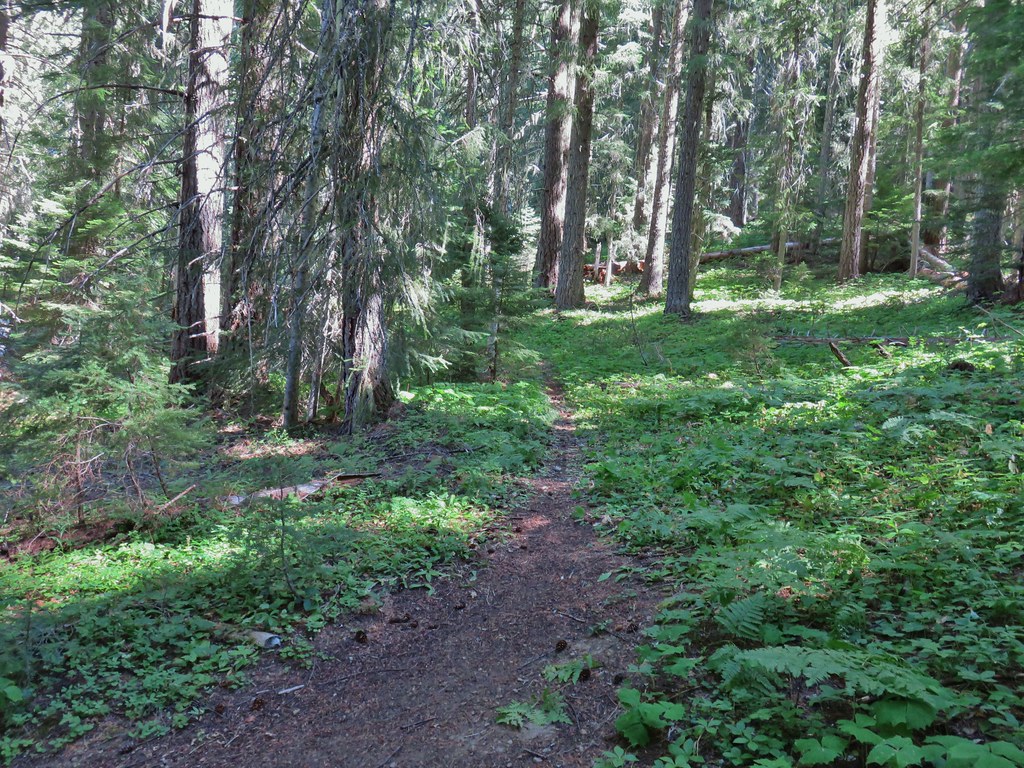
On our backpacking loop we used the Green Lakes Trail to reach the meadow from the Camp Lake Trail making this junction the point at which we completed Sullivan’s entire featured hike. I arrived here first because Heather and I had split up back at Wychus Creek. She had decided against pushing on to Golden Lake which was another 1.7-miles and 500′ in elevation gain away.

I hiked through the meadow which was filled with alpine gentians and then began to climb through the forest to the unmarked junction with the use trail to Golden Lake.
IMG_0301

IMG_0295
Alpine gentians

IMG_0297

IMG_0299
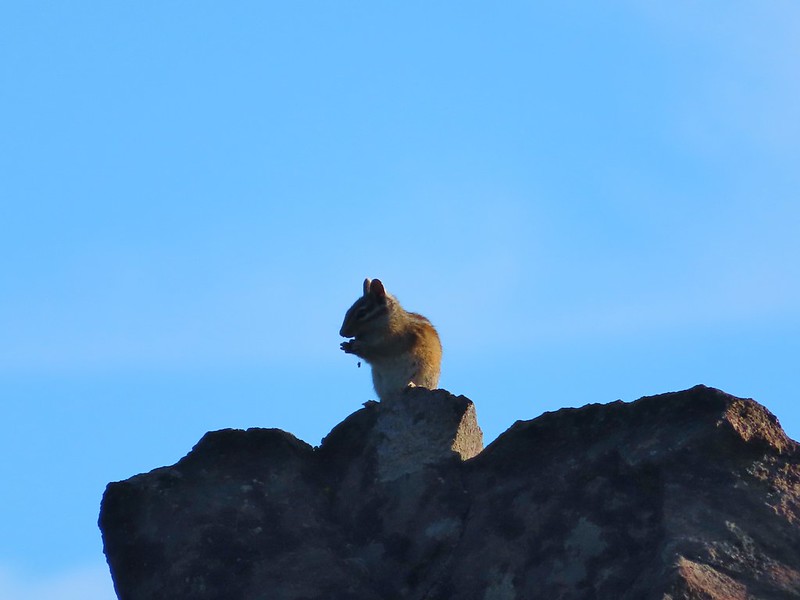
Golden-mantled ground squirrel

IMG_0302

IMG_0304
Townsend’s solitaire

IMG_0308
Small cairn and bandana marking the use trail. This is approximately 1-mile from the junction in Park Meadow.

I veered left up the use trail which quickly leveled out and brought me to Golden Lake in 0.7-miles.
IMG_0310
South Sister from the use trail.

IMG_0315
Broken Top from the trail. If you look down the trail on the right between the trees, you can see a deer crossing the trail.

IMG_0318
While it isn’t an official trail there is no camping allowed within 250′ of Golden Lake. In addition, throughout the Three Sisters Wilderness building, maintaining, attending, or using a fire, campfire, or stove fire above 5700′ is prohibited. Stoves must be fueled with liquid or compressed gas.

IMG_0324
The Moon above south sister.

IMG_0327
Golden Lake and Broken Top with some September haze. There is a crossing of the outlet that leads to the eastern shore.

IMG_0330
The Three Sisters from Golden Lake.

I wasn’t planning on going beyond Golden Lake, but I had left that option open depending on time and how I was feeling. On our backpacking trip we had continued up to a tarn almost a mile (and another 500′) and set up camp. We wound up not staying there though when we got spooked by the sudden arrival of smoke and a visible smoke column on the far side of South Sister. It was a rookie mistake as the fire wound up being over 40-miles away. Now that I was back 11 years later I couldn’t pass up the opportunity to visit the tarn and our almost campsite again. I followed a path along the eastern shore to the outlet creek then headed uphill.
IMG_0331
Looking back along the path along the eastern shore.

IMG_0334
Uphill along the inlet.

IMG_0333
Pink monkeyflower

IMG_0339
I believe the purple is an aster, red a paintbrush, and yellow Buek’s groundsel.

IMG_0345

IMG_0346
Aster and pink monkeyflower

IMG_0348
Tilling’s monkeyflower

IMG_0354
The creek emerges from springs at the base of a moraine.

The final push to the tarn is a steep climb up a glacial moraine.
IMG_0356
The Three Sisters and the creek from the moraine.

IMG_0358
The tarn.

IMG_0360
Due to the position of the Sun and the smoke getting a good picture of Broken Top from the tarn was impossible.

IMG_0362
South and North Sister from the tarn. Middle Sister is behind the clump of trees which is where we had set up our tent in 2014.

I made my way around the tarn and stopped at the 2014 campsite to take a break.
IMG_0364
California tortoiseshell

IMG_0365

IMG_0369
Another attempt at Broken Top.

IMG_0370
Fireweed along the smaller tarn.

IMG_0371
Campsite

IMG_0372
Middle and North Sister from the campsite.

After a snack and a change of socks I headed back down. It was just before 11am when I made my way back down the moraine and then by Golden Lake again.
IMG_0380
South Sister

IMG_0379
Middle Sister and Prouty Point

IMG_0378
North Sister

IMG_0381
Arnica and paintbrush near one of the springs feeding the creek.

IMG_0384
Alpine speedwell

IMG_0386
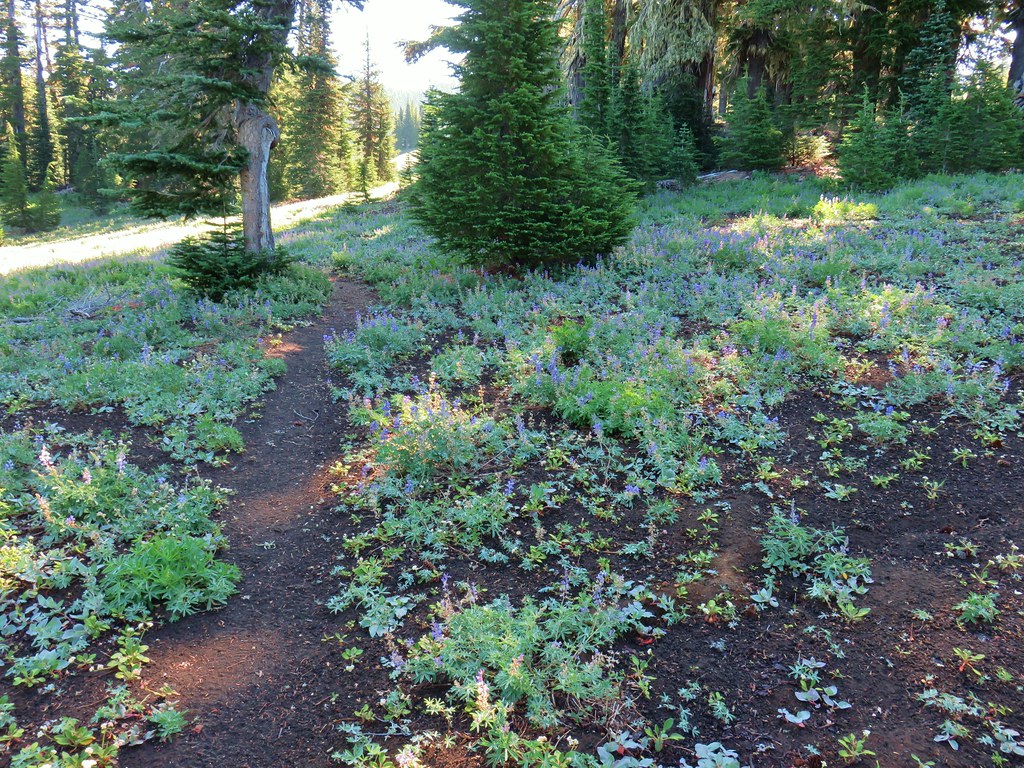
Lupine

IMG_0389

IMG_0390
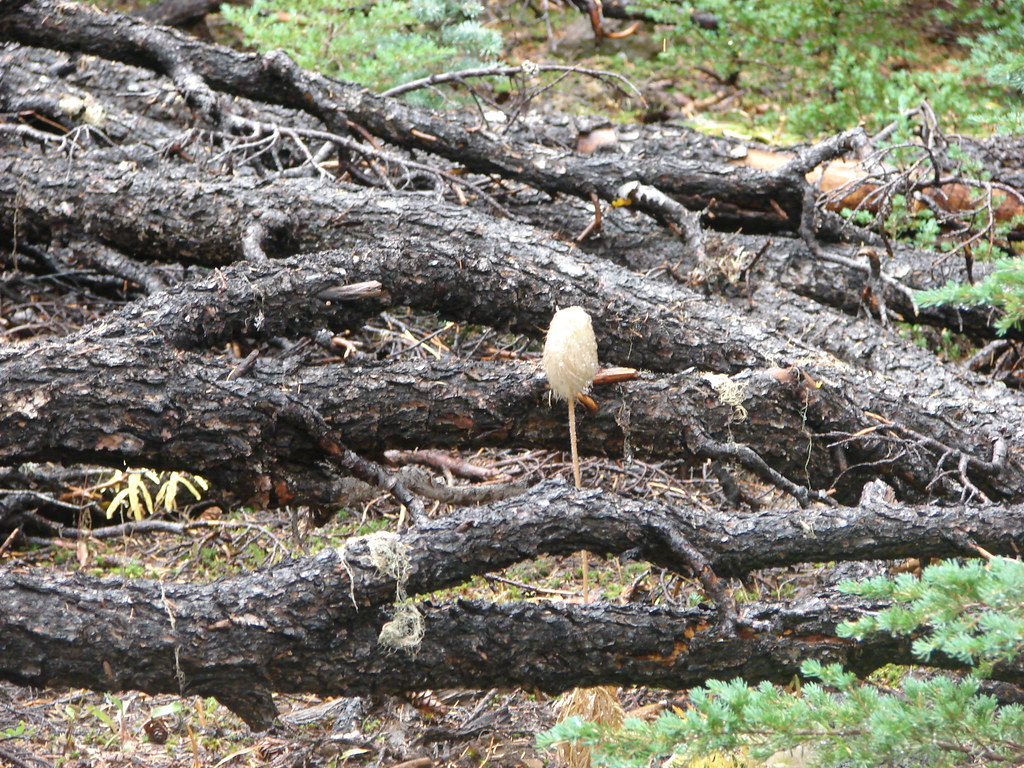
Mushroom

IMG_0394

IMG_0401
The inlet creek crossing ahead.

I simply retraced my steps from here back to the trailhead. There were a few more wildlife sightings along the way and a few more trail users. The elevation gains after Wychus Creek were a mean trick given it was now warmer while I was heading uphill but there was an occasional cool breeze and it wasn’t too hot of a day to begin with (low 60’s).
IMG_0406
Northern flicker

IMG_0411

IMG_0414
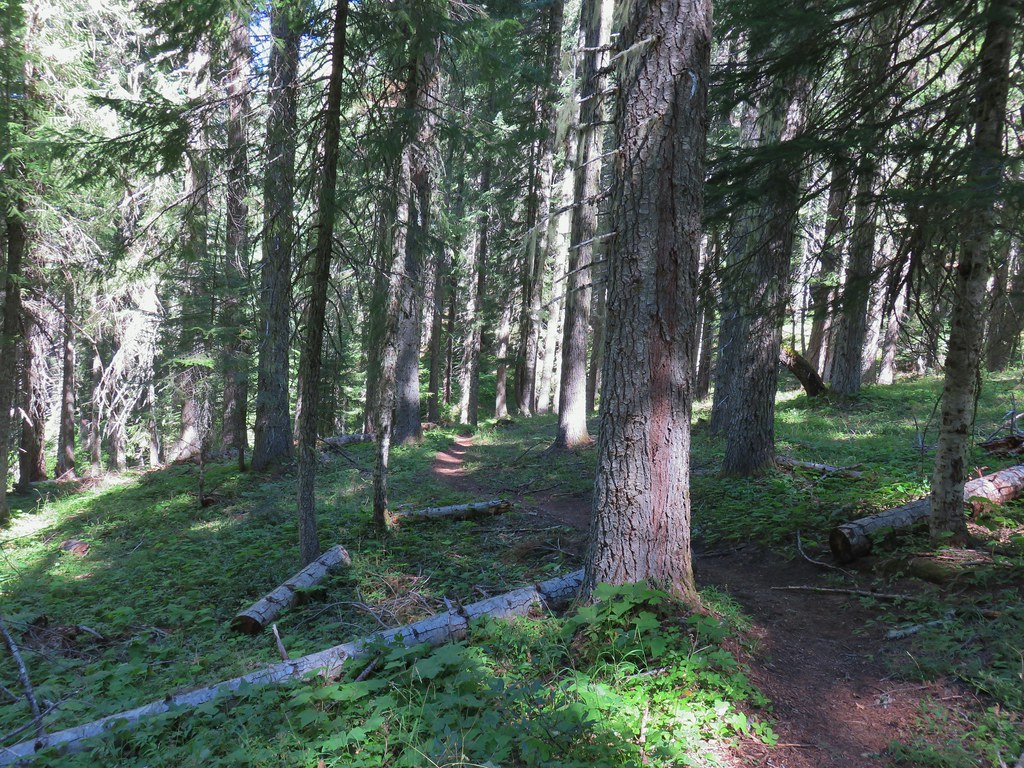
The trails were all in good shape. This was the “worst” obstacle encountered.

IMG_0415
Mushroom

IMG_0425
Park Creek

IMG_0433
Common wood nymph in pearly everlasting.

IMG_0439
One of the numerous small uphill sections on the way back to the trailhead.

IMG_0445
A little more haze and a couple more clouds on the way back.

IMG_0449
Black Crater (post)

IMG_0456
Another uphill and more clouds forming overhead.

IMG_0460
The post on the right marks the site of the former trailhead. This is approximately 1.2-miles from the current trailhead.

I arrived back at the trailhead a little after 1:30pm and found Heather waiting in her camp chair.
IMG_0467

My hike to the tarn above Golden Lake came in at 15.2-miles with 1800′ of cumulative elevation gain. Heather’s to Park Meadow was a little over 10-miles with 800′ of elevation gain.
Screenshot 2025-09-13 161733

This was indeed a good time for this hike. There were no mosquitos or yellow jackets to speak of. The former are a problem in July and early August and the latter can get aggressive later in the Fall. While most of the wildflowers had passed there were still some blooming and it wasn’t too hot. The lack of tree cover combined with the uphill on the way back wouldn’t be a lot of fun on a hot summer day. Happy Trails!

Flicker: Park Meadow to Golden Lake
Categories
High Cascades Hiking Oregon Three Sisters Area Trip report

Obsidian Loop – 07/15/2025

Following a great visit to Jefferson Park on Monday (post) I continued my solo vacation by revisiting a hike that we refer to as “The hike that shall not be named.” On October 14th, 2012, we (including our Son) had set off from the Obsidian Trail for what I thought was going to be 15-mile loop with epic views. A combination of me misunderstanding the route described in the guidebook and cloudy conditions it wound up being a largely viewless 18.6-mile trudge (post). Heather and I revisited a portion of that hike by visiting Four-in-One Cone in 2019 (post), but we had not been back to the Obsidian Trail.

I had my Central Cascades Wilderness Permit for the Obsidian Trailhead and set off ridiculously early (3am) to make the 2:30 hour drive.
IMG_5935
The trailhead at 5:30am.

IMG_5936
In addition to the Central Cascades Wilderness Permit a NW Forest Pass is required to park at the trailhead.

I set off on the trail which began in the trees before briefly passing through the 2017 Separation Fire scar.
IMG_5938
A connector trail joins from the left shortly after leaving the hiker trailhead. This trail connects to the equestrian trailhead, and it theoretically connects to the Scott Trail. We had used this connecter for the hike that shall not be named, and I was planning on using it again today but more on that later.

IMG_5946
Most of the beargrass was past but there were a few still in bloom.

IMG_5954
Entering the Three Sisters Wilderness.

IMG_5961
The initial section of the trail climbs gradually.

IMG_5965
Entering the fire scar.

IMG_5968
Sims Butte

IMG_5971
The Middle Sister on the left and South Sister (post) to the right.

IMG_5972
There had been some recent trail work done on the Obsidian Trail.

IMG_5978

Just under 3.5-miles from the trailhead I arrived at a lava flow which the Obsidian Trail climbs over providing the loop’s first set of great views.
IMG_5980

IMG_5984
Partridgefoot

IMG_5987
North and Middle Sister

IMG_5986
Scott Mountain (post) on the left.

IMG_5988
Belknap Crater (post), Mt. Washington, and Mt. Jefferson

IMG_5989
Belknap Crater, Mt. Washington, Mt. Jefferson, and Little Belknap Crater

IMG_6001
Buckwheat

IMG_6003
North and Middle Sister as the trail began to descend to the White Branch.

IMG_6006
White Branch crossing. I was able to rock hop and keep my feet dry.

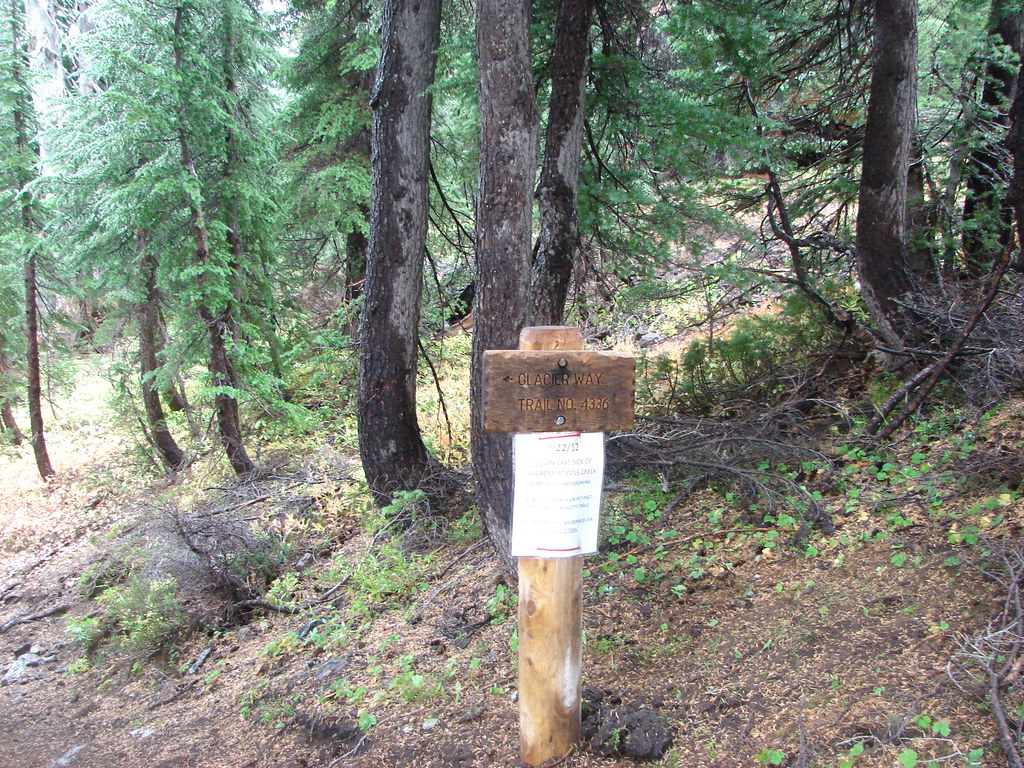
On the far side of the White Branch is a junction with the Glacier Way Trail.
IMG_6008
Lupine and a patch of snow on the far side of the White Branch.

IMG_6013

Both of the trails lead to the Pacific Crest Trail 1.4-miles apart The Glacier Way meets the PCT near Sunshine, a large meadow, in 0.7-miles and the Obsidian Trail meets the PCT near Obsidian Falls in 1.7-miles. This allows for a nearly 12-mile lollipop loop. It is also where the hike that shall not be named went awry. Sullivan described a 15-mile loop using the PCT and Scott Trails, but I failed to pick up on needing to use the Glacier Way Trail in order to keep the milage to fifteen. Just as we’d done in 2012, I stuck to the Obsidian Trail only this time I knew what I was signing up for. The only thing I wasn’t sure of was how much snow might still be lingering in the area. I was carrying micro spikes and prepared to either turn back or bail on the Glacier Way Trail if need be.

Beyond the junction the Obsidian Trail climbed more steeply before reaching a series of meadows along the South Fork White Branch.
IMG_6014
There was a lot of lupine in bloom along the trail.

IMG_6016
There were quite a few patches of snow starting at 5800′ but most were easy to cross without needing the spikes.

IMG_6017
More trail work.

IMG_6020
I did put the spikes on to cross this patch since it was on a fairly steep hillside.

IMG_6022

IMG_6028
When the trail leveled out near the meadows start looking for obsidian in and along the trail.

IMG_6030
Middle Sister from one of the meadows.

Obsidian Trail
The same meadow in 2012.

IMG_6035

IMG_6041

IMG_6042
Alpine false dandelion

IMG_6044
Sub-alpine mariposa lily

IMG_6045
Alpine wild buckwheat

IMG_6053
Cobwebby paintbrush

IMG_6055
South Fork White Branch

IMG_6062
More patchy snow.

IMG_6071
Second crossing of the South Fork White Branch in the meadows.

IMG_6073
Western pasque flowers going to seed.

IMG_6074
Western pasque flower still in bloom.

IMG_6075
Heading back to the trees near Obsidian Creek.

The trail descended to a crossing of Obsidian Creek below Obsidian Falls then climbed to a junction with the Pacific Crest Trail.
IMG_6081

IMG_6083
Obsidian Creek

IMG_6084
The top of The Husband sticking up above the trees.

IMG_6088
Jacob’s ladder

IMG_6090
Junction with the PCT.

I turned left onto the PCT which switchbacked up above Obsidian Falls. I made the short detour down to the viewpoint below the waterfall.
IMG_6092

IMG_6094
Spur to the base of the falls on the left.

IMG_6096
Obsidian Falls

IMG_6105
Obsidian Falls from the PCT.

Above the waterfall the PCT levels out on a wide plateau with a view of the Middle Sister.
IMG_6111

IMG_6113
Looking back down Obsidian Creek.

IMG_6116
The headwaters of Obsidian Creek.

IMG_6119
Spring feeding the creek.

There were two large snowfields still covering the PCT along this section but given the terrain was flat and there were well established footprints they were fairly easy to cross.
IMG_6121
The first snowfield passed one of several ponds on the plateau, this one being frozen.

IMG_6124
Frozen Pond.

One of the Arrowhead Lakes
The same pond in October 2012.

IMG_6130
The second snowfield crossing.

Pacific Crest Trail
Roughly the same spot in 2012, note the small pond ahead.

IMG_6135
The small pond today.

IMG_6134
Obsidian

IMG_6138
Little Brother ahead.

IMG_6141
North Sister

At the northern end of the plateau the trail begins a descent into Sunshine, a large meadow along Glacier Creek.
IMG_6147
User trail leading down to Glacier Creek. I did see one person down at the creek gathering water.

IMG_6148
View from the junction with the user trail. If you look closely, you can see the person who was getting water near the trail crossing of the creek below.

There were more patches of snow to navigate as I made my way down to Sunshine on the PCT but nothing had been too bad, so I decided not to bail when I passed the Glacier Way Trail junction and continued down to Glacier Creek.
IMG_6152

IMG_6153
Belknap Crater and Mt. Washington were once again visible.

IMG_6163
I ended up going around this one.

IMG_6164
Sign at the junction.

IMG_6168
A closed user trail that has been replaced by the one up above.

IMG_6169
The PCT crossing Glacier Creek.

IMG_6171
Paintbrush

Beyond Glacier Creek the Pacific Crest Trail did some ups and downs before arriving at Sawyer Bar, a crossing of the White Branch at a lava flow.
IMG_6178

IMG_6179
Leaving the Obsidian area.

IMG_6181
I’d also left the maintained trail area. This was probably the worst obstacle of the day but there were a number of downed trees along this section of the PCT and later on the Scott Trail.

IMG_6184
Lots of lupine again.

IMG_6187
The PCT made a hard right turn to the east at the lava flow.

IMG_6195

IMG_6201
Belknap Crater, Mt. Washington, Three Fingered Jack and Mt. Jefferson

It had been a little hazy to the north all morning, and I had started getting a faint whiff of smoke every once in a while, after crossing Glacier Creek. Looking at the sky as I neared Sawyer Bar it was obvious that smoke from the Cram Fire over 60 miles away just NE of Madras was being blown into the area by the NE winds.
IMG_6202
North Sister and Little Brother

IMG_6206
Dropping down to Sawyer Bar. There was still a snowfield over the White Branch.

My arrival at Sawyer Bar was loudly announced by a resident yellow-bellied marmot.
IMG_6215

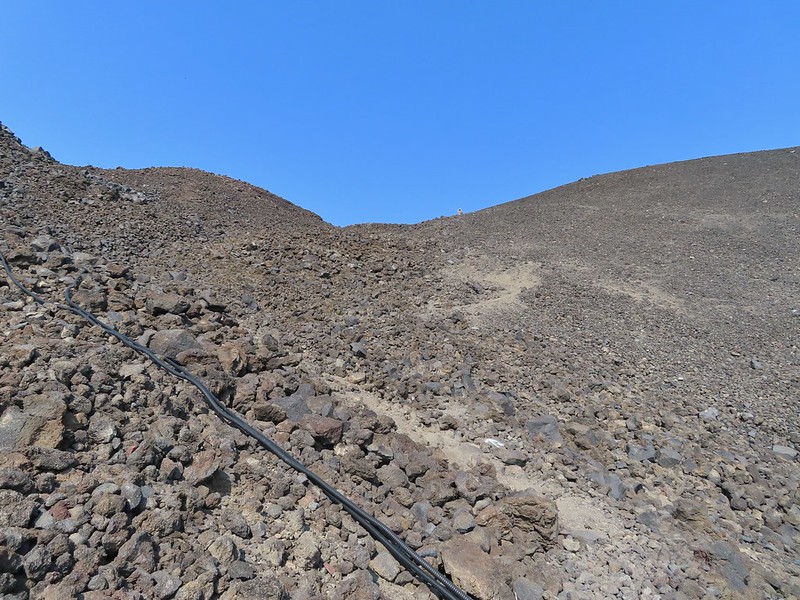
After a brief stint in some sparse trees the trail entered the lava flow and headed for a narrow chute where it switched back relentlessly in the loose volcanic rock.
IMG_6218

IMG_6223

IMG_6227
Collier Cone poking up ahead.

IMG_6231
Paintbrush

IMG_6235
Heading into the chute with the Sun above.

IMG_6237
Penstemon

IMG_6238
Sorrel

IMG_6241
Looking back down from near the top.

IMG_6245
Goldenrod

I wasn’t sure if I was going to be able to climb up onto the rim of Collier Cone as we had in 2012 due to the presence of snow, but after reaching the top of the chute and seeing the use trail into the cone I could tell that it would be possible.
IMG_6246
The high point of Collier Cone from the PCT.

IMG_6247
Catchfly

IMG_6250
North and Middle Sister from inside the cone. I was following use trails toward the low point along the rim to save myself some effort.

IMG_6259
Looking back at the smoke from the Cram Fire flowing through Santiam Pass.

IMG_6260
The opposite side of the cone.

IMG_6261
North and Middle Sister from the rim. The glacial lake at the bottom is from melting snow and the shrinking Collier Glacier.

IMG_6270
Middle Sister and Little Brother

Collier Glacier in the clouds
The view was a little different in 2012.

The wind was whipping pretty strongly but I took advantage of a couple of large cinder rocks to take a seat, have some food, and change my socks before continuing.
IMG_6276

Silvery raillardella

IMG_6281
Dwarf alpinegold

IMG_6282
Heading down to the PCT.

IMG_6284
On last look back from the PCT.

I continued north on the PCT rounding Collier Cone’s ridge and then descending for almost a mile and a half to Scott Meadow.
IMG_6290

IMG_6293
I passed a hiker and her dog just before rounding the ridge here, the first I’d seen other than the person getting water from Glacier Creek.

After rounding the ridge I spotted the sketchiest snowfield of the entire hike, but having just seen the hiker and dog coming from that direction helped boost my confidence.
IMG_6294

I put my micro spikes on for the second time today and carefully made my way across the soft melting snowfield. That was the last time the spikes felt necessary, but not the end of the snow patches.
IMG_6297
Collier Cone, North Sister and Little Brother from the far side of another snow patch.

IMG_6299
There was evidence of some glissading down this patch to the PCT below. I was able to avoid most of the snow by looping around it.

IMG_6300
I just had to cross this short section in order to loop around the rest.

IMG_6304
The creek along the trail here is not named on maps and is shown as seasonal.

IMG_6311
The final snow patch along the PCT before Scott Meadow.

IMG_6319
Almost to the meadow.

This would mark my fourth visit to this meadow. The first was of course in October 2012 and the third was in August 2019 on our Four-in-One Cone hike. In between those two hikes was a July 29th visit during our Matthieu Lakes hike (post). The 2013 hike had been the only one where there were any flowers to speak of blooming in the meadow. At that time it was primarily lupine with some scattered paintbrush, and a host of mosquitos. I had been expecting mosquitos all day, but whether it was timing, the breeze, or the DEET I had applied before setting off there had been almost no sign of them all morning and it was the same at the meadow.
IMG_6320

I’m not sure my timing could have been much better for the flowers this year. It took me a bit to cover the 0.2-miles between the start of the meadow and the Scott Trail junction.
IMG_6322

IMG_6326
Paintbrush and cinquefoil

IMG_6330
Western pasque flowers

IMG_6332
Alpine speedwell

IMG_6335
Lupine

IMG_6336

IMG_6338
Alpine false dandelions, speedwell, cinquefoil and possibly some pussytoes.

IMG_6345
California tortoiseshell

IMG_6353
Bog laurel

The meadow through the years.
Collier Cone
October 14,2012

Pacific Crest Trail in Scott Meadow
July 29, 2013

The Pacific Crest Trail heading toward North Sister, Middle Sister, and Collier Cone from Scott Meadow
August 14, 2019

IMG_6351
Today

IMG_6355
The junction with the Scott Trail.

I turned left onto the Scott Trail and followed it up an open hillside.
IMG_6357

IMG_6359
Yapoah Crater to the left.

After making the climb the trail gradually descended to a cinder field near Four-in-One Cone.
IMG_6363

IMG_6365
Pussy paws

IMG_6368
Four-in-One Cone

A user trail leads up the cone and despite the lack of views we had made the 0.4-mile detour along the top. That detour had been the last straw for our son who didn’t realize that it wasn’t part of the loop needed to get back to the car. When he got to the top and found out it was just an out-and-back side trail he was not at all happy with me. I didn’t make the side trip this time given the increasing smoke on the horizon and the fact that Heather and I had gotten to enjoy the view in 2019.
IMG_6374
Looking back at the side trail after passing it.

IMG_6376
The view from the trail below Four-in-One Cone isn’t too bad.

Beyond Four-in-One Cone the Scott Trail briefly continues through the cinder field before skirting the tree line next to a lava flow.
IMG_6382

IMG_6387

IMG_6388
North Sister and an increasingly hazy sky.

The Scott Trail eventually crosses over the lava flow then enters the forest as it descends toward the McKenzie Highway.
IMG_6391

IMG_6393

IMG_6394
Sign reminding visitors there are no campfires allowed above 5700′.

IMG_6398
There were more snow patches in the forest but nothing much on the trail itself. A bigger issue was the amount of blowdown along the trail; however, I did pass a trail crew working their way up the trail.

IMG_6406
Fritillary on valerian

IMG_6409
Queen’s cup

IMG_6413
Lousewort

IMG_6420
Rosy spirea

IMG_6422
Fading Washington lilies.

IMG_6423
Strawberry blossoms

IMG_6428
Larkspur

I had been watching for the connector trail and keeping my eye on the GPS, but somehow I completely missed it. I did pass a decommissioned trail with a closed for rehabilitation sign. In 2012 there had been a sign at the junction but by 2019 the sign was missing but the trail was obvious.
Scott Trail on the left with the connector to the Obsidian Trail to the right.
The connector trail on the right coming from the opposite direction that I was headed.

The Forest Service page for the Obsidian Trailhead still lists the Obsidian Tie Trail and as providing access to the Scott Trail which leads me to believe I just didn’t notice it, but it’s also possible that it has been decommissioned and the trail that I had passed after just setting off is now just a connector to the Obsidian Equestrian Trailhead.

Missing the connector wasn’t the end of the world as the Scott Trail crosses the McKenzie Highway a little over a quarter mile from the tie trail (or former tie trail).
IMG_6430
It was when I reached this meadow that I knew I’d missed the turn.

IMG_6431
Looking across the meadow.

IMG_6432
Shooting stars

IMG_6435
The highway from the wilderness sign.

I popped out onto the highway and turned left for a 0.6-mile road walk to the Obsidian Trailhead.
IMG_6437

IMG_6438
Historical marker for the 1862 Scott Road.

IMG_6442
It was another third of a mile to my car along the gravel road to the trailhead.

I saved myself a little over a mile by not retracing our side trip across Four-in-One Cone, but missing the connector trail added almost a third of a mile so instead of an 18.6-mile loop like 2012 my GPS came in at 17.8-miles. Skipping Four-in-One-Cone also shaved off a little over 100′ of elevation gain leaving today just under 3400′ of cumulative gain.
Screenshot 2025-07-15 164929
Not sure why the Garmin map shows the PCT going along the rim of Collier Cone. It looks as though there is a use trail around the rim, but it certainly is not the PCT.

This was an excellent hike with spectacular views and some nice wildflowers. I was pushing the timing as far as snow goes, but this year has been warm and dry enough that it was passable (with micro spikes) this early. The lack of mosquitos was a huge blessing.

The only bummer was the arrival of the smoke from what has become a very serious fire. As of my writing this on July 16, 2025, the fire is over 64,000 acres with zero containment. Many people have had to evacuate, and many others are on standby to do so. Our prayers go out to them and to the responders doing everything they can to get the blaze under control.

Flickr: Obsidian Loop

Categories
Bend/Redmond Central Oregon High Cascades Hiking Oregon Three Sisters Area Trip report

Tumalo Mountain Sunrise Hike – 09/26/2021

After missing a week of hiking due to heavy rains arriving for the one weekend we’d obtained a Central Cascade Wilderness Overnight Permit we were heading to Bend to celebrate Heather’s parents 50th wedding anniversary (congratulations again). That was possibly the first time we were excited to have to cancel our hiking plans as the rain (and snow on the mountains) continues to be greatly needed. Saturday was set aside for the anniversary party but we planned on getting a quick hike in Sunday morning before driving home.

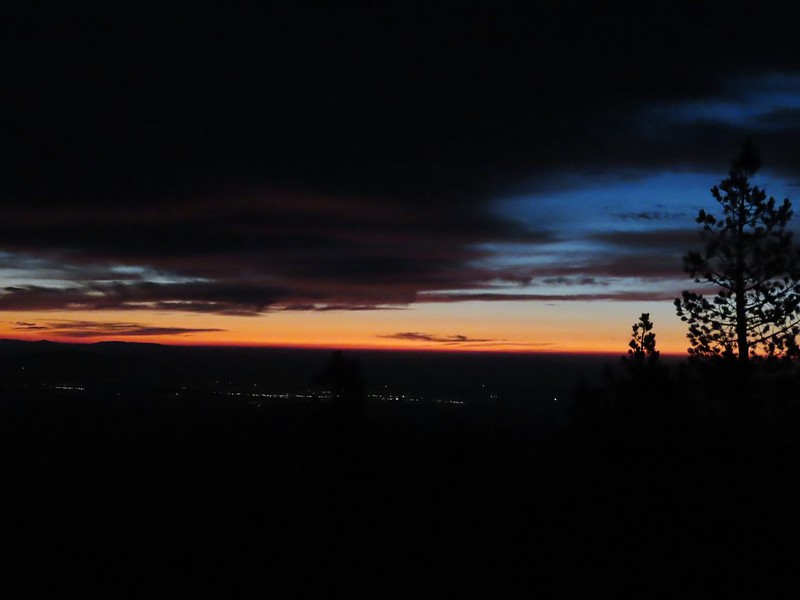
In 2014 we attempted a to catch the sunrise from Tumalo Mountain (post) but were thwarted by low clouds which provided almost zero viability. Nearly seven years later (9/26/21 vs 9/27/14) we returned for another attempt and this time were rewarded with a colorful show. We arrived at the Dutchman Sno-park/Trailhead just after 5am and got ready to head out using our headlamps. Things already looked more promising than on our previous trip as the Moon was visible over Mt. Bachelor.
IMG_5394

IMG_5396

The Tumalo Mountain Trail gains 1425′ in two miles to the site of a former lookout tower. I hustled up to the lookout site as fast as my legs would allow and arrived a little after 6am to catch the first strip of color to the east beyond Bend.
IMG_5406

IMG_5412

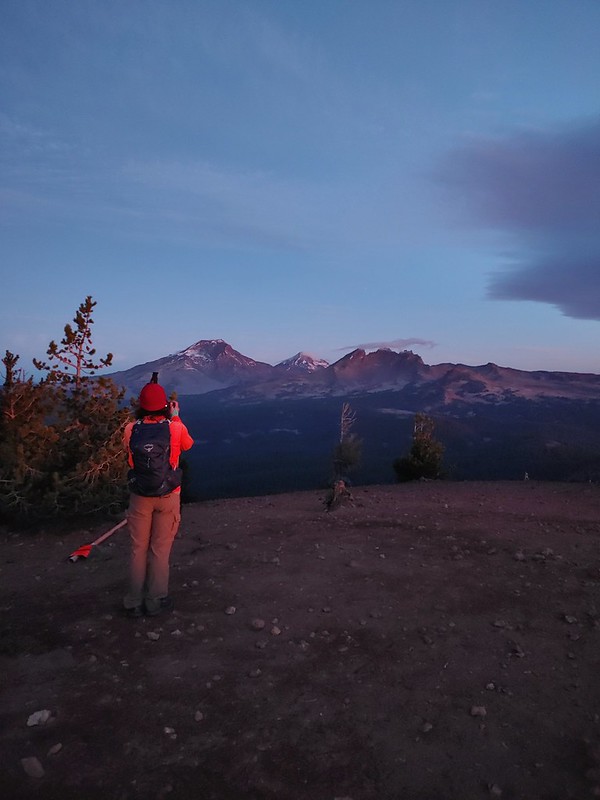
After Heather joined me we continued further along the broad summit to the northern end where the view included Mt. Bachelor to the south and the Three Sisters and Broken Top immediately to the NW.
20210926_062629Mt. Bachelor

20210926_062918The Three Sisters and Broken Top

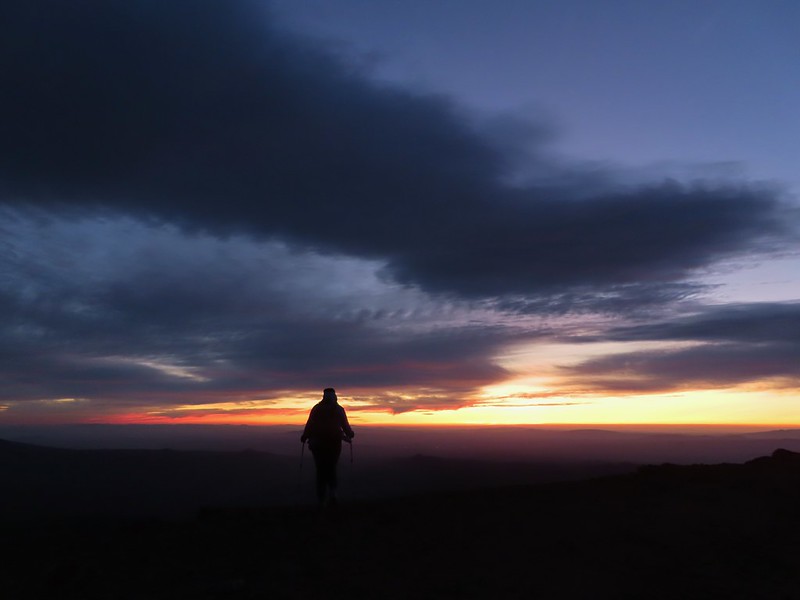
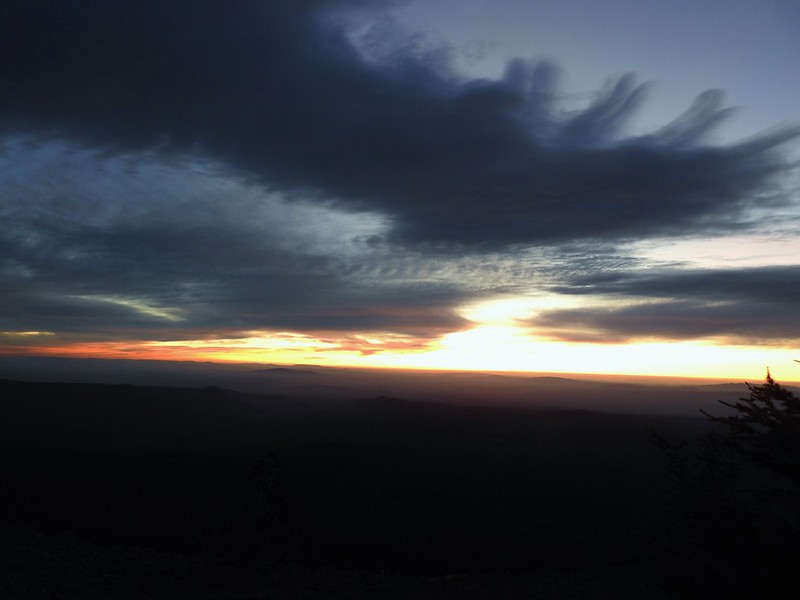
We spent the next half an hour watching the changing light and colors as we waited for the Sun to rise. We had brought an extra camera which I had been using the day before to photograph the anniversary. This proved interesting as each of the cameras we were using captured the sights in their own ways. As I’ve mentioned before I basically have no idea what I’m doing as far as photography and mostly I just rely on getting lucky once in awhile if I take enough photos. My usual camera is a Canon SX740HS, a small point and shoot with 40x optical zoom. Heather was using her phone, an LGE LM-G820, and the other camera, a Nikon Coolpix P900, belongs to my parents.
DSCN1128Mt. Bachelor via the Nikon.

IMG_5444Heather watching the show taken with the Canon.

IMG_5446The Three Sisters with the Canon.

IMG_5450Canon

DSCN1129Nikon

IMG_5455Mt. Bachelor (post) with the Canon.

IMG_5461Canon shortly before the Sun became visible.

IMG_5462Canon shortly before the Sun became visible.

DSCN1140The Three Sister just before sunrise with the Nikon.

20210926_064832The Three Sister just before sunrise with Heather’s phone.

IMG_5467Canon moments before sunrise. A line of wildfire smoke on the horizon gave it a red tint.

IMG_5469Canon

IMG_5471Canon catching the Sun.

IMG_5473Canon

DSCN1155The Three Sisters and Broken Top (Nikon)

DSCN1157South Sister (post) (Nikon)

DSCN1156Middle and North Sister (Nikon)

DSCN1158Broken Top (post) (Nikon)

IMG_5481Aline glow hitting the mountains. (Canon)

IMG_5478South Sister (Canon)

IMG_5479Middle and North Sister (Canon)

IMG_5480Broken Top (Canon)

IMG_5484Mt. Bachelor (Canon)

We started back down as soon as the sun was up.
IMG_5491

IMG_5497

There were lots of views of Mt. Bachelor on the way down and we could also make out Mt. Thielsen (post) and Mt. Scott (post) further south.

IMG_5503Mt. Scott to the left and Mt. Thielsen to the right.

IMG_5506

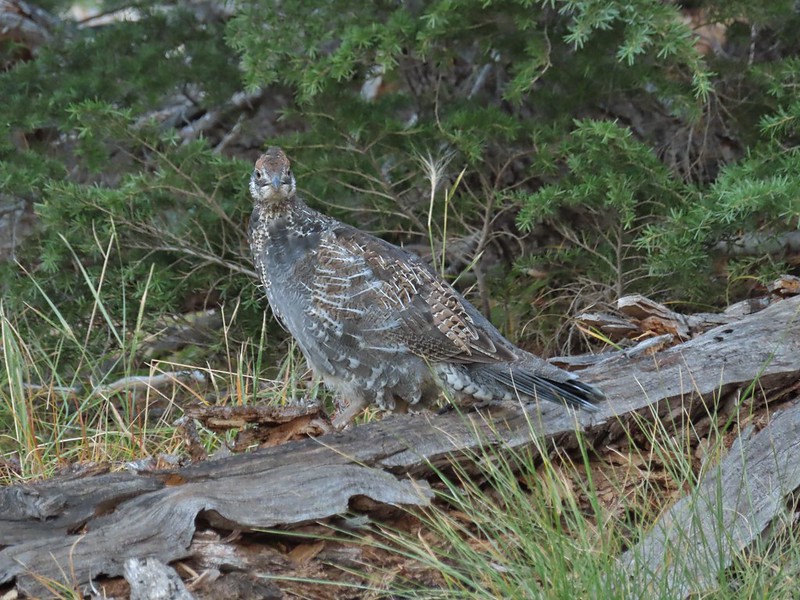
IMG_5519Grouse

IMG_5523Chipmunk

IMG_5528Mt. Bachelor as we arrived back at the snow-park.

We finished our hike just after 7:45am and headed back to Salem. The hike had been everything we could have hoped for. There were just enough clouds in the sky to create some beautiful colors (the lingering smoke even added a bit although we would rather it wasn’t in the air) and the mountains were all clearly visible. My GPS showed a total of 4.7 miles which made sense given it was too cold to simply sit while we waited for the sunrise, spending over half an hour wandering around at the summit.

There were two other groups of hikers watching the sunrise with us and we passed many more as we descended. Tumalo Mountain is a great choice for a short hike with spectacular views. It is also just outside the Three Sisters Wilderness meaning that a Cascade Wilderness Permit is not needed. Happy Trails!

Flickr: Tumalo Mountain

Categories
High Cascades Hiking Oregon Three Sisters Area Trip report

Mount Bachelor – 08/15/2021

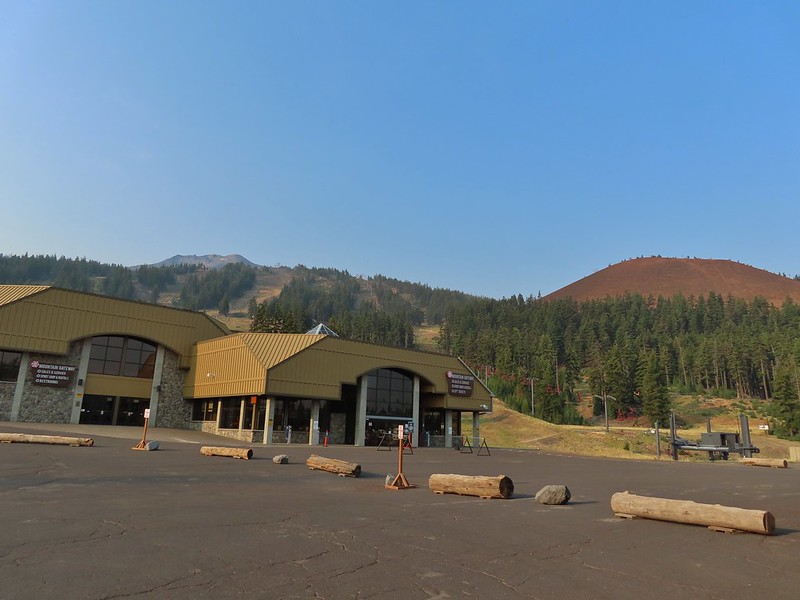
For our August vacation this year we finally returned to the Steens Mountain area for five days of hiking but along the way we made a stop in the Cascade Mountains to hike up to the summit of Mt. Bachelor. As the 6th largest ski resort in the US, Mt. Bachelor is known more for that winter sport than hiking. Hiking also takes a back seat to mountain biking and even a zip line tour but as part of an agreement between the resort and the Forest Service a trail is maintained to the summit for hiking to the 9068′ summit. Growing up in the Bend area I spent a lot of time skiing the mountain but other than riding the Summit lift to the top one Summer (when that lift still operated in the Summer months) neither of us had spent time on the mountain without snow. It was going to be another warm, hazy day as that seems to be the new norm here in the West but the air quality wasn’t in the danger zone so we left early on Sunday morning and arrived at the West Village Parking lot a little before 8am to find a somewhat blue sky overhead.
IMG_1750

There are currently three routes shown on the resorts web page with the easiest being from the top of the Pine Marten Lift which operates from 10am thru 5 or 7pm depending on the date. The other two routes start at the West Village Lodge near the Pine Marten Lift which allows for a reverse lollipop hike which is what we did. We took the more scenic trail up which was marked by blue signboards for the West Village to Summit Connect Trail.
IMG_1755

IMG_1760

IMG_1761A hazy look at the South Sister and Broken Top.

After a short distance on cat roads we came to an actual trail which led into the trees.
IMG_1764

The trail traversed along the mountain crossing several ski runs before turning uphill near the “Marshmallow” run and the Sunrise lift.
IMG_1766

IMG_1771Passing under the Skyliner Express

IMG_1772

IMG_1777The ski runs gave us a good look at the top of the mountain.

IMG_1779

IMG_1786

IMG_1792Turning uphill

IMG_1793Spotted a grouse hen and her chicks in this little meadow.

IMG_1797

IMG_1807Two of the chicks.

IMG_1812Passing under the Sunrise lift.

The first 1.4 miles had gained under 350′ but after turning uphill the trail steepened gaining almost 2400′ over the next 2.5 miles.
IMG_1816

IMG_1817Nearing the top of the Sunrise lift.

IMG_1818Another hazy look at the nearby mountains.

IMG_1819South and Middle Sister through the haze.

IMG_1823The top of Sunrise and the bottom of the Summit lifts.

IMG_1824Looking up from the top of Sunrise.

Above the Sunrise lift the trees thinned out leaving a few scattered trees including white bark pines.
IMG_1826

IMG_1828

IMG_1831

IMG_1832A few saxifrage blossoms still left.

IMG_1834

IMG_1841Alpine buckwheat and paintbrush

IMG_1846The first patch of snow we passed.

IMG_1848Golden mantled ground squirrel

IMG_1850Tumalo Mountain (post) in the haze.

Signs gave way to white arrows painted on rocks at the higher elevations.
IMG_1858

IMG_1861Looking down from beneath the Summit Express.

IMG_1863We could really feel the elevation affecting our breathing and by this point we were both sucking wind.

IMG_1864Dwarf alpinegold

I arrived at the summit first and followed the path the the mountain’s high point.
IMG_1869Looking back at the Summit Express.

IMG_1871Heading for the high point.

IMG_1878

IMG_1882A mountain bluebird near the summit.

IMG_1887South Sister and Broken Top with Sparks Lake (post) the brown patch below.

I took my pack off and had a seat and was soon joined by a curious golden mantle.
IMG_1892

IMG_1895

IMG_1896It’s our rule not to feed the wildlife but it was obvious that many don’t adhere to that LNT principle. I had to put my pack back on to avoid having a hole chewed through my pocket.

IMG_1901View of the summit.

The surrounding smoke made it impossible to see anything to the east, very little to the south or west and just the closest features to the north, but a cool breeze made it a comfortable spot for a rest while I waited for Heather to join me.
IMG_1899Broken Top, the Pine Marten Lodge halfway up the mountain, the West Village Lodge and parking area below and Tumalo Mountain across the Cascade Lakes Highway.

After Heather had a chance to relax at the summit as well we headed back down taking a short detour to a viewpoint above the Cirque.
IMG_1917

IMG_1918

We then hiked back down just above the Sunrise Lift where we turned left on the West Village Getback road which I could picture skiing on all those years ago.
IMG_1931A little better view of Broken Top and Tumalo Mountain on the way down.

IMG_1935Clark’s nutcracker

IMG_1940

IMG_1941

IMG_1942Left leads up to the Pine Marten Lodge atop the Pine Marten Express, right to the West Village Lodge.

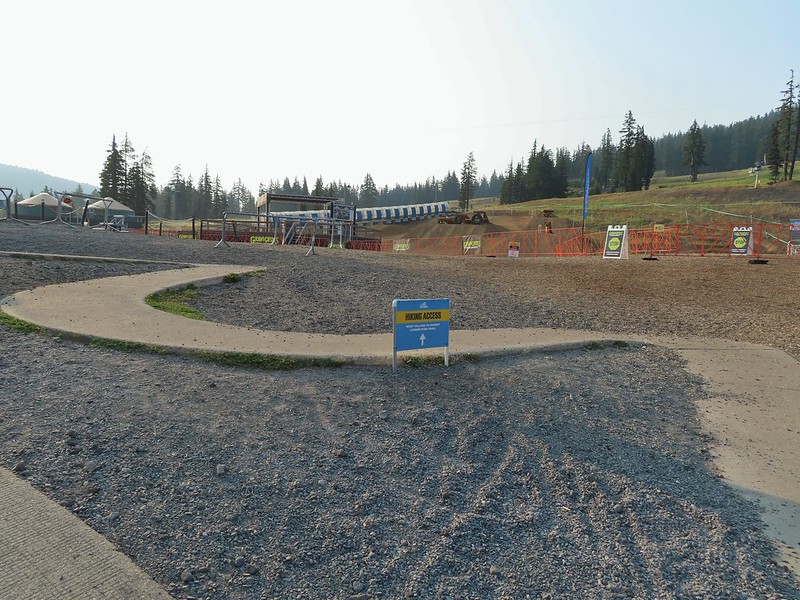
The road walk is not only not as scenic as the trail route we took up it also passes through the mountain bike trails so we had to keep our eyes open at the crossings.
IMG_1944

IMG_1945A decent look at Tumalo Mountain

IMG_1948Warning sign for a bike crossing.

IMG_1949A look at some of the mountain bike trails and some haze moving in overhead.

IMG_1959A tortoiseshell butterfly on the road.

IMG_1963

The trail map showed this route passing under the Pine Marten Express and turning 90 degrees downhill alongside the lift.
IMG_1964

There was a disc golf hole here but no sign of any trail except for a faint line continuing straight ahead through some grass. We followed it briefly before realizing it wasn’t going to get us to the parking lot.
IMG_1965At least we could see the mountains a little better from here.

We turned back to the lift and headed cross country downhill alongside it. We eventually did find some tread which took us to the base of the lift and back to the parking lot. We were glad we’d gotten there as early as we had because it was now quite a bit hazier overhead and a lot warmer.
IMG_1966

We left the mountain and drove to Heather’s parents house where we spent the night before once again heading out early for another adventure. Happy Trails!

Our track for Mt. Bachelor. The GPS said 8.8 miles and 2800′ of elevation but the resort lists the hike as 6.5 miles and 2742′ of elevation gain.

Flickr: Mt. Bachelor

Categories
High Cascades Hiking Oregon Three Sisters Area Trip report

Rainbow Falls and Substitute Point – 07/04/2021

For the Fourth of July we typically pick a hike in the Old Cascades but this year we aimed higher and headed for the Three Sisters Wilderness in the High Cascades. We had two stops planned, a short hike on the Rainbow Falls Trail to the viewpoint of distant Rainbow Falls and a longer hike on the Foley Ridge Trail to Substitute Point. We stopped first at the Rainbow Falls Trailhead since it is right off Foley Ridge Road (FR 2643) on the way to the Foley Ridge Trailhead. Neither of these trailheads currently require a Central Cascades Wilderness Permit for day hikes (you are required to fill out a free self-issued permit at each TH though).
IMG_9616

The first half mile of the trail follows an old road bed to a former trailhead.
IMG_9623

IMG_9624

We continued along the trail entering the Three Sisters Wilderness before turning along the edge of the steep hillside high above Separation Creek (post)
IMG_9629

IMG_9632One of two phantom orchids we saw along the trail.

IMG_9633Newish looking wilderness sign.

IMG_9634Maples overhanging the trail.

IMG_9635

IMG_9642Madrone trunks

A little under 1.5 miles from the TH we arrived at a rock fin where a short scramble led to a view of distant Rainbow Falls. It was just after 8am which wasn’t an ideal time due to the falls being to the east with the Sun directly behind and still low in the sky.
IMG_9644It’s a pretty narrow scramble so probably not for kids or those uncomfortable with heights.

IMG_9645A lone madrone at the end of the fin.

IMG_9647Looking toward the falls. (The North Sister is back there too but not visible due to the lighting.)

IMG_9654Rainbow Falls on Rainbow Creek

IMG_9651The best I could do with the lighting.

IMG_9652Looking up Separation Creek.

IMG_9658Looking back up along the rocks.

A use trail continued toward the falls, but as far as I know it’s not possible to reach them or to get a better view so we returned the way we’d come. From the Rainbow Falls Trailhead we then drove another 5 miles up FR 2643 to its end at the Foley Ridge Trailhead.
IMG_9661

The 8 mile long Foley Ridge Trail begins at the trailhead and leads into the Three Sisters Wilderness were it eventually ends at the Pacific Crest Trail. We had been on the upper end of the trail twice, once on a backpacking trip around the South Sister (post) and the other another backpacking trip where we explored some of the areas waterfalls (post). Today’s plan was to hike the first 4.5 or so miles of the trail to the Substitute Point Trail and then follow that 0.7 mile trail to a former lookout site atop Substitute Point. We were looking forward to the view atop the point but also interested to see what the area looked like after being hit hard by wildfires in 2017.

The first mile and half of the trail was unaffected by the fire and hosted a few blooming rhododendron and other woodland flowers.
IMG_9663

IMG_9666Pink pyrola

IMG_9669Crossing of Gold Creek which was nearly dry but it hosted a fair number of mosquitos.

IMG_9671Columbine, bunchberry, and wild roses.

IMG_9672An anemone with some bunchberries

IMG_9674Entering the Three Sisters Wilderness

IMG_9675Queen’s cup

IMG_9680Beargrass

20210704_091724Candy sticks

IMG_9684Rhododendron

IMG_9691Pacific coralroot

We soon found ourselves in the fire scar which at least lessened the number of mosquitos greatly.
IMG_9692

The 2017 Separation Fire was started by lighting in August along with dozens of others. The fire became part of the Horse Creek Complex which burned something in the neighborhood of 30,000 acres. It was the same year as the Eagle Creek and Whitewater fires making 2017 a really bad year for great hiking areas. Nearly four years later signs of the slow recovery could be seen in the form of wildflowers and small trees.
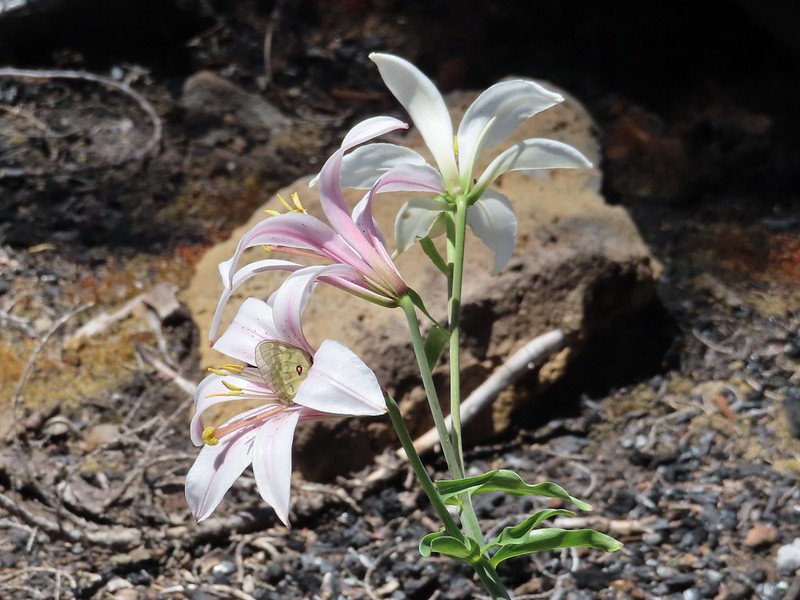
IMG_9693Washington lily

IMG_9695Lupine

IMG_9697Squirrel

IMG_9698

IMG_9702Tiger lily

The trail briefly entered an area of older trees that had fared a little better during the fire.
IMG_9712

IMG_9715Twinflower

IMG_9726Leaving the green trees behind.

The trail climbed gently which allowed us to fully appreciate the wildlife and wildflowers, in particular some really impressive Washington lilies.
IMG_9728Washington lilies

IMG_9739

IMG_9736They smell as good as they look too!

IMG_9743This one was a monster.

20210704_134302_HDRChest high

IMG_9745Crab spider on the lower left petal.

IMG_9749Penstemon

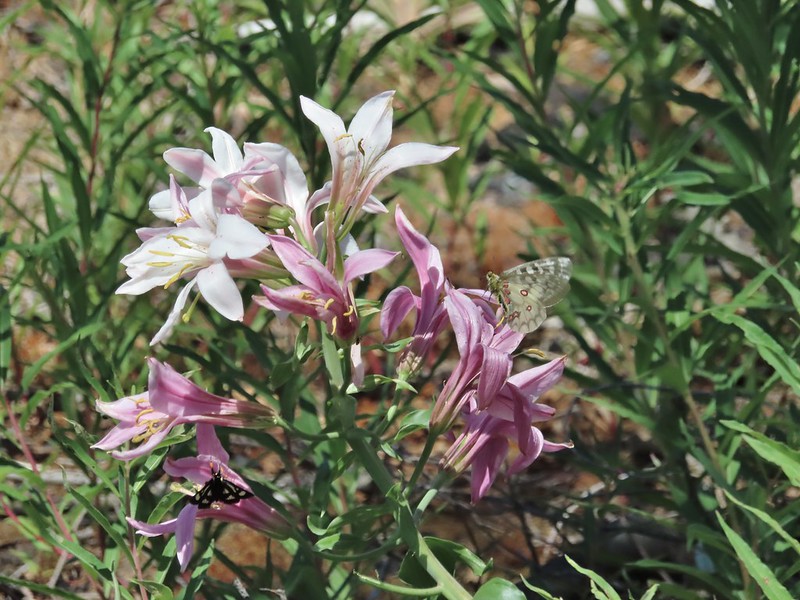
IMG_9756Earlier in the week I had been reading that the blossoms turn pink after being pollinated.

IMG_9760Clodius parnassian

IMG_9765Pretty moth

IMG_9767Penstemon

IMG_9776Woodpecker

IMG_9778Pond along the trail.

IMG_9782Water lilies

The trail began to level off as it passed between Proxy Point on the left and Substitute Point on the right. With the trees being burnt we had a good view of the rocky Proxy Point but the angle of the hillside below Substitute Point kept it hidden. Also visible was The Husband further ahead to the East.
IMG_9791Looking toward Proxy Point

IMG_9790The Husband, South Sister, and the shoulder of Substitute Point.

IMG_9801Frog along the trail.

The trail curved around the base of Substitute Point where we got a view of Three Fingered Jack and Mt. Jefferson.
IMG_9805Proxy Point, Scott Mountain (post), Three Fingered Jack and Mt. Jefferson

IMG_9808Bleeding heart

We came to the junction with the Substitute Point on its NE side.
IMG_9813The Husband from the junction.

The Substitute Point Trail didn’t appear to have been maintained, possibly since the fire, but it was easy enough to follow as it headed uphill.
IMG_9815

IMG_9824

IMG_9825This was sort of a mean trick, the trail entered these green trees then almost immediately switched back into the burn.

IMG_9826

IMG_9828Phlox

The climb wasn’t particularly steep until the end as it approached the rocky spire where a lookout once sat. As we approached it was hard to believe there was a trail to the top.
IMG_9831

There was in fact a nice trail that wound up the west side, although a single downed tree did require a hands and knees crawl along the way.
IMG_9836

IMG_9840

IMG_9838Mt. Bachelor from the trail.

IMG_9841Proxy Point

IMG_9843Some unburned forest and a view of Diamond Peak.

IMG_9844Diamond Peak (post)

IMG_9845The Little Brother and North & Middle Sister behind The Husband with South Sister to the right.

IMG_9917The trail leading up.

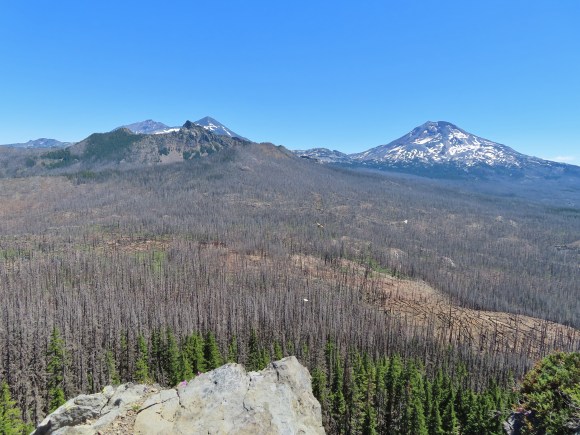
The view at the top was at the same time spectacular and sad. We could see that much of the area that we’d explored on our previous backpacking trips had been burned badly by the fires.
IMG_9851The summit of Substitute Point

IMG_9855Scott Mountain, Three Fingered Jack, Mt. Jefferson, Mt. Washington, and Belknap Crater (post).

IMG_9861Proxy Point and Scott Mountain.

IMG_9869The Three Sisters, Little Brother and The Husband

IMG_9863Mt. Bachelor, The Wife, and Sphinx Butte.

IMG_9865Kidney Lake

img src=”https://live.staticflickr.com/65535/51292219058_ec3f2f67bc_c.jpg” width=”800″ height=”600″ alt=”IMG_9866″>South Sister

IMG_9877Mt. Bachelor and The Wife

IMG_9868North and Middle Sister behind The Husband

IMG_9872Three Fingered Jack, Mt. Jefferson and Mt. Washington

We took a nice long break at the top watching butterflies soar around us.
A swallowtail and two whites (maybe clodius parnassians) in flight.

After our break we headed back. We’d had the hike to ourselves but were now passing a handful of hikers heading up the trail. We stopped a few times to watch butterflies (in hopes they would land) and to smell the occasional lily.
IMG_9931Clodius parnassian in a blossom.

IMG_9933Moth and a parnassian.

The hike here came to 10.3 miles with 2000′ of relatively gentle elevation gain. With the 2.8 miles we did at Rainbow Falls it came to a 13.1 mile day and a great way to spend the 4th of July.

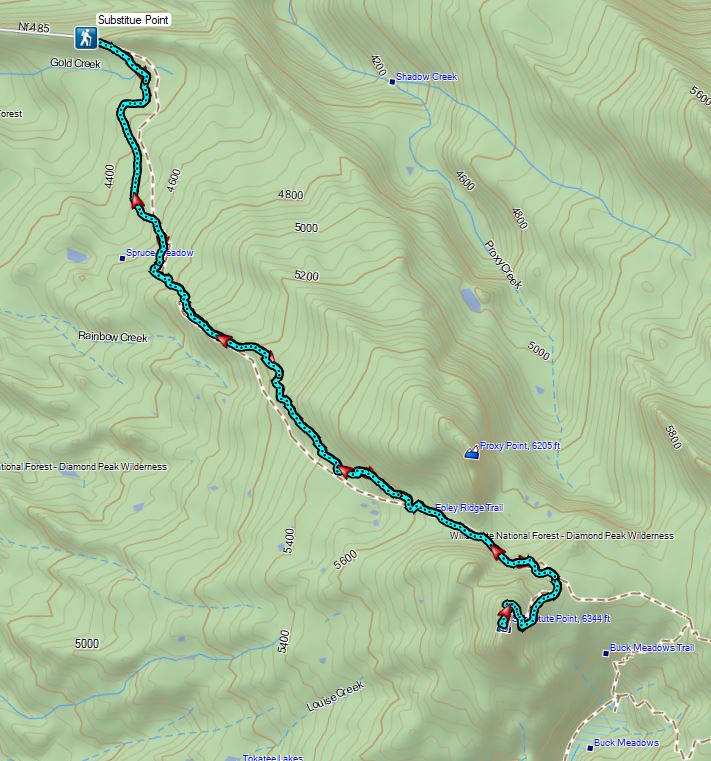
Track for Substitute Point

While we were sorry to see how badly much of the area was burned it was encouraging to see the trails were in relatively good shape and that there was new growth coming. We fear that hiking in recently burned forest is only going to become more common in the years to come but hike we will. Happy Trails!

Flickr: Rainbow Falls and Substitute Point

Categories
Bend/Redmond Central Oregon High Cascades Hiking Oregon Three Sisters Area Trip report

Whychus Creek Trail and Overlook – 05/31/21

After back to back 14 mile days we had something more reasonable planned for our drive home on Memorial Day. We had started the weekend with two hikes along Whychus Creek east of Sisters (post). On Monday we stopped at the Whychus Creek Trailhead 4.2 miles west on Elm Street (Forest Road 16) of Highway 20 in Sisters. The trailhead doesn’t seem to be listed on the Deschutes National Forest webpage (They do show the Whychus Creek Overlook Trailhead which is an alternate starting point.)

We actually wound up having to park at a temporary trailhead 1000′ past the official trailhead which was closed for construction (not sure what was being constructed).
IMG_6773

IMG_6776

The Whychus Creek Trail followed Whychus Creek through a mixed forest with juniper and sagebrush from the high desert, ponderosa pine, and mixed conifers from the Cascades.
IMG_6782

IMG_6794

We really noticed how much more water there was in the creek here, before reaching the diversion ditches closer to Sisters.
IMG_6791

Less than a half mile into the hike we passed a series of rock ledges where native tribes appear to have once camped.
IMG_6798

The trail reached the bank of Whychus Creek at the overhang then climbed back above the creek gaining a view of the top of the North Sister. A few wildflowers added color to the landscape and birds added their song to the sound of the creek.
IMG_6800

IMG_6820North Sister in the distance.

IMG_6804Penstemon

IMG_6810Chocolate lily

IMG_6815Sand lily

IMG_6817Paintbrush

IMG_6818Balsamroot

IMG_6838A Penstemon

IMG_6827

IMG_6841Squirrel!

Just over a mile and a half from the trailhead the Whychus Creek Trail descended back down to the creek passing under some cliffs.
IMG_6846

IMG_6845

IMG_6849

20210531_063851The penstemon really liked the cliff area.

Looking up stream we could see the logjam waterfall which is the goal of Sullivan’s described hike in his 5th edition Central Oregon Cascades guidebook (hike #31).
IMG_6853

IMG_6854

Near the two mile mark we arrived at a series of viewpoints of the falls atop rocks.
20210531_064727_HDR

IMG_6867

There was a second smaller cascade a little further upstream.
IMG_6875

Sullivan suggests turning back here but just over a half mile away was the Whychus Creek Overlook. A 0.9 mile barrier free loop visits the overlook from the Whychus Creek Overlook Trailhead (see link above). We continued past the falls for approximately 0.2 miles to a signed trail junction.
IMG_6881

We turned left onto the Whychus Draw Trail which led briefly up a draw before turning more steeply uphill traversing an open hillside to the overlook.
IMG_6882

IMG_6887Mt. Hood sighting.

IMG_6889Mt. Jefferson and Black Butte

IMG_6892Chipmunk

IMG_6895White breasted nuthatch

IMG_6897Golden mantled ground squirrel

The Whychus Draw Trail connected to the south side of the Whychus Overlook Trail about a hundred feet from the actual overlook.
IMG_6910

IMG_6913Broken Top and the Three Sisters (bonus points for spotting the golden mantled ground squirrel)

IMG_6912Lewis flax at the overlook.

IMG_6915Buckwheat and penstemon

IMG_6918Whychus Creek below with the Three Sisters on the horizon.

IMG_6919Tam McArthur Rim (post) and Broken Top

IMG_6921South Sister

IMG_6922Middle and North Sister

IMG_6923Mt. Washington

IMG_6924Three Fingered Jack

IMG_6928Mt. Jefferson

IMG_6931Chickadee

After admiring the view from the overlook we hiked the loop. One side (north) is one-way traffic coming from the trailhead to the overlook so we followed the south half of the loop 0.4 to the trailhead then followed the north side 0.5 miles back to the overlook. Two benches along the north side offered additional views to the NNW.
IMG_6936

IMG_6943

IMG_6947Interpretive sign along the trail.

IMG_6955Mt. Washington, Three Fingered Jack, Mt. Jefferson, and Black Butte

From the overlook we returned to the car the way we’d come. It was a pleasant 5.9 mile hike with some great views and scenery, a perfect way to end the holiday weekend. Happy Trails!

Track for Whychus Creek and Overlook

Flickr: Whychus Creek Trail

Categories
Hiking Oregon Three Sisters Area Trip report Waldo Lake Area

Erma Bell Lakes and the Shale Ridge Trail – 08/29/2020

With our recent backpacking trip around Diamond Peak (post) leaving us with just one more featured hike yet to do from William L. Sullivan’s “100 Hikes/Travel Guide Central Oregon Cascades” (4th edition) the only logical thing to do the following weekend was that last remaining hike. That hike was to the Erma Bell Lakes and as luck would have it late August was a pretty good time to visit, the berries were ripening and the mosquitoes weren’t too much of a nuisance. With a drive time of almost three hours the loop around the 8.5-9 mile loop around the lakes wouldn’t take long enough for us not to break our self imposed rule of the driving time being longer than our time spent hiking so we added a second stop to the day at the Shale Ridge Trail.

We started the morning by driving to the Skookum Creek Campground where the Erma Bell Trail begins.
IMG_5089

IMG_5091

The trail crosses Skookum Creek on a footbridge.
IMG_5092

IMG_5093

Soon after crossing the creek the trail enters the Three Sisters Wilderness.
IMG_5097

The trail traverses a forested hillside where we found a few ripe thimbleberries to snack on.
IMG_5099

A little over half a mile from the trailhead the Irish Mountain Trail splits off to the left toward Otter Lake allowing for a loop past that and several other lakes.
IMG_5104

We stayed right choosing to follow Sullivan’s suggestion to complete the loop counter-clockwise. The trail continued along the forested hillside for another mile before crossing a small stream on a bridge near Lower Erma Bell Lake.
IMG_5105

IMG_5108

IMG_5113

Just beyond the bridge we took a short spur trail to the left to visit the lake.
IMG_5115

IMG_5116

IMG_5117

The lake was a pretty blue color and quite deep.
IMG_5133

IMG_5135

Despite the beauty of the lake our attention had been diverted by the familiar “meep” of pikas, our favorite trail critters. We quickly spotted one of the little fur balls collecting greens along the rocky lake shore.
IMG_5119

IMG_5121

IMG_5127

IMG_5130

We watched the pika go back and forth with its greens several times before resuming our hike. We continued on the trail around the lake taking another detour after crossing the lake’s main outlet creek to check out a small cascade.
IMG_5136

20200829_083744

Beyond the outlet the trail began a .4 mile climb up toward the Middle Erma Bell Lake.
IMG_5142Lower Erma Bell Lake from the climb.

A short but steep trail to the left just before the high point of the trail led to a viewpoint of a waterfall between the lower and middle lakes.
IMG_5144

IMG_5162Above the falls.

IMG_5156

After checking out the waterfall we continued up to Middle Erma Bell Lake.
IMG_5176

IMG_5170

IMG_5175Ouzel

IMG_5178Ducks

We continued beyond Middle Erma Bell Lake passing a small pond on the right before arriving at Upper Erma Bell Lake .7 miles from the waterfall, also on the right.
IMG_5186Pond along the trail.

IMG_5189Spur trail on the right to Upper Erma Bell Lakes.

IMG_5192Paintbrush and aster along the lake shore.

IMG_5193Upper Erma Bell Lake

IMG_5197Lupine and paintrbush

In addition to a few flowers there were lots of ripe berries near the lake which we sampled before continuing. The trail climbed gradually for half a mile to a junction with the Judy Lake Trail which passes Mud and Edna Lakes (but no Judy Lake) before ending at the Taylor Burn Guard Station.
IMG_5202Judy Lake Trail on the right.

We stayed left passing above Mud Lake which was barely visible through the trees below.
IMG_5203

Just under a mile from the Judy Lake Trail junction we arrived at another junction, this time with the Williams Lake Trail.
IMG_5207Williams Lake Trail joining from the right.

Again we stayed left continuing for another .4 miles to Williams Lake. Before reaching the lake we encountered a grouse that was less than pleased with our presence.
IMG_5217Grouse giving us the what for from a tree.

IMG_5212

IMG_5220Williams Lake

IMG_5227Dry creek bed near Williams Lake.

The trail began to descend beyond Williams Lake passing through some damper meadows where berries were plentiful and some flowers remained (and so did some mosquitoes).
IMG_5229

IMG_5232

IMG_5234Pearly everlasting

IMG_5237Fleabane

IMG_5243Prince’s pine

IMG_5244Mushroom

IMG_5250

IMG_5254Aster

IMG_5257

IMG_5258Coneflower

IMG_5265

IMG_5272Paintbrush

IMG_5275

IMG_5277Paintbrush

A little over two and a quarter miles beyond Williams Lake we arrived at a junction with the Irish Mountain Trail which headed uphill to the right.
IMG_5281

A short distance from the junction we came to Otter Lake.
IMG_5287

IMG_5294Curious dragonfly

The trail descended for another half mile to the Erma Bell Lakes Trail completing the loop.
IMG_5298

We turned right and returned the .6 miles to the now busy trailhead. Sullivan lists the hike at 8.4 miles but we both came up with a little over 9 miles, most likely due to the various side trips tp the waterfalls and along the lake shores. We left the trailhead and headed back toward Oakridge on Forest Road 19 stopping at the Shale Ridge Trailhead on the left (south) near milepost 30.

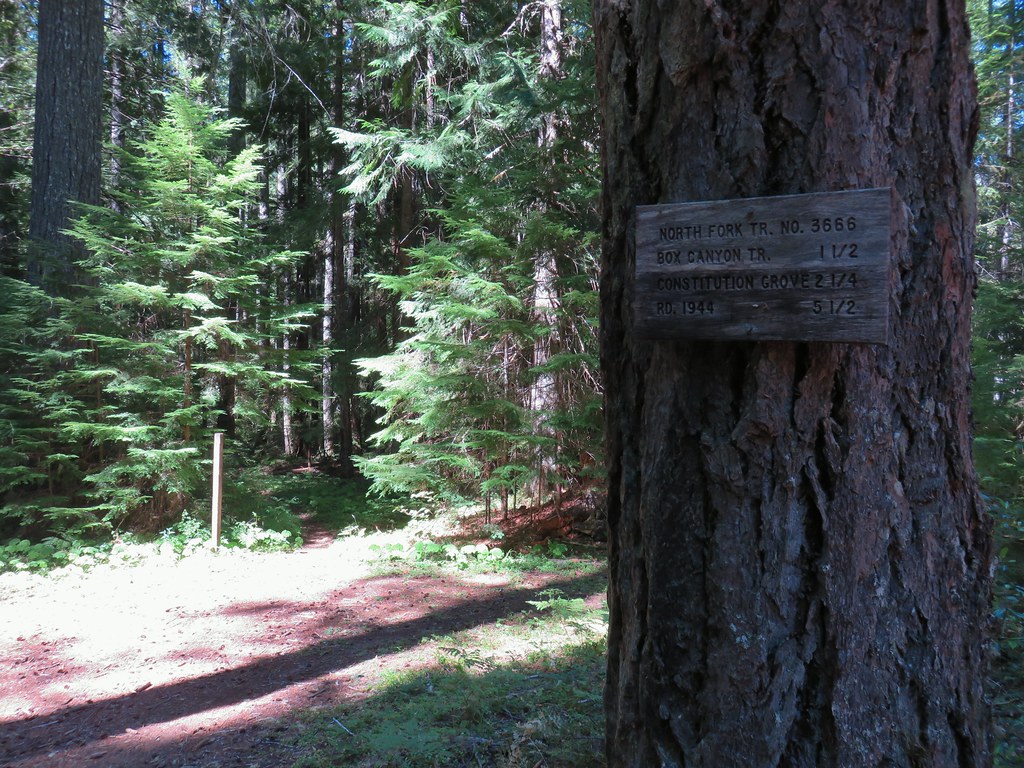
This trailhead serves as the start of the Shale Ridge Trail and the upper terminus of the North Fork Trail (segment 5). We had spent time on the North Fork Trail earlier in the year hiking segment 1 out of Westfir and another short section to Buffalo Rock in May (post).
IMG_5305

We weren’t here for that trail today and instead headed south on the Shale Ridge Trail, which according to a note written on the signboard had been partially logged out in June.
IMG_5303

<img src="https://live.staticflickr.com/65535/50286349281_6b323abbee_b.jpg&quot; width="768" height="1024" alt="IMG_5304">

IMG_5306

The trail quickly entered the Waldo Lake Wilderness.
IMG_5312

We followed the trail through old growth forest. The North Fork Middle Fork Willamette River could be heard at time off to our right but not seen.
IMG_5316

IMG_5317Ghost Pipe aka Indian Pipe

We were below the ridge that we had been on during the Erma Bell Lakes hike and at the 1.8 mile mark we came to Skookum Creek which was flowing through multiple channels through the forest. This area was the highlight of the hike along the Shale Ridge Trail.
20200829_125709_HDR

IMG_5334

IMG_5332

IMG_5338

We continued beyond Skookum Creek just over a mile to the North Fork Middle Fork River at Cedar Bog. This was as far as we had planned on going and as far as the trail had been cleared to. In theory the trail continues up to the Blair Lake Trail (post) on the far side of the river but the condition beyond Cedar Bog is mostly likely very rough.
IMG_5349Arriving at Cedar Bog.

IMG_5350One of a couple dry channels.

IMG_5353North Fork Middle Fork

IMG_5358Flagging on a downed tree marking the continuation of the Shale Ridge Trail.

IMG_5360North Fork Middle Fork at Cedar Bog

IMG_5363Orange flagging on the far side of the river.

20200829_132354Monkeyflower at Cedar Bog

IMG_5366Candy flower

We turned back here and returned to our car completing a 5.8 mile out and back. While this hike was short on views there were some impressively large trees along the way and it was fairly level with only a 400′ cumulative elevation gain. The two hikes combined for nearly 15 miles of hiking which ensured that our hiking time was indeed longer than our driving time. More importantly we’d seen some nice lakes, all of which had their own distinct differences and had been gotten to watch a pika doing its thing. On top of it all we could finally say that we had done at least part of all 100 featured hikes in one of Sullivan’s guidebooks. Happy Trails!

Flickr: Erma Bell Lakes and the Shale Ridge Trail

Categories
High Cascades Hiking Oregon Three Sisters Area Trip report

Four-In-One Cone – 8/14/2019

The third hike of our vacation was another repeat (this time only partially) of a viewless outing. In 2012 we had embarked on “the hike that shall not be named” (post) It was an ambitious hike that went wrong in a couple of ways. First I misunderstood the guidebook and turned a 15 mile loop into an 18.6 trudge and second the persistent low cloud layer denied us of virtually any views. Our plan to hike to Four-In-One Cone would cover part of that hike.

We chose the Four-In-One Cone portion of that hike for two reasons. First Four-In-One Cone is a really cool volcanic feature and second much of the remainder of that loop passes through the Obsidian Limited Entry Area for which we didn’t have a permit nor were any available. We started the hike at the Scott Trailhead located along Highway 242 (17 miles from Highway 126 or 20.3 miles from Highway 20).
IMG_6219

The Scott Trail briefly follows along the highway before crossing it and entering the Three Sisters Wilderness.
IMG_6223

IMG_6224

A third of a mile from trailhead we came to a somewhat familiar junction.
IMG_6236

Neither of us quite remembered it looking like it did now (for one thing the trail sign was missing) but the right hand fork led to the Obsidian Trailhead and had marked the final .6 miles of THAT hike. We forked left and began to climb via several switchbacks which we had no recollection of. We also passed a viewpoint at one of the switchbacks.
IMG_6245

After the viewpoint the trail continued to climb but more gradually as it passed through a mixed forest.
IMG_6247

IMG_6249Pinesap

IMG_6251

IMG_6252A very blurry deer spotted through the trees.

IMG_6257

IMG_6258

IMG_6262

Three miles from the trailhead we arrived at the first of two short lava flow crossings. A large western toad was in the trail here and there was also a squirrel nearby which seemed like a suspicious combination.
IMG_6265

IMG_6270

20190814_085527

IMG_6274

The lava crossings are separated by an island of forest that escaped the flow.
IMG_6282

IMG_6284North Sister

IMG_6290Middle Sister

IMG_6288More spies watching us.

Beyond the second lava crossing we spent a little time back in the forest before once again entering a volcanic landscape as we came around the south side of Four-In-One Cone.
IMG_6294

IMG_6299

IMG_6300

Unlike our previous visit the Cascade Mountains were visible.
IMG_6301North and Middle Sister behind the Little Brother.

IMG_6312Mt. Jefferson beyond Four-In-One Cone

IMG_6317Mt. Hood over the right shoulder of Mt. Jefferson.

IMG_6319Mt. Washington’s spire behind the cone with Three Fingered Jack and Mt. Jefferson.

The route up Four-In-One Cone is just under 1.5 miles from the first lava crossing and is marked by a signpost.
IMG_6309

Before going up the cone we decided to continue another .8 miles to the Pacific Crest Trail in Scott Meadow. We had of course been to that junction during our loop in 2012 but we’d also visited it in 2013 from the north on the PCT from South Matthieu Lake (post). Lupine is said to bloom profusely from mid-July through August but we hadn’t seen much in 2013 (2012 was late September) so we thought we’d give it another try. Prior to reaching Scott Meadow we did pass a couple of hillsides with a decent amount of lupine but I don’t know that we considered it profuse
IMG_6328

IMG_6331

IMG_6333

IMG_6335

IMG_6343Scott Meadow

There wasn’t any lupine at all around the PCT junction but the view of Little Brother next to the North and Middle Sisters is nice.
IMG_6358_stitch

After a short break and pointing a group of trail runners toward Opie Dilldock along the PCT we turned around and headed back for Four-In-One Cone.
IMG_6369

IMG_6383

Four-In-One Cone is just that, four cinder cones which erupted at different times but are joined together creating a .4 mile long ridge.
IMG_6390

To the SE the North and Middle Sister are closer than the Cascades to the NW the position of the Sun made the view of the further peaks a little clearer.
IMG_6398North Sister, Middle Sisters behind Little Brother and The Husband.

IMG_6392North Sister with Collier Cone in front and South Sister behind Little Brother.

IMG_6411The Husband

IMG_6443Scott Mountain (post) beyond the lava flows of Four-In-One Cone.

IMG_6404One of the craters.

After visiting the southern end of the cones we made our way to the northern end.
IMG_6434Mt. Washington, Three Fingered Jack, Mt. Jefferson, Mt. Hood, and Black Crater (post)

IMG_6444Looking back south.

IMG_6460Belknap Crater (post)

IMG_6459Mt. Washington beyond Little Belknap Crater with Three Fingered Jack behind.

IMG_6462Mt. Jefferson and Mt. Hood

After fully exploring the cones we returned the way we’d come capping off a 12.3 mile, 1750′ elevation gain hike. We were happy to have finally gotten to see what we’d missed back in 2012. Happy Trails!

Flickr: Four-In-One Cone

Categories
High Cascades Hiking Oregon Three Sisters Area Trip report

Thayer Glacial Lake – 8/13/2019

For the second hike of our vacation we chose the off-trail scramble to Thayer Glacial Lake. The hike is described in the second edition of Scott Cook’s “Bend, Overall” guidebook. The book is older (ours is updated for 2012) and predates the Pole Creek Fire which happened to take place in 2012. The main change on the hike is that there is a lot of travel through the fire scar so there aren’t a lot of green trees, but there are more views of the mountains.

We had had this hike on our to do list and a recent trip report in a Facebook group prompted us to move it up and do it sooner rather than later. We drove over Santiam Pass to Sisters and took Highway 242 for 1.3 miles to Forest Service Road 15 (Pole Creek Road) where we turned left. We followed FR 15 for 11 bumpy miles to the Pole Creek Trailhead.
IMG_5813

We followed the Pole Creek Trail uphill through the burned forest for 1.5 miles to a junction with the Green Lakes Trail crossing the dry bed of Pole Creek not far from the trailhead.
IMG_5817Middle and North Sister

IMG_5820Dry bed of Pole Creek.

IMG_5822Black Crater, Mt. Jefferson, and Black Butte to the north.
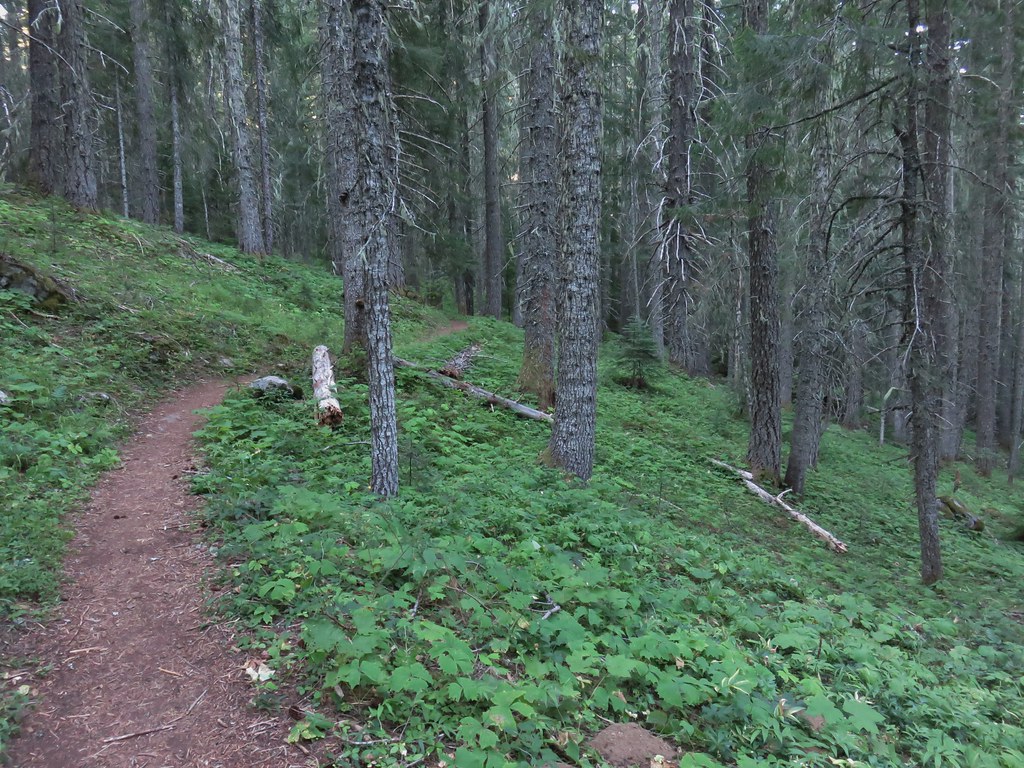
IMG_5825Entering the Three Sisters Wilderness.

IMG_5831A few survivors amid the snags.

IMG_5832Green Lakes Trail junction.

We stayed straight at the junction continuing on what was now the Green Lakes Trail. This trail descended a little before arriving at Soap Creek three quarters of a mile from the junction.
IMG_5834

IMG_5839Broken Top and the South Sister

IMG_5842

IMG_5844Monkeyflower along Soap Creek

On the far side of the creek was a familiar junction, the Camp Lake and Green Lakes Trail junction where we had been on our 2014 loop around the South Sister (post).
IMG_5851

Instead of crossing the creek we left the trail here and headed west. This portion of the hike requires off-trail navigational and route finding skills. There was, at times, what appeared to be a user trail but it was faint and prone to disappearing only to reappear in an unexpected place. In general we followed the directions in the guidebook although our routes there and back were quite different (at least for a 1 mile stretch). The instructions were to follow the climbers trail for 2ish miles then head cross country toward a yellow bulge on North Sister. The lack of green trees allowed for a lot more views of North Sister which assisted in keeping us oriented. We used our topographic maps to help us stick to what appeared to be the gentlest terrain and eventually found ourselves looking at the daunting moraine to the left of the yellow bulge.
IMG_5859Soap Creek

IMG_5863View of the North Sister that would not have been there pre-fire.

IMG_5868Soap Creek and the Middle and North Sister

IMG_5870Monkshood

IMG_5891Might be a trail in there, might not.

IMG_5894Decent look at the yellow bulge on North Sister.
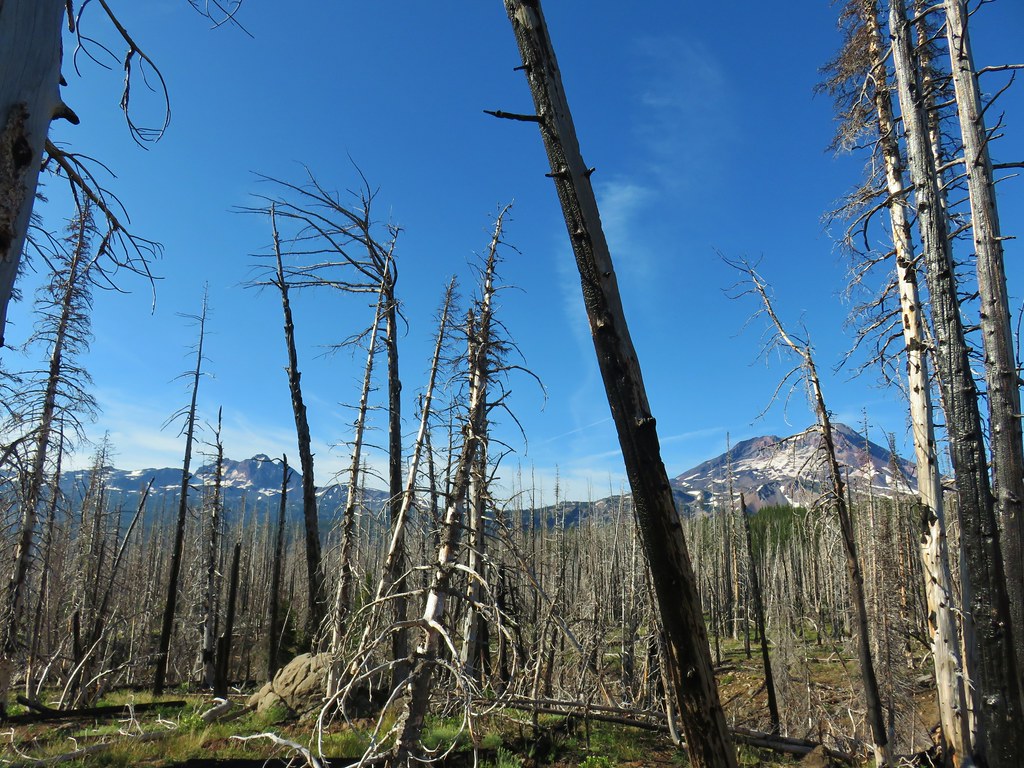
IMG_5895Broken Top and South Sister

IMG_5896Soap Creek

IMG_5903Meadow where there was no discernible trail apparent.

IMG_5909Typical cross country obstacles.

IMG_5915

IMG_5922

IMG_5930Dry creekbed.

20190813_093156Elephants head

IMG_5946The moraine to the left of the bulge.

We stopped briefly to watch what appeared to be a golden eagle soaring overhead trying to evade a smaller raptor that was annoyed by the larger birds presence.
IMG_5951

IMG_5956

We wound up a bit further north than intended and had to veer NW to reach the meadows around the springs feeding Soap Creek.
IMG_5960

IMG_5963A clump of Monkeyflower

IMG_5968

IMG_5973

IMG_5986Penstemon

IMG_5989_stitch

After a little over two hours and approximately three miles from where we’d left the Green Lakes Trail we found ourselves resting in the shade of a large rock near the moraine.
IMG_6001Our shady spot.

While we rested by the rock we discussed our planned route up the moraine. The steep loose rock would not be easy and we wanted to try and find the safest route to what was hopefully the lowest point along the moraine. After agreeing on a route and picking a point to aim for we set off on the final three quarters of a mile climb to the rim above Thayer Glacial Lake.
IMG_6006

IMG_6008

IMG_6015Paintbrush growing on the moraine.

IMG_6017

IMG_6021More flowers amid the rocks.

IMG_6023

After a couple (dozen) course corrections I passed between a pair of large cinder rocks I dubbed “Thayer Gate” and a few moments later was looking at the lake.
IMG_6024

IMG_6026

IMG_6049_stitch

While Heather headed down to the lake shore I detoured up along the rim to the south to check out the views.
IMG_6057The yellow bulge, Mt. Hood, Black Crater and Black Butte to the north.
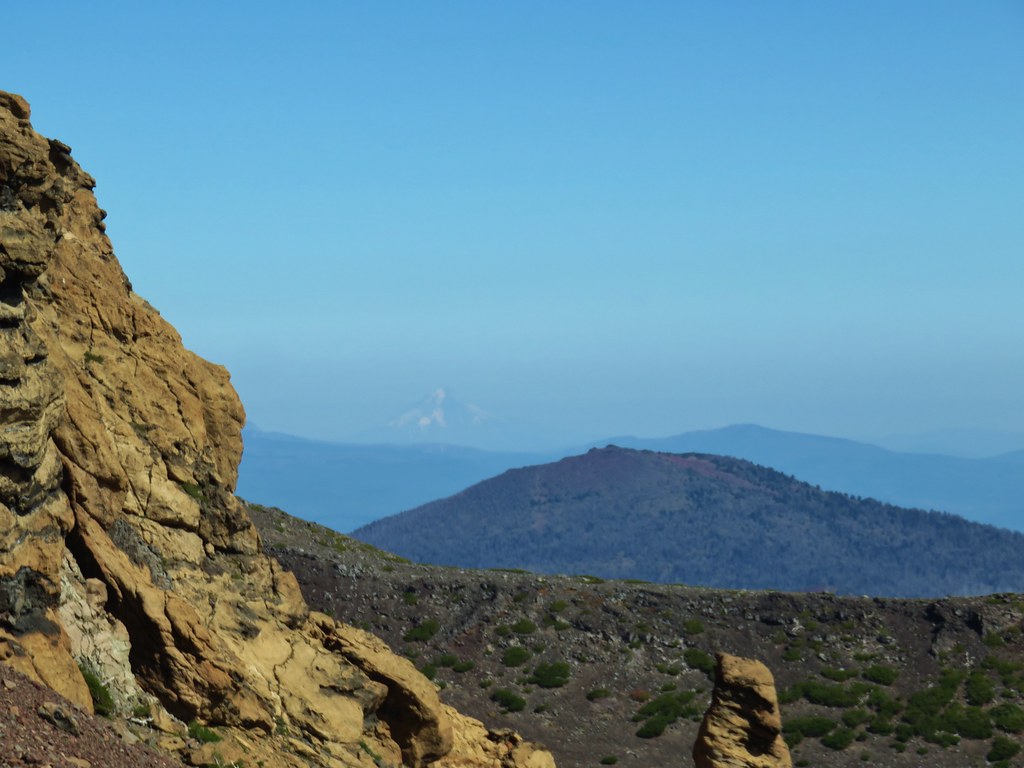
IMG_6059Mt. Hood

IMG_6037Broken Top to the north.

IMG_6043The rim above Thayer Lake.

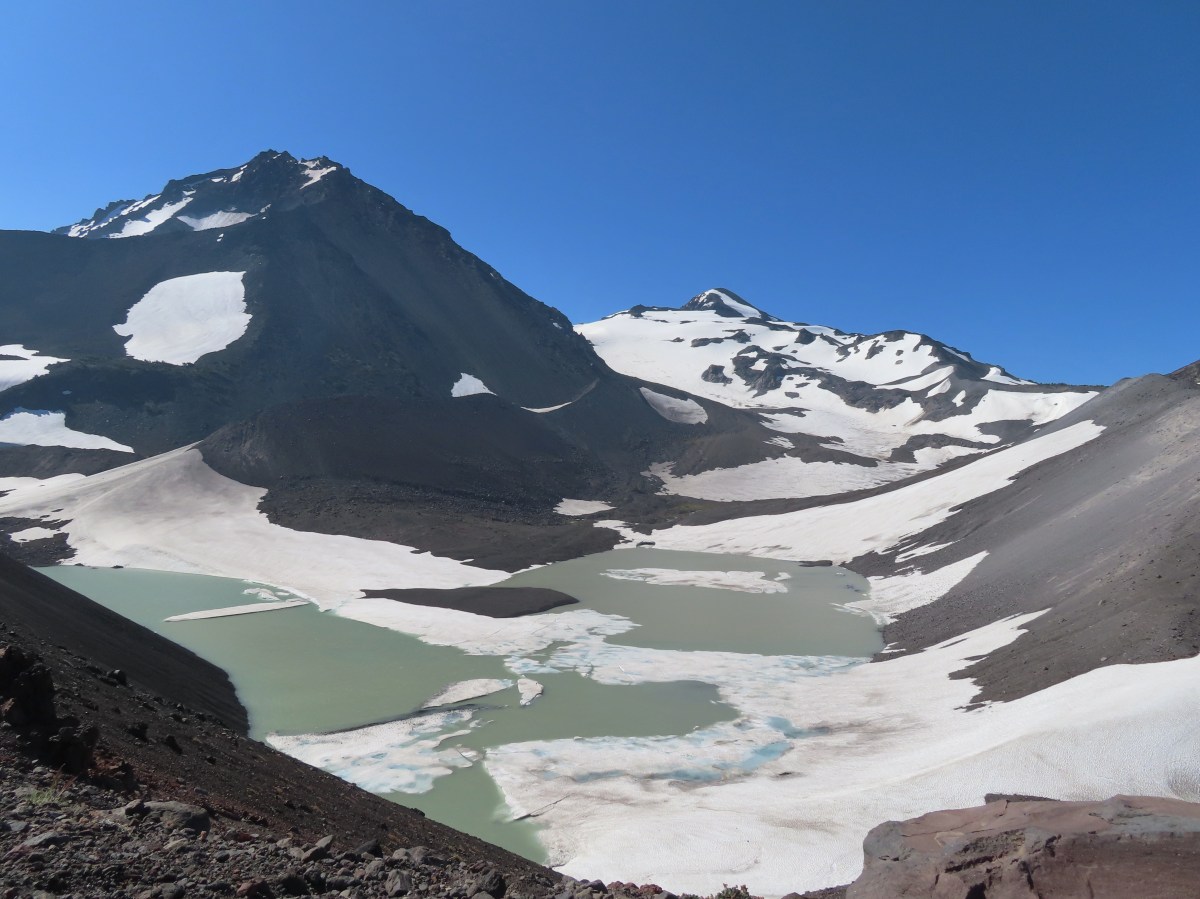
IMG_6045North Sister and the Thayer Glacier

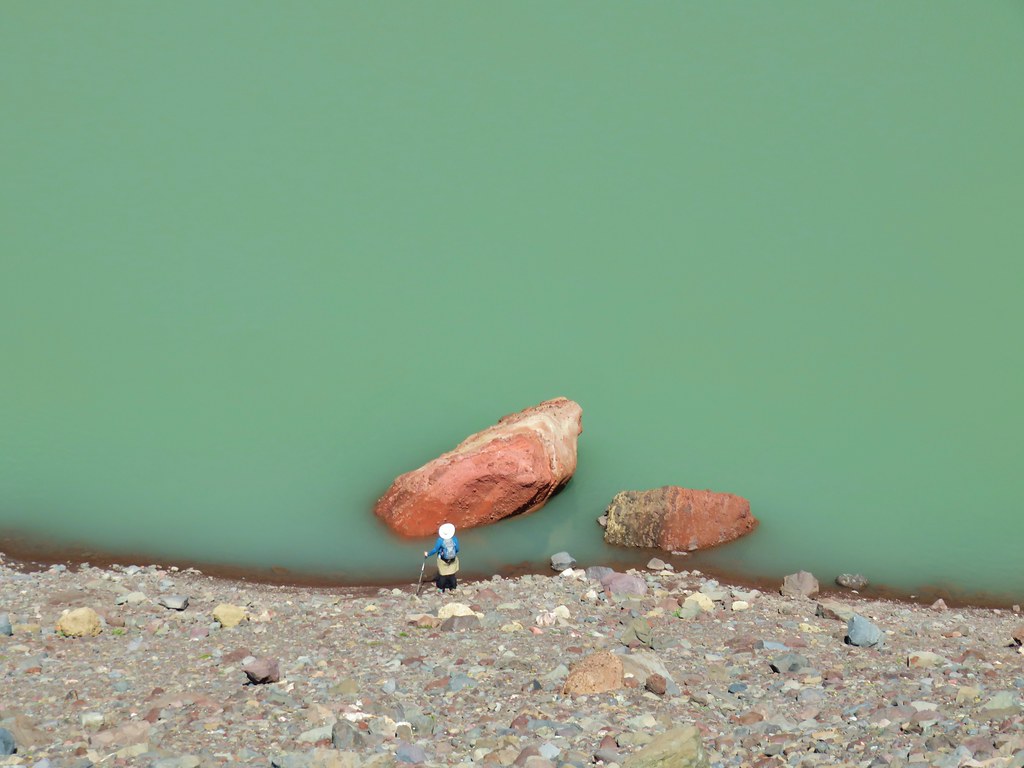
IMG_6061Heather near some large boulders in the lake.
IMG_6063

We explored along the lake looking at the remaining ice, one piece resembled a listing boat, and admiring the textures and colors of the volcano.
IMG_6066

IMG_6073

IMG_6080

IMG_6077

IMG_6084

IMG_6085

The water was frigid but the temperature by the lake was pleasantly cool and we would have liked to have stayed there for hours but we still had to get back so we eventually pulled ourselves away and headed back down the moraine.
IMG_6086

IMG_6094

We headed toward the springs feeding Soap Creek and kept working our way north trying to stay to the left of the wildflower lined streams.
IMG_6095

IMG_6103

IMG_6107

IMG_6111

IMG_6121

IMG_6127

This proved to be a little trickier than expected as we kept coming upon more springs as we went.
IMG_6130

IMG_6140

IMG_6155

We followed Soap Creek into a narrow canyon which turned out to be a bit of a mistake and had to climb steeply over the north ridge when it became to steep and narrow.
IMG_6161

IMG_6168

IMG_6171

IMG_6173Starting to get too narrow and the topographic map showed it getting more so further downstream.

IMG_6174Climbing out of the gully.

IMG_6176Broken Top and South Sister from the ridge.
We descended the ridge heading NE using our GPS to hook up with our earlier route up. After a couple of ups and downs over smaller ridges we found ourselves in the general area through which we’d come up. We roughly followed our route back to the Green Lakes Trail without much excitement. The one thing that was different was the creeping wire lettuce blossoms which had opened up to the Sun and dotted the ground in places.
IMG_6187

We then followed the trails back to the Pole Creek Trailhead which was full of cars. It surprised us a bit being a Tuesday, but it’s one of the stated reasons by the Forest Service for the permit requirements that go into effect in 2020 for many of the trailheads in the Three Sisters, Mt. Washington, and Mt. Jefferson Wilderness areas.

Cook lists the hike as 5 miles one way, but we wound up with 11.5 miles round trip with nearly 3000′ of cumulative elevation gain. The off-trail travel makes it an even harder hike than those state would indicate. All that being said it was worth the effort and we were glad we’d made the trip. Happy Trails!

Flickr: Thayer Glacial Lake

Categories
High Cascades Hiking Oregon Three Sisters Area Throwback Thursday Trip report

Throwback Thursday – Obsidian Trail & Four-in-One-Cone

Today’s Throwback Thursday hike was given the name “The hike that shall not be named” by our Son, Dominique. What was supposed to be a 15 mile loop with spectacular mountain views in the Three Sisters Wilderness wound up being an 18.6 mile, mostly view-less loop, through fog and drizzle.

On 10/14/2012 we set off from the large Obsidian Trailhead into the Obsidian Limited Entry Area. The trailhead is located on Forest Road 250 off of Highway 242. A number of wildfires burned through the Three Sisters Wilderness in 2017 most likely affecting some of the forest in this area. As always, check with the Forest Service for current conditions before heading out.

A limited number of permits are available each day for entry into the Obsidian area and we had purchased ours months in advance. Due to having to purchase the permit early we were at the mercy of weather. We arrived before day light which would be delayed a bit due to the damp fog covering the area.
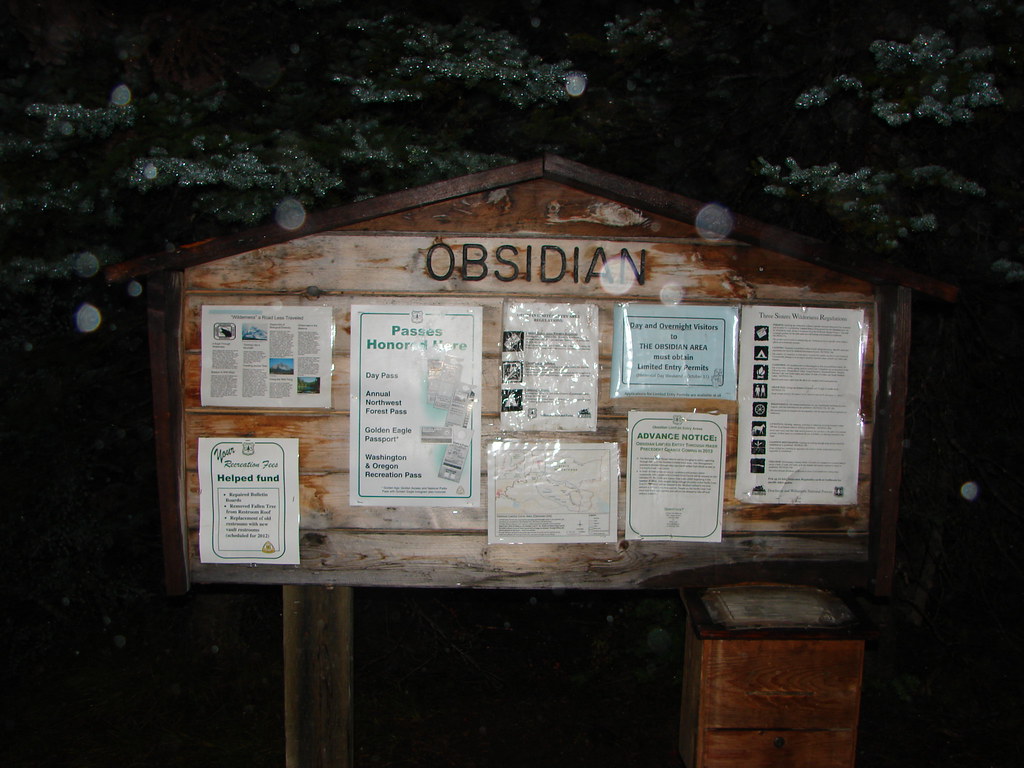
Signboard at the Obsidian Trailhead

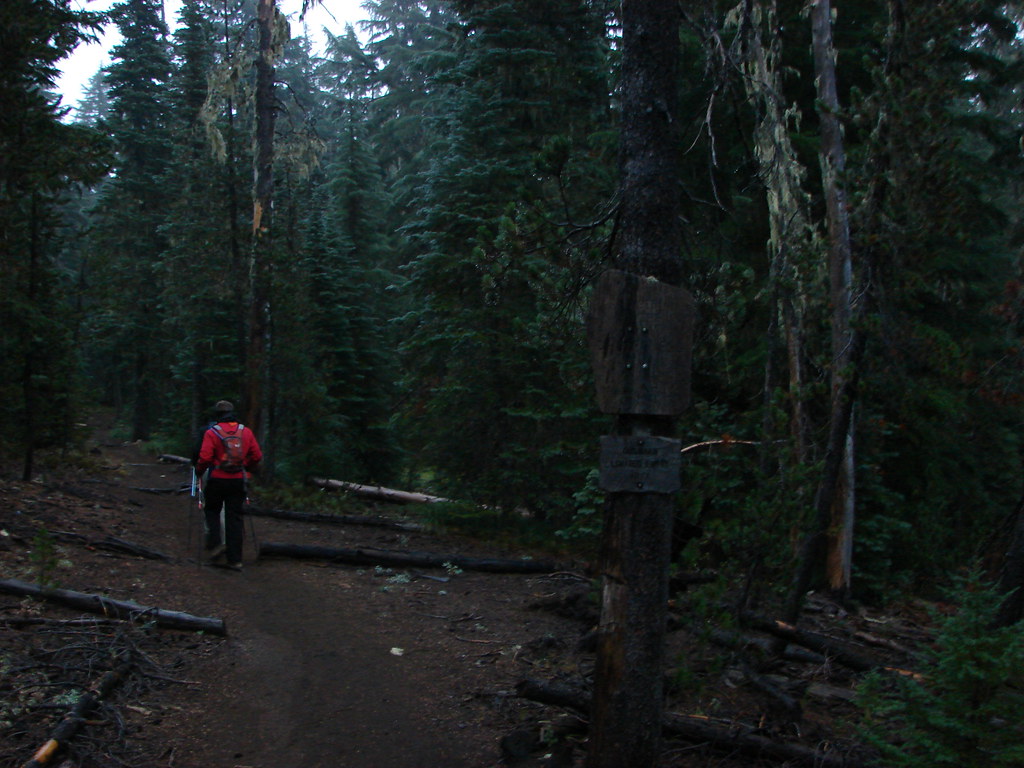
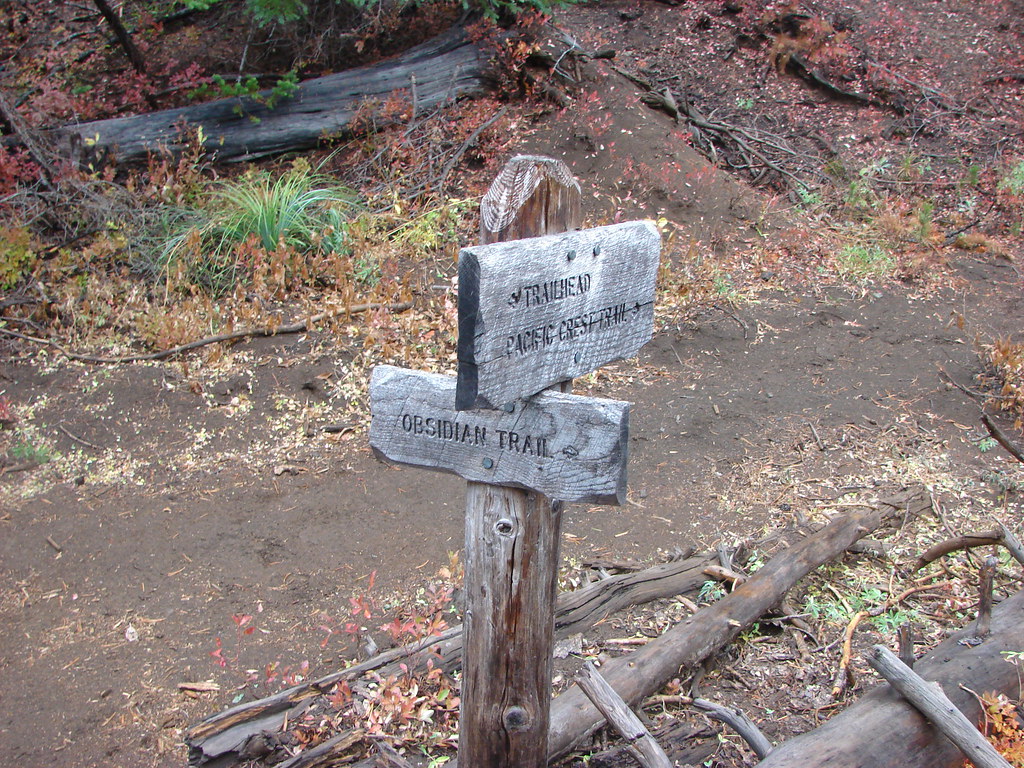
Trail sign along the Obsidian Trail

When we had enough light we set off on the Obsidian Trail which quickly entered the Three Sisters Wilderness.
Obsidian Trail entering the Three Sisters Wilderness

Obsidian Trail

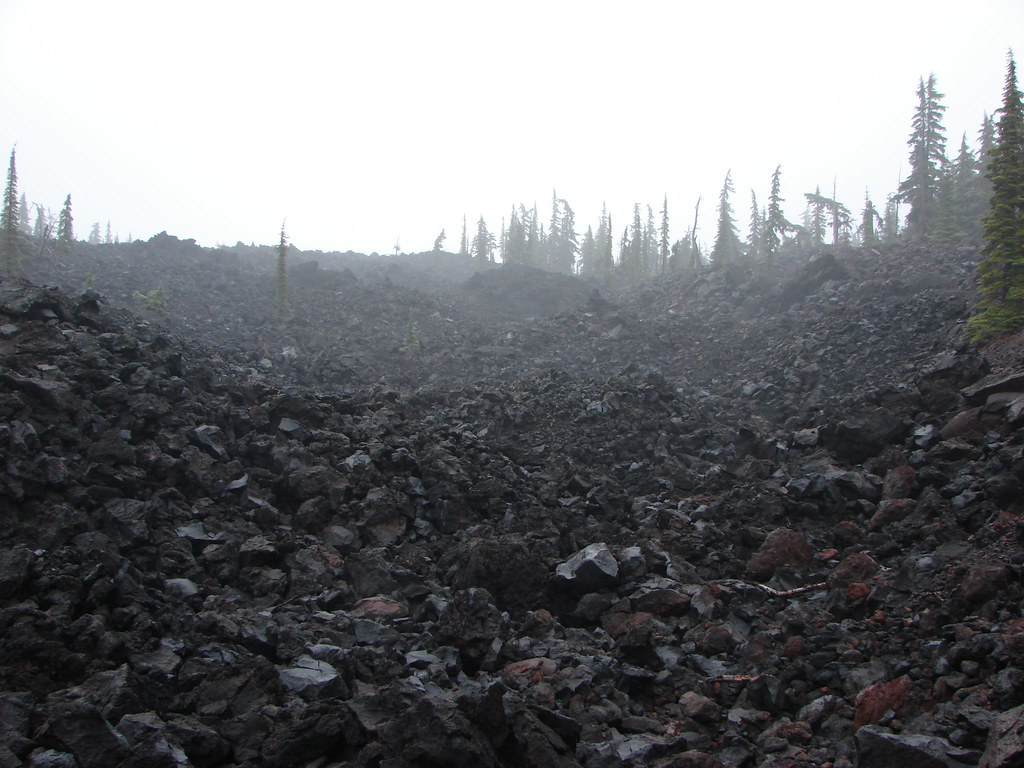
Just under 3.5 miles from the trailhead the trail passed through the Jerry lava flow. According to our guidebook there is a view of several Cascade peaks from the flow but all we could see were clouds.
Obsidian Trail

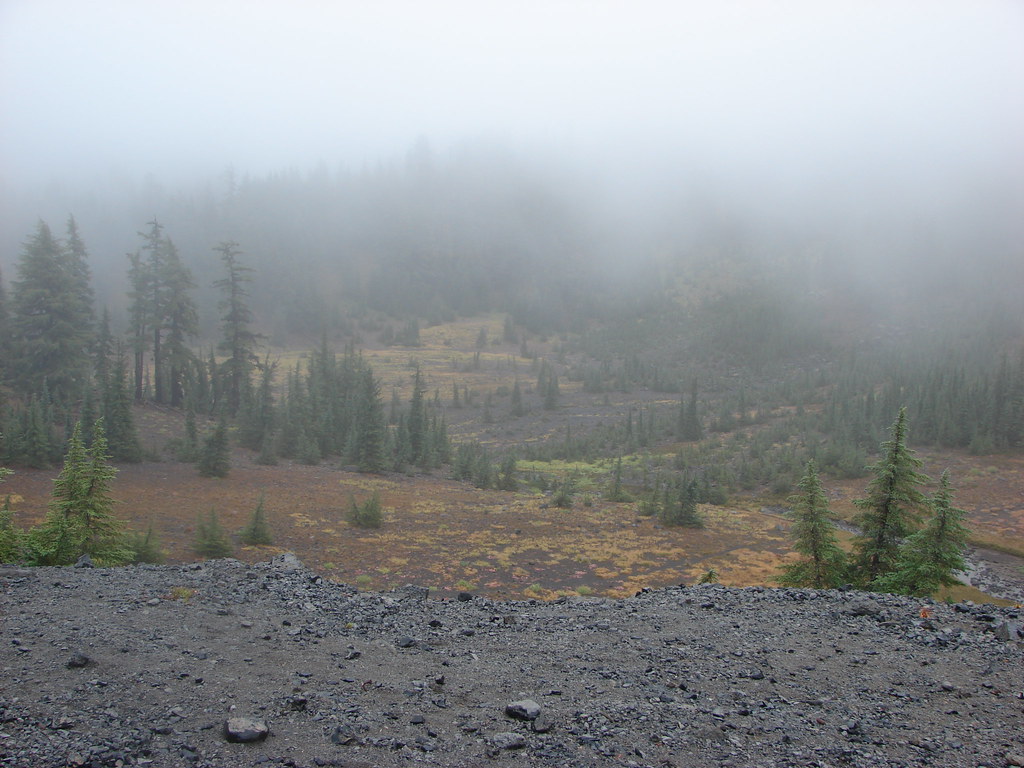
Cloudy day in the Three Sisters Wilderness

Jerry Lava Flow

The trail descended on the far side of the lava to a crossing of the White Branch Creek which was practically dry at the time.
Obsidian Trail approaching the White Branch

White Branch

The trail split just on the other side of the creek which is where our 15 mile hike turned into something longer. I had misunderstood the description of the loop option in the guidebook. The entry in the book was for a 12 lollipop hike for which it had you take the right hand fork 1.7 miles to the Pacific Crest Trail then turn left on that trail for 1.4 miles to another junction in the Sunshine Meadow. Here a left turn would lead .7 miles back to the junction near the White Branch. The loop option that we were trying to follow simply said that from Sunshine continue on the PCT for 2.2 miles to Collier Cone then another 1.8 miles to the Scott Trail, turn left for 4.9 miles, and turn left again on a .6 mile connector trail back to the Obsidian Trailhead. I failed to notice that the entire route was only 15 miles if we took the left fork to the PCT which was .7 vs 3.1 miles (The other additional mileage was due to side trips up the Collier and Four-in-One Cones).
Trail sign near White Branch

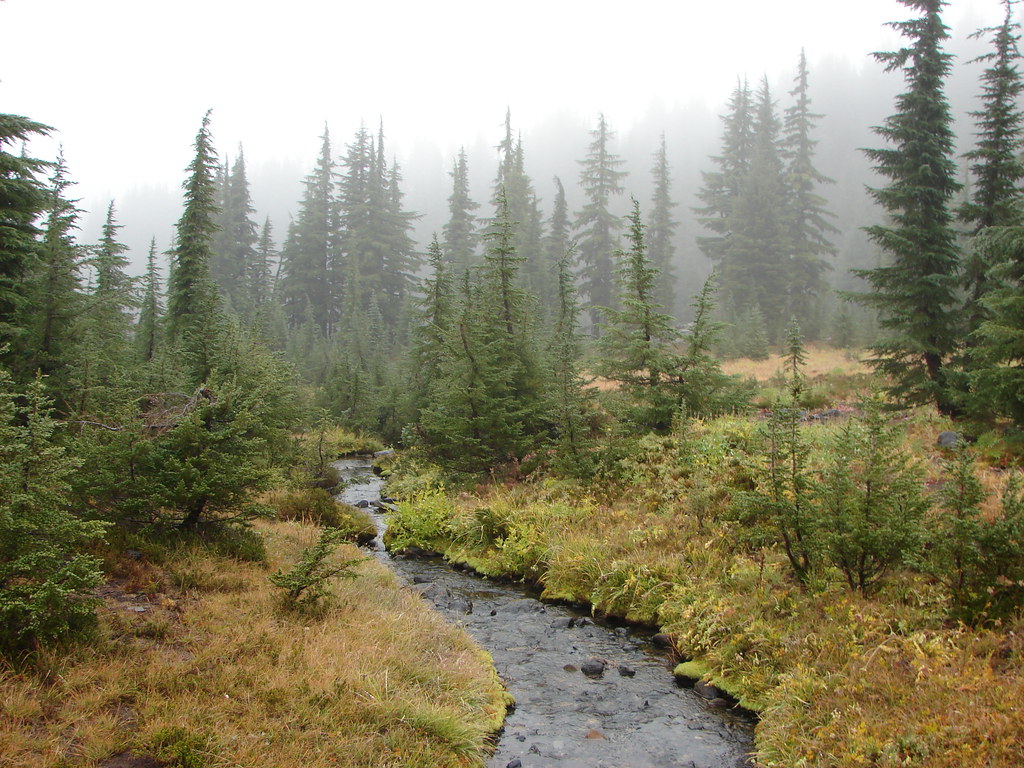
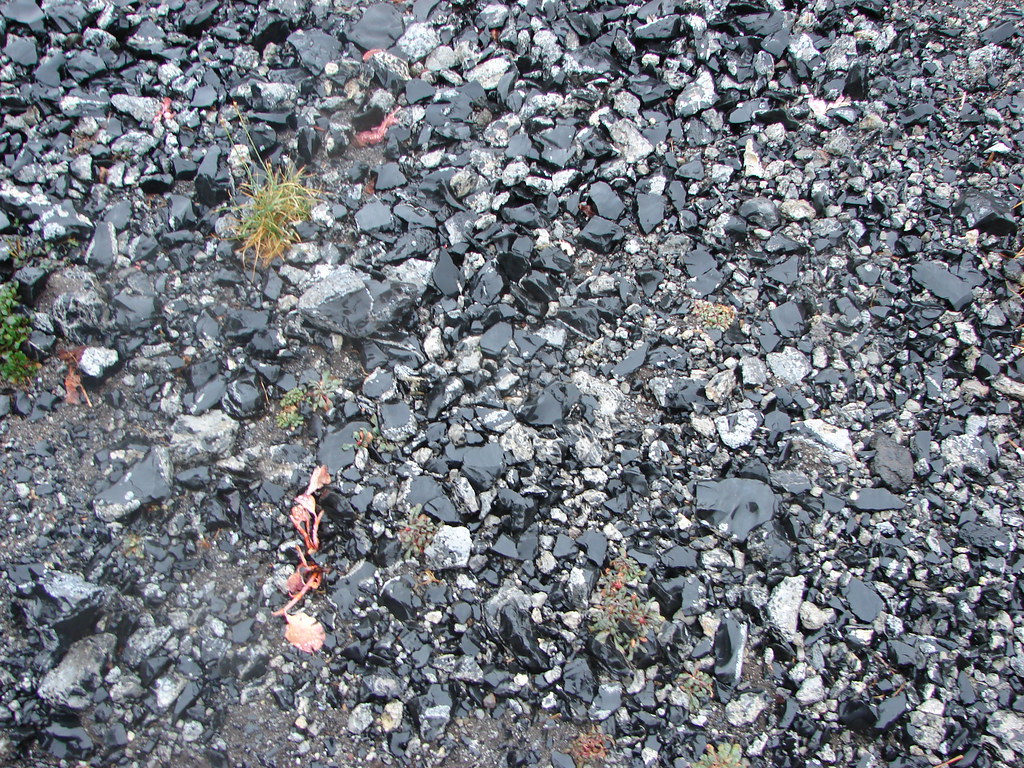
We went right. The scenery along the trail was nice but would have been even better without the clouds and with some flowers still in bloom. That being said the South Fork White Branch still had water flowing and there was plenty of obsidian along the trail making it pretty obvious how this trail got its name.
Obsidian Trail

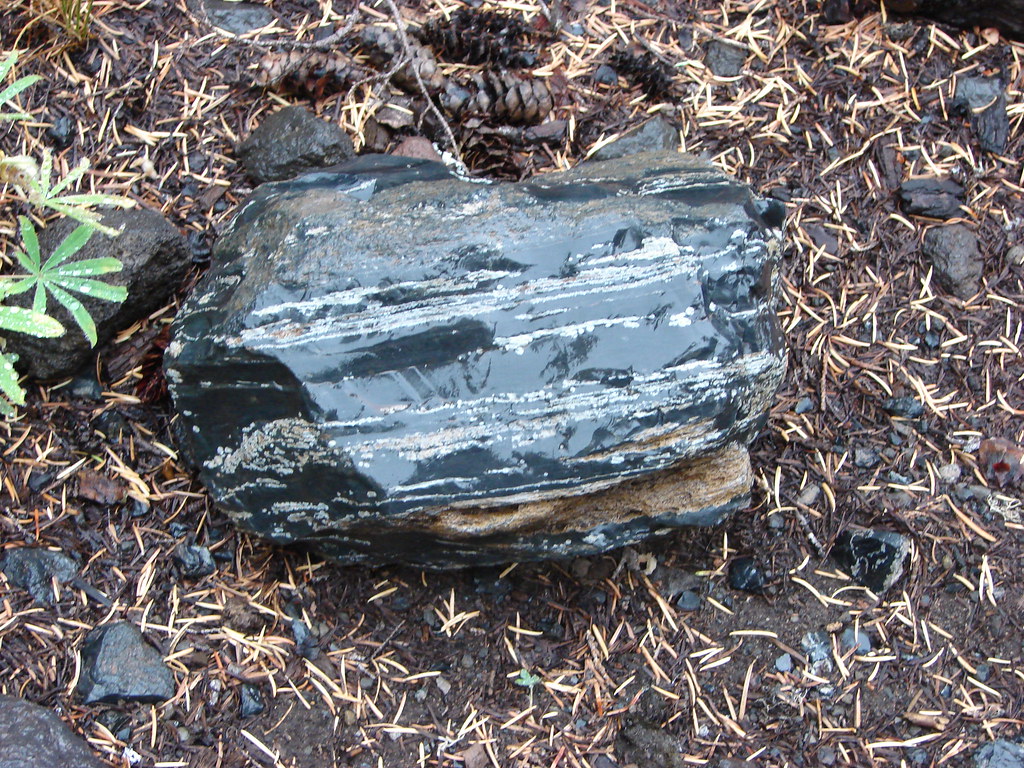
Obsidian on the hillside

Obsidian

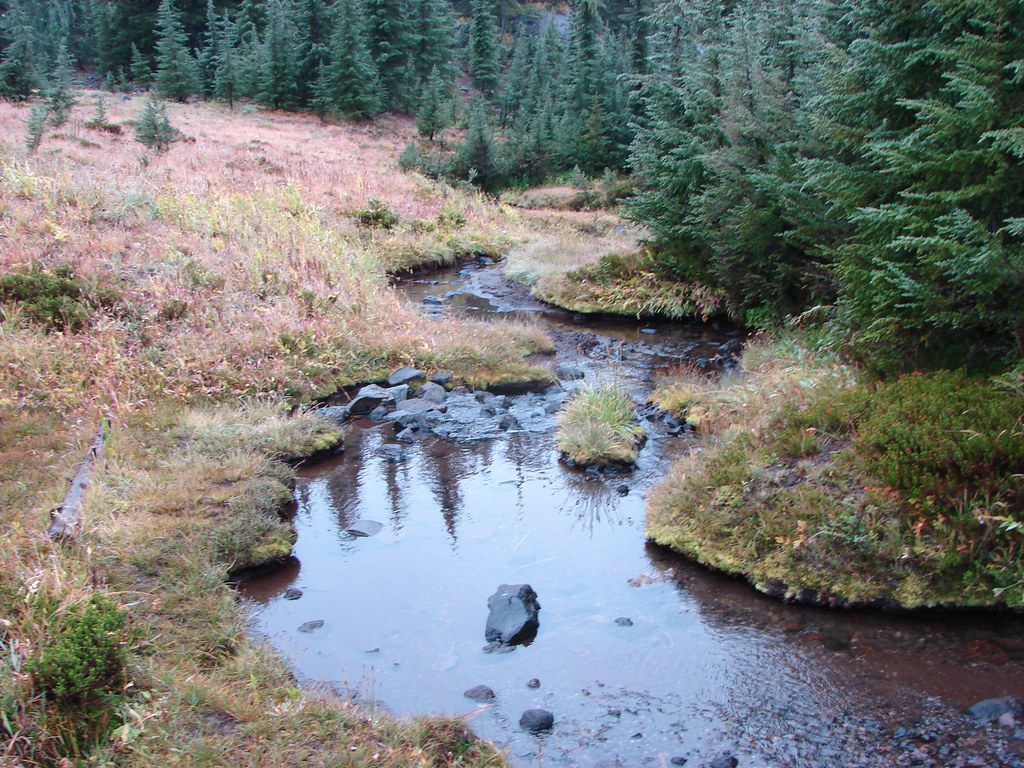
South Fork White Branch

South Fork White Branch

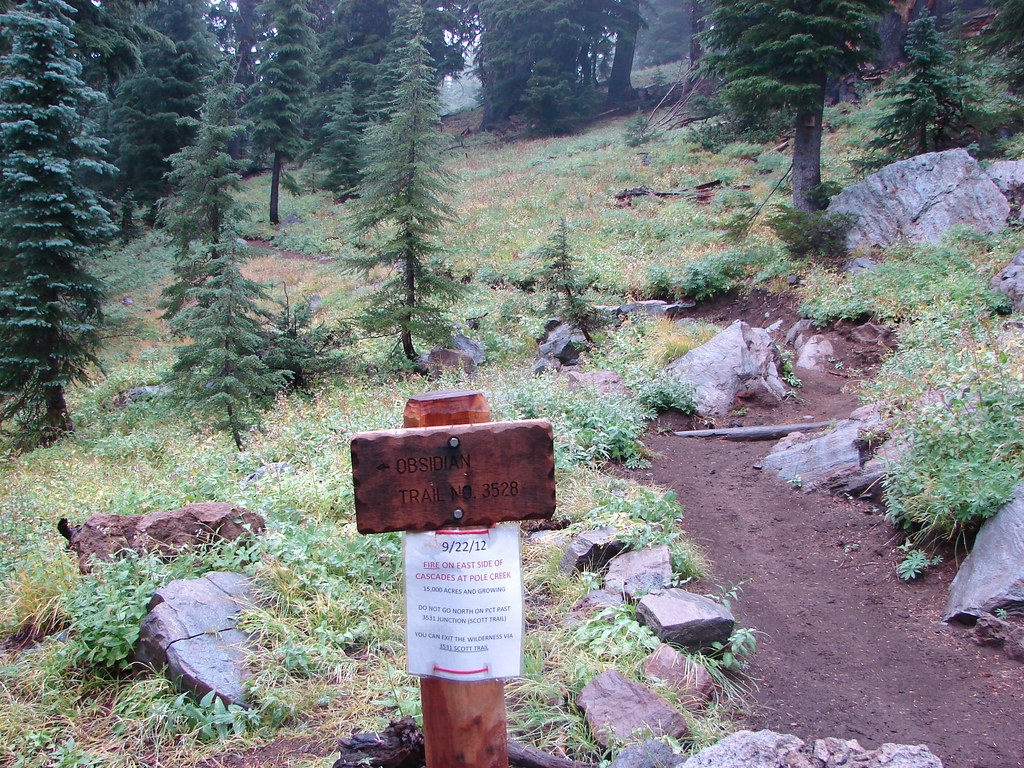
We reached the junction with the PCT where signs were posted about the stubborn Pole Creek Fire which was still smoldering in the eastern portion of the wilderness.
Obsidian Trail junction with the Pacific Crest Trail

Dominique spotted a small group of deer near the junction but they scampered off before I could get a clear picture due to the camera lens continually fogging up.
Deer near the Pacific Crest Trail

A short time after turning north onto the PCT we came to Obsidian Falls, a small but scenic cascade.
Obsidian Falls

Obsidian Falls

After visiting the base of the falls we continued north crossing Obsidian Creek and passing its source at Sister Spring.
Obsidian Creek

Sister SpringSister Spring

At this point we were very near to the Middle and North Sisters but there was no way we were going to see anything above us through the clouds.
Talus above Sister Spring
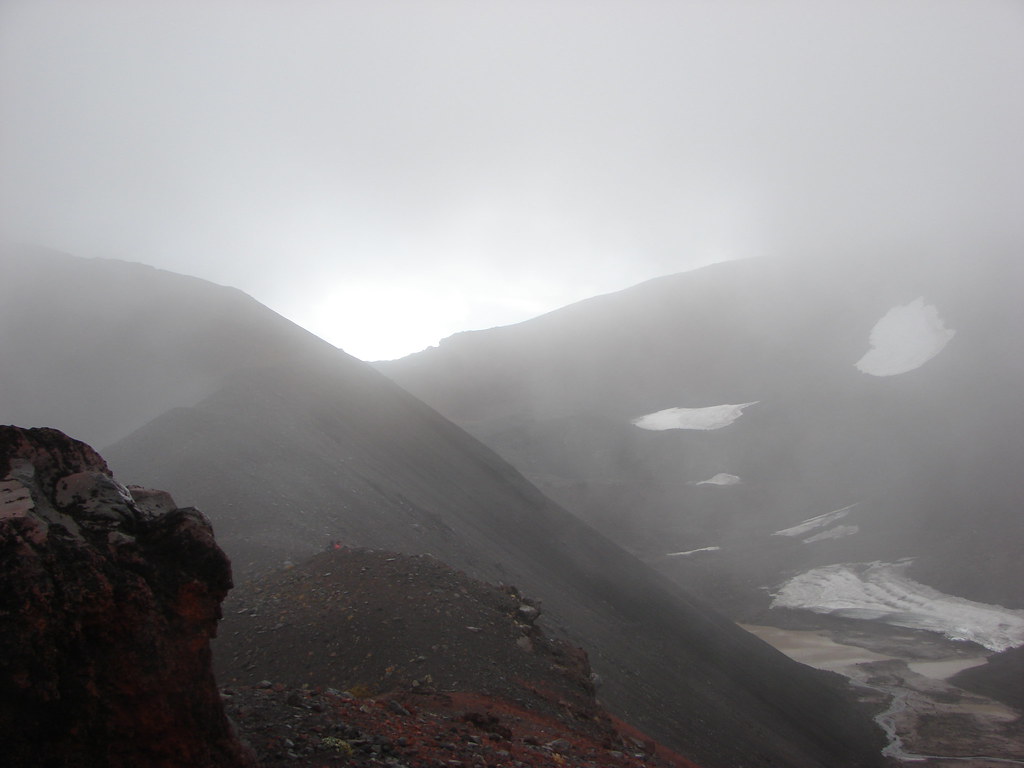
The PCT then passed the small Arrowhead Lakes and more obsidian.
Pacific Crest Trail

One of the Arrowhead Lakes

Obsidian

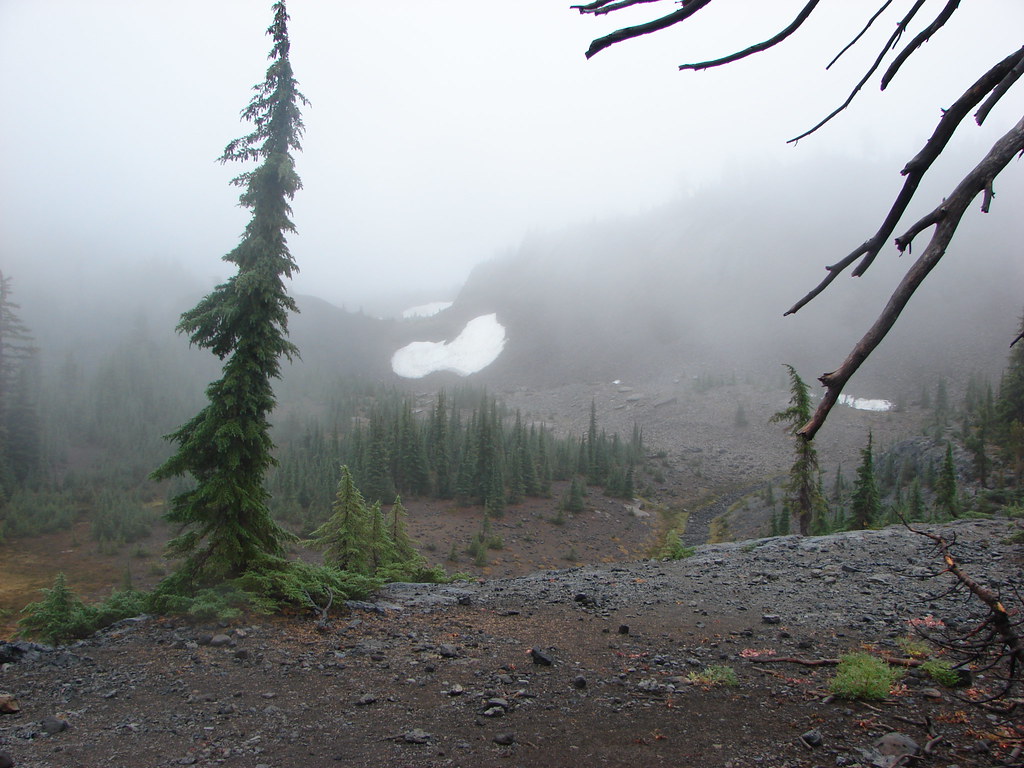
We continued on the PCT which was now approaching the 7810′ Little Brother which was beyond Sunshine. We could see the meadow and Glacier Creek below but the Little Brother was for the most part hidden from sight.
Sunshine

Snow from the Pacific Crest Trail

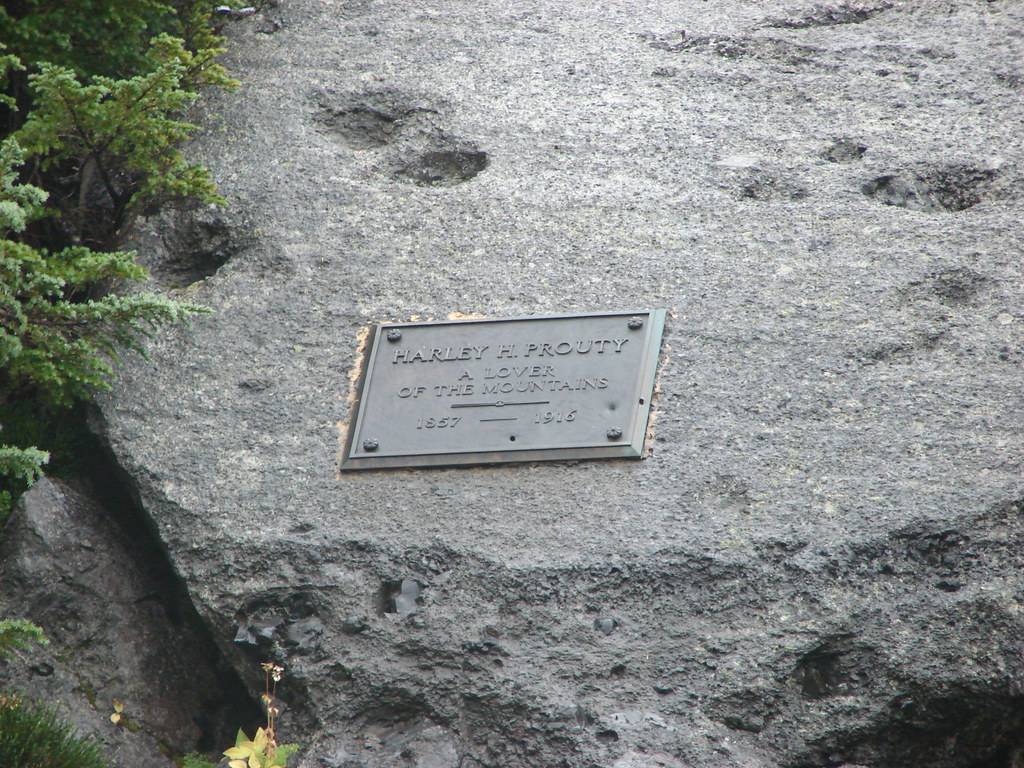
On the way down to Sunshine we spotted the Harley H. Prouty Memorial Plaque.
Harley H. Prouty Memorial Plaque

Sunshine

At Glacier Creek we found the junction with the Glacier Way Trail which was the left hand fork we should have taken at the White Branch.
Glacier Creek

Pacific Crest Trail junction with the Glacier Way Trail

Still thinking we were on a 15 mile hike we continued north on the PCT instead of opting for the 12 mile hike and turning down Glacier Way. The trail passed through many small meadows that were probably home to plenty of summer wildflowers based on the amount of lupine leaves we saw. There was no lupine blooming anymore but we did spot a lone western pasque flower gone to seed.
Pacific Crest Trail

Drops of water on lupine leaves

Western pasque flower

A little under 2 miles from Sunshine the PCT arrived at the Jerry Lava flow.
Pacific Crest Trail

Above the lava in the fog we could see the Collier Cone.
Jerry Lava Flow

A .3 mile side trip would lead to a viewpoint along the rim of the cinder cone but first we had to pass through the lava flow to Opie Dildock Pass. Along the way there we spotted some lupine still in bloom, patches of snow, a tree with a rather unique top, and some real life blue sky.
Pacific Crest Trail

Lupine

Snow patch in the Jerry Lava Flow

Sculpted tree top

A little blue sky

We almost thought we’d lost the trail below the pass but the PCT simply scrambled up a gully in the lava.
Pacific Crest Trail heading up to Opie Dildock Pass

Pacific Crest Trail

A small cairn marked the side trail into the fog filled cone.
Heading into Collier Cone

We followed a use path up to the rim.
Inside Collier Cone

But for the fog we would have had an up close view of the Collier Glacier and the North and Middle Sister.
Collier Glacier

We took an extended break on the rim and in that time the fog lifted just a bit. We could at least see back down into the cone and every once in a while we got a glimpse of the northern flank of the North Sister.
Collier Cone

Light coming from the NE side of the North Sister

North Sister

We finally headed down resigning ourselves to the fact that the views weren’t going to get any better on this trip. We returned to the PCT and headed north once again. We did get a little more blue sky overhead and the fog continued to lift allowing us to at least see a little more of our surroundings.
Blue sky for a brief moment

Pacific Crest TrailYapoah Crater in the distance.

We were now heading away from the North Sister toward Scott Meadow and the Scott Meadow Trail. We arrived at the meadow and trail junction 1.8 miles from the side trail into Collier Cone.
Scott Meadow

Pacific Crest Trail in Scott Meadow

The Pole Creek Fire had forced the closure of the PCT at the junction.
Pacific Crest Trail closed due to the Pole Creek Fire at the Scott Trail junction

The meadow looked like it would be an impressive wildflower meadow in summer and provide some good mountain views. On this day the meadow was mostly brown and the mountains nearly hidden although we did get our best glimpse of a mountain looking back at the North Sister from the junction.
North Sister and Collier Cone

North Sister and Collier ConeNorth Sister and the Collier Cone
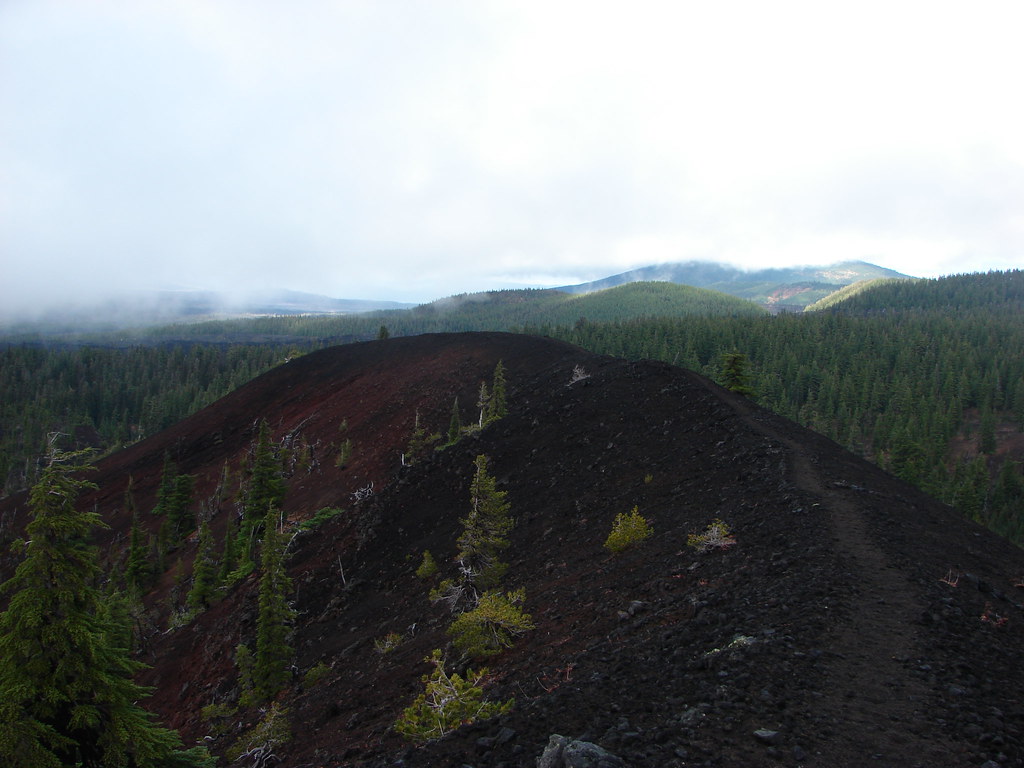
We vowed to come back to that spot to try again some summer which we did in 2013.
(post)

We turned down the Scott Trail which followed a dry creek bed for a bit before entering a vast pumice plain.
Dry creek along the Scott Trail

Scott Trail

Just over 3/4 of a mile from the Scott Meadow jct we turned right onto a side trail which led up another cinder cone – Four-in-One Cone.
Four-in-One Cone

Climbing Four-in-One Cone

As the name indicates this geologic feature is not a single cinder cone but four connected cones. A path follows the length of the ridge providing plenty of opportunity for views, but not necessarily for us.
Four-in-One Cone

View from Four-in-One Cone

View from Four-in-One Cone

I arrived at the top of the cone first and Dominique soon joined me as I gazed toward the cloud covered Three Sisters. We were about 13 miles into the hike now (we had also done a 13.5 mile hike the previous day) and we were all getting a little tired. The lack of views wasn’t helping raise spirits either. When Dominique reached me he looked around and then asked where the trail went from there. When I informed him it didn’t go anywhere and that it was just another spur trail to a viewpoint he gave me what could only be described as a death stare. His only response was “You mean we didn’t have to climb up here?”. I left him fuming at the southern end of the cone while I headed north along the rim. There I stared into the clouds where Mt. Jefferson, Three Fingered Jack and Mt. Washington should have been.
Four-in-One Cone

We were all dragging a bit as we made our way back to the Scott Trail and headed west. It wasn’t long before we were all suffering from what I’d call “trail madness”. We were moving but only because we had to in order to get back.

A little under a mile from the cone we crossed another lava flow.
Scott Trail

We spent the next 2.7 miles in the forest wondering why a 15 mile hike was seeming so hard and taking so long.
Scott Trail

When we finally arrived at the junction with the .6 mile connector trail to the Obsidian Trailhead Heather gave it a kiss.
Scott Trail junction with the connector trail to the Obsidian Trailhead

We managed to will ourselves through the final stretch and back to our car eager to get back to Bend and find some substantial food. The lack of views had been really disappointing given just how spectacular they should have been, but the real kick in the teeth came after we’d made it back to the east side of the mountains. Beyond the farms near Sisters we had a clear view of all Three Sisters as well as the bank of clouds that had plagued us all day on their western flanks.
The Three Sisters from Sisters, OR

Middle and North Sister

It appeared that we’d been on the wrong side of the mountains all day. Some day we’ll get back to the area which hopefully wasn’t too damaged by last years fires. Until then we have the memories of the “Hike that shall not be named”. Happy Trails!

Flickr: Obsidian Trail & Four-in-One Cone