
Our hike this week took second fiddle to our son’s birthday which we planned to celebrate by taking him out to lunch/dinner in Eugene. We still wanted to get a hike in that morning, so we looked for something in the general direction of Eugene. Our original plan had been to visit Vivian Lake near Diamond Peak, but a forecast of rain, followed by snow, then more rain had us look elsewhere. Looking at my list of future hikes a couple of hikes between Corvallis and Newport caught my eye. They were more or less on the way to Eugene and the weather forecast looked good. The two hikes had been Strom Boulder Ridge and Olalla Reservoir. Double checking the status of the hikes revealed that Georgia Pacific, who manages Olalla Reservoir, had closed access due to low water at the beginning of September so that hike was out. I then turned to the Oregon Hikers Field Guide to look for another short hike in the area and found the Big Creek-Forest Park Hike in Newport.
We began with the Big Creek hike parking at the Agate Beach State Recreation Site.

A trail begins near the restrooms at a footbridge over Big Creek.

 Big Creek in the morning.
The trail follows Big Creek toward Highway 101 then recrosses it leading to a tunnel under the highway.
 A short section of the trail was paved.
 At the eastern end of the parking area we came to this new kiosk that is being installed marking the start of the Agate Beach TRACK Trail. There was also a path directly to the parking lot from the kiosk which we used upon our return.

 The tunnel under Highway 101. The stairs at the far end lead up to a city street while the trail makes a hard right to briefly follow the highway back across Big Creek.

 A series of boardwalks crosses the marshy bottomlands of Big Creek.
 While the kiosk was a new work in process there were a number of older looking interpretive signposts. This was one of only a handful that still contained an interpretive sign.
 The bottomlands.


 There were no signs at junctions but for the TRACK Trail stick to the level fork and ignore anything going uphill.
 Further along the trail Big Creek could actually be seen flowing.
 A non-boardwalk section along Big Creek.

 Approximately three quarters of a mile from the kiosk the trail arrived at Big Creek Road at another new signboard.
 The signboard at Big Creek Road didn’t have any information on it yet.
We turned right on Big Creek Road passing a large overflow parking lot for Big Creek Park and Reservoir, crossed Big Creek, and then turned left into Big Creek Park.

 Stellar’s Jay
 Northern flickers on the picnic shelter.
A signboard near the picnic shelter marked the start of the Forest Park Trail.
 Map on the signboard.
Don’t be fooled by the footbridge over Anderson Creek to the right of the signboard, the Forest Park Trail follows an old gravel roadbed steeply uphill to the left of the sign.
 Anderson Creek, the footbridge, and signboard from the roadbed.
 The Forest Park Trail
While the Track Trail had gained almost no elevation the Forest Park Trail climbed over 200′ in its first half mile to a pair of water towers.
 A nice sitka spruce forest lined the old roadbed.
 Mushrooms
 Sunlight hitting the trees.
 The Pacific Ocean through the trees near the water towers.
 Passing the water towers.
Beyond the towers the trail dropped 160′ to wetlands along Jeffries Creek then climbed nearly another 90′ to a gate at the Fogarty Street Trailhead.

 The drop to Jeffries Creek.
 Jeffries Creek
 Wood ducks in the wetlands.
 The gate near Fogarty Street.
 The Forest Park Trail from the other side of the gate.
We returned to the kiosk at the start of the TRACK Trail the way we’d come then cut to parking lot and returned to our car. The hike came to 4.0 miles with just over 550′ of elevation gain, nearly all of which was on the Forest Park Trail. The TRACK Trail seems like a good option for kids with the Forest Park Trail adding some short, steep climbs for those looking for more of a workout. The ability to visit Agate Beach from the parking lot is a huge bonus. We didn’t have time today to visit the beach but had in 2018 during our Yaquina Bay hike (post).

For our next stop at Strom Boulder Ridge we drove East on Highway 20 from Newport to Burnt Woods and turned right onto Harlan-Burnt Woods Road. We followed this road for 2 miles then turned right onto the unsigned gravel Burnt Woods Forest Road. I found this hike on Alltrails which I have somewhat reluctantly been looking at more frequently, mostly to check for recent trip reports but there are also some obscure “hikes” that don’t appear in any of our guidebooks or in the Oregon Hikers Field Guide. Strom Boulder Ridge is one such “hike” which is really just a 7.5-mile loop on drivable gravel logging roads on Oregon Department of Forestry managed lands. As such there is no official trailhead (although Google Maps seems think there is). The loop begins 0.7-miles up the forest road but we decided to park at a pullout next to a gravel pile halfway to the start of the loop.

 Morning fog was still burning off at 9:30am.
One thing to note is that there isn’t any signage and because the area is actively logged roads may be added or closed depending on operations. I had downloaded the Alltrails track and we had our GPS units with us. Almost immediately we passed a logging road coming downhill on the left that was not shown on either the Alltrails or Garmin maps.
 A car by the gravel pile to the left with the road coming down the hillside to the right. Interestingly Google Maps labels this as “Burnt Woods Ridge Road” which both Alltrails & Garmin showed as the left-hand fork where our loop would begin. (Google doesn’t show a road there at all but you can see the road in the trees by looking at the aerial view.) Numerous times throughout the hike we relied on comparing the Alltrails Track to the GPS map and our track to that point to determine where we were and which road(s) to take.
The trip reports on Alltrails had all mentioned how quite this hike was and it was (we saw no other hikers and only passed one pickup truck on the loop) other than the gunfire that we heard almost immediately and then off and on throughout the majority of the hike. We followed the road uphill to a saddle then dropped slightly to a fork marking the start of the loop.

 There was some room to park here at the start of the loop (this is not where Google marks the TH) as well as many pullouts along the loop where one could choose to start.
We forked right following the suggested direction shown on the Alltrails track sticking to the Burnt Woods Forest Road. Over the next three and a half miles the road swung out and around several ridges in a series of ups and downs resulting losing a cumulative 580′ but regaining over 400′ along the way. As we descended we found ourselves back in the fog for a while before it finally burned off.


 Heading down into the fog.
 One positive to the fog is that it can create some dramatic Sun rays.
 Vine maple
 Blue sky in the upper left hand corner.

 The road to the right is an example of a road that wasn’t labeled on any map we had.
 Emerging from the fog.
 Looking back through the fog to blue sky and the Sun.
 The only other “hiker” we saw on the loop.
 We couldn’t see it but just over three miles from the start of the loop the road crossed Cline Creek which was the first time we heard what sounded like a decent amount of flowing water.
 A little over a tenth of a mile beyond Cline Creek we left Burnt Woods Forest Road and forked uphill to the left onto Cline Creek Road.
Cline Creek Road climbed gradually for approximately a half mile at which point it steepened and climbed for another mile to a junction with Burnt Ridge Road.
 Arriving at a clearcut. Much of Cline Creek Road was along different clearcuts.

 Mylitta crescent
 Red-tailed hawk soaring over the clearcut.
 Trying to get the red-tailed hawk in flight.
 Lots of Fall colors starting to pop.
 The first signs we’d seen (noticed anyway) were at the Cline Creek/Burnt Woods Ridge Road junction.

We turned onto Burnt Ridge Road and climbed some more gaining just over 150′ in the next 0.3-miles to the loop’s highpoint along the ridge (1558′). From there the road followed the ridge in a series of ups and downs for another mile and a half before making a sharp left and beginning a steeper descent back to the Burnt Woods Forest Road.

 Arriving at the high point which was actually the first good viewpoint being above one of the clearcuts.
 Looking North at more of the Coast Range.
 Theoretically we should have been able to see both Mt. Hood and Mt. Jefferson from here but between haze from the fog and clouds we couldn’t make either out.
 Mt. Jefferson is out there somewhere. The fact that the Cascades have some snow again doesn’t help them stand out in the haze and clouds.
 Yet another unsigned road junction. Sticking to the ridge is the key.
 After crossing a saddle we gained views SE to Mary’s Peak (post)
 The tower and summit meadow of Mary’s Peak.
 The hard left prior to the steep descent. The road on the far hillside in the clearcut is part of the road Google Maps has labeled as Burnt Ridge Road but doesn’t show on Alltrails or the Garmin maps.
We followed the ridge downhill for a little over a mile to complete the loop then followed the Burnt Woods Forest Road back to our car.

 The end of the loop at the bottom of the hill.
Due to where we parked our hike came in at 8.5-miles with a little over 1200′ of cumulative elevation gain.

While it wasn’t the most exciting hike there was enough variety for it to be pleasant and aside from the gunfire it was quiet. It’s a decent option for a moderate workout, especially after rains when the road walk would be less wet/muddy than many trails. I would probably avoid weekdays if there is active logging occurring though. One other thing of note – Alltrails entry for the hike mentions the Siuslaw National Forest requiring a recreation pass but this is not National Forest land (and there is no developed trailhead) so no passes are currently needed.
After the hike we drove to Eugene and met Dominique at Ubon Thai for a late lunch/early dinner for his birthday. Good food and as someone who enjoys spicy foods, they didn’t disappoint with their heat scale. We followed the meal up with a slice of cake we’d brought down from Gerry Frank’s Konditorei. A great way to end a nice day. Happy Trails!


 The barricade ahead.
 The trail before the barricade.
 This trail had seen maintenance at some point.
 Trail sign along the road.


 Toward the end of the trail, we began to pass a series of volcanic rock formations.


 The western fin.
 Use trail along the western fin.
 View up Castle Canyon.
 Rock pillar across Castle Canyon.
 Devil’s Peak (
 Looking down from the end of the rock fin.
 Just after taking this picture on my way back I received my first sting.
 I actually followed a use trail several yards above the end of the trail just to make sure I wasn’t being followed.
 The trail on the other fin.
 The Castle Canyon Trail below the rock fin.
 <
< One of two red-breasted sapsuckers on the tree.
 The Castle Canyon Trail was approximately 0.2-miles East of the barricade that we’d seen from the use trail we turned up.
 We liked the colors of this plant carpeting the ground along the road.
 Back at the West Zigzag Trailhead.
 The upper junction with the loop trail was just 0.2-miles from the trailhead.
 We stuck to the Sandy River Trail on the way down.
 The Sandy River Midway Trail on the left was about 0.4 of a mile from the upper junction making a shorter loop (or figure 8) possible.
 The lower junction with the Jim Slagle Trail was 0.6-miles from the upper junction.
 The river is behind the trees at the top while the Sandy River Trail is clearly visible below.



 Hebo Lake

 Despite it being the end of Summer the forest was a lush green.
 So much green.
 Trail sign at the equestrian junction.
 The equestrian trail. In 2015 we made the mistake of turning onto it briefly.
 Love the mossy trees.
 One of the numerous trail signs.
 This more recently thinned section was full of ripe red huckleberries.
 Trail snacks.
 Chestnut-backed chickadee
 Crossing Road 14 near the 3-mile mark.
 There was a small section where there had been a lot of blowdown that had been removed.
 Arriving at the meadows.
 Looking NW toward the Pacific Ocean.
 Mt. Hebo summit from the meadows.
 Bayocean Spit (
 Cape Lookout (
 Looking back across one of the meadows.
 This late in the Summer there was no water.
 Dry marsh at the tributaries.
 Bunchberry
 Another dry crossing.


 This was the only official junction that was not signed.

 Road 14 – again.
 South Lake through the trees.


 Vine maple changing colors.
 The trail around South Lake.
 I really appreciated being reminded that it was eight miles back to Hebo Lake.
 I couldn’t really get a good view but there was a nice meadow along the trail between the two lakes.
 Oregon grape
 Bridge over Three Rivers near North Lake, I almost thought I heard a slight trickle of water here.
 Good sized garter snake in the trail ahead.
 Normally these snakes slither off into the brush as you approach but this one coiled up in the trail, so I took a long step over it and continued on.
 This was the steepest section of the climb up from North Lake.
 One of the flagged routes.
 Looking up the flagged route.
 Remains of some sort of old structure were present. The summit of Mt. Hebo could also be seen.
 Turkey vulture
 A lone lupine.

 Mountain ash and maple.
 A small bird watching me from behind some sticks.
 Going the left would have also been the way to North Lake. The road apparently gets narrow and a bit rough beyond this point.

 I turned right at the trail marker here. As it turned out it wasn’t any shorter at all and I wouldn’t recommend this route due to a lack of tread between the flagged trail and old roadbed and then having to follow Road 14 for so long.


 A hedgenettle
 I took this left to cut over to Road 14.


 Lots of yarrow still blooming at the summit.
 White-crowned sparrow
 Heading toward the viewpoint.
 Three Arch Rocks
 Haystack Rock near Pacific City.
 Closer look at Haystack Rock.
 Penstemon
 Meadows along the plateau of Mt. Hebo from the summit.
 Bead lily (Queen’s cup).
 Meadow along the trail.
 So many ferns.
 Mushrooms
 This was a good-sized mushroom.
 Back at Hebo Lake.


 Dust from ultra runner’s cars hanging over the closed roadbed.
 Mt. Jefferson in the monring.
 The Summer haze we’ve grown to expect was back after having improved following a brief period of rain.
 The smoke does make for some colorful sunrises though.
 Scouler’s bluebells
 There was a nice forest along the road. Much of the butte is within one of the five tracts making up the
  Mt. Hood to the North.
 Mt. Hood
 Despite the surrounding haze the sky above the road was bright blue.
 There were numerous good views of Mt. Jefferson from the road.
 Olallie Butte (
 About 0.4 miles from the lookout an abandoned spur road splits off to the right toward the eastern summit which is just a couple of feet higher than the western.
 The tower is still staffed at times, but it was empty today.
 Penstemon
 Olallie Butte, Mt. Jefferson and Three Fingered Jack from the lookout.
 Mt. Jefferson and Three Fingered Jack
 Mt. Hood, West Pinhead Butte, and the eastern summit.
 A hazy Mt. Hood.
 Flat topped Battle Ax Mountain (
 Bachelor and Coffin Mountains (
 Grouse along the road.
 Despite high temperatures around 80 the leaves reminded us that Fall would be arriving soon.
 Canada jay checking us out.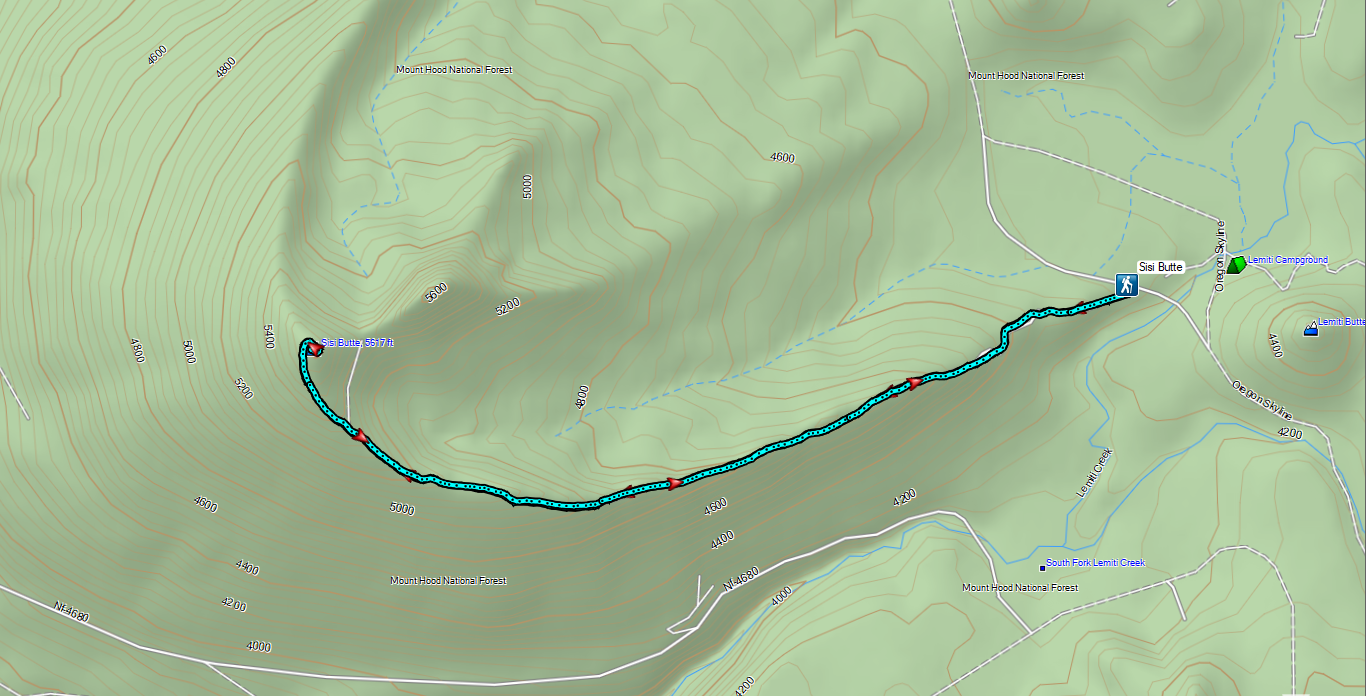

 Lower Lake Campground, a work in progress.
 While the campground was closed, the trail was open despite the fire damage.
 The Fish Lake Trail at Lower Lake Campground.
 Ferns creating a green hillside in the burn scar.
 Lower Lake
 The water in Lower Lake was quite colorful.
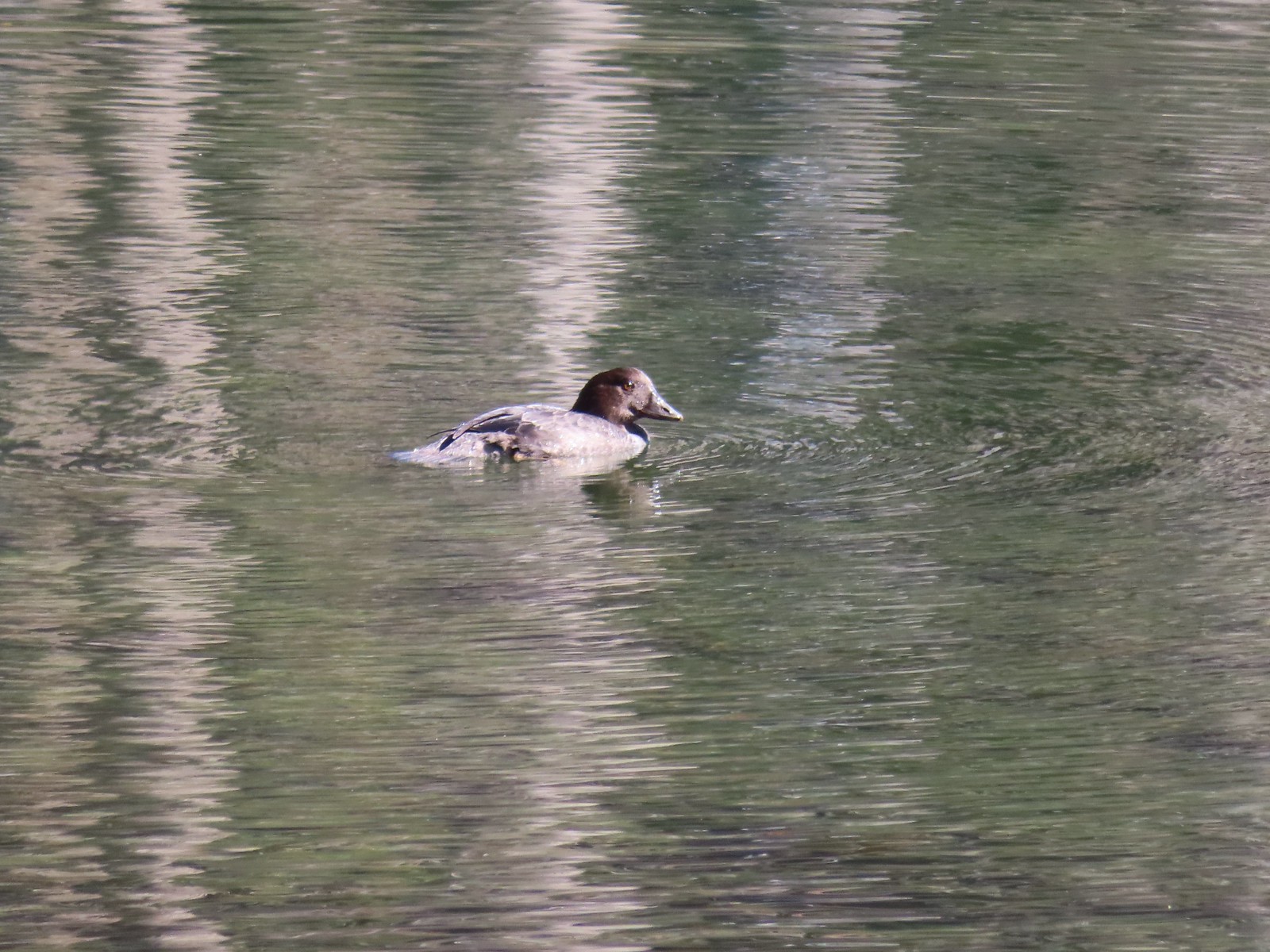
 Duck
Duck
 Most of the lakes in the
  Potato Butte (
 Olallie Butte
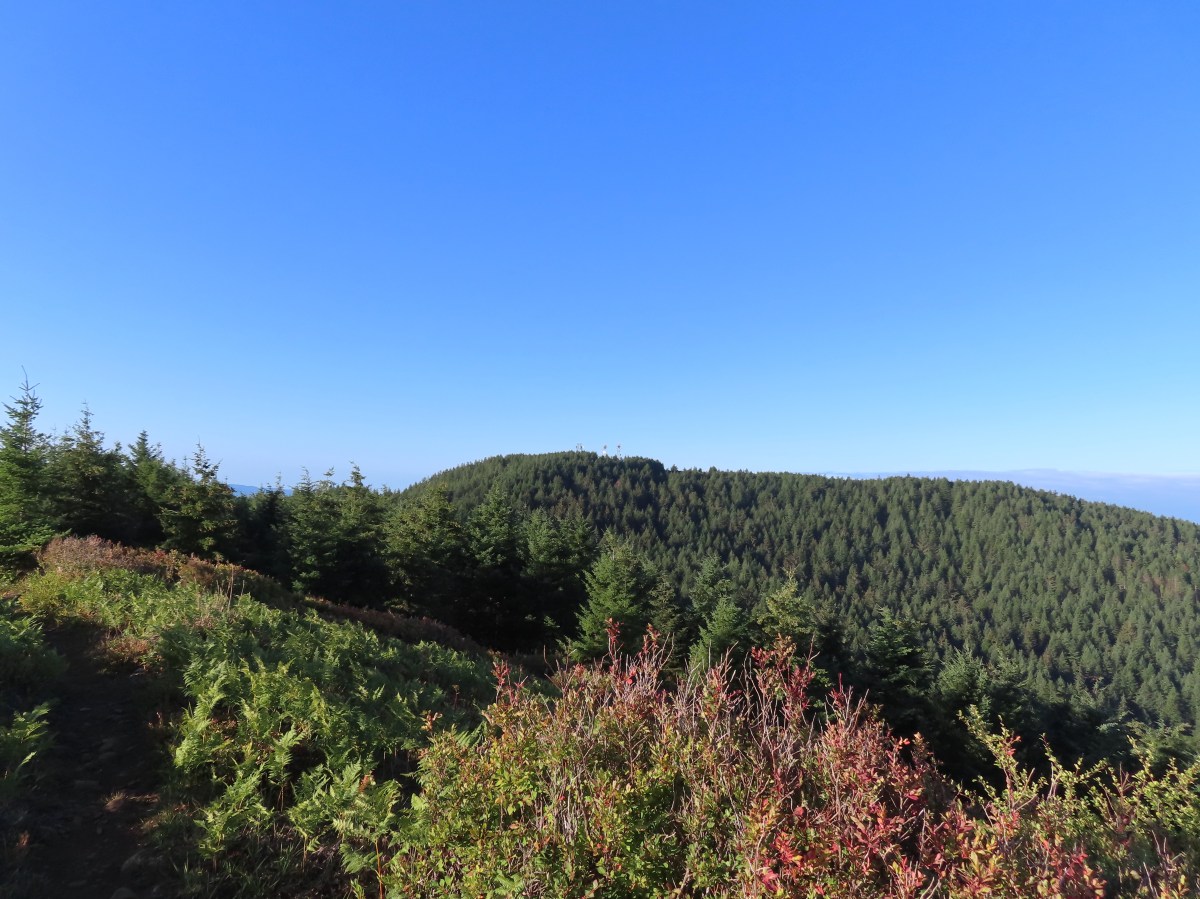
 Sisi Butte off to the right.
 Fireweed going to seed.
 Buckwheat
 The burn was intense along the trail, but it was in pretty good shape all things considered.
 Sisi Butte and Fish Lake from the cliff.
 Mt. Hood peeking out from behind West Pinhead Butte.
 Mt. Hood
 The Fish Lake Trail switchbacked a few times before giving up on that and dropping steeply for the final 0.2 miles.
 A beat up Lorquin’s admiral.
 There were signs of somewhat recent trail maintenance, but given the severity of the burn and the steepness of the hillside the trail is going to need a lot of ongoing attention to keep it passable.
 The trail disappeared a couple of times in brush and blowdown near the lake, but it was never hard to pick back up.


 Nap time.
 Olallie Butte from Fish Lake.
 The trail followed along Squirrel Creek (currently dry) for 0.4-miles.

 We passed a few of these “Spot Fire” flags, presumably left over from 2020.
 The signed junction.

 I had to walk out on a log and fight through some thick brush to reach a decent view of the water.
 Surprise Lake
 The trail between the junction and Si Lake got a little brushy.
 Huckleberry leaves in their Fall colors.
 Si Lake from the trail.
 Si Lake.
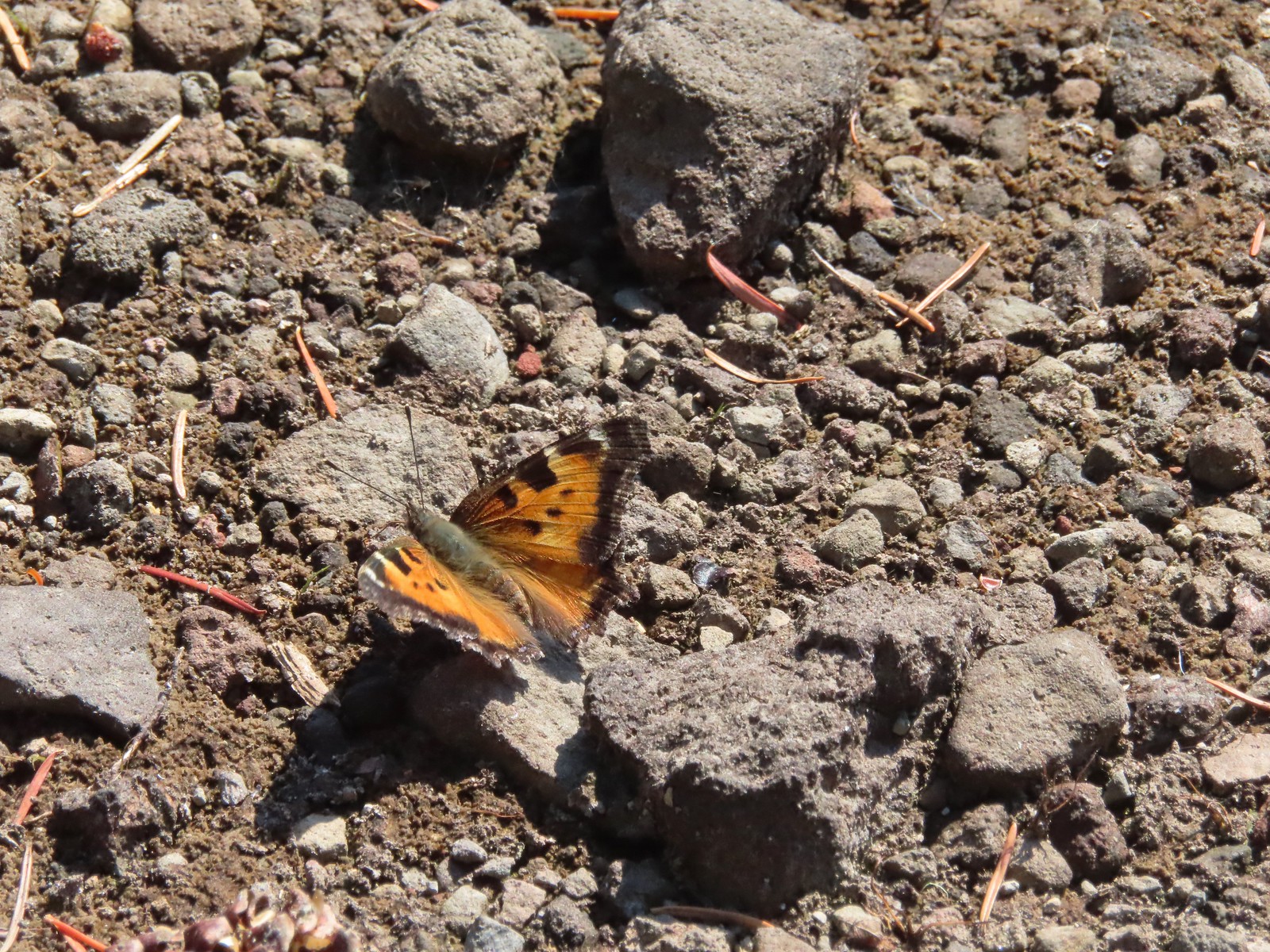 Tortoiseshell butterfly
 Olallie Butte from Fish Lake.
 Black bear print along the shore of Fish Lake.
 White breasted nuthatch
 Lower Lake from the Fish Lake Trail.
 Olallie Butte from Lower Lake.
 While parts of Lower Lake are shallow it actually reaches a depth of 73′ which is the reason it is so colorful.
 Arriving back at Lower Lake Campground.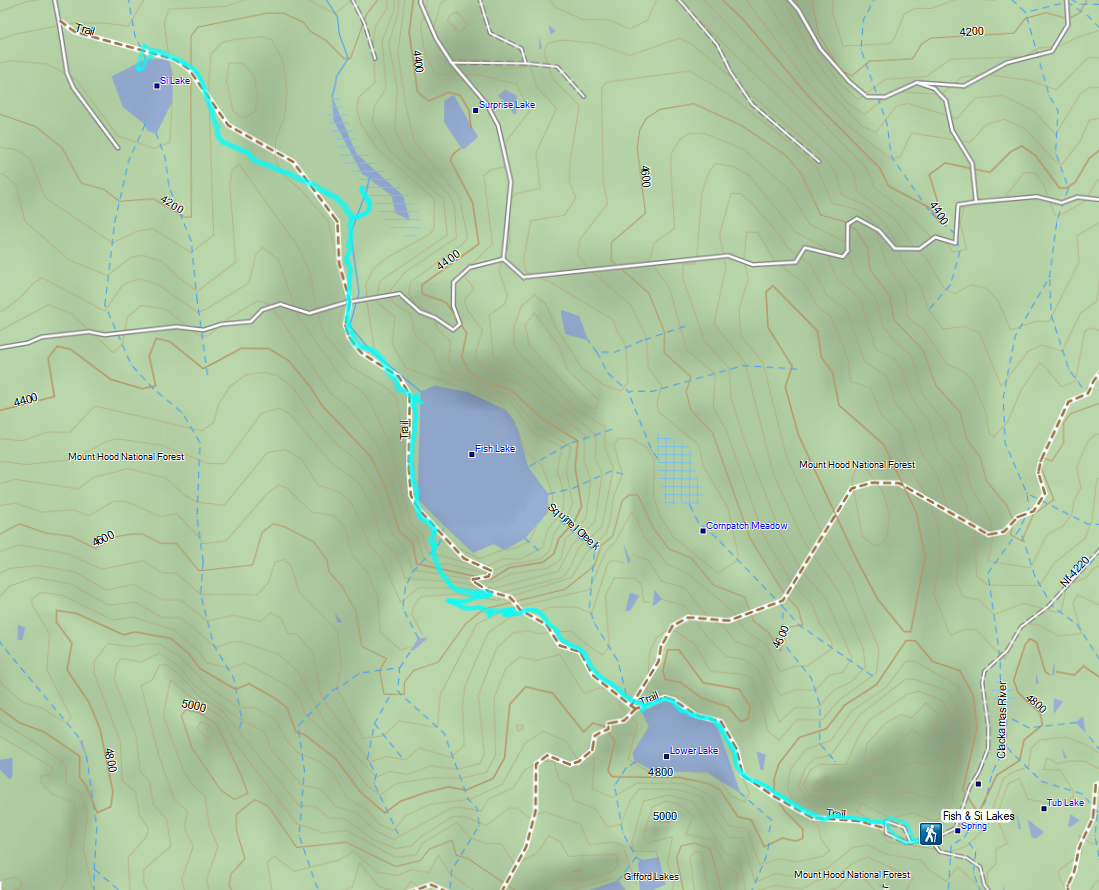
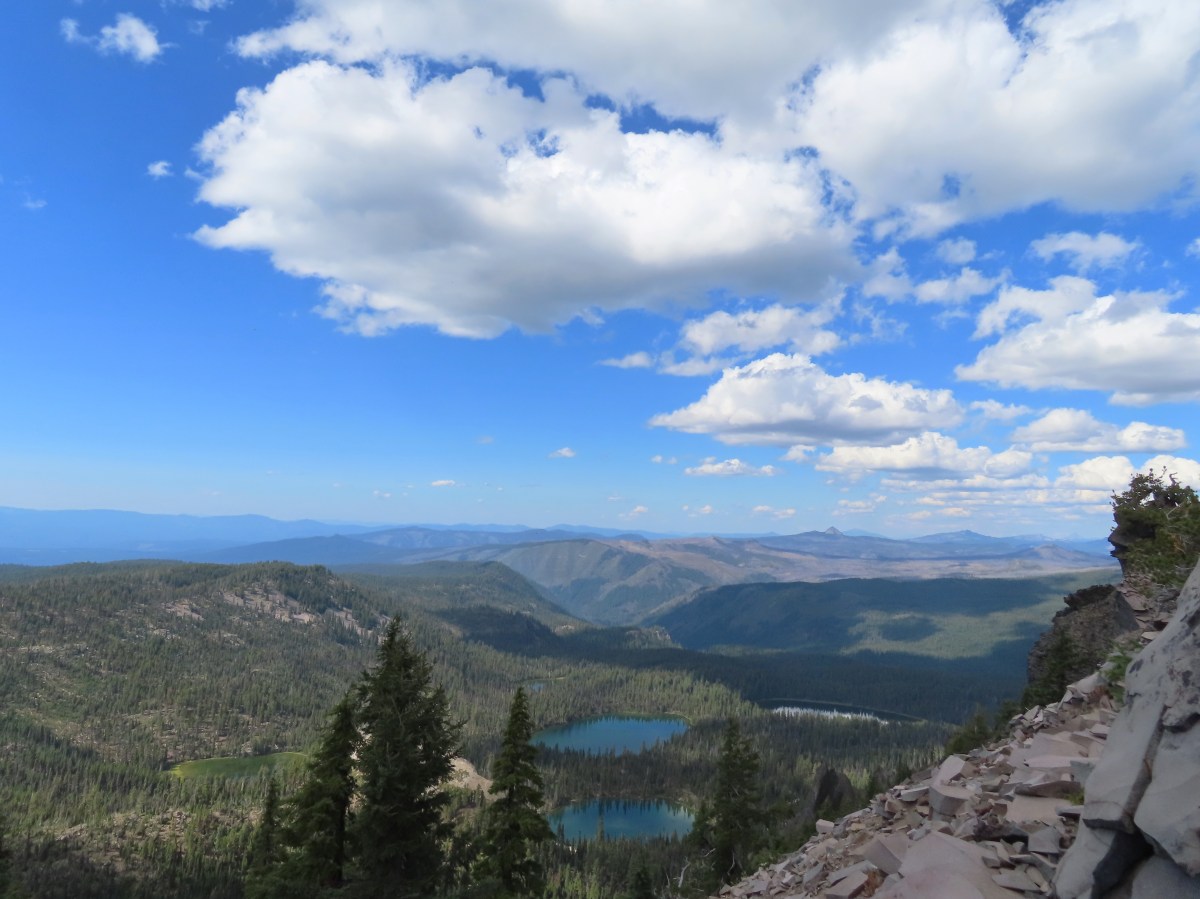
 Sevenmile Marsh Trailhead
 Sevenmile Creek
 Entering the wilderness
 Sevenmile Marsh
 Lodgepole pines were the dominate trees along the first part of the trail.
 Mountain hemlock took over as the trail gained elevation.
 Junction with the PCT.
 There were a few downed trees along this section but nothing difficult to get around.
 This twisted tree caught our attention.
 Nice blue sky.
 Lewis’s woodpecker way up in a snag.
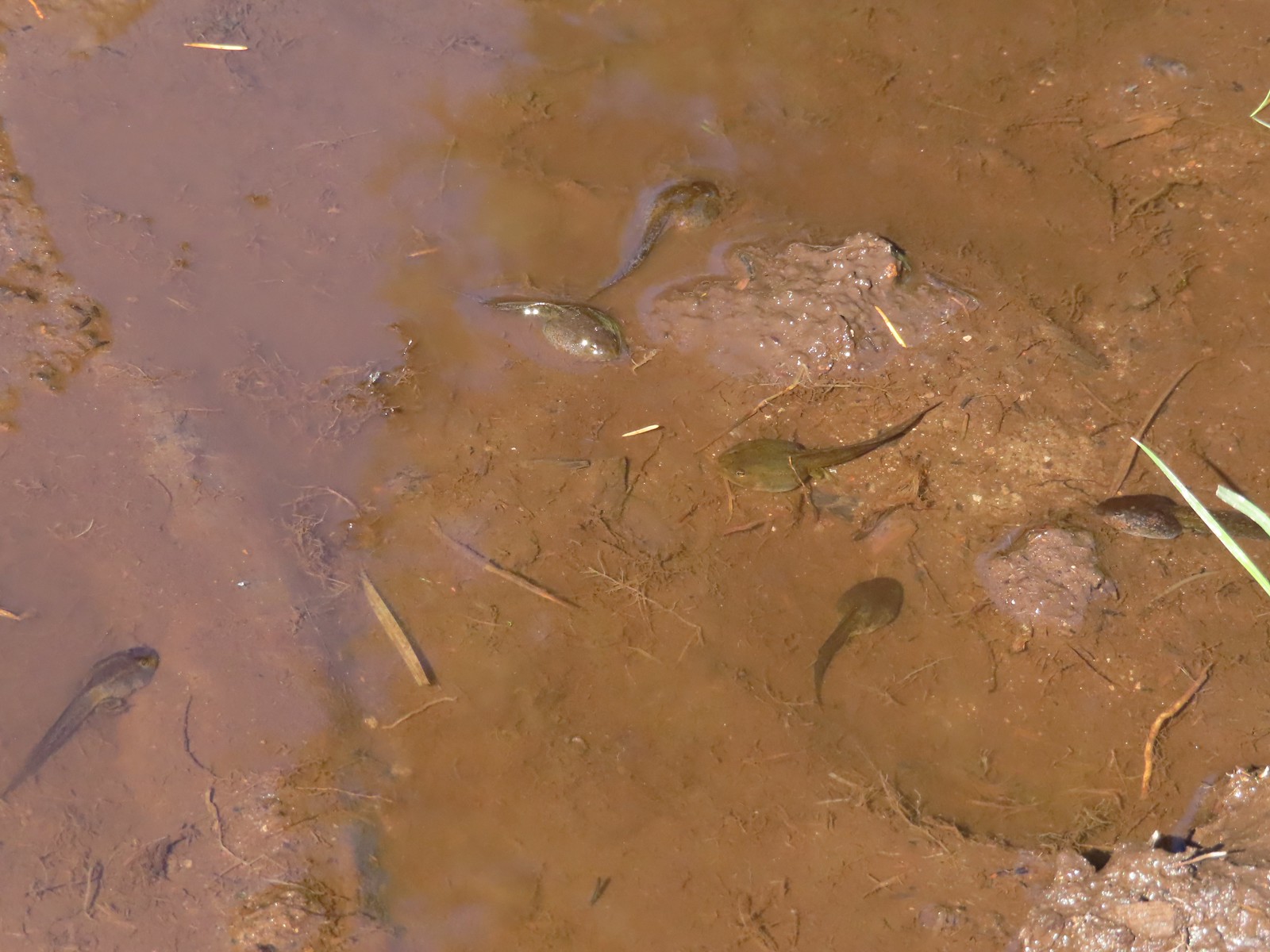 Tadpoles
 Frog in the water.
 Trail sign ahead on the right.
 Unnamed creek along the PCT. We were surprised at how many of the seasonal creeks still had flowing water.
 Grass-of-parnassus
 Huckleberries, there were a lot of these around the basin which we happily sampled.
 Devil’s Peak poking up above the trees.
 The Cliff Lake Trail.
 Prince’s pine
 Another flowing seasonal creek.
 Crater Lake collomia (Collomia mazama)
 The Seven Lakes Trail arriving on the right.
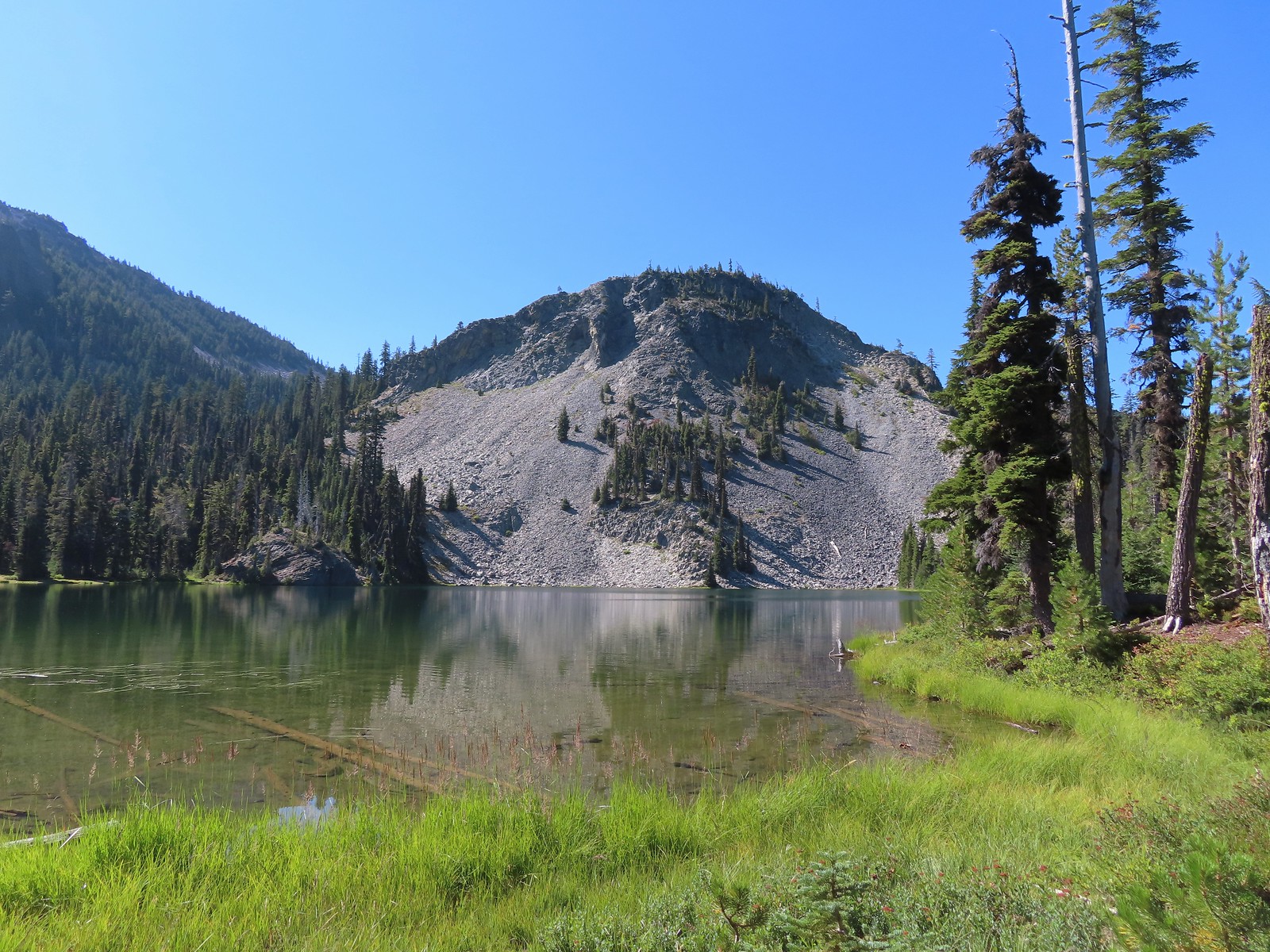 Cliff Lake
 Arnica
 Aster
Aster
 Splash in Cliff Lake from one of many fish that were feeding on insects.
 Camp
Camp Huckleberry bushes along the Cliff Lake Trail.
 Anywhere there was water nearby there were lots of tiny Cascade toads to watch out for.
 Back at the PCT.
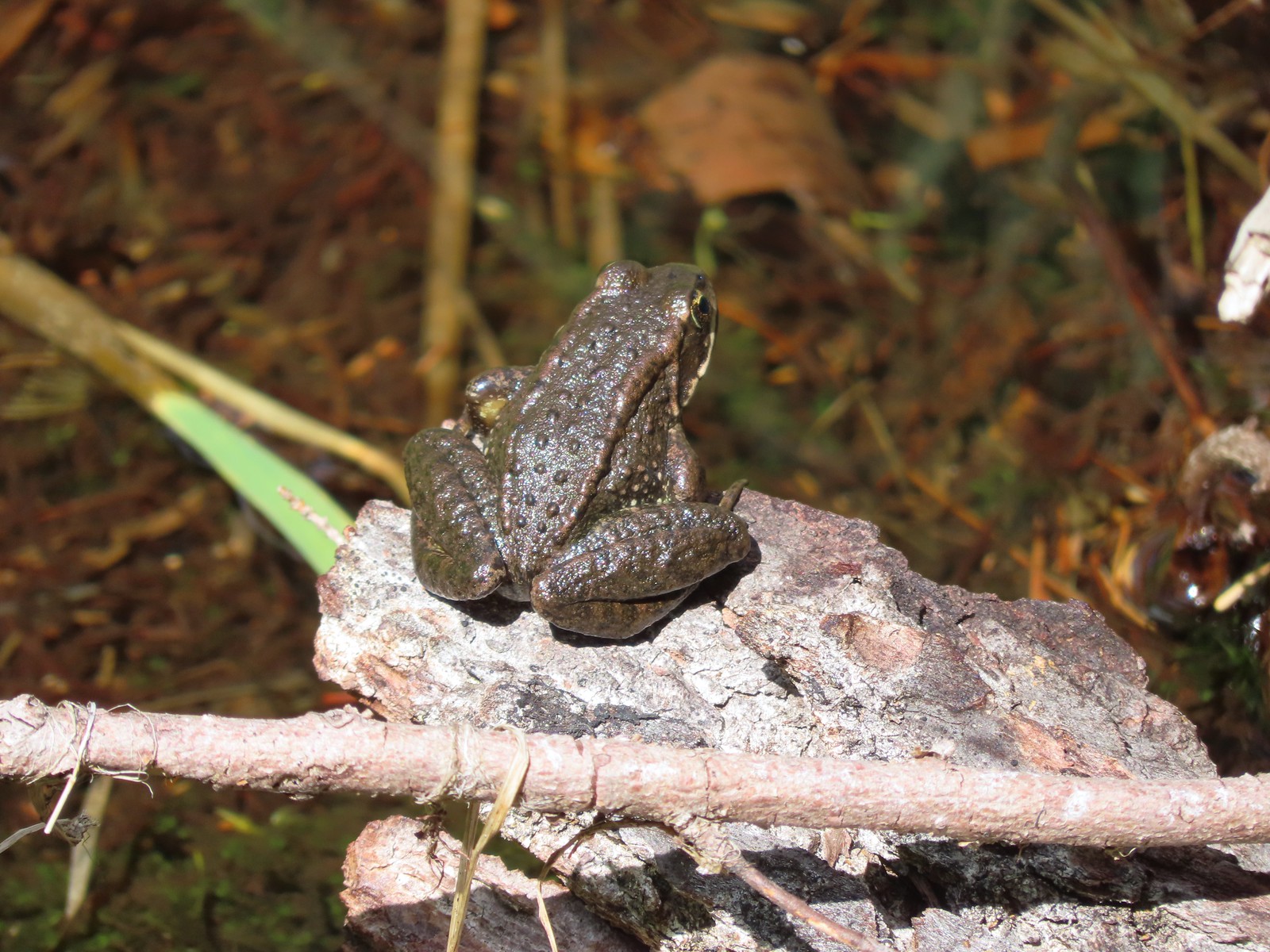 Larger frog
 Monkshood
 More grass-of-parnassus
 Not only were the toads tiny, they also were well camouflaged.
 Mount Scott (
 Mount Scott
 The Watchman (
 The Watchman and Hillman Peak
 Devil’s Peak
 Union Peak (
 Cliff Lake with Violet Hill beyond.
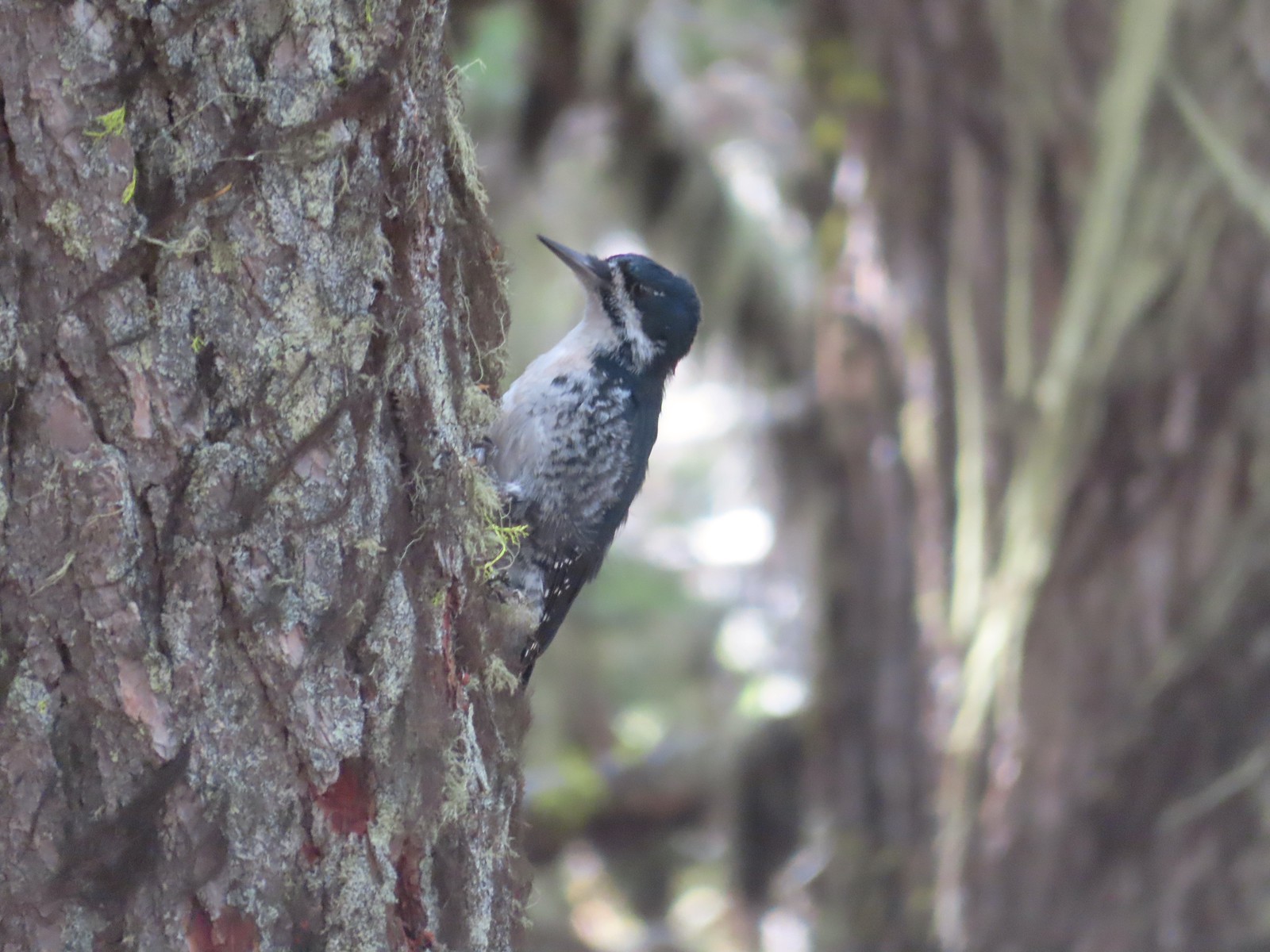 Black backed woodpecker
 Getting closer to Devil’s Peak.
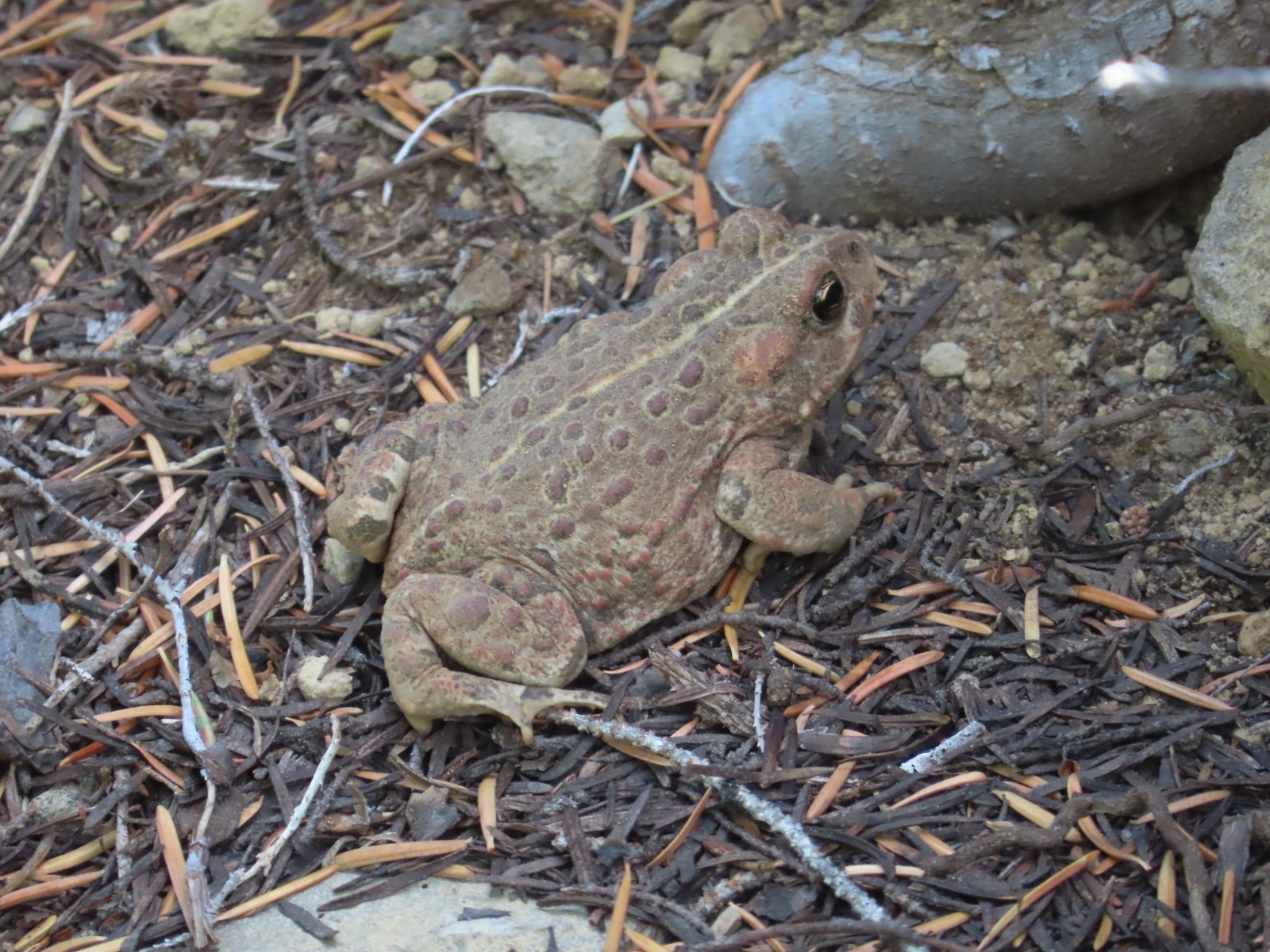 A much bigger Cascade toad.


 Mt. Thielsen (
 Union Peak with Mt. Bailey (
 Lots of neat rock formation on Devil’s Peak.
 Western pasque flower seed heads.
 Buckwheat
 Views to the South opened up at the pass including Klamath Lake and Pelican Butte.
 Klamath Lake
 Devil’s Peak and the PCT coming up to the pass from the North.
 Klamath Lake, Pelican Butte, Aspen Butte (
 Mt. McLoughlin
 A faint Mt. Shasta which, given the wildfires burning in NW California was a bit of a surprise to be able to see.
 The view North.
 Goose Egg and Ethel Mountain in the forefront with Llao Rock, Mt. Thielsen, and Garfield Peak (
 Devil’s Peak
 We were a little concerned at first that it might be picking up water for a new fire but there wasn’t anything hanging from the helicopter so we have no idea what it was actually doing.
 The use path to Devil’s Peak on the right and the PCT on the left.
 The rather ominously named Lucifer from the use trail.
 A second use trail coming up from the opposite side.
 Western pasque flowers on the hillside above the use trails.
 The summit of Devil’s Peak ahead.
 Looking North toward Crater Lake and Mt. Thielsen
 Lucifer, Jupiter, and Venus
 Lee Peak above the pass.
 Luther Mountain (
 Remains of a former lookout.
 The PCT below Devil’s and Lee Peaks.
 Goose Egg, Llao Rock, and Mt. Thielsen
 Mt. Scott
 Mt. Shasta to South through a little smoke but again we felt fortunate to be able to see the mountain at all.
 Colorful grasshopper at the summit.
 American pipit
 The Seven Lakes Basin from the use trail down.
 South, Middle, North, and Grass Lakes
 Heading down the use trail.
 Looking back up the use trail.
 Western snakeroot along the PCT.
 A comma butterfly on western snakeroot.
 Painted lady
 Venus from the Devil’s Peak Trail.
 Looking back at Devil’s Peak.
 Looking North across the Seven Lakes Basin.
 Lake Alta in a bowl below Violet Hill.
 Pond along the Devil’s Peak Trail.
 Coming up to the Seven Lakes Trail junction. A rock cairn was the only marker.


 I was still only about halfway along the lake after the quarter mile. There used to be a campground at the North end.
 Common merganser
 The southern end of Lake Alta.
 Cliff Lake below Devil’s Peak and Middle Lake.
 Middle and Grass Lakes
 I could hear several pikas in the rocks below the cliffs but the only thing I spotted was a chipmunk.
 Chipmunk
 Sulphur butterfly on aster.
 Gentian
 Fireweed
 South Lake
 Devil’s Peak from the trail. There were more pikas “meeping” from the rocks here but again we failed to spot any of them.

 Devil’s Peak in the evening.
 So many fish in the evening.
 Devil’s Peak in the morning.
 Seven Lakes and Cliff Lake Trail junction.

 We detoured left at the northern end of the lake following a pointer for Lake Ivern to find a view back across Middle Lake.
 Devil’s Peak from Middle Lake.
 Stream crossing.
 Monkshood and grass-of-parnassus
 Grass Lake
 Arriving at the PCT.

 Golden-mantled ground squirrel
 Sevenmile Trail at the PCT to return to the Sevenmile Marsh Trailhead.
 Exiting the Sky Lakes Wilderness.

 The trailhead has numerous parking spots for cars as well as a large horse trailhead, outhouse, and picnic tables.
 The big signboards unfortunately did not have a map or other information about the trail system though.

 The North Sister behind us.

 Signpost for the canyon ahead.
 This sign was just like the ones we’d seen Saturday at the Dry River Canyon (post).


 The canyon is home to some impressive ponderosa pines.
 Another ponderosa
 Looking up from below the ponderosa.
 Lichens


 Townsend’s solitaire
 Owl
Owl
 West wall
 East wall
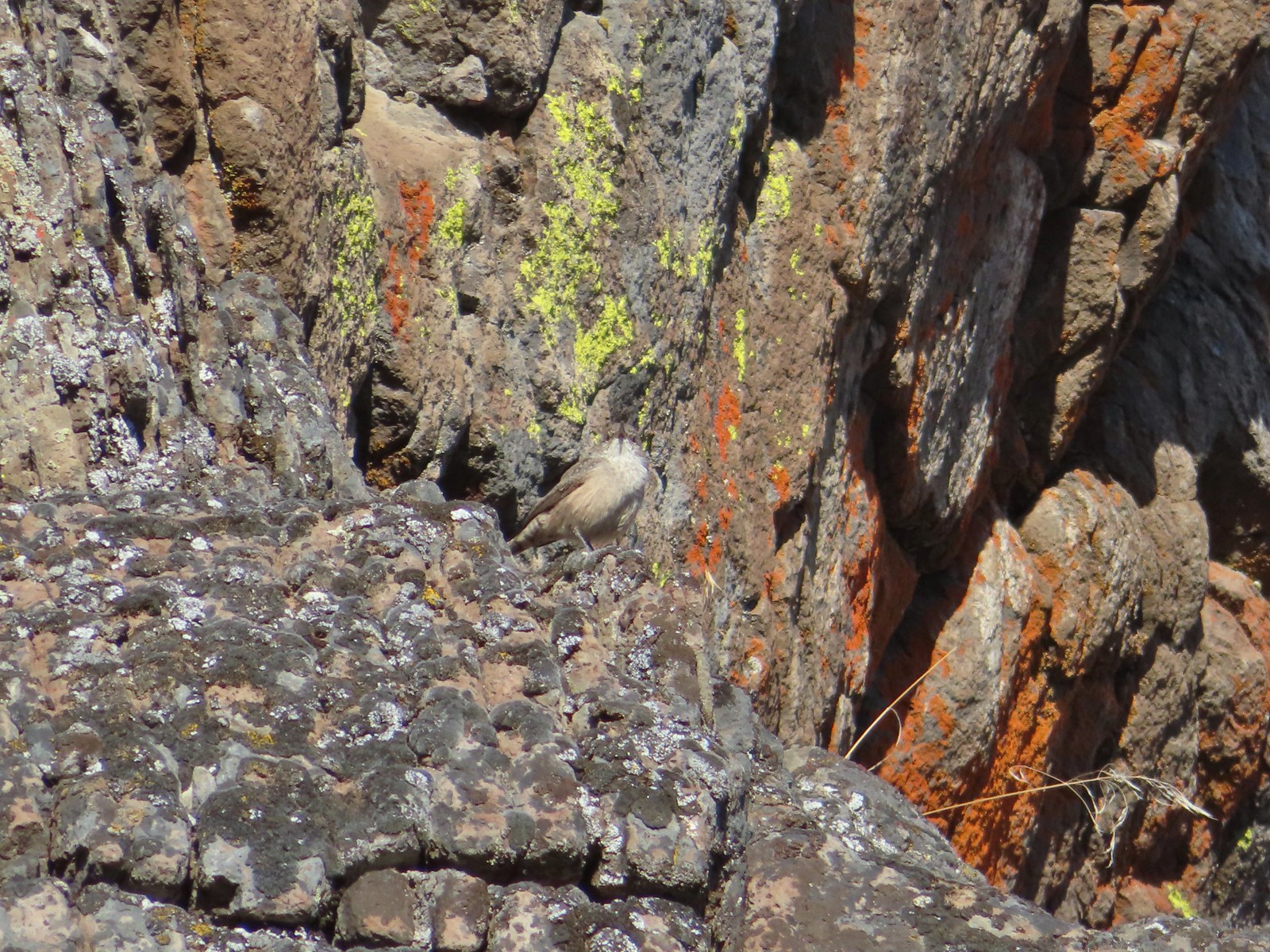 Wren
Wren Neat rock formation.
 Exiting Fryrear Canyon.
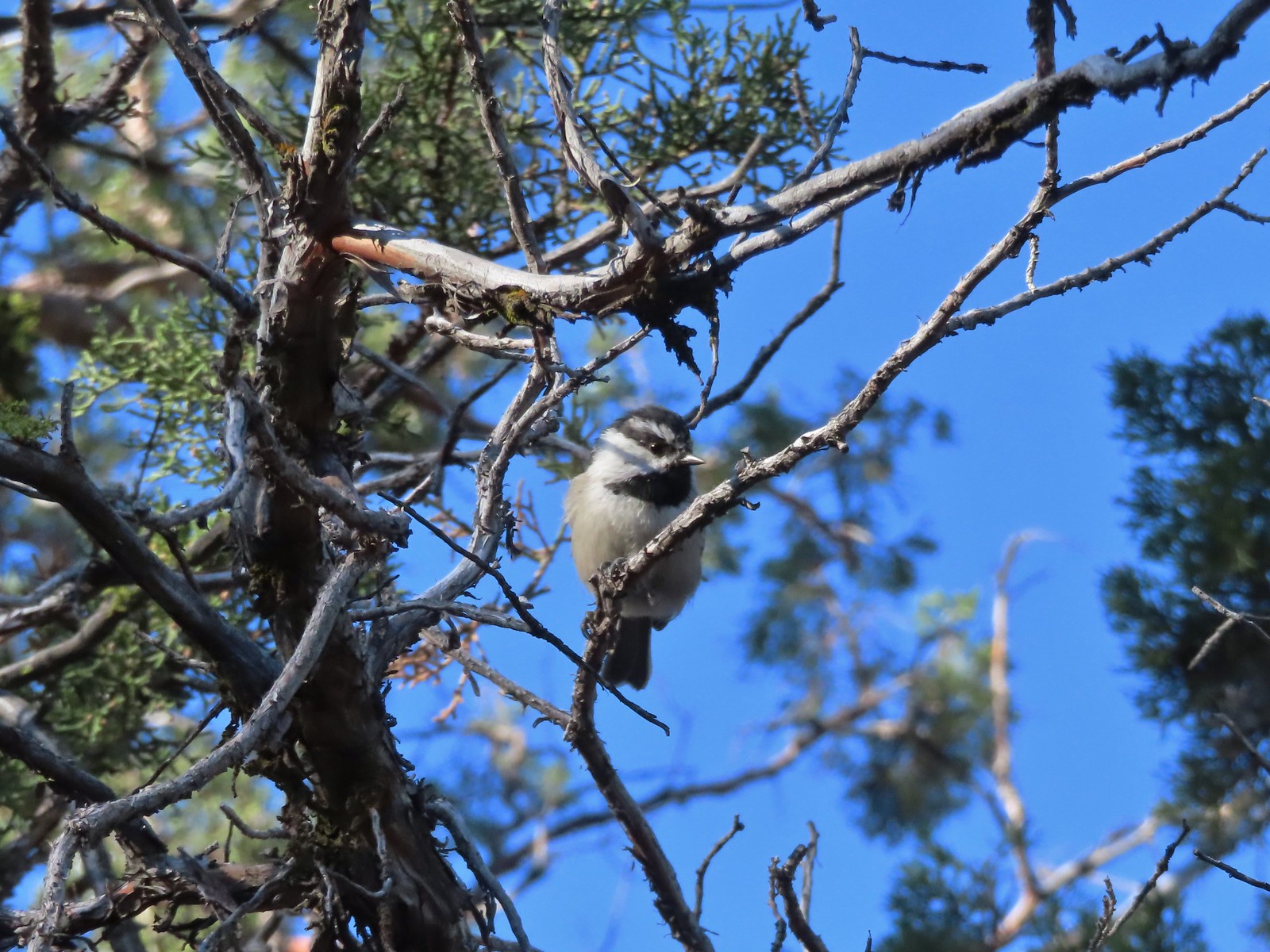 Several mountain chickadees came to investigate as we passed through the gate.

 Middle and North Sister
 Mountain bluebird
 South Sister
 Mt. Jefferson
 Broken Top and South Sister
 Broken Top behind some clouds.
 We turned right back onto the spur trail to the Fryrear Trailhead at the end of our loop.
 Stellars jay


 Beatys Butte to the SW.
 Rain to the SW as well.


 Threemile Creek could be heard but not seen through the thick brush.
 Lupine
 There was a post but no sign at the junction.
 Wickerstem buckwheat
 The Pueblo Mountains (
 Clouds and rain showers to the SW.
 Threemile Canyon
 The faint Huffman Trail.
 Alvord Peak in the center distance with Pueblo Mountain to the far right.
 Closer look at Alvord Peak in the center.
 Still a little blue sky to the NW.
 Not sure where the fog below came from but it was on a mission to beat us up to the plateau.
 Here comes the fog and some rain.
 Just moments later.
 And here is the fog.

 The final pitch to the plateau.
 Cairn at the end of the trail.
 Exploring is possible as long as you remember where you came up.
 Looking West.
 Looking toward Threemile Canyon.
 Beatys Butte at center with the long fault block of Hart Mountain (

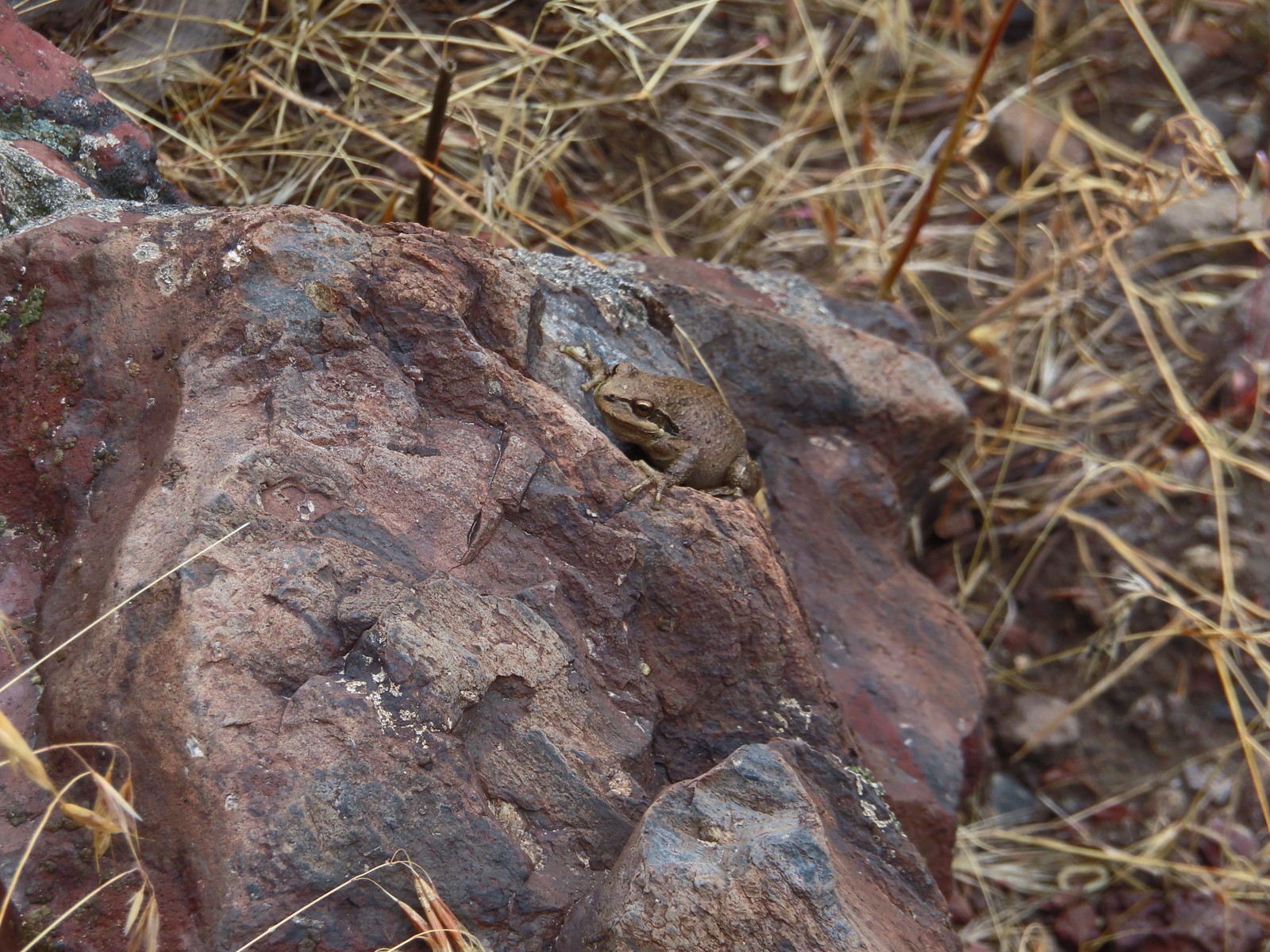 This frog seemed to enjoy the damp weather.
 Cliffs across Threemile Canyon
 Arriving back at the junction with the Threemile Creek Trail.

 Curlycup gumweed
 The trail crossed and at times used dry creek beds and also crossed Threemile Creek several times.
 The easiest crossing of Threemile Creek. Several of the others were not obvious until I pushed through the brush and then the footing was often tricky due to large, slick rocks needing to be navigated (at least in order to stay out of the creek).
 On the trail, I think.
 Elderberry
 Hard to tell by the photo but this puffball was a little bigger than a softball.
 I wouldn’t really describe the area as a meadow but I was 0.9 miles from the junction.
 Looking down at the meadow and post/snag (lower right) from the rocks.
 Sometimes the trail was really only identifiable by which junipers had had limbs cut.
 The drop to the creek here was approximately 2′ and the pool in Threemile Creek was fairly deep making this crossing a bit of a challenge not to slip and fall in.
 Aster
Aster

 Sullivan’s map showed a “Bart Simpson Rock” which we believe was this one.
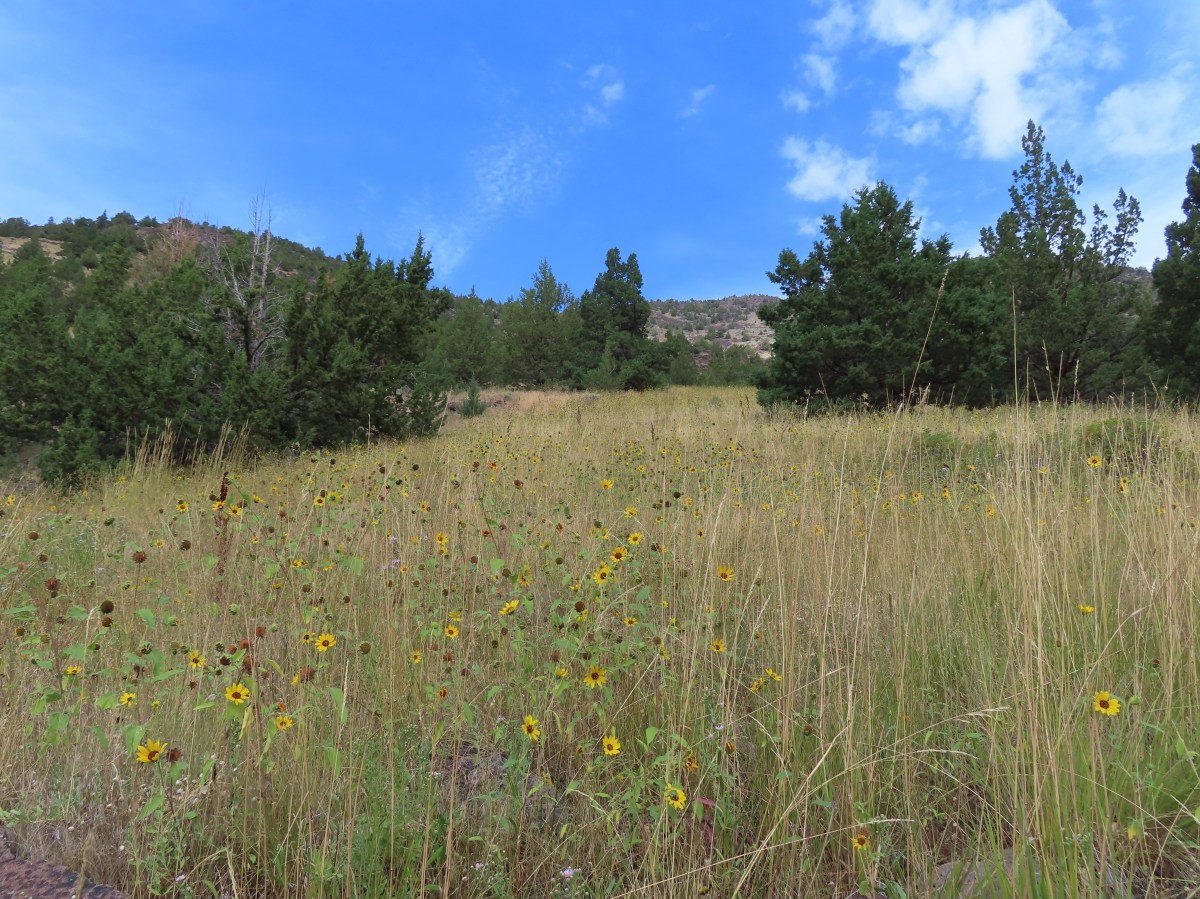
 Nearing the sunflower hillside and trail junction.
 Dragonfly
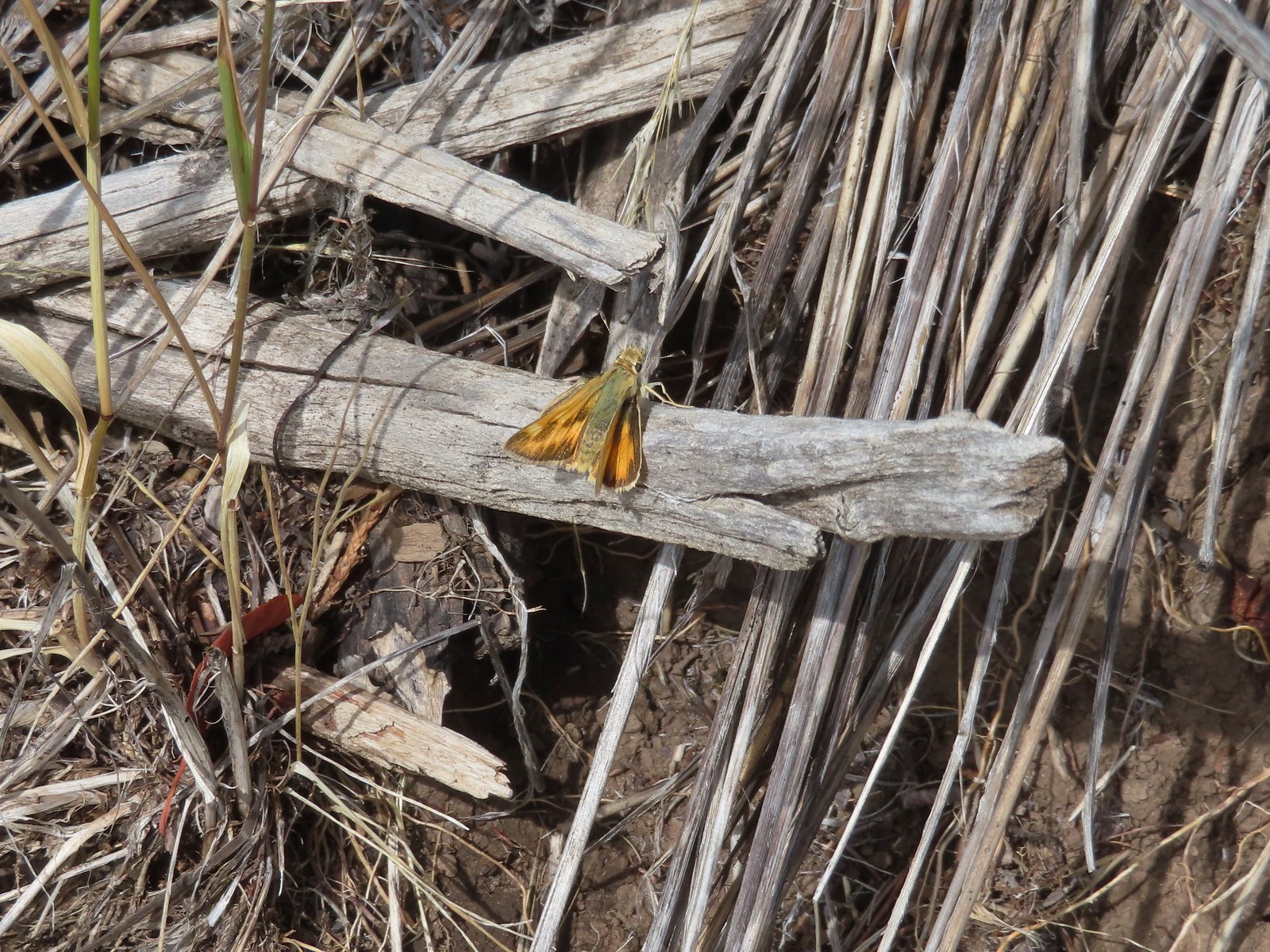 Skipper
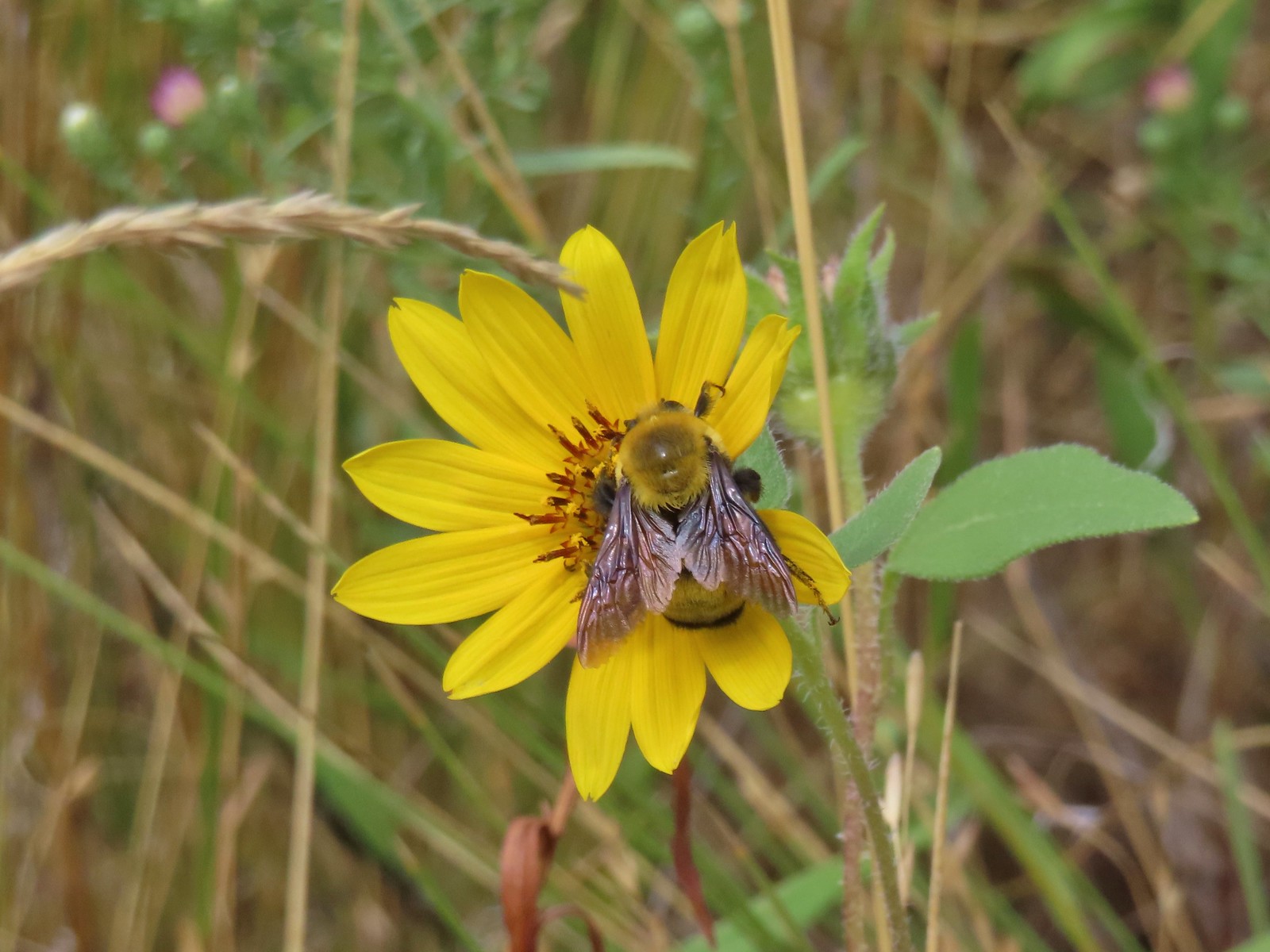 Big bumblebee



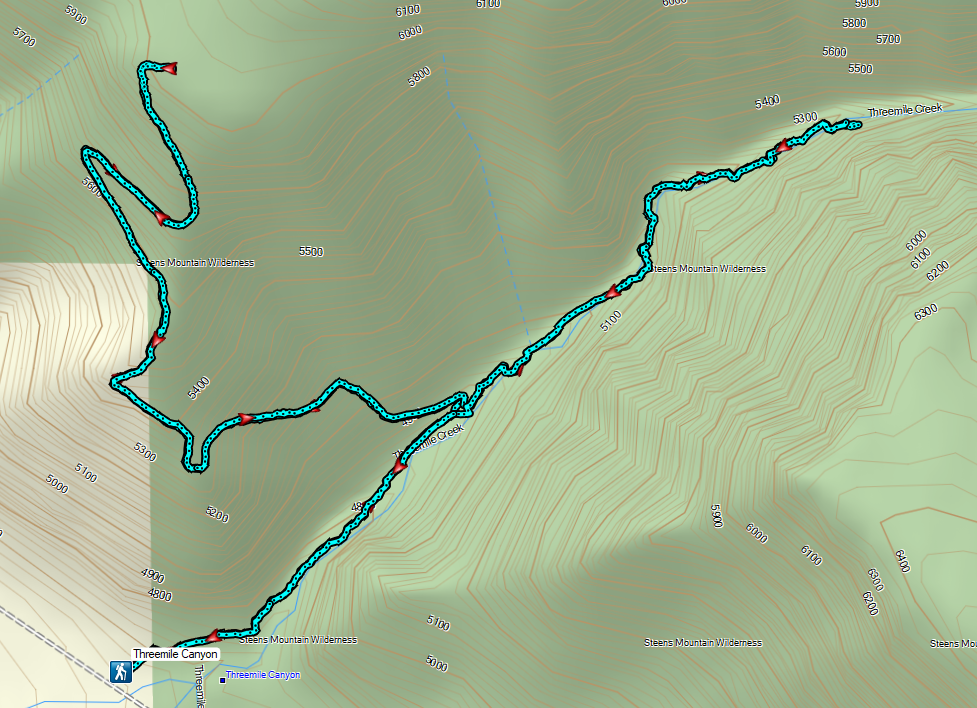

 Sign for the River Trail.
 The long barn where we’d be heading next.
 We turned around here where the tread became rougher.
 Interpretive signs were scattered along the trails at the P Ranch.
 Lorquin’s admiral and a grasshopper.
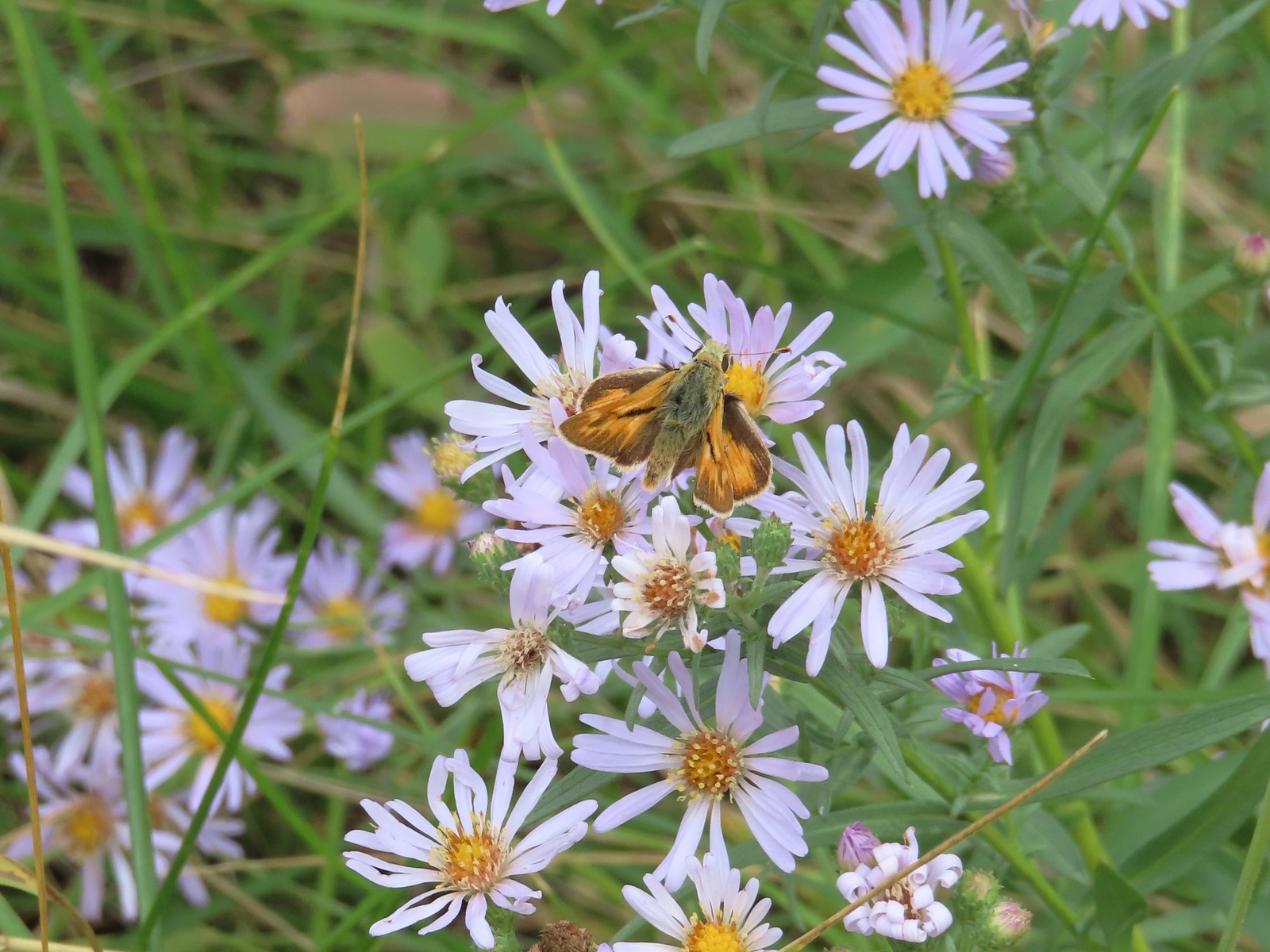 Skipper on aster.

 History of the P Ranch which at one time covered 140,000 acres.
 The owl inside the barn.
 Other structures from the ranch.
 The gravel road is in good shape but you don’t want to drive any faster than about 10mph so you don’t miss any wildlife.
 Fawns
Fawns Common nighthawk
 So many red-winged blackbirds.
 Hawk (northern harrier?) in a field.
 More fawns and birds.
 Finch?

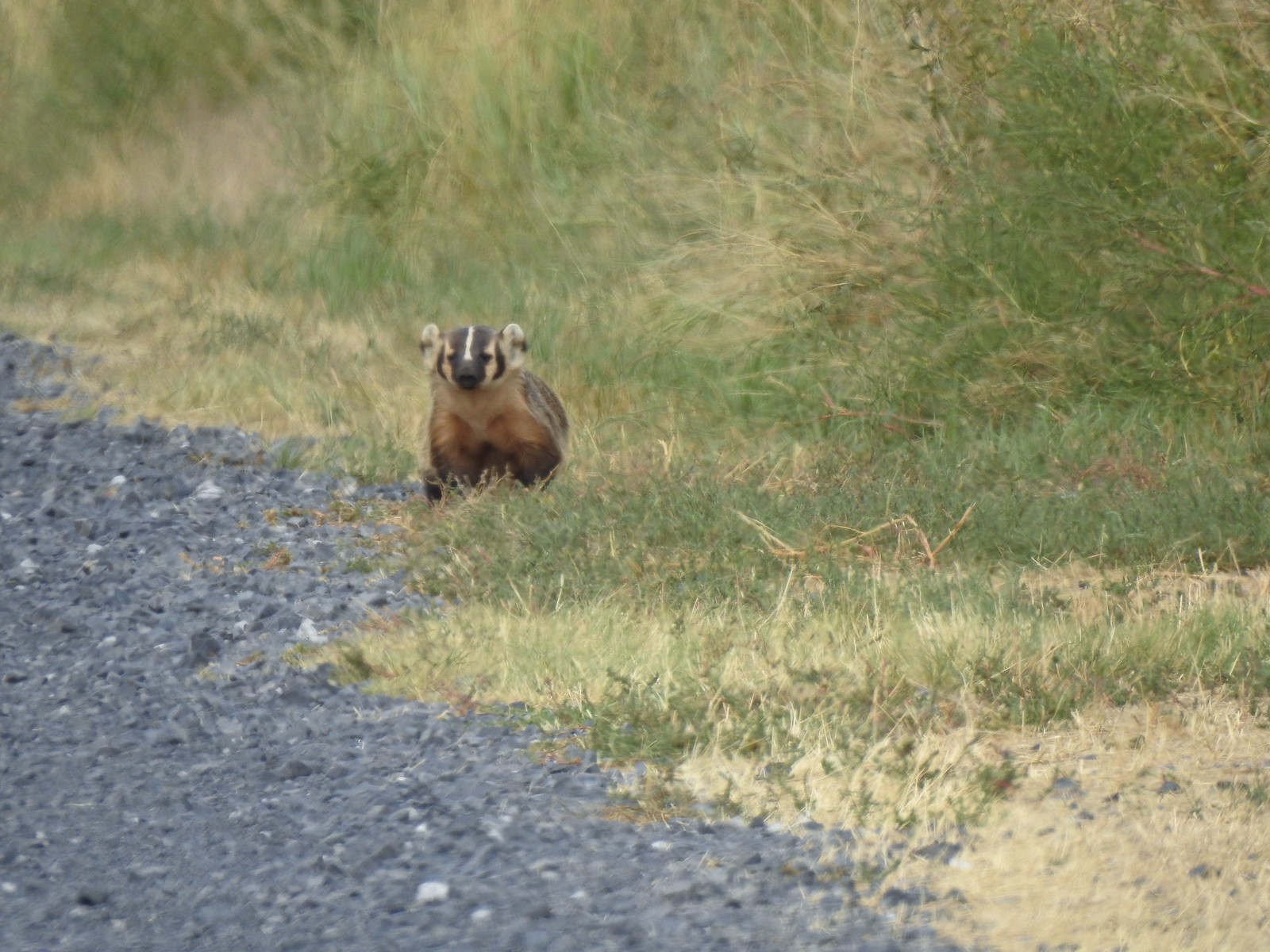
 It disappeared in the grass moments later.
 Another hawk
 Sandhill cranes in the field.
 Sandhill cranes


 Crossing the dam.
 Kiger Gorge (
 Kiger Gorge
 Blurry due to distance but there were several deer at the far end of the reservoir.
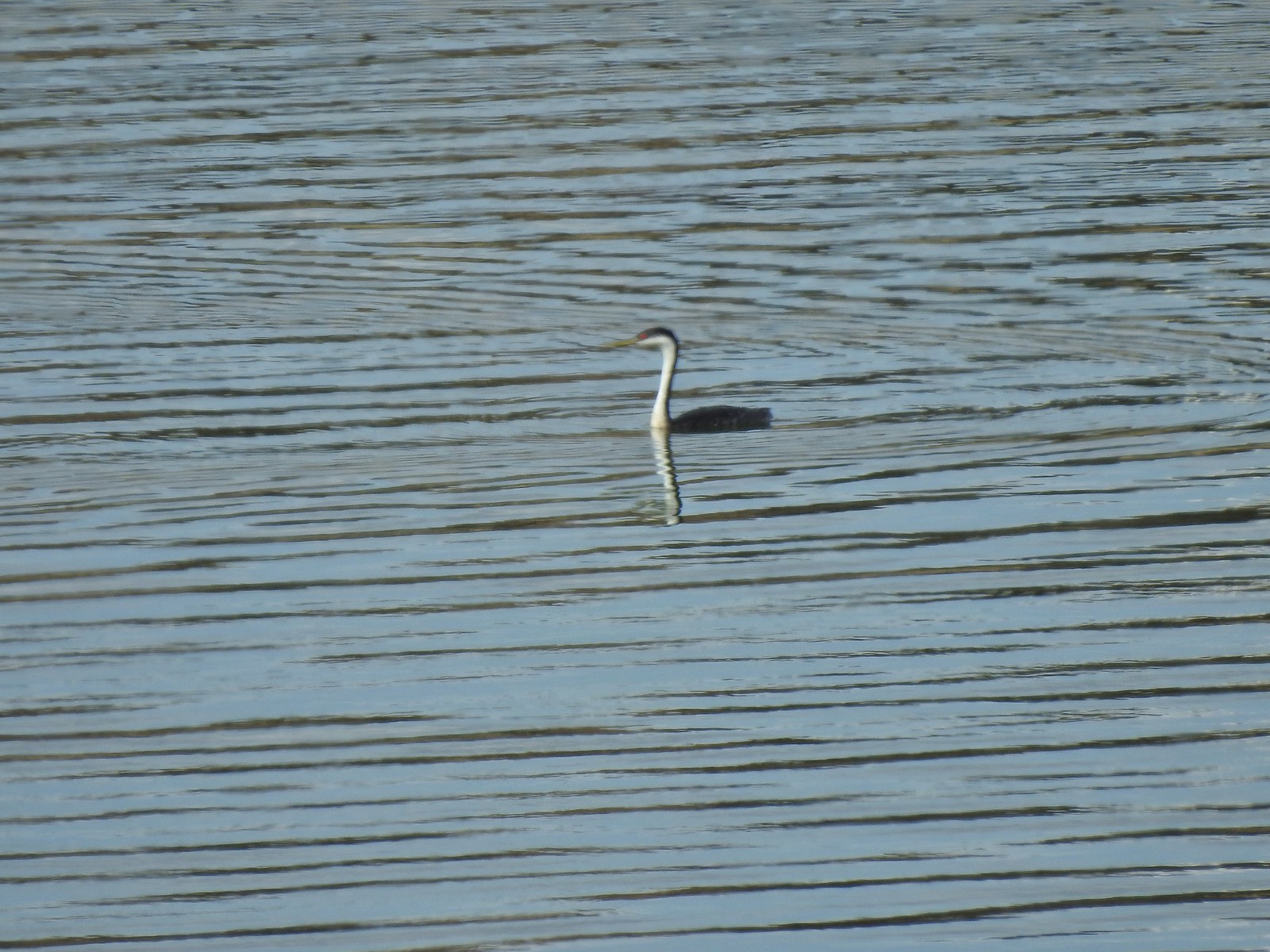 Another long shot, a western grebe.
 Not certain what this bird was but it dove into the water a couple of times.
 The deer, some ducks, the western grebe and a cormorant were all that direction.
 It also appeared that some rain was on the way.
 Recrossing the dam.
 Pheasant family
 There were at least 5 deer out there.
 Two
Two Three more
 White faced ibis
 California quail
 Pheasant
 A few of at least 10 turkey vultures in the trees above the Refuge Headquarters.
 Malheur Lake from the end of the auto tour.


 Open sign at the trailhead.
 Rabbit in the sagebrush.
 Some of the exposed rocks showed the work of the ancient river.
 Shaped by water.
 Colorful rock bands along the canyon wall.


 There is a huge nest up on the cliffs.
 The nest
 Wren
Wren American kestral
 Tall sagebrush in the canyon.
 The canyon reaches a depth of approximately 300′.


 Skipper
 I believe this is a ringlet of some sort.

 Heading toward the Evens Well Trailhead.
 Looking toward the Dry River Canyon from the plateau. It was impossible to tell that there was such a deep canyon out there.
 Pine Mountain (
 The rock steps were more obvious on the way down them.
 A sparrow behind the sticks the camera was intent on focusing on.
 Bee on buckwheat
 Arriving back at the official trailhead. Several SUVs were now parked here.
 They’re hard to make out but the Middle and North Sisters were visible from the road walk back to the gravel area.
 The trailhead at the campground.
 Neat map at the trailhead.
 Gold flagging on the sagebrush ahead marked the junction.
 The trail followed a fence line before turning right along Highway 395.
 Tiny frog
 The trail crossed this gated road near the highway. A blue diamond marked the trails continuation.
 One of several interpretive signs along the loop.
 Squirrel
 The highway was just out of sight to the left.
 Big ponderosa
 We crossed the campground road and quickly realized our mistake and backtracked.
 This time we spotted the correct trail and forked right here.
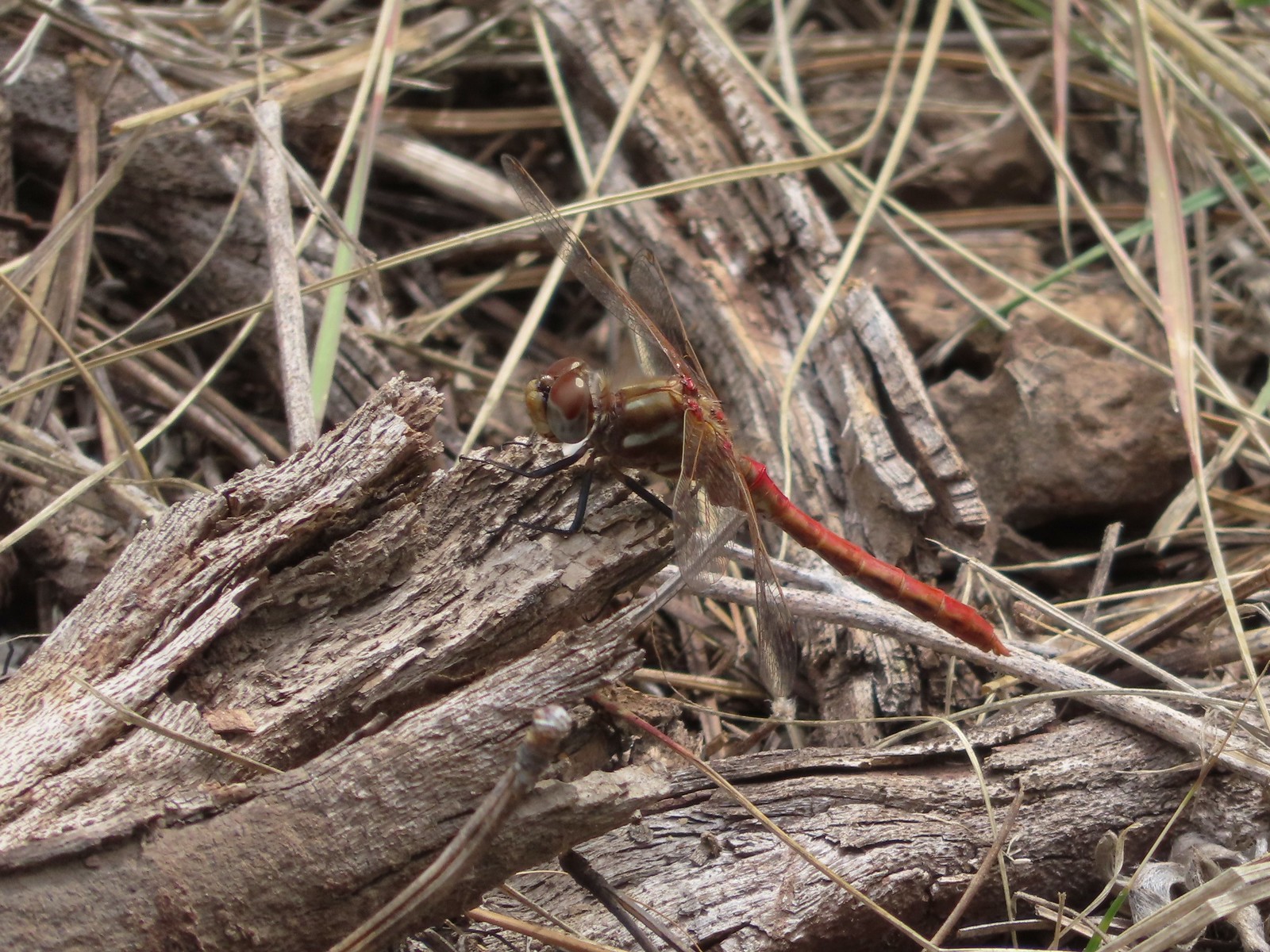 There were lots of dragonflies in the area.


 Golden-mantled ground squirrel already sporting some of its winter weight.
 We turned right here onto the Devine Summit Trail.
 Deer in the forest.
 There was a bit of blowdown to navigate along the trail.
 Some maintenance had been done in the past. There were also a good number of benches along the trail, all of which were accompanied by a post with a number.
 Another bench near this fence.
 Ponderosa forest
 White breasted nuthatch
 Another post and bench.
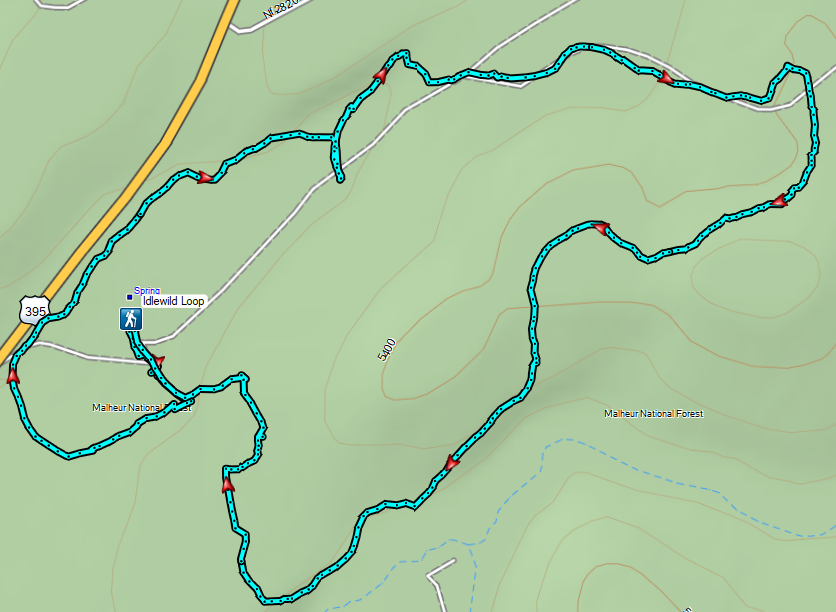
 Arriving at the Idlewild Loop on the far side of the fence.

 Most of the buildings are gone but this relocated Officers Quarters is being restored.
 It was hard to tell at times if it was cloudy or smokey which would be a theme for most of the day.
 Flagpole behind an interpretive sign.
 Most of the trail is ADA accessible but not the entire loop.
 The forest was quite a contrast from the open hillside.


 Lots of fading flowers: yarrow, goldenrod and aster mostly.
 Some of the caterpillar tents on the hillside.


 The nature trail crossed the service road after half a mile.
 The continuation of the nature trail on the right.
 We were pleasantly surprised at how forested this entire trail was.
 There were lots of frogs hopping off the trail. Can you see this one?
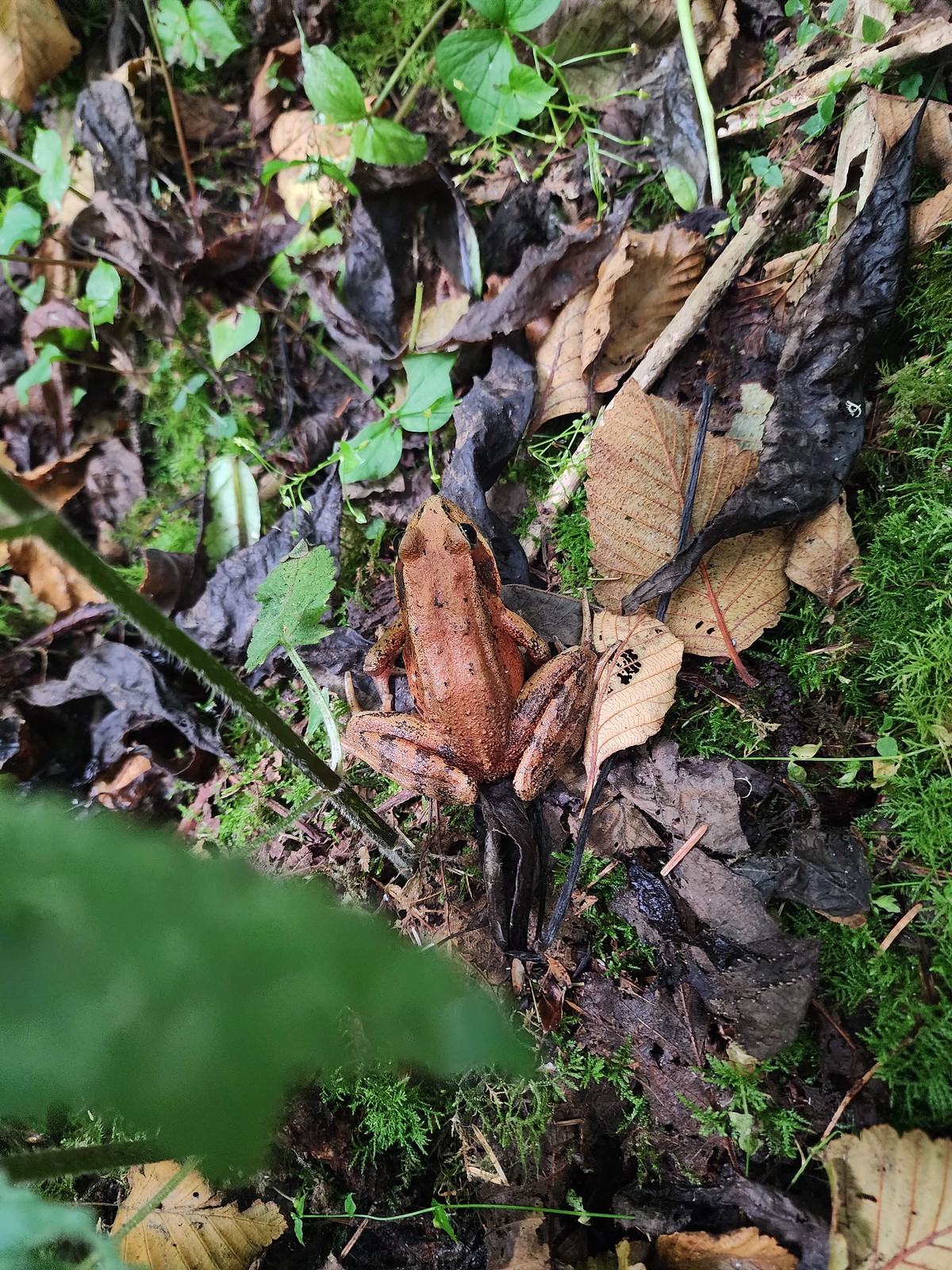 Norther red-legged frog?
 A little less than half a mile after crossing the road we passed a junction with a trail leading to the picnic area. We would visit the picnic area on our way back and pick up the service road there.

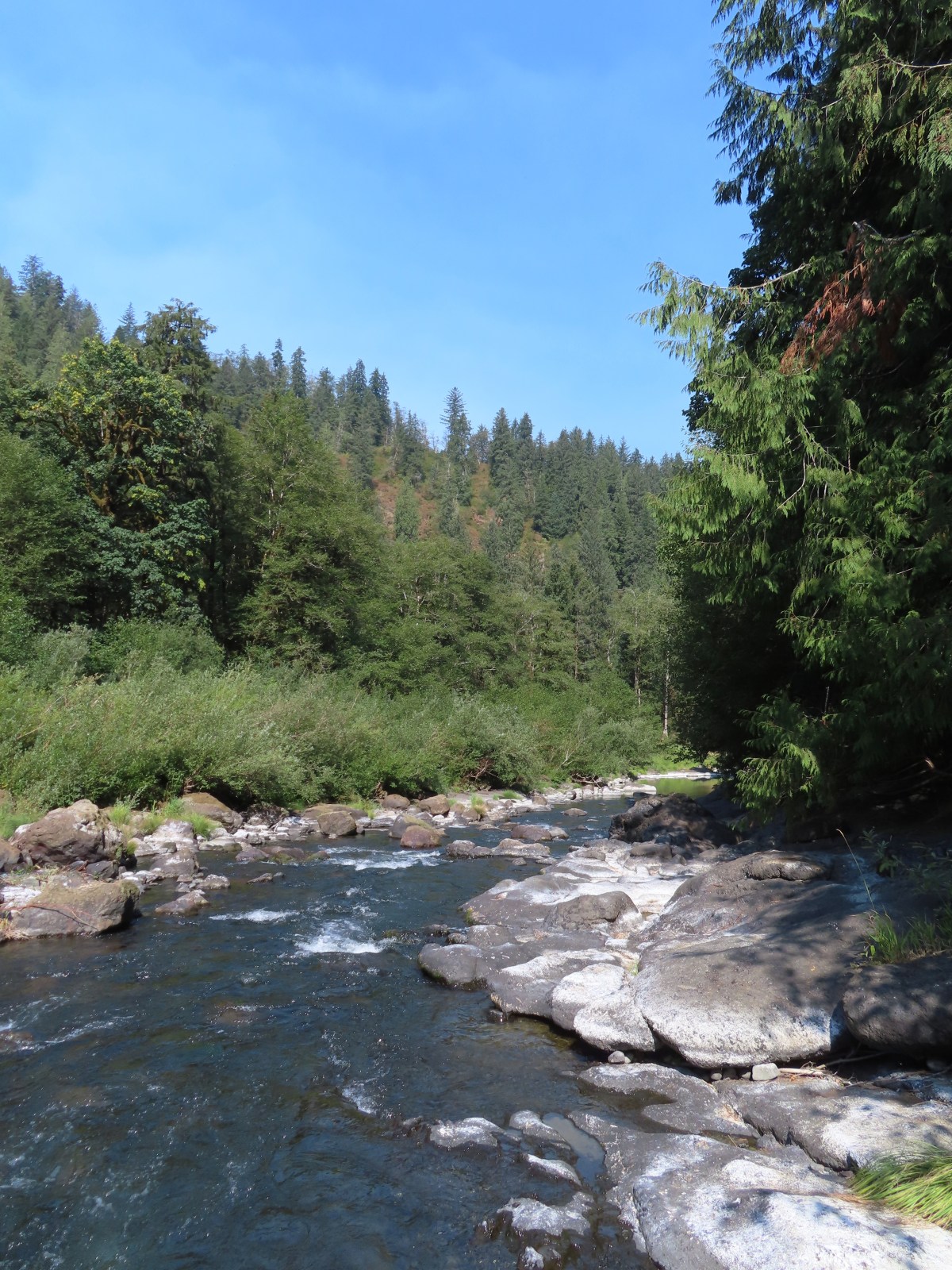
 The Little Nestucca is to the right with the Nestucca River straight ahead.
 Cormorants

 We disturbed a doe near the picnic area.
 The doe leaving the picnic area.
 A path here leads down to the bay to provide fishing access (we didn’t follow it).
 Ground squirrel
 Thistle
 Wilson’s warbler
 The overlook on the far hillside.
 The trailhead from the service road.

 Haystack Rock and Cape Kiwanda (
 Haystack Rock
 Pearly everlasting, spirea, and aster.
 View from the overlook.
 Bench at the overlook.
 Little Nestucca River from the overlook.
 White-crowned sparrow
 Ladybug


 Trask River from the trailhead.
 Garter snake near the trailhead.
 We followed the pointer here and went right.
 Here we again followed the pointer and went left. We failed to notice the pointer on the lower sign not facing us. It was also hard to tell if the rocks were actually part of a trail or just a scramble route. Turns out they are “stone steps”.
 The inland clouds were breaking up giving us some nice blue sky.
 Ouzel
Ouzel

 Big tree along the trail.
 Arriving at the picnic area.


 The trail to the left.
 Huge nursery log.
 It’s hard to see here but this section was very steep.
 Steps along the ridge.
 The stone steps looked more like steps from this direction.
 Arriving back at the trailhead.


 Skunk cabbage
 Bindweed
 While there were quite a few people visiting the preserve there were still moments when we had the boardwalk to ourselves.

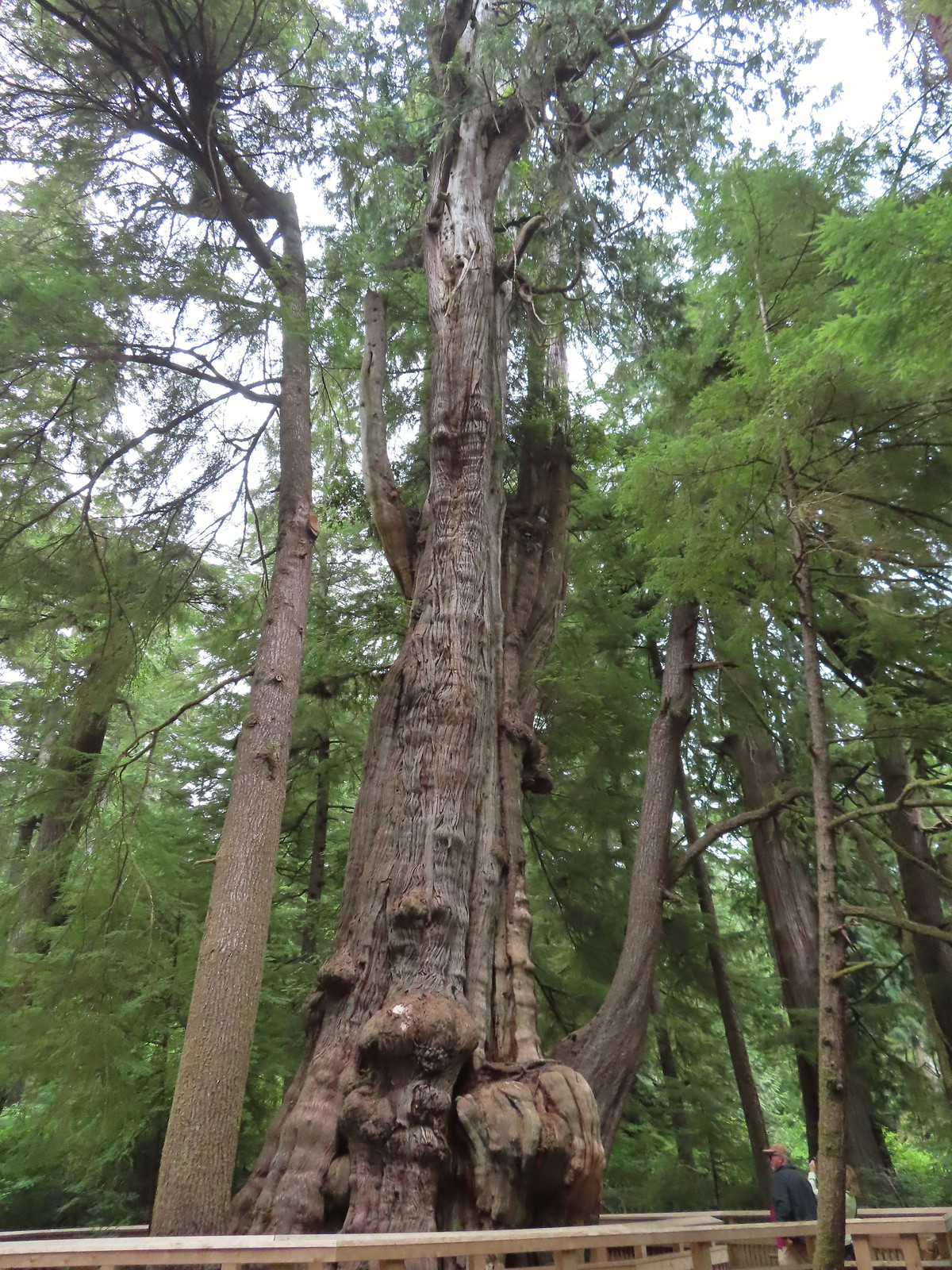


 Tree root along the cedar from another tree that is growing from it.
 Another big cedar, but not anywhere near as big as the other.
 We passed a “hiker trail” pointer which is a reportedly rough, muddy track that links up to the boardwalk near the big cedar. We had seen the other end near the smaller big cedar but there was a “trail closed” sign at that end so we hadn’t even considered taking it.
 Interpretive sign at the viewing platform. There were some benches here which were mostly occupied and not much of a view.
 Salal
Salal


 It was a little before 6am when I started up to the lakes.
 There was an interesting amount of sagebrush along the lower portion of this hike.
 There was still some smoke in the air, but it was quite a bit less than it had been the day before.
 The trail initially seemed like it is heading up this valley before it crosses over a ridge and heads for the Echo Lake basin.
 From this trail the route of the Tombstone Lake Trail was visible.
 Waterfall along Olive Lake’s outlet creek. One of the switchbacks along the Tombstone Lake Trail is just to the right.
 Tasselflower brickellbush
 There was a lot of paintbrush along the trail.
 Paintbrush and I believe fading false sunflowers.
 Penstemon and paintbrush
 Western snakeroot
 Pika!
Pika!
 View across the valley.
 The trail approaching the outlet of Echo Lake.
 Above Echo Lake Falls which wasn’t visible from this trail.
 Groundsel, lupine, and fireweed along the creek.
 Sunrise in the basin.


 The pond.
 Gray sagewort
 Looking back toward the valley and pond.


 The spur trail.
 Spotted sandpiper


 Spirea
 A no fires beyond this point sign. Several of the lakes in the Eagle Cap Wilderness are in no campfire zones.
 Fleabane or aster lining the trail.
 Two types of lousewort.
 Echo Lake hidden by the trees.
 Pearly everlasting along the trail.
 Looking down at that trail from above the blowdown.
 Bluebells
 Echo Lake from the ridge end.
 The Elkhorn Mountains (
 Arriving at Traverse Lake.

 Golden-mantled ground squirrel
 Yellow Wallowa Indian paintbrush
 Columbian ground squirrel
 Cusick’s speedwell
 Remember that no fires sign? (Sigh)


 Monkeyflower
 Globe penstemon
 Gentians along the lake.
 A lone paintbrush.
 The blowdown at the far end of the boulder field.
 White mariposa lily
 Arnica
 Swamp onions
 Echo Lake
 The pond below on the left.
 Passing through the meadow.
 Paintbrush and fireweed
 Above Echo Lake Falls.
 West Eagle Meadows in the valley in the distance.
 Zoom in on West Eagle Meadows.
 Looking down at the switchbacks.
 Heather had also warned me about this blowdown over one of the switchbacks. There was a steep reroute that bypassed the trees.
 There were some interesting cloud formations on the way back.
 There was also an increase in the smoke.
 Can you spot the pika?
 Pika (possible the same one from earlier given the location).
 Paintbrush and buckwheat
 Yellow columbine

 Another pika at the end of this switchback.
 The Tombstone Lake Trail junction ahead.

 Swallowtail photo bomb.
 West Eagle Creek Crossing.
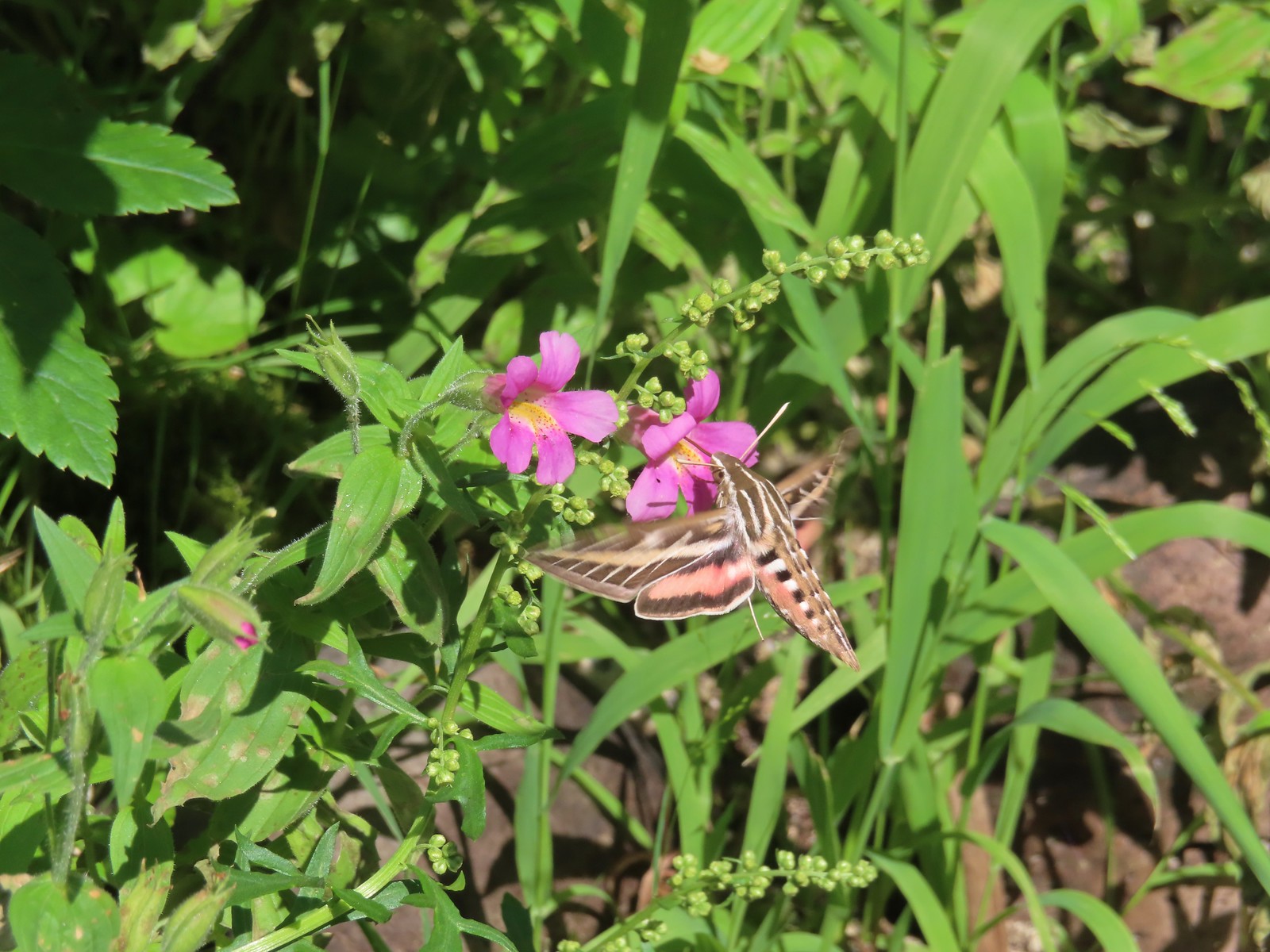 Sphinx moth
 Leaving the Eagle Cap Wilderness.
 Squirrel
 West Eagle Meadows
 It’s hard to see here but there is a trail post at this fork with a point to the left. This is for the horse camp and not the way back to the
  The trailhead in sight.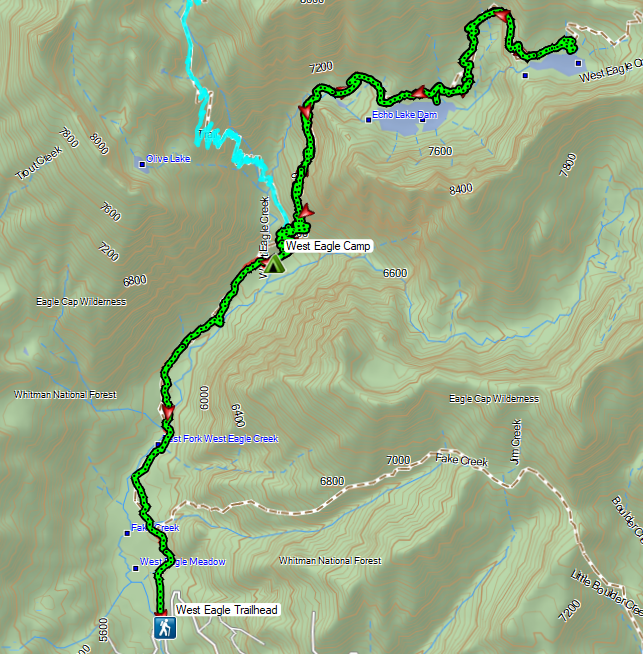
 Flax
Flax Jacob’s ladder
 wanderingyuncks