Categories
High Cascades Hiking Oregon Three Sisters Area Trip report

Matthieu Lakes

**Note the 2017 Mili Fire burned a portion of this hike.**

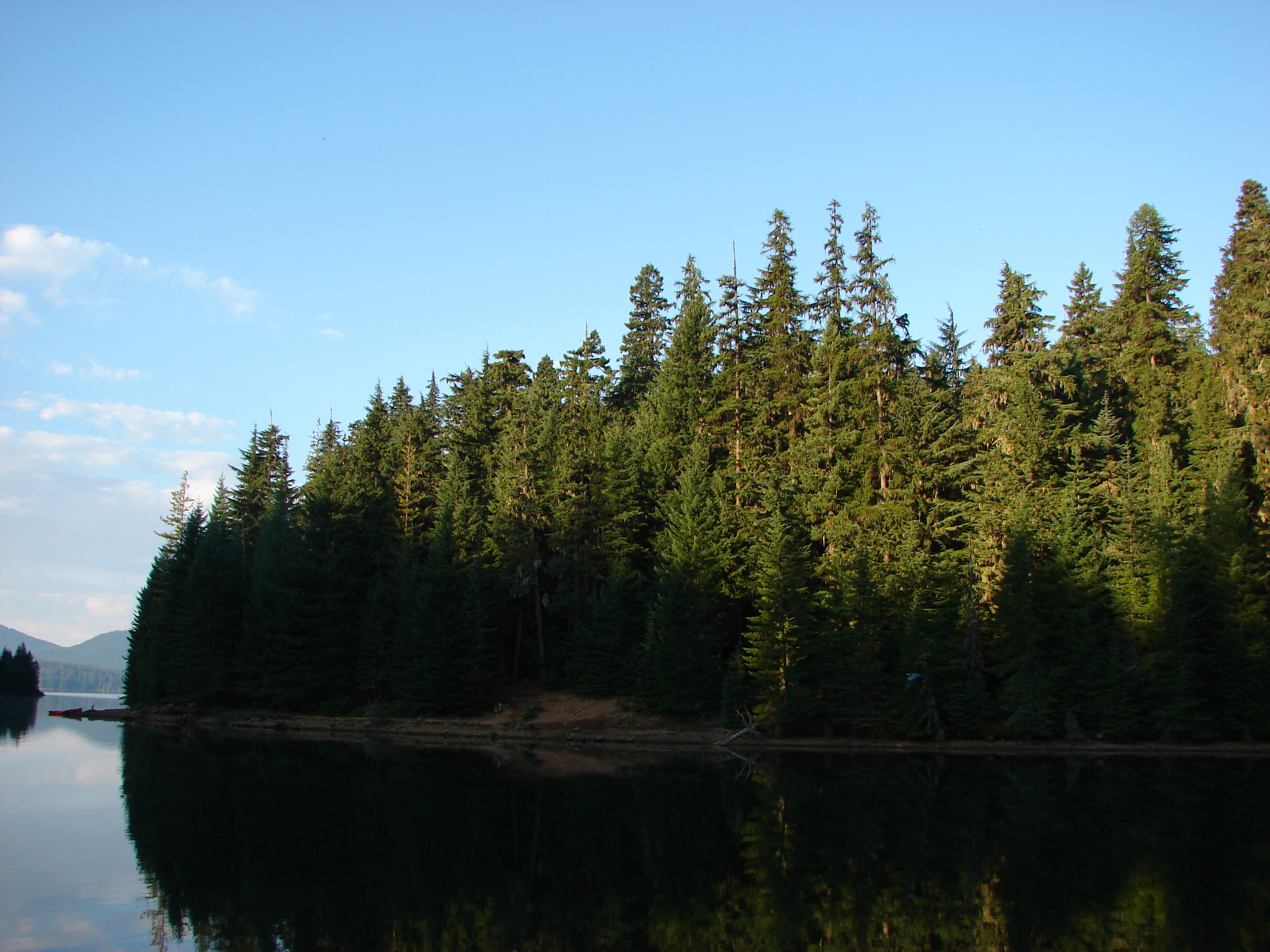
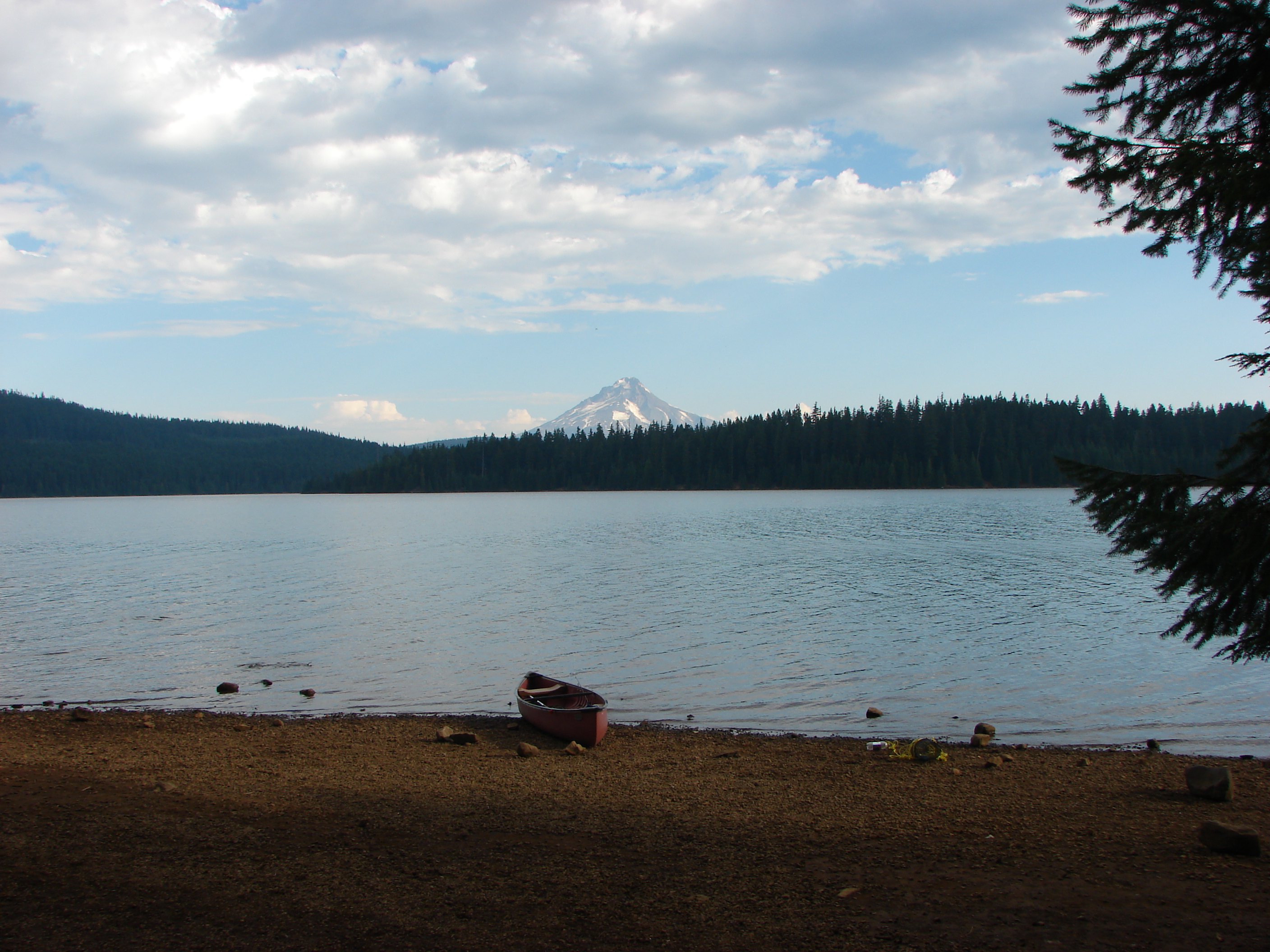
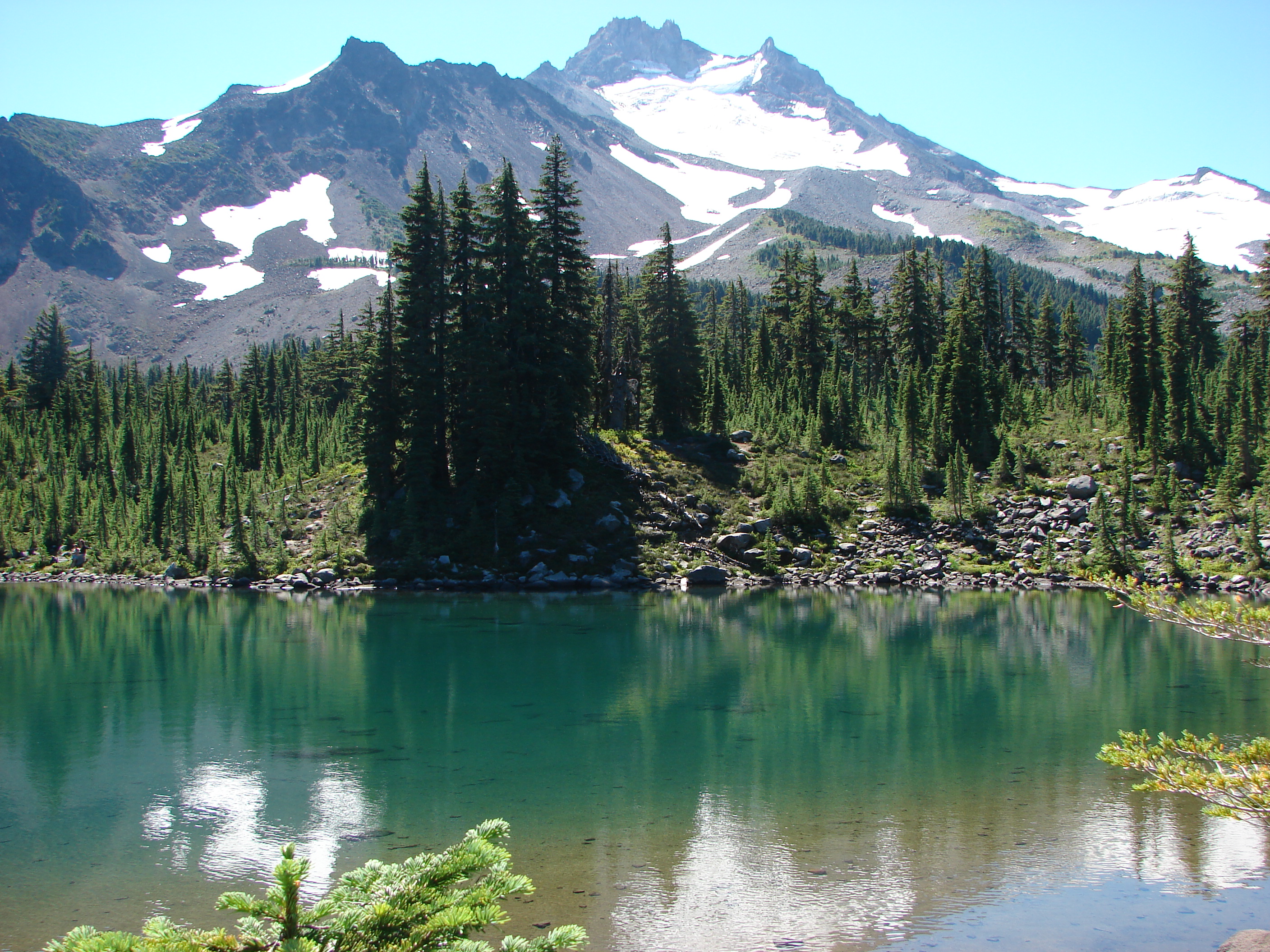
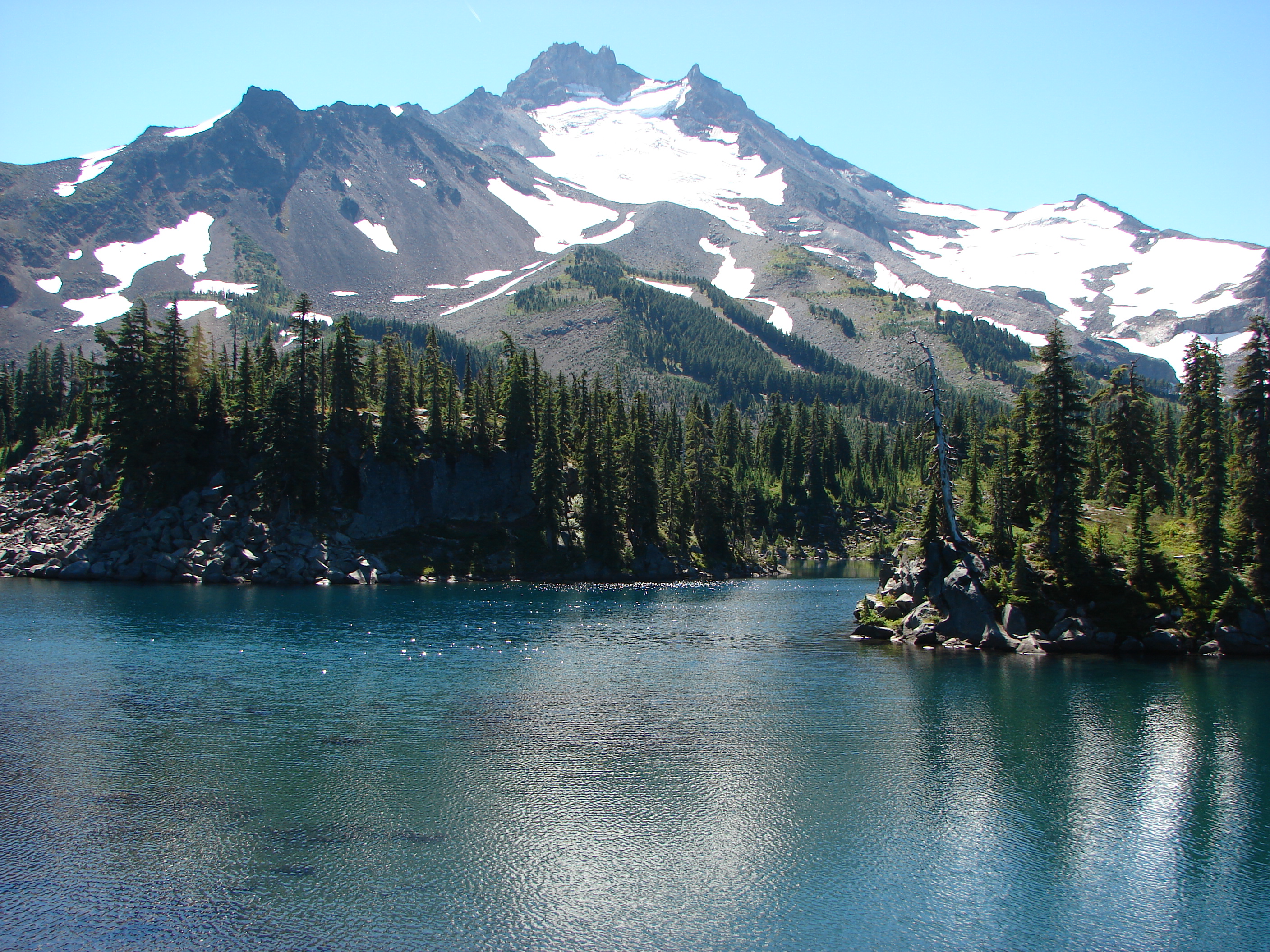
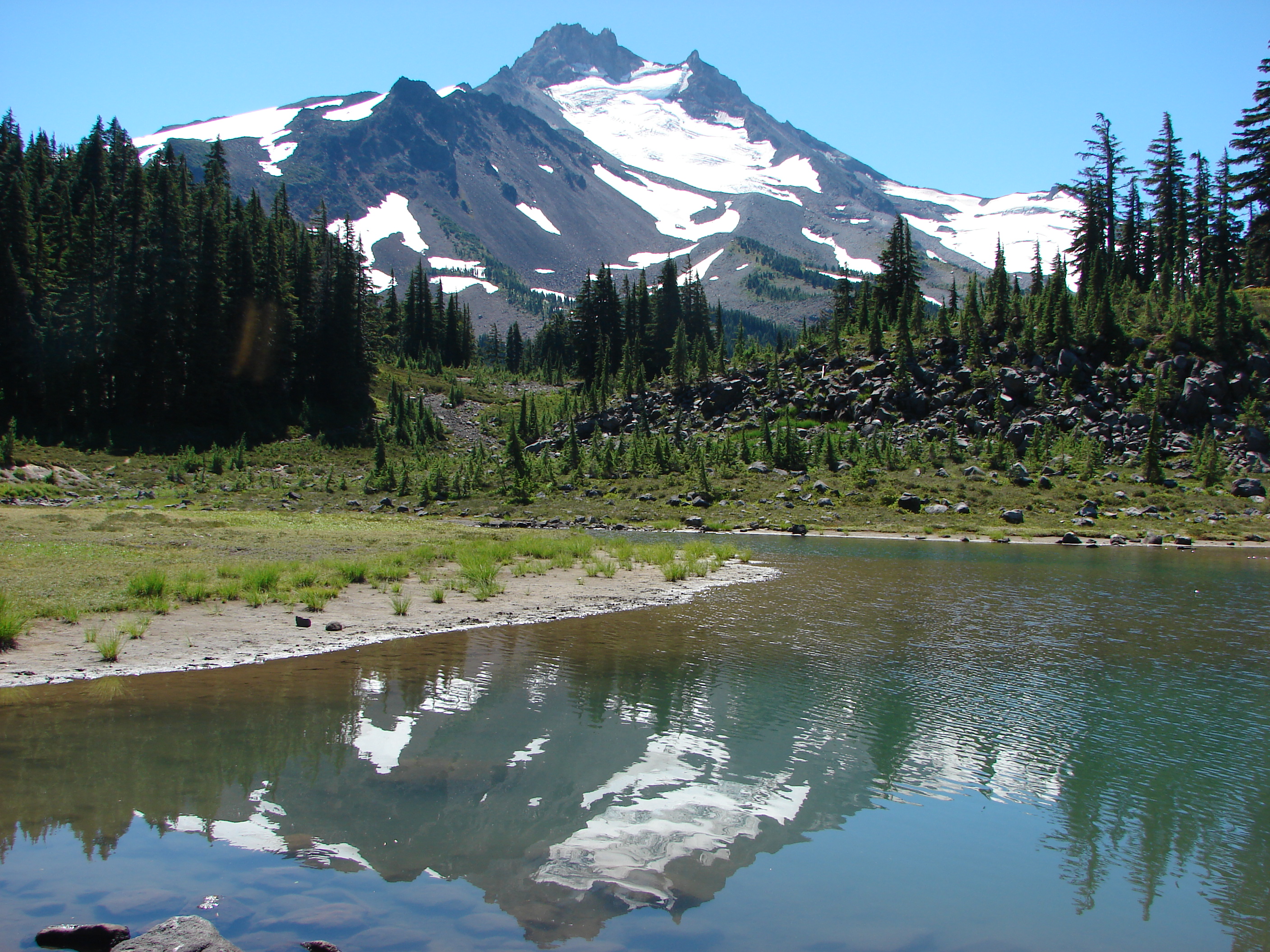
After finally successfully hiking Canyon Creek Meadows the next day we headed to McKeznie Pass to visit the Matthieu Lakes. We had been in this part of the Three Sisters Wilderness the previous October on a dreary day that left us without any views of the mountains and too late in the year for flowers. We arrived at the trail head at about 6:30am and were quickly reminded of how cold it is in the Cascades early in the morning. Looking behind us from the parking area we could see the spire of Mt. Washington as the morning sunlight reflected off the volcanic rock. We had already seen one more mountain than we had the previous year and we hadn’t even started hiking yet.

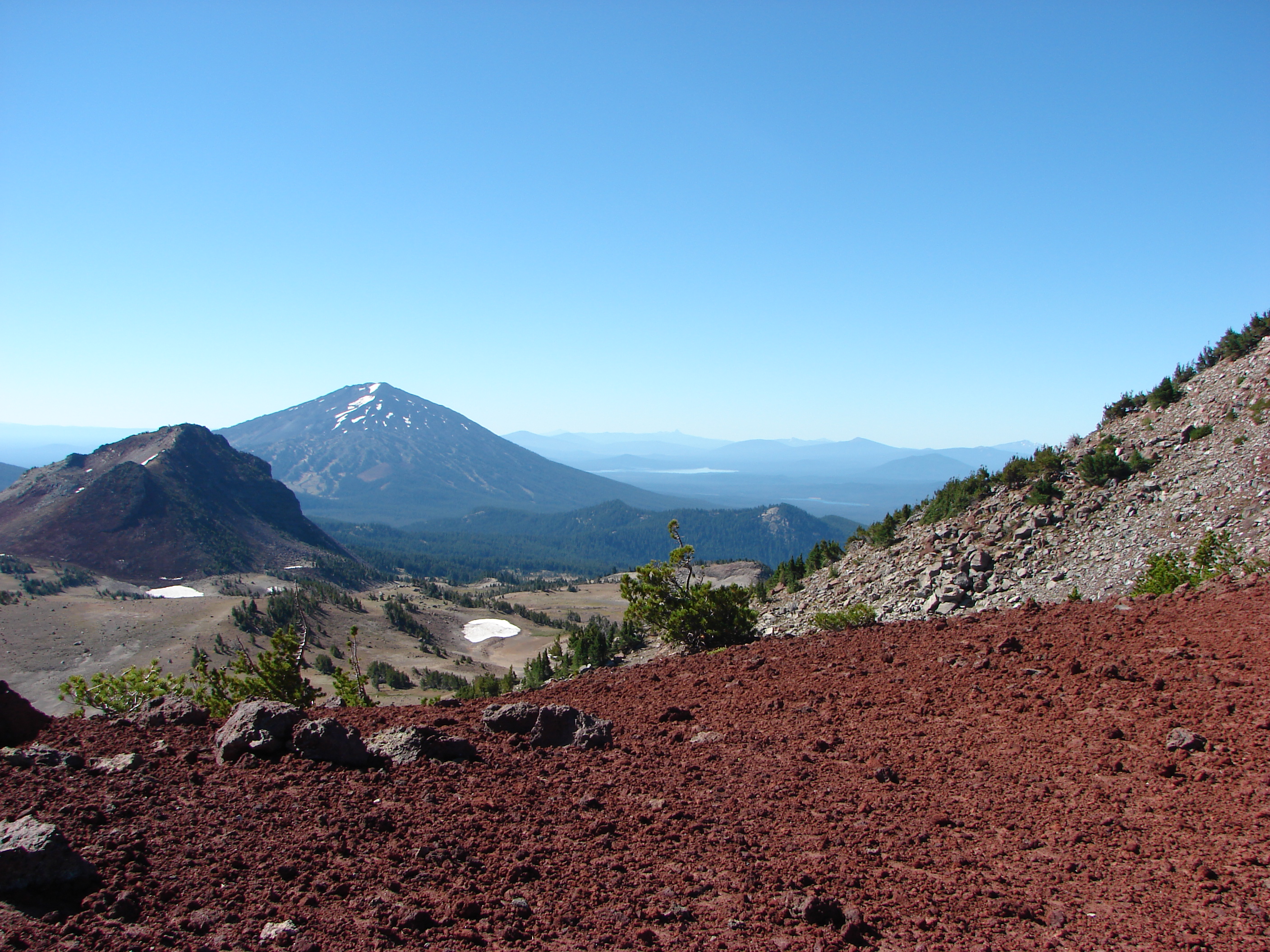
A short path led to the Pacific Crest Trail which we turned left on and started a gradual climb up to the start of the Matthieu Lakes loop. At the loop junction we kept on the PCT and headed toward South Matthieu Lake. As we climbed the tress began thinning out giving us glimpses to the north and west. The further we went the more we could see and soon a string of volcanoes was lined up on the horizon.

Belknap Crater, Little Belknap Crater, Mt. Washington, Three Fingered Jack, Mt. Jefferson, and Mt. Hood from L to R

When we reached South Matthieu Lake North and Middle Sister had joined the visible volcanoes to the south. They rose above the small lake making for a pretty scene.
071

At the north end of the lake was a trail junction for the return loop, but first we continued on the PCT heading for the meadow at the Scott Trail junction. In October we had come from the other direction on the PCT and then taken the Scott Trail back to our car and we could see the potential for the meadow to be a beaut at the right time.
This section of the PCT started along side a lava flow where we spotted a Pika who seemed to be as interested in us as we in it.
081
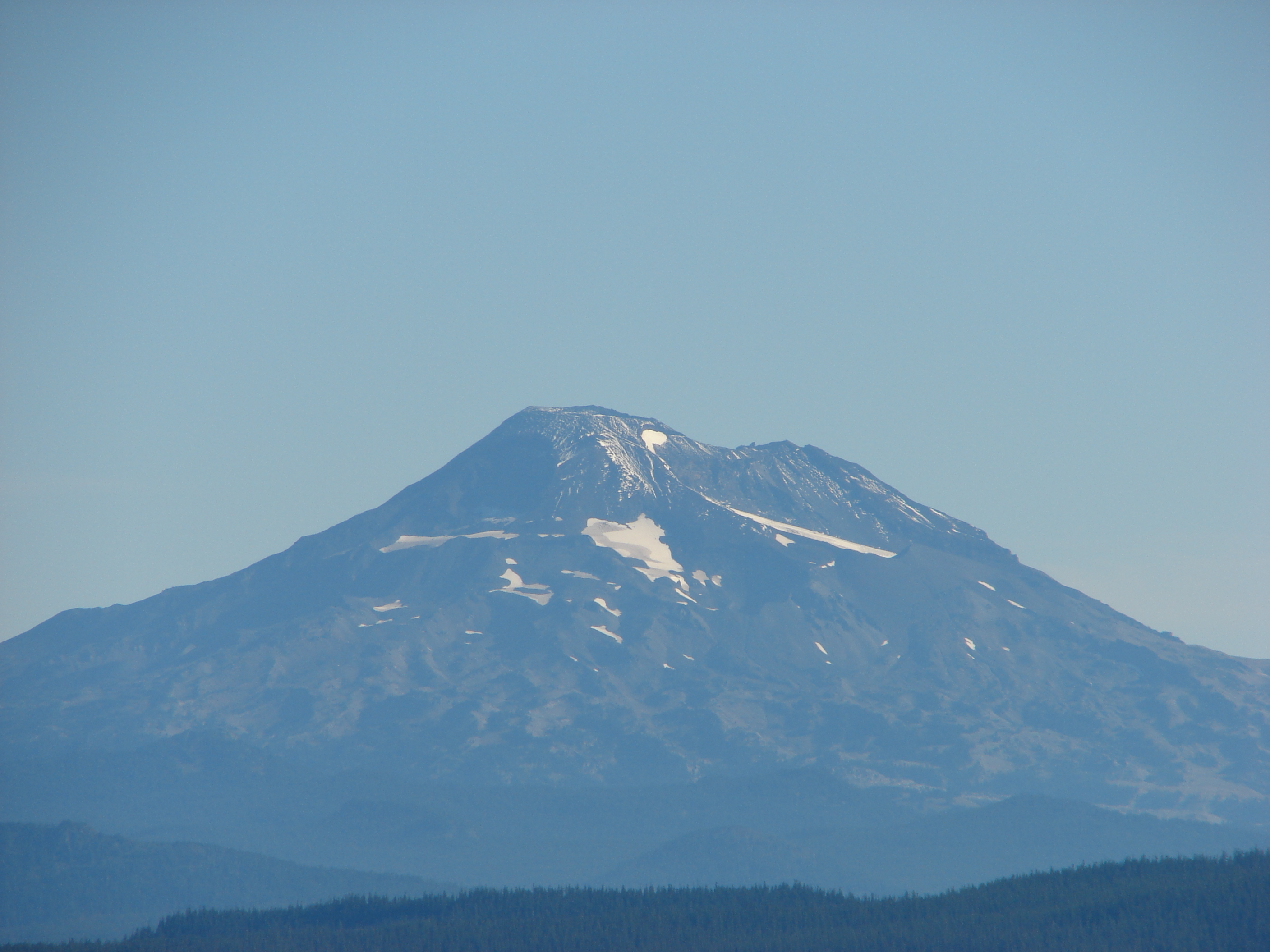
The trail then passed over the lava flow and headed for Yapoah Crater, one of many cinder cones that helped create the volcanic landscape. The Sisters got larger as we neared and to the north the view became even better as we gained elevation. As we contoured around Yapoah Crater we could even see the top of Mt. Adams in Washington join the volcanic line beyond Mt. Hood. Here the crater hid the Sisters, but as we came around they came into view joined by The Little Brother.
144

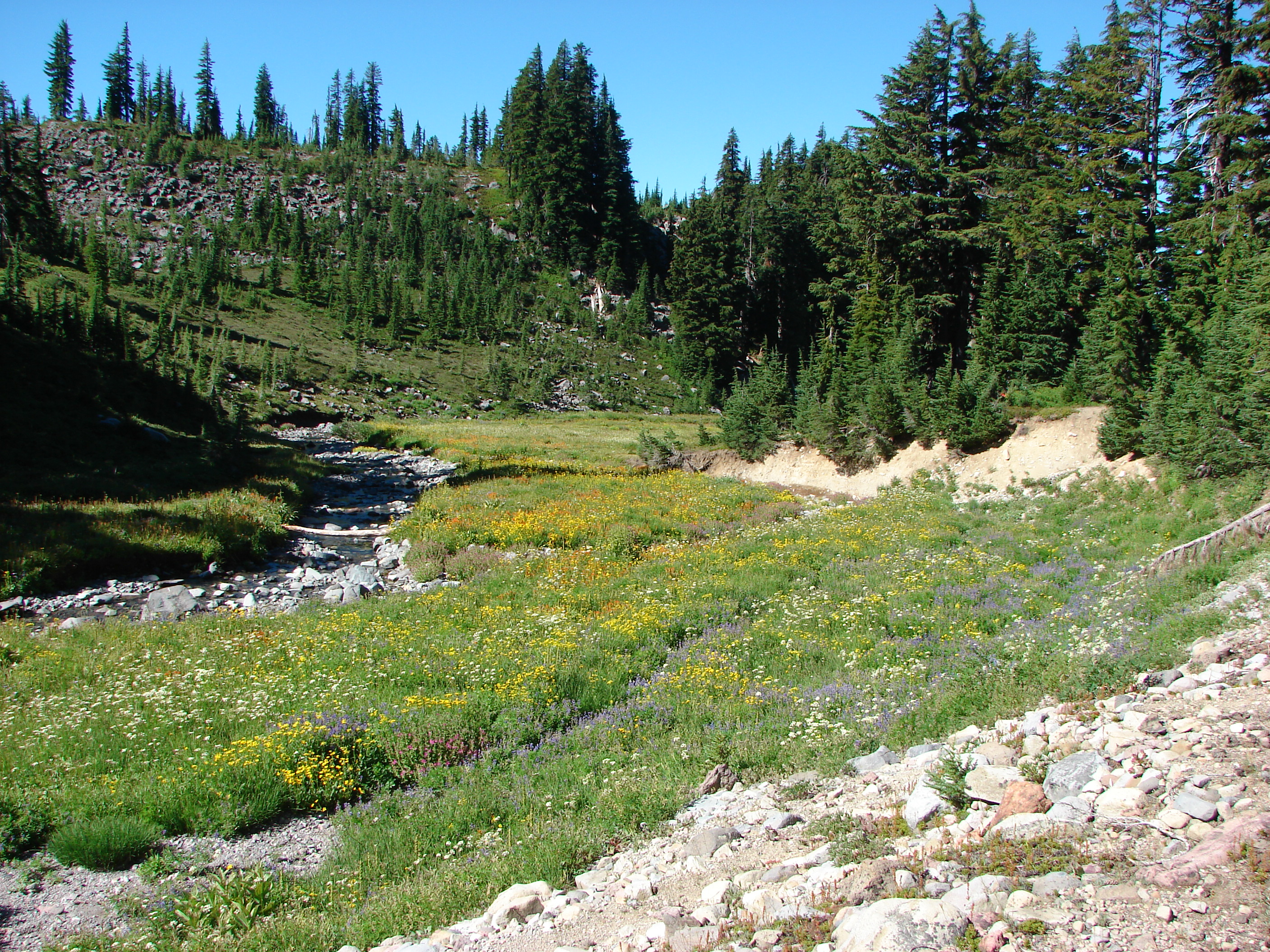
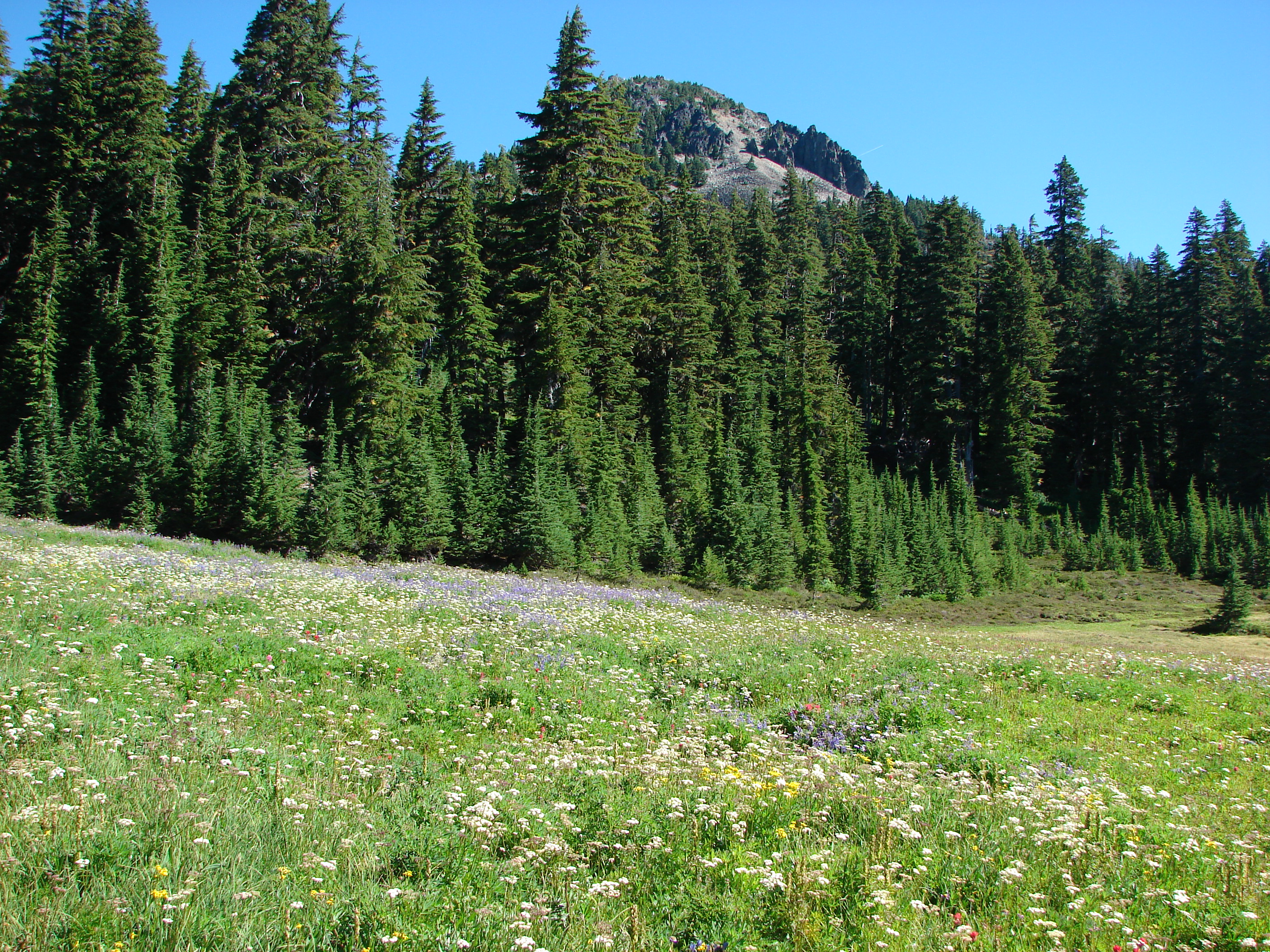
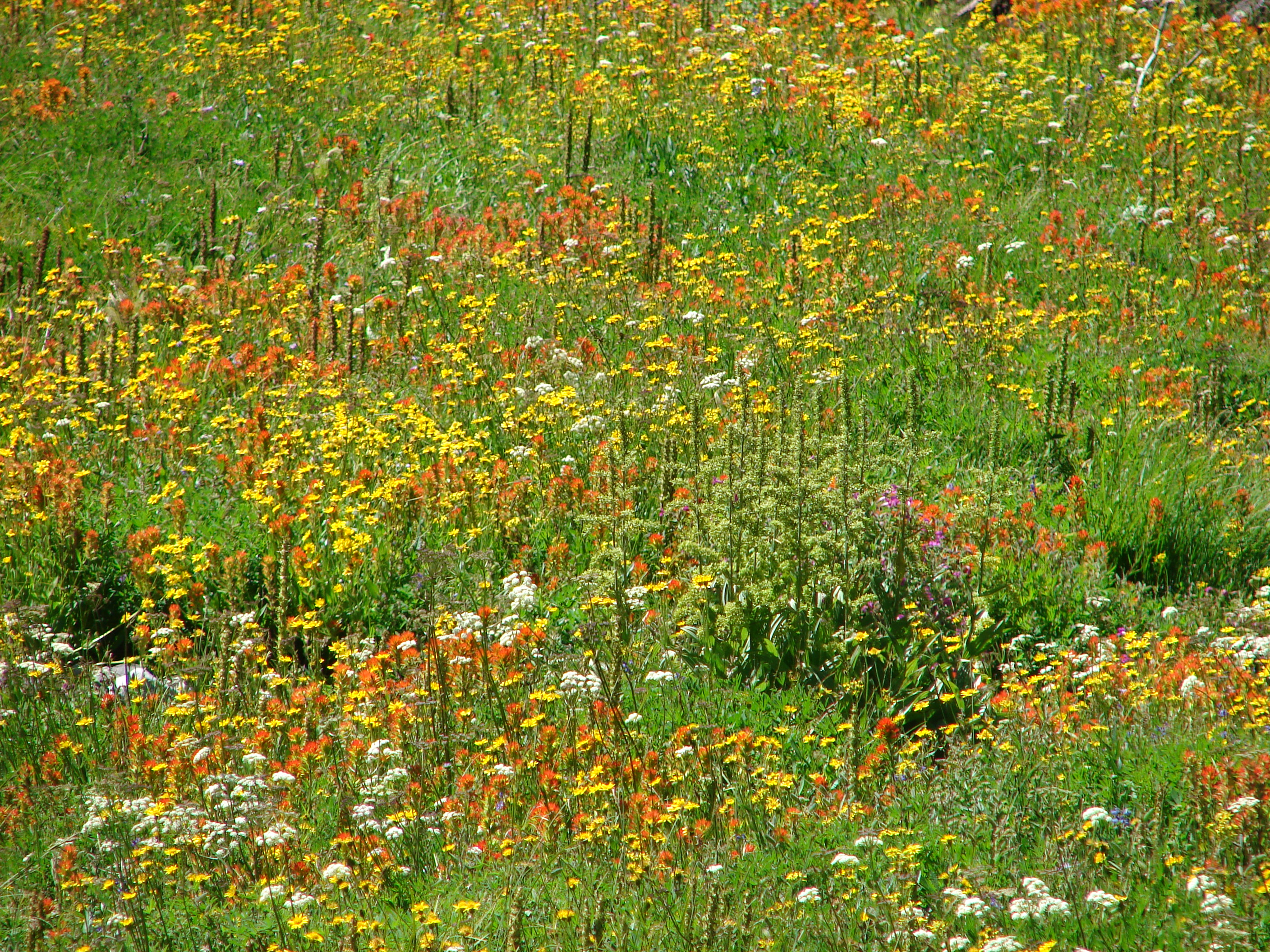
A short while later we reached a ridge looking down into the meadow. The purple patches of lupine were visible from above and as we descended other flowers became evident. Pink heather, red paintbrush and several different yellow flowers were joined by a single western pasque flower at the meadows edge. Here we also ran into our first mosquitoes of the day but they were not too bad. The meadow itself was filled with flowers and a view ahead to the Sisters.
158
Here is the same meadow from our visit last October:
23916_4744965989267_997769053_n
We crossed through the meadow on the PCT enjoying the display of wildflowers. Had the mosquitoes been less it would have been a perfect lunch spot, but as it was we just turned around and passed back through.
181

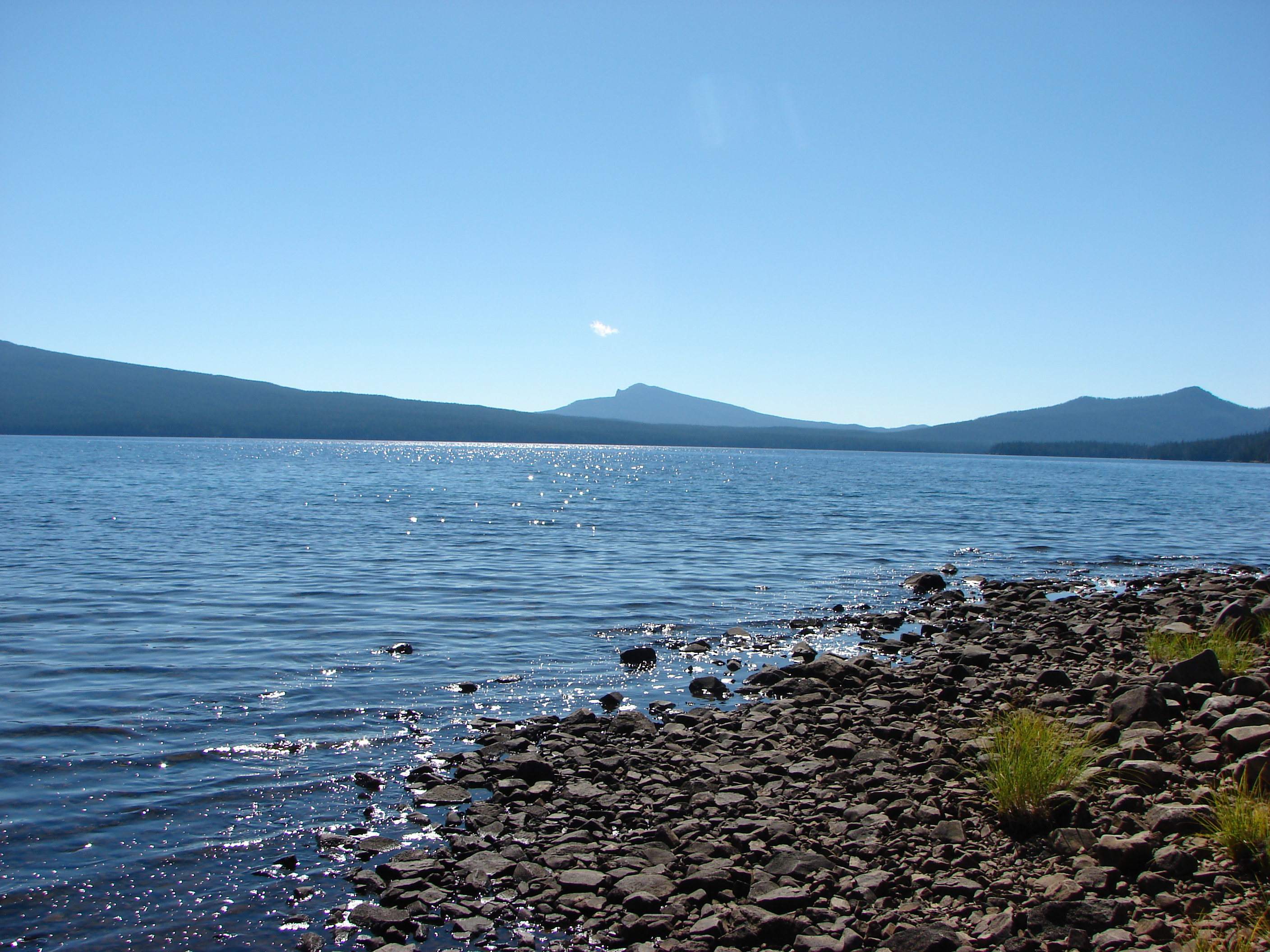
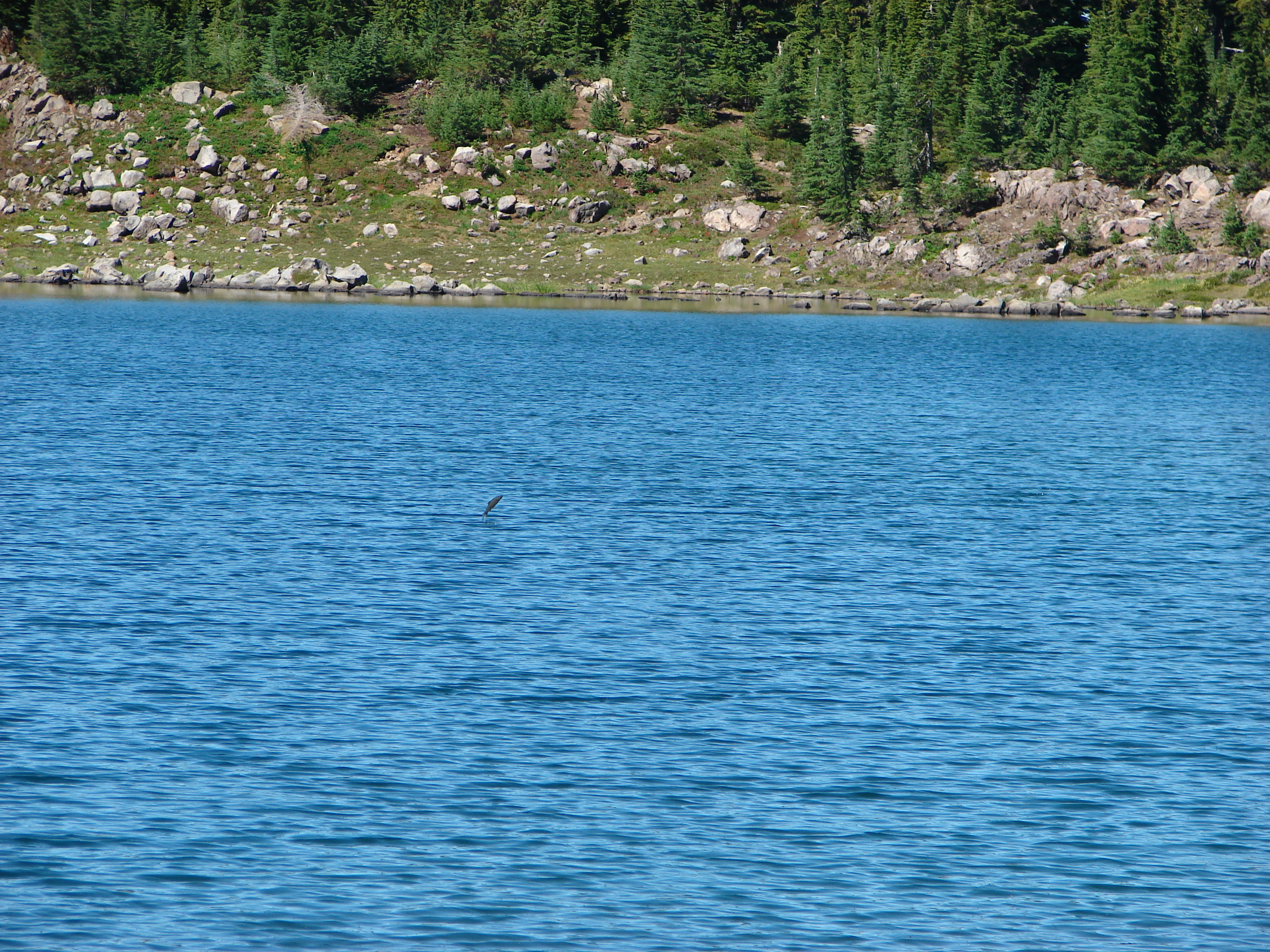
When we reached South Matthieu Lake we took the North Matthieu Lake trail to visit that lake and complete our loop. North Matthieu Lake was much larger than South Matthieu, but being lower in elevation meant almost no view of The Sisters save at the very north end and then only just the tip of the North Sister was visible. What it lacked in mountain view it made up for in color. The water went from blue to green depending on where you looked.
220

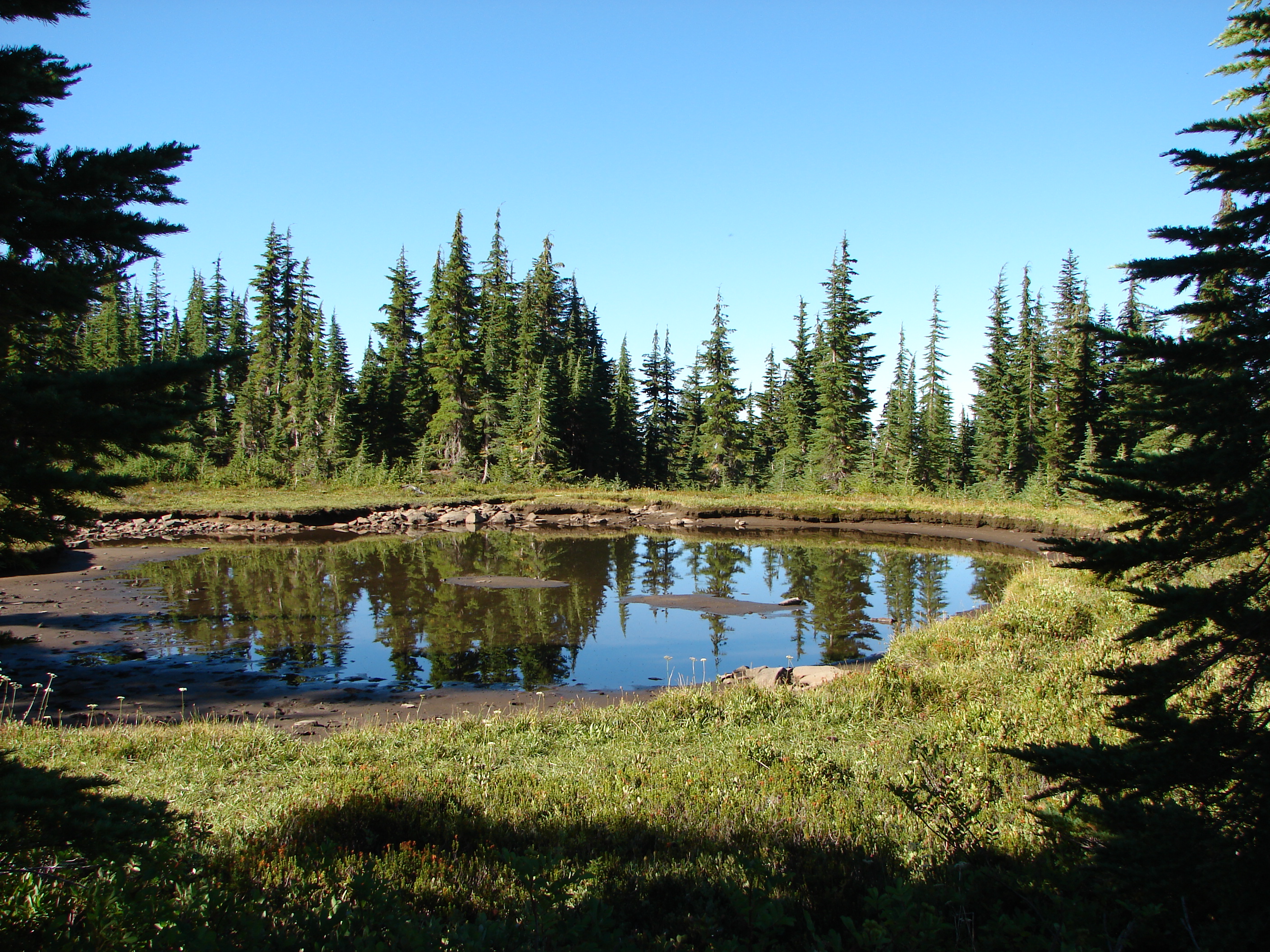
Past North Matthieu Lake we encountered a number of small ponds. The last of which was teeming with birds. We spotted a variety of birds in the trees around the pond and sometimes in it.
238
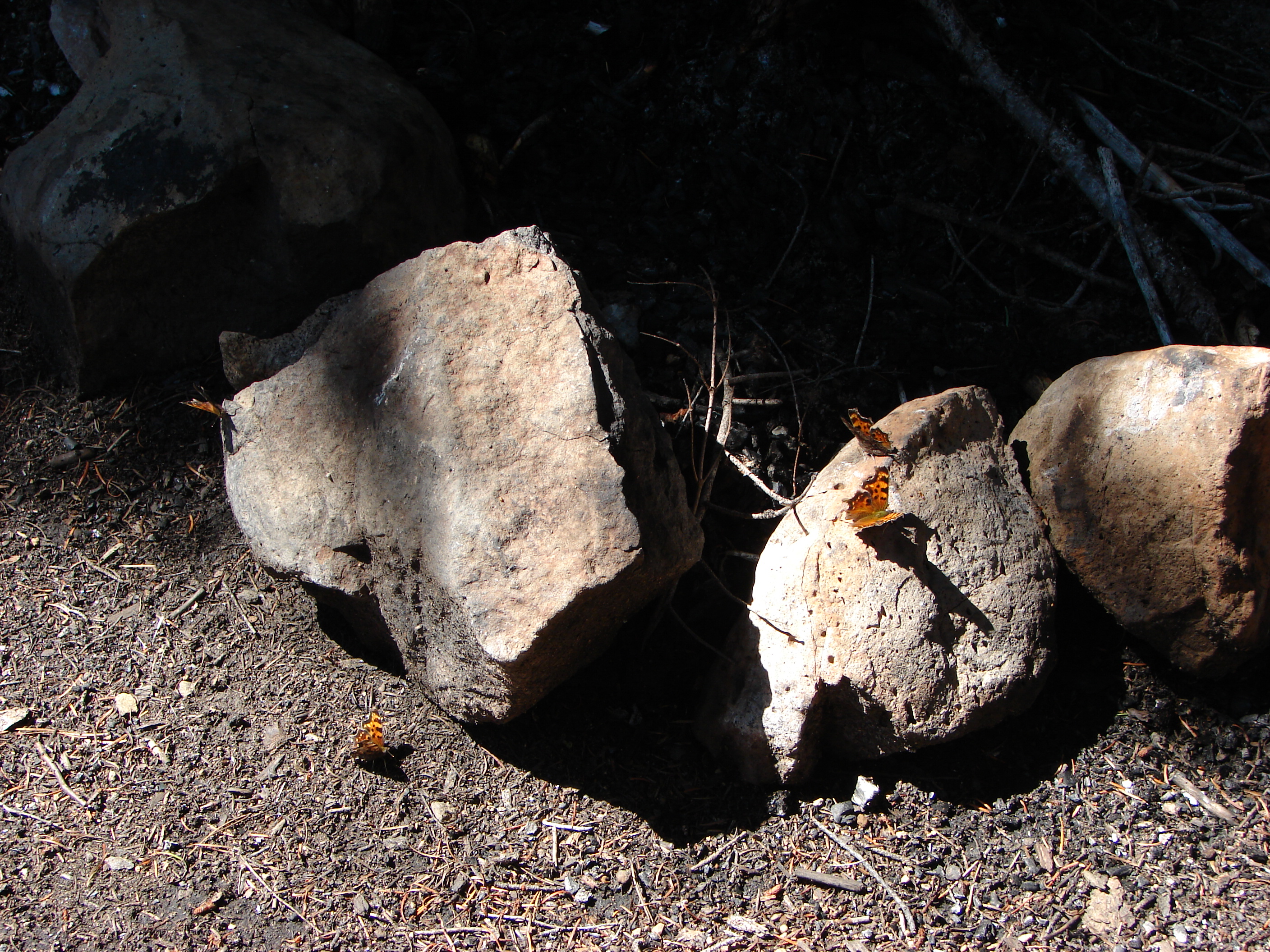
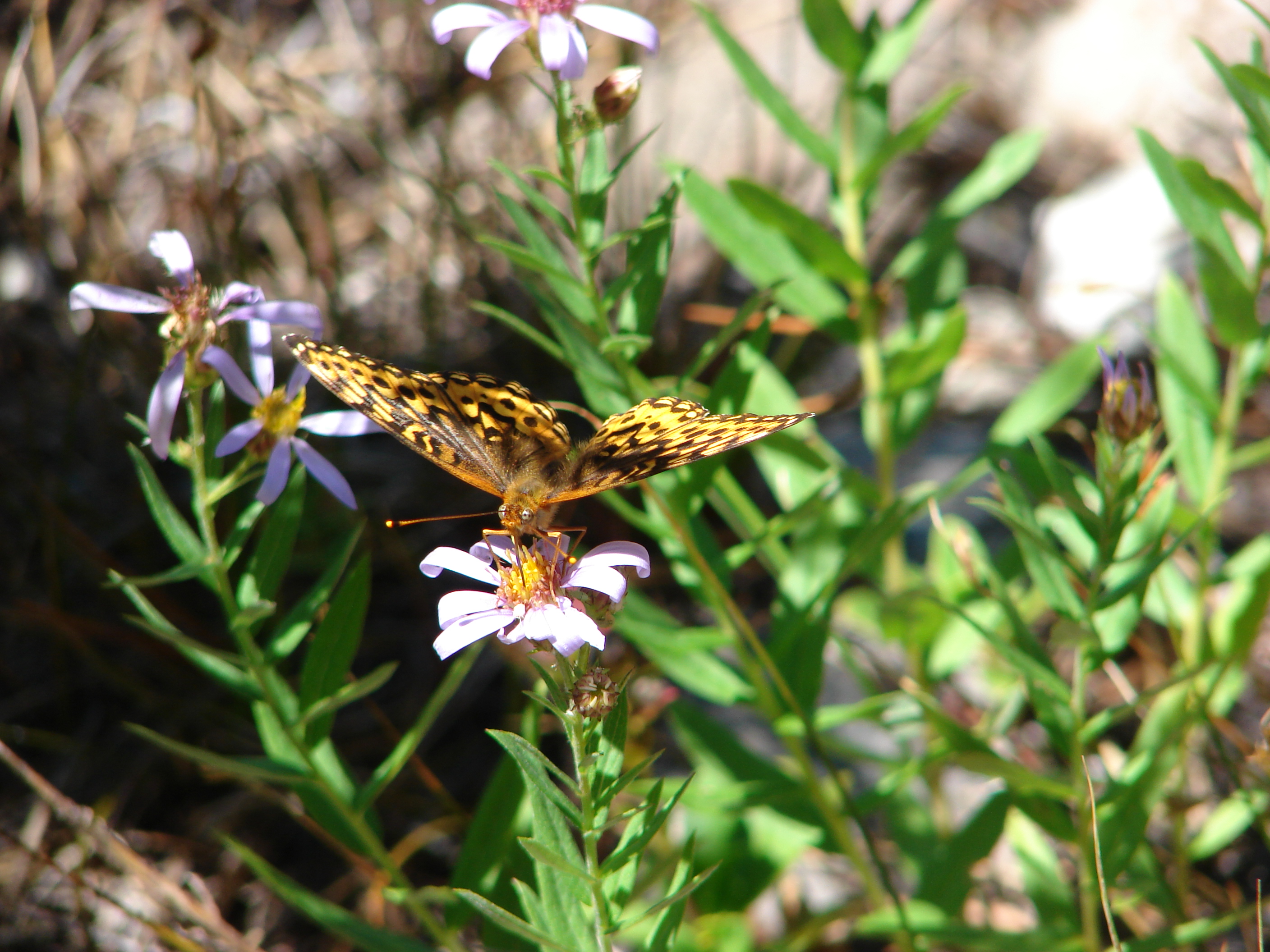
Finally we passed through a small meadow beside a lava flow that was home to a number of butterflies. Here we saw our first California Tortoiseshell.
254

It was a great hike and really nice to be able to visit a place we had been before at a different time. It’s amazing how much timing can change the experience. It was a good reminder that it can be worth going back to a previous hike at a different time of year to see how things have changed. Happy Trails.

Facebook photos: https://www.facebook.com/deryl.yunck/media_set?set=a.10201705197258876.1073741845.1448521051&type=3
Flickr: http://www.flickr.com/photos/9319235@N02/sets/72157634853318672/

Categories
High Cascades Hiking Mt. Jefferson Area Oregon Trip report

Canyon Creek Meadows

Canyon Creek Meadows had been a monkey on our backs, or is it packs for hikers? We had tried several times in the past two years to get this hike in and either snow or forest fires forced us to change our plans. We had put it back on our schedule for August 2nd this year hoping this year would be different. Thanks to a very helpful trip report on 7/26 by pdxgene via portlandhikers.org we learned that the meadows were not only snow free but the flowers were in bloom. We were now in danger of being too late for the full flower display so we moved the hike up in the rotation and off we went.

It was a beautiful morning at the Jack Lake trail head and after a minor detour around the wrong side of the lake we were headed for the lower Canyon Creek meadow. The trail alternated between burned and unburned forest as it climbed to the first meadow. The flowers here were still in bloom despite some already feeling the effects of a warm and dry late Spring and early Summer.
295
Beyond the meadow Three Fingered Jack filled the horizon beneath a blue sky.
065

As we continued on toward the upper meadow the views of the mountain got better and better. A near full moon hovered above the summit all morning shifting positions as time passed. We skirted the edge of the upper meadow and headed up toward a saddle with a view of a cirque lake below a glacier on the flank of Three Fingered Jack. The path was steep with a lot of loose rock but the views were more than worth it, and a healthy wind quickly cooled us off on top of the saddle.
154

Looking south from the saddle

We had some food and explored the ridge along the saddle where we found a less steep trail down from the east. In the post on portlandhikers Gene had mentioned that after 12:00 the shadows from the mountain causes issues with picture quality from the upper meadow so we wanted to get back down before we ran out of time. Canyon Creek flows out of the cirque lake through the upper meadow creating a wonderful wildflower display. The lupine was especially thick here.
271

After exploring the upper meadow we followed Canyon Creek down to the lower meadow and began the loop back to the car. (To help control the foot traffic on this popular hike there is a loop that you are asked to hike in a clockwise direction.) Before we got back we took a short side trip to Wasco Lake for no particular reason. It was pretty and quite but we were ready to get back to the car so we took a quick break and finished the hike and removed the monkey from our packs. Happy Trails.

Facebook photos: https://www.facebook.com/media/set/?set=a.10201704844290052.1073741844.1448521051&type=1
Flickr: http://www.flickr.com/photos/9319235@N02/sets/72157634839391624/

Categories
High Cascades Hiking Mt. Hood Area Oregon Trip report

Elk Meadows

Greetings, we recently made our first visit of the year to Mt. Hood. We had taken a handful of trips to the west side of the mountain last year and had fallen in love with it. So for this hike we decided to check out the east flank of Oregon’s tallest mountain. The plan was to travel a big loop around the area to hit as many sights as possible. Starting at the Elk Meadows trail head just off highway 35 near the Mt. Hood Meadows ski area the plan was to hike around the far end of the meadow, head up Gnarl Ridge for an up close view, then take the Timberline Trail through Mt. Hood Meadows, and return to the car via the Umbrella Falls trail to visit two waterfalls along the East Fork Hood River. Total planned distance was 15.2 miles (which I verified using two different maps).

We set off on the Elk Meadows and soon reached the boundary of the Mt. Hood Wilderness at Clark Creek. After crossing the creek (and into the wilderness) another .6 miles brought us to Newton Creek and a nice view of Mt. Hood.
040
We crossed the creek on a makeshift bridge and began climbing up towards Elk Meadows. Purple lupine began lining the trail as we approached the meadows and soon we could see the open green expanse through the trees ahead. Our arrival was ill timed as it was early on a weekend morning so many backpackers were camped around the perimeter. We did our best to avoid disturbing the campers and skipped a visit to the old shelter, but we still managed to get some good views.

Mt. Hood from Elk Meadows

We veered off the perimeter trail and took the Gnarl Ridge trail up toward the mountain. After a mile or so we reached the junction with the Timberline Trail on its way around Mt. Hood. We continued on the Timberline Trail through ever better wildflower meadows as we gained elevation. This portion of the trail winds around Lamberson Butte which kept Mt. Hood hidden for awhile. As we worked our way around the butte we spotted Mt. Adams and the very top of Mt. Rainier away to the north. Eventually forest began to give way to sand and rocks as we approached the Gnarl Ridge viewpoint. Dwarf lupine and buckwheat dotted the drier ground able to survive in the exposed dry climate. Mt. Hood now loomed before us while the Newton Creek Canyon replaced Lamberson Butte on our left. Behind us to the south snowy Mt. Jefferson was joined by the Three Sisters and Broken Top in Central Oregon. To the SE there appeared to be a fire which it turned out was in fact a forest fire on the Warm Springs Indian Reservation.
171

We had been informed by a fellow hiker we’d run into earlier that there were a couple of waterfalls coming off of snow melting higher up on the mountain, but we couldn’t see them from where we’d stopped. We decided to split up and see if we could get a view so Heather headed further up the ridge while I turned around and scrambled up Lamberson Butte. From the butte I was able to see the falls, the higher of the two seemed to be flowing straight out of the rocks and sand.
193
I could barely make out Heather up on the ridge and decided to go see if she had a closer view from where she was. She didn’t, but she did find a great overlook of Newton Creek as it flowed down through the canyon.

Having found the waterfalls we headed back down the Timberline Trail and headed down into the Newton Creek Canyon. On the way down we ran into Ken, the hiker who had told us about the waterfalls, on his way back up the trail. He had been down to the creek but was uncertain of the correct place to cross and hadn’t been able to spot the continuation of the trail on the opposite side of the creek. I had seen trail reports on Portlandhikers.org from hikers that had made the crossing in the previous couple of weeks so I knew there was one, and between my maps and GPS unit felt confident we could find it. Ken decided to join us and followed us back down to the creek. We wound up using the map, GPS, and binoculars but in the end found two good crossings and Ken quickly spotted the flagging marking the continuation of the trail.

One of the “bridges” across Newton Creek

At the top of the canyon Ken turned down the Newton Creek Trail to complete his planned loop and we continued clockwise around the mountain on the Timberline Trail.

When we reached the Clark Creek canyon the gray sandy ground began to give way to more plants and flowers. We could see down to Heather Creek as it flowed through the canyon on its way to join Clark Creek. The lush valley below was a stark contrast to the bare ridges beyond as Heather Creek flowed down the middle in a series of picturesque waterfalls.
311
We crossed the creek just above a nice waterfall surrounded by beautiful wildflowers. It was certainly one of the prettiest places we’ve been.

When we gained the canyon ridge we came to the Mt. Hood Meadows. The ski lifts sat idle and the ski runs were replaced with green slopes decorated with wildflowers. As we passed through the meadows we noticed that each one seemed to have a slightly different mix of flowers often with Mt. Hood towering above. One would be cat’s ear lilies and lupine, another beargrass and paintbrush, and yet another of western pasque flowers and paintbrush. This was a treat for Dominique since his favorite flower is the paintbrush but he also enjoys the “Hippies on a stick”.

Paintbrush & Western Pasque Flowers (Hippies on a Stick)

After a little over three miles since saying goodbye to Ken we reached the Umbrella Falls Trail. In 3.5 miles we would be back at our car but first we had some waterfalls to visit. Up first was Umbrella Falls, the trails namesake. We crossed the East Fork Hood River just below this fall which was rather scenic.
545
Normally we would have stuck around for awhile and enjoyed a snack while taking in the falls, but after the unplanned scramble up Lamberson Butte and extra climb up the Timberline Trail it was getting late and we were all pretty tired. We continued on to a sign for Sahalie Falls which was down in a narrow canyon. The trail down was steep and after surveying it I went down alone. This was another nice waterfall and the breeze created by it felt wonderful. After climbing back out of the canyon we completed the final .5mi leg of our loop and arrived at the trail head.

Once again Mt. Hood had delivered a spectacular hike. In addition to the mountain views, wildflowers, and waterfalls we saw dozens of butterflies and a pair of Western Tanagers. We have three more hikes planned around Mt. Hood this year and can’t wait to see what else the mountain has to offer. Happy Trails.

Facebook photos:https://www.facebook.com/media/set/?set=a.10201658556452885.1073741843.1448521051&type=1
Flickr:http://www.flickr.com/photos/9319235@N02/sets/72157634743927448/

Categories
Hiking Mt. St. Helens Trip report Washington Washington Cascades

Sheep Canyon

So after a couple of months of taking pictures of the major Cascade peaks it was finally time to visit one. Our most recent hike brought us to the volcanic landscape of Mt. St. Helens. Our plan was to hike a loop on the SW side of the mountain starting at the Blue Lake trail head.

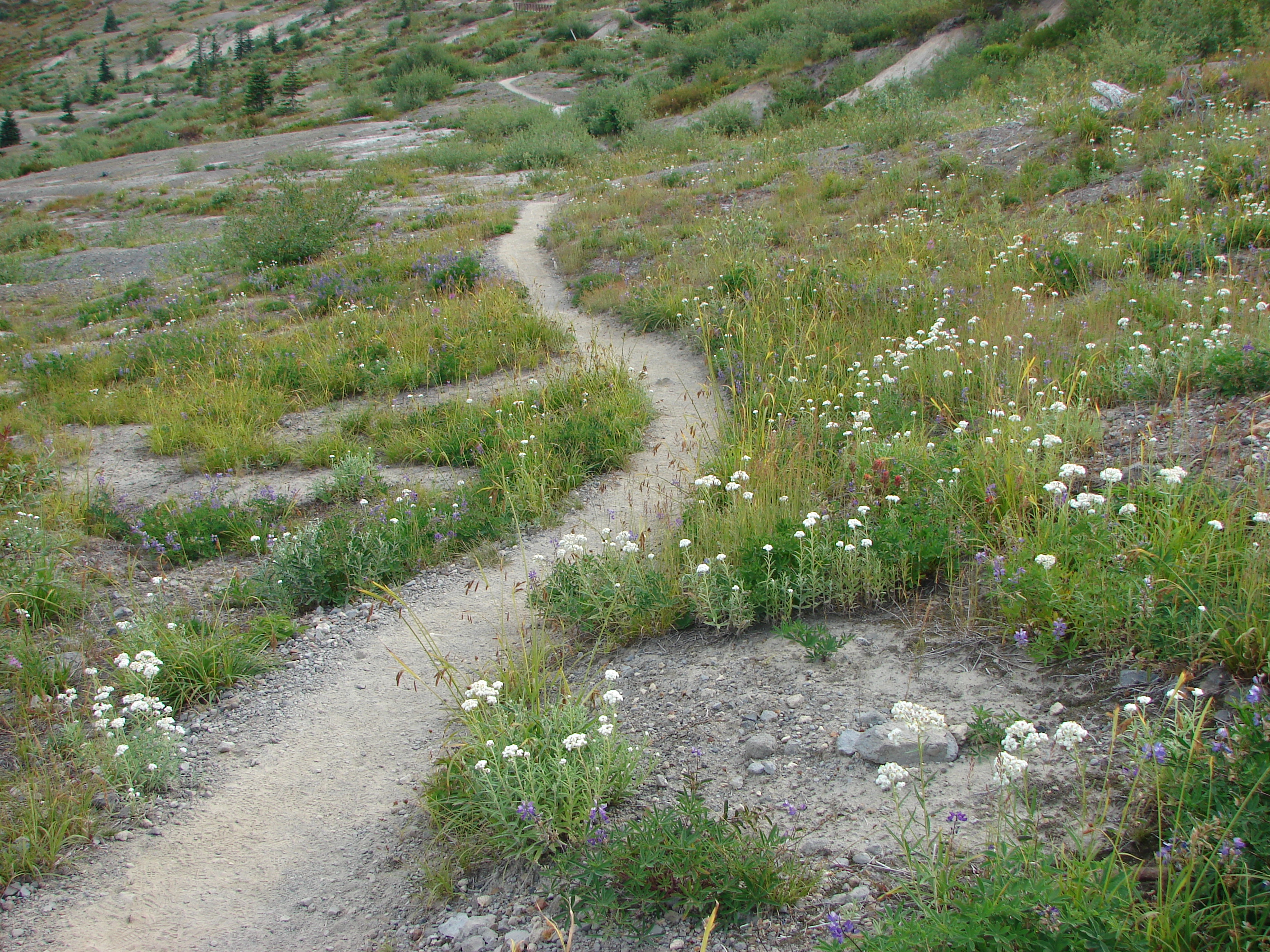
For the second week in a row we spotted elk from the car on the way to the trail, but were skunked while actually hiking. We arrived at the current Blue Lake trail head (washouts occasionally relocate it) and headed across a rocky washout to the Toutle Trail. The washout provided a view ahead to the mountain while forest lined each side. At the Toutle Trail we turned left and headed toward Blue Lake. Coldspring Creek flowed along the edge of the washout creating a dividing line between the grey rocks and old growth forest on the other side. Shortly after crossing the creek and entering the forest we came within sight of Blue Lake. The forest here survived the 1980 eruption leaving old growth trees, but a mudflow dammed the creek creating the lake. The forest was peaceful and carpets of white flowers covered much of the ground.

After 2.5 miles in the forest we began to descend into Sheep Canyon. Here the Toutle Trail intersects the Sheep Canyon trail which climbs the mountain on the south side of Sheep Canyon up to the Loowit Trail which circles the entire mountain. We continued on the Toutle and crossed Sheep Canyon on a scenic footbridge and continued on toward the South Fork Toutle River.
056

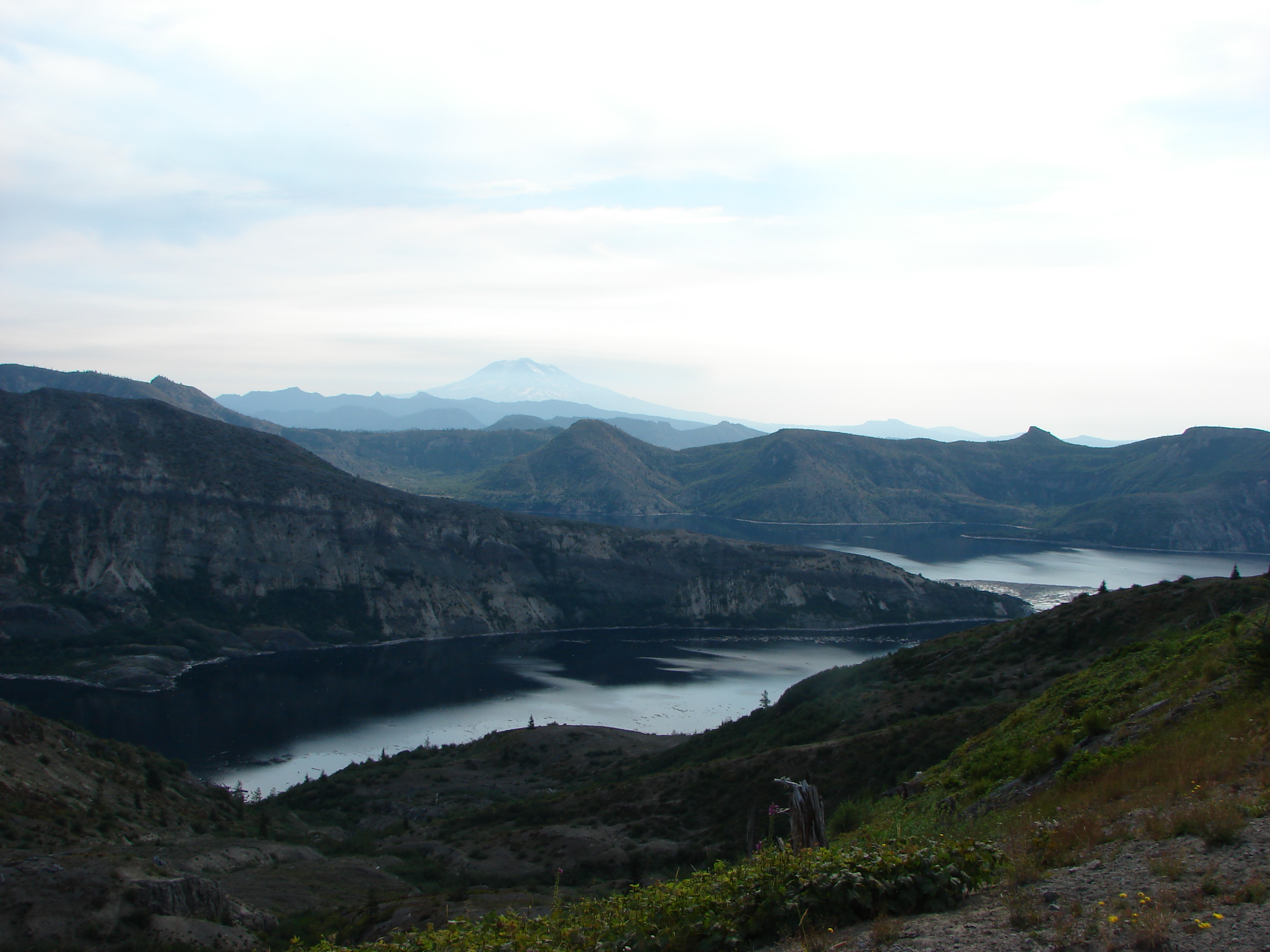
This section of trail was not very well maintained so we had to do a lot of stepping over and under along the way. After 1.5 miles we made it to the Toutle Trail’s own jct with the Loowit Trail at the edge of the S. Fork Toutle River’s canyon. This wide canyon was affected by the eruption when snow from Mt. St. Helens’ glaciers rapidly melted sending a huge mudslide down the valley. The river now is a small ribbon of water in the wide canyon. Here we turned right on the Loowit and started to climb the side of the mountain.
096

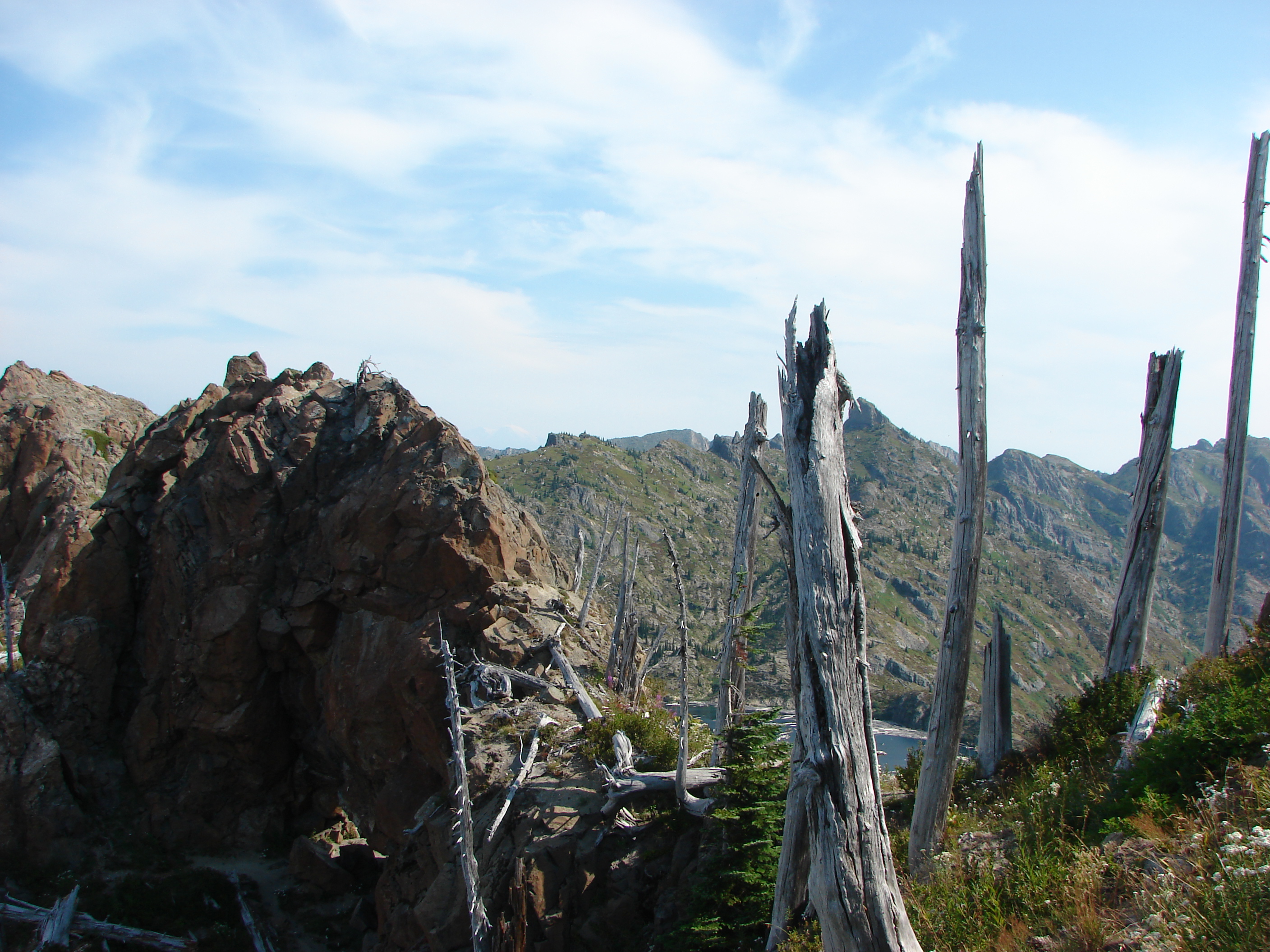
As we climbed we left the forest and entered the blast zone where the trees did not survive the eruption. Here increasingly better views opened up of the mountains rim and to the north the top of Mt. Rainier. Wildflowers surrounded the trail taking advantage of the clearings created by the blast. We passed through some excellent bear grass stands and large numbers of orange tiger lilies, purple penstemon, red columbine & paintbrush, and various colors of phlox. Some small patches of snow lingered in gullies along the way.
170

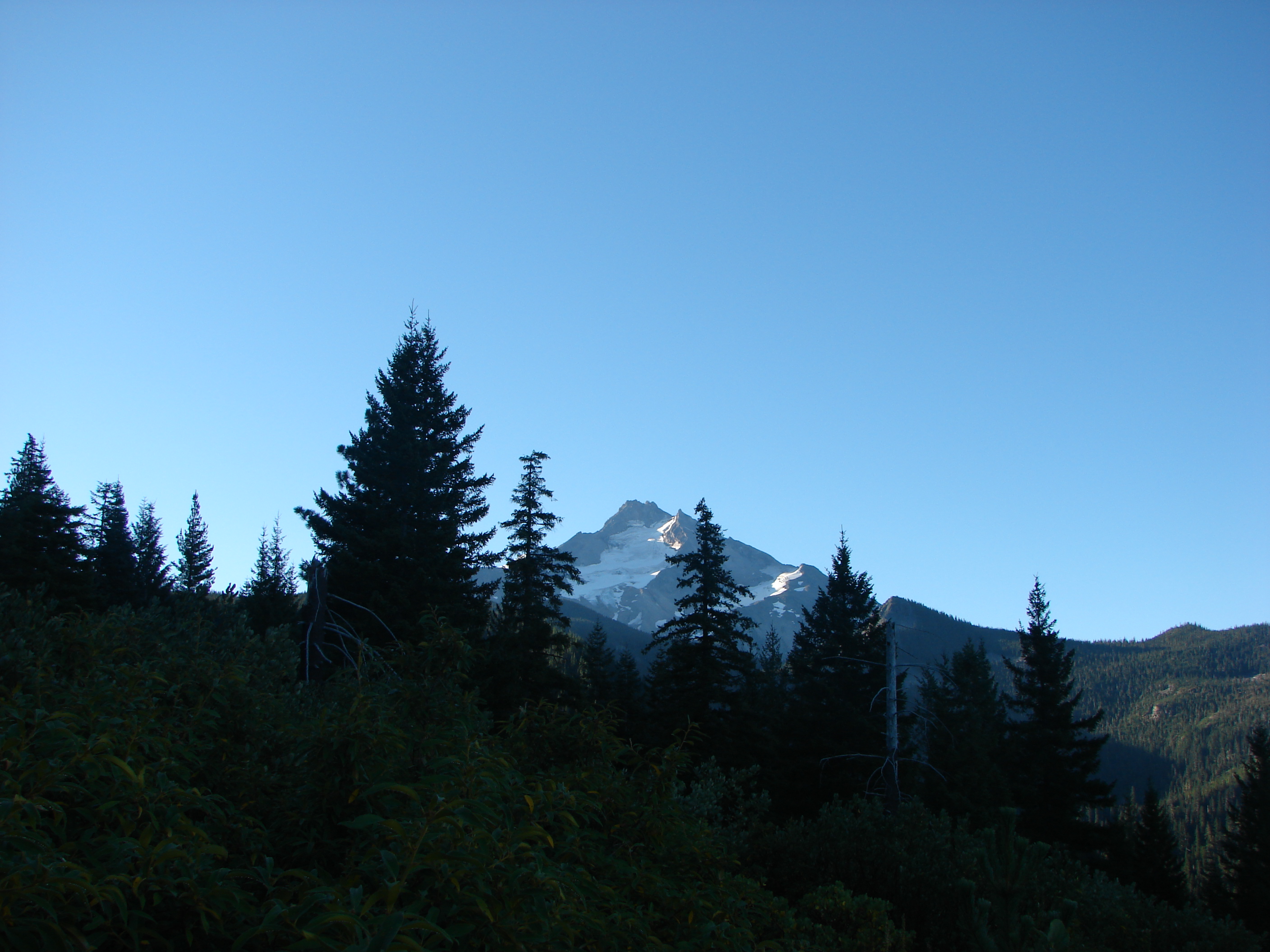
The trail eventually leveled out and began traversing along the mountains flank to the south. We dipped in and out of the tree line passing a number of different landscapes. We passed the Sheep Canyon Trail choosing instead to continue to the Butte Camp Trail. As we traveled on we crossed several rocky outwash gullies and eventually worked our way far enough around to the south to see Mt. Hood and Mt. Jefferson in the distance. Pink mountain-heather and dwarf lupine bloomed along this portion of the trail.
277

When we reached the Butte Camp Trail we turned right and started our descent back to the Toutle Trail. This trail passed through a dry lodgepole pine forest before reaching the meadow at Butte Camp. Recent snow melt had left the meadow flooded. The trail got us down fairly quickly without being steep and soon we were back on the Toutle Trail ready for the last leg of our hike.

The Toutle Trail was mostly level as it passed through the forest which was nice because we were all starting to feel tired. We pressed on and eventually reached the washout and the junction with the Blue Lake Trail and hustled the final 3/4 miles back to the car. I had chalked our fatigue up to the 10k we had all run the day before, as we seemed to have been much slower than normal. I got a possible answer to why when we got home and I checked the GPS which had us going a total of 16.1 miles :). I’m still not quite sure where the extra 2.6 miles came in but the track from the gps looks right so all I know to say is “Happy Trails”.

Photos -Facebook: https://www.facebook.com/media/set/?set=a.10201590209464253.1073741842.1448521051&type=1
Flickr: http://www.flickr.com/photos/9319235@N02/sets/72157634653720111/

Categories
Hiking Trapper Creek Trip report Washington Washington Cascades

Observation Peak

**Note the 2020 Big Hollow Fire burned a portion of this hike.**

Unexpected is as fitting a description as I can think of for our visit to the Trapper Creek Wilderness in Washington. The first unexpected event happened before we even arrived at the trail head. I have mentioned before that we seem to see more large wildlife from our car than we do on the trail. As we were turning off the highway I noticed a large brown animal just a bit further up along the shoulder. I quickly turned around and got out the camera. It was an Elk just grazing on the side of the road. This was the closest we’ve been to seeing an elk on one of our hikes.
278

We created the next unexpected event when we parked near Bubbling Mike Spring at an empty sign board. This turned out to be the wrong parking area, but the road ahead was gated closed and we failed to notice the small sign around the corner to our left that pointed toward the campground. We set off on a clear trail toward Trapper Creek which we knew we needed to cross at some point. That path quickly ended at the creek with no dry way to cross so we backtracked and headed up the gated road. We spotted one footbridge that had a do not use, danger sign posted on it as we passed several cabins that sat along the creek. The road veered away from the creek and just after crossing a small stream we decided to head back and work our way up the creek bank to see if we could find a crossing that way. No sooner had I recrossed the stream when I heard quite a commotion behind me. I expected to see Dominique on the ground since he is the most prone to losing his balance but instead it was Heather sitting in the middle of the stream. She banged her hand up pretty good but was fortunate not to have hit her head or hurt her legs. Her pinky though was already swelling and slightly discolored. We hadn’t even found the official trail yet and we had a “man down”. She decided she wanted to try and continue the hike so back we went to searching for a dry way across.

After wandering up and down we settled on trying a downed tree that appeared to be flattened on top for crossing. It led to the back of a couple of cabins on the far side of the creek so we quickly ducked past them onto the access road that led to them. Our map showed that this road would lead to the trail we had been seeking so we headed left and soon had found it.

We entered the Trapper Creek Wilderness and paralleled Trapper Creek through a dense forest. If you love old forests and the sound of flowing water this would be a great hike for you. If you are after views and wildflower meadows skip this trail and take the Observation Peak Trail from road 5800 as described in Sullivan’s 100 Hikes book. The trail went up and down occasionally offering glimpses of the creek below. After 2.5 miles the path crossed Hidden Creek and shortly after a pair of signs pointed to Hidden Falls. We decided we needed to check this out so we struck off on the faint trail up a ridge to a nice camping spot. Hidden Falls was below down a steep hillside which Heather and I picked our way down. We were able to make our way to the base of the secluded falls and then had to climb back out of the canyon.
343

From Hidden Falls the Trapper Creek trail began to climb a long series of fairly steep switchbacks. We crossed the creek again after the first set of switchbacks and then launched upward again. A nice viewpoint along the way overlooked Trapper Creek Falls across the valley backed by Observation Peak. The trail eventually leveled out, recrossed Trapper Creek, and then came to a junction with a trail labeled “Shortcut Tr. 129B”. Dominique was all for taking any trail that had the word shortcut in it’s name so we turned up it. I don’t know how much of a shortcut it was, but we were soon at another junction, this time with the Observation Peak Trail.

We headed up toward the summit through a forest with large bear grass plumes and many other smaller white flowers. After about a half mile of climbing we reached the lower viewpoint. This first viewpoint was on a rocky outcropping dotted with white cats ear blossoms. It had been a nice day, with blue sunny skies and a occassional breeze that kept it from being too warm but we found that clouds were hanging around the Washington peaks covering each of them to some degree. Never the less the view was impressive and the view from the actual summit promised to be even better. We returned to the trail and continued up another .2 miles to the summit passing bear grass blooms and other various wild flowers. As we approached the summit, Mt. Hood appeared over the right shoulder of Observation Peak with a faint Mt. Jefferson nearly hidden by haze further to the south.

Mt. Adams and the Trapper Creek Wilderness from Observation Peak

After a short rest we headed back down from the summit and turned right at the trail junction to begin our descent down Howe Ridge. We had a little over 5 miles down this pleasant trail to get back to the car. It gradually descended through the forest crossing numerous small streams and we were able to make good time. We spotted a small snake and later I came around a corner to find myself staring straight at an owl about 10 yards away. When I reached for my camera it flew to a nearby tree but I was able to get
a couple of decent pictures.
474

Our feet were sore and legs tired when we finally reached Trapper Creek and we didn’t care about finding a dry crossing. Our car was almost directly across from us so we just walked into the water and crossed. What was supposed to have been a 13.3 mile hike turned into a 15.8 adventure. Despite a few mosquitoes (much less than our last hike) and Heather’s bruised hand it had been a pretty good day. There was only one way to end a day like this – with pizza 🙂 Happy Trails.

Photos – Facebook https://www.facebook.com/media/set/?set=a.10201538005439185.1073741841.1448521051&type=3
Flickr http://www.flickr.com/photos/9319235@N02/sets/72157634535134225/

Categories
Diamond Peak Area High Cascades Hiking Oregon Trip report

Salt Creek Falls

It’s July and that means mosquito season in the Cascades. We had our first real run in with the pests on our 4th of July hike at Salt Creek Falls. Through June I had seen only one mosquito which managed to get me on top of Salmon Butte. For the next month or so we will be faced with a dilemma, brave the hoards of bloodsuckers in order to see some of the best wildflower displays of the year, or play it safe and wait them out missing the best of the flowers.

We chose to brave the danger (annoyance at the very least) for this waterfall hike. At 286′ Salt Creek Falls is Oregon’s second tallest and is conviniently close to Hwy 58 making it easy to make a quick stop. We tend to avoid quick and easy but trails leading past Salt Creek Falls head up into the Diamond Peak Wilderness passing a couple of lakes and two additional waterfalls giving us a good excuse for a visit.

We were the first car in the parking lot and apparently the mosquitoes were waiting because I had one land on me almost immediately after I got out of the car. Luckily we had come prepared. We were all wearing long pants/sleeves and sported less than fashionable bug net hats. After a good dousing in DEET (a necessary evil) we headed down the short path to the Salt Creek Falls viewpoint.
008

After viewing the falls we headed for the Vivian Lake which was 4 3/4mi away and our turnaround point. Shortly after crossing Salt Creek the trail split making a loop to Diamond Creek Falls possible. We headed right and soon came to Too Much Bear Lake. Despite the name we saw no sign of bears but the pretty lake was lined with blooming rhododendrons and reflecting the surrounding trees.
032

As we continued toward Diamond Creek Falls several signs announced viewpoints. Perhaps we had been spoiled by the views on our last few hikes, but the view from these viewpoints was a bit of a let down. Diamond Creek Falls on the other hand was lovely. A short side path led down into a narrow canyon and across Diamond Creek on a footbridge. Not long after the crossing Diamond Creek Falls came into view through the trees. It was an impressively sized 100′ cascade that fanned out over the rocks as it fell into a cozy grotto.
046

We returned to the main trail and continued past an upper viewpoint of Diamond Creek Falls to a second fork in the trail. The left fork would take us back to the parking area while the right continued on toward the wilderness and Vivian Lake. Before we made it to the wilderness we crossed Diamond Creek on a road bridge and passed over the Southern Pacific Railroad tracks. When we reached the sign board announcing the start of the Diamond Peak Wilderness we found that there were no self-serve entry permits left in the box, but there were plenty of mosquitoes buzzing around. The forest was full of white flowers, bunchberry, anemone, and queens-cup with an occasional beargrass thrown in. Many of the rhododendron were in bloom as well. The trail followed Fall Creek up to a viewpoint of Fall Creek Falls, a smaller 40′ cascade lined at the top with pink rhododendron blooms. The viewpoint proved a good place for a brief rest as it was an exposed rocky outcrop and almost devoid of mosquitoes.

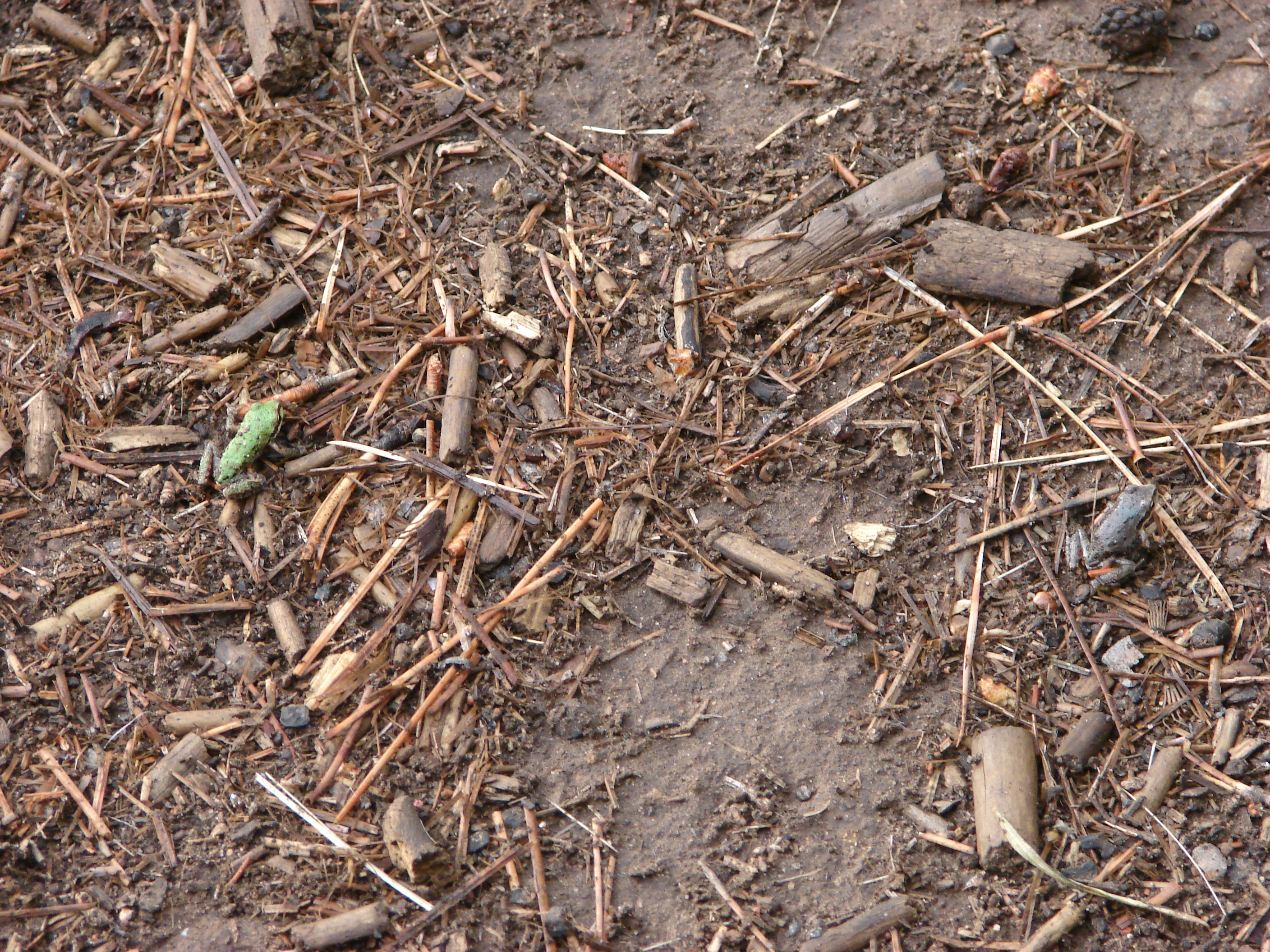
Another mile of climbing brought us to Vivian Lake but before we would reach the lake shore we had to cross a “meadow”. The meadow was still quite damp from recent snow melt but we did our best to stay on the driest part of the trail. Shooting star and heather blooms dotted the green meadow while frogs hopped toward the water where they joined tadpoles that had not yet emerged. Unfortunately it was also a perfect spot for mosquitoes and a large number of them swarmed the air just waiting for us to stop so we quickly made our way across to drier ground and followed the trail to the shore of Vivian Lake. We worked our way around the shore until we got a good view of the top of Mt. Yoran which reflected in the water. This would have been a wonderful spot for lunch if we hadn’t been on the menu. We stayed long enough to snap a couple pictures then headed back to the viewpoint above Fall Creek Falls where we had a better chance of a mosquito free lunch.
138

We made great time on the way back to the car as we tried to stave off the skeeters but we did stop when we spotted a golden mantled squirrel and later a cascade frog. We saw only one other hiker on the trail but the parking area was full of people and cars when we got back. Heather got the worst of the bites but still only about a half dozen, Dominique had a couple and I miraculously escaped with only one. Hopefully our next few hikes will have less mosquito activity, but we’ll be ready for the little buggers if need be. Happy Trails

Facebook photos: https://www.facebook.com/media/set/?set=a.10201511921867112.1073741840.1448521051&type=1
Flickr photos: http://www.flickr.com/photos/9319235@N02/sets/72157634489510254/

Categories
Hiking Silver Star Mountain SW Washington Trip report Washington

Silver Star Mountain

HOT! That certainly describes our recent visit to Silver Star Mountain, but that would be doing this hike a great disservice. Despite the 90 degree temperatures better descriptions would be amazing flowers, great views, and beautiful scenery. Silver Star Mountain is located in Washington State’s Gifford-Pinchot National Forest between Mt. St. Helens and Portland, OR.

I’d been wanting to visit Silver Star for a long time, but the timing hadn’t been right until now. I had seen a number of trip reports which indicated now was a good time to catch many of the wildflowers that fill the meadows and the weather called for clear skies, the perfect combo. There are a number of possible approaches to the 4390′ summit but for our hike we chose to approach from the north via Ed’s Trail.

The drive to the trail head was tedious with the last 9 miles taking a good 45 minutes due to poor road conditions. Our plan was to hike a big loop sampling as much of the area as we could so we knew we had a long day ahead of us. It was already over 60 when we arrived at the parking area at 7:15. The sky was clear and the birds were out in force as we headed up the north flank towards the junction with Ed’s Trail. Mt. St. Helens loomed behind us and as we climbed Mt. Rainier and later Mt. Adams joined the horizon. As we approached the junction with Ed’s Trail Mt. Hood appeared through a gap ahead surrounding us in Cascade peaks.

Mt. St. Helens & Mt. Rainier from the jct with Ed's Trail
Mt. St. Helens & Mt. Rainier from the jct with Ed’s Trail

Already the flower display had been amazing. The variety of flowers was one of the best we’d seen. There was red paintbrush and columbine, pink nootka rose, purple lupine and iris, orange tiger lilies, white beargrass and thimbleberry, and (new to us) yellow lupine. The meadows here are due in large part to the 1902 Yacolt fire which swept over Silver Star Mountain removing the trees and clearing the way for the flowers. I could easily fill this whole trip report attempting to describe the flowers we saw on this day but the hike had other things to offer as well so I will have to let our photos do much of the flower reporting.
056

Ed’s trail was truly scenic as it traversed the NE side of the ridge through wildflower meadows with views of the 4 snowy Cascade peaks. Soon the path passed some rocky areas and passed through a natural rock doorway. Not long after passing through the doorway we scrambled up a short, steep section of the trail as it passed through a rocky slot up to a great viewpoint. A small patch of snow remained surrounded by avalanche lilies.

When Ed’s trail met an old road we took it up to the twin summits of Silver Star mountain. The view from the north summit was a true 360 degree panorama. Mt. St. Helens, Mt. Rainier, and Mt. Adams were joined by snow covered Goat Rocks to the north while Mt. Hood, Mt. Jefferson, and the faint Three Sisters rose to the south. The Columbia River and Portland, OR lay to the SW while the ridges and meadows of Silver Star Mountain surrounded us in every direction.

Washington Cascades form the summit

After leaving the summit we continued on to the Indian Pits trail to visit a series of rock pits used as vision quest sights at one time. More wildflower meadows awaited on this trail which ended at a rocky ridge endge with yet another set of wonderful views. As an added bonus we were serenaded by a resident swallow who appeared to be enjoying the view from the top of the rocks as much as we were. It was really starting to warm up as we left the pits and continued on our loop down an abandoned road past sturgeon rock. The old road was actually lined with trees but it was wide enough to remain in the sunlight.

We made our way down the road to the Tarbell Trail which we then turned right (north) on and momentarily entered the forest. The trees didn’t extend far to our left and we could see that much of the hillside below had been clearcut. It is a sight that I don’t particularly enjoy seeing. The stark contrast of the stumps and piles of slash next to the still standing forest always leaves me imagining what it must have once looked like. We were on a collision course with the cut though and soon emerged to the treeless hillside. One of the first things we noticed were the butterflies. They were everywhere and flitting above a vast array of wildflowers. Even the clearcut couldn’t spoil the areas scenery 🙂
604

The lack of trees did mean we were once again exposed to the sun and for about 2 miles we switchbacked down and across the hillside before again reaching the forest on the other side. We were greeted by the first sound of water on the hike. The source was Coyote Creek and that was where we would find our next destination, Hidden Falls. What a welcome change to the heat Hidden Falls was. A bench near the 92′ cascade gave us a place to rest while we cooled off courtesy of the breeze created by the falls.
653

After another mile and a half on the Tarbell Trail we arrived at the Chinook Trail which would take us up Kloochman Ridge and back to the road we had been on early in the morning. The Chinook trail spent a short time climbing in the forest before emerging in some of the hikes best wildflower meadows. The number and variety of flowers on this ridge trumped all the others we had been through on this day.
747
This was also the steepest trail we’d been on and with the temperatures hitting the 90s we needed all the distraction the flowers could provide.

We eventually made it up Kloochman Ridge and then headed back down the road to our car and the extra water that was stashed in our cooler. This was one of the rare occasion when I actually finished off all the water in my Camelbak (1/4mi from the car). Silver Star Mountain had lived up to all the hype I’d seen in the trip reports. With a little something for everyone it’s an amazing area and I highly recommend exploring any of the areas trails. If you’re a fan of beargrass skip next year since it only blooms every 2nd or 3rd year and this year it was on, or better yet go both years and see the difference. Happy Trails and have a safe 4th of July.

Facebook album https://www.facebook.com/media/set/?set=a.10201492927112255.1073741839.1448521051&type=1
Flickr photos -http://www.flickr.com/photos/9319235@N02/sets/72157634416726411/
Categories
High Cascades Hiking Mt. Hood Area Oregon Trip report

Wildcat Mountain

Greetings, I’m back again with another trip report from the Salmon-Huckleberry Wilderness. We were making a second attempt at Wildcat Mountain; which we had tried to do in May but had run into fresh snow on the road to the trail head. I’d seen a trip report on portlandhikers.org from 6/09/13 saying that the trail head was open and that in a couple of weeks the flower show should be going strong.

We were aware that there have been issues in this area with illegal shooting & off highway vehicle operation but the forest service and volunteers have been attempting to limit access and discourage the bad behavior. Evidence of this battle was everywhere on the drive to the trail head. Numerous “No Shooting” signs lined the road and almost every spur road was barricaded to block access. Unfortunately litter (mostly beer cans and empty shell casings) was visible in many areas as well. When we reached the new McIntyer Ridge trail head the parking area was covered in more of the same. It was a shame because the surrounding forest was beautiful.

We had a little difficulty finding the correct path due to our not noticing the small temporary trail sign at first. The OHV use was obvious given the width and condition of the trail. We followed this wide path for a mile to an opening which provided the first view of Mt. Hood. Shortly after the opening the tail narrowed leaving the OHV damage behind.

Rhododendrons bloomed in mass along the trail and we spotted several patches of avalanche lilies proving that snow had melted not too long before.

Avalanche lilies
Avalanche lilies

Next the trail entered a meadow of beargrass which was still, for the most part, not in bloom. I hoped that this would not be the case when we reached the next viewpoint in a meadow with a memorial bench.

The bench meadow did not disappoint. A good number of beargrass plumes rose up while paintbrush and penstemon added red and purple to the ground. The view of Mt. Hood was great and a pair of hummingbirds zoomed about visiting the flowers. One of them even landed long enough for me to get a couple of pictures.

Mt. Hood from the bench meadow

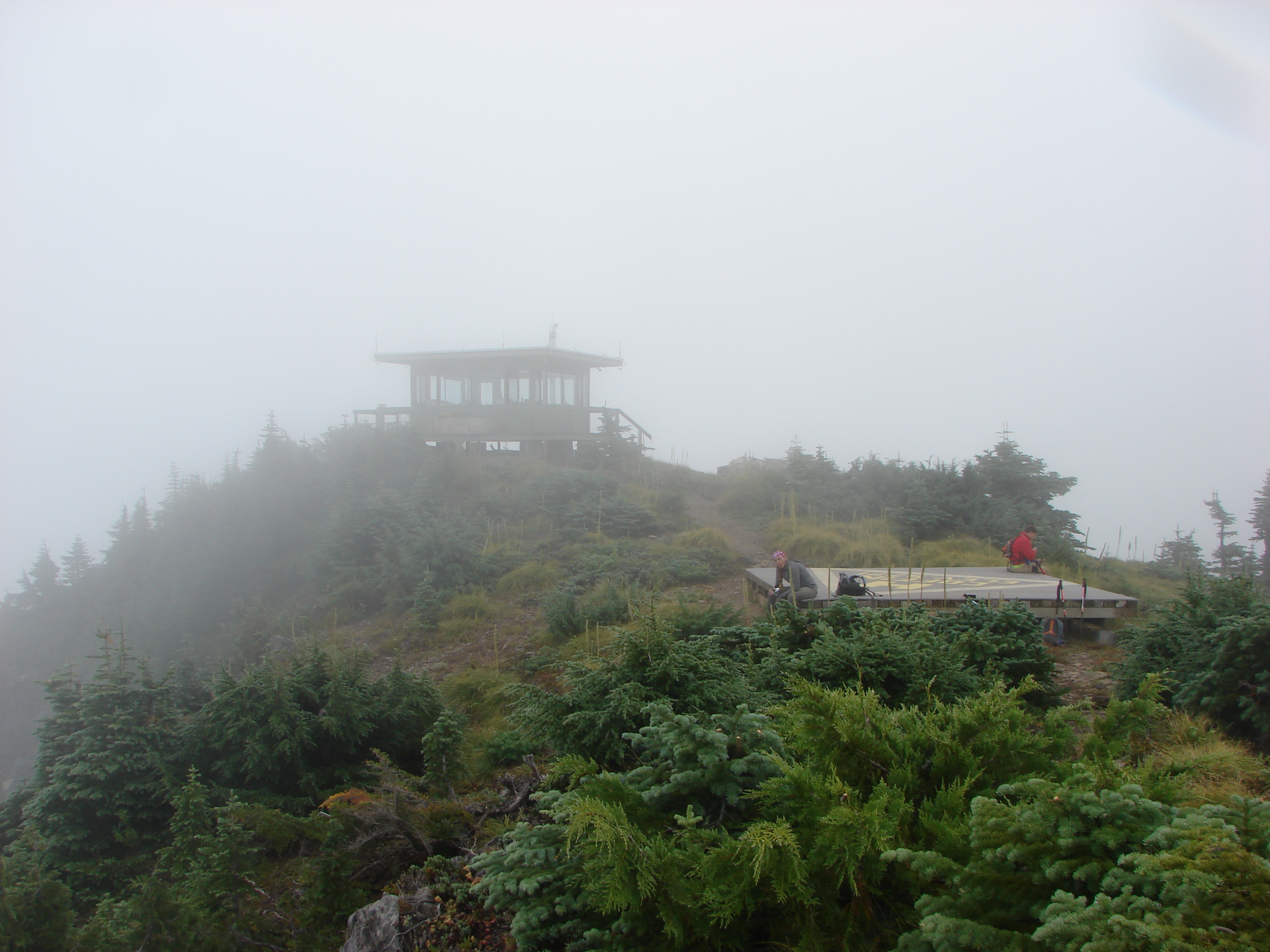
Continuing along the path we reached a junction with the Douglas Trail and turned SE along it toward Wildcat Mountain. A short side trail led up to the summit where an old lookout tower once stood. In order to get a decent view we had to follow a very faint trail through rhododendrons toward Mt. Hood. When we reached an opening not only did we have a view of Mt. Hood but Mt. Adams and Mt. Rainier now appeared to the NW. After returning to the Douglas trail we continued SE to another viewpoint on a rocky section of the ridge. More wildflowers covered this area and Mt. St. Helens and the top of Mt. Jefferson now joined the views.

Mt. Jefferson from the rock garden

We continued on the Douglas trail to it’s end at the Plaza trail and turned around. Clouds had begun forming around the mountains changing the views on the way back. We stopped again at the bench (I don’t think you could not stop here) where I took a few more pictures.
288
We heard a few gunshots on the way back which sounded like they may have been coming from the Douglas trail head, and learned from a couple of hikers that they had run into a pair of OHVs (illegally) on the trail. We hadn’t heard them, but the presence was easy to see. The trail had been torn up and fresh damage done to several trees and plants along the path.

It’s hard to understand why some people just can’t follow the rules or how they could possibly leave such a mess without regard to anyone or anything else. If you were able to bring it in you can certainly pack it back out. That’s enough of a rant from me 🙂 Despite the depressing state of the trail head and OHV damage it was a great hike with wonderful views. The best thing that could happen to this area is to have more responsible/legal users. Maybe that would discourage the bad seeds and give the area a chance to recover from their damage. Happy (clean) Trails

Categories
High Cascades Hiking Mt. Hood Area Oregon Trip report

Salmon Butte

It’s raining mice! We’ve all heard the saying “It’s raining cats and dogs” but on our last hike it rained mice (well a mouse anyway). I’ll explain that later, but for now let me tell you where we were. For Father’s Day we headed toward Mt. Hood and the Salmon-Huckleberry Wilderness. Our plan was to head to the top of 4877′ Salmon Butte where we hoped to have a view of about a half dozen Cascade peaks.

The trail head is located next to the Salmon River, a fork of which it quickly crosses on a old bridge. The river is left for good here as the path follows an abandoned road up toward a former trail head. The road was closed down due to repeated washouts which we could see evidence of as we passed over numerous small creeks. The roadbed was fairly overgrown with green grasses and many small flowers. After travelling on the road for a little over a mile we reached the former trail head and turned into the forest. Not long after entering the forest a we came to a sign announcing the boundary of the wilderness. This was our first visit to the 62,455 acre Salmon-Huckleberry Wilderness which is part of the Mt. Hood National Forest.

The trail offered no real views for the first 2.5 miles as it steadily climbed up through the forest. Rhododendrons lined the trail, many of which were in bloom adding a splash of pink amid the green. Although the total elevation gain for the trail is almost 3200′ it was rarely steep and never for very long which was a welcome change to last week’s trudge up Heartbreak Ridge. At the 2.6 mile mark a viewpoint at a rocky ridge end opens across the Mack Hall Creek Valley and to Salmon Butte itself. The ridge end was home to a small but diverse number of flowers. There were a couple red paintbrush, a single lupine, a lone cats ear, a couple of yellow flowers, and a blue filed gilia which was a first for us.
290

Leaving the viewpoint the trail reentered the forest and climbed along the west side of a ridge for 2 miles before we would reach the next viewpoint. Still there was plenty to keep us entertained which is where the mouse rain incident occurred. As we were walking along I saw something out of the corner of my eye and heard a “thump” on the hillside just to the left of us. My first thought was pine cone, but the thump was too loud and the color wrong for a cone so my next thought was that someone had thrown a rock at us. It nearly rolled into Heather. As she attempted to avoid it we realized it was an animal. The poor mouse got its bearings and scurried off the side of the trail and disappeared into the brush. We have no idea where it came from, if it just slipped or possibly escaped from a bird in the trees above, but we certainly won’t forget our first encounter with mouse rain.

At a switchback near the 3.9 mile mark a short side path extended out to a small but amazing hillside meadow. There was no view to speak of but the hill side was carpeted with plectritis, larkspur, and little yellow monkeyflowers.
109

The trail eventually moved from the west side of the ridge to the east and shortly after reached a viewpoint with the first view of Mt. Hood. Here beargrass and rhododendrons lined the trail in various states of bloom. For the next half mile the trail climbedd gently along the top of the ridge before a couple of steep switchbacks reached a second abandoned road. This was the road to the former lookout tower that no longer exists on Salmon Butte. As the road curved up around the summit Mt. Jefferson came into view to the south followed by Mt. Hood to the north. After .3 miles we reached the summit and sweeping across the Salmon-Huckleberry Wilderness to the north, south, and east.

Although there were a few clouds in the sky we had an excellent views of Mt. Hood and Mt. Jefferson.

Mt. Hood
Mt. Hood

Mt. Adams and Mt. St. Helens were clearly visible in Washington and the North Sister was peaking over the shoulder of Mt. Jefferson to the south. With an assist from the binoculars we were finally able to identify Mt. Rainier as well. We enjoyed a peaceful lunch as the only people on the summit. We were not alone though. A couple of swallowtail butterflies flitted around the summit and a gray jay flew up to check us out. There was also a chipmunk busy eating seed on a tree trunk, obviously knowing this was a perfect spot for lunch.

We passed several hikers on our way back down but no more falling mice. When we rejoined the old road near for the final 1.2 miles the scenery had changed. Scores of white candy flowers had opened to the sun and now dotted the green grass along the path. This was a really nice hike and in the end didn’t feel like we’d gone 3170′ in 11.2 miles. Until next time – Happy Trails (and watch out for falling mice :))

Categories
Columbia Gorge North Hiking Trip report Washington

Table Mountain

If at first you don’t succeed, try, try again. After our recent string of cloud obscured views I was determined to break the streak. I had been watching the weather forecast all week and decided everything was lining up perfectly for a return to the Columbia Gorge and another attempt at a view of the Cascades. The nasty weather and the poncho attack on Hamilton Mountain needed to be avenged so for this hike I picked Table Mountain.

Table Mountain is located less than 5 miles east of Hamilton Mountain. It should have been what I was looking at from the saddle when I was sucker punched by the poncho during that hike. Much of Table Mountain collapsed into the Columbia River centuries ago leaving dramatic cliffs on the south face. With an elevation of 3417′ it is nearly 1000′ taller than Hamilton Mountain so the potential for views is great.

We woke up to a beautiful sunny morning but as we approached Portland an ominous cloud hung to the east of the city. The skies all around were blue and we hoped that Table Mountain was far enough to the east to be clear of the cloud. We formulated a plan b just in case when we reached Hamilton Mountain which was once again covered in clouds, but when we arrived at the trail head behind Bonneville Hot Springs the summit of Table Mountain was cloud free. With blue skies to the north and east we decided to give it a try.

The first 2.2 miles of the trail pass through a pretty forest, first on a volunteer created trail, then following an old road up to the Pacific Crest Trail (PCT). This first section was nice but unremarkable although we did come across some ripe salmonberries to sample. After a short walk on the PCT we reached the sign for the loop trail to the summit of Table Mountain. The aptly named Heartbreak Ridge Trail gains 1770′ in 1.5 miles. In order to do this the trail heads up with a vengeance. After 0.6 miles (and 800′ of elevation) the trail arrived at a saddle viewpoint. To my dismay the clouds that had been to the west were now heading east obscuring much of the view and had now covered Table Mountains summit. The trail then dipped down to the base of a 500 yard long rock slide where we spotted our first beargrass bloom of the year (on a hike not from the car).

The trail appears to end at the rock slide but the rocks are the trail. Following poles we scrambled up the rocks to the continuation of the trail. This part proved to be quite fun. Just a few tenths of a mile after reaching the trails continuation we reached the meadows on the summit. An all to familiar view greeted us here. We had come all this way and couldn’t see more than a few hundred feet due to clouds. The meadows were filled with various wildflowers creating a colorful display and many plumes of beargrass stood at attention along the meadows edges.

As we headed south along the summit trail toward the viewpoint at that end a faint window opened in the clouds and there stood Mt. Hood. The clouds had begun to slowly break up and by the time we reached the viewpoint better and better views were opening up.
201
We could now see Mt. Hood and the tip of Mt. Jefferson at times. Below we could see the Bonneville Dam on the Columbia River and the Heartbreak Ridge trail as it crossed the viewpoint saddle. We spent awhile here waiting for the openings and then headed back down the trail to find a spot for lunch.

We chose a spot that offered a view to the north and east in addition to Mt. Hood to the south. As we ate glimpses of Mt. Adams and Mt. Rainier began to appear. We eventually traveled further north on the summit loop to a second viewpoint at that end. There we discovered a beargrass meadow and ever improving views of Mt. Adams, Mt. Rainier, and also the rim of Mt. St. Helens.

Mt. Adams
Mt. Adams

We never quite got a clear view of any of the Washington peaks due to a pesky line of little clouds but after getting our fill of the view we headed down the west ridge. This trail was almost as steep as it made its way down and contained a lot of loose rocks. In addition it traveled close enough to the edge of the ridge that anyone with a fear of heights might really have a hard time. That being said the views from this trail were great. Mt. Hood lay ahead while behind was Table Mountain and the rock slide we had scrambled up.
521
The going was slow but we eventually made it down to the PCT. I had no takers when I asked if anyone wanted to go around again when we reached the Heartbreak ridge junction so we returned to our car satisfied with the days views and ready to plan our next adventure. Happy Trail.

facebook photos: https://www.facebook.com/deryl.yunck/media_set?set=a.10201335132527489.1073741836.1448521051&type=3
way too many flickr photos: https://www.facebook.com/deryl.yunck/media_set?set=a.10201335132527489.1073741836.1448521051&type=3