Categories
Hiking Mt. St. Helens Trip report Washington Washington Cascades

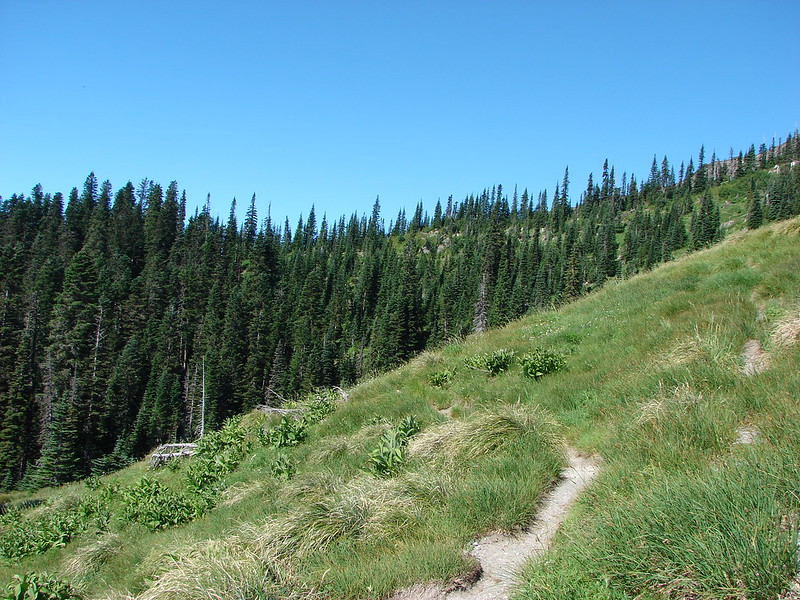
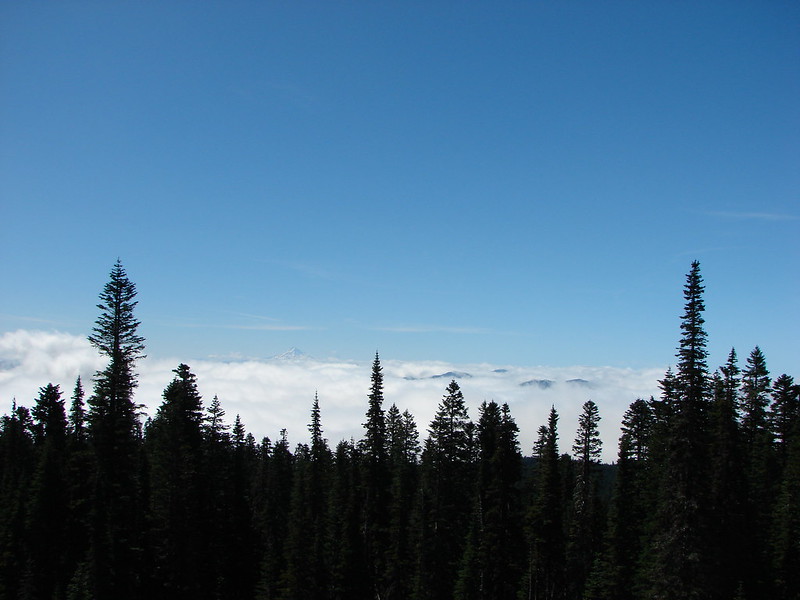
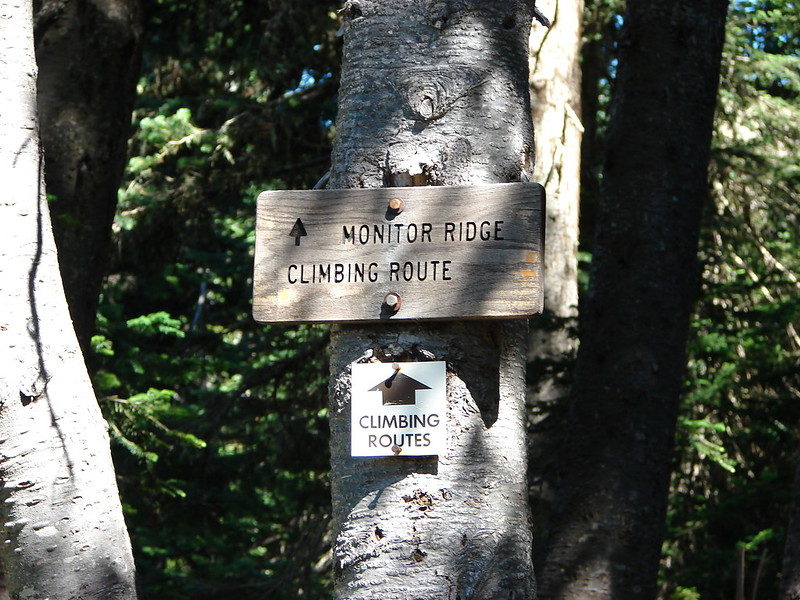
Johnston Ridge Observatory & Coldwater Peak

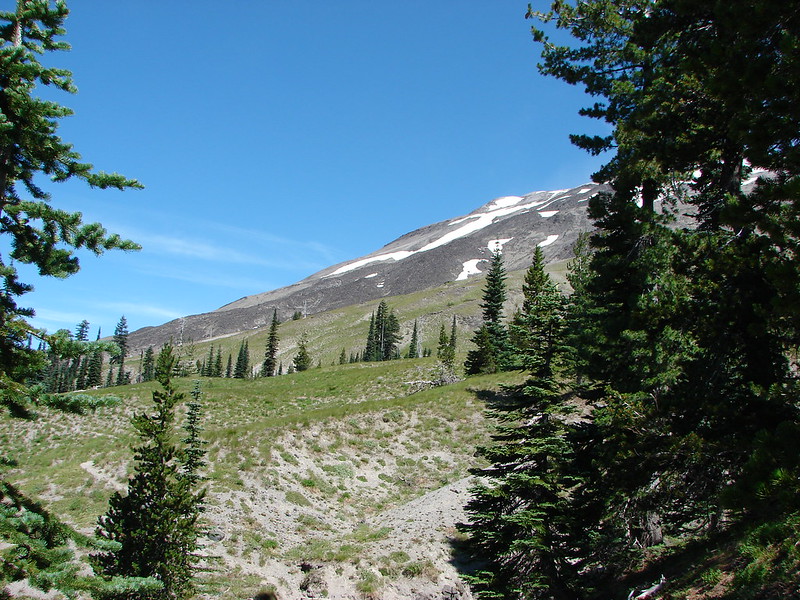
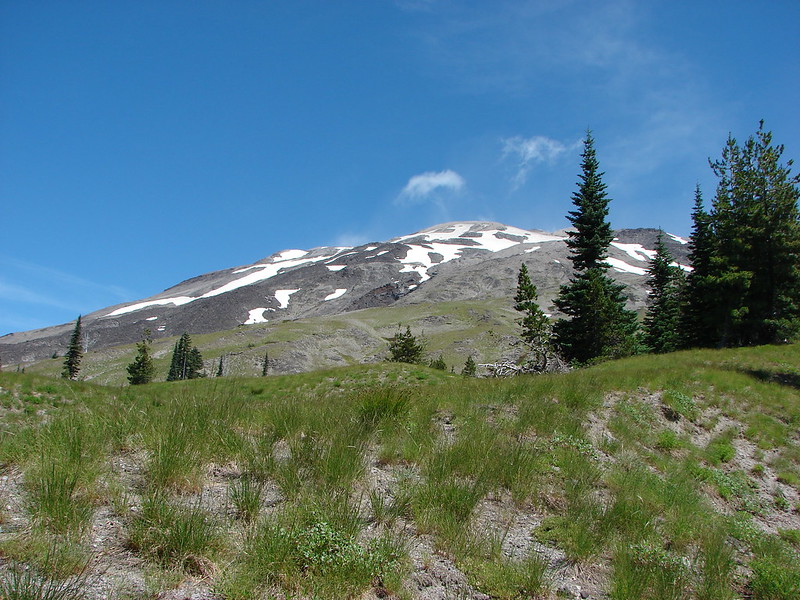
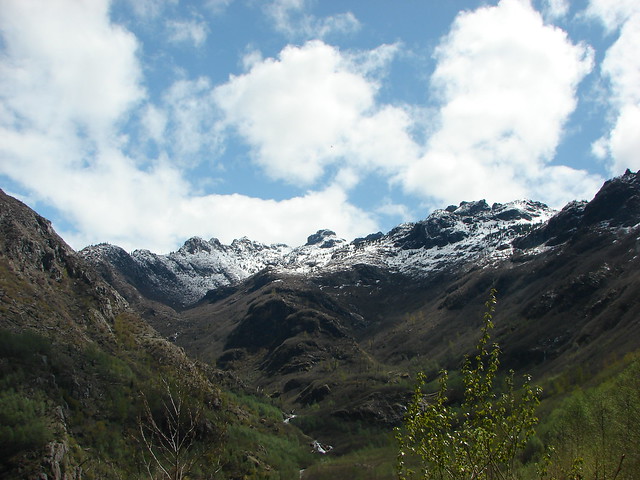
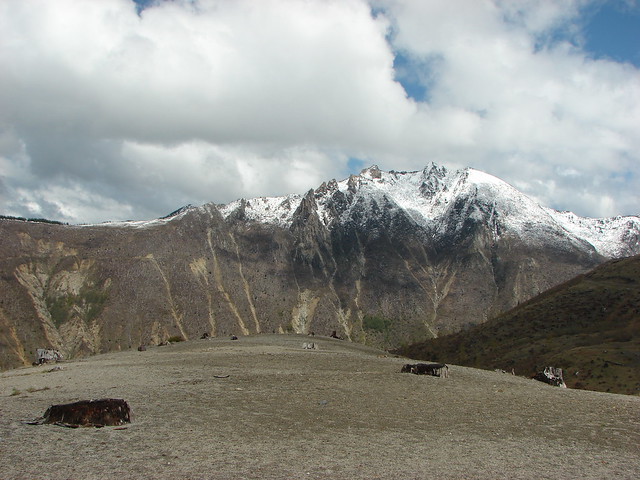
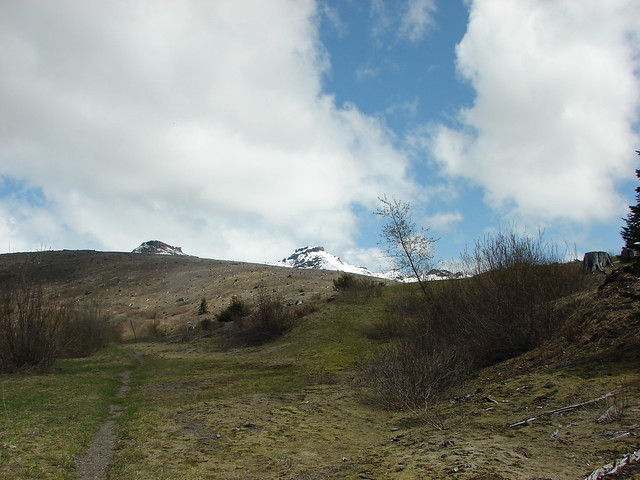
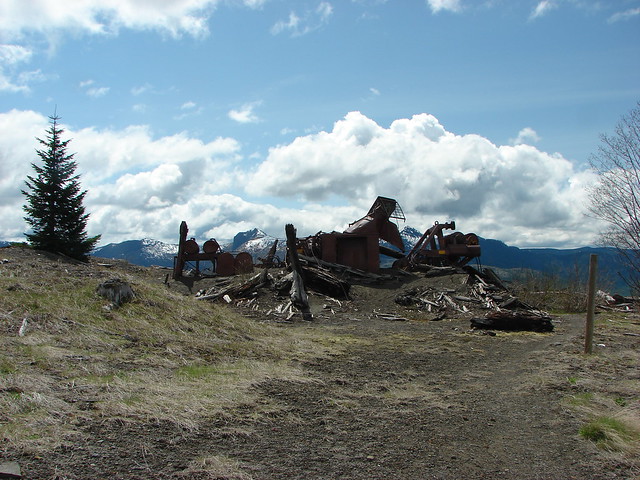
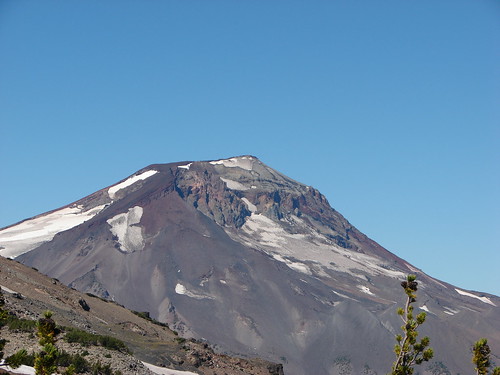
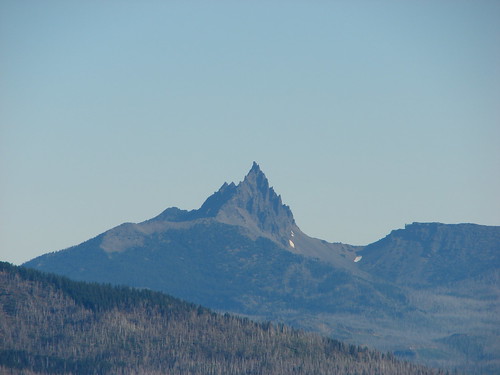
We took advantage of a day off recently and headed up to the Johnston Ridge Observatory at Mt. St. Helens. This was the farthest north we have traveled for a hike and would be the first time we would be able to see the collapsed side of the volcano. We were a bit disappointed when we arrived and realized that the winds had shifted and were blowing from the south east causing a hazy sky due to smoke from a wildfire near The Dalles Oregon. We parked in the observatory parking lot and surveyed our hike’s destination, Coldwater Peak.

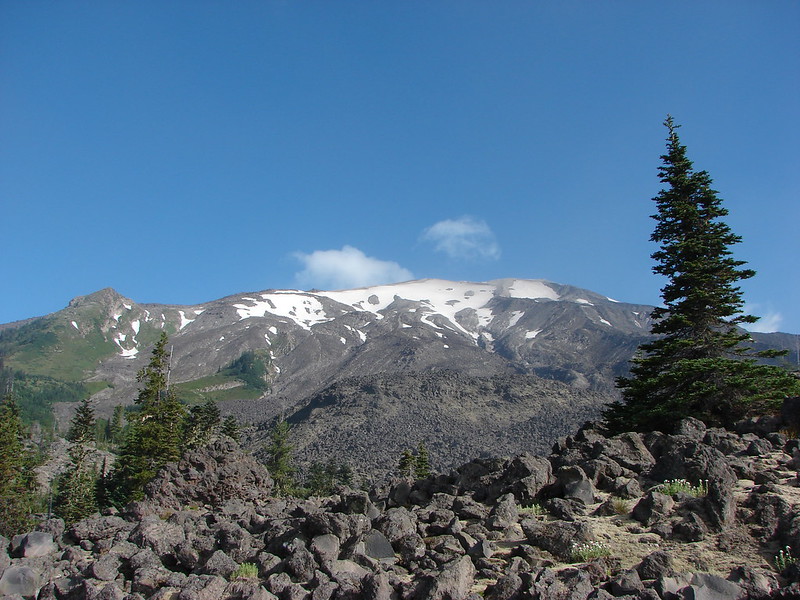
Coldwater Peak from the parking lot.

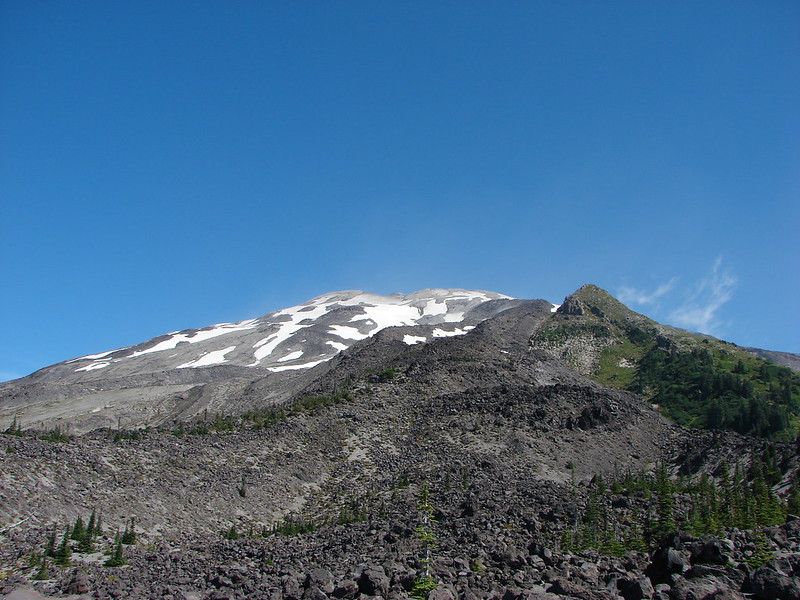
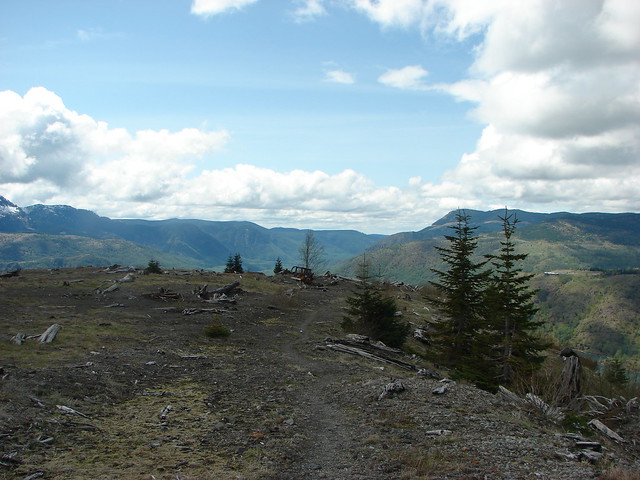
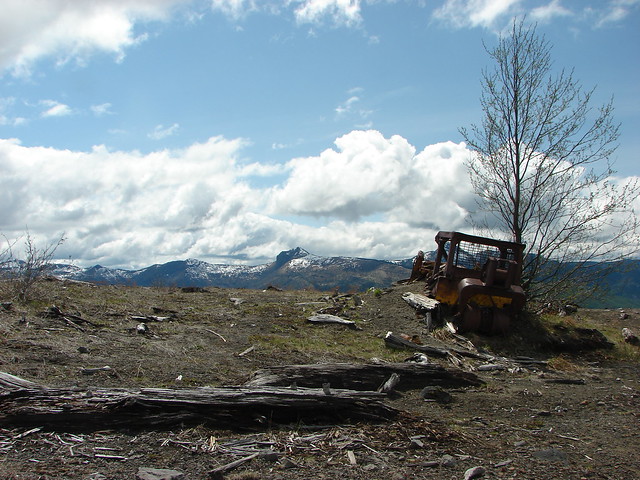
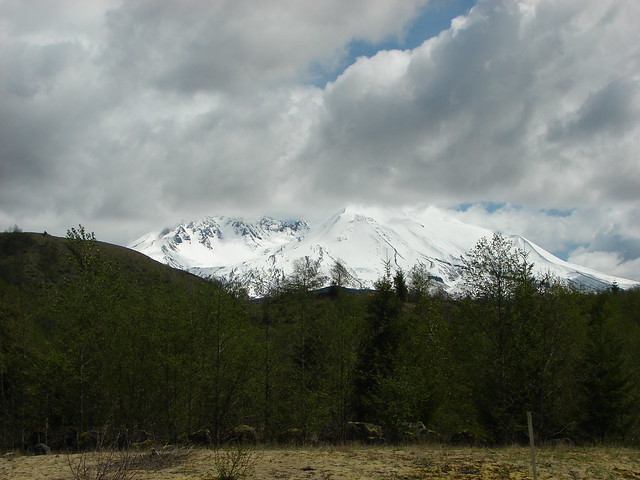
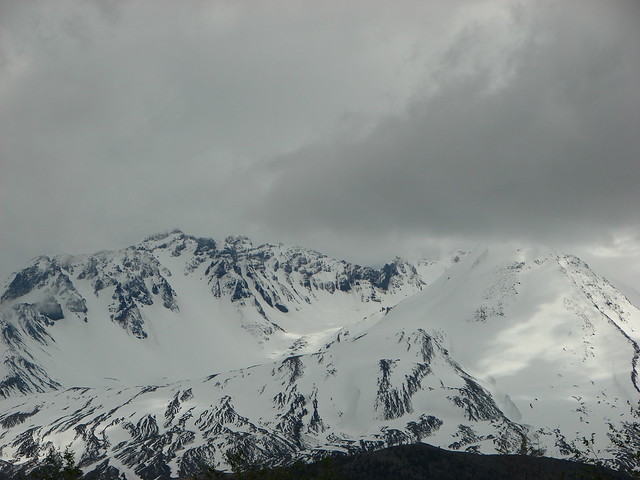
The observatory was not open yet (It opens at 10:00am) but we walked around the paved loop trail there before setting off on the boundary trail. Good views of Mt. St. Helens were plentiful despite the blue haze from the smoke.
004
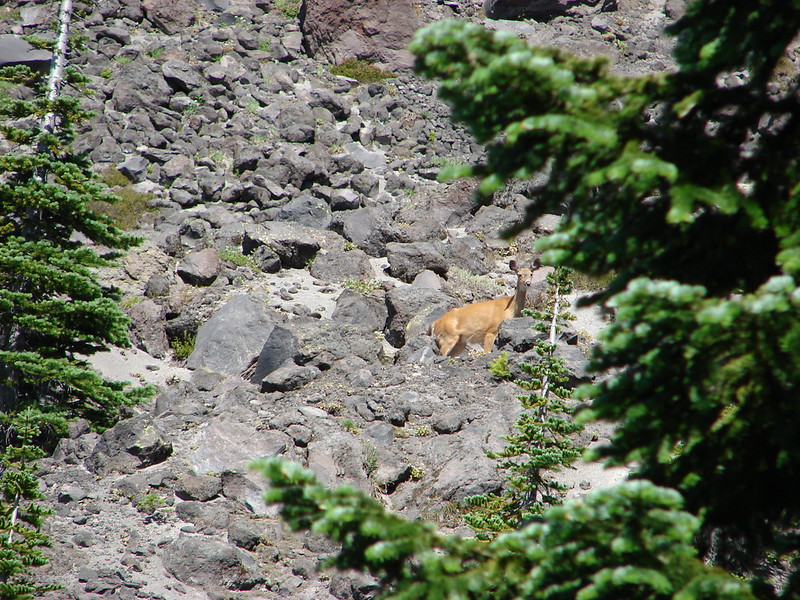
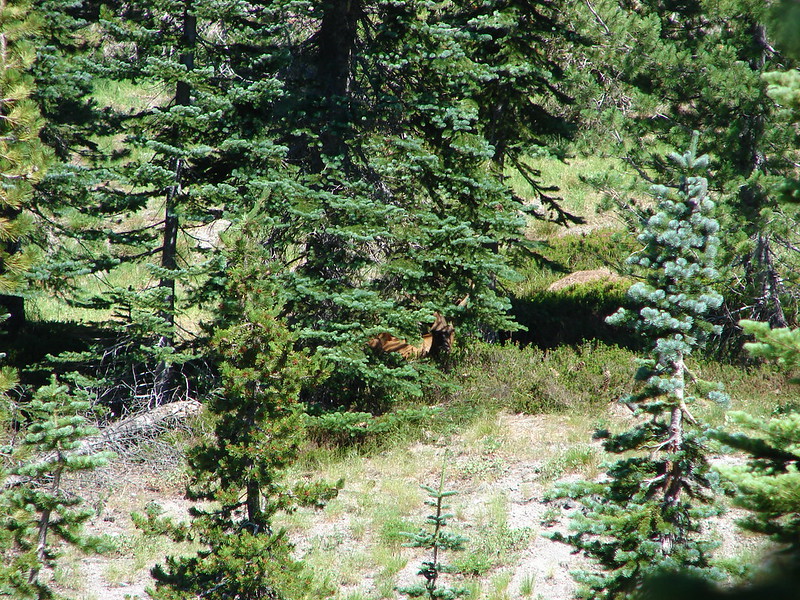
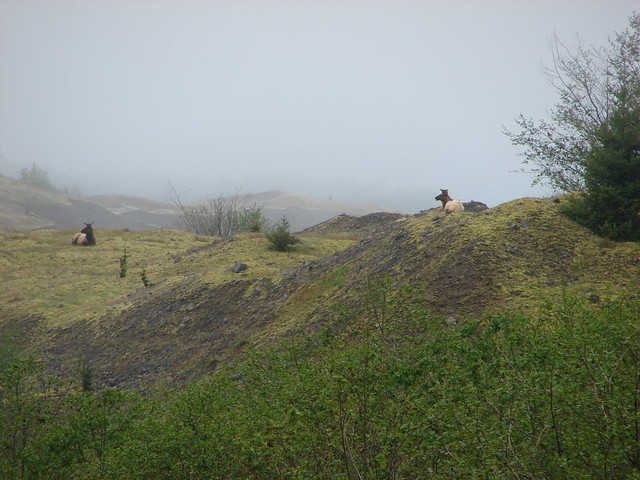
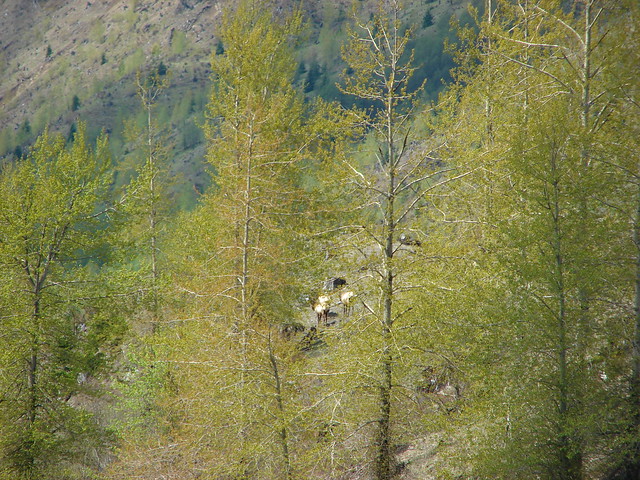
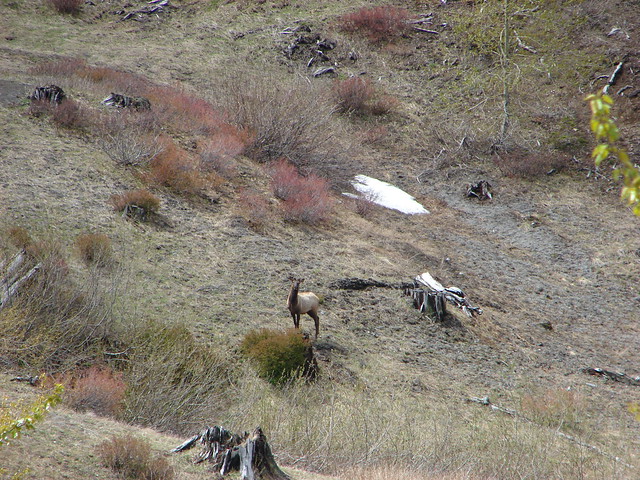
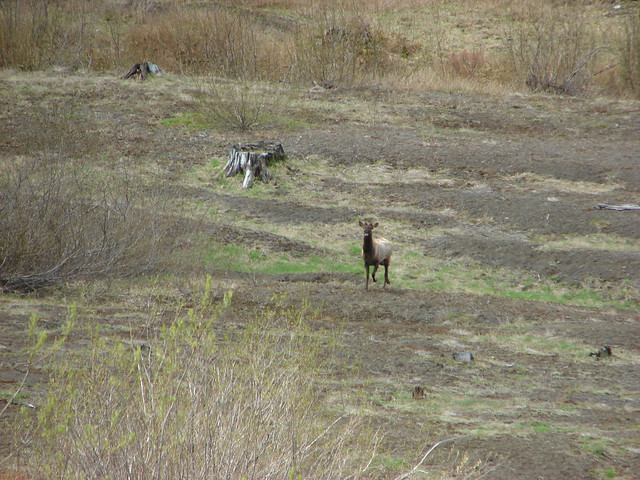
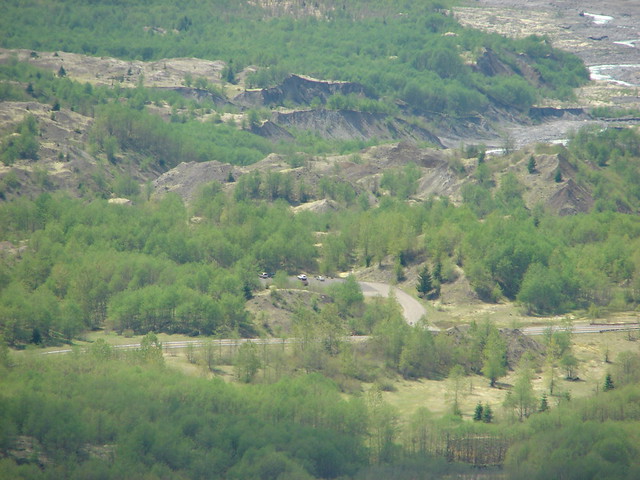
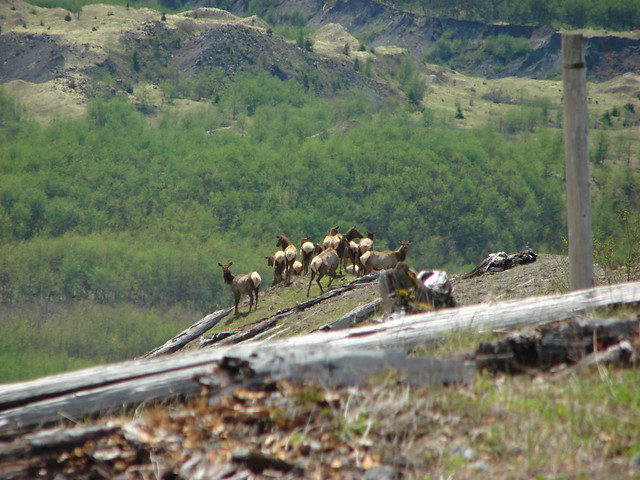
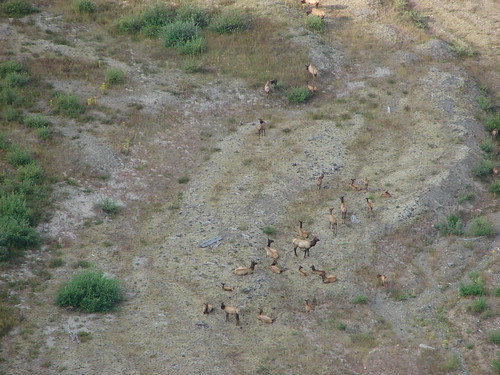
I had us all on the lookout for elk down in the valley below and it wasn’t long before we spotted a small group.
030
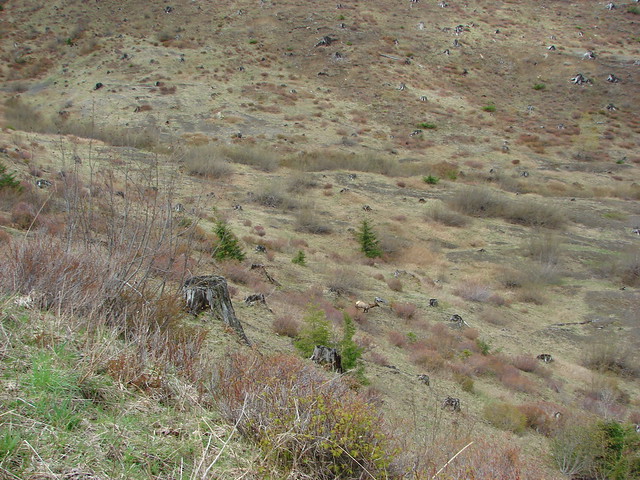
It appeared to be a small heard of about 15 elk but as we worked our way along the trail and got a better view of the valley below we saw the rest of the heard.
041

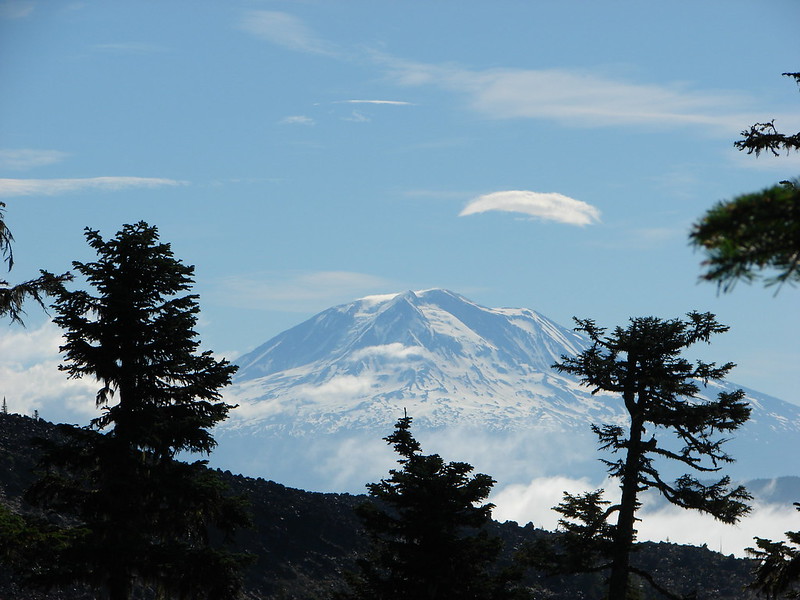
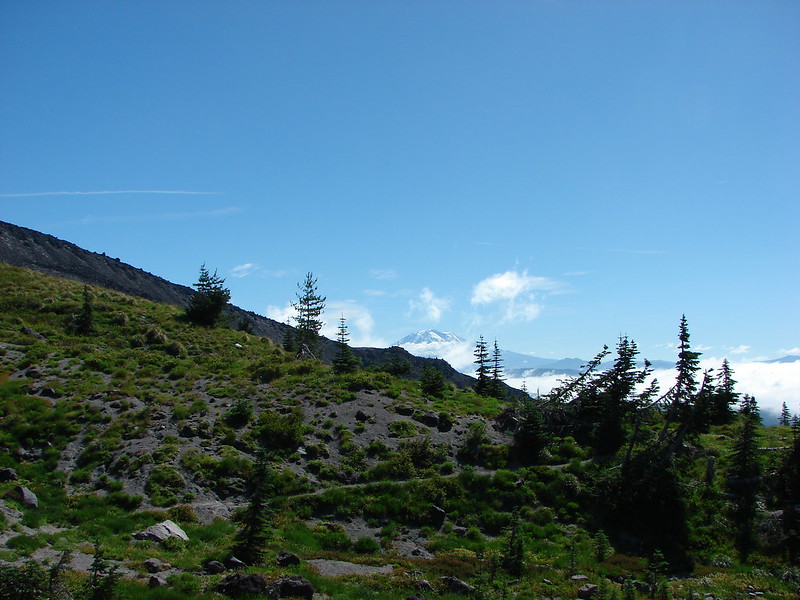
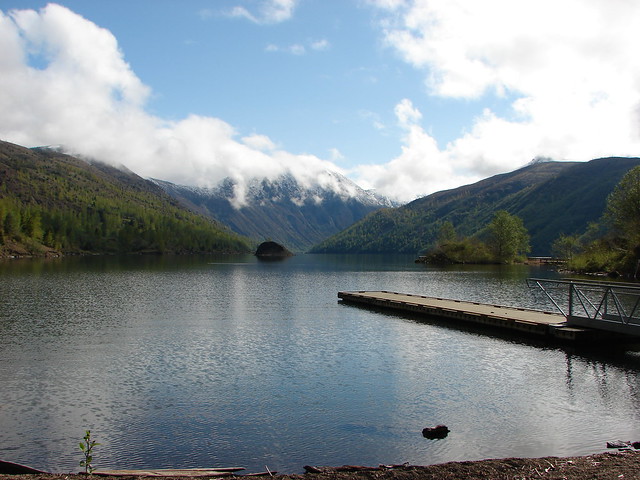
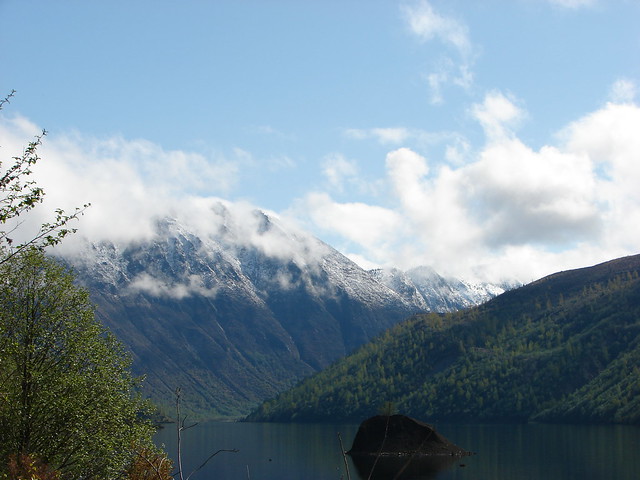
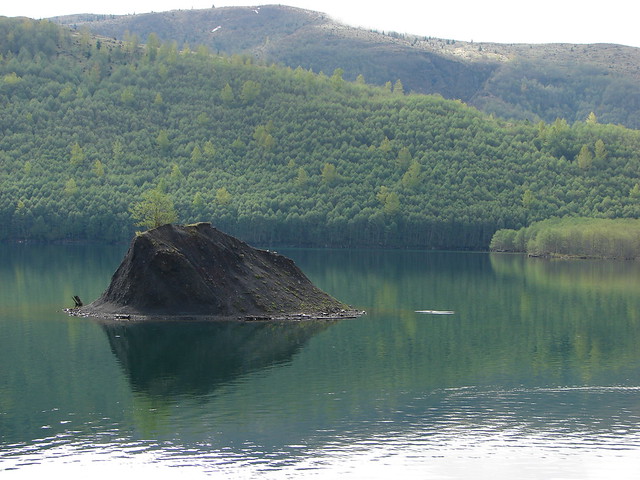
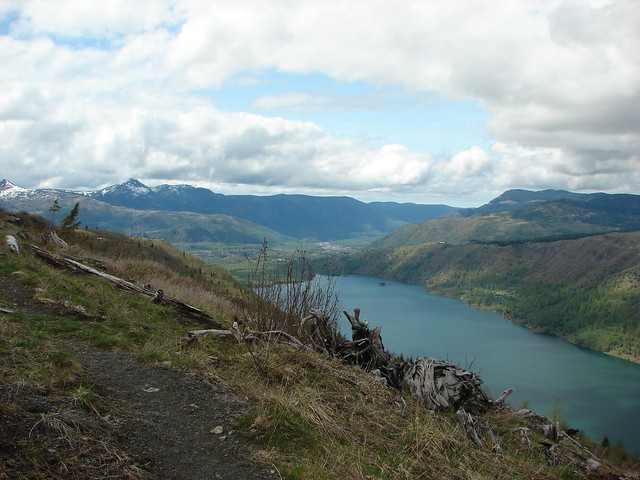
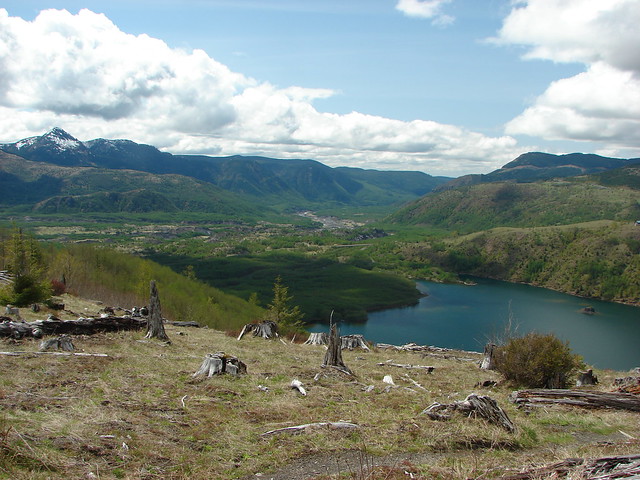
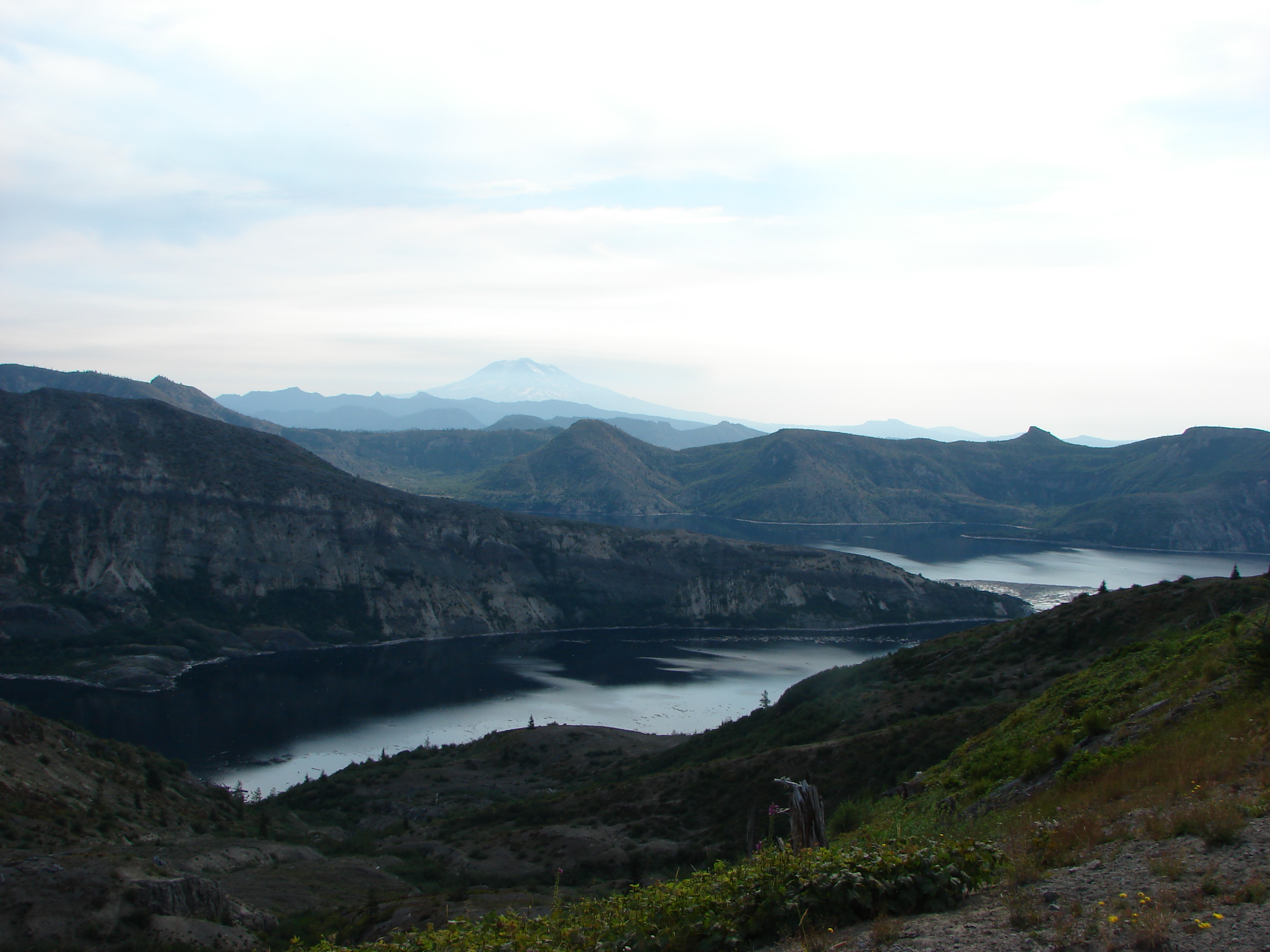
As we rounded a ridge end we got our first view of Spirit Lake and it’s floating trees. Mt. Adams was visible through the haze further to the east.
082
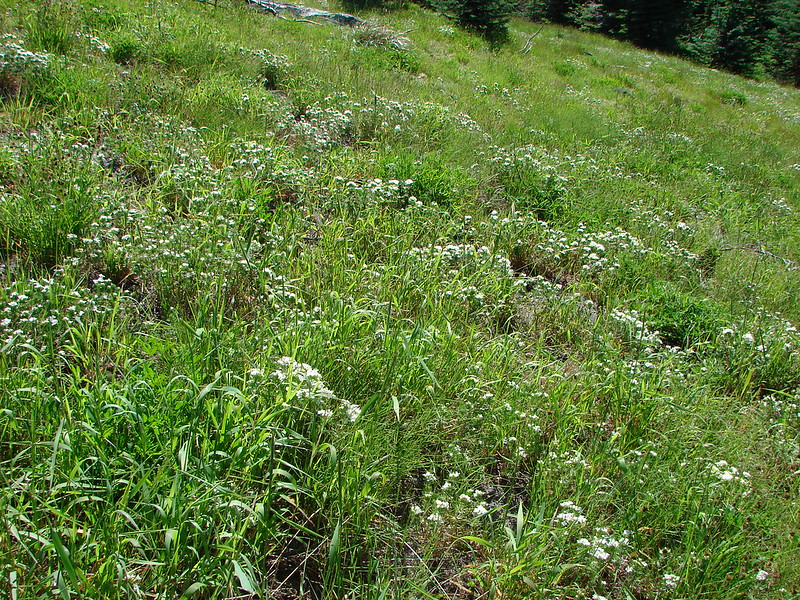
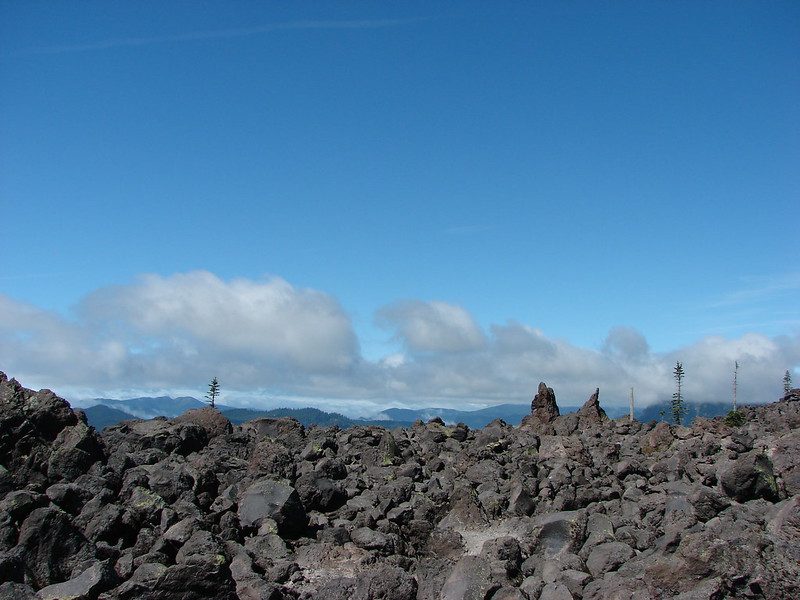
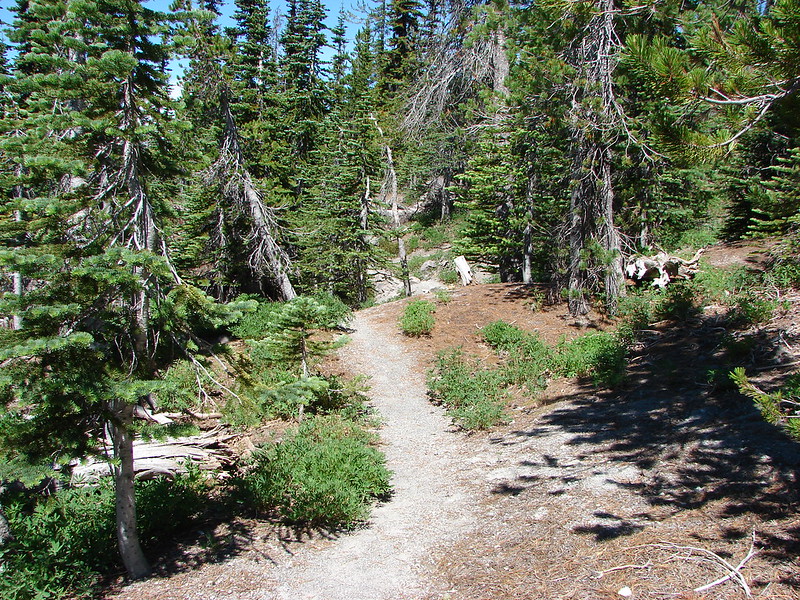
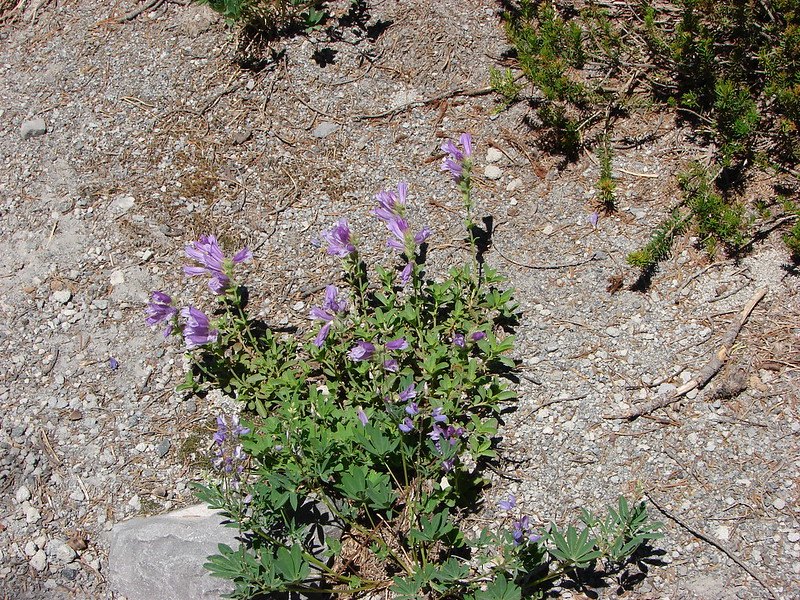
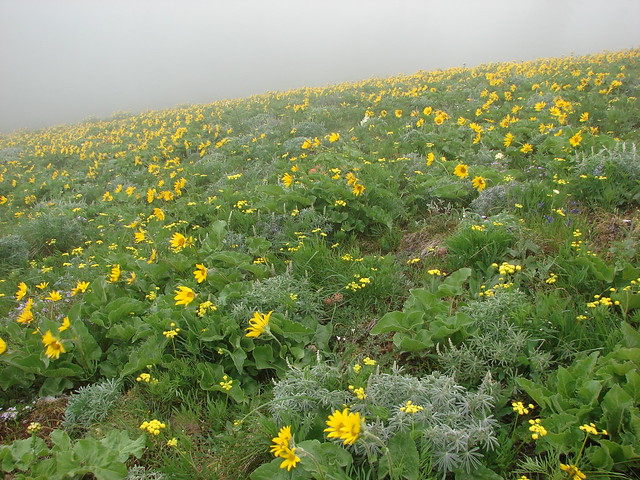
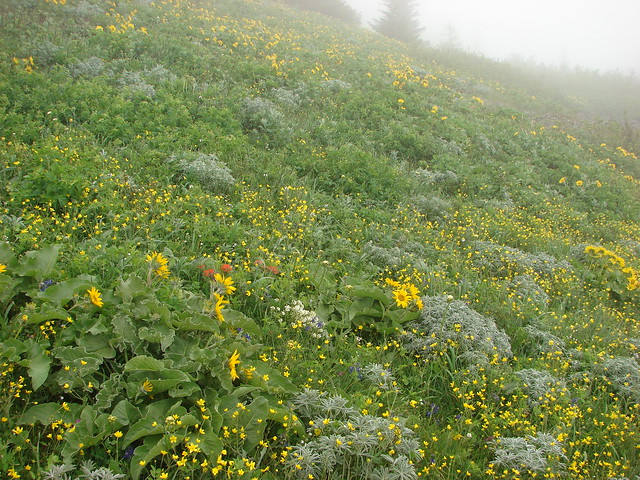
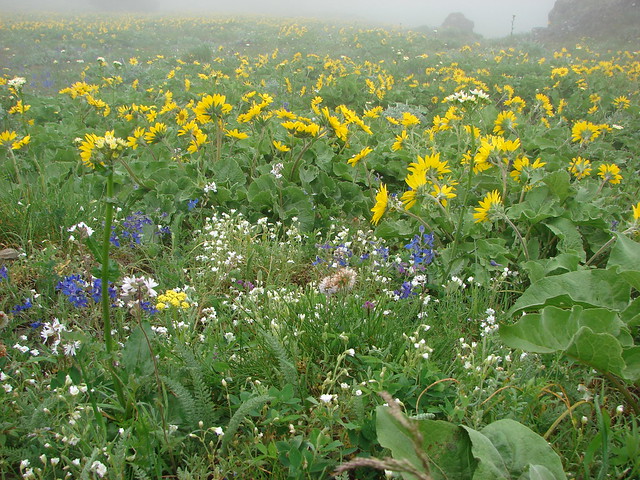
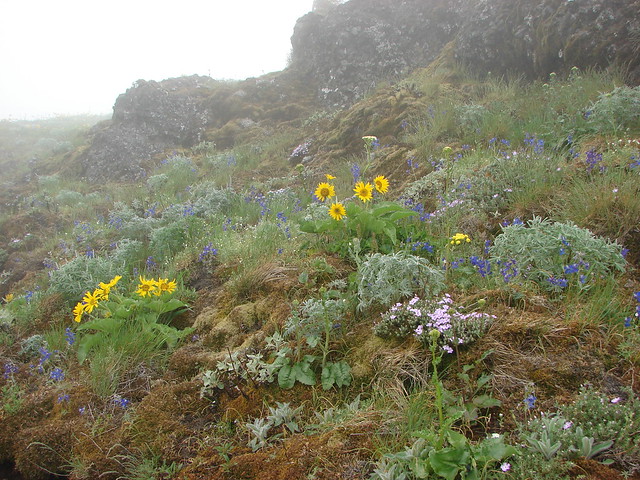
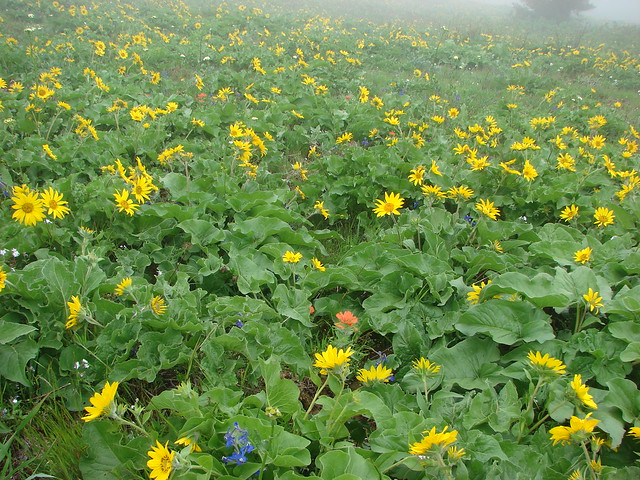
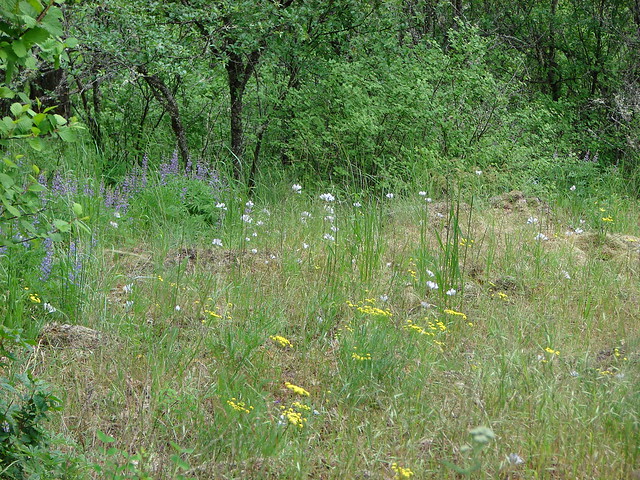
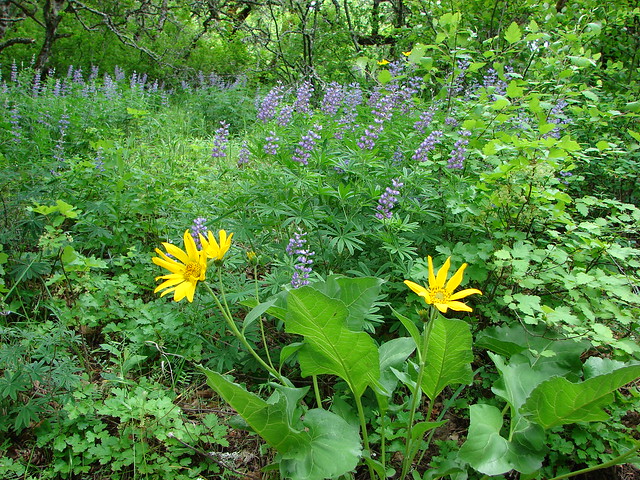
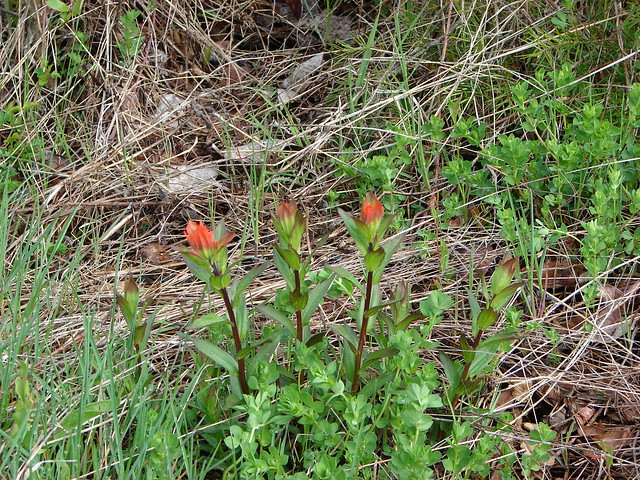
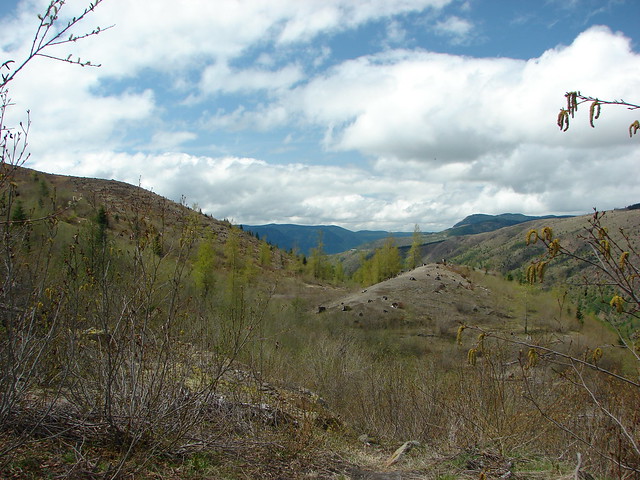
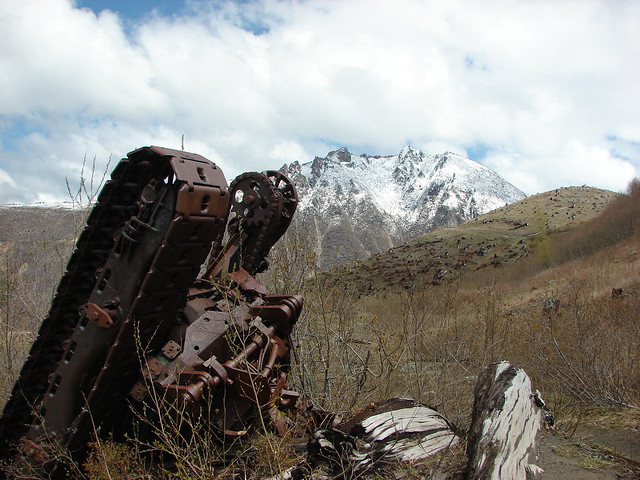
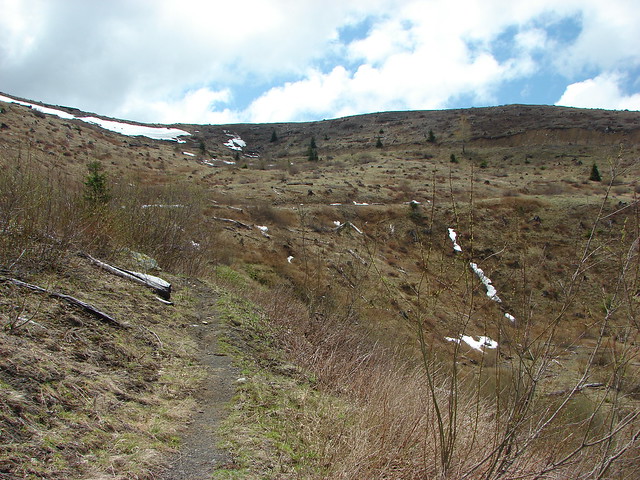
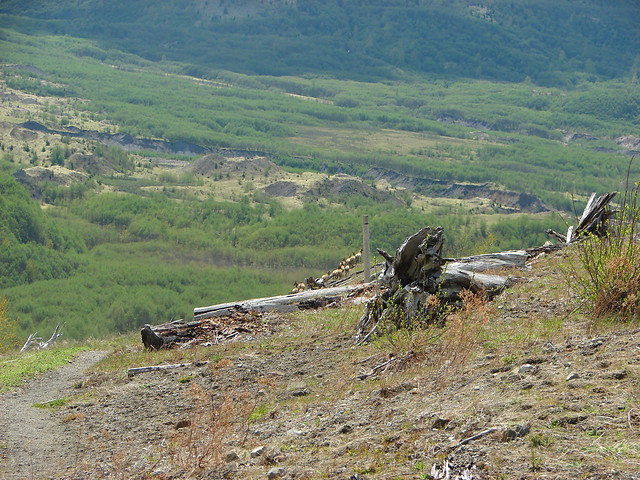
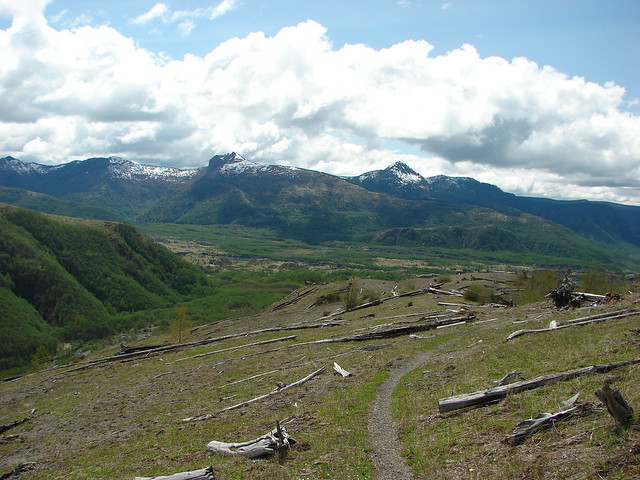
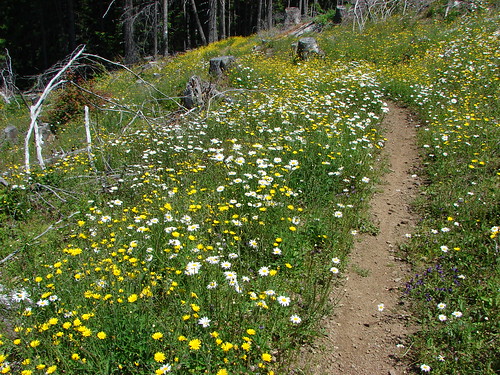
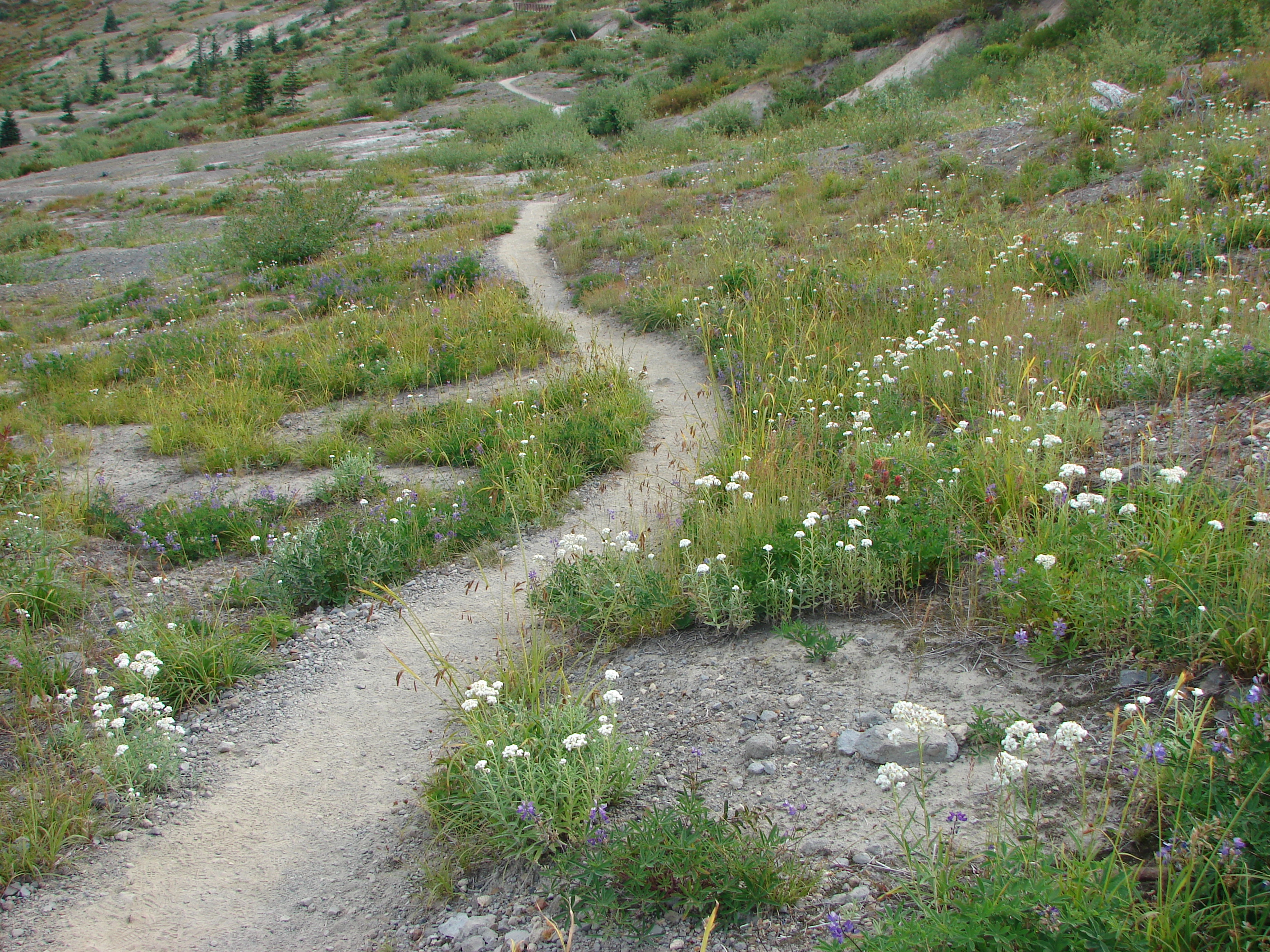
The trail then dipped slightly to a jct with the Truman Trail and continued on behind Harry’s Ridge. Here there was a decent variety of flowers that were growing in the mud and ash that had spilled over the ridge here during the 1980 eruption.
106
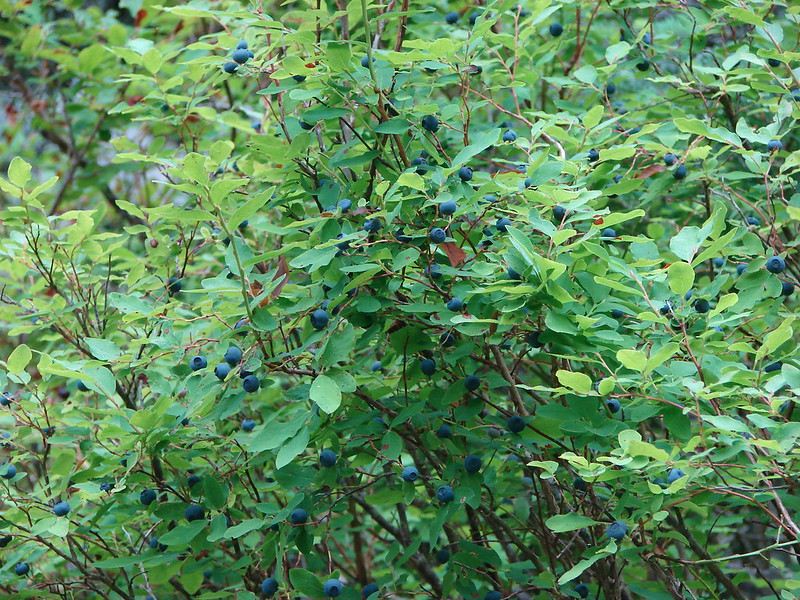
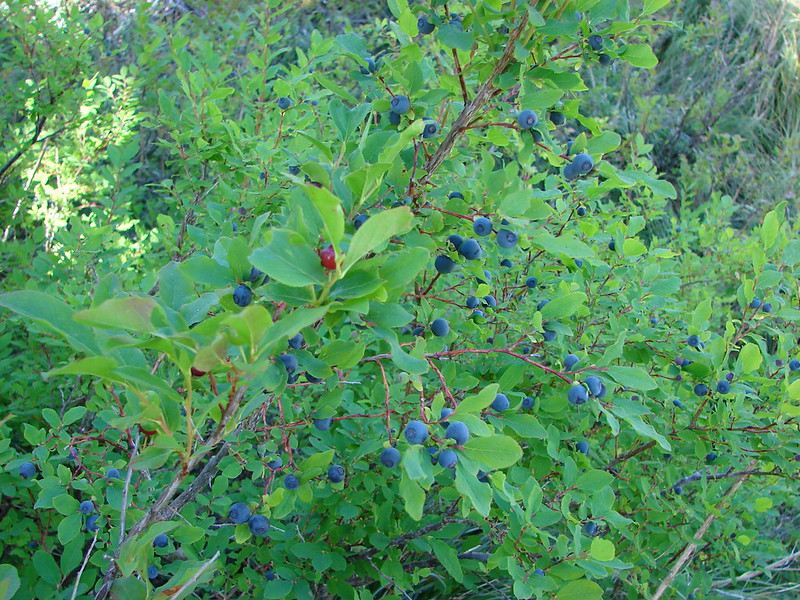
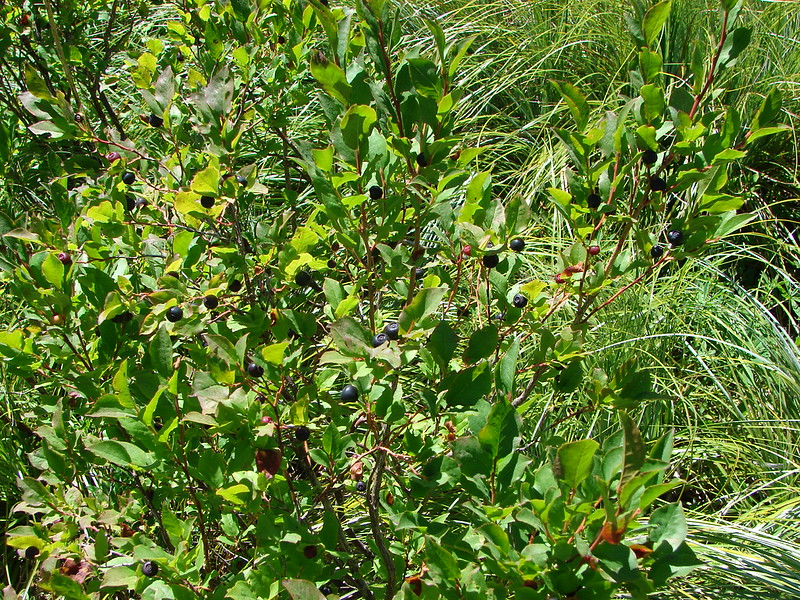
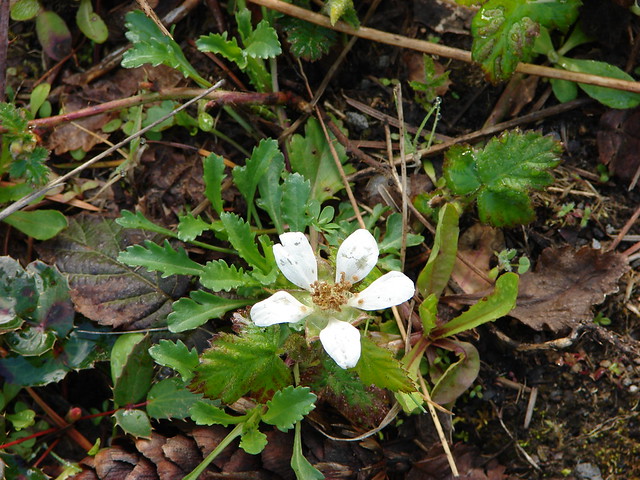
We also began to find berries :). Here were mostly thimble and huckleberries but we even found a few ripe salmon berries.

Thimble & huckleberries

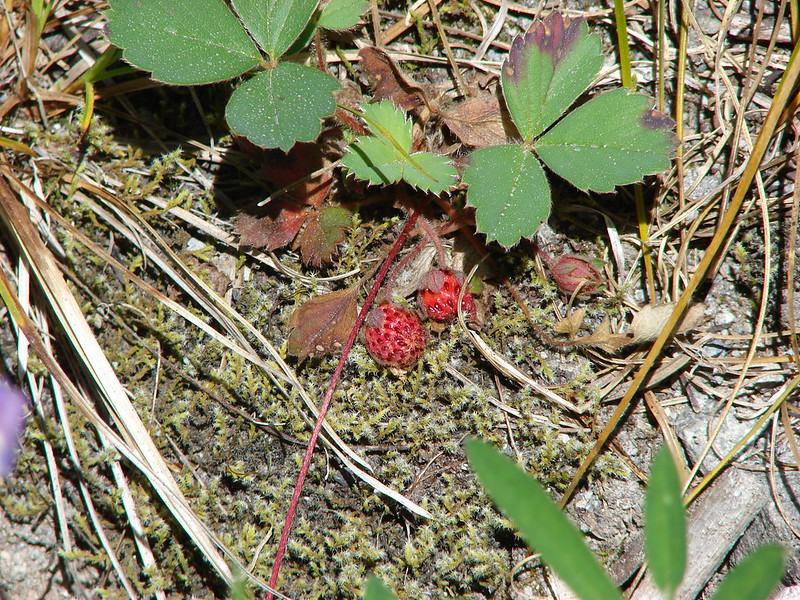
Later we would add strawberries to the menu.

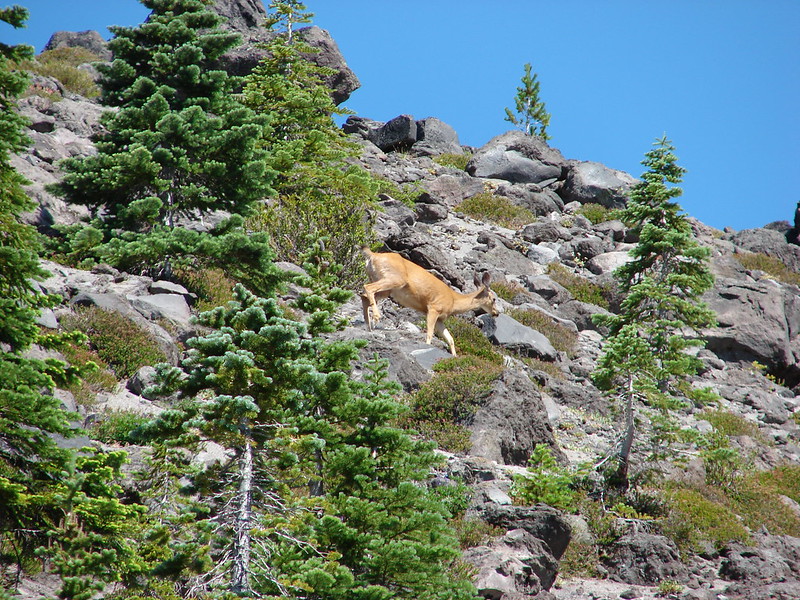
Just after we had reached the Harry’s Ridge trail we spotted another half dozen elk running up a game trail below us. The trail was now gaining elevation providing better views of Spirit Lake and distant Mt. Adams.
133
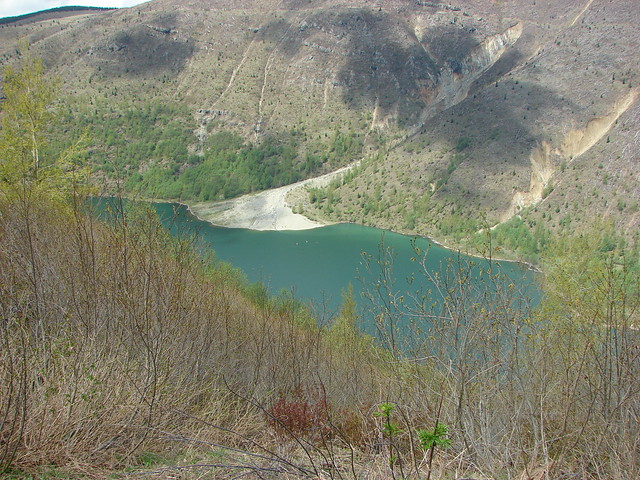
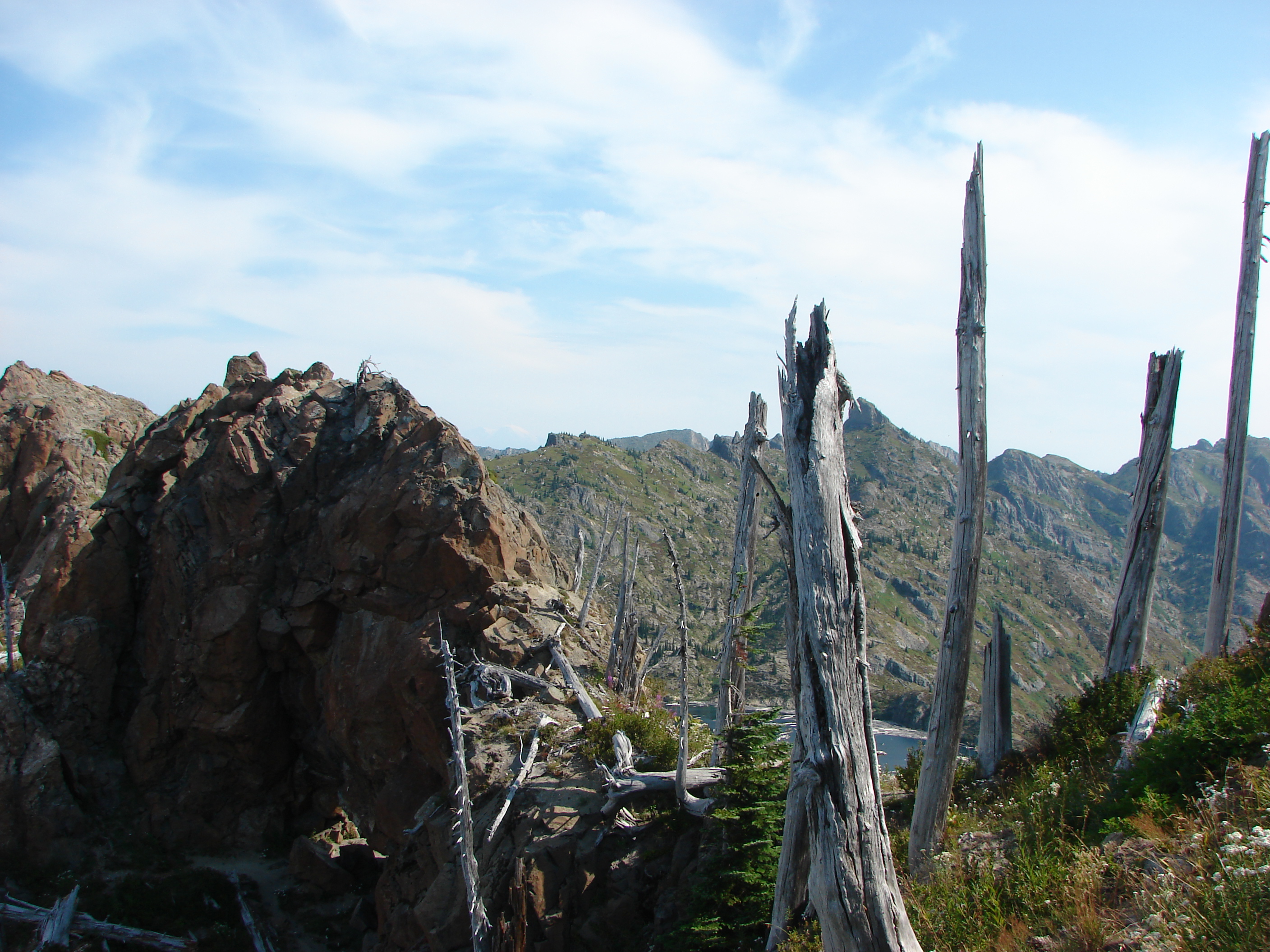
When the trail crested we had a nice view of St. Helens Lake below. The trail then drops down in order to pass through a rock arch before continuing above the west side of the lake.

The rock arch that the trail passes through and St. Helens Lake

Near the north end of St. Helens Lake was the sign for the Coldwater Peak Trail which we turned up to begin our climb. We were so busy looking for berries (which we had all been snacking on as we hiked) that we somehow walked right off the trail at a switchback. It took a moment but I finally spotted it across the hillside going up so we headed cross country until we intersected it. Back on the trail we continued our climb up amid an increasing number of flowers (and plenty of berries).
266

The views from the summit were good despite the persistent haze which had now completely hidden Mt. Adams.

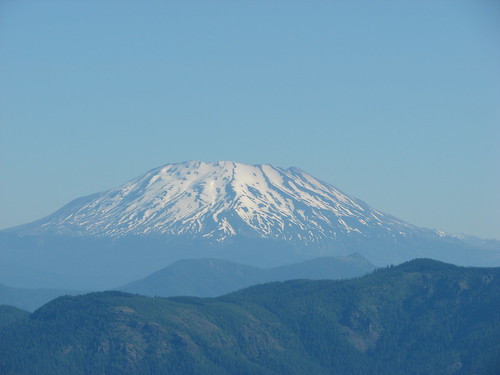
Mt. St. Helens from Coldwater Peak


Johnston Ridge Observatory from Coldwater Peak


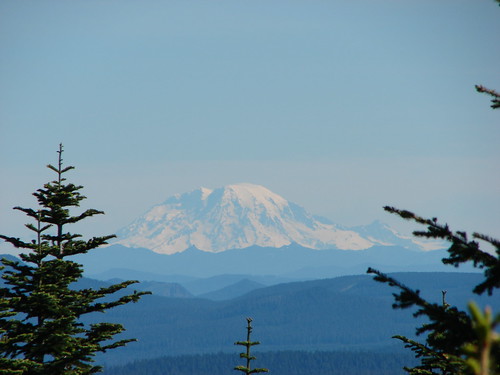
Mt. Rainier from Coldwater Peak

We couldn’t get to the highest point on the rocks of Coldwater Peak though. We found that we were greatly outnumbered on the summit by flying ants!

Flying ants filling the sky and covering the rocks on Coldwater Peak

They were sticking to the west side of the peak and as long as we remained a few feet from that edge they left us alone so we were able to eat in peace.

We headed back down the trail and tried to figure out where we had lost it on the way up but we never did figure that mystery out. The smoke had gotten worse and it could now be faintly smelled in the air. We ate more berries on the way back and stopped to watch the elk heard again before dropping our packs off at the car and heading to the now open observatory to pay for the passes that we were supposed to have in order to hike in the area. Since we were there we took a tour around the small but interesting observatory before getting in the car and daring Portland’s rush hour traffic. Happy Trails

Facebook photos: https://www.facebook.com/media/set/?set=a.10201951052645107.1073741851.1448521051&type=1
Flickr: http://www.flickr.com/photos/9319235@N02/sets/72157635195793722/

Categories
Hiking Mt. St. Helens Trip report Washington Washington Cascades

Sheep Canyon

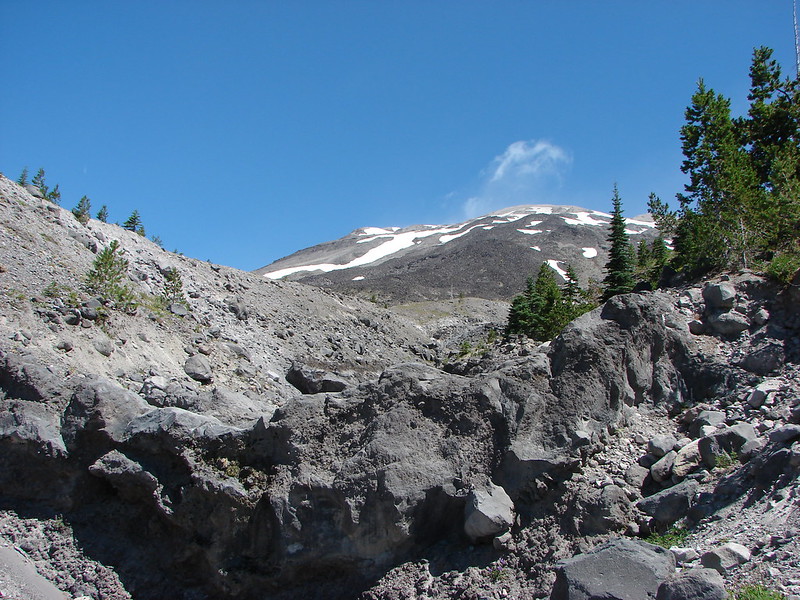
So after a couple of months of taking pictures of the major Cascade peaks it was finally time to visit one. Our most recent hike brought us to the volcanic landscape of Mt. St. Helens. Our plan was to hike a loop on the SW side of the mountain starting at the Blue Lake trail head.

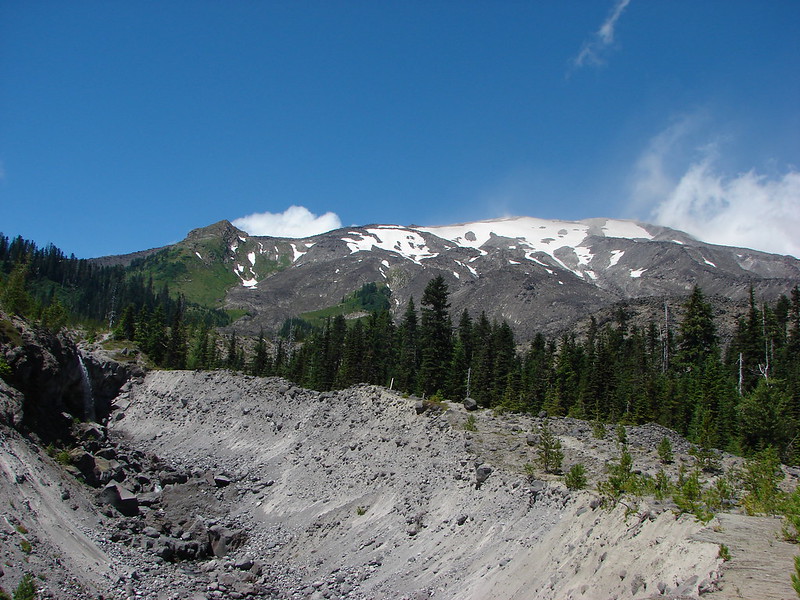
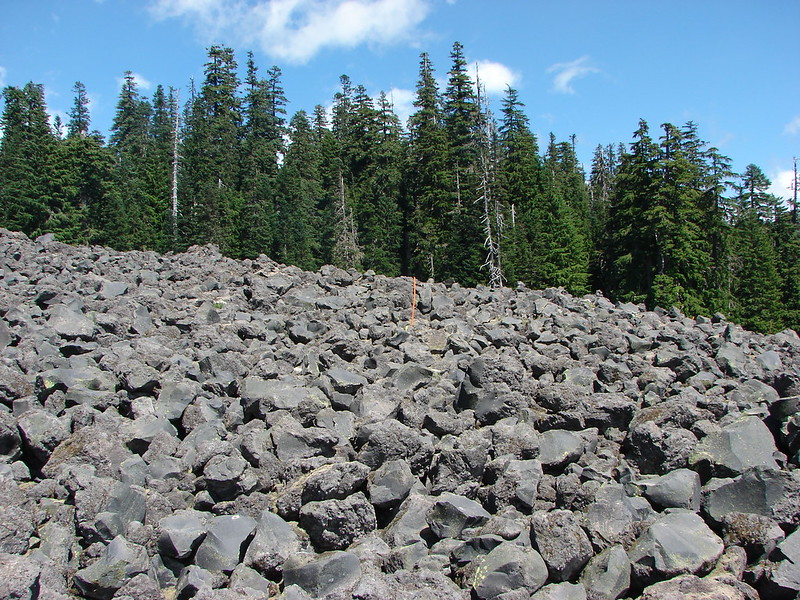
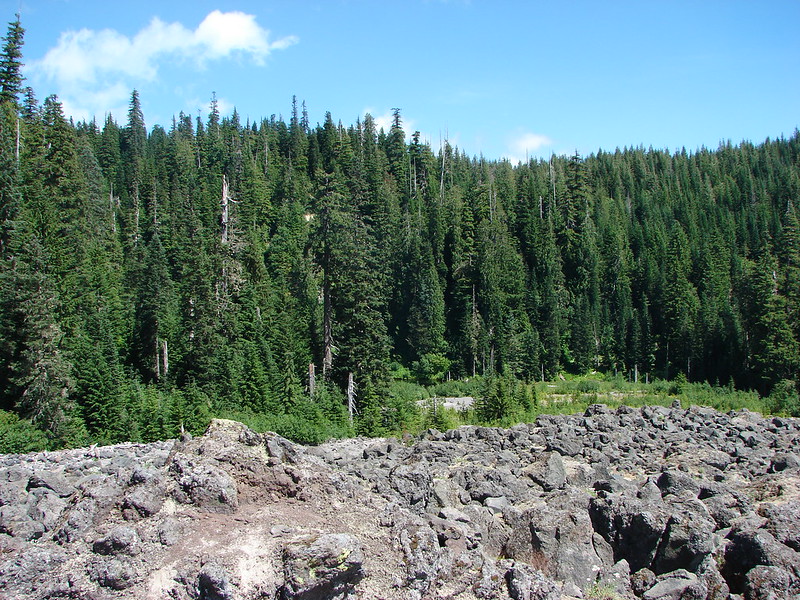
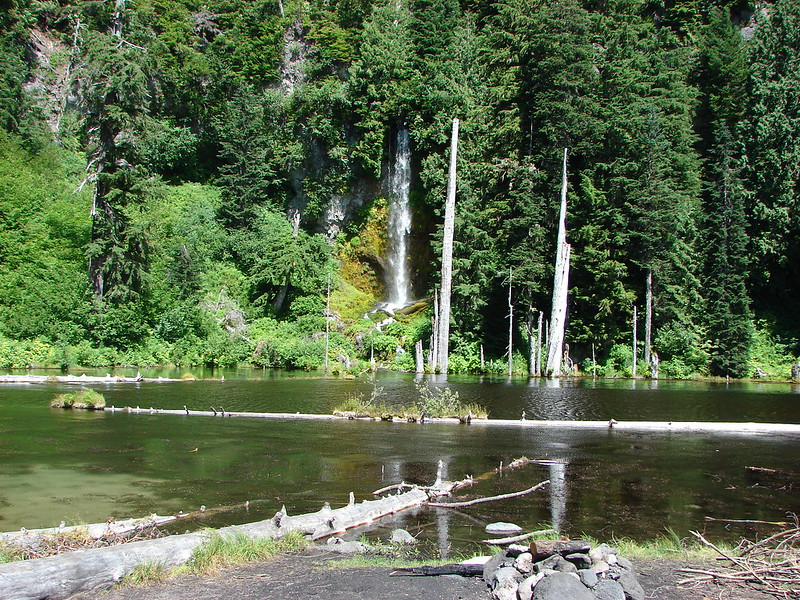
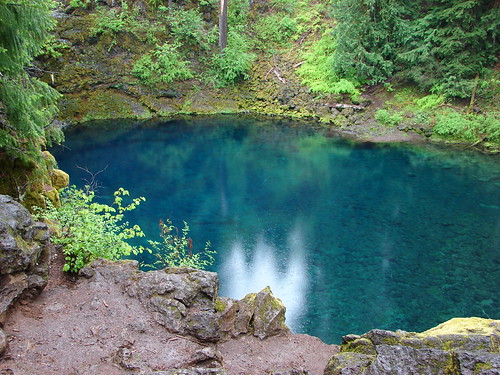
For the second week in a row we spotted elk from the car on the way to the trail, but were skunked while actually hiking. We arrived at the current Blue Lake trail head (washouts occasionally relocate it) and headed across a rocky washout to the Toutle Trail. The washout provided a view ahead to the mountain while forest lined each side. At the Toutle Trail we turned left and headed toward Blue Lake. Coldspring Creek flowed along the edge of the washout creating a dividing line between the grey rocks and old growth forest on the other side. Shortly after crossing the creek and entering the forest we came within sight of Blue Lake. The forest here survived the 1980 eruption leaving old growth trees, but a mudflow dammed the creek creating the lake. The forest was peaceful and carpets of white flowers covered much of the ground.

After 2.5 miles in the forest we began to descend into Sheep Canyon. Here the Toutle Trail intersects the Sheep Canyon trail which climbs the mountain on the south side of Sheep Canyon up to the Loowit Trail which circles the entire mountain. We continued on the Toutle and crossed Sheep Canyon on a scenic footbridge and continued on toward the South Fork Toutle River.
056

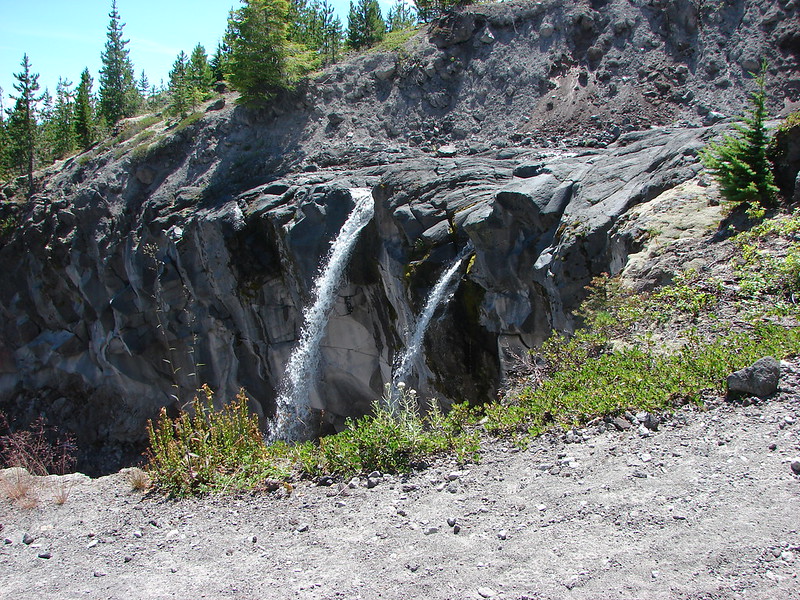
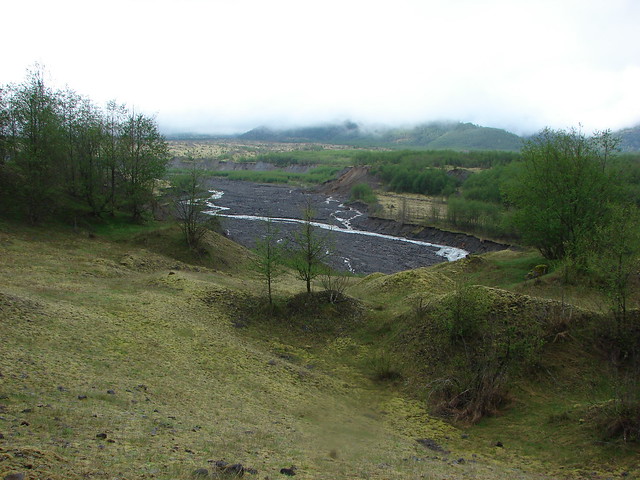
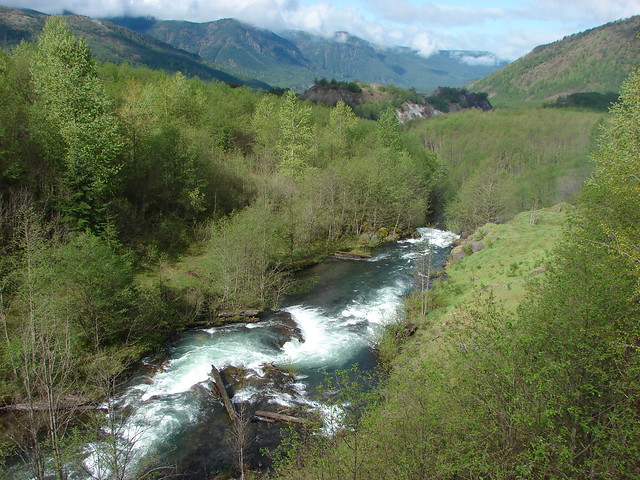
This section of trail was not very well maintained so we had to do a lot of stepping over and under along the way. After 1.5 miles we made it to the Toutle Trail’s own jct with the Loowit Trail at the edge of the S. Fork Toutle River’s canyon. This wide canyon was affected by the eruption when snow from Mt. St. Helens’ glaciers rapidly melted sending a huge mudslide down the valley. The river now is a small ribbon of water in the wide canyon. Here we turned right on the Loowit and started to climb the side of the mountain.
096

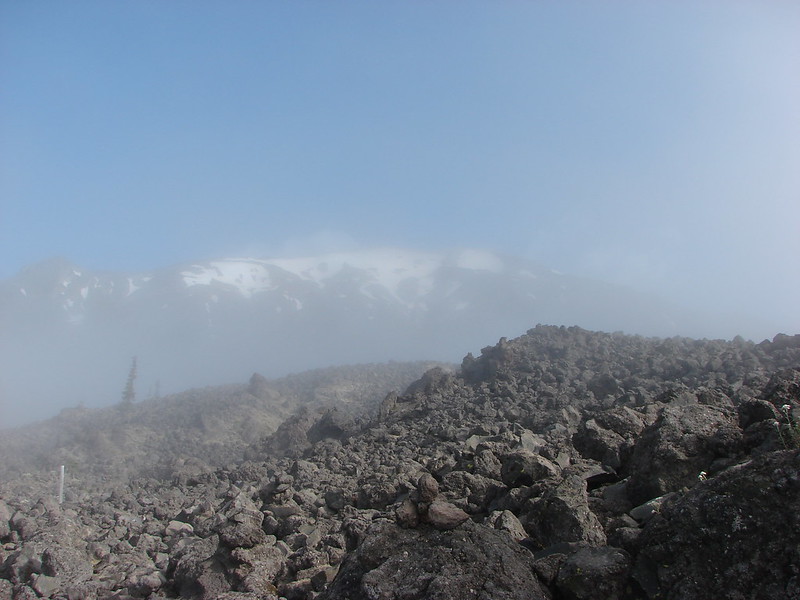
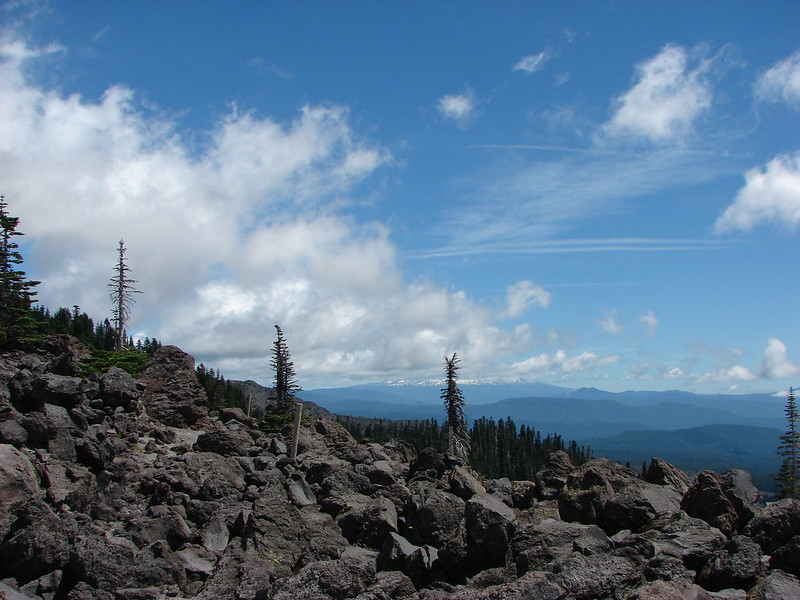
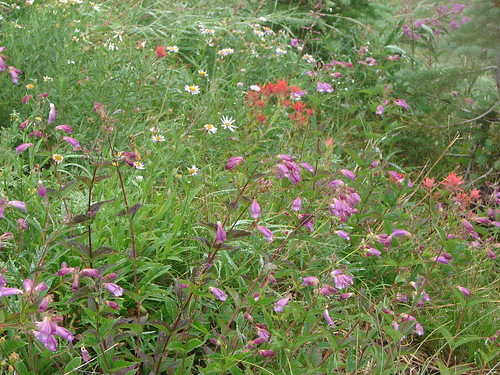
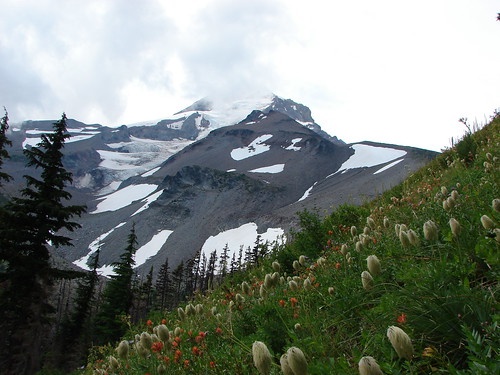
As we climbed we left the forest and entered the blast zone where the trees did not survive the eruption. Here increasingly better views opened up of the mountains rim and to the north the top of Mt. Rainier. Wildflowers surrounded the trail taking advantage of the clearings created by the blast. We passed through some excellent bear grass stands and large numbers of orange tiger lilies, purple penstemon, red columbine & paintbrush, and various colors of phlox. Some small patches of snow lingered in gullies along the way.
170

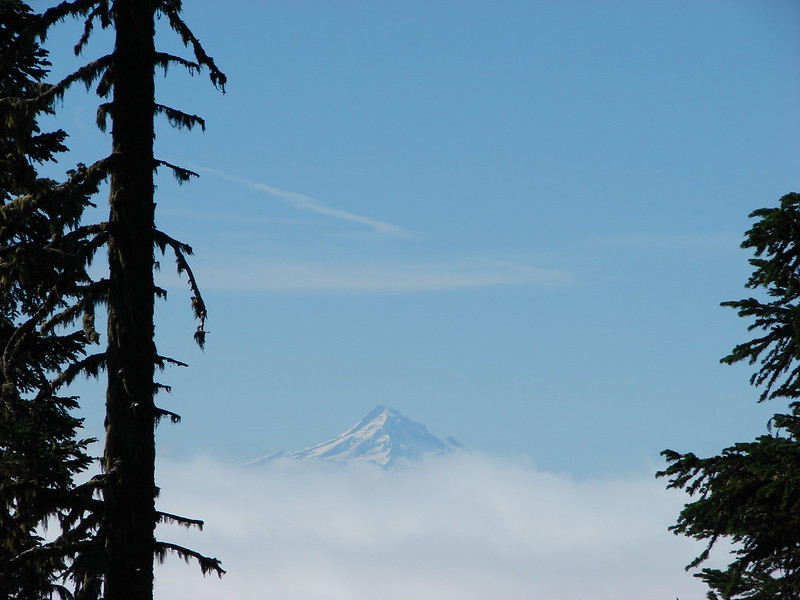
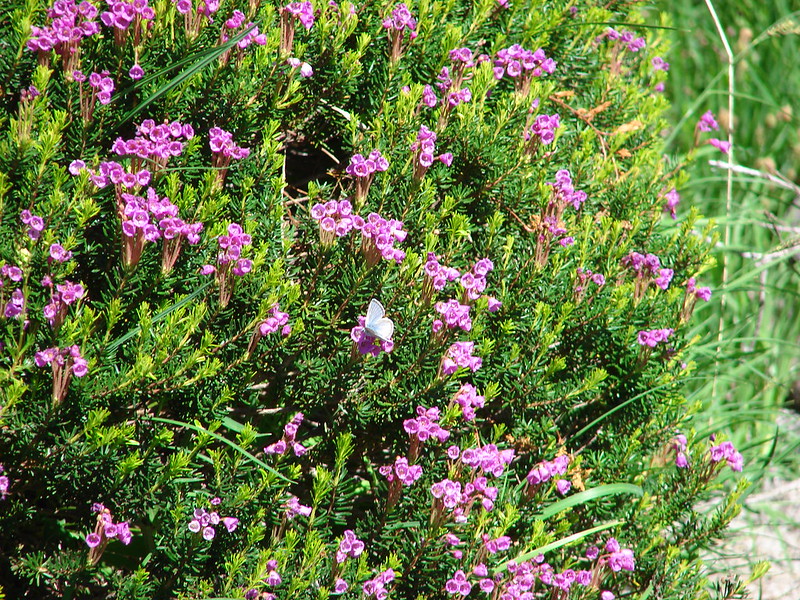
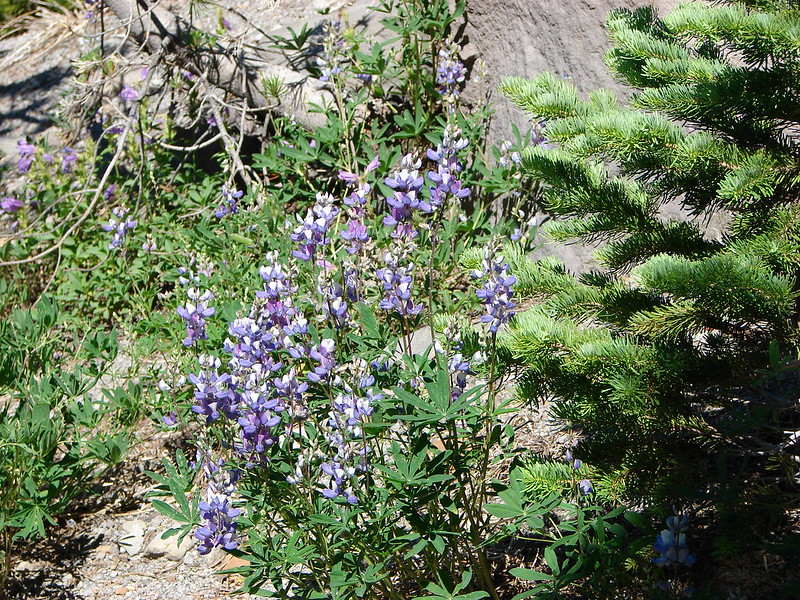
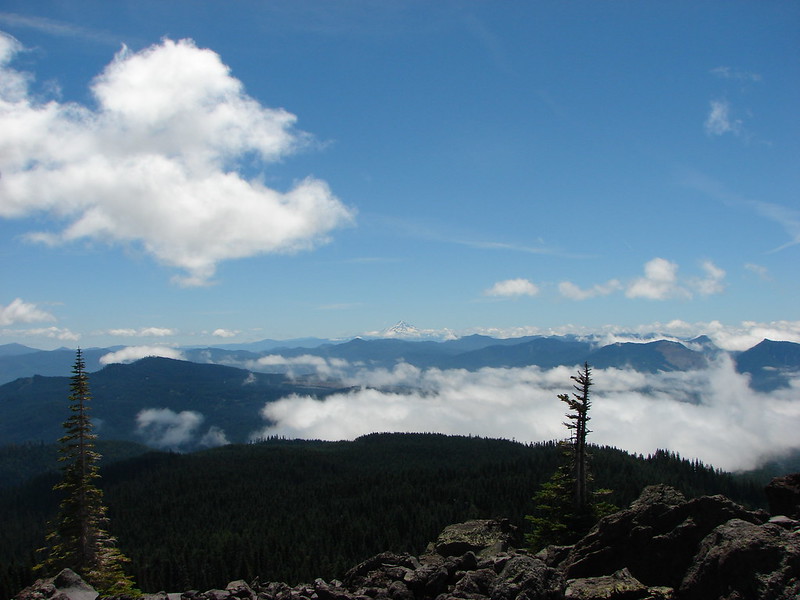
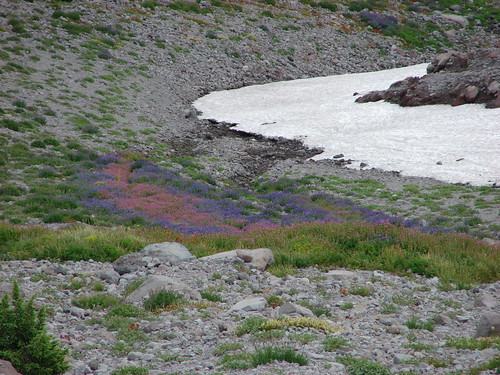
The trail eventually leveled out and began traversing along the mountains flank to the south. We dipped in and out of the tree line passing a number of different landscapes. We passed the Sheep Canyon Trail choosing instead to continue to the Butte Camp Trail. As we traveled on we crossed several rocky outwash gullies and eventually worked our way far enough around to the south to see Mt. Hood and Mt. Jefferson in the distance. Pink mountain-heather and dwarf lupine bloomed along this portion of the trail.
277

When we reached the Butte Camp Trail we turned right and started our descent back to the Toutle Trail. This trail passed through a dry lodgepole pine forest before reaching the meadow at Butte Camp. Recent snow melt had left the meadow flooded. The trail got us down fairly quickly without being steep and soon we were back on the Toutle Trail ready for the last leg of our hike.

The Toutle Trail was mostly level as it passed through the forest which was nice because we were all starting to feel tired. We pressed on and eventually reached the washout and the junction with the Blue Lake Trail and hustled the final 3/4 miles back to the car. I had chalked our fatigue up to the 10k we had all run the day before, as we seemed to have been much slower than normal. I got a possible answer to why when we got home and I checked the GPS which had us going a total of 16.1 miles :). I’m still not quite sure where the extra 2.6 miles came in but the track from the gps looks right so all I know to say is “Happy Trails”.

Photos -Facebook: https://www.facebook.com/media/set/?set=a.10201590209464253.1073741842.1448521051&type=1
Flickr: http://www.flickr.com/photos/9319235@N02/sets/72157634653720111/

Categories
Hiking Trapper Creek Trip report Washington Washington Cascades

Observation Peak

**Note the 2020 Big Hollow Fire burned a portion of this hike.**

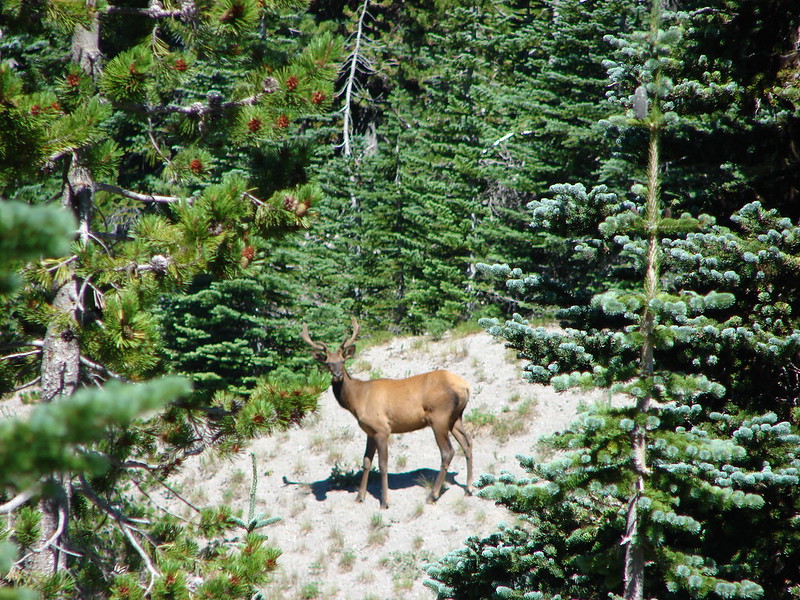
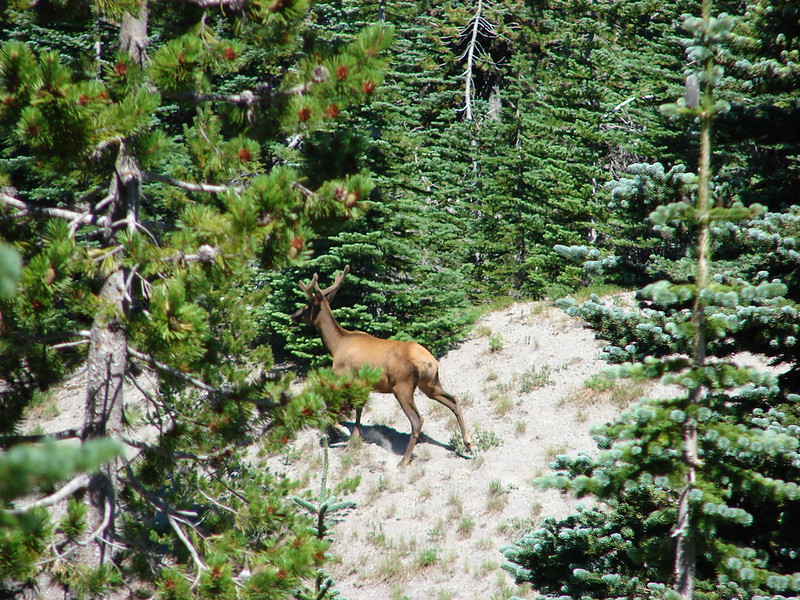
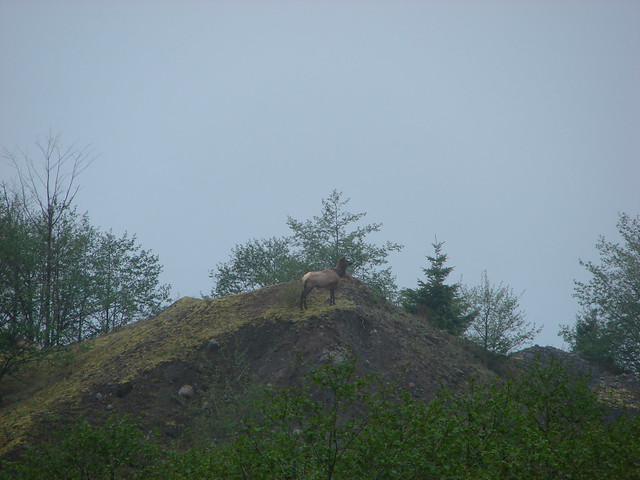
Unexpected is as fitting a description as I can think of for our visit to the Trapper Creek Wilderness in Washington. The first unexpected event happened before we even arrived at the trail head. I have mentioned before that we seem to see more large wildlife from our car than we do on the trail. As we were turning off the highway I noticed a large brown animal just a bit further up along the shoulder. I quickly turned around and got out the camera. It was an Elk just grazing on the side of the road. This was the closest we’ve been to seeing an elk on one of our hikes.
278

We created the next unexpected event when we parked near Bubbling Mike Spring at an empty sign board. This turned out to be the wrong parking area, but the road ahead was gated closed and we failed to notice the small sign around the corner to our left that pointed toward the campground. We set off on a clear trail toward Trapper Creek which we knew we needed to cross at some point. That path quickly ended at the creek with no dry way to cross so we backtracked and headed up the gated road. We spotted one footbridge that had a do not use, danger sign posted on it as we passed several cabins that sat along the creek. The road veered away from the creek and just after crossing a small stream we decided to head back and work our way up the creek bank to see if we could find a crossing that way. No sooner had I recrossed the stream when I heard quite a commotion behind me. I expected to see Dominique on the ground since he is the most prone to losing his balance but instead it was Heather sitting in the middle of the stream. She banged her hand up pretty good but was fortunate not to have hit her head or hurt her legs. Her pinky though was already swelling and slightly discolored. We hadn’t even found the official trail yet and we had a “man down”. She decided she wanted to try and continue the hike so back we went to searching for a dry way across.

After wandering up and down we settled on trying a downed tree that appeared to be flattened on top for crossing. It led to the back of a couple of cabins on the far side of the creek so we quickly ducked past them onto the access road that led to them. Our map showed that this road would lead to the trail we had been seeking so we headed left and soon had found it.

We entered the Trapper Creek Wilderness and paralleled Trapper Creek through a dense forest. If you love old forests and the sound of flowing water this would be a great hike for you. If you are after views and wildflower meadows skip this trail and take the Observation Peak Trail from road 5800 as described in Sullivan’s 100 Hikes book. The trail went up and down occasionally offering glimpses of the creek below. After 2.5 miles the path crossed Hidden Creek and shortly after a pair of signs pointed to Hidden Falls. We decided we needed to check this out so we struck off on the faint trail up a ridge to a nice camping spot. Hidden Falls was below down a steep hillside which Heather and I picked our way down. We were able to make our way to the base of the secluded falls and then had to climb back out of the canyon.
343

From Hidden Falls the Trapper Creek trail began to climb a long series of fairly steep switchbacks. We crossed the creek again after the first set of switchbacks and then launched upward again. A nice viewpoint along the way overlooked Trapper Creek Falls across the valley backed by Observation Peak. The trail eventually leveled out, recrossed Trapper Creek, and then came to a junction with a trail labeled “Shortcut Tr. 129B”. Dominique was all for taking any trail that had the word shortcut in it’s name so we turned up it. I don’t know how much of a shortcut it was, but we were soon at another junction, this time with the Observation Peak Trail.

We headed up toward the summit through a forest with large bear grass plumes and many other smaller white flowers. After about a half mile of climbing we reached the lower viewpoint. This first viewpoint was on a rocky outcropping dotted with white cats ear blossoms. It had been a nice day, with blue sunny skies and a occassional breeze that kept it from being too warm but we found that clouds were hanging around the Washington peaks covering each of them to some degree. Never the less the view was impressive and the view from the actual summit promised to be even better. We returned to the trail and continued up another .2 miles to the summit passing bear grass blooms and other various wild flowers. As we approached the summit, Mt. Hood appeared over the right shoulder of Observation Peak with a faint Mt. Jefferson nearly hidden by haze further to the south.

Mt. Adams and the Trapper Creek Wilderness from Observation Peak

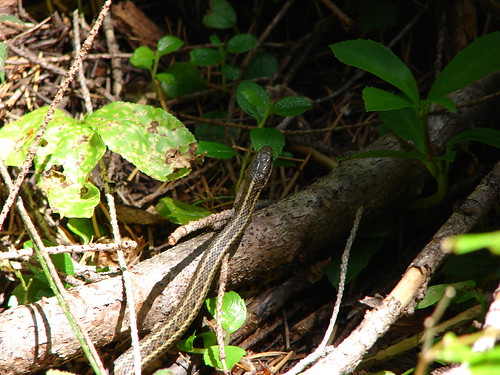
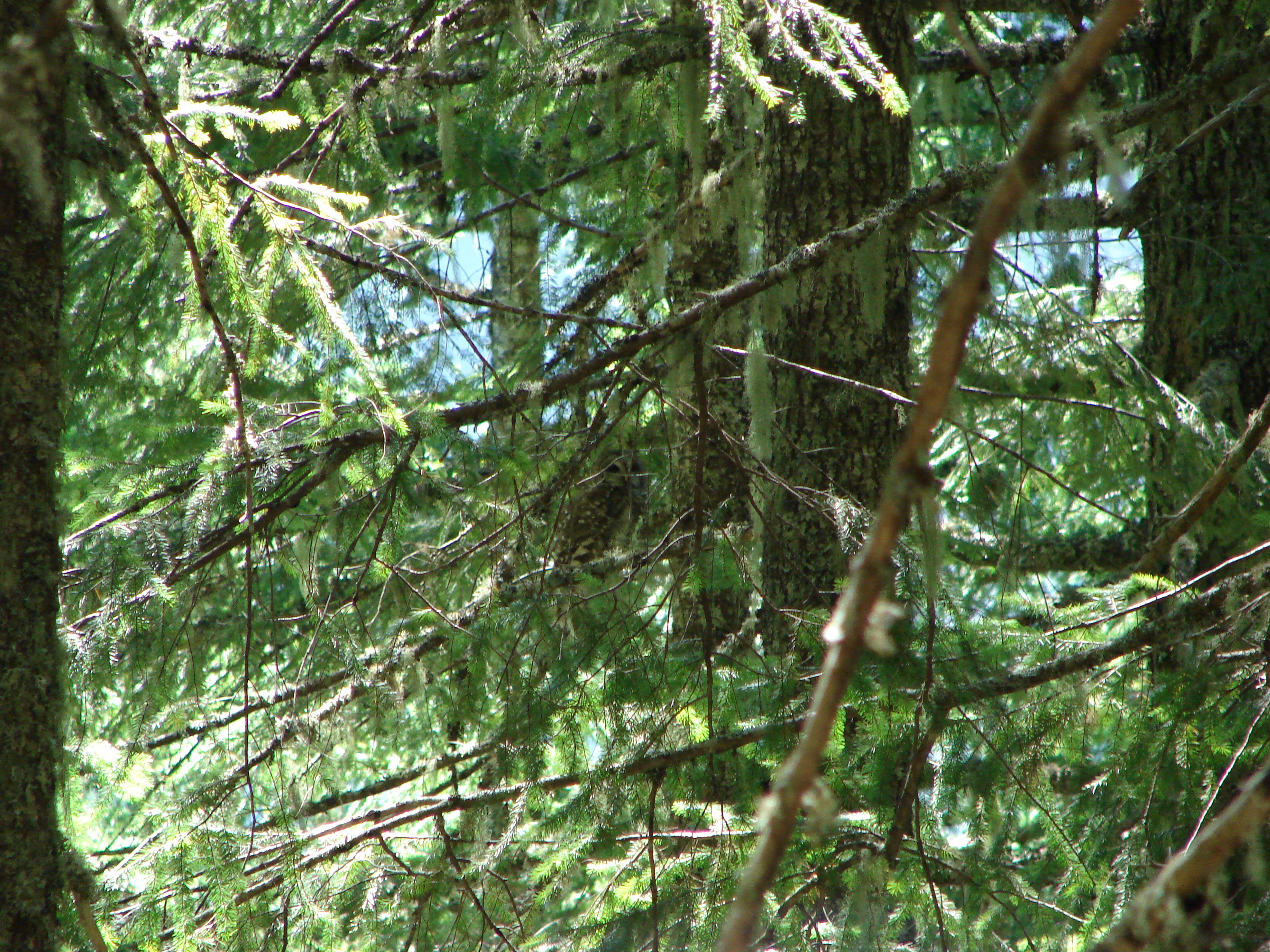
After a short rest we headed back down from the summit and turned right at the trail junction to begin our descent down Howe Ridge. We had a little over 5 miles down this pleasant trail to get back to the car. It gradually descended through the forest crossing numerous small streams and we were able to make good time. We spotted a small snake and later I came around a corner to find myself staring straight at an owl about 10 yards away. When I reached for my camera it flew to a nearby tree but I was able to get
a couple of decent pictures.
474

Our feet were sore and legs tired when we finally reached Trapper Creek and we didn’t care about finding a dry crossing. Our car was almost directly across from us so we just walked into the water and crossed. What was supposed to have been a 13.3 mile hike turned into a 15.8 adventure. Despite a few mosquitoes (much less than our last hike) and Heather’s bruised hand it had been a pretty good day. There was only one way to end a day like this – with pizza 🙂 Happy Trails.

Photos – Facebook https://www.facebook.com/media/set/?set=a.10201538005439185.1073741841.1448521051&type=3
Flickr http://www.flickr.com/photos/9319235@N02/sets/72157634535134225/

Categories
Hiking Silver Star Mountain SW Washington Trip report Washington

Silver Star Mountain

HOT! That certainly describes our recent visit to Silver Star Mountain, but that would be doing this hike a great disservice. Despite the 90 degree temperatures better descriptions would be amazing flowers, great views, and beautiful scenery. Silver Star Mountain is located in Washington State’s Gifford-Pinchot National Forest between Mt. St. Helens and Portland, OR.

I’d been wanting to visit Silver Star for a long time, but the timing hadn’t been right until now. I had seen a number of trip reports which indicated now was a good time to catch many of the wildflowers that fill the meadows and the weather called for clear skies, the perfect combo. There are a number of possible approaches to the 4390′ summit but for our hike we chose to approach from the north via Ed’s Trail.

The drive to the trail head was tedious with the last 9 miles taking a good 45 minutes due to poor road conditions. Our plan was to hike a big loop sampling as much of the area as we could so we knew we had a long day ahead of us. It was already over 60 when we arrived at the parking area at 7:15. The sky was clear and the birds were out in force as we headed up the north flank towards the junction with Ed’s Trail. Mt. St. Helens loomed behind us and as we climbed Mt. Rainier and later Mt. Adams joined the horizon. As we approached the junction with Ed’s Trail Mt. Hood appeared through a gap ahead surrounding us in Cascade peaks.

Mt. St. Helens & Mt. Rainier from the jct with Ed's Trail
Mt. St. Helens & Mt. Rainier from the jct with Ed’s Trail

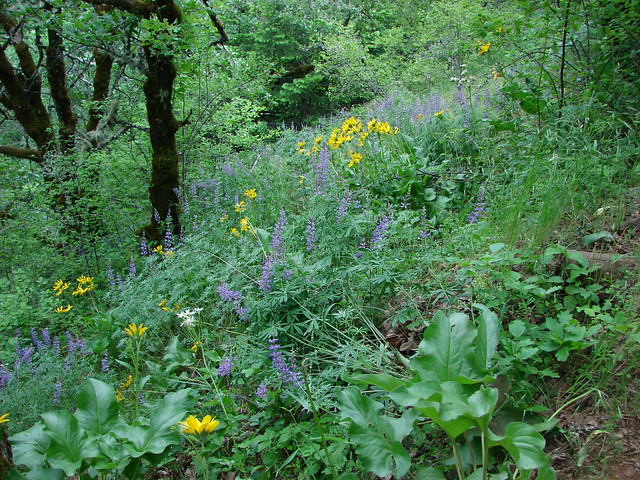
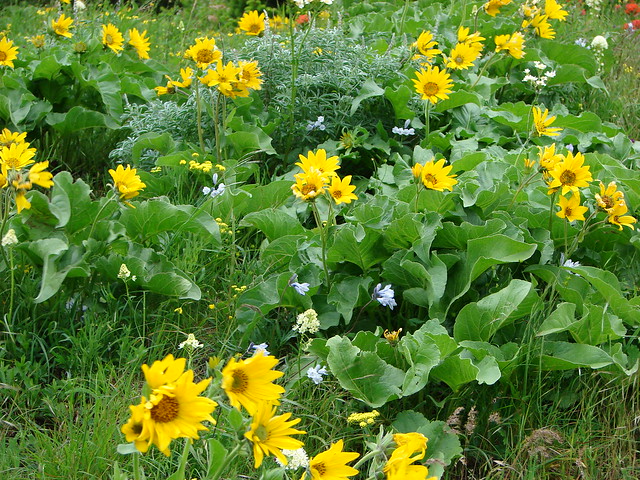
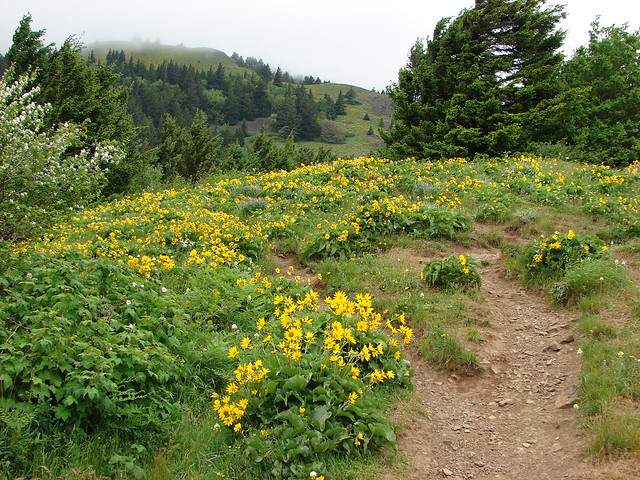
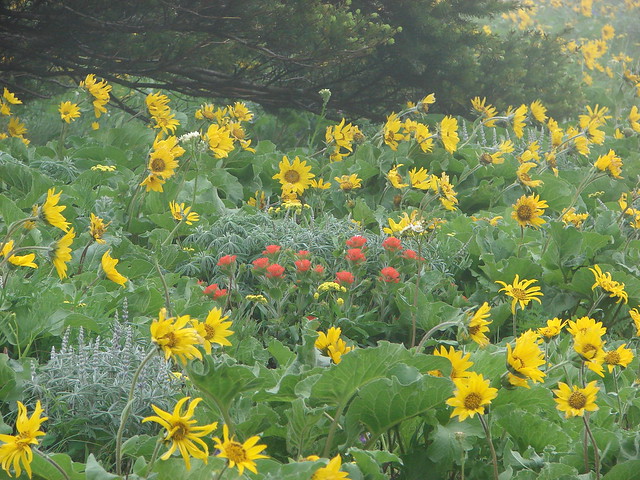
Already the flower display had been amazing. The variety of flowers was one of the best we’d seen. There was red paintbrush and columbine, pink nootka rose, purple lupine and iris, orange tiger lilies, white beargrass and thimbleberry, and (new to us) yellow lupine. The meadows here are due in large part to the 1902 Yacolt fire which swept over Silver Star Mountain removing the trees and clearing the way for the flowers. I could easily fill this whole trip report attempting to describe the flowers we saw on this day but the hike had other things to offer as well so I will have to let our photos do much of the flower reporting.
056

Ed’s trail was truly scenic as it traversed the NE side of the ridge through wildflower meadows with views of the 4 snowy Cascade peaks. Soon the path passed some rocky areas and passed through a natural rock doorway. Not long after passing through the doorway we scrambled up a short, steep section of the trail as it passed through a rocky slot up to a great viewpoint. A small patch of snow remained surrounded by avalanche lilies.

When Ed’s trail met an old road we took it up to the twin summits of Silver Star mountain. The view from the north summit was a true 360 degree panorama. Mt. St. Helens, Mt. Rainier, and Mt. Adams were joined by snow covered Goat Rocks to the north while Mt. Hood, Mt. Jefferson, and the faint Three Sisters rose to the south. The Columbia River and Portland, OR lay to the SW while the ridges and meadows of Silver Star Mountain surrounded us in every direction.

Washington Cascades form the summit

After leaving the summit we continued on to the Indian Pits trail to visit a series of rock pits used as vision quest sights at one time. More wildflower meadows awaited on this trail which ended at a rocky ridge endge with yet another set of wonderful views. As an added bonus we were serenaded by a resident swallow who appeared to be enjoying the view from the top of the rocks as much as we were. It was really starting to warm up as we left the pits and continued on our loop down an abandoned road past sturgeon rock. The old road was actually lined with trees but it was wide enough to remain in the sunlight.

We made our way down the road to the Tarbell Trail which we then turned right (north) on and momentarily entered the forest. The trees didn’t extend far to our left and we could see that much of the hillside below had been clearcut. It is a sight that I don’t particularly enjoy seeing. The stark contrast of the stumps and piles of slash next to the still standing forest always leaves me imagining what it must have once looked like. We were on a collision course with the cut though and soon emerged to the treeless hillside. One of the first things we noticed were the butterflies. They were everywhere and flitting above a vast array of wildflowers. Even the clearcut couldn’t spoil the areas scenery 🙂
604

The lack of trees did mean we were once again exposed to the sun and for about 2 miles we switchbacked down and across the hillside before again reaching the forest on the other side. We were greeted by the first sound of water on the hike. The source was Coyote Creek and that was where we would find our next destination, Hidden Falls. What a welcome change to the heat Hidden Falls was. A bench near the 92′ cascade gave us a place to rest while we cooled off courtesy of the breeze created by the falls.
653

After another mile and a half on the Tarbell Trail we arrived at the Chinook Trail which would take us up Kloochman Ridge and back to the road we had been on early in the morning. The Chinook trail spent a short time climbing in the forest before emerging in some of the hikes best wildflower meadows. The number and variety of flowers on this ridge trumped all the others we had been through on this day.
747
This was also the steepest trail we’d been on and with the temperatures hitting the 90s we needed all the distraction the flowers could provide.

We eventually made it up Kloochman Ridge and then headed back down the road to our car and the extra water that was stashed in our cooler. This was one of the rare occasion when I actually finished off all the water in my Camelbak (1/4mi from the car). Silver Star Mountain had lived up to all the hype I’d seen in the trip reports. With a little something for everyone it’s an amazing area and I highly recommend exploring any of the areas trails. If you’re a fan of beargrass skip next year since it only blooms every 2nd or 3rd year and this year it was on, or better yet go both years and see the difference. Happy Trails and have a safe 4th of July.

Facebook album https://www.facebook.com/media/set/?set=a.10201492927112255.1073741839.1448521051&type=1
Flickr photos -http://www.flickr.com/photos/9319235@N02/sets/72157634416726411/

Categories
Columbia Gorge North Hiking Trip report Washington

Table Mountain

If at first you don’t succeed, try, try again. After our recent string of cloud obscured views I was determined to break the streak. I had been watching the weather forecast all week and decided everything was lining up perfectly for a return to the Columbia Gorge and another attempt at a view of the Cascades. The nasty weather and the poncho attack on Hamilton Mountain needed to be avenged so for this hike I picked Table Mountain.

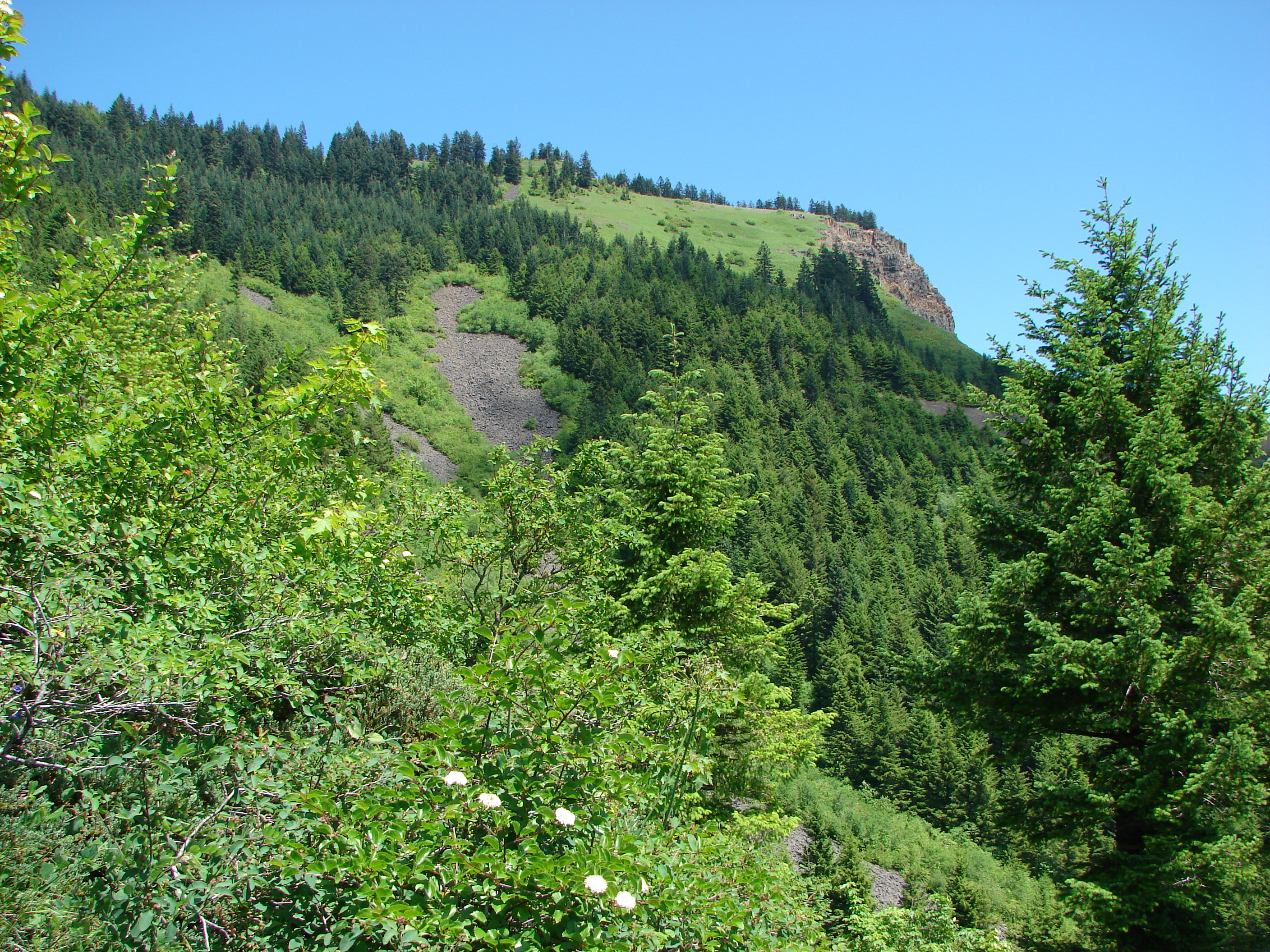
Table Mountain is located less than 5 miles east of Hamilton Mountain. It should have been what I was looking at from the saddle when I was sucker punched by the poncho during that hike. Much of Table Mountain collapsed into the Columbia River centuries ago leaving dramatic cliffs on the south face. With an elevation of 3417′ it is nearly 1000′ taller than Hamilton Mountain so the potential for views is great.

We woke up to a beautiful sunny morning but as we approached Portland an ominous cloud hung to the east of the city. The skies all around were blue and we hoped that Table Mountain was far enough to the east to be clear of the cloud. We formulated a plan b just in case when we reached Hamilton Mountain which was once again covered in clouds, but when we arrived at the trail head behind Bonneville Hot Springs the summit of Table Mountain was cloud free. With blue skies to the north and east we decided to give it a try.

The first 2.2 miles of the trail pass through a pretty forest, first on a volunteer created trail, then following an old road up to the Pacific Crest Trail (PCT). This first section was nice but unremarkable although we did come across some ripe salmonberries to sample. After a short walk on the PCT we reached the sign for the loop trail to the summit of Table Mountain. The aptly named Heartbreak Ridge Trail gains 1770′ in 1.5 miles. In order to do this the trail heads up with a vengeance. After 0.6 miles (and 800′ of elevation) the trail arrived at a saddle viewpoint. To my dismay the clouds that had been to the west were now heading east obscuring much of the view and had now covered Table Mountains summit. The trail then dipped down to the base of a 500 yard long rock slide where we spotted our first beargrass bloom of the year (on a hike not from the car).

The trail appears to end at the rock slide but the rocks are the trail. Following poles we scrambled up the rocks to the continuation of the trail. This part proved to be quite fun. Just a few tenths of a mile after reaching the trails continuation we reached the meadows on the summit. An all to familiar view greeted us here. We had come all this way and couldn’t see more than a few hundred feet due to clouds. The meadows were filled with various wildflowers creating a colorful display and many plumes of beargrass stood at attention along the meadows edges.

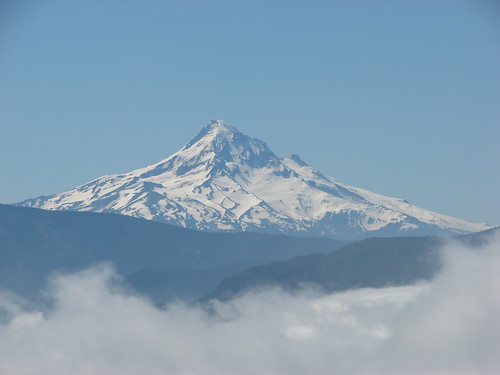
As we headed south along the summit trail toward the viewpoint at that end a faint window opened in the clouds and there stood Mt. Hood. The clouds had begun to slowly break up and by the time we reached the viewpoint better and better views were opening up.
201
We could now see Mt. Hood and the tip of Mt. Jefferson at times. Below we could see the Bonneville Dam on the Columbia River and the Heartbreak Ridge trail as it crossed the viewpoint saddle. We spent awhile here waiting for the openings and then headed back down the trail to find a spot for lunch.

We chose a spot that offered a view to the north and east in addition to Mt. Hood to the south. As we ate glimpses of Mt. Adams and Mt. Rainier began to appear. We eventually traveled further north on the summit loop to a second viewpoint at that end. There we discovered a beargrass meadow and ever improving views of Mt. Adams, Mt. Rainier, and also the rim of Mt. St. Helens.

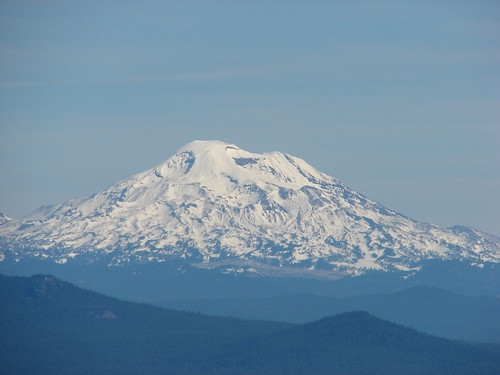
Mt. Adams
Mt. Adams

We never quite got a clear view of any of the Washington peaks due to a pesky line of little clouds but after getting our fill of the view we headed down the west ridge. This trail was almost as steep as it made its way down and contained a lot of loose rocks. In addition it traveled close enough to the edge of the ridge that anyone with a fear of heights might really have a hard time. That being said the views from this trail were great. Mt. Hood lay ahead while behind was Table Mountain and the rock slide we had scrambled up.
521
The going was slow but we eventually made it down to the PCT. I had no takers when I asked if anyone wanted to go around again when we reached the Heartbreak ridge junction so we returned to our car satisfied with the days views and ready to plan our next adventure. Happy Trail.

facebook photos: https://www.facebook.com/deryl.yunck/media_set?set=a.10201335132527489.1073741836.1448521051&type=3
way too many flickr photos: https://www.facebook.com/deryl.yunck/media_set?set=a.10201335132527489.1073741836.1448521051&type=3