Categories
Hiking Indian Heaven Trip report Washington Washington Cascades

Grassy Knoll & Big Huckleberry Mountain – 7/06/2019

It has been an interesting couple of months where the weather is concerned. We have spent a lot of time checking forecasts trying to find the most favorable hiking conditions. It seems that in years past when the forecast hasn’t been good it hasn’t been good anywhere within our driving range but this year has been different. For the most part we have been able to find at least one location with the possibility of “partly sunny” conditions. For our most recent hike that location was Grassy Knoll in Washington.

A quick scan of forecasts the night before our hike showed that the forecast for Grassy Knoll was partly sunny skies moving to mostly sunny later in the day. Nearby Big Huckleberry Mountain, which was to be our turn around point, was a little less favorable but mostly cloudy to partly sunny didn’t sound too bad.

We followed the directions to the Grassy Knoll Trailhead from the Oregonhikers.org field guide. While the forecast had been good the roads were not. The roads weren’t the worst we’d been on, but they did take home the award for most unavoidable potholes. High clearance was helpful and driving was slow at times but we arrived at the trailhead in one piece.

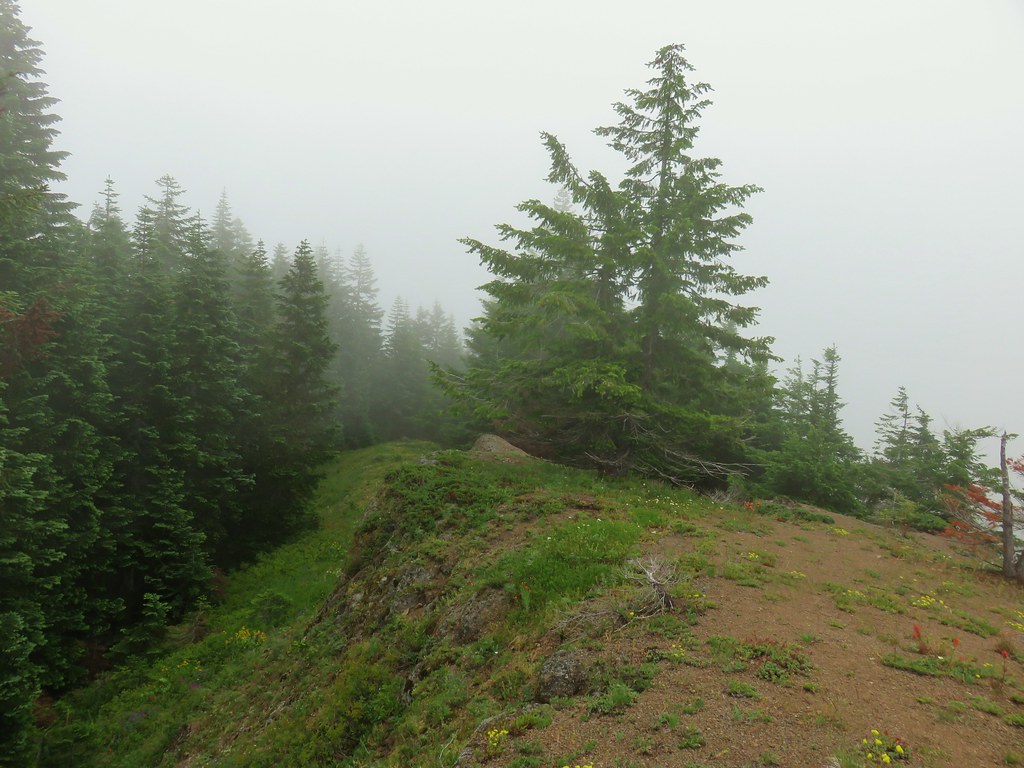
We had driven through quite a bit of drizzle between Portland and Cascade Locks but had been encouraged by the sight of the edge of the cloud cover to the east. Unfortunately the break was further east than we were so we set off on the trail under a full cover of clouds.
IMG_2724

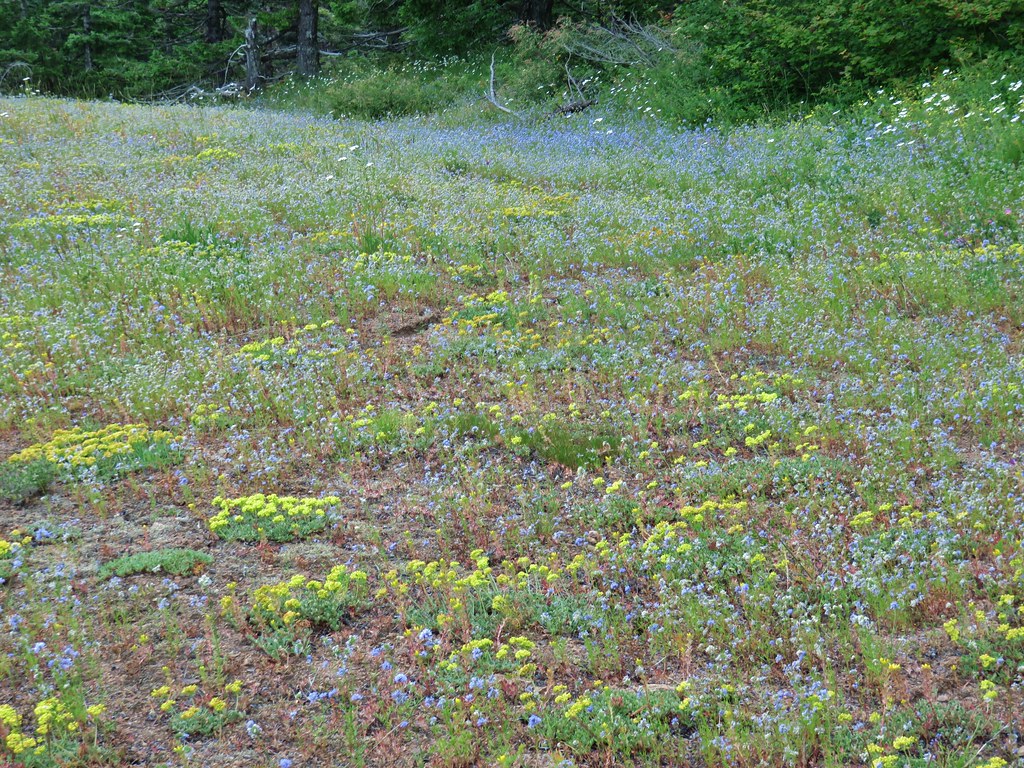
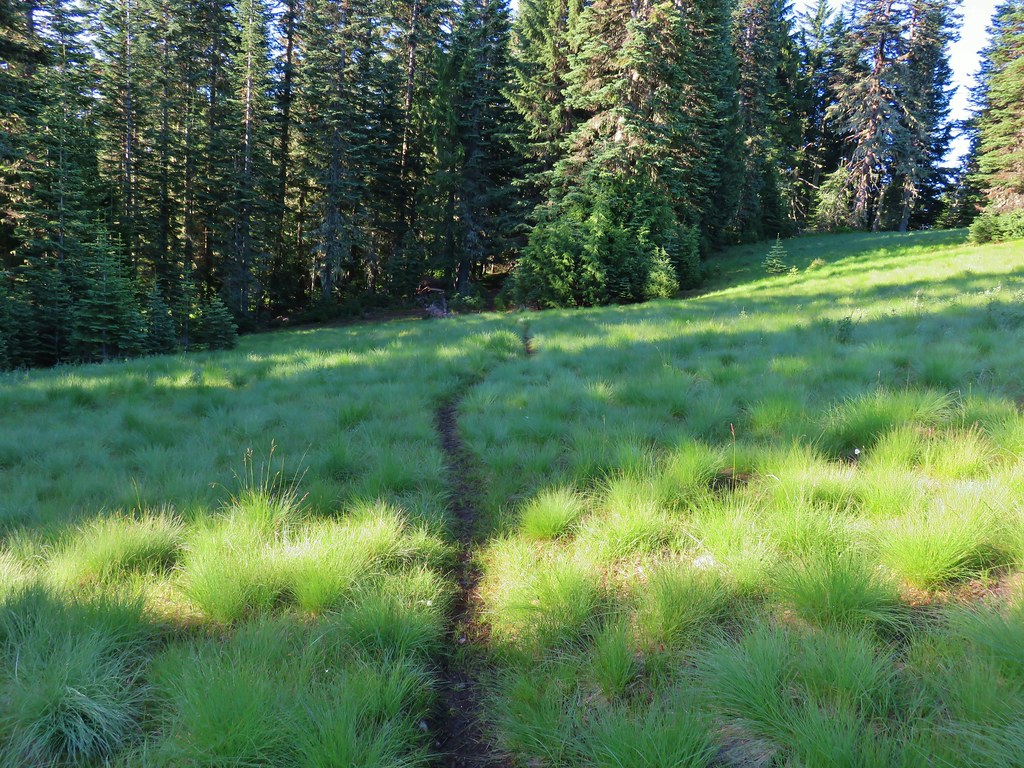
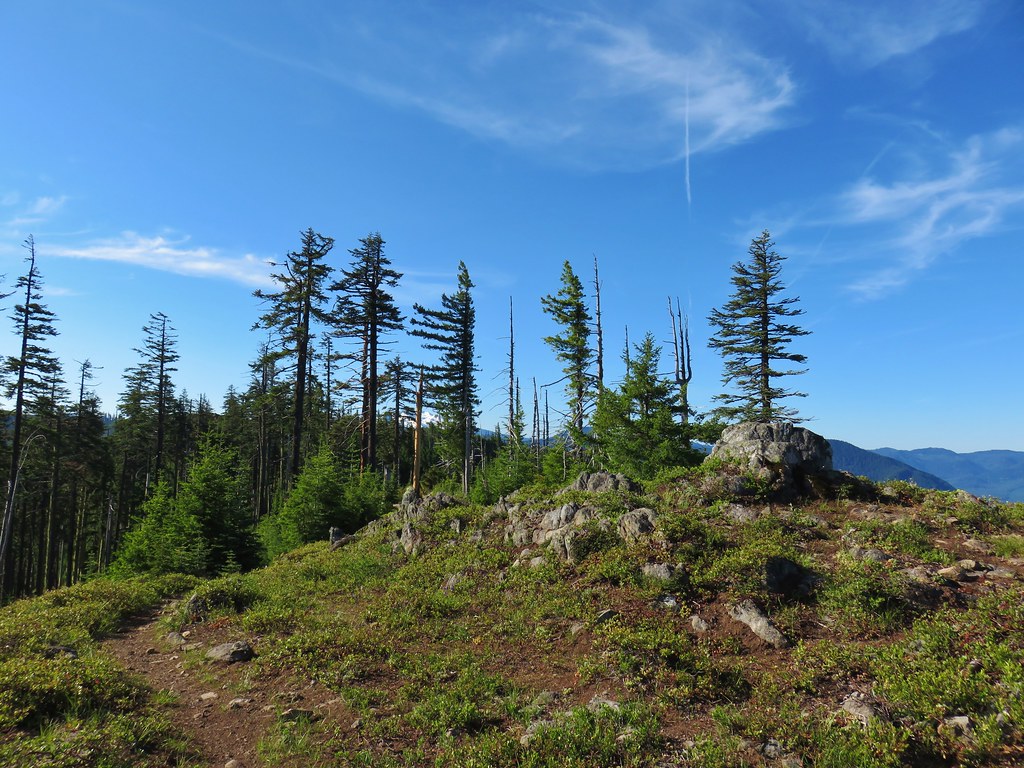
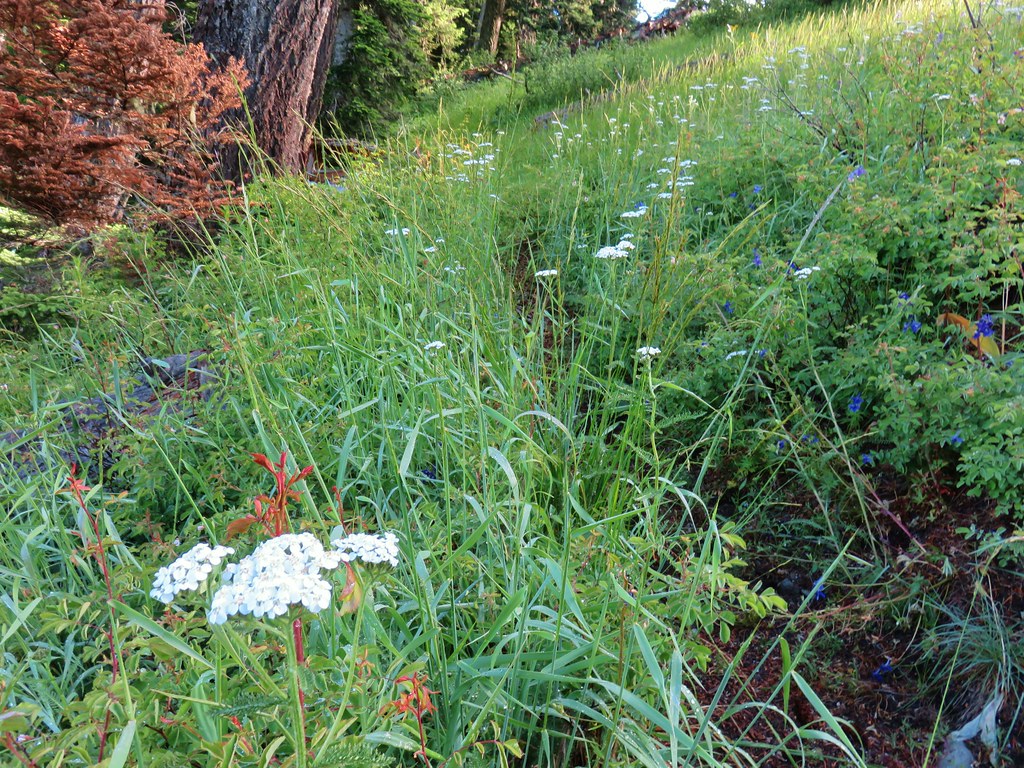
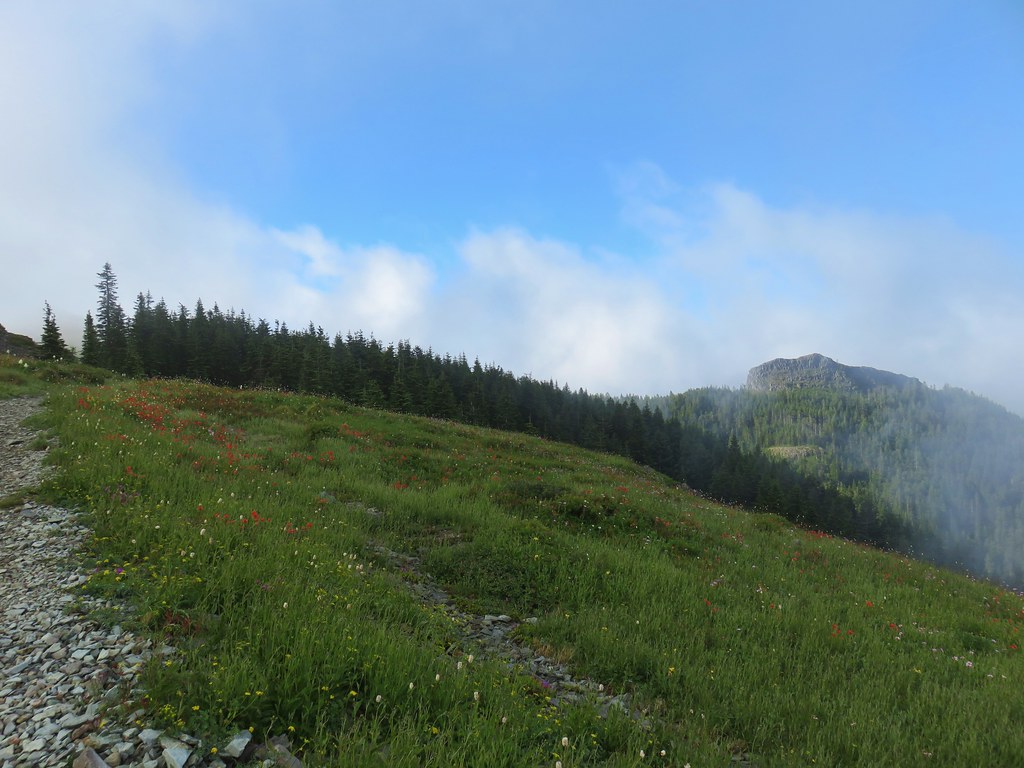
The trail started off in a past peak wildflower meadow but there were still a few flowers blooming.
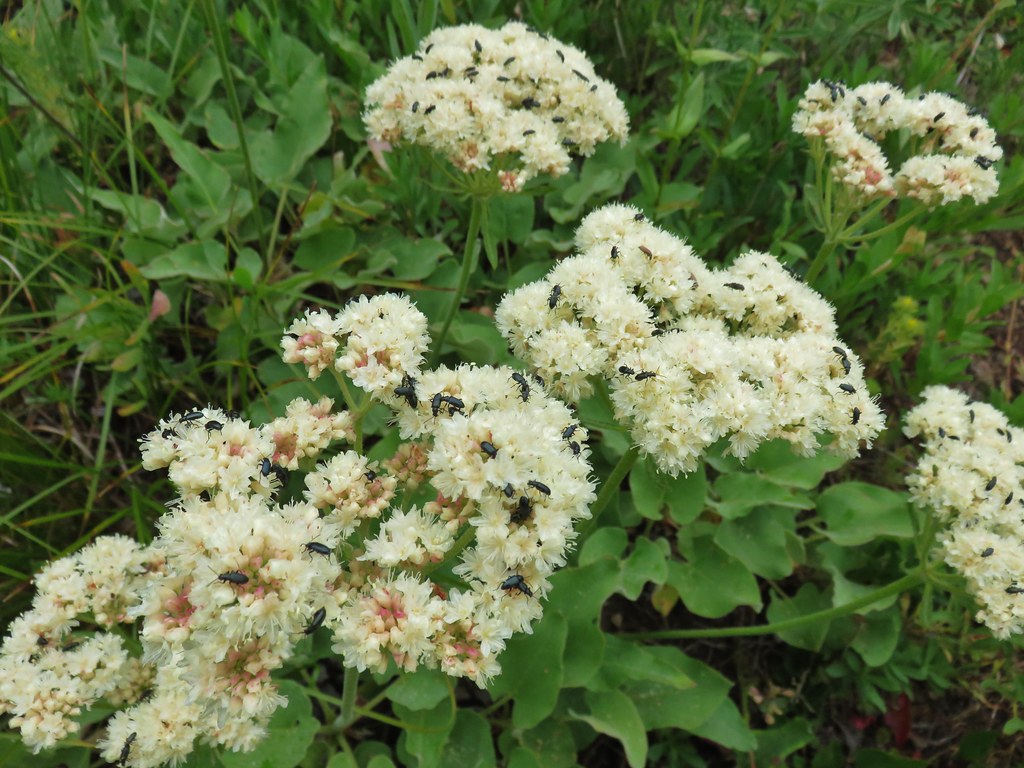
IMG_2729Arrow leaf buckwheat

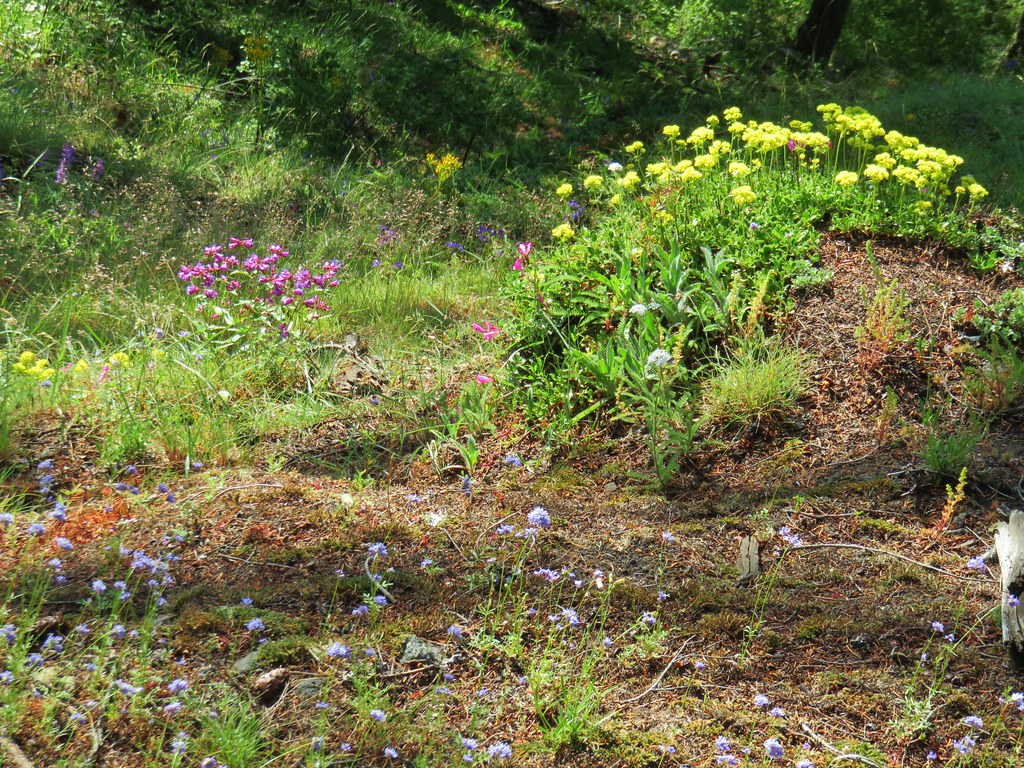
IMG_2730Blue-head gilia, stonecrop, wild onion, and arrow leaf buckwheat

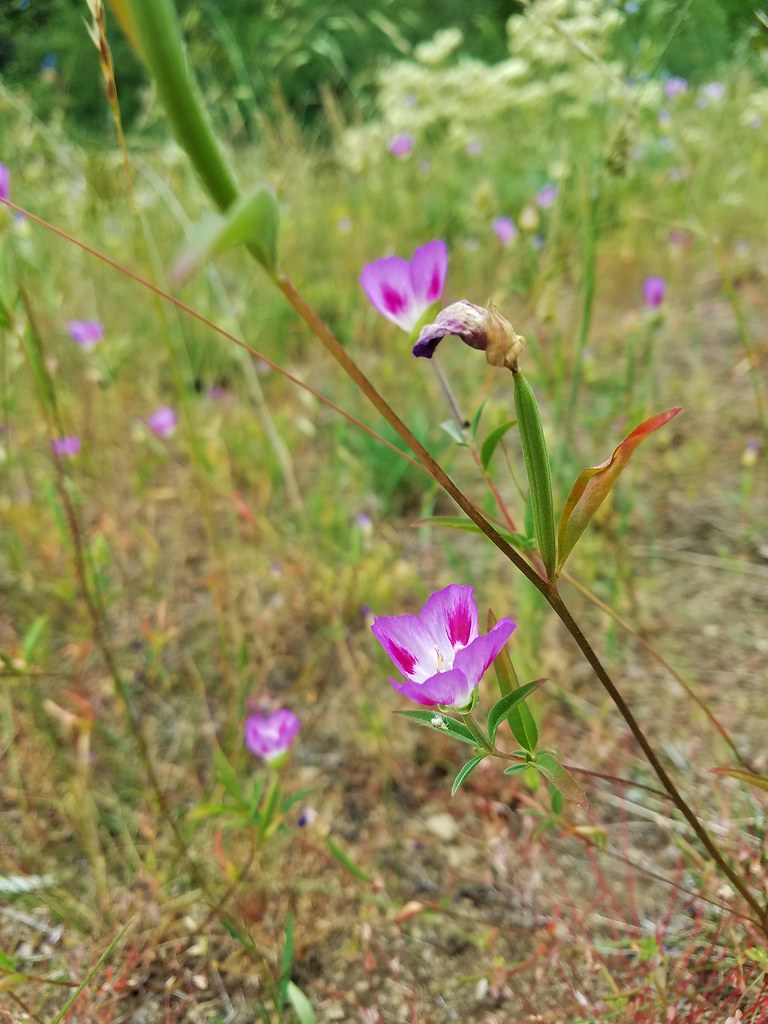
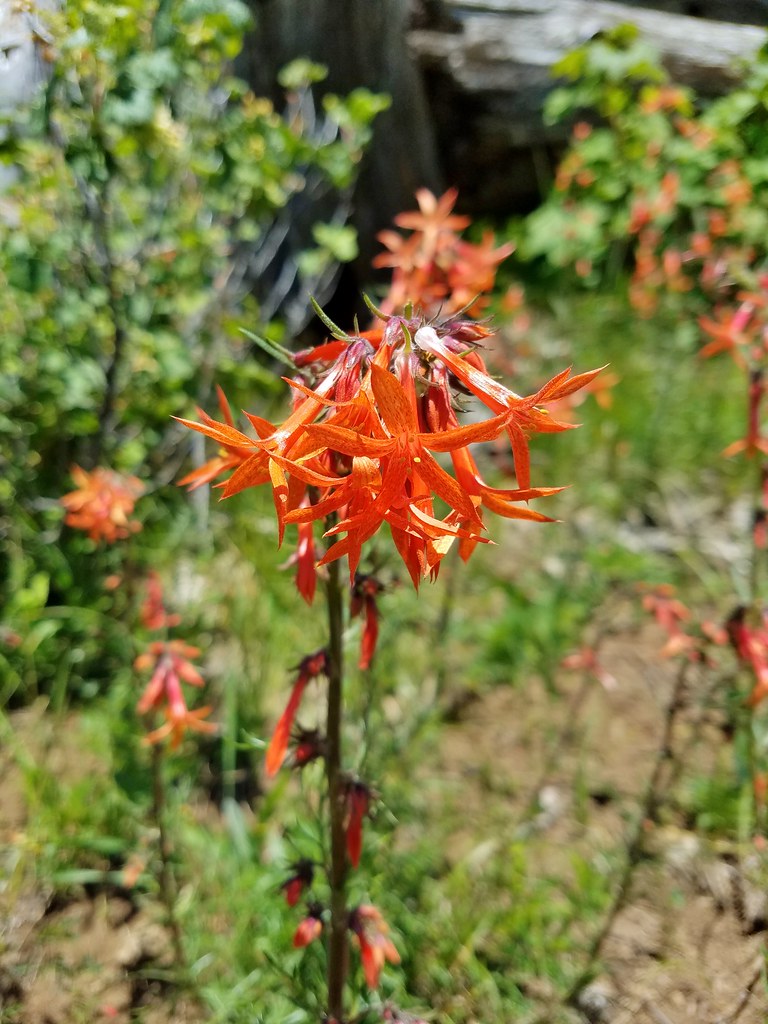
IMG_2735Farewell-to-spring waiting for the Sun (just like us)

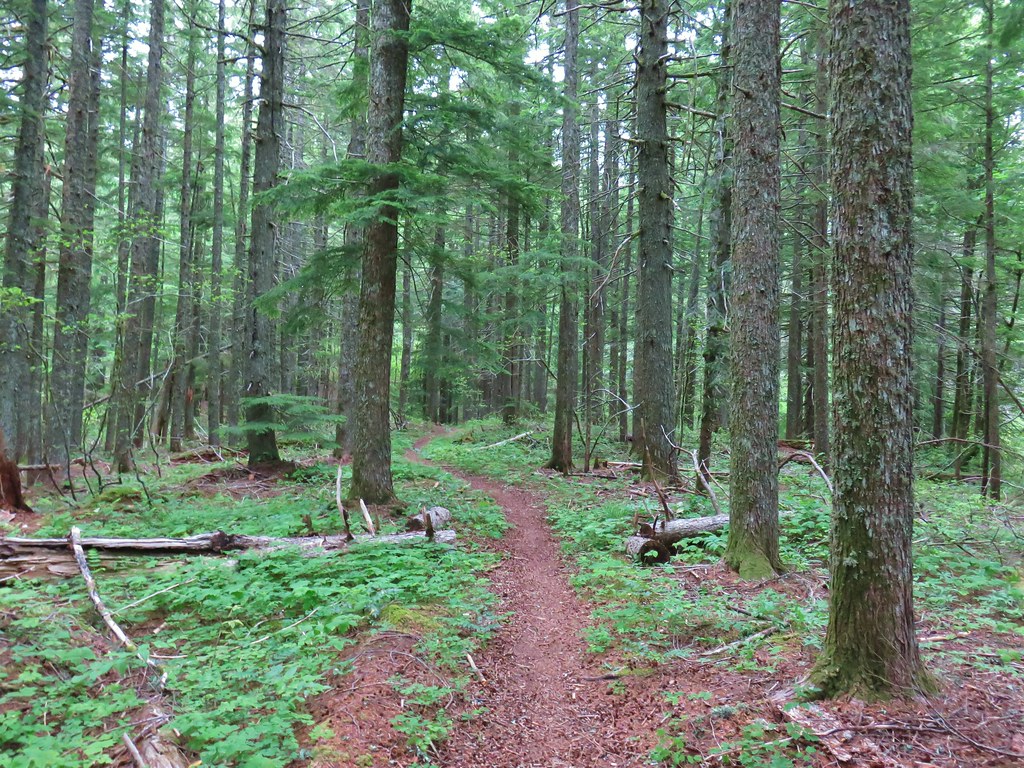
After climbing through the meadow the trail entered the forest and continued to climb fairly steeply at first.
IMG_2749

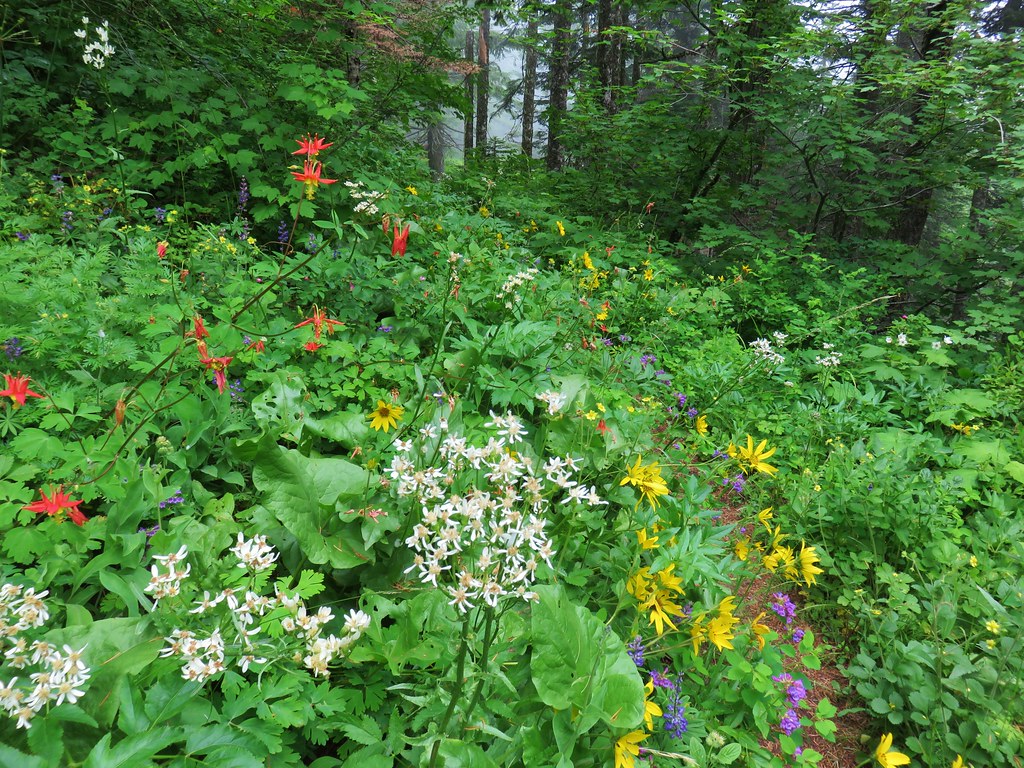
There were a surprising number of flowers blooming amid the bushes and trees along the forested ridge.
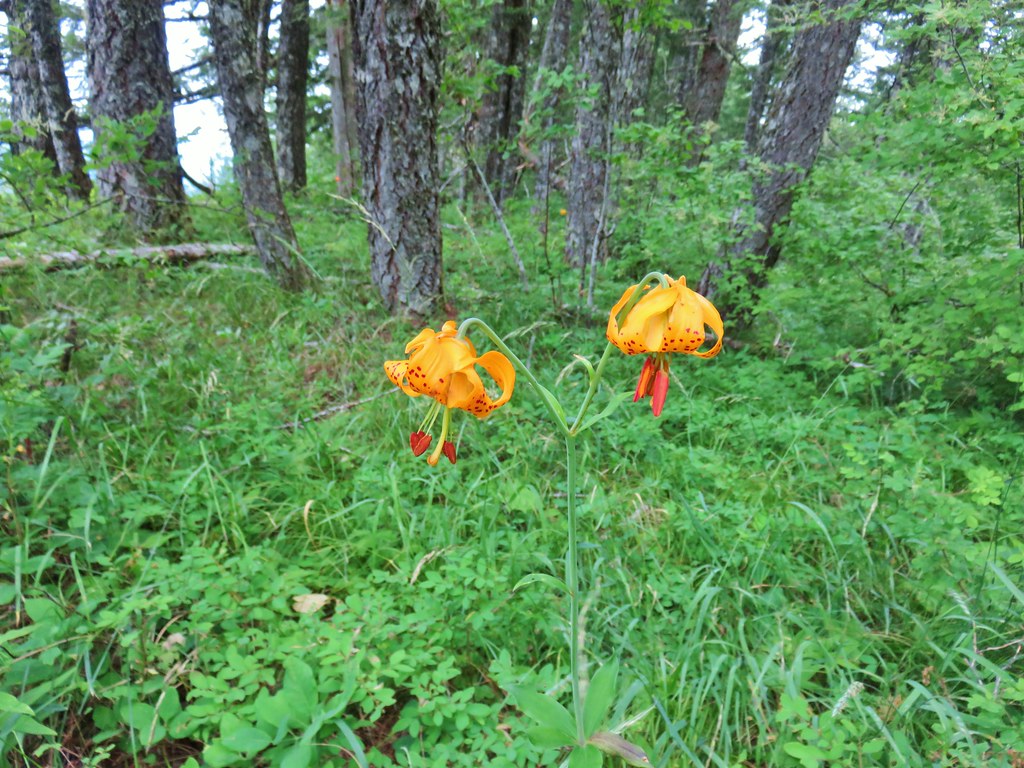
IMG_2746Tiger lily

IMG_2765Twin flower

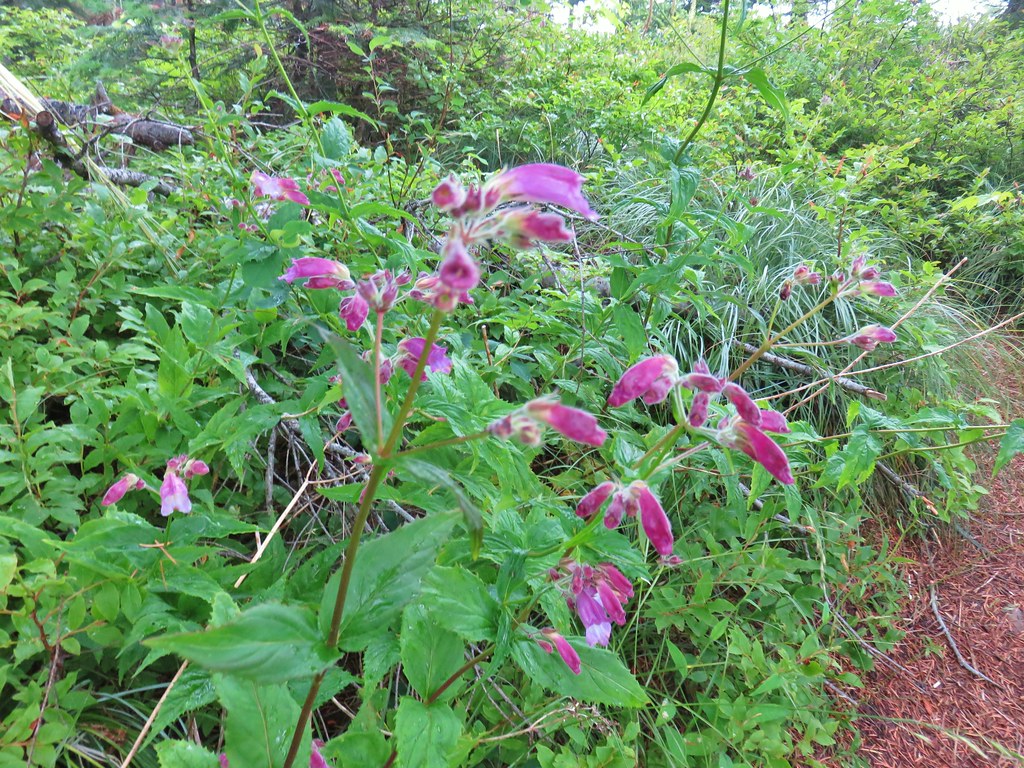
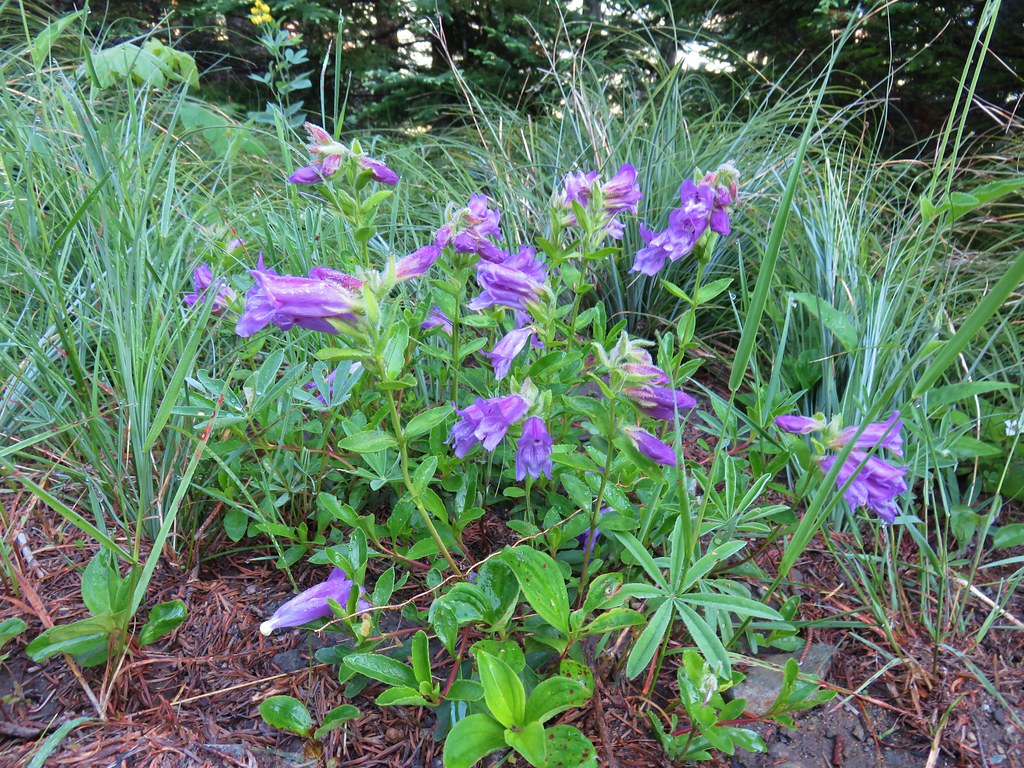
IMG_2768Penstemon

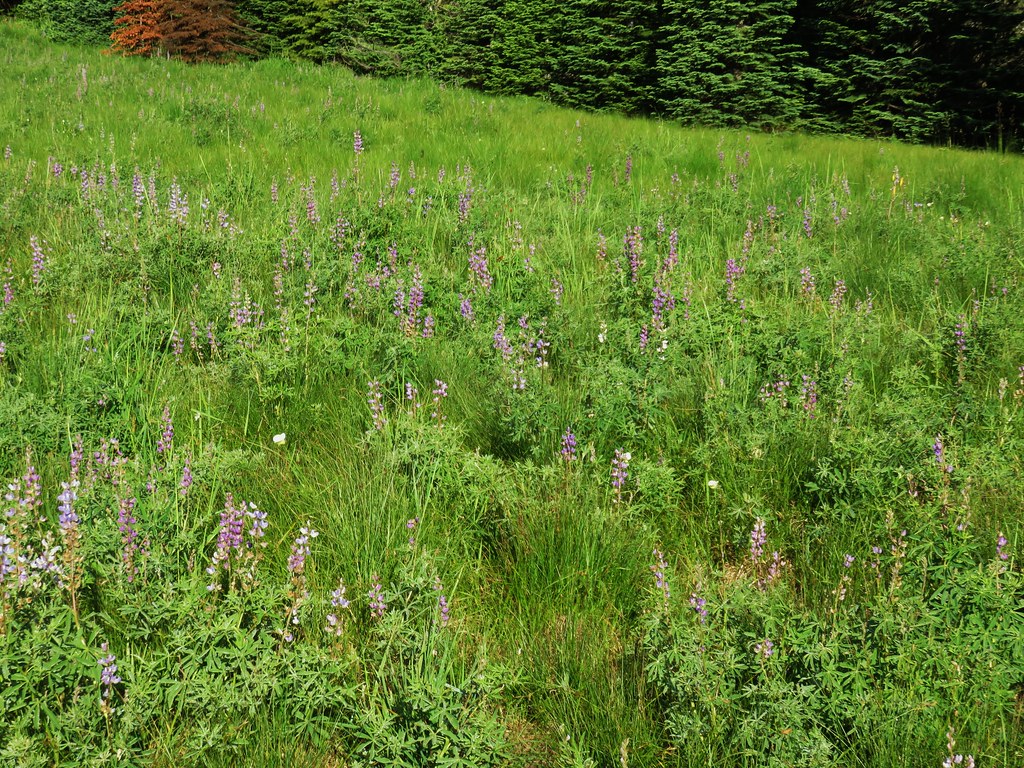
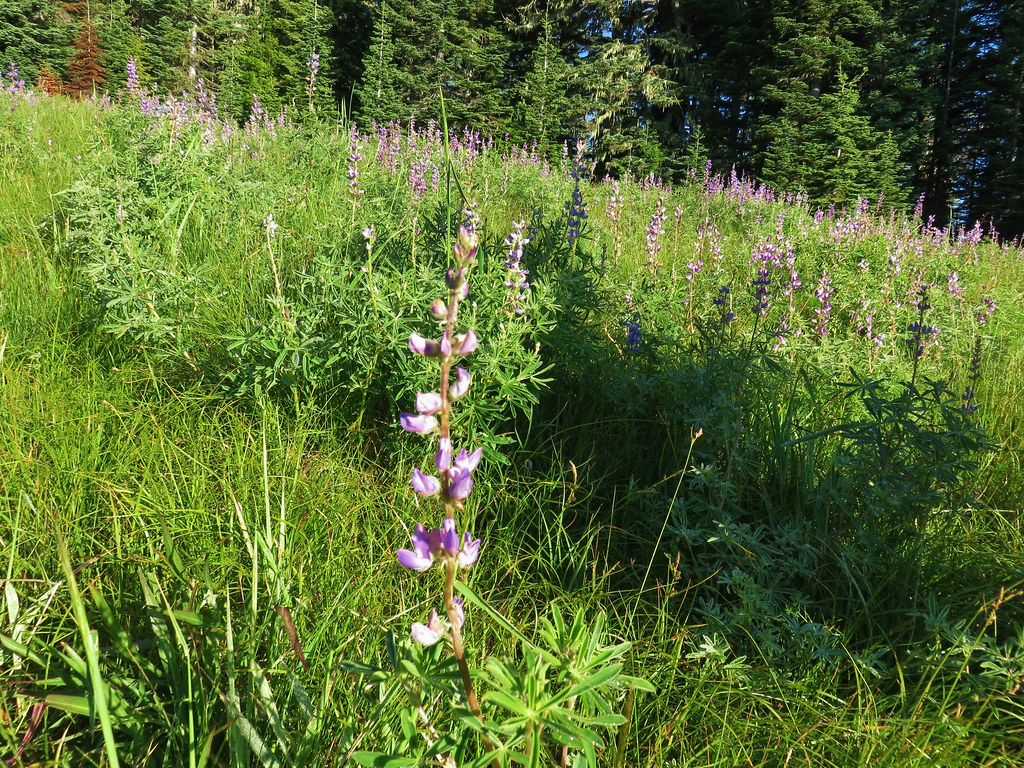
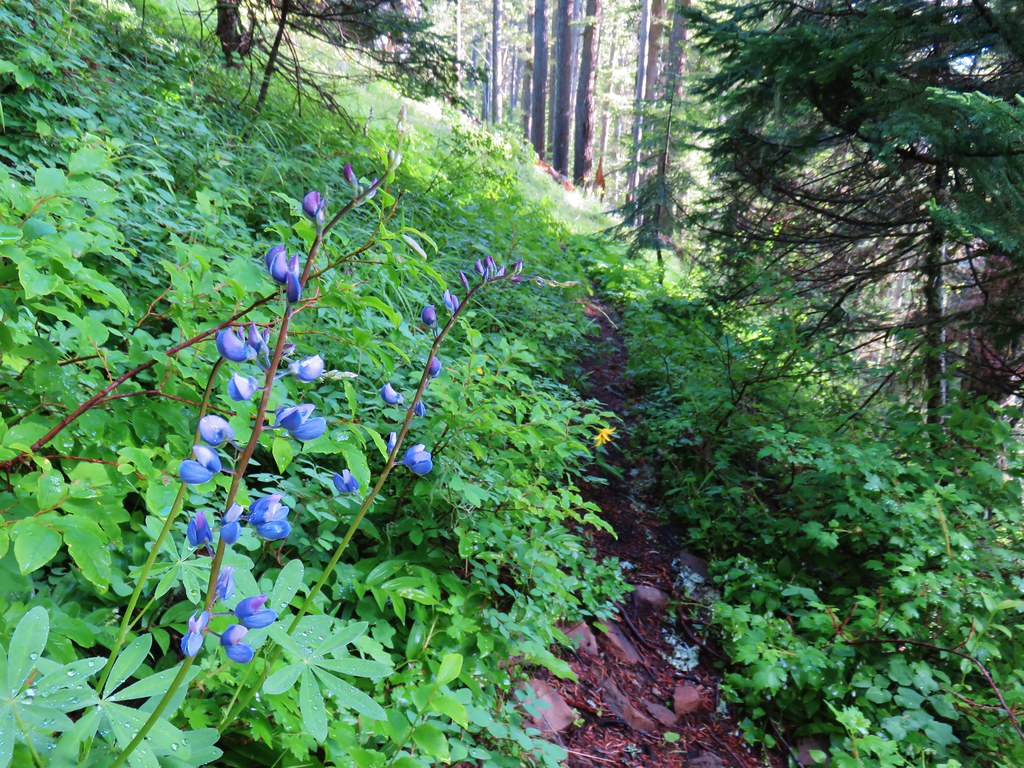
IMG_2761Lupine

IMG_2787Arnica?

IMG_2793Patinbrush and penstemon

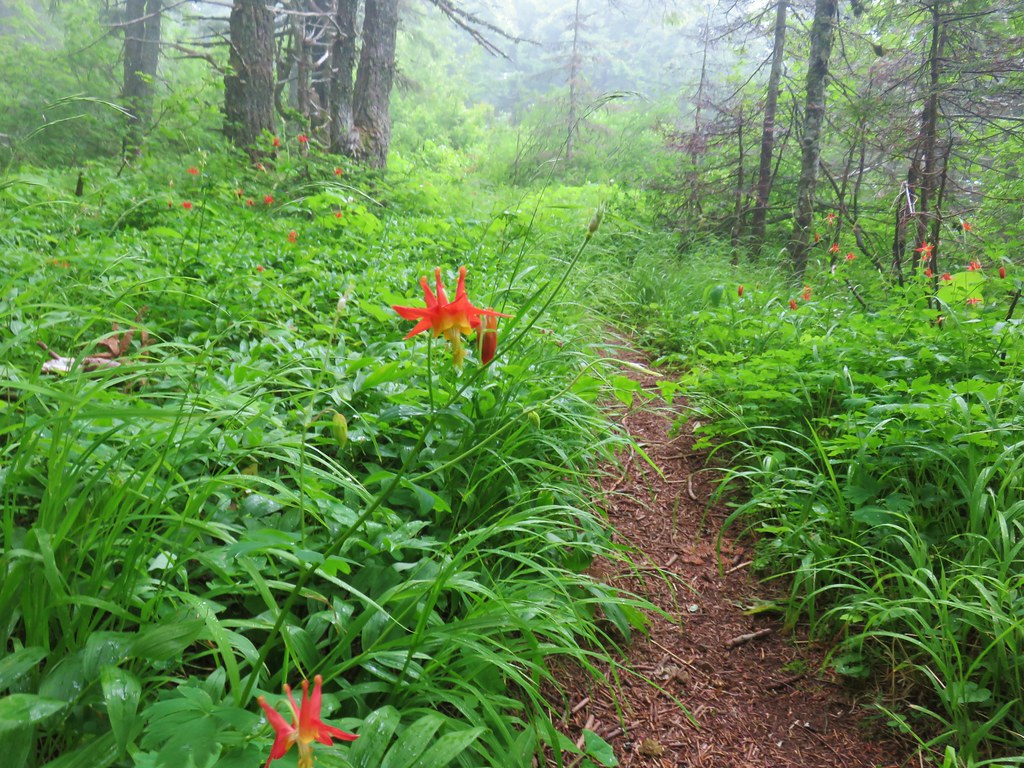
IMG_2797Columbine

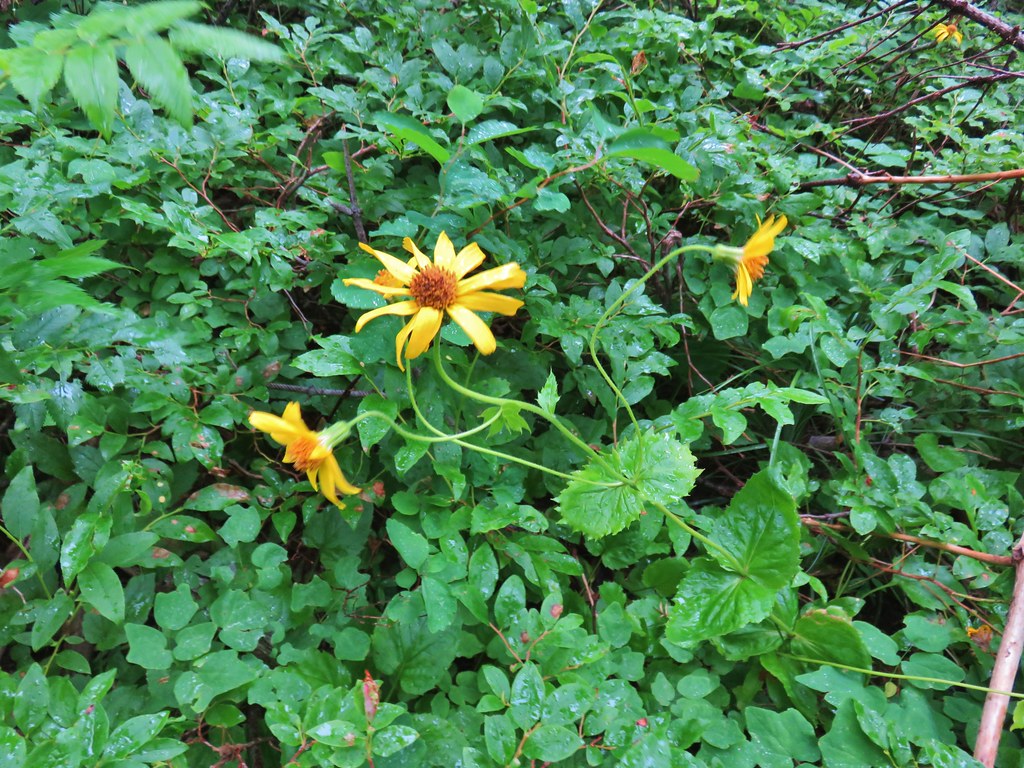
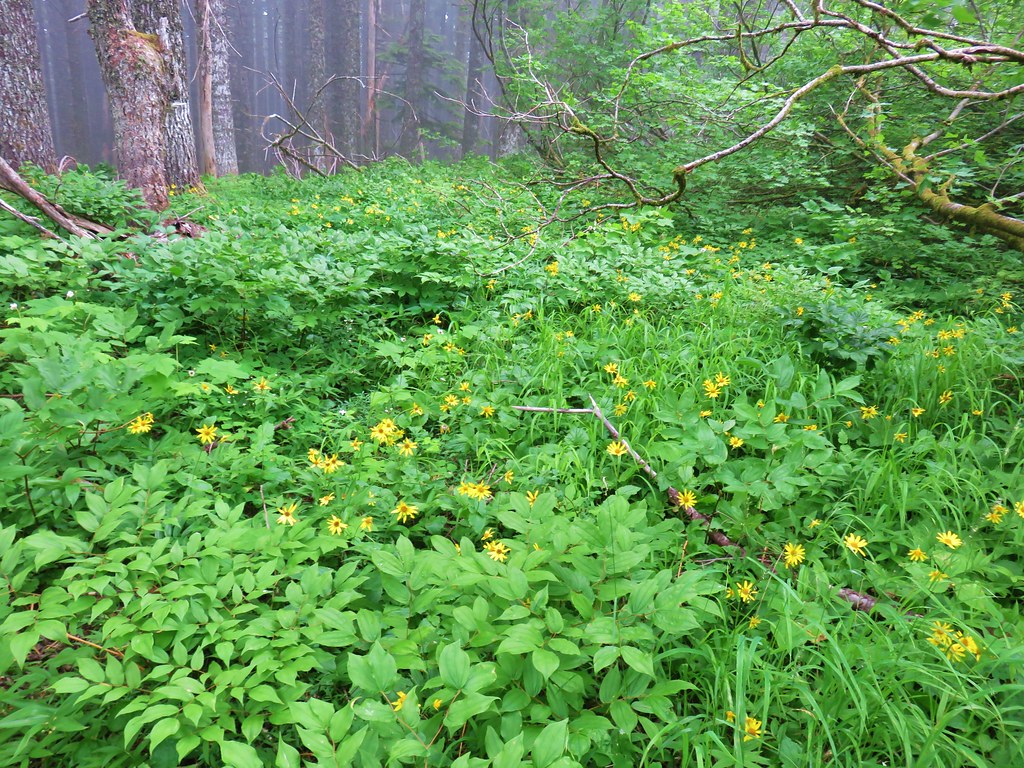
IMG_2803Lots of arnica

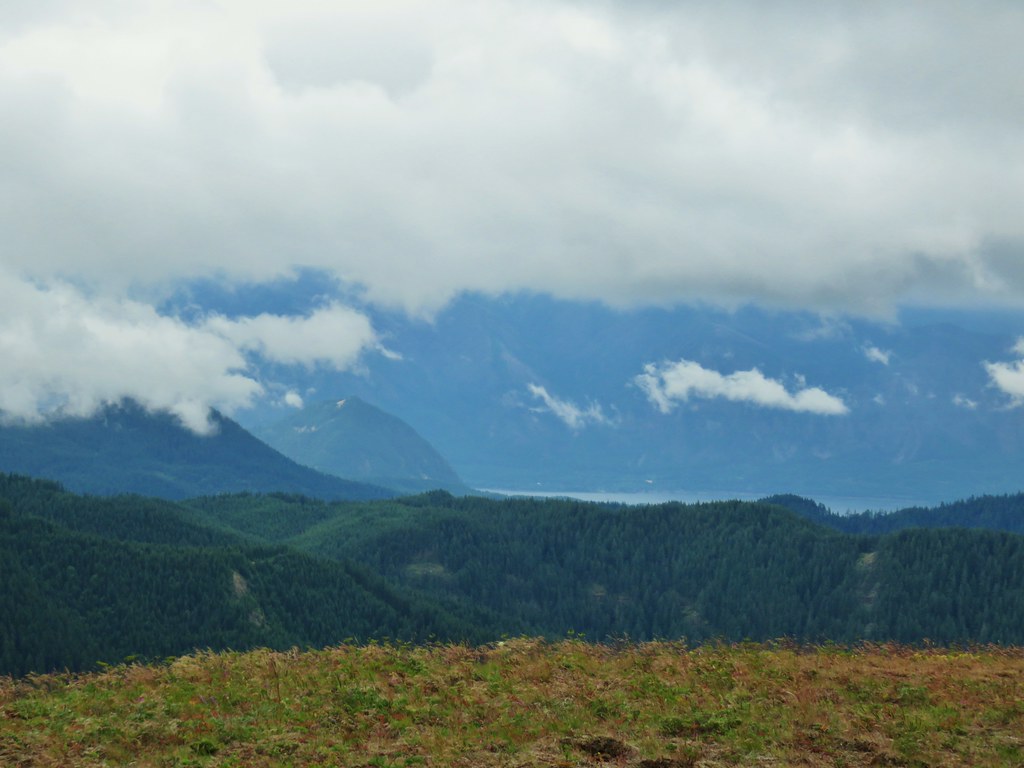
The trail passed what we took for two viewpoints, but with the cloudy conditions we couldn’t tell what the view should have been.
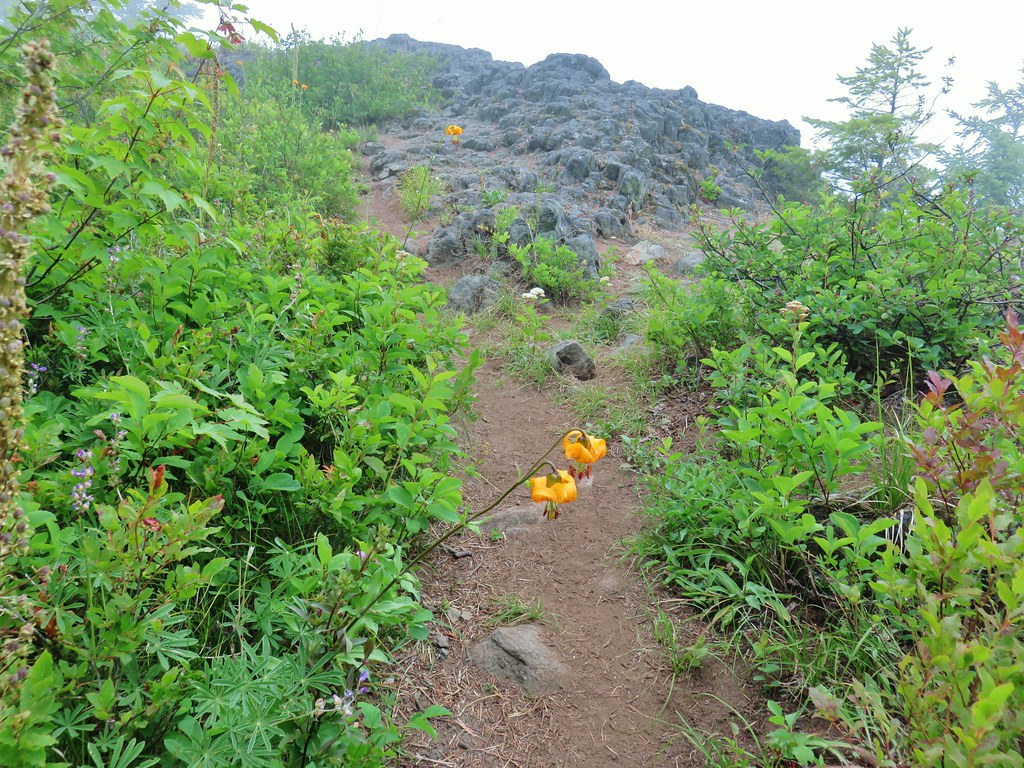
IMG_2784First viewpoint approximately 1 mile in.
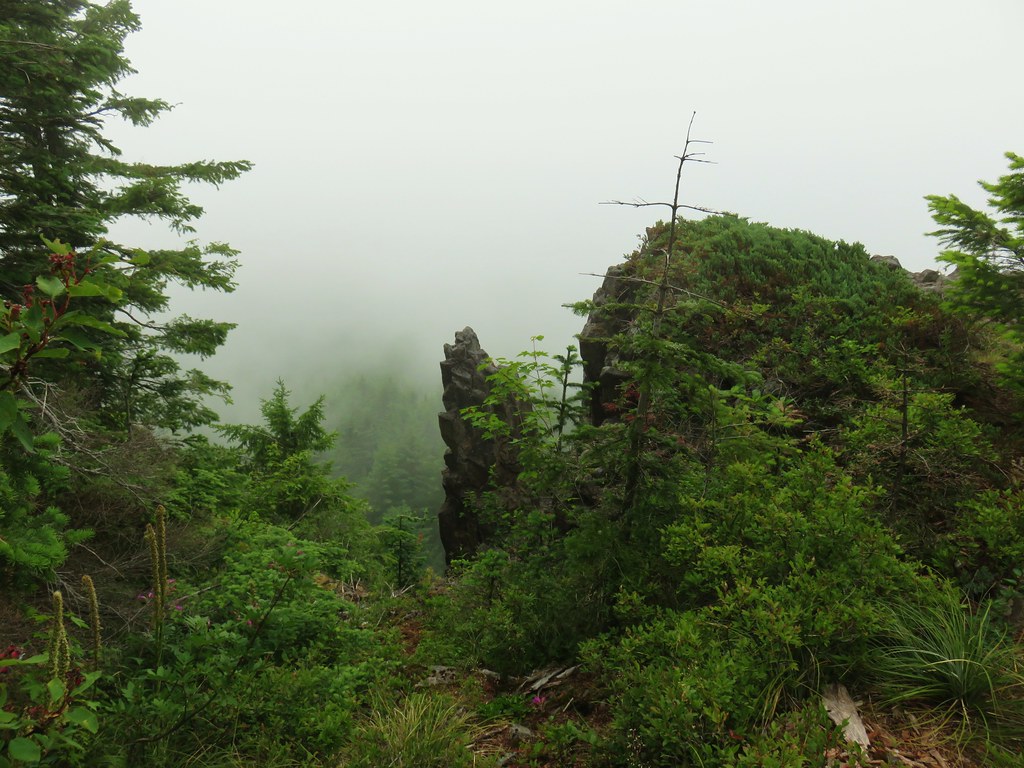
IMG_2774First viewpoint

IMG_2807Second viewpoint, about 1.5 miles in. The hillside was covered in cat’s ear lilies.

IMG_2822

IMG_2811Penstemon and cat’s ears

IMG_2824Cat’s ears and wild onion

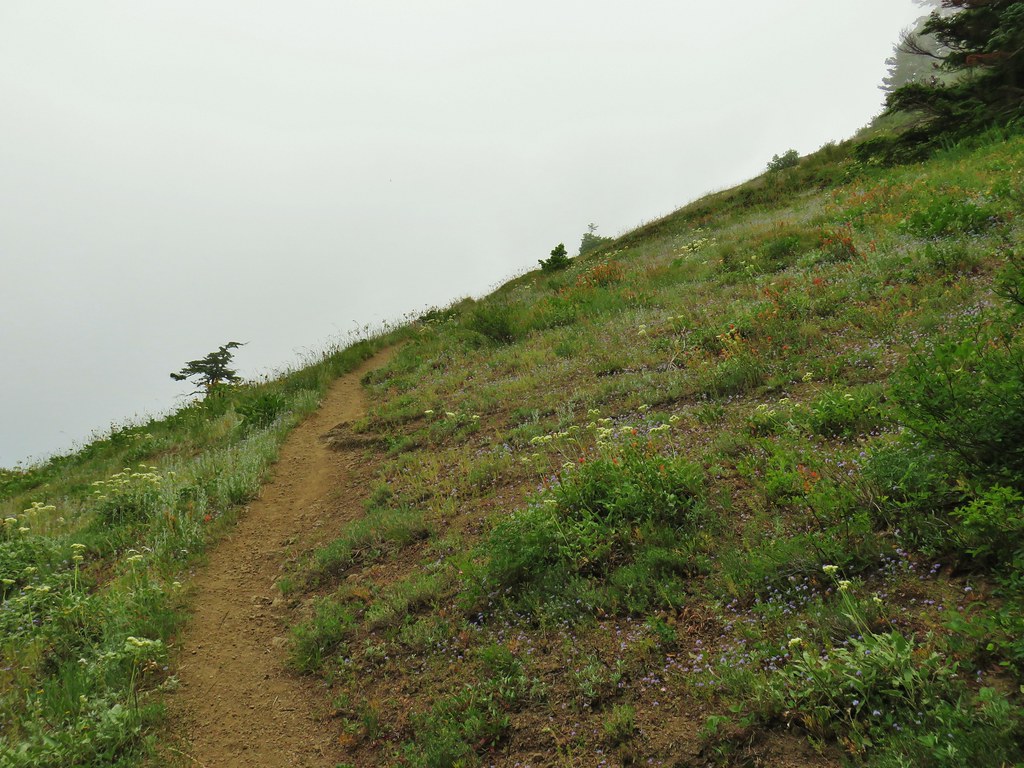
Beyond the second viewpoint the trail alternated between forest and wildflower meadow for a quarter mile before starting a fairly steep climb up the open hillside of Grassy Knoll.
IMG_2830

IMG_2831

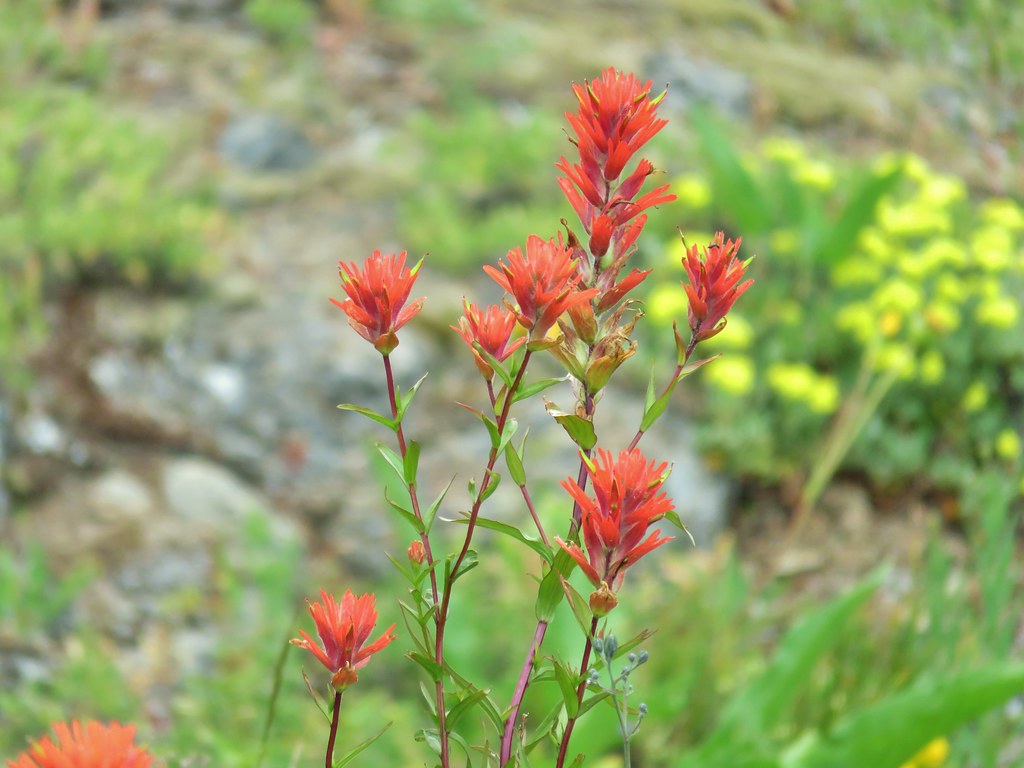
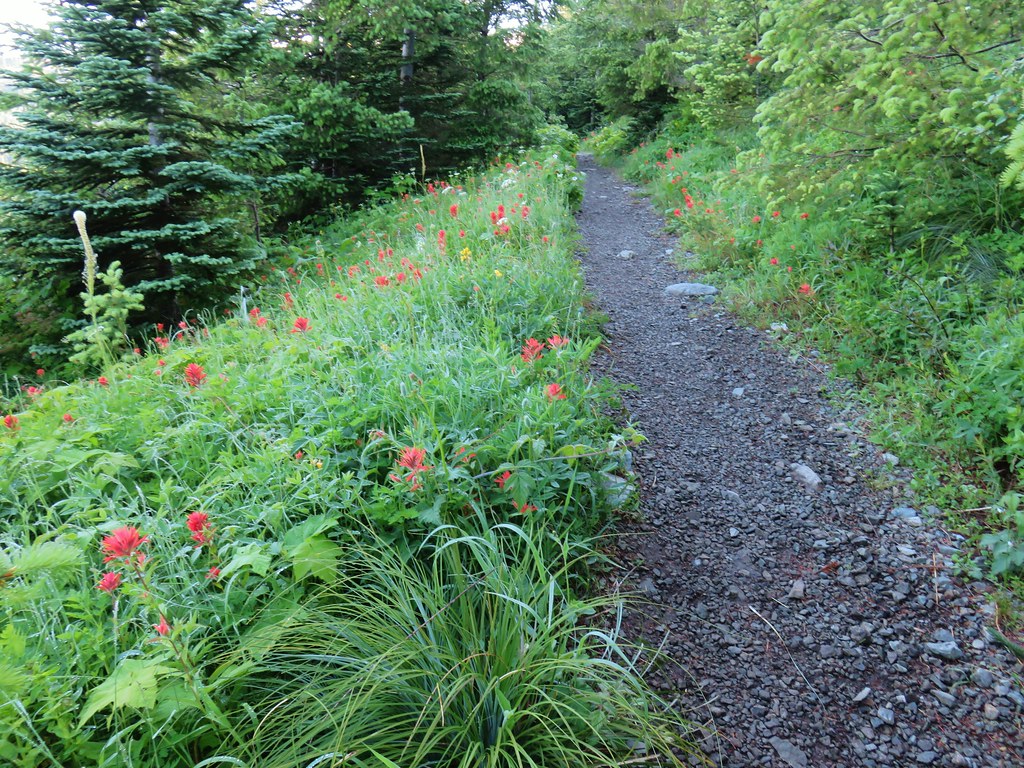
IMG_2834Two kinds of paintbrush

IMG_2840

20190706_081442Onion

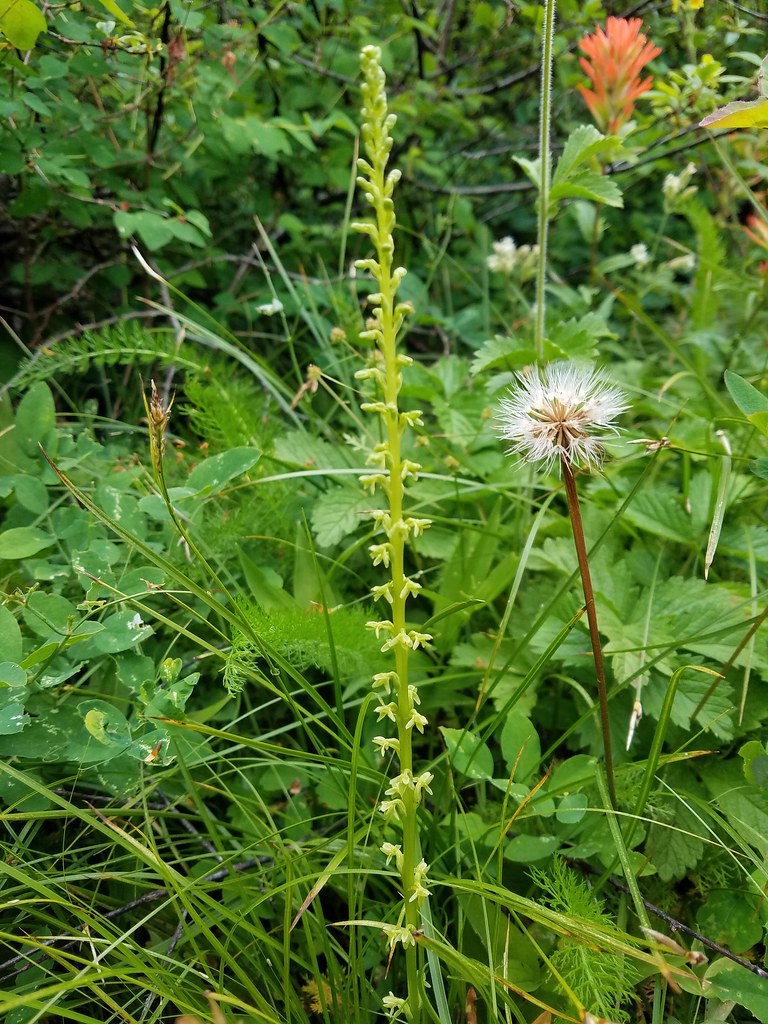
20190706_081510Looks to be some sort of orchid

IMG_2848Blue-head gilia and an unknown yellow flower.

IMG_2852Arrow leaf buckwheat and blue-head gilia
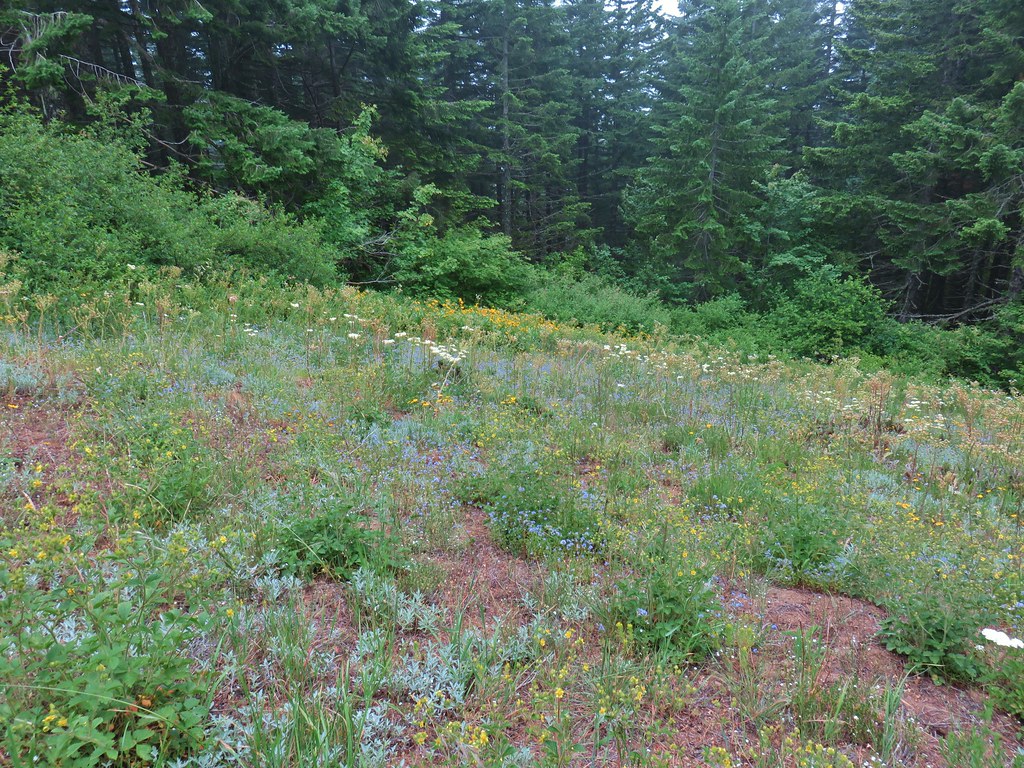
IMG_2857A bunch of flowers

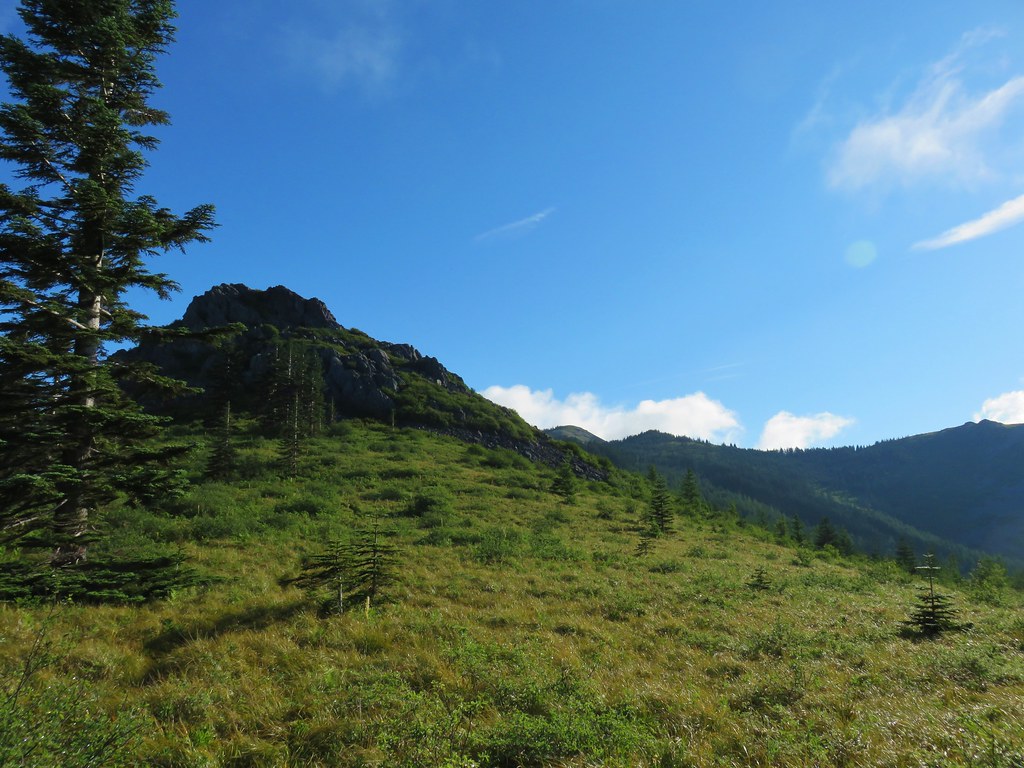
IMG_2862Starting up Grassy Knoll

We were a little late for peak flowers but the hillside still had a lot to show us.
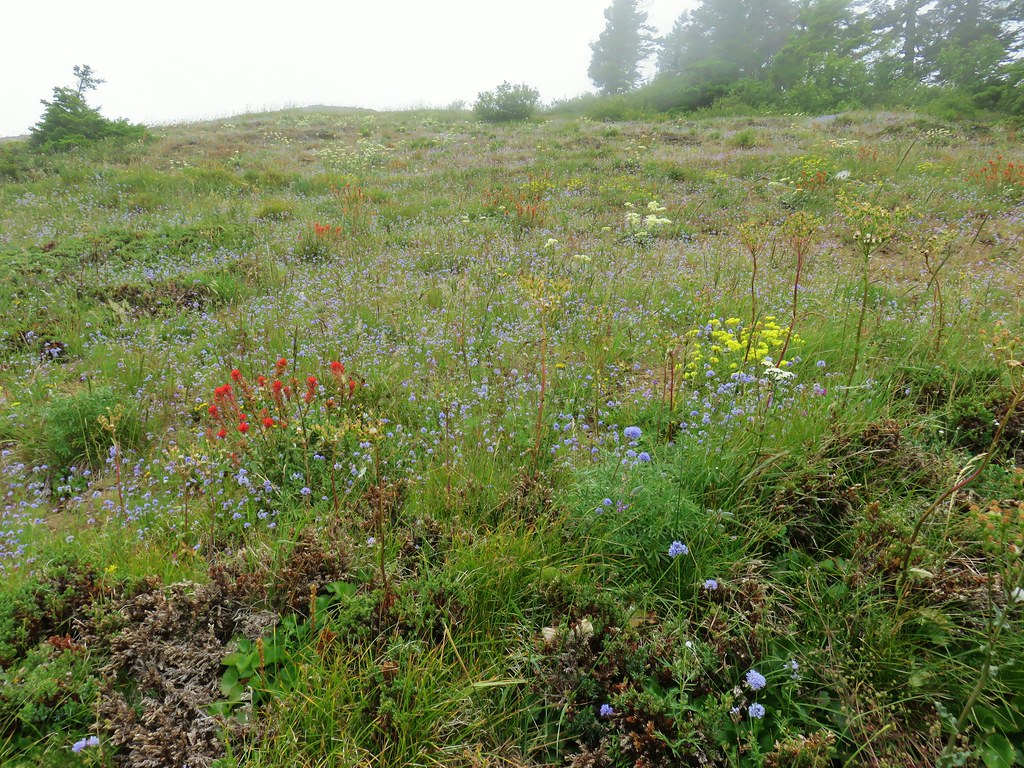
IMG_2867

IMG_2872

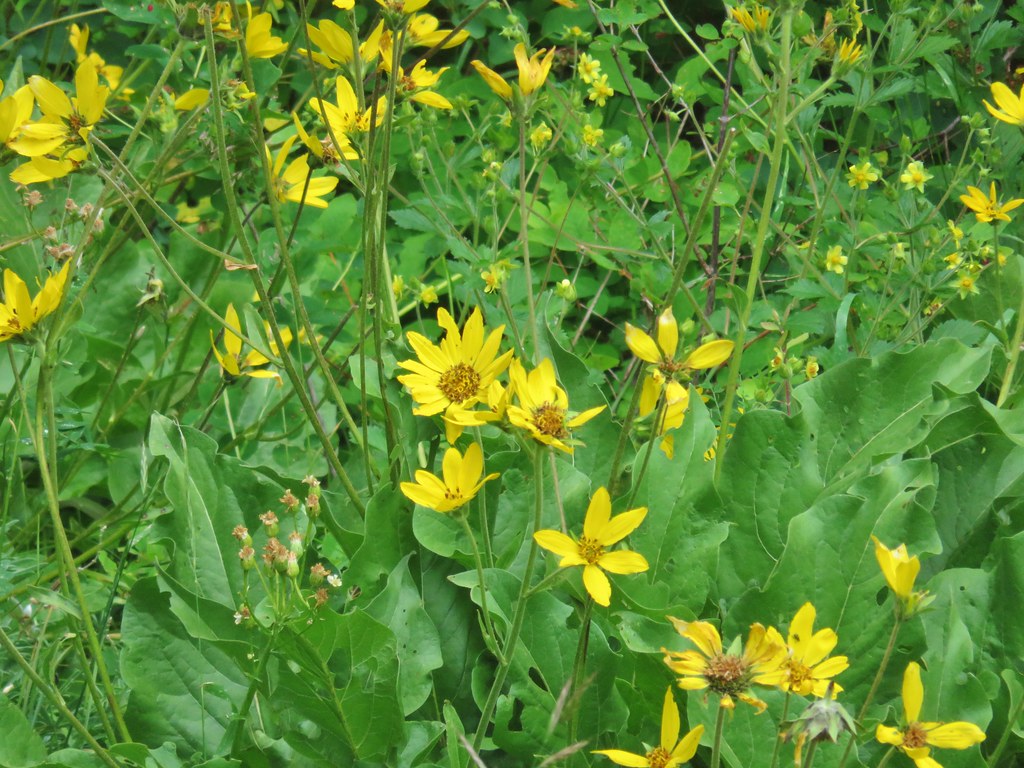
IMG_2865Balsamroot

IMG_2877Catchfly

After just two miles of hiking we came to the site of the former lookout tower atop Grassy Knoll. It wasn’t even close to partly sunny by the way.
IMG_2887

With no view to speak of we continued on hoping that the clouds would start breaking up soon, or at least by the time we were passing back by. The trail leaving Grassy Knoll was a bit brushy at first but then cleared up. There were plenty more flowers to see as we continued along a somewhat level ridge.
IMG_2889

IMG_2892

IMG_2894A little better view down for a moment.

IMG_2895

20190706_084303

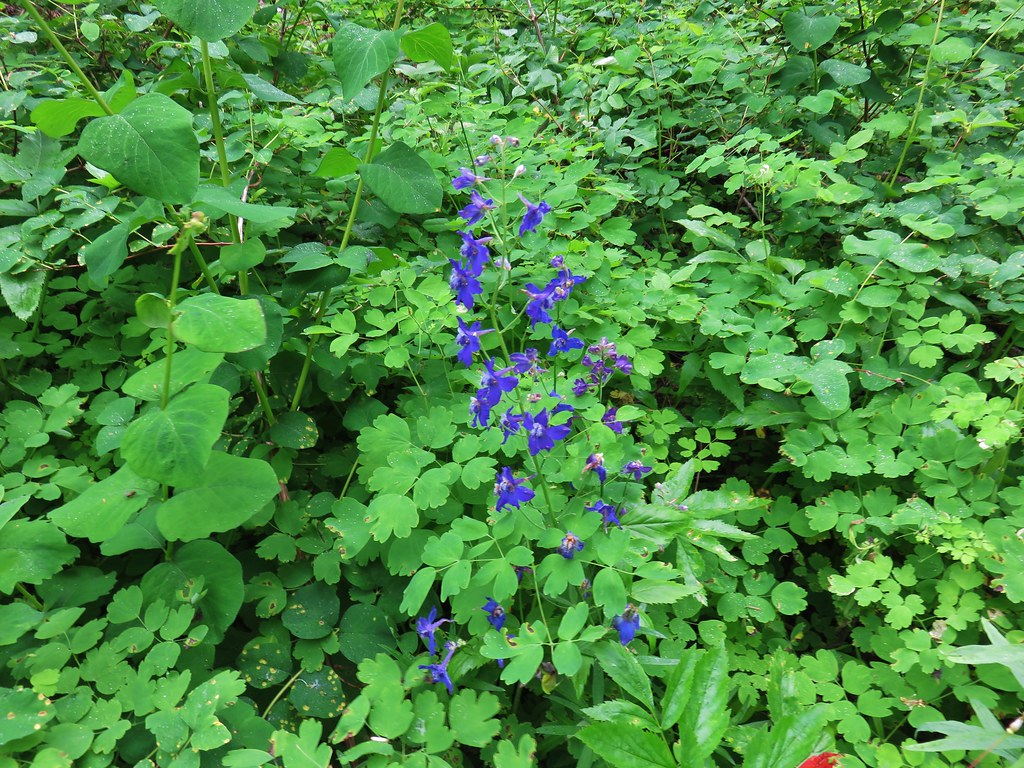
IMG_2897Larkspur

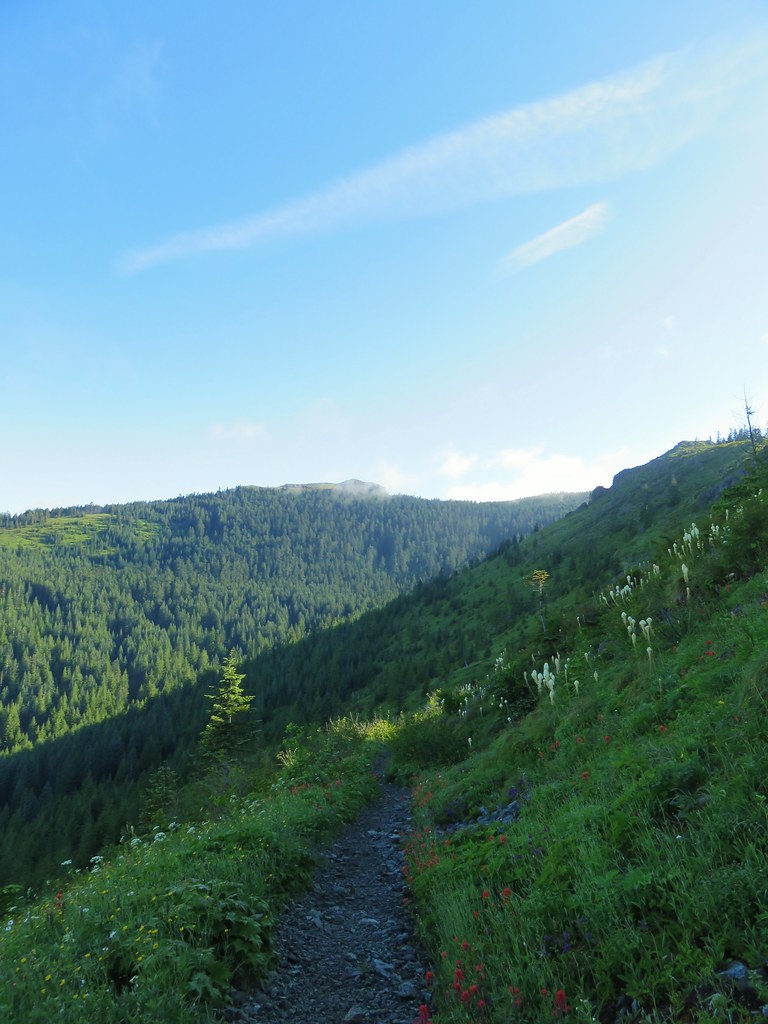
A little under a quarter mile from the lookout site we entered the first in a series of impressive wildflower meadows along the ridge.
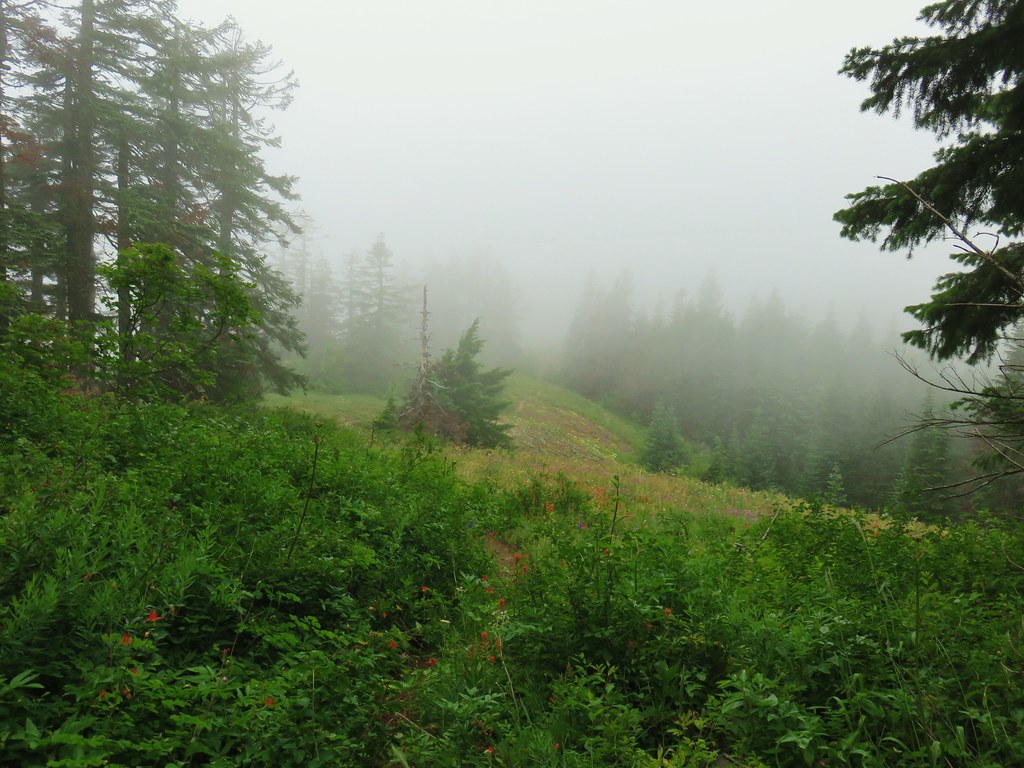
IMG_2899

This first meadow had a bit of a beetle infestation.
IMG_2900

IMG_2904

IMG_2901

IMG_2906

IMG_2908

IMG_2909

IMG_2913

IMG_2915

IMG_2922

IMG_2923

IMG_2926Phlox and a cat’s ear lily

IMG_2928

IMG_2929

IMG_2932

IMG_2934

IMG_2936

IMG_2944

IMG_2952Another type of penstemon

IMG_2957Beargrass

IMG_2965

IMG_2978

IMG_2984

IMG_2985

IMG_2993

IMG_2996Not sure what this is either, it’s the first time we recall seeing it.
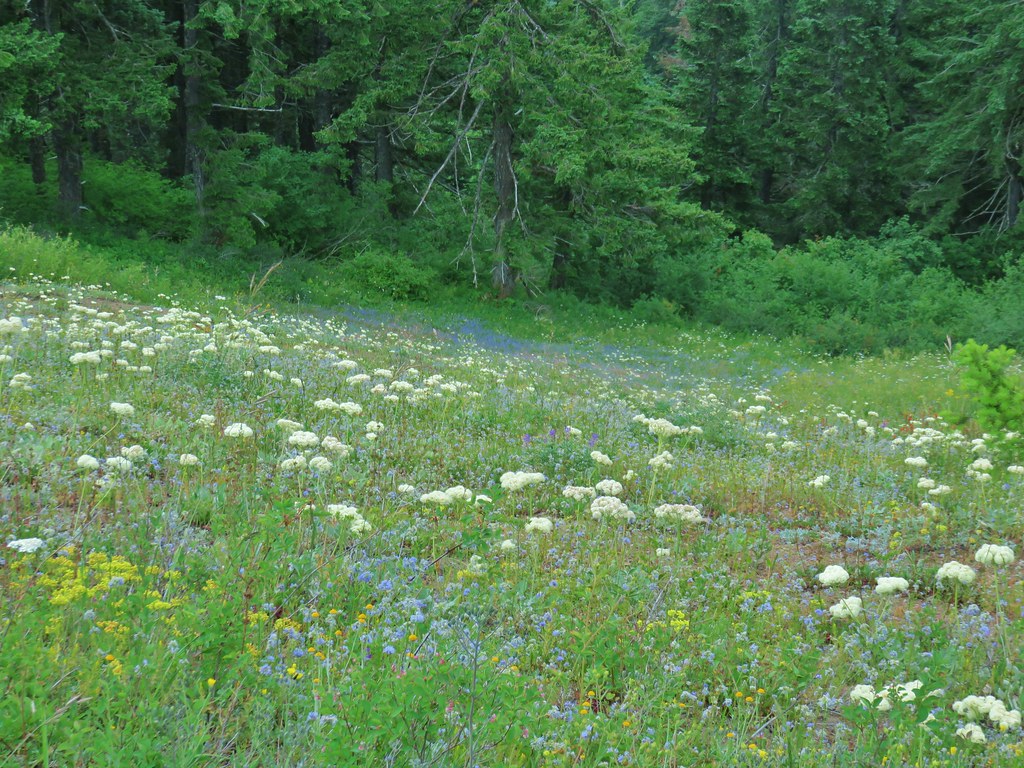
IMG_3000

IMG_3004

IMG_3017

IMG_3018

Finally, after nearly one and a quarter miles of wildflower bliss the trail veered off the ridge to the left and entered the forest.
IMG_3021

IMG_3023

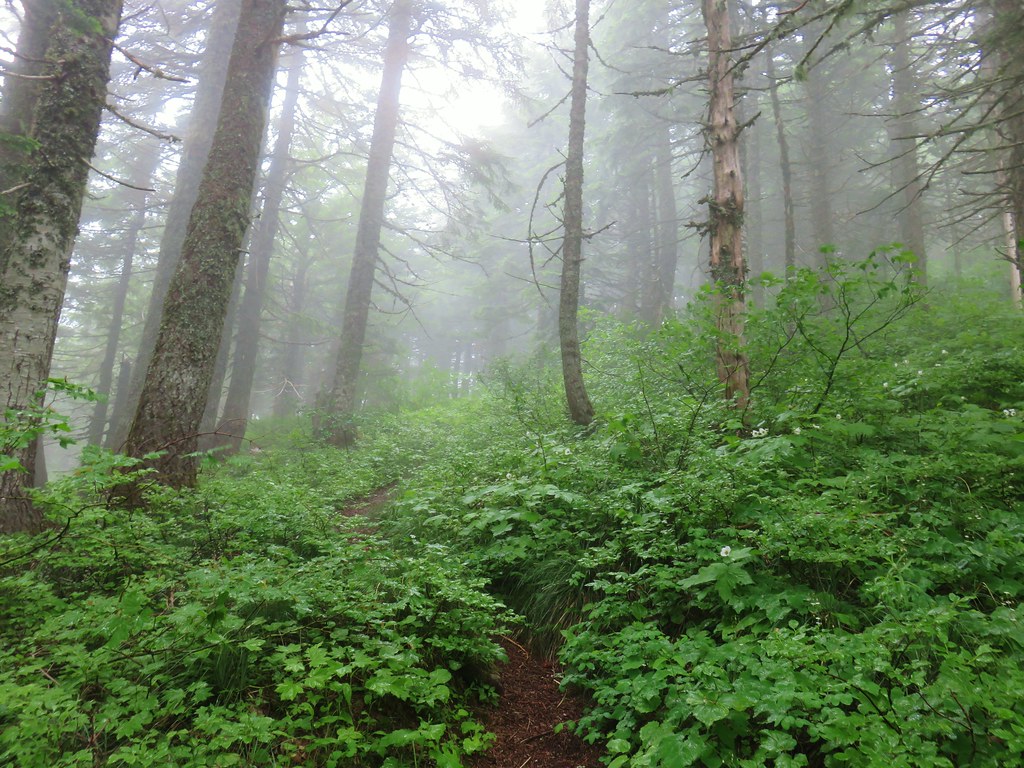
It was a nice forest with a bright green understory.
IMG_3028

IMG_3036

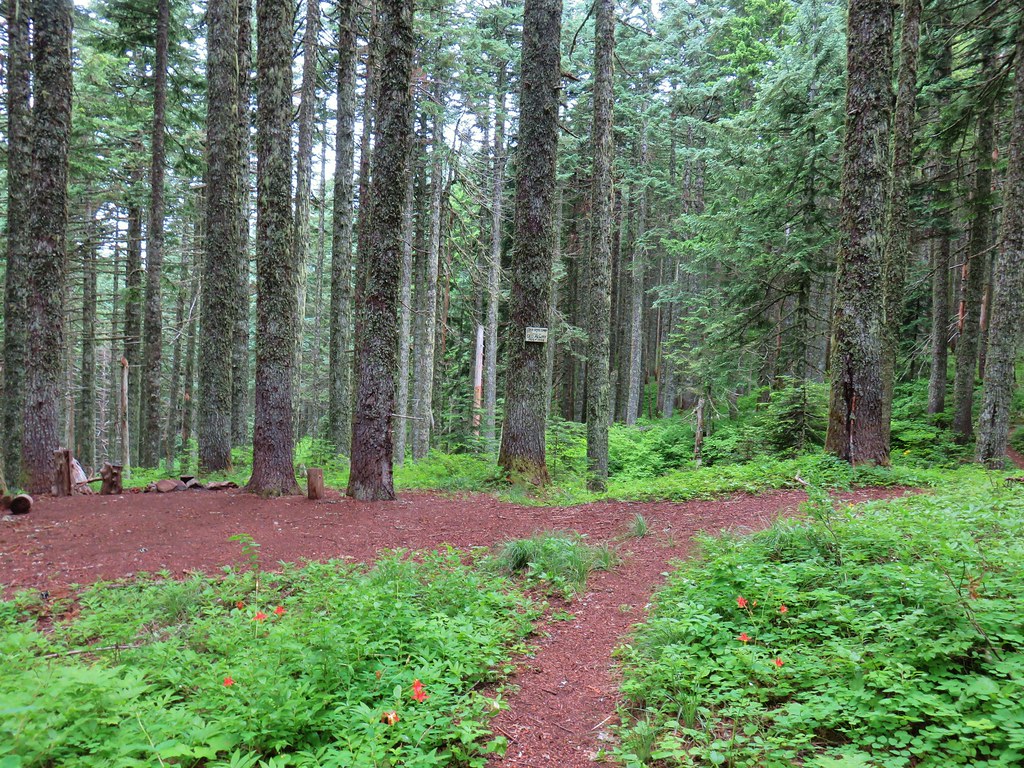
Around the 3.75 mile mark we arrived at Cold Springs Camp
IMG_3033

IMG_3034

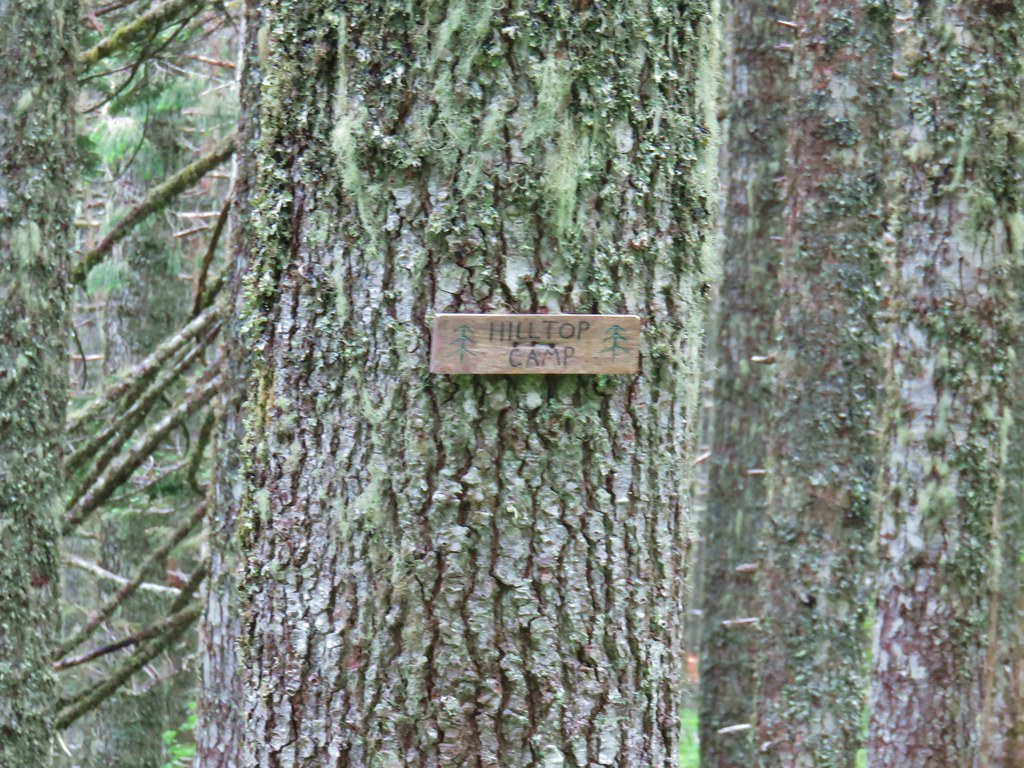
A spur trail led down to what we presume was Cold Spring but it was hidden in brush. The unofficial (but signed) Alway Trail led downhill on a faint path to FR 68 from the camp as well. Just beyond this camp was another sign for Hilltop Camp, but unlike Cold Springs Camp this one looked to no longer be used.
IMG_3112

IMG_3113

The trail was part of the Cascade Crest Trail which was the precursor to the Pacific Crest Trail. The current route of the PCT is further to the west but it does pass Big Huckleberry Mountain and we would briefly be on it later.

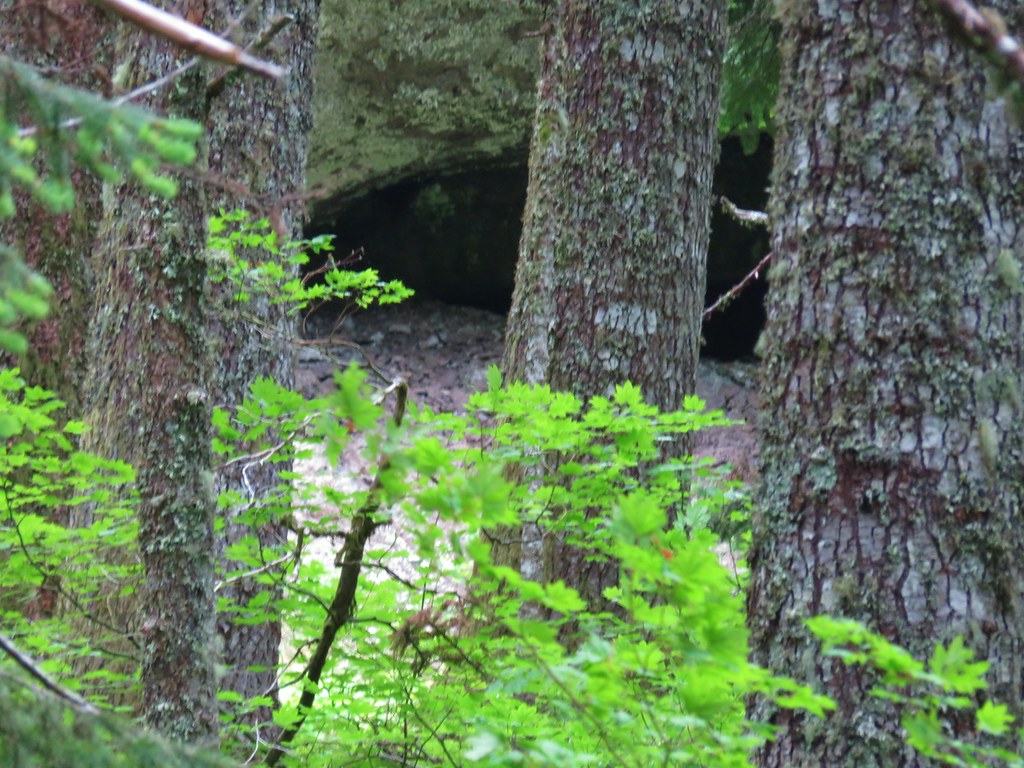
From the camps the trail lost some elevation as it passed beneath a rock outcrop which looked to have a pretty good sized cave or at least a big overhang at its base.
IMG_3039

IMG_3040

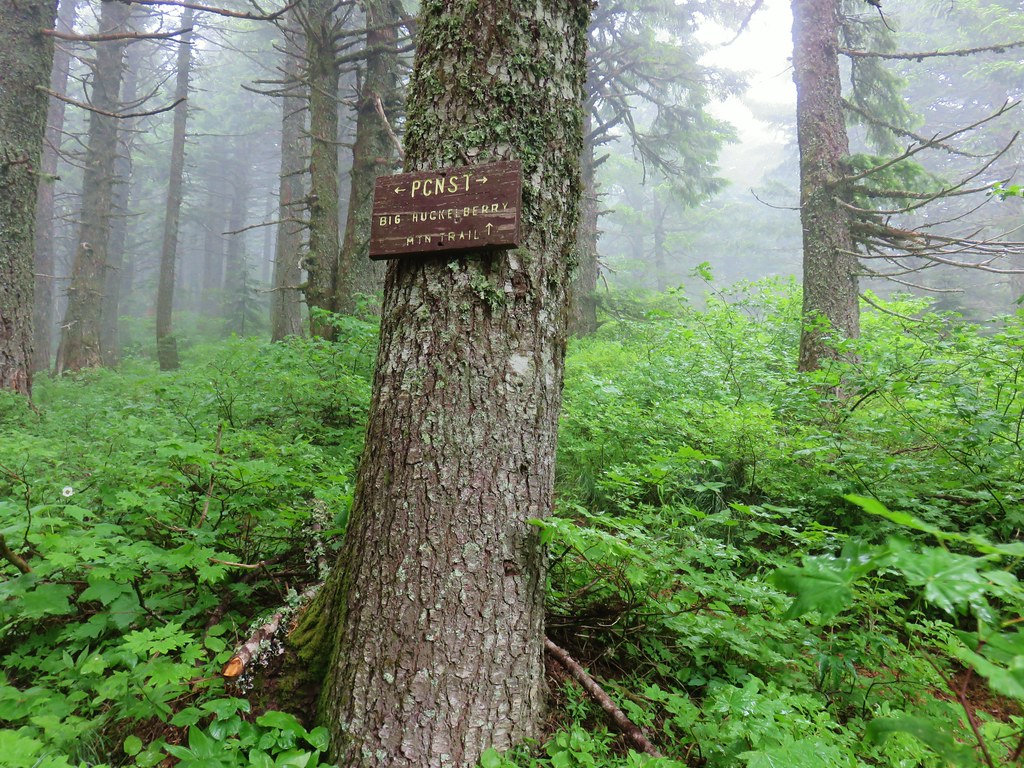
We arrived at the PCT five and a quarter miles from the trailhead.
IMG_3056

IMG_3054

From here we were about five miles south of the trailhead where we had set off on the PCT on our 2018 hike to Indian Racetrack in the Indian Heaven Wilderness (post). We turned right, took a couple of steps, and veered right again following the pointer for Big Huckleberry Mountain. A .2 mile climb brought us to the open summit where the forecast was right for the first time today, it was mostly cloudy.
IMG_3058

IMG_3060

Big Huckleberry Mountain was also home to a lookout at one time but now aside from a few remains the summit was just occupied by wildflowers.
IMG_3065

IMG_3062

IMG_3064

IMG_3067

IMG_3069

20190706_102617

IMG_3077

A fairly long rocky spine extended east from the former lookout site with a couple of pockets of trees separating the open areas where the flowers were prevalent.
IMG_3085

IMG_3101

IMG_3088

IMG_3089

IMG_3090

The slope eventually steepened enough to make for a good stopping point.
IMG_3091

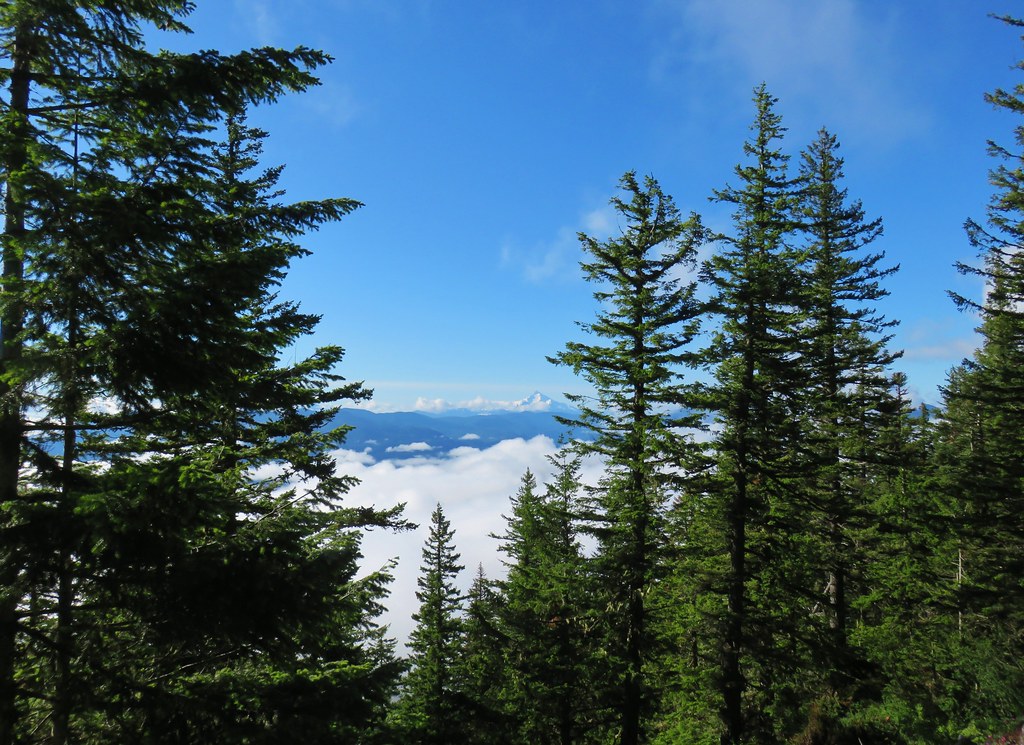
The end here was just a little further beneath the clouds which allowed for a good view of the Big Lava Bed which lay between Big Huckleberry Mountain and Mt. Adams but not for much else.
IMG_3093

There was also a view south where the Bridge of the Gods could be seen (barely) spanning the Columbia River.
IMG_3096

IMG_3099

After exploring the summit and also resting a bit we headed back. There were some encouraging signs that the clouds might actually move on as we made our way back through the wildflower meadows.
IMG_3117

IMG_3157

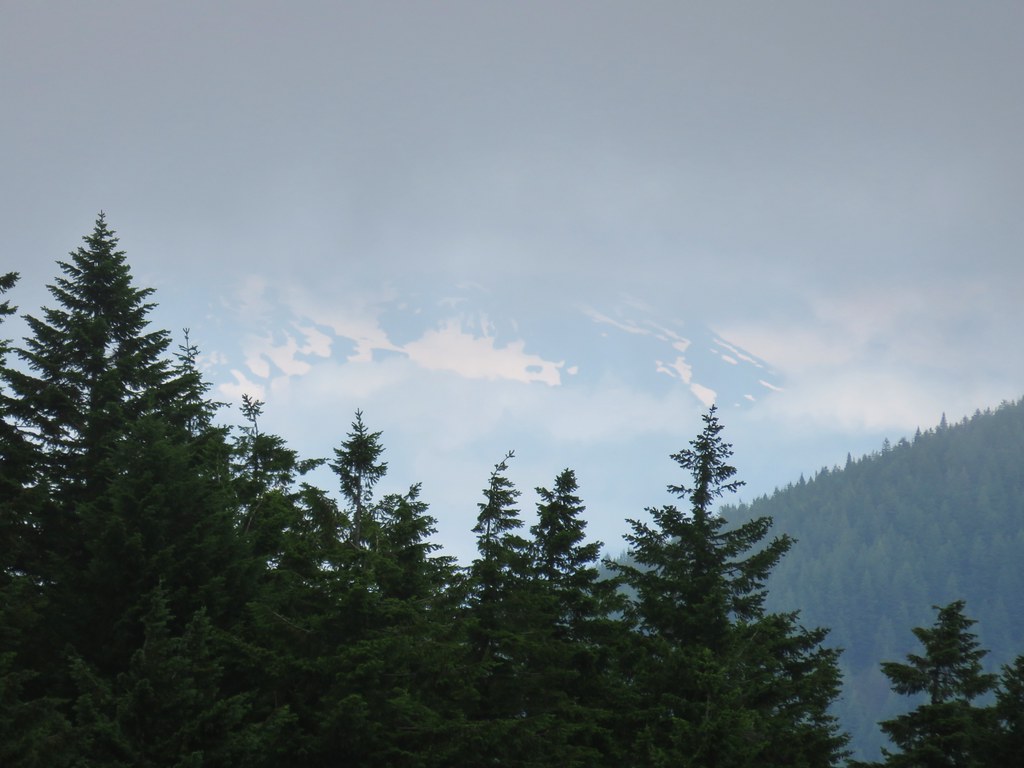
IMG_3146Snowy flank of Mt. Adams through the clouds.

IMG_3191

IMG_3193

Back at Grassy Knoll the conditions were better than they had been earlier in the morning but they still weren’t great.
IMG_3205

IMG_3211

IMG_3212Wind Mountain and the Columbia River

The same was true for the other viewpoints.
IMG_3227Little Huckleberry Mountain and Big Lava Bed

IMG_3229A bit of Mt. Adams again.

It was a little frustrating to be able to see clear blue sky beyond the edge of the clouds, but what can you do. The flower show had been more than entertaining and to cap the hike off the farewell-to-spring near the trailhead had started to open up despite the lack of sunshine.
20190706_132534

20190706_132501

Missing out on the view will put this 11.8 mile hike toward the front of the list for a revisit, although the roads might hold it back just a bit. Happy Trails!

Flickr: Grassy Knoll and Big Huckleberry Mountain

Categories
Hiking Oakridge Area Old Cascades Oregon Trip report

Bunchgrass Ridge – 7/04/2019

**Note a portion of this hike burned in the 2022 Cedar Creek Fire.**

For the 4th of July this year we headed to the Oakridge area to check out a portion of the Eugene to Crest Trail. The concept of the trail is for a continuous trail from Eugene, OR to the Pacific Crest Trail east of Waldo Lake. Despite beginning in the 1970’s the trail has not been completed but a 108 mile route has been established using trails and roads with multiple access points.

We chose to begin our hike at the Eugene to Crest Trailhead #4 It was an interesting drive to the trailhead as winter storms brought extensive damage along Highway 58 causing its closure for a time due to slides and downed trees. Those same conditions affected many of the Forest Service roads and trails. As we headed up FR 2408 toward the trailhead it was apparent that the Forest Service had been busy clearing downed trees along the lower portion of the road. It was interesting to see that higher elevations hadn’t suffered near as much damage though as the number of recently cut trees decreased significantly. Then as we neared the trailhead a young black bear darted across the road in front of the car.

After the excitement of seeing the bear we pulled into the parking area where we discovered a fair number of mosquitoes waiting for us. We applied a bit of bug spray and set off on the signed trail.
IMG_2088

IMG_2092

In a tenth of a mile we arrived at a junction with the Eugene to Crest Trail where we turned left.
IMG_2093

A short distance later we entered Little Bunchgrass Meadow.
IMG_2095

IMG_2100

The meadow had quite a bit of lupine and some white pussytoes and cat’s ear lilies blooming with tiger lilies and orange agoseris just getting started.
IMG_2102

IMG_2107

IMG_2117The only tiger lily that seemed to be open yet.

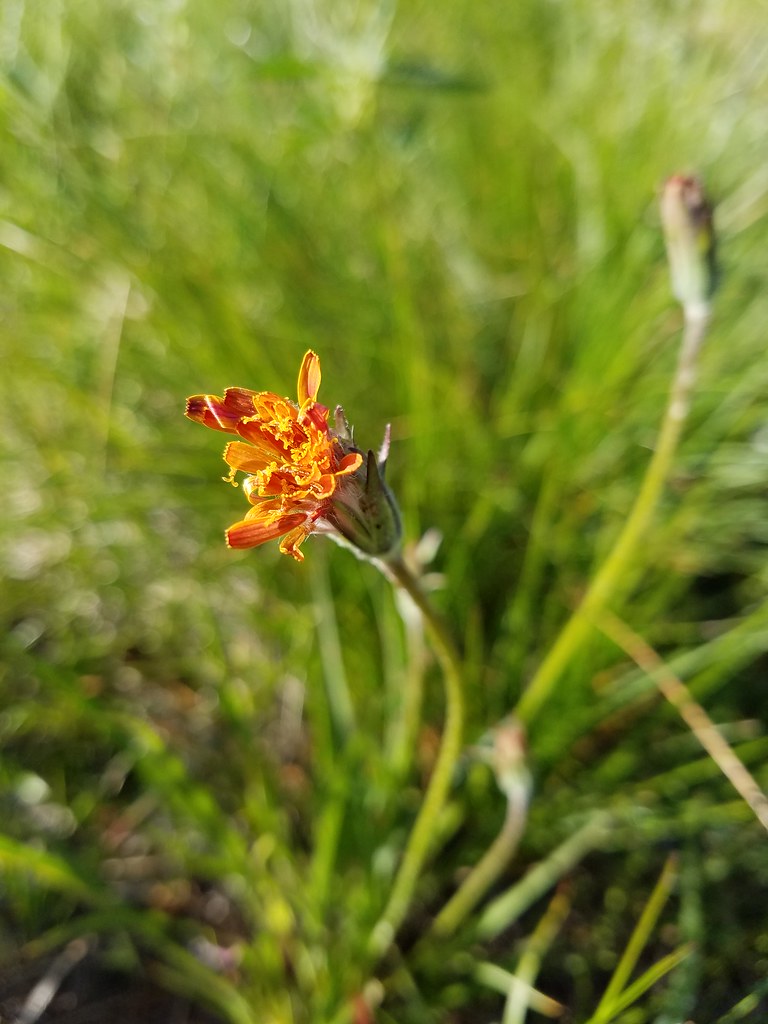
20190704_072419orange agoseris beginning to open.

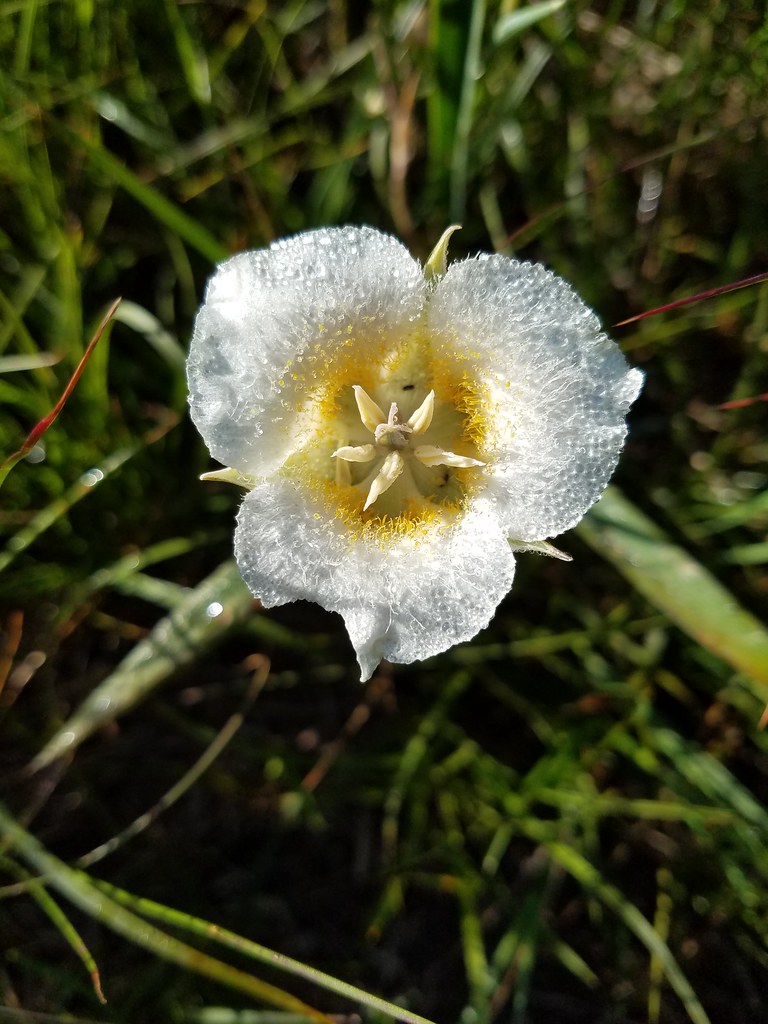
20190704_072403Cat’s ear lily

IMG_2120Pussytoes

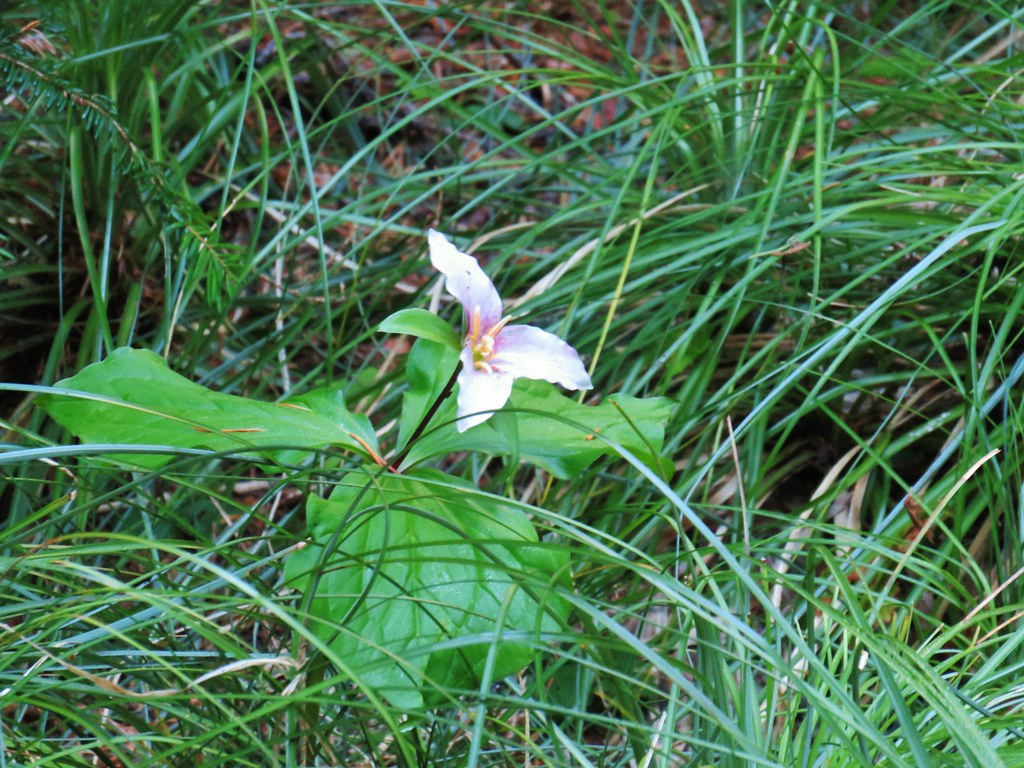
At the end of the meadow the trail entered the forest where a few vanilla leaf and a single trillium were still blooming.
IMG_2122

IMG_2123

IMG_2125

It wasn’t long before we popped out into a second meadow. This one was filled with bunchgrass aka beargrass. Unfortunately it appeared that we had missed the beargrass bloom by a year as only a couple of plants had flowers while many others had dead stalks.
IMG_2127

IMG_2129

We repeated the meadow-forest-meadow pattern a couple of times as the trail followed the ridge SE. Occasionally there were views of the Three Sisters, Broken Top, and the top of Mt. Bachelor to the NE.
IMG_2132The Three Sisters and Broken Top

IMG_2136Larkspur along the trail.

IMG_2140

IMG_2138Bunchberry

IMG_2142Anemone

IMG_2149Another meadow

IMG_2159The Three Sisters and Broken Top

IMG_2165

IMG_2170Queen’s cup

IMG_2181The Three Sisters, Broken Top, and a bit of Mt. Bachelor

IMG_2196

IMG_2208Rhododendron

IMG_2210Another meadow full of not-in-bloom beargrass.

The first mile and a half of the trail had been fairly level as it passed along the ridge but after passing through the last beargrass meadow for a while the trail began to gradually gain elevation. The trail left the ridge top in favor of the SW facing slope.
IMG_2214View from the SW facing hillside.

IMG_2215Looking SE

The trail then regained the ridge where we once again had views of the Three Sisters and Broken Top along with Mt. Jefferson and the very tip of Three Fingered Jack.
IMG_2221

IMG_2221Mt. Jefferson behind the ridge extending from Mule Mountain (post). The tip of Three Fingered Jack is visible just to the left of the high point along the ridge to the far right.

After passing a knoll on our right we got our fist glimpse of Diamond Peak ahead to the SE.
IMG_2228

IMG_2229Diamond Peak through the trees.

After a brief drop to a saddle we climbed past a wildflower rock garden to a nice viewpoint just over two and a quarter miles from the trailhead.
IMG_2241Valerian in the saddle.

IMG_2254

IMG_2251

IMG_2259

IMG_2690

IMG_2692

IMG_2270Mt. Yoran, Diamond Peak, and Mt. Bailey

IMG_2276Mt. Yoran and Diamond Peak

IMG_2272Mt. Bailey

IMG_2656View to the NE (from the afternoon on the way back)

IMG_2658The Husband, Three Sisters, Broken Top, and Ball Butte(from the afternoon on the way back)
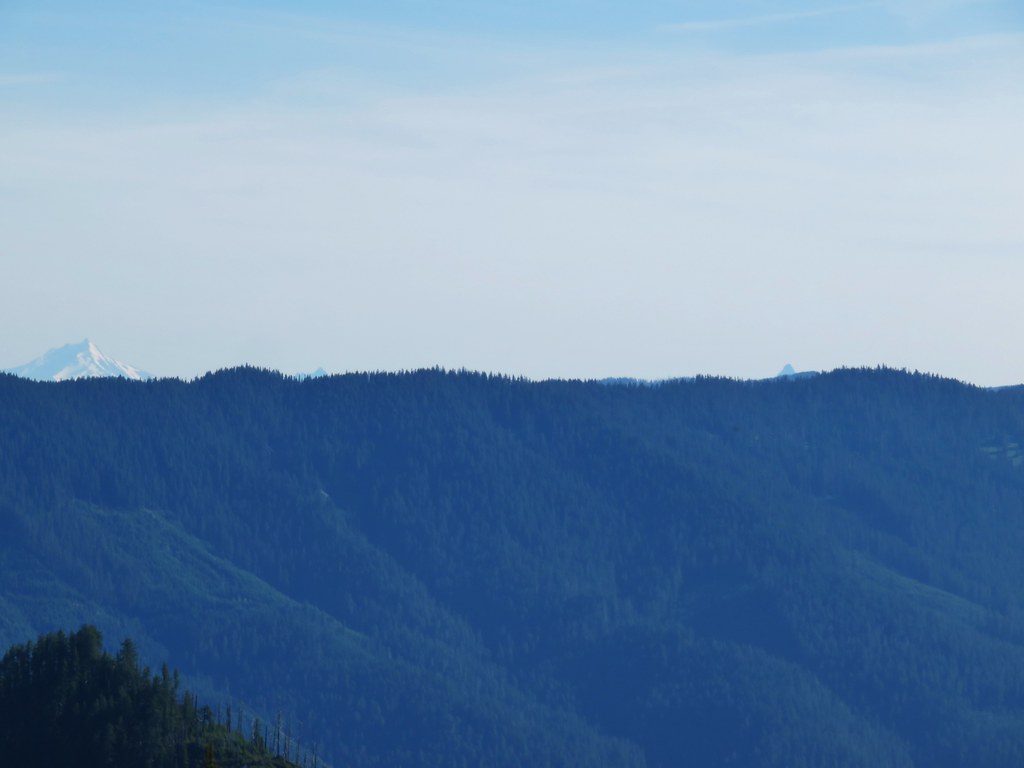
IMG_2281Mt. Jefferson and the tips of Three Fingered Jack and Mt. Washington
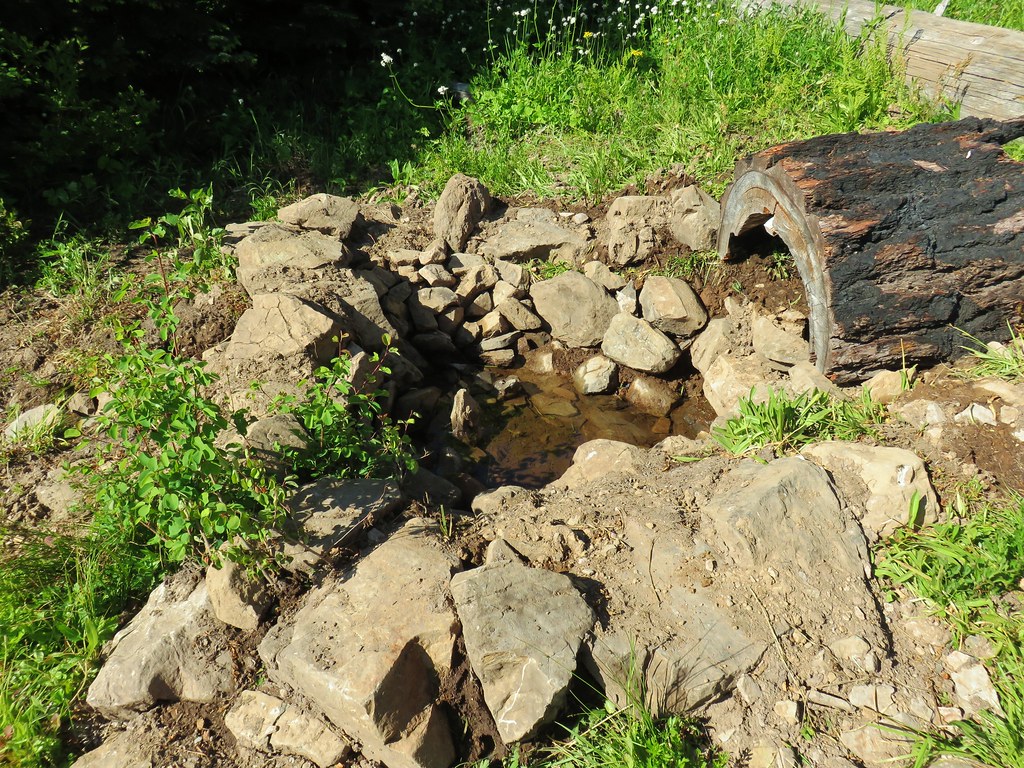
From the viewpoint the trail descended fairly steeply past what appeared to be a small spring but it is not shown on any map that I could find.
IMG_2286

IMG_2289

Sections of our route passed through and by the fire scar from the 1991 Warner Creek burn but as we descended from the viewpoint we were passed through a newer scar from the 2017 Kelsey Creek Fire.
IMG_2296

IMG_2298

In this newer scar we found one of the best clumps of western wallfower we’d ever seen.
IMG_2295

20190704_084603

There was also a large wild ginger blossom which we don’t get to see very often so clearly.
IMG_2299

After losing almost 500′ of elevation the trail looked to regain it as it climbed from a saddle up a ridge and around a knoll before dropping down again.
IMG_2308

From the high point we had a nice view of the ridge behind us that our route had followed.
IMG_2309

Ahead we could see another ridge line on the far side of Kelsey Creek which was in the valley below.
IMG_2310

From this view we couldn’t really make out the ridge between us and the one across the valley. We began to wonder about the rest of our route. We did have two paper maps and our GPS with us but instead of looking at those we wondered if we would be curving around this valley or following an unseen ridge to our right. Whatever our route would be, it began by heading downhill. There was fairly thick vegetation along the trail but it had also recently been cut back.
IMG_2315

We could see a green meadow ahead of and below us.
IMG_2324

Just over three and a half miles in the trail leveled off at a saddle above the meadow. The wildflower display on the saddle was really impressive with large groups of blue-head gilia and giant blue-eyed Mary creating carpets of blue and numerous other flowers scattered about.
IMG_2326

IMG_2332Giant blue-eyed Mary

20190704_091315Giant blue-eyed Mary

IMG_2328Giant blue-eyed Mary and blue-head gilia

IMG_2334Cat’s ear lily and blue-head gilia

IMG_2339Coneflower

IMG_2342Cow parsnip

IMG_2345Tall mountain bluebell

IMG_2347More of the blue flowers

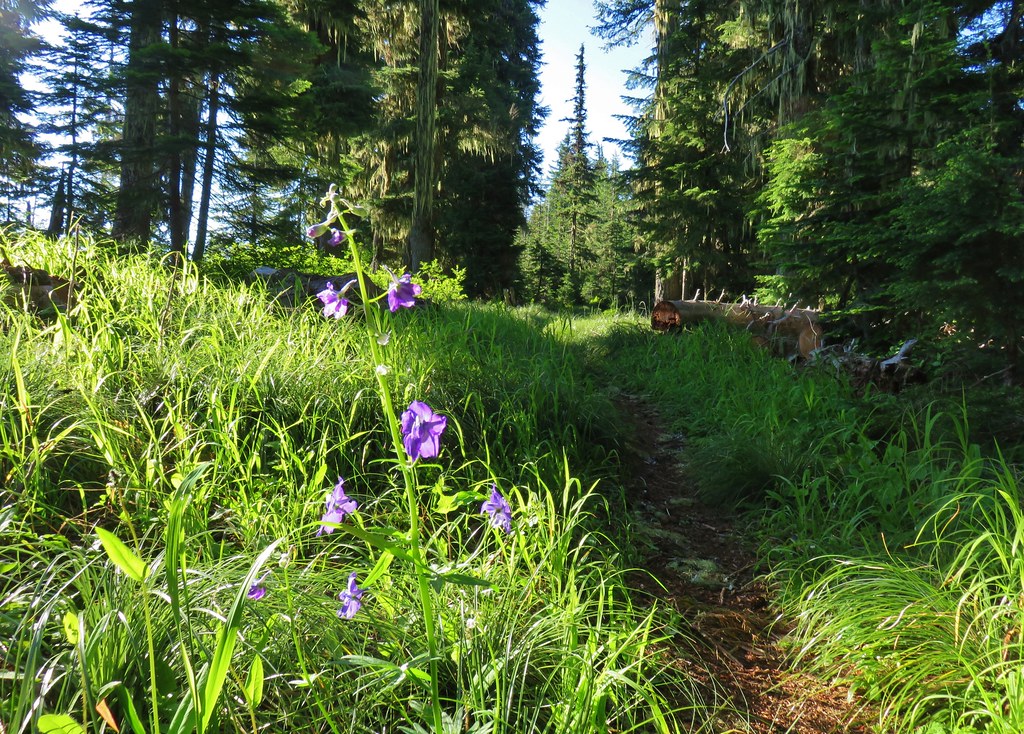
IMG_2350Larkspur

20190704_092323Jacob’s ladder

20190704_092346An aster or fleabane

IMG_2361Columbine and valerian

IMG_2362Lupine

IMG_2370Not sure what type of flower this one is.
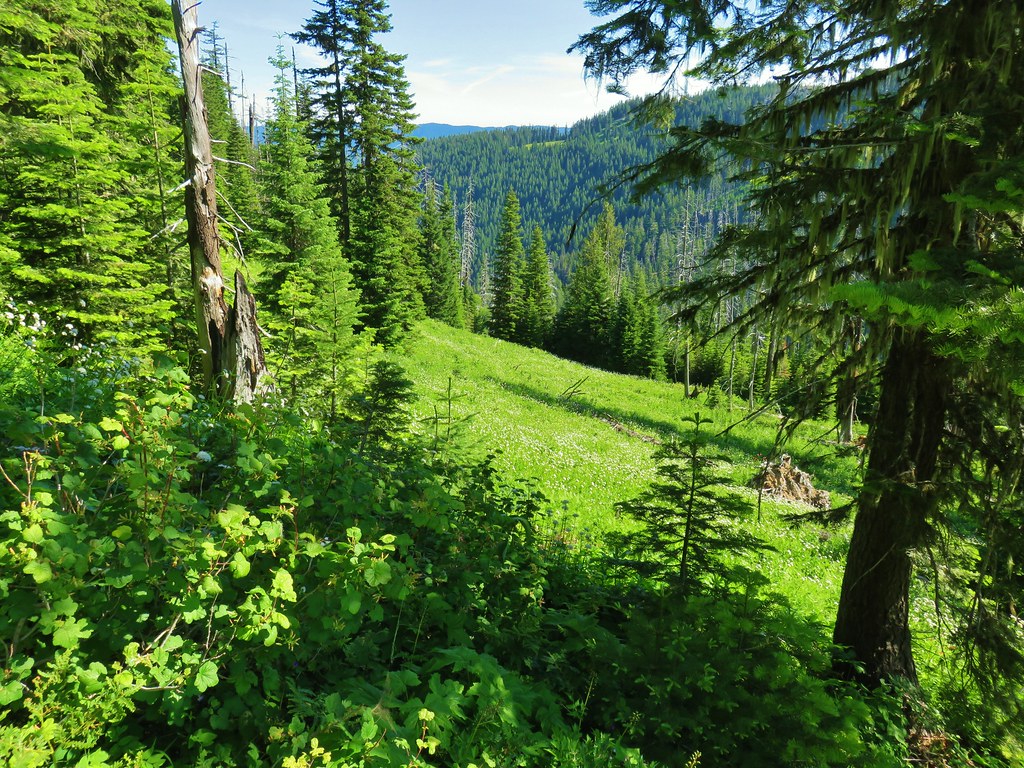
IMG_2364Valerian filled meadow below the trail.

IMG_2373White yarrow, giant blue-eyed Mary, and tall mountain bluebells
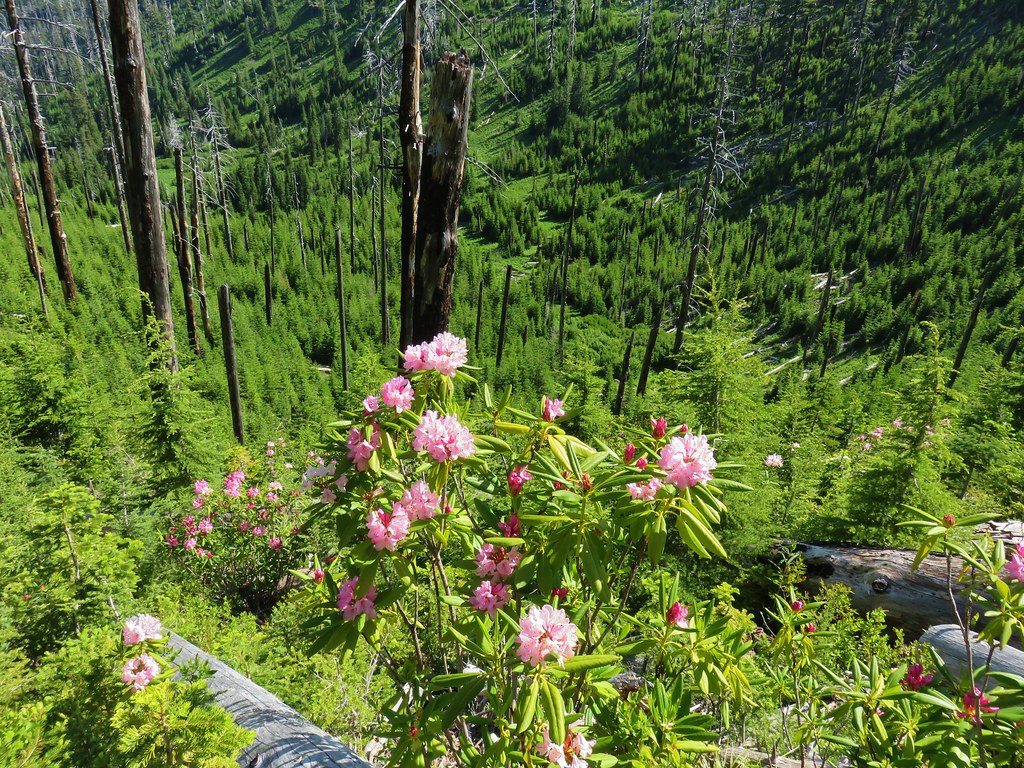
Beyond the saddle the trail did not follow a ridge in any direction. It lost a little more elevation passing under a hillside dotted with pink rhododendron.
IMG_2374

IMG_2376

The low elevation was approximately 5250′ which the trail dipped to briefly as it started to wind around the headwaters of Kelsey Creek. As we came around we started to climb and quickly realized that the trail was going to take us up and over the ridge we had been looking at from the viewpoint across the valley. From the low point the trail gained 150′ over the first three tenths of a mile before launching uphill to gain another 450′ in the next .4 miles.
IMG_2381Looking back at our route so far.

IMG_2383The trail coming around Kelsey Creek is visible on the hillside behind us.

The trail crested in yet another bunchgrass filled meadow.
IMG_2386

IMG_2395

The open hillside here provided views ahead to Fuji Mountain in the Waldo Lake Wilderness (post) as well as Diamond Peak and a good look at Mt. Bailey (post).
IMG_2414Fuji Mountain (left), flat topped Mt. David Douglass, Mt. Yoran (shorter thumb to the left of Diamond Peak), and Diamond Peak.
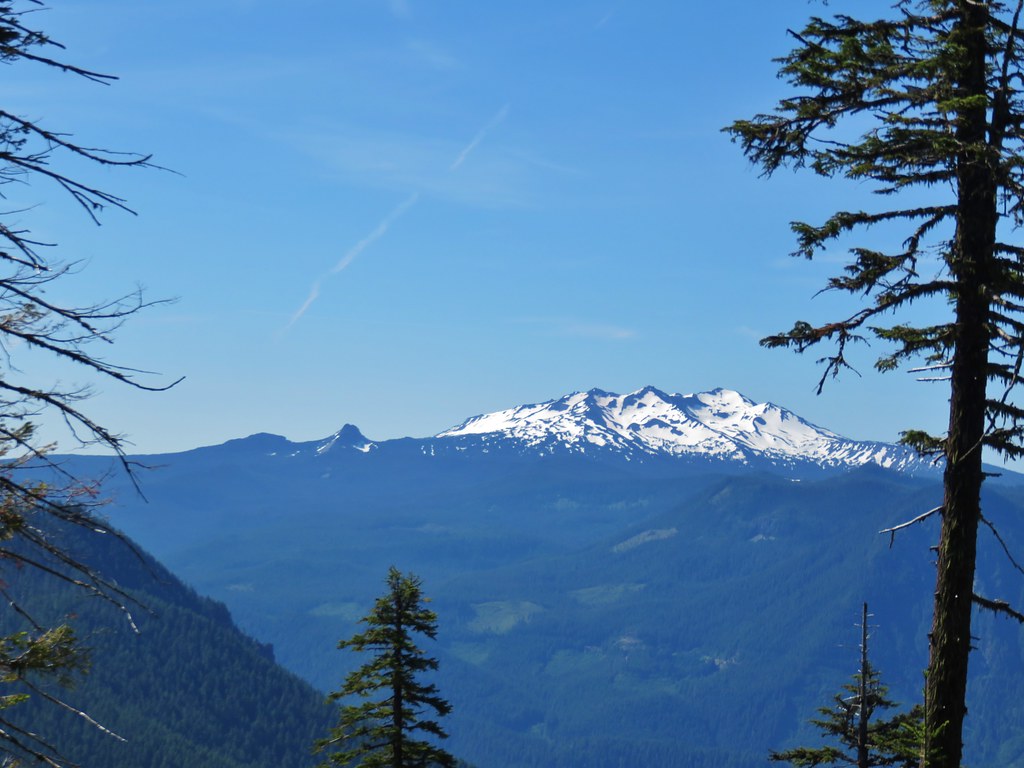
IMG_2403Mt. Yoran and Diamond Peak

IMG_2401Mt. Bailey

We were particularly excited to see Mt. Bailey. It’s one we don’t often get a good view of due to its relatively low profile (8368′) and its alignment which often puts it behind Diamond Peak in the line of sight.

This meadow lasted off and on for a little over half a mile. There again wasn’t much beargrass in bloom but we did come upon a nice display of scarlet gilia, also known as skyrocket which seemed fitting on the 4th of July.
IMG_2404

IMG_2417

20190704_101615A few orange agoseris were scattered about.

IMG_2425Scarlet gilia

IMG_2432More scarlet gilia

20190704_112526Skyrocket

At the edge of the meadow we arrived at a rock outcrop.
IMG_2450

The trail switchbacked down below the outcrop which was home to a few flowers of it’s own.
IMG_2454

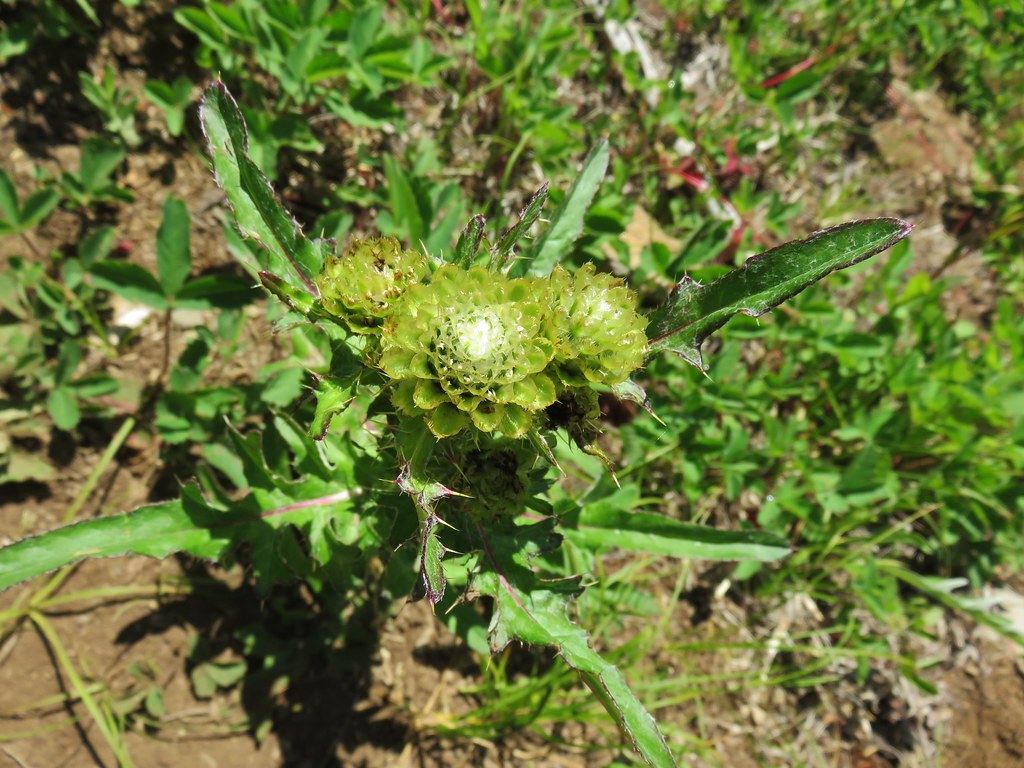
IMG_2452A thistle that was getting ready to bloom.
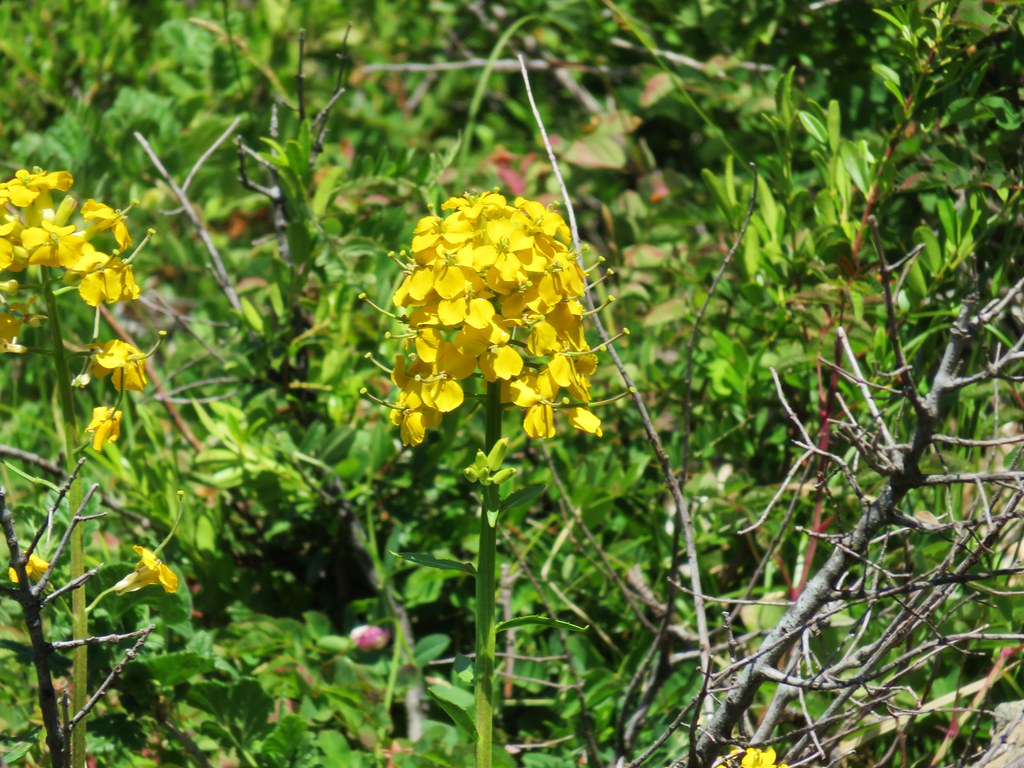
IMG_2456Wallflower

Below the outcrop the trail passed through more beargrass with Big Bunchgrass Meadow covering the hillside ahead with a bright green color.
IMG_2465

We had one complaint as we headed toward our goal, the trail was losing elevation. Interestingly though we found ourselves in an entirely different type of forest than we had encountered during the hike so far. It had a drier feel with pines and a grassy forest floor.
IMG_2467

Soon though we popped out into Big Bunchgrass Meadow which didn’t appear to have much if any bunchgrass. False hellebore, grasses, and flowers filled this meadow.
IMG_2470

IMG_2474

The flowers weren’t profuse but there was a nice variety and the butterflies seemed to be enjoying them.
IMG_2479Owl’s head clover

IMG_2488Larkspur, an owl’s head clover, and scarlet gilia

IMG_2491Aster or fleabane and an orange agoseris
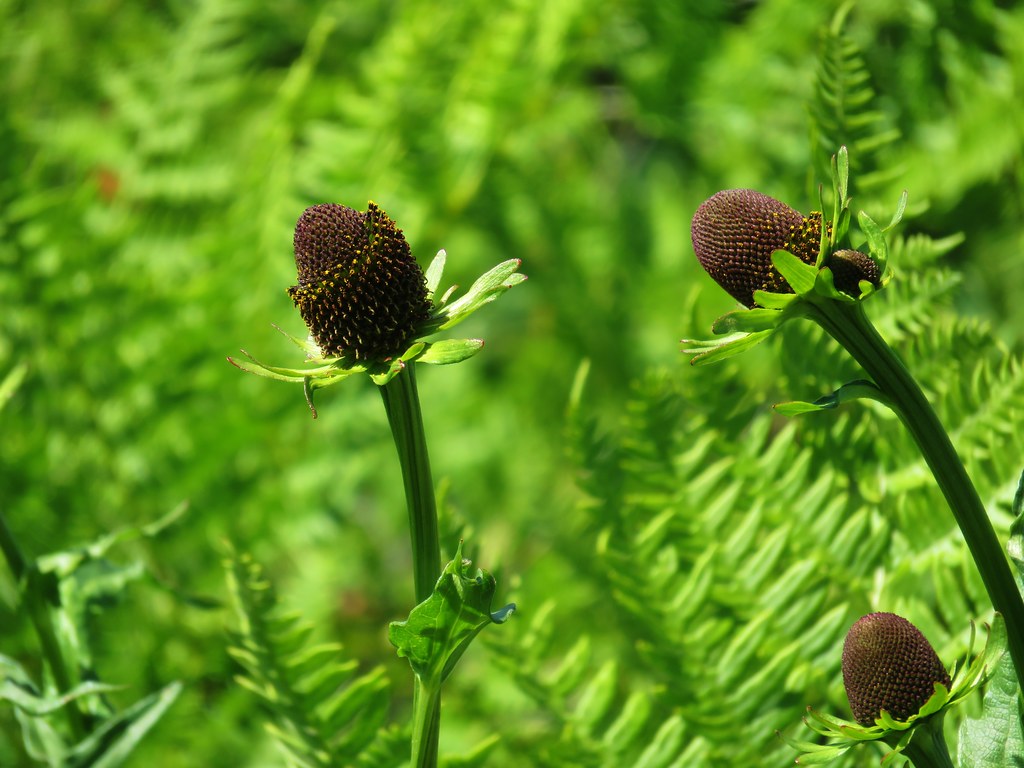
IMG_2508Coneflower

IMG_2510Hyssop

IMG_2514Butterflies on a cat’s ear lily

IMG_2527

IMG_2529

20190704_105633Wait that’s not a butterfly.

As the trail continued to lose elevation we decided to make our turnaround point a trail junction with a tie trail coming up to the meadow from the Bunchgrass Lower Trailhead. There was a post in the meadow with a pointer for the trail but it wasn’t exactly near the post and we missed it on our first pass. We turned around after rounding a small corner that gave us a nice view of Fuji Mountain.
IMG_2495

IMG_2499Fuji Mountain

Looking back we realized just how far we had come down to reach the meadow.
IMG_2504

As we came back around the small corner we spotted the faint trail veering off to the left.
IMG_2513The post, with an orange top, is up and to the right in front of a tree.

We headed back uphill and stopped for a break at the rock outcrop.
IMG_2552Heather at the rock outcrop.

I wandered up along the outcrop to see if there might be a good viewpoint atop the ridge. I was hoping for the Three Sisters and Broken Top but they were nowhere to be seen.
IMG_2542

IMG_2543Big Bunchgrass Meadow and Fuji Mountain

IMG_2544Diamond Peak

I did find a little clump of Oregon sunshine though.
IMG_2545

After our break we continued on looking for anything we might have missed on our first pass as well as for any wildlife.
IMG_2563

IMG_2567Crab spider (probably waiting for that Washington lily to open)
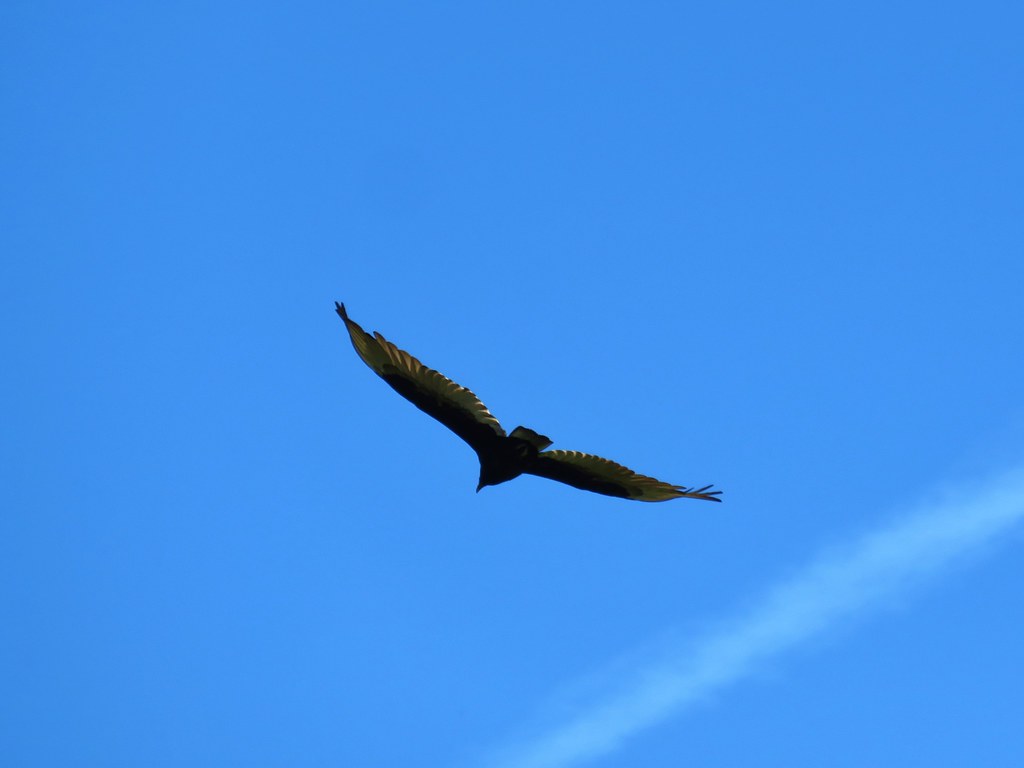
IMG_2585Turkey vulture

IMG_2591

IMG_2594Back in the valerian meadows

IMG_2602

IMG_2609

IMG_2639

IMG_2647

IMG_2683Not sure what this is going to be either.

We never did see that bear again, although there were several piles of scat along the trail. As for people we passed a group of three hikers at the viewpoint about 2 miles from the trailhead and a pair of mountain bikers at the junction near the trailhead. It was a little surprising to us that we didn’t see more, the trail was in great shape with good views and wildflowers. The first few miles were relatively easy too with the real climbing occuring in the latter half of the hike. We logged 11.8 miles on the GPS which seems to be right around where all our hikes have been lately. Happy Trails!

Flickr: Bunchgrass Ridge

Categories
Hiking McKenzie River Old Cascades Oregon Trip report

Tidbits Mountain – 6/29/2019

**Note the 2024 Ore Fire burned over the access road for the trailhead but spared the trails.**

As we continued to let the weather dictate our vacation plans we couldn’t pass up a “sunny” morning forecast for Tidbits Mountain near Blue River, OR. Another of Sullivan’s featured hikes, the trip to the site of a former lookout tower atop Tidbits Mountain is just 4.4 miles round trip from the Tidbits South Trailhead. This was actually a bit of a problem as the drive from Salem was a little over two and a half hours which meant our hiking time would most likely not be greater than our driving time which would break our rule of not driving longer than hiking. Our original plan to solve this was going to be making a second stop at the Lower McKenzie River Trailhead where we could hike as far as we liked on the McKenzie River Trail, but while researching the Tidbits Mountain hike another option presented itself.

The Gold Hill Trail travels 3.2 miles along a ridge to a junction with the Tidbits Mountain Trail three quarters of a mile from the summit of Tidbits Mountain. Instead of driving to a different trailhead we could spend some time on the Gold Hill Trail which the Forest Service warned sees only periodic maintenance.

We started our hike not at the Tidbits South Trailhead but rather along Forest Road 1509 where FR 877 headed uphill .2 miles to the trailhead on the left.
IMG_1504FR 877 at FR 1509

Both the Forest Service and Sullivan pointed out that FR 877 was steep and Sullivan added that turning around at the trailhead was “awkward”, thus our decision to walk up the road.
IMG_1512

As we hiked up the road there were a couple of views of the rocky pinnacles of Tidbits Mountain on the left.
IMG_1513

IMG_2085

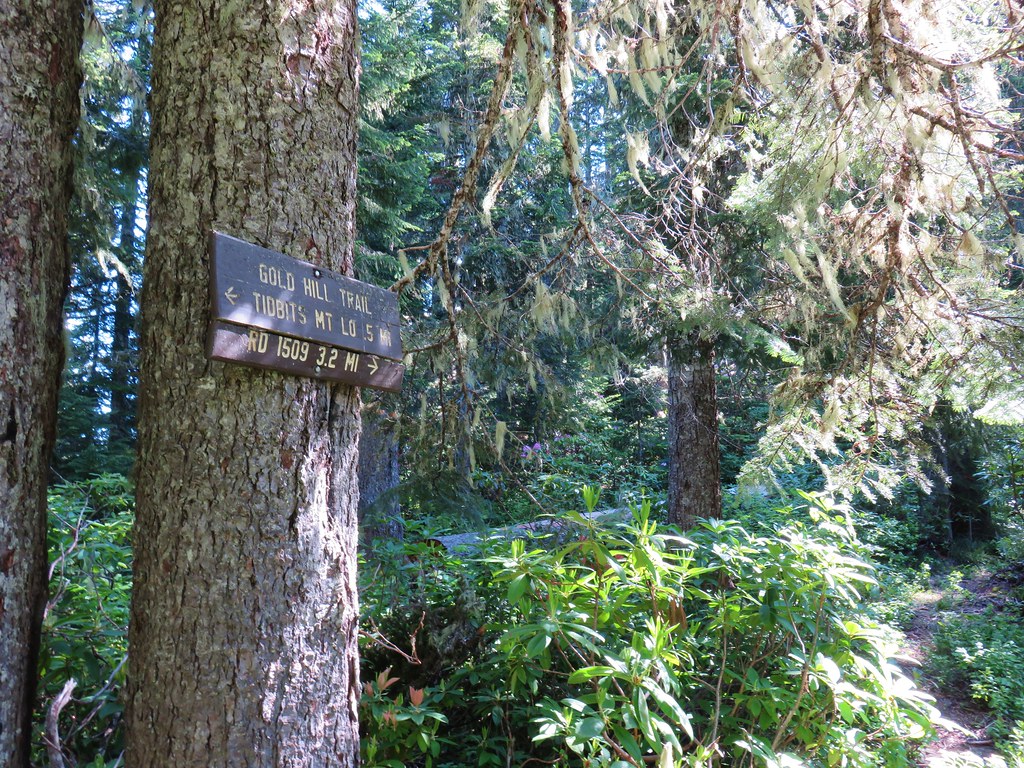
A sign marked the start of the Tidbits Mountain Trail.
IMG_1516

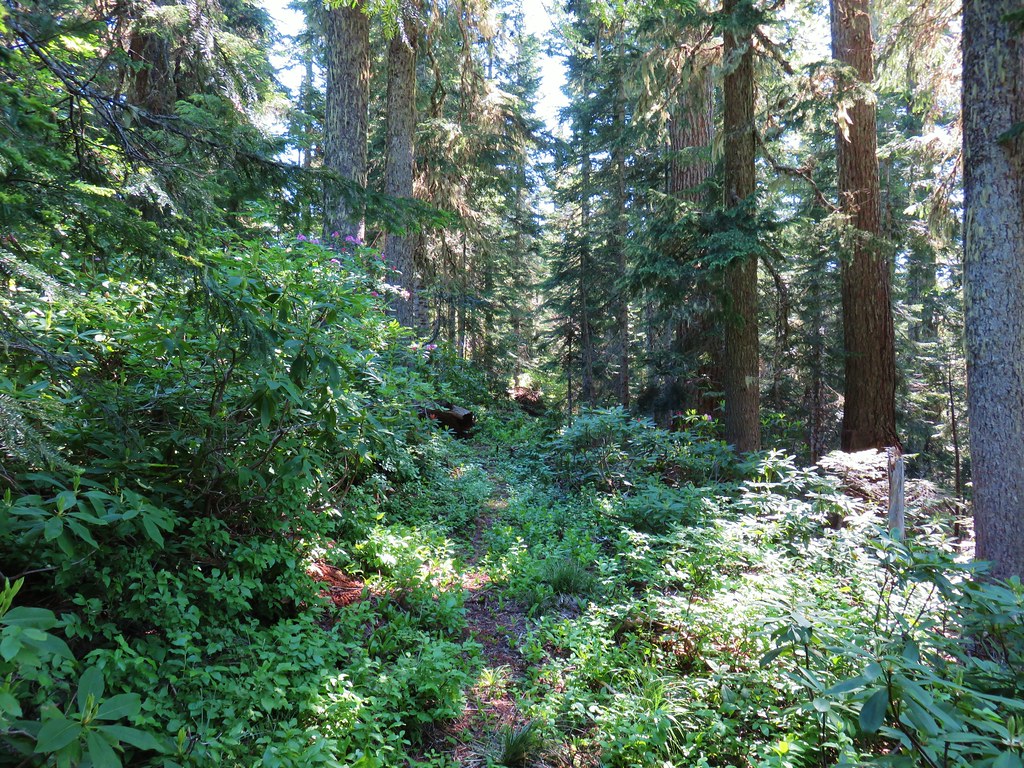
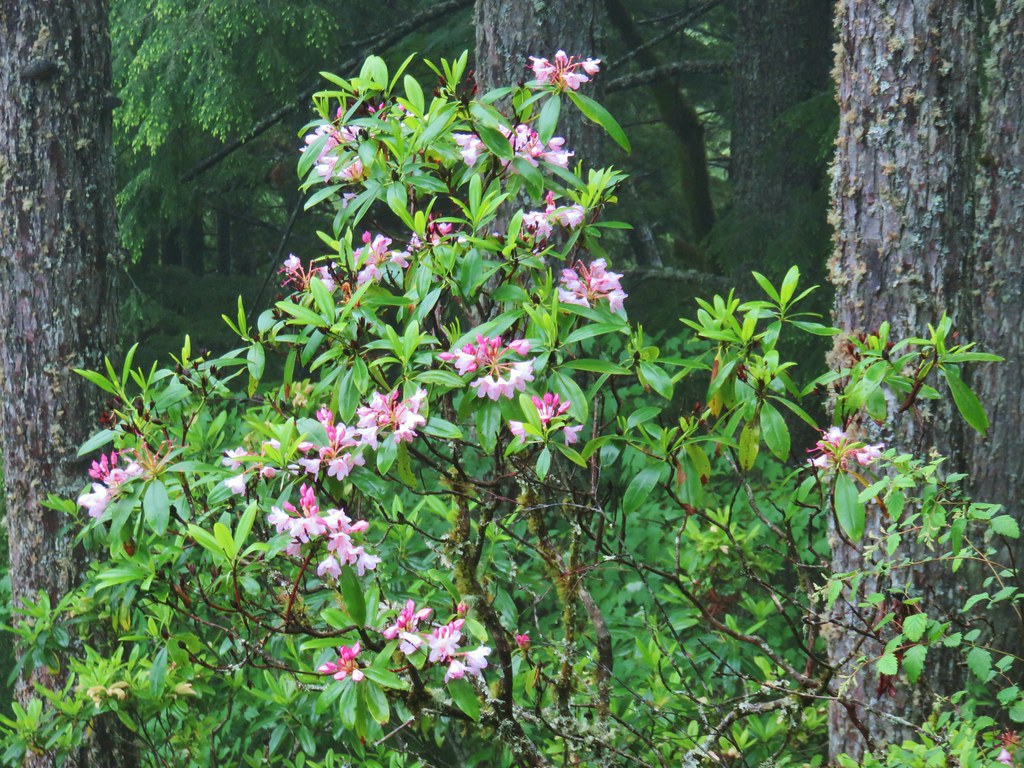
The trail climbed gradually for 1.3 miles to a junction on a ridge crest. This section of trail passed through some old growth trees and was full of rhododendron blooms. It was by far the best display of rhododendron that we had seen.
IMG_1518

IMG_2076

IMG_1525

IMG_1558

IMG_1560

IMG_1562

IMG_1565

IMG_1566

There were a few other flowers along the way as well but none in anywhere near the numbers as the rhodies.
IMG_1531Penstemon

IMG_1535Showy phlox

IMG_1538<script async src=”//embedr.flickr.com/assets/client-code.js” charset=”utf-8″Paintbrush and stonecrop

IMG_1544Anemone

IMG_1546Iris

IMG_1555Arnica

At the junction we turned left following a pointer for the Tidbits Mountain Lookout.
IMG_1568

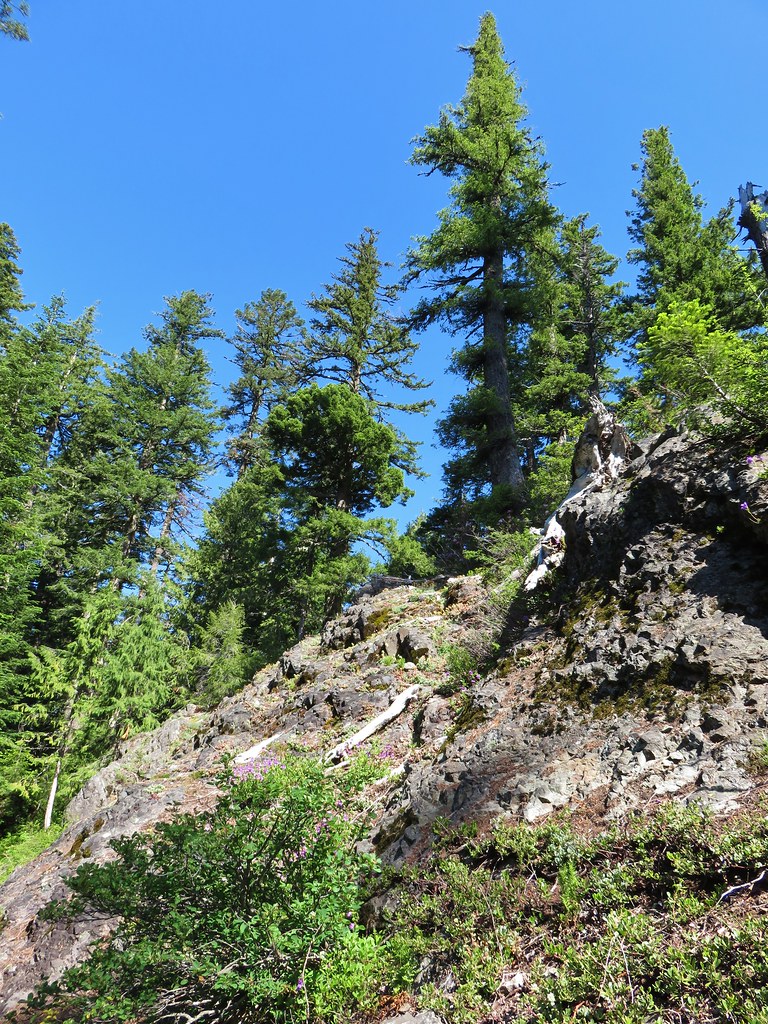
This section of trail traversed a rocky hillside on the north side of Tidbits Mountain. Being on the north facing slope trillium were still in bloom and a few remnants of glacial lilies remained.
IMG_1581

IMG_1583

20190629_080903

IMG_1639

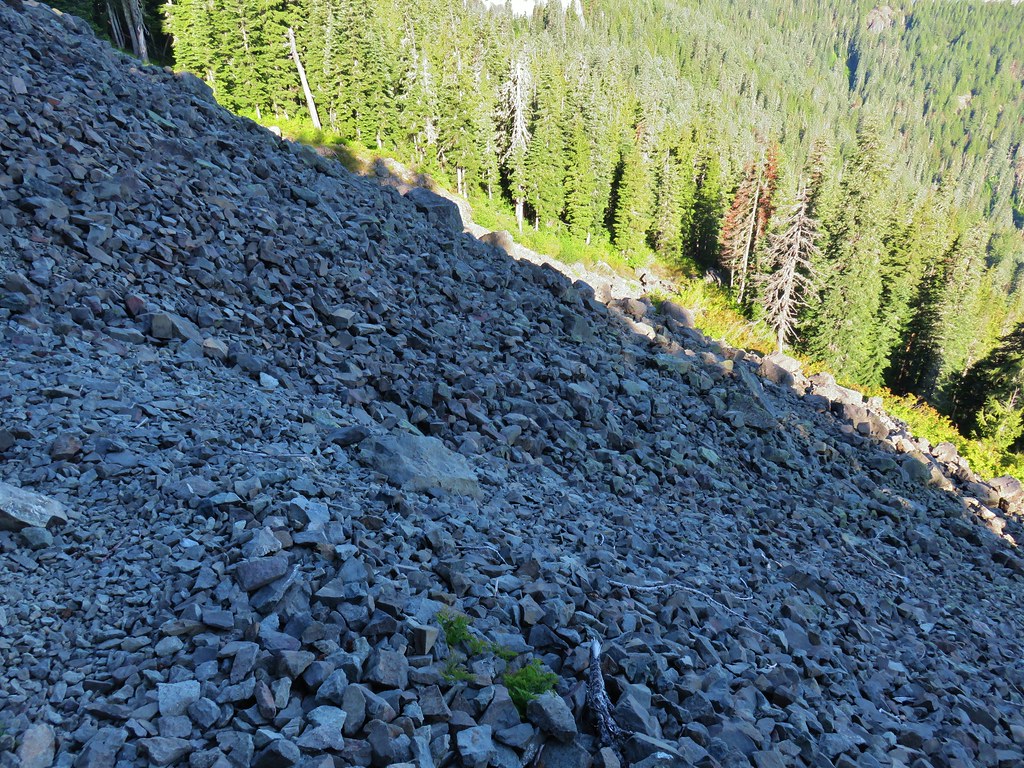
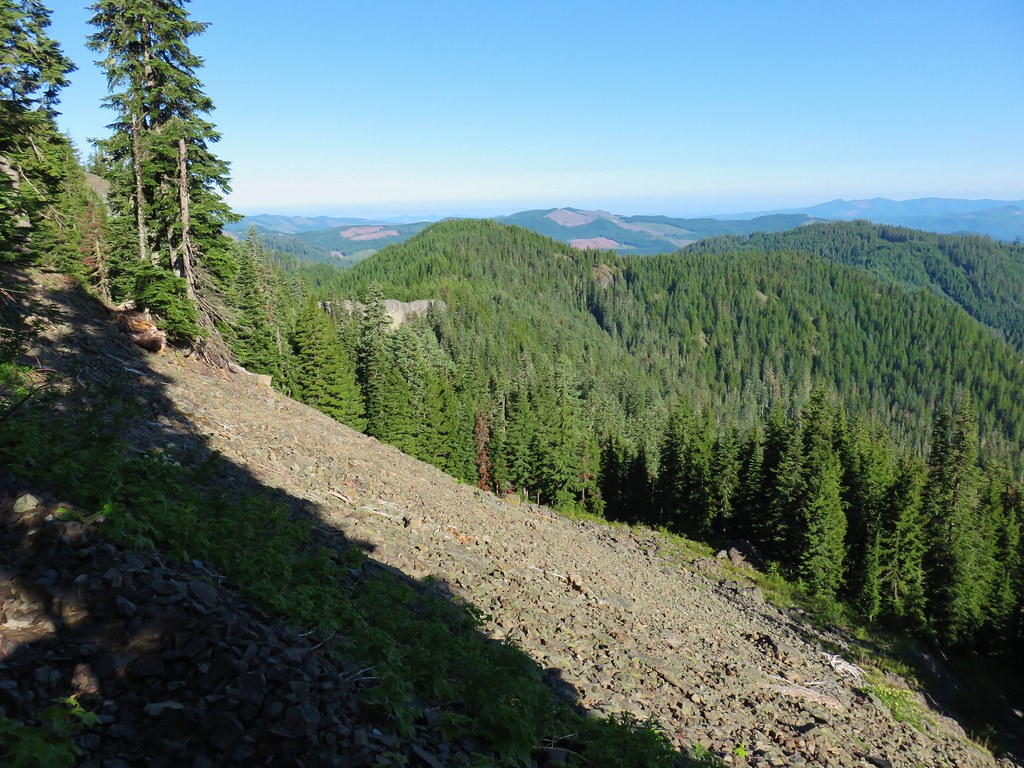
The talus slopes below Tidbits Mountain allowed for some previews of the views to come at the summit.
IMG_1608

IMG_1605Looking west toward the Green Mountain Lookout.

IMG_1607Green Mountain Lookout

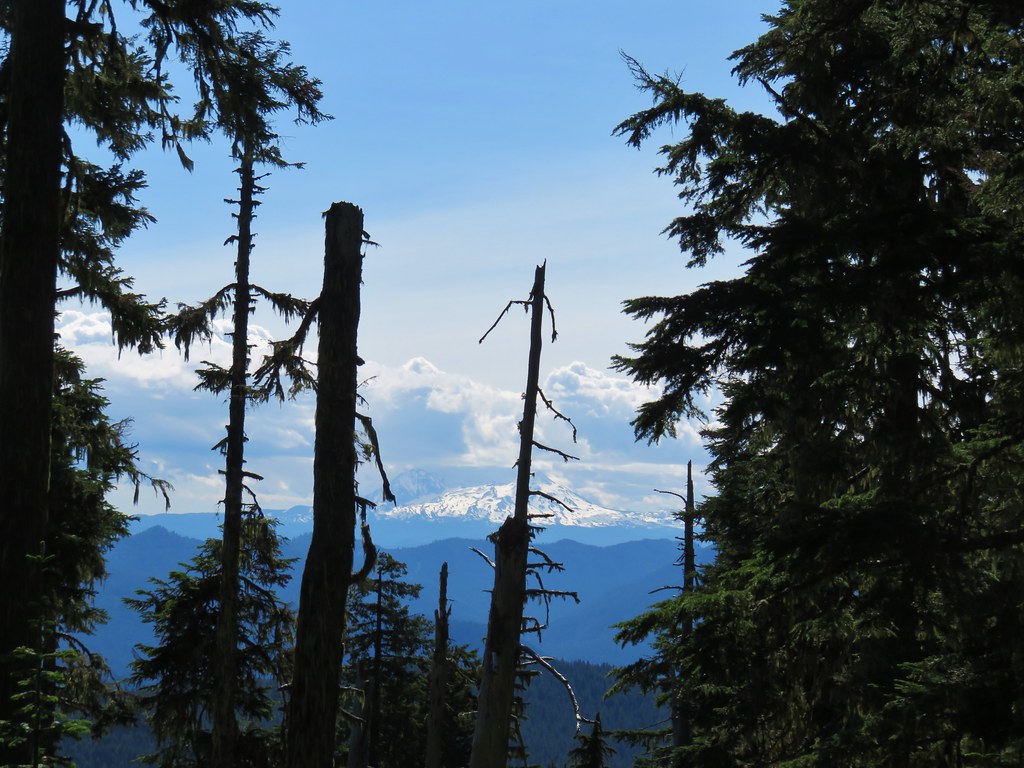
IMG_1603Mt. Jefferson

IMG_1601Three Fingered Jack

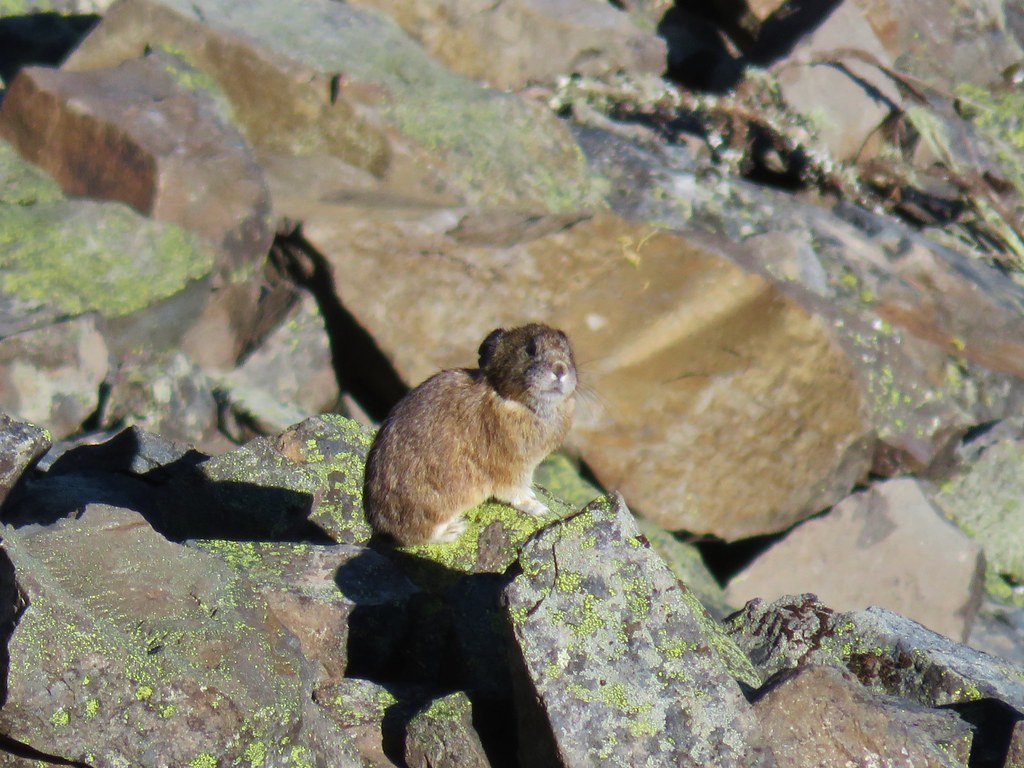
The talus is also home to one of our favorite wild animals, the pika! They are not particularly easy to see but once you know what you are looking for with a little luck you’ll spot one of these rabbit relatives. It was a lucky day for us as we spotted two.
IMG_1614There is at least one pika in this picture.
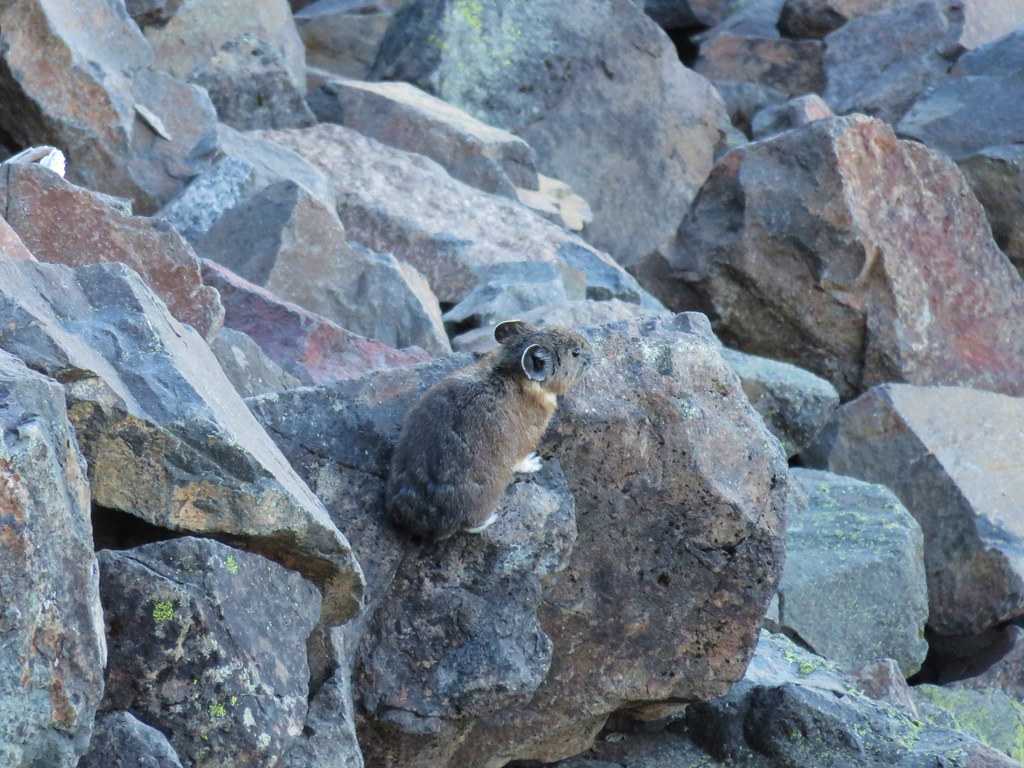
IMG_1613

IMG_1648There is another one in this picture.
IMG_1645

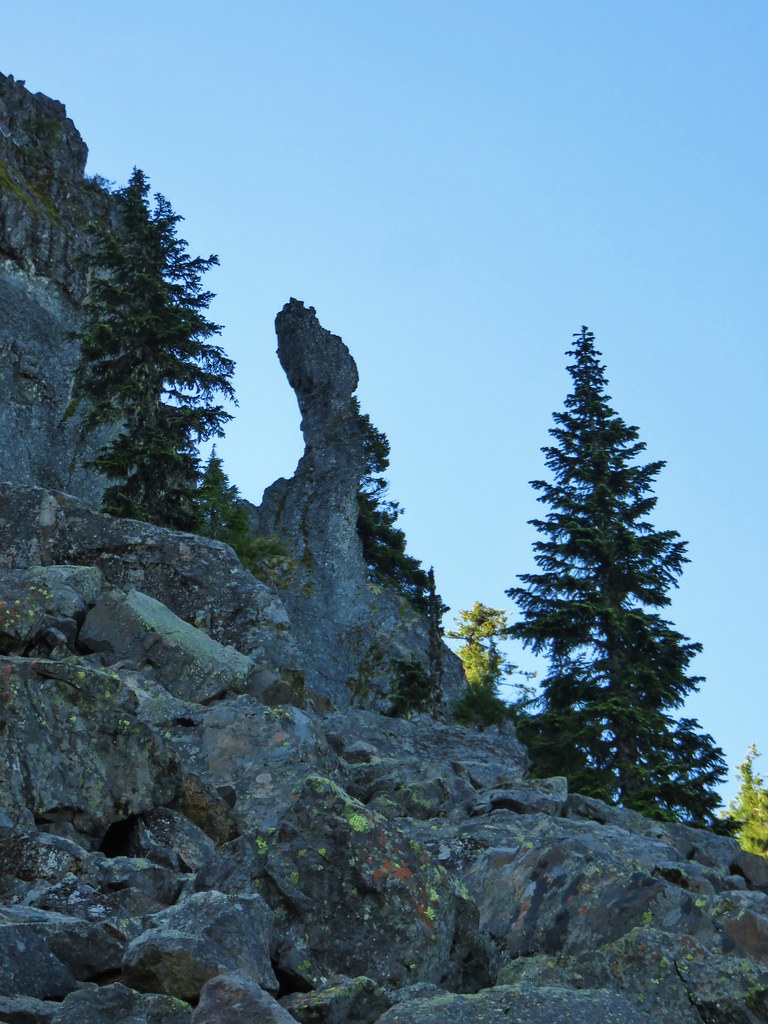
When we weren’t scanning the rocks for pikas we did a lot of looking up at the formations above us.
IMG_1616

IMG_1625

IMG_1628

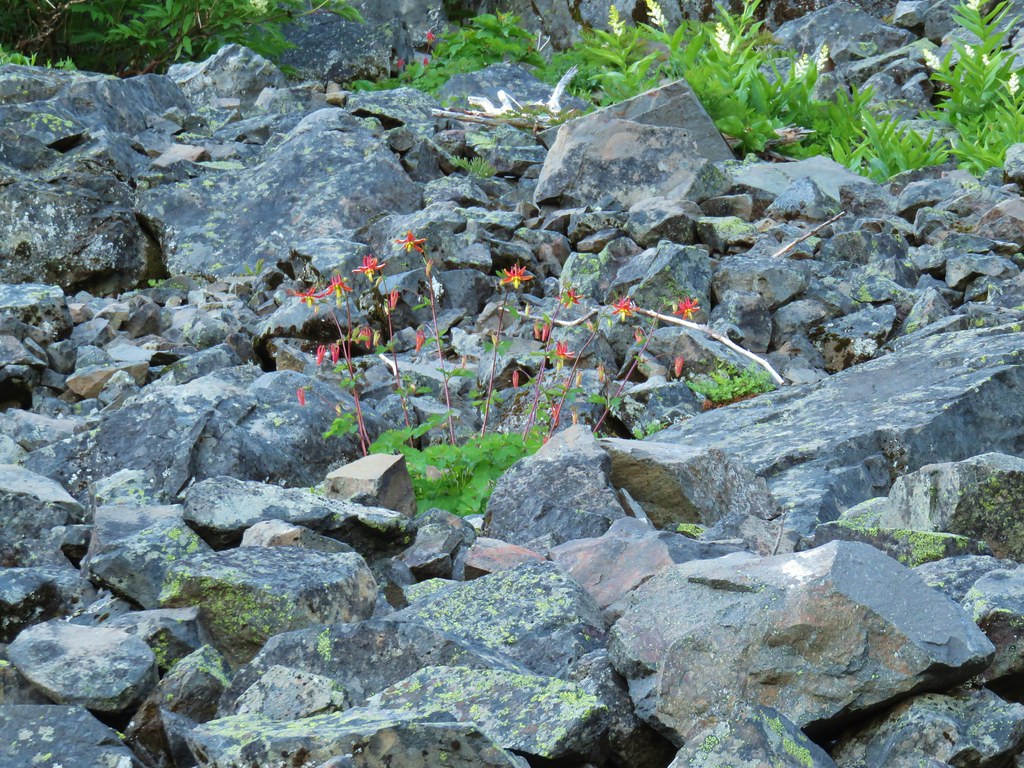
IMG_1636Columbine and solomonseal in the talus slope.

IMG_1630Last of the snow along the talus.

At a saddle a half mile from the junction with the Gold Hill Trail we came to a second junction. This one was unsigned. To the right a trail headed downhill to the Tidbits West Trailhead. The Gold Hill Trail used to continue straight here but it was so faint and overgrown that we didn’t even see it on the first pass. We turned uphill to the left and began the steep .2 mile climb to the summit.
IMG_1667

IMG_1679

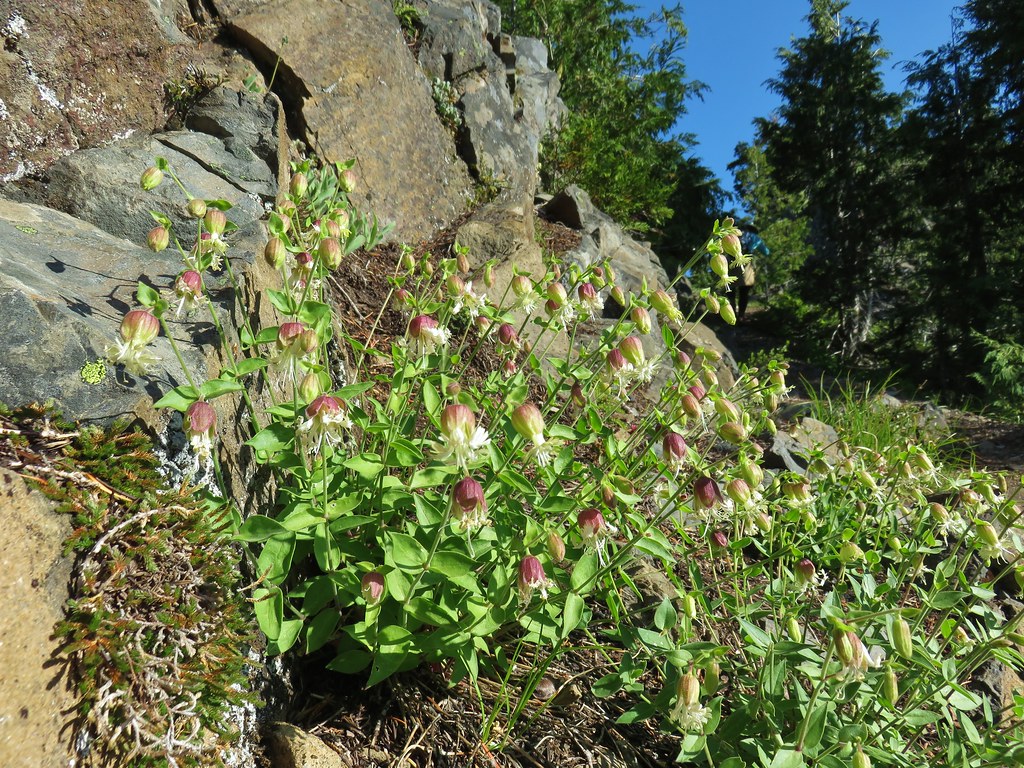
IMG_1684Catchfly on the way up.

IMG_1685Lookout remains below the summit.

IMG_1689

IMG_1693Foundation remains

IMG_1696Wildflowers at the summit.

The 360 degree view from the summit was very good although our timing meant the sun was overhead between us and the Cascades impacting the ability to get clear photos of those mountains.
IMG_1698NE we could see Mt. Hood, Mt. Jefferson, and Three Fingered Jack.

IMG_1703Mt. Hood

IMG_1705Mt. Jefferson behind Iron Mountain and Cone Peak

IMG_1707Three Fingered Jack

The eastern view added Mt. Washington, The Three Sisters, and Mt. Bachelor.
IMG_1764

IMG_1708Mt. Washington

IMG_1750Three Sisters

IMG_1718Mt. Bachelor

We could also just make out the lookout tower atop nearby Carpenter Mountain (post).
IMG_1755

To the SE we could make out Maiden Peak, Mt. Thielsen, and Diamond Peak.
IMG_1724

IMG_1719Maiden Peak (post)

IMG_1762Mt. Thielsen (post)

IMG_1722Diamond Peak

We spent a good amount of time on the summit taking in the view before descending to a lower viewpoint with a number of flowers.
IMG_1810

IMG_1813

IMG_1802Cat’s ear lilies

IMG_1806Oregon sunshine amid buckwheat

IMG_1807Penstemon and paintbrush

IMG_1816A fleabane or aster

IMG_1830

IMG_1819Looking down from the lower viewpoint.
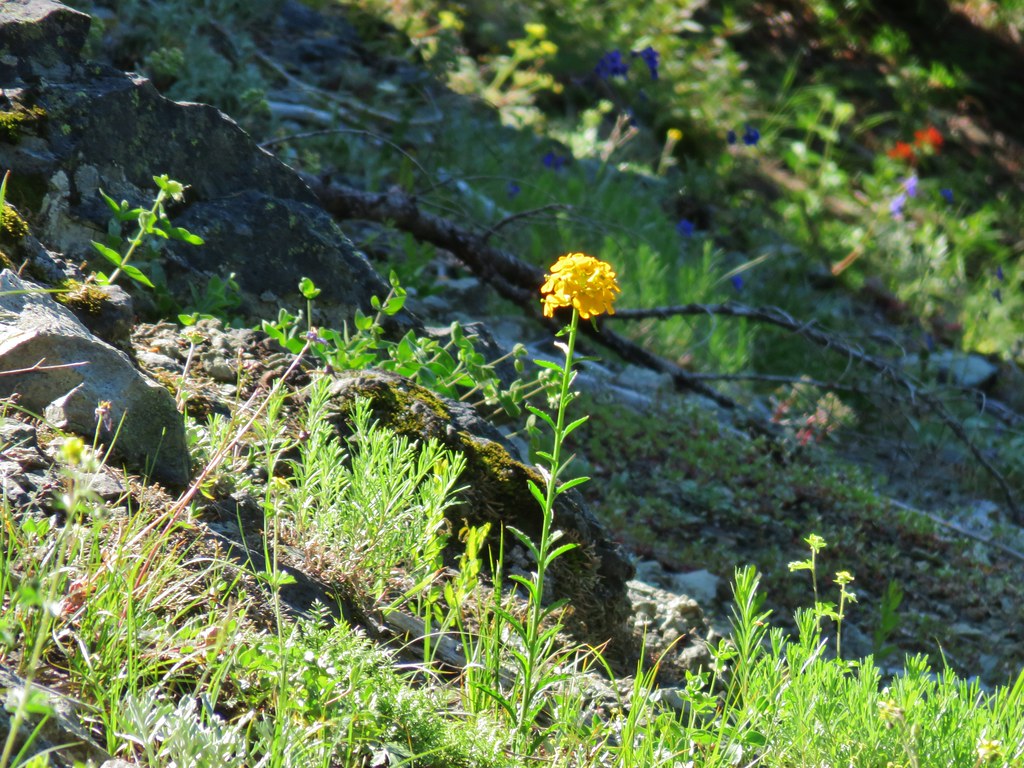
We then headed back down to the trail junction where we found the faint tread of Historical Gold Hill Trail. We followed it just far enough to get a close up view of a flower garden.
IMG_1862

IMG_1864

IMG_1850Western wallflower

IMG_1853Larkspur

20190629_092727Paintbrush

20190629_093003Cinquefoil

We returned to the Tidbits Mountain Trail and recrossed the talus slopes, this time we didn’t spot any pikas. We did stop to admire some of the flowers though.
20190629_093755Baneberry

20190629_093642Current

IMG_1879Bleeding heart, trillium and wood violets
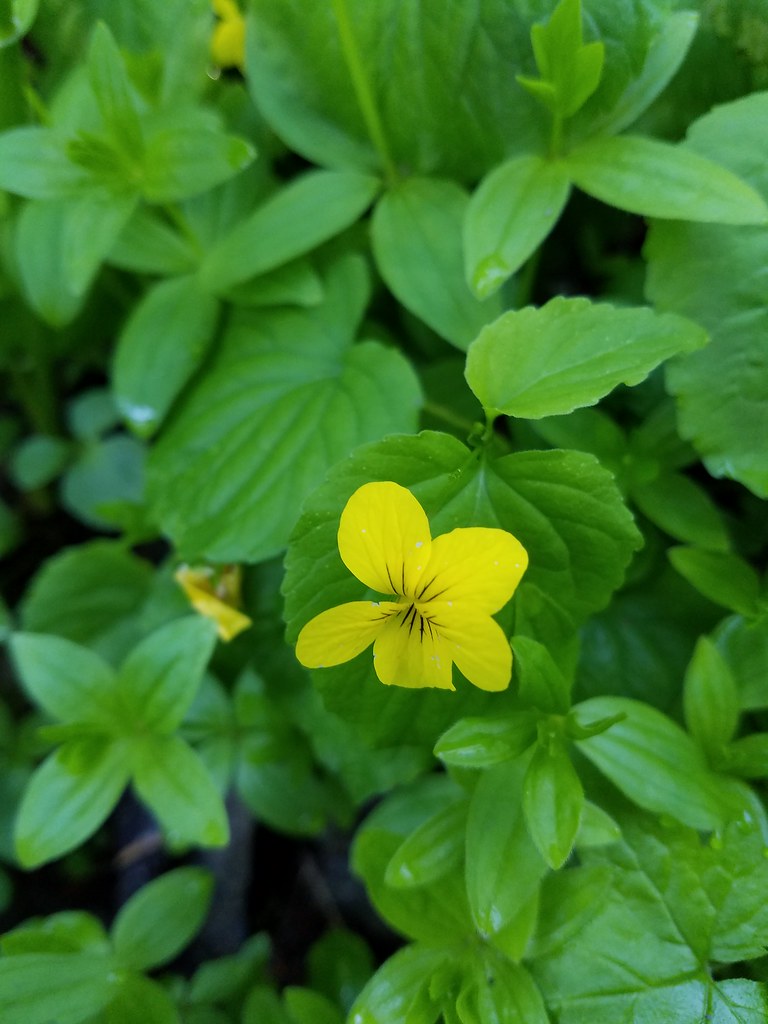
20190629_093952Wood violet

With the Sun starting to pass overhead Mt. Jefferson was a little more photogenic.
IMG_1890

When we arrived back at the junction with the Gold Hill Trail we briefly searched for any sign of a former shelter that was indicated on the map.
IMG_1892

After failing to uncover any sign of it we headed out on the Gold Hill Trail. Given the Forest Service mentioned that this trail only receives periodic maintenance we weren’t sure how far we might go but we were curious to check it out.
IMG_1893

The trail was pretty overgrown, not crowded with brush, but it had a lot of vegetation growing in the middle of it indicating a lack of use.
IMG_1898

We soon passed a rock outcrop where a patch of small monkeyflowers were blooming.
IMG_1907

IMG_1905

20190629_100226

We followed the trail a total of 2.7 miles losing a total of 800′ through a series of ups and downs as it followed a ridge to the north and east. We passed through some lovely forest filled with more blooming rhododendron and by several rock outcrops. There were occasional views of the Three Sisters and Mt. Bachelor through the trees and also spotted some deer, at least one doe and fawn, as they dashed away through the trees. Despite the lack of use and periodic maintenance the trail was in pretty good shape with just a few trees to step over.
IMG_1908

IMG_1914North and Middle Sister

IMG_1915

IMG_1917

IMG_1919

IMG_1922

IMG_1927Mt. Bachelor

IMG_1935

20190629_104300Showy phlox

IMG_1939Washington lilies getting ready to bloom

IMG_1941

IMG_1944

IMG_1946

IMG_1958

At the 2.7 mile mark the trail began a final 400′ descent in the remaining half mile to FR 1509. We weren’t overly keen on having to climb back up that just to say we reached the road plus we had set an 11:30 turn around time and it was just after 11:20. We noticed an open knoll just off trail to the right so we decided to check it out and make this be our turn around spot.
IMG_1965

The knoll turned out to be very interesting. In addition to some nice views there were a number of flowers.
IMG_1970

IMG_1975The Two Girls

IMG_1999Mt. Washington and the Three Sisters

IMG_1986Wolf Rock an Mt. Washington

IMG_2007North Sister

IMG_2008Middle Sister

IMG_2010South Sister

IMG_1990Mt. Jefferson had been overtaken by clouds but Iron Mountain and Cone Peak were still visible.

IMG_1996Buckwheat and paintbrush

IMG_2021Wallflower and cat’s ear lilies

IMG_2015Penstemon and paintbrush

After exploring the knoll we headed back looking for anything we missed on our first pass. We did notice a couple of interesting old tree trunks and a grouse crossed the trail in front of us.
IMG_2029

IMG_2040Young tree growing out of an old trunk.

IMG_2049Grouse

We made our way back to the Tidbits Mountain Trail and returned to the trailhead without seeing another person until we ran into a gentleman at the trailhead who seemed to just be out for a drive and looking around. We ended up with a 10.5 mile hike which was perfect. It was a nice way to end our vacation. Happy Trails!

Flickr: Tidbits Mountain

Categories
Clackamas Old Cascades Oregon Trip report

Fish Creek Mountain and High Lake – 6/28/2019

**Note the 2020 Riverside Fire burned most of this hike.**

After taking Wednesday and Thursday off from hiking due to less than favorable weather forecasts we headed out on Friday planning on hiking the Riverside Trail along the Clackamas River. The forecast was for a 40% chance of showers and partly sunny so we thought a river hike was a safe bet and the Riverside Trail was one of Sullivan’s featured hikes that we had yet to do.

As we turned onto Highway 242 at Estacada though we began to rethink our plan. The sky had been relatively clear so far and we hated wasting a good river hike on a day where there might be views to have. Prior to knowing what the weather was going to be like we had originally had Fish Creek Mountain as one of our hikes for the week and as luck would have it the trailhead for that hike was also off of Highway 242. When we reached the sign for Indian Henry Campground (just before the 4th green bridge coming from the west) we veered right onto FR 4620. We followed this one lane paved road for 5.1 miles to gravel where we forked uphill for an additional 2.6 miles to the trailhead on the left. The trailhead is an old roadbed that is only marked by a wooden sign on a tree next to the start of the Fish Creek Mountain Trail. (Note: The sign is unreadable unless up close.)
IMG_1089

The trailhead was moved to this location following the road to the original trailhead being washed out in 1996. The trail here was constructed by volunteers who connected it to the washed out road .4 miles from the original trailhead.
IMG_1090

The trail gains 500′ over seven tenths of a mile as it climbs through a mixed forest to the decommissioned road.
IMG_1093

IMG_1097

IMG_1098

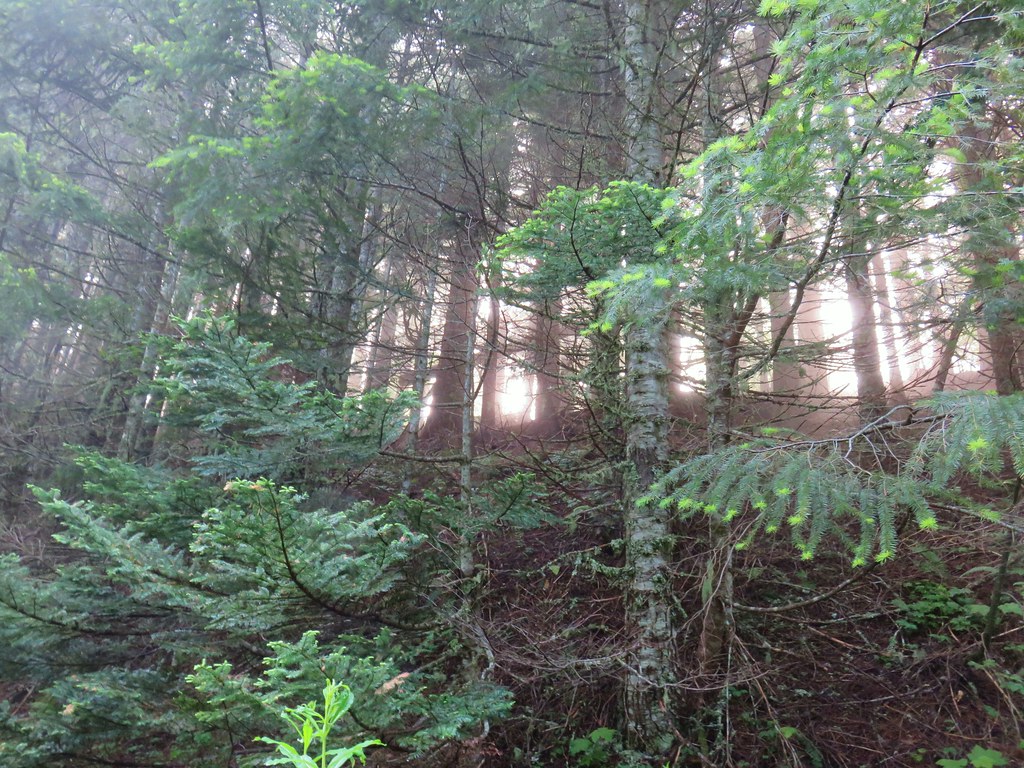
We started to question our decision as we found ourselves in a bit of fog as we arrived at the old road.
IMG_1104

IMG_1116Columbine along the decommissioned road.
IMG_1118

The trail along this stretch was a bit overgrown in places and the moisture from the plants soaked us pretty good.
IMG_1120

After a relatively level .4 miles along the road we arrived at the original trailhead where the trail headed up a ridge past a trail marker.
IMG_1132

The trail climbed along the ridge and as it did we began to emerge from the fog.
IMG_1136

IMG_1135

IMG_1137

The ridge was mostly forested with a few views to the west through the trees, but as we climbed occasional small meadows popped up filled with wildflowers.
IMG_1151

IMG_1152

IMG_1158

IMG_1168

IMG_1174

IMG_1176

20190628_075839

IMG_1181

20190628_080307

IMG_1199

Just over a mile and a quarter from the old road we came to a rocky outcrop where the flowers were amazing. As a bonus there was a nice view of Mt. Jefferson to the SE.
IMG_1208

IMG_1220

IMG_1229

IMG_1241

IMG_1216

IMG_1219

It wasn’t the largest wildflower area by any means, but there was an impressive variety of flowers in bloom, so much so that we stopped again on our way down.
IMG_1213Buckwheat

20190628_081050A penstemon

IMG_1232False sunflower

IMG_1239A penstemon

20190628_081334Oregon sunshine

>IMG_1251Lupine among others

20190628_081532Cliff beardstounge

20190628_081630Catchfly

IMG_1267Groundsel

IMG_1268blue head gilia

IMG_1283Bleeding heart

20190628_110821Paintbrush

20190628_110922Woodland stars

IMG_1470Larkspur and ballhead waterleaf

20190628_110713Yarrow

20190628_111116Valerian

20190628_110406Cat’s ear lily

20190628_110329Wild rose

20190628_110300Buckwheat in blue head gilia

20190628_082032Thimbleberry

IMG_1472Larkspur, leafy pea, and candy flower

IMG_1286Rhododendron (just around the corner from the outcrop)

Beyond the viewpoint the trail gained an additional 600′ over the next .7 miles to a fork. There were a few more flowers along this stretch, mostly white forest varieties.
20190628_082236Star-flowered solomonseal

20190628_082244Plumed solomonseal

20190628_082253Vanilla leaf

20190628_082630Pussytoes

IMG_1317Beargrass

IMG_1320Trail fork

From the fork the Fish Creek Mountain Trail continues uphill a little under a half mile to the site of the former lookout tower at the summit. The fork to the right heads downhill for .7 miles to High Lake. With blue sky overhead we decided to visit the summit first and stayed left at the junction.
IMG_1321

IMG_1328

Some of the foundation remains from the old lookout at the overgrown summit.
IMG_1330

Despite the blue sky overhead clouds had moved in around us effectively eliminating any mountain views (Mt. Jefferson should have been visible from the summit). We rested a bit checking out the beargrass and a green beetle that was scurrying through the grass.
IMG_1334

20190628_091138

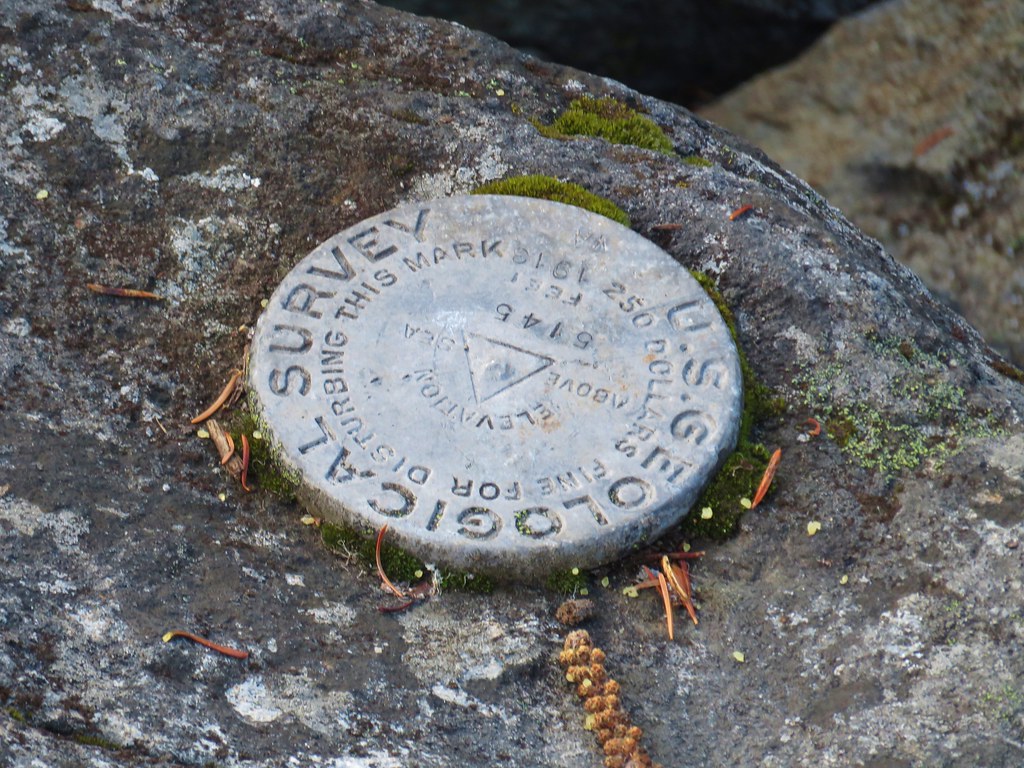
We started back down and noticed a side trail to the left about 110 yards from the old lookout site. We headed up this path which lead to a rocky outcrop with a survey marker.
IMG_1339

It looked like it would have been a pretty good viewpoint but for us it was just a view of the clouds passing by.
IMG_1337

IMG_1338

IMG_1340

After watching for a view of Mt. Hood that never developed in a break in the clouds as they passed by we returned to the trail fork and turned left toward High Lake.
IMG_1362

IMG_1363

This trail lost nearly 500′ as it wound down to the small glacial lake. Nestled in a basin below Fish Creek Mountain the vegetation along the trail was quite a bit behind that along the Fish Creek Mountain Trail. Here huckleberry bushes were still sprouting leaves and trillium were still in bloom.

IMG_1366

We even ran into a small patch of snow hiding under some downed branches along the trail.
IMG_1370

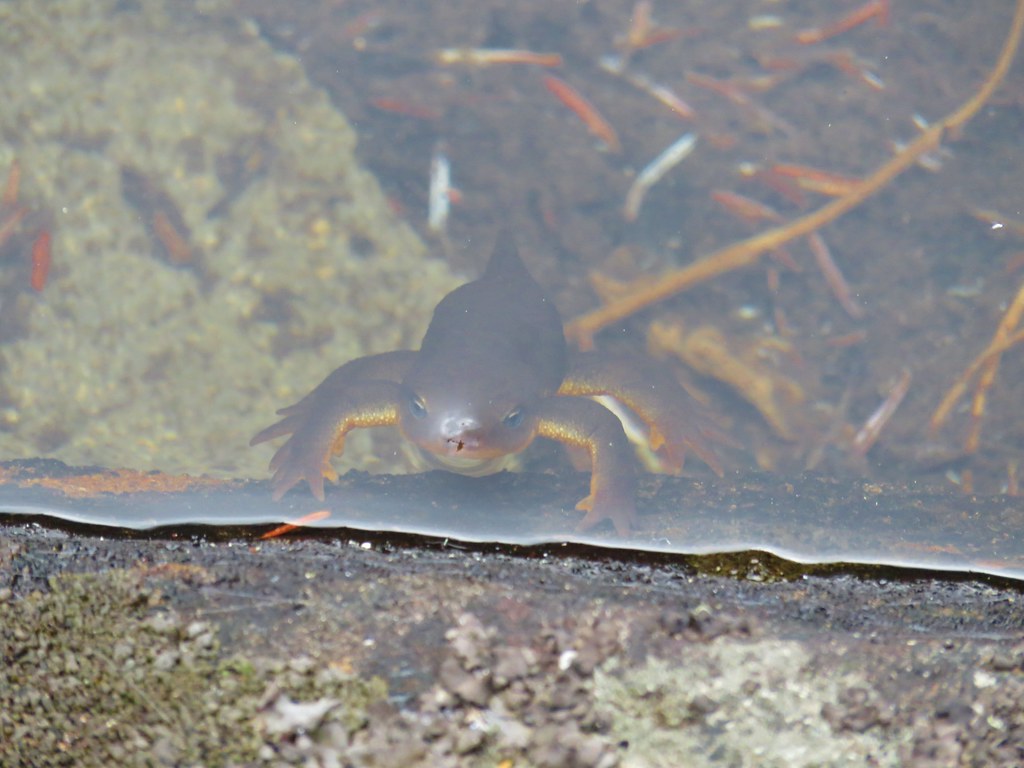
The small lake was quite pretty and it was also full of rough skinned newts.
IMG_1377

IMG_1388

IMG_1397

We followed a rough use trail around the lake past a handful of campsites.
IMG_1405

IMG_1406

IMG_1417Curious newt

IMG_1419

It was a little too chilly to hang out by the lake so after completing the loop we started back up to the Fish Creek Mountain Trail. Along the way we finally got a glimpse of part of Mt. Hood, albeit not much of one.
IMG_1427

Mt. Jefferson had all but disappeared too when we stopped back at the flower filled viewpoint.
IMG_1432

We had at least had a good view earlier and the wildflowers had made this a great hike even if we hadn’t had any views. We headed back down looking for any other flowers to take pictures of and found a few.
20190628_113006_001Inside out flower

20190628_113615Spotted coralroot

20190628_113701Stripped coralroot

20190628_114624Starflower

IMG_1489Candy sticks

IMG_1500Wild strawberries

We were happy with our decision to forgo the Riverside Trail in favor of this hike. We had not expected to see such a variety of flowers in bloom which was a pleasant surprise. The combination of the flowers, a view of Mt. Jefferson and a nice lake made for a great 8.1 mile hike. Happy Trails!

Flickr: Fish Creek Mountain

Categories
Central Coast Hiking Oregon Oregon Coast Trip report

Cascade Head, Whalen Island, and Sitka Sedge – 6/25/2019

As we finished up a four day stretch of hiking to start a week of vacation we were looking for the best chance of decent weather which brought us to the Oregon Coast for our second visit to Cascade Head. I had originally had a grandiose plan to hike from the lower trailhead all the way over to Harts Cove (post) but I hadn’t paid close enough attention to detail and we wound up going with a plan B.

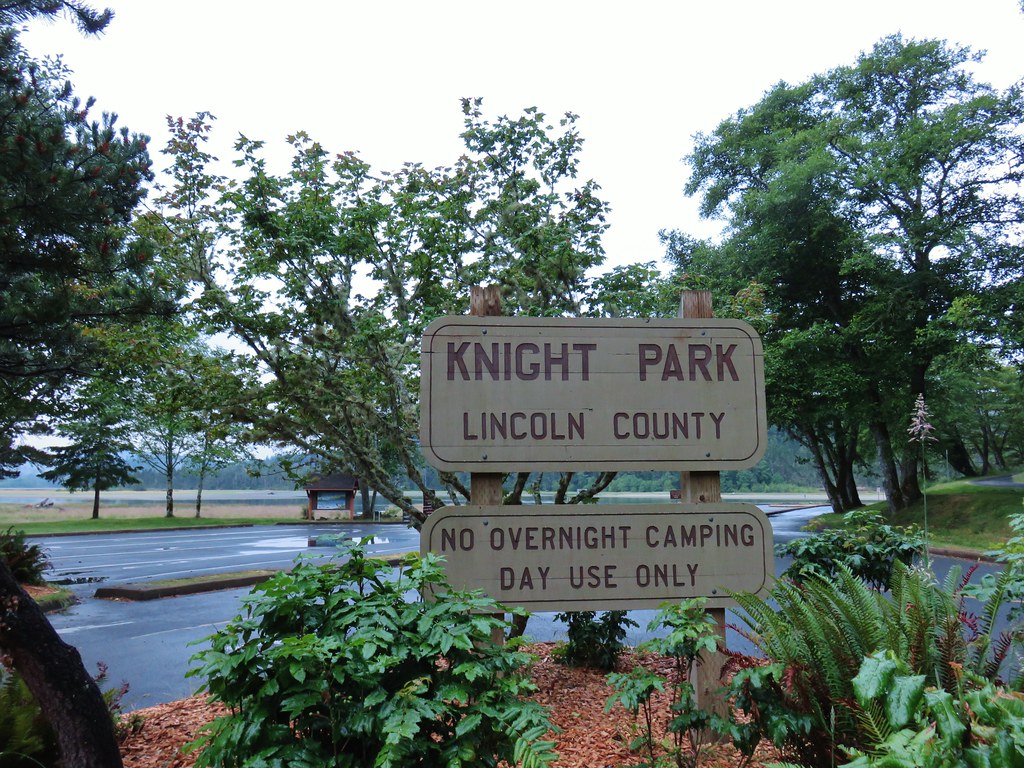
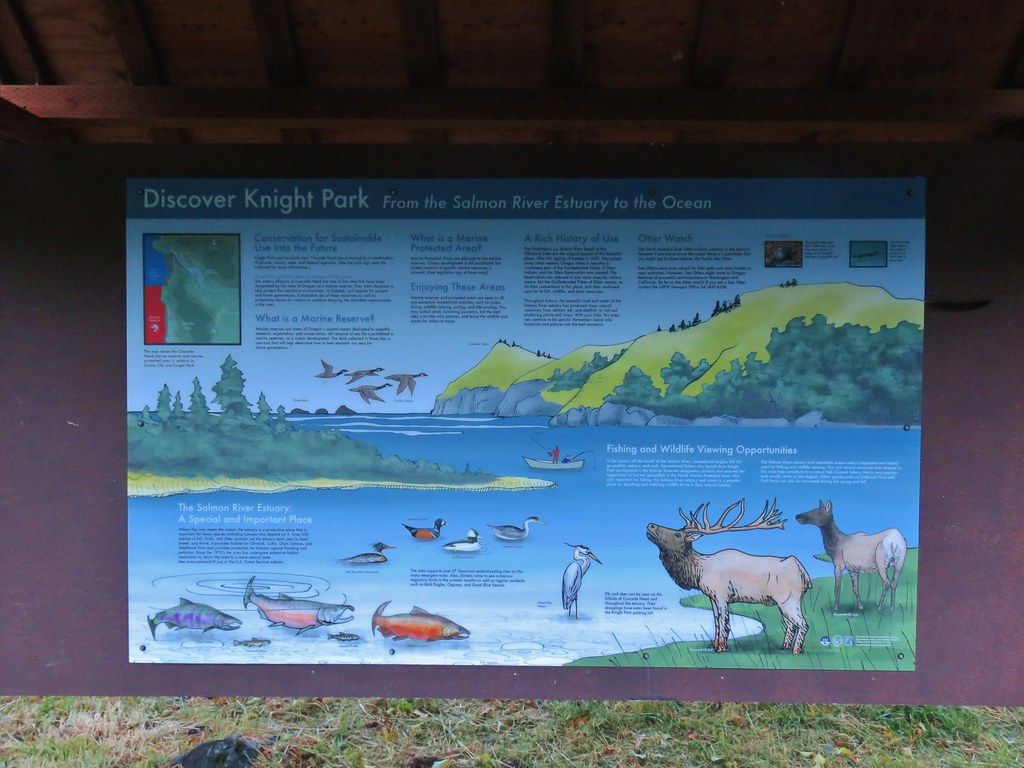
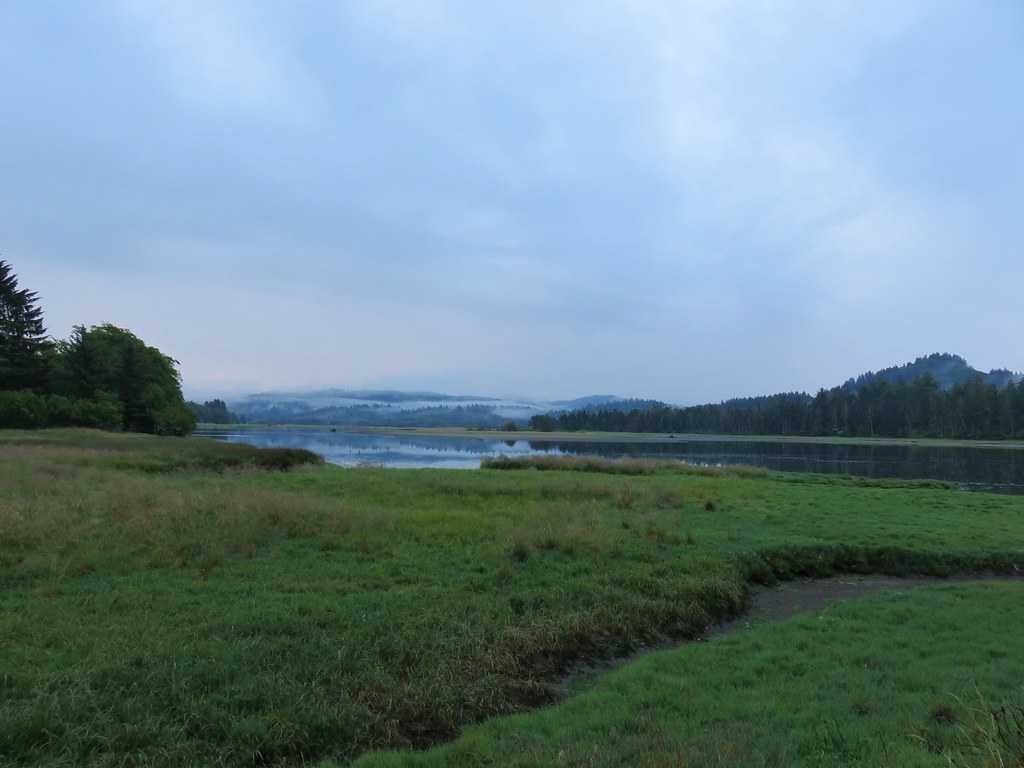
We started the morning at Knight County Park.
IMG_0774

IMG_0775

IMG_0776Salmon River at Knight County Park
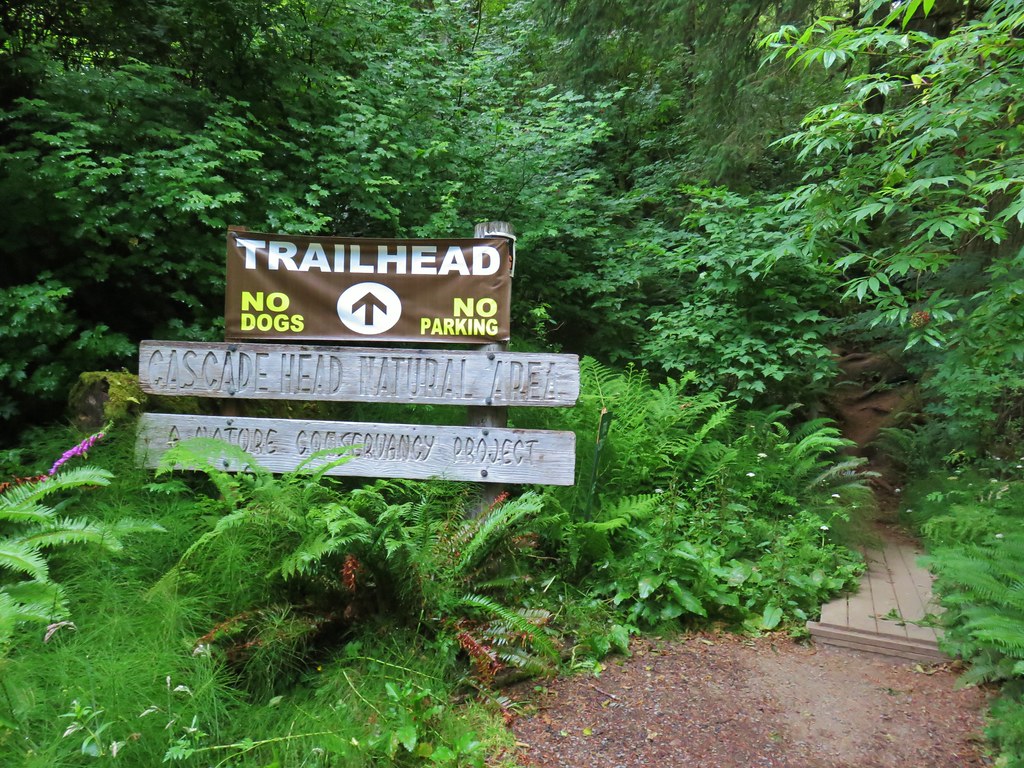
It had rained throughout most of our drive through the Coast Range but we were pleased to have been able to see the meadows on Cascade Head as we drove to the trailhead. We set off on the Nature Conservancy Trail which quickly crossed Three Rocks Road.
IMG_0777

IMG_0778

The trail climbed through the forest along Savage Road popping out of the trees at a field where we could see that the meadows were not nearly as clear as they had been just a bit earlier.
IMG_0785

IMG_0786

The fact that we could see the ocean was a bit encouraging though.
IMG_0787

After crossing to the other side of the road the trail passed an active slide and recrossed to the original trailhead.
IMG_0788

IMG_0789

The trail continued to climb through the forest before leveling out for a bit as it crossed a series of overgrown streams on footbridges.
IMG_0794

IMG_0797

IMG_0801One of the bridges.

IMG_0804Overgrown stream

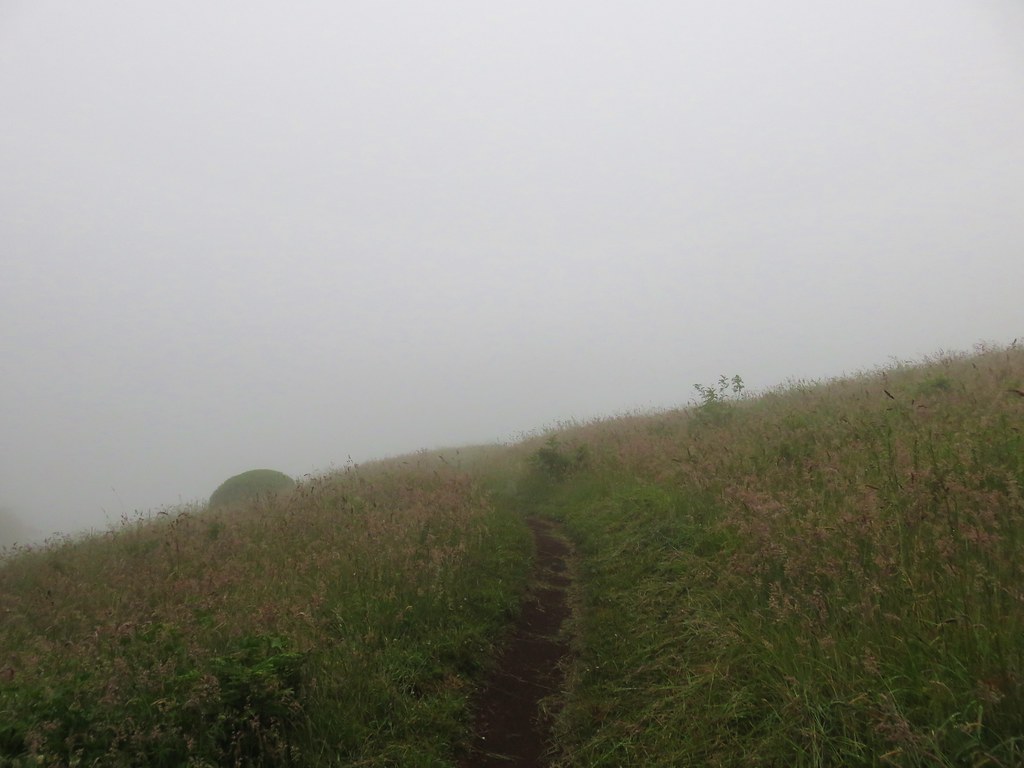
When we finally popped out of the trees around the mile and a half mark we found ourselves in some pretty thick fog.
IMG_0807

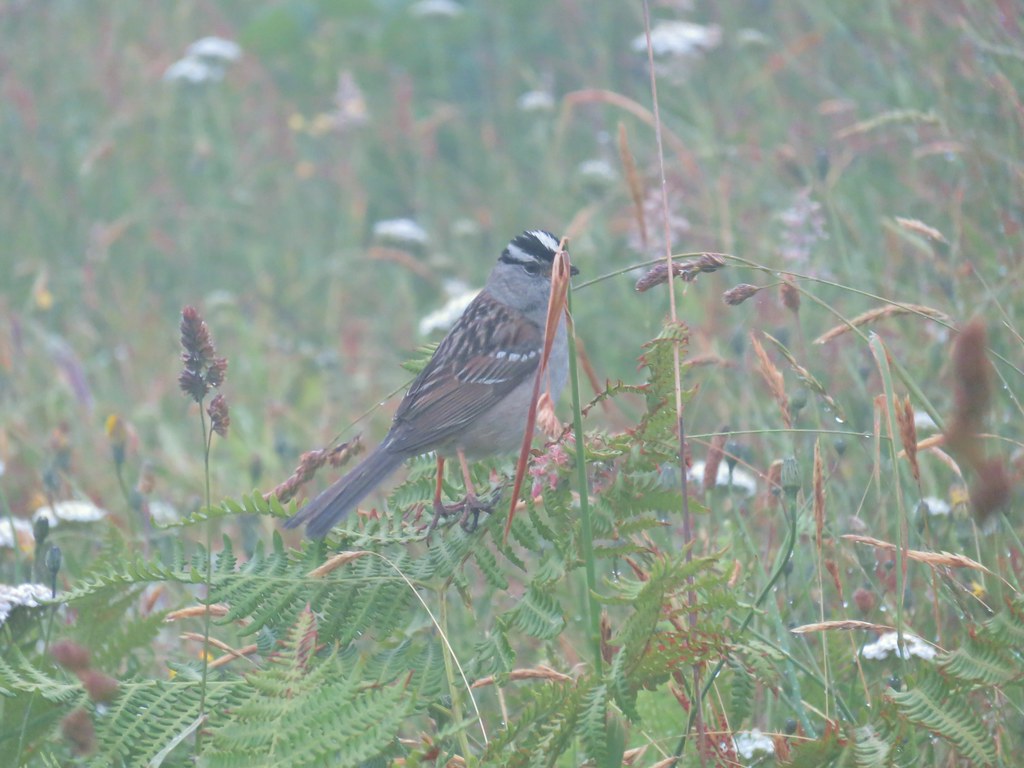
We had hoped to see some of the elk herd that lives on Cascade Head but we couldn’t see much of anything, although we did spot a few birds.
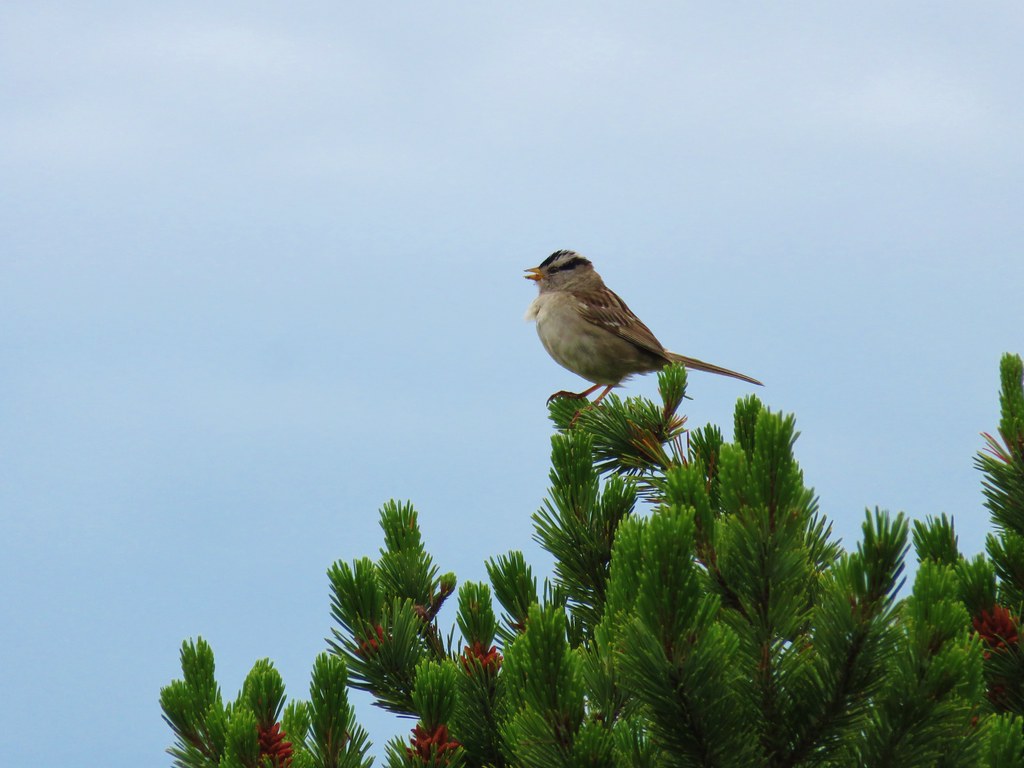
IMG_0811White crowned sparrow

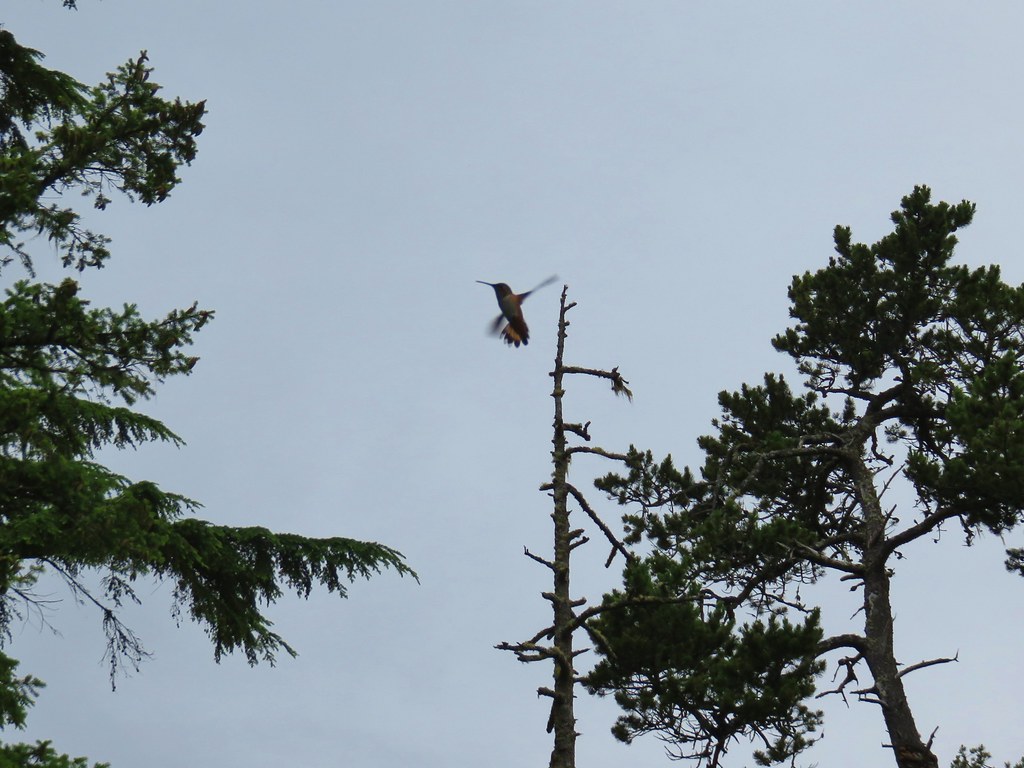
IMG_0818One of three hummingbirds

IMG_0844Another white crowned sparrow

There were just a few flowers scattered about as we made our way through and up the grassy meadow.
IMG_0824Checkerbloom

IMG_0832Monkeyflower

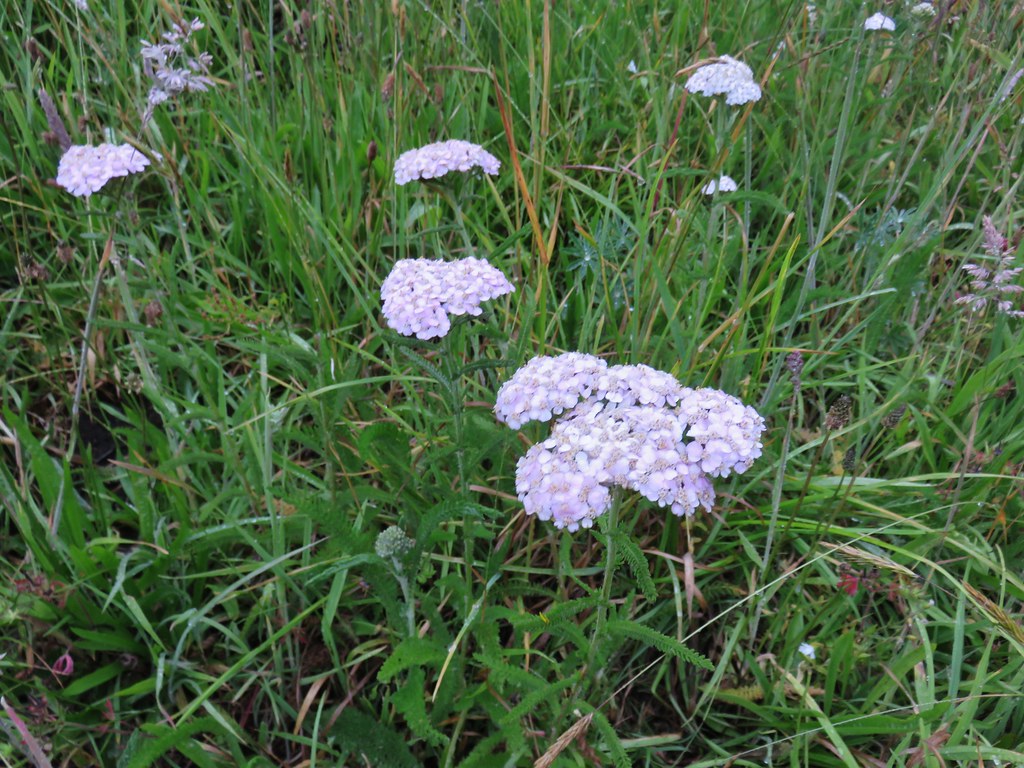
IMG_0835Yarrow

IMG_0848Field chickweed

IMG_0914Lupine

Parsley-leaf Lovage
Parsley-leaf Lovage

IMG_0853Foxglove with a spider web

IMG_0862Clovers

IMG_0875Iris

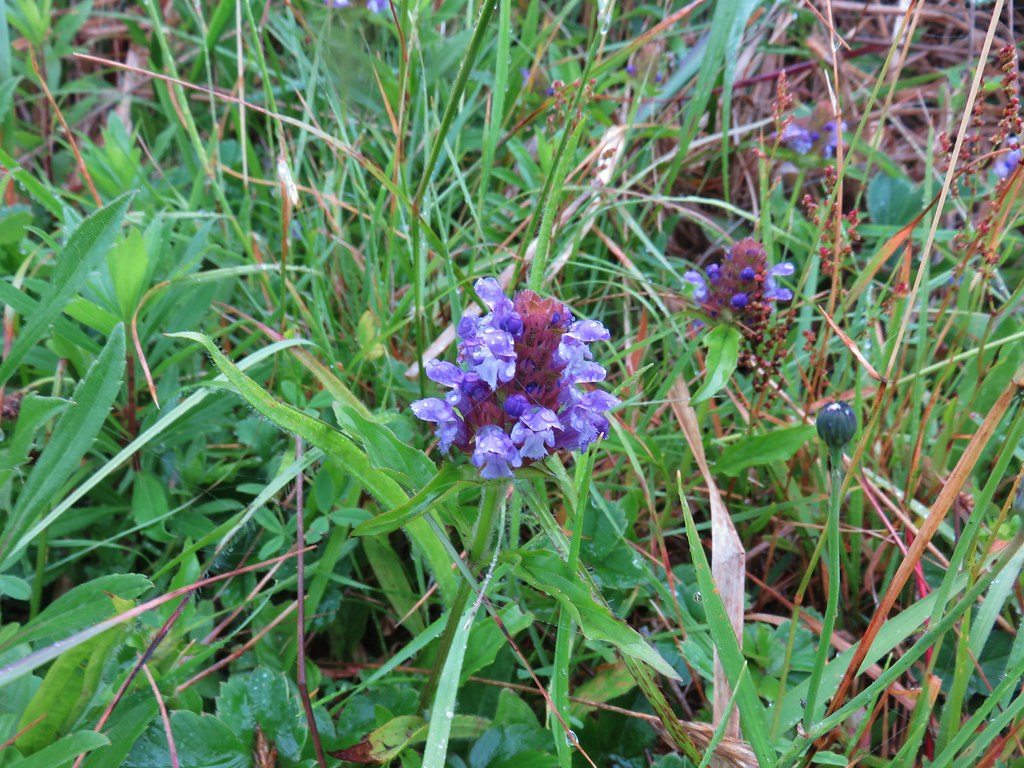
IMG_0880Self-heal

With no views from the meadows when we finally reached the upper viewpoint we headed into the forest.
IMG_0865

IMG_0868

When we came to Siuslaw National Forest boundary my lack of attention to detail became apparent. I had seen where the road to the Upper Trailhead was closed annually from January 1st through July 15th, but I hadn’t noticed that the entire area starting at the boundary was closed to all traffic during that time period.
IMG_0869

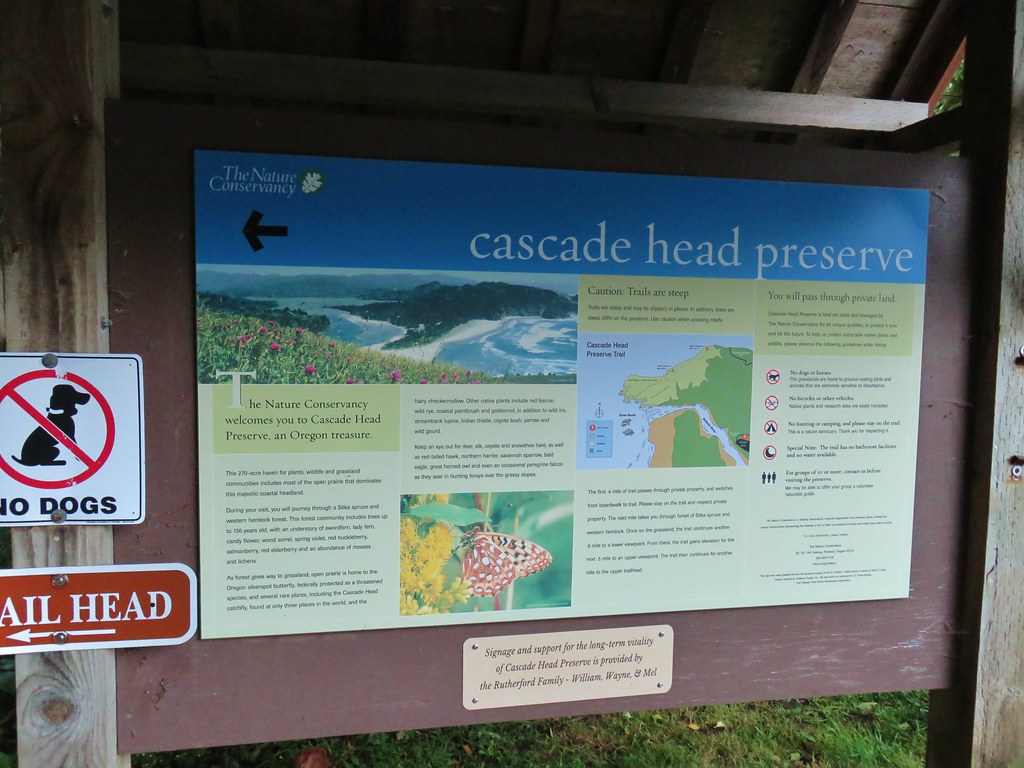
So much for that plan. We gathered under the awning over the Nature Conservancy signboard and mulled over our options. We decided that it might be a decent time to check out a couple of other nearby hikes – Whalen Island and Sitka Sedge. These two hikes would be just a little less mileage than our original plan with quite a bit less elevation gain, plus they were close to Pacific City which gave us a great excuse to have lunch at the Pelican Brewing Company.

With a new plan we headed back to the upper viewpoint where the conditions had improved slightly. We could make out the trees and even a bit of the ocean in the distance through the fog.
IMG_0873

The problem seemed to be that the clouds/fog wasn’t coming in from the Pacific but was instead coming from inland up the Salmon River. We paused for a moment wondering if the view might clear up. While we were watching we spotted a doe walking along the tree line.
IMG_0877Look for the head to the right of the tall foxglove stalk.
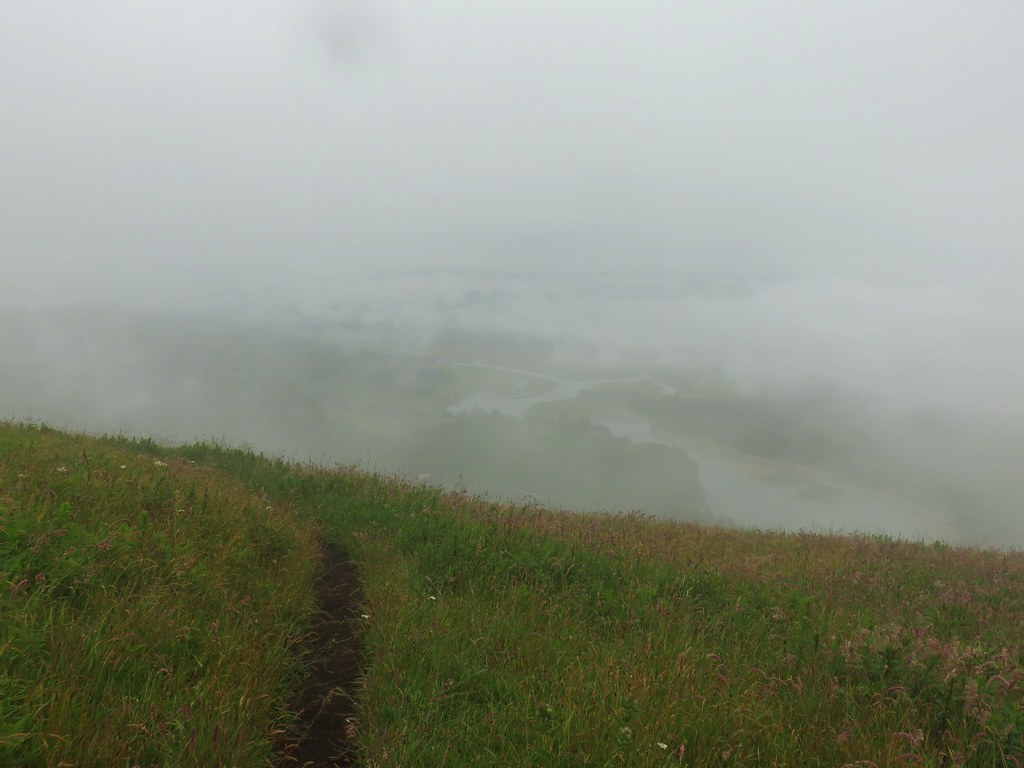
We decided to keep descending figuring that we would still have a good view if the fog did happen to lift.
IMG_0882

As we were headed in the direction of the Salmon River the fog did indeed clear in a span of just over a minute.
IMG_0892

IMG_0893

IMG_0897

IMG_0900

It was a remarkable change. As we were admiring the new, clearer view we noticed a pair of deer feeding in a gully far below us.
IMG_0909

As we continued downhill we were encourage to see an actual pocket of blue sky.
IMG_0921

We stopped to take in the view from the lower viewpoint.
IMG_0937

IMG_0939

From the lower viewpoint the trail turned back inland where things were taking another turn. It was now beginning to rain.
IMG_0940

It was a fairly quick, damp, descent back to the car. We were briefly followed by a young fawn who quickly ran the other way when we turned around and spotted it. We had heard a couple of odd noises which caused Heather to turn and notice it. Were aren’t sure what prompted it to follow but hopefully it got back to it’s bed and mother.

The rain had ended by the time we arrived back at Knight Park and we headed north along Highway 101 for 12.7 miles to a sign for Pacific City and Sand Lake where we turned left. This was Brooten Rd. which we followed for 3.5 miles before turning left onto a bridge across the Nestucca River and into Woods. After 2.3 miles on what was now Sandlake Rd. we turned right at a T-shaped junction remaining on Sandlake Rd. for 2.9 more miles to the Clay Myers State Natural Area at Whalen Island on the left.
IMG_0948

It was overcast here but not raining or foggy so that was a plus. We began our loop hike here by taking a trail near the southern end of the parking area.
IMG_0953

The 1.5 mile loop here passes several viewpoints of Sand Lake and the Lillian Parker Craft wetland. Near the first viewpoint we spotted a rabbit.
IMG_0954

IMG_0963

IMG_0964

The trail was nice and there were a few flowers along with the views.
IMG_0966

IMG_0969Lupine

IMG_0972White crowned sparrow

IMG_0973

IMG_0974Cape Lookout (post)

IMG_0979Beach morning glory

At the wetlands a curious hummingbird came to check us out.
IMG_0990

IMG_0993

IMG_1001Groundcone

IMG_1011Tiger lily

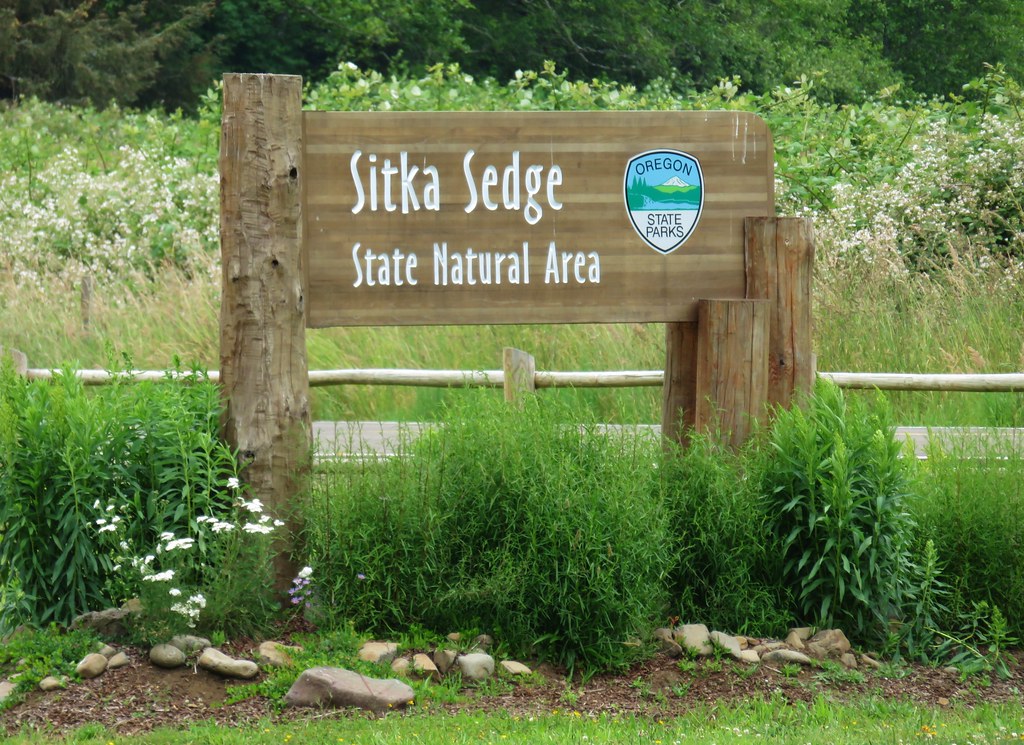
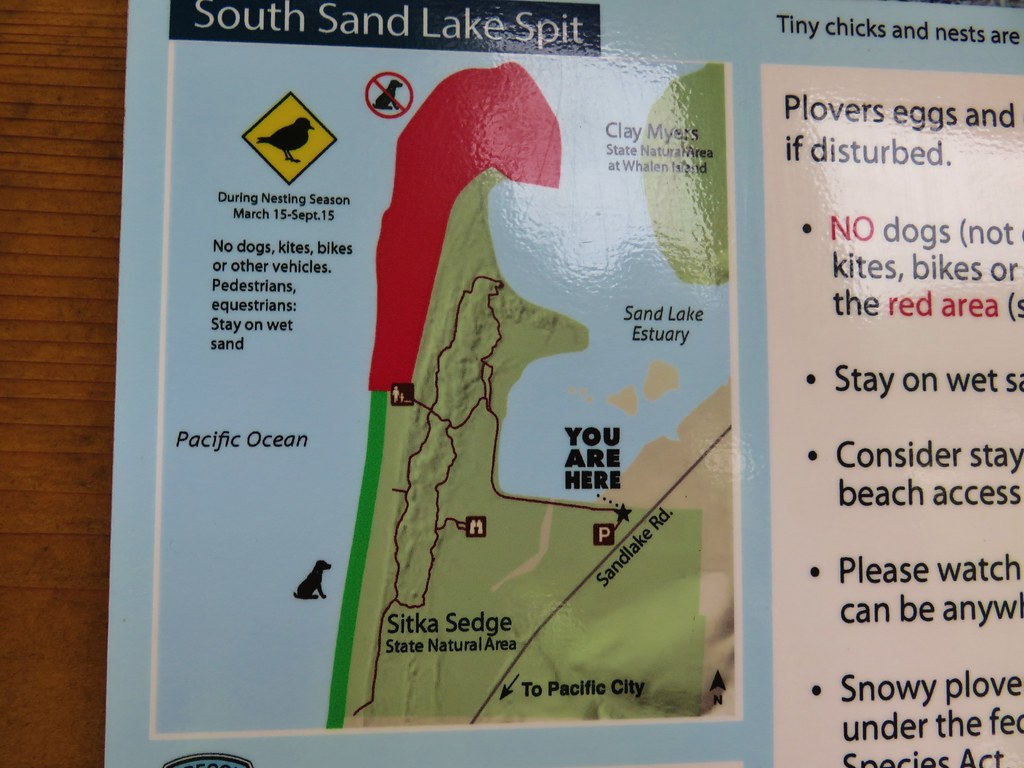
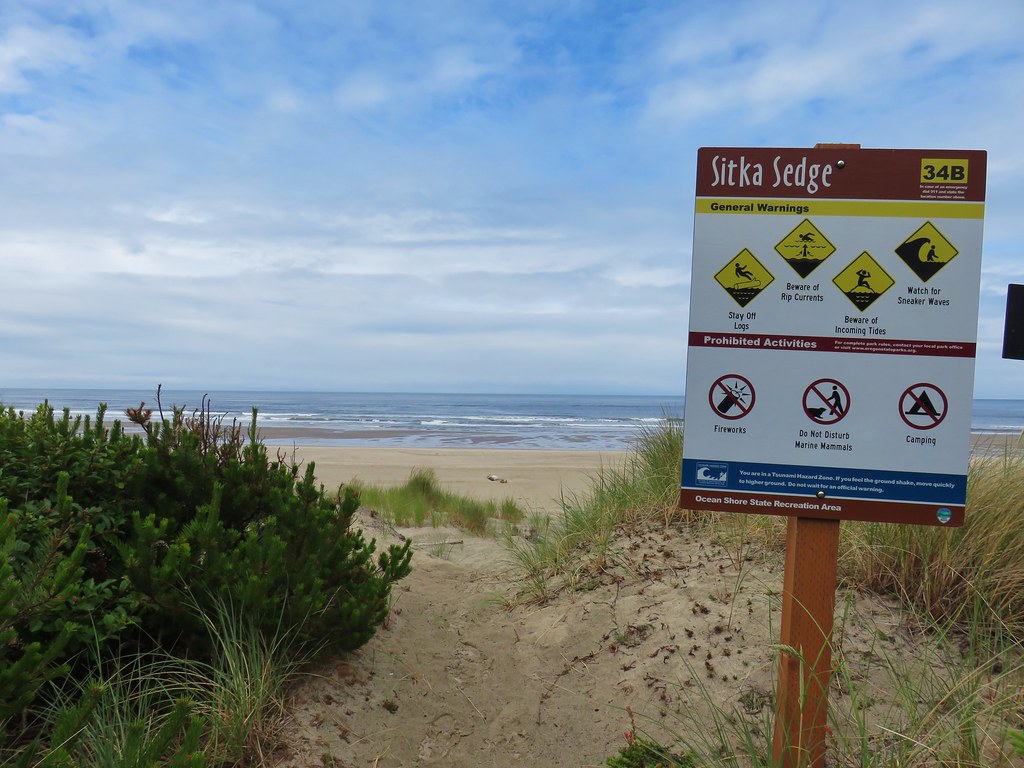
After completing this short loop we drove back south along Sandlake Rd a mile and turned right into the Sitka Sedge State Natural Area. Purchased by the State in 2014 this is a relatively new hiking area offering a couple of loop options.
IMG_1017

IMG_1019

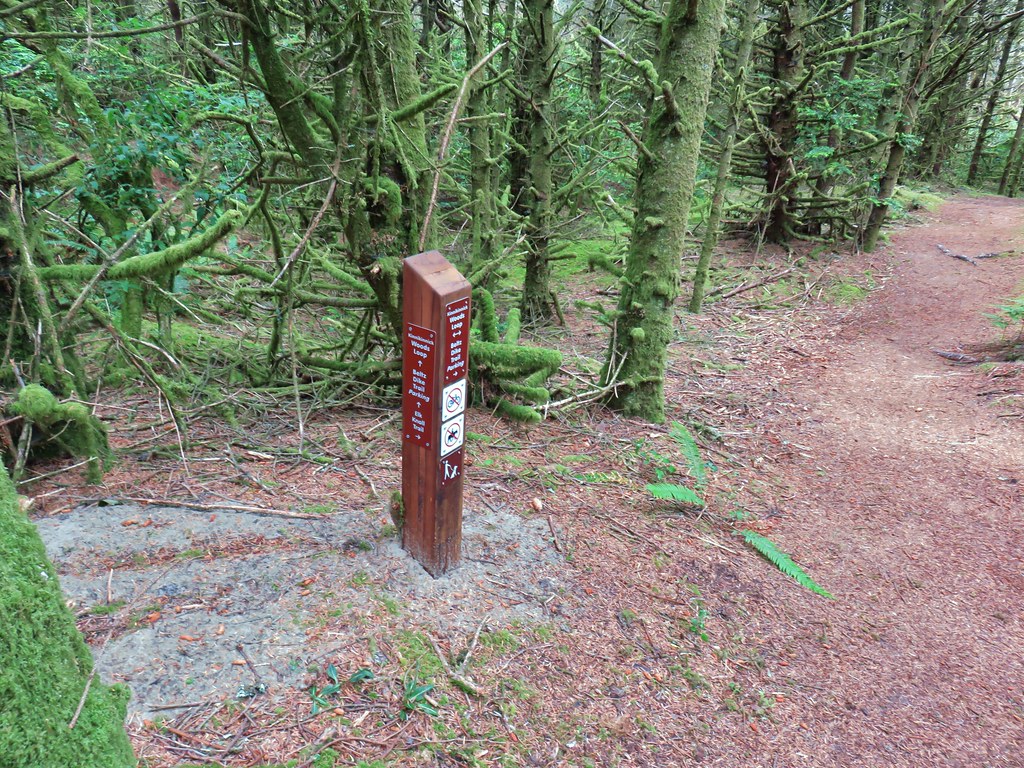
We followed the Beltz Dike Trail to the start of the loops.
IMG_1022

With water and wetlands on both sides of the dike we were a bit surprised by the lack of wildlife which was basically just a few ducks, some crows, and a number of smaller birds.
IMG_1023

IMG_1024

IMG_1027

There appeared to have been quite a display of roses a bit earlier in the year.
IMG_1031

On the far end of the dike we turned right onto the Estuary View Loop.
IMG_1036

IMG_1038

This trail passed through a typical coast forest and climbed to a viewpoint above the Sand Lake Estuary.
IMG_1043

IMG_1045

We scanned the estuary for any interesting wildlife but didn’t spot anything so we continued on. As the trail looped around and began heading south it became quite a bit sandier requiring a little extra effort.
IMG_1049

At a rise in the trail there was a view south to Cape Kiwanda and Haystack Rock (post).

IMG_1052

We missed the the pointer for beach access where the Woods and Estuary View Loops met and continued south on what was now the Kinnikinnik Woods Loop.
IMG_1054

This section was much less sandy which made it easier to walk on.
IMG_1056

At the next trail sign we did follow the beach access pointer but we mistook it on the map for the one we had already passed.
IMG_1059

This path was a slightly longer route to the beach as it first paralleled it for nearly two tenths of a mile before a short spur trail to the right led out to it.
IMG_1060

IMG_1061

IMG_1062

Cape Lookout lay to the north while Cape Kiwanda and Haystack Rock were to the south.
IMG_1064

IMG_1068

IMG_1070

When we left the beach we turned right thinking that this was still the Kinnikinnik Woods Loop but a quick look at the Garmin showed that we were quickly approaching the outskirts of Pacific City so we promptly turned around and headed back to the junction and got ourselves back on the correct path.
IMG_1074

We took a final short detour at the pointer for the Elk Knoll Trail.
IMG_1075

This 500′ long path led to a bench atop a small knoll, there were no elk present.
IMG_1077

IMG_1078

After sitting briefly on the bench we completed the loop but not before Heather did one of the craziest dances I’d ever seen as we were walking along the trail. She had suddenly seen something right in front of her and thought it was some kind of big insect coming for her. It wasn’t.
IMG_1087Obstacle hanging over the trail.
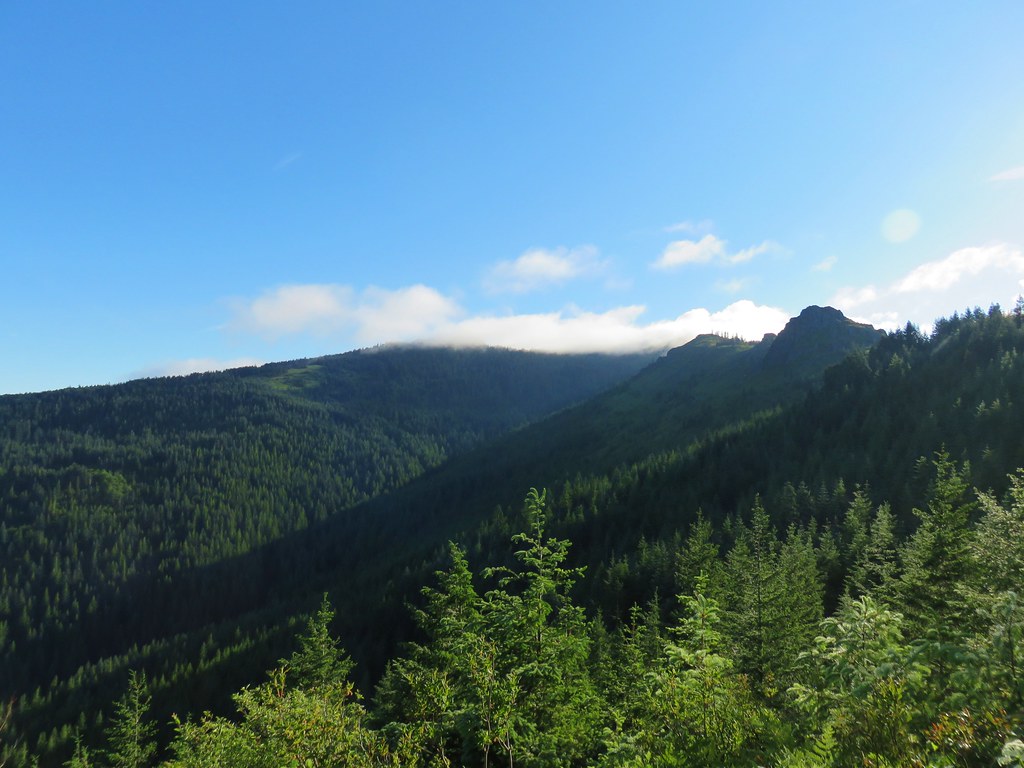
We both got quite a laugh out of her fancy moves and chuckled all the way back to the trailhead. Despite our detour the hike here was still under 4 miles bringing the days total to 11.1 miles.

After a quick change we drove into Pacific City and stopped at the Pelican Brewery before heading back to Salem. The food and drink were a nice way to end four days of hikes. With more rain in the forecast over the next couple of days we’ll see when and where our next hike takes us. Happy Trails!

Flickr: Cascade Head, Whalen Island, and Stika Sedge

Categories
Hiking Silver Star Mountain SW Washington Trip report Washington

Silver Star Mountain via Grouse Vista – 6/24/2019

We continued to rearrange our vacation plans based on a seemingly ever changing forecast. On Sunday night the Monday forecast for Silver Star Mountain was mostly sunny so we decided to make our third visit to the area. Our first hike at Silver Star Mountain began at the Silver Star Mountain Trailhead in 2013 (post). The road to that trailhead has become extremely rough and is now only recommended for high clearance vehicles. Then in 2015 we used the Bluff Mountain Trail to visit Silver Star (post). A better road but still a bit rough and further away.

For this visit we would start at the Grouse Vista Trailhead. We took the Battleground approach described in the trailhead link which was a mostly paved road approach with just a final 5.5 miles of decent gravel driving.

The Tarbell Trail crosses the road at the trailhead. The route to Silver Star begins on the far side of the road, opposite the restrooms and signboard. (A Washington Discover Pass is required to park here.)
IMG_0277

IMG_0278

The trail climbs from the start as it follows an old roadbed uphill.
IMG_0279

The Tarbell Trail splits off just before the .2 mile mark allowing for a loop. We stayed right at the fork on the Grouse Vista Trail.
IMG_0280

The trail gains 500′ over the next half mile as it climbs up a ridge end. The rocky surface provides an added challenge.
IMG_0282

IMG_0285

As the trail begins to emerge from the trees Sturgeon Rock is visible across the Rock Creek Valley (when clouds aren’t hovering over it). The loop route that we were considering would have us descending beneath Sturgeon Rock.
IMG_0299

The trail continued to climb around the ridge and we soon found ourselves with a view of Pyramid Rock (and the Sun).
IMG_0308

IMG_0311Sturgeon Rock (still with cloud) and Pyramid Rock

A smattering of flowers were popping up along the trail as we approached Pyramid Rock.
IMG_0301Wild iris

IMG_0304Paintbrush and lupine

IMG_0309Daisies

IMG_0317Penstemon

IMG_0321

Shortly before reaching Pyramid Rock we detoured on a spur to the right that lead up to a meadow in a saddle.
IMG_0324

IMG_0326

IMG_0330

Here we had what would turn out to be our only view of a Cascade volcano on the day as Mt. Hood rose above a mass of clouds over the Columbia River Gorge.
IMG_0325

IMG_0328

We returned to the trail and continued heading toward Sturgeon Rock past ever improving flower displays.
IMG_0343

IMG_0344paintbrush and mountain spirea

IMG_0345Beargrass

IMG_0346

IMG_0350

IMG_0354

IMG_0361Columbine

IMG_0373A penstemon

IMG_0374More penstemon

IMG_0377Variety pack

IMG_0378Tiger lily

IMG_0381Golden pea and paintbrush

IMG_0392Another variety pack

IMG_0394Wallflower

As we neared the junction with the summit trail we could see that clouds had now overtaken Pyramid Rock.
IMG_0390

They were moving up the Rock Creek drainage heading for the summit of Silver Star so when we arrived at the large rock cairn marking the junction we decided that we would skip the summit for now and head north on the Silver Star Trail.
IMG_0399

IMG_0402Avalanche lilies near the junction.

IMG_0404Sign for the Silver Star Trail.

IMG_0405Silver Star Trail

We headed out along the Silver Star trail which began on top of the ridge. This was a new section of trail for us as we had done a big loop around the ridge on our first visit. There wasn’t much visible at the first viewpoint we arrived at but we were able to see Little Baldy which the Bluff Mountain Trail passes along.
IMG_0410

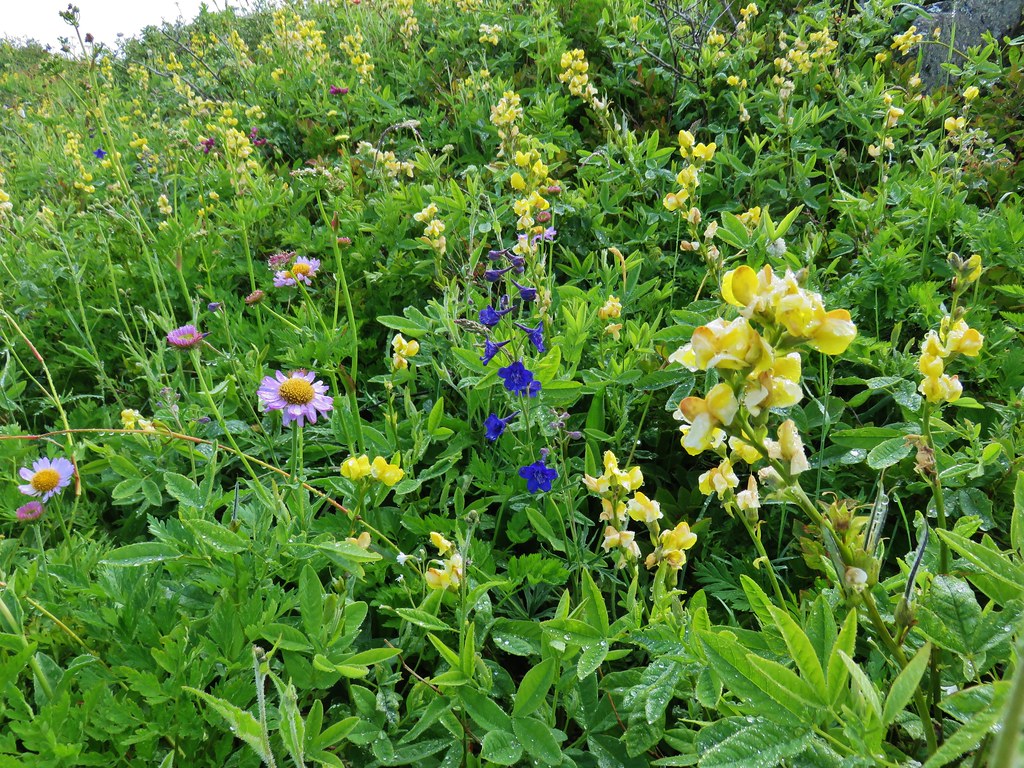
We followed this trail along the ridge for just over a mile and a half passing in and out of the clouds as they in turn passed over the area. The lack of views was mildly disappointing but the flowers more than made up for it.
IMG_0413

IMG_0414

IMG_0422

IMG_0426

IMG_0428

IMG_0432

IMG_0433

IMG_0439

IMG_0441Sturgeon Rock momentarily out of the clouds.
IMG_0444

IMG_0454

IMG_0460

IMG_0475

IMG_0490Phlox

IMG_0496Beargrass

IMG_0501

IMG_0508

IMG_0513

IMG_0526

IMG_0535

IMG_0550

IMG_0567

IMG_0575

IMG_0582White crowned sparrow

We arrived at Ed’s Trail having already seen a wide variety of flowers.
IMG_0588

IMG_0591

We turned up Ed’s Trail wondering if we could possibly see any more types.
IMG_0592

For the most part it was the same cast but in continuously different combinations.
IMG_0594

IMG_0598

IMG_0607

IMG_0617

IMG_0622

There were a few new sightings though.
IMG_0627Cat’s ear lily

IMG_0632Rose

IMG_0635Violets

IMG_0640Rock penstemon

IMG_0642

And some we’d seen but not a lot of yet.
IMG_0652Bleeding heart

IMG_0660Candy flower

IMG_0669

IMG_0672Lousewort

IMG_0682An aster or fleabane

A unique feature of Ed’s Trail is a rock arch just past the one mile mark.
IMG_0676

IMG_0680Backside of the arch.

Beyond the arch the next quarter of a mile gets a little tricky. There are two short but steep scramble sections. The first was a bit muddy making it a little slick. The second is a rocky section with pretty good holds.
IMG_0690

IMG_0691

We had forgotten just how steep these places were and had considered doing the loop in the opposite direction. We were glad we had not.

Silver Star’s summit soon came into view and although it was cloud free there didn’t appear to be much hope for views of the surrounding mountains anytime soon.
IMG_0697

IMG_0695

When we arrived back at the junction we eschewed the .3 mile climb to the summit opting to skip the 250′ climb since we’d been up there twice before and there weren’t going to be any views. Instead we continued past the rock cairn two tenths of a mile and turned down hill on a rocky unmarked roadbed.
IMG_0706

This return route would add about 1.6 miles to the hike, but it would cut down on the amount of time spent descending on a rocky roadbed. We find that toward the end of hikes our feet and lower legs are much more sensitive to uneven terrain, especially loose rocks. We had been down this 1.4 mile section of road before passing the basalt columns of Sturgeon Rock.
IMG_0708

IMG_0709

Silver Star was not done with the flower show even though we were now in denser forest as we spotted some marsh marigolds and marsh corydalis near a wet area.
IMG_0712Marsh marigold

IMG_0714Marsh corydalis

The section of the Tarbell Trail that runs from the Grouse Vista Trailhead to Hidden Falls had been closed on weekdays during much of 2018 due to an active logging operation. There were plenty of signs of it when we arrived at the junction with that trail.
IMG_0723

We turned left onto the Tarbell Trail which followed the new logging road for a bit before crossing it into the clear cut.
IMG_0725

IMG_0729

IMG_0730

IMG_0732

IMG_0733Pyramid Rock from the Tarbell Trail

IMG_0741Black headed grosbeak

IMG_0737Mountain parnassian

After descedning a series of switchbacks the trail left the clear cut and reentred the forest before reaching a footbridge over Rock Creek.
IMG_0750

IMG_0758

20190624_130035

Beyond Rock Creek the trail traversed the hillside beneath Pyramid Rock wrapping around the ridge end to meet the Grouse Vista Trail. Along this final stretch we noticed some green orchids near a seep that was also popular with butterflies.
IMG_0765

20190624_134348

The trailhead parking lot had filled up while we’d been hiking but we only ran into a half dozen people on the trails, far fewer than the number of different flowers we had seen over our 11.1 miles. Happy Trails!

Flickr: Silver Star Mountain via Grouse Vista

Categories
High Cascades Hiking Mt. Washington Area Oregon Trip report

Sand Mountain – 6/23/2019

For our second trip this year we had planned on heading to the North Fork Umatilla Wilderness and then to the John Day area for a couple of days but the week before our trip our 16 year old cat Buddy wasn’t doing well. After a couple of visits to the vets (and having nearly a pound of fluid removed from his lungs) he was placed on several medications. He’s doing much better now (he is currently on my lap helping me write this entry) but we didn’t want to leave him so soon so we decided to stay home and do a series of day hikes instead.
20170908_165356

Not only was this a fairly last minute change of plans but the forecast for the week was all over the place concerning chances of precipitation and the amount of clouds vs sun. We decided on a handful of potential hikes then checked the forecast for each one trying to come up with an optimal schedule. The process led us to choosing Sand Mountain for our second hike (Vista Ridge and Owl Point (post) being the first).

Sand Mountain is located near Santiam Pass in the Cascade Mountain and is a geologic study area. The U.S. Forest Service and the Sand Mountain Society seasonally staff the Sand Mountain Lookout in part to keep off highway vehicles from damaging the fragile area. Off trail travel off any kind is banned in the study area, but as we were shown by one of the Rangers in the lookout all the signs and barriers in the world can’t stop some morons from doing whatever it is they want to do as there were several tracks visible in the volcanic soil where OHVs or snow moblies had torn things up but I digress.

We chose to follow William L. Sullivan’s suggestion in his “100 Hikes in the Central Oregon Cascades” guidebook (hike #129 in the 4th edition) by parking at the intersection of FR 810 and Big Lake Road.
IMG_9950

To get here turn south off of Highway 20 toward the Hoodoo Ski Area and follow Big Lake Road for 3.1 miles. FR 810 is open to vehicles which allows one to park 2.9 miles closer to Sand Mountain, but why drive on a rough 15mph dirt road if you don’t have to? Additionally FR 810 follows the route of the Santiam Wagon Road which connected the Willamette Valley to Central Oregon and was used from 1865 to 1939. The 400 mile long route is now listed on the National Register of Historic Places.
IMG_9962

IMG_9969

It was a pleasant walk with a few scattered flowers along the way.
IMG_9971Lupine

IMG_9968Beargrass plumes amid the trees

IMG_9979Pussypaws

At the two and a half mile mark we came to a somewhat confusing junction.
IMG_9981

There were snow mobile signs here, one of which had a pointer for Sand Mountain.
IMG_9982

We turned left here following the pointer.
IMG_9983

After about a third of a mile we realized that we were on the wrong side of Sand Mountain so we pulled up the map and compared it with GPS to confirm our suspicions of being on the wrong track. We were indeed so we turned around, but not before getting a decent view of the Sand Mountain Lookout which appeared to be in a bit of a cloud.
IMG_9985

IMG_9986

We turned left after getting back to the junction and continued on the Santiam Wagon Road another .4 miles to a sign for the Sand Mountain Special Interest Area. This would be the starting point for the shorter hike option.
IMG_9989

Here we turned left again passing a gate and several notices regarding the prohibited activities in the area.
IMG_9991

IMG_9992

The road bed passed by a dark bed of ash as it began climbing up Sand Mountain.
IMG_0001

IMG_0008

We were seeing a bit of blue sky overhead as we climbed around and up the west side of the cinder cone but the only cloud free mountain we could make out was Iron Mountain (post).
IMG_0010

IMG_0011Iron Mountain

After a mile and a half we arrived at the old trailhead, now a large parking area for the Forest Service and volunteers who staff the lookout.
IMG_0013

IMG_0015

We headed up the trail which again had several notices stating foot traffic only and reminders to stay on the marked trail.
IMG_0016

IMG_0024

IMG_0030

IMG_0039

From this trail we could see Hoodoo, Hayrick Butte, and Black Butte (post)along with the blue waters of Big Lake.
IMG_0029From left to right – Hoodoo, flat topped Hayrick Butte, and Black Butte (behind Cache Mountain).
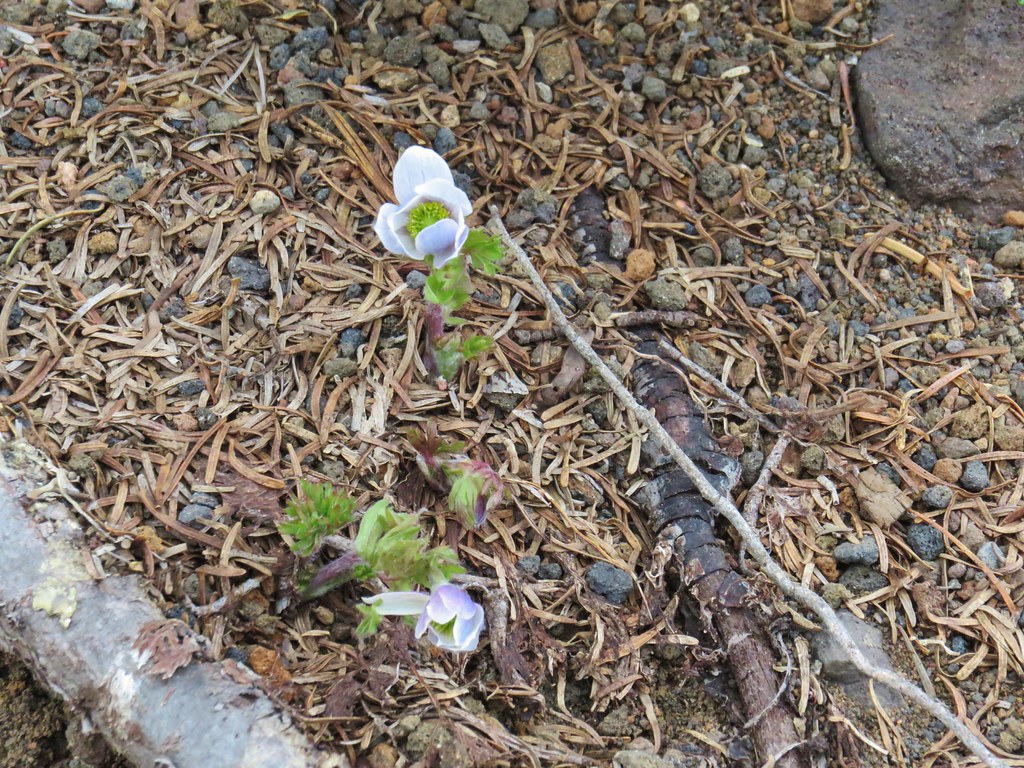
There was just a bit of snow left over on the trail and a few western pasque flowers were starting to bloom and a western toad was out and about.
IMG_0032

IMG_0035

IMG_0196

IMG_0040

We arrived at the base of the lookout tower after climbing for about a third of a mile.
IMG_0044

A Forest Service Ranger came out to greet us and give us an informative lesson on Sand Mountain and the surrounding geologic area. Sand Mountain is the largest in a series of 23 cinder cones formed along a N-S fissure which also includes 42 distinctive vents and over three quarters of a cubic mile of lava. She informed us that the snow melt from Sand Mountain seeps through the cinder and ash into a large aquifer where after approximately 2 years it makes its way into Clear Lake via the Great Springs and then down the McKenzie River. (post)

We were also informed that Sand Mountain is home to pygmy short-horned lizards but the ranger wasn’t sure that we would see any given the cloudy conditions and chilly breeze. She let us know that we could follow a path down to a viewpoint on the rim of the northern crater and that we were also allowed to hike around the rim if we wanted but she did mention that the climb up the northern end was somewhat steep. We thanked her for the information and headed down to the viewpoint.
IMG_0046

20190623_085411Dwarf lupine at the viewpoint.

The clouds appeared to be breaking up to the west over the Old Cascades.
IMG_0051

The same didn’t appear to be true to the SE though where the snowy Cascade Mountains were still squarely behind the clouds.
IMG_0055

We opted to go around the rim in a counter-clockwise rotation. That way we would be hiking directly toward the Cascades as we looped around in hopes that they might yet clear up.
IMG_0057Starting the loop from the viewpoint.

There really wasn’t any visible tread to speak of on the side of the rim below the lookout and we briefly wondered if we had done something wrong. We stepped as lightly as possible and avoided the patches of vegetation along the way.
IMG_0058

IMG_0060Penstemon and snowbrush

We eventually made it to what appeared to be an old road bed where the path became a bit clearer.
IMG_0061

IMG_0062

The hike around the crater was very interesting. A surprising amount of wildflowers were blooming in the rocks and the views down into the crater were impressive.
IMG_0069

IMG_0081

20190623_090751

20190623_090846

IMG_0096

IMG_0105

IMG_0103

As we rounded the crater there was a nice view across to the lookout.
IMG_0094

About this time the Old Cascades had finally shaken off their cloud cover allowing us to identify some additional features.
IMG_0089The Three Pyramids with Scar Mountain (post) to the far right.

IMG_0090Crescent Mountain (post)

IMG_0091Echo Mountain and North Peak

As we continued toward the Cascades things began looking up that way as well.
IMG_0104

We paused when we were directly across the crater from the lookout to watch the Three Sisters become nearly cloud free.
IMG_0126

IMG_0120Belknap Crater (post), the Three Sisters, and the Husband.

IMG_0124

I pushed on heading steeply uphill now hoping to get a view of Mt. Washington as well. As I was climbing I thought I saw another toad, but it turned out to be on of the pygmy short-horned lizards the ranger had told us about.
IMG_0140

IMG_0143Mt. Washington joining the show.

Another short but steep section of climbing brought me up to an even better view which now also included Big Lake and to a second lizard.
IMG_0153

IMG_0151

IMG_0166

IMG_0168

I waited with the lizard for Heather who had stopped at the first lizard.
IMG_0152Can you see Heather’s hat?

We hung out with our new lizard friend while we watched the mountains uncover further.
IMG_0176

IMG_0171The Husband

IMG_0178Mt. Washington

IMG_0182Scott Mountain (post) and a snowy Maiden Peak (post) in the distance.

The only one that wasn’t playing nice was Three Fingered Jack to the NE.
IMG_0181

Near the viewpoint area below the lookout we spotted our third lizard.
IMG_0186

Interestingly they all seemed to have slightly different coloration but each blended very well with their surroundings.

From the viewpoint we could now also see part of Mt. Jefferson, but like Three Fingered Jack it was still partly obscured by clouds.
IMG_0189

IMG_0190Maxwell Butte (post) in front of Mt. Jefferson.

We headed back down Sand Mountain hoping that as we did so the other peaks might come out.
IMG_0197Looking toward Mt. Jefferson and Three Fingered Jack at a quarter to ten.

IMG_0215Looking toward Mt. Jefferson and Three Fingered Jack at a quarter after ten.

IMG_0224Looking toward Mt. Jefferson and Three Fingered Jack at a 10:23am.
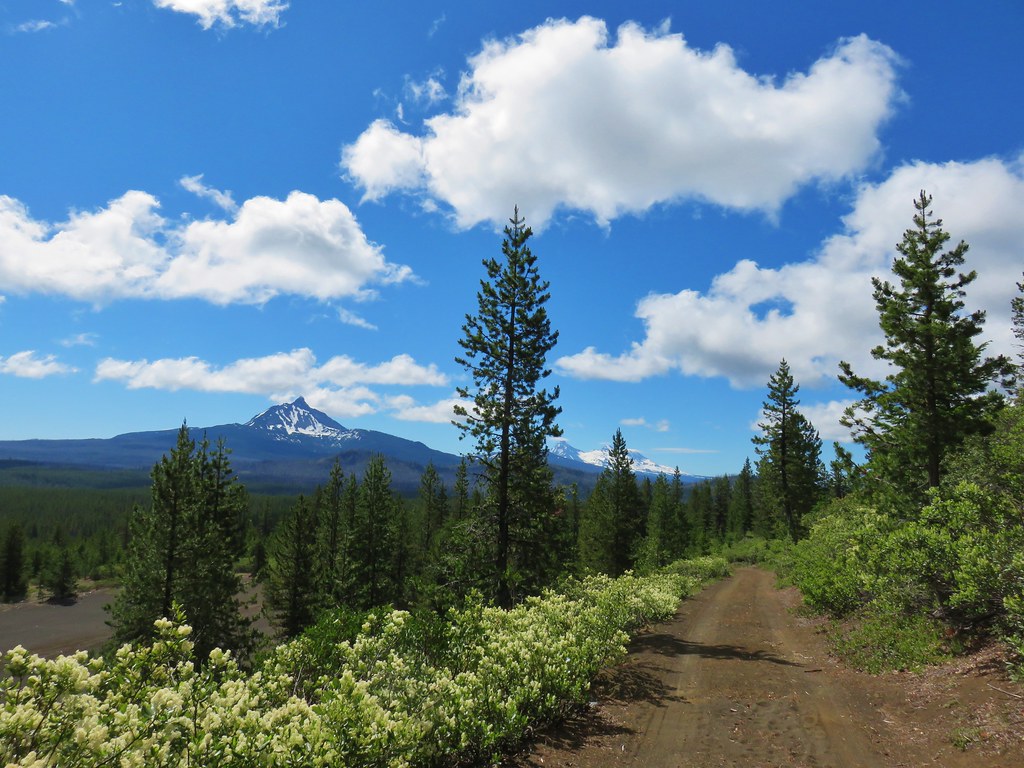
IMG_0227

As we wound our way down we ended up heading directly toward Mt. Washington and the Three Sisters. Each of the Three Sisters seemed to be working on small lenticular clouds.
IMG_0230

IMG_0234

We returned the Santiam Wagon Road and headed back. On the return trip we spotted a few butterflies, a golden-mantled ground squirrel and some orange agoseris which we had somehow missed on our way in.
IMG_0240

IMG_0249

IMG_0251

IMG_0244

I also briefly detoured to check out a beargrass patch along some of the official OHV trails.
IMG_0258

IMG_0259

With our .6 mile detour up the snowmobile track we wound up with an 11.3 mile hike, another 5.8 of which could have been removed by driving up FR 810.

We took the long way back to Salem opting to follow Highway 20 over Tombstone Pass to stop at the Rooster Rock Trailhead.
IMG_0270

This was less of a hike and more of a quest for a picture of a Menagerie Wilderness sign. We had hiked to Rooster Rock in 2016 (post) from a different trailhead but there had been no wilderness sign on that route. The shorter but steeper Rooster Rock Trail enters the Menagerie Wilderness less than a quarter mile from the trailhead and before the trail starts its climb so I hopped out of the car and hustled up the trail to see if there was a sign along this path.
IMG_0273

There was part of a sign at least at the wilderness boundary which was better than nothing.
IMG_0275

I did do a quick search in the immediate vicinity hoping to locate the other half but was unable to. Satisfied with the outcome I returned to Heather and the car and we headed home to Buddy (and Hazel our other kitty). Happy Trails!

Flickr: Sand Mountainm

Categories
High Cascades Hiking Mt. Hood Area Oregon Trip report

Vista Ridge and Owl Point – 6/22/2019

In 2017 we hiked the Vista Ridge Trail to Eden Park, Cairn Basin, and Elk Cove in the Mt. Hood Wilderness (post). It had been a cloudy August day which deprived us of any views of the mountain save for a brief glimpse from Elk Cove. The lack of views was enough to put the trail back on our to do list, but there were a couple of other reasons we had wanted to get back to this trail. First was the side trip to Owl Point along a segment of the Old Vista Ridge Trail which was reclaimed by volunteers in 2007. The second was a desire to see the avalanche lilies that bloom profusely on Vista Ridge in the fire scar left by the 2011 Dollar Fire.

We had been following reports on the avalanche lilies from fellow hikers and after seeing that they were blooming we checked the weather forecast for a clear day and headed up to the Vista Ridge Trailhead.
IMG_9657

The view of Mt. Hood had been clear on our drive so we decided to head out to Owl Point first and then up Vista Ridge for the lilies. We followed the Vista Ridge Trail for .4 miles to a junction with the Old Vista Ridge Trail at the edge of the 2011 fire scar.
IMG_9661

IMG_9664

We turned left onto the Old Vista Ridge Trail and headed toward Owl Point. The trail, which relies on volunteers to keep it maintained, was in good shape.
IMG_9666

As we made our way north along though we began to run into some fog.
IMG_9667

We had gone a little over half a mile from the junction and decided to turn back and save the viewpoint for later not wanting to risk missing out on a view. We backtracked to the junction, filled out a wilderness entry permit and headed up a fog free Vista Ridge.
IMG_9671

IMG_9675

Unlike our last visit this time we could see Mt. Hood through the snags as we climbed.
IMG_9683

Looking back over our shoulders we could see the cloud that had caused us to turn back was not actually over Owl Point.
IMG_9689

IMG_9690 Mt. Adams beyond Owl Point

Most of the avalanche lilies were already past until shortly after entering the Mt. Hood Wilderness a mile up the Vista Ridge Trail.
IMG_9692

At first the lilies were sparse but then small patches appeared followed by increasingly large fields of white.
IMG_9696

IMG_9697

IMG_9700

IMG_9702

IMG_9706

IMG_9721

20190622_091402

As we gained elevation we left the heavy bloom behind and began seeing flowers that had yet to open.
IMG_9736

We hit snow about two and a quarter miles from the trailhead.
IMG_9738

IMG_9739

It was patchy and navigable without needing our microspikes and we continued uphill for another quarter mile passing a nice view of Mt. Adams and the Eden Park Trail along the way.
IMG_9745

IMG_9748

IMG_9749Eden Park Trail

We ended our climb at a snowfield where the Vista Ridge Trail headed left of the ridge toward its junction with the Timberline Trail.
IMG_9765

The trail looked passable with the microspikes but we had a nice view from where we were and didn’t see a point in continuing on given we still wanted to get out to Owl Point and we were planning on hiking for the next three days straight.
IMG_9763

Near our turn around we spotted some other early bloomers – western pasque flowers aka hippies on a stick.
IMG_9769

20190622_093738

IMG_9774western pasque flowers already going to seed
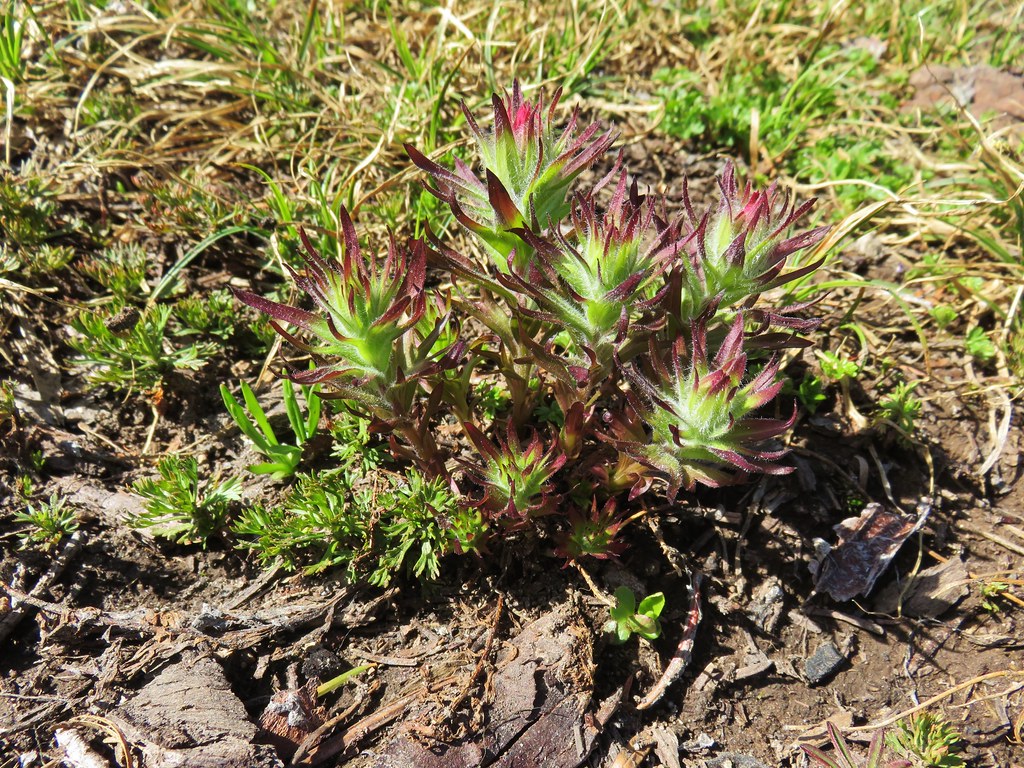
Paintbrush and cinquefoil was also present.
IMG_9781

20190622_093621

After an extended break enjoying the view of Mt. Hood we headed back down to the Old Vista Ridge Trail junction stopping along the way to once again admire the avalanche lilies and also to share a moment with a friendly yellow-rumped warbler.
IMG_9826

IMG_9834

We turned back onto the Old Vista Ridge Trail and repeated the first section which seemed to climb more this second time. (At least our legs felt like it did.) This time there was no fog though and we soon found ourselves at a viewpoint looking at Owl Point.
IMG_9856

There was also a decent view of Mt. Hood.
IMG_9866

After the initial climb the trail leveled out some along the ridge top where a few patches of snow remained.
IMG_9874

That meant more avalanche lilies, although nowhere near the numbers that Vista Ridge was home to.
IMG_9879

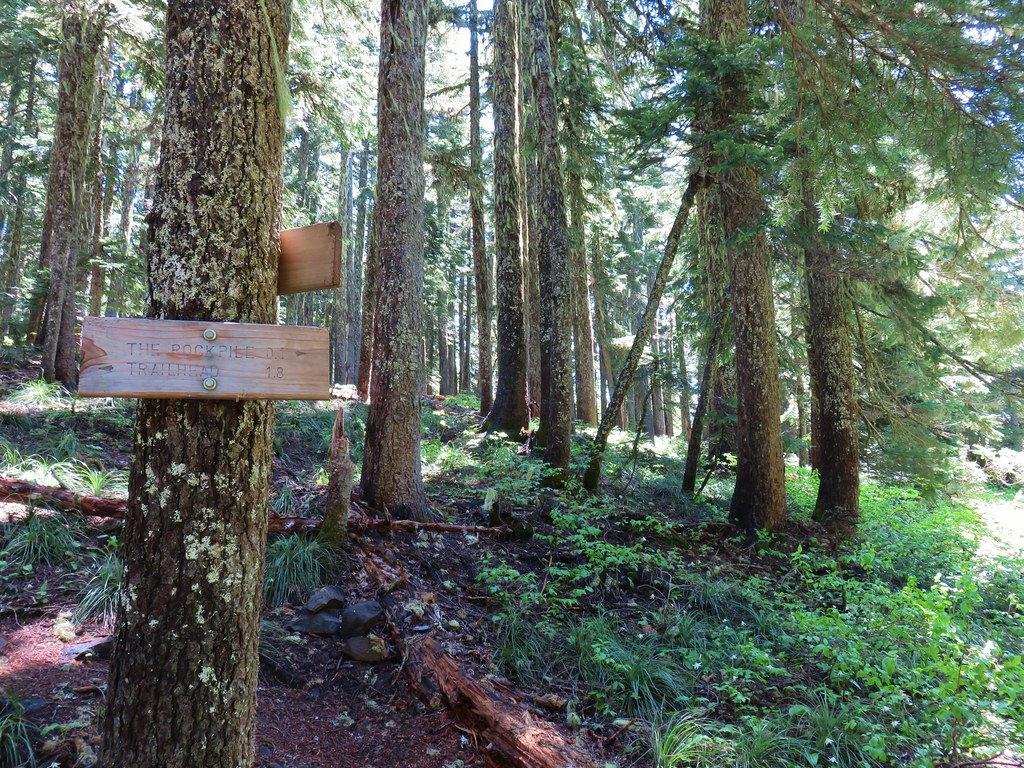
After climbing to a saddle we came to a sign for The Rockpile viewpoint.
IMG_9885

IMG_9886

The short spur trail led out to a nice view of Mt. Hood but we had startled a dog that was with some backpackers and it wouldn’t stop barking so we quickly took our leave heading for quieter surroundings.
IMG_9888

IMG_9892

The spur trail to Owl Point was just a tenth of a mile from the trail to the Rockpile.
IMG_9894

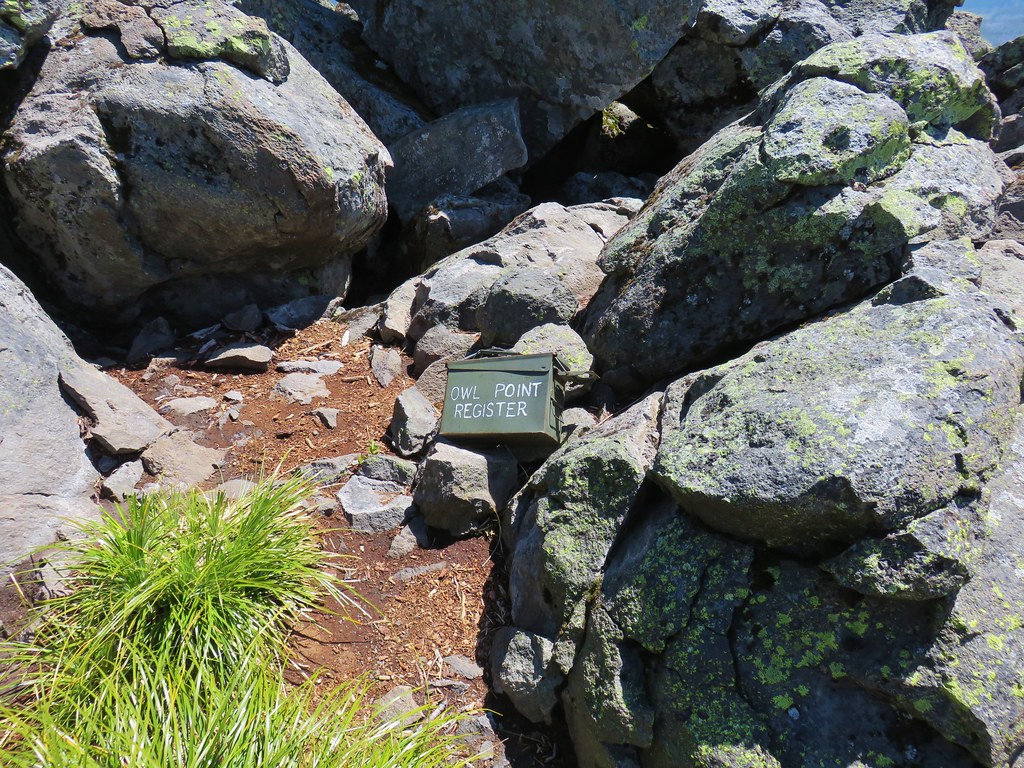
We followed this spur to it’s end at a register at Owl Point.
IMG_9898

IMG_9899

Laurance Lake lay below to the east with Surveryors Ridge beyond.
IMG_9900

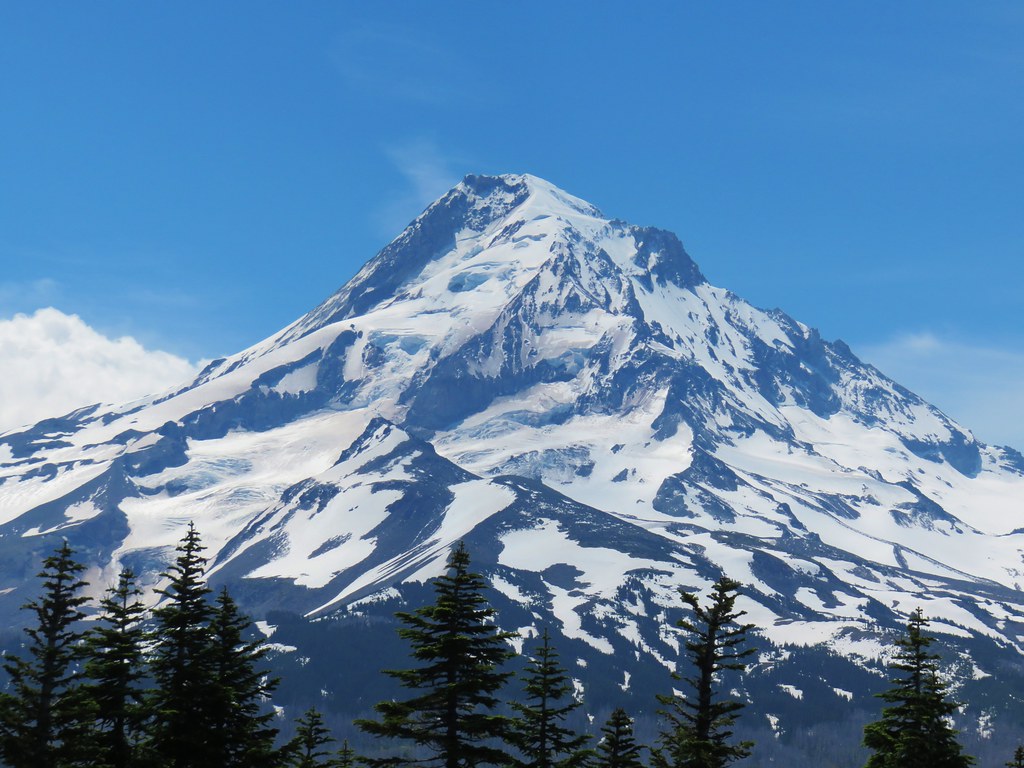
Mt. Hood was the main attraction though.
IMG_9902

IMG_9928

We sat for awhile admiring the mountain and studying Vista Ridge where we could see the trail cutting across the snow beyond where we had turned around.
IMG_9922

IMG_9923

We also spent some time looking for pikas but never saw (or heard) any. We did however have a butterfly join us briefly.
IMG_9925

When we had returned to the Old Vista Ridge Trail we continued north for another tenth of a mile to visit Alki Point.
IMG_9935

This viewpoint looked north and on a cleared day would have offered views of Mt. St. Helens, Mt. Rainier, and Mt. Adams. We settled for a glimpse of Rainier’s summit above some clouds (that’s Mt. Defiance in the foreground) and a semi-obstructed view of Mt. Adams.
IMG_9938

IMG_9939Mt. Rainier (sort of)

IMG_9941Mt. Adams

We headed back to the trailhead completing a 10.8 mile hike that would have been under 10 had we not had the false start on the Old Vista Ridge Trail in the morning. The avalanche lilies had not disappointed, it was a great way to start a four day stretch of hiking. Happy Trails!

Flickr: Owl Point and Vista Ridge

Categories
High Cascades Hiking Mt. Hood Area Oregon Trip report

Boulder Ridge Trail and Wildwood Recreaction Area

Our most recent hike brought us to the BLM managed Wildwood Recreation Site. We were going to be taking the Boulder Ridge Trail from the site to a viewpoint along Huckleberry Mountain in the Salmon-Huckleberry Wilderness. The view had escaped us during a 2015 hike the same viewpoint using the Bonanza Trail (post). Cloudy conditions that day had been our downfall so we were a little apprehensive when we saw the forecast calling for a slight chance of showers in the morning but then it called for the skies becoming mostly sunny.

With the Wildwood Recreation Site not opening until 8am (the road is gated) it meant we would be getting a little later start than we normally would which would hopefully give the clouds more time to burn off. After paying the $5 day use fee we parked at the trailhead parking area which acts as the trailhead for the Boulder Ridge Trail as well as for two short interpretive trails – The Cascade Streamwatch and the Wetlands. We decided to do both of these before heading up the Boulder Ridge Trail to give the weather even more time to clear up.
IMG_9096

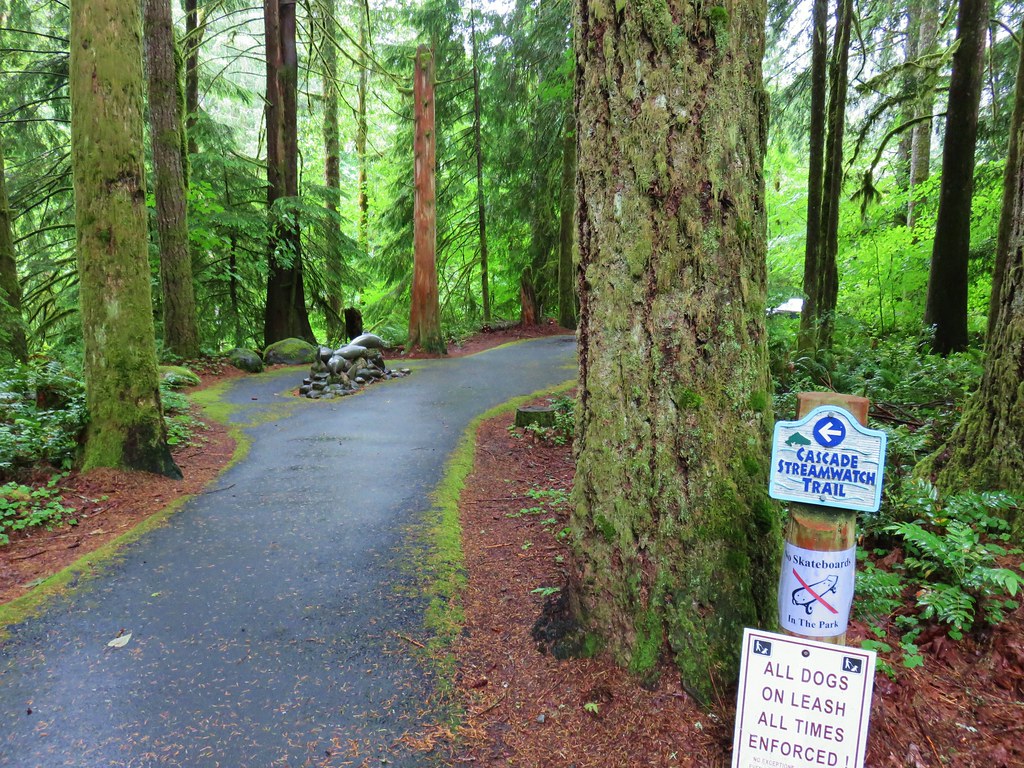
We began with the paved Cascade Streamwatch Trail.
IMG_9098

IMG_9101

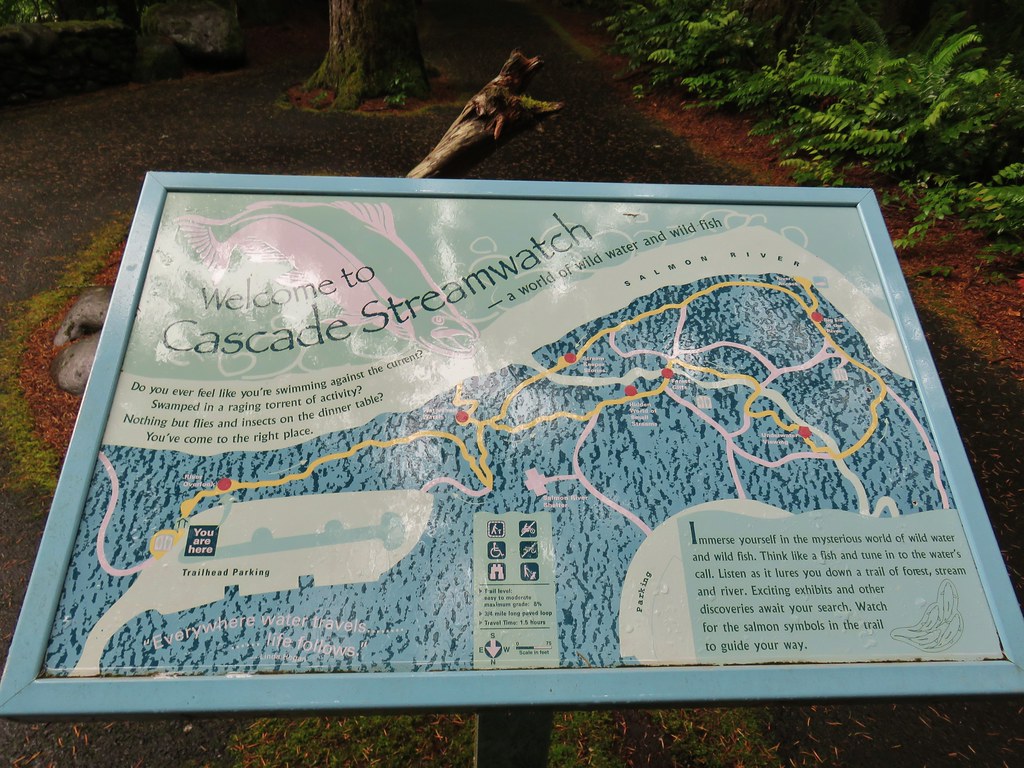
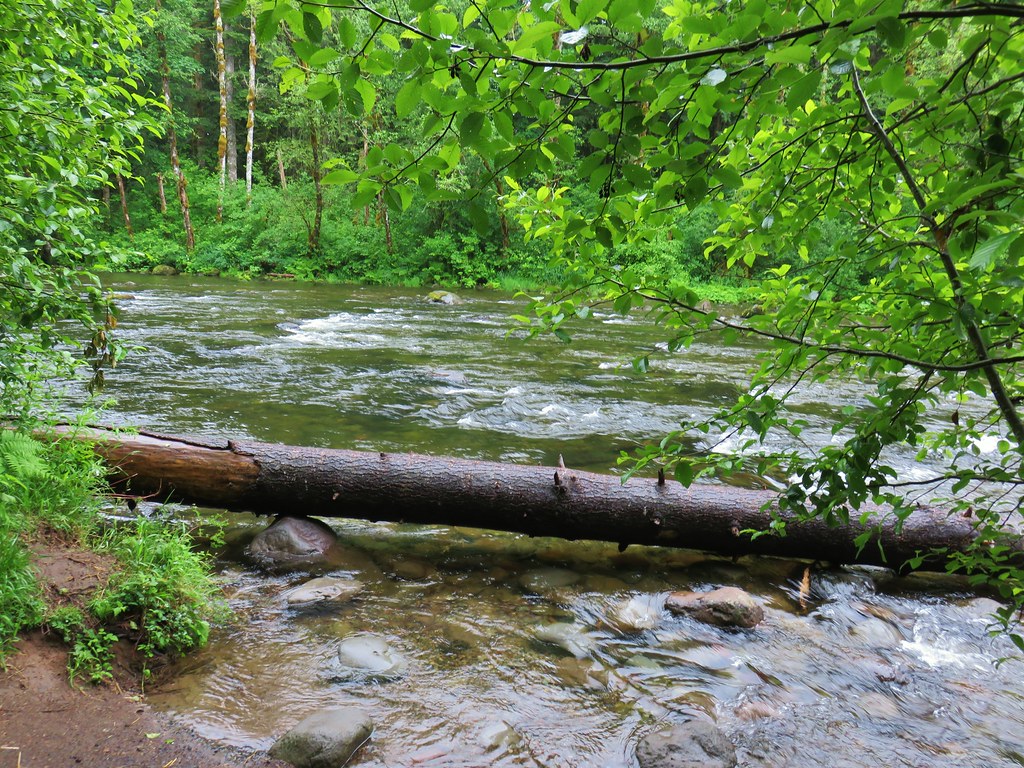
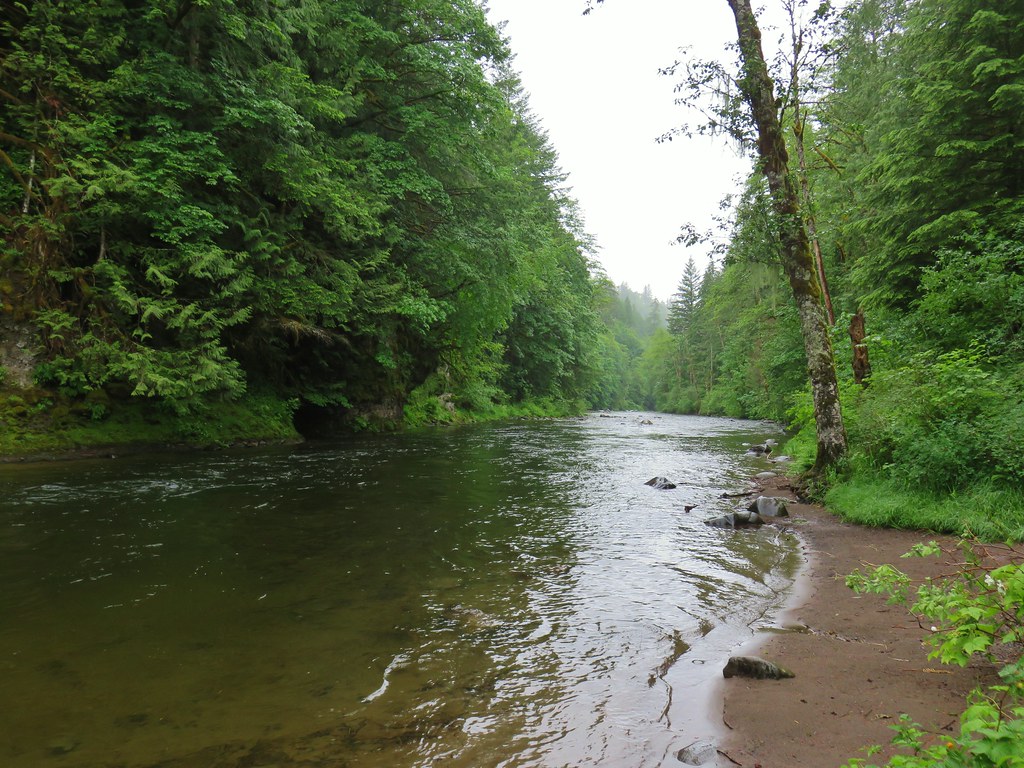
The trail led down through the forest to the bank of the Salmon River with several interpretive signs along the way.
IMG_9104

IMG_9108

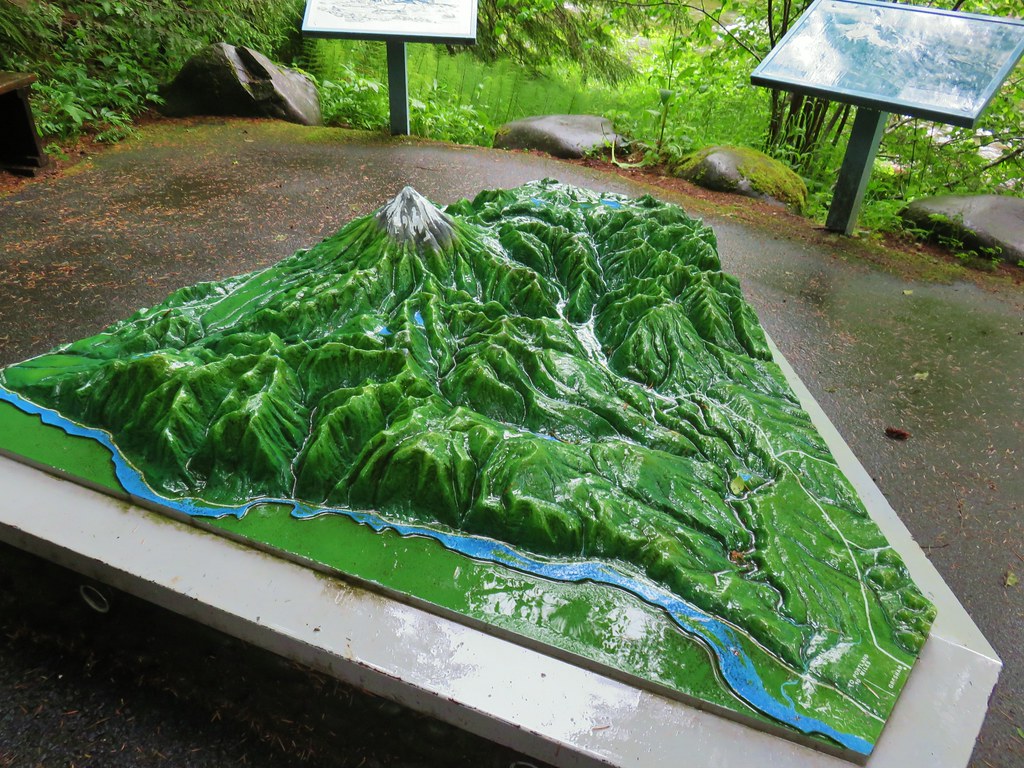
Of particular interest was a 3D model of the Salmon River drainage including Mt. Hood. It mapped out the southern and western flowing creeks and rivers drain into the Sandy River and eventually the Columbia.
IMG_9106

Further along the loop is an underwater viewing area. There were only a few small fish visible on this day but we imagined that at times it would be quite a sight.
IMG_9117

We continued on the loop which passed a sandy beach near a deep hole in the Salmon River where at times spawning steelhead trout and chinook salmon can be seen.
IMG_9124

IMG_9123

After completing this short (under a mile) informative loop we returned to the trailhead parking and walked over to a signboard for the Boulder Ridge Trail.
IMG_9132

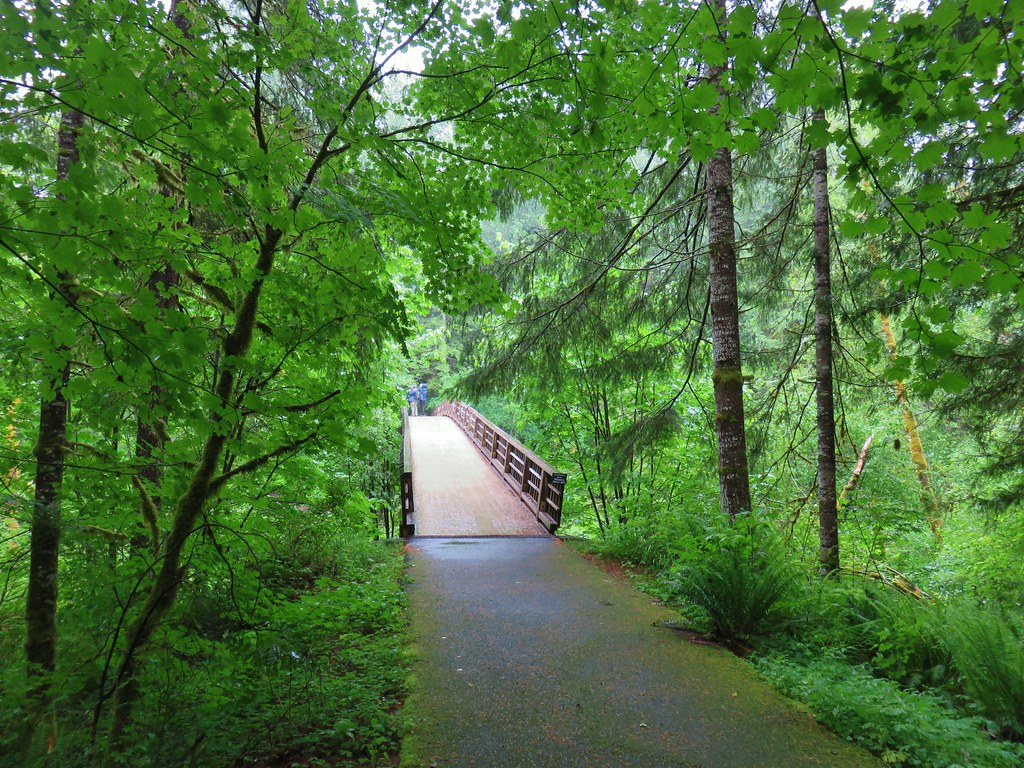
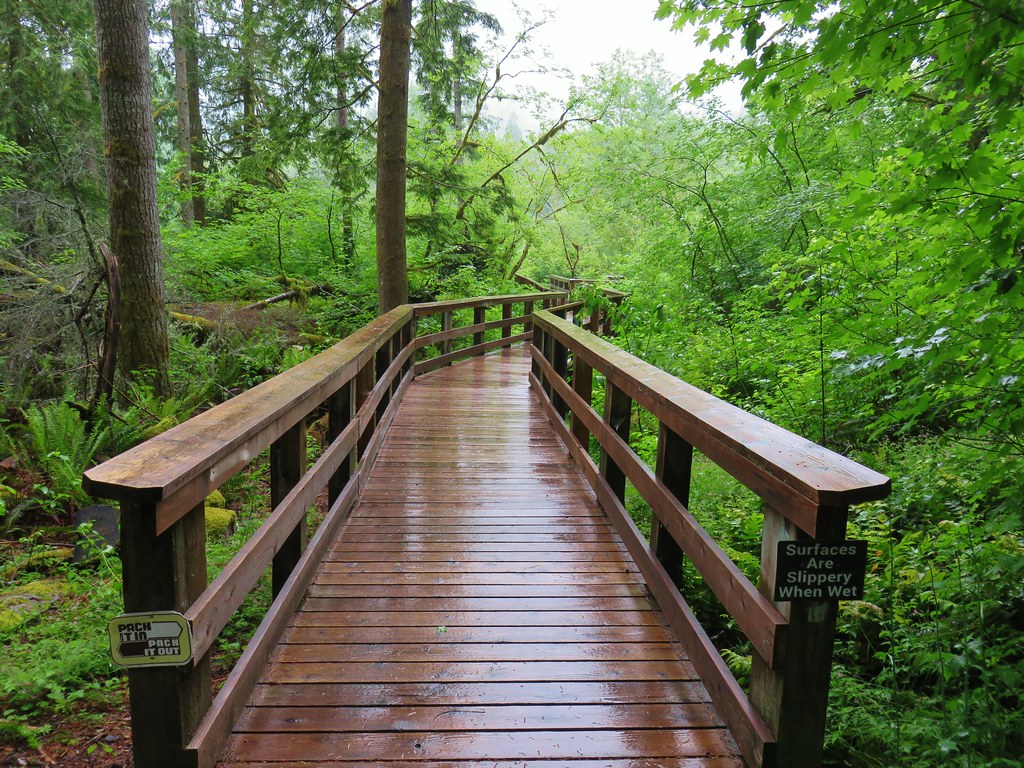
A paved path here lead to a bridge spanning the Salmon River and the start of the Wetlands Boardwalk.
IMG_9135

IMG_9137

IMG_9139

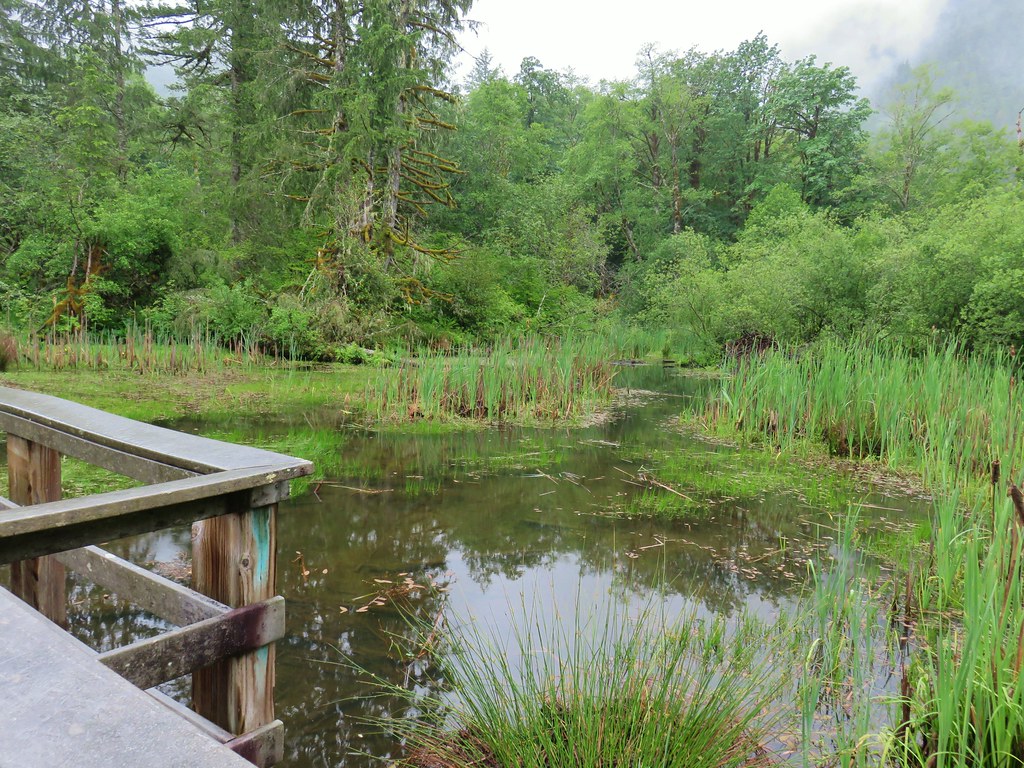
We took each of the side trails along the boardwalk starting with the detour to Cattail Marsh.
IMG_9140

IMG_9141

The next side trip was to see the results of beaver dams and how they help create the wetlands. We didn’t see any beavers (yet again) but there were some newts swimming in the waters.
IMG_9147

Next up was a “Ghost Forest” caused by rising waters caused by the beavers work.
IMG_9150

The boardwalk then passed a large amount of skunk cabbage before reaching a final detour to a view of the transition from a wetland to a stream.
IMG_9153

IMG_9155

The boardwalk ended at a junction where a left turn led to the Boulder Ridge Trail while a right turn would complete a short loop back to the parking area (also under a mile total).
IMG_9156

Left we went passing a sign for the Boulder Ridge Trail and signing in at a signboard.
IMG_9157

The trail wasted little time in launching uphill needing to gain 3100′ to reach the top of Huckleberry Mountain. Not only did it head uphill immediately but it crossed a rocky area that had been exposed by a series of seeps. It looked narrow and possibly slick.
IMG_9158

The trail climbed steeply gaining 1400′ in then next two and a quarter miles where a rocky viewpoint looked into clouds instead of Mt. Hood. Just a bit before reaching the viewpoint we had entered the Salmon-Huckleberry Wilderness. One thing that has never disappointed us about the Salmon-Huckleberry Wilderness and surrounding area is the beauty of the forest. The clouds might have been blocking our views of Mt. Hood but the fog added a nice element to the forest.
IMG_9164

IMG_9166

IMG_9169Rhododendron

IMG_9171Honeysuckle

IMG_9172Beargrass and rhododendron along the trail.

IMG_9180Coralroot and sourgrass

IMG_9188Candy stick

IMG_9194

IMG_9197Damp iris

IMG_9202

IMG_9216

We passed by the viewpoint hoping that maybe there would be a view by the time we were headed back down. The trail continued to climb gaining another 800′ over the next mile and a quarter where another rock viewpoint looked east.
IMG_9220

IMG_9222Green lichen

IMG_9236

IMG_9255A few trees peaking through the clouds along McIntyre Ridge (post)
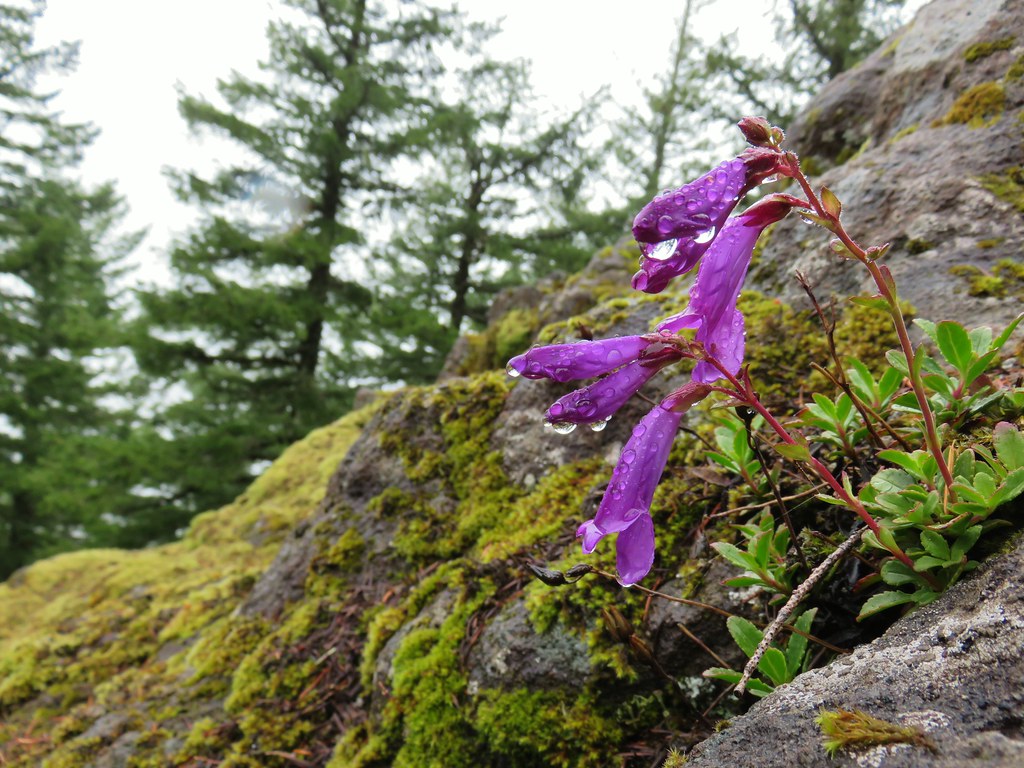
With no view to speak of we turned our attention to the flowers in the area.
IMG_9248Penstemon

IMG_9245Paintbrush

IMG_9250Biscuitroot

IMG_9252Beargrass

IMG_9358Lupine

For the next half mile the trail climbed more gradually spending some time on the ridge top amid a carpet of green before dropping off and arriving at a small seasonal stream where some Scouler’s corydalis was blooming.
IMG_9263

IMG_9270

IMG_9274

Another half mile of climbing brought us to the end of the Boulder Ridge Trail at a signed junction with the Plaza Trail.
IMG_9283

The only choice to continue here was to turn right onto the Plaza Trail as there is no longer any discernible continuation of it to the left of the junction.
IMG_9284

It was almost 11:45 now and we had been hoping that the skies would be starting to clear but looking up revealed no sign of it happening anytime soon. We still had approximately a mile and a half to our goal though so we sallied forth. After a brief respite from climbing the trail headed uphill into more fog.
IMG_9288

IMG_9292

As the trail passed the 4000′ elevation it passed through a small grassy meadow where a few phlox were blooming.
IMG_9302

IMG_9312

As the trail gained the final 280′ of elevation there were more open areas where indian plum was blooming while the beargrass was just starting.
IMG_9303

IMG_9313

IMG_9315

We passed by a large ant pile.
IMG_9306

IMG_9305

When we reached the viewpoint the clouds had not only not lifted but they were actually worse than they had been in 2015.
IMG_93162019

Huckleberry Mountains summit2015

Slightly disappointed we made our way to a rock outcrop and again looked to the nearby flowers instead of Mt. Hood.
IMG_9317

IMG_9319Phlox

IMG_9329Paintbrush

IMG_9333Penstemon

IMG_9342Avalanch lily

IMG_9322Wild onion

We stayed for a bit looking for any hint of the clouds breaking but they sky remained a canvas of white so we started back down shortly before 1pm. The view had changed quite a bit at the eastern facing viewpoint when we arrived 45 minutes later. It was still overcast but the clouds had lifted noticeably.
IMG_9353

By the time we reached the lower viewpoint that we had not stopped at earlier there was a significant amount of blue sky overhead.
IMG_9360

The only problem was a mass of clouds directly over (or in front of) Mt. Hood.
IMG_9363

You win some you lose some. We made our way back down to the Salmon River stopping to admire some yellow coral root along the way.
20190608_145138

20190608_145110

IMG_9374

Despite missing out on the view again the 12.9 mile hike was a good one albeit challenging with over 3000′ of elevation gain. The interpretive trails were a lot of fun and the Mt. Hood National Forest in the Salmon-Huckleberry Wilderness was as scenic as ever. Happy Trails!

Flickr: Boulder Ridge

Categories
Hiking Old Cascades Oregon Trip report

Sardine Mountain

**Note the 2020 Beachie Creek Fire burned a portion of this hike.**

Having done quite a bit of driving over our Memorial Day Weekend trip to NE Oregon we stuck close to Salem for our next hike. The hike up to the summit of Sardine Mountain from Matt Reeder’s “101 Hikes in the Majestic Mt. Jefferson Region“. Reeder recommends the hike in Winter when you can snowshoe the route, but as we have yet to get into snowshoeing (we’ve talked about it) an early June visit seemed appropriate. Located toward the western edge of the Old Cascades Sardine Mountain has an elevation of 4948′. This combination allows it to melt out sooner than some of the other peaks in the Old Cascades.

The peak is named after nearby Sardine Creek which purportedly gained that name when Thomas Henness found a sardine can in the creek in 1867. There are no official trails to the mountain but there is a scramble trail from Knutson Saddle which can be reached via Forest Road 2223 or by the route we took following Sardine Road (which becomes a 4wd track) up from Highway 22. Sardine Road is an unsigned gravel road located .4 miles east of Big Cliff Dam (2.3 miles west of Detroit Dam). In his description Reeder had parked just beyond a bridge over Sardine Creek just .2 miles up this road which is where we had planned to park but a van was already occupying it so we proceeded up the road another 150 yards to the next pullout.
IMG_8739

There had been a “road closed ahead” sign just after we had turned onto the road and Matt had mentioned that high clearance vehicles could make it as far as 3-4 miles up the road and other cars probably shouldn’t go further than a mile up. In addition to avoiding the bumpy drive the first mile of the road follows close to Sardine Creek so by parking sooner we were able to get some good looks at the creek.
IMG_8746

There were a lot of rough skinned newts out on the road which made us wonder how many have been on roads we’ve been driving on. 😦
IMG_8755

IMG_8750

A half mile from where we parked we passed an scenic unnamed side creek.
IMG_8760

Despite being a road walk there was a lot to see between the creek, flowers, and the forest.
IMG_8762Paintbrush above Sardine Creek

IMG_8752Iris

IMG_8758Rhododendron

IMG_8765Candy flower

IMG_8770

Approximately a mile and a half from where we had started the road veered away from Sardine Creek at a sharp switchback. In another quarter mile we arrived at a fork.
IMG_8773

The right hand fork was the continuation of the route up to Knutson Saddle and Sardine Mountain but we detoured left on Reeder’s recommendation to visit a huge logjam. We followed this road for four tenths of a mile to one of Sardine Creeks forks where there was indeed an impressive logjam.
IMG_8777

On the way to the logjam we came across a tennis ball and a slug and wondered if this was the worlds slowest game of fetch.
IMG_8775

Also there were more newts.
IMG_8778

There were even more logs jammed upstream on the creek.
IMG_8783

We returned to the fork and continued climbing up toward the saddle. We still had about 2000′ to gain just to reach the saddle. We tried to keep our minds off the climb by focusing on the sights along the way. There was one quarter mile section (1.4 miles from the fork) where the road lost 200′ of elevation before steeply climbing again.
IMG_8798Beargrass

IMG_8802Iris

IMG_8828Mushroom in the middle of the road

IMG_8830Valerian

IMG_8813A hillside spring

The road deteriorated as we climbed although there were some noticeable tire tracks and there had been some recent clearing of brush.
IMG_8824

IMG_8835

Shortly after passing the 4000′ elevation we passed a lingering patch of snow (with tire tracks).
IMG_8842

A total of 5.5 miles from where we’d parked (6.3 if you add in the side trip to the logjam) we arrived at Knutson Saddle where the trilliums where still white. We took a seat near some snow and rested.
IMG_8847

IMG_8846

Before continuing up I walked NE along the level Forest Service road 100 yards to a view of Dome Rock and Mt. Jefferson. Unfortunately it was a very hazy morning so the mountain was blending with the haze.
IMG_8850

IMG_8854

After our rest we located the use trail heading uphill where the 4wd track arrived at Knutson Saddle.
IMG_8855

After a brief stint in some trees we emerged in a meadow of huckleberry bushes and beargrass.
IMG_8859

At times the route was overgrown or became faint but pink flagging helped mark the way.
IMG_8869

The bushes gave way to an open rocky hillside where yellow wallfowers and red paintbrush colored the slopes.
IMG_8871

IMG_8882

IMG_8885

IMG_8873Red flowering currant

It was a fairly steep but non-technical class 2 scramble.
IMG_8887

The combination of the haze and time (the Sun we still to the east of us) really impacted what would have been spectacular views.
IMG_8890

IMG_8911

Along the way up we spotted a northern alligator lizard.
IMG_8904

IMG_8908

We reached the summit of Sardine Mountain where a long ridge extended north toward Rocky Top.
IMG_8924

The view west was marred by clearcuts.
IMG_8925

To the NE Mt. Hood stood out with Mt. Adams being barely visible through the haze.
IMG_8929

IMG_8961Mt. Hood with North Dicky Peak in front.
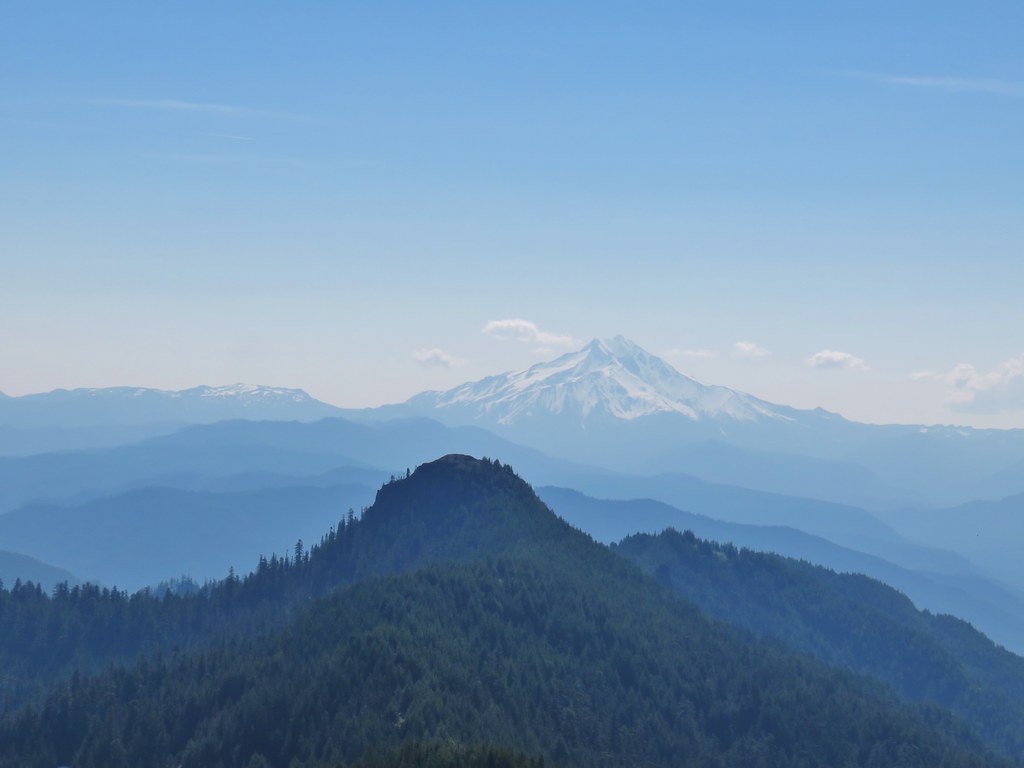
Mt. Jefferson rose to the east behind Dome Rock (post).
IMG_8936

IMG_8947

Beyond Tumble Lake to the SE was Three Fingered Jack behind Coffin Mountain (post), Mt. Washington, and the barely visible Three Sisters.
IMG_8962

IMG_8964Three Fingered Jack

IMG_8951Mt. Washington and the Three Sisters

IMG_8939Tumble Lake

After another nice rest we started back down stopping to get pictures of some of the flowers we hadn’t noticed on the way up.
IMG_8968

IMG_8953A saxifrage

IMG_8972Blue-eyed mary

IMG_8987Cats ears

IMG_8996Butterfly on red flowering currant

After picking our way down the exposed slope we made our way back to Knutson Saddle and headed back downhill on the 4wd road. We didn’t see anymore newts along the road on our descent but we did see a few other critters.
IMG_9004Rabbit

IMG_9008Snake

IMG_9011

IMG_9028Another northern alligator lizard

IMG_9026

20190601_121157These two long legged spiders got into a brawl when they met crossing the road.
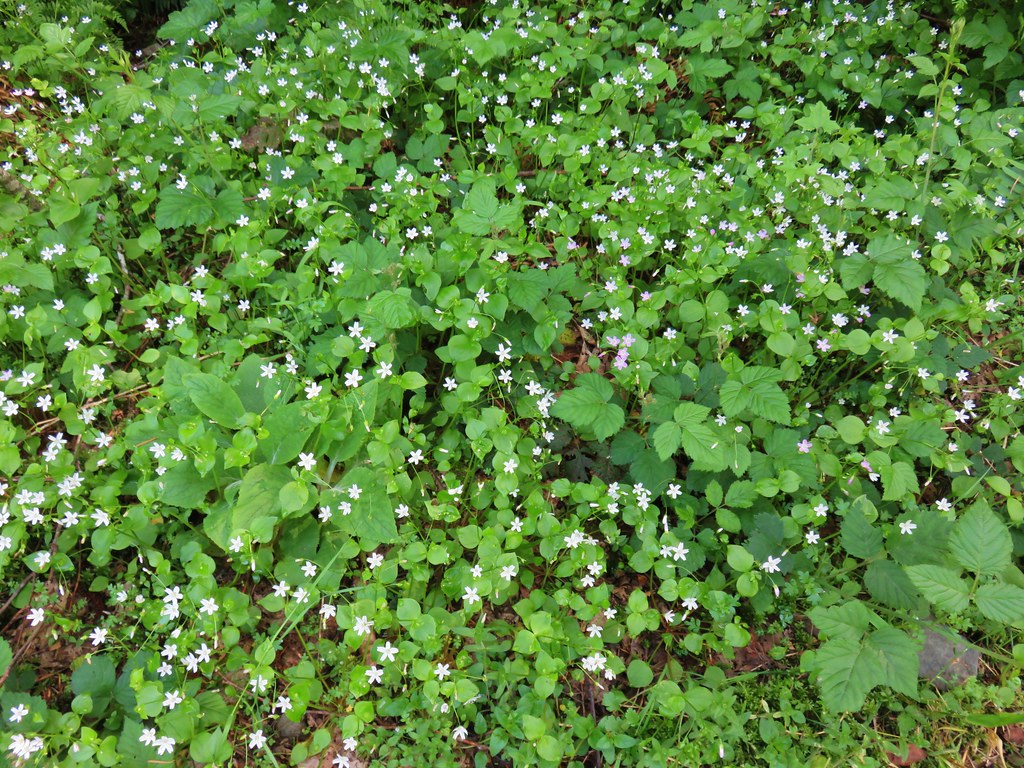
With the Sun now overhead the candy flower had opened up and many of the other flowers were showing up better so we stopped to get some pictures of them as well.
IMG_9031

20190601_123148Candy flower

20190601_121738Iris

20190601_121916Beargrass

IMG_9047Cinquefoil and candy flower

IMG_9049Fringecup

IMG_9056Monkeyflower

20190601_124017Thimbleberry

20190601_124131Stonecrop

20190601_125119Youth-on-age with an interesting insect
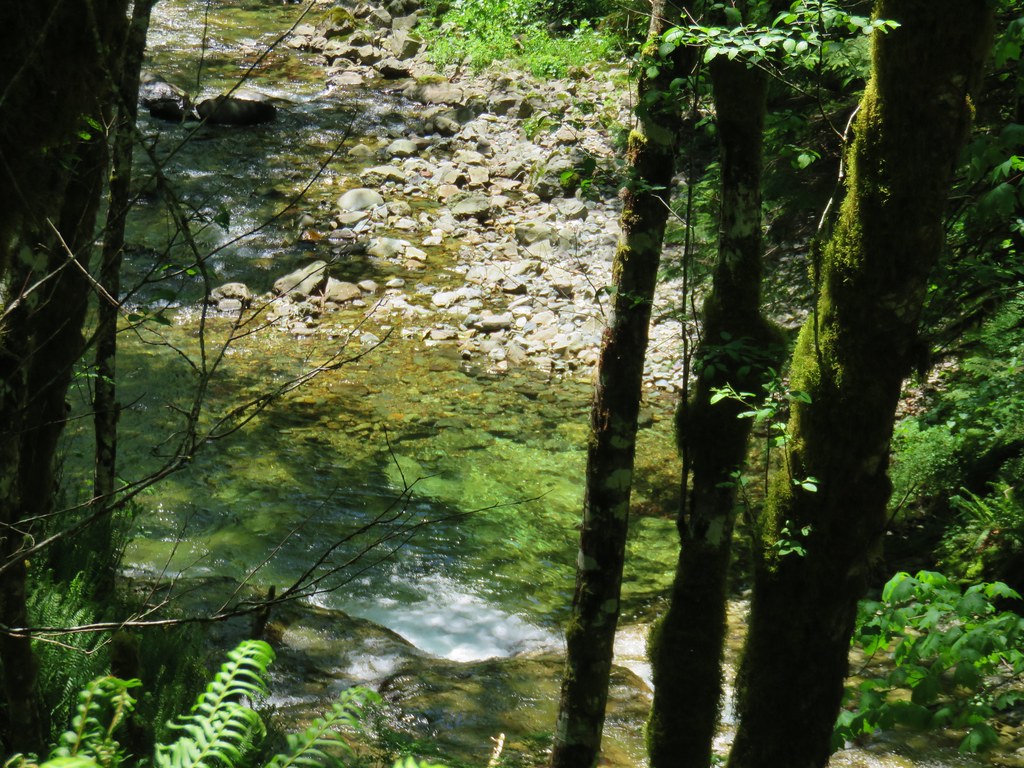
The sunlight also helped bring out the colors of Sardine Creek.
IMG_9063

IMG_9069

IMG_9073

IMG_9089

IMG_9093

Aside from the unfortunately hazy conditions the only real drawback to the hike was that we each managed to pick up a couple of ticks, likely taking pictures of the flowers and creek at the end of the day where the grass was tall along the road. A good reminder to always check thoroughly, best a couple of times as even though we did a check and knocked three off us at the car one managed to make it all the way home with Heather where a second check found it before it had started to dig in.

We did not see another person the whole day although we did hear a car drive past Knutson Saddle as we approached it. There was plenty of evidence that people do spend time along the road though based on the used shotgun shells, pieces of clay targets, and trash filled fire pits at several of the pullouts. 😦

From where we parked, with the logjam side trip, our GPS recorded a 12.8 mile hike which was a bit shorter than we’d expected based on Reeder’s book where he put it at 14.4 miles without the side trip. The stat that did agree was the 4600′ cumulative elevation gain making this a pretty good early season training hike for climbers. Happy Trails!

Flickr: Sardine Mountain