Categories
Hiking McKenzie River Old Cascades Oregon Trip report

Clear Lake

We wanted to get one last hike in on the way home from Central Oregon. Originally we’d planned on hiking up to the summit of the Middle Pyramid on the Three Pyramids Trail, but we were greeted with clouds and rain as we came to Santiam Pass. Knowing there wouldn’t be any views we changed our plans and headed to Clear Lake 10 miles south of the Santiam Jct. on Highway 126.

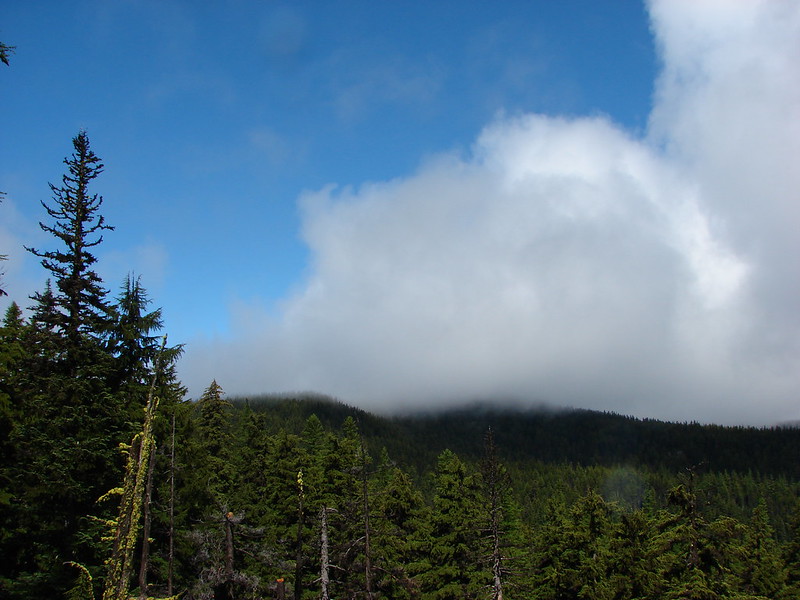
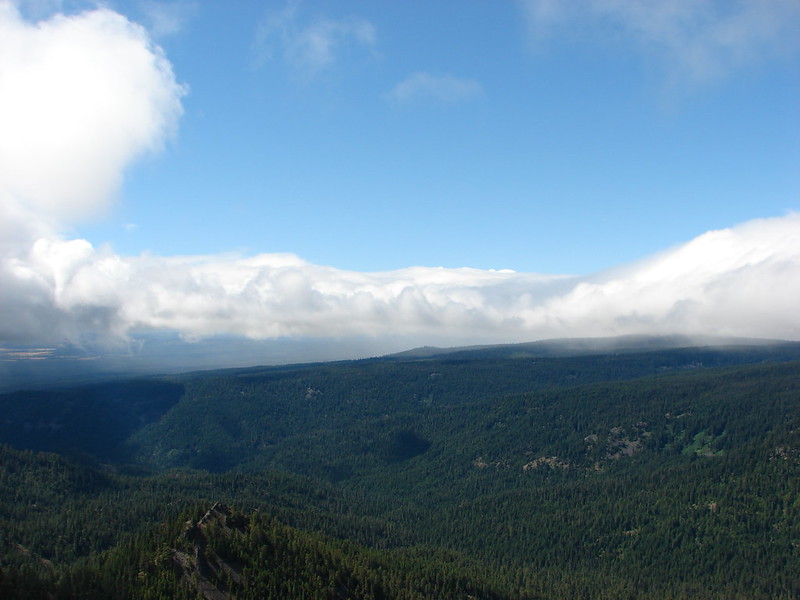
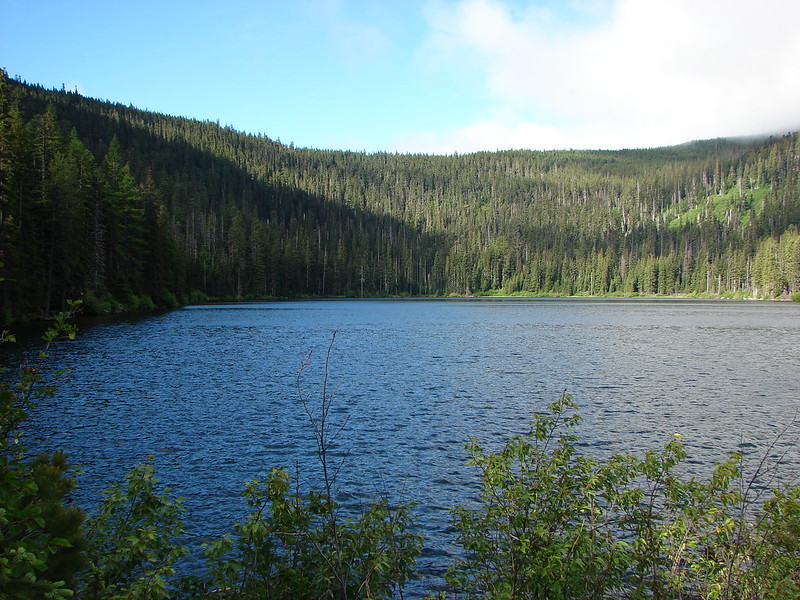
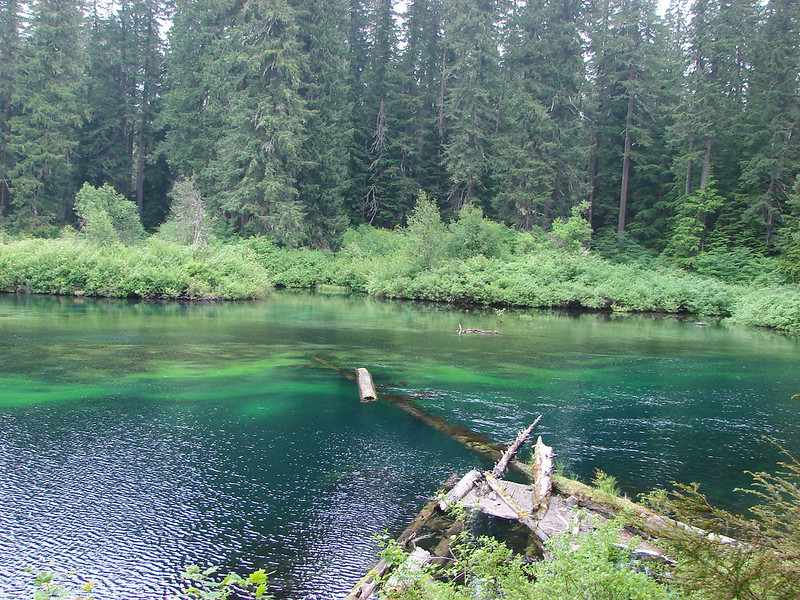
The McKenzie River begins at Clear Lake where old lava flows created the lake by covering and damming the river. On a clear day The Three Sisters and Mt. Washington can be seen from various points around the lake but with the clouds we would be content with the clear, colorful water of the lake.

We began our counter-clockwise loop at a picnic area near the Clear Lake Resort.
DSC09121

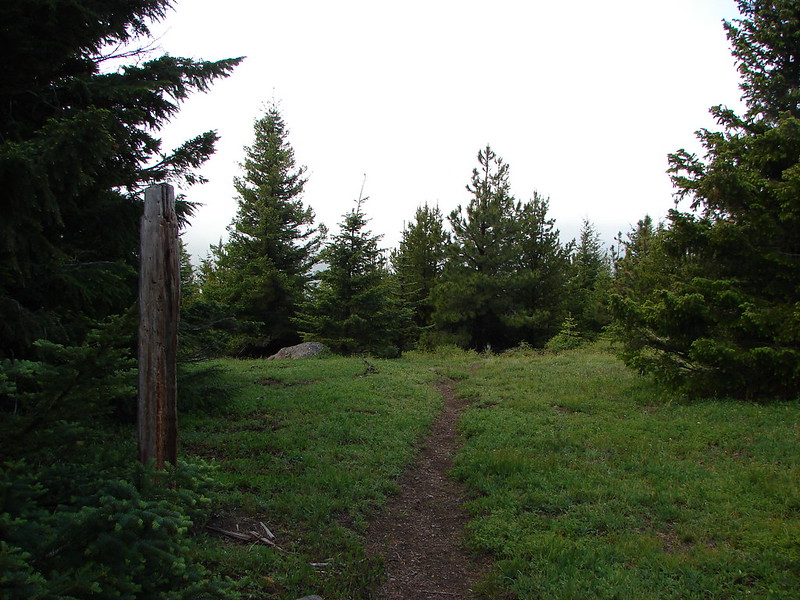
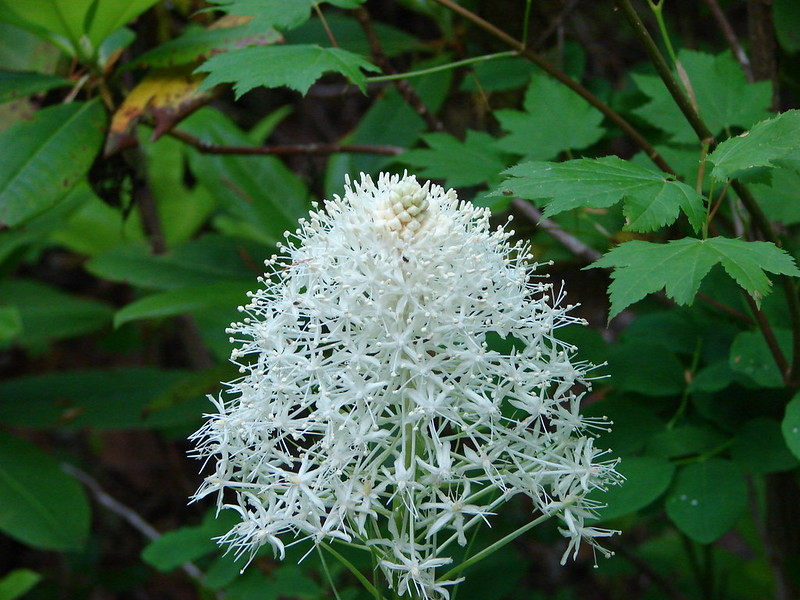
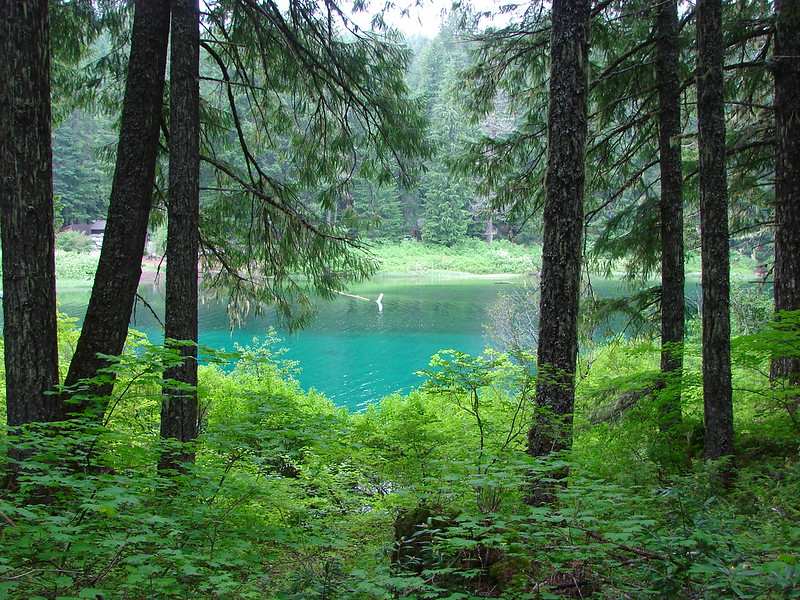
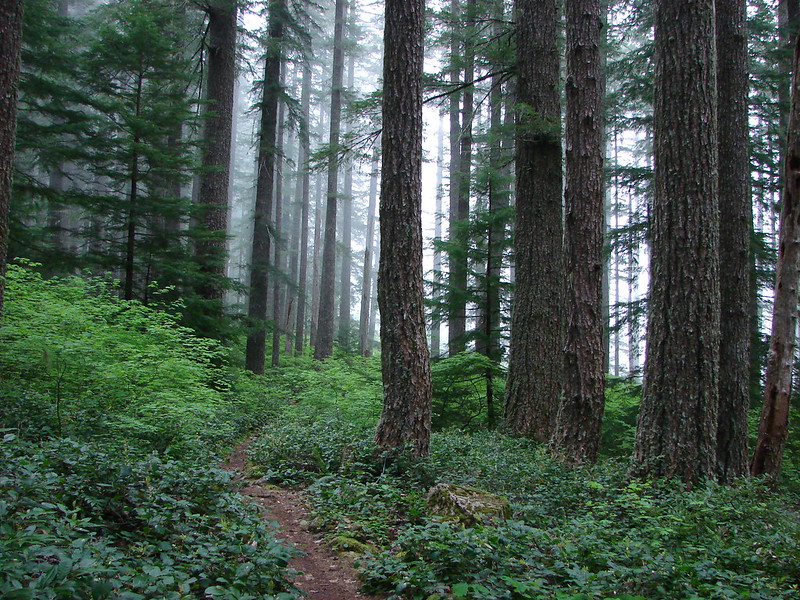
The trail passed through a nice Douglass Fir forest with glimpses of the lake to our left where we spotted our first on trail beargrass of the year.
DSC09122

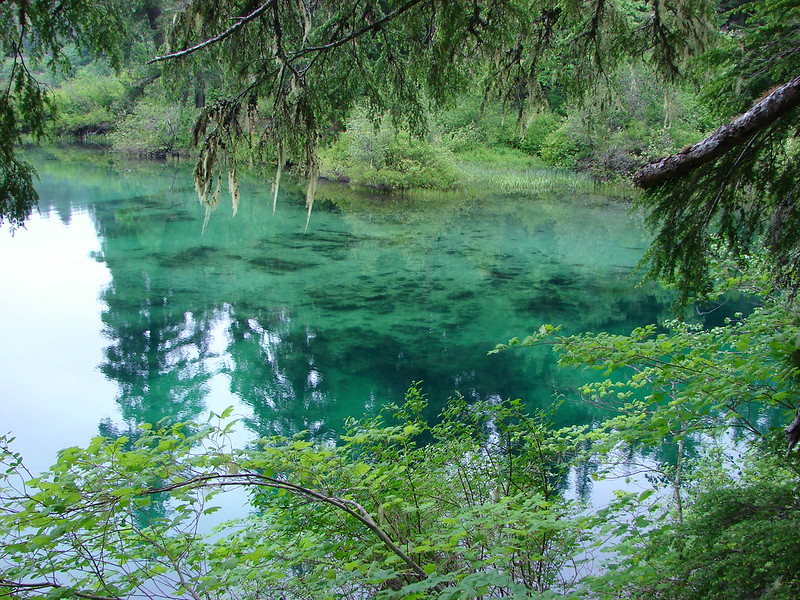
At about the one mile mark on an arm of the lake which feeds the McKenzie we got our first taste of the draw of Clear Lake.
DSC09141

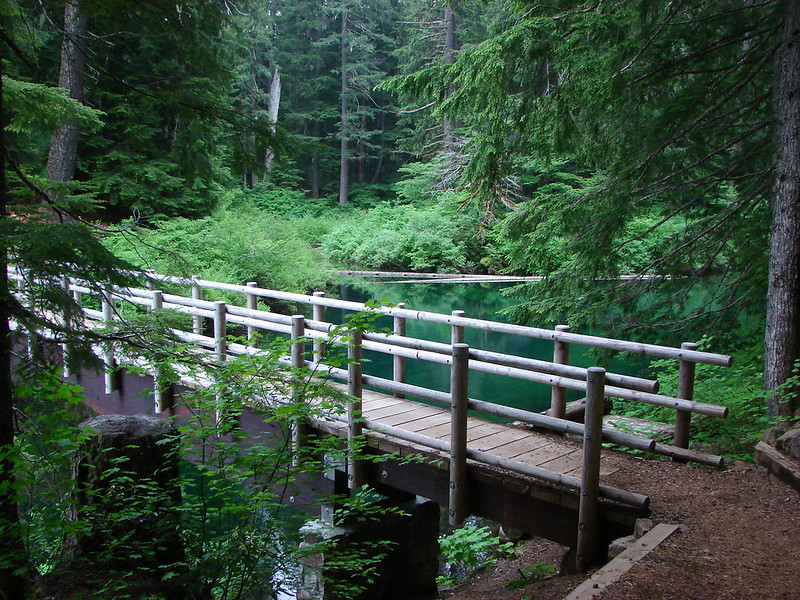
A footbridge led us over the outlet of the McKenzie River to the eastern shore of Clear Lake.
DSC09151
DSC09152
DSC09171

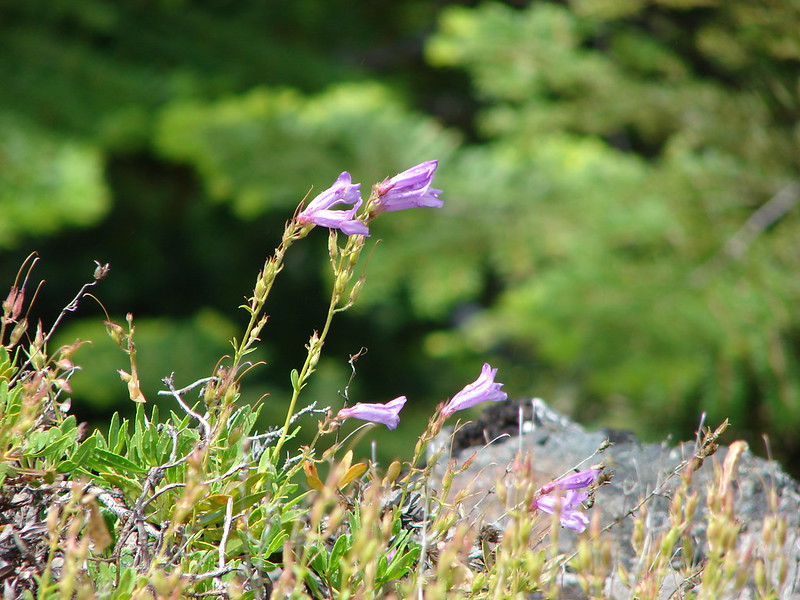
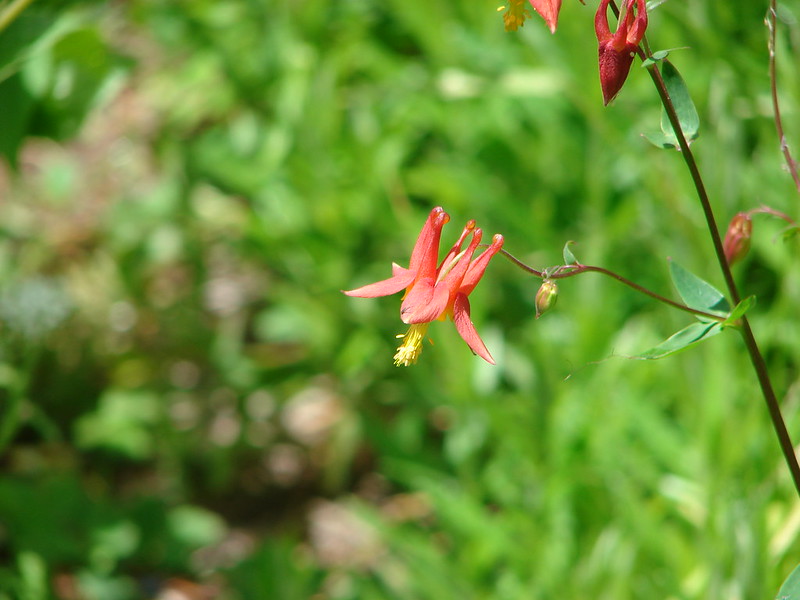
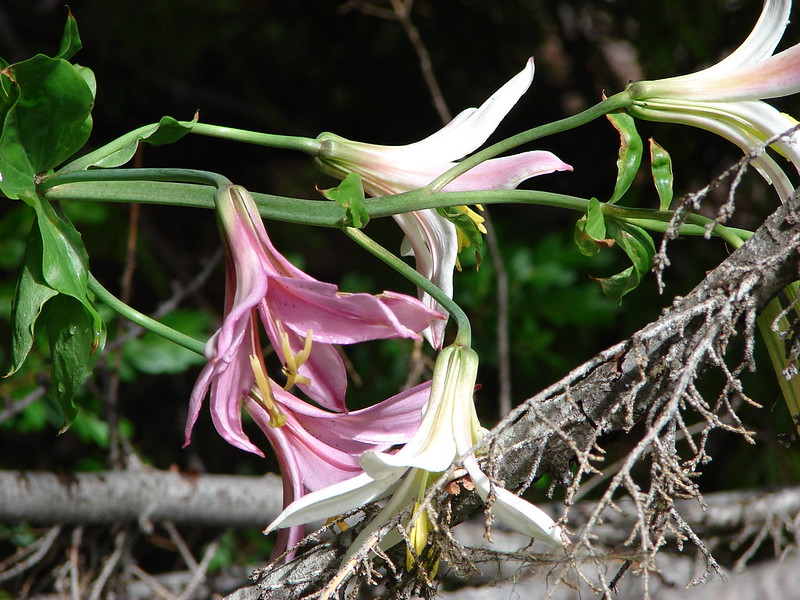
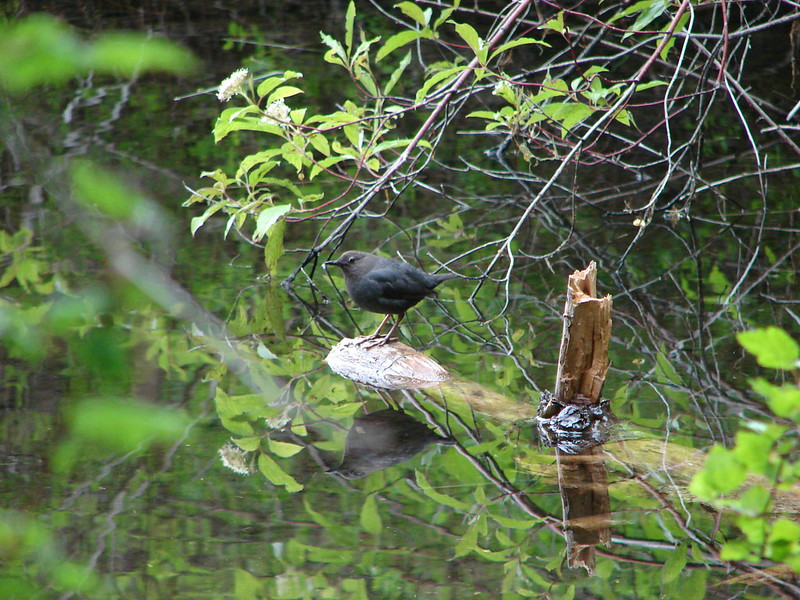
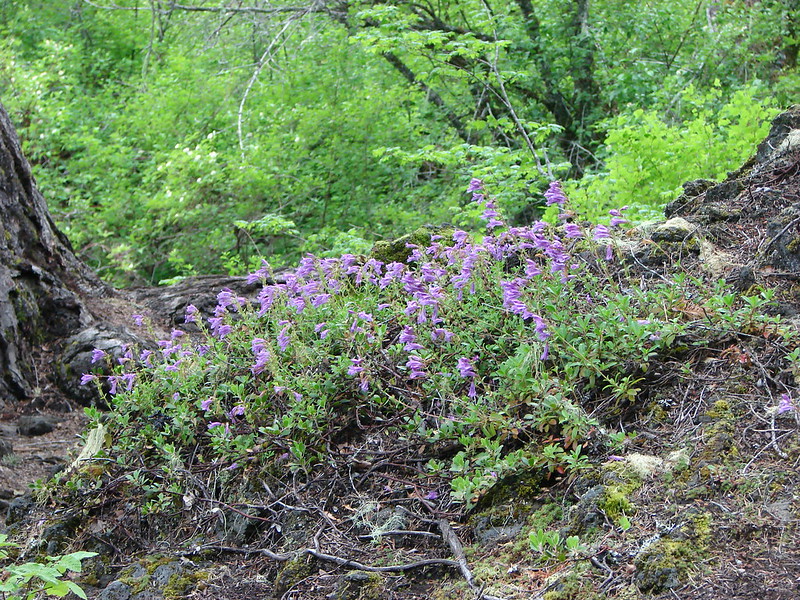
The trail on the eastern side spent more time in the open and closer to the lake as it crossed over several lava flows. Here we spotted several birds, ducks, and colorful wildflowers.
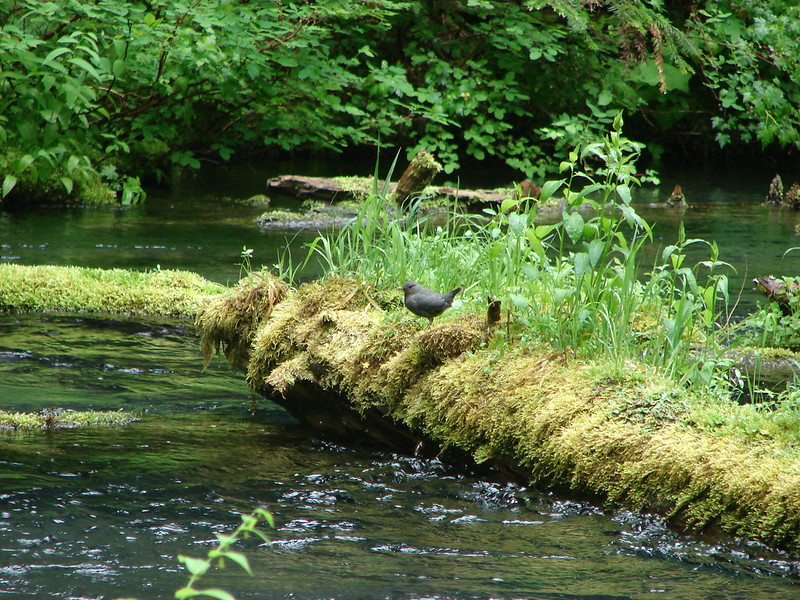
Ouzel
DSC09189
Penstemon
DSC09182
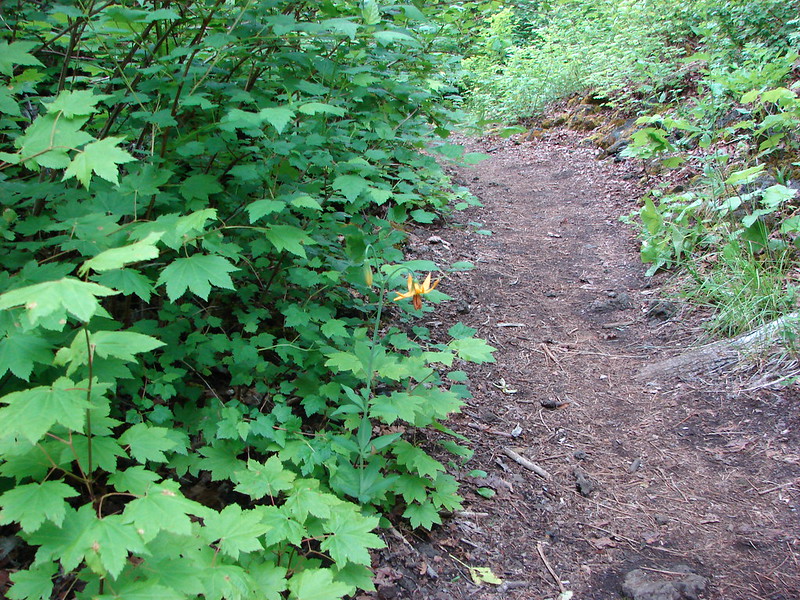
Tiger Lily
DSC09191
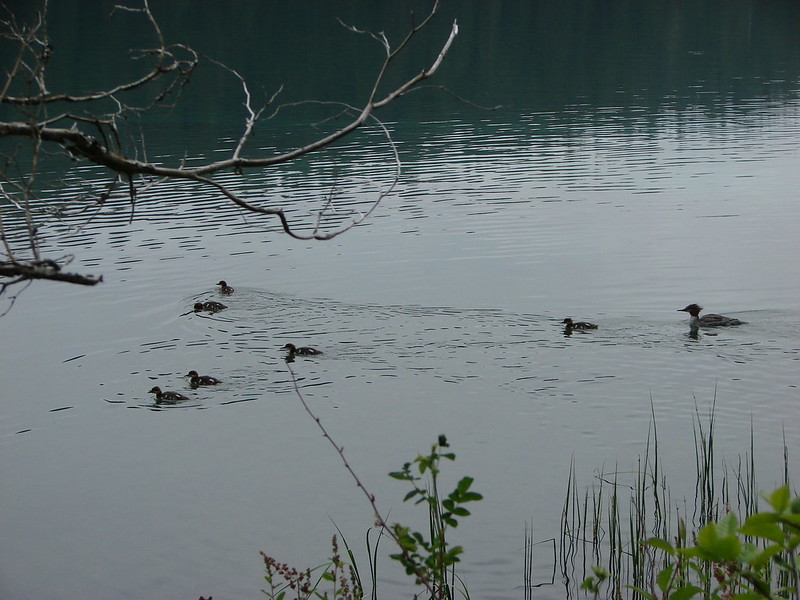
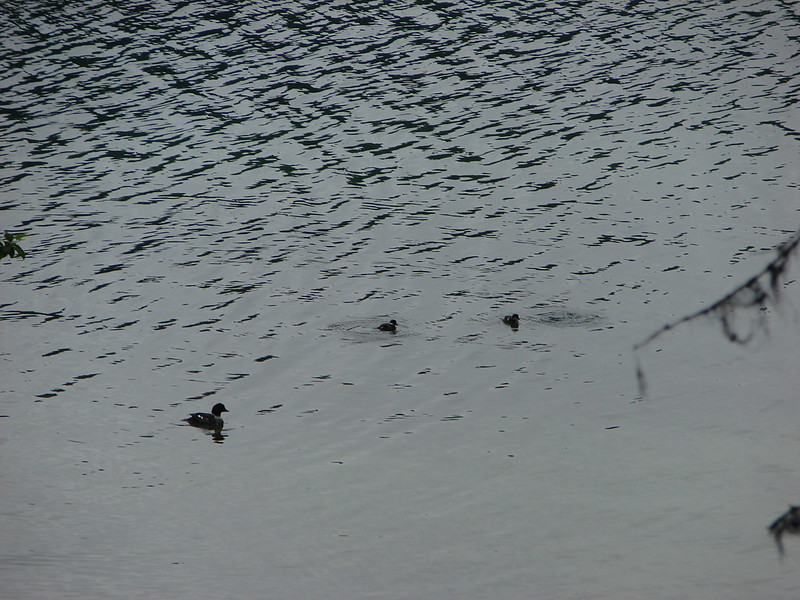
Merganser and her ducklings
DSC09197
Wild Rose
DSC09242
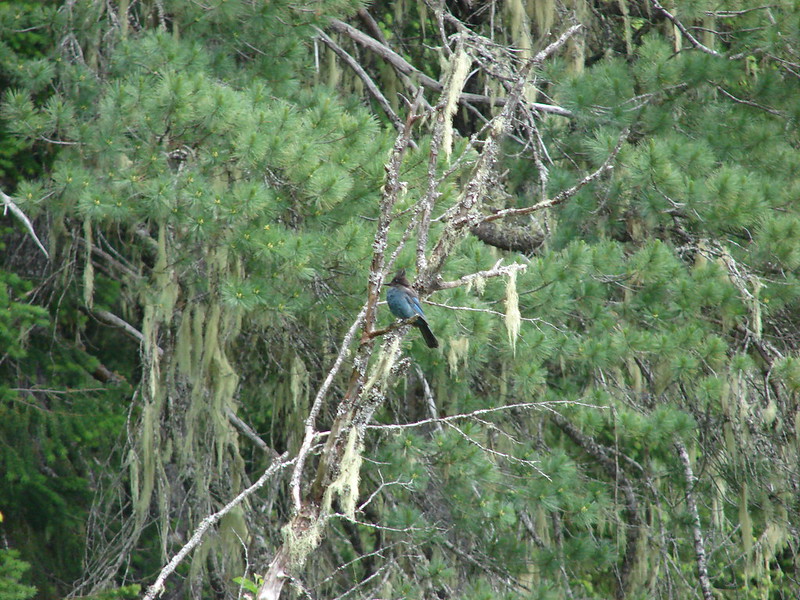
Stellars Jay
DSC09247
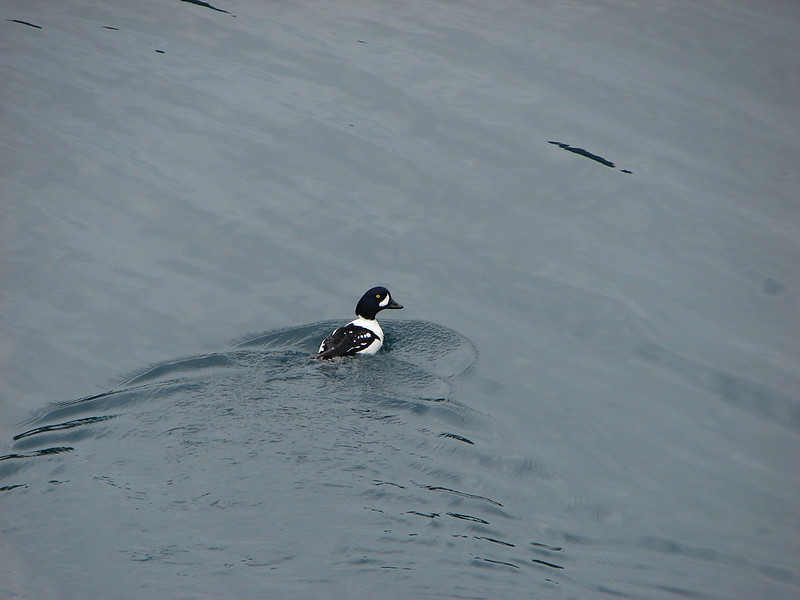
Barrow’s Goldeneye
DSC09255
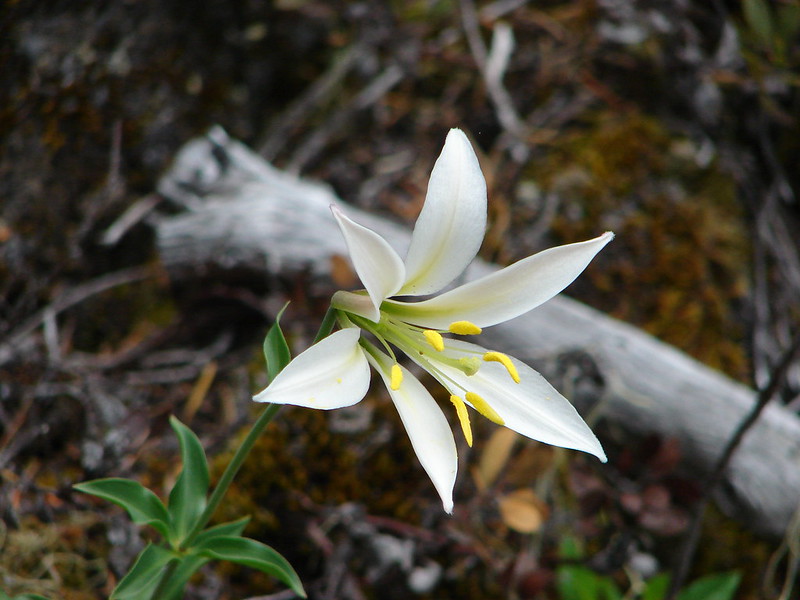
Washington Lily
DSC09271
Another family of ducks
DSC09273

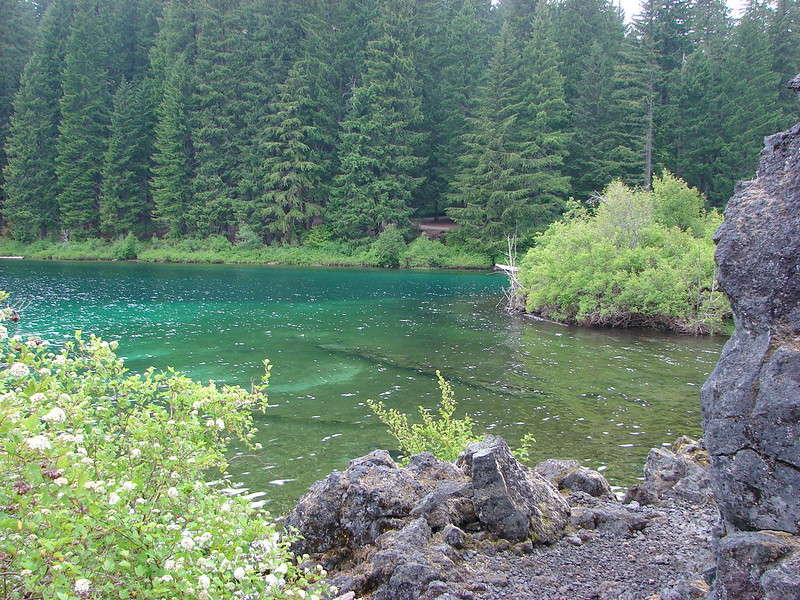
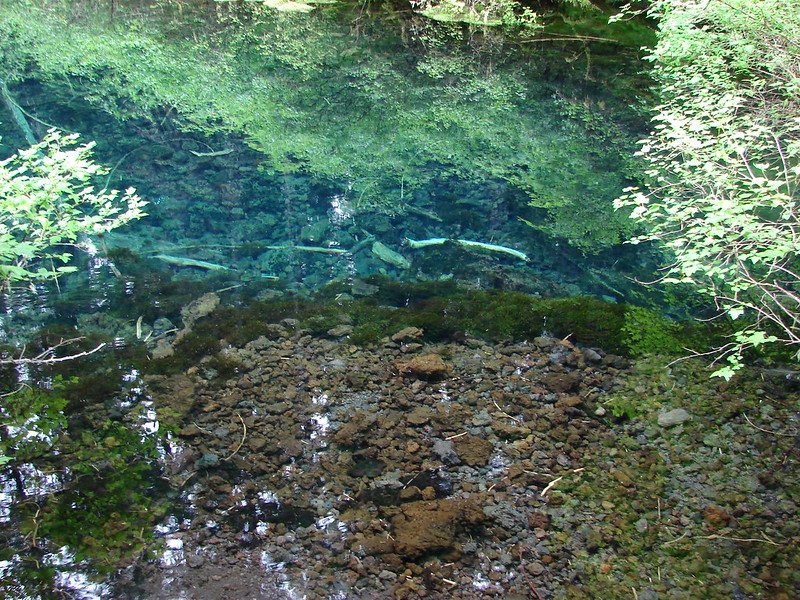
The water in the lake became more colorful as we arrived across the lake from the resort.
DSC09281
DSC09291
DSC09298
DSC09299

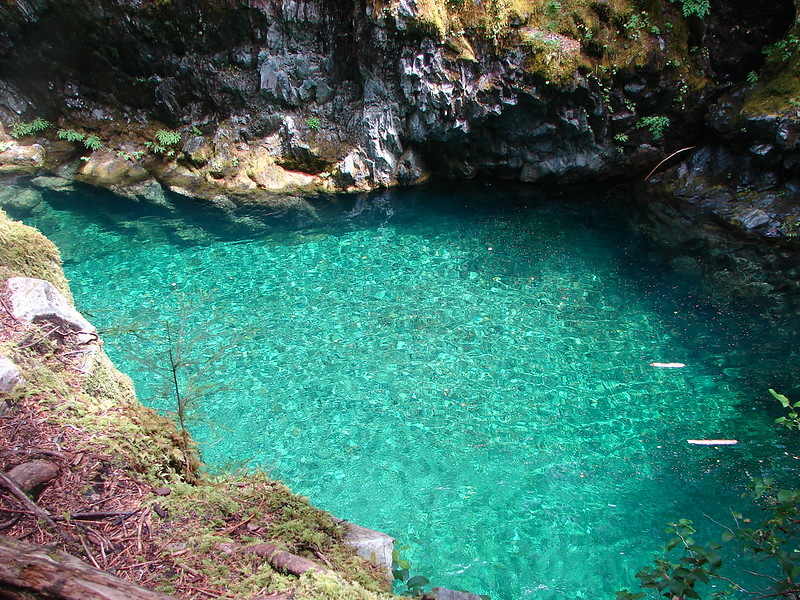
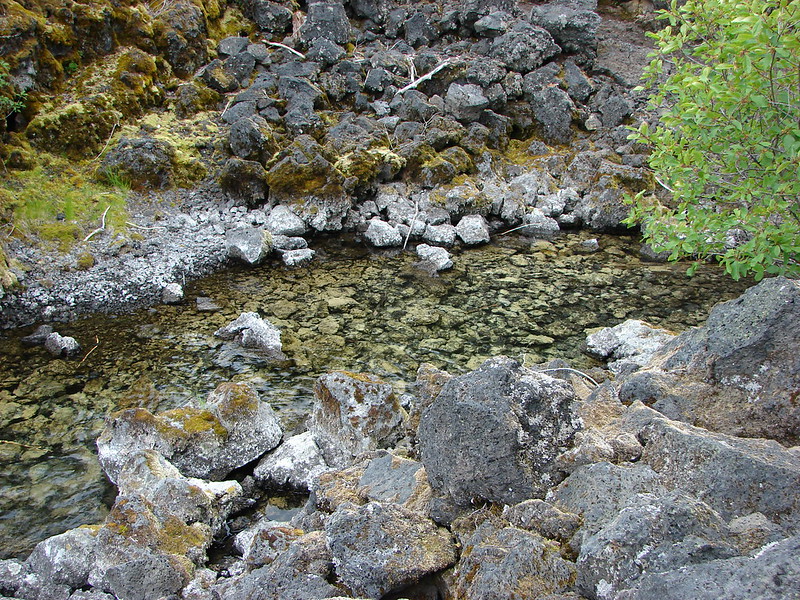
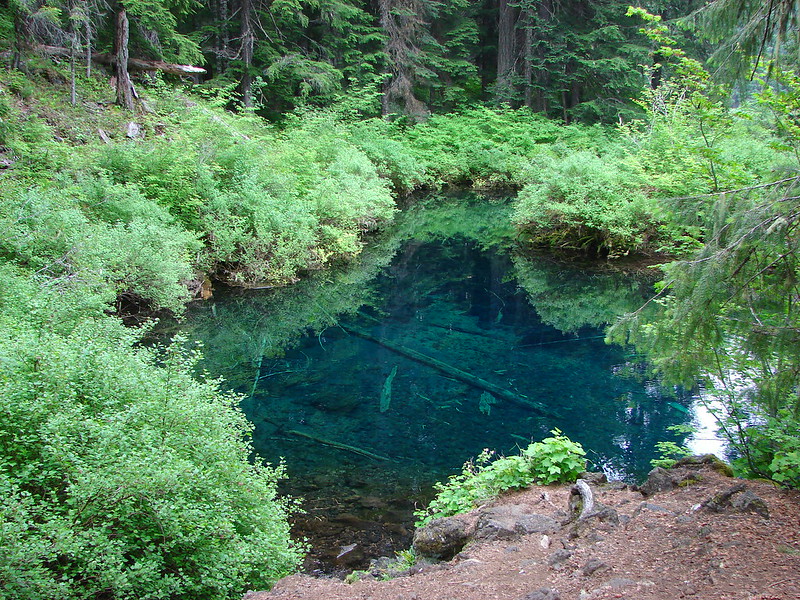
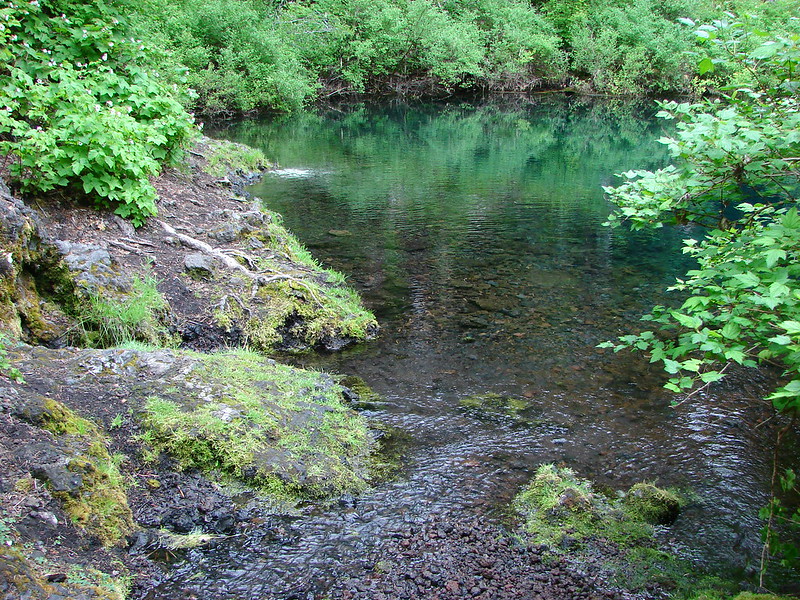
Shortly after passing the resort on the far shore we came to the Great Springs which feed the lake with 38 degree water allowing the lake to remain unfrozen all year. They emptied into a beautiful small pool reminiscent of the Tamolitch Pool which lies further down the McKenzie.
DSC09308
DSC09316
DSC09328

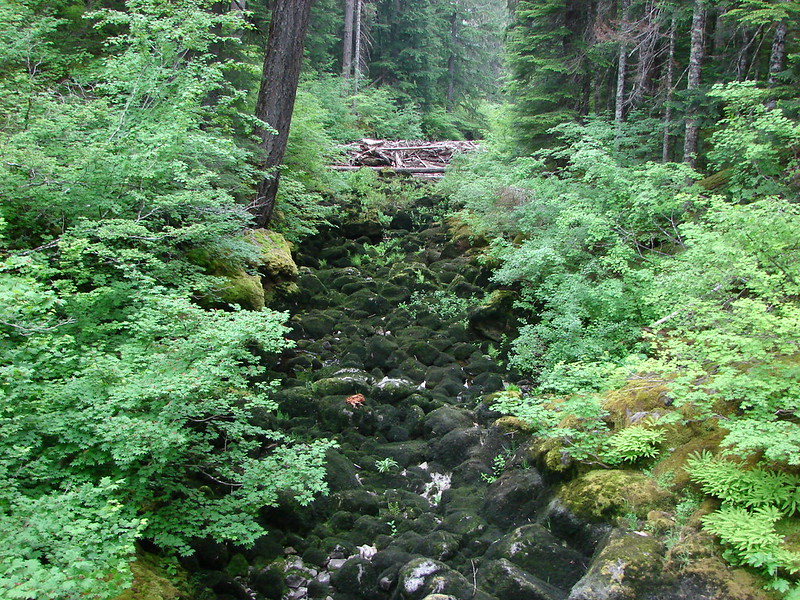
After the Great Springs the trail crosses Fish Lake Creek on a footbridge. This creek only flows during the Spring snow melt.
DSC09340

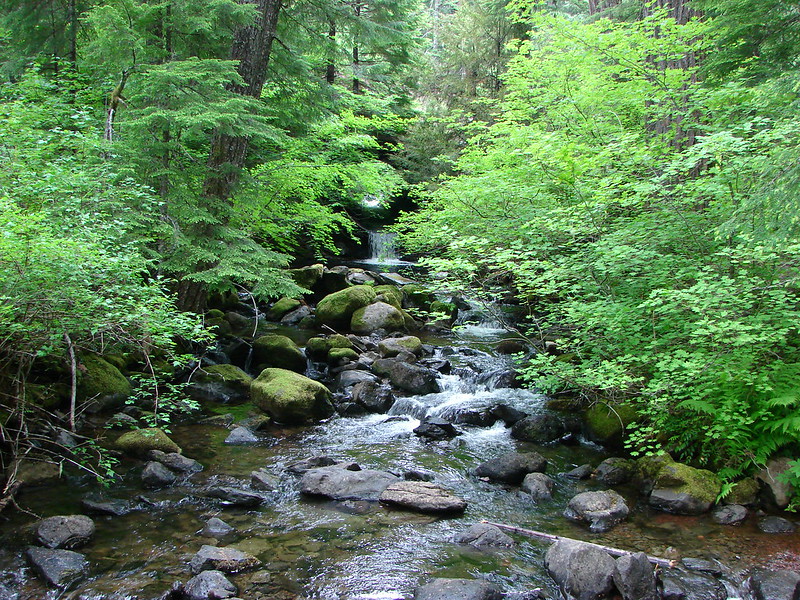
Finally we swung out around an arm of the lake where Ikenick Creek flows into the lake.
DSC09355

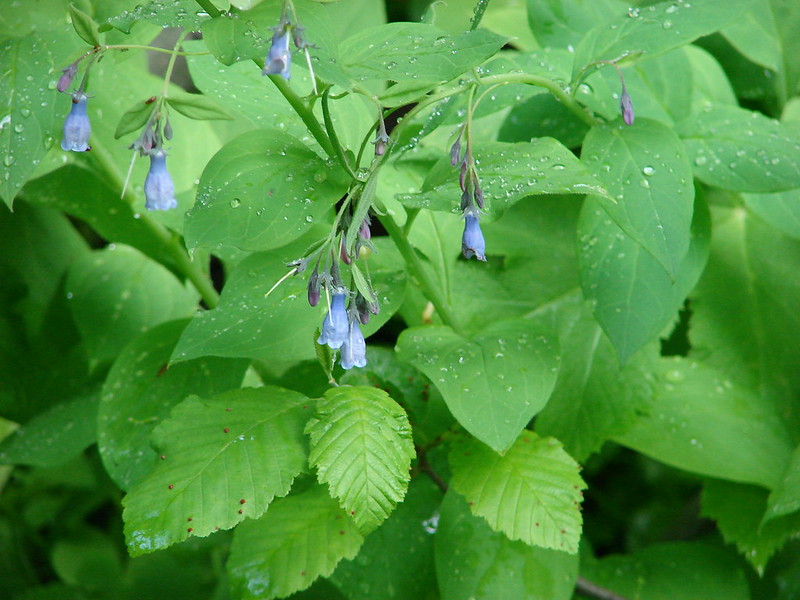
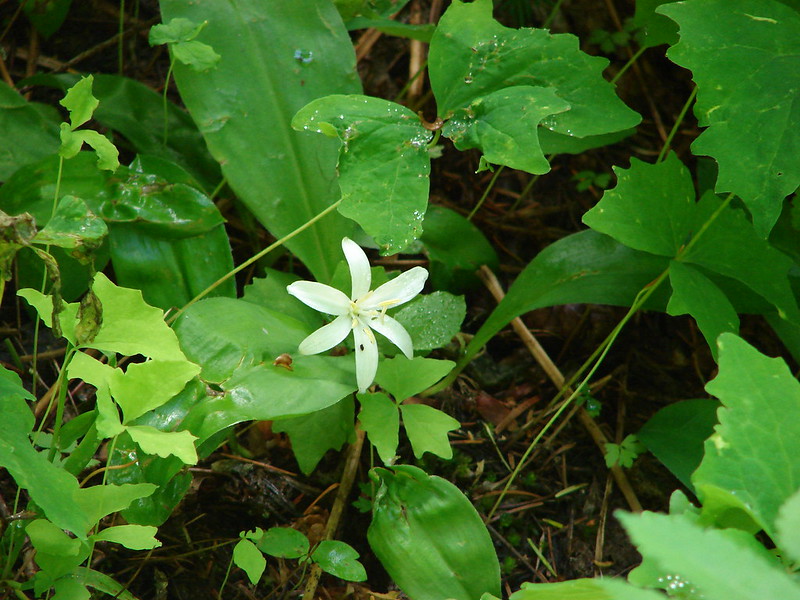
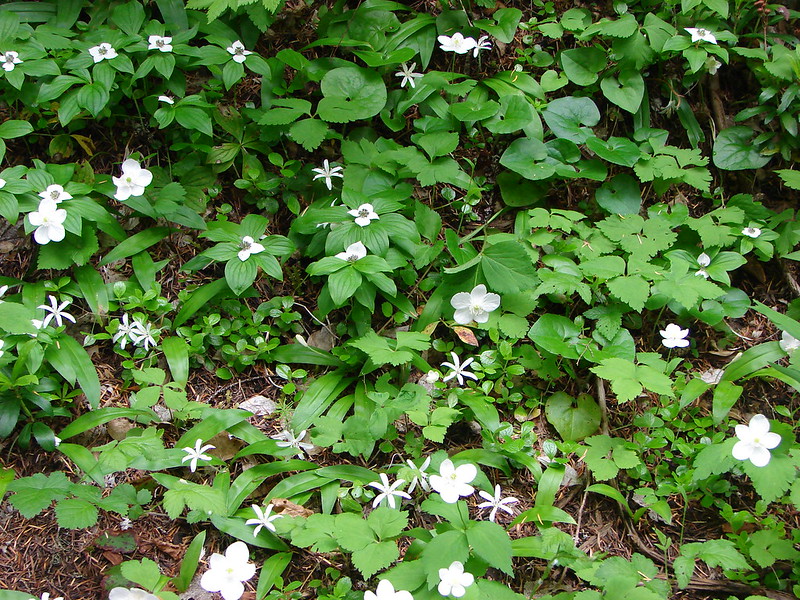
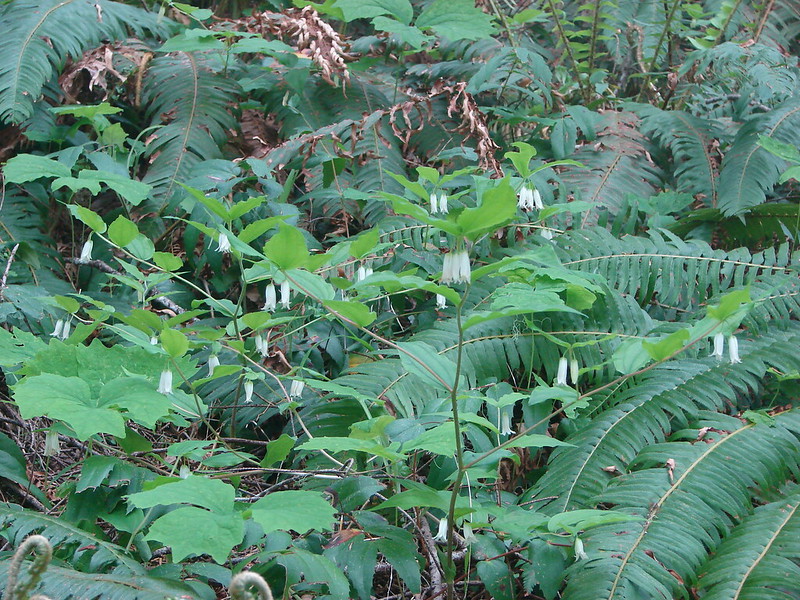
Back on the west side of the lake we were again in the fir forest where many white woodland flowers were in bloom.
DSC09360

We quickly reached the resort area which was busy with campers. The picnic area was just on the other side and before we knew it our Central Oregon hiking tour was over (for now). Happy Trails!

flickr: https://www.flickr.com/photos/9319235@N02/sets/72157644778548280/
Facebook: https://www.facebook.com/deryl.yunck/media_set?set=a.10204239083124439.1073741887.1448521051&type=1
Categories
Central Oregon Fort Rock Hiking Oregon Trip report

Hager Mountain Part Deux & Fort Rock

The third day of our Central Oregon visit had us returning to a hike we had done last July 31st – Hager Mountian. https://wanderingyuncks.wordpress.com/2013/07/31/hager-mountain/
Smoke from a wildfire had prevented us from having any views from the 7185′ summit that day but we had enjoyed the hike and seen signs of what seemed like it might be a decent amount of flowers if we had visited a bit earlier. We were hoping to get the views and to see some more flowers this time around and we also planned to stop at Fort Rock State Park on the way back to Bend, OR.

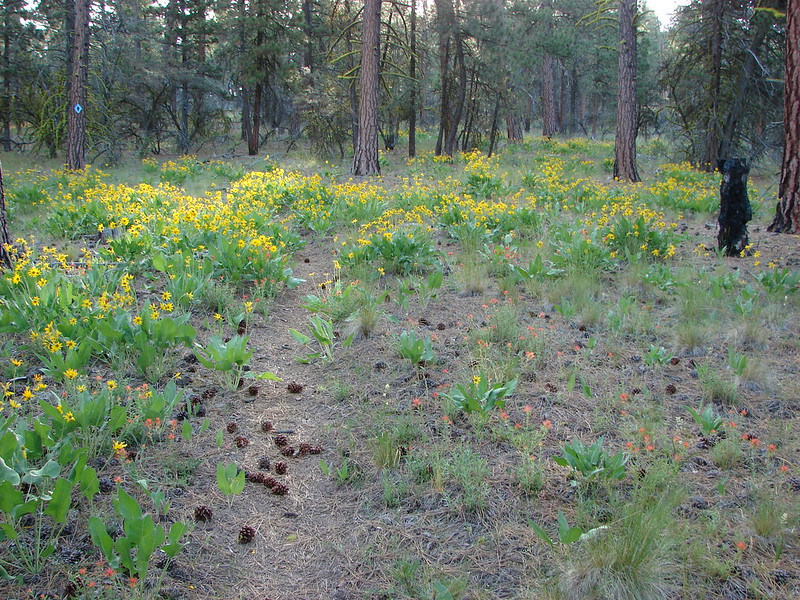
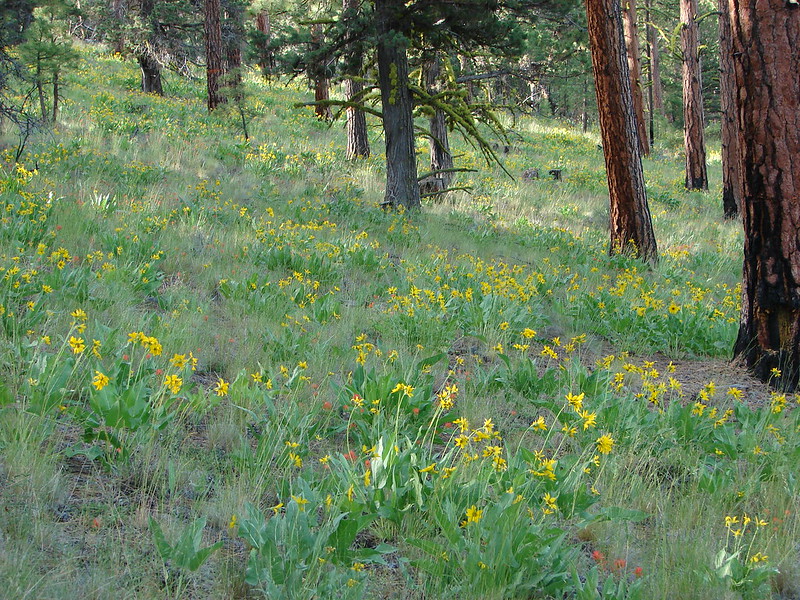
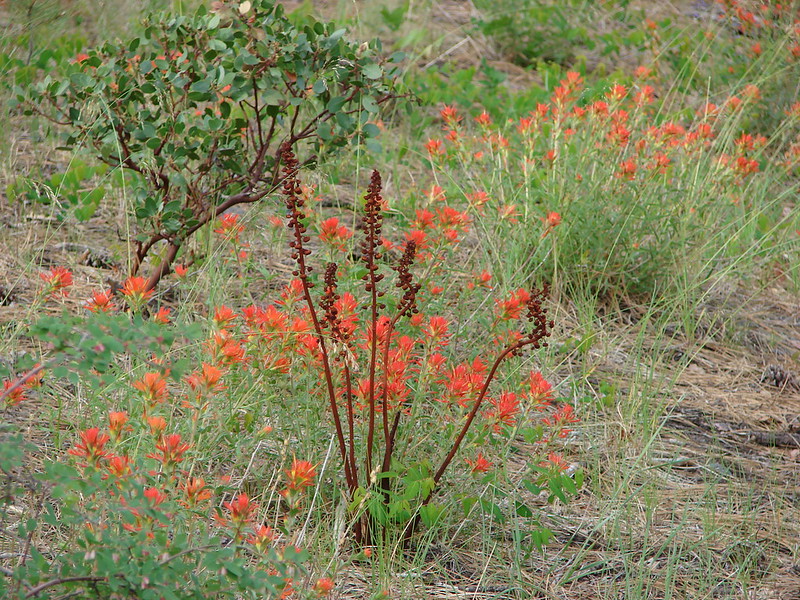
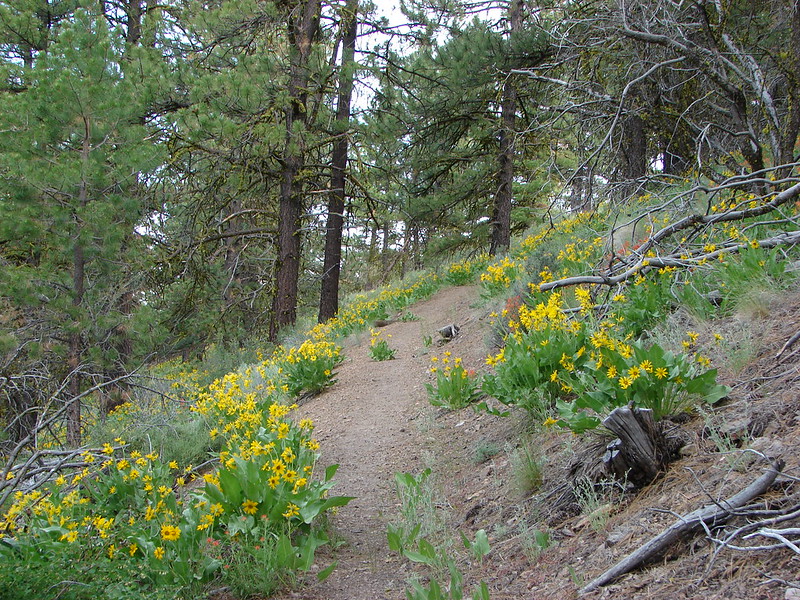
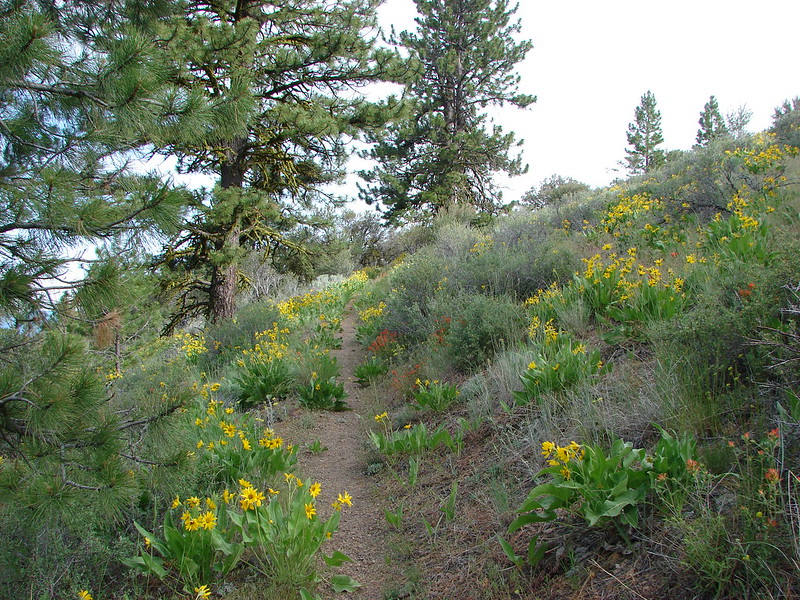
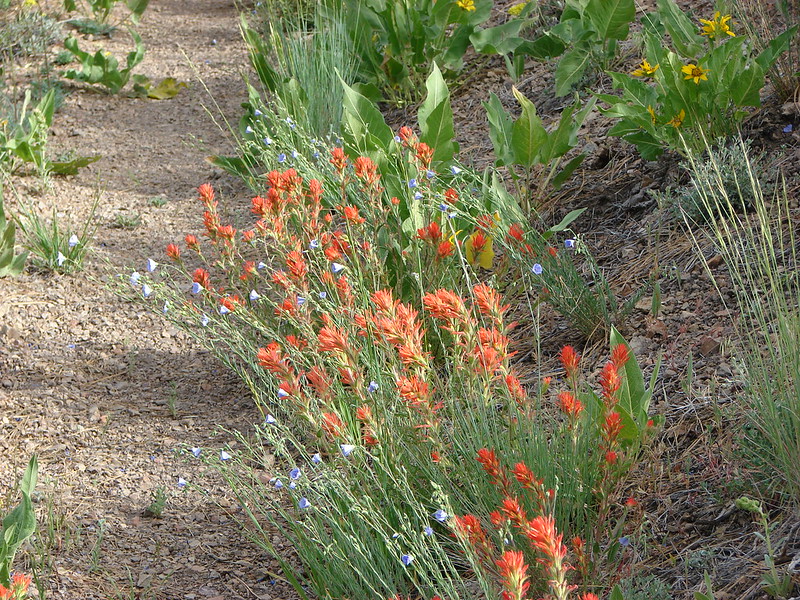
As we did on our previous visit we started at the lowest trail head located on road 28 just over 9 miles south of Silver Lake, OR. It wasn’t long before we began seeing wildflowers. Paint, lupine, death camas, and some balsamroot was scattered amid the ponderosa pines. We were thinking it was pretty good and then we looked ahead and saw a completely unexpected sight. The amount of paint and blasamroot that covered the forest floor was beyond anything we’d imagined. The flowers were spread out in every direction.
DSC08412
DSC08432
DSC08434

By the 1.5 mile mark the trail had left the ponderosa forest. The flowers had decreased here but there were still some to be found.
DSC08470
DSC08465

We passed Hager Spring which was as dry as it was on our last visit and began climbing to the lower meadow. We weren’t sure what to expect for flowers in the meadow. We had gotten a couple of glimpses of it from the lower trail and we thought we could see some yellow which we assumed was balsamroot. As we got closer to the meadow our suspicions were confirmed. The balsamroot was back with a vengeance along with paint and some additional flowers.
DSC08478
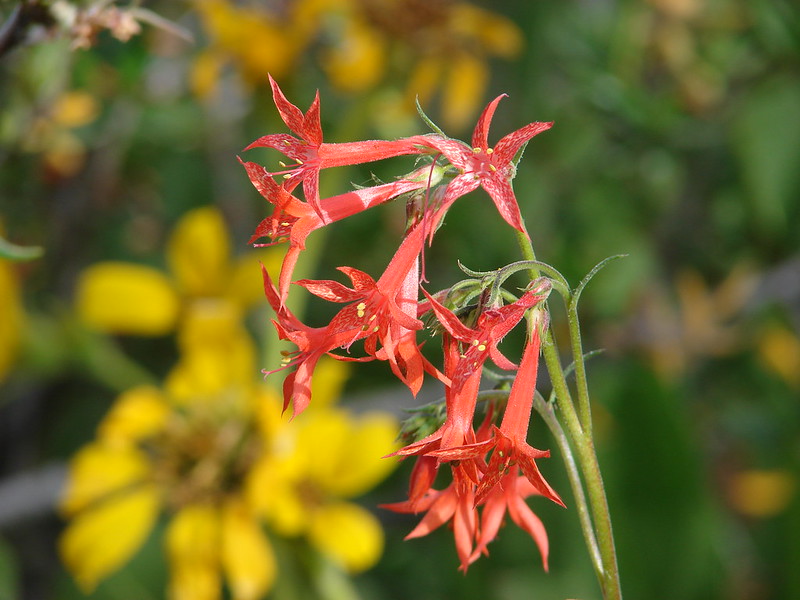
Scarlet Gilia
DSC08529
DSC08502
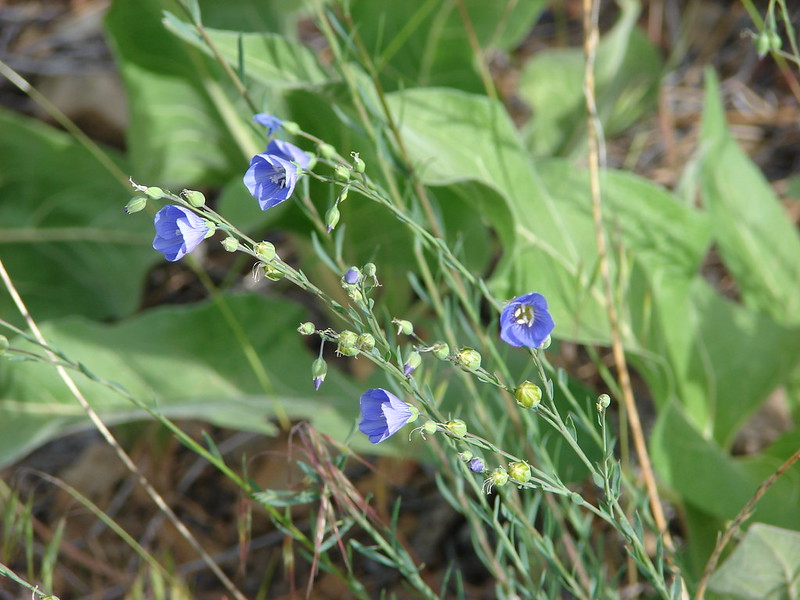
Lewis Flax
DSC08519
DSC08521
Prairie Star
DSC08538

Not only were the flowers amazing but we had a view as we passed through the meadow. For the first time on a hike we could see Mt. Shasta in California beyond Thompson Reservoir.
DSC08531
Along with Mt. Thielsen, Howlock Mt. & Tipsoo Peak
DSC08523
and Mt. Bachelor, The Three Sisters, & Broken Top
DSC08562

We made a switchback in the meadow and could see the summit as we continued up through the meadow. The flowers remained the star of the show.
DSC08581
DSC08585
DSC08589
DSC08598
DSC08600

We left the lower meadow and entered another section of forest. The flowers decreased in this section but there were some arnica starting to bloom and a lot of fireweed just starting to grow. The trail climbed stiffly through the trees making this the most difficult section of the trail before leveling out briefly and then launching up again into the upper meadow. Here we found some more balsamroot and some phlox.
DSC08616
DSC08620
It was in this section that we were looking for the rare green paintbrush that grows on Hager Mountain. We had seen some on our previous visit but it was drying out that day. Now we found some lush versions growing near the trail.
DSC08654

It was exciting to reach the summit to see what views we had missed on the previous hike. The day wasn’t entirely clear but it was a monumental improvement over the last time. We spent about 45 minutes studying the horizon and taking pictures. There are some very interesting geologic formation in that part of Oregon and we were intrigued by some of the odd features.
DSC08644
DSC08646
DSC08648

Warner Peak in the distance to the right:
DSC08649
Gearhart Mountain with a bit of snow:
Gearhart Mountain from Hager Mountain
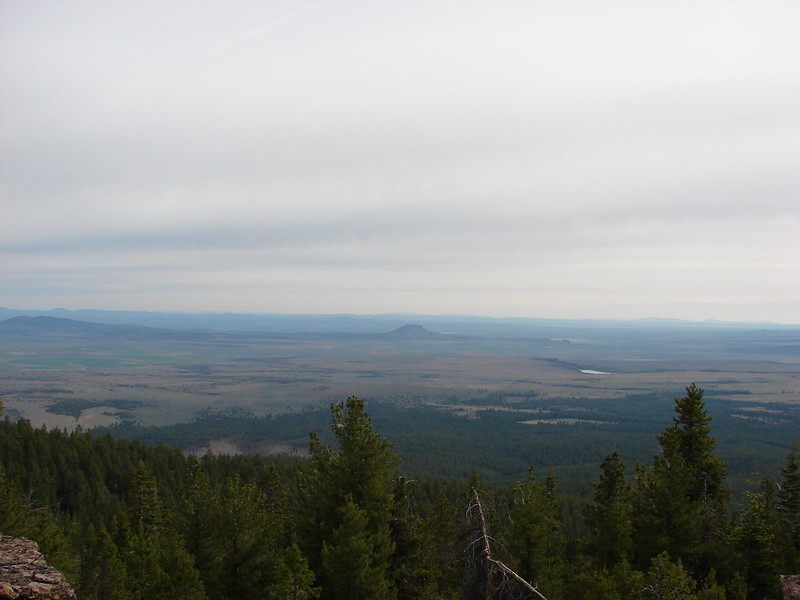
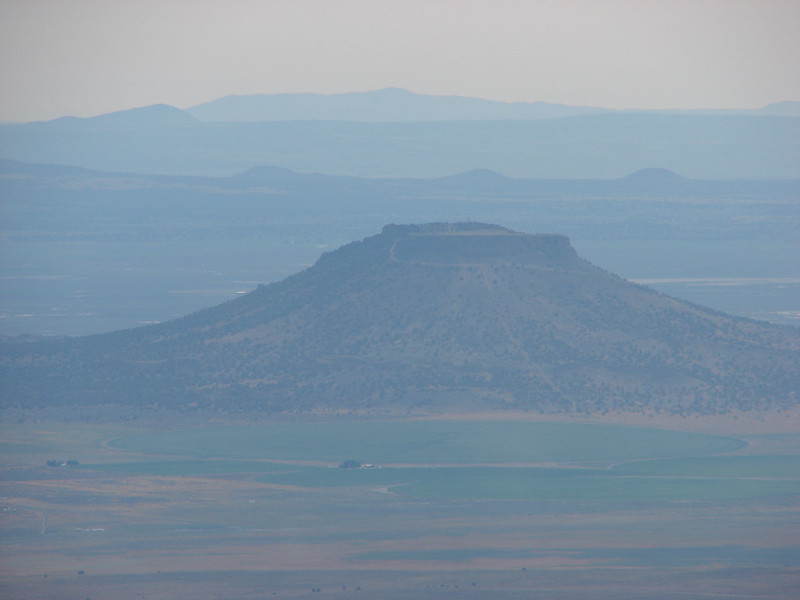
Fort Rock in the center of the flat area with Paulina Peak, China Hat & East Butte behind from left to right.
DSC08701
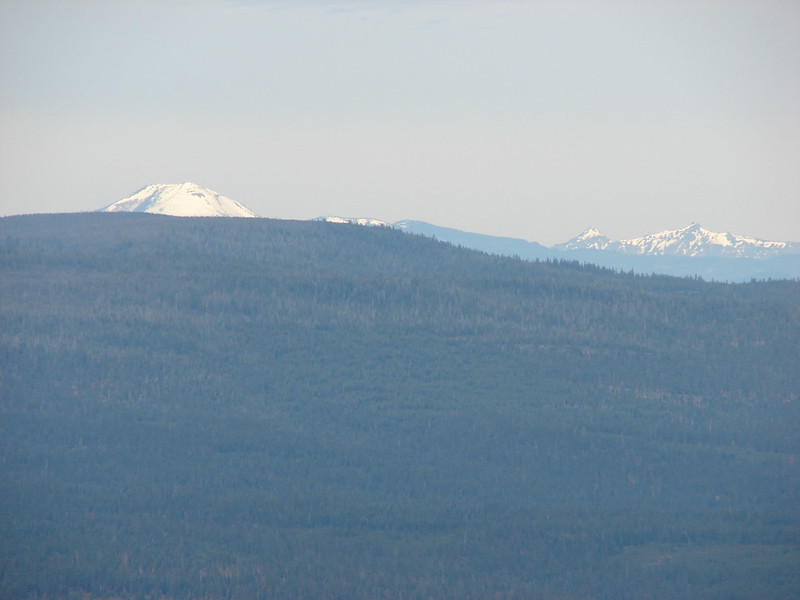
From the northwest to the southwest the horizon was dotted with snowy Cascade peaks. It was too cloudy to see Mt. Hood and Mt. Jefferson appeared like a ghost in the clouds but we had good views starting with the Broken Top, Three Sisters and Mt. Bachelor:
DSC08699
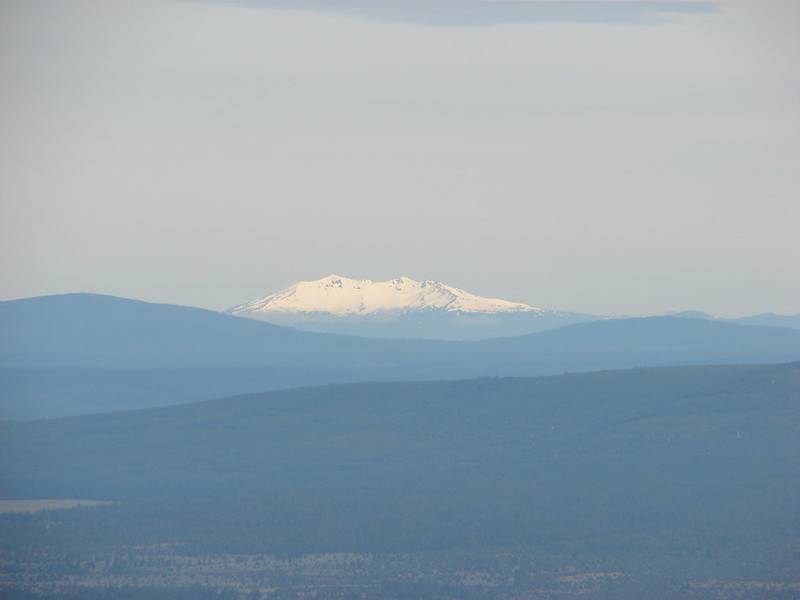
Followed by Diamond Peak to their south:
DSC08698
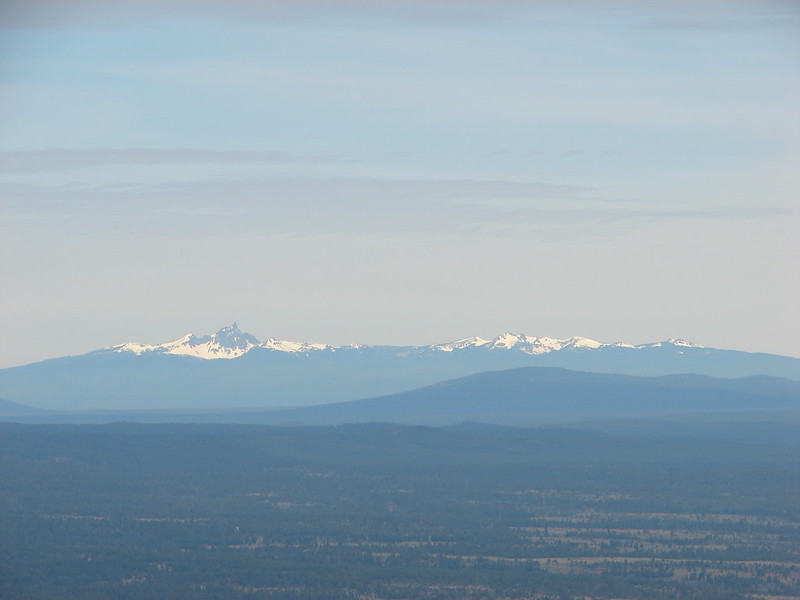
Then Mt. Thielsen, Howlock Mt. & Tipsoo Peak:
DSC08695
Crater Lake had emerged from the previous days clouds as we could easily make out Mt. Scott, The Watchman, and Hillman Peak:
DSC08756
Mt. McGloughlin barely rose above the broad shoulder of Yamsay Mountain:
DSC08757
And finally Mt. Shasta looming large far to the south:
Mt. Shasta fro m Hager Mountain

We were joined on the summit by some of the local wildlife.
DSC08789
DSC08831
DSC08815
DSC08839

By the time we were on our way back down the flower display had actually gotten better. The lewis flax was opening to the sunlight.
DSC08855
DSC08875
DSC08866

We passed four other hikers on our way back to the car as well as a noisy nuthatch and a couple of sagebrush lizards.
DSC08938
DSC08956

Once we were back on the road we returned to Highway 31 and headed north to Fort Rock State Park. Neither of us had been there before but it had piqued our interest on the way past the year before. The rocks are said to be the remainder of an ancient volcanic crater that was worn down by an ice age lake. Whatever the origin the result was an interesting crescent formation full of textured rocks angled this way and that.
2014-06-14 13.45.55
DSC09004
DSC09014
DSC09012

Inside the crescent the ground appeared to be covered in sagebrush, but as we hiked along the loop inside the rocks we noticed a good number of wildflowers that had sprung up amongst the sage.
DSC08987
DSC09003
DSC09032
DSC09034
DSC09049
DSC09085
DSC09110
DSC09115

A short side path led to a notch in the rocks where you could see the Fort Rock Cave:
DSC09060
To the south we could see Hager Mountain where we had been just a couple hours earlier:
DSC09088

It had been a great day of hiking with some really interesting and beautiful scenery. One note of caution though. We both had to knock ticks off, Heather during the Hager Mountain hike and myself back at the car after being on the Fort Rock trails. Happy Trails!

flickr: https://www.flickr.com/photos/9319235@N02/sets/72157644765557647/
Facebook – Hager Mt.: https://www.facebook.com/media/set/?set=a.10204238532710679.1073741885.1448521051&type=1
Fprt Rock: https://www.facebook.com/media/set/?set=a.10204238985722004.1073741886.1448521051&type=1

Categories
Crater Lake Area High Cascades Hiking Oregon Trip report

Upper Rogue River Trail and Boundary Springs

**Note the 2017 Blanket Creek Fire burned a portion of this hike and the 2024 Middle Fork Fire also burned over Boundary Springs.**

Hike #2 on our mini-vacation was a visit to the Rogue River-Siskiyou National Forest and Crater Lake National Park. The plan was to start at the Mazama Viewpoint on Hwy 230 and first visit Boundary Springs which is where the Rogue River begins. Then we would hike down the Rogue River to Rough Rider Falls. We would have turned around there but my parents decided to come along and start at a different trail head and hike up the Rogue to the falls. They dropped us off at the Mazama Viewpoint before heading down to the lower trail head. This allowed us to continue past Rough Rider Falls and meet them at that spot.

It was a cloudy morning and we’d driven through a little rain/snow mix on the way there. An occasional light rain would continue all day long with a glimpse of blue sky thrown in every now and then. We started off on the Upper Rogue River Trail from the Mazama Viewpoint and followed the trail half a mile to a junction with the Boundary Springs Trail. Shortly after joining this trail we started getting glimpses of the Rogue flowing through the forest.
DSC08143
We crossed the boundary of Crater Lake National Park and continued on toward the springs. The river was increasingly scenic as we went.
DSC08156
DSC08168

Near Boundary Springs was a pretty waterfall:
DSC08174

The river just below the springs:
DSC08186

The largest of the springs:
DSC08190

After poking around the springs we returned to the Upper Rogue River Trail and turned left to head down river to Rough Rider Falls. The trail started out far above the Rogue as it flowed through an interesting canyon.
DSC08227
DSC08249

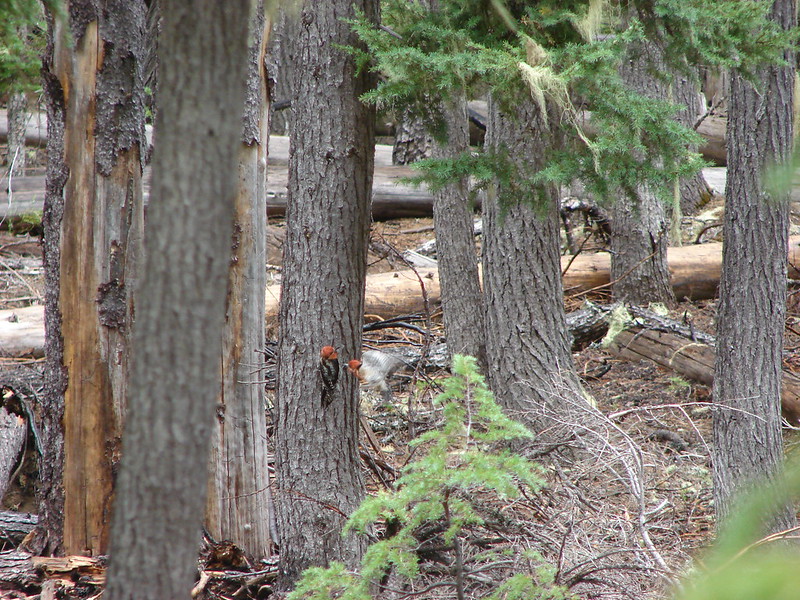
We came upon a couple of deer that were too quick for pictures and a pair of noisy woodpeckers that didn’t seem too pleased with one another.
DSC08253
DSC08254

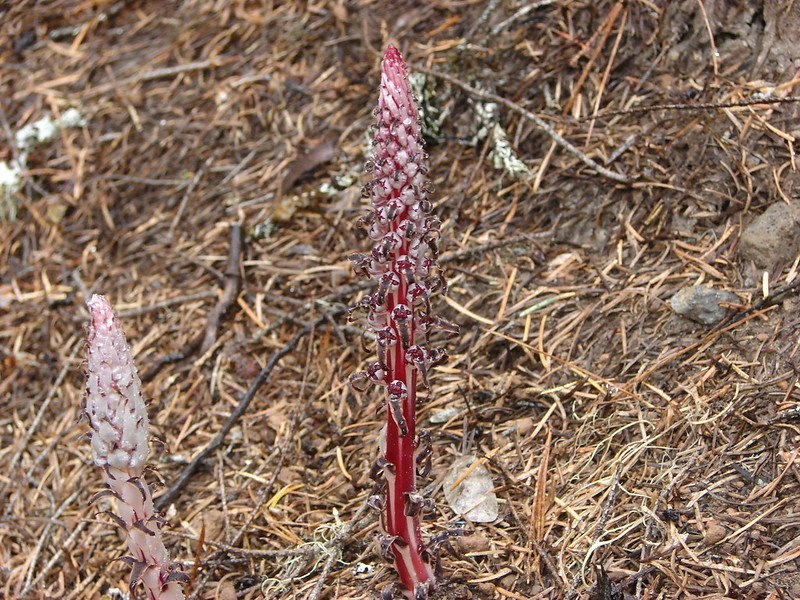
We also saw the best candysticks we’d come across:
DSC08268

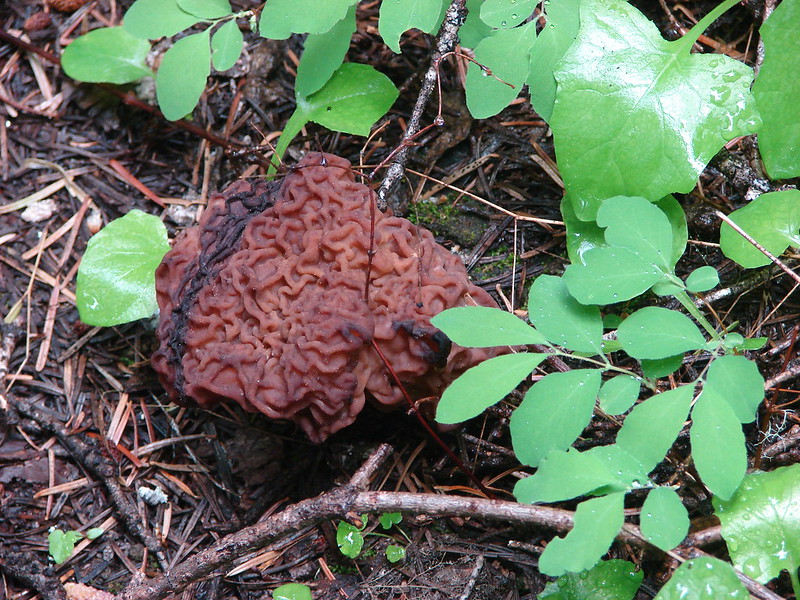
And a strange mushroom thing:
DSC08298

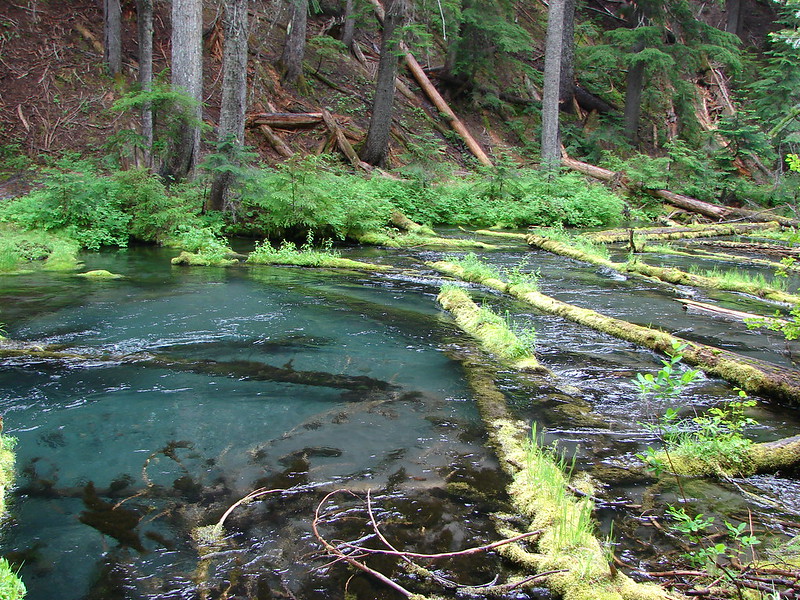
The trail descended back down to the river which was amazingly clear where the water was calm.
DSC08291
DSC08290

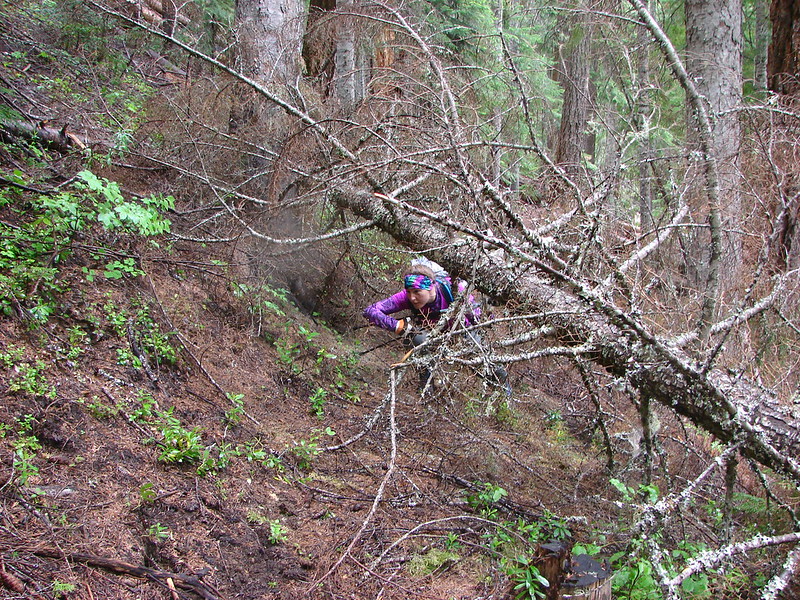
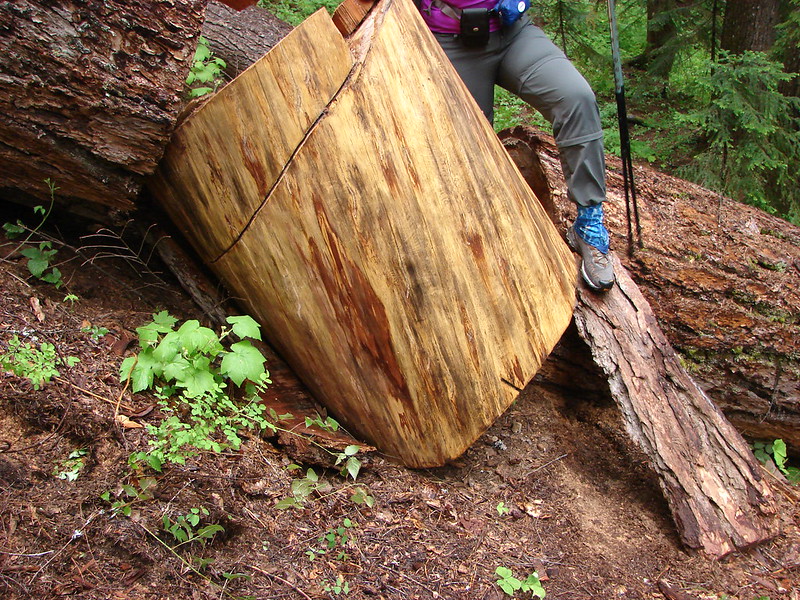
Once the trail lowered into the canyon it became a bit messy. Many downed trees created tricky obstacles and the trail was in need of some maintenance.
DSC08300
DSC08330

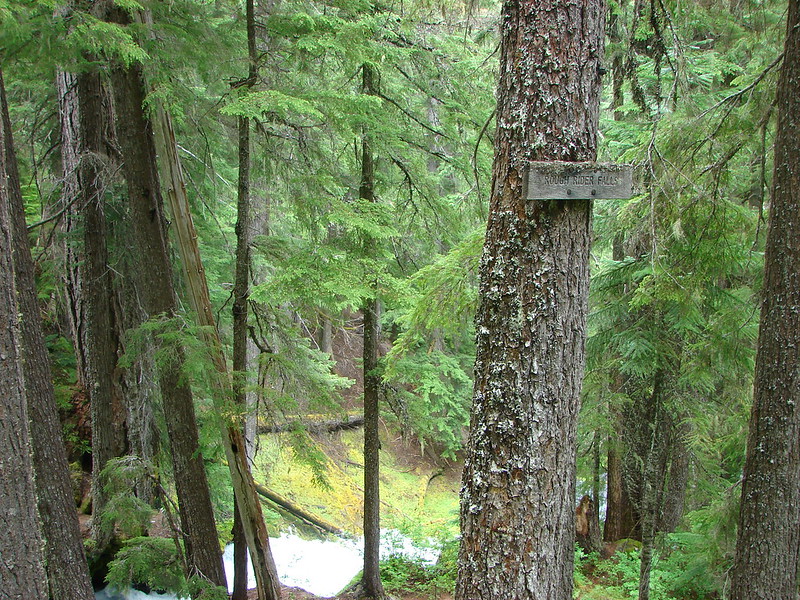
It was 4.2 miles from the Boundary Springs Trail to Rough Rider Falls. A sign above the falls announced them.
DSC08304
DSC08307
DSC08312

It was pretty above the falls but we couldn’t get a good feel for them until we descended below them.
DSC08317
DSC08320

After Rough Rider Falls we passed a pretty little waterfall coming from a hillside into the river.
DSC08325

A little island with whitewater on each side:
DSC08328

And finally an unnamed waterfall:
DSC08344
DSC08346

The strangest thing of the hike was the amount of climbing we felt like we did considering we were supposedly traveling downhill with the river. When we arrived at my parents car we discovered that they had just finished about 15 minutes earlier. There were some mosquitoes around the car so we quickly tossed our gear in the back and hopped in. We had hopped to stop by Crater Lake on the way home since Dominique has never seen it and it had been years since my parents had. We were there in 2012 but smoke from a fire had obscured most the views. With the weather flipping between blue sky and rain showers all day we weren’t sure if we would be able to see the lake but my parents had their National Park Pass with them so we decided why not give it a try. As we drove up to the north rim we entered the clouds and some more rain/snow mix. The visibility was worse than our previous visit so I took a couple of pictures to show we were then we turned around and headed home.
DSC08354
<a href="https://www.flickr.com/photos/9319235@N0

We plan on heading back this Fall for another try and maybe then we'll be able to actually see the lake. Happy Trails!

flickr: https://www.flickr.com/photos/9319235@N02/sets/72157645163872924/
Facebook: https://www.facebook.com/media/set/?set=a.10204237288199567.1073741884.1448521051&type=1
Categories
Central Oregon Hiking Ochoco Mountains Oregon Trip report

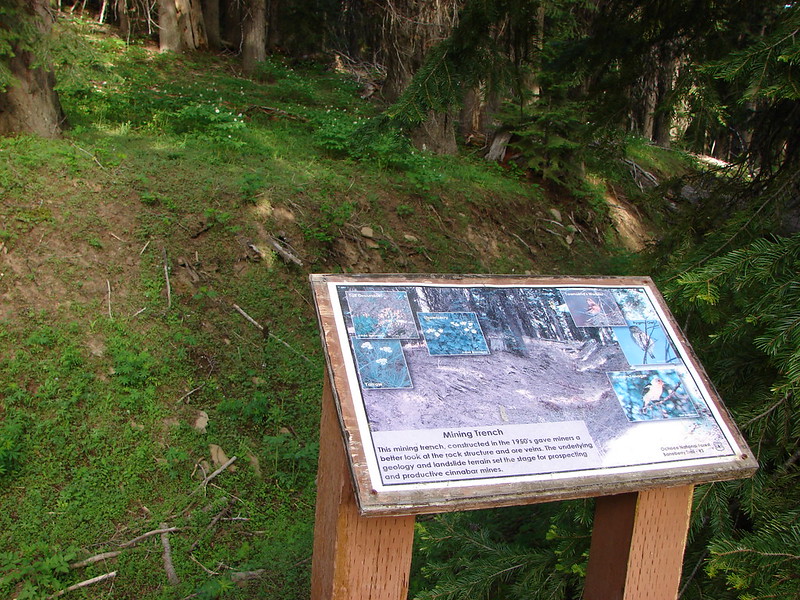
Lookout Mountain – Ochoco National Forest

We recently returned from a long weekend in Central Oregon. We had a few hikes that we were wanting to try in June in that area starting with Lookout Mountain in the Ochoco National Forest. Roughly 26 miles east of Prineville, OR the summit of Lookout Mountain is the 2nd highest point in the Ochoco Mountains. The summit is part of a broad plateau of sagebrush and wildflowers which also offers a 360 degree view.

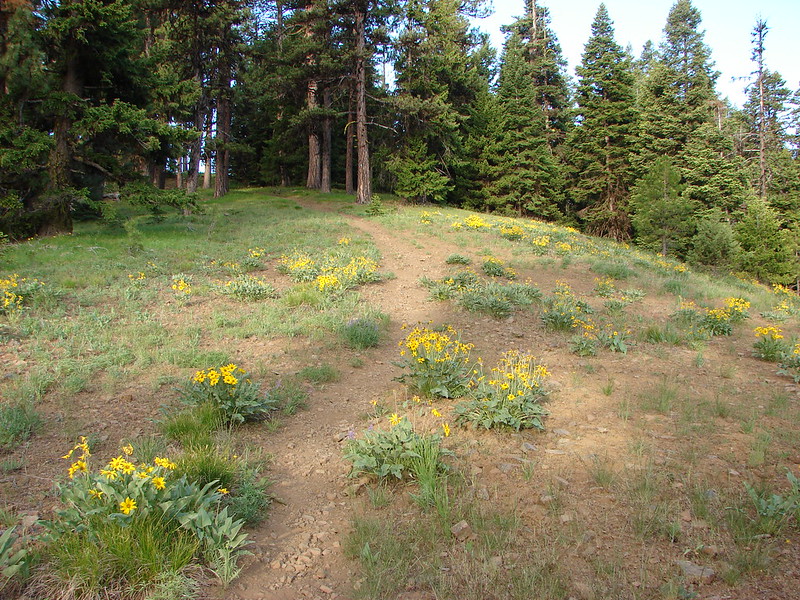
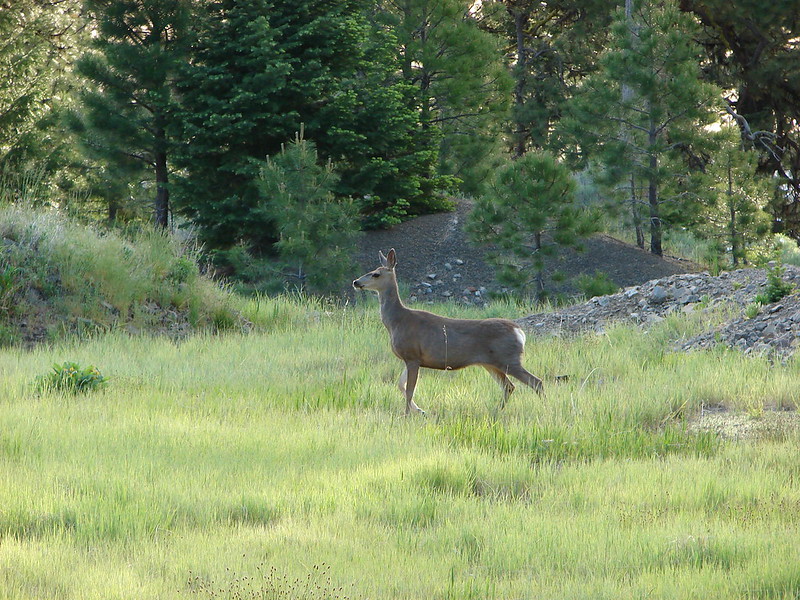
There are a couple of options for reaching the plateau. For our visit we decided to start at the Round Mountain Trailhead on road 4205 just after turning off of road 42. We could have shaved nearly 2 miles form the hike by continuing up road 4205 to the Independent Mine Trailhead but the road is quite rough and I would rather be hiking than bouncing around in a car. The 0.9 mile path between the trailheads was pleasant enough with a number of wildflowers and a deer sighting.
DSC07761
DSC07763
DSC07774

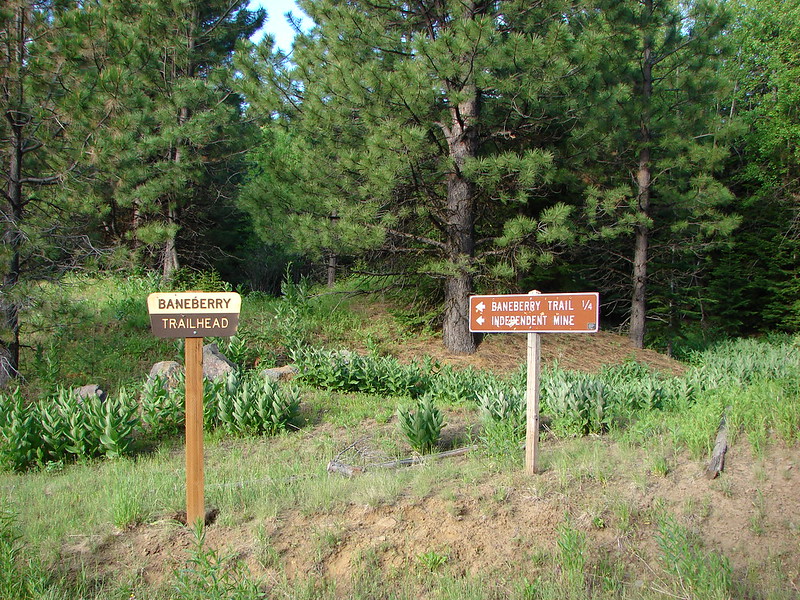
We accidently left the trail and wound up on road 4205 across from signs for the Independent Mine and the Baneberry Trailhead.
DSC07784
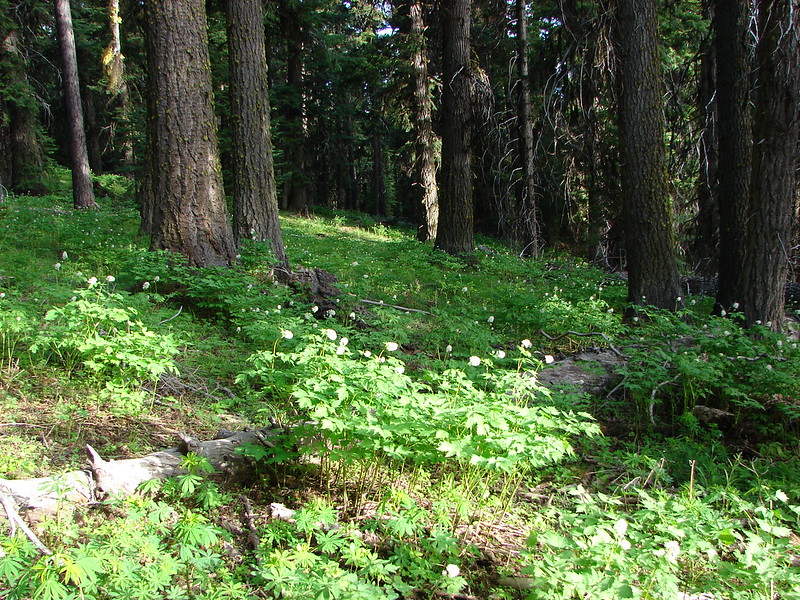
Our version (2008, 2nd edition) of 100 Hikes in Eastern Oregon didn’t give any information about this trail but a sign at the Round Mountain Trailhead made mention of extensive trail work and renaming starting in 2010. Our book did show an old road leading down to the mine though so we decided to check it out. We reached the Baneberry Trail before getting to the mine and saw that it was an interpretive nature loop. Thinking it would loop us around to the mine we turned on the trail and began the loop. It was evident why the trail was named Baneberry as the forest was full of the plant.
DSC07804
Many benches and interpretive signs were located around the trail telling of the mining activity, forest, and wildlife.
DSC07805
As we continued on the loop it became evident that we were not going to loop to the mine site but instead were heading around in the opposite direction. When we had almost completed the loop a trail shot off uphill to the left which we took thinking it might take us up to the Independent Mine Trailhead. We lost the tread in a small meadow but we could tell the trailhead was just on the other side so we followed what looked like it might be the trail through the meadow and popped out at the trailhead.
DSC07806

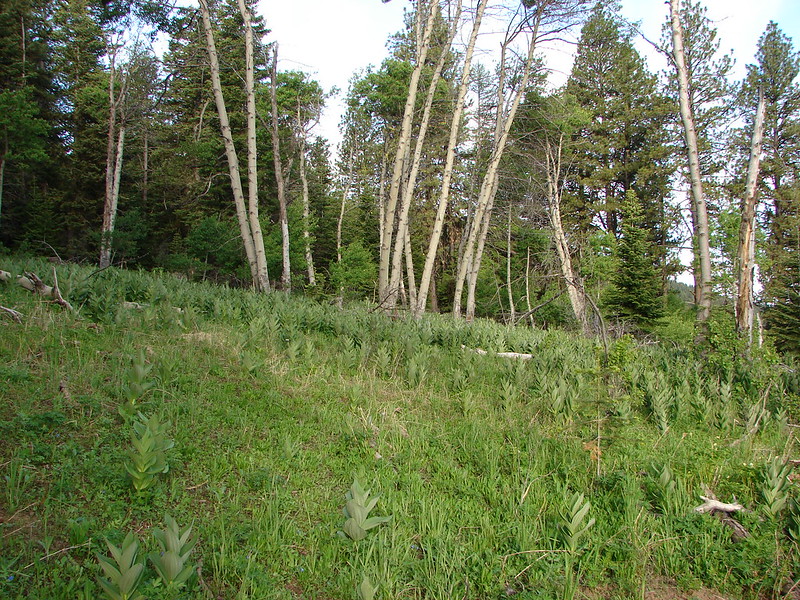
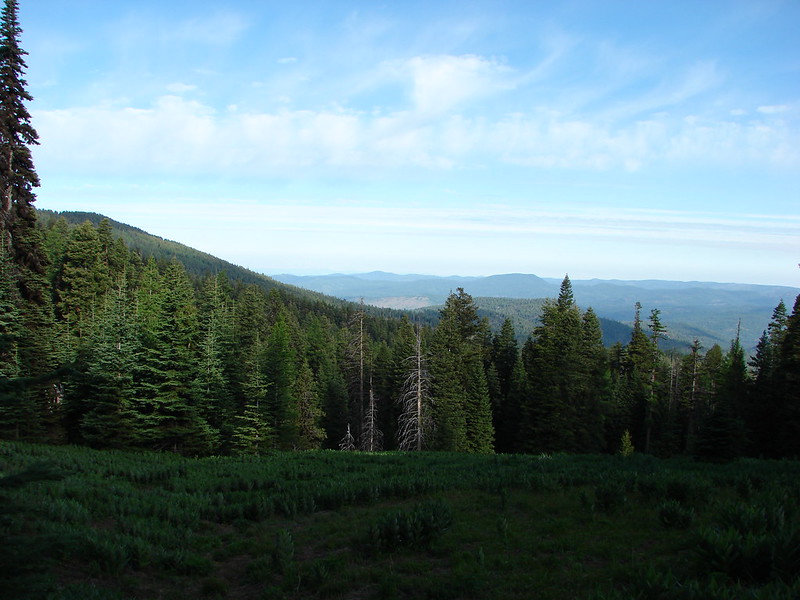
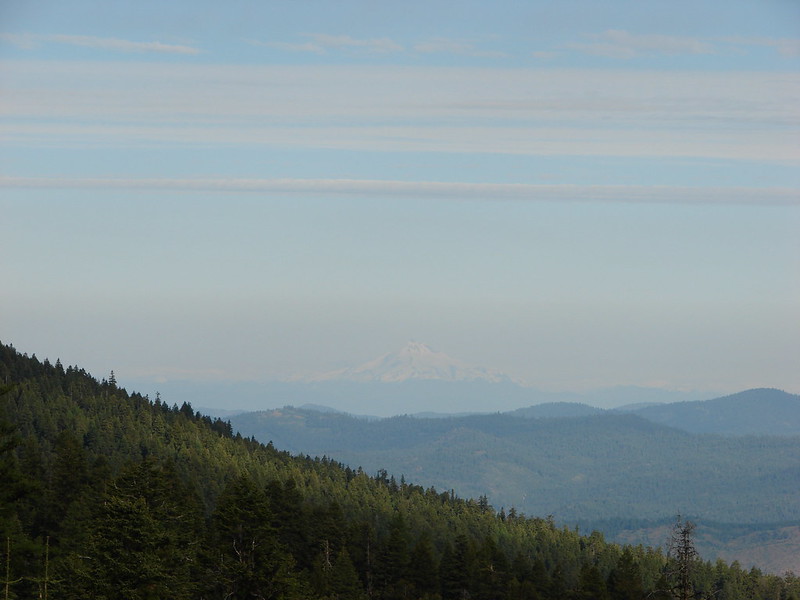
From the trailhead we had more options. Straight ahead up the shorter steeper trail 808A, right on what was now named trail 804 or left on trail 808. We chose 808 based on the suggested route in the book. The trail passed through several meadows full of hellbore with views nice views to the north with Mt. Jefferson visible on the horizon.
DSC07814
DSC07817

The trail then turned south and we climbed up onto the sloped plateau. From here the trail climbed through open ground covered with wildflowers and sagebrush and the occasional stand of trees.
DSC07837
Big-headed Clover
DSC07841
Brown’s Peony
DSC07860
Looking ahead from the lower plateau
DSC07884

We crossed Brush Creek
DSC07920
and found some leftover of snow
DSC07940

There were some small lilies in this area as well as a few shooting star and mountain bluebells.
DSC07934
DSC07937
DSC07925
DSC07948

We came out of a clump of trees into another sagebrush covered meadow where we could see the summit of Lookout Mountain.
DSC07963
There were more flowers as we climbed through the sagebrush toward the summit. Balsamroot, paint, larkspur, and columbine dotted the landscape. There were other flowers both known and unknown to us as well.
DSC07984
Old Man’s Whiskers
DSC07996
DSC07995
The lupine was yet to bloom.
DSC08022

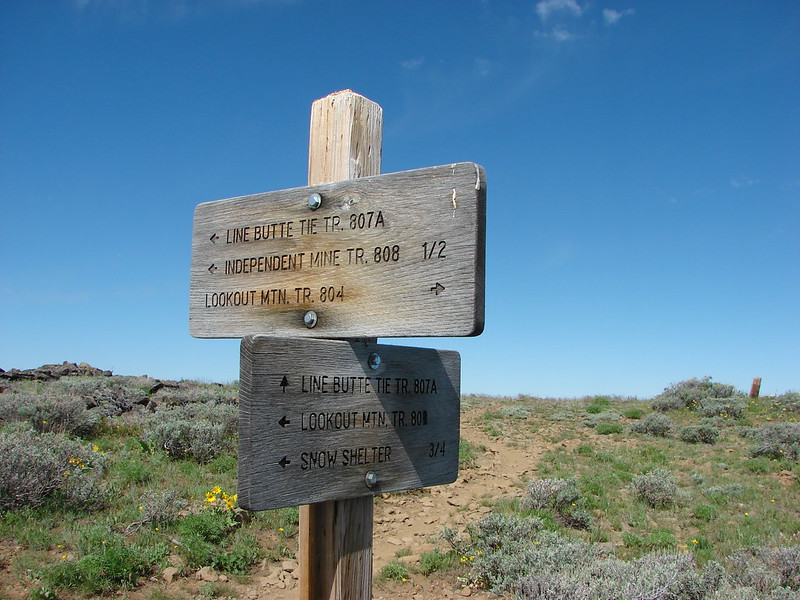
A sign stood at a trail crossroads giving directions.
DSC08024

From the summit we could see Cascade Peaks from Diamond Peak in the south to Mt. Hood in the North.
Mt. Bachelor and the Three Sisters in the distance:
DSC08023

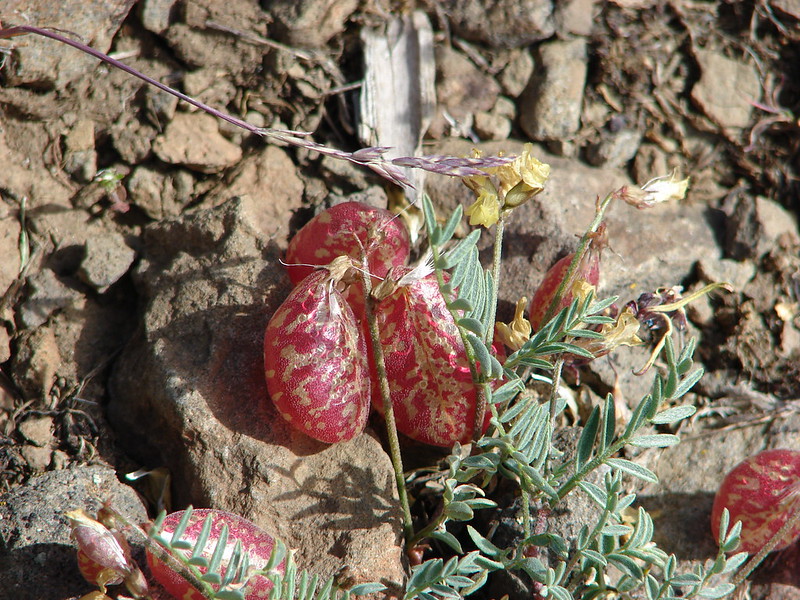
We also spotted a very strange plant on the summit which thanks to some detective work form the folks at portlandhikers we identified as balloon-pod milk-vetch.
DSC08036

On our way down we stopped by a snow shelter built by the Oregon National Guard and U.S. Forest Service in 1989.
DSC08040
DSC08042

We spotted another deer on the way down and the butterflies started coming out as the day wore on.
DSC08051
DSC08067
DSC08070
DSC08074
DSC08082

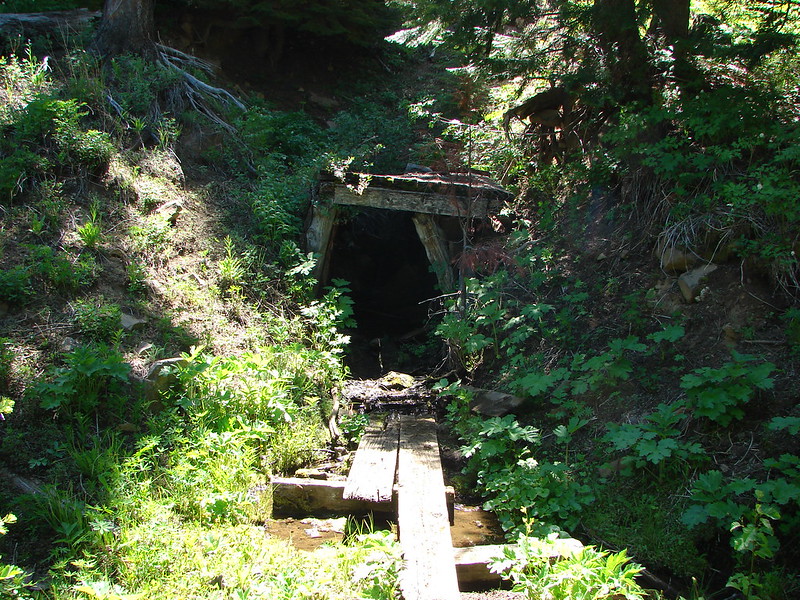
Just before reaching the Independent Mine Trailhead on trail 804 we passed a left over mining building and an abandoned mine shaft.
DSC08088
DSC08097

We saw what must have been the same doe on the way down as we saw on the way up. She came out of the exact same group of trees and we wondered if she might not have a young fawn bedded down in them. We didn’t want to disturb it if there was so we continued on back to the Round Mountain Trailhead and our car. Day one had provided a great 10.3 mile hike and we had three more days to go. Happy Trails!

flickr: https://www.flickr.com/photos/9319235@N02/sets/72157644735166968/
Facebook: https://www.facebook.com/media/set/?set=a.10204236394617228.1073741883.1448521051&type=1
Categories
Hiking Oakridge Area Old Cascades Oregon Trip report

Tire Mountain

**Note the 2024 Tire Mountain Fire burned over a small portion of this hike.**

June wildflowers and a “possible” waterfall were are goal for our recent trip to Tire Mountain near Oakridge, OR. Our guidebook showed a 7.6 mile hike starting from the Alpine Trailhead, linking up to the Tire Mountain trail, and turning around after reaching the summit of Tire Mountain. Looking at the forest service maps of the area I noticed that the Tire Mountain trail continued west beyond the junction with the summit trail to a trailhead on road 5824. Along that portion of the trail was a creek crossing where it appeared there might be a waterfall. Thinking that a 7.6 mile hike was a little short for a 2 1/2 hour drive I thought we could investigate the possible waterfall for a little extra exercise.

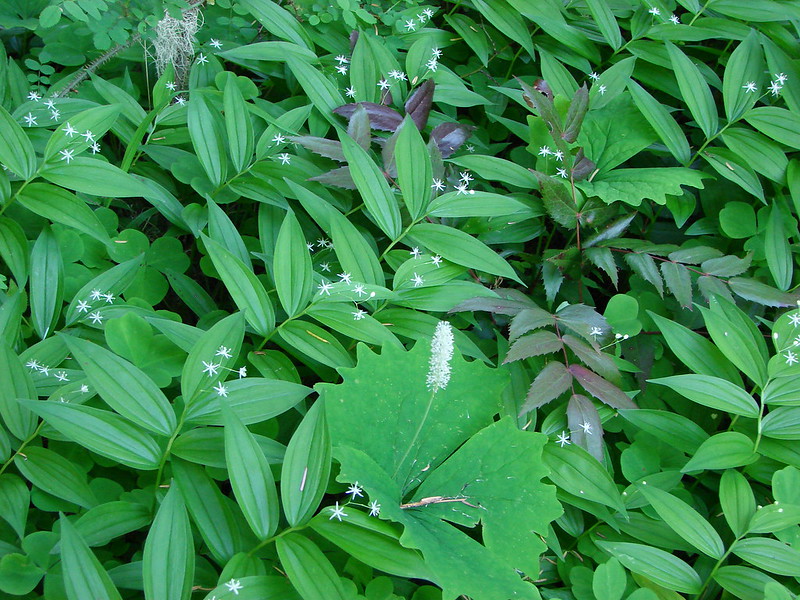
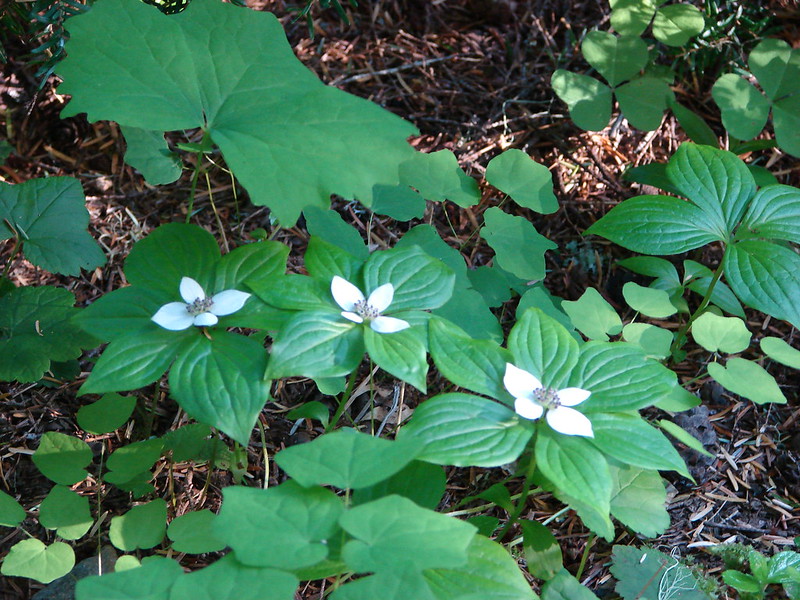
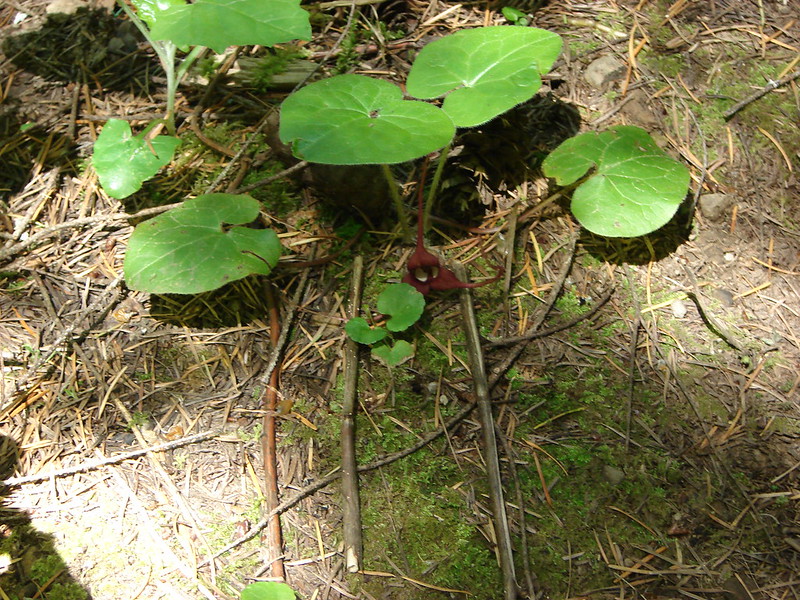
The Alpine trail started off uphill on a forested ridge where the path was lined with small rocks. The usual woodland flowers were present including vanilla leaf, solomonseal, candyflower, and bunchberry. We also spotted some wild ginger.
DSC07135
DSC07137
DSC07688
DSC07136
DSC07729

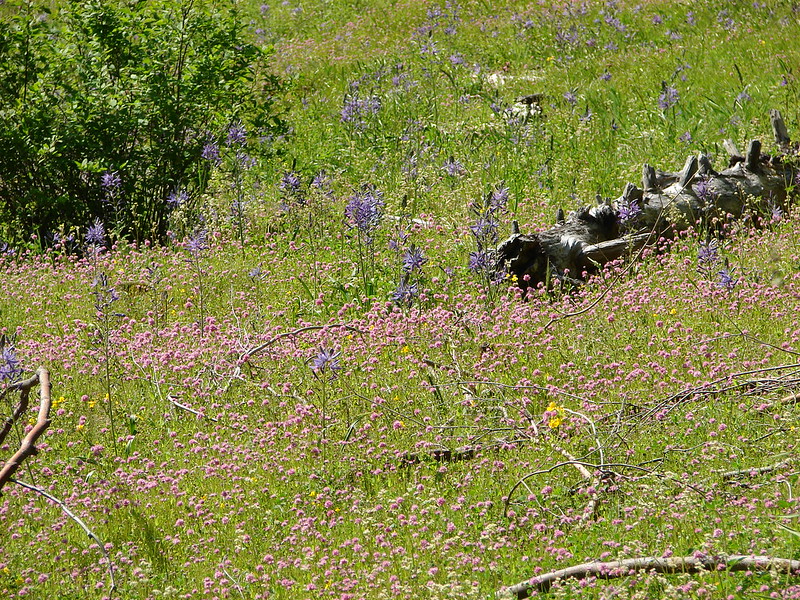
Just a bit over half a mile in the trail entered the first of the meadows. The flowers did not disappoint and as an added bonus several cascade peaks were visible from this meadow.
DSC07156
DSC07149
Diamond Peak
DSC07165
Mt. Bachelor
DSC07158
Broken Top
DSC07160

The flower show continued as we passed through more meadows on the way to the junction with the Tire Mountain trail. Along the way The Three Sisters joined the view.
DSC07191
DSC07204
DSC07179
DSC07190

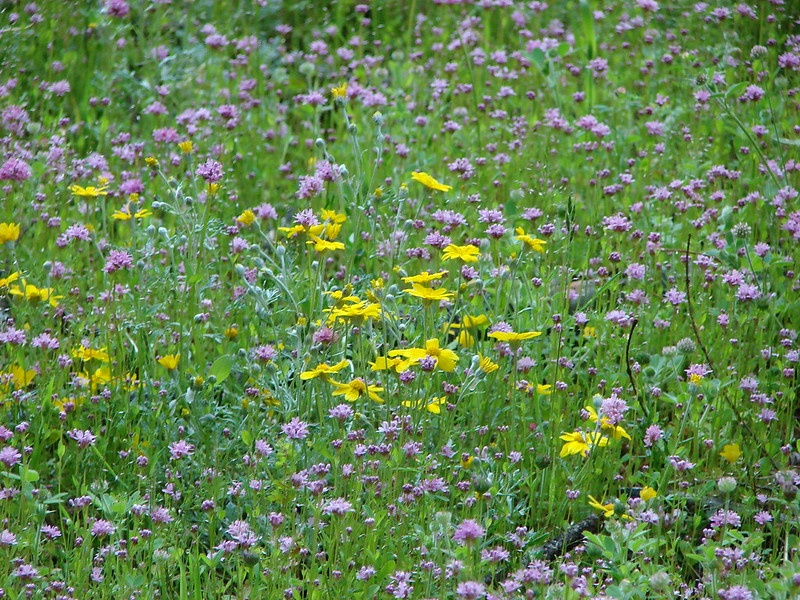
At the 1.2 mile mark we found the Tire Mountain trail and turned right. We passed through several smaller meadows which were home to a variety of different flowers, some of which were unknown to us.
Columbine
DSC07233
Plectritis & Larkspur
DSC07235
Plectritis & Yellow Monkeyflower
DSC07236
Camas
DSC07249
Paintbrush
DSC07261
Coastal Manroot & ?
DSC07263
Cat’s Ear Lily
DSC07265
Another unknown
DSC07267
Possibly Oregon Sunshine
DSC07270
Giant Blue-Eyed Mary, Plectritis & unknown
DSC07306
Buttercups
DSC07296
Wild Iris
DSC07241

We were amazed at the number of flowers and we could see that there were even more higher up on the hillsides.
DSC07253
DSC07291

After the series of smaller meadows the trail entered the largest meadow of the day. Here balsamroot joined the flower bonanza.
DSC07649
Ookow
DSC07647
Wallflower
DSC07655
Unknown
DSC07613
Blue Gilia
DSC07362

When we left the meadow I remarked that we hadn’t seen any lupine at all. As soon as we hit the next small meadow that was no longer the case.
DSC07468
From this meadow we also got a good view of Tire Mountain and Diamond Peak again.
DSC07462
DSC07498

The trail then entered the forest before splitting. To the left was the 1/2mi path to the summit while the right fork headed down toward road 5824. We headed up to the summit to check out the former lookout site. The trail was nice despite there being a few downed trees to maneuver around.
DSC07504
When we reached the brushy summit we found a number of additional flower types.
DSC07509
Unknown
DSC07507
Fawn Lily
DSC07514
Unknown
DSC07518
Wild onion
DSC07519
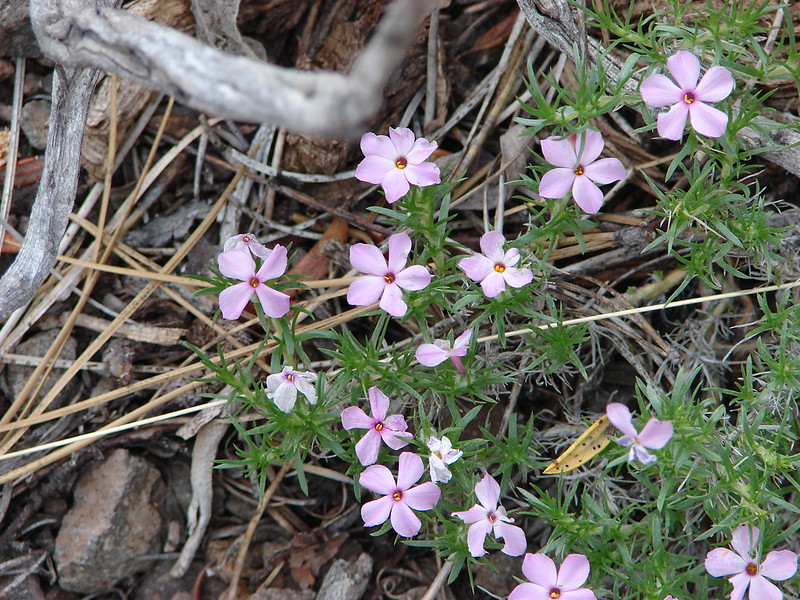
Phlox
DSC07521
Buscuitroot
DSC07522

Despite being a former lookout site there was no view from the summit. In fact the lookout had been placed up in a tree in order to have a view of the surrounding area. We explored a bit before heading back down to the trail split and starting our search for the waterfall.

From the split, the Tire Mountain trail descended fairly quickly through a series of switchbacks. Several bridges crossed seasonal streams amid the large trees.
DSC07529
DSC07536

It was a lot further down to the creek I was looking for than I had anticipated and we were all dreading the climb back up. We finally rounded a ridge end and spotted the bridge that crossed the creek I was looking for. There was indeed a waterfall but after seeing it we knew why the guidebook doesn’t mention continuing on to it. It was a pretty sad display lol.
DSC07546

After soaking in the torrent we started our climb. We did our best to focus on the ever present bird song as we trudged along. Grey jays, varied thrushes, and at least one woodpecker flew from tree to tree. The woodpecker was the only one that stayed still long enough for me to get a picture.
DSC07549

The meadows were just as impressive on the return trip. The only real bummer for the day was seeing a layer of smoke over the Three Sisters and Mt. Bachelor. Alas the fire season started early this year with the Two Bulls Fire burning near Bend, OR. 😦
DSC07717
Hopefully it isn’t a sign of things to come. Happy (and fire free) trails!

flickr:https://www.flickr.com/photos/9319235@N02/sets/72157644669235877/
Facebook:https://www.facebook.com/media/set/?set=a.10204185599747388.1073741882.1448521051&type=3

Categories
Coastal Range Hiking Oregon Trip report

Mary’s Peak, Beazell Memorial Forest & Ft. Hoskins County Park

Every once in a while it can be fun to change things up a bit. For our latest day of hiking we did just that. Instead of one longer hike we decided to knock a few shorter hikes off our to-do list. We had a graduation open-house that we wanted to stop in at that afternoon in Dallas, OR so we headed down to the central coast range for a trail triple header.

We started at Mary’s Peak, the highest peak in the Oregon coast range. We had visited the peak in 2009 when we were just starting to get into hiking. That day we had taken a 2.5 mile route from Conner’s Camp to the 4097′ summit. It was the most challenging hike we’d done up to that point and we felt every bit of the 1530′ climb. Our plan was to redo that hike (at least on the way up) to see how we would fare now that we’ve been hiking for several years.

There are several ways to get to the summit varying in length from just over a mile to almost 11 miles round trip. The East Ridge trail would be our route up from Conner’s Camp. The trail sets off from the parking area in a forest of old-growth Douglas Fir which tower overhead. The forest is very open despite the giant trees due to the lack of lower branches which allows for an abundance of green undergrowth. Vine maple, salal, fern, and many other plants contribute to a lush green understory. Low clouds were hanging in the tree tops while many white woodland flowers dotted the forest floor.

DSC06454
DSC06465

The trail climbs steadily for 1.1 miles to a junction where the East Ridge Tie trail continues on to the North ridge trail making a loop possible. We would be retuning from that direction but in order to recreate our 2009 climb we turned left to continue up the East Ridge trail. The trail steepens after the junction and it was this section that seemed to go on forever the first time we hiked it. It proved to be a stiff climb but we quickly reached a second junction, this time with the North Ridge trail. Forking to the left we continued up a short distance to the lower meadow and blue(ish) skies. 🙂

DSC06487

The trail wraps around a hillside through the meadow, which was yet to really start blooming, before reaching a gravel service road in a saddle. The clouds were lapping up over the hillside from the north creating what can only be described as a “fog rainbow”.

DSC06504

DSC06505

The gravel road winds up to the summit around the south side of Mary’s Peak, but a more direct (and steeper) trail leads up to the upper meadow from the far side of the road. Since that was the way we had gone before we crossed the road and headed up again (and again wondered why). When we emerged from the narrow swath of trees that divides the two meadows we found that the upper meadow was also yet to bloom. Clumps of lupine had yet to even begin to bud and only a few scattered flowers dotted the slope.

DSC06517

The sky was blue though and we had the peak to ourselves so we climbed through the meadow to a picnic table at the summit. We were above the clouds but it appeared that Mary’s Peak was the only peak which had managed to rise above them. Even the 10,000′ Cascade peaks to the east were hidden. To the west the Pacific Ocean blended in so well with the layer of clouds and blue sky that it was difficult to make out where one ended an another began.

The view west:
DSC06518

After setting our stuff down at the table we began exploring the summit. To the west where the road came up from below we began to find flowers. Purple larkspur and yellow biscuit root covered the ground.
DSC06524

We started to head down the road following the flowers and as we rounded a bend we were greeted with a color explosion. We’d found the flowers. They were all on the south side of the peak. Phlox, larkspur, paint, and various yellow wildflowers covered the slopes on this side.
DSC06532
DSC06549
DSC06553
DSC06557

After taking a few pictures (okay lots) we went back to the table to gather our packs and headed back down the road. As we made our way down we found some blooming lupine and penstemon as well.
DSC06577
DSC06578

To get back to the car we took the 1 mile section of the North Ridge trail from the upper junction to the East Ridge Tie trail and turned right on it for 1.2 miles back to the first junction and finally back to Conner’s Camp.

From there we drove back to U.S. Highway 20 and headed west to the Kings Valley Highway Junction. Turning right we continued 4.8 miles on Highway 223 to the Beazell Memorial Forest. The forest consists of 586 acres gifted to Benton County by the former owner, Fred Beazell, as a memorial to his late wife Dolores. Our plan here was to hike a 3.2 mile loop using the South Ridge trail.

The trail begins at a footbridge behind a restored barn which was being readied for a wedding reception on this day. After crossing Plunkett Creek on the bridge the trail joins an old road for half a mile. The forest is dense and scenic in a narrow valley. At the .5 mile mark the trail splits off to the right and recrosses the creek twice before rejoining the road at a junction in another half a mile.

DSC06697
DSC06716

Here the South Ridge trail leads to the right up the side of the valley. A sign was posted warning of a logging operation and trail closure from October 2013 through April 2014. Being that it was June we continued on. The trial switchbacked up 350′ through increasingly open forest with wild iris and some flowers we had not seen before.
DSC06735
DSC06760
DSC06771

At the top of the hill a short spur trail leads to a small meadow with a nice view across the valley.
DSC06792

After leaving the meadow the trail drops down over the west side of the hill where signs of the logging operations could be seen. After joining a logging road for a bit the trail again split off to the right, passing an old cistern before returning us to the barn and our car.
DSC06808

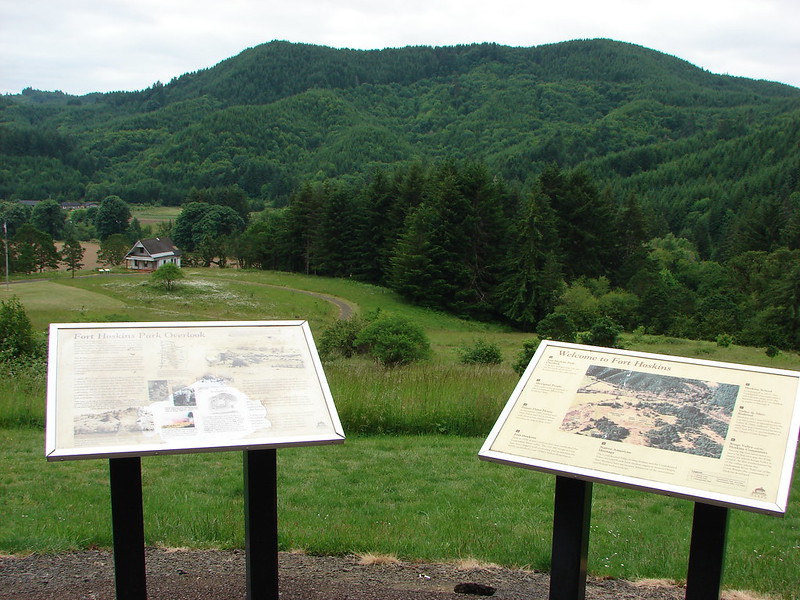
We had one more hike planned for the day so we hopped back into the car and continued another mile and a half north on Hwy 223 to Hoskins Rd. Following signs to the left for Fort Hoskins County Park we drove another 1.8 miles to the park entrance on the right. The park is at the site of an 1856 outpost.
DSC06815

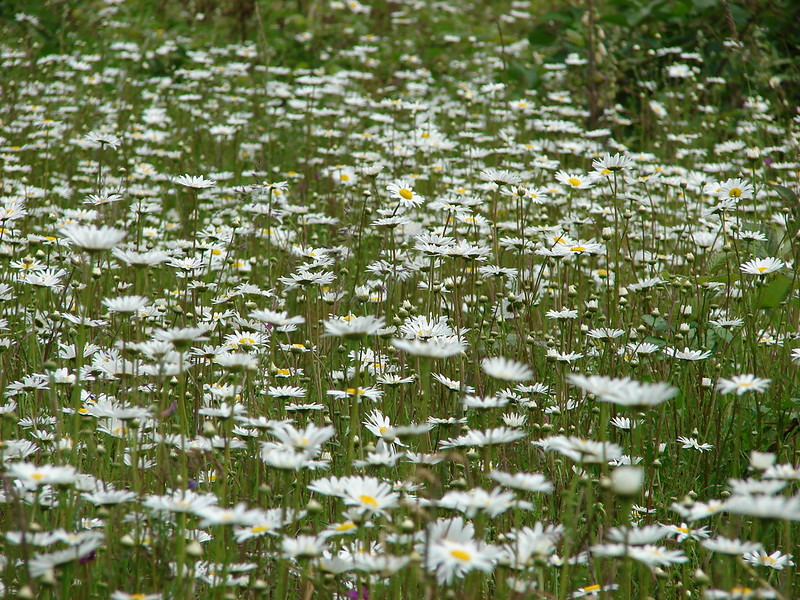
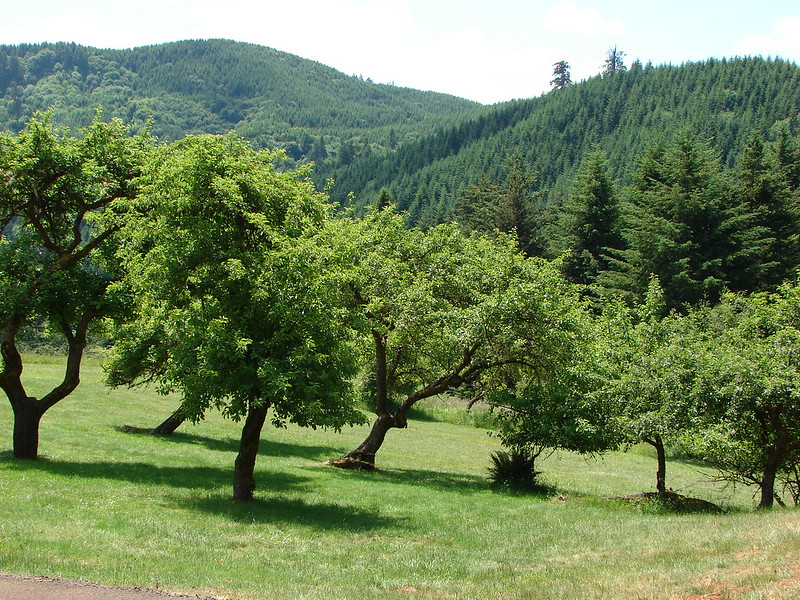
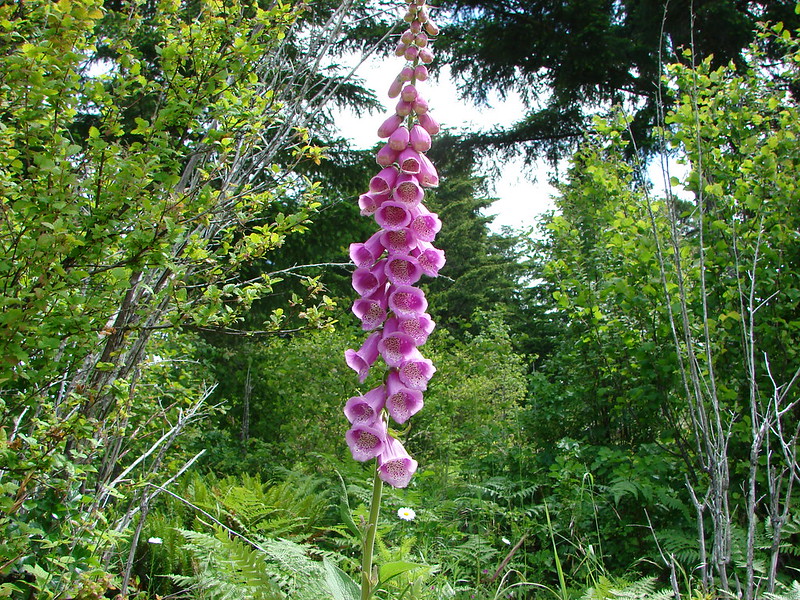
We started our hike here by taking the half mile interpretive loop past the old fort site and historic buildings. This path looped around a lovely meadow where daisies and foxglove bloomed and a few apple trees remained from an old orchard.
DSC06842
DSC06858
DSC06932

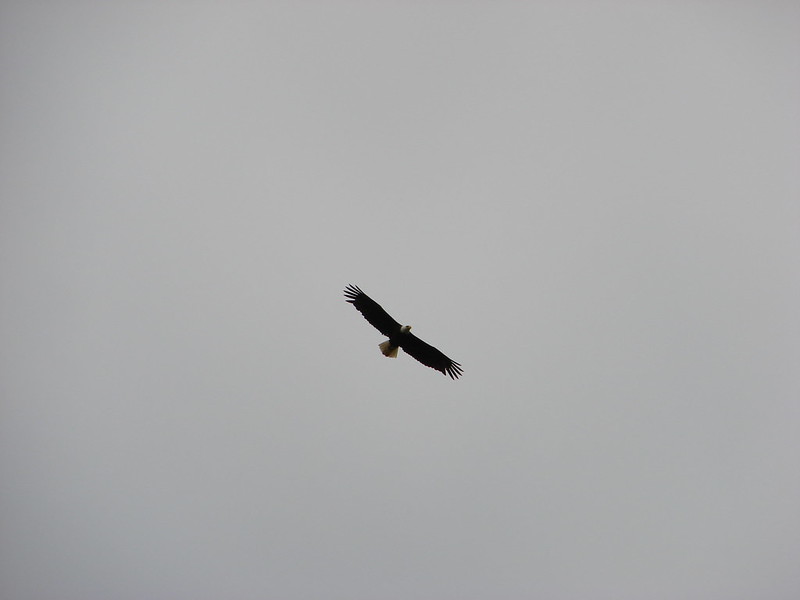
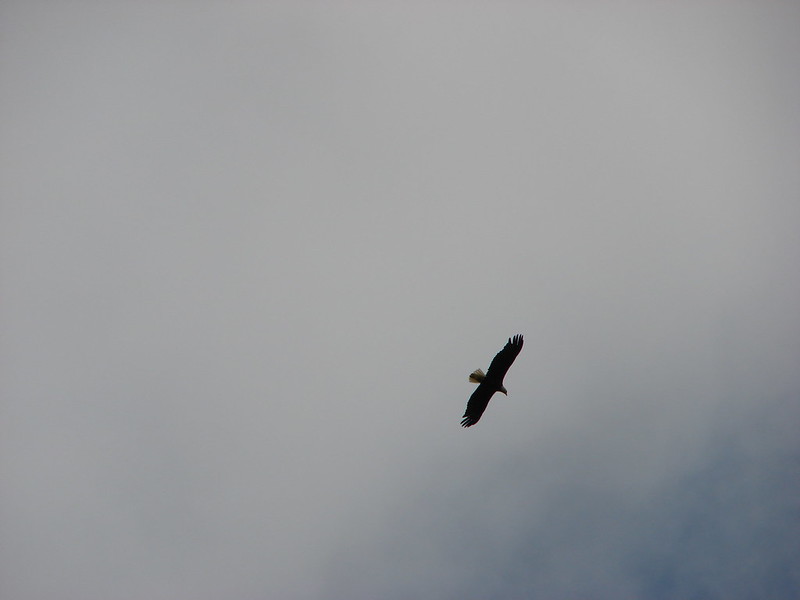
While we were inspecting the Commander’s House a Bald Eagle flew past and began circling overhead.
DSC06841
DSC06849
DSC06856

The path then passed the foundation of the Hoskins School before climbing back to the parking area where a longer loop began on the far side of the road.
DSC06867

The longer 1.3 mile loop climbed over 300′ through a hillside meadow filled with wildflowers.
DSC06874
DSC06876
DSC06879
DSC06893
DSC06910DSC06920
DSC06926
DSC06930

The day turned out better than I had expected. We managed to get 12.3 miles of hiking in while visiting some interesting places and still made it to the graduation party on time. Happy Trails!

flickr photos: https://www.flickr.com/photos/9319235@N02/sets/72157644555553479/
facebook: Mary’s Peak https://www.facebook.com/deryl.yunck/media_set?set=a.10204131646278585.1073741879.1448521051&type=1
Beazell Memorial Forest https://www.facebook.com/media/set/?set=a.10204132717145356.1073741880.1448521051&type=3
Ft. Hoskins County Park https://www.facebook.com/media/set/?set=a.10204132785187057.1073741881.1448521051&type=3

Categories
Badger Creek Area Hiking Oregon Trip report

Badger Creek

We combined our latest hike with a bit of reconnaissance hoping to check out some possible camp sites for an overnight trip this Summer. The plan was to hike the Badger Creek Trail from Bonney Crossing 7.7 miles to it’s junction with the Badger Creek Cutoff Trail looking for possible tent sites near the junction. This was our first visit to the Badger Creek Wilderness which is located just to the east of Mt. Hood in the Mt. Hood National Forest. Badger Creek flows from Badger Lake through a forested valley before joining Tygh Creek and eventually emptying into the White River. From Bonney Crossing the trail heads up the valley through a diverse forest as it climbs from an elevation of 2200′ to Badger Lake at 4500′. We turned around at just under 3650′ for our hike.

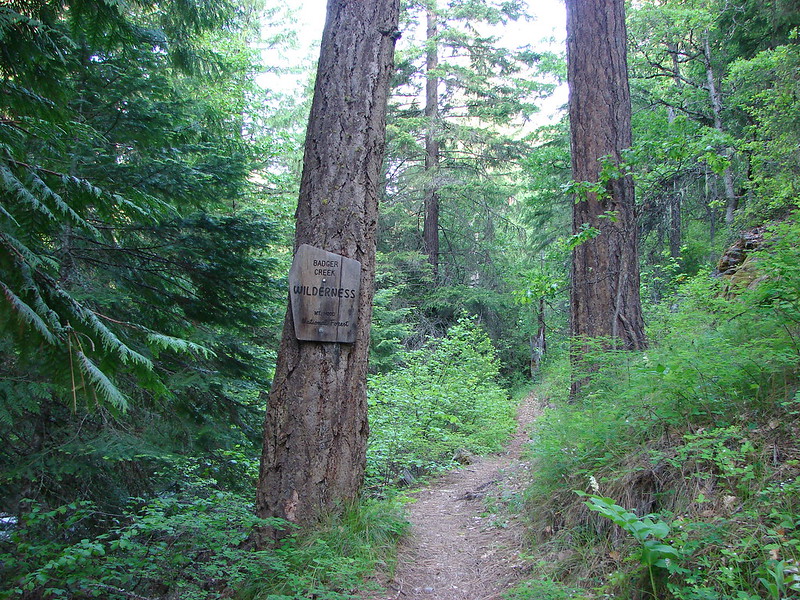
For once we were not one of the first cars at the trailhead, in fact we wound up having to park a little bit up the road as the few spots at the trailhead were taken. After walking down to the trailhead we were quickly greeted by a wilderness sign signaling the edge of the Badger Creek Wilderness.

DSC06113

Not a lot of sunlight was finding it’s way down into the valley in the morning but it did manage a few highlights.
DSC06118
DSC06149
DSC06154
DSC06170

There was an interesting mix of both trees and flowers along the trail. Various types of pine, cedar, fir, and oak trees could be seen with a number of different flowers. The most interesting of the flowers was an odd yellow flower on a tall stalk that we kept seeing. After doing some research I discovered that it was silvercrown.
silvercrown

Some of the other flowers present were balsamroot and lupine:
DSC06255

Columbine
DSC06192

Larkspur
DSC06183

Prairie Star
DSC06196

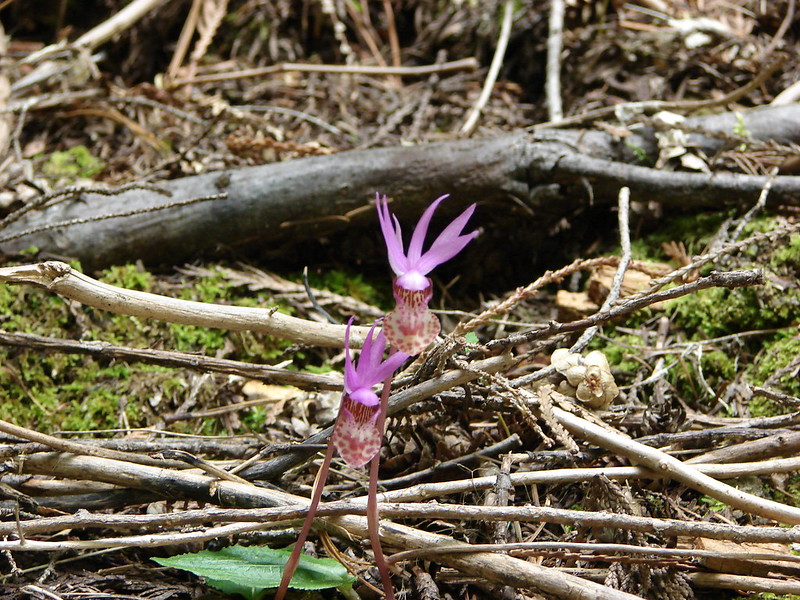
Fairy Slippers
DSC06352

Arnica
DSC06427

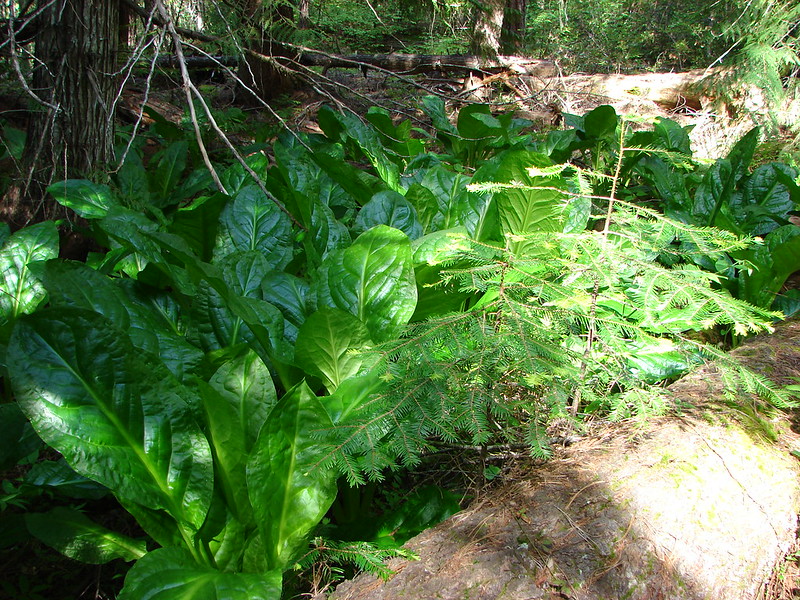
There was also large patches of Vanilla leaf and skunk cabbage which were both really fragrant on this day. The vanilla leaf was much more pleasant. 🙂
DSC06226
DSC06243

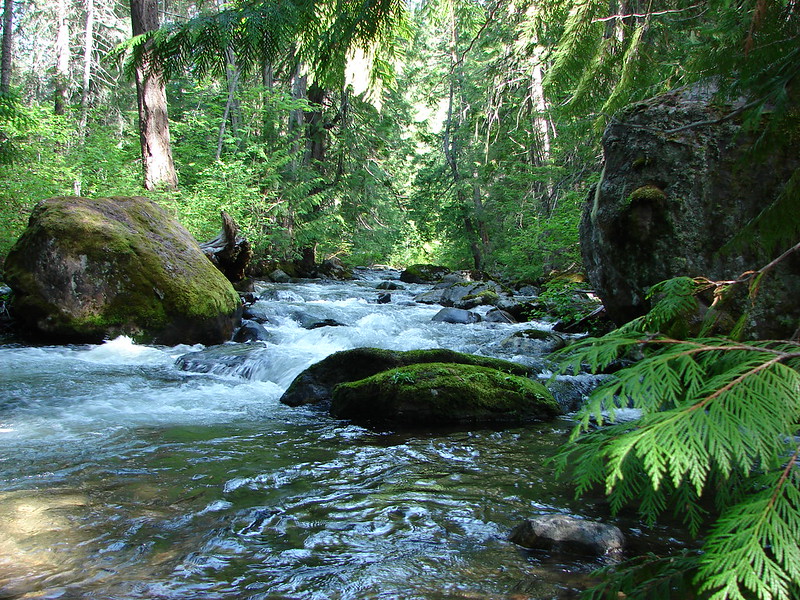
While the trail stayed fairly close to Badger Creek there really weren’t a lot of opportunities to get down to the creek. Steep banks and dense vegetation limited access but there were a few places where camp sites had been established that allowed access to the creek.
Badger Creek
DSC06232
DSC06331
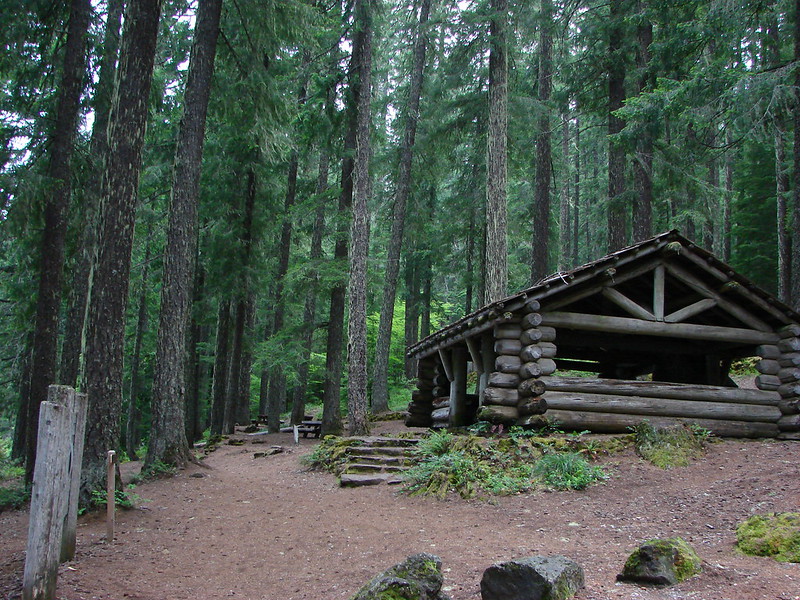
Shortly after the Post Camp trail joined up with the Badger Creek Trail was the only real discernible waterfall that we saw.
Unnamed Waterfall

Being down in the forested valley meant that there were not many views up. The best views came at our turnaround point at the cutoff trail junction where we could see the top of Lookout Mountain and a couple of the other high points of the surrounding hills.
DSC06348
DSC06350
DSC06351
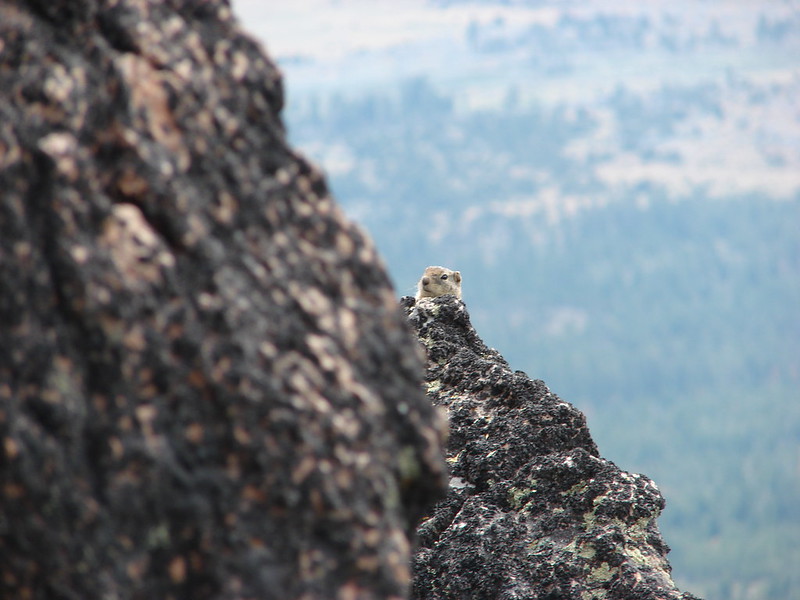
As the day went on it got quite warm on the trail and the wildlife started to come out, especially the butterflies. We had seen a couple of deer on the drive in but on the trail we didn’t spot anything larger than a snake.
DSC06303
DSC06304
DSC06361
DSC06272
DSC06312
DSC06325
DSC06373
DSC06381
DSC06398
DSC06418

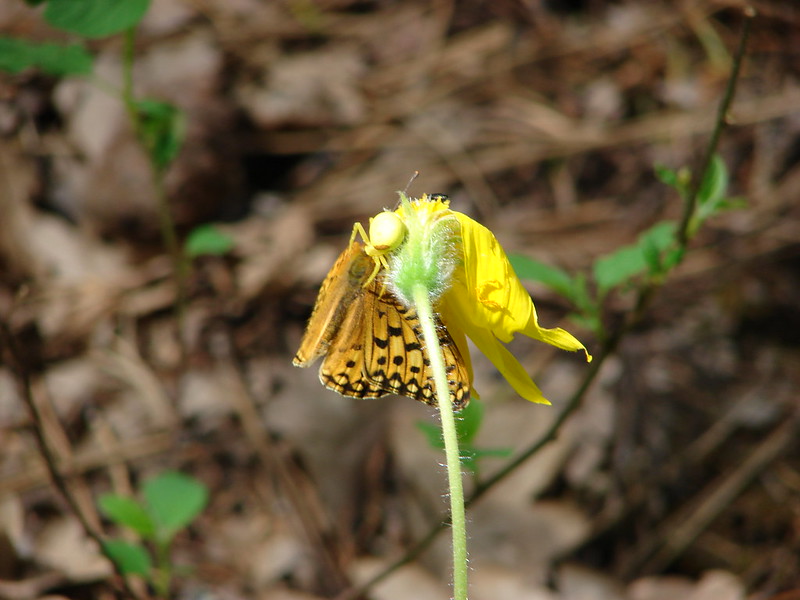
One of the more interesting sightings was a butterfly that had been caught by a camouflaged spider.
DSC06423

We were surprised that we didn’t see more people on the trail on the way to our turnaround point based on the number of cars that were at the trailhead when we’d set off. We were even mores surprised by the large number of hikers we encountered on our way back to the trailhead. We just kept passing groups heading in the whole afternoon. I’d seen conflicting reports as to the popularity of this trail but apparently on Memorial Day weekend it is rather popular. We found plenty of new cars at and near the trailhead when we got back and as we were packing up at 4pm cars continued to arrive.

We wound up getting a pretty good idea of where we’ll aim to set up camp when we do our next trip to the Badger Creek Wilderness and are looking forward to visiting Lookout Mountain on that trip. Happy Trails!

fickr: https://www.flickr.com/photos/9319235@N02/sets/72157644778350436/
facebook: https://www.facebook.com/deryl.yunck/media_set?set=a.10204070023858063.1073741878.1448521051&type=3

Categories
High Cascades Hiking Mt. Hood Area Oregon Trip report

The Other Eagle Creek (Salmon-Huckleberry Wilderness)

We continued what I have dubbed “Creek Week” by visiting another Eagle Creek the day after our trip to the one in the Columbia Gorge. Even though both creeks share the same name and both are located partially in the Mt. Hood National Forest the similarities end there. This Eagle Creek flows through the old growth forest of the Salmon-Huckleberry Wilderness and is much less visited than the one in the Gorge. There are no dizzying cliffs or giant waterfalls but rather the relaxing sound of running water while you stroll through a lush forest.

It was good that the trail was so relaxing because the drive to it was anything but. The hike was listed as an additional hike in the 2012 edition of William Sullivan’s 100 Hikes in Northwest Oregon & Southwest Washington complete with driving directions. He warned of a confusion of logging roads and he was right. I had also Googled the route and printed out directions from the Forest Service to the trailhead. The road names all matched but each of the directions gave different distances once we got onto SE Harvey Rd. Google said 1.2 miles, the Forest Service 1.8 miles, and Sullivan a more detailed 2.6 miles. Our first mistake was not paying attention to the difference in the distances given followed by not using the odometer as soon as we turned onto Harvey Rd. The area was heavily logged with operations ongoing so there were many side roads and turnoffs and no signs for any type of trail. We drove to the end of what we thought was Harvey Rd. and found a pile of garbage where people had obviously come out to shoot guns (seems to be a favorite pastime in that area) but no sign of a trail. We turned around and headed back the way we’d come looking for any sign of a trail that we might have missed. There were a couple of possibilities but nothing obvious. As we were reading the different instructions we noticed the different mileages which made it more confusing. In the end we decided to drive back to the start of SE Harvey Rd. and use the Odometer. There was nothing at the 1.2 mile mark so the Google instructions were ruled out. At the 1.8 mile mark a gated road led down to the right. The trail description in the book stated that the trail began on an overgrown old road so this had possibilities. I got an idea here and turned on the GPS to see if we were at the trail but when the map came up there was no trail where we were so we hopped in the car and continued to follow Sullivan’s mileage directions. We stopped at one point when we spotted what looked like it might have been an old road with a possible trail leading from it but again using the GPS it was clear that we still had not found the trail. At the 2.4 mile mark we spotted a barricaded road leading down to the right so again we stopped to check it out. This time the GPS showed us on a direct line for the trail and a small path led between the snags blocking the road. There were no signs but this was it.
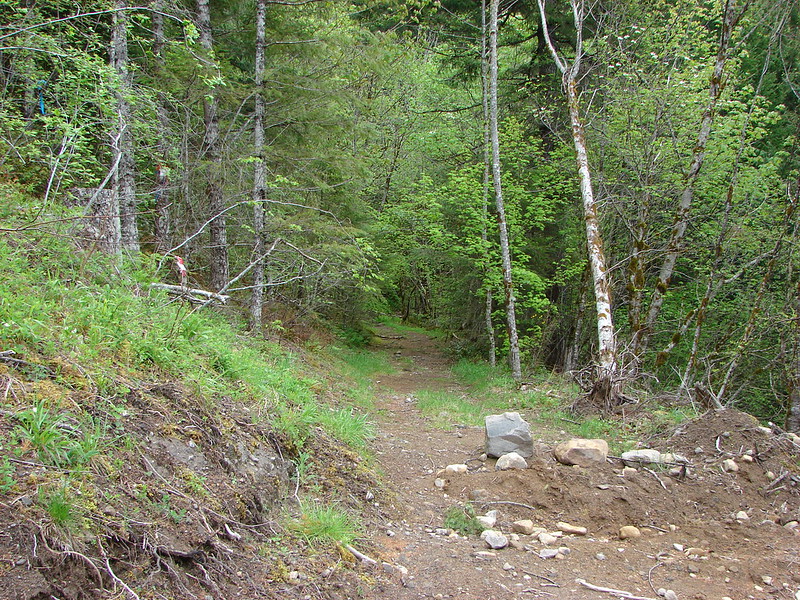
DSC04775
What we believe happened was the Forest Service stared counting mileage about half a mile after Sullivan started. Then the final approximate quarter mile of Sullivan’s directions had been since blocked by the logging operation because after a brief walk on the road we came to a second small barrier behind which we found an overgrown road such as he had described.
DSC04776

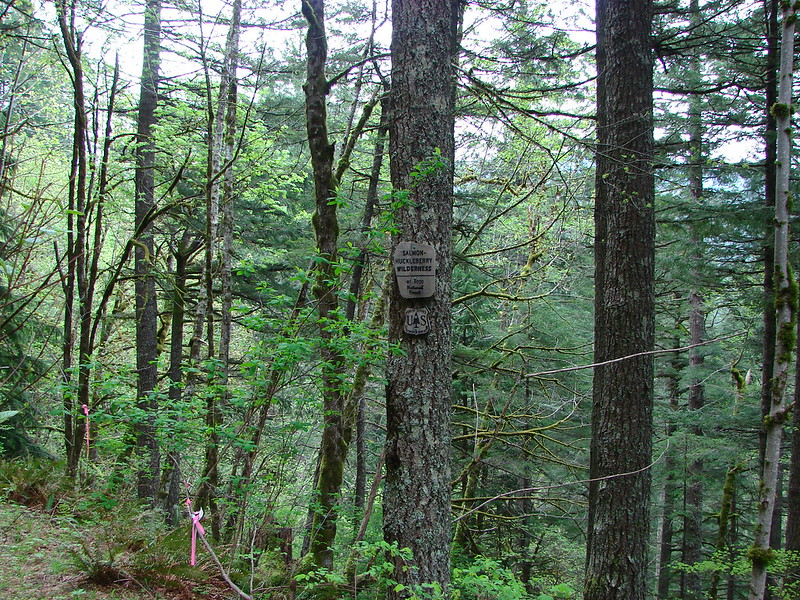
In any event according to the GPS we had found the trail and were on our way down to Eagle Creek. We finally found a sign to confirm what the GPS was telling us. Near the end of the overgrown road there was some flagging and a sign announcing the beginning of the Salmon-Huckleberry Wilderness.
DSC04779

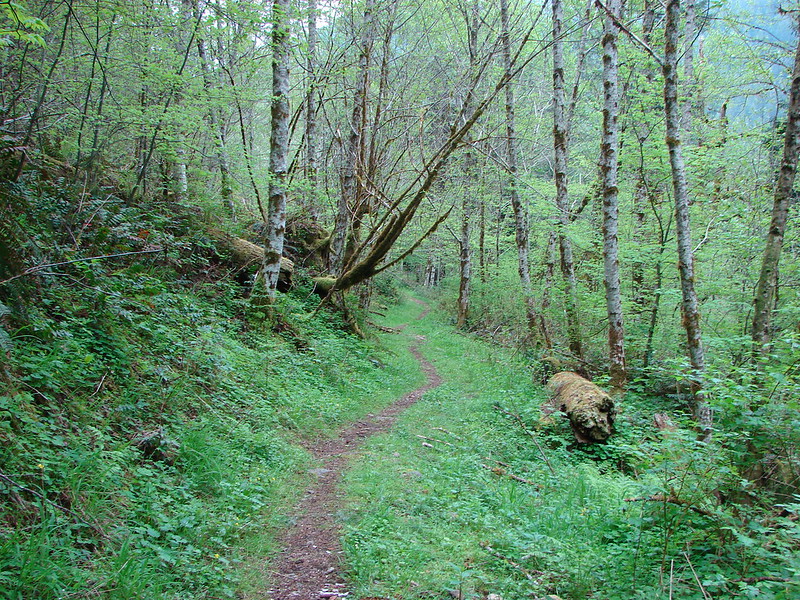
After entering the wilderness the trail looked less and less like an old road until it finally became a full on trail.
DSC04793
DSC04795

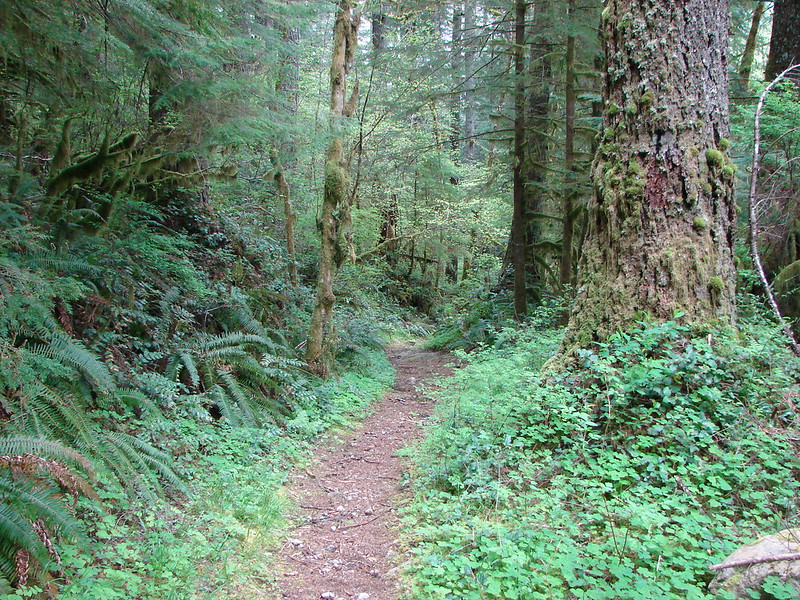
We ran across some interesting trees/trunks on the early portion of the trail. One of our favorites was a tree growing on top of an old trunk. You could see the new trees root system running down the length of the old trunk.
DSC04807
Another old trunk had a stream flowing out from under it.
DSC04816

There were many streams and creek to cross along the trail, but only one bridge.
DSC04821
There was no way we were going to keep our feet dry on some the crossing but that was okay with us, the streams just added to the beauty of the forest.
DSC04855
DSC04874

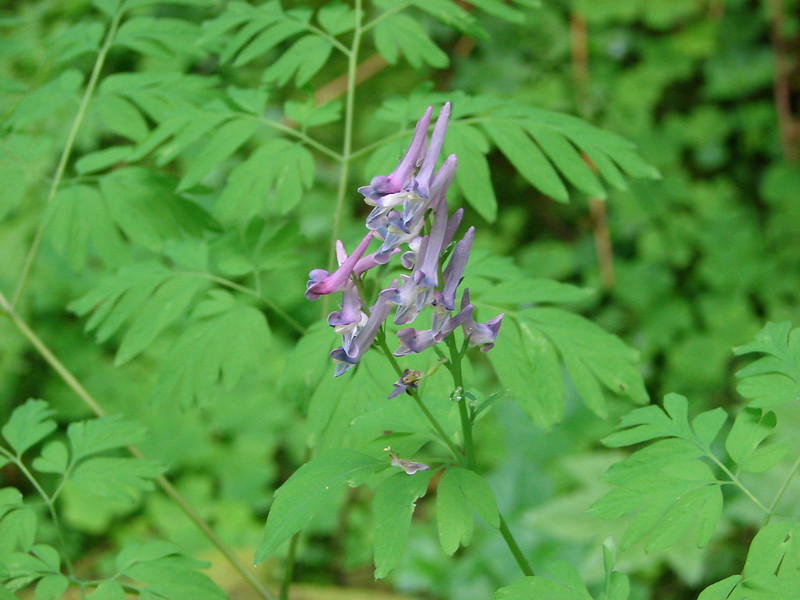
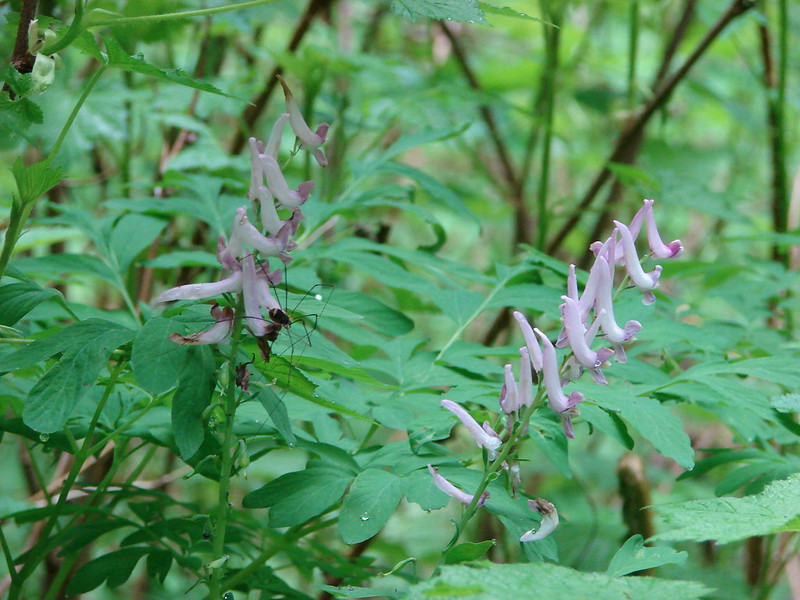
Due to the dense forest there weren’t a large variety of wildflowers but there were some including bleeding heart, wood violets, lots of trillium, and a new one to us scouler’s corydalis.
Bleeding Heart
DSC04800
Wood Violets
DSC04888
Trillium
DSC04907
Scouler’s Cordylis
DSC04858
scouler's corydalis

Open areas where were filled with salmon berry bushes.
DSC04865

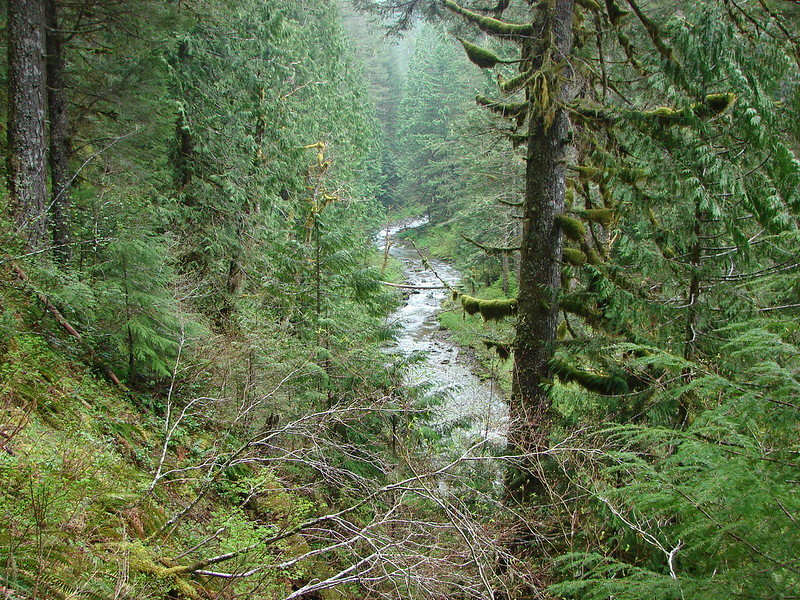
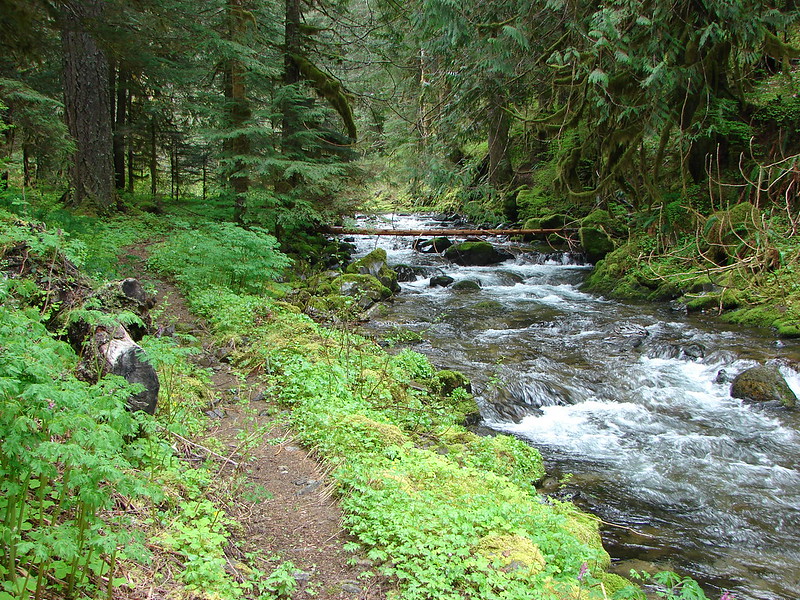
We were up above Eagle Creek at times and then we would be walking next to the water for a bit. It was a decent sized creek lined with lush forests.
Eagle Creek in the Salmon-Huckleberry Wilderness
DSC04902
DSC04921

We didn’t see a lot of wildlife on this hike but I think that was partially due to the lushness of the forest. At one point we startled a deer that was in the creek but all I saw was splashing then a brown and white flash as it ran into the trees. What we did see was an Ouzel, an interesting spider, a couple of newts, and one of our favorite little song birds that I believe is a Pacific Wren.
DSC04915
DSC04847
DSC04862
DSC04831

We turned around when we reached the end of the Eagle Creek Trail. Here it connected to the Eagle Creek Cutoff Trail which fords Eagle Creek before heading up a ridge to the Old Baldy Trail.
DSC04928
The Eagle Creek Cutoff ford
DSC04929

We had a little drizzle from time to time up to this point but as we began our return trip the drizzle turned to a light rain. We made quick work of our return slowing only due to the climb back up the old road. It had been a great hike for relaxing end to our creek streak with. Next up we’re going to attempt to get a view, but in the Pacific Northwest Spring views can be tricky. Until then Happy Trails!

flickr: https://www.flickr.com/photos/9319235@N02/sets/72157644170377089/
facebook: https://www.facebook.com/deryl.yunck/media_set?set=a.10203946548091246.1073741875.1448521051&type=3

Categories
Columbia River Gorge South Hiking Oregon Trip report

Eagle Creek

**Note the 2017 Eagle Creek Fire burned a portion of this hike.**

This year we are redoing several hikes for one reason or another. The first of our redo’s was Eagle Creek in the Columbia Gorge. We had attempted this hike back in October of 2012 but we weren’t able to get to the final two falls due to the trail being closed because of a forest fire. Being Fall the water flow was also very low so the falls we did see were nowhere near their peaks. Having learned from our timing issue I put this one in the middle of our first week of vacation in order to catch the falls at a good flow and to hopefully avoid the crowds that visit the gorge trails on the weekend.

We arrived at the trailhead at 6:30am and set off on the trail. Portions of the trial had to be blasted out of the side of the cliffs when it was constructed making for some dramatic views.
DSC04293
One immediate difference from our previous trip was the presence of many wildflowers. Plectritis, larkspur, and giant blue eyed mary lined the trail. In some open places and shooting star could be seen near seepage.
DSC04358

The first big fall can be seen after 1.5 miles via a viewpoint looking up Eagle Creek to Metlako Falls.
DSC04365

Shortly after leaving the viewpoint a set of signs announce the .5mi side trail down to Punchbowl Falls. The difference from our last visit was immediately noticeable when we reached Lower Punchbowl Falls.
Oct. 2012
035
May 2014
DSC04381

Even more noticeable was the creek level below Punchbowl Falls. In October we would walk on dry rocks far enough out to get a nice view of Punchbowl Falls, but now the only way to see the falls from below was to wade out into the creek.
Oct. 2012
Punchbowl Falls
May 2014
Punchbowl Falls
Another difference was the tree that had fallen down into the pool below Punchbowl Falls which happened sometime this past Winter.

The main trail then travels above Punchbowl Falls where a partly obscured view looks down into the bowl.
DSC04414
Some arnica was blooming here.
DSC04418

The trail crosses many side streams that are flowing into Eagle Creek from the canyon walls. These were much pretty this time as well.
Oct. 2012
054
May 2014
DSC04425

The next major falls along the trail is Loowit Falls. This was the most disappointing of the falls in 2012.
Loowit Falls
That was not the case this time. Not only were the falls much fuller but a lovely patch of Larkspur lined the trail at the viewpoint.
DSC04455
DSC04464

The next marker is High Bridge at the 3.3 mile mark where the trail crosses over Eagle Creek on a foot bridge. Scenic views abound here too and not just down at the creek.
DSC04491
DSC04499

Next up is Skoonichuck Falls. This one is hard to get a good view of as it requires a little scrambling down to a little ledge above the creek. In 2012 I didn’t go down to the better viewpoint but I made it down this time.
Oct. 2012
097
May 2014
DSC04506

The trail crosses back over the creek at 4 and a half mile bridge. On our previous trip we’d had lunch shortly after crossing this bridge below Tenas Falls. In 2012 we didn’t realize these were a named falls, it was just a scenic place for a break. We found our way back down to the spot this time to see the difference.
Oct 2012
108
May 2014
DSC04524

Continuing on the trail it enters the Mark O. Hatfield Wilderness in the Mt. Hood National Forest. Not long after entering the wilderness the trail crosses Wy’East Creek where you can see the top of another waterfall back in the forest a bit.
DSC04542
There is a primitive trail that leads back to the falls. It requires a lot of climbing over, under and around debris but eventually you arrive at the base of the falls where a decent trail leads behind them. There was another drastic difference in Wy’East Falls.
Oct. 2012
140
May 2014
DSC04553
I hadn’t bothered to go behind the falls the last time but this time I couldn’t pass up the curtain of water.
DSC04554

Our previous trip had ended shortly after leaving Wy’East Falls at a trail junction with the Eagle Benson Trail where there was a posted notice of the trail closure.
129
This time we were able to continue on passing more wildflowers, distant falls, and cliff edged trail.
DSC04579
DSC04589
DSC04563
DSC04566

Near the 6 mile mark we got our first glimpse of Tunnel Falls.
DSC04590
Tunnel Falls got it’s name from the tunnel that was blasted out of the rock in order to pass the trail behind and the falls and continue on up Eagle Creek.
DSC04603
DSC04610
DSC04611
DSC04687

Leaving Tunnel Falls the trail is at it’s most dizzying. Sometimes called the vertical mile the trail traverses along the cliff to the next and final big fall – Twister Falls.
DSC04623
DSC04624

Twister Falls was really interesting but also very difficult to get a good view of. The best view is from a little ledge just below the trail.
DSC04633
DSC04634

Looking down the chasm gives you an idea of the complexity of this fall.
DSC04678

Above Twister Falls the trail levels out but is extremely rocky and somewhat slick for a bit. Heather had gotten ahead of me and was focused on something in the creek as I approached.
DSC04643
It turned out to be a pair of Harlequin Ducks who were paddling around a pool diving for food.
DSC04646
DSC04647
DSC04648
Harlequin Duck

After hanging out with the ducks for a bit we started on our return trip. The sun was shining and the butterflies had come out.
DSC04690
DSC04705
DSC04708

When we got back to Loowit Falls I stopped to take a couple more pictures with the different lighting when Heather notice a pair of ducks in the creek below. It was another (or the same?) pair of Harlequin Ducks.
DSC04721
DSC04723

It was a lot of fun to go back and redo this hike at such a different time of year. Being able to compare the changes that the seasons bring and to also finally reach Tunnel & Twister Falls made this a very satisfying hike. No matter what the season – Happy Trails!

flickr: https://www.flickr.com/photos/9319235@N02/sets/72157644572170635
facebook: https://www.facebook.com/deryl.yunck/media_set?set=a.10203943516615461.1073741874.1448521051&type=3

Categories
Cottage Grove Hiking Old Cascades Oregon Trip report

Brice Creek & Trestle Falls

A few posts ago I mentioned that the trail was a classroom. It seems as though we always learn something out on a hike, and our recent trip to Brice Creek was no different. During the hike we learned that rough-skinned newts love to play hide-and-seek, and they stink at it. 😀 We’ll get to that later, but first a little about the trail.

Brice Creek is located to the east of Cottage Grove, OR and flows into the Row River which in turns empties into the Willamette. There are several trailheads located along the creek in the Umpqua National Forest making it possible to choose the length of your hike. We chose to start at the West Brice Trailhead and hike to the other end of trail at the Champion Creek Trailhead. From there we could visit a pair of waterfalls on Trestle Creek.

It was a little misty and cloudy as we set off on the trail.
DSC03803

After a brief stint on an exposed hillside the trail entered an old growth forest with plenty of lush green moss on the ancient trees. We also crossed several small but scenic streams.
DSC03841
DSC03859
DSC03880

There were a few flowers blooming, mostly white varieties that are typical in older/denser forests.
Anemone
DSC03886
Vanilla Leaf
DSC03900
Solomonseal
DSC04022
Most of the trillium was already finished but from the leaves and the few we did see it was clear they were very large in this area.
DSC04037

The trail had been up above Brice Creek until coming down to the bridge for the campground. From there the trail stayed closer to the creek for awhile providing a number of chances to get to the creek and get an up close view.
DSC03917
DSC03920
DSC03926
DSC03938

At one point the trail disappears along a bedrock section. The wet weather made for some slipper footing but the exposed rock was home to the most colorful flowers we would see all day.
DSC03951
Larkspur
DSC03962
Larkspur

The creek had many moods in this section and the clear water made it easy to see what was underneath the surface.
DSC03977
DSC03985
DSC04006

We then climbed up and away from the creek again before descending to another footbridge 2.6 mi from the last, this time to Lund Park.
DSC04017
We’d read that there was a meadow at Lund Park and were hoping that it might have some good wildflowers. We were a little disappointed when we arrived to find a couple of yellow flowers, some bleeding heart, and a lot of white wild strawberry blooms was all there was.
DSC04046
DSC04045
Someone had put together a somewhat substantive rock collection on one of the picnic tables though.
DSC04049

We started getting a few sun breaks after reaching Lund Park and in just another .5mi we reached a trail junction with Upper Trestle Falls trail. We would be returning down this trail after visiting the lower falls and taking the Upper Falls trail from the other end at the Champion Creek Trailhead. Before we get to that though this is where the hide-and-seek lesson comes in.
We had been seeing a lot of newts on the trail and noticed that when they were trying to get our of our way they tend to stick their head into or under something.
DSC04028
This wasn’t the first time we’d observed this behavior. From a 2011 hike:
Rough-skinned Newt
Just after leaving Lund Park I passed by one of them and turned to Heather to have her stop to make sure it didn’t get stepped on. When we stopped it headed for the first thing it could stick it’s head under – Heather’s shoe 😀
DSC04052
DSC04053
All I could think of is a toddler playing hide-and-seek. Apparently if they can’t see us we can’t see them. Heather was able to move and leave the newt unharmed and we’d discovered natures worst hide-and-seek players.

Back to the trail junctions and sun breaks.
DSC04055
DSC04058
DSC04172

In another .5mi we had reached Trestle Creek Falls trail which would take us to the lower falls. After a brisk quarter mile climb we could see our destination.
DSC04080
I got to the end of the trail where a pile of debris had collected and took another picture but the log was still interfering with the view.
DSC04081
Some careful log walking got me to the gravel bar on the other side of the debris where I was able to get an unobstructed photo.
Lower Trestle Creek Falls
There was another little island of exposed rocks just before the next set of logs but a 15 to 20 foot gap lay between them and my rocks. I decided that wet socks were worth a look at the splash pool and dashed across the water to the other set of rocks. I was getting over this set of logs so I declared victory there and did the splash and dash back and carefully picked my back to the trail.
DSC04088

As we were preparing to leave the falls we met a group of hikers coming up the trail. They were lamenting the fact that they had not brought their trekking poles with them and asked about the loop to the upper falls. We had both expected to see them again on the loop but never did. Returning to the Brice Creek trail we crossed Trestle Creek on a nice footbridge and finished the last half mile to the Champion Creek TH. The Upper Falls Trail starts just a bit down the road from the trailhead and climbs stiffly 1.4 miles to the Upper Falls. We both thought it was a pretty challenging 900′ climb but the reward at the top was well worth it. The upper falls was located in a wide bowl and was split into two levels. The trail wound around the bowl and behind the falls allowing us to experience the full force of the falls up close.
DSC04126
DSC04147
Behind Upper Trestle Creek Falls

The Sun was out for our return trip which we made in pretty good time since I’d taken most of the pictures on the way by the first time. We had been discussing the lack of colorful flowers along the way, and when we got back to first exposed area we noticed that we had completely missed a field of plectritis. There was also a patch of what I believe to be giant blue eyed mary.
DSC04236
DSC04233
There was also a lone yellow flower.
DSC04237

It took us a lot longer than I had figured to complete the hike, but when we got home and looked at the GPS it had us going a couple of miles further than I had calculated. I’m not entirely sure what made up the difference, but it explained the extra time so we decided to just go with it since it made us feel better about getting back later than expected.

Happy Trails
flickr: https://www.flickr.com/photos/9319235@N02/sets/72157644537861295/
facebook: https://www.facebook.com/media/set/?set=a.10203927284889678.1073741873.1448521051&type=1