500 miles! Heather and I reached that hiking milestone for 2013 this past weekend. We hadn’t started out with that accomplishment in mind but as the year progressed added hikes and added distances (What’s down that trail?) made it a reachable goal. It’s amazing to us to think that all that hiking isn’t even 1/5 of what it would take to complete the entire 2,650 miles of the Pacific Crest Trail. Even so it was a nice feeling to hit that mark before the year was over.
On to the hike that put us over the top. We headed back down to the Eugene area for another creek hike. We had hiked both Larison and Fall Creek in the same area back in March, and this time we had our sights set on Goodman Creek in the Willamette National Forest. This trail offered a chance to climb up Eagles Rest to a viewpoint overlooking the Lost Creek Valley. We woke up to some pretty heavy morning fog and weren’t sure what we would find at the trail head, but shortly after leaving Eugene on Highway 58 we rose above the fog to a nice bright morning. The Goodman Creek Trail actually starts on the Hardesty Mountain Trail near milepost 21 on Hwy 58.
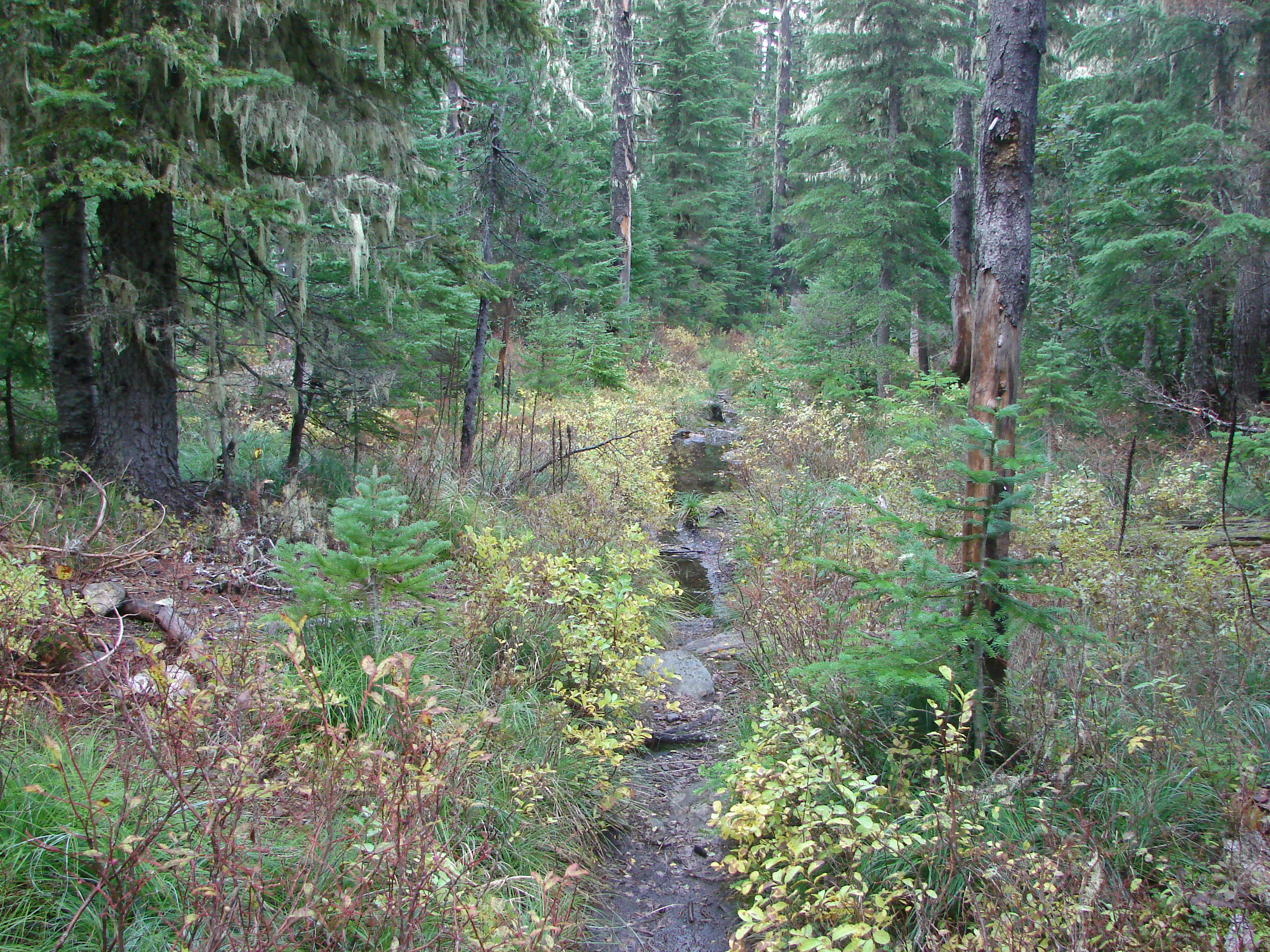
The trail set off in an old growth forest full of moss and mushrooms and soon split with the left fork heading up to Hardesty Mt. and the right fork to Goodman Creek.
The trail slowly climbed at a distance from Goodman Creek for 2 miles where a small creek joined the main branch of Goodman Creek. Just before the confluence there was a side trail at the back of a campsite leading down to the small creek and a pair of scenic small falls.
After visiting the falls we crossed Goodman Creek on a log footbridge and continued another 2.2 miles to another trail head on Goodman Creek Rd.
Goodman Creek CrossingTrail leading to a log crossing on a branch of Goodman Creek
From the road the trail then continued to climb through the forest to the Ash Swale Shelter. We saw several rough skinned newts in this section. The shelter was in good shape and offered a nice spot to sit and have a bite to eat.
Approaching the shelterView from the Ash Swale Shelter
From the shelter it was another mile to the former lookout site atop Eagles Rest. The trail crossed paved Eagles Rest Road just .3mi from the shelter. The forest changed dramatically after crossing the road. Until then the forest had been damp and full of moss, ferns, and various mushrooms and fungus. On this side of the road the forest was much drier and the undergrowth more sparse. Sunlight began filtering through the trees and soon we reached a viewpoint overlooking the Lost Creek Valley.
We continued up the trail to the better viewpoint atop Eagles Rest. Here we could see Hardesty Mountain and Mount June to the east (A hike we had done at the beginning of June). To the west the valley still appeared to be fogged in. There were several burns taking place in what looked to be clear cut areas in the valley leaving a bit of a haze but it remained a decent view.
Hardesty Mountain and Mount June (from left to right)Valley cloudsLost Creek Valley
We hadn’t seen any people all day and the forest had been full of peace and quiet up until the target shooting began down in the valley. With that we decided it was time to head back down the trail and make our back to the car. The forest had brightened as the Sun passed overhead making the forest colors even more striking.
The trail was in good condition and well used although we didn’t run into very many people until the final two miles. Given it’s low elevation (starting @ 1000′ and topping out @ 3024′) and easy trail head access this hike is an option much of the year making it a good choice for late fall or early spring.
Our other goal for the year was to do at least one hike a month (January was lost due to our passing the flu around) so we’re hoping to get out at least once more this year. Until then Happy Trails.
For the final hike of our vacation we decided to say farewell to the mountains for the year. Black Butte provided us the opportunity to get one last good view of the Cascades and a nice bit of elevation gain to boot. We had been checking the weather forecast as often as possible to see if it would be worth the effort and when we went to bed the night before our hike the forecast was for clear sunny skies all day long. They were wrong. lol
My first inkling that something was amiss was when I was loading the car in the morning and there were no stars visible in the sky. As we began our drive to the trailhead occasional sprinkles of rain were falling, but we were committed now and figured that it was early and maybe the clear skies were just a little late.
We arrived at the lower Black Butte Trailhead under cloudy skies but at least there was no rain. The trail set off through pine trees and a carpet of orange ferns.
We caught several glimpses of Black Butte on the lower portion of the trail and at least it was cloud free (it had not been on the drive earlier).
Black Butte from the lower trail
The lower portion of the trail passed through a variety of forest types. The ever changing makeup of the trees and plants was very interesting.
Cedars
There would have been some mountain views on a clearer day along this portion as well but on this day all we could make out was the snow line at the base of Mt. Washington and Three Fingered Jack. We were still hoping that the cloud cover would burn off by the time we reached the summit so we continued to climb to the upper trailhead.
From the upper trailhead we climbed out of the forest to the more exposed upper slopes of Black Butte. Here the view was virtually unobstructed by trees but the clouds were a different story. There was a thick layer of clouds above our heads but low enough to hide the taller Cascade Peaks. Below us were smaller patches of clouds passing by and sometimes over us.
Mt. WashingtonLooking down past the clouds
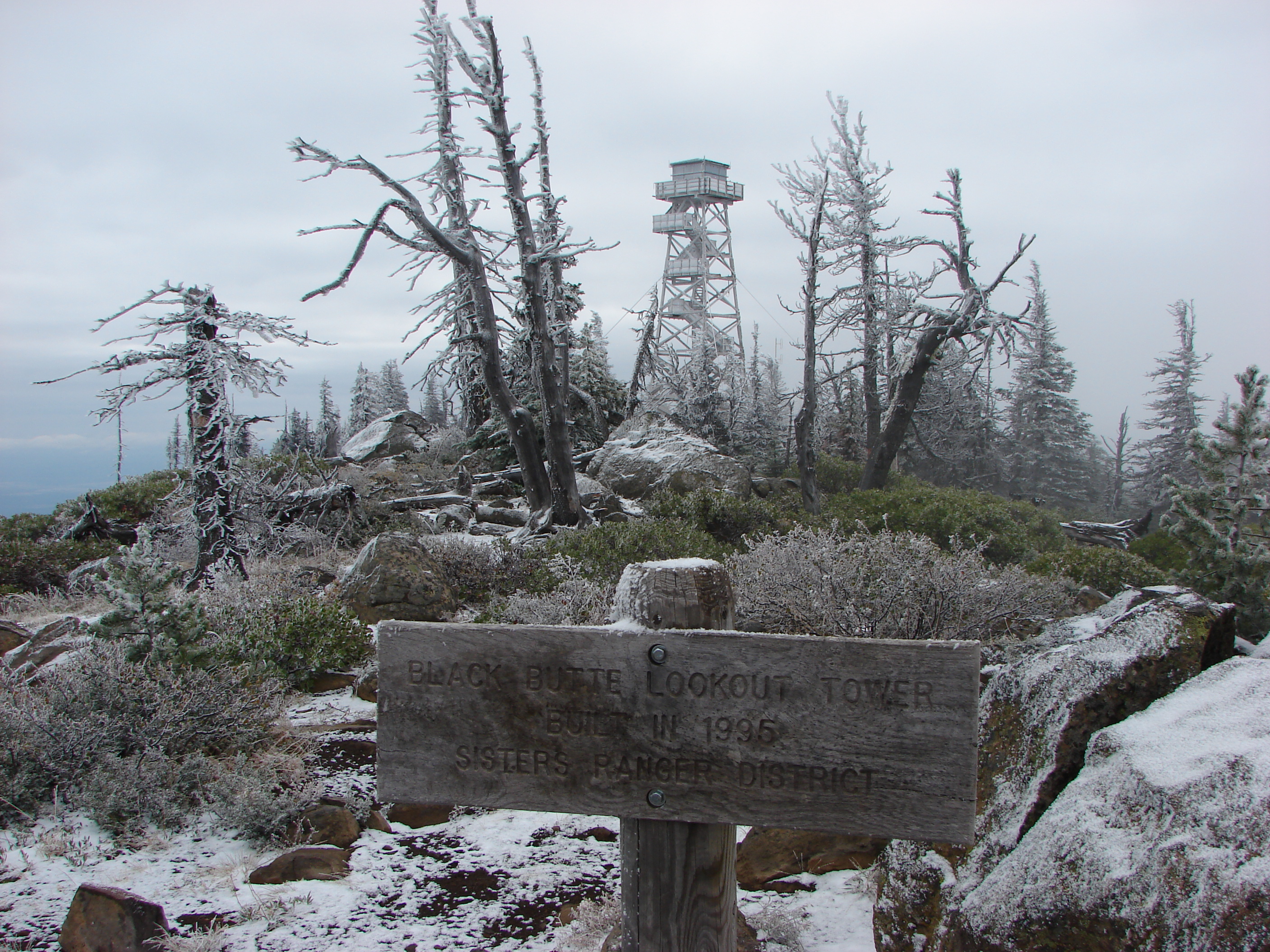
As the trail wound up and around the butte we got our first good look at the lookout tower. We also noticed that the summit appeared to be a bit snowy or at least frosty.
We had been overly warm as we climbed so far and had taken most of our layers off but as we entered the “white” zone we were met with much colder air. As we worked our way around the north side of the butte a slight breeze brought even colder air to us and kept this side of the butte wintry white.
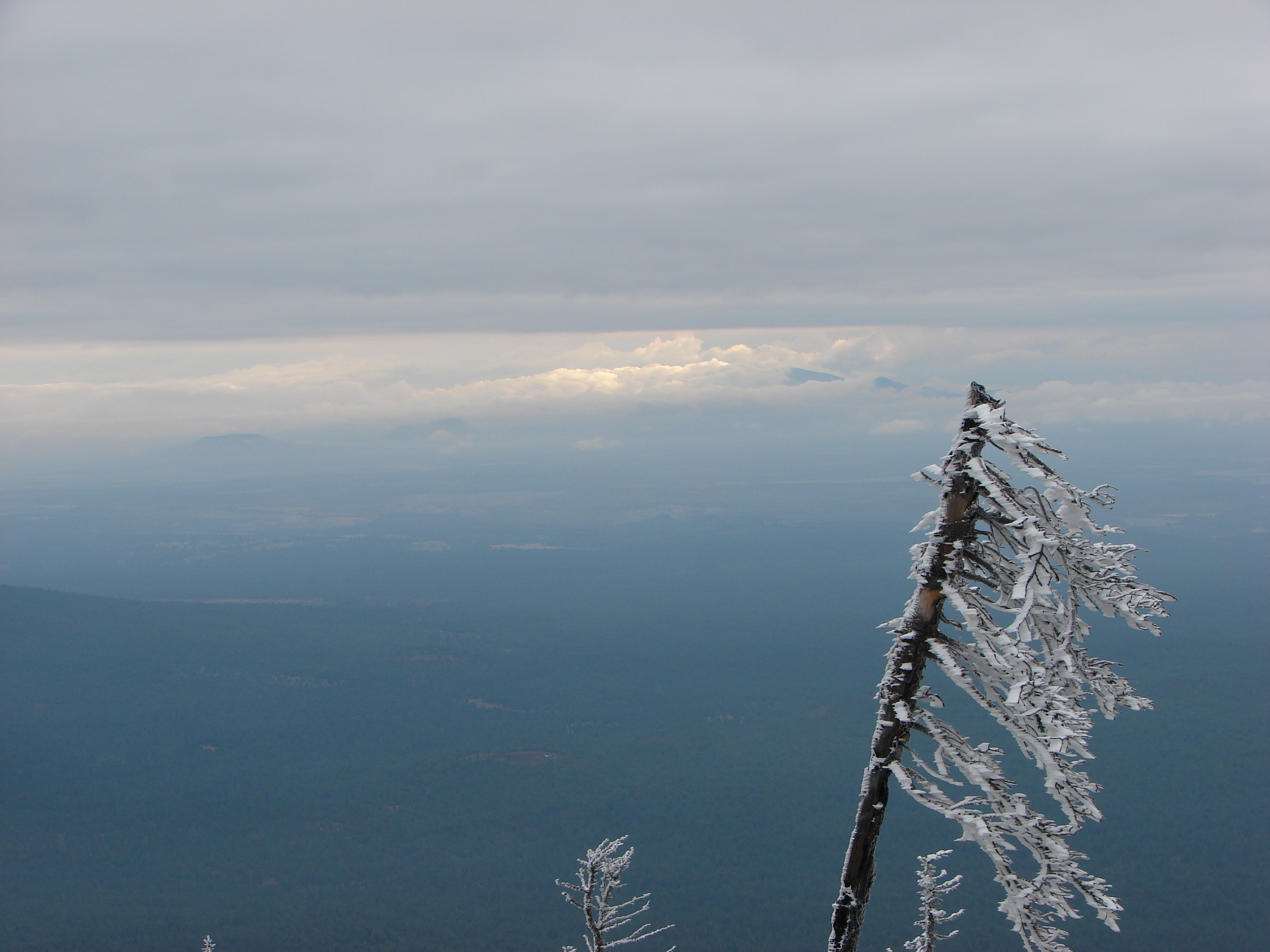
To the north we could see the edge of the upper cloud layer as sunlight reflected off the lower clouds.
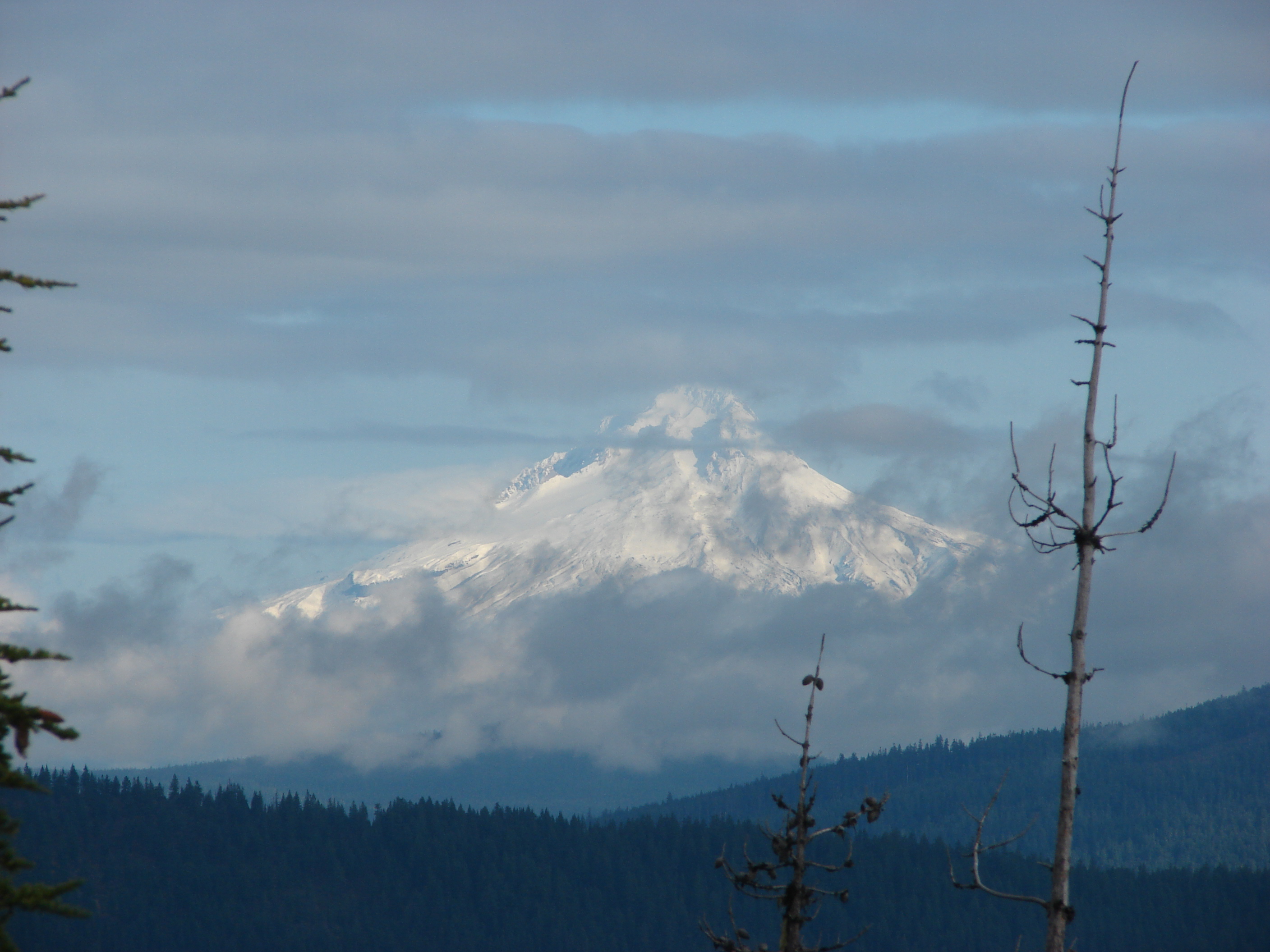
To the NE we spotted the top of a snowy mountain against blue sky – Mt. Hood!
Mt. Hood
Further around we found ourselves staring at the base of Mt. Jefferson. The view was strangely reminiscent of the view we’d had on Double Peaks on the opposite side of the mountain just 3 days earlier with clouds covering the upper 2/3rds of the mountain and blue sky apparently above and behind the mountain.
Mt. Jefferson hidden again
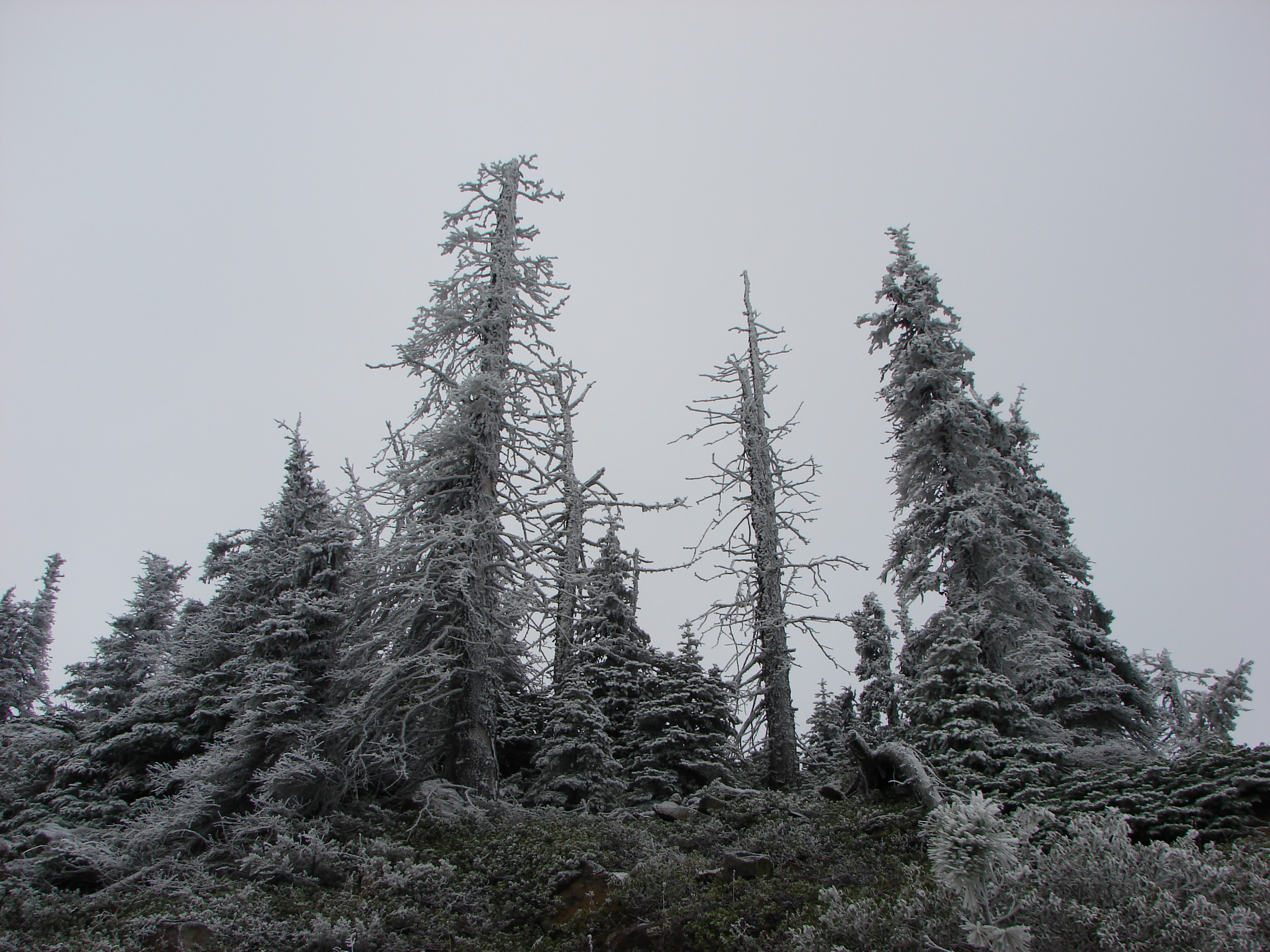
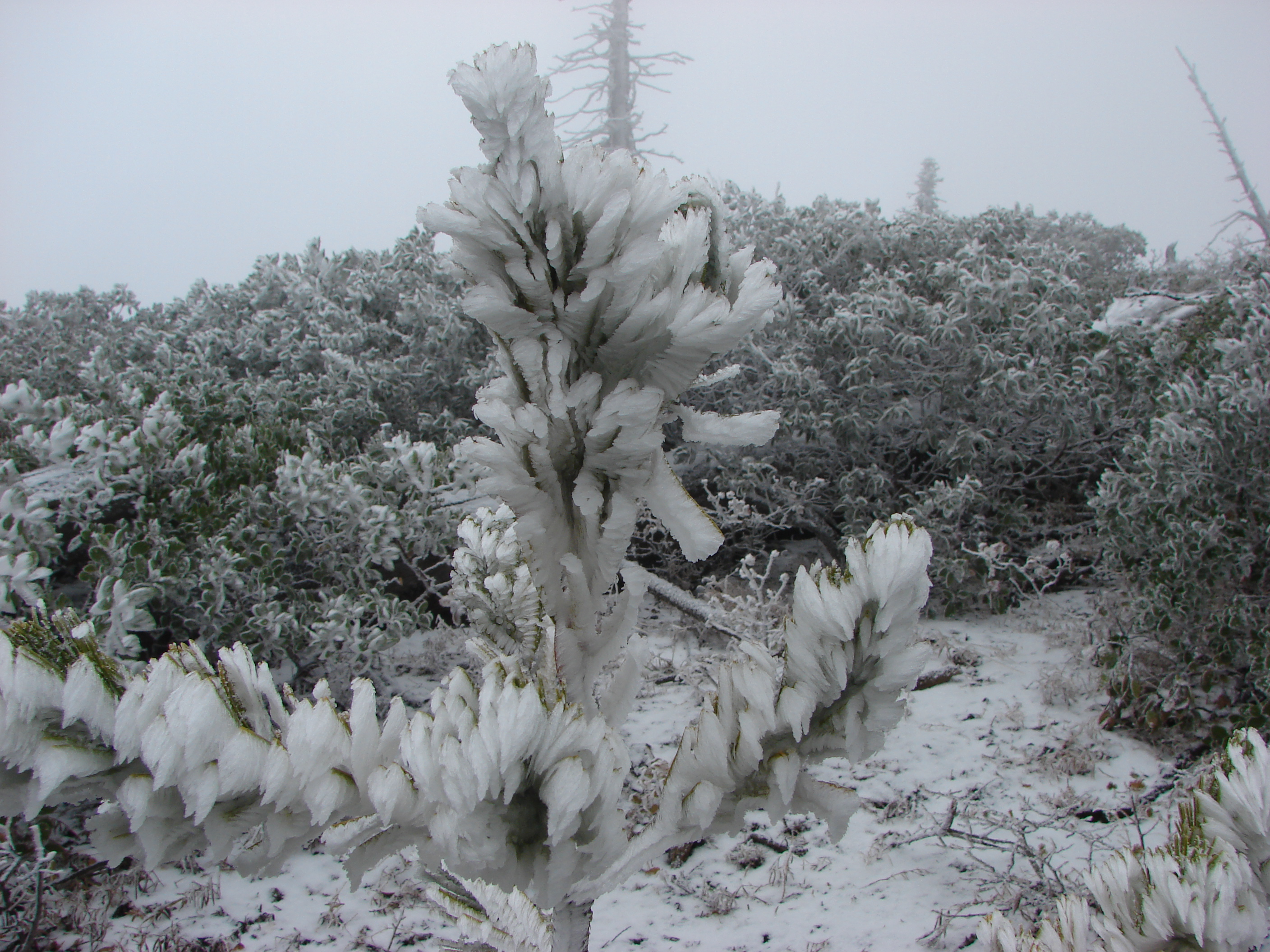
At the summit the snow/ice created some interesting scenes.
We explored the area on top of the butte where the lookout tower is not the only structure. A 1924 cupola that was the former lookout and a log cabin where the lookout staff lives were also present.
1924 cupola
Signs on the summit listed the mountain peaks that would be visible on a clear day from Broken Top to the south to Mt. Adams to the north. We were mostly left with our imaginations. 🙂 Looking out over the log cabin we could see a good portion of Three Fingered Jack and some of Mt. Jefferson.
Three Fingered Jack
We hung around for a little over half an hour hoping that the clouds would break up but the lower clouds just kept coming up from behind us and the upper clouds didn’t seem to be budging. Just as we started to leave though we noticed the upper layer was breaking up to the north and there seemed to be some breaking up near Mt. Jefferson. We turned around and headed back toward the cabin but the low clouds were rising up just in front of us so we again headed back down. I kept looking back though hoping for something when we finally got a little break and the summit of Mt. Jefferson made an appearance over a ribbon of clouds.
Mt. Jefferson
As the upper clouds retreated south we suddenly had blue sky above us and the frosty coating quickly melted from the trees and plants.
As we came around to the south side of the butte Mt. Washington was a bit more visible.
Mt. Washington
The upper layer of clouds retreating south
Just as quickly as the blue sky had appeared one of the larger low clouds enveloped the side of Black Butte and we were once again without a view.
When we got down past the upper trailhead we finally got back out of the cloud and could once again see out to where the mountains would be. Even though the upper layer of clouds had mostly retreated the lower clouds were quickly replacing it and many of them clung to the taller peaks. We did manage to get a good view of several small peaks and buttes though.
Belknap Crater and Little BelknapBlack CraterHayrick Butte & Hoodoo
We even got a brief glimpse of North Sisters summit.
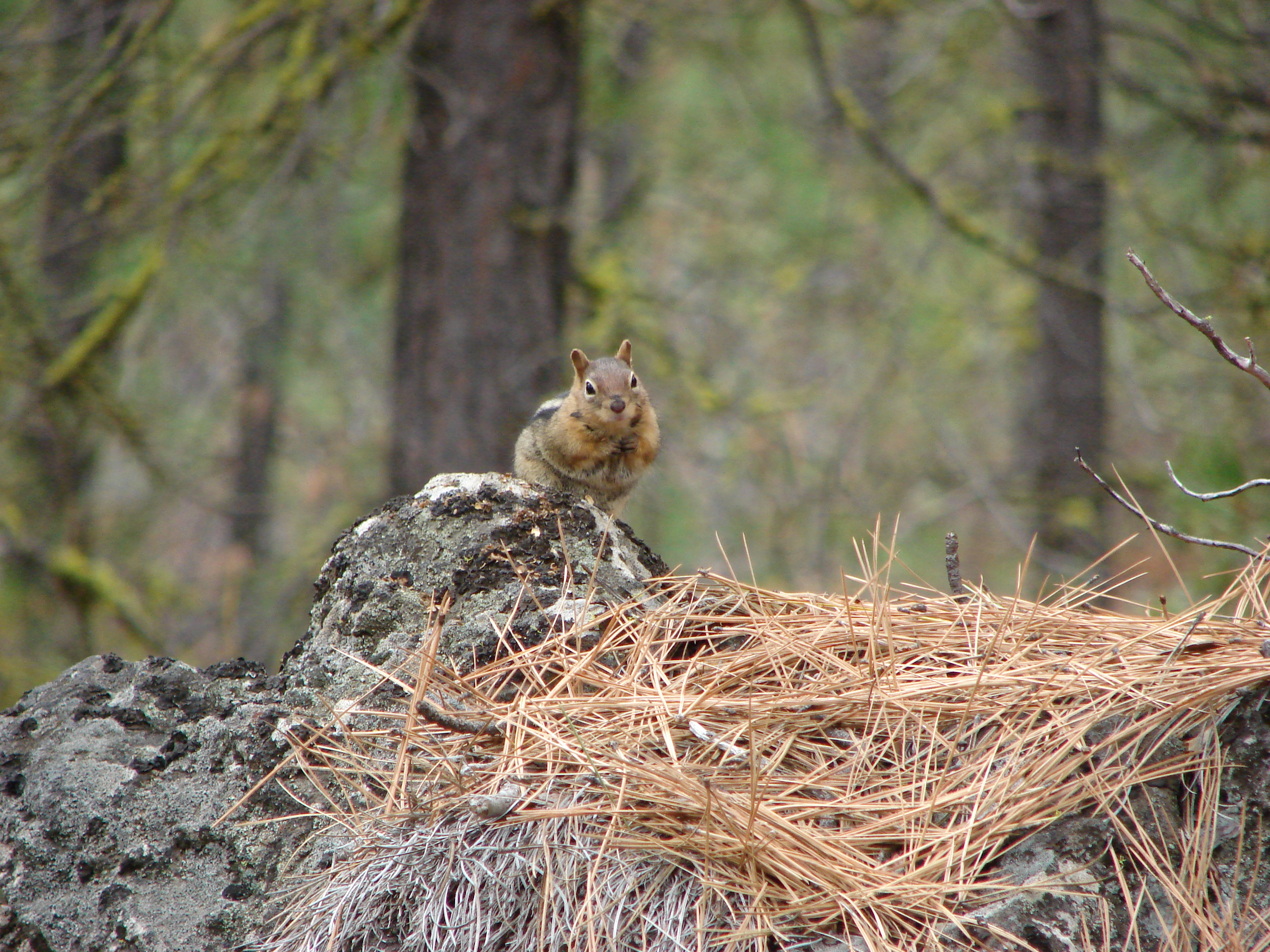
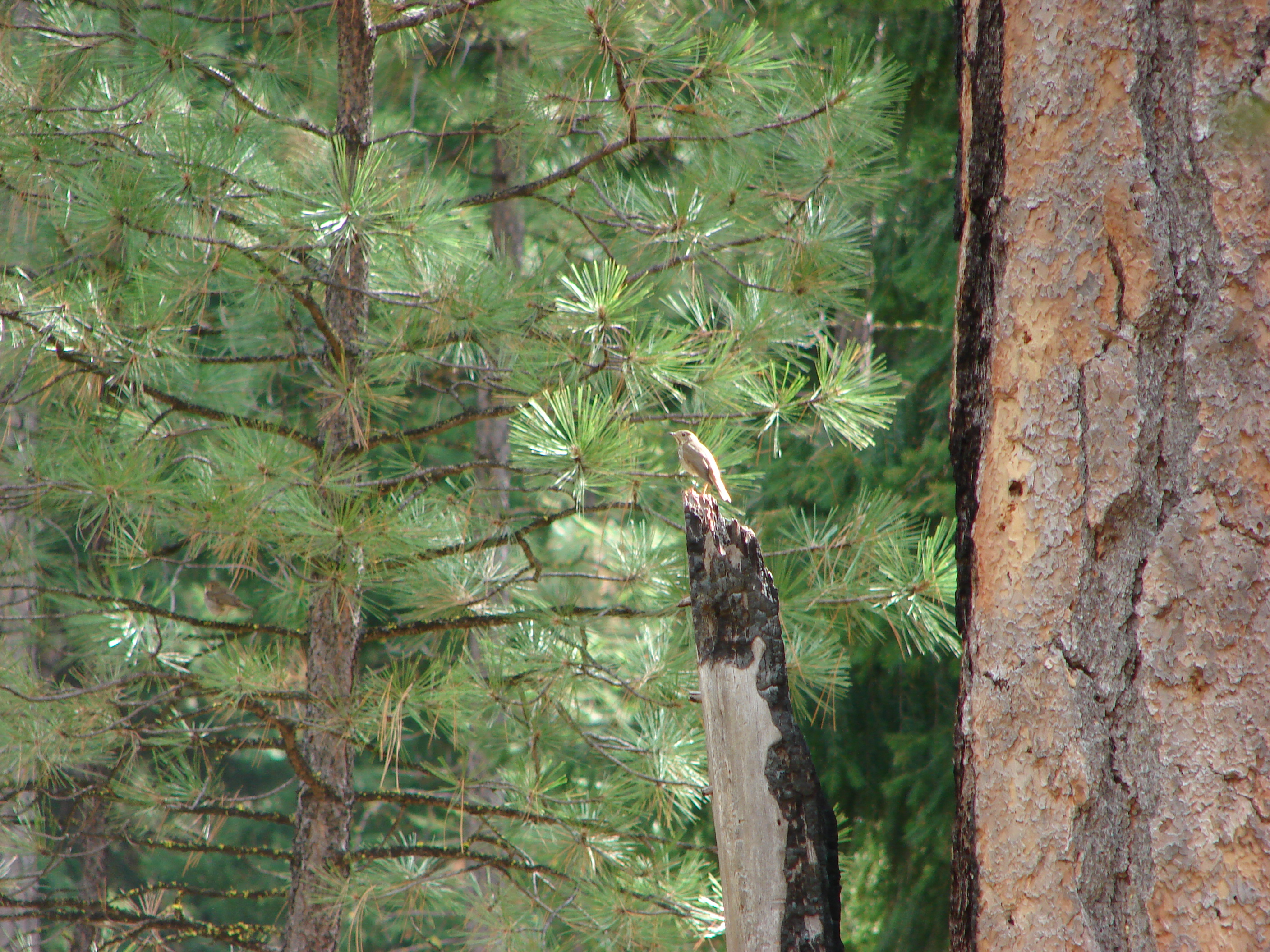
This time on the lower trail we spotted a decent amount of wildlife including chipmunks, douglas squirrels, golden-mantled squirrels, and various birds. Some were more willing to have their pictures taken than others.
We were supposed to meet my parents at the trailhead at 2:00 so they could drop off Dominique (who had chosen not to accompany us on the hike). A series of mishaps led to a bit of an adventure but while we were waiting a group of deer came by the parking area.
We eventually met up with my parents and reclaimed Nique and headed home. With that the bulk of our 2013 hikes were behind us. We’ll hopefully get out a couple more times this year, but our activities have now shifted to running for the next several months. It’s the beginning of our race season and we are all starting to train for a 15 mile trail run in a couple of months. Happy Trails.
We headed over to Central Oregon for the last part of our vacation to visit our families and get a couple more hikes in on the east side of the Cascades. Originally we had planned on combining two hikes in one day for our first hike. Tipsoo Peak in the Mt. Thielsen Wilderness followed by Mount Scott on the rim of Crater Lake. We had to abandon those plans for good when the Government Shutdown closed Crater Lake so we turned to a standby hike along the Deschutes River between Trout Creek Campground and Mecca Flats.
With a trail head at each end of this 7.6 mile segment it allowed us to set up a shuttle with Deryl’s parents where they would start at Mecca Flats with Nique while we started at the Trout Creek Campground. The idea was we would do the whole trail both ways while the went from their car to ours, then we would drive them back to Mecca Flats to pick up their vehicle. With the plan set Heather and I headed to Trout Creek and set off along the Deschutes through the rivers canyon.
The trail follows an old railroad grade along the river surrounded by the scenic canyon walls. The river cut a colorful ribbon through the sagebrush desert. We spotted a heron standing on the river bank apparently watching for small fish.
HeronSplashes of color in the sagebrush
We spotted quite a few birds along the way as well as some deer making their way up the canyon side.
Pair of ducks on the river
Deer near the top of the canyonKingfisher near Mecca FlatsFinchHidden heron on the rocksMerganser
There was also still a number of flowers in bloom along the river.
We met Dominique and my parents on the trail earlier than we had expected. They were moving a lot faster than they thought they would be. They gave us some info on what to expect on the trail ahead including to be watching for Scorpion Rock on the Warm Springs Reservation side of the river and a waterfall on our side of the river near a small creek.
Waterfall from an irrigation pipe way in the distanceGrassy creeksideScorpion Rock
Heather and I eventually made it to Mecca Flats where I accused my parents of hitching a boat ride with some of the many fishermen we’d seen. It was the only explanation of how they managed to make it that far that fast ;). We turned around at Mecca Flats and headed back toward our car and my family. Along the way we noticed a scenic red tree growing in the midst of a rock slide and several rock climbers high on the canyon cliffs.
The view from Mecca FlatsRed treeRock climbers on the canyon cliffs
It was a nice relaxing hike and a good time of year for it since the area is known for rattlesnakes in warmer weather. It was also nice to do a hike in the sagebrush landscape of Central Oregon. Ironically enough we were almost due east of our previous hike on the Red Lake Trail in the Mt. Hood National Forest and less than 50 miles as the crow flies. What a difference location and elevation makes. Happy Trails!
**Note the 2020 Lionshead Fire burned the area covered by this hike.**
I am a bit behind on our trip reports but that’s because we were busy getting a few more hikes in on our final week of vacation. After our hike on the coast at Pacific City we headed back toward the mountains on Thursday. We had been debating on whether or not to attempt the hike we had planned due to the early snow that had been falling in the Cascades. The planned hike had us starting on the west end of the Red Lake Trail, climbing Potato Butte, continuing on to Top Lake, and then making a small loop past Cigar Lake where we would attempt to climb Double Peaks before returning to the Red Lake Trail and our car.
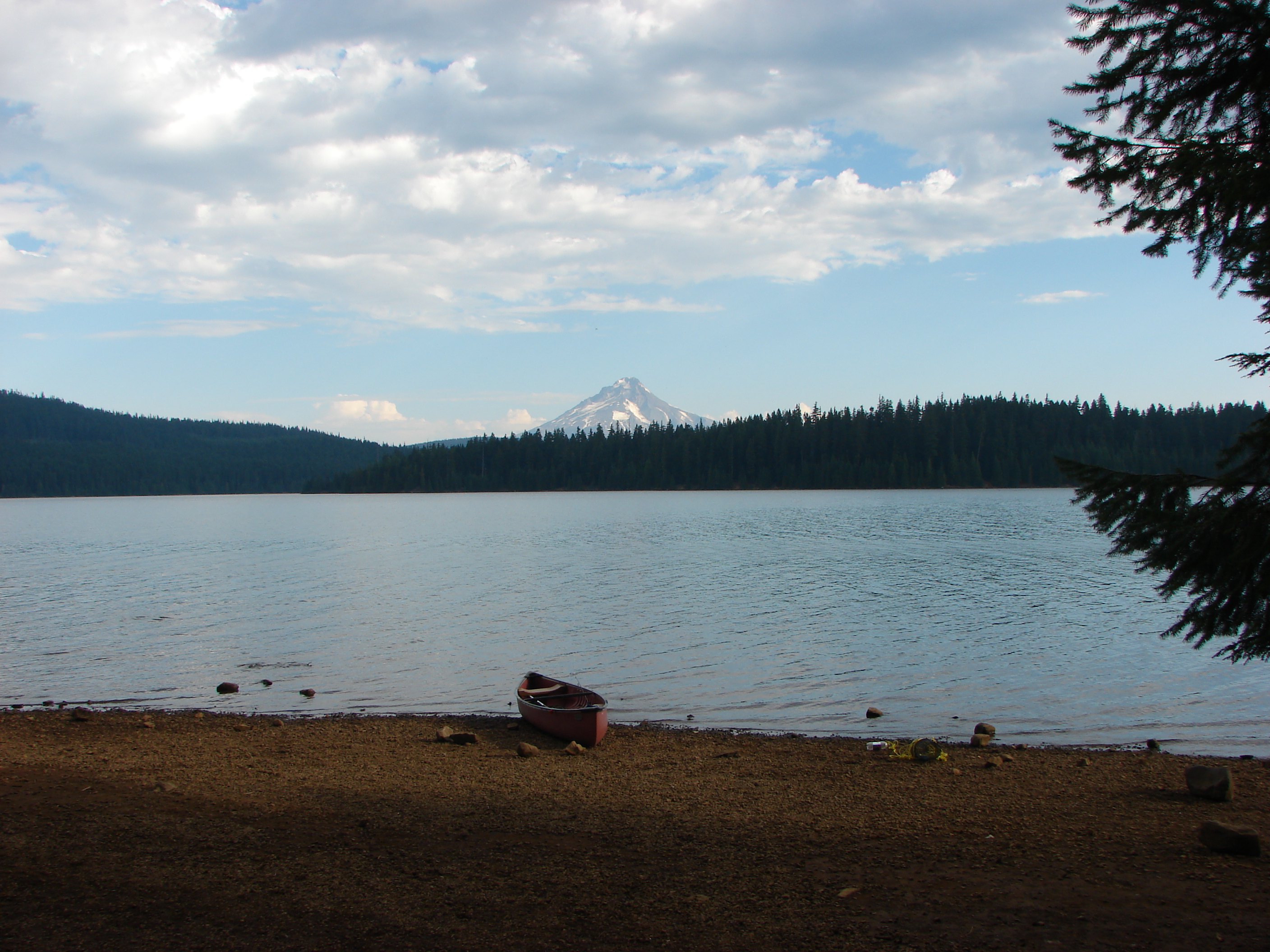
It was a nice morning as we set off and there were some good Fall colors on display. We climbed for a mile and a half before reaching the trails namesake – Red Lake.
Water on the Red Lake TrailRed Lake
After passing Red Lake the trail then visits three more lakes in the next 1.3 miles. Avrill Lake was up first with a great reflection of Olallie Butte and Twin Peaks.
Next up was Wall Lake where we got our first good glimpse of Potato Butte.
Finally we came to Sheep Lake where a pair of ducks paddled beneath the reflection of Double Peaks.
We took a trail on the eastern end of Sheep Lake that led up to Potato Butte. There were several swollen ponds along this trail and in places standing water obscured the path. We wound up losing the trail at the base of the butte and decided to scramble to the top and hope to pick up the correct trail at the summit.
One of the many swollen ponds along the Potato Butte Trail
We arrived at the summit and easily picked up the official trail. We had a fairly good view of Mt. Hood despite the presence of some clouds and a great view of Olallie Butte.
Mt. Hood from Potato ButteOlallie Butte from Potato Butte
On the way down on the real trail we got a good look toward Mt. Jefferson which was hiding in the clouds and at Double Peaks. At 5280′ Potato Butte had only small amounts of scattered snow but Double Peaks was clearly snow-covered at its height of 5998′.
Looking toward Mt. Jefferson from Potato ButteTwin Peaks on the left and Double Peaks on the right from Potato Butte
When we got to the base of the butte we saw the reason for our having lost the trail on the way up. One of the ponds had enveloped the actual trail making it impossible to see. We made our way around the edge of the pond and back to the Red Lake Trail and continued east toward the Pacific Crest Trail which we would use for part of our small loop to Cigar Lake.
The trail passed Fork Lake and several other unnamed ponds/lakes as it slowly climbed toward the PCT. We also began encountering more and more snow as we went.
Pond below Twin PeaksIncreasing amounts of snow
The snow made it possible to see a variety of animal tracks showing us just how many different species that we never see walk these same trails. At the PCT junction we continued on the Red Lake Trail heading down now to Top Lake.
Some of the tracks in the snowTop LakeFall on the shore of Top Lake
At Top Lake we left the Red Lake Trail and skirted the overflowing lake to its south end and climbed back up to the PCT near Cigar Lake.
Double Peaks from Cigar Lake
There was a good amount of snow at Cigar Lake but we decided to see how far up Double Peaks we could make it. We found the marker for the trail easily enough, but between the snow and the extra water around Cigar Lake we were having a hard time determining just where the trail actually was. Luckily for us a deer had left us a set of tracks that we were able to follow that led us across and around the edge of Cigar Lake and to the continuation of the Double Peaks Trail which was just barely identifiable by a slight indentation in the snow.
Snow and water near Cigar LakeDouble Peaks Trail
Once we found the trail it was like walking through a winter wonderland. The snow was anywhere from a half-inch deep to mid-shin. The snow-covered trees looked ready for Christmas making this one of the most enjoyable stretches of hikes we’d had.
Heather on the Double Peaks TrailChristmas Trees in October
The trail was fairly steep and we almost lost it near the top when it veered up between some boulders but we managed to follow it all the way to the summit.
The base of Mt. Jefferson from Double PeaksEvidence of wind and icePotato Butte from Double PeaksOlallie ButteTimber, Olallie, Long, and Monon Lake from Double Peaks
We didn’t get the view of Mt. Jefferson we’d hoped for but the snow more than made up for that. As we started down Double Peaks the day began to warm up and the snow was melting quickly. We did a lot of sliding down the slushy trail before reaching the PCT again and heading back to the Red Lake Trail. We returned the way we’d come only now we had some blue skies and sunlight as we passed the lakes and arrived back at our car. Happy Trails!
Sunlight mushroomTwin Peaks from Sheep Lake in the afternoon
It had been several months since we’d taken a hike along the Oregon Coast so for a change of pace we headed to Pacific City to check out Cape Kiwanda and Bob Straub State Park. We parked at the lot for Cape Kiwanda near the Dory Boat Launch and started our hike by heading over to the cape. Haystack Rock rose from the ocean just beyond the cape while seagulls patrolled the beach.
After a little exploration on Cape Kiwanda we retraced our steps and headed out to the tide pools next to the cape. The tide was out far enough to reveal several starfish and anemones.
We then headed south along the beach toward the Nestucca Spit and Bob Straub State Park. Vehicles are allowed on certain parts of this beach but only a couple came down and none stayed long. Several flocks of seagulls were gathered along the beach as well as a handful of other ocean birds. Seagulls on the beach
SandpipersPelicans
When we reached the end of the spit we turned along Nestucca Bay to make a loop around the spit through Bob Straub State Park. More birds awaited us in the bay including some ducks and a heron. Heron
Ducks
We also saw many clam shells and a couple of nearly complete crabs. We enjoyed watching the seagulls pick up the clams, fly them into the air, and then drop them. Seagull with a clam
Clam shellCrab
We originally missed the trail that would take us from the bay shore across the spit to a forested trail network. When we reached an impassable estuary we turned around and located the correct path. We found a surprisingly dense and scenic forest waiting for us in the middle of the spit. Moss covered the ground and many trees while bright colored mushrooms dotted the green carpet. A few flowers remained in bloom even as many of the leaves showed their fall colors.
There was a confusion of trails in the forest and absolutely no signs indicating where any of them went or which was the correct one to reach the park. We eventually found ourselves in a meadow along the Nestucca River. The trail we were on went down to a nice little beach along the river where it promptly ended. We turned back around and took a different path only to wind up arriving at the same meadow from a different direction. At that point we had already been on a couple of overgrown paths and I was getting a little irritated at the lack of signs. It was time for drastic measures so we turned to the gps and struck off on a faint game trail in the direction of the park. This worked out fairly well as we wound up popping out of a thicket of scotch broom on an old road less than 50 yards from the parks entrance road. Scotch Broom where we emerged onto the old road
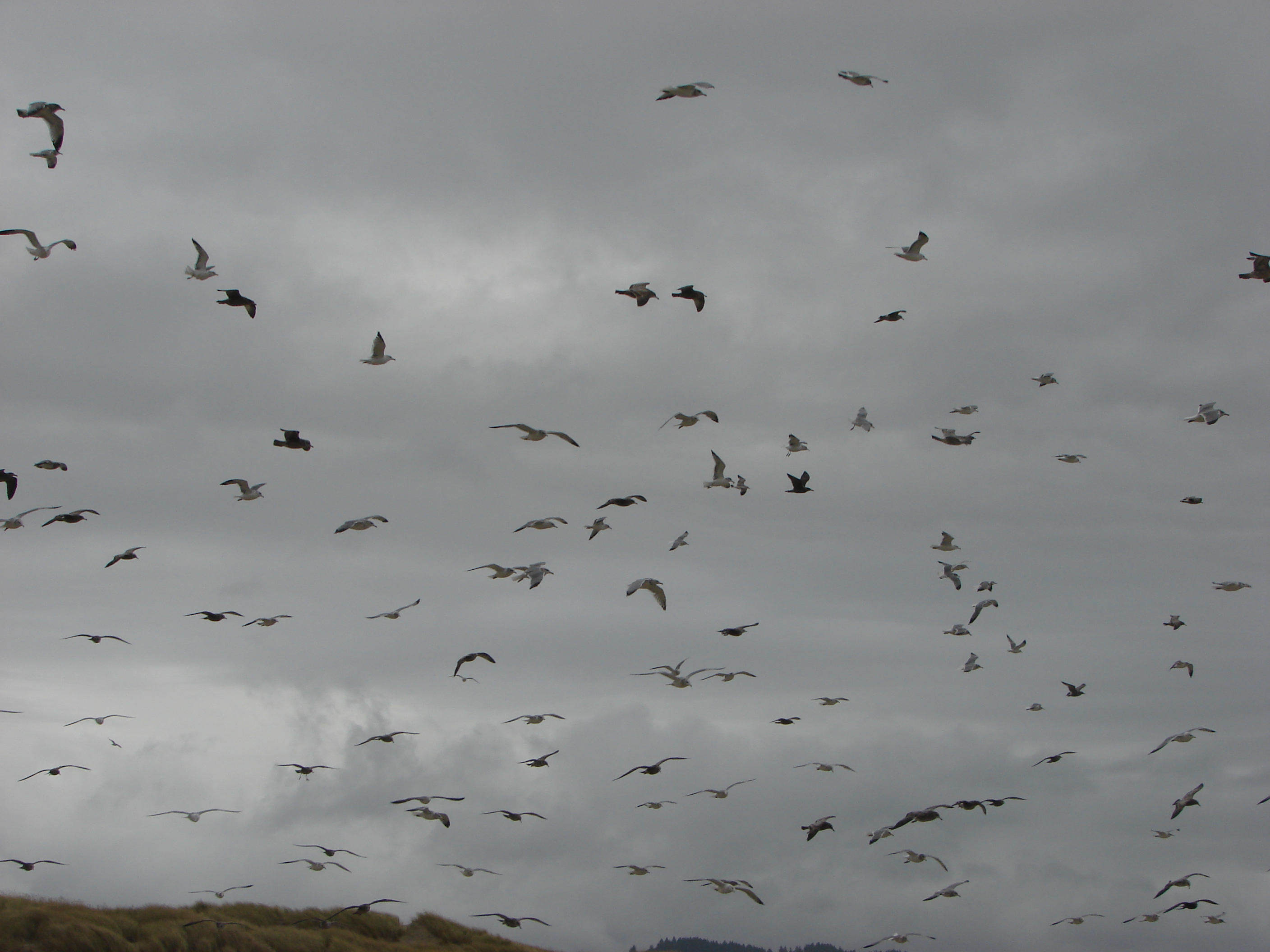
We walked to the parks parking lot and then followed a short trail back to the beach and headed back toward Cape Kiwanda. One the way back we encountered the largest flock of seagulls we’d seen all day. They took to the air as we passed by making for a scene straight out of the movie The Birds. As I was busy taking pictures I realized I was a sitting duck and should probably move before I was hit by a seagull bomb.
Despite the constant presence of gray clouds we had only had a couple of short bouts of rain until now. We escaped the seagulls only to be met with a sudden uptick in wind followed by a heavy sideways blowing rain. The rain let up just before we reached the Dory Boat Launch and our car where we dried off a bit and then walked across the parking lot to the Pelican Pub & Brewery for some lunch. http://www.yourlittlebeachtown.com/pelican
The food was great and the view out to Cape Kiwanda and Haystack Rock made for a perfect end to an interesting beach hike.
Happy Trails.
**Note a portion of this hike burned in the 2022 Cedar Creek Fire.**
After a (well timed) scheduled week off we were back on the trails this past weekend. A highly unusual storm had rolled through as September gave way to October. Not only had this storm brought record amounts of precipitation but some of that precipitation fell as snow as low as 4000′. The hike we had planned, Fuji Mountain, topped out at 7144′ so we weren’t sure if it was going to be doable but some warmer weather moved in and we decided to give it a go. If we managed to make it up to the summit we knew the views should be great, and worst case scenario we could just choose a different lower trail in the area.
Fuji Mountain is located in the Waldo Lake Wilderness near Highway 58. A pair of trail heads lead to the summit. From the SW a 1.5 mile option starts on road 5883 making for a nice short hike. We chose to start from road 5897 (Waldo Lake road) to lengthen the hike a bit and visit some of the areas many lakes.
The trail begins just below 5000′ and started out snow free, but that didn’t last for long. We quickly began seeing snow along the trail and then on the trail itself. We followed a single set of hikers prints as we climbed up toward the first of the lakes.
They weren’t the only set of prints in the snow. 🙂
Black bear print
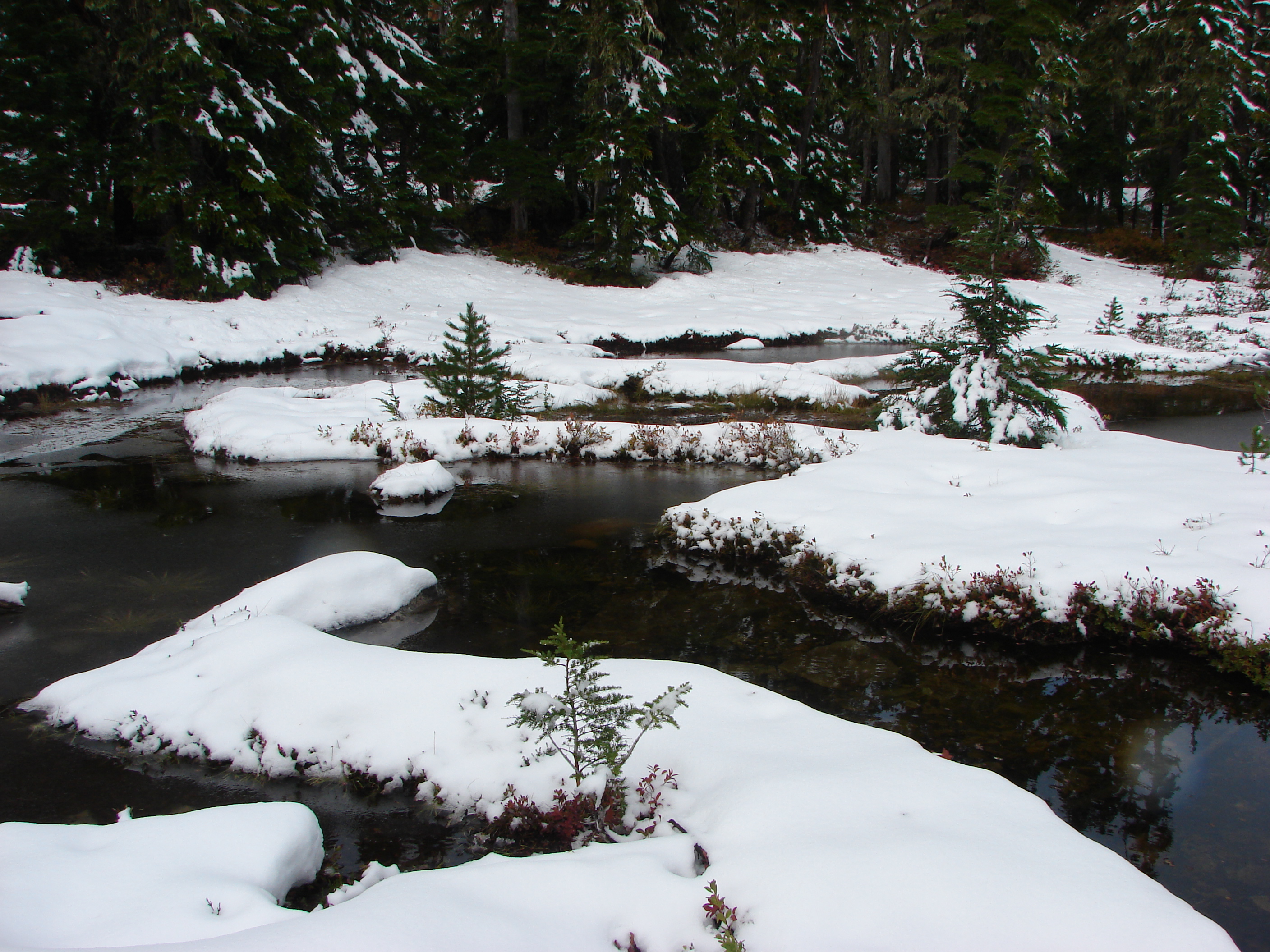
It wasn’t long before there was more snow covered trail than not but the snow wasn’t very deep, only on occasion measuring 6″. The trail climbed for about a mile then gently rolled along a plateau dotted with ponds and lakes for another 2.5 miles. Many of these were at least partly frozen making for some pretty scenery.
Half frozen pondMushrooms under iceBirthday LakeReflections on Birthday Lake
Shortly after crossing the South Waldo Trail the Fuji Mountain Trail began climbing again. In another mile we met up with the trail coming from road 5883 and began the final 1.2 mile climb to the summit. Here there were more hiker tracks in the snow but we only saw one other couple who were on their way down after spending the night on the summit.
As we climbed we began to have views of snowy Diamond Peak and Mt. Thielsen to the south, but these views paled in comparison to what awaited at the summit. When we arrived at the summit a 360 degree view awaited with Waldo Lake and a string of snowy peaks to the north and more mountains to the south. To the east lay Wickiup Reservoir and Odell Lake with distant Paulina Peak and nearby Maiden Peak in between. To the west were the foothills leading to the Willamette Valley.
Waldo Lake and the CascadesCowhorn Mountain, Mt. Thielsen, Hillman Peak and Diamond PeakLooking west along the summit ridge of Fuji Mountain
It was a beautiful day at the summit, sunny and warm with no wind. We took our time eating lunch and enjoying the tranquility before heading back down. On the way out Heather and I decided to take a brief side trip along the South Waldo Trail to the Island Lakes. It was around half a mile to Lower Island Lake with it’s green water and tiny rock island. Just up and across the trail from Lower Island Lake was Upper Island Lake which also had a small rocky island.
Lower Island Lake’s islandLower Island LakeUpper Island Lake
The warm weather made the return trip pretty slushy as the snow was melting fairly quickly. When we arrived back at the half frozen pond the scene had changed quite a bit.
The no longer half frozen pond
We all really enjoyed being able to take a hike through the snow and it made for a nice change of pace. I don’t know if the early snow is a sign of things to come or just a fluke but it was enjoyable. Happy Trails!
We headed out on the first day of Autumn for our first post Summer hike and boy did Fall arrive in full force. We headed to the Roaring River Wilderness to check out several lakes on a loop hike. There was a possible view of Mt. Hood and several Washington snow peaks, but it was obvious from the forecast that any views were unlikely. The Roaring River Wilderness is part of the Mt. Hood National Forest and one we had yet to visit. We began our hike at the Shellrock Lake trail head under cloudy skies and a light mist.
After donning our rain gear for the first time in months we decided to do a “warm up” hike to Hideaway Lake in the opposite direction of our planned hike. The trail to Hideaway Lake started on the opposite side of the road from the Shellrock Lake trail. A short .5 miles path brought us to the lake which we then circled on a 1 mile loop. After completing the loop we returned to the parking area and set off toward Shellrock Lake.
The Shellrock Lake trail quickly entered the Roaring River Wilderness and just a short while later we arrived at Shellrock Lake. Fog drifted over the water at this peaceful lake which had plenty of campsites but no campers.
Shellrock Lake
We passed by the lake and began climbing at a sign for the Frazier Turnaround. This portion of the trail was fairly steep and rocky and also full of rough skinned newts. After 1.3 miles of climbing we arrived at Frazier Turnaround where we could have parked if we’d been willing to try the terrible access road.
From Frazier Turnaround the loop portion of our hike started. We followed a sign pointing to Serene and the Rock Lakes. Our first destination was Middle Rock Lake. We took the quarter mile path to the lake where we spotted numerous crawdads and a frog.
Crawdads in Middle Rock LakeFrog in Middle Rock Lake
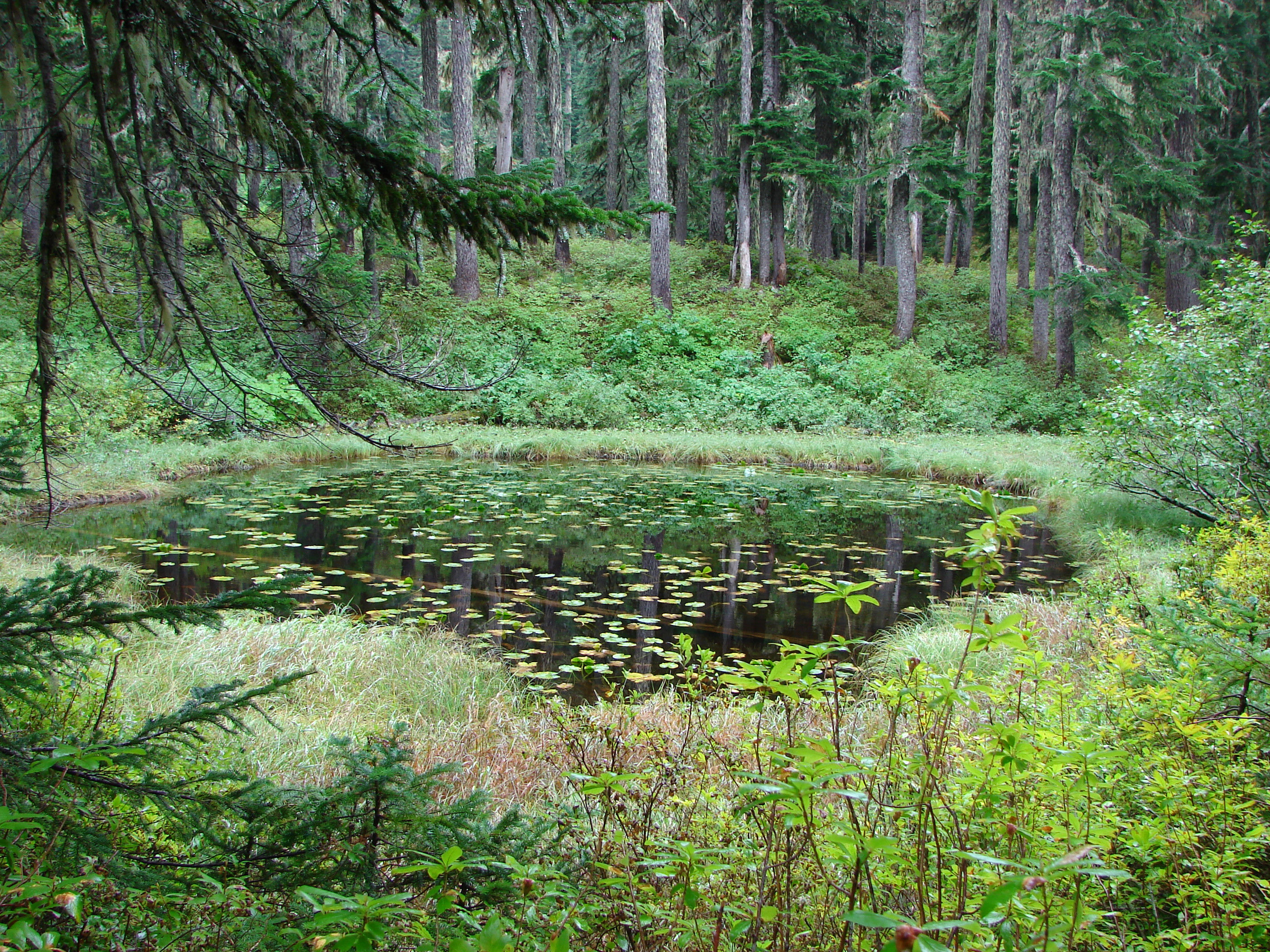
The trail continued along Middle Rock Lake and was supposed to take us to Upper Rock Lake. We ran into a little bit of an issue as we attempted to follow this portion of the trail when it appeared to veer away from the lake. We followed this faint path uphill where it was becoming increasingly overgrown until it finally disappeared at several fallen trees. Thinking the trees had blocked the path we worked our way around them and picked up what appeared to be the continuation of the faint path which quickly ended below a rock slide with no lake in sight. It was time to break out the Garmin (again) which revealed that we were too far to the right of Upper Rock Lake so we set off cross country through the wet brush. We passed a pair of scenic lily pad ponds before finally reaching Upper Rock Lake and finding a good trail leading to it’s shore.
Pond near Upper Rock LakeUpper Rock Lake
We followed the good trail down and discovered the source of our confusion. A tree had fallen along the shore of Middle Rock Lake which had hidden the trail and obscured the view of the single pink flagging that indicated the correct path. We had turned right at the uprooted base of this tree on the only visible path to us at the time.
We had one more of the Rock Lakes to visit, Lower Rock Lake, which was on the other side of the loop trail so we returned the way we came and went down to visit this last one. There wasn’t much to see there, just a nice little forest lake so we quickly returned to the Serene Lake trail and continued our loop. The trail had dropped down to the Rock Lakes but now we were climbing up through a nice forest. After several switchbacks the trail leveled out and arrived at Serene Lake. This was the deepest lake of the day and was surrounded by rocky slopes and forest. Clouds drifted up over the hillsides surrounding the lake while we had a snack on it’s shore.
Serene Lake
We left Serene Lake and headed for our last point of interest, Cache Meadow. The trail continued to climb as we continued on until finally leveling off on a plateau above Serene Lake. Here would have been the mountain views with Serene Lake below but the weather had not cooperated and only Serene Lake was barely visible below.
Serene Lake from the viewpoint
The rain began to pick up as we approached Cache Meadow. The meadow was larger than I had expected and the remains of a vast display of flowers covered the ground. Now only a few aster held some lingering petals. A small unnamed lake filled one end of the meadow but we didn’t explore much due to the increasing rain.
Cache Meadow
The next four plus miles was through the rain as we completed the loop back to Frazier Turnaround and then descended back to Shellrock Lake. The rain did let up as we left the wilderness area long enough for us to change into dry clothing before driving home. The only thing missing was a cup of hot chocolate 🙂 Happy Trails
There isn’t much like a midweek hike in September, the crowds have thinned out but the weather can still be great. When I was putting together our hiking plans at the beginning of the year one of the hikes I really wanted to do was Hunts Cove. The hike starts at the very popular Pamelia Lake Trail in the Mt. Jefferson Wilderness which is one of only two areas in the Oregon Cascades (not counting Crater Lake NP) that requires you purchase a permit in order to enter them. Due to the popularity I decided to purchase our permit for a weekday after school started to hopefully minimize the number of other people we’d run into.
Having purchased our permit over four months in advance I was gambling on the conditions. Last year we had gotten permits for the other fee area along the Obsidian Trail in the Three Sisters Wilderness, only to spend the entire 18.6 mile hike in wet and view less low clouds. We lucked out this time though. The forecast had started out as cloudy with a chance of rain but by the time the big day arrived the outlook had greatly improved to clear skies and a high in the low 70s. As a bonus the snow level had dropped down to between 6500-7000′ meaning there would likely be some new snow on Mt. Jefferson. As an added bonus a friend of ours, one of Heather’s running buddies, Jessie, was able to get the day off and join us.
We set off on the Pamelia Lake trail in the soft light of morning through a peaceful forest along side Pamelia Creek. Soon we were surrounded by the sound of rushing water with Milk Creek to our left and Pamelia to our right. Milk Creek comes from glaciers up on Mt. Jefferson and evidence of a 2006 mudslide littered the forest floor. Just over 2 miles in on the trail we reached a T shaped junction at the edge of Pamelia Lake. To the right was a 3 mile trail up Grizzly Peak and to the right lay the path to our loop into Hunts Cove and then back on the Pacific Crest Trail. Before turning right though we headed down to the lake for a photo op.
Mt. Jefferson from Pamelia Lake
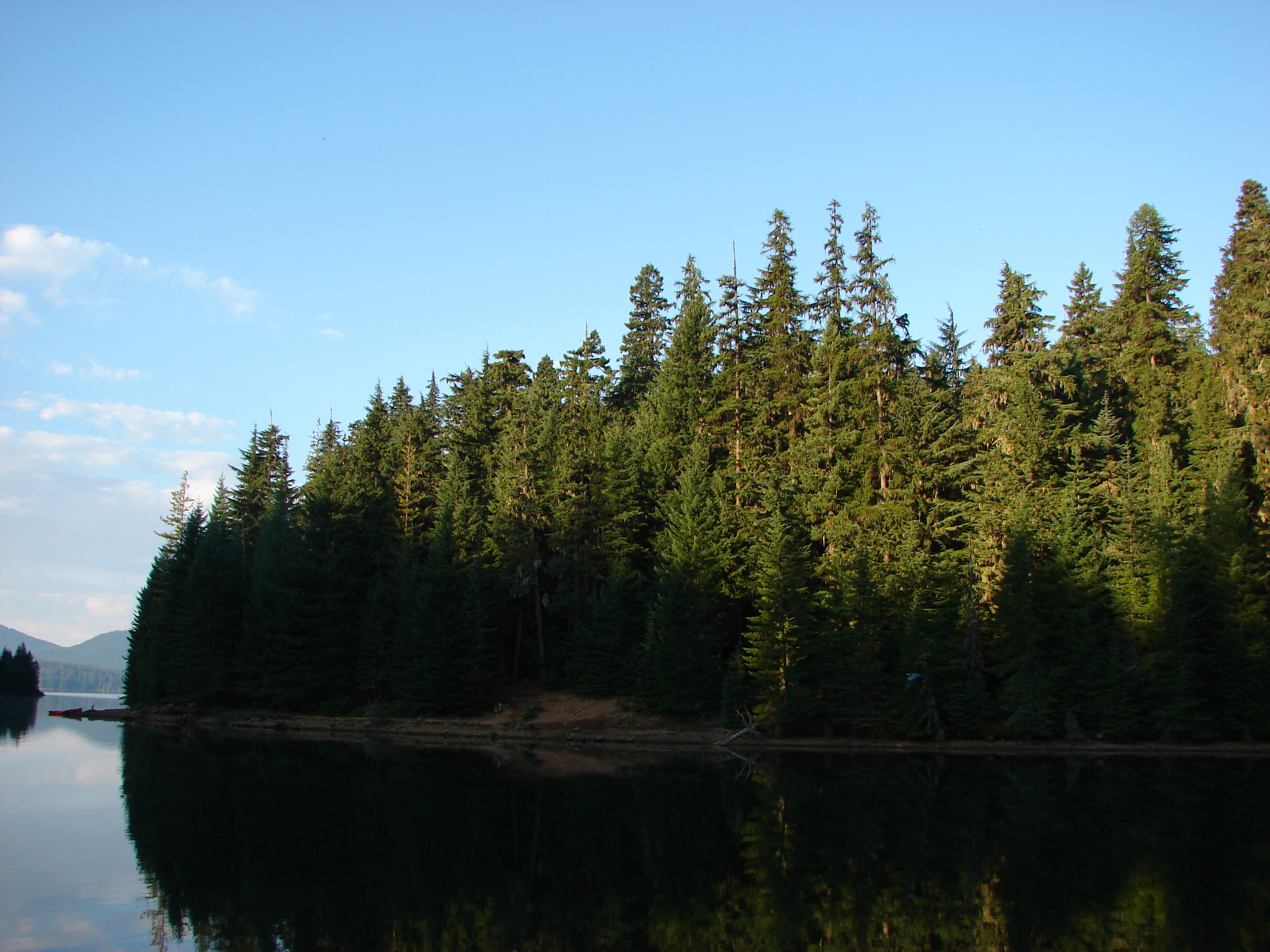
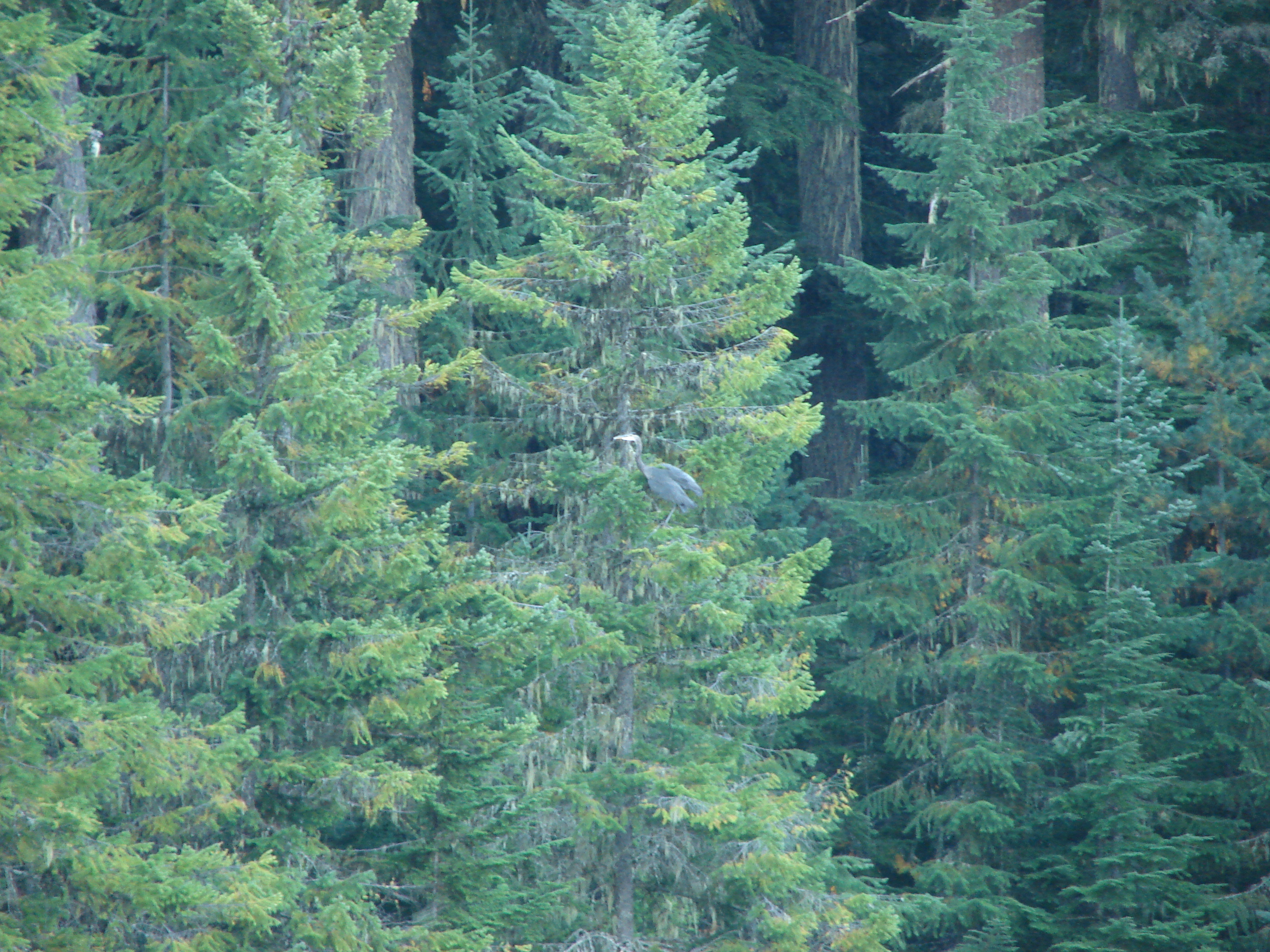
There was a good deal of wildlife present on the lake. A great blue heron flew from a log in the center of the lake into the far grassy shore and a family of ducks glided silently into the reeds. Several canada geese could be seen at the far end of the lake near the lakes inlet.
We made our way around the lake to a second junction. Here we had to decide if we would do the loop clockwise or counterclockwise. We decided to stick to the lake shore and go counterclockwise first to Hunts Cove and then to the PCT. The trail crossed several streams that seemed to be flowing very well given the time of year. We assumed the recent rain/snow had helped rejuvenate them. Our favorite crossing was on a footbridge over a small scenic falls.
Footbridge & falls
The trail began climbing gently as we passed the far end of Pamelia Lake. The path traveled along Hunts Creek, crossed over it, and then climbed up above it on the side of a ridge. As we climbed we began getting glimpses of Mt. Jefferson across the valley with it’s dusting of new snow.
At a sharp switchback we could hear what sounded like a waterfall a short distance away so we took a faint side trail in the direction of the sound and discovered a beautiful waterfall on Hunts Creek.
Just a short distance from the falls we found the signs marking the trail to Hunts Cove where we took the left fork travelling above a pretty meadow with a view across to the mountain. A half mile later we arrived at the first of the two lakes that call the cove home. Hanks Lake was up first. It was a lovely lake lined with meadows and a view of Mt. Jefferson.
Mt. Jefferson from Hanks Lake
Some of the biggest huckleberries and blueberries we’d seen were growing in large patches around the shore and we stumbled up a pair of sooty grouse in one of the thickets.
Sooty grouse on a downed tree
After a refreshing rest on the shore of Hanks Lake we continued on to Hunts Lake. Although Hunts Lake has no view of Mt. Jefferson it offered it’s own attractions. Heather spotted several fish in the clear water and over the lake loomed Cathedral Rock where we would eventually find the PCT.
Hunts Lake and Cathedral Rocks
We left Hunts Lake and returned to Hanks Lake to begin the real adventure. From Hanks Lake we could have returned to the trail junction and continued 3 miles to the PCT on the official trail or we could look for a former trail that lead from the far end of Hanks Lake up to the PCT shaving off a mile or more from the hike. We opted for the off trail adventure and set off around Hanks Lake in search of the old path. Using a Green Trails map I knew the old trail followed an inlet creek up to the PCT below Cathedral Rocks so we worked our way to an inlet creek and began working our way up along it. The map only showed one creek so despite not being able to find a convincing former trail we sallied forth through the brush.
Inlet creek we followed from Hanks Lake
The map indicated that the trail had eventually crossed the stream and continued on the far side so when I spotted a decent place to cross we hopped over to the other side. We found several sections of what could have once been a trail, but they could have been game trails as well and never saw any blazes or other indications of an official trail. Next we stumbled on a lovely meadow with a small pond in the center. At that point I decided to consult the Garmin. I knew we were headed in the right direction for the PCT but it wasn’t until I looked at the Garmin that I realized we had followed the wrong creek up. The Garmin clearly showed the additional stream that wasn’t on our other maps so that mystery was solved. Now it was a matter of finding the least steep climb up to the PCT. Using the GPS I headed to what looked like the most gradual ascent passing through a pair of small heather meadows.
Heather & Jessie in one of the small meadows
Leaving the second little meadow we climbed one last steep section and suddenly popped out on the PCT. We were probably about a half mile further down the PCT than where I had expected to meet up with it, but that just meant a little shorter hike. After celebrating our find we turned left and headed north. After just a couple hundred yards the PCT dipped a bit and passed right along the edge of the meadow we had just left. That was good for a laugh or two :). This section of the PCT was great as it traveled between Cathedral Rocks on the right and Hunts Cove below to the left. Views extended across Hunts Cove to the far ridge and Three Fingered Jack beyond.
Three Fingered Jack from the PCT
Hanks and Hunts Lakes from the PCT
The PCT then reaches a plateau below Mt. Jefferson that is dotted with lakes and ponds. The first pond we arrived at was a strange red color. As I approached the water a frog swam from the shore and floated in the colored water.
Next up was Shale Lake and a wonderful view of the mountain.
Mt. Jefferson from Shale Lake
Shale Lake had some great looking tent sites and next to it was nearly dry Mud Hole Lake. Across the trail lay Coyote Lake and several other small ponds.
Leaving the plateau we began descending down toward Milk Creek with views of Pamelia Lake below. Just before reaching Milk Creek we reached the turn off for the return trail to Pamelia Lake. Before heading back I went down to the Milk Creek crossing to get a picture of Mt. Jefferson.
Mt. Jefferson from Milk Creek
We started smelling smoke while I was getting the picture at Milk Creek and when I turned around the sky behind us was filled with smoke. Then I notice that there was smoke drifting in front of Mt. Jefferson as well. When we got back to Pamelia Lake the scene was quite different than it had been in the morning.
Smoke over Pamelia Lake
Smoke had settled in the valley but we had no idea what the source was. On the way out there was just a bit of smoke in the forest but it didn’t detract from the beauty. Green moss covered much of the ground and dozens of varieties of mushrooms and fungus added character to the view.
We had a blast on this hike. For the most part we had the trails to ourselves the whole day and the weather had been perfect. Aside from the bit of smoke at the end of the day (which was apparently due to a controlled burn being done by the Forest Service near Sisters, OR) it couldn’t have been better. We’d knocked out 18.2 miles in just over 9hrs. It was really fun having Jessie join us on the hike. It was great having someone that didn’t even blink at the 5am departure time or the distance/time we were planning on doing. What a way great to spend a Thursday in September 😀 Happy Trails!
We reached into our bag of backup hikes this past weekend and grabbed what wound up being a decent little hike. We were needing something in the Portland, OR area because after the hike we were set to celebrate the upcoming birthdays of my Grandmother Zana (89) and our Son Dominique (18) at Gustav’s http://gustavs.net/. Our original plan was to hike up Cooper Spur on Mt. Hood but the forecast called for thunder storms so we decided to save that one for another time and went to plan B which was a loop around Timothy Lake.
I am a bit hesitant when it comes to hiking around a lake because loops like that can sometimes lack a scenic diversity, but Timothy Lake was in the right area and had an appealing distance and elevation gain (14.2mi & <1000'). We started our hike at Little Crater Lake Campground in order to visit Little Crater Lake before starting the loop. Little Crater Lake is the result of a cold spring that has removed soft soils over time leaving a clear blue pool of water. Reflection in Little Crater Lake
A pair of ducks floated on the small lake while the surrounding meadows were draped in a low layer of fog. Shortly after leaving the lake we arrived at a junction with the Pacific Crest Trail where we turned left for .3 miles to the start of the official loop.
We remained on the PCT heading south, crossing Crater Creek, and passing several small springs before reaching our first good view of Timothy Lake. A great blue heron flew by and landed in a tree a little further down the lake shore from where we stood.
Timothy LakeGreat blue heron
For the next 2 miles the PCT stayed in the forest away from the lake shore. Numerous paths led from the trail toward the lake but we stuck to the PCT as I was on a mission to find a view of Mt. Hood.
We knew Hood was visible from the lake, but we didn’t know from which part of the trail, and we’d managed to forget both the guide book and a map. When we reached the Oak Grove Fork Clackamas River the trail split from the PCT and continued along the lake shore toward the first of several busy campgrounds. It was at the second of these campgrounds that Mt. Hood was finally visible.
The campgrounds reminded me of another reason I am leery of lake loops. Crowded, noisy, and often disappointingly dirty (Is it really that hard to throw your garbage away?) these types of campgrounds are diametrically opposed to the tranquil beauty of nature. I think it’s great that people want to go out and enjoy God’s creation, but it would be nice if more of them respected it enough to be good stewards as I believe God intended when he gave man dominion over it. End of rant and back to the trail ;).
We hurried our way through the first 3 campgrounds and then were faced with a fork in the trail. To the right a path led along the lake but the sign indicated the only allowed use was for bikes. The left fork showed open to horses, hikers, and bikes and since we had already commented on the bike tire marks on a hiker only portion earlier we went left. This fork crossed paved road 57 and continued through the forest parallel to the road until reaching the dam that created Timothy Lake.
Oak Grove Fork Clackamas River continuing on from the Timothy Lake dam.
After passing through yet another campground the trail once again became peaceful as it continued on to Meditation Point. Meditation Point is a peninsula with a small tent campground. We took the short .3 mile trial to the end of the peninsula which had a nice view despite no longer having a view of Mt. Hood.
Timothy Lake from Meditation Point
Continuing on the loop after Meditation Point we worked our way around the lake to the NW side where the top of Mt. Jefferson was now visible.
Just a short while later we spotted a line of ducks floating on the lake. We headed down to the shore to get a closer look and as we were doing so an osprey had the same idea.
Osprey flying of ducks on TImothy Lake
It was interesting to watch as the ducks began to huddle together while the osprey flew overhead. After a couple of passes the osprey flew off leaving the ducks in peace.
After that interesting encounter the hike was fairly uneventful. We went around one final campground before veering away from the lake for good and returning to the PCT. We stopped again to marvel at Little Crater Lake before returning to our car and completing the trip.
**Note a portion of this hike burned in the 2022 Cedar Creek Fire.**
There are still several designated wilderness areas close enough for a day hike that we have not yet visited. Wilderness areas by definition are areas “where the earth and its community of life are untrammeled by man, where man himself is a visitor who does not remain.” In his book Listening for Coyote William Sullivan says of wilderness; “We need a place where we do not belong, just as children delight in sneaking into forbidden rooms and attics, for a glimpse of the unknown.” My hope is to eventually visit as many of Oregon’s 46 wilderness areas as possible and our latest hike checked one more off our list.
Our destination was the Waldo Lake Wilderness near Willamette Pass in the central Cascades. Waldo Lake is the second largest natural lake in Oregon and oddly enough is not actually inside the Waldo Lake Wilderness boundary. There are a number of hiking trails to choose from in the area but for our trip we decided on a loop up and over Waldo Mountain with stops at Waldo Lake and the Salmon Lakes. This route would give us a good sample of what this wilderness had to offer.
The trail head parking area was empty when we arrived as it would be when we left. While we were preparing to set off a State Police Truck pulled up asking if we’d seen any other vehicles and what our planned route was. It was the first day of buck season but the trooper didn’t think we’d likely see anyone out on the trails. He was close, on the trail near Waldo Lake we passed a group of three hikers and a little later a single mountain biker and that was it. He wished us a good hike then drove off and as he passed by we noticed the decoy in the bed of the truck presumably to catch illegal road hunters.
The trail quickly entered the wilderness and climbed up Waldo Mountain through a quiet forest. After 3 miles of climbing we suddenly were at the top of the mountain right at the former lookout tower.
The forest had limited views to a couple of brief glimpses of Diamond Peak which made the view at the lookout even more satisfying. Mountains and lakes lined the horizon from the NE to the SE starting with Mt. Hood and ending with the summit spire of Mt. Thielsen. Waldo Lake stretched below us to the east with many smaller lakes dotting the forest around it. The Cascades from Mt. Hood to Mt. Bachelor and Lower Eddeeleo LakeWaldo LakeDiamond Peak
It looked as though some of the higher peaks to the north had received some recent snow including the South Sister which we had climbed about a week before. Dusting of snow at the top of the South Sister
From the lookout tower we headed down the SE side of Waldo Mountain toward Waldo Lake. More peaceful forest hiking ensued. We spotted dozens of frogs sharing the trail and also ran into some less welcome mosquitoes. After 1.4 downhill miles we came to a junction with the Waldo Meadows trail which we would take to complete the loop, but first we had a lake to visit. We took a right on the Waldo Meadows trail and after 300yds turned left on a trail with a sign pointing toward Waldo Lake. This trail passed by several small ponds and lakes on its way to the Waldo Lake trail, the prettiest being Elbow Lake. Elbow Lake
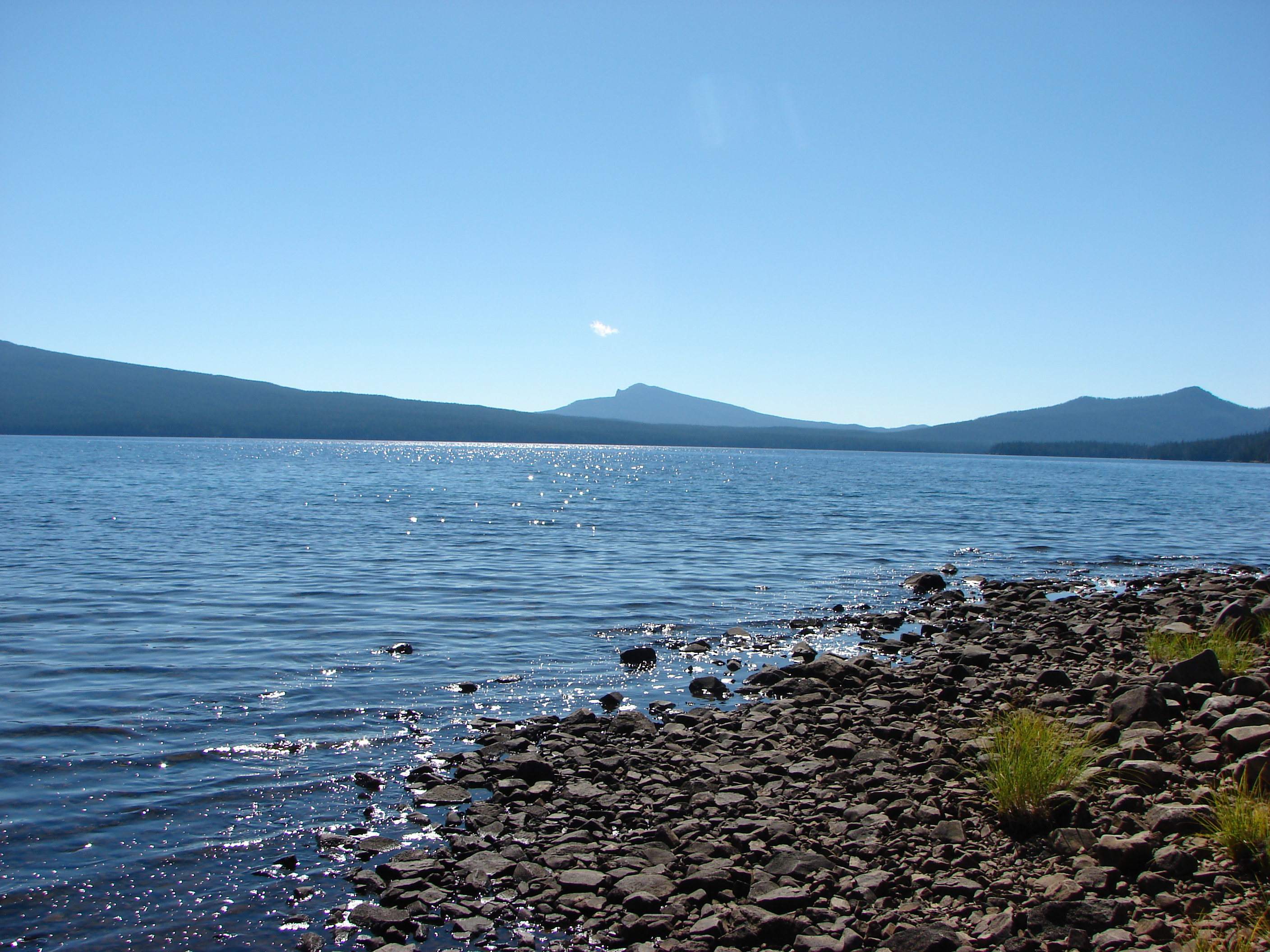
The Waldo Lake trail circles the 10 square mile lake, but at the junction the water was nowhere to be seen. We turned left and continued around Elbow Lake until we spotted a fairly well-worn side trail heading down toward the lake. This path led down to a secluded cove and nice campsite. We sat on the rocky shore of the lake and had lunch while enjoying the gentle lapping sound of the lake. Waldo Lake and Maiden Peak
After lunch we returned to the Waldo Meadows trail and continued our loop. Waldo Meadows was full of tall plants but most of the flowers time had come and gone. There were a few coneflowers and a handful of paint and aster on its last legs but it gave us an idea of what it might have looked like earlier in the year. Some of the few remaining flowers in the meadows.
In the middle of the meadow was another trail junction. To the left just .5 miles away was Upper Salmon Lake and nearby Salmon Creek Falls. True to form we turned left and headed in that direction. 🙂
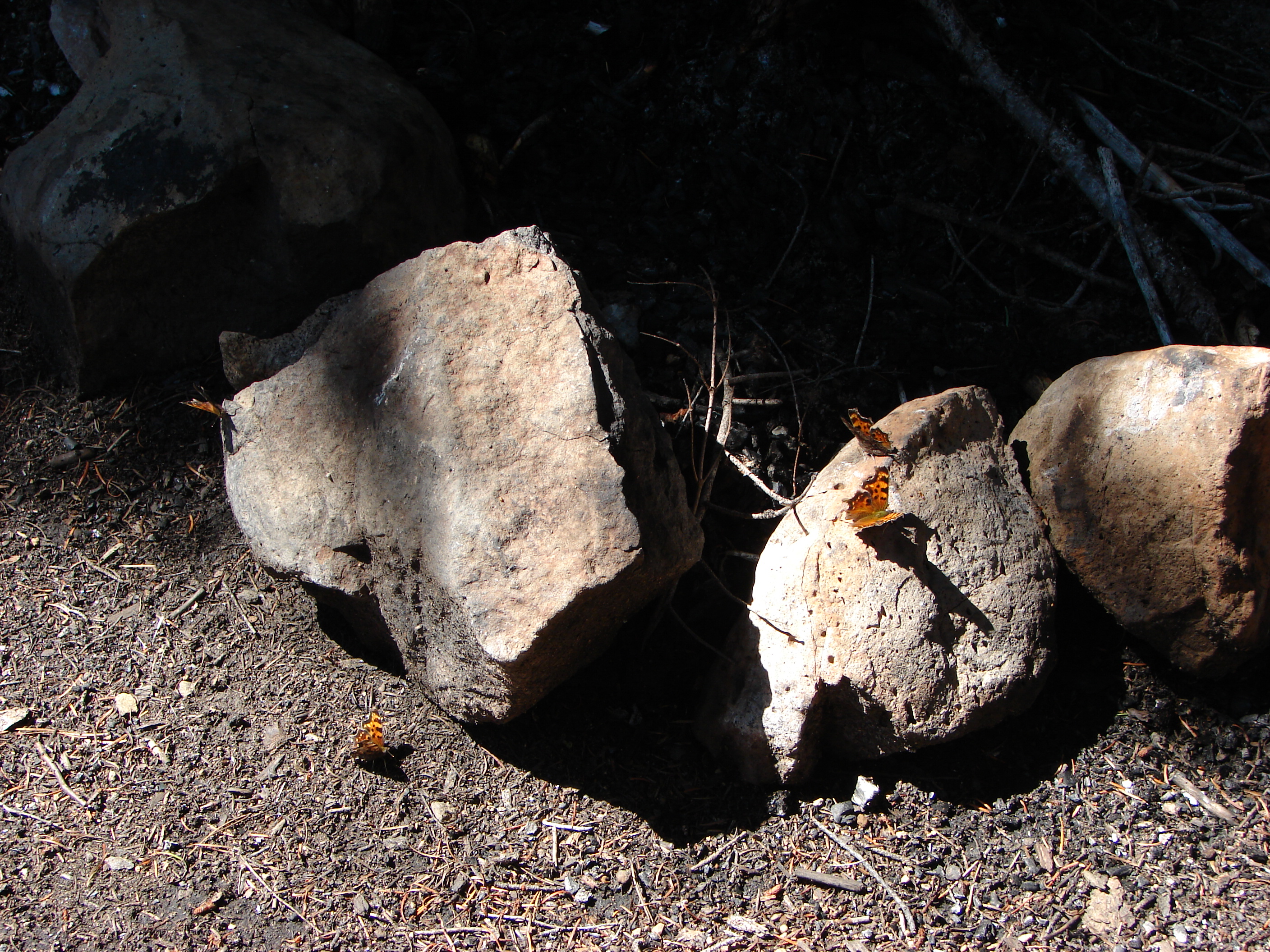
Upper Salmon Lake turned out to be a gem. A half-dozen tortoise-shell butterflies greeted us at a lakeside campsite while several ducks patrolled the green lake. Butterfly greeters.Ducks on Upper Salmon Lake
Heather and I headed to the grassy shore where she spotted a good-sized toad that just wouldn’t come into the open for a good picture.
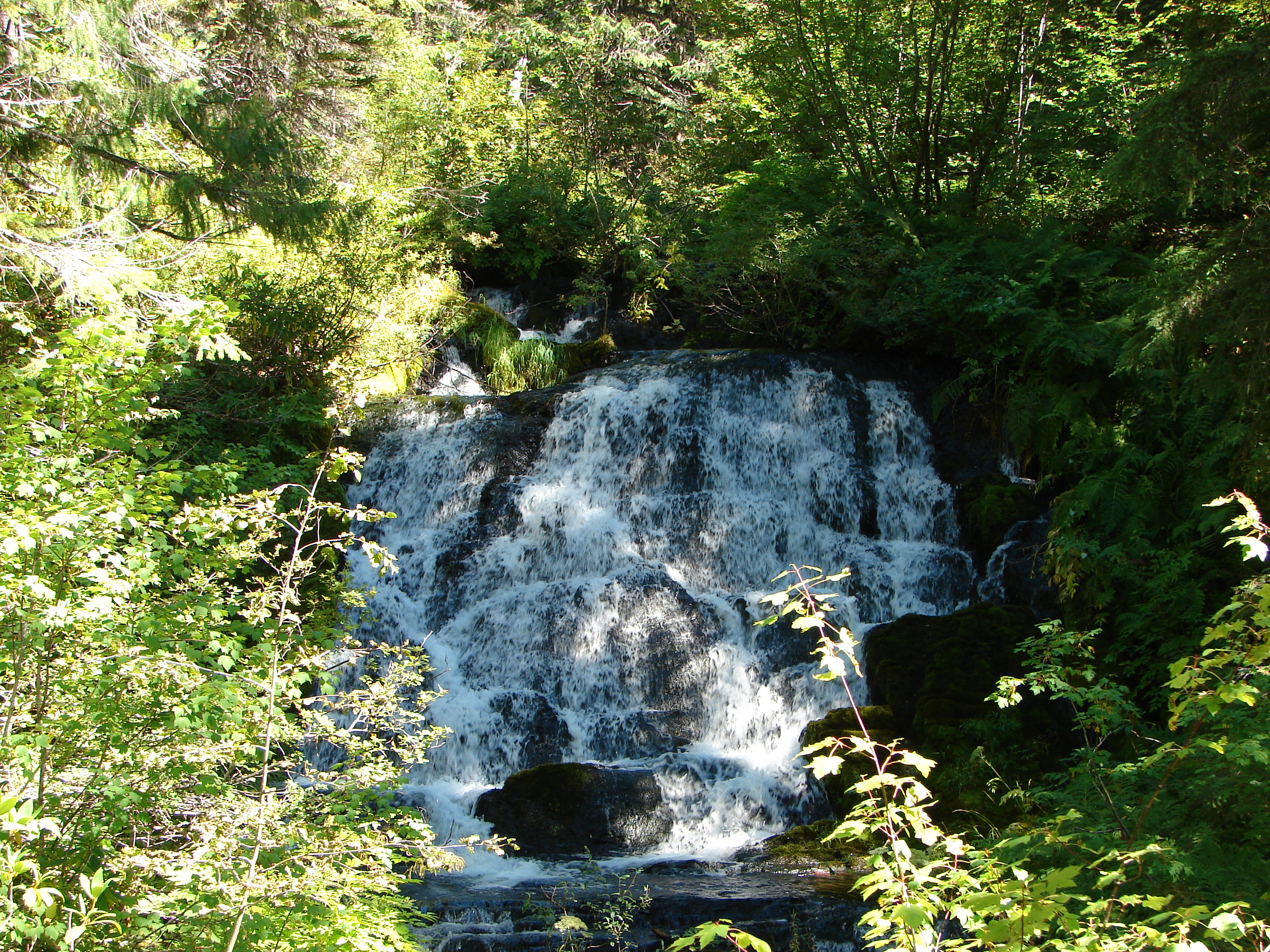
We then headed to the lake’s outlet, Salmon Creek, and followed it down to Salmon Creek Falls. Salmon Creek Falls
From the falls we knew we were close to Lower Salmon Lake but hadn’t seen a trail for it so we decided to test our “off trail” skills. Let’s just say they are a work in process, but after some unnecessary travel we managed to find the lake but not much of a view.
We returned to Upper Salmon Lake and collected Dominique who had chosen to stay with the butterflies and headed back to the meadow junction. The return loop passed through several more sections of the meadows before returning to the forest on the side of Waldo Mountain. This nearly 2 mile section had once burned and was now home to thimbleberry patches and deciduous trees. For the first time it really felt like Fall on the trail to me. Leaves slowly drifted down around us and the trail rustled as we walked on the leaves that already covered the path.
It was a bittersweet ending for me as I began to come to terms with the realization that the seasons were changing. It had been a beautiful day and a peaceful hike but we were now entering the home stretch of our hiking season. We’ve had a great year so far and hope to end it the same way. Until next time – Happy Trails!



























 wanderingyuncks