Categories
Crater Lake Area High Cascades Hiking Oregon Trip report

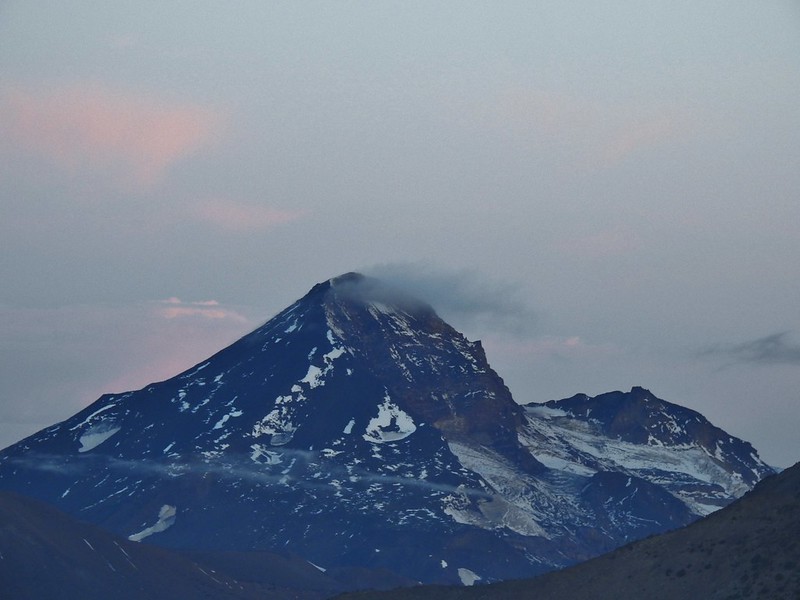
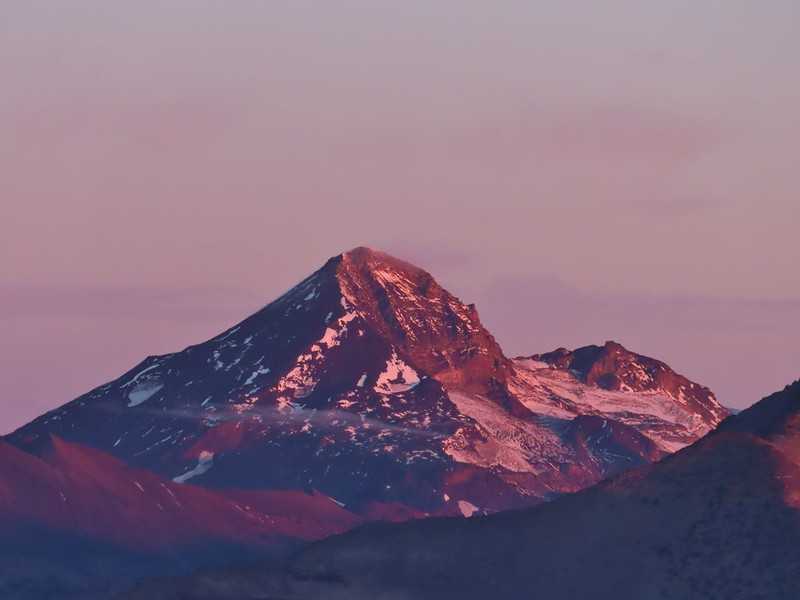
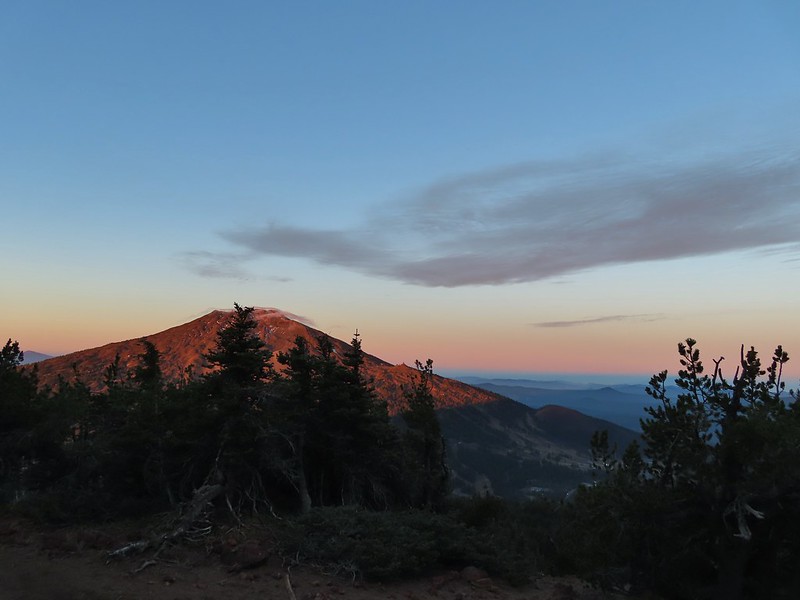
Union Peak – 09/17/2022

Our hiking focus this year has been primarily on the Southern Oregon and Northern California area. This was due in large part to that being the area where the majority of the remaining hikes were located for us to reach our goal of hiking Sullivan’s 500 featured hikes (post). Over the last couple of years we’ve canceled several trips down to this area due to wildfires (and associated smoke) as well as inclement weather. In fact we were starting to wonder if we might ever get the chance to finish the featured hikes from the area. This year things have been different, in fact we switched our August vacation from the Wallowas in Eastern Oregon to Northern California because the conditions, for once, were more favorable.

One of the trips we’d canceled in recent years was a four day stay in Union Creek. (Dangerous air quality due to wildfire smoke.) We had placed that trip back on our schedule for this year hoping for better luck. There were no fires in the immediate area but a number of fires were burning elsewhere in Oregon and Northern California which could still send enough smoke into the area to affect air quality. We kept a close eye on the weather and air quality forecasts and while the latter looked good the weather forecast was a little iffy. There was potential for showers including snow at higher elevations (7500′) as well as a slight chance of thunderstorms on a couple of days. The forecast was good enough for us to give it a try. Of the four hikes we had planned, two were not view dependent so we could rearrange the order depending on the forecast.

The forecast for Saturday was for partly cloudy skies with a chance of showers all day and a slight chance of thunderstorms in the afternoon. We decided to attempt Union Peak despite the possible thunderstorms counting on summiting the 7709′ peak well before the arrival of potential thunderstorms. The most direct route from Salem to the Union Peak Trailhead is to take the West Rim Drive through Crater Lake National Park requiring the purchase of a $30.00, 7-day park pass. (Please note that both the Union Peak Trailhead and Union Peak itself are inside the park but do not require a park pass.) Since one of our other planned hikes started along West Rim Drive we would have needed a pass anyway so we entered the Park from the north entrance, purchased a pass, and then stopped at the Watchman Lookout Trailhead for a view of Crater Lake.
IMG_1518Wizard Island

IMG_1520The Watchman (post)

IMG_1522Hillman Peak and Llao Rock

We continued through the Park past the south entrance to Highway 62 where we turned right toward Medford for a mile to the Union Peak Trailhead.
IMG_1527

It was a little before 9am which gave us plenty of time to complete the hike based on the weather forecast. Both Sullivan and the trailhead signboard indicated that it was an 11 mile out-and-back.
IMG_1530The sign calls this the “steepest” hike in Southern Oregon. We wondered what criteria that was based on?

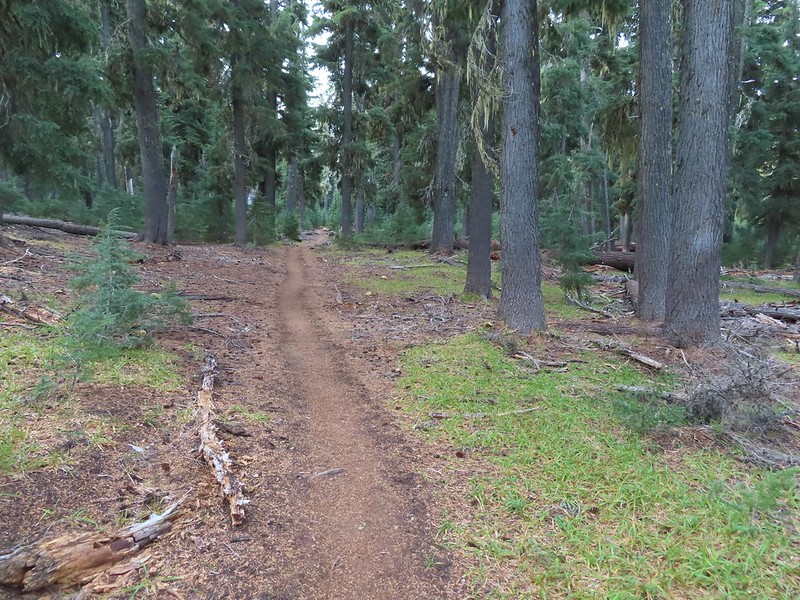
The hike begins on the Pacific Crest Trail following it south for 2.5 fairly level miles to a signed junction with the Union Peak Trail.
IMG_1532

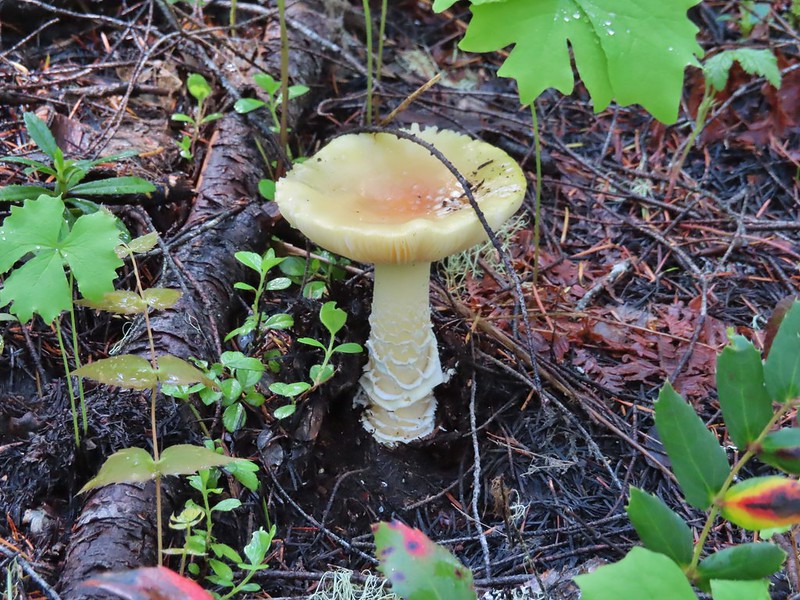
IMG_1536There were a large number of big mushrooms along this section of trail as seen to the lower right.

IMG_1537One of the big shrooms.

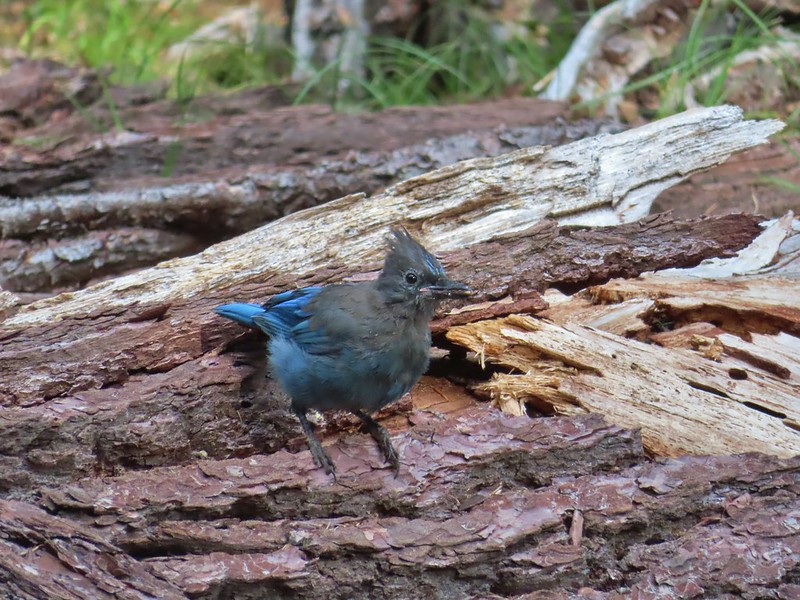
IMG_1539A Stellar’s jay.

IMG_1540More of the big mushrooms.

IMG_1542Another Stellar’s jay.

IMG_1546

IMG_1549Nearing the trail junction.

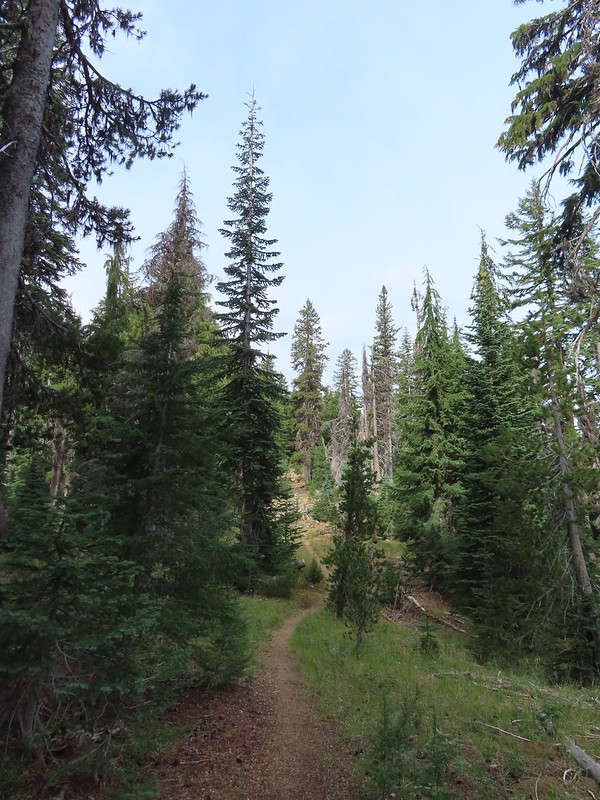
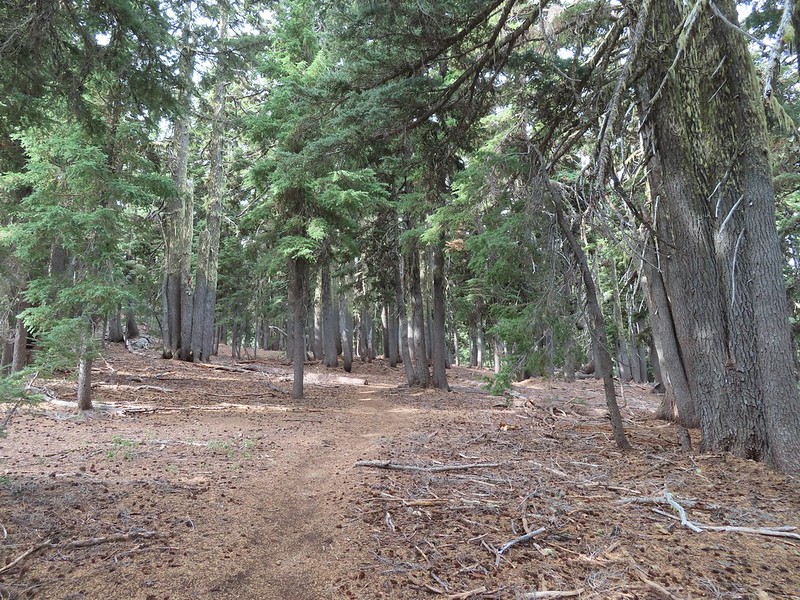
We veered right onto the Union Peak Trail which began with a gradual climb following a ridge toward Union Peak.
IMG_1551

IMG_1553

IMG_1555

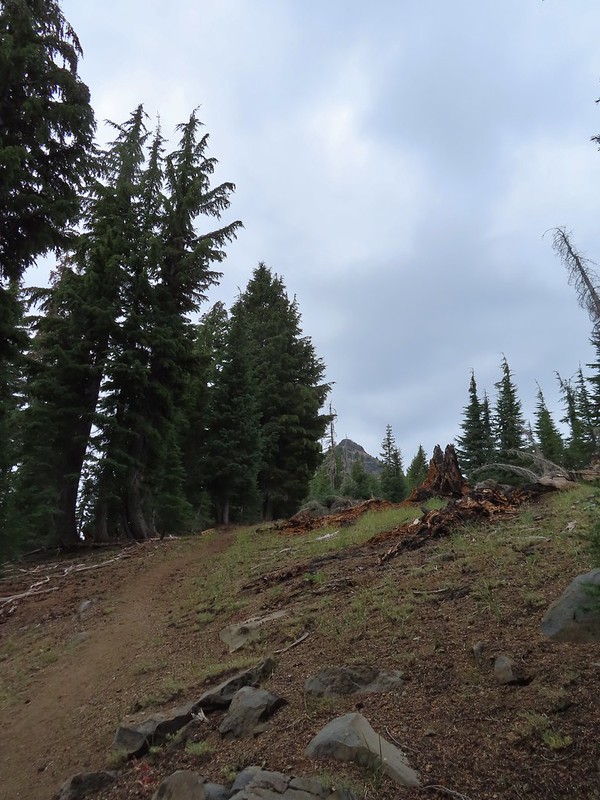
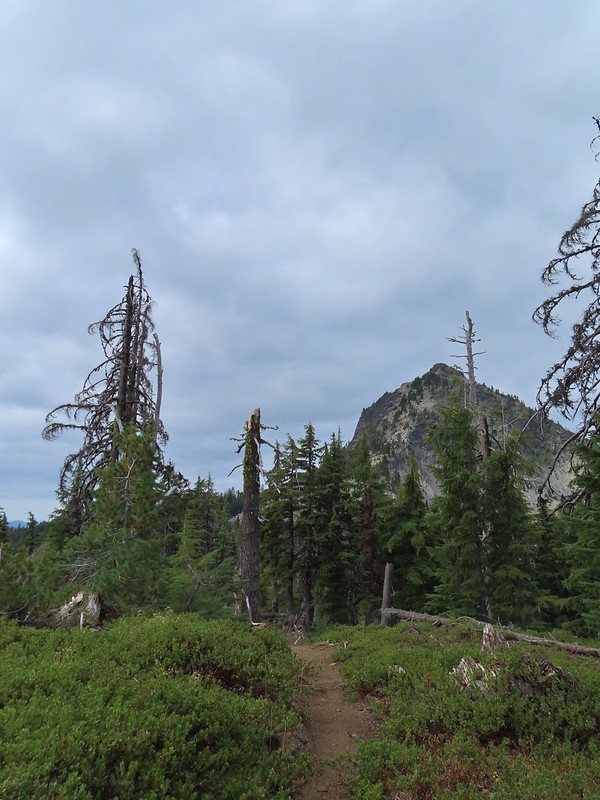
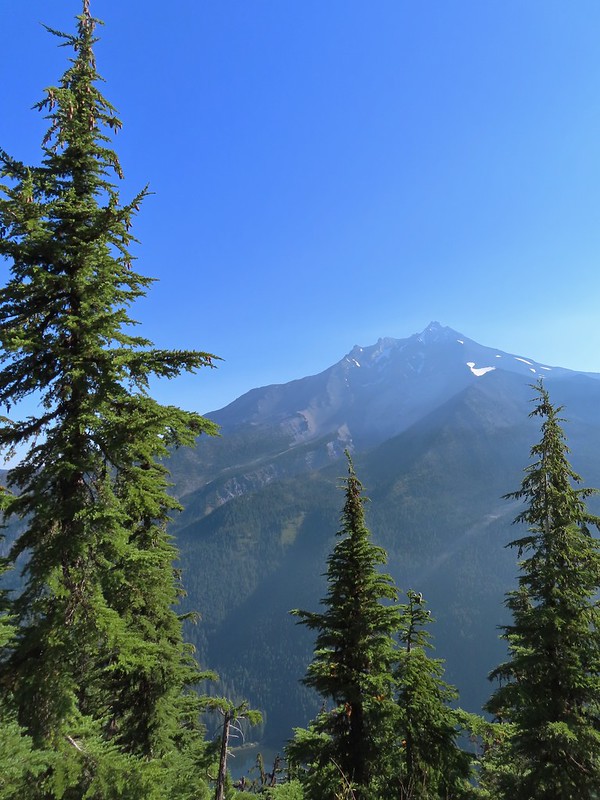
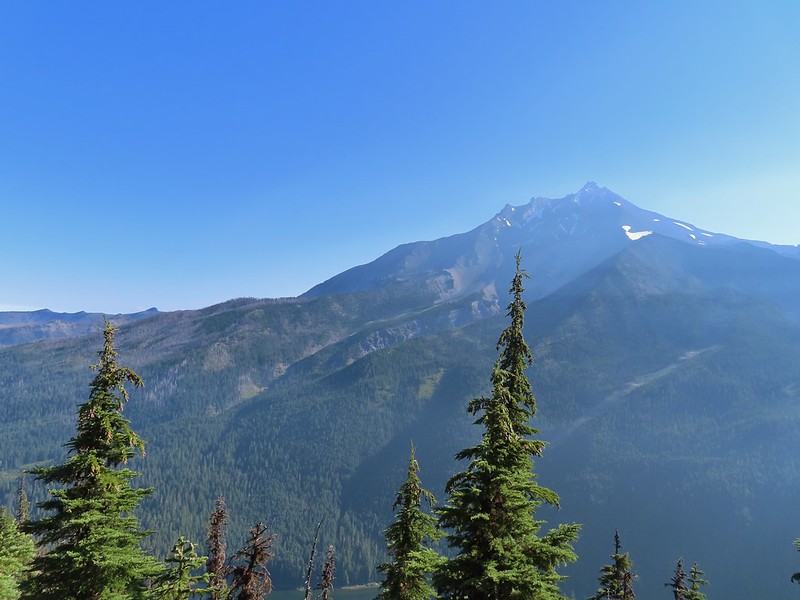
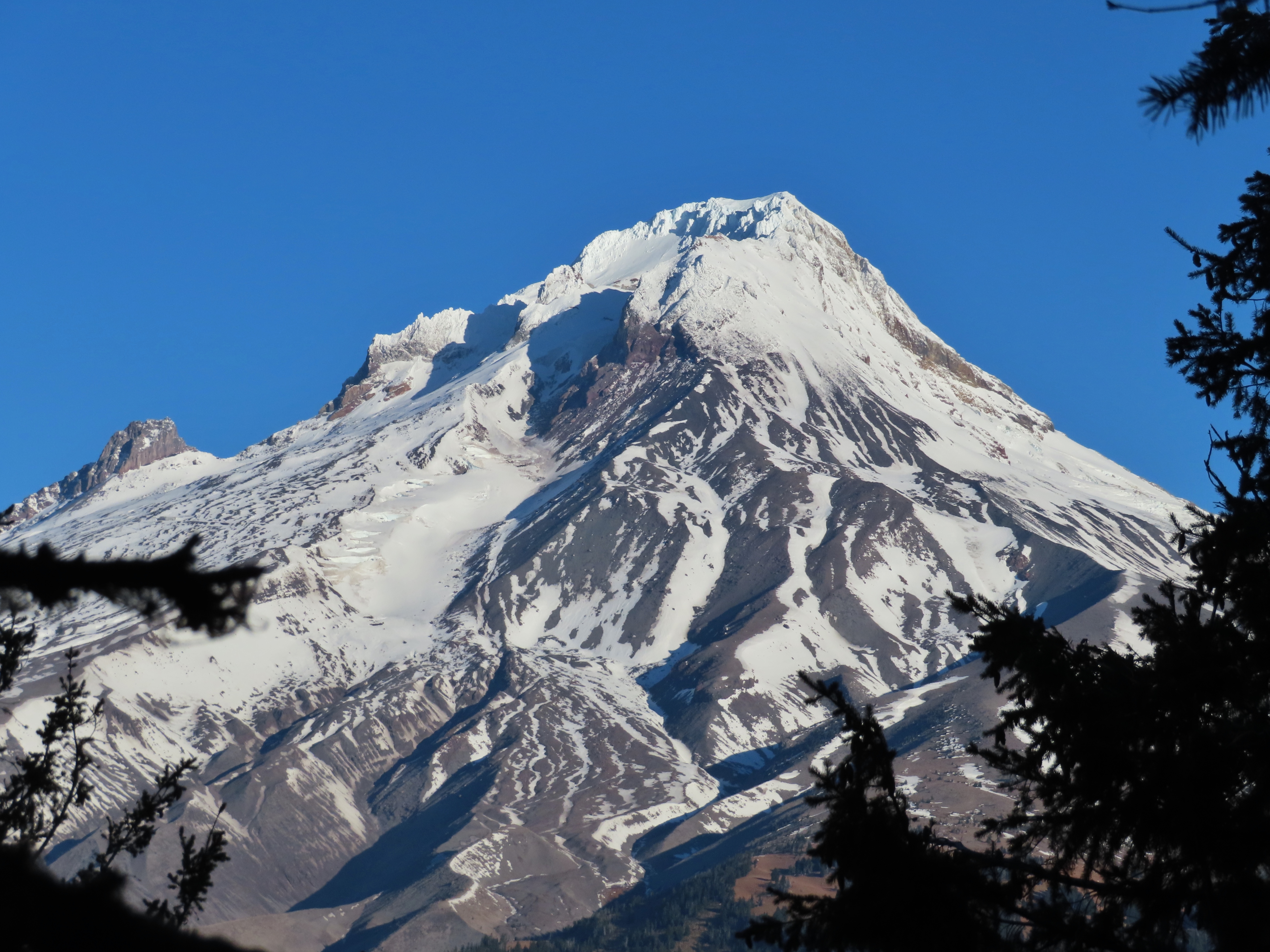
IMG_1557First glimpse of Union Peak through the trees.
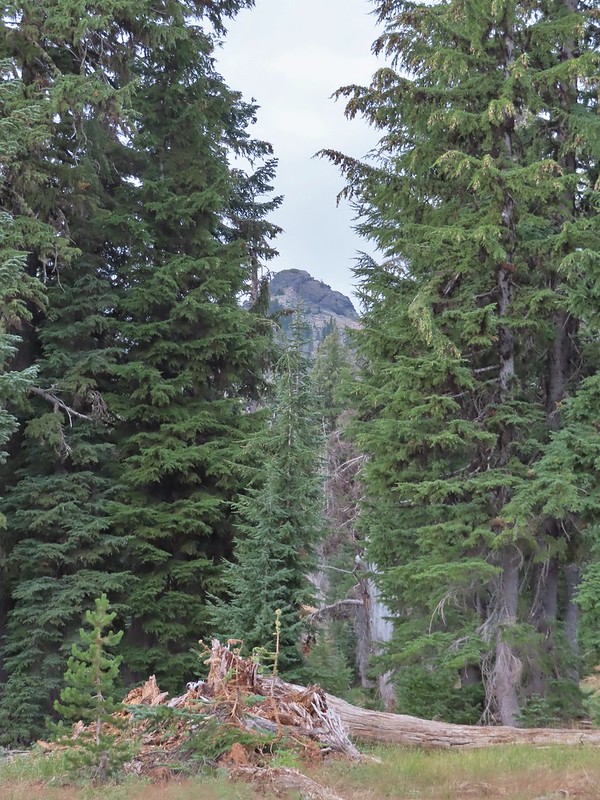
IMG_1558

IMG_1561Gardner Peak behind Goose Egg (center) to the SE.

IMG_1563Fireweed

IMG_1564

IMG_1566It was cloudy but no showers so far and the clouds appeared to be well above the summit.
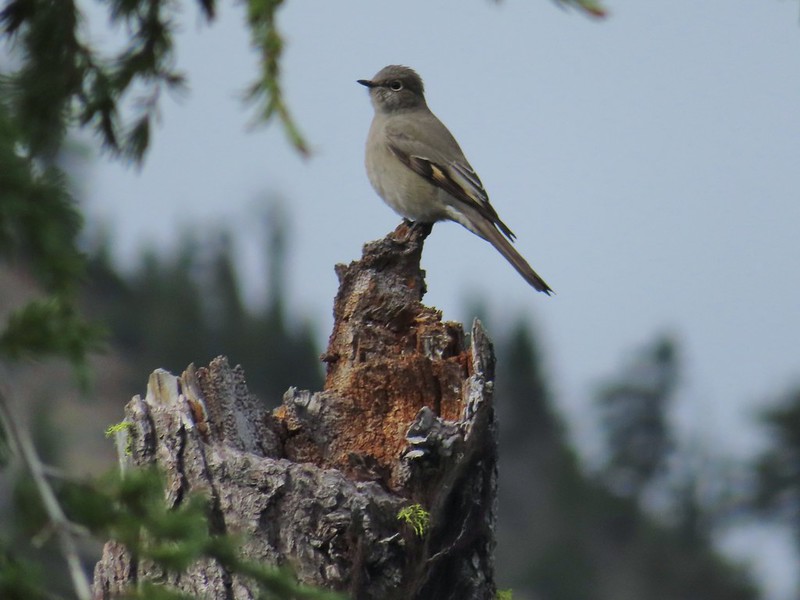
IMG_1570Townsend’s solitaire

IMG_1571

I was so focused on Union Peak I failed to notice the deer to the right below until it and a nearby fawn bounded off.

Approximately 1.7 miles from the junction the trail passed an colorful rock outcrop on the right.
IMG_1582

IMG_1585Mount Bailey in the distance to the right of the outcrop.

I missed more deer below the trail here, only noticing them when they started to run off.
IMG_1588The last doe keeping watch as the rest of the deer disappeared into the forest.

Beyond the colorful outcrop the trail dipped to a saddle then turned left at the base of Union Peak passing through a boulder field then onto a cinder hillside.
IMG_1590

IMG_1593Golden-mantled ground squirrel

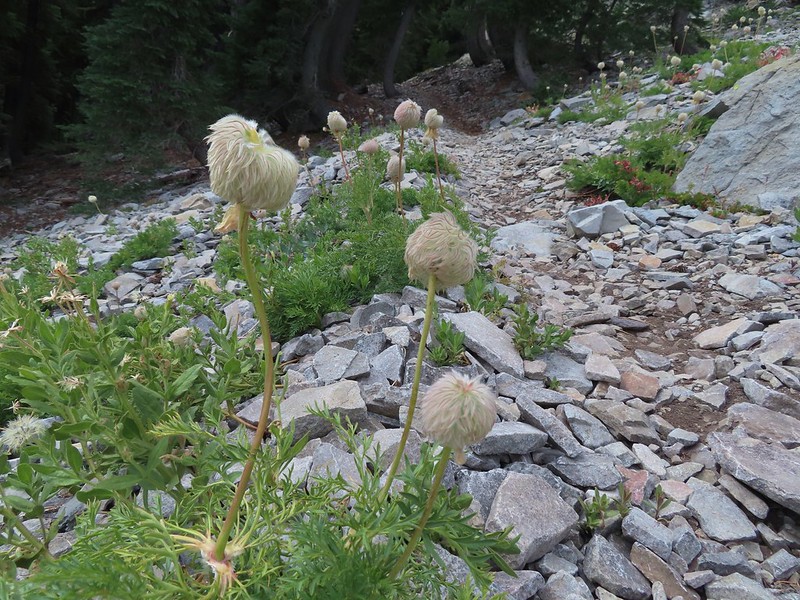
IMG_1595Western pasque flower seed-heads along the trail.

IMG_1600

IMG_1601Looking up at Union Peak and wondering how the trail got up there.

IMG_1603Nearing the cinder field.

The trail switchbacked in the cinders providing a nice view of Crater Lake’s Rim.
IMG_1606Mount Scott (post) was the only peak covered by clouds.

The trail climbed back through the rock field and then came the steep part.
IMG_1610

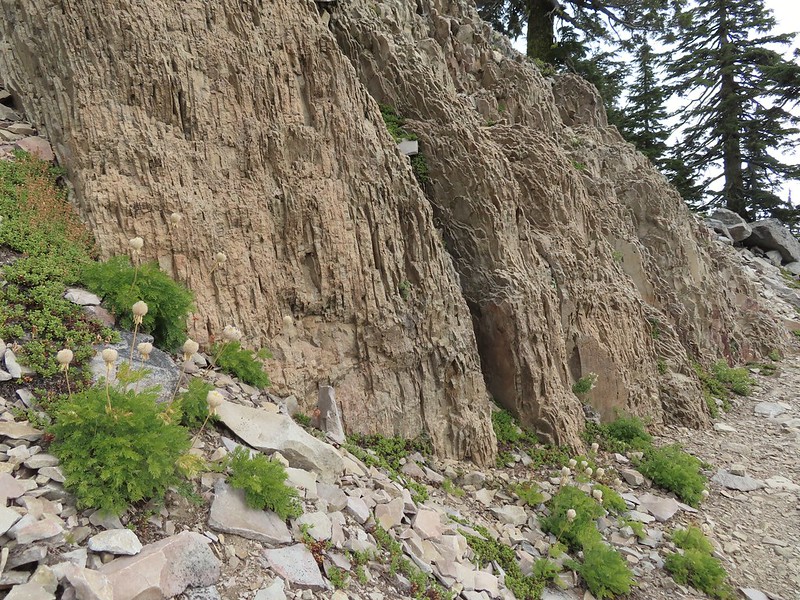
IMG_1611It’s always interesting to see the various rock that make up these volcanic peaks.

IMG_1614The Watchman and Llao Rock with Mt. Thielsen in between in the background.

IMG_1617That’s the trail on the right side of the photo.

IMG_1618Looking down at the trail below.

IMG_1619The trail was fairly easy to follow as it switchbacked up through the rocks. It was narrow in places which might be hard for those with a fear of heights.

The final pitch was more of a scramble than a hike though.
IMG_1622

IMG_1625While there were no people at the summit the brush had attracted a fairly large number of yellow jackets.

I had reached the summit before Heather so I wandered back and forth along the top since every time I tried to sit down the yellow jackets took an interest in me, and I don’t do yellow jackets.
IMG_1626Looking west toward the Rogue-Umpqua Divide.
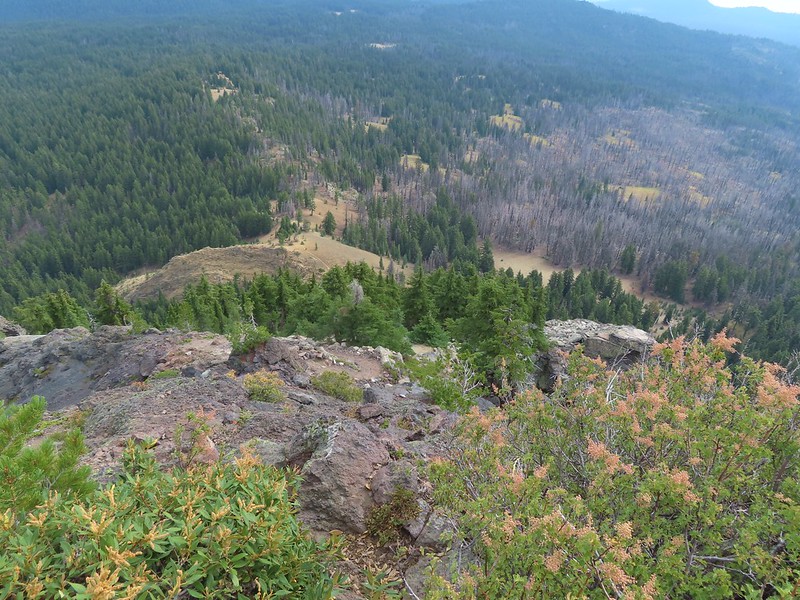
IMG_1633The trail along the ridge below Union Peak.

IMG_1638Lost Creek Lake (post) in the valley to the SW.

IMG_1630Mount Bailey, Diamond Peak (post), and Mt. Thielsen behind the rim of Crater Lake.
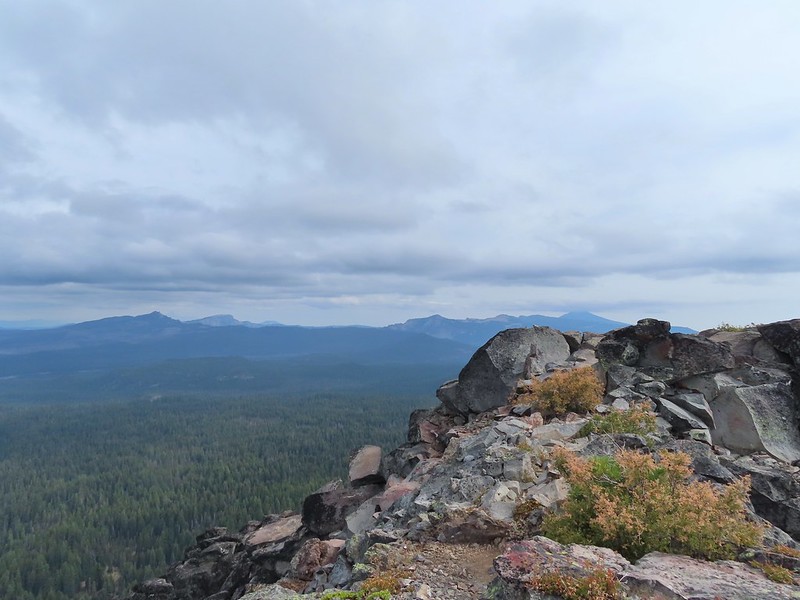
IMG_1639The rim of Crater Lake.

The combination of clouds, smoke, and the position of the Sun impacted the view to the south which on a clear day would have included both Mt. McLoughlin (post) and Mt. Shasta.
IMG_1640Mt. McLoughlin is to the far right with some clouds over the top. Starting from the left is Goose Nest, Goose Egg (with Gardner Peak behind), Maude Mountain (with a faint Pelican Butte behind to the right), Lee, Devil’s, & Lucifur Peaks (Mt. Shasta is behind those three.) followed by Mt. McLoughlin.

Heather joined me at the summit. Her dislike of heights had kicked in on her way up so she was ready for a nice break but after having been stung two weeks earlier the presence of the yellow jackets did not help her relax. We did however stay long enough for the clouds to start breaking up a little.
IMG_1650

IMG_1656Mt. Bailey

IMG_1658

IMG_1654The Watchman and Hillman Peak directly behind with Mt. Thielsen further in the distance.
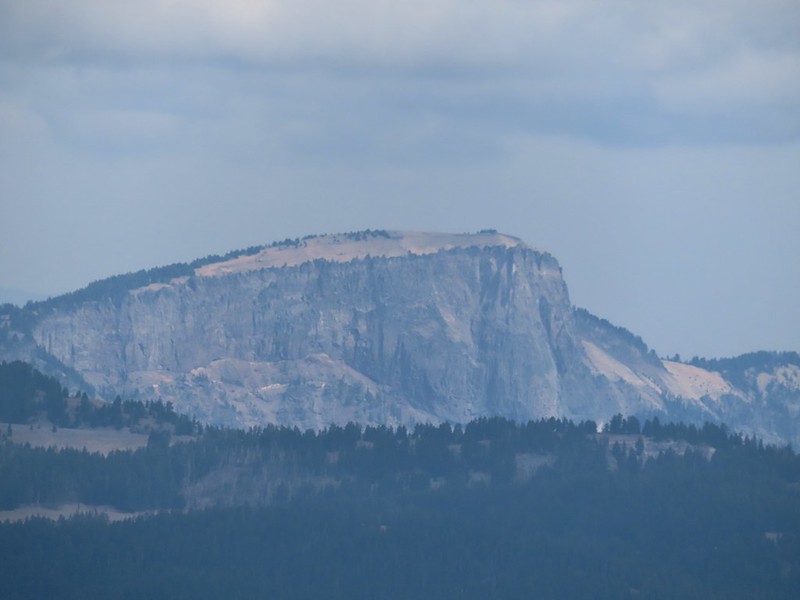
IMG_1653Llao Rock

IMG_1655Applegate Peak

When Heather was ready we headed down. She was a little nervous but managed fine and we soon found ourselves crossing the boulder field again.
IMG_1663

IMG_1671Looking back up from the rock field.

IMG_1672Mount Shasta arnica

By the time we were recrossing the ridge near the colorful outcrop a bit of blue sky had appeared behind Union Peak.
IMG_1676

IMG_1679Bleeding heart

That trend continued and we imagined that the two hikers we’d passed on the way down were enjoying even better views than we’d had.
IMG_1685

We had no complaints though. The smoke hadn’t been bad, we didn’t smell any at all until we were nearly back to the trailhead, and the clouds had kept the temperature down without raining at all. The Sun even made an appearance along the way.
IMG_1682

IMG_1690One of several mountain bluebirds we spotted.
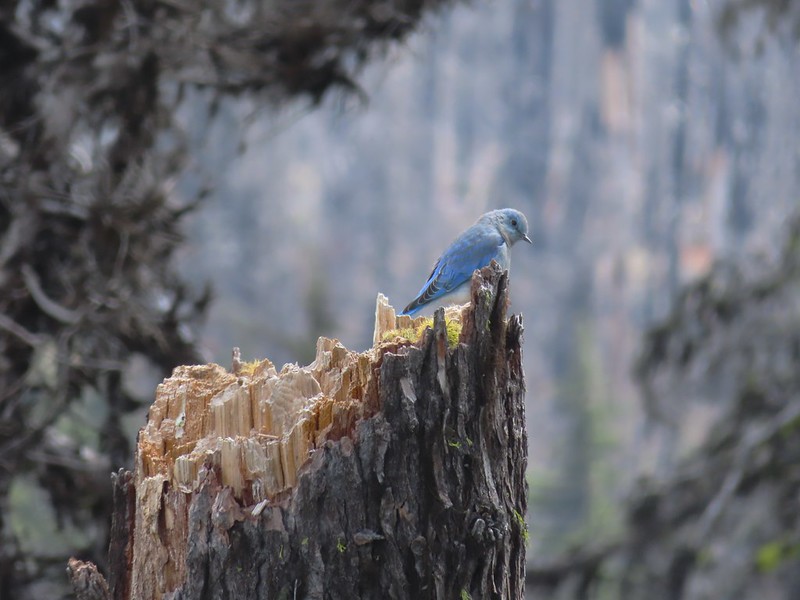
IMG_1692

IMG_1700Bumblebees on a few remaining aster.

IMG_1702

IMG_1703Sunshine

IMG_1704

IMG_1705A sulphur butterfly.

IMG_1708Arriving back at the trailhead.

While Sullivan and the signboard listed this as an 11 mile hike our GPS came in at only 10 miles round trip. Either way there was 1600′ of elevation gain, much of which came in the final, steep, half mile.
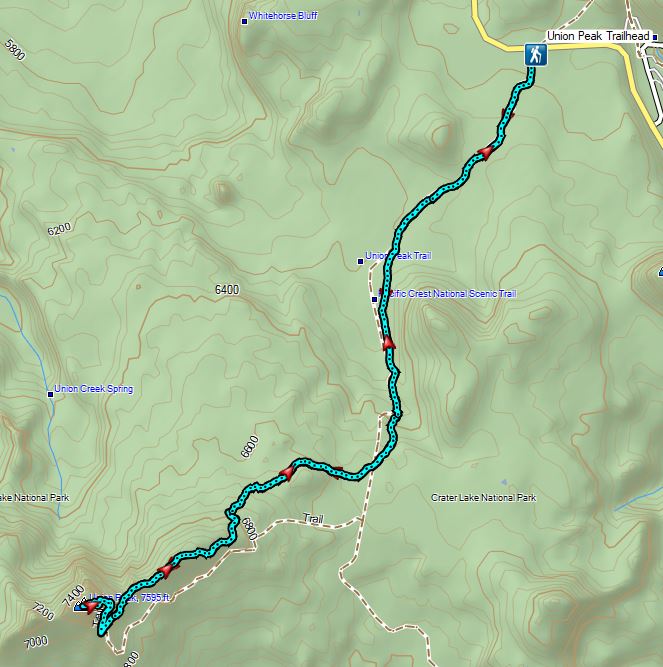
From the trailhead we continued west on Highway 62 to the Edgewater Inn in Shady Cove, OR where we would be spending the next three nights. A quick check of the forecast for Sunday before bed revealed that “severe” thunderstorms were now forecast for Crater Lake overnight and Sunday called for clouds and a 50% chance of showers everywhere we’d planned on hiking. The good news was that our planned hike for Sunday was a visit to several lakes in the Sky Lakes Wilderness so showers wouldn’t really affect any views and getting some much needed precipitation was a lot more important than whether or not we would be getting wet on our hike. Happy Trails!

Flickr: Union Peak

Categories
High Cascades Hiking Mt. Jefferson Area Oregon Trip report

Grizzly Peak – 08/20/2022

While we completed our goal of hiking portions of all 100 featured hikes in William L. Sullivan’s 4th edition of “100 Hikes/Travel Guide Central Cascades” in 2020 (post) there remain a few “loose ends” that we’d like to take care of. We have established some guidelines for considering a featured hike “done” allowing us some wiggle room. For instance we might start at a different trailhead than Sullivan’s description but still visit the main attraction(s) he describes. It might also mean starting at the trailhead described but due to closures might cut the hike short. The two most common dilemmas we faced though were featured hikes with a short and long option and featured hikes that included multiple stops/destinations. Regarding the short vs long options we’ve tended to opt for the longer option assuming the distance is reasonable, under 16 miles (maybe not reasonable to all), but when the longer options are close to or more than 20 miles we’ve settled for the shorter.

For the featured hikes where there are multiple stops/destinations we allow the hike to be checked off once we have completed either the longest option, and/or visited the hike’s namesake. A perfect example is Featured Hike 23 in the Central Cascades book (4th edition). The hike is titled “Pamelia Lake & Hunts Cove” with three options given, all beginning at the Pamelia Lake Trailhead. The shortest is a 4.4 mile out-and-back to Pamelia Lake while the longest is a 12.4 out-and-back to Hunts Cove. Sandwiched in between is a 10 mile out-and-back hike up Grizzly Peak. We had been to Hunts Cove once (post) and Pamelia Lake twice (once on the way to Hunts Cove and the other on an attempt to reach Goat Peak (post)) so going by our self-imposed rules we checked the hike off, but we had yet to visit Grizzly Peak. To put a ribbon on the featured hike we obtained a pair of Central Cascade Wilderness Permits (required at this trailhead) and once again set off for Pamelia Lake.
IMG_9512

IMG_9515This was at least the third posted notice so there is no claiming you weren’t aware that a permit is needed.
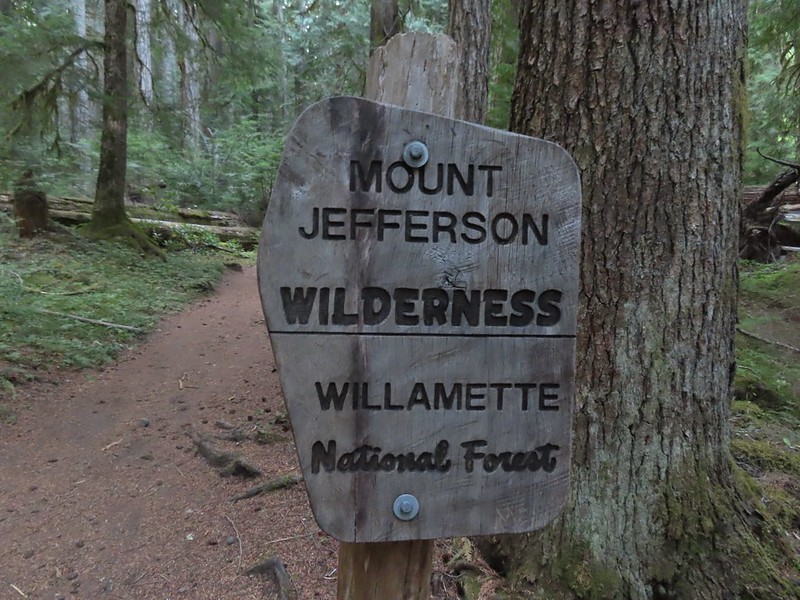
The roughly two mile hike to Pamelia Lake never disappoints.
IMG_9518

IMG_9519

IMG_9520Pamelia Creek

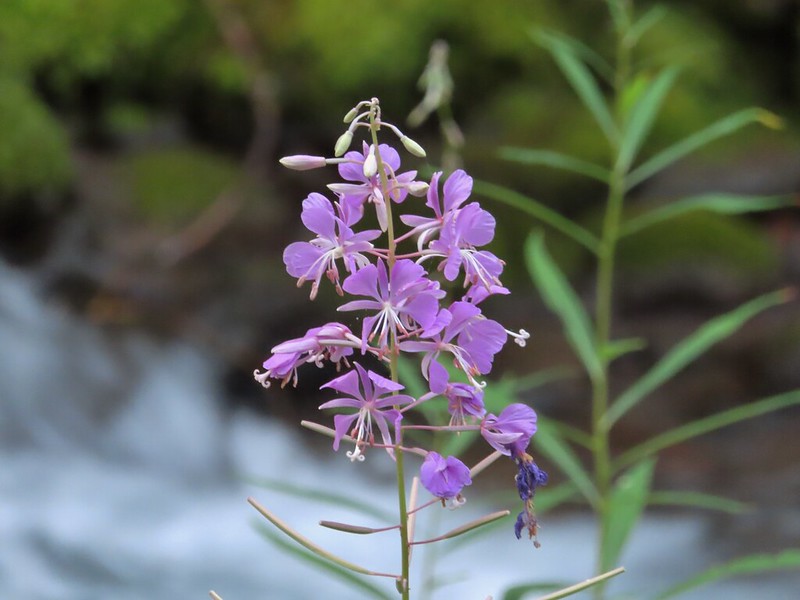
IMG_9521Fireweed along the creek.

IMG_9522

IMG_9523

We turned right onto the Grizzly Peak Trail at its junction a short distance from the lake.
IMG_9525

The trail crossed the dry outlet creek and then began the nearly 2000′ climb to Grizzly Peak.
IMG_9526 Pamelia Creek only flows underground here much of the year.

IMG_9528Heading up.

The trail climbs for two and three quarters of a mile to a former lookout site through a nice forest with limited view for the first two miles.
IMG_9532A glimpse of Mt. Jefferson.

IMG_9537That might be Woodpecker Hill, it was hard to tell exactly which ridge we could see with nothing else visible to help orient.

IMG_9538This looked like it might be a nice little waterfall with enough water.

IMG_9539That’s not enough water.

IMG_9541Heather below one of several switchbacks.

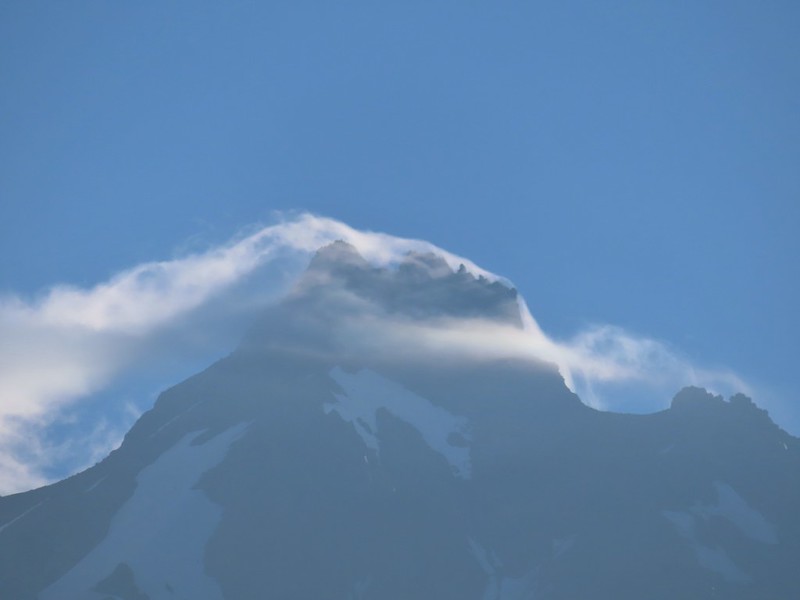
Just over two miles from the junction the Grizzly Peak Trail we came to a viewpoint on a ridge. Here the trail made a sharp right and followed the ridge SE. There were multiple views along this ridge, the one issue we had though was it was still fairly early and the angle of the Sun was catching all the haze in the air.
IMG_9552Turning up the ridge.

IMG_9557The haze was probably a combination of morning cloud/fog and smoke from the Cedar Creek Fire near Waldo Lake.
IMG_9555

IMG_9556

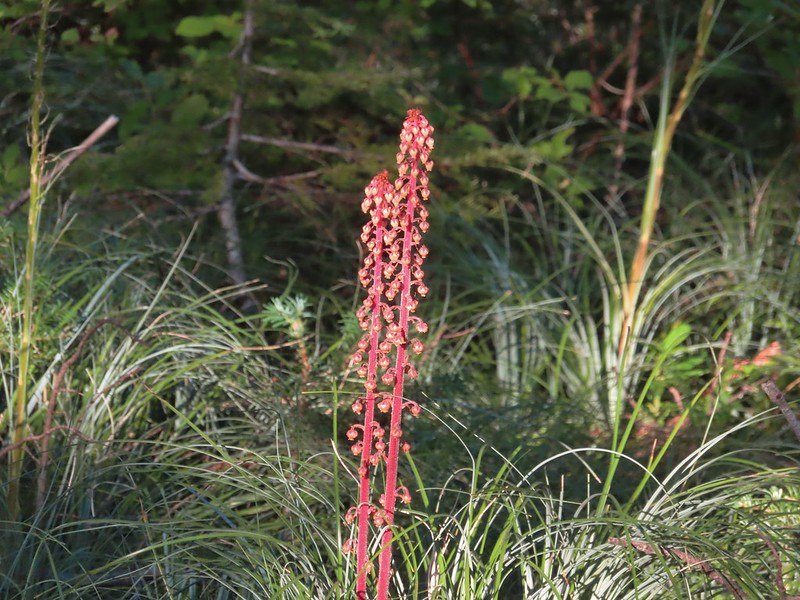
IMG_9558Pinedrops

IMG_9560We were too late for most of the flowers but there were a few pearly everlasting going.
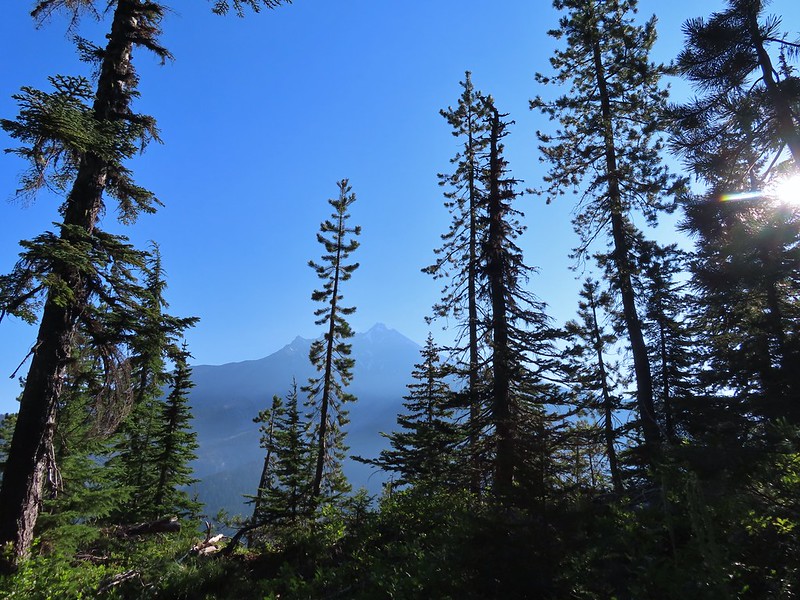
IMG_9565There’s that pesky Sun again.

After following the ridge for 0.4 miles the trail veered to the right leaving it and traversing up a forested hillside with views north towards the Bull of The Woods Wilderness where we got our first good look at the fire scars from the 2020 Labor Day fires.
IMG_9577

IMG_9578

IMG_9579Aster

IMG_9580Lousewort

IMG_9584Lots of burnt forest out there.

IMG_9583Triangulation Peak and Boca Cave (post)

A quarter mile after leaving the ridge the trail came to another ridge and made a hard right following this ridge up to the summit. This section provided views south to Three Fingered Jack, the Three Sisters, and Broken Top.
IMG_9590

IMG_9591Broken Top to the far left blending into the haze and Three Fingered Jack to the right with the Three Sisters in between.
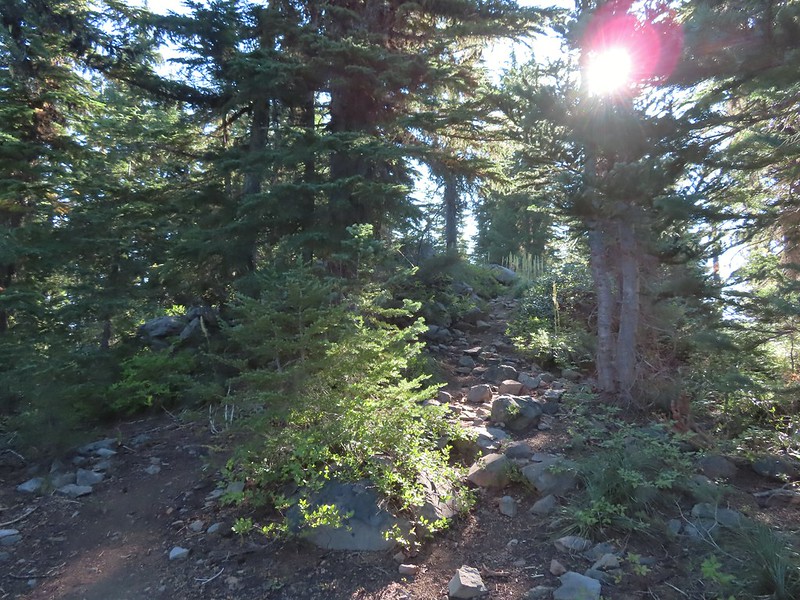
IMG_9594Just below the summit.

IMG_9597

IMG_9599Pamelia Lake below Mt. Jefferson.

We spent a little over half an hour at the summit checking out different views and watching several butterflies and some large black flying insects.
IMG_9604

IMG_9606Hunts Creek flowing into Pamelia Lake.

IMG_9607Had to hunt for a view of Three Fingered Jack.

IMG_9619A hard to make out Mt. Hood beyond the far ridge which consists of Bear Point to the left (post) and Dinah-mo Peak to the right.
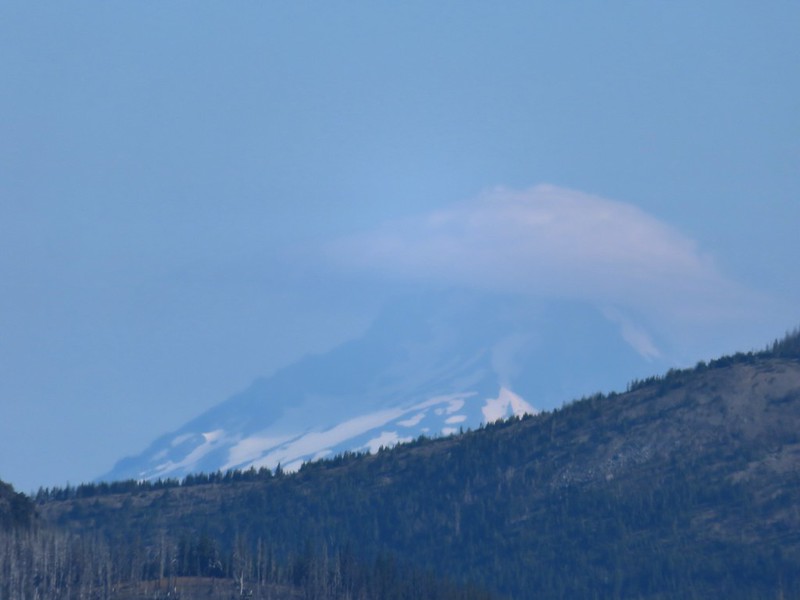
IMG_9639Mt. Hood

IMG_9622Beardtongue

IMG_9636A fritillary butterfly.

IMG_9637A skipper

We returned the way we’d come opting not to visit the lake on this trip since we have permits to return next month for a second attempt at Goat Peak.
IMG_9644Goat Peak is to the right of Mt. Jefferson.

IMG_9658Mt. Jefferson and Pamelia Lake from one of the viewpoints along the ridge.

IMG_9666

IMG_9667Cascade toad

20220820_105944

IMG_9682

IMG_9676One more of Pamelia Creek.

One other hiker had arrived at the summit a bit before we headed down and that was the only other person we saw until we were headed back down. We encountered one couple coming up the Grizzly Peak Trail and a number more on the Pamelia Lake Trail. It was a little surprising because the trailhead parking lot had looked nearly full when we had arrived that morning. The hike was nice and the well graded trail kept the 2700′ of elevation gain from ever feeling steep. It also allowed us to be home before 2pm which gave us time to unpack and clean up before heading of to a friends house for their annual margarita (and dinner) party. Happy Trails!

Flickr: Grizzly Peak

Categories
Hiking Mt. Theilsen/Mt. Bailey Area Oregon Roseburg Area Trip report

Highway 138 Waterfalls – 06/13/2022

The last two years have created a bit of urgency to our goal of completing the 100 featured hikes in all five areas covered by William L. Sullivan in his 100 hikes guidebook series (post). Between the pandemic and 2020 wildfire season it became clear that taking our time could create issues down the road so starting last year we refocused our efforts on finishing the 500 hikes as soon possible. As we started 2022 we were down to just the Eastern and Southern Oregon (and Northern CA) areas to complete (post). The majority of the remaining hikes were from the southern book where a number of planned trips had been canceled in recent years due to weather and/or the effects of wildfires. We spent a week in Medford earlier in June checking off Roxy Ann Peak (post) and the Jack-Ash Trail (post) and we headed back south a couple of weeks later to hopefully check off more.

A cool and wet Spring has left parts of Oregon, in particular the northern and central Cascade Mountains with a lot of lingering snow. Many trails and trailheads in those areas that in recent years would be open are still snowed in but Southern Oregon had been dealing with an extreme drought, so the recent weather has not had as much of an impact leaving trails accessible. While accessibility wasn’t an issue the weather forecast was a bit of one. More wet weather was forecast for the start and end of our six-day trip with the possibility of snow at higher elevations. After some substituting and rearranging of hikes we settled on a tentative plan that gave us some flexibility in case the forecast tried to pull a fast one on us. Since Monday was supposed to be mostly cloudy with a chance of showers off and on all day we decided to combine a number of stops east of Roseburg along Highway 138 to check out seven different waterfalls.

We started our morning off at Susan Creek Falls. This waterfall is one of three stops listed in featured hike #2, Fall Creek Falls (4th edition). This area was burned in the 2020 Archie Creek Fire and to date the other two stops at Fall Creek Falls and the Tioga Segment of the North Umpqua Trail remain closed. The BLM has managed to get the 0.7 mile Susan Creek Trail open although the trailhead on the north side of the highway was full of logs forcing us to park across the street at the Susan Creek Picnic Area.
IMG_2726

After dashing across the highway we set off on the trail through the burned forest.
IMG_2729

IMG_2741Checkermallow

IMG_2743A slug and a bug on a flower.

IMG_2745Pea

IMG_2748

IMG_2753Approaching the falls.

IMG_2769

20220613_081135Columbine

20220613_080719_HDRSusan Creek Falls

This short trail only gained about 150′ and was a nice leg stretcher after the drive down from Salem. After admiring the falls we returned to the car and continued east on 138 to milepost 59 and turned left onto Forest Road 34 to the Toketee Falls Trailhead. One of two stops that make up featured hike #9 (edition 4.2) a 0.4 mile trail leads to a platform above the falls which spill out of gap in basalt cliffs.
IMG_2784

IMG_2800Evidence of overnight rains on the trail.

IMG_2806A very faint rainbow over the North Umpqua River.
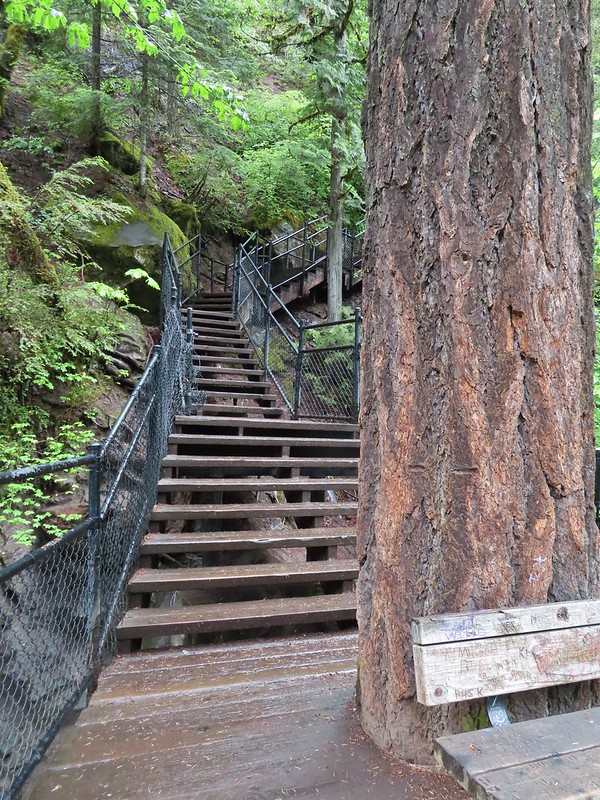
IMG_2815Stairs down to the viewpoint platform.

IMG_2810Toketee Falls

We spent some time admiring this waterfall which is one of Oregon’s more recognizable falls before returning to the car and continuing on FR 34 to FR 3401 and following it to the Umpqua Hot Springs Trailhead.
IMG_2830

The hike starting here is not the second part of featured hike #9 but rather its own entry (featured hike #8, edition 4.2). Sullivan gives two 0.6 mile round trip options starting from this trailhead. The first is a 120′ climb to Umpqua Hot Springs overlooking the North Umpqua River. To reach the hot springs we crossed the river on a footbridge and turned right to make the climb up to the springs.
IMG_2834

IMG_2836

IMG_2839

IMG_2842

IMG_2851Candy sticks along the trail.

Just before the hot springs I veered downhill on a side trail to visit the river.
IMG_2855

IMG_2856

IMG_2857During lower flow there is another hot spring along the river bank in the area.

I climbed back up to find Heather sitting near the springs. There were a number of people enjoying a soak and with clothing being optional pictures were very limited.
20220613_101244

IMG_2860

We climbed down from the hot springs and returned to the trailhead where we took a short trail up to FR 3401 and turned left following a short distance to the resumption of the North Umpqua Trail.
IMG_2867Heading up to the road.

IMG_2870The North Umpqua Trail on the left leaving the FR 3401.
IMG_2871

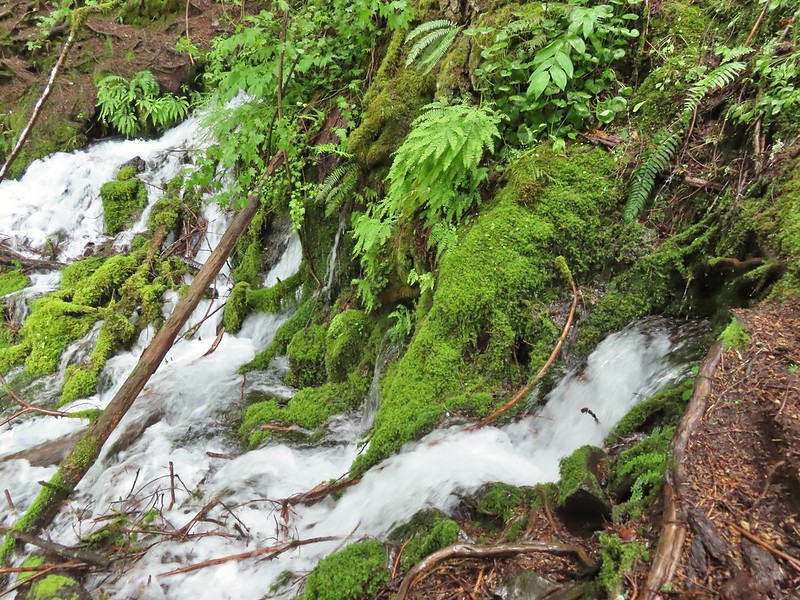
Approximately a quarter mile along this segment we arrived at Surprise Falls, a cascade created by cold springs bursting from the hillside below the trail.
IMG_2891

IMG_2882

20220613_104414_HDR

IMG_2884

The mossy cascade was beautiful and we spent quite a while enjoying the lush green surroundings. A very short distance further we arrived at our turn around point at another spring fed waterfall, Columnar Falls.
IMG_2898

This fall gets its name due to the columnar basalt that the water both cascades down and spouts right out of.
IMG_2899

IMG_2901

IMG_2907The hot springs across the river from Columnar Falls.

We returned the way we’d come and hoped back into our car and drove back to Highway 138 where we again turned east. Our next stop was the second waterfall in featured hike #9, Watson Falls. Another short (0.4 mile) trail leads from the Watson Falls Trailhead to Southern Oregon’s tallest waterfall.
IMG_2914The top of Watson Falls from the trailhead signboard.
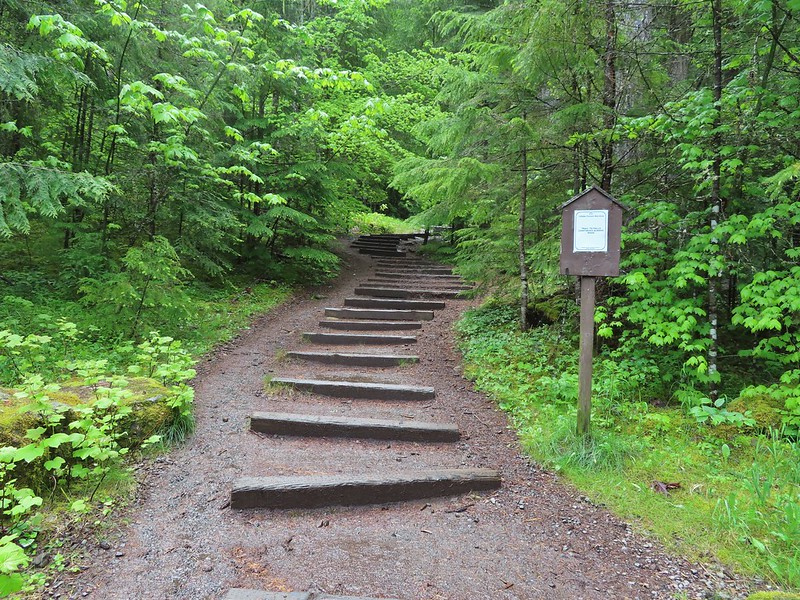
This trail gains 300′ as it climbs to a viewpoint part way up the 272′ waterfall.
IMG_2918

20220613_113355Watson Falls from below.

IMG_2932Footbridge over Watson Creek.

IMG_2940

IMG_2953Heather at the viewpoint.

IMG_2946The splash pool.

On the way back down we took the loop back trail which splits off just before the creek crossing.
IMG_2935

This trail follows Watson Creek down to FR 37 where a right turn and short road walk completes the loop.
IMG_2968

IMG_2969Watson Creek at FR 37.

IMG_2971A little bit of blue sky and sunlight along FR 37.

Once again we returned to Highway 138 and continued east. Our next three stops were in the Lemolo Lake Recreation Area so we turned off of the Highway onto FR 2610 at a pointer for the Recreation Area. Our first stop was at the Warm Springs Trail.
IMG_2974

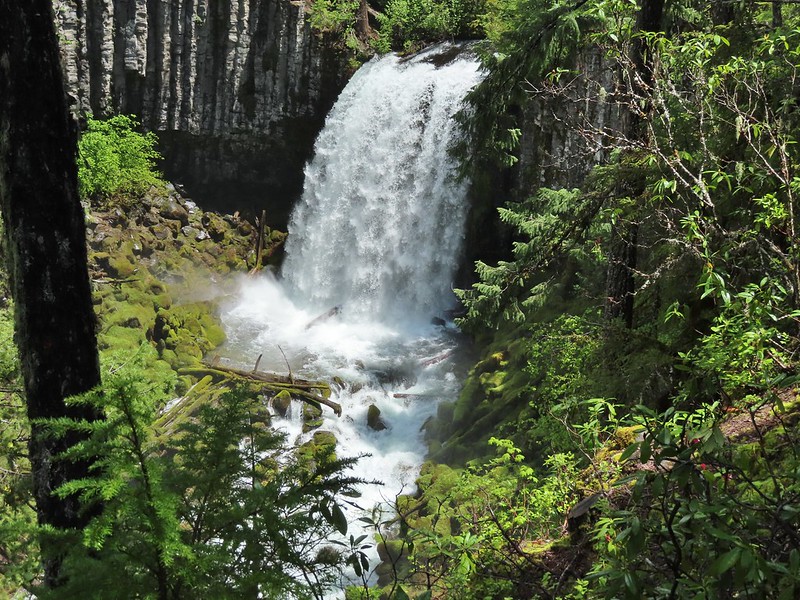
Yet another short trail (0.3 miles) that led to a scenic waterfall.
IMG_2976

IMG_2982Viewing platform above the falls.

IMG_2986We both really liked the angled basalt cliff on the far side of these falls.
IMG_2989

This waterfall surprised us a bit with how much we both liked it. We headed back to the car and drove back the way we’d come until reaching a canal bridge along FR 2610 where we turned across it to the North Umpqua Trail.
IMG_3069The canal bridge is 5.6 miles from Highway 138 on FR 2610.

IMG_2991Sign near the canal bridge.

IMG_2992The North Umpqua Trail.

IMG_2993The section between Lemolo Lake and the Umpqua Hot Springs Trailhead is called the “Dread and Terror Segment” but both sections we hiked were beautiful.

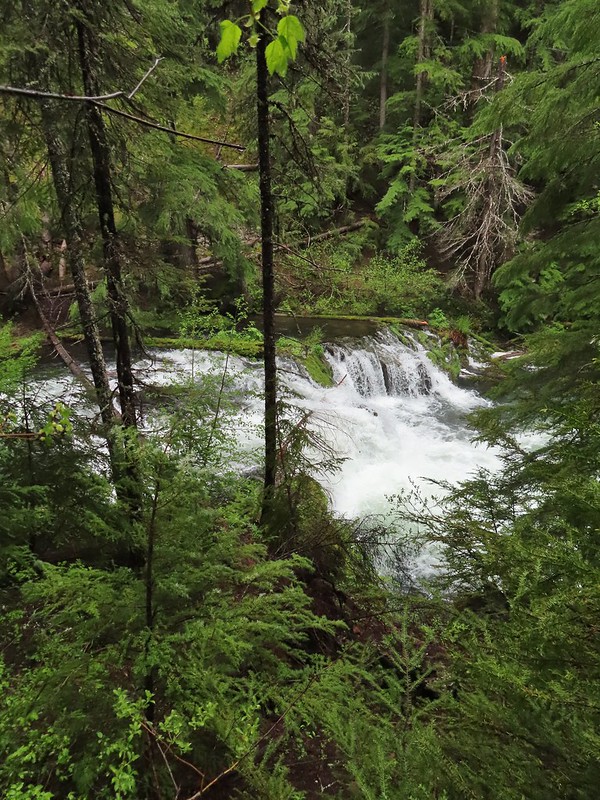
This would be our longest hike of the day at 3.5 miles round trip. The trail followed the North Umpqua River providing numerous views while losing 400′ to a viewpoint above Lemolo Falls.
IMG_3004

IMG_3006Numerous seasonal streams and seeps flowed across the trail.
IMG_3013

IMG_3017Unnamed fall along the river.

IMG_3031Trillium

IMG_3035

IMG_3037Ouzel

IMG_3043

IMG_3054Lemolo Falls

We took a short break at the viewpoint then headed back. We had one final stop to make on the other side of the river to visit a better viewpoint below Lemolo Falls.
IMG_3060Red flowering currant along the trail.

IMG_3063Bleeding heart.

From the canal bridge we drove back toward Lemolo Lake crossing the dam then in half a mile turned right on FR 3401 for another half mile to FR 800 where we again turned right. We followed FR 800 for 1.6 miles to a spur road (FR 3401-840). The trailhead is located approximately a quarter-mile down this road but we parked as soon as we had a chance due to this road being in the worst condition we’d experienced this day.
IMG_3070Approaching the trailhead.

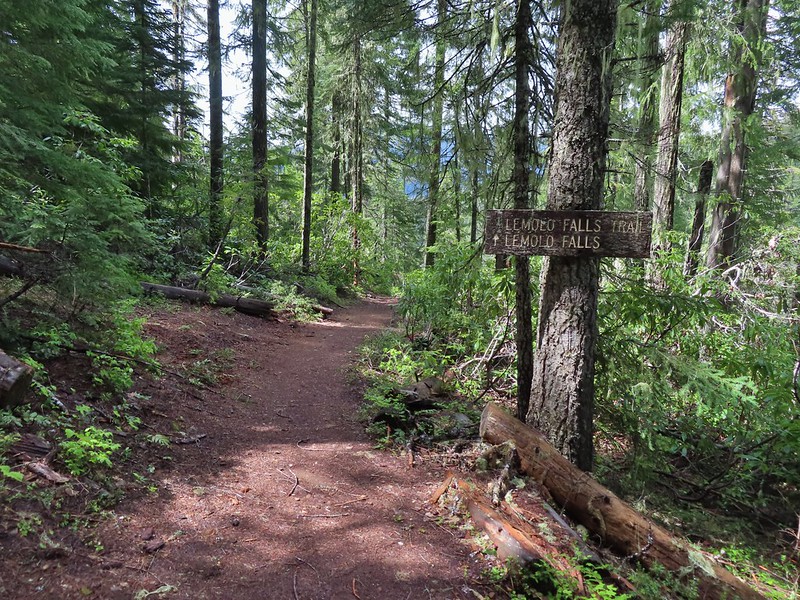
This old trail/trailhead was recently reopened and aside from the poor access road the trail was in good shape. The first 0.6 miles follows an old roadbed to a former picnic area where the Lemolo Falls Trail used to begin. Three quarters of a mile later the trail arrives at the North Umpqua River below Lemolo Falls.
IMG_3073

IMG_3076

IMG_3079

IMG_3083The former picnic area (Note the picnic table in the trees to the right.)
IMG_3084

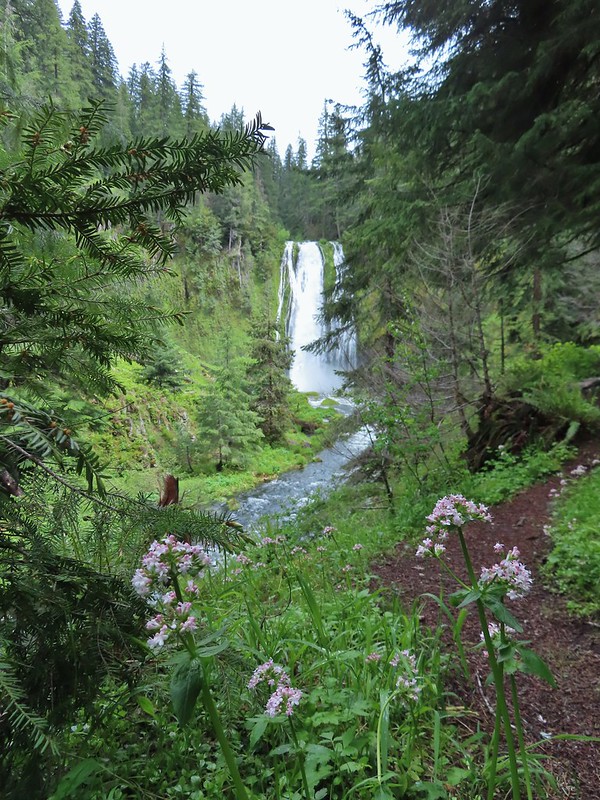
IMG_3098Valerian along the trail.

IMG_3104

IMG_3105

IMG_3113One of many brief appearances of blue sky during the day.
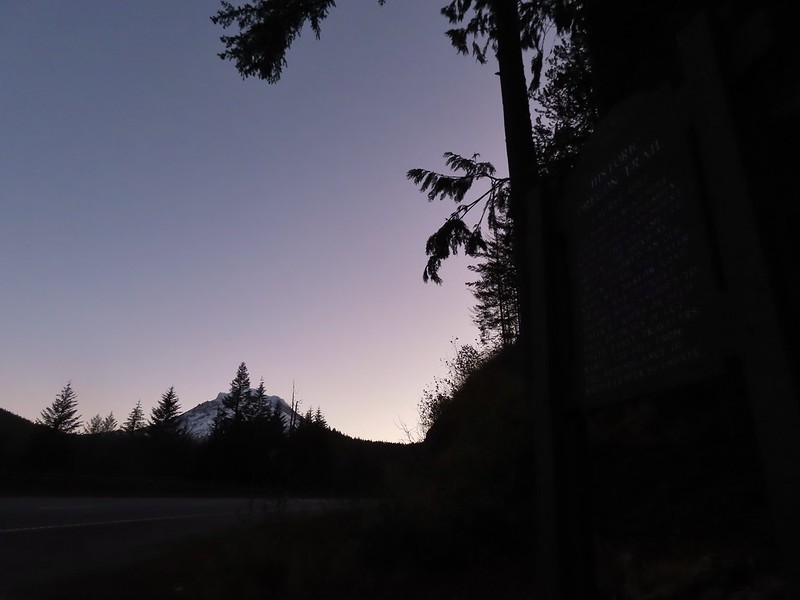
This was by far the superior view and a great way to end the day. We climbed back up the 500′ that we’d descended to the falls and called it a day. Our seven stops was a new personal record (previously six on a trip down the Oregon Coast). With most of the hikes being rather short our mileage for the day was just a smidge over 11 miles with a little over 1800′ of cumulative elevation gain. It was a long day made longer by a couple of delays due to road construction so it was later than we’d planned when we pulled into our motel in Roseburg but we had managed to finish three more featured hikes (and one third of a fourth) and although it had sprinkled off and on all day we’d also had a few sun breaks which made it a perfect day for chasing waterfalls. Happy Trails!

Flickr: Highway 138 Waterfalls

Categories
High Cascades Hiking Mt. Hood Area Oregon Trip report

Laurel Hill Wagon Chute and Barlow Ridge Loop – 10/30/2021

We ended our hiking season with a bang, a pair of stops along the Barlow Wagon Road with an off-trail adventure, great views and beautiful weather. Created in 1846 the “Barlow Road” provided an alternate route along the Oregon Trail which previously ended at The Dalles where emigrates were forced to find passage down the Columbia River. The 80 mile road led from The Dalles to Oregon City crossing several rivers and the Cascade crest along the way. The wagons also had to navigate Laurel Hill’s steep descent and our first stop of the day was to visit the Laurel Hill Wagon Chute, the steepest drop along the road.

We parked at the small pullout along Highway 26 that serves as the Laurel Hill Trailhead.
IMG_6859Mt. Hood from the trailhead.

IMG_6860

We followed the trail uphill on stairs to an abandoned section of the Mt. Hood Highway then turned right to find the bottom of the rocky chute.
IMG_6866

IMG_6870

IMG_6874The wagon chute.

IMG_6872

A trail to the right of the chute led uphill to a 4-way junction where we turned left and followed this path a short distance to the top of the chute.
IMG_6875

IMG_6881The left at the 4-way junction.

IMG_6883

IMG_6887

IMG_6888Looking down the chute.

After reading the sign near the chute and trying to picture actually lowering a wagon down the chute we returned to the old highway walking a short distance past the chute to a viewpoint above Highway 26.
IMG_6897

IMG_6901Sunlight starting to hit the SE side of Mt. Hood.

IMG_6903Ravens photo bombing a close up of the mountain.

We backtracked from the viewpoint and descended down the stairs to our car.
IMG_6905

We then drove east through Government Camp to Highway 35 before turning right onto FR 3531 at a pointer for Barlow Road and the Pacific Crest Trail. After 0.2 miles we parked at the Barlow Pass Trailhead/Sno-Park. Both the Barlow Wagon Road and the Pacific Crest Trail pass through the trailhead. After parking we headed to a picnic table and sign boards on the south side of the parking area.
IMG_6908

The PCT was on our right heading south toward Twin Lakes (post) while the Barlow Wagon Road lay straight ahead.
IMG_6911

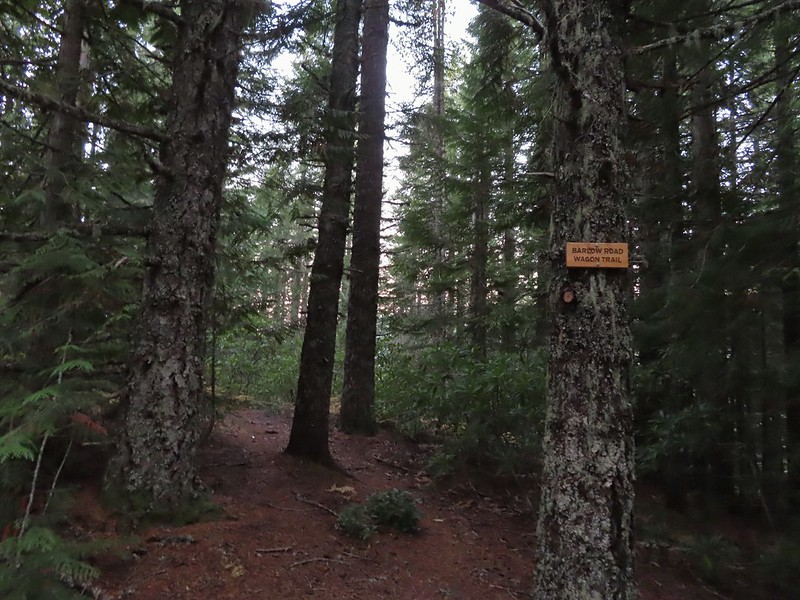
We followed the wagon road for approximately a tenth of a mile before it joined FR 3530 (Barlow Road).
IMG_6912A portion of the original Barlow Wagon Road.
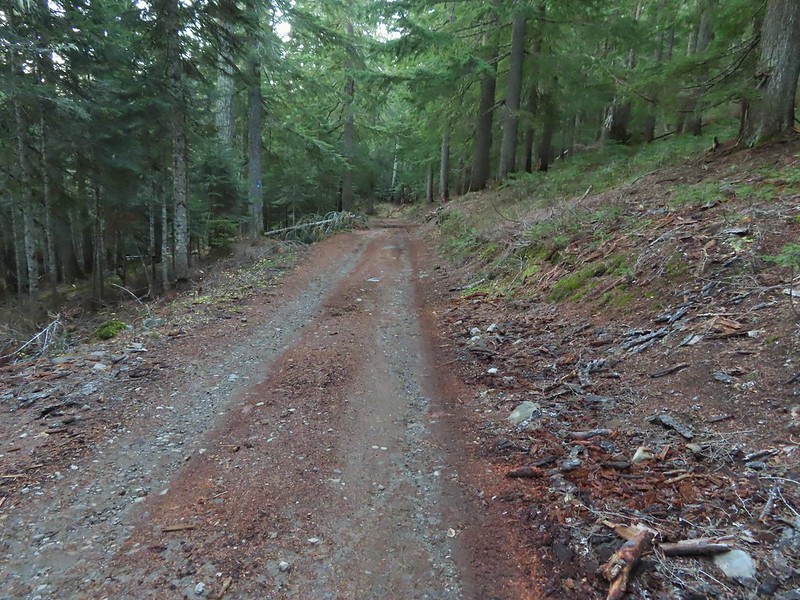
IMG_6913Barlow Road (FR 3530)

Just 40 yards after joining FR 3530 the Barlow Butte Trail veered downhill at a signpost.
IMG_6914

The trail was still following the route of the wagon road as it passed through a forest that was hit hard by last Winter’s storms.
IMG_6918

IMG_6919

At the half mile mark we came to a junction with the Barlow Creek/Devil’s Half Acre Trail in a small meadow.
IMG_6920

Following pointers for the Barlow Butte Trail and Mineral Springs Ski Trail we turned left here.
IMG_6921

The trail began a gradual 0.4 mile climb to another junction where the Barlow Butte and Mineral Springs Ski Trail parted ways.
IMG_6923

IMG_6925

IMG_6927

IMG_6929

We made a hard right here sticking to the Barlow Butte Trail which quickly entered the Mt. Hood Wilderness.
IMG_6932Wilderness sign along the Barlow Butte Trail.

It was a mile from the junction where the Mineral Springs Ski Trail parted ways to the next junction. The trail climbed gradually at first but soon steepened as it began a series of switchbacks.
IMG_6937

IMG_6938Getting steeper.

IMG_6942This was the worst of the blow down we had to navigate on this section.

IMG_6944Nearing the junction.

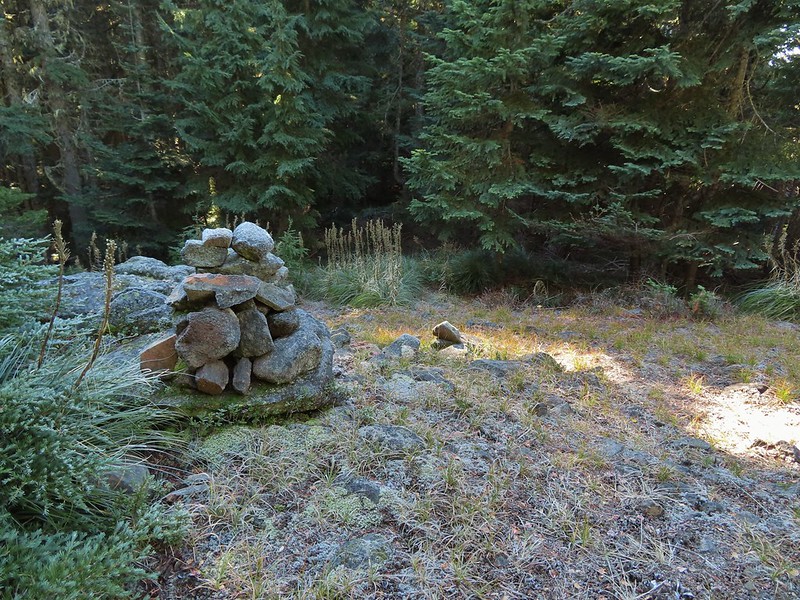
A small rock cairn marked the junction where a spur trail led left up to the old lookout site on Barlow Butte.
IMG_6947

We turned left on the spur trail which began with a great view to the NE of the Badger Creek Wilderness including Lookout Mountain and Gunsight Butte (post)

IMG_6951

IMG_6953It was a little chilly with temps in the mid 30’s combined with a stiff breeze adding to the wind chill.

IMG_6982On the right of the far ridge is Bonney Butte (post).

The summit of Barlow Butte is overgrown now with trees but just downhill from the former lookout site was a small rock outcrop with a view of Mt. Hood.
IMG_6963

IMG_6975Remains from the lookout.

IMG_6965

The Oregon Hikers Field Guide mentions a better viewpoint on yet another rock outcrop below this one but we didn’t scramble down to it. Instead we planned on visiting a couple of other viewpoints on the Barlow Butte Trail further along Barlow Ridge. So after a short break trying to use the trees to block the wind we headed back down to the Barlow Butte Trail and turned left (downhill) at the small rock cairn. The trail passed through a stand of trees before popping out on a rocky spine.
IMG_6992Barlow Butte and the top of Mt. Hood.

IMG_6985Frog Lake Buttes (post) is the hump in the center.

IMG_6987Western larches

IMG_6999Mt. Jefferson behind some clouds.

IMG_7002Sisi Butte (double humps) and Bachelor Mountain (post).

The rocks were a little frosty in spots so we had to watch our footing, especially dropping off the rocks back into the forest.
IMG_7005

This is a good point to mention that the Oregon Hikers Field Guide has you turn back here for their Barlow Butte Hike but there is a second hike in the guide, the Barlow Ridge Loop which describes a possible 10.5 mile loop. This hike is listed as a “lost” hike due to the Forest Service having abandoned the trail along the remainder of Barlow Ridge. The Barlow Butte Trail at one time followed the ridge to its end and descended to Klingers Camp. We were keeping the loop option open but were planning on turning back possibly at the high point of the trail.

The next marker along Barlow Ridge was Lambert Rock which we reached a half mile from the small rock cairn on Barlow Butte.
IMG_7009

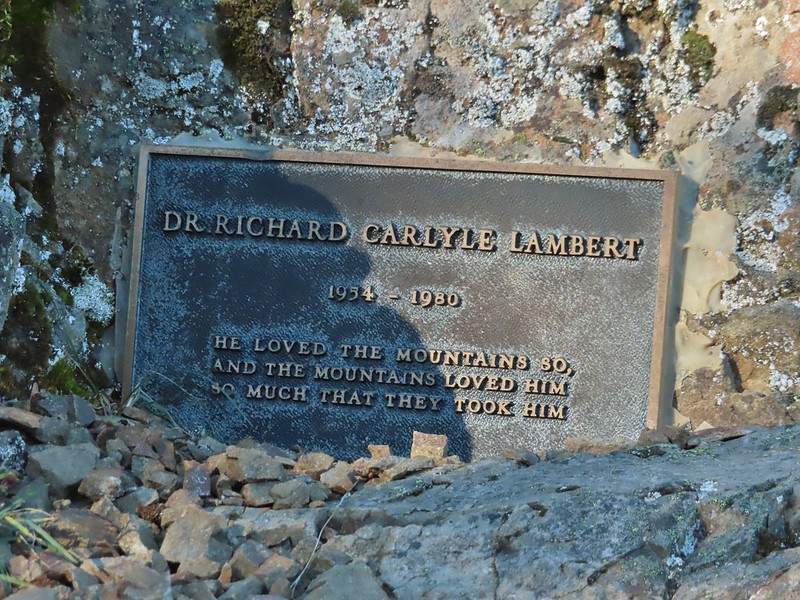
It’s possible to carefully scramble up this rock past a memorial plaque for Dr. Richard Carlyle Lambert who perished while hiking in Utah.
IMG_7010

IMG_7013

IMG_7014

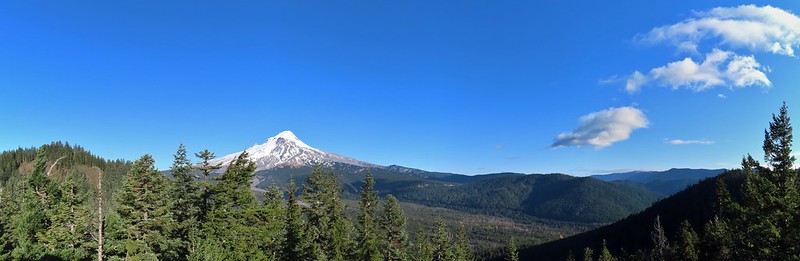
The view of Mt. Hood was spectacular from the rock but the stiff breeze and cold air made for a short stay.
IMG_7019_stitchBarlow Butte to the left of Mt. Hood.

If not for the clouds to the south the Three Sisters and Mt. Jefferson would have also been visible from the rock.
IMG_7012Mt. Jefferson still behind some clouds.
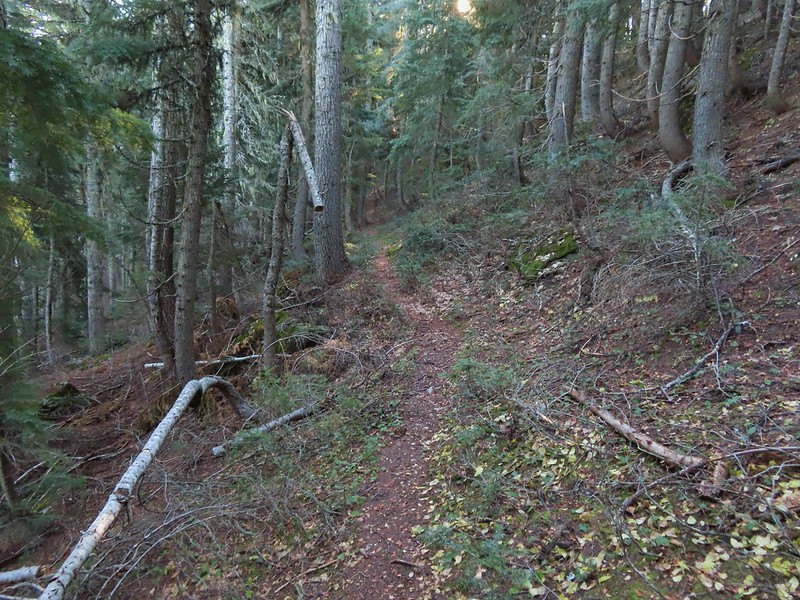
Beyond Lambert Rock the trail dropped a bit into a saddle where another small rock cairn marked an unofficial cutoff trail to the left that leads downhill to FR 3560.
IMG_7024

We continued to the right on the Barlow Butte Trail and 0.4 miles from Lambert Rock detoured to the right to what we hoped might be another viewpoint. Trees blocked the view north to Mt. Hood and east to Lookout Mountain. Again there would have been a decent view of Mt. Jefferson from this spot but we did have a good view west to Tom Dick and Harry Mountain above Mirror Lake (post)
IMG_7025

IMG_7030Parts of Mt. Jefferson peaking through the clouds.

IMG_7028Tom Dick and Harry Mountain (with the rock fields near the top).

We continued on following the increasingly faint trail another third of a mile to it’s high point and another great view of Mt. Hood. While the trail was faint there were often cairns, blazes or diamonds marking the correct path.
IMG_7031Small cairns in a meadow.

IMG_7034One of the aforementioned diamonds.

IMG_7038Approaching the high point.

IMG_7042Clouds were starting to pass over Lookout Mountain at this point.

IMG_7044Mt. Hood from the high point of Barlow Ridge.

Up to this point the trail had been fairly easy to follow and there hadn’t been much blow down over it so we decided to continue along the ridge at least to the point where it started to steepen on it’s way down to Klingers Camp. For the next three quarters of a mile the trail was still visible at times and the occasional marker let us know we were still on the right course.
IMG_7045Carin in the trees ahead.

IMG_7048Elk or deer tracks leading the way.

IMG_7050Another section of frost.

IMG_7051We took this as a blaze.

IMG_7052That blaze led to this large cairn.

IMG_7053Things were starting to get interesting here.

IMG_7058Stopped here to listen for pikas, no luck though.

IMG_7059This could be trail.

IMG_7061Still on the right track, note the folded trail sign on the tree at center.

We lost the trail for good in a small beargrass meadow which was my fault. While I had brought a topographic map that showed where the trail was supposed to be I was navigating primarily based off of what I remembered reading from the Oregon Hikers field guide. I had remembered most of it well but had forgotten the part where “the trail swings off the ridge to the right….”. All I remembered was that the route eventually dropped steeply down the nose of a ridge. Not realizing it was the nose of a different ridge I kept us following Barlow Ridge for another 0.2 miles.
IMG_7062The small meadow.

IMG_7063Officially off-trail now.

IMG_7064This looked like a place the trail would go.

IMG_7070A final look at Mt. Hood from Barlow Ridge.
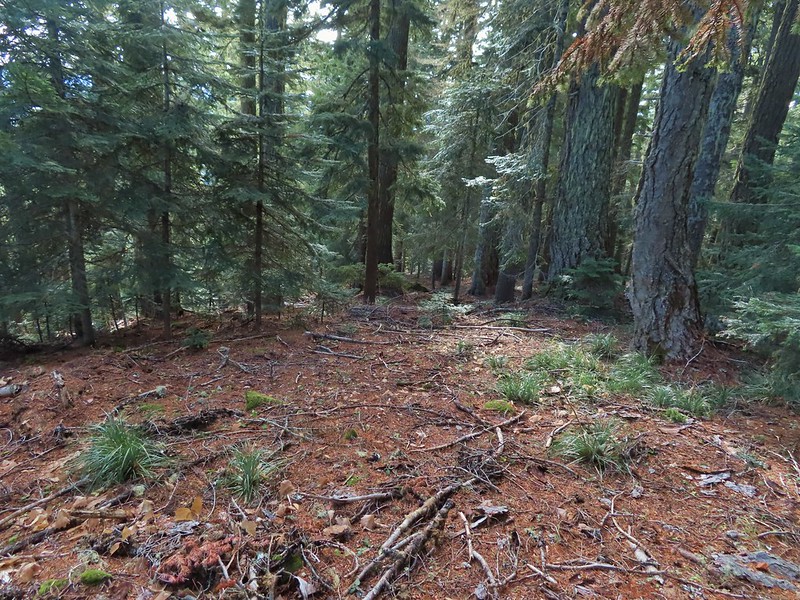
Not realizing that we were off the trail alignment we decided that the hiking had been easy enough up until now that we would go ahead and try for the loop. Down we headed looking in vain for any sign of trail. Several times we convinced ourselves that we’d found it, but it turns out if it was anything it was game trails.
IMG_7077This doesn’t look so bad.

IMG_7078One of several big trees we encountered.

IMG_7081Little orange mushrooms, how appropriate for Halloween.
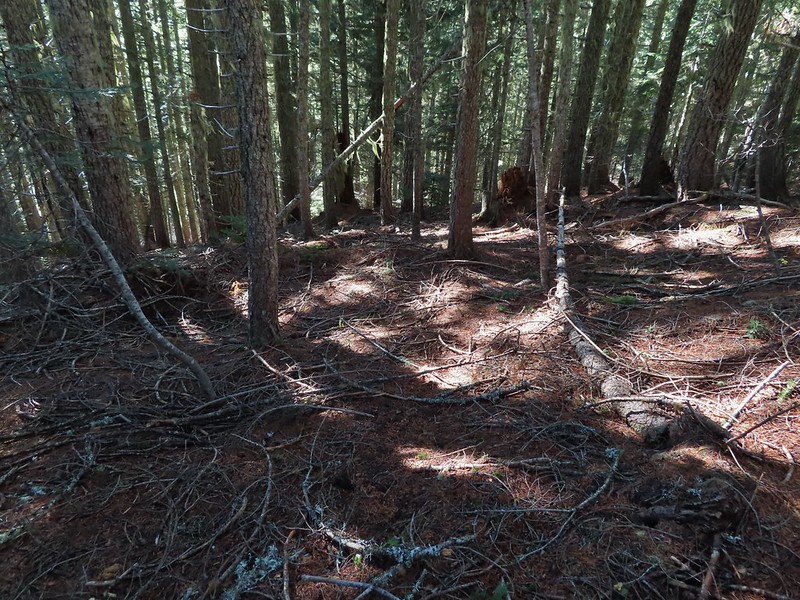
IMG_7082Starting to encounter more debris.

IMG_7083If there had been a trail good luck finding it.
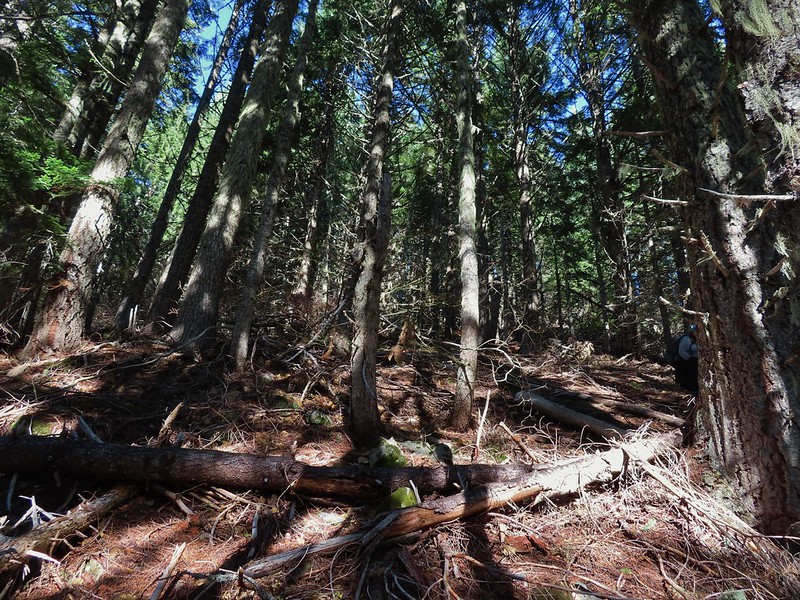
IMG_7084Heather coming down behind me.

We lost over 600′ of elevation in three quarters of a mile and things were only getting steeper. It was at this point that I turned my brain on and pulled the map out of Heather’s pack. I quickly saw what I’d done wrong, we were following the wrong ridge line down and should have been one ridge to the SW. The problem now was there was a stream bed between us. We backtracked up hill a bit and followed a game trail across the trickling stream and attempted to traverse over to the correct ridge.
IMG_7085Pretty decent game trail here.

IMG_7086This section was fun.

IMG_7088A bigger orange mushroom.

IMG_7090

We struggled down and across, occasionally having to backtrack or veer uphill to find safer passage.
IMG_7094Uphill on this game trail.

IMG_7096Thickets of brush kept us from getting all the way over to the ridge we needed so we just kept going downhill knowing that we would eventually run into one of the forest roads at the bottom.

IMG_7097More steep fun.

We eventually made it to flat ground in a forest of young trees and ferns.
IMG_7100

We could tell using our GPS that despite all of that we were only about two tenths of a mile from Klingers Camp. We were even closer to FR 240 and being tired of off-trail travel we headed straight for the road.
IMG_7101Look Ma a road!

We turned right on this road and followed it to a junction with Barlow Road.
IMG_7104It doesn’t look that steep from down here.
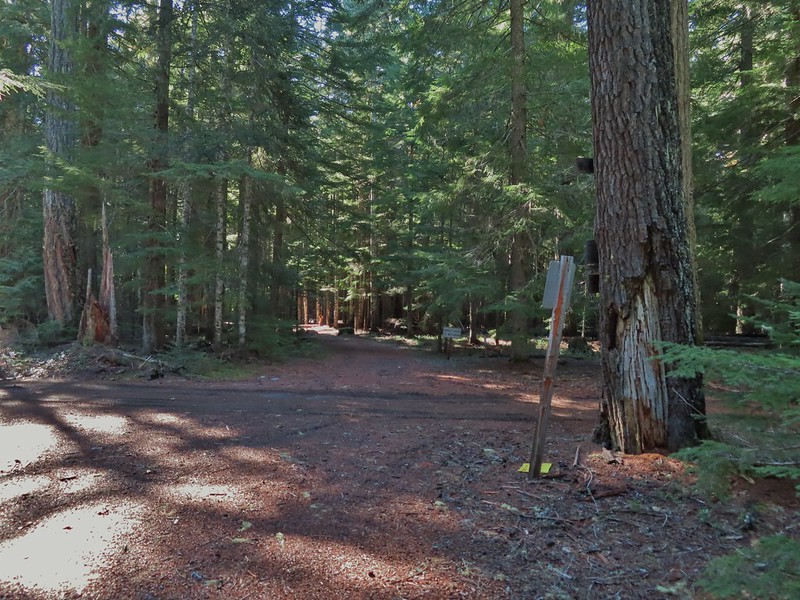
IMG_7107Barlow Road.

We turned right onto Barlow Road and followed it 150 yards to Klingers Camp.
IMG_7109

IMG_7113

After visiting the camp we continued on Barlow Road for five miles back to the Barlow Pass Trailhead. Along the way two pickups drove past us in the other direction. At the 1.6 mile mark we passed the Grindstone Campground and near the 4 mile mark the entrance to the Devil’s Half Acre Campground.
IMG_7115

IMG_7114

IMG_7122

IMG_7124

IMG_7127Western larches above Barlow Road.

IMG_7129Grindstone Campground

IMG_7133

IMG_7138Barlow Creek

IMG_7147Crossing Barlow Creek near Devil’s Half Acre Meadow.
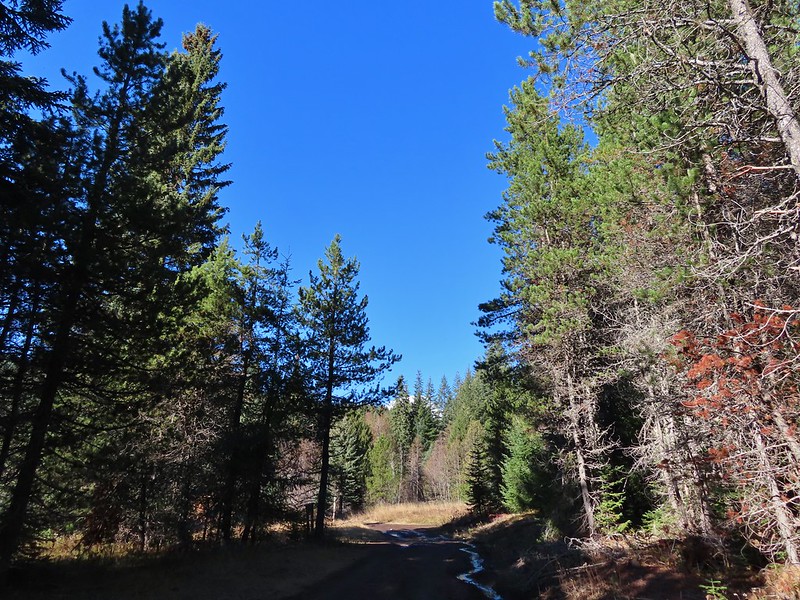
IMG_7151Clouds on top of Mt. Hood towering over the trees.
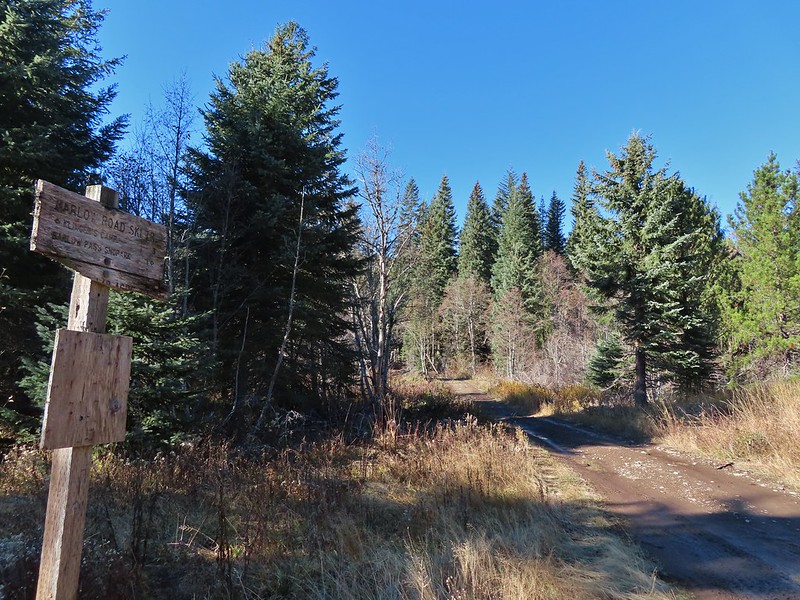
IMG_7154

IMG_7157Barlow Road at the campground.

IMG_7159Devil’s Half Acre Meadow.

We could have taken the Devil’s Half Acre Trail from the campground to the Barlow Butte Trail but we weren’t sure what the condition was and the Field Guide didn’t mention taking it so we played it safe and trudged up the road.
IMG_7164Finally back to where we’d left the road in the morning.

IMG_7170Arriving back at the Barlow Pass Trailhead
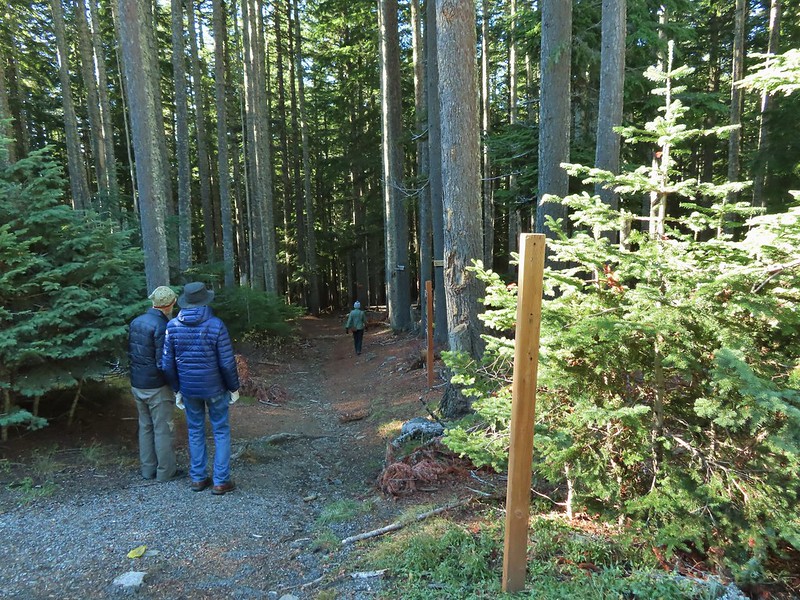
Before we attempted the crazy loop we had planned on also making the 2.2 mile round trip hike to the Pioneer Woman’s Grave on the other side of Barlow Pass and then stopping at the Castle Canyon Trail for a final short hike. Neither of us had any interest in making another stop at this point but we were interested in the grave site. Unfortunately Heather’s plantar was acting up. Surprisingly, given the lack of good ideas we’d displayed so far, we came up with a alternate plan. Heather would drive to the Pioneer Woman’s Grave Trailhead while I hiked the Barlow Wagon Road to it. The trailhead is located right next to the grave site so Heather didn’t have to worry about her plantar and now I only needed to hike a little over a mile downhill.
IMG_7171The first other people (not counting the two drivers in the pickups) that we’d seen all day.
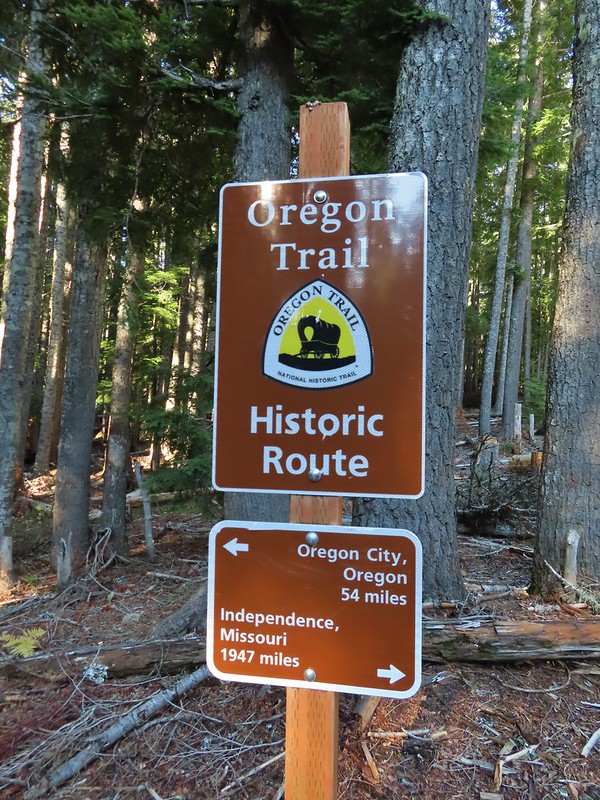
I hustled down the wagon road stopping along the way at another nice Mt. Hood viewpoint.
IMG_7172

IMG_7179

IMG_7182

IMG_7183

IMG_7191

IMG_7206

IMG_7194

IMG_7196

20211030_153421

IMG_7195

I did take the time to walk down the road 60 yards to the East Fork Salmon River to check out some stonework and wagon ruts left by the emigrants.
IMG_7202East Fork Salmon River

IMG_7201

IMG_7200

The 10.5 mile loop hike turned into 12 miles due to our being off course and wandering around trying to figure out where we were going so my day wound up being just under 14 miles total with approximately 3100′ of elevation gain. Heather got all the elevation gain with 1.2 miles less traveled. I probably wouldn’t try that loop again but I’d be lying if I said I wasn’t kind of curious what it would be like to actually follow the field guide correctly. Happy Trails!

Loop is in blue with the Pioneer Woman’s Grave in orange.

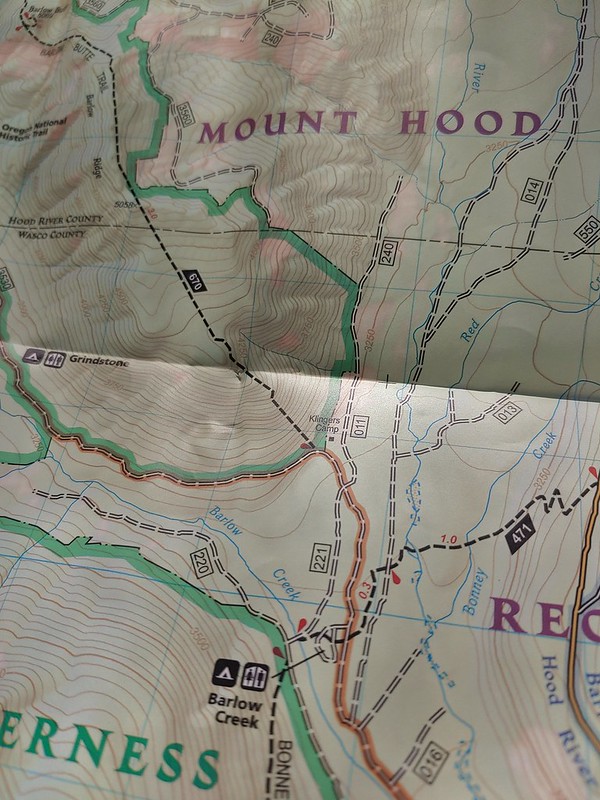
For reference here is where the trail is shown on the map we were carrying and here is a link to the map in the field guide.
20211030_113918
Flickr: Laurel Hill Wagon Chute and Barlow Ridge Loop

Categories
High Cascades Hiking Mt. Jefferson Area Oregon Trip report

Round and Square Lakes – 10/9/21

We were hoping to get a backpacking trip in over the holiday weekend but the forecast called for rain/snow in the mountains starting Saturday night through the rest of the weekend so we opted instead for a day hike instead. The good news was that the forecast for Saturday was for partly to mostly sunny skies so we were hoping for some nice views. We’d chosen a hike to Round and Square Lakes near Three Fingered Jack and the Mt. Jefferson Wilderness which was the shortest of the drives (a little over 1 1/2 hours from Salem) that we had been considering. While we hadn’t been to Round Lake yet we had passed by Square Lake on a loop hike in 2012 (post). Earlier this year on our hike to Santiam Lake (post) we had retraced some the beginning of that loop. For this hike we would also be starting at the Pacific Crest Trailhead at Santiam Pass but would be retracing the final 4.5 miles of the 2012 loop between Booth Lake and the trailhead.

Both Reeder and Sullivan describe hikes to Round and Square Lakes but each of their descriptions are for out and back hikes starting at the Round Lake Trailhead which is closer to the Sisters/Bend area. Starting at Santiam Pass cut off some driving but it did add approximately 5 miles of hiking to our days total. We arrived at the trailhead just in time to catch a bit of color from the sunrise.
IMG_5755

IMG_5756

IMG_5758Black Crater (post)

After 0.2 miles we turned right at the junction with the Old Summit Trail.
IMG_5765

IMG_5766

The Old Summit Trail traverses a hillside above Highway 20 through snags left over from the 2003 B & B Complex (Bear and Booth Fires). The lack of larger trees provides plenty of views south to Black Crater, Broken Top, the Three Sisters, Mt. Washington, Hayrick Butte and Hoodoo Butte. The over night clouds were quickly breaking up as we hiked revealing more and more of the mountains.
IMG_5768Black Crater and North Sister

IMG_5772Black Crater, the top of Broken Top, some of the Sisters, and part of Mt. Washington.
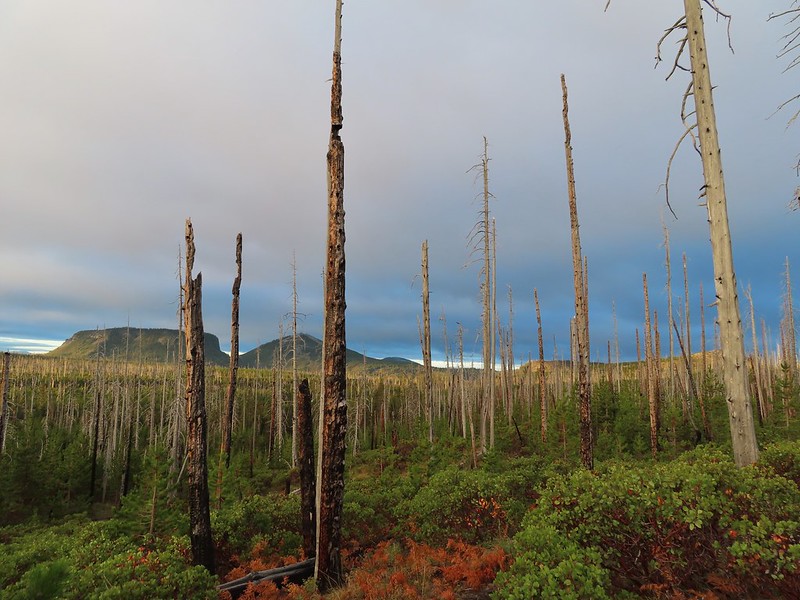
IMG_5775Hayrick and Hoodoo

IMG_5777Between Mt. Washington and Hayrick Butte is Scott Mountain (post).
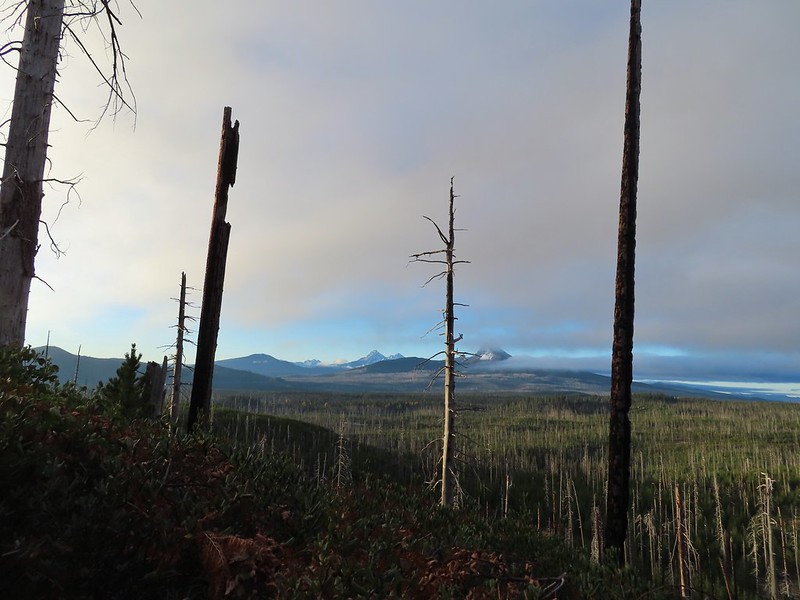
IMG_5787Cache Mountain is the high point furthest to the left.
IMG_5788Broken Top and the Three Sisters

IMG_5793

IMG_5797Mt. Washington

IMG_5798The Three Sisters. The summit of South Sister is between North and Middle Sister behind 9321′ Prouty Point.

IMG_5809

IMG_5812Black Butte (post)

Near the 2 mile mark we entered the Mt. Jefferson Wilderness. The wilderness sign provided a good reference for comparing how much taller the trees were this time versus in 2012.
IMG_5814

Mount Jefferson Wilderness signA different angle from 2012.

IMG_5815

Shortly after entering the wilderness we began descending toward Square Lake. Three Fingered Jack was somewhat hidden behind a cloud further to the north.
IMG_5820

IMG_5822

The only deer we spotted during the hike popped out of some brush below the trail for just a moment before disappearing back into it. As has been the case more often than not this year I did not have my camera at the ready so all I got was one of their white rumps.
IMG_5825One white rump with a black tail amid the ferns near the center of the photo (good luck).
The trail wrapped around the lake past a large campsite to a junction with the Round Lake trail approximately 2.5 miles from the trailhead.
IMG_5828

IMG_5827The only paintbrush we would see all day.
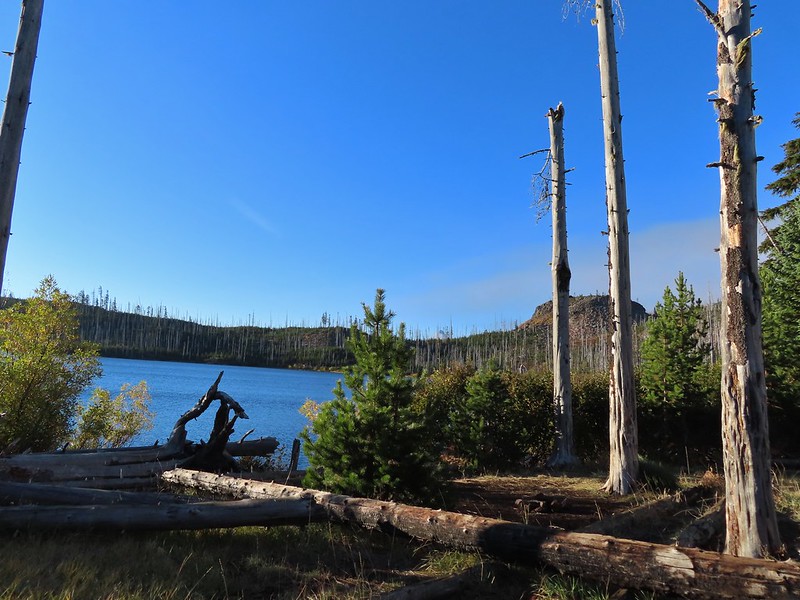
IMG_5829The top of Mt. Washington is just visible on the other side of Square Lake.

IMG_5831

At the junction we followed the pointer for the Round Lake Trail and continued along Square Lake.
IMG_5832

IMG_5835

IMG_5837Mt. Washington’s spire again.

IMG_5839A rainbow was trying to form to the west.

We soon left Square Lake and continued through the recovering forest.
IMG_5840

IMG_5841

IMG_5842Lodgepole pine seeds require fire in order to be released from their tight cones.

The Round Lake Trail is just about 2 miles long running between the junction and the Round Lake Trailhead to the east. Several maps show the trail passing near Long Lake Lake along the way. It does not but rather veers away form that lake. It may have been an older pre-fire alignment but Reeder mentions this discrepancy in the map and warns “don’t even bother trying to find it unless you’ve got lots of time and patience”. I’ll be honest and say this sounded like a little bit of a challenge so when we were able to spot the western end of Long Lake we decided to make an attempt for it.
IMG_5847Our first sighting of Long Lake (zoomed in).
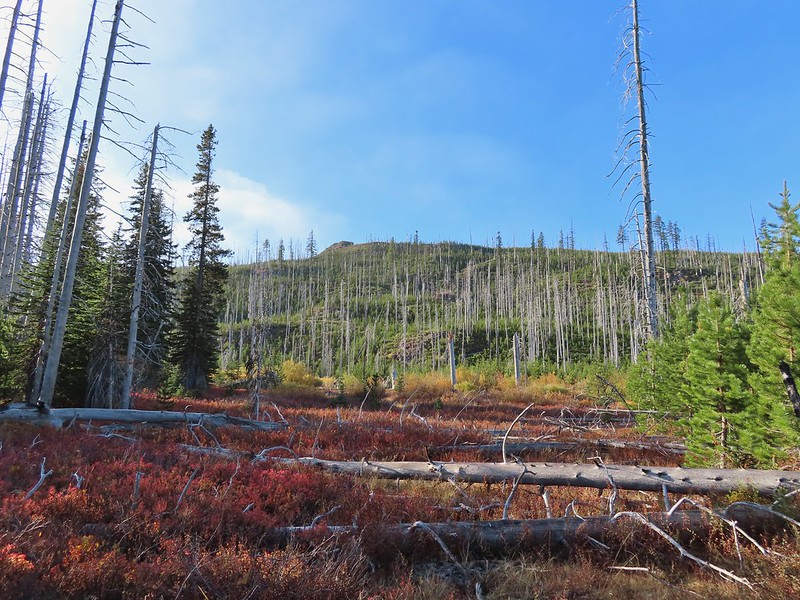
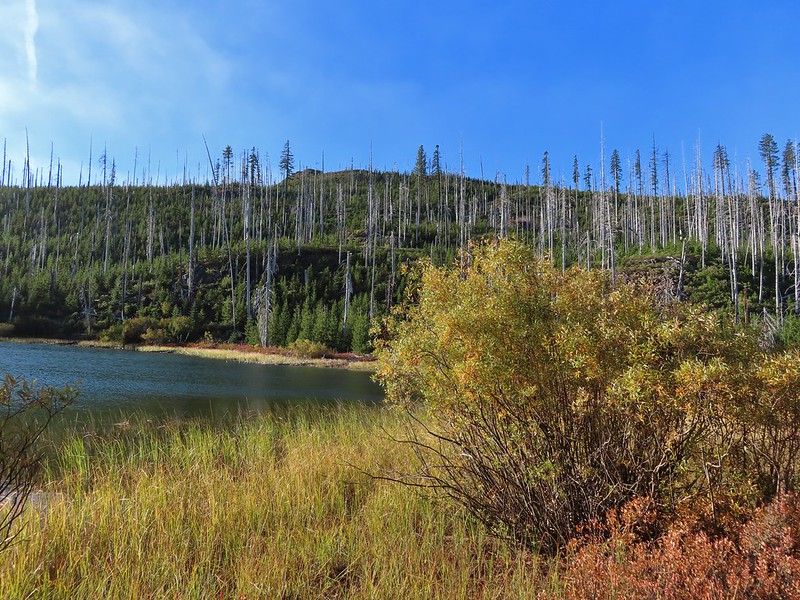
Using our GPS and a paper map as backup we angled cross country toward the lake which quickly was hidden from sight. There were plenty of downed trees to climb over or around and one line of snowbrush to push through but we also were able to follow some game trails which helped us find ways through the obstacles. It was also evident that the area around the lake can be pretty wet and probably muddy meaning getting as close as we did probably wouldn’t be possible at other times.
IMG_5848

We reached the western end of the lake after three tenths of a mile. It took less than 15 minutes but without a map and some route finding skills we wouldn’t advise it.
IMG_5853

IMG_5849

IMG_5850Ducks taking off from Long Lake.

Any thoughts of walking around the north side of the lake quickly vanished when we saw how dense the vegetation and downed trees were.
IMG_5854

We did however return to the Round Lake Trail by bearing NE. It took a little over 21 minutes to find the trail just over a half mile from the lake.
IMG_5858

IMG_5860This is one of the areas that we could see getting pretty muddy/wet.

IMG_5862

IMG_5870Rainbow

IMG_5871The Round Lake Trail just on the other side of the downed tree.
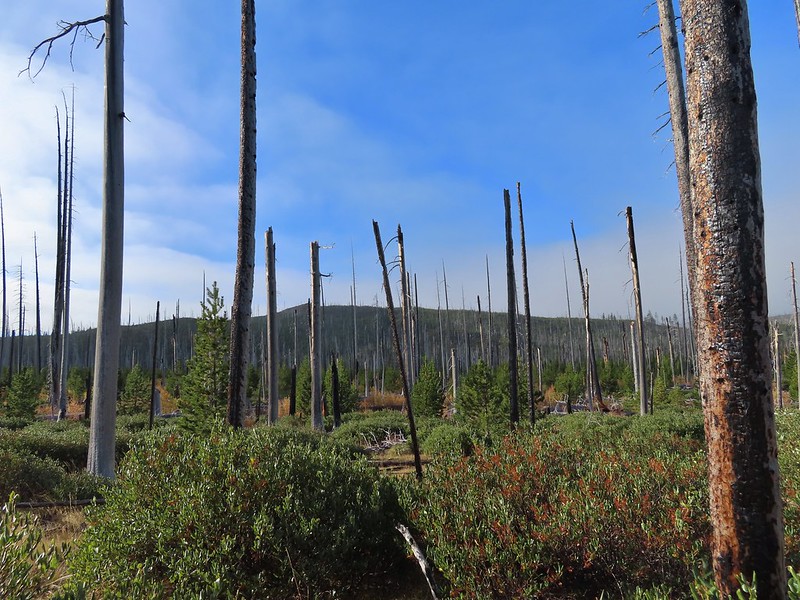
IMG_5873Long Lake is back down that way somewhere.
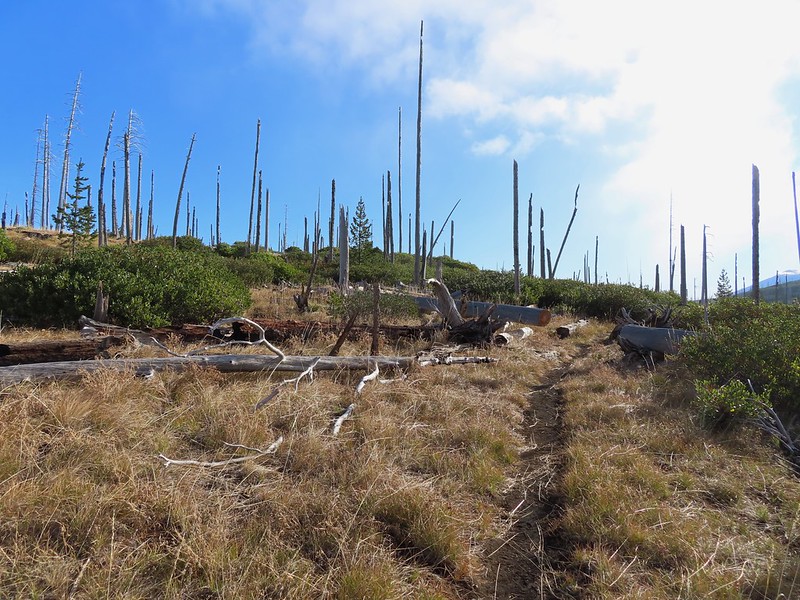
We turned right and continued east on the Round Lake Trail.
IMG_5874Back on the Round Lake Trail.

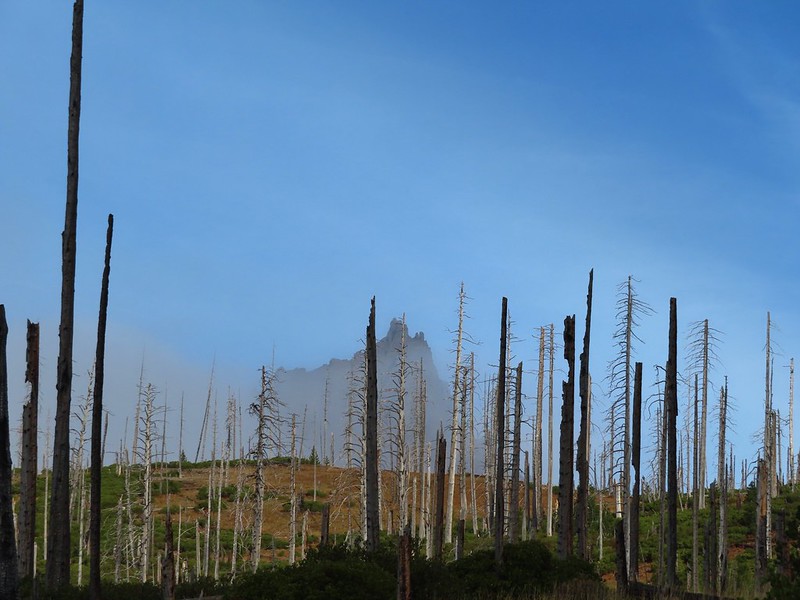
IMG_5876Black Butte shedding the morning clouds.

IMG_5879The top of Three Fingered Jack behind some thin clouds.
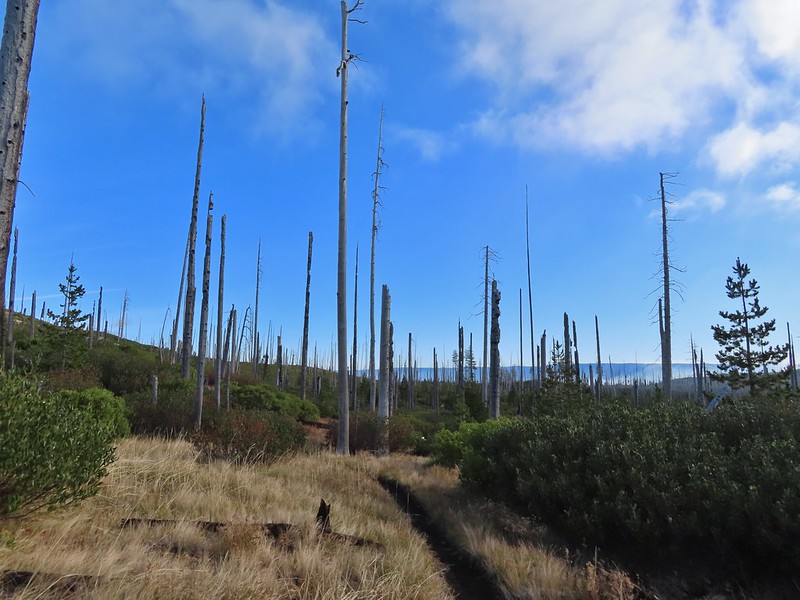
IMG_5880

IMG_5883Green Ridge (post) in the distance with a little smoke rising from the Metolious Basin where the Forest Service had ignited a prescribed burn over the preceding two days.

IMG_5892A better look at Three Fingered Jack.

IMG_5898First glimpse of Round Lake.

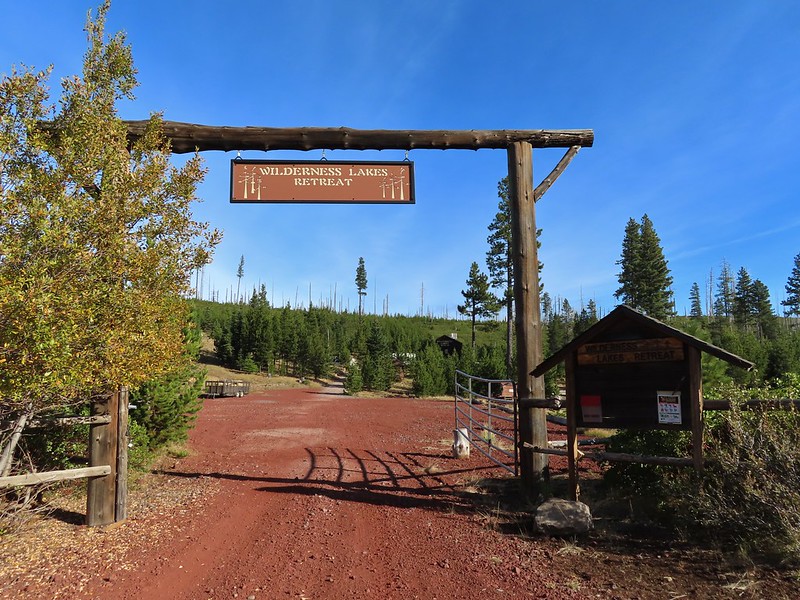
The trail descended to a small parking area at the trailhead next to the Wilderness Lakes Retreat.
IMG_5902

IMG_5905

IMG_5906

We’d seen some maps showing a trail around the north side of the lake through the retreat to some camp sites on the eastern end but we weren’t sure if the retreat was private property or if it was okay to hike through so we opted to follow Forest Road 600 from the trailhead around the south side of the lake.
IMG_5908

When we spotted a path heading down off the road we took it and made our way down to the lake shore.
IMG_5911

IMG_5912

The partial rainbow returned as we took a break at the lake.
IMG_5923_stitch

IMG_5930

IMG_5920

We eventually pulled ourselves away from Round Lake and headed back toward Square Lake. We were feeling a little moisture in the air and based on the clouds ahead we were expecting to find ourselves in some misty fog at best by the time we made it back to the Old Summit Trail.
IMG_5953

IMG_5955Starting to look kind of grey.

IMG_5961A mountain bluebird adding a splash of blue to the green backdrop.
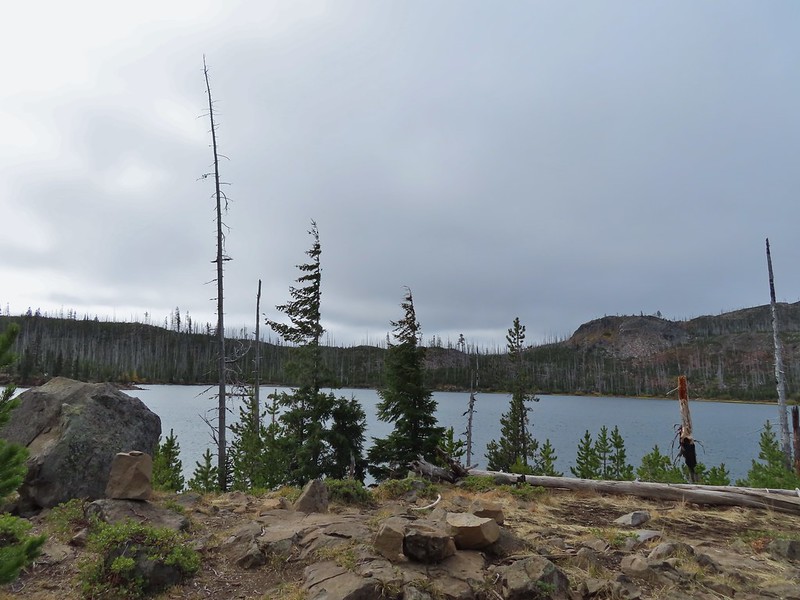
IMG_5966Clouds over Square Lake.

IMG_5968A few scarlet gilia blossoms.

Instead of heading straight back onto the Old Summit Trail we turned right in order to revisit Booth Lake. From Square Lake the Old Summit Trail switchbacked uphill gaining 400′ in the next mile to a gap between a rock outcrop and a rocky hill. We remembered seeing a small lake amid the rocks over on the opposite hill and as we climbed this time we began thinking that it might be possible to get to the unnamed lake.
IMG_5975The unnamed lake is about halfway up the far hillside.

IMG_5981Black Butte and Long Lake from the trail.
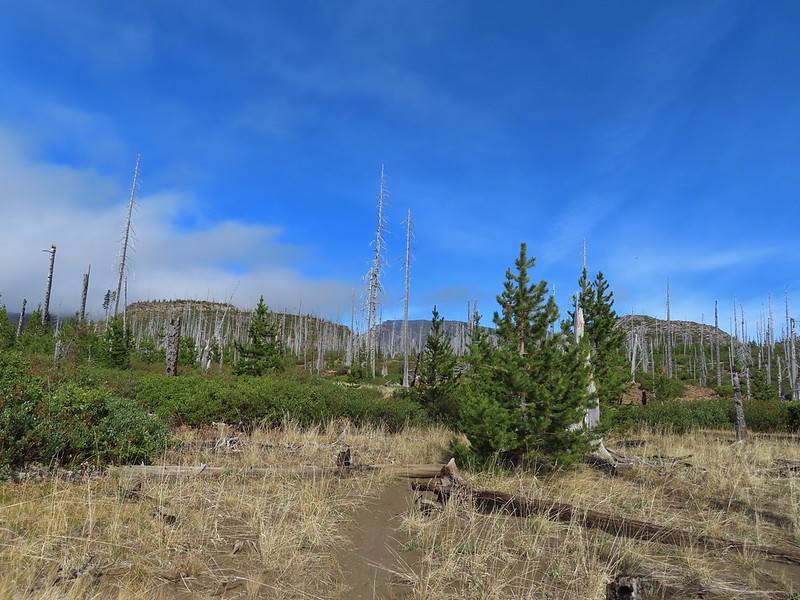
IMG_5994Heading toward Three Fingered Jack we got back under blue skies.

IMG_6003Square Lake still under a clouds,

IMG_6008The unnamed lake that drew our attention.

Unnamed small lake in the Mt. Jefferson WildernessSimilar view from 2012.

We stopped momentarily at the gap discussing what route we would take if we did try and reach the lake. I was pretty certain I wanted to give it a shot but I decided to wait until we were headed back in case I changed my mind after reaching Booth Lake.
IMG_6014The trail at the gap. It was grey and cloudy to the west.

IMG_6016Still at the gap, it was blue skies to the east.

Beyond the gap the trail climbed just a bit arriving at its high point above Booth Lake in 0.3 miles.
IMG_6017There is Three Fingered Jack.

IMG_6027A good look at Green Ridge.

IMG_6030A lupine that was late to the party.

IMG_6038Booth Lake

Heather opted to stay at the high point instead of visiting the lake which was roughly 0.4 miles away and 150′ below. I shuffled down the trail and made my way to the familiar sandy lake shore.
IMG_6041

IMG_6051

IMG_6050

It didn’t look that much different than it had in 2012.
Three Fingered Jack from Booth Lake

I returned to Heather and we started back toward the gap. I was still planning on trying to reach the off trail lake but Heather was not. She had decided that she would only attempt it if the Three Sisters had been uncovered from the clouds. I went ahead of her and left the trail at the gap working my way up around rocks and over downed trees while climbing up a semi-steep slope. I trusted the deer tracks that I was trying to follow and sure enough made it to the little lake.
IMG_6065

IMG_6069

IMG_6072

IMG_6066The trail cut on the far hillside.

The rock cliffs holding the water on the eastern side made for some easy walking and great views down to Square Lake.
IMG_6074Black Butte, Long Lake, and part of Square Lake.

IMG_6078Square Lake along with Broken Top and the Three Sisters (Mt. Washington was hiding in the clouds still).

IMG_6093Part of the rock ledge.

IMG_6084Three Fingered Jack had once again disappeared.

As I was admiring the view I thought was hearing things but as I was making my way back along the ledge I spotted Heather on a small hill on the opposite side of the lake. The Three Sisters had been visible so she stuck to her word and had followed me up.
IMG_6094Where’s Heather.

After satisfying our desire for adventure we returned to the trail and headed back to Square Lake where we made a quick stop at the campsite.
IMG_6122

20211009_130751

We spent the return hike watching the clouds almost clear from Mt. Washington just to reform over around its top.
20211009_132540View climbing away from Square Lake.

Three Fingered Jack and Square LakeSimilar view in 2012.

Square Lake2012

IMG_6144

IMG_6147

IMG_6155

IMG_6174Finally clear!

IMG_6181Hayrick Butte and Hoodo as we neared the trailhead.

This hike was a lot of fun with some new sights and some familiar but different sights. I wound up doing 14.8 miles according to the GPS and although no climbs were particularly long the up and down nature of the hike provided approximately 2000′ of cumulative elevation gain.

Categories
Bend/Redmond Central Oregon High Cascades Hiking Oregon Three Sisters Area Trip report

Tumalo Mountain Sunrise Hike – 09/26/2021

After missing a week of hiking due to heavy rains arriving for the one weekend we’d obtained a Central Cascade Wilderness Overnight Permit we were heading to Bend to celebrate Heather’s parents 50th wedding anniversary (congratulations again). That was possibly the first time we were excited to have to cancel our hiking plans as the rain (and snow on the mountains) continues to be greatly needed. Saturday was set aside for the anniversary party but we planned on getting a quick hike in Sunday morning before driving home.

In 2014 we attempted a to catch the sunrise from Tumalo Mountain (post) but were thwarted by low clouds which provided almost zero viability. Nearly seven years later (9/26/21 vs 9/27/14) we returned for another attempt and this time were rewarded with a colorful show. We arrived at the Dutchman Sno-park/Trailhead just after 5am and got ready to head out using our headlamps. Things already looked more promising than on our previous trip as the Moon was visible over Mt. Bachelor.
IMG_5394

IMG_5396

The Tumalo Mountain Trail gains 1425′ in two miles to the site of a former lookout tower. I hustled up to the lookout site as fast as my legs would allow and arrived a little after 6am to catch the first strip of color to the east beyond Bend.
IMG_5406

IMG_5412

After Heather joined me we continued further along the broad summit to the northern end where the view included Mt. Bachelor to the south and the Three Sisters and Broken Top immediately to the NW.
20210926_062629Mt. Bachelor

20210926_062918The Three Sisters and Broken Top

We spent the next half an hour watching the changing light and colors as we waited for the Sun to rise. We had brought an extra camera which I had been using the day before to photograph the anniversary. This proved interesting as each of the cameras we were using captured the sights in their own ways. As I’ve mentioned before I basically have no idea what I’m doing as far as photography and mostly I just rely on getting lucky once in awhile if I take enough photos. My usual camera is a Canon SX740HS, a small point and shoot with 40x optical zoom. Heather was using her phone, an LGE LM-G820, and the other camera, a Nikon Coolpix P900, belongs to my parents.
DSCN1128Mt. Bachelor via the Nikon.

IMG_5444Heather watching the show taken with the Canon.

IMG_5446The Three Sisters with the Canon.

IMG_5450Canon

DSCN1129Nikon

IMG_5455Mt. Bachelor (post) with the Canon.

IMG_5461Canon shortly before the Sun became visible.
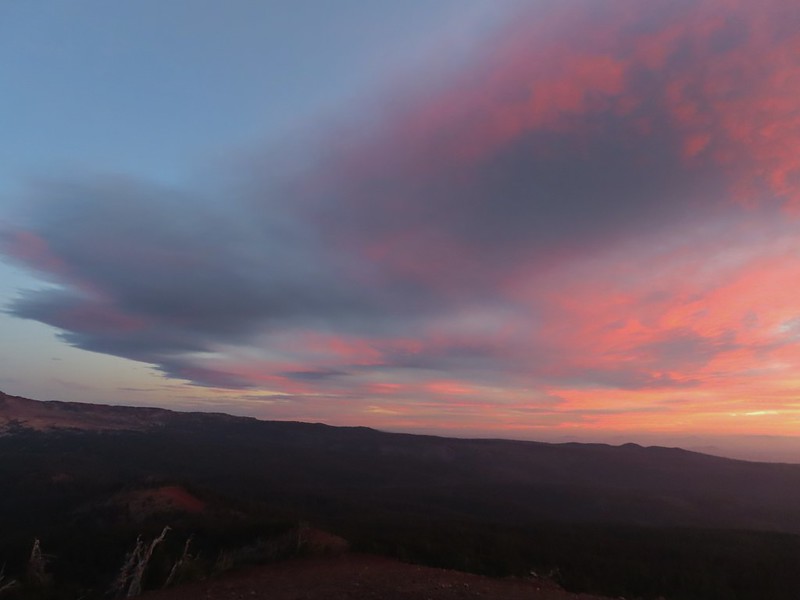
IMG_5462Canon shortly before the Sun became visible.

DSCN1140The Three Sister just before sunrise with the Nikon.

20210926_064832The Three Sister just before sunrise with Heather’s phone.

IMG_5467Canon moments before sunrise. A line of wildfire smoke on the horizon gave it a red tint.

IMG_5469Canon

IMG_5471Canon catching the Sun.

IMG_5473Canon

DSCN1155The Three Sisters and Broken Top (Nikon)

DSCN1157South Sister (post) (Nikon)

DSCN1156Middle and North Sister (Nikon)

DSCN1158Broken Top (post) (Nikon)

IMG_5481Aline glow hitting the mountains. (Canon)

IMG_5478South Sister (Canon)

IMG_5479Middle and North Sister (Canon)

IMG_5480Broken Top (Canon)

IMG_5484Mt. Bachelor (Canon)

We started back down as soon as the sun was up.
IMG_5491

IMG_5497

There were lots of views of Mt. Bachelor on the way down and we could also make out Mt. Thielsen (post) and Mt. Scott (post) further south.

IMG_5503Mt. Scott to the left and Mt. Thielsen to the right.
IMG_5506

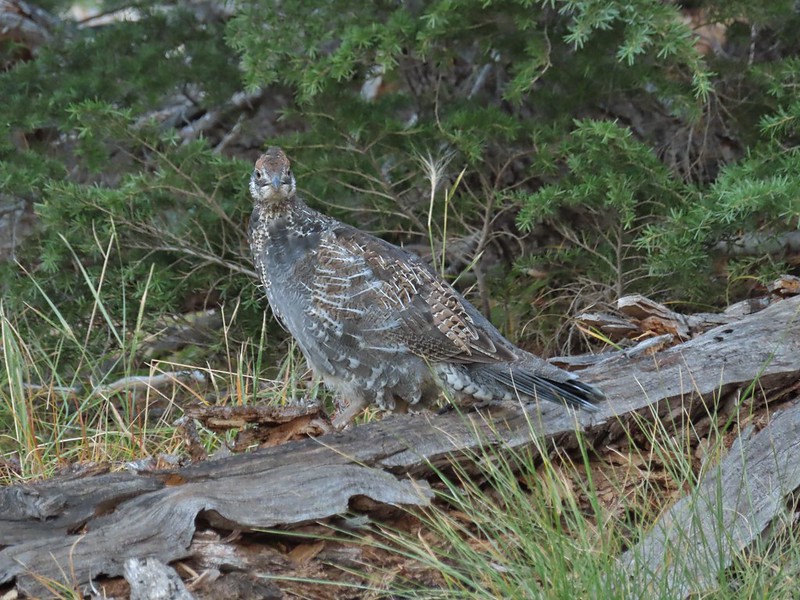
IMG_5519Grouse

IMG_5523Chipmunk

IMG_5528Mt. Bachelor as we arrived back at the snow-park.
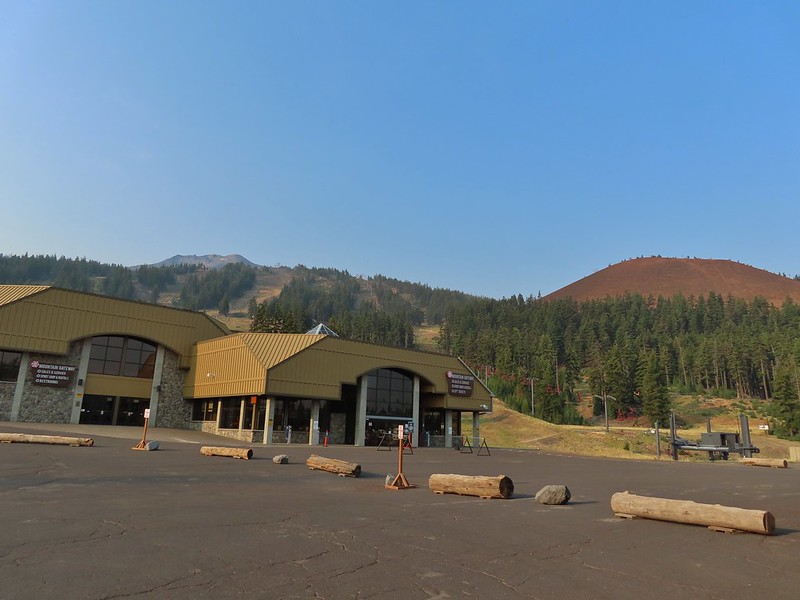
We finished our hike just after 7:45am and headed back to Salem. The hike had been everything we could have hoped for. There were just enough clouds in the sky to create some beautiful colors (the lingering smoke even added a bit although we would rather it wasn’t in the air) and the mountains were all clearly visible. My GPS showed a total of 4.7 miles which made sense given it was too cold to simply sit while we waited for the sunrise, spending over half an hour wandering around at the summit.

There were two other groups of hikers watching the sunrise with us and we passed many more as we descended. Tumalo Mountain is a great choice for a short hike with spectacular views. It is also just outside the Three Sisters Wilderness meaning that a Cascade Wilderness Permit is not needed. Happy Trails!

Flickr: Tumalo Mountain

Categories
High Cascades Hiking Oregon Three Sisters Area Trip report

Mount Bachelor – 08/15/2021

For our August vacation this year we finally returned to the Steens Mountain area for five days of hiking but along the way we made a stop in the Cascade Mountains to hike up to the summit of Mt. Bachelor. As the 6th largest ski resort in the US, Mt. Bachelor is known more for that winter sport than hiking. Hiking also takes a back seat to mountain biking and even a zip line tour but as part of an agreement between the resort and the Forest Service a trail is maintained to the summit for hiking to the 9068′ summit. Growing up in the Bend area I spent a lot of time skiing the mountain but other than riding the Summit lift to the top one Summer (when that lift still operated in the Summer months) neither of us had spent time on the mountain without snow. It was going to be another warm, hazy day as that seems to be the new norm here in the West but the air quality wasn’t in the danger zone so we left early on Sunday morning and arrived at the West Village Parking lot a little before 8am to find a somewhat blue sky overhead.
IMG_1750

There are currently three routes shown on the resorts web page with the easiest being from the top of the Pine Marten Lift which operates from 10am thru 5 or 7pm depending on the date. The other two routes start at the West Village Lodge near the Pine Marten Lift which allows for a reverse lollipop hike which is what we did. We took the more scenic trail up which was marked by blue signboards for the West Village to Summit Connect Trail.
IMG_1755

IMG_1760

IMG_1761A hazy look at the South Sister and Broken Top.

After a short distance on cat roads we came to an actual trail which led into the trees.
IMG_1764

The trail traversed along the mountain crossing several ski runs before turning uphill near the “Marshmallow” run and the Sunrise lift.
IMG_1766

IMG_1771Passing under the Skyliner Express

IMG_1772

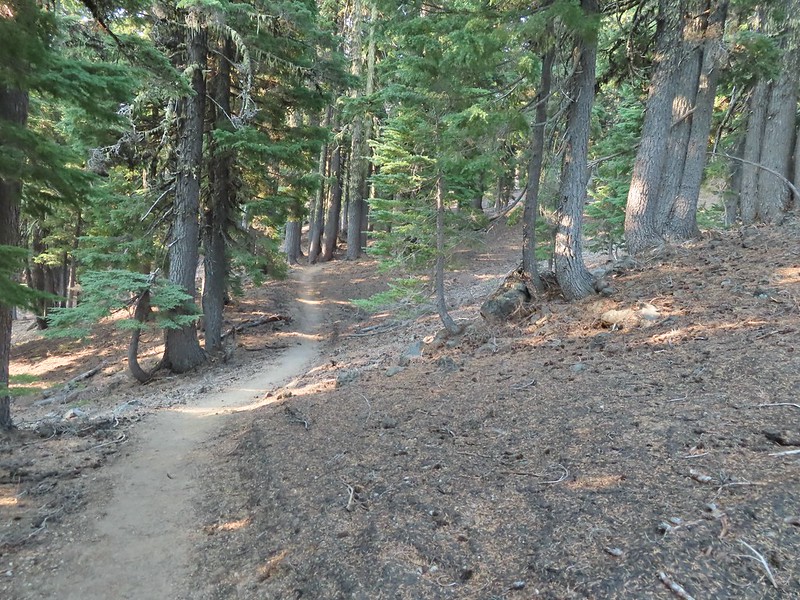
IMG_1777The ski runs gave us a good look at the top of the mountain.
IMG_1779

IMG_1786

IMG_1792Turning uphill

IMG_1793Spotted a grouse hen and her chicks in this little meadow.

IMG_1797

IMG_1807Two of the chicks.

IMG_1812Passing under the Sunrise lift.

The first 1.4 miles had gained under 350′ but after turning uphill the trail steepened gaining almost 2400′ over the next 2.5 miles.
IMG_1816

IMG_1817Nearing the top of the Sunrise lift.

IMG_1818Another hazy look at the nearby mountains.

IMG_1819South and Middle Sister through the haze.

IMG_1823The top of Sunrise and the bottom of the Summit lifts.
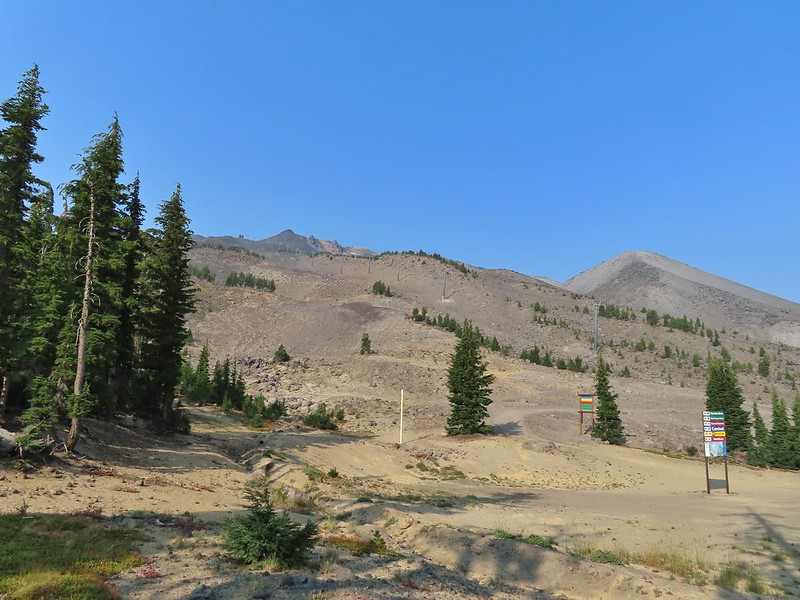
IMG_1824Looking up from the top of Sunrise.

Above the Sunrise lift the trees thinned out leaving a few scattered trees including white bark pines.
IMG_1826

IMG_1828

IMG_1831

IMG_1832A few saxifrage blossoms still left.

IMG_1834

IMG_1841Alpine buckwheat and paintbrush

IMG_1846The first patch of snow we passed.

IMG_1848Golden mantled ground squirrel

IMG_1850Tumalo Mountain (post) in the haze.

Signs gave way to white arrows painted on rocks at the higher elevations.
IMG_1858

IMG_1861Looking down from beneath the Summit Express.
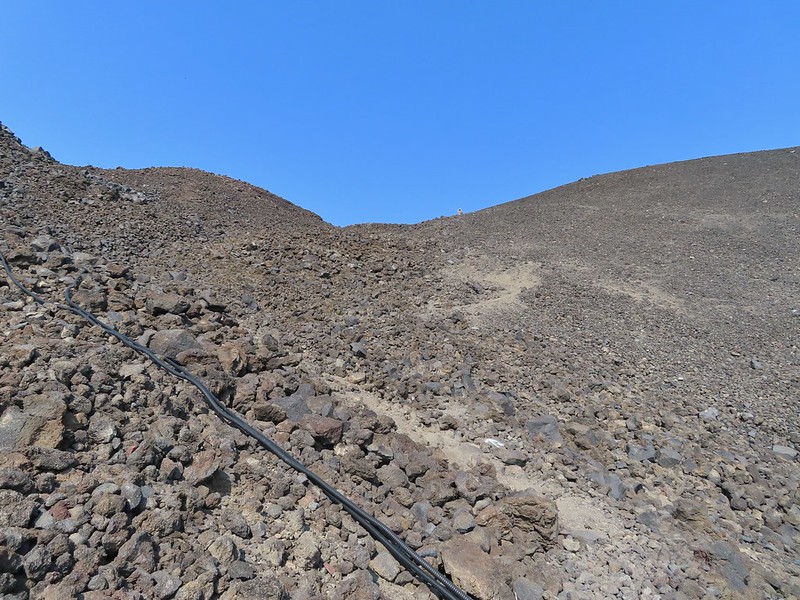
IMG_1863We could really feel the elevation affecting our breathing and by this point we were both sucking wind.

IMG_1864Dwarf alpinegold

I arrived at the summit first and followed the path the the mountain’s high point.
IMG_1869Looking back at the Summit Express.

IMG_1871Heading for the high point.

IMG_1878

IMG_1882A mountain bluebird near the summit.

IMG_1887South Sister and Broken Top with Sparks Lake (post) the brown patch below.

I took my pack off and had a seat and was soon joined by a curious golden mantle.
IMG_1892

IMG_1895

IMG_1896It’s our rule not to feed the wildlife but it was obvious that many don’t adhere to that LNT principle. I had to put my pack back on to avoid having a hole chewed through my pocket.

IMG_1901View of the summit.

The surrounding smoke made it impossible to see anything to the east, very little to the south or west and just the closest features to the north, but a cool breeze made it a comfortable spot for a rest while I waited for Heather to join me.
IMG_1899Broken Top, the Pine Marten Lodge halfway up the mountain, the West Village Lodge and parking area below and Tumalo Mountain across the Cascade Lakes Highway.

After Heather had a chance to relax at the summit as well we headed back down taking a short detour to a viewpoint above the Cirque.
IMG_1917

IMG_1918

We then hiked back down just above the Sunrise Lift where we turned left on the West Village Getback road which I could picture skiing on all those years ago.
IMG_1931A little better view of Broken Top and Tumalo Mountain on the way down.

IMG_1935Clark’s nutcracker

IMG_1940

IMG_1941

IMG_1942Left leads up to the Pine Marten Lodge atop the Pine Marten Express, right to the West Village Lodge.
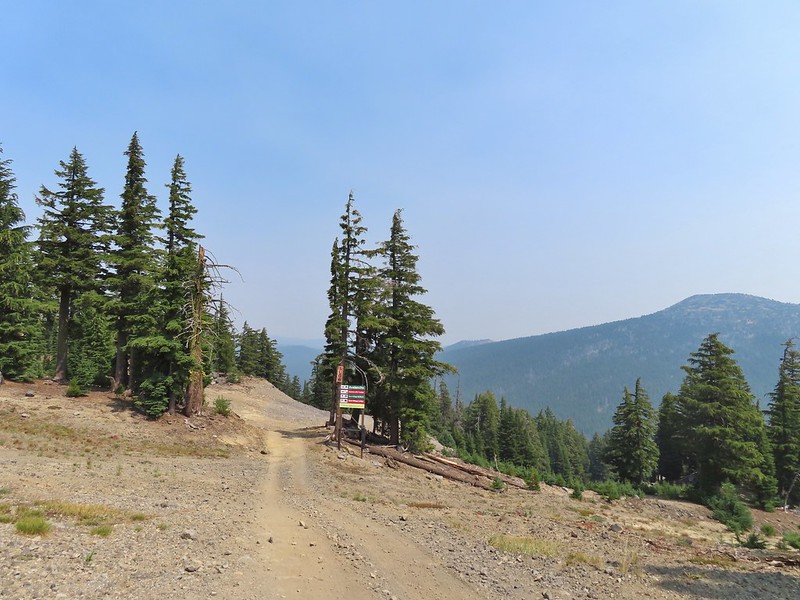
The road walk is not only not as scenic as the trail route we took up it also passes through the mountain bike trails so we had to keep our eyes open at the crossings.
IMG_1944

IMG_1945A decent look at Tumalo Mountain

IMG_1948Warning sign for a bike crossing.

IMG_1949A look at some of the mountain bike trails and some haze moving in overhead.
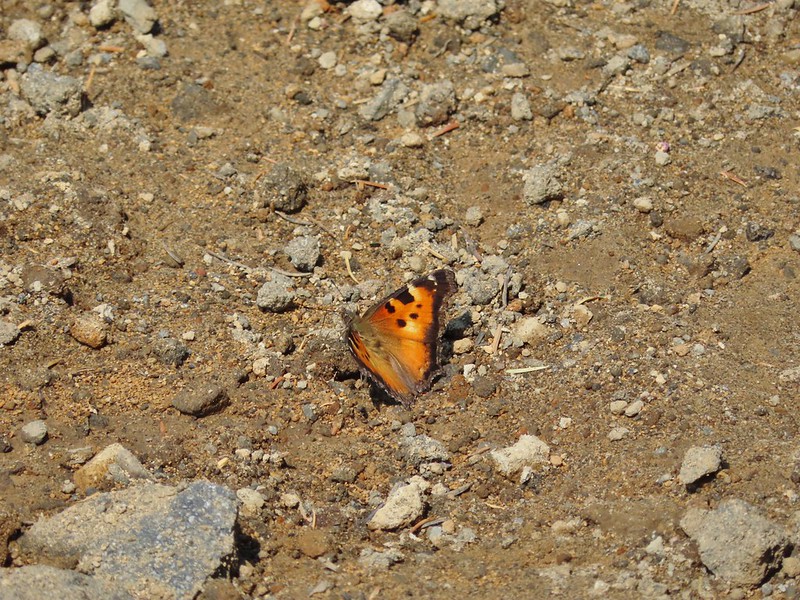
IMG_1959A tortoiseshell butterfly on the road.

IMG_1963

The trail map showed this route passing under the Pine Marten Express and turning 90 degrees downhill alongside the lift.
IMG_1964

There was a disc golf hole here but no sign of any trail except for a faint line continuing straight ahead through some grass. We followed it briefly before realizing it wasn’t going to get us to the parking lot.
IMG_1965At least we could see the mountains a little better from here.

We turned back to the lift and headed cross country downhill alongside it. We eventually did find some tread which took us to the base of the lift and back to the parking lot. We were glad we’d gotten there as early as we had because it was now quite a bit hazier overhead and a lot warmer.
IMG_1966

We left the mountain and drove to Heather’s parents house where we spent the night before once again heading out early for another adventure. Happy Trails!

Our track for Mt. Bachelor. The GPS said 8.8 miles and 2800′ of elevation but the resort lists the hike as 6.5 miles and 2742′ of elevation gain.

Flickr: Mt. Bachelor

Categories
High Cascades Hiking Mt. Jefferson Area Oregon Trip report

Pika and Fir Lakes – 07/24/2021

After a week of hiking in the John Day area we had stopped in Bend on our way home Friday to visit Heather’s parents. Saturday morning we headed to Salem but stopped first for a short hike to Pika and Fir Lakes in the Willamette National Forest. The hike starts at the Pika-Fir Trailhead which is currently one of the trailheads in the Central Cascades that does not require any Central Cascades Wilderness Permits as the trail and lakes are outside of the Mt. Jefferson Wilderness. (You would however need an overnight permit if you were try continue off trail into the wilderness to stay overnight.)
IMG_1284

We picked this trail because it was on our way back to Salem, we hadn’t been here before, and it was nice and short. The trail itself is about a mile long passing Pika Lake and ending at Fir Lake and after averaging just over 12 miles a hike for the previous five days a short hike sounded nice. We were also in a bit of a hurry to get home to see our cat Hazel who we were going to have to say goodbye to soon (post).

The trail passed through a nice green forest with some bigger trees, a very different sight than the hikes we’d taken in Central Oregon that week.
IMG_1286

IMG_1292

IMG_1294

A little bit of up and down brought us to Pika Lake in just half a mile.
IMG_1298

IMG_1300

20210724_064844

We walked a short way around the SE side of the little lake before returning to the trail and continuing to Fir Lake which was just 0.4 miles away.
IMG_1307

IMG_1308Unnamed lakelet/pond between Pika and Fir Lakes.
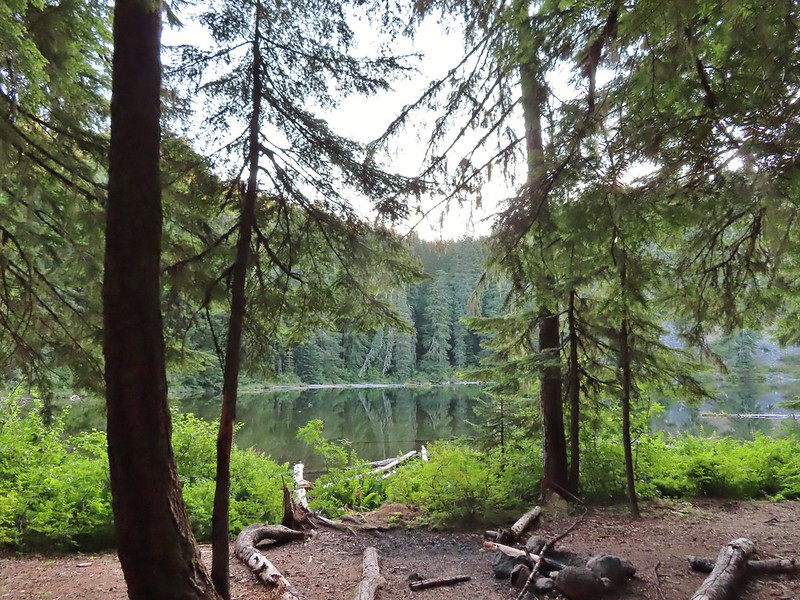
IMG_1310

IMG_1312Fir Lake

IMG_1313Goldeneyes

We again explored a little of the lake shore before turning around and returning to the car.
IMG_1316

IMG_1317

IMG_1324

IMG_1323

This was a quick hike which we managed to make 2.5 miles by exploring some of the lake shores. There were several camp sites at the lakes which would be good options for folks with young kids for some early backpacking trips.

Track for Pika & Fir Lakes

With our hikes now completed we drove home to spend the rest of the weekend with Hazelnut before having to say our final goodbyes. It was a bitter sweet ending to what was otherwise a good vacation. Happy Trails!

Flickr: Pika and Fir Lakes

Categories
High Cascades Hiking Oregon Three Sisters Area Trip report

Rainbow Falls and Substitute Point – 07/04/2021

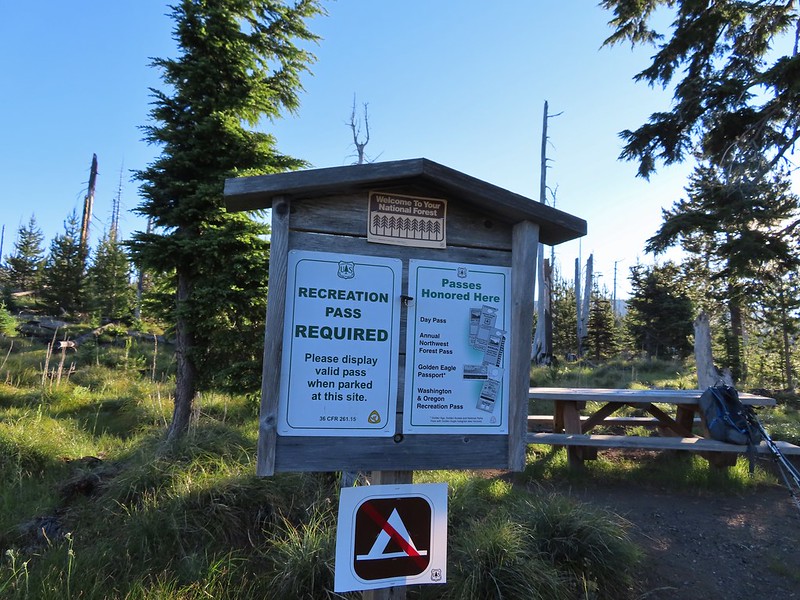
For the Fourth of July we typically pick a hike in the Old Cascades but this year we aimed higher and headed for the Three Sisters Wilderness in the High Cascades. We had two stops planned, a short hike on the Rainbow Falls Trail to the viewpoint of distant Rainbow Falls and a longer hike on the Foley Ridge Trail to Substitute Point. We stopped first at the Rainbow Falls Trailhead since it is right off Foley Ridge Road (FR 2643) on the way to the Foley Ridge Trailhead. Neither of these trailheads currently require a Central Cascades Wilderness Permit for day hikes (you are required to fill out a free self-issued permit at each TH though).
IMG_9616

The first half mile of the trail follows an old road bed to a former trailhead.
IMG_9623

IMG_9624

We continued along the trail entering the Three Sisters Wilderness before turning along the edge of the steep hillside high above Separation Creek (post)
IMG_9629

IMG_9632One of two phantom orchids we saw along the trail.

IMG_9633Newish looking wilderness sign.

IMG_9634Maples overhanging the trail.

IMG_9635

IMG_9642Madrone trunks

A little under 1.5 miles from the TH we arrived at a rock fin where a short scramble led to a view of distant Rainbow Falls. It was just after 8am which wasn’t an ideal time due to the falls being to the east with the Sun directly behind and still low in the sky.
IMG_9644It’s a pretty narrow scramble so probably not for kids or those uncomfortable with heights.
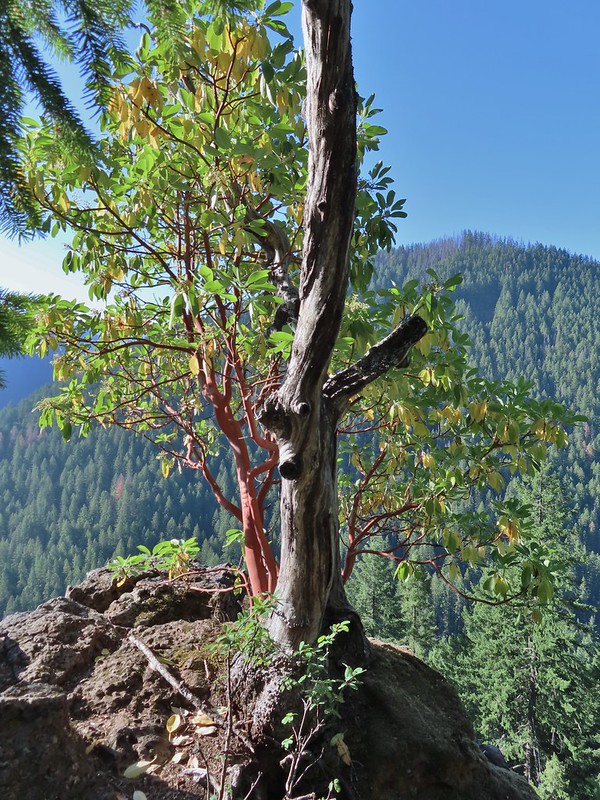
IMG_9645A lone madrone at the end of the fin.

IMG_9647Looking toward the falls. (The North Sister is back there too but not visible due to the lighting.)
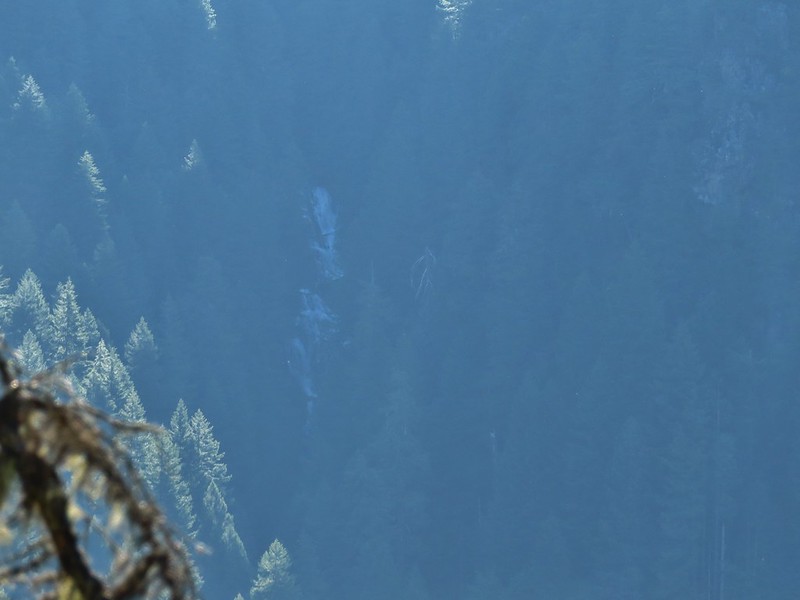
IMG_9654Rainbow Falls on Rainbow Creek

IMG_9651The best I could do with the lighting.

IMG_9652Looking up Separation Creek.

IMG_9658Looking back up along the rocks.

A use trail continued toward the falls, but as far as I know it’s not possible to reach them or to get a better view so we returned the way we’d come. From the Rainbow Falls Trailhead we then drove another 5 miles up FR 2643 to its end at the Foley Ridge Trailhead.
IMG_9661

The 8 mile long Foley Ridge Trail begins at the trailhead and leads into the Three Sisters Wilderness were it eventually ends at the Pacific Crest Trail. We had been on the upper end of the trail twice, once on a backpacking trip around the South Sister (post) and the other another backpacking trip where we explored some of the areas waterfalls (post). Today’s plan was to hike the first 4.5 or so miles of the trail to the Substitute Point Trail and then follow that 0.7 mile trail to a former lookout site atop Substitute Point. We were looking forward to the view atop the point but also interested to see what the area looked like after being hit hard by wildfires in 2017.

The first mile and half of the trail was unaffected by the fire and hosted a few blooming rhododendron and other woodland flowers.
IMG_9663

IMG_9666Pink pyrola

IMG_9669Crossing of Gold Creek which was nearly dry but it hosted a fair number of mosquitos.
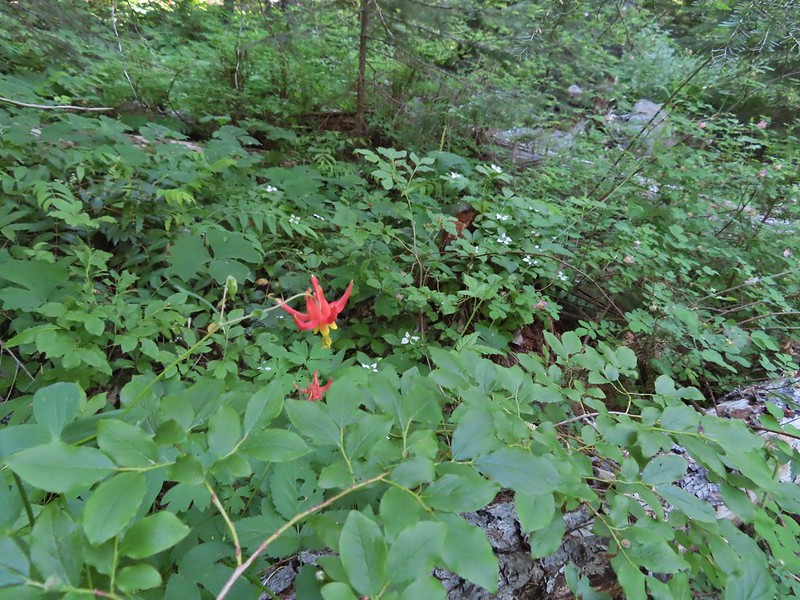
IMG_9671Columbine, bunchberry, and wild roses.

IMG_9672An anemone with some bunchberries

IMG_9674Entering the Three Sisters Wilderness

IMG_9675Queen’s cup

IMG_9680Beargrass

20210704_091724Candy sticks

IMG_9684Rhododendron

IMG_9691Pacific coralroot

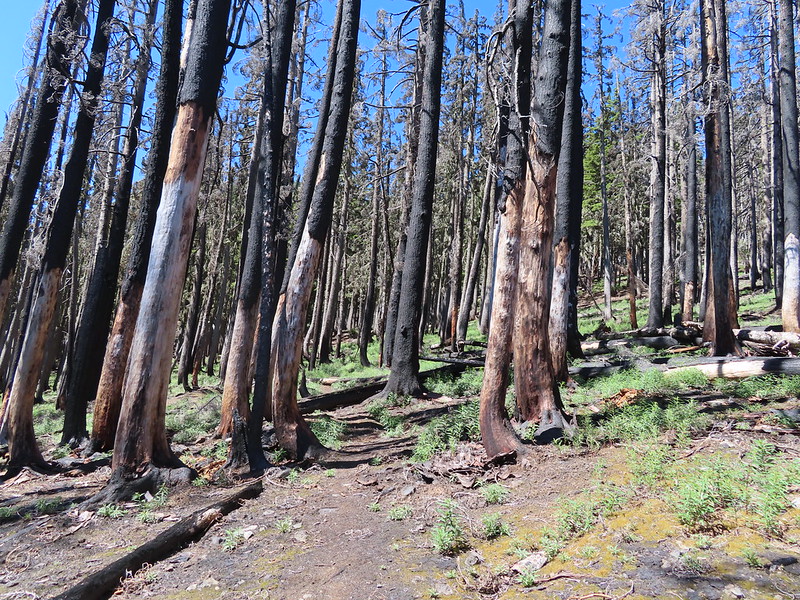
We soon found ourselves in the fire scar which at least lessened the number of mosquitos greatly.
IMG_9692

The 2017 Separation Fire was started by lighting in August along with dozens of others. The fire became part of the Horse Creek Complex which burned something in the neighborhood of 30,000 acres. It was the same year as the Eagle Creek and Whitewater fires making 2017 a really bad year for great hiking areas. Nearly four years later signs of the slow recovery could be seen in the form of wildflowers and small trees.
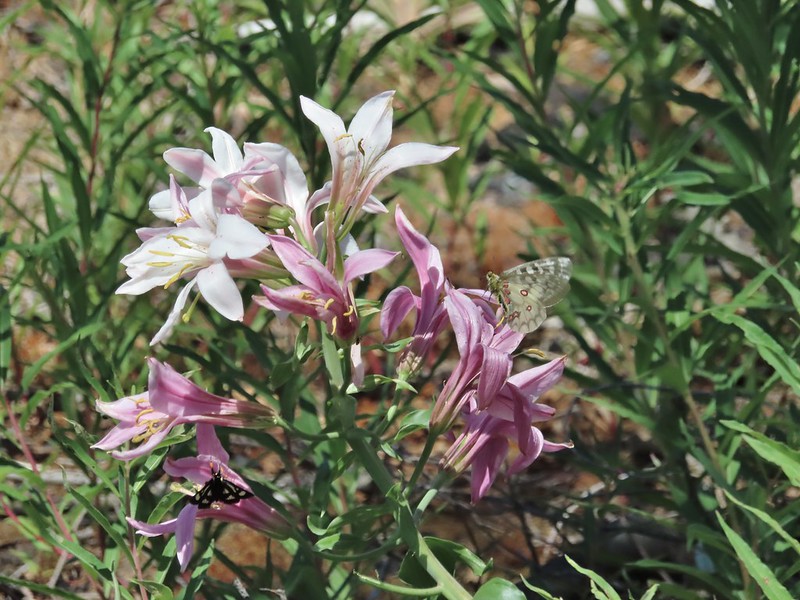
IMG_9693Washington lily

IMG_9695Lupine

IMG_9697Squirrel

IMG_9698

IMG_9702Tiger lily

The trail briefly entered an area of older trees that had fared a little better during the fire.
IMG_9712

IMG_9715Twinflower

IMG_9726Leaving the green trees behind.

The trail climbed gently which allowed us to fully appreciate the wildlife and wildflowers, in particular some really impressive Washington lilies.
IMG_9728Washington lilies

IMG_9739

IMG_9736They smell as good as they look too!

IMG_9743This one was a monster.

20210704_134302_HDRChest high

IMG_9745Crab spider on the lower left petal.

IMG_9749Penstemon

IMG_9756Earlier in the week I had been reading that the blossoms turn pink after being pollinated.

IMG_9760Clodius parnassian

IMG_9765Pretty moth

IMG_9767Penstemon

IMG_9776Woodpecker

IMG_9778Pond along the trail.

IMG_9782Water lilies

The trail began to level off as it passed between Proxy Point on the left and Substitute Point on the right. With the trees being burnt we had a good view of the rocky Proxy Point but the angle of the hillside below Substitute Point kept it hidden. Also visible was The Husband further ahead to the East.
IMG_9791Looking toward Proxy Point

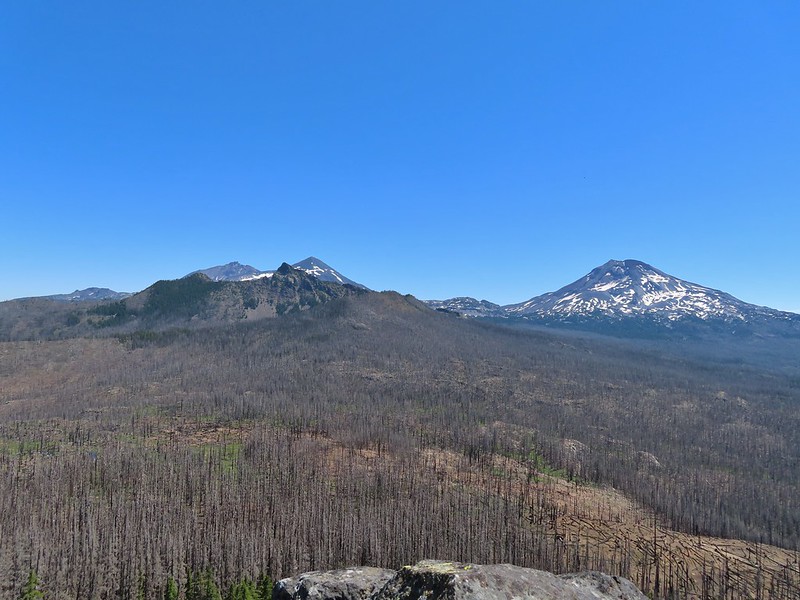
IMG_9790The Husband, South Sister, and the shoulder of Substitute Point.

IMG_9801Frog along the trail.

The trail curved around the base of Substitute Point where we got a view of Three Fingered Jack and Mt. Jefferson.
IMG_9805Proxy Point, Scott Mountain (post), Three Fingered Jack and Mt. Jefferson

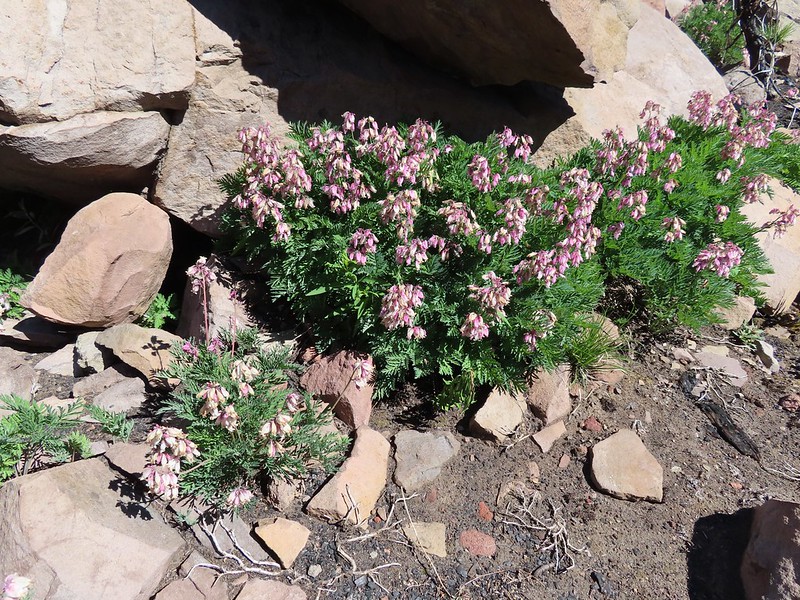
IMG_9808Bleeding heart

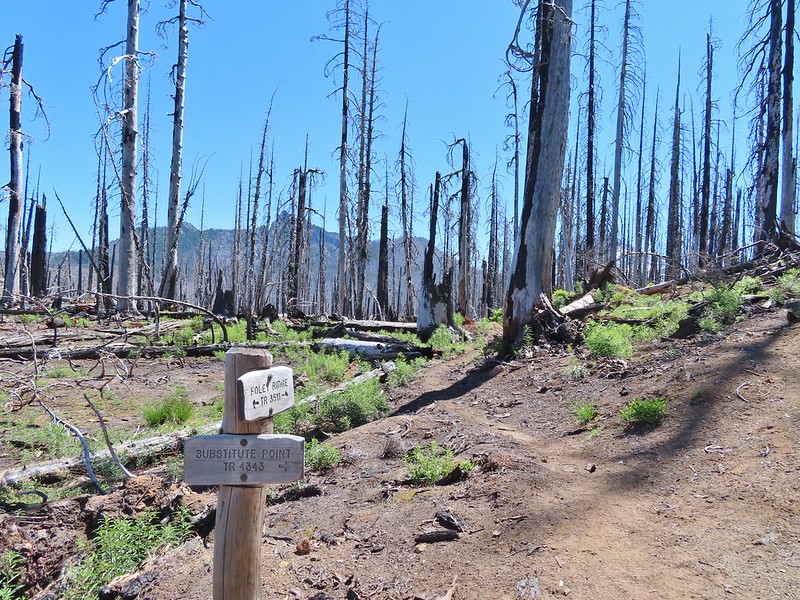
We came to the junction with the Substitute Point on its NE side.
IMG_9813The Husband from the junction.

The Substitute Point Trail didn’t appear to have been maintained, possibly since the fire, but it was easy enough to follow as it headed uphill.
IMG_9815

IMG_9824

IMG_9825This was sort of a mean trick, the trail entered these green trees then almost immediately switched back into the burn.
IMG_9826

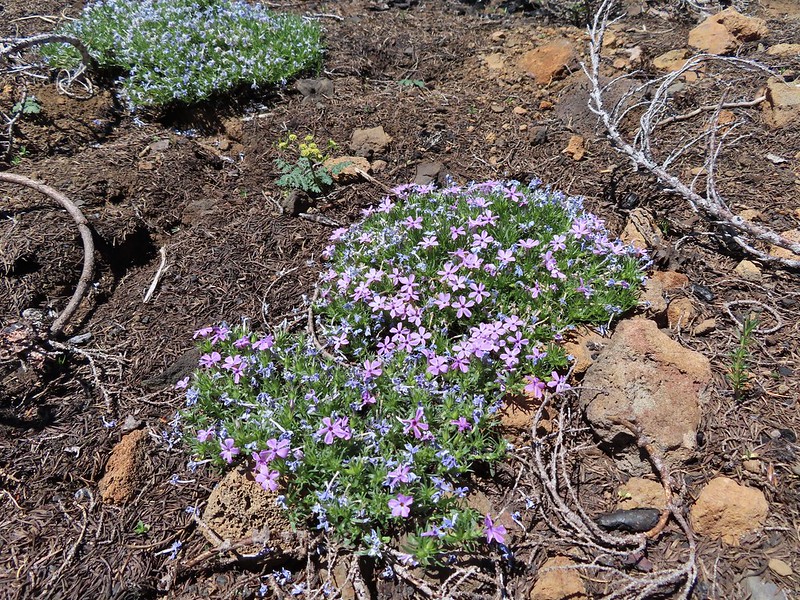
IMG_9828Phlox

The climb wasn’t particularly steep until the end as it approached the rocky spire where a lookout once sat. As we approached it was hard to believe there was a trail to the top.
IMG_9831

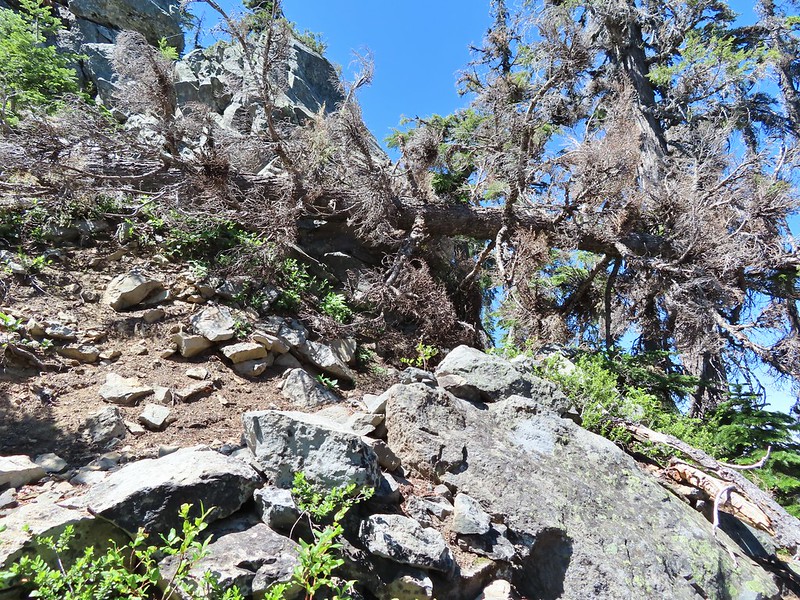
There was in fact a nice trail that wound up the west side, although a single downed tree did require a hands and knees crawl along the way.
IMG_9836

IMG_9840

IMG_9838Mt. Bachelor from the trail.

IMG_9841Proxy Point

IMG_9843Some unburned forest and a view of Diamond Peak.

IMG_9844Diamond Peak (post)

IMG_9845The Little Brother and North & Middle Sister behind The Husband with South Sister to the right.
IMG_9917The trail leading up.

The view at the top was at the same time spectacular and sad. We could see that much of the area that we’d explored on our previous backpacking trips had been burned badly by the fires.
IMG_9851The summit of Substitute Point

IMG_9855Scott Mountain, Three Fingered Jack, Mt. Jefferson, Mt. Washington, and Belknap Crater (post).

IMG_9861Proxy Point and Scott Mountain.

IMG_9869The Three Sisters, Little Brother and The Husband
IMG_9863Mt. Bachelor, The Wife, and Sphinx Butte.
IMG_9865Kidney Lake

img src=”https://live.staticflickr.com/65535/51292219058_ec3f2f67bc_c.jpg” width=”800″ height=”600″ alt=”IMG_9866″>South Sister

IMG_9877Mt. Bachelor and The Wife

IMG_9868North and Middle Sister behind The Husband

IMG_9872Three Fingered Jack, Mt. Jefferson and Mt. Washington
We took a nice long break at the top watching butterflies soar around us.
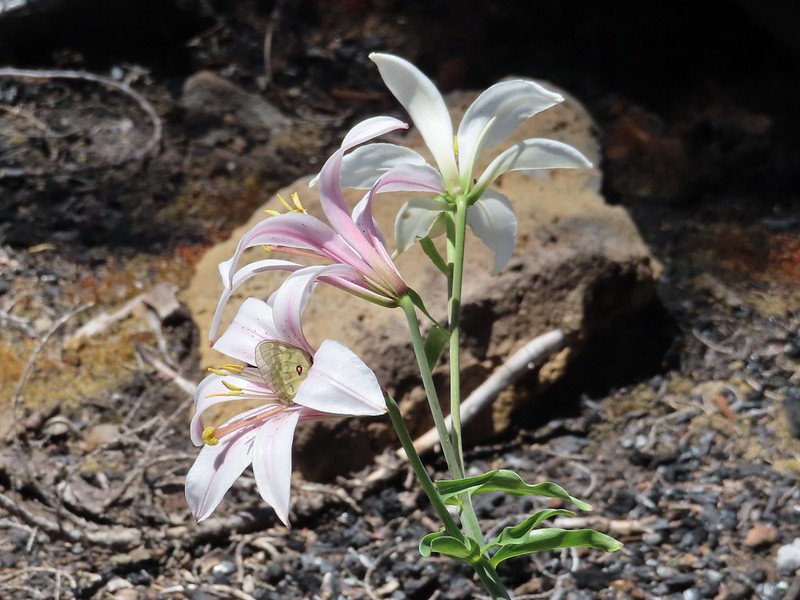
A swallowtail and two whites (maybe clodius parnassians) in flight.
After our break we headed back. We’d had the hike to ourselves but were now passing a handful of hikers heading up the trail. We stopped a few times to watch butterflies (in hopes they would land) and to smell the occasional lily.
IMG_9931Clodius parnassian in a blossom.

IMG_9933Moth and a parnassian.

The hike here came to 10.3 miles with 2000′ of relatively gentle elevation gain. With the 2.8 miles we did at Rainbow Falls it came to a 13.1 mile day and a great way to spend the 4th of July.

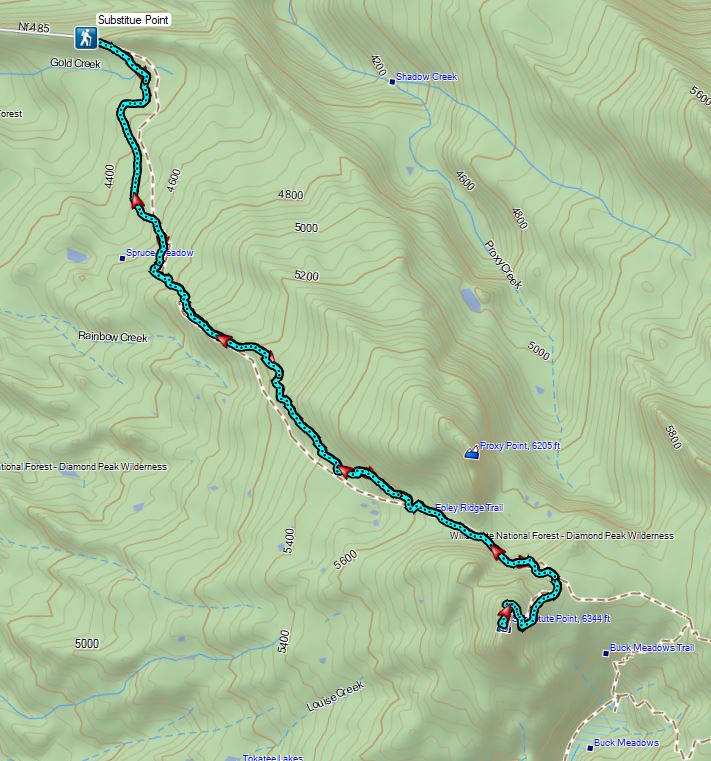
Track for Substitute Point

While we were sorry to see how badly much of the area was burned it was encouraging to see the trails were in relatively good shape and that there was new growth coming. We fear that hiking in recently burned forest is only going to become more common in the years to come but hike we will. Happy Trails!

Flickr: Rainbow Falls and Substitute Point

Categories
High Cascades Hiking Mt. Jefferson Area Oregon Trip report

Berley and Santiam Lakes- 07/03/2021

For the Fourth of July weekend we had originally planned on a trip to Central Oregon but the drought conditions that were exasperated by the recent heat wave had us reconsidering not being home to guard against rogue illegal fireworks (a house in our neighborhood lost a fence and tree last year on the 4th). Our decision was made final when, following the heat wave, mostly dry thunder storms passed over the Ochoco Mountains where some of our hikes were planned. Lighting caused fires have kept firefighters busy since then as the race to contain the fires that are still cropping up from that storm system. We turned to Plan B, which was in part a modified Plan A, and spent the weekend hiking in the Central Cascades. On Saturday we stuck to our originally planned hike to Berley and Santiam Lakes but instead of continuing on to Bend afterward we drove back home.

This hike is covered in Matt Reeder’s “101 Hikes in the Majestic Mount Jefferson Region” and provided us an opportunity to revisit some places as well as discover some new ones. The hike starts at the Pacific Crest Trailhead along Highway 20 at Santiam Pass.
IMG_9238

IMG_9237

For now this is one of the trailheads where a Central Cascade Wilderness Day Use Permit is not required but a NW Forest Pass ($5/day or $30/annual) is, as well as completing a free self-issue permit. Note that for overnight trips a Central Cascade Wilderness Permit is needed for any visits to the Mt. Jefferson, Three Sisters or Mt. Washington Wilderness areas.
IMG_9239

We had started another hike here in October of 2012 when we hiked to the base of Three Fingered Jack then returned on a loop past Martin, Booth, and Square Lakes (post). We were interested to not only see the area during a different season but also to see what had changed in nearly 9 years. This was particularly interesting to us due to the area having been burned badly in the 2003 B&B Complex and this would give us an idea of how the forest was recovering. Given the huge swaths that were burned in the September 2020 wildfires this might give us a small frame of reference for what to expect for some of the areas. The first thing that we noticed was that post fire trees seemed larger than we remembered which was confirmed by comparing some pictures of the Pacific Crest Trail junction with the Old Summit Trail 0.2 miles from the trailhead.
Pacific Crest TrailTrail sign at the junction on 10/13/2012.
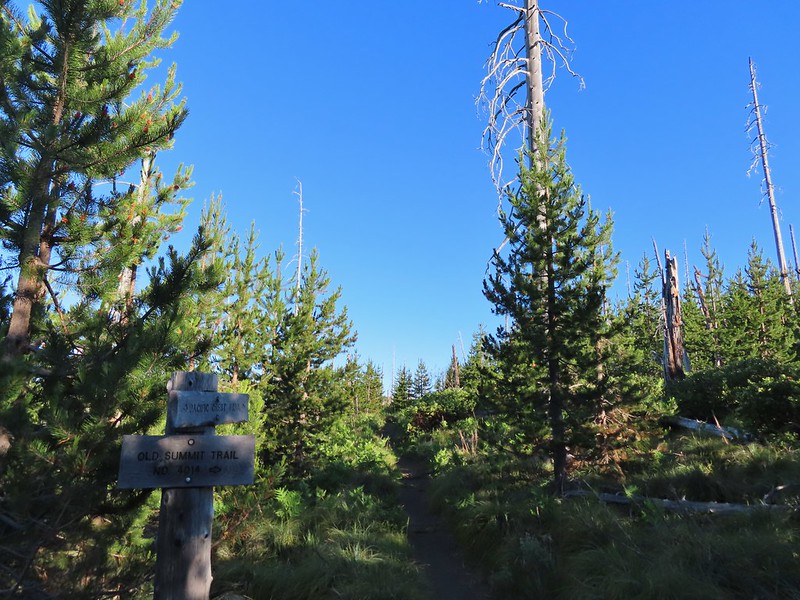
IMG_9248Trail sign at the junction on 07/03/2021.

What we didn’t really notice though was just how many of the snags were now missing.
Entering the Mt. Jefferson Wilderness on the Pacific Crest TrailEntering the Mt. Jefferson Wilderness in 2012 (0.3 miles from the TH).
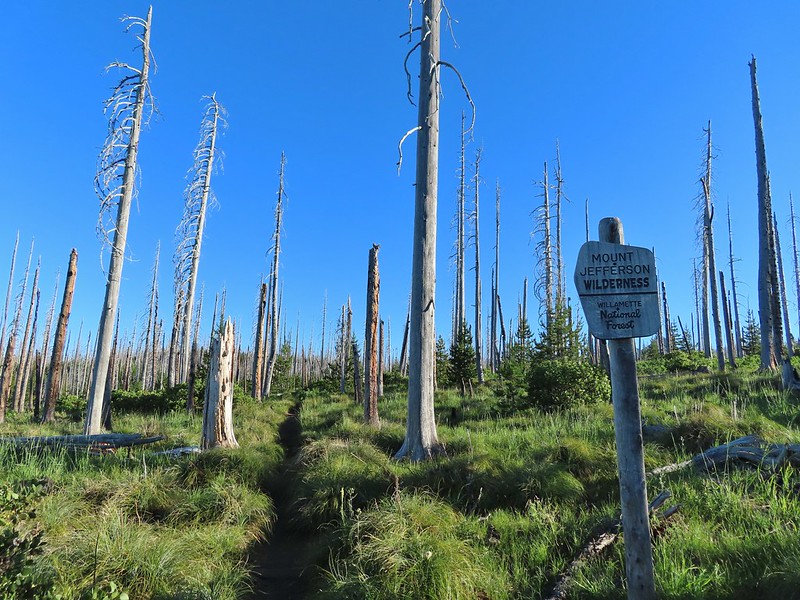
IMG_9255Entering the wilderness in 2021.

We followed the PCT a total of 1.2 miles to a junction with the Santiam Lake Trail. The view to the south was as spectacular as we had remembered with several Cascade Mountains in view along with several distinctive lesser peaks.
IMG_9275Cache Mountain, Black Crater (post), Tam McArthur Rim & Broken Top (post), North & Middle Sister, Mt. Washington, and Hayrick Butte (flat top on the right).
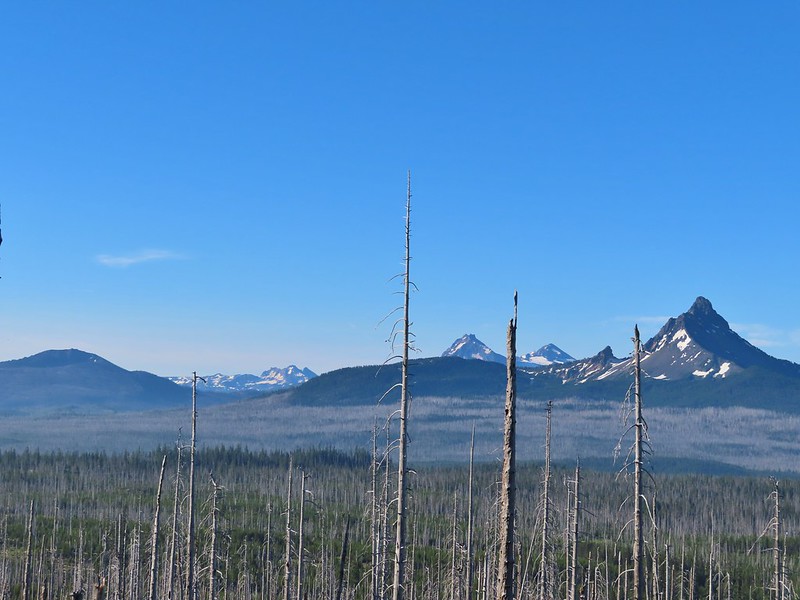
IMG_9278

To the north the top of Three Fingered Jack was occasionally visible.
IMG_9286

There were a few more flowers in bloom now than there had been in October.
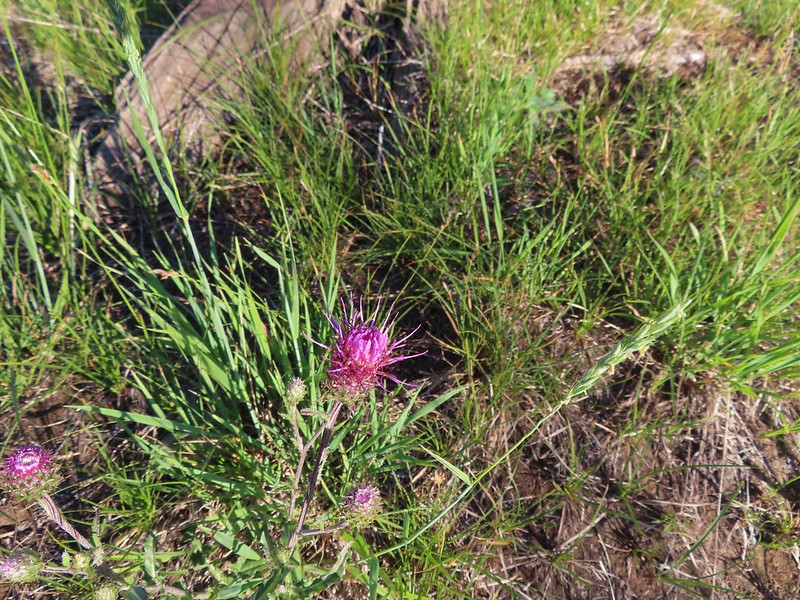
IMG_9258A thistle

IMG_9273Penstemon

IMG_9274Bleeding heart

IMG_9281Pussytoes

IMG_9285California stickseed

IMG_9293Another penstemon

Shortly after passing a small unnamed lake we arrived at the junction.
IMG_9287

IMG_9295Mountain bluebird by the lake.

IMG_9300

We turned left onto the Santiam Lake Trail at the junction striking off on new to us trail. The Santiam Lake Trail headed slightly downhill to the north passing a series of small ponds/lakes before making a sweeping turn to the west then meeting up with the now abandoned Santiam Lodge Trail (coming uphill on the left) one mile from the PCT.
IMG_9303

IMG_9304There was a good amount of scarlet gilia blooming along this section of trail.
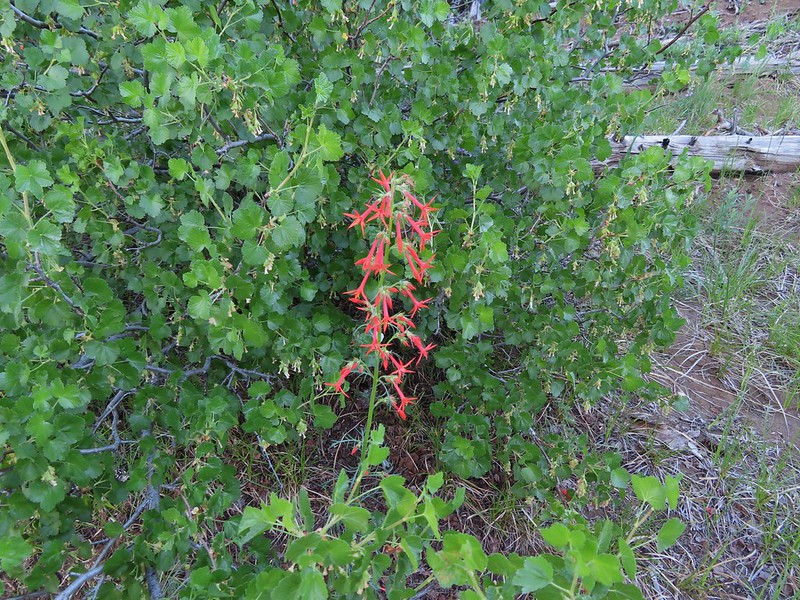
IMG_9307

IMG_9310Three Fingered Jack

IMG_9313One of the ponds.

IMG_9315Queen’s cup

IMG_9316Another pond with Maxwell Butte (post) behind to the right.

IMG_9319Unnamed lake along the trail with Maxwell Butte behind.

IMG_9327

IMG_9333Lupine

IMG_9340Dark-eyed junco

20210703_075615Sub-alpine mariposa lilies

IMG_9348Woodpecker

IMG_9357The view south.

IMG_9357Seasonal pond

A half mile beyond the abandoned trail (there was part of a sign still hanging, partially hidden on a tree) we came to an unsigned fork.
IMG_9544

We admittedly hadn’t read Matt’s hike description recently and had conveniently forgotten that there were no maintained trails to the Berley Lakes and this unmarked fork was where he would have had us turn. It wasn’t shown on the GPS map and since we hadn’t bothered to re-familiarize ourselves with the hike we continued on the Santiam Lake Trail but were still looking for the trail to Berley Lakes.
IMG_9360

We crossed the nearly dry bed of Lost Lake Creek (There was enough water around to host a healthy population of mosquitos though.) and continued through a meadow filled with lupine into some unburned forest.
IMG_9361

IMG_9363

IMG_9364

IMG_9373

IMG_9374Beargrass

The combined presence of the trees and more water in Lost Lake Creek (which the trail was now following) was a perfect recipe for even more mosquitos. We hustled along as quickly a possible to try and keep as much of our own blood as possible.
IMG_9377

IMG_9381Recent snow melt is another recipe for mosquitos.

IMG_9382Another creek crossing.

IMG_9383Shooting star

IMG_9386Mountain heather. Typically if we see this blooming we expect there to be mosquitos.
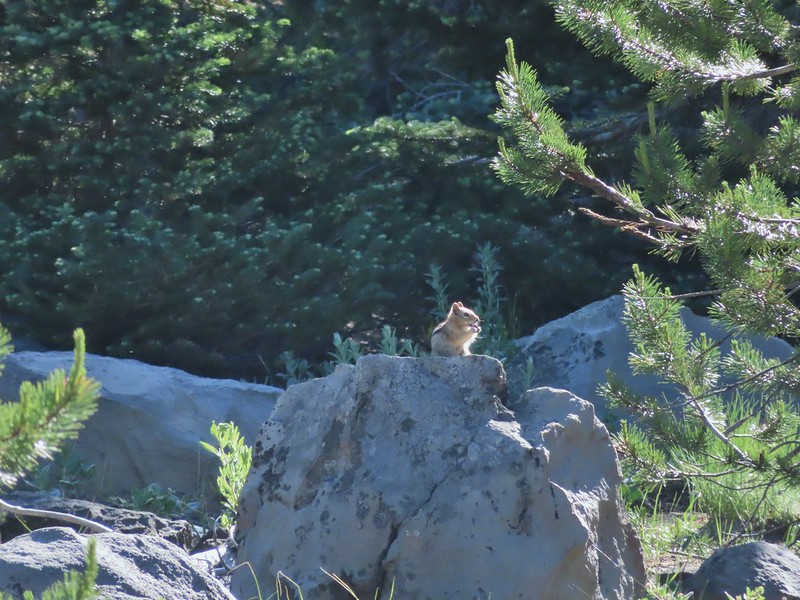
Fortunately the creek soon faded out in an open rocky landscape where the heat of the sun kept the buggers away and we were able to slow down a bit.
IMG_9390

IMG_9391

IMG_9396A sulphur

IMG_9397Alpine false dandelion

IMG_9406One of several snow patches at the tree line.
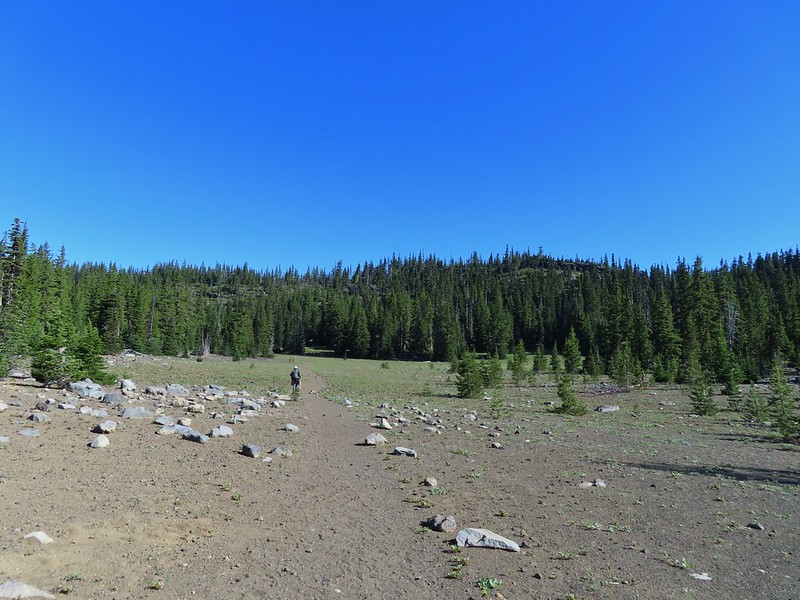
IMG_9401Nearing the end of the opening.

IMG_9412More snow in the trees.

IMG_9415A checkerspot

By the time we’d reached the open area it was obvious we had missed our turn and should have taken the fork we’d seen since we were now past the Berley Lakes. That was fine though as the original plan had been to visit those lakes first and hook up with the Santiam Lake Trail beyond Lower Berley Lake then continue on to Santiam Lake and return via the Santiam Lake Trail. Our new plan was to visit Santiam Lake then find the route to Lower Berley Lake, visit it, then check out Upper Berley Lake and return to the Santiam Lake Trail at the fork. Beyond the open plain the trail began a 250′ descent through more unburned forest to Santiam Lake.
IMG_9417

IMG_9419Trees & melting snow = more mosquitos.

IMG_9422Not Santiam Lake but a very pretty unnamed lake just to the left of the trail approximately 0.4 miles from Santiam Lake.
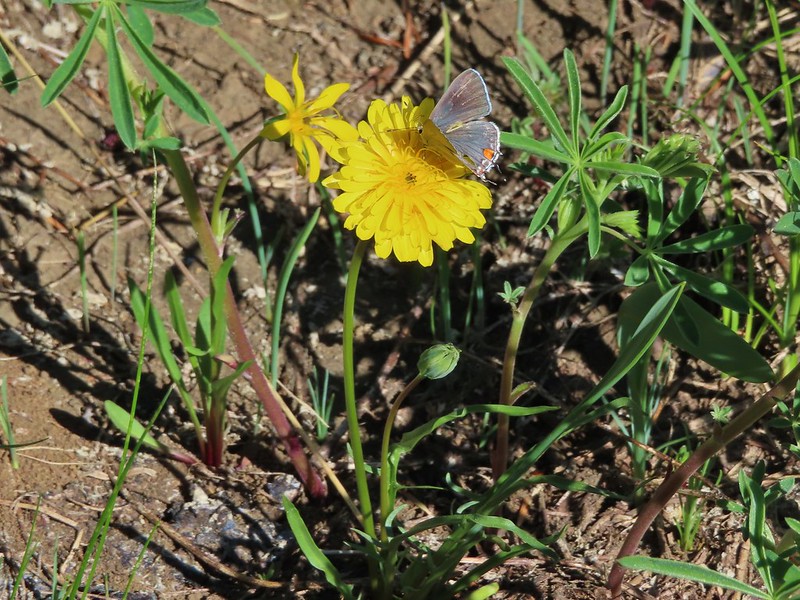
IMG_9424

IMG_9426Not sure what type this is but the orange on the wing was pretty.

We turned off the Santiam Lake Trail at a “No Campfires” sign and followed a familiar path down to the lake.
IMG_9429

It had been almost 11 years since we visited this lake. On our previous visit we had come up the Santiam Lake Trail from the Duffy Lake Trail (post).

IMG_9430Mt. Jefferson behind Red Butte

IMG_9437

IMG_9438Duffy Butte on the left.

IMG_9440Three Fingered Jack

IMG_9442Paintbrush, shooting stars, and buttercups.
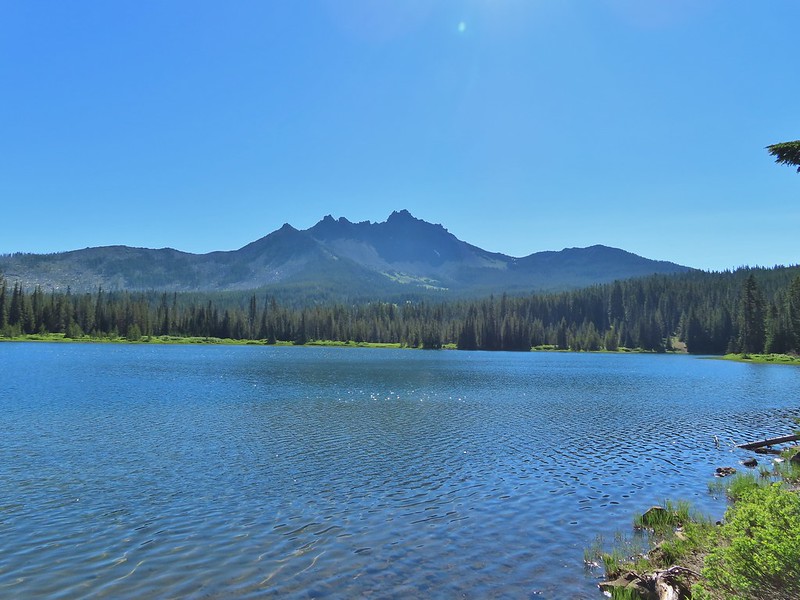
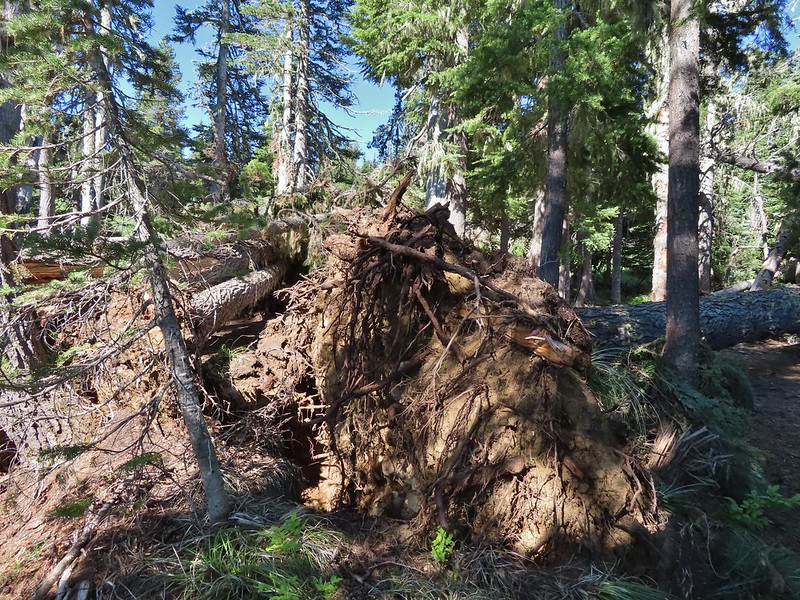
We set off to hike around the west side of the lake but we encountered quite a bit of recent blowdown and decided it was a little more trouble than it was worth.
IMG_9452

IMG_9451Just one of several large uprooted trees along the shore.
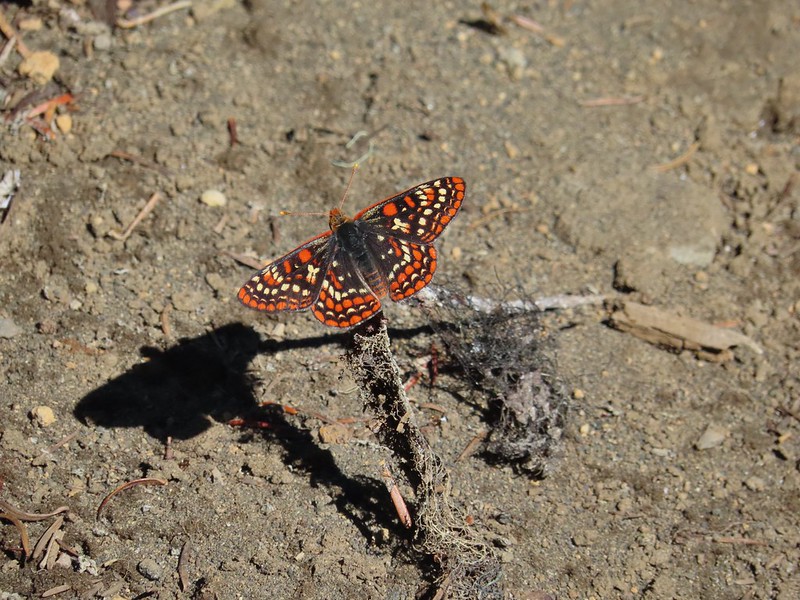
Taking a break along the shore and enjoying the view would have been nice but the mosquitos weren’t interested in letting us sit peacefully so when we came to the third bunch of downed trees we called it good and headed back for the Santiam Lake Trail. We followed it back to the open plain where the mosquitos hadn’t been bad and stopped to study the map in Reeder’s book (still weren’t smart enough to take the time to re-read it though) and we could see that from this end his track showed him heading for Lower Berley Lake just before a topographic feature. We made our way across the plain where butterflies were busy flying from plant to plant.
IMG_9467

IMG_9459

IMG_9470

IMG_9471The “topographic feature” ahead on the right where we planned on turning for Lower Berley Lake.
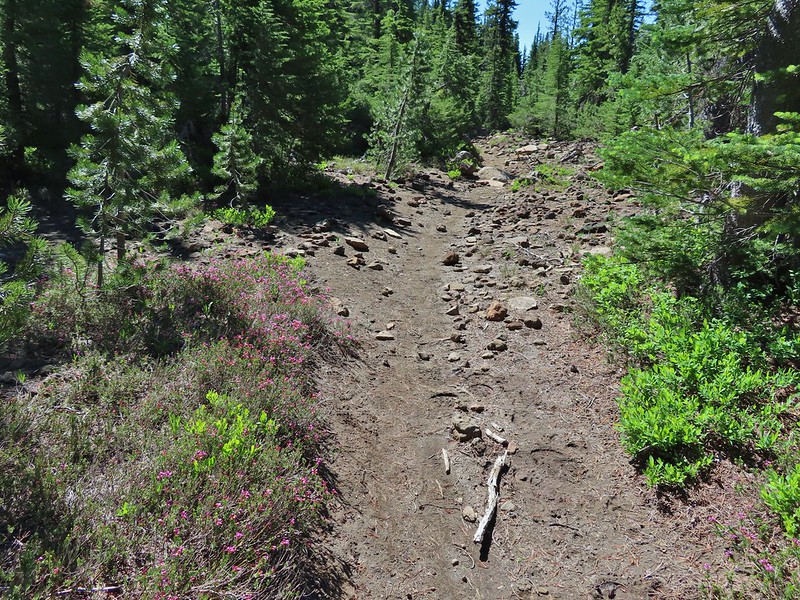
IMG_9473Mountain heather along the trail, it was warm and sunny enough that the mosquitos weren’t as bad this time by.
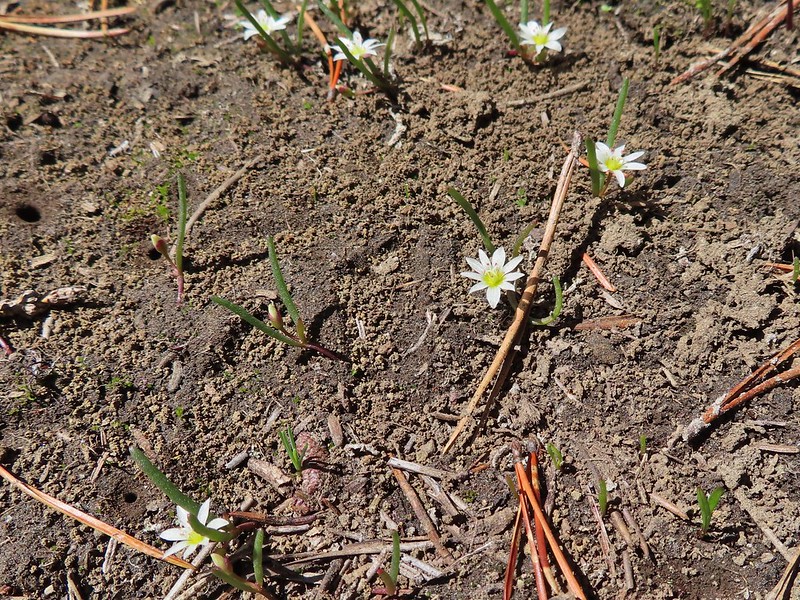
IMG_9475Threeleaf lewisia

IMG_9478Getting closer to the hill where we planned on turning.

IMG_9479California tortoiseshell butterflies in the bed of Lost Lake Creek.
Later when we finally did read the hike description Reeder mentioned a cairn marking a user trail but we didn’t notice any cairn (and admittedly may have turned too soon) but we spotted what appeared to be faint tread along a hillside above a dry stream bed and took a right onto it.
IMG_9480

IMG_9482

The track on the map showed the route on the south side of the lake but this trail was leading to the south side of Lower Berley Lake. It led past a couple of campsites to some rocks above the lake.
IMG_9483

IMG_9485

IMG_9484Three Fingered Jack from the rocks.

We picked our way down through the rocks to the lake shore and followed a user trail west until more downed tress forced us to climb back up above the rocks.
IMG_9487

IMG_9488

IMG_9493More tortoiseshells

IMG_9495A butterfly photo bomb

IMG_9498

Once we were back above the lake we came across what looked like another user trail leading away from it.
IMG_9503

We thought it might be a side trail to Upper Berley Lake so we turned right on it but soon realized that we were following a dry bed instead of a trail.
IMG_9504

IMG_9505The bed was popular with the butterflies.

A GPS check showed we were heading too much to the NNE and needed to be NNW so we left the bed and used the GPS units to find Upper Berley Lake, but not before startling a doe.
IMG_9508Cross country to Upper Berley Lake, the doe was in this meadow and headed in the direction of the patch of snow at the far end.

IMG_9510Upper Berley Lake

Reeder mentions a view of Three Fingered Jack from this lake as well but we were on the wrong side of it for that. The lake shore where we were was pretty thick with small trees so we would have needed to back track to make our way around for a view but we decided to save that for another time. We took a slightly more direct route back toward Lower Berley Lake and found what seemed to us a bit of a random Day Use Only sign.
IMG_9514We wound up finding the same “user trail” and followed it down to the lower lake.
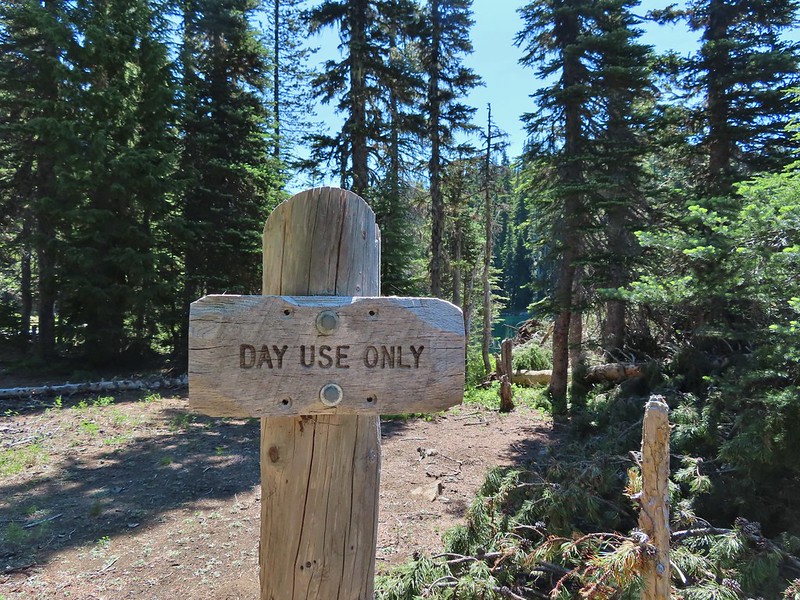
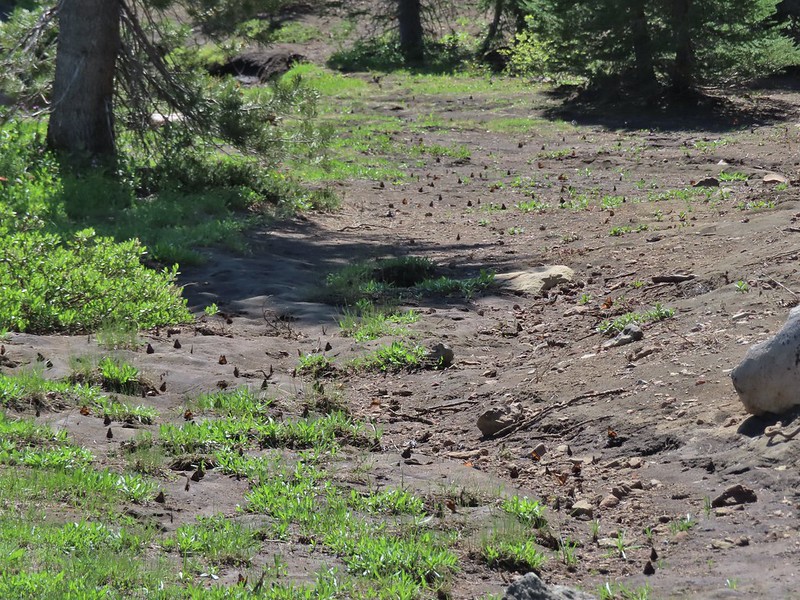
IMG_9516

What we could see was a clear trail heading south past the lake. We went down to the lake shore to see if we could pick something up since the track in the book showed it at the SW edge of the lake. We couldn’t make out any clear trail but that could have been because it was covered in butterflies.
IMG_9518California tortoiseshell butterflies along Lower Berley Lake.

IMG_9520Three Fingered Jack and about a half dozen butterflies.
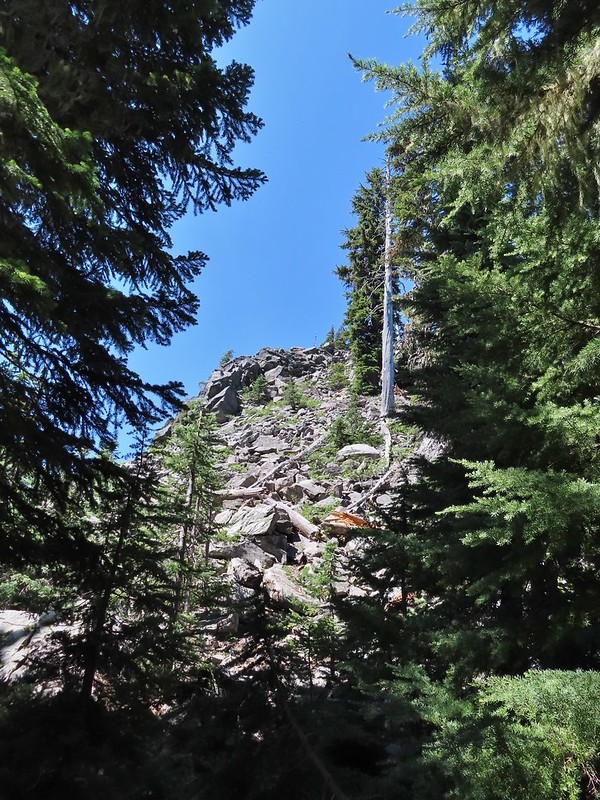
We did another comparison of the track in the guidebook and the topographic map on our GPS units and came to the conclusion that we were in the right spot and just needed to hike over a saddle between two hillsides. As we made our way up we found an obvious trail.
IMG_9524The hillside on the right was rocky.

IMG_9525The trail dropping down from the saddle with Mt. Washington and the North Sister ahead.

This trail was at times easy to follow and at others non-existent.
IMG_9527

IMG_9528

IMG_9531

Just under three quarters of a mile from Lower Berley Lake we ran into three hikers heading for the lake which we took as a good sign. Just a short distance later we came to the dry channel of Lost Lake Creek.
IMG_9533

It was hard to tell where the “trail” crossed or where it was on the far side. Reeder’s track showed the alignment converging with the Santiam Lake Trail at an gradual angle but we could see that we were only about a tenth of a mile from that trail as the crow flies so we abandoned all attempts at following the user trail. We headed straight for the Santiam Lake Trail and found it without much difficulty.
IMG_9534Found it!

We were a tenth or two of a mile from the actual junction which wound up working in our favor. We had rejoined the Santiam Lake Trail just north of the seasonal pond where there were now dozens of butterflies hanging out and this time they weren’t all the same types.
IMG_9535

IMG_9536

IMG_9539

IMG_9541

We made our way back to the PCT then followed it south back to the trailhead but not before stopping at a viewpoint for one last look at the mountains.
IMG_9571Yellow beetle on lupine.

IMG_9572Orange agoseris

IMG_9584Back at the PCT.

IMG_9588Bumble bees on penstemon.

IMG_9589Cicada in the grass.

IMG_9594Black Crater, Broken Top, North & Middle Sister, Mt. Washington, Hayrick Butte, and Hoodoo Butte from the viewpoint.

Three Fingered Jack from the viewpoint.

Track for our 12.9 mile, 1300′ elevation gain hike

After a great day of hiking we spent the evening with my Grandma and parents. It was a great start to the holiday weekend. Happy Trails!

Flickr: Berley & Santiam Lakes