Categories
Columbia River Gorge South Hiking Oregon Trip report

Memaloose Hills, Mosier Plateau, and Hood River Pipeline Trails – 5/01/22

We welcomed the month of May by kicking off our official hiking season. We took advantage of a one day window of dry weather and headed toward the eastern end of the Columbia River for a pair of short wildflower hikes near Mosier, OR followed by a third short stroll in Hood River along an old pipeline. During wildflower season sunny weekend days mean crowds so we got an extra early start and headed out the door a little before 5am hoping for a little solitude at least to start with.

We chose to start our morning at Memaloose Hills, the furthest east of our three stops and the most popular. We had visited the area in April of 2018 (post) when you could park at a rest area along Interstate 84. That is no longer allowed so we parked at the Memaloose Overlook along Highway 30 which is now the de-facto trailhead for the unofficial trails here.
IMG_8823

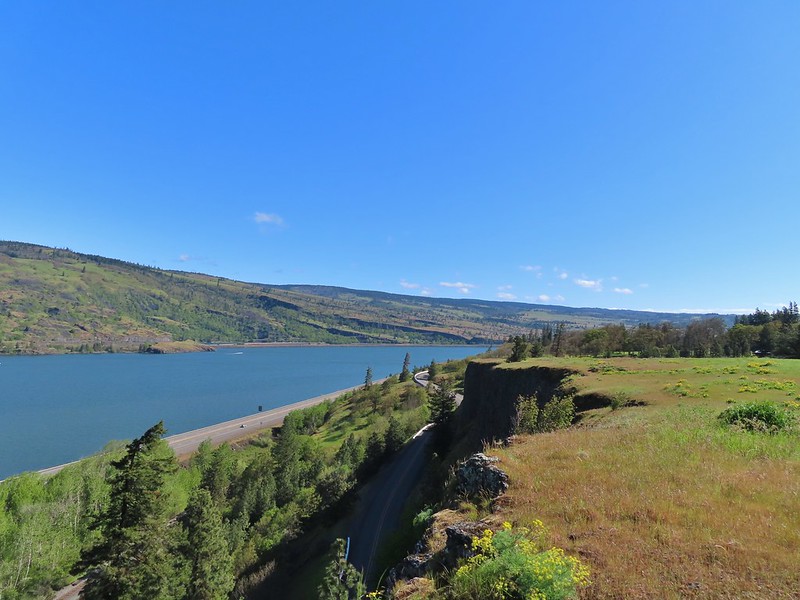
IMG_8826Looking west down the Columbia River from the overlook.
After a brief visit to the overlook we crossed the highway to pick up the well defined trail.
IMG_8828

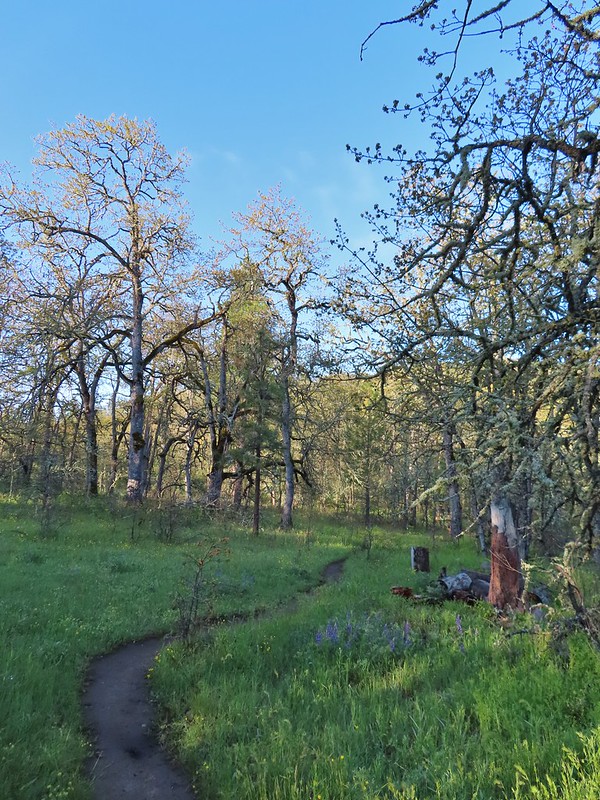
From the highway it was just under three quarters of a mile to a junction where the trail splits with the left hand fork climbing to the top of Marsh Hill and the right fork to Chatfield Hill. There are a few ups and downs along this stretch as the trail passes through oak woodlands before crossing a small creek just before the junction. We took our time admiring the wildflowers and to watch a pair of deer.
IMG_8831Naked broomrape and poison oak

IMG_8835Woodland stars

IMG_8842

IMG_8837Lupine

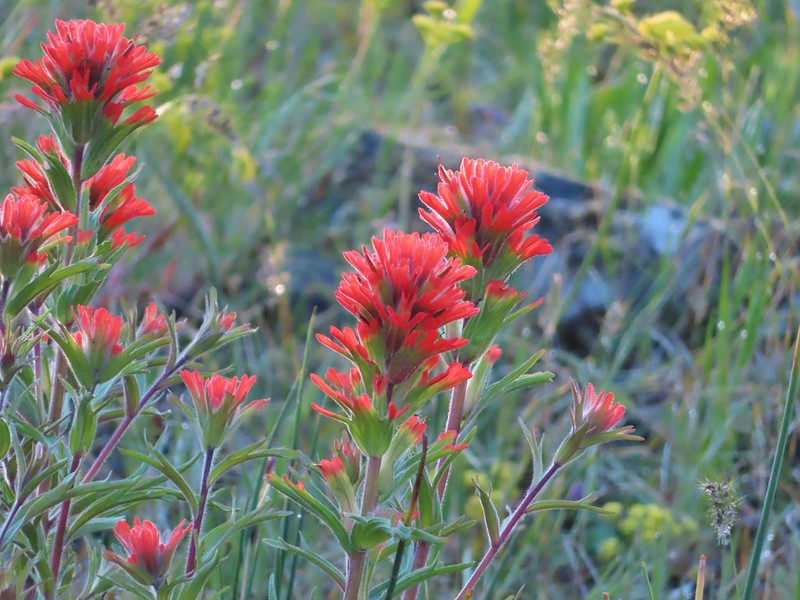
IMG_8848Paintbrush

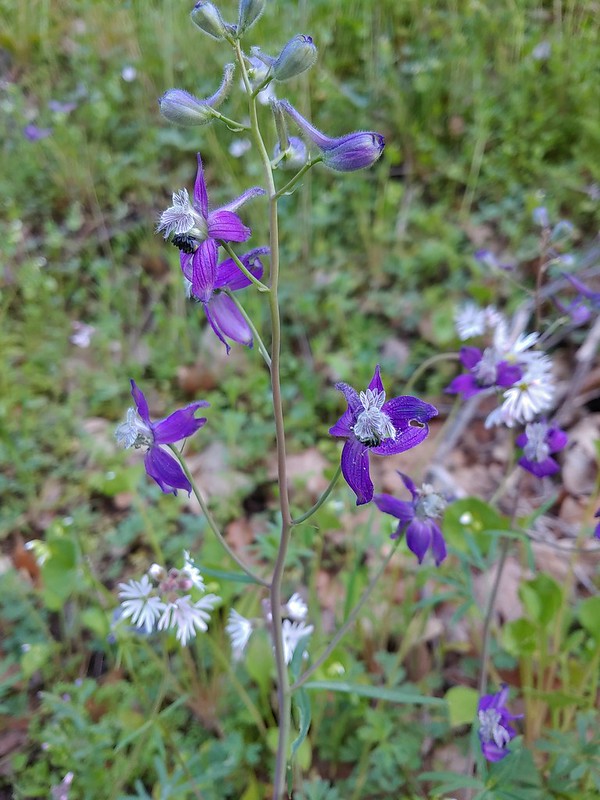
IMG_8855Larkspur and parsley

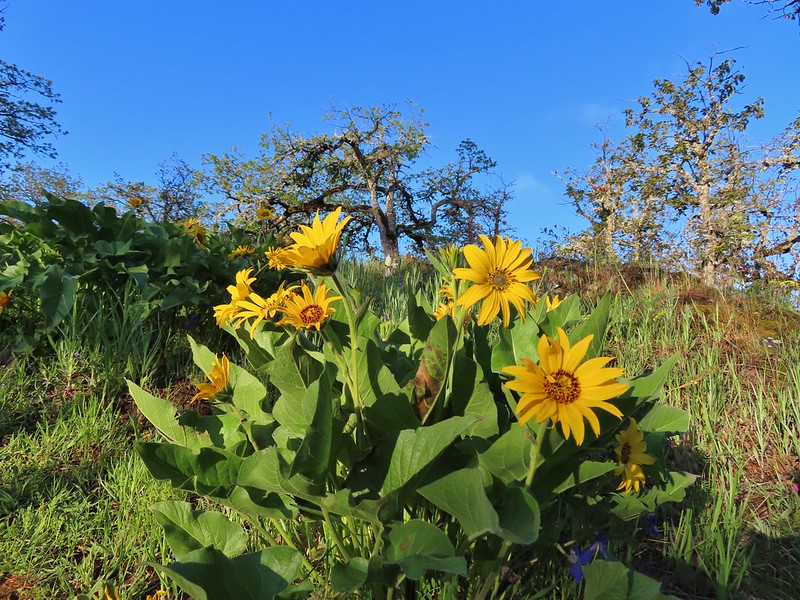
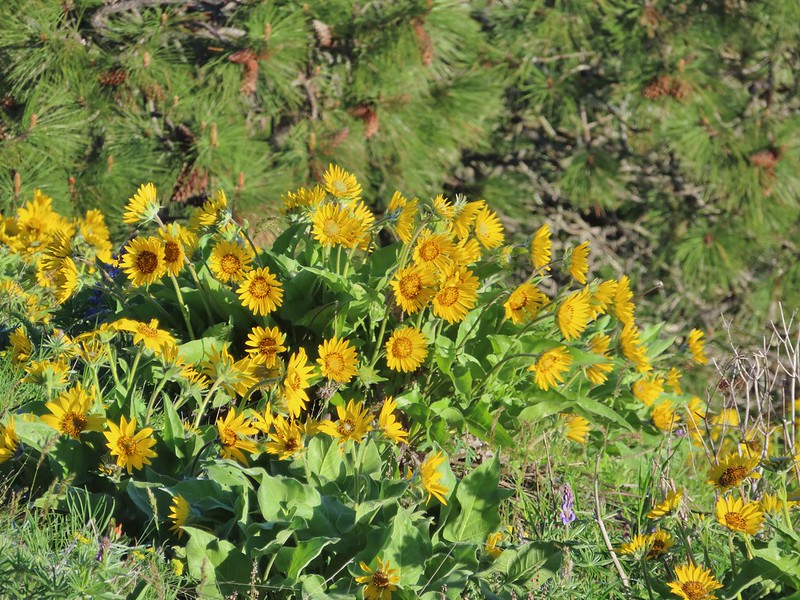
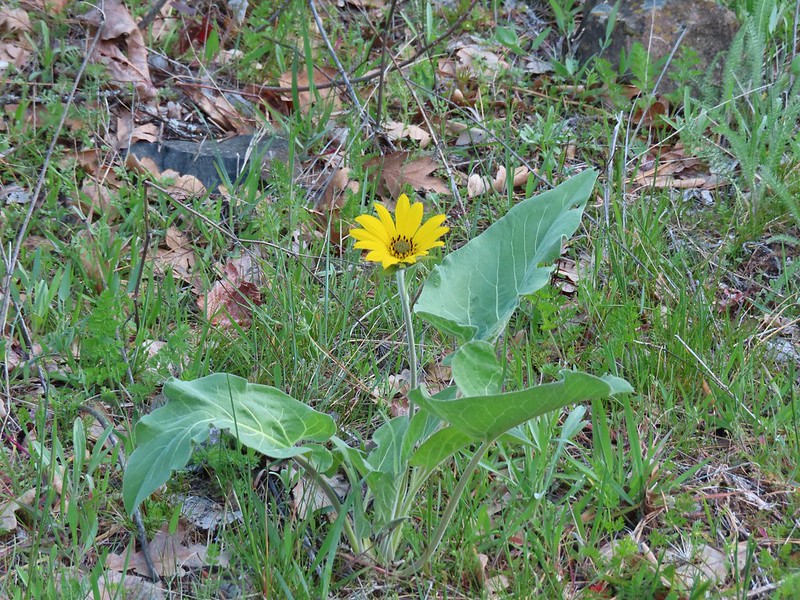
IMG_8862Balsamroot

IMG_8867

IMG_8885

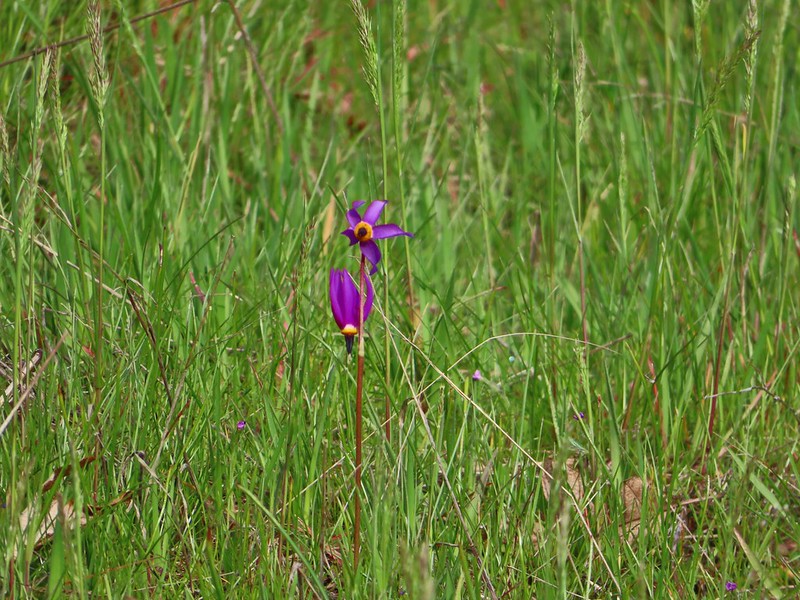
IMG_8897Chocolate lilies

20220501_070033Giant blue-eyed Mary

IMG_8918Coming up on the creek crossing.

On our previous hike we had only taken the left-hand fork to Marsh Hill so today we went right first and headed for Chatfield Hill.
IMG_8922

This section of trail passes through a grassland as it wraps around a small pond then passes a fence before turning up Chatfield Hill after a third of a mile.
IMG_8925

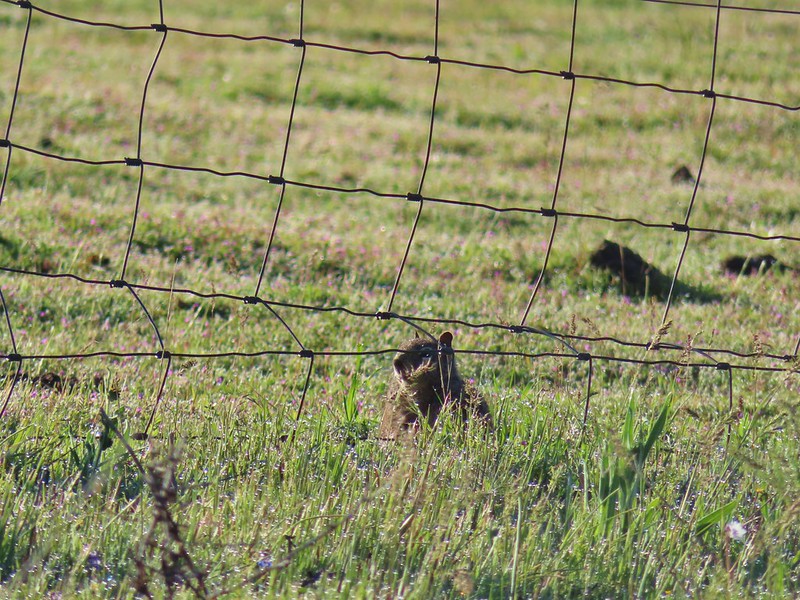
IMG_8928Ground squirrel on the other side of the fence.

IMG_8930Looking back at the pond surrounded by trees.

IMG_8933Heading up Chatfield Hill.

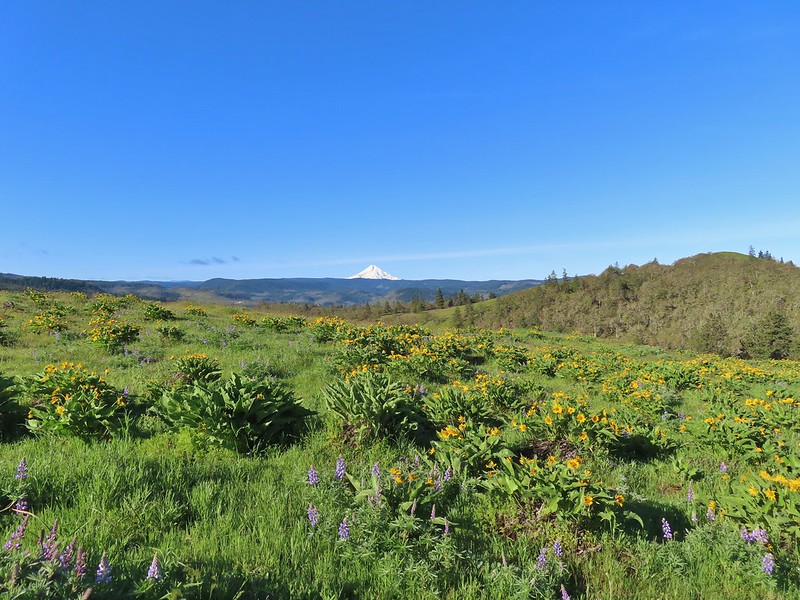
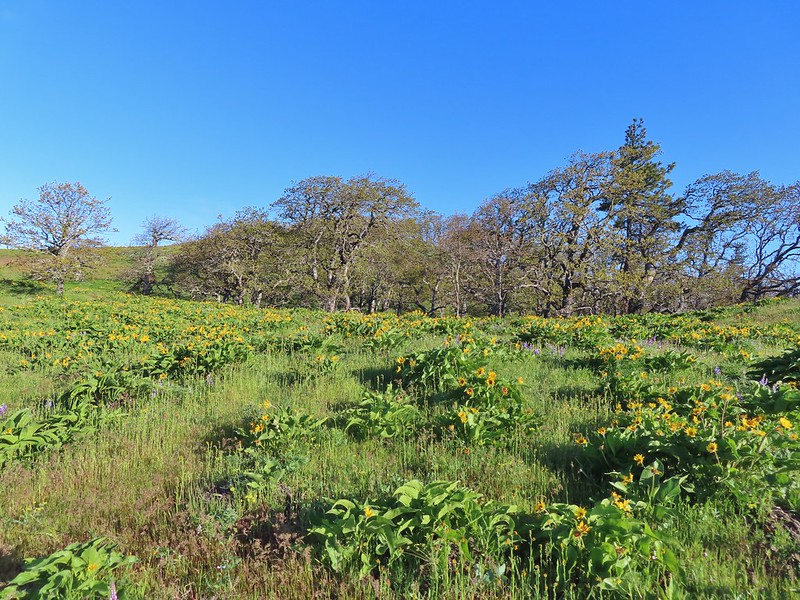
The trail gained a little over 250′ in 0.3 miles as it climbed through wildflowers to the top of the hill. The cooperative weather provided us with some great views of Mt. Hood.
IMG_8941

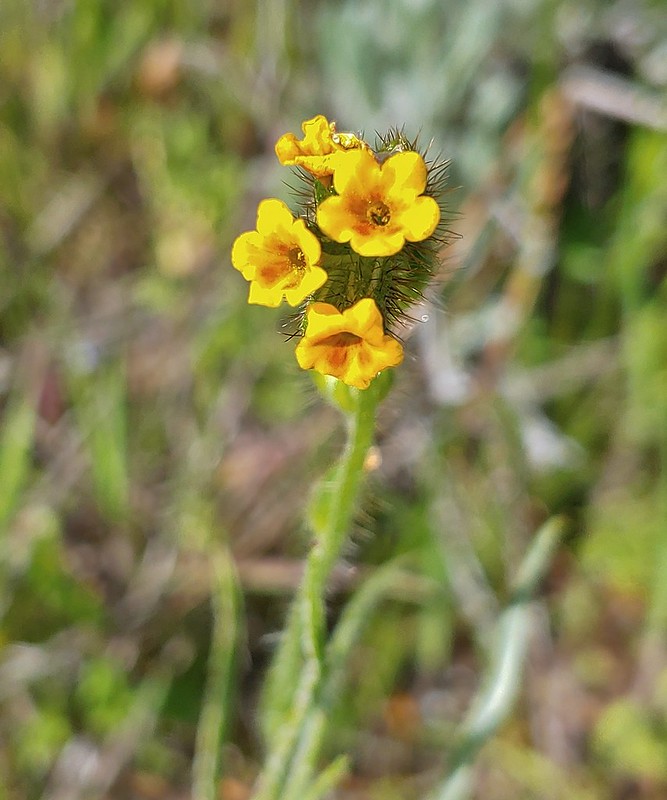
IMG_8947Fiddleneck and other wildflowers in front of Mt. Hood.
IMG_8946

IMG_8960

IMG_8964

Near the top of the hill Mt. Adams came into view to the north.
IMG_8968

IMG_8978

IMG_8984The Hood River Bridge spanning the Columbia River.
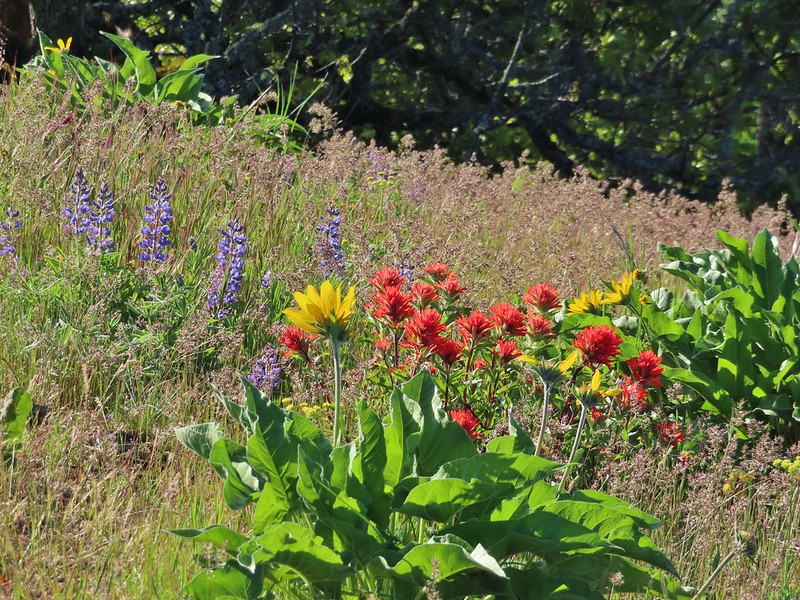
IMG_8985Lupine, balsamroot, and paintbrush

IMG_8986Balsamroot

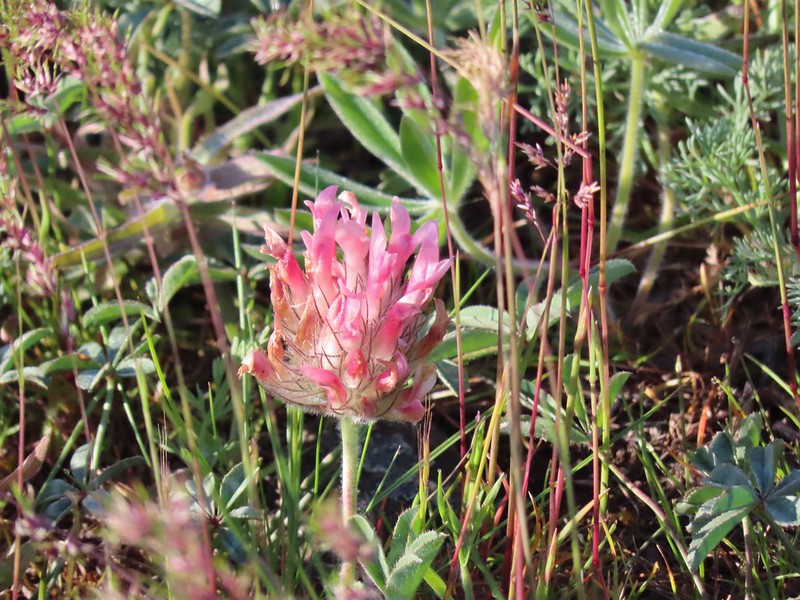
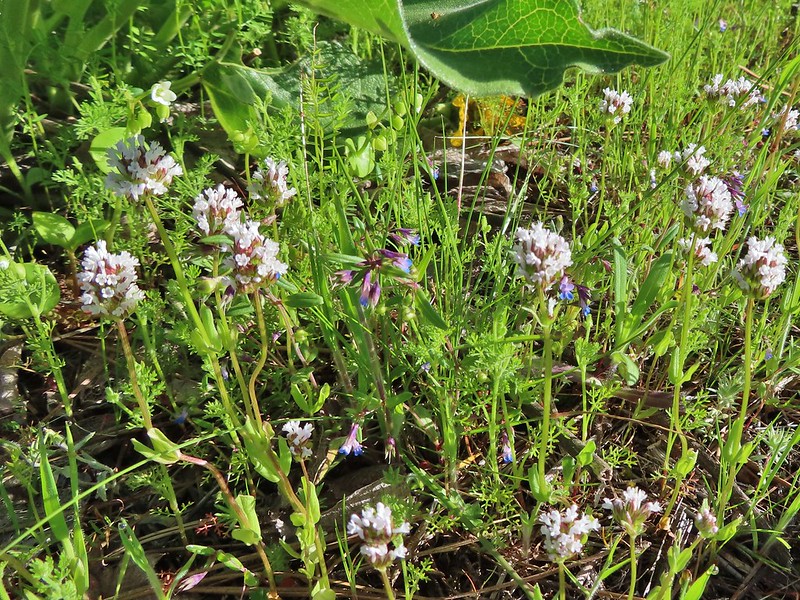
IMG_8988Large-head clover

20220501_074950Large-flower Triteleia

We took a short break before heading back down and then made our way back to the junction and turned right to head up Marsh Hill.
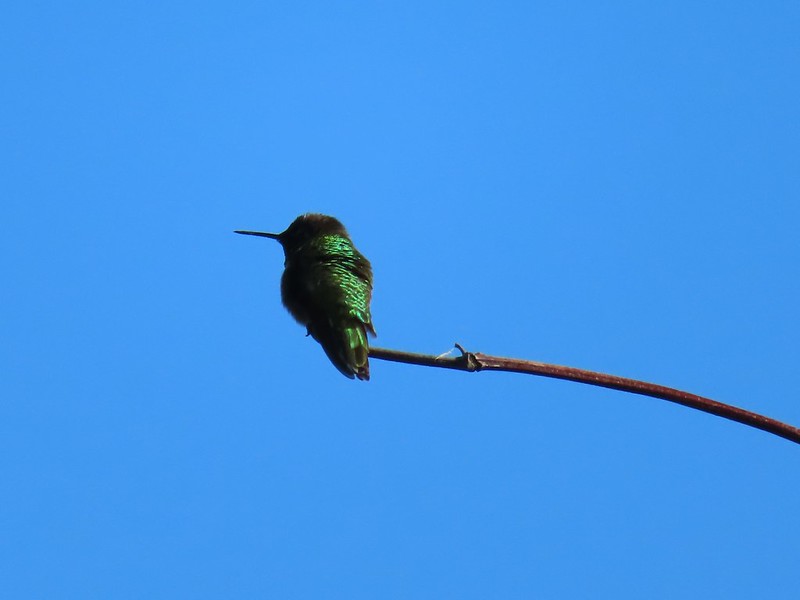
IMG_9005Hummingbird

IMG_9009Balsamroot on Marsh Hill

The climb up Marsh Hill was more gradual and in a third of a mile we found ourselves at the top looking at Mt. Hood and Chatfield Hill.
IMG_9015

IMG_9029Lupine and balsamroot

IMG_9032I think this is longhorn plectritis

After another short break we returned the way we’d come and at the junction began finally running into other hikers. Our early start had paid off again having had both hill tops to ourselves. Once we got back to the car we drove west on Highway 30 into Mosier for our next hike on the Mosier Plateau Trail. We parked in a signed parking area along the highway just west of a one lane bridge spanning Mosier Creek.
IMG_9041Sign for the parking area (If this small lot is full there are other options nearby.)

To reach the trail we had to walk across the bridge then turned uphill at a bench.
IMG_9042

IMG_9045

The trail climbed a tenth of a mile to a viewpoint bench just beyond the historic Mosier Cemetery.
IMG_9055

IMG_9058

IMG_9061

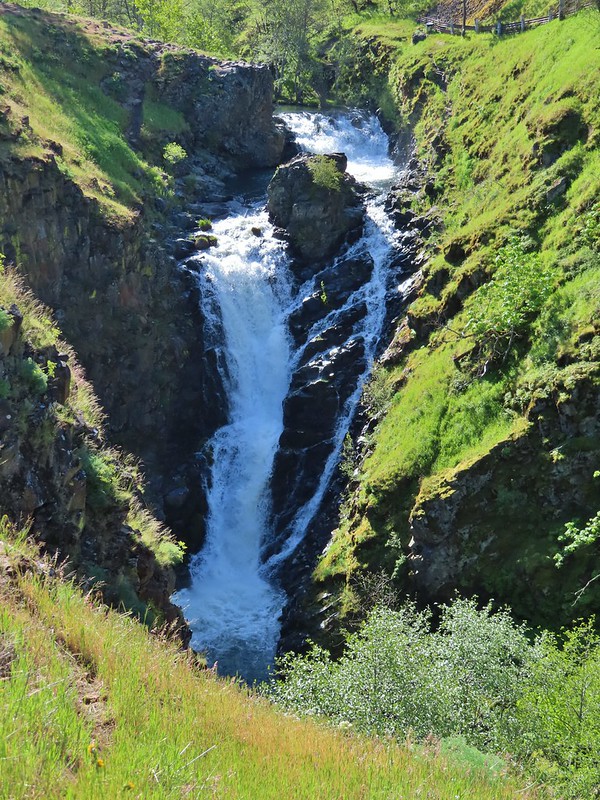
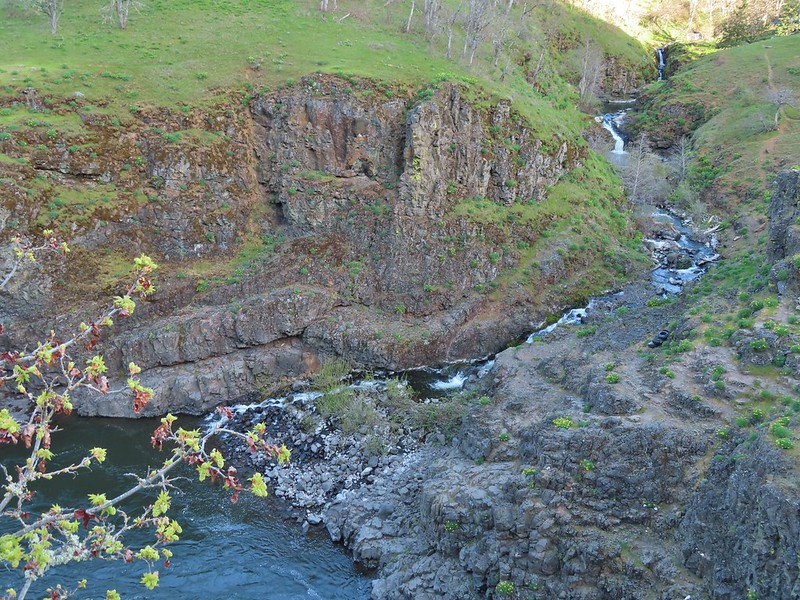
A better viewpoint was just 150 yards further along at a railing overlooking Mosier Creek Falls.
IMG_9075

We continued on detouring to visit the rocks above the falls.
IMG_9081

IMG_9082

Shortly beyond the falls the trail began a steep climb via a series of switchbacks and stairs to reach the plateau.
IMG_9089Looking up the hillside.

IMG_9091Red-stem storksbill

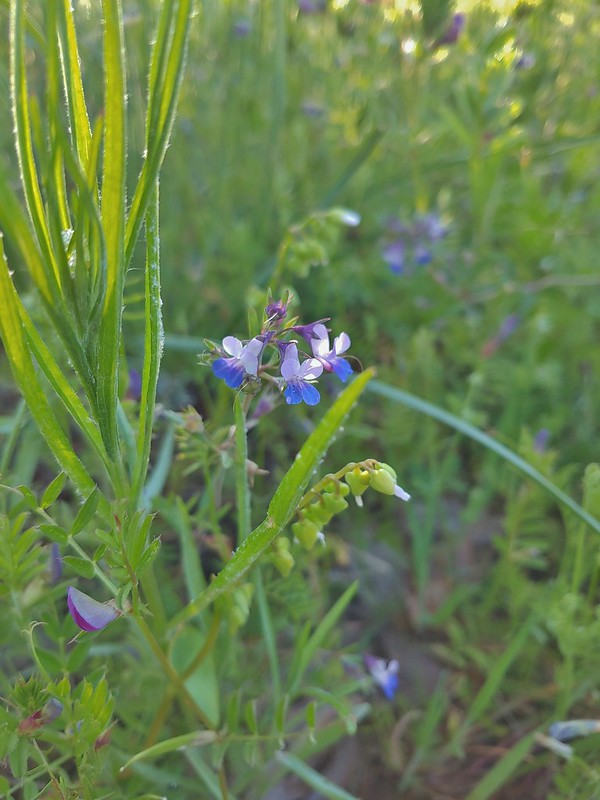
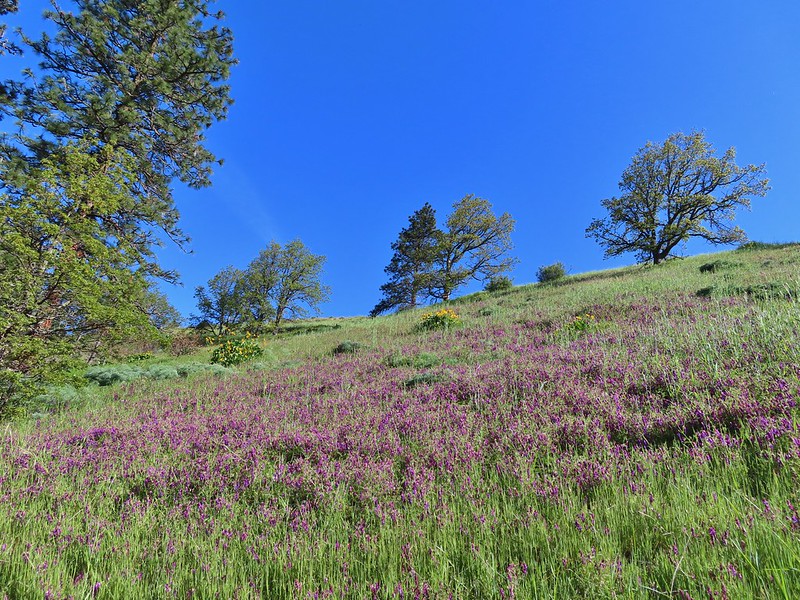
IMG_9099Vetch and balsamroot

IMG_9106

IMG_9108Silver-leaf phacelia

IMG_9117

We followed the trail as it wound along the plateau gradually descending to the start of a signed loop.
IMG_9121

IMG_9129Coyote Wall (post) across the Columbia River

IMG_9133

IMG_9150

We went clockwise around the loop which brought us to the edge of the plateau above I-84 and Highway 30.
IMG_9154

20220501_093608Gold star

20220501_093624Fiddleneck

20220501_093631Balsamroot

IMG_9158View east.

IMG_9159Mosier to the west.

It was warming up nicely on our way back and the pollinators were starting to come out.
IMG_9165Gray hairstreak

IMG_9167Busy bumblebee

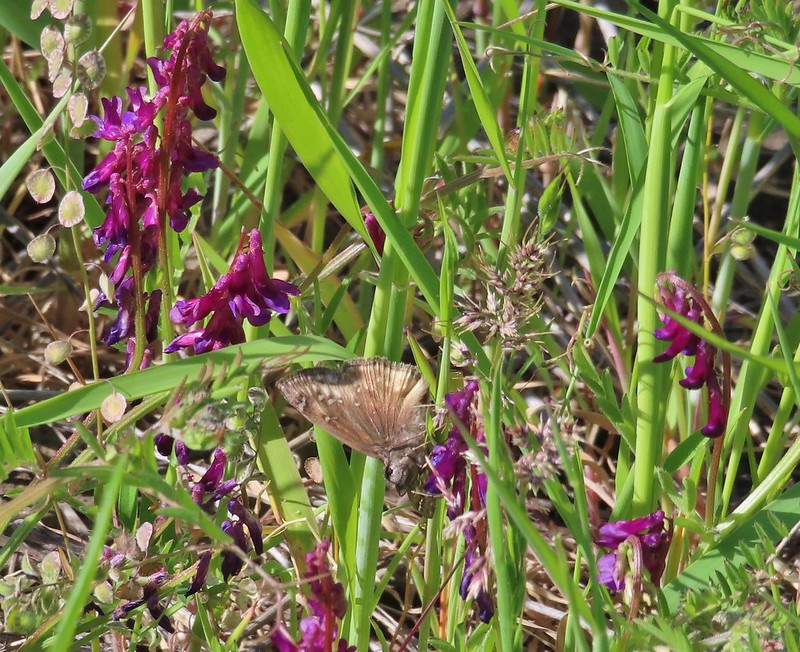
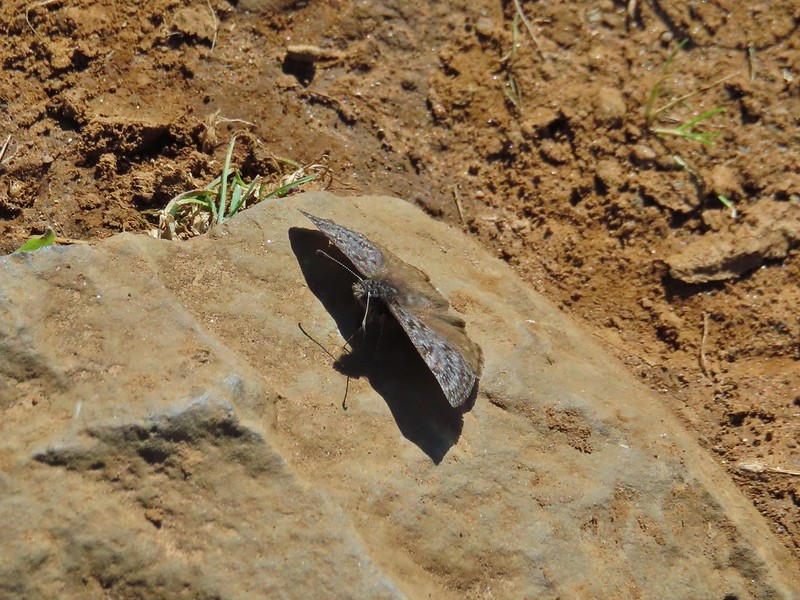
IMG_9172A duskywing (propertius?) on vetch.

IMG_9175Propertius duskywing

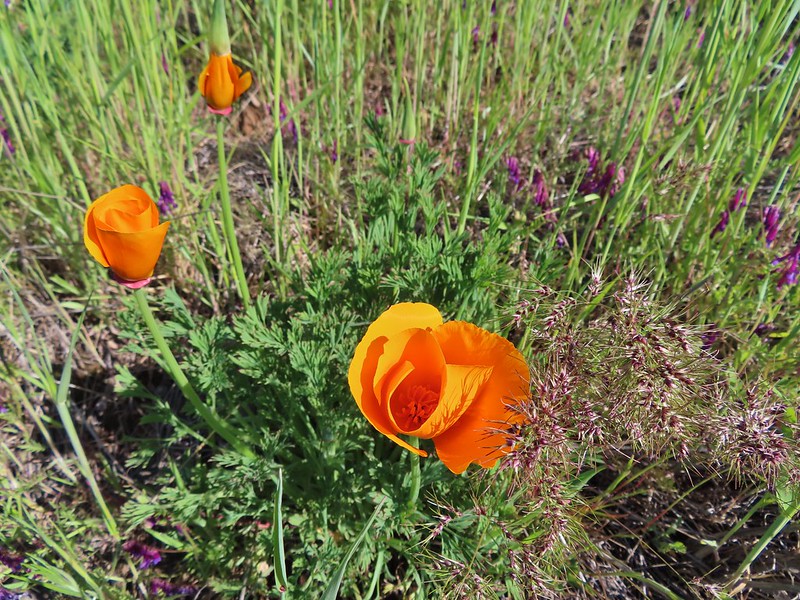
IMG_9177Poppies opening up to the Sun.

20220501_102516Bachelor button

We passed quite a few groups heading to the plateau on our way down and more were on there way as we loaded back into the car. From Mosier we returned to I-84 and drove west to Hood River where we took exit 64 and made our way to the Powerdale Powerhouse Trailhead. The hike starting here is described in Matt Reeder’s “PDX Hiking 365”. (The Mosier Plateau hike is also featured in that book.) While we have been focused on completing William L. Sullivan’s series of hiking guidebooks (post) we have been working in Reeder’s hikes more and more. While many of the hikes show up in each author’s books Matt throws some unique and more obscure hikes into his books which we appreciate.
IMG_9185The old powerhouse.

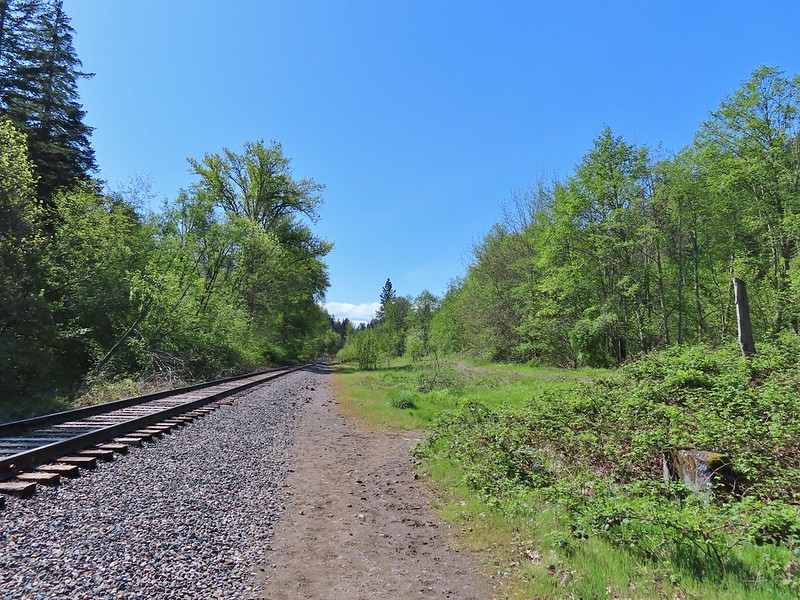
The hike here may not exactly be well known to hikers. The many access points to Hood River attract fishermen and in the Summer folks looking to escape the heat. The trail starts on a gated road then quickly crosses ACTIVE railroad tracks.
IMG_9189

IMG_9190

IMG_9194Stellar’s jay near the tracks.

We crossed the tracks and turned left walking along them for about a tenth of mile before the trail jogged slightly to the right to follow the route of the former penstock which led from the decommissioned 1923 Powerdale Dam on the Hood River to the powerhouse.
IMG_9195The trail ahead to the right.

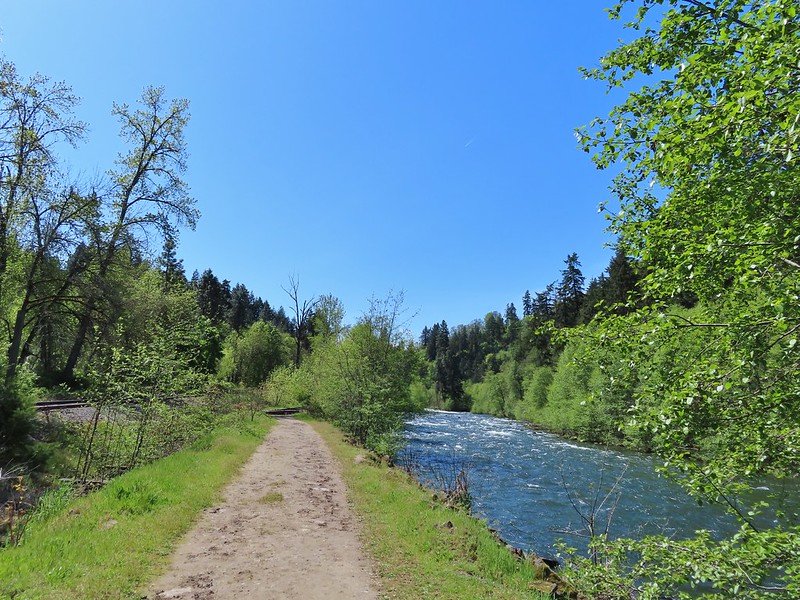
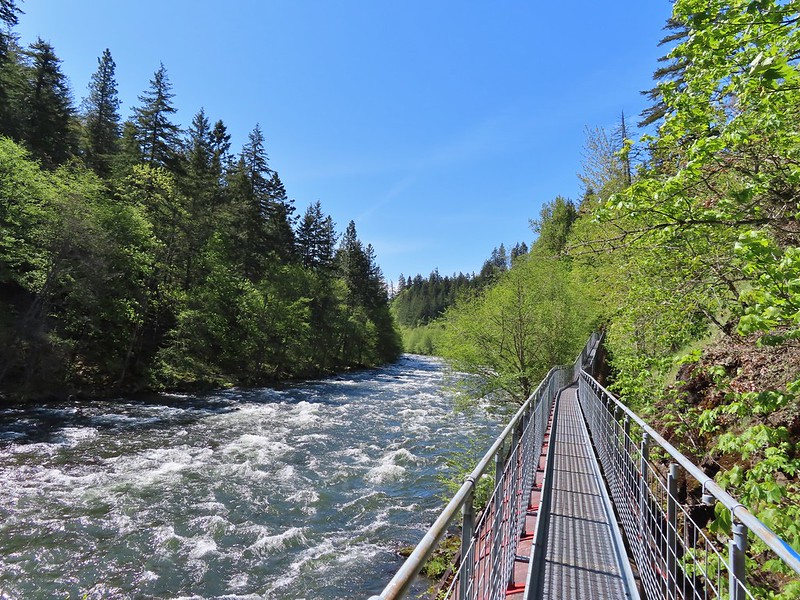
We followed this dirt path for a little over half a mile before arriving at the pipeline bridge spanning the Hood River where we crossed on the catwalk atop the pipe.
IMG_9202

IMG_9208

IMG_9209

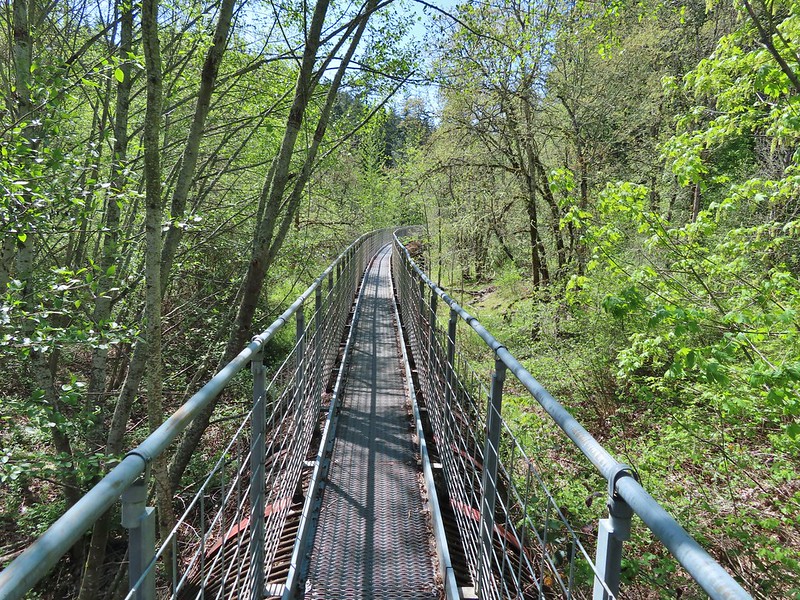
For the next 0.6 miles we followed the catwalk along the pipeline which ends abruptly at a 2006 washout that also led to the removal of the dam up river.
IMG_9216

IMG_9219

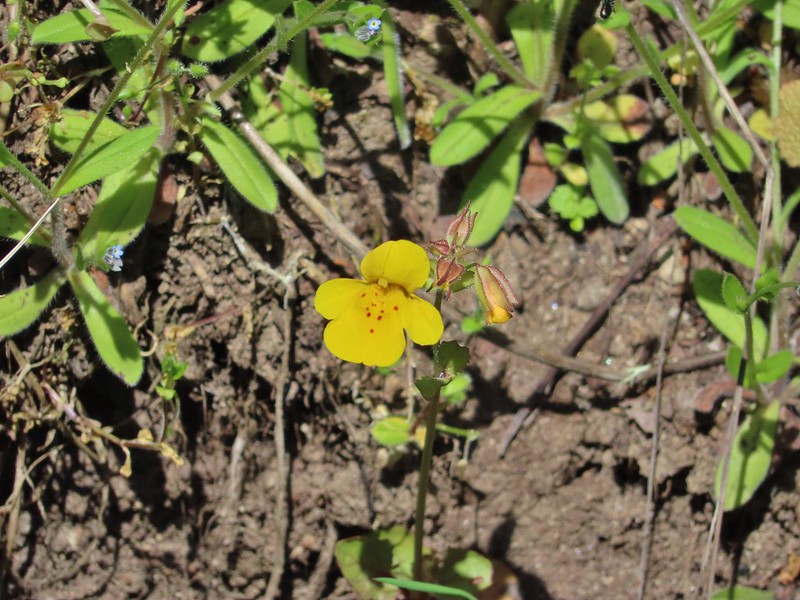
IMG_9221Monkeyflower

IMG_9227

IMG_9229Looking back from the turnaround point.

We headed back passing a few hikers along the way. We were also under the watchful eye of the area wildlife.
IMG_9234Lizard

IMG_9241Mallard

IMG_9243Scrub jay

IMG_9247Starlings

IMG_9251Osprey

The three hikes came in at 3.3, 3.2 and 3 miles respectively for a 9.5 mile day with a little over 1400′ of cumulative elevation gain. The short distances and convenient locations make any of these hikes nice for a quick stop and we saw several younger kids at both Mosier Plateau and the Hood River Pipeline (watch for poison oak). The combo of hikes made for a nice variety of scenery with waterfalls, snowy mountains, wildflowers, and wildlife along with the unique experience of hiking along the pipeline. (FYI – The grate on the catwalk might be hard on puppy paws.)

While we aren’t quite finished with all of our home improvement projects it was great to get our hiking season off to a good start. Happy Trails!

Flickr: Memaloose Hills, Mosier Plateau, and Hood River Pipeline Trails

Categories
Hiking Oregon Salem/Albany Trip report Willamette Valley

Ankeny Wildlife Refuge – 04/23/2022

For the last six months we’ve been having projects done around the house and while everything at home has seemed to be in a state of upheaval work has felt just as chaotic. The end of our projects is in sight just barely overlapping with our hiking season. This is the most I’ve looked forward to a hiking season yet. I am a very introverted person and while hiking can be physically exhausting, for me it provides a mental recharge. Spending time relaxing at home is typically another way that I recharge but with all the projects going on I haven’t been able to get that same relaxed feeling this off-season.

Part of being an introvert is that socializing, especially in larger groups, is draining. It’s not that it isn’t enjoyable, it certainly can be, but it is exhausting and I haven’t been in a place where I’ve felt like I had the energy to interact with people beyond work recently (close family excluded). Heather on the other hand is more extroverted than I am. She still has some introvert traits but on a scale of introvert to extrovert she is closer to the extrovert than where I land. Before hiking season started she wanted to have a few friends over to see the progress thus far on the home. I thought it was a great idea but I also didn’t personally feel up to it despite how much I enjoy the group she was planning on inviting. To Heather’s credit she understood so in the interest of mental health I got an early jump on hiking season.

After doing a few last minute chores to help get the house ready for guests I headed out the door a little before 6am to make the 25 minute drive to Ankeny Wildlife Refuge. I had made a solo trip here last April (post) during a vacation week that Heather didn’t share. While I (we) typically don’t revisit places/hikes that close together the opening of the Ankeny Hill Nature Center in February was a good excuse for another visit. The website for the Nature Center listed “dawn to dusk” as the hours but I arrived just minutes before sunrise (6:14am) to find the gate still closed. A lower parking lot along Buena Vista Rd S was also gated closed with a sign stating it was due to ongoing construction. After reading the sign I wasn’t sure if I was too early or if the center was actually closed even though the website indicated it was open. A mystery that I would solve later though as I had some hiking to do.

The trail system at the Nature Center is less than a mile so I had planned on re-hiking some of my routes from the previous year and any areas that had been closed on that visit that might be open this time around. It had been a clear morning at our house and remained that way all the way to the Nature Center but as soon as I passed the lower parking lot I entered a fog bank which covered my first stop at Eagle Marsh.
IMG_8742

I could hear geese and ducks on the water but seeing much let alone taking pictures would require the fog to relent a bit. I set off along the dike road around the marsh hoping that the rising Sun would simultaneously take care of the fog and raise the temperature from the mid-30’s.
IMG_8753

IMG_8745Camas

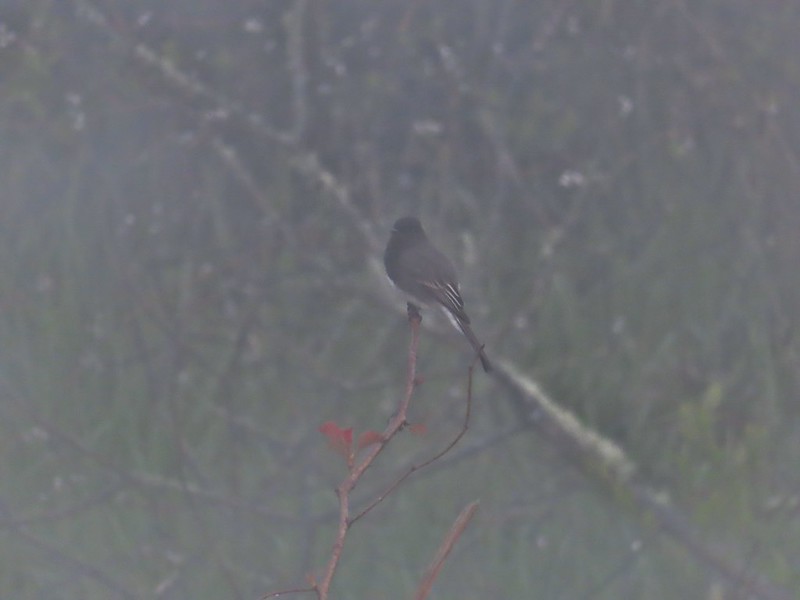
IMG_8748Black phoebe in the fog. It’s the only one seen all day so despite the poor quality I kept the photo.

IMG_8761Wet spider webs are the best.

IMG_8758There was a brief respite in the fog before it rolled in again.

IMG_8765The fog bank waiting to move back in.

The section of the Eagle Marsh Trail on the SE side of Willow Marsh had been closed last year making the lollipop loop showed on the Refuge Map impossible but this year there were no signs indicating it’s closure. Like last year I headed clockwise around Willow Marsh passing between it and Teal Marsh.
IMG_8764Teal Marsh

The grassy track here was very damp and my feet and lower legs were soon soaked (and cold!) but I distracted myself by watching for birds.

IMG_8771Northern flicker

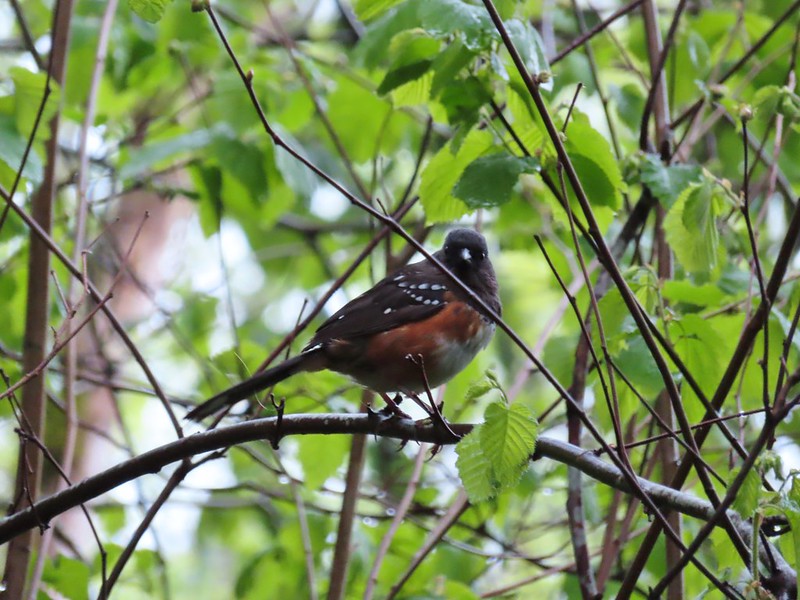
IMG_8772A very grumpy looking spotted towhee

IMG_8775I have a hard time identifying some of these little birds. This one may be an orange-crowned warbler.
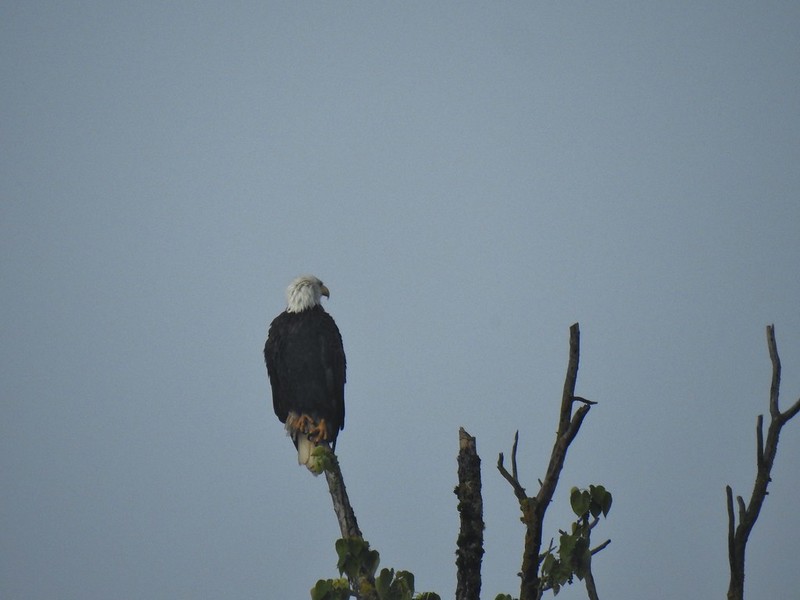
DSCN1310A bald eagle that was across Willow Marsh.
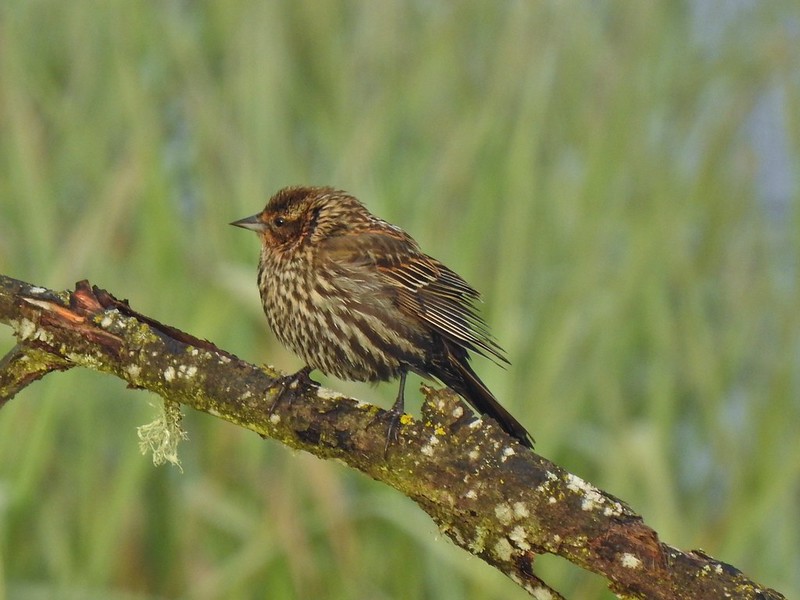
DSCN1317Female red-winged blackbird

DSCN1313Buffleheads

DSCN1324A less grumpy looking spotted towhee

As I came around Willow Marsh I took a very short detour to check out the Sidney Power Ditch before continuing around the marsh.
IMG_8777

DSCN1331Here comes the fog again.

DSCN1335Black capped chickadee

Yellow-rumped warbler (Audubon's)Yellow-rumped warbler (Audubon’s)

DSCN1342Red-winged blackbird

Marsh wrenWrens can be tricky too, I think this is a marsh wren.
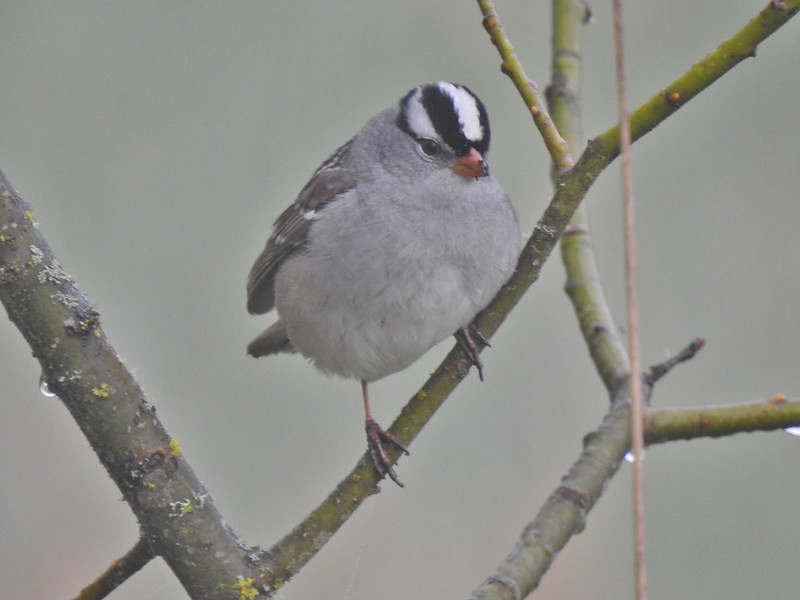
DSCN1349White-crowned sparrow

DSCN1360Song sparrow

IMG_8779Eagle Marsh, still can’t see much.

I had considered driving back to the Nature Center to see if it was open but in the end decided to make that my last stop and instead drove to the Pintail and Egret Marshes Trailhead.
IMG_8781

I started by taking the 0.13 mile boardwalk to the blind overlooking Egret Marsh where there wasn’t anything to see at the moment.
IMG_8783Bashaw Creek

DSCN1369Egret Marsh from the blind.

After the obligatory boardwalk I walked west along the shoulder of Wintel Road just over 150 yards to a small pullout on its south side where I passed through a green gate to find another damp grassy track. I had passed through the same gate on my prior visit and taken the right hand fork away from the road. This time I went left following the track along the road for three tenths of a mile to the entrance road for the Rail Trailhead.
DSCN1372

DSCN1374

Up to this point I had encountered a total of 3 people but at this trailhead there were several cars and a half dozen people milling about. I headed out on the rail trail and skipped the boardwalk portion where most of the people were headed and continued straight through more wet grass to the dike near Killdeer Marsh.
IMG_8784

DSCN1375Lots of fringecup along the trail.

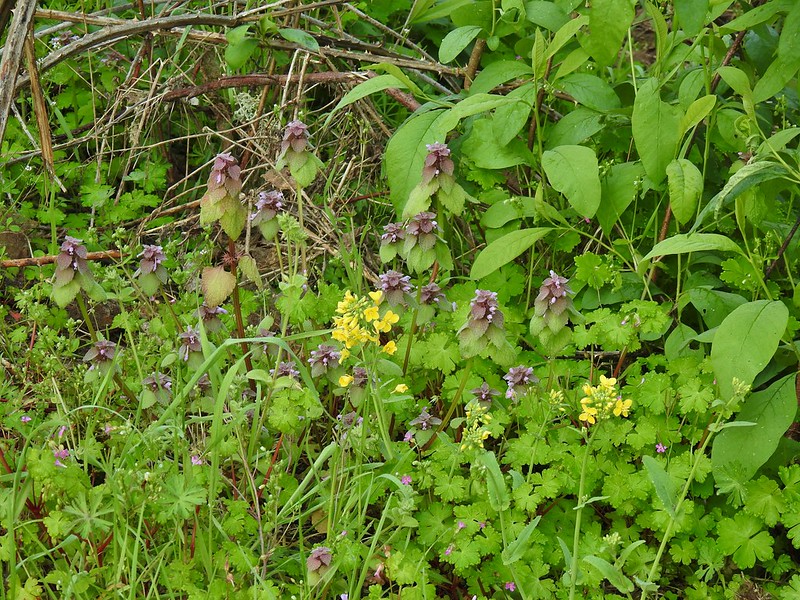
DSCN1376Purple deadnettle and field mustard

DSCN1377Common yellow-throat

I looped counter-clockwise around Killdeer Marsh forgetting how muddy it was on the western side.
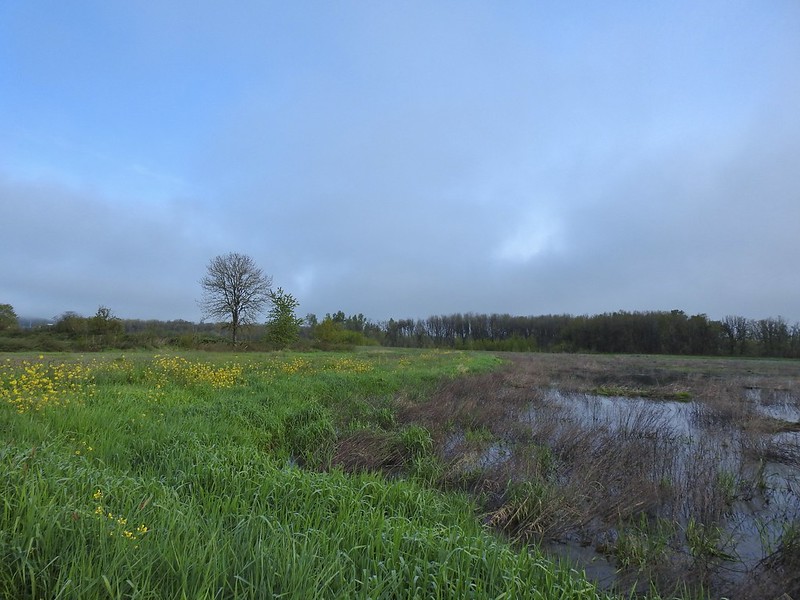
DSCN1380Looking back along the eastern side of the marsh. There was a lot less water this year.

Killdeer MarshWater level on 4/13/21.

There were also fewer birds than on either of my previous two visits but I did see the only norther pintails of the day here.
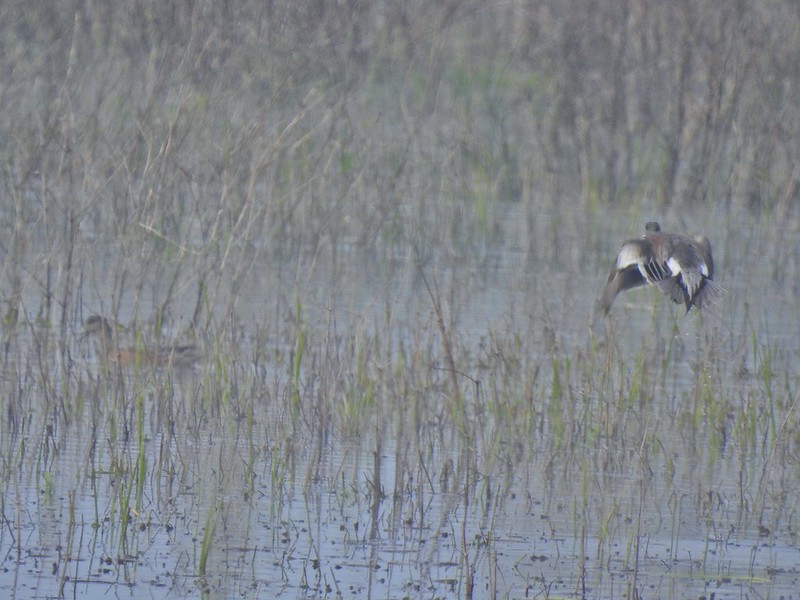
DSCN1385Seeing them was a lot easier than getting photos.
After looping around that marsh I headed east along the dike where again there was a lot less water in Dunlin Pond this year compared to last.
DSCN1388

I followed the dike around what was left of Dunlin Pond to the eastern end of the boardwalk.
DSCN1397Canada flamingo?

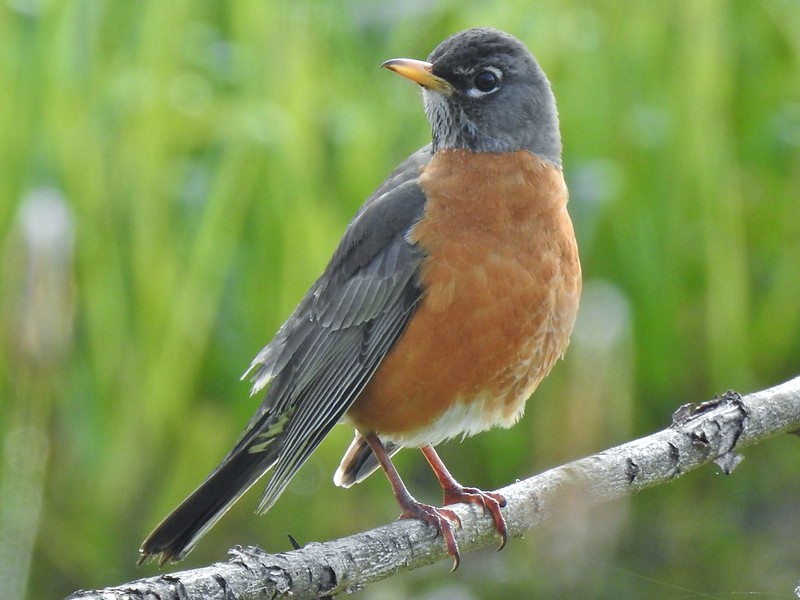
DSCN1399American robin

DSCN1401

DSCN1403Dunlin Pond from the boardwalk.

I could hear people approaching on the boardwalk so after a quick stop I continued north on the grassy track returning to the gate at Wintel Road and followed it back past the Pintail and Egret Marshes Trailhead to the Pintail Marsh Overlook.
DSCN1415

DSCN1414

I turned right from the parking area following a sign for the seasonal photo blind. On last years hike I had attempted to go around Egret Marsh but had been turned back by a closure sign just beyond the blind and had to return to the parking area via a short loop around Frog Pond. There were no closure signs this time so I continued on past the short loop passing the blind at the end of the boardwalk trail.
DSCN1424Egret Marsh

DSCN1427

DSCN1436Ring-necked ducks.

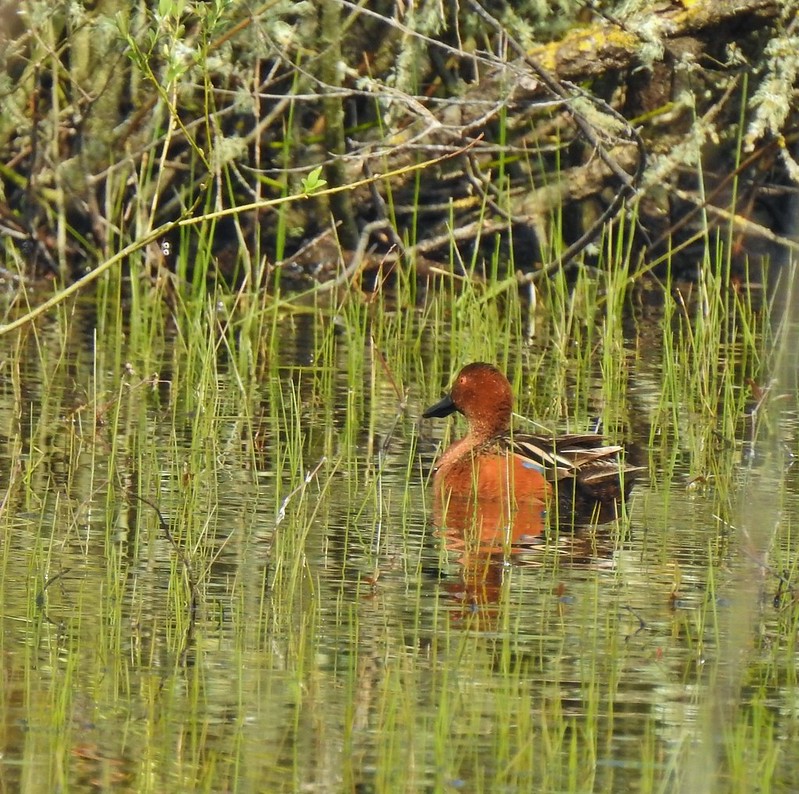
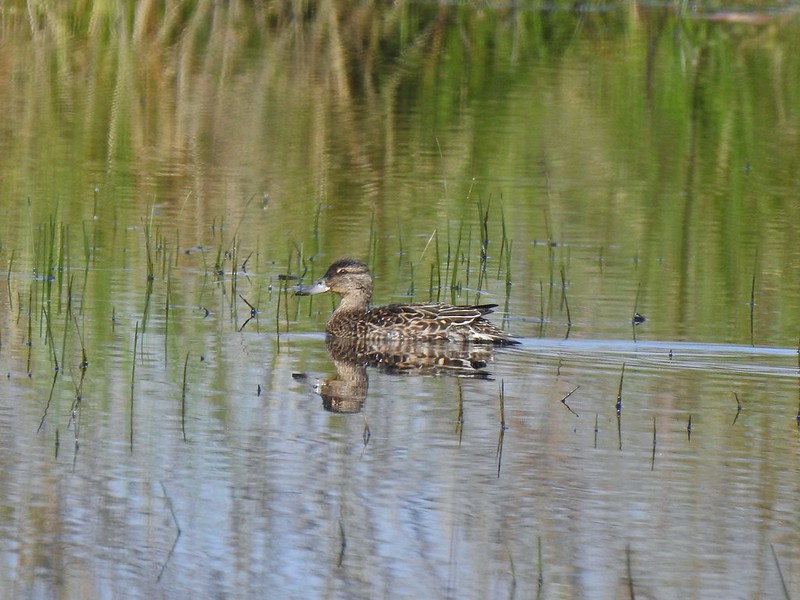
DSCN1433Anyone know if this is a female cinnamon or blue-winged teal?
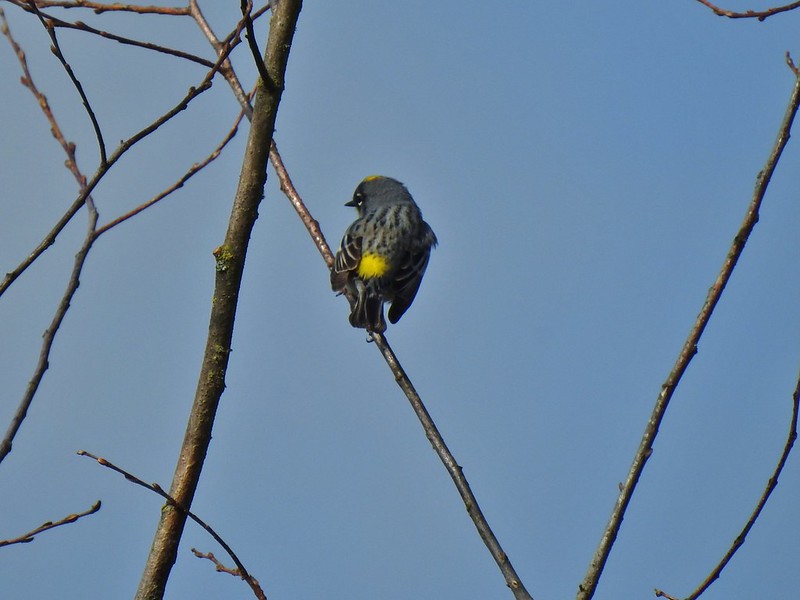
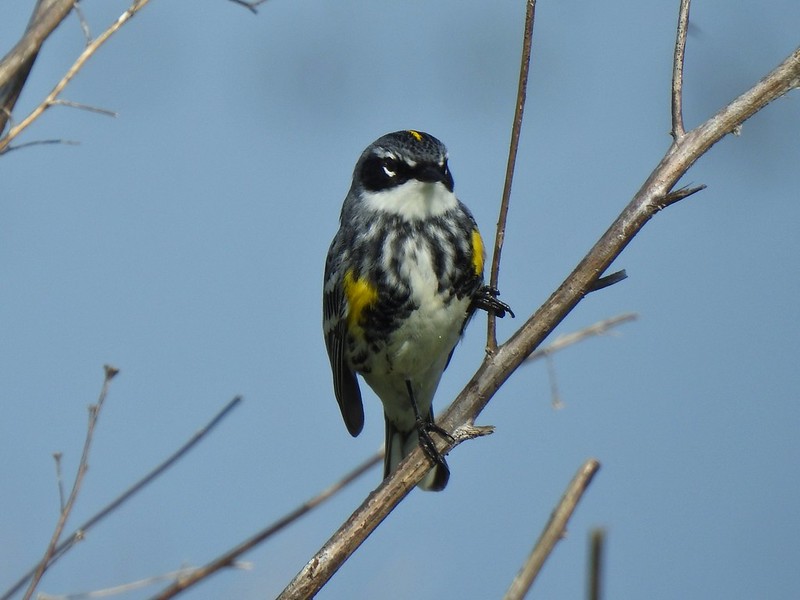
DSCN1432Another yellow-rumped warbler (Audubon’s) showing off its yellow rump.

DSCN1430Egret Marsh

DSCN1431The trail around Egret Marsh.

When I arrived at the service road between Egret and Mallard Marshes I passed a sign saying the area was indeed closed. I don’t know if that sign was left over or if the sign at the other end had gone missing. In my defense the refuge map shows it as part of the trail system and there is nothing online or posted at Pintail Marsh stating that there is a closure but had I been coming from this end I would have respected the sign. This is not the first time that we’ve been on a trail with no indications of any closure only to pass a closure sign at the other end. For the land managers out there could you please post at both ends of closed sections (or remove the signs from both ends if it has been lifted)? It would sure help those of us that are trying to do the right thing.

Back to the hike though. The service road ended a short distance away to the right in a flooded field.
DSCN1439

There was a lot of activity near the end of the road.
DSCN1441I think these might be long-billed dowichters. Please correct me if I’m wrong.
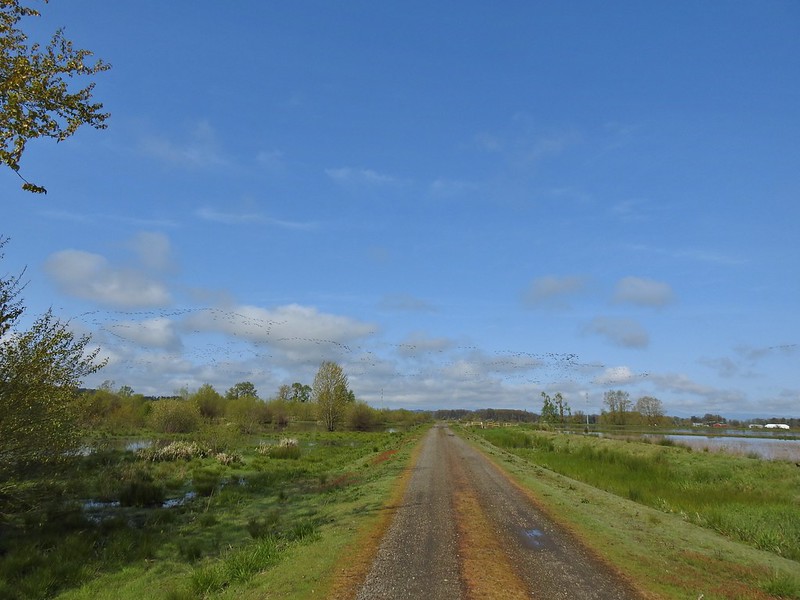
I turned left and then quickly turned right on the dike between Mallard Marsh and Mohoff Pond. There were lots of geese, ducks and coots here but they did there best to keep plenty of distance between themselves and me.
DSCN1460Heading to the right turn. Egret Marsh is on the left and Mallard Marsh on the right. A huge flock of geese had just taken to the sky.
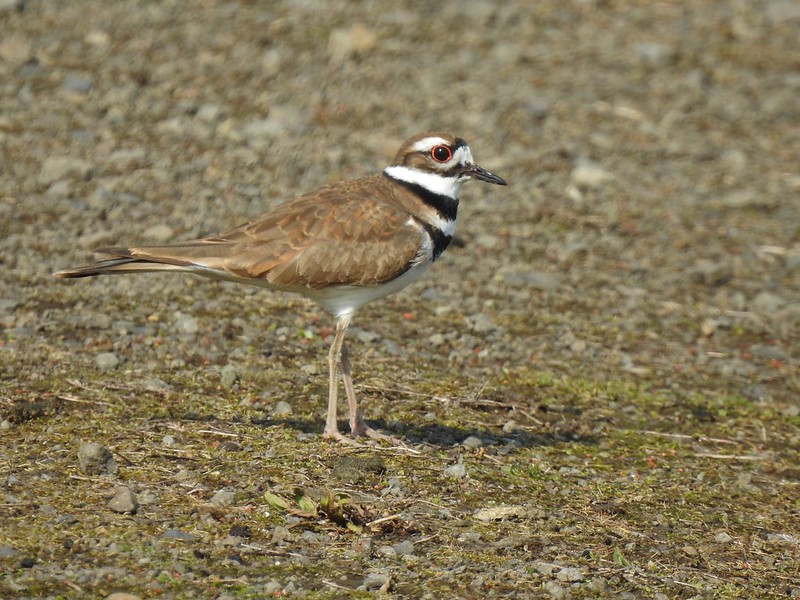
DSCN1466Killdeer

Yellow-rumped warbler (Myrtle)Today I realized that there are two yellow-rumped warblers, this one is a Myrtle, note the white throat compared to the yellow throat of the Audubon’s above.
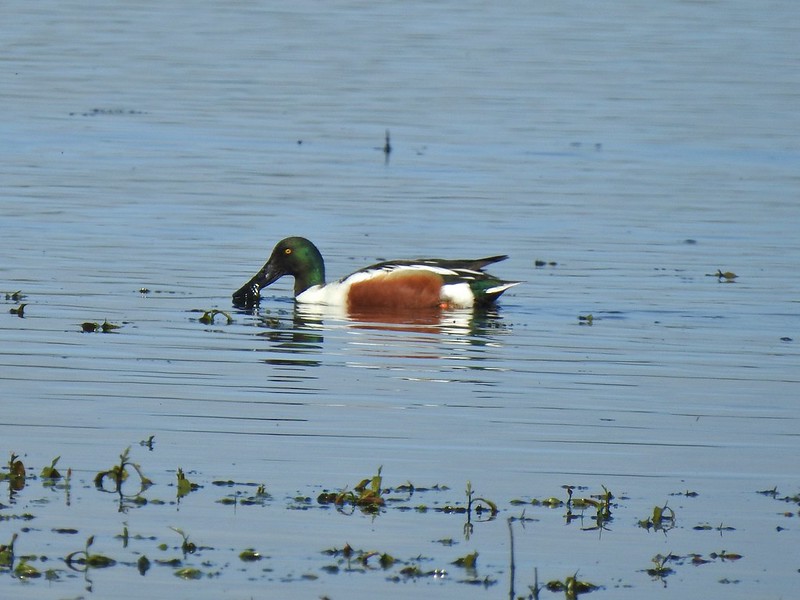
DSCN1473Northern shoveler

DSCN1477Mohoff Pond and Mallard Marsh

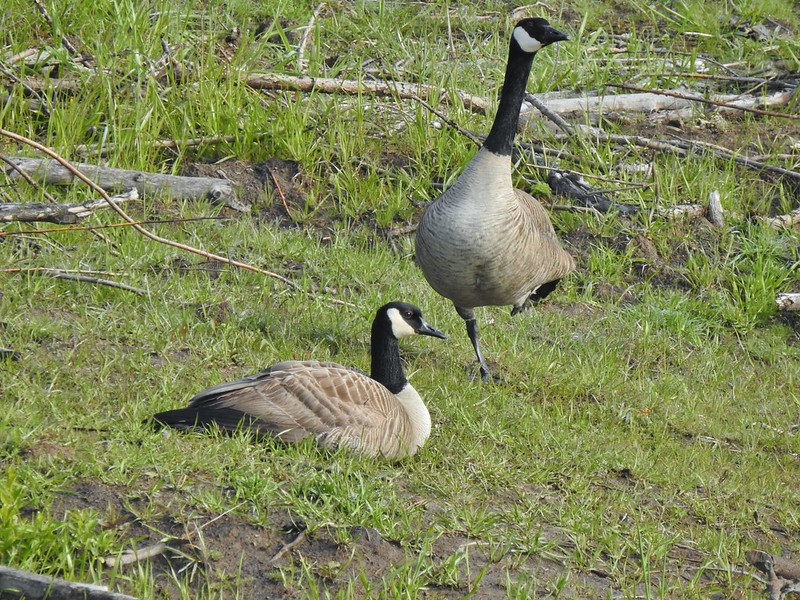
DSCN1479Canada goose with various ducks in the background. At least one of the ducks is a ruddy duck which is one I hadn’t seen yet (that I know of). They were too far to get clear photos of though.
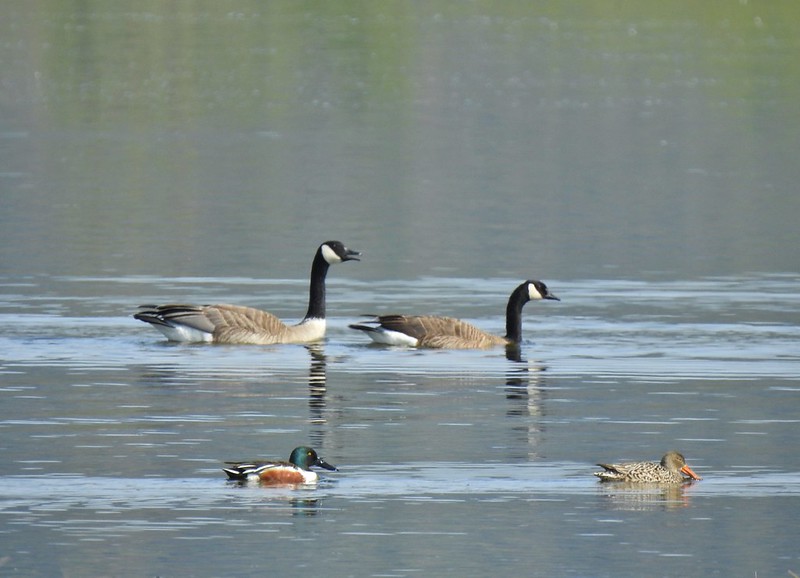
DSCN1482Canada geese and northern shovelers giving a good size comparison.
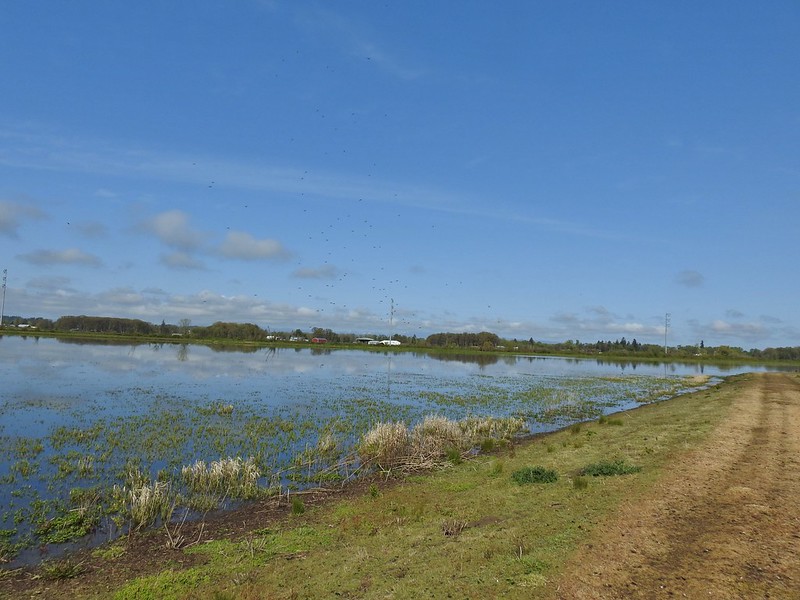
DSCN1486The black dots in the sky here aren’t geese, they are little insects that followed me along the dike.

DSCN1483Not Canada geese flying over.

DSCN1489Immature bald eagle.

DSCN1498Sandpiper

When I reached the end of Mohoff Pond I turned left around it and headed back toward the Pintail Marsh Overlook.
DSCN1510Greater white-fronted geese, another first.

DSCN1513Bushtit. Several flew in here but I couldn’t make them out once inside so I took a few pictures hoping to get lucky.
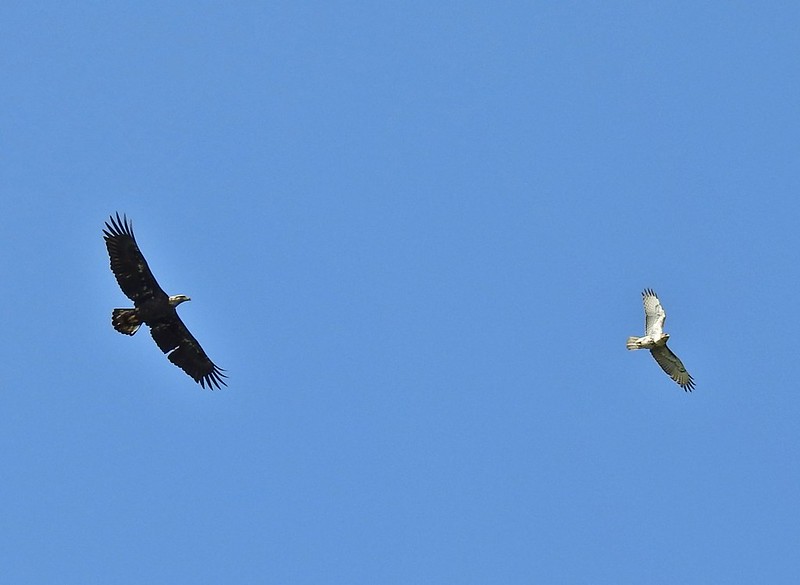
On my way back a hawk and an immature bald eagle put on an areal display.
DSCN1517Can anyone ID the hawk? Another thing that I find difficult.

DSCN1534Swimming lessons, Canada goose style.

From the overlook I walked back along Wintel Road to the Pintail and Egret Marshes Trailhead to retrieve my car then drove back to the Nature Center where I had attempted to start my day. The lower trailhead was still gated but the entrance road along Ankeny Hill Road was no longer gated. There were just a handful of cars here as I set off on the short loop trail.
IMG_8788

IMG_8790

IMG_8793

The loop offered nice views, interpretive signs, and a surprising variety of flowers. As a bonus a pair of great blue herons where stalking the hillside in search of snacks.
IMG_8796

IMG_8798

IMG_8802

DSCN1540Buttercups

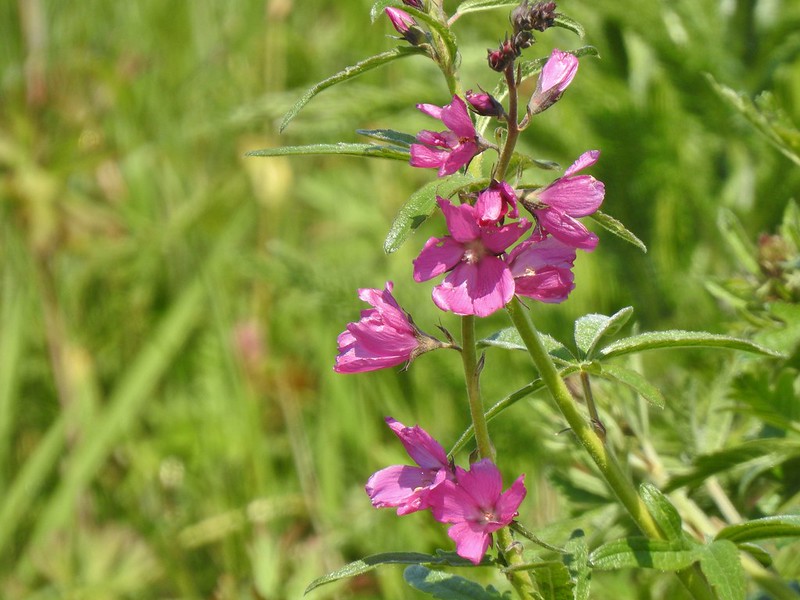
DSCN1543Meadow checker-mallow

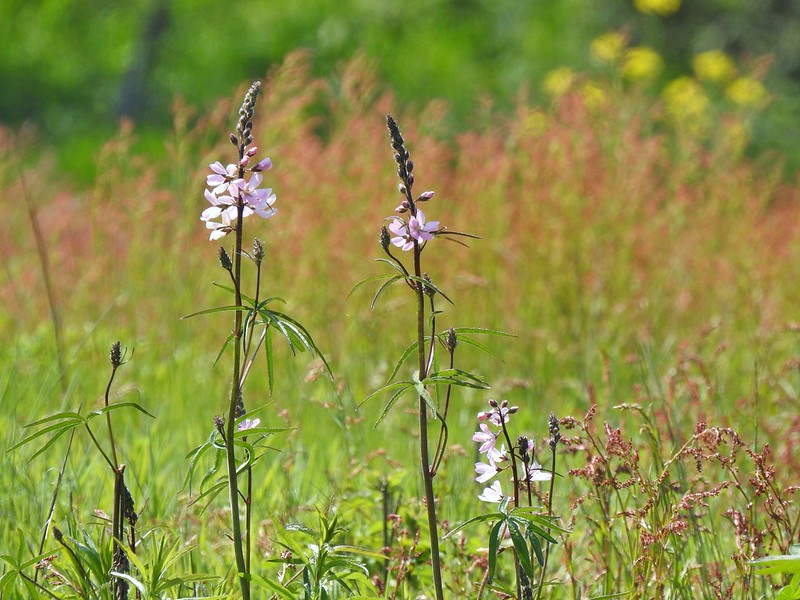
DSCN1547Columbine

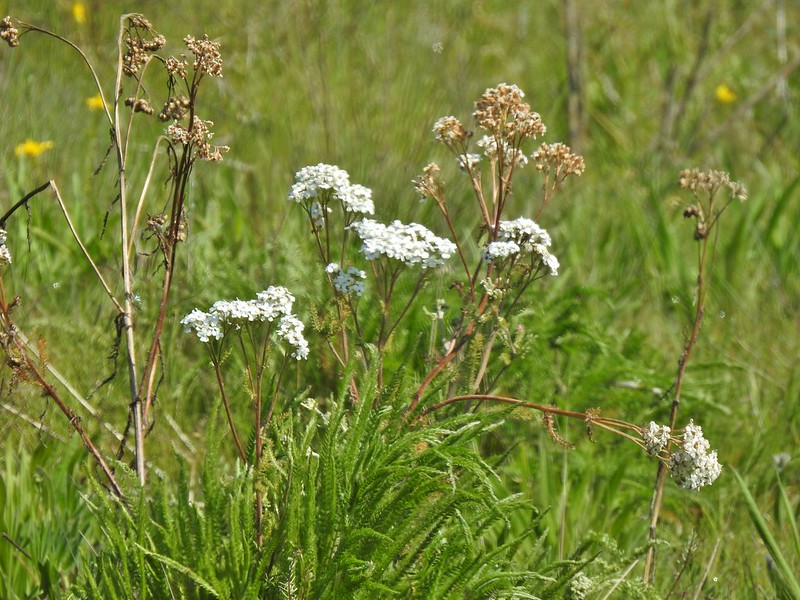
DSCN1550Yarrow

DSCN1552Possibly Nelson’s checker-mallow

IMG_8810Lupine that will be blooming soon.

DSCN1561

DSCN1567

DSCN1573Iris

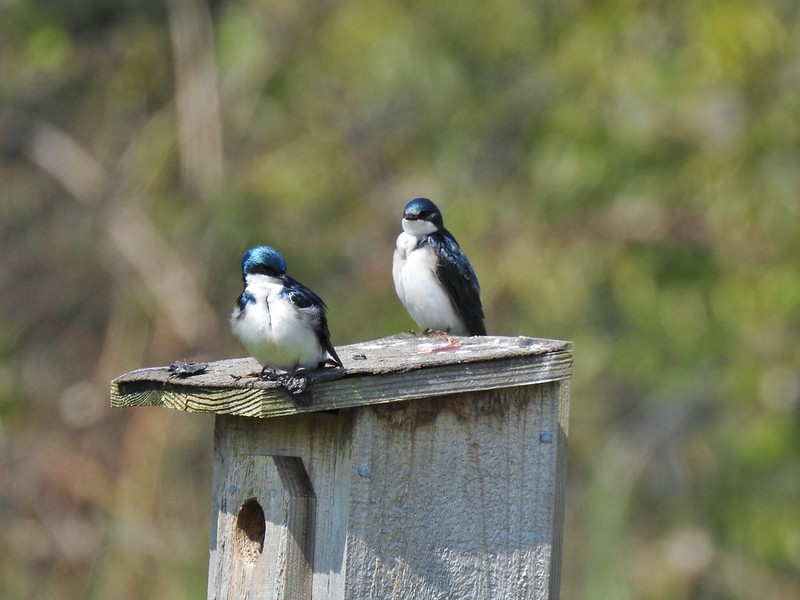
DSCN1575Swallows

DSCN1578Mary’s Peak (post) in the distance, the highest peak in the Oregon Coast Range.

The Nature Center is a really nice addition to the Refuge providing a great opportunity for kids to get out on a short educational trail. The rest of the refuge as usual did not disappoint, plenty of wildlife and a great variety to boot. The three stop, 11.3 mile day was just what I needed and Heather had a great time entertaining. With any luck the home improvements will be over in a couple of weeks and we will both have started our official hiking seasons. Happy Trails!

Flickr: Ankeny Wildlife Refuge 2022

Categories
Hiking

What’s Next – 2022 and Beyond

From late Autumn to mid Spring we drop our hikes to roughly one a month. There are a few reasons that we do this. One factor is how busy life gets during the holiday season between Thanksgiving and New Years. A second reason is that the weather is much more prone to being less than optimal for both hiking and driving. The primary reason though is simply to give ourselves a break which allows our bodies to (hopefully) heal from any nagging injuries and keeps us from burning out on hiking. This 6 month on, 6 month off approach has worked out fairly well for us and by the time our “hiking season” rolls around we are refreshed and excited about hitting the trails in earnest again.

Typically after the holiday season my focus turns to planning, both for the current year and future years. Over the last few off-seasons I’ve created plans through 2029. On average each year consists of 63 hiking days and almost 700 miles. While I stopped at 2029, each off season allows me to rearrange the hikes adding newly discovered destinations and rescheduling or removing hikes that have been lost or damaged by fire, floods, or logging activities. Other hikes need to be moved due to temporary closures for improvements or pandemics. An added benefit of scheduling like this is the ability to pivot easily mid season if the planned hike is not viable; we already know some of the other best hikes for that time of year and cuts down on research.

So what is next? We currently have 508 hiking days lined up between now and December 31, 2029 with only about 20 of those days being exact repeats of an outing from a previous year. Nearly all of which are the hike back to a trailhead from a planned camp site. Even after having completed several of our hiking goals such as visiting all of Oregon’s designated wilderness areas (post), hiking in all of Oregon’s counties (post), and hiking all 100 featured hikes in William L. Sullivan’s guidebooks (Central Cascades, Coast, NW Oregon) there are still a lot of nearby trails, or at least sections of them that we haven’t explored. We do still have two of Sullivan’s books to finish, the Eastern and Southern Oregon regions (post) so those hikes are obviously included in the future plans. Currently 24 of the remaining hikes are on the schedule for 2022 with a few more on standby if they are reopened this year. (Several trails are currently closed due to wildfires in 2020.) Over the next three years we have 12 trips planned to finish off the 47 remaining hike in southern Oregon and we have 6 trips planned in the next 4 years to complete eastern Oregon.

We did attempt to get our hands on permits to hike the Wonderland Trail around Mount Rainier, but while we did manage to land early access to reservations we couldn’t make an itinerary work. We had a short window in August that we needed to fit the 10 day hike into but came up one campsite short no matter where we tried to start from or which direction we went around the mountain in. We will keep trying and hopefully some year will be able to take on this challenging 93 mile loop.
Wonderland Trail - Mt. Rainier National ParkWonderland Trail sign from our 2015 Northern Loop Hike (post)

We began 2022 with 65 planned hiking days and have completed 4 so far: (Balch Creek, Yakona Nature Preserve), CZ Trail – East Fork Nehalem River Section, and Balfour-Klickitat & Lower Klickitat Trail. That number includes hikes in Washington and California. While we aren’t going to be able to take the Wonderland Trail around Mt. Rainier we do have a hike around another mountain in the Cascades planned for this summer, Three Fingered Jack.
Best view of Three Fingered Jack so far

Eight wilderness areas are on the schedule. One of these, the Siskiyou Wilderness in NW California, would be new to us. The others being the Mt. Adams, Eagle Cap, Mt. Jefferson, Waldo Lake, Rogue-Umpqua, Sky Lakes, and Red Buttes Wilderness areas. We are also planning on spending some time in Crater Lake National Park this year.
View from Mt. ScottCrater Lake from Mount Scott – 2014

With any luck we will finally be able to cross Mt. Ireland off our to-do list. In 2017 snow caused us to skip a planned hike to the lookout.
Mt. Ireland from Baldy LakeMt. Ireland from Baldy Lake

The following year lightning cancelled our plans after having spent 5 days in the Elkhorn Range.
Mt. IrelandMt. Ireland from the Elkhorn Trail before the storms moved in.
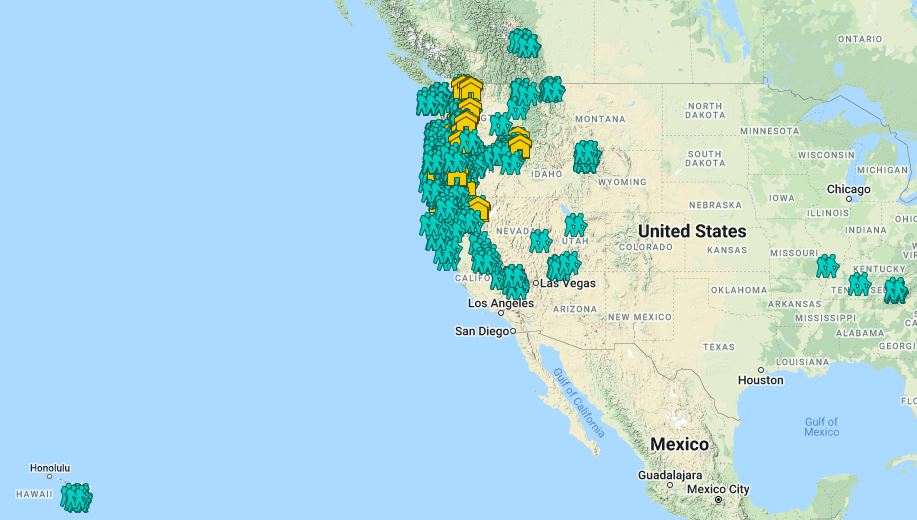
Looking further ahead our bucket list of hikes includes expanding the area that we visit with trips to the Olympic, North Cascades, Yellowstone, Glacier, Death Valley, Yosemite, Zion, Bryce Canyon, Great Smoky Mountains, and Hawaii Volcanoes National Parks in the United States as well as Yoho and Banff National Parks in Canada. We also plan on spending some more time hiking in Idaho and have at least one stop planned in both Nevada and Missouri.

Who knows how many of these hikes we will actually get to experience but as long as we are around (and healthy enough) we’ll be chipping away at them. The list and timing is fluid with new hikes coming onto our radar and existing hikes occasionally vanishing, whether it be due to floods, fires, logging, or simply lack of maintenance. What the list gives us is motivation and hikes to look forward to. Happy Trails!

Categories
Columbia Gorge North Hiking Trip report Washington

Balfour-Klickitat and Lower Klickitat Trails – 04/02/2022

** Note the 2025 Burdoin Fire burned over parts of the route described here. **

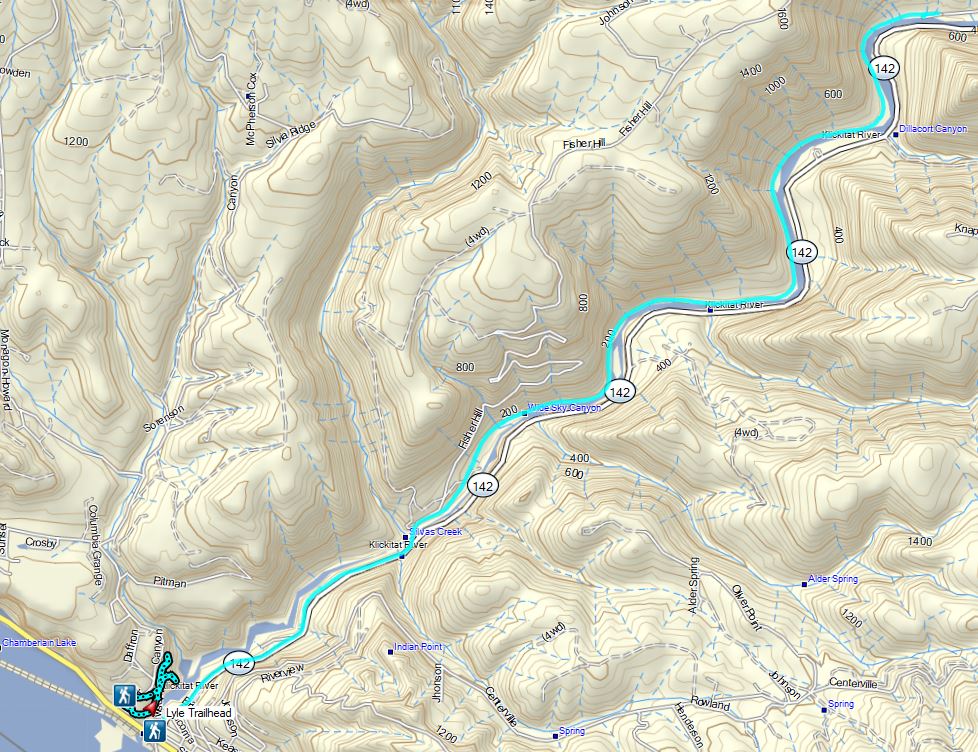
We have spent much of our hiking “off-season” addressing long overdue house projects including replacing siding, windows, floors, and now countertops. Hopefully the projects will be done shortly after our official hiking season starts. In the meantime we welcomed the start of a new month with an outing to Lyle, WA for hikes on a pair of trails along the Klickitat River. Our first stop, on the west side of the river, was at the Balfour-Klickitat Trail. The site of a former ranch this day-use area includes a short interpretive loop, picnic tables, and a wildlife viewing path.
IMG_8372

IMG_8374Rowena Plateau and Tom McCall Point (post) on the Oregon side of the Columbia River

We headed counter-clockwise on the loop which provided views of the Columbia River and across the Klickitat to Lyle.
IMG_8382

IMG_8389

The trail then turned inland along the Klickitat where a noisy group of domestic geese drew our attention to a pair of common mergansers and great blue heron.
IMG_8395

IMG_8400

IMG_8396

IMG_8405A blurry heron along the river.

We spotted a number of smaller birds in the bushes and trees as we made our way around the loop. We also took a quick detour downhill to a picnic table overlooking the river.
IMG_8407Acorn woodpecker

IMG_8417Scrub jay

IMG_8418View from the picnic table.

A short time after returning to the loop we came to a sign for the Wildlife Viewing Area near a bench where we made another short detour.
IMG_8424

IMG_8425This trail was not paved.

IMG_8428Woodland-stars

IMG_8434View from a bench at the end of the trail.

IMG_8435Mallards on the water below.

After checking out the wildlife viewing area we completed the 0.75 mile loop which brought our stop here to a total of 1.3 miles. We hopped in our car and drove across the river on Hwy 14 to the Lyle Trailhead. Here the 31-mile long Klickitat Trail begins. This Washington State Park trail follows the historic rail bed of the Spokane, Portland, Seattle Railway (SP&S). A 3 mile section of the trail north of Klickitat, WA is currently unhikeable due to a missing bridge over the Klickitat River effectively splitting the trail southern and northern sections of 13 and 15 miles respectively. We hiked 3.8 miles along the end of the northern section from Harms Road in 2014 (post).
IMG_8443

IMG_8445

IMG_8449Starting at mile 0.

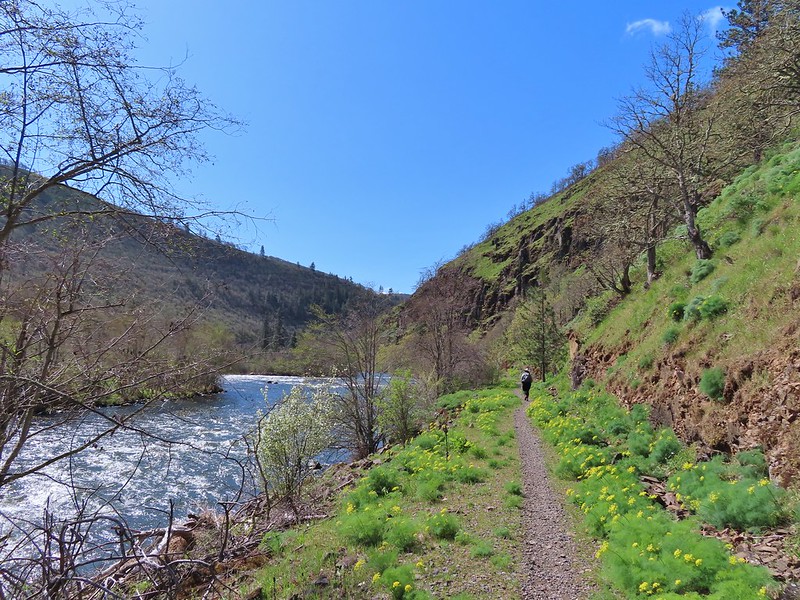
The trail starts by passing some private homes in Lyle but soon provides views down to the Klickitat River. Across the river we spotted a number of deer working their across the hillside and a bald eagle surveying the river below.
IMG_8456

IMG_8458Keep your eyes out for poison oak which was prevalent along the trail. Luckily the trail is nice and wide so avoiding it was easy enough.
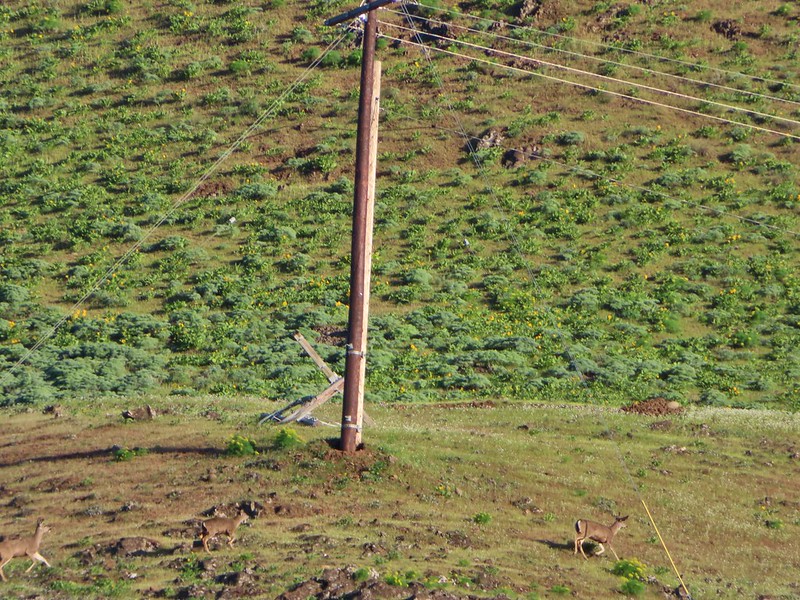
IMG_8469Heather spotted these three deer across the river.
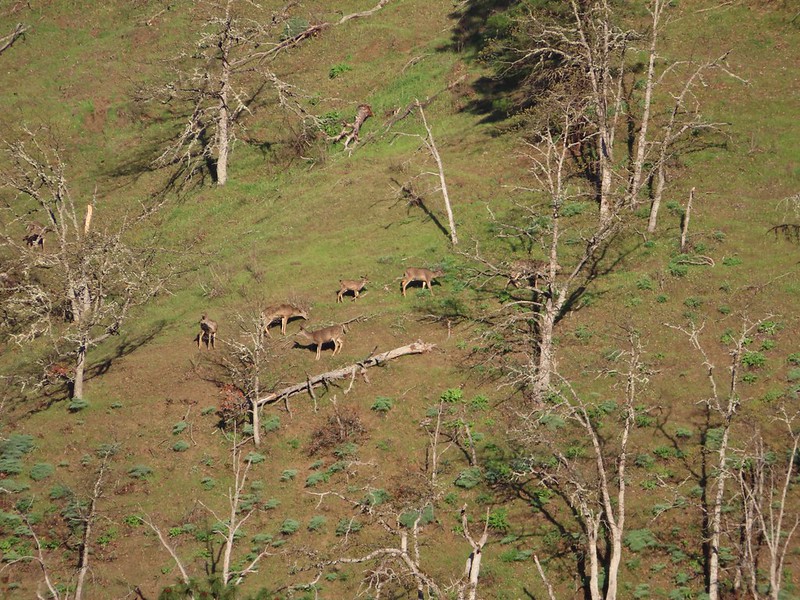
IMG_8473

IMG_8474Another group of deer.

IMG_8487Bald eagle

We had chosen this hike based on Matt Reeder’s entry in his “PDX Hiking 365” guidebook where he recommends a late March visit for wildflowers. We kept our eyes out for flowers as we went and were not disappointed.
20220402_080542Larkspur and woodland-stars

IMG_8491Buttercups

IMG_8493Pacific hound’s tongue

IMG_8495Milepost 1

IMG_8496Saxifrage

IMG_8500Balsamroot

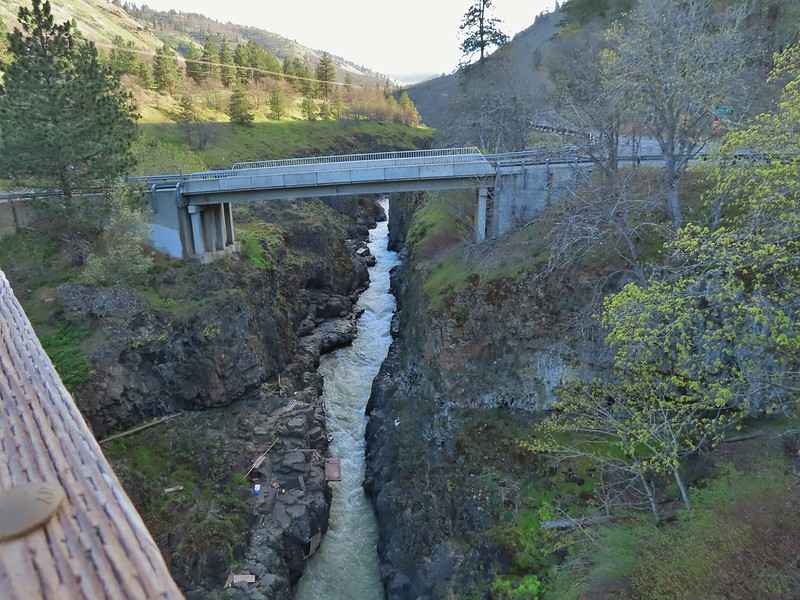
At the 1.7 mile mark we crossed the river on a Fisher Hill Bridge. The view was great and included a series of small cascades on Silvas Creek.
IMG_8503

IMG_8504Silvas Creek

IMG_8507

IMG_8508

We continued north on the trail passing some nice views of the river which were briefly ruined by the smell of rotting flesh (fish?) which brought back memories of the decomposing whale we passed several years ago on our Floras Lake Hike (post).
IMG_8511

IMG_8519

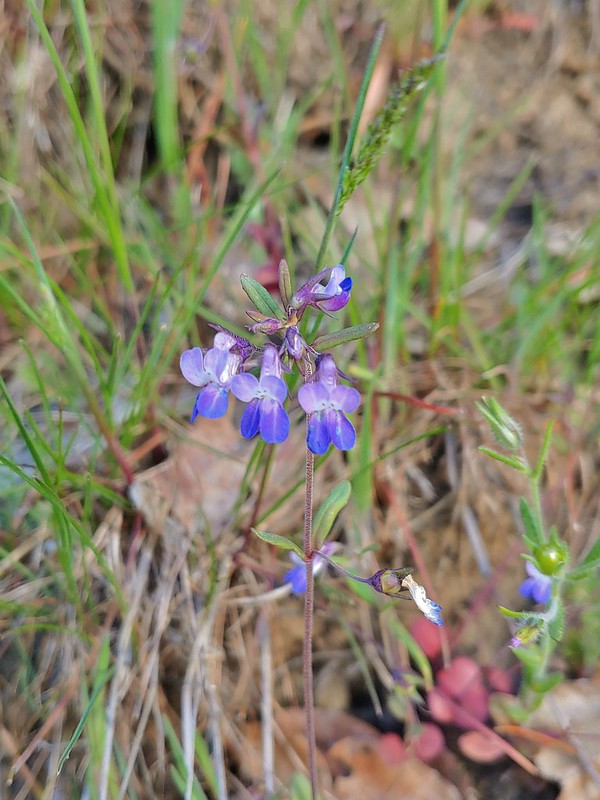
20220402_083857Blue-eyed Mary

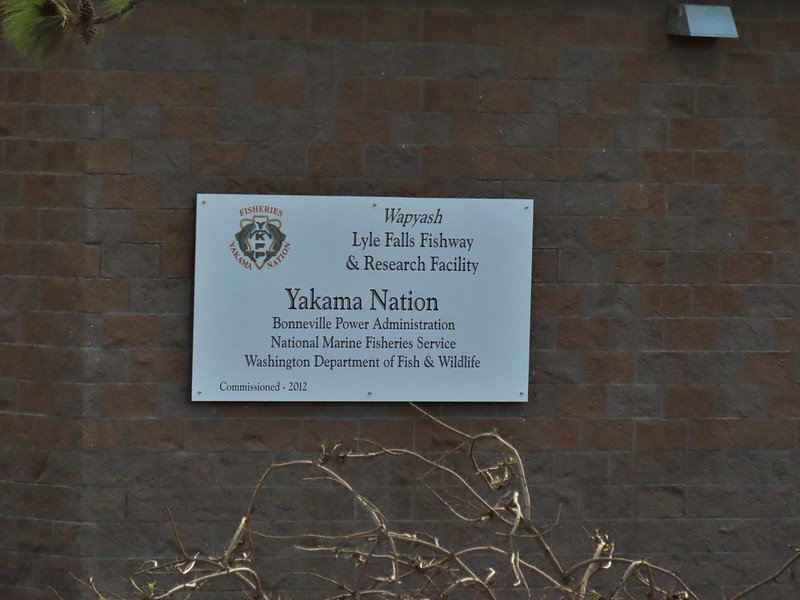
At mile two we passed the Lyle Falls Facility which is a fish monitoring station.
IMG_8520

IMG_8522

IMG_8521

Beyond the fish facility the gap between the trail and the river closed and the views become even prettier.
IMG_8524

IMG_8527

IMG_8526Seasonal pool along the trail.

The only mountain view of the day was along this stretch with Mt. Hood making an appearance to the south.
IMG_8531

IMG_8533

IMG_8535

IMG_8536Common mergansers

A short distance upstream we passed a screw trap, an instrument used to trap and count young fish.
IMG_8540

We continued upriver until we reached milepost 6 where we called it good and turned around. I had gotten myself confused by misreading Reeder’s hike description and thought that there was another bridge around the 5 mile mark and had originally planned to turn around at that but since it didn’t exist (and we didn’t realize that until after passing MP 5) we made MP 6 the turnaround marker.
IMG_8556

IMG_8542Popcorn flower

IMG_8544Columbia desert parsley

IMG_8546Lupine

IMG_8549Balsamroot

IMG_8554Shooting stars

IMG_8560Buttercups

IMG_8561Waterleaf

IMG_8567A balsamroot amid pungent desert parsley

IMG_8564Big-leaf maple trees lining the trail.

20220402_091018Big-leaf maple blossoms

IMG_8572

IMG_8574Gold stars

IMG_8583Larkspur, poison oak, and buttercups

IMG_8587

IMG_8589Spotted towhee

IMG_8592

IMG_8600Squirrel

IMG_8609Dillacort Canyon

20220402_101749Red-stem storksbill

IMG_8624

After turning around we took a brief break on a rocky beach near MP6.
IMG_8625

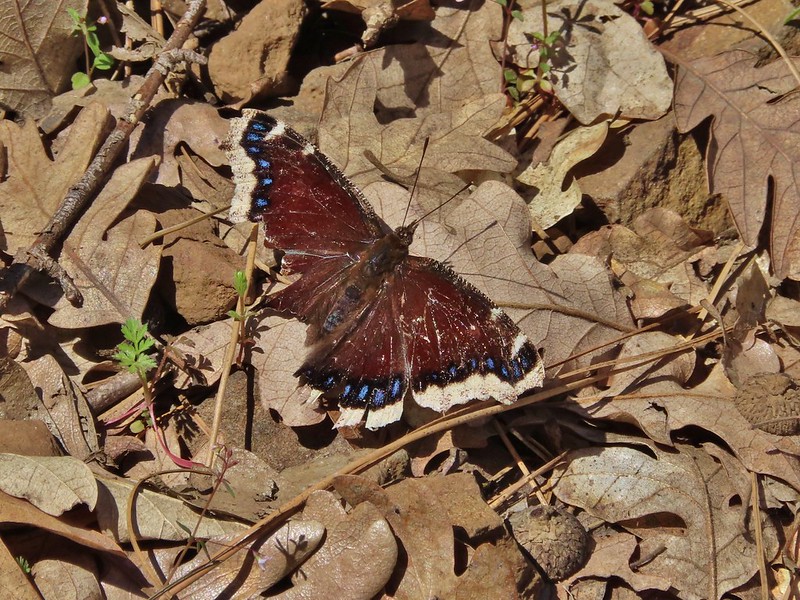
On our way back it had warmed enough for the butterflies (and moths) to come out and we watched for them along with anything we’d missed on our first pass.
IMG_8633Couldn’t get a good look at this small moth but it was pretty.
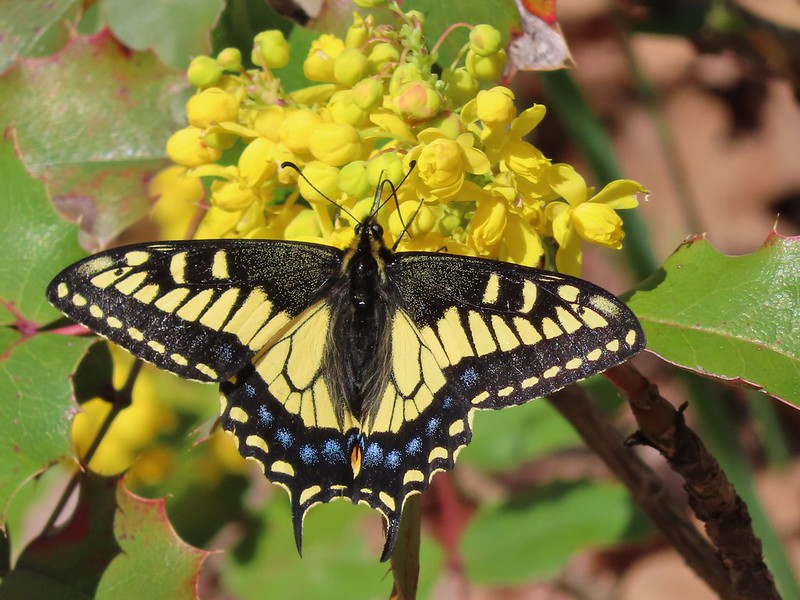
IMG_8643Anise swallowtail

IMG_8644Sara’s orangetip

IMG_8654Grass widow

20220402_112438Slender phlox

IMG_8672Heading back.

IMG_8685Immature bald eagle

IMG_8688Propertius duskywing – Erynnis propertius

IMG_8690The mergansers had moved to the near bank.
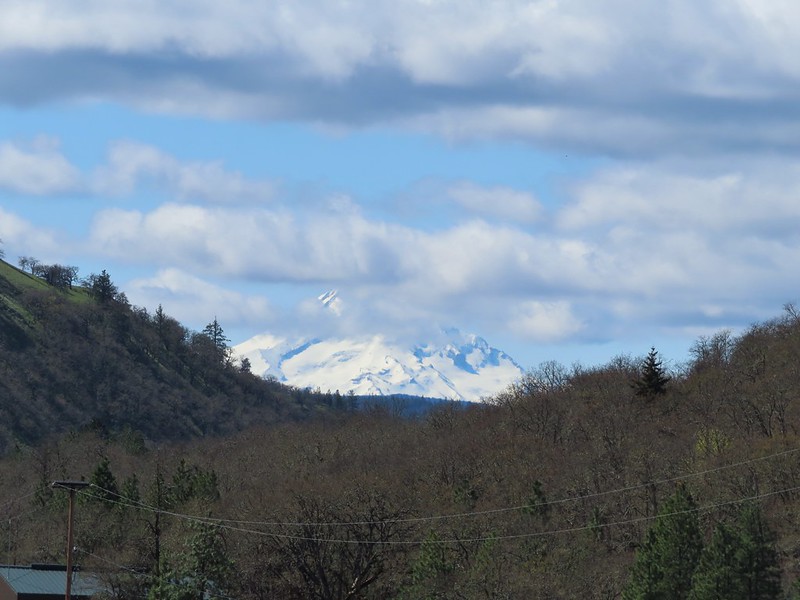
IMG_8698Hood behind some clouds.

IMG_8700Ground squirrel

IMG_8708Mourning cloak

IMG_8718Lizard

IMG_8723

IMG_8724
View from the Fisher Hill Bridge in the afternoon.

IMG_8741Arriving back at the Lyle Trailhead.

Some backtracking and detours brought our hike to a little over 12.5 miles here giving us close to 14 miles on the day with only a couple of hundred feet of elevation gain.

Rattlesnakes and ticks are present in the area but we encountered neither on this day. It was a nice break from the projects at home and a good way to end our off-season. Happy Trails!

Flickr: Blafour-Klickitat and Lower Klickitat Trails

Categories
Coastal Range Hiking Oregon

Crown Zellerbach (CZ) Trail – East Fork Nehalem River Section 03/05/2022

So far in 2022 the first Saturday of every month has come with a dry and at least partially sunny forecast which meant for the third month in a row we took our hike on the first weekend. We tend to take for granted the opportunities we have to get out and enjoy nature but this outing was different. For more than a week we’ve watched as the Ukrainian people have been forced to fight for their freedom and country. We continue to pray for their safety and an end to Russian aggression.

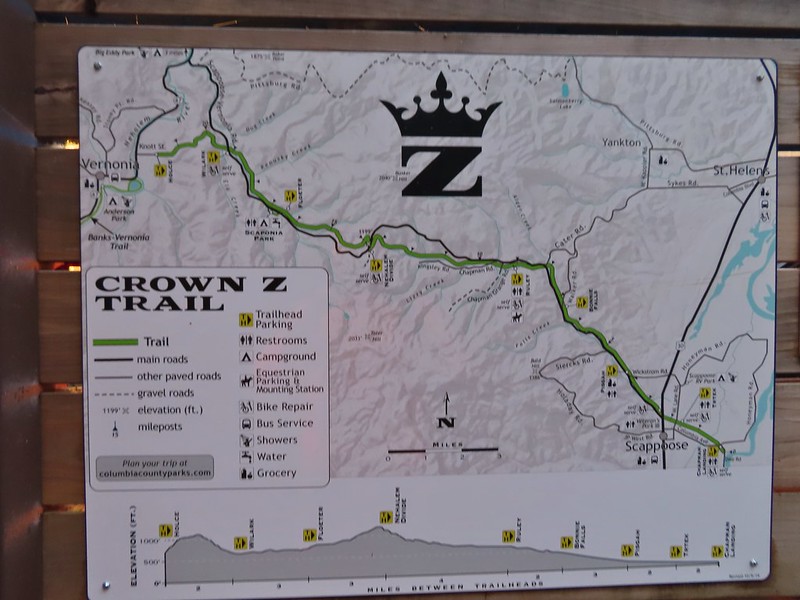
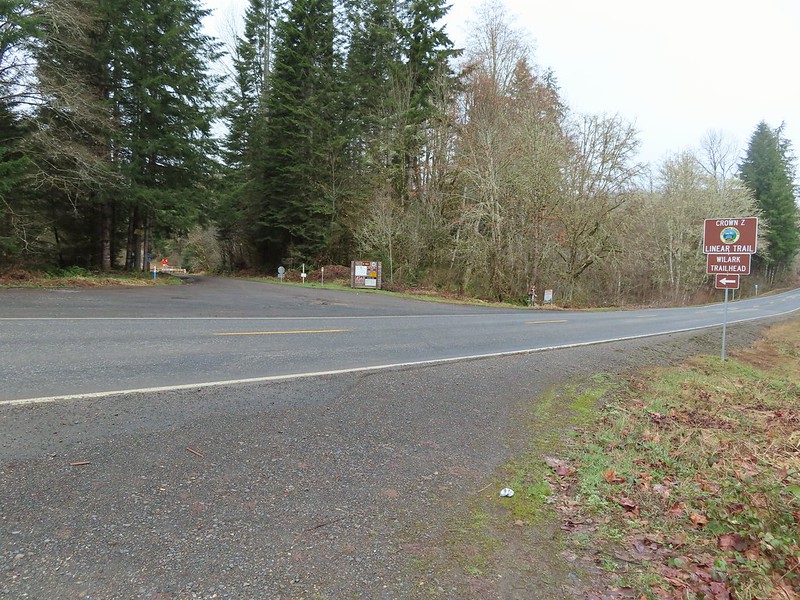
For our March hike we decided to check out the Crown Z Linear Trail, also known as the CZ Trail or Crown Zellerbach Trail. The 24.8 mile long CZ Trail runs between the cities of Vernonia and Scappoose following former (and sometimes active) logging roads open to hikers, bicycles and horses. Multiple trailheads make it possible to hike shorter segments as either out-and-backs or between trailheads using a second car. For our first visit we used the Oregon Hikers field guide which breaks the trail up into five sections. We picked section four, the East Fork Nehalem River Section, which runs between the Nehalem Divide and Wilark Trailheads.

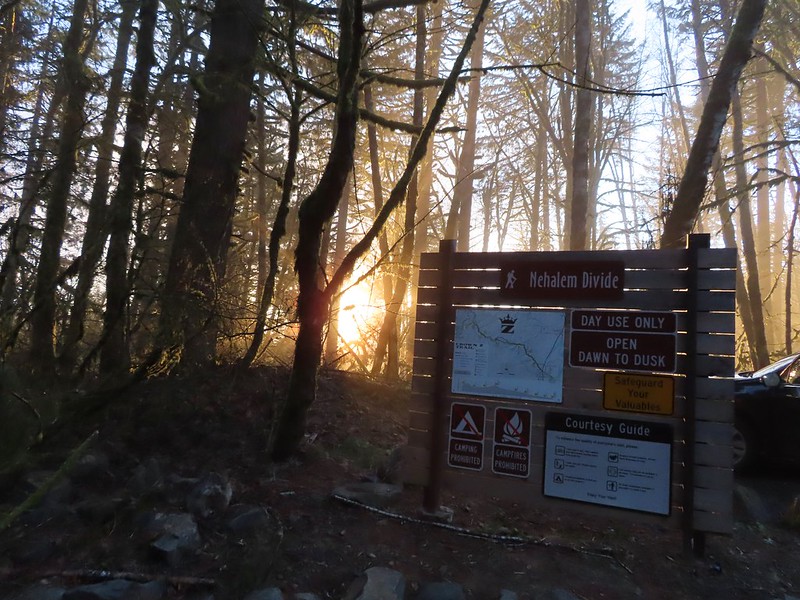
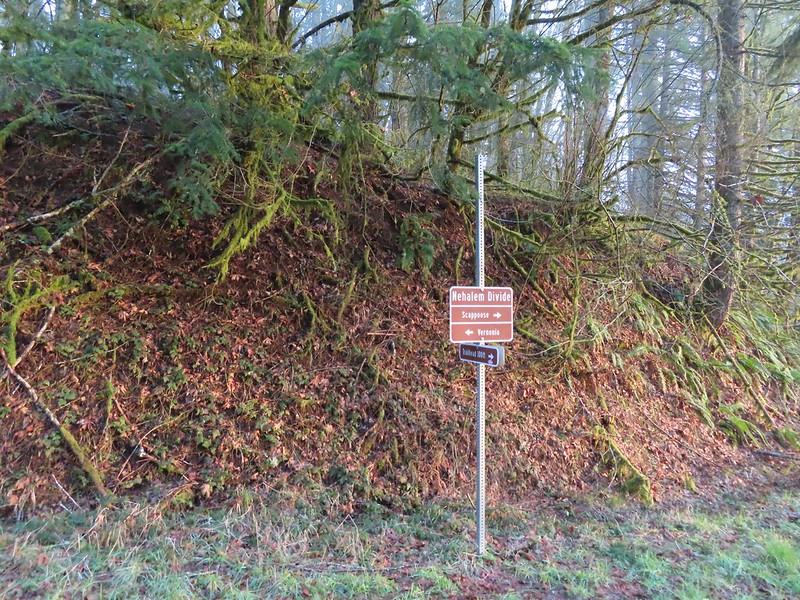
We began at the Nehalem Divide Trailhead which provided the shorter drive of the two and also allowed us to begin the day with a downhill.
IMG_8225

IMG_8226

A 100′ path leads downhill from the trailhead to the CZ Trail which passes under the Scapoose-Vernonia Highway (if you’re heading toward Vernonia).
IMG_8227Heading down the connector trail.

IMG_8228Trial sign at the jct with the CZ Trail.

IMG_8230CZ Trail passing under the highway.

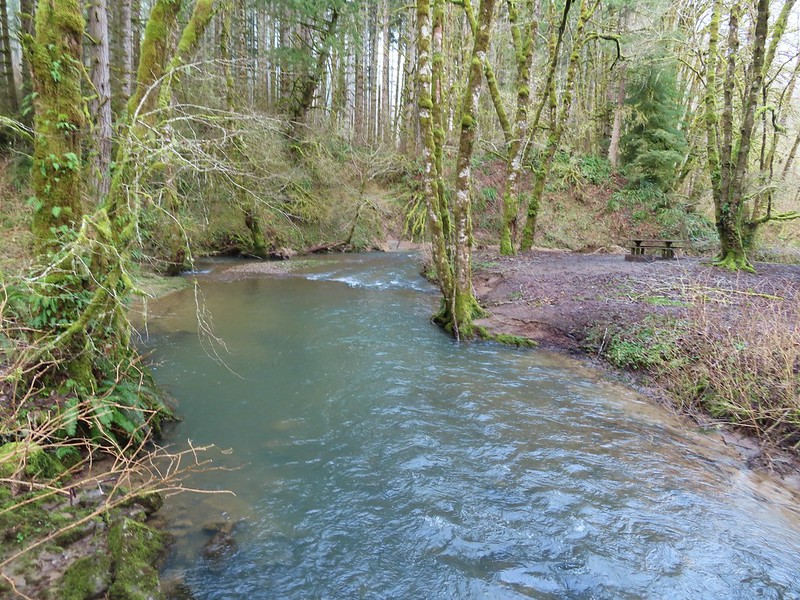
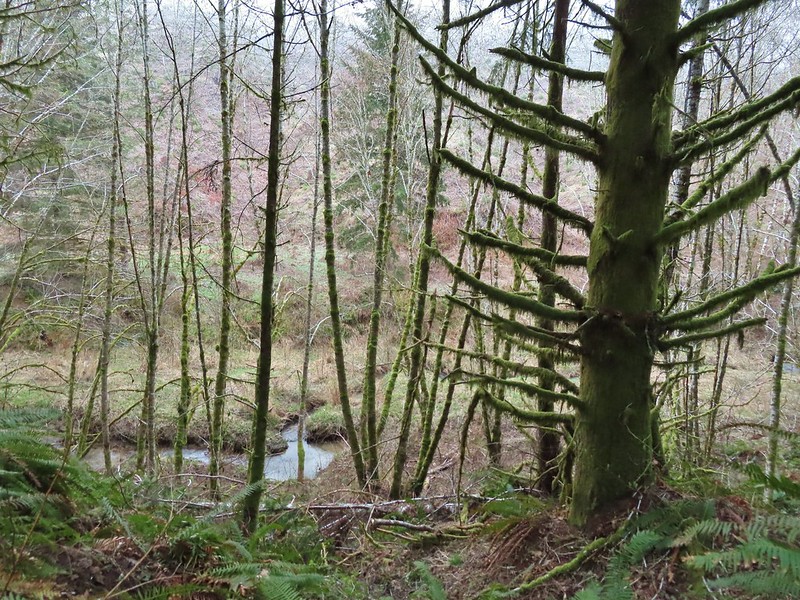
We followed the road downhill for approximately 3/4 of a mile to an interpretive wildlife sign where a path behind led downhill to the East Fork Nehalem River. The river isn’t much as it isn’t far from the headwaters, but a short distance up river is a pair of small waterfalls with the western end of the Nehalem Divide Railroad Tunnel.
IMG_8234

IMG_8240

IMG_8242

IMG_8249

IMG_8244Light from the eastern portal is visible at the other end but the tunnel is not safe to enter without at least a hard hat.

IMG_8250

After checking out the old tunnel we returned to the CZ Trail and resumed our hike toward the Wilark Trailhead.
CZ Trail

East Fork Nehalem RiverThe East Fork Nehalem River next to the trail.
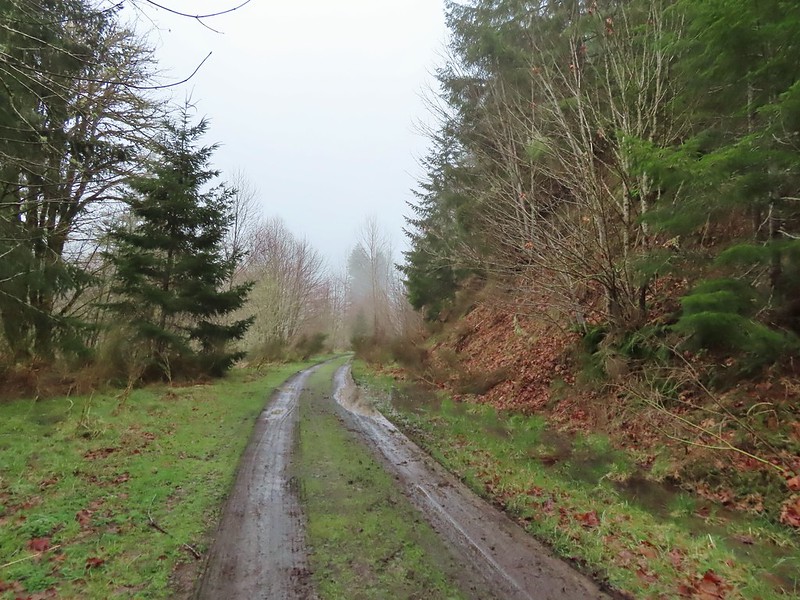
We detoured again briefly to check out a small seasonal fall just off the trail.
Season fall along the CZ Trail

CZ TrailIt was a little muddy in places.

Interpretive sign along the CZ TrailAnother of several interpretive signs along the trail.

Indian plumNot much in the way of flowers yet but there were a few indian plum starting to blossom.

A little under four miles from the Nehalem Divide Trailhead we arrived at the Floeter Trailhead.
CZ Trail arriving at the Floeter Trailhead

Interpretive sign along the CZ Trail

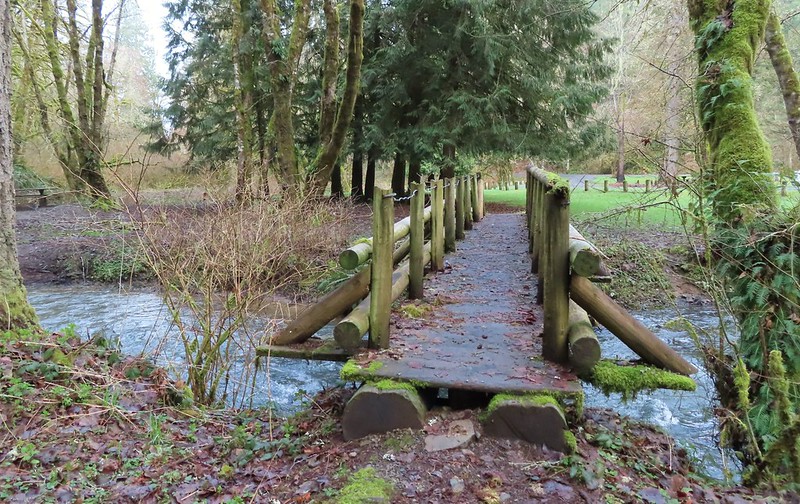
Beyond this trailhead the CZ Trail immediately crossed an unnamed creek on a bridge.
Footbridge near the Floeter Trailhead

Unnamed creek

After crossing the bridge we detoured here yet again passing over the highway to a small trail sign for Scaponia Park.
Scaponia Park across the Vernonia-Scappoose Highway

Trail to Scaponia Park

This short path dropped us into the 7 acre park which has 12 campsites and a short network of trails. We turned right on the park entrance road then crossed the East Fork Nehalem River on a footbridge to do a short 0.4 mile loop utilizing a second footbridge to return to the road near the campground.
Scaponia Park

East Fork Nehalem River in Scaponia Park

One of two footbridges in Scaponia Park

Trail in Scaponia Park

Second footbridge in Scaponia Park

East Fork Nehalem RiverEast Fork Nehalem River

After our little loop we returned to the CZ Trail and continued west.
Sign for the CZ Trail in Scaponia ParkPointer for the CZ Trail in Scaponia Park

CZ Trail

For the next three quarters of a mile the trail parralled the highway.
Log home across the highway

American kestralAmerican kestral

The trail veered away from the highway again after the highway crossed the river putting it between the road and the trail.
East Fork Nehalem River

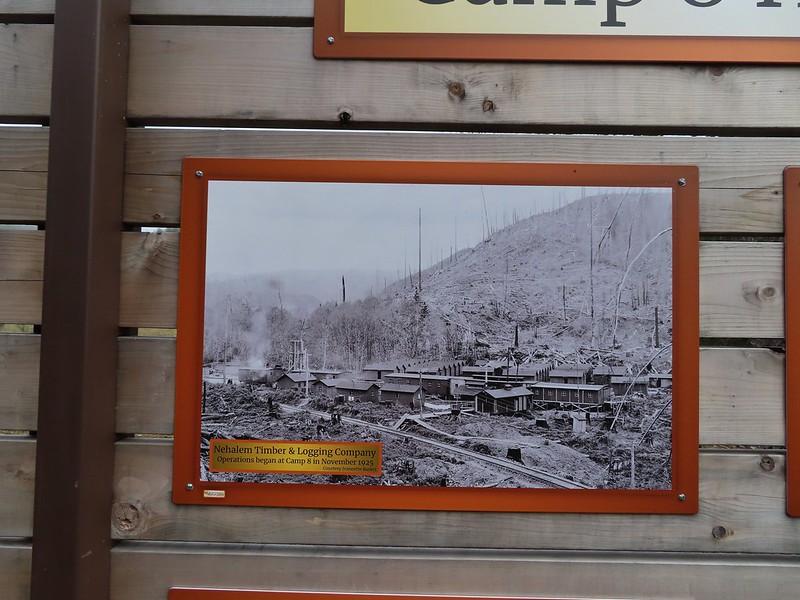
Just over two miles from the Floeter Trailhead we arrived at the former site of Camp 8, a logging camp established in the 1920’s.
CZ Trail nearing Camp 8

Interpretive sign along the CZ Trail

Interpretive sign along the CZ Trail

Robin at Camp 8Robin in the meadow that once was Camp 8.

Beyond the Camp 8 site the trail crossed the East Fork Nehalem River then climbed to the highway passing mile marker 19 along the way.
CZ Trail crossing the East Fork Nehalem River

East Fork Nehalem River

CZ Trail mile 19The orange mile marker 19 ahead.

This short section was full of birds.
JuncosJuncos

Varied thrushAnother not great picture of a varied thrush.
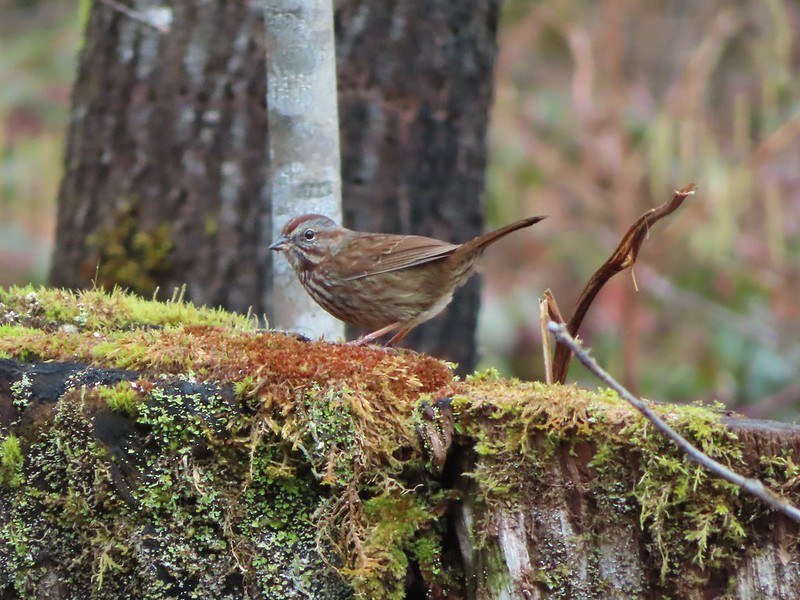
SparrowSparrow

Vernonia-Scappoose Highway at the Wilark Trailhead

We turned around at the highway and headed back.
CZ Trail at the Wilark Trailhead

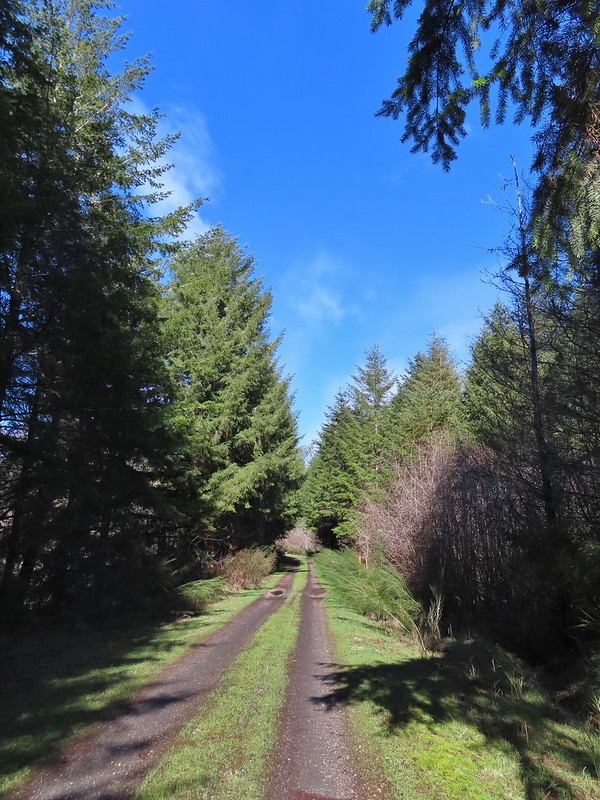
The clouds finally began to break up after we passed Camp 8 and soon we found ourselves under a bright blue sky.
Blue sky begining to emerge

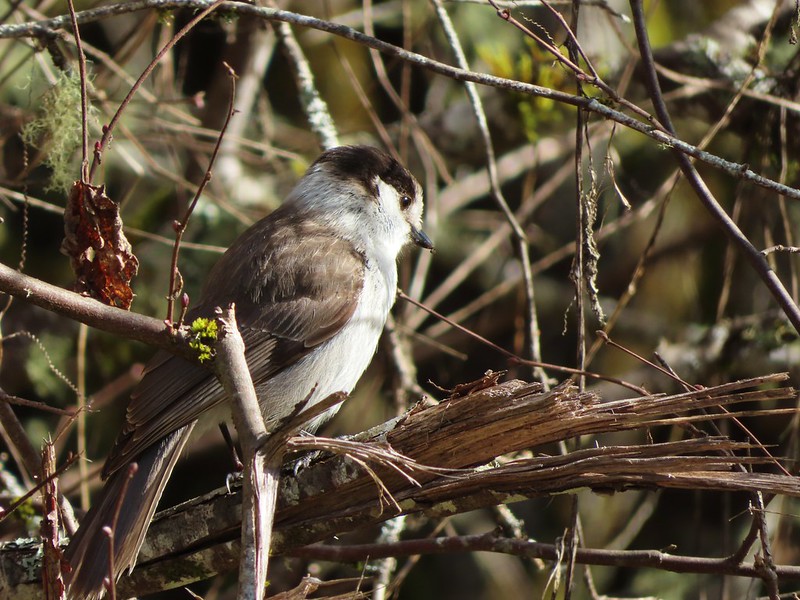
Grey jayA grey jay enjoying the emerging sunlight.
CZ Trail

CZ TrailBlue sky near the Floeter Trailhead.

Surprisingly until the final tenth of a mile we hadn’t seen a single other trail user when a lone mountain biker zoomed past us heading downhill. Including our three detours our hike came in at 12.7 miles with a little over 650′ of elevation gain. A good early season workout with some nice scenery and interesting history.

At some point down the road we will return to do another section of the trail but for now this was a fun introduction to CZ Trail. Happy Trails and Slava Ukraini.

Flickr: CZ Trail – East Fork Nehalem River Section

Categories
Hiking

Hiking Oregon’s Counties

A couple of years ago, while going over some maps, I realized that we were probably pretty close to having hiked in all 36 of the Oregon’s counties. Some further analysis revealed that not only were we close but there were only two counties that we had yet to hike in – Umatilla and Gilliam. (At first I thought it was three including Union but we had actually crossed into Union County on two different days during at 2016 backpacking trip in the Eagle Cap Wilderness.)

While there were hikes in Umatilla County in our plans, several of Sullivan’s featured hikes are in that county, we had no planned hikes in Gilliam County. With little public land agriculture is the primary economy with an average farm size of 4,200 acres. At first glance I wondered if there were any hikes to be found but as luck would have it the John Day River acts as the divide between Gilliam and Sherman County. Along that divide is Cottonwood Canyon State Park with the Lost Corral Trail (post) located on the Gilliam County side. That hike was quickly added to the 2021 schedule and the pieces were in place to finish another hiking goal. That goal was reached on June 13th when we stepped onto a trail at the Cold Springs Wildlife Refuge in Umatilla County (post).

More information on Oregon’s counties can be found on the Oregon Secretary of State County Government page here. Below is a list of the counties with some basic statistics and one memorable photo from each.

Baker Area 3,089 Sq ft Population 16,910 Year Est. 1862
First Hike – 2017 Total Days – 8
Summit LakeSummit Lake, Elkhorn Mountains

Benton Area 679 Sq ft Population 94,665 Year Est. 1847
First Hike – 2009 Total Days – 12
South side of Mary's Peak summitWildflowers on the summit of Mary’s Peak

Clackamas Area 1,884 Sq ft Population 426,515 Year Est. 1843
First Hike – 2012 Total Days – 42
Mt. Hood from Yocum RidgeMt. Hood from Yocum Ridge

Clatsop Area 1,085 Sq ft Population 39,455 Year Est. 1844
First Hike – 2013 Total Days – 10
View from Ecola State ParkEcola State Park

Columbia Area 687 Sq ft Population 53,280 Year Est. 1854
First Hike – 2018 Total Days – 2
Oak IslandOak Island

Coos Area 1,629 Sq ft Population 63,315 Year Est. 1853
First Hike – 2017 Total Days – 8
Cape Arago Lighthouse from the Oregon Coast TrailCape Arago Lighthouse

Crook Area 2,991 Sq ft Population 23,440 Year Est. 1882
First Hike – 2012 Total Days – 6
Wildflowers along the Independent Mine TrailIndependent Mine Trail, Ochoco National Forest
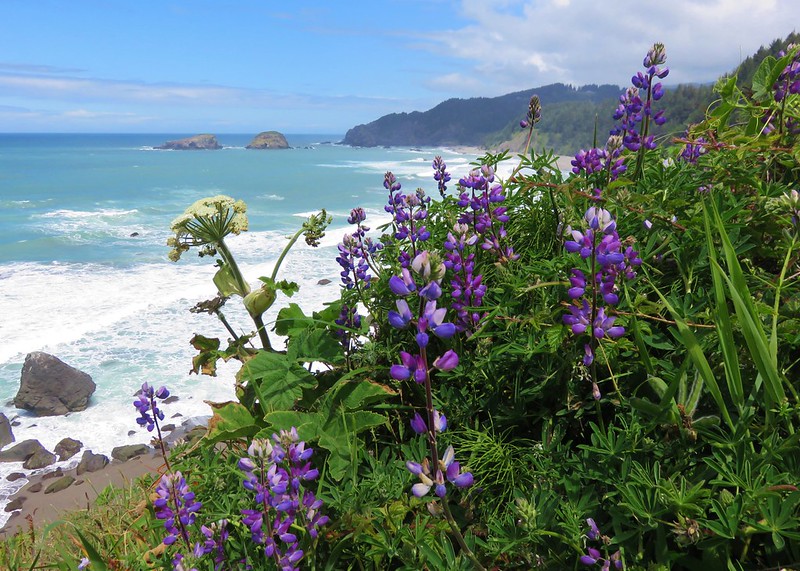
Curry Area 1,648 Sq ft Population 23,005 Year Est. 1855
First Hike – 2016 Total Days – 12
LupineBoardman State Park

Deschutes Area 3,055 Sq ft Population 197,015 Year Est. 1916
First Hike – 2006 Total Days – 45
Middle and North SisterThree Sisters Wilderness

Douglas
Area 5,071 Sq ft Population 112,530 Year Est. 1852
First Hike – 2012 Total Days – 23
Upper Kentucky FallsUpper Kentucky Falls

Gilliam Area 1,223 Sq ft Population 1,990 Year Est. 1885
First Hike – 2021 Total Days – 1
Jeep track dropping into Esau CanyonEsau Canyon

Grant Area 4,528 Sq ft Population 7,315 Year Est. 1864
First Hike – 2017 Total Days – 15
Strawberry Mountain from the Onion Creek TrailStrawberry Mountain

Harney Area 10,228 Sq ft Population 7,280 Year Est. 1889
First Hike – 2018 Total Days – 9
Surnise from the Borax Hot Springs TrailheadBorax Springs Trailhead

Hood River Area 533 Sq ft Population 25,640 Year Est. 1908
First Hike – 2012 Total Days – 33
Mt. Hood from Owl PointMt. Hood from Owl Point

Jackson Area 2,801 Sq ft Population 223,240 Year Est. 1852
First Hike – 2015 Total Days – 15
View from Lower Table RockView from Lower Table Rock

Jefferson Area 1,791 Sq ft Population 24,105 Year Est. 1914
First Hike – 2008 Total Days – 27
Goat Peak and Mt. JeffersonMount Jefferson Wilderness

Josephine Area 1,641 Sq ft Population 86,560 Year Est. 1856
First Hike – 2016 Total Days – 5
Paradise Lost room, Oregon CavesParadise Lose, Oregon Caves National Monument

Klamath Area 4,105 Sq ft Population 68,075 Year Est. 1882
First Hike – 2012 Total Days – 20
Crater Lake from Mt. ScottCrater Lake National Park

Lake Area 8,359 Sq ft Population 8,075 Year Est. 1874
First Hike – 2037 Total Days – 9
Barnhardy RoadHart Mountain National Antelope Refuge

Lane Area 4,620 Sq ft Population 381,365 Year Est. 1851
First Hike – 2011 Total Days – 74
South Sister from Husband LakeSouth Sister from Husband Lake

Lincoln Area 992 Sq ft Population 48,305 Year Est. 1893
First Hike – 2010 Total Days – 15
God's ThumbGod’s Thumb

Linn
Area 2,297 Sq ft Population 127,320 Year Est. 1847
First Hike – 2007 Total Days – 50
Mt. Jefferson from the junction of the Hunts Creek Trail and Pacific Crest TrailMount Jefferson Wilderness

Malheur Area 9,926 Sq ft Population 32,105 Year Est. 1887
First Hike – 2018 Total Days – 3
Timber GulchTimber Gulch

Marion Area 1,194 Sq ft Population 349,120 Year Est. 1843
First Hike – 2006 Total Days – 46
Sawmill FallsSawmill Falls

Morrow
Area 2,049 Sq ft Population 12,825 Year Est. 1885
First Hike – 2019 Total Days – 1
McCormack SloughMcCormack Slough

Multnomah
Area 465 Sq ft Population 829,560 Year Est. 1854
First Hike – 2012 Total Days – 13
Upper McCord FallsUpper McCord Falls

Polk
Area 745 Sq ft Population 83,805 Year Est. 1845
First Hike – 2010 Total Days – 7
North Fork Siletz RiverNorth Fork Siletz River

Sherman
Area 831 Sq ft Population 1,795 Year Est. 1889
First Hike – 2017 Total Days – 3
View from the Ferry Springs TrailDeschutes River State Recreation Area

Tillamook
Area 1,125 Sq ft Population 26,530 Year Est. 1853
First Hike – 2010 Total Days – 18
Cape LookoutCape Lookout

Umatilla
Area 3,231 Sq ft Population 81,495 Year Est. 1862
First Hike – 2021 Total Days – 5
High point on Ninemile RidgeNorth Fork Umatilla Wilderness

Union
Area 2,038 Sq ft Population 26,840 Year Est. 1864
First Hike – 2016 Total Days – 3
Glacier Peak and Glacier Lake from Eagle CapGlacier Peak from Eagle Cap, Eagle Cap Wilderness

Wallowa Area 3,153 Sq ft Population 7,160 Year Est. 1887
First Hike – 2016 Total Days – 11
Ice LakeEagle Cap Wilderness

Wasco
Area 2,396 Sq ft Population 27,295 Year Est. 1854
First Hike – 2014 Total Days – 10
Tom McCall Point TrailRowena Plateau

Washington Area 727 Sq ft Population 620,080 Year Est. 1843
First Hike – 2015Total Days – 8
Henry Haag LakeHaag Lake

Wheeler Area 1,715 Sq ft Population 1,440 Year Est. 1899
First Hike – 2016 Total Days – 5
Painted HillsPainted Hills, John Day Fossil Beds

Yamhill Area 718 Sq ft Population 108,605 Year Est. 1843
First Hike – 2015 Total Days – 3
Niagara FallsNiagara Falls

Happy Trails!

Categories
Hiking

Progress Report – 500 “Featured Hikes” – February, 2022 Update

Sometime back in 2016 we committed to making a serious attempt to complete a couple of hiking goals that we had discussed. One was visiting all of the federally designated wilderness areas in Oregon, which we accomplished in 2021 (post), and the other was hiking at least a portion of all 100 featured hikes in at least one edition of William L. Sullivan’s “100 Hikes” guidebook series. Sullivan splits the State up into five areas, Oregon Coast & Coast Range, NW Oregon & SW Washington, Central Oregon Cascades, Southern Oregon & Northern California, and Eastern Oregon. Five areas times 100 featured hikes in each comes to a grand total of 500 featured hikes.

In 2020 we completed the Central Oregon Cascades Area (post) and followed that up in 2021 by finishing both the Oregon Coast (post) and NW Oregon (post) featured hikes leaving just Eastern and Southern Oregon & Northern California.

In our 2020 update we stated that we ended that year having checked off 401 out of the 500 featured hikes based on the following editions of Sullivan’s books:
“100 Hikes in the Central Oregon Cascades” 4th Edition 2012
“100 Hikes/Travel Guide Oregon Coast & Coast Range” 4th Edition 2016
“100 Hikes/Travel Guide Northwest Oregon & Southwest Washington” 4th Edition 2018
“100 Hikes/Travel Guide Eastern Oregon” 3rd Edition 2015
“100 Hikes/Travel Guide Southern Oregon & Northern California” 4th Edition 2017

In order to finish the Oregon Coast book we switched from the 2016 4th edition to his earlier 2009 3rd edition due to the continued closure of the Salmonberry Railroad which lowered the number from 401 to 397. So while we sit at 99/100 for that 4th edition reverting to the 3rd edition made it possible to check that area off. We also had failed to count our Collings Mountain Loop (post) in Southern Oregon as having completed a portion of Sullivan’s Applegate Lake hike so we were actually at 398 of 500. (We plan on hiking more of the trails at Applegate Lake in 2022.)

In addition to the 9 hikes to finish out the Oregon Coast Book, and 6 hikes for NW Oregon, we managed to check off 13 featured hikes from the Eastern Oregon book ending the year at 73. Unfortunately we made no headway on the Southern Oregon & Northern California book. The impacts of various wildfires thwarted all our plans to visit that area in 2021 and in all honesty making us question if we will ever actually be able to finish that one. We do have several trips planned this year and over the next couple in hopes of making our goal but if the wildfire seasons of the past couple of years continue it is going to be difficult. We did move from the 2017 4th edition to the 2021 4.2 edition due to Sullivan swapping out a couple of fire damaged hikes for more accessible ones.

If conditions cooperate we will remain on track to complete the Southern book in 2024 and the Eastern book in 2025. Nearly all of the hikes remaining in the Eastern book are located either in the Wallowa Mountains or Hells Canyon in the NE corner of the State. Mount Ireland is the lone hike outside of those two areas and it is on this years list.

Finally in 2021 we also completed the 5th edition of the Central Oregon Cascades book. When we completed that area in 2020 the final hike, Erma Bell Lakes, technically finished both the 3rd and 4th editions but it was the 4th we were focusing on due to some crossover between that 3rd edition and the 3rd edition of the Eastern Oregon book.

As we head into the 2022 hiking season we are at 426 out of 500 featured hikes or 85.2% of our goal.
100/100 – “100 Hikes in the Central Oregon Cascades” 4th Edition 2012 (also 3rd & 5th editions)

100/100 – “100 Hikes/Travel Guide Oregon Coast & Coast Range” 3rd Edition 2009

100/100 – “100 Hikes/Travel Guide Northwest Oregon & Southwest Washington” 4th Edition 2018

73/100 – “100 Hikes/Travel Guide Eastern Oregon” 3rd Edition 2015

53/100 – “100 Hikes/Travel Guide Southern Oregon & Northern California” 4th Edition 2021

With Sullivan continuing to release new editions and updated versions I’m sure we will have plenty of ideas going forward. We are also working our way through hikes in several of Matt Reeder’s guidebooks (The Ruddy Hill Press).

Whether or not we actually reach our goal of all 500 is secondary to the all of the amazing places our chasing the 500 has led us to. Happy Trails!

Categories
Hiking

Yakona Nature Preserve – 02/05/2022

After several hectic weeks at work for both Heather and I we celebrated the start of a new month (and a favorable forecast) by heading out on our second hike of the year. Our destination for this outing was the Yakona Nature Preserve, an area brought to our attention by our friends Susan and John. The preserve encompasses over 300 acres of a peninsula located at the south end of Newport in Yaquina Bay which as been acquired through various purchases since 2013. Several trails have been built in recent years with construction ongoing as the Yakona Nature Preserve works to fulfill its vision “to preserve and restore native forest land on the bay, with day use access for families, hikers and people of all abilities.”

I reached out to the folks at the preserve to check on any permit or reservation requirements to visit. They were quick to answer and provided me with the information we needed. As of our hike (and this report) there are two ways to visit the preserve, on a group hike led by the Yakona Nature Preserve or by obtaining a permit to hike 1.75 miles through private timber land to reach the preserve. We were informed that a group hike was tentatively planned for later in the month but we really needed to spend a day on the trails sooner rather than later and we couldn’t pass up a partly sunny day so we opted to go the permit route. If you’re interested in visiting the preserve please reach out via their contact page or message them on Facebook for more information.

With our permit obtained we headed to Newport and parked near the Wilder Dog Park and disc golf course just beyond the Wolf Tree Brewery and Taproom on SE Harborton Street. SE Harborton is gated at the start of the private land (do not block the gate) and becomes Road 200.
Emery Investment permit information at Road 200Permit info at the gate.

Road 200 gate at the Wilder Trails areaLooking back to the gate from Road 200.

From the gate we took Road 200 (the middle of three roads) and followed it for three quarters of a mile to King Slough where the road passes through the estuary.
Road 200

Big trees on an even bigger nursery stumpIt’s hard to get an idea of size here but the two trees growing over the large nursery stump were good sized.

Road 200

Kings Slough

Kings Slough

Hooded mergansersHooded Mergansers

After a brief stretch amid some trees, where we stayed left at another 3-way fork, we crossed another arm of King Slough.
Road 200 to the leftRoad 200 to the left.

King Slough

On the far end of the slough on the right side of the road was a trail signed “3rd World”
3rd World Trail at Road 200

This wasn’t the first trail we’d seen leading off to the right, we had passed at least three earlier some of which appeared to be part of the disc golf course, but this was the first that we would pass both ends of. A half mile further up Road 200 we passed the upper end of the 3rd World Trail and decided that we would take that trail on our way back. The various trails which are open to mountain bikes, trail runners and hikers can be viewed here. (Don’t forget your permit.)
3rd World TrailUpper end of the 3rd World Trail.

We had stayed on Road 200 through which climbed uphill via a wide curve. As we gained elevation we spotted a couple of elk in the brush on the hillside above.
Elk

It turned out that there were quite a few elk in the area and for the next third of a mile or so we occasionally spotted them in the road or heard them crashing through the brush.
Elk with breakfast

Road 200

Two tenths of a mile beyond the upper end of the 3rd World Trail we came to a split in the road on a ridge top. Road 200 turned left while Road 250 continued straight.
Road 200Approaching the ridge top.

We turned left on Road 200 passing a sign for the Yakona Nature Preserve.
Road 200

Sign for the Yakona Nature Preserve

In another 0.2 miles we came to a gate which we passed around per the directions received from the preserve.
Gate at the Yakona Nature Preserve boundary

As of yet there are no maps available of the nearly 4 miles of trails here so we were operating on the directions we’d received via email: “There is a good road all the way to the edge of the forest and you’ll pass, on your right, the clear cut we’ve replanted. Most of the trails take off into the forest from there, and the road continues for another 3/4 mile, traverses forest, and ends at a wetland. There are multiple trails off that forest road. We’re still developing a trails map, but as a general rule, when you’re ready to exit Yakona and not sure where you are, head UPHILL to return to the road you hiked in on. Uphill is your way out. All of our trails connect to one another or to the road. Keep in mind that we are still in the build out stage.” We also had found a map for a 30k race that went through the preserve to give us a bit of an idea where some of the trails were located. We turned left off the main road where the race had with the plan being to work our way clockwise around the peninsula sticking as close to the edge as the trails allowed. We had one specific goal in mind which was to find the Yakona Bridge, a replica of the Yaquina Bridge spanning Yaquina Bay. We knew that the bridge had been part of the race course but were unsure where along the route it was located.
Yakona Nature PreserveHeading off the main road.

Yakona Nature Preserve

It was clear that there had been a lot of work done to establish the trails and that that work was still continuing. The trails dipped and climbed bringing us to the bay at times and to views above at others.
Kings Slough

Female common goldeneyeCommon goldeneye

Great blue heron and buffleheadsGreat blue heron and buffleheads

Rough skinned newtRough skinned newt

Coral fungusCoral fungus

Kings Slough

Northern pintail, heron, seagulls and possible some green winged tealsNorthern pintail, heron, seagulls and some green winged teals.

American wigeons?American wigeons

Bench at the Yakona Nature PreserveOne of a number of unique benches located along the trails.

Yakona Nature PreserveStone steps

Bridges in the Yakona Nature PreserveA pair of footbridges.

Rough skinned newtAnother rough skinned newt, there were many.

MushroomMushroom

Bench at the Yakona Nature PreserveAnother bench at a viewpoint.

Yakona Nature Preserve

Bench at the Yakona Nature Preserve

Bench at the Yakona Nature PreserveSeveral benches were inlaid with rocks such as this which was a really neat feature.

Yakona Nature PreserveSmall footbridge ahead.

Beyond the little footbridge the trail climbed to a ridge top on the NE side of the peninsula where looking down the other side we spotted the Yakona Bridge.
Yakona Nature Preserve

Footbridge at the Yakona Nature Preserve

Footbridge at the Yakona Nature PreserveYakona Bridge.

After spending some time admiring the bridge we climbed up the other side where we came to Maryann’s Wind Phone, an unexpected surprise.
Footbridge at the Yakona Nature Preserve

Maryann's Wind Telephone at Yakona Nature Preserve

Sign for Maryann's Wind Telephone at Yakona Nature PreserveInformational sign for the wind phone.

We continued with our “stay as far to the outside as possible” plan which resulted in us passing a pair of wells before winding up at the end of the entrance road.
Yakona Nature Preserve

Four trunks from oneThis trunk had split into four.

Well at the Yakona Nature Preserve

Well at the Yakona Nature Preserve

Yakona Nature PreserveDropping down to another estuary.

Yakona Nature Preserve

Bench at the Yakona Nature Preserve

Bench at the Yakona Nature Preserve

Yakona Nature PreserveBack up we go!

Yakona Nature PreserveFound the road.

We had covered approximately 3 miles on the trails and now we hiked back along the road which passed several trails leading off the road and another interesting bench overlooking the replanted clear cut.
Yakona Nature Preserve

Yakona Nature PreserveBench on the far hillside above the clear cut.

Yakona Nature Preserve

Yakona Nature PreserveShort path to the bench.

Banches at the Yakona Nature Preserve

Yakona Nature Preserve benches

Yakona Nature PreserveOne of the trails.

We spotted our first wildflowers of the year on our way out. A lone violet and some blooming evergreen huckleberry.
Violet

Evergreen huckleberry blossom

Woolly bear caterpillarA rather damp woolly bear caterpillar.

When we reached the 3rd World Trail we turned off Road 200 and followed it downhill through the forest.
3rd World Trail

Mushroom

This took at least two tenths of a mile off our return trip by cutting out the wide curve in the road walk.
3rd World Trail at Road 200 near Kings SloughBack to Road 200 near Kings Slough.

Kings Slough

Once we were back on Road 200 we followed it back to the Wilder Area. We finally saw some other people when a group of trail runners popped onto the road from the unsigned Drop Zone Trail. By the time we were back at the car we had hiked 8.8 miles with a surprising amount of ups and downs providing a decent amount of elevation gain (1000-1500′). It will be interesting to keep an eye on the progress the Yakona Nature Preserve makes in restoring and developing the area. While it was free to visit we did make a donation via their website to help them fulfill their vision. Happy Trails!

Flickr: Yakona Nature Preserve

Categories
Hiking

Progress Report – Oregon Wilderness Areas (Completed)

Several years back we set several hiking goals, one of which being to hike in all of Oregon’s federally designated wilderness areas. At that time there were 47 such areas in the State with two of those being off-limits to visitors (Three Arch Rocks & Oregon Islands are also National Wildlife Refuges that provide nesting habitat for sea birds as well as serving as pupping sites for marine mammals. To prevent disturbances public entry to any of the rocks/islands is prohibited and waters within 500 feet of the refuge are closed to all watercraft from May 1 through September 15.) In 2019 Congress added the Devils Staircase Wilderness to the list giving us a total of 46 designated wilderness areas to visit in order to complete this goal. Staring in 2019 we began posting annual updates on our progress (2020 & 2021) and we are excited to report that, unless any new wilderness areas are established in the future, this will be our last update. We managed to make it to the final four wilderness areas on our list, the North Fork Umatilla, Devils Staircase, Black Canyon, and Monument Rock, in 2021. We have to give credit to Bruce (Van Marmot) over at Boots on the Trail for not only getting to all 46 first but also providing inspiration and a lot of helpful information.

A little over 2.5 million acres are designated as wilderness throughout the State and range in size from 15 acres (Three Arch Rocks) to 355,548 acres (Eagle Cap). Oregon shares a wilderness with three of its bordering states. The Wenaha-Tuccanon is shared with Washington, Hells Canyon with Idaho, and Red Buttes with California. The areas are managed by three different federal agencies. The U.S. Fish and Wildlife Service (FWS) manages the Oregon Islands and Three Arch Rocks areas while the Bureau of Land Management (BLM) manages nine and the Forest Service manages forty-one. If you do the math those numbers add up to fifty-two. The reason for that is four of the areas, the Devils Staircase, Lower White River, Hells Canyon, and Wild Rogue are managed jointly by the Forest Service and BLM. Seven of the areas have no official trails, the two off-limit areas, and the Devils Staircase, Rock Creek, Lower White River, Bridge Creek, and Spring Basin wildernesses. Although irregularly shaped (except for the exactly 6 square mile Mountain Lakes Wilderness) the majority of the areas are a single unit. In addition to the Oregon Islands and Three Arch Rocks the Mount Hood (4), Mark O. Hatfield (2), Badger Creek (2),Salmon-Huckleberry (3), Clackamas (5), Soda Mountain (2), North Fork John Day (4), and Steens Mountain (2) consist of multiple separate areas.

We visited our first Oregon Wilderness in 2009 when we visited Henline Falls in the Opal Creek Wilderness. Since then we have spent parts of 215 days in these special places. For sixteen of the areas it was only a single day while we’ve spent part of 30 days in the Three Sisters Wilderness. Below are some of our best memories from each of the wilderness areas. We hope you enjoy them as much as we enjoyed visiting them.

Badger Creek: 28,915 acres Days Spent in Wilderness-6
Divide Trail entering the Badger Creek Wilderness

Badger Creek

Mt. Hood from the helispot

Black Canyon: 13.088 acres Days Spent in Wilderness-1
Black Canyon Wilderness sign

Black Canyon Trail

Black Canyon Trail crossing Black Canyon Creek

Boulder Creek: 19,911 acres Days Spent in Wilderness-1
Boulder Creek Wilderness sign

View from the Boulder Creek Trail

Boulder Creek

Bridge Creek: 5,337 acres Days Spent in Wilderness-1
Bridge Creek Wilderness sign

Bridge Creek Wilderness

View to the north from the Bridge Creek Wilderness

Bull of the Woods: 36,869 acres Days Spent in Wilderness-6
Bull of the Woods Wilderness sign

Lake Lenore

Emerald Pool

Mt. Jefferson and Three Fingered Jack

Mt. Hood and Big Slide Lake from the Bull of the Woods Lookout

Clackamas: 9.465 acres Days Spent in Wilderness-2
Clackamas Wilderness sign

Memaloose Lake

Big Bottom

Copper-Salmon: 13,724 acres Days Spent in Wilderness-1
Barklow Mountain Trail entering the Copper-Salmon Wilderness

View from the summit of Barklow Mountain

Cummins Creek: 9,026 acres Days Spent in Wilderness-1
Wilderness sign at the upper trailhead

Cummins Ridge Trail

Devils Staircase: 30,787 acres Days Spent in Wilderness-1
Informational sign for the Devil's Staircase Wilderness

Devil's Staircase Wilderness

Devil's Staircase Wilderness

Devil's Staircase

Diamond Peak: 52,477 acres Days Spent in Wilderness-7
Trapper Creek Trail entering the Diamond Peak Wilderness

Small waterfall on Trapper Creek

Diamond Peak from Karen Lake at sunset

Diamond Lake from an unnamed lake along the Crater Butte Trail

Climbers trail to Diamond Peak

Drift Creek: 5,792 acres Days Spent in Wilderness-2
Drift Creek Wilderness sign

Drift Creek

Eagle Cap: 355,548 acres Days Spent in Wilderness-5
Eagle Cap Wilderness sign

Ice Falls

Ice Lake

Basin between the Matterhorn and Sacajawea

Mountain goats

Eagle Cap from the Matterhorn

Glacier Lake

Eagle Cap from Mirror Lake

The Matterhorn and Moccasin Lake from Eagle Cap

Horseshoe Lake

Gearhart Mountain: 22,587 acres Days Spent in Wilderness-1
Gearhart Mountain Wilderness sign

The Palisades in the Gearhart Mountain Wilderness

Gearhart Mountain Wilderness

View from Gearhart Mountain

Grassy Knob: 17,176 acres Days Spent in Wilderness-1
Grassy Knob Wilderness sign

View from Grassy Knob

Hells Canyon: 131,337 acres in OR (217,613 in ID) Days Spent in Wilderness-1
Trail sign at a junction with Marks Cabin Trail along the Summit Ridge Trail at the Hells Canyon Wilderness Boundary

Looking into Hells Canyon from Freezeout Saddle

Kalmiopsis: 179,550 acres Days Spent in Wilderness-1
Kalmiopsis Wilderness sign

Ridge to the south of the Vulcan Peak Trail

Vulcan Lake

California pitcher plant (Darlingtonia californica) at Little Vulcan Lake

Lower White River: 2,871 acres Days Spent in Wilderness-1
Lower White River Wilderness Sign

White River

Mark O. Hatfield: 65,420 acres Days Spent in Wilderness-12
Mark O. Hatfield Wilderness sign

Triple Falls

View from Chindrie Mountain

Twister Falls

Mt. Hood from Green Point Mountain

Menagerie: 4,952 acres Days Spent in Wilderness-2
Menagerie Wilderness sign

Rooster Rock from the Trout Creek Trail

Rooster Rock from a viewpoint in the Menagerie Wilderness

Middle Santiam: 8,845 acres Days Spent in Wilderness-2
Middle Santiam Wilderness sign

Overgrown trail

Donaca Lake

Mill Creek: 17,173 acres Days Spent in Wilderness-1
Mill Creek Wilderness sign

Twin Pillars Trail

Monument Rock: 20,210 acres Days Spent in Wilderness-1
Wilderness sign for the Monument Rock Wilderness

Monument Rock Wilderness

Cairn on Monument Rock

Little Malheur River

Monument Rock Wilderness

Mountain Lakes: 23,036 acres Days Spent in Wilderness-2
Mountain Lakes Wilderness sign

Eb Lake

Aspen Butte

Mt. McLoughlin, Whiteface Peak, Pelican Butte, and Mount Harriman from Aspen Butte

Mount Hood: 64,742 acres Days Spent in Wilderness-22
Mt. Hood Wilderness sign

Mt. Hood from the Paradise Park Loop Trail

Mt. Hood from the Timberline Trail

Mt. Hood from the Timberline Trail near Elk Cove

Mt. Hood and Burnt Lake from East Zig Zag Mountain

Mt. Hood from Paradise Park

Morning from Paradise Park

Mt. Hood from Yocum Ridge

Mt. Hood from the Newton Creek crossing of the Timberline Trail

Hawk flying over the wildflowers in Paradise Park below Mt. Hood

Langille Crags, Compass Creek, Mt. Hood and Barret Spur

Ramona Falls

Mt. Hood and Barret Spur from Elk Cove

Mt. Hood

Cooper Spur Shelter

Mount Jefferson: 108,909 acres Days Spent in Wilderness-27
Enterng the Mt. Jefferson Wilderness

Mt. Jefferson, Russel Lake, and Sprauge Lake from Park Ridge

The trail ahead

You can still see the purple lupine in the upper meadow

Mt. Jefferson from Russell Lake

Mt. Jefferson from Boca Cave

Marion and Gatch Falls

Mt. Jefferson from Jefferson Park

Park Butte from Bays Lake

Mt. Jefferson and Hunts Cove from the Hunts Creek Trail

Mt. Hood and Mt. Jefferson beyond the Eight Lakes Basin

Mt. Jefferson from Bear Point

Mt. Jefferson and Goat Peak

North Cinder Peak from the Cabot Lake Trail

Mt. Jefferson from Table Lake

Goat Peak and Mt. Jefferson

Carl Lake

Three Fingered Jack from Lower Berley Lake

Three Fingered Jack and Square Lake

Mount Thielsen: 55,151 acres Days Spent in Wilderness-5
Mt. Thielsen Wilderness sign

Howlock Mountain and Mt. Thielsen

Tipsoo Peak from Maidu Lake

Mt. Thielsen

Thielsen Creek

Howlock Mountain and Mt. Thielsen from Howlock Meadows

Mt. Thielsen and Cottonwood Creek Falls

Mt. Thielsen from a spring feeding Cottonwood Creek

Mount Washington: 54,410 acres Days Spent in Wilderness-7
Wt. Washington Wilderness sign

Belknap Crater

Mt. Washington and Mt. Jefferson from the Pacific Crest Trail

The largest of the Tenas Lakes

Benson Lake

Patjens Lake Trail

Mt. Washington from Mt. Washington Meadows

North Fork John Day: 120,694 acres Days Spent in Wilderness-8
North Fork John Day River

North Fork John Day River Trail

Blue Mountain Trail

Elk on the Baldy Creek Trail

Mt. Ireland from Baldy Lake

Tower Mountain Trail

North Fork Umatilla: 20,225 acres Days Spent in Wilderness-3
North Fork Umatilla wilderness sign

Ninemile Ridge

Ninemile Ridge

North Fork Umatilla River

Opal Creek: 20,774 acres Days Spent in Wilderness-6
Whetstone Mountain Trail

Opal Lake

Larkspur and paintbrush

Battle Ax Creek

One of the Marten Buttes

Henline Falls

Bull-of-the Woods and Whetstone Mountain from the lookout site

Oregon Badlands: 28,182 acres Days Spent in Wilderness-2
Oregon Badlands Wilderness sign
Ancient Juniper Trail - Oregon Badlands Wilderness

View from Flatiron Rock

Badlands Rock

Another canyon in the Oregon Badlands Wilderness

Oregon Islands: 925 acres Days Spent in Wilderness-0
Signboard for the Oregon Islands National Wildlife Refuge

Bandon Islands

Simpson Reef

Sea lions on Shell Island

Gull Rock

Red Buttes: 3,777 acres in OR (20,133 in CA) Days Spent in Wilderness-2 in OR, (4 in CA)
Red Buttes Wilderness sign

Swan Mountain

Figurehead Mountain and Red ButtesThis photo is from CA but it actually shows the namesake Red Buttes

Roaring River: 36,548 acres Days Spent in Wilderness-1
Entering the Roaring River Wilderness

Middle Rock Lake

Unnamed pond

Serene Lake

Rock Creek: 7,273 acres Days Spent in Wilderness-1
Rock Creek Campground sign along Highway 101Closest thing to a “wilderness sign” we saw for this one.

Rock Creek

Frosty meadow in the Rock Creek Wilderness

Rogue-Umpqua: 35,749 acres Days Spent in Wilderness-6
Rogue-Umpqua Divide Wilderness sign

Hummingbird Meadows

View from the Buck Canyon Trail

View from the old road to Abbott Butte

Pup Prairie from the Acker Divide Trail

Rattlesnake Mountain from the Rogue-Umpqua Divide Trail

Salmon-Huckleberry: 62,061 acres Days Spent in Wilderness-11
Entering the Salmon-Huckleberry Wilderness on the Eagle Creek trail

Rhododendron in the Salmon-Huckleberry Wilderness

Eagle Creek Trail in the Salmon-Huckleberry Wilderness

Mt. Hood

Plectritis and larkspur

Boulder Ridge Trail

Mt. Hood

Devil's Peak Lookout

Cliffs along the Salmon River Canyon

Frustration Falls

Hunchback Trail

Sky Lakes: 113,687 acres Days Spent in Wilderness-3
Sky Lakes Wilderness sign

Mt. McLoughlin from Fourmile Lake

Meadow with a lily pad pond across the Badger Lake Trail from Badger Lake

Island Lake

Mt. McLoughlin

Fourmile Lake from Mt. McLoughlin

Soda Mountain: 24,707 acres Days Spent in Wilderness-2
Soda Mountain Wilderness sign

PCT entering the Soda Mountain Wilderness

Boccard Point and Mt. Shasta in the distance

Looking west from Boccard Point

Larkspur

Pilot Rock

Spring Basin: 6,404 acres Days Spent in Wilderness-1
Spring Basin Wilderness

Spring Basin Wilderness

John Day River from the Spring Basin Wilderness

Horse Mountain in the Spring Basin Wilderness

Hedgehog cactus

Steens Mountain: 170,202 acres Days Spent in Wilderness-5
Entering the Steens Mountain Wilderness

Registration box at the Pike Creek Trail

View from the Pike Creek Trail

Big Indian Gorge

Wildhorse Lake

Wildhorse Lake Trail

Kiger Gorge

View from the Little Blitzen Trail

Little Blitzen Gorge

Little Blitzen Trail

Little Blitzen River

Strawberry Mountain: 69,350 acres Days Spent in Wilderness-5
Strawberry Mountain Wilderness sign

Indian Creek Butte

Strawberry Mountain

Volcanic ash along the Pine Creek Traii

Strawberry Basin Trail

Strawberry Mountain

Strawberry Lake

Slide Lake

Skyline Trail

High Lake

Mountain Goats above High Lake

Canyon Mountain Trail

High Lake

Table Rock: 5,784 acres Days Spent in Wilderness-3
Old Table Rock Wilderness signboard

High Ridge Trail

Table Rock

Mt. Jefferson and the Three Sisters from Table Rock

Trail to the Rooster Rock viewpoint.

Mt. Jefferson and Rooster Rock

Meadow below Rooster Rock

Three Arch Rocks: 15 acres Days Spent in Wilderness-0
Three Arch Rocks Wilderness

Three Sisters: 283,619 acres Days Spent in Wilderness-30
Broken Top near Crater Ditch

Black Crater Trail

Middle and South Sister from Linton Meadows

Middle and South Sister from Eileen Lake

Duncan Falls

Upper portion of Upper Linton Falls

Falls on Fall Creek

The Wife

Linton Springs

Middle Sister and a Chambers Lake

South Sister from Camp Lake

Phoenix Falls

Lower Linton Falls

Upper Linton Falls

Mt. Washington's spire, Three Fingered Jack and Mt. Jefferson

Indian Holes Falls

French Pete Creek

Middle and North Sister beyond Golden Lake

Broken Top, a tarn, and some Lupine

Thayer Glacial Lake

Monkeyflower along Soap Creek

No Name Lake

The third Green Lake

North Sister

Pacific Crest Trail

Old cabin at Muskrat Lake

Meadow along the Olallie Mountain Trail

View from Subsitute Point

The Chambers Lakes and Cascade Peaks from South Sister

Broken Top and Moraine Lake

South Sister from Morraine Lake

South Sister from Denude Lake

Proxy Falls

The Three Sisters from a wildflower meadow along the Rebel Rock Trail

Broken Top

The Three Sisters

Waldo Lake: 36,868 acres Days Spent in Wilderness-6
Waldo Lake Wilderness sign

Rigdon Butte

Lillian Falls

Fuji Mountain from Black Meadows

Diamond Peak and Fuji Mountain from Waldo Lake

Mt. Jefferson, Three Fingered Jack, Mt. Washington, The Husband, Middle & South Sister, Broken Top, and Mt. Bachelor

Upper Salmon Lake

Wenaha-Tuccanon: 65,266 acres in OR (176,737 in WA) Days Spent in Wilderness-2
Wenaha-Tucannon Wilderness sign

Wenaha River Trail

Wenaha-Tucannon Wilderness

Wenaha River Trail

Milk Creek and South Fork Wenaha River confluence

Wild Rogue: 35,221 acres Days Spent in Wilderness-2
Wild Rogue wilderness sign

Hanging Rock

Flora del Falls

Rogue River Trail

Rogue River

Categories
Hiking

Northwest Oregon & Southwest Washington

As we mentioned in our previous post for several years we have been working on a goal to hike all 500 featured hikes in William L. Sullivan’s “100 Hikes…” series of guidebooks (post). In 2020 we completed the first of these books covering the Central Oregon Cascades (post). We followed that up by completing a pair of books in 2021 beginning with the 3rd edition “100 Hikes/Travel Guide Oregon Coast and Coast Range” on 7/31/2021. (post) A month later we crossed of the final hikes in the 4th edition “100 Hikes/Travel Guide Northwest Oregon & Southwest Washington”.

Generally speaking in order to check a hike off our list we need to have hiked a substantial portion of Sullivan’s described hike or visited the main attraction(s) he identifies for the hike. In many cases Sullivan provides multiple options for destinations/lengths as well as listing more than one distinct hike under a featured hike. For instance hike #68 – West Zigzag Mountain consists of an 11 mile out and back to the former West Zigzag lookout site and a 1.8 mile hike to Castle Canyon (which we have not yet hiked), each starting from a different trailhead with no overlapping (or connecting) trails. For three other featured hikes we have yet to do the separate shorter hike -#2 Aerial Tram & Council Crest we have not done the 1.8 mile loop to Marquam Shelter via the Portland Ariel Tram, #13 Tualatin Hills we have not done the 2.2 mile Cooper Mountain loop and #23 Ape Cave we have not done the 0.2 mile Trail of Two Forests. Additionally for hike #6 Northern Forest Park there are two options going in different directions from the same trailhead and we have only done the longer of the two. Then there are the hikes with multiple main attractions of which there are three that we have not made it to all of the suggested destinations: #27 Lava Canyon we have yet to visit The Ship, #59 Catherine Creek we have not been to the Indian Pits, and #76 Timberline Lodge Trails we haven’t made it up to the Silcox Hut yet. Finally hike #83 lists the entire 40 mile Timberline Trail as one of four options and we have not yet hiked the entirety of that trail. That leaves 16 featured hikes that we made it to all the main attractions and 76 that were completed either as described or with additional hiking added on.

The area covered in this particular book extends north from Salem into Washington to cover both the Mt. St. Helens National Volcanic Monument and Mt. Adams Wilderness. To the east the area reaches just beyond The Dalles where it overlaps slightly with his eastern book by including the Klickitat Rail Trail in the Columbia Gorge section. Further south, below the Badger Creek Wilderness the eastern reach ends roughly at the Cascade Crest/Pacific Crest Trail. The area also extends SE of Salem to encompass most of the Bull of the Woods Wilderness, the Olallie Lake Scenic Area, and the northern end of Jefferson Park in the Mt. Jefferson Wilderness. Unfortunately many of the hikes in this SE corner were burned over by wildfires in 2020 and 2021.
NWA rectangular view of the area which also includes some hikes from the Central Cascades book at the southern end and hikes from the Eastern book along the eastern end.

NW OnlyMap showing only hikes from the NW book.

In addition to the four wilderness areas already mentioned 7 additional wildernesses are located in the area covered. The Mark O. Hatfield, Mt. Hood, Salmon-Huckleberry, Lower White River, Roaring River, Clackamas, and Table Rock Wilderness.

Hikes range from urban walks in the Willamette Valley to alpine strolls above the treeline in the Cascade Mountains. Rivers and waterfalls, highlighted by the Columbia River Gorge, are frequent focuses of the hikes along with lakes and wildflower covered hillsides and meadows. A mix of ecological zones are present including alpine forests, pine-oak grassland, and sagebrush flats. Elevations range from just above sea level at Warrior Point to just under 9000′ on Mt. Hood along Cooper Spur.

With all that out of the way here is a list of the 100 featured hikes along with a photo (or two where two distinctly different hikes were included in the entry) from William L. Sullivan’s 2018 4th edition “100 Hikes/Travel Guide Northwest Oregon & Southwest Washington”:

#1 Tilikum Crossing – Hiked 12/14/2019
Tilikum Crossing

#2 Aerial Tram & Council Crest – Hiked 5/12/2018 (Council Crest)
Council Crest

#3 Washington Park – Hiked 5/12/2018
Pittock Mansion

#4 Balch Creek – Hiked 10/24/2020 & 1/01/2022
Witch's Castle

#5 Maple Trail – Hiked 12/14/2019
Maple Trail

#6 Northern Forest Park – Hiked 11/17/2018 (Germantown to Fire Lane 7a)
Wildwood Trail

#7 Tryon Creek Natural Area – Hiked 4/20/2019
North Horse Loop

#8 Oaks Bottom – Hiked 12/10/2017
Wapato Marsh

#9 Powell Butte – Hiked 10/1/2017
Mountain View Trail

#10 Oxbow Park – Hiked 10/1/2017
Sandy River

#11 Willamette Mission Park – Hiked 3/23/2019
Mission Trail

#12 Champoeg Heritage Area – Hiked 12/6/2015
High water marks on a tree in Champoeg State Heritage Area

#13 Tualatin Hills Nature Parks – Hiked 3/23/2019 (Tualatin Hills)
Chickadee Loop

#14 Warrior Rock – Hiked 5/11/2019
Warrior Rock Lighthouse Trail

#15 Ridgefield Refuge – Hiked 7/31/2021
Kiwa Trail

#16 Lacamas Park – Hiked 4/19/2015
Camas and plectritis meadow above The Potholes

#17 Silver Star Mountain – Hiked 6/30/2013, 6/27/2015, 6/26/2019
Ed's Trail along Silver Star Mountain

#18 Moulton Falls – Hiked 3/1/2017
Yacolt Creek Falls (This is Yacolt not Moulton Falls)

#19 Siouxon Creek – Hiked 6/4/2016 Burned 2020 in the Big Hollow Fire
Siouxon Falls

#20 Coldwater Lake – Hiked 5/11/2014, 7/16/2019, & 7/17/2016
Coldwater Lake

#21 Johnston Ridge – Hiked 8/22/2013 & 07/16/2016
St. Helens Lake

#22 Sheep Canyon – Hiked 7/14/2013
Mt. St. Helens

#23 Ape Cave – Hiked 7/11/2025
Inside Ape Cave

#24 Mt. St. Helens Rim – Hiked 9/7/2014
Mt. St. Helens rim

#25 June Lake – Hiked 7/19/2014
Waterfall at June Lake

#26 Ape Canyon – Hiked 9/17/2012 & 7/11/2015
Mt. St. Helens

#27 Lava Canyon – Hiked 9/17/2012
Lava Canyon Falls

#28 Windy Ridge – Hiked 8/28/2021
Windy Trail

#29 Spirit Lake – Hiked 7/16/16, 8/28/2021, & 8/29/21
Mt. St. Helens and Spirit Lake from Norway Pass

#30 Badger Peak – Hiked 8/28/21
Mt. Adams from Badger Peak

#31 Lewis River Falls – Hiked 5/29/2016
Lower Lewis River Falls

#32 Observation Peak – Hiked 7/7/2013 Burned 2020 in the Big Hollow Fire
Beargrass

#33 Falls Creek Falls – Hiked 10/13/2018
Falls Creek Falls

#34 Thomas Lake – Hiked 9/12/2015
Blue LakePictured: Blue Lake

#35 Junction Lake – Hiked 9/12/2015 & 10/3/2020
Junction Lake

#36 Cultus Lake – Hiked 10/3/2020
Cultus Lake from the Lemei Trail

#37 Sleeping Beauty – Hiked 8/1/2020
Mt. Adams from Sleeping Beauty

#38 Mt. Adams Meadows – Hiked 8/17/2014
Small cascade

#39 Cape Horn – Hiked 11/21/2015
Columbia River from the Cape Horn Trail

#40 Hardy Ridge – Hiked 5/8/2021
Trail to Phlox Point

#41 Beacon Rock State Park – Hiked 5/29/2013, 5/2/2015, 5/8/2021
Crazy wind and sideways rainHamilton Mountain

Beacon Rock TrailBeacon Rock

#42 Gillette Lake and Greenleaf Falls – Hiked 5/4/2019
Falls on Greenleaf Creek

#43 Larch Mountain Crater – Hiked 10/31/2020
Mt. Hood from the trail to Sherrard Point

#44 Latourell Falls – Hiked 10/31/2020
Upper Latourell Falls

#45 Angels Rest – Hiked 5/25/2013 Burned 2017 Eagle Creek Fire
Silver Star Mountain from the Angel's Rest Trail

#46 Multnomah and Wahkeena Falls – Hiked 7/2/2012 & 5/25/2013 Burned 2017 Eagle Creek Fire
Multnomah Falls

#47 Oneonta and Horsetail Falls – Hiked 7/2/2012 Burned 2017 Eagle Creek Fire
Triple Falls

#48 Wahclella and Elowah Falls – Hiked 3/21/2015 Burned 2017 Eagle Creek Fire
Wahclella Falls

#49 Eagle Creek – Hiked 10/9/2012 & 5/7/2014 Burned 2017 Eagle Creek Fire
Twister Falls

#50 Herman Creek – Hiked 10/3/2015 Burned 2017 Eagle Creek Fire
Indain Point

#51 Wahtum Lake – Hiked 10/26/2019
Wahtum Lake

#52 Mount Defiance – Hiked 7/16/2012 Burned partially 2017 Eagle Creek Fire
View from Mt. Defiance

#53 Mitchell Point – Hiked 3/27/2021
Mitchell Point

#54 Moiser Twin Tunnels – Hiked 4/25/2015
Inside Mosier Twin Tunnels.

#55 Tom McCall Preserve – Hiked 4/25/2015
Tom McCall Point Trail

#56 Dog Mountain – 5/17/2014 & 5/7/2016
Upper meadow on Dog Mountain

#57 Weldon Wagon Road – Hiked 3/19/2016
Weldon Wagon Trail

#58 Coyote Wall – Hiked 3/19/2016
Coyote Wall

#59 Catherine Creek – Hiked 3/19/2016
Sunrise from the Catherine Creek Trail

#60 Lyle Cherry Orchard – Hiked 3/27/2021
Lyle Cherry Orchard Trail

#61 Klickitat Rail Trail – Hiked 4/26/2014
Klickitat Rail Trail trailhead

#62 Wildwood Area – Hiked 5/24/2015 & 6/8/2019
Small fall on Cheeney CreekBonanza Trail

Boulder Ridge TrailBoulder Ridge Trail

#63 Old Salmon River Trail – Hiked 8/30/2015
Salmon River

#64 Salmon River Trail – Hiked 8/30/2015 & 6/2/2018
Frustration Falls

#65 Salmon Butte – Hiked 6/16/2013
Mt. Hood

#66 Hunchback Mountain – Hiked 7/11/2020
Hunchback Trail

#67 Devil’s Peak Lookout – Hiked 9/29/2018
Devil's Peak Lookout

#68 West Zigzag Mountain – Hiked 7/9/2012 & 7/4/2020
Viewpiont along the Zigzag Mountain Trail

#69 Burnt Lake – Hiked 7/13/ 2014
Burnt Lake

#70 Ramona Falls – Hiked 7/20/2012 & 8/24/2013
Ramona Falls

#71 McNeil Point – Hiked 8/20/2012 & 7/18/2015
Mt. Hood from the McNeil Point Shelter

#72 Cairn Basin – Hiked 8/20/2012, 8/11/2013, 8/13/2017, & 6/22/2019 (Owl Point)
Mt. Hood from the Vista Ridge Trail

#73 Lost Lake – Hiked 6/15/2019
Mt. Hood from Lost Lake

#74 Laurel Hill – 10/28/2017 & 10/30/2021
Pioneer Bridle Trail

#75 Mirror Lake – Hiked 10/28/2017
Mt. Adams, Mt. Hood and Mirror Lake

#76 Timberline Lodge Trails – Hiked 8/27/2012, 7/12/2014, & 8/20/2016
Hawk flying over the wildflowers in Paradise Park below Mt. Hood

#77 Timothy Lake – Hiked 9/15/2013
Mt. Hood from Timothy Lake

#78 Twin Lakes – Hiked 10/29/2016
Mt. Hood from Upper Twin Lake

#79 Umbrella Falls – Hiked 7/21/2013
Umbrella Falls

#80 Elk Meadows – Hiked 7/21/2013
Mt. Hood

#81 Tamanawas Falls – Hiked 4/3/2016
Tamanawas Falls

#82 Cooper Spur – Hiked 9/24/2016
Cooper Spur Shelter

#83 Timberline Trail at Cloud Cap – Hiked 8/3/2014, 8/13/2017, 8/17/2019
Mt. Hood and Barret Spur from Elk Cove

#84 Bald Butte – Hiked 5/21/2017
Mt. Hood

#85 Lookout Mountain – Hiked – 6/28/2014, 10/13/2019, & 10/16/2021
Mt. Hood from Lookout Mountain

#86 Fret Creek & Oval Lake – Hiked 6/28/2014 & 10/16/2021
Oval Lake

#87 Badger Creek – Hiked 5/24/2014 & 6/28/2014
Badger Creek

#88 Butte Creek Falls – Hiked 3/1/2015
Upper Butte Creek Falls

#89 Table Rock – Hiked 10/11/2012, 7/4/2015 & 6/21/2020
Table Rock

#90 Memaloose Lake – Hiked 6/18/2020 Burned 2020 Riverside Fire
Memaloose Lake

#91 Clackamas River Trail – Hiked 6/25/2012 Burned 2014 36 Pit and 2020 Riverside Fires
Pup Creek Falls

#92 Fish Creek Mountain – Hiked 6/28/2019 Burned 2020 Riverside Fire
High Lake

#93 Riverside Trail – Hiked 11/9/2019 Burned 2020 Riverside Fire
Clackamas River

#94 Shellrock and Rock Lakes – Hiked 9/22/2013
Serene LakePictured: Serene Lake

#95 Bagby Hot Springs – Hiked 7/14/2028
Bagby Hot Springs Forest Camp

#96 Pansy Lake – Hiked 8/16/2019 Burned 2021 Bull Complex
Pansy Lake

#97 Red Lake – Hiked 10/10/2013 & 9/5/2015 Burned 2020 Lionshead Fire
Heather on the Double Peaks trail

#98 Monon Lake – Hiked 9/12/2019 Burned 2020 Lionshead Fire
Mt. Jefferson and Monon Lake

#99 Top Lake – Hiked 10/10/2013, 9/5/2015 & 9/12/2019 Burned 2020 Lionshead Fire
Double Peaks from Top Lake

#100 Jefferson Park Ridge – Hiked 10/7/2012 Burned 2020 Lionshead Fire
Mt. Jefferson, Russel Lake, and Park Butte