
Following a really nice January, February didn’t provide us many opportunities for hiking in decent weather. So far the weather in March has been quite a bit better and we took advantage of it to visit three different parks managed by Clackamas County.
This outing was inspired by our failed visit to Eagle Fern Park on our last day out hiking (post). They fee kiosk was out of order that day and we weren’t carrying enough cash ($8) to pay for the required day-use permit, so we skipped the hike here and continued on to our second destination – Milo McIver State Park. We made sure to restock our emergency cash supply and moved the visit to Eagle Fern Park to our March hikes.
Because the hike Eagle Fern Park is under 4-miles we wanted to add another destination (or two) to increase our time on trail for the day. To make it a theme day we chose two additional Clackamas County parks with short trail systems, Barlow Wayside and Metzler County Park, as stops.
We decided to start with the park furthest from Salem and work our way back home which meant starting at Barlow Wayside Park located 11-miles east of Sandy, OR. We arrived at the trailhead to discover it is now a fee park. With it being a “limited-use” park the day-use fee is $4.00 here but the only option to pay is by phone which requires downloading an app and setting up an account prior to paying.
 The small blue sign on the left provides the pay by phone information. This was one of two such signs in the parking area.
Fortunately we had enough cell service to download the app and pay the fee (the fine for not obtaining a permit is currently $80.00). After doing that we headed for the informational signboard to begin our hike. It was a chilly start to the morning with the temperature a crisp 34 degrees Fahrenheit

We began with a short out-and-back on the Little Joe Tie Trail which connects to the Sandy Ridge Trail System which offers 17-miles of mountain bike trails. This level trail paralleled Little Joe Creek and entered BLM managed land before arriving at a signed junction.

 Little Joe Creek
 The pointer to the right was for the Sandy and Salmon Rivers (.25 miles) while continuing another .18 miles would bring us to the Sandy Ridge Trail System.
The junction seemed like a good turnaround point and we headed back to the information kiosk where I ran to the car to grab an extra Buff for Heather before following pointers for the parks three loop trails.

We turned left onto the Little Joe Loop which just 600′ long but it does lead past a platform above Little Joe Creek.


At the end of the Little Joe Loop we turned left following a pointer for the self-guided nature tour.

Brochures were available here and online. Unfortunately, we are at that age where without reading glasses the brochures were of no use to us.
We crossed the creek on a footbridge then ignored a signed “Primitive Trail” on the right to reach the start of the Falls Loop Trail.


The Primitive Trail.
 Start of the Falls Looop.
We turned right on the Falls Loop and climbed up a ridge to a switchback. We ignored another Primitive Trail sign on the right and followed the switchback to the left.

 Primitive Trail number 2 with the Falls Loop continuing to the left.
The trail had now leveled out and passed through a nice forest before making a short descent to an unnamed creek crossing above a small “falls”.


 This was a nice little cascade this time of year. Later in the Summer the flow reportedly drops down to a trickle.
Shortly after crossing the unnamed creek we arrived at a junction with the Northern Loop Trail where we turned right.
 The self-guided nature tour follows the Northern Loop Trail here as well.
The Northern Loop climbed gradually toward a set of power lines where it turned and began looping back toward the Falls Loop.
 Passing stop #6 on the self-guided tour (Forested Headwaters).

The powerline corridor below Sandy Ridge.
 One of the creeks flowing from the forested headwaters.

Trees are truly amazing.

Back on the Falls Loop.
We turned right on the Falls Loop and followed it as it crossed several streams and eventually dropped down to the base of a larger cascade.


We completed the Northern Loop and then returned to the trailhead where we detoured across East Barlow Trail Road following a pointer for the Sandy River.

It was a just over a tenth of a mile to the river where we took a moment to watch the water rushing past on its way from Mt. Hood to the Columbia River and eventually the Pacific Ocean before returning to our car.


Our GPS recorded our hike here as 2.7-miles with a little under 200′ of elevation gain.

From Barlow Wayside we headed back toward Sandy on Highway 26 turning off at Firwood to make our way to the trailhead at Eagle Fern Park.
After paying the $8 day-use fee at the functioning kiosk we prepared to set off on our planned hike here. Similar to Barlow Wayside there are several loop options at this park and we were hoping to check out the bulk of them. We began by crossing Eagle Creek on a suspension bridge.


 There are a few Eagle Creeks in Oregon, this is the Eagle Creek that originates in the Salmon-Huckleberry Wilderness (post).
At a junction on the far side of the bridge we turned right on Loop C which is another interpretive trail.


At a junction we stayed right to begin Loop A.
 Trail Keepers of Oregon restoration work sign. TKO does a lot of great work and with the current administration’s hostility toward public land groups such as theirs are needed more than ever.
Loop A made a good climb before leveling out a bit along the hillside above Eagle Creek.

<
We ignored this connector trail on the left (Spur B on the park map) and continued along the hillside.
 Snow queen

 One of several switchbacks.
 Rough-skinned newt and snow queen.
 Closer look at the newt.
 Blue sky
 Traversing the hillside.
 The trail below as we neared a switchback to begin descending.


Rock overhang along the trail.
 Viewpoint near the end of the loop.
After returning to the trailhead we headed off in search of Loop D which begins off of Kitzmiller Road. This meant a short road walk from the trailhead to Kitzmiller Road where we turned right for 0.2-miles where there is a small parking area on left (west) side of the road. The trail was reportedly on the opposite side of the road and had at one time been signed. That sign was gone but a cyclist who had stopped at the pullout was aware of the trail and helped point us in the right direction. He was a little bewildered about us wanting to hike this trail, having tried to follow it himself some years back. At that time he said it climbed out a little way above the main park area and just petered out. The official park map showed a loop, Loop D, here and the Oregonhikers Field Guide described an additional lollipop loop off of Loop D. After confirming that this was indeed the trail we were looking for he wished us good luck and we set off on the unmarked path.
 The start of Loop D from Kitzmiller Road.
The trail quickly split and we went right.
 The remains of former signs can be seen at the split ahead.
This trail obviously doesn’t see much use but was in decent shape with one large tree requiring a duck under and another smaller tree down across a switchback that meant we had to climb over it twice.

 The trail made a steady climb to the junction with the supposed Lollipop Loop.
 The lower portion of the tree across the switchback.
There was no sign at the start of the Lollipop Loop but the tread at the split was obvious.
 Left is the continuation of Loop D. We stayed right to attempt the Lollipop Loop.
The Oregonhikers Field Guide described the lollipop as a rougher trail and that was accurate. It was still easy enough to follow. After about a quarter of a mile we found ourselves dropping to a footbridge over a small stream.
 There were some cut trees along the trail mixed with more recent blowdown but nothing was particularly difficult to navigate.
 Wren
Wren
 There was a lot of snow queen.
 The footbridge with a large tree across it.
There was a large tree down across the near side of the footbridge. The bridge appeared to have held up well with just one visibly broken plank. Heather decided she’d seen enough though so she stopped here and we agreed to meet back a what we thought might be the other end of the loop that we’d passed near the top of the hill. I continued on and quickly found myself navigating multiple downed trees and other obstacles.
 Look back along the bridge.
 The older blowdown had all be cut.
I finally lost the trail in a muddy bog not far from Eagle Fern Road. At some point the loop should have turned uphill to the left and after a series of switchbacks returned me to the trail not far from the footbridge. I had seen no sign of any trail to the left between the bridge and where I turned around.
 I made it through this muddy mess but couldn’t find any sign of tread on the opposite side.
I back tracked to the bridge looking for any sign of the loop. I still didn’t see any tread, flagging or cut logs that would have indicated the presence of a trail. I recrossed the bridge and rejoined Heather and then we returned to Loop D. We turned right onto Loop D and followed it back down to Kitzmiller Road.

We detoured across Kitzmiller Road to the pullout and followed a short path down to the bank of East Eagle Creek.


My hike here came in at 3.9-miles with a little under 400′ of elevation gain.

After visiting East Eagle Creek, we returned to our car and made our way to the trailhead at Metzler County Park.

This was by far the busiest park and another requiring the $8 day-use permit (annual permits are also available). I was unsure if the day-use permit we purchased at Eagle Fern Park could also be used here or if a separate permit was required. (The Clackamas County website was no help and they were closed Friday so I couldn’t ask ahead of time.) There was one sign that I took as indicating the day-use permit was good for that day at any of the fee parks, so we did not purchase a third permit.

From the parking area we walked down the paved entrance road toward Clear Creek. At a memorial stone for Alice Metzler we followed a “Swimming Hole” sign passed a picnic shelter to a suspension bridge.


Clear Creek
On the far side of the bridge we stayed left at a junction and followed Swagger Creek gradually uphill.


 Swagger Creek
The trail soon veered away from the creek and descended through a mixed forest to an unsigned junction where we stayed and eventually arrived at a second unsigned junction.

 Song sparrow (according to Merlin)


 The second unsigned junction.
The section junction was part of the Northern Loop where we once again stayed left traversing the hillside above Clear Creek before arriving at a clear cut at the park boundary.

The trail descended beside the clear cut then turned back along Clear Creek to complete the loop.

We turned left and hiked back to the first junction where we again stayed left and returned to the suspension bridge to complete another loop.

 Swagger Creek (right) joining Clear Creek at the suspension bridge.
We recrossed Clear Creek and hiked back to the entrance road where we turned left. We followed the road into and through the closed campground to its end and the start of the Nature Trail.

 The Nature Trail wasn’t signed other than some “No Motor Vehicles” signs.
This interpretive trail follows an old roadbed behind the campground and through part of the disc golf course to the baseball field where it abruptly ends.

One of the numbered interpretive markers (brochures available on the park website).
 The old roadbed.
At the baseball field we had a choice to turn right or stay left, either way we had to pass through more of the disc golf course. There were disc golfers coming up from the right so we stayed left and hiked around the field to the park entrance road and then followed it back to our car. This wound up being our shortest hike of the day at 2.6-miles and less than 350′ of elevation gain, but we missed a small section of the Nature Trail that veered off from the far side of the suspension bridge. That section of the trail follows a pointer for the “Swimming Hole” and thinking it was just a spur to a swimming hole we’d skipped it when we first crossed the bridge.

All together the three stops provided a little over 9-miles of hiking with approximately 875′ of elevation gain.
 Relative locations of the three stops plus Milo McIver from our previous outing.
These would be good hikes with kids given each park has interpretive trails and loop options of varying lengths. They also make for a nice destination for a quick stop, although the day-use fee might give non annual fee permit holders pause. Each park is nevertheless worth visiting at least once. Happy Trails!
Flickr: Clackamas County Parks


 McIver Memorial Viewpoint
 Clackamas River from the viewpoint.
 The small trail sign on the left is labeled “Viewpoint Trail”.
 Map on the signboard. Oddly the Viewpoint Trail is not shown on this map even though the trail continues past the signboard.
 The Vortex Meadow through the trees.


 Former model airplane landing strip in the meadow.

 There were some limited views of the Clackamas River from this trail.
 While we were happy to see trail signs again it was a little confusing to see the Riverbend Trail pointer here. Here again the maps that we had did not show this junction. They did show a 4-way junction between the Riverbend Trail and Vortex Loop but only after crossing a road which we had not done.


 Viewpoint near the group camp.

 Had we not backtracked through the group camp we would have connected with the Riverbend Trail after crossing a road then turned right on the Riverbend Trail, recrossed the road, and arrived at this junction on that trail which was now on our left.


 Stellar’s jay

 We stumbled on a one-leg standing competition that the local geese were engaged in.
 The mallards seemed unimpressed with the geese’s balancing abilities.
 Common mergansers


 Common merganser drake
 We found this nice little bridge wandering around the disc golf course attempting to connect with the Maple Ridge Trail.


 The Cedar Knoll Trail connects the upper and lower segments of the Maple Ridge Trail. We stayed right on the Maple Ridge Trail.
 Colorful fungi
 Wood ducks on Wood Duck Pond. It’s pretty rare that the animal a feature is named after is actually present.


 Not sure if this is just the biggest rough-skinned newt we’ve ever seen or a different type of salamander.
 Great blue heron by a small pond. It was probably hunting the frogs that were croaking loudly here.
 The sign ahead is for the Cedar Knoll Trail joining from the left.
 Dropping down to the Riverbend Loop Trail junction.
 The Maple Ridge Trail makes another nearly 180 degree turn here and drops down to the parking area a short distance from its other end.
 We stayed right here again at a junction with a trail leading to the Maple Ridge Picnic Shelter.
 I believe these are sweet coltsfoot starts.
 There was a bench next to this nice little creek.
 Nearing the Riverbend Day Use Area entrance road.


 Song sparrow

 It’s hard to make out but there is a coyote in this photo.
 I have no idea what’s going on with this photo of the coyote as it was trotting away from us. Shortly after this it popped out from behind some brush and jumped into the air to pounce on something. That was the last we saw of it.
 Squirrel
 Left to right: Silver Star Mountain, Little Baldy, and Bluff Mountain (
 Mt. Hood making a partial appearance.

 The trailhead.
 The caution sign was related to some pile burning that the Forest Service had been doing.
 McKenzie River

 Mushrooms
 National Recreation Trail symbol on a tree to the left.


 Private Road sign on Duffy Rd.
 There was quite a bit of witches’ butter fungus along the trail.
 There were a lot of other mushrooms too.
 Unnamed creek crossing.


 Ruby-crowned kinglet. We didn’t see much wildlife on this hike but there were several kinglets flitting among the trees here. This was the only photo of one I managed to get though.
 We had not expected any blue sky so this was a treat. It had rained for most of the drive and sprinkled for a minute shortly after we started hiking, but it had been dry otherwise.
 The trail switching back up a small hill.
 The most significant elevation change was this decent to a footbridge over Lost Creek.
 Coral fungus
 Lost Creek
 The footbridge over Lost Creek was a little over 4.5-miles from the Lower McKenzie Trailhead.
 Lost Creek
 Willamette National Forest Boundary
 Approximately 5.25-miles from the trailhead we crossed Belknap Hot Springs Road.
 Sign for the
 Unnamed seasonal stream.
 Footbridge over Scott Creek.
 Scott Creek
 Mushrooms
 Footbridge over Boulder Creek.
 Highway 126 bridge over Boulder Creek from the footbridge.
 Boulder Creek flowing into the McKenzie River.
 Forest Road 2650.
 Boat ramp at Forest Road 2650.
 The river from Forest Road 2650.

 This short section along the road is just east of Belknap Springs Road.
 Madrones
 A little sunlight on the forest floor.
 Rain shower falling over Lost Creek. It wasn’t raining hard enough to convince me to pull my rain gear back out.
 I spotted Heather with a little over three and a quarter mile left back to the trailhead. (Look for a little orange in the trees ahead and to the right of the trail.)


 Ours was the only car at the trailhead when we got back.
 Red – Clear Lake, June 2014 (
 This trail would eventually end at the LoneWolf/Patterson Mountain Trail (
 The small trailhead along Highway 58.
 Wrong way dummy.
 The South Willamette Trail to the right.

 It was clear that mountain bikers use this trail regularly.


 I actually waited until I was on my way down to step off trail and look at the arch.
 Eula Ridge Trail sign at the Hardesty Trail junction.
 The lefthand fork leads to the viewless summit while the right is the Hardesty Cutoff Trail which bypasses the summit.
 Forest below the Hardesty Cutoff Trail.
 The Sawtooth Trail dropping to the right.
 I was not looking forward to climbing back up some of these sections later.
 Another saddle.
 A view through the trees.
 I passed the Hardesty Way Trail 1.5-miles from the Hardesty Cutoff Trail.
 Mount June from the hillside.
 Wallflower
 Junction with the Lost Creek Trail.
 The pointer for Eagles Rest (
 I called this section “rhododendron ridge”.
 The Mt. June Trail coming up from the right.


 If you look closely, you can see the tops of the Three Sisters poking up over the smoke in the distance. The open hillside in the foreground is the meadow below Sawtooth Rock and the hump just behind is Hardesty Mountain.
 Heading down from the summit.
 Climbing the hillside below Sawtooth Rock.
 Sawtooth Rock
 There was just a little smoke now and then in the forest.
 The Eula Ridge Trail coming into view.
 There wasn’t much in the way of Fall colors along the trail, but these leaves really stood out.
 Lookout Point Lake (Middle Fork Willamette River) from the trail.
 There was one more small uphill on the far side of South Creek before dropping to the trailhead.
 South Creek

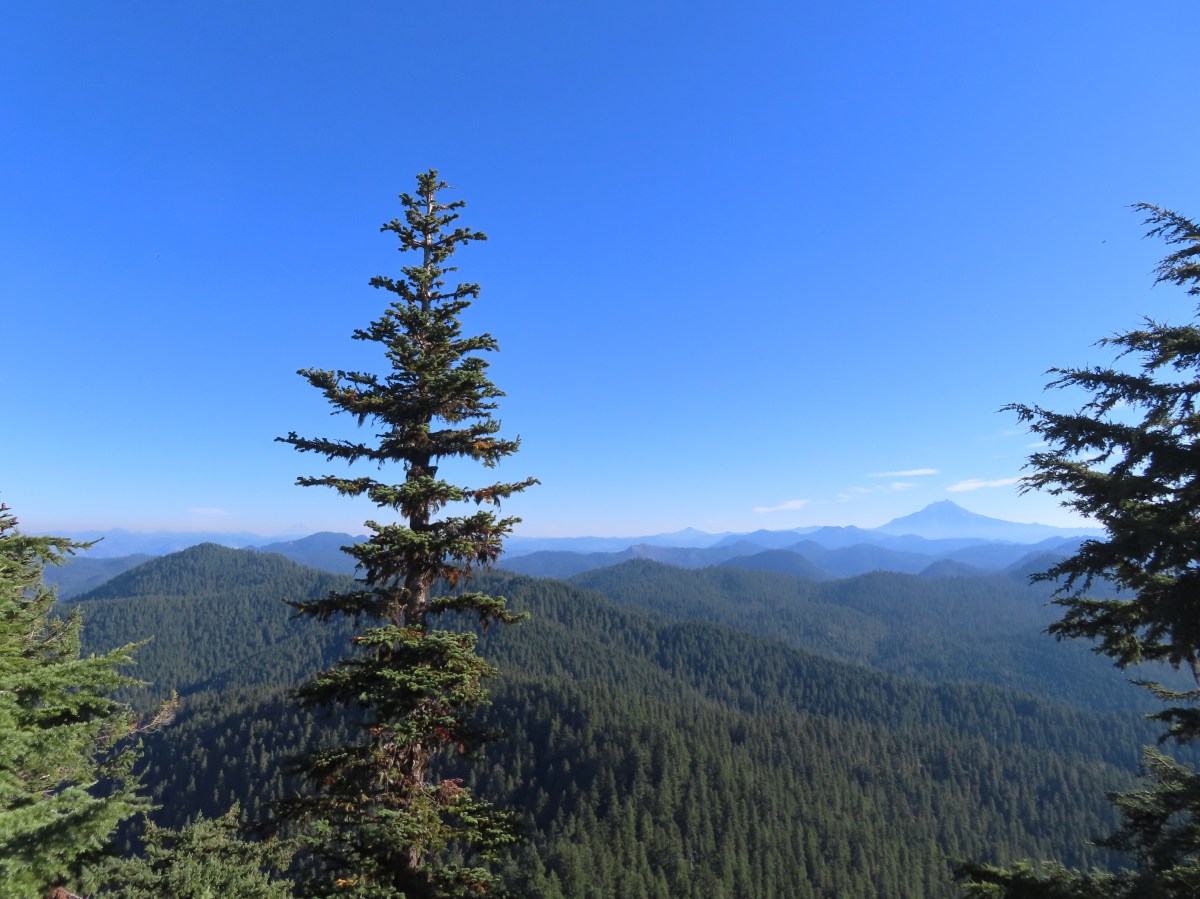
 I actually parked on the shoulder of Forest Road 1142 and walked a tenth of a mile down a spur road to the start of the trail.
 A note stating that access from the eastern side of the wilderness was still closed due to the Pyramid Fire.
 It was early when I started so there wasn’t a lot of light and even on the way back there was a lot of shade.
 A short distance from the trailhead is a crossing of West Fork McQuade Creek.
 A third of a mile from the West Fork the trail crosses McQuade Creek.
 Reportedly this crossing can be quite tricky early in the year, but there wasn’t much water this time of the year.


 Based on trip reports from 2023 and recent cuts seen along the trail it appears that a trail crew passed through this year.


 A reminder that Fall is here.
 The McQuade Creek Trail hidden by the underbrush.
 Lousewort
 Huckleberries
 Views were limited to the nearby ridges and hillsides.
 Vine maple along a rocky slope.
 Pika watching me from behind some cover.
 Flagging along a bit of a washout.


 The McQuade Creek Shelter used to be located near here, but it had collapsed years ago, and I didn’t see any signs of the remains.
 Pointer for Chimney Peak.


 Initially I forked right here because the left hand fork didn’t appear to go anywhere.
 I assume these are remains from the former lookout.
 The start of the scramble route. The crack was too narrow to use but once I got to the top of this rock the route became much clearer.
 Looking down at the first part of the route from above.
 The top is in sight.
 Clouds over Green Peter Lake.
 Mt. Hood in the distance.
 Zoomed in on Mt. Hood and some haze.


 The Three Sisters
 Three Fingered Jack to the left behind the Three Pyramids (
 Mt. Jefferson zoomed.


 West Fork McQuade Creek
 Back at the trailhead.
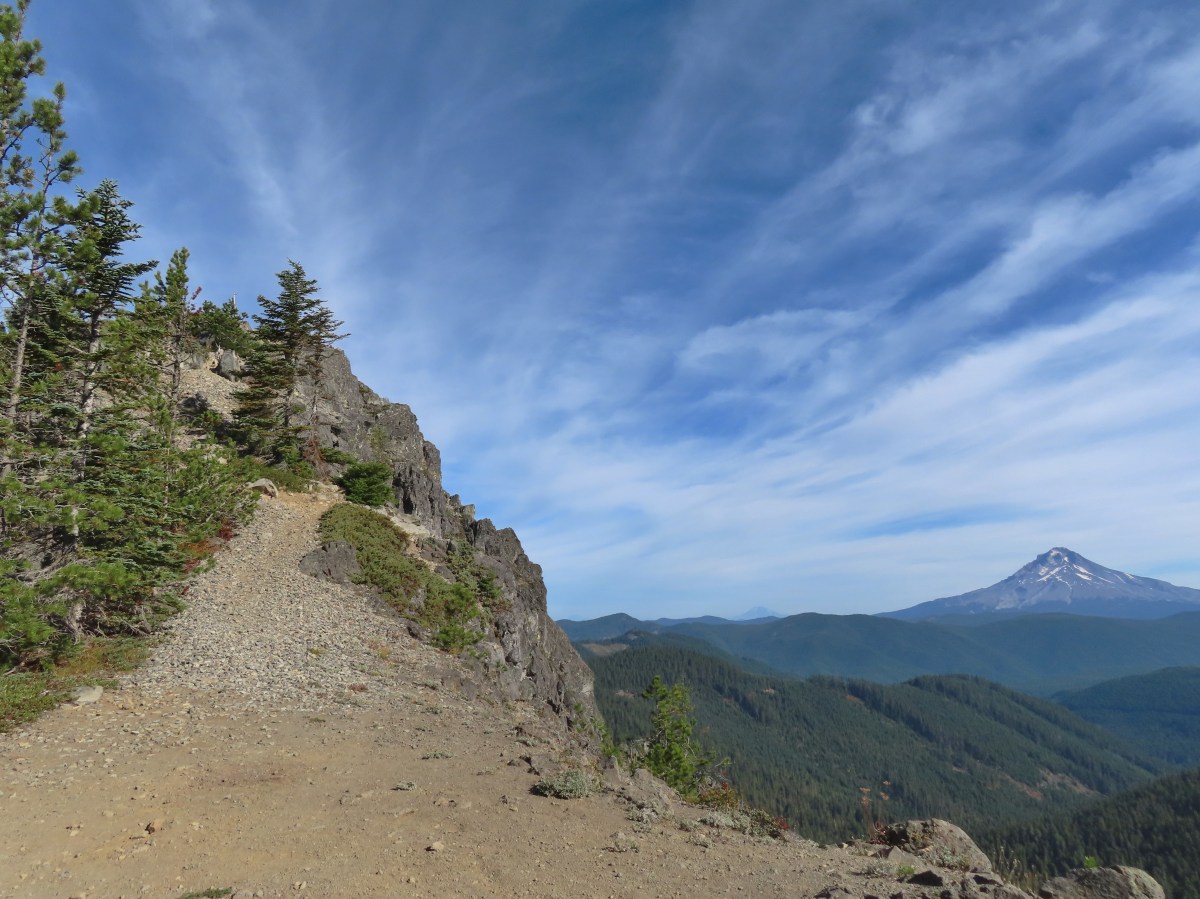
 We parked on the shoulder here and road walked three quarters of a mile to the official
  This is a good example of why we parked where we did.
 The official trailhead.


 A pair of Barrow’s goldeneye ducks enjoying a morning swim on the far side of the lake.
 The use trail
 Mushroom along the road walk back to the car.
 The somewhat obscured sign for the Anvil Lake Trail along spur road 5800-160.
 The pullout where we parked.


 The edge of Black Wolf Meadows.
 Sign in Black Wolf Meadows.


 The trail leaving the meadows.
 More mushrooms
 Rough-skinned newt

 Old sign near Anvil Creek.
 The dry bed of Anvil Creek.
 Coral fungus
 The sign for the spur trail ahead on the left.
 Pointer for Anvil Lake. According to the Oregon Hikers Field Guide this sign is likely over 50 years old based on the reference to S-502 which is currently known as FR 5820 which is another potential
 Anvil Lake


 Mt. Hood from the pullout.


 The road continuing to the left.
 Olallie Butte (
 Mt. Hood with Mt. Adams behind to the left.
 The view south toward Mt. Jefferson.
 Heather is the orange dot climbing up the side of the outcrop.
 Mt. Hood from the saddle.
 Signal Buttes is the pointy peak on the left and Salmon Butte (
 Salmon Butte now in the middle with Linney Butte the hump on the right of the double humps in the foreground and Devil’s Peak (
 Linney Butte, Devil’s Peak, Mt. Adams in the distance, and Mt. Hood.
 Wolf Peak in the foreground which is above Black Wolf Meadows.
 Mt. Jefferson from the former lookout site.
 Peaks in the Bull-of-the-Woods and Opal Creek Wilderness areas in the distance to the left and Fish Creek Mountain (
 The remains of the lookout on High Rock.
 A zoomed in shot of Mt. Adams.
 Mt. Rainier rising behind Devil’s Peak.

 The ground squirrel watching us as we passed below.
 Skipper along the road on the way down.
 Aster
Aster

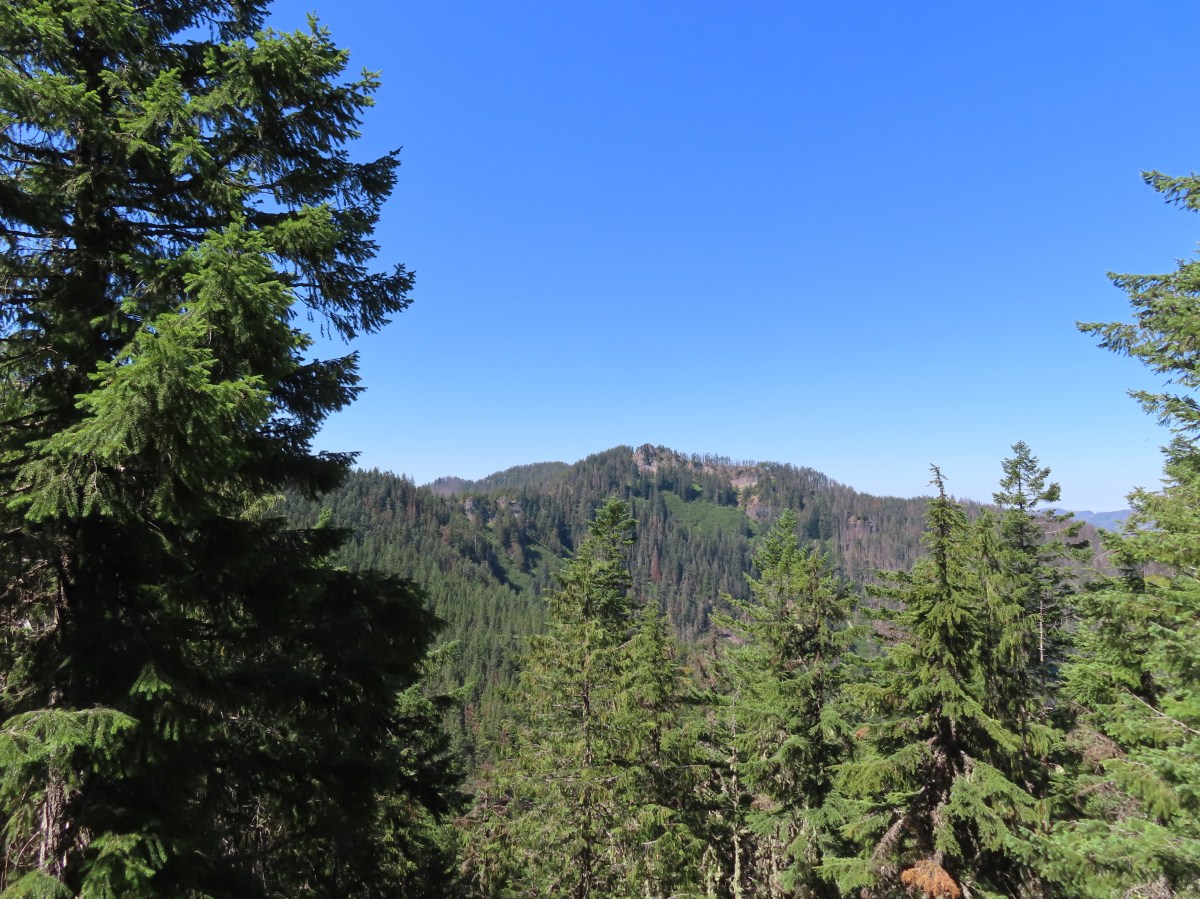
 The unsigned trail enters the forest across from a small pullout.
 Bunchberry


 Fish
Fish Rough skinned newt


 Flagging and some old trail maintenance along the Baty Butte Trail.
 We could see the tread continuing on the other side of the thicket.
 Vegetation covering the trail.
 The trailhead is located at a turnaround at the end of BLM road 7-4E-11.1.
 Oregon sunshine, lupine and paintbrush.
 Larkspur, paintbrush, and Oregon sunshine.
 Penstemon, paintbrush, and valerian.

 Westen featherbells
 Bistort
 Arnica

 Bear sign on the trail.
 Paintbrush and lousewort
 Nasty Rock from the trail.
 Entering the fire scar.
 The trail was especially overgrown in the fire scar.
 Penstemon
 Columbine along the trail.
 Valerian
 Exiting the fire scar after less than 100 yards.
 While none of the several downed trees posed much of an issue the condition of the trail made for slow going.

 Nasty Rock sticking up ahead.
 Not Nasty Rock further along the ridge and in the Beachie Creek fire scar.
 Wildflowers were blooming in the openings along the ridge.
 Arrowleaf buckwheat
 Checkerspot on Oregon sunshine
 Oregon sunshine
 Table Rock (
 Mt. Hood peecking up from behind a ridge.
 Scarlet gilia
 Nasty Rock from the trail.
 Flowers below the trail.
 Flowers above the trail.
 Buckwheat


 There were a lot of nice Washington lilies below Nasty Rock with more to come over the next week or two.
 Wintergreen
 Nasty Rock from the trail.
 The trail below Nasty Rock.
 Nasty Rock from the end of the “trail”. Prior to the 2020 fire a rougher use trail continued on to Not Nasty Rock, but we didn’t see any obvious tread. (We weren’t really looking though either.) We made the fairly easy scramble to the top of Nasty Rock and took a short break.
 Mt. Jefferson from Nasty Rock.
 Mt. Jefferson with the flat-topped Battle Ax (
 Mt. Hood in the distance.

 Looking out across the Molalla River drainage to the Table Rock Wilderness.
 Rooster Rock is the rock outcrop to the left with Table Rock the tall feature to the right. Pechuck Lookout can be seen on the lower hilltop in the center foreground.
 Not Nasty Rock from Nasty Rock. The highest peak diagonally left of Not Nasty Rock is Rocky Top (
 We were joined at the summit by a swarm of flying ants obsessed with this fir tree.
 Checkerspot on Oregon sunshine
 Swallowtail resting on serviceberry.
 Blue bells of Scotland
 Fritillaries on mountain coyote mint
 Clodius parnassian on mountain coyote mint.
 Fleabane
 Buckwheats, paintbrush, Oregon sunshine and at least one butterfly.
 Scarlet gilia
 Larkspur
 Washington lily
 Inside-out flower
 Fritillary
 Beardtongue
 Pink pyrola
 Bead lily a.k.a. Queen’s cup
 Bunchberry
 Cat’s ear mariposa lily
 Approaching the road.
 Larkspur and yarrow
 Checkerspots on Oregon sunshine


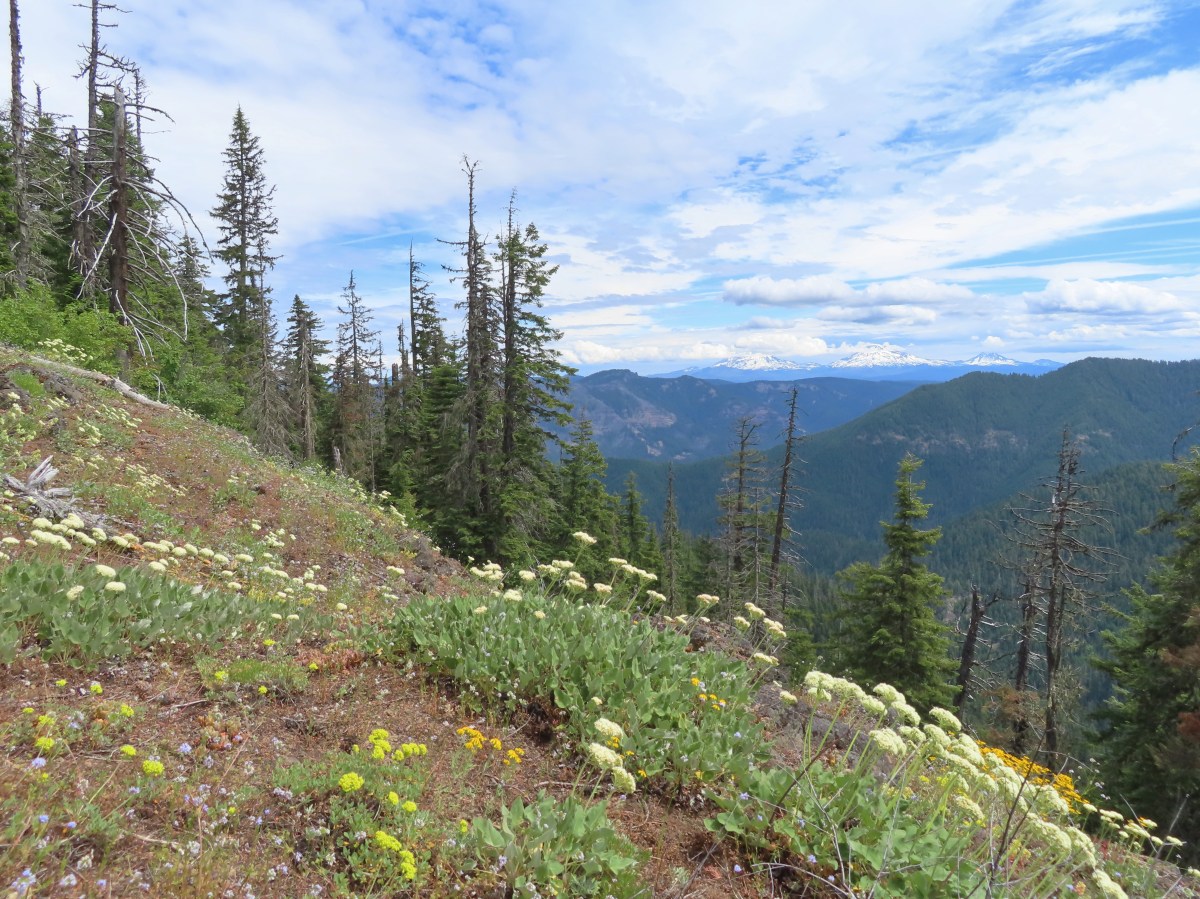

 Valerian along the trail.
 Vanilla leaf and anemones carpeting the forest floor.
 Star-flowered false solomonseal.
 Coneflower with lupine behind.
 Penstemon


 Monkeyflower
 Lupine
 Sub-alpine mariposa lily
 Moth on fleabane.
 Waterleaf
 Tiger lily
 Pussytoes
 From left to right the peaks with snow are: The Twins (
 Diamond Peak
 Grasshopper Mountain above the meadow.
 The post in the rocky area.
 When we visited in 2017 it had been mid-July, and the larkspur show was over.
 A cairn marks the Grasshopper Mountain Trail.

 Looking out over the meadow.
 Fuji Mountain and Diamond Peak
 The saddle below Grasshopper Mountain.
 The Three Sisters and Broken Top
 Mt. Bachelor
 The last of the snow, at least it is all we saw.
 Glacier lilies near the tiny snow patch.
 It was evident that the trail does get maintained on occasion, but none of it appeared recent near Grasshopper Mountain.
 Anemone
 Violets
 Bleeding heart
 Oregon bluebells
 The Three Sisters and Broken Top were visible from this area.
 Back on the slightly overgrown trail.
 Mt. Jefferson and Three Fingered Jack
 Bears appear to use the trail more than hikers. This was the largest of three piles we’d pass on the day.
 Arnica
 This is both the trail and a front (back) door.
 Valerian and tall bluebells
 Fairy bells
 Meadowrue
 Moth on valerian.
 Jacob’s-ladder
 While the trail was overgrown in places it was passable and the tread was in pretty good shape.
 Fringecup
 Possibly a speedwell but unsure and it was the only one we saw.
 More blowdown to maneuver around.
 Edith’s checkerspot
 Trail passing through an area full of monkeyflower and larkspur.
 Cinquefoil, larkspur, and buckwheat
 Scarlet gilia
 Paintbrush
 Bluehead gilia and silverleaf phacelia
 The rocky area from the trail as it crossed the ridge.
 Columbine crowding the trail.
 The wildflower covered rocks on the way back.
 Arrowleaf buckwheat and Oregon sunshine
 The Three Sisters and Broken Top with some clouds moving in.

 Paintbrush surrounded by buckwheat, bluehead gilia, and stonecrop.
 Scarlet gilia
 Wallflower
 Wild rose
 Beargrass near the outcrop.
 The outcrop from the trail.
 Blowdown
 More blowdown
 Western meadow fritillary
 Bunchberry
 Recent trail maintenance! There were a couple of cut trees in the final mile, but there were also still many to step over.
 The trail dropped low enough that there were several rhododendron blooming.
 Queen’s cup.
 South Sister (

 Had I not just come down the trail I might not have even noticed it was there.
 Cardwell’s penstemon
 Starflower
 Ginger
 Mt. Bachelor through the trees.
 Musk monkeyflower
 Grasshopper Mountain from the outcrop.
 Cliff beardtongue
 Blue-eyed Mary
 Cicada, not a pollinator but interesting to see.
 Solomonseal
 Variable-leaf collomia
 Honeysuckle
 Oregon grape
 Pollinator 1
 Pollinator 2
 Pollinator 3 (Clodius parnassian)
 Bees on bastard toadflax
 Checkerspot on groundsel
 Naked broomrape (Aphyllon purpureum)
 Penstemon
 Our guess is this is mile three from Grasshopper Saddle. We didn’t notice any other numbers and missed this one on our first pass.
 Dwarf bramble
 Strawberry
 Cinquefoil
 It started clouding up in the afternoon.
 Back at the saddle below Grasshopper Mountain.
 Great artic butterfly. There were a lot of these flying about. Their dorsum is a bright orange, but they rarely would open their wings when they landed.
 The checkerspots on the other hand are happy to open their wings.
 False hellebore
 It clouded up over Diamond Peak as well.
 Lewis flax
 Orange agoseris
 A Lycaendae on a lupine leaf.
 Moth on a mariposa lily.
 Butterflies gathering at the spring.
 The Prius at the TH. We parked on the shoulder in a pullout.


 Signboard about a tenth of a mile from the trailhead.
 The loop began on the far side of the footbridge.
 As far as we could remember we’d never seen a bench on the other side of a fence before.
 Middle Fork Willamette River through the vegetation.
 Tiger lily
 Self-heal
 Snail
Snail Mock orange

 Anemone
 There are a few junctions prior to reaching the footbridge. The first was the only one with any signage. We stayed on the correct trail by ignoring side trails to the left that headed uphill and on the right that led down to Deception Creek.
 We turned left at the signed junction following half a sign for the Deception Butte Trail.

 At the last unsigned junction there was a signboard, but with nothing on it. (We went straight.)
 Warning sign for the burned area ahead.
 The footbridge over Deception Creek.
 Deception Creek

 The amount of trail work needed to clear the trail was evident by the sheer number of cut trees along the length of the trail.
 This was from 2017 near the same stretch of trail.
 View up the canyon from the trail.
 Clodius parnassian
 There was a lot of vegetation along the trail, so we had to keep an eye out for poison oak which was present at times on the lower two-thirds of the trail. It was never much of a problem, but there were a couple of plants crowding the trail that we had to maneuver around.
 Moth
Moth Starflower
 Rhododendron
 Northern cloudywing
 Big deervetch
 Hummingbird
 Groundsel
 One of the damaged sections of trail.
 There was some forest that survived the fire starting near the 3.5-mile mark where the fire burned less intensely.
 Townsend’s solitaire
 Canada jay
 There were a few views of the Three Sisters through the remaining trees. (Middle & South Sister here)
 Inside-out flower
 Looking up as the trail neared the summit.
 Woodpecker
 Common whipplea
 Anemone
 The Deception Butte Trail arriving at Deception Butte.
 Beargrass


 Looking down at the saddle and wondering if it was really worth having to climb back up.
 Northern flicker
 Lizard
 Rock outcrop on the other side of the saddle.
 Tolmie’s mariposa lilies
 Bluehead gilia
 Squirrel
 Oakridge in the valley below with Diamond Peak (
 Diamond Peak
 Oakridge
 Leafy fleabane
 Oregon sunshine on the hillside looking up Deception Butte from the saddle.
 Wild onion
 One of the fritillary butterflies.
 Fly inside a Tolmie’s mariposa lily.
 There is a very steep trail just below the summit that leads to an upper trailhead. The Forest Service does not recommend using these though as the trail is said to be slippery and steep. We can vouch for the steep just by having looked down from the Deception Butte Trail.
 Plectris and stonecrop
 Coralroot
 The best view of the Three Sisters that we got all day.
 Butterflies enjoying some vetch. There were at least a half dozen butterflies visiting this patch.
 Brown creeper
 Pink pyrola

 Pearly everlasting
 Turkey vulture
 Fireweed
 Entering the trees near the footbridge over Deception Creek.
 Columbine
 Tiger lilies


 There were some nice rhododendron blooms along the trail.
 Spotted coralroot
 The first of three crossings of FR 411, this is at the 0.4-mile mark.
 Inside-out flower
 Starflower
 Yellowleaf iris
 The trail is narrow at times but well maintiained.
 Forest filled with rhododendron.
 A closer look at the rhodies.
 There were several madrones in the forest.
 Little prince’s pine
 Sugar sticks
 There were a few places where we might have had a view if not for the clouds.
 Stonecrop
 Passing below some of the rock formations.


 Anemones
 Bleeding heart

 The first small meadow that the trail passed through was full of blue-eyed Mary.

 Northern phlox
 Coming up on another small meadow.
 Subalpine mariposa lily
 Beargrass
 The fog didn’t help with our trying to find the trail. There was enough room along this section of road that parking and starting the hike from here would be possible.
 Back on trail.
 Honeysuckle
 More northern phlox
 This meadow was full of bluehead gilia.


 The trail dropped steeply as it rejoined FR 411.
 There was no parking room that we could see near this area.
 Vanilla leaf along the trail.

 Bunchberry
 Trillium
 We stopped when we spotted something in the trail ahead that looked like it might be an animal. Using the camera to zoom we realized it was a grouse hen with her little chicks.
 The hen got up and then the chicks headed into the underbrush. We felt bad having disturbed them, but once they’d moved, we calmly passed by while momma came back to gather her little ones.
 This was all beargrass, but none of the plants in this area appeared to be planning on blooming this year.
 Hermit thrush
 The rocky summit of MacDuff Mountain.
 A lot of larkspur.
 Subalpine mariposa lilies
 Paintbrush and buckwheat
 Cinquefoil
 A penstemon


 The view from the top.
 No blue sky that way.
 No sign of clearing this way either.
 Cliff beardtongue
 Woodland-stars
 Paintbrush
 Hey look, there is another ridge over there.
 Ookow just starting to open up.
 Steep climb or road walk? We chose the trail again on the way back.
 A wetter road now thanks to the rain shower.
 Blue sky, it does exist.
 The clouds got a late start but eventually started lifting.
 From this angle it looks like a statue.
 Looking down from some of the switchbacks.
 Cougar Reservoir
 Pyrola
 Sunlight!
 I’ve never seen a track this far off.
 The track after manually editing it.
